DE102018131513A1 - Cationically curable composition and method for joining, casting and coating substrates using the composition - Google Patents
Cationically curable composition and method for joining, casting and coating substrates using the composition Download PDFInfo
- Publication number
- DE102018131513A1 DE102018131513A1 DE102018131513.9A DE102018131513A DE102018131513A1 DE 102018131513 A1 DE102018131513 A1 DE 102018131513A1 DE 102018131513 A DE102018131513 A DE 102018131513A DE 102018131513 A1 DE102018131513 A1 DE 102018131513A1
- Authority
- DE
- Germany
- Prior art keywords
- wavelength
- photoinitiator
- mass
- weight
- actinic radiation
- Prior art date
- Legal status (The legal status is an assumption and is not a legal conclusion. Google has not performed a legal analysis and makes no representation as to the accuracy of the status listed.)
- Withdrawn
Links
Images


Classifications
-
- C—CHEMISTRY; METALLURGY
- C08—ORGANIC MACROMOLECULAR COMPOUNDS; THEIR PREPARATION OR CHEMICAL WORKING-UP; COMPOSITIONS BASED THEREON
- C08G—MACROMOLECULAR COMPOUNDS OBTAINED OTHERWISE THAN BY REACTIONS ONLY INVOLVING UNSATURATED CARBON-TO-CARBON BONDS
- C08G59/00—Polycondensates containing more than one epoxy group per molecule; Macromolecules obtained by polymerising compounds containing more than one epoxy group per molecule using curing agents or catalysts which react with the epoxy groups
- C08G59/18—Macromolecules obtained by polymerising compounds containing more than one epoxy group per molecule using curing agents or catalysts which react with the epoxy groups ; e.g. general methods of curing
- C08G59/20—Macromolecules obtained by polymerising compounds containing more than one epoxy group per molecule using curing agents or catalysts which react with the epoxy groups ; e.g. general methods of curing characterised by the epoxy compounds used
- C08G59/22—Di-epoxy compounds
- C08G59/24—Di-epoxy compounds carbocyclic
-
- C—CHEMISTRY; METALLURGY
- C08—ORGANIC MACROMOLECULAR COMPOUNDS; THEIR PREPARATION OR CHEMICAL WORKING-UP; COMPOSITIONS BASED THEREON
- C08G—MACROMOLECULAR COMPOUNDS OBTAINED OTHERWISE THAN BY REACTIONS ONLY INVOLVING UNSATURATED CARBON-TO-CARBON BONDS
- C08G59/00—Polycondensates containing more than one epoxy group per molecule; Macromolecules obtained by polymerising compounds containing more than one epoxy group per molecule using curing agents or catalysts which react with the epoxy groups
- C08G59/18—Macromolecules obtained by polymerising compounds containing more than one epoxy group per molecule using curing agents or catalysts which react with the epoxy groups ; e.g. general methods of curing
- C08G59/68—Macromolecules obtained by polymerising compounds containing more than one epoxy group per molecule using curing agents or catalysts which react with the epoxy groups ; e.g. general methods of curing characterised by the catalysts used
-
- C—CHEMISTRY; METALLURGY
- C08—ORGANIC MACROMOLECULAR COMPOUNDS; THEIR PREPARATION OR CHEMICAL WORKING-UP; COMPOSITIONS BASED THEREON
- C08F—MACROMOLECULAR COMPOUNDS OBTAINED BY REACTIONS ONLY INVOLVING CARBON-TO-CARBON UNSATURATED BONDS
- C08F2/00—Processes of polymerisation
- C08F2/46—Polymerisation initiated by wave energy or particle radiation
- C08F2/48—Polymerisation initiated by wave energy or particle radiation by ultraviolet or visible light
- C08F2/50—Polymerisation initiated by wave energy or particle radiation by ultraviolet or visible light with sensitising agents
-
- C—CHEMISTRY; METALLURGY
- C08—ORGANIC MACROMOLECULAR COMPOUNDS; THEIR PREPARATION OR CHEMICAL WORKING-UP; COMPOSITIONS BASED THEREON
- C08F—MACROMOLECULAR COMPOUNDS OBTAINED BY REACTIONS ONLY INVOLVING CARBON-TO-CARBON UNSATURATED BONDS
- C08F216/00—Copolymers of compounds having one or more unsaturated aliphatic radicals, each having only one carbon-to-carbon double bond, and at least one being terminated by an alcohol, ether, aldehydo, ketonic, acetal or ketal radical
- C08F216/12—Copolymers of compounds having one or more unsaturated aliphatic radicals, each having only one carbon-to-carbon double bond, and at least one being terminated by an alcohol, ether, aldehydo, ketonic, acetal or ketal radical by an ether radical
-
- C—CHEMISTRY; METALLURGY
- C08—ORGANIC MACROMOLECULAR COMPOUNDS; THEIR PREPARATION OR CHEMICAL WORKING-UP; COMPOSITIONS BASED THEREON
- C08F—MACROMOLECULAR COMPOUNDS OBTAINED BY REACTIONS ONLY INVOLVING CARBON-TO-CARBON UNSATURATED BONDS
- C08F220/00—Copolymers of compounds having one or more unsaturated aliphatic radicals, each having only one carbon-to-carbon double bond, and only one being terminated by only one carboxyl radical or a salt, anhydride ester, amide, imide or nitrile thereof
- C08F220/02—Monocarboxylic acids having less than ten carbon atoms; Derivatives thereof
- C08F220/10—Esters
- C08F220/12—Esters of monohydric alcohols or phenols
- C08F220/16—Esters of monohydric alcohols or phenols of phenols or of alcohols containing two or more carbon atoms
- C08F220/18—Esters of monohydric alcohols or phenols of phenols or of alcohols containing two or more carbon atoms with acrylic or methacrylic acids
-
- C—CHEMISTRY; METALLURGY
- C08—ORGANIC MACROMOLECULAR COMPOUNDS; THEIR PREPARATION OR CHEMICAL WORKING-UP; COMPOSITIONS BASED THEREON
- C08F—MACROMOLECULAR COMPOUNDS OBTAINED BY REACTIONS ONLY INVOLVING CARBON-TO-CARBON UNSATURATED BONDS
- C08F261/00—Macromolecular compounds obtained by polymerising monomers on to polymers of oxygen-containing monomers as defined in group C08F16/00
- C08F261/06—Macromolecular compounds obtained by polymerising monomers on to polymers of oxygen-containing monomers as defined in group C08F16/00 on to polymers of unsaturated ethers
-
- C—CHEMISTRY; METALLURGY
- C08—ORGANIC MACROMOLECULAR COMPOUNDS; THEIR PREPARATION OR CHEMICAL WORKING-UP; COMPOSITIONS BASED THEREON
- C08F—MACROMOLECULAR COMPOUNDS OBTAINED BY REACTIONS ONLY INVOLVING CARBON-TO-CARBON UNSATURATED BONDS
- C08F283/00—Macromolecular compounds obtained by polymerising monomers on to polymers provided for in subclass C08G
- C08F283/06—Macromolecular compounds obtained by polymerising monomers on to polymers provided for in subclass C08G on to polyethers, polyoxymethylenes or polyacetals
-
- C—CHEMISTRY; METALLURGY
- C08—ORGANIC MACROMOLECULAR COMPOUNDS; THEIR PREPARATION OR CHEMICAL WORKING-UP; COMPOSITIONS BASED THEREON
- C08F—MACROMOLECULAR COMPOUNDS OBTAINED BY REACTIONS ONLY INVOLVING CARBON-TO-CARBON UNSATURATED BONDS
- C08F283/00—Macromolecular compounds obtained by polymerising monomers on to polymers provided for in subclass C08G
- C08F283/10—Macromolecular compounds obtained by polymerising monomers on to polymers provided for in subclass C08G on to polymers containing more than one epoxy radical per molecule
-
- C—CHEMISTRY; METALLURGY
- C08—ORGANIC MACROMOLECULAR COMPOUNDS; THEIR PREPARATION OR CHEMICAL WORKING-UP; COMPOSITIONS BASED THEREON
- C08G—MACROMOLECULAR COMPOUNDS OBTAINED OTHERWISE THAN BY REACTIONS ONLY INVOLVING UNSATURATED CARBON-TO-CARBON BONDS
- C08G59/00—Polycondensates containing more than one epoxy group per molecule; Macromolecules obtained by polymerising compounds containing more than one epoxy group per molecule using curing agents or catalysts which react with the epoxy groups
- C08G59/18—Macromolecules obtained by polymerising compounds containing more than one epoxy group per molecule using curing agents or catalysts which react with the epoxy groups ; e.g. general methods of curing
- C08G59/40—Macromolecules obtained by polymerising compounds containing more than one epoxy group per molecule using curing agents or catalysts which react with the epoxy groups ; e.g. general methods of curing characterised by the curing agents used
- C08G59/4007—Curing agents not provided for by the groups C08G59/42 - C08G59/66
-
- C—CHEMISTRY; METALLURGY
- C08—ORGANIC MACROMOLECULAR COMPOUNDS; THEIR PREPARATION OR CHEMICAL WORKING-UP; COMPOSITIONS BASED THEREON
- C08G—MACROMOLECULAR COMPOUNDS OBTAINED OTHERWISE THAN BY REACTIONS ONLY INVOLVING UNSATURATED CARBON-TO-CARBON BONDS
- C08G59/00—Polycondensates containing more than one epoxy group per molecule; Macromolecules obtained by polymerising compounds containing more than one epoxy group per molecule using curing agents or catalysts which react with the epoxy groups
- C08G59/18—Macromolecules obtained by polymerising compounds containing more than one epoxy group per molecule using curing agents or catalysts which react with the epoxy groups ; e.g. general methods of curing
- C08G59/40—Macromolecules obtained by polymerising compounds containing more than one epoxy group per molecule using curing agents or catalysts which react with the epoxy groups ; e.g. general methods of curing characterised by the curing agents used
- C08G59/4007—Curing agents not provided for by the groups C08G59/42 - C08G59/66
- C08G59/4064—Curing agents not provided for by the groups C08G59/42 - C08G59/66 sulfur containing compounds
-
- C—CHEMISTRY; METALLURGY
- C08—ORGANIC MACROMOLECULAR COMPOUNDS; THEIR PREPARATION OR CHEMICAL WORKING-UP; COMPOSITIONS BASED THEREON
- C08G—MACROMOLECULAR COMPOUNDS OBTAINED OTHERWISE THAN BY REACTIONS ONLY INVOLVING UNSATURATED CARBON-TO-CARBON BONDS
- C08G59/00—Polycondensates containing more than one epoxy group per molecule; Macromolecules obtained by polymerising compounds containing more than one epoxy group per molecule using curing agents or catalysts which react with the epoxy groups
- C08G59/18—Macromolecules obtained by polymerising compounds containing more than one epoxy group per molecule using curing agents or catalysts which react with the epoxy groups ; e.g. general methods of curing
- C08G59/40—Macromolecules obtained by polymerising compounds containing more than one epoxy group per molecule using curing agents or catalysts which react with the epoxy groups ; e.g. general methods of curing characterised by the curing agents used
- C08G59/4007—Curing agents not provided for by the groups C08G59/42 - C08G59/66
- C08G59/4071—Curing agents not provided for by the groups C08G59/42 - C08G59/66 phosphorus containing compounds
-
- C—CHEMISTRY; METALLURGY
- C08—ORGANIC MACROMOLECULAR COMPOUNDS; THEIR PREPARATION OR CHEMICAL WORKING-UP; COMPOSITIONS BASED THEREON
- C08G—MACROMOLECULAR COMPOUNDS OBTAINED OTHERWISE THAN BY REACTIONS ONLY INVOLVING UNSATURATED CARBON-TO-CARBON BONDS
- C08G59/00—Polycondensates containing more than one epoxy group per molecule; Macromolecules obtained by polymerising compounds containing more than one epoxy group per molecule using curing agents or catalysts which react with the epoxy groups
- C08G59/18—Macromolecules obtained by polymerising compounds containing more than one epoxy group per molecule using curing agents or catalysts which react with the epoxy groups ; e.g. general methods of curing
- C08G59/40—Macromolecules obtained by polymerising compounds containing more than one epoxy group per molecule using curing agents or catalysts which react with the epoxy groups ; e.g. general methods of curing characterised by the curing agents used
- C08G59/62—Alcohols or phenols
-
- C—CHEMISTRY; METALLURGY
- C08—ORGANIC MACROMOLECULAR COMPOUNDS; THEIR PREPARATION OR CHEMICAL WORKING-UP; COMPOSITIONS BASED THEREON
- C08G—MACROMOLECULAR COMPOUNDS OBTAINED OTHERWISE THAN BY REACTIONS ONLY INVOLVING UNSATURATED CARBON-TO-CARBON BONDS
- C08G59/00—Polycondensates containing more than one epoxy group per molecule; Macromolecules obtained by polymerising compounds containing more than one epoxy group per molecule using curing agents or catalysts which react with the epoxy groups
- C08G59/18—Macromolecules obtained by polymerising compounds containing more than one epoxy group per molecule using curing agents or catalysts which react with the epoxy groups ; e.g. general methods of curing
- C08G59/68—Macromolecules obtained by polymerising compounds containing more than one epoxy group per molecule using curing agents or catalysts which react with the epoxy groups ; e.g. general methods of curing characterised by the catalysts used
- C08G59/687—Macromolecules obtained by polymerising compounds containing more than one epoxy group per molecule using curing agents or catalysts which react with the epoxy groups ; e.g. general methods of curing characterised by the catalysts used containing sulfur
-
- C—CHEMISTRY; METALLURGY
- C08—ORGANIC MACROMOLECULAR COMPOUNDS; THEIR PREPARATION OR CHEMICAL WORKING-UP; COMPOSITIONS BASED THEREON
- C08G—MACROMOLECULAR COMPOUNDS OBTAINED OTHERWISE THAN BY REACTIONS ONLY INVOLVING UNSATURATED CARBON-TO-CARBON BONDS
- C08G65/00—Macromolecular compounds obtained by reactions forming an ether link in the main chain of the macromolecule
- C08G65/02—Macromolecular compounds obtained by reactions forming an ether link in the main chain of the macromolecule from cyclic ethers by opening of the heterocyclic ring
- C08G65/04—Macromolecular compounds obtained by reactions forming an ether link in the main chain of the macromolecule from cyclic ethers by opening of the heterocyclic ring from cyclic ethers only
- C08G65/06—Cyclic ethers having no atoms other than carbon and hydrogen outside the ring
- C08G65/08—Saturated oxiranes
- C08G65/10—Saturated oxiranes characterised by the catalysts used
- C08G65/105—Onium compounds
-
- C—CHEMISTRY; METALLURGY
- C08—ORGANIC MACROMOLECULAR COMPOUNDS; THEIR PREPARATION OR CHEMICAL WORKING-UP; COMPOSITIONS BASED THEREON
- C08G—MACROMOLECULAR COMPOUNDS OBTAINED OTHERWISE THAN BY REACTIONS ONLY INVOLVING UNSATURATED CARBON-TO-CARBON BONDS
- C08G65/00—Macromolecular compounds obtained by reactions forming an ether link in the main chain of the macromolecule
- C08G65/02—Macromolecular compounds obtained by reactions forming an ether link in the main chain of the macromolecule from cyclic ethers by opening of the heterocyclic ring
- C08G65/04—Macromolecular compounds obtained by reactions forming an ether link in the main chain of the macromolecule from cyclic ethers by opening of the heterocyclic ring from cyclic ethers only
- C08G65/06—Cyclic ethers having no atoms other than carbon and hydrogen outside the ring
- C08G65/08—Saturated oxiranes
- C08G65/10—Saturated oxiranes characterised by the catalysts used
- C08G65/12—Saturated oxiranes characterised by the catalysts used containing organo-metallic compounds or metal hydrides
-
- C—CHEMISTRY; METALLURGY
- C08—ORGANIC MACROMOLECULAR COMPOUNDS; THEIR PREPARATION OR CHEMICAL WORKING-UP; COMPOSITIONS BASED THEREON
- C08G—MACROMOLECULAR COMPOUNDS OBTAINED OTHERWISE THAN BY REACTIONS ONLY INVOLVING UNSATURATED CARBON-TO-CARBON BONDS
- C08G65/00—Macromolecular compounds obtained by reactions forming an ether link in the main chain of the macromolecule
- C08G65/02—Macromolecular compounds obtained by reactions forming an ether link in the main chain of the macromolecule from cyclic ethers by opening of the heterocyclic ring
- C08G65/04—Macromolecular compounds obtained by reactions forming an ether link in the main chain of the macromolecule from cyclic ethers by opening of the heterocyclic ring from cyclic ethers only
- C08G65/06—Cyclic ethers having no atoms other than carbon and hydrogen outside the ring
- C08G65/16—Cyclic ethers having four or more ring atoms
- C08G65/20—Tetrahydrofuran
-
- C—CHEMISTRY; METALLURGY
- C08—ORGANIC MACROMOLECULAR COMPOUNDS; THEIR PREPARATION OR CHEMICAL WORKING-UP; COMPOSITIONS BASED THEREON
- C08J—WORKING-UP; GENERAL PROCESSES OF COMPOUNDING; AFTER-TREATMENT NOT COVERED BY SUBCLASSES C08B, C08C, C08F, C08G or C08H
- C08J3/00—Processes of treating or compounding macromolecular substances
- C08J3/24—Crosslinking, e.g. vulcanising, of macromolecules
- C08J3/243—Two or more independent types of crosslinking for one or more polymers
-
- C—CHEMISTRY; METALLURGY
- C08—ORGANIC MACROMOLECULAR COMPOUNDS; THEIR PREPARATION OR CHEMICAL WORKING-UP; COMPOSITIONS BASED THEREON
- C08J—WORKING-UP; GENERAL PROCESSES OF COMPOUNDING; AFTER-TREATMENT NOT COVERED BY SUBCLASSES C08B, C08C, C08F, C08G or C08H
- C08J3/00—Processes of treating or compounding macromolecular substances
- C08J3/28—Treatment by wave energy or particle radiation
-
- C—CHEMISTRY; METALLURGY
- C09—DYES; PAINTS; POLISHES; NATURAL RESINS; ADHESIVES; COMPOSITIONS NOT OTHERWISE PROVIDED FOR; APPLICATIONS OF MATERIALS NOT OTHERWISE PROVIDED FOR
- C09D—COATING COMPOSITIONS, e.g. PAINTS, VARNISHES OR LACQUERS; FILLING PASTES; CHEMICAL PAINT OR INK REMOVERS; INKS; CORRECTING FLUIDS; WOODSTAINS; PASTES OR SOLIDS FOR COLOURING OR PRINTING; USE OF MATERIALS THEREFOR
- C09D129/00—Coating compositions based on homopolymers or copolymers of compounds having one or more unsaturated aliphatic radicals, each having only one carbon-to-carbon double bond, and at least one being terminated by an alcohol, ether, aldehydo, ketonic, acetal, or ketal radical; Coating compositions based on hydrolysed polymers of esters of unsaturated alcohols with saturated carboxylic acids; Coating compositions based on derivatives of such polymers
- C09D129/10—Homopolymers or copolymers of unsaturated ethers
-
- C—CHEMISTRY; METALLURGY
- C09—DYES; PAINTS; POLISHES; NATURAL RESINS; ADHESIVES; COMPOSITIONS NOT OTHERWISE PROVIDED FOR; APPLICATIONS OF MATERIALS NOT OTHERWISE PROVIDED FOR
- C09D—COATING COMPOSITIONS, e.g. PAINTS, VARNISHES OR LACQUERS; FILLING PASTES; CHEMICAL PAINT OR INK REMOVERS; INKS; CORRECTING FLUIDS; WOODSTAINS; PASTES OR SOLIDS FOR COLOURING OR PRINTING; USE OF MATERIALS THEREFOR
- C09D163/00—Coating compositions based on epoxy resins; Coating compositions based on derivatives of epoxy resins
-
- C—CHEMISTRY; METALLURGY
- C09—DYES; PAINTS; POLISHES; NATURAL RESINS; ADHESIVES; COMPOSITIONS NOT OTHERWISE PROVIDED FOR; APPLICATIONS OF MATERIALS NOT OTHERWISE PROVIDED FOR
- C09D—COATING COMPOSITIONS, e.g. PAINTS, VARNISHES OR LACQUERS; FILLING PASTES; CHEMICAL PAINT OR INK REMOVERS; INKS; CORRECTING FLUIDS; WOODSTAINS; PASTES OR SOLIDS FOR COLOURING OR PRINTING; USE OF MATERIALS THEREFOR
- C09D171/00—Coating compositions based on polyethers obtained by reactions forming an ether link in the main chain; Coating compositions based on derivatives of such polymers
-
- C—CHEMISTRY; METALLURGY
- C09—DYES; PAINTS; POLISHES; NATURAL RESINS; ADHESIVES; COMPOSITIONS NOT OTHERWISE PROVIDED FOR; APPLICATIONS OF MATERIALS NOT OTHERWISE PROVIDED FOR
- C09D—COATING COMPOSITIONS, e.g. PAINTS, VARNISHES OR LACQUERS; FILLING PASTES; CHEMICAL PAINT OR INK REMOVERS; INKS; CORRECTING FLUIDS; WOODSTAINS; PASTES OR SOLIDS FOR COLOURING OR PRINTING; USE OF MATERIALS THEREFOR
- C09D4/00—Coating compositions, e.g. paints, varnishes or lacquers, based on organic non-macromolecular compounds having at least one polymerisable carbon-to-carbon unsaturated bond ; Coating compositions, based on monomers of macromolecular compounds of groups C09D183/00 - C09D183/16
-
- C—CHEMISTRY; METALLURGY
- C09—DYES; PAINTS; POLISHES; NATURAL RESINS; ADHESIVES; COMPOSITIONS NOT OTHERWISE PROVIDED FOR; APPLICATIONS OF MATERIALS NOT OTHERWISE PROVIDED FOR
- C09J—ADHESIVES; NON-MECHANICAL ASPECTS OF ADHESIVE PROCESSES IN GENERAL; ADHESIVE PROCESSES NOT PROVIDED FOR ELSEWHERE; USE OF MATERIALS AS ADHESIVES
- C09J129/00—Adhesives based on homopolymers or copolymers of compounds having one or more unsaturated aliphatic radicals, each having only one carbon-to-carbon double bond, and at least one being terminated by an alcohol, ether, aldehydo, ketonic, acetal, or ketal radical; Adhesives based on hydrolysed polymers of esters of unsaturated alcohols with saturated carboxylic acids; Adhesives based on derivatives of such polymers
- C09J129/10—Homopolymers or copolymers of unsaturated ethers
-
- C—CHEMISTRY; METALLURGY
- C09—DYES; PAINTS; POLISHES; NATURAL RESINS; ADHESIVES; COMPOSITIONS NOT OTHERWISE PROVIDED FOR; APPLICATIONS OF MATERIALS NOT OTHERWISE PROVIDED FOR
- C09J—ADHESIVES; NON-MECHANICAL ASPECTS OF ADHESIVE PROCESSES IN GENERAL; ADHESIVE PROCESSES NOT PROVIDED FOR ELSEWHERE; USE OF MATERIALS AS ADHESIVES
- C09J163/00—Adhesives based on epoxy resins; Adhesives based on derivatives of epoxy resins
-
- C—CHEMISTRY; METALLURGY
- C09—DYES; PAINTS; POLISHES; NATURAL RESINS; ADHESIVES; COMPOSITIONS NOT OTHERWISE PROVIDED FOR; APPLICATIONS OF MATERIALS NOT OTHERWISE PROVIDED FOR
- C09J—ADHESIVES; NON-MECHANICAL ASPECTS OF ADHESIVE PROCESSES IN GENERAL; ADHESIVE PROCESSES NOT PROVIDED FOR ELSEWHERE; USE OF MATERIALS AS ADHESIVES
- C09J171/00—Adhesives based on polyethers obtained by reactions forming an ether link in the main chain; Adhesives based on derivatives of such polymers
-
- C—CHEMISTRY; METALLURGY
- C09—DYES; PAINTS; POLISHES; NATURAL RESINS; ADHESIVES; COMPOSITIONS NOT OTHERWISE PROVIDED FOR; APPLICATIONS OF MATERIALS NOT OTHERWISE PROVIDED FOR
- C09K—MATERIALS FOR MISCELLANEOUS APPLICATIONS, NOT PROVIDED FOR ELSEWHERE
- C09K3/00—Materials not provided for elsewhere
- C09K3/10—Materials in mouldable or extrudable form for sealing or packing joints or covers
-
- B—PERFORMING OPERATIONS; TRANSPORTING
- B29—WORKING OF PLASTICS; WORKING OF SUBSTANCES IN A PLASTIC STATE IN GENERAL
- B29C—SHAPING OR JOINING OF PLASTICS; SHAPING OF MATERIAL IN A PLASTIC STATE, NOT OTHERWISE PROVIDED FOR; AFTER-TREATMENT OF THE SHAPED PRODUCTS, e.g. REPAIRING
- B29C35/00—Heating, cooling or curing, e.g. crosslinking or vulcanising; Apparatus therefor
- B29C35/02—Heating or curing, e.g. crosslinking or vulcanizing during moulding, e.g. in a mould
- B29C35/08—Heating or curing, e.g. crosslinking or vulcanizing during moulding, e.g. in a mould by wave energy or particle radiation
- B29C35/0805—Heating or curing, e.g. crosslinking or vulcanizing during moulding, e.g. in a mould by wave energy or particle radiation using electromagnetic radiation
- B29C2035/0833—Heating or curing, e.g. crosslinking or vulcanizing during moulding, e.g. in a mould by wave energy or particle radiation using electromagnetic radiation using actinic light
-
- B—PERFORMING OPERATIONS; TRANSPORTING
- B32—LAYERED PRODUCTS
- B32B—LAYERED PRODUCTS, i.e. PRODUCTS BUILT-UP OF STRATA OF FLAT OR NON-FLAT, e.g. CELLULAR OR HONEYCOMB, FORM
- B32B38/00—Ancillary operations in connection with laminating processes
- B32B2038/0052—Other operations not otherwise provided for
- B32B2038/0076—Curing, vulcanising, cross-linking
-
- C—CHEMISTRY; METALLURGY
- C08—ORGANIC MACROMOLECULAR COMPOUNDS; THEIR PREPARATION OR CHEMICAL WORKING-UP; COMPOSITIONS BASED THEREON
- C08J—WORKING-UP; GENERAL PROCESSES OF COMPOUNDING; AFTER-TREATMENT NOT COVERED BY SUBCLASSES C08B, C08C, C08F, C08G or C08H
- C08J2363/00—Characterised by the use of epoxy resins; Derivatives of epoxy resins
-
- C—CHEMISTRY; METALLURGY
- C08—ORGANIC MACROMOLECULAR COMPOUNDS; THEIR PREPARATION OR CHEMICAL WORKING-UP; COMPOSITIONS BASED THEREON
- C08J—WORKING-UP; GENERAL PROCESSES OF COMPOUNDING; AFTER-TREATMENT NOT COVERED BY SUBCLASSES C08B, C08C, C08F, C08G or C08H
- C08J2371/00—Characterised by the use of polyethers obtained by reactions forming an ether link in the main chain; Derivatives of such polymers
-
- C—CHEMISTRY; METALLURGY
- C09—DYES; PAINTS; POLISHES; NATURAL RESINS; ADHESIVES; COMPOSITIONS NOT OTHERWISE PROVIDED FOR; APPLICATIONS OF MATERIALS NOT OTHERWISE PROVIDED FOR
- C09K—MATERIALS FOR MISCELLANEOUS APPLICATIONS, NOT PROVIDED FOR ELSEWHERE
- C09K2200/00—Chemical nature of materials in mouldable or extrudable form for sealing or packing joints or covers
- C09K2200/06—Macromolecular organic compounds, e.g. prepolymers
- C09K2200/0645—Macromolecular organic compounds, e.g. prepolymers obtained otherwise than by reactions involving carbon-to-carbon unsaturated bonds
- C09K2200/0647—Polyepoxides
Landscapes
- Chemical & Material Sciences (AREA)
- Organic Chemistry (AREA)
- Chemical Kinetics & Catalysis (AREA)
- Health & Medical Sciences (AREA)
- Medicinal Chemistry (AREA)
- Polymers & Plastics (AREA)
- Materials Engineering (AREA)
- Engineering & Computer Science (AREA)
- Life Sciences & Earth Sciences (AREA)
- Wood Science & Technology (AREA)
- Adhesives Or Adhesive Processes (AREA)
- Epoxy Resins (AREA)
- Paints Or Removers (AREA)
- Compositions Of Macromolecular Compounds (AREA)
Abstract
Die Erfindung betrifft eine kationisch härtbare Masse mit mindestens einer kationisch polymerisierbaren Komponente; einem ersten Photoinitiator, der bei Bestrahlung mit aktinischer Strahlung einer ersten Wellenlänge λeine Säure freisetzt; und einem zweiten Photoinitiator, der bei Bestrahlung mit aktinischer Strahlung einer zweiten Wellenlänge λeine Säure freisetzt, wobei die zweite Wellenlänge λkürzer als die erste Wellenlänge λist, und wobei der zweite Photoinitiator nach Bestrahlen der Masse mit aktinischer Strahlung der ersten Wellenlange λin der Masse eine Absorption von aktinischer Strahlung der zweiten Wellenlänge λaufweist, die ausreichend ist, um den zweiten Photoinitiator zu aktivieren und die Masse zu fixieren. Des Weiteren wird ein Verfahren zum Fügen, Vergießen, Abformen, Abdichten und/oder Beschichten von Substraten unter Verwendung der kationisch härtbaren Masse beschrieben.The invention relates to a cationically curable composition with at least one cationically polymerizable component; a first photoinitiator which releases an acid when irradiated with actinic radiation of a first wavelength λ; and a second photoinitiator which, when irradiated with actinic radiation of a second wavelength λ, releases an acid, the second wavelength λ being shorter than the first wavelength λ, and wherein the second photoinitiator, after irradiation of the mass with actinic radiation of the first wavelength λ, has an absorption in the mass Actinic radiation of the second wavelength λ, which is sufficient to activate the second photoinitiator and fix the mass. Furthermore, a method for joining, casting, molding, sealing and / or coating substrates using the cationically curable composition is described.
Description
GEBIET DER ERFINDUNGFIELD OF THE INVENTION
Die Erfindung betrifft eine kationisch härtbare Masse, die durch Bestrahlen mit aktinischer Strahlung aktivierbar ist, und ein Verfahren zum Fügen, Vergießen und Beschichten von Substraten unter Verwendung der Masse.The invention relates to a cationically curable composition which can be activated by irradiation with actinic radiation, and a method for joining, casting and coating substrates using the composition.
TECHNISCHER HINTERGRUNDTECHNICAL BACKGROUND
Kationisch polymerisierbare Massen mit Photoinitiatoren auf Basis von Sulfonium- und lodoniumsalzen gehören seit vielen Jahren zum Stand der Technik. Eine Übersicht geeigneter Photoinitiatoren kann den Publikationen von J.V. Crivello und K. Dietliker in „Photoinitiators for Free Radical, Cationic & Anionic Photopolymerisation“, Band III von „Chemistry & Technology of UV & EB Formulation for Coatings, Inks & Paints“, 2. Ed., J. Wiley and Sons/SITA Technology (London), 1998 entnommen werden.Cationically polymerizable compositions with photoinitiators based on sulfonium and iodonium salts have been state of the art for many years. An overview of suitable photoinitiators can be found in the publications of J.V. Crivello and K. Dietliker in "Photoinitiators for Free Radical, Cationic & Anionic Photopolymerization", Volume III of "Chemistry & Technology of UV & EB Formulation for Coatings, Inks & Paints", 2nd Ed., J. Wiley and Sons / SITA Technology (London), 1998.
Als Anionen für die Sulfonium- oder lodoniumsalze können HSO4 -, PF6 -, SbF6 -, AsF6 -, Cl-, Br, I-, ClO4 -, PO4 -, SO3CF3 -, Tosylat oder ein Borat-Anion, wie etwa BF4 - und B(C6F5)4 - dienen. Ebenfalls geeignet sind Aluminatanionen, wie sie in der der
Die
Ein Fügeverfahren unter Verwendung solcher Massen ist aus der
Die
In dem wissenschaftlichen Artikel von
Der wissenschaftliche Artikel von
Die
Die
Aus der
Die
Die
ZUSAMMENFASSUNG DER ERFINDUNGSUMMARY OF THE INVENTION
Der Erfindung liegt die Aufgabe zugrunde, die oben beschriebenen Nachteile der aus dem Stand der Technik bekannten Verfahren und Zusammensetzungen zu vermeiden und kationisch härtbare Massen bereitzustellen, die in industriellen Füge- und Vergussverfahren vielfältig einsetzbar sind.The invention is based on the object of avoiding the disadvantages described above of the processes and compositions known from the prior art and of providing cationically curable compositions which can be used in a variety of ways in industrial joining and casting processes.
Insbesondere sollen die kationisch härtbaren Massen es ermöglichen, ein Verfahren bereitzustellen, mit dem der Festigkeitsaufbau der Massen gezielt gesteuert werden kann.In particular, the cationically curable compositions should make it possible to provide a method with which the build-up of strength of the compositions can be controlled in a targeted manner.
Erfindungsgemäß wird diese Aufgabe durch eine kationisch härtbare Masse nach Anspruch 1 und ein Verfahren nach Anspruch 11 gelöst.According to the invention, this object is achieved by a cationically curable composition according to claim 1 and a method according to claim 11.
Weitere Ausführungsformen der Erfindung sind in den Unteransprüchen angegeben, die wahlweise miteinander kombiniert werden können.Further embodiments of the invention are specified in the subclaims, which can optionally be combined with one another.
Die kationisch härtbare Masse gemäß der Erfindung umfasst:
- a) mindestens eine kationisch polymerisierbare Komponente;
- b) einen ersten Photoinitiator, der bei Bestrahlung mit aktinischer Strahlung einer ersten Wellenlänge
λ1 eine Säure freisetzt; und - c) einen zweiten Photoinitiator, der bei Bestrahlung mit aktinischer Strahlung einer zweiten Wellenlänge
λ2 eine Säure freisetzt;
- a) at least one cationically polymerizable component;
- b) a first photoinitiator which, when irradiated with actinic radiation, has a first wavelength
λ 1 releases an acid; and - c) a second photoinitiator which, when irradiated with actinic radiation of a second wavelength
λ 2 releases an acid;
Die kationisch härtbare Masse umfasst somit kationisch polymerisierbare Komponenten (A), einen ersten Photoinitiator (B1) und einen zweiten Photoinitiator (B2) für die kationische Polymerisation, der vom ersten Photoinitiator (B1) verschieden ist. Daneben kann die Masse weitere Zusatzstoffe (C), radikalisch polymerisierbare Bestandteile (D) und wahlweise einen weiteren Photoinitiator (E) für die radikalische Polymerisation enthalten.The cationically curable composition thus comprises cationically polymerizable components (A), a first photoinitiator (B1) and a second photoinitiator (B2) for the cationic polymerization, which is different from the first photoinitiator (B1). In addition, the mass can contain other additives (C), radical contain polymerizable constituents (D) and optionally a further photoinitiator (E) for the radical polymerization.
Erfindungsgemäß wird die kationisch härtbare Masse in einem Verfahren zum Fügen, Vergießen oder Beschichten von Substraten eingesetzt, wobei das Verfahren die folgenden Schritte umfasst:
- a) Bereitstellen der oben beschriebenen kationisch härtbaren Masse;
- b) Dosieren der Masse auf ein erstes Substrat;
- c) Aktivieren der Masse durch Bestrahlen mit aktinischer Strahlung der ersten Wellenlänge
λ1 ; - d) wahlweise Zuführen eines zweiten Substrates zur aktivierten Masse auf dem ersten Substrat unter Bildung eines Substratverbundes, und weiter wahlweise Ausrichten beider Substrate zueinander;
- e) Fixieren der aktivierten Masse durch Bestrahlen mit aktinischer Strahlung der zweiten Wellenlänge
λ2 ; und - f) wahlweise Erwärmen der fixierten Masse auf dem ersten Substrat oder in dem Substratverbund.
- a) providing the cationically curable composition described above;
- b) dosing the mass onto a first substrate;
- c) activating the mass by irradiation with actinic radiation of the first wavelength
λ 1 ; - d) optionally supplying a second substrate to the activated mass on the first substrate to form a substrate composite, and further optionally aligning the two substrates to one another;
- e) fixing the activated mass by irradiation with actinic radiation of the second wavelength
λ 2 ; and - f) optionally heating the fixed mass on the first substrate or in the substrate composite.
Das erfindungsgemäße Verfahren ist dadurch gekennzeichnet, dass die zweite Wellenlänge
Im erfindungsgemäßen Verfahren lässt sich durch den ersten Bestrahlungsschritt die kationische Polymerisation der Masse initiieren. Die Masse bleibt nach der Aktivierung des ersten Photoinitiators durch Bestrahlung mit aktinischer Strahlung der ersten Wellenlänge
Das erfindungsgemäße Verfahren ermöglicht es ferner, ohne zusätzlichen Wärmeeintrag eine sichere Aushärtung der aktivierten Masse bei Raumtemperatur zu erreichen Dies schließt allerdings nicht aus, dass die Aushärtung durch Erwärmen der fixierten Masse beschleunigt werden kann.The method according to the invention also makes it possible to achieve a reliable curing of the activated mass at room temperature without additional heat input. However, this does not rule out the fact that the curing can be accelerated by heating the fixed mass.
Im Sinne des erfindungsgemäßen Verfahrens bezeichnet „Fixierung“ den Aufbau einer Festigkeit, ab der kein Verfließen der Masse mehr stattfinden kann, oder das Maß an Festigkeit, ab dem gefügte Teile in Folgeprozessen gehandhabt werden können, ohne dass es zu einer Zerstörung des Klebeverbundes kommt.In the sense of the method according to the invention, “fixation” denotes the build-up of a strength from which the mass can no longer flow, or the degree of strength from which joined parts can be handled in subsequent processes without the adhesive bond being destroyed.
Gegenstand der Erfindung ist ferner die Verwendung der erfindungsgemäßen kationisch härtbaren Masse in einem Verfahren zum Fügen, Vergießen, Abformen, Abdichten und Beschichten von Substraten, bei dem die Masse durch Bestrahlung mit aktinischer Strahlung einer ersten Wellenlänge
FigurenlisteFigure list
In den beigefügten Zeichnungen zeigen
- -
1 ein Emissionsspektrum einer LED-Bestrahlungslampe DELOLUX 20 / 365; - -
2 UV/VIS-Spektren eines Photoinitiatorgemischs nach Beispiel 1, vor und nach Aktivierung des ersten Photoinitiators durch Bestrahlen des Gemischs bei einer ersten Wellenlängeλ1 ; und - -
3 UV/VIS-Spektren eines Photoinitiatorgemischs nach Beispiel 7, vor und nach Aktivierung des ersten Photoinitiators durch Bestrahlen des Gemischs bei einer ersten Wellenlängeλ1 .
- -
1 an emission spectrum of a DELOLUX 20/365 LED irradiation lamp; - -
2nd UV / VIS spectra of a photoinitiator mixture according to Example 1, before and after activation of the first photoinitiator by irradiating the mixture at a first wavelengthλ 1 ; and - -
3rd UV / VIS spectra of a photoinitiator mixture according to Example 7, before and after activation of the first photoinitiator by irradiating the mixture at a first wavelengthλ 1 .
AUSFÜHRLICHE BESCHREIBUNG BEVORZUGTER AUSFÜHRUNGSFORMENDETAILED DESCRIPTION OF PREFERRED EMBODIMENTS
Die Erfindung wird im Folgenden anhand von bevorzugten Ausführungsformen ausführlich und beispielhaft beschrieben, die jedoch nicht in einem einschränkenden Sinn verstanden werden sollen.The invention is described in detail and by way of example below with reference to preferred embodiments, which, however, are not to be understood in a restrictive sense.
„Einkomponentig“ oder „Einkomponentenmasse“ bedeutet im Sinne der Erfindung, dass die genannten Komponenten der Masse zusammen in einer Packungseinheit vorliegen. “One-component” or “one-component mass” in the sense of the invention means that the components of the mass mentioned are present together in one packaging unit.
„Flüssig“ bedeutet im Sinne der Erfindung, dass bei 23 °C der durch Viskositätsmessung bestimmte Verlustmodul G" größer als der Speichermodul G' der betreffenden Masse ist.For the purposes of the invention, “liquid” means that the loss modulus G ″ determined by viscosity measurement at 23 ° C. is greater than the storage modulus G ′ of the mass in question.
Soweit der unbestimmte Artikel „ein“ oder „eine“ verwendet wird, ist damit auch die Pluralform „ein oder mehrere“ umfasst, soweit diese nicht ausdrücklich ausgeschlossen wird.Insofar as the indefinite article "one" or "one" is used, the plural form "one or more" is also included, unless this is expressly excluded.
„Mindestens difunktionell“ bedeutet, dass pro Molekül zwei oder mehr Einheiten der jeweils genannten funktionellen Gruppe enthalten sind.“At least difunctional” means that two or more units of the functional group mentioned are contained per molecule.
Alle im Folgenden aufgeführten Gewichtsanteile beziehen sich, wenn nicht anders angegeben, jeweils auf das Gesamtgewicht der Masse.Unless otherwise stated, all parts by weight listed below relate to the total weight of the mass.
Angaben von Äquivalenten beziehen sich im Folgenden jeweils auf 1 Äquivalent der funktionellen Gruppe und sind im Verhältnis zueinander angegeben.In the following, details of equivalents relate to 1 equivalent of the functional group and are given in relation to one another.
In einer ersten bevorzugten Ausführungsform enthalten die Massen zur Durchführung des erfindungsgemäßen Verfahrens kationisch polymerisierbare Komponenten (A), mindestens zwei Photoinitiatoren (B) für die kationische Polymerisation, die voneinander verschieden sind, und wahlweise weitere Zusatzstoffe (C). Bevorzugt bestehen die Massen der ersten Ausführungsform aus den genannten Komponenten (A), (B) und (C).In a first preferred embodiment, the compositions for carrying out the process according to the invention comprise cationically polymerizable components (A), at least two photoinitiators (B) for the cationic polymerization, which are different from one another, and optionally further additives (C). The compositions of the first embodiment preferably consist of the components (A), (B) and (C) mentioned.
In einer zweiten bevorzugten Ausführungsform enthalten die Massen zur Durchführung des erfindungsgemäßen Verfahrens neben den oben genannten Komponenten (A), (B) und (C) zusätzlich radikalisch polymerisierbare Bestandteile (D) und wahlweise einen weiteren Photoinitiator (E) für die radikalische Polymerisation. Bevorzugt bestehen die Massen der zweiten Ausführungsform aus den Komponenten (A) bis (E).In a second preferred embodiment, the compositions for carrying out the process according to the invention contain, in addition to the above-mentioned components (A), (B) and (C), additionally free-radically polymerizable constituents (D) and optionally a further photoinitiator (E) for the free-radical polymerization. The masses of the second embodiment preferably consist of components (A) to (E).
Im Folgenden werden die Komponenten der kationisch polymerisierbaren Masse zur Verwendung im erfindungsgemäßen Verfahren näher beschrieben.The components of the cationically polymerizable composition for use in the process according to the invention are described in more detail below.
Komponente (A): Kationisch polymerisierbare KomponentenComponent (A): Cationically polymerizable components
Die kationisch polymerisierbaren Komponenten sind in Bezug auf ihre chemische Basis nicht weiter eingeschränkt. Bevorzugt sind die kationisch polymerisierbaren Komponenten aus der aus epoxidhaltigen Verbindungen (A1), oxetanhaltigen Verbindungen (A2), Vinylethern (A3) sowie Kombinationen davon bestehenden Gruppe ausgewählt. Wahlweise kann die kationisch polymerisierbare Komponente zusätzlich einen oder mehrere Alkohole (A4) als reaktive Flexibilisierungsmittel enthalten. In einer bevorzugten Ausführungsform enthält die Masse mindestens eine epoxidhaltige Verbindung (A1).The cationically polymerizable components are not further restricted in terms of their chemical basis. The cationically polymerizable components are preferably selected from the group consisting of epoxy-containing compounds (A1), oxetane-containing compounds (A2), vinyl ethers (A3) and combinations thereof. Optionally, the cationically polymerizable component can additionally contain one or more alcohols (A4) as reactive flexibilizing agents. In a preferred embodiment, the composition contains at least one epoxy-containing compound (A1).
Die epoxidhaltige Verbindung (A1) in den erfindungsgemäßen Massen umfasst bevorzugt eine oder mehrere mindestens difunktionelle epoxidhaltige Verbindungen. Mindestens „difunktionell“ bedeutet, dass die epoxidhaltige Verbindung mindestens zwei Epoxidgruppen enthält. Die Komponente (A1) kann beispielsweise cycloaliphatische Epoxide, aromatische und aliphatische Glycidylether, Glycidylester oder Glycidylamine und Mischungen davon umfassen.The epoxy-containing compound (A1) in the compositions according to the invention preferably comprises one or more at least difunctional epoxy-containing compounds. At least “difunctional” means that the epoxy-containing compound contains at least two epoxy groups. Component (A1) can comprise, for example, cycloaliphatic epoxides, aromatic and aliphatic glycidyl ethers, glycidyl esters or glycidyl amines and mixtures thereof.
Difunktionelle cycloaliphatische Epoxidharze sind im Stand der Technik bekannt und beinhalten Verbindungen, die sowohl eine cycloaliphatische Gruppe als auch mindestens zwei Oxiranringe tragen. Beispielhafte Vertreter sind 3-Cyclohexenylmethyl-3-cyclohexylcarboxylatdiepoxid, 3,4-Epoxycyclohexylalkyl-3',4'-epoxycyclohexancarboxylat, 3,4-Epoxy-6-methylcyclohexylmethyl-3',4'-epoxy-6-methylcyclohexancarboxylat, Vinylcyclohexendioxid, Bis(3,4-Epoxycyclohexylmethyl)adipat, Dicyclopentadiendioxid und 1,2-Epoxy-6-(2,3-epoxypropoxy)hexahydro-4,7-methanindan, sowie Mischungen davon.Difunctional cycloaliphatic epoxy resins are known in the prior art and include compounds which carry both a cycloaliphatic group and at least two oxirane rings. Exemplary representatives are 3-cyclohexenylmethyl-3-cyclohexylcarboxylate diepoxide, 3,4-epoxycyclohexylalkyl-3 ', 4'-epoxycyclohexane carboxylate, 3,4-epoxy-6-methylcyclohexylmethyl-3', 4'-epoxy-6-methylcyclohexane carboxylate, vinylcyclohexene dioxide, bis (3,4-epoxycyclohexylmethyl) adipate, dicyclopentadiene dioxide and 1,2-epoxy-6- (2,3-epoxypropoxy) hexahydro-4,7-methanindane, and mixtures thereof.
Aromatische Epoxidharze können in den erfindungsgemäßen Massen ebenso verwendet werden. Beispiele für aromatische Epoxidharze sind Bisphenol-A-Epoxidharze, Bisphenol-F-Epoxidharze, Phenol-Novolak-Epoxidharze, Cresol-Novolak-Epoxidharze, Biphenylepoxidharze, 4,4'-Biphenylepoxidharze, Divinylbenzoldioxid, 2-Glycidylphenylglycidylether, Naphthalindioldiglycidylether, Glycidylether von Tris(hydroxyphenyl)-methan und Glycidylether von Tris(hydroxyphenyl)-ethan, sowie Mischungen davon. Ferner können auch alle vollständig oder teilweise hydrierten Analoga aromatischer Epoxidharze eingesetzt werden.Aromatic epoxy resins can also be used in the compositions according to the invention. Examples of aromatic epoxy resins are bisphenol A epoxy resins, bisphenol F epoxy resins, phenol novolak epoxy resins, cresol novolak epoxy resins, biphenyle epoxy resins, 4,4'-biphenyle epoxy resins, divinylbenzene dioxide, 2-glycidylphenylglycidyl ether, hydroxyphenyl) methane and glycidyl ether of tris (hydroxyphenyl) ethane, and mixtures thereof. Furthermore, all or partially hydrogenated analogues of aromatic epoxy resins can also be used.
Auch mit epoxidhaltigen Gruppen substituierte Isocyanurate und andere heterocyclische Verbindungen können in den erfindungsgemäßen Massen verwendet werden. Beispielhaft seien Triglycidylisocyanurat und Monoallyldiglycidylisocyanurat genannt. Isocyanurates and other heterocyclic compounds substituted with epoxy-containing groups can also be used in the compositions according to the invention. Examples include triglycidyl isocyanurate and monoallyl diglycidyl isocyanurate.
Außerdem können auch polyfunktionelle Epoxidharze aller genannten Harzgruppen, zäh elastifizierte Epoxidharze sowie Gemische verschiedener Epoxidharze in den erfindungsgemäßen Massen eingesetzt werden.In addition, polyfunctional epoxy resins of all the resin groups mentioned, tough elasticized epoxy resins and mixtures of different epoxy resins can be used in the compositions according to the invention.
Ebenfalls im Sinne der Erfindung ist eine Kombination mehrerer epoxidhaltiger Verbindungen, von denen mindestens eine di- oder höherfunktionell ist.Also within the meaning of the invention is a combination of several epoxy-containing compounds, at least one of which is di- or higher-functional.
Zusätzlich zu den mindestens difunktionellen epoxidhaltigen Verbindungen können auch monofunktionelle Epoxide als reaktive Verdünner verwendet werden.In addition to the at least difunctional epoxy-containing compounds, monofunctional epoxides can also be used as reactive diluents.
Beispiele für kommerziell erhältliche epoxidhaltige Verbindungen sind Produkte, die unter den Handelsnamen CELLOXIDE™ 2021P, CELLOXIDE™ 8000 von Daicel Corporation, Japan, als EPIKOTE™ RESIN 828 LVEL, EPIKOTE™ RESIN 166, EPIKOTE™ RESIN 169 von Momentive Specialty Chemicals B.V., Niederlande, als Epilox™-Harze der Produktreihen A, T und AF von Leuna Harze, Deutschland, oder als EPICLON™ 840, 840-S, 850, 850-S, EXA850CRP, 850-LC von DIC K.K., Japan, Omnilane 1005 und Omnilane 2005 von IGM Resins B.V., Syna Epoxy 21 und Syna Epoxy 06 von Synasia Inc., TTA21, TTA26, TTA60 und TTA128 von Jiangsu Tetra New Material Technology Co. Ltd., verfügbar sind.Examples of commercially available epoxy-containing compounds are products sold under the trade names CELLOXIDE ™ 2021P, CELLOXIDE ™ 8000 by Daicel Corporation, Japan, as EPIKOTE ™ RESIN 828 LVEL, EPIKOTE ™ RESIN 166, EPIKOTE ™ RESIN 169 from Momentive Specialty Chemicals BV, The Netherlands. as Epilox ™ resins from the A, T and AF product series from Leuna Harze, Germany, or as EPICLON ™ 840, 840-S, 850, 850-S, EXA850CRP, 850-LC from DIC KK, Japan, Omnilane 1005 and Omnilane 2005 from IGM Resins BV, Syna Epoxy 21 and Syna Epoxy 06 from Synasia Inc., TTA21, TTA26, TTA60 and TTA128 from Jiangsu Tetra New Material Technology Co. Ltd.
Anstelle oder zusätzlich zur epoxidhaltigen Verbindung (A1) können auch oxetanhaltige Verbindungen (A2) in den Massen als kationisch härtbare Komponenten (A) eingesetzt werden. Verfahren zur Herstellung von Oxetanen sind insbesondere aus der
Beispiele für kommerziell erhältliche Oxetane sind Bis(1-ethyl-3-oxetanyl-methyl)ether (DOX), 3-Allyloxymethyl-3-ethyloxetane (AQX), 3-Ethyl-3-[(phenoxy)-methyloxetane (POX), 3-Ethyl-3-hydroxymethyl-oxetane (OXA), 1,4-Bis[(3-ethyl-3-oxetanylmethoxy)methyl]benzol (XDO), 3-Ethyl-3-[(2-ethylhexyloxy)methyl]oxetan (EHOX). Die genannten Oxetane sind von der Firma TOAGOSEI CO., LTD. kommerziell verfügbar.Examples of commercially available oxetanes are bis (1-ethyl-3-oxetanyl-methyl) ether (DOX), 3-allyloxymethyl-3-ethyloxetane (AQX), 3-ethyl-3 - [(phenoxy) -methyloxetane (POX), 3-ethyl-3-hydroxymethyl-oxetane (OXA), 1,4-bis [(3-ethyl-3-oxetanylmethoxy) methyl] benzene (XDO), 3-ethyl-3 - [(2-ethylhexyloxy) methyl] oxetane (EHOX). The oxetanes mentioned are from TOAGOSEI CO., LTD. commercially available.
Anstelle oder zusätzlich zu den Komponenten (A1) und (A2) können auch Vinylether (A3) als kationisch härtbare Komponenten in den Massen eingesetzt werden. Geeignete Vinylether sind Trimethylolpropan-Trivinylether, Ethylenglykol-Divinylether und cyclische Vinylether sowie deren Mischungen. Ferner können Vinylether polyfunktioneller Alkohole eingesetzt werden.Instead of or in addition to components (A1) and (A2), vinyl ethers (A3) can also be used in the compositions as cationically curable components. Suitable vinyl ethers are trimethylolpropane trivinyl ether, ethylene glycol divinyl ether and cyclic vinyl ether and mixtures thereof. Vinyl ethers of polyfunctional alcohols can also be used.
Schließlich kann die kationisch polymerisierbare Komponente wahlweise auch einen oder mehrere Alkohole (A4) umfassen, die als reaktive Flexibilisierungsmittel eingesetzt werden. Insbesondere höhermolekulare Polyole können zur Flexibilisierung kationischer Massen verwendet werden. Geeignete Polyole sind beispielsweise auf Basis von Polyethern, Polyestern, Polycaprolactonen, Polycarbonaten oder (hydrierten) Polybutadiendiolen verfügbar.Finally, the cationically polymerizable component can optionally also comprise one or more alcohols (A4) which are used as reactive flexibilizing agents. Higher molecular weight polyols in particular can be used to make cationic compositions more flexible. Suitable polyols are available, for example, based on polyethers, polyesters, polycaprolactones, polycarbonates or (hydrogenated) polybutadiene diols.
Beispiele für kommerziell erhältliche höhermolekulare Polyole sind Produkte, die unter den Handelsnamen ETERNACOLL UM-90 (1/1), Eternacoll UHC50-200 der Firma UBE Industries Ltd., als Capa™ 2200, Capa™3091 der Firma Perstorp, als Liquiflex H von Petroflex, als Merginol 901 der Firma HOBUM Oleochemicals, als Placcel 305, Placcel CD 205 PL der Firma Daicel Corporation, als Priplast 3172, Priplast 3196 der Firma Croda, als Kuraray Polyol F-3010, Kuraray Polyol P-6010 von Kuraray Co., Ltd., als Krasol LBH-2000, Krasol HLBH-P3000 von Cray Valley oder als Hoopol S-1015-35 oder Hoopol S-1063-35 der Firma Synthesia Internacional SLU verfügbar sind.Examples of commercially available higher molecular weight polyols are products which are sold under the trade names ETERNACOLL UM-90 (1/1), Eternacoll UHC50-200 from UBE Industries Ltd., as Capa ™ 2200, Capa ™ 3091 from Perstorp, as Liquiflex H from Petroflex, as Merginol 901 from HOBUM Oleochemicals, as Placcel 305, Placcel CD 205 PL from Daicel Corporation, as Priplast 3172, Priplast 3196 from Croda, as Kuraray Polyol F-3010, Kuraray Polyol P-6010 from Kuraray Co., Ltd., as Krasol LBH-2000, Krasol HLBH-P3000 from Cray Valley or as Hoopol S-1015-35 or Hoopol S-1063-35 from Synthesia Internacional SLU.
Die Aufzählung der kationisch polymerisierbaren Komponenten (A) ist als beispielhaft und nicht abschließend zu sehen. Eine Mischung der genannten kationisch polymerisierbaren Komponenten (A1) bis (A4) ist ebenfalls im Sinne der Erfindung.The list of the cationically polymerizable components (A) is to be regarded as exemplary and not exhaustive. A mixture of the above-mentioned cationically polymerizable components (A1) to (A4) is also within the scope of the invention.
Die kationisch polymerisierbare Komponente (A) liegt in der erfindungsgemäßen Masse, bezogen auf das Gesamtgewicht der Masse, bevorzugt in einem Anteil von 5 bis 99 Gew.-% vor, besonders bevorzugt in einem Anteil von 10 bis 95 Gew.-%.The cationically polymerizable component (A) is present in the composition according to the invention, based on the total weight of the composition, preferably in a proportion of 5 to 99% by weight, particularly preferably in a proportion of 10 to 95% by weight.
Gemäß einer bevorzugten Ausführungsform besteht die kationisch polymerisierbare Komponente (A) aus der epoxidhaltigen Komponente (A1) und wahlweise mindestens einem Alkohol (A4) als reaktivem Flexibilisierungsmittel. According to a preferred embodiment, the cationically polymerizable component (A) consists of the epoxy-containing component (A1) and optionally at least one alcohol (A4) as a reactive flexibilizing agent.
In einer weiteren Ausführungsform kann die epoxidhaltige Verbindung ganz oder teilweise durch eine oxetanhaltige Verbindung ersetzt sein.In a further embodiment, the epoxy-containing compound can be replaced in whole or in part by an oxetane-containing compound.
Ferner kann die kationisch polymerisierbare Komponente, zusätzlich zur epoxidhaltigen Komponente (A1) und/oder der oxetanhaltigen Verbindung (A2), einen oder mehrere Vinylether enthalten. In diesem Fall liegt der Vinylether in einem Anteil von 0 bis 20 Gew. -% vor, bevorzugt in einem Anteil von 0 bis 15 Gew.-%, jeweils bezogen auf das Gesamtgewicht der Masse.In addition to the epoxy-containing component (A1) and / or the oxetane-containing compound (A2), the cationically polymerizable component can also contain one or more vinyl ethers. In this case, the vinyl ether is present in a proportion of 0 to 20% by weight, preferably in a proportion of 0 to 15% by weight, in each case based on the total weight of the composition.
Die Komponente (A4) liegt in den Massen zur Verwendung im erfindungsgemäßen Verfahren in einem Anteil von 0 bis 80 Gew. -% vor, bevorzugt in einem Anteil von 0 bis 60 Gew. -%, besonders bevorzugt 1 bis 50 Gew. -%, jeweils bezogen auf das Gesamtgewicht der Masse.Component (A4) is present in the compositions for use in the process according to the invention in a proportion of 0 to 80% by weight, preferably in a proportion of 0 to 60% by weight, particularly preferably 1 to 50% by weight, each based on the total weight of the mass.
Komponente (B): Photoinitiatoren für die kationische PolymerisationComponent (B): Photoinitiators for cationic polymerization
Neben der Komponente (A) enthalten die Massen zur Verwendung im erfindungsgemäßen Verfahren mindestens zwei Photoinitiatoren (B1) und (B2) für die kationische Polymerisation, die aus der Gruppe der photolatenten Säurebildner ausgewählt sind. Dies bedeutet, dass die Photoinitiatoren (B1) und (B2) bei Bestrahlung mit aktinischer Strahlung einer vorbestimmten Wellenlänge aktiviert werden und eine Säure freisetzen. Die Säure kann eine Lewis-Säure oder eine Brönstedt-Säure sein. Die Photoinitiatoren (B1) und (B2) unterscheiden sich voneinander und sind durch Bestrahlung bei unterschiedlichen Wellenlängen aktivierbar.In addition to component (A), the compositions for use in the process according to the invention contain at least two photoinitiators (B1) and (B2) for the cationic polymerization, which are selected from the group of photolatent acid generators. This means that the photoinitiators (B1) and (B2) are activated when irradiated with actinic radiation of a predetermined wavelength and release an acid. The acid can be a Lewis acid or a Brönstedt acid. The photoinitiators (B1) and (B2) differ from one another and can be activated by irradiation at different wavelengths.
Zur Bestrahlung der Photoinitiatoren (B1) und (B2) kann monochromatisches Laserlicht verwendet werden. Bevorzugt werden jedoch Strahlungsquellen eingesetzt, die ein singuläres Emissionsmaximum bei der vorbestimmten Wellenlänge aufweisen. Die Strahlungsquelle ist vorzugweise eine LED-Aushärtungslampe, die im Handel verfügbar sind.Monochromatic laser light can be used to irradiate the photoinitiators (B1) and (B2). However, radiation sources are preferred which have a singular emission maximum at the predetermined wavelength. The radiation source is preferably an LED curing lamp that is commercially available.
Komponente (B1): Photoinitiator auf MetalloceniumbasisComponent (B1): Metallocenium-based photoinitiator
Die erfindungsgemäßen Massen enthalten bevorzugt mindestens einen photolatenten Säurebildner auf Basis einer Metalloceniumverbindung als Photoinitiator (B1) für die kationische Polymerisation. Eine Übersicht über verschiedene Metalloceniumsalze wird in der
Bevorzugt ist der Photoinitiator auf Basis einer Metalloceniumverbindung aus der Gruppe der Ferroceniumsalze ausgewählt.The photoinitiator based on a metallocenium compound is preferably selected from the group of the ferrocenium salts.
Beispiele für geeignete Ferroceniumsalze sind Cumenylcyclopentadienyleisen (II) Hexafluorophosphat (Irgacure 261); Naphthalenylcyclopentadienyleisen(ll) Hexafluorophosphat, Benzylcyclopentadienyleisen (II) Hexafluorophosphat und Cyclopentadienylcarbazoleisen (II) hexafluorophosphat.Examples of suitable ferrocenium salts are cumenylcyclopentadienyl iron (II) hexafluorophosphate (Irgacure 261); Naphthalenylcyclopentadienyl iron (II) hexafluorophosphate, benzylcyclopentadienyl iron (II) hexafluorophosphate and cyclopentadienyl carbazole iron (II) hexafluorophosphate.
Bevorzugt absorbiert der Photoinitiator (B1) im sichtbaren Bereich des elektromagnetischen Spektrums. Dies bedeutet, dass der Photoinitiator (B1) bevorzugt bei einer ersten Wellenlänge λ1 ≥ 380 nm aktivierbar ist. Vorzugsweise lässt sich der Photoinitiator (B1) durch Strahlung einer Wellenlänge von ≥ 400 nm, bevorzugt ≥ 460 nm aktivieren. Besonders bevorzugt liegt die Aktivierungswellenlänge
Der Photoinitiator (B1) ist bezogen auf das Gesamtgewicht der Masse in einem Anteil von 0,01 bis 5 Gew.-% enthalten, bevorzugt jedoch in Anteilen von 0,3 bis 3 Gew.-%.The photoinitiator (B1) is based on the total weight of the mass in a proportion of 0.01 to 5 wt .-%, but preferably in a proportion of 0.3 to 3 wt .-%.
(B2): Photoinitiator auf Basis von Oniumverbindungen(B2): Photoinitiator based on onium compounds
Die Massen zur Durchführung des erfindungsgemäßen Verfahrens enthalten neben dem photolatenten Säurebildner auf Metalloceniumbasis (B1) mindestens einen zweiten photolatenten Säurebildner auf Basis einer Oniumverbindung als Photoinitiator (B2) für die kationische Polymerisation. Bevorzugt sind Oniumverbindungen aus der Gruppe der Arylsulfoniumsalze und der Aryliodoniumsalze, und Kombinationen davon.The compositions for carrying out the process according to the invention contain, in addition to the photolatent acid generator based on metallocenium (B1), at least one second photolatent acid generator based on an onium compound as photoinitiator (B2) for the cationic polymerization. Onium compounds from the group of the arylsulfonium salts and the aryliodonium salts, and combinations thereof, are preferred.
Als photolatente Säuren (B2) geeignete aromatische Arylsulfoniumsalze sind unter anderem in der
Darüber hinaus werden als photolatente Säuren (B2) geeignete Oniumsalze von J.V. Crivello und K. Dietliker in „Photoinitiators for Free Radical, Cationic & Anionic Photopolymerisation“, Band III von „Chemistry & Technology of UV & EB Formulation for Coatings, Inks & Paints“, 2. Ed., J. Wiley and Sons/SITA Technology (London), 1998, beschrieben.In addition, suitable onium salts from J.V. Crivello and K. Dietliker in "Photoinitiators for Free Radical, Cationic & Anionic Photopolymerization", Volume III of "Chemistry & Technology of UV & EB Formulation for Coatings, Inks & Paints", 2nd Ed., J. Wiley and Sons / SITA Technology (London), 1998.
Als Anionen der Sulfonium- oder lodoniumsalze können beispielsweise HSO4, PF6 -, SbF6 -, AsF6 -, Cl-, Br, I-, ClO4 -, PO4 -, SO3CF3 -, Tosylat, Aluminate oder ein Borat-Anion, wie etwa BF4 - und B(C6F5)4 -, dienen. Für höhere Polymerisationsraten sind komplexe Anionen mit geringer Nucleophilie bevorzugt. Besonders Bevorzugt kommen als Photoinitiator (B2) Arylsulfonium- und Aryliodoniumsalze zum Einsatz, insbesondere mit Hexafluoroantimonat als Gegenion.Possible anions of the sulfonium or iodonium salts, for example, HSO 4, PF 6 -, SbF 6 -, AsF 6 -, Cl -, Br, I -, ClO 4 -, PO 4 -, SO 3 CF 3 -, tosylate, aluminates, or a borate anion such as BF 4 - and B (C 6 F 5 ) 4 - . Complex anions with low nucleophilicity are preferred for higher polymerization rates. Arylsulfonium and aryliodonium salts are particularly preferably used as photoinitiator (B2), in particular with hexafluoroantimonate as counterion.
Ebenfalls geeignet sind photolatente Säuren auf Basis von Oniumsalzen mit Aluminatanionen, wie sie in der der
Kommerziell als photolatente Säuren verfügbare Photoinitiatoren auf Triarylsulfoniumbasis sind unter den Markennamen Chivacure 1176, Chivacure 1190 von der Firma Chitech, Irgacure 290, Irgacure 270, Irgacure GSID 26-1 von der Firma BASF, Speedcure 976 und Speedcure 992 von Lambson, TTA UV-692, TTA UV-694 von der Firma Jiangsu Tetra New Material Technology Co., Ltd. oder UVI-6976 und UVI-6974 von der Firma Dow Chemical Co. erhältlich.Triarylsulfonium-based photoinitiators commercially available as photolatent acids are under the brand names Chivacure 1176, Chivacure 1190 from Chitech, Irgacure 290, Irgacure 270, Irgacure GSID 26-1 from BASF, Speedcure 976 and Speedcure 992 from Lambson, TTA UV-692 , TTA UV-694 from Jiangsu Tetra New Material Technology Co., Ltd. or UVI-6976 and UVI-6974 from Dow Chemical Co.
Kommerziell als photolatente Säuren verfügbare Photoinitiatoren auf Diaryliodoniumbasis sind u.a. unter den Markennamen UV1242 oder UV2257 von der Firma Deuteron und Bluesil 2074 von der Firma Bluestar erhältlich.Diaryliodonium-based photoinitiators commercially available as photolatent acids include Available under the brand names UV1242 or UV2257 from Deuteron and Bluesil 2074 from Bluestar.
Der in den erfindungsgemäßen Massen eingesetzte Photoinitiator (B2) ist vorzugsweise durch Bestrahlen mit aktinischer Strahlung einer Wellenlänge
Die voranstehenden Aufzählungen sind als beispielhaft für den Photoinitiator (B2) zu sehen und keineswegs als limitierend zu verstehen.The above lists are to be seen as examples for the photoinitiator (B2) and are in no way to be understood as limiting.
Der Photoinitiator (B2) ist bezogen auf das Gesamtgewicht der Masse in einem Anteil von 0,01 bis 5 Gew.-% enthalten, bevorzugt jedoch in Anteilen von 0,3 bis 3 Gew.-%.The photoinitiator (B2) is based on the total weight of the mass in a proportion of 0.01 to 5 wt .-%, but preferably in a proportion of 0.3 to 3 wt .-%.
Der Anteil beider Photoinitiatoren (B1) und (B2) beträgt, bezogen auf das Gesamtgewicht der Masse, von 0,02 bis 10 Gew.-%, bevorzugt von 0,6 bis 6 Gew.-%.The proportion of both photoinitiators (B1) and (B2), based on the total weight of the mass, is from 0.02 to 10% by weight, preferably from 0.6 to 6% by weight.
Die Differenz zwischen der zur Bestrahlung und Aktivierung des ersten Photoinitiators (B1) eingesetzten Wellenlänge
Komponente (C): ZusatzstoffeComponent (C): additives
Die beschriebenen Massen können darüber hinaus noch fakultative Bestandteile als Zusatzstoffe (C) enthalten. Die Zusatzstoffe (C) sind vorzugsweise aus der Gruppe der Füllstoffe, Farbstoffe, Pigmente, Alterungsschutzmittel, Fluoreszenzmittel, Stabilisatoren, Beschleuniger, Haftvermittler, Trockenmittel, Vernetzer, Fließverbesserer, Benetzungsmittel, Thixotropierungsmittel, Verdünnungsmittel, nicht-reaktiven Flexibilisierer, nicht-reaktiven polymeren Verdickungsmittel, Flammschutzmittel, Korrosionsinhibitoren, Weichmacher und Tackyfier ausgewählt.The compositions described can also contain optional components as additives (C). The additives (C) are preferably from the group of fillers, dyes, pigments, anti-aging agents, fluorescent agents, stabilizers, accelerators, adhesion promoters, drying agents, crosslinking agents, flow improvers, wetting agents, thixotropic agents, diluents, non-reactive flexibilizers, non-reactive polymeric thickeners, Flame retardants, corrosion inhibitors, plasticizers and tackyfier selected.
Einige der als Komponente (C) einsetzbaren Zusatzstoffe sind nachfolgend näher beschrieben.Some of the additives that can be used as component (C) are described in more detail below.
Sensibilisierungsmittel (C1): Sensitizer (C1):
Die Massen zur Durchführung des erfindungsgemäßen Verfahrens können wahlweise geeignete Sensibilisierungsmittel enthalten. Das Sensibilisierungsmittel (C1) kann insbesondere dazu verwendet werden, um die Aktivierung des Photoinitiators (B2) bei der Wellenlänge
Beispiele für geeignete Sensibilisierungsmittel (C1) sind Anthracen, Perylen, Phenothiazin, Xanthon, Thioxanthon, Benzophenon, Ethyl-4-dimethylaminobenzoat oder sterisch gehinderte Amine.Examples of suitable sensitizers (C1) are anthracene, perylene, phenothiazine, xanthone, thioxanthone, benzophenone, ethyl 4-dimethylaminobenzoate or sterically hindered amines.
Insbesondere können Thioxanthonderivate eingesetzt werden wie beispielsweise 2,4-Diethylthioxanthon (DETX), 1-Chlor-4-propoxythioxanthon (CPTX) und Isopropyl Thioxanthon (ITX), die kommerziell von der Firma Lambson erhältlich sind. Anthracenderivate wie 2-Ethyl-9,10-dimethoxyanthracen (EDMA), 9-hydroxy-methyl-anthracen (HMA), 9,10-Dibutoxyanthracen, erhältlich von der Firma Sigma-Aldrich, können ebenso verwendet werden.In particular, thioxanthone derivatives can be used, such as, for example, 2,4-diethylthioxanthone (DETX), 1-chloro-4-propoxythioxanthone (CPTX) and isopropyl thioxanthone (ITX), which are commercially available from Lambson. Anthracene derivatives such as 2-ethyl-9,10-dimethoxyanthracene (EDMA), 9-hydroxy-methyl-anthracene (HMA), 9,10-dibutoxyanthracene, available from Sigma-Aldrich, can also be used.
Die voranstehende Aufzählung ist als beispielhaft und nicht abschließend zu verstehen.The above list is to be understood as exemplary and not exhaustive.
Das Sensibilisierungsmittel (C1) ist in der Masse bevorzugt in einem Anteil von 0 bis 5 Gew.-% enthalten, weiter bevorzugt in Anteilen von 0 bis 3 Gew.-%, und besonders bevorzugt von 0 bis 1 Gew. -%, jeweils bezogen auf das Gesamtgewicht der Masse.The mass of the sensitizing agent (C1) is preferably present in a proportion of 0 to 5% by weight, more preferably in a proportion of 0 to 3% by weight, and particularly preferably 0 to 1% by weight on the total weight of the mass.
Beschleuniger (C2):Accelerator (C2):
Als Beschleuniger für die Aushärtung der Masse durch kationische Polymerisation können insbesondere Peroxyverbindungen vom Typ der Perester, der Diacylperoxide, der Peroxydicarbonate und/oder der Hydroperoxide eingesetzt werden. Bevorzugt werden Hydroperoxide verwendet. Als besonders bevorzugter Beschleuniger kommt Cumolhydroperoxid in etwa 70 - 90-%iger Lösung in Cumol zum Einsatz.Peroxy compounds of the perester type, the diacyl peroxides, the peroxydicarbonates and / or the hydroperoxides can in particular be used as accelerators for the curing of the mass by cationic polymerization. Hydroperoxides are preferably used. A particularly preferred accelerator is cumene hydroperoxide in a 70-90% strength solution in cumene.
Durch den Einsatz von Peroxiden wird die Hautbildung der Massen nach Bestrahlung und Aktivierung des ersten Photoinitiators (B1) mit der ersten Wellenlänge
Das Peroxid (C2) ist, bezogen auf Gesamtgewicht der Masse, bevorzugt in einem Anteil von 0 bis 5 Gew.-% enthalten.The peroxide (C2), based on the total weight of the composition, is preferably present in a proportion of 0 to 5% by weight.
Das Massenverhältnis zwischen dem ersten Photoinitiator (B1), beispielsweise Ferroceniumhexafluoroantimonat und dem Peroxid (C2), beispielsweise Cumolhydroperoxid, kann in weiten Grenzen variiert werden. Vorzugsweise wird jedoch ein Verhältnis von 1 : 0,1 bis 1 : 6, und besonders bevorzugt von 1 : 2 bis 1 : 4, verwendet.The mass ratio between the first photoinitiator (B1), for example ferrocenium hexafluoroantimonate and the peroxide (C2), for example cumene hydroperoxide, can be varied within wide limits. However, a ratio of 1: 0.1 to 1: 6, and particularly preferably 1: 2 to 1: 4, is preferably used.
Komponente (D): Radikalisch polymerisierbare VerbindungenComponent (D): Radically polymerizable compounds
Wahlweise enthalten die Massen zur Verwendung im erfindungsgemäßen Verfahren neben den Komponenten (A) bis (C) weitere radikalisch polymerisierbare Verbindungen. Die radikalisch polymerisierbaren Verbindungen sind bevorzugt strahlungshärtbare Verbindungen. Besonders bevorzugt kommen strahlungshärtbare Verbindungen auf der Basis von (Meth)Acrylaten zum Einsatz. Diese sind in ihrer chemischen Struktur nicht weiter eingeschränkt. Beispielsweise können sowohl aliphatische als auch aromatische (Meth)Acrylate verwendet werden. Als (Meth)Acrylate werden hier und im Folgenden sowohl die Derivate der Acrylsäure als auch der Methacrylsäure sowie Kombinationen und Mischungen davon bezeichnet.The compositions for use in the process according to the invention optionally contain, in addition to components (A) to (C), further compounds which can be polymerized by free radicals. The radical-polymerizable compounds are preferably radiation-curable compounds. Radiation-curable compounds based on (meth) acrylates are particularly preferably used. These are not further restricted in their chemical structure. For example, both aliphatic and aromatic (meth) acrylates can be used. The (meth) acrylates here and in the following refer to the derivatives of acrylic acid and methacrylic acid as well as combinations and mixtures thereof.
Die radikalisch polymerisierbare Verbindungen (D) können dazu eingesetzt werden, um die durch eine Bestrahlung der Massen mit der zweiten Wellenlänge
Bevorzugt ist die strahlungshärtbare Verbindung mindestens difunktionell. Geeignet sind beispielsweise die folgenden strahlungshärtbaren Verbindungen: Isobornylacrylat, Stearylacrylat, Tetrahydrofurfurylacrylat, Cyclohexylacrylat, 3,3,5-Trimethylcyclohexanolacrylat, Behenylacrylat, 2-Methoxyethylacrylat und andere ein- oder mehrfach alkoxylierte Alkylacrylate, Isobutylacrylat, Isooctylacrylat, Laurylacrylat, Tridecylacrylat, Isostearylacrylat, 2-(o-Phenylphenoxy)ethylacrylat, Acryloylmorpholin, N,N-Dimethylacrylamid, 4-Butandioldiacrylat, 1,6-Hexandioldiacrylat, 1,10-Decandioldiacrylat, Tricyclodecandimethanoldiacrylat, Dipropylenglycoldiacrylat, Tripropylenglycoldiacrylat, Polybutadiendiacrylat, Cyclohexandimethanoldiacrylat, Diurethanacrylate von monomeren, oligomeren oder polymeren Diolen und Polyolen, Trimethylolpropantriacrylat (TMPTA), und Dipentaerythritolhexaacrylat (DPHA), und Kombinationen davon. Auch von mehrfach verzweigten oder dendrimeren Alkoholen abgeleitete höherfunktionelle Acrylate können vorteilhaft verwendet werdenThe radiation-curable compound is preferably at least difunctional. The following radiation-curable compounds are suitable, for example: isobornyl acrylate, stearyl acrylate, tetrahydrofurfuryl acrylate, cyclohexyl acrylate, 3,3,5-trimethylcyclohexanol acrylate, behenyl acrylate, 2-methoxyethyl acrylate and other mono- or polyalkoxylated alkyl acrylates, isobutyl acrylate, isooctyl acrylate, lauryl acrylate, tridecyl acrylate, isostearyl acrylate, 2- (o-phenylphenoxy) ethyl acrylate, acryloylmorpholine, N, N-dimethylacrylamide, 4-butanediol diacriole, 1-hexanediyldiacriole, 1,6-hexanediyl diacrylate, 1,6-decanediyl diacrylate, 1,6-hexanediyl diacrylate, 1,6-decanediyl diacrylate, 1,6-decanediyl diacrylate, 1,6-decanediyl diacrylate, 1,6-decanediyl diacrylate, 1,6-decanediyl diacrylate, 1,6-diacrylate, 1,6-decanediyl diacrylate, 1,6-decane Dipropylene glycol diacrylate, tripropylene glycol diacrylate, polybutadiene diacrylate, cyclohexanedimethanol diacrylate, diurethane acrylates of monomeric, oligomeric or polymeric diols and polyols, trimethylolpropane triacrylate (TMPTA), and dipentaerythritol hexaacrylate (DPHA) combinations thereof. Higher-functional acrylates derived from multiply branched or dendrimeric alcohols can also be used advantageously
Die analogen Methacrylate sind ebenfalls im Sinne der Erfindung.The analog methacrylates are also within the meaning of the invention.
Weiterhin eignen sich auch strahlungshärtbare Verbindungen mit Allylgruppen, wie beispielsweise 1,3,5-Triazin-2,4,6(1H,3H,5H)-trion, das kommerziell als TAICROS® erhältlich ist. Auch unhydrierte Polybutadiene mit freien Doppelbindungen wie beispielsweise die Poly BD®-Typen können als strahlungshärtende Verbindung (C) eingesetzt werden.Also suitable are radiation-curable compounds with allyl groups, such as 1,3,5-triazine-2,4,6 (1H, 3H, 5H) trione, which is commercially available as TAICROS®. Unhydrogenated polybutadienes with free double bonds, such as the Poly BD® types, can also be used as radiation-curing compounds (C).
Als höhermolekulare strahlungshärtbare Verbindung können Urethanacrylate auf Basis von Polyestern, Polyethern, Polycarbonatdiolen und/oder (hydrierten) Polybutadiendiolen als Komponente (C) zum Einsatz kommen.Urethane acrylates based on polyesters, polyethers, polycarbonate diols and / or (hydrogenated) polybutadiene diols can be used as component (C) as a higher molecular radiation-curable compound.
Bevorzugt kommen strahlungshärtbare Verbindungen zum Einsatz, die sowohl über radikalisch polymerisierbare Gruppen als auch kationisch härtbare Epoxidgruppen verfügen.Radiation-curable compounds which have both radically polymerizable groups and cationically curable epoxy groups are preferably used.
Beispiele für kommerziell erhältliche Produkte, die sowohl über radikalisch polymerisierbare Gruppen als auch kationisch härtbare Epoxidgruppen verfügen umfassen, 3,4-Epoxycyclohexyl-methyl-methacrylat (TTA15) von der Firma Jiangsu Tetra New Material Technology Co., Ltd., UVACURE 1561 von der Firma UCB , Solmer SE 1605 von der Firma Melrob Ltd. und Miramer PE210HA von der Firma Miwon Europe GmbH.Examples of commercially available products which have both free-radically polymerizable groups and cationically curable epoxy groups include 3,4-epoxycyclohexyl-methyl methacrylate (TTA15) from Jiangsu Tetra New Material Technology Co., Ltd., UVACURE 1561 from UCB, Solmer SE 1605 from Melrob Ltd. and Miramer PE210HA from Miwon Europe GmbH.
Eine Kombination mehrerer strahlungshärtbarer Verbindungen ist ebenfalls im Sinne der Erfindung.A combination of several radiation-curable compounds is also within the meaning of the invention.
Die radikalisch polymerisierbare Verbindung liegt in der erfindungsgemäßen Masse bevorzugt in einem Anteil von bis zu 50 Gew.-% vor, besonders bevorzugt in einem Anteil von 5 bis 50 Gew.-%, jeweils bezogen auf das Gesamtgewicht der Masse.The free-radically polymerizable compound is preferably present in the composition according to the invention in a proportion of up to 50% by weight, particularly preferably in a proportion of 5 to 50% by weight, in each case based on the total weight of the composition.
Komponente (E): Photoinitiator für die radikalische PolymerisationComponent (E): Photoinitiator for radical polymerization
Neben den Komponenten (A) bis (D) enthalten die Massen zur Verwendung im erfindungsgemäßen Verfahren wahlweise noch einen Photoinitiator (E) zur Aktivierung der radikalischen Polymerisation. Als Photoinitiatoren können die üblichen, im Handel erhältlichen Verbindungen eingesetzt werden, wie beispielsweise α-Hydroxyketone, Benzophenon, α,α'-Diethoxyacetophenon, 4,4-Diethylaminobenzophenon, 2,2-Dimethoxy-2-phenyl-acetophenon, 4-Isopropylphenyl-2-hydroxy-2-propylketon, 1-Hydroxycyclohexylphenylketon, Isoamyl-p-dimethylaminobenzoat, Methyl-4-dimethylaminobenzoat, Mehtyl-o-benzoylbenzoat, Benzoin, Benzoinethylether, Benzoinisopropylether, Benzoinisobutylether, 2-Hydroxy-2-methyl-1-phenyl-propan-1-on, 2-Isopropylthioxanthon, Dibenzosuberon, 2,4,6-Trimethylbenzoyldiphenylphosphinoxid und Bisacylphosphinoxide, wobei die genannten Photoinitiatoren allein oder in Kombination von zwei oder mehreren der genannten Verbindungen verwendet werden können.In addition to components (A) to (D), the compositions for use in the process according to the invention optionally also contain a photoinitiator (E) for activating the free-radical polymerization. The usual commercially available compounds can be used as photoinitiators, such as, for example, α-hydroxyketones, benzophenone, α, α'-diethoxyacetophenone, 4,4-diethylaminobenzophenone, 2,2-dimethoxy-2-phenyl-acetophenone, 4-isopropylphenyl- 2-hydroxy-2-propyl ketone, 1-hydroxycyclohexylphenyl ketone, isoamyl p-dimethylaminobenzoate, methyl 4-dimethylaminobenzoate, methyl o-benzoyl benzoate, benzoin, benzoin ethyl ether, benzoin isopropyl ether, benzoin isobutyl ether, 2-hydroxy-2-methyl-1-phenyl propan-1-one, 2-isopropylthioxanthone, dibenzosuberone, 2,4,6-trimethylbenzoyldiphenylphosphine oxide and bisacylphosphine oxides, where the photoinitiators mentioned can be used alone or in combination of two or more of the compounds mentioned.
Als UV-Photoinitiatoren können beispielsweise die IRGACURE™-Typen von BASF SE eingesetzt werden, so beispielsweise die Typen IRGACURE 184, IRGACURE 500, IRGACURE 1179, IRGACURE 2959, IRGACURE 745, IRGACURE 651, IRGACURE 369, IRGACURE 907, IRGACURE 1300, IRGACURE 819, IRGACURE 819DW, IRGACURE 2022, IRGACURE 2100, IRGACURE 784, IRGACURE 250, IRGACURE TPO, IRGACURE TPO-L. Ferner sind die DAROCURTM-Typen von BASF SE verwendbar, so beispielsweise die Typen DAROCUR MBF, DAROCUR 1173, DAROCUR TPO und DAROCUR 4265.For example, the IRGACURE ™ types from BASF SE can be used as UV photoinitiators, for example the types IRGACURE 184,
Der in den erfindungsgemäßen Massen als Komponente (E) eingesetzte Photoinitiator ist vorzugsweise durch aktinische Strahlung einer Wellenlänge von 200 bis 400 nm aktivierbar, besonders bevorzugt von 250 bis 365 nm. Der radikalische Photoinitiator (E) wird bevorzugt so gewählt, dass dieser nicht bei der Bestrahlung der Masse mit der ersten Wellenlänge
Der Photoinitiator (E) liegt in der erfindungsgemäßen Masse bevorzugt in einem Anteil von 0,01 bis 5 Gew.-% vor, bezogen auf das Gesamtgewicht der Masse. The photoinitiator (E) is preferably present in the composition according to the invention in a proportion of 0.01 to 5% by weight, based on the total weight of the composition.
Formulierung der kationisch polymerisierbaren MassenFormulation of the cationically polymerizable compositions
Eine Formulierung der Massen für die Verwendung in dem erfindungsgemäßen Verfahren umfasst mindestens die oben beschriebenen Komponenten (A), (B1) und (B2).A formulation of the compositions for use in the process according to the invention comprises at least the components (A), (B1) and (B2) described above.
Bevorzugt besteht die Masse aus den folgenden Komponenten, jeweils bezogen auf das Gesamtgewicht der Masse:
- a) mindestens einer kationisch polymerisierbaren Komponente (A) in einem Anteil von 5 bis 99,98 Gew.-%, wobei die kationisch polymerisierbare Komponente (A) bevorzugt aus der aus epoxidhaltigen Verbindungen (A1), oxetanhaltigen Verbindungen (A2), Vinylethern (A3) sowie Kombinationen davon bestehenden Gruppe ausgewählt ist, wahlweise zusammen mit einem Alkohol als reaktivem Flexibilisierungsmittel (A4) in
einem Anteil von 0 bis 80 Gew.-%; - b) dem ersten Photoinitiator (B1) in
einem Anteil von 0,01 bis 5 Gew.-%, bevorzugt einem Ferroceniumsalz; - c) dem zweiten Photoinitiator (B2) in
einem Anteil von 0,01 bis 5 Gew.-%, bevorzugt einem Arylsulfoniumsalz, einem Aryliodoniumsalz und Kombinationen davon; - d) einem Sensibilisator (C1) für den zweiten Photoinitiator (B2) in
einem Anteil von 0 bis 5 Gew.-%; - e) einem Peroxid als Beschleuniger (C2) für die Aushärtung der Masse in
einem Anteil von 0 bis 5 Gew.-%; - f) mindestens einer radikalisch polymerisierbaren Verbindung (D) in
einem Anteil von 0 bis 50 Gew.-%, bevorzugt 5 bis 50 Gew.-%, weiter bevorzugt auf der Grundlage eines (Meth)acrylats; - g) einem radikalischen Photoinitiator (E) in
einem Anteil von 0 bis 5 Gew.-%, bevorzugtvon 0,01 bis 5 Gew.-%; und - h) weiteren Zusatzstoffen (C) in
einem Anteil von 0 bis 70 Gew.-%, bevorzugt weiteren Zusatzstoffen aus der Gruppe der Füllstoffe, Farbstoffe, Pigmente, Alterungsschutzmittel, Fluoreszenzmittel, Stabilisatoren, Beschleuniger, Haftvermittler, Trockenmittel, Vernetzer, Fließverbesserer, Benetzungsmittel, Thixotropierungsmittel, Verdünnungsmittel, nicht reaktiven Flexibilisierungsmittel, nicht reaktiven polymeren Verdickungsmittel, Flammschutzmittel, Korrosionsinhibitoren, Weichmacher und Tackyfier.
- a) at least one cationically polymerizable component (A) in a proportion of 5 to 99.98% by weight, the cationically polymerizable component (A) preferably consisting of the epoxy-containing compounds (A1), oxetane-containing compounds (A2), vinyl ethers ( A3) and combinations thereof, an existing group is selected, optionally together with an alcohol as reactive flexibilizing agent (A4) in a proportion of 0 to 80% by weight;
- b) the first photoinitiator (B1) in a proportion of 0.01 to 5% by weight, preferably a ferrocenium salt;
- c) the second photoinitiator (B2) in a proportion of 0.01 to 5% by weight, preferably an arylsulfonium salt, an aryliodonium salt and combinations thereof;
- d) a sensitizer (C1) for the second photoinitiator (B2) in a proportion of 0 to 5% by weight;
- e) a peroxide as accelerator (C2) for curing the mass in a proportion of 0 to 5% by weight;
- f) at least one radically polymerizable compound (D) in a proportion of 0 to 50% by weight, preferably 5 to 50% by weight, more preferably based on a (meth) acrylate;
- g) a radical photoinitiator (E) in a proportion of 0 to 5% by weight, preferably of 0.01 to 5% by weight; and
- h) further additives (C) in a proportion of 0 to 70% by weight, preferably further additives from the group of fillers, dyes, pigments, anti-aging agents, fluorescent agents, stabilizers, accelerators, adhesion promoters, drying agents, crosslinking agents, flow improvers, wetting agents, Thixotropic agents, thinners, non-reactive flexibilizers, non-reactive polymeric thickeners, flame retardants, corrosion inhibitors, plasticizers and tackifiers.
Die kationisch polymerisierbare Komponente (A) besteht bevorzugt aus der epoxidhaltigen Komponente (A1) und wahlweise mindestens einem Alkohol (A4) als reaktivem Flexibilisierungsmittel. Alternativ dazu kann die epoxidhaltige Verbindung (A1) ganz oder teilweise durch eine oxetanhaltige Verbindung (A2) ersetzt sein.The cationically polymerizable component (A) preferably consists of the epoxy-containing component (A1) and optionally at least one alcohol (A4) as a reactive flexibilizing agent. Alternatively, the epoxy-containing compound (A1) can be replaced in whole or in part by an oxetane-containing compound (A2).
Gemäß einer ersten Ausführungsform umfasst oder besteht die Masse bevorzugt aus den folgenden Komponenten, jeweils bezogen auf das Gesamtgewicht der Masse:
- 0 - 99,8 Gew.-%, bevorzugt 5 bis 99 Gew. -% der epoxidhaltigen Verbindung (A1);
- 0 - 99,8 Gew.-% der oxetanhaltigen Verbindung (A2);
- 0 - 80 Gew.-% des reaktiven Flexibilisierungsmittels (A4) auf Basis eines Polyols;
- 0,01 - 5 Gew.-% des ersten Photoinitiators (B1) für die kationische Polymerisation auf Basis eines Ferroceniumsalzes;
- 0,01 - 5 Gew.-% des zweiten Photoinitiators (B2) für die kationische Polymerisation auf Basis eines Sulfonium- oder lodoniumsalzes;
- 0-5 Gew.-% eines Sensibilisierungsmittels (C1); und
- 0-70 Gew.-% eines weiteren Zusatzstoffes (C);
- 0 to 99.8% by weight, preferably 5 to 99% by weight, of the epoxy-containing compound (A1);
- 0 - 99.8% by weight of the oxetane-containing compound (A2);
- 0 - 80% by weight of the reactive flexibilizing agent (A4) based on a polyol;
- 0.01-5% by weight of the first photoinitiator (B1) for the cationic polymerization based on a ferrocenium salt;
- 0.01-5% by weight of the second photoinitiator (B2) for the cationic polymerization based on a sulfonium or iodonium salt;
- 0-5% by weight of a sensitizer (C1); and
- 0-70% by weight of a further additive (C);
In einer zweiten Ausführungsform umfasst oder besteht die Masse bevorzugt aus folgenden Komponenten, jeweils bezogen auf das Gesamtgewicht der Masse:
- 0 - 95 Gew.-%, bevorzugt 5 bis 95 Gew. -% der epoxidhaltigen Verbindung (A1);
- 0 - 95 Gew.-% der oxetanhaltigen Verbindung (A2);
- 0 - 80 Gew.-% des reaktiven Flexibilisierungsmittels (A4) auf Basis eines Polyols;
- 0,01 - 5 Gew.-% des ersten Photoinitiators (B1) für die kationische Polymerisation auf Basis eines Ferroceniumsalzes;
- 0,01 - 5 Gew.-% des zweiten Photoinitiators (B2) auf Basis eines Sulfonium oder lodoniumsalzes;
- 0-5 Gew.-% eines Sensibilisierungsmittels (C1);
- 5-50 Gew.-% mindestens einer radikalisch polymerisierbaren Verbindung (D) aus der Gruppe der (Meth)Acrylate;
- 0,01 bis 5 Gew.-% eines Photoinitiators (E) für die radikalische Polymerisation; und
- 0-70 Gew.-% eines weiteren Zusatzstoffes (C);
- 0 to 95% by weight, preferably 5 to 95% by weight, of the epoxy-containing compound (A1);
- 0 - 95% by weight of the oxetane-containing compound (A2);
- 0 - 80% by weight of the reactive flexibilizing agent (A4) based on a polyol;
- 0.01-5% by weight of the first photoinitiator (B1) for the cationic polymerization based on a ferrocenium salt;
- 0.01-5% by weight of the second photoinitiator (B2) based on a sulfonium or iodonium salt;
- 0-5% by weight of a sensitizer (C1);
- 5-50% by weight of at least one radically polymerizable compound (D) from the group of (meth) acrylates;
- 0.01 to 5% by weight of a photoinitiator (E) for radical polymerization; and
- 0-70% by weight of a further additive (C);
Die erfindungsgemäßen kationisch polymerisierbaren Massen werden bevorzugt als Einkomponentenmassen bereitgestellt.The cationically polymerizable compositions according to the invention are preferably provided as one-component compositions.
Auswahlregeln für die Photoinitiatoren (B1) und (B2)Selection rules for photoinitiators (B1) and (B2)
Erfindungsgemäß werden die oben beschriebenen kationisch polymerisierbaren Massen in einem Verfahren eingesetzt, bei dem die Masse zunächst durch Bestrahlung mit aktinischer Strahlung einer ersten Wellenlänge
Die zur Formulierung der in dem erfindungsgemäßen Verfahren verwendeten kationisch polymerisierbaren Massen eingesetzten Photoinitiatoren (B1) und (B2) können nach den im Folgenden beschriebenen Regeln ausgewählt werden.The photoinitiators (B1) and (B2) used to formulate the cationically polymerizable compositions used in the process according to the invention can be selected according to the rules described below.
Wesentlich für die Auswahl des ersten und des zweiten Photoinitiators für die kationische Polymerisation ist zunächst, dass der erste Photoinitiator (B1) bei der ersten Wellenlänge
Dies kann durch die Auswahl der Photoinitiatoren, durch die Verwendung geeigneter Sensibilisierungsmittel und durch das Konzentrationsverhältnis der Photoinitiatoren (B1) und (B2) zueinander eingestellt werden. Ferner spielt auch die Absorption der übrigen Komponenten (A), (C), (D) und (E) der Masse in Bezug auf das Absorptionsverhalten des zweiten Photoinitiators (B2) bei der zweiten Wellenlänge
Zur Auswahl geeigneter Photoinitiatoren (B) können UV/VIS-Spektren der Photoinitiatoren (B1), (B2) und der wahlweise verwendeten Sensibilisierungsmittel (C1) in einem geeigneten Lösungsmittel aufgenommen werden. Zunächst wird durch Aufnahme eines UV/VIS-Spektrums das Absorptionsverhalten des Gemischs der Photoinitiatoren (B1) und (B2) vor dem Eintrag aktinischer Strahlung betrachtet. Der Photoinitiator (B1) gilt im Sinne der Erfindung als hinreichend aktivierbar, wenn durch Absorption aktinischer Strahlung bei der vorbestimmten Wellenlänge
Anschließend wird das Absorptionsverhalten des Gemischs der Photoinitiatoren (B1) und (B2) nach dem Bestrahlen mit aktinischer Strahlung der Wellenlänge
Im dem Falle, dass die Absorption der Photoinitiatoren (B1) und (B2) durch in der Masse enthaltene Komponenten wie Füllstoffe, Pigmente oder die eingesetzten Harzkomponenten bei den Wellenlängen
Verwendung des erfindungsgemäßen VerfahrensUse of the method according to the invention
Das erfindungsgemäße Verfahren eignet sich für das Verkleben, Vergießen, Abformen, Abdichten und Beschichten von Substraten. Insbesondere für Fertigungsprozesse, bei denen eine schnelle Anfangsfestigkeit und gleichzeitig eine sichere Endaushärtung, bevorzugt ohne zusätzlichen Wärmeeintrag, gefordert sind, lässt sich das erfindungsgemäße Verfahren vorteilhaft einsetzen.The method according to the invention is suitable for the bonding, casting, molding, sealing and coating of substrates. The method according to the invention can be used advantageously in particular for manufacturing processes in which a fast initial strength and at the same time a reliable final curing, preferably without additional heat input, are required.
Das erfindungsgemäße Verfahren umfasst die folgenden Schritte:
- a) Bereitstellen einer kationisch härtbaren Masse gemäß der obigen Beschreibung;
- b) Dosieren der Masse auf ein erstes Substrat;
- c) Aktivieren der Masse durch Bestrahlen mit aktinischer Strahlung der ersten Wellenlänge
λ1 ; - d) wahlweise Zuführen eines zweiten Substrates zur aktivierten Masse auf dem ersten Substrat unter Bildung eines Substratverbundes, und weiter wahlweise Ausrichten beider Substrate zueinander;
- e) Fixieren der aktivierten Masse durch Bestrahlen mit aktinischer Strahlung der zweiten Wellenlänge
λ2 ; und - f) wahlweise Erwärmen der fixierten Masse auf dem ersten Substrat oder in dem Substratverbund.
- a) providing a cationically curable composition as described above;
- b) dosing the mass onto a first substrate;
- c) activating the mass by irradiation with actinic radiation of the first wavelength
λ 1 ; - d) optionally supplying a second substrate to the activated mass on the first substrate to form a substrate composite, and further optionally aligning the two substrates to one another;
- e) fixing the activated mass by irradiation with actinic radiation of the second wavelength
λ 2 ; and - f) optionally heating the fixed mass on the first substrate or in the substrate composite.
Das Verfahren ist dadurch gekennzeichnet, dass die zweite Wellenlänge
Zur Aktivierung wird die Masse in Schritt c) vorzugweise mit aktinischer Strahlung einer Wellenlänge
In Schritt e) wird die Masse bevorzugt mit aktinischer Strahlung einer Wellenlänge
Die Bestrahlung erfolgt bevorzugt mit einer Strahlungsquelle, die ein Strahlungsspektrum mit einem singulären Emissionspeak bei der Wellenlänge
Bei Verwendung einer sogenannten Durchflussapparatur kann der Aktivierungsschritt c) vor dem Dosierungsschritt b) erfolgen. Geeignete Dosiervorrichtungen zur Durchflussaktivierung der Massen durch Bestrahlung sind in der
Sowohl das Zuführen eines zweiten Substrates in Schritt d) als auch die Bestrahlung mit der zweiten Wellenlänge
Bevorzugte Anwendungen des erfindungsgemäßen Verfahrens umfassen insbesondere das Vergießen von Schaltern, Steckern und/oder Relais.Preferred applications of the method according to the invention include, in particular, the potting of switches, plugs and / or relays.
Weiter bevorzugt ist der Einsatz des erfindungsgemäßen Verfahrens bei der Fertigung von elektrooptischen Aufbauten wie Kameramodulen. Insbesondere für sogenannte Active Alignment Prozesse, wie sie in der
Die verwendeten Massen für das erfindungsgemäße Verfahren zeichnen sich neben hohen Lichtfixierfestigkeiten nach dem zweiten Bestrahlungsschritt ferner durch hohe Zuverlässigkeit und Beständigkeit nach der vollständigen Aushärtung aus, wie diese von kationischen Massen bekannt sind.The compositions used for the process according to the invention are not only characterized by high light fixation strengths after the second irradiation step, but also by high reliability and durability after complete curing, as is known from cationic compositions.
Härtung der erfindungsgemäßen MassenHardening the compositions according to the invention
Bei Raumtemperatur erreichen die erfindungsgemäßen Massen unmittelbar nach der Aktivierung des zweiten Photoinitiators eine ausreichende Handlingsfestigkeit („green strength“), welche für eine Weiterverarbeitung gefertigter Bauteile ausreicht. Insbesondere gilt in Fügeverfahren eine ausreichende Handlingsfestigkeit als erreicht, wenn vorzugsweise eine Scherfestigkeit von ≥ 1 MPa erzielt wird.At room temperature, the compositions according to the invention achieve sufficient green strength immediately after activation of the second photoinitiator, which is sufficient for further processing of manufactured components. In particular, sufficient joining strength is considered to be achieved in joining processes if a shear strength of ≥ 1 MPa is preferably achieved.
Die Endaushärtung erfolgt bei Raumtemperatur innerhalb von höchstens 7 Tagen, bevorzugt innerhalb von 5 Tagen und besonders bevorzugt innerhalb von 3 Tagen. Die Härtungsreaktion kann durch Erwärmen beschleunigt werden.The final curing takes place at room temperature within a maximum of 7 days, preferably within 5 days and particularly preferably within 3 days. The hardening reaction can be accelerated by heating.
Bei einer Temperatur von 60 °C lassen sich die Massen innerhalb von 4 h, bevorzugt innerhalb von 2 h, vollständig aushärten. Bei einer Temperatur von 80 °C kann die Härtung typischerweise innerhalb von 2 h, bevorzugt innerhalb von 1 h, abgeschlossen werden.At a temperature of 60 ° C, the masses can be cured completely within 4 h, preferably within 2 h. At a temperature of 80 ° C the curing can typically be completed within 2 hours, preferably within 1 hour.
Temperaturabgestufte Härtungsprofile sind ebenfalls im Sinne der Erfindung.Temperature graded curing profiles are also within the meaning of the invention.
Der Wärmeeintrag kann beispielsweise in Konvektionsöfen, durch Thermoden, IR-Strahler, Laser oder Induktion erfolgen.The heat can be introduced, for example, in convection ovens, by thermodes, IR emitters, lasers or induction.
Verwendete Messverfahren und DefinitionenMeasuring methods and definitions used
BestrahlungRadiation
Zur Aktivierung des Photoinitiators (B1) wurden die erfindungsgemäßen Massen mit einer LED-Lampe DELOLUX 20/460 der Firma DELO Industrie Klebstoffe GmbH & Co. KGaA mit einem Emissionsmaximum bei 460 nm mit einer Intensität von 200 ± 20 mW/cm2 für eine Dauer von 30 s bestrahlt. Zur anschließenden Aktivierung des Photoinitiators (B2) und wahlweise des radikalischen Photoinitiators (E) wurden die erfindungsgemäßen Massen mit einer LED-Lampe DELOLUX 20 / 365 der Firma DELO Industrie Klebstoffe GmbH & Co. KGaA mit einem Emissionsmaximum von 365 nm mit einer Intensität von 200 ± 20 mW/cm2 für eine Dauer von 30 s bestrahlt. Das Emissionsspektrum der LED-Lampe DELOLUX 20 / 365 ist bespielhaft in
Aushärtung Curing
„Vernetzung“ oder „Aushärtung“ werden definiert als Polymerisations- oder Additionsreaktion über den Gelpunkt hinaus. Der Gelpunkt ist der Punkt, an dem das Speichermodul G' gleich dem Verlustmodul G" wird. Die Aushärtung der Prüfkörper erfolgte bei Raumtemperatur für 7 Tage."Crosslinking" or "curing" are defined as a polymerization or addition reaction beyond the gel point. The gel point is the point at which the storage module G 'becomes the loss module G ". The test specimens were cured at room temperature for 7 days.
RaumtemperaturRoom temperature
Raumtemperatur ist definiert als 23 ± 2 °C.Room temperature is defined as 23 ± 2 ° C.
Beurteilung der LichtfixierungAssessment of light fixation
Zur Beurteilung der Lichtfixierung (fest vs. flüssig) werden die Massen einer optischen Beurteilung unterzogen. Optional erfolgt eine haptische Prüfung unter Zuhilfenahme eines Kunststoffspatels.To assess the fixation of light (solid vs. liquid), the masses are subjected to an optical assessment. A haptic test is optionally carried out with the help of a plastic spatula.
OffenzeitOpen time
Als Offenzeit gilt diejenige Zeit zwischen der Aktivierung der Masse durch Bestrahlung bis zum Beginn einer Hautbildung. Die Hautbildung wird dabei haptisch an einem aktivierten Klebstofftropfen mit einem Spatel geprüft. Eine Haut gilt als gebildet sobald kein Fadenzug mehr erfolgt. Die Offenzeit der beschriebenen Massen ist insbesondere von Temperatur und Bestrahlungsdosis abhängig.The open time is the time between the activation of the mass by radiation and the start of skin formation. The skin formation is checked haptically on an activated drop of adhesive with a spatula. A skin is considered to be formed as soon as the thread is no longer pulled. The open time of the masses described is dependent in particular on the temperature and radiation dose.
UV/VIS-TransmissionUV / VIS transmission
Die Transmission der Massen wurde mit einem UV/VIS-Spektrometer des Typs SPECORD 50 PLUS, erhältlich von der Firma Analytik Jena, bestimmt. Die Messungen erfolgten gemäß der DIN 5036-3.The transmission of the masses was determined using a SPECORD 50 PLUS UV / VIS spectrometer, available from Analytik Jena. The measurements were carried out in accordance with DIN 5036-3.
Herstellung der härtbaren MassenProduction of the hardenable masses
Zur Herstellung der in den folgenden Beispielen verwendeten kationisch härtbaren Massen werden zunächst die flüssigen Bestandteile gemischt und anschließend die Füllstoffe und wahlweise weitere Feststoffe mithilfe eines Laborrührwerks, Labordissolvers oder eines Speedmixers (Fa. Hauschild) eingearbeitet, bis eine homogene Masse entsteht. Massen, die Photoinitiatoren enthalten und die sensitiv gegenüber sichtbaren Licht sind, müssen entsprechend unter Licht außerhalb der Anregungswellenlänge der Photoinitiatoren oder Sensibilisatoren hergestellt werden.To produce the cationically curable compositions used in the following examples, the liquid constituents are first mixed and then the fillers and optionally further solids are incorporated using a laboratory stirrer, laboratory dissolver or a speed mixer (from Hauschild) until a homogeneous composition is obtained. Masses which contain photoinitiators and which are sensitive to visible light must accordingly be produced under light outside the excitation wavelength of the photoinitiators or sensitizers.
In der nachfolgenden Liste sind alle zur Herstellung der härtbaren Massen verwendeten Verbindungen und deren Abkürzungen angegeben:The following list shows all compounds and their abbreviations used for the preparation of the curable compositions:
Komponente (A): Kationisch polymerisierbare BestandteileComponent (A): Cationically polymerizable components
(A1) epoxidhaltige Verbindungen(A1) epoxy-containing compounds
- (a1-1): 3,4-Epoxycyclohexylmethyl-3',4'-epoxycyclohexancarboxylat, erhältlich unter dem Handelsnamen Celloxide 2021 P von der Fa. Daicel(a1-1): 3,4-epoxycyclohexylmethyl-3 ', 4'-epoxycyclohexane carboxylate, available under the trade name Celloxide 2021 P from Daicel
(A2) oxetanhaltige Verbindungen:(A2) oxetane-containing compounds:
- (a2-1): OXT-221 = Bis[1-Ethyl(3-oxetanyl)]methyl ether; erhältlich von der Fa. Toagosei(a2-1): OXT-221 = bis [1-ethyl (3-oxetanyl)] methyl ether; available from Toagosei
- (a2-2): OXT-101 = 3-Ethyl-3-hydroxymethyl-oxetane; erhältlich von der Fa. Toagosei)(a2-2): OXT-101 = 3-ethyl-3-hydroxymethyl-oxetane; available from Toagosei)
(A4) Polyole(A4) polyols
- (a4-1): Eternacoll UM90 = aliphatisches Polycarbonatdiol, erhältlich von der Firma UBE Industries Ltd.(a4-1): Eternacoll UM90 = aliphatic polycarbonate diol, available from UBE Industries Ltd.
Komponente (B): Photoinitiatoren für die kationische Polymerisation Component (B): Photoinitiators for cationic polymerization
(B1) Photoinitiator auf Metalloceniumbasis(B1) Metallocenium based photoinitiator
- (b1-1): R-gen 262 = (η5-2,4-cyclopentadien-1-yl)[(1,2,3,4,5,6-η)-(1-methylethyl)benzene]-Eisen(I)-hexafluoroantimonate; 50 %-ig in Propylencarbonat; erhältlich von der Firma Chitec.(b1-1): R gene 262 = (η 5 -2,4-cyclopentadien-1-yl) [(1,2,3,4,5,6-η) - (1-methylethyl) benzene] - Iron (I) hexafluoroantimonate; 50% in propylene carbonate; available from Chitec.
(B2) Photoinitiator auf Oniumbasis(B2) Onium-based photoinitiator
- (b2-1): Chivacure 1176 = Diphenyl(4-phenylthio)phenylsulfonium hexafloroatimonate und (Thiodi-4,1-phenylene)bis(diphenylsulfonium) dihexafluoroatimonate, 50 %-ig in Propylencarbonat; erhältlich von der Fa. Chitec.(b2-1): Chivacure 1176 = diphenyl (4-phenylthio) phenylsulfonium hexafloroatimonate and (thiodi-4,1-phenylene) bis (diphenylsulfonium) dihexafluoroatimonate, 50% in propylene carbonate; available from Chitec.
- (b2-2): Bluesil 2074 = (tolylcumyl)iodonium tetrakis(pentafluorophenyl) borate, erhältlich von der Firma Bluestar.(b2-2): Bluesil 2074 = (tolylcumyl) iodonium tetrakis (pentafluorophenyl) borate, available from Bluestar.
- (b2-3): UVI-6976 = Mischung von PhS-(C6H4)-S+Ph2 SbF6 - und Ph2S+-(C6H4)S(C6H4)-S+Ph2 (SbF6 -)2, 50 %-ig in Propylencarbonat; erhältlich von der Firma Dow Chemicals.(b2-3): UVI-6976 = mixture of PhS- (C 6 H 4 ) -S + Ph 2 SbF 6 - and Ph 2 S + - (C 6 H 4 ) S (C 6 H 4 ) -S + Ph 2 (SbF 6 - ) 2 , 50% in propylene carbonate; available from Dow Chemicals.
- (b2-4): Esacure 1064 = Mischung von PhS-(C6H4)-S+-Ph2 PF6 - und Ph2S+-(C6H4)-S-(C6H4)-S+Ph2 (PF6 -)2, 50 %-ig in Propylencarbonat; erhältlich von der Firma Lamberti.(b2-4): Esacure 1064 = mixture of PhS- (C 6 H 4 ) -S + -Ph 2 PF 6 - and Ph 2 S + - (C 6 H 4 ) -S- (C 6 H 4 ) - S + Ph 2 (PF 6 - ) 2 , 50% in propylene carbonate; available from Lamberti.
Komponente (C): ZusatzstoffeComponent (C): additives
(C1) Sensibilisierungsmittel:(C1) Sensitizers:
- (c1-1): Speedcure 2-ITX = 2-Isopropylthioxanthone, erhältlich von der Fa. Lambson Ltd.(c1-1): Speedcure 2-ITX = 2-isopropylthioxanthone, available from Lambson Ltd.
AusführungsbeispieleEmbodiments
Zur Durchführung des erfindungsgemäßen Verfahrens wurden zunächst die in den folgenden Beispielen beschrieben härtbaren kationischen Massen mit den in der nachfolgenden Tabelle angegebenen Anteilen der Komponenten (A) bis (E) formuliert.To carry out the process according to the invention, the curable cationic compositions described in the following examples were first formulated with the proportions of components (A) to (E) given in the table below.
Für die Beurteilung der Eigenschaften wurden jeweils 50 mg der Massen aus den Beispielen eingesetzt.50 mg of the masses from the examples were used to assess the properties.
Wenn nicht anders angegeben, wurde bei den unterschiedlichen Wellenlängen jeweils mit einer Intensität von 200 mW/cm2 für 30 s bestrahlt.Unless otherwise stated, the different wavelengths were irradiated with an intensity of 200 mW / cm 2 for 30 s.
Die Endaushärtung der Massen wurde nach 7 Tagen Lagerung bei Raumtemperatur beurteilt.The final curing of the compositions was assessed after 7 days of storage at room temperature.
Aufnahme von UV/VIS-Spektren zur Auswahl der PhotoinitiatorenRecording of UV / VIS spectra for the selection of photoinitiators
Die Eignung eines Gemischs von Photoinitiatoren zur Verwendung in dem erfindungsgemäßen Verfahren wurde durch Messung der UV/VIS-Transmission des Gemischs in Propylencarbonat (50 gew.-%ig) als Lösungsmittel bestimmt, und zwar vor und nach Bestrahlung des Gemischs der Photoinitiatoren bei der Wellenlänge
Die so erhaltenen UV/VIS-Spektren sind in den
Die Spektren in
Das Photoinitiatorgemisch von Beispiel 7 eignet sich dagegen nicht zur Formulierung einer für die Verwendung im erfindungsgemäßen Verfahren geeigneten, kationisch härtbaren Masse. Die Masse von Beispiel 7 lässt sich zwar durch Bestrahlung mit aktinischer Strahlung der Wellenlänge 
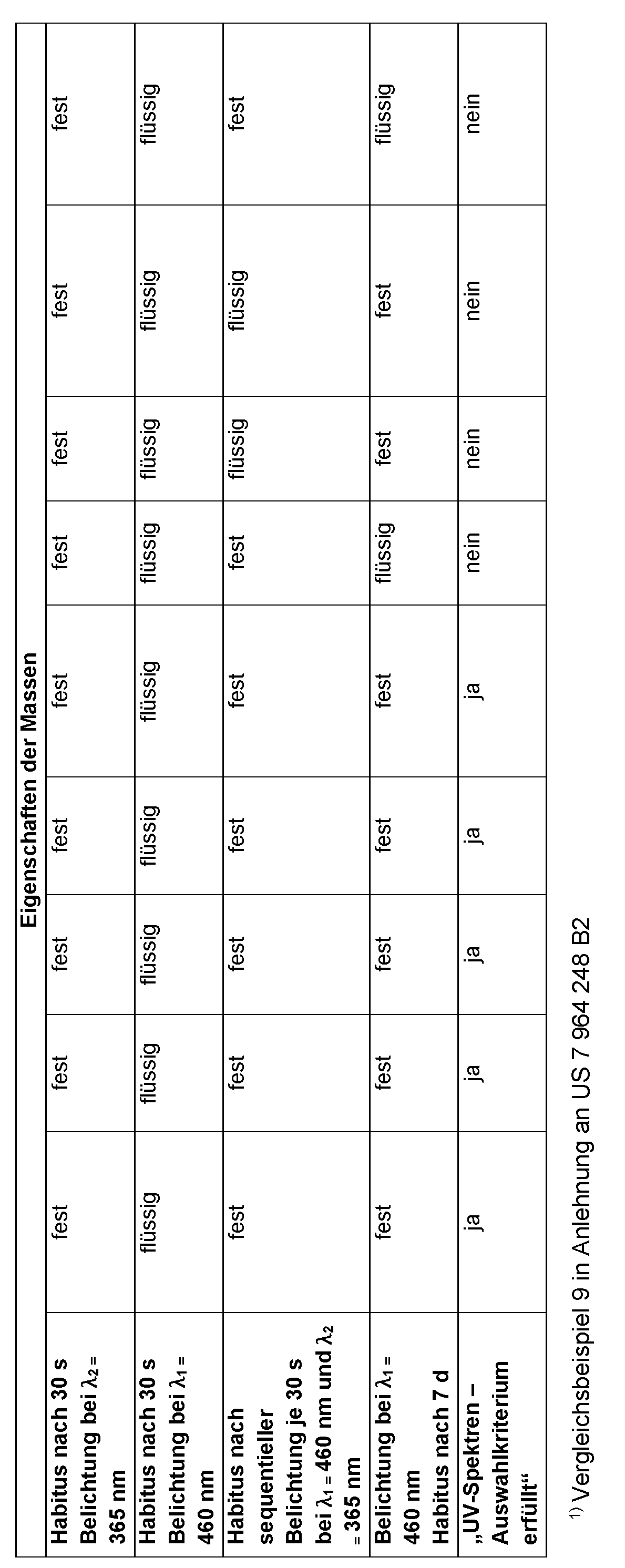
Die Massen der Beispiele 1 bis 5 erlauben die Durchführung des erfindungsgemäßen Verfahrens. Die beschriebenen Massen sind jeweils durch Bestrahlung mit aktinischer Strahlung der Wellenlänge
Die Massen der Beispiele 1 bis 5 zeichnen sich dadurch aus, dass diese nach Aktivierung bei
Die Massen der Beispiele 6 bis 9 sind Vergleichsbeispiele, die sich nicht für die Verwendung im erfindungsgemäßen Verfahren eignen. Die Masse aus Vergleichsbeispiel 6 verzichtet auf einen Photoinitiator (B1), welcher bei
Die Masse des Vergleichsbeispiel 7 lässt sich mit
Die Masse aus Vergleichsbeispiel 8 besitzt äquimolare Anteile der beiden Photoinitiatoren (B1) und (B2). Ähnlich wie in Beispiel 7 kann mit dieser Masse keine sequentielle Belichtung im Sinne des erfindungsgemäßen Verfahrens durchgeführt werden. Eine Bestrahlung mit
Die Masse aus Vergleichsbeispiel 9 entspricht der Formulierung aus Beispiel 8 der
ZITATE ENTHALTEN IN DER BESCHREIBUNG QUOTES INCLUDE IN THE DESCRIPTION
Diese Liste der vom Anmelder aufgeführten Dokumente wurde automatisiert erzeugt und ist ausschließlich zur besseren Information des Lesers aufgenommen. Die Liste ist nicht Bestandteil der deutschen Patent- bzw. Gebrauchsmusteranmeldung. Das DPMA übernimmt keinerlei Haftung für etwaige Fehler oder Auslassungen.This list of documents listed by the applicant has been generated automatically and is only included for the better information of the reader. The list is not part of the German patent or utility model application. The DPMA assumes no liability for any errors or omissions.
Zitierte PatentliteraturPatent literature cited
- EP 3184569 A1 [0003, 0068]EP 3184569 A1 [0003, 0068]
- WO 2017035551 A1 [0003, 0068]WO 2017035551 A1 [0003, 0068]
- DE 4340949 A1 [0004]DE 4340949 A1 [0004]
- EP 0388775 A1 [0005]EP 0388775 A1 [0005]
- CN 105273167 A [0006]CN 105273167 A [0006]
- US 4849320 A [0009]US 4849320 A [0009]
- US 5707780 [0010]US 5707780 [0010]
- US 5252694 [0011]US 5252694 [0011]
- US 6866899 [0012]US 6866899 [0012]
- US 7964248 [0013]US 7964248 [0013]
- US 2017/0198093 A1 [0046]US 2017/0198093 A1 [0046]
- EP 0542716 B1 [0059]EP 0542716 B1 [0059]
- WO 2003/072567 [0065]WO 2003/072567 [0065]
- WO 2003/008404 [0065]WO 2003/008404 [0065]
- WO 1998/002493 [0065]WO 1998/002493 [0065]
- US 6306555 [0065]US 6306555 [0065]
- DE 3702999 [0120]DE 3702999 [0120]
- DE 102007017842 [0120]DE 102007017842 [0120]
- US 8542451 [0123]US 8542451 [0123]
- US 7964248 B2 [0152]US 7964248 B2 [0152]
Zitierte Nicht-PatentliteraturNon-patent literature cited
- Kostanski et al., „Cationic polymerisation using mixed cationic photoinitiator systems“ aus Designed Monomers and Polymers 2007, Vol. 10, No. 4, Seiten 327-345 [0007]Kostanski et al., "Cationic polymerization using mixed cationic photoinitiator systems" from Designed Monomers and Polymers 2007, Vol. 10, No. 4, pages 327-345 [0007]
- Chen et al., „A synergistic effect of a ferrocenium salt on the diaryliodonium salt-induced visible-light curing of bisphenol-A epoxy resin“ aus RSC Adv., 2015, 5, 33171 [0008]Chen et al., "A synergistic effect of a ferrocenium salt on the diaryliodonium salt-induced visible-light curing of bisphenol-A epoxy resin" from RSC Adv., 2015, 5, 33171 [0008]
Claims (15)
Priority Applications (7)
| Application Number | Priority Date | Filing Date | Title |
|---|---|---|---|
| DE102018131513.9A DE102018131513A1 (en) | 2018-12-10 | 2018-12-10 | Cationically curable composition and method for joining, casting and coating substrates using the composition |
| KR1020217021442A KR102822248B1 (en) | 2018-12-10 | 2019-11-28 | Cationic curable composition and method for bonding, casting and coating substrates using the composition |
| CN201980081353.XA CN113302222B (en) | 2018-12-10 | 2019-11-28 | Cationically curable compositions and methods of joining, casting and coating substrates using the same |
| EP19816561.5A EP3894458B1 (en) | 2018-12-10 | 2019-11-28 | Cationically curable mass and method for joining, casting and coating substrates using the mass |
| PCT/EP2019/082833 WO2020120144A1 (en) | 2018-12-10 | 2019-11-28 | Cationically curable mass and method for joining, casting and coating substrates using the mass |
| US17/311,788 US12384873B2 (en) | 2018-12-10 | 2019-11-28 | Cationically curable composition and method for the joining, casting and coating of substrates using the composition |
| JP2021533332A JP7402234B2 (en) | 2018-12-10 | 2019-11-28 | Cationically curable compositions and methods for bonding, casting and coating substrates using said compositions |
Applications Claiming Priority (1)
| Application Number | Priority Date | Filing Date | Title |
|---|---|---|---|
| DE102018131513.9A DE102018131513A1 (en) | 2018-12-10 | 2018-12-10 | Cationically curable composition and method for joining, casting and coating substrates using the composition |
Publications (1)
| Publication Number | Publication Date |
|---|---|
| DE102018131513A1 true DE102018131513A1 (en) | 2020-06-10 |
Family
ID=68808301
Family Applications (1)
| Application Number | Title | Priority Date | Filing Date |
|---|---|---|---|
| DE102018131513.9A Withdrawn DE102018131513A1 (en) | 2018-12-10 | 2018-12-10 | Cationically curable composition and method for joining, casting and coating substrates using the composition |
Country Status (7)
| Country | Link |
|---|---|
| US (1) | US12384873B2 (en) |
| EP (1) | EP3894458B1 (en) |
| JP (1) | JP7402234B2 (en) |
| KR (1) | KR102822248B1 (en) |
| CN (1) | CN113302222B (en) |
| DE (1) | DE102018131513A1 (en) |
| WO (1) | WO2020120144A1 (en) |
Cited By (2)
| Publication number | Priority date | Publication date | Assignee | Title |
|---|---|---|---|---|
| WO2023111209A1 (en) | 2021-12-17 | 2023-06-22 | Delo Industrie Klebstoffe Gmbh & Co. Kgaa | Device for pre-activating and metering an actinically curable mass, and use of the device |
| DE102021006273A1 (en) | 2021-12-21 | 2023-06-22 | Lohmann Gmbh & Co. Kg | indicator mix |
Families Citing this family (7)
| Publication number | Priority date | Publication date | Assignee | Title |
|---|---|---|---|---|
| EP4050060A1 (en) * | 2021-02-26 | 2022-08-31 | Henkel AG & Co. KGaA | A photocurable adhesive or sealant composition |
| DE102021110210A1 (en) * | 2021-04-22 | 2022-10-27 | Delo Industrie Klebstoffe Gmbh & Co. Kgaa | Method of manufacturing an optical module and optical module |
| DE102022102650A1 (en) | 2022-02-04 | 2023-08-10 | Delo Industrie Klebstoffe Gmbh & Co. Kgaa | Cationically polymerizable flame-retardant masses |
| KR20250120994A (en) * | 2022-12-08 | 2025-08-11 | 헨켈 아게 운트 코. 카게아아 | Radiation-curable adhesive composition |
| DE102023120631A1 (en) | 2023-08-03 | 2025-02-06 | Delo Industrie Klebstoffe Gmbh & Co. Kgaa | Process for joining, casting or coating substrates and curable mass therefor |
| CN118109121A (en) * | 2024-02-26 | 2024-05-31 | 深圳市华星光电半导体显示技术有限公司 | Coating and cover |
| SE2430284A1 (en) * | 2024-05-22 | 2025-11-23 | Perstorp Ab | A led curable composition |
Citations (22)
| Publication number | Priority date | Publication date | Assignee | Title |
|---|---|---|---|---|
| DE3702999A1 (en) | 1987-02-02 | 1988-08-11 | Siemens Ag | METHOD AND DEVICE FOR PROCESSING UV-CURABLE REACTION RESIN MATERIALS |
| US4849320A (en) | 1986-05-10 | 1989-07-18 | Ciba-Geigy Corporation | Method of forming images |
| EP0388775A1 (en) | 1989-03-23 | 1990-09-26 | THERA Patent GmbH & Co. KG Gesellschaft für industrielle Schutzrechte | Method and apparatus for glueing or moulding of substrates |
| US5252694A (en) | 1992-01-22 | 1993-10-12 | Minnesota Mining And Manufacturing Company | Energy-polymerization adhesive, coating, film and process for making the same |
| DE4340949A1 (en) | 1993-12-01 | 1995-06-08 | Thera Ges Fuer Patente | Light-initiated cationic curing epoxy mass and its use |
| EP0542716B1 (en) | 1982-11-22 | 1997-06-25 | Minnesota Mining And Manufacturing Company | Energy polymerizable compositions containing organometallic initiators |
| US5707780A (en) | 1995-06-07 | 1998-01-13 | E. I. Du Pont De Nemours And Company | Photohardenable epoxy composition |
| WO1998002493A1 (en) | 1996-07-12 | 1998-01-22 | Ciba Speciality Chemicals Holding Inc. | Curing process for cationically photocurable formulations |
| US5922784A (en) * | 1996-09-20 | 1999-07-13 | Minnesota Mining And Manufacturing Company | Coated abrasive article and method of making same |
| US6306555B1 (en) | 1999-12-21 | 2001-10-23 | Ciba Specialty Chemicals Corp. | Iodonium salts as latent acid donors |
| WO2003008404A2 (en) | 2001-07-19 | 2003-01-30 | Lamberti Spa | Sulfonium salts as phtoinitiators for radiation curable systems |
| WO2003072567A1 (en) | 2002-02-26 | 2003-09-04 | Sun Chemical Corporation | Novel fused ring compounds, and their use as cationic photoinitiators |
| US6866899B2 (en) | 2001-12-21 | 2005-03-15 | 3M Innovative Properties Company | Polymerization method comprising sequential irradiation |
| DE102007017842A1 (en) | 2007-04-16 | 2008-10-23 | Continental Automotive Gmbh | Device for activating a polymerizable mass |
| US20100239779A1 (en) * | 2009-03-17 | 2010-09-23 | Fujifilm Corporation | Ink composition and inkjet recording method |
| US7964248B2 (en) | 2007-04-13 | 2011-06-21 | Huntsman Advanced Materials Americas Llc | Dual photoinitiator, photocurable composition, use thereof and process for producing a three dimensional article |
| US8542451B2 (en) | 2009-03-25 | 2013-09-24 | Magna Electronics Inc. | Vehicular camera and lens assembly |
| US20140238580A1 (en) * | 2011-11-06 | 2014-08-28 | Henkel (China) Company Limited | Dual-curable adhesive composition, use thereof, and process for bonding substrates |
| CN105273167A (en) | 2014-06-19 | 2016-01-27 | 北京化工大学 | Applications of iron arene salt as sensitizer used for initiating photocuring of iodonium salt under visible light |
| WO2017035551A1 (en) | 2015-09-02 | 2017-03-09 | Technische Universität Wien | Method for frontal polymerization of cationically polymerizable monomers |
| EP3184569A1 (en) | 2015-12-23 | 2017-06-28 | Fraunhofer-Gesellschaft zur Förderung der angewandten Forschung e.V. | Curing initiators for cationic polymerization |
| US20170198093A1 (en) | 2014-06-25 | 2017-07-13 | Rensselaer Polytechnic Institute | Oxetane polymers and methods of preparation thereof |
Family Cites Families (8)
| Publication number | Priority date | Publication date | Assignee | Title |
|---|---|---|---|---|
| DE19534668A1 (en) * | 1995-09-19 | 1997-03-20 | Thera Ges Fuer Patente | Chain-extending epoxy resin-containing, predominantly cationic curing compound |
| US20030205317A1 (en) * | 2002-05-01 | 2003-11-06 | Ha Chau Thi Minh | Method for sealing flat panel displays and bonding optical component parts |
| JP4241721B2 (en) * | 2005-12-05 | 2009-03-18 | 三菱重工業株式会社 | Energy ray curable resin composition |
| US9034236B2 (en) * | 2009-12-17 | 2015-05-19 | Dsm Ip Assets B.V. | Substrate-based additive fabrication process |
| JP2017171807A (en) * | 2016-03-24 | 2017-09-28 | 凸版印刷株式会社 | Film and image display device |
| JP6981995B2 (en) * | 2016-04-13 | 2021-12-17 | コロプラスト アクティーゼルスカブ | How to apply the adhesive |
| US9926476B2 (en) | 2016-04-22 | 2018-03-27 | Addison Clear Wave Coatings Inc. | Dual cure epoxy adhesives |
| US11034866B2 (en) * | 2016-12-02 | 2021-06-15 | 3M Innovative Properties Company | Multilayer adhesive article |
-
2018
- 2018-12-10 DE DE102018131513.9A patent/DE102018131513A1/en not_active Withdrawn
-
2019
- 2019-11-28 CN CN201980081353.XA patent/CN113302222B/en active Active
- 2019-11-28 WO PCT/EP2019/082833 patent/WO2020120144A1/en not_active Ceased
- 2019-11-28 EP EP19816561.5A patent/EP3894458B1/en active Active
- 2019-11-28 JP JP2021533332A patent/JP7402234B2/en active Active
- 2019-11-28 KR KR1020217021442A patent/KR102822248B1/en active Active
- 2019-11-28 US US17/311,788 patent/US12384873B2/en active Active
Patent Citations (22)
| Publication number | Priority date | Publication date | Assignee | Title |
|---|---|---|---|---|
| EP0542716B1 (en) | 1982-11-22 | 1997-06-25 | Minnesota Mining And Manufacturing Company | Energy polymerizable compositions containing organometallic initiators |
| US4849320A (en) | 1986-05-10 | 1989-07-18 | Ciba-Geigy Corporation | Method of forming images |
| DE3702999A1 (en) | 1987-02-02 | 1988-08-11 | Siemens Ag | METHOD AND DEVICE FOR PROCESSING UV-CURABLE REACTION RESIN MATERIALS |
| EP0388775A1 (en) | 1989-03-23 | 1990-09-26 | THERA Patent GmbH & Co. KG Gesellschaft für industrielle Schutzrechte | Method and apparatus for glueing or moulding of substrates |
| US5252694A (en) | 1992-01-22 | 1993-10-12 | Minnesota Mining And Manufacturing Company | Energy-polymerization adhesive, coating, film and process for making the same |
| DE4340949A1 (en) | 1993-12-01 | 1995-06-08 | Thera Ges Fuer Patente | Light-initiated cationic curing epoxy mass and its use |
| US5707780A (en) | 1995-06-07 | 1998-01-13 | E. I. Du Pont De Nemours And Company | Photohardenable epoxy composition |
| WO1998002493A1 (en) | 1996-07-12 | 1998-01-22 | Ciba Speciality Chemicals Holding Inc. | Curing process for cationically photocurable formulations |
| US5922784A (en) * | 1996-09-20 | 1999-07-13 | Minnesota Mining And Manufacturing Company | Coated abrasive article and method of making same |
| US6306555B1 (en) | 1999-12-21 | 2001-10-23 | Ciba Specialty Chemicals Corp. | Iodonium salts as latent acid donors |
| WO2003008404A2 (en) | 2001-07-19 | 2003-01-30 | Lamberti Spa | Sulfonium salts as phtoinitiators for radiation curable systems |
| US6866899B2 (en) | 2001-12-21 | 2005-03-15 | 3M Innovative Properties Company | Polymerization method comprising sequential irradiation |
| WO2003072567A1 (en) | 2002-02-26 | 2003-09-04 | Sun Chemical Corporation | Novel fused ring compounds, and their use as cationic photoinitiators |
| US7964248B2 (en) | 2007-04-13 | 2011-06-21 | Huntsman Advanced Materials Americas Llc | Dual photoinitiator, photocurable composition, use thereof and process for producing a three dimensional article |
| DE102007017842A1 (en) | 2007-04-16 | 2008-10-23 | Continental Automotive Gmbh | Device for activating a polymerizable mass |
| US20100239779A1 (en) * | 2009-03-17 | 2010-09-23 | Fujifilm Corporation | Ink composition and inkjet recording method |
| US8542451B2 (en) | 2009-03-25 | 2013-09-24 | Magna Electronics Inc. | Vehicular camera and lens assembly |
| US20140238580A1 (en) * | 2011-11-06 | 2014-08-28 | Henkel (China) Company Limited | Dual-curable adhesive composition, use thereof, and process for bonding substrates |
| CN105273167A (en) | 2014-06-19 | 2016-01-27 | 北京化工大学 | Applications of iron arene salt as sensitizer used for initiating photocuring of iodonium salt under visible light |
| US20170198093A1 (en) | 2014-06-25 | 2017-07-13 | Rensselaer Polytechnic Institute | Oxetane polymers and methods of preparation thereof |
| WO2017035551A1 (en) | 2015-09-02 | 2017-03-09 | Technische Universität Wien | Method for frontal polymerization of cationically polymerizable monomers |
| EP3184569A1 (en) | 2015-12-23 | 2017-06-28 | Fraunhofer-Gesellschaft zur Förderung der angewandten Forschung e.V. | Curing initiators for cationic polymerization |
Non-Patent Citations (2)
| Title |
|---|
| Chen et al., „A synergistic effect of a ferrocenium salt on the diaryliodonium salt-induced visible-light curing of bisphenol-A epoxy resin" aus RSC Adv., 2015, 5, 33171 |
| Kostanski et al., „Cationic polymerisation using mixed cationic photoinitiator systems" aus Designed Monomers and Polymers 2007, Vol. 10, No. 4, Seiten 327-345 |
Cited By (4)
| Publication number | Priority date | Publication date | Assignee | Title |
|---|---|---|---|---|
| WO2023111209A1 (en) | 2021-12-17 | 2023-06-22 | Delo Industrie Klebstoffe Gmbh & Co. Kgaa | Device for pre-activating and metering an actinically curable mass, and use of the device |
| DE102021133731A1 (en) | 2021-12-17 | 2023-06-22 | Delo Industrie Klebstoffe Gmbh & Co. Kgaa | Device for preactivating and dosing an actinically hardenable mass and use of the device |
| DE102021006273A1 (en) | 2021-12-21 | 2023-06-22 | Lohmann Gmbh & Co. Kg | indicator mix |
| DE102021006273B4 (en) | 2021-12-21 | 2024-06-13 | Lohmann Gmbh & Co. Kg | Indicator mixture |
Also Published As
| Publication number | Publication date |
|---|---|
| EP3894458A1 (en) | 2021-10-20 |
| EP3894458B1 (en) | 2022-12-28 |
| KR20210101278A (en) | 2021-08-18 |
| KR102822248B1 (en) | 2025-06-20 |
| JP2022516602A (en) | 2022-03-01 |
| WO2020120144A1 (en) | 2020-06-18 |
| CN113302222B (en) | 2023-09-15 |
| US20220064367A1 (en) | 2022-03-03 |
| US12384873B2 (en) | 2025-08-12 |
| JP7402234B2 (en) | 2023-12-20 |
| CN113302222A (en) | 2021-08-24 |
Similar Documents
| Publication | Publication Date | Title |
|---|---|---|
| EP3894458B1 (en) | Cationically curable mass and method for joining, casting and coating substrates using the mass | |
| DE69934257T2 (en) | RADIATION-CURABLE CATIONIC PRINTING PAINTS AND WATER-BASED COATINGS | |
| DE602004013139T2 (en) | PHOTOHÄRTENDE / HEAT-HARDENING INK JET COMPOSITION AND PCB WITH THIS | |
| EP3724253B1 (en) | Light-fixable and heat-curing compounds based on epoxy resins and thiols | |
| DE60129666T2 (en) | POLYMERIZABLE COMPOSITION AND CURED RESIN THEREOF, METHOD FOR THE PRODUCTION THEREOF | |
| EP3585853B1 (en) | Adhesive film that can be wound and stamped | |
| DE112004001165T5 (en) | An actinic radiation-curable stereolithographic resin composition having improved stability | |
| EP4363514A1 (en) | Reactive adhesive tape that can be stamped | |
| DE102022105738A1 (en) | Curable adhesive with improved die-cutability | |
| EP3707216B1 (en) | Method for producing opaque coatings, adhesive bonds and castings, and a curable compound for use in the method | |
| DE19534594B4 (en) | Cationic curing, flexible epoxy resin compositions and their use for applying thin layers | |
| EP4396301A1 (en) | Heat-curing mass based on (meth)acrylates and peroxodicarbonates | |
| EP1061101A2 (en) | Cationally hardenable compositions and polymers therefrom | |
| EP4073139A1 (en) | Light-fixation and moisture-cured masses based on epoxy resins and thiols | |
| DE102005062441B4 (en) | A polymer and a structural adhesive based on this polymer, and a process for the preparation of this structural adhesive, and the use thereof | |
| DE60223308T2 (en) | Cationically polymerizable liquid composition and adhesive polymer | |
| EP4182375A1 (en) | Releasable compositions based on polyacetals | |
| WO2025026781A1 (en) | Method for joining, potting, or coating substrates, and curable compound for this purpose | |
| EP4051720A1 (en) | Composition curable cationically in a moisture-induced manner, use of the composition and method of joining, encapsulating and coating substrates | |
| DE102022106647A1 (en) | Low-temperature curing compounds based on glycidyl ethers | |
| DE102023100017A1 (en) | Curable compositions based on cyclic thioether compounds and use thereof | |
| DE3339754A1 (en) | Process for the preparation of adhesives | |
| DD225856A3 (en) | LIGHT HEALTHY ESTERETHER OPTIC ADHESIVES |
Legal Events
| Date | Code | Title | Description |
|---|---|---|---|
| R163 | Identified publications notified | ||
| R119 | Application deemed withdrawn, or ip right lapsed, due to non-payment of renewal fee |