DE102017202834B4 - Method for operating a motor vehicle in an activated at least partially autonomous driving mode - Google Patents
Method for operating a motor vehicle in an activated at least partially autonomous driving mode Download PDFInfo
- Publication number
- DE102017202834B4 DE102017202834B4 DE102017202834.3A DE102017202834A DE102017202834B4 DE 102017202834 B4 DE102017202834 B4 DE 102017202834B4 DE 102017202834 A DE102017202834 A DE 102017202834A DE 102017202834 B4 DE102017202834 B4 DE 102017202834B4
- Authority
- DE
- Germany
- Prior art keywords
- motor vehicle
- authorization
- authorization device
- external
- vehicle
- Prior art date
- Legal status (The legal status is an assumption and is not a legal conclusion. Google has not performed a legal analysis and makes no representation as to the accuracy of the status listed.)
- Expired - Fee Related
Links
Images


Classifications
-
- B—PERFORMING OPERATIONS; TRANSPORTING
- B60—VEHICLES IN GENERAL
- B60W—CONJOINT CONTROL OF VEHICLE SUB-UNITS OF DIFFERENT TYPE OR DIFFERENT FUNCTION; CONTROL SYSTEMS SPECIALLY ADAPTED FOR HYBRID VEHICLES; ROAD VEHICLE DRIVE CONTROL SYSTEMS FOR PURPOSES NOT RELATED TO THE CONTROL OF A PARTICULAR SUB-UNIT
- B60W50/00—Details of control systems for road vehicle drive control not related to the control of a particular sub-unit, e.g. process diagnostic or vehicle driver interfaces
- B60W50/08—Interaction between the driver and the control system
- B60W50/12—Limiting control by the driver depending on vehicle state, e.g. interlocking means for the control input for preventing unsafe operation
-
- B—PERFORMING OPERATIONS; TRANSPORTING
- B60—VEHICLES IN GENERAL
- B60W—CONJOINT CONTROL OF VEHICLE SUB-UNITS OF DIFFERENT TYPE OR DIFFERENT FUNCTION; CONTROL SYSTEMS SPECIALLY ADAPTED FOR HYBRID VEHICLES; ROAD VEHICLE DRIVE CONTROL SYSTEMS FOR PURPOSES NOT RELATED TO THE CONTROL OF A PARTICULAR SUB-UNIT
- B60W40/00—Estimation or calculation of non-directly measurable driving parameters for road vehicle drive control systems not related to the control of a particular sub unit, e.g. by using mathematical models
- B60W40/08—Estimation or calculation of non-directly measurable driving parameters for road vehicle drive control systems not related to the control of a particular sub unit, e.g. by using mathematical models related to drivers or passengers
-
- B—PERFORMING OPERATIONS; TRANSPORTING
- B60—VEHICLES IN GENERAL
- B60K—ARRANGEMENT OR MOUNTING OF PROPULSION UNITS OR OF TRANSMISSIONS IN VEHICLES; ARRANGEMENT OR MOUNTING OF PLURAL DIVERSE PRIME-MOVERS IN VEHICLES; AUXILIARY DRIVES FOR VEHICLES; INSTRUMENTATION OR DASHBOARDS FOR VEHICLES; ARRANGEMENTS IN CONNECTION WITH COOLING, AIR INTAKE, GAS EXHAUST OR FUEL SUPPLY OF PROPULSION UNITS IN VEHICLES
- B60K28/00—Safety devices for propulsion-unit control, specially adapted for, or arranged in, vehicles, e.g. preventing fuel supply or ignition in the event of potentially dangerous conditions
- B60K28/02—Safety devices for propulsion-unit control, specially adapted for, or arranged in, vehicles, e.g. preventing fuel supply or ignition in the event of potentially dangerous conditions responsive to conditions relating to the driver
-
- B—PERFORMING OPERATIONS; TRANSPORTING
- B60—VEHICLES IN GENERAL
- B60W—CONJOINT CONTROL OF VEHICLE SUB-UNITS OF DIFFERENT TYPE OR DIFFERENT FUNCTION; CONTROL SYSTEMS SPECIALLY ADAPTED FOR HYBRID VEHICLES; ROAD VEHICLE DRIVE CONTROL SYSTEMS FOR PURPOSES NOT RELATED TO THE CONTROL OF A PARTICULAR SUB-UNIT
- B60W30/00—Purposes of road vehicle drive control systems not related to the control of a particular sub-unit, e.g. of systems using conjoint control of vehicle sub-units
- B60W30/18—Propelling the vehicle
-
- B—PERFORMING OPERATIONS; TRANSPORTING
- B60—VEHICLES IN GENERAL
- B60W—CONJOINT CONTROL OF VEHICLE SUB-UNITS OF DIFFERENT TYPE OR DIFFERENT FUNCTION; CONTROL SYSTEMS SPECIALLY ADAPTED FOR HYBRID VEHICLES; ROAD VEHICLE DRIVE CONTROL SYSTEMS FOR PURPOSES NOT RELATED TO THE CONTROL OF A PARTICULAR SUB-UNIT
- B60W50/00—Details of control systems for road vehicle drive control not related to the control of a particular sub-unit, e.g. process diagnostic or vehicle driver interfaces
- B60W50/08—Interaction between the driver and the control system
-
- B—PERFORMING OPERATIONS; TRANSPORTING
- B60—VEHICLES IN GENERAL
- B60W—CONJOINT CONTROL OF VEHICLE SUB-UNITS OF DIFFERENT TYPE OR DIFFERENT FUNCTION; CONTROL SYSTEMS SPECIALLY ADAPTED FOR HYBRID VEHICLES; ROAD VEHICLE DRIVE CONTROL SYSTEMS FOR PURPOSES NOT RELATED TO THE CONTROL OF A PARTICULAR SUB-UNIT
- B60W60/00—Drive control systems specially adapted for autonomous road vehicles
- B60W60/005—Handover processes
- B60W60/0051—Handover processes from occupants to vehicle
-
- B—PERFORMING OPERATIONS; TRANSPORTING
- B60—VEHICLES IN GENERAL
- B60W—CONJOINT CONTROL OF VEHICLE SUB-UNITS OF DIFFERENT TYPE OR DIFFERENT FUNCTION; CONTROL SYSTEMS SPECIALLY ADAPTED FOR HYBRID VEHICLES; ROAD VEHICLE DRIVE CONTROL SYSTEMS FOR PURPOSES NOT RELATED TO THE CONTROL OF A PARTICULAR SUB-UNIT
- B60W60/00—Drive control systems specially adapted for autonomous road vehicles
- B60W60/005—Handover processes
- B60W60/0059—Estimation of the risk associated with autonomous or manual driving, e.g. situation too complex, sensor failure or driver incapacity
-
- G—PHYSICS
- G05—CONTROLLING; REGULATING
- G05D—SYSTEMS FOR CONTROLLING OR REGULATING NON-ELECTRIC VARIABLES
- G05D1/00—Control of position, course, altitude or attitude of land, water, air or space vehicles, e.g. using automatic pilots
- G05D1/0088—Control of position, course, altitude or attitude of land, water, air or space vehicles, e.g. using automatic pilots characterized by the autonomous decision making process, e.g. artificial intelligence, predefined behaviours
-
- G—PHYSICS
- G06—COMPUTING OR CALCULATING; COUNTING
- G06F—ELECTRIC DIGITAL DATA PROCESSING
- G06F21/00—Security arrangements for protecting computers, components thereof, programs or data against unauthorised activity
- G06F21/30—Authentication, i.e. establishing the identity or authorisation of security principals
- G06F21/31—User authentication
- G06F21/32—User authentication using biometric data, e.g. fingerprints, iris scans or voiceprints
-
- G—PHYSICS
- G10—MUSICAL INSTRUMENTS; ACOUSTICS
- G10L—SPEECH ANALYSIS TECHNIQUES OR SPEECH SYNTHESIS; SPEECH RECOGNITION; SPEECH OR VOICE PROCESSING TECHNIQUES; SPEECH OR AUDIO CODING OR DECODING
- G10L15/00—Speech recognition
- G10L15/22—Procedures used during a speech recognition process, e.g. man-machine dialogue
-
- G—PHYSICS
- G10—MUSICAL INSTRUMENTS; ACOUSTICS
- G10L—SPEECH ANALYSIS TECHNIQUES OR SPEECH SYNTHESIS; SPEECH RECOGNITION; SPEECH OR VOICE PROCESSING TECHNIQUES; SPEECH OR AUDIO CODING OR DECODING
- G10L25/00—Speech or voice analysis techniques not restricted to a single one of groups G10L15/00 - G10L21/00
- G10L25/78—Detection of presence or absence of voice signals
-
- B—PERFORMING OPERATIONS; TRANSPORTING
- B60—VEHICLES IN GENERAL
- B60W—CONJOINT CONTROL OF VEHICLE SUB-UNITS OF DIFFERENT TYPE OR DIFFERENT FUNCTION; CONTROL SYSTEMS SPECIALLY ADAPTED FOR HYBRID VEHICLES; ROAD VEHICLE DRIVE CONTROL SYSTEMS FOR PURPOSES NOT RELATED TO THE CONTROL OF A PARTICULAR SUB-UNIT
- B60W40/00—Estimation or calculation of non-directly measurable driving parameters for road vehicle drive control systems not related to the control of a particular sub unit, e.g. by using mathematical models
- B60W40/08—Estimation or calculation of non-directly measurable driving parameters for road vehicle drive control systems not related to the control of a particular sub unit, e.g. by using mathematical models related to drivers or passengers
- B60W2040/0809—Driver authorisation; Driver identity check
-
- B—PERFORMING OPERATIONS; TRANSPORTING
- B60—VEHICLES IN GENERAL
- B60W—CONJOINT CONTROL OF VEHICLE SUB-UNITS OF DIFFERENT TYPE OR DIFFERENT FUNCTION; CONTROL SYSTEMS SPECIALLY ADAPTED FOR HYBRID VEHICLES; ROAD VEHICLE DRIVE CONTROL SYSTEMS FOR PURPOSES NOT RELATED TO THE CONTROL OF A PARTICULAR SUB-UNIT
- B60W50/00—Details of control systems for road vehicle drive control not related to the control of a particular sub-unit, e.g. process diagnostic or vehicle driver interfaces
- B60W2050/0062—Adapting control system settings
- B60W2050/0063—Manual parameter input, manual setting means, manual initialising or calibrating means
- B60W2050/0064—Manual parameter input, manual setting means, manual initialising or calibrating means using a remote, e.g. cordless, transmitter or receiver unit, e.g. remote keypad or mobile phone
-
- B—PERFORMING OPERATIONS; TRANSPORTING
- B60—VEHICLES IN GENERAL
- B60W—CONJOINT CONTROL OF VEHICLE SUB-UNITS OF DIFFERENT TYPE OR DIFFERENT FUNCTION; CONTROL SYSTEMS SPECIALLY ADAPTED FOR HYBRID VEHICLES; ROAD VEHICLE DRIVE CONTROL SYSTEMS FOR PURPOSES NOT RELATED TO THE CONTROL OF A PARTICULAR SUB-UNIT
- B60W2540/00—Input parameters relating to occupants
- B60W2540/043—Identity of occupants
-
- B—PERFORMING OPERATIONS; TRANSPORTING
- B60—VEHICLES IN GENERAL
- B60W—CONJOINT CONTROL OF VEHICLE SUB-UNITS OF DIFFERENT TYPE OR DIFFERENT FUNCTION; CONTROL SYSTEMS SPECIALLY ADAPTED FOR HYBRID VEHICLES; ROAD VEHICLE DRIVE CONTROL SYSTEMS FOR PURPOSES NOT RELATED TO THE CONTROL OF A PARTICULAR SUB-UNIT
- B60W2540/00—Input parameters relating to occupants
- B60W2540/045—Occupant permissions
-
- G—PHYSICS
- G06—COMPUTING OR CALCULATING; COUNTING
- G06V—IMAGE OR VIDEO RECOGNITION OR UNDERSTANDING
- G06V20/00—Scenes; Scene-specific elements
- G06V20/50—Context or environment of the image
- G06V20/59—Context or environment of the image inside of a vehicle, e.g. relating to seat occupancy, driver state or inner lighting conditions
-
- G—PHYSICS
- G06—COMPUTING OR CALCULATING; COUNTING
- G06V—IMAGE OR VIDEO RECOGNITION OR UNDERSTANDING
- G06V40/00—Recognition of biometric, human-related or animal-related patterns in image or video data
- G06V40/10—Human or animal bodies, e.g. vehicle occupants or pedestrians; Body parts, e.g. hands
- G06V40/103—Static body considered as a whole, e.g. static pedestrian or occupant recognition
Landscapes
- Engineering & Computer Science (AREA)
- Automation & Control Theory (AREA)
- Mechanical Engineering (AREA)
- Transportation (AREA)
- Human Computer Interaction (AREA)
- Physics & Mathematics (AREA)
- Health & Medical Sciences (AREA)
- Acoustics & Sound (AREA)
- Multimedia (AREA)
- Audiology, Speech & Language Pathology (AREA)
- Computational Linguistics (AREA)
- General Physics & Mathematics (AREA)
- Computer Security & Cryptography (AREA)
- Theoretical Computer Science (AREA)
- Game Theory and Decision Science (AREA)
- Radar, Positioning & Navigation (AREA)
- Remote Sensing (AREA)
- Aviation & Aerospace Engineering (AREA)
- Medical Informatics (AREA)
- Signal Processing (AREA)
- Mathematical Physics (AREA)
- Business, Economics & Management (AREA)
- Artificial Intelligence (AREA)
- Evolutionary Computation (AREA)
- Chemical & Material Sciences (AREA)
- General Engineering & Computer Science (AREA)
- Software Systems (AREA)
- Combustion & Propulsion (AREA)
- Computer Hardware Design (AREA)
- Traffic Control Systems (AREA)
- Electric Propulsion And Braking For Vehicles (AREA)
- Control Of Driving Devices And Active Controlling Of Vehicle (AREA)
Abstract
Verfahren zum Betreiben eines Kraftfahrzeugs (10) in einem aktivierten zumindest teilautonomen Fahrmodus, wobei das Kraftfahrzeug (10) eine Steuereinheit (12) umfasst, welche das Kraftfahrzeug (10) bei aktiviertem zumindest teilautonomen Fahrmodus zum Erreichen eines Zielortes entlang einer Wegstrecke steuert, wobei
-eine im Kraftfahrzeug (10) angeordnete Erfassungseinrichtung (14) wenigstens einen Kraftfahrzeuginsassen in dem Kraftfahrzeug (10) erfasst;
- eine mit der Erfassungseinrichtung (14) gekoppelte Berechtigungseinrichtung (16) nach Erfassen des wenigstens einen Kraftfahrzeuginsassen prüft, ob zumindest einer des wenigstens einen erfassten Kraftfahrzeuginsassen mindestens ein Berechtigungskriterium erfüllt; wobei
- bei Erfüllen des mindestens einen Berechtigungskriteriums die Berechtigungseinrichtung (16) ein Freigabesignal (18) selbst erzeugt und an die Steuereinheit (12) sendet, wobei die Steuereinheit (12) bei Empfang des Freigabesignals (18) den zumindest teilautonomen Fahrmodus aktiviert; und
- bei Nicht-Erfüllen des mindestens einen Berechtigungskriteriums die Berechtigungseinrichtung (16) ein Abfragesignal (20) an ein fahrzeugexternes Berechtigungsgerät (22) aussendet, von dem fahrzeugexternen Berechtigungsgerät (22) ein externes Freigabesignal (18) empfängt und in Abhängigkeit von einem Empfangen des externen Freigabesignals (18) in Antwort auf das Abfragesignal (20) die Berechtigungseinrichtung (16) das empfangene externe Freigabesignal (18) an die Steuereinheit (12) weiterleitet, wobei das fahrzeugexterne Berechtigungsgerät (22) auf Empfang des Abfragesignals (20) hin das Freigabesignal (18) in Abhängigkeit von einer vorbestimmten Benutzereingabe über eine Bedienfläche (24) des fahrzeugexternen Berechtigungsgeräts (22) erzeugt, wobei das Freigabesignal (18) eine Information zu dem Zielort umfasst, wobei die Steuereinheit (12) bei Empfangen des Freigabesignals (18) den in dem Freigabesignal (18) umfassten Zielort auswählt und den zumindest teilautonomen Fahrmodus aktiviert.
a detection device (14) arranged in the motor vehicle (10) detects at least one motor vehicle occupant in the motor vehicle (10);
- An authorization device (16) coupled to the detection device (14) after detection of the at least one motor vehicle occupant checks whether at least one of the at least one detected motor vehicle occupant satisfies at least one authorization criterion; in which
- Upon fulfillment of the at least one authorization criterion, the authorization device (16) generates an enable signal (18) itself and sends it to the control unit (12), wherein the control unit (12) activates the at least partially autonomous driving mode upon receipt of the enable signal (18); and
- If the at least one authorization criterion is not met, the authorization device (16) transmits an interrogation signal (20) to an authorization device (22) external to the vehicle, receives an external approval signal (18) from the authorization device (22) external to the vehicle and in response to receipt of the external Enable signal (18) in response to the interrogation signal (20) the authorization device (16) forwards the received external release signal (18) to the control unit (12), wherein the vehicle-external authorization device (22), upon receipt of the interrogation signal (20), issues the release signal ( 18) in response to a predetermined user input via an operating surface (24) of the vehicle-external authorization device (22), wherein the release signal (18) includes information about the destination, wherein the control unit (12) upon receiving the release signal (18) the in the destination signal includes the release signal (18) and the at least teilautonomen Fahrm odus activated.
Description
Die vorliegende Erfindung betrifft ein Verfahren zum Betreiben eines Kraftfahrzeugs in einem aktivierten zumindest teilautonomen Fahrmodus.The present invention relates to a method for operating a motor vehicle in an activated at least partially autonomous driving mode.
Zumindest teilautonom betreibbare Kraftfahrzeuge (also teilautonom oder vollautonom betreibbare Kraftfahrzeuge) sind aus dem Stand der Technik bereits bekannt. Hierbei übernimmt eine Steuereinheit des Kraftfahrzeugs die Führung oder die zumindest teilweise Führung dessen und steuert das Kraftfahrzeug entlang einer Wegstrecke zum Erreichen eines vorbestimmten Zielortes. Dabei übernimmt die Steuereinheit die Steuerung einer Querlenkung und/oder Längslenkung des Kraftfahrzeugs, wie beispielsweise eine Steuerung über eine Geschwindigkeit, ein Lenken und/oder ein Bremsen des Kraftfahrzeugs. Hierbei befasst sich der Stand der Technik mit der Problematik, wann ein Wechsel von einem teilautonomen Fahrmodus in einen manuellen Fahrmodus gewährt werden soll.At least partially autonomously operable motor vehicles (ie partially autonomous or fully autonomously operable motor vehicles) are already known from the prior art. In this case, a control unit of the motor vehicle takes over the guidance or the at least partial guidance thereof and controls the motor vehicle along a route to reach a predetermined destination. In this case, the control unit takes over the control of a transverse steering and / or longitudinal steering of the motor vehicle, such as a control over a speed, steering and / or braking of the motor vehicle. Here, the prior art deals with the problem of when a change from a semi-autonomous driving mode is to be granted in a manual driving mode.
In diesem Zusammenhang beschreibt die
Aus der WO 2016 / 117 790 A1 ist eine Vorrichtung zum Wechseln eines Fahrmodus eines Fahrzeugs bekannt. Die Vorrichtung detektiert einen Zustand eines Fahrers, insbesondere ob der Fahrer dazu fähig ist, das Fahrzeug manuell zu steuern. Nur wenn dies der Fall ist wird ein Wechseln des Fahrmodus in einen manuellen Fahrmodus gewährt.From WO 2016/117 790 A1 a device for changing a driving mode of a vehicle is known. The device detects a driver's condition, in particular whether the driver is able to manually control the vehicle. Only when this is the case is a change of the drive mode to a manual drive mode granted.
Die US 2006 / 0 190 419 A1 beschreibt ein Kamerasystem, welches Gesichtsmerkmale, eine physische Kondition und einen Grad einer Intoxikation bei einer Person erkennt. Ein Dienst oder ein Zugang wird verweigert wenn eine Person unterhalb des legalen Trinkalters erkannt wurde. Ist diese Person Insasse eines Kraftfahrzeugs und wird festgestellt, dass diese Person eine Gefahr darstellt, wird ein Sicherheitspersonal oder eine Polizeidienststelle kontaktiert.US 2006/0 190 419 A1 describes a camera system which recognizes facial features, a physical condition and a degree of intoxication in a person. A service or access is denied if a person is detected below the legal drinking age. If this person is the occupant of a motor vehicle and it is determined that this person represents a danger, a security guard or a police department will be contacted.
Die
Die
Die
Die
Die
Die
Die
Nachteilig bei den beschriebenen zumindest teilautonom betreibbaren Kraftfahrzeugen ist, dass eine Fahrtüchtigkeit eines Kraftfahrzeuginsassen lediglich für einen manuellen Fahrmodus des Kraftfahrzeugs geprüft wird. So kann es jedoch sein, dass auch wenn das Kraftfahrzeug in einem zumindest teilautonomen Fahrzeugmodus betrieben wird, die Aufmerksamkeit eines Kraftfahrzeuginsassen erfordert wird. Dies ist insbesondere der Fall wenn eine Gefahrensituation oder eine Verkehrssituation, für welche der teilautonome Fahrzeugmodus nicht oder nur zum Teil ausgebildet ist, auftritt. Des Weiteren kann es sein, dass zum Betreiben des zumindest teilautonomen Fahrzeugmodus eine manuelle Benutzereingabe benötigt wird, wie beispielsweise eine Eingabe zu einer gewünschten Wegstrecke oder zu einem gewünschten Zielort. Auch hier können je nach Fahrtüchtigkeit des Kraftfahrzeuginsassen Gefahrensituationen entstehen.A disadvantage of the described at least partially autonomously operable motor vehicles is that a driving ability of a motor vehicle occupant is checked only for a manual driving mode of the motor vehicle. However, it may be that even if the motor vehicle is operated in an at least partially autonomous vehicle mode, the attention of a motor vehicle occupant is required. This is the case in particular when a dangerous situation or a traffic situation for which the partially autonomous vehicle mode is not or only partially formed occurs. Furthermore, it may be necessary to operate the at least partially autonomous vehicle mode by manual user input, such as an input to a desired route or to a desired destination. Again, depending on the driving ability of the vehicle occupant dangerous situations may arise.
Aufgabe der vorliegenden Erfindung ist es, ein Verfahren zum Betreiben eines Kraftfahrzeugs in einem aktivierten zumindest teilautonomen Fahrmodus bereitzustellen, bei welchem das Fahrzeug möglichst sicher betrieben wird und potentielle Gefahrensituationen für einen Kraftfahrzeuginsassen reduziert werden.The object of the present invention is to provide a method for operating a motor vehicle in an activated at least partially autonomous driving mode, in which the vehicle is operated as safely as possible and potential dangerous situations for a motor vehicle occupant are reduced.
Diese Aufgabe wird durch Patentanspruch 1 gelöst. Vorteilhafte Weiterbildungen der Erfindung sind durch die Unteransprüche, die folgende Beschreibung und die Figuren offenbart.This object is achieved by claim 1. Advantageous developments of the invention are disclosed by the subclaims, the following description and the figures.
Die vorliegende Erfindung basiert auf der Erkenntnis, dass bei einem Betreiben eines Kraftfahrzeugs in einem aktivierten zumindest teilautonomen Fahrmodus geprüft werden sollte, ob wenigstens ein Kraftfahrzeuginsasse des Kraftfahrzeugs berechtigt ist, mit dem Kraftfahrzeug in dem zumindest teilautonomen Fahrmodus zu fahren. So kann einerseits verhindert werden, dass eine nicht-berechtigte Person, wie beispielsweise ein Kind, sich alleine in dem Kraftfahrzeug befindet während dieses in dem zumindest teilautonomen Fahrmodus fährt. Dabei kann davon ausgegangen werden, dass die nicht-berechtigte Person unfähig oder nur bedingt fähig ist, sachgerecht bei einer auftretenden Gefahrensituation im Straßenverkehr zu reagieren. Beispielsweise kann es bei einer solchen Gefahrensituation dazu kommen, dass ein Kraftfahrzeuginsasse selbst die Steuerung des Kraftfahrzeugs übernehmen sollte, um die Gefahr abzuwenden oder einzudämmen, was jedoch von beispielsweise einem Kind nicht ausgeführt werden kann.The present invention is based on the finding that, when operating a motor vehicle in an activated at least partially autonomous driving mode, it should be checked whether at least one motor vehicle occupant of the motor vehicle is entitled to drive with the motor vehicle in the at least partially autonomous driving mode. Thus, on the one hand, it can be prevented that an unauthorized person, such as a child, is alone in the motor vehicle while driving in the at least partially autonomous driving mode. It can be assumed that the unauthorized person is incapable or only partially capable of reacting properly in the event of a dangerous road traffic situation. For example, it may happen in such a dangerous situation that a motor vehicle occupant should take over even the control of the motor vehicle in order to avert or curb the danger, which, however, can not be performed by a child, for example.
Andererseits kann der nicht-berechtigten Person dennoch von einer berechtigten Person erlaubt werden, alleine mit dem Kraftfahrzeug in dem zumindest teilautonomen Fahrmodus zu fahren. Um weiterhin die Sicherheit des Kraftfahrzeuginsassen und allgemein eines Kraftfahrzeugumfelds zu gewährleisten, kann der Umfang des zumindest teilautonomen Fahrmodus eingeschränkt werden und/oder ein Betrieb des zumindest teilautonomen Fahrmodus mit speziellen Bedingungen verknüpft werden.On the other hand, the unauthorized person can still be allowed by an authorized person to drive alone with the motor vehicle in the at least partially autonomous driving mode. In order to further ensure the safety of the motor vehicle occupant and in general a motor vehicle environment, the scope of the at least partially autonomous driving mode can be limited and / or an operation of the at least partially autonomous driving mode can be linked to specific conditions.
Das erfindungsgemäße Verfahren zum Betreiben des Kraftfahrzeugs in einem aktivierten zumindest teilautonomen Fahrmodus sieht vor, dass eine im Kraftfahrzeug angeordnete Erfassungseinrichtung wenigstens einen Kraftfahrzeuginsassen in dem Kraftfahrzeug erfasst. Dabei kann bei einem Einsteigen des wenigstens einen Kraftfahrzeuginsassen dieser erfasst werden und/oder bei Erfassen eines Aktivieren des zumindest teilautonomen Fahrmodus ein Kraftfahrzeuginnenraum auf wenigstens einen möglichen Kraftfahrzeuginsassen geprüft werden. Das erfindungsgemäße Verfahren sieht weiterhin vor, dass eine mit der Erfassungseinrichtung gekoppelte Berechtigungseinrichtung nach Erfassen des wenigstens einen Kraftfahrzeuginsassen prüft, ob zumindest einer des wenigstens einen erfassten Kraftfahrzeuginsassen mindestens ein Berechtigungskriterium erfüllt. So kann so lange nach jedem erfassten Kraftfahrzeuginsassen von der Berechtigungseinrichtung auf das mindestens eine Berechtigungskriterium geprüft werden, bis einer des wenigstens einen erfassten Kraftfahrzeuginsassen das Berechtigungskriterium erfüllt. Es kann aber auch eine Gesamtheit der Kraftfahrzeuginsassen erfasst werden und erst dann durch die Berechtigungseinrichtung geprüft werden, ob wenigstens einer der Kraftfahrzeuginsassen das mindestens eine Berechtigungskriterium erfüllt.The inventive method for operating the motor vehicle in an activated at least partially autonomous driving mode provides that a detection device arranged in the motor vehicle detects at least one motor vehicle occupant in the motor vehicle. In this case, upon entry of the at least one motor vehicle occupant, the latter can be detected and / or, upon detecting activation of the at least partially autonomous driving mode, a motor vehicle interior can be checked for at least one possible motor vehicle occupant. The method according to the invention further provides that an authorization device coupled to the detection device checks, after detecting the at least one motor vehicle occupant, whether at least one of the at least one detected motor vehicle occupant fulfills at least one authorization criterion. For example, the authorization device can check the at least one authorization criterion for each detected motor vehicle occupant until one of the at least one detected motor vehicle occupant fulfills the authorization criterion. However, it is also possible to detect an entirety of the motor vehicle occupants and only then to check by the authorization device whether at least one of the motor vehicle occupants fulfills the at least one authorization criterion.
Bei Erfüllen des mindestens einen Berechtigungskriteriums erzeugt die Berechtigungseinrichtung ein Freigabesignal und sendet dieses an eine Steuereinheit des Kraftfahrzeugs. Bei Empfang des Freigabesignals aktiviert die Steuereinheit den zumindest teilautonomen Fahrmodus. Daraufhin steuert die Steuereinheit das Kraftfahrzeug entlang einer Wegstrecke zum Erreichen eines vorbestimmten Zielortes.When the at least one authorization criterion is met, the authorization device generates an enable signal and sends it to a control unit of the motor vehicle. Upon receipt of the enable signal, the control unit activates the at least partially autonomous drive mode. The control unit then controls the motor vehicle along a route to reach a predetermined destination.
Bei Nicht-Erfüllen des mindestens einen Berechtigungskriteriums sendet die Berechtigungseinrichtung ein Abfragesignal an ein fahrzeugexternes Berechtigungsgerät. Beispielsweise handelt es sich bei dem fahrzeugexternen Berechtigungsgerät um ein mobiles Endgerät, welches von einer berechtigten Person, die das mindestens eine Berechtigungskriterium erfüllt, geführt wird. Beispielsweise handelt es sich bei der berechtigten Person um einen Erziehungsberechtigten des Kindes, welches in dem Kraftfahrzeug erfasst wurde. Das Berechtigungsgerät kann eine Information zu dem wenigstens einen erfassten Kraftfahrzeuginsassen anzeigen und/oder eine Anfrage ausgeben, ob der zumindest teilautonome Fahrmodus des Kraftfahrzeugs aktiviert werden darf. In Abhängigkeit von einem Empfangen des Freigabesignals in Antwort auf das Abfragesignal leitet die Berechtigungseinrichtung das empfangene Freigabesignal an die Steuereinheit weiter. Mit anderen Worten wird der zumindest teilautonome Fahrmodus bei Nicht-Erfüllen des mindestens einen Berechtigungskriteriums nur dann aktiviert, wenn nach einem Aussenden des Abfragesignals die Berechtigungseinrichtung ein Freigabesignal von extern empfängt, nämlich aus dem fahrzeugexternen Berechtigungsgerät. Das fahrzeugexterne Berechtigungsgerät kann durch eine Benutzereingabe das Freigabesignal erfassen. Beispielsweise gibt der Erziehungsberechtigte über einen vorbestimmten Tastendruck oder ein Berühren eines vorbestimmten Anzeigefelds des Berechtigungsgeräts seine Zustimmung darüber ab, dass das wenigstens eine erfasste Kind im Kraftfahrzeug ohne ihn in dem zumindest teilautonom fahrenden Kraftfahrzeug mitfahren darf.If the at least one authorization criterion is not fulfilled, the authorization device sends an interrogation signal to an authorization device external of the vehicle. For example, the vehicle-external authorization device is a mobile terminal which is guided by an authorized person who fulfills the at least one authorization criterion. For example, the authorized person is a legal guardian of the child who has been registered in the motor vehicle. The authorization device can display information about the at least one detected motor vehicle occupant and / or issue a request as to whether the at least partially autonomous driving mode of the motor vehicle may be activated. In response to receiving the enable signal in response to the interrogation signal, the entitlement device forwards the received enable signal to the control unit. In other words, if the at least one authorization criterion is not fulfilled, the at least partially autonomous driving mode is activated only if, after a transmission of the interrogation signal, the authorization device receives an enable signal from the outside, namely from the vehicle-external authorization device. The vehicle-external authorization device can capture the release signal by a user input. For example, the parent or guardian gives his consent via a predetermined keystroke or touching a predetermined display field of the authorization device that the at least one detected child in the motor vehicle may ride in the at least partially autonomously driving motor vehicle without him.
Für das Aussenden des Abfragesignals und/oder für das Empfangen des Freigabesignals kann die Berechtigungseinrichtung eine Kommunikationsverbindung zu wenigstens einem vorbestimmten Berechtigungsgerät aufbauen. Das wenigstens eine Berechtigungsgerät kann einem bestimmten Kraftfahrzeuginsassen zugeordnet sein. Beispielsweise wird bei Erfassen eines bestimmten Kindes im Kraftfahrzeug eine Kommunikationsverbindung zu dem Berechtigungsgerät eines bestimmten Erziehungsberechtigten aufgebaut. Das Berechtigungsgerät kann alternativ oder ergänzend dazu auch einem bestimmten Zeitpunkt wie einer bestimmten Tageszeit und/oder einem bestimmten Wochentag zugeordnet sein. So kann beispielsweise bei Erfassen des bestimmten Kindes im Kraftfahrzeug vormittags das Abfragesignal an das Berechtigungsgerät eines ersten Erziehungsberechtigten gesendet werden und nachmittags an das Berechtigungsgerät eines zweiten Erziehungsberechtigten, um beispielsweise eine Verfügbarkeit des jeweiligen Erziehungsberechtigten zu berücksichtigen.For the transmission of the interrogation signal and / or for receiving the release signal, the authorization device can establish a communication connection to at least one predetermined authorization device. The at least one authorization device can be assigned to a specific motor vehicle occupant. For example, upon detecting a particular child in the motor vehicle, a communication link to the authorization device of a particular Educators. The authorization device may alternatively or additionally be associated with a specific time such as a specific time of day and / or a particular day of the week. Thus, for example, upon detection of the particular child in the car in the morning, the query signal to the authorization device of a first parent or guardian be sent in the afternoon to the authorization device of a second guardian, for example, to consider an availability of the respective parent or guardian.
Die Berechtigungseinrichtung kann zum Weiterleiten des Freigabesignals mit der Steuereinheit gekoppelt sein oder in der Steuereinheit integriert sein. Nach Erfassen eines Aktivierens des teilautonomen Fahrmodus kann die Steuereinheit eine Zeit erfassen. Wird nach Ablauf einer vorbestimmten Zeitdauer immer noch kein Freigabesignal empfangen, kann die Steuereinheit eine Benachrichtigung ausgeben, welches den wenigstens einen Kraftfahrzeuginsassen darüber informiert, dass er nicht zum Mitfahren berechtigt ist. Weiterhin kann die Steuereinheit daraufhin einen Betrieb des Kraftfahrzeugs beenden.The authorization device can be coupled with the control unit for forwarding the release signal or can be integrated in the control unit. Upon detecting activation of the semi-autonomous driving mode, the control unit may detect a time. If, after a predetermined period of time, no release signal is still received, the control unit can output a notification which informs the at least one motor vehicle occupant that he is not authorized to ride. Furthermore, the control unit can then terminate operation of the motor vehicle.
Durch die Erfindung ergibt sich der Vorteil, dass ein unberechtigtes Mitfahren in einem zumindest teilautonom fahrenden Kraftfahrzeug verhindert werden kann. Dadurch kann vermieden werden, dass eine fahruntüchtige Person sich in eine mögliche gefährliche Straßenverkehrssituation begibt. Weiterhin ist es vorteilhaft, dass wenn die fahruntüchtige Person in Abwesenheit einer fahrtüchtigen Person in dem zumindest teilautonomen fahrenden Kraftfahrzeug mitfährt, zumindest eine berechtigte Person, wie beispielsweise der Erziehungsberechtigte, darüber in Kenntnis gesetzt ist. So kann dieser mittels beispielsweise weiterer Fernabfragen Entscheidungen in möglichen Gefahrensituationen treffen. Tritt beispielsweise eine Verkehrssituation auf, die ein Eingreifen einer Person und/oder eine menschliche Einschätzung erfordert, kann die Steuereinheit ein entsprechendes Anforderungssignal an die Berechtigungseinrichtung senden, welche das Anforderungssignal weiterhin an das wenigstens eine fahrzeugexterne Berechtigungsgerät sendet. Auf diesem kann eine Information zu der Verkehrssituation angezeigt werden und eine Entscheidung zum weiteren Steuern des Kraftfahrzeugs angefordert werden. Weiterhin kann das fahrzeugexterne Berechtigungsgerät eine Benutzereingabe erfassen, die eine derartige Entscheidung und/oder einen Steuerungsbefehl erfassen kann und zurück an die Berechtigungseinrichtung und die Steuereinheit senden kann. Die Steuereinheit führt daraufhin die Entscheidung und/oder den Steuerungsbefehl aus. Somit kann der nichtberechtigte Kraftfahrzeuginsasse weiterhin möglichst sicher in dem Kraftfahrzeug mitfahren.The invention provides the advantage that an unauthorized ride in an at least teilautonom driving motor vehicle can be prevented. As a result, it is possible to prevent a person who is unable to drive entering a potentially dangerous traffic situation. Furthermore, it is advantageous that when the unable-to-drive person in the absence of a roadworthy person in the at least teilautonomen moving motor vehicle mitfährt, at least one authorized person, such as the parent or guardian, is informed. So this can make decisions by means of further remote queries in possible dangerous situations. If, for example, a traffic situation occurs that requires intervention by a person and / or a human assessment, the control unit can send a corresponding request signal to the authorization device, which continues to send the request signal to the at least one authorization device outside the vehicle. On this information about the traffic situation can be displayed and a decision to further control the motor vehicle can be requested. Furthermore, the vehicle-external authorization device can detect a user input that can detect such a decision and / or a control command and send it back to the authorization device and the control unit. The control unit then executes the decision and / or the control command. Thus, the unauthorized vehicle occupant continue to ride as safe as possible in the vehicle.
Die Erfindung umfasst auch optionale Weiterbildungen des erfindungsgemäßen Verfahrens, durch die sich zusätzliche Vorteile ergeben.The invention also includes optional developments of the method according to the invention, by which additional advantages.
Beim erfindungsgemäßen Verfahren erzeugt das fahrzeugexterne Berechtigungsgerät auf Empfang des Abfragesignals hin das Freigabesignal in Abhängigkeit von einer vorbestimmten Benutzereingabe über eine Bedienfläche des fahrzeugexternen Berechtigungsgeräts. Die Bedienfläche kann dabei eine Bedientaste und/oder eine berührungsempfindliche Anzeigefläche umfassen. Die vorbestimmte Benutzereingabe kann ein Bedienen einer vorbestimmten Bedientaste und/oder ein Berühren eines vorbestimmten Teils der Anzeigefläche und/oder ein Sprachbefehl sein.In the method according to the invention, the vehicle-external authorization device generates the release signal in response to a predetermined user input via an operating surface of the vehicle-external authorization device upon receipt of the interrogation signal. The control surface may include an operating button and / or a touch-sensitive display surface. The predetermined user input may be a serving of a predetermined operation key and / or touching a predetermined part of the display area and / or a voice command.
Ergänzend hierzu kann das fahrzeugexterne Berechtigungsgerät das Freigabesignal in Abhängigkeit von einer in einem Speicher des Berechtigungsgeräts gespeicherten Benutzereinstellung erzeugen. In dem Speicher des Berechtigungsgeräts kann ein Befehl zum automatischen Senden des Freigabesignals bei Empfangen eines Abfragesignals hinterlegt sein. In dem Speicher kann zudem gespeichert sein, dass der Befehl nur bei Erfüllung bestimmter Bedingungen ausgeführt wird. Beispielsweise wird nur bei Erfassen einer vorbestimmten nicht-berechtigten Person das Freigabesignal automatisch bei Empfangen des Abfragesignals von dem fahrzeugexternen Berechtigungsgerät gesendet. So kann ein Erziehungsberechtigter in dem Speicher seines Berechtigungsgeräts speichern, dass bei Erfassen des einen Kinds im Kraftfahrzeug das Aktivieren des teilautonomen Fahrmodus automatisch gewährt werden soll und somit in diesem Fall das Freigabesignal automatisch gesendet werden soll, jedoch bei Erfassen des anderen Kinds kein Freigabesignal gesendet werden soll. Dies ist beispielsweise von Vorteil, wenn die jeweils erfassten nicht-berechtigten Kraftfahrzeuginsassen unterschiedlichen Alters und/oder unterschiedliche Stufen der Fahrtüchtigkeit aufweisen. So kann man einem nicht-berechtigten Kraftfahrzeuginsassen im Teenager-Alter eher zutrauen, in einer Gefahrensituation im Straßenverkehr sachgerecht zu handeln als einem Kind oder einem Kleinkind. Der Speicher des fahrzeugexternen Berechtigungsgeräts bietet weiterhin den Vorteil, dass ein Freigabesignal auch dann erzeugt werden kann, wenn die Person, die das fahrzeugexterne Berechtigungsgerät bedient, momentan nicht zur Verfügung steht.In addition to this, the vehicle-external authorization device can generate the release signal as a function of a user setting stored in a memory of the authorization device. In the memory of the authorization device, a command for automatically transmitting the release signal upon receipt of an interrogation signal may be stored. The memory can also store that the command is executed only if certain conditions are met. For example, only upon detection of a predetermined unauthorized person, the release signal is automatically sent upon receipt of the interrogation signal from the vehicle-external authorization device. Thus, a parent or guardian can store in the memory of his authorization device that upon detection of a child in the motor vehicle, the activation of the semi-autonomous driving mode should be automatically granted and thus in this case, the release signal should be sent automatically, but on detection of the other child no release signal to be sent should. This is advantageous, for example, if the respective unauthorized motor vehicle occupants recorded in each case have different ages and / or different degrees of ability to drive. Thus, one can trust a non-authorized motor vehicle occupant in his teenage years, more appropriate to act in a dangerous situation in traffic properly than a child or toddler. The memory of the vehicle-external authorization device also has the advantage that a release signal can be generated even if the person who operates the vehicle-external authorization device is currently not available.
Das Freigabesignal umfasst eine Information zu dem Zielort. Bei Empfangen des Freigabesignals wählt die Steuereinheit den in dem Freigabesignal umfassten Zielort aus und aktiviert den zumindest teilautonomen Fahrmodus. Daraufhin steuert die Steuereinheit das Kraftfahrzeug entlang einer Wegstrecke zum Erreichen des ausgewählten Zielortes. Dadurch, dass das Freigabesignal den Zielort vorgibt, ergibt sich der Vorteil, dass bei einer weiteren Änderung des Zielortes ein erneutes Freigabesignal mit dem geänderten Zielort erforderlich ist. So kann der nicht-berechtigte Kraftfahrzeuginsasse nach der Freigabe zum teilautonomen Fahren des Kraftfahrzeugs zu dem freigegebenen Zielort nicht ohne Weiteres den Zielort ändern, sondern benötigt hierzu erneut eine Freigabe. Dadurch behält die berechtigte Person wie der Erziehungsberechtigte einen Überblick über die Fahrt des nichtberechtigten Kraftfahrzeuginsassen in dem teilautonomen fahrenden Kraftfahrzeug.The enable signal includes information about the destination. Upon receiving the enable signal, the control unit selects the destination included in the enable signal and activates the at least partially autonomous drive mode. The control unit then controls the motor vehicle along a route to reach the selected destination. The fact that the release signal specifies the destination, there is the advantage that in a further change of the destination a renewed release signal with the changed destination is required. Thus, the unauthorized vehicle occupant after release for semi-autonomous driving of the motor vehicle to the shared destination can not easily change the destination, but this requires again a release. As a result, the authorized person, like the parent or guardian, retains an overview of the journey of the unauthorized vehicle occupant in the partially autonomous moving motor vehicle.
In einer vorteilhaften Ausgestaltung hierzu wird der Zielort dadurch vorgegeben, dass das fahrzeugexterne Berechtigungsgerät eine weitere vorbestimmte Benutzereingabe über die Bedienfläche des Berechtigungsgeräts erkennt. Der Benutzer des fahrzeugexternen Berechtigungsgeräts kann den Zielort bei Empfang des Abfragesignals über die Bedienfläche eingeben und/oder aus einer Liste vorgegebener Zielorte auswählen. Alternativ oder ergänzend hierzu ist in dem Speicher des Berechtigungsgeräts eine Benutzereinstellung gespeichert, welche in Abhängigkeit des Abfragesignals und/oder des erfassten Kraftfahrzeuginsassen den Zielort vorgibt. Alternativ oder ergänzend hierzu kann der Zielort durch die Berechtigungseinrichtung vorgegeben werden. Hierzu erkennt die Berechtigungseinrichtung eine Benutzereingabe über eine Bedienfläche der Berechtigungseinrichtung und/oder ist in einem Speicher der Berechtigungseinrichtung eine gespeicherte Benutzereinstellung gegeben, welche den Zielort umfasst. Die Berechtigungseinrichtung kann auch mit einer Navigationseinrichtung des Kraftfahrzeugs gekoppelt sein und von der Navigationseinrichtung eine Information zu dem Zielort empfangen. Der Zielort kann also im Kraftfahrzeug oder kraftfahrzeugextern bestimmt werden. Wird der Zielort durch eine Bedienung der Berechtigungseinrichtung ausgewählt, kann das Abfragesignal, welches an das fahrzeugexterne Berechtigungsgerät ausgesendet wird, eine Information zu dem ausgewählten Zielort enthalten. Die Steuereinheit kann den zumindest teilautonomen Fahrmodus zum Steuern des Kraftfahrzeugs zu dem Zielort nur dann aktivieren, wenn das Freigabesignal die Information zu dem Zielort umfasst. Der Benutzer des fahrzeugexternen Berechtigungsgeräts kann dadurch bestimmen, wohin der nicht-berechtigte Kraftfahrzeuginsasse mit dem Kraftfahrzeug fahren darf. Somit behält beispielsweise der Erziehungsberechtigte einen besseren Überblick über die Fahrt seines Kindes.In an advantageous embodiment of this, the destination is specified by the fact that the vehicle-external authorization device recognizes a further predetermined user input via the control surface of the authorization device. The user of the vehicle-external authorization device can enter the destination on receipt of the interrogation signal via the control surface and / or select from a list of predetermined destinations. Alternatively or additionally, a user setting is stored in the memory of the authorization device, which specifies the destination in dependence on the interrogation signal and / or the detected motor vehicle occupant. Alternatively or additionally, the destination can be specified by the authorization device. For this purpose, the authorization device recognizes a user input via a control surface of the authorization device and / or a stored user setting is given in a memory of the authorization device, which includes the destination. The authorization device can also be coupled to a navigation device of the motor vehicle and receive information about the destination from the navigation device. The destination can therefore be determined in the motor vehicle or motor vehicle external. If the destination is selected by an operation of the authorization device, the interrogation signal, which is sent to the vehicle-external authorization device, may contain information about the selected destination. The control unit may activate the at least partially autonomous driving mode for controlling the motor vehicle to the destination only if the release signal includes the information on the destination. The user of the vehicle-external authorization device can thereby determine where the unauthorized vehicle occupant may drive to the motor vehicle. Thus, for example, the parent or guardian retains a better overview of his child's journey.
In einer vorteilhaften Ausführungsform des erfindungsgemäßen Verfahrens wird der Zielort mit wenigstens einem dem Zielort zugeordneten Kalenderzeitpunkt in den Speicher der Berechtigungseinrichtung gespeichert. Bei dem Kalenderzeitpunkt handelt es sich beispielsweise um ein bestimmtes Datum, eine bestimmte Uhrzeit, eine bestimmte Tageszeit und/oder einen bestimmten Wochentag. Bei dem Kalenderzeitpunkt kann es sich auch um einen periodisch auftretenden Kalenderzeitpunkt handeln, wie beispielsweise jeden Montag. Bei Nicht-Erfüllen des Berechtigungskriteriums sendet die Berechtigungseinrichtung in einem vorbestimmten Zeitabstand vor oder zu dem wenigstens einen gespeicherten Kalenderzeitpunkt das Abfragesignal an das fahrzeugexterne Berechtigungsgerät. Die Berechtigungseinrichtung übernimmt in dem vorbestimmten Zeitabstand vor oder zu dem wenigstens einen gespeicherten Kalenderzeitpunkt den gespeicherten, zugeordneten Zielort und legt diesen als einen aktuellen Zielort fest. Das an die Steuereinheit weitergeleitete Freigabesignal kann dann den aktuellen Zielort umfassen. Beispielsweise ist in dem Speicher der Berechtigungseinrichtung gespeichert, dass an zumindest einem Werktag um eine bestimmte Uhrzeit, wie beispielsweise um 8:00 Uhr vormittags, die Steuereinheit das Kraftfahrzeug nach Erfassen des zumindest einen bestimmten Kindes im Innenraum des Kraftfahrzeugs zu einer bestimmten Schule steuern soll. Die Berechtigungseinrichtung kann dann in einem vorbestimmten Zeitraum vor Eintreten der bestimmten Uhrzeit, wie beispielsweise um 7:55 Uhr, das Abfragesignal bereits aussenden. Dabei kann das zumindest eine Kind bereits im Kraftfahrzeug sitzen. Die bestimmte Uhrzeit, bei welchem das Kraftfahrzeug losfahren soll, kann eine Toleranzzeit umfassen, sodass eine Verspätung des zumindest einen erwarteten Kraftfahrzeuginsassen mit berücksichtigt wird. Der in dem Speicher der Berechtigungseinrichtung gespeicherte Kalenderzeitpunkt mit dem zugeordneten Zielort kann mit einem weiteren Speicher eines mobilen Endgeräts wie beispielsweise mit dem Speicher des fahrzeugexternen Berechtigungsgeräts koordiniert sein. So kann beispielsweise das Berechtigungsgerät des Erziehungsberechtigten einen Kalender umfassen, in welchem zumindest ein bestimmter Kalenderzeitpunkt mit einem bestimmten zugeordneten Zielort gespeichert ist. Durch die Kommunikationsverbindung zwischen dem Berechtigungsgerät und der Berechtigungseinrichtung kann eine Veränderung im Kalender durch ein Informationssignal an den Speicher der Berechtigungseinrichtung gesendet werden und dieser die Veränderung speichern. So kann der Erziehungsberechtigte im Kalender die einzelnen Termine seines Kindes eintragen. Auch kann dem Kalender bereits das Freigabesignal für zumindest einen bestimmten Kalenderzeitpunkt mit dem jeweiligen zugeordneten Zielort gespeichert sein und bei Empfang des Abfragesignals automatisch gesendet werden. Der Benutzer des Berechtigungsgeräts muss somit für ihn bereits bekannte und erlaubte Fahrstrecken nicht jedes Mal erneut freigeben. Dadurch gestaltet sich das Verfahren besonders benutzerfreundlich.In an advantageous embodiment of the method according to the invention, the destination is stored in the memory of the authorization device with at least one calendar time assigned to the destination. For example, the calendar time is a specific date, time, time of day, and / or day of the week. The calendar time may also be a periodically occurring calendar time, such as every Monday. If the authorization criterion is not met, the authorization device sends the interrogation signal to the authorization device outside the vehicle at a predetermined time interval before or at the at least one stored calendar time. The authorization device takes over at the predetermined time interval before or at least one stored calendar time the stored, assigned destination and sets this as a current destination. The enable signal forwarded to the control unit may then comprise the current destination. For example, stored in the memory of the authorization device that on at least one working day at a certain time, such as at 8:00 clock in the morning, the control unit to control the motor vehicle after detecting the at least one specific child in the interior of the motor vehicle to a particular school. The authorization device can then send out the interrogation signal in a predetermined period of time before the specific time, such as 7:55 o'clock, occurs. In this case, the at least one child can already sit in the vehicle. The specific time at which the motor vehicle is to start can include a tolerance time, so that a delay of the at least one expected motor vehicle occupant is taken into account. The calendar time stored in the memory of the authorization device with the assigned destination can be coordinated with a further memory of a mobile terminal, such as the memory of the vehicle-external authorization device. Thus, for example, the authorization device of the parent or guardian can include a calendar in which at least one specific calendar time is stored with a specific assigned destination. Through the communication connection between the authorization device and the authorization device, a change in the calendar can be sent by an information signal to the memory of the authorization device and this store the change. Thus, the parent or guardian can enter the individual appointments of his child in the calendar. Also, the calendar may already be the release signal for at least one specific calendar time stored with the respective associated destination and automatically sent upon receipt of the query signal. The user of the authorization device thus does not have to re-release previously known and permitted routes for him each time. This makes the process particularly user-friendly.
In einer weiteren vorteilhaften Ausgestaltung des erfindungsgemäßen Verfahrens wird bei Nicht-Erfüllen des mindestens einen Berechtigungskriteriums wenigstens ein in dem zumindest teilautonomen Fahrmodus auswählbarer Betriebsparameter und/oder ein Funktionsumfang des zumindest teilautonomen Fahrmodus begrenzt. Ermittelt also die Berechtigungseinrichtung, dass keiner des wenigstens einen erfassten Kraftfahrzeuginsassen das zumindest eine Berechtigungskriterium erfüllt, kann die Berechtigungseinrichtung ein Einschränkungssignal an die Steuereinheit des Kraftfahrzeugs senden. Bei Empfang des Einschränkungssignals schränkt die Steuereinheit zumindest einen auswählbarer Betriebsparameter, wie beispielsweise eine Geschwindigkeit des Kraftfahrzeugs, und/oder einen Funktionsumfang, wie beispielsweise einen Betrieb des zumindest teilautonomen Fahrmodus, ein. Beispielsweise umfasst das Einschränkungssignal, dass ein Starten des Kraftfahrzeugs untersagt wird. Das Einschränkungssignal kann aber auch in dem Freigabesignal integriert sein. Beispielsweise kann in diesem Fall das Einschränkungssignal umfassen, dass die Steuereinheit das Kraftfahrzeug zu einem bestimmten Zielort steuert, jedoch zum Erreichen dieses Zielortes nur diejenigen Wegstrecken auswählen darf, welche eine Strecke über eine Autobahn ausschließen. Das Einschränkungssignal kann von einer Benutzereingabe oder von einer gespeicherten Benutzereinstellung konfiguriert werden. Hierdurch ergibt sich der Vorteil, dass die Sicherheit einer zumindest teilautonomen Fahrt eines Kraftfahrzeugs mit lediglich einem nichtfahrzeugführungsberechtigten Kraftfahrzeuginsassen erhöht wird, da von einer fahrzeugführungsberechtigten Person extern gesteuert und kontrolliert werden kann, wie sich diese teilautonomen Fahrt gestaltet. Beispielsweise verringert das Begrenzen der Geschwindigkeit des Kraftfahrzeugs während der zumindest teilautonomen gesteuerten Fahrt das Risiko eines folgenschweren Unfalls. In a further advantageous embodiment of the method according to the invention, if the at least one authorization criterion is not met, at least one operating parameter selectable in the at least partially autonomous driving mode and / or a functional scope of the at least partially autonomous driving mode is limited. Thus, if the authorization device determines that none of the at least one detected motor vehicle occupant fulfills the at least one authorization criterion, the authorization device can send a restriction signal to the control unit of the motor vehicle. Upon receipt of the restriction signal, the control unit restricts at least one selectable operating parameter, such as a speed of the motor vehicle, and / or a range of functions, such as operation of the at least partially autonomous drive mode. For example, the restriction signal includes prohibiting starting of the motor vehicle. However, the restriction signal may also be integrated in the enable signal. For example, in this case, the restriction signal may include that the control unit controls the motor vehicle to a certain destination, but to reach this destination only those routes may be selected which exclude a route via a motorway. The restriction signal may be configured by a user input or a stored user preference. This results in the advantage that the security of an at least partially autonomous drive of a motor vehicle with only a non-motor vehicle authorized vehicle occupants is increased, as can be controlled and controlled externally by a person authorized to drive, as designed this semi-autonomous ride. For example, limiting the speed of the motor vehicle during the at least partially autonomous controlled ride reduces the risk of a catastrophic accident.
In einer bevorzugten Ausführungsform hierzu betrifft der wenigstens eine Betriebsparameter und/oder der Funktionsumfang eine Geschwindigkeit und/oder eine Maximalgeschwindigkeit des Kraftfahrzeugs und/oder den Zielort und/oder die Wegstrecke und/oder eine Straßenkategorie der Wegstrecke. Eine Straßenkategorie kann beispielsweise eine Stadtstraße, eine Landstraße, eine Bundesstraße, eine Fernverkehrsstraße oder eine Autobahn sein. Beispielsweise kann dadurch verhindert werden, dass ein Kind den freigegebenen Zielort nachträglich selbst ändert.In a preferred embodiment, the at least one operating parameter and / or the functional scope relates to a speed and / or a maximum speed of the motor vehicle and / or the destination and / or the route and / or a road category of the route. A street category may be, for example, a city street, a country road, a federal highway, a trunk road or a highway. For example, this can prevent a child from subsequently changing the released destination itself.
In einer weiteren bevorzugten Ausführungsform hierzu wird eine Begrenzung des wenigstens einen Betriebsparameters und/oder des Funktionsumfangs in Abhängigkeit von wenigstens einem vorbestimmten Zeitpunkt und/oder in Abhängigkeit von wenigstens einem vorbestimmten Zeitintervall bestimmt. Bei dem wenigstens einen vorbestimmten Zeitpunkt kann es sich beispielsweise um den Kalenderzeitpunkt mit dem zugeordneten Zielort handeln. Das wenigstens eine vorbestimmte Zeitintervall kann den Kalenderzeitpunkt umfassen. Bei dem vorbestimmten Zeitintervall kann es sich aber auch um eine relative Zeitangabe, wie beispielsweise vormittags, nachmittags, abends oder nachts, handeln. Durch die zeitabhängige Begrenzung ergibt sich der Vorteil, dass automatisch der Betriebsparameter und/oder der Funktionsumfang der Steuereinheit begrenzt wird, wenn zu erwarten ist, dass sich kein Fahrzeugführungsberechtigter im Kraftfahrzeug aufhält. Hierzu muss keine ständige Bereitschaft des Benutzers des fahrzeugexternen Berechtigungsgeräts vorliegen.In a further preferred embodiment for this purpose, a limitation of the at least one operating parameter and / or of the functional scope is determined as a function of at least one predetermined time and / or as a function of at least one predetermined time interval. The at least one predetermined time may, for example, be the calendar time with the assigned destination. The at least one predetermined time interval may include the calendar time. However, the predetermined time interval may also be a relative time indication, such as mornings, afternoons, evenings or nights. Due to the time-dependent limitation, there is the advantage that the operating parameter and / or the functional scope of the control unit is automatically limited when it is to be expected that no authorized person in the motor vehicle will be present. For this purpose, there must be no constant readiness of the user of the vehicle-external authorization device.
In einer weiteren vorteilhaften Ausgestaltung des erfindungsgemäßen Verfahrens umfasst das mindestens eine Berechtigungskriterium, dass der zumindest eine Kraftfahrzeuginsasse durch die Berechtigungseinrichtung als fahrtüchtig erkannt wird. Das mindestens eine Berechtigungskriterium kann weiterhin umfassen, dass der zumindest eine Kraftfahrzeuginsasse als volljährig erkannt wurde und/oder als fahrzeugführungsberechtigt erkannt wurde. Das mindestens eine Berechtigungskriterium prüft darauf, ob zumindest einer des wenigstens einen Kraftfahrzeuginsassen physisch als auch geistig dazu in der Lage ist, schnell und sachgerecht in einer Gefahrensituation im Straßenverkehr zu handeln. Durch diese Prüfung wird eine Sicherheit des wenigstens einen Kraftfahrzeuginsassen als auch eine Sicherheit der Personen, welche sich in einer Umgebung des Kraftfahrzeugs befinden, erhöht.In a further advantageous embodiment of the method according to the invention, the at least one authorization criterion comprises that the at least one motor vehicle occupant is recognized by the authorization device as roadworthy. The at least one authorization criterion can furthermore include that the at least one motor vehicle occupant was recognized as being of legal age and / or recognized as being authorized to drive. The at least one authorization criterion checks whether at least one of the at least one motor vehicle occupant is able, both physically and mentally, to act quickly and properly in a dangerous situation in traffic. This test increases the safety of the at least one motor vehicle occupant as well as the safety of the persons who are in an environment of the motor vehicle.
In einer vorteilhaften Ausführungsform der Erfindung erfasst die Erfassungseinrichtung den wenigstens einen Kraftfahrzeuginsassen durch eine Erfassung einer Stimme und/oder eines Bilds und/oder eines biometrischen Merkmals und/oder durch eine Gewichtsveränderung auf einem Fahrersitz des Kraftfahrzeugs und/oder durch Ermitteln eines fahrzeugexternen Bediengeräts im Kraftfahrzeug. Die Erfassungseinrichtung kann eine Kamera und/oder ein Mikrofon und/oder einen Sensor zur Erfassung eines biometrischen Merkmals umfassen. Die Erfassungseinrichtung kann weiterhin weitere Sensoren im und/oder am Kraftfahrzeug umfassen, welche beispielsweise erfassen, dass ein Gewicht auf dem Fahrersitz verlagert wird oder das ein mobiles Endgerät sich im Innenraum des Kraftfahrzeugs befindet. Beispielsweise kann die Erfassungseinrichtung bei einer Inbetriebnahme des Kraftfahrzeugs eine Stimme im Kraftfahrzeug erfassen. Bevor die Stimmenerfassung beginnt, kann eine Klangabfolge im Kraftfahrzeug ausgegeben werden, wie beispielsweise die Frage „wo möchtest du hin?“. Anhand der von der Erfassungseinrichtung erfassten Stimme kann die Berechtigungseinrichtung prüfen, ob diese Stimme einer gespeicherten Stimme und/oder einem gespeicherten Personenprofil zugeordnet werden kann. Die Erfassungseinrichtung kann auch beispielsweise ein Mobiltelefon und/oder das Berechtigungsgerät im Kraftfahrzeuginnenraum erfassen und die Berechtigungseinrichtung kann prüfen, ob das Mobiltelefon und/oder das Berechtigungsgerät einem Personenprofil zugeordnet werden kann. Alternativ kann die Erfassungseinrichtung einen Scanner umfassen, der einen Ausweis, wie beispielsweise einem Schülerausweis/oder einem Fahrzeugführerschein und/oder einem Personalausweis, einscannt, wobei der Ausweis ebenfalls von der Berechtigungseinrichtung geprüft und zugeordnet werden kann. Auch kann die Erfassungseinrichtung mittels eines Fingerabdrucksensors, welcher beispielsweise an einem Türgriff des Kraftfahrzeugs angeordnet ist, und/oder mittels eines Augenerfassungssensors den zumindest einen Kraftfahrzeuginsassen erfassen. Dadurch ergibt sich eine Vielzahl von Möglichkeiten, den zumindest einen Kraftfahrzeuginsassen zu erfassen und zu bestimmen, ob es sich bei diesem um eine fahrzeugführungsberechtigte Person handelt. Durch eine Kombination der verschiedenen Erfassungsmöglichkeiten kann die Genauigkeit der Zuordnung zu einem Personenprofil und/oder des Bestimmens, ob der wenigstens eine Kraftfahrzeuginsasse das mindestens eine Berechtigungskriterium erfüllt, erhöht werden.In an advantageous embodiment of the invention, the detection device detects the at least one motor vehicle occupant by detecting a voice and / or an image and / or a biometric feature and / or by a change in weight on a driver's seat of the motor vehicle and / or by determining a vehicle external control device in the motor vehicle , The detection device may include a camera and / or a microphone and / or a sensor for detecting a biometric feature. The detection device may further include other sensors in and / or on the motor vehicle, which detect, for example, that a weight is displaced on the driver's seat or that a mobile terminal is located in the interior of the motor vehicle. For example, the detection device can capture a voice in the motor vehicle when the motor vehicle is put into operation. Before the voice recognition begins, a sequence of sounds in the vehicle may be output, such as the question "where do you want to go?". On the basis of the voice detected by the detection device, the authorization device can check whether this voice is a voice stored voice and / or a stored personal profile can be assigned. The detection device can also detect, for example, a mobile telephone and / or the authorization device in the motor vehicle interior, and the authorization device can check whether the mobile telephone and / or the authorization device can be assigned to a person profile. Alternatively, the detection device may comprise a scanner which scans an identification card, such as a student ID card or a vehicle driver's license and / or an ID card, the ID card likewise being able to be checked and assigned by the authorization device. The detection device can also detect the at least one motor vehicle occupant by means of a fingerprint sensor, which is arranged, for example, on a door handle of the motor vehicle, and / or by means of an eye detection sensor. This results in a large number of possibilities for detecting the at least one motor vehicle occupant and for determining whether this person is a vehicle-authorized person. Through a combination of the different detection options, the accuracy of the assignment to a person profile and / or the determination of whether the at least one motor vehicle occupant fulfills the at least one authorization criterion can be increased.
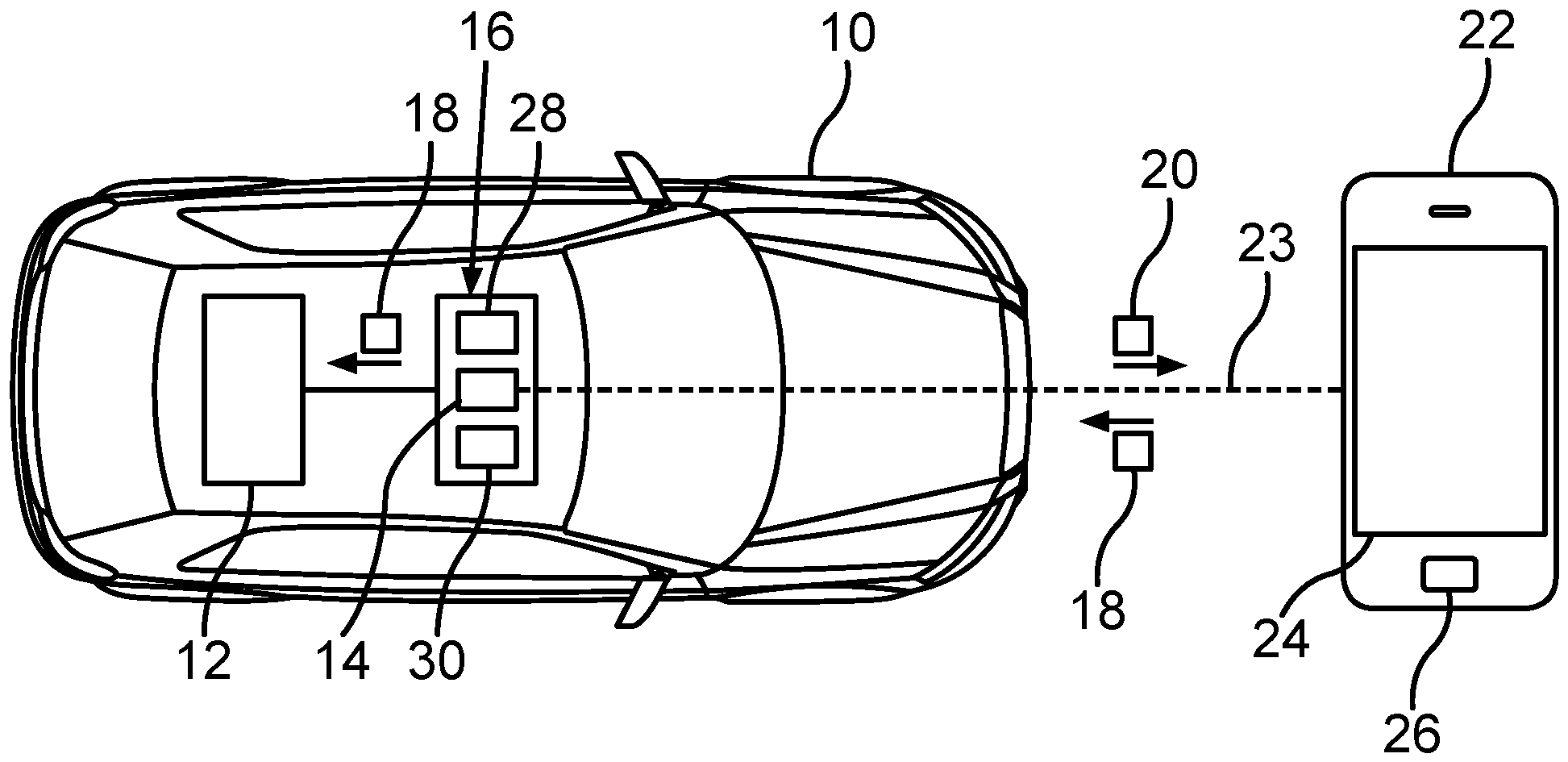
Im Folgenden sind Ausführungsbeispiele der Erfindung beschrieben. Hierzu zeigt:
-
1 eine schematische Darstellung eines Kraftfahrzeugs mit einer Steuereinheit zum Betreiben in einem zumindest teilautonomen Fahrmodus; und -
2 ein Diagramm, welches die Verfahrensschritte für ein Verfahren zum Betreiben des Kraftfahrzeugs in dem zumindest teilautonomen Fahrmodus erläutert.
-
1 a schematic representation of a motor vehicle with a control unit for operating in an at least partially autonomous driving mode; and -
2 a diagram illustrating the method steps for a method for operating the motor vehicle in the at least partially autonomous driving mode.
Bei den im Folgenden erläuterten Ausführungsbeispielen handelt es sich um bevorzugte Ausführungsformen der Erfindung. Bei den Ausführungsbeispielen stellen die beschriebenen Komponenten der Ausführungsformen jeweils einzelne, unabhängig voneinander zu betrachtende Merkmale der Erfindung dar, welche die Erfindung jeweils auch unabhängig voneinander weiterbilden und damit auch einzeln oder in einer anderen als der gezeigten Kombination als Bestandteil der Erfindung anzusehen sind. Des Weiteren sind die beschriebenen Ausführungsformen auch durch weitere der bereits beschriebenen Merkmale der Erfindung ergänzbar.The exemplary embodiments explained below are preferred embodiments of the invention. In the exemplary embodiments, the described components of the embodiments each represent individual features of the invention, which are to be considered independently of one another, which each further develop the invention independently of one another and thus also individually or in a different combination than the one shown as part of the invention. Furthermore, the described embodiments can also be supplemented by further features of the invention already described.
In den Figuren sind funktionsgleiche Elemente jeweils mit denselben Bezugszeichen versehen.In the figures, functionally identical elements are each provided with the same reference numerals.
In
Der zumindest teilautonome Fahrmodus umfasst, dass die Steuereinheit
Die Erfassungseinrichtung
Ermittelt die Berechtigungseinrichtung
Bei dem fahrzeugexternen Berechtigungsgerät
Wird durch die Berechtigungseinrichtung
Insgesamt zeigen die Beispiele, wie durch die Erfindung die Nutzung von einem zumindest teilautonom gesteuerten Kraftfahrzeug durch Nicht-Fahrzeugführungsberechtigte wie beispielsweise einem Kind eingeschränkt und/oder verhindert wird.Overall, the examples show how the invention restricts and / or prevents the use of an at least partially autonomously controlled motor vehicle by non-vehicle owners such as a child.
Claims (8)
Priority Applications (5)
| Application Number | Priority Date | Filing Date | Title |
|---|---|---|---|
| DE102017202834.3A DE102017202834B4 (en) | 2017-02-22 | 2017-02-22 | Method for operating a motor vehicle in an activated at least partially autonomous driving mode |
| CN201880006462.0A CN110167817B (en) | 2017-02-22 | 2018-02-20 | Method for operating a motor vehicle in an active at least semi-automatic driving mode, authorization device for a motor vehicle and motor vehicle |
| PCT/EP2018/054069 WO2018153826A1 (en) | 2017-02-22 | 2018-02-20 | Method for operating a motor vehicle in an activated, at least partially autonomous driving mode and authorisation device for a motor vehicle and a motor vehicle |
| EP18706491.0A EP3585668B1 (en) | 2017-02-22 | 2018-02-20 | Method for operating a motor vehicle in an activated, at least partially autonomous driving mode |
| US16/467,322 US11433905B2 (en) | 2017-02-22 | 2018-02-20 | Method for operating a motor vehicle in an activated, at least partially autonomous driving mode and authorization device for a motor vehicle and a motor vehicle |
Applications Claiming Priority (1)
| Application Number | Priority Date | Filing Date | Title |
|---|---|---|---|
| DE102017202834.3A DE102017202834B4 (en) | 2017-02-22 | 2017-02-22 | Method for operating a motor vehicle in an activated at least partially autonomous driving mode |
Publications (2)
| Publication Number | Publication Date |
|---|---|
| DE102017202834A1 DE102017202834A1 (en) | 2018-08-23 |
| DE102017202834B4 true DE102017202834B4 (en) | 2019-05-16 |
Family
ID=61256956
Family Applications (1)
| Application Number | Title | Priority Date | Filing Date |
|---|---|---|---|
| DE102017202834.3A Expired - Fee Related DE102017202834B4 (en) | 2017-02-22 | 2017-02-22 | Method for operating a motor vehicle in an activated at least partially autonomous driving mode |
Country Status (5)
| Country | Link |
|---|---|
| US (1) | US11433905B2 (en) |
| EP (1) | EP3585668B1 (en) |
| CN (1) | CN110167817B (en) |
| DE (1) | DE102017202834B4 (en) |
| WO (1) | WO2018153826A1 (en) |
Families Citing this family (23)
| Publication number | Priority date | Publication date | Assignee | Title |
|---|---|---|---|---|
| DE102017204169A1 (en) * | 2017-03-14 | 2018-09-20 | Bayerische Motoren Werke Aktiengesellschaft | Authentication system for an at least partially autonomous vehicle |
| DE102017222884A1 (en) * | 2017-12-15 | 2019-06-19 | Zf Friedrichshafen Ag | Method for operating a motor vehicle |
| JP7027280B2 (en) * | 2018-08-10 | 2022-03-01 | 本田技研工業株式会社 | Personal identification device and personal identification method |
| US11480959B2 (en) * | 2018-08-14 | 2022-10-25 | GM Global Technology Operations LLC | Collaborative traveling |
| DE102018220433B4 (en) | 2018-11-28 | 2025-12-24 | Volkswagen Aktiengesellschaft | Procedures for operating a carsharing vehicle and carsharing vehicle |
| DE102018221716A1 (en) * | 2018-12-13 | 2020-06-18 | Robert Bosch Gmbh | Method and device for controlling an at least partially automated vehicle |
| DE102018132223A1 (en) * | 2018-12-14 | 2020-06-18 | Bayerische Motoren Werke Aktiengesellschaft | Method for operating a motor vehicle, particularly one that can be operated autonomously, and test device for a motor vehicle |
| DE102019210568A1 (en) * | 2019-07-17 | 2021-01-21 | Robert Bosch Gmbh | Method and device for operating an automated vehicle |
| DE102019123615A1 (en) * | 2019-09-04 | 2021-03-04 | Audi Ag | Method for operating a motor vehicle system, control device, and motor vehicle |
| US11254286B2 (en) * | 2019-09-17 | 2022-02-22 | GM Global Technology Operations LLC | System and method to disable automated driving mode based on vehicle operation context |
| EP3796271B1 (en) * | 2019-09-19 | 2023-11-08 | Volkswagen AG | Determination of rights when approaching locations with an autonomous motor vehicle |
| US11826146B2 (en) * | 2019-10-10 | 2023-11-28 | Waymo Llc | Psychomotor vigilance testing for persons tasked with monitoring autonomous vehicles |
| US20210158810A1 (en) * | 2019-11-25 | 2021-05-27 | GM Global Technology Operations LLC | Voice interface for selection of vehicle operational modes |
| DE102019131946A1 (en) * | 2019-11-26 | 2021-05-27 | Bayerische Motoren Werke Aktiengesellschaft | Method for operating a vehicle, device and vehicle |
| DE102020106283B3 (en) | 2020-03-09 | 2021-07-22 | Audi Aktiengesellschaft | Motor vehicle and method for operating a motor vehicle |
| CN111547065B (en) * | 2020-05-07 | 2022-01-11 | 新石器慧通(北京)科技有限公司 | Unmanned vehicle remote controller control method, controller and control system |
| US20220118941A1 (en) * | 2020-10-20 | 2022-04-21 | Ford Global Technologies, Llc | Systems And Methods For Vehicle Movement Parental Control With Child Detection |
| CN113044038B (en) * | 2021-04-02 | 2022-08-05 | 中国第一汽车股份有限公司 | Vehicle control switching method and device, vehicle and storage medium |
| DE102022200062A1 (en) * | 2022-01-05 | 2023-07-06 | Volkswagen Aktiengesellschaft | Method for operating an at least partially automated vehicle in a manual driving mode, computer program product and system |
| DE102022127614A1 (en) * | 2022-10-19 | 2024-04-25 | Bayerische Motoren Werke Aktiengesellschaft | Method for improving vehicle usage, computer program, device and vehicle |
| KR20240075411A (en) * | 2022-11-22 | 2024-05-29 | 현대자동차주식회사 | Method and Apparatus for Controlling Vehicle Using Voice or Facial Expressions |
| JP2024160630A (en) * | 2023-05-01 | 2024-11-14 | トヨタ自動車株式会社 | Vehicle control device and vehicle control method |
| DE102023124612A1 (en) | 2023-09-12 | 2025-03-13 | Audi Aktiengesellschaft | Method and device for operating a motor vehicle and motor vehicle |
Citations (10)
| Publication number | Priority date | Publication date | Assignee | Title |
|---|---|---|---|---|
| DE19508370A1 (en) | 1995-03-10 | 1996-09-12 | Daimler Benz Ag | Procedure for securing vehicles, in particular leasing or rental vehicles, against unauthorized use |
| US20060190419A1 (en) * | 2005-02-22 | 2006-08-24 | Bunn Frank E | Video surveillance data analysis algorithms, with local and network-shared communications for facial, physical condition, and intoxication recognition, fuzzy logic intelligent camera system |
| DE102011083944A1 (en) | 2011-10-04 | 2013-04-04 | Robert Bosch Gmbh | Method for activating a driver assistance system |
| DE102012223758A1 (en) | 2012-09-24 | 2014-03-27 | Hyundai Motor Company | System and method for changing the driving control in an autonomous vehicle |
| DE102014223269A1 (en) | 2013-11-22 | 2015-05-28 | Ford Global Technologies, Llc | MODIFIED ADJUSTMENTS OF AN AUTONOMOUS VEHICLE |
| DE102014223258A1 (en) | 2013-11-22 | 2015-05-28 | Ford Global Technologies, Llc | Portable computer in an autonomous vehicle |
| WO2016117790A1 (en) * | 2015-01-20 | 2016-07-28 | Lg Electronics Inc. | Apparatus for switching driving mode of vehicle and method thereof |
| DE102015208068A1 (en) | 2015-04-30 | 2016-11-03 | Robert Bosch Gmbh | Control of an autonomously acting motor vehicle |
| DE102016109978A1 (en) | 2015-06-01 | 2016-12-01 | Ford Global Technologies, Llc | Keyless handover control |
| DE102016116910A1 (en) | 2015-09-18 | 2017-03-23 | Ford Global Technologies, Llc | Detection of unauthorized passengers or objects in an autonomous vehicle |
Family Cites Families (13)
| Publication number | Priority date | Publication date | Assignee | Title |
|---|---|---|---|---|
| US20140234894A1 (en) * | 2011-09-29 | 2014-08-21 | Institut National De La Sante Et De La Recherche Medicale (Inserm) | Method for measuring a biological value of a liver |
| DE102012200189A1 (en) | 2012-01-09 | 2013-07-11 | Robert Bosch Gmbh | Method for operating a vehicle |
| DE102013201168A1 (en) * | 2013-01-24 | 2014-07-24 | Ford Global Technologies, Llc | If necessary activatable remote control system for motor vehicles |
| DE102013019140B3 (en) | 2013-11-15 | 2015-04-02 | Audi Ag | Motor vehicle with remote start and automatic shutdown |
| EP2891589B1 (en) | 2014-01-06 | 2024-09-25 | Harman International Industries, Incorporated | Automatic driver identification |
| DE102014205830A1 (en) * | 2014-03-28 | 2015-10-01 | Bayerische Motoren Werke Aktiengesellschaft | Block for unauthorized acceptance of the driving control in autonomous driving mode |
| DE102014011802B4 (en) * | 2014-08-09 | 2019-04-18 | Audi Ag | Safe activation of a partially autonomous function of a motor vehicle via a portable communication device |
| DE102014013298A1 (en) | 2014-09-06 | 2015-04-02 | Daimler Ag | Method for operating a vehicle and driver assistance system |
| DE102015010203A1 (en) | 2015-08-05 | 2017-02-09 | Audi Ag | Method for operating a motor vehicle and system for operating a motor vehicle |
| US9785145B2 (en) * | 2015-08-07 | 2017-10-10 | International Business Machines Corporation | Controlling driving modes of self-driving vehicles |
| DE102016203537B4 (en) | 2016-03-03 | 2022-11-10 | Volkswagen Aktiengesellschaft | Mobile user terminal, technical device and method for supporting a user in remote control of a technical device |
| US9688288B1 (en) * | 2016-03-08 | 2017-06-27 | VOLKSWAGEN AG et al. | Geofencing for auto drive route planning |
| CN105774709A (en) | 2016-04-18 | 2016-07-20 | 北京新能源汽车股份有限公司 | Vehicle body control device, vehicle body control system, vehicle, and control method for vehicle body control device |
-
2017
- 2017-02-22 DE DE102017202834.3A patent/DE102017202834B4/en not_active Expired - Fee Related
-
2018
- 2018-02-20 EP EP18706491.0A patent/EP3585668B1/en active Active
- 2018-02-20 US US16/467,322 patent/US11433905B2/en active Active
- 2018-02-20 WO PCT/EP2018/054069 patent/WO2018153826A1/en not_active Ceased
- 2018-02-20 CN CN201880006462.0A patent/CN110167817B/en active Active
Patent Citations (10)
| Publication number | Priority date | Publication date | Assignee | Title |
|---|---|---|---|---|
| DE19508370A1 (en) | 1995-03-10 | 1996-09-12 | Daimler Benz Ag | Procedure for securing vehicles, in particular leasing or rental vehicles, against unauthorized use |
| US20060190419A1 (en) * | 2005-02-22 | 2006-08-24 | Bunn Frank E | Video surveillance data analysis algorithms, with local and network-shared communications for facial, physical condition, and intoxication recognition, fuzzy logic intelligent camera system |
| DE102011083944A1 (en) | 2011-10-04 | 2013-04-04 | Robert Bosch Gmbh | Method for activating a driver assistance system |
| DE102012223758A1 (en) | 2012-09-24 | 2014-03-27 | Hyundai Motor Company | System and method for changing the driving control in an autonomous vehicle |
| DE102014223269A1 (en) | 2013-11-22 | 2015-05-28 | Ford Global Technologies, Llc | MODIFIED ADJUSTMENTS OF AN AUTONOMOUS VEHICLE |
| DE102014223258A1 (en) | 2013-11-22 | 2015-05-28 | Ford Global Technologies, Llc | Portable computer in an autonomous vehicle |
| WO2016117790A1 (en) * | 2015-01-20 | 2016-07-28 | Lg Electronics Inc. | Apparatus for switching driving mode of vehicle and method thereof |
| DE102015208068A1 (en) | 2015-04-30 | 2016-11-03 | Robert Bosch Gmbh | Control of an autonomously acting motor vehicle |
| DE102016109978A1 (en) | 2015-06-01 | 2016-12-01 | Ford Global Technologies, Llc | Keyless handover control |
| DE102016116910A1 (en) | 2015-09-18 | 2017-03-23 | Ford Global Technologies, Llc | Detection of unauthorized passengers or objects in an autonomous vehicle |
Also Published As
| Publication number | Publication date |
|---|---|
| CN110167817A (en) | 2019-08-23 |
| CN110167817B (en) | 2023-05-09 |
| EP3585668A1 (en) | 2020-01-01 |
| US11433905B2 (en) | 2022-09-06 |
| DE102017202834A1 (en) | 2018-08-23 |
| WO2018153826A1 (en) | 2018-08-30 |
| EP3585668B1 (en) | 2021-04-07 |
| US20200062265A1 (en) | 2020-02-27 |
Similar Documents
| Publication | Publication Date | Title |
|---|---|---|
| DE102017202834B4 (en) | Method for operating a motor vehicle in an activated at least partially autonomous driving mode | |
| DE112018001965B4 (en) | Vehicle data storage device | |
| EP3288816B1 (en) | Automated valet parking method and device | |
| DE112019003013T5 (en) | Systems and methods for operating an autonomous vehicle in a supervisor mode | |
| DE102019100069A1 (en) | PARK FACILITY | |
| DE112013005705T5 (en) | Vehicle-bound program update device | |
| DE102008048162A1 (en) | System and on-board unit | |
| DE102014223258A1 (en) | Portable computer in an autonomous vehicle | |
| WO2018114431A1 (en) | Method for operating a driver assistance device of a motor vehicle | |
| DE102014205830A1 (en) | Block for unauthorized acceptance of the driving control in autonomous driving mode | |
| DE102020125463A1 (en) | REMOTE AUTOMOTIVE TELEMATICS CONTROL AND SECURITY | |
| DE102019128817A1 (en) | SYSTEM AND METHOD FOR CONTROLLING VEHICLE USE AND VEHICLE | |
| DE102016007483B4 (en) | Method for controlling at least one motor vehicle component and a system comprising a motor vehicle and an attractable device | |
| DE112017007207T5 (en) | Passenger support device, method and program | |
| DE102021117053A1 (en) | SYSTEMS AND PROCEDURES FOR KEYLESS VEHICLE OPERATION MANAGEMENT | |
| DE102020119856A1 (en) | System and method for providing a parking space suggestion for a truck | |
| DE102020211235A1 (en) | Parking area selection procedures and parking area selection system | |
| DE102022121073A1 (en) | SENSOR SYSTEMS AND METHODS FOR AUTONOMOUS VEHICLES TO DROPP PASSENGERS | |
| DE102015219790B3 (en) | Checking a motor vehicle for legal use | |
| DE102016224585A1 (en) | Method for activating a motor vehicle function of a given motor vehicle | |
| DE102019205137B4 (en) | Method for parking assistance for a motor vehicle in a perpendicular parking space | |
| DE102017207121A1 (en) | Method for re-parking a vehicle | |
| DE102019212998A1 (en) | Means of locomotion, device and method for positioning an automated drivable means of locomotion | |
| DE102017208582B4 (en) | Method for operating a motor vehicle, safety system for a motor vehicle and motor vehicle | |
| WO2021048006A1 (en) | Means of locomotion, device and method for preparing an authorization of a usage situation of a means of locomotion |
Legal Events
| Date | Code | Title | Description |
|---|---|---|---|
| R012 | Request for examination validly filed | ||
| R016 | Response to examination communication | ||
| R018 | Grant decision by examination section/examining division | ||
| R020 | Patent grant now final | ||
| R119 | Application deemed withdrawn, or ip right lapsed, due to non-payment of renewal fee |