DE102017115215A1 - EF-TU BINDING METAL-BASED ANTIBIOTIC - Google Patents
EF-TU BINDING METAL-BASED ANTIBIOTIC Download PDFInfo
- Publication number
- DE102017115215A1 DE102017115215A1 DE102017115215.6A DE102017115215A DE102017115215A1 DE 102017115215 A1 DE102017115215 A1 DE 102017115215A1 DE 102017115215 A DE102017115215 A DE 102017115215A DE 102017115215 A1 DE102017115215 A1 DE 102017115215A1
- Authority
- DE
- Germany
- Prior art keywords
- substituted
- unsubstituted
- branched
- complex
- linear
- Prior art date
- Legal status (The legal status is an assumption and is not a legal conclusion. Google has not performed a legal analysis and makes no representation as to the accuracy of the status listed.)
- Withdrawn
Links
- 230000003115 biocidal effect Effects 0.000 title description 12
- 239000003446 ligand Substances 0.000 claims abstract description 87
- -1 benzimidazol-2-ylidene Chemical group 0.000 claims abstract description 70
- 238000000034 method Methods 0.000 claims abstract description 40
- 238000011282 treatment Methods 0.000 claims abstract description 26
- 230000001580 bacterial effect Effects 0.000 claims abstract description 15
- 208000035143 Bacterial infection Diseases 0.000 claims abstract description 12
- 208000022362 bacterial infectious disease Diseases 0.000 claims abstract description 12
- 239000003814 drug Substances 0.000 claims abstract description 11
- 239000008194 pharmaceutical composition Substances 0.000 claims abstract description 9
- 206010061217 Infestation Diseases 0.000 claims abstract description 8
- 230000008569 process Effects 0.000 claims abstract description 5
- 230000009021 linear effect Effects 0.000 claims description 70
- 150000001875 compounds Chemical class 0.000 claims description 50
- ROFVEXUMMXZLPA-UHFFFAOYSA-N Bipyridyl Chemical compound N1=CC=CC=C1C1=CC=CC=N1 ROFVEXUMMXZLPA-UHFFFAOYSA-N 0.000 claims description 44
- 125000000217 alkyl group Chemical group 0.000 claims description 37
- WEVYAHXRMPXWCK-UHFFFAOYSA-N Acetonitrile Chemical compound CC#N WEVYAHXRMPXWCK-UHFFFAOYSA-N 0.000 claims description 36
- 239000007787 solid Substances 0.000 claims description 32
- 125000003118 aryl group Chemical group 0.000 claims description 31
- YBJHBAHKTGYVGT-ZKWXMUAHSA-N (+)-Biotin Chemical compound N1C(=O)N[C@@H]2[C@H](CCCCC(=O)O)SC[C@@H]21 YBJHBAHKTGYVGT-ZKWXMUAHSA-N 0.000 claims description 30
- 125000004432 carbon atom Chemical group C* 0.000 claims description 26
- DGEZNRSVGBDHLK-UHFFFAOYSA-N [1,10]phenanthroline Chemical compound C1=CN=C2C3=NC=CC=C3C=CC2=C1 DGEZNRSVGBDHLK-UHFFFAOYSA-N 0.000 claims description 25
- 241000894006 Bacteria Species 0.000 claims description 24
- 125000004404 heteroalkyl group Chemical group 0.000 claims description 23
- 239000000243 solution Substances 0.000 claims description 23
- 108010090804 Streptavidin Proteins 0.000 claims description 20
- 125000001072 heteroaryl group Chemical group 0.000 claims description 19
- 125000000753 cycloalkyl group Chemical group 0.000 claims description 17
- 229960002685 biotin Drugs 0.000 claims description 15
- 235000020958 biotin Nutrition 0.000 claims description 15
- 239000011616 biotin Substances 0.000 claims description 15
- 125000000592 heterocycloalkyl group Chemical group 0.000 claims description 15
- 125000005647 linker group Chemical group 0.000 claims description 14
- 125000003342 alkenyl group Chemical group 0.000 claims description 13
- 125000000304 alkynyl group Chemical group 0.000 claims description 13
- 229910052751 metal Inorganic materials 0.000 claims description 13
- RIOQSEWOXXDEQQ-UHFFFAOYSA-N triphenylphosphine Chemical class C1=CC=CC=C1P(C=1C=CC=CC=1)C1=CC=CC=C1 RIOQSEWOXXDEQQ-UHFFFAOYSA-N 0.000 claims description 13
- QGZKDVFQNNGYKY-UHFFFAOYSA-N Ammonia Chemical compound N QGZKDVFQNNGYKY-UHFFFAOYSA-N 0.000 claims description 12
- 239000002184 metal Substances 0.000 claims description 12
- 230000007935 neutral effect Effects 0.000 claims description 12
- UHOVQNZJYSORNB-UHFFFAOYSA-N Benzene Chemical compound C1=CC=CC=C1 UHOVQNZJYSORNB-UHFFFAOYSA-N 0.000 claims description 11
- DHMQDGOQFOQNFH-UHFFFAOYSA-N Glycine Chemical compound NCC(O)=O DHMQDGOQFOQNFH-UHFFFAOYSA-N 0.000 claims description 10
- KWYHDKDOAIKMQN-UHFFFAOYSA-N N,N,N',N'-tetramethylethylenediamine Chemical compound CN(C)CCN(C)C KWYHDKDOAIKMQN-UHFFFAOYSA-N 0.000 claims description 10
- 238000002360 preparation method Methods 0.000 claims description 10
- 229910052739 hydrogen Inorganic materials 0.000 claims description 9
- KYQCOXFCLRTKLS-UHFFFAOYSA-N Pyrazine Chemical compound C1=CN=CC=N1 KYQCOXFCLRTKLS-UHFFFAOYSA-N 0.000 claims description 8
- YWWDBCBWQNCYNR-UHFFFAOYSA-N trimethylphosphine Chemical compound CP(C)C YWWDBCBWQNCYNR-UHFFFAOYSA-N 0.000 claims description 8
- COIOYMYWGDAQPM-UHFFFAOYSA-N tris(2-methylphenyl)phosphane Chemical compound CC1=CC=CC=C1P(C=1C(=CC=CC=1)C)C1=CC=CC=C1C COIOYMYWGDAQPM-UHFFFAOYSA-N 0.000 claims description 8
- 108090001008 Avidin Proteins 0.000 claims description 7
- 125000002877 alkyl aryl group Chemical group 0.000 claims description 7
- 125000000129 anionic group Chemical group 0.000 claims description 7
- 229940079593 drug Drugs 0.000 claims description 7
- CURLTUGMZLYLDI-UHFFFAOYSA-N Carbon dioxide Chemical compound O=C=O CURLTUGMZLYLDI-UHFFFAOYSA-N 0.000 claims description 6
- 150000001540 azides Chemical class 0.000 claims description 6
- 125000002915 carbonyl group Chemical group [*:2]C([*:1])=O 0.000 claims description 6
- 125000000058 cyclopentadienyl group Chemical group C1(=CC=CC1)* 0.000 claims description 6
- ZSWFCLXCOIISFI-UHFFFAOYSA-N endo-cyclopentadiene Natural products C1C=CC=C1 ZSWFCLXCOIISFI-UHFFFAOYSA-N 0.000 claims description 6
- CWKYKJQWSSZVDF-UHFFFAOYSA-N n-propyl-1-pyridin-2-ylmethanimine Chemical compound CCCN=CC1=CC=CC=N1 CWKYKJQWSSZVDF-UHFFFAOYSA-N 0.000 claims description 6
- 125000000027 (C1-C10) alkoxy group Chemical group 0.000 claims description 5
- XGCDBGRZEKYHNV-UHFFFAOYSA-N 1,1-bis(diphenylphosphino)methane Chemical compound C=1C=CC=CC=1P(C=1C=CC=CC=1)CP(C=1C=CC=CC=1)C1=CC=CC=C1 XGCDBGRZEKYHNV-UHFFFAOYSA-N 0.000 claims description 5
- QFMZQPDHXULLKC-UHFFFAOYSA-N 1,2-bis(diphenylphosphino)ethane Chemical compound C=1C=CC=CC=1P(C=1C=CC=CC=1)CCP(C=1C=CC=CC=1)C1=CC=CC=C1 QFMZQPDHXULLKC-UHFFFAOYSA-N 0.000 claims description 5
- VGUWFGWZSVLROP-UHFFFAOYSA-N 1-pyridin-2-yl-n,n-bis(pyridin-2-ylmethyl)methanamine Chemical compound C=1C=CC=NC=1CN(CC=1N=CC=CC=1)CC1=CC=CC=N1 VGUWFGWZSVLROP-UHFFFAOYSA-N 0.000 claims description 5
- KXZQYLBVMZGIKC-UHFFFAOYSA-N 1-pyridin-2-yl-n-(pyridin-2-ylmethyl)methanamine Chemical compound C=1C=CC=NC=1CNCC1=CC=CC=N1 KXZQYLBVMZGIKC-UHFFFAOYSA-N 0.000 claims description 5
- RPNUMPOLZDHAAY-UHFFFAOYSA-N Diethylenetriamine Chemical compound NCCNCCN RPNUMPOLZDHAAY-UHFFFAOYSA-N 0.000 claims description 5
- PIICEJLVQHRZGT-UHFFFAOYSA-N Ethylenediamine Chemical compound NCCN PIICEJLVQHRZGT-UHFFFAOYSA-N 0.000 claims description 5
- MWUXSHHQAYIFBG-UHFFFAOYSA-N Nitric oxide Chemical group O=[N] MWUXSHHQAYIFBG-UHFFFAOYSA-N 0.000 claims description 5
- 241000239226 Scorpiones Species 0.000 claims description 5
- 239000002253 acid Substances 0.000 claims description 5
- CHVJITGCYZJHLR-UHFFFAOYSA-N cyclohepta-1,3,5-triene Chemical compound C1C=CC=CC=C1 CHVJITGCYZJHLR-UHFFFAOYSA-N 0.000 claims description 5
- 239000003937 drug carrier Substances 0.000 claims description 5
- NBZBKCUXIYYUSX-UHFFFAOYSA-N iminodiacetic acid Chemical compound OC(=O)CNCC(O)=O NBZBKCUXIYYUSX-UHFFFAOYSA-N 0.000 claims description 5
- MGFYIUFZLHCRTH-UHFFFAOYSA-N nitrilotriacetic acid Chemical compound OC(=O)CN(CC(O)=O)CC(O)=O MGFYIUFZLHCRTH-UHFFFAOYSA-N 0.000 claims description 5
- 239000000546 pharmaceutical excipient Substances 0.000 claims description 5
- WLPUWLXVBWGYMZ-UHFFFAOYSA-N tricyclohexylphosphine Chemical compound C1CCCCC1P(C1CCCCC1)C1CCCCC1 WLPUWLXVBWGYMZ-UHFFFAOYSA-N 0.000 claims description 5
- 241000193830 Bacillus <bacterium> Species 0.000 claims description 4
- 229910021529 ammonia Inorganic materials 0.000 claims description 4
- 230000003100 immobilizing effect Effects 0.000 claims description 4
- POILWHVDKZOXJZ-ARJAWSKDSA-M (z)-4-oxopent-2-en-2-olate Chemical compound C\C([O-])=C\C(C)=O POILWHVDKZOXJZ-ARJAWSKDSA-M 0.000 claims description 3
- UGFAIRIUMAVXCW-UHFFFAOYSA-N Carbon monoxide Chemical compound [O+]#[C-] UGFAIRIUMAVXCW-UHFFFAOYSA-N 0.000 claims description 3
- 239000004471 Glycine Substances 0.000 claims description 3
- PCNDJXKNXGMECE-UHFFFAOYSA-N Phenazine Natural products C1=CC=CC2=NC3=CC=CC=C3N=C21 PCNDJXKNXGMECE-UHFFFAOYSA-N 0.000 claims description 3
- 241000191940 Staphylococcus Species 0.000 claims description 3
- 150000007513 acids Chemical class 0.000 claims description 3
- 150000001336 alkenes Chemical class 0.000 claims description 3
- 239000001569 carbon dioxide Substances 0.000 claims description 3
- 229910002092 carbon dioxide Inorganic materials 0.000 claims description 3
- 229910002091 carbon monoxide Inorganic materials 0.000 claims description 3
- XLYOFNOQVPJJNP-UHFFFAOYSA-M hydroxide Chemical compound [OH-] XLYOFNOQVPJJNP-UHFFFAOYSA-M 0.000 claims description 3
- 150000002540 isothiocyanates Chemical class 0.000 claims description 3
- HMMPCBAWTWYFLR-UHFFFAOYSA-N n-pyridin-2-ylpyridin-2-amine Chemical compound C=1C=CC=NC=1NC1=CC=CC=N1 HMMPCBAWTWYFLR-UHFFFAOYSA-N 0.000 claims description 3
- 125000004043 oxo group Chemical group O=* 0.000 claims description 3
- LSNNMFCWUKXFEE-UHFFFAOYSA-L sulfite Chemical class [O-]S([O-])=O LSNNMFCWUKXFEE-UHFFFAOYSA-L 0.000 claims description 3
- 150000002222 fluorine compounds Chemical class 0.000 claims 1
- 125000001475 halogen functional group Chemical group 0.000 claims 1
- 150000002823 nitrates Chemical class 0.000 claims 1
- 150000002825 nitriles Chemical class 0.000 claims 1
- 150000002826 nitrites Chemical class 0.000 claims 1
- 150000003891 oxalate salts Chemical class 0.000 claims 1
- 150000003222 pyridines Chemical class 0.000 claims 1
- 150000003567 thiocyanates Chemical class 0.000 claims 1
- 150000003568 thioethers Chemical class 0.000 claims 1
- ADLVDYMTBOSDFE-UHFFFAOYSA-N 5-chloro-6-nitroisoindole-1,3-dione Chemical compound C1=C(Cl)C([N+](=O)[O-])=CC2=C1C(=O)NC2=O ADLVDYMTBOSDFE-UHFFFAOYSA-N 0.000 abstract description 21
- 108090000623 proteins and genes Proteins 0.000 description 66
- 102000004169 proteins and genes Human genes 0.000 description 65
- 235000018102 proteins Nutrition 0.000 description 62
- IAZDPXIOMUYVGZ-UHFFFAOYSA-N Dimethylsulphoxide Chemical compound CS(C)=O IAZDPXIOMUYVGZ-UHFFFAOYSA-N 0.000 description 46
- 238000005481 NMR spectroscopy Methods 0.000 description 38
- XEKOWRVHYACXOJ-UHFFFAOYSA-N Ethyl acetate Chemical compound CCOC(C)=O XEKOWRVHYACXOJ-UHFFFAOYSA-N 0.000 description 27
- 235000014469 Bacillus subtilis Nutrition 0.000 description 26
- HZVOZRGWRWCICA-UHFFFAOYSA-N methanediyl Chemical compound [CH2] HZVOZRGWRWCICA-UHFFFAOYSA-N 0.000 description 25
- 239000000047 product Substances 0.000 description 21
- 102000008153 Peptide Elongation Factor Tu Human genes 0.000 description 20
- 108010049977 Peptide Elongation Factor Tu Proteins 0.000 description 20
- PAYRUJLWNCNPSJ-UHFFFAOYSA-N Aniline Chemical compound NC1=CC=CC=C1 PAYRUJLWNCNPSJ-UHFFFAOYSA-N 0.000 description 18
- YXFVVABEGXRONW-UHFFFAOYSA-N Toluene Chemical compound CC1=CC=CC=C1 YXFVVABEGXRONW-UHFFFAOYSA-N 0.000 description 18
- 238000005102 attenuated total reflection Methods 0.000 description 18
- VLKZOEOYAKHREP-UHFFFAOYSA-N n-Hexane Chemical compound CCCCCC VLKZOEOYAKHREP-UHFFFAOYSA-N 0.000 description 18
- RTZKZFJDLAIYFH-UHFFFAOYSA-N Diethyl ether Chemical compound CCOCC RTZKZFJDLAIYFH-UHFFFAOYSA-N 0.000 description 16
- YNPNZTXNASCQKK-UHFFFAOYSA-N Phenanthrene Natural products C1=CC=C2C3=CC=CC=C3C=CC2=C1 YNPNZTXNASCQKK-UHFFFAOYSA-N 0.000 description 16
- 239000003480 eluent Substances 0.000 description 16
- 239000013256 coordination polymer Substances 0.000 description 15
- 238000000132 electrospray ionisation Methods 0.000 description 15
- 210000004027 cell Anatomy 0.000 description 14
- 235000019439 ethyl acetate Nutrition 0.000 description 13
- 125000001424 substituent group Chemical group 0.000 description 12
- 108010026552 Proteome Proteins 0.000 description 11
- 239000003242 anti bacterial agent Substances 0.000 description 11
- 229940088710 antibiotic agent Drugs 0.000 description 11
- 230000015572 biosynthetic process Effects 0.000 description 11
- 239000000872 buffer Substances 0.000 description 11
- 239000000499 gel Substances 0.000 description 11
- 125000005842 heteroatom Chemical group 0.000 description 11
- 108090000765 processed proteins & peptides Proteins 0.000 description 11
- 239000002904 solvent Substances 0.000 description 11
- 238000006243 chemical reaction Methods 0.000 description 10
- 230000000694 effects Effects 0.000 description 10
- 239000000126 substance Substances 0.000 description 10
- 241000192125 Firmicutes Species 0.000 description 9
- 108010085026 GE 2270 A Proteins 0.000 description 9
- PEDCQBHIVMGVHV-UHFFFAOYSA-N Glycerine Chemical compound OCC(O)CO PEDCQBHIVMGVHV-UHFFFAOYSA-N 0.000 description 9
- 229920002684 Sepharose Polymers 0.000 description 9
- 238000004440 column chromatography Methods 0.000 description 9
- QLNAVQRIWDRPHA-UHFFFAOYSA-N iminophosphane Chemical compound P=N QLNAVQRIWDRPHA-UHFFFAOYSA-N 0.000 description 9
- 239000003550 marker Substances 0.000 description 9
- 239000000463 material Substances 0.000 description 9
- BDAGIHXWWSANSR-UHFFFAOYSA-N methanoic acid Natural products OC=O BDAGIHXWWSANSR-UHFFFAOYSA-N 0.000 description 9
- 150000003254 radicals Chemical class 0.000 description 9
- PLBXFYFBJMNSHS-UHFFFAOYSA-N 2-azidoaniline Chemical compound NC1=CC=CC=C1N=[N+]=[N-] PLBXFYFBJMNSHS-UHFFFAOYSA-N 0.000 description 8
- 102100038222 60 kDa heat shock protein, mitochondrial Human genes 0.000 description 8
- 108010058432 Chaperonin 60 Proteins 0.000 description 8
- YMWUJEATGCHHMB-UHFFFAOYSA-N Dichloromethane Chemical compound ClCCl YMWUJEATGCHHMB-UHFFFAOYSA-N 0.000 description 8
- VEXZGXHMUGYJMC-UHFFFAOYSA-N Hydrochloric acid Chemical compound Cl VEXZGXHMUGYJMC-UHFFFAOYSA-N 0.000 description 8
- 229910004298 SiO 2 Inorganic materials 0.000 description 8
- 125000000392 cycloalkenyl group Chemical group 0.000 description 8
- 230000003993 interaction Effects 0.000 description 8
- 229910052757 nitrogen Inorganic materials 0.000 description 8
- 102000004196 processed proteins & peptides Human genes 0.000 description 8
- 239000003643 water by type Substances 0.000 description 8
- 239000007983 Tris buffer Substances 0.000 description 7
- 230000000844 anti-bacterial effect Effects 0.000 description 7
- 238000005119 centrifugation Methods 0.000 description 7
- 238000001514 detection method Methods 0.000 description 7
- 238000002474 experimental method Methods 0.000 description 7
- 230000002401 inhibitory effect Effects 0.000 description 7
- 238000004949 mass spectrometry Methods 0.000 description 7
- 125000002524 organometallic group Chemical group 0.000 description 7
- 229910052702 rhenium Inorganic materials 0.000 description 7
- WUAPFZMCVAUBPE-UHFFFAOYSA-N rhenium atom Chemical compound [Re] WUAPFZMCVAUBPE-UHFFFAOYSA-N 0.000 description 7
- 150000003839 salts Chemical class 0.000 description 7
- 230000014616 translation Effects 0.000 description 7
- LENZDBCJOHFCAS-UHFFFAOYSA-N tris Chemical compound OCC(N)(CO)CO LENZDBCJOHFCAS-UHFFFAOYSA-N 0.000 description 7
- XLYOFNOQVPJJNP-UHFFFAOYSA-N water Chemical compound O XLYOFNOQVPJJNP-UHFFFAOYSA-N 0.000 description 7
- CSCPPACGZOOCGX-UHFFFAOYSA-N Acetone Chemical compound CC(C)=O CSCPPACGZOOCGX-UHFFFAOYSA-N 0.000 description 6
- IJGRMHOSHXDMSA-UHFFFAOYSA-N Atomic nitrogen Chemical compound N#N IJGRMHOSHXDMSA-UHFFFAOYSA-N 0.000 description 6
- OKKJLVBELUTLKV-UHFFFAOYSA-N Methanol Chemical compound OC OKKJLVBELUTLKV-UHFFFAOYSA-N 0.000 description 6
- JUJWROOIHBZHMG-UHFFFAOYSA-N Pyridine Chemical compound C1=CC=NC=C1 JUJWROOIHBZHMG-UHFFFAOYSA-N 0.000 description 6
- FAPWRFPIFSIZLT-UHFFFAOYSA-M Sodium chloride Chemical compound [Na+].[Cl-] FAPWRFPIFSIZLT-UHFFFAOYSA-M 0.000 description 6
- 230000009471 action Effects 0.000 description 6
- 125000002947 alkylene group Chemical group 0.000 description 6
- 125000004429 atom Chemical group 0.000 description 6
- 239000003153 chemical reaction reagent Substances 0.000 description 6
- 208000037265 diseases, disorders, signs and symptoms Diseases 0.000 description 6
- VHJLVAABSRFDPM-QWWZWVQMSA-N dithiothreitol Chemical compound SC[C@@H](O)[C@H](O)CS VHJLVAABSRFDPM-QWWZWVQMSA-N 0.000 description 6
- 238000010828 elution Methods 0.000 description 6
- 208000015181 infectious disease Diseases 0.000 description 6
- 230000004048 modification Effects 0.000 description 6
- 238000012986 modification Methods 0.000 description 6
- 108010081596 nocathiacin I Proteins 0.000 description 6
- 229910052760 oxygen Inorganic materials 0.000 description 6
- 230000002829 reductive effect Effects 0.000 description 6
- VYPSYNLAJGMNEJ-UHFFFAOYSA-N Silicium dioxide Chemical compound O=[Si]=O VYPSYNLAJGMNEJ-UHFFFAOYSA-N 0.000 description 5
- 238000010521 absorption reaction Methods 0.000 description 5
- 238000004458 analytical method Methods 0.000 description 5
- 230000000845 anti-microbial effect Effects 0.000 description 5
- 230000004071 biological effect Effects 0.000 description 5
- 229910052799 carbon Inorganic materials 0.000 description 5
- 125000002091 cationic group Chemical group 0.000 description 5
- FFLJEMWVYVKPDW-UMNFMQIXSA-N chembl263049 Chemical compound O([C@H]1[C@H]2OCC3=C(N(C=4C=CC=C(C3=4)COC1=O)O)C(=O)OC[C@H]1C=3SC=C(N=3)C3=NC(=C(O)C=C3C=3SC=C(N=3)C(=O)N[C@H](C(=O)N/C(C=3SC=C(N=3)C(=O)N[C@@H]2C=2SC=C(N=2)C(=O)N1)=C(C)/OC)[C@@H](C)O)C=1SC=C(N=1)C(=O)NC(=C)C(N)=O)[C@H]1C[C@](C)(O)[C@H](N(C)C)[C@H](C)O1 FFLJEMWVYVKPDW-UMNFMQIXSA-N 0.000 description 5
- 239000000460 chlorine Substances 0.000 description 5
- 150000004820 halides Chemical class 0.000 description 5
- 229910052736 halogen Inorganic materials 0.000 description 5
- 125000005843 halogen group Chemical group 0.000 description 5
- 239000007788 liquid Substances 0.000 description 5
- 239000000203 mixture Substances 0.000 description 5
- FFLJEMWVYVKPDW-VCUUIXPJSA-N nocathiacin I Natural products COC(=C1NC(=O)[C@@H](NC(=O)c2csc(n2)c3cc(O)c(nc3c4csc(n4)[C@@H]5COC(=O)c6c7CO[C@@H]([C@H](NC(=O)c8csc1n8)c9nc(cs9)C(=O)N5)[C@H](O[C@H]%10C[C@](C)(O)[C@@H]([C@H](C)O%10)N(C)C)C(=O)OCc%11cccc(c7%11)n6O)c%12nc(cs%12)C(=O)NC(=C)C(=O)N)[C@@H](C)O)C FFLJEMWVYVKPDW-VCUUIXPJSA-N 0.000 description 5
- 125000001997 phenyl group Chemical group [H]C1=C([H])C([H])=C(*)C([H])=C1[H] 0.000 description 5
- 229920001184 polypeptide Polymers 0.000 description 5
- 238000011002 quantification Methods 0.000 description 5
- 230000001105 regulatory effect Effects 0.000 description 5
- 230000004044 response Effects 0.000 description 5
- 239000000741 silica gel Substances 0.000 description 5
- 229910002027 silica gel Inorganic materials 0.000 description 5
- 238000005406 washing Methods 0.000 description 5
- HIKRJHFHGKZKRI-UHFFFAOYSA-N 2,4,6-trimethylbenzaldehyde Chemical compound CC1=CC(C)=C(C=O)C(C)=C1 HIKRJHFHGKZKRI-UHFFFAOYSA-N 0.000 description 4
- DHDHJYNTEFLIHY-UHFFFAOYSA-N 4,7-diphenyl-1,10-phenanthroline Chemical compound C1=CC=CC=C1C1=CC=NC2=C1C=CC1=C(C=3C=CC=CC=3)C=CN=C21 DHDHJYNTEFLIHY-UHFFFAOYSA-N 0.000 description 4
- OSWFIVFLDKOXQC-UHFFFAOYSA-N 4-(3-methoxyphenyl)aniline Chemical compound COC1=CC=CC(C=2C=CC(N)=CC=2)=C1 OSWFIVFLDKOXQC-UHFFFAOYSA-N 0.000 description 4
- OKTJSMMVPCPJKN-UHFFFAOYSA-N Carbon Chemical compound [C] OKTJSMMVPCPJKN-UHFFFAOYSA-N 0.000 description 4
- NHNBFGGVMKEFGY-UHFFFAOYSA-N Nitrate Chemical compound [O-][N+]([O-])=O NHNBFGGVMKEFGY-UHFFFAOYSA-N 0.000 description 4
- IOVCWXUNBOPUCH-UHFFFAOYSA-M Nitrite anion Chemical compound [O-]N=O IOVCWXUNBOPUCH-UHFFFAOYSA-M 0.000 description 4
- 102000004142 Trypsin Human genes 0.000 description 4
- 108090000631 Trypsin Proteins 0.000 description 4
- 238000007792 addition Methods 0.000 description 4
- 125000003545 alkoxy group Chemical group 0.000 description 4
- HUMNYLRZRPPJDN-UHFFFAOYSA-N benzaldehyde Chemical compound O=CC1=CC=CC=C1 HUMNYLRZRPPJDN-UHFFFAOYSA-N 0.000 description 4
- 230000006287 biotinylation Effects 0.000 description 4
- 238000007413 biotinylation Methods 0.000 description 4
- 239000000306 component Substances 0.000 description 4
- 239000012043 crude product Substances 0.000 description 4
- 239000013078 crystal Substances 0.000 description 4
- 230000007423 decrease Effects 0.000 description 4
- 238000004807 desolvation Methods 0.000 description 4
- 230000029087 digestion Effects 0.000 description 4
- 108010063460 elongation factor T Proteins 0.000 description 4
- 235000019253 formic acid Nutrition 0.000 description 4
- 239000012634 fragment Substances 0.000 description 4
- 125000004474 heteroalkylene group Chemical group 0.000 description 4
- 125000004435 hydrogen atom Chemical class [H]* 0.000 description 4
- 230000010534 mechanism of action Effects 0.000 description 4
- 125000001570 methylene group Chemical group [H]C([H])([*:1])[*:2] 0.000 description 4
- 125000004433 nitrogen atom Chemical group N* 0.000 description 4
- 239000002245 particle Substances 0.000 description 4
- 238000002264 polyacrylamide gel electrophoresis Methods 0.000 description 4
- 239000011148 porous material Substances 0.000 description 4
- 238000006862 quantum yield reaction Methods 0.000 description 4
- 238000013207 serial dilution Methods 0.000 description 4
- 229910052710 silicon Inorganic materials 0.000 description 4
- 238000002415 sodium dodecyl sulfate polyacrylamide gel electrophoresis Methods 0.000 description 4
- 238000001228 spectrum Methods 0.000 description 4
- 229910052717 sulfur Inorganic materials 0.000 description 4
- 239000006228 supernatant Substances 0.000 description 4
- 239000012588 trypsin Substances 0.000 description 4
- 238000001419 two-dimensional polyacrylamide gel electrophoresis Methods 0.000 description 4
- 238000004704 ultra performance liquid chromatography Methods 0.000 description 4
- 241000588626 Acinetobacter baumannii Species 0.000 description 3
- KXDHJXZQYSOELW-UHFFFAOYSA-N Carbamic acid Chemical compound NC(O)=O KXDHJXZQYSOELW-UHFFFAOYSA-N 0.000 description 3
- 102000004190 Enzymes Human genes 0.000 description 3
- 108090000790 Enzymes Proteins 0.000 description 3
- 241001295925 Gegenes Species 0.000 description 3
- 108010006519 Molecular Chaperones Proteins 0.000 description 3
- OFOBLEOULBTSOW-UHFFFAOYSA-N Propanedioic acid Natural products OC(=O)CC(O)=O OFOBLEOULBTSOW-UHFFFAOYSA-N 0.000 description 3
- DBMJMQXJHONAFJ-UHFFFAOYSA-M Sodium laurylsulphate Chemical compound [Na+].CCCCCCCCCCCCOS([O-])(=O)=O DBMJMQXJHONAFJ-UHFFFAOYSA-M 0.000 description 3
- 241000191967 Staphylococcus aureus Species 0.000 description 3
- 150000001299 aldehydes Chemical class 0.000 description 3
- 150000001413 amino acids Chemical group 0.000 description 3
- 239000004599 antimicrobial Substances 0.000 description 3
- 238000013459 approach Methods 0.000 description 3
- 238000003556 assay Methods 0.000 description 3
- QVGXLLKOCUKJST-UHFFFAOYSA-N atomic oxygen Chemical compound [O] QVGXLLKOCUKJST-UHFFFAOYSA-N 0.000 description 3
- 230000008901 benefit Effects 0.000 description 3
- 125000001797 benzyl group Chemical group [H]C1=C([H])C([H])=C(C([H])=C1[H])C([H])([H])* 0.000 description 3
- 150000001615 biotins Chemical class 0.000 description 3
- 239000011203 carbon fibre reinforced carbon Substances 0.000 description 3
- BVKZGUZCCUSVTD-UHFFFAOYSA-N carbonic acid Chemical compound OC(O)=O BVKZGUZCCUSVTD-UHFFFAOYSA-N 0.000 description 3
- 239000013592 cell lysate Substances 0.000 description 3
- 238000002512 chemotherapy Methods 0.000 description 3
- KRKNYBCHXYNGOX-UHFFFAOYSA-N citric acid Chemical compound OC(=O)CC(O)(C(O)=O)CC(O)=O KRKNYBCHXYNGOX-UHFFFAOYSA-N 0.000 description 3
- 230000001086 cytosolic effect Effects 0.000 description 3
- 201000010099 disease Diseases 0.000 description 3
- 238000000295 emission spectrum Methods 0.000 description 3
- 229940088598 enzyme Drugs 0.000 description 3
- 150000002148 esters Chemical class 0.000 description 3
- 239000007789 gas Substances 0.000 description 3
- 150000002367 halogens Chemical class 0.000 description 3
- PGLTVOMIXTUURA-UHFFFAOYSA-N iodoacetamide Chemical compound NC(=O)CI PGLTVOMIXTUURA-UHFFFAOYSA-N 0.000 description 3
- 238000004255 ion exchange chromatography Methods 0.000 description 3
- 238000004020 luminiscence type Methods 0.000 description 3
- 230000014759 maintenance of location Effects 0.000 description 3
- 229910021645 metal ion Inorganic materials 0.000 description 3
- 150000007523 nucleic acids Chemical group 0.000 description 3
- 239000001301 oxygen Substances 0.000 description 3
- 229910052698 phosphorus Inorganic materials 0.000 description 3
- 239000000523 sample Substances 0.000 description 3
- 239000012723 sample buffer Substances 0.000 description 3
- 239000011780 sodium chloride Substances 0.000 description 3
- 239000012321 sodium triacetoxyborohydride Substances 0.000 description 3
- 208000024891 symptom Diseases 0.000 description 3
- 150000003573 thiols Chemical class 0.000 description 3
- 238000013519 translation Methods 0.000 description 3
- 239000011534 wash buffer Substances 0.000 description 3
- 125000000008 (C1-C10) alkyl group Chemical group 0.000 description 2
- HZAXFHJVJLSVMW-UHFFFAOYSA-N 2-Aminoethan-1-ol Chemical compound NCCO HZAXFHJVJLSVMW-UHFFFAOYSA-N 0.000 description 2
- IVRMZWNICZWHMI-UHFFFAOYSA-N Azide Chemical compound [N-]=[N+]=[N-] IVRMZWNICZWHMI-UHFFFAOYSA-N 0.000 description 2
- 244000063299 Bacillus subtilis Species 0.000 description 2
- 241000276408 Bacillus subtilis subsp. subtilis str. 168 Species 0.000 description 2
- 238000009010 Bradford assay Methods 0.000 description 2
- CPELXLSAUQHCOX-UHFFFAOYSA-M Bromide Chemical compound [Br-] CPELXLSAUQHCOX-UHFFFAOYSA-M 0.000 description 2
- VTYYLEPIZMXCLO-UHFFFAOYSA-L Calcium carbonate Chemical compound [Ca+2].[O-]C([O-])=O VTYYLEPIZMXCLO-UHFFFAOYSA-L 0.000 description 2
- XFXPMWWXUTWYJX-UHFFFAOYSA-N Cyanide Chemical compound N#[C-] XFXPMWWXUTWYJX-UHFFFAOYSA-N 0.000 description 2
- 102000016911 Deoxyribonucleases Human genes 0.000 description 2
- 108010053770 Deoxyribonucleases Proteins 0.000 description 2
- 101100136092 Drosophila melanogaster peng gene Proteins 0.000 description 2
- 241000588724 Escherichia coli Species 0.000 description 2
- KRHYYFGTRYWZRS-UHFFFAOYSA-M Fluoride anion Chemical compound [F-] KRHYYFGTRYWZRS-UHFFFAOYSA-M 0.000 description 2
- QIVBCDIJIAJPQS-VIFPVBQESA-N L-tryptophane Chemical compound C1=CC=C2C(C[C@H](N)C(O)=O)=CNC2=C1 QIVBCDIJIAJPQS-VIFPVBQESA-N 0.000 description 2
- 108010022337 Leucine Enkephalin Proteins 0.000 description 2
- 241001465754 Metazoa Species 0.000 description 2
- AFVFQIVMOAPDHO-UHFFFAOYSA-N Methanesulfonic acid Chemical compound CS(O)(=O)=O AFVFQIVMOAPDHO-UHFFFAOYSA-N 0.000 description 2
- 102000016943 Muramidase Human genes 0.000 description 2
- 108010014251 Muramidase Proteins 0.000 description 2
- 108010062010 N-Acetylmuramoyl-L-alanine Amidase Proteins 0.000 description 2
- 229910002651 NO3 Inorganic materials 0.000 description 2
- MUBZPKHOEPUJKR-UHFFFAOYSA-L Oxalate Chemical compound [O-]C(=O)C([O-])=O MUBZPKHOEPUJKR-UHFFFAOYSA-L 0.000 description 2
- MUBZPKHOEPUJKR-UHFFFAOYSA-N Oxalic acid Chemical compound OC(=O)C(O)=O MUBZPKHOEPUJKR-UHFFFAOYSA-N 0.000 description 2
- 108091005804 Peptidases Proteins 0.000 description 2
- 239000004365 Protease Substances 0.000 description 2
- 102100037486 Reverse transcriptase/ribonuclease H Human genes 0.000 description 2
- 102000006382 Ribonucleases Human genes 0.000 description 2
- 108010083644 Ribonucleases Proteins 0.000 description 2
- XUIMIQQOPSSXEZ-UHFFFAOYSA-N Silicon Chemical compound [Si] XUIMIQQOPSSXEZ-UHFFFAOYSA-N 0.000 description 2
- LSNNMFCWUKXFEE-UHFFFAOYSA-N Sulfurous acid Chemical compound OS(O)=O LSNNMFCWUKXFEE-UHFFFAOYSA-N 0.000 description 2
- UCKMPCXJQFINFW-UHFFFAOYSA-N Sulphide Chemical compound [S-2] UCKMPCXJQFINFW-UHFFFAOYSA-N 0.000 description 2
- ZMZDMBWJUHKJPS-UHFFFAOYSA-M Thiocyanate anion Chemical compound [S-]C#N ZMZDMBWJUHKJPS-UHFFFAOYSA-M 0.000 description 2
- DTQVDTLACAAQTR-UHFFFAOYSA-N Trifluoroacetic acid Chemical compound OC(=O)C(F)(F)F DTQVDTLACAAQTR-UHFFFAOYSA-N 0.000 description 2
- QIVBCDIJIAJPQS-UHFFFAOYSA-N Tryptophan Natural products C1=CC=C2C(CC(N)C(O)=O)=CNC2=C1 QIVBCDIJIAJPQS-UHFFFAOYSA-N 0.000 description 2
- 238000002835 absorbance Methods 0.000 description 2
- 239000002671 adjuvant Substances 0.000 description 2
- 230000029936 alkylation Effects 0.000 description 2
- 238000005804 alkylation reaction Methods 0.000 description 2
- 150000001412 amines Chemical class 0.000 description 2
- 235000001014 amino acid Nutrition 0.000 description 2
- 239000012491 analyte Substances 0.000 description 2
- 150000003934 aromatic aldehydes Chemical class 0.000 description 2
- 125000003710 aryl alkyl group Chemical group 0.000 description 2
- 239000011324 bead Substances 0.000 description 2
- 230000009286 beneficial effect Effects 0.000 description 2
- 230000008033 biological extinction Effects 0.000 description 2
- GDTBXPJZTBHREO-UHFFFAOYSA-N bromine Chemical compound BrBr GDTBXPJZTBHREO-UHFFFAOYSA-N 0.000 description 2
- 150000001721 carbon Chemical group 0.000 description 2
- 239000003795 chemical substances by application Substances 0.000 description 2
- 125000004122 cyclic group Chemical group 0.000 description 2
- 125000000113 cyclohexyl group Chemical group [H]C1([H])C([H])([H])C([H])([H])C([H])(*)C([H])([H])C1([H])[H] 0.000 description 2
- 230000006240 deamidation Effects 0.000 description 2
- 208000035475 disorder Diseases 0.000 description 2
- 238000001704 evaporation Methods 0.000 description 2
- 230000005284 excitation Effects 0.000 description 2
- 230000001815 facial effect Effects 0.000 description 2
- 230000014509 gene expression Effects 0.000 description 2
- PCHJSUWPFVWCPO-UHFFFAOYSA-N gold Chemical compound [Au] PCHJSUWPFVWCPO-UHFFFAOYSA-N 0.000 description 2
- 229910052737 gold Inorganic materials 0.000 description 2
- 239000010931 gold Substances 0.000 description 2
- 125000001188 haloalkyl group Chemical group 0.000 description 2
- 150000002430 hydrocarbons Chemical group 0.000 description 2
- 239000001257 hydrogen Substances 0.000 description 2
- ZMZDMBWJUHKJPS-UHFFFAOYSA-N hydrogen thiocyanate Natural products SC#N ZMZDMBWJUHKJPS-UHFFFAOYSA-N 0.000 description 2
- 238000011534 incubation Methods 0.000 description 2
- 230000006698 induction Effects 0.000 description 2
- 239000011261 inert gas Substances 0.000 description 2
- 230000005764 inhibitory process Effects 0.000 description 2
- 150000002500 ions Chemical class 0.000 description 2
- 150000002527 isonitriles Chemical class 0.000 description 2
- GRHBQAYDJPGGLF-UHFFFAOYSA-N isothiocyanic acid Chemical compound N=C=S GRHBQAYDJPGGLF-UHFFFAOYSA-N 0.000 description 2
- URLZCHNOLZSCCA-UHFFFAOYSA-N leu-enkephalin Chemical compound C=1C=C(O)C=CC=1CC(N)C(=O)NCC(=O)NCC(=O)NC(C(=O)NC(CC(C)C)C(O)=O)CC1=CC=CC=C1 URLZCHNOLZSCCA-UHFFFAOYSA-N 0.000 description 2
- 238000004895 liquid chromatography mass spectrometry Methods 0.000 description 2
- 239000012139 lysis buffer Substances 0.000 description 2
- 239000004325 lysozyme Substances 0.000 description 2
- 229960000274 lysozyme Drugs 0.000 description 2
- 235000010335 lysozyme Nutrition 0.000 description 2
- 238000001819 mass spectrum Methods 0.000 description 2
- 238000005259 measurement Methods 0.000 description 2
- 239000002207 metabolite Substances 0.000 description 2
- 125000002496 methyl group Chemical group [H]C([H])([H])* 0.000 description 2
- 238000002156 mixing Methods 0.000 description 2
- 125000004573 morpholin-4-yl group Chemical group N1(CCOCC1)* 0.000 description 2
- 108020004707 nucleic acids Proteins 0.000 description 2
- 102000039446 nucleic acids Human genes 0.000 description 2
- QNGNSVIICDLXHT-UHFFFAOYSA-N para-ethylbenzaldehyde Natural products CCC1=CC=C(C=O)C=C1 QNGNSVIICDLXHT-UHFFFAOYSA-N 0.000 description 2
- 239000008188 pellet Substances 0.000 description 2
- BASFCYQUMIYNBI-UHFFFAOYSA-N platinum Chemical compound [Pt] BASFCYQUMIYNBI-UHFFFAOYSA-N 0.000 description 2
- 239000002244 precipitate Substances 0.000 description 2
- 238000000425 proton nuclear magnetic resonance spectrum Methods 0.000 description 2
- 238000000746 purification Methods 0.000 description 2
- UMJSCPRVCHMLSP-UHFFFAOYSA-N pyridine Natural products COC1=CC=CN=C1 UMJSCPRVCHMLSP-UHFFFAOYSA-N 0.000 description 2
- 238000003908 quality control method Methods 0.000 description 2
- 230000009467 reduction Effects 0.000 description 2
- 238000006722 reduction reaction Methods 0.000 description 2
- 238000006268 reductive amination reaction Methods 0.000 description 2
- YGSDEFSMJLZEOE-UHFFFAOYSA-N salicylic acid Chemical compound OC(=O)C1=CC=CC=C1O YGSDEFSMJLZEOE-UHFFFAOYSA-N 0.000 description 2
- 229920006395 saturated elastomer Polymers 0.000 description 2
- 230000035945 sensitivity Effects 0.000 description 2
- 239000010703 silicon Substances 0.000 description 2
- 239000011734 sodium Substances 0.000 description 2
- 241000894007 species Species 0.000 description 2
- 238000010186 staining Methods 0.000 description 2
- 239000007858 starting material Substances 0.000 description 2
- 238000006467 substitution reaction Methods 0.000 description 2
- KDYFGRWQOYBRFD-UHFFFAOYSA-N succinic acid Chemical compound OC(=O)CCC(O)=O KDYFGRWQOYBRFD-UHFFFAOYSA-N 0.000 description 2
- 125000004434 sulfur atom Chemical group 0.000 description 2
- 238000003786 synthesis reaction Methods 0.000 description 2
- 238000012360 testing method Methods 0.000 description 2
- 229940126585 therapeutic drug Drugs 0.000 description 2
- 210000001519 tissue Anatomy 0.000 description 2
- JOXIMZWYDAKGHI-UHFFFAOYSA-N toluene-4-sulfonic acid Chemical compound CC1=CC=C(S(O)(=O)=O)C=C1 JOXIMZWYDAKGHI-UHFFFAOYSA-N 0.000 description 2
- 230000007704 transition Effects 0.000 description 2
- 229910052723 transition metal Inorganic materials 0.000 description 2
- 150000003624 transition metals Chemical group 0.000 description 2
- AKYHKWQPZHDOBW-UHFFFAOYSA-N (5-ethenyl-1-azabicyclo[2.2.2]octan-7-yl)-(6-methoxyquinolin-4-yl)methanol Chemical compound OS(O)(=O)=O.C1C(C(C2)C=C)CCN2C1C(O)C1=CC=NC2=CC=C(OC)C=C21 AKYHKWQPZHDOBW-UHFFFAOYSA-N 0.000 description 1
- BJEPYKJPYRNKOW-REOHCLBHSA-N (S)-malic acid Chemical compound OC(=O)[C@@H](O)CC(O)=O BJEPYKJPYRNKOW-REOHCLBHSA-N 0.000 description 1
- 0 *c1c(*)c(c(*)c(*)c2c(*)c(*)c(*)nc22)c2nc1* Chemical compound *c1c(*)c(c(*)c(*)c2c(*)c(*)c(*)nc22)c2nc1* 0.000 description 1
- WSLDOOZREJYCGB-UHFFFAOYSA-N 1,2-Dichloroethane Chemical compound ClCCCl WSLDOOZREJYCGB-UHFFFAOYSA-N 0.000 description 1
- 125000001637 1-naphthyl group Chemical group [H]C1=C([H])C([H])=C2C(*)=C([H])C([H])=C([H])C2=C1[H] 0.000 description 1
- 125000005978 1-naphthyloxy group Chemical group 0.000 description 1
- 125000004214 1-pyrrolidinyl group Chemical group [H]C1([H])N(*)C([H])([H])C([H])([H])C1([H])[H] 0.000 description 1
- 125000001462 1-pyrrolyl group Chemical group [*]N1C([H])=C([H])C([H])=C1[H] 0.000 description 1
- 238000001644 13C nuclear magnetic resonance spectroscopy Methods 0.000 description 1
- 108020004465 16S ribosomal RNA Proteins 0.000 description 1
- 238000005160 1H NMR spectroscopy Methods 0.000 description 1
- 125000004206 2,2,2-trifluoroethyl group Chemical group [H]C([H])(*)C(F)(F)F 0.000 description 1
- OTFSUKUZAUQRHP-UHFFFAOYSA-N 2-azido-N-benzylaniline Chemical compound N(=[N+]=[N-])C1=C(NCC2=CC=CC=C2)C=CC=C1 OTFSUKUZAUQRHP-UHFFFAOYSA-N 0.000 description 1
- 125000004174 2-benzimidazolyl group Chemical group [H]N1C(*)=NC2=C([H])C([H])=C([H])C([H])=C12 0.000 description 1
- 125000002941 2-furyl group Chemical group O1C([*])=C([H])C([H])=C1[H] 0.000 description 1
- 125000001622 2-naphthyl group Chemical group [H]C1=C([H])C([H])=C2C([H])=C(*)C([H])=C([H])C2=C1[H] 0.000 description 1
- 125000000094 2-phenylethyl group Chemical group [H]C1=C([H])C([H])=C(C([H])=C1[H])C([H])([H])C([H])([H])* 0.000 description 1
- 125000004105 2-pyridyl group Chemical group N1=C([*])C([H])=C([H])C([H])=C1[H] 0.000 description 1
- 125000000389 2-pyrrolyl group Chemical group [H]N1C([*])=C([H])C([H])=C1[H] 0.000 description 1
- 125000000175 2-thienyl group Chemical group S1C([*])=C([H])C([H])=C1[H] 0.000 description 1
- 125000003682 3-furyl group Chemical group O1C([H])=C([*])C([H])=C1[H] 0.000 description 1
- 201000008000 3-methylcrotonyl-CoA carboxylase deficiency Diseases 0.000 description 1
- 125000003349 3-pyridyl group Chemical group N1=C([H])C([*])=C([H])C([H])=C1[H] 0.000 description 1
- 125000001397 3-pyrrolyl group Chemical group [H]N1C([H])=C([*])C([H])=C1[H] 0.000 description 1
- 125000001541 3-thienyl group Chemical group S1C([H])=C([*])C([H])=C1[H] 0.000 description 1
- 125000000339 4-pyridyl group Chemical group N1=C([H])C([H])=C([*])C([H])=C1[H] 0.000 description 1
- TXNLQUKVUJITMX-UHFFFAOYSA-N 4-tert-butyl-2-(4-tert-butylpyridin-2-yl)pyridine Chemical compound CC(C)(C)C1=CC=NC(C=2N=CC=C(C=2)C(C)(C)C)=C1 TXNLQUKVUJITMX-UHFFFAOYSA-N 0.000 description 1
- KDDQRKBRJSGMQE-UHFFFAOYSA-N 4-thiazolyl Chemical group [C]1=CSC=N1 KDDQRKBRJSGMQE-UHFFFAOYSA-N 0.000 description 1
- CWDWFSXUQODZGW-UHFFFAOYSA-N 5-thiazolyl Chemical group [C]1=CN=CS1 CWDWFSXUQODZGW-UHFFFAOYSA-N 0.000 description 1
- ZCYVEMRRCGMTRW-UHFFFAOYSA-N 7553-56-2 Chemical group [I] ZCYVEMRRCGMTRW-UHFFFAOYSA-N 0.000 description 1
- 241000186046 Actinomyces Species 0.000 description 1
- ATRRKUHOCOJYRX-UHFFFAOYSA-N Ammonium bicarbonate Chemical compound [NH4+].OC([O-])=O ATRRKUHOCOJYRX-UHFFFAOYSA-N 0.000 description 1
- 229910000013 Ammonium bicarbonate Inorganic materials 0.000 description 1
- 241000304886 Bacilli Species 0.000 description 1
- 101150041968 CDC13 gene Proteins 0.000 description 1
- OYPRJOBELJOOCE-UHFFFAOYSA-N Calcium Chemical compound [Ca] OYPRJOBELJOOCE-UHFFFAOYSA-N 0.000 description 1
- KZBUYRJDOAKODT-UHFFFAOYSA-N Chlorine Chemical compound ClCl KZBUYRJDOAKODT-UHFFFAOYSA-N 0.000 description 1
- 241001112696 Clostridia Species 0.000 description 1
- 241001430149 Clostridiaceae Species 0.000 description 1
- 208000035473 Communicable disease Diseases 0.000 description 1
- 241000186031 Corynebacteriaceae Species 0.000 description 1
- 241000186216 Corynebacterium Species 0.000 description 1
- 229920002307 Dextran Polymers 0.000 description 1
- FEWJPZIEWOKRBE-JCYAYHJZSA-N Dextrotartaric acid Chemical compound OC(=O)[C@H](O)[C@@H](O)C(O)=O FEWJPZIEWOKRBE-JCYAYHJZSA-N 0.000 description 1
- KCXVZYZYPLLWCC-UHFFFAOYSA-N EDTA Chemical compound OC(=O)CN(CC(O)=O)CCN(CC(O)=O)CC(O)=O KCXVZYZYPLLWCC-UHFFFAOYSA-N 0.000 description 1
- 241000025053 Escherichia coli DSM 30083 = JCM 1649 = ATCC 11775 Species 0.000 description 1
- 239000001576 FEMA 2977 Substances 0.000 description 1
- PXGOKWXKJXAPGV-UHFFFAOYSA-N Fluorine Chemical compound FF PXGOKWXKJXAPGV-UHFFFAOYSA-N 0.000 description 1
- 238000005033 Fourier transform infrared spectroscopy Methods 0.000 description 1
- 108010010803 Gelatin Proteins 0.000 description 1
- 102100023737 GrpE protein homolog 1, mitochondrial Human genes 0.000 description 1
- 241000207155 Heliobacterium Species 0.000 description 1
- 101000829489 Homo sapiens GrpE protein homolog 1, mitochondrial Proteins 0.000 description 1
- 102000008100 Human Serum Albumin Human genes 0.000 description 1
- 108091006905 Human Serum Albumin Proteins 0.000 description 1
- CPELXLSAUQHCOX-UHFFFAOYSA-N Hydrogen bromide Chemical group Br CPELXLSAUQHCOX-UHFFFAOYSA-N 0.000 description 1
- DGAQECJNVWCQMB-PUAWFVPOSA-M Ilexoside XXIX Chemical compound C[C@@H]1CC[C@@]2(CC[C@@]3(C(=CC[C@H]4[C@]3(CC[C@@H]5[C@@]4(CC[C@@H](C5(C)C)OS(=O)(=O)[O-])C)C)[C@@H]2[C@]1(C)O)C)C(=O)O[C@H]6[C@@H]([C@H]([C@@H]([C@H](O6)CO)O)O)O.[Na+] DGAQECJNVWCQMB-PUAWFVPOSA-M 0.000 description 1
- 108010076876 Keratins Proteins 0.000 description 1
- 102000011782 Keratins Human genes 0.000 description 1
- FFEARJCKVFRZRR-BYPYZUCNSA-N L-methionine Chemical compound CSCC[C@H](N)C(O)=O FFEARJCKVFRZRR-BYPYZUCNSA-N 0.000 description 1
- 241000186660 Lactobacillus Species 0.000 description 1
- 239000002841 Lewis acid Substances 0.000 description 1
- 239000002879 Lewis base Substances 0.000 description 1
- 241000186781 Listeria Species 0.000 description 1
- FYYHWMGAXLPEAU-UHFFFAOYSA-N Magnesium Chemical compound [Mg] FYYHWMGAXLPEAU-UHFFFAOYSA-N 0.000 description 1
- 241000124008 Mammalia Species 0.000 description 1
- PWHULOQIROXLJO-UHFFFAOYSA-N Manganese Chemical group [Mn] PWHULOQIROXLJO-UHFFFAOYSA-N 0.000 description 1
- RJQXTJLFIWVMTO-TYNCELHUSA-N Methicillin Chemical compound COC1=CC=CC(OC)=C1C(=O)N[C@@H]1C(=O)N2[C@@H](C(O)=O)C(C)(C)S[C@@H]21 RJQXTJLFIWVMTO-TYNCELHUSA-N 0.000 description 1
- 102000005431 Molecular Chaperones Human genes 0.000 description 1
- 241001430197 Mollicutes Species 0.000 description 1
- LYIPJDSBZRGYMN-UHFFFAOYSA-N N(=[N+]=[N-])C1=C(NCC2=C(C=C(C=C2C)C)C)C=CC=C1 Chemical compound N(=[N+]=[N-])C1=C(NCC2=C(C=C(C=C2C)C)C)C=CC=C1 LYIPJDSBZRGYMN-UHFFFAOYSA-N 0.000 description 1
- MBBZMMPHUWSWHV-BDVNFPICSA-N N-methylglucamine Chemical compound CNC[C@H](O)[C@@H](O)[C@H](O)[C@H](O)CO MBBZMMPHUWSWHV-BDVNFPICSA-N 0.000 description 1
- 241000187654 Nocardia Species 0.000 description 1
- 229910003849 O-Si Inorganic materials 0.000 description 1
- 229910003872 O—Si Inorganic materials 0.000 description 1
- 206010034133 Pathogen resistance Diseases 0.000 description 1
- 102000002508 Peptide Elongation Factors Human genes 0.000 description 1
- 108010068204 Peptide Elongation Factors Proteins 0.000 description 1
- 108091093037 Peptide nucleic acid Proteins 0.000 description 1
- OAICVXFJPJFONN-UHFFFAOYSA-N Phosphorus Chemical compound [P] OAICVXFJPJFONN-UHFFFAOYSA-N 0.000 description 1
- 239000004743 Polypropylene Substances 0.000 description 1
- 239000004793 Polystyrene Substances 0.000 description 1
- ZLMJMSJWJFRBEC-UHFFFAOYSA-N Potassium Chemical compound [K] ZLMJMSJWJFRBEC-UHFFFAOYSA-N 0.000 description 1
- 241000589516 Pseudomonas Species 0.000 description 1
- 102000002278 Ribosomal Proteins Human genes 0.000 description 1
- 108010000605 Ribosomal Proteins Proteins 0.000 description 1
- 238000004639 Schlenk technique Methods 0.000 description 1
- BQCADISMDOOEFD-UHFFFAOYSA-N Silver Chemical compound [Ag] BQCADISMDOOEFD-UHFFFAOYSA-N 0.000 description 1
- PMZURENOXWZQFD-UHFFFAOYSA-L Sodium Sulfate Chemical compound [Na+].[Na+].[O-]S([O-])(=O)=O PMZURENOXWZQFD-UHFFFAOYSA-L 0.000 description 1
- 241000295644 Staphylococcaceae Species 0.000 description 1
- 229920002472 Starch Polymers 0.000 description 1
- 241000194017 Streptococcus Species 0.000 description 1
- NINIDFKCEFEMDL-UHFFFAOYSA-N Sulfur Chemical compound [S] NINIDFKCEFEMDL-UHFFFAOYSA-N 0.000 description 1
- FEWJPZIEWOKRBE-UHFFFAOYSA-N Tartaric acid Natural products [H+].[H+].[O-]C(=O)C(O)C(O)C([O-])=O FEWJPZIEWOKRBE-UHFFFAOYSA-N 0.000 description 1
- 241000186339 Thermoanaerobacter Species 0.000 description 1
- HEDRZPFGACZZDS-MICDWDOJSA-N Trichloro(2H)methane Chemical compound [2H]C(Cl)(Cl)Cl HEDRZPFGACZZDS-MICDWDOJSA-N 0.000 description 1
- GSEJCLTVZPLZKY-UHFFFAOYSA-N Triethanolamine Chemical compound OCCN(CCO)CCO GSEJCLTVZPLZKY-UHFFFAOYSA-N 0.000 description 1
- 238000002441 X-ray diffraction Methods 0.000 description 1
- 238000000862 absorption spectrum Methods 0.000 description 1
- 239000000370 acceptor Substances 0.000 description 1
- 238000009825 accumulation Methods 0.000 description 1
- 230000002378 acidificating effect Effects 0.000 description 1
- 125000002252 acyl group Chemical group 0.000 description 1
- 229910001413 alkali metal ion Inorganic materials 0.000 description 1
- 229910052784 alkaline earth metal Inorganic materials 0.000 description 1
- 150000001342 alkaline earth metals Chemical class 0.000 description 1
- 125000005237 alkyleneamino group Chemical group 0.000 description 1
- 125000005238 alkylenediamino group Chemical group 0.000 description 1
- 125000005530 alkylenedioxy group Chemical group 0.000 description 1
- 125000005529 alkyleneoxy group Chemical group 0.000 description 1
- BJEPYKJPYRNKOW-UHFFFAOYSA-N alpha-hydroxysuccinic acid Natural products OC(=O)C(O)CC(O)=O BJEPYKJPYRNKOW-UHFFFAOYSA-N 0.000 description 1
- 229910052782 aluminium Inorganic materials 0.000 description 1
- 235000012538 ammonium bicarbonate Nutrition 0.000 description 1
- 239000001099 ammonium carbonate Substances 0.000 description 1
- 230000000259 anti-tumor effect Effects 0.000 description 1
- 239000007864 aqueous solution Substances 0.000 description 1
- 150000004945 aromatic hydrocarbons Chemical group 0.000 description 1
- 125000000732 arylene group Chemical group 0.000 description 1
- 125000001743 benzylic group Chemical group 0.000 description 1
- 239000012867 bioactive agent Substances 0.000 description 1
- 229960000074 biopharmaceutical Drugs 0.000 description 1
- 108091006004 biotinylated proteins Proteins 0.000 description 1
- 125000000319 biphenyl-4-yl group Chemical group [H]C1=C([H])C([H])=C([H])C([H])=C1C1=C([H])C([H])=C([*])C([H])=C1[H] 0.000 description 1
- 208000002352 blister Diseases 0.000 description 1
- 238000009835 boiling Methods 0.000 description 1
- 229910052794 bromium Inorganic materials 0.000 description 1
- UDSAIICHUKSCKT-UHFFFAOYSA-N bromophenol blue Chemical compound C1=C(Br)C(O)=C(Br)C=C1C1(C=2C=C(Br)C(O)=C(Br)C=2)C2=CC=CC=C2S(=O)(=O)O1 UDSAIICHUKSCKT-UHFFFAOYSA-N 0.000 description 1
- 239000011575 calcium Substances 0.000 description 1
- 229910052791 calcium Inorganic materials 0.000 description 1
- 229910000019 calcium carbonate Inorganic materials 0.000 description 1
- 239000001506 calcium phosphate Substances 0.000 description 1
- 229910000389 calcium phosphate Inorganic materials 0.000 description 1
- 235000011010 calcium phosphates Nutrition 0.000 description 1
- CENDTHIEZAWVHS-UHFFFAOYSA-N carbon monoxide;cyclopenta-1,3-diene;manganese Chemical compound [Mn].[O+]#[C-].[O+]#[C-].[O+]#[C-].C=1C=C[CH-]C=1 CENDTHIEZAWVHS-UHFFFAOYSA-N 0.000 description 1
- 239000003054 catalyst Substances 0.000 description 1
- 238000006555 catalytic reaction Methods 0.000 description 1
- 210000002421 cell wall Anatomy 0.000 description 1
- 230000001413 cellular effect Effects 0.000 description 1
- 239000001913 cellulose Substances 0.000 description 1
- 229920002678 cellulose Polymers 0.000 description 1
- 238000012512 characterization method Methods 0.000 description 1
- JMDULECOHIXMNX-MZHFYNGJSA-N chembl1766417 Chemical compound C1([C@H](O)[C@H]2C=3SC=C(N=3)C=3SC=C(N=3)C3=NC(=CC=C3C=3SC=C(N=3)C(=O)N[C@H](C3=NC(=C(S3)C)C(=O)N[C@H](C3=NC(=C(S3)COC)C(=O)NCC(=O)N2)C(C)C)CC(=O)NC)C=2SC=C(N=2)C=2OC[C@H](N=2)C(=O)N2[C@@H](CCC2)C(N)=O)=CC=CC=C1 JMDULECOHIXMNX-MZHFYNGJSA-N 0.000 description 1
- 229910052729 chemical element Inorganic materials 0.000 description 1
- 229910052801 chlorine Inorganic materials 0.000 description 1
- 238000004587 chromatography analysis Methods 0.000 description 1
- LOUPRKONTZGTKE-UHFFFAOYSA-N cinchonine Natural products C1C(C(C2)C=C)CCN2C1C(O)C1=CC=NC2=CC=C(OC)C=C21 LOUPRKONTZGTKE-UHFFFAOYSA-N 0.000 description 1
- 210000000078 claw Anatomy 0.000 description 1
- 230000000052 comparative effect Effects 0.000 description 1
- 238000001816 cooling Methods 0.000 description 1
- 125000002993 cycloalkylene group Chemical group 0.000 description 1
- 125000001047 cyclobutenyl group Chemical group C1(=CCC1)* 0.000 description 1
- 125000000582 cycloheptyl group Chemical group [H]C1([H])C([H])([H])C([H])([H])C([H])([H])C([H])(*)C([H])([H])C1([H])[H] 0.000 description 1
- 125000003678 cyclohexadienyl group Chemical group C1(=CC=CCC1)* 0.000 description 1
- 125000000596 cyclohexenyl group Chemical group C1(=CCCCC1)* 0.000 description 1
- 125000002433 cyclopentenyl group Chemical group C1(=CCCC1)* 0.000 description 1
- 125000001511 cyclopentyl group Chemical group [H]C1([H])C([H])([H])C([H])([H])C([H])(*)C1([H])[H] 0.000 description 1
- 125000000298 cyclopropenyl group Chemical group [H]C1=C([H])C1([H])* 0.000 description 1
- 125000004186 cyclopropylmethyl group Chemical group [H]C([H])(*)C1([H])C([H])([H])C1([H])[H] 0.000 description 1
- 235000018417 cysteine Nutrition 0.000 description 1
- 150000001945 cysteines Chemical class 0.000 description 1
- 238000007872 degassing Methods 0.000 description 1
- 230000003111 delayed effect Effects 0.000 description 1
- 238000012217 deletion Methods 0.000 description 1
- 230000037430 deletion Effects 0.000 description 1
- 230000001419 dependent effect Effects 0.000 description 1
- 239000003599 detergent Substances 0.000 description 1
- 238000011161 development Methods 0.000 description 1
- ZBCBWPMODOFKDW-UHFFFAOYSA-N diethanolamine Chemical compound OCCNCCO ZBCBWPMODOFKDW-UHFFFAOYSA-N 0.000 description 1
- 239000003085 diluting agent Substances 0.000 description 1
- 238000010790 dilution Methods 0.000 description 1
- 239000012895 dilution Substances 0.000 description 1
- 239000000539 dimer Substances 0.000 description 1
- 238000007876 drug discovery Methods 0.000 description 1
- CCIVGXIOQKPBKL-UHFFFAOYSA-M ethanesulfonate Chemical compound CCS([O-])(=O)=O CCIVGXIOQKPBKL-UHFFFAOYSA-M 0.000 description 1
- 125000001495 ethyl group Chemical group [H]C([H])([H])C([H])([H])* 0.000 description 1
- 210000003527 eukaryotic cell Anatomy 0.000 description 1
- 230000008020 evaporation Effects 0.000 description 1
- 230000005281 excited state Effects 0.000 description 1
- 230000007717 exclusion Effects 0.000 description 1
- KTWOOEGAPBSYNW-UHFFFAOYSA-N ferrocene Chemical compound [Fe+2].C=1C=C[CH-]C=1.C=1C=C[CH-]C=1 KTWOOEGAPBSYNW-UHFFFAOYSA-N 0.000 description 1
- 238000001914 filtration Methods 0.000 description 1
- 238000000799 fluorescence microscopy Methods 0.000 description 1
- 239000011737 fluorine Substances 0.000 description 1
- 229910052731 fluorine Inorganic materials 0.000 description 1
- 230000037406 food intake Effects 0.000 description 1
- 239000012458 free base Substances 0.000 description 1
- 238000001502 gel electrophoresis Methods 0.000 description 1
- 239000008273 gelatin Substances 0.000 description 1
- 229920000159 gelatin Polymers 0.000 description 1
- 235000019322 gelatine Nutrition 0.000 description 1
- 235000011852 gelatine desserts Nutrition 0.000 description 1
- 230000002068 genetic effect Effects 0.000 description 1
- 239000011521 glass Substances 0.000 description 1
- 210000005255 gram-positive cell Anatomy 0.000 description 1
- 238000010438 heat treatment Methods 0.000 description 1
- 125000004446 heteroarylalkyl group Chemical group 0.000 description 1
- 125000005549 heteroarylene group Chemical group 0.000 description 1
- 125000000623 heterocyclic group Chemical group 0.000 description 1
- 125000006588 heterocycloalkylene group Chemical group 0.000 description 1
- 238000004128 high performance liquid chromatography Methods 0.000 description 1
- 239000012145 high-salt buffer Substances 0.000 description 1
- 229940088597 hormone Drugs 0.000 description 1
- 239000005556 hormone Substances 0.000 description 1
- 230000007062 hydrolysis Effects 0.000 description 1
- 238000006460 hydrolysis reaction Methods 0.000 description 1
- 238000002329 infrared spectrum Methods 0.000 description 1
- 239000003112 inhibitor Substances 0.000 description 1
- 238000002347 injection Methods 0.000 description 1
- 239000007924 injection Substances 0.000 description 1
- 229910052740 iodine Inorganic materials 0.000 description 1
- 238000005342 ion exchange Methods 0.000 description 1
- 230000007794 irritation Effects 0.000 description 1
- 125000000959 isobutyl group Chemical group [H]C([H])([H])C([H])(C([H])([H])[H])C([H])([H])* 0.000 description 1
- 125000001449 isopropyl group Chemical group [H]C([H])([H])C([H])(*)C([H])([H])[H] 0.000 description 1
- 238000011005 laboratory method Methods 0.000 description 1
- 239000004310 lactic acid Substances 0.000 description 1
- 229940039696 lactobacillus Drugs 0.000 description 1
- 239000004816 latex Substances 0.000 description 1
- 229920000126 latex Polymers 0.000 description 1
- 150000007517 lewis acids Chemical class 0.000 description 1
- 150000007527 lewis bases Chemical class 0.000 description 1
- 150000002634 lipophilic molecules Chemical class 0.000 description 1
- 230000004807 localization Effects 0.000 description 1
- 230000002101 lytic effect Effects 0.000 description 1
- 239000011777 magnesium Substances 0.000 description 1
- 229910052749 magnesium Inorganic materials 0.000 description 1
- VZCYOOQTPOCHFL-UPHRSURJSA-N maleic acid Chemical compound OC(=O)\C=C/C(O)=O VZCYOOQTPOCHFL-UPHRSURJSA-N 0.000 description 1
- 239000011976 maleic acid Substances 0.000 description 1
- 239000001630 malic acid Substances 0.000 description 1
- 235000011090 malic acid Nutrition 0.000 description 1
- 238000004519 manufacturing process Methods 0.000 description 1
- 230000007246 mechanism Effects 0.000 description 1
- 239000012528 membrane Substances 0.000 description 1
- QSHDDOUJBYECFT-UHFFFAOYSA-N mercury Chemical compound [Hg] QSHDDOUJBYECFT-UHFFFAOYSA-N 0.000 description 1
- 229910052753 mercury Inorganic materials 0.000 description 1
- 229940098779 methanesulfonic acid Drugs 0.000 description 1
- 229960004452 methionine Drugs 0.000 description 1
- HRDXJKGNWSUIBT-UHFFFAOYSA-N methoxybenzene Chemical group [CH2]OC1=CC=CC=C1 HRDXJKGNWSUIBT-UHFFFAOYSA-N 0.000 description 1
- 229960003085 meticillin Drugs 0.000 description 1
- 150000007522 mineralic acids Chemical class 0.000 description 1
- 239000002808 molecular sieve Substances 0.000 description 1
- 125000006682 monohaloalkyl group Chemical group 0.000 description 1
- 125000004572 morpholin-3-yl group Chemical group N1C(COCC1)* 0.000 description 1
- NCGWKCHAJOUDHQ-UHFFFAOYSA-N n,n-diethylethanamine;formic acid Chemical compound OC=O.OC=O.CCN(CC)CC NCGWKCHAJOUDHQ-UHFFFAOYSA-N 0.000 description 1
- PVDGXEIFXYECGU-UHFFFAOYSA-N n-azidoaniline Chemical compound [N-]=[N+]=NNC1=CC=CC=C1 PVDGXEIFXYECGU-UHFFFAOYSA-N 0.000 description 1
- 125000003136 n-heptyl group Chemical group [H]C([H])([H])C([H])([H])C([H])([H])C([H])([H])C([H])([H])C([H])([H])C([H])([H])* 0.000 description 1
- 125000001280 n-hexyl group Chemical group C(CCCCC)* 0.000 description 1
- 125000000740 n-pentyl group Chemical group [H]C([H])([H])C([H])([H])C([H])([H])C([H])([H])C([H])([H])* 0.000 description 1
- 239000012299 nitrogen atmosphere Substances 0.000 description 1
- QJGQUHMNIGDVPM-UHFFFAOYSA-N nitrogen group Chemical group [N] QJGQUHMNIGDVPM-UHFFFAOYSA-N 0.000 description 1
- 229910000069 nitrogen hydride Inorganic materials 0.000 description 1
- 125000003518 norbornenyl group Chemical group C12(C=CC(CC1)C2)* 0.000 description 1
- 239000002773 nucleotide Substances 0.000 description 1
- 125000003729 nucleotide group Chemical group 0.000 description 1
- 239000003921 oil Substances 0.000 description 1
- 235000019198 oils Nutrition 0.000 description 1
- 150000007524 organic acids Chemical class 0.000 description 1
- 235000005985 organic acids Nutrition 0.000 description 1
- 150000007530 organic bases Chemical class 0.000 description 1
- 239000012074 organic phase Substances 0.000 description 1
- 230000003647 oxidation Effects 0.000 description 1
- 238000007254 oxidation reaction Methods 0.000 description 1
- 125000004430 oxygen atom Chemical group O* 0.000 description 1
- FJKROLUGYXJWQN-UHFFFAOYSA-N papa-hydroxy-benzoic acid Natural products OC(=O)C1=CC=C(O)C=C1 FJKROLUGYXJWQN-UHFFFAOYSA-N 0.000 description 1
- VLTRZXGMWDSKGL-UHFFFAOYSA-N perchloric acid Chemical class OCl(=O)(=O)=O VLTRZXGMWDSKGL-UHFFFAOYSA-N 0.000 description 1
- 230000000737 periodic effect Effects 0.000 description 1
- 239000003208 petroleum Substances 0.000 description 1
- 230000000144 pharmacologic effect Effects 0.000 description 1
- 239000012071 phase Substances 0.000 description 1
- 150000003003 phosphines Chemical class 0.000 description 1
- 239000011574 phosphorus Substances 0.000 description 1
- 238000001394 phosphorus-31 nuclear magnetic resonance spectrum Methods 0.000 description 1
- 230000001766 physiological effect Effects 0.000 description 1
- 125000000587 piperidin-1-yl group Chemical group [H]C1([H])N(*)C([H])([H])C([H])([H])C([H])([H])C1([H])[H] 0.000 description 1
- 125000004483 piperidin-3-yl group Chemical group N1CC(CCC1)* 0.000 description 1
- 229910052697 platinum Inorganic materials 0.000 description 1
- 229920002401 polyacrylamide Polymers 0.000 description 1
- 229920001223 polyethylene glycol Polymers 0.000 description 1
- 125000006684 polyhaloalkyl group Polymers 0.000 description 1
- 229920001155 polypropylene Polymers 0.000 description 1
- 229920002223 polystyrene Polymers 0.000 description 1
- 239000011591 potassium Substances 0.000 description 1
- 229910052700 potassium Inorganic materials 0.000 description 1
- 238000001556 precipitation Methods 0.000 description 1
- 239000002243 precursor Substances 0.000 description 1
- 238000012545 processing Methods 0.000 description 1
- 229940002612 prodrug Drugs 0.000 description 1
- 239000000651 prodrug Substances 0.000 description 1
- 125000001436 propyl group Chemical group [H]C([*])([H])C([H])([H])C([H])([H])[H] 0.000 description 1
- 125000000561 purinyl group Chemical group N1=C(N=C2N=CNC2=C1)* 0.000 description 1
- 125000003373 pyrazinyl group Chemical group 0.000 description 1
- 125000005344 pyridylmethyl group Chemical group [H]C1=C([H])C([H])=C([H])C(=N1)C([H])([H])* 0.000 description 1
- 238000010791 quenching Methods 0.000 description 1
- 230000000171 quenching effect Effects 0.000 description 1
- 229960003110 quinine sulfate Drugs 0.000 description 1
- 230000002285 radioactive effect Effects 0.000 description 1
- 238000000163 radioactive labelling Methods 0.000 description 1
- 230000002468 redox effect Effects 0.000 description 1
- 230000011514 reflex Effects 0.000 description 1
- 230000003938 response to stress Effects 0.000 description 1
- 150000003281 rhenium Chemical class 0.000 description 1
- 125000006413 ring segment Chemical group 0.000 description 1
- YAYGSLOSTXKUBW-UHFFFAOYSA-N ruthenium(2+) Chemical compound [Ru+2] YAYGSLOSTXKUBW-UHFFFAOYSA-N 0.000 description 1
- FZHCFNGSGGGXEH-UHFFFAOYSA-N ruthenocene Chemical compound [Ru+2].C=1C=C[CH-]C=1.C=1C=C[CH-]C=1 FZHCFNGSGGGXEH-UHFFFAOYSA-N 0.000 description 1
- 229960004889 salicylic acid Drugs 0.000 description 1
- 229930195734 saturated hydrocarbon Natural products 0.000 description 1
- 125000002914 sec-butyl group Chemical group [H]C([H])([H])C([H])([H])C([H])(*)C([H])([H])[H] 0.000 description 1
- 229910052709 silver Inorganic materials 0.000 description 1
- 239000004332 silver Substances 0.000 description 1
- 229910052708 sodium Inorganic materials 0.000 description 1
- URGAHOPLAPQHLN-UHFFFAOYSA-N sodium aluminosilicate Chemical compound [Na+].[Al+3].[O-][Si]([O-])=O.[O-][Si]([O-])=O URGAHOPLAPQHLN-UHFFFAOYSA-N 0.000 description 1
- 229910052938 sodium sulfate Inorganic materials 0.000 description 1
- 235000011152 sodium sulphate Nutrition 0.000 description 1
- 230000003595 spectral effect Effects 0.000 description 1
- 239000008107 starch Substances 0.000 description 1
- 235000019698 starch Nutrition 0.000 description 1
- 108010018381 streptavidin-binding peptide Proteins 0.000 description 1
- 238000012916 structural analysis Methods 0.000 description 1
- 239000000758 substrate Substances 0.000 description 1
- 239000001384 succinic acid Substances 0.000 description 1
- 235000000346 sugar Nutrition 0.000 description 1
- 150000008163 sugars Chemical class 0.000 description 1
- FRGKKTITADJNOE-UHFFFAOYSA-N sulfanyloxyethane Chemical compound CCOS FRGKKTITADJNOE-UHFFFAOYSA-N 0.000 description 1
- 239000011593 sulfur Substances 0.000 description 1
- 239000000725 suspension Substances 0.000 description 1
- 230000009885 systemic effect Effects 0.000 description 1
- 239000011975 tartaric acid Substances 0.000 description 1
- 235000002906 tartaric acid Nutrition 0.000 description 1
- 238000005287 template synthesis Methods 0.000 description 1
- 125000004192 tetrahydrofuran-2-yl group Chemical group [H]C1([H])OC([H])(*)C([H])([H])C1([H])[H] 0.000 description 1
- 125000000335 thiazolyl group Chemical group 0.000 description 1
- 238000001161 time-correlated single photon counting Methods 0.000 description 1
- VZCYOOQTPOCHFL-UHFFFAOYSA-N trans-butenedioic acid Natural products OC(=O)C=CC(O)=O VZCYOOQTPOCHFL-UHFFFAOYSA-N 0.000 description 1
- 238000012546 transfer Methods 0.000 description 1
- QORWJWZARLRLPR-UHFFFAOYSA-H tricalcium bis(phosphate) Chemical compound [Ca+2].[Ca+2].[Ca+2].[O-]P([O-])([O-])=O.[O-]P([O-])([O-])=O QORWJWZARLRLPR-UHFFFAOYSA-H 0.000 description 1
- YNJBWRMUSHSURL-UHFFFAOYSA-N trichloroacetic acid Chemical compound OC(=O)C(Cl)(Cl)Cl YNJBWRMUSHSURL-UHFFFAOYSA-N 0.000 description 1
- 125000002023 trifluoromethyl group Chemical group FC(F)(F)* 0.000 description 1
- 229960000281 trometamol Drugs 0.000 description 1
- 238000001195 ultra high performance liquid chromatography Methods 0.000 description 1
- 238000001392 ultraviolet--visible--near infrared spectroscopy Methods 0.000 description 1
- 241001446247 uncultured actinomycete Species 0.000 description 1
- 235000015112 vegetable and seed oil Nutrition 0.000 description 1
- 239000008158 vegetable oil Substances 0.000 description 1
- 238000001429 visible spectrum Methods 0.000 description 1
- 235000012431 wafers Nutrition 0.000 description 1
- 238000002424 x-ray crystallography Methods 0.000 description 1
- DGVVWUTYPXICAM-UHFFFAOYSA-N β‐Mercaptoethanol Chemical compound OCCS DGVVWUTYPXICAM-UHFFFAOYSA-N 0.000 description 1
Images


Classifications
-
- C—CHEMISTRY; METALLURGY
- C07—ORGANIC CHEMISTRY
- C07F—ACYCLIC, CARBOCYCLIC OR HETEROCYCLIC COMPOUNDS CONTAINING ELEMENTS OTHER THAN CARBON, HYDROGEN, HALOGEN, OXYGEN, NITROGEN, SULFUR, SELENIUM OR TELLURIUM
- C07F13/00—Compounds containing elements of Groups 7 or 17 of the Periodic Table
-
- A—HUMAN NECESSITIES
- A61—MEDICAL OR VETERINARY SCIENCE; HYGIENE
- A61K—PREPARATIONS FOR MEDICAL, DENTAL OR TOILETRY PURPOSES
- A61K47/00—Medicinal preparations characterised by the non-active ingredients used, e.g. carriers or inert additives; Targeting or modifying agents chemically bound to the active ingredient
- A61K47/50—Medicinal preparations characterised by the non-active ingredients used, e.g. carriers or inert additives; Targeting or modifying agents chemically bound to the active ingredient the non-active ingredient being chemically bound to the active ingredient, e.g. polymer-drug conjugates
- A61K47/51—Medicinal preparations characterised by the non-active ingredients used, e.g. carriers or inert additives; Targeting or modifying agents chemically bound to the active ingredient the non-active ingredient being chemically bound to the active ingredient, e.g. polymer-drug conjugates the non-active ingredient being a modifying agent
- A61K47/54—Medicinal preparations characterised by the non-active ingredients used, e.g. carriers or inert additives; Targeting or modifying agents chemically bound to the active ingredient the non-active ingredient being chemically bound to the active ingredient, e.g. polymer-drug conjugates the non-active ingredient being a modifying agent the modifying agent being an organic compound
- A61K47/547—Chelates, e.g. Gd-DOTA or Zinc-amino acid chelates; Chelate-forming compounds, e.g. DOTA or ethylenediamine being covalently linked or complexed to the pharmacologically- or therapeutically-active agent
-
- A—HUMAN NECESSITIES
- A61—MEDICAL OR VETERINARY SCIENCE; HYGIENE
- A61P—SPECIFIC THERAPEUTIC ACTIVITY OF CHEMICAL COMPOUNDS OR MEDICINAL PREPARATIONS
- A61P31/00—Antiinfectives, i.e. antibiotics, antiseptics, chemotherapeutics
- A61P31/04—Antibacterial agents
-
- C—CHEMISTRY; METALLURGY
- C07—ORGANIC CHEMISTRY
- C07D—HETEROCYCLIC COMPOUNDS
- C07D235/00—Heterocyclic compounds containing 1,3-diazole or hydrogenated 1,3-diazole rings, condensed with other rings
- C07D235/02—Heterocyclic compounds containing 1,3-diazole or hydrogenated 1,3-diazole rings, condensed with other rings condensed with carbocyclic rings or ring systems
- C07D235/04—Benzimidazoles; Hydrogenated benzimidazoles
-
- G—PHYSICS
- G01—MEASURING; TESTING
- G01N—INVESTIGATING OR ANALYSING MATERIALS BY DETERMINING THEIR CHEMICAL OR PHYSICAL PROPERTIES
- G01N33/00—Investigating or analysing materials by specific methods not covered by groups G01N1/00 - G01N31/00
- G01N33/48—Biological material, e.g. blood, urine; Haemocytometers
- G01N33/50—Chemical analysis of biological material, e.g. blood, urine; Testing involving biospecific ligand binding methods; Immunological testing
- G01N33/53—Immunoassay; Biospecific binding assay; Materials therefor
- G01N33/543—Immunoassay; Biospecific binding assay; Materials therefor with an insoluble carrier for immobilising immunochemicals
- G01N33/544—Immunoassay; Biospecific binding assay; Materials therefor with an insoluble carrier for immobilising immunochemicals the carrier being organic
-
- G—PHYSICS
- G01—MEASURING; TESTING
- G01N—INVESTIGATING OR ANALYSING MATERIALS BY DETERMINING THEIR CHEMICAL OR PHYSICAL PROPERTIES
- G01N33/00—Investigating or analysing materials by specific methods not covered by groups G01N1/00 - G01N31/00
- G01N33/48—Biological material, e.g. blood, urine; Haemocytometers
- G01N33/50—Chemical analysis of biological material, e.g. blood, urine; Testing involving biospecific ligand binding methods; Immunological testing
- G01N33/68—Chemical analysis of biological material, e.g. blood, urine; Testing involving biospecific ligand binding methods; Immunological testing involving proteins, peptides or amino acids
Landscapes
- Health & Medical Sciences (AREA)
- Chemical & Material Sciences (AREA)
- Life Sciences & Earth Sciences (AREA)
- Organic Chemistry (AREA)
- Engineering & Computer Science (AREA)
- Immunology (AREA)
- Urology & Nephrology (AREA)
- Molecular Biology (AREA)
- Hematology (AREA)
- Biomedical Technology (AREA)
- General Health & Medical Sciences (AREA)
- Medicinal Chemistry (AREA)
- Microbiology (AREA)
- Food Science & Technology (AREA)
- Pathology (AREA)
- General Physics & Mathematics (AREA)
- Biotechnology (AREA)
- Cell Biology (AREA)
- Biochemistry (AREA)
- Analytical Chemistry (AREA)
- Physics & Mathematics (AREA)
- Veterinary Medicine (AREA)
- Animal Behavior & Ethology (AREA)
- Public Health (AREA)
- Pharmacology & Pharmacy (AREA)
- Proteomics, Peptides & Aminoacids (AREA)
- Communicable Diseases (AREA)
- Oncology (AREA)
- Chemical Kinetics & Catalysis (AREA)
- General Chemical & Material Sciences (AREA)
- Nuclear Medicine, Radiotherapy & Molecular Imaging (AREA)
- Epidemiology (AREA)
- Bioinformatics & Cheminformatics (AREA)
- Pharmaceuticals Containing Other Organic And Inorganic Compounds (AREA)
Abstract
Die Erfindung bezieht sich auf einen N-heterocyclischen Carben (NHC) Re(I) Komplex mit einem unsubstituierten oder substituierten Benzimidazol-2-yliden Liganden und deren Verwendung, insbesondere in einer pharmazeutischen Zusammensetzung, als Medikament und zur Behandlung von einer bakteriellen Infektion oder eines bakteriellen Befalls. Ferner bezieht sich die vorliegende Erfindung auf ein Verfahren zur Herstellung eines N-heterocyclischen Carben (NHC) Re(I) Komplexes und auf ein Verfahren zur Identifizierung eines Moleküls, das mit einem N-heterocyclischen Carben (NHC) Re(I) Komplex interagiert.The invention relates to an N-heterocyclic carbene (NHC) Re (I) complex with an unsubstituted or substituted benzimidazol-2-ylidene ligand and their use, in particular in a pharmaceutical composition, as a medicament and for the treatment of a bacterial infection or a bacterial infestation. Further, the present invention relates to a process for producing an N-heterocyclic carbene (NHC) Re (I) complex and to a method for identifying a molecule that interacts with an N-heterocyclic carbene (NHC) Re (I) complex.
Description
FELD DER ERFINDUNGFIELD OF THE INVENTION
Die vorliegende Erfindung liegt im Feld der medizinischen Chemie und bezieht sich auf einen N-heterocyclischen Carben (NHC) Re(I) Komplex mit einem unsubstituierten oder substituierten Benzimidazol-2-yliden Liganden und dessen Verwendung, insbesondere in einer pharmazeutischen Zusammensetzung, als Medikament und zur Behandlung von einer bakteriellen Infektion oder eines bakteriellen Befalls. Ferner bezieht sich die vorliegende Erfindung auf ein Verfahren zur Herstellung eines N-heterocyclischen Carben (NHC) Re(I) Komplexes und auf ein Verfahren zur Identifizierung eines Biomoleküls, das mit einem N-heterocyclischen Carben (NHC) Re(I) Komplex interagiert.The present invention is in the field of medicinal chemistry and relates to an N-heterocyclic carbene (NHC) Re (I) complex with an unsubstituted or substituted benzimidazol-2-ylidene ligand and its use, in particular in a pharmaceutical composition, as a medicament and for the treatment of a bacterial infection or a bacterial infection. Further, the present invention relates to a process for producing an N-heterocyclic carbene (NHC) Re (I) complex and to a method for identifying a biomolecule that interacts with an N-heterocyclic carbene (NHC) Re (I) complex.
HINTERGRUND DER ERFINDUNGBACKGROUND OF THE INVENTION
Innerhalb der letzten Jahrzehnte hat die rasche Entwicklung von N-heterocyclischen Carben (NHC)-Komplexen mit einem breiten Spektrum von Übergangsmetallen und Ligandenstrukturen zu faszinierenden Einsichten und zahlreichen Anwendungen geführt, vor allem in der Katalyse und Photophysik.1-3 Ein neuartiger, aber sich rasant entwickelnder Trend auf dem Gebiet der Organometallchemie ist die Verwendung von Metall-Carben-Komplexen für medizinische Anwendungen, insbesondere als therapeutische Medikamente. Beispielsweise wurden NHC-Komplexe aus Platin, Gold und Silber gefunden, die vielversprechende antitumorale Aktivität oder sogar vorteilhafte Eigenschaften zur Behandlung von Infektionskrankheiten bieten.4-6 In recent decades, the rapid development of N-heterocyclic carbene (NHC) complexes with a broad range of transition metals and ligand structures has led to fascinating insights and numerous applications, especially in catalysis and photophysics. 1-3 A novel but rapidly developing trend in organometallic chemistry is the use of metal-carbene complexes for medical applications, particularly as therapeutic drugs. For example, NHC complexes of platinum, gold and silver have been found which offer promising antitumoral activity or even beneficial properties for the treatment of infectious diseases. 4-6
Trotz einer steigenden Anzahl von Berichten über Re(I)-Komplexe mit entweder monodentaten7-14 oder multidentaten15-21 N-heterocyclischen Carben Liganden, ist sehr wenig über ihre biologischen Eigenschaften bekannt und Untersuchungen konzentrieren sich hauptsächlich auf mögliche Anwendungen als OLEDs oder Katalysatoren.22-23 Dies ist besonders überraschend, da Re(I) mit seiner strukturellen Vielfalt, seinen Redoxeigenschaften und der Verfügbarkeit der radioaktiven Analoga 186Re, 188Re und 99mTc enormes Potenzial für diagnostische Zwecke oder therapeutische Medikamente bietet.24-26 Es ist bekannt, dass Re(I)-Komplexe eine antibakterielle Aktivität aufweisen können.27 Die bereits beschriebenen antibakteriellen Verbindungen sind allerdings sehr groß und bestehen aus einem Peptid-Nukleinsäure-Grundgerüst mit einer Alkinseitenkette, substituiert mit einem Cymantren, einer (Dipicolyl)Re(CO)3-Einheit und entweder einem Ferrocen (FcPNA) oder einem Ruthenocen (RcPNA). Für eine medizinische Verwendung wäre ein Molekül mit einem geringeren Molekülgewicht wünschenswert.Despite an increasing number of reports of Re (I) complexes with either monodentate 7-14 or multidentate 15-21 N-heterocyclic carbene ligands, very little is known about their biological properties, and studies focus mainly on possible applications as OLEDs or catalysts , 22-23 This is particularly surprising since Re (I), with its structural diversity, redox properties, and the availability of the radioactive analogues 186 Re, 188 Re, and 99m Tc, offers tremendous potential for diagnostic or therapeutic drug discovery. 24-26 It is known that Re (I) complexes can have antibacterial activity. (27 The antibacterial compounds already described, however, are very large and are made of a peptide nucleic acid backbone with a Alkinseitenkette substituted with one cymantrene, a (Dipicolyl) Re (CO) 3 unit and either a ferrocene (FcPNA) or a ruthenocene RcPNA). For a medical use, a molecule with a lower molecular weight would be desirable.
Des Weiteren besteht durch zunehmende bakterielle Resistenzen die dringende Notwendigkeit neuartige antibiotische Leitstrukturen zu finden.Furthermore, there is an urgent need to find novel antibiotic lead structures through increasing bacterial resistance.
Daher besteht gegenwärtig ein Bedarf an einem zuverlässigen Antibiotikum, das eine neuartige Leitstruktur besitzt und noch nicht gegen bakterielle Infektionen eingesetzt wurde.Therefore, there is currently a need for a reliable antibiotic that has a novel lead structure and has not yet been used against bacterial infections.
ZUSAMMENFASSUNG DER ERFINDUNGSUMMARY OF THE INVENTION
Gelöst wird die oben beschriebene Aufgabe durch den Komplex der vorliegenden Erfindung. Die Erfinder der vorliegenden Erfindung haben überraschend in Versuchsreihen festgestellt, dass ein N-heterocyclischer Carben (NHC) Re(I) Komplex mit einem unsubstituierten oder substituierten Benzimidazol-2-yliden Liganden, wie hierin beschriebenen, eine hohe antimikrobielle Wirkung gegen Gram-positive Bakterien hat. Des Weiteren wurde festgestellt, dass die hierin beschriebenen Komplexe im Vergleich zu anderen Antibiotika, die dasselbe Target adressieren, wie Nocathiacin I,
In einem ersten Aspekt ist die vorliegende Erfindung gerichtet auf einen Komplex, der die Struktur der Formel (I) besitzt

- R1, R2, R3, R4, R5 und R6 unabhängig voneinander ausgewählt sind aus der Gruppe bestehend aus H, lineares oder verzweigtes, substitutiertes oder unsubstituiertes Alkyl, lineares oder verzweigtes, substitutiertes oder unsubstitutiertes Heteroalkyl, lineares oder verzweigtes, substitutiertes oder unsubstitutiertes Alkenyl, lineares oder verzweigtes, substitutiertes oder unsubstitutiertes Heteroalkenyl, lineares oder verzweigtes, substitutiertes oder unsubstitutiertes Alkynyl, lineares oder verzweigtes, substitutiertes oder unsubstitutiertes Heteroalkynyl, substitutiertes oder unsubstitutiertes Cycloalkyl, substitutiertes oder unsubstitutiertes Heterocycloalkyl, substitutiertes oder unsubstitutiertes Aryl, substitutiertes oder unsubstitutiertes Heteroaryl, lineares oder verzweigtes, substitutiertes oder unsubstitutiertes Alkylaryl, lineares oder verzweigtes, substitutiertes oder unsubstitutiertes Heteroalkylaryl, wobei jede dieser Gruppen bis zu 20 Kohlenstoffatome besitzt; und
- L1, L2, L3, L4 und L5 unabhängig voneinander Metall-koordinierende Liganden sind, die aus der Gruppe ausgewählt sind bestehend aus neutralen Liganden, anionischen Liganden und gemischte Liganden.
- R 1 , R 2 , R 3 , R 4 , R 5 and R 6 are independently selected from the group consisting of H, linear or branched, substituted or unsubstituted alkyl, linear or branched, substituted or unsubstituted heteroalkyl, linear or branched, substituted or unsubstituted alkenyl, linear or branched, substituted or unsubstituted heteroalkenyl, linear or branched, substituted or unsubstituted alkynyl, linear or branched, substituted or unsubstituted heteroalkynyl, substituted or unsubstituted cycloalkyl, substituted or unsubstituted heterocycloalkyl, substituted or unsubstituted aryl, substituted or unsubstituted Heteroaryl, linear or branched, substituted or unsubstituted alkylaryl, linear or branched, substituted or unsubstituted heteroalkylaryl, wherein each of these groups has up to 20 carbon atoms; and
- L 1 , L 2 , L 3 , L 4 and L 5 are independently metal coordinating ligands selected from the group consisting of neutral ligands, anionic ligands and mixed ligands.
In verschiedenen Ausführungsformen der Erfindung sind
- a) L1, L2, L3, L4 und L5 unabhängig voneinander ausgewählt aus der Gruppe bestehend aus Halo, Carbonyl, C1-C10 Alkyl, C1-C10 Alkoxy, Sulfid, Thiocyanat, Nitrat, Azid, Fluorid, Hydroxidion, H2O, Nitrit, Isothiocyanat, Acetonitril, Pyridin, Ammoniak, Triphenylphosphin, Cyanid, Kohlenstoffmonoxid, linearen oder verzweigten, substitutierten oder unsubstitutierten Alken, das bis zu 20 Kohlenstoffatome besitzt, Benzol, Cyclopentadienyl, Nitrosyl, Oxoligand, Sulfite, Tricyclohexylphosphan, Trimethylphosphan, Tri(o-tolyl)phosphan, Cycloheptatrien, Kohlendioxid; oder
- b) zwei oder drei von L1, L2, L3, L4 und L5 verknüpft um ein Molekül zu bilden, das ausgewählt ist aus der Gruppe bestehend aus Oxalat, Ethylenediamin, 2,2'-Bipyridin, 1,10-Phenanthrolin, Acetylacetonat, Aminopolycarbonsäuren, 1,2-Bis(diphenylphosphino)ethan, 1,1-Bis(diphenylphosphino)methan, Diethylenetriamin, Dimethylglyoximat, Glycin, Iminodiessigsäure, Nitrilotriessigsäure, Pyrazin, Scorpion Liganden, 2,2';6',2"-Terpyridin, Triazacyclononan, Di-(2-picolyl)amin, 2,2'-dipyridylamin, tris(2-pyridylmethyl)amin, N,N,N',N'-tetramethylethylenediamin (TMEDA), N-propyl(2-pyridyl)methanimin (NPrPMI),
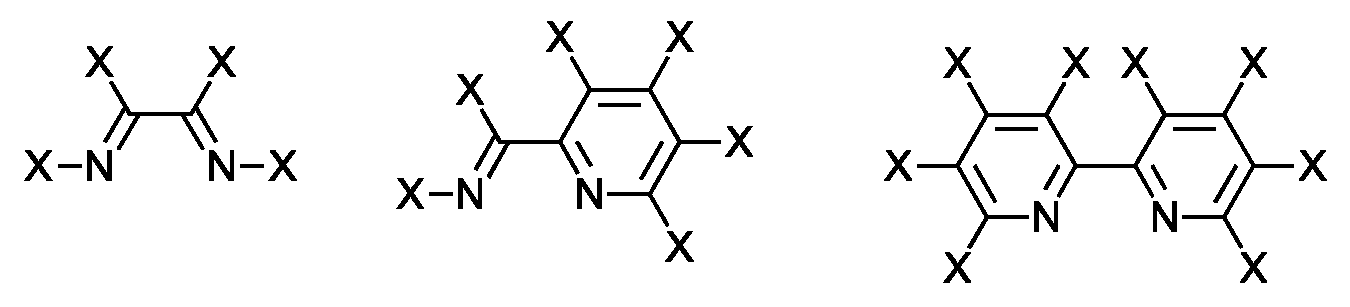

wobei L1, L2, L3, L4 und L5, die nicht mit anderen Metall-koordinierenden Liganden verknüpft sind, wie in a) definiert sind.In various embodiments of the invention are
- a) L 1 , L 2 , L 3 , L 4 and L 5 are independently selected from the group consisting of halo, carbonyl, C 1 -C 10 alkyl, C 1 -C 10 alkoxy, sulfide, thiocyanate, nitrate, azide, Fluoride, hydroxide ion, H 2 O, nitrite, isothiocyanate, acetonitrile, pyridine, ammonia, triphenylphosphine, cyanide, carbon monoxide, linear or branched, substituted or unsubstituted alkene having up to 20 carbon atoms, benzene, cyclopentadienyl, nitrosyl, oxo ligand, sulfites, Tricyclohexylphosphine, trimethylphosphine, tri (o-tolyl) phosphine, cycloheptatriene, carbon dioxide; or
- b) two or three of L 1 , L 2 , L 3 , L 4 and L 5 linked to form a molecule selected from the group consisting of oxalate, ethylenediamine, 2,2'-bipyridine, 1,10- Phenanthroline, acetylacetonate, aminopolycarboxylic acids, 1,2-bis (diphenylphosphino) ethane, 1,1-bis (diphenylphosphino) methane, diethylenetriamine, dimethylglyoximate, glycine, iminodiacetic acid, nitrilotriacetic acid, pyrazine, Scorpion ligands, 2,2 ';6', 2 "-Terpyridine, triazacyclononane, di (2-picolyl) amine, 2,2'-dipyridylamine, tris (2-pyridylmethyl) amine, N, N, N ', N'-tetramethylethylenediamine (TMEDA), N-propyl (2 -pyridyl) methanimine (NPrPMI),
wherein L1, L2, L3, L4 and L5, which are not linked to other metal coordinating ligands, are defined as in a).
In verschiedenen Ausführungsformen der Erfindung sind L4 und L5 verknüpft, um ein Molekül zu bilden, und sind ausgewählt aus der Gruppe bestehend aus


wobei jedes X unabhängig voneinander H oder ein lineares oder verzweigtes Alkyl ist, das bis zu 20 Kohlenstoffatome besitzt.In various embodiments of the invention, L 4 and L 5 are linked to form a molecule and are selected from the group consisting of
wherein each X is independently H or a linear or branched alkyl having up to 20 carbon atoms.
In verschiedenen Ausführungsformen der Erfindung sind L4 und L5 ausgewählt aus der Gruppe bestehend aus


In verschiedenen Ausführungsformen der Erfindung ist R1 H, CH2-Phenyl oder

R2 ist H.R 2 is H.
In verschiedenen Ausführungsformen der Erfindung sind R3-R6 H; und/oder L1-L3 sind CO.In various embodiments of the invention, R 3 -R 6 are H; and / or L 1 -L 3 are CO.
In verschiedenen Ausführungsformen richtet sich die Erfindung auf einen erfindungsgemäßen Komplex, wobei
- a) R1 H, CH2-Phenyl oder


- b) R1 H, CH2-Phenyl oder


- c) R1 H ist; und
R2 H ist; und
R3-R6 H sind; und
L1-L3 CO sind; und
L4 und L5 verknüpft sind u1

- d) R1 H, CH2-Phenyl oder


- e) R1 H ist; und
R2 H ist; und
R3-R6 H sind; und
L1-L3 CO sind; und
L4 und L5 verknüpft sind um

- a) R 1 is H, CH 2 -phenyl or
- b) R 1 is H, CH 2 -phenyl or
- c) R 1 is H; and R 2 is H; and R 3 -R 6 are H; and L 1 -L 3 CO; and L 4 and L 5 are linked u1
- d) R 1 is H, CH 2 -phenyl or
- e) R 1 is H; and R 2 is H; and R 3 -R 6 are H; and L 1 -L 3 CO; and L 4 and L 5 are linked around
Ein zweiter Aspekt der Erfindung ist gerichtet auf eine pharmazeutische Zusammensetzung umfassend einen erfindungsgemäßen und einen pharmazeutisch verträglichen Träger oder Hilfsstoff.A second aspect of the invention is directed to a pharmaceutical composition comprising a and a pharmaceutically acceptable carrier or excipient according to the invention.
In einem dritten Aspekt ist die vorliegende Erfindung gerichtet auf einen erfindungsgemäßen Komplex zur Verwendung als Medikament.In a third aspect, the present invention is directed to a complex of the invention for use as a medicament.
Ein vierter Aspekt der Erfindung ist gerichtet auf einen erfindungsgemäßen Komplex zur Verwendung in der Behandlung einer bakteriellen Infektion oder eines bakteriellen Befalls, wobei die bakterielle Infektion oder der bakterielle Befall durch ein Gram-positives Bakterium hervorgerufen wird.A fourth aspect of the invention is directed to a complex of the invention for use in the treatment of a bacterial infection or a bacterial infestation, wherein the bacterial infection or the bacterial infestation is caused by a Gram-positive bacterium.
In verschiedenen Ausführungsformen ist das Gram-positive Bakterium ausgewählt aus der Gruppe bestehend aus Bacillus oder Staphylococcus. In various embodiments, the Gram-positive bacterium is selected from the group consisting of Bacillus or Staphylococcus.
In einem weiteren Aspekt ist die vorliegende Erfindung gerichtet auf ein Verfahren zur Herstellung eines Komplexes, der die Struktur der Formel (II) besitzt

R1, R3, R4, R5 und R6 unabhängig voneinander ausgewählt sind aus der Gruppe bestehend aus H, lineares oder verzweigtes, substitutiertes oder unsubstituiertes Alkyl, lineares oder verzweigtes, substitutiertes oder unsubstitutiertes Heteroalkyl, lineares oder verzweigtes, substitutiertes oder unsubstitutiertes Alkenyl, lineares oder verzweigtes, substitutiertes oder unsubstitutiertes Heteroalkenyl, lineares oder verzweigtes, substitutiertes oder unsubstitutiertes Alkynyl, lineares oder verzweigtes, substitutiertes oder unsubstitutiertes Heteroalkynyl, substitutiertes oder unsubstitutiertes Cycloalkyl, substitutiertes oder unsubstitutiertes Heterocycloalkyl, substitutiertes oder unsubstitutiertes Aryl, substitutiertes oder unsubstitutiertes Heteroaryl, lineares oder verzweigtes, substitutiertes oder unsubstitutiertes Alkylaryl, lineares oder verzweigtes, substitutiertes oder unsubstitutiertes Heteroalkylaryl, wobei jede dieser Gruppen bis zu 20 Kohlenstoffatome besitzt; und
L1, L2, L3, L4 und L5 unabhängig voneinander Metall-koordinierende Liganden sind, die aus der Gruppe ausgewählt sind bestehend aus neutralen Liganden, anionischen Liganden und gemischte Liganden; umfassend
in-Kontakt-bringen einer Verbindung, die die Struktur der Formel (III) besitzt


R 1 , R 3 , R 4 , R 5 and R 6 are independently selected from the group consisting of H, linear or branched, substituted or unsubstituted alkyl, linear or branched, substituted or unsubstituted heteroalkyl, linear or branched, substituted or unsubstituted Alkenyl, linear or branched, substituted or unsubstituted heteroalkenyl, linear or branched, substituted or unsubstituted alkynyl, linear or branched, substituted or unsubstituted heteroalkynyl, substituted or unsubstituted cycloalkyl, substituted or unsubstituted heterocycloalkyl, substituted or unsubstituted aryl, substituted or unsubstituted heteroaryl, linear or branched, substituted or unsubstituted alkylaryl, linear or branched, substituted or unsubstituted heteroalkylaryl, each of these groups having up to 20 carbon atoms; and
L 1 , L 2 , L 3 , L 4 and L 5 are independently metal coordinating ligands selected from the group consisting of neutral ligands, anionic ligands and mixed ligands; full
contacting a compound having the structure of the formula (III)
Ein sechster Aspekt der Erfindung ist gerichtet auf ein Verfahren zur Identifizierung eines Moleküls, das mit einem erfindungsgemäßen Komplex interagiert, umfassend
- a) bereitstellen eines erfindungsgemäßen Komplex, wobei R5 eine Linkergruppe ist, und
- b) immobilisieren des Komplex von a) an einem festen Träger, wobei der feste Träger den Komplex über die Linkergruppe bindet;
- c) in-Kontakt-bringen des immobilisierten Komplex mit einer Lösung, die die Moleküle von Interesse umfassen; und
- d) ablösen der Moleküle, die mit dem immobilisierten Komplex interagieren, und identifizieren dieser Moleküle.
- a) providing a complex according to the invention, wherein R 5 is a linker group, and
- b) immobilizing the complex of a) on a solid support, wherein the solid support binds the complex via the linker group;
- c) contacting the immobilized complex with a solution comprising the molecules of interest; and
- d) detach the molecules that interact with the immobilized complex and identify these molecules.
In verschiedenen Ausführungsformen ist die Linkergruppe

Figurenlistelist of figures
Nachstehend wird die Erfindung anhand von mehreren Abbildungen näher erläutert. Diese unterstützen die in der Beschreibung erläuterte Lehre, schränken diese aber nicht ein. Hierbei zeigt:
-
-
-
3b und 3c. -
mit 50% Aufenthaltswahrscheinlichkeit dargestellt). -
Komplexe 4a (a), 4b (b) und 4c (c) (Ellipsoide sindmit 50% Aufenthaltswahrscheinlichkeit dargestellt). Aus Übersichtsgründen wurde das Gegenion Bromid nicht in die Abbildung aufgenommen. -
-
-
Komplexserien -
-
-
-
-
GE2270 A
-
-
-
Complexes 3a, 3b and 3c. -
-
Bipyridine Complexes 4a (a), 4b (b), and 4c (c) (ellipsoids are shown as having 50% probability of residence). For reasons of clarity, the counterion bromide was not included in the figure. -
Complexes 4a-7a. -
compounds -
complex series -
-
-
-
-
GE2270 A
DETAILIERTE BESCHREIBUNG DER ERFINDUNGDETAILED DESCRIPTION OF THE INVENTION
Die Erfinder der vorliegenden Erfindung haben überraschend strukturell und mechanistisch neue Antibiotika gefunden, die eine selektive Behandlung von Gram-positiven Bakterien erlauben.The inventors of the present invention have surprisingly found, structurally and mechanistically, novel antibiotics which permit selective treatment of Gram-positive bacteria.
Daher ist in einem ersten Aspekt die vorliegende Erfindung gerichtet auf einen Komplex, der die Struktur der Formel (I) besitzt

R1, R2, R3, R4, R5 und R6 unabhängig voneinander ausgewählt sind aus der Gruppe bestehend aus H, lineares oder verzweigtes, substitutiertes oder unsubstituiertes Alkyl, lineares oder verzweigtes, substitutiertes oder unsubstitutiertes Heteroalkyl, lineares oder verzweigtes, substitutiertes oder unsubstitutiertes Alkenyl, lineares oder verzweigtes, substitutiertes oder unsubstitutiertes Heteroalkenyl, lineares oder verzweigtes, substitutiertes oder unsubstitutiertes Alkynyl, lineares oder verzweigtes, substitutiertes oder unsubstitutiertes Heteroalkynyl, substitutiertes oder unsubstitutiertes Cycloalkyl, substitutiertes oder unsubstitutiertes Heterocycloalkyl, substitutiertes oder unsubstitutiertes Aryl, substitutiertes oder unsubstitutiertes Heteroaryl, lineares oder verzweigtes, substitutiertes oder unsubstitutiertes Alkylaryl, lineares oder verzweigtes, substitutiertes oder unsubstitutiertes Heteroalkylaryl, wobei jede dieser Gruppen bis zu 20 Kohlenstoffatome besitzt; und
L1, L2, L3, L4 und L5 unabhängig voneinander Metall-koordinierende Liganden sind, die aus der Gruppe ausgewählt sind bestehend aus neutralen Liganden, anionischen Liganden und gemischte Liganden.Therefore, in a first aspect, the present invention is directed to a complex having the structure of the formula (I)
R 1 , R 2 , R 3 , R 4 , R 5 and R 6 are independently selected from the group consisting of H, linear or branched, substituted or unsubstituted alkyl, linear or branched, substituted or unsubstituted heteroalkyl, linear or branched, substituted or unsubstituted alkenyl, linear or branched, substituted or unsubstituted heteroalkenyl, linear or branched, substituted or unsubstituted alkynyl, linear or branched, substituted or unsubstituted heteroalkynyl, substituted or unsubstituted cycloalkyl, substituted or unsubstituted heterocycloalkyl, substituted or unsubstituted aryl, substituted or unsubstituted Heteroaryl, linear or branched, substituted or unsubstituted alkylaryl, linear or branched, substituted or unsubstituted heteroalkylaryl, wherein each of these groups has up to 20 carbon atoms; and
L 1 , L 2 , L 3 , L 4 and L 5 are independently metal coordinating ligands selected from the group consisting of neutral ligands, anionic ligands and mixed ligands.
Der Begriff „Rhenium“ oder „Re“, wie hierin austauschbar verwendet, bezeichnet ein chemisches Element mit dem der Ordnungszahl 75. Im Periodensystem der Elemente steht Rhenium in der 7. Nebengruppe (Gruppe 7) oder Mangangruppe. Es ist ein sehr seltenes, silberweiß glänzendes, schweres Übergangsmetall.The term "rhenium" or "Re", as used interchangeably herein, denotes a chemical element having atomic number 75. In the Periodic Table of the Elements, rhenium is in the 7th subgroup (Group 7) or manganese group. It is a very rare, silvery white, heavy transition metal.
Der Begriff „Alkyl“, allein oder als Teil eines anderen Substituenten, bedeutet, sofern nicht anders angegeben, eine lineare (d.h. unverzweigte) oder verzweigte Kette oder eine Kombination davon, die vollständig gesättigt ist und di- und mehrwertige Radikale einschließen kann. Alkyle werden näher durch die Anzahl der enthaltenen Kohlenstoffatome bezeichnet (z.B. C1-C10 bedeutet ein bis zehn Kohlenstoffe). Bevorzugt sind Alkyle mit bis zu 20, bis zu 15, bis zu 10 oder bis zu 5 Kohlenstoffatomen. Beispiele für gesättigte Kohlenwasserstoffreste umfassen, sind aber nicht beschränkt auf Gruppen wie Methyl, Ethyl, n-Propyl, Isopropyl, n-Butyl, t-Butyl, Isobutyl, sec-Butyl, Cyclohexyl, (Cyclohexyl) methyl, Cyclopropylmethyl, Homologe und Isomere von beispielsweise n-Pentyl, n-Hexyl, n-Heptyl, n-Octyl und dergleichen.The term "alkyl", alone or as part of another substituent, unless otherwise specified, means a linear (ie unbranched) or branched chain, or a combination thereof, that is complete is saturated and may include di- and polyvalent radicals. Alkyl is more closely indicated by the number of carbon atoms contained (eg, C 1 -C 10 represents one to ten carbons). Preferred are alkyls of up to 20, up to 15, up to 10 or up to 5 carbon atoms. Examples of saturated hydrocarbon radicals include, but are not limited to, groups such as methyl, ethyl, n -propyl, isopropyl, n -butyl, t -butyl, isobutyl, sec -butyl, cyclohexyl, (cyclohexyl) methyl, cyclopropylmethyl, homologues and isomers of for example, n-pentyl, n-hexyl, n-heptyl, n-octyl and the like.
Der Begriff „Alkylen“, allein oder als Teil eines anderen Substituenten, bezeichnet einen zweiwertigen Rest, der von einem Alkyl abgeleitet ist, wie es beispielhaft, aber nicht beschränkt ist, auf -CH2CH2CH2CH2-. Typischerweise wird eine Alkyl- (oder Alkylen-) Gruppe 1 bis 24 Kohlenstoffatome aufweisen, wobei diese Gruppen mit 10 oder weniger Kohlenstoffatomen in der vorliegenden Erfindung bevorzugt sind. Ein „Niederalkyl“ oder „Niederalkylen“ ist eine kürzere Alkyl- oder Alkylengruppe, die im Allgemeinen acht oder weniger Kohlenstoffatome aufweist.The term "alkylene", alone or as part of another substituent, denotes a bivalent radical derived from an alkyl, as exemplified but not limited to -CH 2 CH 2 CH 2 CH 2 -. Typically, an alkyl (or alkylene) group will have from 1 to 24 carbon atoms, with those groups having 10 or fewer carbon atoms being preferred in the present invention. A "lower alkyl" or "lower alkylene" is a shorter alkyl or alkylene group, generally having eight or fewer carbon atoms.
Der Begriff „Heteroalkyl“, allein oder in Kombination mit einem anderen Begriff, bezeichnet, sofern nicht anders angegeben, einen stabilen linearen oder verzweigten oder cyclischen Kohlenwasserstoffrest oder Kombinationen davon, bestehend aus mindestens einem Kohlenstoffatom und mindestens einem Heteroatom, ausgewählt aus der Gruppe bestehend aus O, N, P, Si und S, und wobei die Stickstoff- und Schwefelatome gegebenenfalls oxidiert werden können und das Stickstoff-Heteroatom gegebenenfalls quaterniert werden kann. Die Heteroatom(e) O, N, P und S und Si können an jeder inneren Position der Heteroalkylgruppe oder an der Stelle, an der die Alkylgruppe an den Rest des Moleküls gebunden ist, platziert werden. Beispiele schließen ein, sind aber nicht beschränkt auf -CH2-CH2-O-CH3, -CH2-CH2-NH-CH3, -CH2-CH2-N(CH3)2, -CH2-S-CH2-CH3, -CH2-CH2, -SCHO-CH2-S(O)2-CH3, -CH=CH-O-CH3, -Si(CH3)3, -CH2-CH=N-OCH3, -CH=CH-N(CH3)2, O-CH3, -O-CH2-CH3 und -CN. Bis zu zwei Heteroatome können aufeinanderfolgend sein, wie beispielsweise -CH2-NH-OCH3 und -CH2-O-Si(CH3)3. In ähnlicher Weise bedeutet der Begriff „Heteroalkylen“, allein oder als Teil eines anderen Substituenten, einen von Heteroalkyl abgeleiteten zweiwertigen Rest, wie er beispielhaft, aber nicht beschränkt ist auf - CH2-CH2-CH-CH2-CH2- und -CH2-S-CH2-CH2-NH-CH2-. Für Heteroalkylengruppen können Heteroatome auch einen oder beide der Ketten-Termini (z.B. Alkylenoxy, Alkylendioxy, Alkylenamino, Alkylendiamino und dergleichen) einnehmen. Weiterhin wird für Alkylen- und Heteroalkylen-Verknüpfungsgruppen keine Orientierung der Verknüpfungsgruppe durch die Richtung angegeben, in der die Formel der Verknüpfungsgruppe geschrieben wird. Beispielsweise bedeutet die Formel -C(O)2R'- sowohl -C(O)2R'- als auch -R'C(O)2-. Wie oben beschrieben, schließen Heteroalkylgruppen, wie hierin verwendet, diejenigen Gruppen ein, die an den Rest des Moleküls durch ein Heteroatom, wie -C(O)R', -C(O)NR', -NR'R", -OR', - SR' und/oder -SO2R' ein. Wenn „Heteroalkyl“ rezitiert wird, gefolgt von Rezitationen von spezifischen Heteroalkylgruppen, wie -NR'R" oder dergleichen, versteht es sich, dass die Begriffe Heteroalkyl und -NR'R" nicht redundant oder sich gegenseitig ausschließen. Vielmehr werden die spezifischen Heteroalkylgruppen zur Klarheit angeführt. Der Begriff „Heteroalkyl“ sollte daher hier nicht als exklusive spezifische Heteroalkylgruppen, wie - NR'R" oder dergleichen, interpretiert werden.The term "heteroalkyl", alone or in combination with another term, unless otherwise specified, denotes a stable linear or branched or cyclic hydrocarbon radical or combinations thereof consisting of at least one carbon atom and at least one heteroatom selected from the group consisting of O, N, P, Si and S, and wherein the nitrogen and sulfur atoms may optionally be oxidized and the nitrogen heteroatom may optionally be quaternized. The heteroatom (s) O, N, P and S and Si can be placed at any internal position of the heteroalkyl group or at the site where the alkyl group is attached to the rest of the molecule. Examples include, but are not limited to, -CH 2 -CH 2 -O-CH 3 , -CH 2 -CH 2 -NH-CH 3 , -CH 2 -CH 2 -N (CH 3 ) 2 , -CH 2 -S-CH 2 -CH 3 , -CH 2 -CH 2 , -SCHO-CH 2 -S (O) 2 -CH 3 , -CH = CH-O-CH 3 , -Si (CH 3 ) 3 , - CH 2 -CH = N-OCH 3 , -CH = CH-N (CH 3 ) 2 , O-CH 3 , -O-CH 2 -CH 3 and -CN. Up to two heteroatoms may be consecutive, such as -CH 2 -NH-OCH 3 and -CH 2 -O-Si (CH 3 ) 3 . Similarly, the term means "heteroalkylene" by itself or as part of another substituent, a radical derived from heteroalkyl divalent radical such as is exemplified, but not limited to - CH 2 -CH 2 -CH-CH 2 -CH 2 - and -CH 2 -S-CH 2 -CH 2 -NH-CH 2 -. For heteroalkylene groups, heteroatoms may also adopt one or both of the chain termini (eg, alkyleneoxy, alkylenedioxy, alkyleneamino, alkylenediamino, and the like). Furthermore, for alkylene and heteroalkylene linking groups, no orientation of the linking group is indicated by the direction in which the formula of the linking group is written. For example, the formula -C (O) 2 R'- means both -C (O) 2 R'- and -R'C (O) 2 -. As described above, heteroalkyl groups as used herein include those groups attached to the remainder of the molecule by a heteroatom such as -C (O) R ', -C (O) NR', -NR'R ", -OR ', - SR' and / or -SO 2 R '. If a "heteroalkyl" is recited, followed by recitations of specific heteroalkyl groups, such as -NR'R "or the like, it is understood that the terms heteroalkyl and -NR' R "are not redundant or mutually exclusive, rather, the specific heteroalkyl groups are given for clarity, so the term" heteroalkyl "should not be interpreted herein as exclusive specific heteroalkyl groups such as - NR'R" or the like.
Die Begriffe „Cycloalkyl“ und „Heterocycloalkyl“, selbst oder in Kombination mit anderen Ausdrücken, stellen, sofern nicht anders angegeben, zyklische Versionen von „Alkyl“ und „Heteroalkyl“ dar. Zusätzlich kann für Heterocycloalkyl ein Heteroatom die Position einnehmen, an der der Heterocyclus an den Rest des Moleküls gebunden ist. Beispiele für Cycloalkyl umfassen, sind aber nicht beschränkt auf Cyclopentyl, Cyclohexyl, 1-Cyclohexenyl, 3-Cyclohexenyl, Cycloheptyl und dergleichen. Beispiele für Heterocycloalkyl umfassen, sind aber nicht beschränkt auf, 1-(1,2,5,6-Tetrahydropyridyl), 1-Piperidinyl, 2-Piperidinyl, 3-Piperidinyl, 4-Morpholinyl, 3-Morpholinyl, Tetrahydrofuran-2-yl, Tetrahydrofuran-3-yl, Tetrahydrothien-2-yl, Tetrahydrothien-3-yl, 1-Piperazinyl, 2-Piperazinyl und dergleichen. Ein „Cycloalkylen“ und „Heterocycloalkylen“ bezieht sich auf einen zweiwertigen Rest, der sich von Cycloalkyl bzw. Heterocycloalkyl ableitet.The terms "cycloalkyl" and "heterocycloalkyl", by themselves or in combination with other terms, are cyclic versions of "alkyl" and "heteroalkyl" unless otherwise specified. In addition, for heterocycloalkyl, a heteroatom may occupy the position where the Heterocycle is attached to the rest of the molecule. Examples of cycloalkyl include, but are not limited to, cyclopentyl, cyclohexyl, 1-cyclohexenyl, 3-cyclohexenyl, cycloheptyl, and the like. Examples of heterocycloalkyl include, but are not limited to, 1- (1,2,5,6-tetrahydropyridyl), 1-piperidinyl, 2-piperidinyl, 3-piperidinyl, 4-morpholinyl, 3-morpholinyl, tetrahydrofuran-2-yl , Tetrahydrofuran-3-yl, tetrahydrothien-2-yl, tetrahydrothien-3-yl, 1-piperazinyl, 2-piperazinyl and the like. A "cycloalkylene" and "heterocycloalkylene" refers to a bivalent radical derived from cycloalkyl or heterocycloalkyl, respectively.
Die Begriffe „Halogen“ oder „Halo“, selbst oder als Teil eines anderen Substituenten, bedeuten, sofern nicht anders angegeben, ein Fluor-, Chlor-, Brom- oder Iodatom. Zusätzlich sollen Begriffe wie „Halogenalkyl“ Monohalogenalkyl und Polyhalogenalkyl einschließen. Beispielsweise bedeutet der Begriff „Halo(C1-C4)-Alkyl“, Trifluormethyl, 2,2,2-Trifluorethyl, 4-Chlorbutyl, 3-Brompropyl und dergleichen, ist aber nicht darauf beschränkt.The terms "halogen" or "halo", by themselves or as part of another substituent, unless otherwise specified, mean a fluorine, chlorine, bromine or iodine atom. In addition, terms such as "haloalkyl" are intended to include monohaloalkyl and polyhaloalkyl. For example, the term "halo (C 1 -C 4 ) alkyl" means, but is not limited to, trifluoromethyl, 2,2,2-trifluoroethyl, 4-chlorobutyl, 3-bromopropyl and the like.
Der Begriff „Aryl“ bedeutet, wenn nicht anders angegeben, einen mehrfach ungesättigten, aromatischen Kohlenwasserstoffsubstituenten, der ein einzelner Ring oder mehrere Ringe (vorzugsweise 1 bis 3 Ringe) sein kann, die miteinander verschmolzen oder kovalent verknüpft sind. Der Begriff „Heteroaryl“ bezieht sich auf Arylgruppen (oder Ringe), die ein bis vier Heteroatome enthalten, ausgewählt aus N, O und S, wobei die Stickstoff- und Schwefelatome gegebenenfalls oxidiert werden und das Stickstoffatom(e) gegebenenfalls quaternisiert ist. Eine Heteroarylgruppe kann an den Rest des Moleküls durch einen Kohlenstoff oder Heteroatom gebunden werden. Nicht beschränkende Beispiele für Aryl- und Heteroarylgruppen umfassen Phenyl, 1-Naphthyl, 2-Naphthyl, 4-Biphenyl, 1-Pyrrolyl, 2-Pyrrolyl, 3-Pyrrolyl, 3-Pyrazolyl, 2-Imidazolyl, 4-Imidazolyl, Pyrazinyl, 2-Oxazolyl, 4-Oxazolyl, 2-Phenyl-4-oxazolyl, 5-Oxazolyl, 3-Isoxazolyl, 4-Isoxazolyl, 5-Isoxazolyl, 2-Thiazolyl, 4-Thiazolyl, 5-Thiazolyl, 2-Furyl, 3-Furyl, 2-Thienyl, 3-Thienyl, 2-Pyridyl, 3-Pyridyl, 4-Pyridyl, 2-Pyrimidyl, 4-Pyrimidyl, 5-Benzothiazolyl, Purinyl, 2-Benzimidazolyl, 5-Indolyl, 1-Isochinolyl, 5-Isochinolyl, 2-Chinoxalinyl, 5-Chinoxalinyl, 3-Chinolyl und 6-Chinolyl. Substituenten für jedes der oben erwähnten Aryl- und Heteroaryl-Ringsysteme sind ausgewählt aus der Gruppe der akzeptablen Substituenten, die unten beschrieben werden. „Arylen“ und „Heteroarylen“ bezieht sich auf einen zweiwertigen Rest, der sich von einem Aryl- und Heteroaryl ableitet.The term "aryl", unless otherwise indicated, means a polyunsaturated aromatic hydrocarbon substituent which may be a single ring or multiple rings (preferably 1 to 3 rings) fused together or covalently linked together. The term "heteroaryl" refers to aryl groups (or rings) containing one to four heteroatoms selected from N, O and S, where the nitrogen and sulfur atoms are optionally oxidized and the nitrogen atom (s) is optionally quaternized. A heteroaryl group may be attached to the rest of the molecule by a carbon or Heteroatom be bound. Non-limiting examples of aryl and heteroaryl groups include phenyl, 1-naphthyl, 2-naphthyl, 4-biphenyl, 1-pyrrolyl, 2-pyrrolyl, 3-pyrrolyl, 3-pyrazolyl, 2-imidazolyl, 4-imidazolyl, pyrazinyl, 2 -Oxazolyl, 4-oxazolyl, 2-phenyl-4-oxazolyl, 5-oxazolyl, 3-isoxazolyl, 4-isoxazolyl, 5-isoxazolyl, 2-thiazolyl, 4-thiazolyl, 5-thiazolyl, 2-furyl, 3-furyl , 2-thienyl, 3-thienyl, 2-pyridyl, 3-pyridyl, 4-pyridyl, 2-pyrimidyl, 4-pyrimidyl, 5-benzothiazolyl, purinyl, 2-benzimidazolyl, 5-indolyl, 1-isoquinolyl, 5-isoquinolyl , 2-quinoxalinyl, 5-quinoxalinyl, 3-quinolyl and 6-quinolyl. Substituents for each of the above-mentioned aryl and heteroaryl ring systems are selected from the group of acceptable substituents described below. "Arylene" and "heteroarylene" refers to a bivalent radical derived from an aryl and heteroaryl.
Der Begriff „Arylalkyl“ soll die Reste einschließen, in denen eine Arylgruppe an eine Alkylgruppe gebunden ist (z.B. Benzyl, Phenethyl, Pyridylmethyl und dergleichen). Der Begriff „Heteroarylalkyl“ schließt die oben beschriebenen Gruppen ein, wobei ein oder mehrere Kohlenstoffatome des Alkyl- oder Aryl-Teils (z. B. eine Methylengruppe) beispielsweise durch ein Sauerstoffatom (z. B. Phenoxymethyl, 2-Pyridyloxymethyl, 3-(1-Naphthyloxy)propyl und dergleichen) substituiert sind.The term "arylalkyl" is intended to include those radicals in which an aryl group is attached to an alkyl group (e.g., benzyl, phenethyl, pyridylmethyl, and the like). The term "heteroarylalkyl" includes the groups described above wherein one or more carbon atoms of the alkyl or aryl moiety (eg, a methylene group) are represented, for example, by an oxygen atom (e.g., phenoxymethyl, 2-pyridyloxymethyl, 3- (e.g. 1-naphthyloxy) propyl and the like).
Wenn ein Heteroalkyl-, Heterocycloalkyl- oder Heteroaryl eine bestimmte Anzahl von Mitgliedern (z. B. „3 bis 7-gliedrig“) enthält, bezieht sich der Begriff „Mitglied“ auf ein Kohlenstoff- oder Heteroatom.When a heteroalkyl, heterocycloalkyl or heteroaryl contains a certain number of members (e.g., "3 to 7 membered"), the term "member" refers to a carbon or heteroatom.
Der Begriff „Oxo“, wie er hier verwendet wird, bedeutet einen Sauerstoff, der an ein Kohlenstoffatom doppelt gebunden ist.The term "oxo" as used herein means an oxygen double bonded to a carbon atom.
Jeder der obigen Begriffe (z.B. „Alkyl“, „Heteroalkyl“, „Aryl“ und „Heteroaryl“) soll sowohl substituierte als auch unsubstituierte Formen des angegebenen Restes einschließen. Bevorzugte Substituenten für jede Art von Radikal sind nachstehend angegeben.Each of the above terms (e.g., "alkyl," "heteroalkyl," "aryl," and "heteroaryl") is intended to include both substituted and unsubstituted forms of the specified moiety. Preferred substituents for each type of radical are given below.
Substituenten für die Alkyl-, Heteroalkyl-, Alkylen-, Alkenyl-, Heteroalkylen-, Heteroalkenyl-, Alkinyl-, Cycloalkyl-, Heterocycloalkyl-, Cycloalkenyl- und Heterocycloalkenylreste können eine oder mehrere einer Vielzahl von Gruppen sein, ausgewählt aus, aber nicht beschränkt auf: -OR' , =O, =NR', =N-OR', -NR'R", -SR', - Halogen, -SiR'R"R"', -OC(O)R', -C(O)R', -CO2R', -CONR'R", -OC(O)NR'R", -NR"C(O)R', - NR'-C(O)NRR", -NR"C(O)R', -S(O)R', -S(O)R', -S-(O) R', -S-(O)R', -S-(O)2R', -S(O)2NR'R ", -NRSO2R', -CN und -NO2 in einer Zahl von null bis (2 m' + 1), wobei m' die Gesamtzahl der Kohlenstoffatome in dem Radikal ist. R', R" und R'" jeweils unabhängig voneinander Wasserstoff, substituiertes oder unsubstituiertes Heteroalkyl, substituiertes oder unsubstituiertes Cycloalkyl, substituiertes oder unsubstituiertes Heterocycloalkyl, substituiertes oder unsubstituiertes Aryl (z. B. mit 1-3 Halogenen substituiertes Aryl), substituiertes oder unsubstituiertes Alkyl-, Alkoxy- oder Thioalkoxygruppen oder Arylalkylgruppen ist. Wenn eine Verbindung der Erfindung mehr als eine R-Gruppe enthält, wird beispielsweise jede der R-Gruppen unabhängig ausgewählt, z.B. jeweils aus R', R", R'" und R""-Gruppen. Wenn R' und R" an das gleiche Stickstoffatom gebunden sind, können sie mit dem Stickstoffatom zu einem 4-, 5-, 6- oder 7-gliedrigen Ring kombiniert werden. Beispielsweise soll -NR'R" 1-Pyrrolidinyl und 4-Morpholinyl einschließen, aber nicht darauf beschränkt sein. Aus der obigen Diskussion von Substituenten wird der Fachmann verstehen, dass der Begriff „Alkyl“ Gruppen einschließen soll, die Kohlenstoffgruppen einschließen, die an andere Gruppen als Wasserstoffgruppen gebunden sind, wie Halogenalkyl (z. B. -CF3 und -CH2CF3) und Acyl (z. B. -C(O)CH3, -C(O)CF3, -C(O)CH2OCH3 und dergleichen).Substituents for the alkyl, heteroalkyl, alkylene, alkenyl, heteroalkylene, heteroalkenyl, alkynyl, cycloalkyl, heterocycloalkyl, cycloalkenyl and heterocycloalkenyl radicals can be one or more of a variety of groups selected from, but not limited to on: -OR ', = O, = NR', = N-OR ', -NR'R ", -SR', - halogen, -SiR'R" R "', -OC (O) R', - C (O) R ', -CO 2 R', -CONR'R ", -OC (O) NR'R", -NR "C (O) R ', - NR'-C (O) NRR", -NR "C (O) R ', -S (O) R', -S (O) R ', -S- (O) R', -S- (O) R ', -S- (O) 2 R ', -S (O) 2 NR'R ", -NRSO 2 R', -CN and -NO 2 in a number from zero to (2 m '+ 1), where m' is the total number of carbon atoms in the R ', R "and R'" are each independently hydrogen, substituted or unsubstituted heteroalkyl, substituted or unsubstituted cycloalkyl, substituted or unsubstituted heterocycloalkyl, substituted or unsubstituted aryl (eg, aryl substituted with 1-3 halogens), substituted or unsubstituted alkyl, alkoxy or Th ioalkoxy groups or arylalkyl groups. For example, when a compound of the invention contains more than one R group, each of the R groups is independently selected, for example, each of R ', R ", R'" and R "" groups. When R 'and R "are attached to the same nitrogen atom, they may be combined with the nitrogen atom to form a 4-, 5-, 6- or 7-membered ring, for example, -NR'R" 1-pyrrolidinyl and 4-morpholinyl include, but not limited to, From the above discussion of substituents, those skilled in the art will understand that the term "alkyl" is intended to include groups that include carbon groups attached to groups other than hydrogen groups, such as haloalkyl (e.g., -CF 3 and -CH 2 CF 3 ) and acyl (eg. B. -C (O) CH 3, -C (O) CF 3, -C (O) CH 2 OCH 3 and the like).
Ähnlich den für den Alkylrest beschriebenen Substituenten können die Substituenten für die Aryl- und Heteroarylgruppen variieren und sind ausgewählt aus beispielsweise Halogen, -OR', -NR'R", -SR', -Halogen, -SiR'R"R"', -OC(O)R', - C(O)R', -CO2R', -CONR'R", -OC(O)NR'R", -NR"C(O)R', -NR'-C(O)NR"R'", - NR"C(O)2R', -NR-C(NR'R"R'")=NR"", -NR-C(NR'R")=NR'", -S(O)R', S(O)2R', -S(O)2NR'R", -NRSO2R', -CN und -NO2, -R', -N3, -CH(Ph)2, Fluoro(Ci-C4)alkoxy, und Fluoro(C1-C4)alkyl in einer Zahl von null bis zur Gesamtzahl der offenen Valenzen am aromatischen Ringsystem; und wobei R', R", R'" und R"" unabhängig voneinander ausgewählt sind aus Wasserstoff, substituiertem oder unsubstituiertem Alkyl, substituiertem oder unsubstituiertem Heteroalkyl, substituiertem oder unsubstituiertem Cycloalkyl, substituiertem oder unsubstituiertem Heterocycloalkyl, substituiertem oder unsubstituiertem Aryl und substituiertem oder unsubstituiertem Heteroaryl. Wenn eine Verbindung der Erfindung mehr als eine R-Gruppe enthält, wird beispielsweise jede der R-Gruppen unabhängig ausgewählt, z.B. jeweils aus R', R", R'" und R""-Gruppen.Similar to the substituents described for the alkyl radical, the substituents for the aryl and heteroaryl groups can vary and are selected from, for example, halogen, -OR ', -NR'R ", -SR', -halogen, -SiR'R" R "', -OC (O) R ', -C (O) R', -CO 2 R ', -CONR'R ", -OC (O) NR'R", -NR "C (O) R', -NR '-C (O) NR' R '', - NR 'C (O) 2 R', -NR-C (NR'R 'R''') = NR '', -NR-C (NR'R '') ) = NR '", -S (O) R', S (O) 2 R ', -S (O) 2 NR'R", -NRSO 2 R', -CN and -NO 2 , -R ', -N 3 , -CH (Ph) 2 , fluoro (C 1 -C 4 ) alkoxy, and fluoro (C 1 -C 4 ) alkyl in a number from zero to the total number of open valencies on the aromatic ring system; and wherein R ', R ", R'" and R "" are independently selected from hydrogen, substituted or unsubstituted alkyl, substituted or unsubstituted heteroalkyl, substituted or unsubstituted cycloalkyl, substituted or unsubstituted heterocycloalkyl, substituted or unsubstituted aryl, and substituted or unsubstituted heteroaryl. For example, when a compound of the invention contains more than one R group, each of the R groups is independently selected, for example, each of R ', R ", R'" and R "" groups.
Weiterhin können in bevorzugten Ausführungsformen zwei Substituenten an benachbarten Ringatomen kombiniert werden, um eine cyclische Gruppe zu bilden, die gesättigt, ungesättigt oder aromatisch sein kann und ausgewählt ist aus Aryl, Heteroaryl, Cycloalkyl, Cycloheteroalkyl, alle von diesen können wie oben für die jeweiligen Gruppen definiert substituiert sein.Furthermore, in preferred embodiments, two substituents on adjacent ring atoms may be combined to form a cyclic group which may be saturated, unsaturated or aromatic and is selected from aryl, heteroaryl, cycloalkyl, cycloheteroalkyl, all of which may be as above for the respective groups to be substituted.
Wie hierin verwendet, bedeutet der Begriff „Heteroatom“ oder „Ring-Heteroatom“ Sauerstoff (O), Stickstoff (N), Schwefel (S), Phosphor (P) und Silicium (Si). As used herein, the term "heteroatom" or "ring heteroatom" means oxygen (O), nitrogen (N), sulfur (S), phosphorus (P), and silicon (Si).
Der Begriff „Alkenyl“, wie er hierin verwendet wird, ist eine Kohlenwasserstoffgruppe mit 2 bis 20 Kohlenstoffatomen mit einer Strukturformel, die mindestens eine Kohlenstoff-Kohlenstoff-Doppelbindung enthält. Asymmetrische Strukturen wie (A1A2)C=C(A3A4) sollen sowohl die E- als auch die Z-Isomere einschließen. Die Alkenylgruppe kann mit einer oder mehreren Gruppen substituiert sein, einschließlich, aber nicht beschränkt auf Alkyl, Cycloalkyl, Alkoxy, Alkenyl, Cycloalkenyl, Alkinyl, Aryl, Heteroaryl, Aldehyd, Amino, Carbonsäure, Ester, Ether, Halogenid, Hydroxy, Keton, Azid, Nitro, Silyl, Sulfoxo oder Thiol, wie hierin beschrieben.The term "alkenyl" as used herein is a hydrocarbon group having 2 to 20 carbon atoms having a structural formula containing at least one carbon-carbon double bond. Asymmetric structures such as (A1A2) C = C (A3A4) should include both the E and Z isomers. The alkenyl group may be substituted with one or more groups including, but not limited to, alkyl, cycloalkyl, alkoxy, alkenyl, cycloalkenyl, alkynyl, aryl, heteroaryl, aldehyde, amino, carboxylic acid, ester, ether, halide, hydroxy, ketone, azide , Nitro, silyl, sulfoxo or thiol as described herein.
Der Begriff „Cycloalkenyl“, wie er hierin verwendet wird, ist ein nichtaromatischer Kohlenstoff-basierter Ring, der aus mindestens drei Kohlenstoffatomen zusammengesetzt ist und mindestens eine Kohlenstoff-Kohlenstoff-Doppelbindung enthält, d.h. C=C. Beispiele für Cycloalkenylgruppen schließen Cyclopropenyl, Cyclobutenyl, Cyclopentenyl, Cyclopentadienyl, Cyclohexenyl, Cyclohexadienyl, Norbornenyl und dergleichen ein, sind aber nicht darauf beschränkt. Die Cycloalkenylgruppe kann substituiert oder unsubstituiert sein. Die Cycloalkenylgruppe kann mit einer oder mehreren Gruppen substituiert sein, einschließlich, aber nicht beschränkt auf Alkyl, Cycloalkyl, Alkoxy, Alkenyl, Cycloalkenyl, Alkinyl, Aryl, Heteroaryl, Aldehyd, Amino, Carbonsäure, Ester, Ether, Halogenid, Hydroxy, Keton, Azid, Nitro, Silyl, Sulfoxo oder Thiol, wie hierin beschrieben.The term "cycloalkenyl" as used herein is a non-aromatic carbon-based ring composed of at least three carbon atoms and containing at least one carbon-carbon double bond, i. C = C. Examples of cycloalkenyl groups include, but are not limited to, cyclopropenyl, cyclobutenyl, cyclopentenyl, cyclopentadienyl, cyclohexenyl, cyclohexadienyl, norbornenyl, and the like. The cycloalkenyl group may be substituted or unsubstituted. The cycloalkenyl group may be substituted with one or more groups including, but not limited to, alkyl, cycloalkyl, alkoxy, alkenyl, cycloalkenyl, alkynyl, aryl, heteroaryl, aldehyde, amino, carboxylic acid, ester, ether, halide, hydroxy, ketone, azide , Nitro, silyl, sulfoxo or thiol as described herein.
Der Begriff „Alkinyl“, wie er hierin verwendet wird, ist eine Kohlenwasserstoffgruppe mit 2 bis 20 Kohlenstoffatomen mit einer Strukturformel, die mindestens eine Kohlenstoff-Kohlenstoff-Dreifachbindung enthält. Die Alkinylgruppe kann unsubstituiert oder mit einer oder mehreren Gruppen substituiert sein, einschließlich, aber nicht beschränkt auf Alkyl, Cycloalkyl, Alkoxy, Alkenyl, Cycloalkenyl, Alkinyl, Aryl, Heteroaryl, Aldehyd, Amino, Carbonsäure, Ester, Ether, Halogenid, Hydroxy, Keton, Azid, Nitro, Silyl, Sulfoxo oder Thiol, wie hierin beschrieben.The term "alkynyl" as used herein is a hydrocarbon group of 2 to 20 carbon atoms having a structural formula containing at least one carbon-carbon triple bond. The alkynyl group may be unsubstituted or substituted with one or more groups including, but not limited to, alkyl, cycloalkyl, alkoxy, alkenyl, cycloalkenyl, alkynyl, aryl, heteroaryl, aldehyde, amino, carboxylic acid, ester, ether, halide, hydroxy, ketone , Azide, nitro, silyl, sulfoxo or thiol as described herein.
Der Begriff „Ligand“ oder „Metall-koordinierender Ligand“, wie austauschbar hierin verwendet, ist ein Atom oder Molekül, welches über eine koordinative Bindung (veraltet auch „dative Bindung“) an ein zentrales Metall-Ion binden („koordinieren“) kann. Die koordinative Bindung kommt durch den Lewis-Charakter der beteiligten Bindungspartner zustande: Liganden sind Lewis-Basen (Elektronenpaar-Donatoren), Metallionen LewisSäuren (Elektronenpaar-Akzeptoren). Liganden werden nach ihrer Ladung klassifiziert: negativ geladene Liganden werden als X-Typ oder anionische Liganden abgekürzt (Beispiel Halogenide), während neutrale Liganden als L-Typ abgekürzt werden (Beispiel Phosphane). Liganden, die sowohl einen negative geladenen Teil als auch einen neutralen Teil enthalten, werden hierin als gemischte Liganden oder gemischt geladene Liganden bezeichnet. Die Zähnigkeit gibt an, wieviele Bindungen zum Zentralatom ein Ligand ausbilden kann. Liganden, die nur eine Bindung zum Zentralatom ausbilden, werden einzähnig oder monodentat genannt. Ammoniak (NH3, im Komplex als Ammin bezeichnet) ist beispielsweise ein einzähniger Ligand: H3N-M. Besitzt ein Ligand mehrere Koordinationsstellen, die auch gleichzeitig für die Koordination am gleichen Metallzentrum genutzt werden können, spricht man von einem Chelatliganden (griechisch chele = Krebsschere). In den hier darstellten Formeln (I) und (II) sind L1, L2, L3, L4 und L5 jeweils als ein Ligand zu verstehen. Die Koordinationsumgebung des Rhenium-Atoms in den erfindungsgemäßen Komplexen kann durch verschiedene Kombinationen von einzähnigen Liganden und/oder Chelatliganden variiert sein. Möglich sind, ohne darauf beschränkt zu sein, die folgenden Ligandenkombinationen: fünf einzähnige Liganden; ein zweizähniger Ligand und drei einzähnige Liganden; ein dreizähniger Ligand und zwei einzähnige Liganden; ein vierzähniger Ligand und ein einzähniger Ligand; ein fünfzähniger Ligand; ein zweizähniger und ein dreizähniger Ligand; und zwei zweizähnige und ein einzähniger Ligand. Bevorzugt ist die Kombination ein zweizähniger Ligand und drei einzähnige Liganden.The term "ligand" or "metal coordinating ligand", as used interchangeably herein, is an atom or molecule which can coordinate to a central metal ion via a coordinative bond (obsolete also "dative bond") , The coordinative binding is due to the Lewis character of the binding partners involved: ligands are Lewis bases (electron pair donors), metal ions Lewis acids (electron pair acceptors). Ligands are classified according to their charge: negatively charged ligands are abbreviated as X-type or anionic ligands (example halides), while neutral ligands are abbreviated as L-type (example phosphines). Ligands containing both a negative charged portion and a neutral portion are referred to herein as mixed ligands or mixed-loaded ligands. The denticity indicates how many bonds to the central atom can form a ligand. Ligands that form only one bond to the central atom are called monodentate or monodentate. Ammonia (NH3, referred to in the complex as amine) is, for example, a monodentate ligand: H 3 NM. If a ligand has several coordination sites that can also be used simultaneously for coordination at the same metal center, this is called a chelating ligand (Greek chele = crab claw). In the formulas (I) and (II) represented here, L 1 , L 2 , L 3 , L 4 and L 5 are each to be understood as a ligand. The coordination environment of the rhenium atom in the complexes of the invention may be varied by various combinations of monodentate ligands and / or chelating ligands. Possible, but not limited to, the following ligand combinations: five monodentate ligands; a bidentate ligand and three monodentate ligands; a tridentate ligand and two monodentate ligands; a tetradentate ligand and a monodentate ligand; a pentadentate ligand; a bidentate and a tridentate ligand; and two bidentate and a monodentate ligand. Preferably, the combination is a bidentate ligand and three monodentate ligands.
In verschiedenen Ausführungsformen der Erfindung sind
- a) L1, L2, L3, L4 und L5 unabhängig voneinander ausgewählt aus der Gruppe bestehend aus Halo, Carbonyl, C1-C10 Alkyl, C1-C10 Alkoxy, Sulfid, Thiocyanat, Nitrat, Azid, Fluorid, Hydroxidion, H2O, Nitrit, Isothiocyanat, Acetonitril, Pyridin, Ammoniak, Triphenylphosphin, Cyanid, Kohlenstoffmonoxid, linearen oder verzweigten, substitutierten oder unsubstitutierten Alken, das bis zu 20 Kohlenstoffatome besitzt, Benzol, Cyclopentadienyl, Nitrosyl, Oxoligand, Sulfite, Tricyclohexylphosphan, Trimethylphosphan, Tri(o-tolyl)phosphan, Cycloheptatrien, Kohlendioxid; oder
- b) zwei oder drei von L1, L2, L3, L4 und L5 verknüpft um ein Molekül zu bilden, das ausgewählt ist aus der Gruppe bestehend aus Oxalat, Ethylenediamin, 2,2'-Bipyridin, 1,10-Phenanthrolin, Acetylacetonat, Aminopolycarbonsäuren, 1,2-Bis(diphenylphosphino)ethan, 1,1-Bis(diphenylphosphino)methan, Diethylenetriamin, Dimethylglyoximat, Glycin, Iminodiessigsäure, Nitrilotriessigsäure, Pyrazin, Scorpion Liganden, 2,2';6',2"-Terpyridin, Triazacyclononan, Di-(2-picolyl)amin, 2,2'-dipyridylamin, tris(2-pyridylmethyl)amin, N,N,N',N'-tetramethylethylenediamin (TMEDA), N-propyl(2-pyridyl)methanimin (NPrPMI),


- a) L 1 , L 2 , L 3 , L 4 and L 5 are independently selected from the group consisting of halo, carbonyl, C 1 -C 10 alkyl, C 1 -C 10 alkoxy, sulfide, thiocyanate, nitrate, azide, Fluoride, hydroxide ion, H 2 O, nitrite, isothiocyanate, acetonitrile, pyridine, ammonia, triphenylphosphine, cyanide, carbon monoxide, linear or branched, substituted or unsubstituted alkene having up to 20 carbon atoms, benzene, cyclopentadienyl, nitrosyl, oxo ligand, sulfites, Tricyclohexylphosphine, trimethylphosphine, tri (o-tolyl) phosphine, cycloheptatriene, carbon dioxide; or
- b) two or three of L 1 , L 2 , L 3 , L 4 and L 5 linked to form a molecule selected from the group consisting of oxalate, ethylenediamine, 2,2'-bipyridine, 1,10- Phenanthroline, acetylacetonate, aminopolycarboxylic acids, 1,2-bis (diphenylphosphino) ethane, 1,1-bis (diphenylphosphino) methane, diethylenetriamine, dimethylglyoximate, glycine, iminodiacetic acid, nitrilotriacetic acid, pyrazine, Scorpion ligands, 2, 2 ', 6', 2 "-terpyridine, triazacyclononane, di (2-picolyl) amine, 2,2'-dipyridylamine, tris (2-pyridylmethyl) amine, N, N, N ', N'-tetramethylethylenediamine (TMEDA ), N-propyl (2-pyridyl) methanimine (NPrPMI),
Der Begriff „verknüpft um ein Molekül zu bilden“, wie hierin verwendet, bezeichnet die Verbindung, die mindestens zwei der fünf Liganden am koordinierten Rhenium-Atom bereitstellt. Bevorzugt sind diese verknüpften Liganden indirekt über eins oder mehrere Atome verbunden, wobei alle diese Atome durch kovalente Bindungen verknüpft sind und so ein Molekül formen. Insbesondere ist es bevorzugt, dass zwei Liganden tertiäre Stickstoffatome sind, die jeweils über Doppelbindungen an die Kohlenstoffatome Cx und Cy gebunden sind, wobei Cx und Cy direkt über eine Einfachbindung verknüpft sind. Des Weiteren können die Atome Cx und Cy Teil eines zuvor beschriebenen Aryl-Systems sein.The term "linked to form a molecule" as used herein refers to the compound that provides at least two of the five ligands on the coordinated rhenium atom. Preferably, these linked ligands are linked indirectly via one or more atoms, all of which atoms are linked by covalent bonds to form a molecule. In particular, it is preferred that two ligands are tertiary nitrogen atoms which are each bonded via double bonds to the carbon atoms C x and C y , where C x and C y are linked directly via a single bond. Furthermore, the atoms C x and C y may be part of a previously described aryl system.
In verschiedenen Ausführungsformen der Erfindung sind L4 und L5 verknüpft um ein Molekül zu bilden und sind ausgewählt aus der Gruppe bestehend aus


In verschiedenen Ausführungsformen der Erfindung sind L4 und L5 ausgewählt aus der Gruppe bestehend aus


In verschiedenen Ausführungsformen der Erfindung ist R1 H, CH2-Phenyl oder

R2 ist H.R 2 is H.
In verschiedenen Ausführungsformen der Erfindung sind R3-R6 H; und/oder L1-L3 sind CO.In various embodiments of the invention, R 3 -R 6 are H; and / or L 1 -L 3 are CO.
In verschiedenen Ausführungsformen richtet sich die Erfindung auf einen erfindungsgemäßen Komplex, wobei
- a) R1 H, CH2-Phenyl oder


- b) R1 H, CH2-Phenyl oder


- c) R1 H ist; und
R2 H ist; und
R3-R6 H sind; und
L1-L3 CO sind; und
L4 und L5 verknüpft sind u1

- d) R1 H, CH2-Phenyl oder


- e) R1 H ist; und
R2 H ist; und
R3-R6 H sind; und
L1-L3 CO sind; und
L4 und L5 verknüpft sind um

- a) R 1 is H, CH 2 -phenyl or
- b) R 1 is H, CH 2 -phenyl or
- c) R 1 is H; and R 2 is H; and R 3 -R 6 are H; and L 1 -L 3 CO; and L 4 and L 5 are linked u1
- d) R 1 is H, CH 2 -phenyl or
- e) R 1 is H; and R 2 is H; and R 3 -R 6 are H; and L 1 -L 3 CO; and L 4 and L 5 are linked around
Ein zweiter Aspekt der Erfindung ist gerichtet auf eine pharmazeutische Zusammensetzung umfassend einen erfindungsgemäßen und einen pharmazeutisch verträglichen Träger oder Hilfsstoff.A second aspect of the invention is directed to a pharmaceutical composition comprising a and a pharmaceutically acceptable carrier or excipient according to the invention.
Eine „pharmazeutische Zusammensetzung“ bezieht sich auf eine Mischung aus einer oder mehrerer der hierin beschriebenen Verbindungen oder physiologisch/pharmazeutisch annehmbaren Salzen oder Prodrugs davon mit anderen chemischen Komponenten, wie physiologisch/pharmazeutisch annehmbaren Trägern und Exzipienten/Hilfsstoffen. Der Zweck einer pharmazeutischen Zusammensetzung besteht darin, die Verabreichung einer Verbindung an einen Organismus zu erleichtern.A "pharmaceutical composition" refers to a mixture of one or more of the compounds described herein or physiologically / pharmaceutically acceptable salts or prodrugs thereof with other chemical components, such as physiologically / pharmaceutically acceptable carriers and excipients / adjuvants. The purpose of a pharmaceutical composition is to facilitate administration of a compound to an organism.
Wie hierin verwendet, bezieht sich ein „physiologisch/pharmazeutisch annehmbarer Träger“ auf einen Träger oder ein Verdünnungsmittel, das keine signifikante Reizung eines Organismus verursacht und die biologische Aktivität und Eigenschaften der verabreichten Verbindung nicht aufhebt.As used herein, a "physiologically / pharmaceutically acceptable carrier" refers to a carrier or diluent that does not cause significant irritation of an organism and does not abrogate the biological activity and properties of the administered compound.
Ein „pharmazeutisch annehmbarer Exzipient/Hilfsstoff“ bezieht sich auf eine inerte Substanz, die zu einer pharmazeutischen Zusammensetzung zugegeben wird, um die Verabreichung einer Verbindung weiter zu erleichtern. Beispiele ohne Beschränkung umfassen Calciumcarbonat, Calciumphosphat, verschiedene Zucker und Arten von Stärke, Cellulosederivate, Gelatine, pflanzliche Öle und Polyethylenglykole.A "pharmaceutically acceptable excipient / adjuvant" refers to an inert substance added to a pharmaceutical composition to further facilitate the administration of a compound. Examples without limitation include calcium carbonate, calcium phosphate, various sugars and types of starch, cellulose derivatives, gelatin, vegetable oils and polyethylene glycols.
Wie hierin verwendet, bezieht sich der Begriff „pharmazeutisch annehmbares Salz“ auf jene Salze, die die biologische Wirksamkeit und Eigenschaften der Ausgangsverbindung beibehalten. Solche Salze umfassen, sind aber nicht beschränkt auf: (1) ein Säureadditionssalz, das durch Umsetzung der freien Base der Ausgangsverbindung mit anorganischen Säuren wie Salzsäure, Bromwasserstoffsäure, Salpetersäure, Phosphorsäure, Schwefelsäure und Perchlorsäure und dergleichen oder mit organischen Säuren wie Essigsäure, Oxalsäure, (D) oder (L) Apfelsäure, Maleinsäure, Methansulfonsäure, Ethansulfonsäure, p-Toluolsulfonsäure, Salicylsäure, Weinsäure, Zitronensäure, Bernsteinsäure oder Malonsäure und dergleichen, vorzugsweise Salzsäure oder (L) - Milchsäure; oder (2) Salze, die gebildet werden, wenn ein in der Ausgangsverbindung vorhandenes saures Proton entweder durch ein Metallion ersetzt wird, wie ein Alkalimetallion, wie Natrium oder Kalium, ein Erdalkalimetall, wie Magnesium oder Calcium, oder ein Aluminiumion; oder (3) koordiniert mit einer organischen Base wie Ethanolamin, Diethanolamin, Triethanolamin, Tromethamin, N-Methylglucamin und dergleichen.As used herein, the term "pharmaceutically acceptable salt" refers to those salts that retain the biological activity and properties of the parent compound. Such salts include, but are not limited to: (1) an acid addition salt obtained by reacting the free base of the starting compound with inorganic acids such as hydrochloric, hydrobromic, nitric, phosphoric, sulfuric and perchloric acids and the like, or organic acids such as acetic, oxalic, (D) or (L) malic acid, maleic acid, methanesulfonic acid, ethanesulfonic acid, p-toluenesulfonic acid, salicylic acid, tartaric acid, citric acid, succinic acid or malonic acid and the like, preferably hydrochloric acid or (L) -lactic acid; or (2) salts formed when an acidic proton present in the starting compound is replaced by either a metal ion such as an alkali metal ion such as sodium or potassium, an alkaline earth metal such as magnesium or calcium, or an aluminum ion; or (3) coordinated with an organic base such as ethanolamine, diethanolamine, triethanolamine, tromethamine, N-methylglucamine and the like.
Zusätzlich wird in Betracht gezogen, dass Verbindungen der Erfindung durch Enzyme im Körper des Organismus, wie zum Beispiel ein Mensch, metabolisiert werden, um einen Metaboliten zu erzeugen, der die gewünschte Funktionalität aufweist. Solche Metaboliten liegen im Rahmen der vorliegenden Erfindung.In addition, it is contemplated that compounds of the invention will be metabolized by enzymes in the body of the organism, such as a human, to produce a metabolite having the desired functionality. Such metabolites are within the scope of the present invention.
„Behandlung“ und „behandeln“ beziehen sich auf eine Methode zur Linderung oder Aufhebung einer Krankheit oder Störung und/oder ihrer damit verbundenen Symptome."Treatment" and "treat" refer to a method of alleviating or eliminating a disease or disorder and / or its associated symptoms.
„Organismus“ bezieht sich auf jede Lebewesen, die aus mindestens einer Zelle besteht. Ein lebender Organismus kann so einfach sein, wie z. B. eine einzelne eukaryotische Zelle oder so komplex wie ein Säugetier, einschließlich eines Menschen."Organism" refers to any animal that consists of at least one cell. A living organism can be as simple as A single eukaryotic cell or as complex as a mammal, including a human.
„Therapeutisch wirksame Menge“ bezieht sich auf die Menge der verabreichten Verbindung, die bis zu einem gewissen Grad ein oder mehrere der Symptome der zu behandelnden Störung entlasten wird."Therapeutically effective amount" refers to the amount of compound administered which will relieve, to some degree, one or more of the symptoms of the disorder being treated.
In einem dritten Aspekt ist die vorliegende Erfindung gerichtet auf einen erfindungsgemäßen Komplex zur Verwendung als Medikament.In a third aspect, the present invention is directed to a complex of the invention for use as a medicament.
Der Begriff „Medikament“ oder „Arzneimittel“, wie er hierin austauschbar verwendet wird, soll jede Substanz (d.h. eine Verbindung oder Zusammensetzung von Materie) einschließen, die bei Verabreichung an einen Organismus (Mensch oder Tier) eine gewünschte pharmakologische und/oder physiologische Wirkung durch lokale Injektion und/oder systemische Maßnahmen hat. Der Begriff umfasst daher Substanzen, die traditionell als Wirkstoffe, Arzneimittel und bioaktive Mittel sowie Biopharmazeutika (z. B. Peptide, Hormone, Nukleinsäuren, Genkonstrukte usw.) betrachtet werden, die typischerweise eingesetzt werden, um eine Anzahl von Zuständen zu behandeln, die weitgehend als Krankheiten, Störungen, Infektionen und dergleichen definiert sind. The term "drug" or "drug" as used interchangeably herein is intended to include any substance (ie, a compound or composition of matter) which, when administered to an organism (human or animal), has a desired pharmacological and / or physiological effect by local injection and / or systemic action. The term therefore includes substances traditionally considered as drugs, drugs and bioactive agents as well as biopharmaceuticals (eg, peptides, hormones, nucleic acids, gene constructs, etc.) that are typically used to treat a number of conditions that are broadly understood are defined as diseases, disorders, infections and the like.
Pharmazeutische Verabreichungsformen, Stoffmengen zur Behandlung der hierin beschriebenen Krankheiten und Symptome sowie die Zeitintervalle zwischen den Applikationen sind im Stand der Technik bekannt. Diesbezüglich wird auf das Europäische Patent
Ein vierter Aspekt der Erfindung ist gerichtet auf einen erfindungsgemäßen Komplex zur Verwendung in der Behandlung einer bakteriellen Infektion oder eines bakteriellen Befalls, wobei die bakterielle Infektion oder der bakterielle Befall durch ein Gram-positives Bakterium hervorgerufen wird.A fourth aspect of the invention is directed to a complex of the invention for use in the treatment of a bacterial infection or a bacterial infestation, wherein the bacterial infection or the bacterial infestation is caused by a Gram-positive bacterium.
Der Begriff „Infektion“ oder „bakterielle Infektion“, wie er hier verwendet wird, bezieht sich auf die Anwesenheit von Bakterien, in oder auf einem Subjekt, deren Hemmung zu einem Nutzen für das Subjekt führen würde. Als solches bezieht sich der Begriff „Infektion“ zusätzlich zur Bezugnahme auf die Anwesenheit von Bakterien auch auf die normale bakterielle Flora, deren Hemmung nicht erwünscht ist. Der Begriff „Infektion“ oder „bakterielle Infektion“ umfasst auch Infektionen, die durch Gram-positive und Gram-negative Bakterien verursacht werden. Eine Infektion kann auch als eine Sammlung von Bakterien in einem Subjekt verstanden werden, wobei eine solche Sammlung von Bakterien in einem gesunden Referenzsubjekt nicht oder in einer signifikant verringerten Menge vorhanden ist.The term "infection" or "bacterial infection" as used herein refers to the presence of bacteria in or on a subject whose inhibition would result in a benefit to the subject. As such, in addition to referring to the presence of bacteria, the term "infection" also refers to the normal bacterial flora whose inhibition is undesirable. The term "infection" or "bacterial infection" also includes infections caused by Gram-positive and Gram-negative bacteria. An infection can also be understood as a collection of bacteria in a subject, such a collection of bacteria in a healthy reference subject being absent or in a significantly reduced amount.
Der Begriff „bakterieller Befall“, wie hierin verwendet, bezieht sich auf eine Ansammlung von Bakterien auf oder in dem Körper eines Subjekts, ohne dass das Gewebe oder Körperteil auf oder in dem sich die Bakterienansammlung befindet direkt verändert wird oder dass die Bakterien in dieses Gewerbe oder Körperteil eindringen können. Bei einem solchen Gewebe oder Körperteil kann es sich beispielsweise, ohne die Erfindung jedoch darauf einschränken zu wollen, um Haare, Haut oder Zähne handeln.The term "bacterial infestation" as used herein refers to an accumulation of bacteria on or in the body of a subject without the tissue or body part on or in which the bacterial buildup is directly altered or the bacteria entering that trade or body part can penetrate. In such a tissue or body part, it may, for example, but without the invention to limit it to act hair, skin or teeth.
In verschiedenen Ausführungsformen ist das Gram-positive Bakterium ausgewählt aus der Gruppe bestehend aus Bacillus oder Staphylococcus.In various embodiments, the Gram-positive bacterium is selected from the group consisting of Bacillus or Staphylococcus.
„Gram-positive Bakterien“, oder auch „Firmicutes“, echte Bakterien“ (Bacteria, Eubakterien), sind Bakterien, die eine Gram-positive Zellwand (Bakterienzellwand, Gram-Färbung) besitzen oder nach molekulargenetischen Untersuchungen (16S-rRNA) miteinander verwandt sind. Phylogenetisch lassen sich 2 Hauptlinien unterscheiden: 1) die Formen mit niedrigem G+C-Gehalt in der DNA (Bacillus/Clostridium-Gruppe mit den Untergruppen: Bacillus/Lactobacillus/Streptococcus, Heliobacterium, Mollicutes (zellwandlose Bakterien und Verwandte) sowie der Synthrophomonas/Thermoanaerobacter-Linie und 2) die Formen mit hohem G+C-Gehalt. In der ersten Hauptlinie werden die meisten einzelligen, kokkenförmigen, zellwandlosen Bakterien sowie die nicht-sporenbildenden stäbchenförmigen Arten und die Sporenbildner eingeordnet (Clostridiaceae). Zur 2. Hauptlinie gehören die Actinomyceten und verwandten Organismen, einschließlich der coryneformen Bakterien, Mykobakterien und Nocardien. Gram-positive Bakterien umfassen folgende Klassen, sind aber nicht auf diese beschränkt: Staphylococci, Streptococci, Pneumococci, Enterococci, Bacilli, Clostridia, Corynebacterium, Listeria und Actinomyces."Gram-positive bacteria", or "Firmicutes", "real bacteria" (bacteria, eubacteria), are bacteria that have a Gram-positive cell wall (bacterial cell wall, Gram stain) or related to each other by molecular genetic studies (16S rRNA) are. Phylogenetically, two main lines can be distinguished: 1) the low G + C forms in the DNA (Bacillus / Clostridium group with the subgroups: Bacillus / Lactobacillus / Streptococcus, Heliobacterium, Mollicutes (cell wallless bacteria and relatives) and the Synthrophomonas / Thermoanaerobacter line and 2) the high G + C forms. In the first main line, most single-celled, cocci-shaped, cell-wall-free bacteria as well as the non-spore-forming rod-shaped species and the spore formers are classified (Clostridiaceae). The second major line includes the actinomycetes and related organisms, including the coryneform bacteria, mycobacteria and nocardia. Gram-positive bacteria include, but are not limited to, the following classes: staphylococci, streptococci, pneumococci, enterococci, bacilli, clostridia, corynebacterium, listeria and actinomyces.
In einem weiteren Aspekt ist die vorliegende Erfindung gerichtet auf ein Verfahren zur Herstellung eines Komplexes, der die Struktur der Formel (II) besitzt

R1, R3, R4, R5 und R6 unabhängig voneinander ausgewählt sind aus der Gruppe bestehend aus H, lineares oder verzweigtes, substitutiertes oder unsubstituiertes Alkyl, lineares oder verzweigtes, substitutiertes oder unsubstitutiertes Heteroalkyl, lineares oder verzweigtes, substitutiertes oder unsubstitutiertes Alkenyl, lineares oder verzweigtes, substitutiertes oder unsubstitutiertes Heteroalkenyl, lineares oder verzweigtes, substitutiertes oder unsubstitutiertes Alkynyl, lineares oder verzweigtes, substitutiertes oder unsubstitutiertes Heteroalkynyl, substitutiertes oder unsubstitutiertes Cycloalkyl, substitutiertes oder unsubstitutiertes Heterocycloalkyl, substitutiertes oder unsubstitutiertes Aryl, substitutiertes oder unsubstitutiertes Heteroaryl, lineares oder verzweigtes, substitutiertes oder unsubstitutiertes Alkylaryl, lineares oder verzweigtes, substitutiertes oder unsubstitutiertes Heteroalkylaryl, wobei jede dieser Gruppen bis zu 20 Kohlenstoffatome besitzt; und
L1, L2, L3, L4 und L5 unabhängig voneinander Metall-koordinierende Liganden sind, die aus der Gruppe ausgewählt sind bestehend aus neutralen Liganden, anionischen Liganden und gemischte Liganden; umfassend in-Kontakt-bringen einer Verbindung, die die Struktur der Formel (III) besitzt
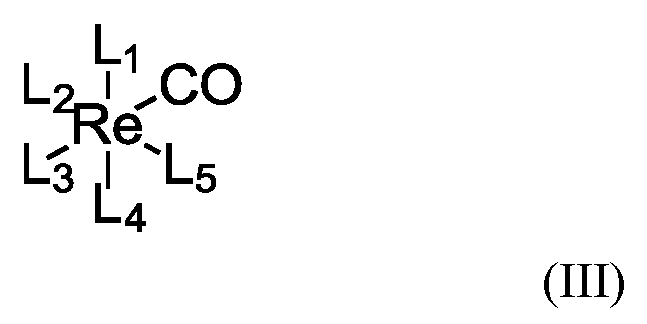

R 1 , R 3 , R 4 , R 5 and R 6 are independently selected from the group consisting of H, linear or branched, substituted or unsubstituted alkyl, linear or branched, substituted or unsubstituted heteroalkyl, linear or branched, substituted or unsubstituted Alkenyl, linear or branched, substituted or unsubstituted heteroalkenyl, linear or branched, substituted or unsubstituted alkynyl, linear or branched, substituted or unsubstituted heteroalkynyl, substituted or unsubstituted cycloalkyl, substituted or unsubstituted heterocycloalkyl, substituted or unsubstituted aryl, substituted or unsubstituted heteroaryl, linear or branched, substituted or unsubstituted alkylaryl, linear or branched, substituted or unsubstituted heteroalkylaryl, each of these groups having up to 20 carbon atoms; and
L 1 , L 2 , L 3 , L 4 and L 5 are independently metal coordinating ligands selected from the group consisting of neutral ligands, anionic ligands and mixed ligands; comprising bringing a compound having the structure of the formula (III) into contact
Der Begriff „Kontaktieren“ oder „in Kontakt bringen“, wie sie hierin austauschbar verwendet werden, beziehen sich allgemein auf den Zugang von einer Komponente, einem Reagens, einem Analyten oder einer Probe zu einem anderen. Zum Beispiel kann das In-Kontakt-bringen das Mischen einer Lösung umfassen. Diese Lösung, die eine Komponente, ein Reagens, einen Analyten oder eine Probe umfasst, kann auch eine andere Komponente oder ein Reagens wie Dimethylsulfoxid (DMSO), ein Detergens oder menschliches Serumalbumin umfassen, was das Mischen, die Wechselwirkung, die Aufnahme oder ein anderes physikalisches oder chemisches Phänomen, das vorteilhaft ist, erleichtert. Bevorzugt findet das „In-Kontakt-bringen“ in einer flüssigen Umgebung statt.The term "contacting" or "contacting" as used interchangeably herein generally refers to the access of one component, reagent, analyte or sample to another. For example, contacting may involve mixing a solution. This solution, which includes a component, reagent, analyte or sample, may also include another component or reagent such as dimethylsulfoxide (DMSO), a detergent or human serum albumin, which may include mixing, interaction, ingestion or otherwise physical or chemical phenomenon that is beneficial facilitates. Preferably, the "contacting" takes place in a liquid environment.
Bedingungen um das erfindungsgemäße Herstellungsverfahren auszuführen, insbesondere zur Darstellung der Verbindungen (III) und (IV), sind dem Fachmann bekannt. In bevorzugten Ausführungsformen werden die Verbindungen (III) und (IV) unter Schutzgas (N2) im molaren Verhältnis von 1:1 in Toluol oder THF gelöst und 24 Stunden lang bei Raumtemperatur gerührt. Das Lösungsmittel wird im Vakuum entfernt und das Rohprodukt (Verbindung (II)) wird durch Säulenchromatographie an Kieselgel gereinigt. Die Verbindung (II) kann weiter zu Verbindung (I) umgesetzt werden. Entsprechende Reaktionen sind dem Fachmann bekannt. Conditions for carrying out the preparation process according to the invention, in particular for the preparation of the compounds (III) and (IV), are known to the person skilled in the art. In preferred embodiments, the compounds (III) and (IV) are dissolved under inert gas (N 2 ) in a molar ratio of 1: 1 in toluene or THF and stirred for 24 hours at room temperature. The solvent is removed in vacuo and the crude product (compound (II)) is purified by column chromatography on silica gel. The compound (II) can be further reacted to compound (I). Corresponding reactions are known to the person skilled in the art.
Ein sechster Aspekt der Erfindung ist gerichtet auf ein Verfahren zur Identifizierung eines Moleküls, das mit einem erfindungsgemäßen Komplex interagiert, umfassend
- a) bereitstellen eines erfindungsgemäßen Komplex, wobei R5 eine Linkergruppe ist, und
- b) immobilisieren des Komplex von a) an einem festen Träger, wobei der feste Träger den Komplex über die Linkergruppe bindet;
- c) in-Kontakt-bringen des immobilisierten Komplex mit einer Lösung, die die Moleküle von Interesse umfassen; und
- d) ablösen der Moleküle, die mit dem immobilisierten Komplex interagieren, und identifizieren dieser Moleküle.
- a) providing a complex according to the invention, wherein R 5 is a linker group, and
- b) immobilizing the complex of a) on a solid support, wherein the solid support binds the complex via the linker group;
- c) contacting the immobilized complex with a solution comprising the molecules of interest; and
- d) detach the molecules that interact with the immobilized complex and identify these molecules.
In verschiedenen Ausführungsformen ist die Linkergruppe

Der Begriff „Immobilisieren“, wie er in der vorliegenden Beschreibung verwendet wird, bezieht sich auf die Befestigung oder Adhärenz eines oder mehrerer Biomoleküle an die aktivierte Oberfläche eines festen Trägers, einschließlich der Befestigung oder der Haftung an der aktivierten inneren Oberfläche des Trägers falls dieser porös ist.The term "immobilizing" as used in the present specification refers to the attachment or adherence of one or more biomolecules to the activated surface of a solid support, including attachment or adhesion to the activated inner surface of the support if it is porous is.
„Fester Träger“, wie hier verwendet, bezieht sich auf jede feste Oberfläche, an die die Verbindungen der Erfindung gebunden werden können, wie beispielsweise Latexbeads, Dextranbeads, Polystyroloberflächen, Polypropylenoberflächen, Polyacrylamidgel, Goldoberflächen, Glasoberflächen und Siliziumscheiben."Solid support" as used herein refers to any solid surface to which the compounds of the invention can be attached, such as latex beads, dextran beads, polystyrene surfaces, polypropylene surfaces, polyacrylamide gel, gold surfaces, glass surfaces, and silicon wafers.
Der Begriff „Linkergruppe“, wie hierin verwendet, bezieht sich auf jedes Mittel oder Molekül, das die erfindungsgemäßen Verbindungen und den festen Träger verbindet. In bevorzugten Ausführungsformen sind alle Molekülbindungen sowohl innerhalb der Linkergruppe als auch zu den erfindungsgemäßen Verbindungen und dem festen Träger kovalent und unter den Bedingungen des Identifizierungsverfahrens stabil.The term "linker group" as used herein refers to any agent or molecule that links the compounds of the invention and the solid support. In preferred embodiments, all of the molecular bonds within both the linker group and the compounds of the invention and the solid support are covalent and stable under the conditions of the identification method.
Der Begriff „Avidin“, wie hierin verwendet, bedeutet jede Biotin-bindende Verbindung, wie Avidin, Streptavidin, jedes modifizierte oder mutierte Avidin, das durch Labortechniken hergestellt wird, die in der Lage sind, Biotin oder ein funktionelles Äquivalent von Biotin zu binden. Streptavidin ist eine spezielle Unterform von Avidin.The term "avidin" as used herein means any biotin-binding compound such as avidin, streptavidin, any modified or mutated avidin prepared by laboratory techniques capable of binding biotin or a functional equivalent of biotin. Streptavidin is a specific subtype of avidin.
Der Begriff „Streptavidin“, wie hierin verwendet, umfasst Wildtyp-Streptavidin, Streptavidin-Muteine und Streptavidin-ähnliche Polypeptide, sofern im Einzelfall nichts anderes angegeben ist. Als Wildtyp-Streptavidin (wt-Streptavidin) wird die Aminosäuresequenz, die von Argarana et al., Nucleic Acids Res. 14 (1986) 1871-1882 bezeichnet. Streptavidin-Muteine sind Polypeptide, die sich von der Sequenz des Wildtyp-Streptavidins durch eine oder mehrere Aminosäuresubstitutionen, Deletionen oder Additionen unterscheiden und die die Bindungseigenschaften von wt-Streptavidin beibehalten. Streptavidin-artige Polypeptide und Streptavidin-Muteine sind Polypeptide, die im Wesentlichen immunologisch äquivalent zu Wildtyp-Streptavidin sind und insbesondere Biotin-, Biotin-Derivat- oder Biotin-Analoga mit der gleichen oder unterschiedlichen Affinität wie wt-Streptavidin binden können. Streptavidin-ähnliche Polypeptide oder Streptavidin-Muteine können Aminosäuren enthalten, die nicht Teil des Wildtyp-Streptavidins sind oder nur einen Teil des Wildtyp-Streptavidins enthalten können.The term "streptavidin" as used herein includes wild-type streptavidin, streptavidin muteins, and streptavidin-like polypeptides unless otherwise specified in the individual case. Wild-type streptavidin (wt-streptavidin) is the amino acid sequence designated by Argarana et al., Nucleic Acids Res. 14 (1986) 1871-1882. Streptavidin muteins are polypeptides that differ from the wild-type streptavidin sequence by one or more amino acid substitutions, deletions or additions, and that retain the binding properties of wt-streptavidin. Streptavidin-like polypeptides and streptavidin muteins are polypeptides that are substantially immunologically equivalent to wild-type streptavidin and, in particular, can bind biotin, biotin derivative or biotin analogs with the same or different affinity as wt streptavidin. Streptavidin-like polypeptides or streptavidin muteins may contain amino acids that are not part of the wild-type streptavidin or may contain only part of the wild-type streptavidin.
Der Begriff Streptavidin umfasst auch Streptavidin-Tetramere und Streptavidindimere, insbesondere Streptavidin-Homotetramere, Streptavidin-Homodimere, Streptavidin-Heterotetramere und Strepavidin-Heterodimere. Jede Untereinheit hat normalerweise eine Bindungsstelle für Biotin- oder Biotin-Analoga oder für Streptavidinbindende Peptide. The term streptavidin also includes streptavidin-tetramers and streptavidin-dimers, especially streptavidin-homotetramers, streptavidin-homodimers, streptavidin-heterotetramers and streptavidin-heterodimers. Each subunit normally has a binding site for biotin or biotin analogs or for streptavidin-binding peptides.
Beispiele für Streptavidine oder Streptavidin-Muteine sind in
Der Begriff „mindestens 1“, wie hierin verwendet, bezieht sich auf 1 oder mehr, 2 oder mehr, 3 oder mehr, 4 oder mehr, 5 oder mehr, 6 oder mehr, 7 oder mehr, 8 oder mehr, 9 oder mehr, 10 oder mehr, 100 oder mehr oder 1000 oder mehr.The term "at least 1" as used herein refers to 1 or more, 2 or more, 3 or more, 4 or more, 5 or more, 6 or more, 7 or more, 8 or more, 9 or more, 10 or more, 100 or more, or 1000 or more.
BEISPIELEEXAMPLES
Materialien und MethodenMaterials and methods
Materialienmaterials
Alle verwendeten Chemikalien wurden in Reagenz- oder Analytik-Qualität von kommerziellen Anbietern gekauft und ohne weitere Reinigung verwendet. Lösungsmittel wurden entweder wie gekauft oder getrocknet (Molekularsieb) verwendet. Alle Reaktionen wurden mit Standard Schlenk-Techniken unter Schutzgas (N2) durchgeführt, wenn nicht anders beschrieben. 1H, 13C{1H} und 31P NMR Spektren wurden auf den Bruker-Spektrometern DPX 200 (1H: 200 MHz, 13C: 50 MHz), DPX 250 (1H: 250 MHz, 13C: 63 MHz, 31P: 101 MHz) oder DRX 400 (1H: 400 MHz, 13C: 100 MHz) aufgezeichnet. Chemische Verschiebungen δ werden in ppm vs TMS (1H, 13C) oder H3PO4 (31P) angegeben. Lösungsmittelpeaks der deuterierten Lösungsmittel wurden als sekundäre Referenz verwendet. Die folgenden Abkürzungen für die Multiplizität werden verwendet: s (Singulett), d (Dublett), dd (Double Dublett), t (Triplett), m (Multiplett), br (breit). IR-Spektren wurden auf einem Bruker Tensor 27 FT-IR Spektrometer aufgezeichnet, das mit einer ATR (attenuated total reflexion) Einheit ausgestattet ist. Massenspektren wurden auf einem Bruker Esquire 6000 Spektrometer unter Verwendung einer Elektrospray-Ionisationsquelle (ESI) aufgenommen. Röntgenbeugungs-Experimente an geeigneten Kristallen wurden unter Verwendung eines Rigaku Mercury 375 R/MCCD (XtaLAB mini) oder Oxford Xcalibur2 (MοKα, λ = 0,71073 Ä) durchgeführt. Die Strukturen wurden durch direkte Methoden (ShelXS) gelöst und gegen F2 verfeinert (alle Reflexe, ShelXL97 und ShelXL2014). Wasserstoffatome wurden an berechneten Positionen zugefügt. Für die Strukturlösungen der Verbindungen 4c und 6a wurde das Programmpaket PLATON zur Behandlung stark fehlgeordneter Lösungsmittelmoleküle verwendet (SQEEZE).All chemicals used were purchased in reagent or analytical grade from commercial suppliers and used without further purification. Solvents were used either as purchased or dried (molecular sieve). All reactions were carried out using standard Schlenk techniques under inert gas (N 2 ) unless otherwise specified. 1 H, 13 C { 1 H} and 31 P NMR spectra were recorded on the Bruker DPX 200 spectrometers ( 1 H: 200 MHz, 13 C: 50 MHz), DPX 250 ( 1 H: 250 MHz, 13 C: 63 MHz , 31 P: 101 MHz) or DRX 400 ( 1 H: 400 MHz, 13 C: 100 MHz). Chemical shifts δ are reported in ppm vs TMS ( 1 H, 13 C) or H 3 PO 4 ( 31 P). Solvent peaks of the deuterated solvents were used as a secondary reference. The following abbreviations for multiplicity are used: s (singlet), d (doublet), dd (double doublet), t (triplet), m (multiplet), br (broad). IR spectra were recorded on a Bruker Tensor 27 FT-IR spectrometer equipped with an ATR (attenuated total reflection) unit. Mass spectra were recorded on a Bruker Esquire 6000 spectrometer using an electrospray ionization (ESI) source. X-ray diffraction experiments on suitable crystals were performed using a Rigaku Mercury 375 R / MCCD (XtaLAB mini) or Oxford Xcalibur2 (Moka, λ = 0.71073 Å). The structures were solved by direct methods (ShelXS) and refined against F 2 (all reflexes, ShelXL97 and ShelXL2014). Hydrogen atoms were added at calculated positions. For the structural solutions of
Photophysikalische MessungenPhotophysical measurements
Alle Lösungsmittel, die für photophysikalische Messungen verwendet wurden, waren von spektroskopischer Qualität und wurden wie erhalten verwendet. Zur Entgasung von Lösungsmitteln wurden mindestens 3 aufeinanderfolgende Freeze-pump-Thaw Durchgänge durchgeführt. Absorptionsspektren wurden entweder auf einem Jasco V-770 UV-VIS-NIR Photometer oder einem Varian Cary 100 UV-VIS Spektrophotometer aufgenommen. Steady-State-Emissionsspektren wurden auf einem Jasco FP-8300 Spektrofluorimeter aufgezeichnet. Die Emissionsspektren wurden für die spektrale Empfindlichkeit des Nachweissystems korrigiert. Die Lumineszenzlebensdauer wurde mit einem FluoTime 200 TCSPC-System, bestehend aus einer LDH-P-C-405 Laserdiode mit einem PDL 800-B Lasertreiber und einem luftgekühltem PMT-Detektor (PMA-Serie, PicoQuant), bestimmt. Die erhaltenen Daten wurden mit der FluoFit Softwarepaket (PicoQuant) analysiert. Zur Bestimmung des Quantenausbeute wurde der Ansatz von Demas und Crosby45 verwendet und Ru(bipy)3Cl2 in Wasser (φ = 0,044)46 und Chininsulfat in H2SO4 (Φ = 0,54)47 dienten als Referenzverbindungen. Quantenausbeuten der untersuchten Verbindungen wurden im Vergleich zu den Referenzverbindungen gemäß der folgenden Gleichung berechnet:

Die Indizes „X“ und „Ref“ geben die zu untersuchende Verbindung und die Referenzen an. Θ ist die Quantenausbeute, η steht für den Brechungsindex des Lösungsmittels. G wird durch Auftragen der Absorption einer Reihe von Verdünnungen (Absorption <0,1) gegen die integrierte Emissionsintensität bestimmt. G wird als Gradient einer linearen Approximation der geplotteten Daten erhalten.The indexes "X" and "Ref" indicate the connection to be examined and the references. Θ is the quantum yield, η stands for the refractive index of the solvent. G is determined by plotting the absorbance of a series of dilutions (absorbance <0.1) against the integrated emission intensity. G is obtained as a gradient of a linear approximation of the plotted data.
Bestimmung der minimalen inhibitorischen Konzentration (MHK) Determination of Minimum Inhibitory Concentration (MIC)
Minimale Hemmkonzentrationen (MHK) wurden gegen die Gram-positiven Stämme Bacillus subtilis DSM 402, Staphylococcus aureus DSM 20231 und Staphylococcus aureus ATCC 43300 (MRSA) bestimmt. Als Gram-negative Stämme wurden Escherichia coli DSM 30083, Acinetobacter baumannii DSM 30007 und Pseudomona aeruginosa DSM 50071 verwendet. E. coli, A. baumannii, S. aureus und B. subtilis wurden in Mueller-Hinton-Flüssigmedium gezüchtet, während P. aeruginosa in Mueller-Hinton II Flüssigmedium gezüchtet wurde. Die Verbindungen wurden in DMSO und in Lösungen von 10 mg/ml gelagert. Serielle Verdünnung wurde mit einem Tecan Freedom Evo 75 Liquid Handling Workstation durchgeführt (endgültige Konzentrationen 0,5 bis 512 µg/ml). Serielle Verdünnungen wurden mit 5×10⁵ Bakterien/ml aus spät-exponentiellen Kulturen (Gesamtvolumen 200 µl pro Vertiefung) inokuliert. Zellen wurden für 16-18h bei 37° C inkubiert. Die niedrigste Konzentration, die sichtbares bakterielles Wachstum verhindert, wird als MHK angegeben.Minimum inhibitory concentrations (MIC) were determined against the Gram-positive strains Bacillus subtilis DSM 402, Staphylococcus aureus DSM 20231 and Staphylococcus aureus ATCC 43300 (MRSA). Gram-negative strains used were Escherichia coli DSM 30083, Acinetobacter baumannii DSM 30007 and Pseudomona aeruginosa DSM 50071. E. coli, A. baumannii, S. aureus and B. subtilis were grown in Mueller-Hinton liquid medium, while P. aeruginosa was grown in Mueller-Hinton II liquid medium. The compounds were stored in DMSO and in solutions of 10 mg / ml. Serial dilution was performed on a Tecan Freedom Evo 75 liquid handling workstation (final concentrations 0.5 to 512 μg / ml). Serial dilutions were inoculated with 5 x 10 5 bacteria / ml from late-exponential cultures (total volume 200 μl per well). Cells were incubated at 37 ° C for 16-18h. The lowest concentration that prevents visible bacterial growth is expressed as MIC.
Synthesesynthesis
2-Azidoanilin wurde aus Anilin über eine milde Kupfer-katalysierte Azidierungsreaktion nach Jiao und Mitarbeitern hergestellt. Die erhaltenen analytischen Daten entsprechen den Literaturwerten.48 2-Azidoaniline was prepared from aniline via a mild copper-catalyzed azidation reaction by Jiao and co-workers. The analytical data obtained correspond to the literature values. 48
Reduktive Aminierung mit 2-Azidoanilin und aromatischen AldehydenReductive amination with 2-azidoaniline and aromatic aldehydes
Allgemeine Vorgehensweise: Nach einem modifizierten Verfahren von Shah et al.49 wurden 2-Azidoanilin (1 Äq.) und ein entsprechendes aromatisches Aldehyd (1 Äq.) in 1,2-Dichlorethan unter Stickstoff Atmosphäre gelöst. Anschließend wurde Natriumtriacetoxyborhydrid (1,4 Äq.) in kleinen Portionen zugegeben und die resultierende Lösung für 24h bei Raumtemperatur gerührt. Die Reaktionen wurden durch Zugabe von konzentrierter wässriger NaHCO3-Lösung gequencht und die resultierende Suspension wurde mit Dichlormethan extrahiert. Die organische Phase wurde über Natriumsulfat getrocknet und im Vakuum konzentriert. Das Rohprodukt wurde durch Säulenchromatographie an Kieselgel unter Verwendung einer Mischung von Petrolether (PE) und Ethylacetat (EtOAc) gereinigt.General Procedure: According to a modified method of Shah et al. 49 , 2-azidoaniline (1 eq.) And a corresponding aromatic aldehyde (1 eq.) Were dissolved in 1,2-dichloroethane under nitrogen atmosphere. Subsequently, sodium triacetoxyborohydride (1.4 eq.) Was added in small portions and the resulting solution stirred for 24 h at room temperature. The reactions were quenched by the addition of concentrated aqueous NaHCO 3 solution and the resulting suspension was extracted with dichloromethane. The organic phase was dried over sodium sulfate and concentrated in vacuo. The crude product was purified by column chromatography on silica gel using a mixture of petroleum ether (PE) and ethyl acetate (EtOAc).
1b: Das allgemeine Verfahren mit 2-Azidoanilin (200 mg, 1,49 mmol), Benzaldehyd (158 mg, 1,49 mmol) und 442 mg Natriumtriacetoxyborhydrid (2,1 mmol) wurde verwendet. Nach der Reinigung durch Säulenchromatographie an Kieselgel (PE: EtOAc 25:1) wurde als Produkt ein braunes Öl (190 mg, 57%) erhalten. C13H12N4 (224.27 g/mol). Rf (SiO2, PE:EtOAc 25:1, Detektion: UV) = 0.5. 1H NMR (200 MHz, CDCl3) δ [ppm] = 7.28-7.18 (m 5H), 6.99-6.88 (m, 2H), 6.72-6.66 (m, 1H), 6.58-6.54 (m, 1H) 4.48 (br s, 1H, NH), 4.35 (s, 2H, CH2). 13C NMR (50.3 MHz, CDCl3) δ [ppm] = 139.8, 139.1, 128.8, 127.5, 127.4, 126.0, 124.8, 118.0, 117.5, 111.3, 48.0.1b: The general procedure with 2-azidoaniline (200 mg, 1.49 mmol), benzaldehyde (158 mg, 1.49 mmol) and 442 mg sodium triacetoxyborohydride (2.1 mmol) was used. After purification by column chromatography on silica gel (PE: EtOAc 25: 1), the product was a brown oil (190 mg, 57%). C 13 H 12 N 4 (224.27 g / mol). R f (SiO 2 , PE: EtOAc 25: 1, detection: UV) = 0.5. 1 H NMR (200 MHz, CDCl 3) δ [ppm] = 7:28 to 7:18 (m 5H), 6.99-6.88 (m, 2H), 6.72-6.66 (m, 1H), 6:58 to 6:54 (m, 1 H) 4:48 (br s, 1H, NH), 4:35 (s, 2H, CH 2). 13 C NMR (50.3 MHz, CDCl 3) δ [ppm] = 139.8, 139.1, 128.8, 127.5, 127.4, 126.0, 124.8, 118.0, 117.5, 111.3, 48.0.
1c: Das allgemeine Verfahren mit 2-Azidoanilin (350 mg, 2,6 mmol), 2,4,6-Trimethylbenzaldehyd (385 mg, 2,6 mmol) und Natriumtriacetoxyborhydrid (785 mg, 3,6 mmol) wurde verwendet. Nach Säulenchromatographie (SiO2, PE:EtOAc 20:1) wurde das Produkt als beiger Feststoff erhalten (410 mg, 58%). C16H18N4 (266.35 g/mol). Rf (SiO2, PE:EtOAc 20:1, Detektion: UV) = 0.6. 1H NMR (250 MHz, CDCl3) δ [ppm] = 7.15-7.08 (m, 1H), 7.06-7.02 (m, 1H), 6.91 (s, 2H), 6.81 (s, 1H), 6.78 (s, 1H), 4.19 (s, 2H, CH2), 2.34 (s, 6H, 2xCH3), 2.30 (s, 3H, CH3). 13C NMR (62.5 MHz, CDCl3) δ [ppm] = 140.0, 137.7, 137.5, 131.7, 129.3, 126.1, 124.9, 118.0, 117.5, 42.5, 21.1, 19.6. IR (ATR) v= 3376 (m), 2868 (m), 2126 (s), 1579 (s), 1424 (s), 888 (s), 858 (m).1c: The general procedure with 2-azidoaniline (350 mg, 2.6 mmol), 2,4,6-trimethylbenzaldehyde (385 mg, 2.6 mmol) and sodium triacetoxyborohydride (785 mg, 3.6 mmol) was used. After column chromatography (SiO 2 , PE: EtOAc 20: 1), the product was obtained as a beige solid (410 mg, 58%). C 16 H 18 N 4 (266.35 g / mol). R f (SiO 2 , PE: EtOAc 20: 1, detection: UV) = 0.6. 1 H NMR (250 MHz, CDCl 3) δ [ppm] = 7:15 to 7:08 (m, 1H), 7:06 to 7:02 (m, 1H), 6.91 (s, 2H), 6.81 (s, 1H), 6.78 (s , 1H), 4.19 (s, 2H, CH 2 ), 2.34 (s, 6H, 2xCH 3 ), 2.30 (s, 3H, CH 3 ). 13 C NMR (62.5 MHz, CDCl 3) δ [ppm] = 140.0, 137.7, 137.5, 131.7, 129.3, 126.1, 124.9, 118.0, 117.5, 42.5, 21.1, 19.6. IR (ATR) v = 3376 (m), 2868 (m), 2126 (s), 1579 (s), 1424 (s), 888 (s), 858 (m).
Hestellung der Phosphinimine 2a-2cProduction of phosphinimines 2a-2c
Allgemeines Verfahren: Azidoanilin oder seine Derivate wurden in Toluol gelöst. Innerhalb von 10 Minuten wurde eine Lösung von Triphenylphosphin (1,02 Äq.) in Toluol über eine Spritze zugegeben. Die Lösung wurde bei Raumtemperatur für 24 h gerührt. Das Lösungsmittel wurde im Vakuum entfernt und das Rohprodukt wird durch Säulenchromatographie an Kieselgel gereinigt.General Procedure: Azidoaniline or its derivatives were dissolved in toluene. Within 10 minutes, a solution of triphenylphosphine (1.02 eq.) In toluene was added via syringe. The solution was stirred at room temperature for 24 h. The solvent was removed in vacuo and the crude product was purified by column chromatography on silica gel.
2a: Das allgemeine Verfahren wurde mit 2-Azidoanilin (224 mg, 1,67 mmol) und PPh3 (440 mg, 1,7 mmol) durchgeführt. Nach Säulenchromatographie (SiO2, Gradient Hexan:EtOAc 4:1 bis 0:1) wurde das Produkt als oranger kristalliner Feststoff (550 mg, 89%) erhalten. C24H21N2P (368.42 g/mol), 1H NMR (250 MHz, CDC13) δ [ppm] = 7.82-7.72 (m, 6H), 7.56-7.42 (m, 9H), 6.75-6.70 (m, 1H), 6.60-6.52 (m, 1H), 6.41-6.31 (m, 2H), 4.36 (br s, 2H, NH2). 13C NMR (63 MHz, CDCl3) δ [ppm] = 141.9 (d, 3JCP =20.4 Hz, C-NH2), 137.8 (CAnilin), 132.7 (d, 2JCP = 9.7 Hz, 6x Cortho), 131.8 (d, 4JCP = 2.9 Hz, 3x Cpara), 131.3 (d, 1JCP = 99.7 Hz, 3x C-P), 128.7 (d, 3JCP = 12 Hz, 6x Cmeta), 120.4 (d, J=9.1 Hz), 118.5 (CAnilin), 118.2 (CAnilin), 114.2 (CAnilin). 31P NMR (101 MHz, CDCl3) δ [ppm] = 4.8. MS (ESI+): m/z = 368.96 [M+H]+. IR (ATR) v = 3453 (m), 3351 (m), 3053 (m), 1595 (s), 1493 (s), 1435 (s), 1250 (s), 1104 (s), 690 (s).2a: The general procedure was repeated with 2-Azidoanilin (224 mg, 1.67 mmol) and PPh 3 (440 mg, 1.7 mmol) is performed. After column chromatography (SiO 2 , gradient hexane: EtOAc 4: 1 to 0: 1), the product was obtained as an orange crystalline solid (550 mg, 89%). C 24 H 21 N 2 P (368.42 g / mol), 1 H NMR (250 MHz, CDC13) δ [ppm] = 7.82-7.72 (m, 6H), 7:56 to 7:42 (m, 9H), 6.75-6.70 ( m, 1H), 6.60-6.52 (m, 1H), 6.41-6.31 (m, 2H), 4.36 (br s, 2H, NH 2 ). 13 C NMR (63 MHz, CDCl 3) δ [ppm] = 141.9 (d, 3 J CP = 20.4 Hz, C-NH2), 137.8 (C aniline), 132.7 (d, 2 J CP = 9.7 Hz, 6x C ortho ), 131.8 (d, 4 J CP = 2.9 Hz, 3x C para ), 131.3 (d, 1 J CP = 99.7 Hz, 3x CP), 128.7 (d, 3 J CP = 12 Hz, 6x C meta ) , 120.4 (d, J = 9.1 Hz), 118.5 (C aniline ), 118.2 (C aniline ), 114.2 (C aniline ). 31 P NMR (101 MHz, CDCl 3) δ [ppm] = 4.8. MS (ESI +): m / z = 368.96 [M + H] + . IR (ATR) v = 3453 (m), 3351 (m), 3053 (m), 1595 (s), 1493 (s), 1435 (s), 1250 (s), 1104 (s), 690 (s) ,
2b: Das allgemeine Verfahren wurde mit 2-Azido-N-benzylanilin (200 mg, 0,90 mmol) und PPh3 (239 mg, 0,91 mmol) durchgeführt. Nach Säulenchromatographie (PE:EtOAc 4:1) wurde das Produkt als oranger Feststoff (310 mg, 76%) erhalten. C31H27N2P (458,54 g/mol). Rf (SiO2, PE:EtOAc 4:1, Detektion: UV) = 0.3. 1H NMR (250 MHz, CDCl3) δ [ppm] = 7.91-7.80 (m, 6H), 7.65-7.48 (m, 11H), 7.45-7.28 (m, 3H), 6.67-6.57 (m, 2H), 6.50-6.44 (m, 1H) 6.37-6.29 (m, 1H), 5.50 (br s, 1H, NH), 4.54 (s, 2H, CH2). 13C NMR (63 MHz, CDCl3) δ [ppm] = 144.1 (d, 3JCP =19.8 Hz, C-NH), 141.7 (Cphenyl), 137.8 (CAnilin), 133.0 (d, 2JCP = 9.7 Hz, 6x Cortho), 132.3 (d, 4JCP = 2.9 Hz, 3x Cparα), 131.7 (d, 1JCP = 99.6 Hz, 3x C-P), 129.2 (d, 3JCP = 11.9 Hz, 6x Cmeta), 128.9 (Cphenyl), 127.7 (Cphenyl), 127.2 (Cphenyl), 119.4 (d, , J= 9.3 Hz), 118.9 (CAnilin), 116.7 (CAnilin). 109.6 (CAnilin), 48.9 (CH2).31P NMR (101 MHz, CDCl3) δ [ppm] = 4.6. MS (ESI+): m/z = 458.9 [M+H]+. IR (ATR) v = 3022 (m), 1736 (m), 1569 (s), 1495 (s), 1417 (s), 1364 (m), 1302 (m), 1229 (m), 736 (m).2b: The general procedure was carried out with 2-azido-N-benzylaniline (200 mg, 0.90 mmol) and PPh 3 (239 mg, 0.91 mmol). After column chromatography (PE: EtOAc 4: 1), the product was obtained as an orange solid (310 mg, 76%). C 31 H 27 N 2 P (458.54 g / mol). R f (SiO 2 , PE: EtOAc 4: 1, detection: UV) = 0.3. 1 H NMR (250 MHz, CDCl 3) δ [ppm] = 7.91-7.80 (m, 6H), 7.65-7.48 (m, 11H), 7:45 to 7:28 (m, 3H), 6.67-6.57 (m, 2H) , 6.50-6.44 (m, 1H) 6.37-6.29 (m, 1H), 5.50 (br s, 1H, NH), 4.54 (s, 2H, CH 2 ). 13 C NMR (63 MHz, CDCl 3) δ [ppm] = 144.1 (d, 3 J CP = 19.8 Hz, C-NH), 141.7 (C phenyl), 137.8 (C aniline), 133.0 (d, 2 J CP = 9.7 Hz, 6x C ortho ), 132.3 (d, 4 J CP = 2.9 Hz, 3x C parα ), 131.7 (d, 1 J CP = 99.6 Hz, 3x CP), 129.2 (d, 3 J CP = 11.9 Hz , 6x C meta), 128.9 (C phenyl), 127.7 (C phenyl), 127.2 (C phenyl), 119.4 (d, J = 9.3 Hz), 118.9 (C aniline), 116.7 (C aniline). 109.6 (C aniline ), 48.9 (CH 2 ). 31 P NMR (101 MHz, CDCl 3) δ [ppm] = 4.6. MS (ESI +): m / z = 458.9 [M + H] + . IR (ATR) v = 3022 (m), 1736 (m), 1569 (s), 1495 (s), 1417 (s), 1364 (m), 1302 (m), 1229 (m), 736 (m) ,
2c: Das allgemeine Verfahren wurde mit 2-Azido-N-(2,4,6-Trimethylbenzyl)anilin (272 mg, 1 mmol) und PPh3 (265 mg, 1,02 mmol) durchgeführt. Nach Säulenchromatographie (Gradient Hexan:EtOAc 4:1) wurde das Produkt als gelber Feststoff erhalten (370 mg, 72%). C34H33N2P (500,24 g / mol). 1H NMR (250 MHz, CD2Cl2) δ [ppm] = 7.70-7.60 (m, 6H), 7.56-7.49 (m, 4H), 7.44-7.36 (m, 5H), 6.89 (s, 2H), 6.69-6.59 (m, 2H), 6.33-6.21 (m, 2H), 4.24 (s, 2H), 2.36 (s, 6H, 2x CH3), 2.30 (s, 3H, CH3). 13C NMR (50 MHz, CD2Cl2) δ [ppm] = 145.0 (J =19.0 Hz), 137.6, 137.5, 136.8, 134.2, 132.8 (2JCP = 9.5 Hz, 6x Cortho), 132.1 (d, 4JCP = 2.8 Hz, 3x Cpara), 131.5 (d, 1JCP = 99.0 Hz, 3x C-P), 129.3, 128.9 (d, 3JCP = 12.0 Hz, 6x Cmeta), 119.1 (d, J = 8.5 Hz), 118.9, 116.5, 109.6, 43.7 (CH2) ,21.3 (CH3) ,19.8 (2x CH3). 31P NMR (101 MHz, CDCl3) δ [ppm] = 3.1. MS (ESI+): m/z = 501.0 [M+H]+, 522.9 [M+Na]+. IR (ATR) v = 1583 (m), 1510 (m), 1423 (m), 1312 (m), 1264 (s), 1108 (s), 1021 (m), 862 (m), 717 (s), 694 (s).2c: The general procedure was carried out using 2-azido-N- (2,4,6-trimethylbenzyl) aniline (272 mg, 1 mmol) and PPh 3 (265 mg, 1.02 mmol). After column chromatography (gradient hexane: EtOAc 4: 1), the product was obtained as a yellow solid (370 mg, 72%). C 34 H 33 N 2 P (500.24 g / mol). 1 H NMR (250 MHz, CD 2 Cl 2 ) δ [ppm] = 7.70-7.60 (m, 6H), 7.56-7.49 (m, 4H), 7.44-7.36 (m, 5H), 6.89 (s, 2H) , 6.69-6.59 (m, 2H), 6.33-6.21 (m, 2H), 4.24 (s, 2H), 2.36 (s, 6H, 2xCH 3 ), 2.30 (s, 3H, CH 3 ). 13 C NMR (50 MHz, CD 2 Cl 2 ) δ [ppm] = 145.0 (J = 19.0 Hz), 137.6, 137.5, 136.8, 134.2, 132.8 ( 2 J CP = 9.5 Hz, 6x C ortho ), 132.1 (i.e. , 4 JCP = 2.8 Hz, 3x C para ), 131.5 (d, 1 JCP = 99.0 Hz, 3x CP), 129.3, 128.9 (d, 3 J CP = 12.0 Hz, 6x C meta ), 119.1 (d, J = 8.5 Hz), 118.9, 116.5, 109.6, 43.7 (CH 2 ), 21.3 (CH 3 ), 19.8 (2x CH 3 ). 31 P NMR (101 MHz, CDCl 3) δ [ppm] = 3.1. MS (ESI +): m / z = 501.0 [M + H] + , 522.9 [M + Na] + . IR (ATR) v = 1583 (m), 1510 (m), 1423 (m), 1312 (m), 1264 (s), 1108 (s), 1021 (m), 862 (m), 717 (s) , 694 (s).
Herstellung von Re(CO)4(NHC)Br KomplexenPreparation of Re (CO) 4 (NHC) Br Complexes
Allgemeines Verfahren: Unter N2 werden Phosphinimin (1 Äq.) und Re(CO)sBr (1 Äq.) in Toluol oder THF gelöst und 24 Stunden lang bei Raumtemperatur gerührt. Das Lösungsmittel wird im Vakuum entfernt und das Rohprodukt wird durch Säulenchromatographie an Kieselgel gereinigt.General Procedure: Under N 2 , phosphinimine (1 eq.) And Re (CO) sBr (1 eq.) Are dissolved in toluene or THF and stirred for 24 hours at room temperature. The solvent is removed in vacuo and the crude product is purified by column chromatography on silica gel.
3a: Das allgemeine Verfahren wurde mit Phosphinimin 2a (200 mg, 0,54 mmol) und Re(CO)sBr (220 mg, 0,54 mmol) verwendet. Das Produkt wurde als beiger Feststoff erhalten (230 mg, 86%). C11H6N2O4ReBr (496.29 g/mol). Rf (SiO2, Hexan:EtOAc 9:1, Detektion: UV) = 0.2. 1H NMR (200 MHz, CDCl3) δ [ppm] = 10.41 (s, 2H, NH), 7.57-7.50 (m, 2H, HBim), 7.42-7.35 (m, 2H, HBim). 13C NMR (50 MHz, CD2Cl2) δ [ppm] = 187.5 (CO), 185.7 (CO), 185.4 (CO), 171.9 (Ccarben), 133.8 (CBim), 124.9 (CBim), 112.1 (CBim). IR (ATR) v = 3354 (m), 3292 (m), 2103 (m), 1977 (s), 1907 (s), 1887 (s), 1451 (s), 724 (s).3a: The general procedure was used with phosphinimine 2a (200 mg, 0.54 mmol) and Re (CO) sBr (220 mg, 0.54 mmol). The product was obtained as a beige solid (230 mg, 86%). C 11 H 6 N 2 O 4 ReBr (496.29 g / mol). R f (SiO 2 , hexane: EtOAc 9: 1, detection: UV) = 0.2. 1 H NMR (200 MHz, CDCl 3) δ [ppm] = 10:41 (s, 2H, NH), 7:57 to 7:50 (m, 2H, H Bim), 7:42 to 7:35 (m, 2H, H Bim). 13 C NMR (50 MHz, CD 2 Cl 2 ) δ [ppm] = 187.5 (CO), 185.7 (CO), 185.4 (CO), 171.9 ( carbene C), 133.8 (C Bim ), 124.9 (C Bim ), 112.1 (C Bim ). IR (ATR) v = 3354 (m), 3292 (m), 2103 (m), 1977 (s), 1907 (s), 1887 (s), 1451 (s), 724 (s).
3b: Das allgemeine Verfahren wurde mit Phosphinimin 2b (126 mg, 0,28 mmol) und Re(CO)sBr (112 mg, 0,28 mmol) verwendet. Das Produkt wurde als beiger Feststoff erhalten (137 mg, 85%). C18H12N2O4ReBr. (586.42 g/mol). Rf (SiO2, Hexan:EtOAc 4:1, Detektion: UV) = 0.4. 1H NMR (200 MHz, CDCl3) δ [ppm] = 11.35 (s, 1H, NH), 7.54-7.50 (m, 1H, HPh), 7.36-7.21 (m, 6H, HPh+HBim), 7.04-7.00 (m, 2H, HBim), 5.67 (s, 2H, CH2). 13C (50 MHz, CDCl3) δ [ppm] = 186.1 (CO), 185.7 (CO), 184.6 (CO), 175.9 (Ccarben), 135.0 (CBim), 134.9 (CBim), 133.5 (CPh), 129.3 (CPh), 128.4 (CPh), 126.1 (CPh), 124.7 (CBim), 124.3 (CBim), 112.1 (CBim), 111.5 (CBim), 51.8 (CH2). IR (ATR) v = 3275 (w), 2105 (s), 1972 (s), 1915 (s), 1748 (m), 1728 (m), 1433 (m), 1370 (m), 1228 (m), 723 (m), 670 (m).3b: The general procedure was used with phosphinimine 2b (126 mg, 0.28 mmol) and Re (CO) sBr (112 mg, 0.28 mmol). The product was obtained as a beige solid (137 mg, 85%). C 18 H 12 N 2 O 4 ReBr. (586.42 g / mol). R f (SiO 2 , hexane: EtOAc 4: 1, detection: UV) = 0.4. 1 H NMR (200 MHz, CDCl 3) δ [ppm] = 11:35 (s, 1H, NH), 7:54 to 7:50 (m, 1H, H Ph), 7:36 to 7:21 (m, 6 H, H H Ph + Bim) , 7.04-7.00 (m, 2H, H Bim ), 5.67 (s, 2H, CH 2 ). 13 C (50 MHz, CDCl 3) δ [ppm] = 186.1 (CO), 185.7 (CO), 184.6 (CO), 175.9 (C carbene), 135.0 (C Bim), 134.9 (C Bim), 133.5 (C Ph ), 129.3 (C Ph ), 128.4 (C Ph ), 126.1 (C Ph ), 124.7 (C Bim ), 124.3 (C Bim ), 112.1 (C Bim ), 111.5 (C Bim ), 51.8 (CH2). IR (ATR) v = 3275 (w), 2105 (s), 1972 (s), 1915 (s), 1748 (m), 1728 (m), 1433 (m), 1370 (m), 1228 (m) , 723 (m), 670 (m).
3c: Das allgemeine Verfahren wurde mit Phosphinimin 2c (370 mg, 0,74 mmol) und Re(CO)sBr (300 mg, 0,74 mmol) in THF verwendet. Das Produkt wurde als beiger Feststoff erhalten (270 mg, 58%). C21H18N2O4ReBr (628.5 g/mol). Rf (SiO2, Hexan:EtOAc 9:1, Detektion: UV) = 0.3. 1H NMR (200 MHz, CDCl3) δ [ppm] = 11.27 (s, 1H, NH), 7.48-7.44 (m, 1H, HBim), 7.23-7.18 (m, 1H, HBim), 7.02-6.97 (m, 1H, HBim), 6.94 (s, 2H, HPh), 6.47-6.40 (m, 1H, HBim), 5.70 (s, 2H, CH2), 2.34 (s, 3H, CH3), 2.23 (s, 6H, 2xCH3). 13C NMR (50 MHz, CDCl3) δ [ppm] = 186.2 (CO), 186.1 (CO), 185.1 (CO), 175.8 (Ccarbene), 139.1 (CPh), 137.9 (CPh), 134.4 (CBim), 133.7 (CBim), 130.2 (CPh), 127.3 (CPh), 124.2 (CBim), 123.9 (CBim), 112.2 (CBim), 111.8 (CBim), 51.1 (CH2), 21.2 (CH3), 20.4 (2x CH3). IR (ATR) v = 3280 (w), 2923 (w), 1982 (s), 1918 (s), 1494 (m), 1429 (m), 1338 (m), 1260 (m), 1193 (m), 720 (m).3c: The general procedure was used with
Herstellung von [Re(CO)3(NHC)L]+ Komplexen Preparation of [Re (CO) 3 (NHC) L] + Complexes
Allgemeines Verfahren: Rheniumkomplexe 3a-3c (1 Äq.) und der entsprechende Bisiminligand (1,05 Äq.) werden in Toluol gelöst/suspendiert und bei 100° C für 4 h gerührt. Nach dem Abkühlen auf Umgebungstemperatur wird der gelbliche Niederschlag durch Filtration isoliert, intensiv mit kaltem Ether gewaschen und im Vakuum getrocknet, um das Produkt in hoher Reinheit zu erhalten. In den Fällen, in denen die Produkte nicht sofort präzipitieren, kann kalter Ether hinzugefügt werden, um die Fällung zu erleichtern.General Procedure: Rhenium complexes 3a-3c (1 eq.) And the corresponding bisimine ligand (1.05 eq.) Are dissolved / suspended in toluene and stirred at 100 ° C for 4 h. After cooling to ambient temperature, the yellowish precipitate is isolated by filtration, washed thoroughly with cold ether and dried in vacuo to obtain the product in high purity. In cases where the products do not precipitate immediately, cold ether can be added to facilitate precipitation.
4a: Das allgemeine Verfahren wurde mit Komplex 3a (100 mg, 0,2 mmol) und 2'2-Bipyridin (32,8 mg, 0,21 mmol) durchgeführt. Das Produkt wurde als gelber Feststoff (100 mg, 80%) erhalten. C20H14N4O3ReBr (624.46 g/mol) . 1H NMR (400 MHz, DMSO[d6]) δ [ppm] = 12.73 (s, 2H, NH), 9.25 (d, J=5 Hz, 2H, HBipy), 8.71 (d, J=8.1 Hz, 2H, HBipy), 8.33 (td, J=7.8 Hz, 1 Hz, 2H, HBipy), 7.84 (m, 2H, HBipy), 7.41 (dd, J=6.0 Hz, 3.0 Hz, 2H, HBim), 7.22 (dd, J=6.0 Hz, 3.0 Hz, 2H, HBim). 13C NMR (100 MHz, DMSO[d6]) δ [ppm] = 196.1 (CO), 192.8 (CO), 180.7 (Ccarbene), 155.0 (CBipy), 154.1 (CBipy), 140.2 (CBim), 133.0 (CBipy), 128.2 (CBim), 124.5 (CBipy), 123.5 (CBipy), 111.7 (CBim). MS (ESI+): m/z = 544.8 [M-Br]+. IR (ATR) v = 3646 (w), 3061 (m), 2019 (s), 1914 (s), 1890 (s), 1446 (s), 759 (s).4a: The general procedure was carried out with complex 3a (100 mg, 0.2 mmol) and 2'-bipyridine (32.8 mg, 0.21 mmol). The product was obtained as a yellow solid (100 mg, 80%). C 20 H 14 N 4 O 3 ReBr (624.46 g / mol). 1 H NMR (400 MHz, DMSO [d 6 ]) δ [ppm] = 12.73 (s, 2H, NH), 9.25 (d, J = 5 Hz, 2H, H bipy ), 8.71 (d, J = 8.1 Hz , 2H, H Bipy ), 8.33 (td, J = 7.8 Hz, 1 Hz, 2H, H bipy ), 7.84 (m, 2H, H bipy ), 7.41 (dd, J = 6.0 Hz, 3.0 Hz, 2H, H Bim ), 7.22 (dd, J = 6.0 Hz, 3.0 Hz, 2H, H Bim ). 13 C NMR (100 MHz, DMSO [d 6 ]) δ [ppm] = 196.1 (CO), 192.8 (CO), 180.7 ( carbene ), 155.0 (C Bipy ), 154.1 (C Bipy ), 140.2 (C Bim ), 133.0 (C Bipy ), 128.2 (C Bim ), 124.5 (C Bipy ), 123.5 (C Bipy ), 111.7 (C Bim ). MS (ESI +): m / z = 544.8 [M-Br] + . IR (ATR) v = 3646 (w), 3061 (m), 2019 (s), 1914 (s), 1890 (s), 1446 (s), 759 (s).
5a: Das allgemeine Verfahren wurde mit Komplex 3a (26 mg, 0,05 mmol) und Phenanthrolin (11 mg, 0,059 mmol) durchgeführt. Das Produkt wurde als gelber Feststoff erhalten (25 mg, 75%). C22H14N4O3ReBr (648.49 g/mol). 1H NMR (400 MHz, DMSO[d6]) δ [ppm] = 12.71 (s, 2H, NH), 9.68 (d, J=4.8 Hz, 2H, HPhen), 8.97 (d, J=8.2 Hz, 2H, HPhen), 8.28 (2, 2H, HPhen), 8.20 (dd, J=8.2, 5.2 Hz, 2H, HPhen), 7.32 (dd, J=6.0, 3.2 Hz, 2H, HBim), 7.15 (dd, J=6.0, 3.2 Hz, 2H, HBim). 13C NMR (100 MHz, DMSO[d6]) δ [ppm] = 196.1 (CO), 192.8 (CO), 180.7 (Ccarben), 155.0 (CPhen), 154.6 (CPhen), 139.3 (CPhen), 132.9 (CBim), 130.4 (CPhen), 127.8 (CPhen), 126.8 (CPhen), 123.4 (CBim), 111.6 (CBim). MS (ESI+): m/z = 568.8 [M-Br]+. IR (ATR) v = 3105 (w), 2025 (s), 1920 (s), 1887 (s), 1374 (m), 842 (m), 748 (m).5a: The general procedure was performed with complex 3a (26 mg, 0.05 mmol) and phenanthroline (11 mg, 0.059 mmol). The product was obtained as a yellow solid (25 mg, 75%). C 22 H 14 N 4 O 3 ReBr (648.49 g / mol). 1 H NMR (400 MHz, DMSO [d 6 ]) δ [ppm] = 12.71 (s, 2H, NH), 9.68 (d, J = 4.8 Hz, 2H, H Phen ), 8.97 (d, J = 8.2 Hz , 2H, H phen ), 8.28 (2, 2H, H phen ), 8.20 (dd, J = 8.2, 5.2 Hz, 2H, H phen ), 7.32 (dd, J = 6.0, 3.2 Hz, 2H, H Bim ) , 7.15 (dd, J = 6.0, 3.2 Hz, 2H, H Bim ). 13 C NMR (100 MHz, DMSO [d 6 ]) δ [ppm] = 196.1 (CO), 192.8 (CO), 180.7 ( carbene ), 155.0 (C phen ), 154.6 (C phen ), 139.3 (C Phen ), 132.9 (C Bim ), 130.4 (C Phen ), 127.8 (C Phen ), 126.8 (C Phen ), 123.4 (C Bim ), 111.6 (C Bim ). MS (ESI +): m / z = 568.8 [M-Br] + . IR (ATR) v = 3105 (w), 2025 (s), 1920 (s), 1887 (s), 1374 (m), 842 (m), 748 (m).
6a: Das allgemeine Verfahren wurde mit Komplex 3a (50 mg, 0,1 mmol) und 4,4'-Di-tert-butyl-2,2'-bipyridin (28 mg, 0,105 mmol) durchgeführt. Das Produkt wurde als gelber Feststoff erhalten (62 mg, 83%). C28H30N4O3ReBr (736.67 g/mol). 1H NMR (400 MHz, DMSO[d6]) δ [ppm] = 12.70 (s, 2H, NH), 9.11 (d, J = 5.8 Hz, 2H, HBipy), 8.69 (s, 2H, HBipy), 7.81 (d, J = 4.6 Hz, 2H, HBipy), 7.43 (m, 2H, HBim), 7.22 (m, 2H, HBim), 1.42 (s, 18H, HtBu). 13C NMR (100 MHz, DMSO[d6]) δ [ppm] = 196.2 (CO), 192.8 (CO), 180.9 (Ccarben), 164.2 (CBipy), 155.1 (CBipy), 153.6 (CBipy), 133.0 (CBim), 124.9 (CBim), 123.4 (CBipy), 121.7 (CBipy), 111.7 (CBim), 35.7 (CtBu), 29.9 (6x CH3). MS (ESI+): m/z = 656.9 [M-Br]+. IR (ATR) v = 2967 (m), 2016 (s), 1898 (s), 1617 (m), 1443 (m), 1371 (m), 848 (m), 746 (m).6a: The general procedure was carried out with complex 3a (50 mg, 0.1 mmol) and 4,4'-di-tert-butyl-2,2'-bipyridine (28 mg, 0.105 mmol). The product was obtained as a yellow solid (62 mg, 83%). C 28 H 30 N 4 O 3 ReBr (736.67 g / mol). 1 H NMR (400 MHz, DMSO [d 6 ]) δ [ppm] = 12.70 (s, 2H, NH), 9.11 (d, J = 5.8 Hz, 2H, H bipy ), 8.69 (s, 2H, H Bipy ), 7.81 (d, J = 4.6 Hz, 2H, H Bipy ), 7.43 (m, 2H, H Bim ), 7.22 (m, 2H, H Bim ), 1.42 (s, 18H, H tBu ). 13 C NMR (100 MHz, DMSO [d 6 ]) δ [ppm] = 196.2 (CO), 192.8 (CO), 180.9 (C carben ), 164.2 (C Bipy ), 155.1 (C Bipy ), 153.6 (C Bipy ), 133.0 (C Bim ), 124.9 (C Bim ), 123.4 (C Bipy ), 121.7 (C Bipy ), 111.7 (C Bim ), 35.7 (C t Bu ), 29.9 (6x CH 3 ). MS (ESI +): m / z = 656.9 [M-Br] + . IR (ATR) v = 2967 (m), 2016 (s), 1898 (s), 1617 (m), 1443 (m), 1371 (m), 848 (m), 746 (m).
7a: Das allgemeine Verfahren wurde mit Komplex 3a (40 mg, 0,08 mmol) und Bathophenanthrolin (28 mg, 0,084 mmol) durchgeführt. Das Produkt wurde als gelber Feststoff erhalten (42 mg, 65%). C34H22N4O3ReBr (800.68 g/mol). 1H NMR (400 MHz, DMSO[d6]) δ [ppm] = 12.88 (s, 2H, NH), 9.75 (d, J= 5.4 Hz, 2H, HPhen), 8.18 (d, J= 5.4 Hz, 2H, HPhen), 8.12 (s, 2H, HPhen), 7.72-7.64 (m, 10H, HPh), 7.42-7.40 (m, 2H, HBim), 7.21-7.19 (m, 2H, HBim). 13C NMR (100 MHz, DMSO[d6]) δ [ppm] = 196.1 (CO), 192.6 (CO), 180.5 (Ccarben), 154.6 (CPhen), 150.3 (CPhen), 146.6 (CPhen), 135.2 (CPhen), 133.0 (CBim), 129.8 (CPhen), 129.1 (CPhen), 128.1 (CPhen), 126.8 (CPhen), 125.7 (CPhen), 123.4 (CBim), 111.7 (CBim). MS (ESI+): m/z = 720.8 [M-Br]+. IR (ATR) v = 2976 (w), 2017 (s), 1897 (s), 1623 (m), 1598 (m), 1446 (m), 1418 (m), 849 (m), 749 (m), 701 (m).7a: The general procedure was carried out with complex 3a (40 mg, 0.08 mmol) and bathophenanthroline (28 mg, 0.084 mmol). The product was obtained as a yellow solid (42 mg, 65%). C 34 H 22 N 4 O 3 ReBr (800.68 g / mol). 1 H NMR (400 MHz, DMSO [d 6 ]) δ [ppm] = 12.88 (s, 2H, NH), 9.75 (d, J = 5.4 Hz, 2H, H Phen ), 8.18 (d, J = 5.4 Hz , 2H, H Phen ), 8.12 (s, 2H, H Phen ), 7.72-7.64 (m, 10H, H Ph ), 7.42-7.40 (m, 2H, H Bim ), 7.21-7.19 (m, 2H, H Bim ). 13 C NMR (100 MHz, DMSO [d 6 ]) δ [ppm] = 196.1 (CO), 192.6 (CO), 180.5 ( carbene ), 154.6 (C phen ), 150.3 (C phen ), 146.6 (C Phen ), 135.2 (C Phen ), 133.0 (C Bim ), 129.8 (C Phen ), 129.1 (C Phen ), 128.1 (C Phen ), 126.8 (C Phen ), 125.7 (C Phen ), 123.4 (C Bim ), 111.7 (C Bim ). MS (ESI +): m / z = 720.8 [M-Br] + . IR (ATR) v = 2976 (w), 2017 (s), 1897 (s), 1623 (m), 1598 (m), 1446 (m), 1418 (m), 849 (m), 749 (m) , 701 (m).
4b: Das allgemeine Verfahren wurde mit Komplex 3b (40 mg, 0,08 mmol) und 2'2-Bipyridin (28 mg, 0,084 mmol) durchgeführt. Das Produkt wurde als gelber Feststoff erhalten (42 mg, 65%). C27H20N4O3ReBr (714.59 g/mol). 1H NMR (400 MHz, DMSO[d6]) δ [ppm] = 12.74 (s, 1H, NH), 9.32 (d, J = 4.9 Hz, 2H, HBipy), 8.59 (d, J = 8.2 Hz, 2H, HBipy), 8.15-8.13 (m, 2H, HBipy), 7.63-7.59 (m, 2H, HBipy), 7.48 (d, J= 8.1 Hz, 1H, HBim), 7.24 (t, J = 7.7 Hz, 1H, HPh), 7.15-7.02 (m, 5H, HBim + HPh), 6.43 (d, J = 7.4 Hz, 2H, HPh), 5.69 (s, 2H, CH2). 13C NMR (100 MHz, DMSO[d6]) δ [ppm] = 195.2 (CO), 191.9 (CO), 183.4 (Ccarben), 155.1 (CBipy), 154.1 (CBipy), 140.1 (CBipy), 135.4 (CPh), 133.8 (CBim), 133.0 (CBim), 128.4 (CPh), 128.2 (CBipy), 127.2 (CPh), 124.9 (CPh), 124.4 (CBipy), 124.1 (CBim), 123.6 (CBim), 112.2 (CBim), 111.8 (CBim), 50.5 (CH2). MS (ESI+): m/z = 634.7 [M-Br]+, 606.8 [M-Br-CO]+. IR (ATR) v = 3061 (w), 2024 (s), 1948 (s), 1923 (s), 1601 (m), 1469 (m), 1429 (m), 1375 (m), 1344 (m), 762 (s), 741 (m), 728 (s), 613 (m).4b: The general procedure was carried out with complex 3b (40 mg, 0.08 mmol) and 2'-bipyridine (28 mg, 0.084 mmol). The product was obtained as a yellow solid (42 mg, 65%). C 27 H 20 N 4 O 3 ReBr (714.59 g / mol). 1 H NMR (400 MHz, DMSO [d 6 ]) δ [ppm] = 12.74 (s, 1H, NH), 9.32 (d, J = 4.9 Hz, 2H, H bipy ), 8.59 (d, J = 8.2 Hz , 2H, H Bipy ), 8.15-8.13 (m, 2H, H Bipy ), 7.63-7.59 (m, 2H, H Bipy ), 7.48 (d, J = 8.1 Hz, 1H, H Bim ), 7.24 (t, J = 7.7Hz, 1H, H Ph ), 7.15-7.02 (m, 5H, H Bim + H Ph ), 6.43 (d, J = 7.4Hz, 2H, H Ph ), 5.69 (s, 2H, CH2). 13 C NMR (100 MHz, DMSO [d 6 ]) δ [ppm] = 195.2 (CO), 191.9 (CO), 183.4 ( carbene ), 155.1 (C Bipy ), 154.1 (C Bipy ), 140.1 (C Bipy ), 135.4 (C Ph ), 133.8 (C Bim ), 133.0 (C Bim ), 128.4 (C Ph ), 128.2 (C Bipy ), 127.2 (C Ph ), 124.9 (C Ph ), 124.4 (C Bipy ), 124.1 (C Bim ), 123.6 (C Bim ), 112.2 (C Bim ), 111.8 (C Bim ), 50.5 (CH 2 ). MS (ESI +): m / z = 634.7 [M-Br] + , 606.8 [M-Br-CO] + . IR (ATR) v = 3061 (w), 2024 (s), 1948 (s), 1923 (s), 1601 (m), 1469 (m), 1429 (m), 1375 (m), 1344 (m) , 762 (s), 741 (m), 728 (s), 613 (m).
5b: Das allgemeine Verfahren wurde mit Komplex 3b (30 mg, 0,05 mmol) und Phenanthrolin (10 mg, 0,055 mmol) durchgeführt. Das Produkt wurde als gelber Feststoff erhalten (29 mg, 64%). C29H20N4O3ReBr (738.62 g/mol). 1H NMR (250 MHz, DMSO[d6]) δ [ppm] = 12.89 (s, 1H, NH), 9.76 (d, J = 4.4 Hz, 2H, HPhen), 8.76 (d, J = 8.0 Hz, 2H, HPhen), 8.21 (s, 2H, HPhen), 7.93-7.88 (m, 2H, HPhen), 7.44 (d, J= 8.1 Hz, 1H, HBim), 7.22-6.81 (m, 6H, HPhen+HBim), 6.06 (d, J = 7.2 Hz, 2H, HPhen), 5.73 (s, 2H, CH2). 13C NMR (63 MHz, DMSO[d6]) δ [ppm] = 195.2 (CO), 192.0 (CO), 183.3 (Ccarben), 155.1 (CPhen), 145.6 (CPhen), 139.2 (CPhen), 135.4 (CBim), 133.8 (CBim), 132.9 (CPh), 130.5 (CPhen), 128.2 (CPh), 127.8 (CPhen), 127.1 (CPh), 126.6 (CPhen), 124.4 (CPh), 124.1 (CBim), 123.5 (CBim), 112.1 (CBim), 111.7 (CBim), 50.3 (CH2). MS (ESI+): m/z = 658.7 [M-Br]+, 630.8 [M-Br-CO]+. IR (ATR) v = 2970 (w), 2024 (s), 1932 (s), 1903 (s), 1740 (m), 1434 (m), 1368 (m), 1241 (m).5b: The general procedure was performed with complex 3b (30 mg, 0.05 mmol) and phenanthroline (10 mg, 0.055 mmol). The product was obtained as a yellow solid (29 mg, 64%). C 29 H 20 N 4 O 3 ReBr (738.62 g / mol). 1 H NMR (250 MHz, DMSO [d 6 ]) δ [ppm] = 12.89 (s, 1H, NH), 9.76 (d, J = 4.4 Hz, 2H, H Phen ), 8.76 (d, J = 8.0 Hz , 2H, H phen ), 8.21 (s, 2H, H phen ), 7.93-7.88 (m, 2H, H phen ), 7.44 (d, J = 8.1 Hz, 1H, H Bim ), 7.22-6.81 (m, 6H, H Phen + H Bim ), 6.06 (d, J = 7.2 Hz, 2H, H Phen ), 5.73 (s, 2H, CH 2 ). 13 C NMR (63 MHz, DMSO [d 6 ]) δ [ppm] = 195.2 (CO), 192.0 (CO), 183.3 (C carben ), 155.1 (C Phen ), 145.6 (C Phen ), 139.2 (C Phen ), 135.4 (C Bim ), 133.8 (C Bim ), 132.9 (C Ph ), 130.5 (C Phen ), 128.2 (C Ph ), 127.8 (C Phen ), 127.1 (C Ph ), 126.6 (C Phen ), 124.4 (C Ph ), 124.1 (C Bim ), 123.5 ( C Bim ), 112.1 (C Bim ), 111.7 (C Bim ), 50.3 (CH 2 ). MS (ESI +): m / z = 658.7 [M-Br] + , 630.8 [M-Br-CO] + . IR (ATR) v = 2970 (w), 2024 (s), 1932 (s), 1903 (s), 1740 (m), 1434 (m), 1368 (m), 1241 (m).
7b: Das allgemeine Verfahren wurde mit Komplex 3b (30 mg, 0,05 mmol) und Bathophenanthrolin (20 mg, 0,06 mmol) durchgeführt. Das Produkt wurde als gelber Feststoff erhalten (39 mg, 96%). C41H28N4O3ReBr (890.81 g/mol). 1H NMR (400 MHz, DMSO[d6]) δ [ppm] = 13.14 (s, 1H, NH), 9.83 (d, J = 5.4 Hz, 2H, HPhen), 8.06 (s, 2H, HPhen), 7.87 (d, J = 5.4 Hz, 2H, HPhen), 7.67-7.60 (m, 10H, HPhen), 7.53 (d, J = 8.1 Hz, 1H, HBim), 7.25-7.21 (m, 1H, HBim), 7.12-7.08 (m, 1H, HPh), 7.00-6.98 (m, 1H, HBim), 6.92-6.90 (m, 1H, HBim), 6.83-6.79 (m, 2H, HPh), 6.12 (d, J = 7.2 Hz, 2H, HPh), 5.85 (s, 2H, CH2). 13C NMR (63 MHz, DMSO[d6]) δ [ppm] = 195.2 (CO), 191.7 (CO), 183.0 (Ccarben), 154.7 (CPhen), 150.3 (CPhen), 146.6 (CPhen), 135.2 (CBim), 135.0 (CPh), 134.0, 133.0 (CBim), 130.0 (CPhen), 129.8 (CPh), 129.0 (CPhen), 128.0, 127.2, 126.6 (CPh), 125.6, 124.4, 124.1 (CBim), 123.5 (CBim), 112.2 (CBim), 111.7 (CBim), 50.3 (CH2). MS (ESI+): m/z = 810.7 [M-Br]+, 782.8 [M-Br-CO]+. IR (ATR) v = 2368 (m), 2019 (s), 1897 (s), 1621 (s), 1517 (m), 1492 (m), 1425 (m), 907 (m), 765 (m), 620 (m).7b: The general procedure was performed with complex 3b (30 mg, 0.05 mmol) and bathophenanthroline (20 mg, 0.06 mmol). The product was obtained as a yellow solid (39 mg, 96%). C 41 H 28 N 4 O 3 ReBr (890.81 g / mol). 1 H NMR (400 MHz, DMSO [d 6 ]) δ [ppm] = 13.14 (s, 1H, NH), 9.83 (d, J = 5.4 Hz, 2H, H Phen ), 8.06 (s, 2H, H Phen ), 7.87 (d, J = 5.4 Hz, 2H, H Phen ), 7.67-7.60 (m, 10H, H Phen ), 7.53 (d, J = 8.1 Hz, 1H, H Bim ), 7.25-7.21 (m, 1H, H Bim ), 7.12-7.08 (m, 1H, H Ph ), 7.00-6.98 (m, 1H, H Bim ), 6.92-6.90 (m, 1H, H Bim ), 6.83-6.79 (m, 2H, H Ph ), 6.12 (d, J = 7.2 Hz, 2H, H Ph ), 5.85 (s, 2H, CH 2 ). 13 C NMR (63 MHz, DMSO [d 6 ]) δ [ppm] = 195.2 (CO), 191.7 (CO), 183.0 ( carbene ), 154.7 (C phen ), 150.3 (C phen ), 146.6 (C Phen ), 135.2 (C Bim ), 135.0 (C Ph ), 134.0, 133.0 (C Bim ), 130.0 (C Phen ), 129.8 (C Ph ), 129.0 (C Phen ), 128.0, 127.2, 126.6 (C Ph ), 125.6, 124.4, 124.1 (C Bim ), 123.5 (C Bim ), 112.2 (C Bim ), 111.7 (C Bim ), 50.3 (CH 2 ). MS (ESI +): m / z = 810.7 [M-Br] + , 782.8 [M-Br-CO] + . IR (ATR) v = 2368 (m), 2019 (s), 1897 (s), 1621 (s), 1517 (m), 1492 (m), 1425 (m), 907 (m), 765 (m) , 620 (m).
4c: Das allgemeine Verfahren wurde mit Komplex 3c (50 mg, 0,08 mmol) und 2'2-Bipyridin (13 mg, 0,085 mmol) durchgeführt. Das Produkt wurde als gelber Feststoff erhalten (43 mg, 79%). C30H26N4O3ReBr (756.67 g/mol). 1H NMR (400 MHz, DMSO[d6]) δ [ppm] = 12.68 (s, 1H, NH), 9.92 (d, J = 5.1 Hz, 2H, HBipy), 8.97 (d, J = 8.2 Hz, 2H, HBipy), 8.28 (s, 2H, HBipy), 8.17 (dd, J = 8.3 Hz, 5.2 Hz, 2H, HBipy), 7.34 (d, J= 8.1 Hz, 1H, HBim), 7.07 (t, J = 7.6 Hz, 1H, HBim), 6.87-6.82 (m, 3H, HBim+HPh), 6.12 (d, J = 8.4 Hz, 1H, HBim), 5.38 (s, 2H, CH2), 2.22 (s, 3H, CH3), 1.76 (s, 6H, 2x CH3). 13C NMR (100 MHz, DMSO[d6]) δ [ppm] = 195.7 (CO), 186.6 (CO), 184.0 (Ccarben), 155.6 (CBipy), 145.9 (CBipy), 139.7 (CPh), 137.5, 136.8 (CPh), 133.8 (CBim), 132.9 (CBim), 130.5 (CPh), 129.5 (CPh), 127.9 (CBipy), 127.5 (CBipy), 126.7 (CBipy), 123.6 (CBim), 123.1 (CBim), 112.0 (CBim), 111.4 (CBim), 49.3 (CH2), 20.5 (CH3), 19.0 (2x CH3).MS (ESI+): m/z = 676.8 [M-Br]+. IR (ATR) v = 3016 (w), 2019 (s), 1924 (s), 1901 (s), 1601 (w), 1438 (m), 753 (m), 731 (m), 694 (m), 619 (w).4c: The general procedure was carried out with complex 3c (50 mg, 0.08 mmol) and 2'-bipyridine (13 mg, 0.085 mmol). The product was obtained as a yellow solid (43 mg, 79%). C 30 H 26 N 4 O 3 ReBr (756.67 g / mol). 1 H NMR (400 MHz, DMSO [d 6 ]) δ [ppm] = 12.68 (s, 1H, NH), 9.92 (d, J = 5.1 Hz, 2H, H bipy ), 8.97 (d, J = 8.2 Hz , 2H, H bipy ), 8.28 (s, 2H, H bipy ), 8.17 (dd, J = 8.3 Hz, 5.2 Hz, 2H, H bipy ), 7.34 (d, J = 8.1 Hz, 1H, H Bim ), 7.07 (t, J = 7.6 Hz, 1H, H Bim ), 6.87-6.82 (m, 3H, H Bim + H Ph ), 6.12 (d, J = 8.4 Hz, 1H, H Bim ), 5.38 (s, 2H , CH 2 ), 2.22 (s, 3H, CH 3 ), 1.76 (s, 6H, 2x CH 3 ). 13 C NMR (100 MHz, DMSO [d 6 ]) δ [ppm] = 195.7 (CO), 186.6 (CO), 184.0 ( carbene ), 155.6 (C Bipy ), 145.9 (C Bipy ), 139.7 (C Ph ), 137.5, 136.8 (C Ph ), 133.8 (C Bim ), 132.9 (C Bim ), 130.5 (C Ph ), 129.5 (C Ph ), 127.9 (C Bipy ), 127.5 (C Bipy ), 126.7 (C Bipy ), 123.6 (C Bim ), 123.1 (C Bim ), 112.0 (C Bim ), 111.4 (C Bim ), 49.3 (CH 2 ), 20.5 (CH 3 ), 19.0 (2x CH 3 ). MS (ESI +): m / z = 676.8 [M-Br] + . IR (ATR) v = 3016 (w), 2019 (s), 1924 (s), 1901 (s), 1601 (w), 1438 (m), 753 (m), 731 (m), 694 (m) , 619 (w).
5c: Das allgemeine Verfahren wurde mit Komplex 3c (30 mg, 0,05 mmol) und Phenanthrolin (10 mg, 0,055 mmol) durchgeführt. Das Produkt wurde als gelber Feststoff (40 mg, 64%) erhalten. C32H27N4O3ReBr (781.70 g/mol). 1H NMR (250 MHz, DMSO[d6]) δ [ppm] = 12.70 (s, 1H, NH), 9.93 (d, J = 5.0 Hz, 2H, HPhen), 8.98 (d, J = 8.2 Hz, 2H, HPhen), 8.30 (s, 2H, HPhen), 8.19 (dd, J = 8.2, 5.1 Hz, 2H, HPhen), 7.35 (d, J = 8.1 Hz, 1H, HBim), 7.08 (t, J = 7.7 Hz, 1H, HBim), 6.88-6.83 (m, 3H, HBim+HPh), 6.14 (d, J= 8.4 Hz, 1H, HBim), 5.39 (s, 2H, CH2), 2.23 (s, 3H, CH3), 1.78 (s, 6H, 2×CH3). 13C NMR (63 MHz, DMSO[d6]) δ [ppm] = 195.7 (CO), 186.6 (CO), 184.0 (Ccarben), 155.6 (CPhen), 145.9 (CPhen), 139.7 (CPhen), 137.5 (CPh), 136.8 (CPh), 133.8 (CBim), 132.9 (CBim), 130.5 (CPh), 129.5 (CPhen), 127.9 (CPhen), 127.5 (CPh), 126.7 (CPhen), 123.6 (CBim), 123.0 (CBim), 112.0 (CBim), 111.4 (CBim), 49.3 (CH2), 20.5 (CH3), 19.0 (2x CH3). MS (ESI+): m/z = 700.7 [M-Br]+, 672.8 [M-Br-CO]+. IR (ATR) v = 2964 (w), 2019 (s), 1932 (s), 1924 (s), 1422 (m), 1333 (m), 1185 (m), 851 (m), 768 (m), 722 (m), 620 (m).5c: The general procedure was performed with complex 3c (30 mg, 0.05 mmol) and phenanthroline (10 mg, 0.055 mmol). The product was obtained as a yellow solid (40 mg, 64%). C 32 H 27 N 4 O 3 ReBr (781.70 g / mol). 1 H NMR (250 MHz, DMSO [d 6 ]) δ [ppm] = 12.70 (s, 1H, NH), 9.93 (d, J = 5.0 Hz, 2H, H Phen ), 8.98 (d, J = 8.2 Hz , 2H, H Phen ), 8.30 (s, 2H, H Phen ), 8.19 (dd, J = 8.2, 5.1 Hz, 2H, H Phen ), 7.35 (d, J = 8.1 Hz, 1H, H Bim ), 7.08 (t, J = 7.7 Hz, 1H, H Bim ), 6.88-6.83 (m, 3H, H Bim + H Ph ), 6.14 (d, J = 8.4 Hz, 1H, H Bim ), 5.39 (s, 2H, CH 2 ), 2.23 (s, 3H, CH 3 ), 1.78 (s, 6H, 2 x CH 3 ). 13 C NMR (63 MHz, DMSO [d 6 ]) δ [ppm] = 195.7 (CO), 186.6 (CO), 184.0 ( carbene ), 155.6 (C phen ), 145.9 (C phen ), 139.7 (C Phen ), 137.5 (C Ph ), 136.8 (C Ph ), 133.8 (C Bim ), 132.9 (C Bim ), 130.5 (C Ph ), 129.5 (C Phen ), 127.9 (C Phen ), 127.5 (C Ph ), 126.7 (C Phen ), 123.6 (C Bim ), 123.0 (C Bim ), 112.0 (C Bim ), 111.4 (C Bim ), 49.3 (CH 2 ), 20.5 (CH 3 ), 19.0 (2x CH 3 ). MS (ESI +): m / z = 700.7 [M-Br] + , 672.8 [M-Br-CO] + . IR (ATR) v = 2964 (w), 2019 (s), 1932 (s), 1924 (s), 1422 (m), 1333 (m), 1185 (m), 851 (m), 768 (m) , 722 (m), 620 (m).
7c: Das allgemeine Verfahren wurde mit Komplex 3c (50 mg, 0,08 mmol) und Bathophenanthrolin (28 mg, 0,085 mmol) durchgeführt. Das Produkt wurde als gelber Feststoff erhalten (62 mg, 91%). C44H35N4O3ReBr (933.90 g/mol). 1H NMR (250 MHz, DMSO[d6]) δ [ppm] = 12.89 (s, 1H, NH), 9.96 (d, J= 5.5 Hz, 2H, HPhen), 8.12-8.11 (m, 4H, HPhen), 7.67 (m, 10H, HPhen), 7.41 (d, J = 8.0 Hz, 1H, HBim), 7.12 (t, J = 7.7 Hz, 1H, HBim), 6.89 (t, J = 7.9 Hz, 1H, HBim), 6.81 (s, 2H, HPh), 6.20 (d, J = 8.4 Hz, 1H, HBim), 5.47 (s, 2H, CH2), 2.17 (s, 3H, CH3), 1.77 (s, 6H, 2x CH3). 13C NMR (63 MHz, DMSO[d6]) δ [ppm] = 195.8 (CO), 188.6 (CO), 183.8 (Ccarben), 155.2 (CPhen), 150.7 (CPhen), 146.9 (CPhen), 137.4, 136.7, 135.1, 133.9 (CBim), 133.1 (CBim), 129.9, 129.8 (CPhen), 129.6, 129.2 (CPhen), 128.2, 127.4, 126.6, 125.8 (CBim), 123.6 (CBim), 112.1 (CBim), 111.4 (CBim), 58.2 (CH2), 20.4 (CH3), 18.9 (2x CH3). MS (ESI+): m/z = 852.7 [M-Br]+, 825.0 [M-Br-CO]+. IR (ATR) v = 2016 (s), 1924 (s), 1905 (s), 1446 (m), 1332 (m), 845 (m), 763 (m), 739 (m), 698 (m).7c: The general procedure was performed with complex 3c (50 mg, 0.08 mmol) and bathophenanthroline (28 mg, 0.085 mmol). The product was obtained as a yellow solid (62 mg, 91%). C 44 H 35 N 4 O 3 ReBr (933.90 g / mol). 1 H NMR (250 MHz, DMSO [d 6 ]) δ [ppm] = 12.89 (s, 1H, NH), 9.96 (d, J = 5.5 Hz, 2H, H Phen ), 8.12-8.11 (m, 4H, H Phen ), 7.67 (m, 10H, H Phen ), 7.41 (d, J = 8.0 Hz, 1H, H Bim ), 7.12 (t, J = 7.7 Hz, 1H, H Bim ), 6.89 (t, J = 7.9 Hz, 1H, H Bim ), 6.81 (s, 2H, H Ph ), 6.20 (d, J = 8.4 Hz, 1H, H Bim ), 5.47 (s, 2H, CH 2 ), 2.17 (s, 3H, CH 3 ), 1.77 (s, 6H, 2x CH 3 ). 13 C NMR (63 MHz, DMSO [d 6 ]) δ [ppm] = 195.8 (CO), 188.6 (CO), 183.8 ( carbene ), 155.2 (C phen ), 150.7 (C phen ), 146.9 (C Phen ), 137.4, 136.7, 135.1, 133.9 (C Bim ), 133.1 (C Bim ), 129.9, 129.8 (C Phen ), 129.6, 129.2 (C Phen ), 128.2, 127.4, 126.6, 125.8 (C Bim ), 123.6 ( C Bim ), 112.1 (C Bim ), 111.4 (C Bim ), 58.2 (CH 2 ), 20.4 (CH 3 ), 18.9 (2x CH 3 ). MS (ESI +): m / z = 852.7 [M-Br] + , 825.0 [M-Br-CO] + . IR (ATR) v = 2016 (s), 1924 (s), 1905 (s), 1446 (m), 1332 (m), 845 (m), 763 (m), 739 (m), 698 (m) ,
Identifizierung von Interaktionspartnern durch Immobilisierung von Biotin-DS50Identification of interaction partners by immobilization of biotin-DS50
B. subtilis 168 wurde in die exponentielle Phase (OD500 = 0,5) in 500 ml Belitzky Minimal Medium (BMM) mit 0,78 mM Tryptophan bei 37° C unter ständigem Schütteln angezogen. Zellen wurden durch Zentrifugation geerntet, in 3 ml Lysepuffer (100 mM Tris/HCl, pH 8,1 mM Dithiotreitol (DTT), 1 mM β-Mercaptoethanol, 0,2 mg / ml DNase, 0,2 mg / ml RNase, 0,35 mg / ml Lysozym) resuspendiert und durch eine French-Press (9.000 psi, acht Passagen, SLM Amico, SLM Instruments Inc.) aufgeschlossen. Zelltrümmer wurden durch Zentrifugation entfernt und Proteinkonzentrationen wurden mittels Bradford-Assay bestimmt. Die Proteinkonzentrationen wurden mit Waschpuffer (100 mM Tris/HCl, pH 8, 150 mM NaCl, 1 mM EDTA) auf 4 mg/ml eingestellt. Strep-Tactin® Sepharosematerial (100 µl Bettvolumen, iba) wurde in Reaktionsgefäße abgefüllt und mit 500 µl Waschpuffer gewaschen. Für alle Waschvorgänge wurde das Material durch Zentrifugation (4°C, 1000 × g, 30 s) geerntet und der Überstand wurde verworfen. Das Material wurde mit 500 µl Zelllysat, und entweder keiner zusätzlichen Verbindung, 200 µM Biotin oder 200 µM DS50als Kontrollen bzw. mit 200 µM Biotin-DS50, gemischt. Nach der Inkubation auf Eis für 3 h wurde das Zelllysat durch Zentrifugation entfernt und das Material viermal mit Waschpuffer gewaschen. Spezifisch gebundene Proteine wurden mit 50 µl SDS-PAGE Probenpuffer (50 mM Tris/HCl, pH 6,8, 2% Natriumdodecylsulfat (SDS), 10% Glycerin, 0,1% Bromphenolblau) bei 96° C für 15 min eluiert. Proteine wurden mit 12% SDS-Gelen nach Standardprotokollen aufgetrennt und durch eine Ruthenium(II)tris (4,7-Diphenyl-1,10-phenantrolindisulfonat)-Färbung (RuBPS) visualisiert.
Identifizierung von Interaktionspartnern über chromatographische Co-ElutionIdentification of interaction partners via chromatographic co-elution
Logarithmisch wachsende Zellen von Bacillus subtilis 168 wurden in BMM mit 0.78 mM Tryptophan bei 37°C aerob angezogen, durch Zentrifugation geerntet und gewaschen (0.02 M Tris/HCl pH 7.5, 0.2 M NaCl). Die Zellen wurden in 10 ml Lysispuffer (20 mM Tris/HCl, pH 7.5, 0.2 mg/ml DNase, 0.2 mg/ml RNase, 0.2 mg/ml Lysozym, 1 mM DTT, 1 mM (3-Mercaptoethanol) resuspendiert, mit Hilfe einer French Press aufgeschlossen (900 psi, 4°C) und Zelltrümmer abzentrifugiert (43,000 × g, 30 min, 4°C). Der Überstand wurde mit Amicon® Ultra Zentrifugenfiltern aufkonzentriert (3 kDa Ausschlussgröße, Sigma Aldrich), auf eine Proteinkonzentration von 21.6 mg/ml in 50% Glycerol eingestellt und als Aliquots von 300 µl bei -80°C gelagert.Logarithmically growing cells of
Ein Aliquot des Proteinextraktes wurde mit 200 µM DS50 für 3 h auf Eis inkubiert. Eine Lösung von 200 µM DS50 ohne Proteinextrakt diente als Kontrolle. Vor der Ionenaustauschchromatographie wurden die Proben mit „Syringeless Filters-Mini-UniPrep Filter Vials“ (GE Healthcare) sterilfiltriert. Die Proben wurden nach einer bereits publizierten Methode37 mit Hilfe eines UltiMate 3000 UHPLC-Systems (Thermo Fisher Scientific Inc) über eine PolyCATWAX Mischbett-Ionenaustauscher-Säule (Länge, 200 mm; Partikelgröße, 5 µm; Porengröße, 1000 Å; PolyLC Inc.,) aufgetrennt. Ein Niedrigsalzpuffer (Puffer A; 13.7 mM Tris, 500 µM DTT, 0.01% NaN3, 1 M HCl, 5% Glycerol in A. dest.) und ein Hochsalzpuffer (Puffer B; Puffer A, mit 1.5 M NaCl) wurden zur Elution mit folgendem Gradienten verwendet: initial, 0% Puffer B; 5 min, 0% B; 20 min, 10% B; 40 min, 35% B; 90 min, 60% B; 95 min, 100% B; 115 min, 100% B; 120 min, 0% B; 125 min, 0% B mit einer Flussrate von 0.25 ml/min. Fraktionen wurden in 96-well-Mikrotiterplatten für 96 min (1 min/Fraktion) gesammelt.An aliquot of the protein extract was incubated with 200 μM DS50 for 3 h on ice. A solution of 200 μM DS50 without protein extract served as a control. Prior to ion exchange chromatography, the samples were sterile filtered with Syringeless Filters-Mini-UniPrep Filter Vials (GE Healthcare). The samples were analyzed using a previously published Method 37 using a UltiMate 3000 UHPLC system (Thermo Fisher Scientific Inc) over a PolyCATWAX mixed bed ion exchange column (length, 200 mm, particle size, 5 μm, pore size, 1000 Å, PolyLC Inc.). ,) separated. A low salt buffer (Buffer A, 13.7 mM Tris, 500 μM DTT, 0.01% NaN 3 , 1 M HCl, 5% glycerol in A. dest.) And a high salt buffer (Buffer B, Buffer A, with 1.5 M NaCl) were eluted used with the following gradient: initial, 0% buffer B; 5 min, 0% B; 20 minutes, 10% B; 40 minutes, 35% B; 90 minutes, 60% B; 95 minutes, 100% B; 115 minutes, 100% B; 120 min, 0% B; 125 min, 0% B with a flow rate of 0.25 ml / min. Fractions were collected in 96-well microtiter plates for 96 min (1 min / fraction).
Zur Quantifizierung von DS50 wurden 50 µl jeder HPLC Fraktion mit 100 µl Methanol gemischt und über Nacht bei -80°C inkubiert. Nach einem Zentrifugationsschritt (3,200 × g, 20 min, 4°C), wurden 100 µl des Überstandes in eine neue Mikrotiterplatte überführt und massenspektrometrisch mit Hilfe einer Synapt G2-S (Waters) ausgestattet mit einer ESI-LockSpray™-Quelle (Waters) und einer ACQUITY UPLC®-M-Class-CSH C18 Säule (Porengröße, 130 Ä; Partikelgröße, 1.7 µm; Länge, 100 mm; Waters) untersucht. Puffer A (0.1% Ameisensäure in A. dest.) und Puffer B (0.1% Ameisensäure in Acetonitril) wurden als Eluenten für die Chromatographie verwendet. Die UPLC wurde mit einer Flussrate von 5 µl/min und einer Säulentemperatur von 40°C mit folgendem Gradienten betrieben: initial, 5% Puffer B; 15 min, 99% B; 16 min, 99% B; 17 min, 5% B; 25 min, 5% B. Spektren wurden im positiven Sensitivitäts-Modus mit folgenden Einstellungen aufgezeichnet: Kapillarspannung, 3 kV; Kegelspannung, 30 V; Quellentemperatur, 100°C; Kegelgasfluss, 50 L/h; Desolvationsfluss, 500 L/h; Desolvationstemperatur, 150°C. MSMS Spektren der Vorläufermasse 571.1 wurden im Massenbereich von 50-1200 m/z mit einer Scanzeit von 1 s und einer Kollisionsenergie von 10-35 eV aufgenommen. Leucin-Enkephalin wurde als Lockmasse mit einer Kapillarspannung von 3 kV injiziert. Die Daten wurden mit Hilfe des Programmes MassLynx™ (Waters) aufgezeichnet. Das dazugehörige Programm TargetLynx™ wurde zur Quantifizierung von DS50 mit folgenden Einstellungen verwendet: Quantifizierungsfragment, 543.1010; Retentionszeit, 13.0215 min; Retentionszeitfenster, ± 1 min. Serielle Verdünnungen von DS50 in Methanol wurden als Quantifizierungsstandard verwendet.To quantify DS50, 50 μl of each HPLC fraction was mixed with 100 μl of methanol and incubated overnight at -80 ° C. After a centrifugation step (3,200 x g, 20 min, 4 ° C), 100 μl of the supernatant was transferred to a new microtiter plate and mass spectrometrically using a Synapt G2-S (Waters) equipped with an ESI-LockSpray ™ source (Waters) and a ACQUITY UPLC ® -M-class CSH C18 column (pore size, 130 Å; particle size, 1.7 microns; length, 100 mm; Waters) was investigated. Buffer A (0.1% formic acid in A. dest.) And buffer B (0.1% formic acid in acetonitrile) were used as eluents for the chromatography. The UPLC was operated at a flow rate of 5 μl / min and a column temperature of 40 ° C with the following gradient: initial, 5% buffer B; 15 minutes, 99% B; 16 minutes, 99% B; 17 min, 5% B; 25 min, 5% B. Spectra were recorded in positive sensitivity mode with the following settings: capillary voltage, 3 kV; Cone voltage, 30 V; Source temperature, 100 ° C; Conical gas flow, 50 L / h; Desolvation flow, 500 L / h; Desolvation temperature, 150 ° C. MSMS spectra of precursor mass 571.1 were recorded in the mass range of 50-1200 m / z with a scan time of 1 s and a collision energy of 10-35 eV. Leucine-enkephalin was injected as a lock mass with a capillary voltage of 3 kV. The data was recorded using the MassLynx ™ (Waters) program. The associated TargetLynx ™ program was used to quantify DS50 with the following settings: Quantification fragment, 543.1010; Retention time, 13.0215 min; Retention time window, ± 1 min. Serial dilutions of DS50 in methanol were used as the quantification standard.
Um Proteine in ausgewählten Fraktionen zu identifizieren wurden zunächst die Proteinkonzentrationen mit Hilfe des Bradford-Assays bestimmt. Die Proteine wurden mit 10% (v/v) eiskalter Trichloressigsäure über Nacht bei 4°C gefällt und anschließend abzentrifugiert (16,100 × g, 20 min, 4°C,). Die Proteinpellets wurden mit 0.3 ml eiskaltem Acetone bei -20°C für 30 min inkubiert, erneut zentrifugiert und der Überstand wurde verworfen. Die Pellets wurden noch zweimal kurz mit Aceton gewaschen, trocknen gelassen und in 50 mM Triethyl-Ammoniumbicarbonat-Puffer resuspendiert. Die Proteinkonzentration wurden an Hand der höchstkonzentrierten Fraktion auf 1 mg/ml eingestellt. Vor dem tryptischen Verdau wurden die Proteine mit 10 mM Dithiotreitol (1 h, 60°C) reduziert und mit 5 mM Iodoacetamid alkyliert (15 min, 25°C). Trypsin (Promega) wurde in einem Enzym zu Substratverhältnis von 1:100 dazugegeben und die Proteine wurden über Nacht bei 37°C unter leichtem Schütteln verdaut. Der tryptische Verdau wurde mit 1 µl Trifluorsäure terminiert und ein Hi3 Quantifizierungsstandard zugegeben (PhosB Peptide, Waters, Endkonzentration 12.5 fmol/µl). Die Proteinidentifzierung per Massenspektrometrie erfolgte wie unten beschrieben.To identify proteins in selected fractions, protein concentrations were first determined using the Bradford assay. The proteins were precipitated with 10% (v / v) ice-cold trichloroacetic acid overnight at 4 ° C and then centrifuged (16,100 x g, 20 min, 4 ° C,). The protein pellets were incubated with 0.3 ml of ice-cold acetone at -20 ° C for 30 min, recentrifuged and the supernatant discarded. The pellets were briefly washed twice with acetone, allowed to dry and resuspended in 50 mM triethyl ammonium bicarbonate buffer. The protein concentration was adjusted to 1 mg / ml using the highest concentration fraction. Prior to tryptic digestion, the proteins were reduced with 10 mM dithiothreitol (1 h, 60 ° C) and alkylated with 5 mM iodoacetamide (15 min, 25 ° C). Trypsin (Promega) was added in an enzyme to substrate ratio of 1: 100 and the proteins were digested overnight at 37 ° C with gentle shaking. The tryptic digest was terminated with 1 μl of trifluoric acid and a Hi3 quantification standard was added (PhosB Peptide, Waters, final concentration 12.5 fmol / μl). Protein identification by mass spectrometry was performed as described below.
Proteomanalysen durch 2D-PAGE Proteome analyzes by 2D-PAGE
B. subtilis wurde auf eine OD500 von 0,35 in BMM angezogen und für 15 min mit 3 µg/ml DS50 oder 12 µg/ml Biotin-DS50 behandelt oder als Kontrolle unbehandelt gelassen. Folgende Konzentrationen wurden für die Referenz-Antibiotika verwendet: 0,15 µg/ml Nocathiacin I, 8 µg/ml
Proteinidentifikation durch MassenspektrometrieProtein identification by mass spectrometry
Proteinspots wurden aus dem Gel ausgeschnitten und zweimal in Waschlösung (20 mM Ammoniumbicarbonat, 30% Acetonitril) entfärbt. Disulfidbrücken in Proteinen aus Gelstücken, die aus ID-PAGE-Gelen gewonnen wurden, wurden mit 10 mM DTT in Waschlösung bei 60 ° C für 45 min reduziert. Die Alkylierung von Cysteinen wurde anschließend mit 50 mM Iodacetamid (IAA) in Waschlösung für 25 min bei Raumtemperatur im Dunkeln durchgeführt. Die Gelstücke wurden zweimal mit Waschlösung für 5 min bei Raumtemperatur gewaschen. Die Reduktions- und Alkylierungsschritte wurden für Proben aus 2D-PAGE-Experimenten weggelassen. Alle Gelstücke wurden unter Verwendung einer Vakuumzentrifuge bei 50°C vor dem tryptischen Verdau mit 6,25 ng/µl Trypsin (Promega) in Waschlösung für 16 h bei 37° C getrocknet. Tryptische Peptide wurden unter Verwendung von 20 µl 0,1% Trifluoressigsäure im Ultraschallbad für 15 min eluiert. Die Proben wurden mit einer nanoACQUITY UPLC® Trap Column Symmetry® C18 Säule (Porengröße, 100 Ä, Partikelgröße, 5 µm, Länge, 20 mm, Waters) mit einer Flussrate von 10 µl/min in 0,5% Puffer B gereinigt. Tryptische Peptide wurden dann von einer NanoACQUITY UPLC® CSH130 C18 Säule (Porengröße, 130 Ä, Teilchengröße, 1,7 µm, Länge, 100 mm; Waters) mit einer Flussrate von 0,35 µl/min bei 40° C unter Verwendung der folgenden Gradienten eluiert. Gradient für Identifizierung von Proteinen aus 1D-PAGE: initial, 0,5% Elutionsmittel B (0,1% Ameisensäure (FA) in Acetonitril); 1 min, 0,5% Elutionsmittel B; 45 min, 60% Elutionsmittel B; 48 min, 90% Elutionsmittel B; 49 min, 99% Elutionsmittel B; 51 min, 99% Elutionsmittel B; 52 min, 0,5% Elutionsmittel B; 60 min, 0,5% Elutionsmittel B. 0,1% FA in Wasser diente als Elutionsmittel A. Gradient zur Identifizierung von Proteinen aus 2D-PAGE: initial, 0,5% Elutionsmittel B; 22 min, 50% Elutionsmittel B; 23 min, 99% Elutionsmittel B; 26 min, 99% Elutionsmittel B; 27 min, 0,5% Elutionsmittel B; 30 min, 0,5% Elutionsmittel B. Kontinuierliche MSE-Spektren wurden in einem Massenbereich von 50-1200 m/z und mit einer Scan-Zeit von 1s im positiven Resolution-Modus mit folgenden Einstellungen aufgezeichnet: Kapillarspannung, 1,7 kV; Kegelspannung, 30 V; Quellentemperatur, 100° C; Kegelgasstrom, 50 l/h; Desolvationsgasfluss, 500 l/h; Desolvationstemperatur, 150° C. Die Kollisionsenergie wurde von 14 bis 45 eV hochgefahren. Als Massenreferenz wurde Leucin-Enkephalin mit einer Kapillarspannung von 3 kV alle 60 s injiziert. Die Massenspektren wurden mit ProteinLynx Global Server (Waters, Version 2.5.2) prozessiert. Die Prozessierungsparameter wurden wie folgt angepasst: chromatographische Peakbreite, automatisch; MS TOF Auflösung, automatisch; Lockmasse für Ladung 1, 556.2771 Da/e; Massenfenster, 0,25 Da; Intensitätsgrenzwert bei niedriger Energie, 50 counts; Intensitätsgrenzwert bei hoher Energie, 15 counts; Intensitätsgrenzwert, 500 counts. Zur Proteinidentifizierung wurde eine Datenbank mit 4180 Proteinen von B. subtilis verwendet (NCBI Referenzsequenz: NC_000964.3, manuell hinzugefügt: Trypsin, Keratin, Quantifizierungsstandard PhosB). Die folgenden Einstellungen wurden verwendet: Peptidtoleranz, automatisch; Fragmenttoleranz, automatisch; Min. Fragment-Ionen pro Peptid, 2; Min. Fragment-Ionen pro Protein, 6; Maximale Proteinmasse, 300.000; Primäres Verdaureagenz, Trypsin; Sekundäres Verdaureagenz, keines; Verpasste Schnittstellen, 1; Fixe Modifikationen, Carbamidomethyl C; Variable Modifikationen, Deamidierung N, Deamidierung Q, Oxidation M; Falsch-Positive-Rate, 4; Konzentration des Quantifizierungsstandards, 50 fmol.Protein spots were excised from the gel and decolorized twice in wash solution (20 mM ammonium bicarbonate, 30% acetonitrile). Disulfide bridges in proteins from gel pieces recovered from ID-PAGE gels were reduced with 10 mM DTT in wash solution at 60 ° C for 45 min. The alkylation of cysteines was then performed with 50 mM iodoacetamide (IAA) in washing solution for 25 minutes at room temperature in the dark. The gel pieces were washed twice with washing solution for 5 minutes at room temperature. The reduction and alkylation steps were omitted for samples from 2D PAGE experiments. All gel pieces were dried using a vacuum centrifuge at 50 ° C prior to tryptic digestion with 6.25 ng / μl trypsin (Promega) in wash solution for 16 h at 37 ° C. Tryptic peptides were eluted using 20 μl of 0.1% trifluoroacetic acid in an ultrasonic bath for 15 min. The samples were cleaned with a nanoACQUITY UPLC® Trap Column Symmetry® C18 column (pore size, 100 Å, particle size, 5 μm, length, 20 mm, Waters) at a flow rate of 10 μl / min in 0.5% Buffer B. Tryptic peptides were then probed from a NanoACQUITY UPLC® CSH130 C18 column (pore size, 130 Å, particle size, 1.7 μm, length, 100 mm, Waters) at a flow rate of 0.35 μl / min at 40 ° C using the following Gradients eluted. Gradient for identification of proteins from 1D-PAGE: initial, 0.5% eluent B (0.1% formic acid (FA) in acetonitrile); 1 min, 0.5% eluent B; 45 min, 60% eluent B; 48 min, 90% eluent B; 49 min, 99% eluent B; 51 min, 99% eluent B; 52 minutes, 0.5% eluent B; 60 min, 0.5% eluent B. 0.1% FA in water served as eluent A. gradient for identification of proteins from 2D-PAGE: initial, 0.5% eluent B; 22 min, 50% eluent B; 23 min, 99% eluent B; 26 minutes, 99% eluent B; 27 min, 0.5% eluent B; 30 min 0.5% of eluent B. Continuous E MS spectra were recorded in a mass range of 50-1200 m / z and a scan time of 1 s in the positive resolution mode with the following settings: Capillary voltage 1.7 kV ; Cone voltage, 30 V; Source temperature, 100 ° C; Conical gas flow, 50 l / h; Desolvation gas flow, 500 l / h; Desolvation temperature, 150 ° C. The collision energy was raised from 14 to 45 eV. As a mass reference, leucine-enkephalin was injected with a capillary voltage of 3 kV every 60 seconds. The mass spectra were processed with ProteinLynx Global Server (Waters, version 2.5.2). The processing parameters were adjusted as follows: chromatographic peak width, automatic; MS TOF resolution, automatic; Lock mass for
Beispiel 1: Synthese und Charakterisierung der Verbindungen der ErfindungExample 1: Synthesis and Characterization of the Compounds of the Invention
Ein Template-basierter synthetischer Ansatz, der von Liu et al. verwendet wurde, um einen der ersten Re(I)-Carben Komplexe zu erhalten, wurde modifiziert.7 Dieser Ansatz ermöglicht die Bildung einer Carben-Einheit aus Rhenium gebundenen CO-Liganden. Insbesondere wurden vorliegend 2-Azidoanilin mit Triphenylphosphin unter Bildung von Phosphinimin 2a verwendet. Dieses reagiert wiederum mit Re(CO)5Br bei Raumtemperatur, um eines der Rhenium gebundenen CO-Liganden in ein Benzimidazol-2-ylidenliganden umzuwandeln, was mit guter Ausbeute zu dem neutralen Re(I)-Carbenkomplex 3a führt (
Diese Reaktion verläuft wahrscheinlich in zwei Schritten. Anfänglich wird ein Metall-gebundene CO-Ligand durch das Phosphinimin deoxygeniert, und ein Isonitril-Intermediat unter Freisetzung von Ph3PO gebildet. Das Isonitril zyklisiert durch einen intramolekularen Angriff des benachbarten Amins, um das gewünschte Carben zu bilden (
Das 1H-NMR-Spektrum von 3a zeigt ein charakteristisches Signal für die resultierenden Carben-NH-Protonen bei 10,4 ppm, was für die Bildung des symmetrischen N-unsubstituierten Carbens spricht. Weiterhin sind die aromatischen Protonen nun als Satz von zwei Signalen bei 7,57 und 7,40 ppm erkennbar. Die erfolgreiche Bildung dieser Struktur wird weiter unterstützt durch 13C-NMR-Spektroskopie, die das Carben C-Atom bei 171,9 ppm zeigt. Die erfolgreiche Darstellung der Zielverbindung konnte auch durch Kristallstrukturanalyse bestätigt werden. The 1 H NMR spectrum of 3a shows a characteristic signal for the resulting carbene NH protons at 10.4 ppm, suggesting the formation of the symmetric N-unsubstituted carbene. Furthermore, the aromatic protons are now recognizable as a set of two signals at 7.57 and 7.40 ppm. The successful formation of this structure is further supported by 13 C NMR spectroscopy, which reveals the carbene C atom at 171.9 ppm. The successful preparation of the target compound could also be confirmed by crystal structure analysis.
Für biologische Studien erscheinen kationische Komplexe sinnvoll, so dass in 3a ein CO und das Halogenidligand mit verschiedenen Bisimin-Liganden ersetzt wurden. Allgemein verläuft diese Reaktion innerhalb von 4 Stunden in Toluol. Die entsprechenden kationischen Re(I)(NHC)-Bisiminkomplexe werden in hoher Reinheit und guten Ausbeuten als gelbliche Feststoffe nach Waschen mit kaltem Ether erhalten.(
Um die synthetische Bandbreite der dargestellten Template-Synthese auf die Bildung von N-substituierten Carbenkomplexen aus Metallbind-CO-Liganden auszudehnen, wurde das anfängliche Phosphinimin um zusätzliche Benzyl- oder 2,4,6-Trimethylbenzylreste erweitert (
Beispiel 2: Röntgen-KristallographieExample 2: X-ray crystallography
Geeignete Einkristalle für Röntgenstrukturanalysen der neutralen Komplexe 3a und 3c wurden durch langsame Verdampfung von Lösungen in DCM erhalten. ORTEP-Darstellungen der Komplexe sind in
Dies zeigt sich beim Vergleich des Ccarben-Re-CO-Winkels, der von 177,1° (3a) auf 169,8° (3c) abnimmt. Das mag auf abstoßende Wechselwirkungen zurückzuführen sein, die durch die Einführung von sperrigen aromatischen Substituenten und ihrem elektronischen Einfluss auf die Carben Gruppe entstehen.This is evident when comparing the C carbene -Re-CO-angle which decreases from 177.1 ° (3a) to 169.8 ° (3c). This may be due to the repulsive interactions that arise from the introduction of bulky aromatic substituents and their electronic influence on the carbene group.
Kristalle der kationischen Komplexe 4a, 5a, 6a sowie 4b und 4c wurden durch langsames Verdampfen einer Lösung der Komplexe in einer Mischung aus Dichlormethan und Hexan oder durch langsame Diffusion von Ether in eine methanolische Lösung erhalten. Die molekularen Strukturen der Bipyridin enthaltenden Komplexe sind in
Beispiel 3: Absorptions- und EmissionseigenschaftenExample 3: Absorption and Emission Properties
Wie man für viele d6-Re(I)(CO)3-Komplexe erwarten würde, zeigen die Carbenkomplexe ein umfangreiches photophysikalisches Verhalten, das in den letzten Jahren erhebliche Aufmerksamkeit erregt hat. Die vorliegenden Ergebnisse sind in
Im Allgemeinen verhalten sich die getesteten Komplexe sehr ähnlich und weisen sehr ausgeprägte und intensive Absorptionsbanden im UV-Bereich bei etwa 280 nm mit Extinktionskoeffizienten von etwa 104 dm3M-1cm-1 (
Die Anregung bei 350 nm führt bei allen kationischen Komplexen zu großen Stokes-Verschiebungen und Emission im gelben Bereich des sichtbaren Spektrums mit Emissionsbanden zwischen 550-580 nm in Acetonitril und Wasser (
Beispiel 4: Antimikrobielle AktivitätExample 4: Antimicrobial activity
Die antimikrobielle Aktivität von Komplexen mit entweder Bipyridin-, Phenanthrolin- oder Badophenanthrolin-Liganden wurde durch Bestimmung der minimalen Hemmkonzentration (MHK) gegen eine repräsentative Auswahl von Gram-positiven und Gram-negativen Bakterienstämmen untersucht. B. subtilis und zwei Stämme von S. aureus (WT und MRSA) dienten als Gram-positive Teststämme, während E. coli, A. baumannii und P. aeruginosa als Gram-negative Stämme ausgewählt wurden. Es wurden serielle Verdünnungen der Komplexe in Mueller Hinton-Flüssigmedium hergestellt und mit 5×10⁵ Bakterien pro ml inokuliert und bei 37 °C für 18 h inkubiert. Die niedrigste Konzentration, die das sichtbare Wachstum hemmt wurde als Minimale Hemmkonzentration definiert. Die erhaltenen MHK Werte sind in
Alle getesteten Verbindungen waren inaktiv gegenüber den getesteten Gram-negativen Bakterienstämmen. Die Komplexe zeigten aber eine Aktivität gegen die getesteten Gram-positiven Bakterienstämme mit MHK-Werten im sehr niedrigen mikromolaren Bereich. Ein allgemeiner Trend in der Reihe der Wirkstoffe ist eine Zunahme von Aktivität, wenn der Carben-Stickstoff-Substituent von H zu Benzyl (a<b) verändert wird. Die Trimethylbenzyl-substituierte Reihe (c) ist in den Fällen von 4c und 5c unter den aktivsten Verbindungen in der Studie, wohingegen 7c weniger aktiv ist. Dies steht im Einklang mit der Hypothese, dass die Gesamtaktivität mit der Lipophilie korreliert. Auf der einen Seite kann die Aktivität der Verbindungen bis zu einem gewissen Grad durch Erhöhung der Lipophilie verstärkt werden (z. B. Reihe a<b, 4a<5a<7a und 4b< 5b<5c). Andererseits kann eine zu hohe Lipophilie zu einer verminderten Aktivität führen. Dies ist am deutlichsten für die Verbindungen der Serie 7 sichtbar, wo die Reihenfolge der Aktivität im Vergleich zu ihrer Lipophilie umgekehrt verläuft. Während 7c die lipophilste Verbindung ist, ist diese weniger aktiv als 7b und 7a (7c<7b<7a). Eine mögliche Erklärung kann die zunehmend schlechte Löslichkeit in wässriger Lösung sein. Es ist auch bemerkenswert, dass geringfügige Änderungen der Molekularstruktur (3a / 4a) zu dramatischen Unterschieden in der Aktivität führen. Nicht überraschend ist anzumerken, dass die verschiedenen Modellstämme auf verschiedene Komplexe anders reagieren. S. aureus ATCC 3300 scheint den bathophenanthrolin-haltigen Komplexen (c) viel besser Stand halten zu können als die anderen Stämme.All compounds tested were inactive against the tested Gram-negative bacterial strains. However, the complexes showed activity against the tested Gram-positive bacterial strains with MIC values in the very low micromolar range. A common trend in the series of drugs is an increase in activity when the carbene nitrogen substituent is changed from H to benzyl (a <b). The trimethylbenzyl-substituted series (c) is among the most active compounds in the study in the cases of 4c and 5c, whereas 7c is less active. This is consistent with the hypothesis that total activity correlates with lipophilicity. On the one hand, the activity of the compounds can be enhanced to some extent by increasing the lipophilicity (eg row a <b, 4a <5a <7a and 4b <5b <5c). On the other hand, too high lipophilicity can lead to reduced activity. This is most evident for the
Beispiel 5: Spektrum der antibakteriellen Aktivität von DS50 und Biotin-DS50Example 5: Spectrum of antibacterial activity of DS50 and biotin-DS50
Um den Wirkmechanismus der Substanzen zu adressieren, wurde beispielhaft DS50 ausgewählt. Zur Analyse von Interaktionspartnern wurde ein biotinyliertes Derivat von DS50 (Biotin-DS50) hergestellt und verwendet. Zunächst wurde bestimmt, ob die Biotinylierung einen Einfluss auf die antibakterielle Aktivität von DS50 hat. Die niedrigste Konzentration einer Verbindung, die das sichtbare Wachstum von Bakterien hemmt, ist definiert als minimale Hemmkonzentration (MHK) und ist ein Maß für die antibakterielle Aktivität einer Verbindung. Die MHK von DS50 und seinem biotinylierten Derivat wurde gegen einen Satz von Gram-negativen und Gram-positiven Bakterien mit einem standardisierten Mikrotiterplatten-Assay gemessen. DS50 zeigte schwache oder keine Aktivität gegen Gram-negative Bakterien war aber gegen Gram-positive Bakterien mit MHKs im niedrigen µg/ml Bereich wirksam (
Beispiel 6: Target-Identifikationsexperimente mit Biotin-DS50Example 6: Target Identification Experiments with Biotin DS50
Biotinyliertes DS50 wurde über Strep-Tactin®-Sepharose-Material immobilisiert und mit zytosolischem Zellextrakt des Gram-positiven Bakteriums Bacillus subtilis inkubiert. Ungebundene Proteine wurden durch Waschen entfernt und an Biotin-DS50 gebundene Proteine wurden durch Kochen in SDS-PAGE-Probenpuffer eluiert. Als Kontrollen wurde Strep-Tactin® Sepharose mit Biotin, mit nicht-biotinyliertem DS50 oder ohne Verbindung inkubiert. Die Elutionsfraktionen wurden mittels SDS-PAGE aufgetrennt und die Proteine wurden durch RuBPs-Färbung sichtbar gemacht (
Beispiel 7: Der Wirkmechanismus von DS50 und Biotin-DS50Example 7: The mechanism of action of DS50 and biotin-DS50
Um zu überprüfen, ob EF-Tu ebenfalls das Target von nicht-biotinyliertem DS50 ist, wurde ein chromatographisches Co-Elutions-Experiment durchgeführt. Zu diesem Zweck wurde DS50 mit einem zytosolischen Proteinextrakt von B. subtilis bzw. mit Puffer inkubiert. Beide Proben wurden durch native Ionenaustauschchromatographie getrennt und 96 Fraktionen wurden für jeden Durchlauf gesammelt. DS50 wurde in den gesammelten Fraktionen unter Verwendung von LC-MS quantifiziert, um an Proteine gebundenes (DS50 + Zellextrakt) und freies DS50 (inkubiert mit Puffer) zu identifizieren. Die Inkubation von DS50 mit dem Zelllysat führte zu einer Verschiebung der Retentionszeit im Vergleich zum freien Wirkstoff (
Als Reaktion auf Stress, wie Antibiotikazugabe, wird das Proteom einer Zelle speziell angepasst, um dem Stress entgegenzuwirken und diesen zu überleben. Die hochregulierten Proteine sind sehr spezifisch für die Wirkungsweise des verwendeten Antibiotikums39. Daher kann der Vergleich des Proteomprofils von B. subtilis nach Behandlung mit DS50 oder Biotin-DS50 Aufschluss darüber geben, ob der Wirkmechanismus durch die Biotinylierung verändert wird. Für die Proteomanalyse wurde B. subtilis mit DS50 behandelt oder als Kontrolle unbehandelt gelassen. Neu synthetisierte Proteine wurden radioaktiv markiert und durch 2D-Gelelektrophorese an Hand des isoelektrischen Punktes bzw. des Molekulargewichts in der ersten bzw. zweiten Dimension getrennt. Radioaktiv markierte Proteine wurden visualisiert und Falschfarbenbilder der Gele einer Kontrollprobe und einer Probe nach antibiotischer Behandlung wurden überlagert (
Beispiel 8: Proteomanalyse zur Bestimmung der Wirkungsweise Example 8: Proteome analysis to determine the mode of action
Um zu analysieren, ob DS50 die gleiche Wirkungsweise wie bereits gut charakterisierte EF-Tu-Inhibitoren hat, wurden weitere vergleichende Proteomanalysen durchgeführt. Die bisher am besten untersuchten EF-Tu angreifenden Antibiotika sind die Thiazolylpeptide Nocathiacin I und
Die Proteomanalysen wurden wie oben beschrieben durchgeführt. Die Proteomantwort auf DS50 wurde mit der Antwort auf Antibiotika verglichen, von denen bekannt ist, dass sie die EF-Tu-Aktivität beeinträchtigen (
Die Behandlung von B. subtilis mit DS50 reduziert die Proteinbiosynthese auf ~67% und 21 Markerproteine werden induziert. Wie Kirromycin induziert DS50 Markerproteine, die für die Protein-Qualitätskontrolle erforderlich sind, aber die induzierten Proteine sind unterschiedlich und umfassen das Chaperonsystem GroESL und die Proteaseuntereinheiten ClpY und ClpP. Insgesamt stimmt das Proteomprofil von DS50 nicht mit denen der Referenz-Antibiotika überein, was darauf hinweist, dass die Wirkungsweise unterschiedlich ist. Darüber hinaus führt nur DS50-Behandlung zur Induktion von PspA, einem Marker-Protein für Membranstress und YuaE, das als Antwort auf Membran-aktive Antibiotika hochreguliert wird. Darüber hinaus hat DS50 lytische Effekte auf B. subtilis Zellen in höheren Konzentrationen (Daten nicht gezeigt).Treatment of B. subtilis with DS50 reduces protein biosynthesis to ~ 67% and 21 marker proteins are induced. Like kirromycin, DS50 induces marker proteins required for protein quality control, but the induced proteins are diverse and include the chaperone system GroESL and the protease subunits ClpY and ClpP. Overall, the proteomic profile of DS50 does not match that of the reference antibiotics, suggesting that the mode of action is different. Moreover, only DS50 treatment induces the induction of PspA, a marker protein for membrane stress and YuaE, that is up-regulated in response to membrane-active antibiotics. In addition, DS50 has lytic effects on B. subtilis cells in higher concentrations (data not shown).
Die Erfindung wurde hier allgemein beschrieben. Jede der wenig breiteren Spezies und subgenerischen Gruppierungen, die in die allgemeine Offenbarung fallen, bilden ebenfalls einen Teil der Erfindung. Dies schließt die generische Beschreibung der Erfindung mit einer vorläufigen oder negativen Begrenzung ein, die jeglichen Gegenstand aus der Gattung entfernt, unabhängig davon, ob das ausgegrenzte Material hier speziell spezifiziert ist oder nicht. Andere Ausführungsformen sind innerhalb der folgenden Ansprüche. Zusätzlich werden, wenn Merkmale oder Aspekte der Erfindung in Bezug auf Markush-Gruppen beschrieben werden, wird der Fachmann erkennen, dass die Erfindung auch hier in Bezug auf jedes einzelne Element oder eine Untergruppe von Mitgliedern der Markush-Gruppe beschrieben wird.The invention has been generally described herein. Each of the less broad species and subgeneric groupings that fall within the general disclosure also forms part of the invention. This includes the generic description of the invention with a tentative or negative limit that removes any item from the genus, whether or not the marginalized material is specifically specified herein. Other embodiments are within the following claims. In addition, when describing features or aspects of the invention with respect to Markush groups, those skilled in the art will recognize that the invention is also described herein with respect to each individual element or subgroup of members of the Markush group.
Ein Fachmann würde ohne weiteres erkennen, dass die vorliegende Erfindung gut geeignet ist, die Gegenstände auszuführen und die erwähnten Enden und Vorteile sowie die darin enthaltenen Vorteile zu erhalten. Ferner ist es für einen Fachmann leicht ersichtlich, dass verschiedene Substitutionen und Modifikationen an der hierin offenbarten Erfindung vorgenommen werden können, ohne von dem Umfang und dem Geist der Erfindung abzuweichen. Die Zusammensetzungen, Verfahren, Behandlungen, Moleküle und spezifischen Verbindungen, die hierin beschrieben sind, sind derzeit repräsentativ für bevorzugte Ausführungsformen und sind beispielhaft und sind nicht als Beschränkungen des Umfangs der Erfindung gedacht. Änderungen und andere Verwendungen werden dem Fachmann einfallen, die im Rahmen der Erfindung umfasst sind, und sind durch den Umfang der Ansprüche definiert. Die Auflistung oder Diskussion eines zuvor veröffentlichten Dokuments in dieser Spezifikation sollte nicht unbedingt als Anerkennung angesehen werden, dass das Dokument Teil des Standes der Technik ist oder allgemeines Wissen ist.One skilled in the art would readily appreciate that the present invention is well suited to carrying out the articles and to the ends and advantages mentioned as well as the advantages contained therein. Further, it will be readily apparent to one skilled in the art that various substitutions and modifications can be made to the invention disclosed herein without departing from the scope and spirit of the invention. The compositions, methods, treatments, molecules and specific compounds described herein are presently representative of preferred embodiments and are exemplary and are not intended to limit the scope of the invention. Changes and other uses will occur to those skilled in the art, which are included within the scope of the invention, and are defined by the scope of the claims. The listing or discussion of a previously published document in this specification should not necessarily be construed as a recognition that the document is part of the prior art or common knowledge.
Die hierin veranschaulichende Erfindung kann in geeigneterweise in Abwesenheit von irgendwelchen Elementen oder Beschränkungen praktiziert werden, die hier nicht ausdrücklich offenbart sind. So sind beispielsweise die Begriffe „umfassend“, „einschließlich“, „enthaltend“ usw., expansiv und ohne Einschränkung zu lesen. Das Wort „umfassen“ oder Variationen, wie „umfasst“ oder „umfassend“, wird dementsprechend verstanden werden, um die Einbeziehung einer angegebenen Anzahl oder Gruppen von ganzen Zahlen, aber nicht den Ausschluss irgendeiner anderen ganzen Zahl oder Gruppe von ganzen Zahlen anzugeben. Zusätzlich wurden die hierin verwendeten Begriffe und Ausdrücke als Begriffe der Beschreibung und nicht als Beschränkung verwendet, und es besteht keine Absicht, diese Begriffe und Ausdrücke zu verwenden, um irgendwelche Äquivalente der gezeigten und beschriebenen Merkmale oder Teile davon auszuschließen, aber es sind verschiedene Modifikationen im Rahmen der beanspruchten Erfindung möglich. Somit sollte verstanden werden, dass, obwohl die vorliegende Erfindung spezifisch durch beispielhafte Ausführungsformen und optionale Merkmale offenbart worden ist, die Modifikation und die Variation der hierin verkörperten Erfindungen, von Fachleuten angegangen werden können und dass solche Modifikationen und Variationen vorliegen falls diese im Rahmen dieser Erfindung liegen.The invention illustrated herein may suitably be practiced in the absence of any elements or limitations not expressly disclosed herein. For example, the terms "comprising", "including", "containing", etc., are to be read expansively and without limitation. The word "comprise" or variations, such as "comprises" or "comprising" will accordingly be understood to indicate the inclusion of a given number or groups of integers but not the exclusion of any other integer or group of integers. In addition, the terms and expressions used herein have been used as terms of description rather than limitation, and there is no intention to use such terms and expressions to: to exclude any equivalents of the features shown or described, or portions thereof, but various modifications are possible within the scope of the claimed invention. Thus, it should be understood that while the present invention has been specifically disclosed by way of exemplary embodiments and optional features, the modification and variation of the inventions embodied herein may be addressed by those skilled in the art and that such modifications and variations are deemed to be within the scope of this invention lie.
Der Inhalt aller hierin zitierten Dokumente und Patentdokumente wird in ihrer Gesamtheit durch Bezugnahme aufgenommen.The contents of all documents and patent documents cited herein are incorporated by reference in their entirety.
REFERENZENREFERENCES
-
1
S. Diez-Gonzalez, N. Marion and S. P. Nolan, Chem. Rev., 2009, 109, 3612-3676 S. Diez-Gonzalez, N. Marion and SP Nolan, Chem. Rev., 2009, 109, 3612-3676 -
2
M. N. Hopkinson, C. Richter, M. Schedler and F. Glorius, Nature, 2014, 510, 485-496 MN Hopkinson, C. Richter, M. Schedler and F. Glorius, Nature, 2014, 510, 485-496 -
3
R. Visbal and M. Concepcion Gimeno, Chem. Soc. Rev., 2014, 43, 3551-3574 R. Visbal and M. Concepcion Gimeno, Chem. Soc. Rev., 2014, 43, 3551-3574 -
4
L. Oehninger, R. Rubbiani and I. Ott, Dalton Trans., 2013, 42, 3269-3284 L. Oehninger, R. Rubbiani and I. Ott, Dalton Trans., 2013, 42, 3269-3284 -
5
M.-L. Teyssot, A.-S. Jarrousse, M. Manin, A. Chevry, S. Roche, F. Norre, C. Beaudoin, L. Morel, D. Boyer, R. Mahiou and A. Gautier, Dalton Trans, 2009, 6894-6902 M.-L. Teyssot, A.-S. Jarrousse, M. Manin, A. Chevry, S. Roche, F. Norre, C. Beaudoin, L. Morel, D. Boyer, R. Mahiou and A. Gautier, Dalton Trans, 2009, 6894-6902 -
6
K. M. Hindi, M. J. Panzner, C. A. Tessier, C. L. Cannon and W.J. Youngs, Chem. Rev. 2009, 109, 3859-3884 KM Hindi, MJ Panzner, CA Tessier, CL Cannon and WJ Youngs, Chem. Rev. 2009, 109, 3859-3884 -
7
C.-Y. Liu, D.-Y. Chen, G.-H. Lee, S.-M. Peng and S.-T. Liu, Organometallics, 1996, 15, 1055-1061 C.-Y. Liu, D.-Y. Chen, G.-H. Lee, S.-M. Peng and S.-T. Liu, Organometallics, 1996, 15, 1055-1061 -
8
W.-M. Xue, M. C.-W. Chan, Z.-M. Su, K.-K. Cheung, S.-T. Liu and C.-M. Che, Organometallics, 1998, 17, 1622-1630 W.-M. Xue, MC-W. Chan, Z.-M. Su, K.-K. Cheung, S.-T. Liu and C.-M. Che, Organometallics, 1998, 17, 1622-1630 -
9
C.-H. Chen, Y.-H. Liu, S.-M. Peng, J.-T. Chen and S.-T. Liu, Dalton Trans., 2012, 41, 2747-2754. C.-H. Chen, Y.-H. Liu, S.-M. Peng, J.-T. Chen and S.-T. Liu, Dalton Trans., 2012, 41, 2747-2754. -
10
C.-O. Ng, S.-M. Yiu and C.-H. Ko, Inorg Chem., 2014, 53, 3022-3031 C.-O. Ng, S.-M. Yiu and C.-H. Ko, Inorg Chem., 2014, 53, 3022-3031 -
11
O. Hiltner, E. Herdtweck, M. Drees, W. A. Herrmann and F. E. Kuhn, Eur. J. Inorg. Chem. 2009, 1825-1831 O. Hiltner, E. Herdtweck, M. Drees, WA Herrmann and FE Kuhn, Eur. J. Inorg. Chem. 2009, 1825-1831 -
12
M. A. Huertos, J. Perez, L. Riera, J. Diaz and R. Lopez, Chem. Eur. J., 2010, 16, 8495-8507 MA Huertos, J. Perez, L. Riera, J. Diaz and R. Lopez, Chem. Eur. J., 2010, 16, 8495-8507 -
13
V. Blase, T. Pape and F. E. Hahn, J. Organomet. Chem., 2011, 696, 3337-3342 V. Bubble, T. Pape and FE Hahn, J. Organomet. Chem., 2011, 696, 3337-3342 -
14
T. A. Martin, C. E. Ellul, M. F. Mahon, M. E. Warren, D. Allan and M. K. Whittlesey, Organometallics, 2011, 30, 2200-2211 TA Martin, CE Ellul, MF Mahon, ME Warren, D. Allan and MK Whittlesey, Organometallics, 2011, 30, 2200-2211 -
15
W. A. Herrmann, D. Mihalios, K. Ofele, P. Kiprof and F. Belmedjahed, Chem. Ber. 1992, 125, 1795-1799 WA Herrmann, D. Mihalios, K. Ofele, P. Kiprof and F. Belmedjahed, Chem. Ber. 1992, 125, 1795-1799 -
16
D. Canella, S. J. Hock, O. Hiltner, E. Herdtweck, W. A. Herrmann and F. E. Kuhn, Dalton Trans., 2012, 41, 2110-2121 D. Canella, SJ Hock, O. Hiltner, E. Herdtweck, WA Herrmann and FE Kuhn, Dalton Trans., 2012, 41, 2110-2121 -
17
S. J. Hock, L.-A. Schaper, A. Pothig, M. Drees, E. Herdtweck, O. Hiltner, W. A. Herrmann and F. E. Kuhn, Dalton Trans. 2014, 43, 2259-2271 SJ Hock, L.-A. Schaper, A. Pothig, M. Drees, E. Herdtweck, O. Hiltner, WA Herrmann and FE Kuhn, Dalton Trans. 2014, 43, 2259-2271 -
18
C. Y. Chan and P. J. Barnard, Dalton Trans., 2015, 44, 19126-19140 CY Chan and PJ Barnard, Dalton Trans., 2015, 44, 19126-19140 -
19
A. J. Huckaba, E. A. Sharpe and J. H. Delcamp, Inorg. Chem., 2016, 55, 682-690 AJ Huckaba, EA Sharpe and JH Delcamp, Inorg. Chem., 2016, 55, 682-690 -
20
L. A. Casson, S. Muzzioli, P. Raiteri, B. W. Skelton, S. Stagni, M. Massi and D. H. Brown, Dalton Trans., 2011, 40, 11960-11967 LA Casson, S. Muzzioli, P. Raiteri, BW Skelton, S. Stagni, M. Massi and DH Brown, Dalton Trans., 2011, 40, 11960-11967 -
21
X.-W. Li, H.-Y. Li, G.-F. Wang, F. Chen, Y.-Z. Li, X.-T. Chen, Y.-X. Zheng and Z.-L. Xue, Organometallics, 2012, 31, 3829-3835 X.-W. Li, H.-Y. Li, G.-F. Wang, F. Chen, Y.-Z. Li, X.-T. Chen, Y.-X. Zheng and Z.-L. Xue, Organometallics, 2012, 31, 3829-3835 -
22
C. Hille and F. E. Kuhn, Dalton Trans. 2016, 45, 15-31 C. Hille and FE Kuhn, Dalton Trans. 2016, 45, 15-31 -
23
S. J. Hock, L.-A. Schaper, W. A. Herrmann and F. E. Kuhn, Chem. Soc. Rev. 2013, 42, 5073 SJ Hock, L.-A. Schaper, WA Herrmann and FE Kuhn, Chem. Soc. Rev. 2013, 42, 5073 -
24
A. Leonidova and G. Gasser, ACS Chem. Biol. 2014, 9, 2180-2193 A. Leonidova and G. Gasser, ACS Chem. Biol. 2014, 9, 2180-2193 -
25
K. K.-W. Lo, K. Y. Zhang and S. P.-Y. Li, Eur. J. Inorg. Chem. 2011, 3551-3568 KK-W. Lo, KY Zhang and SP-Y. Li, Eur. J. Inorg. Chem. 2011, 3551-3568 -
26
S. Jurgens, W. A. Herrmann and F. E. Kuhn, J. organomet. Chem., 2014, 751, 83-89 S. Jurgens, WA Herrmann and FE Kuhn, J. Organomet. Chem., 2014, 751, 83-89 -
27
M. Wenzel, M. Patra, C. H. R. Senges, I. Ott, J. J. Stepanek, A. Pinto, P. Prochnow, C. Vuong, S. Langklotz, N. Metzler-Nolte and J. E. Bandow, ACS Chem. Biol., 2013, 8(7), 1442-1450 M. Wenzel, M. Patra, CHR Senges, I. Ott, JJ Stepanek, A. Pinto, P. Prochnow, C. Vuong, S. Langklotz, N. Metzler-Nolte and JE Bandow, ACS Chem. Biol., 2013 , 8 (7), 1442-1450 -
28
M. Patra, G. Gasser and N. Metzler-Nolte, Dalton Trans., 2012, 41, 6350-6358 Patra, G. Gasser and N. Metzler-Nolte, Dalton Trans., 2012, 41, 6350-6358 -
29
Y. Gothe, T. Marzo, L. Messori and N. Metzler-Nolte, Chem. Eur. J., 2016, 22(35), 12487-12494 Y. Gothe, T. Marzo, L. Messori and N. Metzler-Nolte, Chem. Eur. J., 2016, 22 (35), 12487-12494 -
30
Y. Gothe, T. Marzo, L. Messori and N. Metzler-Nolte, Chem. Commun., 2015, 51(15), 3151-3153 Y. Gothe, T. Marzo, L. Messori and N. Metzler-Nolte, Chem. Commun., 2015, 51 (15), 3151-3153 -
31
F. E. Hahn and M. C. Jahnke, Angew. Chem. Int. Ed. 2008, 47, 3122-3172 FE Hahn and MC Jahnke, Angew. Chem. Int. Ed. 2008, 47, 3122-3172 -
32
A. Flores-Figueroa, O. Kaufhold, K. O. Feldmann and F. E. Hahn, Dalton Trans., 2009, 9334-9342 A. Flores-Figueroa, O. Kaufhold, KO Feldmann and FE Hahn, Dalton Trans., 2009, 9334-9342 -
33
F. E. Hahn, V. Langenhahn, N. Meier, T. Lugger and W. P. Fehlhammer, Chem. Eur. J., 2003, 9(3), 704-712 FE Hahn, V. Langenhahn, N. Meier, T. Lugger and WP Fehlhammer, Chem. Eur. J., 2003, 9 (3), 704-712 -
34
M. C. Jahnke and F. E. Hahn, Chem. Lett., 2015, 44, 226-237 MC Jahnke and FE Hahn, Chem. Lett., 2015, 44, 226-237 -
35
C.-C. Ko, C.-O. Ng and S.-M. Yiu, Organometallics, 2012, 31, 7074-7084 C.-C. Ko, C.-O. Ng and S.-M. Yiu, Organometallics, 2012, 31, 7074-7084 -
36
A. W.-Y. Cheung, L. T.-L. Lo, C.-C. Ko and S.-M. Yiu, Inorg. Chem., 2011, 50, 4798-4810 AW-Y. Cheung, LT-L. Lo, C.-C. Ko and S.-M. Yiu, Inorg. Chem., 2011, 50, 4798-4810 -
37
J. N. Y. Chan et al, 2012, Mol Cell Proteomics JNY Chan et al, 2012, Mol Cell Proteomics -
38
M. Wenzel et al. Antimicrobial Agents and Chemotherapy 55, 2590-2596 (2011) M. Wenzel et al. Antimicrobial Agents and Chemotherapy 55, 2590-2596 (2011) -
39
J. E. Bandow et al. Antimicrobial Agents and Chemotherapy 47, 948-955 (2003) JE Bandow et al. Antimicrobial Agents and Chemotherapy 47, 948-955 (2003) -
40
M. J. Pucci et al. Antimicrobial Agents and Chemotherapy 48, 3697-3701 (2004) MJ Pucci et al. Antimicrobial Agents and Chemotherapy 48, 3697-3701 (2004) -
41
P. H. Anborgh and A. Parmeggiani, The Journal of biological chemistry 268, 24622-24628 (1993) PH Anborgh and A. Parmeggiani, The Journal of Biological Chemistry 268, 24622-24628 (1993) -
42
H. Wolf, G. Chinali and A. Parmeggiani, European Journal of Biochemistry 75, 67-75 (1977 H. Wolf, G. Chinali and A. Parmeggiani, European Journal of Biochemistry 75, 67-75 (1977
ZITATE ENTHALTEN IN DER BESCHREIBUNG QUOTES INCLUDE IN THE DESCRIPTION
Diese Liste der vom Anmelder aufgeführten Dokumente wurde automatisiert erzeugt und ist ausschließlich zur besseren Information des Lesers aufgenommen. Die Liste ist nicht Bestandteil der deutschen Patent- bzw. Gebrauchsmusteranmeldung. Das DPMA übernimmt keinerlei Haftung für etwaige Fehler oder Auslassungen.This list of the documents listed by the applicant has been generated automatically and is included solely for the better information of the reader. The list is not part of the German patent or utility model application. The DPMA assumes no liability for any errors or omissions.
Zitierte PatentliteraturCited patent literature
- GE 2270 A [0006, 0022, 0114, 0133, 0134]GE 2270 A [0006, 0022, 0114, 0133, 0134]
- EP 2226329 B1 [0063]EP 2226329 B1 [0063]
- WO 8602077 [0080]WO 8602077 [0080]
- DE 19641876 A1 [0080]DE 19641876 A1 [0080]
- US 6022951 [0080]US 6022951 [0080]
- WO 9840396 [0080]WO 9840396 [0080]
- WO 9624606 [0080]WO 9624606 [0080]
Zitierte Nicht-PatentliteraturCited non-patent literature
- S. Diez-Gonzalez, N. Marion and S. P. Nolan, Chem. Rev., 2009, 109, 3612-3676 [0139]S. Diez-Gonzalez, N. Marion and S.P. Nolan, Chem. Rev., 2009, 109, 3612-3676 [0139]
- M. N. Hopkinson, C. Richter, M. Schedler and F. Glorius, Nature, 2014, 510, 485-496 [0139]M.N. Hopkinson, C. Richter, M. Schedler and F. Glorius, Nature, 2014, 510, 485-496 [0139]
- R. Visbal and M. Concepcion Gimeno, Chem. Soc. Rev., 2014, 43, 3551-3574 [0139]R. Visbal and M. Concepcion Gimeno, Chem. Soc. Rev., 2014, 43, 3551-3574 [0139]
- L. Oehninger, R. Rubbiani and I. Ott, Dalton Trans., 2013, 42, 3269-3284 [0139]L. Oehninger, R. Rubbiani and I. Ott, Dalton Trans., 2013, 42, 3269-3284 [0139]
- M.-L. Teyssot, A.-S. Jarrousse, M. Manin, A. Chevry, S. Roche, F. Norre, C. Beaudoin, L. Morel, D. Boyer, R. Mahiou and A. Gautier, Dalton Trans, 2009, 6894-6902 [0139]M.-L. Teyssot, A.-S. Jarrousse, M. Manin, A. Chevry, S. Roche, F. Norre, C. Beaudoin, L. Morel, D. Boyer, R. Mahiou, and A. Gautier, Dalton Trans, 2009, 6894-6902 [0139]
- K. M. Hindi, M. J. Panzner, C. A. Tessier, C. L. Cannon and W.J. Youngs, Chem. Rev. 2009, 109, 3859-3884 [0139]K.M. Hindi, M.J. Panzner, C.A. Tessier, C.L. Cannon and W.J. Youngs, Chem. Rev. 2009, 109, 3859-3884 [0139]
- C.-Y. Liu, D.-Y. Chen, G.-H. Lee, S.-M. Peng and S.-T. Liu, Organometallics, 1996, 15, 1055-1061 [0139]C.-Y. Liu, D.-Y. Chen, G.-H. Lee, S.-M. Peng and S.-T. Liu, Organometallics, 1996, 15, 1055-1061 [0139]
- W.-M. Xue, M. C.-W. Chan, Z.-M. Su, K.-K. Cheung, S.-T. Liu and C.-M. Che, Organometallics, 1998, 17, 1622-1630 [0139]W.-M. Xue, M.C.W. Chan, Z.-M. Su, K.-K. Cheung, S.-T. Liu and C.-M. Che, Organometallics, 1998, 17, 1622-1630 [0139]
- C.-H. Chen, Y.-H. Liu, S.-M. Peng, J.-T. Chen and S.-T. Liu, Dalton Trans., 2012, 41, 2747-2754. [0139]C.-H. Chen, Y.-H. Liu, S.-M. Peng, J.-T. Chen and S.-T. Liu, Dalton Trans., 2012, 41, 2747-2754. [0139]
- C.-O. Ng, S.-M. Yiu and C.-H. Ko, Inorg Chem., 2014, 53, 3022-3031 [0139]C.-O. Ng, S.-M. Yiu and C.-H. Ko, Inorg Chem., 2014, 53, 3022-3031 [0139]
- O. Hiltner, E. Herdtweck, M. Drees, W. A. Herrmann and F. E. Kuhn, Eur. J. Inorg. Chem. 2009, 1825-1831 [0139]O. Hiltner, E. Herdtweck, M. Drees, W.A. Herrmann and F.E. Kuhn, Eur. J. Inorg. Chem. 2009, 1825-1831 [0139]
- M. A. Huertos, J. Perez, L. Riera, J. Diaz and R. Lopez, Chem. Eur. J., 2010, 16, 8495-8507 [0139]M.A. Huertos, J. Perez, L. Riera, J. Diaz and R. Lopez, Chem. Eur. J., 2010, 16, 8495-8507 [0139]
- V. Blase, T. Pape and F. E. Hahn, J. Organomet. Chem., 2011, 696, 3337-3342 [0139]Blase, T. Pape and F.E. Hahn, J. Organomet. Chem., 2011, 696, 3337-3342 [0139]
- T. A. Martin, C. E. Ellul, M. F. Mahon, M. E. Warren, D. Allan and M. K. Whittlesey, Organometallics, 2011, 30, 2200-2211 [0139]T.A. Martin, C.E. Ellul, M.F. Mahon, M.E. Warren, D.Allan and M.K. Whittlesey, Organometallics, 2011, 30, 2200-2211 [0139]
- W. A. Herrmann, D. Mihalios, K. Ofele, P. Kiprof and F. Belmedjahed, Chem. Ber. 1992, 125, 1795-1799 [0139]W.A. Herrmann, D. Mihalios, K. Ofele, P. Kiprof and F. Belmedjahed, Chem. Ber. 1992, 125, 1795-1799 [0139]
- D. Canella, S. J. Hock, O. Hiltner, E. Herdtweck, W. A. Herrmann and F. E. Kuhn, Dalton Trans., 2012, 41, 2110-2121 [0139]D. Canella, S.J. Hock, O. Hiltner, E. Herdtweck, W.A. Herrmann and F.E. Kuhn, Dalton Trans., 2012, 41, 2110-2121 [0139]
- S. J. Hock, L.-A. Schaper, A. Pothig, M. Drees, E. Herdtweck, O. Hiltner, W. A. Herrmann and F. E. Kuhn, Dalton Trans. 2014, 43, 2259-2271 [0139]S.J. Hock, L.-A. Schaper, A. Pothig, M. Drees, E. Herdtweck, O. Hiltner, W.A. Herrmann and F.E. Kuhn, Dalton Trans. 2014, 43, 2259-2271 [0139]
- C. Y. Chan and P. J. Barnard, Dalton Trans., 2015, 44, 19126-19140 [0139]C.Y. Chan and P.J. Barnard, Dalton Trans., 2015, 44, 19126-19140 [0139]
- A. J. Huckaba, E. A. Sharpe and J. H. Delcamp, Inorg. Chem., 2016, 55, 682-690 [0139]A.J. Huckaba, E.A. Sharpe and J.H. Delcamp, Inorg. Chem., 2016, 55, 682-690 [0139]
- L. A. Casson, S. Muzzioli, P. Raiteri, B. W. Skelton, S. Stagni, M. Massi and D. H. Brown, Dalton Trans., 2011, 40, 11960-11967 [0139]L.A. Casson, S. Muzzioli, P. Raiteri, B.W. Skelton, S. Stagni, M. Massi and D.H. Brown, Dalton Trans., 2011, 40, 11960-11967 [0139]
- X.-W. Li, H.-Y. Li, G.-F. Wang, F. Chen, Y.-Z. Li, X.-T. Chen, Y.-X. Zheng and Z.-L. Xue, Organometallics, 2012, 31, 3829-3835 [0139]X.-W. Li, H.-Y. Li, G.-F. Wang, F. Chen, Y.-Z. Li, X.-T. Chen, Y.-X. Zheng and Z.-L. Xue, Organometallics, 2012, 31, 3829-3835 [0139]
- C. Hille and F. E. Kuhn, Dalton Trans. 2016, 45, 15-31 [0139]C. Hille and F.E. Kuhn, Dalton Trans. 2016, 45, 15-31 [0139]
- S. J. Hock, L.-A. Schaper, W. A. Herrmann and F. E. Kuhn, Chem. Soc. Rev. 2013, 42, 5073 [0139]S.J. Hock, L.-A. Schaper, W.A. Herrmann and F.E. Kuhn, Chem. Soc. Rev. 2013, 42, 5073 [0139]
- A. Leonidova and G. Gasser, ACS Chem. Biol. 2014, 9, 2180-2193 [0139]A. Leonidova and G. Gasser, ACS Chem. Biol. 2014, 9, 2180-2193 [0139]
- K. K.-W. Lo, K. Y. Zhang and S. P.-Y. Li, Eur. J. Inorg. Chem. 2011, 3551-3568 [0139]K.K.-W. Lo, K.Y. Zhang and S.P.Y. Li, Eur. J. Inorg. Chem. 2011, 3551-3568 [0139]
- S. Jurgens, W. A. Herrmann and F. E. Kuhn, J. organomet. Chem., 2014, 751, 83-89 [0139]S. Jurgens, W.A. Herrmann and F.E. Kuhn, J. Organomet. Chem., 2014, 751, 83-89 [0139]
- M. Wenzel, M. Patra, C. H. R. Senges, I. Ott, J. J. Stepanek, A. Pinto, P. Prochnow, C. Vuong, S. Langklotz, N. Metzler-Nolte and J. E. Bandow, ACS Chem. Biol., 2013, 8(7), 1442-1450 [0139]M. Wenzel, M. Patra, CHR Senges, I. Ott, JJ Stepanek, A. Pinto, P. Prochnow, C. Vuong, S. Langklotz, N. Metzler-Nolte and JE Bandow, ACS Chem. Biol., 2013 , 8 (7), 1442-1450 [0139]
- M. Patra, G. Gasser and N. Metzler-Nolte, Dalton Trans., 2012, 41, 6350-6358 [0139]Patra, G. Gasser and N. Metzler-Nolte, Dalton Trans., 2012, 41, 6350-6358 [0139]
- Y. Gothe, T. Marzo, L. Messori and N. Metzler-Nolte, Chem. Eur. J., 2016, 22(35), 12487-12494 [0139]Y. Gothe, T. Marzo, L. Messori and N. Metzler-Nolte, Chem. Eur. J., 2016, 22 (35), 12487-12494 [0139]
- Y. Gothe, T. Marzo, L. Messori and N. Metzler-Nolte, Chem. Commun., 2015, 51(15), 3151-3153 [0139]Y. Gothe, T. Marzo, L. Messori and N. Metzler-Nolte, Chem. Commun., 2015, 51 (15), 3151-3153 [0139]
- F. E. Hahn and M. C. Jahnke, Angew. Chem. Int. Ed. 2008, 47, 3122-3172 [0139] FE Hahn and MC Jahnke, Angew. Chem. Int. Ed. 2008, 47, 3122-3172 [0139]
- A. Flores-Figueroa, O. Kaufhold, K. O. Feldmann and F. E. Hahn, Dalton Trans., 2009, 9334-9342 [0139]A. Flores-Figueroa, O. Kaufhold, K.O. Feldmann and F.E. Hahn, Dalton Trans., 2009, 9334-9342 [0139]
- F. E. Hahn, V. Langenhahn, N. Meier, T. Lugger and W. P. Fehlhammer, Chem. Eur. J., 2003, 9(3), 704-712 [0139]F. E. Hahn, V. Langenhahn, N. Meier, T. Lugger and W. P. Fehlhammer, Chem. Eur. J., 2003, 9 (3), 704-712 [0139]
- M. C. Jahnke and F. E. Hahn, Chem. Lett., 2015, 44, 226-237 [0139]M.C. Jahnke and F.E. Hahn, Chem. Lett., 2015, 44, 226-237 [0139]
- C.-C. Ko, C.-O. Ng and S.-M. Yiu, Organometallics, 2012, 31, 7074-7084 [0139]C.-C. Ko, C.-O. Ng and S.-M. Yiu, Organometallics, 2012, 31, 7074-7084 [0139]
- A. W.-Y. Cheung, L. T.-L. Lo, C.-C. Ko and S.-M. Yiu, Inorg. Chem., 2011, 50, 4798-4810 [0139]A. W.-Y. Cheung, L. T.-L. Lo, C.-C. Ko and S.-M. Yiu, Inorg. Chem., 2011, 50, 4798-4810 [0139]
- J. N. Y. Chan et al, 2012, Mol Cell Proteomics [0139]J.N.Y. Chan et al, 2012, Mol Cell Proteomics [0139]
-
M. Wenzel et al. Antimicrobial Agents and Chemotherapy 55, 2590-2596 (2011) [0139]M. Wenzel et al. Antimicrobial Agents and
Chemotherapy 55, 2590-2596 (2011) [0139] - J. E. Bandow et al. Antimicrobial Agents and Chemotherapy 47, 948-955 (2003) [0139]J.E. Bandow et al. Antimicrobial Agents and Chemotherapy 47, 948-955 (2003) [0139]
- M. J. Pucci et al. Antimicrobial Agents and Chemotherapy 48, 3697-3701 (2004) [0139]M.J. Pucci et al. Antimicrobial Agents and Chemotherapy 48, 3697-3701 (2004) [0139]
- P. H. Anborgh and A. Parmeggiani, The Journal of biological chemistry 268, 24622-24628 (1993) [0139]P. H. Anborgh and A. Parmeggiani, The Journal of Biological Chemistry 268, 24622-24628 (1993) [0139]
- H. Wolf, G. Chinali and A. Parmeggiani, European Journal of Biochemistry 75, 67-75 (1977 [0139]H. Wolf, G. Chinali and A. Parmeggiani, European Journal of Biochemistry 75, 67-75 (1977) [0139]
Claims (14)


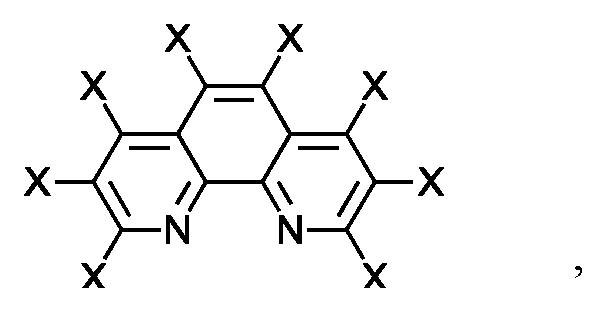


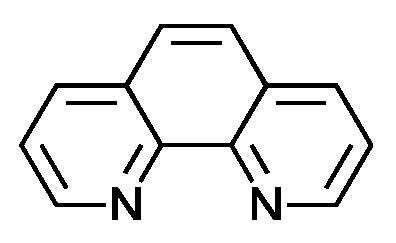


Priority Applications (4)
| Application Number | Priority Date | Filing Date | Title |
|---|---|---|---|
| DE102017115215.6A DE102017115215A1 (en) | 2017-07-07 | 2017-07-07 | EF-TU BINDING METAL-BASED ANTIBIOTIC |
| PCT/EP2018/066100 WO2019007664A1 (en) | 2017-07-07 | 2018-06-18 | EF-TU BINDING METAL-BASED ANTIBIOTIC |
| US16/629,044 US11267831B2 (en) | 2017-07-07 | 2018-06-18 | EF-Tu-binding metal-containing antibiotic |
| EP18733554.2A EP3649140A1 (en) | 2017-07-07 | 2018-06-18 | Ef-tu-binding antibiotic containing metal |
Applications Claiming Priority (1)
| Application Number | Priority Date | Filing Date | Title |
|---|---|---|---|
| DE102017115215.6A DE102017115215A1 (en) | 2017-07-07 | 2017-07-07 | EF-TU BINDING METAL-BASED ANTIBIOTIC |
Publications (1)
| Publication Number | Publication Date |
|---|---|
| DE102017115215A1 true DE102017115215A1 (en) | 2019-01-10 |
Family
ID=62712976
Family Applications (1)
| Application Number | Title | Priority Date | Filing Date |
|---|---|---|---|
| DE102017115215.6A Withdrawn DE102017115215A1 (en) | 2017-07-07 | 2017-07-07 | EF-TU BINDING METAL-BASED ANTIBIOTIC |
Country Status (4)
| Country | Link |
|---|---|
| US (1) | US11267831B2 (en) |
| EP (1) | EP3649140A1 (en) |
| DE (1) | DE102017115215A1 (en) |
| WO (1) | WO2019007664A1 (en) |
Citations (7)
| Publication number | Priority date | Publication date | Assignee | Title |
|---|---|---|---|---|
| WO1986002077A1 (en) | 1984-10-02 | 1986-04-10 | Meade Harry M | Production of streptavidin-like polypeptides |
| WO1996024606A1 (en) | 1995-02-09 | 1996-08-15 | University Of Washington | Modified-affinity streptavidin |
| DE19641876A1 (en) | 1996-10-10 | 1998-04-16 | Inst Bioanalytik Gmbh | Streptavidin muteins |
| WO1998040396A1 (en) | 1997-03-14 | 1998-09-17 | Trustees Of Boston University | Multiflavor streptavidin |
| US6022951A (en) | 1995-04-11 | 2000-02-08 | Univ Boston | Streptavidin mutants |
| EP2226329B1 (en) | 2009-03-02 | 2013-07-10 | Ruhr-Universität Bochum | Metal-containing platensimycin analogues |
| EP2109669B1 (en) * | 2006-11-15 | 2015-01-07 | Life Technologies AS | Methods for reversibly binding a biotin compound to a support |
-
2017
- 2017-07-07 DE DE102017115215.6A patent/DE102017115215A1/en not_active Withdrawn
-
2018
- 2018-06-18 EP EP18733554.2A patent/EP3649140A1/en not_active Withdrawn
- 2018-06-18 WO PCT/EP2018/066100 patent/WO2019007664A1/en not_active Ceased
- 2018-06-18 US US16/629,044 patent/US11267831B2/en active Active
Patent Citations (7)
| Publication number | Priority date | Publication date | Assignee | Title |
|---|---|---|---|---|
| WO1986002077A1 (en) | 1984-10-02 | 1986-04-10 | Meade Harry M | Production of streptavidin-like polypeptides |
| WO1996024606A1 (en) | 1995-02-09 | 1996-08-15 | University Of Washington | Modified-affinity streptavidin |
| US6022951A (en) | 1995-04-11 | 2000-02-08 | Univ Boston | Streptavidin mutants |
| DE19641876A1 (en) | 1996-10-10 | 1998-04-16 | Inst Bioanalytik Gmbh | Streptavidin muteins |
| WO1998040396A1 (en) | 1997-03-14 | 1998-09-17 | Trustees Of Boston University | Multiflavor streptavidin |
| EP2109669B1 (en) * | 2006-11-15 | 2015-01-07 | Life Technologies AS | Methods for reversibly binding a biotin compound to a support |
| EP2226329B1 (en) | 2009-03-02 | 2013-07-10 | Ruhr-Universität Bochum | Metal-containing platensimycin analogues |
Non-Patent Citations (48)
| Title |
|---|
| A. Flores-Figueroa, O. Kaufhold, K. O. Feldmann and F. E. Hahn, Dalton Trans., 2009, 9334-9342 |
| A. J. Huckaba, E. A. Sharpe and J. H. Delcamp, Inorg. Chem., 2016, 55, 682-690 |
| A. Leonidova and G. Gasser, ACS Chem. Biol. 2014, 9, 2180-2193 |
| A. W.-Y. Cheung, L. T.-L. Lo, C.-C. Ko and S.-M. Yiu, Inorg. Chem., 2011, 50, 4798-4810 |
| C. Hille and F. E. Kuhn, Dalton Trans. 2016, 45, 15-31 |
| C. Y. Chan and P. J. Barnard, Dalton Trans., 2015, 44, 19126-19140 |
| C.-C. Ko, C.-O. Ng and S.-M. Yiu, Organometallics, 2012, 31, 7074-7084 |
| C.-H. Chen, Y.-H. Liu, S.-M. Peng, J.-T. Chen and S.-T. Liu, Dalton Trans., 2012, 41, 2747-2754. |
| C.-O. Ng, S.-M. Yiu and C.-H. Ko, Inorg Chem., 2014, 53, 3022-3031 |
| C.-Y. Liu, D.-Y. Chen, G.-H. Lee, S.-M. Peng and S.-T. Liu, Organometallics, 1996, 15, 1055-1061 |
| CETINKAYA, Bekir [et al.]: Antimicrobial Activity of Carbene Complexes of Rhodium(I) and Ruthemnium(I). In: Arzneimittel-Forschung/Drug Research 1996, Bd. 46, Nr. ( S. 821-823. * |
| CHEN, Chang-Hung [u.a.]: Synthesis of N-heterocyclic carbene rhenium(I) carbonyl complexes. In: Dalton Transactions. 2012, Bd. 41, H. 9, S. 2747-2754. ISSN 1477-9234 (e); 1477-9226 (p). DOI: 10.1039/C2DT11974A. URL: http://pubs.rsc.org/en/content/articlepdf/2012/dt/c2dt11974a?page=search [abgerufen am 2018-01-19]. Bibliographieinformationen ermittelt über: http://pubs.rsc.org/en/content/articlelanding/2012/dt/c2dt11974a#!divAbstract [abgerufen am 2018-01-19]. * |
| D. Canella, S. J. Hock, O. Hiltner, E. Herdtweck, W. A. Herrmann and F. E. Kuhn, Dalton Trans., 2012, 41, 2110-2121 |
| F. E. Hahn and M. C. Jahnke, Angew. Chem. Int. Ed. 2008, 47, 3122-3172 |
| F. E. Hahn, V. Langenhahn, N. Meier, T. Lugger and W. P. Fehlhammer, Chem. Eur. J., 2003, 9(3), 704-712 |
| H. Wolf, G. Chinali and A. Parmeggiani, European Journal of Biochemistry 75, 67-75 (1977 |
| HAHN, F. Ekkehardt [u.a.]: Template synthesis of benzannulated N-heterocyclic carbene ligands. In: Chemistry - A European Journal. 2003, Bd. 9, H. 3, S. 704-712. ISSN 1521-3765 (e); 0947-6539 (p). DOI: 10.1002/chem.200390079. URL: http://onlinelibrary.wiley.com/doi/10.1002/chem.200390079/epdf [abgerufen am 2018-01-23]. Bibliographieinformationen ermittelt über: http://onlinelibrary.wiley.com/doi/10.1002/chem.200390079/full [abgerufen am 2018-01-23]. * |
| J. E. Bandow et al. Antimicrobial Agents and Chemotherapy 47, 948-955 (2003) |
| J. N. Y. Chan et al, 2012, Mol Cell Proteomics |
| K. K.-W. Lo, K. Y. Zhang and S. P.-Y. Li, Eur. J. Inorg. Chem. 2011, 3551-3568 |
| K. M. Hindi, M. J. Panzner, C. A. Tessier, C. L. Cannon and W.J. Youngs, Chem. Rev. 2009, 109, 3859-3884 |
| KALOGLU, Nazan [et al.]: Synthesis and antimicrobial activity of bulky 3,5‐di‐tert‐butyl substituent‐containing silver–N‐heterocyclic carbene complexes. In: Appl. Organometal Chem. 2017; 31: e3803. https://doi.org/10.1002/aoc.3803 * |
| L. A. Casson, S. Muzzioli, P. Raiteri, B. W. Skelton, S. Stagni, M. Massi and D. H. Brown, Dalton Trans., 2011, 40, 11960-11967 |
| L. Oehninger, R. Rubbiani and I. Ott, Dalton Trans., 2013, 42, 3269-3284 |
| LECINA, Joan [et al.]: New rhenium complexes with ciprofloxacin as useful models for understanding the properties of [99mTc]-ciprofloxacin radiopharmaceutical. In: Bioorganic & Medicinal Chemistry 2014, Vol. 22, S. 3262 - 3269. * |
| LO, Kenneth Kam-Wing ; HUI, Wai-Ki: Design of rhenium(I) polypyridine biotin complexes as a new class of luminescent probes for avidin. In: Inorganic Chemistry, Vol. 44, 2005, No. 6, S. 1992-2002. - ISSN 0020-1669 * |
| M. A. Huertos, J. Perez, L. Riera, J. Diaz and R. Lopez, Chem. Eur. J., 2010, 16, 8495-8507 |
| M. C. Jahnke and F. E. Hahn, Chem. Lett., 2015, 44, 226-237 |
| M. J. Pucci et al. Antimicrobial Agents and Chemotherapy 48, 3697-3701 (2004) |
| M. N. Hopkinson, C. Richter, M. Schedler and F. Glorius, Nature, 2014, 510, 485-496 |
| M. Patra, G. Gasser and N. Metzler-Nolte, Dalton Trans., 2012, 41, 6350-6358 |
| M. Wenzel et al. Antimicrobial Agents and Chemotherapy 55, 2590-2596 (2011) |
| M. Wenzel, M. Patra, C. H. R. Senges, I. Ott, J. J. Stepanek, A. Pinto, P. Prochnow, C. Vuong, S. Langklotz, N. Metzler-Nolte and J. E. Bandow, ACS Chem. Biol., 2013, 8(7), 1442-1450 |
| M.-L. Teyssot, A.-S. Jarrousse, M. Manin, A. Chevry, S. Roche, F. Norre, C. Beaudoin, L. Morel, D. Boyer, R. Mahiou and A. Gautier, Dalton Trans, 2009, 6894-6902 |
| O. Hiltner, E. Herdtweck, M. Drees, W. A. Herrmann and F. E. Kuhn, Eur. J. Inorg. Chem. 2009, 1825-1831 |
| P. H. Anborgh and A. Parmeggiani, The Journal of biological chemistry 268, 24622-24628 (1993) |
| R. Visbal and M. Concepcion Gimeno, Chem. Soc. Rev., 2014, 43, 3551-3574 |
| S. Diez-Gonzalez, N. Marion and S. P. Nolan, Chem. Rev., 2009, 109, 3612-3676 |
| S. J. Hock, L.-A. Schaper, A. Pothig, M. Drees, E. Herdtweck, O. Hiltner, W. A. Herrmann and F. E. Kuhn, Dalton Trans. 2014, 43, 2259-2271 |
| S. J. Hock, L.-A. Schaper, W. A. Herrmann and F. E. Kuhn, Chem. Soc. Rev. 2013, 42, 5073 |
| S. Jurgens, W. A. Herrmann and F. E. Kuhn, J. organomet. Chem., 2014, 751, 83-89 |
| T. A. Martin, C. E. Ellul, M. F. Mahon, M. E. Warren, D. Allan and M. K. Whittlesey, Organometallics, 2011, 30, 2200-2211 |
| V. Blase, T. Pape and F. E. Hahn, J. Organomet. Chem., 2011, 696, 3337-3342 |
| W. A. Herrmann, D. Mihalios, K. Ofele, P. Kiprof and F. Belmedjahed, Chem. Ber. 1992, 125, 1795-1799 |
| W.-M. Xue, M. C.-W. Chan, Z.-M. Su, K.-K. Cheung, S.-T. Liu and C.-M. Che, Organometallics, 1998, 17, 1622-1630 |
| X.-W. Li, H.-Y. Li, G.-F. Wang, F. Chen, Y.-Z. Li, X.-T. Chen, Y.-X. Zheng and Z.-L. Xue, Organometallics, 2012, 31, 3829-3835 |
| Y. Gothe, T. Marzo, L. Messori and N. Metzler-Nolte, Chem. Commun., 2015, 51(15), 3151-3153 |
| Y. Gothe, T. Marzo, L. Messori and N. Metzler-Nolte, Chem. Eur. J., 2016, 22(35), 12487-12494 |
Also Published As
| Publication number | Publication date |
|---|---|
| EP3649140A1 (en) | 2020-05-13 |
| US20200199162A1 (en) | 2020-06-25 |
| US11267831B2 (en) | 2022-03-08 |
| WO2019007664A1 (en) | 2019-01-10 |
Similar Documents
| Publication | Publication Date | Title |
|---|---|---|
| Sathyadevi et al. | Synthesis, crystal structure, electrochemistry and studies on protein binding, antioxidant and biocidal activities of Ni (II) and Co (II) hydrazone complexes | |
| Scheerder et al. | Urea-derivatized p-tert-butylcalix [4] arenes: neutral ligands for selective anion complexation | |
| DE68927886T2 (en) | TERPYRIDINE DERIVATIVES | |
| DE69522490T2 (en) | platinum complexes | |
| Tejchman et al. | Highly efficient microwave synthesis of rhodanine and 2-thiohydantoin derivatives and determination of relationships between their chemical structures and antibacterial activity | |
| CN108368143B (en) | Monomaleimide functionalized platinum compounds for cancer therapy | |
| Tan et al. | Synthesis, DNA-binding and photocleavage studies of ruthenium (II) complex with 2-(3′-phenoxyphenyl) imidazo [4, 5-f][1, 10] phenanthroline | |
| Anderson et al. | Synthesis and characterization of water-soluble, heteronuclear ruthenium (III)/ferrocene complexes and their interactions with biomolecules | |
| Chan et al. | Water-compatible fluorescent [2] rotaxanes for Au 3+ detection and bioimaging | |
| Prasad et al. | Nitric oxide releasing acridone carboxamide derivatives as reverters of doxorubicin resistance in MCF7/Dx cancer cells | |
| Blindauer et al. | Metal complexes of N, N, N′, N′-tetrakis (2-pyridylmethyl) ethylenediamine (TPEN): Variable coordination numbers and geometries | |
| Dholariya et al. | Dicoumarol complexes of Cu (II) based on 1, 10-phenanthroline: Synthesis, X-ray diffraction studies, thermal behavior and biological evaluation | |
| CN104004514A (en) | Symmetrical double-rhodamine fluorescent probe for detecting trivalent bismuth ions as well as preparation method and use thereof | |
| Gulab et al. | Synthesis, characterization and antibacterial activity of a new calcium complex using sodium 2-mercaptobenzothiazole and 1, 10-phenanthroline as ligands | |
| KR101210934B1 (en) | Fluorescence probe for selective detection of copper(ii) ion and cyanide, method for preparing the same and method for selective detection of copper(ii) ion and cyanide | |
| CN121127267A (en) | Tetraazine with improved properties | |
| Pillai et al. | Derivatives of dapsone (dap): Synthesis and study on in vitro anticancer activity and DNA laddering against Hep G2 and C6 human cancer cell lines | |
| DE69201141T2 (en) | NMDA antagonists. | |
| Yan et al. | A new dual-function fluorescent probe of Fe3+ for bioimaging and probe-Fe3+ complex for selective detection of CN− | |
| Manzano et al. | Silver complexes with fluoroanthranilic acid isomers: Spectroscopic characterization, antimycobacterial activity and cytotoxic studies over a panel of tumor cells | |
| DE102017115215A1 (en) | EF-TU BINDING METAL-BASED ANTIBIOTIC | |
| Faucon et al. | Synthesis and antibacterial properties under blue LED light of conjugates between the siderophore desferrioxamine B (DFOB) and an Iridium (III) complex | |
| DE69903974T2 (en) | ANTHRAQUINONE ANTI-CANCER MEDICINAL PRODUCTS | |
| WO2022018679A1 (en) | Naphthalene monoimide compounds and methods thereof | |
| DE102010040822B4 (en) | New imidazolium salts and carbene metal complexes based thereon for use as bioanalytical markers for biomolecules |
Legal Events
| Date | Code | Title | Description |
|---|---|---|---|
| R163 | Identified publications notified | ||
| R119 | Application deemed withdrawn, or ip right lapsed, due to non-payment of renewal fee |