[go: up one dir, main page]

DE102016104638A1 - chair - Google Patents

chair Download PDF

Info

Publication number
DE102016104638A1
DE102016104638A1 DE102016104638.8A DE102016104638A DE102016104638A1 DE 102016104638 A1 DE102016104638 A1 DE 102016104638A1 DE 102016104638 A DE102016104638 A DE 102016104638A DE 102016104638 A1 DE102016104638 A1 DE 102016104638A1
Authority
DE
Germany
Prior art keywords
support
gear
leg
carrier
seat
Prior art date
Legal status (The legal status is an assumption and is not a legal conclusion. Google has not performed a legal analysis and makes no representation as to the accuracy of the status listed.)
Withdrawn
Application number
DE102016104638.8A
Other languages
German (de)
Inventor
Burkhard Schmitz
Carola Zwick
Roland Zwick
Current Assignee (The listed assignees may be inaccurate. Google has not performed a legal analysis and makes no representation or warranty as to the accuracy of the list.)
Individual
Original Assignee
Individual
Priority date (The priority date is an assumption and is not a legal conclusion. Google has not performed a legal analysis and makes no representation as to the accuracy of the date listed.)
Filing date
Publication date
Application filed by Individual filed Critical Individual
Priority to DE102016104638.8A priority Critical patent/DE102016104638A1/en
Priority to PCT/EP2017/056001 priority patent/WO2017157943A1/en
Priority to US16/082,464 priority patent/US10624457B2/en
Publication of DE102016104638A1 publication Critical patent/DE102016104638A1/en
Withdrawn legal-status Critical Current

Links

Images

Classifications

    • AHUMAN NECESSITIES
    • A47FURNITURE; DOMESTIC ARTICLES OR APPLIANCES; COFFEE MILLS; SPICE MILLS; SUCTION CLEANERS IN GENERAL
    • A47CCHAIRS; SOFAS; BEDS
    • A47C7/00Parts, details, or accessories of chairs or stools
    • A47C7/36Supports for the head or the back
    • A47C7/40Supports for the head or the back for the back
    • A47C7/44Supports for the head or the back for the back with elastically-mounted back-rest or backrest-seat unit in the base frame
    • A47C7/441Supports for the head or the back for the back with elastically-mounted back-rest or backrest-seat unit in the base frame with adjustable elasticity
    • AHUMAN NECESSITIES
    • A47FURNITURE; DOMESTIC ARTICLES OR APPLIANCES; COFFEE MILLS; SPICE MILLS; SUCTION CLEANERS IN GENERAL
    • A47CCHAIRS; SOFAS; BEDS
    • A47C1/00Chairs adapted for special purposes
    • A47C1/02Reclining or easy chairs
    • A47C1/031Reclining or easy chairs having coupled concurrently adjustable supporting parts
    • A47C1/032Reclining or easy chairs having coupled concurrently adjustable supporting parts the parts being movably-coupled seat and back-rest
    • A47C1/03255Reclining or easy chairs having coupled concurrently adjustable supporting parts the parts being movably-coupled seat and back-rest with a central column, e.g. rocking office chairs
    • AHUMAN NECESSITIES
    • A47FURNITURE; DOMESTIC ARTICLES OR APPLIANCES; COFFEE MILLS; SPICE MILLS; SUCTION CLEANERS IN GENERAL
    • A47CCHAIRS; SOFAS; BEDS
    • A47C1/00Chairs adapted for special purposes
    • A47C1/02Reclining or easy chairs
    • A47C1/031Reclining or easy chairs having coupled concurrently adjustable supporting parts
    • A47C1/032Reclining or easy chairs having coupled concurrently adjustable supporting parts the parts being movably-coupled seat and back-rest
    • A47C1/03261Reclining or easy chairs having coupled concurrently adjustable supporting parts the parts being movably-coupled seat and back-rest characterised by elastic means
    • A47C1/03266Reclining or easy chairs having coupled concurrently adjustable supporting parts the parts being movably-coupled seat and back-rest characterised by elastic means with adjustable elasticity
    • AHUMAN NECESSITIES
    • A47FURNITURE; DOMESTIC ARTICLES OR APPLIANCES; COFFEE MILLS; SPICE MILLS; SUCTION CLEANERS IN GENERAL
    • A47CCHAIRS; SOFAS; BEDS
    • A47C1/00Chairs adapted for special purposes
    • A47C1/02Reclining or easy chairs
    • A47C1/031Reclining or easy chairs having coupled concurrently adjustable supporting parts
    • A47C1/032Reclining or easy chairs having coupled concurrently adjustable supporting parts the parts being movably-coupled seat and back-rest
    • A47C1/03261Reclining or easy chairs having coupled concurrently adjustable supporting parts the parts being movably-coupled seat and back-rest characterised by elastic means
    • A47C1/03277Reclining or easy chairs having coupled concurrently adjustable supporting parts the parts being movably-coupled seat and back-rest characterised by elastic means with bar or leaf springs
    • AHUMAN NECESSITIES
    • A47FURNITURE; DOMESTIC ARTICLES OR APPLIANCES; COFFEE MILLS; SPICE MILLS; SUCTION CLEANERS IN GENERAL
    • A47CCHAIRS; SOFAS; BEDS
    • A47C3/00Chairs characterised by structural features; Chairs or stools with rotatable or vertically-adjustable seats
    • A47C3/02Rocking chairs
    • A47C3/025Rocking chairs with seat, or seat and back-rest unit elastically or pivotally mounted in a rigid base frame
    • A47C3/026Rocking chairs with seat, or seat and back-rest unit elastically or pivotally mounted in a rigid base frame with central column, e.g. rocking office chairs; Tilting chairs
    • AHUMAN NECESSITIES
    • A47FURNITURE; DOMESTIC ARTICLES OR APPLIANCES; COFFEE MILLS; SPICE MILLS; SUCTION CLEANERS IN GENERAL
    • A47CCHAIRS; SOFAS; BEDS
    • A47C31/00Details or accessories for chairs, beds, or the like, not provided for in other groups of this subclass, e.g. upholstery fasteners, mattress protectors, stretching devices for mattress nets
    • A47C31/12Means, e.g. measuring means, for adapting chairs, beds or mattresses to the shape or weight of persons
    • A47C31/126Means, e.g. measuring means, for adapting chairs, beds or mattresses to the shape or weight of persons for chairs
    • AHUMAN NECESSITIES
    • A47FURNITURE; DOMESTIC ARTICLES OR APPLIANCES; COFFEE MILLS; SPICE MILLS; SUCTION CLEANERS IN GENERAL
    • A47CCHAIRS; SOFAS; BEDS
    • A47C7/00Parts, details, or accessories of chairs or stools
    • A47C7/36Supports for the head or the back
    • A47C7/40Supports for the head or the back for the back
    • A47C7/44Supports for the head or the back for the back with elastically-mounted back-rest or backrest-seat unit in the base frame
    • A47C7/445Supports for the head or the back for the back with elastically-mounted back-rest or backrest-seat unit in the base frame with bar or leaf springs
    • AHUMAN NECESSITIES
    • A47FURNITURE; DOMESTIC ARTICLES OR APPLIANCES; COFFEE MILLS; SPICE MILLS; SUCTION CLEANERS IN GENERAL
    • A47CCHAIRS; SOFAS; BEDS
    • A47C1/00Chairs adapted for special purposes
    • A47C1/02Reclining or easy chairs
    • A47C1/022Reclining or easy chairs having independently-adjustable supporting parts
    • A47C1/024Reclining or easy chairs having independently-adjustable supporting parts the parts, being the back-rest, or the back-rest and seat unit, having adjustable and lockable inclination

Landscapes

  • Health & Medical Sciences (AREA)
  • Dentistry (AREA)
  • General Health & Medical Sciences (AREA)
  • Chairs Characterized By Structure (AREA)

Abstract

Die Erfindung betrifft einen Stuhl (1), welcher einen Träger (6), ein Sitzelement (5), ein Rückenelement (4), ein Fußelement (3), einen Federmechanismus und eine gewichtsgesteuert arbeitende Verstelleinrichtung für den Federmechanismus umfasst.The invention relates to a chair (1) which comprises a support (6), a seat element (5), a back element (4), a foot element (3), a spring mechanism and a weight-controlled adjusting device for the spring mechanism.

Description

Die Erfindung betrifft einen Stuhl gemäß dem Oberbegriff des Anspruchs 1.The invention relates to a chair according to the preamble of claim 1.

Aus der WO 2007/110732 A2 ist ein Stuhl bekannt, welcher einen Träger, ein Sitzelement, ein Rückenelement, ein Fußelement, einen Federmechanismus und eine gewichtsgesteuert arbeitende Verstelleinrichtung für den Federmechanismus umfasst, wobei der Federmechanismus wenigstens eine einseitig in den Träger eingespannte Blattfeder und wenigstens ein zwischen wenigstens einer der Blattfedern und dem Träger auf einer Fahrbahn verfahrbares Auflager umfasst, wobei das Rückenelement und/oder das Sitzelement auf einem freien Endbereich der wenigstens einen Blattfeder abgestützt ist und wobei die Verstelleinrichtung ein Stellglied, ein Übertragungsmittel und einen das Stellglied führenden Wiegemechanik umfasst.From the WO 2007/110732 A2 a chair is known, which comprises a support, a seat element, a back element, a foot element, a spring mechanism and a weight-adjusting adjusting device for the spring mechanism, wherein the spring mechanism at least one on one side clamped in the carrier leaf spring and at least one between at least one of the leaf springs and the carrier on a roadway movable support, wherein the back element and / or the seat member is supported on a free end portion of the at least one leaf spring, and wherein the adjusting device comprises an actuator, a transmission means and the actuator leading Wiegemechanik.

Der Erfindung liegt die Aufgabe zugrunde, einen Stuhl zu entwickeln, bei welchem eine gewichtsgesteuert arbeitenden Verstelleinrichtung kompakt und flach aufgebaut ist, so dass diese optimal unter einer Sitzfläche eines Stuhls untergebracht werden kann. Weiterhin ist es Aufgabe der Erfindung durch die Verstelleinrichtung sicher zu stellen, dass auch bei einem vollständigen Zurückneigen des Rückenelements eine Verstellung einer eingestellten Abstützkraft vermieden ist.The invention has for its object to develop a chair in which a weight-controlled adjusting device is compact and flat, so that it can be optimally accommodated under a seat of a chair. Furthermore, it is an object of the invention by the adjustment to make sure that even with a full back tilting of the back element an adjustment of a set support force is avoided.

Diese Aufgabe wird ausgehend von den Merkmalen des Oberbegriffs des Anspruchs 1 durch die kennzeichnenden Merkmale des Anspruchs 1 gelöst. In den Unteransprüchen sind vorteilhafte und zweckmäßige Weiterbildungen angegeben.This object is achieved on the basis of the features of the preamble of claim 1 by the characterizing features of claim 1. In the dependent claims advantageous and expedient developments are given.

Bei dem erfindungsgemäßen Stuhl

  • – umfasst das Stellglied ein Zahnrad, wobei das Zahnrad beim Belasten und beim Entlasten des Sitzelements von der Wiegemechanik an einer ortsfest an dem Fußelement angeordneten Zahnstange verfahren wird und sich hierbei auf dieser abwälzt,
  • – wobei das Übertragungsmittel einen Kniegelenkhebel umfasst,
  • – wobei der Kniegelenkhebel einen ersten Schenkel und einen zweiten Schenkel umfasst,
  • – wobei der erste Schenkel drehfest mit dem Zahnrad verbunden ist,
  • – wobei der erste Schenkel und der zweite Schenkel in einem Gelenkpunkt drehgelenkig um eine Gelenkachse miteinander verbunden sind,
  • – wobei der zweite Schenkel mit dem Auflager verbunden ist,
  • – wobei das Auflager abhängig von einer Drehstellung des Zahnrads zwischen einer ersten, vorderen Stellung und einer zweiten, hinteren Stellung unter der wenigstens einen Blattfeder positioniert ist, so dass diese abhängig von der jeweiligen Stellung des Auflagers das Rückelement unterschiedlich stark abstützt.
Durch die Ausstattung der Verstelleinrichtung mit dem drehfest mit dem Zahnrad verbundenen ersten Schenkel, an welchem der zweite Schenkel drehgelenkig angeordnet ist, ist eine Art Schubkurbelgetriebe gebildet, durch welches ein kompakter und flacher Aufbau der Verstelleinrichtung möglich ist.In the chair of the invention
  • The actuator comprises a toothed wheel, wherein the toothed wheel is moved by the weighing mechanism on loading and unloading of the seat element at a toothed rack which is fixedly arranged on the foot element and rolls over thereon,
  • - wherein the transmission means comprises a knee lever,
  • Wherein the knee lever comprises a first leg and a second leg,
  • - Wherein the first leg is rotatably connected to the gear,
  • - Wherein the first leg and the second leg are pivotally connected to each other in a hinge point about a hinge axis,
  • - Wherein the second leg is connected to the support,
  • - Wherein the support is positioned depending on a rotational position of the gear between a first, front position and a second, rear position under the at least one leaf spring, so that depending on the respective position of the support the back element is supported differently strong.
By equipping the adjusting device with the rotatably connected to the first gear leg, on which the second leg is pivotally mounted, a kind of slider crank mechanism is formed by which a compact and flat construction of the adjustment is possible.

Zur Verhinderung einer ungewünschten Verschiebung des Auflagers ist es auch vorgesehen, dass die Blattfeder bei vollständig zurückgekipptem Rückenelement das Auflager mit einer Kraft aus seiner zweiten, hinteren Stellung in Richtung seiner ersten, vorderen Stellung schiebt, so dass über den ersten und den zweiten Schenkel ein Drehmoment auf das erste Zahnrad des Stellglieds wirkt, wobei das Drehmoment durch eine Stellung der Schenkel, welche diese in der zweiten Stellung des Auflagers einnehmen, derart gering gehalten ist, dass durch die gewichtsgesteuerte Wiegemechanik eine Rotation des ersten Zahnrads verhindert ist. Bei einer derart ausgelegen Verstelleinrichtung wird eine Verschiebung des Auflagers durch ein vollständiges Zurückkippen des Rückenelements zuverlässig vermieden, so dass die durch die Wiegemechanik bestimmte Voreinstellung der Abstützkraft erhalten bleibt, solange eine Person auf dem Stuhl sitzt.In order to prevent an undesired displacement of the support, it is also provided that the leaf spring pushes the support with a force from its second, rear position in the direction of its first, forward position with completely back tilted back element, so that on the first and the second leg torque acts on the first gear of the actuator, wherein the torque is kept so low by a position of the legs, which occupy these in the second position of the support, that is prevented by the weight-controlled weighing mechanism, a rotation of the first gear. In such a displaced adjusting a displacement of the support is reliably prevented by a complete tilting back of the back element, so that the predetermined by the weighing mechanism default setting of the support force is maintained as long as a person sits on the chair.

Es ist vorgesehen, dass die beiden Schenkel miteinander in der zweiten Stellung des Auflagers in einem Winkel < 40° stehen. Hierdurch wird verhindert, dass der mit dem Auflager verbundene Schenkel ein zu großes Drehmoment auf das Zahnrad erzeugen kann.It is envisaged that the two legs are at an angle <40 ° with each other in the second position of the support. This prevents that the legs connected to the support can generate too much torque on the gear.

Es ist auch vorgesehen, dass der erste Schenkel in der zweiten Stellung des Auflagers zu einer Bewegungsrichtung des Auflagers in einem Winkel von wenigstens 130° steht. Auch hierdurch wird verhindert, dass ein zu großes Drehmoment auf das Zahnrad erzeugen kann.It is also contemplated that the first leg is in the second position of the support to a direction of movement of the support at an angle of at least 130 °. This also prevents that can generate too much torque on the gear.

Weiterhin ist es vorgesehen, dass der erste Schenkel kürzer ist als der zweite Schenkel und dass der erste Schenkel eine Länge aufweist, welche maximal die Hälfte einer Länge des zweiten Schenkels aufweist. Hierdurch wird zum einen ein Raum, welchen der durch die Schenkel gebildete Kniehebel bei seiner Bewegung benötigt in der Höhe klein gehalten und hierdurch wird zum anderen auch eine Hebellänge, mit welcher der mit dem Auflager verbundene zweite Schenkel auf das Zahnrad wirken kann, kleine gehalten.Furthermore, it is provided that the first leg is shorter than the second leg and that the first leg has a length which has a maximum of half a length of the second leg. As a result, on the one hand, a space which the knee lever formed by the legs requires in its movement is kept small in height and, on the other hand, a lever length with which the second limb connected to the support can act on the toothed wheel is kept small.

Es ist auch vorgesehen, dass das Übertragungsmittel ein zweites Zahnrad und eine ortsfest an dem Träger ausgebildete Zahnstange umfasst,

  • – wobei das zweite Zahnrad drehbar um eine Drehachse mit einem freien Ende des zweiten Schenkels verbunden ist,
  • – wobei das zweite Zahnrad bei einer Drehbewegung des ersten Zahnrads auf der an dem Träger ausgebildeten Zahnstange abrollt und
  • – wobei das zweite Zahnrad mit dem Auflager derart verbunden ist, dass dieses in eine an dem Auflager ausgebildete Verzahnung eingreift, so dass das Auflager beim Abwälzen des Zahnrads auf der an dem Träger ausgebildeten Zahnstange mit dem Zahnrad und relativ zu dem Zahnrad verfahren wird. Durch eine derartige, indirekte Kopplung des zweiten Hebels mit dem Auflager wird eine besonders leichtgängige Bewegung des Auflagers erreicht, da dieses von dem zweiten Hebel mittels eines zwischengeschalteten, sich drehenden Zahnrads bewegt wird.
It is also contemplated that the transmission means comprises a second gear and a rack fixedly formed on the carrier,
  • Wherein the second gear is rotatably connected about a rotational axis with a free end of the second leg,
  • - Wherein the second gear rolls in a rotational movement of the first gear on the rack formed on the carrier and
  • - Wherein the second gear is connected to the support such that it engages in a toothing formed on the support, so that the support is moved when rolling the gear on the carrier formed on the rack with the gear and relative to the gear. By such, indirect coupling of the second lever with the support a particularly smooth movement of the support is achieved because it is moved by the second lever by means of an intermediate, rotating gear.

Es ist auch vorgesehen, dass der Stuhl eine Führung und eine Wiegefeder umfasst, wobei das Fußelement und der Träger durch die Führung verbunden sind und wobei der Träger über die Wiegefeder an dem Fußelement abgestützt ist. Hierdurch lässt sich das Gewicht einer sich auf die Sitzfläche des Stuhls setzenden Person einfach und schnell durch das Maß erfassen, um welches sich der Träger gegen die Kraft der Wiegefeder relativ zu dem Fußelemente des Stuhls bewegt bzw. absinkt.It is also contemplated that the chair comprises a guide and a rocker spring, wherein the foot element and the carrier are connected by the guide and wherein the carrier is supported on the foot element via the rocker spring. As a result, the weight of a person sitting on the seat of the chair can be detected simply and quickly by the amount by which the wearer moves or falls against the force of the rocker spring relative to the foot element of the chair.

Das Rückenelement und das Sitzelement bilden zusammen eine Sitzschale. Hierdurch ist es auch möglich das Rückenelement unter Zwischenschaltung des Sitzelements auf der durch das Auflager beeinflussten Blattfeder abzustützen.The back element and the seat element together form a seat shell. This makes it possible to support the back element with the interposition of the seat member on the leaf spring influenced by the support.

Es ist auch vorgesehen, den Stuhl mit einem vorderen Schwingarm und einen hinteren Schwingarm auszustatten, wobei der vordere Schwingarm schwenkbar an dem Träger angelenkt und mit dem Sitzelement verbunden ist, wobei der hintere Schwingarm schwenkbar an dem Träger angelenkt ist und mit der Sitzschale verbunden ist. Hierdurch erhält die Sitzschale bzw. erhalten das Sitzelement und das Rückenelement die für ihre Bewegung erforderlichen Freiheitsgrade.It is also contemplated to provide the chair with a front swing arm and a rear swing arm, wherein the front swing arm is pivotally coupled to the support and connected to the seat member, wherein the rear swing arm is pivotally connected to the support and is connected to the seat pan. As a result, the seat shell or receive the seat member and the back member required for their movement degrees of freedom.

Weiterhin ist es vorgesehen, dass die Blattfeder bzw. die Blattfedern jeweils mit einem ersten Endbereich an dem Träger fixiert ist bzw. sind, außerhalb des ersten Endbereichs jeweils auf dem Auflager aufliegt bzw. den Auflagern aufliegen und außerhalb des ersten Endbereichs jeweils die Sitzschale abstützt bzw. abstützen. Hierdurch ist eine Verstellung der Federkraft, mit welcher die Blattfeder bzw. die Blattfedern die Sitzschale abstützen, durch eine Verschiebung des Auflagers möglich. Im Sinne der Erfindung umfasst eine Sitzschale ein Sitzelement und ein Rückenelement. Hierbei ist es sowohl vorgesehen die Sitzschale einteilig auszubilden, so dass das Sitzelement mit dem Rückenelement durch ein Verbindungsmittel wie insbesondere wenigstens ein Verbindungsgelenk oder wenigstens ein elastisches Verbindungselement verbunden ist, als auch vorgesehen ist, dass das Sitzelement und das Rückelement nur indirekt über die Mechanikbaugruppe miteinander verbunden sind. Weitere Einzelheiten der Erfindung werden in der Zeichnung anhand von schematisch dargestellten Ausführungsbeispielen beschrieben.Furthermore, it is provided that the leaf spring or the leaf springs are respectively fixed to the support with a first end region, rest on the support outside the first end region or rest on the supports and respectively support the seat shell outside the first end region support. As a result, an adjustment of the spring force with which the leaf spring or the leaf springs support the seat, by displacement of the support possible. For the purposes of the invention, a seat shell comprises a seat element and a back element. Here, it is provided both integrally form the seat, so that the seat member is connected to the back member by a connecting means such as in particular at least one connecting joint or at least one elastic connecting element, and is provided that the seat member and the rear element only indirectly via the mechanical assembly with each other are connected. Further details of the invention are described in the drawing with reference to schematically illustrated embodiments.

Hierbei zeigt:Hereby shows:

1: eine perspektivische Seitenansicht eines erfindungsgemäßen Stuhls mit einer erfindungsgemäßen Mechanikbaugruppe; 1 FIG. 2: a perspective side view of a chair according to the invention with a mechanical assembly according to the invention; FIG.

2: eine Detailansicht der 1; 2 : a detailed view of the 1 ;

3: eine Seitenansicht der 1; 3 : a side view of the 1 ;

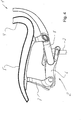
4: eine Detailansicht der 3; 4 : a detailed view of the 3 ;

5: eine perspektivische Ansicht der Mechanikbaugruppe des Stuhls; 5 a perspective view of the mechanical assembly of the chair;

6: die Darstellung der 5 bei ausgeblendeten Blattfedern; 6 : the representation of the 5 with hidden leaf springs;

7: eine Seitenansicht der 6 entsprechend der dort gezeigten Pfeilrichtung VII; 7 : a side view of the 6 in accordance with the arrow VII shown there;

8: die Darstellung der 7 bei ausgeblendeten Blattfedern; 8th : the representation of the 7 with hidden leaf springs;

9: eine geschnittene Seitenansicht der Mechanikbaugruppe; 9 a sectional side view of the mechanical assembly;

10: eine weitere perspektivische Ansicht der Mechanikbaugruppe; 10 a further perspective view of the mechanical assembly;

11: die Darstellung der 10 bei ausgeblendetem Träger und ausgeblendeter hinterem Schwingarm; 11 : the representation of the 10 with hidden carrier and hidden rear swing arm;

12 bis 14: geschnittene Seitenansichten der Mechanikbaugruppe in unbelasteter, leicht belasteter und starkbelasteter Stellung des Trägers; 12 to 14 : Sectioned side views of the mechanical assembly in unloaded, lightly loaded and heavily loaded position of the wearer;

15: eine Draufsicht auf die Mechanikbaugruppe; 15 a top view of the mechanical assembly;

16: eine Draufsicht auf die Darstellung der 15 bei herausgenommenen Blattfedern; 16 : a top view of the illustration of the 15 with removed leaf springs;

17: eine weitere perspektivische Darstellung der Mechanikbaugruppe; 17 a further perspective view of the mechanical assembly;

18 und 19: die Darstellung der 17 bei teilweise ausgeblendeten Bauteilen; 18 and 19 : the representation of the 17 with partially hidden components;

20, 21: schematische Darstellungen zur weiteren Erläuterung der in den 1 bis 19 gezeigten ersten Ausführungsvariante und 20 . 21 : schematic representations to further explain the in the 1 to 19 shown first embodiment and

22, 23, 24: geschnittene Seitenansichten einer Ausführungsvariante eines erfindungsgemäßen Stuhls bei teilweise ausgeblendeten Bauteilen in unterschiedlichen Stellungen. 22 . 23 . 24 : sectional side views of an embodiment of a chair according to the invention in partially hidden components in different positions.

In der 1 ist ein erfindungsgemäßer Stuhl 1 mit einer Mechanikbaugruppe 2 in perspektivischer Seitenansicht dargestellt. Die 2 zeigt die Mechanikbaugruppe 2. Die 3 zweigt den in der 1 dargestellten Stuhl 1 in Seitenansicht von rechts und die 4 zeigt die Mechanikbaugruppe 2 nochmals in vergrößerter Darstellung, aber aus der Seitenansicht entsprechend der 3. In den 5 bis 19 ist die aus den 1 bis 4 bekannte Mechanikbaugruppe 2 in weiteren Ansichten dargestellt, wobei zur besseren Darstellung einzelner Bauteile teilweise Bauteile ausgeblendet sind.In the 1 is a chair according to the invention 1 with a mechanical assembly 2 shown in a perspective side view. The 2 shows the mechanics assembly 2 , The 3 branches in the 1 illustrated chair 1 in side view from the right and the 4 shows the mechanics assembly 2 again in an enlarged view, but from the side view according to the 3 , In the 5 to 19 is the one from the 1 to 4 known mechanical assembly 2 shown in further views, wherein for better representation of individual components partially components are hidden.

An die Mechanikbaugruppe 2 für den Stuhl 1, wie diese insbesondere in den 1 bis 6 gezeigt ist, sind ein Fußelement 3, ein Rückenelement 4 und ein Sitzelement 5 anlenkbar. Hierbei bilden das Rückenelement 4 und das Sitzelement 5 eine Sitzschale S. Die Mechanikbaugruppe 2 umfasst einen Träger 6, einen vorderen Schwingarm 7, welcher nur in den 1 bis 4 gezeigt ist und einen hinteren Schwingarm 8, welcher ab 5 allenfalls abgeschnitten dargestellt ist.To the mechanical assembly 2 for the chair 1 like this particular in the 1 to 6 is shown are a foot element 3 , a back element 4 and a seat element 5 linkable. This form the back element 4 and the seat element 5 a seat shell S. The mechanical assembly 2 includes a carrier 6 , a front swing arm 7 , which only in the 1 to 4 is shown and a rear swing arm 8th which off 5 is shown cut off if necessary.

Der vordere Schwingarm 7 ist schwenkbar um eine Drehachse D67 an dem Träger 6 angelenkt und schwenkbar um eine Drehachse D65 mit dem Sitzelement 5 verbunden, wobei hierzu an einer rechten Seitenwand SFR6 des Trägers 6 und an einer linken Seitenwand SFL6 des Trägers 6 an dem Träger 6 Achszapfen 9, 10 ausgebildet sind, in welche der vordere Schwingarm 7 eingehängt ist (vgl. z. B. 1 bis 4). Der vordere Schwingarm 7 ist als H-artiger Bügel 11 ausgebildet (siehe insbesondere 2), welcher vier Schenkel 12, 13, 14 und 15 und eine Querverbindung 16 umfasst. Hierbei sind der erste und der zweite Schenkel 12, 13 mit dem Träger 6 verbunden und hierbei sind die Schenkel 14, 15 mit dem Sitzelement 5 verbunden.The front swing arm 7 is pivotable about a rotation axis D67 on the carrier 6 hinged and pivotable about a rotation axis D65 with the seat element 5 connected, in this case on a right side wall SFR6 of the carrier 6 and on a left side wall SFL6 of the carrier 6 on the carrier 6 journal 9 . 10 are formed, in which the front swing arm 7 is attached (see, for example, 1 to 4 ). The front swing arm 7 is as H-type strap 11 formed (see in particular 2 ), which four legs 12 . 13 . 14 and 15 and a cross connection 16 includes. Here are the first and the second leg 12 . 13 with the carrier 6 connected and here are the thighs 14 . 15 with the seat element 5 connected.

Der hintere Schwingarm 8 (siehe insbesondere 2) ist schwenkbar um eine Drehachse D68 an dem Träger 6 angelenkt und mit der Sitzschale S verbunden, wobei der Träger 6 schwenkbar um eine Drehachse D56 mit dem Sitzelement 5 verbunden ist. Hierzu sind an der rechten Seitenwand SFR6 des Trägers 5 und an der linken Seitenwand SFL6 des Trägers 6 an dem Träger 6 Achszapfen 17, 18 ausgebildet (siehe 6), in welche der hintere Schwingarm 8 eingehängt ist. Der hintere Schwingarm 8 ist wie der vordere Schwingarm 7 als H-artiger Bügel 19 ausgebildet (siehe 2 und 5), welche vier Schenkel 20, 21, 22 und 23, eine Querverbindung 24 und einen Fortsatz 25 (siehe 3) umfasst. Hierbei sind der erste und der zweite Schenkel 20, 21 mit dem Träger 6 verbunden, hierbei sind die Schenkel 22, 23 mit dem Sitzelement 5 verbunden und hierbei ist der Fortsatz 25 mit dem Rückenelement 4 verbunden, so dass der hintere Schwingarm 8 sowohl mit dem Sitzelement 5 als auch mit dem Rückenelement 4 in Verbindung steht.The rear swing arm 8th (see in particular 2 ) is pivotable about an axis of rotation D68 on the carrier 6 hinged and connected to the seat S, the carrier 6 pivotable about a rotation axis D56 with the seat element 5 connected is. For this purpose, on the right side wall SFR6 of the carrier 5 and on the left side wall SFL6 of the carrier 6 on the carrier 6 journal 17 . 18 trained (see 6 ), in which the rear swing arm 8th is mounted. The rear swing arm 8th is like the front swing arm 7 as H-type strap 19 trained (see 2 and 5 ), which four legs 20 . 21 . 22 and 23 , a cross connection 24 and an extension 25 (please refer 3 ). Here are the first and the second leg 20 . 21 with the carrier 6 connected, here are the thighs 22 . 23 with the seat element 5 connected and here is the extension 25 with the back element 4 connected so that the rear swing arm 8th both with the seat element 5 as well as with the back element 4 communicates.

Zur Kompensation eines Körpergewichts G einer nicht dargestellten, auf dem Stuhl 1 sitzenden Person umfasst die Mechanikbaugruppe 2 vier Blattfedern 26, 27, 28 und 29. Hierbei sind die inneren, einer Mittellängsachse ML nahen Blattfedern 26 und 28 als breite Blattfedern und die der Mittellängsachse ML fernen Blattfedern 27 und 29 als schmale Blattfedern ausgebildet (siehe 5). Aus der 6 ist ersichtlich, dass den schmalen Blattfedern 27 und 29 auf einem Boden 30 des Trägers 6 jeweils ein Auflage 31, 32 zugeordnet ist, welches an dem Träger 6 ausgebildet ist. Hierdurch ist die Rückstellkraft der schmalen Blattfedern 27 und 29 auf einen festen Wert festgelegt.To compensate for a body weight G one, not shown, on the chair 1 seated person includes the mechanical assembly 2 four leaf springs 26 . 27 . 28 and 29 , Here are the inner, a center longitudinal axis ML near leaf springs 26 and 28 as wide leaf springs and the middle longitudinal axis ML distant leaf springs 27 and 29 designed as narrow leaf springs (see 5 ). From the 6 it can be seen that the narrow leaf springs 27 and 29 on a floor 30 of the carrier 6 one edition each 31 . 32 is assigned, which on the carrier 6 is trained. As a result, the restoring force of the narrow leaf springs 27 and 29 set to a fixed value.

Die Mechanikbaugruppe 2 umfasst zwei verstellbare Auflager 33, 34, einen Verstellmechanismus 35 für die Auflager 33, 34 und Fahrbahnen 36, 37 für die Auflager 33, 34 (siehe insbesondere 18). Die Auflager 33, 34 sind unter Ausbildung eines Stegs 86 miteinander verbunden und in zwei parallel verlaufenden Führungen 87, 88 geführt (siehe 18). Hierdurch ist einem Verkanten bei einer Verfahrbewegung wirksam vorgebeugt. Die Fahrbahnen 36, 37 sind als in Richtung der Blattfedern 26 bzw. 28 gewölbte Flächen 36a, 37a ausgebildet. Hierbei ist die Wölbung der Fahrbahnen 36 bzw. 37 derart an die Wölbung, welche die Blattfedern 26 bzw. 28 mit ihrer Unterseite 26b bzw. 28b dann aufweisen, wenn das Rückenelement 4 in einer aufrechten, durch einen Nutzer unbelasteten Stellung steht, angepasst, dass ein radial zu der Fahrbahn 36 bzw. 37 gemessener Abstand A3626 (siehe 20) im gesamten Bewegungsraum R33 des Auflagers 33 immer etwa gleichbleibend und immer so groß ist, dass das Auflager 33 bzw. 34 ungehindert von der Blattfeder 26 bzw. 28 auf der Fahrbahn 36 bzw. 37 verschoben werden kann. Hierzu wird auf die 17 und 18 und die skizzenhaften und rein schematischen 20 und 21 verwiesen. Diese zeigen eine Querwand 38, die an der Querwand 38 befestigte Blattfeder 26 und die Fahrbahn 36. Weiterhin ist durch einen Kreis der hintere Schwingarm 8 angedeutet, welcher sich auf der Blattfeder 26 abstützt. In der Darstellung der 20 steht das Auflager 33 in einer Grundstellung G33, welche dieses einnimmt, wenn der Stuhl unbelastet ist. In der Darstellung der 31 steht das Auflager 33 in einer Endstellung E33, welche dieses einnimmt, wenn der Stuhl durch eine schwere Person belastet ist.The mechanical assembly 2 includes two adjustable supports 33 . 34 , an adjustment mechanism 35 for the supports 33 . 34 and roadways 36 . 37 for the supports 33 . 34 (see in particular 18 ). The supports 33 . 34 are under training of a footbridge 86 connected together and in two parallel guides 87 . 88 led (see 18 ). As a result, tilting during a movement is effectively prevented. The roadways 36 . 37 are as in the direction of the leaf springs 26 respectively. 28 arched areas 36a . 37a educated. Here is the curvature of the lanes 36 respectively. 37 so to the curvature, which the leaf springs 26 respectively. 28 with her bottom 26b respectively. 28b then have, if the back element 4 is in an upright, unloaded by a user position, adapted to be a radial to the roadway 36 respectively. 37 measured distance A3626 (see 20 ) in the entire movement space R33 of the support 33 always about constant and always so big that the support 33 respectively. 34 unhindered by the leaf spring 26 respectively. 28 on the roadway 36 respectively. 37 can be moved. This is on the 17 and 18 and the sketchy and purely schematic 20 and 21 directed. These show a transverse wall 38 at the cross wall 38 attached leaf spring 26 and the roadway 36 , Furthermore, by a circle of the rear swing arm 8th indicated, which itself on the leaf spring 26 supported. In the presentation of the 20 stands the support 33 in a basic position G33, which occupies this, when the chair is unloaded. In the presentation of the 31 stands the support 33 in an end position E33, which occupies this, when the chair is loaded by a heavy person.

Sowohl die inneren Blattfedern 26, 28 als auch die äußeren Blattfedern 27, 29 (siehe 5) sind mit einem ersten Endbereich 26a, 27a, 28a, 29a an der zwischen den Achszapfen 9, 10 angeordneten Querwand 38 in einer Aufnahme 39 an dem Träger 6 fixiert.Both the inner leaf springs 26 . 28 as well as the outer leaf springs 27 . 29 (please refer 5 ) are with a first end region 26a . 27a . 28a . 29a at the between the journals 9 . 10 arranged transverse wall 38 in a recording 39 on the carrier 6 fixed.

Außerhalb ihrer Endbereiche 26a, 27a, 28a, 29a liegen die Blattfeder 26, 27, 28 und 29 jeweils mit einer Unterseite 26b, 27b, 28b, 29b auf dem ihnen zugeordneten Auflager 33, 31, 34, 32 auf und stützen mit gegenüber liegenden Endbereichen 26c, 27c, 28c, 29c indirekt die Sitzschale S ab bzw. direkt den hinteren Schwingarm 8 an seinem Querverbinder 24 ab (siehe 5).Outside their end areas 26a . 27a . 28a . 29a lie the leaf spring 26 . 27 . 28 and 29 each with a bottom 26b . 27b . 28b . 29b on their assigned support 33 . 31 . 34 . 32 on and support with opposite end areas 26c . 27c . 28c . 29c indirectly the seat S from or directly the rear swing arm 8th at its cross connector 24 from (see 5 ).

Die äußeren Blattfedern 27, 29 der Mechanikbaugruppe 2 bilden weitere Federelement 40, 41. Hierbei addiert sich die elastische Rückstellkraft R40, R41 der beiden weiteren Federelement 40, 41 und die elastische Rückstellkraft R26, R28 der beiden inneren Blattfedern 26, 28 zu einer Gesamtrückstellkraft RG, welche die Sitzschale S über den Schwingarm 8 abstützt.The outer leaf springs 27 . 29 the mechanical assembly 2 form further spring element 40 . 41 , Here, the elastic restoring force R40, R41 of the two other spring element adds 40 . 41 and the elastic restoring force R26, R28 of the two inner leaf springs 26 . 28 to a total restoring force RG, which the seat S via the swing arm 8th supported.

Die zwei inneren Blattfedern 26, 28 der Mechanikbaugruppe 2 sind den verfahrbaren Auflagern 33, 34 zugeordnet, wobei jedes Auflager 33, 34 einer der Blattfedern 26, 28 zugeordnet ist und wobei die Auflager 33, 34 von dem Verstellmechanismus 35 unter den Blattfedern 26, 38 verfahrbar sind und auf ihren Fahrbahnen 36, 37 von diesem jeweils um gleiche Wegstrecken W33, W34 verfahrbar sind (siehe 6).The two inner leaf springs 26 . 28 the mechanical assembly 2 are the movable supports 33 . 34 assigned, with each support 33 . 34 one of the leaf springs 26 . 28 is assigned and where the supports 33 . 34 from the adjustment mechanism 35 under the leaf springs 26 . 38 are movable and on their lanes 36 . 37 from this by the same distances W33, W34 are movable (see 6 ).

Der Träger 6 ist indirekt mit dem Fußelement 3 verbunden, wobei die Mechanikbaugruppe 2 zusätzlich zu dem Träger 6 noch einen Flansch 42 (siehe 18), ein Gelenkmittel 43 (siehe 9) und ein Wiegemittel 44 (siehe 19) umfasst. Hierbei ist der Flansch 42 mit dem Fußelement 3 verbunden. Hierbei ist der Träger 6 über das Gelenkmittel 43 an dem Flansch 42 angelenkt und hierbei ist der Träger 6 über das Wiegemittel 44 an dem Flansch 42 abgestützt (siehe 9). Das Gelenkmittel 43 ist als Vierpunktgelenk mit vier Gelenkachsen GLA-1 bis GLA-4 ausgebildet, welches ein Absinken des Trägers 6 bei dessen Belastung durch eine sich setzende Person ermöglicht. Hierbei sinkt der Träger 6 soweit ab bis dessen Belastung durch das Wiegemittel 44, welches durch die weiteren Blattfedern bzw. Wiegefedern 49a, 49b (siehe auch 19) gebildet ist, kompensiert ist. Sobald die Person wieder aufsteht, heben die Wiegefedern 49a, 49b den Träger 6 wieder an.The carrier 6 is indirect with the foot element 3 connected, the mechanical assembly 2 in addition to the carrier 6 another flange 42 (please refer 18 ), a joint agent 43 (please refer 9 ) and a weighing medium 44 (please refer 19 ). Here is the flange 42 with the foot element 3 connected. Here is the carrier 6 via the joint agent 43 on the flange 42 hinged and here is the carrier 6 about the weighing means 44 on the flange 42 supported (see 9 ). The joint agent 43 is designed as a four-point joint with four joint axes GLA-1 to GLA-4, which is a descent of the carrier 6 allows it to be loaded by a seated person. This reduces the carrier 6 as far as until its load by the weighing means 44 , which by the other leaf springs or cradles 49a . 49b (see also 19 ) is compensated. Once the person gets up again, lift the cradles 49a . 49b the carrier 6 back to.

Der Verstellmechanismus 35 umfasst eine Wiegemechanik 45 und eine Verstellmechanik 46, wobei die Wiegemechanik 45 die Verstellmechanik 46 in Abhängigkeit von dem Körpergewicht G einer auf dem Sitzelement 5 sitzenden Person antreibt und die verfahrbaren Auflager 33, 34 von der Verstellmechanik 46 zeitgleich entsprechend dem Körpergewicht G der sitzenden Person um gleiche Wegstrecken W33, W34 entlang ihrer Fahrbahnen 36, 37 derart verschoben werden, dass die Sitzschale S in einer dem Körpergewicht G der Person entsprechenden Stärke mittels des hinteren Schwingarms 8 an dem Träger 6 abgestützt ist (siehe insbesondere auch 18). Hierzu umfasst die Verstellmechanik 46, welche von der Wiegemechanik 45 angetrieben wird, ein erstes Getriebe 47 mit einer ersten Untersetzung oder Übersetzung und ein zweites Getriebe 48 mit einer zweiten Untersetzung oder Übersetzung. Gemäß der dargestellten Ausführungsvariante sind das erste und das zweite Getriebe 47, 48 mit gleichem Übersetzungsverhältnis bzw. gleicher Untersetzung oder gleicher Übersetzung ausgebildet. Hierzu wird insbesondere auf die 18 und die unterschiedliche Stellungen zeigenden 12 bis 14 verwiesen.The adjustment mechanism 35 includes a weighing mechanism 45 and an adjustment mechanism 46 , wherein the weighing mechanism 45 the adjustment mechanism 46 depending on the body weight G on the seat element 5 seated person drives and the movable supports 33 . 34 from the adjustment mechanism 46 at the same time according to the body weight G of the seated person by equal distances W33, W34 along their lanes 36 . 37 be moved so that the seat S in a body weight G of the person corresponding strength by means of the rear swing arm 8th on the carrier 6 is supported (see in particular also 18 ). This includes the adjustment mechanism 46 Which of the weighing mechanics 45 is driven, a first transmission 47 with a first reduction or translation and a second transmission 48 with a second reduction or translation. According to the illustrated embodiment, the first and the second transmission 47 . 48 formed with the same ratio or the same reduction or the same translation. This is in particular on the 18 and showing the different positions 12 to 14 directed.

Hinsichtlich der grundsätzlichen Funktion eines Wiegemechanismus bzw. einer Wiegemechanik, bei welchem durch das Körpergewicht einer auf dem Stuhl sitzenden Person eine Einstellung der Rückstellkraft vorgenommen wird, welche der Stuhl den Bewegungen – wie z. B. dem Zurücklehnen – der Person entgegensetzt, wird grundsätzlich auf die bereits in der Beschreibungseinleitung zitierte WO 2007/110732 A2 Bezug genommen.With regard to the basic function of a weighing mechanism or a weighing mechanism in which by the body weight of a person sitting on the chair, an adjustment of the restoring force is made, which the chair movements - such. B. the reclining - opposes the person is basically cited in the description already in the introduction WO 2007/110732 A2 Referenced.

Die 12 zeigt einen Längsschnitt durch die Mechanikbaugruppe 2, wobei der Flansch 42 erkennbar ist, welcher auf dem Fußelement 3 fixiert ist. Durch das in der 9 bzw. 19 sichtbare Wiegemittel 44, welches durch die zwei weiteren Blattfeder 49a, 49b ausgebildet ist, wird der Träger 6, von welchem die nicht dargestellte Sitzschale S getragen wird, in der in der 12 gezeigten unbelasteten Stellung S6-1 gehalten. Hierbei kämmt ein drehbar an dem Träger 6 gelagertes Zahnrad 50 der Verstellmechanik 46 mit einer an dem Flansch 42 ausgebildeten Zahnstange 51 und bildet mit dieser einen Antrieb A45 für die Getriebe 47, 48. Bei einer leichten Belastung des Sitzelements 5 bzw. der Sitzschale S sinkt der Träger 6 gegen die Federkraft der Blattfedern 49a, 49b gegenüber dem Flansch 42 in die in der 13 gezeigte Stellung S6-1 ab. Das Zahnrad 50 wird beim Absinken von der Zahnstange 51 angetrieben und dreht sich gegen den Uhrzeigersinn aus einer ersten Drehstellung S50-1 (siehe 12) in eine zweite Drehstellung S50-2 (siehe 13). Über einen Gelenkhebel 52 bzw. ein Kniehebelgelenk, dessen erster Schenkel 52a starr mit dem Zahnrad 50 verbunden ist, dessen zweiter Schenkel 52b mit dem erste Schenkel 52a drehgelenkig verbunden ist und dessen zweiter Schenkel 52b an seinem freien Ende ein weiteres Zahnrad 53 drehbar lagert, erzwingt die Linksdrehung des ersten Zahnrads 50 ein leichtes Einknicken des Gelenkhebels 52. Bei diesem Einknicken wälzt sich das zweite Zahnrad 53, welches zwischen einer weiteren Zahnstange 54, die an dem Träger 6 ausgebildet ist, und einer an dem verfahrbaren Auflager 34 ausgebildeten Zahnstange 55 läuft, auf der unteren Zahnstange 54 ab. Hierbei bewegt das zweite Zahnrad 53 durch seine Rechtsdrehung und seine Positionsänderung die dritte Zahnstange 55 und damit das Auflager 34 nach rechts in Richtung des Flansches 42, so dass die dem Auflager 34 zugeordnete Blattfeder 28 eine zunehmende Unterstützung erfährt und hierdurch eine größere Rückstellkraft auf den hinteren Schwingarm 8 ausübt. In der 14 ist das Körpergewicht, welches auf das Sitzelement 5 bzw. die Sitzschale S wirkt noch größer und der Träger sinkt in die Stellung S6-3 gegenüber dem Flansch 42 ab, so dass das Auflager 34 weiter in Richtung des Flansches 42 bewegt wird.The 12 shows a longitudinal section through the mechanical assembly 2 , where the flange 42 it can be seen which on the foot element 3 is fixed. By in the 9 respectively. 19 visible weighing 44 , which by the two further leaf spring 49a . 49b is formed, becomes the carrier 6 from which the seat shell S, not shown, is worn, in which in the 12 shown unloaded position S6-1 held. Here meshes rotatably on the carrier 6 stored gear 50 the adjustment mechanism 46 with one on the flange 42 trained rack 51 and forms with this a drive A45 for the transmission 47 . 48 , For a light load of the seat element 5 or the seat S sinks the carrier 6 against the spring force of the leaf springs 49a . 49b opposite the flange 42 in the in the 13 shown position S6-1 from. The gear 50 is when sinking from the rack 51 driven and rotates counterclockwise from a first rotational position S50-1 (see 12 ) in a second rotational position S50-2 (see 13 ). About a toggle lever 52 or a toggle joint, the first leg 52a rigid with the gear 50 is connected, the second leg 52b with the first leg 52a is pivotally connected and the second leg 52b another gear at its free end 53 rotatably supports, forces the left-hand rotation of the first gear 50 a slight buckling of the articulated lever 52 , In this buckling, the second gear rolls 53 which is between another rack 54 attached to the carrier 6 is formed, and one on the movable support 34 trained rack 55 running, on the lower rack 54 from. This moves the second gear 53 by his turn to the right and his position change the third rack 55 and therefore the support 34 to the right in the direction of the flange 42 so that the support 34 associated leaf spring 28 Increasing support and thereby a greater restoring force on the rear swing arm 8th exercises. In the 14 is the body weight which is on the seat element 5 or the seat S acts even larger and the carrier sinks in the position S6-3 relative to the flange 42 off, so that the support 34 continue in the direction of the flange 42 is moved.

Das erwähnte zweite Getriebe 48 umfasst somit den Gelenkhebel 52, das zweite Zahnrad 53 und die Zahnstangen 54 und 55. Das erste Zahnrad 50 treibt – wie aus der 50 ersichtlich ist – die Gelenkhebel beider Getriebe an und ist somit Bestandteil beider Getriebe. Unterschiedliche Übersetzungsverhältnisse bzw. Untersetzungen oder Übersetzungen der Getriebe können abweichend von den Darstellungen der 1 bis 19 durch sich unabhängig voneinander bewegende und unterschiedlich ausgelegte Gelenkhebel und/oder durch unterschiedliche Auslegung der durch das jeweils zweite Zahnrad, die zugehörige Zahnstange und das zugehörige Auflager gebildeten Einheiten realisiert werden.The mentioned second transmission 48 thus includes the toggle lever 52 , the second gear 53 and the racks 54 and 55 , The first gear 50 drives - as from the 50 It can be seen - the toggle of both gearbox and is thus part of both gearbox. Different gear ratios or ratios or gear ratios may deviate from the representations of 1 to 19 be realized by independently moving and differently designed articulated levers and / or by different interpretation of the units formed by the respective second gear, the associated rack and the associated support.

Das nicht näher dargestellte erste Getriebe 47 umfasst all die erwähnten Bauteile nochmals, so dass auch das andere Auflager 33 in Abhängigkeit von der an dem Flansch 42 ausgeführten Zahnstange 51 und der hierdurch hervorgerufenen Drehbewegung des Zahnrads 50 bewegbar ist. Hierbei weisen das erste Getriebe, welches das Auflager 33 bewegt, und dass das zweite Getriebe, welches das Auflager 34 bewegt, gleiche Übersetzungsverhältnisse bzw. Untersetzungen oder Übersetzungen auf und bewegen hierdurch die Auflager 33, 34 synchron bzw. in gleichen Zeiträumen um gleiche Wegstrecken W33, W34.The first transmission, not shown 47 includes all the mentioned components again, so that the other support 33 depending on the on the flange 42 executed rack 51 and the thereby caused rotational movement of the gear 50 is movable. Here are the first gear, which the support 33 moved, and that the second gear, which is the support 34 moves, same ratios or ratios or translations and thereby move the supports 33 . 34 synchronously or in the same time periods by the same distances W33, W34.

In der 14 ist der Träger 6 – wie erwähnt – in der stark belasteten Stellung S6-3 gezeigt, in welcher das Zahnrad 50 in einer Drehstellung S50-3 steht. Entsprechend ist in dieser Drehstellung S50-3 dann auch das Auflager 34 noch weiter nach rechts in Richtung des Flansches 42 verfahren, so dass die Blattfeder 28 eine noch höhere Rückstellkraft auf den hinteren Schwingarm 8 ausübt. Der Träger 6 ist an dem Flansch 42 mittels der Gelenkmittel 43 geführt, diese sind als zwei parallel arbeitende Hebel 43a, 43b ausgeführt.In the 14 is the carrier 6 - As mentioned - shown in the heavily loaded position S6-3, in which the gear 50 in a rotational position S50-3 stands. Accordingly, in this rotational position S50-3 then the support 34 even further to the right in the direction of the flange 42 proceed so that the leaf spring 28 an even higher restoring force on the rear swing arm 8th exercises. The carrier 6 is on the flange 42 by means of the joint means 43 These are as two levers working in parallel 43a . 43b executed.

Zum Beispiel aus der 17 ist ersichtlich, dass die breite Blattfeder 26 und die schmale Blattfeder 27 sowie die breite Blattfeder 28 und die schmale Blattfeder 29, also jeweils eine zusätzlich Blattfeder mit einer verstellbaren Blattfeder in ihren ersten Endbereichen 26a, 27a bzw. 28a, 29a jeweils miteinander zu Fingerfedern 56, 57 verbunden sind und außerhalb ihres ersten Endbereichs 26a, 27a bzw. 28a, 29a, nämlich in einem Mittelbereicht 26d, 27d bzw. 28d, 29d und einem gegenüberliegenden Endbereich 26c, 27c bzw. 28c, 29c jeweils durch einen Schlitz 56a bzw. 57a getrennt sind.For example from the 17 it can be seen that the wide leaf spring 26 and the narrow leaf spring 27 as well as the wide leaf spring 28 and the narrow leaf spring 29 , So in each case an additional leaf spring with an adjustable leaf spring in their first end regions 26a . 27a respectively. 28a . 29a each with each other to finger springs 56 . 57 are connected and outside their first end region 26a . 27a respectively. 28a . 29a namely in a middle section 26d . 27d respectively. 28d . 29d and an opposite end region 26c . 27c respectively. 28c . 29c each through a slot 56a respectively. 57a are separated.

Der Träger 6 bildet zusammen mit den Blattfedern 26, 27, 28 und 29 sowie den fixen Auflagern 31, 32 und den verfahrbaren Auflagern 33, 34 einen Federmechanismus FM1. Die verfahrbaren Auflager 33, 34 werden durch eine gewichtsgesteuerte Verstelleinrichtung VE1 bewegt (siehe insbesondere 17, 18). Die Verstelleinrichtung VE1 umfasst ein Stellglied SG1, ein Übertragungsmittel UEM1 und die das Stellglied SG1 führenden Wiegemechanik 45. Hierbei ist das Stellglied SG1 durch das erste Zahnrad 50 gebildet und hierbei umfasst das Übertragungsmittel UEM1 den Gelenkhebel 52, das zweite Zahnrad 53 und die Zahnstange 55.The carrier 6 forms together with the leaf springs 26 . 27 . 28 and 29 as well as the fixed supports 31 . 32 and the movable supports 33 . 34 a spring mechanism FM1. The movable supports 33 . 34 are moved by a weight-controlled adjusting VE1 (see in particular 17 . 18 ). The adjusting device VE1 comprises an actuator SG1, a transmission means UEM1 and the weighing mechanism guiding the actuator SG1 45 , Here, the actuator SG1 through the first gear 50 formed and in this case comprises the transmission means UEM1 the toggle lever 52 , the second gear 53 and the rack 55 ,

In den 22 bis 24 ist in geschnittenen Seitenansichten auf Teile eines Stuhls 101, welcher in seinem grundsätzlichen Aufbau und in seiner grundsätzlichen Funktion dem in den 1 bis 21 beschriebenen Stuhl 1 entspricht, eine Ausführungsvariante einer in den vorhergehenden Figuren ebenfalls dargestellten Verstelleinrichtung VE101 gezeigt. Die in den 22 bis 24 nicht dargestellten Komponenten des Stuhls 101 sind entsprechend den in den 1 bis 21 dargestellten Komponenten des Stuhls 1 ausgeführt, wobei ausdrücklich auf die Beschreibung zu den 1 bis 21 Bezug genommen wird.In the 22 to 24 is in sectional side views on parts of a chair 101 , which in its basic structure and in its fundamental function that in the 1 to 21 described chair 1 corresponds, an embodiment of an adjusting device VE101 also shown in the preceding figures shown. The in the 22 to 24 not shown components of the chair 101 are according to the in the 1 to 21 illustrated components of the chair 1 expressly referring to the description of the 1 to 21 Reference is made.

In einer vergleichenden Betrachtung der 22 bis 24 ist grundsätzlich erkennbar wie ein Träger 106 gegenüber einem Fußelement 103, von welchem nur ein Kopfstück 103a bzw. ein Flansch 142 dargestellt ist, bei unterschiedlich starker Gewichtsbelastung gegenüber dem Kopfstück 103a absinkt. Das Kopfstück 103a des Fußelements 103 und der Träger 106 sind über ein als Parallelogrammgelenk 143a ausgebildetes Gelenkmittel 143 verbunden.In a comparative analysis of the 22 to 24 is basically recognizable as a carrier 106 opposite a foot element 103 of which only a head piece 103a or a flange 142 is shown at different levels of weight load against the head piece 103a decreases. The head piece 103a of the foot element 103 and the carrier 106 are about as a parallelogram joint 143a trained joint agent 143 connected.

In der 22 ist ein nicht dargestelltes Sitzelement und damit auch der Träger 106 nicht oder nur durch eine sehr leichte Person belastet. Entsprechend steht ein Auflager 134 in einer vorderen Stellung S134-1 und der Träger 106 in einer oberen Stellung S106-1 In the 22 is a not shown seat element and thus also the carrier 106 not or only by a very light person charged. Accordingly, there is a support 134 in a forward position S134-1 and the carrier 106 in an upper position S106-1

In der 23 ist das nicht dargestellte Sitzelement und damit auch der Träger 106 durch eine Person mittleren Gewichts belastet. Entsprechend ist der Träger 106 gegenüber dem Kopfstück 103a des Fußelements 103 im Vergleich zu der in der 21 gezeigten, unbelaststen Stellung S106-1 weiter abgesunken und steht in einer mittleren Stellung S106-2. Entsprechend steht auch das Auflager 134 in einer mittleren Stellung S134-2 unter einer dem Auflager 134 zugeordneten Blattfeder 126. Beim Absinken des Trägers 106 (vergleiche 22 und 23) wälzt sich ein Zahnrad 150 auf einer an dem Kopfstück 103a ausgebildeten Zahnstange 151 ab und dreht sich dabei nach links. Hierbei bewegt das Zahnrad 150 auch einen drehfest mit ihm verbundenen ersten Schenkel 152a eines Kniegelenkhebels bzw. eines Gelenkhebels 152 nach links, so dass dieser einen zweiten Schenkel 152b, mit welchem der erste Schenkel 152a in einem Gelenkpunkt 152c drehgelenkig verbunden ist, nach rechts mitnimmt. Beide Schenkel des Gelenkhebels 152 sind in den 22 bis 24 idealisiert auch als dicke Striche eingezeichnet.In the 23 is the seat element, not shown, and thus also the carrier 106 burdened by a person of medium weight. Accordingly, the carrier 106 opposite the head piece 103a of the foot element 103 compared to the one in the 21 shown, unloaded position S106-1 further dropped and is in a middle position S106-2. Accordingly, the support is also available 134 in a middle position S134-2 under one of the supports 134 associated leaf spring 126 , When descending the carrier 106 (see 22 and 23 ) rolls a gear 150 on one at the head piece 103a trained rack 151 and turns to the left. This moves the gear 150 also a rotatably connected with him first leg 152a a knee lever or a joint lever 152 to the left, leaving this a second leg 152b with which the first leg 152a in a pivot point 152c is pivotally connected, takes along to the right. Both legs of the articulated lever 152 are in the 22 to 24 idealized also drawn as thick lines.

An einem freien Ende des zweiten Schenkels 152b ist mit diesem ein zweites Zahnrad 153 drehbar um eine Drehachse d153 verbunden. Dieses zweite Zahnrad 153 rollt auf einer mit dem Träger 106 verbundenen Zahnstange 154 nach rechts, wenn der zweite Schenkel 152b von dem ersten Schenkel 152a nach rechts gezogen wird. Der Zahnstange 154 gegenüberliegend ist das Auflager 134 angeordnet, wobei dieses an einer Unterseite eines Stegs 186, welcher Bestandteil des Auflagers ist (siehe auch 18), eine zahnstangenähnliche Verzahnung bzw. eine Zahnstange 155 umfasst, mit welcher dieses auf dem zweiten Zahnrad 153 aufliegt, so dass das Auflager 134 durch das nach rechts bewegte und sich damit nach rechts drehende zweite Zahnrad 153 ebenfalls nach rechts bewegt wird.At a free end of the second leg 152b is with this a second gear 153 rotatably connected about a rotation axis d153. This second gear 153 rolls on one with the carrier 106 connected rack 154 to the right, when the second leg 152b from the first leg 152a is pulled to the right. The rack 154 opposite is the support 134 arranged, this at an underside of a web 186 , which is part of the Auflagers (see also 18 ), a rack-like toothing or a rack 155 includes, with which this on the second gear 153 rests so that the support 134 through the second gear, which moves to the right and thus turns to the right 153 is also moved to the right.

In der 24 hat sich das erste Zahnrad 150 durch die volle Belastung des Trägers 106 dann noch weiter auf der Zahnstange 151 des Kopfstücks 103a abgewälzt. Entsprechend hat sich dann auch das Auflager 134 noch weiter nach rechts in eine dritte, hintere Stellung S134-3 bewegt, welche dieses einnimmt, wenn sich eine schwere Person auf den Stuhl 101 setzt. Entsprechend ist auch der Träger 106 dann in seine tiefste Stellung S106-3 abgesunken.In the 24 has the first gear 150 by the full load of the carrier 106 then further on the rack 151 of the head piece 103a passed. Accordingly, then has the support 134 still further moved to the right in a third, rear position S134-3, which occupies this, when a heavy person on the chair 101 puts. Corresponding is also the carrier 106 then dropped to its lowest position S106-3.

In allen drei 22, 23 und 24 ist auch jeweils ein hinterer Schwingarm 108 sichtbar, wobei dieser jeweils in einer Stellung S108-3 steht, welche dieser einnimmt, wenn ein nicht gezeigtes Rückenelement bzw. die nicht gezeigte Sitzschale vollständig durch eine auf dem Stuhl 101 sitzende Person zurückgekippt ist und sich somit mit maximaler Kraft auf der Blattfeder 126 bzw. allen zur Abstützung verbauten Blattfedern abstützt. In den 23 und 24 ist erkennbar, dass durch das Zurückkippen des Rückenelements bei der Belastung des Stuhls 101 mit einer mittelschweren oder schweren Person eine starke Biegung der Blattfeder 126 hervorgerufen wird. Sofern das Auflager 134 in seiner hinteren Stellung S134-3 steht (siehe 24) wirkt die Blattfeder 126 mit einer Kraft F126 auf das Auflager 134, wobei die Kraft F126 bestrebt ist, das Auflager 134 nach links zu schieben. Entsprechend ist das zweite Zahnrad 153, welches sich auf der Zahnstange 154 des Trägers 106 abstützt, bestrebt sich nach links zu drehen und den zweiten Schenkel 152b nach links zu ziehen. Der zweite Schenkel 152b wiederum ist bestrebt das erste Zahnrad 150 mittels des ersten Schenkels 152a nach rechts zu drehen. Bedingt durch die Stellung der Schenkel 152a, 152b ist ein von der auf das Auflager 134 wirkenden Kraft F126 um eine Drehachse d150 des ersten Zahnrads 150 erzeugte Drehmoment M134 jedoch geringer als ein Gegendrehmoment M106, welches durch die Gewichtskraft des Nutzers über die Zahnstange 151, welche Bestandteil einer Wiegemechanik 145 ist, an dem ersten Zahnrad 150 anliegt.In all three 22 . 23 and 24 is also a rear swing arm 108 visible, this is in each case in a position S108-3, which this occupies, when a not shown back element or the seat shell, not shown completely through one on the chair 101 seated person is tilted back and thus with maximum force on the leaf spring 126 or supported for supporting built-leaf springs. In the 23 and 24 can be seen that by tilting back the back element in the load of the chair 101 with a medium or heavy person a strong bend of the leaf spring 126 is caused. Unless the support 134 in its rear position S134-3 stands (see 24 ) the leaf spring acts 126 with a F126 force on the support 134 with the force F126 endeavoring to support 134 to slide to the left. Accordingly, the second gear 153 which is on the rack 154 of the carrier 106 supports, strives to turn to the left and the second leg 152b to pull to the left. The second leg 152b again, the first gear is anxious 150 by means of the first leg 152a to turn right. Due to the position of the legs 152a . 152b is one of the on the support 134 acting force F126 about a rotation axis d150 of the first gear 150 torque M134, however, less than a counter torque M106, which is due to the weight of the user over the rack 151 which is part of a weighing mechanism 145 is, on the first gear 150 is applied.

Die beiden Schenkel 152a, 152b schließen in der hinteren, dritten Stellung S134-3 des Auflagers 134 miteinander einen Winkel α kleiner 40° ein. Hierbei werden zur Messung des Winkels α Verbindungsstrecken zwischen einer Drehachse d152c des Gelenkpunkts 152c und der Drehachse d150 bzw. der Drehachse d153, welche in Richtung der Schenkel 152a bzw. 152b verlaufen, betrachtet.The two thighs 152a . 152b Close in the rear, third position S134-3 of the support 134 together an angle α less than 40 °. In this case, for measuring the angle α connecting lines between a rotation axis d152c of the joint point 152c and the rotation axis d150 and the rotation axis d153, respectively, which are in the direction of the legs 152a respectively. 152b run, considered.

Weiterhin steht der erste Schenkel 152a zu einer Bewegungsrichtung R134 des Auflagers 134 in einem Winkel β von über 130°, wenn das Auflager 134 in der hinteren, dritten Stellung S134-3 steht. Der erste Schenkel 152a weist eine Länge L152a auf und der zweite Schenkel 152b weist eine Länge L152b auf. Hierbei beträgt die Länge L152b des zweiten Schenkels 152b wenigstens das Doppelte der Länge L152a des ersten Schenkels 152a. Durch die im Vergleich zum zweiten Schenkel 152b kurze Ausführung des ersten Schenkels 152a benötigt ein die beiden Schenkel 152a, 152b umfassender Kurbeltrieb KT in der Höhe gemessen wenig Bauraum, so dass dieser in dem flachen Träger 106 verbaut werden kann.Furthermore, the first leg is 152a to a direction of movement R134 of the support 134 at an angle β of over 130 ° when the support 134 in the rear third position S134-3. The first leg 152a has a length L152a and the second leg 152b has a length L152b. Here, the length L152b of the second leg 152b at least twice the length L152a of the first leg 152a , By compared to the second leg 152b short version of the first leg 152a one needs the two legs 152a . 152b comprehensive crank mechanism KT measured in height little space, leaving this in the flat support 106 can be installed.

Gemäß einer nicht dargestellten Ausführungsvariante ist es auch vorgesehen, auf die am Träger angeordnete Zahnstange, das zweite Zahnrad und die an der Unterseite des Auflagers angeordnete Verzahnung zu verzichten und den zweiten Schenkel direkt drehgelenkig mit dem Auflager zu verbinden. Hierbei gleitet das Auflager dann auf einer der Blattfeder gegenüberliegenden Fahrbahn.According to an embodiment variant, not shown, it is also provided on the arranged on the carrier rack, the second To dispense with gear and disposed on the underside of the support teeth and connect the second leg directly pivotally connected to the support. In this case, the support then slides on a roadway opposite the leaf spring.

Das verfahrbare Auflager 134 wird durch eine gewichtsgesteuerte Verstelleinrichtung VE101 bewegt. Die Verstelleinrichtung VE101 umfasst ein Stellglied SG101, ein Übertragungsmittel UEM101 und die das Stellglied SG1 führende Wiegemechanik 145. Hierbei ist das Stellglied SG101 durch das erste Zahnrad 150 gebildet und hierbei umfasst das Übertragungsmittel UEM1 den Gelenkhebel 152, das zweite Zahnrad 153 und die Zahnstange 155.The movable support 134 is moved by a weight-controlled adjusting device VE101. The adjusting device VE101 comprises an actuator SG101, a transmission means UEM101 and the weighing mechanism guiding the actuator SG1 145 , Here, the actuator SG101 is through the first gear 150 formed and in this case comprises the transmission means UEM1 the toggle lever 152 , the second gear 153 and the rack 155 ,

BezugszeichenlisteLIST OF REFERENCE NUMBERS

11
Stuhlchair
22
Mechanikbaugruppemechanics assembly
33
Fußelementfoot element
44
Rückenelementback element
55
Sitzelementseat element
66
Trägercarrier
77
vorderer Schwingarmfront swing arm
88th
hinterer Schwingarmrear swing arm
9, 109, 10
Achszapfen an 6 Axle on 6
1111
H-artiger Bügel gebildet von 7 H-type strap made of 7
12–1512-15
Schenkel von 11 Thighs of 11
1616
Querverbinder von 11 Cross connector from 11
17, 1817, 18
Achszapfen an 6 Axle on 6
1919
H-artiger Bügel gebildet von 8 H-type strap made of 8th
20–2320-23
Schenkel von 19 Thighs of 19
2424
Querverbinder von 19 Cross connector from 19
2525
Fortsatz von 19 Extension of 19
2626
breite, innere Blattfederwide, inner leaf spring
26b26b
Unterseite von 26 Bottom of 26
2727
schmale, äußere Blattfedernarrow, outer leaf spring
2828
breite, innere Blattfederwide, inner leaf spring
28b28b
Unterseite von 26 Bottom of 26
2929
schmale, äußere Blattfedernarrow, outer leaf spring
3030
Boden von 6 Ground of 6
26a–29a26a-29a
erster Endbereich von 2629 first end of 26 - 29
26b–29b26b-29b
Unterseite von 2629 Bottom of 26 - 29
26c–29c26c-29c
zweiter Endbereich von 2629 second end of 26 - 29
31, 3231, 32
Auflager für 27, 29 an 6 Support for 27 . 29 at 6
33, 3433, 34
verfahrbares Auflagermovable support
3535
Verstellmechanismusadjustment
36, 3736, 37
Fahrbahn für Auflager 33 bzw. 34 Roadway for supports 33 respectively. 34
36a36a
gewölbte Fläche gebildet durch 36 arched area formed by 36
3838
Querwand von 6 Transverse wall of 6
3939
Aufnahme an 6 für 26 bis 29 Recording on 6 For 26 to 29
4040
weiteres Federelement gebildet durch 27 further spring element formed by 27
4141
weiteres Federelement gebildet durch 29 further spring element formed by 29
4242
Flanschflange
4343
Gelenkmitteljoint center
43a, 43b43a, 43b
erster, zweiter Hebelfirst, second lever
4444
Wiegemittelweighing means
4545
Wiegemechanik von 35 Weighing mechanics of 35
4646
Verstellmechanik von 35 Adjusting mechanism of 35
4747
erstes Getriebefirst transmission
4848
zweites Getriebesecond gear
49a, 49b49a, 49b
Blattfeder/Wiegefeder bildet Wiegenmittel 44 Leaf spring / weighing spring forms weighing means 44
5050
Zahnrad von 46 gelagert an 50 Gear of 46 stored on 50
5151
Zahnstange an 42 Rack on 42
5252
Gelenkhebelarticulated lever
52a, 52b52a, 52b
erster, zweiter Schenkelfirst, second leg
5353
zweites Zahnrad an 52b second gear on 52b
5454
Zahnstange an 6 Rack on 6
5555
Zahnstange an 34 Rack on 34
5656
Fingerfeder aus 26, 27 Finger spring off 26 . 27
56a56a
Schlitz von 56 Slit of 56
5757
Fingerfeder aus 28, 29 Finger spring off 28 . 29
57a57a
Schlitz von 57 Slit of 57
8686
Stegweb
8787
Führung von 33 Leadership of 33
8888
Führung von 34 Leadership of 34
A45A45
Antriebdrive
D67D67
Schwenkachse von 6, 7 Pivot axis of 6 . 7
D65D65
erste Schwenkachse von 6, 5 first pivot axis of 6 . 5
D68D68
Schwenkachse von 6, 8 Pivot axis of 6 . 8th
D56D56
zweite Schwenkachse von 6, 5 second pivot axis of 6 . 5
E33E33
Endstellung von 33 End position of 33
GLA-1–GLA-4GLA-GLA-1-4
Gelenkachse von 43 Joint axis of 43
SFR6SFR6
rechte Seitenwand des Trägersright side wall of the carrier
SFL6SFL6
linke Seitenwand des Trägersleft side wall of the carrier
GG
Körpergewicht einer PersonBody weight of a person
G33G33
Grundstellung von 33 Basic position of 33
SS
Sitzschaleseat
R26, R28R26, R28
Rückstellkraft von 26, 28 Restoring force of 26 . 28
R33R33
Bewegungsraum von 33 Movement space of 33
R40,R40,
R41 Rückstellkraft von 40, 41 R41 restoring force of 40 . 41
RGRG
GesamtrückstellkraftTotal return force
W33W33
Wegstrecke von 33 Distance from 33
W34W34
Wegstrecke von 34 Distance from 34
S6-1S6-1
unbelastete Stellung von 6 unloaded position of 6
S6-2S6-2
leicht belastete Stellung von 6 slightly loaded position of 6
S6-3S6-3
stärker belastete Stellungmore heavily loaded position
S50-1S50-1
erste Drehstellung von 50 first rotational position of 50
S50-2S50-2
zweite Drehstellung von 50 second rotational position of 50
S50-3S50-3
dritte Drehstellung von 50 third rotational position of 50
MLML
Mittellängsachsecentral longitudinal axis
SESE
Spiegelebenemirror plane
FM1FM1
Federmechanismusspring mechanism
VE1 VE1
Verstelleinrichtungadjustment
UEM1ÜM1
Übertragungsmitteltransmission means
SG1SG1
Stellgliedactuator
101101
Stuhls 101 chair 101
103103
Fußelement 103 foot element 103
103a103a
Kopfstück 103a headpiece 103a
106106
Träger 106 carrier 106
108108
hinterer Schwingarm 108 rear swing arm 108
126126
Blattfeder 126 leaf spring 126
134134
Auflager 134 In stock 134
142142
Flansch 142 flange 142
143143
Gelenkmittel 143 verbunden.joint center 143 connected.
143a143a
Parallelogrammgelenk 143a parallelogram 143a
145145
Wiegemechanikweighing mechanics
150150
Zahnrad 150 gear 150
151151
Zahnstange 151 rack 151
152152
Kniegelenks bzw. Gelenkhebels 152 Knee joint or articulated lever 152
152a152a
ersten Schenkel 152a first leg 152a
152b152b
zweiten Schenkel 152b second leg 152b
152c152c
Gelenkpunkt 152c fulcrum 152c
153153
zweites Zahnrad 153 second gear 153
154154
Zahnstange an 106 154 Rack on 106 154
155155
Verzahnung bzw. eine Zahnstange 155 Toothing or a rack 155
αα
Winkelangle
ββ
Winkelangle
d150d150
Drehachse von 150 Rotation axis of 150
d152cd152c
Drehachse von 152c Rotation axis of 152c
d153D153
Drehachse von 153 Rotation axis of 153
F126F126
Kraftforce
FM101FM101
Federmechanismusspring mechanism
KTKT
Kurbeltriebcrankshaft
L152aL152a
Länge von 152a length of 152a
L152bL152b
Länge von 152b length of 152b
M106M106
Gegendrehmoment um d150Counter torque around d150
M134M134
Drehmoment um d150Torque around d150
R134R134
Bewegungsrichtung von 134 Movement direction of 134
S106-1S106-1
erste, obere Stellung von 106 first, upper position of 106
S106-2S106-2
zweite, mittlere Stellung von 106 second, middle position of 106
S106-3S106-3
dritte, tiefste Stellung von 106 third, lowest position of 106
S108-3S108-3
dritte Stellung von 108 third position of 108
S134-1S134-1
erste, vordere Stellung von 134 first, front position of 134
S134-2S134-2
zweite, mittlere Stellung von 134 second, middle position of 134
S134-3S134-3
dritte, hintere Stellung von 134 third, rear position of 134
SG101SG101
Stellgliedactuator
UEM101UEM101
Übertragungsmitteltransmission means
VE101VE101
Verstelleinrichtungadjustment

ZITATE ENTHALTEN IN DER BESCHREIBUNG QUOTES INCLUDE IN THE DESCRIPTION

Diese Liste der vom Anmelder aufgeführten Dokumente wurde automatisiert erzeugt und ist ausschließlich zur besseren Information des Lesers aufgenommen. Die Liste ist nicht Bestandteil der deutschen Patent- bzw. Gebrauchsmusteranmeldung. Das DPMA übernimmt keinerlei Haftung für etwaige Fehler oder Auslassungen.This list of the documents listed by the applicant has been generated automatically and is included solely for the better information of the reader. The list is not part of the German patent or utility model application. The DPMA assumes no liability for any errors or omissions.

Zitierte PatentliteraturCited patent literature

  • WO 2007/110732 A2 [0002, 0046] WO 2007/110732 A2 [0002, 0046]

Claims (10)

Stuhl (1; 101) umfassend einen Träger (6; 106), ein Sitzelement (5), ein Rückenelement (4), ein Fußelement (3; 103), einen Federmechanismus (FM1; FM101) und eine gewichtsgesteuert arbeitende Verstelleinrichtung (VE1; VE101) für den Federmechanismus (FM1; FM101), – wobei der Federmechanismus (FM1; FM101) wenigstens eine einseitig in den Träger (6; 106) eingespannte Blattfeder (26, 28; 126) und wenigstens ein zwischen wenigstens einer der Blattfedern (26, 28; 126) und dem Träger (6; 106) auf einer Fahrbahn (36, 37) verfahrbares Auflager (33, 34; 134) umfasst, – wobei das Rückenelement (4) und/oder das Sitzelement (5) auf einem freien Endbereich (26c, 28c) der wenigstens einen Blattfeder (26, 28; 126) abgestützt ist, – wobei die Verstelleinrichtung (VE1; VE101) ein Stellglied (SG1; SG101), ein Übertragungsmittel (UEM1; UEM101) und eine das Stellglied (SG1; SG101) führenden Wiegemechanik (45; 145) umfasst, dadurch gekennzeichnet, – dass das Stellglied (SG1; SG101) ein Zahnrad (50; 150) umfasst und das Stellglied (SG1; SG101) beim Belasten und beim Entlasten des Sitzelements (5) von der Wiegemechanik (45; 145) an einer ortsfest an dem Fußelement (3; 103) angeordneten Zahnstange (51; 151) verfahren wird und sich hierbei auf dieser abwälzt, – wobei das Übertragungsmittel (UEM1; UEM101) ein Kniegelenkhebel (52; 152) umfasst, – wobei der Kniegelenkhebel (52; 152) einen ersten Schenkel (52a; 152a) und einen zweiten Schenkel (52b; 152b) umfasst, – wobei der erste Schenkel (52a; 152a) drehfest mit dem Zahnrad (50; 150) verbunden ist, – wobei der erste Schenkel (52a; 152a) und der zweite Schenkel (52b; 152b) in einem Gelenkpunkt (152c) drehgelenkig um eine Gelenkachse (d152c) miteinander verbunden sind, – wobei der zweite Schenkel (52b; 152b) mit dem Auflager (33, 34; 134) verbunden ist, – wobei das Auflager (33, 34; 134) abhängig von einer Drehstellung des ersten Zahnrads (50; 150) zwischen einer ersten, vorderen Stellung (S134-1) und einer dritten, hinteren Stellung (S134-3) unter der wenigstens einen Blattfeder (26, 28; 126) positioniert ist, so dass diese abhängig von der jeweiligen Stellung des Auflagers (S134-1; S134-2; S134-3) das Rückelement (4) unterschiedlich stark abstützt.Chair ( 1 ; 101 ) comprising a support ( 6 ; 106 ), a seat element ( 5 ), a back element ( 4 ), a foot element ( 3 ; 103 ), a spring mechanism (FM1; FM101) and a weight-adjusting adjusting device (VE1; VE101) for the spring mechanism (FM1; FM101), wherein the spring mechanism (FM1; FM101) has at least one side in the carrier (FM1). 6 ; 106 ) clamped leaf spring ( 26 . 28 ; 126 ) and at least one between at least one of the leaf springs ( 26 . 28 ; 126 ) and the carrier ( 6 ; 106 ) on a roadway ( 36 . 37 ) movable support ( 33 . 34 ; 134 ), wherein the back element ( 4 ) and / or the seat element ( 5 ) on a free end region ( 26c . 28c ) of the at least one leaf spring ( 26 . 28 ; 126 wherein the adjusting device (VE1; VE101) comprises an actuator (SG1; SG101), a transmission means (UEM1; UEM101) and a weighing mechanism (SG1; SG101) guiding the actuator (SG1) 45 ; 145 ), characterized in that - the actuator (SG1; SG101) comprises a gear ( 50 ; 150 ) and the actuator (SG1; SG101) during loading and unloading of the seat element (SG1) 5 ) of the weighing mechanics ( 45 ; 145 ) at a fixed to the foot element ( 3 ; 103 ) arranged rack ( 51 ; 151 ) is moved and hereby rolls on this, - wherein the transmission means (UEM1, UEM101) a knee lever ( 52 ; 152 ), wherein the knee lever ( 52 ; 152 ) a first leg ( 52a ; 152a ) and a second leg ( 52b ; 152b ), wherein the first leg ( 52a ; 152a ) rotatably with the gear ( 50 ; 150 ), wherein the first leg ( 52a ; 152a ) and the second leg ( 52b ; 152b ) in a hinge point ( 152c ) pivotally connected about a hinge axis (d152c), - wherein the second leg ( 52b ; 152b ) with the support ( 33 . 34 ; 134 ), the support ( 33 . 34 ; 134 ) depending on a rotational position of the first gear ( 50 ; 150 ) between a first, front position (S134-1) and a third, rear position (S134-3) under the at least one leaf spring (S134-1) 26 . 28 ; 126 ) is positioned so that it depends on the respective position of the support (S134-1; S134-2; S134-3) the back element ( 4 ) is strongly supported. Stuhl nach Anspruch 1, dadurch gekennzeichnet, dass die Blattfeder (126) bei vollständig zurückgekipptem Rückenelement (4) das Auflager (134) mit einer Kraft (F126) aus seiner dritten, hinteren Stellung (S134-3) in Richtung seiner ersten, vorderen Stellung (S134-1) schiebt, so dass über den ersten und den zweiten Schenkel (152a, 152b) ein Drehmoment (M134) auf das erste Zahnrad (150) des Stellglieds (SG101) wirkt, wobei dieses Drehmoment (M134) durch eine Stellung der Schenkel (152a, 152b), welche diese in der hinteren, dritten Stellung (S134-3) des Auflagers (134) einnehmen, derart gering gehalten ist, dass durch die gewichtsgesteuerte Wiegemechanik (145) eine Rotation des ersten Zahnrads (150) verhindert ist.Chair according to claim 1, characterized in that the leaf spring ( 126 ) when the back element is completely tilted back ( 4 ) the support ( 134 ) with a force (F126) from its third, rear position (S134-3) in the direction of its first, front position (S134-1) pushes, so that over the first and the second leg (S134-1) 152a . 152b ) a torque (M134) on the first gear ( 150 ) of the actuator (SG101) acts, this torque (M134) by a position of the legs ( 152a . 152b ), which in the rear, third position (S134-3) of the support ( 134 ) is kept so small that by the weight-controlled weighing mechanism ( 145 ) a rotation of the first gear ( 150 ) is prevented. Stuhl nach wenigstens einem der vorhergehenden Ansprüche, dadurch gekennzeichnet, dass die beiden Schenkel (152a, 152b) miteinander in der hinteren, dritten Stellung (S134-3) des Auflagers (134) in einem Winkel α < 30° stehen.Chair according to at least one of the preceding claims, characterized in that the two legs ( 152a . 152b ) with each other in the rear, third position (S134-3) of the support ( 134 ) are at an angle α <30 °. Stuhl nach wenigstens einem der vorhergehenden Ansprüche, dadurch gekennzeichnet, dass der erste Schenkel (152a) in der hinteren, dritten zweiten Stellung (S134-3) des Auflagers (134) zu einer Bewegungsrichtung (R134) des Auflagers (134) in einem Winkel β von wenigstens 130° steht.Chair according to at least one of the preceding claims, characterized in that the first leg ( 152a ) in the rear, third second position (S134-3) of the support ( 134 ) to a direction of movement (R134) of the support ( 134 ) is at an angle β of at least 130 °. Stuhl nach wenigstens einem der vorhergehenden Ansprüche, dadurch gekennzeichnet, dass der erste Schenkel (152a) kürzer ist als der zweite Schenkel (152b) und dass der erste Schenkel (152a) eine Länge (L152a) aufweist, welche maximal die Hälfte einer Länge (L152b) des zweiten Schenkels (152b) aufweist.Chair according to at least one of the preceding claims, characterized in that the first leg ( 152a ) is shorter than the second leg ( 152b ) and that the first leg ( 152a ) has a length (L152a) which is at most half of a length (L152b) of the second leg (L152b) 152b ) having. Stuhl nach wenigstens einem der vorhergehenden Ansprüche, dadurch gekennzeichnet, dass das Übertragungsmittel (UEM1; UEM101) ein zweites Zahnrad (53; 153) und eine ortsfest an dem Träger (6; 106) ausgebildete Zahnstange (54; 154) umfasst, – wobei das zweite Zahnrad (53; 153) drehbar um eine Drehachse (d153) mit einem freien Ende des zweiten Schenkels (52b; 152b) verbunden ist, – wobei das zweite Zahnrad (53; 153) bei einer Drehbewegung des ersten Zahnrads (50; 150) auf der an dem Träger (6; 106) ausgebildeten Zahnstange (54; 154) abrollt und – wobei das zweite Zahnrad (53; 153) mit dem Auflager (33, 34; 134) derart verbunden ist, dass dieses in eine an dem Auflager (33, 34; 134) ausgebildete Verzahnung (55; 155) eingreift, so dass das Auflager (33, 34; 134) beim Abwälzen des zweiten Zahnrads (53; 153) auf der an dem Träger (6; 106) ausgebildeten Zahnstange (54; 154) mit dem zweiten Zahnrad (53; 153) und relativ zu dem zweiten Zahnrad (53; 153) verfahren wird.Chair according to at least one of the preceding claims, characterized in that the transmission means (UEM1; UEM101) comprises a second gear ( 53 ; 153 ) and one fixed to the carrier ( 6 ; 106 ) formed rack ( 54 ; 154 ), wherein the second gear ( 53 ; 153 ) rotatable about an axis of rotation (d153) with a free end of the second leg ( 52b ; 152b ), wherein the second gear ( 53 ; 153 ) during a rotational movement of the first gear ( 50 ; 150 ) on the on the support ( 6 ; 106 ) trained rack ( 54 ; 154 ) and - wherein the second gear ( 53 ; 153 ) with the support ( 33 . 34 ; 134 ) is connected in such a way that this in one on the support ( 33 . 34 ; 134 ) formed toothing ( 55 ; 155 ) engages, so that the support ( 33 . 34 ; 134 ) when rolling the second gear ( 53 ; 153 ) on the on the support ( 6 ; 106 ) trained rack ( 54 ; 154 ) with the second gear ( 53 ; 153 ) and relative to the second gear ( 53 ; 153 ). Stuhl nach wenigstens einem der vorhergehenden Ansprüche, dadurch gekennzeichnet, dass der Stuhl (1; 101) ein Gelenkmittel (43; 143) und eine Wiegefeder (49a, 49b) umfasst, wobei das Fußelement (3; 103) und der Träger (6; 106) durch das Gelenkmittel (43; 143) verbunden sind und wobei der Träger (6; 106) über die Wiegefeder (49a, 49b) an dem Fußelement (3; 103) abgestützt ist. Chair according to at least one of the preceding claims, characterized in that the chair ( 1 ; 101 ) a joint agent ( 43 ; 143 ) and a cradle spring ( 49a . 49b ), wherein the foot element ( 3 ; 103 ) and the carrier ( 6 ; 106 ) by the hinge agent ( 43 ; 143 ) and wherein the carrier ( 6 ; 106 ) over the cradle spring ( 49a . 49b ) on the foot element ( 3 ; 103 ) is supported. Stuhl nach wenigstens einem der vorhergehenden Ansprüche, dadurch gekennzeichnet, dass Rückenelement (4) und das Sitzelement (5) eine Sitzschale (S) bilden.Chair according to at least one of the preceding claims, characterized in that the back element ( 4 ) and the seat element ( 5 ) form a seat shell (S). Stuhl nach wenigstens einem der vorhergehenden Ansprüche, dadurch gekennzeichnet, dass der Stuhl (1; 101) einen vorderen Schwingarm (7) und eine hinteren Schwingarm (8; 108) umfasst, wobei der vordere Schwingarm (7) schwenkbar an dem Träger (6; 106) angelenkt und mit dem Sitzelement (S) verbunden ist, wobei der hintere Schwingarm (8; 108) schwenkbar an dem Träger (6; 106) angelenkt ist und mit der Sitzschale (S) verbunden ist.Chair according to at least one of the preceding claims, characterized in that the chair ( 1 ; 101 ) a front swing arm ( 7 ) and a rear swing arm ( 8th ; 108 ), wherein the front swing arm ( 7 ) pivotally on the carrier ( 6 ; 106 ) and is connected to the seat element (S), wherein the rear swing arm ( 8th ; 108 ) pivotally on the carrier ( 6 ; 106 ) is hinged and connected to the seat (S). Stuhl nach wenigstens einem der vorhergehenden Ansprüche, dadurch gekennzeichnet, dass die Blattfeder (26, 28; 126) bzw. die Blattfedern (26, 28; 126) jeweils mit einem ersten Endbereich (26a, 28a) an dem Träger (6; 106) fixiert ist bzw. sind, außerhalb des ersten Endbereichs (26a, 28a) jeweils auf dem Auflager (33, 34; 134) aufliegt bzw. den Auflagern (33, 34; 134) aufliegen und außerhalb des ersten Endbereichs (26a, 28a) jeweils die Sitzschale (S) abstützt bzw. abstützen.Chair according to at least one of the preceding claims, characterized in that the leaf spring ( 26 . 28 ; 126 ) or the leaf springs ( 26 . 28 ; 126 ) each having a first end region ( 26a . 28a ) on the carrier ( 6 ; 106 ) is fixed, outside the first end region ( 26a . 28a ) each on the support ( 33 . 34 ; 134 ) or the Auflagern ( 33 . 34 ; 134 ) and outside the first end region ( 26a . 28a ) in each case the seat (S) is supported or supported.
DE102016104638.8A 2016-03-14 2016-03-14 chair Withdrawn DE102016104638A1 (en)

Priority Applications (3)

Application Number Priority Date Filing Date Title
DE102016104638.8A DE102016104638A1 (en) 2016-03-14 2016-03-14 chair
PCT/EP2017/056001 WO2017157943A1 (en) 2016-03-14 2017-03-14 Chair
US16/082,464 US10624457B2 (en) 2016-03-14 2017-03-14 Chair

Applications Claiming Priority (1)

Application Number Priority Date Filing Date Title
DE102016104638.8A DE102016104638A1 (en) 2016-03-14 2016-03-14 chair

Publications (1)

Publication Number Publication Date
DE102016104638A1 true DE102016104638A1 (en) 2017-09-14

Family

ID=58314205

Family Applications (1)

Application Number Title Priority Date Filing Date
DE102016104638.8A Withdrawn DE102016104638A1 (en) 2016-03-14 2016-03-14 chair

Country Status (3)

Country Link
US (1) US10624457B2 (en)
DE (1) DE102016104638A1 (en)
WO (1) WO2017157943A1 (en)

Families Citing this family (16)

* Cited by examiner, † Cited by third party
Publication number Priority date Publication date Assignee Title
US11596235B2 (en) 2015-02-11 2023-03-07 Aaron DeJule Apparatus with weight responsive changeable adjusting characteristics
JP6840675B2 (en) 2015-03-14 2021-03-10 ハーマン、ミラー、インコーポレイテッドHerman Miller Incorporated A mechanical assembly for a chair and a chair with that mechanical assembly
DE102016104638A1 (en) 2016-03-14 2017-09-14 Burkhard Schmitz chair
EP3528664B1 (en) * 2016-10-18 2021-09-22 Vitra AG Synchronous chair mechanism and chair with such
WO2019204714A1 (en) * 2018-04-19 2019-10-24 Cramer Llc Chair having pliable backrest and methods for same
JP1626871S (en) * 2018-04-23 2019-03-18
ES3035683T3 (en) 2019-02-21 2025-09-08 Steelcase Inc Body support member
EP3741258B1 (en) * 2019-05-20 2025-11-05 BOCK 1 GmbH & Co. KG Chair with seat tilt mechanism
USD897708S1 (en) * 2019-06-06 2020-10-06 Asja Tobler Ergonomic ball chair
US11357329B2 (en) 2019-12-13 2022-06-14 Steelcase Inc. Body support assembly and methods for the use and assembly thereof
US11197548B2 (en) * 2019-12-16 2021-12-14 Allseating Corporation Reclining control system for a chair
IT202000002332A1 (en) * 2020-02-06 2021-08-06 Donati Spa SWINGING MECHANISM FOR A CHAIR OR ARMCHAIR
WO2021178206A1 (en) 2020-03-02 2021-09-10 Steelcase Inc. Body support assembly and methods for the use and assembly thereof
US11812870B2 (en) 2021-02-10 2023-11-14 Steelcase Inc. Body support structure
CN114165688B (en) * 2021-11-29 2023-11-21 湖北联城通科技股份有限公司 Active face recognition induction access control device
US20240315448A1 (en) 2023-03-23 2024-09-26 Fellowes, Inc. Chair tilt system with leaf spring

Citations (1)

* Cited by examiner, † Cited by third party
Publication number Priority date Publication date Assignee Title
WO2007110732A2 (en) 2006-03-24 2007-10-04 Herman Miller Inc. Piece of furniture

Family Cites Families (78)

* Cited by examiner, † Cited by third party
Publication number Priority date Publication date Assignee Title
US2818911A (en) * 1954-11-05 1958-01-07 Trumbull Dev Corp Tiltable office chair
CA806983A (en) 1965-07-23 1969-02-25 Dufton Ronald Chair tilting mechanism
US4077596A (en) * 1975-06-18 1978-03-07 Bliss & Laughlin Industries, Incorporated Low silhouette chair tilting control assembly
US4387876A (en) * 1979-05-05 1983-06-14 Advanced Products Beer-Sheva Ltd. Constant force generator mechanism and adjustable seat constructed therewith
US4479679A (en) * 1981-06-08 1984-10-30 Steelcase Inc. Body weight chair control
DE8401000U1 (en) * 1984-01-14 1984-04-05 Mauser Waldeck AG, 3544 Waldeck SWIVEL CHAIR
CH668541A5 (en) * 1986-01-07 1989-01-13 Provenda Marketing Ag WORK CHAIR, ESPECIALLY FOR USE AS OFFICE CHAIR.
US4776633A (en) * 1986-04-10 1988-10-11 Steelcase Inc. Integrated chair and control
DE3617624A1 (en) * 1986-05-26 1987-12-03 Drabert Soehne CHAIR
DE8614186U1 (en) 1986-05-26 1986-07-17 Drabert Söhne GmbH & Co, 4950 Minden chair
US4711491A (en) * 1986-06-09 1987-12-08 Jonathan Ginat Swivel tilt mechanism for chair
US4709963A (en) * 1986-12-12 1987-12-01 Milsco Manufacturing Company Adjustable office chair
DE3700447A1 (en) 1987-01-09 1988-07-21 Vogt Bueromoebel SEAT FURNITURE
US4840426A (en) * 1987-09-30 1989-06-20 Davis Furniture Industries, Inc. Office chair
US4966411A (en) * 1987-10-24 1990-10-30 Kokuyo Co., Ltd. Chair provided with a backrest
US4889385A (en) * 1988-03-09 1989-12-26 American Seating Company Chair seat-and-back support
US4911501A (en) 1989-06-09 1990-03-27 Harter Corporation Suspension mechanism for connecting chair backs and seats to a pedestal
US4892354A (en) * 1989-06-30 1990-01-09 Shepherd Products U.S., Inc. Chair seat tilt control
DE59001960D1 (en) * 1989-09-21 1993-08-19 Sitag Ag CHAIR, IN PARTICULAR WORK CHAIR.
JPH03222907A (en) 1989-11-30 1991-10-01 Itoki Kosakusho Co Ltd Elastic force regulator of desk
US5224758A (en) 1989-12-27 1993-07-06 Itoki Crebio Corporation Tilting control assembly for chair
US5029940A (en) * 1990-01-16 1991-07-09 Westinghouse Electric Corporation Chair tilt and chair height control apparatus
US5375912A (en) * 1990-08-10 1994-12-27 Stulik; Edward L. Reclining chair
US5288138A (en) * 1990-08-10 1994-02-22 Stulik Edward L Reclining chair
JP2919131B2 (en) * 1991-10-22 1999-07-12 株式会社イトーキクレビオ Chair tilt control device
DE4208648C1 (en) 1992-03-18 1993-05-27 Roeder Gmbh Sitzmoebelwerke, 6000 Frankfurt, De
US5333368A (en) * 1992-09-08 1994-08-02 Haworth, Inc. Chair control with forward tilt
IL103477A0 (en) * 1992-10-20 1993-03-15 Paltechnica Nitzanim Office and like chairs
DE4327373C2 (en) * 1993-08-14 1997-07-17 Girsberger Holding Ag Chair, especially office chair
US5511759A (en) * 1994-05-26 1996-04-30 Steelcase, Inc. Hydraulic chair height adjustment mechanism
US5551674A (en) * 1994-07-06 1996-09-03 Johnsen; Thore K. Adjustable resilient support device
US5486035A (en) * 1994-08-01 1996-01-23 Koepke; Marcus C. Occupant weight operated chair
DE4436145A1 (en) * 1994-10-11 1996-04-18 Kusch Co Sitzmoebel Seating
GB9500022D0 (en) * 1995-01-04 1995-03-01 Unwalla Jamshed Integrated seat and back and mechanism for chairs
US5765914A (en) * 1995-06-07 1998-06-16 Herman Miller, Inc. Chair with a tilt control mechanism
KR0184566B1 (en) * 1996-09-19 1999-05-15 삼성전자주식회사 How to align vertical lines when drafting a serial printer
US6085153A (en) * 1996-11-06 2000-07-04 Henry M. Jackson Foundation Differential spectral topographic analysis (DISTA)
US5909924A (en) * 1997-04-30 1999-06-08 Haworth, Inc. Tilt control for chair
US5918935A (en) * 1997-06-03 1999-07-06 Stulik; Edward L. Reclining chair
US6086153A (en) * 1997-10-24 2000-07-11 Steelcase Inc. Chair with reclineable back and adjustable energy mechanism
US6250715B1 (en) 1998-01-21 2001-06-26 Herman Miller, Inc. Chair
US6582019B2 (en) * 2000-03-17 2003-06-24 Herman Miller, Inc. Tilt assembly for a chair
AU783829B2 (en) 2000-09-28 2005-12-08 Formway Furniture Limited A reclinable chair
DE10106792A1 (en) * 2001-02-12 2002-08-14 Interstuhl Bueromoebel Gmbh seating
NL1018178C2 (en) * 2001-05-30 2002-12-03 Gio Holding B V Seating furniture.
US6811218B2 (en) * 2001-12-14 2004-11-02 Kimball International, Inc. Chair with conforming seat
US7226130B2 (en) * 2002-09-12 2007-06-05 Steelcase Development Corporation Seating with comfort surface
DE10309920A1 (en) * 2003-03-07 2004-09-16 Dauphin Entwicklungs- Und Beteiligungs-Gmbh Chair, especially office chair
US7273253B2 (en) 2004-06-09 2007-09-25 Kimball International, Inc. Chair ride mechanism with tension assembly
CA2572396C (en) 2004-07-08 2011-09-06 Knoll, Inc. Office chair
TWI260977B (en) 2005-02-05 2006-09-01 Tung Yu O A Co Ltd Chair seat with slipping function
DE202005004880U1 (en) 2005-03-26 2006-08-03 Sander, Armin Chair, especially office chair
WO2007021005A1 (en) 2005-08-18 2007-02-22 Itoki Corporation Chair
ES2322301T3 (en) 2006-10-06 2009-06-18 Stoll Giroflex Ag SYNCHRONIZED OFFICE CHAIR.
DE102006047889B4 (en) * 2006-10-10 2008-10-23 Interstuhl Büromöbel GmbH & Co. KG Seating furniture, in particular office chair
DE102007022015A1 (en) 2006-10-13 2008-04-17 Bock 1 Gmbh & Co. Kg Mechanics for an office chair
US7784870B2 (en) 2007-03-13 2010-08-31 Hni Technologies, Inc. Six bar mechanism and control for chair
US7992937B2 (en) 2007-09-20 2011-08-09 Herman Miller, Inc. Body support structure
US20100141002A1 (en) 2008-06-04 2010-06-10 Kurrasch Andrew J Biasing mechanism
CN102946762B (en) 2010-06-11 2015-12-16 株式会社冈村制作所 Chair
US8472334B2 (en) 2010-06-30 2013-06-25 Accelera Mobile Broadband, Inc. Method for self organizing network operation
US9693632B2 (en) 2012-06-01 2017-07-04 Aaron Duke Chair and chair tilt control assembly
USD697726S1 (en) * 2012-09-20 2014-01-21 Steelcase Inc. Chair
US10238215B2 (en) * 2012-09-20 2019-03-26 Steelcase Inc. Seating arrangement with headrest assembly
CN103889274A (en) 2012-10-18 2014-06-25 株式会社冈村制作所 Chair
DE102013005861A1 (en) 2013-04-08 2014-10-09 Burkhard Schmitz Mechanism assembly for a chair and chair with such a mechanical assembly
US9839292B2 (en) * 2014-04-08 2017-12-12 John Hart Miller Rotating and non-rotating reclining chairs w/tilting mechanisms
US9801471B2 (en) * 2014-04-17 2017-10-31 Hni Technologies Inc. Chair and chair control assemblies, systems, and methods
GB201412733D0 (en) * 2014-07-17 2014-09-03 Boss Design Ltd Chair
US9560917B2 (en) * 2014-11-26 2017-02-07 Steelcase Inc. Recline adjustment system for chair
US10292498B2 (en) 2015-02-11 2019-05-21 Aaron DeJule Apparatus with weight responsive changeable adjusting characteristics
JP6840675B2 (en) 2015-03-14 2021-03-10 ハーマン、ミラー、インコーポレイテッドHerman Miller Incorporated A mechanical assembly for a chair and a chair with that mechanical assembly
US10021979B2 (en) * 2016-02-22 2018-07-17 John Hart Miller Rotating and non-rotating reclining chairs with tilting mechanisms
DE102016104638A1 (en) 2016-03-14 2017-09-14 Burkhard Schmitz chair
CN205696722U (en) * 2016-03-23 2016-11-23 吴耀全 a seat base
US10213021B2 (en) * 2017-02-24 2019-02-26 Belinda Walters Mobile chair
US10485346B2 (en) * 2018-01-22 2019-11-26 Knoll, Inc. Chair tilt mechanism
US10383448B1 (en) * 2018-03-28 2019-08-20 Haworth, Inc. Forward tilt assembly for chair seat

Patent Citations (1)

* Cited by examiner, † Cited by third party
Publication number Priority date Publication date Assignee Title
WO2007110732A2 (en) 2006-03-24 2007-10-04 Herman Miller Inc. Piece of furniture

Also Published As

Publication number Publication date
US10624457B2 (en) 2020-04-21
US20190038033A1 (en) 2019-02-07
WO2017157943A1 (en) 2017-09-21

Similar Documents

Publication Publication Date Title
DE102016104638A1 (en) chair
EP3270733B1 (en) Mechanical assembly for a chair and chair with such a mechanical assembly
DE19823632C1 (en) Office chair
DE2813534C2 (en) Adjustable vehicle seat, in particular vehicle seat
EP2263909B1 (en) Seat
EP0349762A2 (en) Seat, in particular for a crewmember of an aircraft
DE102004034579A1 (en) Over-knee prosthesis with adjustable resistance knee
DE102006047889A1 (en) Seating furniture, in particular office chair
EP2106966A1 (en) Seat with ergo-mechanics
DE202014104056U1 (en) Child seat for a motor vehicle
DE202007016435U1 (en) Two furniture parts of a chair pivotally interconnecting pivot fitting
DE102011052645A1 (en) DEVICE FOR PREVENTING A ROTATION OF A SEAT FRAME FOR A VEHICLE
DE102014226645A1 (en) Adjustment mechanism for adjusting a force acting on a backrest of a chair restoring force and office chair with such adjustment mechanism
EP3996553B1 (en) Folding seat for a rail vehicle
DE2236253A1 (en) VEHICLE SEAT
DE102008024664A1 (en) Seat i.e. vehicle seat for motor vehicle, has spring provided with set of spring ends, where one of spring ends is released from actuator for rotation of seat parts from initial position depending upon rotating direction
DE102005006977B4 (en) Vehicle armrest
DE102007055082A1 (en) vehicle seat
DE102015116480B4 (en) VEHICLE SEAT ASSEMBLY, AUTOMOTIVE SEAT AND MOUNTING ASSEMBLY FOR A VEHICLE SEAT PAD
DE102004005203A1 (en) Passenger seating
DE2910448A1 (en) ADJUSTABLE SEAT BRACKET FOR A MOTOR VEHICLE
DE3116459A1 (en) Chair
DE202009009612U1 (en) chair
DE102005028351B4 (en) Automotive seat
DE102005023936A1 (en) Automotive seat forward/rearward adjustment may be coupled or de-coupled with that of the backrest inclination

Legal Events

Date Code Title Description
R005 Application deemed withdrawn due to failure to request examination