DE102015111756A1 - Recombinant Orf virus vector - Google Patents
Recombinant Orf virus vector Download PDFInfo
- Publication number
- DE102015111756A1 DE102015111756A1 DE102015111756.8A DE102015111756A DE102015111756A1 DE 102015111756 A1 DE102015111756 A1 DE 102015111756A1 DE 102015111756 A DE102015111756 A DE 102015111756A DE 102015111756 A1 DE102015111756 A1 DE 102015111756A1
- Authority
- DE
- Germany
- Prior art keywords
- orfv
- recombinant
- promoter
- fragment
- antigen
- Prior art date
- Legal status (The legal status is an assumption and is not a legal conclusion. Google has not performed a legal analysis and makes no representation as to the accuracy of the status listed.)
- Pending
Links
Images


Classifications
-
- A—HUMAN NECESSITIES
- A61—MEDICAL OR VETERINARY SCIENCE; HYGIENE
- A61K—PREPARATIONS FOR MEDICAL, DENTAL OR TOILETRY PURPOSES
- A61K39/00—Medicinal preparations containing antigens or antibodies
-
- C—CHEMISTRY; METALLURGY
- C12—BIOCHEMISTRY; BEER; SPIRITS; WINE; VINEGAR; MICROBIOLOGY; ENZYMOLOGY; MUTATION OR GENETIC ENGINEERING
- C12N—MICROORGANISMS OR ENZYMES; COMPOSITIONS THEREOF; PROPAGATING, PRESERVING, OR MAINTAINING MICROORGANISMS; MUTATION OR GENETIC ENGINEERING; CULTURE MEDIA
- C12N15/00—Mutation or genetic engineering; DNA or RNA concerning genetic engineering, vectors, e.g. plasmids, or their isolation, preparation or purification; Use of hosts therefor
- C12N15/09—Recombinant DNA-technology
- C12N15/63—Introduction of foreign genetic material using vectors; Vectors; Use of hosts therefor; Regulation of expression
- C12N15/79—Vectors or expression systems specially adapted for eukaryotic hosts
- C12N15/85—Vectors or expression systems specially adapted for eukaryotic hosts for animal cells
- C12N15/86—Viral vectors
-
- A—HUMAN NECESSITIES
- A61—MEDICAL OR VETERINARY SCIENCE; HYGIENE
- A61P—SPECIFIC THERAPEUTIC ACTIVITY OF CHEMICAL COMPOUNDS OR MEDICINAL PREPARATIONS
- A61P37/00—Drugs for immunological or allergic disorders
- A61P37/02—Immunomodulators
- A61P37/04—Immunostimulants
-
- C—CHEMISTRY; METALLURGY
- C07—ORGANIC CHEMISTRY
- C07K—PEPTIDES
- C07K14/00—Peptides having more than 20 amino acids; Gastrins; Somatostatins; Melanotropins; Derivatives thereof
- C07K14/005—Peptides having more than 20 amino acids; Gastrins; Somatostatins; Melanotropins; Derivatives thereof from viruses
-
- A—HUMAN NECESSITIES
- A61—MEDICAL OR VETERINARY SCIENCE; HYGIENE
- A61K—PREPARATIONS FOR MEDICAL, DENTAL OR TOILETRY PURPOSES
- A61K39/00—Medicinal preparations containing antigens or antibodies
- A61K2039/51—Medicinal preparations containing antigens or antibodies comprising whole cells, viruses or DNA/RNA
- A61K2039/515—Animal cells
- A61K2039/5154—Antigen presenting cells [APCs], e.g. dendritic cells or macrophages
-
- A—HUMAN NECESSITIES
- A61—MEDICAL OR VETERINARY SCIENCE; HYGIENE
- A61K—PREPARATIONS FOR MEDICAL, DENTAL OR TOILETRY PURPOSES
- A61K39/00—Medicinal preparations containing antigens or antibodies
- A61K2039/51—Medicinal preparations containing antigens or antibodies comprising whole cells, viruses or DNA/RNA
- A61K2039/53—DNA (RNA) vaccination
-
- C—CHEMISTRY; METALLURGY
- C12—BIOCHEMISTRY; BEER; SPIRITS; WINE; VINEGAR; MICROBIOLOGY; ENZYMOLOGY; MUTATION OR GENETIC ENGINEERING
- C12N—MICROORGANISMS OR ENZYMES; COMPOSITIONS THEREOF; PROPAGATING, PRESERVING, OR MAINTAINING MICROORGANISMS; MUTATION OR GENETIC ENGINEERING; CULTURE MEDIA
- C12N15/00—Mutation or genetic engineering; DNA or RNA concerning genetic engineering, vectors, e.g. plasmids, or their isolation, preparation or purification; Use of hosts therefor
- C12N15/09—Recombinant DNA-technology
- C12N15/63—Introduction of foreign genetic material using vectors; Vectors; Use of hosts therefor; Regulation of expression
- C12N15/79—Vectors or expression systems specially adapted for eukaryotic hosts
- C12N15/85—Vectors or expression systems specially adapted for eukaryotic hosts for animal cells
- C12N15/8509—Vectors or expression systems specially adapted for eukaryotic hosts for animal cells for producing genetically modified animals, e.g. transgenic
- C12N2015/8527—Vectors or expression systems specially adapted for eukaryotic hosts for animal cells for producing genetically modified animals, e.g. transgenic for producing animal models, e.g. for tests or diseases
- C12N2015/8572—Animal models for proliferative diseases, e.g. comprising an oncogene
-
- C—CHEMISTRY; METALLURGY
- C12—BIOCHEMISTRY; BEER; SPIRITS; WINE; VINEGAR; MICROBIOLOGY; ENZYMOLOGY; MUTATION OR GENETIC ENGINEERING
- C12N—MICROORGANISMS OR ENZYMES; COMPOSITIONS THEREOF; PROPAGATING, PRESERVING, OR MAINTAINING MICROORGANISMS; MUTATION OR GENETIC ENGINEERING; CULTURE MEDIA
- C12N15/00—Mutation or genetic engineering; DNA or RNA concerning genetic engineering, vectors, e.g. plasmids, or their isolation, preparation or purification; Use of hosts therefor
- C12N15/09—Recombinant DNA-technology
- C12N15/63—Introduction of foreign genetic material using vectors; Vectors; Use of hosts therefor; Regulation of expression
- C12N15/79—Vectors or expression systems specially adapted for eukaryotic hosts
- C12N15/85—Vectors or expression systems specially adapted for eukaryotic hosts for animal cells
- C12N15/8509—Vectors or expression systems specially adapted for eukaryotic hosts for animal cells for producing genetically modified animals, e.g. transgenic
- C12N2015/8527—Vectors or expression systems specially adapted for eukaryotic hosts for animal cells for producing genetically modified animals, e.g. transgenic for producing animal models, e.g. for tests or diseases
- C12N2015/8581—Animal models for infectious diseases, e.g. AIDS
-
- C—CHEMISTRY; METALLURGY
- C12—BIOCHEMISTRY; BEER; SPIRITS; WINE; VINEGAR; MICROBIOLOGY; ENZYMOLOGY; MUTATION OR GENETIC ENGINEERING
- C12N—MICROORGANISMS OR ENZYMES; COMPOSITIONS THEREOF; PROPAGATING, PRESERVING, OR MAINTAINING MICROORGANISMS; MUTATION OR GENETIC ENGINEERING; CULTURE MEDIA
- C12N2710/00—MICROORGANISMS OR ENZYMES; COMPOSITIONS THEREOF; PROPAGATING, PRESERVING, OR MAINTAINING MICROORGANISMS; MUTATION OR GENETIC ENGINEERING; CULTURE MEDIA dsDNA viruses
- C12N2710/00011—Details
- C12N2710/24011—Poxviridae
- C12N2710/24031—Uses of virus other than therapeutic or vaccine, e.g. disinfectant
-
- C—CHEMISTRY; METALLURGY
- C12—BIOCHEMISTRY; BEER; SPIRITS; WINE; VINEGAR; MICROBIOLOGY; ENZYMOLOGY; MUTATION OR GENETIC ENGINEERING
- C12N—MICROORGANISMS OR ENZYMES; COMPOSITIONS THEREOF; PROPAGATING, PRESERVING, OR MAINTAINING MICROORGANISMS; MUTATION OR GENETIC ENGINEERING; CULTURE MEDIA
- C12N2710/00—MICROORGANISMS OR ENZYMES; COMPOSITIONS THEREOF; PROPAGATING, PRESERVING, OR MAINTAINING MICROORGANISMS; MUTATION OR GENETIC ENGINEERING; CULTURE MEDIA dsDNA viruses
- C12N2710/00011—Details
- C12N2710/24011—Poxviridae
- C12N2710/24041—Use of virus, viral particle or viral elements as a vector
-
- C—CHEMISTRY; METALLURGY
- C12—BIOCHEMISTRY; BEER; SPIRITS; WINE; VINEGAR; MICROBIOLOGY; ENZYMOLOGY; MUTATION OR GENETIC ENGINEERING
- C12N—MICROORGANISMS OR ENZYMES; COMPOSITIONS THEREOF; PROPAGATING, PRESERVING, OR MAINTAINING MICROORGANISMS; MUTATION OR GENETIC ENGINEERING; CULTURE MEDIA
- C12N2710/00—MICROORGANISMS OR ENZYMES; COMPOSITIONS THEREOF; PROPAGATING, PRESERVING, OR MAINTAINING MICROORGANISMS; MUTATION OR GENETIC ENGINEERING; CULTURE MEDIA dsDNA viruses
- C12N2710/00011—Details
- C12N2710/24011—Poxviridae
- C12N2710/24211—Parapoxvirus, e.g. Orf virus
- C12N2710/24222—New viral proteins or individual genes, new structural or functional aspects of known viral proteins or genes
-
- C—CHEMISTRY; METALLURGY
- C12—BIOCHEMISTRY; BEER; SPIRITS; WINE; VINEGAR; MICROBIOLOGY; ENZYMOLOGY; MUTATION OR GENETIC ENGINEERING
- C12N—MICROORGANISMS OR ENZYMES; COMPOSITIONS THEREOF; PROPAGATING, PRESERVING, OR MAINTAINING MICROORGANISMS; MUTATION OR GENETIC ENGINEERING; CULTURE MEDIA
- C12N2710/00—MICROORGANISMS OR ENZYMES; COMPOSITIONS THEREOF; PROPAGATING, PRESERVING, OR MAINTAINING MICROORGANISMS; MUTATION OR GENETIC ENGINEERING; CULTURE MEDIA dsDNA viruses
- C12N2710/00011—Details
- C12N2710/24011—Poxviridae
- C12N2710/24211—Parapoxvirus, e.g. Orf virus
- C12N2710/24241—Use of virus, viral particle or viral elements as a vector
- C12N2710/24243—Use of virus, viral particle or viral elements as a vector viral genome or elements thereof as genetic vector
-
- C—CHEMISTRY; METALLURGY
- C12—BIOCHEMISTRY; BEER; SPIRITS; WINE; VINEGAR; MICROBIOLOGY; ENZYMOLOGY; MUTATION OR GENETIC ENGINEERING
- C12N—MICROORGANISMS OR ENZYMES; COMPOSITIONS THEREOF; PROPAGATING, PRESERVING, OR MAINTAINING MICROORGANISMS; MUTATION OR GENETIC ENGINEERING; CULTURE MEDIA
- C12N2800/00—Nucleic acids vectors
- C12N2800/10—Plasmid DNA
- C12N2800/106—Plasmid DNA for vertebrates
- C12N2800/107—Plasmid DNA for vertebrates for mammalian
-
- C—CHEMISTRY; METALLURGY
- C12—BIOCHEMISTRY; BEER; SPIRITS; WINE; VINEGAR; MICROBIOLOGY; ENZYMOLOGY; MUTATION OR GENETIC ENGINEERING
- C12N—MICROORGANISMS OR ENZYMES; COMPOSITIONS THEREOF; PROPAGATING, PRESERVING, OR MAINTAINING MICROORGANISMS; MUTATION OR GENETIC ENGINEERING; CULTURE MEDIA
- C12N2830/00—Vector systems having a special element relevant for transcription
- C12N2830/34—Vector systems having a special element relevant for transcription being a transcription initiation element
-
- C—CHEMISTRY; METALLURGY
- C12—BIOCHEMISTRY; BEER; SPIRITS; WINE; VINEGAR; MICROBIOLOGY; ENZYMOLOGY; MUTATION OR GENETIC ENGINEERING
- C12N—MICROORGANISMS OR ENZYMES; COMPOSITIONS THEREOF; PROPAGATING, PRESERVING, OR MAINTAINING MICROORGANISMS; MUTATION OR GENETIC ENGINEERING; CULTURE MEDIA
- C12N2830/00—Vector systems having a special element relevant for transcription
- C12N2830/60—Vector systems having a special element relevant for transcription from viruses
-
- C—CHEMISTRY; METALLURGY
- C12—BIOCHEMISTRY; BEER; SPIRITS; WINE; VINEGAR; MICROBIOLOGY; ENZYMOLOGY; MUTATION OR GENETIC ENGINEERING
- C12N—MICROORGANISMS OR ENZYMES; COMPOSITIONS THEREOF; PROPAGATING, PRESERVING, OR MAINTAINING MICROORGANISMS; MUTATION OR GENETIC ENGINEERING; CULTURE MEDIA
- C12N2840/00—Vectors comprising a special translation-regulating system
- C12N2840/10—Vectors comprising a special translation-regulating system regulates levels of translation
-
- Y—GENERAL TAGGING OF NEW TECHNOLOGICAL DEVELOPMENTS; GENERAL TAGGING OF CROSS-SECTIONAL TECHNOLOGIES SPANNING OVER SEVERAL SECTIONS OF THE IPC; TECHNICAL SUBJECTS COVERED BY FORMER USPC CROSS-REFERENCE ART COLLECTIONS [XRACs] AND DIGESTS
- Y02—TECHNOLOGIES OR APPLICATIONS FOR MITIGATION OR ADAPTATION AGAINST CLIMATE CHANGE
- Y02A—TECHNOLOGIES FOR ADAPTATION TO CLIMATE CHANGE
- Y02A50/00—TECHNOLOGIES FOR ADAPTATION TO CLIMATE CHANGE in human health protection, e.g. against extreme weather
- Y02A50/30—Against vector-borne diseases, e.g. mosquito-borne, fly-borne, tick-borne or waterborne diseases whose impact is exacerbated by climate change
Landscapes
- Health & Medical Sciences (AREA)
- Life Sciences & Earth Sciences (AREA)
- Genetics & Genomics (AREA)
- Chemical & Material Sciences (AREA)
- Engineering & Computer Science (AREA)
- Organic Chemistry (AREA)
- General Health & Medical Sciences (AREA)
- Immunology (AREA)
- Bioinformatics & Cheminformatics (AREA)
- Zoology (AREA)
- Biotechnology (AREA)
- Wood Science & Technology (AREA)
- General Engineering & Computer Science (AREA)
- Biomedical Technology (AREA)
- Microbiology (AREA)
- Medicinal Chemistry (AREA)
- Animal Behavior & Ethology (AREA)
- Public Health (AREA)
- Veterinary Medicine (AREA)
- Pharmacology & Pharmacy (AREA)
- Virology (AREA)
- Biochemistry (AREA)
- Molecular Biology (AREA)
- Biophysics (AREA)
- Physics & Mathematics (AREA)
- Plant Pathology (AREA)
- Epidemiology (AREA)
- Mycology (AREA)
- General Chemical & Material Sciences (AREA)
- Chemical Kinetics & Catalysis (AREA)
- Nuclear Medicine, Radiotherapy & Molecular Imaging (AREA)
- Gastroenterology & Hepatology (AREA)
- Proteomics, Peptides & Aminoacids (AREA)
- Micro-Organisms Or Cultivation Processes Thereof (AREA)
- Medicines Containing Antibodies Or Antigens For Use As Internal Diagnostic Agents (AREA)
- Medicines Containing Material From Animals Or Micro-Organisms (AREA)
- Medicines That Contain Protein Lipid Enzymes And Other Medicines (AREA)
Abstract
Die vorliegende Erfindung betrifft einen rekombinanten Orf-Virus-Vektor, eine Zelle, die den rekombinanten Orf-Virus-Vektor enthält, eine den erfindungsgemäßen rekombinanten Orf-Virus-Vektor und/oder die erfindungsgemäße Zelle enthaltende Zusammensetzung, die Verwendung des erfindungsgemäßen rekombinanten Orf-Virus-Vektors zur Herstellung von einem Fremdgen sowie ein Nukleinsäuremolekül codierend für einen Orf-Virus-Vektor-Promotor.The present invention relates to a recombinant Orf virus vector, a cell containing the recombinant Orf virus vector, a composition containing the recombinant Orf virus vector according to the invention and / or the cell according to the invention, the use of the recombinant Orf virus according to the invention. Virus vector for the production of a foreign gene and a nucleic acid molecule coding for an Orf virus vector promoter.
Description
Die vorliegende Erfindung betrifft einen rekombinanten Orf-Virus-Vektor, eine Zelle, die den rekombinanten Orf-Virus-Vektor enthält, eine den erfindungsgemäßen rekombinanten Orf-Virus-Vektor und/oder die erfindungsgemäße Zelle enthaltende Zusammensetzung, die Verwendung des erfindungsgemäßen rekombinanten Orf-Virus-Vektors zur Expression von einem Fremdgen sowie ein Nukleinsäuremolekül codierend für einen Orf-Virus-Vektor-Promotor. The present invention relates to a recombinant Orf virus vector, a cell containing the recombinant Orf virus vector, a composition containing the recombinant Orf virus vector according to the invention and / or the cell according to the invention, the use of the recombinant Orf virus according to the invention. Virus vector for expression of a foreign gene and a nucleic acid molecule coding for an Orf virus vector promoter.
Virale Vektoren werden in der Biotechnologie dafür verwendet, um genetisches Material in Zielzellen zu schleusen. Das eingeschleuste genetische Material codiert dabei häufig für Fremdgene, die der Herstellung eines rekombinanten Proteins dienen. Virale Vektoren stellen deshalb eine bedeutende Plattformtechnologie insbesondere zur Herstellung von rekombinanten Impfstoffen dar, die neben der klassischen Prävention von Infektionskrankheiten zunehmend auch zur Entwicklung von neuen, innovativen Therapiekonzepten, wie bspw. der therapeutischen Tumorimmunisierung, eingesetzt werden.Viral vectors are used in biotechnology to deliver genetic material into target cells. The introduced genetic material often codes for foreign genes that serve to produce a recombinant protein. Viral vectors therefore represent a significant platform technology, in particular for the production of recombinant vaccines, which, in addition to the classical prevention of infectious diseases, are increasingly being used to develop new, innovative therapy concepts, such as, for example, therapeutic tumor immunization.
Das Orf-Virus (ORFV) gehört zu der Familie der Pockenviren und verfügt über eine Vielzahl von Eigenschaften, welche es zur Herstellung von rekombinanten Impfstoffen interessant macht und gegenüber anderen Technologien präferiert. Es stellt den Prototyp der Gattung der Parapockenviren dar und ist der Familie der Poxviridae zuzuordnen. ORFV sind behüllte, komplexe dsDNA-Viren von wollknäuelartiger Morphologie und einer mittleren Größe von ca. 260 × 160 nm. Sie besitzen ein lineares, GC-reiches, ca. 130 bis 150 kbp großes DNA-Genom, dessen zentraler Bereich beidseitig von ITR-Regionen („inverted terminal repeats“) abgegrenzt wird und in einer Haarnadelstruktur endet, welche beide DNA-Einzelstränge kovalent miteinander verknüpft. Im zentralen Bereich des Genoms befinden sich überwiegend Gene, die hauptsächlich für die virale Replikation und Morphogenese essentiell und innerhalb der Pockenviren hochkonserviert sind. Dagegen befinden sich in den ITR-Regionen sog. nicht-konservierte Virulenzgene, welche maßgeblich das Wirtsspektrum, die Pathogenität und die Immunmodulation bestimmen und somit das Virus charakterisieren. The Orf virus (ORFV) belongs to the poxvirus family and has a number of properties that make it interesting for the production of recombinant vaccines and preferred over other technologies. It represents the prototype of the genus Parapockenviren and belongs to the family of Poxviridae. ORFV are enveloped, complex dsDNA viruses of wool-ball-like morphology and have an average size of about 260 × 160 nm. They have a linear, GC-rich, about 130-150 kbp DNA genome whose central area is on both sides of ITR- Regions ("inverted terminal repeats") is demarcated and ends in a hairpin structure, which covalently linked both DNA single strands together. In the central part of the genome are mainly genes that are essential for viral replication and morphogenesis and highly conserved within the poxviruses. In contrast, so-called non-conserved virulence genes are found in the ITR regions, which determine the host spectrum, the pathogenicity and the immunomodulation and thus characterize the virus.
Die virale Replikation ist bei Pockenviren auf das Zytoplasma restringiert und beginnt mit der Bindung des Virus an die Oberfläche der Wirtszelle. Nach der Fusion werden das sog. virale Core, ein Proteinkern, welches das virale Genom, frühe virale mRNA sowie virale Transkriptionsfaktoren (TF) beinhaltet, in das Zytoplasma freigesetzt. Nachfolgend beginnt die frühe virale Genexpression, in der unter Kontrolle von poxvirusspezifischen frühen („early“) Promotoren virale mRNA synthetisiert wird. Nach Auflösung der Core-Struktur wird die virale DNA im Zytoplasma freigesetzt. Im Gegensatz zu der Transkription von „early“-Genen, die ausschließlich unter Kontrolle viraler TF verläuft, ist die nachfolgende „intermediate“ und „late“ Gentranskription auf die Mithilfe zellulärer TF angewiesen. Somit benötigt die poxvirale Expression früher Gene, im Unterschied zur Expression von „intermediate“- und „late“-Genen, weder die Replikation viraler DNA noch eine Virusproduktion.Viral replication in poxviruses is restricted to the cytoplasm and begins with the binding of the virus to the surface of the host cell. Following fusion, the so-called viral core, a protein core that includes the viral genome, early viral mRNA and viral transcription factors (TF), is released into the cytoplasm. Subsequently, early viral gene expression begins, in which viral mRNA is synthesized under the control of pox virus-specific early promoters. After dissolution of the core structure, the viral DNA is released in the cytoplasm. In contrast to the transcription of "early" genes, which are exclusively under the control of viral TF, subsequent "intermediate" and "late" gene transcription relies on the assistance of cellular TF. Thus, poxviral expression of early genes, unlike the expression of intermediate and late genes, requires neither replication of viral DNA nor virus production.
Das ORFV zeichnet sich durch einen sehr engen natürlichen Wirtsbereich aus, der Schaf und Ziege umfasst. Infektionen erfolgen über Läsionen der Haut, die das Eindringen des Virus ermöglichen. Die Vermehrung des dermatropen Virus ist anschließend auf regenerative Keratinozyten begrenzt, wodurch eine kontagiöse Dermatitis oder Ecthyma contagiosum ausgelöst wird. Diese in der Regel mild verlaufende, selbstlimitierende Infektion manifestiert sich als lokal begrenzte Haut- bzw. Schleimhautläsion, wobei die durch die massive Infiltration polymorphkerniger Lymphozyten ausgelöste Pustelbildung hauptsächlich an Maul und Euter auftritt. Die Läsion heilt nach ca. 4 bis 6 Wochen ohne Narbenbildung ab. Ein langanhaltender Immunschutz wird trotz der starken Immunantwort nicht ausgebildet, so dass eine Reinfektion bereits nach wenigen Wochen möglich ist, wenngleich klinische Symptome und Virusproduktion deutlich vermindert sind. Eine systemische Verbreitung oder Virämie wurde für ORFV nicht beobachtet; auch nicht nach experimenteller intravenöser Injektion hoher Dosen infektiöser Viren.The ORFV is characterized by a very narrow natural host range, which includes sheep and goat. Infections are via lesions of the skin that allow the virus to enter. The proliferation of the dermatropic virus is then limited to regenerative keratinocytes, causing a contagious dermatitis or ecthyma contagiosum. This usually mild, self-limiting infection manifests as a localized cutaneous or mucosal lesion, with the pustular formation induced by the massive infiltration of polymorphonuclear lymphocytes occurring mainly on the mouth and udder. The lesion heals after 4 to 6 weeks without scarring. A long-lasting immune protection is not developed despite the strong immune response, so that a reinfection after a few weeks is possible, although clinical symptoms and virus production are significantly reduced. Systemic spread or viremia was not observed for ORFV; even after experimental intravenous injection of high doses of infectious virus.
ORFV gilt als zoonotischer Erreger und ist in seltenen Fällen über die verletzte Haut auch auf den Menschen übertragbar. Nach der Infektion kommt es zu lokal begrenzten modulären Schwellungen, die sich zumeist auf Finger und Hände beschränken, sowie vereinzelt zu Schwellungen der Lymphknoten und Fieber. Für gewöhnlich ist der Verlauf harmlos, frei von Komplikationen und heilt innerhalb von drei bis acht Wochen ohne klinische Nachwirkungen vollständig ab. Bei immunsupprimierten Personen wurden auch schwerere Infektionsverläufe beobachtet, die jedoch nach Behandlung mit Virustatika, wie Cidofovir oder Imiquimod, vollständig verheilten.ORFV is a zoonotic pathogen and in rare cases can be transmitted to the human via injured skin. After infection, there are localized, limited swellings, mostly confined to fingers and hands, and occasionally swelling of the lymph nodes and fever. Usually the course is harmless, free from complications and completely heals within three to eight weeks without clinical after-effects. In immunocompromised individuals, more severe courses of infection were also observed, which, however, after treatment with antivirals such as cidofovir or imiquimod, completely healed.
ORFV ist für die Herstellung von rekombinanten Impfstoffen interessant. Im Vergleich zu Orthopockenviren zeichnet sich ORFV durch einen sehr engen natürlichen Wirtstropismus aus, der Schaf und Ziege umfasst. Damit kann im Menschen eine durch eine natürliche Infektion verursachte, inhibierende "Präimmunität" gegen den Vektor, wie sie bei den gängisten viralen Vektoren der Vaccinia- und Adenoviren beobachtet wird, nahezu ausgeschlossen werden. Des Weiteren ermöglicht die außergewöhnlich schwache und kurzlebige ORFV-spezifische Vektorimmunität sehr effektive Booster- und/oder Auffrischimpfungen bzw. Immunisierungen mit ORFV-basierten Impfstoffen, die sich gegen weitere Erreger richten.ORFV is interesting for the production of recombinant vaccines. Compared to orthopoxviruses, ORFV is characterized by a very narrow natural host tropism, which includes sheep and goat. This can cause an inhibiting "caused by a natural infection in humans." However, the exceptionally weak and short-lived ORFV-specific vector immunity allows for very effective booster and / or booster immunizations with ORFV, as well as immunization against the vector as observed in the most common vaccinia and adenovirus viral vectors -based vaccines that target other pathogens.
Die Verabreichung von ORFV führt in permissiven, aber auch nicht-permissiven Wirten zu einer starken immunstimulierenden Reaktion, die sich durch eine ausgeprägte Induktion angeborener Immunmechanismen und der Freisetzung von Interferonen, Zytokinen und Chemokinen auszeichnet. Kurz nach der Immunisierung akkumulieren dendritische Zellen an der Injektionsstelle und leiten anschließend durch Aktivierung von T- und B-Zellen eine spezifische adaptive Immunantwort ein. Im Gegensatz zu Impfstoffen aus inaktivierten Viren oder Lebendvektoren, die meist eine humorallastige Immunantwort induzieren, ist die balancierte Induktion der zellulären und der humoralen Immunantwort nach Immunisierung mit rekombinanten ORFV ein entscheidender Vorteil. Zugleich macht es den Einsatz von Adjuvanzien, die zu unerwünschten Nebenwirkungen und Entzündungsreaktionen führen können, überflüssig. Als weitere Vorteile sind zudem die Möglichkeit der standardisierten Herstellung der rekombinanten Impfstoffe in permanenten Zelllinien ohne den Einsatz von Antibiotika, sowie der Verzicht auf eine Herstellung im Hühnerei (wachsende Anzahl an Eiweiß- und Antibiotika-Unverträglichkeiten) zu nennen.The administration of ORFV in permissive, but also non-permissive hosts leads to a strong immune stimulating reaction characterized by a pronounced induction of innate immune mechanisms and the release of interferons, cytokines and chemokines. Shortly after immunization, dendritic cells accumulate at the site of injection and then initiate a specific adaptive immune response by activating T and B cells. In contrast to vaccines from inactivated viruses or live vectors, which usually induce a humoral-resistant immune response, the balanced induction of the cellular and humoral immune response after immunization with recombinant ORFV is a decisive advantage. At the same time it makes the use of adjuvants, which can lead to unwanted side effects and inflammatory reactions, superfluous. Other advantages include the possibility of standardized production of recombinant vaccines in permanent cell lines without the use of antibiotics, as well as the renunciation of a production in chicken egg (increasing number of protein and antibiotic intolerances).
Ein im Veterinärbereich zugelassener, attenuierter ORFV-Impfstoff trägt die Bezeichnung D1701, entsprechend dem gleichlautenden ORFV-Stamm. Dieser in inaktivierter Form unter dem Handelsnamen Baypamun (Bayer) bzw. Zylexis (Pfizer) bekannte Impfstoff wurde ursprünglich durch die Isolierung eines Wildtypvirus aus dem Schaf und anschließender Adaptierung infolge mehrfacher Passagierung in Rindernierenkulturzellen gewonnen. Es folgte eine weitere Adaptierung in Vero-Zellen (African green monkey kidney cells), was zum Erhalt des ORFV-Vektors D1701-V führte. D1701-V ist weiter attenuiert und ruft selbst in immunsupprimierten Schafen nur asymptotische Infektionen hervor. A veterinary approved attenuated ORFV vaccine is designated D1701, corresponding to the ORFV strain of the same name. This vaccine, known in inactivated form under the trade name Baypamun (Bayer) or Zylexis (Pfizer), was originally obtained by isolating a sheep wild-type virus and then adapting it to multiple passaging in bovine kidney culture cells. This was followed by further adaptation in African green monkey kidney cells (Vero cells), resulting in the preservation of the ORFV vector D1701-V. D1701-V is further attenuated and causes only asymptotic infections even in immunosuppressed sheep.
Die bisherigen rekombinanten ORFV-Vektoren wählen als Insertionsort den VEGF-Lokus. Dies bietet nach derzeitigen Erkenntnissen den vermeintlichen Vorteil, dass durch die Eliminierung des unter der Kontrolle eines poxvirus-spezifischen „early“-Promotors stehenden und als Virulenzfaktor geltenden vegf-e Gens eine weitere Attenuierung des Vektors erfolgt. Inzwischen wurden mehrere ORFV-basierte, rekombinante Impfstoffe hergestellt und im Tiermodell untersucht. Derzeit werden rekombinante ORFV-Impfstoffe gegen unterschiedliche Infektionskrankheiten wie beispielsweise gegen die Aujeszky'sche Krankheit, Tollwut, Borna'sche Erkrankung, Influenza oder die klassische Schweinpest eingesetzt.The previous recombinant ORFV vectors select as insertion site the VEGF locus. This offers, according to current knowledge, the supposed advantage that the elimination of the vegf-e gene, which is under the control of a poxvirus-specific "early" promoter and is valid as a virulence factor, further attenuates the vector. In the meantime, several ORFV-based recombinant vaccines have been produced and tested in animal models. Currently, recombinant ORFV vaccines are being used against various infectious diseases such as Aujeszky's disease, rabies, Borna's disease, influenza or classical swine fever.
Die gute immunstimulierende und prophylaktische nutzbare Wirkung rekombinanter Orf-Viren konnte in den letzten Jahren durch die Etablierung einer Reihe von Impfstoffen bzw. Vakzinen gegen unterschiedliche virale Infektionskrankheiten gezeigt werden. Ein Überblick über die Verwendung von rekombinanten Pockenviren, einschließlich ORFV, zur Herstellung von rekombinanten Proteinen findet sich in
Der eingeschränkte Einsatz bisheriger rekombinanter ORFV-Vektoren erklärt sich v.a. durch die langwierige Selektionsprozedur. Insbesondere war bisher eine Herstellung von polyvalenten Impfstoffen nicht möglich. Ferner weisen die bekannten rekombinanten ORFV-Vektoren keine gezielt regulierbare Expression der Fremdgene auf.The restricted use of previous recombinant ORFV vectors can be explained v. A. through the lengthy selection procedure. In particular, production of polyvalent vaccines has not been possible hitherto. Furthermore, the known recombinant ORFV vectors do not have a specifically regulatable expression of the foreign genes.
Vor diesem Hintergrund ist es eine der Erfindung zugrundeliegende Aufgabe, einen neuen rekombinanten ORFV-Vektor bereitzustellen, mit dem die Nachteile der bekannten ORFV-Vektoren und Vektorsysteme reduziert oder vermieden werden.Against this background, it is an object of the invention to provide a novel recombinant ORFV vector with which the disadvantages of the known ORFV vectors and vector systems can be reduced or avoided.
Diese Aufgabe wird durch die Bereitstellung eines rekombinanten Orf-Virus-(ORFV)-Vektors gelöst, der Folgendes aufweist:
- (1) zumindest eine für ein Fremdgen kodierende und dieses exprimierende Nukleotidsequenz, und
- (2) zumindest einen Promotor, der die Expression der Nukleotidsequenz kontrolliert,
die Nukleotidsequenz in zumindest einem der Insertionslokusse (IL) 1, 2 und 3 eingesetzt ist, die im ORFV-Genom in folgenden Regionen lokalisiert sind:
- (1) at least one coding for a foreign gene and expressing this nucleotide sequence, and
- (2) at least one promoter controlling the expression of the nucleotide sequence,
the nucleotide sequence is inserted into at least one of the insertion locus (IL) 1, 2 and 3 located in the ORFV genome in the following regions:
Erfindungsgemäß werden unter einem Orf-Virus (ORFV) sämtliche unter die Art Parapoxvirus ovis fallenden Viren und Virenstämme verstanden, insbesondere der Stamm D1701.According to the invention, an Orf virus (ORFV) is understood as meaning all viruses and virus strains that fall under the species Parapoxvirus ovis, in particular strain D1701.
Erfindungsgemäß wird unter einem rekombinanten ORFV-Vektor ein auf dem ORFV-Genom basierender Vektor verstanden, der zum Transport und/oder zur Expression eines Fremdgens in biologische(n) Zellen ausgebildet ist. According to the invention, a recombinant ORFV vector is understood as meaning an ORFV genome-based vector which is designed for the transport and / or expression of a foreign gene in biological cells.
Erfindungsgemäß wird unter einem Fremdgen ein nicht dem ORFV-Genom entstammendes Gen bzw. offenes Leseraster (OLR) verstanden.According to the invention, a foreign gene is understood as meaning a gene or an open reading frame (OLR) not originating from the ORFV genome.
Unter einem Promotor wird erfindungsgemäß ein solcher Nukleinsäureabschnitt verstanden, der die regulierte Expression des Fremdgens in dem erfindungsgemäßen ORFV-Vektor ermöglicht. Vorzugsweise handelt es sich um einen ORF-Promotor, d.h. um einen im Wildtyp-ORFV-Genom vorliegenden Promotor oder einen sich hiervon ableitenden und ggf. artifiziellen Promotor, wie einen Poxvirus-Promotor, CMV-Promotor etc.According to the invention, a promoter is understood as meaning such a nucleic acid segment which makes possible the regulated expression of the foreign gene in the ORFV vector according to the invention. Preferably, it is an ORF promoter, i. a promoter present in the wild-type ORFV genome or an optionally derived and optionally artificial promoter, such as a poxvirus promoter, CMV promoter, etc.
Bei dem rekombinanten ORFV-Vektor lässt sich die Lage der erfindungsgemäßen Insertionslokusse IL 1, 2 und 3 im ORFV-Genom erfindungsgemäß auf verschiedene Weisen festlegen: anhand von Restriktionsfragmenten, der ORFV-Gene bzw. offenen Leseraster (OLR) oder Nukleotidpositionen im ORFV-Genom.In the case of the recombinant ORFV vector, the position of the
Die traditionelle Beschreibung der Lokalisierung von IL 1, 2 und 3 erfolgt anhand von Restriktionskarten und der Angabe von Restriktionsfragmenten, auf denen die Insertionsbereiche liegen. Die Restriktionskarte des ORFV ist beispielhaft für den Stamm D1701 in
Die Angabe 006, 007 (dUTPase), 008 (G1L-Ank), 009 (G2L) für IL 1 bedeutet, dass sich der Insertionslokus vom Gen bzw. OLR 006 bis hin zum Gen bzw. OLR 009 erstreckt. Die Angaben in den Klammern beziehen sich auf die Codierungsprodukte bzw. codierten enzymatischen Aktivitäten, soweit sie derzeit bekannt sind.The designation 006, 007 (dUTPase), 008 (G1L-Ank), 009 (G2L) for
IL 1 liegt erfindungsgemäß in einem Bereich, der bei Nukleotid 400 bis 600 (500 ± 100) beginnt und bei Nukleotid 1800 bis 3000 (2.400 ± 600) endet. According to the invention,
Das für IL 1 Gesagte gilt für IL 2 und IL 3 entsprechend der Angaben in der vorstehenden Tabelle.The comments made for
Die angegebenen Positionen der Nukleotide (nt) konnten die Erfinder aus einer Vielzahl von Bestimmungen an verschiedenen ORFV-Stämmen ermitteln. Dabei ergaben die Untersuchungen für den Stamm D1701 bzw. Varianten hiervon folgende Positionen, die besonders bevorzugt sind:
- IL 1: nt 496–nt 2.750; nt 496–nt 1.912 und nt 511–2.750
- IL 2: nt 5.2112–7.736
- IL 3: nt 15.656–17.849.
- IL 1: nt 496-nt 2,750; nt 496-nt 1,912 and nt 511-2,750
- IL 2: nt 5.2112-7.736
- IL 3: nt 15,656-17,849.
Die Erfinder konnten feststellen, dass in die angegebenen neu erkannten Insertionslokusse Fremdgene stabil in das ORFV-Genom integriert werden können. Dies war überraschend. Bislang wurde angenommen, dass die von den Insertionslokussen betroffenen Bereiche im Genom für die Virusreplikation erforderlich bzw. für die Expression von Fremdgenen ungeeignet sind. The inventors were able to determine that foreign genes can be stably integrated into the ORFV genome in the indicated newly recognized insertion locus. This was surprising. Previously it was assumed that the regions affected by the insertion locus in the genome are required for virus replication or are unsuitable for the expression of foreign genes.
Dabei hat sich als besonderer Vorteil des erfindungsgemäßen ORFV-Vektors herausgestellt, dass über die Wahl des Insertionslokus die Genexpression gesteuert werden kann. So ist beispielsweise die Expression von Fremdgenen in IL 2 gegenüber dem bisher verwendeten VEGF-Lokus um den Faktor 2 erniedrigt. Ferner lässt sich über die Wahl des Promotors die Stärke und der Zeitpunkt der Expression des Fremdgens gezielt beeinflussen.It has been found to be a particular advantage of the ORFV vector according to the invention that gene expression can be controlled via the choice of the insertion locus. For example, the expression of foreign genes in
Die der Erfindung zugrundeliegende Aufgabe wird hiermit vollkommen gelöst.The problem underlying the invention is hereby completely solved.
Nach einer erfindungsgemäß bevorzugten Ausgestaltung des rekombinanten ORFV-Vektors handelt es sich bei ORFV um ein solches des Stammes D1701.According to a preferred embodiment of the recombinant ORFV vector according to the invention, ORFV is one of strain D1701.
Diese Maßnahme hat den Vorteil, dass ein solcher Vektor zum Einsatz kommt, der attenuiert ist und bei einem Wirt nur asymptomatische Infektionen hervorruft. Erfindungsgemäß sind sämtliche Varianten von D1701 erfasst, einschließlich D1701-B und D1701-V.This measure has the advantage that such a vector is used, which is attenuated and only causes asymptomatic infections in a host. According to the invention, all variants of D1701 are covered, including D1701-B and D1701-V.
Nach einer weiteren erfindungsgemäß bevorzugten Ausgestaltung des rekombinanten ORFV-Vektors ist der Promotor ein ORFV-Promotor, weiter vorzugsweise ein früher ORFV-Promotor, der weiter vorzugsweise eine Nukleotidsequenz aufweist, die ausgewählt ist: SEQ ID Nr. 1 (P1), SEQ ID Nr. 2 (P2), SEQ ID Nr. 3 (VEGF), SEQ ID Nr. 4 (optimierter "early"), SEQ ID Nr. 5 (7.5 kDa Promotor) und SEQ ID Nr. 6 (Consensus "early").According to a further embodiment of the recombinant ORFV vector according to the invention, the promoter is an ORFV promoter, more preferably an early ORFV promoter, which more preferably has a nucleotide sequence selected from: SEQ ID NO: 1 (P1), SEQ ID NO: 1 2 (P2), SEQ ID NO: 3 (VEGF), SEQ ID NO: 4 (optimized early), SEQ ID NO: 5 (7.5 kDa promoter) and SEQ ID NO: 6 (consensus "early").
Diese Maßnahme hat den Vorteil, dass solche Promotoren zum Einsatz kommen, die ein hohes Expressionsniveau des Fremdgens und gezielte Steuerung der Expression ermöglichen. Dabei handelt es sich bei den Promotoren P1 und P2 um solche, die von den Erfindern neu entwickelt wurden. Die übrigen Promotoren stammen vom Vaccinia-Virus und sind in anderen Zusammenhängen in
Nach einer weiteren bevorzugten Ausgestaltung des erfindungsgemäßen rekombinanten ORFV-Vektors ist der Promotor an einer Position von nt 28 ± 10 bis nt –13 ± 10 stromaufwärts in Bezug auf die für das Fremdgen codierende Nukleotidsequenz angeordnet.According to a further preferred embodiment of the recombinant ORFV vector according to the invention, the promoter is arranged at a position of nt 28 ± 10 to nt -13 ± 10 upstream with respect to the foreign gene encoding nucleotide sequence.
Diese Maßnahme hat den Vorteil, dass der Promotor an einer solchen Position lokalisiert ist, die eine hohe Expressionsstärke und kontrollierte Expression des Fremdgens ermöglicht.This measure has the advantage that the promoter is located at such a position that allows a high level of expression and controlled expression of the foreign gene.
Nach einer weiteren bevorzugten Ausgestaltung des erfindungsgemäßen rekombinanten ORFV-Vektors ist in zumindest einem der IL 1, 2 oder 3 mehr als eine, vorzugsweise 2, 3, 4 oder mehr, für ein Fremdgen codierende und dieses exprimierende Nukleotidsequenz eingesetzt.According to another preferred embodiment of the recombinant ORFV vector according to the invention, more than one, preferably 2, 3, 4 or more, coding for a foreign gene and expressing this nucleotide sequence is used in at least one of the
Diese Maßnahme hat den Vorteil, dass mit einem rekombinanten erfindungsgemäßen ORFV-Vektor mehrere Fremdgene exprimiert werden können. Diese Ausgestaltung eignet sich besonders für die Herstellung von polyvalenten Impfstoffen, die zugleich gegen mehrere antigene Strukturen gerichtet sind. Dabei können in jedem Insertionslokus mehrere Fremdgene, vorzugsweise 2, 3, 4 oder mehr, exprimiert werden.This measure has the advantage that several foreign genes can be expressed with a recombinant ORFV vector according to the invention. This embodiment is particularly suitable for the production of polyvalent vaccines which are simultaneously directed against several antigenic structures. In this case, several foreign genes, preferably 2, 3, 4 or more, can be expressed in each insertion locus.
Nach einer erfindungsgemäß bevorzugten Ausgestaltung weist der rekombinante ORFV-Vektor eine weitere für ein Fremdgen codierende und dieses exprimierende Nukleotidsequenz auf, die unter der Kontrolle eines vorzugsweise frühen ORFV-Promotors steht, und die einen Insertionslokus eingesetzt ist, der im ORFV-Genom im vegf-E-Gen lokalisiert ist.According to a preferred embodiment of the invention, the recombinant ORFV vector has another nucleotide sequence coding for a foreign gene and expressing it, which is under the control of a preferably early ORFV promoter, and which is inserted into an insertion locus in the ORFV genome in the E gene is localized.
Diese Maßnahme hat den Vorteil, dass ein im Stand der Technik bereits beschriebener und gut charakterisierter Insertionslokus zum Einsatz kommt. Die Verwendung des vegf-Lokus kann für eine gezielte Steuerung der Genexpression genutzt werden. So kann im vegf-Lokus die Expression des Fremdgens im Vergleich zu einem der neuen Expressionslokusse, z.B. IL 2, erhöht sein. This measure has the advantage that an insertion locus already described and well characterized in the prior art is used. The use of the vegf locus can be used for targeted control of gene expression. Thus, in the vegf locus, the expression of the foreign gene can be increased in comparison to one of the new expression loci, eg
Nach einer erfindungsgemäß bevorzugten Ausgestaltung ist das Fremdgen des rekombinanten ORFV-Vektors ausgewählt aus den Gruppen folgender Antigene:
- – virales Antigen, vorzugsweise Rabiesvirus-Antigen, einschließlich Glykoprotein (RabG); Influenza-A-Antigen, einschließlich Nukleoprotein (NP), Hämaglutinin (HA), Neuraminidase (NA);
- – Tumorantigen, vorzugsweise virales Tumorantigen, einschließlich HPV-selektives virales Tumorantigen;
- – tumorassoziiertes Antigen, einschließlich virales tumorassoziiertes Antigen, einschließlich HPV-selektives virales tumorassoziiertes Antigen;
- – parasitäres Antigen, vorzugsweise Plasmodium-Antigen;
- – Zytokin.
- Viral antigen, preferably rabies virus antigen, including glycoprotein (RabG); Influenza A antigen, including nucleoprotein (NP), hemagglutinin (HA), neuraminidase (NA);
- Tumor antigen, preferably viral tumor antigen, including HPV-selective viral tumor antigen;
- Tumor-associated antigen, including viral tumor-associated antigen, including HPV-selective viral tumor-associated antigen;
- - parasitic antigen, preferably plasmodium antigen;
- - cytokine.
Diese Maßnahme hat den Vorteil, dass über das erfindungsgemäße rekombinante ORFV-Virus besonders bedeutsame Antigene, insbesondere für die Herstellung von Impfstoffen, exprimierbar sind.This measure has the advantage that particularly significant antigens, in particular for the production of vaccines, can be expressed via the recombinant ORFV virus according to the invention.
Ein weiterer Gegenstand der vorliegenden Erfindung betrifft eine biologische Zelle, vorzugsweise eine Säugetierzelle, weiter vorzugsweise eine Vero-Zelle, enthaltend den erfindungsgemäßen ORFV-Vektor.Another object of the present invention relates to a biological cell, preferably a mammalian cell, more preferably a Vero cell containing the ORFV vector according to the invention.
Ein weiterer Gegenstand der vorliegenden Erfindung betrifft eine Zusammensetzung, vorzugsweise eine pharmazeutische Zusammensetzung, enthaltend den erfindungsgemäßen ORFV-Vektor oder/und die erfindungsgemäße Zelle. Bei der pharmazeutischen Zusammensetzung kann es sich vorzugsweise um einen Impfstoff, weiter vorzugsweise um einen polyvalenten Impfstoff handeln.Another object of the present invention relates to a composition, preferably a pharmaceutical composition containing the ORFV vector according to the invention or / and the cell according to the invention. The pharmaceutical composition may preferably be a vaccine, more preferably a polyvalent vaccine.
Die Eigenschaften, Vorteile, Merkmale und Weiterbildungen des erfindungsgemäßen rekombinanten ORFV-Vektors gelten für die erfindungsgemäße Zelle und die erfindungsgemäße Zusammensetzung entsprechend.The properties, advantages, features and developments of the recombinant ORFV vector according to the invention apply correspondingly to the cell according to the invention and to the composition according to the invention.
Ein weiterer Gegenstand der vorliegenden Erfindung betrifft die Verwendung des erfindungsgemäßen rekombinanten ORFV-Vektors zur Expression von zumindest einem Fremdgen, weiter vorzugsweise zur Expression von zumindest einem ein Fremdgenprodukt enthaltenden Impfstoff (monovalenter Impfstoff), weiter vorzugsweise von einem zumindest zwei Fremdgenprodukte enthaltenden Impfstoff (polyvalenter Impfstoff).Another object of the present invention relates to the use of the recombinant ORFV vector according to the invention for the expression of at least one foreign gene, more preferably for the expression of at least one foreign gene-containing vaccine (monovalent vaccine), more preferably from a at least two foreign gene-containing vaccine (polyvalent vaccine ).
In diesem Zusammenhang bedeutet "zumindest", dass 2, 3, 4, 5, 6, 7, 8, 9 etc. Fremdgene umfasst sind.In this context, "at least" means that 2, 3, 4, 5, 6, 7, 8, 9 etc. foreign genes are included.
Die Merkmale, Vorteile, Eigenschaften und Weiterbildungen des erfindungsgemäßen rekombinanten ORFV-Vektors gelten für die erfindungsgemäße Verwendung entsprechend.The features, advantages, properties and developments of the recombinant ORFV vector according to the invention apply correspondingly to the use according to the invention.
Ein weiterer Gegenstand der vorliegenden Erfindung betrifft ein Nukleinsäuremolekül codierend für einen ORFV-Promotor, vorzugsweise einen frühen ORFV-Promotor, der eine Nukleotidsequenz aufweist, die ausgewählt ist aus den Nukleotidsequenzen SEQ-ID Nr. 1 (P1) und SEQ-ID Nr. 2 (P2).A further subject matter of the present invention relates to a nucleic acid molecule coding for an ORFV promoter, preferably an early ORFV promoter, having a nucleotide sequence selected from the nucleotide sequences SEQ ID No. 1 (P1) and SEQ ID No. 2 (P2).
Das erfindungsgemäße Nukleinsäuremolekül codiert für neue ORFV-Promotoren, die für die Expression von Fremdgenen in dem erfindungsgemäßen rekombinanten ORFV-Vektor besonders geeignet sind. Die Promotoren bewirken eine sehr starke, frühe Genexpression.The nucleic acid molecule according to the invention codes for new ORFV promoters which are particularly suitable for the expression of foreign genes in the recombinant ORFV vector according to the invention. The promoters cause a very strong, early gene expression.
Es versteht sich, dass die vorstehend genannten und die nachstehend noch zu erläuternden Merkmale nicht nur in der jeweils angegebenen Kombination, sondern auch in anderen Kombinationen oder in Alleinstellung verwendbar sind, ohne den Rahmen der vorliegenden Erfindung zu verlassen.It is understood that the features mentioned above and those yet to be explained below can be used not only in the particular combination given, but also in other combinations or in isolation, without departing from the scope of the present invention.
Die Erfindung wird nun anhand von Ausführungsbeispielen näher erläutert, aus denen sich weitere Merkmale, Vorteile und Eigenschaften der Erfindung ergeben. Die Ausführungsbeispiele sind rein illustrativ und schränken die Reichweite der Erfindung nicht ein. Dabei wird Bezug genommen auf beiliegende Figuren, in denen Folgendes dargestellt ist:The invention will now be explained in more detail by means of exemplary embodiments from which further features, advantages and features of the invention result. The embodiments are purely illustrative and do not limit the scope of the invention. Reference is made to the enclosed figures, in which:
Ausführungsbeispieleembodiments
1. Das ORFV-Genom1. The ORFV genome
Das ORFV-Genom besteht aus einer linearen Doppelstrang-DNA und hat eine Länge von etwa 138 kB, einen GC-Gehalt von etwa 64 % und besitzt 130–132 Gene. Der Aufbau des ORFV-Genoms ähnelt dem anderer Poxviren. Es besteht aus einer zentralen Region mit essentiellen Genen, die einen hohen Grad an Konservierung innerhalb der Poxviridae aufweisen. So finden sich im ORFV-Genom 88 Gene, die bei allen Chordopoxvirinae konserviert auftreten. In den terminalen Regionen sind virale Gene lokalisiert, die für das in vitro Wachstum nicht essentiell, jedoch für die Pathogenität und den Tropismus des Virus relevant sind.The ORFV genome consists of a linear double-stranded DNA and has a length of about 138 kb, a GC content of about 64% and has 130-132 genes. The structure of the ORFV genome is similar to that of other poxviruses. It consists of a central region with essential genes that have a high degree of conservation within the Poxviridae. Thus, the ORFV genome contains 88 genes that are conserved in all Chordopoxvirinae. In the terminal regions, viral genes are localized which are not essential for in vitro growth, but are relevant to the pathogenicity and tropism of the virus.
Im Vergleich zu anderen Orf Viren zeigt das an die Vermehrung in Zellkultur angepasste D1701 Virus eine deutliche Vergrößerung der invertierten terminalen Repeats (ITR). Diese Veränderungen führten nicht nur zum Verlust, sondern auch zur Duplizierung einiger Gene, wie auch dem vegf-e-Gen. Die Adaptierung des in bovinen BK-KL3A Zellen vermehrten D1701-B an das Wachstum in Vero Zellen erzeugte drei weitere Insertionslokusse IL 1, IL 2 und IL 3 im Virusgenom des nun D1701-V bezeichneten Virus. Diese sind in der
2. Poxvirus-Promotoren2. poxvirus promoters
Poxviren besitzen „early“, „intermediate“ und „late“ Promotoren. Diese unterschiedlichen Promotoren weisen einige charakteristische Sequenzeigenschaften auf, die am Beispiel des VACV im Folgenden erläutert werden. So besteht der „early“ Promotor des VACV aus einer 16 bzw. 15 Nukleotide langen kritischen Region, die von einer 7 Nukleotide langen Initiatorregion durch eine 11 Nukleotide lange Abstandsregion getrennt ist. Die kritische Region ist eher adeninreich, wohingegen die Abstandsregion eher thyminreich ist. Die Initiation der Transkription erfolgt mit seltenen Ausnahmen stets an einem Purin. Nukleotid-Substitutionen in der kritischen Region können einen drastisch negativen Effekt auf die Promotoraktivität haben, selbst ein vollständiger Verlust der Aktivität ist möglich. Substitutionsanalysen des frühen VACV 7.5 kDa Promotors lieferten eine optimierte kritische Region, zudem ist es gelungen, eine Consensus-Sequenz für den „early“ Poxviruspromotor abzuleiten, die in der Tabelle 1 gezeigt ist. Die "intermediate" Promotoren bestehen aus einer AT-reichen Kernsequenz, die etwa 14 Nukleotide lang ist, gefolgt von einer 10–11 Nukleotide langen Abstandsregion, woran sich eine kurze Initiatorregion anschließt. Der Aufbau der „late“ Promotoren besteht aus einer vorgelagerten etwa 20 Nukleotide langen AT-reichen Region, die durch eine Abstandsregion vor der Transkriptionsstartstelle von etwa 6 Nukleotide getrennt ist, welche die hochkonservierte Sequenz –1 TAAAT +4 beinhaltet. 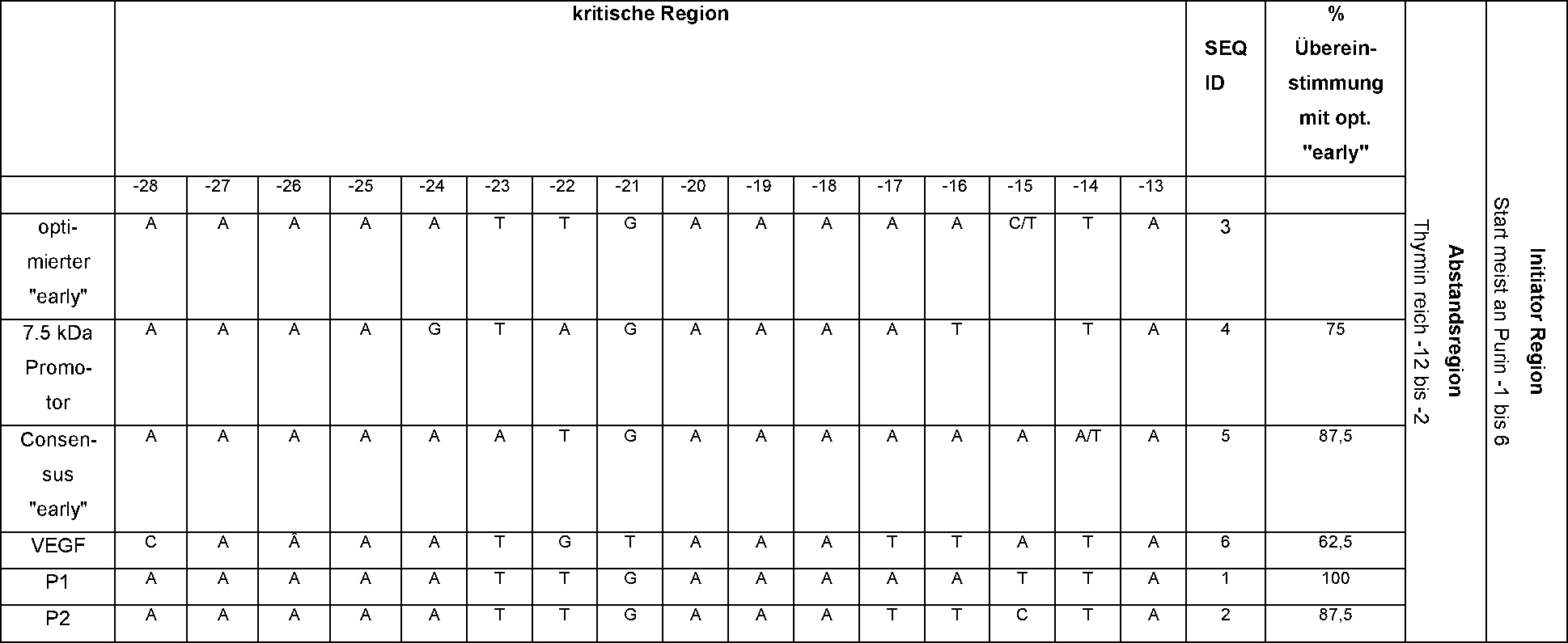
3. Herstellung des rekombinanten ORFV-Vektors3. Preparation of the recombinant ORFV vector
Die Erfinder haben nach einer neuen Strategie zur Herstellung eines rekombinanten polyvalenten ORFV-Vektors gesucht. Während der Adaption des ORFV auf Vero-Kulturzellen sind mehreren Deletionen im viralen Genom aufgetreten. Es wurde untersucht, ob sich die Deletionsbereiche für die Integration von Fremdgenen eignen (
Daher wurde neben weiteren Plasmiden das Transferplasmid pDel2 konzipiert, welches die homologen Bereiche der IL 2-Region umfasst (
Es wurden Nukleotidsequenzen der neuen artifiziellen frühen ORFV-Promotoren P1 und P2 entworfen. Nucleotide sequences of the new artificial early ORFV promoters P1 and P2 were designed.
In einem ersten Versuch sollte untersucht werden, ob der IL 2-Lokus für die stabile Integration von Fremdgenen geeignet ist. Hierzu wurde das mCherry-Fluoreszenzmarkergen unter Kontrolle des Promoters P2 in das pDel2-Transferplasmid kloniert. Anschließend wurde das Plasmid in mit D1701-VrV-infizierte Vero-Zellen transfiziert und neue rekombinante Viren visuell nach Identifikation rot-leuchtender Zellen mittels Fluoreszenzmikroskopie selektioniert und die über mehrere Plaquereinigungen erhaltene homogene Rekombinante D1701-V-D2-Cherry angezogen (
Die korrekte Integration des mCherry-Gens in den IL 2-Lokus von D1701-VrV wurde über spezifische PCR-Analysen und Southern Blot-Hybridisierungen sichergestellt, die korrekte Expression ließ sich neben Fluoreszenz- und Western Blot-Analysen auch mittels Durchflußzytometrie zeigen (
Dabei konnte eine starke Expression früh nach der Infektion nachgewiesen werden. Durch mehrmaliges in vitro Passagieren der Rekombinante konnte gezeigt werden, dass die Fremdgen-Integration in das ORFV-Genom stabil war. Strong expression was detected early after infection. By repeated in vitro passage of the recombinant could be shown that the foreign gene integration was stable in the ORFV genome.
Weiterhin wurde mithilfe der hergestellten Rekombinante D1701-V-GFP-D2-Cherry, bei der das AcGFP-Gen im vegf-e- und das mCherry-Gen im IL 2-Lokus integriert ist, erfolgreich die simultane frühe Expression zweier Fluoreszenzgene in unterschiedlichen Insertionslokussen nachgewiesen (
Weiter sollte untersucht werden, ob gleichzeitig auch ein zweites Fremdgen stabil in den IL 2-Lokus integriert werden kann. Hierfür wurde in das pDel2-Transferplasmid neben dem P2-kontrollierten mCherry-Gen, das AcGFP-Gen unter Kontrolle des P1-Promoters kloniert. Die Selektion und Aufreinigung der homologen Rekombinanten D1701-V-D1-GFP-D2-Cherry erfolgte analog zu der vorher beschriebenen D1701-V-P2-Cherry-Selektion. Furthermore, it should be investigated whether a second foreign gene can be stably integrated into the
Auch hier wurde über PCR- und Southern Blot Analysen die korrekte Integration der beiden Fremdgene in den IL 2-Lokus gezeigt. Der Nachweis der Expression erfolgte über Fluoreszenzmikroskopie und Durchflußzytometrie (
Die Stärke der Promotoren P1 und P2 wurde untereinander und mit dem Promoter Pvegf in Expressionsanalysen verglichen. Dabei zeigte sich, dass der Promoter P2 die stärkste, der Promoter P1 die schwächste Genexpression induzierte (
Zudem konnte nachgewiesen werden, dass die Integration eines zweiten, unter Kontrolle eines eigenständigen Promoters regulierten Fremdgens keine Auswirkung auf die Expressionsstärke des ersten Fremdgens hatte. Dabei war es irrelevant, ob das zweite Gen in denselben oder in einen unterschiedlichen Insertionslokus integriert wurde. Nach der Insertion eines P2-gesteuerten mCherry-Gens in den VEGF-Lokus konnte anhand des Vergleichs mit der Rekombinanten, die das P2-regulierte mCherry-Gen in den IL 2-Lokus integriert hatte, der Einfluss des Insertionsorts untersucht werden. Dabei zeigte sich, dass die Genexpression im VEGF-Lokus etwa zweimal so stark war, wie im IL 2-Lokus (
Zusammenfassend konnte gezeigt werden, dass der Orf-Virusvektor D1701-V für die Herstellung polyvalenter Rekombinanten sehr gut geeignet ist. Es konnten mehrere Fremdgene stabil in das virale Genom integriert werden, bspw. über die neu aufgefundenen Insertionslokusse IL 1, 2 und 3, oder aber den bekannten Insertionslokus VEGF. Die Stärke der Fremdgenexpression ist sowohl von dem Promotor als auch vom Insertionslokus abhängig. Die stärkste Genexpression wurde nach Integration eines P2-gesteuerten Fremdgens im VEGF-Lokus erreicht. In summary, it has been shown that the Orf virus vector D1701-V is very well suited for the production of polyvalent recombinants. Several foreign genes could be stably integrated into the viral genome, for example via the newly found
Von den Erfindern wurden weitere unterschiedliche Vektoren hergestellt, die sich durch die Art und Konstellation der verschiedenen Marker-Fremdgene, Insertionsorte und Promotoren voneinander unterscheiden (Tab. 2).
Die Tabelle gibt einen Überblick über die während der zur Erfindung führenden Arbeiten hergestellten fluoreszierenden rekombinanten ORFV-Vektoren. Der Insertionsort (Lokus) und die für die Steuerung der Fremdgenexpression genutzten Promotoren (Pvegf, P1, P2) sind für die jeweiligen Rekombinanten in der Tabelle ersichtlich. Zudem ist die Stärke der Fremdgenexpression angegeben (sehr stark = ++++ bis schwach = +). The table gives an overview of the fluorescent recombinant ORFV vectors produced during the work leading to the invention. The insertion site (locus) and the promoters used for the control of foreign gene expression (P vegf , P1, P2) are shown in the table for the respective recombinants. In addition, the strength of the foreign gene expression is indicated (very strong = ++++ to weak = +).
Die Erfindung eröffnet für die Entwicklung neuer rekombinanter ORFV-basierter Impfstoffe eine Vielzahl an Optionen. So können Rekombinanten hergestellt werden, die gleichzeitig mehrere Antigene exprimieren. Dies könnte etwa bei der Herstellung einer universellen Vakzine, von Kombinationsimpfstoffen oder von therapeutischen Tumorimpfstoffen, die sich gegen mehrere Tumorantigene richten, ein bedeutender Vorteil sein. Darüber hinaus könnte die Immunantwort durch eine gleichzeitige Insertion von Antigen und Zytokinen gezielt beeinflusst werden.The invention opens up a variety of options for the development of new recombinant ORFV-based vaccines. Thus, recombinants can be produced which simultaneously express several antigens. This could be a significant advantage in the manufacture of, for example, a universal vaccine, combination vaccines, or therapeutic tumor vaccines that target multiple tumor antigens. In addition, the immune response could be specifically influenced by a simultaneous insertion of antigen and cytokines.
ZITATE ENTHALTEN IN DER BESCHREIBUNG QUOTES INCLUDE IN THE DESCRIPTION
Diese Liste der vom Anmelder aufgeführten Dokumente wurde automatisiert erzeugt und ist ausschließlich zur besseren Information des Lesers aufgenommen. Die Liste ist nicht Bestandteil der deutschen Patent- bzw. Gebrauchsmusteranmeldung. Das DPMA übernimmt keinerlei Haftung für etwaige Fehler oder Auslassungen.This list of the documents listed by the applicant has been generated automatically and is included solely for the better information of the reader. The list is not part of the German patent or utility model application. The DPMA assumes no liability for any errors or omissions.
Zitierte Nicht-PatentliteraturCited non-patent literature
- Rziha et al. (2000), Generation of recombinant parapoxviruses: non-esssential genes suitable for insertion and expression of foreign genes, Journal or Biotechnology Vol. 83, Seiten 137–145 [0011] Rziha et al. (2000), Generation of recombinant parapoxviruses: non-essential genes suitable for insertion and expression of foreign genes, Journal or Biotechnology Vol. 83, pages 137-145 [0011]
- Büttner und Rziha (2002), Parapoxviruses: From the Lesion to the Viral Genome, J. Vet. Med. B. Vol. 49, Seiten 7–16 [0011] Büttner and Rziha (2002), Parapoxviruses: From the Lesion to the Viral Genome, J. Vet. Med. B. Vol. 49, pp. 7-16 [0011]
- Cottone et al. (1998), Analysis of genomic rearrangement and subsequent gene deletion of the attenuated Orf virus strain D1701, Virus Research, Vol. 56, Seiten 53–67 [0020] Cottone et al. (1998), Analysis of genomic rearrangement and subsequent gene deletion of the attenuated Orf virus strain D1701, Virus Research, Vol. 56, pages 53-67 [0020]
- Davidson und Moss (1989), Structure of vaccinia virus late promotors, J. Mol. Biol., Vol. 210, Seiten 771 bis 784 [0031] Davidson and Moss (1989), Structure of vaccinia virus late promoters, J. Mol. Biol., Vol. 210, pp. 771-784 [0031]
- Yang et al. (2011), Genome-wide analysis of the 5′ and 3′ ends of Vaccinia Virus early mRNAs delineates regulatory sequences of annotated and anomalous transcripts, J. Virology, Vol. 85, Nr. 12, S. 5897–5909 [0031] Yang et al. (2011), Genome-wide analysis of the 5 'and 3' ends of vaccinia virus early mRNAs delineates regulatory sequences of annotated and aberrant transcripts, J. Virology, Vol. 85, No. 12, pp. 5897-5909 [0031]
- Broyles (2003), Vaccinia virus transcription, J. Gen. Virol., Vol. 84, Nr. 9, S. 2293–2303 [0031] Broyles (2003), Vaccinia virus transcription, J.Gen. Virol., Vol. 84, No. 9, pp. 2293-2303 [0031]
Claims (14)
Priority Applications (27)
| Application Number | Priority Date | Filing Date | Title |
|---|---|---|---|
| DE102015111756.8A DE102015111756A1 (en) | 2015-07-20 | 2015-07-20 | Recombinant Orf virus vector |
| PT167415959T PT3325631T (en) | 2015-07-20 | 2016-07-15 | Recombinant vector of the ORF virus |
| JP2018522854A JP7092663B2 (en) | 2015-07-20 | 2016-07-15 | Recombinant orff virus vector |
| KR1020187004903A KR102259277B1 (en) | 2015-07-20 | 2016-07-15 | Recombinant ORF virus vector |
| IL257025A IL257025B2 (en) | 2015-07-20 | 2016-07-15 | Recombinant virus vector ORF |
| EP25156960.4A EP4545094A3 (en) | 2015-07-20 | 2016-07-15 | Recombinant orf virus vector |
| AU2016294855A AU2016294855B2 (en) | 2015-07-20 | 2016-07-15 | Recombinant Orf virus vector |
| CN201680053548.XA CN108026542B (en) | 2015-07-20 | 2016-07-15 | recombinant Orf virus vector |
| KR1020217015985A KR102433709B1 (en) | 2015-07-20 | 2016-07-15 | Recombinant orf virus vector |
| CN202211462316.3A CN116445547A (en) | 2015-07-20 | 2016-07-15 | recombinant Orf virus vector |
| PCT/EP2016/066926 WO2017013023A1 (en) | 2015-07-20 | 2016-07-15 | Recombinant orf virus vector |
| NZ73928616A NZ739286A (en) | 2015-07-20 | 2016-07-15 | Recombinant orf virus vector |
| MX2018000845A MX2018000845A (en) | 2015-07-20 | 2016-07-15 | RECOMBINANT ORF VECTOR VECTOR. |
| BR112018001121-5A BR112018001121B1 (en) | 2015-07-20 | 2016-07-15 | ORF VIRUS RECOMBINANT VECTOR (ORFV), COMPOSITION, USE OF AN ORFV RECOMBINANT VECTOR, AND NUCLEIC ACID MOLECULE |
| EP16741595.9A EP3325631B1 (en) | 2015-07-20 | 2016-07-15 | Recombinant orf-virus vector |
| ES16741595T ES3054068T3 (en) | 2015-07-20 | 2016-07-15 | Recombinant orf-virus vector |
| CA2993263A CA2993263A1 (en) | 2015-07-20 | 2016-07-15 | Recombinant orf virus vector |
| PL16741595.9T PL3325631T3 (en) | 2015-07-20 | 2016-07-15 | Recombinant orf-virus vector |
| DK16741595.9T DK3325631T3 (en) | 2015-07-20 | 2016-07-15 | RECOMBINANT ORF VIRUS VECTOR |
| EA201890351A EA201890351A1 (en) | 2015-07-20 | 2016-07-15 | RECOMBINANT ORF-VIRAL VECTOR |
| PH12018500155A PH12018500155A1 (en) | 2015-07-20 | 2018-01-19 | Recombinant orf virus vector |
| CL2018000164A CL2018000164A1 (en) | 2015-07-20 | 2018-01-19 | Recombinant vector of the orf virus. |
| US15/875,389 US11286500B2 (en) | 2015-07-20 | 2018-01-19 | Recombinant Orf virus vector |
| ZA2018/01091A ZA201801091B (en) | 2015-07-20 | 2018-02-16 | Recombinant orf virus vector |
| JP2020097200A JP2020188776A (en) | 2015-07-20 | 2020-06-03 | Recombinant orf virus vector |
| AU2020264302A AU2020264302B2 (en) | 2015-07-20 | 2020-11-04 | Recombinant Orf virus vector |
| US17/655,316 US20220204992A1 (en) | 2015-07-20 | 2022-03-17 | Recombinant orf virus vector |
Applications Claiming Priority (1)
| Application Number | Priority Date | Filing Date | Title |
|---|---|---|---|
| DE102015111756.8A DE102015111756A1 (en) | 2015-07-20 | 2015-07-20 | Recombinant Orf virus vector |
Publications (1)
| Publication Number | Publication Date |
|---|---|
| DE102015111756A1 true DE102015111756A1 (en) | 2017-01-26 |
Family
ID=56507584
Family Applications (1)
| Application Number | Title | Priority Date | Filing Date |
|---|---|---|---|
| DE102015111756.8A Pending DE102015111756A1 (en) | 2015-07-20 | 2015-07-20 | Recombinant Orf virus vector |
Country Status (20)
| Country | Link |
|---|---|
| US (2) | US11286500B2 (en) |
| EP (2) | EP3325631B1 (en) |
| JP (2) | JP7092663B2 (en) |
| KR (2) | KR102259277B1 (en) |
| CN (2) | CN116445547A (en) |
| AU (2) | AU2016294855B2 (en) |
| CA (1) | CA2993263A1 (en) |
| CL (1) | CL2018000164A1 (en) |
| DE (1) | DE102015111756A1 (en) |
| DK (1) | DK3325631T3 (en) |
| EA (1) | EA201890351A1 (en) |
| ES (1) | ES3054068T3 (en) |
| IL (1) | IL257025B2 (en) |
| MX (1) | MX2018000845A (en) |
| NZ (1) | NZ739286A (en) |
| PH (1) | PH12018500155A1 (en) |
| PL (1) | PL3325631T3 (en) |
| PT (1) | PT3325631T (en) |
| WO (1) | WO2017013023A1 (en) |
| ZA (1) | ZA201801091B (en) |
Cited By (1)
| Publication number | Priority date | Publication date | Assignee | Title |
|---|---|---|---|---|
| EP3871690A1 (en) | 2020-02-27 | 2021-09-01 | Technische Hochschule Mittelhessen | Method for virus production |
Families Citing this family (8)
| Publication number | Priority date | Publication date | Assignee | Title |
|---|---|---|---|---|
| DE102015111756A1 (en) * | 2015-07-20 | 2017-01-26 | Eberhard Karls Universität Tübingen Medizinische Fakultät | Recombinant Orf virus vector |
| CA3093093A1 (en) * | 2018-03-07 | 2019-09-12 | Transgene | Parapoxvirus vectors |
| CN112522215B (en) * | 2019-09-18 | 2023-06-02 | 重庆市畜牧科学院 | Recombinant orf virus lacking 008 gene and construction method thereof |
| EP4206327A4 (en) | 2020-08-13 | 2025-04-09 | Suzhou Prajna Biotech Co., Ltd. | Mutant ovis spp. infectious pustular dermatitis virus and use thereof |
| EP3957322A1 (en) | 2020-08-19 | 2022-02-23 | Eberhard Karls Universität Tübingen Medizinische Fakultät | Recombinant poxviridae vector expressing co-stimulatory molecules |
| EP4014991A1 (en) * | 2020-12-21 | 2022-06-22 | Eberhard Karls Universität Tübingen Medizinische Fakultät | Modified parapoxvirus having increased immunogenicity |
| EP4014990A1 (en) * | 2020-12-21 | 2022-06-22 | Eberhard Karls Universität Tübingen Medizinische Fakultät | Modified parapoxvirus having increased immunogenicity |
| EP4014992A1 (en) * | 2020-12-21 | 2022-06-22 | Eberhard Karls Universität Tübingen Medizinische Fakultät | Modified parapoxvirus having increased immunogenicity |
Citations (9)
| Publication number | Priority date | Publication date | Assignee | Title |
|---|---|---|---|---|
| WO1997032029A1 (en) * | 1996-02-28 | 1997-09-04 | Bayer Aktiengesellschaft | Parapoxviruses containing foreign dna, their production and their use in vaccines |
| DE19639601A1 (en) * | 1996-02-28 | 1997-09-04 | Bayer Ag | Parapox viruses that contain foreign DNA, their production and their use in vaccines |
| US5770212A (en) * | 1994-04-29 | 1998-06-23 | Immuno Aktiengesellschaft | Recombinant poxviruses with foreign DNA in essential regions |
| DE10122233A1 (en) * | 2000-07-11 | 2002-01-24 | Bayer Ag | Use of strains of the Parapoxvirus ovis against organ fibrosis |
| US6372455B1 (en) * | 2001-04-19 | 2002-04-16 | Arizona Board Of Regents | Recombinant vaccinia viral vectors |
| US20050287162A1 (en) * | 2002-05-14 | 2005-12-29 | Robert Baier | Recombinant fowlpox virus |
| EP1764107A1 (en) * | 2005-09-14 | 2007-03-21 | Gunther Hartmann | Compositions comprising immunostimulatory RNA oligonucleotides and methods for producing said RNA oligonucleotides |
| WO2011128704A1 (en) * | 2010-04-16 | 2011-10-20 | Isis Innovation Limited | Poxvirus expression system |
| WO2011145013A1 (en) * | 2010-05-21 | 2011-11-24 | Pfizer Inc. | Parapoxvirus vectors containing rabies virus antigen |
Family Cites Families (15)
| Publication number | Priority date | Publication date | Assignee | Title |
|---|---|---|---|---|
| CN1217751A (en) * | 1996-03-29 | 1999-05-26 | 奥塔戈大学 | Parapoxvirus vectors |
| US20110014706A2 (en) * | 1998-12-14 | 2011-01-20 | Monsanto Technology Llc | Arabidopsis thaliana Genome Sequence and Uses Thereof |
| US7868149B2 (en) * | 1999-07-20 | 2011-01-11 | Monsanto Technology Llc | Plant genome sequence and uses thereof |
| US20130326723A1 (en) * | 1999-05-06 | 2013-12-05 | Thomas J. La Rosa | Soy nucleic acid molecules and other molecules associated with plants and uses thereof for plant improvement |
| KR20030036194A (en) * | 2000-05-24 | 2003-05-09 | 메리알 | Porcine reproductive and respiratory syndrome virus (prrsv) recombinant poxvirus vaccine |
| CN1331196A (en) * | 2000-06-30 | 2002-01-16 | 上海博德基因开发有限公司 | Polypeptide-pregnancy specific betal-glucoprotein 9.02 and polynucleotide for coding it |
| NZ512341A (en) * | 2001-06-13 | 2004-02-27 | Bayer Ag | Polynucleotides between 15 and 100 base pairs in length coding for parapoxvirus ovis (PPVO)/vaccinia virus recombinant (VVOV) viral genome fragments |
| US7943373B2 (en) * | 2004-09-29 | 2011-05-17 | Oncolys Biopharma, Inc. | Telomelysin/GFP-expressing recombinant virus |
| KR100794218B1 (en) * | 2005-11-28 | 2008-01-11 | 재단법인서울대학교산학협력재단 | Anticancer Screening Method Using DNP63 Promoter |
| KR100985702B1 (en) * | 2008-07-01 | 2010-10-06 | 주식회사 쎌바이오텍 | Novel plasmids isolated from Pediococcus pentosaceus and uses thereof |
| WO2011101696A1 (en) * | 2010-02-18 | 2011-08-25 | Cellectis | Improved meganuclease recombination system |
| CN103079593A (en) * | 2010-07-20 | 2013-05-01 | Ah美国42有限责任公司 | Parapoxvirus vectors |
| EP2849774A4 (en) * | 2012-05-18 | 2015-11-25 | Otago Innovation Ltd | COMBINED TREATMENTS AND COMPOSITIONS FOR WOUND HEALING |
| EP3194623B1 (en) * | 2014-08-12 | 2022-01-05 | Wayne State University | Systems and methods to detect stem cell stress and uses thereof |
| DE102015111756A1 (en) * | 2015-07-20 | 2017-01-26 | Eberhard Karls Universität Tübingen Medizinische Fakultät | Recombinant Orf virus vector |
-
2015
- 2015-07-20 DE DE102015111756.8A patent/DE102015111756A1/en active Pending
-
2016
- 2016-07-15 DK DK16741595.9T patent/DK3325631T3/en active
- 2016-07-15 KR KR1020187004903A patent/KR102259277B1/en active Active
- 2016-07-15 EA EA201890351A patent/EA201890351A1/en unknown
- 2016-07-15 JP JP2018522854A patent/JP7092663B2/en active Active
- 2016-07-15 KR KR1020217015985A patent/KR102433709B1/en active Active
- 2016-07-15 WO PCT/EP2016/066926 patent/WO2017013023A1/en not_active Ceased
- 2016-07-15 NZ NZ73928616A patent/NZ739286A/en unknown
- 2016-07-15 IL IL257025A patent/IL257025B2/en unknown
- 2016-07-15 CN CN202211462316.3A patent/CN116445547A/en active Pending
- 2016-07-15 PT PT167415959T patent/PT3325631T/en unknown
- 2016-07-15 MX MX2018000845A patent/MX2018000845A/en unknown
- 2016-07-15 ES ES16741595T patent/ES3054068T3/en active Active
- 2016-07-15 PL PL16741595.9T patent/PL3325631T3/en unknown
- 2016-07-15 EP EP16741595.9A patent/EP3325631B1/en active Active
- 2016-07-15 CN CN201680053548.XA patent/CN108026542B/en active Active
- 2016-07-15 EP EP25156960.4A patent/EP4545094A3/en active Pending
- 2016-07-15 CA CA2993263A patent/CA2993263A1/en active Pending
- 2016-07-15 AU AU2016294855A patent/AU2016294855B2/en active Active
-
2018
- 2018-01-19 US US15/875,389 patent/US11286500B2/en active Active
- 2018-01-19 CL CL2018000164A patent/CL2018000164A1/en unknown
- 2018-01-19 PH PH12018500155A patent/PH12018500155A1/en unknown
- 2018-02-16 ZA ZA2018/01091A patent/ZA201801091B/en unknown
-
2020
- 2020-06-03 JP JP2020097200A patent/JP2020188776A/en active Pending
- 2020-11-04 AU AU2020264302A patent/AU2020264302B2/en active Active
-
2022
- 2022-03-17 US US17/655,316 patent/US20220204992A1/en active Pending
Patent Citations (11)
| Publication number | Priority date | Publication date | Assignee | Title |
|---|---|---|---|---|
| US5770212A (en) * | 1994-04-29 | 1998-06-23 | Immuno Aktiengesellschaft | Recombinant poxviruses with foreign DNA in essential regions |
| WO1997032029A1 (en) * | 1996-02-28 | 1997-09-04 | Bayer Aktiengesellschaft | Parapoxviruses containing foreign dna, their production and their use in vaccines |
| DE19639601A1 (en) * | 1996-02-28 | 1997-09-04 | Bayer Ag | Parapox viruses that contain foreign DNA, their production and their use in vaccines |
| US6365393B1 (en) * | 1996-02-28 | 2002-04-02 | Bayer Aktiengesellschaft | Parapoxviruses containing foreign DNA, their production and their use in vaccines |
| EP0886679B1 (en) * | 1996-02-28 | 2007-06-06 | Bayer HealthCare AG | Parapoxviruses containing foreign dna, their production and their use in vaccines |
| DE10122233A1 (en) * | 2000-07-11 | 2002-01-24 | Bayer Ag | Use of strains of the Parapoxvirus ovis against organ fibrosis |
| US6372455B1 (en) * | 2001-04-19 | 2002-04-16 | Arizona Board Of Regents | Recombinant vaccinia viral vectors |
| US20050287162A1 (en) * | 2002-05-14 | 2005-12-29 | Robert Baier | Recombinant fowlpox virus |
| EP1764107A1 (en) * | 2005-09-14 | 2007-03-21 | Gunther Hartmann | Compositions comprising immunostimulatory RNA oligonucleotides and methods for producing said RNA oligonucleotides |
| WO2011128704A1 (en) * | 2010-04-16 | 2011-10-20 | Isis Innovation Limited | Poxvirus expression system |
| WO2011145013A1 (en) * | 2010-05-21 | 2011-11-24 | Pfizer Inc. | Parapoxvirus vectors containing rabies virus antigen |
Non-Patent Citations (9)
| Title |
|---|
| AMANN, Ralf: Orf Virusvektor: Entwicklung neuer Selektionsstrategien, Identifikation neuer Fremdgen-Insertionsorte sowie Herstellung, Charakterisierung und Wirksamkeit eines rekombinanten Tollwutimpfstoffs, Dissertation der Eberhard Karls Universität Tübingen; Tag der mündlichen Prüfung: 28.03.2014; Erscheinungsdatum: 01.03.2016; zitierfähiger Link (URL): https://publikationen.uni-tuebingen.de/xmlui/handle/10900/52928 * |
| Broyles (2003), Vaccinia virus transcription, J. Gen. Virol., Vol. 84, Nr. 9, S. 2293–2303 |
| Cottone et al. (1998), Analysis of genomic rearrangement and subsequent gene deletion of the attenuated Orf virus strain D1701, Virus Research, Vol. 56, Seiten 53–67 |
| Davidson und Moss (1989), Structure of vaccinia virus late promotors, J. Mol. Biol., Vol. 210, Seiten 771 bis 784 |
| HENKEL M. Parapockenvirus ORF-Virus D1701: Attenuierung und Herstellung einer Vektorvakzine gegen die Borna’sche Krankheit, Dissertation der Eberhard Karls Universität Tübingen; Tag der mündlichen Prüfung: 20.07.2007; zitierfähiger Link (URL): https://publikationen.uni-tuebingen.de/xmlui/handle/10900/43873 |
| HENKEL M. Parapockenvirus ORF-Virus D1701: Attenuierung und Herstellung einer Vektorvakzine gegen die Borna'sche Krankheit, Dissertation der Eberhard Karls Universität Tübingen; Tag der mündlichen Prüfung: 20.07.2007; zitierfähiger Link (URL): https://publikationen.uni-tuebingen.de/xmlui/handle/10900/43873 * |
| RHIZA H.-J. u.a.: Generation of recombinant parapoxviruses: non-essential genes suitable for insertion and expression of foreign genes. J Biotechnol. 2000 Sep 29;83(1-2):137-45. * |
| Rziha et al. (2000), Generation of recombinant parapoxviruses: non-esssential genes suitable for insertion and expression of foreign genes, Journal or Biotechnology Vol. 83, Seiten 137–145 |
| Yang et al. (2011), Genome-wide analysis of the 5′ and 3′ ends of Vaccinia Virus early mRNAs delineates regulatory sequences of annotated and anomalous transcripts, J. Virology, Vol. 85, Nr. 12, S. 5897–5909 |
Cited By (2)
| Publication number | Priority date | Publication date | Assignee | Title |
|---|---|---|---|---|
| EP3871690A1 (en) | 2020-02-27 | 2021-09-01 | Technische Hochschule Mittelhessen | Method for virus production |
| WO2021170821A1 (en) | 2020-02-27 | 2021-09-02 | Technische Hochschule Mittelhessen | Method for virus production |
Also Published As
Similar Documents
| Publication | Publication Date | Title |
|---|---|---|
| EP3325631B1 (en) | Recombinant orf-virus vector | |
| DE69232201T2 (en) | RECOMBINANT VIRUS VECTORS ENCODING PROTEINS OF THE HUMAN PAPILLOMAVIRUS | |
| DE60116371T3 (en) | VARIANT OF THE MODIFIED VACCINIA ANKARA VIRUS | |
| DE69810459T3 (en) | VACCINATING REAGENTS GENERATING A CD8 T-CELL IMMUNE RESPONSE | |
| DE69133333T2 (en) | A bird pox recombinant virus containing an intact FPV-tk gene | |
| DE69120662T2 (en) | RECOMBINANT POX VIRUS INNER CORES | |
| DE60314541T2 (en) | AT LEAST TWO ATI PROMOTERS CONTAINING RECOMBINANT POX VIRUS | |
| EP0886679B1 (en) | Parapoxviruses containing foreign dna, their production and their use in vaccines | |
| Li et al. | Generation of an attenuated Tiantan vaccinia virus strain by deletion of multiple genes | |
| DE60302848T2 (en) | EXPRESSION OF GENES IN THE MODIFIED VACCINIA VIRUS ANKARA BY USING A COWPOX ATI PROMOTER | |
| WO2003095656A1 (en) | Recombinant fowlpox virus | |
| DE69332393T2 (en) | Recombinant feline herpes virus vaccine | |
| DE19639601A1 (en) | Parapox viruses that contain foreign DNA, their production and their use in vaccines | |
| EP1181381B1 (en) | Organ, tissue and cell-specific immuno-therapeutic for chronic viral infections and inflammatory, degenerative and proliferative diseases, in particular of the liver, and for cancer, based on a recombinant parapox virus | |
| DE102005027956B4 (en) | Highly attenuated poxvirus strains, processes for their preparation and their use as paramunity inducers or for the production of vector vaccines | |
| DE10116594A1 (en) | Artificial chromosomes comprising EHV sequences | |
| BR112018001121B1 (en) | ORF VIRUS RECOMBINANT VECTOR (ORFV), COMPOSITION, USE OF AN ORFV RECOMBINANT VECTOR, AND NUCLEIC ACID MOLECULE | |
| EA041611B1 (en) | RECOMBINANT ORF VIRAL VECTOR |
Legal Events
| Date | Code | Title | Description |
|---|---|---|---|
| R012 | Request for examination validly filed | ||
| R016 | Response to examination communication | ||
| R082 | Change of representative |
Representative=s name: GRAF VON STOSCH PATENTANWALTSGESELLSCHAFT MBH, DE |
|
| R081 | Change of applicant/patentee |
Owner name: PRIME VECTOR TECHNOLOGIES GMBH, DE Free format text: FORMER OWNER: EBERHARD KARLS UNIVERSITAET TUEBINGEN MEDIZINISCHE FAKULTAET, 72074 TUEBINGEN, DE |