DE102013010150A1 - Bleach catalyst granules - Google Patents
Bleach catalyst granules Download PDFInfo
- Publication number
- DE102013010150A1 DE102013010150A1 DE102013010150.6A DE102013010150A DE102013010150A1 DE 102013010150 A1 DE102013010150 A1 DE 102013010150A1 DE 102013010150 A DE102013010150 A DE 102013010150A DE 102013010150 A1 DE102013010150 A1 DE 102013010150A1
- Authority
- DE
- Germany
- Prior art keywords
- bleach catalyst
- weight
- detergents
- granules
- catalyst granules
- Prior art date
- Legal status (The legal status is an assumption and is not a legal conclusion. Google has not performed a legal analysis and makes no representation as to the accuracy of the status listed.)
- Withdrawn
Links
- 239000008187 granular material Substances 0.000 title claims abstract description 102
- 239000003054 catalyst Substances 0.000 title claims abstract description 79
- 239000007844 bleaching agent Substances 0.000 title claims abstract description 70
- NIXOWILDQLNWCW-UHFFFAOYSA-N 2-Propenoic acid Natural products OC(=O)C=C NIXOWILDQLNWCW-UHFFFAOYSA-N 0.000 claims abstract description 16
- 239000003446 ligand Substances 0.000 claims abstract description 16
- SMZOUWXMTYCWNB-UHFFFAOYSA-N 2-(2-methoxy-5-methylphenyl)ethanamine Chemical compound COC1=CC=C(C)C=C1CCN SMZOUWXMTYCWNB-UHFFFAOYSA-N 0.000 claims abstract description 15
- QQTCTMZQVKSGET-UHFFFAOYSA-N 1,2,3-trimethyltriazonane Chemical class CN1CCCCCCN(C)N1C QQTCTMZQVKSGET-UHFFFAOYSA-N 0.000 claims abstract description 14
- 150000003839 salts Chemical class 0.000 claims abstract description 14
- 229920001577 copolymer Polymers 0.000 claims abstract description 13
- 229910052751 metal Inorganic materials 0.000 claims abstract description 11
- 239000002184 metal Substances 0.000 claims abstract description 11
- 238000000034 method Methods 0.000 claims abstract description 10
- 238000005469 granulation Methods 0.000 claims abstract description 9
- 230000003179 granulation Effects 0.000 claims abstract description 9
- 230000008569 process Effects 0.000 claims abstract description 8
- 238000012545 processing Methods 0.000 claims abstract description 3
- 239000003599 detergent Substances 0.000 claims description 57
- 239000011572 manganese Substances 0.000 claims description 39
- 239000011230 binding agent Substances 0.000 claims description 28
- 238000004851 dishwashing Methods 0.000 claims description 26
- 238000004140 cleaning Methods 0.000 claims description 22
- 239000012459 cleaning agent Substances 0.000 claims description 13
- 238000005260 corrosion Methods 0.000 claims description 13
- 230000007797 corrosion Effects 0.000 claims description 13
- 239000003513 alkali Substances 0.000 claims description 12
- 239000003112 inhibitor Substances 0.000 claims description 11
- 238000002360 preparation method Methods 0.000 claims description 11
- 150000001875 compounds Chemical class 0.000 claims description 10
- 238000005406 washing Methods 0.000 claims description 10
- 108090000790 Enzymes Proteins 0.000 claims description 9
- 102000004190 Enzymes Human genes 0.000 claims description 9
- -1 pH regulators Substances 0.000 claims description 9
- 239000000126 substance Substances 0.000 claims description 8
- 239000004094 surface-active agent Substances 0.000 claims description 8
- BQCADISMDOOEFD-UHFFFAOYSA-N Silver Chemical compound [Ag] BQCADISMDOOEFD-UHFFFAOYSA-N 0.000 claims description 7
- 239000000969 carrier Substances 0.000 claims description 7
- 239000011247 coating layer Substances 0.000 claims description 7
- 239000006260 foam Substances 0.000 claims description 7
- 239000011521 glass Substances 0.000 claims description 7
- 239000002245 particle Substances 0.000 claims description 7
- 229910052709 silver Inorganic materials 0.000 claims description 7
- 239000004332 silver Substances 0.000 claims description 7
- LFQSCWFLJHTTHZ-UHFFFAOYSA-N Ethanol Chemical compound CCO LFQSCWFLJHTTHZ-UHFFFAOYSA-N 0.000 claims description 6
- 239000003960 organic solvent Substances 0.000 claims description 6
- 239000011241 protective layer Substances 0.000 claims description 6
- 239000001993 wax Substances 0.000 claims description 6
- CUJRVFIICFDLGR-UHFFFAOYSA-N acetylacetonate Chemical compound CC(=O)[CH-]C(C)=O CUJRVFIICFDLGR-UHFFFAOYSA-N 0.000 claims description 4
- 238000005056 compaction Methods 0.000 claims description 4
- 230000001681 protective effect Effects 0.000 claims description 4
- 239000007787 solid Substances 0.000 claims description 4
- GOOHAUXETOMSMM-UHFFFAOYSA-N Propylene oxide Chemical class CC1CO1 GOOHAUXETOMSMM-UHFFFAOYSA-N 0.000 claims description 3
- VGGSQFUCUMXWEO-UHFFFAOYSA-N Ethene Chemical compound C=C VGGSQFUCUMXWEO-UHFFFAOYSA-N 0.000 claims description 2
- 239000005977 Ethylene Substances 0.000 claims description 2
- 150000002696 manganese Chemical class 0.000 claims description 2
- 150000002894 organic compounds Chemical class 0.000 claims description 2
- 229920002451 polyvinyl alcohol Polymers 0.000 claims description 2
- 235000019422 polyvinyl alcohol Nutrition 0.000 claims description 2
- 238000005029 sieve analysis Methods 0.000 claims description 2
- 239000007944 soluble tablet Substances 0.000 claims description 2
- VTIIJXUACCWYHX-UHFFFAOYSA-L disodium;carboxylatooxy carbonate Chemical compound [Na+].[Na+].[O-]C(=O)OOC([O-])=O VTIIJXUACCWYHX-UHFFFAOYSA-L 0.000 claims 1
- 229940045872 sodium percarbonate Drugs 0.000 claims 1
- 239000000203 mixture Substances 0.000 description 30
- 229920002125 Sokalan® Polymers 0.000 description 14
- 239000011734 sodium Substances 0.000 description 11
- 238000003860 storage Methods 0.000 description 11
- 239000003795 chemical substances by application Substances 0.000 description 10
- 239000000843 powder Substances 0.000 description 10
- XLYOFNOQVPJJNP-UHFFFAOYSA-N water Substances O XLYOFNOQVPJJNP-UHFFFAOYSA-N 0.000 description 10
- XEEYBQQBJWHFJM-UHFFFAOYSA-N Iron Chemical compound [Fe] XEEYBQQBJWHFJM-UHFFFAOYSA-N 0.000 description 8
- 229940088598 enzyme Drugs 0.000 description 8
- 229920000642 polymer Polymers 0.000 description 8
- 150000003751 zinc Chemical class 0.000 description 8
- PWHULOQIROXLJO-UHFFFAOYSA-N Manganese Chemical compound [Mn] PWHULOQIROXLJO-UHFFFAOYSA-N 0.000 description 7
- 239000002253 acid Substances 0.000 description 7
- 238000009472 formulation Methods 0.000 description 7
- 229910052748 manganese Inorganic materials 0.000 description 7
- 238000004061 bleaching Methods 0.000 description 6
- KRKNYBCHXYNGOX-UHFFFAOYSA-N citric acid Chemical class OC(=O)CC(O)(C(O)=O)CC(O)=O KRKNYBCHXYNGOX-UHFFFAOYSA-N 0.000 description 6
- 150000002191 fatty alcohols Chemical class 0.000 description 6
- 238000012360 testing method Methods 0.000 description 6
- LYCAIKOWRPUZTN-UHFFFAOYSA-N Ethylene glycol Chemical compound OCCO LYCAIKOWRPUZTN-UHFFFAOYSA-N 0.000 description 5
- OFOBLEOULBTSOW-UHFFFAOYSA-N Propanedioic acid Natural products OC(=O)CC(O)=O OFOBLEOULBTSOW-UHFFFAOYSA-N 0.000 description 5
- 150000007513 acids Chemical class 0.000 description 5
- 239000012190 activator Substances 0.000 description 5
- 230000000052 comparative effect Effects 0.000 description 5
- 239000013256 coordination polymer Substances 0.000 description 5
- 239000004615 ingredient Substances 0.000 description 5
- VZCYOOQTPOCHFL-UPHRSURJSA-N maleic acid Chemical compound OC(=O)\C=C/C(O)=O VZCYOOQTPOCHFL-UPHRSURJSA-N 0.000 description 5
- 239000011976 maleic acid Substances 0.000 description 5
- 238000004519 manufacturing process Methods 0.000 description 5
- 239000003826 tablet Substances 0.000 description 5
- VZCYOOQTPOCHFL-UHFFFAOYSA-N trans-butenedioic acid Natural products OC(=O)C=CC(O)=O VZCYOOQTPOCHFL-UHFFFAOYSA-N 0.000 description 5
- 0 *N1CCN(*)CCN(*)CC1 Chemical compound *N1CCN(*)CCN(*)CC1 0.000 description 4
- HGINCPLSRVDWNT-UHFFFAOYSA-N Acrolein Chemical compound C=CC=O HGINCPLSRVDWNT-UHFFFAOYSA-N 0.000 description 4
- VYPSYNLAJGMNEJ-UHFFFAOYSA-N Silicium dioxide Chemical compound O=[Si]=O VYPSYNLAJGMNEJ-UHFFFAOYSA-N 0.000 description 4
- 229910052910 alkali metal silicate Inorganic materials 0.000 description 4
- 125000000217 alkyl group Chemical group 0.000 description 4
- 230000000694 effects Effects 0.000 description 4
- 229910052742 iron Inorganic materials 0.000 description 4
- JVTAAEKCZFNVCJ-UHFFFAOYSA-N lactic acid Chemical compound CC(O)C(O)=O JVTAAEKCZFNVCJ-UHFFFAOYSA-N 0.000 description 4
- 229920000058 polyacrylate Polymers 0.000 description 4
- 239000000047 product Substances 0.000 description 4
- 229920002545 silicone oil Polymers 0.000 description 4
- 239000000243 solution Substances 0.000 description 4
- QTBSBXVTEAMEQO-UHFFFAOYSA-N Acetic acid Chemical compound CC(O)=O QTBSBXVTEAMEQO-UHFFFAOYSA-N 0.000 description 3
- IAYPIBMASNFSPL-UHFFFAOYSA-N Ethylene oxide Chemical compound C1CO1 IAYPIBMASNFSPL-UHFFFAOYSA-N 0.000 description 3
- 241000237858 Gastropoda Species 0.000 description 3
- OKKJLVBELUTLKV-UHFFFAOYSA-N Methanol Chemical compound OC OKKJLVBELUTLKV-UHFFFAOYSA-N 0.000 description 3
- MUBZPKHOEPUJKR-UHFFFAOYSA-N Oxalic acid Chemical compound OC(=O)C(O)=O MUBZPKHOEPUJKR-UHFFFAOYSA-N 0.000 description 3
- DNIAPMSPPWPWGF-UHFFFAOYSA-N Propylene glycol Chemical compound CC(O)CO DNIAPMSPPWPWGF-UHFFFAOYSA-N 0.000 description 3
- QAOWNCQODCNURD-UHFFFAOYSA-N Sulfuric acid Chemical compound OS(O)(=O)=O QAOWNCQODCNURD-UHFFFAOYSA-N 0.000 description 3
- 241001122767 Theaceae Species 0.000 description 3
- 239000007864 aqueous solution Substances 0.000 description 3
- 150000004649 carbonic acid derivatives Chemical class 0.000 description 3
- 239000013065 commercial product Substances 0.000 description 3
- 235000014113 dietary fatty acids Nutrition 0.000 description 3
- 239000000194 fatty acid Substances 0.000 description 3
- 229930195729 fatty acid Natural products 0.000 description 3
- 150000004665 fatty acids Chemical class 0.000 description 3
- 230000006870 function Effects 0.000 description 3
- 239000007788 liquid Substances 0.000 description 3
- 239000000178 monomer Substances 0.000 description 3
- 229910052757 nitrogen Inorganic materials 0.000 description 3
- 150000007524 organic acids Chemical class 0.000 description 3
- 230000003647 oxidation Effects 0.000 description 3
- 238000007254 oxidation reaction Methods 0.000 description 3
- 239000008188 pellet Substances 0.000 description 3
- 229920005646 polycarboxylate Polymers 0.000 description 3
- 159000000001 potassium salts Chemical class 0.000 description 3
- 150000004760 silicates Chemical class 0.000 description 3
- 159000000000 sodium salts Chemical class 0.000 description 3
- 229910052723 transition metal Inorganic materials 0.000 description 3
- WLDGDTPNAKWAIR-UHFFFAOYSA-N 1,4,7-trimethyl-1,4,7-triazonane Chemical compound CN1CCN(C)CCN(C)CC1 WLDGDTPNAKWAIR-UHFFFAOYSA-N 0.000 description 2
- 108010065511 Amylases Proteins 0.000 description 2
- 102000013142 Amylases Human genes 0.000 description 2
- CIWBSHSKHKDKBQ-JLAZNSOCSA-N Ascorbic acid Chemical compound OC[C@H](O)[C@H]1OC(=O)C(O)=C1O CIWBSHSKHKDKBQ-JLAZNSOCSA-N 0.000 description 2
- IJGRMHOSHXDMSA-UHFFFAOYSA-N Atomic nitrogen Chemical compound N#N IJGRMHOSHXDMSA-UHFFFAOYSA-N 0.000 description 2
- BVKZGUZCCUSVTD-UHFFFAOYSA-M Bicarbonate Chemical class OC([O-])=O BVKZGUZCCUSVTD-UHFFFAOYSA-M 0.000 description 2
- KRKNYBCHXYNGOX-UHFFFAOYSA-K Citrate Chemical compound [O-]C(=O)CC(O)(CC([O-])=O)C([O-])=O KRKNYBCHXYNGOX-UHFFFAOYSA-K 0.000 description 2
- RGHNJXZEOKUKBD-SQOUGZDYSA-N D-gluconic acid Chemical compound OC[C@@H](O)[C@@H](O)[C@H](O)[C@@H](O)C(O)=O RGHNJXZEOKUKBD-SQOUGZDYSA-N 0.000 description 2
- RTZKZFJDLAIYFH-UHFFFAOYSA-N Diethyl ether Chemical compound CCOCC RTZKZFJDLAIYFH-UHFFFAOYSA-N 0.000 description 2
- IMROMDMJAWUWLK-UHFFFAOYSA-N Ethenol Chemical compound OC=C IMROMDMJAWUWLK-UHFFFAOYSA-N 0.000 description 2
- AEMRFAOFKBGASW-UHFFFAOYSA-N Glycolic acid Chemical compound OCC(O)=O AEMRFAOFKBGASW-UHFFFAOYSA-N 0.000 description 2
- DGAQECJNVWCQMB-PUAWFVPOSA-M Ilexoside XXIX Chemical compound C[C@@H]1CC[C@@]2(CC[C@@]3(C(=CC[C@H]4[C@]3(CC[C@@H]5[C@@]4(CC[C@@H](C5(C)C)OS(=O)(=O)[O-])C)C)[C@@H]2[C@]1(C)O)C)C(=O)O[C@H]6[C@@H]([C@H]([C@@H]([C@H](O6)CO)O)O)O.[Na+] DGAQECJNVWCQMB-PUAWFVPOSA-M 0.000 description 2
- KFZMGEQAYNKOFK-UHFFFAOYSA-N Isopropanol Chemical compound CC(C)O KFZMGEQAYNKOFK-UHFFFAOYSA-N 0.000 description 2
- WHUUTDBJXJRKMK-VKHMYHEASA-N L-glutamic acid Chemical compound OC(=O)[C@@H](N)CCC(O)=O WHUUTDBJXJRKMK-VKHMYHEASA-N 0.000 description 2
- 239000004367 Lipase Substances 0.000 description 2
- 108090001060 Lipase Proteins 0.000 description 2
- 102000004882 Lipase Human genes 0.000 description 2
- CERQOIWHTDAKMF-UHFFFAOYSA-N Methacrylic acid Chemical compound CC(=C)C(O)=O CERQOIWHTDAKMF-UHFFFAOYSA-N 0.000 description 2
- BPQQTUXANYXVAA-UHFFFAOYSA-N Orthosilicate Chemical compound [O-][Si]([O-])([O-])[O-] BPQQTUXANYXVAA-UHFFFAOYSA-N 0.000 description 2
- 229910019142 PO4 Inorganic materials 0.000 description 2
- 108091005804 Peptidases Proteins 0.000 description 2
- 102000035195 Peptidases Human genes 0.000 description 2
- 239000004365 Protease Substances 0.000 description 2
- CDBYLPFSWZWCQE-UHFFFAOYSA-L Sodium Carbonate Chemical compound [Na+].[Na+].[O-]C([O-])=O CDBYLPFSWZWCQE-UHFFFAOYSA-L 0.000 description 2
- FEWJPZIEWOKRBE-UHFFFAOYSA-N Tartaric Acid Chemical compound [H+].[H+].[O-]C(=O)C(O)C(O)C([O-])=O FEWJPZIEWOKRBE-UHFFFAOYSA-N 0.000 description 2
- DKGAVHZHDRPRBM-UHFFFAOYSA-N Tert-Butanol Chemical compound CC(C)(C)O DKGAVHZHDRPRBM-UHFFFAOYSA-N 0.000 description 2
- RTAQQCXQSZGOHL-UHFFFAOYSA-N Titanium Chemical compound [Ti] RTAQQCXQSZGOHL-UHFFFAOYSA-N 0.000 description 2
- 238000010521 absorption reaction Methods 0.000 description 2
- 239000000654 additive Substances 0.000 description 2
- WNLRTRBMVRJNCN-UHFFFAOYSA-N adipic acid Chemical class OC(=O)CCCCC(O)=O WNLRTRBMVRJNCN-UHFFFAOYSA-N 0.000 description 2
- 229910000288 alkali metal carbonate Inorganic materials 0.000 description 2
- 150000008041 alkali metal carbonates Chemical class 0.000 description 2
- 150000001412 amines Chemical class 0.000 description 2
- 235000019418 amylase Nutrition 0.000 description 2
- 229940025131 amylases Drugs 0.000 description 2
- 239000003945 anionic surfactant Substances 0.000 description 2
- 125000004429 atom Chemical group 0.000 description 2
- 239000002585 base Substances 0.000 description 2
- 125000004432 carbon atom Chemical group C* 0.000 description 2
- BVKZGUZCCUSVTD-UHFFFAOYSA-N carbonic acid Chemical class OC(O)=O BVKZGUZCCUSVTD-UHFFFAOYSA-N 0.000 description 2
- 235000015165 citric acid Nutrition 0.000 description 2
- 239000011248 coating agent Substances 0.000 description 2
- 238000000576 coating method Methods 0.000 description 2
- 229910017052 cobalt Inorganic materials 0.000 description 2
- 239000010941 cobalt Substances 0.000 description 2
- GUTLYIVDDKVIGB-UHFFFAOYSA-N cobalt atom Chemical compound [Co] GUTLYIVDDKVIGB-UHFFFAOYSA-N 0.000 description 2
- 238000002425 crystallisation Methods 0.000 description 2
- 230000008025 crystallization Effects 0.000 description 2
- 238000001035 drying Methods 0.000 description 2
- 239000000975 dye Substances 0.000 description 2
- 238000005187 foaming Methods 0.000 description 2
- 229940093915 gynecological organic acid Drugs 0.000 description 2
- ZFSLODLOARCGLH-UHFFFAOYSA-N isocyanuric acid Chemical compound OC1=NC(O)=NC(O)=N1 ZFSLODLOARCGLH-UHFFFAOYSA-N 0.000 description 2
- 235000019421 lipase Nutrition 0.000 description 2
- 238000002844 melting Methods 0.000 description 2
- 230000008018 melting Effects 0.000 description 2
- 238000002156 mixing Methods 0.000 description 2
- 239000002736 nonionic surfactant Substances 0.000 description 2
- 235000005985 organic acids Nutrition 0.000 description 2
- 229920000620 organic polymer Polymers 0.000 description 2
- 235000011837 pasties Nutrition 0.000 description 2
- 235000021317 phosphate Nutrition 0.000 description 2
- 229920001223 polyethylene glycol Polymers 0.000 description 2
- 229920000151 polyglycol Polymers 0.000 description 2
- 239000010695 polyglycol Substances 0.000 description 2
- 238000012216 screening Methods 0.000 description 2
- 239000000377 silicon dioxide Substances 0.000 description 2
- 239000000344 soap Substances 0.000 description 2
- 229910052708 sodium Inorganic materials 0.000 description 2
- NLJMYIDDQXHKNR-UHFFFAOYSA-K sodium citrate Chemical compound O.O.[Na+].[Na+].[Na+].[O-]C(=O)CC(O)(CC([O-])=O)C([O-])=O NLJMYIDDQXHKNR-UHFFFAOYSA-K 0.000 description 2
- 239000002904 solvent Substances 0.000 description 2
- 238000001694 spray drying Methods 0.000 description 2
- 238000003756 stirring Methods 0.000 description 2
- 125000000542 sulfonic acid group Chemical group 0.000 description 2
- 229910052719 titanium Inorganic materials 0.000 description 2
- 239000010936 titanium Substances 0.000 description 2
- 150000003624 transition metals Chemical class 0.000 description 2
- BUHVIAUBTBOHAG-FOYDDCNASA-N (2r,3r,4s,5r)-2-[6-[[2-(3,5-dimethoxyphenyl)-2-(2-methylphenyl)ethyl]amino]purin-9-yl]-5-(hydroxymethyl)oxolane-3,4-diol Chemical compound COC1=CC(OC)=CC(C(CNC=2C=3N=CN(C=3N=CN=2)[C@H]2[C@@H]([C@H](O)[C@@H](CO)O2)O)C=2C(=CC=CC=2)C)=C1 BUHVIAUBTBOHAG-FOYDDCNASA-N 0.000 description 1
- BJEPYKJPYRNKOW-REOHCLBHSA-N (S)-malic acid Chemical compound OC(=O)[C@@H](O)CC(O)=O BJEPYKJPYRNKOW-REOHCLBHSA-N 0.000 description 1
- ITWBWJFEJCHKSN-UHFFFAOYSA-N 1,4,7-triazonane Chemical compound C1CNCCNCCN1 ITWBWJFEJCHKSN-UHFFFAOYSA-N 0.000 description 1
- RTBFRGCFXZNCOE-UHFFFAOYSA-N 1-methylsulfonylpiperidin-4-one Chemical compound CS(=O)(=O)N1CCC(=O)CC1 RTBFRGCFXZNCOE-UHFFFAOYSA-N 0.000 description 1
- XEEYSDHEOQHCDA-UHFFFAOYSA-N 2-methylprop-2-ene-1-sulfonic acid Chemical compound CC(=C)CS(O)(=O)=O XEEYSDHEOQHCDA-UHFFFAOYSA-N 0.000 description 1
- QGZKDVFQNNGYKY-UHFFFAOYSA-O Ammonium Chemical compound [NH4+] QGZKDVFQNNGYKY-UHFFFAOYSA-O 0.000 description 1
- 101000740449 Bacillus subtilis (strain 168) Biotin/lipoyl attachment protein Proteins 0.000 description 1
- LSNNMFCWUKXFEE-UHFFFAOYSA-M Bisulfite Chemical compound OS([O-])=O LSNNMFCWUKXFEE-UHFFFAOYSA-M 0.000 description 1
- BVKZGUZCCUSVTD-UHFFFAOYSA-L Carbonate Chemical compound [O-]C([O-])=O BVKZGUZCCUSVTD-UHFFFAOYSA-L 0.000 description 1
- 150000000703 Cerium Chemical class 0.000 description 1
- RKWGIWYCVPQPMF-UHFFFAOYSA-N Chloropropamide Chemical compound CCCNC(=O)NS(=O)(=O)C1=CC=C(Cl)C=C1 RKWGIWYCVPQPMF-UHFFFAOYSA-N 0.000 description 1
- LEVWYRKDKASIDU-QWWZWVQMSA-N D-cystine Chemical compound OC(=O)[C@H](N)CSSC[C@@H](N)C(O)=O LEVWYRKDKASIDU-QWWZWVQMSA-N 0.000 description 1
- RGHNJXZEOKUKBD-UHFFFAOYSA-N D-gluconic acid Natural products OCC(O)C(O)C(O)C(O)C(O)=O RGHNJXZEOKUKBD-UHFFFAOYSA-N 0.000 description 1
- FEWJPZIEWOKRBE-JCYAYHJZSA-N Dextrotartaric acid Chemical compound OC(=O)[C@H](O)[C@@H](O)C(O)=O FEWJPZIEWOKRBE-JCYAYHJZSA-N 0.000 description 1
- 108010083608 Durazym Proteins 0.000 description 1
- OTMSDBZUPAUEDD-UHFFFAOYSA-N Ethane Chemical compound CC OTMSDBZUPAUEDD-UHFFFAOYSA-N 0.000 description 1
- XUJNEKJLAYXESH-REOHCLBHSA-N L-Cysteine Chemical compound SC[C@H](N)C(O)=O XUJNEKJLAYXESH-REOHCLBHSA-N 0.000 description 1
- 101500021084 Locusta migratoria 5 kDa peptide Proteins 0.000 description 1
- WAEMQWOKJMHJLA-UHFFFAOYSA-N Manganese(2+) Chemical compound [Mn+2] WAEMQWOKJMHJLA-UHFFFAOYSA-N 0.000 description 1
- ZOKXTWBITQBERF-UHFFFAOYSA-N Molybdenum Chemical compound [Mo] ZOKXTWBITQBERF-UHFFFAOYSA-N 0.000 description 1
- 229920002845 Poly(methacrylic acid) Polymers 0.000 description 1
- 229920000805 Polyaspartic acid Polymers 0.000 description 1
- 108010020346 Polyglutamic Acid Proteins 0.000 description 1
- KJTLSVCANCCWHF-UHFFFAOYSA-N Ruthenium Chemical compound [Ru] KJTLSVCANCCWHF-UHFFFAOYSA-N 0.000 description 1
- 108010077895 Sarcosine Proteins 0.000 description 1
- 229910004298 SiO 2 Inorganic materials 0.000 description 1
- 239000004115 Sodium Silicate Substances 0.000 description 1
- PMZURENOXWZQFD-UHFFFAOYSA-L Sodium Sulfate Chemical compound [Na+].[Na+].[O-]S([O-])(=O)=O PMZURENOXWZQFD-UHFFFAOYSA-L 0.000 description 1
- UIIMBOGNXHQVGW-DEQYMQKBSA-M Sodium bicarbonate-14C Chemical compound [Na+].O[14C]([O-])=O UIIMBOGNXHQVGW-DEQYMQKBSA-M 0.000 description 1
- 229920002197 Sodium polyaspartate Polymers 0.000 description 1
- KDYFGRWQOYBRFD-UHFFFAOYSA-N Succinic acid Natural products OC(=O)CCC(O)=O KDYFGRWQOYBRFD-UHFFFAOYSA-N 0.000 description 1
- BGRWYDHXPHLNKA-UHFFFAOYSA-N Tetraacetylethylenediamine Chemical compound CC(=O)N(C(C)=O)CCN(C(C)=O)C(C)=O BGRWYDHXPHLNKA-UHFFFAOYSA-N 0.000 description 1
- WYURNTSHIVDZCO-UHFFFAOYSA-N Tetrahydrofuran Chemical compound C1CCOC1 WYURNTSHIVDZCO-UHFFFAOYSA-N 0.000 description 1
- XTXRWKRVRITETP-UHFFFAOYSA-N Vinyl acetate Chemical compound CC(=O)OC=C XTXRWKRVRITETP-UHFFFAOYSA-N 0.000 description 1
- 229910021536 Zeolite Inorganic materials 0.000 description 1
- HCHKCACWOHOZIP-UHFFFAOYSA-N Zinc Chemical compound [Zn] HCHKCACWOHOZIP-UHFFFAOYSA-N 0.000 description 1
- WHMDKBIGKVEYHS-IYEMJOQQSA-L Zinc gluconate Chemical compound [Zn+2].OC[C@@H](O)[C@@H](O)[C@H](O)[C@@H](O)C([O-])=O.OC[C@@H](O)[C@@H](O)[C@H](O)[C@@H](O)C([O-])=O WHMDKBIGKVEYHS-IYEMJOQQSA-L 0.000 description 1
- CANRESZKMUPMAE-UHFFFAOYSA-L Zinc lactate Chemical compound [Zn+2].CC(O)C([O-])=O.CC(O)C([O-])=O CANRESZKMUPMAE-UHFFFAOYSA-L 0.000 description 1
- QCWXUUIWCKQGHC-UHFFFAOYSA-N Zirconium Chemical compound [Zr] QCWXUUIWCKQGHC-UHFFFAOYSA-N 0.000 description 1
- 238000005299 abrasion Methods 0.000 description 1
- 150000001241 acetals Chemical class 0.000 description 1
- 235000011054 acetic acid Nutrition 0.000 description 1
- ZOIORXHNWRGPMV-UHFFFAOYSA-N acetic acid;zinc Chemical compound [Zn].CC(O)=O.CC(O)=O ZOIORXHNWRGPMV-UHFFFAOYSA-N 0.000 description 1
- 230000002378 acidificating effect Effects 0.000 description 1
- 230000009471 action Effects 0.000 description 1
- 239000013543 active substance Substances 0.000 description 1
- 230000000996 additive effect Effects 0.000 description 1
- 239000001361 adipic acid Substances 0.000 description 1
- 235000011037 adipic acid Nutrition 0.000 description 1
- 150000001298 alcohols Chemical class 0.000 description 1
- 229910001854 alkali hydroxide Inorganic materials 0.000 description 1
- 150000008044 alkali metal hydroxides Chemical class 0.000 description 1
- 150000003973 alkyl amines Chemical class 0.000 description 1
- 108090000637 alpha-Amylases Proteins 0.000 description 1
- BJEPYKJPYRNKOW-UHFFFAOYSA-N alpha-hydroxysuccinic acid Natural products OC(=O)C(O)CC(O)=O BJEPYKJPYRNKOW-UHFFFAOYSA-N 0.000 description 1
- JFCQEDHGNNZCLN-UHFFFAOYSA-N anhydrous glutaric acid Natural products OC(=O)CCCC(O)=O JFCQEDHGNNZCLN-UHFFFAOYSA-N 0.000 description 1
- 229920006318 anionic polymer Polymers 0.000 description 1
- 235000010323 ascorbic acid Nutrition 0.000 description 1
- 229960005070 ascorbic acid Drugs 0.000 description 1
- 239000011668 ascorbic acid Substances 0.000 description 1
- QRUDEWIWKLJBPS-UHFFFAOYSA-N benzotriazole Chemical compound C1=CC=C2N[N][N]C2=C1 QRUDEWIWKLJBPS-UHFFFAOYSA-N 0.000 description 1
- 239000012964 benzotriazole Substances 0.000 description 1
- 229920002988 biodegradable polymer Polymers 0.000 description 1
- 239000004621 biodegradable polymer Substances 0.000 description 1
- 150000001621 bismuth Chemical class 0.000 description 1
- KDYFGRWQOYBRFD-NUQCWPJISA-N butanedioic acid Chemical compound O[14C](=O)CC[14C](O)=O KDYFGRWQOYBRFD-NUQCWPJISA-N 0.000 description 1
- 150000001735 carboxylic acids Chemical class 0.000 description 1
- 239000012876 carrier material Substances 0.000 description 1
- 238000006243 chemical reaction Methods 0.000 description 1
- 150000003841 chloride salts Chemical class 0.000 description 1
- 239000000470 constituent Substances 0.000 description 1
- 108010005400 cutinase Proteins 0.000 description 1
- XUJNEKJLAYXESH-UHFFFAOYSA-N cysteine Natural products SCC(N)C(O)=O XUJNEKJLAYXESH-UHFFFAOYSA-N 0.000 description 1
- 235000018417 cysteine Nutrition 0.000 description 1
- 229960003067 cystine Drugs 0.000 description 1
- 238000004042 decolorization Methods 0.000 description 1
- 238000000354 decomposition reaction Methods 0.000 description 1
- 239000013530 defoamer Substances 0.000 description 1
- WKLWZEWIYUTZNJ-UHFFFAOYSA-K diacetyloxybismuthanyl acetate Chemical class [Bi+3].CC([O-])=O.CC([O-])=O.CC([O-])=O WKLWZEWIYUTZNJ-UHFFFAOYSA-K 0.000 description 1
- 150000002009 diols Chemical class 0.000 description 1
- HNPSIPDUKPIQMN-UHFFFAOYSA-N dioxosilane;oxo(oxoalumanyloxy)alumane Chemical compound O=[Si]=O.O=[Al]O[Al]=O HNPSIPDUKPIQMN-UHFFFAOYSA-N 0.000 description 1
- 239000001177 diphosphate Substances 0.000 description 1
- GYQBBRRVRKFJRG-UHFFFAOYSA-L disodium pyrophosphate Chemical compound [Na+].[Na+].OP([O-])(=O)OP(O)([O-])=O GYQBBRRVRKFJRG-UHFFFAOYSA-L 0.000 description 1
- 239000006185 dispersion Substances 0.000 description 1
- 238000010410 dusting Methods 0.000 description 1
- 239000003792 electrolyte Substances 0.000 description 1
- 239000008393 encapsulating agent Substances 0.000 description 1
- 238000011156 evaluation Methods 0.000 description 1
- 238000002474 experimental method Methods 0.000 description 1
- 230000009969 flowable effect Effects 0.000 description 1
- 239000003205 fragrance Substances 0.000 description 1
- 239000000174 gluconic acid Substances 0.000 description 1
- 235000012208 gluconic acid Nutrition 0.000 description 1
- 229960002989 glutamic acid Drugs 0.000 description 1
- HHLFWLYXYJOTON-UHFFFAOYSA-N glyoxylic acid Chemical class OC(=O)C=O HHLFWLYXYJOTON-UHFFFAOYSA-N 0.000 description 1
- 238000000227 grinding Methods 0.000 description 1
- 229910052735 hafnium Inorganic materials 0.000 description 1
- VBJZVLUMGGDVMO-UHFFFAOYSA-N hafnium atom Chemical compound [Hf] VBJZVLUMGGDVMO-UHFFFAOYSA-N 0.000 description 1
- 239000008233 hard water Substances 0.000 description 1
- 150000002373 hemiacetals Chemical class 0.000 description 1
- 229920001519 homopolymer Polymers 0.000 description 1
- 230000007062 hydrolysis Effects 0.000 description 1
- 238000006460 hydrolysis reaction Methods 0.000 description 1
- WGCNASOHLSPBMP-UHFFFAOYSA-N hydroxyacetaldehyde Natural products OCC=O WGCNASOHLSPBMP-UHFFFAOYSA-N 0.000 description 1
- 230000002779 inactivation Effects 0.000 description 1
- 238000010348 incorporation Methods 0.000 description 1
- 229910052500 inorganic mineral Chemical class 0.000 description 1
- 230000003993 interaction Effects 0.000 description 1
- 239000004310 lactic acid Substances 0.000 description 1
- 235000014655 lactic acid Nutrition 0.000 description 1
- FPYJFEHAWHCUMM-UHFFFAOYSA-N maleic anhydride Chemical compound O=C1OC(=O)C=C1 FPYJFEHAWHCUMM-UHFFFAOYSA-N 0.000 description 1
- 239000001630 malic acid Substances 0.000 description 1
- 235000011090 malic acid Nutrition 0.000 description 1
- WPBNNNQJVZRUHP-UHFFFAOYSA-L manganese(2+);methyl n-[[2-(methoxycarbonylcarbamothioylamino)phenyl]carbamothioyl]carbamate;n-[2-(sulfidocarbothioylamino)ethyl]carbamodithioate Chemical compound [Mn+2].[S-]C(=S)NCCNC([S-])=S.COC(=O)NC(=S)NC1=CC=CC=C1NC(=S)NC(=O)OC WPBNNNQJVZRUHP-UHFFFAOYSA-L 0.000 description 1
- 239000000463 material Substances 0.000 description 1
- 239000000155 melt Substances 0.000 description 1
- 108010003855 mesentericopeptidase Proteins 0.000 description 1
- 150000002739 metals Chemical class 0.000 description 1
- 108010020132 microbial serine proteinases Proteins 0.000 description 1
- 239000011707 mineral Chemical class 0.000 description 1
- 235000010755 mineral Nutrition 0.000 description 1
- 229910052750 molybdenum Inorganic materials 0.000 description 1
- 239000011733 molybdenum Substances 0.000 description 1
- YVJGIGDFHMIDFH-FTWQHDNSSA-N n-[(2s,3r,4r,5r,6r)-4,5-dihydroxy-6-(hydroxymethyl)-2-methoxyoxan-3-yl]-5-(dimethylamino)naphthalene-1-sulfonamide Chemical compound CO[C@H]1O[C@H](CO)[C@H](O)[C@H](O)[C@H]1NS(=O)(=O)C1=CC=CC2=C(N(C)C)C=CC=C12 YVJGIGDFHMIDFH-FTWQHDNSSA-N 0.000 description 1
- 229910021527 natrosilite Inorganic materials 0.000 description 1
- 230000007935 neutral effect Effects 0.000 description 1
- 239000003921 oil Substances 0.000 description 1
- 235000006408 oxalic acid Nutrition 0.000 description 1
- 238000010525 oxidative degradation reaction Methods 0.000 description 1
- 239000001254 oxidized starch Substances 0.000 description 1
- 235000013808 oxidized starch Nutrition 0.000 description 1
- 239000012188 paraffin wax Substances 0.000 description 1
- 235000019809 paraffin wax Nutrition 0.000 description 1
- HWGNBUXHKFFFIH-UHFFFAOYSA-I pentasodium;[oxido(phosphonatooxy)phosphoryl] phosphate Chemical compound [Na+].[Na+].[Na+].[Na+].[Na+].[O-]P([O-])(=O)OP([O-])(=O)OP([O-])([O-])=O HWGNBUXHKFFFIH-UHFFFAOYSA-I 0.000 description 1
- 239000002304 perfume Substances 0.000 description 1
- 235000019271 petrolatum Nutrition 0.000 description 1
- 150000002989 phenols Chemical class 0.000 description 1
- NBIIXXVUZAFLBC-UHFFFAOYSA-K phosphate Chemical compound [O-]P([O-])([O-])=O NBIIXXVUZAFLBC-UHFFFAOYSA-K 0.000 description 1
- 239000010452 phosphate Substances 0.000 description 1
- 150000003013 phosphoric acid derivatives Chemical class 0.000 description 1
- 229910052615 phyllosilicate Inorganic materials 0.000 description 1
- 229920001308 poly(aminoacid) Polymers 0.000 description 1
- 239000004584 polyacrylic acid Substances 0.000 description 1
- 108010064470 polyaspartate Proteins 0.000 description 1
- 229920002643 polyglutamic acid Polymers 0.000 description 1
- 238000006116 polymerization reaction Methods 0.000 description 1
- 230000002028 premature Effects 0.000 description 1
- 238000003825 pressing Methods 0.000 description 1
- 230000009993 protective function Effects 0.000 description 1
- 229910052707 ruthenium Inorganic materials 0.000 description 1
- FSYKKLYZXJSNPZ-UHFFFAOYSA-N sarcosine Chemical compound C[NH2+]CC([O-])=O FSYKKLYZXJSNPZ-UHFFFAOYSA-N 0.000 description 1
- 150000004671 saturated fatty acids Chemical class 0.000 description 1
- 235000003441 saturated fatty acids Nutrition 0.000 description 1
- 238000000926 separation method Methods 0.000 description 1
- 239000003352 sequestering agent Substances 0.000 description 1
- 229910000029 sodium carbonate Inorganic materials 0.000 description 1
- 239000001509 sodium citrate Substances 0.000 description 1
- FQENQNTWSFEDLI-UHFFFAOYSA-J sodium diphosphate Chemical compound [Na+].[Na+].[Na+].[Na+].[O-]P([O-])(=O)OP([O-])([O-])=O FQENQNTWSFEDLI-UHFFFAOYSA-J 0.000 description 1
- 235000019982 sodium hexametaphosphate Nutrition 0.000 description 1
- GCLGEJMYGQKIIW-UHFFFAOYSA-H sodium hexametaphosphate Chemical compound [Na]OP1(=O)OP(=O)(O[Na])OP(=O)(O[Na])OP(=O)(O[Na])OP(=O)(O[Na])OP(=O)(O[Na])O1 GCLGEJMYGQKIIW-UHFFFAOYSA-H 0.000 description 1
- 239000001488 sodium phosphate Substances 0.000 description 1
- NTHWMYGWWRZVTN-UHFFFAOYSA-N sodium silicate Chemical compound [Na+].[Na+].[O-][Si]([O-])=O NTHWMYGWWRZVTN-UHFFFAOYSA-N 0.000 description 1
- 229910052911 sodium silicate Inorganic materials 0.000 description 1
- 229910052938 sodium sulfate Inorganic materials 0.000 description 1
- 235000011152 sodium sulphate Nutrition 0.000 description 1
- 235000019832 sodium triphosphate Nutrition 0.000 description 1
- 239000002689 soil Substances 0.000 description 1
- 239000013042 solid detergent Substances 0.000 description 1
- 239000011975 tartaric acid Substances 0.000 description 1
- 235000002906 tartaric acid Nutrition 0.000 description 1
- 108010075550 termamyl Proteins 0.000 description 1
- 238000010998 test method Methods 0.000 description 1
- 235000019818 tetrasodium diphosphate Nutrition 0.000 description 1
- 239000001577 tetrasodium phosphonato phosphate Substances 0.000 description 1
- UZVUJVFQFNHRSY-OUTKXMMCSA-J tetrasodium;(2s)-2-[bis(carboxylatomethyl)amino]pentanedioate Chemical compound [Na+].[Na+].[Na+].[Na+].[O-]C(=O)CC[C@@H](C([O-])=O)N(CC([O-])=O)CC([O-])=O UZVUJVFQFNHRSY-OUTKXMMCSA-J 0.000 description 1
- 150000003568 thioethers Chemical class 0.000 description 1
- 150000003852 triazoles Chemical class 0.000 description 1
- 239000001226 triphosphate Substances 0.000 description 1
- HRXKRNGNAMMEHJ-UHFFFAOYSA-K trisodium citrate Chemical compound [Na+].[Na+].[Na+].[O-]C(=O)CC(O)(CC([O-])=O)C([O-])=O HRXKRNGNAMMEHJ-UHFFFAOYSA-K 0.000 description 1
- 229940038773 trisodium citrate Drugs 0.000 description 1
- RYFMWSXOAZQYPI-UHFFFAOYSA-K trisodium phosphate Chemical compound [Na+].[Na+].[Na+].[O-]P([O-])([O-])=O RYFMWSXOAZQYPI-UHFFFAOYSA-K 0.000 description 1
- 235000019801 trisodium phosphate Nutrition 0.000 description 1
- 229910000406 trisodium phosphate Inorganic materials 0.000 description 1
- 229910052720 vanadium Inorganic materials 0.000 description 1
- GPPXJZIENCGNKB-UHFFFAOYSA-N vanadium Chemical compound [V]#[V] GPPXJZIENCGNKB-UHFFFAOYSA-N 0.000 description 1
- 239000000080 wetting agent Substances 0.000 description 1
- 239000010457 zeolite Substances 0.000 description 1
- 229910052725 zinc Inorganic materials 0.000 description 1
- 239000011701 zinc Substances 0.000 description 1
- 239000004246 zinc acetate Substances 0.000 description 1
- SRWMQSFFRFWREA-UHFFFAOYSA-M zinc formate Chemical compound [Zn+2].[O-]C=O SRWMQSFFRFWREA-UHFFFAOYSA-M 0.000 description 1
- 239000011670 zinc gluconate Substances 0.000 description 1
- 235000011478 zinc gluconate Nutrition 0.000 description 1
- 229960000306 zinc gluconate Drugs 0.000 description 1
- 239000011576 zinc lactate Substances 0.000 description 1
- 229940050168 zinc lactate Drugs 0.000 description 1
- 235000000193 zinc lactate Nutrition 0.000 description 1
- GAWWVVGZMLGEIW-GNNYBVKZSA-L zinc ricinoleate Chemical compound [Zn+2].CCCCCC[C@@H](O)C\C=C/CCCCCCCC([O-])=O.CCCCCC[C@@H](O)C\C=C/CCCCCCCC([O-])=O GAWWVVGZMLGEIW-GNNYBVKZSA-L 0.000 description 1
- 229940100530 zinc ricinoleate Drugs 0.000 description 1
- 229940006174 zinc valerate Drugs 0.000 description 1
- MXODCLTZTIFYDV-JHZYRPMRSA-L zinc;(1r,4ar,4br,10ar)-1,4a-dimethyl-7-propan-2-yl-2,3,4,4b,5,6,10,10a-octahydrophenanthrene-1-carboxylate Chemical compound [Zn+2].C([C@@H]12)CC(C(C)C)=CC1=CC[C@@H]1[C@]2(C)CCC[C@@]1(C)C([O-])=O.C([C@@H]12)CC(C(C)C)=CC1=CC[C@@H]1[C@]2(C)CCC[C@@]1(C)C([O-])=O MXODCLTZTIFYDV-JHZYRPMRSA-L 0.000 description 1
- YISPIDBWTUCKKH-UHFFFAOYSA-L zinc;4-methylbenzenesulfonate Chemical compound [Zn+2].CC1=CC=C(S([O-])(=O)=O)C=C1.CC1=CC=C(S([O-])(=O)=O)C=C1 YISPIDBWTUCKKH-UHFFFAOYSA-L 0.000 description 1
- JDLYKQWJXAQNNS-UHFFFAOYSA-L zinc;dibenzoate Chemical compound [Zn+2].[O-]C(=O)C1=CC=CC=C1.[O-]C(=O)C1=CC=CC=C1 JDLYKQWJXAQNNS-UHFFFAOYSA-L 0.000 description 1
- ZPEJZWGMHAKWNL-UHFFFAOYSA-L zinc;oxalate Chemical compound [Zn+2].[O-]C(=O)C([O-])=O ZPEJZWGMHAKWNL-UHFFFAOYSA-L 0.000 description 1
- NHXVNEDMKGDNPR-UHFFFAOYSA-N zinc;pentane-2,4-dione Chemical compound [Zn+2].CC(=O)[CH-]C(C)=O.CC(=O)[CH-]C(C)=O NHXVNEDMKGDNPR-UHFFFAOYSA-N 0.000 description 1
- BUDAIZWUWHWZPQ-UHFFFAOYSA-L zinc;pentanoate Chemical compound [Zn+2].CCCCC([O-])=O.CCCCC([O-])=O BUDAIZWUWHWZPQ-UHFFFAOYSA-L 0.000 description 1
- 229910052726 zirconium Inorganic materials 0.000 description 1
- 239000002888 zwitterionic surfactant Substances 0.000 description 1
Classifications
-
- C—CHEMISTRY; METALLURGY
- C11—ANIMAL OR VEGETABLE OILS, FATS, FATTY SUBSTANCES OR WAXES; FATTY ACIDS THEREFROM; DETERGENTS; CANDLES
- C11D—DETERGENT COMPOSITIONS; USE OF SINGLE SUBSTANCES AS DETERGENTS; SOAP OR SOAP-MAKING; RESIN SOAPS; RECOVERY OF GLYCEROL
- C11D3/00—Other compounding ingredients of detergent compositions covered in group C11D1/00
- C11D3/39—Organic or inorganic per-compounds
- C11D3/3902—Organic or inorganic per-compounds combined with specific additives
- C11D3/3905—Bleach activators or bleach catalysts
- C11D3/3935—Bleach activators or bleach catalysts granulated, coated or protected
-
- C—CHEMISTRY; METALLURGY
- C11—ANIMAL OR VEGETABLE OILS, FATS, FATTY SUBSTANCES OR WAXES; FATTY ACIDS THEREFROM; DETERGENTS; CANDLES
- C11D—DETERGENT COMPOSITIONS; USE OF SINGLE SUBSTANCES AS DETERGENTS; SOAP OR SOAP-MAKING; RESIN SOAPS; RECOVERY OF GLYCEROL
- C11D17/00—Detergent materials or soaps characterised by their shape or physical properties
- C11D17/0047—Detergents in the form of bars or tablets
- C11D17/0065—Solid detergents containing builders
- C11D17/0073—Tablets
-
- C—CHEMISTRY; METALLURGY
- C11—ANIMAL OR VEGETABLE OILS, FATS, FATTY SUBSTANCES OR WAXES; FATTY ACIDS THEREFROM; DETERGENTS; CANDLES
- C11D—DETERGENT COMPOSITIONS; USE OF SINGLE SUBSTANCES AS DETERGENTS; SOAP OR SOAP-MAKING; RESIN SOAPS; RECOVERY OF GLYCEROL
- C11D17/00—Detergent materials or soaps characterised by their shape or physical properties
- C11D17/0047—Detergents in the form of bars or tablets
- C11D17/0065—Solid detergents containing builders
- C11D17/0073—Tablets
- C11D17/0091—Dishwashing tablets
-
- C—CHEMISTRY; METALLURGY
- C11—ANIMAL OR VEGETABLE OILS, FATS, FATTY SUBSTANCES OR WAXES; FATTY ACIDS THEREFROM; DETERGENTS; CANDLES
- C11D—DETERGENT COMPOSITIONS; USE OF SINGLE SUBSTANCES AS DETERGENTS; SOAP OR SOAP-MAKING; RESIN SOAPS; RECOVERY OF GLYCEROL
- C11D3/00—Other compounding ingredients of detergent compositions covered in group C11D1/00
- C11D3/16—Organic compounds
- C11D3/26—Organic compounds containing nitrogen
- C11D3/30—Amines; Substituted amines ; Quaternized amines
-
- C—CHEMISTRY; METALLURGY
- C11—ANIMAL OR VEGETABLE OILS, FATS, FATTY SUBSTANCES OR WAXES; FATTY ACIDS THEREFROM; DETERGENTS; CANDLES
- C11D—DETERGENT COMPOSITIONS; USE OF SINGLE SUBSTANCES AS DETERGENTS; SOAP OR SOAP-MAKING; RESIN SOAPS; RECOVERY OF GLYCEROL
- C11D3/00—Other compounding ingredients of detergent compositions covered in group C11D1/00
- C11D3/16—Organic compounds
- C11D3/26—Organic compounds containing nitrogen
- C11D3/32—Amides; Substituted amides
-
- C—CHEMISTRY; METALLURGY
- C11—ANIMAL OR VEGETABLE OILS, FATS, FATTY SUBSTANCES OR WAXES; FATTY ACIDS THEREFROM; DETERGENTS; CANDLES
- C11D—DETERGENT COMPOSITIONS; USE OF SINGLE SUBSTANCES AS DETERGENTS; SOAP OR SOAP-MAKING; RESIN SOAPS; RECOVERY OF GLYCEROL
- C11D3/00—Other compounding ingredients of detergent compositions covered in group C11D1/00
- C11D3/16—Organic compounds
- C11D3/37—Polymers
- C11D3/3746—Macromolecular compounds obtained by reactions only involving carbon-to-carbon unsaturated bonds
- C11D3/3757—(Co)polymerised carboxylic acids, -anhydrides, -esters in solid and liquid compositions
-
- C—CHEMISTRY; METALLURGY
- C11—ANIMAL OR VEGETABLE OILS, FATS, FATTY SUBSTANCES OR WAXES; FATTY ACIDS THEREFROM; DETERGENTS; CANDLES
- C11D—DETERGENT COMPOSITIONS; USE OF SINGLE SUBSTANCES AS DETERGENTS; SOAP OR SOAP-MAKING; RESIN SOAPS; RECOVERY OF GLYCEROL
- C11D3/00—Other compounding ingredients of detergent compositions covered in group C11D1/00
- C11D3/16—Organic compounds
- C11D3/37—Polymers
- C11D3/3746—Macromolecular compounds obtained by reactions only involving carbon-to-carbon unsaturated bonds
- C11D3/3757—(Co)polymerised carboxylic acids, -anhydrides, -esters in solid and liquid compositions
- C11D3/3761—(Co)polymerised carboxylic acids, -anhydrides, -esters in solid and liquid compositions in solid compositions
-
- C—CHEMISTRY; METALLURGY
- C11—ANIMAL OR VEGETABLE OILS, FATS, FATTY SUBSTANCES OR WAXES; FATTY ACIDS THEREFROM; DETERGENTS; CANDLES
- C11D—DETERGENT COMPOSITIONS; USE OF SINGLE SUBSTANCES AS DETERGENTS; SOAP OR SOAP-MAKING; RESIN SOAPS; RECOVERY OF GLYCEROL
- C11D3/00—Other compounding ingredients of detergent compositions covered in group C11D1/00
- C11D3/39—Organic or inorganic per-compounds
- C11D3/3902—Organic or inorganic per-compounds combined with specific additives
- C11D3/3905—Bleach activators or bleach catalysts
- C11D3/3907—Organic compounds
- C11D3/391—Oxygen-containing compounds
-
- C—CHEMISTRY; METALLURGY
- C11—ANIMAL OR VEGETABLE OILS, FATS, FATTY SUBSTANCES OR WAXES; FATTY ACIDS THEREFROM; DETERGENTS; CANDLES
- C11D—DETERGENT COMPOSITIONS; USE OF SINGLE SUBSTANCES AS DETERGENTS; SOAP OR SOAP-MAKING; RESIN SOAPS; RECOVERY OF GLYCEROL
- C11D3/00—Other compounding ingredients of detergent compositions covered in group C11D1/00
- C11D3/39—Organic or inorganic per-compounds
- C11D3/3902—Organic or inorganic per-compounds combined with specific additives
- C11D3/3905—Bleach activators or bleach catalysts
- C11D3/3907—Organic compounds
- C11D3/391—Oxygen-containing compounds
- C11D3/3912—Oxygen-containing compounds derived from saccharides
-
- C—CHEMISTRY; METALLURGY
- C11—ANIMAL OR VEGETABLE OILS, FATS, FATTY SUBSTANCES OR WAXES; FATTY ACIDS THEREFROM; DETERGENTS; CANDLES
- C11D—DETERGENT COMPOSITIONS; USE OF SINGLE SUBSTANCES AS DETERGENTS; SOAP OR SOAP-MAKING; RESIN SOAPS; RECOVERY OF GLYCEROL
- C11D3/00—Other compounding ingredients of detergent compositions covered in group C11D1/00
- C11D3/39—Organic or inorganic per-compounds
- C11D3/3902—Organic or inorganic per-compounds combined with specific additives
- C11D3/3905—Bleach activators or bleach catalysts
- C11D3/3907—Organic compounds
- C11D3/3915—Sulfur-containing compounds
-
- C—CHEMISTRY; METALLURGY
- C11—ANIMAL OR VEGETABLE OILS, FATS, FATTY SUBSTANCES OR WAXES; FATTY ACIDS THEREFROM; DETERGENTS; CANDLES
- C11D—DETERGENT COMPOSITIONS; USE OF SINGLE SUBSTANCES AS DETERGENTS; SOAP OR SOAP-MAKING; RESIN SOAPS; RECOVERY OF GLYCEROL
- C11D3/00—Other compounding ingredients of detergent compositions covered in group C11D1/00
- C11D3/39—Organic or inorganic per-compounds
- C11D3/3902—Organic or inorganic per-compounds combined with specific additives
- C11D3/3905—Bleach activators or bleach catalysts
- C11D3/3907—Organic compounds
- C11D3/3917—Nitrogen-containing compounds
-
- C—CHEMISTRY; METALLURGY
- C11—ANIMAL OR VEGETABLE OILS, FATS, FATTY SUBSTANCES OR WAXES; FATTY ACIDS THEREFROM; DETERGENTS; CANDLES
- C11D—DETERGENT COMPOSITIONS; USE OF SINGLE SUBSTANCES AS DETERGENTS; SOAP OR SOAP-MAKING; RESIN SOAPS; RECOVERY OF GLYCEROL
- C11D3/00—Other compounding ingredients of detergent compositions covered in group C11D1/00
- C11D3/39—Organic or inorganic per-compounds
- C11D3/3902—Organic or inorganic per-compounds combined with specific additives
- C11D3/3905—Bleach activators or bleach catalysts
- C11D3/3907—Organic compounds
- C11D3/3917—Nitrogen-containing compounds
- C11D3/392—Heterocyclic compounds, e.g. cyclic imides or lactames
-
- C—CHEMISTRY; METALLURGY
- C11—ANIMAL OR VEGETABLE OILS, FATS, FATTY SUBSTANCES OR WAXES; FATTY ACIDS THEREFROM; DETERGENTS; CANDLES
- C11D—DETERGENT COMPOSITIONS; USE OF SINGLE SUBSTANCES AS DETERGENTS; SOAP OR SOAP-MAKING; RESIN SOAPS; RECOVERY OF GLYCEROL
- C11D3/00—Other compounding ingredients of detergent compositions covered in group C11D1/00
- C11D3/39—Organic or inorganic per-compounds
- C11D3/3902—Organic or inorganic per-compounds combined with specific additives
- C11D3/3905—Bleach activators or bleach catalysts
- C11D3/3907—Organic compounds
- C11D3/3917—Nitrogen-containing compounds
- C11D3/3922—Cyanamides
-
- C—CHEMISTRY; METALLURGY
- C11—ANIMAL OR VEGETABLE OILS, FATS, FATTY SUBSTANCES OR WAXES; FATTY ACIDS THEREFROM; DETERGENTS; CANDLES
- C11D—DETERGENT COMPOSITIONS; USE OF SINGLE SUBSTANCES AS DETERGENTS; SOAP OR SOAP-MAKING; RESIN SOAPS; RECOVERY OF GLYCEROL
- C11D3/00—Other compounding ingredients of detergent compositions covered in group C11D1/00
- C11D3/39—Organic or inorganic per-compounds
- C11D3/3902—Organic or inorganic per-compounds combined with specific additives
- C11D3/3905—Bleach activators or bleach catalysts
- C11D3/3907—Organic compounds
- C11D3/3917—Nitrogen-containing compounds
- C11D3/3925—Nitriles; Isocyanates or quarternary ammonium nitriles
-
- C—CHEMISTRY; METALLURGY
- C11—ANIMAL OR VEGETABLE OILS, FATS, FATTY SUBSTANCES OR WAXES; FATTY ACIDS THEREFROM; DETERGENTS; CANDLES
- C11D—DETERGENT COMPOSITIONS; USE OF SINGLE SUBSTANCES AS DETERGENTS; SOAP OR SOAP-MAKING; RESIN SOAPS; RECOVERY OF GLYCEROL
- C11D3/00—Other compounding ingredients of detergent compositions covered in group C11D1/00
- C11D3/39—Organic or inorganic per-compounds
- C11D3/3942—Inorganic per-compounds
Landscapes
- Chemical & Material Sciences (AREA)
- Life Sciences & Earth Sciences (AREA)
- Engineering & Computer Science (AREA)
- Chemical Kinetics & Catalysis (AREA)
- Oil, Petroleum & Natural Gas (AREA)
- Wood Science & Technology (AREA)
- Organic Chemistry (AREA)
- Inorganic Chemistry (AREA)
- Detergent Compositions (AREA)
Abstract
Die Erfindung betrifft ein Bleichkatalysatorgranulat, das einen metallhaltigen Bleichkatalysator enthält, der mindestens einen Liganden aus der Gruppe Di- oder Trimethyltriazacyclononane oder Derivaten davon aufweist, und ein Homo- oder Copolymer auf Basis von Acrylsäure, deren Salze oder Teilneutralisate mit einem pH-Wert zwischen 3 und 9. Es wird in einem wasserfreien Granulierprozess, insbesondere durch Kompaktierung, hergestellt, wobei die Verarbeitungstemperatur unter 100°C gehalten wird.The invention relates to a bleach catalyst granulate which contains a metal-containing bleach catalyst which has at least one ligand from the group of di- or trimethyltriazacyclononanes or derivatives thereof, and a homo- or copolymer based on acrylic acid, its salts or partial neutralisates with a pH between 3 and 9. It is produced in an anhydrous granulation process, in particular by compacting, with the processing temperature being kept below 100 ° C.
Description
Die vorliegende Erfindung betrifft Bleichkatalysatorgranulate, ein Verfahren zu deren Herstellung sowie deren Verwendung in Wasch- und Reinigungsmitteln, insbesondere in Mitteln für die maschinelle Reinigung von Geschirr.The present invention relates to bleach catalyst granules, to a process for their preparation and to their use in detergents and cleaners, in particular in detergents for dishwashing.
Um fleckenloses Geschirr zu erhalten, werden in maschinellen Geschirrspülmitteln Persalze wie Perborate und Percarbonate eingesetzt. Zur Aktivierung dieser Bleichmittel und um beim Reinigen bei Temperaturen von 60°C und darunter eine verbesserte Bleichwirkung zu erreichen, enthalten maschinelle Geschirrspülmittel in der Regel weiterhin Bleichaktivatoren oder Bleichkatalysatoren, wobei sich insbesondere die Bleichkatalysatoren als besonders wirkungsvoll erwiesen haben.In order to obtain spotless dishes, persalts such as perborates and percarbonates are used in automatic dishwashing detergents. In order to activate these bleaching agents and to achieve an improved bleaching effect during cleaning at temperatures of 60 ° C. and below, automatic dishwashing detergents generally also contain bleach activators or bleach catalysts, with the bleach catalysts in particular having proven to be particularly effective.
Bleichkatalysatoren auf Grundlage verschiedener Mangan-haltiger Übergangsmetallkomplexe werden z. B. in
Die genannten Komplexe sind hochaktiv, dass heißt, dass kleinste Anwendungskonzentrationen pro Spülgang genügen, um vollständigen Entfernung von Teeanschmutzungen von Geschirrteilen zu gewährleisten. Hierzu genügen in den meisten Fällen 2–8 mg des Komplexes in einer Spülmitteltablette. Bleichkatalysatoren werden daher in maschinellen Geschirrspülmitteln vorzugsweise in Form vorgefertigter Granulate eingesetzt. Dies geschieht zu einen, um ihre Lagerstabilität zu erhöhen, zum anderen aber auch, um eine homogene Einarbeitung winziger Katalysatormengen in die Formulierungen, insbesondere in Tablettenapplikationen, zu gewährleisten.The said complexes are highly active, that is to say that the smallest application concentrations per rinse are sufficient to ensure complete removal of tea stains from dishes. In most cases, 2-8 mg of the complex are sufficient in a dishwashing tablet. Bleach catalysts are therefore used in automatic dishwasher detergents, preferably in the form of prefabricated granules. This is done to one, in order to increase their storage stability, on the other hand, but also to ensure a homogeneous incorporation of tiny amounts of catalyst in the formulations, especially in tablet applications.
Bleichkatalysatorgranulate sowie Verfahren zur Herstellung von Bleichkatalysatorgranulaten werden in verschiedenen Patentanmeldungen beschrieben.Bleach catalyst granules and methods of making bleach catalyst granules are described in various patent applications.
So wird, z. B. in
In
Es hat sich gezeigt, dass Granulate basierend auf Fettsäuren/Seifen, Silikonölen oder Wachsen den hohen Anforderungen an ein modernes Granulat zum Einsatz in maschinellen Maschinengeschirrspülmitteln nicht mehr genügen. Bei den heute verwendeten niederen Spültemperaturen und den kurzen Spülgängen lösen sich diese Granulate nicht mehr schnell genug auf, um den Katalysator vollständig freizusetzen und führen damit nur zu ungenügenden Reinigungsleistungen.It has been shown that granules based on fatty acids / soaps, silicone oils or waxes no longer meet the high demands on a modern granulate for use in machine dishwasher detergents. At the low rinse temperatures used today and the short rinses These granules no longer dissolve quickly enough to completely liberate the catalyst and thus only lead to insufficient cleaning performance.
Überraschenderweise hat sich weiterhin gezeigt, dass Granulate, enthaltend [MnIV 2(μ-O)3(Me-TACN)2](PF6)2·H2O oder verwandte Verbindungen, die einen Triazacyclononanring aufweisen, und als Carrier/Bindemittel eine oder mehrere Polyethylengklykole oder Fettalkoholethoxylate enthalten, nach einer gewissen Lagerzeit einen deutlichen Geruch nach Aminen aufweisen und daher für einen kommerziellen Einsatz in Haushaltsprodukten ungeeignet sind. Es kann angenommen werden, dass sich während Herstellung und/oder Lagerung der Granulate ein gewisser Anteil des Mangankomplexes zersetzt und den Liganden Trimethyltriazacyclononan (TACN) oder Me3-TACN, der einen starken aminartigen Geruch aufweist, freisetzt. Ähnliches wird beobachtet, wenn wässrige Lösungen von Polyacrylaten im Granulierschritt als Bindemittel verwendet werden und das Granulat anschließend bei erhöhter Temperatur getrocknet wird. Im diesem Fall kann angenommen werden, dass es zu Wechselwirkungen der Säurefunktion mit dem Katalysator kommt, wobei ein Teil des Katalysators zersetzt oder in eine Säure-überbrückte variant des ursprünglichen Katalysators umgewandelt wird, und daher nicht mehr die volle Wirksamkeit aufweist.Surprisingly, it has further been found that granules containing [Mn IV 2 (μ-O) 3 (Me-TACN) 2 ] (PF 6 ) 2 .H 2 O or related compounds which have a Triazacyclononanring, and as a carrier / binder contain one or more Polyethylengklykole or fatty alcohol ethoxylates, after a certain storage time have a distinct smell of amines and are therefore unsuitable for commercial use in household products. It can be assumed that during production and / or storage of the granules, a certain proportion of the manganese complex decomposes and liberates the ligand trimethyltriazacyclononane (TACN) or Me 3 -TACN, which has a strong amine-like odor. The same is observed when aqueous solutions of polyacrylates are used in the granulation step as a binder and the granules are then dried at elevated temperature. In this case it can be assumed that there are interactions of the acid function with the catalyst, wherein a part of the catalyst is decomposed or converted into an acid-bridged variant of the original catalyst, and therefore no longer has the full effectiveness.
Der vorliegenden Erfindung lag daher die Aufgabe zugrunde, Katalysatorgranulate bereitzustellen, die einen Bleichkatalysator, enthaltend mindestens einen Liganden aus der Gruppe Di- oder Trimethyltriazacyclononane oder Derivate davon und ein Bindemittel enthalten, wobei diese Granulate bei Lagerung in alkalischen Wasch- und Reinigungsmitteln chemisch stabil sind, keinen unangenehmen Geruch aufweisen und sich im Spülprozess bei Temperaturen unterhalb 50°C schnell auflösen, um die volle Reinigungswirkung des Katalysators zu erzielen.It is an object of the present invention to provide catalyst granules which contain a bleach catalyst comprising at least one ligand from the group consisting of di- or trimethyltriazacyclononanes or derivatives thereof and a binder, these granules being chemically stable when stored in alkaline detergents and cleaners, have no unpleasant odor and quickly dissolve in the rinsing process at temperatures below 50 ° C to achieve the full cleaning effect of the catalyst.
Gegenstand der vorliegenden Erfindung sind daher Bleichkatalysatorgranulate, die einen metallhaltigen Bleichkatalysator, enthaltend mindestens einen Liganden aus der Gruppe Di- oder Trimethyltriazacyclononane oder Derivaten davon, und ein Homo- oder Copolymer auf Basis von Acrylsäure, deren Salze oder Teilneutralisate mit einem pH-Wert zwischen 3 und 9 enthalten, dadurch gekennzeichnet, dass sie in einem wasserfreien Granulierprozess, insbesondere durch Kompaktierung hergestellt werden, wobei die Verarbeitungstemperatur unter 100°C gehalten wird.The present invention therefore bleach catalyst granules containing a metal-containing bleach catalyst containing at least one ligand selected from the group di- or Trimethyltriazacyclononane or derivatives thereof, and a homo- or copolymer based on acrylic acid, their salts or partial neutralizers having a pH between 3 and 9, characterized in that they are produced in an anhydrous granulation process, in particular by compaction, wherein the processing temperature is kept below 100 ° C.
Weiterhin ist das erfindungsgemäße Bleichkatalysatorgranulat dadurch gekennzeichnet, dass frei von Alkoholethoxylaten oder von Ethylen- oder Propylenoxid-Derivaten ist.Furthermore, the bleach catalyst granules according to the invention is characterized in that it is free of alcohol ethoxylates or of ethylene or propylene oxide derivatives.
Als in Bezug auf ihren Geruch, Leistungsfähigkeit und Lagerstabilität besonders vorteilhaft und daher bevorzugt sind erfindungsgemäße Bleichkatalysatorgranulate, hergestellt in einem wasserfreien Granulierprozess, die, bezogen auf das Gesamtgewicht des Granulats,
- a) 0,1 bis 50 Gew.-% eines oder mehrerer metallhaltiger Bleichkatalysatoren mit mindestens einem Liganden aus der Gruppe Di- oder Trimethyltriazacyclononane oder Derivaten davon
- b) 99,9 bis 50 Gew.-% eines oder mehrerer Bindemittel auf Basis Polyacrylsäuren oder deren Salzen mit einem pH-Wert im Bereich von 3 bis 9
- a) 0.1 to 50 wt .-% of one or more metal-containing bleach catalysts having at least one ligand selected from the group di- or Trimethyltriazacyclononane or derivatives thereof
- b) 99.9 to 50 wt .-% of one or more binders based on polyacrylic acids or salts thereof having a pH in the range of 3 to 9
Besonders bevorzugt enthalten die erfindungsgemäßen Bleichkatalysatorgranulate, bezogen auf das Gesamtgewicht des Granulats,
- a) 2 bis 10 Gew.-% eines oder mehrerer metallhaltiger Bleichkatalysatoren mit mindestens einem Liganden aus der Gruppe Di- oder Trimethyltriazacyclononane oder Derivaten davon
- b) 98 bis 90 Gew.-% eines oder mehrerer Bindemittel auf Basis Polyacrylsäuren oder deren Salzen mit einem pH-Wert von 4 bis 8.
- a) 2 to 10 wt .-% of one or more metal-containing bleach catalysts having at least one ligand selected from the group di- or Trimethyltriazacyclononane or derivatives thereof
- b) 98 to 90 wt .-% of one or more binders based on polyacrylic acids or their salts having a pH of 4 to 8.
Bleichkatalysatorenbleach catalysts
Als Bleichkatalysatoren werden im Rahmen der vorliegenden Erfindung vorzugsweise bleichverstärkende Übergangsmetallsalze bzw. -komplexe des Mangans, Eisens, Kobalts, Rutheniums, Molybdäns, Titans oder Vanadiums verwendet.Bleach catalysts used in the context of the present invention are preferably bleach-enhancing transition metal salts or complexes of manganese, iron, cobalt, ruthenium, molybdenum, titanium or vanadium.
Weiterhin bevorzugt sind Komplexe des Eisens in den Oxidationsstufen II oder III und des Mangans in der Oxidationsstufe II, III, IV oder IV, die vorzugsweise einen oder mehrere makrocyclische(n) Ligand(en) mit den Donorfunktionen N, NR, PR, O und/oder S enthalten. Vorzugsweise werden Liganden eingesetzt, die Stickstoff-Donorfunktionen aufweisen.Also preferred are complexes of iron in oxidation states II or III and manganese in oxidation state II, III, IV or IV, preferably one or more macrocyclic ligand (s) having the donor functions N, NR, PR, O and / or S included. Preferably, ligands are used which have nitrogen donor functions.
Als Übergangsmetallkomplexe in den erfindungsgemäßen Co-Granulaten bevorzugt eingesetzt werden mono- oder dinukleare Komplexe des Mangans oder Eisens, die mindestens einen Liganden der allgemeinen Formeln A oder B 
enthalten. Mono- or dinuclear complexes of manganese or iron which contain at least one ligand of the general formulas A or B are preferably used as transition metal complexes in the co-granules according to the invention
contain.
Bevorzugte Liganden sind 1,4,7-Trimethyl-1,4,7-triazacyclononan (Me3-TACN), 1,4,7-Triazacyclononan (TACN) oder verbrückte Liganden wie 1,2-bis-(4,7-Dimethyl-1,4,7-triazacyclonono-1-yl) ethan (Me4-DTNE), wie sie z. B. in
Geeignete Mangankomplexe sind beispielsweise die mehrkernigen Komplexe [MnIII 2(μ-O)1(μ-OAc)2(TACN)2](PF6)2, [MnIV 2(μ-O)3(Me3-TACN)2](PF6)2, [MnIV 2(μ-O)3(Me3-TACN)2]((SO4), [MnIV 2(μ-O)3(Me3-TACN)2]((OAc)2, [MnIV 2(μ-O)3(Me3-TACN)2]((Cl)2, [MnIVMnIII 2(μ-O)2(OAc)(Me4-DTE)](Cl)2, [MnIVMnIII 2(μ-O)2(OAc)(Me4-DTE)](PF6)2 oder die einkernigen Komplexe [MnIV(Me3-TACN)(OCH3)3]PF6, (nach
Besonders bevorzugte metallhaltige Bleichkatalysatoren sind ausgewählt aus der Gruppe:
[MnIII 2(μ-O)1(μ-OAc)2(Me3-TACN)2](PF6)2, [MnIV 2(μ-O)3(Me3-TACN)2](PF6)2·H2O, [MnIV 2(μ-O)2(μ-OAc)(Me4-DTE)]Cl2, [MnIV(Me3-TACN)(OCH3)3]PF6 oder [MnIV(Me3-TACN)(acac)OCH3]PF6.Particularly preferred metal-containing bleach catalysts are selected from the group:
[Mn III 2 (μ-O) 1 (μ-OAc) 2 (Me 3 -TACN) 2 ] (PF 6 ) 2 , [Mn IV 2 (μ-O) 3 (Me 3 -TACN) 2 ] (PF 6 ) 2 · H 2 O, [Mn IV 2 (μ-O) 2 (μ-OAc) (Me 4 -DTE)] Cl 2 , [Mn IV (Me 3 -TACN) (OCH 3 ) 3 ] PF 6 or [Mn IV (Me 3 -TACN) (acac) OCH 3 ] PF 6 .
Bindemittelbinder
Als zweiten Inhaltsstoff enthalten die erfindungsgemäßen Bleichkatalysatorgranulate ein Bindemittel, das den Zusammenhalt der einzelnen Katalysatorpartikel gewährleistet.As a second ingredient, the bleach catalyst granules according to the invention contain a binder which ensures the cohesion of the individual catalyst particles.
Das Bindemittel ist dadurch gekennzeichnet, dass es sich um Polymer oder Copolymer der Acrylsäure handelt, vorzugsweise in Form ihrer Salze oder in teilneutralisierter Form. Das verwendete Bindemittel sollte, 1-%-ig gelöst in Wasser, einen pH-Wert von 3 bis 9, vorzugsweise zwischen 3,5 und 8,5, insbesondere aber einen pH-Wert von 4 bis 8 aufweisen. Hierbei handelt es sich insbesondere um homo- oder copolymere Polycarboxylate, vorzugsweise mit Maleinsäure. Bevorzugt eingesetzt werden beispielsweise Polyacrylsäure oder Polymethacrylsäure, insbesondere solche mit einer mittleren Molmasse von 500 bis 70.000 g/mol.The binder is characterized in that it is a polymer or copolymer of acrylic acid, preferably in the form of its salts or in partially neutralized form. The binder used, 1% dissolved in water, should have a pH of 3 to 9, preferably between 3.5 and 8.5, but in particular a pH of 4 to 8. These are in particular homo- or copolymeric polycarboxylates, preferably with maleic acid. For example, preference is given to using polyacrylic acid or polymethacrylic acid, in particular those having an average molar mass of from 500 to 70,000 g / mol.
Darunter bevorzugt sind Polyacrylate, die bevorzugt eine mittlere Molmasse von 2.000 bis 20.000 g/mol aufweisen. Aufgrund ihrer überlegenen Löslichkeit bevorzugt aus dieser Gruppe sind wiederum die kurzkettigen Polyacrylate, die eine mittlere Molmasse von 2.000 bis 10.000 g/mol und bevorzugt von 3.000 bis 5.000 g/mol aufweisen.Preferred among these are polyacrylates which preferably have an average molar mass of from 2,000 to 20,000 g / mol. Because of their superior solubility preferred from this group are again the short-chain polyacrylates, which have an average molecular weight of 2,000 to 10,000 g / mol and preferably from 3,000 to 5,000 g / mol.
Darunter weiterhin bevorzugt sind copolymere Polycarboxylate, insbesondere solche der Acrylsäure mit Methacrylsäure und der Acrylsäure oder Methacrylsäure mit Maleinsäure. Als besonders geeignet haben sich Copolymere der Acrylsäure mit Maleinsäure erwiesen, die 50 bis 90 Gew.-% Acrylsäure und 50 bis 10 Gew.-% Maleinsäure enthalten. Ihre mittlere Molmassebeträgt vorzugsweise 2.000 bis 70.000 g/mol, besonders bevorzugt 20.000 bis 50.000 g/mol und insbesondere bevorzugt 30.000 bis 40.000 g/mol. Bevorzugte Polymere sind Sokalan® CP45 und CP5 der BASF in weitgehend wasserfreier Form, bevorzugt in Pulver- oder Granulatform.Of these, furthermore preferred are copolymeric polycarboxylates, in particular those of acrylic acid with methacrylic acid and of acrylic acid or methacrylic acid with maleic acid. Copolymers of acrylic acid with maleic acid which contain 50 to 90% by weight of acrylic acid and 50 to 10% by weight of maleic acid have proven to be particularly suitable. Their average molecular weight is preferably 2,000 to 70,000 g / mol, more preferably 20,000 to 50,000 g / mol, and particularly preferably 30,000 to 40,000 g / mol. preferred Polymers are Sokalan ® CP45 and CP5 from BASF in substantially anhydrous form, preferably in powder or granular form.
Zur Verbesserung der Wasserlöslichkeit können die Polymere auch Struktureinheiten hervorgegangen aus Allylsulfonsäuren, wie beispielsweise Allyloxybenzolsulfonsäure und Methallylsulfonsäure, enthalten. Insbesondere bevorzugt sind auch biologisch abbaubare Polymere aus mehr als zwei verschiedenen Monomereinheiten, beispielsweise solche, die Struktureinheiten aus Salzen der Acrylsäure und der Maleinsäure sowie aus Vinylalkohol bzw. Vinylalkohol-Derivaten und Zucker-Derivaten oder die Struktureinheiten aus Salzen der Acrylsäure und der 2-Alkylallylsulfonsäure und aus Zucker-Derivaten enthalten.To improve the solubility in water, the polymers may also contain structural units derived from allylsulfonic acids, such as, for example, allyloxybenzenesulfonic acid and methallylsulfonic acid. Also particularly preferred are biodegradable polymers of more than two different monomer units, for example those which contain structural units from salts of acrylic acid and maleic acid and from vinyl alcohol or vinyl alcohol derivatives and sugar derivatives or the structural units from salts of acrylic acid and 2-alkylallyl sulfonic acid and from sugar derivatives.
Weitere bevorzugte Copolymere sind solche, die Struktureinheiten hervorgegangen aus Acrolein und Acrylsäure/Acrylsäuresalze bzw. Acrolein und Vinylacetat aufweisen.Further preferred copolymers are those which have structural units derived from acrolein and acrylic acid / acrylic acid salts or acrolein and vinyl acetate.
Weitere mit Vorzug als Bindemittel eingesetzte anionische Polymere sind Sulfonsäuregruppen-haltige Polymere, insbesondere Copolymere aus ungesättigten Carbonsäuren, Sulfonsäuregruppen-haltigen Monomeren und gegebenenfalls weiteren ionogenen oder nichtionogenen Monomeren.Further anionic polymers used with preference as binders are polymers containing sulfonic acid groups, in particular copolymers of unsaturated carboxylic acids, monomers containing sulfonic acid groups and optionally further ionogenic or nonionogenic monomers.
Optionale ZusatzstoffeOptional additives
Als Zusatz können die erfindungsgemäßen Co-Granulate Stoffe enthalten, die bekanntermaßen die Wirksamkeit des TACN-haltigen Bleichkatalysators verstärken. Beispiel hierfür sind insbesondere Oxalsäure, Ascorbinsäure und Glyoxalsäureester und deren Acetale oder Halbacetale.As an additive, the co-granules of the invention may contain substances which are known to enhance the effectiveness of the TACN-containing bleach catalyst. Examples of these are, in particular, oxalic acid, ascorbic acid and glyoxylic acid esters and their acetals or hemiacetals.
In der einfachsten Ausführungsform der Erfindung ist das erfindungsgemäße Bleichkatalysatorgranulat nicht mit einer Schutzschicht (Coating) versehen.In the simplest embodiment of the invention, the bleach catalyst granules according to the invention are not provided with a protective layer (coating).
In einer bevorzugten Ausführungsform der Erfindung ist das erfindungsgemäße Bleichkatalysatorgranulat mit einer Schutzschicht versehen, wodurch die Lagerstabilität weiter verbessert und das Bleichkatalysatorgranulat ggf. eingefärbt werden kann. Der Anteil der Schutz- oder Coatingschicht am Gesamtgranulat sollte dann mindestens 5 Gew.-%, besonders bevorzugt mindestens 7 Gew.-% und insbesondere bevorzugt mindestens 15 Gew.-% betragen. Die Obergrenze des Anteils der Schutz- oder Coatingschicht am Gesamtgranulat ist vorzugsweise maximal 30 Gew.-%.In a preferred embodiment of the invention, the bleach catalyst granules according to the invention are provided with a protective layer, whereby the storage stability can be further improved and the bleach catalyst granules can optionally be colored. The proportion of the protective or coating layer in the total granulate should then be at least 5% by weight, more preferably at least 7% by weight and especially preferably at least 15% by weight. The upper limit of the proportion of the protective or coating layer on the total granules is preferably not more than 30% by weight.
Als Coatingschicht bevorzugt sind feste, organische Verbindungen mit filmbildenden Eigenschaften, z. B. Wachse, Polyvinylakohole oder die bereits als Bindemittel verwendeten Substanzen. Optional kann die Coatingschicht zusätzlich geringe Mengen an wasserlöslichen oder wasserunlöslichen organischen Farbstoffen enthalten.Preferred coating layers are solid, organic compounds with film-forming properties, eg. As waxes, polyvinyl alcohols or the substances already used as binders. Optionally, the coating layer may additionally contain small amounts of water-soluble or water-insoluble organic dyes.
Herstellung der erfindungsgemäßen Co-GranulateProduction of the Co-Granules According to the Invention
Zur Bereitstellung der erfindungsgemäßen Co-Granulate sind grundsätzlich verschiedene, wasserfreie Granulierverfahren möglich. Wasserfrei bedeutet in diesem Fall, dass im Granulierschritt kein Wasser zugesetzt wird und keine wässrige Lösung der Komponente(n) verwendet wird, jedoch im Katalysator bzw. Bindemittel Wasser in Form von Kristallwasser vorliegen kann.To provide the co-granules according to the invention, fundamentally different, anhydrous granulation processes are possible. Anhydrous in this case means that in the granulation step no water is added and no aqueous solution of the component (s) is used, but in the catalyst or binder water in the form of water of crystallization may be present.
In einer weiteren bevorzugten Ausführungsform werden die pulverförmigen Aktivsubstanzen zunächst gemischt und diese Mischung wird dann kompaktiert, danach gemahlen und anschließend gegebenenfalls in einzelne Kornfraktionen gesiebt. Die Kompaktierung wird vorzugsweise auf sog. Walzenkompaktoren (z. B. von Fa. Hosokawa-Bepex, Alexanderwerk, Köppern) durchgeführt. Durch die Wahl des Walzenprofils lassen sich einerseits stückige Pellets oder Briketts und andererseits Pressschülpen erzeugen. Während die stückigen Presslinge üblicherweise nur noch vom Feinanteil abgetrennt werden, müssen die Schülpen in einer Mühle auf die gewünschte Partikelgröße zerkleinert werden. Typischerweise kommen als Mühlentyp vorzugsweise schonende Mahlapparate, wie z. B. Sieb- und Hammermühlen (z. B. von Fa. Hosokawa-Alpine, Hosokawa-Bepex) oder Walzenstühle (z. B. von Fa. Bauermeister, Bühler) zum Einsatz.In a further preferred embodiment, the pulverulent active substances are first mixed and this mixture is then compacted, then ground and then optionally sieved into individual grain fractions. The compaction is preferably carried out on so-called roll compactors (eg from Hosokawa-Bepex, Alexanderwerk, Köppern). By choosing the roll profile can be on the one hand produce lumpy pellets or briquettes and on the other hand pressing slugs. While the lumpy pellets are usually separated only from the fine fraction, the slugs must be crushed in a mill to the desired particle size. Typically come as a mill type preferably gentle grinding apparatus, such. As sieve and hammer mills (eg from the company Hosokawa-Alpine, Hosokawa-Bepex) or roll mills (eg., Fa. Bauermeister, Bühler) are used.
Von dem so erzeugten Granulat werden durch Siebung der Feinkornanteil und gegebenenfalls der Grobkornanteil abgetrennt. Der Grobkornanteil wird erneut der Mühle zugeführt, der Feinkornanteil erneut der Kompaktierung. Zur Klassierung der Granulate können gängige Siebmaschinen wie z. B. Taumelsieb- oder Vibrationssiebe (z. B. von Fa. Allgaier, Sweco, Vibra) zum Einsatz kommen.From the granules thus produced are separated by screening the fine grain content and optionally the coarse grain fraction. The coarse grain fraction is again fed to the mill, the fine grain content again the compaction. For classifying the granules common screening machines such. As tumble screen or vibrating screens (eg., From Allgaier, Sweco, Vibra) are used.
Kennzeichnend für die erfindungsgemäßen Bleichkatalysatorgranulate ist in erster Linie ihre chemische Zusammensetzung. Gleichwohl hat es sich erwiesen, dass die Bleichwirkung dieser Bleichkatalysatorgranulate auch über die Beeinflussung physikalischer Parameter wie beispielsweise der Teilchengröße, des Feinanteils sowie des Bleichkatalysatorgehalts ausgewählter Siebfraktionen vorteilhaft beeinflusst werden kann. Characteristic of the bleach catalyst granules according to the invention is primarily their chemical composition. Nevertheless, it has been found that the bleaching action of these bleach catalyst granules can also be advantageously influenced by influencing physical parameters such as particle size, fines content and bleach catalyst content of selected screen fractions.
Bevorzugte erfindungsgemäße Bleichkatalysatorgranulate sind aus diesem Grund dadurch gekennzeichnet, dass sie eine mittlere Teilchengröße zwischen 0,1 und 1,6 mm, vorzugsweise zwischen 0,2 und 1,2 mm und besonders bevorzugt zwischen 0,3 und 1,0 mm aufweisen, gemessen durch Siebanalyse.For this reason, preferred bleach catalyst granules according to the invention are characterized in that they have an average particle size of between 0.1 and 1.6 mm, preferably between 0.2 and 1.2 mm and particularly preferably between 0.3 and 1.0 mm through sieve analysis.
Die erfindungsgemäßen Co-Granulate eignen sich für den Einsatz in allen Wasch- oder Reinigungsmitteln, wobei sich ihr Einsatz in Mitteln für die maschinelle Reinigung von Geschirr als besonders vorteilhaft erwiesen hat.The co-granules according to the invention are suitable for use in all detergents or cleaners, and their use in detergents for dishwashing has proven to be particularly advantageous.
Es wird angenommen, dass die organische Säure der erfindungsgemäßen Bleichkatalysatorgranulate dabei eine Schutzfunktion übernimmt und die Reaktion von alkalischen Waschmittelbestandteilen mit den alkaliunbeständigen und hydrolyseempfindlichen Bleichaktivatoren und Bleichkatalysatoren der erfindungsgemäßen Bleichkatalysatorgranulate unterbindet.It is assumed that the organic acid of the bleach catalyst granules of the invention takes on a protective function and prevents the reaction of alkaline detergent ingredients with the alkali-labile and hydrolysis-sensitive bleach activators and bleach catalysts of the bleach catalyst granules of the invention.
Weiterer Gegenstand der vorliegenden Erfindung ist daher die Verwendung eines erfindungsgemäßen Bleichkatalysatorgranulats zur Herstellung von Wasch- und Reinigungsmitteln und vorzugsweise von Mitteln für die maschinelle Reinigung von Geschirr.Another object of the present invention is therefore the use of a bleach catalyst granules according to the invention for the production of detergents and cleaners and preferably of means for the machine cleaning of dishes.
Weiterer Gegenstand der vorliegenden Erfindung sind auch Wasch- und Reinigungsmittel, vorzugsweise Mittel für die maschinelle Reinigung von Geschirr, enthaltend ein erfindungsgemäßes Bleichkatalysatorgranulat.Another object of the present invention are also detergents and cleaning agents, preferably means for the automatic cleaning of dishes, containing a bleach catalyst granules according to the invention.
Bevorzugte erfindungsgemäße Wasch- und Reinigungsmittel, insbesondere die Mittel für die maschinelle Reinigung von Geschirr, enthalten die erfindungsgemäßen Bleichkatalysatorgranulate in Mengen zwischen 0,1 und 10 Gew.-%, vorzugsweise in Mengen zwischen 0,2 und 8 Gew.-% und besonders bevorzugt in Mengen zwischen 0,5 und 6 Gew.-%.Preferred detergents and cleaners according to the invention, in particular the means for machine dishwashing, contain the bleach catalyst granules according to the invention in amounts of between 0.1 and 10% by weight, preferably in amounts of between 0.2 and 8% by weight and more preferably in amounts between 0.5 and 6 wt .-%.
Die erfindungsgemäßen Wasch- und Reinigungsmittel, insbesondere die Mittel für die maschinelle Reinigung von Geschirr, die als Granulate, als Pulver- oder tablettenförmige Feststoffe, aber auch in flüssiger oder pastöser Form vorliegen können, können außer dem erfindungsgemäßen Co-Granulat im Prinzip alle bekannten und in derartigen Mitteln üblichen Inhaltsstoffe enthalten. Die erfindungsgemäßen Wasch- und Reinigungsmittel, insbesondere die Mittel für die maschinelle Reinigung von Geschirr, können insbesondere Buildersubstanzen, Persauerstoffverbindungen, Enzyme, Alkaliträger, oberflächenaktive Tenside, pH-Regulatoren, organische Lösungsmittel und weitere Hilfsstoffe, wie Glaskorrosionsinhibitoren, Silberkorrosionsinhibitoren und Schaumregulatoren enthalten. Die erfindungsgemäßen Bleichkatalysatorgranulate sind sowohl zum Einsatz in phosphat-haltigen als auch phosphatfreien Formulierungen geeignet.The detergents and cleaning agents according to the invention, in particular the means for the automated cleaning of dishes, which may be present as granules, as powder or tablet-like solids, but also in liquid or pasty form, may in principle all known and. Apart from the co-granules of the invention contain usual ingredients in such agents. The detergents and cleaners according to the invention, in particular the compositions for the automated cleaning of dishes, may in particular contain builder substances, peroxygen compounds, enzymes, alkali carriers, surface-active surfactants, pH regulators, organic solvents and further auxiliaries, such as glass corrosion inhibitors, silver corrosion inhibitors and foam regulators. The bleach catalyst granules according to the invention are suitable both for use in phosphate-containing and phosphate-free formulations.
Besonders bevorzugte Wasch- und Reinigungsmittel, insbesondere Mittel für die maschinelle Reinigung von Geschirr, enthalten
- i) 15 bis 65 Gew.-%, vorzugsweise 20 bis 60 Gew.-% einer wasserlöslichen Builderkomponente,
- ii) 5 bis 25 Gew.-%, vorzugsweise 8 bis 17 Gew.-%, einer Persauerstoffverbindung,
- iii) 0,5 bis 6 Gew.-% eines erfindungsgemäßen Bleichkatalysatorgranulates und
- iv) 0 bis 54 Gew.-% weitere Komponenten wie Enzyme, Alkaliträger, oberflächenaktive Tenside, pH-Regulatoren, organische Lösungsmittel, Glaskorrosionsinhibitoren, Silberkorrosionsinhibitoren und Schaumregulatoren, jeweils bezogen auf das Gesamtgewicht an Wasch- und Reinigungsmittel.
- i) from 15 to 65% by weight, preferably from 20 to 60% by weight, of a water-soluble builder component,
- ii) from 5 to 25% by weight, preferably from 8 to 17% by weight, of a peroxygen compound,
- iii) from 0.5 to 6% by weight of a bleach catalyst granulate according to the invention and
- iv) 0 to 54 wt .-% of other components such as enzymes, alkali carriers, surfactants, pH regulators, organic solvents, glass corrosion inhibitors, silver corrosion inhibitors and foam regulators, each based on the total weight of detergents and cleaning agents.
Ein derartiges Mittel ist insbesondere niederalkalisch, das heißt seine 1-gewichtsprozentige Lösung weist einen pH-Wert von 8 bis 11,5, vorzugsweise von 9 bis 11, auf.Such an agent is particularly low alkaline, that is, its 1-weight percent solution has a pH of 8 to 11.5, preferably from 9 to 11, on.
Wasserlösliche Builderkomponente bzw. BuildersubstanzenWater-soluble builder component or builder substances
Als wasserlösliche Builderkomponenten in den erfindungsgemäßen Wasch- und Reinigungsmitteln, insbesondere den Mitteln für die maschinelle Reinigung von Geschirr, kommen prinzipiell alle in derartigen Mitteln üblicherweise eingesetzten Builder in Frage, zum Beispiel Alkaliphosphate, die in Form ihrer alkalischen, neutralen oder sauren Natrium- oder Kaliumsalze vorliegen können. Beispiele hierfür sind Trinatriumphosphat, Tetranatriumdiphosphat, Dinatriumdihydrogendiphosphat, Pentanatriumtriphosphat, sogenanntes Natrium hexametaphosphat sowie die entsprechenden Kaliumsalze beziehungsweise Gemische aus Natrium- und Kaliumsalzen. Ihre Mengen können im Bereich von bis zu etwa 60 Gew.-%, vorzugsweise von 5 bis 20 Gew.-%, bezogen auf das gesamte Mittel liegen. Weitere mögliche wasserlösliche Builderkomponenten sind neben Polyphosphonaten und Phosphonatalkylcarboxylaten zum Beispiel organische Polymere nativen oder synthetischen Ursprungs vom Typ der Polycarboxylate, die insbesondere in Hartwasserregionen als Co-Builder wirken. In Betracht kommen beispielsweise Polyacrylsäuren und Copolymere aus Maleinsäureanhydrid und Acrylsäure sowie die Natriumsalze dieser Polymersäuren. Handelsübliche Produkte sind zum Beispiel SokalanTM CP 5, CP 10 und PA 30 der Firma BASF. Zu den als Co-Builder brauchbaren Polymeren nativen Ursprungs gehören beispielsweise oxidierte Stärke und Polyaminosäuren wie Polyglutaminsäure oder Polyasparaginsäure. Weitere mögliche wasserlösliche Builderkomponenten sind natürlich vorkommende Hydroxycarbonsäuren wie zum Beispiel Mono-, Dihydroxybernsteinsäure, alpha -Hydroxypropionsäure und Gluconsäure. Zu den bevorzugten organischen wasserlöslichen Builderkomponenten gehören die Salze der Citronensäure, insbesondere Na-citrat. Als Natriumcitrat kommen wasserfreies Trinatriumcitrat und vorzugsweise Trinatriumcitratdihydrat in Betracht. Trinatriumcitratdihydrat kann als fein- oder grobkristallines Pulver eingesetzt werden. In Abhängigkeit vom letztlich in den erfindungsgemäßen Wasch- und Reinigungsmitteln, insbesondere den Mitteln für die maschinelle Reinigung von Geschirr, eingestellten pH-Wert können auch die zu den genannten Co-Builder-Salzen korrespondierenden Säuren vorliegen. Insbesonders bevorzugte Builderkomponenten in phosphat-freien Formulierungen sind Methylglycindiacetat (MDGA, z. B. Trilon® M, BASF), L-Glutaminsäure, N,N,(biscarboxymethyl)-tertra Natriumsalz (GLDA, Dissolvine® DL, Akzo Nobel), Natrium-Polyaspartate (Baypure®, Lanxess) oder Salze der Iminodibernstaeinsäure (Baypure®, Lanxess).Suitable water-soluble builder components in the detergents and cleaners according to the invention, in particular the detergents for dishwashing, are in principle all builders customarily used in such compositions, for example alkali phosphates, in the form of their alkaline, neutral or acidic sodium or potassium salts may be present. Examples of these are trisodium phosphate, tetrasodium diphosphate, disodium dihydrogen diphosphate, pentasodium triphosphate, so-called sodium hexametaphosphate and the corresponding potassium salts or mixtures of sodium and potassium salts. Their amounts may be in the range of up to about 60% by weight, preferably from 5 to 20% by weight, based on the total agent. Further possible water-soluble builder components, in addition to polyphosphonates and phosphonate alkyl carboxylates, are, for example, organic polymers of the type of the polycarboxylates of native or synthetic origin, which act as co-builders, in particular in hard water regions. For example, polyacrylic acids and copolymers of maleic anhydride and acrylic acid and the sodium salts of these polymeric acids are suitable. Commercial products are, for example, Sokalan CP 5 TM, CP 10 and PA 30 from BASF. Examples of co-builder polymers of native origin include oxidized starch and polyamino acids such as polyglutamic acid or polyaspartic acid. Other possible water-soluble builder components are naturally occurring hydroxycarboxylic acids, such as, for example, mono-, dihydroxysuccinic acid, alpha-hydroxypropionic acid and gluconic acid. The preferred organic water-soluble builder components include the salts of citric acid, especially Na citrate. As sodium citrate, anhydrous trisodium citrate and preferably trisodium citrate dihydrate are suitable. Trisodium citrate dihydrate can be used as a fine or coarse crystalline powder. Depending on the pH ultimately set in the detergents and cleaners according to the invention, in particular the detergents for dishwashing, the acids corresponding to the said co-builder salts may also be present. Particularly preferred builder components in phosphate-free formulations are methylglycine (MDGA, z. B. Trilon ® M, BASF), L-glutamic acid, N, N, (biscarboxymethyl) -tertra sodium salt (GLDA, Dissolvine ® DL, Akzo Nobel), sodium -Polyaspartate (Baypure ®, Lanxess) or salts of Iminodibernstaeinsäure (Baypure ®, Lanxess).
Persauerstoffverbindungenperoxygen compounds
Bevorzugte Persauerstoffverbindungen sind Perborate und Percarbonate, insbesondere die entsprechenden Natriumsalze dieser Verbindungen.Preferred peroxygen compounds are perborates and percarbonates, especially the corresponding sodium salts of these compounds.
Enzymeenzymes
Zu den in erfindungsgemäßen Wasch- und Reinigungsmitteln, insbesondere den Mitteln für die maschinelle Reinigung von Geschirr, gegebenenfalls enthaltenen Enzymen gehören Proteasen, Amylasen, Pullulanasen, Cutinasen und/oder Lipasen, beispielsweise Proteasen wie BLAPTM, OptimaseTM, OpticleanTM, MaxacalTM MaxapemTM, DurazymTM, PurafectTM OxP, EsperaseTM und/oder SavinaseTM, Amylasen wie TermamylTM, Amylase-LTTM, MaxamylTM, DuramylTM und/oder Lipasen wie LipolaseTM, LipomaxTM, LumafastTM und/oder LipozymTM. Die verwendeten Enzyme können an Trägerstoffen adsorbiert und/oder in Hüllsubstanzen eingebettet sein, um sie gegen vorzeitige Inaktivierung zu schützen. Sie sind in den erfindungsgemäßen Wasch- und Reinigungsmitteln, insbesondere den Mitteln für die maschinelle Reinigung von Geschirr, vorzugsweise in Mengen bis zu 10 Gew.-% und besonders bevorzugt in Mengen von 0,05 bis 5 Gew.-% enthalten, wobei insbesondere bevorzugt gegen oxidativen Abbau stabilisierte Enzyme eingesetzt werden.To the in inventive detergents and cleaning agents, in particular to compositions for machine dishwashing, optionally contained enzymes include proteases, amylases, pullulanases, cutinases and / or lipases, for example proteases such as BLAP TM, Optimase ™, Opticlean ™, Maxacal TM Maxapem TM , Durazym ™ , Purafect ™ OxP, Esperase ™ and / or Savinase ™ , amylases such as Termamyl ™ , Amylase-LT ™ , Maxamyl ™ , Duramyl ™ and / or lipases such as Lipolase ™ , Lipomax ™ , Lumafast ™ and / or Lipozym ™ , The enzymes used may be adsorbed to carriers and / or embedded in encapsulants to protect against premature inactivation. They are present in the detergents and cleaners according to the invention, in particular the detergents for dishwashing, preferably in amounts of up to 10% by weight and more preferably in amounts of from 0.05 to 5% by weight, with particular preference being given be used against oxidative degradation stabilized enzymes.
Alkaliträgeralkali carriers
Vorzugsweise enthalten die erfindungsgemäßen Wasch- und Reinigungsmittel, insbesondere die Mittel für die maschinelle Reinigung von Geschirr, die üblichen Alkaliträger wie zum Beispiel Alkalisilikate, Alkalicarbonate und/oder Alkalihydrogencarbonate. Zu den üblicherweise eingesetzten Alkaliträgern zählen Carbonate, Hydrogencarbonate und Alkalisilikate mit einem Molverhältnis SiO2/M2O (M = Alkaliatom) von 1 zu 1 bis 2,5 zu 1. Alkalisilikate können dabei in Mengen von bis zu 40 Gew.-%, insbesondere von 3 bis 30 Gew.-%, bezogen auf das gesamte Mittel, enthalten sein. Das in den erfindungsgemäßen Wasch- und Reinigungsmitteln, insbesondere in den Mitteln für die maschinelle Reinigung von Geschirr, bevorzugt eingesetzte Alkaliträgersystem ist ein Gemisch aus Carbonat und Hydrogencarbonat, vorzugsweise Natriumcarbonat und -hydrogencarbonat, das in einer Menge von bis zu 50 Gew.-% und vorzugsweise von 5 bis 40 Gew.-% enthalten sein kann.The detergents and cleaners according to the invention, in particular the means for the automated cleaning of dishes, preferably contain the customary alkali carriers, for example alkali metal silicates, alkali metal carbonates and / or alkali hydrogen carbonates. The alkali carriers used conventionally include carbonates, bicarbonates and alkali metal silicates having a molar ratio of SiO 2 / M 2 O (M = alkali atom) of 1: 1 to 2.5: 1. Alkali silicates may be present in amounts of up to 40% by weight. in particular from 3 to 30 wt .-%, based on the total agent to be included. The alkali carrier system preferably used in the detergents and cleaners according to the invention, in particular in the detergents for dishwashing, is a mixture of carbonate and bicarbonate, preferably sodium carbonate and bicarbonate, in an amount of up to 50% by weight and preferably from 5 to 40 wt .-% may be included.
In einer weiteren bevorzugten Ausführungsform der Erfindung sind in den erfindungsgemäßen Wasch- und Reinigungsmitteln, insbesondere den Mitteln für die maschinelle Reinigung von Geschirr, 20 bis 60 Gew.-% wasserlöslicher organischer Builder, insbesondere Alkalicitrat, 3 bis 20 Gew.-% Alkalicarbonat und 3 bis 40 Gew.-% Alkalidisilikat enthalten.In a further preferred embodiment of the invention, in the detergents and cleaners according to the invention, in particular the detergents for dishwashing, from 20 to 60% by weight of water-soluble organic builders, in particular alkali citrate, from 3 to 20% by weight of alkali metal carbonate and 3 contain up to 40 wt .-% Alkalidisilikat.
Tensidesurfactants
Den erfindungsgemäßen Wasch- und Reinigungsmitteln, insbesondere den Mitteln für die maschinelle Reinigung von Geschirr, können gegebenenfalls auch Tenside, insbesondere Aniontenside, zwitterionische Tenside und vorzugsweise schwach schäumende nichtionische Tenside zugesetzt werden, die der besseren Ablösung fetthaltiger Anschmutzungen, als Netzmittel und gegebenenfalls im Rahmen der Herstellung dieser Mittel als Granulierhilfsmittel dienen. Ihre Menge kann bis zu 20 Gew.-%, vorzugsweise bis zu 10 Gew.-% betragen und liegt besonders bevorzugt im Bereich von 0,5 bis 5 Gew.-%. Üblicherweise werden insbesondere in Mitteln für die maschinelle Reinigung von Geschirr extrem schaumarme Verbindungen eingesetzt. Hierzu zählen vorzugsweise C12-C18-Alkylpolyethylenglykolpolypropylen-glykolether mit jeweils bis zu 8 Mol Ethylenoxid- und Propylenoxideinheiten im Molekül. Man kann aber auch andere bekannt schaumarme nichtionische Tenside verwenden, wie zum Beispiel C12-C18-Alkylpolyethylenglykol-polybutylenglykolether mit jeweils bis zu 8 Mol Ethylenoxid- und Butylenoxideinheiten im Molekül, endgruppenverschlossene Alkylpolyalkylenglykolmischether sowie die zwar schäumenden, aber ökologisch attraktiven C8-C14-Alkylpolyglucoside mit einem Polymerisierungsgrad von etwa 1 bis 4 und/oder C12-C14-Alkylpolyethylenglykole mit 3 bis 8 Ethylenoxideinheiten im Molekül. Ebenfalls geeignet sind Tenside aus der Familie der Glucamide wie zum Beispiel Alkyl-N-Methyl-Glucamide, in denen der Alkylteil bevorzugt aus einem Fettalkohol mit der C-Kettenlänge C6-C14 stammt. Es ist teilweise vorteilhaft, wenn die beschriebenen Tenside als Gemische eingesetzt werden, zum Beispiel die Kombination Alkylpolyglykosid mit Fettalkoholethoxylaten oder Glucamid mit Alkylpolyglykosiden. Auch die Anwesenheit von Aminoxiden, Betainen und ethoxlierten Alkylaminen ist möglich.Surfactants, in particular anionic surfactants, zwitterionic surfactants, may optionally also be present in the washing and cleaning compositions according to the invention, in particular the detergents for dishwashing Surfactants and preferably weakly foaming nonionic surfactants are added, which serve the better separation of greasy soils, as wetting agents and optionally in the context of the preparation of these agents as Granulierhilfsmittel. Their amount may be up to 20 wt .-%, preferably up to 10 wt .-% and is more preferably in the range of 0.5 to 5 wt .-%. Usually extremely low-foam compounds are used in particular for means for the automatic cleaning of dishes. These include preferably C 12 -C 18 -Alkylpolyethylenglykolpolypropylen-glycol ethers each having up to 8 moles of ethylene oxide and propylene oxide in the molecule. But you can also use other known low-foam nonionic surfactants, such as C 12 -C 18 alkylpolyethylene glycol polybutylenglykolether with up to 8 moles of ethylene oxide and butylene oxide in the molecule, endgruppenverschlossene Alkylpolyalkylenglykolmischether and the foaming, but ecologically attractive C 8 -C 14 -Alkylpolyglucoside having a degree of polymerization of about 1 to 4 and / or C 12 -C 14 alkyl polyethylene glycols having 3 to 8 ethylene oxide units in the molecule. Also suitable are surfactants from the family of glucamides, such as, for example, alkyl-N-methylglucamides, in which the alkyl moiety preferably originates from a fatty alcohol with the C chain length C 6 -C 14 . It is partially advantageous if the surfactants described are used as mixtures, for example the combination of alkyl polyglycoside with fatty alcohol ethoxylates or glucamide with alkyl polyglycosides. The presence of amine oxides, betaines and ethoxylated alkylamines is also possible.
pH-RegulatorenpH regulators
Zur Einstellung eines gewünschten, sich durch die Mischung der übrigen Komponenten nicht von selbst ergebenden pH-Werts können die erfindungsgemäßen Wasch- und Reinigungsmittel, insbesondere die Mittel für die maschinelle Reinigung von Geschirr, system- und umweltverträgliche Säuren, insbesondere Citronensäure, Essigsäure, Weinsäure, Apfelsäure, Milchsäure, Glykolsäure, Bernsteinsäure, Glutarsäure und/oder Adipinsäure, aber auch Mineralsäuren, insbesondere Schwefelsäure oder Alkalihydrogensulfate, oder Basen, insbesondere Ammonium- oder Alkalihydroxide, enthalten. Derartige pH-Regulatoren sind in den erfindungsgemäßen Wasch- und Reinigungsmitteln, insbesondere den Mitteln für die maschinelle Reinigung von Geschirr, vorzugsweise nicht über 10 Gew.-% und besonders bevorzugt von 0,5 bis 6 Gew.-%, enthalten.To set a desired, by the mixture of the other components not automatically resulting pH value, detergents and cleaning agents according to the invention, in particular the means for the machine cleaning of dishes, system and environmentally compatible acids, especially citric acid, acetic acid, tartaric acid, Malic acid, lactic acid, glycolic acid, succinic acid, glutaric acid and / or adipic acid, but also mineral acids, in particular sulfuric acid or alkali hydrogen sulfates, or bases, in particular ammonium or alkali hydroxides. Such pH regulators are present in the detergents and cleaners according to the invention, in particular the detergents for dishwashing, preferably not more than 10% by weight and more preferably from 0.5 to 6% by weight.
Organische LösungsmittelOrganic solvents
Zu den in den erfindungsgemäßen Wasch- und Reinigungsmitteln, insbesondere den Mitteln für die maschinelle Reinigung von Geschirr, insbesondere wenn sie in flüssiger oder pastöser Form vorliegen, verwendbaren organischen Lösungsmitteln gehören Alkohole mit 1 bis 4 C-Atomen, insbesondere Methanol, Ethanol, Isopropanol und tert.-Butanol, Diole mit 2 bis 4 C-Atomen, insbesondere Ethylenglykol und Propylenglykol, sowie deren Gemische und die aus den genannten Verbindungsklassen ableitbaren Ether. Derartige wassermischbare Lösungsmittel sind in den erfindungsgemäßen Wasch- und Reinigungsmitteln, insbesondere in den Mitteln für die maschinelle Reinigung von Geschirr, vorzugsweise in einer Menge nicht über 20 Gew.-% und besonders bevorzugt von 1 bis 15 Gew.-% vorhanden.The organic solvents which can be used in the detergents and cleaners of the invention, in particular the detergents for dishwashing, in particular when in liquid or pasty form, include alcohols having 1 to 4 carbon atoms, in particular methanol, ethanol, isopropanol and tert-butanol, diols having 2 to 4 carbon atoms, in particular ethylene glycol and propylene glycol, and mixtures thereof and the derivable from said classes of compounds ethers. Such water-miscible solvents are present in the detergents and cleaners according to the invention, in particular in the detergents for dishwashing, preferably in an amount not exceeding 20% by weight and more preferably from 1 to 15% by weight.
GlaskorrosionsinhibitorenGlass corrosion inhibitors
Um Glaskorrosion während des Spülganges zu verhindern, können in den erfindungsgemäßen Wasch- und Reinigungsmitteln, insbesondere den Mitteln für die maschinelle Reinigung von Geschirr, entsprechende Inhibitoren eingesetzt werden. Besonders vorteilhaft sind hier kristalline schichtförmige Silikate und/oder Zinksalze. Die kristallinen schichtförmigen Silikate werden beispielsweise von der Fa. Clariant unter dem Handelsnamen Na-SKS vertrieben, z. B. Na-SKS-1 (Na2Si22O45·xH2O, Kenyait), Na-SKS-2 (Na2Si14O29·xH2O, Magadiit), Na-SKS-3 (Na2Si8O17·xH2O) oder Na-SKS-4 (Na2Si4O9·xH2O, Makatit). Von diesen eignen sich vor allem Na-SKS-5 (alpha-Na2Si2O5), Na-SKS-7 (beta-Na2Si2O5, Natrosilit), Na-SKS-9 (NaHSi2O5·H2O), Na-SKS-10 (NaHSi2O5·3H2O, Kanemit), Na-SKS-11 (t-Na2Si2O5) und Na-SKS-13 (NaHSi2O5), insbesondere aber Na-SKS-6 (delta-Na2Si2O5). Einen Überblick über kristalline Schichtsilikate findet sich z. B. in dem in
In einer weiteren bevorzugten Ausführungsform der Erfindung weisen die erfindungsgemäßen Wasch- und Reinigungsmittel, insbesondere die Mittel für die maschinelle Reinigung von Geschirr, eine Menge des kristallinen schichtförmigen Silikats von vorzugsweise 0,1 bis 20 Gew.-%, besonders bevorzugt 0,2 bis 15 Gew.-% und insbesondere bevorzugt 0,4 bis 10 Gew.-%, jeweils bezogen auf das Gesamtgewicht dieser Mittel, auf.In a further preferred embodiment of the invention, the detergents and cleaners according to the invention, in particular the detergents for dishwashing, have an amount of the crystalline layered silicate of preferably from 0.1 to 20% by weight, more preferably from 0.2 to 15 Wt .-% and particularly preferably 0.4 to 10 wt .-%, each based on the total weight of these agents on.
Zur Unterdrückung der Glaskorrosion können erfindungsgemäße Wasch- und Reinigungsmittel, insbesondere Mittel für die maschinelle Reinigung von Geschirr, mindestens ein Zink- oder Wismutsalz enthalten, vorzugsweise ausgewählt aus der Gruppe der organischen Zinksalze, besonders bevorzugt ausgewählt aus der Gruppe der löslichen organischen Zinksalze, insbesondere bevorzugt ausgewählt aus der Gruppe der löslichen Zinksalze monomerer oder polymerer organischer Säuren und außerordentlich bevorzugt ausgewählt aus der Gruppe Zinkacetat, Zinkacetylacetonat, Zinkbenzoat, Zinkformiat, Zinklactat, Zinkgluconat, Zinkoxalat, Zinkricinoleat, Zinkabietat, Zinkvalerat und Zink-p-toluolsulfonat. Alternativ oder in Kombination mit diesen Zinksalzen können Wismutsalze wie z. B. Wismutacetate engesetzt werden.In order to suppress the glass corrosion, washing and cleaning agents according to the invention, in particular means for the automated cleaning of dishes, contain at least one zinc or bismuth salt, preferably selected from the group of organic zinc salts, more preferably selected from the group of soluble organic zinc salts, more preferably selected from the group of soluble zinc salts of monomeric or polymeric organic acids and most preferably selected from the group zinc acetate, zinc acetylacetonate, zinc benzoate, zinc formate, zinc lactate , Zinc gluconate, zinc oxalate, zinc ricinoleate, zinc abietate, zinc valerate and zinc p-toluenesulfonate. Alternatively or in combination with these zinc salts bismuth salts such. B. bismuth acetates are used.
Als bevorzugt gelten im Rahmen der vorliegenden Erfindung dabei erfindungsgemäße Wasch- und Reinigungsmittel, insbesondere Mittel für die maschinelle Reinigung von Geschirr, bei denen die Menge des Zinksalzes bezogen auf das Gesamtgewicht dieses Mittels 0,1 bis 10 Gew.-%, vorzugsweise 0,2 bis 7 Gew.-% und besonders bevorzugt 0,4 bis 4 Gew.-% beträgt und zwar unabhängig davon welche Zinksalze eingesetzt werden, insbesondere also unabhängig davon, ob organische oder anorganische Zinksalze, lösliche oder nicht lösliche Zinksalze oder deren Mischungen eingesetzt werden.In the context of the present invention, preference is given to washing and cleaning agents according to the invention, in particular to means for machine dishwashing, in which the amount of zinc salt, based on the total weight of this agent, is from 0.1 to 10% by weight, preferably 0.2 up to 7 wt .-% and particularly preferably 0.4 to 4 wt .-% and regardless of which zinc salts are used, in particular therefore irrespective of whether organic or inorganic zinc salts, soluble or non-soluble zinc salts or mixtures thereof are used.
SilberkorrosionsinhibitorenSilver corrosion inhibitors
Um einen Silberkorrosionsschutz zu bewirken, können in erfindungsgemäßen Wasch- und Reinigungsmitteln, insbesondere Mitteln für die maschinelle Reinigung von Geschirr, Silberkorrosionsinhibitoren eingesetzt werden. Bevorzugte Silberkorrosionsinhibitoren sind organische Sulfide wie Cystin und Cystein, zwei- oder dreiwertige Phenole, gegebenenfalls alkyl- oder arylsubstituierte Triazole wie Benzotriazol, Isocyanursäure, Titan-, Zirkonium-, Hafnium-, Cobalt- oder Cersalze und/oder -komplexe, in denen die genannten Metalle je nach Metall in einer der Oxidationsstufen II, III, IV, V oder VI vorliegen.In order to effect silver corrosion protection, silver corrosion inhibitors can be used in detergents and cleaners according to the invention, in particular detergents for dishwashing machines. Preferred silver corrosion inhibitors are organic sulfides such as cystine and cysteine, di- or trihydric phenols, optionally alkyl- or aryl-substituted triazoles such as benzotriazole, isocyanuric acid, titanium, zirconium, hafnium, cobalt or cerium salts and / or complexes in which the abovementioned Metals depending on the metal in one of the oxidation states II, III, IV, V or VI.
SchaumregulatorenFoam regulators
Sofern die erfindungsgemäßen Wasch- und Reinigungsmittel, insbesondere die Mittel für die maschinelle Reinigung von Geschirr, zum Beispiel bei Anwesenheit von Aniontensiden, bei der Anwendung zu stark schäumen, können ihnen noch bis zu 6 Gew.-%, vorzugsweise etwa 0,5 bis 4 Gew.-% einer schaumdrückenden Verbindung, vorzugsweise aus der Gruppe der Silikonöle, Gemische aus Silikonöl und hydrophobierter Kieselsäure, Paraffine, Paraffin-Alkohol-Kombinationen, hydrophobierter Kieselsäure, der Bisfettsäureamide, und sonstiger weiterer bekannter im Handel erhältliche Entschäumer zugesetzt werden.If the detergents and cleaners according to the invention, in particular the means for the automated cleaning of dishes, for example in the presence of anionic surfactants, foam too much during use, they may still contain up to 6% by weight, preferably about 0.5 to 4 Wt .-% of a foam-suppressing compound, preferably from the group of silicone oils, mixtures of silicone oil and hydrophobized silica, paraffins, paraffin-alcohol combinations, hydrophobized silica, the Bisfettsäureamide, and other further known commercially available defoamer added.
Die erfindungsgemäßen Wasch- und Reinigungsmittel, insbesondere die Mittel für die maschinelle Reinigung von Geschirr, können als weitere Inhaltsstoffe beispielsweise aus dem Stand der Technik für derartige Mittel bekannte Sequestrierungsmittel, Elektrolyte, zusätzliche Persauerstoff-Aktivatoren, Farbstoffe oder Duftstoffe wie z. B. Parfümöle enthalten.The washing and cleaning agents according to the invention, in particular the means for the machine cleaning of dishes, as further ingredients, for example from the prior art for such agents known sequestering agents, electrolytes, additional peroxygen activators, dyes or fragrances such. B. perfume oils.
Herstellung der erfindungsgemäßen Wasch- und Reinigungsmittel Die Herstellung der erfindungsgemäßen festen Wasch- und Reinigungsmittel, insbesondere der Mittel für die maschinelle Reinigung von Geschirr, bietet keine Schwierigkeiten und kann in im Prinzip bekannter Weise, zum Beispiel durch Sprühtrocknen oder Granulation, erfolgen, wobei Persauerstoffverbindung und erfindungsgemäßes Bleichkatalysatorgranulat gegebenenfalls später getrennt zugesetzt werden.Preparation of the Detergents and Cleaning Agents According to the Invention The preparation of the solid detergents and cleaners according to the invention, in particular the means for machine dishwashing, presents no difficulties and can be carried out in a manner known in the art, for example by spray drying or granulation, wherein peroxygen compound and Bleach catalyst granules according to the invention may optionally be added separately later.
Erfindungsgemäße Wasch- und Reinigungsmittel in Form wässriger oder sonstige übliche Lösungsmittel enthaltender Lösungen, insbesondere entsprechende Mittel für die maschinelle Reinigung von Geschirr, werden besonders vorteilhaft durch einfaches Mischen der Inhaltsstoffe, die in Substanz oder als Lösung in einen automatischen Mischer gegeben werden können, hergestellt.Inventive detergents and cleaners in the form of aqueous or other conventional solvent-containing solutions, in particular corresponding means for the automated cleaning of dishes, are particularly advantageously prepared by simply mixing the ingredients, which can be added in bulk or as a solution in an automatic mixer.
Die erfindungsgemäßen Wasch- und Reinigungsmittel, insbesondere Mittel für die maschinelle Reinigung von Geschirr, liegen vorzugsweise als pulverförmige, granulare oder tablettenförmige Präparate vor, die in an sich bekannter Weise, beispielsweise durch Mischen, Granulieren, Walzenkompaktieren und/oder durch Sprühtrocknung der thermisch belastbaren Komponenten und nachfolgendes Zumischen der empfindlicheren Komponenten, zu denen insbesondere Enzyme, Bleichmittel und der Bleichkatalysator zu rechnen sind, hergestellt werden können.The detergents and cleaning agents according to the invention, in particular means for the automated cleaning of dishes, are preferably in the form of powdered, granular or tablet-like preparations which are known per se, for example by mixing, granulating, roll compacting and / or spray-drying the thermally stable components and subsequently admixing the more sensitive components, which in particular enzymes, bleaching agents and the bleach catalyst are to be expected, can be prepared.
Zur Herstellung von erfindungsgemäßen Wasch- und Reinigungsmitteln, insbesondere Mitteln für die maschinelle Reinigung von Geschirr, in Tablettenform geht man vorzugsweise derart vor, dass man alle Bestandteile in einem Mischer miteinander vermischt und das Gemisch mittels herkömmlicher Tablettenpressen, beispielsweise Exzenterpressen oder Rundläuferpressen, mit Pressdrucken im Bereich von 200·105 Pa bis 1500·105 Pa verpresst.For the preparation of detergents and cleaners according to the invention, in particular detergents for dishwashing, in tablet form, the procedure is preferably such that all components are mixed together in a mixer and the mixture is compressed by means of conventional tablet presses, for example eccentric presses or rotary presses Range of 200 · 10 5 Pa to 1500 · 10 5 Pa pressed.
Man erhält so problemlos bruchfeste und dennoch unter Anwendungsbedingungen ausreichend schnell lösliche Tabletten mit Biegefestigkeiten von normalerweise über 150 N. Vorzugsweise weist eine derart hergestellte Tablette ein Gewicht von 15 bis 40 g, insbesondere von 20 bis 30 g auf, bei einem Durchmesser von 35 bis 40 mm. This gives unbreakable, yet sufficiently rapidly soluble tablets under application conditions with flexural strengths of normally over 150 N. Preferably, a tablet thus produced has a weight of 15 to 40 g, in particular from 20 to 30 g, with a diameter of 35 to 40 mm.
Die Herstellung erfindungsgemäßer Wasch- und Reinigungsmittel in Form von nicht staubenden, lagerstabil rieselfähigen Pulvern und/oder Granulaten mit hohen Schüttdichten im Bereich von 800 bis 1.000 g/l, insbesondere entsprechender erfindungsgemäßer Mittel für die maschinelle Reinigung von Geschirr, kann dadurch erfolgen, dass man in einer ersten Verfahrensteilstufe die Builder-Komponenten mit wenigstens einem Anteil flüssiger Mischungskomponenten unter Erhöhung der Schüttdichte dieses Vorgemisches vermischt und nachfolgend – gegebenenfalls nach einer Zwischentrocknung – die weiteren Bestandteile des Mittels, darunter das erfindungsgemäße Bleichkatalysatorgranulat, mit dem so gewonnenen Vorgemisch vereinigt.The preparation of detergents and cleaners according to the invention in the form of non-dusting, storage-stable free-flowing powders and / or granules with high bulk densities in the range of 800 to 1,000 g / l, in particular corresponding inventive means for the machine cleaning of dishes, can be carried out by in a first part of the process, the builder components mixed with at least a proportion of liquid mixture components to increase the bulk density of this premix and subsequently - optionally after an intermediate drying - the other constituents of the agent, including the bleach catalyst according to the invention, combined with the thus obtained premix.
Erfindungsgemäße Mittel für die maschinelle Reinigung von Geschirr können sowohl in Haushaltsgeschirrspülmaschinen wie in gewerblichen Spülmaschinen eingesetzt werden. Die Zugabe erfolgt von Hand oder mittels geeigneter Dosiervorrichtungen. Die Anwendungskonzentrationen in der Reinigungsflotte betragen in der Regel etwa 1 bis 8 g/l, vorzugsweise 2 bis 5 g/l.Means for the automatic cleaning of dishes according to the invention can be used both in household dishwashers and in commercial dishwashers. The addition is carried out by hand or by means of suitable metering devices. The application concentrations in the cleaning liquor are generally about 1 to 8 g / l, preferably 2 to 5 g / l.
Ein maschinelles Spülprogramm wird im Allgemeinen durch einige auf den Reinigungsgang folgende Zwischenspülgänge mit klarem Wasser und einem Klarspülgang mit einem gebräuchlichen Klarspülmittel ergänzt und beendet. Nach dem Trocknen erhält man beim Einsatz erfindungsgemäßer Mittel ein völlig sauberes und in hygienischer Hinsicht einwandfreies Geschirr.A machine wash program is generally supplemented and terminated by a few rinses of clear water following a cleaning cycle and a rinse cycle with a common rinse aid. After drying, when using agents according to the invention, a completely clean and hygienically perfect dishes are obtained.
BeispieleExamples
In den folgenden Beispielen bedeuten %-Angaben Gewichtsprozent (Gew.-%), sofern nicht explizit anders angegeben. Bezüglich der angegebenen relativen Luftfeuchten haben die %-Angaben die übliche Bedeutung.In the following examples, percentages% by weight (% by weight) unless explicitly stated otherwise. With regard to the stated relative humidities, the% values have the usual meaning.
Vergleichsgranulat 1 (V1):Comparative granules 1 (V1):
Herstellung von [MnIV 2(μ-O)3(Me3-TACN)2](PF6)2·H2O Granulaten mit Fettalkoholethoxylat als BindemittelPreparation of [Mn IV 2 (μ-O) 3 (Me 3 -TACN) 2 ] (PF 6 ) 2 .H 2 O Granules with fatty alcohol ethoxylate as binder
10 g [MnIV 2(μ-O)3(Me3-TACN)2](PF6)2·H2O wurden in einem Labormischer vorgelegt, und auf die erforderliche Starttemperatur von T > 40°C erwärmt. Anschließend wurden unter intensivem Rühren eine Schmelze von 200 g Genapol® T 500 (Fettalkoholpolyglykolether, Handelsprodukt der Fa. Clariant) mit einer Temperatur von T = 70–75°C zudosiert. Das Gemisch wurde für einige Minuten nachgranuliert, anschließend auf Raumtemperatur abgekühlt und zur Abtrennung von Grob- und Feinanteilen von 200–1.600 μm abgesiebt. Die Granulate wiesen eine hellrote Farbe auf.10 g of [Mn IV 2 (μ-O) 3 (Me 3 -TACN) 2 ] (PF 6 ) 2 .H 2 O were placed in a laboratory mixer and heated to the required starting temperature of T> 40 ° C. A melt of 200 g Genapol ® T 500 have been under intense stirring then (fatty alcohol polyglycol ether, a commercial product of the company. Clariant) are metered in with a temperature of T = 70-75 ° C. The mixture was regranulated for a few minutes, then cooled to room temperature and screened to remove coarse and fines of 200-1,600 microns. The granules had a bright red color.
Vergleichsgranulat 2 (V2):Comparative granules 2 (V2):
Herstellung von [MnIV 2(μ-O)3(Me3-TACN)2](PF6)2·H2O Granulaten mit Sokalan® CP 13 als BindemittelPreparation of [Mn IV 2 (μ-O) 3 (Me 3 TACN) 2] (PF 6) 2 · H 2 O granules with Sokalan ® CP13 as a binder
20 g [MnIV 2(μ-O)3(Me-TACN)2](PF6)2·H2O wurden in einem Labormischer vorgelegt und gemischt. Anschließend wurde unter intensivem Rühren eine wässrige Lösung eines Polyacrylates (Sokalan CP 13, Handelsproduk der BASF) zudosiert und das Gemisch granuliert. Das feuchte Co-Granulat wurde in einem Labor-Fließbetttrockner bei ca. 60–80°C getrocknet und anschließend zur Abtrennung von Grob- und Feinanteilen von 200–1.600 μm abgesiebt. Die Granulate wiesen eine hellrote Farbe auf.20 g of [Mn IV 2 (μ-O) 3 (Me-TACN) 2 ] (PF 6 ) 2 .H 2 O were placed in a laboratory mixer and mixed. Subsequently, an aqueous solution of a polyacrylate (Sokalan CP 13, commercial product of BASF) was metered in with vigorous stirring and the mixture was granulated. The moist co-granules were dried in a laboratory fluidized bed dryer at about 60-80 ° C and then sieved to remove coarse and fines of 200-1,600 microns. The granules had a bright red color.
Schon direkt nach der Herstellung wies das Co-Granulat einen unangenehmen Geruch auf.Immediately after production, the co-granules had an unpleasant odor.
Beispiele 1 bis 4Examples 1 to 4
Herstellung der erfindungsgemäßen Granulate 1 bis 4Preparation of Granules 1 to 4 According to the Invention
Zur Herstellung der Bleichkatalysatorgranulate wurde wasserfrei gearbeitet und die Bindemittel in Form ihrer Pulver oder Granulate eingesetzt. In einem bevorzugten Herstellverfahren wurden die handelüblichen Bindemittelgranulate zunächst auf eine Korngröße von 200 bis 1000 μm aufgemahlen.To prepare the bleach catalyst granules was worked anhydrous and the binder used in the form of their powder or granules. In a preferred production process, the commercially available binder granules were first ground to a particle size of 200 to 1000 μm.
Die pulverförmigen Bleichkatalysatoren 1 bis 3 und festes Bindemittel wurden in den in Tabelle 1 angegebenen Mengen in einem Eyrisch-Mischer gemischt und anschließend mittel eines Bepex-Laborkompaktors kompaktiert. Die resultierenden Schülpen wurden mittels einer Alexanderwerk-Siebmühle bei 1,25 mm zerkleinert und mittels Sweco-Sieb bei 200–1040 μm fraktioniert gesiebt. Ansatzgröße: 5 bis 7 kg. Die Granulate wiesen eine hellrote Farbe auf. The powdery bleach catalysts 1 to 3 and solid binder were mixed in the amounts shown in Table 1 in a Eyrisch mixer and then compacted using a Bepex laboratory compactor. The resulting slugs were crushed by means of an Alexanderwerk sieve mill at 1.25 mm and fractionated by means of a Sweco sieve at 200-1040 μm. Batch size: 5 to 7 kg. The granules had a bright red color.
Die folgende Tabelle I zeigt eine Übersicht der erfindungsgemäßen Granulate 1 bis 4 Tabelle I
*) Komplex 2 [MnIV 2(μ-O)3(Me3-TACN)2](OAc)2 , hergestellt nach
*) Komplex 3 [MnIV(Me3-TACN)](OCH3)2(PF6), hergestellt nach
Sokalan® CP Copolymere der Acrylsäure, Handelsprodukt der BASFThe following Table I shows an overview of the granules 1 to 4 according to the invention Table I.
*) Complex 2 [Mn IV 2 (μ-O) 3 (Me 3 -TACN) 2 ] (OAc) 2 , prepared according to
*) Complex 3 [Mn IV (Me 3 -TACN)] (OCH 3 ) 2 (PF 6 ) prepared according to
Sokalan ® CP copolymers of acrylic acid, commercial product of BASF
Ausprüfung der hergestellten GranulateTesting of the produced granules
1. Lagertest des Granulate im Basis-Waschpulver1. Storage test of the granules in the base washing powder
Zur Überprüfung der chemischen und physikalischen Stabilität der so hergestellten Granulate wurde das Lagerverhalten in einer typischen Waschpulverformulierung untersucht. Hierzu wurde das jeweilige Granulat in IEC-A Basiswaschpulver eingearbeitet, so dass die fertige Formulierung 1% des Granulates enthielt. Die Mischung wurde in eine Glasflasche überführt und mit geschlossenem Deckel unter Klimabedingungen (T = 40°C, 75% relative Luftfeuchte) über mehrere Tage gelagert. Beurteilt wurden Farbe des Granulates und Geruch der Waschpulvermischung nach 14 Tagen.To check the chemical and physical stability of the granules so produced, the storage behavior was investigated in a typical detergent powder formulation. For this purpose, the respective granules were incorporated into IEC-A basic washing powder, so that the finished formulation contained 1% of the granules. The mixture was transferred to a glass bottle and stored with the lid closed under climatic conditions (T = 40 ° C, 75% relative humidity) over several days. The color of the granules and the smell of the washing powder mixture were evaluated after 14 days.
2. Hygroskopizität der Granulate2. Hygroscopicity of the granules
Die Granulate wurden bei konstanter Luftfeuchte (65% rH) 3 h gelagert und anschließend die Wasseraufnahme gravimetrisch bestimmt und die Fließeigenschaften des Granulates beurteilt.The granules were stored at constant atmospheric humidity (65% RH) for 3 hours and then the water absorption was determined gravimetrically and the flow properties of the granules were assessed.
3. Bleichperformance3. Bleaching performance
20 g des IEC-C Maschinengeschirrspülmittel wurden jeweils mit entsprechenden Mengen der ungelagerten Granulate V1, V2 bzw. Granulate 1 bis 4 versetzt, so dass jeweils in der Formulierung 4 mg Bleichkatalysator (gerechnet als 100% aktiv) vorlagen. Die Formulierungen wurden genutzt, um jeweils 6 Teetassen (angeschmutzt nach IKW-Testprotokoll) in einem Automatischen Geschirrspüler (Miele G 688 SC) gemäß IKW-Testprotokol (IKW Test Methode; (
Die nachfolgende Tabelle II zeigt eine Übersicht der Prüfergebnisse Tabelle II
Es zeigte sich, dass Vergleichsgranulat V1 während der Lagerung instabil ist, Braunfärbung und Geruch der Mischung nach Lagerung deuten auf Zersetzung des Granulates hin. Außerdem zeigte das (ungelagerte) Granulat eine geringe Bleichperformance auf. Analoges gilt für Vergleichsgranulat V2. Die Entfärbung des Granulates, das Auftreten des aminartigen Geruches und die mangelnde Bleichperformance lassen ein solches Granulat ungeeignet zum Einsatz in Komsumerprodukten erscheinen. Die erfindungsgemäßen Granulate 1 bis 4 hingegen sind sowohl im Lagerverhalten als auch in der Anwendung den Vergleichsgranulaten deutlich überlegen. Granulat 2, in dem Sokalan® CP5 als Binder verwendet wurde, neigt zwar zur Hygroskopizität, die sich aber nicht negativ auf die Produkteigenschaften auswirkt.It was found that comparative granules V1 are unstable during storage, browning and odor of the mixture after storage indicate decomposition of the granules. In addition, the (non-stored) granules had a low bleaching performance. The same applies to comparative granules V2. The decolorization of the granules, the appearance of the amine-like odor and the lack of bleaching performance make such granules unsuitable for use in consumer products. By contrast, the granules 1 to 4 according to the invention are clearly superior to the comparative granules both in storage behavior and in use. Although granules 2 in which Sokalan ® CP5 was used as a binder tends to hygroscopicity, although not a negative effect on the product properties.
ZITATE ENTHALTEN IN DER BESCHREIBUNG QUOTES INCLUDE IN THE DESCRIPTION
Diese Liste der vom Anmelder aufgeführten Dokumente wurde automatisiert erzeugt und ist ausschließlich zur besseren Information des Lesers aufgenommen. Die Liste ist nicht Bestandteil der deutschen Patent- bzw. Gebrauchsmusteranmeldung. Das DPMA übernimmt keinerlei Haftung für etwaige Fehler oder Auslassungen.This list of the documents listed by the applicant has been generated automatically and is included solely for the better information of the reader. The list is not part of the German patent or utility model application. The DPMA assumes no liability for any errors or omissions.
Zitierte PatentliteraturCited patent literature
- EP 0458397 [0003, 0020, 0076] EP 0458397 [0003, 0020, 0076]
- EP 0458398 [0003, 0020] EP 0458398 [0003, 0020]
- EP 0530870 [0003] EP 0530870 [0003]
- EP 509787 [0006] EP 509787 [0006]
- EP 0544440 [0006] EP 0544440 [0006]
- DE 2007039651 [0006] DE 2007039651 [0006]
- WO 95/06710 [0007] WO 95/06710 [0007]
- WO 95/06711 [0007] WO 95/06711 [0007]
- WO 97/16521 [0008] WO 97/16521 [0008]
- WO 03/093405 [0009] WO 03/093405 [0009]
- WO 2010/115581 [0009] WO 2010/115581 [0009]
- EP 0549272 [0020] EP 0549272 [0020]
- WO 96/06154 [0020] WO 96/06154 [0020]
- WO 96/06157 [0020] WO 96/06157 [0020]
- WO 2006/125517 [0020, 0076] WO 2006/125517 [0020, 0076]
- EP 544519 [0021] EP 544519 [0021]
- EP 0544519 [0076] EP 0544519 [0076]
Zitierte Nicht-PatentliteraturCited non-patent literature
- K. Wieghardt etal., Zeitschrift für Naturforschung 43b, 1184–1194 (1988) [0021] K. Wieghardt et al., Zeitschrift fur Naturforschung 43b, 1184-1194 (1988) [0021]
- ”Seifen-Öle-Fette-Wachse, 116 Jahrgang, Nr. 20/1990”, auf den Seiten 805–808 [0055] "Soap-Oils-Grease-Waxes, 116 Volume, No. 20/1990", on pages 805-808 [0055]
- SOFW, 132(8), 2006, 35–49 [0079] SOFW, 132 (8), 2006, 35-49 [0079]
Claims (12)
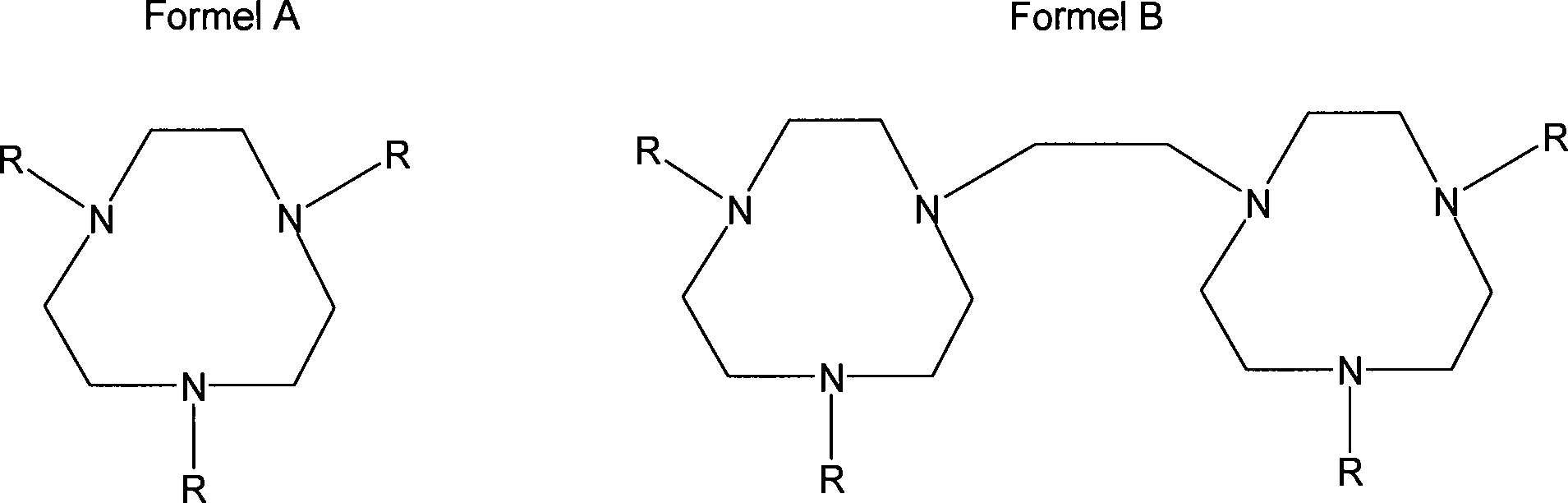

Priority Applications (6)
| Application Number | Priority Date | Filing Date | Title |
|---|---|---|---|
| DE102013010150.6A DE102013010150A1 (en) | 2013-06-15 | 2013-06-15 | Bleach catalyst granules |
| DK14723720.0T DK3008157T3 (en) | 2013-06-15 | 2014-05-09 | Bleach catalyst granules, their use and detergents containing them |
| ES14723720.0T ES2640094T3 (en) | 2013-06-15 | 2014-05-09 | Bleaching catalyst granules, their use and washing and cleaning agents containing these |
| PCT/EP2014/001264 WO2014198368A1 (en) | 2013-06-15 | 2014-05-09 | Bleach catalyst granules, use thereof and washing and cleaning agents containing the same |
| US14/898,189 US9902921B2 (en) | 2013-06-15 | 2014-05-09 | Bleach catalyst granules, use thereof and washing cleaning agents containing the same |
| EP14723720.0A EP3008157B1 (en) | 2013-06-15 | 2014-05-09 | Bleach catalyst granules, use thereof and washing and cleaning agents containing the same |
Applications Claiming Priority (1)
| Application Number | Priority Date | Filing Date | Title |
|---|---|---|---|
| DE102013010150.6A DE102013010150A1 (en) | 2013-06-15 | 2013-06-15 | Bleach catalyst granules |
Publications (1)
| Publication Number | Publication Date |
|---|---|
| DE102013010150A1 true DE102013010150A1 (en) | 2014-12-18 |
Family
ID=50721745
Family Applications (1)
| Application Number | Title | Priority Date | Filing Date |
|---|---|---|---|
| DE102013010150.6A Withdrawn DE102013010150A1 (en) | 2013-06-15 | 2013-06-15 | Bleach catalyst granules |
Country Status (6)
| Country | Link |
|---|---|
| US (1) | US9902921B2 (en) |
| EP (1) | EP3008157B1 (en) |
| DE (1) | DE102013010150A1 (en) |
| DK (1) | DK3008157T3 (en) |
| ES (1) | ES2640094T3 (en) |
| WO (1) | WO2014198368A1 (en) |
Cited By (4)
| Publication number | Priority date | Publication date | Assignee | Title |
|---|---|---|---|---|
| EP3050951A1 (en) * | 2015-02-02 | 2016-08-03 | The Procter and Gamble Company | Method of dishwashing |
| EP3050952A1 (en) * | 2015-02-02 | 2016-08-03 | The Procter and Gamble Company | Method of dishwashing |
| EP3190168A1 (en) * | 2016-01-06 | 2017-07-12 | Dalli-Werke GmbH & Co. KG. | Coated bleach catalyst |
| US10047323B2 (en) | 2015-02-02 | 2018-08-14 | The Procter & Gamble Company | Detergent composition comprising MGDA and a sulfonated copolymer |
Families Citing this family (3)
| Publication number | Priority date | Publication date | Assignee | Title |
|---|---|---|---|---|
| DE102017004742A1 (en) | 2017-05-17 | 2018-11-22 | Weylchem Wiesbaden Gmbh | Coated granules, their use and detergents and cleaning agents containing them |
| EP4008765A1 (en) | 2020-12-07 | 2022-06-08 | WeylChem Performance Products GmbH | Compositions comprising protonated triazacyclic compounds and bleaching agent and cleaning agent comprising same |
| WO2025191283A1 (en) | 2024-03-15 | 2025-09-18 | Catexel Gmbh | Oxidative method |
Citations (15)
| Publication number | Priority date | Publication date | Assignee | Title |
|---|---|---|---|---|
| EP0458398A2 (en) | 1990-05-21 | 1991-11-27 | Unilever N.V. | Bleach activation |
| EP0509787A2 (en) | 1991-04-17 | 1992-10-21 | Unilever Plc | Concentrated detergent powder compositions |
| EP0530870A1 (en) | 1991-08-23 | 1993-03-10 | Unilever N.V. | Machine dishwashing composition |
| EP0544440A2 (en) | 1991-11-20 | 1993-06-02 | Unilever Plc | Bleach catalyst composition, manufacture and use thereof in detergent and/or bleach compositions |
| EP0544519A2 (en) | 1991-11-26 | 1993-06-02 | Unilever Plc | Bleach manganese catalyst and its use |
| EP0549272A1 (en) | 1991-12-20 | 1993-06-30 | Unilever Plc | Bleach activation |
| WO1995006710A1 (en) | 1993-09-03 | 1995-03-09 | Unilever Plc | Bleach catalyst composition |
| WO1995006711A1 (en) | 1993-09-03 | 1995-03-09 | Unilever Plc | Bleach catalyst composition |
| WO1996006154A1 (en) | 1994-08-19 | 1996-02-29 | Unilever N.V. | Detergent bleach composition |
| WO1996006157A1 (en) | 1994-08-19 | 1996-02-29 | Unilever N.V. | Detergent bleach composition |
| WO1997016521A1 (en) | 1995-10-30 | 1997-05-09 | The Procter & Gamble Company | Bleach catalyst particles |
| WO2003093405A2 (en) | 2002-05-02 | 2003-11-13 | The Procter & Gamble Company | Detergent compositions and components thereof |
| WO2006125517A1 (en) | 2005-05-27 | 2006-11-30 | Unilever Plc | Process of bleaching |
| DE102007039651A1 (en) | 2006-11-27 | 2009-02-26 | Henkel Ag & Co. Kgaa | Bleach catalyst granules |
| WO2010115581A1 (en) | 2009-04-11 | 2010-10-14 | Clariant International Ltd | Bleach granules |
Family Cites Families (9)
| Publication number | Priority date | Publication date | Assignee | Title |
|---|---|---|---|---|
| CZ191598A3 (en) * | 1995-12-20 | 1998-11-11 | The Procter & Gamble Company | Combined particles containing bleaching catalyst and enzyme, their composition and preparation as well as their incorporation into cleansing agent |
| US6093343A (en) * | 1996-02-08 | 2000-07-25 | The Procter & Gamble Company | Detergent particles comprising metal-containing bleach catalysts |
| DE10102248A1 (en) * | 2001-01-19 | 2002-07-25 | Clariant Gmbh | Use of transition metal complexes with oxime ligands as bleach catalysts |
| CN1791665B (en) * | 2003-05-21 | 2010-05-26 | 西巴特殊化学制品控股公司 | Stabilized granular compositions containing bleach catalysts |
| JP2007538120A (en) * | 2004-05-17 | 2007-12-27 | ヘンケル コマンディットゲゼルシャフト アウフ アクチエン | Detergents containing bleach-enhanced transition metal complexes, optionally generated in situ |
| DE102006056248A1 (en) | 2006-11-27 | 2008-05-29 | Henkel Kgaa | Granulated bleaching catalyst, useful to remove tea stains from mechanical dishwashers, comprises a bleaching catalyst e.g. cobalt(amine)-complex, carrier material e.g. sulfate, and binding agent e.g. homo- and/or copolymer of acrylic acid |
| DE102007059970A1 (en) * | 2007-12-11 | 2009-09-10 | Henkel Ag & Co. Kgaa | cleaning supplies |
| DE102009017722A1 (en) * | 2009-04-11 | 2010-10-14 | Clariant International Limited | Bleach granules with active coating |
| DE102011010818A1 (en) * | 2011-02-10 | 2012-08-16 | Clariant International Ltd. | Use of transition metal complexes as bleaching catalysts in detergents and cleaners |
-
2013
- 2013-06-15 DE DE102013010150.6A patent/DE102013010150A1/en not_active Withdrawn
-
2014
- 2014-05-09 ES ES14723720.0T patent/ES2640094T3/en active Active
- 2014-05-09 WO PCT/EP2014/001264 patent/WO2014198368A1/en not_active Ceased
- 2014-05-09 US US14/898,189 patent/US9902921B2/en active Active
- 2014-05-09 EP EP14723720.0A patent/EP3008157B1/en active Active
- 2014-05-09 DK DK14723720.0T patent/DK3008157T3/en active
Patent Citations (16)
| Publication number | Priority date | Publication date | Assignee | Title |
|---|---|---|---|---|
| EP0458398A2 (en) | 1990-05-21 | 1991-11-27 | Unilever N.V. | Bleach activation |
| EP0458397A2 (en) | 1990-05-21 | 1991-11-27 | Unilever N.V. | Bleach activation |
| EP0509787A2 (en) | 1991-04-17 | 1992-10-21 | Unilever Plc | Concentrated detergent powder compositions |
| EP0530870A1 (en) | 1991-08-23 | 1993-03-10 | Unilever N.V. | Machine dishwashing composition |
| EP0544440A2 (en) | 1991-11-20 | 1993-06-02 | Unilever Plc | Bleach catalyst composition, manufacture and use thereof in detergent and/or bleach compositions |
| EP0544519A2 (en) | 1991-11-26 | 1993-06-02 | Unilever Plc | Bleach manganese catalyst and its use |
| EP0549272A1 (en) | 1991-12-20 | 1993-06-30 | Unilever Plc | Bleach activation |
| WO1995006710A1 (en) | 1993-09-03 | 1995-03-09 | Unilever Plc | Bleach catalyst composition |
| WO1995006711A1 (en) | 1993-09-03 | 1995-03-09 | Unilever Plc | Bleach catalyst composition |
| WO1996006154A1 (en) | 1994-08-19 | 1996-02-29 | Unilever N.V. | Detergent bleach composition |
| WO1996006157A1 (en) | 1994-08-19 | 1996-02-29 | Unilever N.V. | Detergent bleach composition |
| WO1997016521A1 (en) | 1995-10-30 | 1997-05-09 | The Procter & Gamble Company | Bleach catalyst particles |
| WO2003093405A2 (en) | 2002-05-02 | 2003-11-13 | The Procter & Gamble Company | Detergent compositions and components thereof |
| WO2006125517A1 (en) | 2005-05-27 | 2006-11-30 | Unilever Plc | Process of bleaching |
| DE102007039651A1 (en) | 2006-11-27 | 2009-02-26 | Henkel Ag & Co. Kgaa | Bleach catalyst granules |
| WO2010115581A1 (en) | 2009-04-11 | 2010-10-14 | Clariant International Ltd | Bleach granules |
Non-Patent Citations (3)
| Title |
|---|
| "Seifen-Öle-Fette-Wachse, 116 Jahrgang, Nr. 20/1990", auf den Seiten 805-808 |
| K. Wieghardt etal., Zeitschrift für Naturforschung 43b, 1184-1194 (1988) |
| SOFW, 132(8), 2006, 35-49 |
Cited By (7)
| Publication number | Priority date | Publication date | Assignee | Title |
|---|---|---|---|---|
| EP3050951A1 (en) * | 2015-02-02 | 2016-08-03 | The Procter and Gamble Company | Method of dishwashing |
| EP3050952A1 (en) * | 2015-02-02 | 2016-08-03 | The Procter and Gamble Company | Method of dishwashing |
| WO2016126568A1 (en) * | 2015-02-02 | 2016-08-11 | The Procter & Gamble Company | Method of dishwashing |
| WO2016126569A1 (en) * | 2015-02-02 | 2016-08-11 | The Procter & Gamble Company | Method of dishwashing |
| US10047323B2 (en) | 2015-02-02 | 2018-08-14 | The Procter & Gamble Company | Detergent composition comprising MGDA and a sulfonated copolymer |
| EP3190168A1 (en) * | 2016-01-06 | 2017-07-12 | Dalli-Werke GmbH & Co. KG. | Coated bleach catalyst |
| WO2017118543A1 (en) * | 2016-01-06 | 2017-07-13 | Dalli-Werke Gmbh & Co. Kg | Coated bleach catalyst(s) |
Also Published As
| Publication number | Publication date |
|---|---|
| WO2014198368A1 (en) | 2014-12-18 |
| EP3008157B1 (en) | 2017-07-12 |
| ES2640094T3 (en) | 2017-10-31 |
| US9902921B2 (en) | 2018-02-27 |
| DK3008157T3 (en) | 2017-10-23 |
| EP3008157A1 (en) | 2016-04-20 |
| US20160145541A1 (en) | 2016-05-26 |
Similar Documents
| Publication | Publication Date | Title |
|---|---|---|
| EP2417238B1 (en) | Bleach granules | |
| EP2417240B1 (en) | Bleach granules comprising an active coating | |
| EP3008157B1 (en) | Bleach catalyst granules, use thereof and washing and cleaning agents containing the same | |
| EP3008158B1 (en) | Bleaching-agent co-granules, method for producing said bleaching-agent co-granules, and use of said bleaching-agent co-granules | |
| EP3625319B1 (en) | Coated granules, use thereof, and washing and cleaning agents containing same | |
| EP2329000B1 (en) | Use of manganese oxalates as bleach catalysts | |
| DE102016015660A1 (en) | Granules, their use and detergents and cleaning agents containing them | |
| DE102020001458A1 (en) | Detergents and cleaning agents, methods of disinfecting and their use | |
| EP2329001B1 (en) | Bleach catalyst mixtures consisting of manganese salts and oxalic acid or the salts thereof | |
| DE19713851B4 (en) | Use of complexes of molybdenum, vanadium or tungsten to enhance the bleaching action | |
| EP0846156A1 (en) | Detergents with activator complexes for peroxy compounds | |
| EP4506442A1 (en) | Co-granulat, washing and cleaning agents containing same and use thereof | |
| DE60009745T2 (en) | DETERGENT COMPOSITIONS | |
| EP1969112B1 (en) | Cleaning agent comprising complexes with bleach catalytic activity | |
| DE102015205801A1 (en) | Particulate detergent with bleach catalyst | |
| EP2882836B1 (en) | Automatic dishwashing composition comprising hydrobobically modified polysaccharides | |
| EP3277786A1 (en) | Detergent composition with improved stain removal |
Legal Events
| Date | Code | Title | Description |
|---|---|---|---|
| R082 | Change of representative |
Representative=s name: ACKERMANN, JOACHIM KARL WILHELM, DIPL.-CHEM. D, DE |
|
| R082 | Change of representative |
Representative=s name: ACKERMANN, JOACHIM KARL WILHELM, DIPL.-CHEM. D, DE |
|
| R082 | Change of representative |
Representative=s name: ACKERMANN, JOACHIM KARL WILHELM, DIPL.-CHEM. D, DE |
|
| R081 | Change of applicant/patentee |
Owner name: WEYLCHEM SWITZERLAND AG, CH Free format text: FORMER OWNER: CLARIANT INTERNATIONAL LTD., MUTTENZ, CH Effective date: 20150119 |
|
| R082 | Change of representative |
Representative=s name: ACKERMANN, JOACHIM KARL WILHELM, DIPL.-CHEM. D, DE Effective date: 20140220 Representative=s name: ACKERMANN, JOACHIM KARL WILHELM, DIPL.-CHEM. D, DE Effective date: 20150119 Representative=s name: ACKERMANN, JOACHIM KARL WILHELM, DIPL.-CHEM. D, DE Effective date: 20140115 |
|
| R119 | Application deemed withdrawn, or ip right lapsed, due to non-payment of renewal fee |