DE102011102438A1 - Solid polymer electrolyte, useful in electrical component, preferably battery, accumulator, electrochromic display or sensor, comprises copolymer containing repeating unit derived from polymerizable ionic liquid and carbonyl repeating unit - Google Patents
Solid polymer electrolyte, useful in electrical component, preferably battery, accumulator, electrochromic display or sensor, comprises copolymer containing repeating unit derived from polymerizable ionic liquid and carbonyl repeating unit Download PDFInfo
- Publication number
- DE102011102438A1 DE102011102438A1 DE102011102438A DE102011102438A DE102011102438A1 DE 102011102438 A1 DE102011102438 A1 DE 102011102438A1 DE 102011102438 A DE102011102438 A DE 102011102438A DE 102011102438 A DE102011102438 A DE 102011102438A DE 102011102438 A1 DE102011102438 A1 DE 102011102438A1
- Authority
- DE
- Germany
- Prior art keywords
- polymer electrolyte
- solid polymer
- ionic liquid
- formula
- electrolyte according
- Prior art date
- Legal status (The legal status is an assumption and is not a legal conclusion. Google has not performed a legal analysis and makes no representation as to the accuracy of the status listed.)
- Granted
Links
- YIONKIGVBTVBLM-UHFFFAOYSA-N CN(C)CCOC=O Chemical compound CN(C)CCOC=O YIONKIGVBTVBLM-UHFFFAOYSA-N 0.000 description 1
Images


Classifications
-
- H—ELECTRICITY
- H01—ELECTRIC ELEMENTS
- H01G—CAPACITORS; CAPACITORS, RECTIFIERS, DETECTORS, SWITCHING DEVICES, LIGHT-SENSITIVE OR TEMPERATURE-SENSITIVE DEVICES OF THE ELECTROLYTIC TYPE
- H01G9/00—Electrolytic capacitors, rectifiers, detectors, switching devices, light-sensitive or temperature-sensitive devices; Processes of their manufacture
- H01G9/004—Details
- H01G9/022—Electrolytes; Absorbents
- H01G9/025—Solid electrolytes
- H01G9/028—Organic semiconducting electrolytes, e.g. TCNQ
-
- C—CHEMISTRY; METALLURGY
- C08—ORGANIC MACROMOLECULAR COMPOUNDS; THEIR PREPARATION OR CHEMICAL WORKING-UP; COMPOSITIONS BASED THEREON
- C08J—WORKING-UP; GENERAL PROCESSES OF COMPOUNDING; AFTER-TREATMENT NOT COVERED BY SUBCLASSES C08B, C08C, C08F, C08G or C08H
- C08J5/00—Manufacture of articles or shaped materials containing macromolecular substances
- C08J5/20—Manufacture of shaped structures of ion-exchange resins
- C08J5/22—Films, membranes or diaphragms
- C08J5/2206—Films, membranes or diaphragms based on organic and/or inorganic macromolecular compounds
- C08J5/2218—Synthetic macromolecular compounds
- C08J5/2231—Synthetic macromolecular compounds based on macromolecular compounds obtained by reactions involving unsaturated carbon-to-carbon bonds
-
- H—ELECTRICITY
- H01—ELECTRIC ELEMENTS
- H01M—PROCESSES OR MEANS, e.g. BATTERIES, FOR THE DIRECT CONVERSION OF CHEMICAL ENERGY INTO ELECTRICAL ENERGY
- H01M10/00—Secondary cells; Manufacture thereof
- H01M10/05—Accumulators with non-aqueous electrolyte
- H01M10/052—Li-accumulators
-
- H—ELECTRICITY
- H01—ELECTRIC ELEMENTS
- H01M—PROCESSES OR MEANS, e.g. BATTERIES, FOR THE DIRECT CONVERSION OF CHEMICAL ENERGY INTO ELECTRICAL ENERGY
- H01M10/00—Secondary cells; Manufacture thereof
- H01M10/05—Accumulators with non-aqueous electrolyte
- H01M10/056—Accumulators with non-aqueous electrolyte characterised by the materials used as electrolytes, e.g. mixed inorganic/organic electrolytes
- H01M10/0564—Accumulators with non-aqueous electrolyte characterised by the materials used as electrolytes, e.g. mixed inorganic/organic electrolytes the electrolyte being constituted of organic materials only
- H01M10/0565—Polymeric materials, e.g. gel-type or solid-type
-
- H—ELECTRICITY
- H01—ELECTRIC ELEMENTS
- H01M—PROCESSES OR MEANS, e.g. BATTERIES, FOR THE DIRECT CONVERSION OF CHEMICAL ENERGY INTO ELECTRICAL ENERGY
- H01M6/00—Primary cells; Manufacture thereof
- H01M6/14—Cells with non-aqueous electrolyte
- H01M6/18—Cells with non-aqueous electrolyte with solid electrolyte
- H01M6/181—Cells with non-aqueous electrolyte with solid electrolyte with polymeric electrolytes
-
- C—CHEMISTRY; METALLURGY
- C08—ORGANIC MACROMOLECULAR COMPOUNDS; THEIR PREPARATION OR CHEMICAL WORKING-UP; COMPOSITIONS BASED THEREON
- C08J—WORKING-UP; GENERAL PROCESSES OF COMPOUNDING; AFTER-TREATMENT NOT COVERED BY SUBCLASSES C08B, C08C, C08F, C08G or C08H
- C08J2333/00—Characterised by the use of homopolymers or copolymers of compounds having one or more unsaturated aliphatic radicals, each having only one carbon-to-carbon double bond, and only one being terminated by only one carboxyl radical, or of salts, anhydrides, esters, amides, imides, or nitriles thereof; Derivatives of such polymers
- C08J2333/04—Characterised by the use of homopolymers or copolymers of compounds having one or more unsaturated aliphatic radicals, each having only one carbon-to-carbon double bond, and only one being terminated by only one carboxyl radical, or of salts, anhydrides, esters, amides, imides, or nitriles thereof; Derivatives of such polymers esters
- C08J2333/14—Characterised by the use of homopolymers or copolymers of compounds having one or more unsaturated aliphatic radicals, each having only one carbon-to-carbon double bond, and only one being terminated by only one carboxyl radical, or of salts, anhydrides, esters, amides, imides, or nitriles thereof; Derivatives of such polymers esters of esters containing halogen, nitrogen, sulfur, or oxygen atoms in addition to the carboxy oxygen
-
- H—ELECTRICITY
- H01—ELECTRIC ELEMENTS
- H01M—PROCESSES OR MEANS, e.g. BATTERIES, FOR THE DIRECT CONVERSION OF CHEMICAL ENERGY INTO ELECTRICAL ENERGY
- H01M2300/00—Electrolytes
- H01M2300/0017—Non-aqueous electrolytes
- H01M2300/0065—Solid electrolytes
- H01M2300/0082—Organic polymers
-
- Y—GENERAL TAGGING OF NEW TECHNOLOGICAL DEVELOPMENTS; GENERAL TAGGING OF CROSS-SECTIONAL TECHNOLOGIES SPANNING OVER SEVERAL SECTIONS OF THE IPC; TECHNICAL SUBJECTS COVERED BY FORMER USPC CROSS-REFERENCE ART COLLECTIONS [XRACs] AND DIGESTS
- Y02—TECHNOLOGIES OR APPLICATIONS FOR MITIGATION OR ADAPTATION AGAINST CLIMATE CHANGE
- Y02E—REDUCTION OF GREENHOUSE GAS [GHG] EMISSIONS, RELATED TO ENERGY GENERATION, TRANSMISSION OR DISTRIBUTION
- Y02E60/00—Enabling technologies; Technologies with a potential or indirect contribution to GHG emissions mitigation
- Y02E60/10—Energy storage using batteries
Landscapes
- Chemical & Material Sciences (AREA)
- Chemical Kinetics & Catalysis (AREA)
- Engineering & Computer Science (AREA)
- Electrochemistry (AREA)
- Manufacturing & Machinery (AREA)
- General Chemical & Material Sciences (AREA)
- Power Engineering (AREA)
- Inorganic Chemistry (AREA)
- Condensed Matter Physics & Semiconductors (AREA)
- Dispersion Chemistry (AREA)
- General Physics & Mathematics (AREA)
- Physics & Mathematics (AREA)
- Microelectronics & Electronic Packaging (AREA)
- Materials Engineering (AREA)
- Health & Medical Sciences (AREA)
- Medicinal Chemistry (AREA)
- Polymers & Plastics (AREA)
- Organic Chemistry (AREA)
- Secondary Cells (AREA)
Abstract
Description
Die vorliegende Erfindung betrifft insbesondere polymere Festelektrolyten (= Festpolymerelektrolyte), die aus einer polymerisationsfähigen ionischen Flüssigkeit, einer Metallsalzkomponente, insbesondere einer Lithiumsalzkomponente, und einer Matrix, die z. B. aus diacrylathaltigen Oligoethylenoxiden bzw. Oligoethylenoxid-co-carboxyverbindungen aufgebaut ist, bestehen, sowie deren Herstellung und Verwendung. Hieraus hergestellte Schichten können z. B. durch eine UV-Behandlung vernetzt und damit stabilisiert werden. Die Anwesenheit der ionischen Flüssigkeit führt zu einer verbesserten Dissoziation des Lithiumsalzes in diesem Blendsystem. Aus diesem Grund wird eine hohe Ionenleitfähigkeit des polymeren Festelektrolyten durch die Wechselwirkung der ionischen Flüssigkeit mit der Lithiumsalzkomponente erzielt. Der erfindungsgemäße polymere Festelektrolyt ist zur Verwendung in einer elektrochemischen Vorrichtung, insbesondere in einer Batterie, einem Akkumulator, einem elektrochromen Display oder Sensoren geeignet.The present invention relates in particular to polymeric solid electrolytes (= solid polymer electrolytes) which consist of a polymerizable ionic liquid, a metal salt component, in particular a lithium salt component, and a matrix which, for. B. from diacrylate-containing oligoethylene oxides or oligoethylene oxide co-carboxy compounds is composed, and their preparation and use. Layers made therefrom can z. B. crosslinked by a UV treatment and thus stabilized. The presence of the ionic liquid leads to an improved dissociation of the lithium salt in this blend system. For this reason, high ionic conductivity of the polymer solid electrolyte is achieved by the interaction of the ionic liquid with the lithium salt component. The polymeric solid electrolyte according to the invention is suitable for use in an electrochemical device, in particular in a battery, an accumulator, an electrochromic display or sensors.
Eine Variante der Lithium-Ionenzelle ist die Lithium-Polymer-Zelle. Dabei besteht die Kathode (negative Elektrode) aus Graphit, die Anode aus Lithium-Metalloxid. An Stelle eines flüssigen Elektrolyten wird meist eine Polymermatrix verwendet, die den Flüssigelektrolyten vollständig aufsaugt und auslaufsicher fixiert. Die Komponenten lassen sich preiswert als Schichtfolien herstellen und ermöglichen dadurch die Entwicklung dünner Zellen und größere Designflexibilität. Dabei lassen sich die Polymerelektrolyte in drei Gruppen einteilen:
- • Ein Gelelektrolyt aus einem Salz, das in einer polaren Flüssigkeit gelöst wird, wozu ein inertes Polymer gegeben wird, um mechanische Stabilität zu erreichen.
- • Ein Polymerelektrolyt, dem zur Erhöhung der Leitfähigkeit eine geringe Menge eines Lösungsmittels mit einer hohen Dielektrizitätskonstante beigegeben wird.
- • Ein System aus einem Salz, das in einer hochmolekularen polaren Polymermatrix gelöst ist.
- A gel electrolyte from a salt which is dissolved in a polar liquid to which an inert polymer is added to achieve mechanical stability.
- A polymer electrolyte to which is added a small amount of a solvent having a high dielectric constant for increasing the conductivity.
- • A system of a salt dissolved in a high molecular weight polar polymer matrix.
Bei dem letztgenannten System handelt es sich um einen (Fest)Polymerelektrolyt. Als Elektrolyt wird ein Polymer mit einem darin gelösten Lithiumsalz eingesetzt, das keine flüssigen Lösungsmittel mehr enthält. Der Nachteil dieser Systeme liegt darin, dass die Leitfähigkeit dieser reinen Polymerelektrolyte deutlich geringer ist als die der Flüssigelektrolyte. Der bisher bekannteste polymere Festelektrolyt basiert auf einem Polyether (PEO) und einem Leitsalz, dieser erreicht erst bei Temperaturen größer 60°C relevante Leitfähigkeiten um die 10–3 bis 10–4 S/cm. Der Vorteil ist darin zu sehen, dass damit Vereinfachungen hinsichtlich der Herstellung, Robustheit und Sicherheit verbunden sind. Außerdem ist diese Form von Polymerelektrolyt sehr reduktionsstabil, aus diesem Grund kann wieder metallisches Lithium in Form einer Folie als negative Elektrode eingesetzt werden. Die Bildung von Lithiumdendriten und die damit verbundenen Sicherheitsrisiken treten nicht auf.The latter system is a (solid) polymer electrolyte. The electrolyte used is a polymer with a lithium salt dissolved therein which no longer contains any liquid solvents. The disadvantage of these systems is that the conductivity of these pure polymer electrolytes is significantly lower than that of the liquid electrolytes. The most well-known polymeric solid electrolyte based on a polyether (PEO) and a conducting salt, this reaches only at temperatures greater than 60 ° C relevant conductivities to the 10 -3 to 10 -4 S / cm. The advantage is to be seen in the fact that this simplification in terms of manufacturing, robustness and safety are connected. In addition, this form of polymer electrolyte is very stable to reduction, for this reason, metallic lithium in the form of a film can be used as a negative electrode again. The formation of lithium dendrites and the associated safety risks do not occur.
So wird in der
Die
In der
Daher sind die bekannten polymeren Festelektrolyte unter den betrachteten Eigenschaften hinsichtlich ionischer Leitfähigkeit, der Folienfestigkeit, der thermischen und chemischen Stabilität noch nicht ausreichend stabil.Therefore, the known polymer solid electrolytes are not sufficiently stable under the considered properties in terms of ionic conductivity, film strength, thermal and chemical stability.
Der vorliegenden Erfindung liegt daher die Aufgabe zugrunde, polymere Festelektrolyte zur Verfügung zu stellen, die auch ohne Lösungsmittelzusatz und ohne Weichmacher hohe Ionenleitfähigkeit und hohe mechanische Festigkeit bei Raumtemperatur aufweisen, die darüber hinaus auch der Dendritenbildung entgegenwirken soll. Ferner sollen diese Polymerelektrolyte hohe thermische und elektrochemische Stabilität aufweisen, dennoch elektrisch isolierend und außerdem kostengünstig zu einer möglichst dünnen Folie verarbeitbar sein. Diese sollen in elektrochemischen Vorrichtungen, wie Batterien und Akkumulatoren, insbesondere in Li-Metallpolymerbatterien, Lithiumpolymerbatterien und Lithiumionenbatterien, elektrochromen Displays oder auch Sensoren verwendet werden können. Dabei sollen diese polymeren Festelektrolyte Glasübergangstemperaturen oberhalb von Raumtemperatur aufweisen.The present invention is therefore based on the object to provide polymeric solid electrolytes that have high ionic conductivity and high mechanical strength at room temperature, even without addition of solvent and without plasticizer, which should also counteract the formation of dendrites. Furthermore, these polymer electrolytes are said to have high thermal and electrochemical stability have, yet electrically insulating and also cost to be processed as thin as possible film. These are to be used in electrochemical devices, such as batteries and accumulators, in particular in Li metal polymer batteries, lithium polymer batteries and lithium ion batteries, electrochromic displays or sensors. These polymeric solid electrolytes should have glass transition temperatures above room temperature.
Zudem ist es Aufgabe der vorliegenden Erfindung, ein Verfahren anzugeben, mit dem sich derartige polymere Festelektrolyte herstellen lassen. Ebenso ist es Aufgabe der vorliegenden Erfindung, entsprechende Verwendungszwecke bzw. Anwendungsmöglichkeiten derartiger Festpolymerelektrolyte anzugeben.In addition, it is an object of the present invention to provide a method with which such polymeric solid electrolytes can be produced. It is also an object of the present invention to provide appropriate uses or applications of such solid polymer electrolytes.
Diese Aufgabe wird bezüglich eines Festpolymerelektrolyten oder polymeren Festelektrolyten mit den Merkmalen des Patentanspruchs 1, bezüglich eines Verfahrens zur Herstellung eines derartigen Festpolymerelektrolyten mit den Merkmalen des Patentanspruchs 11 sowie bezüglich eines elektrischen Bauteils, das auf den erfindungsgemäßen polymeren Festelektrolyten zurückgreift, mit den Merkmalen des Patentanspruchs 16 gelöst. Die jeweiligen abhängigen Patentansprüche stellen dabei vorteilhafte Weiterbildungen dar.This object is related to a solid polymer electrolyte or polymer solid electrolyte with the features of claim 1, with respect to a method for producing such a solid polymer electrolyte with the features of claim 11 and with respect to an electrical component, which uses the polymeric solid electrolyte according to the invention, having the features of claim 16 solved. The respective dependent claims are advantageous developments.
Erfindungsgemäß wird somit ein Festpolymerelektrolyt bzw. ein polymerer Festelektrolyt angegeben, der mindestens ein Copolymer enthält oder hieraus besteht, das
- a) mindestens eine von einer polymerisierbaren ionischen Flüssigkeit abgeleitete Wiederholungseinheit der allgemeinen Formel I mit R1 = H oder Methyl l = 0 oder 1 wobei A einen Mittelblock darstellt, der mindestens einen oder mehrere der gleichen oder verschiedenen der folgenden Reste aufweist:
 mit m = 1 bis 12, wobei B ein geeigneter kationischer Rest ist, sowie
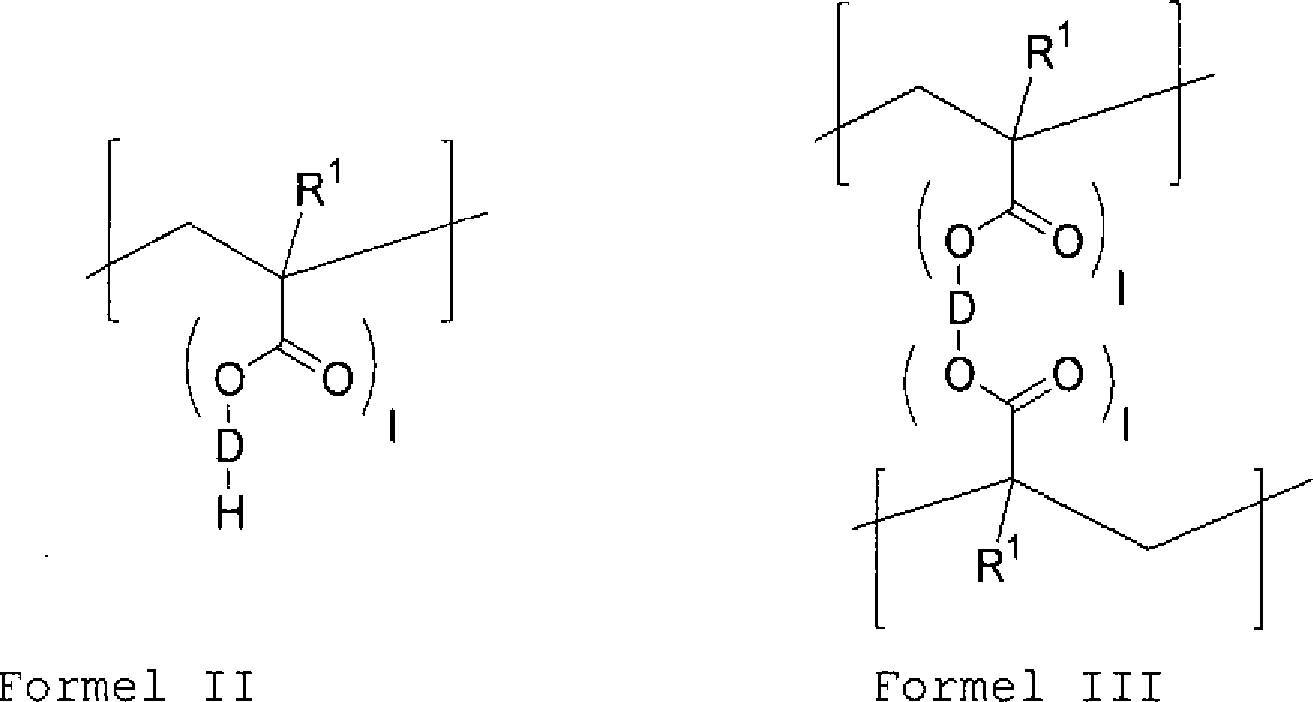
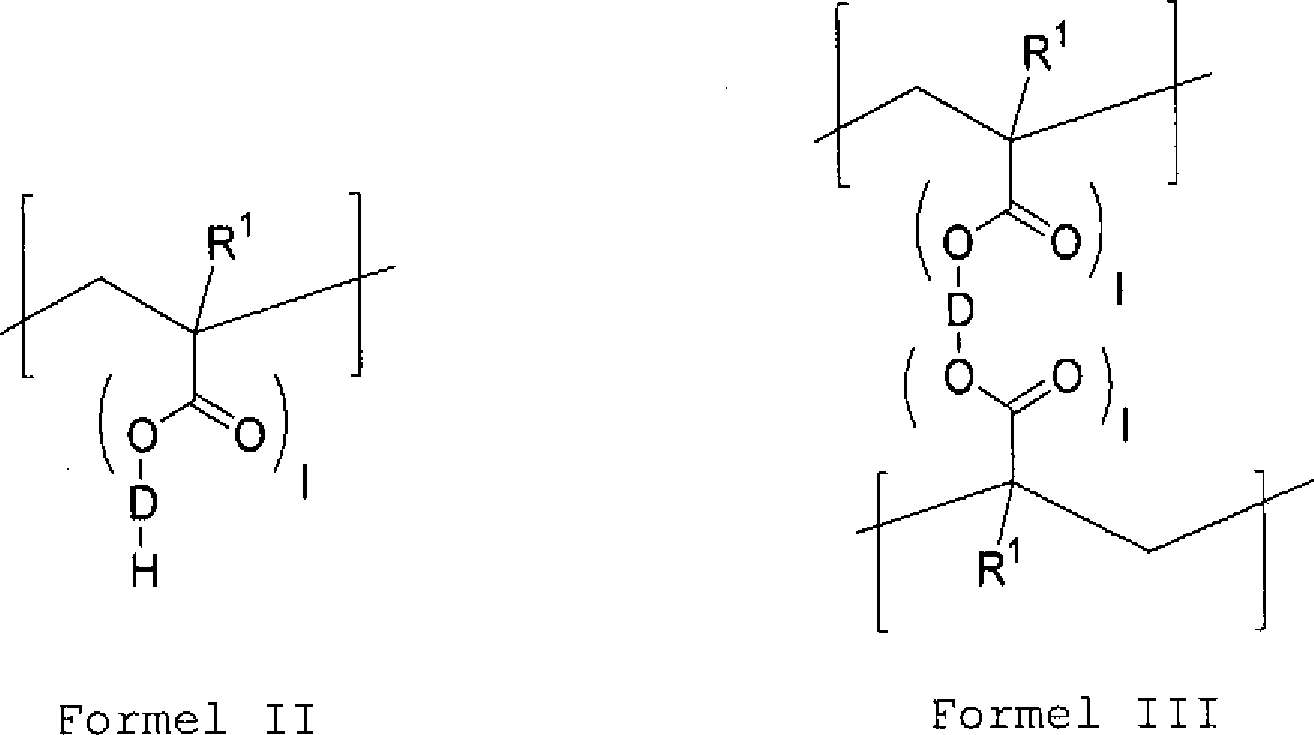
- b) mindestens eine Wiederholungseinheit der allgemeinen Formel II und/oder III wobei R1 und l die oben angegebene Bedeutung aufweisen und D einen Mittelblock darstellt, der mindestens einen oder mehrere der gleichen oder verschiedenen der folgenden Reste aufweist:
 mit m = 1 bis 12.
- a) at least one derived from a polymerizable ionic liquid repeating unit of the general formula I. where R 1 is H or methyl I is 0 or 1, where A is a midblock having at least one or more of the same or different radicals:with m = 1 to 12, where B is a suitable cationic radical, as well as
- b) at least one repeat unit of the general formula II and / or III where R 1 and I have the abovementioned meaning and D represents an intermediate block which has at least one or more of the same or different of the following radicals:with m = 1 to 12.
Die erfindungsgemäßen Copolymere sind dabei in der Regel Wasserstoff-terminiert.The copolymers of the invention are usually hydrogen-terminated.
Überraschenderweise konnte festgestellt werden, dass die erfindungsgemäßen Festpolymerelektrolyten bereits bei Raumtemperatur eine im Vergleich zu den oben aus dem Stand der Technik bekannten Systemen deutlich verbesserte Leitfähigkeit für Lithium-Ionen aufweisen. Dies zeigt sich insbesondere bei Temperaturen im Bereich der Raumtemperatur, wobei sich bei den erfindungsgemäßen Festpolymerelektrolyten deutlich bessere Leitfähigkeiten als bei aus dem Stand der Technik bekannten Eestpolymerelektrolyten ergeben.It has surprisingly been found that the solid polymer electrolytes according to the invention have a significantly improved conductivity for lithium ions already at room temperature compared to the systems known from the prior art. This is particularly evident at temperatures in the range of room temperature, resulting in the solid polymer electrolyte according to the invention significantly better conductivities than known from the prior art Eestpolymerelektrolyten.
In einer bevorzugten Ausführungsform enthält der Festpolymerelektrolyt neben dem Copolymer mindestens ein Metallsalz, bevorzugt ein Lithiumsalz, insbesondere ausgewählt aus der Gruppe bestehend aus LiPF6, LiBF4, LiClOA, LiSO3CF3, LiSO3(CF2)3CF3, LiN(SO2CF3)2, LiC4BO8 (Li-BOB) und/oder Kombinationen hieraus. Gemäß dieser bevorzugten Ausführungsform enthält der polymere Festelektrolyt daher bereits Lithium-Ionen, die mit den positiv geladenen Gruppierungen B im Polymer Wechselwirken können. Es steht somit bereits ein einsatzbereiter Festpolymerelektrolyt zur Verfügung.In a preferred embodiment, the solid polymer electrolyte contains in addition to the copolymer at least one metal salt, preferably a lithium salt, in particular selected from the group consisting of LiPF 6 , LiBF 4 , LiClO A , LiSO 3 CF 3 , LiSO 3 (CF 2 ) 3 CF 3 , LiN (SO 2 CF 3 ) 2 , LiC 4 BO 8 (Li-BOB) and / or combinations thereof. Therefore, according to this preferred embodiment, the polymeric solid electrolyte already contains lithium ions which can interact with the positively charged groupings B in the polymer. Thus, a ready-to-use solid polymer electrolyte is already available.
In einer bevorzugten Ausführungsform beträgt der Gehalt des mindestens einen Metallsalzes, z. B. des Lithiumsalzes, bezogen auf die Gesamtheit aller Copolymere, von 0,001 bis 30 Gew.-%, bevorzugt von 0,01 bis 20 Gew.-%, besonders bevorzugt von 0,1 bis 10 Gew.-%.In a preferred embodiment, the content of the at least one metal salt, for. B. of the lithium salt, based on the totality of all copolymers, from 0.001 to 30 wt .-%, preferably from 0.01 to 20 wt .-%, particularly preferably from 0.1 to 10 wt .-%.
In einer weiteren vorteilhaften Ausführungsform ist der kationische Rest B des Copolymeren ausgewählt aus der Gruppe bestehend aus Resten der folgenden allgemeinen Formeln 
R2 = unabhängig voneinander lineares oder verzweigtes C1 bis C12 Alkyl,
X- = ein geeignetes Gegenion.In a further advantageous embodiment, the cationic radical B of the copolymer is selected from the group consisting of radicals of the following general formulas
R 2 = independently of one another linear or branched C 1 to C 12 alkyl,
X - = a suitable counterion.
Bei den zuvor genannten Verbindungen, die mehr des einen Rest R2 aufweisen, bedeutet die Auswahl des Restes R2 unabhängig von den anderen Resten R2, dass sowohl symmetrische Verbindungen (alle Reste R2 sind gleich) als auch asymmetrische Verbindungen (mindestens 2 oder alle Reste R2 sind verschieden) umfasst sind.In the abovementioned compounds which have more of the one radical R 2 , the selection of the radical R 2, independently of the other radicals R 2 , means that both symmetrical compounds (all radicals R 2 are identical) and asymmetric compounds (at least 2 or all radicals R 2 are different) are included.
Bei den für die kationischen Reste B genannten oben stehenden Verbindungen der allgemeinen Formeln bedeuten die aus den Klammern herausragenden Bindungen die Anbindungsstelle, mit der der entsprechende Rest mit dem Mittelblock A kovalent verbunden ist. Im Falle des zuerst genannten Imidazolium-Restes erfolgt die kovalente Bindung beispielsweise über ein Stickstoffatom. Für die Reste, die 6 Ringglieder aufweisen, wie beispielsweise die Pyridinium-, Piperidinium-, Morpholinium- bzw. Pyrimidium-Reste, kann die kovalente Bindung des Ringsystems über ein jedes der im Ringsystem enthaltenen Kohlenstoffatome erfolgen.In the compounds of the general formulas mentioned above for the cationic radicals B, the bonds protruding from the clips represent the attachment site with which the corresponding residue is covalently bonded to the middle block A. In the case of the first-mentioned imidazolium radical, the covalent bond takes place, for example, via a nitrogen atom. For the radicals having 6 ring members, such as the pyridinium, piperidinium, morpholinium or pyrimidium radicals, for example, the covalent bond of the ring system can take place via any of the carbon atoms contained in the ring system.
Bei den zuvor genannten Gruppierungen ist es bevorzugt, wenn das Gegenion X ausgewählt ist aus der Gruppe bestehend aus F–, Cl–, Br–, I–, BF4 –, PF6 –, CF3SO3 –, CF3(CF2)3SO3 –, (CF3SO3)2N–, SCN–, (NC)2N–, Trifluoracetat, p-Toluolsulfonat oder R2O-SO3 –, wobei R2 die oben angegebene Bedeutung hat.In the case of the abovementioned groupings, it is preferred that the counterion X is selected from the group consisting of F - , Cl - , Br - , I - , BF 4 - , PF 6 - , CF 3 SO 3 - , CF 3 (CF 2 ) 3 SO 3 - , (CF 3 SO 3 ) 2 N - , SCN - , (NC) 2 N - , trifluoroacetate, p-toluenesulfonate or R 2 O-SO 3 - , wherein R 2 has the meaning given above.
Weitere bevorzugte Ausführungsformen sehen vor, dass der Mittelblock A der Wiederholungseinheit der Formel I des Copolymeren ausgewählt ist aus den folgenden Resten 
Ebenso ist es vorteilhaft, wenn der Mittelblock D der Wiederholungseinheit der Formel II des Copolymeren ausgewählt ist aus den folgenden Resten 
Weiter bevorzugt ist, wenn das Gewichtsverhältnis der Summe aller Wiederholungseinheiten der Formel I bezogen auf die Summe aller Wiederholungseinheiten der Formel II und Formel III des Copolymeren von 1000:1 bis 1:1000, bevorzugt von 10:1 bis 1:10, weiter bevorzugt von 5:1 bis 1:5, besonders bevorzugt von 2:1 bis 1:2 beträgt. It is further preferred if the weight ratio of the sum of all repeating units of the formula I based on the sum of all repeating units of the formula II and formula III of the copolymer is from 1000: 1 to 1: 1000, preferably from 10: 1 to 1:10, more preferably from 5: 1 to 1: 5, more preferably from 2: 1 to 1: 2.
Zudem ist es vorteilhaft, wenn der Festpolymerelektrolyt bzw. das hierin enthaltene Copolymer frei von Lösungsmitteln und/oder Weichmachern ist, d. h. der Festpolymerelektrolyt nicht in Form eines Gels vorliegt. Dadurch wird eine hohe Formstabilität des Festpolymerelektrolyten gewährleistet.In addition, it is advantageous if the solid polymer electrolyte or the copolymer contained therein is free of solvents and / or plasticizers, d. H. the solid polymer electrolyte is not in the form of a gel. This ensures a high dimensional stability of the solid polymer electrolyte.
Weiter wird gemäß der Erfindung ein Verfahren zur Herstellung eines erfindungsgemäßen Festpolymerelektrolyten beschrieben, bei dem ein Reaktionsgemisch enthaltend
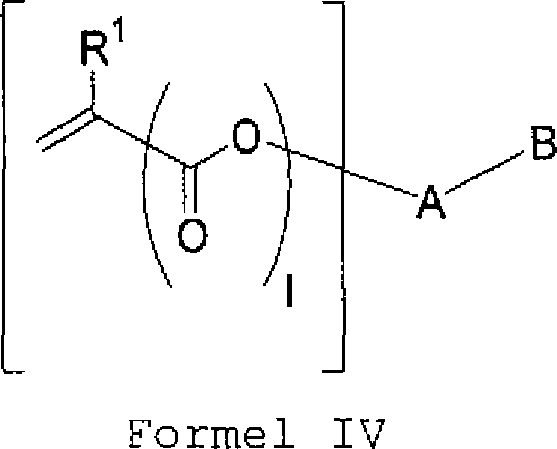
- a) zumindest eine polymerisierbare ionische Flüssigkeit der allgemeinen Formel IV wobei R1, l, A und B die oben angegebene Bedeutung aufweisen, sowie

- b) mindestens ein radikalisch polymerisierbares Monomer der allgemeinen Formel V und/oder VI wobei R1, l und D die oben angegebene Bedeutung aufweisen, radikalisch polymerisiert und für den Fall, dass die Polymerisation in Lösungsmitteln durchgeführt wird, diese anschließend entfernt werden.

- a) at least one polymerizable ionic liquid of the general formula IV where R 1 , I, A and B have the abovementioned meaning, as well as
- b) at least one free-radically polymerizable monomer of the general formula V and / or VI wherein R 1 , l and D have the abovementioned meaning, free-radically polymerized and in the event that the polymerization is carried out in solvents, these are then removed.
Es ist möglich, dass alle eingesetzten Monomere ohne ein für die radikalische Polymerisation geeignetes Lösungsmittel polymerisiert werden. Ebenso ist es jedoch auch möglich, inerte Lösungsmittel, d. h. Lösungsmittel, die bei der radikalischen Polymerisation unbeeinflusst bleiben, einzusetzen. Maßgeblich dabei ist jedoch, dass die Lösungsmittel anschließend entfernt werden.It is possible that all the monomers used are polymerized without a suitable solvent for the radical polymerization. Likewise, however, it is also possible to use inert solvents, i. H. Solvents that remain unaffected in the radical polymerization to use. Decisive here, however, is that the solvents are subsequently removed.
Bevorzugt beim Verfahren ist, wenn dem Reaktionsgemisch mindestens ein Metallsalz, bevorzugt ein Lithiumsalz, besonders bevorzugt ein Lithiumsalz ausgewählt aus der Gruppe bestehend aus LiPF6, LiBF4, LiClO4, LiSO3CF3, LiSO3(CF2)3CF3, LiN(SO2CF3)2, LiC4BO8 (Li-BOB) und/oder Kombinationen hieraus, zugesetzt wird.Preferred in the method is when the reaction mixture at least one metal salt, preferably a lithium salt, more preferably a lithium salt selected from the group consisting of LiPF 6 , LiBF 4 , LiClO 4 , LiSO 3 CF 3 , LiSO 3 (CF 2 ) 3 CF 3 , LiN (SO 2 CF 3 ) 2 , LiC 4 BO 8 (Li-BOB) and / or combinations thereof is added.
In einer weiteren bevorzugten Ausführungsform des Verfahrens beträgt die Gewichtsmenge des mindestens einen zugesetzten Lithiumsalzes 0,001 bis 30 Gew.-%, bevorzugt 0,01 bis 20 Gew.-%, besonders bevorzugt 0,1 bis 10 Gew.-%, bezogen auf die Gesamtmenge der ionischen Flüssigkeit der Formel IV sowie des mindestens einen radikalisch polymerisierbaren Monomeren der allgemeinen Formeln V und/oder VI.In a further preferred embodiment of the process, the amount by weight of the at least one added lithium salt is 0.001 to 30 wt .-%, preferably 0.01 to 20 wt .-%, particularly preferably 0.1 to 10 wt .-%, based on the total amount the ionic liquid of the formula IV and the at least one free-radically polymerizable monomer of the general formulas V and / or VI.
Zudem ist es bevorzugt, wenn das Gewichtsverhältnis der ionischen Flüssigkeit der Formel IV zur Summe der Monomeren der allgemeinen Formel V und/oder VI von 1000:1 bis 1:1000, bevorzugt von 10:1 bis 1:10, weiter bevorzugt von 5:1 bis 1:5, besonders bevorzugt von 2:1 bis 1:2 beträgt.In addition, it is preferred if the weight ratio of the ionic liquid of the formula IV to the sum of the monomers of the general formula V and / or VI is from 1000: 1 to 1: 1000, preferably from 10: 1 to 1:10, more preferably from 5: 1 to 1: 5, more preferably from 2: 1 to 1: 2.
Weiter kann dem Reaktionsgemisch
- a) mindestens ein thermischer Initiator, bevorzugt ein thermischer Initiator ausgewählt aus der Gruppe bestehend aus insbesondere 2,2'-Azobis[2-(2-imidazolin-2-yl)propan]dihydrochlorid, 2,2'-Azobis[2-(2-imidazolin-2-yl)propan]disulfatdihydrat, 2,2'-Azobis(2-methylpropionamidin)dihydrochlorid, 2,2'-Azobis[N-(2-carboxyethyl)-2-methylpropionamidin]hydrat, 2,2'-Azobis{2-[1-(2-hydroxyethyl)-2-imidazolin-2-yl]propan}dihydrochlorid, 2,2'-Azobis[2-(2-imidazolin-2-yl)propan), 2,2'-Azobis(1-imino-1-pyrrolidino-2-ethylpropan)dihydrochlorid, 2,2'-Azobis{2-methyl-N-[1,1-bis(hydroxymethyl)-2-hydroxyethl]prapionamid}, 2,2'-Azobis[2-methyl-N-(2-hydroxyethyl)propionamid], 2,2'-Azobis(4-methoxy-2,4-dimethylvaleronitril), 2,2'-Azobis(2,4-dimethylvaleronitril), Dimethyl-2,2'-azobis(2-methylpropionat), 2,2'-Azobis(2-methylbutyronitril), 1,1'-Azobis(cyclohexan-1-carbonitril), 2,2'-Azo-bis[N-(2-propenyl)-2-methylpropionamid], 1-[(1-Cyano-1-methylethyl)azo]formamid, 2,2'-Azobis(N-butyl-2-methylpropianamid), 2,2'-Azobis(N-cyclohexyl-2-methylpropionamid),
- b) mindestens ein Photoinitiator, bevorzugt ein Photoinitiator ausgewählt aus der Gruppe bestehend aus 1-Hydroxy-cyclohexylphenylketon, 2-Hydroxy-2-methyl-1-phenylpropanon, 2-Hydroxy-1-[4-(2-hydroxyethoxy)phenyl-2-methyl-1-propanon], Methylbenzoylformat, Oxy-phenyl-essigsäure-2-[2-oxo-2-phenyl-acetoxy-ethoxy]-ethylester), Oxy-phenyl-essigsäure-2-[2-hydroxyethoxy]-ethylester, α,α-Dimethoxy-α-phenylacetophenon, 2-Benzyl-2-(dimethylamino)-1-[4-(4-morpholinyl)phenyl]-1-butanon, 2-Methyl-1-[4-(methylthio)phenyl-2-(4-morpholinyl)-1-propanon, Diphenyl(2,4,6-trimethylbenzoyl)-phosphinoxid, Phosphinoxid, Phenyl-bis(2,4,6-trimethylbenzoyl), Bis(2,4,6-trimethylbenzoyl)phenylphosphinoxid, Bis(eta5-2,4-cyclopentadien1-yl)bis[2,6difluor3(1H-pyrral-1-yl)phenyl]titan, (4-methylphenyl)-[4-(2-methylpropyl)phenyliodoniumhexafluorphosphat(1)],
- c) oder Kombinationen hieraus,
- a) at least one thermal initiator, preferably a thermal initiator selected from the group consisting in particular of 2,2'-azobis [2- (2-imidazolin-2-yl) propane] dihydrochloride, 2,2'-azobis [2- ( 2-imidazolin-2-yl) propane] disulfate dihydrate, 2,2'-azobis (2-methylpropionamidine) dihydrochloride, 2,2'-azobis [N- (2-carboxyethyl) -2-methylpropionamidine] hydrate, 2.2 ' Azobis {2- [1- (2-hydroxyethyl) -2-imidazolin-2-yl] propane} dihydrochloride, 2,2'-azobis [2- (2-imidazolin-2-yl) propane], 2.2 Azobis (1-imino-1-pyrrolidino-2-ethylpropane) dihydrochloride, 2,2'-azobis {2-methyl-N- [1,1-bis (hydroxymethyl) -2-hydroxyethyl] propionamide}, 2, 2'-azobis [2-methyl-N- (2-hydroxyethyl) propionamide], 2,2'-azobis (4-methoxy-2,4-dimethylvaleronitrile), 2,2'-azobis (2,4-dimethylvaleronitrile) , Dimethyl 2,2'-azobis (2-methylpropionate), 2,2'-azobis (2-methylbutyronitrile), 1,1'-azobis (cyclohexane-1-carbonitrile), 2,2'-azo-bis [ N- (2-propenyl) -2-methylpropionamide], 1 - [(1-cyano-1-methylethyl) azo] formamide, 2,2'-azobis (N-butyl-2-methylpropianamide), 2,2'-azobis (N-cyclohexyl-2-methylpropionamide),
- b) at least one photoinitiator, preferably a photoinitiator selected from the group consisting of 1-hydroxy-cyclohexylphenyl ketone, 2-hydroxy-2-methyl-1-phenylpropanone, 2-hydroxy-1- [4- (2-hydroxyethoxy) phenyl-2 -methyl-1-propanone], methylbenzoyl formate, oxy-phenyl-acetic acid 2- [2-oxo-2-phenyl-acetoxy-ethoxy] -ethyl ester), oxy-phenyl-acetic acid 2- [2-hydroxyethoxy] -ethyl ester , α, α-dimethoxy-α-phenylacetophenone, 2-benzyl-2- (dimethylamino) -1- [4- (4-morpholinyl) phenyl] -1-butanone, 2-methyl-1- [4- (methylthio) phenyl-2- (4-morpholinyl) -1-propanone, diphenyl (2,4,6-trimethylbenzoyl) phosphine oxide, phosphine oxide, phenylbis (2,4,6-trimethylbenzoyl), bis (2,4,6-trimethylbenzoyl) trimethylbenzoyl) phenylphosphine oxide, bis (eta5-2,4-cyclopentadien1-yl) bis [2,6-difluoro3 (1H-pyrral-1-yl) phenyl] titanium, (4-methylphenyl) - [4- (2-methylpropyl) phenyliodonium hexafluorophosphate ( 1)],
- c) or combinations thereof,
Der Zusatz derartiger Initiatoren ermöglicht eine jeweils leichtere thermische und/oder photochemische Aktivierung des Reaktionsgemisches.The addition of such initiators allows each easier thermal and / or photochemical activation of the reaction mixture.
Erfindungsgemäß wird weiterhin ein elektrisches Bauteil bereitgestellt, das einen oben beschriebenen Festpolymerelektrolyten umfasst bzw. beinhaltet. Das elektrische Bauteil kann dabei insbesondere eine Batterie, ein Akkumulator, ein elektrochromes Display oder ein Sensor sein.According to the invention, there is further provided an electrical component comprising a solid polymer electrolyte described above. The electrical component may in particular be a battery, an accumulator, an electrochromic display or a sensor.
Eine bevorzugte Ausführungsform des elektrischen Bauteils ist dabei eine Batterie, die sich insbesondere dadurch auszeichnet, dass die Elektroden Metallelektroden, bevorzugt Lithiumelektroden sind, die mit einem zuvor beschriebenen Festpolymerelektrolyten beschichtet sind, bevorzugt mit einer Schichtdicke von 1 bis 10.000 μm, weiter bevorzugt von 10 bis 1.000 μm, insbesondere von 20 bis 500 μm.A preferred embodiment of the electrical component is a battery, which is characterized in particular in that the electrodes are metal electrodes, preferably lithium electrodes, which are coated with a solid polymer electrolyte described above, preferably with a layer thickness of 1 to 10,000 microns, more preferably from 10 to 1,000 μm, in particular from 20 to 500 μm.
Die vorliegende Erfindung wird anhand der nachfolgenden Ausführungen sowie Beispiele näher beschrieben, ohne die Erfindung auf die dort dargestellten speziellen Ausführungsformen zu beschränken.The present invention will be described in detail with reference to the following embodiments and examples, without limiting the invention to the specific embodiments shown there.
Die Erfindung wird nachfolgend beispielhaft anhand eines polymeren Drei-Komponentensystems beschrieben. Die Matrix stellt diacrylathaltige mit Oligoether als auch alternierenden Carbonylfunktionen versehene Verbindungen dar, welche eine hohe Dichte an Carbonyl-, Ether- und Carboxylgruppen aufweisen. Diese Matrix hat die Aufgabe, Lithiumionen zu solvatisieren und somit die Dissoziation der Lithiumsalze zu ermöglichen. Durch das Potential der UV-Vernetzung der Acrylatgruppen im Film wird eine hohe mechanische Festigkeit als auch thermische Stabilität erzielt. Die zweite Komponente ist eine polymerisierbare ionische Flüssigkeit. Bei ionischen Flüssigkeiten handelt es sich um flüssige Salze, ohne dass das Salz in einem Lösungsmittel gelöst ist. Dabei bleiben diese Salze bei Temperaturen unterhalb von 100°C flüssig. Ionische Flüssigkeiten zeichnen sich durch eine Reihe interessanter Eigenschaften aus: Sie sind thermisch stabil, nicht entzündlich, haben einen niedrigen Dampfdruck und verfügen über sehr gute Lösungseigenschaften. Außerdem besitzen sie aufgrund ihres rein ionischen Aufbaus elektrische Leitfähigkeit und eine hohe elektrochemische Stabilität. Die polymerisierbare ionische Flüssigkeit übernimmt in dem Copolymeren bzw. Blendsystem einerseits die Aufgabe, das Lithiumsalz zu lösen und durch die eigene vorhandene Grundleitfähigkeit verbesserte Lithium-Überführungszahlen zu gewährleisten. Andererseits kann die Dissoziation des Lithiumsalzes durch die Wechselwirkung mit der ionischen Flüssigkeit begünstigt werden. Der Vorteil einer polymerisierbaren ionischen Flüssigkeit besteht darin, dass durch die Polymerisation gemeinsam mit der Matrix, die ionische Flüssigkeit mit in das Blendsystem eingebaut wird, so dass zusätzlich noch eine bessere mechanische Festigkeit als auch thermische Stabilität erreicht wird. Dazu wurden acrylathaltige Imidazole bzw. ammmoniumhaltige ionische Flüssigkeiten mit Hexafluorophosphat als auch Trifluormethansulfonat als Gegenionen synthetisiert. Es wurden Blendsysteme mit Gehalten an ionischer Flüssigkeit von 2 bis 30 mol-%, sowie Gehalten an der Leitsalzkomponente von 1 bis 20 mol-% realisiert. Diese Blendsysteme wurden entsprechend gemischt mit einem UV-Initiator, z. B. Irgacure 184, versehen (1 mol-%) und als dünner Film im Bereich von 100 μm bis 400 μm durch Rakeln hergestellt. Die Stabilisierung des Films wurde durch die Bestrahlung mit UV-Licht vorgenommen.The invention will be described below by way of example with reference to a polymeric three-component system. The matrix represents diacrylate-containing compounds provided with oligoethers as well as alternating carbonyl functions which have a high density of carbonyl, ether and carboxyl groups. This matrix has the task to solvate lithium ions and thus to facilitate the dissociation of the lithium salts. Due to the potential of UV crosslinking of the acrylate groups in the film, high mechanical strength and thermal stability are achieved. The second component is a polymerizable ionic liquid. Ionic liquids are liquid salts without the salt being dissolved in a solvent. These salts remain liquid at temperatures below 100 ° C. Ionic liquids are characterized by a number of interesting properties: they are thermally stable, non-flammable, have a low vapor pressure and have very good dissolving properties. In addition, they have due to their purely ionic structure electrical conductivity and high electrochemical stability. On the one hand, the polymerizable ionic liquid in the copolymer or blend system has the task of dissolving the lithium salt and of ensuring, by means of its own existing basic conductivity, improved lithium transfer coefficients. On the other hand, the dissociation of the lithium salt can be promoted by the interaction with the ionic liquid. The advantage of a polymerizable ionic liquid is that the polymerization together with the matrix, the ionic liquid is incorporated into the blend system, so that in addition a better mechanical strength and thermal stability is achieved. Acrylate-containing imidazoles or ammonium-containing ionic liquids with hexafluorophosphate and trifluoromethanesulfonate as counterions were synthesized for this purpose. Blend systems with contents of ionic liquid of 2 to 30 mol% and contents of the conductive salt component of 1 to 20 mol% were realized. These blend systems were mixed appropriately with a UV Initiator, z. B. Irgacure 184 provided (1 mol%) and prepared as a thin film in the range of 100 microns to 400 microns by doctoring. The stabilization of the film was carried out by the irradiation with UV light.
Ausführungsbeispielembodiment
4-[2-(2-Methyl-acryloyloxy)-ethoxycarbonyloxyl-4-oxo-butylsäure-2-(2-methylacryloyloxy)-ethylester 14- [2- (2-Methyl-acryloyloxy) -ethoxycarbonyloxy-4-oxo-2-butyl-2- (2-methylacryloyloxy) -ethyl ester 1
Das Dimethacrylat wird hierbei in einer zweistufigen Synthese hergestellt. Zuerst wird durch Umsetzung mit Carbodiimid das Hydroxyethylmethacrylat mit einem Imidazol aktiviert, welches anschließend mit einem Succinat umgesetzt wird. Imidazol-1-carbonsäure-2-(2-methylacrylolyoxy)-ethylester: 1 
Ein Gemisch aus 2-Hydroxyethylmethacrylat (14 g, 108 mmol) und N,N'-carbonyldiimidazol (50 g, 303 mmol) werden in 60 ml destilliertem Chloroform gelöst und bei Raumtemperatur für 30 Minuten gerührt. Anschließend wird das Reaktionsgemisch mit Eiswasser bis zur neutralen Reaktion der Waschlösung extrahiert. Die organische Phase wird über Natriumsulfat getrocknet und das Lösungsmittel anschließend unter vermindertem Druck entfernt. Der Rückstand wird mit Hexan gewaschen und im Vakuum getrocknet. Es wird 1 als gelbliche viskose Flüssigkeit erhalten (19,88 g, 83%) 1H-NMR (500 MHz, CDCl3) δ, (ppm) = 1,9 (s, 3H, CH3); 4,5 (t, 2H, CH2O); 4,7 (t, 2H, CH2O); 5,6, 6,2 (s, 1H jeweils, Vinyl CH); 7,1 (s, 1H, Ar-CH); 7,4 (s, 1H, Ar-CH); 8,2 (s, 1H, Ar-CH). 4-[2-(2-Methylacryloyloxy)-ethoxycarbonyloxy]-4-oxo-butylsäure-2-(2-methylacryloyloxy)-ethylester 2 
Ein Gemisch von Imidazol-1-carbonsäure-2-(2-methylacryloyloxy)-ethylester (2,08 g, 9,27 mmol) mit Mono-2-(methacryloyloxy)ethylsuccinat (4,11 g, 17,85 mmol) wird unter Argon in destilliertem Chloroform gelöst und mit Triethylamin (2 ml) versetzt und für 24 Stunden bei 45°C gerührt. Anschließend wird das Reaktionsgemisch mit Eiswasser (2×), 2N HCl (2×), Eiswasser (2×), gesättigter NaHCO3-Lösung (1×) und Eiswasser (2×) extrahiert. Die vereinigten organischen Phasen werden über Natriumsulfat getrocknet und das Lösungsmittel unter vermindertem Druck entfernt. Es wird 2 als gelbliches Öl erhalten (1,75 g, 51,7%) 1H-NMR (500 MHz, CDCl3) δ, (ppm) = 1,95 (s, 6H, CH3); 3,85 (s, 2H, COCH2CO); 4,40 (m, 8H, CH2O); 5,60 (s, 2H, Vinyl CH); 6,20 (s, 2H, Vinyl CH) Malonsäure bis-[2-(2-methylacryloyloxy)-ethylester 3 
Hydroxyethylmethylacrylat (3,22 g, 24,7 mmol) wird in destilliertem Chloroform gelöst und mit Triethylamin (2 ml) versetzt. Anschließend wird unter Argon langsam (15 min) Malonyldichlorid hinzugegeben Es wird anschließend bei Raumtemperatur unter Argon für 25 Stunden gerührt. Nach Ende der Reaktion wird der entstehende Niederschlag abfiltriert und das Rohprodukt mittels Säulenchromatographie aufgereinigt (Kieselgel: Hex/EE 3:1) Es wird 3 als gelbliches Öl erhalten (1,65 g, 90%). 1H-NMR (500 MHz, CDCl3) δ, (ppm) = 1,95 (s, 6H, CH3); 3,40 (s, 4H, COCH2CO); 4,15 (dq, 4H, CH2O); 4,30 (dq, 4H, CH2O); 5,60 (s, 2H, Vinyl CH); 6,20 (s, 2H, Vinyl CH).Hydroxyethyl methyl acrylate (3.22 g, 24.7 mmol) is dissolved in distilled chloroform and triethylamine (2 mL) is added. Then, under argon, slowly (15 min) malonyl dichloride is added. It is then stirred at room temperature under argon for 25 hours. After the reaction is the filtered off the resulting precipitate and the crude product purified by column chromatography (silica gel: hex / EA 3: 1) 3 is obtained as a yellowish oil (1.65 g, 90%). 1 H-NMR (500 MHz, CDCl 3) δ (ppm) = 1.95 (s, 6H, CH 3); 3.40 (s, 4H, COCH 2 CO); 4.15 (dq, 4H, CH 2 O); 4.30 (dq, 4H, CH 2 O); 5.60 (s, 2H, vinyl CH); 6.20 (s, 2H, vinyl CH).
2. Synthese vernetzbarer ionischer Flüssigkeiten2. Synthesis of Crosslinkable Ionic Liquids
2-Methyl-acrylsäure-2-(3-Chlorocabamoyloxy)-ethylester 4 
Ein Gemisch aus Chloropropylamin (4,90 g, 37,69 mmol) und Imidazol-1-carbonsäure-2-(2-methylacryloyloxy)ethylester (2,04 g, 9,10 mmol) werden in 20 ml DMSO gelost. Unter Röhren wird das Gemisch bei Raumtemperatur langsam mit Triethylamin (2 ml auf 15 min) versetzt. Es wird für 48 Stunden auf 45°C erhitzt. Der entstehende Niederschlag wird mittels Filtrieren entfernt und die Mutterlauge mehrfach mit Diethylether (4 × 50 ml) gewaschen. Die DMSO-Phase wird gesammelt und das Lösungsmittel unter vermindertem Druck entfernt. Es wird 4 als gelbliche Flüssigkeit erhalten. (1,97 g, 86%) 1H-NMR (500 MHz, CDCl3) δ, (ppm) = 1,95 (s, 3H, CH3); 2,05 (t, 2H, CH2), 3,35 (t, 2H, CH2Cl); 3,60 (t, 2H, CH2N); 4,25 (m, 4H, CH2O); 4,95 (br, 1H, NH); 5,60 (s, 1H, Vinyl-CH); 6,15 (s, 1H, Vinyl-CH). 1-Methyl-3-{3-[2-(2-methylacryloyloxy)-ethoxycarbonylaminol-propyl}-3H-imidazol-1-ium-hexafluorophosphat 5 
2-Methyl-acrylsäure-2-(3-Chlorocabamoyloxy)-ethylester 4 (750 mg, 3,01 mmol) wird in Chloroform gelöst und mit 1-Methylimidazol (259 mg, 3,15 mmol) versetzt. Es wird unter Argon für 24 Stunden bei 70°C gerührt. Anschließend wird Kaliumhexafluorophosphat (560 mg, 3,04 mmol) in Methanol hinzugegeben. Es wird für 24 Stunden bei Raumtemperatur gerührt. Entstehender Niederschlag wird abfiltriert und die Lösung eingeengt. Anschließend wird die Lösung mehrfach mittels Spritzenfiltration (2 μm) gereinigt. Nach Entfernen des Lösungsmittels wird das erhaltene Öl im Vakuum bei 56°C getrocknet. 5 wird als gelbliches Öl erhalten (890 mg, 66,9%) 1H-NMR (500 MHz, CDCl3) δ, (ppm) = 1,95 (s, 3H, CH3); 2,60 (s, 2H, CH2); 3,35 (m, 2H, CH2); 3,65 (m, 2H, CH2); 3,75 (m, 3H, N-CH3); 4,35 (m, 4H, COCH2CH2CO); 4,95 (br, 1H, NH); 5,60 (s, 1H, Vinyl-CH); 6,15 (s, 1H, Vinyl-CH); 6,90 (m, 1H, Ar-H); 7,10 (m, 1H, Ar-H); 7,45 (m, 1H, Ar-H). (2-Acryloyloxyethyl)-hexyl-dimethyl-ammoniumhexafluorophosphat 6 
Ein Gemisch von Dimethylaminoethoxyacrylat (14,98 g, 105,5 mmol) und Bromhexan (15 ml, 107,2 mmol) werden in 60 ml destilliertem Chloroform gelöst und bei 55°C unter Argonatmosphäre für 48 Stunden gerührt.A mixture of dimethylaminoethoxyacrylate (14.98 g, 105.5 mmol) and bromohexane (15 mL, 107.2 mmol) are dissolved in 60 mL of distilled chloroform and stirred at 55 ° C under an argon atmosphere for 48 hours.
Nach Entfernen des Lösungsmittels unter vermindertem Druck wird der Rückstand mit Diethylether gewaschen und das Produkt ausgefällt. Es wird ein gelbweißer Feststoff erhalten (31,07 g, 95,9%), Smp. 83°C 1H-NMR (500 MHz, CDCl3) δ, (ppm) = 0,95 (t, 3H, CH3); 1,3 (m, 6H, CH2); 1,75 (m, 2H, CH2); 3,50 (s, 6H, CH3-N); 3,65 (m, 2H, CH2-N); 4,15 (m, 2H, CH2-N); 4,70 (m, 2H, CH2-O); 5,95 (d, 1H, Vinyl-CH); 6,15 (dd, 1H, C=CH-CO); 6,50 (d, 1H, Vinyl-CH).
IR (cm–1): 734 cm–1 δ (–(CH2)n, n > 4); 1178 ν5 (C-O-C); 1293 νas (C-O-C); 1410 δ5 (CH3); 1466 δas (CH3); 1636 ν (C=C); 1727 ν (C=O); 2959 ν (C-H).After removal of the solvent under reduced pressure, the residue is washed with diethyl ether and the product is precipitated. A yellow-white solid is obtained (31.07 g, 95.9%), mp 83 ° C 1 H-NMR (500 MHz, CDCl 3) δ (ppm) = 0.95 (t, 3H, CH 3); 1,3 (m, 6H, CH 2 ); 1.75 (m, 2H, CH 2 ); 3.50 (s, 6H, CH 3 -N); 3.65 (m, 2H, CH 2 -N); 4.15 (m, 2H, CH 2 -N); 4.70 (m, 2H, CH 2 -O); 5.95 (d, 1H, vinyl CH); 6.15 (dd, 1H, C = CH-CO); 6.50 (d, 1H, vinyl CH).
IR (cm -1 ): 734 cm -1 δ (- (CH 2 ) n , n>4); 1178 ν 5 (COC); 1293 ν as (COC); 1410 δ 5 (CH 3 ); 1466 δ as (CH 3 ); 1636 ν (C = C); 1727 ν (C = O); 2959 ν (CH).
Im zweiten Schritt wird nun der Anionenaustausch durchgeführt. Hierzu wird (2-Acryloyloxyethyl)-hexyl-dimethylammoniumbromid (10,22 g, 33,28 mmol) in 60 ml Chloroform gelöst und eine Lösung von Kaliumhexafluorophosphat (6,20 g, 33,61 mmol) in Aceton (60 ml) hinzugefügt. Es wird nun für 24 Stunden bei 45°C gerührt. Der entstehende Niederschlag wird mittels Filtration abgetrennt. Nach Entfernen des Lösungsmittels wird der Rückstand erneut in Chloroform gelöst und unlösliche Nebenprodukte mittels Filtration entfernt. Anschließend wird das Lösungsmittel abdestilliert und im Vakuum getrocknet. 6 wird als gelbes honigartiges Öl erhalten (11,31 g, 91%) 1H-NMR (500 MHz, CDCl3) δ, (APm) = 1,95 (t, 3H, CH3); 1,30 (m, 6H, CH2); 1,75 (m, 2H, CH2); 3,15 (s, 6H, CH3-N); 3,30 (m, 2H, CH2-N); 3,65 (m, 2H, CH2-N); 4,60 (m, 2H, CH2-O); 5,95 (d, 1H, Vinyl-CH); 6,15 (dd, 1H, C=CH-CO); 6,45 (d, 1H, Vinyl-CH).
IR (cm–1): 734 cm–1 δ (–(CH2), n > 4); 830 δ (P-F); 1178 νs (C-O-C); 1293 νas (C-O-C); 1410 δs (CH3); 1466 δas (CH3) 1636 ν (C=C); 1727 ν (C=O); 2959 ν (C-H).In the second step, the anion exchange is now carried out. To this is dissolved (2-acryloyloxyethyl) -hexyl-dimethylammonium bromide (10.22 g, 33.28 mmol) in 60 ml of chloroform and a solution of potassium hexafluorophosphate (6.20 g, 33.61 mmol) in acetone (60 ml) added , It is then stirred for 24 hours at 45 ° C. The resulting precipitate is separated by filtration. After removal of the solvent, the residue is redissolved in chloroform and insoluble by-products are removed by filtration. Subsequently, the solvent is distilled off and dried in vacuo. 6 is obtained as a yellow honey-like oil (11.31 g, 91%) 1 H-NMR (500 MHz, CDCl 3) δ (AP m) = 1.95 (t, 3H, CH 3); 1.30 (m, 6H, CH 2 ); 1.75 (m, 2H, CH 2 ); 3.15 (s, 6H, CH 3 -N); 3.30 (m, 2H, CH 2 -N); 3.65 (m, 2H, CH 2 -N); 4.60 (m, 2H, CH 2 -O); 5.95 (d, 1H, vinyl CH); 6.15 (dd, 1H, C = CH-CO); 6.45 (d, 1H, vinyl CH).
IR (cm -1 ): 734 cm -1 δ (- (CH 2 ), n>4); 830 δ (PF); 1178 ν s (COC); 1293 ν as (COC); 1410 δ s (CH 3 ); 1466 δ as (CH 3 ) 1636 ν (C = C); 1727 ν (C = O); 2959 ν (CH).
3. Aufbau Blendsystem3. Construction Blendsystem
Die Blendsysteme wurden durch eine Mischung von Matrixelementen mit polymerisierbaren ionischen Flüssigkeiten aufgebaut. Die Aushärtung erfolgt anschließend über eine UV-initiierte radikalische Polymerisation.The blend systems were constructed by a mixture of matrix elements with polymerizable ionic liquids. The curing then takes place via a UV-initiated free-radical polymerization.
Hier erfolgt die Beschreibung der Polymersynthese stellvertretend für die verschiedenen Zusammensetzungen.Here, the description of the polymer synthesis is representative of the various compositions.

Hierbei bedeutet R eine weitere Polymerkette, mit der das Diacrylat vernetzt.Here, R represents a further polymer chain with which the diacrylate crosslinks.
Die Polymerisation der Schichten erfolgt in der Glovebox unter Argon. Hierzu wird zuerst das Leitsalz Lithiumhexafluorophosphat in dem Monomergemisch gelöst und es wird anschließend ca. 1 mol-% von dem UV-Initiator Irgacure 184 hinzugefügt.The polymerization of the layers takes place in the glove box under argon. For this purpose, the conductive salt lithium hexafluorophosphate is first dissolved in the monomer mixture and then about 1 mol% of the UV initiator Irgacure 184 is added.
Die Schichtherstellung erfolgt durch Rakeln auf einer Glasplatte oder als Gießverfahren in einer Teflonwanne. Die Schicht wird nun mittels UV-Bestrahlung ausgehärtet, so dass eine stabile Folie entsteht.The layer is produced by doctoring on a glass plate or as a casting process in a Teflon pan. The layer is then cured by means of UV irradiation, so that a stable film is formed.
4. Untersuchung der Leitfähigkeit des polymeren Festelektrolyten4. Investigation of the conductivity of the polymer solid electrolyte
Es wurden Messzellen mit 2 Lithiumelektroden mit jeweils 10 mm Durchmesser und einer Polyelektrolytfolie mit einem Durchmesser von 11 mm und einer Schichtdicke von 200 bis 500 μm präpariert. Die Ionenleitfähigkeit der Polymerfolie wurde nun mittels Impedanzspektroskopie untersucht. Hierzu wurde im Frequenzbereich von 1 Hz bis 1 MHz gemessen. Aus dem Bulk-Widerstand, welcher aus einem Nyquist-Plot ermittelt wird, wurde die Leitfähigkeit in Kenntnis zur Probendicke und Elektrodenfläche bestimmt.Measuring cells with 2 lithium electrodes each with a diameter of 10 mm and a polyelectrolyte film with a diameter of 11 mm and a layer thickness of 200 to 500 μm were prepared. The ionic conductivity of the polymer film was now examined by means of impedance spectroscopy. This was measured in the frequency range from 1 Hz to 1 MHz. From the bulk resistance, which is determined from a Nyquist plot, the conductivity was determined in knowledge of the sample thickness and electrode area.
Die Ionenleitfähigkeit wurde hierbei in Abhängigkeit von den eingesetzten ionischen Flüssigkeiten (IL) und von der Menge des Leitsalzes ermittelt. The ionic conductivity was determined here as a function of the ionic liquids (IL) used and of the amount of conducting salt.
Leitfähigkeiten von 5 × 10⁻⁵ S/cm werden durch das Hinzufügen von ionischer Flüssigkeit ermöglicht.Conductivities of 5 × 10 -5 S / cm are made possible by the addition of ionic liquid.
ZITATE ENTHALTEN IN DER BESCHREIBUNG QUOTES INCLUDE IN THE DESCRIPTION
Diese Liste der vom Anmelder aufgeführten Dokumente wurde automatisiert erzeugt und ist ausschließlich zur besseren Information des Lesers aufgenommen. Die Liste ist nicht Bestandteil der deutschen Patent- bzw. Gebrauchsmusteranmeldung. Das DPMA übernimmt keinerlei Haftung für etwaige Fehler oder Auslassungen.This list of the documents listed by the applicant has been generated automatically and is included solely for the better information of the reader. The list is not part of the German patent or utility model application. The DPMA assumes no liability for any errors or omissions.
Zitierte PatentliteraturCited patent literature
- DE 102005013790 [0004] DE 102005013790 [0004]
- DE 102008008483 A1 [0005] DE 102008008483 A1 [0005]
- US 2010/0255383 A1 [0006] US 2010/0255383 A1 [0006]
Claims (16)






Priority Applications (1)
| Application Number | Priority Date | Filing Date | Title |
|---|---|---|---|
| DE102011102438.0A DE102011102438B4 (en) | 2011-05-24 | 2011-05-24 | Polymeric solid electrolyte, process for its preparation and use of a solid polymer electrolyte in an electrical component |
Applications Claiming Priority (1)
| Application Number | Priority Date | Filing Date | Title |
|---|---|---|---|
| DE102011102438.0A DE102011102438B4 (en) | 2011-05-24 | 2011-05-24 | Polymeric solid electrolyte, process for its preparation and use of a solid polymer electrolyte in an electrical component |
Publications (2)
| Publication Number | Publication Date |
|---|---|
| DE102011102438A1 true DE102011102438A1 (en) | 2012-11-29 |
| DE102011102438B4 DE102011102438B4 (en) | 2015-09-03 |
Family
ID=47140314
Family Applications (1)
| Application Number | Title | Priority Date | Filing Date |
|---|---|---|---|
| DE102011102438.0A Expired - Fee Related DE102011102438B4 (en) | 2011-05-24 | 2011-05-24 | Polymeric solid electrolyte, process for its preparation and use of a solid polymer electrolyte in an electrical component |
Country Status (1)
| Country | Link |
|---|---|
| DE (1) | DE102011102438B4 (en) |
Cited By (3)
| Publication number | Priority date | Publication date | Assignee | Title |
|---|---|---|---|---|
| EP2879224A1 (en) * | 2013-11-29 | 2015-06-03 | Samsung Electronics Co., Ltd | Polymer electrolyte for lithium battery and lithium battery employing the polymer electrolyte |
| CN112993392A (en) * | 2019-12-12 | 2021-06-18 | 郑州宇通集团有限公司 | Solid electrolyte material, preparation method thereof and solid electrolyte membrane |
| CN114512668A (en) * | 2020-11-16 | 2022-05-17 | 比亚迪股份有限公司 | Electrode binder and preparation method thereof, electrode, lithium battery and vehicle |
Citations (4)
| Publication number | Priority date | Publication date | Assignee | Title |
|---|---|---|---|---|
| EP0896340A1 (en) * | 1996-12-03 | 1999-02-10 | Mitsui Chemicals, Inc. | Gel-form solid polymer electrolyte |
| DE102005013790A1 (en) | 2005-03-24 | 2006-09-28 | Polymaterials Ag | Polymer electrolyte, use of the polymer electrolyte and electrochemical device comprising the polymer electrolyte |
| DE102008008483A1 (en) | 2008-02-08 | 2009-08-13 | Volkswagen Ag | Solid polymer electrolyte-active substance, useful to produce a solid polymer electrolyte-foil for electrochemical battery device, comprises a polymer with a microporous structure and a metal salt e.g. solid/liquid-like lithium salt |
| US20100255383A1 (en) | 2009-02-27 | 2010-10-07 | University Of Maryland, College Park | Polymer Solid Electrolyte for Flexible Batteries |
-
2011
- 2011-05-24 DE DE102011102438.0A patent/DE102011102438B4/en not_active Expired - Fee Related
Patent Citations (4)
| Publication number | Priority date | Publication date | Assignee | Title |
|---|---|---|---|---|
| EP0896340A1 (en) * | 1996-12-03 | 1999-02-10 | Mitsui Chemicals, Inc. | Gel-form solid polymer electrolyte |
| DE102005013790A1 (en) | 2005-03-24 | 2006-09-28 | Polymaterials Ag | Polymer electrolyte, use of the polymer electrolyte and electrochemical device comprising the polymer electrolyte |
| DE102008008483A1 (en) | 2008-02-08 | 2009-08-13 | Volkswagen Ag | Solid polymer electrolyte-active substance, useful to produce a solid polymer electrolyte-foil for electrochemical battery device, comprises a polymer with a microporous structure and a metal salt e.g. solid/liquid-like lithium salt |
| US20100255383A1 (en) | 2009-02-27 | 2010-10-07 | University Of Maryland, College Park | Polymer Solid Electrolyte for Flexible Batteries |
Cited By (10)
| Publication number | Priority date | Publication date | Assignee | Title |
|---|---|---|---|---|
| EP2879224A1 (en) * | 2013-11-29 | 2015-06-03 | Samsung Electronics Co., Ltd | Polymer electrolyte for lithium battery and lithium battery employing the polymer electrolyte |
| CN104681862A (en) * | 2013-11-29 | 2015-06-03 | 三星电子株式会社 | Polymer, polymer electrolyte, negative electrode protective layer and lithium battery |
| KR20150064763A (en) * | 2013-11-29 | 2015-06-12 | 삼성전자주식회사 | Polymer electrolyte for lithium battery and lithium battery employing the same |
| US9979048B2 (en) | 2013-11-29 | 2018-05-22 | Samsung Electronics Co., Ltd. | Polymer electrolyte for lithium battery and lithium battery employing the polymer electrolyte |
| CN104681862B (en) * | 2013-11-29 | 2019-06-21 | 三星电子株式会社 | Polymers, Polymer Electrolytes, Anode Protection Layers and Lithium Batteries |
| KR102163733B1 (en) * | 2013-11-29 | 2020-10-12 | 삼성전자주식회사 | Polymer electrolyte for lithium battery and lithium battery employing the same |
| CN112993392A (en) * | 2019-12-12 | 2021-06-18 | 郑州宇通集团有限公司 | Solid electrolyte material, preparation method thereof and solid electrolyte membrane |
| CN112993392B (en) * | 2019-12-12 | 2022-05-17 | 郑州宇通集团有限公司 | Solid electrolyte material, preparation method thereof and solid electrolyte membrane |
| CN114512668A (en) * | 2020-11-16 | 2022-05-17 | 比亚迪股份有限公司 | Electrode binder and preparation method thereof, electrode, lithium battery and vehicle |
| CN114512668B (en) * | 2020-11-16 | 2023-09-05 | 比亚迪股份有限公司 | Electrode binder and preparation method thereof, electrode, lithium battery and vehicle |
Also Published As
| Publication number | Publication date |
|---|---|
| DE102011102438B4 (en) | 2015-09-03 |
Similar Documents
| Publication | Publication Date | Title |
|---|---|---|
| DE69202674T2 (en) | Solid electrolyte. | |
| DE60129148T2 (en) | TWITTER POLYMERS | |
| DE69734339T2 (en) | Ion-conducting gelled polymer electrolyte and solid electrolyte containing this electrolyte | |
| DE69915148T2 (en) | Crosslinked solid polyether copolymer electrolyte | |
| DE69933429T2 (en) | POLYMERFEST ELECTROLYTE AND METHOD FOR THE PRODUCTION THEREOF | |
| DE3780127T2 (en) | POLYMERS SOLID ELECTROLYTE COMPOSITION. | |
| DE69917751T2 (en) | ION-LEADING POLYMER ELECTROLYT | |
| DE60037392T2 (en) | SOLID ELECTROLYTE OF NETWORKED POLYMER AND ITS USE | |
| EP3122789A1 (en) | 9,10-bis(1,3-dithiol-2-ylidene)-9,10-dihydroanthracene polymers and use thereof | |
| EP1490429A2 (en) | Compositions consisting of cationic polymers comprising amidinium groups and ionic liquids | |
| DE102014003300A1 (en) | New tetracyanoanthraquinone dimethyne polymers and their use | |
| EP3328950A1 (en) | Hydrogel, production, and medical device comprising an electrode coated therewith | |
| EP3239193A1 (en) | Water-insoluble anion exchanger materials | |
| DE69627123T2 (en) | NEW ALLYLETHERS, POLYMERS AND SOLID POLYMER ELECTROLYTE | |
| DE102011102438B4 (en) | Polymeric solid electrolyte, process for its preparation and use of a solid polymer electrolyte in an electrical component | |
| DE112019000429T5 (en) | Battery adhesive composition and battery adhesive member using the same | |
| EP0155383A2 (en) | Method of improving the longevity of the electric conductivity of pyrrole polymers | |
| DE69509616T2 (en) | Fixation-conducting polymer electrolyte and composition and method for its production | |
| DE69835316T2 (en) | solid electrolyte | |
| DE69315914T2 (en) | Ion-conducting polymer electrolyte | |
| DE102019102653B4 (en) | Proton-conductive membrane and fuel cell | |
| EP3510061B1 (en) | Method for improved oxidation of secondary amine groups | |
| DE60012706T2 (en) | IONIC LIQUID POLYMER, ELECTROLYTE POLYMER AND ELECTRICAL DEVICE | |
| KR101720049B1 (en) | Solid polymer electrolytes comprising polymer crosslinked tannic acid derivative for secondary lithium battery | |
| DE102012102162A1 (en) | Ion-conducting polymeric compound for electrochemical cells |
Legal Events
| Date | Code | Title | Description |
|---|---|---|---|
| R012 | Request for examination validly filed | ||
| R016 | Response to examination communication | ||
| R016 | Response to examination communication | ||
| R016 | Response to examination communication | ||
| R018 | Grant decision by examination section/examining division | ||
| R020 | Patent grant now final | ||
| R119 | Application deemed withdrawn, or ip right lapsed, due to non-payment of renewal fee |