DE102011076754A1 - Substrate element for the coating with an easy-to-clean coating - Google Patents
Substrate element for the coating with an easy-to-clean coating Download PDFInfo
- Publication number
- DE102011076754A1 DE102011076754A1 DE201110076754 DE102011076754A DE102011076754A1 DE 102011076754 A1 DE102011076754 A1 DE 102011076754A1 DE 201110076754 DE201110076754 DE 201110076754 DE 102011076754 A DE102011076754 A DE 102011076754A DE 102011076754 A1 DE102011076754 A1 DE 102011076754A1
- Authority
- DE
- Germany
- Prior art keywords
- layer
- coating
- substrate element
- layers
- adhesion promoter
- Prior art date
- Legal status (The legal status is an assumption and is not a legal conclusion. Google has not performed a legal analysis and makes no representation as to the accuracy of the status listed.)
- Withdrawn
Links
- 238000000576 coating method Methods 0.000 title claims abstract description 112
- 239000011248 coating agent Substances 0.000 title claims abstract description 100
- 239000000758 substrate Substances 0.000 title claims abstract description 85
- 239000006119 easy-to-clean coating Substances 0.000 title claims abstract description 51
- 239000011521 glass Substances 0.000 claims abstract description 51
- 239000002318 adhesion promoter Substances 0.000 claims abstract description 43
- 239000012876 carrier material Substances 0.000 claims abstract description 18
- 239000002241 glass-ceramic Substances 0.000 claims abstract description 10
- 239000006117 anti-reflective coating Substances 0.000 claims abstract description 7
- 239000010410 layer Substances 0.000 claims description 309
- VYPSYNLAJGMNEJ-UHFFFAOYSA-N Silicium dioxide Chemical compound O=[Si]=O VYPSYNLAJGMNEJ-UHFFFAOYSA-N 0.000 claims description 72
- 229910052814 silicon oxide Inorganic materials 0.000 claims description 34
- 238000000034 method Methods 0.000 claims description 30
- 238000007598 dipping method Methods 0.000 claims description 26
- 239000000463 material Substances 0.000 claims description 23
- 229910052782 aluminium Inorganic materials 0.000 claims description 22
- XAGFODPZIPBFFR-UHFFFAOYSA-N aluminium Chemical compound [Al] XAGFODPZIPBFFR-UHFFFAOYSA-N 0.000 claims description 20
- 239000010936 titanium Substances 0.000 claims description 20
- 229910052719 titanium Inorganic materials 0.000 claims description 19
- RTAQQCXQSZGOHL-UHFFFAOYSA-N Titanium Chemical compound [Ti] RTAQQCXQSZGOHL-UHFFFAOYSA-N 0.000 claims description 18
- 229910052726 zirconium Inorganic materials 0.000 claims description 18
- QCWXUUIWCKQGHC-UHFFFAOYSA-N Zirconium Chemical compound [Zr] QCWXUUIWCKQGHC-UHFFFAOYSA-N 0.000 claims description 17
- 239000011777 magnesium Substances 0.000 claims description 17
- 229910052758 niobium Inorganic materials 0.000 claims description 17
- 239000010955 niobium Substances 0.000 claims description 17
- 239000000377 silicon dioxide Substances 0.000 claims description 17
- 229910052684 Cerium Inorganic materials 0.000 claims description 16
- FYYHWMGAXLPEAU-UHFFFAOYSA-N Magnesium Chemical compound [Mg] FYYHWMGAXLPEAU-UHFFFAOYSA-N 0.000 claims description 16
- ATJFFYVFTNAWJD-UHFFFAOYSA-N Tin Chemical compound [Sn] ATJFFYVFTNAWJD-UHFFFAOYSA-N 0.000 claims description 16
- 229910052749 magnesium Inorganic materials 0.000 claims description 16
- GUCVJGMIXFAOAE-UHFFFAOYSA-N niobium atom Chemical compound [Nb] GUCVJGMIXFAOAE-UHFFFAOYSA-N 0.000 claims description 16
- 229910052698 phosphorus Inorganic materials 0.000 claims description 16
- 239000011574 phosphorus Substances 0.000 claims description 16
- 229910052718 tin Inorganic materials 0.000 claims description 16
- ZOXJGFHDIHLPTG-UHFFFAOYSA-N Boron Chemical compound [B] ZOXJGFHDIHLPTG-UHFFFAOYSA-N 0.000 claims description 15
- OAICVXFJPJFONN-UHFFFAOYSA-N Phosphorus Chemical compound [P] OAICVXFJPJFONN-UHFFFAOYSA-N 0.000 claims description 15
- 229910052788 barium Inorganic materials 0.000 claims description 15
- DSAJWYNOEDNPEQ-UHFFFAOYSA-N barium atom Chemical compound [Ba] DSAJWYNOEDNPEQ-UHFFFAOYSA-N 0.000 claims description 15
- 229910052792 caesium Inorganic materials 0.000 claims description 15
- TVFDJXOCXUVLDH-UHFFFAOYSA-N caesium atom Chemical compound [Cs] TVFDJXOCXUVLDH-UHFFFAOYSA-N 0.000 claims description 15
- 229910052712 strontium Inorganic materials 0.000 claims description 15
- CIOAGBVUUVVLOB-UHFFFAOYSA-N strontium atom Chemical compound [Sr] CIOAGBVUUVVLOB-UHFFFAOYSA-N 0.000 claims description 15
- ORUIBWPALBXDOA-UHFFFAOYSA-L magnesium fluoride Chemical compound [F-].[F-].[Mg+2] ORUIBWPALBXDOA-UHFFFAOYSA-L 0.000 claims description 14
- 229910001635 magnesium fluoride Inorganic materials 0.000 claims description 14
- 238000004519 manufacturing process Methods 0.000 claims description 14
- 239000002243 precursor Substances 0.000 claims description 14
- 230000008569 process Effects 0.000 claims description 14
- HCHKCACWOHOZIP-UHFFFAOYSA-N Zinc Chemical compound [Zn] HCHKCACWOHOZIP-UHFFFAOYSA-N 0.000 claims description 13
- 239000011135 tin Substances 0.000 claims description 13
- 239000011701 zinc Substances 0.000 claims description 13
- 229910015900 BF3 Inorganic materials 0.000 claims description 11
- BHHYHSUAOQUXJK-UHFFFAOYSA-L Zinc fluoride Inorganic materials F[Zn]F BHHYHSUAOQUXJK-UHFFFAOYSA-L 0.000 claims description 11
- 239000012790 adhesive layer Substances 0.000 claims description 6
- 238000005507 spraying Methods 0.000 claims description 6
- KRHYYFGTRYWZRS-UHFFFAOYSA-N Fluorane Chemical compound F KRHYYFGTRYWZRS-UHFFFAOYSA-N 0.000 claims description 5
- 238000001035 drying Methods 0.000 claims description 5
- 229910052796 boron Inorganic materials 0.000 claims description 4
- 238000007711 solidification Methods 0.000 claims description 4
- 230000008023 solidification Effects 0.000 claims description 4
- 238000005516 engineering process Methods 0.000 claims description 3
- 238000007639 printing Methods 0.000 claims description 3
- 239000007767 bonding agent Substances 0.000 claims description 2
- 239000002052 molecular layer Substances 0.000 claims description 2
- 238000000197 pyrolysis Methods 0.000 claims description 2
- 229910052725 zinc Inorganic materials 0.000 claims description 2
- GWXLDORMOJMVQZ-UHFFFAOYSA-N cerium Chemical compound [Ce] GWXLDORMOJMVQZ-UHFFFAOYSA-N 0.000 claims 3
- 238000011144 upstream manufacturing Methods 0.000 claims 1
- 230000002209 hydrophobic effect Effects 0.000 abstract description 8
- 230000000694 effects Effects 0.000 abstract description 7
- 230000007774 longterm Effects 0.000 abstract description 4
- 239000000243 solution Substances 0.000 description 88
- LFQSCWFLJHTTHZ-UHFFFAOYSA-N Ethanol Chemical compound CCO LFQSCWFLJHTTHZ-UHFFFAOYSA-N 0.000 description 84
- 238000012360 testing method Methods 0.000 description 62
- XLYOFNOQVPJJNP-UHFFFAOYSA-N water Substances O XLYOFNOQVPJJNP-UHFFFAOYSA-N 0.000 description 41
- YRKCREAYFQTBPV-UHFFFAOYSA-N acetylacetone Chemical compound CC(=O)CC(C)=O YRKCREAYFQTBPV-UHFFFAOYSA-N 0.000 description 24
- QTBSBXVTEAMEQO-UHFFFAOYSA-N Acetic acid Chemical compound CC(O)=O QTBSBXVTEAMEQO-UHFFFAOYSA-N 0.000 description 23
- 229910004298 SiO 2 Inorganic materials 0.000 description 18
- 229910052710 silicon Inorganic materials 0.000 description 17
- 239000010703 silicon Substances 0.000 description 16
- GWEVSGVZZGPLCZ-UHFFFAOYSA-N Titan oxide Chemical compound O=[Ti]=O GWEVSGVZZGPLCZ-UHFFFAOYSA-N 0.000 description 15
- XUIMIQQOPSSXEZ-UHFFFAOYSA-N Silicon Chemical compound [Si] XUIMIQQOPSSXEZ-UHFFFAOYSA-N 0.000 description 14
- 239000006116 anti-fingerprint coating Substances 0.000 description 14
- 239000002253 acid Substances 0.000 description 13
- ZMIGMASIKSOYAM-UHFFFAOYSA-N cerium Chemical compound [Ce][Ce][Ce][Ce][Ce][Ce][Ce][Ce][Ce][Ce][Ce][Ce][Ce][Ce][Ce][Ce][Ce][Ce][Ce][Ce][Ce][Ce][Ce][Ce][Ce][Ce][Ce][Ce][Ce][Ce][Ce][Ce][Ce][Ce][Ce][Ce][Ce][Ce] ZMIGMASIKSOYAM-UHFFFAOYSA-N 0.000 description 13
- -1 silane compound Chemical class 0.000 description 13
- 239000000126 substance Substances 0.000 description 13
- 239000002904 solvent Substances 0.000 description 12
- VEXZGXHMUGYJMC-UHFFFAOYSA-N Hydrochloric acid Chemical compound Cl VEXZGXHMUGYJMC-UHFFFAOYSA-N 0.000 description 11
- 230000003670 easy-to-clean Effects 0.000 description 11
- 238000005259 measurement Methods 0.000 description 11
- 238000002360 preparation method Methods 0.000 description 11
- 239000007858 starting material Substances 0.000 description 11
- OGIDPMRJRNCKJF-UHFFFAOYSA-N titanium oxide Inorganic materials [Ti]=O OGIDPMRJRNCKJF-UHFFFAOYSA-N 0.000 description 11
- 229910010413 TiO 2 Inorganic materials 0.000 description 10
- 238000006460 hydrolysis reaction Methods 0.000 description 10
- 150000003839 salts Chemical class 0.000 description 10
- XEKOWRVHYACXOJ-UHFFFAOYSA-N Ethyl acetate Chemical compound CCOC(C)=O XEKOWRVHYACXOJ-UHFFFAOYSA-N 0.000 description 9
- 230000004888 barrier function Effects 0.000 description 9
- KRKNYBCHXYNGOX-UHFFFAOYSA-N citric acid Chemical compound OC(=O)CC(O)(C(O)=O)CC(O)=O KRKNYBCHXYNGOX-UHFFFAOYSA-N 0.000 description 9
- 238000004140 cleaning Methods 0.000 description 9
- 230000007062 hydrolysis Effects 0.000 description 9
- 239000007788 liquid Substances 0.000 description 9
- 229910052751 metal Inorganic materials 0.000 description 9
- 239000002184 metal Substances 0.000 description 9
- 239000002356 single layer Substances 0.000 description 9
- GRYLNZFGIOXLOG-UHFFFAOYSA-N Nitric acid Chemical compound O[N+]([O-])=O GRYLNZFGIOXLOG-UHFFFAOYSA-N 0.000 description 8
- 229960000583 acetic acid Drugs 0.000 description 8
- 229910017604 nitric acid Inorganic materials 0.000 description 8
- 239000002245 particle Substances 0.000 description 8
- 239000000047 product Substances 0.000 description 8
- 229910018072 Al 2 O 3 Inorganic materials 0.000 description 7
- 238000005299 abrasion Methods 0.000 description 7
- 230000002378 acidificating effect Effects 0.000 description 7
- 150000007513 acids Chemical class 0.000 description 7
- 230000003666 anti-fingerprint Effects 0.000 description 7
- 239000012298 atmosphere Substances 0.000 description 7
- 230000005494 condensation Effects 0.000 description 7
- 238000011156 evaluation Methods 0.000 description 7
- 239000002105 nanoparticle Substances 0.000 description 7
- 239000003960 organic solvent Substances 0.000 description 7
- 235000012239 silicon dioxide Nutrition 0.000 description 7
- 238000003756 stirring Methods 0.000 description 7
- CSCPPACGZOOCGX-UHFFFAOYSA-N Acetone Chemical compound CC(C)=O CSCPPACGZOOCGX-UHFFFAOYSA-N 0.000 description 6
- YZGQDNOIGFBYKF-UHFFFAOYSA-N Ethoxyacetic acid Chemical compound CCOCC(O)=O YZGQDNOIGFBYKF-UHFFFAOYSA-N 0.000 description 6
- OKKJLVBELUTLKV-UHFFFAOYSA-N Methanol Chemical compound OC OKKJLVBELUTLKV-UHFFFAOYSA-N 0.000 description 6
- MUBZPKHOEPUJKR-UHFFFAOYSA-N Oxalic acid Chemical compound OC(=O)C(O)=O MUBZPKHOEPUJKR-UHFFFAOYSA-N 0.000 description 6
- HEMHJVSKTPXQMS-UHFFFAOYSA-M Sodium hydroxide Chemical compound [OH-].[Na+] HEMHJVSKTPXQMS-UHFFFAOYSA-M 0.000 description 6
- 235000011054 acetic acid Nutrition 0.000 description 6
- CSDREXVUYHZDNP-UHFFFAOYSA-N alumanylidynesilicon Chemical compound [Al].[Si] CSDREXVUYHZDNP-UHFFFAOYSA-N 0.000 description 6
- 239000008139 complexing agent Substances 0.000 description 6
- 238000009833 condensation Methods 0.000 description 6
- JVTAAEKCZFNVCJ-UHFFFAOYSA-N lactic acid Chemical compound CC(O)C(O)=O JVTAAEKCZFNVCJ-UHFFFAOYSA-N 0.000 description 6
- 230000007935 neutral effect Effects 0.000 description 6
- 238000003980 solgel method Methods 0.000 description 6
- 239000007921 spray Substances 0.000 description 6
- 238000009736 wetting Methods 0.000 description 6
- NBIIXXVUZAFLBC-UHFFFAOYSA-N Phosphoric acid Chemical compound OP(O)(O)=O NBIIXXVUZAFLBC-UHFFFAOYSA-N 0.000 description 5
- 238000006243 chemical reaction Methods 0.000 description 5
- 239000002131 composite material Substances 0.000 description 5
- 150000001875 compounds Chemical class 0.000 description 5
- 239000002019 doping agent Substances 0.000 description 5
- 229920002313 fluoropolymer Polymers 0.000 description 5
- 239000004811 fluoropolymer Substances 0.000 description 5
- 239000000203 mixture Substances 0.000 description 5
- 238000011282 treatment Methods 0.000 description 5
- QAOWNCQODCNURD-UHFFFAOYSA-N Sulfuric acid Chemical compound OS(O)(=O)=O QAOWNCQODCNURD-UHFFFAOYSA-N 0.000 description 4
- BOTDANWDWHJENH-UHFFFAOYSA-N Tetraethyl orthosilicate Chemical compound CCO[Si](OCC)(OCC)OCC BOTDANWDWHJENH-UHFFFAOYSA-N 0.000 description 4
- 239000000919 ceramic Substances 0.000 description 4
- 229910000420 cerium oxide Inorganic materials 0.000 description 4
- 230000008859 change Effects 0.000 description 4
- 239000012153 distilled water Substances 0.000 description 4
- 238000002474 experimental method Methods 0.000 description 4
- 229910044991 metal oxide Inorganic materials 0.000 description 4
- 150000004706 metal oxides Chemical class 0.000 description 4
- BMMGVYCKOGBVEV-UHFFFAOYSA-N oxo(oxoceriooxy)cerium Chemical compound [Ce]=O.O=[Ce]=O BMMGVYCKOGBVEV-UHFFFAOYSA-N 0.000 description 4
- 238000005240 physical vapour deposition Methods 0.000 description 4
- 238000004544 sputter deposition Methods 0.000 description 4
- SMZOUWXMTYCWNB-UHFFFAOYSA-N 2-(2-methoxy-5-methylphenyl)ethanamine Chemical compound COC1=CC=C(C)C=C1CCN SMZOUWXMTYCWNB-UHFFFAOYSA-N 0.000 description 3
- NIXOWILDQLNWCW-UHFFFAOYSA-N 2-Propenoic acid Natural products OC(=O)C=C NIXOWILDQLNWCW-UHFFFAOYSA-N 0.000 description 3
- FAPWRFPIFSIZLT-UHFFFAOYSA-M Sodium chloride Chemical compound [Na+].[Cl-] FAPWRFPIFSIZLT-UHFFFAOYSA-M 0.000 description 3
- YXFVVABEGXRONW-UHFFFAOYSA-N Toluene Chemical compound CC1=CC=CC=C1 YXFVVABEGXRONW-UHFFFAOYSA-N 0.000 description 3
- 238000001994 activation Methods 0.000 description 3
- 230000004913 activation Effects 0.000 description 3
- 150000001298 alcohols Chemical class 0.000 description 3
- 229910000147 aluminium phosphate Inorganic materials 0.000 description 3
- 230000008901 benefit Effects 0.000 description 3
- 239000005388 borosilicate glass Substances 0.000 description 3
- 239000003054 catalyst Substances 0.000 description 3
- 239000006059 cover glass Substances 0.000 description 3
- 238000005530 etching Methods 0.000 description 3
- 239000010408 film Substances 0.000 description 3
- 239000005329 float glass Substances 0.000 description 3
- 229940093915 gynecological organic acid Drugs 0.000 description 3
- 229910000449 hafnium oxide Inorganic materials 0.000 description 3
- WIHZLLGSGQNAGK-UHFFFAOYSA-N hafnium(4+);oxygen(2-) Chemical compound [O-2].[O-2].[Hf+4] WIHZLLGSGQNAGK-UHFFFAOYSA-N 0.000 description 3
- 238000007654 immersion Methods 0.000 description 3
- 230000006872 improvement Effects 0.000 description 3
- XEEYBQQBJWHFJM-UHFFFAOYSA-N iron Substances [Fe] XEEYBQQBJWHFJM-UHFFFAOYSA-N 0.000 description 3
- 239000004310 lactic acid Substances 0.000 description 3
- 235000014655 lactic acid Nutrition 0.000 description 3
- RMIODHQZRUFFFF-UHFFFAOYSA-N methoxyacetic acid Chemical compound COCC(O)=O RMIODHQZRUFFFF-UHFFFAOYSA-N 0.000 description 3
- 229910000484 niobium oxide Inorganic materials 0.000 description 3
- URLJKFSTXLNXLG-UHFFFAOYSA-N niobium(5+);oxygen(2-) Chemical compound [O-2].[O-2].[O-2].[O-2].[O-2].[Nb+5].[Nb+5] URLJKFSTXLNXLG-UHFFFAOYSA-N 0.000 description 3
- 239000003921 oil Substances 0.000 description 3
- 150000007524 organic acids Chemical class 0.000 description 3
- 235000005985 organic acids Nutrition 0.000 description 3
- TWNQGVIAIRXVLR-UHFFFAOYSA-N oxo(oxoalumanyloxy)alumane Chemical compound O=[Al]O[Al]=O TWNQGVIAIRXVLR-UHFFFAOYSA-N 0.000 description 3
- BPUBBGLMJRNUCC-UHFFFAOYSA-N oxygen(2-);tantalum(5+) Chemical compound [O-2].[O-2].[O-2].[O-2].[O-2].[Ta+5].[Ta+5] BPUBBGLMJRNUCC-UHFFFAOYSA-N 0.000 description 3
- 235000011007 phosphoric acid Nutrition 0.000 description 3
- 210000004243 sweat Anatomy 0.000 description 3
- 229910001936 tantalum oxide Inorganic materials 0.000 description 3
- LFQCEHFDDXELDD-UHFFFAOYSA-N tetramethyl orthosilicate Chemical compound CO[Si](OC)(OC)OC LFQCEHFDDXELDD-UHFFFAOYSA-N 0.000 description 3
- FXSGDOZPBLGOIN-UHFFFAOYSA-N trihydroxy(methoxy)silane Chemical compound CO[Si](O)(O)O FXSGDOZPBLGOIN-UHFFFAOYSA-N 0.000 description 3
- LVLQKFRSMSHJIE-UHFFFAOYSA-N (2-ethoxyethoxy)acetic acid Chemical compound CCOCCOCC(O)=O LVLQKFRSMSHJIE-UHFFFAOYSA-N 0.000 description 2
- HZAXFHJVJLSVMW-UHFFFAOYSA-N 2-Aminoethan-1-ol Chemical compound NCCO HZAXFHJVJLSVMW-UHFFFAOYSA-N 0.000 description 2
- ZWEHNKRNPOVVGH-UHFFFAOYSA-N 2-Butanone Chemical compound CCC(C)=O ZWEHNKRNPOVVGH-UHFFFAOYSA-N 0.000 description 2
- IJGRMHOSHXDMSA-UHFFFAOYSA-N Atomic nitrogen Chemical compound N#N IJGRMHOSHXDMSA-UHFFFAOYSA-N 0.000 description 2
- DGAQECJNVWCQMB-PUAWFVPOSA-M Ilexoside XXIX Chemical compound C[C@@H]1CC[C@@]2(CC[C@@]3(C(=CC[C@H]4[C@]3(CC[C@@H]5[C@@]4(CC[C@@H](C5(C)C)OS(=O)(=O)[O-])C)C)[C@@H]2[C@]1(C)O)C)C(=O)O[C@H]6[C@@H]([C@H]([C@@H]([C@H](O6)CO)O)O)O.[Na+] DGAQECJNVWCQMB-PUAWFVPOSA-M 0.000 description 2
- LRHPLDYGYMQRHN-UHFFFAOYSA-N N-Butanol Chemical compound CCCCO LRHPLDYGYMQRHN-UHFFFAOYSA-N 0.000 description 2
- AMQJEAYHLZJPGS-UHFFFAOYSA-N N-Pentanol Chemical compound CCCCCO AMQJEAYHLZJPGS-UHFFFAOYSA-N 0.000 description 2
- KDLHZDBZIXYQEI-UHFFFAOYSA-N Palladium Chemical compound [Pd] KDLHZDBZIXYQEI-UHFFFAOYSA-N 0.000 description 2
- 229920001774 Perfluoroether Polymers 0.000 description 2
- GSEJCLTVZPLZKY-UHFFFAOYSA-N Triethanolamine Chemical compound OCCN(CCO)CCO GSEJCLTVZPLZKY-UHFFFAOYSA-N 0.000 description 2
- 244000274883 Urtica dioica Species 0.000 description 2
- 235000009108 Urtica dioica Nutrition 0.000 description 2
- XLOMVQKBTHCTTD-UHFFFAOYSA-N Zinc monoxide Chemical compound [Zn]=O XLOMVQKBTHCTTD-UHFFFAOYSA-N 0.000 description 2
- 150000004703 alkoxides Chemical class 0.000 description 2
- 230000003667 anti-reflective effect Effects 0.000 description 2
- 230000005540 biological transmission Effects 0.000 description 2
- 230000015572 biosynthetic process Effects 0.000 description 2
- KGBXLFKZBHKPEV-UHFFFAOYSA-N boric acid Chemical compound OB(O)O KGBXLFKZBHKPEV-UHFFFAOYSA-N 0.000 description 2
- 125000000484 butyl group Chemical group [H]C([*])([H])C([H])([H])C([H])([H])C([H])([H])[H] 0.000 description 2
- 125000004432 carbon atom Chemical group C* 0.000 description 2
- 239000003795 chemical substances by application Substances 0.000 description 2
- 238000005229 chemical vapour deposition Methods 0.000 description 2
- 239000008199 coating composition Substances 0.000 description 2
- 230000000052 comparative effect Effects 0.000 description 2
- 239000012141 concentrate Substances 0.000 description 2
- 238000006482 condensation reaction Methods 0.000 description 2
- ZBCBWPMODOFKDW-UHFFFAOYSA-N diethanolamine Chemical compound OCCNCCO ZBCBWPMODOFKDW-UHFFFAOYSA-N 0.000 description 2
- XBDQKXXYIPTUBI-UHFFFAOYSA-N dimethylselenoniopropionate Natural products CCC(O)=O XBDQKXXYIPTUBI-UHFFFAOYSA-N 0.000 description 2
- KQWWVLVLVYYYDT-UHFFFAOYSA-N ethyl 3-oxohexanoate Chemical compound CCCC(=O)CC(=O)OCC KQWWVLVLVYYYDT-UHFFFAOYSA-N 0.000 description 2
- XYIBRDXRRQCHLP-UHFFFAOYSA-N ethyl acetoacetate Chemical compound CCOC(=O)CC(C)=O XYIBRDXRRQCHLP-UHFFFAOYSA-N 0.000 description 2
- 125000004494 ethyl ester group Chemical group 0.000 description 2
- 125000001495 ethyl group Chemical group [H]C([H])([H])C([H])([H])* 0.000 description 2
- 239000004744 fabric Substances 0.000 description 2
- 239000003925 fat Substances 0.000 description 2
- 229910052731 fluorine Inorganic materials 0.000 description 2
- XPBBUZJBQWWFFJ-UHFFFAOYSA-N fluorosilane Chemical compound [SiH3]F XPBBUZJBQWWFFJ-UHFFFAOYSA-N 0.000 description 2
- 239000007789 gas Substances 0.000 description 2
- 239000012362 glacial acetic acid Substances 0.000 description 2
- 239000004519 grease Substances 0.000 description 2
- 238000010438 heat treatment Methods 0.000 description 2
- ZSIAUFGUXNUGDI-UHFFFAOYSA-N hexan-1-ol Chemical compound CCCCCCO ZSIAUFGUXNUGDI-UHFFFAOYSA-N 0.000 description 2
- 229910052500 inorganic mineral Inorganic materials 0.000 description 2
- 230000003993 interaction Effects 0.000 description 2
- 238000005342 ion exchange Methods 0.000 description 2
- 229910052742 iron Inorganic materials 0.000 description 2
- 238000010297 mechanical methods and process Methods 0.000 description 2
- 230000005226 mechanical processes and functions Effects 0.000 description 2
- BDAGIHXWWSANSR-UHFFFAOYSA-N methanoic acid Natural products OC=O BDAGIHXWWSANSR-UHFFFAOYSA-N 0.000 description 2
- 125000002496 methyl group Chemical group [H]C([H])([H])* 0.000 description 2
- 235000010755 mineral Nutrition 0.000 description 2
- 239000011707 mineral Substances 0.000 description 2
- 239000011259 mixed solution Substances 0.000 description 2
- 238000002156 mixing Methods 0.000 description 2
- 230000003287 optical effect Effects 0.000 description 2
- 125000002524 organometallic group Chemical group 0.000 description 2
- 235000006408 oxalic acid Nutrition 0.000 description 2
- UJMWVICAENGCRF-UHFFFAOYSA-N oxygen difluoride Chemical compound FOF UJMWVICAENGCRF-UHFFFAOYSA-N 0.000 description 2
- RVTZCBVAJQQJTK-UHFFFAOYSA-N oxygen(2-);zirconium(4+) Chemical compound [O-2].[O-2].[Zr+4] RVTZCBVAJQQJTK-UHFFFAOYSA-N 0.000 description 2
- 238000000678 plasma activation Methods 0.000 description 2
- 239000004033 plastic Substances 0.000 description 2
- 229920003023 plastic Polymers 0.000 description 2
- 229920000642 polymer Polymers 0.000 description 2
- NROKBHXJSPEDAR-UHFFFAOYSA-M potassium fluoride Chemical compound [F-].[K+] NROKBHXJSPEDAR-UHFFFAOYSA-M 0.000 description 2
- 239000010453 quartz Substances 0.000 description 2
- 230000009467 reduction Effects 0.000 description 2
- 238000005057 refrigeration Methods 0.000 description 2
- 230000005070 ripening Effects 0.000 description 2
- 238000005096 rolling process Methods 0.000 description 2
- 238000007788 roughening Methods 0.000 description 2
- 238000005488 sandblasting Methods 0.000 description 2
- 150000003377 silicon compounds Chemical class 0.000 description 2
- 239000005361 soda-lime glass Substances 0.000 description 2
- 239000011734 sodium Substances 0.000 description 2
- 239000007787 solid Substances 0.000 description 2
- 230000003595 spectral effect Effects 0.000 description 2
- 230000006641 stabilisation Effects 0.000 description 2
- 238000011105 stabilization Methods 0.000 description 2
- 230000000475 sunscreen effect Effects 0.000 description 2
- 239000000516 sunscreening agent Substances 0.000 description 2
- 230000001629 suppression Effects 0.000 description 2
- 238000005496 tempering Methods 0.000 description 2
- TXEYQDLBPFQVAA-UHFFFAOYSA-N tetrafluoromethane Chemical compound FC(F)(F)F TXEYQDLBPFQVAA-UHFFFAOYSA-N 0.000 description 2
- XOLBLPGZBRYERU-UHFFFAOYSA-N tin dioxide Chemical compound O=[Sn]=O XOLBLPGZBRYERU-UHFFFAOYSA-N 0.000 description 2
- 229910001887 tin oxide Inorganic materials 0.000 description 2
- 239000004408 titanium dioxide Substances 0.000 description 2
- JOXIMZWYDAKGHI-UHFFFAOYSA-N toluene-4-sulfonic acid Chemical compound CC1=CC=C(S(O)(=O)=O)C=C1 JOXIMZWYDAKGHI-UHFFFAOYSA-N 0.000 description 2
- 239000012780 transparent material Substances 0.000 description 2
- 238000003466 welding Methods 0.000 description 2
- 229910001928 zirconium oxide Inorganic materials 0.000 description 2
- DNIAPMSPPWPWGF-VKHMYHEASA-N (+)-propylene glycol Chemical compound C[C@H](O)CO DNIAPMSPPWPWGF-VKHMYHEASA-N 0.000 description 1
- BUHVIAUBTBOHAG-FOYDDCNASA-N (2r,3r,4s,5r)-2-[6-[[2-(3,5-dimethoxyphenyl)-2-(2-methylphenyl)ethyl]amino]purin-9-yl]-5-(hydroxymethyl)oxolane-3,4-diol Chemical compound COC1=CC(OC)=CC(C(CNC=2C=3N=CN(C=3N=CN=2)[C@H]2[C@@H]([C@H](O)[C@@H](CO)O2)O)C=2C(=CC=CC=2)C)=C1 BUHVIAUBTBOHAG-FOYDDCNASA-N 0.000 description 1
- YPFDHNVEDLHUCE-UHFFFAOYSA-N 1,3-propanediol Substances OCCCO YPFDHNVEDLHUCE-UHFFFAOYSA-N 0.000 description 1
- 229940035437 1,3-propanediol Drugs 0.000 description 1
- IIZPXYDJLKNOIY-JXPKJXOSSA-N 1-palmitoyl-2-arachidonoyl-sn-glycero-3-phosphocholine Chemical compound CCCCCCCCCCCCCCCC(=O)OC[C@H](COP([O-])(=O)OCC[N+](C)(C)C)OC(=O)CCC\C=C/C\C=C/C\C=C/C\C=C/CCCCC IIZPXYDJLKNOIY-JXPKJXOSSA-N 0.000 description 1
- CLLLODNOQBVIMS-UHFFFAOYSA-N 2-(2-methoxyethoxy)acetic acid Chemical compound COCCOCC(O)=O CLLLODNOQBVIMS-UHFFFAOYSA-N 0.000 description 1
- YHBWXWLDOKIVCJ-UHFFFAOYSA-N 2-[2-(2-methoxyethoxy)ethoxy]acetic acid Chemical compound COCCOCCOCC(O)=O YHBWXWLDOKIVCJ-UHFFFAOYSA-N 0.000 description 1
- GSOHKPVFCOWKPU-UHFFFAOYSA-N 3-methylpentane-2,4-dione Chemical compound CC(=O)C(C)C(C)=O GSOHKPVFCOWKPU-UHFFFAOYSA-N 0.000 description 1
- OSWFIVFLDKOXQC-UHFFFAOYSA-N 4-(3-methoxyphenyl)aniline Chemical compound COC1=CC=CC(C=2C=CC(N)=CC=2)=C1 OSWFIVFLDKOXQC-UHFFFAOYSA-N 0.000 description 1
- NIXOWILDQLNWCW-UHFFFAOYSA-M Acrylate Chemical compound [O-]C(=O)C=C NIXOWILDQLNWCW-UHFFFAOYSA-M 0.000 description 1
- 101100001475 Aeromonas hydrophila subsp. hydrophila (strain ATCC 7966 / DSM 30187 / BCRC 13018 / CCUG 14551 / JCM 1027 / KCTC 2358 / NCIMB 9240 / NCTC 8049) alr-1 gene Proteins 0.000 description 1
- 101100058670 Aeromonas hydrophila subsp. hydrophila (strain ATCC 7966 / DSM 30187 / BCRC 13018 / CCUG 14551 / JCM 1027 / KCTC 2358 / NCIMB 9240 / NCTC 8049) bsr gene Proteins 0.000 description 1
- 239000004215 Carbon black (E152) Substances 0.000 description 1
- 229920000742 Cotton Polymers 0.000 description 1
- XDTMQSROBMDMFD-UHFFFAOYSA-N Cyclohexane Chemical compound C1CCCCC1 XDTMQSROBMDMFD-UHFFFAOYSA-N 0.000 description 1
- YCKRFDGAMUMZLT-UHFFFAOYSA-N Fluorine atom Chemical compound [F] YCKRFDGAMUMZLT-UHFFFAOYSA-N 0.000 description 1
- GYHNNYVSQQEPJS-UHFFFAOYSA-N Gallium Chemical compound [Ga] GYHNNYVSQQEPJS-UHFFFAOYSA-N 0.000 description 1
- HBBGRARXTFLTSG-UHFFFAOYSA-N Lithium ion Chemical compound [Li+] HBBGRARXTFLTSG-UHFFFAOYSA-N 0.000 description 1
- CERQOIWHTDAKMF-UHFFFAOYSA-M Methacrylate Chemical compound CC(=C)C([O-])=O CERQOIWHTDAKMF-UHFFFAOYSA-M 0.000 description 1
- CERQOIWHTDAKMF-UHFFFAOYSA-N Methacrylic acid Chemical compound CC(=C)C(O)=O CERQOIWHTDAKMF-UHFFFAOYSA-N 0.000 description 1
- 240000002853 Nelumbo nucifera Species 0.000 description 1
- 235000006508 Nelumbo nucifera Nutrition 0.000 description 1
- 235000006510 Nelumbo pentapetala Nutrition 0.000 description 1
- 239000005662 Paraffin oil Substances 0.000 description 1
- ALQSHHUCVQOPAS-UHFFFAOYSA-N Pentane-1,5-diol Chemical compound OCCCCCO ALQSHHUCVQOPAS-UHFFFAOYSA-N 0.000 description 1
- XBDQKXXYIPTUBI-UHFFFAOYSA-M Propionate Chemical compound CCC([O-])=O XBDQKXXYIPTUBI-UHFFFAOYSA-M 0.000 description 1
- QOSMNYMQXIVWKY-UHFFFAOYSA-N Propyl levulinate Chemical compound CCCOC(=O)CCC(C)=O QOSMNYMQXIVWKY-UHFFFAOYSA-N 0.000 description 1
- BLRPTPMANUNPDV-UHFFFAOYSA-N Silane Chemical group [SiH4] BLRPTPMANUNPDV-UHFFFAOYSA-N 0.000 description 1
- 229910006404 SnO 2 Inorganic materials 0.000 description 1
- 229910007926 ZrCl Inorganic materials 0.000 description 1
- BRICMANIXLXUQZ-UHFFFAOYSA-N [1-acetyloxy-2-[butoxy(2-propan-2-yloxyethoxy)amino]-2-(3-methoxypropoxy)-2-phenoxy-1-propan-2-ylperoxyethyl] 3-ethoxy-3-methoxy-3-propoxypropanoate Chemical compound COC(CC(=O)OC(OOC(C)C)(C(N(OCCOC(C)C)OCCCC)(OC1=CC=CC=C1)OCCCOC)OC(C)=O)(OCCC)OCC BRICMANIXLXUQZ-UHFFFAOYSA-N 0.000 description 1
- CIUQDSCDWFSTQR-UHFFFAOYSA-N [C]1=CC=CC=C1 Chemical compound [C]1=CC=CC=C1 CIUQDSCDWFSTQR-UHFFFAOYSA-N 0.000 description 1
- YKTSYUJCYHOUJP-UHFFFAOYSA-N [O--].[Al+3].[Al+3].[O-][Si]([O-])([O-])[O-] Chemical compound [O--].[Al+3].[Al+3].[O-][Si]([O-])([O-])[O-] YKTSYUJCYHOUJP-UHFFFAOYSA-N 0.000 description 1
- 238000010521 absorption reaction Methods 0.000 description 1
- KXKVLQRXCPHEJC-UHFFFAOYSA-N acetic acid trimethyl ester Natural products COC(C)=O KXKVLQRXCPHEJC-UHFFFAOYSA-N 0.000 description 1
- 238000010306 acid treatment Methods 0.000 description 1
- 239000000654 additive Substances 0.000 description 1
- 230000001476 alcoholic effect Effects 0.000 description 1
- 239000012670 alkaline solution Substances 0.000 description 1
- 125000003545 alkoxy group Chemical group 0.000 description 1
- 125000000217 alkyl group Chemical group 0.000 description 1
- PNEYBMLMFCGWSK-UHFFFAOYSA-N aluminium oxide Inorganic materials [O-2].[O-2].[O-2].[Al+3].[Al+3] PNEYBMLMFCGWSK-UHFFFAOYSA-N 0.000 description 1
- 150000001413 amino acids Chemical class 0.000 description 1
- 238000004873 anchoring Methods 0.000 description 1
- 230000003373 anti-fouling effect Effects 0.000 description 1
- 239000003125 aqueous solvent Substances 0.000 description 1
- 125000004429 atom Chemical group 0.000 description 1
- QVGXLLKOCUKJST-UHFFFAOYSA-N atomic oxygen Chemical compound [O] QVGXLLKOCUKJST-UHFFFAOYSA-N 0.000 description 1
- 235000010338 boric acid Nutrition 0.000 description 1
- 239000004327 boric acid Substances 0.000 description 1
- 150000001649 bromium compounds Chemical class 0.000 description 1
- 229910052799 carbon Inorganic materials 0.000 description 1
- 150000001735 carboxylic acids Chemical class 0.000 description 1
- 238000005266 casting Methods 0.000 description 1
- 239000004568 cement Substances 0.000 description 1
- 238000012512 characterization method Methods 0.000 description 1
- 238000001311 chemical methods and process Methods 0.000 description 1
- 239000007795 chemical reaction product Substances 0.000 description 1
- 150000001805 chlorine compounds Chemical class 0.000 description 1
- 230000003749 cleanliness Effects 0.000 description 1
- 239000000084 colloidal system Substances 0.000 description 1
- 238000007596 consolidation process Methods 0.000 description 1
- 239000000470 constituent Substances 0.000 description 1
- 239000000356 contaminant Substances 0.000 description 1
- 238000011109 contamination Methods 0.000 description 1
- 238000001816 cooling Methods 0.000 description 1
- 239000002537 cosmetic Substances 0.000 description 1
- 239000006071 cream Substances 0.000 description 1
- 238000002788 crimping Methods 0.000 description 1
- 239000013078 crystal Substances 0.000 description 1
- 238000002425 crystallisation Methods 0.000 description 1
- 230000008025 crystallization Effects 0.000 description 1
- 238000001723 curing Methods 0.000 description 1
- 125000004122 cyclic group Chemical group 0.000 description 1
- 239000008367 deionised water Substances 0.000 description 1
- 229910021641 deionized water Inorganic materials 0.000 description 1
- 230000001419 dependent effect Effects 0.000 description 1
- 239000003599 detergent Substances 0.000 description 1
- 238000011161 development Methods 0.000 description 1
- 230000018109 developmental process Effects 0.000 description 1
- JKWMSGQKBLHBQQ-UHFFFAOYSA-N diboron trioxide Chemical compound O=BOB=O JKWMSGQKBLHBQQ-UHFFFAOYSA-N 0.000 description 1
- 238000007865 diluting Methods 0.000 description 1
- 238000010790 dilution Methods 0.000 description 1
- 239000012895 dilution Substances 0.000 description 1
- 238000003618 dip coating Methods 0.000 description 1
- 239000000428 dust Substances 0.000 description 1
- 230000005670 electromagnetic radiation Effects 0.000 description 1
- 230000008030 elimination Effects 0.000 description 1
- 238000003379 elimination reaction Methods 0.000 description 1
- 238000004049 embossing Methods 0.000 description 1
- 150000002148 esters Chemical class 0.000 description 1
- 229940093858 ethyl acetoacetate Drugs 0.000 description 1
- KNFXXAGQEUUZAZ-UHFFFAOYSA-N ethyl ethaneperoxoate Chemical compound CCOOC(C)=O KNFXXAGQEUUZAZ-UHFFFAOYSA-N 0.000 description 1
- 238000001704 evaporation Methods 0.000 description 1
- 239000000945 filler Substances 0.000 description 1
- 239000012530 fluid Substances 0.000 description 1
- 239000011737 fluorine Substances 0.000 description 1
- 125000001153 fluoro group Chemical group F* 0.000 description 1
- 235000019253 formic acid Nutrition 0.000 description 1
- 125000000524 functional group Chemical group 0.000 description 1
- 229910052733 gallium Inorganic materials 0.000 description 1
- 108010025899 gelatin film Proteins 0.000 description 1
- 238000009499 grossing Methods 0.000 description 1
- 229910052735 hafnium Inorganic materials 0.000 description 1
- DGCTVLNZTFDPDJ-UHFFFAOYSA-N heptane-3,5-dione Chemical compound CCC(=O)CC(=O)CC DGCTVLNZTFDPDJ-UHFFFAOYSA-N 0.000 description 1
- NDOGLIPWGGRQCO-UHFFFAOYSA-N hexane-2,4-dione Chemical compound CCC(=O)CC(C)=O NDOGLIPWGGRQCO-UHFFFAOYSA-N 0.000 description 1
- 238000011086 high cleaning Methods 0.000 description 1
- 229930195733 hydrocarbon Natural products 0.000 description 1
- 229910052739 hydrogen Inorganic materials 0.000 description 1
- 239000001257 hydrogen Substances 0.000 description 1
- 125000004435 hydrogen atom Chemical class [H]* 0.000 description 1
- 238000003384 imaging method Methods 0.000 description 1
- 238000011065 in-situ storage Methods 0.000 description 1
- 238000002329 infrared spectrum Methods 0.000 description 1
- 229910010272 inorganic material Inorganic materials 0.000 description 1
- 239000011147 inorganic material Substances 0.000 description 1
- 229910052809 inorganic oxide Inorganic materials 0.000 description 1
- 230000002452 interceptive effect Effects 0.000 description 1
- 150000002500 ions Chemical class 0.000 description 1
- 150000002576 ketones Chemical class 0.000 description 1
- 239000000787 lecithin Substances 0.000 description 1
- 229940067606 lecithin Drugs 0.000 description 1
- 235000010445 lecithin Nutrition 0.000 description 1
- 229910001416 lithium ion Inorganic materials 0.000 description 1
- 238000001459 lithography Methods 0.000 description 1
- 230000005923 long-lasting effect Effects 0.000 description 1
- 239000006210 lotion Substances 0.000 description 1
- CRGZYKWWYNQGEC-UHFFFAOYSA-N magnesium;methanolate Chemical compound [Mg+2].[O-]C.[O-]C CRGZYKWWYNQGEC-UHFFFAOYSA-N 0.000 description 1
- 239000012702 metal oxide precursor Substances 0.000 description 1
- RMIODHQZRUFFFF-UHFFFAOYSA-M methoxyacetate Chemical compound COCC([O-])=O RMIODHQZRUFFFF-UHFFFAOYSA-M 0.000 description 1
- 150000007522 mineralic acids Chemical class 0.000 description 1
- 125000004123 n-propyl group Chemical group [H]C([H])([H])C([H])([H])C([H])([H])* 0.000 description 1
- 229910052757 nitrogen Inorganic materials 0.000 description 1
- ZDYWPVCQPUPOJV-UHFFFAOYSA-N nonane-4,6-dione Chemical compound CCCC(=O)CC(=O)CCC ZDYWPVCQPUPOJV-UHFFFAOYSA-N 0.000 description 1
- 125000001181 organosilyl group Chemical group [SiH3]* 0.000 description 1
- 230000003647 oxidation Effects 0.000 description 1
- 238000007254 oxidation reaction Methods 0.000 description 1
- 229910052760 oxygen Inorganic materials 0.000 description 1
- 239000001301 oxygen Substances 0.000 description 1
- 125000004430 oxygen atom Chemical group O* 0.000 description 1
- 229910052763 palladium Inorganic materials 0.000 description 1
- 239000010702 perfluoropolyether Substances 0.000 description 1
- 125000001997 phenyl group Chemical group [H]C1=C([H])C([H])=C(*)C([H])=C1[H] 0.000 description 1
- 238000009832 plasma treatment Methods 0.000 description 1
- 238000005498 polishing Methods 0.000 description 1
- 239000004848 polyfunctional curative Substances 0.000 description 1
- 238000006116 polymerization reaction Methods 0.000 description 1
- 229920000166 polytrimethylene carbonate Polymers 0.000 description 1
- 239000011148 porous material Substances 0.000 description 1
- 239000011698 potassium fluoride Substances 0.000 description 1
- 235000003270 potassium fluoride Nutrition 0.000 description 1
- 229910001414 potassium ion Inorganic materials 0.000 description 1
- 239000002244 precipitate Substances 0.000 description 1
- 238000003825 pressing Methods 0.000 description 1
- 239000011164 primary particle Substances 0.000 description 1
- 230000001737 promoting effect Effects 0.000 description 1
- BDERNNFJNOPAEC-UHFFFAOYSA-N propan-1-ol Chemical compound CCCO BDERNNFJNOPAEC-UHFFFAOYSA-N 0.000 description 1
- 235000019260 propionic acid Nutrition 0.000 description 1
- 125000001436 propyl group Chemical group [H]C([*])([H])C([H])([H])C([H])([H])[H] 0.000 description 1
- 230000001681 protective effect Effects 0.000 description 1
- 239000011241 protective layer Substances 0.000 description 1
- IUVKMZGDUIUOCP-BTNSXGMBSA-N quinbolone Chemical compound O([C@H]1CC[C@H]2[C@H]3[C@@H]([C@]4(C=CC(=O)C=C4CC3)C)CC[C@@]21C)C1=CCCC1 IUVKMZGDUIUOCP-BTNSXGMBSA-N 0.000 description 1
- 238000002310 reflectometry Methods 0.000 description 1
- 238000007761 roller coating Methods 0.000 description 1
- 239000012266 salt solution Substances 0.000 description 1
- DCKVNWZUADLDEH-UHFFFAOYSA-N sec-butyl acetate Chemical compound CCC(C)OC(C)=O DCKVNWZUADLDEH-UHFFFAOYSA-N 0.000 description 1
- 230000035939 shock Effects 0.000 description 1
- 229910000077 silane Inorganic materials 0.000 description 1
- 150000004756 silanes Chemical class 0.000 description 1
- 239000005368 silicate glass Substances 0.000 description 1
- 239000006017 silicate glass-ceramic Substances 0.000 description 1
- LIVNPJMFVYWSIS-UHFFFAOYSA-N silicon monoxide Chemical compound [Si-]#[O+] LIVNPJMFVYWSIS-UHFFFAOYSA-N 0.000 description 1
- 229910052709 silver Inorganic materials 0.000 description 1
- 239000004332 silver Substances 0.000 description 1
- 210000004927 skin cell Anatomy 0.000 description 1
- 229910052708 sodium Inorganic materials 0.000 description 1
- 239000011780 sodium chloride Substances 0.000 description 1
- 229910001415 sodium ion Inorganic materials 0.000 description 1
- 239000002689 soil Substances 0.000 description 1
- 239000003381 stabilizer Substances 0.000 description 1
- 125000004434 sulfur atom Chemical group 0.000 description 1
- 238000004381 surface treatment Methods 0.000 description 1
- 239000000454 talc Substances 0.000 description 1
- 229910052623 talc Inorganic materials 0.000 description 1
- 238000001029 thermal curing Methods 0.000 description 1
- 238000012549 training Methods 0.000 description 1
- 238000012546 transfer Methods 0.000 description 1
- 238000002211 ultraviolet spectrum Methods 0.000 description 1
- 125000000391 vinyl group Chemical group [H]C([*])=C([H])[H] 0.000 description 1
- 229920002554 vinyl polymer Polymers 0.000 description 1
- 238000001429 visible spectrum Methods 0.000 description 1
- 230000000007 visual effect Effects 0.000 description 1
- 239000011787 zinc oxide Substances 0.000 description 1
Images


Classifications
-
- C—CHEMISTRY; METALLURGY
- C03—GLASS; MINERAL OR SLAG WOOL
- C03C—CHEMICAL COMPOSITION OF GLASSES, GLAZES OR VITREOUS ENAMELS; SURFACE TREATMENT OF GLASS; SURFACE TREATMENT OF FIBRES OR FILAMENTS MADE FROM GLASS, MINERALS OR SLAGS; JOINING GLASS TO GLASS OR OTHER MATERIALS
- C03C17/00—Surface treatment of glass, not in the form of fibres or filaments, by coating
- C03C17/34—Surface treatment of glass, not in the form of fibres or filaments, by coating with at least two coatings having different compositions
- C03C17/42—Surface treatment of glass, not in the form of fibres or filaments, by coating with at least two coatings having different compositions at least one coating of an organic material and at least one non-metal coating
-
- C—CHEMISTRY; METALLURGY
- C03—GLASS; MINERAL OR SLAG WOOL
- C03C—CHEMICAL COMPOSITION OF GLASSES, GLAZES OR VITREOUS ENAMELS; SURFACE TREATMENT OF GLASS; SURFACE TREATMENT OF FIBRES OR FILAMENTS MADE FROM GLASS, MINERALS OR SLAGS; JOINING GLASS TO GLASS OR OTHER MATERIALS
- C03C17/00—Surface treatment of glass, not in the form of fibres or filaments, by coating
- C03C17/34—Surface treatment of glass, not in the form of fibres or filaments, by coating with at least two coatings having different compositions
- C03C17/3411—Surface treatment of glass, not in the form of fibres or filaments, by coating with at least two coatings having different compositions with at least two coatings of inorganic materials
- C03C17/3417—Surface treatment of glass, not in the form of fibres or filaments, by coating with at least two coatings having different compositions with at least two coatings of inorganic materials all coatings being oxide coatings
-
- C—CHEMISTRY; METALLURGY
- C03—GLASS; MINERAL OR SLAG WOOL
- C03C—CHEMICAL COMPOSITION OF GLASSES, GLAZES OR VITREOUS ENAMELS; SURFACE TREATMENT OF GLASS; SURFACE TREATMENT OF FIBRES OR FILAMENTS MADE FROM GLASS, MINERALS OR SLAGS; JOINING GLASS TO GLASS OR OTHER MATERIALS
- C03C17/00—Surface treatment of glass, not in the form of fibres or filaments, by coating
-
- C—CHEMISTRY; METALLURGY
- C03—GLASS; MINERAL OR SLAG WOOL
- C03C—CHEMICAL COMPOSITION OF GLASSES, GLAZES OR VITREOUS ENAMELS; SURFACE TREATMENT OF GLASS; SURFACE TREATMENT OF FIBRES OR FILAMENTS MADE FROM GLASS, MINERALS OR SLAGS; JOINING GLASS TO GLASS OR OTHER MATERIALS
- C03C17/00—Surface treatment of glass, not in the form of fibres or filaments, by coating
- C03C17/34—Surface treatment of glass, not in the form of fibres or filaments, by coating with at least two coatings having different compositions
- C03C17/3411—Surface treatment of glass, not in the form of fibres or filaments, by coating with at least two coatings having different compositions with at least two coatings of inorganic materials
- C03C17/3429—Surface treatment of glass, not in the form of fibres or filaments, by coating with at least two coatings having different compositions with at least two coatings of inorganic materials at least one of the coatings being a non-oxide coating
-
- C—CHEMISTRY; METALLURGY
- C23—COATING METALLIC MATERIAL; COATING MATERIAL WITH METALLIC MATERIAL; CHEMICAL SURFACE TREATMENT; DIFFUSION TREATMENT OF METALLIC MATERIAL; COATING BY VACUUM EVAPORATION, BY SPUTTERING, BY ION IMPLANTATION OR BY CHEMICAL VAPOUR DEPOSITION, IN GENERAL; INHIBITING CORROSION OF METALLIC MATERIAL OR INCRUSTATION IN GENERAL
- C23C—COATING METALLIC MATERIAL; COATING MATERIAL WITH METALLIC MATERIAL; SURFACE TREATMENT OF METALLIC MATERIAL BY DIFFUSION INTO THE SURFACE, BY CHEMICAL CONVERSION OR SUBSTITUTION; COATING BY VACUUM EVAPORATION, BY SPUTTERING, BY ION IMPLANTATION OR BY CHEMICAL VAPOUR DEPOSITION, IN GENERAL
- C23C18/00—Chemical coating by decomposition of either liquid compounds or solutions of the coating forming compounds, without leaving reaction products of surface material in the coating; Contact plating
- C23C18/02—Chemical coating by decomposition of either liquid compounds or solutions of the coating forming compounds, without leaving reaction products of surface material in the coating; Contact plating by thermal decomposition
- C23C18/12—Chemical coating by decomposition of either liquid compounds or solutions of the coating forming compounds, without leaving reaction products of surface material in the coating; Contact plating by thermal decomposition characterised by the deposition of inorganic material other than metallic material
-
- C—CHEMISTRY; METALLURGY
- C23—COATING METALLIC MATERIAL; COATING MATERIAL WITH METALLIC MATERIAL; CHEMICAL SURFACE TREATMENT; DIFFUSION TREATMENT OF METALLIC MATERIAL; COATING BY VACUUM EVAPORATION, BY SPUTTERING, BY ION IMPLANTATION OR BY CHEMICAL VAPOUR DEPOSITION, IN GENERAL; INHIBITING CORROSION OF METALLIC MATERIAL OR INCRUSTATION IN GENERAL
- C23C—COATING METALLIC MATERIAL; COATING MATERIAL WITH METALLIC MATERIAL; SURFACE TREATMENT OF METALLIC MATERIAL BY DIFFUSION INTO THE SURFACE, BY CHEMICAL CONVERSION OR SUBSTITUTION; COATING BY VACUUM EVAPORATION, BY SPUTTERING, BY ION IMPLANTATION OR BY CHEMICAL VAPOUR DEPOSITION, IN GENERAL
- C23C18/00—Chemical coating by decomposition of either liquid compounds or solutions of the coating forming compounds, without leaving reaction products of surface material in the coating; Contact plating
- C23C18/02—Chemical coating by decomposition of either liquid compounds or solutions of the coating forming compounds, without leaving reaction products of surface material in the coating; Contact plating by thermal decomposition
- C23C18/12—Chemical coating by decomposition of either liquid compounds or solutions of the coating forming compounds, without leaving reaction products of surface material in the coating; Contact plating by thermal decomposition characterised by the deposition of inorganic material other than metallic material
- C23C18/1204—Chemical coating by decomposition of either liquid compounds or solutions of the coating forming compounds, without leaving reaction products of surface material in the coating; Contact plating by thermal decomposition characterised by the deposition of inorganic material other than metallic material inorganic material, e.g. non-oxide and non-metallic such as sulfides, nitrides based compounds
- C23C18/1208—Oxides, e.g. ceramics
- C23C18/1212—Zeolites, glasses
-
- C—CHEMISTRY; METALLURGY
- C23—COATING METALLIC MATERIAL; COATING MATERIAL WITH METALLIC MATERIAL; CHEMICAL SURFACE TREATMENT; DIFFUSION TREATMENT OF METALLIC MATERIAL; COATING BY VACUUM EVAPORATION, BY SPUTTERING, BY ION IMPLANTATION OR BY CHEMICAL VAPOUR DEPOSITION, IN GENERAL; INHIBITING CORROSION OF METALLIC MATERIAL OR INCRUSTATION IN GENERAL
- C23C—COATING METALLIC MATERIAL; COATING MATERIAL WITH METALLIC MATERIAL; SURFACE TREATMENT OF METALLIC MATERIAL BY DIFFUSION INTO THE SURFACE, BY CHEMICAL CONVERSION OR SUBSTITUTION; COATING BY VACUUM EVAPORATION, BY SPUTTERING, BY ION IMPLANTATION OR BY CHEMICAL VAPOUR DEPOSITION, IN GENERAL
- C23C18/00—Chemical coating by decomposition of either liquid compounds or solutions of the coating forming compounds, without leaving reaction products of surface material in the coating; Contact plating
- C23C18/02—Chemical coating by decomposition of either liquid compounds or solutions of the coating forming compounds, without leaving reaction products of surface material in the coating; Contact plating by thermal decomposition
- C23C18/12—Chemical coating by decomposition of either liquid compounds or solutions of the coating forming compounds, without leaving reaction products of surface material in the coating; Contact plating by thermal decomposition characterised by the deposition of inorganic material other than metallic material
- C23C18/1225—Deposition of multilayers of inorganic material
-
- C—CHEMISTRY; METALLURGY
- C23—COATING METALLIC MATERIAL; COATING MATERIAL WITH METALLIC MATERIAL; CHEMICAL SURFACE TREATMENT; DIFFUSION TREATMENT OF METALLIC MATERIAL; COATING BY VACUUM EVAPORATION, BY SPUTTERING, BY ION IMPLANTATION OR BY CHEMICAL VAPOUR DEPOSITION, IN GENERAL; INHIBITING CORROSION OF METALLIC MATERIAL OR INCRUSTATION IN GENERAL
- C23C—COATING METALLIC MATERIAL; COATING MATERIAL WITH METALLIC MATERIAL; SURFACE TREATMENT OF METALLIC MATERIAL BY DIFFUSION INTO THE SURFACE, BY CHEMICAL CONVERSION OR SUBSTITUTION; COATING BY VACUUM EVAPORATION, BY SPUTTERING, BY ION IMPLANTATION OR BY CHEMICAL VAPOUR DEPOSITION, IN GENERAL
- C23C18/00—Chemical coating by decomposition of either liquid compounds or solutions of the coating forming compounds, without leaving reaction products of surface material in the coating; Contact plating
- C23C18/02—Chemical coating by decomposition of either liquid compounds or solutions of the coating forming compounds, without leaving reaction products of surface material in the coating; Contact plating by thermal decomposition
- C23C18/12—Chemical coating by decomposition of either liquid compounds or solutions of the coating forming compounds, without leaving reaction products of surface material in the coating; Contact plating by thermal decomposition characterised by the deposition of inorganic material other than metallic material
- C23C18/1229—Composition of the substrate
- C23C18/1245—Inorganic substrates other than metallic
-
- C—CHEMISTRY; METALLURGY
- C23—COATING METALLIC MATERIAL; COATING MATERIAL WITH METALLIC MATERIAL; CHEMICAL SURFACE TREATMENT; DIFFUSION TREATMENT OF METALLIC MATERIAL; COATING BY VACUUM EVAPORATION, BY SPUTTERING, BY ION IMPLANTATION OR BY CHEMICAL VAPOUR DEPOSITION, IN GENERAL; INHIBITING CORROSION OF METALLIC MATERIAL OR INCRUSTATION IN GENERAL
- C23C—COATING METALLIC MATERIAL; COATING MATERIAL WITH METALLIC MATERIAL; SURFACE TREATMENT OF METALLIC MATERIAL BY DIFFUSION INTO THE SURFACE, BY CHEMICAL CONVERSION OR SUBSTITUTION; COATING BY VACUUM EVAPORATION, BY SPUTTERING, BY ION IMPLANTATION OR BY CHEMICAL VAPOUR DEPOSITION, IN GENERAL
- C23C18/00—Chemical coating by decomposition of either liquid compounds or solutions of the coating forming compounds, without leaving reaction products of surface material in the coating; Contact plating
- C23C18/02—Chemical coating by decomposition of either liquid compounds or solutions of the coating forming compounds, without leaving reaction products of surface material in the coating; Contact plating by thermal decomposition
- C23C18/12—Chemical coating by decomposition of either liquid compounds or solutions of the coating forming compounds, without leaving reaction products of surface material in the coating; Contact plating by thermal decomposition characterised by the deposition of inorganic material other than metallic material
- C23C18/125—Process of deposition of the inorganic material
- C23C18/1254—Sol or sol-gel processing
-
- C—CHEMISTRY; METALLURGY
- C23—COATING METALLIC MATERIAL; COATING MATERIAL WITH METALLIC MATERIAL; CHEMICAL SURFACE TREATMENT; DIFFUSION TREATMENT OF METALLIC MATERIAL; COATING BY VACUUM EVAPORATION, BY SPUTTERING, BY ION IMPLANTATION OR BY CHEMICAL VAPOUR DEPOSITION, IN GENERAL; INHIBITING CORROSION OF METALLIC MATERIAL OR INCRUSTATION IN GENERAL
- C23C—COATING METALLIC MATERIAL; COATING MATERIAL WITH METALLIC MATERIAL; SURFACE TREATMENT OF METALLIC MATERIAL BY DIFFUSION INTO THE SURFACE, BY CHEMICAL CONVERSION OR SUBSTITUTION; COATING BY VACUUM EVAPORATION, BY SPUTTERING, BY ION IMPLANTATION OR BY CHEMICAL VAPOUR DEPOSITION, IN GENERAL
- C23C28/00—Coating for obtaining at least two superposed coatings either by methods not provided for in a single one of groups C23C2/00 - C23C26/00 or by combinations of methods provided for in subclasses C23C and C25C or C25D
- C23C28/04—Coating for obtaining at least two superposed coatings either by methods not provided for in a single one of groups C23C2/00 - C23C26/00 or by combinations of methods provided for in subclasses C23C and C25C or C25D only coatings of inorganic non-metallic material
-
- E—FIXED CONSTRUCTIONS
- E04—BUILDING
- E04C—STRUCTURAL ELEMENTS; BUILDING MATERIALS
- E04C2/00—Building elements of relatively thin form for the construction of parts of buildings, e.g. sheet materials, slabs, or panels
- E04C2/54—Slab-like translucent elements
-
- G—PHYSICS
- G02—OPTICS
- G02B—OPTICAL ELEMENTS, SYSTEMS OR APPARATUS
- G02B1/00—Optical elements characterised by the material of which they are made; Optical coatings for optical elements
- G02B1/10—Optical coatings produced by application to, or surface treatment of, optical elements
- G02B1/11—Anti-reflection coatings
- G02B1/113—Anti-reflection coatings using inorganic layer materials only
- G02B1/115—Multilayers
-
- C—CHEMISTRY; METALLURGY
- C03—GLASS; MINERAL OR SLAG WOOL
- C03C—CHEMICAL COMPOSITION OF GLASSES, GLAZES OR VITREOUS ENAMELS; SURFACE TREATMENT OF GLASS; SURFACE TREATMENT OF FIBRES OR FILAMENTS MADE FROM GLASS, MINERALS OR SLAGS; JOINING GLASS TO GLASS OR OTHER MATERIALS
- C03C2217/00—Coatings on glass
- C03C2217/70—Properties of coatings
- C03C2217/73—Anti-reflective coatings with specific characteristics
- C03C2217/734—Anti-reflective coatings with specific characteristics comprising an alternation of high and low refractive indexes
-
- C—CHEMISTRY; METALLURGY
- C03—GLASS; MINERAL OR SLAG WOOL
- C03C—CHEMICAL COMPOSITION OF GLASSES, GLAZES OR VITREOUS ENAMELS; SURFACE TREATMENT OF GLASS; SURFACE TREATMENT OF FIBRES OR FILAMENTS MADE FROM GLASS, MINERALS OR SLAGS; JOINING GLASS TO GLASS OR OTHER MATERIALS
- C03C2218/00—Methods for coating glass
- C03C2218/10—Deposition methods
- C03C2218/11—Deposition methods from solutions or suspensions
- C03C2218/113—Deposition methods from solutions or suspensions by sol-gel processes
-
- Y—GENERAL TAGGING OF NEW TECHNOLOGICAL DEVELOPMENTS; GENERAL TAGGING OF CROSS-SECTIONAL TECHNOLOGIES SPANNING OVER SEVERAL SECTIONS OF THE IPC; TECHNICAL SUBJECTS COVERED BY FORMER USPC CROSS-REFERENCE ART COLLECTIONS [XRACs] AND DIGESTS
- Y10—TECHNICAL SUBJECTS COVERED BY FORMER USPC
- Y10T—TECHNICAL SUBJECTS COVERED BY FORMER US CLASSIFICATION
- Y10T428/00—Stock material or miscellaneous articles
- Y10T428/249921—Web or sheet containing structurally defined element or component
- Y10T428/249953—Composite having voids in a component [e.g., porous, cellular, etc.]
- Y10T428/249967—Inorganic matrix in void-containing component
- Y10T428/249969—Of silicon-containing material [e.g., glass, etc.]
-
- Y—GENERAL TAGGING OF NEW TECHNOLOGICAL DEVELOPMENTS; GENERAL TAGGING OF CROSS-SECTIONAL TECHNOLOGIES SPANNING OVER SEVERAL SECTIONS OF THE IPC; TECHNICAL SUBJECTS COVERED BY FORMER USPC CROSS-REFERENCE ART COLLECTIONS [XRACs] AND DIGESTS
- Y10—TECHNICAL SUBJECTS COVERED BY FORMER USPC
- Y10T—TECHNICAL SUBJECTS COVERED BY FORMER US CLASSIFICATION
- Y10T428/00—Stock material or miscellaneous articles
- Y10T428/26—Web or sheet containing structurally defined element or component, the element or component having a specified physical dimension
- Y10T428/263—Coating layer not in excess of 5 mils thick or equivalent
- Y10T428/264—Up to 3 mils
- Y10T428/265—1 mil or less
Landscapes
- Chemical & Material Sciences (AREA)
- Engineering & Computer Science (AREA)
- Organic Chemistry (AREA)
- Chemical Kinetics & Catalysis (AREA)
- Materials Engineering (AREA)
- General Chemical & Material Sciences (AREA)
- Inorganic Chemistry (AREA)
- Physics & Mathematics (AREA)
- Mechanical Engineering (AREA)
- Metallurgy (AREA)
- Thermal Sciences (AREA)
- Life Sciences & Earth Sciences (AREA)
- Geochemistry & Mineralogy (AREA)
- Dispersion Chemistry (AREA)
- Ceramic Engineering (AREA)
- General Physics & Mathematics (AREA)
- Optics & Photonics (AREA)
- Architecture (AREA)
- Civil Engineering (AREA)
- Structural Engineering (AREA)
- Laminated Bodies (AREA)
- Surface Treatment Of Glass (AREA)
- Application Of Or Painting With Fluid Materials (AREA)
- Other Surface Treatments For Metallic Materials (AREA)
- Adhesives Or Adhesive Processes (AREA)
- Surface Treatment Of Optical Elements (AREA)
Abstract
Substratelement für die Beschichtung mit einer Easy-to-clean Beschichtung, wobei die Wirkung der Easy-to-clean Beschichtung durch das Substratelement hinsichtlich ihrer hydrophoben und oleophoben Eigenschaften sowie insbesondere deren Langzeitbeständigkeit verbessert wird. Das Substratelement umfasst ein Trägermaterial aus Glas oder Glaskeramik und eine Entspiegelungsbeschichtung, bestehend aus einer oder aus zumindest zwei Schichten, wobei die eine Schicht oder die oberste Schicht der zumindest zwei Schichten eine Haftvermittlerschicht ist, welche mit einer Easy-to-clean Beschichtung in eine Wechselwirkung treten kann und ein Mischoxid umfasst.Substrate element for coating with an easy-to-clean coating, the effect of the easy-to-clean coating being improved by the substrate element with regard to its hydrophobic and oleophobic properties and in particular its long-term durability. The substrate element comprises a carrier material made of glass or glass ceramic and an anti-reflective coating consisting of one or at least two layers, one layer or the top layer of the at least two layers being an adhesion promoter layer which interacts with an easy-to-clean coating can occur and comprises a mixed oxide.
Description
Die Erfindung betrifft ein Substratelement für die Beschichtung mit einer Easy-to-clean Beschichtung, welche eine Trägerplatte und eine auf der Trägerplatte angeordnete Entspiegelungsbeschichtung umfasst, wobei die oberste Lage der Entspiegelungsbeschichtung eine Haftvermittlerschicht ist welche geeignet ist, mit einer Easy-to-clean Beschichtung in eine Wechselwirkung zu treten. Weiterhin betrifft die Erfindung ein Verfahren zur Herstellung eines solchen Substratelements und die die Verwendung eines solchen Substratelements.The invention relates to a substrate element for the coating with an easy-to-clean coating, which comprises a support plate and an antireflection coating disposed on the support plate, wherein the uppermost layer of the antireflection coating is a primer layer which is suitable, with an easy-to-clean coating to interact. Furthermore, the invention relates to a method for producing such a substrate element and the use of such a substrate element.
Die Vergütung von Oberflächen, insbesondere eines transparenten Werkstoffes wie Glas oder Glaskeramik, erlangt eine immer größere Bedeutung, nicht zuletzt aufgrund des stark wachsenden Marktes von Berührungs- bzw. Sensorbildschirmen (Touchsceens), z.B. im Bereich der Touch-Panel-Anwendungen mit interaktiver Eingabe. Hierbei müssen die Berührungsoberflächen den Anforderungen von Transparenz und Funktionalität gerecht werden, die beispielsweise im Bereich von Multitouch-Anwendungen immer höher werden. Touchscreens finden beispielsweise als Bedienung von Smartphones, Bankautomaten oder als Info-Monitore, wie z.B. für die Fahrplanauskunft auf Bahnhöfen Verwendung. Darüber hinaus werden Touchscreens auch z.B. bei Spielautomaten oder für die Steuerung von Maschinen in der Industrie eingesetzt (Industrie-PCs). Eine Vergütung von transparenten Glas- oder Glaskeramikoberflächen gerät für alle Abdeckscheiben in den Fokus, insbesondere jedoch auch für Abdeckscheiben mobiler elektronischer Produkte, wie z.B. für Displays von Notebooks, Laptop-Computer, Uhren oder Mobiltelefone. Aber auch für Glas- oder Glaskeramikoberflächen beispielsweise von Kühlmöbeln, Schaufenstern, Theken oder Vitrinen erlangt eine Oberflächenvergütung immer mehr an Bedeutung. Bei allen Anwendungen geht es darum, bei guter und hygienischer Funktionalität ohne hohen Reinigungsaufwand eine gute Transparenz mit hoher ästhetischer Wirkung sicherzustellen, was beispielsweise durch Schmutz und Rückstände von Fingerabdrücken beeinträchtig wird. The coating of surfaces, in particular of a transparent material such as glass or glass ceramic, is becoming increasingly important, not least because of the rapidly growing market of touchscreens, e.g. in the field of touch panel applications with interactive input. Here, the touch surfaces must meet the requirements of transparency and functionality, which are getting higher, for example, in the field of multi-touch applications. Touchscreens are used, for example, as the operation of smartphones, ATMs or as information monitors, such as. for the timetable information at stations use. In addition, touchscreens are also used e.g. used in gaming machines or for controlling machines in industry (industrial PCs). A compensation of transparent glass or glass ceramic surfaces is the focus for all cover disks, but in particular also for cover panels of mobile electronic products, such as e.g. for displays of notebooks, laptop computers, watches or mobile phones. But even for glass or glass ceramic surfaces, for example, of refrigeration cabinets, shop windows, counters or showcases, a surface finish is becoming increasingly important. In all applications, it is important to ensure a good transparency with high aesthetic effect with good and hygienic functionality without high cleaning effort, which is for example affected by dirt and residues of fingerprints.
Eine Oberflächenvergütung ist ein Ätzen der Glasoberfläche, wie es beispielsweise bei blendfreien Scheiben, wie den Antiglare Sreens bekannt ist. Nachteilig ist hier jedoch eine hohe Einbuße an Transparenz und Bildauflösung, da aufgrund der strukturierten Oberfläche auch das bildgebende Licht vom Gerät zum Betrachter an der Displayscheibe gebrochen wird. Um eine hohe Bildauflösung zu erzielen, werden andere Lösungsmöglichkeiten im Bereich einer Beschichtung der Oberfläche mit einer Easy-to-clean Beschichtung gesucht. A surface finish is an etching of the glass surface, as is known for example in glare-free panes, such as the Antiglare Sreens. The disadvantage here, however, a high loss of transparency and image resolution, because due to the structured surface and the imaging light from the device to the viewer is broken on the display screen. In order to achieve a high image resolution, other possible solutions in the area of coating the surface with an easy-to-clean coating are sought.
Im Vordergrund der geforderten Eigenschaften stehen hier vor allem für Touchscreens die taktile und haptische Wahrnehmbarkeit der Berührungsoberfläche, die insbesondere für Multitouch-Anwendungen glatt sein sollte, weiter eine hohe Transparenz bei geringem Reflektionsverhalten, eine hohe Schmutzabweisung und Reinigungsfreundlichkeit, die Haltbarkeit einer Easy-to-clean Beschichtung nach vielen Reinigungszyklen, die Kratz- und Abriebfestigkeit z.B. bei Verwendung von Eingabestiften oder gegen eine hohe Anzahl von Reinigungsvorgängen sowie die Haltbarkeit einer Beschichtung auch bei Klima- und UV-Belastung. Die Easy-to-Clean-Wirkung sorgt dafür, dass Verschmutzungen, die durch die Umwelt oder auch durch den naturgemäßen Gebrauch auf die Oberfläche gelangen, leicht wieder zu entfernen sind oder aber so beschaffen sind, dass die Verschmutzungen nicht auf der Oberfläche haften bleiben. In diesem Fall hat die Easy-to-Clean-Oberfläche die Eigenschaft, dass Verschmutzungen, z.B. durch Fingerabdrücke, nicht mehr stark sichtbar sind, und so auch ohne Reinigung die Gebrauchsoberfläche sauber erscheint. Dieser Fall ist dann als Spezialfall der Easy-to-Clean-Oberfläche eine Anti-Fingerprint-Oberfläche. Eine Berührungsoberfläche muss beständig gegen Wasser- und Fett-Ablagerungen sein, die beispielsweise aus Rückständen von Fingerabdrücken beim Gebrauch durch Nutzer auftreten. Die Benetzungseigenschaften einer Berührungsoberfläche müssen derart sein, dass die Oberfläche sowohl hydrophob als auch oleophob ist. The tactile and haptic perceptibility of the touch surface, which should be smooth especially for multi-touch applications, especially high transparency with low reflection behavior, a high dirt repellency and ease of cleaning, the durability of an easy-to-touch clean coating after many cleaning cycles, the scratch and abrasion resistance eg when using styli or against a high number of cleaning processes as well as the durability of a coating even under climatic and UV exposure. The easy-to-clean effect ensures that dirt that reaches the surface through the environment or through its natural use can be easily removed again or that the dirt does not adhere to the surface. In this case, the easy-to-clean surface has the property that contaminants, e.g. Fingerprints, are no longer highly visible, and so even without cleaning the user surface appears clean. This case is an anti-fingerprint surface as a special case of the Easy-to-Clean interface. A touch surface must be resistant to water and grease deposits, such as residues of fingerprints in user use. The wetting properties of a contact surface must be such that the surface is both hydrophobic and oleophobic.
Die meisten der bekannten Easy-to-clean Beschichtungen sind im Wesentlichen fluororganische Verbindungen mit hohem Kontaktwinkel gegenüber Wasser. So beschreibt die
Weiterhin beschreibt die
Die
Die
Die
Die
Ebenso beschreibt die
Insbesondere nachteilig an solchen Easy-to-Clean Schichten nach dem Stand der Technik ist die begrenzte Haltbarkeit der Schichten, so dass durch chemischen und physikalischen Angriff eine Abnahme der Easy-to-Clean Eigenschaften beobachtet wird. Dieser Nachteil ist nicht nur abhängig von der Art der Easy-to-clean Beschichtung, sondern auch von der Art der Substratoberfläche, auf die sie aufgetragen wird. A particular disadvantage of such easy-to-clean layers according to the prior art is the limited durability of the layers, so that a decrease in the easy-to-clean properties is observed by chemical and physical attack. This disadvantage is not only dependent on the type of easy-to-clean coating, but also on the type of substrate surface to which it is applied.
Aufgabe der Erfindung ist es daher, ein weitestgehend reflexionsfreies Substratelement bereitzustellen, welches eine spezielle Oberfläche aufweist welche geeignet ist, mit einer Vielzahl von Easy-to-clean Beschichtungen derart in Wechselwirkung zu treten, so dass die Eigenschaften einer Easy-to-Clean Beschichtung verbessert werden und die Berührungsoberfläche in ausreichendem Maß die geforderten Eigenschaften aufweist und wobei die Herstellung eines solchen Substrates kostengünstig und einfach ist. The object of the invention is therefore to provide a largely reflection-free substrate element which has a special surface which is suitable for interacting with a large number of easy-to-clean coatings in such a way that the properties of an easy-to-clean coating are improved and the contact surface has sufficiently the required properties and wherein the production of such a substrate is inexpensive and easy.
Die Erfindung löst diese Aufgabe auf überraschend einfache Weise mit den Merkmalen des Anspruchs 1, des Anspruchs 12 sowie des Anspruchs 16. Die Erfinder haben festgestellt, dass für eine Easy-to-clean Beschichtung, welche alle geforderten Eigenschaften zufrieden stellend erfüllt, auf dem zu beschichtenden Substratelement eine spezielle Haftvermittlerschicht bereitgestellt werden muss. Diese Haftvermittlerschicht wird als oberste Schicht einer Entspiegelungsbeschichtung auf einem Trägersubstrat angeordnet, besteht aus einem Mischoxid und besitzt die Eigenschaft, mit einer später aufzutragenden Easy-to-clean Beschichtung in eine Wechselwirkung zu treten.The invention solves this problem in a surprisingly simple manner with the features of
Unter „Easy-to-clean Beschichtung“, wie z.B. einer „Antifingerprint-Beschichtung“, wird eine Beschichtung verstanden, welche einer Materialoberfläche eine Widerstandsfähigkeit gegen Ablagerungen z.B. von Fingerabdrücken, wie Flüssigkeiten, Fetten, Schmutz und anderen Materialien gibt. Dies bezieht sich sowohl auf die chemische Beständigkeit gegen solche Ablagerungen als auch auf ein geringes Benetzungsverhalten gegenüber solchen Ablagerungen. Weiterhin bezieht es sich auf die Unterdrückung, Vermeidung oder Verringerung des Entstehens von Fingerabdrücken bei Berührung durch einen Nutzer. Fingerabdrücke enthalten vor allem Aminosäuren und Fette, Substanzen wie Talk, Schweiß, Rückstände abgestorbener Hautzellen, Kosmetika und Lotionen und unter Umständen Schmutz in Form von Flüssigkeit oder Partikeln verschiedenster Art. Eine solche Easy-to-clean Beschichtung muss daher sowohl gegen Wasser als auch Ölablagerungen beständig sein und ein geringes Benetzungsverhalten gegenüber beidem haben. Die Benetzungscharakteristik einer Oberfläche mit einer Easy-to-clean Beschichtung muss derart sein, dass die Oberfläche sowohl hydrophob, d.h. der Kontaktwinkel zwischen Oberfläche und Wasser ist größer 90° als auch oleophob, d.h. der Kontaktwinkel zwischen Oberfläche und Öl ist größer 50°.Under "Easy-to-clean coating", such as an "anti-fingerprint coating", a coating is understood which gives a material surface resistance to deposits e.g. of fingerprints, such as liquids, fats, dirt and other materials. This relates both to the chemical resistance to such deposits and to a low wetting behavior towards such deposits. Furthermore, it relates to the suppression, avoidance or reduction of the occurrence of fingerprints when touched by a user. Fingerprints contain primarily amino acids and fats, substances such as talc, sweat, residues of dead skin cells, cosmetics and lotions and possibly dirt in the form of liquid or particles of various kinds. Such an easy-to-clean coating must therefore be against both water and oil deposits be stable and have a low wetting behavior towards both. The wetting characteristics of a surface with an easy-to-clean coating must be such that the surface is both hydrophobic, i. the contact angle between surface and water is greater than 90 ° as well as oleophobic, i. the contact angle between surface and oil is greater than 50 °.
Insbesondere Lösungen nach dem Stand der Technik nutzen zur Erhöhung des Kontaktwinkels den sogenannten Lotus-Effekt. Hierbei liegt eine Doppelstruktur der Oberfläche zugrunde, wodurch die Kontaktfläche und damit die Adhäsionskraft zwischen Oberfläche und auf ihr liegenden Partikeln und Wassertropfen stark verringert wird. Diese Doppelstruktur wird aus einer charakteristisch geformten Oberflächenstruktur im Bereich von etwa 10 bis 20 Mikrometer und einer auf dieser aufgetragenen Easy-to-clean Beschichtung gebildet. Das Benetzungsverhalten von Flüssigkeiten auf festen aufgerauten Oberflächen kann entweder für niedrige Kontaktwinkel mit dem Wenzel-Modell beschrieben werden oder für hohe Kontaktwinkel mit dem Cassie-Baxter Modell, wie es beispielsweise die
In einer bevorzugten Ausführungsform ist die Haftvermittlerschicht als oberste Lage oder Schicht einer Entspiegelungsbeschichtung eine thermisch verfestigte Sol-Gel Mischoxid-Schicht. Insbesondere handelt es sich hierbei um eine dotierte Siliziumoxid-Schicht, wobei die Dotierung bevorzugt ein Oxid der Elemente Aluminium, Zinn, Magnesium, Phosphor, Cer, Zirkon, Titan, Caesium, Barium, Strontium, Niob, Zink, Bor oder Magnesiumfluorid ist.In a preferred embodiment, the adhesion promoter layer as the uppermost layer or layer of an antireflection coating is a thermally solidified sol-gel mixed oxide layer. In particular, this is a doped silicon oxide layer, wherein the doping is preferably an oxide of the elements aluminum, tin, magnesium, phosphorus, cerium, zirconium, titanium, cesium, barium, strontium, niobium, zinc, boron or magnesium fluoride.
Solch eine Haftvermittlerschicht hat eine Schichtdicke von größer 1 nm, bevorzugt größer 10 nm, besonders bevorzugt größer 20 nm. Hierbei ist maßgeblich, dass unter Berücksichtigung der Tiefe der Wechselwirkung mit der Easy-to-clean Beschichtung die Haftvermittlerfunktion der Schicht voll ausgeschöpft werden kann. Weiterhin steht die Schichtdicke in Wechselwirkung mit der Dicke der übrigen Schichten der Entspiegelungsbeschichtung, sodass sich eine weitestgehende Verminderung der Reflexion von Licht ergibt.Such an adhesion promoter layer has a layer thickness of greater than 1 nm, preferably greater than 10 nm, particularly preferably greater than 20 nm. It is relevant here that, taking into account the depth of the interaction with the easy-to-clean coating, the adhesion promoter function of the layer can be fully utilized. Furthermore, the layer thickness interacts with the thickness of the remaining layers of the anti-reflection coating, resulting in a reduction of the reflection of light as far as possible.
Unter Entspiegelungsschicht wird in erfindungsgemäßem Sinne eine Schicht verstanden, welche zumindest in einem Teil des sichtbaren, ultravioletten und/oder infraroten Spektrums elektromagnetischer Wellen eine Verminderung des Reflexionsvermögens an der Oberfläche eines mit dieser Schicht beschichteten Trägermaterials bewirkt. Es soll hierdurch insbesondere der transmittierte Anteil der elektromagnetischen Strahlung erhöht werden.According to the invention, the term "antireflection coating" is understood as meaning a layer which, at least in a part of the visible, ultraviolet and / or infrared spectrum of electromagnetic waves, reduces the reflectivity at the surface of a layer coated with this layer Carrier material causes. In particular, this should increase the transmitted portion of the electromagnetic radiation.
Als Entspiegelungsbeschichtung können grundsätzlich alle bekannten Beschichtungen eingesetzt werden. In principle, all known coatings can be used as anti-reflection coating.
Eine bevorzugte Ausführungsform ist eine Entspiegelungsbeschichtung in Form einer thermisch verfestigen Sol-Gel Beschichtung, wobei die oberste Schicht die Haftvermittlerschicht bildet. A preferred embodiment is an anti-reflection coating in the form of a thermally solid sol-gel coating, wherein the uppermost layer forms the adhesion promoter layer.
In einer Ausgestaltung der Erfindung umfasst zumindest eine Oberfläche eines Substratelements eine Entspiegelungsbeschichtung aus einer Einzelschicht, welche gleichzeitig als Haftvermittlerschicht wirkt. Diese kann insbesondere eine poröse Sol-Gel-Schicht sein.In one embodiment of the invention, at least one surface of a substrate element comprises an antireflection coating of a single layer, which simultaneously acts as a primer layer. This may in particular be a porous sol-gel layer.
Besonders gute Entspiegelungseigenschaften sind insbesondere bei Einschicht-Entspiegelungsschichten zu erhalten wenn der Volumenanteil der Poren 10% bis 60% des Gesamtvolumens der Entspiegelungsschicht beträgt.Particularly good antireflection properties can be obtained, in particular in the case of single-layer antireflection coatings, if the volume fraction of the pores amounts to 10% to 60% of the total volume of the antireflection coating.
Es ist ein großer Vorteil der Erfindung, dass falls das Substrat aus Glas besteht oder Glas umfasst, dieses auch noch nach der Beschichtung thermisch vorgespannt und somit thermisch gehärtet werden kann, ohne dass hierdurch die Beschichtung merklichen Schaden nimmt. Vorzugsweise wird thermisch gehärtet indem zumindest der zu härtende Bereich des Glases während eines Zeitraums von etwa 2 min bis 6 min, bevorzugt von 4 min, auf eine Temperatur von etwa 600 °C bis etwa 750°C, bevorzugt auf eine Temperatur von etwa 670°C gebracht wird. It is a great advantage of the invention that, if the substrate is made of glass or comprises glass, it can also be thermally pretensioned after the coating and thus thermally hardened, without the coating being appreciably damaged as a result. Preferably, it is thermally cured by subjecting at least the portion of the glass to be cured to a temperature of about 600 ° C to about 750 ° C, preferably to a temperature of about 670 °, for a period of about 2 minutes to 6 minutes, preferably 4 minutes C is brought.
Falls eine Aktivierung der Oberfläche des Trägermaterials vor dem Aufbringen der Sol-Gel-Schicht erfolgt, kann hierdurch das Haftvermögen der aufgebrachten Schicht verbessert werden. Vorteilhaft kann die Aktivierung durch Corona-Entladung, Beflammen, UV-Behandlung, Plasmaaktivierung und/oder mechanische Verfahren, wie Aufrauhen, Sandstrahlen, und/oder chemische Verfahren, wie Ätzen erfolgen.If activation of the surface of the carrier material takes place before the application of the sol-gel layer, the adhesion of the applied layer can thereby be improved. Advantageously, the activation can be effected by corona discharge, flaming, UV treatment, plasma activation and / or mechanical processes, such as roughening, sandblasting, and / or chemical processes, such as etching.
Es ist von Vorteil, wenn eine Entspiegelungsschicht poröse Nanopartikel mit einer Korngrösse von etwa 2 nm bis etwa 20 nm, bevorzugt etwa 5 nm bis etwa 10 nm, besonders bevorzugt von etwa 8 nm, enthält. Poröse Nanopartikel umfassen vorteilhafterweise SiO2 und Al2O3.It is advantageous if an antireflection coating contains porous nanoparticles having a particle size of about 2 nm to about 20 nm, preferably about 5 nm to about 10 nm, particularly preferably about 8 nm. Porous nanoparticles advantageously comprise SiO 2 and Al 2 O 3 .
Wenn das Molverhältnis von Aluminium zu Silizium im Mischoxid der keramischen Nanopartikel von etwa 1:4,0 bis etwa 1:20, besonders bevorzugt etwa 1:6,6 beträgt, wenn somit das Silizium-Aluminium-Mischoxid eine Zusammensetzung (SiO2)1-x(Al2O3)x/2 mit x = 0,05 bis 0,25, bevorzugt 0,15, umfasst, weist die Beschichtung eine besonders hohe mechanische und chemische Widerstandsfähigkeit auf.When the molar ratio of aluminum to silicon in the mixed oxide of the ceramic nanoparticles is from about 1: 4.0 to about 1:20, more preferably about 1: 6.6, thus, if the silicon-aluminum composite oxide is a composition (SiO 2 ) 1 -x (Al 2 O 3 ) x / 2 with x = 0.05 to 0.25, preferably 0.15, the coating has a particularly high mechanical and chemical resistance.
Mit keramischen Nanopartikeln, die eine Korngrösse von etwa 2 nm bis etwa 20 nm, bevorzugt etwa 5 nm bis etwa 10 nm, besonders bevorzugt etwa 8 nm aufweisen, wird vorteilhaft erreicht, dass die Transmissions- und Reflexionseigenschaften einer Schicht oder eines Schichtsystems durch Streuung nur wenig verschlechtert werden.With ceramic nanoparticles having a particle size of about 2 nm to about 20 nm, preferably about 5 nm to about 10 nm, more preferably about 8 nm, is advantageously achieved that the transmission and reflection properties of a layer or a layer system by scattering only little to be worsened.
In einer besonderen Ausgestaltung der Erfindung umfasst eine Einzelschicht-Entspiegelungsbeschichtung ein Metallmischoxid, bevorzugt ein dotiertes Siliziumoxid, insbesondere ein mit einem Oxid eines der Elemente Aluminium, Zinn, Magnesium, Phosphor, Cer, Zirkon, Titan, Caesium, Barium, Strontium, Niob, Zink, Bor oder mit Magnesiumfluorid dotiertes Siliziumoxid sein kann. In einer besonders vorteilhaften Ausführung umfasst die Einzelschicht weiterhin poröse keramische Nanopartikel.In a particular embodiment of the invention, a single-layer anti-reflection coating comprises a metal mixed oxide, preferably a doped silicon oxide, in particular one with an oxide of one of the elements aluminum, tin, magnesium, phosphorus, cerium, zirconium, titanium, cesium, barium, strontium, niobium, zinc , Boron or magnesium fluoride doped silica. In a particularly advantageous embodiment, the single layer furthermore comprises porous ceramic nanoparticles.
In einer weiteren besonderen Ausgestaltung der Erfindung enthält die Einzelschicht als Sol-Gel-Schicht ein Metalloxid, insbesondere Aluminiumoxid, als Härter. Weiterhin ist zwischen der Sol-Gel-Schicht und dem Trägermaterial zumindest eine Barriereschicht angeordnet, wobei die Barriereschicht insbesondere als Natrium-Barriereschicht ausgebildet ist. Die Dicke einer solchen Barriereschicht liegt im Bereich zwischen 3 und 100 nm, vorzugsweise zwischen 5 und 50 nm und besonders bevorzugt zwischen 10 und 35 nm. Die Barriereschicht umfasst vorzugsweise ein Metall- und/oder Halbmetalloxid. Insbesondere wird eine Barriereschicht im Wesentlichen aus Siliziumoxid SiO2, und/oder Titanoxid TiO2 und/oder Zinnoxid SnO2 vorgesehen. Der Auftrag einer solchen Barriereschicht erfolgt vor allem mittels Flammpyrolyse, eines PVD- oder eines CVD-Verfahrens, beispielsweise aber auch mittels Sol-Gel-Verfahren. Solch eine Barriereschicht ist vorzugsweise im Wesentlichen als Glasschicht ausgebildet. Eine solche Einzelschicht mit einer Barriereschicht ist in der
Solch eine erfindungsgemäße Haftvermittlerschicht als poröse Entspiegelungs-Einzelschicht, weist einen Brechungsindex im Bereich von 1,2 bis 1,38, bevorzugt 1,2 bis 1,35, bevorzugt 1,2 bis 1,30, bevorzugt 1,25 bis 1,38, bevorzugt 1,28 bis 1,38 auf. Der Brechungsindex ist unter anderem insbesondere von der Porosität abhängig.Such an adhesion promoter layer according to the invention as a porous anti-reflection single layer has a refractive index in the range from 1.2 to 1.38, preferably 1.2 to 1.35, preferably 1.2 to 1.30, preferably 1.25 to 1.38 , preferably 1.28 to 1.38. Among other things, the refractive index depends on the porosity.
Eine solche Beschichtung kann jedoch auch aus mehreren Einzelschichten bestehen, welche unterschiedliche Brechzahlen aufweisen. Eine solche Beschichtung wirkt vor allem als Entspiegelungsschicht, wobei die oberste Schicht eine niedrig brechende Schicht ist und die erfindungsgemäße Haftvermittlerschicht bildet. However, such a coating can also consist of several individual layers, which have different refractive indices. Such a coating primarily acts as an antireflection coating, the topmost layer being a low-refractive-index layer and forming the adhesion promoter layer according to the invention.
Die Entspiegelungsbeschichtung hat zumindest zwei Schichten, eine erste hochbrechende Schicht T angrenzend zum Trägermaterial und eine darauf aufgebrachte niedrigbrechende Schicht S, welche die erfindungsgemäße Haftvermittlerschicht bildet. Die hochbrechende Schicht T umfasst meistens Titanoxid TiO2, aber auch Nioboxid Nb2O5, Tantaloxid Ta2O5, Ceroxid CeO2, Hafniumoxid HfO2 sowie deren Mischungen mit Titanoxid oder untereinander. Die niedrigbrechende Schicht S umfasst bevorzugt ein dotiertes Siliziumoxid SiO2, insbesondere ein mit einem Oxid eines der Elemente Aluminium, Zinn, Magnesium, Phosphor, Cer, Zirkon, Titan, Caesium, Barium, Strontium, Niob, Zink, Bor oder mit Magnesiumfluorid dotiertes Siliziumoxid. Die Brechzahlen solcher Einzelschichten liegen bei einer Referenzwellenlänge von 550 nm in folgendem Bereich: Die hochbrechende Schicht T bei 1,9 bis 2,3, vorzugsweise bei 2,05 bis 2,15 und die niedrigbrechende Schicht S bei 1,35 bis 1,7, vorzugsweise bei 1,38 bis 1,60, besonders bevorzugt bei 1,38 bis 1,58, insbesondere bei 1,38 bis 1,56.The anti-reflection coating has at least two layers, a first high-index layer T adjacent to the substrate and a low-refractive layer S applied thereon, which forms the adhesion promoter layer according to the invention. The high-index layer T usually comprises titanium oxide TiO 2 , but also niobium oxide Nb 2 O 5 , tantalum oxide Ta 2 O 5 , cerium oxide CeO 2 , hafnium oxide HfO 2 and mixtures thereof with titanium oxide or with one another. The low-index layer S preferably comprises a doped silicon oxide SiO 2 , in particular a silicon oxide doped with an oxide of one of the elements aluminum, tin, magnesium, phosphorus, cerium, zirconium, titanium, cesium, barium, strontium, niobium, zinc, boron or magnesium fluoride , The refractive indices of such individual layers are at a reference wavelength of 550 nm in the following range: the high-index layer T at 1.9 to 2.3, preferably at 2.05 to 2.15 and the low-index layer S at 1.35 to 1.7 , preferably at 1.38 to 1.60, more preferably at 1.38 to 1.58, especially at 1.38 to 1.56.
In einer besonderen Ausgestaltung der Erfindung umfasst eine solche Beschichtung eine Entspiegelungsschicht für den sichtbaren Spektralbereich. Hierbei handelt es sich um Interferenzfilter aus drei Schichten mit folgendem Aufbau von Einzelschichten:
Trägermaterial / M / T / S, wobei M eine Schicht mit mittlerem Brechungsindex, T eine Schicht mit hohem Brechungsindex und S eine Schicht mit niedrigem Brechungsindex bezeichnet. Die mittelbrechende Schicht M umfasst meistens eine Mischoxidschicht aus Siliziumoxid SiO2 und Titanoxid TiO2, aber es wird auch Aluminiumoxid Al2O3 verwendet. Die hochbrechende Schicht T umfasst meistens Titanoxid TiO2 und die niedrigbrechende Schicht S umfasst bevorzugt ein dotiertes Siliziumoxid SiO2, insbesondere ein mit einem Oxid eines der Elemente Aluminium, Zinn, Magnesium, Phosphor, Cer, Zirkon, Titan, Caesium, Barium, Strontium, Niob, Zink, Bor oder mit Magnesiumfluorid dotiertes Siliziumoxid. Die Brechzahlen solcher Einzelschichten liegen bei einer Referenzwellenlänge von 550 nm in folgendem Bereich: Die mittelbrechende Schicht M bei 1,6 bis 1,8, vorzugsweise bei 1,65 bis 1,75, die hochbrechende Schicht T bei 1,9 bis 2,3, vorzugsweise bei 2,05 bis 2,15 und die niedrigbrechende Schicht S bei 1,38 bis 1,56, vorzugsweise bei 1,42 bis 1,50. Die Dicke solcher Einzelschichten betragen üblicherweise für eine mittelbrechende Schicht M 30 bis 60 nm, vorzugsweise 35 bis 50 nm besonders bevorzugt 40 bis 46 nm, für eine hochbrechende Schicht T 90 bis 125 nm, vorzugsweise 100 bis 115 nm besonders bevorzugt 105 bis 111 nm und für eine niedrigbrechende Schicht S 70 bis 105 nm, vorzugsweise 80 bis 100 nm besonders bevorzugt 85 bis 91 nm.In a particular embodiment of the invention, such a coating comprises an antireflection coating for the visible spectral range. These are interference filters of three layers with the following structure of single layers:
Support material / M / T / S, where M denotes a middle refractive index layer, T denotes a high refractive index layer, and S denotes a low refractive index layer. The mid-refractive layer M usually comprises a mixed oxide layer of silicon oxide SiO 2 and titanium oxide TiO 2 , but aluminum oxide Al 2 O 3 is also used. The high-index layer T usually comprises titanium oxide TiO 2 and the low-index layer S preferably comprises a doped silicon oxide SiO 2 , in particular one with an oxide of one of the elements aluminum, tin, magnesium, phosphorus, cerium, zirconium, titanium, cesium, barium, strontium, Niobium, zinc, boron or magnesium fluoride doped silica. The refractive indices of such individual layers are at a reference wavelength of 550 nm in the following range: the medium-refractive index layer M at 1.6 to 1.8, preferably at 1.65 to 1.75, the high-index layer T at 1.9 to 2.3 , preferably at 2.05 to 2.15 and the low refractive index layer S at 1.38 to 1.56, preferably at 1.42 to 1.50. The thickness of such individual layers is usually from 30 to 60 nm, preferably from 35 to 50 nm, more preferably from 40 to 46 nm for a medium-refractive layer, from 90 to 125 nm, preferably from 100 to 115 nm, particularly preferably from 105 to 111 nm, for a high-index layer for a low-refraction layer S 70 to 105 nm, preferably 80 to 100 nm, particularly preferably 85 to 91 nm.
In einer weiteren bevorzugten Ausgestaltung der Erfindung mit einem Aufbau der Beschichtung aus mehreren Einzelschichten mit unterschiedlichem Brechungsindex umfassen die Einzelschichten der Entspiegelungsbeschichtung UV- und temperaturstabile anorganische Materialien und eine oder mehrere Materialien oder Mischungen aus der nachfolgenden Gruppe von anorganischen Oxiden: Titanoxid TiO2, Nioboxid Nb2O3, Tantaloxid Ta2O5, Ceroxid CeO2, Hafniumoxid HfO2, Siliziumoxid SiO2, Magnesiumfluorid MgF2, Aluminiumoxid Al2O3, Zirkonoxid ZrO2. Insbesondere weist solch eine Beschichtung ein Interferenzschichtsystem mit mindestens vier Einzelschichten auf. In a further preferred embodiment of the invention with a structure of the coating of several individual layers with different refractive indices, the individual layers of the anti-reflection coating comprise UV and temperature-stable inorganic materials and one or more materials or mixtures of the following group of inorganic oxides: titanium oxide TiO 2 , niobium oxide Nb 2 O 3 , tantalum oxide Ta 2 O 5 , cerium oxide CeO 2 , hafnium oxide HfO 2 , silicon oxide SiO 2 , magnesium fluoride MgF 2 , aluminum oxide Al 2 O 3 , zirconium oxide ZrO 2 . In particular, such a coating has an interference layer system with at least four individual layers.
In einer ganz bevorzugten Ausführungsform umfasst eine solche Beschichtung ein Interferenzschichtsystem mit mindestens fünf Einzelschichten mit folgendem Schichtaufbau:
Trägermaterial / M1 / T1 / M2 / T2 / S, wobei M1 und M2 jeweils eine Schicht mit mittlerem Brechungsindex, T1 und T2 eine Schicht mit hohem Brechungsindex und S eine Schicht mit niedrigem Brechungsindex bezeichnet. Die mittelbrechende Schicht M umfasst meistens eine Mischoxidschicht aus Siliziumoxid SiO2 und Titanoxid TiO2, aber es wird auch Aluminiumoxid Al2O3 oder Zirkonoxid ZrO2 verwendet. Die hochbrechende Schicht T umfasst meistens Titanoxid TiO2, aber auch Nioboxid Nb2O5, Tantaloxid Ta2O5, Ceroxid CeO2, Hafniumoxid HfO2 sowie deren Mischungen mit Titanoxid oder untereinander. Die niedrigbrechende Schicht S umfasst bevorzugt ein dotiertes Siliziumoxid SiO2, insbesondere ein mit einem Oxid eines der Elemente Aluminium, Zinn, Magnesium, Phosphor, Cer, Zirkon, Titan, Caesium, Barium, Strontium, Niob, Zink, Bor oder mit Magnesiumfluorid dotiertes Siliziumoxid. Die Brechzahlen solcher Einzelschichten liegen üblicherweise bei einer Referenzwellenlänge von 550 nm für die mittelbrechenden Schichten M1, M2 im Bereich von 1,6 bis 1,8, für die hochbrechenden Schichten T1, T2 im Bereich größer oder gleich 1,9 und für die niedrigbrechende Schicht S im Bereich kleiner oder gleich 1,58. Die Dicke solcher Schichten liegt üblicherweise für Schicht M1 bei 70 bis 100 nm, für Schicht T1 bei 30 bis 70 nm, für Schicht M2 bei 20 bis 40 nm, für Schicht T2 bei 30 bis 50 nm und für Schicht S bei 90 bis 110 nm. In a very preferred embodiment, such a coating comprises an interference layer system with at least five individual layers with the following layer structure:
Support material / M1 / T1 / M2 / T2 / S, wherein M1 and M2 each denote a middle refractive index layer, T1 and T2 denote a high refractive index layer and S denotes a low refractive index layer. The mid-refractive layer M usually comprises a mixed oxide layer of silicon oxide SiO 2 and titanium oxide TiO 2 , but aluminum oxide Al 2 O 3 or zirconium oxide ZrO 2 is also used. The high-index layer T usually comprises titanium oxide TiO 2 , but also niobium oxide Nb 2 O 5 , tantalum oxide Ta 2 O 5 , cerium oxide CeO 2 , hafnium oxide HfO 2 and mixtures thereof with titanium oxide or with one another. The low-refractive-index layer S preferably comprises a doped silicon oxide SiO 2 , in particular one with an oxide of one of the elements aluminum, Tin, magnesium, phosphorus, cerium, zirconium, titanium, cesium, barium, strontium, niobium, zinc, boron or magnesium fluoride doped silica. The refractive indices of such individual layers are usually at a reference wavelength of 550 nm for the mid-refractive layers M1, M2 in the range of 1.6 to 1.8, for the high-refractive layers T1, T2 in the range greater than or equal to 1.9 and for the low-refractive layer S in the range less than or equal to 1.58. The thickness of such layers is usually 70 to 100 nm for layer M1, 30 to 70 nm for layer T1, 20 to 40 nm for layer M2, 30 to 50 nm for layer T2 and 90 to 110 nm for layer S ,
Solche Beschichtungen aus mindestens vier Einzelschichten, insbesondere aus fünf Einzelschichten sind in der
In einer besonderen Ausführungsform kann die Haftvermittlerschicht mit einer Deckschicht versehen sein. Solch eine Deckschicht muss derart gestaltet sein, dass eine Wechselwirkung zwischen der Haftvermittlerschicht und einer Easy-to-clean Schicht noch ausreichend gegeben ist. Derartige Schichten sind beispielsweise poröse Sol-Gel Schichten oder dünne, flammenpyrolytisch aufgebrachte Oxidschichten. Sie kann jedoch auch unterstützend strukturgebend für die später auftragbare Easy-to-clean Beschichtung sein. Eine solche Deckschicht kann als partikuläre Schicht oder als eine geschlossene poröse Schicht ausgeführt werden. Insbesondere ist es von Vorteil, solch eine Deckschicht aus Siliziumoxid herzustellen, wobei das Siliziumoxid auch ein dotiertes Siliziumoxid, insbesondere ein mit einem Oxid eines der Elemente Aluminium, Zinn, Magnesium, Phosphor, Cer, Zirkon, Titan, Caesium, Barium, Strontium, Niob, Zink, Bor oder mit Magnesiumfluorid dotiertes Siliziumoxid sein kann. Zur Herstellung einer solchen Deckschicht eignet sich beispielsweise eine flammenpyrolytische Beschichtung, andere thermische Beschichtungsverfahren, Kaltgasspritzen oder auch beispielsweise Sputtern.In a particular embodiment, the adhesion promoter layer may be provided with a cover layer. Such a cover layer must be designed such that an interaction between the adhesion promoter layer and an easy-to-clean layer is still sufficient. Such layers are, for example, porous sol-gel layers or thin, flame-pyrolytically applied oxide layers. However, it can also be a supporting structure for the later orderable Easy-to-clean coating. Such a cover layer may be embodied as a particulate layer or as a closed porous layer. In particular, it is advantageous to produce such a covering layer of silicon oxide, wherein the silicon oxide is also a doped silicon oxide, in particular one with an oxide of one of the elements aluminum, tin, magnesium, phosphorus, cerium, zirconium, titanium, cesium, barium, strontium, niobium , Zinc, boron, or magnesium fluoride-doped silica. For example, a flame-pyrolytic coating, other thermal coating methods, cold gas spraying or, for example, sputtering, are suitable for producing such a cover layer.
Als Trägermaterial zum Auftragen einer erfindungsgemäßen Haftvermittlerschicht sind grundsätzlich alle transparenten Materialien geeignet. Bevorzugt ist jedoch ein Glas oder eine Glaskeramik. Besonders bevorzugt wird hier ein Glas verwendet, das für seinen Gebrauch vorgespannt ist. Dieses Glas kann chemisch durch Ionenaustausch oder thermisch vorgespannt sein. Insbesondere werden eisenarme Kalk-Natrongläser, Borosilikatgläser, Aluminiumsilikatgläser und Glaskeramik bevorzugt, die beispielsweise mittels Ziehverfahren, bspw. Updraw- oder Downdraw-Ziehverfahren oder der Floattechnologie oder aus einem Guß- oder Walzglas gewonnen werden. Speziell bei dem Guss- oder Walzverfahren, kann es sein, dass über eine Poliertechnologie die notwendige optische Güte der Oberfläche erzielt wird, die beispielsweise für eine Display-Vorsatzscheibe benötigt wird.As a carrier material for applying a primer layer according to the invention, in principle, all transparent materials are suitable. However, preference is given to a glass or a glass ceramic. Particularly preferred here is a glass is used, which is biased for its use. This glass may be chemically ion-exchanged or thermally tempered. In particular, low-iron soda-lime glasses, borosilicate glasses, aluminum silicate glasses and glass-ceramic are preferred, which are obtained, for example, by means of drawing methods, for example updraw or downdraw drawing methods or the float technology or from a cast or rolled glass. Especially in the casting or rolling process, it may be that a polishing technology, the necessary optical quality of the surface is achieved, which is needed for example for a display lens attachment.
Vorteilhaft kann ein eisenarmes oder eisenfreies Glas, insbesondere mit einem Fe2O3-Gehalt kleiner 0,05 Gew%, vorzugsweise kleiner 0,03 Gew% verwendet werden, da dieses verminderte Absorption aufweist und somit insbesondere bei Nutzung solarer Energie einen höheren Wirkungsgrad ermöglicht. Advantageously, a low-iron or iron-free glass, in particular with a Fe 2 O 3 content of less than 0.05% by weight, preferably less than 0.03% by weight can be used, since this has reduced absorption and thus enables a higher efficiency, in particular when using solar energy ,
Hervorragende optische Eigenschaften im ultravioletten Spektralbereich können erreicht werden, wenn das Trägermaterial ein Quarzglas ist.Excellent optical properties in the ultraviolet spectral range can be achieved if the substrate is a quartz glass.
Für Anwendungen bei Displaygläsern, insbesondere Touch-Panels oder Touchscreens, kleiner Formate ist es bevorzugt, wenn das Substrat eine Dicke ≤ 1 mm aufweist und insbesondere ein Dünnstsubstrat ist. Besonders bevorzugt sind die Dünnstgläser D263, B270 oder Borofloat der SCHOTT AG. Dünnstgläser weisen eine Dicke von 0,02 bis 1,2 mm auf. Bevorzugt sind Dicken von 0,03 mm, 0,05 mm, 0,07 mm, 0,1 mm, 0,145 mm, 0,175 mm, 0,21 mm, 0,3 mm, 0,4 mm, 0,55 mm, 0,7 mm, 0,9 mm oder 1,1 mm. For applications in display glasses, in particular touch panels or touch screens, small formats, it is preferred if the substrate has a thickness ≤ 1 mm and in particular is a Dünnstsubstrat. Particularly preferred are the thinnest glasses D263, B270 or borofloate from SCHOTT AG. Thin glasses have a thickness of 0.02 to 1.2 mm. Preference is given to thicknesses of 0.03 mm, 0.05 mm, 0.07 mm, 0.1 mm, 0.145 mm, 0.175 mm, 0.21 mm, 0.3 mm, 0.4 mm, 0.55 mm, 0.7 mm, 0.9 mm or 1.1 mm.
Werden die Einrichtungen für Abdeckscheiben für Displays, optional auch als Touch-Panels oder Touchscreens, für größere Flächen, beispielsweise Flächen mit mehr als 1 m2 eingesetzt, so werden bevorzugt Substrate mit einer Dicke von 3 bis 6 mm verwandt, so dass eine mechanische Schutzfunktion des Displays mit übernommen wird.If the devices for cover plates for displays, optionally also used as touch panels or touchscreens, for larger areas, such as areas with more than 1 m 2 , preferably substrates with a thickness of 3 to 6 mm are used, so that a mechanical protection function the display is taken over.
Die Scheiben können sowohl Einfachscheiben wie auch Verbundscheiben sein. Eine Verbundscheibe umfasst beispielsweise zwei Scheiben, eine erste und eine zweite Scheibe, die beispielsweise mit einer PVB-Folie verbunden sind. Von den nach außen gerichteten Oberflächen der Verbundscheibe ist wenigstens eine Oberfläche mit einer erfindungsgemäßen Haftvermittlerschicht als oberste Schicht einer Entspiegelungsbeschichtung ausgerüstet.The discs can be both single discs and composite discs. A composite disk comprises, for example, two disks, a first and a second disk, which are connected, for example, to a PVB film. Of the outwardly directed surfaces of the composite pane, at least one surface is equipped with a primer layer according to the invention as the uppermost layer of an antireflection coating.
Gegenstand der Erfindung ist auch ein Verfahren zur Herstellung eines Substrats zum Beschichten mit einer Easy-to-clean Beschichtung. Ein solches Verfahren umfasst folgende Schritte:
Zunächst wird ein Trägermaterial, insbesondere aus einem Glas oder einer Glaskeramik bereitgestellt. Die zu beschichtende Oberfläche bzw. Oberflächen werden gereinigt. Das Reinigen mit Flüssigkeiten ist in Verbindung mit Glassubstraten eine verbreitete Vorgehensweise. Hierbei werden verschiedene Reinigungsflüssigkeiten. Man unterschiedet hier entmineralisiertes Wasser oder wässrige Systeme wie verdünnte Laugen (pH > 9) und Säuren, Detergent-Lösungen und nichtwässrige Lösungsmittel wie z.B. Alkohole oder Ketone. The invention also provides a process for producing a substrate for coating with an easy-to-clean coating. Such a method comprises the following steps:
First, a carrier material, in particular made of a glass or a glass ceramic is provided. The surface or surfaces to be coated are cleaned. Cleaning with liquids is a common practice in conjunction with glass substrates. Here are different cleaning fluids. A distinction here demineralized water or aqueous systems such as dilute alkalis (pH> 9) and acids, detergent solutions and non-aqueous solvents such as alcohols or ketones.
In einer weiteren Ausgestaltung der Erfindung kann das Trägermaterial vor der Beschichtung auch aktiviert werden. Derartige Aktivierungsverfahren umfassen die Oxidation, Corona-Entladung, Beflammen, UV-Behandlung, Plasmaaktivierung und/oder mechanische Verfahren, wie Aufrauhen, Sandstrahlen, sowie Plasmabehandlungen oder auch Behandlung der zu aktivierenden Substratoberfläche mit Säure und/oder Laugen. In a further embodiment of the invention, the carrier material can also be activated before the coating. Such activation methods include oxidation, corona discharge, flame treatment, UV treatment, plasma activation and / or mechanical processes such as roughening, sandblasting, as well as plasma treatments or treatment of the substrate surface to be activated with acid and / or alkalis.
Umfasst die Entspiegelungsbeschichtung als einzige Schicht die erfindungsgemäße Haftvermittlerschicht, die in diesem Fall eine poröse Einschicht-Entspiegelungsschicht ist, so wird für das Herstellungsverfahren ein Sol-Gel Verfahren bevorzugt.If the antireflective coating comprises, as sole layer, the adhesion promoter layer according to the invention, which in this case is a porous single-layer antireflection coating, then a sol-gel process is preferred for the production process.
Bei dem bevorzugten Sol-Gel-Verfahren wird eine Reaktion von metallorganischen Ausgangsmaterialien im gelösten Zustand für die Ausbildung der Schichten ausgenutzt. Durch eine gesteuerte Hydrolyse und Kondensationsreaktion der metallorganischen Ausgangsmaterialien baut sich eine Metalloxid-Netzwerkstruktur auf, d.h. eine Struktur, in der die Metallatome durch Sauerstoffatome miteinander verbunden sind, einhergehend mit der Abspaltung von Reaktionsprodukten wie Alkohol und Wasser. Durch Zugabe von Katalysatoren kann dabei die Hydrolysereaktion beschleunigt werden.In the preferred sol-gel process, a reaction of organometallic starting materials in the dissolved state is utilized for the formation of the layers. By controlled hydrolysis and condensation reaction of the organometallic starting materials, a metal oxide network structure is formed, i. a structure in which the metal atoms are linked together by oxygen atoms, along with the elimination of reaction products such as alcohol and water. By adding catalysts, the hydrolysis reaction can be accelerated.
Bei einer bevorzugten Ausführungsform wird das Trägermaterial bei der Sol-Gel-Beschichtung mit einer Ziehgeschwindigkeit von etwa 200 mm/min bis etwa 450 mm/min, bevorzugt von etwa 300 mm/min aus der Lösung herausgezogen, wobei der Feuchtigkeitsgehalt der Atmosphäre zwischen etwa 4 g/m3 und etwa 12 g/m3, besonders bevorzugt bei etwa 8 g/m3 liegt.In a preferred embodiment, the support material is withdrawn from the solution in the sol-gel coating at a pulling rate of about 200 mm / min to about 450 mm / min, preferably about 300 mm / min, with the moisture content of the atmosphere being between about 4 g / m3 and about 12 g / m3, more preferably about 8 g / m3.
Falls die Sol-Gel-Beschichtungslösung über einen längeren Zeitraum benutzt oder auch gelagert werden soll, ist es von Vorteil, die Lösung durch Zugabe von einem oder mehreren Komplexbildnern zu stabilisieren. Diese Komplexbildner müssen in der Tauchlösung löslich sein und sollen in vorteilhafter Weise mit dem Lösungsmittel der Tauchlösung verwandt sein. Bevorzugt werden organische Lösungsmittel, die gleichzeitig komplexbildende Eigenschaften besitzen, wie Merhylacetat, Ethylacetat, Acetylaceton, Acetessigester, Ethylmethylketon, Aceton und ähnliche Verbindungen. Diese Stabilisatoren werden der Lösung in Mengen von 1 bis 1,5 ml/l zugesetzt.If the sol-gel coating solution is to be used or stored for an extended period of time, it is advantageous to stabilize the solution by adding one or more complexing agents. These complexing agents must be soluble in the dipping solution and should be used in an advantageous manner with the solvent of the dipping solution. Preference is given to organic solvents which simultaneously have complex-forming properties, such as methyl acetate, ethyl acetate, acetylacetone, acetoacetic ester, ethyl methyl ketone, acetone and similar compounds. These stabilizers are added to the solution in amounts of 1 to 1.5 ml / l.
Die Lösung zur Herstellung der porösen Entspiegelungsschicht enthält etwa 0,210 mol bis etwa 0,266 mol, bevorzugt etwa 0,238 mol Silizium, etwa 0,014 mol bis etwa 0,070 mol, bevorzugt etwa 0,042 mol Aluminium, etwa 0,253 mmol bis etwa 0,853 mmol, bevorzugt etwa 0,553 mmol HNO3, etwa 5,2 mmol bis etwa 9,2 mmol, bevorzugt etwa 7,2 mmol Acetylaceton und mindestens einen niederkettigen Alkohol. Das Acetylaceton umgibt hierbei die dreifach geladenen Aluminiumionen und schafft eine Schutzhülle.The solution for producing the porous antireflection layer contains from about 0.210 mole to about 0.266 mole, preferably from about 0.238 mole silicon, about 0.014 mole to about 0.070, preferably about 0.042 mol aluminum, about 0.253 mmol to about 0.853 mmol, preferably about 0.553 mmol HNO 3 , about 5.2 mmol to about 9.2 mmol, preferably about 7.2 mmol acetylacetone and at least one lower-chain alcohol. The acetylacetone surrounds the triply charged aluminum ions and creates a protective cover.
Neben der Salpetersäure sind auch andere Säuren geeignet, wie zum Beispiel Salzsäure, Schwefelsäure, Phosphorsäure, Essigsäure, Borsäure, Ameisensäure oder Oxalsäure.In addition to the nitric acid, other acids are suitable, such as hydrochloric acid, sulfuric acid, phosphoric acid, acetic acid, boric acid, formic acid or oxalic acid.
Mit dieser Lösung werden chemisch und mechanisch beständige poröse Aluminium-Silizium-Mischoxidschichten erhalten, wobei das Verhältnis zwischen Silizium und Aluminium in den keramischen Nanopartikeln etwa 1:4.0, bevorzugt etwa 1:20, besonders bevorzugt etwa 1:6,6 beträgt und das Silizium-Aluminium-Mischoxid aus der Zusammensetzung (SiO2)1-x(Al2O3)x/2 mit x = 0,05 bis 0,25, bevorzugt 0,15, besteht. With this solution, chemically and mechanically resistant porous aluminum-silicon mixed oxide layers are obtained, wherein the ratio between silicon and aluminum in the ceramic nanoparticles is about 1: 4.0, preferably about 1:20, more preferably about 1: 6.6, and the silicon Aluminum mixed oxide of the composition (SiO 2 ) 1-x (Al 2 O 3 ) x / 2 where x = 0.05 to 0.25, preferably 0.15.
Diese porösen Mischoxidschichten, sind nicht nur chemisch beständig und mechanisch äußerst widerstandsfähig sondern führen zu einer drastischen Erhöhung der Transmission der Schicht oder des Schichtsystems auf dem Trägermaterial.These porous mixed oxide layers are not only chemically resistant and mechanically extremely resistant, but also lead to a drastic increase in the transmission of the layer or of the layer system on the support material.
Eine besonders bevorzugte Ausführungsform umfasst eine Lösung zur Herstellung der porösen Aluminium-Silizium-Mischoxidschicht, bei welcher der niederkettige Alkohol die allgemeine Formel CnH2n+1OH mit n = 1, 3, 4 oder 5, bevorzugt n = 2 aufweist. Mit dieser Lösung werden poröse Haftvermittlerschichten erhalten, welche ganz besonders abriebfest sind.A particularly preferred embodiment comprises a solution for producing the porous aluminum-silicon mixed oxide layer, in which the lower-chain alcohol has the general formula C n H 2n + 1 OH with n = 1, 3, 4 or 5, preferably n = 2. With this solution, porous adhesive layers are obtained, which are very resistant to abrasion.
Erfindungsgemäß wird die z.B. auf ein Kalk-Natronglas aufgebrachte Sol-Gel-Schicht, insbesondere mit den porösen Nanopartikeln, bei einer Temperatur zwischen etwa 400 °C und etwa 700 °C, bevorzugt zwischen 430 °C und 560 °C während eines Zeitraums von etwa 30 min bis 120 min, bevorzugt von 60 min, ausgeheizt. Bei thermisch stabileren Gläsern, wie z.B. Borosilikatgläser lässt sich die Temperatur erhöhen und damit die Ausheizzeit verkürzen. Borsilikatgläser können bei einer verkürzten Zeitdauer bei Temperaturen bis 900 °C und Quarz oder Quarzgläser bei Temperaturen bis oberhalb von 1100 C° ausgeheizt werden. According to the invention, for example, applied to a soda lime glass sol-gel layer, in particular with the porous nanoparticles, at a temperature between about 400 ° C and about 700 ° C, preferably between 430 ° C and 560 ° C for a period of about 30 minutes to 120 minutes, preferably from 60 minutes, baked. For more thermally stable glasses, such as borosilicate glasses, the temperature can be increased and thus shorten the heating time. Borosilicate glasses can be baked for a shorter period of time at temperatures up to 900 ° C and quartz or quartz glasses at temperatures above 1100 ° C.
In besonders vorteilhafter Weise bildet die poröse Aluminium-Silizium-Mischoxidschicht keine Kristalle sondern ein Netzwerk aus, welches amorph bis in die kleinsten Dimensionen ist. Aufgrund der Stabilität des porösen Netzwerkes ist es möglich, die mit der porösen Aluminium-Silizium-Mischoxidschicht versehenen Substrate oder Glassubstrate thermisch vorzuspannen, um eine mechanische Härtung oder Stabilisierung des erfindungsgemäßen Substratelements zu erreichen.In a particularly advantageous manner, the porous aluminum-silicon mixed oxide layer does not form crystals but a network which is amorphous down to the smallest dimensions. Due to the stability of the porous network, it is possible to thermally bias the substrates or glass substrates provided with the porous aluminum-silicon mixed oxide layer in order to achieve mechanical hardening or stabilization of the substrate element according to the invention.
Bei einer besonderen Ausführungsform der Erfindung wird das Trägermaterial mit der darauf befindlichen porösen Schicht bei einer Temperatur von etwa 600°C bis etwa 750°C, bevorzugt bei etwa 670°C über einen Zeitraum von etwa 2 min bis 6 min, bevorzugt von 4 min thermisch gehärtet beziehungsweise das Glas thermisch vorgespannt. Hierdurch wird eine zusätzliche Stabilisierung des Trägermaterials und der aufgebrachten porösen Entspiegelungsschicht erreicht. Die Prozessparameter der thermischen Härtung sind dabei auf das jeweilige Trägermaterial anzupassen und zu optimieren.In a particular embodiment of the invention, the support material with the porous layer thereon at a temperature of about 600 ° C to about 750 ° C, preferably at about 670 ° C over a period of about 2 min to 6 min, preferably from 4 min thermally hardened or thermally toughened the glass. As a result, an additional stabilization of the carrier material and the applied porous anti-reflection layer is achieved. The process parameters of the thermal curing are to be adapted to the respective carrier material and optimized.
Besteht die Entspiegelungsbeschichtung aus zumindest zwei Schichten, wird zunächst die, neben der Haftvermittlerschicht eine oder die mehreren anderen Schichten der Entspiegelungsbeschichtung auf dem Trägermaterial aufgebracht. Dies kann durch jedes geeignete Verfahren wie z.B. Chemical Vapor Deposition oder Sputter, bevorzugt aber durch ein Sol-Gel Verfahren geschehen. If the anti-reflection coating consists of at least two layers, first of all, in addition to the adhesion promoter layer, one or more other layers of the anti-reflection coating are applied to the carrier material. This can be achieved by any suitable method, e.g. Chemical vapor deposition or sputtering, but preferably done by a sol-gel method.
Anschließend wird die Haftvermittlerschicht, geeignet für eine spätere Easy-to-clean Beschichtung, auf die zu beschichtende Oberfläche bzw. den Oberflächen aufgebracht, wobei die Haftvermittlerschicht ein Mischoxid, bevorzugt ein dotiertes Siliziumoxid, besonders bevorzugt ein mit einem Oxid eines der Elemente Aluminium, Zinn, Magnesium, Phosphor, Cer, Zirkon, Titan, Caesium, Barium, Strontium, Niob, Zink, Bor oder mit Magnesiumfluorid dotiertes Siliziumoxid, umfasst.Subsequently, the adhesion promoter layer, suitable for a later easy-to-clean coating, is applied to the surface or surfaces to be coated, the adhesion promoter layer being a mixed oxide, preferably a doped silicon oxide, particularly preferably an oxide of one of the elements aluminum, tin , Magnesium, phosphorus, cerium, zirconium, titanium, cesium, barium, strontium, niobium, zinc, boron or magnesium fluoride doped silica.
Die Haftvermittlerschicht kann auf die Oberfläche durch Tauchen, Dampfbeschichtung, Sprühen, Drucken, Auftrag mit einer Walze, in einem Wischverfahren einem Streich- oder Rollverfahren und/oder Räkelverfahren oder einer anderen geeigneten Methode aufgebracht werden. Eintauchen und Sprühen sind hierbei bevorzugt.The primer layer may be applied to the surface by dipping, steam coating, spraying, printing, roller coating, a wiping, or rolling, and / or crimping, or other suitable method. Dipping and spraying are preferred here.
In einer bevorzugten Ausführung wird eine solche Haftvermittlerschicht durch Tauchbeschichtung nach dem Sol-Gel Prinzip aufgetragen. Bei dem Verfahren wird für die Herstellung einer dotierten SiO2-Schicht als Haftvermittlerschicht ein vorbereitetes Trägermaterial in eine organische Lösung getaucht, die eine hydrolysierbare Verbindung des Siliziums enthält. Im Zuge der Vorbereitung des Trägermaterials für den Auftrag der Haftvermittlerschicht bzw. der Haftvermittlervorläuferschicht können noch andere Entspiegelungsschichten, die mit der Haftvermittlerschicht Teil einer Entspiegelungsbeschichtung bilden, aufgetragen werden. Beispielsweise entsprechend
Die Ausbildung der im wesentlichen oxidischen Haftvermittlerschicht aus dem aufgetragenen Gelfilm geschieht im Hochtemperaturschritt, bei dem organische Bestandteile des Gels ausgebrannt werden. Hierbei wird dann zur Erzeugung der endgültigen dotierten Siliziumoxid-Schicht bzw. Mischoxidschicht als Haftvermittlerschicht die Haftvermittlervorläuferschicht bei Temperaturen unterhalb der Erweichungstemperatur des Trägermaterial, bevorzugt bei Temperaturen kleiner 500 °C, insbesondere zwischen 350 und 550 °C, besonders bevorzugt zwischen 400 und 500 °C Substratoberflächentemperatur eingebrannt.The formation of the substantially oxidic adhesion promoter layer from the applied gel film takes place in the high-temperature step in which organic constituents of the gel are burned out. In this case, the adhesion promoter precursor layer is then at temperatures below the softening temperature of the. For generating the final doped silicon oxide layer or mixed oxide layer as a primer layer Support material, preferably at temperatures below 500 ° C, in particular 350-350 ° C, more preferably baked between 400 and 500 ° C substrate surface temperature.
Die Erzeugung dünner Oxid-Schichten aus organischen Lösungen ist seit vielen Jahren wohlbekannt, siehe hierzu z. B.
Das anorganische Sol-Gel Material, aus dem die Sol-Gel Schichten hergestellt werden, ist vorzugsweise ein Kondensat, insbesondere umfassend ein oder mehrere hydrolysierbare und kondensierbare oder kondensierte Silane und/oder Metall-Alkoxide, vorzugsweise des Si, Ti, Zr, Al, Nb, Hf und/oder Ge. Bevorzugt kann es sich bei den im Sol-Gel Prozess über anorganische Hydrolyse und/oder Kondensation vernetzten Gruppen, beispielsweise um folgende funktionelle Gruppen handeln: TiR4, ZrR4, SiR4, AlR3, TiR3(OR), TiR2(OR)2, ZrR2(OR)2, ZrR3(OR), SiR3(OR), SiR2(OR)2, TiR(OR)3, ZrR(OR)3, AlR2(OR), AlR1(OR)2, Ti(OR)4, Zr(OR)4, Al(OR)3, Si(OR)4, SiR(OR)3 und/oder Si2(OR)6, und/oder einer der folgenden Stoffe oder Stoffgruppen mit OR: Alkoxy wie vorzugsweise Methoxy, Ethoxy, n-Propoxy, i-Propoxy, Butoxy, Isopropoxyethoxy, Methoxypropoxy, Phenoxy, Acetoxy, Propionyloxy, Ethanolamin, Diethanolamin, Triethanolamin, Methacryloxypropyl, Acrylat, Methyacrylat, Acetylaceton, Ethylacetatessigester, Ethoxyacetat, Methoxyacetat, Methoxyethoxyacetat und/oder Methoxyethoxyethoxyacetat, und/oder einer der folgenden Stoffe oder Stoffgruppen mit R: Cl, Br, F, Methyl, Ethyl, Phenyl, n-Propyl, Butyl, Ally, Vinyl, Glycidylpropyl, Methacryloxypropyl, Aminopropyl und/oder Fluoroctyl. The inorganic sol-gel material from which the sol-gel layers are prepared is preferably a condensate, in particular comprising one or more hydrolyzable and condensable or condensed silanes and / or metal alkoxides, preferably of Si, Ti, Zr, Al, Nb, Hf and / or Ge. The groups crosslinked by inorganic hydrolysis and / or condensation in the sol-gel process may preferably be, for example, the following functional groups: TiR4, ZrR4, SiR4, AlR3, TiR3 (OR), TiR2 (OR) 2, ZrR2 (OR ) 2, ZrR3 (OR), SiR3 (OR), SiR2 (OR) 2, TiR (OR) 3, ZrR (OR) 3, AlR2 (OR), AlR1 (OR) 2, Ti (OR) 4, Zr ( OR) 4, Al (OR) 3, Si (OR) 4, SiR (OR) 3 and / or Si2 (OR) 6, and / or one of the following substances or substance groups with OR: alkoxy, such as preferably methoxy, ethoxy, n -Propoxy, i-propoxy, butoxy, isopropoxyethoxy, methoxypropoxy, phenoxy, acetoxy, propionyloxy, ethanolamine, diethanolamine, triethanolamine, methacryloxypropyl, acrylate, methacrylate, acetylacetone, ethyl acetate, ethoxyacetate, methoxyacetate, methoxyethoxyacetate and / or methoxyethoxyethoxyacetate, and / or one of the following substances or groups of substances with R: Cl, Br, F, methyl, ethyl, phenyl, n-propyl, butyl, ally, vinyl, glycidylpropyl, methacryloxypropyl, aminopropyl and / or fluorooctyl.
Allen Sol-Gel Reaktionen ist gemeinsam, dass molekulardisperse Vorstufen über Hydrolyse-, Kondensations- und Polymerisationsreaktionen zunächst zu partikulardispersen bzw. kolloidalen Systemen reagieren. In Abhängigkeit von den gewählten Bedingungen können zuerst gebildete „Primärpartikel“ weiter wachsen, sich zum Clustern aggregieren oder eher lineare Ketten ausbilden. Die so entstandenen Einheiten bedingen Mikrostrukturen, die sich durch die Entfernung des Lösungsmittels ergeben. Im Ideallfall kann das Material thermisch vollständig verdichtet werden, in der Realität verbleibt aber oft ein z. T erhebliches Maß an Restporosität. Deshalb haben die chemischen Bedingungen bei der Sollherstellung einen entscheidenden Einfluss auf die Eigenschaften von Sol-Gel Beschichtungen, wie P. Löbmann, “Sol-Gel-Beschichtungen“, Forbildungskurs 2003 „Oberflächen Veredelung von Glass“, Hüttentechnische Vereinigung der deutschen Glasindustrie beschreibt.All sol-gel reactions have in common that molecular disperse precursors via hydrolysis, condensation and polymerization reactions first to particulate disperse or colloidal systems. Depending on the chosen conditions, first formed "primary particles" can continue to grow, aggregate to clusters or form more linear chains. The resulting units cause microstructures resulting from the removal of the solvent. Ideally, the material can be fully thermally compressed, but in reality often remains a z. T considerable degree of residual porosity. Therefore, the chemical conditions in the target production have a decisive influence on the properties of sol-gel coatings, as P. Löbmann, "sol-gel coatings", training course 2003 "surface refinement of glass", Hüttentechnische Vereinigung der deutschen Glasindustrie describes.
Si-Ausgangsmaterialen wurden bisher am besten untersucht, siehe hierzu
Üblicherweise wird zur Herstellung einer SiO2-Tauchlösung als Ausgangsverbindung Kieselsäuretetraethylester oder Kieselsäuremethylester verwendet. Dieser wird mit einem organischen Lösungsmittel, z. B. Ethanol, Hydrolysewasser und Säure als Katalysator in der angegebenen Reihenfolge versetzt und gut durchmischt. Dazu werden vorzugsweise dem Hydrolysewasser Mineralsäuren wie beispielsweise HNO3, HCl, H2SO4 oder organische Säuren wie Essigsäure, Ethoxyessigsäure, Methoxyessigsäure, Polyethercarbonsäuren (z.B. Ethoxyethoxyessigsäure) Zitronensäure, Paratoluolsulfonsäure, Milchsäure, Methylarcrylsäure oder Acrylsäure zugegeben.Usually, for the preparation of a SiO 2 dipping solution, the starting compound used is silicic acid tetraethyl ester or silicic acid methyl ester. This is mixed with an organic solvent, for. As ethanol, hydrolysis and acid as a catalyst in the order given and mixed well. Mineral acids such as HNO 3 , HCl, H 2 SO 4 or organic acids such as acetic acid, ethoxyacetic acid, methoxyacetic acid, polyethercarboxylic acids (eg ethoxyethoxyacetic acid), citric acid, paratoluenesulfonic acid, lactic acid, methylarcrylic acid or acrylic acid are preferably added to the hydrolysis water.
In einer besonderen Ausführungsform wird die Hydrolyse ganz oder teilweise im alkalischen, beispielsweise unter Verwendung von NH4OH und/oder Tetramethylamoniumhydroxid und/oder NaOH durchgeführt.In a particular embodiment, the hydrolysis is carried out wholly or partly in the alkaline, for example using NH 4 OH and / or Tetramethylamoniumhydroxid and / or NaOH.
Zur Herstellung der Haftvermittlerschicht für das erfindungsgemäße Substrat wird die Tauchlösung wie folgt hergestellt: Die Silizium-Ausgangsverbindungen werden in einem organischen Lösungsmittel gelöst. Als Lösungsmittel können Verwendung finden alle organischen Lösungsmittel, die die Silizium-Ausgangsverbindung lösen und die in der Lage sind, weiterhin eine ausreichende Menge an Wasser zu lösen, das zur Hydrolyse der Silizium-Ausgangsverbindung erforderlich ist. Geeignete Lösungsmittel sind z. B. Toluol, Cyclohexan oder Aceton, insbesondere aber C1-C6-Alkohole z. B. Methanol, Ethanol, Propanol, Butanol, Pentanol, Hexanol oder ihre Isomeren. Üblicherweise werden niedere Alkohole, insbesondere Methanol und Ethanol benutzt, da sie einfach zu handhaben sind und einen verhältnismäßig niedrigen Dampfdruck besitzen.To prepare the adhesion promoter layer for the substrate according to the invention, the dip solution is prepared as follows: The silicon starting compounds are dissolved in an organic solvent. As the solvent, use may be made of any organic solvents which dissolve the starting silicon compound and which are capable of further dissolving a sufficient amount of water required for the hydrolysis of the silicon starting compound. Suitable solvents are, for. As toluene, cyclohexane or acetone, but especially C1-C6 alcohols z. As methanol, ethanol, propanol, butanol, pentanol, hexanol or their isomers. Usually, lower alcohols, especially methanol and ethanol are used because they are easy to handle and have a relatively low vapor pressure.
Als Silizium-Ausgangsverbindung werden insbesondere Kieselsäure C1-C4 Alkylester, d. h. Kieselsäuremethylester, -ethylester, -propylester oder -butylester benutzt. Bevorzugt wird der Kieselsäuremethylester. Silica C1-C4 alkyl esters, ie silicic acid methyl ester, ethyl ester, propyl ester or butyl ester, are used in particular as silicon starting compound. The silicic acid methyl ester is preferred.
Üblicherweise beträgt die Konzentration der Silizium-Ausgangsverbindung in dem organischen Lösungsmittel etwa 0,05–1 mol/Liter. Dieser Lösung wird zum Zwecke der Hydrolyse der Silizium-Ausgangsverbindung 0,05–12 Gew.-% Wasser, vorzugsweise destilliertes Wasser, und 0,01–7 Gew.-% eines sauren Katalysators zugesetzt. Dazu werden vorzugsweise organische Säuren wie Essigsäure, Ethoxyessigsäure, Methoxyessigsäure, Polyethercarbonsäuren (z.B. Ethoxyethoxyessigsäure) Zitronensäure, Paratoluolsulfonsäure, Milchsäure, Methylarcrylsäure oder Acrylsäure oder Mineralsäuren wie beispielsweise HNO3, HCl, H2SO4 oder zugegeben.Usually, the concentration of the silicon starting compound in the organic solvent is about 0.05 to 1 mol / liter. To this solution is added for the purpose of hydrolysis of the starting silicon compound 0.05-12% by weight of water, preferably distilled water, and 0.01-7% by weight of an acidic catalyst. For this purpose, preferably organic acids such as acetic acid, ethoxyacetic acid, methoxyacetic acid, polyethercarboxylic acids (eg ethoxyethoxyacetic) citric acid, paratoluenesulphonic acid, lactic acid, methylarcrylic acid or acrylic acid or mineral acids such as HNO 3 , HCl, H 2 SO 4 or added.
Der ph-Wert, der Lösung sollte etwa zwischen ph 0,5 und ph 3 liegen. Ist die Lösung nicht sauer genug (ph > 3) so besteht die Gefahr, dass sich die Polykondensate/Cluster vergrößern. Wird die Lösung zu sauer so besteht die densate/Cluster vergrößern. Wird die Lösung zu sauer so besteht die Gefahr, dass die Lösung geliert.The ph value of the solution should be between about pH 0.5 and
In einer weiteren Ausführungsform kann die Lösung in zwei Schritten hergestellt werden. Der erste Schritt läuft wie oben beschreiben ab. Diese Lösung wird nunmehr stehengelassen (gereift). Die Reifezeit wird dadurch erreicht, dass die gereifte Lösung mit weiterem Lösungsmittel verdünnt wird und die Reifung durch Verschieben des ph-Wertes der Lösung in den stark sauren Bereich gestoppt wird. Bevorzugt wird ein Verschieben in einen ph-Bereich von 1,5 bis 2,5. Die Verschiebung des ph-Wertes in den stark sauren Bereich erfolgt bevorzugt durch Zugabe einer anorganischen Säure, insbesondere durch Zugabe von Salzsäure, Salpetersäure, Schwefelsäure, Phosphorsäure oder auch von organischen Säuren, wie z. B. Oxalsäure oder dergleichen. Bevorzugt wird die starke Säure in einem organischen Lösungsmittel, insbesondere in dem Lösungsmittel, in dem auch die Silizium-Ausgangsverbindung gelöst ist, zugegeben. Dabei ist es auch möglich, die Säure in so viel Lösungsmittel, insbesondere wieder in alkoholischer Lösung, zuzugeben, dass das Verdünnen der Ausgangslösung und das Stoppen in einem Schritt erfolgt.In a further embodiment, the solution can be prepared in two steps. The first step is as described above. This solution is now left standing (matured). The ripening time is achieved by diluting the ripened solution with additional solvent and stopping the ripening by shifting the ph value of the solution to the strongly acidic range. A shift into a pH range of 1.5 to 2.5 is preferred. The shift of the pH in the strongly acidic range is preferably carried out by adding an inorganic acid, in particular by adding hydrochloric acid, nitric acid, sulfuric acid, phosphoric acid or organic acids, such as. As oxalic acid or the like. The strong acid is preferably added in an organic solvent, in particular in the solvent in which the silicon starting compound is also dissolved. It is also possible to add the acid in so much solvent, in particular again in alcoholic solution, that the dilution of the starting solution and the stopping takes place in one step.
In einer besonderen Ausführungsform wird die Hydrolyse ganz oder teilweise im alkalischen, beispielsweise unter Verwendung von NH4OH und/oder Tetramethylamoniumhydroxid und/oder NaOH durchgeführt.In a particular embodiment, the hydrolysis is carried out wholly or partly in the alkaline, for example using NH 4 OH and / or Tetramethylamoniumhydroxid and / or NaOH.
Die Sol-Gel Beschichtungen enthalten vorkondensierte Partikel und Cluster, die verschiedene Strukturen aufweisen können. Tatsächlich kann man diese Strukturen mit Streulichtexperimenten nachweisen. Durch Prozessparameter wie Temperatur, Dossierraten, Rührgeschwindigkeit, besonders aber durch den pH-Wert können diese Strukturen in Solen hergestellt werden. Es hat sich gezeigt, dass mit Hilfe von kleinen SiO2-Polykondensaten/Clustern, mit einem Durchmesser von kleiner gleich 20 nm, bevorzugt kleiner gleich 4 nm, und besonders bevorzugt im Bereich von 1 bis 2 nm Tauchschichten hergestellt werden können, die dichter gepackt sind, als herkömmlich SiO2-Schichten. Bereits dies führt zu einer Verbesserung der chemischen Beständigkeit.The sol-gel coatings contain pre-condensed particles and clusters, which can have different structures. In fact, these structures can be detected by scattered light experiments. Through process parameters such as temperature, dossier rates, stirring speed, and especially the pH, these structures can be produced in brines. It has been found that with the aid of small SiO 2 polycondensates / clusters, with a diameter of less than or equal to 20 nm, preferably less than or equal to 4 nm, and particularly preferably in the range of 1 to 2 nm, dip layers can be produced which are packed more densely are, as conventional SiO 2 layers. Already this leads to an improvement of the chemical resistance.
Eine weitere Verbesserung der chemischen Beständigkeit und der Funktion als Haftvermittlerschicht wird dadurch erreicht, dass die Lösung mit geringen Mengen eines Dotierungsmittels versetzt wird, das sich homogen in der Lösung verteilt und in der späteren Schicht ebenso verteilt ist und ein Mischoxid bildet. Als Dotierungsmittel geeignet sind hydrolysierbare bzw. dissoziierende anorganische gegebenenfalls kristallwasserhaltige Salze von Zinn, Aluminium, Phosphor, Bor, Cer, Zirkon, Titan, Caesium, Barium, Strontium, Niob oder Magnesium, z. B. SnCl4, SnCl2, AlCl3, Al(NO3)3, Mg(NO3)2, MgCl2, MgSO4, TiCl4, ZrCl4, CeCl3, Ce(NO3)3 und dergleichen. Diese anorganischen Salze können sowohl in wasserhaltiger Form als auch mit Kristallwasser verwendet werden. Sie sind aufgrund ihres geringen Preises im Allgemeinen bevorzugt. A further improvement of the chemical resistance and the function as a primer layer is achieved by adding to the solution with small amounts of a dopant which is homogeneously distributed in the solution and also distributed in the later layer and forms a mixed oxide. Suitable dopants are hydrolyzable or dissociating inorganic, optionally water of crystallized salts of tin, aluminum, phosphorus, boron, cerium, zirconium, titanium, cesium, barium, strontium, niobium or magnesium, for. As SnCl 4 , SnCl 2 , AlCl 3 , Al (NO 3 ) 3 , Mg (NO 3 ) 2 , MgCl 2 , MgSO 4 , TiCl 4 , ZrCl 4 , CeCl 3 , Ce (NO 3 ) 3 and the like. These inorganic salts can be used both in hydrous form and with water of crystallization. They are generally preferred because of their low price.
In einer weiteren erfindungsgemäßen Ausführungsform können als Dotierungsmittel Metall-Alkoxide von Zinn, Aluminium, Phosphor, Bor, Cer, Zirkon, Titan, Caesium, Barium, Strontium, Niob oder Magnesium, vorzugsweise des Titan, Zirkon, Aluminium oder Niob, verwendet werden.In a further embodiment according to the invention, metal alkoxides of tin, aluminum, phosphorus, boron, cerium, zirconium, titanium, cesium, barium, strontium, niobium or magnesium, preferably of titanium, zirconium, aluminum or niobium, can be used as dopants.
Ferner sind geeignet Phosporsäureester, wie Phosphorsäuremethyl bzw. Ethylester, Phosphorhalogenide, wie Chloride und Bromide, Borsäureester, wie Ethyl-, Methyl-, Butyl- oder Propylester, Borsäureanhydrid, BBr3, BCl3, Magnesiummethylat oder -ethylat und dergleichen.Also suitable are phosphoric esters, such as phosphoric acid methyl or ethyl esters, phosphorus halides, such as chlorides and bromides, boric acid esters, such as ethyl, methyl, butyl or propyl, boric anhydride, BBr 3 , BCl 3 , magnesium methoxide or ethylate and the like.
Dieses Dotierungsmittel wird in einer Konzentration von etwa 0,5–20 Gew.-% gerechnet als Oxid, bezogen auf den Silizium-Gehalt der Lösung, gerechnet als SiO’, zugegeben.This dopant is calculated in a concentration of about 0.5-20 wt .-% calculated as the oxide, based on the silicon content of the solution, calculated as SiO ', added.
Die Dotierungsmittel können jeweils auch in beliebiger Kombination miteinander eingesetzt werden. The dopants can also be used in any combination with each other.
Falls die Tauchlösung über einen längeren Zeitraum benutzt oder auch gelagert werden soll, kann es von Vorteil sein, wenn die Lösung durch Zugabe von einem oder mehreren Komplexbildnern zu stabilisieren. Diese Komplexbildner müssen in der Tauchlösung löslich sein und sollen vorteilhafter Weise mit dem Lösungsmittel der Tauchlösung verwandt sein. If the dipping solution is to be used or stored for an extended period of time, it may be advantageous to stabilize the solution by adding one or more complexing agents. These complexing agents must be soluble in the dipping solution and should advantageously be related to the solvent of the dipping solution.
Als Komplexbildner können z.B. Ethylacetoacetat, 2,4-Pentandion (Acetylaceton), das 3,5-Heptandion, das 4,6-Nonandion oder das 3-Methyl-2,4-pentandion, 2-Methylacetylaceton, Triethanolamin, Diethanolamin, Ethanolamin, 1,3-Propanediol, 1,5-Pentanediol, Carbonsäuren wie Essigsäure, Propionsäure, Ethoxyessigsäure, Methoxyessigsäure, Polyethercarbonsäuren (z.B. Ethoxyethoxyessigsäure) Zitronensäure, Milchsäure, Methylarcrylsäure, Acrylsäure verwendet werden. As complexing agents may e.g. Ethylacetoacetate, 2,4-pentanedione (acetylacetone), 3,5-heptanedione, 4,6-nonanedione or 3-methyl-2,4-pentanedione, 2-methylacetylacetone, triethanolamine, diethanolamine, ethanolamine, 1,3- Propanediol, 1,5-pentanediol, carboxylic acids such as acetic acid, propionic acid, ethoxyacetic acid, methoxyacetic acid, polyethercarboxylic acids (eg, ethoxyethoxyacetic acid), citric acid, lactic acid, methylacrylic acid, acrylic acid.
Das molare Verhältnis von Komplexbildner zu Halbmetalloxid- und/oder Metalloxid-Vorstufe beträgt dabei 0,1 bis 5.The molar ratio of complexing agent to Halbmetalloxid- and / or metal oxide precursor is 0.1 to 5.
Beispiele:Examples:
Die Herstellung der fertigen Schichten wurde wie folgt vorgenommen: eine sorgfältig gereinigte Floatglasscheibe im Format 10 × 20 cm wurde in die jeweilige Tauchlösung getaucht. Die Scheibe wurde dann mit einer Geschwindigkeit von 6 mm/sek. wieder herausgezogen, wobei der Feuchtigkeitsgehalt der Umgebungsatmosphäre zwischen 5 g/m3 und 10 g/m3 liegt, bevorzugt 8 g/m3 betrug. Anschließend wurde das Lösungsmittel bei 90 bis 100 °C verdampft und danach die Schicht bei einer Temperatur von 450 °C 20 Minuten lang eingebrannt. Die Schichtdicke der so hergestellten Schichten betrug ca. 90 nm.The preparation of the finished layers was carried out as follows: a carefully cleaned float glass pane in the format 10 × 20 cm was immersed in the respective dipping solution. The disk was then moved at a speed of 6 mm / sec. pulled out again, wherein the moisture content of the ambient atmosphere between 5 g / m 3 and 10 g / m 3 , preferably 8 g / m 3 was. Subsequently, the solvent was evaporated at 90 to 100 ° C and then the layer baked at a temperature of 450 ° C for 20 minutes. The layer thickness of the layers produced in this way was about 90 nm.
Herstellung von Beispiel-Lösungen:Preparation of example solutions:
1. Tauchlösung1st dipping solution
Es werden 125 ml Ethanol vorgelegt. Dazu werden unter Rühren 45 ml Kieselsäuremethylester, 48 ml dest. Wasser und 6 ml Eisessig gegeben. Nach der Zugabe von Wasser und Essigsäure wird die Lösung 4 h gerührt, wobei die Temperatur 40 °C nicht übersteigen darf. Gegebenenfalls muss die Lösung gekühlt werden. Anschließend wird die Reaktionslösung mit 675 ml Ethanol verdünnt und mit 1 ml HCl versetzt. Zu dieser Lösung werden dann 10 g SnCl4 × 6 H2O gelöst in 95 ml Ethanol und 5 ml Acetylaceton gegeben.There are presented 125 ml of ethanol. With stirring, 45 ml of methyl silicate, 48 ml of distilled. Water and 6 ml of glacial acetic acid. After the addition of water and acetic acid, the solution is stirred for 4 h, the temperature must not exceed 40 ° C. If necessary, the solution must be cooled. Subsequently, the reaction solution is diluted with 675 ml of ethanol and treated with 1 ml of HCl. To this solution are then added 10 g of SnCl 4 .6H 2 O dissolved in 95 ml of ethanol and 5 ml of acetylacetone.
2. Tauchlösung2nd dipping solution
Es werden 125 ml Ethanol vorgelegt. Dazu werden unter Rühren 45 ml Kieselsäuremethylester, 48 ml dest. Wasser und 1,7 g 37%ige HCl gegeben. Nach der Zugabe von Wasser und Salzsäure wird die Lösung 10 min gerührt, wobei die Temperatur 40 °C nicht übersteigen darf. Gegebenenfalls muss die Lösung gekühlt werden. Anschließend wird die Reaktionslösung mit 675 ml Ethanol verdünnt. Zu dieser Lösung werden dann 10 g SnCl4 × 6 H2O gelöst in 95 ml Ethanol und 5 ml Acetylaceton gegeben.There are presented 125 ml of ethanol. With stirring, 45 ml of methyl silicate, 48 ml of distilled. Water and 1.7 g of 37% HCl. After the addition of water and hydrochloric acid, the solution is stirred for 10 minutes, the temperature must not exceed 40 ° C. If necessary, the solution must be cooled. Subsequently, the reaction solution is diluted with 675 ml of ethanol. To this solution are then added 10 g of SnCl 4 .6H 2 O dissolved in 95 ml of ethanol and 5 ml of acetylacetone.
3. Tauchlösung 3rd dipping solution
In 125 ml Ethanol werden unter Rühren 60,5 ml Kieselsäuretetraethylester, 30 ml destilliertes Wasser und 11,5 g 1 N Salpetersäure zugegeben. Nach der Zugabe von Wasser und Salpetersäure wird die Lösung 10 min gerührt, wobei die Temperatur 40 °C nicht übersteigen darf. Gegebenenfalls muss die Lösung gekühlt werden. Anschließend wird die Lösung mit 675 ml Ethanol verdünnt. Zu dieser Lösung werden nach 24 h 10,9 g Al(NO3)3 × 9 H2O gelöst in 95 ml Ethanol und 5 ml Acetylaceton gegeben.60.5 ml of tetraethyl silicate, 30 ml of distilled water and 11.5 g of 1N nitric acid are added with stirring to 125 ml of ethanol. After the addition of water and nitric acid, the solution is stirred for 10 minutes, the temperature must not exceed 40 ° C. If necessary, the solution must be cooled. Then the solution is diluted with 675 ml of ethanol. After 24 h, 10.9 g of Al (NO 3 ) 3 .9H 2 O dissolved in 95 ml of ethanol and 5 ml of acetylacetone are added to this solution.
4. Tauchlösung4. dipping solution
In 125 ml Ethanol werden unter Rühren 60,5 ml Kieselsäuretetraethylester, 30 ml destilliertes Wasser und 11,5 g 1 N Salpetersäure zugegeben. Nach der Zugabe von Wasser und Salpetersäure wird die Lösung 10 min gerührt, wobei die Temperatur 40 °C nicht übersteigen darf. Gegebenenfalls muss die Lösung gekühlt werden. Anschließend wird die Lösung mit 675 ml Ethanol verdünnt. Zu dieser Lösung werden 9,9 g Tetrabutylortotitanat gelöst in 95 ml Ethanol und 4 g Ethylacetat gegeben.60.5 ml of tetraethyl silicate, 30 ml of distilled water and 11.5 g of 1N nitric acid are added with stirring to 125 ml of ethanol. After the addition of water and nitric acid, the solution is stirred for 10 minutes, the temperature must not exceed 40 ° C. If necessary, the solution must be cooled. Then the solution is diluted with 675 ml of ethanol. To this solution is added 9.9 g of tetrabutylortotitanate dissolved in 95 ml of ethanol and 4 g of ethyl acetate.
In einer weiteren bevorzugten Ausführungsform wird eine Lösung aus Siliziumoxid mit Dotierungszusätzen auf ein Trägersubstrat aufgetragen und im Zuge eines thermischen Vorspannprozesses thermisch verfestigt. Die thermische Verfestigung der Sol-Gel-Schicht erfolgt in situ mit einem anschließenden thermischen Vorspannen des Substrates bei Substratoberflächentemperaturen oberhalb von 500°C. Dies beinhaltet eine sehr kostengünstige Herstellung, da das Vorspannen und die thermische Verfestigung der Haftvermittlerschicht in einem Prozess erfolgt. Hierbei beträgt die Ofentemperatur je nach Temperatur-Zeit-Kurve etwa 650°C. Im Anschluss an die Temperaturbehandlung erfolgt eine Schockkühlung. In a further preferred embodiment, a solution of silicon oxide with doping additives is applied to a carrier substrate and thermally consolidated in the course of a thermal tempering process. The thermal solidification of the sol-gel layer takes place in situ with a subsequent thermal Biasing the substrate at substrate surface temperatures above 500 ° C. This involves a very cost-effective production since the tempering and the thermal solidification of the bonding agent layer takes place in one process. Here, the furnace temperature is about 650 ° C depending on the temperature-time curve. After the heat treatment a shock cooling takes place.
In einer weiteren Ausgestaltung des Verfahrens wird zusätzlich auf die Haftvermittlerschicht
Gegenstand der Erfindung ist auch die Verwendung eines erfinderischen Substratelements zum Beschichten mit einer Easy-to-clean Beschichtung, insbesondere mit einer fluororganischen Verbindung. Das Substratelement umfasst dabei eine Trägerplatte, insbesondere aus Glas oder Glaskeramik, und eine Entspiegelungsbeschichtung, bestehend aus einer oder aus zumindest zwei Schichten, wobei die eine Schicht oder die oberste Schicht der zumindest zwei Schichten eine Haftvermittlerschicht ist, welche ein Mischoxid umfasst, bevorzugt ein dotiertes Siliziumoxid, besonders bevorzugt ein mit einem Oxid eines der Elemente Aluminium, Zinn, Magnesium, Phosphor, Cer, Zirkon, Titan, Caesium, Barium, Strontium, Niob, Zink, Bor oder mit Magnesiumfluorid dotiertes Siliziumoxid.The invention also provides the use of an inventive substrate element for coating with an easy-to-clean coating, in particular with a fluoro-organic compound. The substrate element in this case comprises a carrier plate, in particular of glass or glass ceramic, and an antireflection coating, consisting of one or at least two layers, wherein the one layer or the uppermost layer of the at least two layers is a primer layer comprising a mixed oxide, preferably a doped Silica, particularly preferably a silica doped with an oxide of one of the elements aluminum, tin, magnesium, phosphorus, cerium, zirconium, titanium, cesium, barium, strontium, niobium, zinc, boron or magnesium fluoride.
In einer weiteren Ausgestaltung der Verwendung ist über der Haftvermittlerschicht eine Deckschicht angeordnet. Diese Deckschicht ist eine partikuläre oder eine geschlossene poröse Schicht, insbesondere aus Siliziumoxid, wobei das Siliziumoxid auch ein dotiertes Siliziumoxid, insbesondere ein mit einem Oxid eines der Elemente Aluminium, Zinn, Magnesium, Phosphor, Cer, Zirkon, Titan, Caesium, Barium, Strontium, Niob, Zink, Bor oder mit Magnesiumfluorid dotiertes Siliziumoxid ist.In a further embodiment of the use, a cover layer is arranged above the adhesion promoter layer. This cover layer is a particulate or a closed porous layer, in particular of silicon oxide, wherein the silicon oxide is also a doped silicon oxide, in particular one with an oxide of one of the elements aluminum, tin, magnesium, phosphorus, cerium, zirconium, titanium, cesium, barium, strontium , Niobium, zinc, boron or magnesium fluoride doped silica.
Solche erfinderischen Substrate finden Verwendung zum Beschichten mit einer Easy-to-clean Beschichtung. Insbesondere kann diese Easy-to-clean Beschichtung eine Antifingerprint-Beschichtung oder eine Antihaft-Beschichtung sein. Im Falle der Anti-Haft Beschichtungen wirken die Schichten sehr glatt, so dass ein mechanischer Oberflächenschutz erreicht wird. Üblicherweise weisen die im folgenden angesprochenen Schichten mehrere Eigenschaften aus dem Bereich Easy-to-Clean, Antihaft, Antifingerprint oder glättende Oberfläche auf. Jedes der Produkte ist dabei in einem Bereich besser geeignet, so dass durch Wahl der richtigen Art von Easy-to-clean Beschichtung in Verbindung mit dem erfindungsgemäßen Substratelement Produkte mit optimierten Easy-to-clean Eigenschaften besonderer Langlebigkeit erzielt werden können. Such inventive substrates are used for coating with an easy-to-clean coating. In particular, this easy-to-clean coating may be an anti-fingerprint coating or a non-stick coating. In the case of anti-adhesion coatings, the layers are very smooth, so that a mechanical surface protection is achieved. Usually, the layers mentioned below have several properties from the area of easy-to-clean, nonstick, antifingerprint or smoothing surface. Each of the products is more suitable in one area, so that by selecting the right type of easy-to-clean coating in conjunction with the substrate element according to the invention products with optimized easy-to-clean properties particular longevity can be achieved.
Easy-to-clean Beschichtungen gibt es vielfältig am Markt erhältlich. Insbesondere sind es fluororganische Verbindungen, wie sie beispielsweise die
In der Fortführung der Erfindung weisen mit den Produkten beschichtete Substrate bessere Eigenschaften, insbesondere Langzeiteigenschaften auf, wenn sie auf dem erfinderischen Substratelement aufgetragen werden. Folgende Beispiele sollen dies verdeutlichen. Die Testsubstrate wurden nach dem Auftrag der Beschichtung zur Charakterisierung folgenden Tests unterworfen:In the continuation of the invention, substrates coated with the products have better properties, in particular long-term properties, when applied to the inventive substrate element. The following examples illustrate this. The test substrates were subjected to the following tests after application of the coating for characterization:
1. Neutralsalz-Sprühversuch nach DIN EN 1096-2:2001-05 (NSS-Test)1. neutral salt spray test according to DIN EN 1096-2: 2001-05 (NSS test)
Als besonders herausfordernder Test hat sich der Neutralsalz-Sprühtest erwiesen, bei dem die beschichteten Glasproben 21 Tage bei konstanter Temperatur einer neutralen Salzwasser-Atmosphäre ausgesetzt werden. Der Salzwassersprühnebel bewirkt die Beanspruchung der Beschichtung. Die Glasproben stehen in einem Probenhalter, sodass die Proben einen Winkel von 15 ± 5° mit der Vertikalen bilden. Die neutrale Salzlösung wird hergestellt, indem reines NaCl in deionisiertem Wasser gelöst wird, so dass eine Konzentration von (50 ± 5)g/l bei (25 ± 2)°C erreicht wird. Die Salzlösung wird über eine geeignete Düse zerstäubt, um einen Salzsprühnebel zu erzeugen. Die Betriebstemperatur in der Prüfkammer muss 35 ± 2 °C betragen.A particularly challenging test has been the neutral salt spray test wherein the coated glass samples are exposed to a neutral salt water atmosphere for 21 days at constant temperature. The salt spray causes the stress of the coating. The glass samples are placed in a sample holder so that the samples form an angle of 15 ± 5 ° with the vertical. The neutral salt solution is prepared by dissolving pure NaCl in deionized water, giving a Concentration of (50 ± 5) g / l at (25 ± 2) ° C is achieved. The saline solution is atomized through a suitable nozzle to produce a salt spray. The operating temperature in the test chamber must be 35 ± 2 ° C.
Vor dem Test sowie nach 168 h, 336 h und 504 h Testzeit wird jeweils der Kontaktwinkel zu Wasser gemessen, um die Beständigkeit der hydrophoben Eigenschaft zu charakterisieren. Bei einem Rückgang des Kontaktwinkels unter 60° wurde der Versuch jeweils abgebrochen, da dieses mit einem Verlust der hydrophoben Eigenschaft korreliert. Before the test and after 168 h, 336 h and 504 h test time respectively, the contact angle to water is measured in order to characterize the stability of the hydrophobic property. With a decrease in the contact angle below 60 °, the experiment was stopped, since this correlates with a loss of the hydrophobic property.
2. Prüfung der Kondenswasserbeständigkeit nach DIN EN 1096-2:2001-05 (KK-Test)2. Testing the condensation water resistance according to DIN EN 1096-2: 2001-05 (KK-Test)
Die beschichteten Glasproben werden 21 Tage bei konstanter Temperatur einer mit Wasserdampf gesättigten Atmosphäre ausgesetzt. Auf den Proben bildet sich eine durchgehende Kondensatschicht und der Kondensationsvorgang beansprucht die Beschichtung. Die Glasproben stehen in einem Probenhalter, so dass die Proben einen Winkel von 15 ± 5° mit der Vertikalen bilden. In der Mitte der Prüfkammer befindet sich die mit einem Thermoelement versehene Temperaturmeßprobe. Die Prüfkammer hat eine Raumtemperatur von (23 ± 3)°C. Die Bodenwanne wird mit demineralisiertem Wasser und einem pH-Wert von größer als 5 gefüllt. Die Prüfkammer wird über die Temperaturmeßprobe geregelt, wobei diese eine Temperatur von 40 ± 1,5 °C haben muss. Auf den Proben muss sich Kondenswasser bilden. Die Prüfung wird ohne Unterbrechung über die vorgeschriebene Dauer von 21 Tagen durchgeführt, bzw. bis erste Schäden erkennbar sind.The coated glass samples are exposed to a saturated water vapor atmosphere for 21 days at a constant temperature. On the samples, a continuous condensate layer forms and the condensation process takes up the coating. The glass samples are placed in a sample holder so that the samples form an angle of 15 ± 5 ° with the vertical. In the middle of the test chamber is the temperature measuring sample provided with a thermocouple. The test chamber has a room temperature of (23 ± 3) ° C. The bottom pan is filled with demineralised water and a pH greater than 5. The test chamber is controlled by the Temperaturmeßprobe, which must have a temperature of 40 ± 1.5 ° C. Condensation must form on the samples. The test is carried out without interruption for the prescribed period of 21 days, or until the first damage is detectable.
Vor dem Test sowie nach 168 h, 336 h und 504 h Testzeit wird jeweils der Kontaktwinkel zu Wasser gemessen, um die Beständigkeit der hydrophoben Eigenschaft zu charakterisieren.Before the test and after 168 h, 336 h and 504 h test time respectively, the contact angle to water is measured in order to characterize the stability of the hydrophobic property.
3. Abriebfestigkeitsprüfung (Schrupptest)3. Abrasion resistance test (roughing test)
Die Probe wird im Prüfgerät befestigt. Der mit Filz versehene Abriebfinger wird auf die Glasoberfläche abgesenkt und drückt mit einer Last von 6 ± 2 N/cm2 auf dieselbe. Der Abriebfinger wird mit einer Frequenz von 30 ± 6 Zyklen je Minute bewegt. Die Prüfung wird ohne Unterbrechung über die Dauer von jeweils 500 Zyklen (Hübe) mit trockenem Abriebfinger und 100 Zyklen (Hübe) mit einem mit Ethanol getränkten Abriebfinger durchgeführt. The sample is attached to the tester. The felted abrasive finger is lowered onto the glass surface and presses on it with a load of 6 ± 2 N / cm 2 . The abrasion finger is moved at a frequency of 30 ± 6 cycles per minute. The test is carried out without interruption over the duration of 500 cycles (strokes) with a dry abrasive finger and 100 cycles (strokes) with an ethanol-soaked abrasive finger.
Vor und nach dem Test wird jeweils der Kontaktwinkel zu Wasser gemessen um ein Maß für die Beständigkeit der Schicht zu erhalten. Before and after the test, in each case the contact angle to water is measured in order to obtain a measure of the resistance of the layer.
4. Kontaktwinkelmessung4. Contact angle measurement
Die Kontaktwinkelmessung erfolgte mit dem Gerät PCA100, welches Bestimmung der Kontaktwinkel mit verschiedenen Flüssigkeiten und der Oberflächenenergie ermöglicht.The contact angle measurement was carried out with the device PCA100, which allows determination of the contact angle with different liquids and the surface energy.
Der Messbereich reicht für den Kontaktwinkel von 10 bis 150° und für die Oberflächenenergie von 1·10–2 bis 2·103 mN/m. Je nach Beschaffung der Oberflächen (Sauberkeit, Uniformität der Oberfläche) kann der Kontaktwinkel auf 1° genau bestimmt werden. Die Genauigkeit der Oberflächenenergie richtet sich danach, wie genau sich die einzelnen Kontaktwinkel auf einer nach Owens-Wendt-Kaelble berechneten Regressionsgeraden befinden und wird als Regressionswert mit angegeben.The measuring range is sufficient for the contact angle of 10 to 150 ° and for the surface energy of 1 · 10 -2 to 2 · 10 3 mN / m. Depending on the procurement of the surfaces (cleanliness, uniformity of the surface), the contact angle can be determined to within 1 °. The accuracy of the surface energy depends on how exactly the individual contact angles are on a regression line calculated according to Owens-Wendt-Kaelble and is given as a regression value.
Es können Proben jeder Größe vermessen werden, da es sich um ein portables Gerät handelt und es auf große Scheiben zum Messen aufgesetzt werden kann. Die Probe muss mindestens so groß sein, dass ein Tropfen aufgesetzt werden kann ohne mit dem Probenrand in Konflikt zu kommen. Das Programm kann verschiedene Tropfen-Methoden bearbeiten. Hier wird üblicherweise die Sessil Drop-Methode (liegender Tropfen) benutzt und mit der „ellipse fitting“ (Ellipsen-Methode) ausgewertet.Samples of any size can be measured, as it is a portable device and can be placed on large discs for measuring. The sample must be at least large enough for a drop to be applied without conflicting with the sample edge. The program can process different drop methods. Here, the sessile drop method (lying drop) is usually used and evaluated with the "ellipse fitting" method.
Vor der Messung wird die Probenoberfläche mit Ethanol gereinigt. Dann wird die Probe positioniert, die Meßflüssigkeit aufgetropft und der Kontaktwinkel gemessen. Die Oberflächenenergie (polarer und disperser Anteil) wird aus einer nach Owens-Wendt-Kaelble angepassten Regressionsgerade ermittelt.Before the measurement, the sample surface is cleaned with ethanol. Then the sample is positioned, the measuring liquid is dropped and the contact angle is measured. The surface energy (polar and disperse fraction) is determined from a regression line adapted to Owens-Wendt-Kaelble.
5. Fingerprinttest5. Fingerprint test
Der Fingerprinttest dient zum reproduzierbaren Aufbringen eines Fingerabdrucks (Fingerprints) auf eine Substratoberfläche und zur Beurteilung der Reinigungsfähigkeit. The fingerprint test is used for the reproducible application of a fingerprint on a substrate surface and for the evaluation of the cleaning ability.
Der erste Teil des Versuchs beinhaltet die Intensität des Fingerabdrucks. Mit einem Stempel wird ein nachgestellter reproduzierbarer Fingerprint zur Beurteilung der Fingerprintauffälligkeit auf eine Substratoberfläche aufgebracht. Der Stempel mit einer Stempelplatte aus lösungsmittelbeständigem Material hat eine Grundfläche von 3,5 × 3,9 cm2 und weist eine Struktur konzentrischer Ringe auf mit einem Rillenabstand von ca. 1,2 mm und einer Rillentiefe von ca. 0,5 mm. Es werden jeweils folgende 3 Prüfmedien auf die Stempelfläche aufgetragen:
Zum Auftragen der Prüfmedien wird ein Filz in einer Petrischale mit dem Medium getränkt und der Stempel mit 1 kg Gewicht auf den getränkten Filz gedrückt. Der Stempel wird anschließend mit 3 kg auf die zu stempelnde Substratfläche gedrückt. Die Substratoberfläche muss vor Versuchsbeginn staub-, fettfrei und trocken sein. Das Stempelbild als Abdruck in Form einzelner Ringe darf anschließend nicht verschmiert sein. Je Medium werden mindestens drei Fingerprinte gestempelt. Vor der Beurteilung werden die Fingerprinte ca. 12h getrocknet. To apply the test media, a felt in a Petri dish is soaked in the medium and the stamp pressed with 1 kg weight on the impregnated felt. The stamp is then pressed with 3 kg onto the substrate surface to be stamped. The surface of the substrate must be free of dust, grease and dry before the start of the test. The stamp image as an impression in the form of individual rings must not be smeared afterwards. For each medium, at least three fingerprints are stamped. Before the evaluation, the fingerprints are dried for approx. 12 h.
Bei der Auswertung des Prints soll festgestellt werden wie viel eines Printmediums auf der Probenoberfläche verbleibt, und wie flächig es sich ausbreiten kann. Hierzu wird der Print mit einer Kaltlichtleuchte KL1500LCD (Fa. Schott) mit Spaltringleuchte in einem Kameramessplatz beleuchtet, fotographiert und über eine Bildauswertung mit Bildauswertungssoftware NI Vision analysiert. Die Printe werden ausschließlich ohne Glanz aufgenommen, um eine Bildauswertung möglich zu machen. Es werden die Intensitätswerte ermittelt und ein Mittelwert und Streubreite berechnet. Die Streubreite sollte kleiner gleich 0,065 betragen.When evaluating the print, it should be determined how much of a print medium remains on the sample surface, and how flat it can spread. For this purpose, the print is illuminated with a KL1500LCD cold-light luminaire (Schott) with split-ring luminaire in a camera measuring station, photographed and analyzed via image evaluation with image analysis software NI Vision. The Printe are recorded exclusively without gloss, in order to make an image evaluation possible. The intensity values are determined and an average and spread are calculated. The spread should be less than or equal to 0.065.
Der zweite Teil des Versuches beinhaltet das Abreinigungsverhalten des aufgebrachten Fingerprints. Hierzu dient eine Wasch- und Scheuerbeständigkeits-Prüfmaschine von Elcometer mit einem speziellen Aufsatz um einen Schrubbkopf am Fahrschlitten zu befestigen sowie einen Schrubbkopf. Auf dem Schrubbkopf wird ein Tuch (Cheesecloth von SDL ATLAS M238C Cotton Lawn Rubbing Fabric 5 × 5cm2 nach
Bei der Auswertung des Prints soll festgestellt werden wie viel eines Printmediums auf der Probenoberfläche verbleibt, bzw. wie flächig sich der Print verschmiert hat. Hierzu wird der Print mit einer Kaltlichtleuchte KL1500LCD (Fa. Schott) mit Spaltringleuchte in einem Kameramessplatz beleuchtet, fotographiert und über eine Bildauswertung mit Bildauswertungssoftware NI Vision analysiert. Die Printe werden ausschließlich ohne Glanz aufgenommen, um eine Bildauswertung möglich zu machen. Es werden die Intensitätswerte ermittelt und ein Mittelwert und Streubreite berechnet. Die Streubreite sollte kleiner gleich 0,065 betragen. When evaluating the print, it should be determined how much of a print medium remains on the sample surface or how flat the print has smeared. For this purpose, the print is illuminated with a KL1500LCD cold-light luminaire (Schott) with split-ring luminaire in a camera measuring station, photographed and analyzed via image evaluation with image analysis software NI Vision. The Printe are recorded exclusively without gloss, in order to make an image evaluation possible. The intensity values are determined and an average and spread are calculated. The spread should be less than or equal to 0.065.
Herstellung Musterbeispiel Proben 1 – Erfindungsgemäßes SubstratProduction Exemplary Example Samples 1 - Inventive substrate
Eine sorgfältig gereinigte Borosilikat-Floatglasscheibe als Trägermaterial im Format 10 × 20 cm wurde mit einer Entspiegelungsbeschichtung beschichtet mit einem Schichtaufbau entsprechend
Auf das Ziehen einer jeden Gelschicht folgt ein Ausheizprozeß an Luft. Die Ausheiztemperaturen und Ausheizzeiten betragen 180° C/20 min nach Herstellung der M-Gelschicht sowie 440° C/30 min nach Herstellung der T-Gelschicht. Im Falle der T-Schichten setzt sich die Tauchlösung (pro Liter) zusammen aus: 68 ml Titan-n-Butylat, 918 ml Ethanol (abs.), 5 ml Acetylaceton und 9 ml Ethyl-Butyrylacetat. Die Beschichtungslösungen zur Herstellung der M-Schicht mit mittlerem Brechungsindex werden durch Mischung der S- und T-Lösungen präpariert. Sie wird aus einer Tauchlösung mit einem Siliziumoxidgehalt von 5,5 g/l und einem Titanoxidgehalt von 2,8 g/l gezogen, die entsprechenden Oxidgehalte der M-Tauchlösung betragen 11,0 g/l bzw. 8,5 g/l.The pulling of each gel layer is followed by a bake process in air. The baking temperatures and baking times are 180 ° C / 20 min after preparation of the M-gel layer and 440 ° C / 30 min after preparation of the T-gel layer. In the case of the T-layers, the dipping solution (per liter) is composed of: 68 ml Titanium n-butylate, 918 ml of ethanol (abs.), 5 ml of acetylacetone and 9 ml of ethyl butyryl acetate. The coating solutions for producing the M-layer of intermediate refractive index are prepared by mixing the S and T solutions. It is drawn from a dipping solution with a silicon oxide content of 5.5 g / l and a titanium oxide content of 2.8 g / l, the corresponding oxide contents of the M dipping solution are 11.0 g / l and 8.5 g / l, respectively.
Alternative Beschichtungsverfahren sind beispielsweise das physikalische Aufdampfen im Hochvakuum und seine Weiterentwicklungen hinsichtlich Ionenund Plasmaunterstützung und die Kathodenzerstäubung.Alternative coating methods are, for example, physical vapor deposition in a high vacuum and its further developments with regard to ion and plasma assistance and cathode sputtering.
Zur Herstellung der Tauchlösung für die S-Schicht als Haftvermittlerschicht und oberste Schicht der Entspiegelungsbeschichtung werden in 125 ml Ethanol unter Rühren 60,5 ml Kieselsäuretetraethylester, 30 ml destilliertes Wasser und 11,5 g 1 N Salpetersäure zugegeben. Nach der Zugabe von Wasser und Salpetersäure wird die Lösung 10 min gerührt, wobei die Temperatur 40 °C nicht übersteigen darf. Gegebenenfalls muss die Lösung gekühlt werden. Anschließend wird die Lösung mit 675 ml Ethanol verdünnt. Zu dieser Lösung werden nach 24 h 10,9 g Al(NO3)3 × 9 H2O gelöst in 95 ml Ethanol und 5 ml Acetylaceton gegeben.To prepare the dip solution for the S-layer as a primer layer and top layer of the anti-reflection coating 60.5 ml of tetraethyl silicate, 30 ml of distilled water and 11.5 g of 1 N nitric acid are added in 125 ml of ethanol with stirring. After the addition of water and nitric acid, the solution is stirred for 10 minutes, the temperature must not exceed 40 ° C. If necessary, the solution must be cooled. Then the solution is diluted with 675 ml of ethanol. After 24 h, 10.9 g of Al (NO 3 ) 3 .9H 2 O dissolved in 95 ml of ethanol and 5 ml of acetylacetone are added to this solution.
Das Trägermaterial mit der vorbereiteten M- und T-Schicht wurde in die Tauchlösung getaucht. Die Scheibe wurde mit einer Geschwindigkeit von 6 mm/sek. wieder herausgezogen, wobei der Feuchtigkeitsgehalt der Umgebungsatmosphäre zwischen 5 g/m3 und 12 g/m3, bevorzugt 8 g/m3 lag. Anschließend wurde das Lösungsmittel bei 90 bis 100 °C verdampft und danach die Schicht bei einer Temperatur von 450 °C 20 Minuten lang eingebrannt. Die Schichtdicke der so hergestellten Schichten betrug ca. 90 nm.The support material with the prepared M and T layers was dipped in the dipping solution. The disk was moved at a speed of 6 mm / sec. withdrawn again, wherein the moisture content of the ambient atmosphere between 5 g / m 3 and 12 g / m 3 , preferably 8 g / m 3 was. Subsequently, the solvent was evaporated at 90 to 100 ° C and then the layer baked at a temperature of 450 ° C for 20 minutes. The layer thickness of the layers produced in this way was about 90 nm.
Herstellung Musterbeispiel Proben 2 – VergleichsprobeProduction Sample Example Samples 2 - Comparative Sample
Zum Vergleich soll eine herkömmliche Siliziumbeschichtung nach dem Sol-Gel Tauchverfahren als Haftvermittlerschicht und oberste Schicht der Entspiegelungsbeschichtung nach dem Stand der Technik herangezogen werden. For comparison, a conventional silicon coating according to the sol-gel dipping method should be used as adhesion promoter layer and top layer of the antireflection coating according to the prior art.
Eine sorgfältig gereinigte Borosilikat-Floatglasscheibe als Trägermaterial im Format 10 × 20 cm wurde mit einer Entspiegelungsbeschichtung beschichtet mit einem Schichtaufbau entsprechend
Die Tauchlösungen für Schichten M und T werden jeweils in auf 28° C klimatisierten Räumen bei einer Luftfeuchtigkeit von 5 bis 12 g/m3, bevorzugt 8 g/m3 auf das Trägermaterial aufgetragen, die Ziehgeschwindigkeiten betragen dabei für die Einzelschichten M und T: 7 und 4 mm/sek.The immersion solutions for layers M and T are each applied to the support material in rooms air-conditioned at 28 ° C. at an atmospheric humidity of 5 to 12 g / m 3 , preferably 8 g / m 3 ; the drawing speeds for the individual layers M and T are as follows: 7 and 4 mm / sec.
Auf das Ziehen einer jeden Gelschicht folgt ein Ausheizprozeß an Luft. Die Ausheiztemperaturen und Ausheizzeiten betragen 180° C / 20 min nach Herstellung der M-Gelschicht sowie 440° C / 30 min nach Herstellung der T-Gelschicht. Im Falle der T-Schichten setzt sich die Tauchlösung (pro Liter) zusammen aus: 68 ml Titan-n-Butylat, 918 ml Ethanol (abs.), 5 ml Acetylaceton und 9 ml Ethyl-Butyrylacetat. Die Beschichtungslösungen zur Herstellung der M-Schicht mit mittlerem Brechungsindex werden durch Mischung der S- und T-Lösungen präpariert. Sie wird aus einer Tauchlösung mit einem Siliziumoxidgehalt von 5,5 g/l und einem Titanoxidgehalt von 2,8 g/l gezogen, die entsprechenden Oxidgehalte der M-Tauchlösung betragen 11,0 g/l bzw. 8,5 g/l. The pulling of each gel layer is followed by a bake process in air. The baking temperatures and baking times are 180 ° C / 20 min after preparation of the M-gel layer and 440 ° C / 30 min after preparation of the T-gel layer. In the case of the T-layers, the immersion solution (per liter) is composed of: 68 ml of titanium n-butylate, 918 ml of ethanol (abs.), 5 ml of acetylacetone and 9 ml of ethyl butyryl acetate. The coating solutions for producing the M-layer of intermediate refractive index are prepared by mixing the S and T solutions. It is drawn from a dipping solution with a silicon oxide content of 5.5 g / l and a titanium oxide content of 2.8 g / l, the corresponding oxide contents of the M dipping solution are 11.0 g / l and 8.5 g / l, respectively.
Zur Herstellung der Tauchlösung für die S-Schicht als Haftvermittlerschicht und oberste Schicht der Entspiegelungsbeschichtung werden 125 ml Ethanol vorgelegt. Dazu werden unter Rühren 45 ml Kieselsäuremethylester, 40 ml dest. Wasser und 5 ml Eisessig gegeben. Nach der Zugabe von Wasser und Essigsäure wird die Lösung 4 h gerührt, wobei die Temperatur 40 °C nicht übersteigen darf. Gegebenenfalls muss die Lösung gekühlt werden. Anschließend wird die Reaktionslösung mit 790 ml Ethanol verdünnt und mit 1 ml HCl versetzt. Das Trägermaterial mit der vorbereiteten M- und T-Schicht wurde in die Tauchlösung getaucht und dann mit einer Geschwindigkeit von 6 mm/sek. wieder herausgezogen, wobei der Feuchtigkeitsgehalt der Umgebungsatmosphäre zwischen 5 g/m3 und 10 g/m3, bevorzugt bei 8g/m3 lag. Anschließend wurde das Lösungsmittel bei 90 bis 100 °C verdampft und danach die Schicht bei einer Temperatur von 450 °C 20 Minuten lang eingebrannt. Die Schichtdicke der so hergestellten Schicht betrug ca. 90 nm.125 ml of ethanol are initially taken to prepare the dip solution for the S-layer as adhesion promoter layer and topmost layer of the anti-reflection coating. With stirring, 45 ml of methyl silicate, 40 ml of distilled. Water and 5 ml of glacial acetic acid. After the addition of water and acetic acid, the solution is stirred for 4 h, the temperature must not exceed 40 ° C. If necessary, the solution must be cooled. Subsequently, the reaction solution is diluted with 790 ml of ethanol and treated with 1 ml of HCl. The support material with the prepared M and T layers was dipped in the dipping solution and then at a rate of 6 mm / sec. pulled out again, wherein the moisture content of the ambient atmosphere between 5 g / m 3 and 10 g / m 3 , preferably at 8g / m 3 was. Subsequently, the solvent was evaporated at 90 to 100 ° C and then the layer baked at a temperature of 450 ° C for 20 minutes. The layer thickness of the layer thus produced was about 90 nm.
Die so hergestellten Substrate wurden jeweils mit folgenden Easy-to-clean Beschichtungen beschichtet. Die erfindungsgemäßen Substrate des Musterbeispiels 1 tragen hierbei die Bezeichnungen Probe 1-1 bis 1-5, die Vergleichssubstrate tragen die Bezeichnungen Probe 2-1 bis 2-5. The substrates thus produced were each coated with the following easy-to-clean coatings. The substrates according to the invention of Example 1 here carry the names sample 1-1 to 1-5, the comparison substrates bear the names sample 2-1 to 2-5.
Probe 1-0, 2-0: Sample 1-0, 2-0:
- Vergleichsproben jeweils ohne Easy-to-clean BeschichtungComparative samples each without Easy-to-clean coating
Probe 1-1, 2-1: Sample 1-1, 2-1:
- „OptoolTM AES4-E“ von Fa. Daikin Industries LTD, ein Perfluorether mit endständigem Silanrest"Optool ™ AES4-E" from Daikin Industries LTD, a silane-terminated perfluoroether
Probe 1-2, 2-2: Sample 1-2, 2-2:
- „Fluorolink® S10“ von Fa. Solvay Solexis, ein Perfluorether mit zwei endständigen Silanresten"Fluorolink ® S10" of Fa. Solvay Solexis, a perfluoroether having two terminal silane groups
Probe 1-3, 2-3:Sample 1-3, 2-3:
Für den Test des erfindungsgemäßen Substratelements zum Beschichten mit einer Easy-to-clean Beschichtung wurde auch eine eigene Beschichtungsformulierung mit der Bezeichnung „F5“ eingesetzt, wobei als Precursor Dynasylan® F 8261 von der Fa. Evonik verwendet wurde. Zur Herstellung des Konzentrats wurden 5 g Precursor Dynasylan® F 8261, 10 g Ethanol, 2,5 g H2O und 0,24 g HCL gemischt und 2 Min. gerührt. 3,5 g Konzentrat wurden mit 500 ml Ethanol zu der Beschichtungsformulierung F5 vermischt.For the test of the substrate element according to the invention for coating with an easy-to-clean coating, a separate coating formulation with the designation "F5" was used, being used as precursor Dynasylan ® F 8261 from the company Evonik. For the preparation of the concentrate, 5 g of precursor Dynasylan ® F 8261, 10 g ethanol, 2.5 g of H 2 O and 0.24 g HCL mixed and stirred for 2 min.. 3.5 g of concentrate was mixed with 500 ml of ethanol to form the coating formulation F5.
Probe 1-4 und 2-4:Sample 1-4 and 2-4:
- „Hymocer® EKG 6000N“ von der Firma ETC products GmbH, ein Perfluoralkylsilan mit rein anorganischem SiO2-Anteil"ECG Hymocer ® 6000N" by the company ETC products GmbH, a perfluoroalkylsilane with purely inorganic proportion of SiO 2
Probe 1-5, 2-5:Sample 1-5, 2-5:
„Duralon UltraTec" der Cotec GmbH, Frankenstraße 19, 0-63791 Karlstein Bei dieser Beschichtung werden die Substratgläser in einem Prozess mit Vakuum behandelt. Die mit der jeweiligen Haftvermittlerschicht beschichteten Substratgläser werden in einen Unterdruckbehälter eingebracht, der anschließend auf Grobvakuum evakuiert wird. Das „Duralon UltraTec" wird gebunden in Form einer Tablette (14 mm Durchmesser, 5 mm Höhe) in einen Verdampfer gegeben, der sich in dem Unterdruckbehälter befindet. Aus diesem Verdampfer wird dann bei Temperaturen von 100°C bis 400°C das Beschichtungsmaterial aus dem Füllkörper der Tablette herausverdampft und scheidet sich auf der Oberfläche der Haftvermittlerschicht des Substrates ab. Die Zeit- und Temperaturprofile werden, wie von der Firma Cotec GmbH zum Verdampfen der Tablette des Materials „Duralon UltraTec" vorgegeben, eingestellt."Duralon UltraTec" from Cotec GmbH, Frankenstraße 19, 0-63791 Karlstein, Germany The substrate glasses are treated with a vacuum in a coating process.The substrate glasses coated with the respective primer layer are placed in a vacuum container, which is then evacuated to a rough vacuum. Duralon UltraTec "is placed in the form of a tablet (14 mm diameter, 5 mm high) in an evaporator located in the vacuum box. For this evaporator, the coating material is then evaporated out of the filler of the tablet at temperatures of 100 ° C. to 400 ° C. and precipitates on the surface of the adhesion promoter layer of the substrate. The time and temperature profiles are set as prescribed by Cotec GmbH for evaporating the tablet of the material "Duralon UltraTec".
Die Substrate erreichen im Prozess eine leicht erhöhte Temperatur, die im Bereich zwischen 300K bis 370K liegen.The substrates reach a slightly elevated temperature in the process, ranging from 300K to 370K.
Testergebnissetest results
Die Proben wurden vor und im Verlauf bzw. nach dem NSS-Test, dem KK-Test, dem Schrupptest und dem Fingerprinttest untersucht. Die Ergebnisse sind in den Tabellen 1 bis 9 aufgeführt.
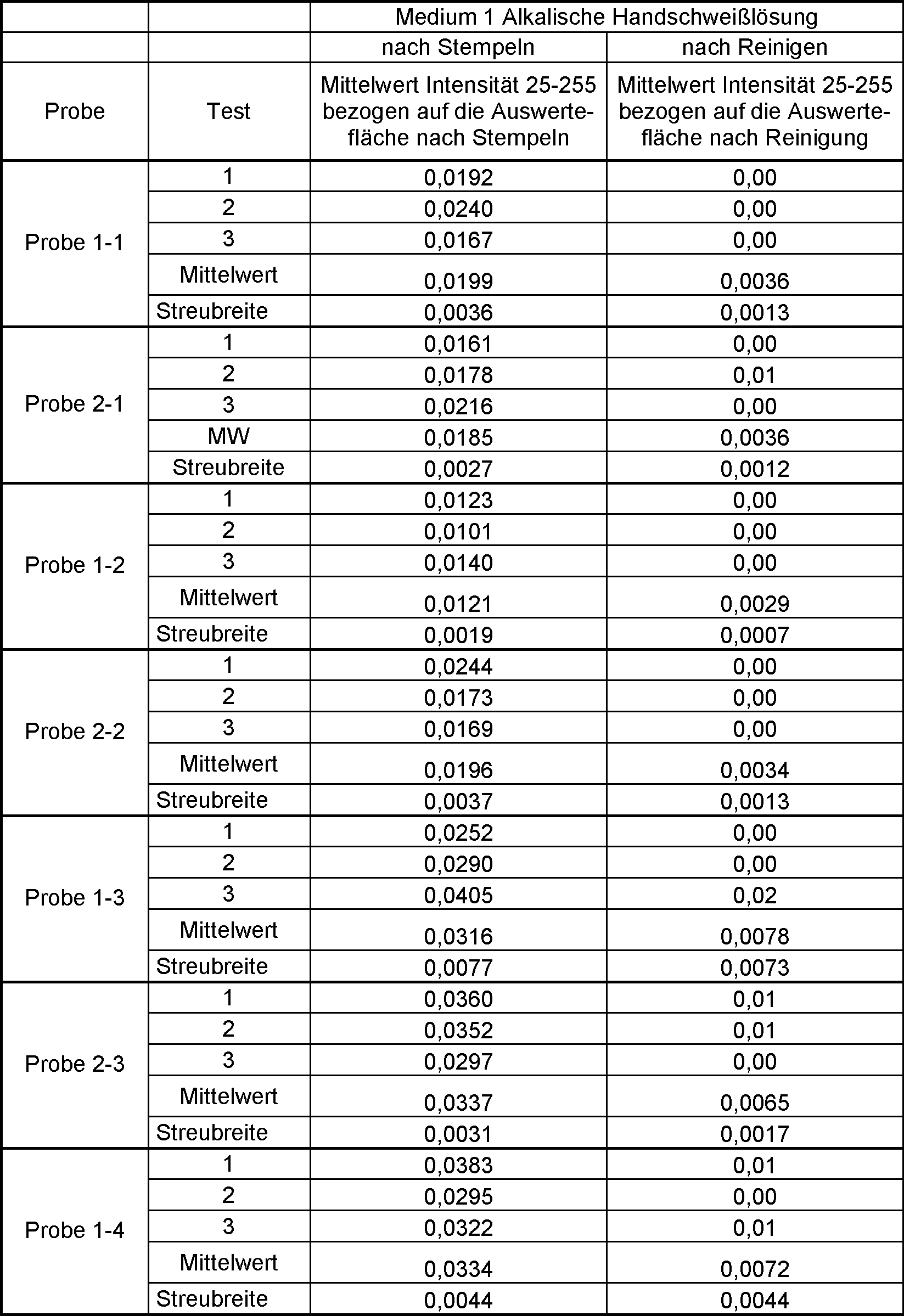

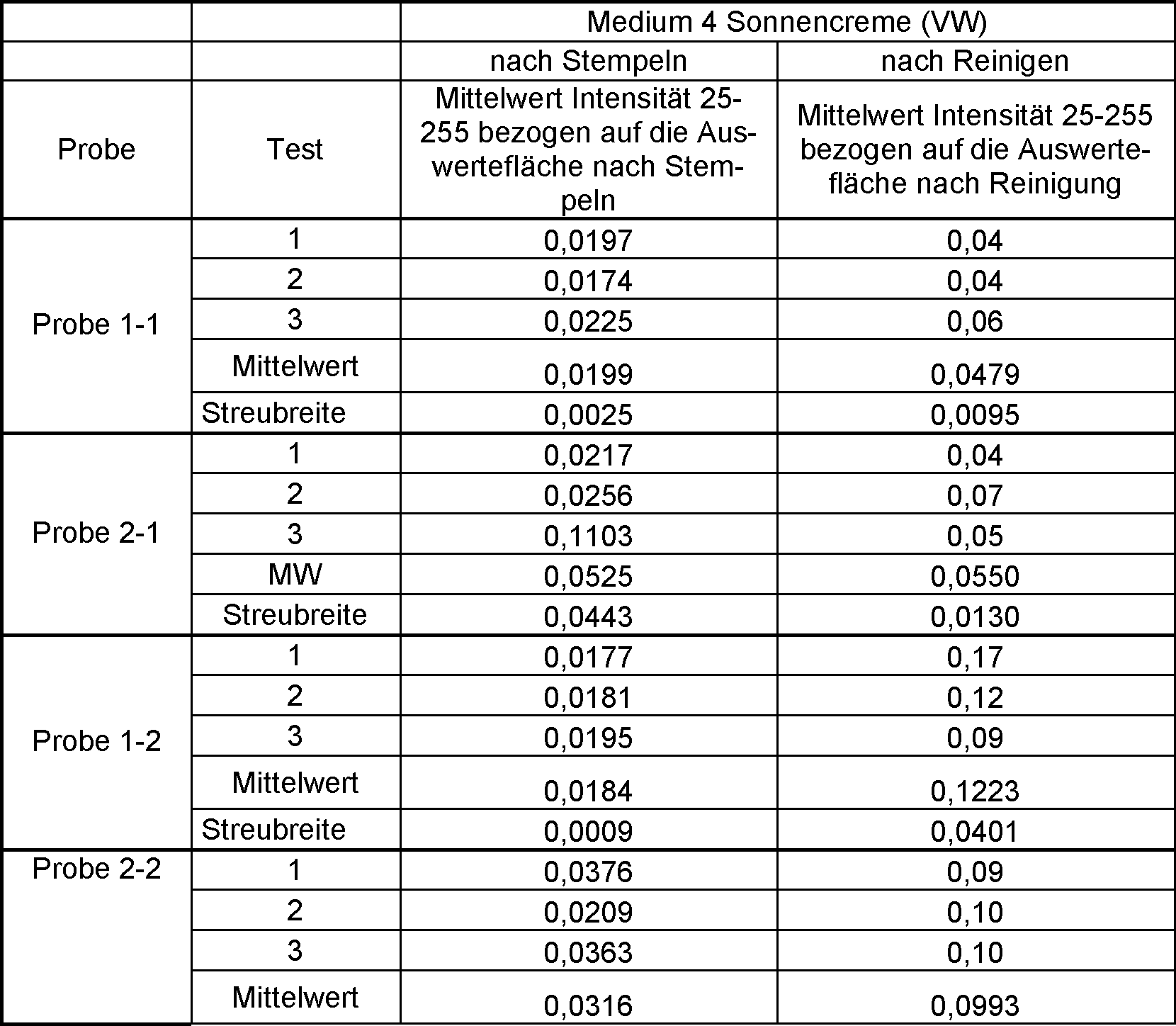
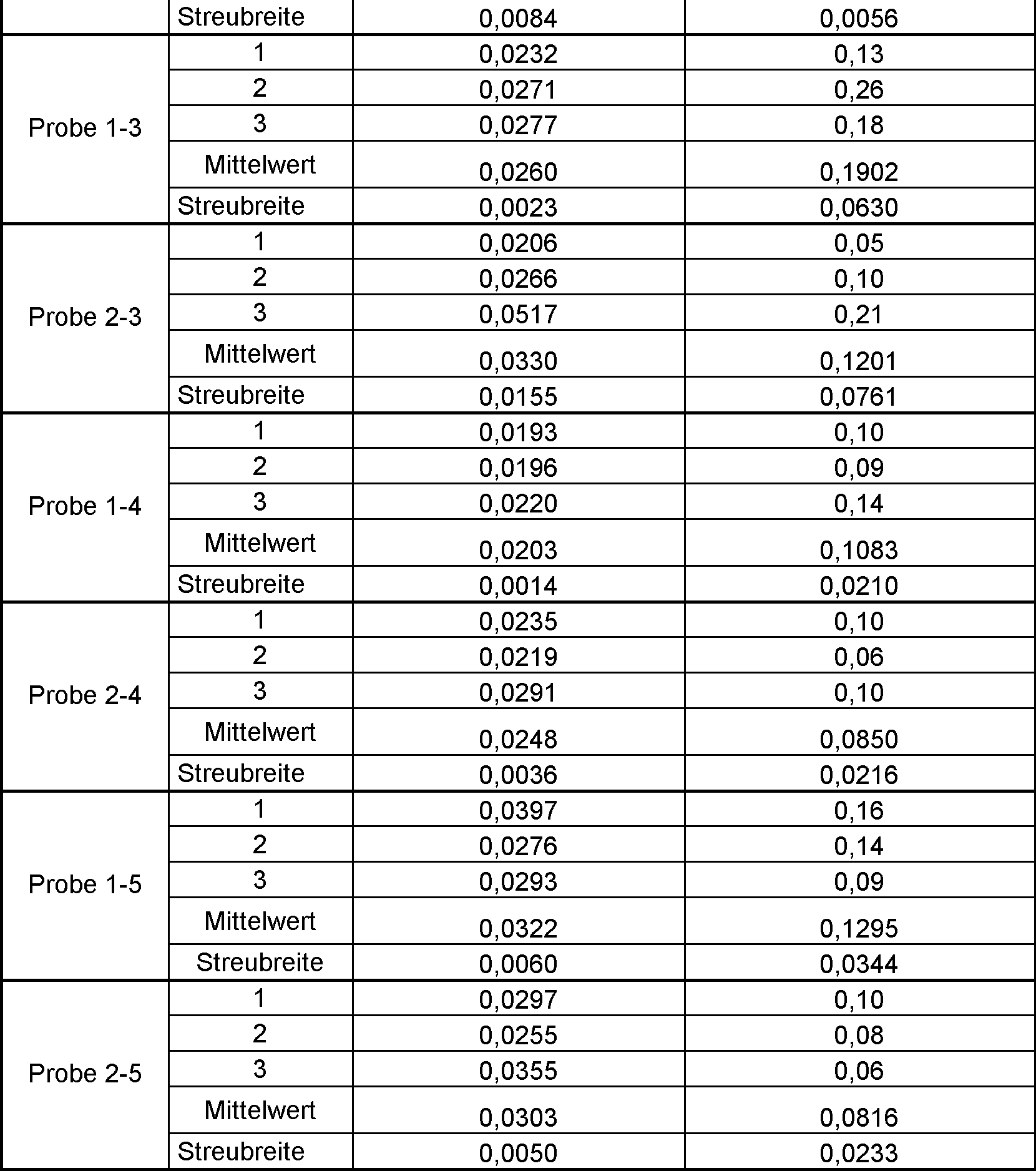
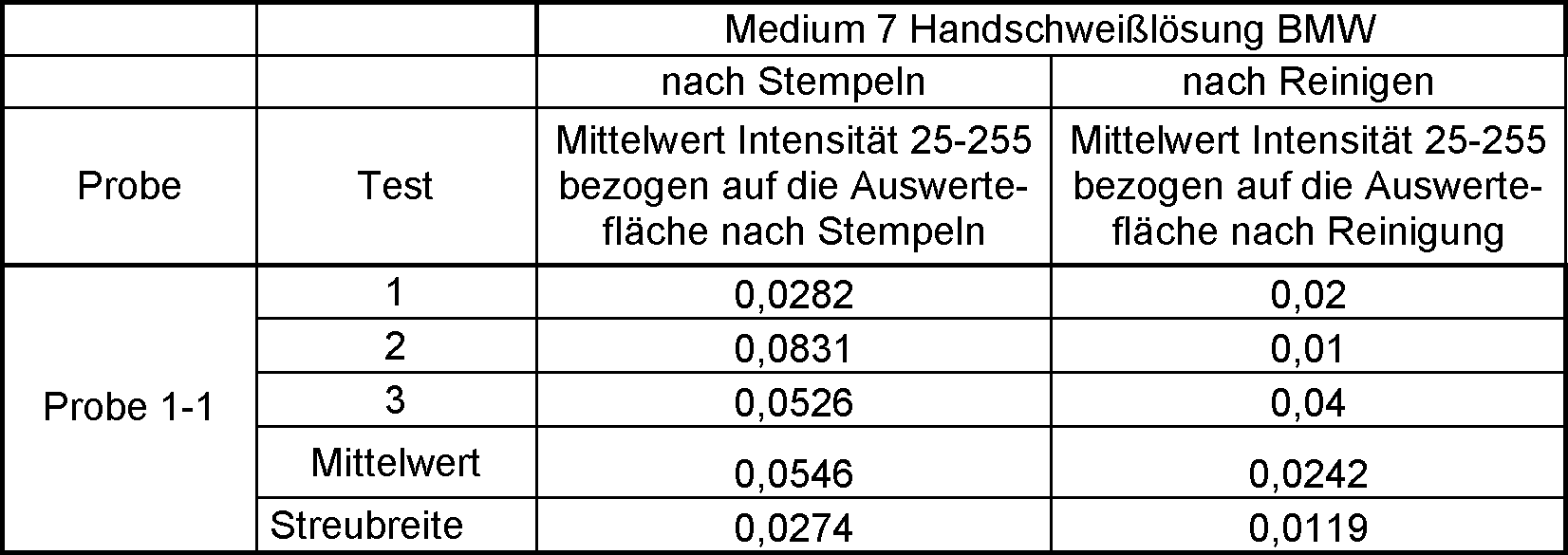
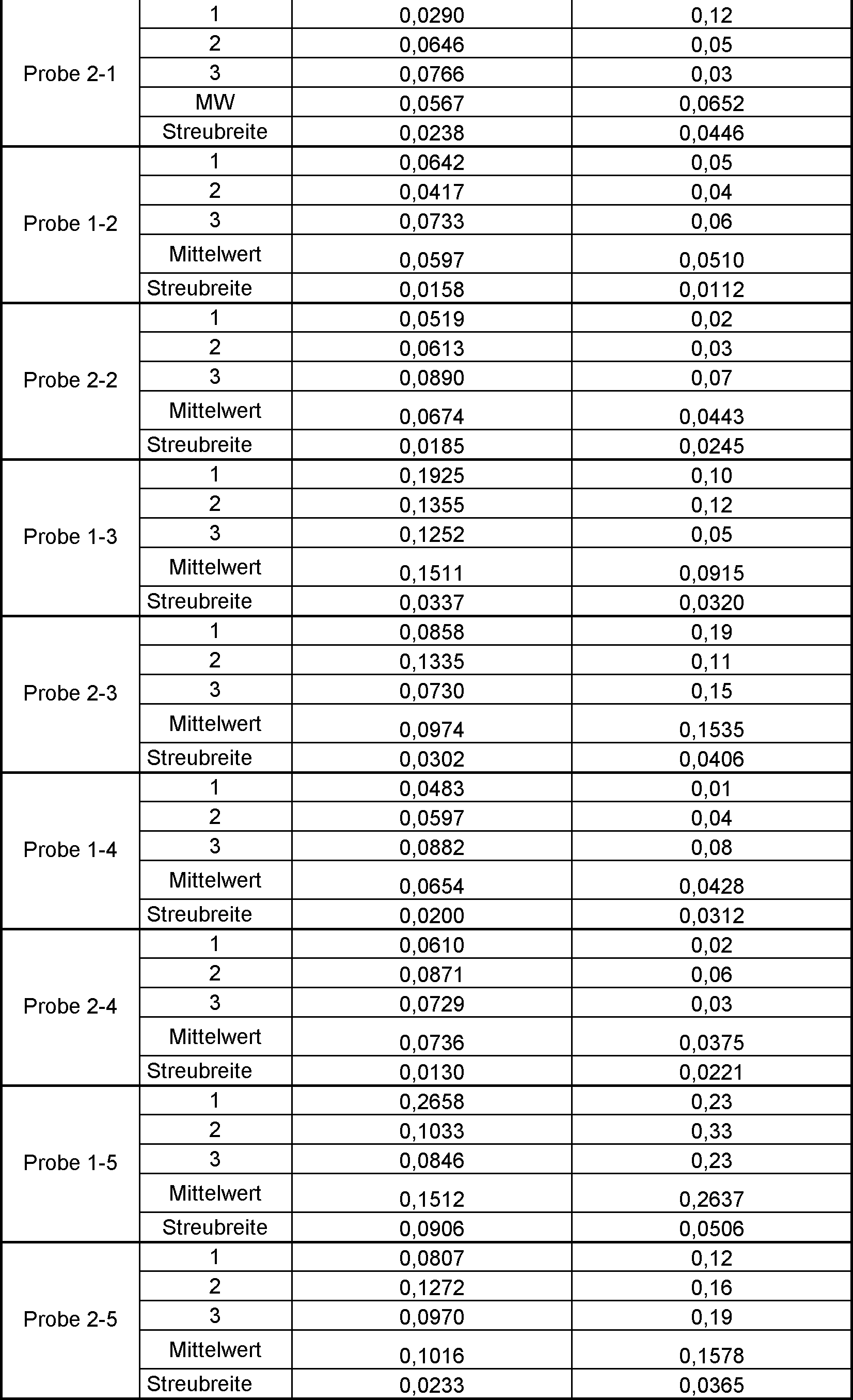
Die Proben mit erfinderischer Haftvermittlerschicht als Untergrund für eine Easy-to-clean Beschichtung weisen auch nach 504 h Testzeit keinen erkennbaren Angriff (i.O. = in Ordnung) mit nur geringer Farbveränderung auf. Dagegen zeigt eine Sol-Gel Siliziumoxidbeschichtung nach dem Stand der Technik als Untergrund für eine Easy-to-clean Beschichtung bereits schon nach 168 h Testzeit einen starken Angriff (n.i.O. = nicht in Ordnung) mit starker Farbveränderung auf. The samples with inventive primer layer as a substrate for an easy-to-clean coating, even after a test time of 504 h, no detectable attack (OK = in order) with only slight color change. In contrast, a sol-gel silica coating according to the prior art as a substrate for an easy-to-clean coating already after 168 h test time a strong attack (niO = not in order) with strong color change.
Die erfinderische Haftvermittlerschicht auf einem Substrat als Basis für die unterschiedlichen Easy-to-clean Beschichtungen vermittelt diesen in allen Fällen eine signifikante Verbesserung ihrer Langzeitbeständigkeit. Im Vergleich zeigt eine Easy-to-clean Beschichtung auf einem Substrat ohne Haftvermittlerschicht in allen Fällen bereits nach 168 Stunden NSS-Test einen Verlust der hydrophoben Eigenschaft. Für die Erhaltung eines hohen Kontaktwinkels, für praktisch relevante Easy-to-clean Eigenschaften sollte dieser über 80° liegen. Dies wurde als guter Indikator erkannt, um nach einem Belastungstest die Erhaltung der Eigenschaften zu ermitteln. Der NSS-Test ist als breit anerkannter Test einer der kritischen Tests für derartige Schichtkombinationen. Er spiegelt Belastungen wider, die beispielsweise durch Berührung mit Fingerabdrücken entstehen. Der Salzgehalt des Fingerschweisses ist ein typischer Einfluss für das Schichtversagen. The inventive adhesion promoter layer on a substrate as the basis for the different easy-to-clean coatings gives them in all cases a significant improvement in their long-term stability. In comparison, an easy-to-clean coating on a substrate without a primer layer shows in all cases a loss of the hydrophobic property even after 168 hours NSS test. To maintain a high contact angle, for practically relevant easy-to-clean properties, this should be above 80 °. This was recognized as a good indicator to determine the conservation of properties after a stress test. The NSS test is widely recognized as one of the critical tests for such layer combinations. It reflects stress caused, for example, by fingerprints. The salt content of finger sweat is a typical influence for the layer failure.
An den Ergebnissen erkennt man, dass für alle untersuchten fluororganischen Verbindungen das erfinderische Substratelement mit Haftvermittlerschicht eine deutliche Verlängerung der Beständigkeit bewirkt. Trotzdem kann man zwischen den verschiedenen Easy-to-clean Systemen naturgemäß Unterschiede beobachten, da neben der Haftvermittlerschicht auch die Grundbeständigkeit der Easy-to-clean Schicht einen Einfluß auf die Beständigkeit hat. Unabhängig von der jeweiligen fluororganischen Verbindung ist jedoch ein durchgängiger Effekt zu beobachten, welcher insbesondere die Langzeitwirkung einer Easy-to-clean Beschichtung deutlich verbessert. Der Effekt entsteht dadurch, dass die Easy-to-clean Beschichtung in eine Wechselwirkung mit der Haftvermittlerschicht tritt. From the results it can be seen that the inventive substrate element with adhesion promoter layer causes a significant extension of the stability for all investigated fluoroorganic compounds. Nevertheless, one can naturally observe differences between the various easy-to-clean systems, because apart from the primer layer, the basic stability of the easy-to-clean layer also has an influence on the resistance. Regardless of the particular organofluorine compound, however, an end-to-end effect can be observed which, in particular, markedly improves the long-term effect of an easy-to-clean coating. The effect arises from the fact that the easy-to-clean coating interacts with the adhesion promoter layer.
Antifingerprint Testergebnisse bestätigen den Vorteil der erfinderischen Substratelemente als Basis für eine Easy-to-clean Beschichtung. Antifingerprint test results confirm the advantage of the innovative substrate elements as the basis for an easy-to-clean coating.
Mit einer Easy-to-clean Beschichtung beschichtete erfinderische Substrate kommen insbesondere als Touchsceens zur Anwendung. Andere Anwendungen sind beispielsweise Displayscheiben von Monitoren, Schaufenster, Verglasungen mit problematischer Zugänglichkeit für die Reinigung, Vitrinen, Glaselemente von Kühlmöbeln, Theken, Herdvorsatzscheiben, dekorative Glaselemente, insbesondere in belasteten Bereichen mit höherer Kontaminationsgefahr wie Küchen, Bäder oder Laboratorien oder auch Abdeckungen von Solarmodulen. Inventive substrates coated with an easy-to-clean coating are used in particular as touch cements. Other applications include display screens of monitors, shop windows, glazing with problematic accessibility for cleaning, showcases, glass elements of refrigeration cabinets, counters, stovetops, decorative glass elements, especially in contaminated areas with higher risk of contamination such as kitchens, bathrooms or laboratories or even covers of solar modules.
Speziell Dekorative Elemente, die auf der Rückseite des Glases eine Bedruckung haben oder eine spiegelnde Beschichtung aufweisen, profitieren von einer Easy-to-clean Beschichtung besonders. Diese Elemente, die beispielsweise als Herdvorsatzscheiben oder anderen Küchengeräten eingesetzt werden, treten im Gebrauch immer wieder mit Fingerabdrücken oder fettigen Substanzen in Berührung. Die Oberfläche sieht in diesen Fällen sehr schnell unansehnlich und unhygienisch aus. Die Easy-to-clean Beschichtung liefert hier bereits gute visuelle Ergebnisse zur Unterdrückung und lässt sich leichter reinigen. Durch das erfindungsgemäße Substrat in einer solchen Anwendung kann die Langlebigkeit der Wirkung deutlich gesteigert werden und der Gebrauchswert eines Gegenstandes wird erhöht. Especially decorative elements, which have a print on the back of the glass or have a reflective coating, benefit particularly from an easy-to-clean coating. These elements, which are used for example as stovetops or other kitchen appliances, come in use again and again with fingerprints or greasy substances in touch. The surface looks very fast in these cases unsightly and unhygienic. The easy-to-clean coating provides good visual results for suppression and is easier to clean. By the substrate according to the invention in such an application, the longevity of the effect can be significantly increased and the utility of an article is increased.
Es versteht sich, dass die Erfindung nicht auf eine Kombination vorstehend beschriebener Merkmale beschränkt ist, sondern dass der Fachmann sämtliche Merkmale der Erfindung, soweit dies sinnvoll ist, beliebig kombinieren wird.It is understood that the invention is not limited to a combination of the features described above, but that the skilled person will arbitrarily combine all the features of the invention, as far as is expedient.
ZITATE ENTHALTEN IN DER BESCHREIBUNG QUOTES INCLUDE IN THE DESCRIPTION
Diese Liste der vom Anmelder aufgeführten Dokumente wurde automatisiert erzeugt und ist ausschließlich zur besseren Information des Lesers aufgenommen. Die Liste ist nicht Bestandteil der deutschen Patent- bzw. Gebrauchsmusteranmeldung. Das DPMA übernimmt keinerlei Haftung für etwaige Fehler oder Auslassungen.This list of the documents listed by the applicant has been generated automatically and is included solely for the better information of the reader. The list is not part of the German patent or utility model application. The DPMA assumes no liability for any errors or omissions.
Zitierte PatentliteraturCited patent literature
- DE 19848591 [0005, 0095] DE 19848591 [0005, 0095]
- EP 0844265 [0006] EP 0844265 [0006]
- US 2010/0279068 [0007, 0007, 0007] US 2010/0279068 [0007, 0007, 0007]
- US 2010/0285272 [0008, 0016] US 2010/0285272 [0008, 0016]
- US 2009/0197048 [0009] US 2009/0197048 [0009]
- EP 2103965 A1 [0010] EP 2103965 A1 [0010]
- US 5847876 [0011] US 5847876 [0011]
- DE 102007058927 [0030] DE 102007058927 [0030]
- DE 102007058926 [0030] DE 102007058926 [0030]
- EP 1248959 B1 [0037] EP 1248959 B1 [0037]
- US 4568578 [0064] US 4568578 [0064]
Zitierte Nicht-PatentliteraturCited non-patent literature
-
H. Schröder, Physics of Thin Films 5, Academic Press New York and London (1967, Seiten 87–141) [0064] H. Schröder, Physics of
Thin Films 5, Academic Press New York and London (1967, pp. 87-141) [0064] - C. Brinker, G. Scherer, „Sol-Gel-Science – The Physic and Chemistry of Sol-Gel Processing (Academic Press, Boston 1990) [0067] C. Brinker, G. Scherer, "Sol-Gel Science - The Physic and Chemistry of Sol-Gel Processing" (Academic Press, Boston 1990) [0067]
- R. Iller, The Chemistry of Silica (Willey, New York, 1979) [0067] R. Iller, The Chemistry of Silica (Willey, New York, 1979). [0067]
- DIN ISO 105-E04 [0108] DIN ISO 105-E04 [0108]
- DIN ISO 105-E04 [0108] DIN ISO 105-E04 [0108]
- ISO 105 F09/AATCC8, 116,165 [0111] ISO 105 F09 / AATCC8, 116.165 [0111]
Claims (17)
Priority Applications (11)
| Application Number | Priority Date | Filing Date | Title |
|---|---|---|---|
| DE201110076754 DE102011076754A1 (en) | 2011-05-31 | 2011-05-31 | Substrate element for the coating with an easy-to-clean coating |
| KR20137033952A KR20140035420A (en) | 2011-05-31 | 2012-05-30 | Substrate element for coating with an easy-to-clean coating |
| KR1020167026571A KR20160117627A (en) | 2011-05-31 | 2012-05-30 | Substrate element for coating with an easy-to-clean coating |
| DE201211002318 DE112012002318A5 (en) | 2011-05-31 | 2012-05-30 | Substrate element for the coating with an easy-to-clean coating |
| JP2014513168A JP6133277B2 (en) | 2011-05-31 | 2012-05-30 | Substrate elements for coating with easy clean coating |
| CN201280026550.XA CN103582617A (en) | 2011-05-31 | 2012-05-30 | Substrate element for coating with an easy-to-clean coating |
| GB1320494.6A GB2506034A (en) | 2011-05-31 | 2012-05-30 | Substrate element for coating with an easy-to-clean coating |
| PCT/EP2012/060104 WO2012163946A1 (en) | 2011-05-31 | 2012-05-30 | Substrate element for coating with an easy-to-clean coating |
| US14/119,995 US20140147654A1 (en) | 2011-05-31 | 2012-05-30 | Substrate element for coating with an easy-to-clean coating |
| TW101119489A TWI455899B (en) | 2011-05-31 | 2012-05-31 | Substrate component for coating a simple cleaning coating |
| JP2017012114A JP6271051B2 (en) | 2011-05-31 | 2017-01-26 | Substrate elements for coating with easy clean coating |
Applications Claiming Priority (1)
| Application Number | Priority Date | Filing Date | Title |
|---|---|---|---|
| DE201110076754 DE102011076754A1 (en) | 2011-05-31 | 2011-05-31 | Substrate element for the coating with an easy-to-clean coating |
Publications (1)
| Publication Number | Publication Date |
|---|---|
| DE102011076754A1 true DE102011076754A1 (en) | 2012-12-06 |
Family
ID=46210233
Family Applications (2)
| Application Number | Title | Priority Date | Filing Date |
|---|---|---|---|
| DE201110076754 Withdrawn DE102011076754A1 (en) | 2011-05-31 | 2011-05-31 | Substrate element for the coating with an easy-to-clean coating |
| DE201211002318 Ceased DE112012002318A5 (en) | 2011-05-31 | 2012-05-30 | Substrate element for the coating with an easy-to-clean coating |
Family Applications After (1)
| Application Number | Title | Priority Date | Filing Date |
|---|---|---|---|
| DE201211002318 Ceased DE112012002318A5 (en) | 2011-05-31 | 2012-05-30 | Substrate element for the coating with an easy-to-clean coating |
Country Status (8)
| Country | Link |
|---|---|
| US (1) | US20140147654A1 (en) |
| JP (2) | JP6133277B2 (en) |
| KR (2) | KR20140035420A (en) |
| CN (1) | CN103582617A (en) |
| DE (2) | DE102011076754A1 (en) |
| GB (1) | GB2506034A (en) |
| TW (1) | TWI455899B (en) |
| WO (1) | WO2012163946A1 (en) |
Cited By (9)
| Publication number | Priority date | Publication date | Assignee | Title |
|---|---|---|---|---|
| US20140186598A1 (en) * | 2012-12-27 | 2014-07-03 | Intermolecular Inc. | Base-layer consisting of two materials layer with extreme high/low index in low-e coating to improve the neutral color and transmittance performance |
| DE102014112133A1 (en) * | 2014-08-25 | 2016-02-25 | Fraunhofer-Gesellschaft zur Förderung der angewandten Forschung e.V. | Coating for a glass surface, process for its production and glass element |
| EP3146368A1 (en) * | 2014-05-23 | 2017-03-29 | Corning Incorporated | Low contrast anti-reflection articles with reduced scratch and fingerprint visibility |
| US10348943B2 (en) | 2016-07-25 | 2019-07-09 | Apple Inc. | Electronic device structures with oleophobic coatings |
| DE102018116993A1 (en) * | 2018-07-13 | 2020-01-16 | Schott Ag | Optical component with scratch-resistant anti-reflection coating and process for its production |
| EP3643495A4 (en) * | 2017-06-21 | 2021-03-03 | AGC Inc. | ARTICLE CONTAINING A HYDROPHOBIC AND OLEOPHOBIC LAYER, AND ITS MANUFACTURING PROCESS |
| EP3832356A1 (en) * | 2019-12-06 | 2021-06-09 | Schott Ag | Optical component with scratch-resistant antireflex coating and process for its production |
| CN113386421A (en) * | 2021-06-26 | 2021-09-14 | 苏州星辰排版印刷有限公司 | Glass panel and production process thereof |
| US11434166B2 (en) * | 2012-10-12 | 2022-09-06 | Corning Incorporated | Articles with a low-elastic modulus layer and retained strength |
Families Citing this family (66)
| Publication number | Priority date | Publication date | Assignee | Title |
|---|---|---|---|---|
| PT2251454E (en) | 2009-05-13 | 2014-10-01 | Sio2 Medical Products Inc | Vessel coating and inspection |
| US9458536B2 (en) | 2009-07-02 | 2016-10-04 | Sio2 Medical Products, Inc. | PECVD coating methods for capped syringes, cartridges and other articles |
| DE102009057444A1 (en) * | 2009-12-08 | 2011-06-09 | Dürr Systems GmbH | Lackieranlagenbauteil with a surface coating |
| US11624115B2 (en) | 2010-05-12 | 2023-04-11 | Sio2 Medical Products, Inc. | Syringe with PECVD lubrication |
| US9878101B2 (en) | 2010-11-12 | 2018-01-30 | Sio2 Medical Products, Inc. | Cyclic olefin polymer vessels and vessel coating methods |
| DE102014108058A1 (en) * | 2014-06-06 | 2015-12-17 | Schott Ag | Optical element with high scratch resistance |
| US9272095B2 (en) | 2011-04-01 | 2016-03-01 | Sio2 Medical Products, Inc. | Vessels, contact surfaces, and coating and inspection apparatus and methods |
| DE102011076756A1 (en) * | 2011-05-31 | 2012-12-06 | Schott Ag | Substrate element for the coating with an easy-to-clean coating |
| WO2013071138A1 (en) | 2011-11-11 | 2013-05-16 | Sio2 Medical Products, Inc. | PASSIVATION, pH PROTECTIVE OR LUBRICITY COATING FOR PHARMACEUTICAL PACKAGE, COATING PROCESS AND APPARATUS |
| US11116695B2 (en) | 2011-11-11 | 2021-09-14 | Sio2 Medical Products, Inc. | Blood sample collection tube |
| EP2846755A1 (en) | 2012-05-09 | 2015-03-18 | SiO2 Medical Products, Inc. | Saccharide protective coating for pharmaceutical package |
| US20150297800A1 (en) | 2012-07-03 | 2015-10-22 | Sio2 Medical Products, Inc. | SiOx BARRIER FOR PHARMACEUTICAL PACKAGE AND COATING PROCESS |
| US9664626B2 (en) | 2012-11-01 | 2017-05-30 | Sio2 Medical Products, Inc. | Coating inspection method |
| EP2920567B1 (en) | 2012-11-16 | 2020-08-19 | SiO2 Medical Products, Inc. | Method and apparatus for detecting rapid barrier coating integrity characteristics |
| US9764093B2 (en) | 2012-11-30 | 2017-09-19 | Sio2 Medical Products, Inc. | Controlling the uniformity of PECVD deposition |
| CN105705676B (en) | 2012-11-30 | 2018-09-07 | Sio2医药产品公司 | Control the uniformity of the PECVD depositions on injector for medical purpose, cylindrantherae etc. |
| KR102070766B1 (en) * | 2013-02-21 | 2020-04-02 | 삼성디스플레이 주식회사 | Display substrate, display panel having the same and method of manufacturing the same |
| WO2014134577A1 (en) | 2013-03-01 | 2014-09-04 | Sio2 Medical Products, Inc. | Plasma or cvd pre-treatment for lubricated pharmaceutical package, coating process and apparatus |
| US9937099B2 (en) | 2013-03-11 | 2018-04-10 | Sio2 Medical Products, Inc. | Trilayer coated pharmaceutical packaging with low oxygen transmission rate |
| KR102167557B1 (en) | 2013-03-11 | 2020-10-20 | 에스아이오2 메디컬 프로덕츠, 인크. | Coated Packaging |
| US9863042B2 (en) | 2013-03-15 | 2018-01-09 | Sio2 Medical Products, Inc. | PECVD lubricity vessel coating, coating process and apparatus providing different power levels in two phases |
| EP3909924B1 (en) * | 2013-05-07 | 2023-12-13 | AGC Glass Europe | Glass sheet with high transmission of infrared radiation |
| EP2865737A1 (en) * | 2013-10-28 | 2015-04-29 | The Swatch Group Research and Development Ltd. | Fine epilame product |
| EP3122917B1 (en) | 2014-03-28 | 2020-05-06 | SiO2 Medical Products, Inc. | Antistatic coatings for plastic vessels |
| US9400343B1 (en) * | 2014-04-30 | 2016-07-26 | Magnolia Optical Technologies, Inc. | Highly durable hydrophobic antireflection structures and method of manufacturing the same |
| US9650290B2 (en) * | 2014-05-27 | 2017-05-16 | Centre Luxembourgeois De Recherches Pour Le Verre Et La Ceramique (C.R.V.C.) Sarl | IG window unit for preventing bird collisions |
| US10068683B1 (en) | 2014-06-06 | 2018-09-04 | Southwire Company, Llc | Rare earth materials as coating compositions for conductors |
| CN105334993B (en) * | 2014-08-06 | 2018-03-06 | 臻龙实业股份有限公司 | ceramic plate structure |
| JP6495595B2 (en) * | 2014-08-07 | 2019-04-03 | 京セラ株式会社 | Low reflection member |
| DE102014013550A1 (en) * | 2014-09-12 | 2016-03-31 | Schott Ag | Coated chemically tempered flexible thin glass |
| DE102014013528B4 (en) * | 2014-09-12 | 2022-06-23 | Schott Ag | Coated glass or glass-ceramic substrate with stable multifunctional surface properties, method for its production and its use |
| DE102014013527A1 (en) | 2014-09-12 | 2016-03-17 | Schott Ag | Process for producing a coated, chemically tempered glass substrate with anti-fingerprint properties and the glass substrate produced |
| DE102015006644B4 (en) | 2014-10-01 | 2021-07-22 | Schott Ag | Laminated pane for protective glazing and its use, picture glazing and display glazing |
| TWI546272B (en) | 2014-10-23 | 2016-08-21 | 財團法人工業技術研究院 | Ceramic powder and method for manufacturing the same and laser sinter molding |
| TWI588589B (en) * | 2015-07-15 | 2017-06-21 | Projector with atomizing conductive structure and its application | |
| CA2995225C (en) | 2015-08-18 | 2023-08-29 | Sio2 Medical Products, Inc. | Pharmaceutical and other packaging with low oxygen transmission rate |
| DE102015114877B4 (en) * | 2015-09-04 | 2020-10-01 | Schott Ag | Scratch-resistant anti-reflective coating and mobile electronic device |
| DE102015115796A1 (en) * | 2015-09-18 | 2017-03-23 | Osram Opto Semiconductors Gmbh | Method for forming one or more three-dimensional objects |
| CN108349792A (en) * | 2015-10-29 | 2018-07-31 | 伊扎维克技术有限责任公司 | Complex optics coating and its manufacturing method(Modification) |
| KR20170117811A (en) * | 2016-04-14 | 2017-10-24 | 현대자동차주식회사 | Anti-Pollution Surface Coating Materials |
| KR102571058B1 (en) * | 2017-02-20 | 2023-08-29 | 삼성전자주식회사 | Layered structures, production methods thereof, and liquid crystal display including the same |
| JP6251899B1 (en) * | 2017-03-31 | 2017-12-27 | グンゼ株式会社 | Antireflection film |
| US10413948B2 (en) | 2017-04-25 | 2019-09-17 | Corning Incorporated | Glass, glass-ceramic and ceramic articles with lubricious anti-fingerprint coatings and methods of making the same |
| US10583428B2 (en) | 2017-05-18 | 2020-03-10 | GM Global Technology Operations LLC | Self-cleaning film system and method of forming same |
| US10754067B2 (en) * | 2017-05-18 | 2020-08-25 | GM Global Technology Operations LLC | Textured self-cleaning film system and method of forming same |
| US10556231B2 (en) | 2017-05-18 | 2020-02-11 | GM Global Technology Operations LLC | Self-cleaning film system and method of forming same |
| US10429641B2 (en) | 2017-05-31 | 2019-10-01 | GM Global Technology Operations LLC | Light-enhanced self-cleaning film system and method of forming same |
| CN109077620B (en) * | 2017-06-14 | 2024-07-19 | 佛山市顺德区美的电热电器制造有限公司 | Non-stick coating, preparation method thereof, pan or baking tray panel and cooking equipment |
| TWI780166B (en) | 2017-06-23 | 2022-10-11 | 美商康寧公司 | Coated articles that include easy-to-clean coatings |
| US20190032218A1 (en) * | 2017-07-28 | 2019-01-31 | The Boeing Company | Process for Adhering Solid Lubricant to Surface of Interference Fit Fastener |
| KR102373824B1 (en) * | 2017-09-06 | 2022-03-15 | 삼성전자주식회사 | Cooking apparatus and manufacturing method thereof |
| WO2019159983A1 (en) * | 2018-02-16 | 2019-08-22 | Agc株式会社 | Cover glass, and in-cell liquid-crystal display device |
| EP3539887B1 (en) * | 2018-03-16 | 2021-05-26 | Schott AG | Hollow body, in particular for packaging a pharmaceutical composition, having a layer of glass and a surface region with a contact angle for wetting with water |
| US10981195B2 (en) | 2018-05-07 | 2021-04-20 | GM Global Technology Operations LLC | Method of forming a self-cleaning film system |
| KR102616292B1 (en) * | 2019-04-24 | 2023-12-21 | 주식회사 라이드로 | Optical apparatus with window cleaning machanism |
| WO2020263632A1 (en) * | 2019-06-26 | 2020-12-30 | Applied Materials, Inc. | Flexible multi-layered cover lens stacks for foldable displays |
| TWI732243B (en) * | 2019-07-08 | 2021-07-01 | 國立成功大學 | Rewritable board and use thereof |
| CN111087177A (en) * | 2019-12-25 | 2020-05-01 | 苏州胜利精密制造科技股份有限公司 | Scratch-resistant antireflection coating cover plate and preparation method thereof |
| EP4100375B1 (en) * | 2020-02-06 | 2024-01-03 | Saint-Gobain Glass France | Vehicle window with reduced emissivity and light reflection |
| CN111875263B (en) * | 2020-07-23 | 2022-09-06 | 安徽晶驰光电科技有限公司 | Anti-glare film coating method for anti-reflection glass |
| CN116589194B (en) | 2021-01-29 | 2025-10-21 | 重庆鑫景特种玻璃有限公司 | A glass-ceramic display screen and its manufacturing method |
| KR20230039434A (en) * | 2021-09-14 | 2023-03-21 | 코닝 인코포레이티드 | Manufacturing methods of glass substrate structure and metallized substrate |
| JP2024538653A (en) * | 2021-09-30 | 2024-10-23 | インテグリス・インコーポレーテッド | Articles Having Removable Coatings and Related Methods - Patent application |
| CN114436543B (en) * | 2022-01-07 | 2023-06-02 | 常州亚玛顿股份有限公司 | A kind of coated glass for photovoltaic modules and preparation method thereof |
| CN116125563A (en) * | 2022-12-20 | 2023-05-16 | 常州市万华激光科技有限公司 | Nanometer coating with ultralow reflectivity |
| CN118206295A (en) * | 2024-04-16 | 2024-06-18 | 厦门威亮光电技术有限公司 | A kind of anti-reflection glass and its preparation method |
Citations (11)
| Publication number | Priority date | Publication date | Assignee | Title |
|---|---|---|---|---|
| US4568578A (en) | 1983-01-11 | 1986-02-04 | Schott Glaswerke | Process for the producing of indium oxide-tin oxide layers and the resultant coated substrates |
| EP0844265A1 (en) | 1995-08-11 | 1998-05-27 | Daikin Industries, Limited | Silicon-containing organic fluoropolymers and use of the same |
| US5847876A (en) | 1996-06-25 | 1998-12-08 | Mcdonnell Douglas | Fingerprint resistant anti-reflection coatings |
| DE19848591A1 (en) | 1998-04-15 | 1999-10-21 | United Technology Research & E | Surface treatment of substrate containing metal, especially vehicle windscreen or headlamp |
| EP1248959B1 (en) | 1999-12-22 | 2006-06-21 | Schott Ag | Uv-reflective interference layer system |
| DE102007058926A1 (en) | 2007-12-05 | 2009-06-10 | Schott Ag | Solar glass, for use e.g. in solar module housings, includes barrier layer between antireflection layer and glass substrate to improve resistance to environment |
| DE102007058927A1 (en) | 2007-12-05 | 2009-06-10 | Schott Ag | Glass substrate useful in composite material for solar module, solar receiver or shield attachments, comprises a sol-gel-layer formed as anti-reflexion coating, and a sodium barrier layer arranged between the sol-gel-layer and the substrate |
| US20090197048A1 (en) | 2008-02-05 | 2009-08-06 | Jaymin Amin | Damage resistant glass article for use as a cover plate in electronic devices |
| EP2103965A1 (en) | 2006-12-27 | 2009-09-23 | Asahi Glass Company, Limited | Anti-reflection product and display device |
| US20100279068A1 (en) | 2009-05-04 | 2010-11-04 | Glen Bennett Cook | Embossed glass articles for anti-fingerprinting applications and methods of making |
| US20100285272A1 (en) | 2009-05-06 | 2010-11-11 | Shari Elizabeth Koval | Multi-length scale textured glass substrates for anti-fingerprinting |
Family Cites Families (12)
| Publication number | Priority date | Publication date | Assignee | Title |
|---|---|---|---|---|
| JP2716315B2 (en) * | 1992-06-01 | 1998-02-18 | セントラル硝子株式会社 | Low reflection glass |
| FR2730990B1 (en) * | 1995-02-23 | 1997-04-04 | Saint Gobain Vitrage | TRANSPARENT SUBSTRATE WITH ANTI-REFLECTIVE COATING |
| US5789476A (en) * | 1995-03-03 | 1998-08-04 | Seiko Epson Corporation | Film-forming coating solution and synthetic resin lens |
| JP3427755B2 (en) * | 1997-12-04 | 2003-07-22 | 日本板硝子株式会社 | Method for producing silica-based membrane coated article |
| WO2000010934A1 (en) * | 1998-08-18 | 2000-03-02 | Ppg Industries Ohio, Inc. | Process for producing durable antireflective surfaces and antireflective articles |
| JP2000336334A (en) * | 1999-05-31 | 2000-12-05 | Nippon Sheet Glass Co Ltd | Method for producing silica-based membrane-coated article and functional membrane-coated article |
| US6686031B2 (en) * | 2000-02-23 | 2004-02-03 | Fuji Photo Film Co., Ltd. | Hard coat film and display device having same |
| DE10318234A1 (en) * | 2003-04-22 | 2004-11-25 | Clariant Gmbh | Use of polysilazane for the production of hydrophobically and oleophobically modified surfaces |
| DE102004053706A1 (en) * | 2004-11-03 | 2006-05-04 | Schott Ag | Barrier coated article and method of making such article |
| DE102005020168A1 (en) * | 2005-04-28 | 2006-11-02 | Schott Ag | Coating glass or ceramic substrate with anti-reflective layer using sol-gel process, employs e.g. silicon-aluminum mixed oxide with adsorbed hydrophobe present in sol-gel binder |
| JP2008217886A (en) * | 2007-03-02 | 2008-09-18 | Sanyo Electric Co Ltd | Optical pickup apparatus |
| US8611010B2 (en) * | 2008-09-30 | 2013-12-17 | 3M Innovative Properties Company | Substrate comprising unmatched refractive index primer at optically significant thickness |
-
2011
- 2011-05-31 DE DE201110076754 patent/DE102011076754A1/en not_active Withdrawn
-
2012
- 2012-05-30 WO PCT/EP2012/060104 patent/WO2012163946A1/en not_active Ceased
- 2012-05-30 KR KR20137033952A patent/KR20140035420A/en not_active Ceased
- 2012-05-30 GB GB1320494.6A patent/GB2506034A/en not_active Withdrawn
- 2012-05-30 KR KR1020167026571A patent/KR20160117627A/en not_active Ceased
- 2012-05-30 JP JP2014513168A patent/JP6133277B2/en not_active Expired - Fee Related
- 2012-05-30 US US14/119,995 patent/US20140147654A1/en not_active Abandoned
- 2012-05-30 CN CN201280026550.XA patent/CN103582617A/en active Pending
- 2012-05-30 DE DE201211002318 patent/DE112012002318A5/en not_active Ceased
- 2012-05-31 TW TW101119489A patent/TWI455899B/en not_active IP Right Cessation
-
2017
- 2017-01-26 JP JP2017012114A patent/JP6271051B2/en not_active Expired - Fee Related
Patent Citations (11)
| Publication number | Priority date | Publication date | Assignee | Title |
|---|---|---|---|---|
| US4568578A (en) | 1983-01-11 | 1986-02-04 | Schott Glaswerke | Process for the producing of indium oxide-tin oxide layers and the resultant coated substrates |
| EP0844265A1 (en) | 1995-08-11 | 1998-05-27 | Daikin Industries, Limited | Silicon-containing organic fluoropolymers and use of the same |
| US5847876A (en) | 1996-06-25 | 1998-12-08 | Mcdonnell Douglas | Fingerprint resistant anti-reflection coatings |
| DE19848591A1 (en) | 1998-04-15 | 1999-10-21 | United Technology Research & E | Surface treatment of substrate containing metal, especially vehicle windscreen or headlamp |
| EP1248959B1 (en) | 1999-12-22 | 2006-06-21 | Schott Ag | Uv-reflective interference layer system |
| EP2103965A1 (en) | 2006-12-27 | 2009-09-23 | Asahi Glass Company, Limited | Anti-reflection product and display device |
| DE102007058926A1 (en) | 2007-12-05 | 2009-06-10 | Schott Ag | Solar glass, for use e.g. in solar module housings, includes barrier layer between antireflection layer and glass substrate to improve resistance to environment |
| DE102007058927A1 (en) | 2007-12-05 | 2009-06-10 | Schott Ag | Glass substrate useful in composite material for solar module, solar receiver or shield attachments, comprises a sol-gel-layer formed as anti-reflexion coating, and a sodium barrier layer arranged between the sol-gel-layer and the substrate |
| US20090197048A1 (en) | 2008-02-05 | 2009-08-06 | Jaymin Amin | Damage resistant glass article for use as a cover plate in electronic devices |
| US20100279068A1 (en) | 2009-05-04 | 2010-11-04 | Glen Bennett Cook | Embossed glass articles for anti-fingerprinting applications and methods of making |
| US20100285272A1 (en) | 2009-05-06 | 2010-11-11 | Shari Elizabeth Koval | Multi-length scale textured glass substrates for anti-fingerprinting |
Non-Patent Citations (5)
| Title |
|---|
| C. Brinker, G. Scherer, "Sol-Gel-Science - The Physic and Chemistry of Sol-Gel Processing (Academic Press, Boston 1990) |
| DIN ISO 105-E04 |
| H. Schröder, Physics of Thin Films 5, Academic Press New York and London (1967, Seiten 87-141) |
| ISO 105 F09/AATCC8, 116,165 |
| R. Iller, The Chemistry of Silica (Willey, New York, 1979) |
Cited By (17)
| Publication number | Priority date | Publication date | Assignee | Title |
|---|---|---|---|---|
| US11919803B2 (en) * | 2012-10-12 | 2024-03-05 | Corning Incorporated | Articles with a low-elastic modulus layer and retained strength |
| US20230040422A1 (en) * | 2012-10-12 | 2023-02-09 | Corning Incorporated | Articles with a low-elastic modulus layer and retained strength |
| US11440837B2 (en) * | 2012-10-12 | 2022-09-13 | Corning Incorporated | Articles having retained strength |
| US11434166B2 (en) * | 2012-10-12 | 2022-09-06 | Corning Incorporated | Articles with a low-elastic modulus layer and retained strength |
| US9365450B2 (en) * | 2012-12-27 | 2016-06-14 | Intermolecular, Inc. | Base-layer consisting of two materials layer with extreme high/low index in low-e coating to improve the neutral color and transmittance performance |
| US20140186598A1 (en) * | 2012-12-27 | 2014-07-03 | Intermolecular Inc. | Base-layer consisting of two materials layer with extreme high/low index in low-e coating to improve the neutral color and transmittance performance |
| EP3146368A1 (en) * | 2014-05-23 | 2017-03-29 | Corning Incorporated | Low contrast anti-reflection articles with reduced scratch and fingerprint visibility |
| DE102014112133B4 (en) | 2014-08-25 | 2021-12-30 | Fraunhofer-Gesellschaft zur Förderung der angewandten Forschung e.V. | Coating for a glass surface, process for its manufacture and glass element |
| DE102014112133A1 (en) * | 2014-08-25 | 2016-02-25 | Fraunhofer-Gesellschaft zur Förderung der angewandten Forschung e.V. | Coating for a glass surface, process for its production and glass element |
| US10348943B2 (en) | 2016-07-25 | 2019-07-09 | Apple Inc. | Electronic device structures with oleophobic coatings |
| EP3643495A4 (en) * | 2017-06-21 | 2021-03-03 | AGC Inc. | ARTICLE CONTAINING A HYDROPHOBIC AND OLEOPHOBIC LAYER, AND ITS MANUFACTURING PROCESS |
| DE102018116993B4 (en) | 2018-07-13 | 2022-06-02 | Schott Ag | Optical component with scratch-resistant anti-reflection coating and method for its manufacture |
| FR3083739A1 (en) * | 2018-07-13 | 2020-01-17 | Schott Ag | Optical component with scratch-resistant anti-reflective coating and method of making it |
| DE102018116993A1 (en) * | 2018-07-13 | 2020-01-16 | Schott Ag | Optical component with scratch-resistant anti-reflection coating and process for its production |
| EP3832356A1 (en) * | 2019-12-06 | 2021-06-09 | Schott Ag | Optical component with scratch-resistant antireflex coating and process for its production |
| CN113386421A (en) * | 2021-06-26 | 2021-09-14 | 苏州星辰排版印刷有限公司 | Glass panel and production process thereof |
| CN113386421B (en) * | 2021-06-26 | 2022-09-23 | 苏州星辰排版印刷有限公司 | Glass panel and production process thereof |
Also Published As
| Publication number | Publication date |
|---|---|
| TW201305079A (en) | 2013-02-01 |
| GB2506034A (en) | 2014-03-19 |
| WO2012163946A1 (en) | 2012-12-06 |
| KR20160117627A (en) | 2016-10-10 |
| JP2017074797A (en) | 2017-04-20 |
| DE112012002318A5 (en) | 2014-02-20 |
| JP6271051B2 (en) | 2018-01-31 |
| US20140147654A1 (en) | 2014-05-29 |
| GB201320494D0 (en) | 2014-01-01 |
| JP2014522329A (en) | 2014-09-04 |
| KR20140035420A (en) | 2014-03-21 |
| JP6133277B2 (en) | 2017-05-24 |
| CN103582617A (en) | 2014-02-12 |
| TWI455899B (en) | 2014-10-11 |
Similar Documents
| Publication | Publication Date | Title |
|---|---|---|
| DE102011076754A1 (en) | Substrate element for the coating with an easy-to-clean coating | |
| DE102011076756A1 (en) | Substrate element for the coating with an easy-to-clean coating | |
| DE102014013528B4 (en) | Coated glass or glass-ceramic substrate with stable multifunctional surface properties, method for its production and its use | |
| DE102014013550A1 (en) | Coated chemically tempered flexible thin glass | |
| DE102017009250B4 (en) | Anti-glare film-coated substrate, anti-glare film-forming liquid composition and method for producing an anti-glare film-coated substrate | |
| EP1685075B1 (en) | Object with easily cleaned surfaces and method for production thereof | |
| JP6371282B2 (en) | Translucent glazing material comprising at least one pattern, preferably transparent | |
| EP2490828B1 (en) | Device having reduced friction properties | |
| EP1972968B1 (en) | Optical transparent member and optical system using the same | |
| DE102014013527A1 (en) | Process for producing a coated, chemically tempered glass substrate with anti-fingerprint properties and the glass substrate produced | |
| DE112015003283T5 (en) | cover glass | |
| WO2011107277A1 (en) | Method for multi-coating and glass substrate coated with multiple layers | |
| DE112018002226T5 (en) | GLASS SUBSTRATE WITH APPLIED FILM, OBJECT AND METHOD FOR PRODUCING A GLASS SUBSTRATE WITH APPLIED FILM | |
| DE202004021240U1 (en) | Easy clean surface, subject to high temperatures and heavy soiling, has an outer hydrophobic layer with a component reacting with free OH groups and an inner inorganic sol-gel layer | |
| JP2007241177A (en) | Antireflection structure and structure |
Legal Events
| Date | Code | Title | Description |
|---|---|---|---|
| R118 | Application deemed withdrawn due to claim for domestic priority |
Effective date: 20131202 |