DE102010009263B4 - Method for data transmission to an electronic control unit - Google Patents
Method for data transmission to an electronic control unit Download PDFInfo
- Publication number
- DE102010009263B4 DE102010009263B4 DE102010009263A DE102010009263A DE102010009263B4 DE 102010009263 B4 DE102010009263 B4 DE 102010009263B4 DE 102010009263 A DE102010009263 A DE 102010009263A DE 102010009263 A DE102010009263 A DE 102010009263A DE 102010009263 B4 DE102010009263 B4 DE 102010009263B4
- Authority
- DE
- Germany
- Prior art keywords
- bit
- data words
- decoding
- code tree
- code
- Prior art date
- Legal status (The legal status is an assumption and is not a legal conclusion. Google has not performed a legal analysis and makes no representation as to the accuracy of the status listed.)
- Expired - Fee Related
Links
- 238000000034 method Methods 0.000 title claims abstract description 18
- 230000005540 biological transmission Effects 0.000 title claims abstract description 9
- 238000007906 compression Methods 0.000 claims abstract description 7
- 230000006835 compression Effects 0.000 claims abstract description 7
- 230000015654 memory Effects 0.000 claims description 10
- 238000012937 correction Methods 0.000 claims description 4
- 238000011161 development Methods 0.000 description 2
- 230000018109 developmental process Effects 0.000 description 2
- 230000002349 favourable effect Effects 0.000 description 2
- 230000001174 ascending effect Effects 0.000 description 1
- 230000009286 beneficial effect Effects 0.000 description 1
- 230000015556 catabolic process Effects 0.000 description 1
- 238000013144 data compression Methods 0.000 description 1
- 238000006731 degradation reaction Methods 0.000 description 1
- 230000001419 dependent effect Effects 0.000 description 1
- 230000006866 deterioration Effects 0.000 description 1
- 230000000694 effects Effects 0.000 description 1
- 238000004519 manufacturing process Methods 0.000 description 1
- 230000008672 reprogramming Effects 0.000 description 1
- 238000012360 testing method Methods 0.000 description 1
- 238000012546 transfer Methods 0.000 description 1
- 230000003936 working memory Effects 0.000 description 1
Images


Classifications
-
- H—ELECTRICITY
- H04—ELECTRIC COMMUNICATION TECHNIQUE
- H04L—TRANSMISSION OF DIGITAL INFORMATION, e.g. TELEGRAPHIC COMMUNICATION
- H04L69/00—Network arrangements, protocols or services independent of the application payload and not provided for in the other groups of this subclass
- H04L69/04—Protocols for data compression, e.g. ROHC
-
- H—ELECTRICITY
- H03—ELECTRONIC CIRCUITRY
- H03M—CODING; DECODING; CODE CONVERSION IN GENERAL
- H03M7/00—Conversion of a code where information is represented by a given sequence or number of digits to a code where the same, similar or subset of information is represented by a different sequence or number of digits
- H03M7/30—Compression; Expansion; Suppression of unnecessary data, e.g. redundancy reduction
- H03M7/40—Conversion to or from variable length codes, e.g. Shannon-Fano code, Huffman code, Morse code
Landscapes
- Engineering & Computer Science (AREA)
- Theoretical Computer Science (AREA)
- Computer Security & Cryptography (AREA)
- Computer Networks & Wireless Communication (AREA)
- Signal Processing (AREA)
- Compression, Expansion, Code Conversion, And Decoders (AREA)
Abstract
Verfahren zur Datenübertragung von einem Programmiergerät zu einem Steuergerät, bei dem die zu übertragenden Daten im Programmiergerät durch eine Huffman-Codierung komprimiert werden, nach der Komprimierung zusammen mit einem Huffman-Codebaum zum Decodieren vom Programmiergerät an das Steuergerät übertragen werden, im Steuergerät dekomprimiert und dort gespeichert werden,
dadurch gekennzeichnet,
dass für eine vorbestimmte Anzahl von Datenworten, bestehend jeweils aus N-Bits, der zu übertragenden Daten eine erste Huffman-Codierung mit einem ersten Codebaum und für die verbleibenden Datenworte, bestehend jeweils aus M-Bits, eine zweite Huffman-Codierung mit einem zweiten Codebaum durchgeführt wird, wobei N größer als M ist,
wobei die vorbestimmte Anzahl Datenworte, bestehend aus N-Bits, und die verbleibenden Datenworte, bestehend aus M-Bits aus jeweils mehr als zwei Datenworten bestehen, dass ein Codebaum für die zu codierenden N-Bit-Datenwörter und ein Codebaum für die zu codierenden M-Bit-Datenwörter erzeugt werden,
dass beide Codebäume an das Steuergerät übertragen werden und
dass alle codierten...Method for data transmission from a programming device to a control device, in which the data to be transmitted in the programmer are compressed by a Huffman coding, transmitted after compression together with a Huffman code tree for decoding from the programmer to the controller, decompressed in the controller and there get saved,
characterized,
for a predetermined number of data words, each consisting of N bits, of the data to be transmitted, a first Huffman coding with a first code tree and for the remaining data words, each consisting of M bits, a second Huffman coding with a second code tree is performed, where N is greater than M,
wherein the predetermined number of data words consisting of N bits and the remaining data words consisting of M bits each consisting of more than two data words, a code tree for the N-bit data words to be coded and a code tree for the M to be coded -Bit data words are generated,
that both code trees are transmitted to the control unit and
that all encoded ...
Description
Die Erfindung betrifft ein Verfahren zur Datenübertragung von einem Programmiergerät zu einem elektronischen Steuergerät insbesondere zu elektronischen Steuergeräten von Kraftfahrzeugen.The invention relates to a method for data transmission from a programming device to an electronic control unit, in particular to electronic control units of motor vehicles.
Ein solches Verfahren ist aus der Druckschrift Liebscher P.: ”Aktuelle Trends bei der Steuergeräte-Reprogrammierung”. In: Elektronik automotive 2.2006, S. 34–37 bekannt. Die ältere nicht vorveröffentlichte
Die Druckschrift Decker, Th.: ”Vortrag 6: Huffman”; In: Online-Bibliothek Wikipedia, 19.01.1999, http://www.itec.uka.de/seminare/redundanz/vortrag06/ sowie die
Bei der
Zur Datenübertragung größerer Datenmengen in vertretbarer zeit ist es bekannt, die zu übertragenden Daten zu komprimieren. Hierfür eignet sich die sehr leistungsfähige verlustfreie Huffman-Codierung. Die Huffman 16 Codierung, die mit 16-Bit Datenworten arbeitet ist sehr leistungsfähig, erfordert aber einen verhältnismäßig großen Codebaum zum Decodieren (bis ca. 278 KBytes). Die Größe hängt von der Code Ausnutzung ab. Jeder verwendete 16-Bit Code kostet 34 Bit im Codebaum für die Decodierung. Dementsprechend dauert die Erstellung des Codebaumes auch lange. Außerdem muß bei der Datenübertragung der Codebaum für die Decodierung mit übertragen werden und passt eventuell aufgrund seiner Größe nicht mehr in den Arbeitsspeicher des Zielsystems bzw. Steuergerätes.For data transmission of larger amounts of data in a reasonable time, it is known to compress the data to be transmitted. For this purpose, the very powerful lossless Huffman coding is suitable. The Huffman 16 encoding, which works with 16-bit data words is very powerful, but requires a relatively large code tree for decoding (up to about 278 KBytes). The size depends on the code usage. Each 16-bit code used costs 34 bits in the code tree for decoding. Accordingly, the creation of the code tree takes a long time. In addition, the code tree for the decoding must be transmitted in the data transmission and possibly fits due to its size no longer in the main memory of the target system or controller.
Andererseits kommt die 8-Bit Huffman-Codierung, die mit 8-Bit Datenworten arbeitet, mit einem kleineren Codebaum für die Decodierung aus (ca. 574 Bytes) erreicht jedoch nicht die Leistungsfähigkeit der 16-Bit Huffman-Codierung.On the other hand, 8-bit Huffman encoding using 8-bit data words with a smaller code tree for decoding (about 574 bytes) does not achieve the performance of 16-bit Huffman coding.
Aufgabe der Erfindung ist es das Verfahren gemäß dem Oberbegriff des Patentanspruches 1 dahingehend zu verbessern, dass es bei hoher Leistungsfähigkeit mit kleineren Codebäumen auskommt und dadurch die Datenübertragung schneller stattfindet. Weiter soll die Belastung des Arbeitsspeichers des Steuergerätes durch den Codebaum verringert werden.The object of the invention is to improve the method according to the preamble of
Diese Aufgabe wird durch die im Patentanspruch 1 angegebenen Merkmale gelöst. Vorteilhafte Ausgestaltungen und Weiterbildungen der Erfindung sind den Unteransprüchen zu entnehmen.This object is achieved by the features specified in
Die Grundidee der Erfindung liegt darin, die Komprimierung der zu übertragenden Daten teilweise mit einer N-Bit Huffman-Codierung und teilweise mit M-Bit Huffman-Codierung durchzuführen, wobei N ein ganzzahliges Vielfaches M ist und die Anzahl von N-Bit-Datenworten und die Anzahl von M-Bit-Datenworten jeweils größer 2 ist und weiter beide Codebäume an das Steuergerät übertragen werden. Unter N-Bit Huffman-Codierung und M-Bit Huffman-Codierung wird hier und im folgenden eine Huffman-Codierung mit einem ersten bzw. zweiten Codebaum verstanden, der Datenwörter bestehend aus N-Bits bzw. M-Bits codiert.The basic idea of the invention is to carry out the compression of the data to be transmitted partly with an N-bit Huffman coding and partly with M-bit Huffman coding, where N is an integer multiple M and the number of N-bit data words and the number of M-bit data words is always greater than 2 and further both code trees are transmitted to the control unit. N-bit Huffman coding and M-bit Huffman coding here and in the following mean a Huffman coding with a first or second code tree which encodes data words consisting of N bits or M bits.
In einem bevorzugten Ausführungsbeispiel wird eine vorbestimmte Anzahl von zu codierenden Datenworten mit der 16-Bit Huffman-Codierung durchgeführt, während die restlichen Datenworte mit der 8-Bit Huffman-Codierung komprimiert werden.In a preferred embodiment, a predetermined number of data words to be coded are performed with the 16-bit Huffman coding, while the remaining data words are compressed with the 8-bit Huffman coding.
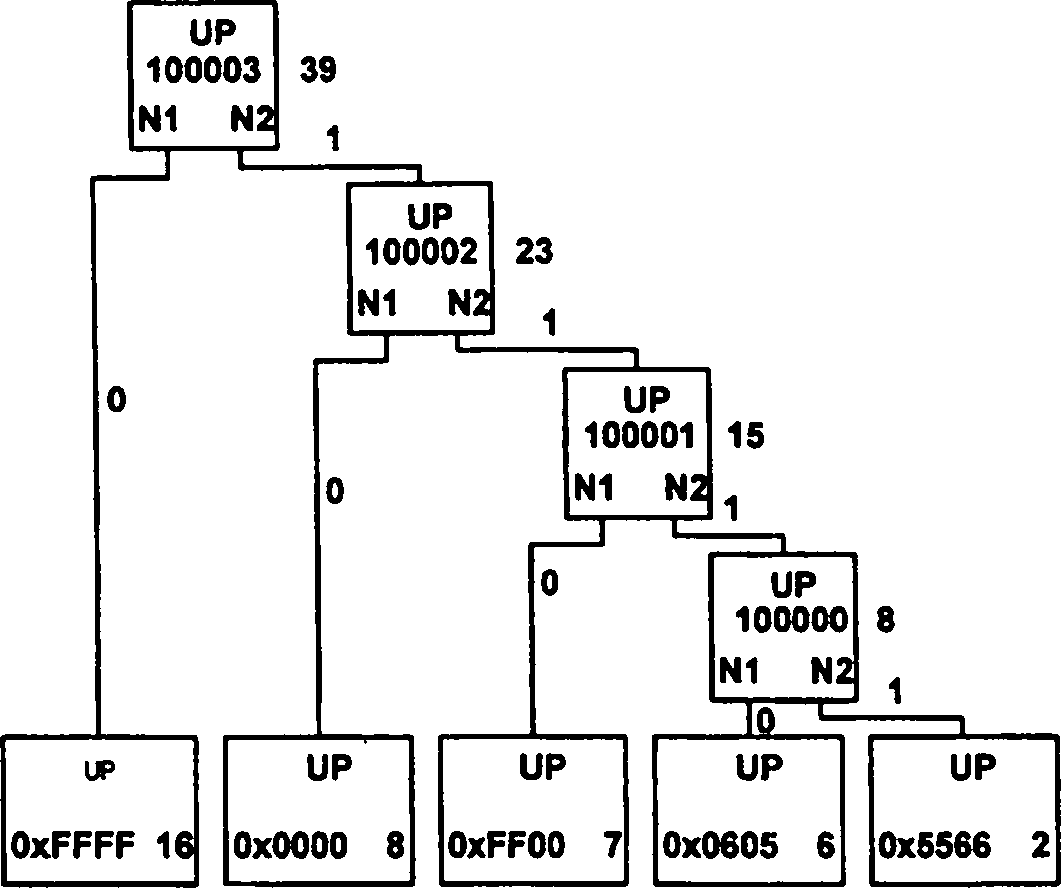
Für die häufigsten 16-Bit Datenworte wird eine eigene Codiertabelle und ein eigener(erster)Codebaum für die Decodierung erstellt, wobei die Anzahl der Datenworte so gewählt wird, dass die Größe des Codebaumes überschaubar bleibt. Für alle übrigen Codes wird ein (zweiter) 8-Bit Huffman-Baum erstellt, der alle Codes von ”0” bis ”255” decodieren kann. Da der vollständige 8-Bit Codebaum für die Decodierung nur 574 Bytes groß ist, lohnt es sich hier nicht, einen unvollständigen Baum zu verwenden.For the most common 16-bit data words a separate coding table and a separate (first) code tree for the decoding is created, the number of data words is chosen so that the size of the code tree remains manageable. For all other codes, a (second) 8-bit Huffman tree is created that can decode all codes from "0" to "255". Since the complete 8-bit code tree for decoding is only 574 bytes in size, it is not worth using an incomplete tree here.
Bei der Codierung wird zunächst geprüft, ob der gefundene 16-Bit Wert in der 16-Bit Codiertabelle enthalten ist. Wenn nicht, wird die 8-Bit Tabelle verwendet und die beiden Bytes des 16-Bit Wortes codiert. The coding first checks whether the found 16-bit value is contained in the 16-bit coding table. If not, the 8-bit table is used and the two bytes of the 16-bit word are encoded.
Für die Entscheidung, welcher Codebaum zum Decodieren zu verwenden ist, wird bei der Codierung ein Bit hinzugefügt. Der Codebaum kann für beliebige Daten verwendet werden, da mit Hilfe der vollständigen 8-Bit Bäume beliebige Daten darstellbar sind.For deciding which code tree to use for decoding, one bit is added in the encoding. The code tree can be used for any data, since with the help of the complete 8-bit trees any data can be displayed.
Generell ist anstelle der erwähnten 16-Bit Codierung auch eine 32-Bit Codierung denkbar, wobei das Verfahren prinzipiell auch für beliebige andere Datengrößen einsetzbar ist, wie z. B. 9-Bit oder 19-Bit.In general, instead of the aforementioned 16-bit coding and a 32-bit encoding is conceivable, the method can be used in principle for any other data sizes, such. For example, 9-bit or 19-bit.
Primäres Einsatzgebiet des Verfahrens nach der Erfindung ist die Programmierung von elektronischen Steuergeräten für Kraftfahrzeuge und Nutzfahrzeuge über eine Diagnoseschnittstelle. Durch die Komprimierung der Daten läßt sich bei der Entwicklung, in Produktion und in der Werkstatt erhebliche Zeit sparen.The primary field of application of the method according to the invention is the programming of electronic control devices for motor vehicles and commercial vehicles via a diagnostic interface. By compressing the data, considerable time can be saved in development, in production and in the workshop.
Durch die Kombination der zwei Codierarten lassen sich die Vorteile beider Codebäume nutzen. Die Nachteile der geringen Effizienz der 8-Bit Codierung und des zu großen Codebaumes für die Decodierung der 16-Bit Codierung werden kompensiert. Die Übertragung der Daten über die Diagnoseschnittstelle eines Fahrzeuges erfolgt in aufsteigender Reihenfolge was bei manchen Steuergeräten notwendig ist, da nicht wahlfrei, sondern nur Sektorweise in den Speicher geschrieben werden kann. Die Codebäume für die Decodierung sind klein genug, um während der Decodierung im Arbeitsspeicher des Zielsystems abgelegt werden zu können. Danach können die Codebäume für die Decodierung aus dem Arbeitsspeicher entfernt werden, sodass dieser für andere Aufgaben zu Verfügung steht. Es ist aber auch möglich zumindest einen der Codebäume für die Decodierung oder auch beide Codebäume für die Decodierung permanent in einem nicht flüchtigen Speicher wie z. B. einem Flash-Speicher des Steuergerätes gespeichert zu behalten. Bei späteren Änderungen der an das Steuergerät zu übertragenden Daten ändern sich im Regelfall die Codebäume nicht oder nur geringfügig, sodass keine spürbare Verschlechterung eintritt. Selbstverständlich muß bei späteren Datenänderungen dann der ursprünglich verwendete Codebaum benutzt werden.By combining the two types of coding, the advantages of both code trees can be exploited. The disadvantages of the low efficiency of the 8-bit coding and the large code tree for the decoding of the 16-bit coding are compensated. The transmission of the data via the diagnostic interface of a vehicle takes place in ascending order, which is necessary with some control units, since not random, but only sector-wise can be written into the memory. The code trees for the decoding are small enough to be stored in the memory of the target system during decoding. After that, the code trees for decoding can be removed from the main memory so that it is available for other tasks. But it is also possible at least one of the code trees for decoding or both code trees for decoding permanently in a non-volatile memory such. B. a flash memory of the control unit to keep. In the event of later changes to the data to be transferred to the control unit, the code trees usually do not change or only slightly, so that no appreciable deterioration occurs. Of course, in later data changes then the originally used code tree must be used.
Im folgenden wird die Erfindung anhand eines Ausführungsbeispieles im Zusammenhang mit der Zeichnung ausführlicher beschrieben. Es zeigt:In the following the invention will be described in more detail with reference to an embodiment in conjunction with the drawing. It shows:
Zur Unterscheidung von Hexadezimalzahlen gegenüber Primär- und Dezimalzahlen wird das übliche Präfix 0x verwendet, um Hexadezimalzahlen zu kennzeichnen. Sofern nicht gesondert darauf hingewiesen wird.To distinguish hexadecimal numbers from primary and decimal numbers, the
Folgende Bytes ab Adresse 0x2000 sind zu komprimieren, wobei alle Werte Hexadezimalzahlen sind: Tabelle 1 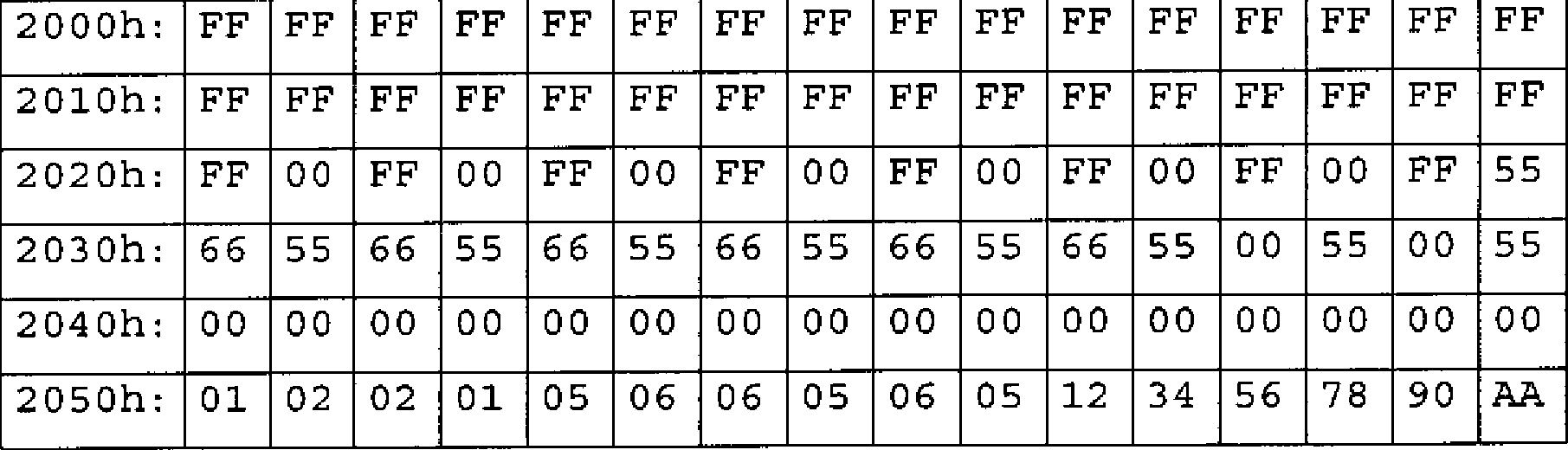

Darin sind folgende 8-Bit Werte enthalten: Tabelle 3 
Es wird dann eine Anzahl x (mit x = 5 im beschriebenen Beispiel) der häufiger vorkommenden 16-Bit Werte bestimmt, die einer 16-Bit Codierung unterworfen werden. Die Anzahl x ist jedoch kleiner 2N, sodass nicht alle 16-Bit Werte der 16-Bit Codierung unterworfen werden und mehrere 8-Bit Werte übrig bleiben, die 16-Bit Codierung also unvollständig ist, damit der 16-Bit Codebaum und der entsprechende 16-Bit Codebaum für die Decodierung nicht zu lang werden. Werte für x von 100 bis 200 werden als günstig angesehen.A number x (with x = 5 in the described example) of the more frequently occurring 16-bit values which are subjected to 16-bit coding is then determined. However, the number x is less than 2N , so not all 16-bit values are subject to 16-bit coding and multiple 8-bit values are left over, so the 16-bit encoding is incomplete, so the 16-bit code tree and the corresponding 16-bit code tree for decoding will not be too long. Values of x from 100 to 200 are considered favorable.
Da die auftretenden 8-Bit-Werte in den 16-Bit-Werten zum Teil enthalten sind, müssen die Häufigkeiten der 8-Bit-Werte korrigiert werden. Dabei ist zu beachten, dass sowohl das höherwertige Byte als auch das niederwertige Byte der 16-Bit-Werte berücksichtigt werden. Zum Beispiel wird die Häufigkeit von 0xFF (8-Bit) mit jedem Auftreten von 0xFFFF (16-Bit) um zwei vermindert, mit jedem Auftreten von 0xFF00 um eins.Since the occurring 8-bit values are partially contained in the 16-bit values, the frequencies of the 8-bit values must be corrected. It should be noted that both the high-order byte and the low-order byte of the 16-bit values are taken into account. For example, the frequency of 0xFF (8-bit) is decremented by two with every occurrence of 0xFFFF (16-bit), and by one with every occurrence of 0xFF00.
Ohne diese Korrektur würde sich zum Beispiel für die 66 ein kurzer Huffman-Code ergeben, obwohl dieser 8-Bit-Wert gar nicht vorkommt. (Weil er in dem 16-Bit-Wert 6655 aufgegangen ist.) Es ergeben sich dann folgende Korrekturen für die Häufigkeit der 8-Bit Werte.Without this correction, for example, a short Huffman code would result for the 66, although this 8-bit value does not occur at all. (Because it merged into the 16-
Tabelle 4 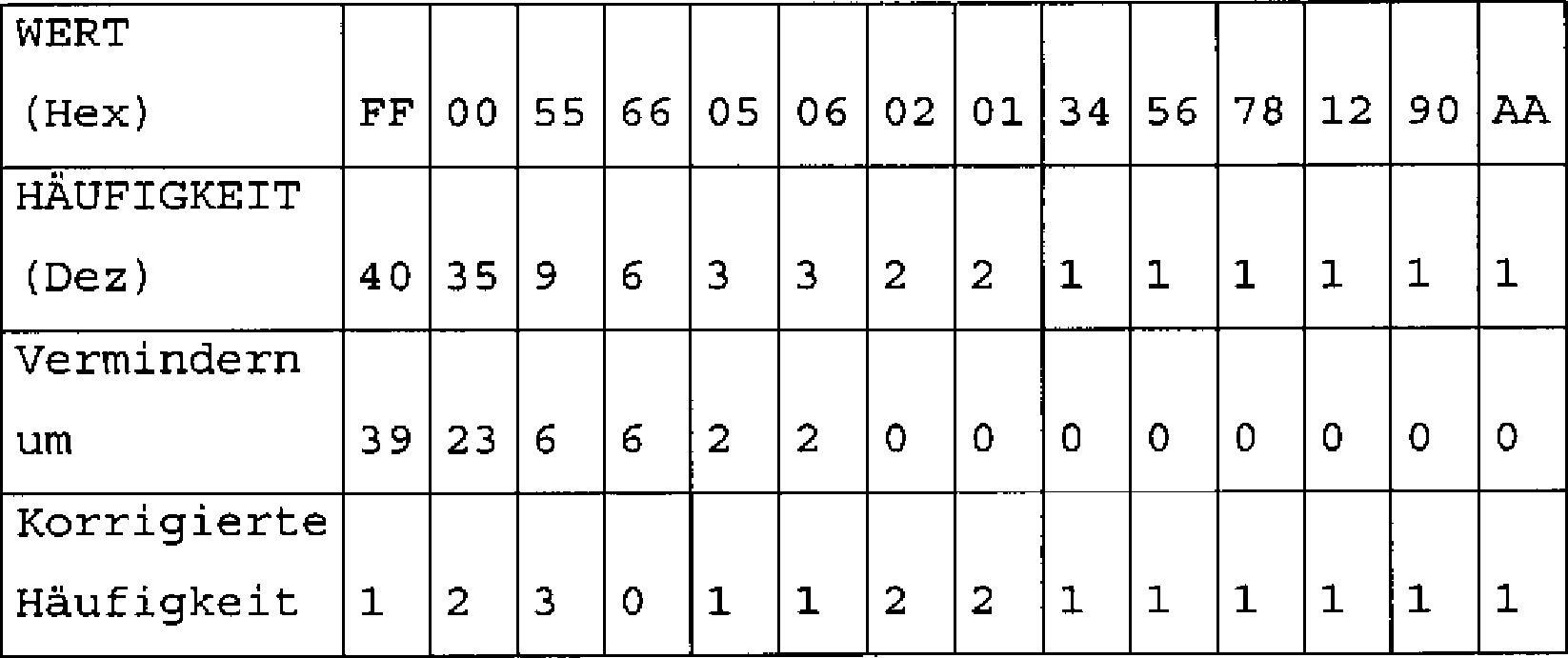
Für die Erstellung des Codebaumens darf die Häufigkeit „0” nicht vorkommen, da sonst eine Erstellung nicht möglich wäre. Deshalb werden alle Häufigkeiten mit dem Wert „0” auf „1” gesetzt, um vollständige 8-Bit Codebäume und Codebäume für die Decodierung zu erzwingen. Damit aber nicht vorkommende Zeichen dadurch keinen gleich „guten” Platz im Codebaum erhalten, wie selten oder nur einmal vorkommende Zeichen, werden die Häufigkeiten der tatsächlich vorkommenden Zeichen mit einem Faktor multipliziert, beispielsweise mit dem Faktor 100. Es ergeben sich dann folgende umsortierte 8-Bit Werte: Tabelle 5 
Da das Verhältnis der Häufigkeiten zueinander gleich bleibt, ändern sich der erzeugte Codebaum und die erzeugten Codes bei Vorkommen aller 8-Bit-Werte nicht.Since the ratio of frequencies to each other remains the same, the generated code tree and the generated codes do not change when all 8-bit values occur.
Im dargestellten Beispiel wirkt dieser Mechanismus sehr stark, hat jedoch keine Bedeutung, wenn alle 8-Bit Werte auch in Daten vorkommen.In the example shown, this mechanism is very strong, but has no meaning if all 8-bit values also occur in data.
Es werden nun zwei voneinander unabhängige Codebäume erzeugt, nämlich ein Codebaum für 16-Bit-Werte und ein Codebaum für 8-Bit-Werte.Two independent code trees are now generated, namely a 16-bit code tree and a 8-bit code tree.
Der 16-Bit-Codebaum wird hier zur übersichtlichen Darstellung nur für die ersten 5 Werte gemäß der Häufigkeit erzeugt, im Beispiel also die Werte FFFF, 0000, FF00, 6655 und 0605, wie in
Der entsprechende Codebaum für die Decodierung dazu ist in
Für alle 8-Bit-Werte wird ein vollständiger 8-Bit Codebaum erstellt, der in
Tabelle 6Table 6
Codiertabelle M = 8-BitCoding table M = 8-bit
- nur für die vorkommenden Zeichen dargestellt.only shown for the occurring characters.
Tabelle 7 Table 7
Codiertabelle N = 16-BitCoding table N = 16-bit
Nicht vorkommende 16-Bit Zeichen werden als zwei 8-Bit Zeichen codiert.
Bei der Codierung wird zunächst versucht, jedes 16-Bit Wort als solches zu codieren. Kommt es in der 16-Bit Tabelle nicht vor, so werden beide Hälften einzeln als 8-Bit Wert codiert. Damit kommen 8-Bit Werte hier immer Paarweise vor, oder allgemeiner gesagt N/M-fach.The encoding first attempts to code each 16-bit word as such. If it does not occur in the 16-bit table, both halves are coded individually as an 8-bit value. Thus, 8-bit values always come in pairs, or more generally N / M times.
Zur Unterscheidung wird als „Kennungsbit” vor jedem 16-Bit Wert eine ”0” eingefügt und eine ”1”, wenn zwei 8-Bit Werte folgen.For distinction, a "0" is inserted before each 16-bit value as a "tag bit" and a "1" when two 8-bit values follow.
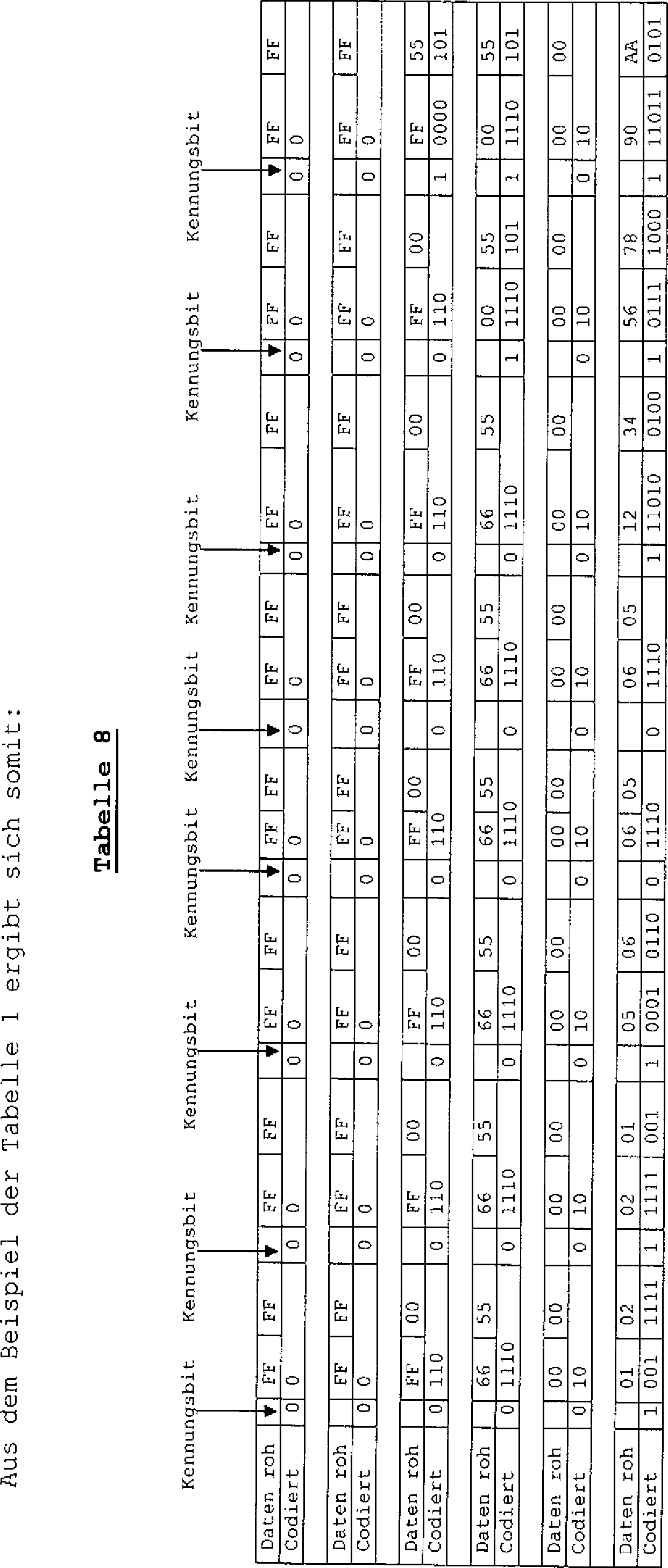
Die so codierten und mit Kennungsbit versehenen Daten werden dann zusammen mit den zugehörigen Codebäumen für die Decodierung an das Steuergerät übertragen und dort mittels der Codebäume für die Decodierung decodiert. Falls die Codebäume für die Decodierung schon im Steuergerät aufgrund einer Erstprogrammierung gespeichert sind, entfällt natürlich die Übertragung der Codebäume für die Decodierung, wobei dann für die Codierung die ursprünglichen Codebäume verwendet werden müssen. The data thus coded and provided with identification bit data are then transmitted together with the associated code trees for decoding to the control unit, where they are decoded by means of the code trees for decoding. Of course, if the code trees for the decoding are already stored in the control unit due to initial programming, the transmission of the code trees for decoding is omitted, in which case the original code trees must be used for the encoding.
Bei der Decodierung werden immer entweder ein 16-Bit Wert oder zwei 8-Bit-Werte decodiert. Einzelne 8-Bit-Werte werden nicht decodiert, weil dies keinen Vorteil bringen würde. Durch die Ausrichtung der Mikrocontroller-Codes an 16-Bit Grenzen und die Notwendigkeit eines zusätzlichen Codebits für jeden 8-Bit-Code würde sich eine Verschlechterung der Komprimierung ergeben.When decoding, either one 16-bit value or two 8-bit values are always decoded. Single 8-bit values are not decoded because this would not be beneficial. Aligning the microcontroller codes to 16-bit boundaries and requiring an additional code bit for each 8-bit code would result in degradation of compression.
Der Codebaum für die Decodierung für die 8-Bit Werte ist in
Aus obigem ist ersichtlich, dass die Größe des 16-Bit Codebaumes und des zugehörigen 16-Bit Codebaumes für die Decodierung einen wesentlichen Einfluß hat. Eine beliebige Vergrößerung des 16-Bit Codebaumes für die Decodierung kann kontraproduktiv sein und zu einer schlechteren Komprimierung führen. Dies sei an folgendem Beispiel verdeutlicht:
Ein zusätzlicher Eintrag im Codebaum für die Decodierung beansprucht 34 Bit.From the above, it can be seen that the size of the 16-bit code tree and the associated 16-bit code tree for decoding has a significant influence. Any increase in the 16-bit code tree for decoding can be counterproductive and result in poorer compression. This is illustrated by the following example:
An additional entry in the code tree for decoding requires 34 bits.
Die Codierung der zwei 8-Bit Werte beansprucht 6 + 8 + 1 = 15 Bit.The coding of the two 8-bit values requires 6 + 8 + 1 = 15 bits.
Die Codierung eines 16-Bit Wertes beansprucht 12 + 1 = 13 Bit.The coding of a 16-bit value requires 12 + 1 = 13 bits.
Pro zwei Bytes werden also vier Bit eingespart. Um die zusätzlichen 34 Bit zu Amortisieren muß der 16-Bit Wert in diesem Rechenbeispiel mindestens 17 Mal auftreten. Um dies zu überprüfen, müßte man teilweise große Dateien durchrechnen, da die Länge der codierten Zeichen nicht konstant ist.For every two bytes four bits are saved. In order to amortize the additional 34 bits, the 16-bit value must occur at least 17 times in this calculation example. In order to check this, one would have to work through large files partly because the length of the coded characters is not constant.
Die optimalen Werte hängen von den jeweils vorliegenden Daten ab. Die nachfolgende Tabelle 9 zeigt ausgehend von der ursprünglichen Größe einer Datei von 131072 Bytes den Zusammenhang zwischen der Anzahl von 16-Bit Codes, der Anzahl der komprimierten Bytes einschließlich Codebäume und das Kompressionsverhältnis in Prozent. Tabelle 9
Eine Testapplikation mit einer ursprünglichen Größe von 1179648 Bytes zeigt, dass das Kompressionsverhältnis bei größeren Dateien noch besser wird. Tabelle 10
Weiter ist zu erkennen, dass die Anzahl der 16-Bit Codes bei Dateien dieser Größe einen relativ geringen Einfluß hat. Die optimalen Parameter hängen nämlich von der Code-Verteilung in den zu komprimierenden Daten ab.It can also be seen that the number of 16-bit codes for files of this size has a relatively small influence. The optimal parameters depend on the code distribution in the data to be compressed.
Da bei größeren Datenmengen der Codebaum für die Decodierung kaum ins Gewicht fällt, sollte man die Anzahl der 16-Bit Codes nicht zu klein wählen. Werte um 100 bis 200 erscheinen günstig zu sein, wobei generell jeder Wert größer 1 möglich ist.Since with larger amounts of data the code tree for decoding hardly matters, one should not choose the number of 16-bit codes too small. Values around 100 to 200 appear to be favorable, whereby generally any value greater than 1 is possible.
Claims (10)
Priority Applications (4)
| Application Number | Priority Date | Filing Date | Title |
|---|---|---|---|
| DE102010009263A DE102010009263B4 (en) | 2010-02-25 | 2010-02-25 | Method for data transmission to an electronic control unit |
| US13/581,251 US8760326B2 (en) | 2010-02-25 | 2011-02-23 | Method for data transmission to an electronic control unit |
| EP11707136A EP2540001A2 (en) | 2010-02-25 | 2011-02-23 | Method for data transmission to an electronic control appliance |
| PCT/EP2011/052670 WO2011104268A2 (en) | 2010-02-25 | 2011-02-23 | Method for data transmission to an electronic control appliance |
Applications Claiming Priority (1)
| Application Number | Priority Date | Filing Date | Title |
|---|---|---|---|
| DE102010009263A DE102010009263B4 (en) | 2010-02-25 | 2010-02-25 | Method for data transmission to an electronic control unit |
Publications (2)
| Publication Number | Publication Date |
|---|---|
| DE102010009263A1 DE102010009263A1 (en) | 2011-08-25 |
| DE102010009263B4 true DE102010009263B4 (en) | 2012-04-12 |
Family
ID=44168140
Family Applications (1)
| Application Number | Title | Priority Date | Filing Date |
|---|---|---|---|
| DE102010009263A Expired - Fee Related DE102010009263B4 (en) | 2010-02-25 | 2010-02-25 | Method for data transmission to an electronic control unit |
Country Status (4)
| Country | Link |
|---|---|
| US (1) | US8760326B2 (en) |
| EP (1) | EP2540001A2 (en) |
| DE (1) | DE102010009263B4 (en) |
| WO (1) | WO2011104268A2 (en) |
Citations (4)
| Publication number | Priority date | Publication date | Assignee | Title |
|---|---|---|---|---|
| DE69916661T2 (en) * | 1998-12-14 | 2004-08-19 | Microsoft Corp., Redmond | CODE BOOK CONSTRUCTION FOR ENTROPY CODING FROM VARIABLE TO VARIABLE LENGTH |
| US20070016406A1 (en) * | 2005-07-15 | 2007-01-18 | Microsoft Corporation | Reordering coefficients for waveform coding or decoding |
| DE3943881B4 (en) * | 1989-04-17 | 2008-07-17 | Fraunhofer-Gesellschaft zur Förderung der angewandten Forschung e.V. | Digital coding method |
| DE102008052955A1 (en) * | 2008-10-23 | 2010-05-06 | Knorr-Bremse Systeme für Nutzfahrzeuge GmbH | Method for transmitting program codes to a memory of a control device, in particular for motor vehicles |
Family Cites Families (6)
| Publication number | Priority date | Publication date | Assignee | Title |
|---|---|---|---|---|
| US4853696A (en) * | 1987-04-13 | 1989-08-01 | University Of Central Florida | Code converter for data compression/decompression |
| US5550542A (en) * | 1994-05-04 | 1996-08-27 | Matsushita Electric Corporation Of America | Variable length code look-up table having separate code length determination |
| US6771824B1 (en) * | 1999-12-28 | 2004-08-03 | Lucent Technologies Inc. | Adaptive variable length decoding method |
| US6563441B1 (en) * | 2002-05-10 | 2003-05-13 | Seiko Epson Corporation | Automatic generation of program logic to decode variable-length codes |
| US7937413B2 (en) * | 2004-05-04 | 2011-05-03 | International Business Machines Corporation | Self-adaptive prefix encoding for stable node identifiers |
| US7609179B2 (en) * | 2008-01-08 | 2009-10-27 | International Business Machines Corporation | Method for compressed data with reduced dictionary sizes by coding value prefixes |
-
2010
- 2010-02-25 DE DE102010009263A patent/DE102010009263B4/en not_active Expired - Fee Related
-
2011
- 2011-02-23 WO PCT/EP2011/052670 patent/WO2011104268A2/en not_active Ceased
- 2011-02-23 EP EP11707136A patent/EP2540001A2/en not_active Withdrawn
- 2011-02-23 US US13/581,251 patent/US8760326B2/en active Active
Patent Citations (4)
| Publication number | Priority date | Publication date | Assignee | Title |
|---|---|---|---|---|
| DE3943881B4 (en) * | 1989-04-17 | 2008-07-17 | Fraunhofer-Gesellschaft zur Förderung der angewandten Forschung e.V. | Digital coding method |
| DE69916661T2 (en) * | 1998-12-14 | 2004-08-19 | Microsoft Corp., Redmond | CODE BOOK CONSTRUCTION FOR ENTROPY CODING FROM VARIABLE TO VARIABLE LENGTH |
| US20070016406A1 (en) * | 2005-07-15 | 2007-01-18 | Microsoft Corporation | Reordering coefficients for waveform coding or decoding |
| DE102008052955A1 (en) * | 2008-10-23 | 2010-05-06 | Knorr-Bremse Systeme für Nutzfahrzeuge GmbH | Method for transmitting program codes to a memory of a control device, in particular for motor vehicles |
Non-Patent Citations (3)
| Title |
|---|
| DECKER,TH.: "Vortrag 6: Huffman", In: Online-Bibliothek Wikipedia , 19.01.1999, http://www.itec.uka.de/seminare/redundanz/vortrag06 / * |
| HUFFMAN D.: A Method for the Construction of Minimum-Redundancy Codes". In: Proceedings of the I.R.E, Sept. 1952, S. 1098-1101 * |
| LIEBSCHER P.:"Aktuelle Trends bei der Steuergeräte- Reprogrammierung". In: Elektronik automotive 2.2006, S. 34-37 * |
Also Published As
| Publication number | Publication date |
|---|---|
| DE102010009263A1 (en) | 2011-08-25 |
| US20130070837A1 (en) | 2013-03-21 |
| WO2011104268A3 (en) | 2011-12-29 |
| US8760326B2 (en) | 2014-06-24 |
| EP2540001A2 (en) | 2013-01-02 |
| WO2011104268A2 (en) | 2011-09-01 |
Similar Documents
| Publication | Publication Date | Title |
|---|---|---|
| DE69833094T2 (en) | Method and apparatus for adaptive data compression with higher degree of compression | |
| DE69330196T2 (en) | Text compression technique using a frequency ordered matrix of word number mappings | |
| DE10301362A1 (en) | Block data compression system, consisting of a compression device and a decompression device, and method for fast block data compression with multi-byte search | |
| DE102013205544A1 (en) | Apparatus and method for processing data | |
| DE69433620T2 (en) | Data compression method | |
| WO2003094355A2 (en) | Method and arrangement for arithmetically encoding and decoding binary states, corresponding computer program, and corresponding computer-readable storage medium | |
| DE60009502T2 (en) | LZW DATA COMPRESSION / DECOMPRESSION DEVICE AND METHOD WITH EMBEDDED RUN / FLAME ENCODING / DECODING | |
| DE69524999T2 (en) | Methods of compressing and decompressing files | |
| DE102008052955B4 (en) | Method for transmitting program codes to a memory of a control device, in particular for motor vehicles | |
| EP1323313B1 (en) | Method and assembly used for vector transfer | |
| EP1514375A2 (en) | Method and arrangement for encoding or decoding a sequence of digital data | |
| DE102010009263B4 (en) | Method for data transmission to an electronic control unit | |
| DE10146356A1 (en) | Compressing dynamic web pages e.g. for e-commerce website, by replacing static block with compressed block if static block is not yet stored in block memory | |
| DE102018006226A1 (en) | Method of booting a data processing system | |
| DE10131801A1 (en) | Data compression method and navigation system | |
| DE102016201408B4 (en) | Method for transmitting data | |
| DE102004052417B4 (en) | Circuit and method for forwarding data packets in a network | |
| WO2000069179A1 (en) | Method and device for compressing and decompressing data | |
| EP1924931B1 (en) | Method for carrying out an inverse burrows-wheeler transform with efficient memory use | |
| DE102019132153B3 (en) | INTEGRATED CIRCUIT | |
| DE19937456C2 (en) | Computer for data processing and method for data processing in a computer | |
| WO2008040267A1 (en) | Method and apparatus for compressing and decompressing digital data by electronic means using a context grammar | |
| EP1522148A1 (en) | Method for coding positions of data elements in a data structure | |
| EP1293938A2 (en) | Binary counter with permuted storage | |
| DE102014204620A1 (en) | Method and device for limiting a data packet size of a compressed data packet |
Legal Events
| Date | Code | Title | Description |
|---|---|---|---|
| R016 | Response to examination communication | ||
| R016 | Response to examination communication | ||
| R018 | Grant decision by examination section/examining division | ||
| R020 | Patent grant now final |
Effective date: 20120713 |
|
| R119 | Application deemed withdrawn, or ip right lapsed, due to non-payment of renewal fee |