DE102010001064A1 - Substituted 2-acetamido-5-aryl-1,2,4-triazolones and their use - Google Patents
Substituted 2-acetamido-5-aryl-1,2,4-triazolones and their use Download PDFInfo
- Publication number
- DE102010001064A1 DE102010001064A1 DE102010001064A DE102010001064A DE102010001064A1 DE 102010001064 A1 DE102010001064 A1 DE 102010001064A1 DE 102010001064 A DE102010001064 A DE 102010001064A DE 102010001064 A DE102010001064 A DE 102010001064A DE 102010001064 A1 DE102010001064 A1 DE 102010001064A1
- Authority
- DE
- Germany
- Prior art keywords
- hydrogen
- alkyl
- trifluoromethyl
- methyl
- mmol
- Prior art date
- Legal status (The legal status is an assumption and is not a legal conclusion. Google has not performed a legal analysis and makes no representation as to the accuracy of the status listed.)
- Withdrawn
Links
- 238000000034 method Methods 0.000 claims abstract description 315
- 238000011282 treatment Methods 0.000 claims abstract description 31
- 238000002360 preparation method Methods 0.000 claims abstract description 15
- 239000003814 drug Substances 0.000 claims abstract description 14
- 230000008569 process Effects 0.000 claims abstract description 5
- 150000001875 compounds Chemical class 0.000 claims description 429
- 229910052739 hydrogen Inorganic materials 0.000 claims description 297
- 239000001257 hydrogen Substances 0.000 claims description 297
- -1 amino, hydroxy Chemical group 0.000 claims description 223
- 125000004178 (C1-C4) alkyl group Chemical group 0.000 claims description 147
- UFHFLCQGNIYNRP-UHFFFAOYSA-N Hydrogen Chemical compound [H][H] UFHFLCQGNIYNRP-UHFFFAOYSA-N 0.000 claims description 144
- 150000002431 hydrogen Chemical class 0.000 claims description 142
- 125000002496 methyl group Chemical group [H]C([H])([H])* 0.000 claims description 140
- YMWUJEATGCHHMB-UHFFFAOYSA-N Dichloromethane Chemical compound ClCCl YMWUJEATGCHHMB-UHFFFAOYSA-N 0.000 claims description 121
- 125000002023 trifluoromethyl group Chemical group FC(F)(F)* 0.000 claims description 107
- 125000001424 substituent group Chemical group 0.000 claims description 85
- 239000002904 solvent Substances 0.000 claims description 81
- 125000000623 heterocyclic group Chemical group 0.000 claims description 71
- 229910052731 fluorine Inorganic materials 0.000 claims description 62
- 239000011737 fluorine Substances 0.000 claims description 62
- 125000001495 ethyl group Chemical group [H]C([H])([H])C([H])([H])* 0.000 claims description 61
- 125000006272 (C3-C7) cycloalkyl group Chemical group 0.000 claims description 60
- PXGOKWXKJXAPGV-UHFFFAOYSA-N Fluorine Chemical compound FF PXGOKWXKJXAPGV-UHFFFAOYSA-N 0.000 claims description 53
- 125000001997 phenyl group Chemical group [H]C1=C([H])C([H])=C(*)C([H])=C1[H] 0.000 claims description 53
- 150000003839 salts Chemical class 0.000 claims description 47
- 239000012453 solvate Substances 0.000 claims description 41
- 125000004043 oxo group Chemical group O=* 0.000 claims description 40
- PIGFYZPCRLYGLF-UHFFFAOYSA-N Aluminum nitride Chemical compound [Al]#N PIGFYZPCRLYGLF-UHFFFAOYSA-N 0.000 claims description 39
- ZAMOUSCENKQFHK-UHFFFAOYSA-N Chlorine atom Chemical group [Cl] ZAMOUSCENKQFHK-UHFFFAOYSA-N 0.000 claims description 39
- 239000000460 chlorine Chemical group 0.000 claims description 39
- 229910052801 chlorine Inorganic materials 0.000 claims description 39
- 125000002887 hydroxy group Chemical group [H]O* 0.000 claims description 39
- 125000004433 nitrogen atom Chemical group N* 0.000 claims description 38
- HEDRZPFGACZZDS-UHFFFAOYSA-N Chloroform Chemical compound ClC(Cl)Cl HEDRZPFGACZZDS-UHFFFAOYSA-N 0.000 claims description 28
- 229910052757 nitrogen Inorganic materials 0.000 claims description 28
- 125000000876 trifluoromethoxy group Chemical group FC(F)(F)O* 0.000 claims description 24
- 125000000229 (C1-C4)alkoxy group Chemical group 0.000 claims description 23
- 125000004429 atom Chemical group 0.000 claims description 23
- XEEYBQQBJWHFJM-UHFFFAOYSA-N Iron Chemical compound [Fe] XEEYBQQBJWHFJM-UHFFFAOYSA-N 0.000 claims description 20
- 208000037265 diseases, disorders, signs and symptoms Diseases 0.000 claims description 20
- 125000001153 fluoro group Chemical group F* 0.000 claims description 20
- CYRMSUTZVYGINF-UHFFFAOYSA-N trichlorofluoromethane Chemical compound FC(Cl)(Cl)Cl CYRMSUTZVYGINF-UHFFFAOYSA-N 0.000 claims description 20
- 229910052736 halogen Inorganic materials 0.000 claims description 17
- 150000002367 halogens Chemical class 0.000 claims description 17
- 125000001544 thienyl group Chemical group 0.000 claims description 16
- 125000004093 cyano group Chemical group *C#N 0.000 claims description 15
- PXBRQCKWGAHEHS-UHFFFAOYSA-N dichlorodifluoromethane Chemical compound FC(F)(Cl)Cl PXBRQCKWGAHEHS-UHFFFAOYSA-N 0.000 claims description 15
- 238000011321 prophylaxis Methods 0.000 claims description 15
- 201000010099 disease Diseases 0.000 claims description 13
- 125000004169 (C1-C6) alkyl group Chemical group 0.000 claims description 12
- 125000005913 (C3-C6) cycloalkyl group Chemical group 0.000 claims description 12
- 125000004399 C1-C4 alkenyl group Chemical group 0.000 claims description 12
- 125000000882 C2-C6 alkenyl group Chemical group 0.000 claims description 12
- 125000002924 primary amino group Chemical group [H]N([H])* 0.000 claims description 12
- OKTJSMMVPCPJKN-UHFFFAOYSA-N Carbon Chemical compound [C] OKTJSMMVPCPJKN-UHFFFAOYSA-N 0.000 claims description 11
- 125000004435 hydrogen atom Chemical group [H]* 0.000 claims description 11
- 206010021036 Hyponatraemia Diseases 0.000 claims description 10
- 206010030113 Oedema Diseases 0.000 claims description 10
- SVSARCCKBMZNMR-UHFFFAOYSA-N [1-[2-[methyl-[2-[4-(oxoazaniumylmethylidene)pyridin-1-yl]ethyl]amino]ethyl]pyridin-4-ylidene]methyl-oxoazanium;dichloride Chemical compound [Cl-].[Cl-].C1=CC(=C[NH+]=O)C=CN1CCN(C)CCN1C=CC(=C[NH+]=O)C=C1 SVSARCCKBMZNMR-UHFFFAOYSA-N 0.000 claims description 10
- 239000005557 antagonist Substances 0.000 claims description 10
- 125000000956 methoxy group Chemical group [H]C([H])([H])O* 0.000 claims description 10
- ORTFAQDWJHRMNX-UHFFFAOYSA-N hydroxidooxidocarbon(.) Chemical group O[C]=O ORTFAQDWJHRMNX-UHFFFAOYSA-N 0.000 claims description 9
- 230000028327 secretion Effects 0.000 claims description 9
- 230000001154 acute effect Effects 0.000 claims description 8
- 125000002541 furyl group Chemical group 0.000 claims description 8
- 239000012442 inert solvent Substances 0.000 claims description 8
- 125000000449 nitro group Chemical group [O-][N+](*)=O 0.000 claims description 8
- 239000002253 acid Substances 0.000 claims description 7
- 230000004913 activation Effects 0.000 claims description 7
- 208000019425 cirrhosis of liver Diseases 0.000 claims description 7
- 125000001559 cyclopropyl group Chemical group [H]C1([H])C([H])([H])C1([H])* 0.000 claims description 7
- 208000011580 syndromic disease Diseases 0.000 claims description 7
- 125000004191 (C1-C6) alkoxy group Chemical group 0.000 claims description 6
- 206010003445 Ascites Diseases 0.000 claims description 6
- 125000003601 C2-C6 alkynyl group Chemical group 0.000 claims description 6
- 206010007556 Cardiac failure acute Diseases 0.000 claims description 6
- 206010007558 Cardiac failure chronic Diseases 0.000 claims description 6
- YZCKVEUIGOORGS-OUBTZVSYSA-N Deuterium Chemical compound [2H] YZCKVEUIGOORGS-OUBTZVSYSA-N 0.000 claims description 6
- 125000003917 carbamoyl group Chemical group [H]N([H])C(*)=O 0.000 claims description 6
- 229910052805 deuterium Inorganic materials 0.000 claims description 6
- 125000001028 difluoromethyl group Chemical group [H]C(F)(F)* 0.000 claims description 6
- 125000001624 naphthyl group Chemical group 0.000 claims description 6
- 239000005541 ACE inhibitor Substances 0.000 claims description 5
- 125000000217 alkyl group Chemical group 0.000 claims description 5
- 229940044094 angiotensin-converting-enzyme inhibitor Drugs 0.000 claims description 5
- 125000004196 benzothienyl group Chemical group S1C(=CC2=C1C=CC=C2)* 0.000 claims description 5
- 239000002876 beta blocker Substances 0.000 claims description 5
- 239000002934 diuretic Substances 0.000 claims description 5
- 229940079593 drug Drugs 0.000 claims description 5
- 239000000126 substance Substances 0.000 claims description 5
- 108010064733 Angiotensins Proteins 0.000 claims description 4
- 102000015427 Angiotensins Human genes 0.000 claims description 4
- AFVFQIVMOAPDHO-UHFFFAOYSA-N Methanesulfonic acid Chemical compound CS(O)(=O)=O AFVFQIVMOAPDHO-UHFFFAOYSA-N 0.000 claims description 4
- 239000004480 active ingredient Substances 0.000 claims description 4
- 229940083712 aldosterone antagonist Drugs 0.000 claims description 4
- 125000004534 benzothien-2-yl group Chemical group S1C(=CC2=C1C=CC=C2)* 0.000 claims description 4
- 125000003754 ethoxycarbonyl group Chemical group C(=O)(OCC)* 0.000 claims description 4
- 125000001160 methoxycarbonyl group Chemical group [H]C([H])([H])OC(*)=O 0.000 claims description 4
- 239000000546 pharmaceutical excipient Substances 0.000 claims description 4
- WKBOTKDWSSQWDR-UHFFFAOYSA-N Bromine atom Chemical compound [Br] WKBOTKDWSSQWDR-UHFFFAOYSA-N 0.000 claims description 3
- 241001465754 Metazoa Species 0.000 claims description 3
- 102100026383 Vasopressin-neurophysin 2-copeptin Human genes 0.000 claims description 3
- 150000007513 acids Chemical class 0.000 claims description 3
- 125000004453 alkoxycarbonyl group Chemical group 0.000 claims description 3
- GDTBXPJZTBHREO-UHFFFAOYSA-N bromine Substances BrBr GDTBXPJZTBHREO-UHFFFAOYSA-N 0.000 claims description 3
- 229910052794 bromium Inorganic materials 0.000 claims description 3
- 125000004786 difluoromethoxy group Chemical group [H]C(F)(F)O* 0.000 claims description 3
- 229940030606 diuretics Drugs 0.000 claims description 3
- 125000005745 ethoxymethyl group Chemical group [H]C([H])([H])C([H])([H])OC([H])([H])* 0.000 claims description 3
- 125000001072 heteroaryl group Chemical group 0.000 claims description 3
- 231100000252 nontoxic Toxicity 0.000 claims description 3
- 230000003000 nontoxic effect Effects 0.000 claims description 3
- 206010016654 Fibrosis Diseases 0.000 claims description 2
- 150000001735 carboxylic acids Chemical group 0.000 claims description 2
- 230000007882 cirrhosis Effects 0.000 claims description 2
- 230000008878 coupling Effects 0.000 claims description 2
- 238000010168 coupling process Methods 0.000 claims description 2
- 238000005859 coupling reaction Methods 0.000 claims description 2
- 230000000297 inotrophic effect Effects 0.000 claims description 2
- 238000004519 manufacturing process Methods 0.000 claims description 2
- 239000002394 mineralocorticoid antagonist Substances 0.000 claims description 2
- 229940082615 organic nitrates used in cardiac disease Drugs 0.000 claims description 2
- JOXIMZWYDAKGHI-UHFFFAOYSA-N toluene-4-sulfonic acid Chemical compound CC1=CC=C(S(O)(=O)=O)C=C1 JOXIMZWYDAKGHI-UHFFFAOYSA-N 0.000 claims description 2
- 206010053198 Inappropriate antidiuretic hormone secretion Diseases 0.000 claims 6
- 201000008284 inappropriate ADH syndrome Diseases 0.000 claims 6
- 125000004849 alkoxymethyl group Chemical group 0.000 claims 1
- 208000024172 Cardiovascular disease Diseases 0.000 abstract description 6
- 230000006806 disease prevention Effects 0.000 abstract description 5
- 230000002265 prevention Effects 0.000 abstract description 3
- XEKOWRVHYACXOJ-UHFFFAOYSA-N Ethyl acetate Chemical compound CCOC(C)=O XEKOWRVHYACXOJ-UHFFFAOYSA-N 0.000 description 308
- 239000000243 solution Substances 0.000 description 183
- OKKJLVBELUTLKV-UHFFFAOYSA-N Methanol Chemical compound OC OKKJLVBELUTLKV-UHFFFAOYSA-N 0.000 description 126
- 239000000203 mixture Substances 0.000 description 120
- WEVYAHXRMPXWCK-UHFFFAOYSA-N Acetonitrile Chemical compound CC#N WEVYAHXRMPXWCK-UHFFFAOYSA-N 0.000 description 114
- VEXZGXHMUGYJMC-UHFFFAOYSA-N Hydrochloric acid Chemical class Cl VEXZGXHMUGYJMC-UHFFFAOYSA-N 0.000 description 107
- WYURNTSHIVDZCO-UHFFFAOYSA-N Tetrahydrofuran Chemical compound C1CCOC1 WYURNTSHIVDZCO-UHFFFAOYSA-N 0.000 description 96
- XLYOFNOQVPJJNP-UHFFFAOYSA-N water Substances O XLYOFNOQVPJJNP-UHFFFAOYSA-N 0.000 description 84
- 238000005160 1H NMR spectroscopy Methods 0.000 description 83
- AFABGHUZZDYHJO-UHFFFAOYSA-N 2-Methylpentane Chemical compound CCCC(C)C AFABGHUZZDYHJO-UHFFFAOYSA-N 0.000 description 82
- UIIMBOGNXHQVGW-UHFFFAOYSA-M Sodium bicarbonate Chemical compound [Na+].OC([O-])=O UIIMBOGNXHQVGW-UHFFFAOYSA-M 0.000 description 82
- 239000003480 eluent Substances 0.000 description 59
- 239000012074 organic phase Substances 0.000 description 54
- 229920006395 saturated elastomer Polymers 0.000 description 54
- PMZURENOXWZQFD-UHFFFAOYSA-L Sodium Sulfate Chemical compound [Na+].[Na+].[O-]S([O-])(=O)=O PMZURENOXWZQFD-UHFFFAOYSA-L 0.000 description 53
- 229910052938 sodium sulfate Inorganic materials 0.000 description 53
- 235000011152 sodium sulphate Nutrition 0.000 description 53
- 238000002953 preparative HPLC Methods 0.000 description 50
- BDAGIHXWWSANSR-UHFFFAOYSA-N methanoic acid Natural products OC=O BDAGIHXWWSANSR-UHFFFAOYSA-N 0.000 description 48
- XKRFYHLGVUSROY-UHFFFAOYSA-N Argon Chemical compound [Ar] XKRFYHLGVUSROY-UHFFFAOYSA-N 0.000 description 46
- KFZMGEQAYNKOFK-UHFFFAOYSA-N Isopropanol Chemical compound CC(C)O KFZMGEQAYNKOFK-UHFFFAOYSA-N 0.000 description 46
- 238000001035 drying Methods 0.000 description 41
- 229910000030 sodium bicarbonate Inorganic materials 0.000 description 40
- 235000017557 sodium bicarbonate Nutrition 0.000 description 40
- ZMANZCXQSJIPKH-UHFFFAOYSA-N Triethylamine Chemical compound CCN(CC)CC ZMANZCXQSJIPKH-UHFFFAOYSA-N 0.000 description 39
- FAPWRFPIFSIZLT-UHFFFAOYSA-M Sodium chloride Chemical compound [Na+].[Cl-] FAPWRFPIFSIZLT-UHFFFAOYSA-M 0.000 description 38
- 239000011541 reaction mixture Substances 0.000 description 38
- RTZKZFJDLAIYFH-UHFFFAOYSA-N Diethyl ether Chemical compound CCOCC RTZKZFJDLAIYFH-UHFFFAOYSA-N 0.000 description 36
- 238000005481 NMR spectroscopy Methods 0.000 description 35
- 238000004128 high performance liquid chromatography Methods 0.000 description 34
- 238000001816 cooling Methods 0.000 description 33
- HEMHJVSKTPXQMS-UHFFFAOYSA-M sodium hydroxide Inorganic materials [OH-].[Na+] HEMHJVSKTPXQMS-UHFFFAOYSA-M 0.000 description 32
- 239000000047 product Substances 0.000 description 30
- RYHBNJHYFVUHQT-UHFFFAOYSA-N 1,4-Dioxane Chemical compound C1COCCO1 RYHBNJHYFVUHQT-UHFFFAOYSA-N 0.000 description 29
- LFQSCWFLJHTTHZ-UHFFFAOYSA-N Ethanol Chemical compound CCO LFQSCWFLJHTTHZ-UHFFFAOYSA-N 0.000 description 27
- 238000004895 liquid chromatography mass spectrometry Methods 0.000 description 27
- IAZDPXIOMUYVGZ-UHFFFAOYSA-N Dimethylsulphoxide Chemical compound CS(C)=O IAZDPXIOMUYVGZ-UHFFFAOYSA-N 0.000 description 26
- JUJWROOIHBZHMG-UHFFFAOYSA-N Pyridine Chemical compound C1=CC=NC=C1 JUJWROOIHBZHMG-UHFFFAOYSA-N 0.000 description 26
- VYPSYNLAJGMNEJ-UHFFFAOYSA-N Silicium dioxide Chemical compound O=[Si]=O VYPSYNLAJGMNEJ-UHFFFAOYSA-N 0.000 description 26
- 239000000741 silica gel Substances 0.000 description 25
- 229910002027 silica gel Inorganic materials 0.000 description 25
- OSWFIVFLDKOXQC-UHFFFAOYSA-N 4-(3-methoxyphenyl)aniline Chemical compound COC1=CC=CC(C=2C=CC(N)=CC=2)=C1 OSWFIVFLDKOXQC-UHFFFAOYSA-N 0.000 description 24
- YXFVVABEGXRONW-UHFFFAOYSA-N Toluene Chemical compound CC1=CC=CC=C1 YXFVVABEGXRONW-UHFFFAOYSA-N 0.000 description 24
- 235000019253 formic acid Nutrition 0.000 description 24
- DYHSDKLCOJIUFX-UHFFFAOYSA-N tert-butoxycarbonyl anhydride Chemical compound CC(C)(C)OC(=O)OC(=O)OC(C)(C)C DYHSDKLCOJIUFX-UHFFFAOYSA-N 0.000 description 24
- 229910052786 argon Inorganic materials 0.000 description 23
- 229960004592 isopropanol Drugs 0.000 description 23
- 238000006243 chemical reaction Methods 0.000 description 22
- 239000003112 inhibitor Substances 0.000 description 22
- 239000012071 phase Substances 0.000 description 22
- HBAQYPYDRFILMT-UHFFFAOYSA-N 8-[3-(1-cyclopropylpyrazol-4-yl)-1H-pyrazolo[4,3-d]pyrimidin-5-yl]-3-methyl-3,8-diazabicyclo[3.2.1]octan-2-one Chemical class C1(CC1)N1N=CC(=C1)C1=NNC2=C1N=C(N=C2)N1C2C(N(CC1CC2)C)=O HBAQYPYDRFILMT-UHFFFAOYSA-N 0.000 description 21
- ZMXDDKWLCZADIW-UHFFFAOYSA-N N,N-Dimethylformamide Chemical compound CN(C)C=O ZMXDDKWLCZADIW-UHFFFAOYSA-N 0.000 description 21
- 238000000926 separation method Methods 0.000 description 20
- IXCSERBJSXMMFS-UHFFFAOYSA-N hydrogen chloride Substances Cl.Cl IXCSERBJSXMMFS-UHFFFAOYSA-N 0.000 description 19
- 229910000041 hydrogen chloride Inorganic materials 0.000 description 19
- 239000011780 sodium chloride Substances 0.000 description 19
- JGFZNNIVVJXRND-UHFFFAOYSA-N N,N-Diisopropylethylamine (DIPEA) Chemical compound CCN(C(C)C)C(C)C JGFZNNIVVJXRND-UHFFFAOYSA-N 0.000 description 18
- 239000000725 suspension Substances 0.000 description 18
- 238000000825 ultraviolet detection Methods 0.000 description 18
- 238000010626 work up procedure Methods 0.000 description 17
- GXBMIBRIOWHPDT-UHFFFAOYSA-N Vasopressin Natural products N1C(=O)C(CC=2C=C(O)C=CC=2)NC(=O)C(N)CSSCC(C(=O)N2C(CCC2)C(=O)NC(CCCN=C(N)N)C(=O)NCC(N)=O)NC(=O)C(CC(N)=O)NC(=O)C(CCC(N)=O)NC(=O)C1CC1=CC=CC=C1 GXBMIBRIOWHPDT-UHFFFAOYSA-N 0.000 description 16
- 108010004977 Vasopressins Proteins 0.000 description 16
- 102000002852 Vasopressins Human genes 0.000 description 16
- KBZOIRJILGZLEJ-LGYYRGKSSA-N argipressin Chemical compound C([C@H]1C(=O)N[C@@H](CCC(N)=O)C(=O)N[C@@H](CC(N)=O)C(=O)N[C@@H](CSSC[C@@H](C(N[C@@H](CC=2C=CC(O)=CC=2)C(=O)N1)=O)N)C(=O)N1[C@@H](CCC1)C(=O)N[C@@H](CCCN=C(N)N)C(=O)NCC(N)=O)C1=CC=CC=C1 KBZOIRJILGZLEJ-LGYYRGKSSA-N 0.000 description 16
- 229960003726 vasopressin Drugs 0.000 description 16
- 239000012043 crude product Substances 0.000 description 15
- VLKZOEOYAKHREP-UHFFFAOYSA-N n-Hexane Chemical compound CCCCCC VLKZOEOYAKHREP-UHFFFAOYSA-N 0.000 description 15
- 239000000706 filtrate Substances 0.000 description 14
- WMFOQBRAJBCJND-UHFFFAOYSA-M lithium hydroxide Inorganic materials [Li+].[OH-] WMFOQBRAJBCJND-UHFFFAOYSA-M 0.000 description 14
- BWHMMNNQKKPAPP-UHFFFAOYSA-L potassium carbonate Chemical compound [K+].[K+].[O-]C([O-])=O BWHMMNNQKKPAPP-UHFFFAOYSA-L 0.000 description 14
- UMJSCPRVCHMLSP-UHFFFAOYSA-N pyridine Natural products COC1=CC=CN=C1 UMJSCPRVCHMLSP-UHFFFAOYSA-N 0.000 description 13
- 239000007787 solid Substances 0.000 description 13
- CSCPPACGZOOCGX-UHFFFAOYSA-N Acetone Chemical compound CC(C)=O CSCPPACGZOOCGX-UHFFFAOYSA-N 0.000 description 12
- 230000005526 G1 to G0 transition Effects 0.000 description 12
- WRJWRGBVPUUDLA-UHFFFAOYSA-N chlorosulfonyl isocyanate Chemical compound ClS(=O)(=O)N=C=O WRJWRGBVPUUDLA-UHFFFAOYSA-N 0.000 description 12
- 238000004587 chromatography analysis Methods 0.000 description 12
- 238000010992 reflux Methods 0.000 description 12
- 239000008346 aqueous phase Substances 0.000 description 11
- UWTDFICHZKXYAC-UHFFFAOYSA-N boron;oxolane Chemical compound [B].C1CCOC1 UWTDFICHZKXYAC-UHFFFAOYSA-N 0.000 description 11
- 125000004432 carbon atom Chemical group C* 0.000 description 11
- 238000000746 purification Methods 0.000 description 11
- 239000011734 sodium Substances 0.000 description 11
- 206010019280 Heart failures Diseases 0.000 description 10
- CSNNHWWHGAXBCP-UHFFFAOYSA-L Magnesium sulfate Chemical compound [Mg+2].[O-][S+2]([O-])([O-])[O-] CSNNHWWHGAXBCP-UHFFFAOYSA-L 0.000 description 10
- DTQVDTLACAAQTR-UHFFFAOYSA-N Trifluoroacetic acid Chemical class OC(=O)C(F)(F)F DTQVDTLACAAQTR-UHFFFAOYSA-N 0.000 description 10
- 102000004136 Vasopressin Receptors Human genes 0.000 description 10
- 108090000643 Vasopressin Receptors Proteins 0.000 description 10
- DGAQECJNVWCQMB-PUAWFVPOSA-M Ilexoside XXIX Chemical compound C[C@@H]1CC[C@@]2(CC[C@@]3(C(=CC[C@H]4[C@]3(CC[C@@H]5[C@@]4(CC[C@@H](C5(C)C)OS(=O)(=O)[O-])C)C)[C@@H]2[C@]1(C)O)C)C(=O)O[C@H]6[C@@H]([C@H]([C@@H]([C@H](O6)CO)O)O)O.[Na+] DGAQECJNVWCQMB-PUAWFVPOSA-M 0.000 description 9
- SJRJJKPEHAURKC-UHFFFAOYSA-N N-Methylmorpholine Chemical compound CN1CCOCC1 SJRJJKPEHAURKC-UHFFFAOYSA-N 0.000 description 9
- 229910000027 potassium carbonate Inorganic materials 0.000 description 9
- 102000005962 receptors Human genes 0.000 description 9
- 108020003175 receptors Proteins 0.000 description 9
- 235000015424 sodium Nutrition 0.000 description 9
- 239000012279 sodium borohydride Substances 0.000 description 9
- 229910000033 sodium borohydride Inorganic materials 0.000 description 9
- 239000003039 volatile agent Substances 0.000 description 9
- 239000003643 water by type Substances 0.000 description 9
- NLXLAEXVIDQMFP-UHFFFAOYSA-N Ammonium chloride Substances [NH4+].[Cl-] NLXLAEXVIDQMFP-UHFFFAOYSA-N 0.000 description 8
- XDTMQSROBMDMFD-UHFFFAOYSA-N Cyclohexane Chemical compound C1CCCCC1 XDTMQSROBMDMFD-UHFFFAOYSA-N 0.000 description 8
- XTHFKEDIFFGKHM-UHFFFAOYSA-N Dimethoxyethane Chemical compound COCCOC XTHFKEDIFFGKHM-UHFFFAOYSA-N 0.000 description 8
- 239000002585 base Substances 0.000 description 8
- WSLDOOZREJYCGB-UHFFFAOYSA-N 1,2-Dichloroethane Chemical compound ClCCCl WSLDOOZREJYCGB-UHFFFAOYSA-N 0.000 description 7
- QTBSBXVTEAMEQO-UHFFFAOYSA-N Acetic acid Chemical class CC(O)=O QTBSBXVTEAMEQO-UHFFFAOYSA-N 0.000 description 7
- 230000000694 effects Effects 0.000 description 7
- 239000007789 gas Substances 0.000 description 7
- 238000005984 hydrogenation reaction Methods 0.000 description 7
- 125000003854 p-chlorophenyl group Chemical group [H]C1=C([H])C(*)=C([H])C([H])=C1Cl 0.000 description 7
- 235000011181 potassium carbonates Nutrition 0.000 description 7
- 239000002244 precipitate Substances 0.000 description 7
- 230000002829 reductive effect Effects 0.000 description 7
- 238000003756 stirring Methods 0.000 description 7
- HSINOMROUCMIEA-FGVHQWLLSA-N (2s,4r)-4-[(3r,5s,6r,7r,8s,9s,10s,13r,14s,17r)-6-ethyl-3,7-dihydroxy-10,13-dimethyl-2,3,4,5,6,7,8,9,11,12,14,15,16,17-tetradecahydro-1h-cyclopenta[a]phenanthren-17-yl]-2-methylpentanoic acid Chemical compound C([C@@]12C)C[C@@H](O)C[C@H]1[C@@H](CC)[C@@H](O)[C@@H]1[C@@H]2CC[C@]2(C)[C@@H]([C@H](C)C[C@H](C)C(O)=O)CC[C@H]21 HSINOMROUCMIEA-FGVHQWLLSA-N 0.000 description 6
- ASOKPJOREAFHNY-UHFFFAOYSA-N 1-Hydroxybenzotriazole Chemical compound C1=CC=C2N(O)N=NC2=C1 ASOKPJOREAFHNY-UHFFFAOYSA-N 0.000 description 6
- PAMIQIKDUOTOBW-UHFFFAOYSA-N 1-methylpiperidine Chemical compound CN1CCCCC1 PAMIQIKDUOTOBW-UHFFFAOYSA-N 0.000 description 6
- UHOVQNZJYSORNB-UHFFFAOYSA-N Benzene Chemical compound C1=CC=CC=C1 UHOVQNZJYSORNB-UHFFFAOYSA-N 0.000 description 6
- MZRVEZGGRBJDDB-UHFFFAOYSA-N N-Butyllithium Chemical compound [Li]CCCC MZRVEZGGRBJDDB-UHFFFAOYSA-N 0.000 description 6
- 239000003613 bile acid Substances 0.000 description 6
- 238000004296 chiral HPLC Methods 0.000 description 6
- 208000035475 disorder Diseases 0.000 description 6
- KWGKDLIKAYFUFQ-UHFFFAOYSA-M lithium chloride Chemical compound [Li+].[Cl-] KWGKDLIKAYFUFQ-UHFFFAOYSA-M 0.000 description 6
- VZGDMQKNWNREIO-UHFFFAOYSA-N tetrachloromethane Chemical compound ClC(Cl)(Cl)Cl VZGDMQKNWNREIO-UHFFFAOYSA-N 0.000 description 6
- YLQBMQCUIZJEEH-UHFFFAOYSA-N tetrahydrofuran Natural products C=1C=COC=1 YLQBMQCUIZJEEH-UHFFFAOYSA-N 0.000 description 6
- ACMSDYGOIVWQIX-CQSZACIVSA-N (2r)-n-(dicyclopropylmethyl)-4-methyl-2-(2-methylprop-2-enoylamino)pentanamide Chemical compound C1CC1C(NC(=O)[C@H](NC(=O)C(C)=C)CC(C)C)C1CC1 ACMSDYGOIVWQIX-CQSZACIVSA-N 0.000 description 5
- DSOUHLQOBGFCEX-QMMMGPOBSA-N (2s)-4-methyl-2-(2-methylprop-2-enoylamino)pentanoic acid Chemical compound CC(C)C[C@@H](C(O)=O)NC(=O)C(C)=C DSOUHLQOBGFCEX-QMMMGPOBSA-N 0.000 description 5
- YOETUEMZNOLGDB-UHFFFAOYSA-N 2-methylpropyl carbonochloridate Chemical compound CC(C)COC(Cl)=O YOETUEMZNOLGDB-UHFFFAOYSA-N 0.000 description 5
- BZLVMXJERCGZMT-UHFFFAOYSA-N Methyl tert-butyl ether Chemical compound COC(C)(C)C BZLVMXJERCGZMT-UHFFFAOYSA-N 0.000 description 5
- 125000003277 amino group Chemical group 0.000 description 5
- 239000003146 anticoagulant agent Substances 0.000 description 5
- 238000010828 elution Methods 0.000 description 5
- FRYHCSODNHYDPU-UHFFFAOYSA-N ethanesulfonyl chloride Chemical compound CCS(Cl)(=O)=O FRYHCSODNHYDPU-UHFFFAOYSA-N 0.000 description 5
- 229940088597 hormone Drugs 0.000 description 5
- 239000005556 hormone Substances 0.000 description 5
- NPZTUJOABDZTLV-UHFFFAOYSA-N hydroxybenzotriazole Substances O=C1C=CC=C2NNN=C12 NPZTUJOABDZTLV-UHFFFAOYSA-N 0.000 description 5
- 229910052943 magnesium sulfate Inorganic materials 0.000 description 5
- 235000019341 magnesium sulphate Nutrition 0.000 description 5
- 230000009103 reabsorption Effects 0.000 description 5
- 229910052708 sodium Inorganic materials 0.000 description 5
- 125000000999 tert-butyl group Chemical group [H]C([H])([H])C(*)(C([H])([H])[H])C([H])([H])[H] 0.000 description 5
- 238000004704 ultra performance liquid chromatography Methods 0.000 description 5
- 229920002554 vinyl polymer Polymers 0.000 description 5
- GQHTUMJGOHRCHB-UHFFFAOYSA-N 2,3,4,6,7,8,9,10-octahydropyrimido[1,2-a]azepine Chemical compound C1CCCCN2CCCN=C21 GQHTUMJGOHRCHB-UHFFFAOYSA-N 0.000 description 4
- VHYFNPMBLIVWCW-UHFFFAOYSA-N 4-Dimethylaminopyridine Chemical compound CN(C)C1=CC=NC=C1 VHYFNPMBLIVWCW-UHFFFAOYSA-N 0.000 description 4
- 101800000407 Brain natriuretic peptide 32 Proteins 0.000 description 4
- 125000001313 C5-C10 heteroaryl group Chemical group 0.000 description 4
- KXDHJXZQYSOELW-UHFFFAOYSA-M Carbamate Chemical compound NC([O-])=O KXDHJXZQYSOELW-UHFFFAOYSA-M 0.000 description 4
- WHXSMMKQMYFTQS-UHFFFAOYSA-N Lithium Chemical compound [Li] WHXSMMKQMYFTQS-UHFFFAOYSA-N 0.000 description 4
- 208000009525 Myocarditis Diseases 0.000 description 4
- SECXISVLQFMRJM-UHFFFAOYSA-N N-Methylpyrrolidone Chemical compound CN1CCCC1=O SECXISVLQFMRJM-UHFFFAOYSA-N 0.000 description 4
- OFBQJSOFQDEBGM-UHFFFAOYSA-N Pentane Chemical compound CCCCC OFBQJSOFQDEBGM-UHFFFAOYSA-N 0.000 description 4
- ZLMJMSJWJFRBEC-UHFFFAOYSA-N Potassium Chemical compound [K] ZLMJMSJWJFRBEC-UHFFFAOYSA-N 0.000 description 4
- KWYUFKZDYYNOTN-UHFFFAOYSA-M Potassium hydroxide Chemical compound [OH-].[K+] KWYUFKZDYYNOTN-UHFFFAOYSA-M 0.000 description 4
- 239000007868 Raney catalyst Substances 0.000 description 4
- NPXOKRUENSOPAO-UHFFFAOYSA-N Raney nickel Chemical compound [Al].[Ni] NPXOKRUENSOPAO-UHFFFAOYSA-N 0.000 description 4
- 229910000564 Raney nickel Inorganic materials 0.000 description 4
- 230000029936 alkylation Effects 0.000 description 4
- 238000005804 alkylation reaction Methods 0.000 description 4
- 230000015572 biosynthetic process Effects 0.000 description 4
- 229950005499 carbon tetrachloride Drugs 0.000 description 4
- 239000003795 chemical substances by application Substances 0.000 description 4
- MVPPADPHJFYWMZ-UHFFFAOYSA-N chlorobenzene Chemical compound ClC1=CC=CC=C1 MVPPADPHJFYWMZ-UHFFFAOYSA-N 0.000 description 4
- PCHJSUWPFVWCPO-UHFFFAOYSA-N gold Chemical compound [Au] PCHJSUWPFVWCPO-UHFFFAOYSA-N 0.000 description 4
- 229910052737 gold Inorganic materials 0.000 description 4
- 239000010931 gold Substances 0.000 description 4
- ZCSHNCUQKCANBX-UHFFFAOYSA-N lithium diisopropylamide Chemical compound [Li+].CC(C)[N-]C(C)C ZCSHNCUQKCANBX-UHFFFAOYSA-N 0.000 description 4
- 230000001404 mediated effect Effects 0.000 description 4
- LYGJENNIWJXYER-UHFFFAOYSA-N nitromethane Chemical compound C[N+]([O-])=O LYGJENNIWJXYER-UHFFFAOYSA-N 0.000 description 4
- 239000011591 potassium Substances 0.000 description 4
- 229960003975 potassium Drugs 0.000 description 4
- 239000000843 powder Substances 0.000 description 4
- 238000004237 preparative chromatography Methods 0.000 description 4
- QEVHRUUCFGRFIF-MDEJGZGSSA-N reserpine Chemical compound O([C@H]1[C@@H]([C@H]([C@H]2C[C@@H]3C4=C(C5=CC=C(OC)C=C5N4)CCN3C[C@H]2C1)C(=O)OC)OC)C(=O)C1=CC(OC)=C(OC)C(OC)=C1 QEVHRUUCFGRFIF-MDEJGZGSSA-N 0.000 description 4
- QAEDZJGFFMLHHQ-UHFFFAOYSA-N trifluoroacetic anhydride Chemical compound FC(F)(F)C(=O)OC(=O)C(F)(F)F QAEDZJGFFMLHHQ-UHFFFAOYSA-N 0.000 description 4
- SMBZJSVIKJMSFP-UHFFFAOYSA-N trifluoromethyl hypofluorite Chemical compound FOC(F)(F)F SMBZJSVIKJMSFP-UHFFFAOYSA-N 0.000 description 4
- BWHDROKFUHTORW-UHFFFAOYSA-N tritert-butylphosphane Chemical compound CC(C)(C)P(C(C)(C)C)C(C)(C)C BWHDROKFUHTORW-UHFFFAOYSA-N 0.000 description 4
- 210000002700 urine Anatomy 0.000 description 4
- YYGNTYWPHWGJRM-UHFFFAOYSA-N (6E,10E,14E,18E)-2,6,10,15,19,23-hexamethyltetracosa-2,6,10,14,18,22-hexaene Chemical compound CC(C)=CCCC(C)=CCCC(C)=CCCC=C(C)CCC=C(C)CCC=C(C)C YYGNTYWPHWGJRM-UHFFFAOYSA-N 0.000 description 3
- ZWEHNKRNPOVVGH-UHFFFAOYSA-N 2-Butanone Chemical compound CCC(C)=O ZWEHNKRNPOVVGH-UHFFFAOYSA-N 0.000 description 3
- NVMKZXKHKQKKFE-UHFFFAOYSA-N 2-[(2-methylpropan-2-yl)oxycarbonylamino]-2-[3-(trifluoromethyl)phenyl]acetic acid Chemical compound CC(C)(C)OC(=O)NC(C(O)=O)C1=CC=CC(C(F)(F)F)=C1 NVMKZXKHKQKKFE-UHFFFAOYSA-N 0.000 description 3
- MYJPMGIBUFYLMA-DJNXLDHESA-N 2-[3-(4-chlorophenyl)-5-oxo-4-[(2s)-3,3,3-trifluoro-2-hydroxypropyl]-1,2,4-triazol-1-yl]-n-[2-nitro-1-[3-(trifluoromethyl)phenyl]ethyl]acetamide Chemical compound O=C1N(C[C@H](O)C(F)(F)F)C(C=2C=CC(Cl)=CC=2)=NN1CC(=O)NC(C[N+]([O-])=O)C1=CC=CC(C(F)(F)F)=C1 MYJPMGIBUFYLMA-DJNXLDHESA-N 0.000 description 3
- 102100040214 Apolipoprotein(a) Human genes 0.000 description 3
- OYPRJOBELJOOCE-UHFFFAOYSA-N Calcium Chemical compound [Ca] OYPRJOBELJOOCE-UHFFFAOYSA-N 0.000 description 3
- 229940127291 Calcium channel antagonist Drugs 0.000 description 3
- QOSSAOTZNIDXMA-UHFFFAOYSA-N Dicylcohexylcarbodiimide Chemical compound C1CCCCC1N=C=NC1CCCCC1 QOSSAOTZNIDXMA-UHFFFAOYSA-N 0.000 description 3
- PEDCQBHIVMGVHV-UHFFFAOYSA-N Glycerine Chemical compound OCC(O)CO PEDCQBHIVMGVHV-UHFFFAOYSA-N 0.000 description 3
- HTTJABKRGRZYRN-UHFFFAOYSA-N Heparin Chemical compound OC1C(NC(=O)C)C(O)OC(COS(O)(=O)=O)C1OC1C(OS(O)(=O)=O)C(O)C(OC2C(C(OS(O)(=O)=O)C(OC3C(C(O)C(O)C(O3)C(O)=O)OS(O)(=O)=O)C(CO)O2)NS(O)(=O)=O)C(C(O)=O)O1 HTTJABKRGRZYRN-UHFFFAOYSA-N 0.000 description 3
- 108010033266 Lipoprotein(a) Proteins 0.000 description 3
- 102100031545 Microsomal triglyceride transfer protein large subunit Human genes 0.000 description 3
- KDLHZDBZIXYQEI-UHFFFAOYSA-N Palladium Chemical compound [Pd] KDLHZDBZIXYQEI-UHFFFAOYSA-N 0.000 description 3
- BHEOSNUKNHRBNM-UHFFFAOYSA-N Tetramethylsqualene Natural products CC(=C)C(C)CCC(=C)C(C)CCC(C)=CCCC=C(C)CCC(C)C(=C)CCC(C)C(C)=C BHEOSNUKNHRBNM-UHFFFAOYSA-N 0.000 description 3
- 206010047139 Vasoconstriction Diseases 0.000 description 3
- ZUSWDTWYONAOPH-UHFFFAOYSA-N [2-(trifluoromethyl)phenyl]hydrazine;hydrochloride Chemical group [Cl-].[NH3+]NC1=CC=CC=C1C(F)(F)F ZUSWDTWYONAOPH-UHFFFAOYSA-N 0.000 description 3
- 229910052783 alkali metal Inorganic materials 0.000 description 3
- 235000019270 ammonium chloride Nutrition 0.000 description 3
- 229940127218 antiplatelet drug Drugs 0.000 description 3
- 230000036772 blood pressure Effects 0.000 description 3
- 230000037396 body weight Effects 0.000 description 3
- FJDQFPXHSGXQBY-UHFFFAOYSA-L caesium carbonate Chemical compound [Cs+].[Cs+].[O-]C([O-])=O FJDQFPXHSGXQBY-UHFFFAOYSA-L 0.000 description 3
- 229910000024 caesium carbonate Inorganic materials 0.000 description 3
- 239000011575 calcium Substances 0.000 description 3
- 239000002775 capsule Substances 0.000 description 3
- 125000002915 carbonyl group Chemical group [*:2]C([*:1])=O 0.000 description 3
- 150000001732 carboxylic acid derivatives Chemical group 0.000 description 3
- 230000000747 cardiac effect Effects 0.000 description 3
- 229960001701 chloroform Drugs 0.000 description 3
- 239000003354 cholesterol ester transfer protein inhibitor Substances 0.000 description 3
- KRKNYBCHXYNGOX-UHFFFAOYSA-N citric acid Chemical class OC(=O)CC(O)(C(O)=O)CC(O)=O KRKNYBCHXYNGOX-UHFFFAOYSA-N 0.000 description 3
- 230000007547 defect Effects 0.000 description 3
- 238000010511 deprotection reaction Methods 0.000 description 3
- 206010012601 diabetes mellitus Diseases 0.000 description 3
- SBZXBUIDTXKZTM-UHFFFAOYSA-N diglyme Chemical compound COCCOCCOC SBZXBUIDTXKZTM-UHFFFAOYSA-N 0.000 description 3
- 229960001760 dimethyl sulfoxide Drugs 0.000 description 3
- PRAKJMSDJKAYCZ-UHFFFAOYSA-N dodecahydrosqualene Natural products CC(C)CCCC(C)CCCC(C)CCCCC(C)CCCC(C)CCCC(C)C PRAKJMSDJKAYCZ-UHFFFAOYSA-N 0.000 description 3
- 239000003792 electrolyte Substances 0.000 description 3
- 230000008030 elimination Effects 0.000 description 3
- 238000003379 elimination reaction Methods 0.000 description 3
- 150000002170 ethers Chemical class 0.000 description 3
- WUDNUHPRLBTKOJ-UHFFFAOYSA-N ethyl isocyanate Chemical compound CCN=C=O WUDNUHPRLBTKOJ-UHFFFAOYSA-N 0.000 description 3
- 238000001914 filtration Methods 0.000 description 3
- 210000002216 heart Anatomy 0.000 description 3
- 210000003709 heart valve Anatomy 0.000 description 3
- 125000005842 heteroatom Chemical group 0.000 description 3
- 230000036033 hyponatraemia Effects 0.000 description 3
- 150000002576 ketones Chemical class 0.000 description 3
- 210000003734 kidney Anatomy 0.000 description 3
- 239000007788 liquid Substances 0.000 description 3
- 230000014759 maintenance of location Effects 0.000 description 3
- 238000004949 mass spectrometry Methods 0.000 description 3
- 125000000325 methylidene group Chemical group [H]C([H])=* 0.000 description 3
- 239000012452 mother liquor Substances 0.000 description 3
- BFABSNWGLOLJKM-KRNWZFANSA-N n-[2-amino-1-[3-(trifluoromethyl)phenyl]ethyl]-2-[3-(4-chlorophenyl)-5-oxo-4-[(2s)-3,3,3-trifluoro-2-hydroxypropyl]-1,2,4-triazol-1-yl]acetamide;hydrochloride Chemical compound Cl.C=1C=CC(C(F)(F)F)=CC=1C(CN)NC(=O)CN(C(N1C[C@H](O)C(F)(F)F)=O)N=C1C1=CC=C(Cl)C=C1 BFABSNWGLOLJKM-KRNWZFANSA-N 0.000 description 3
- 238000007911 parenteral administration Methods 0.000 description 3
- 230000002093 peripheral effect Effects 0.000 description 3
- 239000000106 platelet aggregation inhibitor Substances 0.000 description 3
- GKKCIDNWFBPDBW-UHFFFAOYSA-M potassium cyanate Chemical compound [K]OC#N GKKCIDNWFBPDBW-UHFFFAOYSA-M 0.000 description 3
- NLKNQRATVPKPDG-UHFFFAOYSA-M potassium iodide Chemical compound [K+].[I-] NLKNQRATVPKPDG-UHFFFAOYSA-M 0.000 description 3
- 150000003254 radicals Chemical class 0.000 description 3
- 229940044601 receptor agonist Drugs 0.000 description 3
- 239000000018 receptor agonist Substances 0.000 description 3
- 229940044551 receptor antagonist Drugs 0.000 description 3
- 239000002464 receptor antagonist Substances 0.000 description 3
- 230000009467 reduction Effects 0.000 description 3
- 239000002461 renin inhibitor Substances 0.000 description 3
- 229940086526 renin-inhibitors Drugs 0.000 description 3
- 239000003590 rho kinase inhibitor Substances 0.000 description 3
- 229940083542 sodium Drugs 0.000 description 3
- CDBYLPFSWZWCQE-UHFFFAOYSA-L sodium carbonate Substances [Na+].[Na+].[O-]C([O-])=O CDBYLPFSWZWCQE-UHFFFAOYSA-L 0.000 description 3
- 229910000029 sodium carbonate Inorganic materials 0.000 description 3
- 229910000104 sodium hydride Inorganic materials 0.000 description 3
- 229940031439 squalene Drugs 0.000 description 3
- TUHBEKDERLKLEC-UHFFFAOYSA-N squalene Natural products CC(=CCCC(=CCCC(=CCCC=C(/C)CCC=C(/C)CC=C(C)C)C)C)C TUHBEKDERLKLEC-UHFFFAOYSA-N 0.000 description 3
- HHVIBTZHLRERCL-UHFFFAOYSA-N sulfonyldimethane Chemical compound CS(C)(=O)=O HHVIBTZHLRERCL-UHFFFAOYSA-N 0.000 description 3
- 238000003786 synthesis reaction Methods 0.000 description 3
- 239000003826 tablet Substances 0.000 description 3
- QQVUJPZIQQZJJM-UHFFFAOYSA-N tert-butyl n-[2-hydroxy-1-[2-(trifluoromethyl)phenyl]ethyl]carbamate Chemical compound CC(C)(C)OC(=O)NC(CO)C1=CC=CC=C1C(F)(F)F QQVUJPZIQQZJJM-UHFFFAOYSA-N 0.000 description 3
- 125000005931 tert-butyloxycarbonyl group Chemical group [H]C([H])([H])C(OC(*)=O)(C([H])([H])[H])C([H])([H])[H] 0.000 description 3
- 102000004217 thyroid hormone receptors Human genes 0.000 description 3
- 108090000721 thyroid hormone receptors Proteins 0.000 description 3
- FFSJPOPLSWBGQY-UHFFFAOYSA-N triazol-4-one Chemical class O=C1C=NN=N1 FFSJPOPLSWBGQY-UHFFFAOYSA-N 0.000 description 3
- 230000025033 vasoconstriction Effects 0.000 description 3
- FMCGSUUBYTWNDP-ONGXEEELSA-N (1R,2S)-2-(dimethylamino)-1-phenyl-1-propanol Chemical compound CN(C)[C@@H](C)[C@H](O)C1=CC=CC=C1 FMCGSUUBYTWNDP-ONGXEEELSA-N 0.000 description 2
- UKSZBOKPHAQOMP-SVLSSHOZSA-N (1e,4e)-1,5-diphenylpenta-1,4-dien-3-one;palladium Chemical compound [Pd].C=1C=CC=CC=1\C=C\C(=O)\C=C\C1=CC=CC=C1.C=1C=CC=CC=1\C=C\C(=O)\C=C\C1=CC=CC=C1 UKSZBOKPHAQOMP-SVLSSHOZSA-N 0.000 description 2
- GDSJDUSFBRAQME-GFCCVEGCSA-N (2r)-3-methyl-2-(2-methylprop-2-enoylamino)-n-pentan-3-ylbutanamide Chemical compound CCC(CC)NC(=O)[C@@H](C(C)C)NC(=O)C(C)=C GDSJDUSFBRAQME-GFCCVEGCSA-N 0.000 description 2
- OFJRNBWSFXEHSA-UHFFFAOYSA-N 2-(3-amino-1,2-benzoxazol-5-yl)-n-[4-[2-[(dimethylamino)methyl]imidazol-1-yl]-2-fluorophenyl]-5-(trifluoromethyl)pyrazole-3-carboxamide Chemical compound CN(C)CC1=NC=CN1C(C=C1F)=CC=C1NC(=O)C1=CC(C(F)(F)F)=NN1C1=CC=C(ON=C2N)C2=C1 OFJRNBWSFXEHSA-UHFFFAOYSA-N 0.000 description 2
- WBNOSCVSXHMUIG-LYKKTTPLSA-N 2-[3-(4-chlorophenyl)-5-oxo-4-[(2s)-3,3,3-trifluoro-2-hydroxypropyl]-1,2,4-triazol-1-yl]-n-[1-(2,3-dichlorophenyl)-2-nitroethyl]acetamide Chemical compound O=C1N(C[C@H](O)C(F)(F)F)C(C=2C=CC(Cl)=CC=2)=NN1CC(=O)NC(C[N+]([O-])=O)C1=CC=CC(Cl)=C1Cl WBNOSCVSXHMUIG-LYKKTTPLSA-N 0.000 description 2
- BIILIFHAKJGBSB-UHFFFAOYSA-N 2-azaniumyl-2-(2,3-dichlorophenyl)acetate Chemical compound OC(=O)C(N)C1=CC=CC(Cl)=C1Cl BIILIFHAKJGBSB-UHFFFAOYSA-N 0.000 description 2
- 125000004182 2-chlorophenyl group Chemical group [H]C1=C([H])C(Cl)=C(*)C([H])=C1[H] 0.000 description 2
- DQKLMNPZOUNOJY-QMMMGPOBSA-N 3-(4-chlorophenyl)-4-[(2s)-3,3,3-trifluoro-2-hydroxypropyl]-1h-1,2,4-triazol-5-one Chemical compound N1C(=O)N(C[C@H](O)C(F)(F)F)C(C=2C=CC(Cl)=CC=2)=N1 DQKLMNPZOUNOJY-QMMMGPOBSA-N 0.000 description 2
- WZXBASRNQXYUIP-UHFFFAOYSA-N 3-azaniumyl-3-[3-(trifluoromethyl)phenyl]propanoate Chemical compound OC(=O)CC(N)C1=CC=CC(C(F)(F)F)=C1 WZXBASRNQXYUIP-UHFFFAOYSA-N 0.000 description 2
- OCKGFTQIICXDQW-ZEQRLZLVSA-N 5-[(1r)-1-hydroxy-2-[4-[(2r)-2-hydroxy-2-(4-methyl-1-oxo-3h-2-benzofuran-5-yl)ethyl]piperazin-1-yl]ethyl]-4-methyl-3h-2-benzofuran-1-one Chemical compound C1=C2C(=O)OCC2=C(C)C([C@@H](O)CN2CCN(CC2)C[C@H](O)C2=CC=C3C(=O)OCC3=C2C)=C1 OCKGFTQIICXDQW-ZEQRLZLVSA-N 0.000 description 2
- 239000000275 Adrenocorticotropic Hormone Substances 0.000 description 2
- QGZKDVFQNNGYKY-UHFFFAOYSA-N Ammonia Chemical compound N QGZKDVFQNNGYKY-UHFFFAOYSA-N 0.000 description 2
- VHUUQVKOLVNVRT-UHFFFAOYSA-N Ammonium hydroxide Chemical compound [NH4+].[OH-] VHUUQVKOLVNVRT-UHFFFAOYSA-N 0.000 description 2
- 102000010637 Aquaporins Human genes 0.000 description 2
- CIWBSHSKHKDKBQ-JLAZNSOCSA-N Ascorbic acid Chemical compound OC[C@H](O)[C@H]1OC(=O)C(O)=C1O CIWBSHSKHKDKBQ-JLAZNSOCSA-N 0.000 description 2
- 101800001288 Atrial natriuretic factor Proteins 0.000 description 2
- 102400001282 Atrial natriuretic peptide Human genes 0.000 description 2
- 101800001890 Atrial natriuretic peptide Proteins 0.000 description 2
- 102400000667 Brain natriuretic peptide 32 Human genes 0.000 description 2
- 101800002247 Brain natriuretic peptide 45 Proteins 0.000 description 2
- 102100031478 C-type natriuretic peptide Human genes 0.000 description 2
- JZUFKLXOESDKRF-UHFFFAOYSA-N Chlorothiazide Chemical compound C1=C(Cl)C(S(=O)(=O)N)=CC2=C1NCNS2(=O)=O JZUFKLXOESDKRF-UHFFFAOYSA-N 0.000 description 2
- 229940127328 Cholesterol Synthesis Inhibitors Drugs 0.000 description 2
- 102400000739 Corticotropin Human genes 0.000 description 2
- 101800000414 Corticotropin Proteins 0.000 description 2
- 102000012289 Corticotropin-Releasing Hormone Human genes 0.000 description 2
- 108010022152 Corticotropin-Releasing Hormone Proteins 0.000 description 2
- 239000000055 Corticotropin-Releasing Hormone Substances 0.000 description 2
- IVOMOUWHDPKRLL-KQYNXXCUSA-N Cyclic adenosine monophosphate Chemical compound C([C@H]1O2)OP(O)(=O)O[C@H]1[C@@H](O)[C@@H]2N1C(N=CN=C2N)=C2N=C1 IVOMOUWHDPKRLL-KQYNXXCUSA-N 0.000 description 2
- FBPFZTCFMRRESA-KVTDHHQDSA-N D-Mannitol Chemical compound OC[C@@H](O)[C@@H](O)[C@H](O)[C@H](O)CO FBPFZTCFMRRESA-KVTDHHQDSA-N 0.000 description 2
- 206010012735 Diarrhoea Diseases 0.000 description 2
- IAZDPXIOMUYVGZ-WFGJKAKNSA-N Dimethyl sulfoxide Chemical compound [2H]C([2H])([2H])S(=O)C([2H])([2H])[2H] IAZDPXIOMUYVGZ-WFGJKAKNSA-N 0.000 description 2
- 206010014418 Electrolyte imbalance Diseases 0.000 description 2
- 102000002045 Endothelin Human genes 0.000 description 2
- 108050009340 Endothelin Proteins 0.000 description 2
- QUSNBJAOOMFDIB-UHFFFAOYSA-N Ethylamine Chemical compound CCN QUSNBJAOOMFDIB-UHFFFAOYSA-N 0.000 description 2
- VZCYOOQTPOCHFL-OWOJBTEDSA-N Fumaric acid Chemical class OC(=O)\C=C\C(O)=O VZCYOOQTPOCHFL-OWOJBTEDSA-N 0.000 description 2
- 239000004471 Glycine Substances 0.000 description 2
- 229940121710 HMGCoA reductase inhibitor Drugs 0.000 description 2
- 101000851058 Homo sapiens Neutrophil elastase Proteins 0.000 description 2
- 102000004286 Hydroxymethylglutaryl CoA Reductases Human genes 0.000 description 2
- 108090000895 Hydroxymethylglutaryl CoA Reductases Proteins 0.000 description 2
- 206010020919 Hypervolaemia Diseases 0.000 description 2
- 229940127470 Lipase Inhibitors Drugs 0.000 description 2
- 229930195725 Mannitol Natural products 0.000 description 2
- 239000012359 Methanesulfonyl chloride Substances 0.000 description 2
- 102000003729 Neprilysin Human genes 0.000 description 2
- 108090000028 Neprilysin Proteins 0.000 description 2
- PVNIIMVLHYAWGP-UHFFFAOYSA-N Niacin Chemical compound OC(=O)C1=CC=CN=C1 PVNIIMVLHYAWGP-UHFFFAOYSA-N 0.000 description 2
- CTQNGGLPUBDAKN-UHFFFAOYSA-N O-Xylene Chemical compound CC1=CC=CC=C1C CTQNGGLPUBDAKN-UHFFFAOYSA-N 0.000 description 2
- 108010015181 PPAR delta Proteins 0.000 description 2
- 108010016731 PPAR gamma Proteins 0.000 description 2
- 102000000536 PPAR gamma Human genes 0.000 description 2
- 102100038831 Peroxisome proliferator-activated receptor alpha Human genes 0.000 description 2
- 102000004861 Phosphoric Diester Hydrolases Human genes 0.000 description 2
- 108090001050 Phosphoric Diester Hydrolases Proteins 0.000 description 2
- NBIIXXVUZAFLBC-UHFFFAOYSA-N Phosphoric acid Chemical class OP(O)(O)=O NBIIXXVUZAFLBC-UHFFFAOYSA-N 0.000 description 2
- YASAKCUCGLMORW-UHFFFAOYSA-N Rosiglitazone Chemical compound C=1C=CC=NC=1N(C)CCOC(C=C1)=CC=C1CC1SC(=O)NC1=O YASAKCUCGLMORW-UHFFFAOYSA-N 0.000 description 2
- KEAYESYHFKHZAL-UHFFFAOYSA-N Sodium Chemical compound [Na] KEAYESYHFKHZAL-UHFFFAOYSA-N 0.000 description 2
- 208000006011 Stroke Diseases 0.000 description 2
- QAOWNCQODCNURD-UHFFFAOYSA-N Sulfuric acid Chemical class OS(O)(=O)=O QAOWNCQODCNURD-UHFFFAOYSA-N 0.000 description 2
- 239000012317 TBTU Substances 0.000 description 2
- DKGAVHZHDRPRBM-UHFFFAOYSA-N Tert-Butanol Chemical compound CC(C)(C)O DKGAVHZHDRPRBM-UHFFFAOYSA-N 0.000 description 2
- 208000007536 Thrombosis Diseases 0.000 description 2
- XSTXAVWGXDQKEL-UHFFFAOYSA-N Trichloroethylene Chemical group ClC=C(Cl)Cl XSTXAVWGXDQKEL-UHFFFAOYSA-N 0.000 description 2
- ZINRXOUACYBDOJ-UHFFFAOYSA-N [2-amino-2-[2-(trifluoromethyl)phenyl]ethyl] carbamate;hydrochloride Chemical compound Cl.NC(=O)OCC(N)C1=CC=CC=C1C(F)(F)F ZINRXOUACYBDOJ-UHFFFAOYSA-N 0.000 description 2
- CLZISMQKJZCZDN-UHFFFAOYSA-N [benzotriazol-1-yloxy(dimethylamino)methylidene]-dimethylazanium Chemical compound C1=CC=C2N(OC(N(C)C)=[N+](C)C)N=NC2=C1 CLZISMQKJZCZDN-UHFFFAOYSA-N 0.000 description 2
- 230000009471 action Effects 0.000 description 2
- 239000000556 agonist Substances 0.000 description 2
- 150000001340 alkali metals Chemical class 0.000 description 2
- AZDRQVAHHNSJOQ-UHFFFAOYSA-N alumane Chemical class [AlH3] AZDRQVAHHNSJOQ-UHFFFAOYSA-N 0.000 description 2
- 238000005576 amination reaction Methods 0.000 description 2
- 150000001412 amines Chemical class 0.000 description 2
- 235000011114 ammonium hydroxide Nutrition 0.000 description 2
- 238000002399 angioplasty Methods 0.000 description 2
- 229940127219 anticoagulant drug Drugs 0.000 description 2
- 229960004676 antithrombotic agent Drugs 0.000 description 2
- 239000007864 aqueous solution Substances 0.000 description 2
- 239000012300 argon atmosphere Substances 0.000 description 2
- 125000002393 azetidinyl group Chemical group 0.000 description 2
- WPYMKLBDIGXBTP-UHFFFAOYSA-N benzoic acid Chemical class OC(=O)C1=CC=CC=C1 WPYMKLBDIGXBTP-UHFFFAOYSA-N 0.000 description 2
- UORVGPXVDQYIDP-UHFFFAOYSA-N borane Chemical compound B UORVGPXVDQYIDP-UHFFFAOYSA-N 0.000 description 2
- 229910052791 calcium Inorganic materials 0.000 description 2
- 150000001721 carbon Chemical group 0.000 description 2
- 229910052799 carbon Inorganic materials 0.000 description 2
- 238000000451 chemical ionisation Methods 0.000 description 2
- 239000003638 chemical reducing agent Substances 0.000 description 2
- 230000001906 cholesterol absorption Effects 0.000 description 2
- 230000001684 chronic effect Effects 0.000 description 2
- 208000020832 chronic kidney disease Diseases 0.000 description 2
- 208000022831 chronic renal failure syndrome Diseases 0.000 description 2
- 239000000470 constituent Substances 0.000 description 2
- IDLFZVILOHSSID-OVLDLUHVSA-N corticotropin Chemical compound C([C@@H](C(=O)N[C@@H](CO)C(=O)N[C@@H](CCSC)C(=O)N[C@@H](CCC(O)=O)C(=O)N[C@@H](CC=1NC=NC=1)C(=O)N[C@@H](CC=1C=CC=CC=1)C(=O)N[C@@H](CCCNC(N)=N)C(=O)N[C@@H](CC=1C2=CC=CC=C2NC=1)C(=O)NCC(=O)N[C@@H](CCCCN)C(=O)N1[C@@H](CCC1)C(=O)N[C@@H](C(C)C)C(=O)NCC(=O)N[C@@H](CCCCN)C(=O)N[C@@H](CCCCN)C(=O)N[C@@H](CCCNC(N)=N)C(=O)N[C@@H](CCCNC(N)=N)C(=O)N1[C@@H](CCC1)C(=O)N[C@@H](C(C)C)C(=O)N[C@@H](CCCCN)C(=O)N[C@@H](C(C)C)C(=O)N[C@@H](CC=1C=CC(O)=CC=1)C(=O)N1[C@@H](CCC1)C(=O)N[C@@H](CC(N)=O)C(=O)NCC(=O)N[C@@H](C)C(=O)N[C@@H](CCC(O)=O)C(=O)N[C@@H](CC(O)=O)C(=O)N[C@@H](CCC(O)=O)C(=O)N[C@@H](CO)C(=O)N[C@@H](C)C(=O)N[C@@H](CCC(O)=O)C(=O)N[C@@H](C)C(=O)N[C@@H](CC=1C=CC=CC=1)C(=O)N1[C@@H](CCC1)C(=O)N[C@@H](CC(C)C)C(=O)N[C@@H](CCC(O)=O)C(=O)N[C@@H](CC=1C=CC=CC=1)C(O)=O)NC(=O)[C@@H](N)CO)C1=CC=C(O)C=C1 IDLFZVILOHSSID-OVLDLUHVSA-N 0.000 description 2
- 229960000258 corticotropin Drugs 0.000 description 2
- 229940041967 corticotropin-releasing hormone Drugs 0.000 description 2
- KLVRDXBAMSPYKH-RKYZNNDCSA-N corticotropin-releasing hormone (human) Chemical compound C([C@@H](C(=O)N[C@@H](CO)C(=O)N[C@@H](CC(N)=O)C(=O)N[C@@H](CCCNC(N)=N)C(=O)N[C@@H](CCCCN)C(=O)N[C@@H](CC(C)C)C(=O)N[C@@H](CCSC)C(=O)N[C@@H](CCC(O)=O)C(=O)N[C@H](C(=O)N[C@@H]([C@@H](C)CC)C(N)=O)[C@@H](C)CC)NC(=O)[C@H](C)NC(=O)[C@H](CCC(N)=O)NC(=O)[C@H](CCC(N)=O)NC(=O)[C@H](C)NC(=O)[C@H](CC(C)C)NC(=O)[C@H](CCC(N)=O)NC(=O)[C@H](CCC(O)=O)NC(=O)[C@H](C)NC(=O)[C@H](CCCNC(N)=N)NC(=O)[C@H](C)NC(=O)[C@H](CCSC)NC(=O)[C@H](CCC(O)=O)NC(=O)[C@H](CC(C)C)NC(=O)[C@@H](NC(=O)[C@H](CCC(O)=O)NC(=O)[C@H](CCCNC(N)=N)NC(=O)[C@H](CC(C)C)NC(=O)[C@H](CC(C)C)NC(=O)[C@H](CC=1N=CNC=1)NC(=O)[C@H](CC=1C=CC=CC=1)NC(=O)[C@@H](NC(=O)[C@H](CC(C)C)NC(=O)[C@H](CC(O)=O)NC(=O)[C@H](CC(C)C)NC(=O)[C@H](CO)NC(=O)[C@@H](NC(=O)[C@H]1N(CCC1)C(=O)[C@H]1N(CCC1)C(=O)[C@H](CCC(O)=O)NC(=O)[C@H](CCC(O)=O)NC(=O)[C@@H](N)CO)[C@@H](C)CC)C(C)C)C(C)C)C1=CNC=N1 KLVRDXBAMSPYKH-RKYZNNDCSA-N 0.000 description 2
- 239000013078 crystal Substances 0.000 description 2
- ZOOGRGPOEVQQDX-KHLHZJAASA-N cyclic guanosine monophosphate Chemical compound C([C@H]1O2)O[P@](O)(=O)O[C@@H]1[C@H](O)[C@H]2N1C(N=C(NC2=O)N)=C2N=C1 ZOOGRGPOEVQQDX-KHLHZJAASA-N 0.000 description 2
- 238000007257 deesterification reaction Methods 0.000 description 2
- 238000005661 deetherification reaction Methods 0.000 description 2
- 125000005959 diazepanyl group Chemical group 0.000 description 2
- XBDQKXXYIPTUBI-UHFFFAOYSA-N dimethylselenoniopropionate Chemical class CCC(O)=O XBDQKXXYIPTUBI-UHFFFAOYSA-N 0.000 description 2
- 230000001882 diuretic effect Effects 0.000 description 2
- GUVUOGQBMYCBQP-UHFFFAOYSA-N dmpu Chemical compound CN1CCCN(C)C1=O GUVUOGQBMYCBQP-UHFFFAOYSA-N 0.000 description 2
- VYFYYTLLBUKUHU-UHFFFAOYSA-N dopamine Chemical compound NCCC1=CC=C(O)C(O)=C1 VYFYYTLLBUKUHU-UHFFFAOYSA-N 0.000 description 2
- 230000009977 dual effect Effects 0.000 description 2
- 238000007336 electrophilic substitution reaction Methods 0.000 description 2
- 239000000839 emulsion Substances 0.000 description 2
- ZUBDGKVDJUIMQQ-UBFCDGJISA-N endothelin-1 Chemical compound C([C@@H](C(=O)N[C@@H](CC(C)C)C(=O)N[C@@H](CC(O)=O)C(=O)N[C@@H]([C@@H](C)CC)C(=O)N[C@@H]([C@@H](C)CC)C(=O)N[C@@H](CC=1C2=CC=CC=C2NC=1)C(O)=O)NC(=O)[C@H]1NC(=O)[C@H](CC=2C=CC=CC=2)NC(=O)[C@@H](CC=2C=CC(O)=CC=2)NC(=O)[C@H](C(C)C)NC(=O)[C@H]2CSSC[C@@H](C(N[C@H](CO)C(=O)N[C@@H](CO)C(=O)N[C@H](CC(C)C)C(=O)N[C@@H](CCSC)C(=O)N[C@H](CC(O)=O)C(=O)N[C@@H](CCCCN)C(=O)N[C@@H](CCC(O)=O)C(=O)N2)=O)NC(=O)[C@@H](CO)NC(=O)[C@H](N)CSSC1)C1=CNC=N1 ZUBDGKVDJUIMQQ-UBFCDGJISA-N 0.000 description 2
- 239000002792 enkephalinase inhibitor Substances 0.000 description 2
- 210000000981 epithelium Anatomy 0.000 description 2
- 238000010931 ester hydrolysis Methods 0.000 description 2
- 230000032050 esterification Effects 0.000 description 2
- 238000005886 esterification reaction Methods 0.000 description 2
- 238000006266 etherification reaction Methods 0.000 description 2
- DQYBDCGIPTYXML-UHFFFAOYSA-N ethoxyethane;hydrate Chemical compound O.CCOCC DQYBDCGIPTYXML-UHFFFAOYSA-N 0.000 description 2
- FUBBWDWIGBTUPQ-UHFFFAOYSA-N ethyl 2-[4-[3-[(4-fluorophenyl)-hydroxymethyl]-4-hydroxyphenoxy]-3,5-dimethylanilino]-2-oxoacetate Chemical compound CC1=CC(NC(=O)C(=O)OCC)=CC(C)=C1OC1=CC=C(O)C(C(O)C=2C=CC(F)=CC=2)=C1 FUBBWDWIGBTUPQ-UHFFFAOYSA-N 0.000 description 2
- VEUUMBGHMNQHGO-UHFFFAOYSA-N ethyl chloroacetate Chemical compound CCOC(=O)CCl VEUUMBGHMNQHGO-UHFFFAOYSA-N 0.000 description 2
- RIFGWPKJUGCATF-UHFFFAOYSA-N ethyl chloroformate Chemical compound CCOC(Cl)=O RIFGWPKJUGCATF-UHFFFAOYSA-N 0.000 description 2
- 230000029142 excretion Effects 0.000 description 2
- 239000012530 fluid Substances 0.000 description 2
- 239000012458 free base Substances 0.000 description 2
- 229940052308 general anesthetics halogenated hydrocarbons Drugs 0.000 description 2
- 150000003278 haem Chemical class 0.000 description 2
- 150000008282 halocarbons Chemical class 0.000 description 2
- 230000000004 hemodynamic effect Effects 0.000 description 2
- 230000013632 homeostatic process Effects 0.000 description 2
- 102000052502 human ELANE Human genes 0.000 description 2
- 150000004677 hydrates Chemical class 0.000 description 2
- 229930195733 hydrocarbon Natural products 0.000 description 2
- 150000002430 hydrocarbons Chemical class 0.000 description 2
- 239000002471 hydroxymethylglutaryl coenzyme A reductase inhibitor Substances 0.000 description 2
- 239000005457 ice water Substances 0.000 description 2
- 125000002883 imidazolyl group Chemical group 0.000 description 2
- 239000007943 implant Substances 0.000 description 2
- 230000005764 inhibitory process Effects 0.000 description 2
- 239000000543 intermediate Substances 0.000 description 2
- 238000001990 intravenous administration Methods 0.000 description 2
- 230000001788 irregular Effects 0.000 description 2
- 239000012948 isocyanate Substances 0.000 description 2
- 150000002513 isocyanates Chemical class 0.000 description 2
- 125000001972 isopentyl group Chemical group [H]C([H])([H])C([H])(C([H])([H])[H])C([H])([H])C([H])([H])* 0.000 description 2
- 125000001786 isothiazolyl group Chemical group 0.000 description 2
- 125000000842 isoxazolyl group Chemical group 0.000 description 2
- 208000017169 kidney disease Diseases 0.000 description 2
- JVTAAEKCZFNVCJ-UHFFFAOYSA-N lactic acid Chemical class CC(O)C(O)=O JVTAAEKCZFNVCJ-UHFFFAOYSA-N 0.000 description 2
- 229910052744 lithium Inorganic materials 0.000 description 2
- 239000002171 loop diuretic Substances 0.000 description 2
- 239000000594 mannitol Substances 0.000 description 2
- 229960001855 mannitol Drugs 0.000 description 2
- 235000010355 mannitol Nutrition 0.000 description 2
- QARBMVPHQWIHKH-UHFFFAOYSA-N methanesulfonyl chloride Chemical compound CS(Cl)(=O)=O QARBMVPHQWIHKH-UHFFFAOYSA-N 0.000 description 2
- QABLOFMHHSOFRJ-UHFFFAOYSA-N methyl 2-chloroacetate Chemical compound COC(=O)CCl QABLOFMHHSOFRJ-UHFFFAOYSA-N 0.000 description 2
- XMJHPCRAQCTCFT-UHFFFAOYSA-N methyl chloroformate Chemical compound COC(Cl)=O XMJHPCRAQCTCFT-UHFFFAOYSA-N 0.000 description 2
- 239000002480 mineral oil Substances 0.000 description 2
- 235000010446 mineral oil Nutrition 0.000 description 2
- 125000002950 monocyclic group Chemical group 0.000 description 2
- 125000002757 morpholinyl group Chemical group 0.000 description 2
- 210000004165 myocardium Anatomy 0.000 description 2
- XBXCNNQPRYLIDE-UHFFFAOYSA-M n-tert-butylcarbamate Chemical compound CC(C)(C)NC([O-])=O XBXCNNQPRYLIDE-UHFFFAOYSA-M 0.000 description 2
- HPNRHPKXQZSDFX-OAQDCNSJSA-N nesiritide Chemical compound C([C@H]1C(=O)NCC(=O)N[C@@H](CCCNC(N)=N)C(=O)N[C@@H](CCCCN)C(=O)N[C@@H](CCSC)C(=O)N[C@@H](CC(O)=O)C(=O)N[C@@H](CCCNC(N)=N)C(=O)N[C@H](C(N[C@@H](CO)C(=O)N[C@@H](CO)C(=O)N[C@@H](CO)C(=O)N[C@@H](CO)C(=O)NCC(=O)N[C@@H](CC(C)C)C(=O)NCC(=O)N[C@@H](CSSC[C@@H](C(=O)N1)NC(=O)CNC(=O)[C@H](CO)NC(=O)CNC(=O)[C@H](CCC(N)=O)NC(=O)[C@@H](NC(=O)[C@H](CCSC)NC(=O)[C@H](CCCCN)NC(=O)[C@H]1N(CCC1)C(=O)[C@@H](N)CO)C(C)C)C(=O)N[C@@H](CCCCN)C(=O)N[C@@H](C(C)C)C(=O)N[C@@H](CC(C)C)C(=O)N[C@@H](CCCNC(N)=N)C(=O)N[C@@H](CCCNC(N)=N)C(=O)N[C@@H](CC=1N=CNC=1)C(O)=O)=O)[C@@H](C)CC)C1=CC=CC=C1 HPNRHPKXQZSDFX-OAQDCNSJSA-N 0.000 description 2
- 239000000712 neurohormone Substances 0.000 description 2
- 230000000269 nucleophilic effect Effects 0.000 description 2
- 238000010534 nucleophilic substitution reaction Methods 0.000 description 2
- 150000007530 organic bases Chemical class 0.000 description 2
- 108091008707 osmoreceptors Proteins 0.000 description 2
- 125000001715 oxadiazolyl group Chemical group 0.000 description 2
- 125000005961 oxazepanyl group Chemical group 0.000 description 2
- 125000002971 oxazolyl group Chemical group 0.000 description 2
- 230000003647 oxidation Effects 0.000 description 2
- 238000007254 oxidation reaction Methods 0.000 description 2
- 125000004430 oxygen atom Chemical group O* 0.000 description 2
- HFPZCAJZSCWRBC-UHFFFAOYSA-N p-cymene Chemical compound CC(C)C1=CC=C(C)C=C1 HFPZCAJZSCWRBC-UHFFFAOYSA-N 0.000 description 2
- 108091008725 peroxisome proliferator-activated receptors alpha Proteins 0.000 description 2
- 239000003208 petroleum Substances 0.000 description 2
- 230000000144 pharmacologic effect Effects 0.000 description 2
- HYAFETHFCAUJAY-UHFFFAOYSA-N pioglitazone Chemical compound N1=CC(CC)=CC=C1CCOC(C=C1)=CC=C1CC1C(=O)NC(=O)S1 HYAFETHFCAUJAY-UHFFFAOYSA-N 0.000 description 2
- 125000004193 piperazinyl group Chemical group 0.000 description 2
- 125000003386 piperidinyl group Chemical group 0.000 description 2
- 208000030761 polycystic kidney disease Diseases 0.000 description 2
- 229910052700 potassium Inorganic materials 0.000 description 2
- LJCNRYVRMXRIQR-OLXYHTOASA-L potassium sodium L-tartrate Chemical compound [Na+].[K+].[O-]C(=O)[C@H](O)[C@@H](O)C([O-])=O LJCNRYVRMXRIQR-OLXYHTOASA-L 0.000 description 2
- 230000003389 potentiating effect Effects 0.000 description 2
- 230000000019 pro-fibrinolytic effect Effects 0.000 description 2
- 229940002612 prodrug Drugs 0.000 description 2
- 239000000651 prodrug Substances 0.000 description 2
- BDERNNFJNOPAEC-UHFFFAOYSA-N propan-1-ol Chemical compound CCCO BDERNNFJNOPAEC-UHFFFAOYSA-N 0.000 description 2
- AQHHHDLHHXJYJD-UHFFFAOYSA-N propranolol Chemical compound C1=CC=C2C(OCC(O)CNC(C)C)=CC=CC2=C1 AQHHHDLHHXJYJD-UHFFFAOYSA-N 0.000 description 2
- 125000006239 protecting group Chemical group 0.000 description 2
- 125000003373 pyrazinyl group Chemical group 0.000 description 2
- 125000003226 pyrazolyl group Chemical group 0.000 description 2
- 125000002098 pyridazinyl group Chemical group 0.000 description 2
- 125000004076 pyridyl group Chemical group 0.000 description 2
- 125000000714 pyrimidinyl group Chemical group 0.000 description 2
- 125000000719 pyrrolidinyl group Chemical group 0.000 description 2
- 238000006722 reduction reaction Methods 0.000 description 2
- 238000007363 ring formation reaction Methods 0.000 description 2
- 125000006413 ring segment Chemical group 0.000 description 2
- 229960001148 rivaroxaban Drugs 0.000 description 2
- KGFYHTZWPPHNLQ-AWEZNQCLSA-N rivaroxaban Chemical compound S1C(Cl)=CC=C1C(=O)NC[C@@H]1OC(=O)N(C=2C=CC(=CC=2)N2C(COCC2)=O)C1 KGFYHTZWPPHNLQ-AWEZNQCLSA-N 0.000 description 2
- BNRNXUUZRGQAQC-UHFFFAOYSA-N sildenafil Chemical compound CCCC1=NN(C)C(C(N2)=O)=C1N=C2C(C(=CC=1)OCC)=CC=1S(=O)(=O)N1CCN(C)CC1 BNRNXUUZRGQAQC-UHFFFAOYSA-N 0.000 description 2
- 239000012312 sodium hydride Substances 0.000 description 2
- 239000001476 sodium potassium tartrate Substances 0.000 description 2
- 235000011006 sodium potassium tartrate Nutrition 0.000 description 2
- 238000006467 substitution reaction Methods 0.000 description 2
- PXQLVRUNWNTZOS-UHFFFAOYSA-N sulfanyl Chemical class [SH] PXQLVRUNWNTZOS-UHFFFAOYSA-N 0.000 description 2
- 229910052717 sulfur Inorganic materials 0.000 description 2
- 238000004808 supercritical fluid chromatography Methods 0.000 description 2
- RMMXLENWKUUMAY-UHFFFAOYSA-N telmisartan Chemical compound CCCC1=NC2=C(C)C=C(C=3N(C4=CC=CC=C4N=3)C)C=C2N1CC(C=C1)=CC=C1C1=CC=CC=C1C(O)=O RMMXLENWKUUMAY-UHFFFAOYSA-N 0.000 description 2
- USUBNRBRRIRPTA-UHFFFAOYSA-N tert-butyl n-[2-amino-1-[3-(trifluoromethyl)phenyl]ethyl]carbamate Chemical compound CC(C)(C)OC(=O)NC(CN)C1=CC=CC(C(F)(F)F)=C1 USUBNRBRRIRPTA-UHFFFAOYSA-N 0.000 description 2
- SLPKSXAJRKJMSY-UHFFFAOYSA-N tert-butyl n-[2-nitro-1-[3-(trifluoromethyl)phenyl]ethyl]carbamate Chemical compound CC(C)(C)OC(=O)NC(C[N+]([O-])=O)C1=CC=CC(C(F)(F)F)=C1 SLPKSXAJRKJMSY-UHFFFAOYSA-N 0.000 description 2
- YBRBMKDOPFTVDT-UHFFFAOYSA-N tert-butylamine Chemical compound CC(C)(C)N YBRBMKDOPFTVDT-UHFFFAOYSA-N 0.000 description 2
- 125000001113 thiadiazolyl group Chemical group 0.000 description 2
- 239000003451 thiazide diuretic agent Substances 0.000 description 2
- 125000000335 thiazolyl group Chemical group 0.000 description 2
- VZCYOOQTPOCHFL-UHFFFAOYSA-N trans-butenedioic acid Chemical class OC(=O)C=CC(O)=O VZCYOOQTPOCHFL-UHFFFAOYSA-N 0.000 description 2
- 238000007832 transition metal-catalyzed coupling reaction Methods 0.000 description 2
- 125000004306 triazinyl group Chemical group 0.000 description 2
- 125000001425 triazolyl group Chemical group 0.000 description 2
- IMNIMPAHZVJRPE-UHFFFAOYSA-N triethylenediamine Chemical compound C1CN2CCN1CC2 IMNIMPAHZVJRPE-UHFFFAOYSA-N 0.000 description 2
- WJKHJLXJJJATHN-UHFFFAOYSA-N triflic anhydride Chemical compound FC(F)(F)S(=O)(=O)OS(=O)(=O)C(F)(F)F WJKHJLXJJJATHN-UHFFFAOYSA-N 0.000 description 2
- PYOKUURKVVELLB-UHFFFAOYSA-N trimethyl orthoformate Chemical compound COC(OC)OC PYOKUURKVVELLB-UHFFFAOYSA-N 0.000 description 2
- RIOQSEWOXXDEQQ-UHFFFAOYSA-N triphenylphosphine Chemical compound C1=CC=CC=C1P(C=1C=CC=CC=1)C1=CC=CC=C1 RIOQSEWOXXDEQQ-UHFFFAOYSA-N 0.000 description 2
- LWIHDJKSTIGBAC-UHFFFAOYSA-K tripotassium phosphate Chemical compound [K+].[K+].[K+].[O-]P([O-])([O-])=O LWIHDJKSTIGBAC-UHFFFAOYSA-K 0.000 description 2
- 235000012431 wafers Nutrition 0.000 description 2
- 239000008096 xylene Substances 0.000 description 2
- CITILBVTAYEWKR-UHFFFAOYSA-L zinc trifluoromethanesulfonate Chemical compound [Zn+2].[O-]S(=O)(=O)C(F)(F)F.[O-]S(=O)(=O)C(F)(F)F CITILBVTAYEWKR-UHFFFAOYSA-L 0.000 description 2
- JWZZKOKVBUJMES-UHFFFAOYSA-N (+-)-Isoprenaline Chemical compound CC(C)NCC(O)C1=CC=C(O)C(O)=C1 JWZZKOKVBUJMES-UHFFFAOYSA-N 0.000 description 1
- CEMAWMOMDPGJMB-UHFFFAOYSA-N (+-)-Oxprenolol Chemical compound CC(C)NCC(O)COC1=CC=CC=C1OCC=C CEMAWMOMDPGJMB-UHFFFAOYSA-N 0.000 description 1
- KWGRBVOPPLSCSI-WPRPVWTQSA-N (-)-ephedrine Chemical compound CN[C@@H](C)[C@H](O)C1=CC=CC=C1 KWGRBVOPPLSCSI-WPRPVWTQSA-N 0.000 description 1
- SFLSHLFXELFNJZ-QMMMGPOBSA-N (-)-norepinephrine Chemical compound NC[C@H](O)C1=CC=C(O)C(O)=C1 SFLSHLFXELFNJZ-QMMMGPOBSA-N 0.000 description 1
- FRQWVAWXEBTURS-UHFFFAOYSA-N (2-nitrophenyl) carbamate Chemical class NC(=O)OC1=CC=CC=C1[N+]([O-])=O FRQWVAWXEBTURS-UHFFFAOYSA-N 0.000 description 1
- DZLOHEOHWICNIL-QGZVFWFLSA-N (2R)-2-[6-(4-chlorophenoxy)hexyl]-2-oxiranecarboxylic acid ethyl ester Chemical compound C=1C=C(Cl)C=CC=1OCCCCCC[C@]1(C(=O)OCC)CO1 DZLOHEOHWICNIL-QGZVFWFLSA-N 0.000 description 1
- NXWGWUVGUSFQJC-GFCCVEGCSA-N (2r)-1-[(2-methyl-1h-indol-4-yl)oxy]-3-(propan-2-ylamino)propan-2-ol Chemical compound CC(C)NC[C@@H](O)COC1=CC=CC2=C1C=C(C)N2 NXWGWUVGUSFQJC-GFCCVEGCSA-N 0.000 description 1
- NMEPSBKTVAMMQF-CQSZACIVSA-N (2r)-2-(2-chlorophenyl)-2-[(2-methylpropan-2-yl)oxycarbonylamino]propanoic acid Chemical compound CC(C)(C)OC(=O)N[C@@](C)(C(O)=O)C1=CC=CC=C1Cl NMEPSBKTVAMMQF-CQSZACIVSA-N 0.000 description 1
- JCOMSRTZGCNIDU-FVGYRXGTSA-N (2r)-2-amino-2-(2-chlorophenyl)propan-1-ol;hydrochloride Chemical compound Cl.OC[C@@](N)(C)C1=CC=CC=C1Cl JCOMSRTZGCNIDU-FVGYRXGTSA-N 0.000 description 1
- HLXHAXFWWGYXQW-QMMMGPOBSA-N (2r)-2-amino-2-(3-chlorophenyl)ethanol Chemical compound OC[C@H](N)C1=CC=CC(Cl)=C1 HLXHAXFWWGYXQW-QMMMGPOBSA-N 0.000 description 1
- NWLAHRRWKALORU-SNVBAGLBSA-N (2r)-2-amino-2-[2-(chloromethyl)phenyl]propanoic acid Chemical compound OC(=O)[C@@](N)(C)C1=CC=CC=C1CCl NWLAHRRWKALORU-SNVBAGLBSA-N 0.000 description 1
- QPHODAWMHANFIU-FVGYRXGTSA-N (2r)-2-amino-2-[3-(trifluoromethyl)phenyl]propan-1-ol;hydrochloride Chemical compound Cl.OC[C@@](N)(C)C1=CC=CC(C(F)(F)F)=C1 QPHODAWMHANFIU-FVGYRXGTSA-N 0.000 description 1
- DSZGUYPSMQUWDG-SECBINFHSA-N (2r)-2-azaniumyl-2-[3-(trifluoromethyl)phenyl]propanoate Chemical compound OC(=O)[C@@](N)(C)C1=CC=CC(C(F)(F)F)=C1 DSZGUYPSMQUWDG-SECBINFHSA-N 0.000 description 1
- DMYZJLOWGSRVKP-RTBURBONSA-N (2r,4r)-1-n-(4-chlorophenyl)-4-hydroxy-2-n-[4-(3-oxomorpholin-4-yl)phenyl]pyrrolidine-1,2-dicarboxamide Chemical compound N1([C@H](C[C@H](C1)O)C(=O)NC=1C=CC(=CC=1)N1C(COCC1)=O)C(=O)NC1=CC=C(Cl)C=C1 DMYZJLOWGSRVKP-RTBURBONSA-N 0.000 description 1
- BSVHTRRLCAVQCZ-JDEXMCKMSA-N (2s)-1-[(2s)-1-[(2s)-1-[(2s)-1-[(2s)-1-[(2s)-1-[(2s)-2-[[(2s)-1-[(2s)-2-[[(2s)-2-amino-3-(4-hydroxyphenyl)propanoyl]amino]-3-carboxypropanoyl]pyrrolidine-2-carbonyl]amino]propanoyl]pyrrolidine-2-carbonyl]pyrrolidine-2-carbonyl]pyrrolidine-2-carbonyl]pyrro Chemical compound C([C@H](N)C(=O)N[C@@H](CC(O)=O)C(=O)N1CCC[C@H]1C(=O)N[C@@H](C)C(=O)N1[C@@H](CCC1)C(=O)N1[C@@H](CCC1)C(=O)N1[C@@H](CCC1)C(=O)N1[C@@H](CCC1)C(=O)N1[C@@H](CCC1)C(=O)N1[C@@H](CCC1)C(O)=O)C1=CC=C(O)C=C1 BSVHTRRLCAVQCZ-JDEXMCKMSA-N 0.000 description 1
- AMNXBQPRODZJQR-DITALETJSA-N (2s)-2-cyclopentyl-2-[3-[(2,4-dimethylpyrido[2,3-b]indol-9-yl)methyl]phenyl]-n-[(1r)-2-hydroxy-1-phenylethyl]acetamide Chemical compound C1([C@@H](C=2C=CC=C(C=2)CN2C3=CC=CC=C3C3=C(C)C=C(N=C32)C)C(=O)N[C@@H](CO)C=2C=CC=CC=2)CCCC1 AMNXBQPRODZJQR-DITALETJSA-N 0.000 description 1
- ZXEIEKDGPVTZLD-NDEPHWFRSA-N (2s)-2-dodecylsulfanyl-n-(4-hydroxy-2,3,5-trimethylphenyl)-2-phenylacetamide Chemical compound O=C([C@@H](SCCCCCCCCCCCC)C=1C=CC=CC=1)NC1=CC(C)=C(O)C(C)=C1C ZXEIEKDGPVTZLD-NDEPHWFRSA-N 0.000 description 1
- LJCBAPRMNYSDOP-LVCYMWGESA-N (2s)-3-(7-carbamimidoylnaphthalen-2-yl)-2-[4-[(3s)-1-ethanimidoylpyrrolidin-3-yl]oxyphenyl]propanoic acid;hydron;chloride;pentahydrate Chemical compound O.O.O.O.O.Cl.C1N(C(=N)C)CC[C@@H]1OC1=CC=C([C@H](CC=2C=C3C=C(C=CC3=CC=2)C(N)=N)C(O)=O)C=C1 LJCBAPRMNYSDOP-LVCYMWGESA-N 0.000 description 1
- BIDNLKIUORFRQP-XYGFDPSESA-N (2s,4s)-4-cyclohexyl-1-[2-[[(1s)-2-methyl-1-propanoyloxypropoxy]-(4-phenylbutyl)phosphoryl]acetyl]pyrrolidine-2-carboxylic acid Chemical compound C([P@@](=O)(O[C@H](OC(=O)CC)C(C)C)CC(=O)N1[C@@H](C[C@H](C1)C1CCCCC1)C(O)=O)CCCC1=CC=CC=C1 BIDNLKIUORFRQP-XYGFDPSESA-N 0.000 description 1
- ZGGHKIMDNBDHJB-NRFPMOEYSA-M (3R,5S)-fluvastatin sodium Chemical compound [Na+].C12=CC=CC=C2N(C(C)C)C(\C=C\[C@@H](O)C[C@@H](O)CC([O-])=O)=C1C1=CC=C(F)C=C1 ZGGHKIMDNBDHJB-NRFPMOEYSA-M 0.000 description 1
- DYZRXQICSTZZKP-NSHDSACASA-N (3s)-3-[(2-methylpropan-2-yl)oxycarbonylamino]-3-[2-(trifluoromethyl)phenyl]propanoic acid Chemical compound CC(C)(C)OC(=O)N[C@@H](CC(O)=O)C1=CC=CC=C1C(F)(F)F DYZRXQICSTZZKP-NSHDSACASA-N 0.000 description 1
- PCOQNAUGYMMXSU-FVGYRXGTSA-N (3s)-3-amino-3-[2-(trifluoromethyl)phenyl]propan-1-ol;hydrochloride Chemical compound Cl.OCC[C@H](N)C1=CC=CC=C1C(F)(F)F PCOQNAUGYMMXSU-FVGYRXGTSA-N 0.000 description 1
- IEXRKQFZXJSHOB-UHFFFAOYSA-N (4-nitrophenyl) formate Chemical compound [O-][N+](=O)C1=CC=C(OC=O)C=C1 IEXRKQFZXJSHOB-UHFFFAOYSA-N 0.000 description 1
- BHKIPHICFOJGLD-HOFKKMOUSA-N (5s)-4-cyclohexyl-2-cyclopentyl-3-[(s)-fluoro-[4-(trifluoromethyl)phenyl]methyl]-7,7-dimethyl-6,8-dihydro-5h-quinolin-5-ol Chemical compound C1([C@@H](F)C=2C=CC(=CC=2)C(F)(F)F)=C(C2CCCCC2)C([C@@H](O)CC(C2)(C)C)=C2N=C1C1CCCC1 BHKIPHICFOJGLD-HOFKKMOUSA-N 0.000 description 1
- RWIUTHWKQHRQNP-ZDVGBALWSA-N (9e,12e)-n-(1-phenylethyl)octadeca-9,12-dienamide Chemical compound CCCCC\C=C\C\C=C\CCCCCCCC(=O)NC(C)C1=CC=CC=C1 RWIUTHWKQHRQNP-ZDVGBALWSA-N 0.000 description 1
- UCTWMZQNUQWSLP-VIFPVBQESA-N (R)-adrenaline Chemical compound CNC[C@H](O)C1=CC=C(O)C(O)=C1 UCTWMZQNUQWSLP-VIFPVBQESA-N 0.000 description 1
- 229930182837 (R)-adrenaline Natural products 0.000 description 1
- METKIMKYRPQLGS-GFCCVEGCSA-N (R)-atenolol Chemical compound CC(C)NC[C@@H](O)COC1=CC=C(CC(N)=O)C=C1 METKIMKYRPQLGS-GFCCVEGCSA-N 0.000 description 1
- BJEPYKJPYRNKOW-REOHCLBHSA-N (S)-malic acid Chemical class OC(=O)[C@@H](O)CC(O)=O BJEPYKJPYRNKOW-REOHCLBHSA-N 0.000 description 1
- TWBNMYSKRDRHAT-RCWTXCDDSA-N (S)-timolol hemihydrate Chemical compound O.CC(C)(C)NC[C@H](O)COC1=NSN=C1N1CCOCC1.CC(C)(C)NC[C@H](O)COC1=NSN=C1N1CCOCC1 TWBNMYSKRDRHAT-RCWTXCDDSA-N 0.000 description 1
- KOHIRBRYDXPAMZ-YHBROIRLSA-N (S,R,R,R)-nebivolol Chemical compound C1CC2=CC(F)=CC=C2O[C@H]1[C@H](O)CNC[C@@H](O)[C@H]1OC2=CC=C(F)C=C2CC1 KOHIRBRYDXPAMZ-YHBROIRLSA-N 0.000 description 1
- MDTUWBLTRPRXBX-UHFFFAOYSA-N 1,2,4-triazol-3-one Chemical class O=C1N=CN=N1 MDTUWBLTRPRXBX-UHFFFAOYSA-N 0.000 description 1
- SGUVLZREKBPKCE-UHFFFAOYSA-N 1,5-diazabicyclo[4.3.0]-non-5-ene Chemical compound C1CCN=C2CCCN21 SGUVLZREKBPKCE-UHFFFAOYSA-N 0.000 description 1
- KJZWPPJMJWKHJZ-UHFFFAOYSA-N 1-(2,3-dichlorophenyl)-2-nitroethanamine;hydrochloride Chemical compound Cl.[O-][N+](=O)CC(N)C1=CC=CC(Cl)=C1Cl KJZWPPJMJWKHJZ-UHFFFAOYSA-N 0.000 description 1
- AAXPMDUPLDLZKX-UHFFFAOYSA-N 1-[(2-bromo-4-chlorobenzoyl)amino]-3-prop-2-enylurea Chemical compound ClC1=CC=C(C(=O)NNC(=O)NCC=C)C(Br)=C1 AAXPMDUPLDLZKX-UHFFFAOYSA-N 0.000 description 1
- RLNRTILIBLSLOF-UHFFFAOYSA-N 1-[(5-chlorothiophene-2-carbonyl)amino]-3-(2-methoxyethyl)urea Chemical compound COCCNC(=O)NNC(=O)C1=CC=C(Cl)S1 RLNRTILIBLSLOF-UHFFFAOYSA-N 0.000 description 1
- MGTXSRIKDSDJFX-UHFFFAOYSA-N 1-[1-amino-2-(sulfamoylamino)ethyl]-3-(trifluoromethyl)benzene Chemical compound NS(=O)(=O)NCC(N)C1=CC=CC(C(F)(F)F)=C1 MGTXSRIKDSDJFX-UHFFFAOYSA-N 0.000 description 1
- ZUCFGSAENWHFPO-UHFFFAOYSA-N 1-[4-amino-2,6-di(propan-2-yl)phenyl]-3-[1-butyl-4-[3-(3-hydroxypropoxy)phenyl]-2-oxo-1,8-naphthyridin-3-yl]urea;hydrate;hydrochloride Chemical compound O.Cl.CC(C)C=1C=C(N)C=C(C(C)C)C=1NC(=O)NC=1C(=O)N(CCCC)C2=NC=CC=C2C=1C1=CC=CC(OCCCO)=C1 ZUCFGSAENWHFPO-UHFFFAOYSA-N 0.000 description 1
- PMGZJNCIQHGNLT-UHFFFAOYSA-N 1-[bis(2,2-dimethylpropanoyloxymethoxy)phosphoryl]-4-(3-phenoxyphenyl)butane-1-sulfonic acid Chemical compound CC(C)(C)C(=O)OCOP(=O)(OCOC(=O)C(C)(C)C)C(S(O)(=O)=O)CCCC1=CC=CC(OC=2C=CC=CC=2)=C1 PMGZJNCIQHGNLT-UHFFFAOYSA-N 0.000 description 1
- JLHTVZLEHOQZBM-UHFFFAOYSA-N 1-bromo-2-isocyanatoethane Chemical compound BrCCN=C=O JLHTVZLEHOQZBM-UHFFFAOYSA-N 0.000 description 1
- UJHIUQWUSQZMOL-UHFFFAOYSA-N 1-bromo-3-(difluoromethyl)benzene Chemical compound FC(F)C1=CC=CC(Br)=C1 UJHIUQWUSQZMOL-UHFFFAOYSA-N 0.000 description 1
- 125000006218 1-ethylbutyl group Chemical group [H]C([H])([H])C([H])([H])C([H])([H])C([H])(*)C([H])([H])C([H])([H])[H] 0.000 description 1
- IVMHNKJWTRJTRU-UHFFFAOYSA-N 1-isocyanato-2-methoxyethane Chemical compound COCCN=C=O IVMHNKJWTRJTRU-UHFFFAOYSA-N 0.000 description 1
- GUSVHVVOABZHAH-OPZWKQDFSA-N 1aw8p77hkj Chemical compound O([C@@H]1[C@@H](CO)O[C@H]([C@@H]([C@H]1O)O)O[C@@H]1C[C@@H]2CC[C@H]3[C@@H]4C[C@H]5[C@@H]([C@]4(CC[C@@H]3[C@@]2(C)CC1)C)[C@@H]([C@]1(OC[C@H](C)CC1)O5)C)[C@@H]1O[C@H](CO)[C@@H](O)[C@H](O)[C@H]1O GUSVHVVOABZHAH-OPZWKQDFSA-N 0.000 description 1
- LLMLNAVBOAMOEE-UHFFFAOYSA-N 2,3-dichlorobenzaldehyde Chemical compound ClC1=CC=CC(C=O)=C1Cl LLMLNAVBOAMOEE-UHFFFAOYSA-N 0.000 description 1
- SSVAKAJILCCIAB-UHFFFAOYSA-N 2-(2,3-dichlorophenyl)-2-[(2-methylpropan-2-yl)oxycarbonylamino]acetic acid Chemical compound CC(C)(C)OC(=O)NC(C(O)=O)C1=CC=CC(Cl)=C1Cl SSVAKAJILCCIAB-UHFFFAOYSA-N 0.000 description 1
- SGTNSNPWRIOYBX-UHFFFAOYSA-N 2-(3,4-dimethoxyphenyl)-5-{[2-(3,4-dimethoxyphenyl)ethyl](methyl)amino}-2-(propan-2-yl)pentanenitrile Chemical compound C1=C(OC)C(OC)=CC=C1CCN(C)CCCC(C#N)(C(C)C)C1=CC=C(OC)C(OC)=C1 SGTNSNPWRIOYBX-UHFFFAOYSA-N 0.000 description 1
- BRJRGWQDAGQNTD-UHFFFAOYSA-N 2-(3-chloro-2-fluorophenyl)-2-[(2-methylpropan-2-yl)oxycarbonylamino]acetic acid Chemical compound CC(C)(C)OC(=O)NC(C(O)=O)C1=CC=CC(Cl)=C1F BRJRGWQDAGQNTD-UHFFFAOYSA-N 0.000 description 1
- DEMLYXMVPJAVFU-UHFFFAOYSA-N 2-(chloromethyl)oxirane;2-methyl-1h-imidazole Chemical compound ClCC1CO1.CC1=NC=CN1 DEMLYXMVPJAVFU-UHFFFAOYSA-N 0.000 description 1
- ZDUWDOOIULFTAE-UHFFFAOYSA-N 2-(dibenzylamino)-2-[3-(trifluoromethyl)phenyl]acetaldehyde Chemical compound FC(F)(F)C1=CC=CC(C(C=O)N(CC=2C=CC=CC=2)CC=2C=CC=CC=2)=C1 ZDUWDOOIULFTAE-UHFFFAOYSA-N 0.000 description 1
- AFCPJLBABWEYGF-UHFFFAOYSA-N 2-(dibenzylamino)-2-[3-(trifluoromethyl)phenyl]ethanol Chemical compound C=1C=CC(C(F)(F)F)=CC=1C(CO)N(CC=1C=CC=CC=1)CC1=CC=CC=C1 AFCPJLBABWEYGF-UHFFFAOYSA-N 0.000 description 1
- ZDVRPKUWYQVVDX-UHFFFAOYSA-N 2-(trifluoromethyl)benzaldehyde Chemical compound FC(F)(F)C1=CC=CC=C1C=O ZDVRPKUWYQVVDX-UHFFFAOYSA-N 0.000 description 1
- HZAXFHJVJLSVMW-UHFFFAOYSA-N 2-Aminoethan-1-ol Chemical compound NCCO HZAXFHJVJLSVMW-UHFFFAOYSA-N 0.000 description 1
- LBLYYCQCTBFVLH-UHFFFAOYSA-N 2-Methylbenzenesulfonic acid Chemical class CC1=CC=CC=C1S(O)(=O)=O LBLYYCQCTBFVLH-UHFFFAOYSA-N 0.000 description 1
- HQSRVYUCBOCBLY-XOOFNSLWSA-N 2-[(2r)-butan-2-yl]-4-[4-[4-[4-[[(2s,4r)-2-(4-chlorophenyl)-2-[(4-methyl-1,2,4-triazol-3-yl)sulfanylmethyl]-1,3-dioxolan-4-yl]methoxy]phenyl]piperazin-1-yl]phenyl]-1,2,4-triazol-3-one Chemical compound O=C1N([C@H](C)CC)N=CN1C1=CC=C(N2CCN(CC2)C=2C=CC(OC[C@H]3O[C@@](CSC=4N(C=NN=4)C)(OC3)C=3C=CC(Cl)=CC=3)=CC=2)C=C1 HQSRVYUCBOCBLY-XOOFNSLWSA-N 0.000 description 1
- CMLUGNQVANVZHY-POURPWNDSA-N 2-[1-[2-[(3r,5s)-1-(3-acetyloxy-2,2-dimethylpropyl)-7-chloro-5-(2,3-dimethoxyphenyl)-2-oxo-5h-4,1-benzoxazepin-3-yl]acetyl]piperidin-4-yl]acetic acid Chemical compound COC1=CC=CC([C@@H]2C3=CC(Cl)=CC=C3N(CC(C)(C)COC(C)=O)C(=O)[C@@H](CC(=O)N3CCC(CC(O)=O)CC3)O2)=C1OC CMLUGNQVANVZHY-POURPWNDSA-N 0.000 description 1
- FBMYKMYQHCBIGU-UHFFFAOYSA-N 2-[2-hydroxy-3-[[1-(1h-indol-3-yl)-2-methylpropan-2-yl]amino]propoxy]benzonitrile Chemical compound C=1NC2=CC=CC=C2C=1CC(C)(C)NCC(O)COC1=CC=CC=C1C#N FBMYKMYQHCBIGU-UHFFFAOYSA-N 0.000 description 1
- QNHHLQWDFABRGV-UHFFFAOYSA-N 2-[3-(4-chlorophenyl)-5-oxo-1h-1,2,4-triazol-4-yl]acetic acid Chemical compound N1C(=O)N(CC(=O)O)C(C=2C=CC(Cl)=CC=2)=N1 QNHHLQWDFABRGV-UHFFFAOYSA-N 0.000 description 1
- PODYHBRMWYDGKN-UHFFFAOYSA-N 2-[3-(4-chlorophenyl)-5-oxo-4-(3,3,3-trifluoropropyl)-1,2,4-triazol-1-yl]acetic acid Chemical compound FC(F)(F)CCN1C(=O)N(CC(=O)O)N=C1C1=CC=C(Cl)C=C1 PODYHBRMWYDGKN-UHFFFAOYSA-N 0.000 description 1
- PJCXBCZCEDXLOM-SECBINFHSA-N 2-[3-(4-chlorophenyl)-5-oxo-4-[(2r)-3,3,3-trifluoro-2-hydroxypropyl]-1,2,4-triazol-1-yl]acetic acid Chemical compound OC(=O)CN1C(=O)N(C[C@@H](O)C(F)(F)F)C(C=2C=CC(Cl)=CC=2)=N1 PJCXBCZCEDXLOM-SECBINFHSA-N 0.000 description 1
- PJCXBCZCEDXLOM-VIFPVBQESA-N 2-[3-(4-chlorophenyl)-5-oxo-4-[(2s)-3,3,3-trifluoro-2-hydroxypropyl]-1,2,4-triazol-1-yl]acetic acid Chemical compound OC(=O)CN1C(=O)N(C[C@H](O)C(F)(F)F)C(C=2C=CC(Cl)=CC=2)=N1 PJCXBCZCEDXLOM-VIFPVBQESA-N 0.000 description 1
- JEAOFRCRXCGVBG-AATRIKPKSA-N 2-[3-(4-chlorophenyl)-5-oxo-4-[(e)-3,3,3-trifluoroprop-1-enyl]-1,2,4-triazol-1-yl]acetic acid Chemical compound FC(F)(F)/C=C/N1C(=O)N(CC(=O)O)N=C1C1=CC=C(Cl)C=C1 JEAOFRCRXCGVBG-AATRIKPKSA-N 0.000 description 1
- PJCMVXGIXOBMOC-UHFFFAOYSA-N 2-[3-(5-chlorothiophen-2-yl)-4-(2-methoxyethyl)-5-oxo-1,2,4-triazol-1-yl]acetic acid Chemical compound OC(=O)CN1C(=O)N(CCOC)C(C=2SC(Cl)=CC=2)=N1 PJCMVXGIXOBMOC-UHFFFAOYSA-N 0.000 description 1
- GKHIVNAUVKXIIY-UHFFFAOYSA-N 2-[3-[4-(1h-indazol-5-ylamino)quinazolin-2-yl]phenoxy]-n-propan-2-ylacetamide Chemical compound CC(C)NC(=O)COC1=CC=CC(C=2N=C3C=CC=CC3=C(NC=3C=C4C=NNC4=CC=3)N=2)=C1 GKHIVNAUVKXIIY-UHFFFAOYSA-N 0.000 description 1
- LPLUFRMKGDLYDN-UHFFFAOYSA-N 2-[4-(4-chlorophenyl)-2-oxo-3-(3,3,3-trifluoro-2-hydroxypropyl)imidazol-1-yl]acetic acid Chemical compound OC(=O)CN1C(=O)N(CC(O)C(F)(F)F)C(C=2C=CC(Cl)=CC=2)=C1 LPLUFRMKGDLYDN-UHFFFAOYSA-N 0.000 description 1
- UOJMJBUYXYEPFX-UHFFFAOYSA-N 2-[4-(4-hydroxy-3-propan-2-ylphenoxy)-3,5-dimethylanilino]-2-oxoacetic acid Chemical compound C1=C(O)C(C(C)C)=CC(OC=2C(=CC(NC(=O)C(O)=O)=CC=2C)C)=C1 UOJMJBUYXYEPFX-UHFFFAOYSA-N 0.000 description 1
- TXIIZHHIOHVWJD-UHFFFAOYSA-N 2-[7-(2,2-dimethylpropanoylamino)-4,6-dimethyl-1-octyl-2,3-dihydroindol-5-yl]acetic acid Chemical compound CC(C)(C)C(=O)NC1=C(C)C(CC(O)=O)=C(C)C2=C1N(CCCCCCCC)CC2 TXIIZHHIOHVWJD-UHFFFAOYSA-N 0.000 description 1
- QHVBWSIFLCIXBD-UHFFFAOYSA-N 2-[[2-[3-(diaminomethylidene)-6-oxocyclohexa-1,4-dien-1-yl]oxy-3,5-difluoro-6-[3-(1-methyl-4,5-dihydroimidazol-2-yl)phenoxy]pyridin-4-yl]-methylamino]acetic acid Chemical compound N=1C(OC=2C=C(C=CC=2)C=2N(CCN=2)C)=C(F)C(N(CC(O)=O)C)=C(F)C=1OC1=CC(=C(N)N)C=CC1=O QHVBWSIFLCIXBD-UHFFFAOYSA-N 0.000 description 1
- YFBIEVYQASBCDN-UHFFFAOYSA-N 2-amino-2-(2,3-dichlorophenyl)ethanol Chemical compound OCC(N)C1=CC=CC(Cl)=C1Cl YFBIEVYQASBCDN-UHFFFAOYSA-N 0.000 description 1
- XREOCOTWOUFHDJ-UHFFFAOYSA-N 2-amino-2-(2,3-difluorophenyl)ethanol;hydrochloride Chemical compound Cl.OCC(N)C1=CC=CC(F)=C1F XREOCOTWOUFHDJ-UHFFFAOYSA-N 0.000 description 1
- HALZSHRJUMADMG-UHFFFAOYSA-N 2-amino-2-(2-chlorophenyl)ethanol Chemical compound OCC(N)C1=CC=CC=C1Cl HALZSHRJUMADMG-UHFFFAOYSA-N 0.000 description 1
- ZIVKCKDAFNYYSS-UHFFFAOYSA-N 2-amino-2-(3-chloro-2-fluorophenyl)acetic acid Chemical compound OC(=O)C(N)C1=CC=CC(Cl)=C1F ZIVKCKDAFNYYSS-UHFFFAOYSA-N 0.000 description 1
- SEZRFYYOQSQCSP-UHFFFAOYSA-N 2-amino-2-(3-chloro-2-fluorophenyl)ethanol;hydrochloride Chemical compound Cl.OCC(N)C1=CC=CC(Cl)=C1F SEZRFYYOQSQCSP-UHFFFAOYSA-N 0.000 description 1
- JUXQXTXFIYNYJE-UHFFFAOYSA-N 2-amino-2-[2-(trifluoromethyl)phenyl]ethanol;hydrochloride Chemical compound Cl.OCC(N)C1=CC=CC=C1C(F)(F)F JUXQXTXFIYNYJE-UHFFFAOYSA-N 0.000 description 1
- SECHOAVQAILTSH-UHFFFAOYSA-N 2-amino-2-[3-(trifluoromethyl)phenyl]acetic acid;hydrochloride Chemical compound Cl.OC(=O)C(N)C1=CC=CC(C(F)(F)F)=C1 SECHOAVQAILTSH-UHFFFAOYSA-N 0.000 description 1
- NCYMJZAKMKVYHK-UHFFFAOYSA-N 2-amino-2-[3-(trifluoromethyl)phenyl]ethanol;2,2,2-trifluoroacetic acid Chemical compound OC(=O)C(F)(F)F.OCC(N)C1=CC=CC(C(F)(F)F)=C1 NCYMJZAKMKVYHK-UHFFFAOYSA-N 0.000 description 1
- DZHFCZDTCHVFRI-UHFFFAOYSA-N 2-bromo-4-chlorobenzohydrazide Chemical compound NNC(=O)C1=CC=C(Cl)C=C1Br DZHFCZDTCHVFRI-UHFFFAOYSA-N 0.000 description 1
- ZLCKDYMZBZNBMJ-UHFFFAOYSA-N 2-bromoethyl carbonochloridate Chemical compound ClC(=O)OCCBr ZLCKDYMZBZNBMJ-UHFFFAOYSA-N 0.000 description 1
- JIVPVXMEBJLZRO-CQSZACIVSA-N 2-chloro-5-[(1r)-1-hydroxy-3-oxo-2h-isoindol-1-yl]benzenesulfonamide Chemical compound C1=C(Cl)C(S(=O)(=O)N)=CC([C@@]2(O)C3=CC=CC=C3C(=O)N2)=C1 JIVPVXMEBJLZRO-CQSZACIVSA-N 0.000 description 1
- FPYUJUBAXZAQNL-UHFFFAOYSA-N 2-chlorobenzaldehyde Chemical compound ClC1=CC=CC=C1C=O FPYUJUBAXZAQNL-UHFFFAOYSA-N 0.000 description 1
- 125000006176 2-ethylbutyl group Chemical group [H]C([H])([H])C([H])([H])C([H])(C([H])([H])*)C([H])([H])C([H])([H])[H] 0.000 description 1
- SGUAFYQXFOLMHL-UHFFFAOYSA-N 2-hydroxy-5-{1-hydroxy-2-[(4-phenylbutan-2-yl)amino]ethyl}benzamide Chemical compound C=1C=C(O)C(C(N)=O)=CC=1C(O)CNC(C)CCC1=CC=CC=C1 SGUAFYQXFOLMHL-UHFFFAOYSA-N 0.000 description 1
- 125000004493 2-methylbut-1-yl group Chemical group CC(C*)CC 0.000 description 1
- 125000005916 2-methylpentyl group Chemical group 0.000 description 1
- YZQLWPMZQVHJED-UHFFFAOYSA-N 2-methylpropanethioic acid S-[2-[[[1-(2-ethylbutyl)cyclohexyl]-oxomethyl]amino]phenyl] ester Chemical compound C=1C=CC=C(SC(=O)C(C)C)C=1NC(=O)C1(CC(CC)CC)CCCCC1 YZQLWPMZQVHJED-UHFFFAOYSA-N 0.000 description 1
- AMYGHUOAUXJATA-UHFFFAOYSA-N 2-nitro-1-[2-(trifluoromethyl)phenyl]ethanamine;hydrochloride Chemical compound Cl.[O-][N+](=O)CC(N)C1=CC=CC=C1C(F)(F)F AMYGHUOAUXJATA-UHFFFAOYSA-N 0.000 description 1
- GYTBRPHSQABVSJ-UHFFFAOYSA-N 2-nitro-1-[3-(trifluoromethyl)phenyl]ethanamine;hydrochloride Chemical compound Cl.[O-][N+](=O)CC(N)C1=CC=CC(C(F)(F)F)=C1 GYTBRPHSQABVSJ-UHFFFAOYSA-N 0.000 description 1
- 125000003903 2-propenyl group Chemical group [H]C([*])([H])C([H])=C([H])[H] 0.000 description 1
- MPSXGPCFLAGJOM-UHFFFAOYSA-M 2-tert-butyl-5-methyl-1,2-oxazol-2-ium;perchlorate Chemical compound [O-]Cl(=O)(=O)=O.CC1=CC=[N+](C(C)(C)C)O1 MPSXGPCFLAGJOM-UHFFFAOYSA-M 0.000 description 1
- AUYYCJSJGJYCDS-UHFFFAOYSA-N 2/3/6893 Natural products IC1=CC(CC(N)C(O)=O)=CC(I)=C1OC1=CC=C(O)C(I)=C1 AUYYCJSJGJYCDS-UHFFFAOYSA-N 0.000 description 1
- GOLORTLGFDVFDW-UHFFFAOYSA-N 3-(1h-benzimidazol-2-yl)-7-(diethylamino)chromen-2-one Chemical compound C1=CC=C2NC(C3=CC4=CC=C(C=C4OC3=O)N(CC)CC)=NC2=C1 GOLORTLGFDVFDW-UHFFFAOYSA-N 0.000 description 1
- KGXWCCCBQSYUKL-UHFFFAOYSA-N 3-(2,3-dichlorophenyl)-3-[(2-methylpropan-2-yl)oxycarbonylamino]propanoic acid Chemical compound CC(C)(C)OC(=O)NC(CC(O)=O)C1=CC=CC(Cl)=C1Cl KGXWCCCBQSYUKL-UHFFFAOYSA-N 0.000 description 1
- IEZMKWWTBSPEBV-UHFFFAOYSA-N 3-(2-bromo-4-chlorophenyl)-4-prop-2-enyl-1h-1,2,4-triazol-5-one Chemical compound BrC1=CC(Cl)=CC=C1C1=NNC(=O)N1CC=C IEZMKWWTBSPEBV-UHFFFAOYSA-N 0.000 description 1
- FKFQPJZKFRVJTQ-UHFFFAOYSA-N 3-(4-chlorophenyl)-4-(3,3,3-trifluoro-2,2-dihydroxypropyl)-1h-1,2,4-triazol-5-one Chemical compound N1C(=O)N(CC(O)(O)C(F)(F)F)C(C=2C=CC(Cl)=CC=2)=N1 FKFQPJZKFRVJTQ-UHFFFAOYSA-N 0.000 description 1
- DQKLMNPZOUNOJY-UHFFFAOYSA-N 3-(4-chlorophenyl)-4-(3,3,3-trifluoro-2-hydroxypropyl)-1h-1,2,4-triazol-5-one Chemical compound N1C(=O)N(CC(O)C(F)(F)F)C(C=2C=CC(Cl)=CC=2)=N1 DQKLMNPZOUNOJY-UHFFFAOYSA-N 0.000 description 1
- ZNESYGJDDIWCCC-UHFFFAOYSA-N 3-(4-chlorophenyl)-4-(3,3,3-trifluoro-2-oxopropyl)-1h-1,2,4-triazol-5-one Chemical compound N1C(=O)N(CC(=O)C(F)(F)F)C(C=2C=CC(Cl)=CC=2)=N1 ZNESYGJDDIWCCC-UHFFFAOYSA-N 0.000 description 1
- KUZSQZWNPIZDOQ-UHFFFAOYSA-N 3-(5-chlorothiophen-2-yl)-4-(2-methoxyethyl)-1h-1,2,4-triazol-5-one Chemical compound N1C(=O)N(CCOC)C(C=2SC(Cl)=CC=2)=N1 KUZSQZWNPIZDOQ-UHFFFAOYSA-N 0.000 description 1
- XRUHTXLWNGSECE-UHFFFAOYSA-N 3-(dibenzylamino)-1,1,1-trifluoro-3-[3-(trifluoromethyl)phenyl]propan-2-ol Chemical compound C=1C=CC(C(F)(F)F)=CC=1C(C(O)C(F)(F)F)N(CC=1C=CC=CC=1)CC1=CC=CC=C1 XRUHTXLWNGSECE-UHFFFAOYSA-N 0.000 description 1
- FPQQSJJWHUJYPU-UHFFFAOYSA-N 3-(dimethylamino)propyliminomethylidene-ethylazanium;chloride Chemical compound Cl.CCN=C=NCCCN(C)C FPQQSJJWHUJYPU-UHFFFAOYSA-N 0.000 description 1
- NMTUHPSKJJYGML-UHFFFAOYSA-N 3-(trifluoromethyl)benzaldehyde Chemical compound FC(F)(F)C1=CC=CC(C=O)=C1 NMTUHPSKJJYGML-UHFFFAOYSA-N 0.000 description 1
- KLDLRDSRCMJKGM-UHFFFAOYSA-N 3-[chloro-(2-oxo-1,3-oxazolidin-3-yl)phosphoryl]-1,3-oxazolidin-2-one Chemical compound C1COC(=O)N1P(=O)(Cl)N1CCOC1=O KLDLRDSRCMJKGM-UHFFFAOYSA-N 0.000 description 1
- MQEVNIXJMIPADX-UHFFFAOYSA-N 3-amino-1,1,1-trifluoro-3-[3-(trifluoromethyl)phenyl]propan-2-ol Chemical compound FC(F)(F)C(O)C(N)C1=CC=CC(C(F)(F)F)=C1 MQEVNIXJMIPADX-UHFFFAOYSA-N 0.000 description 1
- NECIZMMSSYEYPS-UHFFFAOYSA-N 3-amino-3-(2,3-dichlorophenyl)propan-1-ol Chemical compound OCCC(N)C1=CC=CC(Cl)=C1Cl NECIZMMSSYEYPS-UHFFFAOYSA-N 0.000 description 1
- UAAZHQMWYPNXOB-UHFFFAOYSA-N 3-amino-3-(2-methoxyphenyl)propan-1-ol;hydrochloride Chemical compound Cl.COC1=CC=CC=C1C(N)CCO UAAZHQMWYPNXOB-UHFFFAOYSA-N 0.000 description 1
- AITWXNLDCLFQPJ-UHFFFAOYSA-N 3-amino-3-[3-(trifluoromethyl)phenyl]propan-1-ol Chemical compound OCCC(N)C1=CC=CC(C(F)(F)F)=C1 AITWXNLDCLFQPJ-UHFFFAOYSA-N 0.000 description 1
- WBSRFSRUCGRHHK-UHFFFAOYSA-N 3-amino-3-[3-(trifluoromethyl)phenyl]propan-1-ol;hydrochloride Chemical compound Cl.OCCC(N)C1=CC=CC(C(F)(F)F)=C1 WBSRFSRUCGRHHK-UHFFFAOYSA-N 0.000 description 1
- BMYNFMYTOJXKLE-UHFFFAOYSA-N 3-azaniumyl-2-hydroxypropanoate Chemical class NCC(O)C(O)=O BMYNFMYTOJXKLE-UHFFFAOYSA-N 0.000 description 1
- GQKLESLYMHWBOP-UHFFFAOYSA-N 3-azaniumyl-3-(2,3-dichlorophenyl)propanoate Chemical compound OC(=O)CC(N)C1=CC=CC(Cl)=C1Cl GQKLESLYMHWBOP-UHFFFAOYSA-N 0.000 description 1
- VBHIIZIQRDVGDH-UHFFFAOYSA-N 3-bromo-1,1,1-trifluoropropan-2-ol Chemical compound BrCC(O)C(F)(F)F VBHIIZIQRDVGDH-UHFFFAOYSA-N 0.000 description 1
- 125000005917 3-methylpentyl group Chemical group 0.000 description 1
- NCGICGYLBXGBGN-UHFFFAOYSA-N 3-morpholin-4-yl-1-oxa-3-azonia-2-azanidacyclopent-3-en-5-imine;hydrochloride Chemical compound Cl.[N-]1OC(=N)C=[N+]1N1CCOCC1 NCGICGYLBXGBGN-UHFFFAOYSA-N 0.000 description 1
- NOBZETMXGVAWIM-UHFFFAOYSA-N 4-[(2-carbamimidoyl-3,4-dihydro-1h-isoquinolin-7-yl)oxymethyl]-1-pyridin-4-ylpiperidine-4-carboxylic acid;methanesulfonic acid Chemical compound CS(O)(=O)=O.C1=C2CN(C(=N)N)CCC2=CC=C1OCC(CC1)(C(O)=O)CCN1C1=CC=NC=C1 NOBZETMXGVAWIM-UHFFFAOYSA-N 0.000 description 1
- PKBGHORNUFQAAW-UHFFFAOYSA-N 4-chlorobenzohydrazide Chemical compound NNC(=O)C1=CC=C(Cl)C=C1 PKBGHORNUFQAAW-UHFFFAOYSA-N 0.000 description 1
- KEWSCDNULKOKTG-UHFFFAOYSA-N 4-cyano-4-ethylsulfanylcarbothioylsulfanylpentanoic acid Chemical compound CCSC(=S)SC(C)(C#N)CCC(O)=O KEWSCDNULKOKTG-UHFFFAOYSA-N 0.000 description 1
- ZMGMDXCADSRNCX-UHFFFAOYSA-N 5,6-dihydroxy-1,3-diazepan-2-one Chemical class OC1CNC(=O)NCC1O ZMGMDXCADSRNCX-UHFFFAOYSA-N 0.000 description 1
- WVOBELBQWDRLMM-UHFFFAOYSA-N 5-chlorothiophene-2-carbohydrazide Chemical compound NNC(=O)C1=CC=C(Cl)S1 WVOBELBQWDRLMM-UHFFFAOYSA-N 0.000 description 1
- XVMSFILGAMDHEY-UHFFFAOYSA-N 6-(4-aminophenyl)sulfonylpyridin-3-amine Chemical compound C1=CC(N)=CC=C1S(=O)(=O)C1=CC=C(N)C=N1 XVMSFILGAMDHEY-UHFFFAOYSA-N 0.000 description 1
- KKJUPNGICOCCDW-UHFFFAOYSA-N 7-N,N-Dimethylamino-1,2,3,4,5-pentathiocyclooctane Chemical compound CN(C)C1CSSSSSC1 KKJUPNGICOCCDW-UHFFFAOYSA-N 0.000 description 1
- ZCYVEMRRCGMTRW-UHFFFAOYSA-N 7553-56-2 Chemical compound [I] ZCYVEMRRCGMTRW-UHFFFAOYSA-N 0.000 description 1
- 208000009304 Acute Kidney Injury Diseases 0.000 description 1
- 108010088751 Albumins Proteins 0.000 description 1
- 102000009027 Albumins Human genes 0.000 description 1
- 201000010053 Alcoholic Cardiomyopathy Diseases 0.000 description 1
- UXOWGYHJODZGMF-QORCZRPOSA-N Aliskiren Chemical compound COCCCOC1=CC(C[C@@H](C[C@H](N)[C@@H](O)C[C@@H](C(C)C)C(=O)NCC(C)(C)C(N)=O)C(C)C)=CC=C1OC UXOWGYHJODZGMF-QORCZRPOSA-N 0.000 description 1
- GUBGYTABKSRVRQ-XLOQQCSPSA-N Alpha-Lactose Chemical compound O[C@@H]1[C@@H](O)[C@@H](O)[C@@H](CO)O[C@H]1O[C@@H]1[C@@H](CO)O[C@H](O)[C@H](O)[C@H]1O GUBGYTABKSRVRQ-XLOQQCSPSA-N 0.000 description 1
- 206010002383 Angina Pectoris Diseases 0.000 description 1
- 208000019901 Anxiety disease Diseases 0.000 description 1
- 208000003017 Aortic Valve Stenosis Diseases 0.000 description 1
- 206010002915 Aortic valve incompetence Diseases 0.000 description 1
- QNZCBYKSOIHPEH-UHFFFAOYSA-N Apixaban Chemical compound C1=CC(OC)=CC=C1N1C(C(=O)N(CC2)C=3C=CC(=CC=3)N3C(CCCC3)=O)=C2C(C(N)=O)=N1 QNZCBYKSOIHPEH-UHFFFAOYSA-N 0.000 description 1
- 108010063290 Aquaporins Proteins 0.000 description 1
- 239000004475 Arginine Substances 0.000 description 1
- 206010003130 Arrhythmia supraventricular Diseases 0.000 description 1
- 206010003210 Arteriosclerosis Diseases 0.000 description 1
- BSYNRYMUTXBXSQ-UHFFFAOYSA-N Aspirin Chemical compound CC(=O)OC1=CC=CC=C1C(O)=O BSYNRYMUTXBXSQ-UHFFFAOYSA-N 0.000 description 1
- XUKUURHRXDUEBC-KAYWLYCHSA-N Atorvastatin Chemical compound C=1C=CC=CC=1C1=C(C=2C=CC(F)=CC=2)N(CC[C@@H](O)C[C@@H](O)CC(O)=O)C(C(C)C)=C1C(=O)NC1=CC=CC=C1 XUKUURHRXDUEBC-KAYWLYCHSA-N 0.000 description 1
- XUKUURHRXDUEBC-UHFFFAOYSA-N Atorvastatin Natural products C=1C=CC=CC=1C1=C(C=2C=CC(F)=CC=2)N(CCC(O)CC(O)CC(O)=O)C(C(C)C)=C1C(=O)NC1=CC=CC=C1 XUKUURHRXDUEBC-UHFFFAOYSA-N 0.000 description 1
- PTQXTEKSNBVPQJ-UHFFFAOYSA-N Avasimibe Chemical compound CC(C)C1=CC(C(C)C)=CC(C(C)C)=C1CC(=O)NS(=O)(=O)OC1=C(C(C)C)C=CC=C1C(C)C PTQXTEKSNBVPQJ-UHFFFAOYSA-N 0.000 description 1
- 239000005552 B01AC04 - Clopidogrel Substances 0.000 description 1
- 239000005528 B01AC05 - Ticlopidine Substances 0.000 description 1
- MLDQJTXFUGDVEO-UHFFFAOYSA-N BAY-43-9006 Chemical compound C1=NC(C(=O)NC)=CC(OC=2C=CC(NC(=O)NC=3C=C(C(Cl)=CC=3)C(F)(F)F)=CC=2)=C1 MLDQJTXFUGDVEO-UHFFFAOYSA-N 0.000 description 1
- 206010004446 Benign prostatic hyperplasia Diseases 0.000 description 1
- 239000005711 Benzoic acid Chemical class 0.000 description 1
- BVKZGUZCCUSVTD-UHFFFAOYSA-M Bicarbonate Chemical compound OC([O-])=O BVKZGUZCCUSVTD-UHFFFAOYSA-M 0.000 description 1
- 206010048962 Brain oedema Diseases 0.000 description 1
- 101800000060 C-type natriuretic peptide Proteins 0.000 description 1
- 239000002083 C09CA01 - Losartan Substances 0.000 description 1
- 239000004072 C09CA03 - Valsartan Substances 0.000 description 1
- 239000002053 C09CA06 - Candesartan Substances 0.000 description 1
- 239000005537 C09CA07 - Telmisartan Substances 0.000 description 1
- 229940122434 Calcium sensitizer Drugs 0.000 description 1
- 201000009030 Carcinoma Diseases 0.000 description 1
- 206010007559 Cardiac failure congestive Diseases 0.000 description 1
- 206010007572 Cardiac hypertrophy Diseases 0.000 description 1
- 206010007637 Cardiomyopathy alcoholic Diseases 0.000 description 1
- JOATXPAWOHTVSZ-UHFFFAOYSA-N Celiprolol Chemical compound CCN(CC)C(=O)NC1=CC=C(OCC(O)CNC(C)(C)C)C(C(C)=O)=C1 JOATXPAWOHTVSZ-UHFFFAOYSA-N 0.000 description 1
- 206010008190 Cerebrovascular accident Diseases 0.000 description 1
- 229940122502 Cholesterol absorption inhibitor Drugs 0.000 description 1
- 102100037637 Cholesteryl ester transfer protein Human genes 0.000 description 1
- 229920001268 Cholestyramine Polymers 0.000 description 1
- CHLDDGXYDZEILD-UHFFFAOYSA-N ClCCl.C(C(=O)O)(=O)O Chemical compound ClCCl.C(C(=O)O)(=O)O CHLDDGXYDZEILD-UHFFFAOYSA-N 0.000 description 1
- 229920002905 Colesevelam Polymers 0.000 description 1
- 229920002911 Colestipol Polymers 0.000 description 1
- 206010010071 Coma Diseases 0.000 description 1
- 208000002330 Congenital Heart Defects Diseases 0.000 description 1
- 206010056370 Congestive cardiomyopathy Diseases 0.000 description 1
- 208000011231 Crohn disease Diseases 0.000 description 1
- XUIIKFGFIJCVMT-GFCCVEGCSA-N D-thyroxine Chemical compound IC1=CC(C[C@@H](N)C(O)=O)=CC(I)=C1OC1=CC(I)=C(O)C(I)=C1 XUIIKFGFIJCVMT-GFCCVEGCSA-N 0.000 description 1
- 101000783577 Dendroaspis angusticeps Thrombostatin Proteins 0.000 description 1
- 101000783578 Dendroaspis jamesoni kaimosae Dendroaspin Proteins 0.000 description 1
- FEWJPZIEWOKRBE-JCYAYHJZSA-N Dextrotartaric acid Chemical class OC(=O)[C@H](O)[C@@H](O)C(O)=O FEWJPZIEWOKRBE-JCYAYHJZSA-N 0.000 description 1
- 208000003037 Diastolic Heart Failure Diseases 0.000 description 1
- BWLUMTFWVZZZND-UHFFFAOYSA-N Dibenzylamine Chemical compound C=1C=CC=CC=1CNCC1=CC=CC=C1 BWLUMTFWVZZZND-UHFFFAOYSA-N 0.000 description 1
- XBPCUCUWBYBCDP-UHFFFAOYSA-N Dicyclohexylamine Chemical compound C1CCCCC1NC1CCCCC1 XBPCUCUWBYBCDP-UHFFFAOYSA-N 0.000 description 1
- LTMHDMANZUZIPE-AMTYYWEZSA-N Digoxin Natural products O([C@H]1[C@H](C)O[C@H](O[C@@H]2C[C@@H]3[C@@](C)([C@@H]4[C@H]([C@]5(O)[C@](C)([C@H](O)C4)[C@H](C4=CC(=O)OC4)CC5)CC3)CC2)C[C@@H]1O)[C@H]1O[C@H](C)[C@@H](O[C@H]2O[C@@H](C)[C@H](O)[C@@H](O)C2)[C@@H](O)C1 LTMHDMANZUZIPE-AMTYYWEZSA-N 0.000 description 1
- 201000010046 Dilated cardiomyopathy Diseases 0.000 description 1
- JRWZLRBJNMZMFE-UHFFFAOYSA-N Dobutamine Chemical compound C=1C=C(O)C(O)=CC=1CCNC(C)CCC1=CC=C(O)C=C1 JRWZLRBJNMZMFE-UHFFFAOYSA-N 0.000 description 1
- 208000005171 Dysmenorrhea Diseases 0.000 description 1
- 206010013935 Dysmenorrhoea Diseases 0.000 description 1
- GKQLYSROISKDLL-UHFFFAOYSA-N EEDQ Chemical compound C1=CC=C2N(C(=O)OCC)C(OCC)C=CC2=C1 GKQLYSROISKDLL-UHFFFAOYSA-N 0.000 description 1
- 108010061435 Enalapril Proteins 0.000 description 1
- 201000009273 Endometriosis Diseases 0.000 description 1
- 108010059378 Endopeptidases Proteins 0.000 description 1
- 102000005593 Endopeptidases Human genes 0.000 description 1
- YARKMNAWFIMDKV-UHFFFAOYSA-N Epanolol Chemical compound C=1C=CC=C(C#N)C=1OCC(O)CNCCNC(=O)CC1=CC=C(O)C=C1 YARKMNAWFIMDKV-UHFFFAOYSA-N 0.000 description 1
- PIICEJLVQHRZGT-UHFFFAOYSA-N Ethylenediamine Chemical compound NCCN PIICEJLVQHRZGT-UHFFFAOYSA-N 0.000 description 1
- 229940123583 Factor Xa inhibitor Drugs 0.000 description 1
- 102000003688 G-Protein-Coupled Receptors Human genes 0.000 description 1
- 108090000045 G-Protein-Coupled Receptors Proteins 0.000 description 1
- 208000010412 Glaucoma Diseases 0.000 description 1
- 108010078321 Guanylate Cyclase Proteins 0.000 description 1
- 102000014469 Guanylate cyclase Human genes 0.000 description 1
- 239000007821 HATU Substances 0.000 description 1
- 206010019196 Head injury Diseases 0.000 description 1
- 208000032843 Hemorrhage Diseases 0.000 description 1
- 241000282412 Homo Species 0.000 description 1
- 101000880514 Homo sapiens Cholesteryl ester transfer protein Proteins 0.000 description 1
- AVXURJPOCDRRFD-UHFFFAOYSA-N Hydroxylamine Chemical compound ON AVXURJPOCDRRFD-UHFFFAOYSA-N 0.000 description 1
- 208000008454 Hyperhidrosis Diseases 0.000 description 1
- 206010020853 Hypertonic bladder Diseases 0.000 description 1
- 206010020880 Hypertrophy Diseases 0.000 description 1
- 206010021137 Hypovolaemia Diseases 0.000 description 1
- 102100021711 Ileal sodium/bile acid cotransporter Human genes 0.000 description 1
- 101710156096 Ileal sodium/bile acid cotransporter Proteins 0.000 description 1
- WZELXJBMMZFDDU-UHFFFAOYSA-N Imidazol-2-one Chemical class O=C1N=CC=N1 WZELXJBMMZFDDU-UHFFFAOYSA-N 0.000 description 1
- 206010021639 Incontinence Diseases 0.000 description 1
- 102100025306 Integrin alpha-IIb Human genes 0.000 description 1
- 101710149643 Integrin alpha-IIb Proteins 0.000 description 1
- 102000004310 Ion Channels Human genes 0.000 description 1
- 108090000862 Ion Channels Proteins 0.000 description 1
- 206010048858 Ischaemic cardiomyopathy Diseases 0.000 description 1
- KLDXJTOLSGUMSJ-JGWLITMVSA-N Isosorbide Chemical compound O[C@@H]1CO[C@@H]2[C@@H](O)CO[C@@H]21 KLDXJTOLSGUMSJ-JGWLITMVSA-N 0.000 description 1
- ODKSFYDXXFIFQN-BYPYZUCNSA-P L-argininium(2+) Chemical compound NC(=[NH2+])NCCC[C@H]([NH3+])C(O)=O ODKSFYDXXFIFQN-BYPYZUCNSA-P 0.000 description 1
- KDXKERNSBIXSRK-YFKPBYRVSA-N L-lysine Chemical compound NCCCC[C@H](N)C(O)=O KDXKERNSBIXSRK-YFKPBYRVSA-N 0.000 description 1
- 239000005517 L01XE01 - Imatinib Substances 0.000 description 1
- 239000005411 L01XE02 - Gefitinib Substances 0.000 description 1
- 239000005551 L01XE03 - Erlotinib Substances 0.000 description 1
- 239000005511 L01XE05 - Sorafenib Substances 0.000 description 1
- GUBGYTABKSRVRQ-QKKXKWKRSA-N Lactose Natural products OC[C@H]1O[C@@H](O[C@H]2[C@H](O)[C@@H](O)C(O)O[C@@H]2CO)[C@H](O)[C@@H](O)[C@H]1O GUBGYTABKSRVRQ-QKKXKWKRSA-N 0.000 description 1
- 206010024119 Left ventricular failure Diseases 0.000 description 1
- 229940086609 Lipase inhibitor Drugs 0.000 description 1
- 108010007859 Lisinopril Proteins 0.000 description 1
- 239000012448 Lithium borohydride Substances 0.000 description 1
- 239000004472 Lysine Substances 0.000 description 1
- KDXKERNSBIXSRK-UHFFFAOYSA-N Lysine Natural products NCCCCC(N)C(O)=O KDXKERNSBIXSRK-UHFFFAOYSA-N 0.000 description 1
- 208000019255 Menstrual disease Diseases 0.000 description 1
- CESYKOGBSMNBPD-UHFFFAOYSA-N Methyclothiazide Chemical compound ClC1=C(S(N)(=O)=O)C=C2S(=O)(=O)N(C)C(CCl)NC2=C1 CESYKOGBSMNBPD-UHFFFAOYSA-N 0.000 description 1
- 229920000168 Microcrystalline cellulose Polymers 0.000 description 1
- PCZOHLXUXFIOCF-UHFFFAOYSA-N Monacolin X Natural products C12C(OC(=O)C(C)CC)CC(C)C=C2C=CC(C)C1CCC1CC(O)CC(=O)O1 PCZOHLXUXFIOCF-UHFFFAOYSA-N 0.000 description 1
- FXHOOIRPVKKKFG-UHFFFAOYSA-N N,N-Dimethylacetamide Chemical compound CN(C)C(C)=O FXHOOIRPVKKKFG-UHFFFAOYSA-N 0.000 description 1
- XKLMZUWKNUAPSZ-UHFFFAOYSA-N N-(2,6-dimethylphenyl)-2-{4-[2-hydroxy-3-(2-methoxyphenoxy)propyl]piperazin-1-yl}acetamide Chemical compound COC1=CC=CC=C1OCC(O)CN1CCN(CC(=O)NC=2C(=CC=CC=2C)C)CC1 XKLMZUWKNUAPSZ-UHFFFAOYSA-N 0.000 description 1
- NQTADLQHYWFPDB-UHFFFAOYSA-N N-Hydroxysuccinimide Chemical compound ON1C(=O)CCC1=O NQTADLQHYWFPDB-UHFFFAOYSA-N 0.000 description 1
- UEEJHVSXFDXPFK-UHFFFAOYSA-N N-dimethylaminoethanol Chemical compound CN(C)CCO UEEJHVSXFDXPFK-UHFFFAOYSA-N 0.000 description 1
- 108020001621 Natriuretic Peptide Proteins 0.000 description 1
- 102000004571 Natriuretic peptide Human genes 0.000 description 1
- 206010028980 Neoplasm Diseases 0.000 description 1
- SNIOPGDIGTZGOP-UHFFFAOYSA-N Nitroglycerin Chemical compound [O-][N+](=O)OCC(O[N+]([O-])=O)CO[N+]([O-])=O SNIOPGDIGTZGOP-UHFFFAOYSA-N 0.000 description 1
- 239000000006 Nitroglycerin Substances 0.000 description 1
- 208000002193 Pain Diseases 0.000 description 1
- 108010077495 Peptide oostatic hormone Proteins 0.000 description 1
- 229940122054 Peroxisome proliferator-activated receptor delta agonist Drugs 0.000 description 1
- 229940080774 Peroxisome proliferator-activated receptor gamma agonist Drugs 0.000 description 1
- YGYAWVDWMABLBF-UHFFFAOYSA-N Phosgene Chemical class ClC(Cl)=O YGYAWVDWMABLBF-UHFFFAOYSA-N 0.000 description 1
- 229940123263 Phosphodiesterase 3 inhibitor Drugs 0.000 description 1
- 229940123333 Phosphodiesterase 5 inhibitor Drugs 0.000 description 1
- CYLWJCABXYDINA-UHFFFAOYSA-N Polythiazide Polymers ClC1=C(S(N)(=O)=O)C=C2S(=O)(=O)N(C)C(CSCC(F)(F)F)NC2=C1 CYLWJCABXYDINA-UHFFFAOYSA-N 0.000 description 1
- TUZYXOIXSAXUGO-UHFFFAOYSA-N Pravastatin Natural products C1=CC(C)C(CCC(O)CC(O)CC(O)=O)C2C(OC(=O)C(C)CC)CC(O)C=C21 TUZYXOIXSAXUGO-UHFFFAOYSA-N 0.000 description 1
- OFOBLEOULBTSOW-UHFFFAOYSA-N Propanedioic acid Chemical class OC(=O)CC(O)=O OFOBLEOULBTSOW-UHFFFAOYSA-N 0.000 description 1
- 208000004403 Prostatic Hyperplasia Diseases 0.000 description 1
- 206010037423 Pulmonary oedema Diseases 0.000 description 1
- 206010037448 Pulmonary valve incompetence Diseases 0.000 description 1
- 208000033626 Renal failure acute Diseases 0.000 description 1
- 206010039163 Right ventricular failure Diseases 0.000 description 1
- 239000012327 Ruthenium complex Substances 0.000 description 1
- RYMZZMVNJRMUDD-UHFFFAOYSA-N SJ000286063 Natural products C12C(OC(=O)C(C)(C)CC)CC(C)C=C2C=CC(C)C1CCC1CC(O)CC(=O)O1 RYMZZMVNJRMUDD-UHFFFAOYSA-N 0.000 description 1
- DBMJMQXJHONAFJ-UHFFFAOYSA-M Sodium laurylsulphate Chemical compound [Na+].CCCCCCCCCCCCOS([O-])(=O)=O DBMJMQXJHONAFJ-UHFFFAOYSA-M 0.000 description 1
- 208000005392 Spasm Diseases 0.000 description 1
- 208000007718 Stable Angina Diseases 0.000 description 1
- 206010051691 Sympathicotonia Diseases 0.000 description 1
- 208000008253 Systolic Heart Failure Diseases 0.000 description 1
- FEWJPZIEWOKRBE-UHFFFAOYSA-N Tartaric acid Chemical class [H+].[H+].[O-]C(=O)C(O)C(O)C([O-])=O FEWJPZIEWOKRBE-UHFFFAOYSA-N 0.000 description 1
- 241000011102 Thera Species 0.000 description 1
- 101000712605 Theromyzon tessulatum Theromin Proteins 0.000 description 1
- 229940122388 Thrombin inhibitor Drugs 0.000 description 1
- AUYYCJSJGJYCDS-LBPRGKRZSA-N Thyrolar Chemical compound IC1=CC(C[C@H](N)C(O)=O)=CC(I)=C1OC1=CC=C(O)C(I)=C1 AUYYCJSJGJYCDS-LBPRGKRZSA-N 0.000 description 1
- VXFJYXUZANRPDJ-WTNASJBWSA-N Trandopril Chemical compound C([C@@H](C(=O)OCC)N[C@@H](C)C(=O)N1[C@@H](C[C@H]2CCCC[C@@H]21)C(O)=O)CC1=CC=CC=C1 VXFJYXUZANRPDJ-WTNASJBWSA-N 0.000 description 1
- FNYLWPVRPXGIIP-UHFFFAOYSA-N Triamterene Chemical compound NC1=NC2=NC(N)=NC(N)=C2N=C1C1=CC=CC=C1 FNYLWPVRPXGIIP-UHFFFAOYSA-N 0.000 description 1
- 201000001943 Tricuspid Valve Insufficiency Diseases 0.000 description 1
- 206010044640 Tricuspid valve incompetence Diseases 0.000 description 1
- 206010044642 Tricuspid valve stenosis Diseases 0.000 description 1
- UHWVSEOVJBQKBE-UHFFFAOYSA-N Trimetazidine Chemical compound COC1=C(OC)C(OC)=CC=C1CN1CCNCC1 UHWVSEOVJBQKBE-UHFFFAOYSA-N 0.000 description 1
- 108010001957 Ularitide Proteins 0.000 description 1
- 208000007814 Unstable Angina Diseases 0.000 description 1
- 102400001279 Urodilatin Human genes 0.000 description 1
- SECKRCOLJRRGGV-UHFFFAOYSA-N Vardenafil Chemical compound CCCC1=NC(C)=C(C(N=2)=O)N1NC=2C(C(=CC=1)OCC)=CC=1S(=O)(=O)N1CCN(CC)CC1 SECKRCOLJRRGGV-UHFFFAOYSA-N 0.000 description 1
- 229940116211 Vasopressin antagonist Drugs 0.000 description 1
- 206010047281 Ventricular arrhythmia Diseases 0.000 description 1
- IYOZTVGMEWJPKR-IJLUTSLNSA-N Y-27632 Chemical compound C1C[C@@H]([C@H](N)C)CC[C@@H]1C(=O)NC1=CC=NC=C1 IYOZTVGMEWJPKR-IJLUTSLNSA-N 0.000 description 1
- RBQHGRIRYJIVCZ-NFJWQWPMSA-N [(1R)-1-(3-chlorophenyl)-2-hydroxy-3,3-dimethylbutyl] carbamate Chemical compound C(N)(O[C@@H](C(O)C(C)(C)C)C1=CC(=CC=C1)Cl)=O RBQHGRIRYJIVCZ-NFJWQWPMSA-N 0.000 description 1
- KGSLRAFVYVDABX-AWEZNQCLSA-N [(2R)-2-(2-chlorophenyl)-1-hydroxy-4,4-dimethylpentan-2-yl] carbamate Chemical compound C(N)(O[C@](CO)(CC(C)(C)C)C1=C(C=CC=C1)Cl)=O KGSLRAFVYVDABX-AWEZNQCLSA-N 0.000 description 1
- HNWFMYZDSLQPLU-PPHPATTJSA-N [(2r)-2-amino-2-[3-(trifluoromethyl)phenyl]propyl] carbamate;hydrochloride Chemical compound Cl.NC(=O)OC[C@@](N)(C)C1=CC=CC(C(F)(F)F)=C1 HNWFMYZDSLQPLU-PPHPATTJSA-N 0.000 description 1
- VORIUEAZEKLUSJ-UHFFFAOYSA-M [(6-chlorobenzotriazol-1-yl)oxy-(dimethylamino)methylidene]-dimethylazanium;trifluoroborane;fluoride Chemical compound [F-].FB(F)F.C1=C(Cl)C=C2N(OC(N(C)C)=[N+](C)C)N=NC2=C1 VORIUEAZEKLUSJ-UHFFFAOYSA-M 0.000 description 1
- SMXDRKSTFAOBRG-UHFFFAOYSA-N [1-(benzenesulfonyl)-1-(2,3-dichlorophenyl)-2,2-dimethylpropyl] carbamate Chemical compound C(N)(OC(S(=O)(=O)C1=CC=CC=C1)(C1=C(C(=CC=C1)Cl)Cl)C(C)(C)C)=O SMXDRKSTFAOBRG-UHFFFAOYSA-N 0.000 description 1
- UEXQKCWXDKYPFI-UHFFFAOYSA-N [1-(benzenesulfonyl)-2,2-dimethyl-1-[3-(trifluoromethyl)phenyl]propyl] carbamate Chemical compound C(N)(OC(C1=CC(=CC=C1)C(F)(F)F)(S(=O)(=O)C1=CC=CC=C1)C(C)(C)C)=O UEXQKCWXDKYPFI-UHFFFAOYSA-N 0.000 description 1
- SMZQJSDAALOANO-UHFFFAOYSA-N [2-[(2-methylpropan-2-yl)oxycarbonylamino]-2-[2-(trifluoromethyl)phenyl]ethyl] n-ethylcarbamate Chemical compound CCNC(=O)OCC(NC(=O)OC(C)(C)C)C1=CC=CC=C1C(F)(F)F SMZQJSDAALOANO-UHFFFAOYSA-N 0.000 description 1
- UFVHLXDSSJDIBF-UHFFFAOYSA-N [2-amino-2-(2,3-dichlorophenyl)ethyl] carbamate Chemical compound NC(=O)OCC(N)C1=CC=CC(Cl)=C1Cl UFVHLXDSSJDIBF-UHFFFAOYSA-N 0.000 description 1
- LKTDMSZSINSXCR-UHFFFAOYSA-N [2-amino-2-(3-chloro-2-fluorophenyl)ethyl] carbamate;hydrochloride Chemical compound Cl.NC(=O)OCC(N)C1=CC=CC(Cl)=C1F LKTDMSZSINSXCR-UHFFFAOYSA-N 0.000 description 1
- RJIAOERKEHVJFP-UHFFFAOYSA-N [2-amino-2-[2-(trifluoromethyl)phenyl]ethyl] n-ethylcarbamate;hydrochloride Chemical compound Cl.CCNC(=O)OCC(N)C1=CC=CC=C1C(F)(F)F RJIAOERKEHVJFP-UHFFFAOYSA-N 0.000 description 1
- ZQHWLNMRXKYRRU-UHFFFAOYSA-N [2-amino-2-[3-(trifluoromethyl)phenyl]ethyl] carbamate Chemical compound NC(=O)OCC(N)C1=CC=CC(C(F)(F)F)=C1 ZQHWLNMRXKYRRU-UHFFFAOYSA-N 0.000 description 1
- SOFKDYRUIXJRII-UHFFFAOYSA-N [2-amino-2-[3-(trifluoromethyl)phenyl]ethyl] carbamate;hydrochloride Chemical compound Cl.NC(=O)OCC(N)C1=CC=CC(C(F)(F)F)=C1 SOFKDYRUIXJRII-UHFFFAOYSA-N 0.000 description 1
- BUSJNSZLRBSROP-UHFFFAOYSA-N [3-amino-3-(2-methoxyphenyl)propyl] carbamate;hydrochloride Chemical compound Cl.COC1=CC=CC=C1C(N)CCOC(N)=O BUSJNSZLRBSROP-UHFFFAOYSA-N 0.000 description 1
- KBOPBVZWZVFJAO-UHFFFAOYSA-N [3-amino-3-[3-(trifluoromethyl)phenyl]propyl] carbamate Chemical compound NC(=O)OCCC(N)C1=CC=CC(C(F)(F)F)=C1 KBOPBVZWZVFJAO-UHFFFAOYSA-N 0.000 description 1
- JEDZLBFUGJTJGQ-UHFFFAOYSA-N [Na].COCCO[AlH]OCCOC Chemical compound [Na].COCCO[AlH]OCCOC JEDZLBFUGJTJGQ-UHFFFAOYSA-N 0.000 description 1
- QQIRAVWVGBTHMJ-UHFFFAOYSA-N [dimethyl-(trimethylsilylamino)silyl]methane;lithium Chemical compound [Li].C[Si](C)(C)N[Si](C)(C)C QQIRAVWVGBTHMJ-UHFFFAOYSA-N 0.000 description 1
- 229960000446 abciximab Drugs 0.000 description 1
- 230000009102 absorption Effects 0.000 description 1
- 238000010521 absorption reaction Methods 0.000 description 1
- BZKPWHYZMXOIDC-UHFFFAOYSA-N acetazolamide Chemical compound CC(=O)NC1=NN=C(S(N)(=O)=O)S1 BZKPWHYZMXOIDC-UHFFFAOYSA-N 0.000 description 1
- 229960000571 acetazolamide Drugs 0.000 description 1
- WETWJCDKMRHUPV-UHFFFAOYSA-N acetyl chloride Chemical compound CC(Cl)=O WETWJCDKMRHUPV-UHFFFAOYSA-N 0.000 description 1
- 239000012346 acetyl chloride Substances 0.000 description 1
- 229960001138 acetylsalicylic acid Drugs 0.000 description 1
- 239000012190 activator Substances 0.000 description 1
- 239000013543 active substance Substances 0.000 description 1
- 201000011040 acute kidney failure Diseases 0.000 description 1
- 201000005180 acute myocarditis Diseases 0.000 description 1
- 208000012998 acute renal failure Diseases 0.000 description 1
- 125000004442 acylamino group Chemical group 0.000 description 1
- IPGLIOFIFLXLKR-AXYNENQYSA-N adaprolol Chemical compound C1=CC(OCC(O)CNC(C)C)=CC=C1CC(=O)OCCC1(C2)C[C@@H](C3)C[C@H]2C[C@@H]3C1 IPGLIOFIFLXLKR-AXYNENQYSA-N 0.000 description 1
- 229950000221 adaprolol Drugs 0.000 description 1
- 239000002671 adjuvant Substances 0.000 description 1
- 230000001919 adrenal effect Effects 0.000 description 1
- 239000000808 adrenergic beta-agonist Substances 0.000 description 1
- 239000003463 adsorbent Substances 0.000 description 1
- 208000019269 advanced heart failure Diseases 0.000 description 1
- 239000000443 aerosol Substances 0.000 description 1
- 150000001298 alcohols Chemical class 0.000 description 1
- 229960004601 aliskiren Drugs 0.000 description 1
- 229910000102 alkali metal hydride Inorganic materials 0.000 description 1
- 150000008046 alkali metal hydrides Chemical class 0.000 description 1
- 150000008044 alkali metal hydroxides Chemical class 0.000 description 1
- 229910052784 alkaline earth metal Inorganic materials 0.000 description 1
- 125000003342 alkenyl group Chemical group 0.000 description 1
- 125000003545 alkoxy group Chemical group 0.000 description 1
- 125000000304 alkynyl group Chemical group 0.000 description 1
- HXBPYFMVGFDZFT-UHFFFAOYSA-N allyl isocyanate Chemical compound C=CCN=C=O HXBPYFMVGFDZFT-UHFFFAOYSA-N 0.000 description 1
- HSFWRNGVRCDJHI-UHFFFAOYSA-N alpha-acetylene Natural products C#C HSFWRNGVRCDJHI-UHFFFAOYSA-N 0.000 description 1
- BJEPYKJPYRNKOW-UHFFFAOYSA-N alpha-hydroxysuccinic acid Chemical class OC(=O)C(O)CC(O)=O BJEPYKJPYRNKOW-UHFFFAOYSA-N 0.000 description 1
- 229960002213 alprenolol Drugs 0.000 description 1
- PAZJSJFMUHDSTF-UHFFFAOYSA-N alprenolol Chemical compound CC(C)NCC(O)COC1=CC=CC=C1CC=C PAZJSJFMUHDSTF-UHFFFAOYSA-N 0.000 description 1
- 229910000147 aluminium phosphate Inorganic materials 0.000 description 1
- 229960002414 ambrisentan Drugs 0.000 description 1
- OUJTZYPIHDYQMC-LJQANCHMSA-N ambrisentan Chemical compound O([C@@H](C(OC)(C=1C=CC=CC=1)C=1C=CC=CC=1)C(O)=O)C1=NC(C)=CC(C)=N1 OUJTZYPIHDYQMC-LJQANCHMSA-N 0.000 description 1
- 238000010640 amide synthesis reaction Methods 0.000 description 1
- 150000001408 amides Chemical class 0.000 description 1
- XSDQTOBWRPYKKA-UHFFFAOYSA-N amiloride Chemical compound NC(=N)NC(=O)C1=NC(Cl)=C(N)N=C1N XSDQTOBWRPYKKA-UHFFFAOYSA-N 0.000 description 1
- 229960002576 amiloride Drugs 0.000 description 1
- 229960000528 amlodipine Drugs 0.000 description 1
- ZPBWCRDSRKPIDG-UHFFFAOYSA-N amlodipine benzenesulfonate Chemical compound OS(=O)(=O)C1=CC=CC=C1.CCOC(=O)C1=C(COCCN)NC(C)=C(C(=O)OC)C1C1=CC=CC=C1Cl ZPBWCRDSRKPIDG-UHFFFAOYSA-N 0.000 description 1
- 229910021529 ammonia Inorganic materials 0.000 description 1
- 150000003863 ammonium salts Chemical class 0.000 description 1
- 229960002105 amrinone Drugs 0.000 description 1
- RNLQIBCLLYYYFJ-UHFFFAOYSA-N amrinone Chemical compound N1C(=O)C(N)=CC(C=2C=CN=CC=2)=C1 RNLQIBCLLYYYFJ-UHFFFAOYSA-N 0.000 description 1
- MZZLGJHLQGUVPN-HAWMADMCSA-N anacetrapib Chemical compound COC1=CC(F)=C(C(C)C)C=C1C1=CC=C(C(F)(F)F)C=C1CN1C(=O)O[C@H](C=2C=C(C=C(C=2)C(F)(F)F)C(F)(F)F)[C@@H]1C MZZLGJHLQGUVPN-HAWMADMCSA-N 0.000 description 1
- 229950000285 anacetrapib Drugs 0.000 description 1
- 108010005565 anaritide Proteins 0.000 description 1
- PBSXKCQOTWYLMQ-LWECRCKRSA-N anaritide Chemical compound C([C@@H](C(=O)NCC(=O)NCC(=O)N[C@@H](CCCNC(N)=N)C(=O)N[C@@H](CCSC)C(=O)N[C@@H](CC(O)=O)C(=O)N[C@@H](CCCNC(N)=N)C(=O)N[C@@H]([C@@H](C)CC)C(=O)NCC(=O)N[C@@H](C)C(=O)N[C@@H](CCC(N)=O)C(=O)N[C@@H](CO)C(=O)NCC(=O)N[C@@H](CC(C)C)C(=O)NCC(=O)N[C@@H](CS)C(=O)N[C@@H](CC(N)=O)C(=O)N[C@@H](CO)C(=O)N[C@@H](CC=1C=CC=CC=1)C(=O)N[C@@H](CCCNC(N)=N)C(=O)N[C@@H](CC=1C=CC(O)=CC=1)C(O)=O)NC(=O)[C@H](CS)NC(=O)[C@H](CO)NC(=O)[C@H](CO)NC(=O)[C@@H](N)CCCNC(N)=N)C1=CC=CC=C1 PBSXKCQOTWYLMQ-LWECRCKRSA-N 0.000 description 1
- 229950004772 anaritide Drugs 0.000 description 1
- 239000002333 angiotensin II receptor antagonist Substances 0.000 description 1
- 229940125364 angiotensin receptor blocker Drugs 0.000 description 1
- 150000008064 anhydrides Chemical class 0.000 description 1
- 230000003042 antagnostic effect Effects 0.000 description 1
- 230000002686 anti-diuretic effect Effects 0.000 description 1
- 229940121363 anti-inflammatory agent Drugs 0.000 description 1
- 239000002260 anti-inflammatory agent Substances 0.000 description 1
- 229940124538 antidiuretic agent Drugs 0.000 description 1
- 239000003160 antidiuretic agent Substances 0.000 description 1
- 239000003963 antioxidant agent Substances 0.000 description 1
- 235000006708 antioxidants Nutrition 0.000 description 1
- 239000003698 antivitamin K Substances 0.000 description 1
- 230000036506 anxiety Effects 0.000 description 1
- 206010002906 aortic stenosis Diseases 0.000 description 1
- 201000002064 aortic valve insufficiency Diseases 0.000 description 1
- 229960003886 apixaban Drugs 0.000 description 1
- 239000007900 aqueous suspension Substances 0.000 description 1
- ODKSFYDXXFIFQN-UHFFFAOYSA-N arginine Natural products OC(=O)C(N)CCCNC(N)=N ODKSFYDXXFIFQN-UHFFFAOYSA-N 0.000 description 1
- 208000037849 arterial hypertension Diseases 0.000 description 1
- 208000011775 arteriosclerosis disease Diseases 0.000 description 1
- 210000001367 artery Anatomy 0.000 description 1
- 235000010323 ascorbic acid Nutrition 0.000 description 1
- 229960005070 ascorbic acid Drugs 0.000 description 1
- 239000011668 ascorbic acid Substances 0.000 description 1
- 208000006673 asthma Diseases 0.000 description 1
- 229960002274 atenolol Drugs 0.000 description 1
- 239000012298 atmosphere Substances 0.000 description 1
- QVGXLLKOCUKJST-UHFFFAOYSA-N atomic oxygen Chemical compound [O] QVGXLLKOCUKJST-UHFFFAOYSA-N 0.000 description 1
- 229960005370 atorvastatin Drugs 0.000 description 1
- 230000001746 atrial effect Effects 0.000 description 1
- 229950010046 avasimibe Drugs 0.000 description 1
- 229950003799 axitirome Drugs 0.000 description 1
- 125000003725 azepanyl group Chemical group 0.000 description 1
- 108091008698 baroreceptors Proteins 0.000 description 1
- 230000006399 behavior Effects 0.000 description 1
- 229960003515 bendroflumethiazide Drugs 0.000 description 1
- HDWIHXWEUNVBIY-UHFFFAOYSA-N bendroflumethiazidum Chemical compound C1=C(C(F)(F)F)C(S(=O)(=O)N)=CC(S(N2)(=O)=O)=C1NC2CC1=CC=CC=C1 HDWIHXWEUNVBIY-UHFFFAOYSA-N 0.000 description 1
- SRSXLGNVWSONIS-UHFFFAOYSA-N benzenesulfonic acid Chemical class OS(=O)(=O)C1=CC=CC=C1 SRSXLGNVWSONIS-UHFFFAOYSA-N 0.000 description 1
- 229940092714 benzenesulfonic acid Drugs 0.000 description 1
- 125000003785 benzimidazolyl group Chemical group N1=C(NC2=C1C=CC=C2)* 0.000 description 1
- 125000000499 benzofuranyl group Chemical group O1C(=CC2=C1C=CC=C2)* 0.000 description 1
- 235000010233 benzoic acid Nutrition 0.000 description 1
- 125000001164 benzothiazolyl group Chemical group S1C(=NC2=C1C=CC=C2)* 0.000 description 1
- RROBIDXNTUAHFW-UHFFFAOYSA-N benzotriazol-1-yloxy-tris(dimethylamino)phosphanium Chemical compound C1=CC=C2N(O[P+](N(C)C)(N(C)C)N(C)C)N=NC2=C1 RROBIDXNTUAHFW-UHFFFAOYSA-N 0.000 description 1
- 125000003354 benzotriazolyl group Chemical group N1N=NC2=C1C=CC=C2* 0.000 description 1
- 125000004541 benzoxazolyl group Chemical group O1C(=NC2=C1C=CC=C2)* 0.000 description 1
- AGEZXYOZHKGVCM-UHFFFAOYSA-N benzyl bromide Chemical compound BrCC1=CC=CC=C1 AGEZXYOZHKGVCM-UHFFFAOYSA-N 0.000 description 1
- 229960004324 betaxolol Drugs 0.000 description 1
- CHDPSNLJFOQTRK-UHFFFAOYSA-N betaxolol hydrochloride Chemical compound [Cl-].C1=CC(OCC(O)C[NH2+]C(C)C)=CC=C1CCOCC1CC1 CHDPSNLJFOQTRK-UHFFFAOYSA-N 0.000 description 1
- 239000011230 binding agent Substances 0.000 description 1
- SIPUZPBQZHNSDW-UHFFFAOYSA-N bis(2-methylpropyl)aluminum Chemical compound CC(C)C[Al]CC(C)C SIPUZPBQZHNSDW-UHFFFAOYSA-N 0.000 description 1
- 229960002781 bisoprolol Drugs 0.000 description 1
- VHYCDWMUTMEGQY-UHFFFAOYSA-N bisoprolol Chemical compound CC(C)NCC(O)COC1=CC=C(COCCOC(C)C)C=C1 VHYCDWMUTMEGQY-UHFFFAOYSA-N 0.000 description 1
- OIRCOABEOLEUMC-GEJPAHFPSA-N bivalirudin Chemical compound C([C@@H](C(=O)N[C@@H](CCC(O)=O)C(=O)N[C@@H](CCC(O)=O)C(=O)N[C@@H]([C@@H](C)CC)C(=O)N1[C@@H](CCC1)C(=O)N[C@@H](CCC(O)=O)C(=O)N[C@@H](CCC(O)=O)C(=O)N[C@@H](CC=1C=CC(O)=CC=1)C(=O)N[C@@H](CC(C)C)C(O)=O)NC(=O)[C@H](CC(O)=O)NC(=O)CNC(=O)[C@H](CC(N)=O)NC(=O)CNC(=O)CNC(=O)CNC(=O)CNC(=O)[C@H]1N(CCC1)C(=O)[C@H](CCCNC(N)=N)NC(=O)[C@H]1N(CCC1)C(=O)[C@H](N)CC=1C=CC=CC=1)C1=CC=CC=C1 OIRCOABEOLEUMC-GEJPAHFPSA-N 0.000 description 1
- 108010055460 bivalirudin Proteins 0.000 description 1
- 229960001500 bivalirudin Drugs 0.000 description 1
- 208000034158 bleeding Diseases 0.000 description 1
- 230000000740 bleeding effect Effects 0.000 description 1
- 230000000903 blocking effect Effects 0.000 description 1
- 210000004204 blood vessel Anatomy 0.000 description 1
- 238000009835 boiling Methods 0.000 description 1
- 229910000085 borane Inorganic materials 0.000 description 1
- 229960003065 bosentan Drugs 0.000 description 1
- SXTRWVVIEPWAKM-UHFFFAOYSA-N bosentan hydrate Chemical compound O.COC1=CC=CC=C1OC(C(=NC(=N1)C=2N=CC=CN=2)OCCO)=C1NS(=O)(=O)C1=CC=C(C(C)(C)C)C=C1 SXTRWVVIEPWAKM-UHFFFAOYSA-N 0.000 description 1
- 210000004556 brain Anatomy 0.000 description 1
- 208000006752 brain edema Diseases 0.000 description 1
- 239000006189 buccal tablet Substances 0.000 description 1
- 229950005341 bucindolol Drugs 0.000 description 1
- MAEIEVLCKWDQJH-UHFFFAOYSA-N bumetanide Chemical compound CCCCNC1=CC(C(O)=O)=CC(S(N)(=O)=O)=C1OC1=CC=CC=C1 MAEIEVLCKWDQJH-UHFFFAOYSA-N 0.000 description 1
- 229960004064 bumetanide Drugs 0.000 description 1
- 229960000330 bupranolol Drugs 0.000 description 1
- HQIRNZOQPUAHHV-UHFFFAOYSA-N bupranolol Chemical compound CC1=CC=C(Cl)C(OCC(O)CNC(C)(C)C)=C1 HQIRNZOQPUAHHV-UHFFFAOYSA-N 0.000 description 1
- GCSVCUMDOQKEMT-UHFFFAOYSA-N butan-1-amine;hydrofluoride Chemical compound [H+].[F-].CCCCN GCSVCUMDOQKEMT-UHFFFAOYSA-N 0.000 description 1
- 229910000019 calcium carbonate Inorganic materials 0.000 description 1
- 239000000480 calcium channel blocker Substances 0.000 description 1
- ZJKZKKPIKDNHDM-UHFFFAOYSA-L calcium;6-(5-carboxylato-5-methylhexoxy)-2,2-dimethylhexanoate Chemical compound [Ca+2].[O-]C(=O)C(C)(C)CCCCOCCCCC(C)(C)C([O-])=O ZJKZKKPIKDNHDM-UHFFFAOYSA-L 0.000 description 1
- 201000011510 cancer Diseases 0.000 description 1
- SGZAIDDFHDDFJU-UHFFFAOYSA-N candesartan Chemical compound CCOC1=NC2=CC=CC(C(O)=O)=C2N1CC(C=C1)=CC=C1C1=CC=CC=C1C1=NN=N[N]1 SGZAIDDFHDDFJU-UHFFFAOYSA-N 0.000 description 1
- 229960000932 candesartan Drugs 0.000 description 1
- 229960005057 canrenone Drugs 0.000 description 1
- UJVLDDZCTMKXJK-WNHSNXHDSA-N canrenone Chemical compound C([C@H]1[C@H]2[C@@H]([C@]3(CCC(=O)C=C3C=C2)C)CC[C@@]11C)C[C@@]11CCC(=O)O1 UJVLDDZCTMKXJK-WNHSNXHDSA-N 0.000 description 1
- 229960000830 captopril Drugs 0.000 description 1
- FAKRSMQSSFJEIM-RQJHMYQMSA-N captopril Chemical compound SC[C@@H](C)C(=O)N1CCC[C@H]1C(O)=O FAKRSMQSSFJEIM-RQJHMYQMSA-N 0.000 description 1
- 150000001718 carbodiimides Chemical class 0.000 description 1
- 150000004649 carbonic acid derivatives Chemical class 0.000 description 1
- PFKFTWBEEFSNDU-UHFFFAOYSA-N carbonyldiimidazole Chemical compound C1=CN=CN1C(=O)N1C=CN=C1 PFKFTWBEEFSNDU-UHFFFAOYSA-N 0.000 description 1
- 229940097217 cardiac glycoside Drugs 0.000 description 1
- 239000002368 cardiac glycoside Substances 0.000 description 1
- NSQLIUXCMFBZME-MPVJKSABSA-N carperitide Chemical compound C([C@H]1C(=O)NCC(=O)NCC(=O)N[C@@H](CCCNC(N)=N)C(=O)N[C@@H](CCSC)C(=O)N[C@@H](CC(O)=O)C(=O)N[C@@H](CCCNC(N)=N)C(=O)N[C@H](C(NCC(=O)N[C@@H](C)C(=O)N[C@@H](CCC(N)=O)C(=O)N[C@@H](CO)C(=O)NCC(=O)N[C@@H](CC(C)C)C(=O)NCC(=O)N[C@@H](CSSC[C@@H](C(=O)N1)NC(=O)[C@H](CO)NC(=O)[C@H](CO)NC(=O)[C@H](CCCNC(N)=N)NC(=O)[C@H](CCCNC(N)=N)NC(=O)[C@H](CC(C)C)NC(=O)[C@@H](N)CO)C(=O)N[C@@H](CC(N)=O)C(=O)N[C@@H](CO)C(=O)N[C@@H](CC=1C=CC=CC=1)C(=O)N[C@@H](CCCNC(N)=N)C(=O)N[C@@H](CC=1C=CC(O)=CC=1)C(O)=O)=O)[C@@H](C)CC)C1=CC=CC=C1 NSQLIUXCMFBZME-MPVJKSABSA-N 0.000 description 1
- 229960001222 carteolol Drugs 0.000 description 1
- LWAFSWPYPHEXKX-UHFFFAOYSA-N carteolol Chemical compound N1C(=O)CCC2=C1C=CC=C2OCC(O)CNC(C)(C)C LWAFSWPYPHEXKX-UHFFFAOYSA-N 0.000 description 1
- 229960004195 carvedilol Drugs 0.000 description 1
- NPAKNKYSJIDKMW-UHFFFAOYSA-N carvedilol Chemical compound COC1=CC=CC=C1OCCNCC(O)COC1=CC=CC2=NC3=CC=C[CH]C3=C12 NPAKNKYSJIDKMW-UHFFFAOYSA-N 0.000 description 1
- 230000015556 catabolic process Effects 0.000 description 1
- 239000003054 catalyst Substances 0.000 description 1
- 229960002320 celiprolol Drugs 0.000 description 1
- 210000004027 cell Anatomy 0.000 description 1
- 210000003169 central nervous system Anatomy 0.000 description 1
- 230000008859 change Effects 0.000 description 1
- 229960002155 chlorothiazide Drugs 0.000 description 1
- 229960001523 chlortalidone Drugs 0.000 description 1
- 229940125881 cholesteryl ester transfer protein inhibitor Drugs 0.000 description 1
- WPYWMXNXEZFMAK-UHFFFAOYSA-N cinaciguat Chemical compound C=1C=C(C(O)=O)C=CC=1CN(CCCCC(=O)O)CCC1=CC=CC=C1OCC(C=C1)=CC=C1CCC1=CC=CC=C1 WPYWMXNXEZFMAK-UHFFFAOYSA-N 0.000 description 1
- 229950002128 cinaciguat Drugs 0.000 description 1
- 235000015165 citric acid Nutrition 0.000 description 1
- GKTWGGQPFAXNFI-HNNXBMFYSA-N clopidogrel Chemical compound C1([C@H](N2CC=3C=CSC=3CC2)C(=O)OC)=CC=CC=C1Cl GKTWGGQPFAXNFI-HNNXBMFYSA-N 0.000 description 1
- 229960003009 clopidogrel Drugs 0.000 description 1
- 238000000576 coating method Methods 0.000 description 1
- GMRWGQCZJGVHKL-UHFFFAOYSA-N colestipol Chemical compound ClCC1CO1.NCCNCCNCCNCCN GMRWGQCZJGVHKL-UHFFFAOYSA-N 0.000 description 1
- 229960002604 colestipol Drugs 0.000 description 1
- 230000001447 compensatory effect Effects 0.000 description 1
- 238000009833 condensation Methods 0.000 description 1
- 230000005494 condensation Effects 0.000 description 1
- 208000028831 congenital heart disease Diseases 0.000 description 1
- 238000007796 conventional method Methods 0.000 description 1
- 238000007887 coronary angioplasty Methods 0.000 description 1
- 208000029078 coronary artery disease Diseases 0.000 description 1
- 210000004351 coronary vessel Anatomy 0.000 description 1
- 239000006071 cream Substances 0.000 description 1
- 125000000000 cycloalkoxy group Chemical group 0.000 description 1
- 125000000753 cycloalkyl group Chemical group 0.000 description 1
- 125000001995 cyclobutyl group Chemical group [H]C1([H])C([H])([H])C([H])(*)C1([H])[H] 0.000 description 1
- 125000000582 cycloheptyl group Chemical group [H]C1([H])C([H])([H])C([H])([H])C([H])([H])C([H])(*)C([H])([H])C1([H])[H] 0.000 description 1
- 125000003113 cycloheptyloxy group Chemical group C1(CCCCCC1)O* 0.000 description 1
- 125000000113 cyclohexyl group Chemical group [H]C1([H])C([H])([H])C([H])([H])C([H])(*)C([H])([H])C1([H])[H] 0.000 description 1
- 125000001511 cyclopentyl group Chemical group [H]C1([H])C([H])([H])C([H])([H])C([H])(*)C1([H])[H] 0.000 description 1
- 201000003146 cystitis Diseases 0.000 description 1
- 229950004181 dalcetrapib Drugs 0.000 description 1
- 230000006378 damage Effects 0.000 description 1
- FEJVSJIALLTFRP-LJQANCHMSA-N darusentan Chemical compound COC1=CC(OC)=NC(O[C@H](C(O)=O)C(OC)(C=2C=CC=CC=2)C=2C=CC=CC=2)=N1 FEJVSJIALLTFRP-LJQANCHMSA-N 0.000 description 1
- 229950008833 darusentan Drugs 0.000 description 1
- 229960002887 deanol Drugs 0.000 description 1
- 230000034994 death Effects 0.000 description 1
- 230000003247 decreasing effect Effects 0.000 description 1
- 238000006731 degradation reaction Methods 0.000 description 1
- 229960005227 delapril Drugs 0.000 description 1
- WOUOLAUOZXOLJQ-MBSDFSHPSA-N delapril Chemical compound C([C@@H](C(=O)OCC)N[C@@H](C)C(=O)N(CC(O)=O)C1CC2=CC=CC=C2C1)CC1=CC=CC=C1 WOUOLAUOZXOLJQ-MBSDFSHPSA-N 0.000 description 1
- 230000003111 delayed effect Effects 0.000 description 1
- CARVNSROHCBVAO-BUGJESOBSA-N depelestat Chemical compound O=C([C@H](C(C)C)NC(=O)CNC(=O)[C@@H]1CSSC[C@@H](C(=O)N[C@@H](CC(N)=O)C(=O)N[C@@H](CC(C)C)C(=O)N2CCC[C@H]2C(=O)N[C@H](C(N[C@H](C(=O)N[C@@H](CCCNC(N)=N)C(=O)NCC(=O)N2CCC[C@H]2C(=O)N[C@@H]2C(=O)N[C@H](C(=O)N[C@@H](C)C(=O)N[C@@H](CC=3C=CC=CC=3)C(=O)N[C@@H](CC=3C=CC=CC=3)C(=O)N3CCC[C@H]3C(=O)N[C@@H](CCCNC(N)=N)C(=O)N[C@@H](CC=3C4=CC=CC=C4NC=3)C(=O)N[C@@H](C)C(=O)N[C@@H](CC=3C=CC=CC=3)C(=O)N[C@@H](CC(O)=O)C(=O)N[C@@H](C)C(=O)N[C@H](C(=O)N[C@@H](CCCCN)C(=O)NCC(=O)N[C@@H](CCCCN)C(=O)N[C@H]3CSSC[C@H](NC(=O)[C@H](CCC(O)=O)NC(=O)[C@H](CCCCN)NC(=O)[C@H](CCC(O)=O)NC(=O)[C@H](CO)NC(=O)[C@H](CC=4C=CC(O)=CC=4)NC(=O)[C@H](CC=4C=CC=CC=4)NC(=O)[C@H](CCCCN)NC(=O)[C@H](CC(N)=O)NC(=O)CNC(=O)[C@H](CC(N)=O)NC(=O)CNC(=O)[C@H](CCC(N)=O)NC(=O)[C@@H](NC(=O)CNC(=O)CNC(=O)[C@H](CC=4C=CC(O)=CC=4)NC(=O)[C@H]4N(CCC4)C(=O)[C@H](CC=4C=CC=CC=4)NC(=O)[C@H](CC(C)C)NC(=O)[C@@H](NC3=O)C(C)C)CSSC2)C(=O)N[C@@H](CCCNC(N)=N)C(=O)N[C@@H](CCC(O)=O)C(=O)N[C@@H](CC=2C=CC(O)=CC=2)C(=O)N1)C(C)C)[C@@H](C)CC)C(C)C)=O)[C@@H](C)CC)NC(=O)[C@H](C)NC(=O)[C@@H](N)CCC(O)=O)N1CCC[C@H]1C(O)=O CARVNSROHCBVAO-BUGJESOBSA-N 0.000 description 1
- 108010077021 depelestat Proteins 0.000 description 1
- 230000001419 dependent effect Effects 0.000 description 1
- 229960001767 dextrothyroxine Drugs 0.000 description 1
- 201000010064 diabetes insipidus Diseases 0.000 description 1
- 239000012973 diazabicyclooctane Substances 0.000 description 1
- 229940120124 dichloroacetate Drugs 0.000 description 1
- JXTHNDFMNIQAHM-UHFFFAOYSA-N dichloroacetic acid Chemical compound OC(=O)C(Cl)Cl JXTHNDFMNIQAHM-UHFFFAOYSA-N 0.000 description 1
- GJQPMPFPNINLKP-UHFFFAOYSA-N diclofenamide Chemical compound NS(=O)(=O)C1=CC(Cl)=C(Cl)C(S(N)(=O)=O)=C1 GJQPMPFPNINLKP-UHFFFAOYSA-N 0.000 description 1
- 229960005081 diclofenamide Drugs 0.000 description 1
- ZBCBWPMODOFKDW-UHFFFAOYSA-N diethanolamine Chemical compound OCCNCCO ZBCBWPMODOFKDW-UHFFFAOYSA-N 0.000 description 1
- ZWWWLCMDTZFSOO-UHFFFAOYSA-N diethoxyphosphorylformonitrile Chemical compound CCOP(=O)(C#N)OCC ZWWWLCMDTZFSOO-UHFFFAOYSA-N 0.000 description 1
- FPUQGCOBYOXAED-UHFFFAOYSA-N diethyl 2-[[2-[3-(dimethylcarbamoyl)-4-[[2-[4-(trifluoromethyl)phenyl]benzoyl]amino]phenyl]acetyl]oxymethyl]-2-phenylpropanedioate Chemical compound C=1C=CC=CC=1C(C(=O)OCC)(C(=O)OCC)COC(=O)CC(C=C1C(=O)N(C)C)=CC=C1NC(=O)C1=CC=CC=C1C1=CC=C(C(F)(F)F)C=C1 FPUQGCOBYOXAED-UHFFFAOYSA-N 0.000 description 1
- HPNMFZURTQLUMO-UHFFFAOYSA-N diethylamine Chemical compound CCNCC HPNMFZURTQLUMO-UHFFFAOYSA-N 0.000 description 1
- LTMHDMANZUZIPE-PUGKRICDSA-N digoxin Chemical compound C1[C@H](O)[C@H](O)[C@@H](C)O[C@H]1O[C@@H]1[C@@H](C)O[C@@H](O[C@@H]2[C@H](O[C@@H](O[C@@H]3C[C@@H]4[C@]([C@@H]5[C@H]([C@]6(CC[C@@H]([C@@]6(C)[C@H](O)C5)C=5COC(=O)C=5)O)CC4)(C)CC3)C[C@@H]2O)C)C[C@@H]1O LTMHDMANZUZIPE-PUGKRICDSA-N 0.000 description 1
- 229960005156 digoxin Drugs 0.000 description 1
- LTMHDMANZUZIPE-UHFFFAOYSA-N digoxine Natural products C1C(O)C(O)C(C)OC1OC1C(C)OC(OC2C(OC(OC3CC4C(C5C(C6(CCC(C6(C)C(O)C5)C=5COC(=O)C=5)O)CC4)(C)CC3)CC2O)C)CC1O LTMHDMANZUZIPE-UHFFFAOYSA-N 0.000 description 1
- 229960004166 diltiazem Drugs 0.000 description 1
- HSUGRBWQSSZJOP-RTWAWAEBSA-N diltiazem Chemical compound C1=CC(OC)=CC=C1[C@H]1[C@@H](OC(C)=O)C(=O)N(CCN(C)C)C2=CC=CC=C2S1 HSUGRBWQSSZJOP-RTWAWAEBSA-N 0.000 description 1
- 238000010790 dilution Methods 0.000 description 1
- 239000012895 dilution Substances 0.000 description 1
- UXGNZZKBCMGWAZ-UHFFFAOYSA-N dimethylformamide dmf Chemical compound CN(C)C=O.CN(C)C=O UXGNZZKBCMGWAZ-UHFFFAOYSA-N 0.000 description 1
- IZEKFCXSFNUWAM-UHFFFAOYSA-N dipyridamole Chemical compound C=12N=C(N(CCO)CCO)N=C(N3CCCCC3)C2=NC(N(CCO)CCO)=NC=1N1CCCCC1 IZEKFCXSFNUWAM-UHFFFAOYSA-N 0.000 description 1
- 229960002768 dipyridamole Drugs 0.000 description 1
- SPBWMYPZWNFWES-UHFFFAOYSA-N disodium;azanylidyneoxidanium;iron(2+);pentacyanide;dihydrate Chemical compound O.O.[Na+].[Na+].[Fe+2].N#[C-].N#[C-].N#[C-].N#[C-].N#[C-].[O+]#N SPBWMYPZWNFWES-UHFFFAOYSA-N 0.000 description 1
- 239000002270 dispersing agent Substances 0.000 description 1
- UZZWBUYVTBPQIV-UHFFFAOYSA-N dme dimethoxyethane Chemical compound COCCOC.COCCOC UZZWBUYVTBPQIV-UHFFFAOYSA-N 0.000 description 1
- CETRZFQIITUQQL-UHFFFAOYSA-N dmso dimethylsulfoxide Chemical compound CS(C)=O.CS(C)=O CETRZFQIITUQQL-UHFFFAOYSA-N 0.000 description 1
- 229960001089 dobutamine Drugs 0.000 description 1
- 229960003638 dopamine Drugs 0.000 description 1
- 229940052760 dopamine agonists Drugs 0.000 description 1
- 239000003136 dopamine receptor stimulating agent Substances 0.000 description 1
- 239000008298 dragée Substances 0.000 description 1
- 230000004590 drinking behavior Effects 0.000 description 1
- 239000006196 drop Substances 0.000 description 1
- 239000000975 dye Substances 0.000 description 1
- 229960000622 edoxaban Drugs 0.000 description 1
- PSMMNJNZVZZNOI-SJILXJHISA-N edoxaban tosylate hydrate Chemical compound O.CC1=CC=C(S(O)(=O)=O)C=C1.N([C@H]1CC[C@@H](C[C@H]1NC(=O)C=1SC=2CN(C)CCC=2N=1)C(=O)N(C)C)C(=O)C(=O)NC1=CC=C(Cl)C=N1 PSMMNJNZVZZNOI-SJILXJHISA-N 0.000 description 1
- 230000002500 effect on skin Effects 0.000 description 1
- 229950005925 eflucimibe Drugs 0.000 description 1
- 238000000132 electrospray ionisation Methods 0.000 description 1
- XFLQIRAKKLNXRQ-UUWRZZSWSA-N elobixibat Chemical compound C12=CC(SC)=C(OCC(=O)N[C@@H](C(=O)NCC(O)=O)C=3C=CC=CC=3)C=C2S(=O)(=O)CC(CCCC)(CCCC)CN1C1=CC=CC=C1 XFLQIRAKKLNXRQ-UUWRZZSWSA-N 0.000 description 1
- 229950006127 embusartan Drugs 0.000 description 1
- 239000003995 emulsifying agent Substances 0.000 description 1
- 229960000873 enalapril Drugs 0.000 description 1
- GBXSMTUPTTWBMN-XIRDDKMYSA-N enalapril Chemical compound C([C@@H](C(=O)OCC)N[C@@H](C)C(=O)N1[C@@H](CCC1)C(O)=O)CC1=CC=CC=C1 GBXSMTUPTTWBMN-XIRDDKMYSA-N 0.000 description 1
- 239000002308 endothelin receptor antagonist Substances 0.000 description 1
- 230000037149 energy metabolism Effects 0.000 description 1
- 229960002711 epanolol Drugs 0.000 description 1
- 229960005139 epinephrine Drugs 0.000 description 1
- 210000002919 epithelial cell Anatomy 0.000 description 1
- 229960001208 eplerenone Drugs 0.000 description 1
- JUKPWJGBANNWMW-VWBFHTRKSA-N eplerenone Chemical compound C([C@@H]1[C@]2(C)C[C@H]3O[C@]33[C@@]4(C)CCC(=O)C=C4C[C@H]([C@@H]13)C(=O)OC)C[C@@]21CCC(=O)O1 JUKPWJGBANNWMW-VWBFHTRKSA-N 0.000 description 1
- 229960001433 erlotinib Drugs 0.000 description 1
- AAKJLRGGTJKAMG-UHFFFAOYSA-N erlotinib Chemical compound C=12C=C(OCCOC)C(OCCOC)=CC2=NC=NC=1NC1=CC=CC(C#C)=C1 AAKJLRGGTJKAMG-UHFFFAOYSA-N 0.000 description 1
- 229960003745 esmolol Drugs 0.000 description 1
- AQNDDEOPVVGCPG-UHFFFAOYSA-N esmolol Chemical compound COC(=O)CCC1=CC=C(OCC(O)CNC(C)C)C=C1 AQNDDEOPVVGCPG-UHFFFAOYSA-N 0.000 description 1
- 150000002148 esters Chemical class 0.000 description 1
- CCIVGXIOQKPBKL-UHFFFAOYSA-M ethanesulfonate Chemical class CCS([O-])(=O)=O CCIVGXIOQKPBKL-UHFFFAOYSA-M 0.000 description 1
- QUGJYNGNUBHTNS-UHFFFAOYSA-N ethyl 2-(benzhydrylideneamino)acetate Chemical compound C=1C=CC=CC=1C(=NCC(=O)OCC)C1=CC=CC=C1 QUGJYNGNUBHTNS-UHFFFAOYSA-N 0.000 description 1
- SCEKRCAULGUPTL-UHFFFAOYSA-N ethyl 2-[3-(5-chlorothiophen-2-yl)-4-(2-methoxyethyl)-5-oxo-1,2,4-triazol-1-yl]acetate Chemical compound COCCN1C(=O)N(CC(=O)OCC)N=C1C1=CC=C(Cl)S1 SCEKRCAULGUPTL-UHFFFAOYSA-N 0.000 description 1
- IDTJIWOXFZHGGM-UHFFFAOYSA-N ethyl 2-[3-(difluoromethyl)phenyl]-2-[(2-methylpropan-2-yl)oxycarbonylamino]acetate Chemical compound CC(C)(C)OC(=O)NC(C(=O)OCC)C1=CC=CC(C(F)F)=C1 IDTJIWOXFZHGGM-UHFFFAOYSA-N 0.000 description 1
- JTCVLNOXLBLDHH-UHFFFAOYSA-N ethyl 2-[[(4-chlorobenzoyl)amino]carbamoylamino]acetate Chemical compound CCOC(=O)CNC(=O)NNC(=O)C1=CC=C(Cl)C=C1 JTCVLNOXLBLDHH-UHFFFAOYSA-N 0.000 description 1
- QDHJGTPXURTKFX-UHFFFAOYSA-N ethyl 2-amino-2-[3-(difluoromethyl)phenyl]acetate Chemical compound CCOC(=O)C(N)C1=CC=CC(C(F)F)=C1 QDHJGTPXURTKFX-UHFFFAOYSA-N 0.000 description 1
- DUVOZUPPHBRJJO-UHFFFAOYSA-N ethyl 2-isocyanatoacetate Chemical compound CCOC(=O)CN=C=O DUVOZUPPHBRJJO-UHFFFAOYSA-N 0.000 description 1
- 125000004494 ethyl ester group Chemical group 0.000 description 1
- VUOWIPDAWGSOQE-UHFFFAOYSA-N ethyl n-[2-amino-2-[3-(trifluoromethyl)phenyl]ethyl]carbamate;hydrochloride Chemical compound Cl.CCOC(=O)NCC(N)C1=CC=CC(C(F)(F)F)=C1 VUOWIPDAWGSOQE-UHFFFAOYSA-N 0.000 description 1
- 125000006260 ethylaminocarbonyl group Chemical group [H]N(C(*)=O)C([H])([H])C([H])([H])[H] 0.000 description 1
- 125000002534 ethynyl group Chemical group [H]C#C* 0.000 description 1
- 229950006213 etomoxir Drugs 0.000 description 1
- 230000005284 excitation Effects 0.000 description 1
- 230000007717 exclusion Effects 0.000 description 1
- OLNTVTPDXPETLC-XPWALMASSA-N ezetimibe Chemical compound N1([C@@H]([C@H](C1=O)CC[C@H](O)C=1C=CC(F)=CC=1)C=1C=CC(O)=CC=1)C1=CC=C(F)C=C1 OLNTVTPDXPETLC-XPWALMASSA-N 0.000 description 1
- 229960000815 ezetimibe Drugs 0.000 description 1
- NGOGFTYYXHNFQH-UHFFFAOYSA-N fasudil Chemical compound C=1C=CC2=CN=CC=C2C=1S(=O)(=O)N1CCCNCC1 NGOGFTYYXHNFQH-UHFFFAOYSA-N 0.000 description 1
- 229960002435 fasudil Drugs 0.000 description 1
- 229950010034 fidexaban Drugs 0.000 description 1
- 238000011049 filling Methods 0.000 description 1
- 239000000796 flavoring agent Substances 0.000 description 1
- 235000019634 flavors Nutrition 0.000 description 1
- 229960003765 fluvastatin Drugs 0.000 description 1
- 239000006260 foam Substances 0.000 description 1
- KANJSNBRCNMZMV-ABRZTLGGSA-N fondaparinux Chemical compound O[C@@H]1[C@@H](NS(O)(=O)=O)[C@@H](OC)O[C@H](COS(O)(=O)=O)[C@H]1O[C@H]1[C@H](OS(O)(=O)=O)[C@@H](O)[C@H](O[C@@H]2[C@@H]([C@@H](OS(O)(=O)=O)[C@H](O[C@H]3[C@@H]([C@@H](O)[C@H](O[C@@H]4[C@@H]([C@@H](O)[C@H](O)[C@@H](COS(O)(=O)=O)O4)NS(O)(=O)=O)[C@H](O3)C(O)=O)O)[C@@H](COS(O)(=O)=O)O2)NS(O)(=O)=O)[C@H](C(O)=O)O1 KANJSNBRCNMZMV-ABRZTLGGSA-N 0.000 description 1
- 229960001318 fondaparinux Drugs 0.000 description 1
- 229960002490 fosinopril Drugs 0.000 description 1
- 239000001530 fumaric acid Chemical class 0.000 description 1
- 235000011087 fumaric acid Nutrition 0.000 description 1
- 125000000524 functional group Chemical group 0.000 description 1
- ZZUFCTLCJUWOSV-UHFFFAOYSA-N furosemide Chemical compound C1=C(Cl)C(S(=O)(=O)N)=CC(C(O)=O)=C1NCC1=CC=CO1 ZZUFCTLCJUWOSV-UHFFFAOYSA-N 0.000 description 1
- 229960003883 furosemide Drugs 0.000 description 1
- 238000004817 gas chromatography Methods 0.000 description 1
- 229960002584 gefitinib Drugs 0.000 description 1
- XGALLCVXEZPNRQ-UHFFFAOYSA-N gefitinib Chemical compound C=12C=C(OCCCN3CCOCC3)C(OC)=CC2=NC=NC=1NC1=CC=C(F)C(Cl)=C1 XGALLCVXEZPNRQ-UHFFFAOYSA-N 0.000 description 1
- 239000007903 gelatin capsule Substances 0.000 description 1
- 229960005150 glycerol Drugs 0.000 description 1
- 229960003711 glyceryl trinitrate Drugs 0.000 description 1
- 239000008187 granular material Substances 0.000 description 1
- 239000003119 guanylate cyclase activator Substances 0.000 description 1
- 150000005826 halohydrocarbons Chemical class 0.000 description 1
- 230000009931 harmful effect Effects 0.000 description 1
- 229960002897 heparin Drugs 0.000 description 1
- 229920000669 heparin Polymers 0.000 description 1
- 239000002628 heparin derivative Substances 0.000 description 1
- JYVHOGDBFNJNMR-UHFFFAOYSA-N hexane;hydrate Chemical compound O.CCCCCC JYVHOGDBFNJNMR-UHFFFAOYSA-N 0.000 description 1
- 230000036571 hydration Effects 0.000 description 1
- 238000006703 hydration reaction Methods 0.000 description 1
- 229940042795 hydrazides for tuberculosis treatment Drugs 0.000 description 1
- 125000000717 hydrazino group Chemical group [H]N([*])N([H])[H] 0.000 description 1
- 150000004678 hydrides Chemical class 0.000 description 1
- 229960002003 hydrochlorothiazide Drugs 0.000 description 1
- 229960003313 hydroflumethiazide Drugs 0.000 description 1
- DMDGGSIALPNSEE-UHFFFAOYSA-N hydroflumethiazide Chemical compound C1=C(C(F)(F)F)C(S(=O)(=O)N)=CC2=C1NCNS2(=O)=O DMDGGSIALPNSEE-UHFFFAOYSA-N 0.000 description 1
- 210000003016 hypothalamus Anatomy 0.000 description 1
- KTUFNOKKBVMGRW-UHFFFAOYSA-N imatinib Chemical compound C1CN(C)CCN1CC1=CC=C(C(=O)NC=2C=C(NC=3N=C(C=CN=3)C=3C=NC=CC=3)C(C)=CC=2)C=C1 KTUFNOKKBVMGRW-UHFFFAOYSA-N 0.000 description 1
- 229960002411 imatinib Drugs 0.000 description 1
- 125000002632 imidazolidinyl group Chemical group 0.000 description 1
- 230000001771 impaired effect Effects 0.000 description 1
- 229950005809 implitapide Drugs 0.000 description 1
- 239000012535 impurity Substances 0.000 description 1
- 238000000338 in vitro Methods 0.000 description 1
- 238000001727 in vivo Methods 0.000 description 1
- NDDAHWYSQHTHNT-UHFFFAOYSA-N indapamide Chemical compound CC1CC2=CC=CC=C2N1NC(=O)C1=CC=C(Cl)C(S(N)(=O)=O)=C1 NDDAHWYSQHTHNT-UHFFFAOYSA-N 0.000 description 1
- 229960004569 indapamide Drugs 0.000 description 1
- 125000003453 indazolyl group Chemical group N1N=C(C2=C1C=CC=C2)* 0.000 description 1
- APFVFJFRJDLVQX-UHFFFAOYSA-N indium atom Chemical compound [In] APFVFJFRJDLVQX-UHFFFAOYSA-N 0.000 description 1
- 125000001041 indolyl group Chemical group 0.000 description 1
- 208000027866 inflammatory disease Diseases 0.000 description 1
- 230000002757 inflammatory effect Effects 0.000 description 1
- 238000001802 infusion Methods 0.000 description 1
- 108091006086 inhibitor proteins Proteins 0.000 description 1
- 230000002401 inhibitory effect Effects 0.000 description 1
- 238000002347 injection Methods 0.000 description 1
- 239000007924 injection Substances 0.000 description 1
- 150000007529 inorganic bases Chemical class 0.000 description 1
- 229910052500 inorganic mineral Inorganic materials 0.000 description 1
- 239000001023 inorganic pigment Substances 0.000 description 1
- 238000009434 installation Methods 0.000 description 1
- 230000002452 interceptive effect Effects 0.000 description 1
- 210000000936 intestine Anatomy 0.000 description 1
- 238000001361 intraarterial administration Methods 0.000 description 1
- 238000007918 intramuscular administration Methods 0.000 description 1
- 238000007912 intraperitoneal administration Methods 0.000 description 1
- 239000011630 iodine Substances 0.000 description 1
- 229910052740 iodine Inorganic materials 0.000 description 1
- 230000019948 ion homeostasis Effects 0.000 description 1
- UQSXHKLRYXJYBZ-UHFFFAOYSA-N iron oxide Inorganic materials [Fe]=O UQSXHKLRYXJYBZ-UHFFFAOYSA-N 0.000 description 1
- 235000013980 iron oxide Nutrition 0.000 description 1
- VBMVTYDPPZVILR-UHFFFAOYSA-N iron(2+);oxygen(2-) Chemical class [O-2].[Fe+2] VBMVTYDPPZVILR-UHFFFAOYSA-N 0.000 description 1
- 230000000302 ischemic effect Effects 0.000 description 1
- 125000000959 isobutyl group Chemical group [H]C([H])([H])C([H])(C([H])([H])[H])C([H])([H])* 0.000 description 1
- 125000004491 isohexyl group Chemical group C(CCC(C)C)* 0.000 description 1
- 238000002955 isolation Methods 0.000 description 1
- 125000000555 isopropenyl group Chemical group [H]\C([H])=C(\*)C([H])([H])[H] 0.000 description 1
- 125000001449 isopropyl group Chemical group [H]C([H])([H])C([H])(*)C([H])([H])[H] 0.000 description 1
- 125000005928 isopropyloxycarbonyl group Chemical group [H]C([H])([H])C([H])(OC(*)=O)C([H])([H])[H] 0.000 description 1
- 229940039009 isoproterenol Drugs 0.000 description 1
- 125000002183 isoquinolinyl group Chemical group C1(=NC=CC2=CC=CC=C12)* 0.000 description 1
- 229960002479 isosorbide Drugs 0.000 description 1
- MOYKHGMNXAOIAT-JGWLITMVSA-N isosorbide dinitrate Chemical compound [O-][N+](=O)O[C@H]1CO[C@@H]2[C@H](O[N+](=O)[O-])CO[C@@H]21 MOYKHGMNXAOIAT-JGWLITMVSA-N 0.000 description 1
- 229960000201 isosorbide dinitrate Drugs 0.000 description 1
- YWXYYJSYQOXTPL-SLPGGIOYSA-N isosorbide mononitrate Chemical compound [O-][N+](=O)O[C@@H]1CO[C@@H]2[C@@H](O)CO[C@@H]21 YWXYYJSYQOXTPL-SLPGGIOYSA-N 0.000 description 1
- 229960003827 isosorbide mononitrate Drugs 0.000 description 1
- CTAPFRYPJLPFDF-UHFFFAOYSA-N isoxazole Chemical class C=1C=NOC=1 CTAPFRYPJLPFDF-UHFFFAOYSA-N 0.000 description 1
- 229960001632 labetalol Drugs 0.000 description 1
- 239000004310 lactic acid Chemical class 0.000 description 1
- 235000014655 lactic acid Nutrition 0.000 description 1
- 239000008101 lactose Substances 0.000 description 1
- 229960001375 lactose Drugs 0.000 description 1
- WMDSZGFJQKSLLH-RBBKRZOGSA-N landiolol Chemical compound O1C(C)(C)OC[C@H]1COC(=O)CCC(C=C1)=CC=C1OC[C@@H](O)CNCCNC(=O)N1CCOCC1 WMDSZGFJQKSLLH-RBBKRZOGSA-N 0.000 description 1
- 229950005241 landiolol Drugs 0.000 description 1
- 210000005240 left ventricle Anatomy 0.000 description 1
- WHXMKTBCFHIYNQ-SECBINFHSA-N levosimendan Chemical compound C[C@@H]1CC(=O)NN=C1C1=CC=C(NN=C(C#N)C#N)C=C1 WHXMKTBCFHIYNQ-SECBINFHSA-N 0.000 description 1
- 229960000692 levosimendan Drugs 0.000 description 1
- 230000037356 lipid metabolism Effects 0.000 description 1
- 150000002632 lipids Chemical class 0.000 description 1
- 238000004811 liquid chromatography Methods 0.000 description 1
- 239000006193 liquid solution Substances 0.000 description 1
- 229960002394 lisinopril Drugs 0.000 description 1
- CZRQXSDBMCMPNJ-ZUIPZQNBSA-N lisinopril dihydrate Chemical compound O.O.C([C@H](N[C@@H](CCCCN)C(=O)N1[C@@H](CCC1)C(O)=O)C(O)=O)CC1=CC=CC=C1 CZRQXSDBMCMPNJ-ZUIPZQNBSA-N 0.000 description 1
- 239000012280 lithium aluminium hydride Substances 0.000 description 1
- YNESATAKKCNGOF-UHFFFAOYSA-N lithium bis(trimethylsilyl)amide Chemical compound [Li+].C[Si](C)(C)[N-][Si](C)(C)C YNESATAKKCNGOF-UHFFFAOYSA-N 0.000 description 1
- 229910052808 lithium carbonate Inorganic materials 0.000 description 1
- 210000004185 liver Anatomy 0.000 description 1
- 229960003566 lomitapide Drugs 0.000 description 1
- QKVKOFVWUHNEBX-UHFFFAOYSA-N lomitapide mesylate Chemical compound CS(O)(=O)=O.C12=CC=CC=C2C2=CC=CC=C2C1(C(=O)NCC(F)(F)F)CCCCN(CC1)CCC1NC(=O)C1=CC=CC=C1C1=CC=C(C(F)(F)F)C=C1 QKVKOFVWUHNEBX-UHFFFAOYSA-N 0.000 description 1
- 229960004773 losartan Drugs 0.000 description 1
- KJJZZJSZUJXYEA-UHFFFAOYSA-N losartan Chemical compound CCCCC1=NC(Cl)=C(CO)N1CC1=CC=C(C=2C(=CC=CC=2)C=2[N]N=NN=2)C=C1 KJJZZJSZUJXYEA-UHFFFAOYSA-N 0.000 description 1
- 239000006210 lotion Substances 0.000 description 1
- 229960004844 lovastatin Drugs 0.000 description 1
- PCZOHLXUXFIOCF-BXMDZJJMSA-N lovastatin Chemical compound C([C@H]1[C@@H](C)C=CC2=C[C@H](C)C[C@@H]([C@H]12)OC(=O)[C@@H](C)CC)C[C@@H]1C[C@@H](O)CC(=O)O1 PCZOHLXUXFIOCF-BXMDZJJMSA-N 0.000 description 1
- QLJODMDSTUBWDW-UHFFFAOYSA-N lovastatin hydroxy acid Natural products C1=CC(C)C(CCC(O)CC(O)CC(O)=O)C2C(OC(=O)C(C)CC)CC(C)C=C21 QLJODMDSTUBWDW-UHFFFAOYSA-N 0.000 description 1
- 208000037841 lung tumor Diseases 0.000 description 1
- 159000000003 magnesium salts Chemical class 0.000 description 1
- 238000012423 maintenance Methods 0.000 description 1
- VZCYOOQTPOCHFL-UPHRSURJSA-N maleic acid Chemical class OC(=O)\C=C/C(O)=O VZCYOOQTPOCHFL-UPHRSURJSA-N 0.000 description 1
- 239000011976 maleic acid Chemical class 0.000 description 1
- 239000001630 malic acid Chemical class 0.000 description 1
- 235000011090 malic acid Nutrition 0.000 description 1
- 230000007246 mechanism Effects 0.000 description 1
- DKWNMCUOEDMMIN-PKOBYXMFSA-N melagatran Chemical compound C1=CC(C(=N)N)=CC=C1CNC(=O)[C@H]1N(C(=O)[C@H](NCC(O)=O)C2CCCCC2)CC1 DKWNMCUOEDMMIN-PKOBYXMFSA-N 0.000 description 1
- 229960002137 melagatran Drugs 0.000 description 1
- 229950008446 melinamide Drugs 0.000 description 1
- 239000012528 membrane Substances 0.000 description 1
- 229960003134 mepindolol Drugs 0.000 description 1
- QSHDDOUJBYECFT-UHFFFAOYSA-N mercury Chemical compound [Hg] QSHDDOUJBYECFT-UHFFFAOYSA-N 0.000 description 1
- 229910052753 mercury Inorganic materials 0.000 description 1
- 229940098779 methanesulfonic acid Drugs 0.000 description 1
- FLOSMHQXBMRNHR-DAXSKMNVSA-N methazolamide Chemical compound CC(=O)\N=C1/SC(S(N)(=O)=O)=NN1C FLOSMHQXBMRNHR-DAXSKMNVSA-N 0.000 description 1
- 229960004083 methazolamide Drugs 0.000 description 1
- 229960003739 methyclothiazide Drugs 0.000 description 1
- TYHYGKIVVFRSBV-UHFFFAOYSA-N methyl 2-[3-(2-bromo-4-chlorophenyl)-5-oxo-4-prop-2-enyl-1,2,4-triazol-1-yl]acetate Chemical compound C=CCN1C(=O)N(CC(=O)OC)N=C1C1=CC=C(Cl)C=C1Br TYHYGKIVVFRSBV-UHFFFAOYSA-N 0.000 description 1
- YCTXYBNHKPDLHO-UHFFFAOYSA-N methyl 2-[3-(4-chlorophenyl)-5-oxo-4-(3,3,3-trifluoropropyl)-1,2,4-triazol-1-yl]acetate Chemical compound FC(F)(F)CCN1C(=O)N(CC(=O)OC)N=C1C1=CC=C(Cl)C=C1 YCTXYBNHKPDLHO-UHFFFAOYSA-N 0.000 description 1
- LKKRWPKFXDAWPJ-SNVBAGLBSA-N methyl 2-[3-(4-chlorophenyl)-5-oxo-4-[(2r)-3,3,3-trifluoro-2-hydroxypropyl]-1,2,4-triazol-1-yl]acetate Chemical compound FC(F)(F)[C@H](O)CN1C(=O)N(CC(=O)OC)N=C1C1=CC=C(Cl)C=C1 LKKRWPKFXDAWPJ-SNVBAGLBSA-N 0.000 description 1
- LKKRWPKFXDAWPJ-JTQLQIEISA-N methyl 2-[3-(4-chlorophenyl)-5-oxo-4-[(2s)-3,3,3-trifluoro-2-hydroxypropyl]-1,2,4-triazol-1-yl]acetate Chemical compound FC(F)(F)[C@@H](O)CN1C(=O)N(CC(=O)OC)N=C1C1=CC=C(Cl)C=C1 LKKRWPKFXDAWPJ-JTQLQIEISA-N 0.000 description 1
- WBQPSCHSRPGUCH-VOTSOKGWSA-N methyl 2-[3-(4-chlorophenyl)-5-oxo-4-[(e)-3,3,3-trifluoroprop-1-enyl]-1,2,4-triazol-1-yl]acetate Chemical compound FC(F)(F)/C=C/N1C(=O)N(CC(=O)OC)N=C1C1=CC=C(Cl)C=C1 WBQPSCHSRPGUCH-VOTSOKGWSA-N 0.000 description 1
- ZRHRLVWULBOBEQ-UHFFFAOYSA-N methyl 2-[5-(4-chlorophenyl)-2-oxo-1h-imidazol-3-yl]acetate Chemical compound N1C(=O)N(CC(=O)OC)C=C1C1=CC=C(Cl)C=C1 ZRHRLVWULBOBEQ-UHFFFAOYSA-N 0.000 description 1
- LYVGOAYMIAQLHI-UHFFFAOYSA-N methyl 2-butyl-1-[[2-fluoro-4-[2-(2h-tetrazol-5-yl)phenyl]phenyl]methyl]-6-oxopyridine-4-carboxylate Chemical compound CCCCC1=CC(C(=O)OC)=CC(=O)N1CC1=CC=C(C=2C(=CC=CC=2)C2=NNN=N2)C=C1F LYVGOAYMIAQLHI-UHFFFAOYSA-N 0.000 description 1
- RKQQJUPDTDXTIN-UHFFFAOYSA-N methyl 3-(2-methoxyphenyl)-3-[(2-methylpropan-2-yl)oxycarbonylamino]propanoate Chemical compound CC(C)(C)OC(=O)NC(CC(=O)OC)C1=CC=CC=C1OC RKQQJUPDTDXTIN-UHFFFAOYSA-N 0.000 description 1
- HTAPQRPSHNETSF-UHFFFAOYSA-N methyl 3-amino-3-(2-fluorophenyl)propanoate;hydrochloride Chemical compound Cl.COC(=O)CC(N)C1=CC=CC=C1F HTAPQRPSHNETSF-UHFFFAOYSA-N 0.000 description 1
- DZLXYLGMAADKPH-UHFFFAOYSA-N methyl 3-amino-3-(2-methoxyphenyl)propanoate Chemical compound COC(=O)CC(N)C1=CC=CC=C1OC DZLXYLGMAADKPH-UHFFFAOYSA-N 0.000 description 1
- 125000004458 methylaminocarbonyl group Chemical group [H]N(C(*)=O)C([H])([H])[H] 0.000 description 1
- 229960002704 metipranolol Drugs 0.000 description 1
- BLWNYSZZZWQCKO-UHFFFAOYSA-N metipranolol hydrochloride Chemical compound [Cl-].CC(C)[NH2+]CC(O)COC1=CC(C)=C(OC(C)=O)C(C)=C1C BLWNYSZZZWQCKO-UHFFFAOYSA-N 0.000 description 1
- AQCHWTWZEMGIFD-UHFFFAOYSA-N metolazone Chemical compound CC1NC2=CC(Cl)=C(S(N)(=O)=O)C=C2C(=O)N1C1=CC=CC=C1C AQCHWTWZEMGIFD-UHFFFAOYSA-N 0.000 description 1
- 229960002817 metolazone Drugs 0.000 description 1
- 229960002237 metoprolol Drugs 0.000 description 1
- IUBSYMUCCVWXPE-UHFFFAOYSA-N metoprolol Chemical compound COCCC1=CC=C(OCC(O)CNC(C)C)C=C1 IUBSYMUCCVWXPE-UHFFFAOYSA-N 0.000 description 1
- 239000008108 microcrystalline cellulose Substances 0.000 description 1
- 235000019813 microcrystalline cellulose Nutrition 0.000 description 1
- 229940016286 microcrystalline cellulose Drugs 0.000 description 1
- 235000013336 milk Nutrition 0.000 description 1
- 239000008267 milk Substances 0.000 description 1
- 210000004080 milk Anatomy 0.000 description 1
- 229960003574 milrinone Drugs 0.000 description 1
- PZRHRDRVRGEVNW-UHFFFAOYSA-N milrinone Chemical compound N1C(=O)C(C#N)=CC(C=2C=CN=CC=2)=C1C PZRHRDRVRGEVNW-UHFFFAOYSA-N 0.000 description 1
- 235000010755 mineral Nutrition 0.000 description 1
- 239000011707 mineral Substances 0.000 description 1
- 208000005907 mitral valve insufficiency Diseases 0.000 description 1
- 208000006887 mitral valve stenosis Diseases 0.000 description 1
- 238000002156 mixing Methods 0.000 description 1
- 239000002808 molecular sieve Substances 0.000 description 1
- XLFWDASMENKTKL-UHFFFAOYSA-N molsidomine Chemical compound O1C(N=C([O-])OCC)=C[N+](N2CCOCC2)=N1 XLFWDASMENKTKL-UHFFFAOYSA-N 0.000 description 1
- 229960004027 molsidomine Drugs 0.000 description 1
- 210000000214 mouth Anatomy 0.000 description 1
- 208000010125 myocardial infarction Diseases 0.000 description 1
- 208000031225 myocardial ischemia Diseases 0.000 description 1
- WCFDSGHAIGTEKL-UHFFFAOYSA-N n,n-dimethylmethanesulfonamide Chemical compound CN(C)S(C)(=O)=O WCFDSGHAIGTEKL-UHFFFAOYSA-N 0.000 description 1
- GIPWVEBDMVWYRK-UHFFFAOYSA-N n-[2-amino-2-[3-(trifluoromethyl)phenyl]ethyl]acetamide;hydrochloride Chemical compound Cl.CC(=O)NCC(N)C1=CC=CC(C(F)(F)F)=C1 GIPWVEBDMVWYRK-UHFFFAOYSA-N 0.000 description 1
- DXFLHTFHNNBBCM-UHFFFAOYSA-N n-[2-amino-2-[3-(trifluoromethyl)phenyl]ethyl]formamide;hydrochloride Chemical compound Cl.O=CNCC(N)C1=CC=CC(C(F)(F)F)=C1 DXFLHTFHNNBBCM-UHFFFAOYSA-N 0.000 description 1
- JZQPEEISWIHNND-UHFFFAOYSA-N n-[2-amino-2-[3-(trifluoromethyl)phenyl]ethyl]methanesulfonamide;hydrochloride Chemical compound Cl.CS(=O)(=O)NCC(N)C1=CC=CC(C(F)(F)F)=C1 JZQPEEISWIHNND-UHFFFAOYSA-N 0.000 description 1
- 125000004108 n-butyl group Chemical group [H]C([H])([H])C([H])([H])C([H])([H])C([H])([H])* 0.000 description 1
- 125000000740 n-pentyl group Chemical group [H]C([H])([H])C([H])([H])C([H])([H])C([H])([H])C([H])([H])* 0.000 description 1
- 125000004123 n-propyl group Chemical group [H]C([H])([H])C([H])([H])C([H])([H])* 0.000 description 1
- 229960004255 nadolol Drugs 0.000 description 1
- VWPOSFSPZNDTMJ-UCWKZMIHSA-N nadolol Chemical compound C1[C@@H](O)[C@@H](O)CC2=C1C=CC=C2OCC(O)CNC(C)(C)C VWPOSFSPZNDTMJ-UCWKZMIHSA-N 0.000 description 1
- YZMHQCWXYHARLS-UHFFFAOYSA-N naphthalene-1,2-disulfonic acid Chemical class C1=CC=CC2=C(S(O)(=O)=O)C(S(=O)(=O)O)=CC=C21 YZMHQCWXYHARLS-UHFFFAOYSA-N 0.000 description 1
- 125000004593 naphthyridinyl group Chemical group N1=C(C=CC2=CC=CN=C12)* 0.000 description 1
- 239000007923 nasal drop Substances 0.000 description 1
- 229940100662 nasal drops Drugs 0.000 description 1
- 239000000692 natriuretic peptide Substances 0.000 description 1
- 229920005615 natural polymer Polymers 0.000 description 1
- 229960000619 nebivolol Drugs 0.000 description 1
- 230000008035 nerve activity Effects 0.000 description 1
- 229960001267 nesiritide Drugs 0.000 description 1
- 210000004412 neuroendocrine cell Anatomy 0.000 description 1
- 201000001119 neuropathy Diseases 0.000 description 1
- 230000007823 neuropathy Effects 0.000 description 1
- 230000000324 neuroprotective effect Effects 0.000 description 1
- 230000007935 neutral effect Effects 0.000 description 1
- 229960003512 nicotinic acid Drugs 0.000 description 1
- 235000001968 nicotinic acid Nutrition 0.000 description 1
- 239000011664 nicotinic acid Substances 0.000 description 1
- 229960001597 nifedipine Drugs 0.000 description 1
- HYIMSNHJOBLJNT-UHFFFAOYSA-N nifedipine Chemical compound COC(=O)C1=C(C)NC(C)=C(C(=O)OC)C1C1=CC=CC=C1[N+]([O-])=O HYIMSNHJOBLJNT-UHFFFAOYSA-N 0.000 description 1
- MVPQUSQUURLQKF-MCPDASDXSA-E nonasodium;(2s,3s,4s,5r,6r)-6-[(2r,3r,4s,5r,6r)-6-[(2r,3s,4s,5r,6r)-2-carboxylato-4,5-dimethoxy-6-[(2r,3r,4s,5r,6s)-6-methoxy-4,5-disulfonatooxy-2-(sulfonatooxymethyl)oxan-3-yl]oxyoxan-3-yl]oxy-4,5-disulfonatooxy-2-(sulfonatooxymethyl)oxan-3-yl]oxy-4,5-di Chemical compound [Na+].[Na+].[Na+].[Na+].[Na+].[Na+].[Na+].[Na+].[Na+].[O-]S(=O)(=O)O[C@@H]1[C@@H](OS([O-])(=O)=O)[C@@H](OC)O[C@H](COS([O-])(=O)=O)[C@H]1O[C@H]1[C@H](OC)[C@@H](OC)[C@H](O[C@@H]2[C@@H]([C@@H](OS([O-])(=O)=O)[C@H](O[C@H]3[C@@H]([C@@H](OC)[C@H](O[C@@H]4[C@@H]([C@@H](OC)[C@H](OC)[C@@H](COS([O-])(=O)=O)O4)OC)[C@H](O3)C([O-])=O)OC)[C@@H](COS([O-])(=O)=O)O2)OS([O-])(=O)=O)[C@H](C([O-])=O)O1 MVPQUSQUURLQKF-MCPDASDXSA-E 0.000 description 1
- 229960002748 norepinephrine Drugs 0.000 description 1
- SFLSHLFXELFNJZ-UHFFFAOYSA-N norepinephrine Natural products NCC(O)C1=CC=C(O)C(O)=C1 SFLSHLFXELFNJZ-UHFFFAOYSA-N 0.000 description 1
- 230000000414 obstructive effect Effects 0.000 description 1
- 239000002674 ointment Substances 0.000 description 1
- AHLBNYSZXLDEJQ-FWEHEUNISA-N orlistat Chemical compound CCCCCCCCCCC[C@H](OC(=O)[C@H](CC(C)C)NC=O)C[C@@H]1OC(=O)[C@H]1CCCCCC AHLBNYSZXLDEJQ-FWEHEUNISA-N 0.000 description 1
- 229960001243 orlistat Drugs 0.000 description 1
- PFGVNLZDWRZPJW-OPAMFIHVSA-N otamixaban Chemical compound C([C@@H](C(=O)OC)[C@@H](C)NC(=O)C=1C=CC(=CC=1)C=1C=C[N+]([O-])=CC=1)C1=CC=CC(C(N)=N)=C1 PFGVNLZDWRZPJW-OPAMFIHVSA-N 0.000 description 1
- 229950009478 otamixaban Drugs 0.000 description 1
- 229940097271 other diuretics in atc Drugs 0.000 description 1
- 125000000160 oxazolidinyl group Chemical group 0.000 description 1
- 229960004570 oxprenolol Drugs 0.000 description 1
- 239000001301 oxygen Substances 0.000 description 1
- 229910052760 oxygen Inorganic materials 0.000 description 1
- 229950003510 pactimibe Drugs 0.000 description 1
- 230000036407 pain Effects 0.000 description 1
- 229910052763 palladium Inorganic materials 0.000 description 1
- VWMZIGBYZQUQOA-QEEMJVPDSA-N pamaqueside Chemical compound O([C@@H]1[C@@H](CO)O[C@H]([C@@H]([C@H]1O)O)O[C@@H]1C[C@@H]2CC[C@H]3[C@@H]4C[C@H]5[C@@H]([C@]4(CC(=O)[C@@H]3[C@@]2(C)CC1)C)[C@@H]([C@]1(OC[C@H](C)CC1)O5)C)[C@@H]1O[C@H](CO)[C@@H](O)[C@H](O)[C@H]1O VWMZIGBYZQUQOA-QEEMJVPDSA-N 0.000 description 1
- 229950005482 pamaqueside Drugs 0.000 description 1
- 230000036961 partial effect Effects 0.000 description 1
- 239000006072 paste Substances 0.000 description 1
- 230000001575 pathological effect Effects 0.000 description 1
- 239000008188 pellet Substances 0.000 description 1
- 229960002035 penbutolol Drugs 0.000 description 1
- KQXKVJAGOJTNJS-HNNXBMFYSA-N penbutolol Chemical compound CC(C)(C)NC[C@H](O)COC1=CC=CC=C1C1CCCC1 KQXKVJAGOJTNJS-HNNXBMFYSA-N 0.000 description 1
- 125000003538 pentan-3-yl group Chemical group [H]C([H])([H])C([H])([H])C([H])(*)C([H])([H])C([H])([H])[H] 0.000 description 1
- 239000000813 peptide hormone Substances 0.000 description 1
- 229960002582 perindopril Drugs 0.000 description 1
- IPVQLZZIHOAWMC-QXKUPLGCSA-N perindopril Chemical compound C1CCC[C@H]2C[C@@H](C(O)=O)N(C(=O)[C@H](C)N[C@@H](CCC)C(=O)OCC)[C@H]21 IPVQLZZIHOAWMC-QXKUPLGCSA-N 0.000 description 1
- 208000033808 peripheral neuropathy Diseases 0.000 description 1
- 230000036581 peripheral resistance Effects 0.000 description 1
- 238000011458 pharmacological treatment Methods 0.000 description 1
- 238000005191 phase separation Methods 0.000 description 1
- 208000028591 pheochromocytoma Diseases 0.000 description 1
- 239000002570 phosphodiesterase III inhibitor Substances 0.000 description 1
- 239000002590 phosphodiesterase V inhibitor Substances 0.000 description 1
- 125000004592 phthalazinyl group Chemical group C1(=NN=CC2=CC=CC=C12)* 0.000 description 1
- 229960002508 pindolol Drugs 0.000 description 1
- PHUTUTUABXHXLW-UHFFFAOYSA-N pindolol Chemical compound CC(C)NCC(O)COC1=CC=CC2=NC=C[C]12 PHUTUTUABXHXLW-UHFFFAOYSA-N 0.000 description 1
- 229960005095 pioglitazone Drugs 0.000 description 1
- 229960002797 pitavastatin Drugs 0.000 description 1
- VGYFMXBACGZSIL-MCBHFWOFSA-N pitavastatin Chemical compound OC(=O)C[C@H](O)C[C@H](O)\C=C\C1=C(C2CC2)N=C2C=CC=CC2=C1C1=CC=C(F)C=C1 VGYFMXBACGZSIL-MCBHFWOFSA-N 0.000 description 1
- 230000001817 pituitary effect Effects 0.000 description 1
- 210000002381 plasma Anatomy 0.000 description 1
- 230000036514 plasma sodium concentration Effects 0.000 description 1
- BASFCYQUMIYNBI-UHFFFAOYSA-N platinum Chemical compound [Pt] BASFCYQUMIYNBI-UHFFFAOYSA-N 0.000 description 1
- 229920001223 polyethylene glycol Polymers 0.000 description 1
- 229960005483 polythiazide Drugs 0.000 description 1
- 229920000046 polythiazide Polymers 0.000 description 1
- 229920000036 polyvinylpyrrolidone Polymers 0.000 description 1
- 239000001267 polyvinylpyrrolidone Substances 0.000 description 1
- 235000013855 polyvinylpyrrolidone Nutrition 0.000 description 1
- 210000001883 posterior pituitary gland Anatomy 0.000 description 1
- 235000015497 potassium bicarbonate Nutrition 0.000 description 1
- IUBQJLUDMLPAGT-UHFFFAOYSA-N potassium bis(trimethylsilyl)amide Chemical compound C[Si](C)(C)N([K])[Si](C)(C)C IUBQJLUDMLPAGT-UHFFFAOYSA-N 0.000 description 1
- 229960000206 potassium canrenoate Drugs 0.000 description 1
- JTZQCHFUGHIPDF-RYVBEKKQSA-M potassium canrenoate Chemical compound [K+].O=C1CC[C@]2(C)[C@H]3CC[C@](C)([C@](CC4)(O)CCC([O-])=O)[C@@H]4[C@@H]3C=CC2=C1 JTZQCHFUGHIPDF-RYVBEKKQSA-M 0.000 description 1
- NTTOTNSKUYCDAV-UHFFFAOYSA-N potassium hydride Chemical compound [KH] NTTOTNSKUYCDAV-UHFFFAOYSA-N 0.000 description 1
- 229910000105 potassium hydride Inorganic materials 0.000 description 1
- 229910000160 potassium phosphate Inorganic materials 0.000 description 1
- 235000011009 potassium phosphates Nutrition 0.000 description 1
- 159000000001 potassium salts Chemical class 0.000 description 1
- LPNYRYFBWFDTMA-UHFFFAOYSA-N potassium tert-butoxide Chemical compound [K+].CC(C)(C)[O-] LPNYRYFBWFDTMA-UHFFFAOYSA-N 0.000 description 1
- 229960002965 pravastatin Drugs 0.000 description 1
- TUZYXOIXSAXUGO-PZAWKZKUSA-N pravastatin Chemical compound C1=C[C@H](C)[C@H](CC[C@@H](O)C[C@@H](O)CC(O)=O)[C@H]2[C@@H](OC(=O)[C@@H](C)CC)C[C@H](O)C=C21 TUZYXOIXSAXUGO-PZAWKZKUSA-N 0.000 description 1
- IENZQIKPVFGBNW-UHFFFAOYSA-N prazosin Chemical compound N=1C(N)=C2C=C(OC)C(OC)=CC2=NC=1N(CC1)CCN1C(=O)C1=CC=CO1 IENZQIKPVFGBNW-UHFFFAOYSA-N 0.000 description 1
- 229960001289 prazosin Drugs 0.000 description 1
- 210000001774 pressoreceptor Anatomy 0.000 description 1
- MFDFERRIHVXMIY-UHFFFAOYSA-N procaine Chemical compound CCN(CC)CCOC(=O)C1=CC=C(N)C=C1 MFDFERRIHVXMIY-UHFFFAOYSA-N 0.000 description 1
- 229960004919 procaine Drugs 0.000 description 1
- 235000019260 propionic acid Nutrition 0.000 description 1
- 229960003712 propranolol Drugs 0.000 description 1
- 201000004240 prostatic hypertrophy Diseases 0.000 description 1
- 210000001147 pulmonary artery Anatomy 0.000 description 1
- 208000005333 pulmonary edema Diseases 0.000 description 1
- 230000002685 pulmonary effect Effects 0.000 description 1
- 208000002815 pulmonary hypertension Diseases 0.000 description 1
- 201000010298 pulmonary valve insufficiency Diseases 0.000 description 1
- 208000009138 pulmonary valve stenosis Diseases 0.000 description 1
- 125000003072 pyrazolidinyl group Chemical group 0.000 description 1
- 125000000168 pyrrolyl group Chemical group 0.000 description 1
- 125000002294 quinazolinyl group Chemical group N1=C(N=CC2=CC=CC=C12)* 0.000 description 1
- IUVKMZGDUIUOCP-BTNSXGMBSA-N quinbolone Chemical class O([C@H]1CC[C@H]2[C@H]3[C@@H]([C@]4(C=CC(=O)C=C4CC3)C)CC[C@@]21C)C1=CCCC1 IUVKMZGDUIUOCP-BTNSXGMBSA-N 0.000 description 1
- AGMMTXLNIQSRCG-UHFFFAOYSA-N quinethazone Chemical compound NS(=O)(=O)C1=C(Cl)C=C2NC(CC)NC(=O)C2=C1 AGMMTXLNIQSRCG-UHFFFAOYSA-N 0.000 description 1
- 229960000577 quinethazone Drugs 0.000 description 1
- 125000002943 quinolinyl group Chemical group N1=C(C=CC2=CC=CC=C12)* 0.000 description 1
- 125000001567 quinoxalinyl group Chemical group N1=C(C=NC2=CC=CC=C12)* 0.000 description 1
- 229960003401 ramipril Drugs 0.000 description 1
- HDACQVRGBOVJII-JBDAPHQKSA-N ramipril Chemical compound C([C@@H](C(=O)OCC)N[C@@H](C)C(=O)N1[C@@H](C[C@@H]2CCC[C@@H]21)C(O)=O)CC1=CC=CC=C1 HDACQVRGBOVJII-JBDAPHQKSA-N 0.000 description 1
- 229960000213 ranolazine Drugs 0.000 description 1
- 229950010535 razaxaban Drugs 0.000 description 1
- 239000003087 receptor blocking agent Substances 0.000 description 1
- 230000001105 regulatory effect Effects 0.000 description 1
- 230000036454 renin-angiotensin system Effects 0.000 description 1
- 208000023504 respiratory system disease Diseases 0.000 description 1
- 208000037803 restenosis Diseases 0.000 description 1
- 229960000529 riociguat Drugs 0.000 description 1
- WXXSNCNJFUAIDG-UHFFFAOYSA-N riociguat Chemical compound N1=C(N)C(N(C)C(=O)OC)=C(N)N=C1C(C1=CC=CN=C11)=NN1CC1=CC=CC=C1F WXXSNCNJFUAIDG-UHFFFAOYSA-N 0.000 description 1
- 230000000630 rising effect Effects 0.000 description 1
- 229960004586 rosiglitazone Drugs 0.000 description 1
- 229960000672 rosuvastatin Drugs 0.000 description 1
- BPRHUIZQVSMCRT-VEUZHWNKSA-N rosuvastatin Chemical compound CC(C)C1=NC(N(C)S(C)(=O)=O)=NC(C=2C=CC(F)=CC=2)=C1\C=C\[C@@H](O)C[C@@H](O)CC(O)=O BPRHUIZQVSMCRT-VEUZHWNKSA-N 0.000 description 1
- 125000002914 sec-butyl group Chemical group [H]C([H])([H])C([H])([H])C([H])(*)C([H])([H])[H] 0.000 description 1
- 125000003548 sec-pentyl group Chemical group [H]C([H])([H])C([H])([H])C([H])([H])C([H])(*)C([H])([H])[H] 0.000 description 1
- DUIOPKIIICUYRZ-UHFFFAOYSA-N semicarbazide Chemical class NNC(N)=O DUIOPKIIICUYRZ-UHFFFAOYSA-N 0.000 description 1
- 230000035939 shock Effects 0.000 description 1
- 230000019491 signal transduction Effects 0.000 description 1
- 229960003310 sildenafil Drugs 0.000 description 1
- 229960002855 simvastatin Drugs 0.000 description 1
- RYMZZMVNJRMUDD-HGQWONQESA-N simvastatin Chemical compound C([C@H]1[C@@H](C)C=CC2=C[C@H](C)C[C@@H]([C@H]12)OC(=O)C(C)(C)CC)C[C@@H]1C[C@@H](O)CC(=O)O1 RYMZZMVNJRMUDD-HGQWONQESA-N 0.000 description 1
- PHWXUGHIIBDVKD-UHFFFAOYSA-N sitaxentan Chemical compound CC1=NOC(NS(=O)(=O)C2=C(SC=C2)C(=O)CC=2C(=CC=3OCOC=3C=2)C)=C1Cl PHWXUGHIIBDVKD-UHFFFAOYSA-N 0.000 description 1
- 229960002578 sitaxentan Drugs 0.000 description 1
- BTGNGJJLZOIYID-UHFFFAOYSA-N sivelestat Chemical compound C1=CC(OC(=O)C(C)(C)C)=CC=C1S(=O)(=O)NC1=CC=CC=C1C(=O)NCC(O)=O BTGNGJJLZOIYID-UHFFFAOYSA-N 0.000 description 1
- 229950009343 sivelestat Drugs 0.000 description 1
- URGAHOPLAPQHLN-UHFFFAOYSA-N sodium aluminosilicate Chemical compound [Na+].[Al+3].[O-][Si]([O-])=O.[O-][Si]([O-])=O URGAHOPLAPQHLN-UHFFFAOYSA-N 0.000 description 1
- ODZPKZBBUMBTMG-UHFFFAOYSA-N sodium amide Chemical compound [NH2-].[Na+] ODZPKZBBUMBTMG-UHFFFAOYSA-N 0.000 description 1
- 239000012419 sodium bis(2-methoxyethoxy)aluminum hydride Substances 0.000 description 1
- BEOOHQFXGBMRKU-UHFFFAOYSA-N sodium cyanoborohydride Chemical compound [Na+].[B-]C#N BEOOHQFXGBMRKU-UHFFFAOYSA-N 0.000 description 1
- 235000019333 sodium laurylsulphate Nutrition 0.000 description 1
- 229940083618 sodium nitroprusside Drugs 0.000 description 1
- 239000012321 sodium triacetoxyborohydride Substances 0.000 description 1
- CHLCPTJLUJHDBO-UHFFFAOYSA-M sodium;benzenesulfinate Chemical compound [Na+].[O-]S(=O)C1=CC=CC=C1 CHLCPTJLUJHDBO-UHFFFAOYSA-M 0.000 description 1
- 229960003787 sorafenib Drugs 0.000 description 1
- 229960002370 sotalol Drugs 0.000 description 1
- ZBMZVLHSJCTVON-UHFFFAOYSA-N sotalol Chemical compound CC(C)NCC(O)C1=CC=C(NS(C)(=O)=O)C=C1 ZBMZVLHSJCTVON-UHFFFAOYSA-N 0.000 description 1
- SRJQTHAZUNRMPR-UYQKXTDMSA-N spinosyn A Chemical compound O([C@H]1CCC[C@@H](OC(=O)C[C@H]2[C@@H]3C=C[C@@H]4C[C@H](C[C@H]4[C@@H]3C=C2C(=O)[C@@H]1C)O[C@H]1[C@@H]([C@H](OC)[C@@H](OC)[C@H](C)O1)OC)CC)[C@H]1CC[C@H](N(C)C)[C@@H](C)O1 SRJQTHAZUNRMPR-UYQKXTDMSA-N 0.000 description 1
- 229960002256 spironolactone Drugs 0.000 description 1
- LXMSZDCAJNLERA-ZHYRCANASA-N spironolactone Chemical compound C([C@@H]1[C@]2(C)CC[C@@H]3[C@@]4(C)CCC(=O)C=C4C[C@H]([C@@H]13)SC(=O)C)C[C@@]21CCC(=O)O1 LXMSZDCAJNLERA-ZHYRCANASA-N 0.000 description 1
- 239000007921 spray Substances 0.000 description 1
- 239000003381 stabilizer Substances 0.000 description 1
- 239000007858 starting material Substances 0.000 description 1
- 229930002534 steroid glycoside Natural products 0.000 description 1
- 150000008143 steroidal glycosides Chemical class 0.000 description 1
- 238000003860 storage Methods 0.000 description 1
- 239000006190 sub-lingual tablet Substances 0.000 description 1
- 238000007920 subcutaneous administration Methods 0.000 description 1
- 150000003460 sulfonic acids Chemical class 0.000 description 1
- 239000000829 suppository Substances 0.000 description 1
- 210000004377 supraoptic nucleus Anatomy 0.000 description 1
- 229920001059 synthetic polymer Polymers 0.000 description 1
- 229960000835 tadalafil Drugs 0.000 description 1
- IEHKWSGCTWLXFU-IIBYNOLFSA-N tadalafil Chemical compound C1=C2OCOC2=CC([C@@H]2C3=C([C]4C=CC=CC4=N3)C[C@H]3N2C(=O)CN(C3=O)C)=C1 IEHKWSGCTWLXFU-IIBYNOLFSA-N 0.000 description 1
- 239000011975 tartaric acid Chemical class 0.000 description 1
- 235000002906 tartaric acid Nutrition 0.000 description 1
- 229960005187 telmisartan Drugs 0.000 description 1
- 125000004213 tert-butoxy group Chemical group [H]C([H])([H])C(O*)(C([H])([H])[H])C([H])([H])[H] 0.000 description 1
- ISRZMHOBDUMYFB-LBPRGKRZSA-N tert-butyl n-[(1s)-3-hydroxy-1-[2-(trifluoromethyl)phenyl]propyl]carbamate Chemical compound CC(C)(C)OC(=O)N[C@@H](CCO)C1=CC=CC=C1C(F)(F)F ISRZMHOBDUMYFB-LBPRGKRZSA-N 0.000 description 1
- RLZRCRHJTSESSG-AWEZNQCLSA-N tert-butyl n-[(2r)-1-hydroxy-2-[3-(trifluoromethyl)phenyl]propan-2-yl]carbamate Chemical compound CC(C)(C)OC(=O)N[C@@](C)(CO)C1=CC=CC(C(F)(F)F)=C1 RLZRCRHJTSESSG-AWEZNQCLSA-N 0.000 description 1
- LBSVXVRLIQVNSF-UHFFFAOYSA-N tert-butyl n-[1-(2,3-dichlorophenyl)-2-(ethoxycarbonylamino)ethyl]carbamate Chemical compound CCOC(=O)NCC(NC(=O)OC(C)(C)C)C1=CC=CC(Cl)=C1Cl LBSVXVRLIQVNSF-UHFFFAOYSA-N 0.000 description 1
- PCJCOGZHJRMZJL-UHFFFAOYSA-N tert-butyl n-[1-(2,3-dichlorophenyl)-2-(ethylcarbamoylamino)ethyl]carbamate Chemical compound CCNC(=O)NCC(NC(=O)OC(C)(C)C)C1=CC=CC(Cl)=C1Cl PCJCOGZHJRMZJL-UHFFFAOYSA-N 0.000 description 1
- BKLGHLMJVPLTER-UHFFFAOYSA-N tert-butyl n-[1-(2,3-dichlorophenyl)-2-hydroxyethyl]carbamate Chemical compound CC(C)(C)OC(=O)NC(CO)C1=CC=CC(Cl)=C1Cl BKLGHLMJVPLTER-UHFFFAOYSA-N 0.000 description 1
- PYXFNBHUWMFIJW-UHFFFAOYSA-N tert-butyl n-[1-(2,3-dichlorophenyl)-3-hydroxypropyl]carbamate Chemical compound CC(C)(C)OC(=O)NC(CCO)C1=CC=CC(Cl)=C1Cl PYXFNBHUWMFIJW-UHFFFAOYSA-N 0.000 description 1
- LLDJTXCEBSCKSH-UHFFFAOYSA-N tert-butyl n-[1-(2-chlorophenyl)-2-hydroxyethyl]carbamate Chemical compound CC(C)(C)OC(=O)NC(CO)C1=CC=CC=C1Cl LLDJTXCEBSCKSH-UHFFFAOYSA-N 0.000 description 1
- RVHSVKWEDUCUJL-UHFFFAOYSA-N tert-butyl n-[1-(2-chlorophenyl)-2-nitroethyl]carbamate Chemical compound CC(C)(C)OC(=O)NC(C[N+]([O-])=O)C1=CC=CC=C1Cl RVHSVKWEDUCUJL-UHFFFAOYSA-N 0.000 description 1
- VWBNHLIEKNAPIG-UHFFFAOYSA-N tert-butyl n-[1-(3-chloro-2-fluorophenyl)-2-hydroxyethyl]carbamate Chemical compound CC(C)(C)OC(=O)NC(CO)C1=CC=CC(Cl)=C1F VWBNHLIEKNAPIG-UHFFFAOYSA-N 0.000 description 1
- JBWKQAAKBAHYAY-UHFFFAOYSA-N tert-butyl n-[1-[3-(difluoromethyl)phenyl]-2-hydroxyethyl]carbamate Chemical compound CC(C)(C)OC(=O)NC(CO)C1=CC=CC(C(F)F)=C1 JBWKQAAKBAHYAY-UHFFFAOYSA-N 0.000 description 1
- CPTBTYMRABIWMC-UHFFFAOYSA-N tert-butyl n-[2-(2-bromoethoxycarbonylamino)-2-[3-(trifluoromethyl)phenyl]ethyl]carbamate Chemical compound CC(C)(C)OC(=O)NCC(NC(=O)OCCBr)C1=CC=CC(C(F)(F)F)=C1 CPTBTYMRABIWMC-UHFFFAOYSA-N 0.000 description 1
- UELURVWVDBCMFV-UHFFFAOYSA-N tert-butyl n-[2-(2-oxoimidazolidin-1-yl)-1-[3-(trifluoromethyl)phenyl]ethyl]carbamate Chemical compound C=1C=CC(C(F)(F)F)=CC=1C(NC(=O)OC(C)(C)C)CN1CCNC1=O UELURVWVDBCMFV-UHFFFAOYSA-N 0.000 description 1
- ZWIVUEPQEYSEPT-UHFFFAOYSA-N tert-butyl n-[2-(carbamoylamino)-1-(2,3-dichlorophenyl)ethyl]carbamate Chemical compound CC(C)(C)OC(=O)NC(CNC(N)=O)C1=CC=CC(Cl)=C1Cl ZWIVUEPQEYSEPT-UHFFFAOYSA-N 0.000 description 1
- LBTUJBHZRFXNMJ-UHFFFAOYSA-N tert-butyl n-[2-(carbamoylamino)-1-(2-chlorophenyl)ethyl]carbamate Chemical compound CC(C)(C)OC(=O)NC(CNC(N)=O)C1=CC=CC=C1Cl LBTUJBHZRFXNMJ-UHFFFAOYSA-N 0.000 description 1
- VMZFAFDWJOQZOW-UHFFFAOYSA-N tert-butyl n-[2-(ethoxycarbonylamino)-1-[3-(trifluoromethyl)phenyl]ethyl]carbamate Chemical compound CCOC(=O)NCC(NC(=O)OC(C)(C)C)C1=CC=CC(C(F)(F)F)=C1 VMZFAFDWJOQZOW-UHFFFAOYSA-N 0.000 description 1
- FPPDSMKSKUOPTG-UHFFFAOYSA-N tert-butyl n-[2-(ethylcarbamoylamino)-1-[3-(trifluoromethyl)phenyl]ethyl]carbamate Chemical compound CCNC(=O)NCC(NC(=O)OC(C)(C)C)C1=CC=CC(C(F)(F)F)=C1 FPPDSMKSKUOPTG-UHFFFAOYSA-N 0.000 description 1
- RMGLNLUDYMTOIT-UHFFFAOYSA-N tert-butyl n-[2-(methoxycarbonylamino)-1-[3-(trifluoromethyl)phenyl]ethyl]carbamate Chemical compound COC(=O)NCC(NC(=O)OC(C)(C)C)C1=CC=CC(C(F)(F)F)=C1 RMGLNLUDYMTOIT-UHFFFAOYSA-N 0.000 description 1
- RJQVNNJUYHTGOB-UHFFFAOYSA-N tert-butyl n-[2-acetamido-1-[3-(trifluoromethyl)phenyl]ethyl]carbamate Chemical compound CC(C)(C)OC(=O)NC(CNC(=O)C)C1=CC=CC(C(F)(F)F)=C1 RJQVNNJUYHTGOB-UHFFFAOYSA-N 0.000 description 1
- YUKKHANGUKIABG-UHFFFAOYSA-N tert-butyl n-[2-amino-1-(2,3-dichlorophenyl)ethyl]carbamate Chemical compound CC(C)(C)OC(=O)NC(CN)C1=CC=CC(Cl)=C1Cl YUKKHANGUKIABG-UHFFFAOYSA-N 0.000 description 1
- MRXCXNCLZMHEAL-UHFFFAOYSA-N tert-butyl n-[2-amino-1-(2-chlorophenyl)ethyl]carbamate Chemical compound CC(C)(C)OC(=O)NC(CN)C1=CC=CC=C1Cl MRXCXNCLZMHEAL-UHFFFAOYSA-N 0.000 description 1
- AFQKVHIXXSZUJM-UHFFFAOYSA-N tert-butyl n-[2-amino-1-[2-(trifluoromethyl)phenyl]ethyl]carbamate Chemical compound CC(C)(C)OC(=O)NC(CN)C1=CC=CC=C1C(F)(F)F AFQKVHIXXSZUJM-UHFFFAOYSA-N 0.000 description 1
- FIDXYMVXRDGQAU-UHFFFAOYSA-N tert-butyl n-[2-formamido-1-[3-(trifluoromethyl)phenyl]ethyl]carbamate Chemical compound CC(C)(C)OC(=O)NC(CNC=O)C1=CC=CC(C(F)(F)F)=C1 FIDXYMVXRDGQAU-UHFFFAOYSA-N 0.000 description 1
- QBKQDZCXWNMSIE-UHFFFAOYSA-N tert-butyl n-[2-hydroxy-1-[3-(trifluoromethyl)phenyl]ethyl]-n-methylcarbamate Chemical compound CC(C)(C)OC(=O)N(C)C(CO)C1=CC=CC(C(F)(F)F)=C1 QBKQDZCXWNMSIE-UHFFFAOYSA-N 0.000 description 1
- LDFOSTHXIGUGLO-UHFFFAOYSA-N tert-butyl n-[2-hydroxy-1-[3-(trifluoromethyl)phenyl]ethyl]carbamate Chemical compound CC(C)(C)OC(=O)NC(CO)C1=CC=CC(C(F)(F)F)=C1 LDFOSTHXIGUGLO-UHFFFAOYSA-N 0.000 description 1
- HFSHNALYASAQFP-UHFFFAOYSA-N tert-butyl n-[3-hydroxy-1-(2-methoxyphenyl)propyl]carbamate Chemical compound COC1=CC=CC=C1C(CCO)NC(=O)OC(C)(C)C HFSHNALYASAQFP-UHFFFAOYSA-N 0.000 description 1
- PSGQJVRKBGOYKC-UHFFFAOYSA-N tert-butyl n-[3-hydroxy-1-[3-(trifluoromethyl)phenyl]propyl]carbamate Chemical compound CC(C)(C)OC(=O)NC(CCO)C1=CC=CC(C(F)(F)F)=C1 PSGQJVRKBGOYKC-UHFFFAOYSA-N 0.000 description 1
- 238000012360 testing method Methods 0.000 description 1
- WHRNULOCNSKMGB-UHFFFAOYSA-N tetrahydrofuran thf Chemical compound C1CCOC1.C1CCOC1 WHRNULOCNSKMGB-UHFFFAOYSA-N 0.000 description 1
- 125000003718 tetrahydrofuranyl group Chemical group 0.000 description 1
- 125000001412 tetrahydropyranyl group Chemical group 0.000 description 1
- 230000001225 therapeutic effect Effects 0.000 description 1
- 238000002560 therapeutic procedure Methods 0.000 description 1
- 239000005458 thiazide-like diuretic Substances 0.000 description 1
- 238000004809 thin layer chromatography Methods 0.000 description 1
- DLFVBJFMPXGRIB-UHFFFAOYSA-N thioacetamide Natural products CC(N)=O DLFVBJFMPXGRIB-UHFFFAOYSA-N 0.000 description 1
- 125000004568 thiomorpholinyl group Chemical group 0.000 description 1
- 210000000211 third ventricle Anatomy 0.000 description 1
- 230000035922 thirst Effects 0.000 description 1
- 239000003868 thrombin inhibitor Substances 0.000 description 1
- 230000009424 thromboembolic effect Effects 0.000 description 1
- 230000002537 thrombolytic effect Effects 0.000 description 1
- PHWBOXQYWZNQIN-UHFFFAOYSA-N ticlopidine Chemical compound ClC1=CC=CC=C1CN1CC(C=CS2)=C2CC1 PHWBOXQYWZNQIN-UHFFFAOYSA-N 0.000 description 1
- 229960005001 ticlopidine Drugs 0.000 description 1
- 229960004605 timolol Drugs 0.000 description 1
- 229950004437 tiqueside Drugs 0.000 description 1
- COKMIXFXJJXBQG-NRFANRHFSA-N tirofiban Chemical compound C1=CC(C[C@H](NS(=O)(=O)CCCC)C(O)=O)=CC=C1OCCCCC1CCNCC1 COKMIXFXJJXBQG-NRFANRHFSA-N 0.000 description 1
- 229960003425 tirofiban Drugs 0.000 description 1
- 230000009466 transformation Effects 0.000 description 1
- 238000000844 transformation Methods 0.000 description 1
- 230000001052 transient effect Effects 0.000 description 1
- 125000005270 trialkylamine group Chemical group 0.000 description 1
- 229960001288 triamterene Drugs 0.000 description 1
- LMJSLTNSBFUCMU-UHFFFAOYSA-N trichlormethiazide Chemical compound C1=C(Cl)C(S(=O)(=O)N)=CC2=C1NC(C(Cl)Cl)NS2(=O)=O LMJSLTNSBFUCMU-UHFFFAOYSA-N 0.000 description 1
- 229960004813 trichlormethiazide Drugs 0.000 description 1
- MWKJTNBSKNUMFN-UHFFFAOYSA-N trifluoromethyltrimethylsilane Chemical compound C[Si](C)(C)C(F)(F)F MWKJTNBSKNUMFN-UHFFFAOYSA-N 0.000 description 1
- 230000001960 triggered effect Effects 0.000 description 1
- 229960001177 trimetazidine Drugs 0.000 description 1
- 229940121358 tyrosine kinase inhibitor Drugs 0.000 description 1
- 239000005483 tyrosine kinase inhibitor Substances 0.000 description 1
- IUCCYQIEZNQWRS-DWWHXVEHSA-N ularitide Chemical compound C([C@H]1C(=O)NCC(=O)NCC(=O)N[C@@H](CCCNC(N)=N)C(=O)N[C@@H](CCSC)C(=O)N[C@@H](CC(O)=O)C(=O)N[C@@H](CCCNC(N)=N)C(=O)N[C@H](C(NCC(=O)N[C@@H](C)C(=O)N[C@@H](CCC(N)=O)C(=O)N[C@@H](CO)C(=O)NCC(=O)N[C@@H](CC(C)C)C(=O)NCC(=O)N[C@@H](CSSC[C@@H](C(=O)N1)NC(=O)[C@H](CO)NC(=O)[C@H](CO)NC(=O)[C@H](CCCNC(N)=N)NC(=O)[C@H](CCCNC(N)=N)NC(=O)[C@H](CC(C)C)NC(=O)[C@H](CO)NC(=O)[C@H](CCCNC(N)=N)NC(=O)[C@H]1N(CCC1)C(=O)[C@H](C)NC(=O)[C@@H](N)[C@@H](C)O)C(=O)N[C@@H](CC(N)=O)C(=O)N[C@@H](CO)C(=O)N[C@@H](CC=1C=CC=CC=1)C(=O)N[C@@H](CCCNC(N)=N)C(=O)N[C@@H](CC=1C=CC(O)=CC=1)C(O)=O)=O)[C@@H](C)CC)C1=CC=CC=C1 IUCCYQIEZNQWRS-DWWHXVEHSA-N 0.000 description 1
- 238000000870 ultraviolet spectroscopy Methods 0.000 description 1
- 230000002485 urinary effect Effects 0.000 description 1
- 229960005486 vaccine Drugs 0.000 description 1
- 229960004699 valsartan Drugs 0.000 description 1
- SJSNUMAYCRRIOM-QFIPXVFZSA-N valsartan Chemical compound C1=CC(CN(C(=O)CCCC)[C@@H](C(C)C)C(O)=O)=CC=C1C1=CC=CC=C1C1=NN=N[N]1 SJSNUMAYCRRIOM-QFIPXVFZSA-N 0.000 description 1
- 229960002381 vardenafil Drugs 0.000 description 1
- 230000002792 vascular Effects 0.000 description 1
- 208000019553 vascular disease Diseases 0.000 description 1
- 239000003038 vasopressin antagonist Substances 0.000 description 1
- 239000002536 vasopressin receptor antagonist Substances 0.000 description 1
- 229960001722 verapamil Drugs 0.000 description 1
- 125000000391 vinyl group Chemical group [H]C([*])=C([H])[H] 0.000 description 1
- 206010047470 viral myocarditis Diseases 0.000 description 1
- 229940019333 vitamin k antagonists Drugs 0.000 description 1
- 239000000080 wetting agent Substances 0.000 description 1
- ZXIBCJHYVWYIKI-PZJWPPBQSA-N ximelagatran Chemical compound C1([C@@H](NCC(=O)OCC)C(=O)N2[C@@H](CC2)C(=O)NCC=2C=CC(=CC=2)C(\N)=N\O)CCCCC1 ZXIBCJHYVWYIKI-PZJWPPBQSA-N 0.000 description 1
- 229960001522 ximelagatran Drugs 0.000 description 1
Classifications
-
- C—CHEMISTRY; METALLURGY
- C07—ORGANIC CHEMISTRY
- C07D—HETEROCYCLIC COMPOUNDS
- C07D233/00—Heterocyclic compounds containing 1,3-diazole or hydrogenated 1,3-diazole rings, not condensed with other rings
- C07D233/54—Heterocyclic compounds containing 1,3-diazole or hydrogenated 1,3-diazole rings, not condensed with other rings having two double bonds between ring members or between ring members and non-ring members
- C07D233/66—Heterocyclic compounds containing 1,3-diazole or hydrogenated 1,3-diazole rings, not condensed with other rings having two double bonds between ring members or between ring members and non-ring members with hetero atoms or with carbon atoms having three bonds to hetero atoms with at the most one bond to halogen, e.g. ester or nitrile radicals, directly attached to ring carbon atoms
- C07D233/70—One oxygen atom
-
- A—HUMAN NECESSITIES
- A61—MEDICAL OR VETERINARY SCIENCE; HYGIENE
- A61K—PREPARATIONS FOR MEDICAL, DENTAL OR TOILETRY PURPOSES
- A61K31/00—Medicinal preparations containing organic active ingredients
- A61K31/33—Heterocyclic compounds
- A61K31/395—Heterocyclic compounds having nitrogen as a ring hetero atom, e.g. guanethidine or rifamycins
- A61K31/41—Heterocyclic compounds having nitrogen as a ring hetero atom, e.g. guanethidine or rifamycins having five-membered rings with two or more ring hetero atoms, at least one of which being nitrogen, e.g. tetrazole
- A61K31/4164—1,3-Diazoles
- A61K31/4166—1,3-Diazoles having oxo groups directly attached to the heterocyclic ring, e.g. phenytoin
-
- A—HUMAN NECESSITIES
- A61—MEDICAL OR VETERINARY SCIENCE; HYGIENE
- A61K—PREPARATIONS FOR MEDICAL, DENTAL OR TOILETRY PURPOSES
- A61K31/00—Medicinal preparations containing organic active ingredients
- A61K31/33—Heterocyclic compounds
- A61K31/395—Heterocyclic compounds having nitrogen as a ring hetero atom, e.g. guanethidine or rifamycins
- A61K31/41—Heterocyclic compounds having nitrogen as a ring hetero atom, e.g. guanethidine or rifamycins having five-membered rings with two or more ring hetero atoms, at least one of which being nitrogen, e.g. tetrazole
- A61K31/4196—1,2,4-Triazoles
-
- A—HUMAN NECESSITIES
- A61—MEDICAL OR VETERINARY SCIENCE; HYGIENE
- A61K—PREPARATIONS FOR MEDICAL, DENTAL OR TOILETRY PURPOSES
- A61K31/00—Medicinal preparations containing organic active ingredients
- A61K31/33—Heterocyclic compounds
- A61K31/395—Heterocyclic compounds having nitrogen as a ring hetero atom, e.g. guanethidine or rifamycins
- A61K31/41—Heterocyclic compounds having nitrogen as a ring hetero atom, e.g. guanethidine or rifamycins having five-membered rings with two or more ring hetero atoms, at least one of which being nitrogen, e.g. tetrazole
- A61K31/42—Oxazoles
- A61K31/422—Oxazoles not condensed and containing further heterocyclic rings
-
- A—HUMAN NECESSITIES
- A61—MEDICAL OR VETERINARY SCIENCE; HYGIENE
- A61K—PREPARATIONS FOR MEDICAL, DENTAL OR TOILETRY PURPOSES
- A61K45/00—Medicinal preparations containing active ingredients not provided for in groups A61K31/00 - A61K41/00
- A61K45/06—Mixtures of active ingredients without chemical characterisation, e.g. antiphlogistics and cardiaca
-
- A—HUMAN NECESSITIES
- A61—MEDICAL OR VETERINARY SCIENCE; HYGIENE
- A61K—PREPARATIONS FOR MEDICAL, DENTAL OR TOILETRY PURPOSES
- A61K9/00—Medicinal preparations characterised by special physical form
- A61K9/0087—Galenical forms not covered by A61K9/02 - A61K9/7023
- A61K9/0095—Drinks; Beverages; Syrups; Compositions for reconstitution thereof, e.g. powders or tablets to be dispersed in a glass of water; Veterinary drenches
-
- A—HUMAN NECESSITIES
- A61—MEDICAL OR VETERINARY SCIENCE; HYGIENE
- A61K—PREPARATIONS FOR MEDICAL, DENTAL OR TOILETRY PURPOSES
- A61K9/00—Medicinal preparations characterised by special physical form
- A61K9/20—Pills, tablets, discs, rods
- A61K9/2004—Excipients; Inactive ingredients
- A61K9/2022—Organic macromolecular compounds
- A61K9/205—Polysaccharides, e.g. alginate, gums; Cyclodextrin
- A61K9/2054—Cellulose; Cellulose derivatives, e.g. hydroxypropyl methylcellulose
-
- A—HUMAN NECESSITIES
- A61—MEDICAL OR VETERINARY SCIENCE; HYGIENE
- A61P—SPECIFIC THERAPEUTIC ACTIVITY OF CHEMICAL COMPOUNDS OR MEDICINAL PREPARATIONS
- A61P1/00—Drugs for disorders of the alimentary tract or the digestive system
- A61P1/16—Drugs for disorders of the alimentary tract or the digestive system for liver or gallbladder disorders, e.g. hepatoprotective agents, cholagogues, litholytics
-
- A—HUMAN NECESSITIES
- A61—MEDICAL OR VETERINARY SCIENCE; HYGIENE
- A61P—SPECIFIC THERAPEUTIC ACTIVITY OF CHEMICAL COMPOUNDS OR MEDICINAL PREPARATIONS
- A61P7/00—Drugs for disorders of the blood or the extracellular fluid
-
- A—HUMAN NECESSITIES
- A61—MEDICAL OR VETERINARY SCIENCE; HYGIENE
- A61P—SPECIFIC THERAPEUTIC ACTIVITY OF CHEMICAL COMPOUNDS OR MEDICINAL PREPARATIONS
- A61P7/00—Drugs for disorders of the blood or the extracellular fluid
- A61P7/10—Antioedematous agents; Diuretics
-
- A—HUMAN NECESSITIES
- A61—MEDICAL OR VETERINARY SCIENCE; HYGIENE
- A61P—SPECIFIC THERAPEUTIC ACTIVITY OF CHEMICAL COMPOUNDS OR MEDICINAL PREPARATIONS
- A61P9/00—Drugs for disorders of the cardiovascular system
-
- A—HUMAN NECESSITIES
- A61—MEDICAL OR VETERINARY SCIENCE; HYGIENE
- A61P—SPECIFIC THERAPEUTIC ACTIVITY OF CHEMICAL COMPOUNDS OR MEDICINAL PREPARATIONS
- A61P9/00—Drugs for disorders of the cardiovascular system
- A61P9/04—Inotropic agents, i.e. stimulants of cardiac contraction; Drugs for heart failure
-
- C—CHEMISTRY; METALLURGY
- C07—ORGANIC CHEMISTRY
- C07C—ACYCLIC OR CARBOCYCLIC COMPOUNDS
- C07C211/00—Compounds containing amino groups bound to a carbon skeleton
- C07C211/01—Compounds containing amino groups bound to a carbon skeleton having amino groups bound to acyclic carbon atoms
- C07C211/26—Compounds containing amino groups bound to a carbon skeleton having amino groups bound to acyclic carbon atoms of an unsaturated carbon skeleton containing at least one six-membered aromatic ring
- C07C211/29—Compounds containing amino groups bound to a carbon skeleton having amino groups bound to acyclic carbon atoms of an unsaturated carbon skeleton containing at least one six-membered aromatic ring the carbon skeleton being further substituted by halogen atoms or by nitro or nitroso groups
-
- C—CHEMISTRY; METALLURGY
- C07—ORGANIC CHEMISTRY
- C07C—ACYCLIC OR CARBOCYCLIC COMPOUNDS
- C07C215/00—Compounds containing amino and hydroxy groups bound to the same carbon skeleton
- C07C215/02—Compounds containing amino and hydroxy groups bound to the same carbon skeleton having hydroxy groups and amino groups bound to acyclic carbon atoms of the same carbon skeleton
- C07C215/22—Compounds containing amino and hydroxy groups bound to the same carbon skeleton having hydroxy groups and amino groups bound to acyclic carbon atoms of the same carbon skeleton the carbon skeleton being unsaturated
- C07C215/28—Compounds containing amino and hydroxy groups bound to the same carbon skeleton having hydroxy groups and amino groups bound to acyclic carbon atoms of the same carbon skeleton the carbon skeleton being unsaturated and containing six-membered aromatic rings
-
- C—CHEMISTRY; METALLURGY
- C07—ORGANIC CHEMISTRY
- C07C—ACYCLIC OR CARBOCYCLIC COMPOUNDS
- C07C233/00—Carboxylic acid amides
- C07C233/01—Carboxylic acid amides having carbon atoms of carboxamide groups bound to hydrogen atoms or to acyclic carbon atoms
- C07C233/34—Carboxylic acid amides having carbon atoms of carboxamide groups bound to hydrogen atoms or to acyclic carbon atoms having the nitrogen atom of at least one of the carboxamide groups bound to a carbon atom of a hydrocarbon radical substituted by amino groups
- C07C233/35—Carboxylic acid amides having carbon atoms of carboxamide groups bound to hydrogen atoms or to acyclic carbon atoms having the nitrogen atom of at least one of the carboxamide groups bound to a carbon atom of a hydrocarbon radical substituted by amino groups with the substituted hydrocarbon radical bound to the nitrogen atom of the carboxamide group by an acyclic carbon atom
- C07C233/36—Carboxylic acid amides having carbon atoms of carboxamide groups bound to hydrogen atoms or to acyclic carbon atoms having the nitrogen atom of at least one of the carboxamide groups bound to a carbon atom of a hydrocarbon radical substituted by amino groups with the substituted hydrocarbon radical bound to the nitrogen atom of the carboxamide group by an acyclic carbon atom having the carbon atom of the carboxamide group bound to a hydrogen atom or to a carbon atom of an acyclic saturated carbon skeleton
-
- C—CHEMISTRY; METALLURGY
- C07—ORGANIC CHEMISTRY
- C07C—ACYCLIC OR CARBOCYCLIC COMPOUNDS
- C07C271/00—Derivatives of carbamic acids, i.e. compounds containing any of the groups, the nitrogen atom not being part of nitro or nitroso groups
- C07C271/06—Esters of carbamic acids
- C07C271/08—Esters of carbamic acids having oxygen atoms of carbamate groups bound to acyclic carbon atoms
- C07C271/10—Esters of carbamic acids having oxygen atoms of carbamate groups bound to acyclic carbon atoms with the nitrogen atoms of the carbamate groups bound to hydrogen atoms or to acyclic carbon atoms
- C07C271/12—Esters of carbamic acids having oxygen atoms of carbamate groups bound to acyclic carbon atoms with the nitrogen atoms of the carbamate groups bound to hydrogen atoms or to acyclic carbon atoms to hydrogen atoms or to carbon atoms of unsubstituted hydrocarbon radicals
-
- C—CHEMISTRY; METALLURGY
- C07—ORGANIC CHEMISTRY
- C07C—ACYCLIC OR CARBOCYCLIC COMPOUNDS
- C07C271/00—Derivatives of carbamic acids, i.e. compounds containing any of the groups, the nitrogen atom not being part of nitro or nitroso groups
- C07C271/06—Esters of carbamic acids
- C07C271/08—Esters of carbamic acids having oxygen atoms of carbamate groups bound to acyclic carbon atoms
- C07C271/10—Esters of carbamic acids having oxygen atoms of carbamate groups bound to acyclic carbon atoms with the nitrogen atoms of the carbamate groups bound to hydrogen atoms or to acyclic carbon atoms
- C07C271/14—Esters of carbamic acids having oxygen atoms of carbamate groups bound to acyclic carbon atoms with the nitrogen atoms of the carbamate groups bound to hydrogen atoms or to acyclic carbon atoms to carbon atoms of hydrocarbon radicals substituted by halogen atoms or by nitro or nitroso groups
-
- C—CHEMISTRY; METALLURGY
- C07—ORGANIC CHEMISTRY
- C07C—ACYCLIC OR CARBOCYCLIC COMPOUNDS
- C07C271/00—Derivatives of carbamic acids, i.e. compounds containing any of the groups, the nitrogen atom not being part of nitro or nitroso groups
- C07C271/06—Esters of carbamic acids
- C07C271/08—Esters of carbamic acids having oxygen atoms of carbamate groups bound to acyclic carbon atoms
- C07C271/10—Esters of carbamic acids having oxygen atoms of carbamate groups bound to acyclic carbon atoms with the nitrogen atoms of the carbamate groups bound to hydrogen atoms or to acyclic carbon atoms
- C07C271/20—Esters of carbamic acids having oxygen atoms of carbamate groups bound to acyclic carbon atoms with the nitrogen atoms of the carbamate groups bound to hydrogen atoms or to acyclic carbon atoms to carbon atoms of hydrocarbon radicals substituted by nitrogen atoms not being part of nitro or nitroso groups
-
- C—CHEMISTRY; METALLURGY
- C07—ORGANIC CHEMISTRY
- C07C—ACYCLIC OR CARBOCYCLIC COMPOUNDS
- C07C311/00—Amides of sulfonic acids, i.e. compounds having singly-bound oxygen atoms of sulfo groups replaced by nitrogen atoms, not being part of nitro or nitroso groups
- C07C311/01—Sulfonamides having sulfur atoms of sulfonamide groups bound to acyclic carbon atoms
- C07C311/02—Sulfonamides having sulfur atoms of sulfonamide groups bound to acyclic carbon atoms of an acyclic saturated carbon skeleton
- C07C311/03—Sulfonamides having sulfur atoms of sulfonamide groups bound to acyclic carbon atoms of an acyclic saturated carbon skeleton having the nitrogen atoms of the sulfonamide groups bound to hydrogen atoms or to acyclic carbon atoms
- C07C311/05—Sulfonamides having sulfur atoms of sulfonamide groups bound to acyclic carbon atoms of an acyclic saturated carbon skeleton having the nitrogen atoms of the sulfonamide groups bound to hydrogen atoms or to acyclic carbon atoms to acyclic carbon atoms of hydrocarbon radicals substituted by nitrogen atoms, not being part of nitro or nitroso groups
-
- C—CHEMISTRY; METALLURGY
- C07—ORGANIC CHEMISTRY
- C07C—ACYCLIC OR CARBOCYCLIC COMPOUNDS
- C07C317/00—Sulfones; Sulfoxides
- C07C317/26—Sulfones; Sulfoxides having sulfone or sulfoxide groups and nitrogen atoms, not being part of nitro or nitroso groups, bound to the same carbon skeleton
- C07C317/28—Sulfones; Sulfoxides having sulfone or sulfoxide groups and nitrogen atoms, not being part of nitro or nitroso groups, bound to the same carbon skeleton with sulfone or sulfoxide groups bound to acyclic carbon atoms of the carbon skeleton
-
- C—CHEMISTRY; METALLURGY
- C07—ORGANIC CHEMISTRY
- C07D—HETEROCYCLIC COMPOUNDS
- C07D233/00—Heterocyclic compounds containing 1,3-diazole or hydrogenated 1,3-diazole rings, not condensed with other rings
- C07D233/04—Heterocyclic compounds containing 1,3-diazole or hydrogenated 1,3-diazole rings, not condensed with other rings having one double bond between ring members or between a ring member and a non-ring member
- C07D233/28—Heterocyclic compounds containing 1,3-diazole or hydrogenated 1,3-diazole rings, not condensed with other rings having one double bond between ring members or between a ring member and a non-ring member with hetero atoms or with carbon atoms having three bonds to hetero atoms with at the most one bond to halogen, e.g. ester or nitrile radicals, directly attached to ring carbon atoms
- C07D233/30—Oxygen or sulfur atoms
- C07D233/32—One oxygen atom
- C07D233/36—One oxygen atom with hydrocarbon radicals, substituted by nitrogen atoms, attached to ring nitrogen atoms
-
- C—CHEMISTRY; METALLURGY
- C07—ORGANIC CHEMISTRY
- C07D—HETEROCYCLIC COMPOUNDS
- C07D249/00—Heterocyclic compounds containing five-membered rings having three nitrogen atoms as the only ring hetero atoms
- C07D249/02—Heterocyclic compounds containing five-membered rings having three nitrogen atoms as the only ring hetero atoms not condensed with other rings
- C07D249/08—1,2,4-Triazoles; Hydrogenated 1,2,4-triazoles
- C07D249/10—1,2,4-Triazoles; Hydrogenated 1,2,4-triazoles with hetero atoms or with carbon atoms having three bonds to hetero atoms with at the most one bond to halogen, e.g. ester or nitrile radicals, directly attached to ring carbon atoms
- C07D249/12—Oxygen or sulfur atoms
-
- C—CHEMISTRY; METALLURGY
- C07—ORGANIC CHEMISTRY
- C07D—HETEROCYCLIC COMPOUNDS
- C07D263/00—Heterocyclic compounds containing 1,3-oxazole or hydrogenated 1,3-oxazole rings
- C07D263/02—Heterocyclic compounds containing 1,3-oxazole or hydrogenated 1,3-oxazole rings not condensed with other rings
- C07D263/08—Heterocyclic compounds containing 1,3-oxazole or hydrogenated 1,3-oxazole rings not condensed with other rings having one double bond between ring members or between a ring member and a non-ring member
- C07D263/16—Heterocyclic compounds containing 1,3-oxazole or hydrogenated 1,3-oxazole rings not condensed with other rings having one double bond between ring members or between a ring member and a non-ring member with hetero atoms or with carbon atoms having three bonds to hetero atoms with at the most one bond to halogen, e.g. ester or nitrile radicals, directly attached to ring carbon atoms
- C07D263/18—Oxygen atoms
- C07D263/20—Oxygen atoms attached in position 2
- C07D263/22—Oxygen atoms attached in position 2 with only hydrogen atoms or radicals containing only hydrogen and carbon atoms, directly attached to other ring carbon atoms
-
- C—CHEMISTRY; METALLURGY
- C07—ORGANIC CHEMISTRY
- C07D—HETEROCYCLIC COMPOUNDS
- C07D409/00—Heterocyclic compounds containing two or more hetero rings, at least one ring having sulfur atoms as the only ring hetero atoms
- C07D409/02—Heterocyclic compounds containing two or more hetero rings, at least one ring having sulfur atoms as the only ring hetero atoms containing two hetero rings
- C07D409/04—Heterocyclic compounds containing two or more hetero rings, at least one ring having sulfur atoms as the only ring hetero atoms containing two hetero rings directly linked by a ring-member-to-ring-member bond
-
- C—CHEMISTRY; METALLURGY
- C07—ORGANIC CHEMISTRY
- C07D—HETEROCYCLIC COMPOUNDS
- C07D413/00—Heterocyclic compounds containing two or more hetero rings, at least one ring having nitrogen and oxygen atoms as the only ring hetero atoms
- C07D413/02—Heterocyclic compounds containing two or more hetero rings, at least one ring having nitrogen and oxygen atoms as the only ring hetero atoms containing two hetero rings
- C07D413/12—Heterocyclic compounds containing two or more hetero rings, at least one ring having nitrogen and oxygen atoms as the only ring hetero atoms containing two hetero rings linked by a chain containing hetero atoms as chain links
Landscapes
- Chemical & Material Sciences (AREA)
- Organic Chemistry (AREA)
- Health & Medical Sciences (AREA)
- General Health & Medical Sciences (AREA)
- Veterinary Medicine (AREA)
- Public Health (AREA)
- Medicinal Chemistry (AREA)
- Animal Behavior & Ethology (AREA)
- Pharmacology & Pharmacy (AREA)
- Life Sciences & Earth Sciences (AREA)
- Epidemiology (AREA)
- Bioinformatics & Cheminformatics (AREA)
- Engineering & Computer Science (AREA)
- Chemical Kinetics & Catalysis (AREA)
- Nuclear Medicine, Radiotherapy & Molecular Imaging (AREA)
- General Chemical & Material Sciences (AREA)
- Cardiology (AREA)
- Hematology (AREA)
- Heart & Thoracic Surgery (AREA)
- Diabetes (AREA)
- Hospice & Palliative Care (AREA)
- Gastroenterology & Hepatology (AREA)
- Pharmaceuticals Containing Other Organic And Inorganic Compounds (AREA)
- Nitrogen Condensed Heterocyclic Rings (AREA)
- Plural Heterocyclic Compounds (AREA)
- Acyclic And Carbocyclic Compounds In Medicinal Compositions (AREA)
Abstract
Die vorliegende Anmeldung betrifft neue, substituierte 2-Acetamido-5-Aryl-1,2,4-triazolone, Verfahren zu ihrer Herstellung, ihre Verwendung allein oder in Kombinationen zur Behandlung und/oder Prävention von Krankheiten sowie ihre Verwendung zur Herstellung von Arzneimitteln zur Behandlung und/oder Prävention von Krankheiten, insbesondere zur Behandlung und/oder Prävention von kardiovaskulären Erkrankungen.The present application relates to novel, substituted 2-acetamido-5-aryl-1,2,4-triazolones, processes for their preparation, their use alone or in combinations for the treatment and / or prevention of diseases and their use for the preparation of medicaments for Treatment and / or prevention of diseases, in particular for the treatment and / or prevention of cardiovascular diseases.
Description
Die vorliegende Anmeldung betrifft neue, substituierte 2-Acetamido-5-Aryl-1,2,4-triazolone, Verfahren zu ihrer Herstellung, ihre Verwendung allein oder in Kombinationen zur Behandlung und/oder Prävention von Krankheiten sowie ihre Verwendung zur Herstellung von Arzneimitteln zur Behandlung und/oder Prävention von Krankheiten, insbesondere zur Behandlung und/oder Prävention von kardiovaskulären Erkrankungen.The present application relates to novel, substituted 2-acetamido-5-aryl-1,2,4-triazolones, Process for their preparation, their use alone or in combinations for the treatment and / or prevention of diseases as well their use for the preparation of medicaments for treatment and / or disease prevention, especially for treatment and / or prevention of cardiovascular diseases.
Der
Flüssigkeitsgehalt des menschlichen Körpers unterliegt
verschiedenen physiologischen Kontrollmechanismen, die auf seine
Konstanterhaltung abzielen (Volumenhomöostase). Dabei werden
sowohl die Volumenfüllung des Blutgefäßsystems
als auch die Osmolarität des Blutplasmas kontinuierlich
von entsprechenden Sensoren (Barorezeptoren und Osmorezeptoren)
registriert. Die Informationen, die diese Sensoren an die zuständigen
Zentren des Hirns liefern, regulieren das Trinkverhalten und steuern
vermittels humoraler und nervaler Signale die Flüssigkeitsausscheidung über
die Nieren. Eine zentrale Bedeutung kommt hierbei dem Peptidhormon
Vasopressin zu [
Vasopressin wird in spezialisierten, endokrinen Neuronen im Nucleus supraopticus und N. paraventricularis in der Wand des dritten Ventrikels (Hypothalamus) produziert und von dort entlang ihrer Nervenfortsätze in den Hypophysenhinterlappen (Neurohypophyse) verbracht. Dort wird das Hormon je nach Stimulus in die Blutbahn abgegeben. Ein Volumenverlust, z. B. infolge akuter Blutung, starker Schwitzen, langem Dursten oder Diarrhöe, ist ein Stimulus für die verstärkte Ausschüttung des Hormons. Umgekehrt wird die Sekretion von Vasopressin durch eine Erhöhung des Intravasalvolumens, z. B. infolge gesteigerter Flüssigkeitszufuhr, gehemmt.vasopressin is used in specialized endocrine neurons in the supraoptic nucleus and N. paraventricularis in the wall of the third ventricle (hypothalamus) produced and from there along their nerve processes in the posterior pituitary gland (neurohypophysis). There will Depending on the stimulus, the hormone is released into the bloodstream. A volume loss, z. As a result of acute bleeding, heavy sweating, long thirst or Diarrhea is a stimulus for the intensified Release of the hormone. Conversely, the secretion of Vasopressin by increasing the intravasal volume, z. B. due to increased hydration, inhibited.
Vasopressin entfaltet seine Wirkung hauptsächlich über Bindung an drei Rezeptoren, die als V1a-, V1b- und V2-Rezeptoren klassifiziert werden und zur Familie der G-Protein-gekoppelten Rezeptoren gehören. V1a-Rezeptoren sind vorwiegend auf den Zellen der glatten Gefäßmuskulatur lokalisiert. ihre Aktivierung ruft eine Vasokonstriktion hervor, wodurch der periphere Widerstand und Blutdruck ansteigen. Daneben sind V1a-Rezeptoren auch in der Leber nachweisbar. V1b-Rezeptoren (auch V3-Rezeptoren genannt) sind im zentralen Nervensystem nachweisbar. Zusammen mit dem Corticotropin-Releasing-Hormon (CRH) reguliert Vasopressin über den V1b-Rezeptor die basale und stressinduzierte Sekretion des Adrenocorticotropen Hormons (ACTH). V2-Rezeptoren finden sich im distalen Tubulusepithel und dem Epithel der Sammelrohre der Niere ihre Aktivierung macht diese Epithelien für Wasser durchlässig. Diesem Phänomen liegt der Einbau von Aquaporinen (speziellen Wasserkanälen) in die luminale Membran der Epithelzellen zugrunde.vasopressin its effect unfolds mainly through bonding at three receptors classified as V1a, V1b and V2 receptors and belong to the family of G protein-coupled receptors. V 1a receptors are predominantly on the cells of the smooth vascular musculature localized. their activation causes vasoconstriction, causing peripheral resistance and blood pressure to rise. Besides V1a receptors are also detectable in the liver. V1b receptors (also called V3 receptors) are detectable in the central nervous system. Regulated with corticotropin releasing hormone (CRH) Vasopressin via the V1b receptor the basal and stress-induced Secretion of adrenocorticotropic hormone (ACTH). V2 receptors can be found in the distal tubular epithelium and the epithelium of the collecting tubes the kidney's activation makes these epithelia for water permeable. This phenomenon is the installation of aquaporins (special water channels) into the luminal Underlying membrane of epithelial cells.
Welche Bedeutung Vasopressin für die Rückresorption von Wasser aus dem Harn in der Niere hat, wird durch das Krankheitsbild des Diabetes insipidus deutlich, das durch einen Mangel des Hormons – z. B. infolge einer Hypophysenschädigung – hervorgerufen wird. Patienten, die an diesem Krankheitsbild leiden, scheiden bis zu 20 Liter Harn pro 24 Stunden aus, sofern 1Hnen das Hormon nicht substituiert wird. Dieses Volumen entspricht in etwa 10% des Primärharns. Wegen seiner großen Bedeutung für die Rückresorption von Wasser aus dem Harn wird Vasopressin auch synonym als Antidiuretisches Hormon (ADH) bezeichnet. Folgerichtig führt eine pharmakologische Hemmung der Vasopressin/ADH-Wirkung am V2-Rezeptor zu einer vermehrten Urinausscheidung. Im Gegensatz zu der Wirkung anderer Diuretika (Thiazide und Schleifendiuretika) jedoch bewirken V2-Rezeptor-Antagonisten eine vermehrte Wasserausscheidung, ohne die Ausscheidung von Elektrolyten maßgeblich zu steigern. Das bedeutet, dass durch V2-antagonistische Pharmaka die Volumenhomöostase wiederhergestellt werden kann, ohne dabei in die Elektrolyt-Homöostase einzugreifen. Daher erscheinen V2-antagonistisch wirksame Pharmaka besonders geeignet für die Behandlung aller krankhaften Zustände, die mit einer Überfrachtung des Organismus mit Wasser einhergehen, ohne dass parallel die Elektrolyte adäquat erhöht sind. Eine bedeutende Elektrolyt-Abnormalität ist klinisch-chemisch als Hyponatriämie (Natriumkonzentration < 135 mmol/L) messbar; sie stellt die wichtigste Elektrolyt-Abnormalität bei Krankenhauspatienten dar mit einer Häufigkeit von ca. 5% bzw. 250.000 Fällen pro Jahr allein in den USA. Bei einem Absinken der Plasma-Natriumkonzentration unter 115 mmol/L drohen komatöse Zustände und Tod.Which Meaning vasopressin for the reabsorption of Water from the urine in the kidney is caused by the disease diabetes insipidus caused by a lack of the hormone - eg. B. as a result of pituitary damage - caused becomes. Patients who suffer from this disease divorce until To 20 liters of urine per 24 hours, unless 1Hnen the hormone does not is substituted. This volume corresponds to about 10% of the primary urine. Because of its great importance for reabsorption Of urinary water, vasopressin is also synonymous with antidiuretic Called hormone (ADH). Consequently, a pharmacological leads Inhibition of vasopressin / ADH action at the V2 receptor to an increased Urine output. In contrast to the effect of other diuretics (Thiazides and loop diuretics), however, cause V2 receptor antagonists an increased water excretion, without the elimination of electrolytes significantly increase. That means that through V2 antagonistic Pharmaceuticals restore the volume homeostasis can, without interfering in the electrolyte homeostasis. Therefore, V2-antagonistically effective drugs appear particularly suitable for the treatment of all pathological conditions, which are accompanied by an overload of the organism with water, without parallel increases the electrolytes adequately are. Significant electrolyte abnormality is clinically-chemical measurable as hyponatraemia (sodium concentration <135 mmol / L); it represents the most important electrolyte abnormality in hospital patients with a frequency of about 5% or 250,000 cases per year in the US alone. With a decrease in plasma sodium concentration below 115 mmol / L, comatose states and Death.
Entsprechend
der zugrunde liegenden Ursache unterscheidet man die hypovolämische,
euvolämische und hypervolämische Hyponatriämie.
Klinisch bedeutsam sind die Formen der Hypervolämie mit
Odembildung. Typische Beispiele hierfür sind das Syndrom
der inadäquaten ADH/Vasopressin-Sekretion (SIAD) (z. B. nach
Schädel-Hirn-Trauma oder als Paraneoplasie bei Carcinomen)
und die hypervolämische Hyponatriämie bei Leberzirrhose,
verschiedenen Nierenerkrankungen und Herzinsuffizienz [
Die gestörte neurohumorale Regulation manifestiert sich im Wesentlichen in einer Erhöhung des Sympathicotonus und einer inadäquaten Aktivierung des Renin-Angiotensin-Aldosteron-Systems. Während die Hemmung dieser Komponenten durch Beta-Rezeptoren-Blocker einerseits und durch ACE-Inhibitoren bzw. Angiotensin-Rezeptor-Blocker andererseits heute fester Bestandteil der pharmakologischen Behandlung der Herzinsuffizienz ist, ist die inadäquate Steigerung der Vasopressin-Sekretion in der fortgeschrittenen Herzinsuffizienz derzeit noch nicht ausreichend thera pierbar. Neben der durch V2-Rezeptoren vermittelten Retention von Wasser und den damit verbundenen ungünstigen hämodynamischen Folgen im Sinne einer Nachlasterhöhung werden auch durch V1a-vermittelte Vasokonstriktion die Entleerung des linken Ventrikels, der Druck in den Pulmonalgefäßen und die Herzleistung negativ beeinflusst. Darüber hinaus wird aufgrund tierexperimenteller Daten dem Vasopressin auch eine direkte Hypertrophie-fördernde Wirkung am Herzmuskel beigemessen. Im Unterschied zur renalen Wirkung der Volumenexpansion, die über Aktivierung von V2-Rezeptoren vermittelt ist, wird die direkte Wirkung am Herzmuskel durch Aktivierung von V1a-Rezeptoren ausgelöst.The Disturbed neurohumoral regulation manifests itself in Essentially in an increase in sympathicotonia and inadequate activation of the renin-angiotensin-aldosterone system. While the inhibition of these components by beta-receptor blockers on the one hand and by ACE inhibitors or angiotensin receptor blockers on the other hand today an integral part of the pharmacological treatment Heart failure is the inadequate enhancement vasopressin secretion in advanced heart failure currently not sufficiently thera pierbar. In addition to through V2 receptors mediated retention of water and the associated unfavorable Hemodynamic consequences in the sense of a load increase are also emptied by V1a-mediated vasoconstriction of the left ventricle, the pressure in the pulmonary vessels and negatively affects cardiac output. Furthermore is due to animal experimental data the vasopressin also a attributed direct hypertrophy-promoting effect on the heart muscle. In contrast to the renal effect of volume expansion, the over Activation of V2 receptors is mediated, the direct effect triggered on the heart muscle by activation of V1a receptors.
Aus
diesen Gründen erscheinen Substanzen, die die Wirkung des
Vasopressins am V2- und/oder am V1a-Rezeptor hemmen, zur Behandlung
der Herzinsuffizienz geeignet. Vor allem Verbindungen mit kombinierter
Aktivität an beiden Vasopressin-Rezeptoren (V1a und V2)
sollten sowohl wünschenswerte renale als auch hämodynamische
Effekte bewirken und somit ein besonders ideales Profil für
die Behandlung von Patienten mit Herzinsuffizienz bieten. Die Bereitstellung
derartig kombinierter Vasopressin-Antagonisten erscheint auch insofern
sinnvoll, als ein allein über V2-Rezeptor-Blockade vermittelter
Volumenentzug die Erregung von Osmorezeptoren und in der Folge eine
weitere kompensatorische Steigerung der Vasopressin-Ausschüttung nach
sich ziehen kann. Hierdurch könnten – bei Fehlen
einer gleichzeitig den V1a-Rezeptor blockierenden Komponente – die
schädlichen Wirkungen des Vasopressins, wie z. B. Vasokonstriktion
und Herzmuskelhypertrophie, noch verstärkt werden [
In
Aufgabe der vorliegenden Erfindung ist die Bereitstellung neuer Verbindungen, die als potente, selektive duale V1a/V2-Rezeptor-Antagonisten wirken und als solche zur Behandlung und/oder Prävention von Krankheiten, insbesondere zur Behandlung und/oder Prävention von kardiovaskulären Erkrankungen geeignet sind.task the present invention provides new compounds, which act as potent, selective dual V1a / V2 receptor antagonists and as such for the treatment and / or prevention of diseases, in particular for the treatment and / or prevention of cardiovascular Diseases are suitable.
Gegenstand
der vorliegenden Erfindung sind Verbindungen der allgemeinen Formel
(I) 
A für
-C(R6AR6B)-* oder
-C(R6AR6B)-C(R7AR7B)-* steht, wobei
*
für die Anknüpfstelle an R3 steht,
R6A für Wasserstoff, (C1-C4)-Alkyl oder Trifluormethyl steht,
R6B für Wasserstoff oder (C1-C4)-Alkyl steht,
R7A für Wasserstoff, (C1-C4)-Alkyl oder Trifluormethyl steht,
R7B für Wasserstoff oder (C1-C4)-Alkyl steht,
Q
für CH oder N steht,
R1 für
(C1-C6)-Alkyl, (C2-C6)-Alkenyl, (C2-C6)-Alkinyl oder
(C3-C7)-Cycloalkyl
steht,
wobei (C1-C6)-Alkyl,
(C2-C6)-Alkenyl
und (C2-C6)-Alkinyl
mit 1 bis 3 Substituenten unabhängig voneinander ausgewählt
aus der Gruppe Deuterium, Halogen, Cyano, Oxo, Hydroxy, Trifluormethyl,
(C3-C7)-Cycloalkyl, (C1-C6)-Alkoxy, Trifluormethoxy
und Phenyl substituiert sein können,
worin (C3-C7)-Cycloalkyl
mit 1 oder 2 Substituenten unabhängig voneinander ausgewählt
aus der Gruppe (C1-C4)-Alkyl,
Oxo, Hydroxy, (C1-C4)-Alkoxy
und Amino substituiert sein kann,
und
worin (C1-C6)-Alkoxy mit
1 oder 2 Substituenten unabhängig voneinander ausgewählt
aus der Gruppe Amino, Hydroxy, (C1-C4)-Alkoxy, Hydroxycarbonyl und (C1-C4)-Alkoxycarbonyl
substituiert sein kann
und
worin Phenyl mit 1 bis 3 Substituenten
unabhängig voneinander ausgewählt aus der Gruppe
Halogen, Cyano, Nitro, (C1-C4)-Alkyl,
Trifluormethyl, Hydroxy, Hydroxymethyl, (C1-C4)-Alkoxy, Trifluormethoxy, (C1-C4)-Alkoxymethyl, Hydroxycarbonyl, (Cl-C4)-Alkoxycarbonyl,
Aminocarbonyl, Mono-(C1-C4)-alkylaminocarbonyl
und Di-(C1-C4)-alkylaminocarbonyl
substituiert sein kann,
und
wobei (C3-C7)-Cycloalkyl mit 1 oder 2 Substituenten
unabhängig voneinander ausgewählt aus der Gruppe
Fluor, (C1-C4)-Alkyl,
(C1-C4)-Alkoxy,
Hydroxy, Amino und Oxo substituiert sein kann,
R2 für
Benzothienyl, Phenyl, Thienyl oder Furyl steht,
wobei Benzothienyl,
Phenyl, Thienyl und Furyl mit 1 bis 3 Substituenten unabhängig
voneinander ausgewählt aus der Gruppe Halogen, Cyano, Nitro,
(C1-C4)-Alkyl, Trifluormethyl,
Hydroxy, (C1-C4)-Alkoxy
und Trifluormethoxy substituiert sein können,
R3 für Trifluormethyl, Hydroxy, Trifluormethoxy,
(C1-C4)-Alkoxy,
(C3-C7)-Cycloalkoxy,
Nitro, Amino, -NR8-C(=O)-R9,
-NR10-SO2-R11, -SO2-NR12R13, -O-C(=O)-NR14R15 -NR16-C(=O)-NR17R18, -NR19-C(=O)-OR20, -S(=O)nR21, -O-SO2-NR24R25, -NR26-SO2-NR27R28 oder -NR30R31 steht,
wobei
R8 für Wasserstoff oder (C1-C4)-Alkyl steht,
R9 für Wasserstoff, (C1-C4)-Alkyl oder (C3-C7)-Cycloalkyl steht,
oder
R8 und R9 zusammen
mit den Atomen, an die sie gebunden sind, einen 5- bis 7-gliedrigen
Heterocyclus bilden,
wobei der 5- bis 7-gliedrige Heterocyclus
mit 1 oder 2 Substituenten unabhängig voneinander ausgewählt
aus der Gruppe Fluor, (C1-C4)-Alkyl
und
Trifluormethyl substituiert sein kann,
R10 für
Wasserstoff oder (C1-C4)-Alkyl
steht,
R11 für (C1-C4)-Alkyl oder (C3-C7)-Cycloalkyl steht,
oder
R10 und R11 zusammen
mit den Atomen, an die sie gebunden sind, einen 5- bis 7-gliedrigen
Heterocyclus bilden,
wobei der 5- bis 7-gliedrige Heterocyclus
mit 1 oder 2 Substituenten unabhängig voneinander ausgewählt
aus der Gruppe Fluor, (C1-C4)-Alkyl
und Trifluormethyl substituiert sein kann,
R12 für
Wasserstoff, (C1-C4)-Alkyl
oder (C3-C7)-Cycloalkyl
steht,
R13 für Wasserstoff,
(C1-C4)-Alkyl oder
(C3-C7)-Cycloalkyl
steht,
oder
R12 und R13 zusammen
mit dem Stickstoffatom, an das sie gebunden sind, einen 4- bis 7-gliedrigen
Heterocyclus bilden,
wobei der 4- bis 7-gliedrige Heterocyclus
mit 1 oder 2 Substituenten unabhängig voneinander ausgewählt
aus der Gruppe Fluor, Oxo, Hydroxy, (C1-C4)-Alkyl und Trifluormethyl substituiert
sein kann,
R14 für Wasserstoff,
(C1-C4)-Alkyl oder
(C3-C7)-Cycloalkyl
steht,
R15 für Wasserstoff,
(C1-C4)-Alkyl oder
(C3-C7)-Cycloalkyl
steht,
oder R14 und R15 zusammen
mit dem Stickstoffatom, an das sie gebunden sind, einen 4- bis 7-gliedrigen
Heterocyclus bilden,
wobei der 4- bis 7-gliedrige Heterocyclus
mit 1 oder 2 Substituenten unabhängig voneinander ausgewählt
aus der Gruppe Fluor, Oxo, Hydroxy, (C1-C4)-Alkyl und Trifluormethyl substituiert
sein kann,
R16 für Wasserstoff
oder (C1-C4)-Alkyl
steht,
R17 für Wasserstoff,
(C1-C4)-Alkyl oder
(C3-C7)-Cycloalkyl
steht,
R18 für Wasserstoff,
(C1-C4)-Alkyl oder
(C3-C7)-Cycloalkyl
steht,
oder
R16 und R17 zusammen
mit den Stickstoffatomen, an die sie gebunden sind, einen 5- bis
7-gliedrigen Heterocyclus bilden,
wobei der 5- bis 7-gliedrige
Heterocyclus mit 1 oder 2 Substituenten unabhängig voneinander
ausgewählt aus der Gruppe Fluor, Trifluormethyl und (C1-C4)-Alkyl substituiert
sein kann,
oder
R17 und R15 zusammen mit dem Stickstoffatom, an das
sie gebunden sind, einen 4- bis 7-gliedrigen Heterocyclus bilden,
wobei
der 4- bis 7-gliedrige Heterocyclus mit 1 oder 2 Substituenten unabhängig
voneinander ausgewählt aus der Gruppe Fluor, Oxo, Hydroxy,
(C1-C4)-Alkyl und
Trifluormethyl substituiert sein kann,
R19 für
Wasserstoff oder (C1-C4)-Alkyl
steht,
R20 (C1-C4)-Alkyl oder (C3-C7)-Cycloalkyl steht,
oder
R19 und R20 zusammen
mit den Atomen, an die sie gebunden sind, einen 5- bis 7-gliedrigen
Heterocyclus bilden,
wobei der 5- bis 7-gliedrige Heterocyclus
mit 1 oder 2 Substituenten unabhängig voneinander ausgewählt
aus der Gruppe Fluor, (C1-C4)-Alkyl
und Trifluormethyl substituiert sein kann,
n für eine
Zahl 0, 1 oder 2 steht,
R21 für
Wasserstoff, (C1-C4)-Alkyl
oder (C3-C7)-Cycloalkyl
steht,
R24 für Wasserstoff,
(C1-C4)-Alkyl oder
(C3-C7)-Cycloalkyl
steht,
R25 für Wasserstoff,
(C1-C4)-Alkyl oder
(C3-C7)-Cycloalkyl
steht,
oder
R24 und R25 zusammen
mit dem Stickstoffatom, an das sie gebunden sind, einen 4- bis 7-gliedrigen
Heterocyclus bilden,
wobei der 4- bis 7-gliedrige Heterocyclus
mit 1 oder 2 Substituenten unabhängig voneinander ausgewählt
aus der Gruppe Fluor, Oxo, Hydroxy, (C1-C4)-Alkyl und Trifluormethyl substituiert
sein kann,
R26 für Wasserstoff
oder (C1-C4)-Alkyl
steht,
R27 für Wasserstoff,
(C1-C4)-Alkyl oder
(C3-C7)-Cycloalkyl
steht,
R28 für Wasserstoff,
(C1-C4)-Alkyl oder
(C3-C7)-Cycloalkyl
steht,
oder
R26 und R27 zusammen
mit den Stickstoffatomen, an die sie gebunden sind, einen 5- bis
7-gliedrigen Heterocyclus bilden,
wobei der 5- bis 7-gliedrige
Heterocyclus mit 1 oder 2 Substituenten unabhängig voneinander
ausgewählt aus der Gruppe Fluor, Trifluormethyl und (C1-C4)-Alkyl substituiert
sein kann,
oder R27 und R28 zusammen
mit dem Stickstoffatom, an das sie gebunden sind, einen 4- bis 7-gliedrigen
Heterocyclus bilden,
wobei der 4- bis 7-gliedrige Heterocyclus
mit 1 oder 2 Substituenten unabhängig voneinander ausgewählt
aus der Gruppe Fluor, Oxo, Hydroxy und (Cl-C4)-Alkyl substituiert sein kann,
R30 für Wasserstoff, (C1-C4)-Alkyl oder (C3-C7)-Cycloalkyl steht,
R31 für
(C1-C4)-Alkyl oder
(C3-C7)-Cycloalkyl
steht,
oder
R30 und R31 zusammen
mit dem Stickstoffatom, an das sie gebunden sind, einen 4- bis 7-gliedrigen
Heterocyclus bilden,
wobei der 4- bis 7-gliedrige Heterocyclus
mit 1 oder 2 Substituenten unabhängig voneinander ausgewählt
aus der Gruppe Fluor, Oxo, Hydroxy, (C1-C4)-Alkyl und Trifluormethyl substituiert
sein kann,
R4 für Phenyl,
Naphthyl oder 5- bis 10-gliedriges Heteroaryl steht,
wobei
Phenyl, Naphthyl und 5- bis 10-gliedriges Heteroaryl mit 1 bis 3
Substituenten unabhängig voneinander ausgewählt
aus der Gruppe Halogen, Cyano, Nitro, (C1-C4)-Alkyl, Difluormethyl, Trifluormethyl,
Hydroxy, (C1-C4)-Alkoxy,
Difluormethoxy und Trifluormethoxy substituiert sein können,
R5 für Wasserstoff, Deuterium, Trifluormethyl
oder (C1-C4)-Alkyl
steht,
R29 für Wasserstoff
oder (C1-C4)-Alkyl
steht,
sowie ihre Salze, Solvate und Solvate der Salze.The present invention relates to compounds of the general formula (I)
A is -C (R 6A R 6B ) - * or -C (R 6A R 6B ) -C (R 7A R 7B ) - *, wherein
* represents the point of attachment to R 3 ,
R 6A is hydrogen, (C 1 -C 4 ) -alkyl or trifluoromethyl,
R 6B is hydrogen or (C 1 -C 4 ) -alkyl,
R 7A is hydrogen, (C 1 -C 4 ) -alkyl or trifluoromethyl,
R 7B is hydrogen or (C 1 -C 4 ) -alkyl,
Q is CH or N,
R 1 is (C 1 -C 6 ) -alkyl, (C 2 -C 6 ) -alkenyl, (C 2 -C 6 ) -alkynyl or (C 3 -C 7 ) -cycloalkyl,
where (C 1 -C 6 ) -alkyl, (C 2 -C 6 ) -alkenyl and (C 2 -C 6 ) -alkynyl having 1 to 3 substituents independently of one another are selected from the group deuterium, halogen, cyano, oxo, hydroxy , Trifluoromethyl, (C 3 -C 7 ) -cycloalkyl, (C 1 -C 6 ) -alkoxy, trifluoromethoxy and phenyl may be substituted,
in which (C 3 -C 7 ) -cycloalkyl having 1 or 2 substituents selected independently of one another from the group (C 1 -C 4 ) -alkyl, oxo, hydroxy, (C 1 -C 4 ) -alkoxy and amino may be substituted,
and
wherein (C 1 -C 6 ) -alkoxy may be substituted by 1 or 2 substituents independently of one another selected from the group consisting of amino, hydroxyl, (C 1 -C 4 ) -alkoxy, hydroxycarbonyl and (C 1 -C 4 ) -alkoxycarbonyl
and
wherein phenyl having 1 to 3 substituents independently selected from the group halogen, cyano, nitro, (C 1 -C 4 ) alkyl, trifluoromethyl, hydroxy, hydroxymethyl, (C 1 -C 4 ) alkoxy, trifluoromethoxy, (C 1 -C 4 ) -alkoxymethyl, hydroxycarbonyl, (C 1 -C 4 ) -alkoxycarbonyl, aminocarbonyl, mono- (C 1 -C 4 ) -alkylaminocarbonyl and di (C 1 -C 4 ) -alkylaminocarbonyl may be substituted,
and
where (C 3 -C 7 ) -cycloalkyl having 1 or 2 substituents independently of one another is selected from the group consisting of fluorine, (C 1 -C 4 ) -alkyl, (C 1 -C 4 ) -alkoxy, hydroxy, amino and oxo can
R 2 is benzothienyl, phenyl, thienyl or furyl,
where benzothienyl, phenyl, thienyl and furyl having 1 to 3 substituents independently of one another are selected from the group consisting of halogen, cyano, nitro, (C 1 -C 4 ) -alkyl, trifluoromethyl, hydroxy, (C 1 -C 4 ) -alkoxy and trifluoromethoxy can be substituted
R 3 is trifluoromethyl, hydroxy, trifluoromethoxy, (C 1 -C 4 ) -alkoxy, (C 3 -C 7 ) -cycloalkoxy, nitro, amino, -NR 8 -C (= O) -R 9 , -NR 10 - SO 2 -R 11 , -SO 2 -NR 12 R 13 , -OC (= O) -NR 14 R 15 -NR 16 -C (= O) -NR 17 R 18 , -NR 19 -C (= O) -OR 20 , -S (= O) n R 21 , -O-SO 2 -NR 24 R 25 , -NR 26 -SO 2 -NR 27 R 28 or -NR 30 R 31 ,
in which
R 8 is hydrogen or (C 1 -C 4 ) -alkyl,
R 9 is hydrogen, (C 1 -C 4 ) -alkyl or (C 3 -C 7 ) -cycloalkyl,
or
R 8 and R 9 together with the atoms to which they are attached form a 5- to 7-membered heterocycle,
wherein the 5- to 7-membered heterocycle having 1 or 2 substituents independently selected from the group fluorine, (C 1 -C 4 ) alkyl
and trifluoromethyl may be substituted,
R 10 is hydrogen or (C 1 -C 4 ) -alkyl,
R 11 is (C 1 -C 4 ) -alkyl or (C 3 -C 7 ) -cycloalkyl,
or
R 10 and R 11 together with the atoms to which they are attached form a 5- to 7-membered heterocycle,
wherein the 5- to 7-membered heterocycle may be substituted with 1 or 2 substituents independently selected from the group of fluorine, (C 1 -C 4 ) -alkyl and trifluoromethyl,
R 12 is hydrogen, (C 1 -C 4 ) -alkyl or (C 3 -C 7 ) -cycloalkyl,
R 13 is hydrogen, (C 1 -C 4 ) -alkyl or (C 3 -C 7 ) -cycloalkyl,
or
R 12 and R 13 together with the nitrogen atom to which they are attached form a 4- to 7-membered heterocycle,
wherein the 4- to 7-membered heterocycle may be substituted with 1 or 2 substituents independently of one another selected from the group fluorine, oxo, hydroxy, (C 1 -C 4 ) -alkyl and trifluoromethyl,
R 14 is hydrogen, (C 1 -C 4 ) -alkyl or (C 3 -C 7 ) -cycloalkyl,
R 15 is hydrogen, (C 1 -C 4 ) -alkyl or (C 3 -C 7 ) -cycloalkyl,
or R 14 and R 15 together with the nitrogen atom to which they are attached form a 4- to 7-membered heterocycle,
wherein the 4- to 7-membered heterocycle may be substituted with 1 or 2 substituents independently of one another selected from the group fluorine, oxo, hydroxy, (C 1 -C 4 ) -alkyl and trifluoromethyl,
R 16 is hydrogen or (C 1 -C 4 ) -alkyl,
R 17 is hydrogen, (C 1 -C 4 ) -alkyl or (C 3 -C 7 ) -cycloalkyl,
R 18 is hydrogen, (C 1 -C 4 ) -alkyl or (C 3 -C 7 ) -cycloalkyl,
or
R 16 and R 17 together with the nitrogen atoms to which they are attached form a 5- to 7-membered heterocycle,
wherein the 5- to 7-membered heterocycle may be substituted with 1 or 2 substituents independently selected from the group fluorine, trifluoromethyl and (C 1 -C 4 ) -alkyl,
or
R 17 and R 15 together with the nitrogen atom to which they are attached form a 4- to 7-membered heterocycle,
wherein the 4- to 7-membered heterocycle may be substituted with 1 or 2 substituents independently of one another selected from the group fluorine, oxo, hydroxy, (C 1 -C 4 ) -alkyl and trifluoromethyl,
R 19 is hydrogen or (C 1 -C 4 ) -alkyl,
R 20 is (C 1 -C 4 ) -alkyl or (C 3 -C 7 ) -cycloalkyl,
or
R 19 and R 20 together with the atoms to which they are attached form a 5- to 7-membered heterocycle,
wherein the 5- to 7-membered heterocycle may be substituted with 1 or 2 substituents independently selected from the group of fluorine, (C 1 -C 4 ) -alkyl and trifluoromethyl,
n is a number 0, 1 or 2,
R 21 is hydrogen, (C 1 -C 4 ) -alkyl or (C 3 -C 7 ) -cycloalkyl,
R 24 is hydrogen, (C 1 -C 4 ) -alkyl or (C 3 -C 7 ) -cycloalkyl,
R 25 is hydrogen, (C 1 -C 4 ) -alkyl or (C 3 -C 7 ) -cycloalkyl,
or
R 24 and R 25 together with the nitrogen atom to which they are attached form a 4- to 7-membered heterocycle,
wherein the 4- to 7-membered heterocycle may be substituted with 1 or 2 substituents independently of one another selected from the group fluorine, oxo, hydroxy, (C 1 -C 4 ) -alkyl and trifluoromethyl,
R 26 is hydrogen or (C 1 -C 4 ) -alkyl,
R 27 is hydrogen, (C 1 -C 4 ) -alkyl or (C 3 -C 7 ) -cycloalkyl,
R 28 is hydrogen, (C 1 -C 4 ) -alkyl or (C 3 -C 7 ) -cycloalkyl,
or
R 26 and R 27 together with the nitrogen atoms to which they are attached form a 5- to 7-membered heterocycle,
wherein the 5- to 7-membered heterocycle may be substituted with 1 or 2 substituents independently selected from the group fluorine, trifluoromethyl and (C 1 -C 4 ) -alkyl,
or R 27 and R 28 together with the nitrogen atom to which they are attached form a 4- to 7-membered heterocycle,
wherein the 4- to 7-membered heterocycle may be substituted with 1 or 2 substituents independently selected from the group fluoro, oxo, hydroxy and (C l -C 4 ) alkyl,
R 30 is hydrogen, (C 1 -C 4 ) -alkyl or (C 3 -C 7 ) -cycloalkyl,
R 31 is (C 1 -C 4 ) -alkyl or (C 3 -C 7 ) -cycloalkyl,
or
R 30 and R 31 together with the nitrogen atom to which they are attached form a 4- to 7-membered heterocycle,
wherein the 4- to 7-membered heterocycle may be substituted with 1 or 2 substituents independently of one another selected from the group fluorine, oxo, hydroxy, (C 1 -C 4 ) -alkyl and trifluoromethyl,
R 4 is phenyl, naphthyl or 5- to 10-membered heteroaryl,
wherein phenyl, naphthyl and 5- to 10-membered heteroaryl having 1 to 3 substituents independently selected from the group halogen, cyano, nitro, (C 1 -C 4 ) alkyl, difluoromethyl, trifluoromethyl, hydroxy, (C 1 -C 4 ) alkoxy, difluoromethoxy and trifluoromethoxy may be substituted,
R 5 is hydrogen, deuterium, trifluoromethyl or (C 1 -C 4 ) -alkyl,
R 29 is hydrogen or (C 1 -C 4 ) -alkyl,
and their salts, solvates and solvates of the salts.
Erfindungsgemäße Verbindungen sind die Verbindungen der Formel (I) und deren Salze, Solvate und Solvate der Salze, die von Formel (I) umfassten Verbindungen der nachfolgend genannten Formeln und deren Salze, Solvate und Solvate der Salze sowie die von Formel (I) umfassten, nachfolgend als Ausführungsbeispiele genannten Verbindungen und deren Salze, Solvate und Solvate der Salze, soweit es sich bei den von Formel (I) umfassten, nachfolgend genannten Verbindungen nicht bereits um Salze, Solvate und Solvate der Salze handelt.invention Compounds are the compounds of the formula (I) and their salts, Solvates and solvates of the salts, the compounds encompassed by formula (I) the following formulas and their salts, solvates and solvates the salts as well as those of formula (I), hereinafter referred to as exemplary embodiments mentioned compounds and their salts, solvates and solvates of Salts, as far as those of formula (I), hereinafter not already mentioned salts, solvates and solvates salts.
Die erfindungsgemäßen Verbindungen können in Abhängigkeit von ihrer Struktur in stereoisomeren Formen (Enantiomere, Diastereomere) existieren. Die vorliegende Erfindung umfasst deshalb die Enantiomeren oder Diastereomeren und ihre jeweiligen Mischungen. Aus solchen Mischungen von Enantiomeren und/oder Diastereomeren lassen sich die stereoisomer einheitlichen Bestandteile in bekannter Weise isolieren.The Compounds according to the invention can depending on their structure in stereoisomeric forms (Enantiomers, diastereomers) exist. The present invention therefore includes the enantiomers or diastereomers and their respective Mixtures. From such mixtures of enantiomers and / or diastereomers can the stereoisomerically uniform constituents in known Isolate way.
Sofern die erfindungsgemäßen Verbindungen in tautomeren Formen vorkommen können, umfasst die vorliegende Erfindung sämtliche tautomere Formen.Provided the compounds of the invention in tautomers Forms may include the present invention all tautomeric forms.
Als Salze sind im Rahmen der vorliegenden Erfindung physiologisch unbedenkliche Salze der erfindungsgemäßen Verbindungen bevorzugt. Umfasst sind auch Salze, die für pharmazeutische Anwendungen selbst nicht geeignet sind, jedoch beispielsweise für die Isolierung oder Reinigung der erfindungsgemäßen Verbindungen verwendet werden können.Salts used in the context of the present invention are physiologically acceptable salts of the compounds according to the invention. Also included are salts which are not suitable for pharmaceutical applications themselves, but for example for the isolation or purification of the inventive Connections can be used.
Physiologisch unbedenkliche Salze der erfindungsgemäßen Verbindungen umfassen Säureadditionssalze von Mineralsäuren, Carbonsäuren und Sulfonsäuren, z. B. Salze der Chlorwasserstoffsaure, Bromwasserstoffsäure, Schwefelsäure, Phosphorsäure, Methansulfonsäure, Ethansulfonsäure, Toluolsulfonsäure, Benzolsulfonsäure, Naphthalindisulfonsäure, Essigsäure, Trifluoressigsäure, Propionsäure, Milchsäure, Weinsäure, Äpfelsäure, Zitronensäure, Fumarsäure, Maleinsäure und Benzoesäure.physiological acceptable salts of the compounds of the invention include acid addition salts of mineral acids, Carboxylic acids and sulfonic acids, e.g. B. salts of Hydrochloric acid, hydrobromic acid, sulfuric acid, Phosphoric acid, methanesulfonic acid, ethanesulfonic acid, Toluenesulfonic acid, benzenesulfonic acid, naphthalenedisulfonic acid, Acetic acid, trifluoroacetic acid, propionic acid, Lactic acid, tartaric acid, malic acid, Citric acid, fumaric acid, maleic acid and benzoic acid.
Physiologisch unbedenkliche Salze der erfindungsgemäßen Verbindungen umfassen auch Salze üblicher Basen, wie beispielhaft und vorzugsweise Alkalimetallsalze (z. B. Natrium- und Kaliumsalze), Erdalkalisalze (z. B. Calcium- und Magnesiumsalze) und Ammoniumsalze, abgeleitet von Ammoniak oder organischen Aminen mit 1 bis 16 C-Atomen, wie beispielhaft und vorzugsweise Ethylamin, Diethylamin, Triethylamin, Ethyldiisopropylamin, Monoethanolamin, Diethanolamin, Trisethanolamin, Dicyclohexylamin, Dimethylaminoethanol, Prokain, Dibenzylamin, N-Methylmorpholin, Arginin, Lysin, Ethylendiamin und N-Methylpiperidin.physiological acceptable salts of the compounds of the invention Also include salts of conventional bases, such as by way of example and preferably alkali metal salts (eg sodium and potassium salts), Alkaline earth salts (eg calcium and magnesium salts) and ammonium salts, derived from ammonia or organic amines having 1 to 16 C atoms, as exemplified and preferably ethylamine, diethylamine, triethylamine, Ethyldiisopropylamine, monoethanolamine, diethanolamine, trisethanolamine, Dicyclohexylamine, dimethylaminoethanol, procaine, dibenzylamine, N-methylmorpholine, Arginine, lysine, ethylenediamine and N-methylpiperidine.
Als Solvate werden im Rahmen der Erfindung solche Formen der erfindungsgemäßen Verbindungen bezeichnet, welche in festem oder flüssigem Zustand durch Koordination mit Lösungsmittelmolekülen einen Komplex bilden. Hydrate sind eine spezielle Form der Solvate, bei denen die Koordination mit Wasser erfolgt. Als Solvate sind im Rahmen der vorliegenden Erfindung Hydrate bevorzugt.When Solvates are in the context of the invention, such forms of the invention Compounds referred to in solid or liquid Condition through coordination with solvent molecules to form a complex. Hydrates are a special form of solvates, where coordination takes place with water. As solvates are in the context of the present invention, hydrates are preferred.
Außerdem umfasst die vorliegende Erfindung auch Prodrugs der erfindungsgemäßen Verbindungen. Der Begriff ”Prodrugs” umfaßt Verbindungen, welche selbst biologisch aktiv oder inaktiv sein können, jedoch während ihrer Verweilzeit im Körper zu erfindungsgemäßen Verbindungen umgesetzt werden (beispielsweise metabolisch oder hydrolytisch).Furthermore For example, the present invention also encompasses prodrugs of the invention Links. The term "prodrugs" includes Compounds which may themselves be biologically active or inactive, however, during their residence time in the body too be implemented according to the invention compounds (for example metabolically or hydrolytically).
Im
Rahmen der vorliegenden Erfindung haben die Substituenten, soweit
nicht anders spezifiziert, die folgende Bedeutung:
Alkyl steht
im Rahmen der Erfindung für einen linearen oder verzweigten
Alkylrest mit 1 bis 6 bzw. 1 bis 4 Kohlenstoffatomen. Beispielhaft
und vorzugsweise seien genannt: Methyl, Ethyl, n-Propyl, Isopropyl,
n-Butyl, iso-Butyl, 1-Methylpropyl, tert.-Butyl, n-Pentyl, iso-Pentyl,
1-Ethylpropyl, 1-Methylbutyl, 2-Methylbutyl, 3-Methylbutyl, n-Hexyl,
1-Methylpentyl, 2-Methylpentyl, 3-Methylpentyl, 4-Methylpentyl,
3,3-Dimethylbutyl, 1-Ethylbutyl und 2-Ethylbutyl.
Cycloalkyl
steht in Rahmen der Erfindung für einen monocyclischen,
gesättigten Alkylrest mit 3 bis 7 bzw. 3 bis 6 Kohlenstoffatomen.
Beispielhaft und vorzugsweise seien genannt: Cyclopropyl, Cyclobutyl,
Cyclopentyl, Cyclohexyl und Cycloheptyl.
Alkenyl steht im Rahmen
der Erfindung für einen linearen oder verzweigten Alkenylrest
mit 2 bis 6 Kohlenstoffatomen und einer oder zwei Doppelbindungen.
Bevorzugt ist ein geradkettiger oder verzweigter Alkenylrest mit 2
bis 4 Kohlenstoffatomen und einer Doppelbindung. Beispielhaft und
vorzugsweise seien genannt: Vinyl, Allyl, Isopropenyl und n-But-2-en-1-yl.
Alkinyl
steht im Rahmen der Erfindung für einen linearen oder verzweigten
Alkinylrest mit 2 bis 6 Kohlenstoffatomen und einer Dreifachbindung.
Beispielhaft und vorzugsweise seien genannt: Ethinyl, n-Prop-1-in-1-yl, n-Prop-2-in-1-yl,
n-But-2-in-1-yl und n-But-3-in-1-yl.
Alkoxy steht im Rahmen
der Erfindung für einen linearen oder verzweigten Alkoxyrest
mit 1 bis 6 bzw. 1 bis 4 Kohlenstoffatomen. Beispielhaft und vorzugsweise
seien genannt: Methoxy, Ethoxy, n-Propoxy, Isopropoxy, 1-Methylpropoxy,
n-Butoxy, iso-Butoxy und tert.-Butoxy.
Cycloalkoxy steht in
Rahmen der Erfindung für einen monocyclischen, gesättigten
Cycloalkylrest mit 3 bis 7 Kohlenstoffatomen, der über
ein Sauerstoffatom gebunden ist. Beispielhaft und vorzugsweise seien
genannt: Cyclopropyloxy, Cyclobutyloxy, Cyclopentyloxy, Cyclohexyloxy
und Cycloheptyloxy.
Alkoxycarbonyl stehen im Rahmen der Erfindung
für einen linearen oder verzweigten Alkoxyrest mit 1 bis
6 Kohlenstoffatomen und einer am Sauerstoff angebundenen Carbonylgruppe.
Beispielhaft und vorzugsweise seien genannt: Methoxycarbonyl, Ethoxycarbonyl,
n-Propoxycarbonyl, Isopropoxycarbonyl und tert.-Butoxycarbonyl.
Mono-alkylaminocarbonyl
steht im Rahmen der Erfindung für eine Amino-Gruppe, die über
eine Carbonylgruppe verknüpft ist und die einen linearen
oder verzweigten Alkylsubstituenten mit 1 bis 4 Kohlenstoffatomen
aufweist. Beispielhaft und vorzugsweise seien genannt: Methylaminocarbonyl,
Ethylaminocarbonyl, n-Propylaminocarbonyl, Isopropylaminocarbonyl,
n-Butylaminocarbonyl und tert..-Butylaminocarbonyl.
Di-alkylaminocarbonyl
steht im Rahmen der Erfindung für eine Amino-Gruppe, die über
eine Carbonylgruppe verknüpft ist und die zwei gleiche
oder verschiedene lineare oder verzweigte Alkylsubstituenten mit
jeweils 1 bis 4 Kohlenstoffatomen aufweist. Beispielhaft und vorzugsweise
seien genannt: N,N-Dimethylaminocarbonyl, N,N-Diethylaminocarbonyl,
N-Ethyl-N-methylaminocarbonyl, N-Methyl-N-n-propylaminocarbonyl,
N-n-Butyl-N-methylaminocarbonyl und N-tert.-Butyl-N-methylaminocarbonyl.
Heterocyclus
steht im Rahmen der Erfindung für einen gesättigten
oder teilweise ungesättigten Heterocyclus mit insgesamt
4 bis 7 Ringatomen, der ein bis drei Ring-Heteroatome aus der Reihe
N, O und/oder S enthält und über ein Ring-Kohlenstoffatom
oder gegebenenfalls ein Ring-Stickstoffatom verknüpft ist.
Beispielhaft seien genannt: Azetidinyl, Pyrrolidinyl, Piperidinyl,
Azepanyl, Pyrazolidinyl, Imidazolidinyl, Piperazinyl, Tetrahydropyrimidinyl,
Oxazolidinyl, Morpholinyl, Thiomorpholinyl, Diazepanyl, Tetrahydrofuranyl,
Tetrahydropyranyl, Oxazinanyl, Oxazepanyl,
2-Oxopyrrolidin-1-yl,
2-Oxopiperidin-1-yl, 2-Oxoazepan-1-yl, 2-Oxoimidazolidin-1-yl, 2-Oxo-1,3-oxazolidin-3-yl,
2-Oxotetrahydropyrimidin-1(2H)-yl, 2-Oxo-1,3-oxazinan-3-yl, 2-Oxo-1,3-diazepan-1-yl, 2-Oxo-1,3-oxazepan-3-yl,
2,3-Dihydro-1H-pyrrol-1-yl, 2-Oxo-2,3-dihydro-1H-pyrol-1-yl, 2-Oxo-2,5-dihydro-1H-pyrrol-1-yl,
2-Oxo-1,3-oxazolidinyl-3-yl, 2-Oxo-1,3-oxazol-3(2H)-yl, 2-Oxoimidazolidin-1-yl, 2-Oxo-2,3-dihydro-1H-imidazol-1-yl,
1,1-Dioxido-1,2-thiazolidin-2-yl, 1,1-Dioxido-1,2-thiazinan-2-yl,
1,1-Dioxido-1,2-thiazepan-2-yl, 1,1-Dioxido-1,2,5-thiadiazolidin-2-yl,
1,1-Dioxido-1,2,6-thiadiazinan-2-yl und 1,1-Dioxido-1,2,7-thiadiazepan-2-yl.
Bevorzugt sind Azetidinyl, Pyrrolidinyl, Piperidinyl, Piperazinyl,
Morpholinyl, Diazepanyl, Oxazepanyl, 2-Oxoimidazolidin-1-yl, 2-Oxo-2,3-dihydro-1H-pyrrol-1-yl,
2-Oxo-2,5-dihydro-1H-pyrrol-1-yl, 2-Oxo-1,3-oxazolidin-3-yl, 1,1-Dioxido-1,2,5-thiadiazolidin-2-yl,
2-Oxotetrahydropyrimidin-1(2H)-yl, 2-Oxo-1,3-oxazinan-3-yl, 2-Oxo-1,3-diazepan-1-yl
und 2-Oxo-1,3-oxazepan-3-yl.
Heteroaryl steht im Rahmen der
Erfindung für einen mono- oder gegebenenfalls bicyclischen
aromatischen Heterocyclus (Heteroaromaten) mit insgesamt 5 bis 10
Ringatomen, der bis zu drei gleiche oder verschiedene Ring-Heteroatome
aus der Reihe N, O und/oder S enthält und über
ein Ring-Kohlenstoffatom oder gegebenenfalls über ein Ring-Stickstoffatom
verknüpft ist. Beispielhaft seien genannt: Furyl, Pyrrolyl,
Thienyl, Pyrazolyl, Imidazolyl, Thiazolyl, Oxazolyl, Isoxazolyl,
Isothiazolyl, Triazolyl, Oxadiazolyl, Thiadiazolyl, Pyridyl, Pyrimidinyl,
Pyridazinyl, Pyrazinyl, Triazinyl, Benzofuranyl, Benzothienyl, Benzimidazolyl,
Benzoxazolyl, Benzothiazolyl, Benzotriazolyl, Indolyl, Indazolyl,
Chinolinyl, Isochinolinyl, Naphthyridinyl, Chinazolinyl, Chinoxalinyl, Phthalazinyl,
Pyrazolo[3,4-b]pyridinyl. Bevorzugt sind monocyclische 5- oder 6-gliedrige
Heteroaryl-Reste mit bis zu drei Ring-Heteroatomen aus der Reihe
N, O und/oder S wie beispielsweise Furyl, Thienyl, Thiazolyl, Oxazolyl,
Isothiazolyl, Isoxazolyl, Pyrazolyl, Imidazolyl, Triazolyl, Oxadiazolyl,
Thiadiazolyl, Pyridyl, Pyrimidinyl, Pyridazinyl, Pyrazinyl, Triazinyl.
Halogen
schließt im Rahmen der Erfindung Fluor, Chlor, Brom und
Iod ein. Bevorzugt sind Chlor oder Fluor.
Eine Oxo-Gruppe steht
im Rahmen der Erfindung für ein Sauerstoffatom, das über
eine Doppelbindung an ein Kohlenstoffatom gebunden ist.Unless otherwise specified, in the context of the present invention, the substituents have the following meaning:
In the context of the invention, alkyl is a linear or branched alkyl radical having 1 to 6 or 1 to 4 carbon atoms. Examples which may be mentioned are: methyl, ethyl, n-propyl, isopropyl, n-butyl, isobutyl, 1-methylpropyl, tert-butyl, n-pentyl, isopentyl, 1-ethylpropyl, 1-methylbutyl, 2 Methylbutyl, 3-methylbutyl, n -hexyl, 1-methylpentyl, 2-methylpentyl, 3-methylpentyl, 4-methylpentyl, 3,3-dimethylbutyl, 1-ethylbutyl and 2-ethylbutyl.
Cycloalkyl in the context of the invention is a monocyclic, saturated alkyl radical having 3 to 7 or 3 to 6 carbon atoms. Examples which may be mentioned by way of example include cyclopropyl, cyclobutyl, cyclopentyl, cyclohexyl and cycloheptyl.
Alkenyl in the context of the invention represents a linear or branched alkenyl radical having 2 to 6 carbon atoms and one or two double bonds. Preference is given to a straight-chain or branched alkenyl radical having 2 to 4 carbon atoms and one double bond. By way of example and by way of preference: vinyl, allyl, isopropenyl and n-but-2-en-1-yl.
Alkynyl in the context of the invention is a linear or branched alkynyl radical having 2 to 6 carbon atoms and a triple bond. By way of example and by way of preference: ethynyl, n-prop-1-yn-1-yl, n-prop-2-yn-1-yl, n-but-2-yn-1-yl and n-but-3-yl in-1-yl.
Alkoxy in the context of the invention is a linear or branched alkoxy radical having 1 to 6 or 1 to 4 carbon atoms. Examples which may be mentioned are: methoxy, ethoxy, n-propoxy, isopropoxy, 1-methylpropoxy, n-butoxy, isobutoxy and tert-butoxy.
Cycloalkoxy in the context of the invention is a monocyclic, saturated cycloalkyl radical having 3 to 7 carbon atoms, which is bonded via an oxygen atom. The following may be mentioned by way of example and preferably: cyclopropyloxy, cyclobutyloxy, cyclopentyloxy, cyclohexyloxy and cycloheptyloxy.
Alkoxycarbonyl in the context of the invention are a linear or branched alkoxy radical having 1 to 6 carbon atoms and an oxygen-bonded carbonyl group. By way of example and preferably mention may be made of: methoxycarbonyl, ethoxycarbonyl, n-propoxycarbonyl, isopropoxycarbonyl and tert-butoxycarbonyl.
Mono-alkylaminocarbonyl in the context of the invention represents an amino group which is linked via a carbonyl group and which has a linear or branched alkyl substituent having 1 to 4 carbon atoms. Examples which may be mentioned by way of example include: methylaminocarbonyl, ethylaminocarbonyl, n-propylaminocarbonyl, isopropylaminocarbonyl, n-butylaminocarbonyl and tert-butylaminocarbonyl.
Di-alkylaminocarbonyl is in the context of the invention an amino group which is linked via a carbonyl group and which has two identical or different linear or branched alkyl substituents each having 1 to 4 carbon atoms. Examples which may be mentioned by preference include: N, N-dimethylaminocarbonyl, N, N-diethylaminocarbonyl, N-ethyl-N-methylaminocarbonyl, N-methyl-Nn-propylaminocarbonyl, Nn-Bu tyl-N-methylaminocarbonyl and N-tert-butyl-N-methylaminocarbonyl.
Heterocycle in the context of the invention is a saturated or partially unsaturated heterocycle having a total of 4 to 7 ring atoms, which contains one to three ring heteroatoms from the series N, O and / or S and via a ring carbon atom or optionally a ring nitrogen atom is linked. Examples which may be mentioned are: azetidinyl, pyrrolidinyl, piperidinyl, azepanyl, pyrazolidinyl, imidazolidinyl, piperazinyl, tetrahydropyrimidinyl, oxazolidinyl, morpholinyl, thiomorpholinyl, diazepanyl, tetrahydrofuranyl, tetrahydropyranyl, oxazinanyl, oxazepanyl,
2-oxopyrrolidin-1-yl, 2-oxopiperidin-1-yl, 2-oxoazepan-1-yl, 2-oxoimidazolidin-1-yl, 2-oxo-1,3-oxazolidin-3-yl, 2-oxotetrahydropyrimidine 1 (2H) -yl, 2-oxo-1,3-oxazinan-3-yl, 2-oxo-1,3-diazepan-1-yl, 2-oxo-1,3-oxazepan-3-yl, 2 , 3-dihydro-1H-pyrrol-1-yl, 2-oxo-2,3-dihydro-1H-pyrrol-1-yl, 2-oxo-2,5-dihydro-1H-pyrrol-1-yl, 2 -Oxo-1,3-oxazolidinyl-3-yl, 2-oxo-1,3-oxazol-3 (2H) -yl, 2-oxo-imidazolidin-1-yl, 2-oxo-2,3-dihydro-1H- imidazol-1-yl, 1,1-dioxo-1,2-thiazolidin-2-yl, 1,1-dioxo-1,2-thiazinan-2-yl, 1,1-dioxo-1,2-thiazepane 2-yl, 1,1-dioxo-1,2,5-thiadiazolidin-2-yl, 1,1-dioxo-1,2,6-thiadiazinan-2-yl and 1,1-dioxo-1,2, 7-thiadiazepan-2-yl. Preferred are azetidinyl, pyrrolidinyl, piperidinyl, piperazinyl, morpholinyl, diazepanyl, oxazepanyl, 2-oxoimidazolidin-1-yl, 2-oxo-2,3-dihydro-1H-pyrrol-1-yl, 2-oxo-2,5- dihydro-1H-pyrrol-1-yl, 2-oxo-1,3-oxazolidin-3-yl, 1,1-dioxo-1,2,5-thiadiazolidin-2-yl, 2-oxo-tetrahydropyrimidine-1 (2H) -yl, 2-oxo-1,3-oxazinan-3-yl, 2-oxo-1,3-diazepan-1-yl and 2-oxo-1,3-oxazepan-3-yl.
Heteroaryl is in the context of the invention for a mono- or optionally bicyclic aromatic heterocycle (heteroaromatic) having a total of 5 to 10 ring atoms containing up to three identical or different ring heteroatoms from the series N, O and / or S and via a ring -Coryl atom or optionally via a ring nitrogen atom is linked. Examples which may be mentioned are: furyl, pyrrolyl, thienyl, pyrazolyl, imidazolyl, thiazolyl, oxazolyl, isoxazolyl, isothiazolyl, triazolyl, oxadiazolyl, thiadiazolyl, pyridyl, pyrimidinyl, pyridazinyl, pyrazinyl, triazinyl, benzofuranyl, benzothienyl, benzimidazolyl, benzoxazolyl, benzothiazolyl, benzotriazolyl, Indolyl, indazolyl, quinolinyl, isoquinolinyl, naphthyridinyl, quinazolinyl, quinoxalinyl, phthalazinyl, pyrazolo [3,4-b] pyridinyl. Preference is given to monocyclic 5- or 6-membered heteroaryl radicals having up to three ring heteroatoms from the series N, O and / or S such as furyl, thienyl, thiazolyl, oxazolyl, isothiazolyl, isoxazolyl, pyrazolyl, imidazolyl, triazolyl, oxadiazolyl , Thiadiazolyl, pyridyl, pyrimidinyl, pyridazinyl, pyrazinyl, triazinyl.
Halogen in the context of the invention includes fluorine, chlorine, bromine and iodine. Preference is given to chlorine or fluorine.
An oxo group in the context of the invention is an oxygen atom which is bonded via a double bond to a carbon atom.
Wenn Reste in den erfindungsgemäßen Verbindungen substituiert sind, können die Reste, soweit nicht anders spezifiziert, ein- oder mehrfach substituiert sein. Im Rahmen der vorliegenden Erfindung gilt, dass für alle Reste, die mehrfach auftreten, deren Bedeutung unabhängig voneinander ist. Eine Substitution mit ein, zwei oder drei gleichen oder verschiedenen Substituenten ist bevorzugt. Ganz besonders bevorzugt ist die Substitution mit einem Substituenten.If Residues substituted in the compounds of the invention Unless otherwise specified, the radicals may be be mono- or polysubstituted. In the context of the present Invention is that for all residues that occur several times, whose meaning is independent of each other. A substitution with one, two or three identical or different substituents is preferred. Most preferably, the substitution with a substituent.
Bevorzugt
sind im Rahmen der vorliegenden Erfindung Verbindungen der allgemeinen
Formel (I-B) 
A für
-C(R6AR6B)-* oder
-C(R6AR6B)-C(R7AR7B)-* steht,
wobei
*
für die Anknüpfstelle an R3 steht,
R6A für Wasserstoff, (C1-C4)-Alkyl oder Trifluormethyl steht,
R6B für Wasserstoff oder (C1-C4)-Alkyl steht,
R7A für Wasserstoff, (C1-C4)-Alkyl oder Trifluormethyl steht,
R7B für Wasserstoff oder (C1-C4)-Alkyl steht,
R1 für (C1-C6)-Alkyl, (C2-C6)-Alkenyl, (C2-C6)-Alkinyl oder (C3-C7)-Cycloalkyl steht,
wobei (C1-C6)-Alkyl, (C2-C6)-Alkenyl und
(C2-C6)-Alkinyl
mit 1 bis 3 Substituenten unabhängig voneinander ausgewählt
aus der Gruppe Halogen, Cyano, Oxo, Hydroxy, Trifluormethyl, (C3-C7)-Cycloalkyl,
(C1-C6)-Alkoxy, Trifluormethoxy
und Phenyl substituiert sein können,
worin (C3-C7)-Cycloalkyl
mit 1 oder 2 Substituenten unabhängig voneinander ausgewählt
aus der. Gruppe (C1-C4)-Alkyl,
Oxo, Hydroxy, (C1-C4)-Alkoxy
und Amino substituiert sein kann,
und
worin (C1-C6)-Alkoxy mit
1 oder 2 Substituenten unabhängig voneinander ausgewählt
aus der Gruppe Amino, Hydroxy, (C1-C4)-Alkoxy, Hydroxycarbonyl und (C1-C4)-Alkoxycarbonyl
substituiert sein kann
und
worin Phenyl mit 1 bis 3 Substituenten
unabhängig voneinander ausgewählt aus der Gruppe
Halogen, Cyano, Nitro, (C1-C4)-Alkyl,
Trifluormethyl, Hydroxy, Hydroxymethyl, (C1-C4)-Alkoxy, Trifluormethoxy, (C1-C4)-Alkoxymethyl, Hydroxycarbonyl, (C1-C4)-Alkoxycarbonyl,
Aminocarbonyl, Mono-(C1-C4)-alkylaminocarbonyl
und Di-(C1-C4)-alkylaminocarbonyl
substituiert sein kann,
und
wobei (C3-C7)-Cycloalkyl mit 1 oder 2 Substituenten
unabhängig voneinander ausgewählt aus der Gruppe
Fluor, (C1-C4)-Alkyl,
(C1-C4)-Alkoxy,
Hydroxy, Amino und Oxo substituiert sein kann,
R2 für
Phenyl, Thienyl oder Furyl steht, wobei Phenyl, Thienyl und Furyl
mit 1 bis 3 Substituenten unabhängig voneinander ausgewählt
aus der Gruppe Halogen, Cyano, Nitro, (C1-C4)-Alkyl, Trifluormethyl, Hydroxy, (C1-C4)-Alkoxy und
Trifluormethoxy substituiert sein können,
R3 für Trifluormethyl, Hydroxy, Nitro,
Amino, -NR8-C(=O)-R9,
-NR10-SO2-R11 -SO2-NR12R13, -O-C(=O)-NR14R15, -NR16-C(=O)-NR17R18, -NR19-C(=O)-OR20 oder -S(=O)nR21 steht,
wobei
R8 für
Wasserstoff oder (C1-C4)-Alkyl
steht,
R9 für Wasserstoff,
(C1-C4)-Alkyl oder
(C3-C7)-Cycloalkyl
steht,
R10 für Wasserstoff
oder (C1-C4)-Alkyl
steht,
R11 für (C1-C4)-Alkyl oder (C3-C7)-Cycloalkyl steht,
R12 für
Wasserstoff, (C1-C4)-Alkyl
oder (C3-C7)-Cycloalkyl
steht,
R13 für Wasserstoff,
(C1-C4)-Alkyl oder
(C3-C7)-Cycloalkyl
steht,
oder
R12 und R13 zusammen
mit dem Stickstoffatom, an das sie gebunden sind, einen 4- bis 7-gliedrigen
Heterocyclus bilden,
wobei der 4- bis 7-gliedrige Heterocyclus
mit 1 oder 2 Substituenten unabhängig voneinander ausgewählt
aus der Gruppe Fluor, Oxo, Hydroxy und (C1-C4)-Alkyl substituiert sein kann,
R14 für Wasserstoff, (C1-C4)-Alkyl oder (C3-C7)-Cycloalkyl steht,
R15 für
Wasserstoff, (C1-C4)-Alkyl
oder (C3-C7)-Cycloalkyl
steht,
oder
R14 und R15 zusammen
mit dem Stickstoffatom, an das sie gebunden sind, einen 4- bis 7-gliedrigen
Heterocyclus bilden,
wobei der 4- bis 7-gliedrige Heterocyclus
mit 1 oder 2 Substituenten unabhängig voneinander ausgewählt
aus der Gruppe Fluor, Oxo, Hydroxy und (C1-C4)-Alkyl substituiert sein kann,
R16 für Wasserstoff oder (C1-C4)-Alkyl steht,
R17 für Wasserstoff, (C1-C4)-Alkyl oder (C3-C7)-Cycloalkyl steht,
R18 für
Wasserstoff, (C1-C4)-Alkyl
oder (C3-C7)-Cycloalkyl
steht,
oder
R16 und R17 zusammen
mit den Stickstoffatomen, an die sie gebunden sind, einen 5- bis
7-gliedrigen Heterocyclus bilden,
wobei der 5- bis 7-gliedrige
Heterocyclus mit 1 oder 2 Substituenten unabhängig voneinander
ausgewählt aus der Gruppe Fluor und (C1-C4)-Alkyl substituiert sein kann,
oder
R17 und R18 zusammen
mit dem Stickstoffatom, an das sie gebunden sind, einen 4- bis 7-gliedrigen
Heterocyclus bilden,
wobei der 4- bis 7-gliedrige Heterocyclus
mit 1 oder 2 Substituenten unabhängig voneinander ausgewählt
aus der Gruppe Fluor, Oxo, Hydroxy und (C1-C4)-Alkyl substituiert sein kann,
R19 für Wasserstoff oder (C1-C4)-Alkyl steht,
R20 für (C1-C4)-Alkyl oder (C3-C7)-Cycloalkyl steht,
oder
R19 und R20 zusammen
mit den Atomen, an die sie gebunden sind, einen 5- bis 7-gliedrigen
Heterocyclus bilden,
wobei der 5- bis 7-gliedrige Heterocyclus
mit 1 oder 2 Substituenten unabhängig voneinander ausgewählt
aus der Gruppe Fluor und (C1-C4)-Alkyl
substituiert sein kann,
n für eine Zahl 0, 1 oder
2 steht,
R21 für Wasserstoff,
(C1-C4)-Alkyl oder
(C3-C7)-Cycloalkyl
steht,
R4 für Phenyl, Naphthyl
oder 5- bis 10-gliedriges Heteroaryl steht,
wobei Phenyl, Naphthyl
und 5- bis 10-gliedriges Heteroaryl mit 1 bis 3 Substituenten unabhängig
voneinander ausgewählt aus der Gruppe Halogen, Cyano, Nitro,
(C1-C4)-Alkyl, Difluormethyl,
Trifluormethyl, Hydroxy, (C1-C4)-Alkoxy,
Difluormethoxy und Trifluormethoxy substituiert sein können,
R5 für Wasserstoff, Trifluormethyl
oder (C1-C4)-Alkyl
steht,
sowie ihre Salze, Solvate und Solvate der Salze.In the context of the present invention, preference is given to compounds of the general formula (IB)
A is -C (R 6A R 6B ) - * or -C (R 6A R 6B ) -C (R 7A R 7B ) - *,
in which
* represents the point of attachment to R 3 ,
R 6A is hydrogen, (C 1 -C 4 ) -alkyl or trifluoromethyl,
R 6B is hydrogen or (C 1 -C 4 ) -alkyl,
R 7A is hydrogen, (C 1 -C 4 ) -alkyl or trifluoromethyl,
R 7B is hydrogen or (C 1 -C 4 ) -alkyl,
R 1 is (C 1 -C 6 ) -alkyl, (C 2 -C 6 ) -alkenyl, (C 2 -C 6 ) -alkynyl or (C 3 -C 7 ) -cycloalkyl,
wherein (C 1 -C 6 ) -alkyl, (C 2 -C 6 ) -alkenyl and (C 2 -C 6 ) -alkynyl having 1 to 3 substituents independently selected from the group halogen, cyano, oxo, hydroxy, trifluoromethyl , (C 3 -C 7 ) -cycloalkyl, (C 1 -C 6 ) -alkoxy, trifluoromethoxy and phenyl may be substituted,
wherein (C 3 -C 7 ) cycloalkyl having 1 or 2 substituents independently selected from. Group (C 1 -C 4 ) -alkyl, oxo, hydroxy, (C 1 -C 4 ) -alkoxy and amino may be substituted,
and
wherein (C 1 -C 6 ) -alkoxy may be substituted by 1 or 2 substituents independently of one another selected from the group consisting of amino, hydroxyl, (C 1 -C 4 ) -alkoxy, hydroxycarbonyl and (C 1 -C 4 ) -alkoxycarbonyl
and
wherein phenyl having 1 to 3 substituents independently selected from the group halogen, cyano, nitro, (C 1 -C 4 ) alkyl, trifluoromethyl, hydroxy, hydroxymethyl, (C 1 -C 4 ) alkoxy, trifluoromethoxy, (C 1 -C 4 ) -alkoxymethyl, hydroxycarbonyl, (C 1 -C 4 ) -alkoxycarbonyl, aminocarbonyl, mono- (C 1 -C 4 ) -alkylaminocarbonyl and di- (C 1 -C 4 ) -alkylaminocarbonyl may be substituted,
and
where (C 3 -C 7 ) -cycloalkyl having 1 or 2 substituents independently of one another is selected from the group consisting of fluorine, (C 1 -C 4 ) -alkyl, (C 1 -C 4 ) -alkoxy, hydroxy, amino and oxo can
R 2 is phenyl, thienyl or furyl, wherein phenyl, thienyl and furyl having 1 to 3 substituents independently selected from the group halogen, cyano, nitro, (C 1 -C 4 ) alkyl, trifluoromethyl, hydroxy, (C 1 -C 4 ) alkoxy and trifluoromethoxy can be substituted,
R 3 is trifluoromethyl, hydroxy, nitro, amino, -NR 8 -C (= O) -R 9 , -NR 10 -SO 2 -R 11 -SO 2 -NR 12 R 13 , -OC (= O) -NR 14 R 15 , -NR 16 -C (= O) -NR 17 R 18 , -NR 19 -C (= O) -OR 20 or -S (= O) n R 21 ,
in which
R 8 is hydrogen or (C 1 -C 4 ) -alkyl,
R 9 is hydrogen, (C 1 -C 4 ) -alkyl or (C 3 -C 7 ) -cycloalkyl,
R 10 is hydrogen or (C 1 -C 4 ) -alkyl,
R 11 is (C 1 -C 4 ) -alkyl or (C 3 -C 7 ) -cycloalkyl,
R 12 is hydrogen, (C 1 -C 4 ) -alkyl or (C 3 -C 7 ) -cycloalkyl,
R 13 is hydrogen, (C 1 -C 4 ) -alkyl or (C 3 -C 7 ) -cycloalkyl,
or
R 12 and R 13 together with the nitrogen atom to which they are attached form a 4- to 7-membered heterocycle,
wherein the 4- to 7-membered heterocycle may be substituted with 1 or 2 substituents independently selected from the group fluoro, oxo, hydroxy and (C 1 -C 4 ) -alkyl,
R 14 is hydrogen, (C 1 -C 4 ) -alkyl or (C 3 -C 7 ) -cycloalkyl,
R 15 is hydrogen, (C 1 -C 4 ) -alkyl or (C 3 -C 7 ) -cycloalkyl,
or
R 14 and R 15 together with the nitrogen atom to which they are attached form a 4- to 7-membered heterocycle,
wherein the 4- to 7-membered heterocycle may be substituted with 1 or 2 substituents independently selected from the group fluoro, oxo, hydroxy and (C 1 -C 4 ) -alkyl,
R 16 is hydrogen or (C 1 -C 4 ) -alkyl,
R 17 is hydrogen, (C 1 -C 4 ) -alkyl or (C 3 -C 7 ) -cycloalkyl,
R 18 is hydrogen, (C 1 -C 4 ) -alkyl or (C 3 -C 7 ) -cycloalkyl,
or
R 16 and R 17 together with the nitrogen atoms to which they are attached form a 5- to 7-membered heterocycle,
wherein the 5- to 7-membered heterocycle may be substituted with 1 or 2 substituents independently selected from the group fluorine and (C 1 -C 4 ) -alkyl,
or R 17 and R 18 together with the nitrogen atom to which they are attached form a 4- to 7-membered heterocycle,
wherein the 4- to 7-membered heterocycle may be substituted with 1 or 2 substituents independently selected from the group fluoro, oxo, hydroxy and (C 1 -C 4 ) -alkyl,
R 19 is hydrogen or (C 1 -C 4 ) -alkyl,
R 20 is (C 1 -C 4 ) -alkyl or (C 3 -C 7 ) -cycloalkyl,
or
R 19 and R 20 together with the atoms to which they are attached form a 5- to 7-membered heterocycle,
wherein the 5- to 7-membered heterocycle may be substituted with 1 or 2 substituents independently selected from the group fluorine and (C 1 -C 4 ) -alkyl,
n is a number 0, 1 or 2,
R 21 is hydrogen, (C 1 -C 4 ) -alkyl or (C 3 -C 7 ) -cycloalkyl,
R 4 is phenyl, naphthyl or 5- to 10-membered heteroaryl,
wherein phenyl, naphthyl and 5- to 10-membered heteroaryl having 1 to 3 substituents independently selected from the group halogen, cyano, nitro, (C 1 -C 4 ) alkyl, difluoromethyl, trifluoromethyl, hydroxy, (C 1 -C 4 ) alkoxy, difluoromethoxy and trifluoromethoxy may be substituted,
R 5 is hydrogen, trifluoromethyl or (C 1 -C 4 ) -alkyl,
and their salts, solvates and solvates of the salts.
Bevorzugt
sind im Rahmen der vorliegenden Erfindung Verbindungen der Formel
(I), in welcher
A für -C(R6AR6B)-* oder -C(R6AR6B)-C(R7AR7B)-* steht,
wobei
* für
die Anknüpfstelle an R3 steht,
R6A für Wasserstoff, Methyl oder
Trifluormethyl steht,
R6B für
Wasserstoff oder Methyl steht,
R7A für
Wasserstoff, Methyl oder Trifluormethyl steht,
R7B für
Wasserstoff oder Methyl steht,
Q für CH oder N steht,
R1 für (C1-C6)-Alkyl, (C2-C6)-Alkenyl oder (C3-C6)-Cycloalkyl steht,
wobei (C1-C6)-Alkyl und (C2-C6)-Alkenyl mit
1 bis 3 Substituenten unabhängig voneinander ausgewählt
aus der Gruppe Fluor, Chlor, Cyano, Oxo, Hydroxy, Trifluormethyl,
(C3-C6)-Cycloalkyl,
(C1-C4)-Alkoxy,
Trifluormethoxy und Phenyl substituiert sein können,
worin
(C3-C6)-Cycloalkyl
mit 1 oder 2 Substituenten unabhängig voneinander ausgewählt
aus der Gruppe Methyl, Ethyl, Oxo, Hydroxy, Methoxy, Ethoxy und
Amino substituiert sein kann,
und
worin Phenyl mit einem
Substituenten ausgewählt aus der Gruppe Fluor, Chlor, Cyano,
Methyl, Ethyl, Trifluormethyl, Methoxy, Ethoxy, Trifluormethoxy,
Methoxymethyl, Ethoxymethyl, Hydroxycarbonyl, Methoxycarbonyl, Ethoxycarbonyl
und Aminocarbonyl substituiert sein kann,
und
wobei (C3-C6)-Cycloalkyl
mit 1 oder 2 Substituenten unabhängig, voneinander ausgewählt
aus der Gruppe Fluor, Methyl, Ethyl, Methoxy, Ethoxy, Hydroxy, Amino
und Oxo substituiert sein kann,
R2 für
Benzothien-2-yl, Phenyl oder Thienyl steht,
wobei Benzothien-2-yl,
Phenyl und Thienyl mit 1 oder 2 Substituenten unabhängig
voneinander ausgewählt aus der Gruppe Fluor, Chlor, Brom,
Methyl, Ethyl, Trifluormethyl, Hydroxy, Methoxy, Ethoxy und Trifluormethoxy
substituiert sein können,
R3 für
Trifluormethyl, Hydroxy, Amino, -NR8-C(=O)-R9, -NR10-SO2-R11, -SO2-NR12R13,
-O-C(=O)-NR14R15, -NR16-C(=O)-NR17R18, -NR19-C(=O)-OR20, -S(=O)nR21, -O-SO2-NR24R25 oder -NR26-SO2-NR27R28- steht,
wobei
R8 für Wasserstoff oder Methyl steht,
R9 für (C1-C4)-Alkyl steht,
oder
R8 und
R9 zusammen mit den Atomen, an die sie gebunden
sind, einen 5- bis 7-gliedrigen Heterocyclus bilden,
R10 für Wasserstoff oder Methyl steht,
R11 für (C1-C4)-Alkyl steht,
oder
R10 und
R11 zusammen mit den Atomen, an die sie
gebunden sind, einen 5- bis 7-gliedrigen Heterocyclus bilden,
R12 für (C1-C4)-Alkyl steht,
R13 für
(C1-C4)-Alkyl steht,
R14 für Wasserstoff oder (C1-C4)-Alkyl steht,
R15 für Wasserstoff, (C1-C4)-Alkyl oder (C3-C7)-Cycloalkyl steht,
oder
R14 und R15 zusammen
mit dem Stickstoffatom, an das sie gebunden sind, einen 4- bis 7-gliedrigen
Heterocyclus bilden,
R16 für
Wasserstoff oder (C1-C4)-Alkyl
steht,
R17 für Wasserstoff
oder (C1-C4)-Alkyl
steht,
R18 für Wasserstoff,
(C1-C4)-Alkyl oder
(C3-C7)-Cycloalkyl
steht,
oder
R16 und R17 zusammen
mit den Stickstoffatomen, an die sie gebunden sind, einen 5- bis
7-gliedrigen Heterocyclus bilden,
R19 für
Wasserstoff oder Methyl steht,
R20 für
(C1-C4)-Alkyl steht,
oder
R19 und R20 zusammen
mit den Atomen, an die sie gebunden sind, einen 5- bis 7-gliedrigen
Heterocyclus bilden,
n für eine Zahl 0, 1 oder 2 steht,
R21 für (C1-C4)-Alkyl steht,
R24 für
Wasserstoff oder Methyl steht,
R25 für
Wasserstoff oder Methyl steht,
R26 für
Wasserstoff oder Methyl steht,
R27 für
Wasserstoff oder (C1-C4)-Alkyl
steht,
R28 für Wasserstoff
oder (C1-C4)-Alkyl
steht,
oder
R26 und R27 zusammen
mit den Stickstoffatomen, an die sie gebunden sind, einen 5- bis
7-gliedrigen Heterocyclus bilden,
R4 für
Phenyl steht,
wobei Phenyl mit 1 bis 3 Substituenten unabhängig
voneinander ausgewählt aus der Gruppe Fluor, Chlor, Cyano,
Methyl, Ethyl, Difluormethyl, Trifluormethyl, Hydroxy, Methoxy,
Ethoxy, Difluormethoxy und Trifluormethoxy substituiert sein können,
R5 für Wasserstoff, Deuterium, Trifluormethyl,
Methyl oder Ethyl steht,
R29 für
Wasserstoff oder Methyl steht,
sowie ihre Salze, Solvate und
Solvate der Salze.In the context of the present invention, preference is given to compounds of the formula (I) in which
A is -C (R 6A R 6B ) - * or -C (R 6A R 6B ) -C (R 7A R 7B ) - *,
in which
* represents the point of attachment to R 3 ,
R 6A is hydrogen, methyl or trifluoromethyl,
R 6B is hydrogen or methyl,
R 7A is hydrogen, methyl or trifluoromethyl,
R 7B is hydrogen or methyl,
Q is CH or N,
R 1 is (C 1 -C 6 ) -alkyl, (C 2 -C 6 ) -alkenyl or (C 3 -C 6 ) -cycloalkyl,
where (C 1 -C 6 ) -alkyl and (C 2 -C 6 ) -alkenyl having 1 to 3 substituents independently of one another are selected from the group of fluorine, chlorine, cyano, oxo, hydroxy, trifluoromethyl, (C 3 -C 6 ) Cycloalkyl, (C 1 -C 4 ) alkoxy, trifluoromethoxy and phenyl may be substituted,
in which (C 3 -C 6 ) -cycloalkyl may be substituted by 1 or 2 substituents independently of one another selected from the group consisting of methyl, ethyl, oxo, hydroxy, methoxy, ethoxy and amino,
and
in which phenyl may be substituted by a substituent selected from among fluorine, chlorine, cyano, methyl, ethyl, trifluoromethyl, methoxy, ethoxy, trifluoromethoxy, methoxymethyl, ethoxymethyl, hydroxycarbonyl, methoxycarbonyl, ethoxycarbonyl and aminocarbonyl,
and
where (C 3 -C 6 ) -cycloalkyl may be substituted by 1 or 2 substituents independently of one another selected from the group consisting of fluorine, methyl, ethyl, methoxy, ethoxy, hydroxyl, amino and oxo,
R 2 is benzothien-2-yl, phenyl or thienyl,
where benzothien-2-yl, phenyl and thienyl can be substituted by 1 or 2 substituents independently of one another selected from the group consisting of fluorine, chlorine, bromine, methyl, ethyl, trifluoromethyl, hydroxy, methoxy, ethoxy and trifluoromethoxy,
R 3 is trifluoromethyl, hydroxy, amino, -NR 8 -C (= O) -R 9 , -NR 10 -SO 2 -R 11 , -SO 2 -NR 12 R 13 , -OC (= O) -NR 14 R 15 , -NR 16 -C (= O) -NR 17 R 18 , -NR 19 -C (= O) -OR 20 , -S (= O) n R 21 , -O-SO 2 -NR 24 R 25 or -NR 26 -SO 2 -NR 27 R 28 - is,
in which
R 8 is hydrogen or methyl,
R 9 is (C 1 -C 4 ) -alkyl,
or
R 8 and R 9 together with the atoms to which they are attached form a 5- to 7-membered heterocycle,
R 10 is hydrogen or methyl,
R 11 is (C 1 -C 4 ) -alkyl,
or
R 10 and R 11 together with the atoms to which they are attached form a 5- to 7-membered heterocycle,
R 12 is (C 1 -C 4 ) -alkyl,
R 13 is (C 1 -C 4 ) -alkyl,
R 14 is hydrogen or (C 1 -C 4 ) -alkyl,
R 15 is hydrogen, (C 1 -C 4 ) -alkyl or (C 3 -C 7 ) -cycloalkyl,
or
R 14 and R 15 together with the nitrogen atom to which they are attached form a 4- to 7-membered heterocycle,
R 16 is hydrogen or (C 1 -C 4 ) -alkyl,
R 17 is hydrogen or (C 1 -C 4 ) -alkyl,
R 18 is hydrogen, (C 1 -C 4 ) -alkyl or (C 3 -C 7 ) -cycloalkyl,
or
R 16 and R 17 together with the nitrogen atoms to which they are attached form a 5- to 7-membered heterocycle,
R 19 is hydrogen or methyl,
R 20 is (C 1 -C 4 ) -alkyl,
or
R 19 and R 20 together with the atoms to which they are attached form a 5- to 7-membered heterocycle,
n is a number 0, 1 or 2,
R 21 is (C 1 -C 4 ) -alkyl,
R 24 is hydrogen or methyl,
R 25 is hydrogen or methyl,
R 26 is hydrogen or methyl,
R 27 is hydrogen or (C 1 -C 4 ) -alkyl,
R 28 is hydrogen or (C 1 -C 4 ) -alkyl,
or
R 26 and R 27 together with the nitrogen atoms to which they are attached form a 5- to 7-membered heterocycle,
R 4 is phenyl,
where phenyl having 1 to 3 substituents independently of one another selected from the group of fluorine, chlorine, cyano, methyl, ethyl, difluoromethyl, trifluoromethyl, hydroxy, methoxy, ethoxy, difluoromethoxy and trifluoromethoxy may be substituted,
R 5 is hydrogen, deuterium, trifluoromethyl, methyl or ethyl,
R 29 is hydrogen or methyl,
and their salts, solvates and solvates of the salts.
Bevorzugt
sind im Rahmen der vorliegenden Erfindung Verbindungen der Formel
(I-B), in welcher
A für -C(R6AR6B)-* oder -C(R6AR6B)-C(R7AR7 B)-* steht,
wobei
*
für die Anknüpfstelle an R3 steht,
R6A für Wasserstoff, Methyl oder
Trifluormethyl steht,
R6B für
Wasserstoff oder Methyl steht,
R7A für
Wasserstoff, Methyl oder Trifluormethyl steht,
R7B für
Wasserstoff oder Methyl steht,
R1 für
(C1-C6)-Alkyl, (C2-C6)-Alkenyl oder
(C3-C6)-Cycloalkyl
steht,
wobei (C1-C6)-Alkyl
und (C2-C6)-Alkenyl
mit 1 bis 3 Substituenten unabhängig voneinander ausgewählt
aus der Gruppe Fluor, Chlor, Cyano, Oxo, Hydroxy, Trifluormethyl,
(C3-C6)-Cycloalkyl,
(C1-C4)-Alkoxy,
Trifluormethoxy und Phenyl substituiert sein können,
worin
(C3-C6)-Cycloalkyl
mit 1 oder 2 Substituenten unabhängig voneinander ausgewählt
aus der Gruppe Methyl, Ethyl, Oxo, Hydroxy, Methoxy, Ethoxy und
Amino substituiert sein kann,
und
worin Phenyl mit einem
Substituenten ausgewählt aus der Gruppe Fluor, Chlor, Cyano,
Methyl, Ethyl, Trifluormethyl, Methoxy, Ethoxy, Trifluormethoxy,
Methoxymethyl, Ethoxymethyl, Hydroxycarbonyl, Methoxycarbonyl, Ethoxycarbonyl
und Aminocarbonyl substituiert sein kann,
und
wobei (C3-C6)-Cycloalkyl
mit 1 oder 2 Substituenten unabhängig voneinander ausgewählt
aus der Gruppe Fluor, Methyl, Ethyl, Methoxy, Ethoxy, Hydroxy, Amino
und Oxo substituiert sein kann,
R2 für
Phenyl oder Thienyl steht,
wobei Phenyl und Thienyl mit 1 oder
2 Substituenten unabhängig voneinander ausgewählt
aus der Gruppe Fluor, Chlor, Methyl, Ethyl, Trifluormethyl, Hydroxy,
Methoxy, Ethoxy und Trifluormethoxy substituiert sein können,
R3 für Trifluormethyl, Hydroxy, Amino,
-NR8-C(=O)-R9, -NR10-SO2-R11,
-SO2-NR12R13, -O-C(=O)-NR14R15, -NR16-C(=O)-NR17R18, oder -NR19-C(=O)-OR20 steht,
wobei
R8 für Wasserstoff oder Methyl steht,
R9 für (C1-C4)-Alkyl steht,
R10 für
Wasserstoff oder Methyl steht,
R11 für
(C1-C4)-Alkyl steht,
R12 für (C1-C4)-Alkyl steht,
R13 für
(C1-C4)-Alkyl steht,
R14 für Wasserstoff oder (C1-C4)-Alkyl steht,
R15 für Wasserstoff, (C1-C4)-Alkyl oder (C3-C7)-Cycloalkyl steht,
oder
R14 und R15 zusammen
mit dem Stickstoffatom, an das sie gebunden sind, einen 4- bis 6-gliedrigen
Heterocyclus bilden,
R16 für
Wasserstoff oder (C1-C4)-Alkyl
steht,
R17 für Wasserstoff
oder (C1-C4)-Alkyl
steht,
R18 für Wasserstoff,
(C1-C4)-Alkyl oder
(C3-C7)-Cycloalkyl
steht,
oder
R17 und R18 zusammen
mit dem Stickstoffatom, an das sie gebunden sind, einen 4- bis 6-gliedrigen
Heterocyclus bilden,
R19 für
Wasserstoff oder Methyl steht,
R20 für
(C1-C4)-Alkyl steht,
oder
R19 und R26 zusammen
mit den Atomen, an die sie gebunden sind, einen 5- oder 6-gliedrigen
Heterocyclus bilden,
R4 für
Phenyl steht,
wobei Phenyl mit 1 bis 3 Substituenten unabhängig
voneinander ausgewählt aus der Gruppe Fluor, Chlor, Cyano,
Methyl, Ethyl, Difluormethyl, Trifluormethyl, Hydroxy, Methoxy,
Ethoxy, Difluormethoxy und Trifluormethoxy substituiert sein kann,
R5 für Wasserstoff, Trifluormethyl,
Methyl oder Ethyl steht, sowie ihre Salze, Solvate und Solvate der
Salze.In the context of the present invention, preference is given to compounds of the formula (IB) in which
A is -C (R 6A R 6B ) - * or -C (R 6A R 6B ) -C (R 7A R 7 B ) - *,
in which
* represents the point of attachment to R 3 ,
R 6A is hydrogen, methyl or trifluoromethyl,
R 6B is hydrogen or methyl,
R 7A is hydrogen, methyl or trifluoromethyl,
R 7B is hydrogen or methyl,
R 1 is (C 1 -C 6 ) -alkyl, (C 2 -C 6 ) -alkenyl or (C 3 -C 6 ) -cycloalkyl,
where (C 1 -C 6 ) -alkyl and (C 2 -C 6 ) -alkenyl having 1 to 3 substituents independently of one another are selected from the group of fluorine, chlorine, cyano, oxo, hydroxy, trifluoromethyl, (C 3 -C 6 ) Cycloalkyl, (C 1 -C 4 ) alkoxy, trifluoromethoxy and phenyl may be substituted,
in which (C 3 -C 6 ) -cycloalkyl may be substituted by 1 or 2 substituents independently of one another selected from the group consisting of methyl, ethyl, oxo, hydroxy, methoxy, ethoxy and amino,
and
in which phenyl may be substituted by a substituent selected from among fluorine, chlorine, cyano, methyl, ethyl, trifluoromethyl, methoxy, ethoxy, trifluoromethoxy, methoxymethyl, ethoxymethyl, hydroxycarbonyl, methoxycarbonyl, ethoxycarbonyl and aminocarbonyl,
and
where (C 3 -C 6 ) -cycloalkyl can be substituted by 1 or 2 substituents independently of one another selected from the group consisting of fluorine, methyl, ethyl, methoxy, ethoxy, hydroxyl, amino and oxo,
R 2 is phenyl or thienyl,
where phenyl and thienyl can be substituted by 1 or 2 substituents independently of one another selected from the group fluorine, chlorine, methyl, ethyl, trifluoromethyl, hydroxy, methoxy, ethoxy and trifluoromethoxy,
R 3 is trifluoromethyl, hydroxy, amino, -NR 8 -C (= O) -R 9 , -NR 10 -SO 2 -R 11 , -SO 2 -NR 12 R 13 , -OC (= O) -NR 14 R 15 , -NR 16 -C (= O) -NR 17 R 18 , or -NR 19 -C (= O) -OR 20 ,
in which
R 8 is hydrogen or methyl,
R 9 is (C 1 -C 4 ) -alkyl,
R 10 is hydrogen or methyl,
R 11 is (C 1 -C 4 ) -alkyl,
R 12 is (C 1 -C 4 ) -alkyl,
R 13 is (C 1 -C 4 ) -alkyl,
R 14 is hydrogen or (C 1 -C 4 ) -alkyl,
R 15 is hydrogen, (C 1 -C 4 ) -alkyl or (C 3 -C 7 ) -cycloalkyl,
or
R 14 and R 15 together with the nitrogen atom to which they are attached form a 4- to 6-membered heterocycle,
R 16 is hydrogen or (C 1 -C 4 ) -alkyl,
R 17 is hydrogen or (C 1 -C 4 ) -alkyl,
R 18 is hydrogen, (C 1 -C 4 ) -alkyl or (C 3 -C 7 ) -cycloalkyl,
or
R 17 and R 18 together with the nitrogen atom to which they are attached form a 4- to 6-membered heterocycle form clus,
R 19 is hydrogen or methyl,
R 20 is (C 1 -C 4 ) -alkyl,
or
R 19 and R 26 together with the atoms to which they are attached form a 5- or 6-membered heterocycle,
R 4 is phenyl,
where phenyl having 1 to 3 substituents independently of one another can be substituted from the group fluorine, chlorine, cyano, methyl, ethyl, difluoromethyl, trifluoromethyl, hydroxy, methoxy, ethoxy, difluoromethoxy and trifluoromethoxy,
R 5 is hydrogen, trifluoromethyl, methyl or ethyl, and their salts, solvates and solvates of the salts.
Besonders
bevorzugt sind im Rahmen der vorliegenden Erfindung Verbindungen
der Formel (I), in welcher
A für -C(R6AR6B)-* oder -C(R6AR6B)-C(R7AR7B)-* steht,
wobei
* für
die Anknüpfstelle an R3 steht,
R6A für Wasserstoff oder Trifluormethyl
steht,
R6B für Wasserstoff
steht,
R7A für Wasserstoff
steht,
R7B für Wasserstoff
steht,
Q für N steht,
R1 für
(C2-C4)-Alkyl, (C2-C4)-Alkenyl oder
Cyclopropyl steht,
wobei (C2-C4)-Alkyl und (C2-C4)-Alkenyl mit 1 oder 2 Substituenten unabhängig
voneinander ausgewählt aus der Gruppe Fluor, Oxo, Hydroxy
und Trifluormethyl substituiert sein können,
R2 für Phenyl steht,
wobei Phenyl
mit einem Substituenten ausgewählt aus der Gruppe Fluor
oder Chlor substituiert sein kann,
R3 für
Hydroxy, Amino, -NR8-C(=O)-R9,
-NR10-SO2-R11, -SO2-NR12R13, -O-C(=O)-NR14R15, -NR16-C(=O)-NR17R18, -NR19-C(=O)-OR20, -S(=O)nR21 oder -NR26-SO2-NR27R28-
steht,
wobei
R8 für Wasserstoff
steht,
R9 für Methyl steht,
R10 für Wasserstoff steht,In the context of the present invention, particular preference is given to compounds of the formula (I) in which
A is -C (R 6A R 6B ) - * or -C (R 6A R 6B ) -C (R 7A R 7B ) - *,
in which
* represents the point of attachment to R 3 ,
R 6A is hydrogen or trifluoromethyl,
R 6B is hydrogen,
R 7A is hydrogen,
R 7B is hydrogen,
Q stands for N,
R 1 is (C 2 -C 4 ) -alkyl, (C 2 -C 4 ) -alkenyl or cyclopropyl,
where (C 2 -C 4 ) -alkyl and (C 2 -C 4 ) -alkenyl may be substituted by 1 or 2 substituents independently of one another selected from the group of fluoro, oxo, hydroxy and trifluoromethyl,
R 2 is phenyl,
wherein phenyl may be substituted with a substituent selected from the group fluorine or chlorine,
R 3 is hydroxy, amino, -NR 8 -C (= O) -R 9 , -NR 10 -SO 2 -R 11 , -SO 2 -NR 12 R 13 , -OC (= O) -NR 14 R 15 , -NR 16 -C (= O) -NR 17 R 18 , -NR 19 -C (= O) -OR 20 , -S (= O) n R 21 or -NR 26 -SO 2 -NR 27 R 28 - stands,
in which
R 8 is hydrogen,
R 9 is methyl,
R 10 is hydrogen,
R11 für Methyl oder Ethyl steht,
R12 für Methyl steht,
R13 für Methyl steht,
R14 für Wasserstoff oder Methyl steht,
R15 für Wasserstoff, Methyl oder
Ethyl steht,
R16 für Wasserstoff
steht,
R17 für Wasserstoff
oder Methyl steht,
R18 für
Wasserstoff, Methyl oder Ethyl steht,
oder
R16 und
R17 zusammen mit den Stickstoffatomen, an
die sie gebunden sind, einen 2-Oxoimidazolidin-1-yl- oder einen
2-Oxotetrahydropyrimidin-1(2H)-yl-Ring bilden,
R19 für
Wasserstoff steht,
R20 für
Methyl oder Ethyl steht,
oder
R19 und
R20 zusammen mit den Atomen, an die sie
gebunden sind, einen 2-Oxo-1,3-oxazolidin-3-yl- oder 2-Oxo-1,3-oxazinan-3-yl-Ring
bilden,
n für eine Zahl 0 oder 2 steht,
R21 für Methyl steht,
R26 für Wasserstoff steht,
R27 für Wasserstoff steht,
R28 für Wasserstoff steht,
R4 für eine Gruppe der Formel 
# für
die Anknüpfstelle an -C(R5)(AR3)N- steht,
R22 für
Wasserstoff, Cyano, Methyl, Trifluormethoxy, Fluor, Chlor, Trifluormethyl
und Methoxy steht,
R23 für
Wasserstoff, Cyano, Methyl, Trifluormethoxy, Fluor, Chlor, Trifluormethyl
und Methoxy steht,
wobei mindestens einer der Reste R22 und R23 von Wasserstoff
verschieden ist,
R5 für Wasserstoff
oder Methyl steht,
R29 für
Wasserstoff steht,
sowie ihre Salze, Solvate und Solvate der
Salze.R 11 is methyl or ethyl,
R 12 is methyl,
R 13 is methyl,
R 14 is hydrogen or methyl,
R 15 is hydrogen, methyl or ethyl,
R 16 is hydrogen,
R 17 is hydrogen or methyl,
R 18 is hydrogen, methyl or ethyl,
or
R 16 and R 17 together with the nitrogen atoms to which they are attached form a 2-oxoimidazolidin-1-yl or a 2-oxotetrahydropyrimidin-1 (2H) -yl ring,
R 19 is hydrogen,
R 20 is methyl or ethyl,
or
R 19 and R 20 together with the atoms to which they are attached form a 2-oxo-1,3-oxazolidin-3-yl or 2-oxo-1,3-oxazinan-3-yl ring,
n is a number 0 or 2,
R 21 is methyl,
R 26 is hydrogen,
R 27 is hydrogen,
R 28 is hydrogen,
R 4 is a group of the formula
# represents the point of attachment to -C (R 5 ) (AR 3 ) N-,
R 22 is hydrogen, cyano, methyl, trifluoromethoxy, fluorine, chlorine, trifluoromethyl and methoxy,
R 23 is hydrogen, cyano, methyl, trifluoromethoxy, fluorine, chlorine, trifluoromethyl and methoxy,
wherein at least one of R 22 and R 23 is other than hydrogen,
R 5 is hydrogen or methyl,
R 29 is hydrogen,
and their salts, solvates and solvates of the salts.
Weiterhin
besonders bevorzugt sind im Rahmen der vorliegenden Erfindung Verbindungen
der Formel (I), in welcher
A für -C(R6AR6B)-* oder -C(R6AR6B)-C(R7AR7B)-* steht,
wobei
* für
die Anknüpfstelle an R3 steht,
R6A für Wasserstoff oder Trifluormethyl
steht,
R6B für Wasserstoff
steht,
R7A für Wasserstoff
steht,
R7B für Wasserstoff
steht,
Q für N steht,
R1 für
(C2-C4)-Alkyl, (C2-C4)-Alkenyl oder
Cyclopropyl steht,
wobei (C2-C4)-Alkyl und (C2-C4)-Alkenyl mit 1 oder 2 Substituenten unabhängig
voneinander ausgewählt aus der Gruppe Fluor, Oxo, Hydroxy
und Trifluormethyl substituiert sein können,
R2 für Phenyl steht,
wobei Phenyl
mit einem Substituenten ausgewählt aus der Gruppe Fluor
oder Chlor substituiert sein kann,
R3 für
Trifluormethyl, Hydroxy, Amino, -NR8-C(=O)-R9, -NR10-SO2-R11, -SO2-NR12R13,
-O-C(=O)-NR14R15, -NR16-C(=O)-NR17R18, -NR19-C(=O)=OR20, -S(=O)nR21 oder -NR26-SO2-NR27R28-
steht,
wobei
R8 für Wasserstoff
steht,
R9 für Methyl steht,
R10 für Wasserstoff steht,
R11 für Methyl oder Ethyl steht,
R12 für Methyl steht,
R13 für Methyl steht,
R14 für Wasserstoff oder Methyl steht,
R15 für Wasserstoff, Methyl oder
Ethyl steht,
R16 für Wasserstoff
steht,
R17 für Wasserstoff
oder Methyl steht,
R18 für
Wasserstoff, Methyl oder Ethyl steht,
oder
R16 und
R17 zusammen mit den Stickstoffatomen, an
die sie gebunden sind, einen 2-Oxoimidazolidin-1-yl- oder einen
2-Oxotetrahydropyrimidin-1(2H)-yl-Ring bilden,
R19 für
Wasserstoff steht,
R20 für
Methyl oder Ethyl steht,
oder
R19 und
R20 zusammen mit den Atomen, an die sie
gebunden sind, einen 2-Oxo-1,3-oxazolidin-3-yl- oder 2-Oxo-1,3-oxazinan-3-yl-Ring
bilden,
n für eine Zahl 0 oder 2 steht,
R21 für Methyl steht,
R26 für Wasserstoff steht,
R21 für Wasserstoff steht, R28 für Wasserstoff steht,
R4 für eine Gruppe der Formel 
# für
die Anknüpfstelle an -C(R5)(AR3)N- steht,
R22 für
Wasserstoff, Fluor, Chlor, Trifluormethyl und Methoxy steht,
R23 für Wasserstoff, Fluor, Chlor,
Trifluormethyl und Methoxy steht,
wobei mindestens einer der
Reste R22 und R23 von
Wasserstoff verschieden ist,
R5 für
Wasserstoff oder Methyl steht,
R29 für
Wasserstoff steht,
sowie ihre Salze, Solvate und Solvate der
Salze.In the context of the present invention, particular preference is furthermore given to compounds of the formula (I) in which
A is -C (R 6A R 6B ) - * or -C (R 6A R 6B ) -C (R 7A R 7B ) - *,
in which
* represents the point of attachment to R 3 ,
R 6A is hydrogen or trifluoromethyl,
R 6B is hydrogen,
R 7A is hydrogen,
R 7B is hydrogen,
Q stands for N,
R 1 is (C 2 -C 4 ) -alkyl, (C 2 -C 4 ) -alkenyl or cyclopropyl,
where (C 2 -C 4 ) -alkyl and (C 2 -C 4 ) -alkenyl may be substituted by 1 or 2 substituents independently of one another selected from the group of fluoro, oxo, hydroxy and trifluoromethyl,
R 2 is phenyl,
wherein phenyl may be substituted with a substituent selected from the group fluorine or chlorine,
R 3 is trifluoromethyl, hydroxy, amino, -NR 8 -C (= O) -R 9 , -NR 10 -SO 2 -R 11 , -SO 2 -NR 12 R 13 , -OC (= O) -NR 14 R 15 , -NR 16 -C (= O) -NR 17 R 18 , -NR 19 -C (= O) = OR 20 , -S (= O) n R 21 or -NR 26 -SO 2 -NR 27 R 28 - stands,
in which
R 8 is hydrogen,
R 9 is methyl,
R 10 is hydrogen,
R 11 is methyl or ethyl,
R 12 is methyl,
R 13 is methyl,
R 14 is hydrogen or methyl,
R 15 is hydrogen, methyl or ethyl,
R 16 is hydrogen,
R 17 is hydrogen or methyl,
R 18 is hydrogen, methyl or ethyl,
or
R 16 and R 17 together with the nitrogen atoms to which they are attached form a 2-oxoimidazolidin-1-yl or a 2-oxotetrahydropyrimidin-1 (2H) -yl ring,
R 19 is hydrogen,
R 20 is methyl or ethyl,
or
R 19 and R 20 together with the atoms to which they are attached form a 2-oxo-1,3-oxazolidin-3-yl or 2-oxo-1,3-oxazinan-3-yl ring,
n is a number 0 or 2,
R 21 is methyl,
R 26 is hydrogen,
R 21 is hydrogen, R 28 is hydrogen,
R 4 is a group of the formula
# represents the point of attachment to -C (R 5 ) (AR 3 ) N-,
R 22 is hydrogen, fluorine, chlorine, trifluoromethyl and methoxy,
R 23 is hydrogen, fluorine, chlorine, trifluoromethyl and methoxy,
wherein at least one of R 22 and R 23 is other than hydrogen,
R 5 is hydrogen or methyl,
R 29 is hydrogen,
and their salts, solvates and solvates of the salts.
Insbesondere
bevorzugt sind im Rahmen der vorliegenden Erfindung Verbindungen
der Formel (I), in welcher
A für -C(R6AR6B)-* oder -C(R6AR6B)-C(R7AR7B)-* steht,
wobei
* für
die Anknüpfstelle an R3 steht,
R6A für Wasserstoff oder Trifluormethyl
steht,
R6B für Wasserstoff
steht,
R7A für Wasserstoff
steht,
R7B für Wasserstoff
steht,
Q für N steht,
R1 für
3,3,3-Trifluorprop-1-en-1-yl, 3,3,3-Trifluorpropyl oder 1,1,1-Trifluorpropan-2-ol-3-yl
steht,
R2 für Phenyl steht,
wobei
Phenyl mit einem Substituenten ausgewählt aus der Gruppe
Fluor oder Chlor substituiert sein kann,
R3 für
Hydroxy, Amino, -NR8-C(=O)-R9,
-NR10-SO2-R11, -SO2-NR12R13, -O-C(=O)-NR14R15, -NR16-C(=O)-NR17R18, -NR19-C(=O)-OR20, -S(=O)nR21 oder -NR26-SO2-NR27R28-
steht,
wobei
R8 für Wasserstoff
steht,
R9 für Methyl steht,
R10 für Wasserstoff steht,
R11 für Methyl oder Ethyl steht,
R12 für Methyl steht,
R13 für Methyl steht,
R14 für Wasserstoff oder Methyl steht,
R15 für Wasserstoff, Methyl oder
Ethyl steht,
R16 für Wasserstoff
steht,
R17 für Wasserstoff
oder Methyl steht,
R18 für
Wasserstoff, Methyl oder Ethyl steht,
oder
R16 und
R17 zusammen mit den Stickstoffatomen, an
die sie gebunden sind, einen 2-Oxoimidazolidin-1-yl- oder einen
2-Oxotetrahydropyrimidin-1(2H)-yl-Ring bilden,
R19 für
Wasserstoff steht,
R20 für
Methyl oder Ethyl steht,
oder
R19 und
R20 zusammen mit den Atomen, an die sie
gebunden sind, einen 2-Oxo-1,3-oxazolidin-3-yl- oder 2-Oxo-1,3-oxazinan-3-yl-Ring
bilden,
n für eine Zahl oder 2 steht,
R21 für Methyl steht,
R26 für Wasserstoff steht,
R27 für Wasserstoff steht,
R28 für Wasserstoff steht,
R4 für eine Gruppe der Formel 
# für
die Anknüpfstelle an -C(R5)(AR3)N- steht,
R22 für
Wasserstoff, Fluor, Chlor und Trifluormethyl steht,
R23 für Wasserstoff, Fluor, Chlor
und Trifluormethyl steht,
wobei mindestens einer der Reste
R22 und R23 von
Wasserstoff verschieden ist,
R5 für
Wasserstoff oder Methyl steht,
R29 für
Wasserstoff steht,
sowie ihre Salze, Solvate und Solvate der
Salze.In the context of the present invention, particular preference is given to compounds of the formula (I) in which
A is -C (R 6A R 6B ) - * or -C (R 6A R 6B ) -C (R 7A R 7B ) - *,
in which
* represents the point of attachment to R 3 ,
R 6A is hydrogen or trifluoromethyl,
R 6B is hydrogen,
R 7A is hydrogen,
R 7B is hydrogen,
Q stands for N,
R 1 is 3,3,3-trifluoroprop-1-en-1-yl, 3,3,3-trifluoropropyl or 1,1,1-trifluoropropan-2-ol-3-yl,
R 2 is phenyl,
wherein phenyl may be substituted with a substituent selected from the group fluorine or chlorine,
R 3 is hydroxy, amino, -NR 8 -C (= O) -R 9 , -NR 10 -SO 2 -R 11 , -SO 2 -NR 12 R 13 , -OC (= O) -NR 14 R 15 , -NR 16 -C (= O) -NR 17 R 18 , -NR 19 -C (= O) -OR 20 , -S (= O) n R 21 or -NR 26 -SO 2 -NR 27 R 28 - stands,
in which
R 8 is hydrogen,
R 9 is methyl,
R 10 is hydrogen,
R 11 is methyl or ethyl,
R 12 is methyl,
R 13 is methyl,
R 14 is hydrogen or methyl,
R 15 is hydrogen, methyl or ethyl,
R 16 is hydrogen,
R 17 is hydrogen or methyl,
R 18 is hydrogen, methyl or ethyl,
or
R 16 and R 17 together with the nitrogen atoms to which they are attached form a 2-oxoimidazolidin-1-yl or a 2-oxotetrahydropyrimidin-1 (2H) -yl ring,
R 19 is hydrogen,
R 20 is methyl or ethyl,
or
R 19 and R 20 together with the atoms to which they are attached form a 2-oxo-1,3-oxazolidin-3-yl or 2-oxo-1,3-oxazinan-3-yl ring,
n stands for a number or 2,
R 21 is methyl,
R 26 is hydrogen,
R 27 is hydrogen,
R 28 is hydrogen,
R 4 is a group of the formula
# represents the point of attachment to -C (R 5 ) (AR 3 ) N-,
R 22 is hydrogen, fluorine, chlorine and trifluoromethyl,
R 23 is hydrogen, fluorine, chlorine and trifluoromethyl,
wherein at least one of R 22 and R 23 is other than hydrogen,
R 5 is hydrogen or methyl,
R 29 is hydrogen,
and their salts, solvates and solvates of the salts.
Besonders
bevorzugt sind im Rahmen der vorliegenden Erfindung Verbindungen
der Formel (I-B), in welcher
A für -C(R6AR6B)-* oder -C(R6AR6B)-C(R7AR7B)-* steht,
wobei
* für
die Anknüpfstelle an R3 steht,
R6A für Wasserstoff oder Trifluormethyl
steht,
R6B für Wasserstoff
steht,
R7A für Wasserstoff
steht,
R7B für Wasserstoff
steht,
R1 für (C2-C4)-Alkyl, (C2-C4)-Alkenyl oder Cyclopropyl steht, wobei
(C2-C4)-Alkyl und
(C2-C4)-Alkenyl
mit 1 oder 2 Substituenten unabhängig voneinander ausgewählt
aus der Gruppe Fluor, Hydroxy, Oxo und Trifluormethyl substituiert
sind,
R2 für Phenyl steht,
wobei
Phenyl mit einem Substituenten ausgewählt aus der Gruppe
Fluor und Chlor substituiert ist,
R3 für
Trifluormethyl, Hydroxy, Amino, -NR8-C(=O)-R9, -NR10-SO2-R11, -O-C(=O)-NR14R15 oder -NR16-C(=O)-NR17R18 steht,
wobei
R8 für
Wasserstoff steht,
R9 für
Methyl steht,
R10 für Wasserstoff
steht,
R11 für Methyl oder
Ethyl steht,
R14 für Wasserstoff
oder Methyl steht,
R15 für
Wasserstoff, Methyl oder Ethyl steht,
R16 für
Wasserstoff steht,
R17 für
Wasserstoff oder Methyl steht,
R18 für
Wasserstoff, Methyl oder Ethyl steht,
R4 für
eine Gruppe der Formel 
für
die Anknüpfstelle an -C(R5)(AR3)N- steht,
R22 für
Wasserstoff, Cyano, Methyl, Trifluormethoxy, Fluor, Chlor, Trifluormethyl
und Methoxy steht,
R23 für
Wasserstoff, Cyano, Methyl, Trifluormethoxy, Fluor, Chlor, Trifluormethyl
und Methoxy steht,
wobei mindestens einer der Reste R22 und R23 von Wasserstoff
verschieden ist,
R5 für Wasserstoff
oder Methyl steht,
sowie ihre Salze, Solvate und Solvate der
Salze.In the context of the present invention, particular preference is given to compounds of the formula (IB) in which
A is -C (R 6A R 6B ) - * or -C (R 6A R 6B ) -C (R 7A R 7B ) - *,
in which
* represents the point of attachment to R 3 ,
R 6A is hydrogen or trifluoromethyl,
R 6B is hydrogen,
R 7A is hydrogen,
R 7B is hydrogen,
R 1 is (C 2 -C 4 ) -alkyl, (C 2 -C 4 ) -alkenyl or cyclopropyl, wherein (C 2 -C 4 ) -alkyl and (C 2 -C 4 ) -alkenyl with 1 or 2 Substituents independently of one another are selected from the group consisting of fluorine, hydroxyl, oxo and trifluoromethyl,
R 2 is phenyl,
where phenyl is substituted by a substituent selected from the group consisting of fluorine and chlorine,
R 3 is trifluoromethyl, hydroxy, amino, -NR 8 -C (= O) -R 9 , -NR 10 -SO 2 -R 11 , -OC (= O) -NR 14 R 15 or -NR 16 -C ( = O) -NR 17 R 18 ,
in which
R 8 is hydrogen,
R 9 is methyl,
R 10 is hydrogen,
R 11 is methyl or ethyl,
R 14 is hydrogen or methyl,
R 15 is hydrogen, methyl or ethyl,
R 16 is hydrogen,
R 17 is hydrogen or methyl,
R 18 is hydrogen, methyl or ethyl,
R 4 is a group of the formula
for the attachment site to -C (R 5 ) (AR 3 ) N-,
R 22 is hydrogen, cyano, methyl, trifluoromethoxy, fluorine, chlorine, trifluoromethyl and methoxy,
R 23 is hydrogen, cyano, methyl, trifluoromethoxy, fluorine, chlorine, trifluoromethyl and methoxy,
wherein at least one of R 22 and R 23 is other than hydrogen,
R 5 is hydrogen or methyl,
and their salts, solvates and solvates of the salts.
Weiterhin
besonders bevorzugt sind im Rahmen der vorliegenden Erfindung Verbindungen
der Formel (I-B), in welcher
A für -C(R6AR6B)-* oder -C(R6AR6B)-C(R7AR7B)-* steht,
wobei
* für
die Anknüpfstelle an R3 steht,
R6A für Wasserstoff oder Trifluormethyl
steht,
R6B für Wasserstoff
steht,
R7A für Wasserstoff
steht,
R7B für Wasserstoff
steht,
R1 für (C2-C4)-Alkyl, (C2-C4)-Alkenyl oder Cyclopropyl steht, wobei
(C2-C4)-Alkyl und
(C2-C4)-Alkenyl
mit 1 oder 2 Substituenten unabhängig voneinander ausgewählt
aus der Gruppe Fluor, Hydroxy, Oxo und Trifluormethyl substituiert
sind,
R2 für Phenyl steht,
wobei
Phenyl mit einem Substituenten ausgewählt aus der Gruppe
Fluor und Chlor substituiert ist,
R3 für
Trifluormethyl, Hydroxy, Amino, -NR8-C(=O)-R9, -NR10-SO2-R11, -O-C(=O)-NR14R15 oder -NR16-C(=O)-NR17R18 steht,
wobei
R8 für
Wasserstoff steht,
R9 für
Methyl steht,
R10 für Wasserstoff
steht,
R11 für Methyl oder
Ethyl steht,
R14 für Wasserstoff
oder Methyl steht,
R15 für
Wasserstoff, Methyl oder Ethyl steht,
R16 für
Wasserstoff steht,
R17 für
Wasserstoff oder Methyl steht,
R18 für
Wasserstoff, Methyl oder Ethyl steht,
R4 für
eine Gruppe der Formel 
# für
die Anknüpfstelle an -C(R5)(AR3)N- steht,
R22 für
Wasserstoff, Fluor, Chlor, Trifluormethyl und Methoxy steht,
R23 für Wasserstoff, Fluor, Chlor,
Trifluormethyl und Methoxy steht,
wobei mindestens einer der
Reste R22 und R23 von
Wasserstoff verschieden ist,
R5 für
Wasserstoff oder Methyl steht,
sowie ihre Salze, Solvate und
Solvate der Salze.In the context of the present invention, particular preference is furthermore given to compounds of the formula (IB) in which
A is -C (R 6A R 6B ) - * or -C (R 6A R 6B ) -C (R 7A R 7B ) - *,
in which
* represents the point of attachment to R 3 ,
R 6A is hydrogen or trifluoromethyl,
R 6B is hydrogen,
R 7A is hydrogen,
R 7B is hydrogen,
R 1 is (C 2 -C 4 ) -alkyl, (C 2 -C 4 ) -alkenyl or cyclopropyl, wherein (C 2 -C 4 ) -alkyl and (C 2 -C 4 ) -alkenyl with 1 or 2 Substituents independently of one another are selected from the group consisting of fluorine, hydroxyl, oxo and trifluoromethyl,
R 2 is phenyl,
where phenyl is substituted by a substituent selected from the group consisting of fluorine and chlorine,
R 3 is trifluoromethyl, hydroxy, amino, -NR 8 -C (= O) -R 9 , -NR 10 -SO 2 -R 11 , -OC (= O) -NR 14 R 15 or -NR 16 -C ( = O) -NR 17 R 18 ,
in which
R 8 is hydrogen,
R 9 is methyl,
R 10 is hydrogen,
R 11 is methyl or ethyl,
R 14 is hydrogen or methyl,
R 15 is hydrogen, methyl or ethyl,
R 16 is hydrogen,
R 17 is hydrogen or methyl,
R 18 is hydrogen, methyl or ethyl,
R 4 is a group of the formula
# represents the point of attachment to -C (R 5 ) (AR 3 ) N-,
R 22 is hydrogen, fluorine, chlorine, trifluoromethyl and methoxy,
R 23 is hydrogen, fluorine, chlorine, trifluoromethyl and methoxy,
wherein at least one of R 22 and R 23 is other than hydrogen,
R 5 is hydrogen or methyl,
and their salts, solvates and solvates of the salts.
Insbesondere
bevorzugt sind im Rahmen der vorliegenden Erfindung Verbindungen
der Formel (I-B), in welcher
A für -C(R6AR6B)-* oder -C(R6AR6B)-C(R7AR7B)-* steht, wobei
* für die
Anknüpfstelle an R3 steht,
R6A für Wasserstoff oder Trifluormethyl
steht,
R6B für Wasserstoff
steht,
R7A für Wasserstoff
steht,
R7B für Wasserstoff
steht,
R1 für 3,3,3-Trifluorprop-1-en-1-yl,
3,3,3-Trifluorpropyl oder 1,1,1-Trifluorpropan-2-o1-3-yl steht,
R2 für Phenyl steht,
wobei Phenyl
mit einem Substituenten ausgewählt aus der Gruppe Fluor
und Chlor substituiert ist,
R3 für
Hydroxy, Amino, -NR8-C(=O)-R9,
-NR10-SO2-R11, -O-C(=O)-NR14R15 oder -NR16-C(=O)-NR17R18 steht,
wobei
R8 für Wasserstoff steht,
R9 für Methyl steht,
R10 für Wasserstoff steht,
R11 für Methyl oder Ethyl steht,
R14 für Wasserstoff oder Methyl steht,
R15 für Wasserstoff, Methyl oder
Ethyl steht,
R16 für Wasserstoff
steht,
R17 für Wasserstoff
oder Methyl steht,
R18 für
Wasserstoff, Methyl oder Ethyl steht,
R4 für
eine Gruppe der Formel 
# für
die Anknüpfstelle an -C(R5)(AR3)N- steht,
R22 für
Wasserstoff, Fluor, Chlor oder Trifluormethyl steht,
R23 für Wasserstoff, Fluor, Chlor
oder Trifluormethyl steht,
wobei mindestens einer der Reste
R22 und R23 von
Wasserstoff verschieden ist,
R5 für
Wasserstoff oder Methyl steht,
sowie ihre Salze, Solvate und
Solvate der Salze.In the context of the present invention, particular preference is given to compounds of the formula (IB) in which
A is -C (R 6A R 6B ) - * or -C (R 6A R 6B ) -C (R 7A R 7B ) - *, wherein
* represents the point of attachment to R 3 ,
R 6A is hydrogen or trifluoromethyl,
R 6B is hydrogen,
R 7A is hydrogen,
R 7B is hydrogen,
R 1 is 3,3,3-trifluoroprop-1-en-1-yl, 3,3,3-trifluoropropyl or 1,1,1-trifluoropropane-2-o1-3-yl,
R 2 is phenyl,
where phenyl is substituted by a substituent selected from the group consisting of fluorine and chlorine,
R 3 is hydroxy, amino, -NR 8 -C (= O) -R 9 , -NR 10 -SO 2 -R 11 , -OC (= O) -NR 14 R 15 or -NR 16 -C (= O ) -NR 17 R 18 ,
in which
R 8 is hydrogen,
R 9 is methyl,
R 10 is hydrogen,
R 11 is methyl or ethyl,
R 14 is hydrogen or methyl,
R 15 is hydrogen, methyl or ethyl,
R 16 is hydrogen,
R 17 is hydrogen or methyl,
R 18 is hydrogen, methyl or ethyl,
R 4 is a group of the formula
# represents the point of attachment to -C (R 5 ) (AR 3 ) N-,
R 22 is hydrogen, fluorine, chlorine or trifluoromethyl,
R 23 is hydrogen, fluorine, chlorine or trifluoromethyl,
wherein at least one of R 22 and R 23 is other than hydrogen,
R 5 is hydrogen or methyl,
and their salts, solvates and solvates of the salts.
Bevorzugt sind im Rahmen der vorliegenden Erfindung auch Verbindungen der Formel (I), in welcher R2 für p-Chlorphenyl steht.In the context of the present invention, preference is also given to compounds of the formula (I) in which R 2 is p-chlorophenyl.
Bevorzugt
sind im Rahmen der vorliegenden Erfindung auch Verbindungen der
Formel (I), in welcher
R2 für
Phenyl oder Thienyl steht,
wobei Phenyl und Thienyl mit einem
Substituenten ausgewählt aus der Gruppe Fluor, Chlor, Methyl,
Ethyl, Trifluormethyl, Hydroxy, Methoxy, Ethoxy und Trifluormethoxy
substituiert sein können.In the context of the present invention, compounds of the formula (I) in which
R 2 is phenyl or thienyl,
wherein phenyl and thienyl may be substituted with one substituent selected from the group fluorine, chlorine, methyl, ethyl, trifluoromethyl, hydroxy, methoxy, ethoxy and trifluoromethoxy.
Bevorzugt sind im Rahmen der vorliegenden Erfindung auch Verbindungen der Formel (I), in welcher R1 für 3,3,3-Trifluorprop-1-en-1-yl steht.In the context of the present invention, preference is also given to compounds of the formula (I) in which R 1 is 3,3,3-trifluoroprop-1-en-1-yl.
Bevorzugt sind im Rahmen der vorliegenden Erfindung auch Verbindungen der Formel (I), in welcher R1 für 3,3,3-Trifluorpropyl steht.In the context of the present invention, preference is also given to compounds of the formula (I) in which R 1 is 3,3,3-trifluoropropyl.
Bevorzugt sind im Rahmen der vorliegenden Erfindung auch Verbindungen der Formel (I), in welcher R1 für 1,1,1-Trifluorpropan-2-ol-3-yl steht.In the context of the present invention, preference is also given to compounds of the formula (I) in which R 1 is 1,1,1-trifluoropropan-2-ol-3-yl.
Bevorzugt
sind im Rahmen der vorliegenden Erfindung auch Verbindungen der
Formel (I), in welcher
R1 für
(C2-C4)-Alkyl oder
(C2-C4)-Alkenyl
steht,
wobei (C2-C4)-Alkyl
und (C2-C4)-Alkenyl
mit 1 oder 2 Substituenten unabhängig voneinander ausgewählt
aus der Gruppe Fluor, Hydroxy, Oxo und Trifluormethyl substituiert
sind.In the context of the present invention, compounds of the formula (I) in which
R 1 is (C 2 -C 4 ) -alkyl or (C 2 -C 4 ) -alkenyl,
where (C 2 -C 4 ) -alkyl and (C 2 -C 4 ) -alkenyl are substituted by 1 or 2 substituents independently of one another selected from the group consisting of fluorine, hydroxyl, oxo and trifluoromethyl.
Bevorzugt sind im Rahmen der vorliegenden Erfindung auch Verbindungen der Formel (I), in welcher R1 für Cyclopropyl steht.In the context of the present invention, preference is also given to compounds of the formula (I) in which R 1 is cyclopropyl.
Bevorzugt
sind im Rahmen der vorliegenden Erfindung auch Verbindungen der
Formel (I), in welcher
R3 für
-O-C(=O)-NR14R15 oder
-NR16-C(=O)-NR17R18 steht,
wobei
R14 für
Wasserstoff oder Methyl steht,
R15 für
Wasserstoff, Methyl oder Ethyl steht,
R16 für
Wasserstoff steht,
R17 für
Wasserstoff oder Methyl steht,
R18 für
Wasserstoff, Methyl oder Ethyl steht.In the context of the present invention, compounds of the formula (I) in which
R 3 is -OC (= O) -NR 14 R 15 or -NR 16 -C (= O) -NR 17 R 18 ,
in which
R 14 is hydrogen or methyl,
R 15 is hydrogen, methyl or ethyl,
R 16 is hydrogen,
R 17 is hydrogen or methyl,
R 18 is hydrogen, methyl or ethyl.
Bevorzugt
sind im Rahmen der vorliegenden Erfindung auch Verbindungen der
Formel (I), in welcher
R3 für
-NR10-SO2-R11 steht,
wobei
R10 für
Wasserstoff steht und
R11 für
Methyl oder Ethyl steht.In the context of the present invention, compounds of the formula (I) in which
R 3 is -NR 10 -SO 2 -R 11 ,
in which
R 10 is hydrogen and
R 11 is methyl or ethyl.
Bevorzugt
sind im Rahmen der vorliegenden Erfindung auch Verbindungen der
Formel (I), in welcher
R3 für
Hydroxy oder Amino steht.In the context of the present invention, compounds of the formula (I) in which
R 3 is hydroxy or amino.
Bevorzugt
sind im Rahmen der vorliegenden Erfindung auch Verbindungen der
Formel (I), in welcher
R3 für
-NR16-C(=O)-NR17R18 oder -NR19-C(=O)-OR20 steht,
wobei
R16 und
R17 zusammen mit den Stickstoffatomen, an
die sie gebunden sind, einen 2-Oxoimidazolidin-1-yl- oder einen
2-Oxotetrahydropyrimidin-1(2H)-yl-Ring bilden,
R19 und
R20 zusammen mit den Atomen, an die sie
gebunden sind, einen 2-Oxo-1,3-oxazolidin-3-yl- oder 2-Oxo-1,3-oxazinan-3-yl-Ring
bilden.In the context of the present invention, compounds of the formula (I) in which
R 3 is -NR 16 -C (= O) -NR 17 R 18 or -NR 19 -C (= O) -OR 20 ,
in which
R 16 and R 17 together with the nitrogen atoms to which they are attached form a 2-oxoimidazolidin-1-yl or a 2-oxotetrahydropyrimidin-1 (2H) -yl ring,
R 19 and R 20 together with the atoms to which they are attached form a 2-oxo-1,3-oxazolidin-3-yl or 2-oxo-1,3-oxazinan-3-yl ring.
Bevorzugt
sind im Rahmen der vorliegenden Erfindung auch Verbindungen der
Formel (I), in welcher
R3 für
-NR16-C(=O)-NR17R18 oder -NR19-C(=O)-OR20 steht,
wobei
R16 und
R17 zusammen mit den Stickstoffatomen, an
die sie gebunden sind, einen 2-Oxoimidazolidin-1-yl-Ring bilden,
R19 und R20 zusammen
mit den Atomen, an die sie gebunden sind, einen 2-Oxo-1,3-oxazolidin-3-yl-Ring
bilden.In the context of the present invention, compounds of the formula (I) in which
R 3 is -NR 16 -C (= O) -NR 17 R 18 or -NR 19 -C (= O) -OR 20 ,
in which
R 16 and R 17 together with the nitrogen atoms to which they are attached form a 2-oxoimidazolidin-1-yl ring,
R 19 and R 20 together with the atoms to which they are attached form a 2-oxo-1,3-oxazolidin-3-yl ring.
Bevorzugt sind im Rahmen der vorliegenden Erfindung auch Verbindungen der Formel (I), in welcher A für -CH2-CH2- steht.In the context of the present invention, preference is also given to compounds of the formula (I) in which A is -CH 2 -CH 2 -.
Bevorzugt sind im Rahmen der vorliegenden Erfindung auch Verbindungen der Formel (I), in welcher A für -CH2- steht.In the context of the present invention, preference is also given to compounds of the formula (I) in which A is -CH 2 -.
Bevorzugt sind im Rahmen der vorliegenden Erfindung auch Verbindungen der Formel (I), in welcher Q für N steht.Prefers are in the context of the present invention also compounds of Formula (I) in which Q is N.
Bevorzugt sind im Rahmen der vorliegenden Erfindung auch Verbindungen der Formel (I), in welcher Q für CH steht.Prefers are in the context of the present invention also compounds of Formula (I) in which Q is CH.
Bevorzugt sind im Rahmen der vorliegenden Erfindung auch Verbindungen der Formel (I), in welcher R5 für Wasserstoff, Trifluormethyl, Methyl oder Ethyl steht.In the context of the present invention, preference is also given to compounds of the formula (I) in which R 5 is hydrogen, trifluoromethyl, methyl or ethyl.
Bevorzugt sind im Rahmen der vorliegenden Erfindung auch Verbindungen der Formel (I), in welcher R5 für Wasserstoff steht.In the context of the present invention, preference is also given to compounds of the formula (I) in which R 5 is hydrogen.
Bevorzugt sind im Rahmen der vorliegenden Erfindung auch Verbindungen der Formel (I), in welcher R5 für Methyl steht.In the context of the present invention, preference is also given to compounds of the formula (I) in which R 5 is methyl.
Bevorzugt sind im Rahmen der vorliegenden Erfindung auch Verbindungen der Formel (I), in welcher R5 für Trifluormethyl, Methyl oder Ethyl steht.In the context of the present invention, preference is also given to compounds of the formula (I) in which R 5 is trifluoromethyl, methyl or ethyl.
Bevorzugt sind im Rahmen der vorliegenden Erfindung auch Verbindungen der Formel (I), in welcher R29 für Wasserstoff steht.In the context of the present invention, preference is also given to compounds of the formula (I) in which R 29 is hydrogen.
Bevorzugt sind im Rahmen der vorliegenden Erfindung auch Verbindungen der Formel (I), in welcher R29 für Methyl steht.In the context of the present invention, compounds of the formula (I) in which R 29 is methyl are also preferred.
Die in den jeweiligen Kombinationen bzw. bevorzugten Kombinationen von Resten im einzelnen angegebenen Reste-Definitionen werden unabhängig von den jeweiligen angegebenen Kombinationen der Reste beliebig auch durch Reste-Definitionen anderer Kombinationen ersetzt.The in the respective combinations or preferred combinations of Residues in the specified radical definitions become independent of the respective specified combinations of the radicals as desired also replaced by residue definitions of other combinations.
Ganz besonders bevorzugt sind Kombinationen von zwei oder mehreren der oben genannten Vorzugsbereiche.All Particularly preferred are combinations of two or more of above preferred ranges.
Weiterer
Gegenstand der Erfindung ist ein Verfahren zur Herstellung der erfindungsgemäßen
Verbindungen der Formel (I) dadurch gekennzeichnet, dass man [A]
eine Verbindung der Formel (II) 
in einem inerten Lösungsmittel
unter Aktivierung der Carbonsäure-Funktion mit einer Verbindung
der Formel (III) 
oder [B]
eine Verbindung der Formel (IV) 
in einem inerten Lösungsmittel in Gegenwart
einer Base mit einer Verbindung der Formel (V) 
und
X1 für eine
Abgangsgruppe, wie beispielsweise Halogen, Mesylat oder Tosylat,
steht, umsetzt
und die resultierenden Verbindungen der Formel
(I) gegebenenfalls mit den entsprechenden (i) Lösungsmitteln und/oder
(ii) Basen oder Säuren in ihre Solvate, Salze und/oder
Solvate der Salze überführt.The invention further provides a process for the preparation of the compounds of the formula (I) according to the invention, which comprises [A] a compound of the formula (II)
in an inert solvent with activation of the carboxylic acid function with a compound of the formula (III)
or [B] a compound of the formula (IV)
in an inert solvent in the presence of a base with a compound of formula (V)
and
X 1 represents a leaving group, such as halogen, mesylate or tosylate, is reacted
and optionally converting the resulting compounds of the formula (I) with the corresponding (i) solvents and / or (ii) bases or acids into their solvates, salts and / or solvates of the salts.
Inerte Lösungsmittel für den Verfahrensschritt (II) + (III) → (I) sind beispielsweise Ether wie Diethylether, Dioxan, Tetrahydrofuran, Glykoldimethylether oder Diethylenglykoldimethylether, Kohlenwasserstoffe wie Benzol, Toluol, Xylol, Hexan, Cyclohexan oder Erdölfraktionen, Halogenkohlenwasserstoffe wie Dichlormethan, Trichlormethan, Tetrachlormethan, 1,2-Dichlorethan, Trichlorethylen oder Chlorbenzol, oder andere Lösungsmittel wie Aceton, Essigsäureethylester, Acetonitril, Pyridin, Dimethylsulfoxid, N,N-Dimethylformamid, N,N'-Dimethylpropylenharnstoff (DMPU) oder N-Methylpyrrolidon (NMP). Ebenso ist es möglich, Gemische der genannten Lösungsmittel zu verwenden. Bevorzugt sind Dichlormethan, Tetrahydrofuran, Dimethylformamid oder Gemische dieser Lösungsmittel.inert Solvent for process step (II) + (III) → (I) are, for example, ethers, such as diethyl ether, Dioxane, tetrahydrofuran, glycol dimethyl ether or diethylene glycol dimethyl ether, Hydrocarbons such as benzene, toluene, xylene, hexane, cyclohexane or petroleum fractions, halogenated hydrocarbons such as dichloromethane, Trichloromethane, tetrachloromethane, 1,2-dichloroethane, trichlorethylene or chlorobenzene, or other solvents such as acetone, Ethyl acetate, acetonitrile, pyridine, dimethyl sulphoxide, N, N-dimethylformamide, N, N'-dimethylpropyleneurea (DMPU) or N-methylpyrrolidone (NMP). It is also possible to mix to use the said solvent. Preferred are Dichloromethane, tetrahydrofuran, dimethylformamide or mixtures of these Solvent.
Als Kondensationsmittel für die Amidbildung im Verfahrensschritt (II) + (III) → (I) eignen sich beispielsweise Carbodiimide wie N,N'-Diethyl-, N,N'-Dipropyl-, N,N'-Diisopropyl-, N,N'-Dicyclohexylcarbodiimid (DCC) oder N-(3-Dimethylaminoisopropyl)-N'-ethylcarbodiimid-Hydrochlorid (EDC), Phosgen-Derivate wie N,N'-Carbonyldiimidazol (CDI), 1,2-Oxazoliumverbindungen wie 2-Ethyl-5-phenyl-1,2-oxazolium-3-sulfat oder 2-tert..-Butyl-5-methyl-isoxazolium-perchlorat, Acylaminoverbindungen wie 2-Ethoxy-1-ethoxycarbonyl-1,2-dihydrochinolin, oder Isobutylchlorformiat, Propanphosphonsäureanhydrid, Cyanophosphonsäurediethylester, Bis-(2-oxo-3-oxazolidinyl)-phosphorylchlorid, Benzotriazol-1-yloxy-tris(dimethylamino)phosphonium-hexafluorophosphat, Benzotriazol-1-yloxy-tris(pyrrolidino)phosphonium-hexafluorophosphat (PyBOP), O-(Benzotriazol-1-yl)-N,N,N',N'-tetramethyluronium-tetrafluoroborat (TBTU), O-(Benzotriazol-1-yl)-N,N,N',N'-tetramethyluronium-hexafluorophosphat (HBTU), 2-(2-Oxo-1-(2H)-pyridyl)-1,1,3,3- tetramethyluronium-tetrafluoroborat (TPTU), O-(7-Azabenzotriazol-1-yl)-N,N,N',N'-tetramethyluronium-hexafluorophosphat (HATU) oder O-(1H-6-Chlorbenzotriazol-1-yl)-1,1,3,3-tetramethyluronium-tetrafluoroborat (TCTU), gegebenenfalls in Kombination mit weiteren Hilfsstoffen wie 1-Hydroxybenzotriazol (HOBt) oder N-Hydroxysuccinimid (HOSu), sowie als Basen Alkalicarbonate, z. B. Natrium- oder Kaliumcarbonat oder -hydrogencarbonat, oder organische Basen wie Trialkylamine, z. B. Triethylamin, N-Methylmorpholin, N-Methylpiperidin oder N,N-Diisopropylethylamin. Bevorzugt wird EDC in Kombination mit HOBt oder TBTU in Gegenwart von N,N-Diisopropylethylamin verwendet.Suitable condensing agents for amide formation in process step (II) + (III) → (I) are, for example, carbodiimides such as N, N'-diethyl, N, N'-dipropyl, N, N'-diisopropyl, N, N '-Dicyclohexylcarbodiimide (DCC) or N- (3-dimethylaminoisopropyl) -N'-ethylcarbodiimide hydrochloride (EDC), phosgene derivatives such as N, N'-carbonyldiimidazole (CDI), 1,2-oxazolium compounds such as 2-ethyl-5 phenyl-1,2-oxazolium-3-sulfate or 2-tert-butyl-5-methylisoxazolium perchlorate, acylamino compounds such as 2-ethoxy-1-ethoxycarbonyl-1,2-dihydroquinoline, or isobutylchloroformate, propanephosphonic anhydride, Diethyl cyanophosphonate, bis (2-oxo-3-oxazolidinyl) -phosphoryl chloride, benzotriazol-1-yloxy-tris (dimethylamino) phosphonium hexafluorophosphate, benzotriazol-1-yloxy-tris (pyrrolidino) phosphonium hexafluorophosphate (PyBOP), O- ( Benzotriazol-1-yl) -N, N, N ', N'-tetramethyluronium tetrafluoroborate (TBTU), O- (benzotriazol-1-yl) -N, N, N', N'-tetramethyluronium hexafluorophosphate (HBTU) , 2- (2-oxo-1 (2H) -pyridy l) -1,1,3,3-tetramethyluronium tetrafluoroborate (TPTU), O- (7-azabenzotriazol-1-yl) -N, N, N ', N'-tetramethyluronium hexafluorophosphate (HATU) or O- ( 1H-6-chlorobenzotriazol-1-yl) -1,1,3,3-tetramethyluronium tetrafluoroborate (TCTU), optionally in combination with other auxiliaries such as 1-hydroxybenzotriazole (HOBt) or N-hydroxysuccinimide (HOSu), and as bases Alkaline carbonates, z. For example, sodium or potassium carbonate or bicarbonate, or organic bases such as trialkylamines, z. For example, triethylamine, N-methylmorpholine, N-methylpiperidine or N, N-diisopropylethyl minute Preferably, EDC is used in combination with HOBt or TBTU in the presence of N, N-diisopropylethylamine.
Die Kondensation (II) + (III) → (I) wird im Allgemeinen in einem Temperaturbereich von –20°C bis +60°C, bevorzugt bei 0°C bis +40°C durchgeführt. Die Umsetzung kann bei normalem, erhöhtem oder bei erniedrigtem Druck erfolgen (z. B. von 0.5 bis 5 bar). Im Allgemeinen arbeitet man bei Normaldruck.The Condensation (II) + (III) → (I) is generally in a temperature range of -20 ° C to + 60 ° C, preferably carried out at 0 ° C to + 40 ° C. The reaction can be normal, increased or decreased Pressure (eg from 0.5 to 5 bar). In general works one at normal pressure.
Inerte Lösungsmittel für den Verfahrensschritt (IV) + (V) → (I) sind beispielsweise Halogenkohlenwasserstoffe wie Dichlormethan, Trichlormethan, Tetrachlormethan, Trichlorethylen oder Chlorbenzol, Ether wie Diethylether, Dioxan, Tetrahydrofuran, Glykoldimethylether oder Diethylenglykoldimethylether, Kohlenwasserstoffe wie Benzol, Toluol, Xylol, Hexan, Cyclohexan oder Erdölfraktionen, oder andere Lösungsmittel wie Aceton, Methylethylketon, Essigsäureethylester, Acetonitril, N,N-Dimethylformamid, Dimethylsulfoxid, N,N'-Dimethylpropylenharnstoff (DMPU), N-Methylpyrrolidon (NMP) oder Pyridin. Ebenso ist es möglich, Gemische der genannten Lösungsmittel einzusetzen. Bevorzugt wird Acetonitril, Aceton oder Dimethylformamid verwendet.inert Solvent for process step (IV) + (V) → (I) are, for example, halogenated hydrocarbons such as dichloromethane, trichloromethane, tetrachloromethane, trichlorethylene or chlorobenzene, ethers, such as diethyl ether, dioxane, tetrahydrofuran, Glycol dimethyl ether or diethylene glycol dimethyl ether, hydrocarbons such as benzene, toluene, xylene, hexane, cyclohexane or petroleum fractions, or other solvents such as acetone, methyl ethyl ketone, Ethyl acetate, acetonitrile, N, N-dimethylformamide, Dimethylsulfoxide, N, N'-dimethylpropyleneurea (DMPU), N-methylpyrrolidone (NMP) or pyridine. It is also possible mixtures of the above Use solvent. Preference is given to acetonitrile, Acetone or dimethylformamide used.
Als Basen für den Verfahrensschritt (IV) + (V) → (I) eignen sich die üblichen anorganischen oder organischen Basen. Hierzu gehören bevorzugt Alkal1Hydroxide wie beispielsweise Lithium-, Natrium- oder Kaliumhydroxid, Alkali- oder Erdalkalicarbonate wie Lithium-, Natrium-, Kalium-, Calcium- oder Cäsiumcarbonat, Alkali-Alkoholate wie Natrium- oder Kaliummethanolat, Natrium- oder Kaliumethanolat oder Natrium- oder Kalium-tert.-butylat, Alkalihydride wie Natrium- oder Kaliumhydrid, Amide wie Natriumamid, Lithium- oder Kalium-bis(trimethylsilyl)amid oder Lithiumdiisopropylamid, oder organische Amine wie Triethylamin, N-Methylmorpholin, N-Methylpiperidin, N,N-Diisopropylethylamin, Pyridin, 1,5-Diazabicyclo[4.3.0]non-5-en (DBN), 1,8-Diazabicyclo[5.4.0]undec-7-en (DBU) oder 1,4-Diazabicyclo[2.2.2]octan (DABCO®). Bevorzugt wird Kalium- oder Cäsiumcarbonat verwendet.Suitable bases for process step (IV) + (V) → (I) are the usual inorganic or organic bases. These include preferably alkali metal hydroxides such as lithium, sodium or potassium hydroxide, alkali metal or alkaline earth metal carbonates such as lithium, sodium, potassium, calcium or cesium carbonate, alkali metal alcoholates such as sodium or potassium, sodium or potassium or sodium or Potassium tert-butoxide, alkali metal hydrides such as sodium or potassium hydride, amides such as sodium amide, lithium or potassium bis (trimethylsilyl) amide or lithium diisopropylamide, or organic amines such as triethylamine, N-methylmorpholine, N-methylpiperidine, N, N-diisopropylethylamine , Pyridine, 1,5-diazabicyclo [4.3.0] non-5-ene (DBN), 1,8-diazabicyclo [5.4.0] undec-7-ene (DBU) or 1,4-diazabicyclo [2.2.2 ] octane (DABCO ®). Preferably, potassium or cesium carbonate is used.
Die Base wird hierbei in einer Menge von 1 bis 5 Mol, bevorzugt in einer Menge von 1 bis 2.5 Mol, bezogen auf 1 Mol der Verbindung der Formel (IV), eingesetzt. Die Reaktion erfolgt im Allgemeinen in einem Temperaturbereich von 0°C bis +100°C, bevorzugt bei +20°C bis +80°C. Die Umsetzung kann bei normalem, erhöhtem oder bei erniedrigtem Druck durchgeführt werden (z. B. von 0.5 bis 5 bar). Im Allgemeinen arbeitet man bei Normaldruck.The Base is in this case in an amount of 1 to 5 mol, preferably in one Amount of 1 to 2.5 mol, based on 1 mol of the compound of formula (IV). The reaction generally takes place in a temperature range from 0 ° C to + 100 ° C, preferably at + 20 ° C up to + 80 ° C. The reaction can be normal, elevated or at a reduced pressure (e.g. from 0.5 to 5 bar). Generally, one works at normal pressure.
Die
Herstellung der erfindungsgemäßen Verbindungen
kann durch das folgende Syntheseschema veranschaulicht werden: Schema
1 
Alternativ
können Verbindungen der Formel (I), in welcher A für
-CH2- oder -CH2-CH2- steht, auch hergestellt werden, indem
man eine Verbindung der Formel (XV) 
und
T1 für
Wasserstoff oder (C1-C4)-Alkyl
steht,
in einem inerten Lösungsmittel in Gegenwart
eines geeigneten Reduktionsmittels zu einer Verbindung der Formel
(I-A) 
and
T 1 is hydrogen or (C 1 -C 4 ) -alkyl,
in an inert solvent in the presence of a suitable reducing agent to give a compound of formula (IA)
Als inerte Lösungsmittel für den Verfahrensschritt (XV) → (I-A) eignen sich hierbei Alkohole wie Methanol, Ethanol, n-Propanol oder Isopropanol, oder Ether wie Dietylether, Dioxan, Tetrahydrofuran, Glycoldimethylether, Dimethoxyethan oder Diethylenglycoldimethylether, oder Halogenkohlenwasserstoffe wie Dichlormethan, Trichlormethan, Tetrachlorkohlenstoff oder 1,2-Dichlorethan, oder andere Lösungsmittel wie Dimethylformamid. Ebenso ist es möglich, Gemische der genannten Lösungsmittel zu verwenden. Bevorzugt werden Dimethoxyethan und Tetrahydrofuran verwendet.When inert solvent for the process step (XV) → (I-A) are suitable alcohols such as methanol, Ethanol, n-propanol or isopropanol, or ethers, such as diethyl ether, Dioxane, tetrahydrofuran, glycol dimethyl ether, dimethoxyethane or Diethylene glycol dimethyl ether, or halohydrocarbons such as Dichloromethane, trichloromethane, carbon tetrachloride or 1,2-dichloroethane, or other solvents such as dimethylformamide. As well it is possible mixtures of these solvents to use. Preference is given to dimethoxyethane and tetrahydrofuran used.
Als Reduktionsmittel eignen sich für den Verfahrensschritt (XV) → (I-A) Borhydride, wie beispielsweise Natriumborhydrid, Natriumtriacetoxyborhydrid, Lithiumborhydrid oder Natriumcyanoborhydrid, Aluminiumhydride wie beispielsweise Lithiumaluminiumhydrid, Natrium-bis-(2-methoxyethoxy)aluminiumhydrid oder Diisobutyllaluminiumhydrid, Diboran oder Boran-Tetrahydrofuran-Komplex.When Reducing agents are suitable for the process step (XV) → (I-A) borohydrides, such as, for example, sodium borohydride, Sodium triacetoxyborohydride, lithium borohydride or sodium cyanoborohydride, Aluminum hydrides such as lithium aluminum hydride, sodium bis (2-methoxyethoxy) aluminum hydride or diisobutylaluminum hydride, diborane or borane-tetrahydrofuran complex.
Die Umsetzung (XV) → (I-A) erfolgt im allgemeinen in einem Temperaturbereich von 0°C bis +60°C, bevorzugt von 0°C bis +40°C.The Reaction (XV) → (I-A) is generally carried out in one Temperature range from 0 ° C to + 60 ° C, preferably from 0 ° C to + 40 ° C.
Die
Verbindungen der Formel (II) können durch baseninduzierte
Alkylierung von Verbindungen der Formel (IV) zu den N2-substituierten
Verbindungen (VII) und nachfolgende Ester-Hydrolyse erhalten werden (siehe
Schema 2): Schema
2 
- [Alk = Alkyl, Hal = Halogen].
- [Alk = alkyl, Hal = halogen].
Die
Verbindungen der Formel (VII), in welcher Q für N steht,
können alternativ auch aus literaturbekannten N-(Alkoxycarbonyl)arylthioamiden
der Formel (IX) [siehe z. B. 
Die
Verbindungen der Formel (IV), in welcher Q für N steht,
können ausgehend von Carbonsäurehydraziden der
Formel (XI) durch Umsetzung mit Isocyanaten der Formel (XII) oder
Nitrophenyl carbamaten der Formel (XIII) und nachfolgende baseninduzierte
Cyclisierung der intermediären Hydrazincarboxamide (XIV) hergestellt
werden (Schema 4): Schema
4 
Die
Verbindung, in der R1 dem Substituenten
CH2CH(OH)CF3 entspricht,
wird dem Schema 4 zunächst folgend aus Alkylsocyanatoacetat
(XIIa) und (XI) zu (XIVa) umgesetzt. Nachfolgende basische Zyklisierung führt
zum Triazolon (IVa). Einführung der CF3-Gruppe
erfolgt durch Umsetzung von (IVa) mit Trifluoressigsäureanhydrid
in Pyridin. Das resultierende Keton (IVb) kann dann durch Reduktion
nach (IVc) überführt werden (Schema 5): Schema
5 
Die
Verbindungen der Formel (II), in welcher Q für CH steht,
sind durch Umsetzung von α-Aminoketonen der Formel (XVI)
mit Isocyanaten der Formel (XVII) und nachfolgende Ester-Hydrolyse
zugänglich (Schema 6). Die Verbindungen der Formel (XVI)
ihrerseits lassen sich in literaturbekannter Weise aus α-Bromketonen
der Formel (XVIII) und Amino-Estern der Formel (XIX) synthetisieren
(Schema 7): Schema
6 

Die Verbindungen der Formeln (III), (V), (VI), (VII), (IX), (XI), (XII), (XIIa), (XIII), (XVII), (XIX) und (XX) sind vielfältig kommerziell verfügbar, literaturbekannt, oder können in Analogie zu literaturbekannten Verfahren, oder wie im vorliegenden Experimentellen Teil beschrieben, hergestellt werden.The Compounds of the formulas (III), (V), (VI), (VII), (IX), (XI), (XII), (XIIa), (XIII), (XVII), (XIX) and (XX) are diverse commercially available, known from the literature, or can in analogy to literature methods, or as in the present Experimental part described.
Weitere erfindungsgemäße Verbindungen können gegebenenfalls auch hergestellt werden durch Umwandlungen von funktionellen Gruppen einzelner Substituenten, insbesondere den unter R1 und R3 aufgeführten, ausgehend von den nach obigen Verfahren erhaltenen Verbindungen der Formel (I). Diese Umwandlungen werden nach üblichen, dem Fachmann bekannten Methoden durchgeführt und umfassen beispielsweise Reaktionen wie nukleophile und elektrophile Substitutionen, Oxidationen, Reduktionen, Hydrierungen, Übergangsmetall-katalysierte Kupplungsreaktionen, Eliminierungen, Alkylierung, Aminierung, Veresterung, Esterspaltung, Veretherung, Etherspaltung, insbesondere Bildung von Carbonsäureamiden, sowie Einführung und Entfernung temporärer Schutzgruppen.Other compounds of the invention may optionally also be prepared by conversions of functional groups of individual substituents, in particular those listed under R 1 and R 3 , starting from the compounds of the formula (I) obtained by the above process. These transformations are carried out by conventional methods known to those skilled in the art and include, for example, reactions such as nucleophilic and electrophilic substitutions, oxidations, reductions, hydrogenation, transition metal-catalyzed coupling reactions, elimination, alkylation, amination, esterification, ester cleavage, etherification, ether cleavage, especially formation of carboxylic acid amides , as well as introduction and removal of temporary protection groups.
Desweiteren
umfasst die vorliegende Erfindung Verbindungen der Formel (II) 
A für
-C(R6AR6B)-* oder
-C(R6AR6B)-C(R7AR7B)-* steht,
wobei
*
für die Anknüpfstelle an R3 steht,
R6A für Wasserstoff oder Trifluormethyl
steht,
R6B für Wasserstoff
steht,
R7A für Wasserstoff
steht,
R7B für Wasserstoff
steht,
Q für N steht,
R3 für
Hydroxy, Amino, -NR8-C(=O)-R9,
-NR10-SO2-R11, -SO2-NR12R13, -O-C(=O)-NR14R15, NR16-C(=O)-NR17R18, -NR19-C(=O)-OR20, -S(=O)nR21 oder -NR26-SO2-NR27R28-
steht,
wobei
R8 für Wasserstoff
steht,
R9 für Methyl steht,
R10 für Wasserstoff steht,
R11 für Methyl oder Ethyl steht,
R12 für Methyl steht,
R13 für Methyl steht,
R14 für Wasserstoff oder Methyl steht,
R15 für Wasserstoff, Methyl oder
Ethyl steht,
R16 für Wasserstoff
steht, R17 für Wasserstoff oder
Methyl steht,
R18 für Wasserstoff,
Methyl oder Ethyl steht,
oder
R16 und
R17 zusammen mit den Stickstoffatomen, an
die sie gebunden sind, einen 2-Oxoimidazolidin-1-yl- oder einen
2-Oxotetrahydropyrimidin-1(2H)-yl-Ring bilden,
R19 für
Wasserstoff steht,
R20 Methyl oder
Ethyl steht,
oder
R19 und R20 zusammen mit den Atomen, an die sie gebunden
sind, einen 2-Oxo-1,3-oxazolidin-3-yl- oder 2-Oxo-1,3-oxazinan-3-yl-Ring
bilden,
n für eine Zahl 0 oder 2 steht,
R21 für Methyl steht,
R26 für Wasserstoff steht,
R27 für Wasserstoff steht,
R28 für Wasserstoff steht,
R4 für eine Gruppe der Formel 
# für
die Anknüpfstelle an -C(R5)(AR3)N- steht,
R22 für
Wasserstoff, Fluor, Chlor und Trifluormethyl steht,
R23 für Wasserstoff, Fluor, Chlor
und Trifluormethyl steht,
wobei mindestens einer der Reste
R22 und R23 von
Wasserstoff verschieden ist,
R5 für
Wasserstoff oder Methyl steht,
R29 für
Wasserstoff steht.Furthermore, the present invention comprises compounds of the formula (II)
A is -C (R 6A R 6B ) - * or -C (R 6A R 6B ) -C (R 7A R 7B ) - *,
in which
* represents the point of attachment to R 3 ,
R 6A is hydrogen or trifluoromethyl,
R 6B is hydrogen,
R 7A is hydrogen,
R 7B is hydrogen,
Q stands for N,
R 3 is hydroxy, amino, -NR 8 -C (= O) -R 9 , -NR 10 -SO 2 -R 11 , -SO 2 -NR 12 R 13 , -OC (= O) -NR 14 R 15 , NR 16 -C (= O) -NR 17 R 18 , -NR 19 -C (= O) -OR 20 , -S (= O) n R 21 or -NR 26 -SO 2 -NR 27 R 28 -,
in which
R 8 is hydrogen,
R 9 is methyl,
R 10 is hydrogen,
R 11 is methyl or ethyl,
R 12 is methyl,
R 13 is methyl,
R 14 is hydrogen or methyl,
R 15 is hydrogen, methyl or ethyl,
R 16 is hydrogen, R 17 is hydrogen or methyl,
R 18 is hydrogen, methyl or ethyl,
or
R 16 and R 17 together with the nitrogen atoms to which they are attached form a 2-oxoimidazolidin-1-yl or a 2-oxotetrahydropyrimidin-1 (2H) -yl ring,
R 19 is hydrogen,
R 20 is methyl or ethyl,
or
R 19 and R 20 together with the atoms to which they are attached form a 2-oxo-1,3-oxazolidin-3-yl or 2-oxo-1,3-oxazinan-3-yl ring,
n is a number 0 or 2,
R 21 is methyl,
R 26 is hydrogen,
R 27 is hydrogen,
R 28 is hydrogen,
R 4 is a group of the formula
# represents the point of attachment to -C (R 5 ) (AR 3 ) N-,
R 22 is hydrogen, fluorine, chlorine and trifluoromethyl,
R 23 is hydrogen, fluorine, chlorine and trifluoromethyl,
wherein at least one of R 22 and R 23 is other than hydrogen,
R 5 is hydrogen or methyl,
R 29 is hydrogen.
Desweiteren
umfasst die vorliegende Erfindung Verbindungen der Formel (V) 
A für
-C(R6AR6B)-* oder
-C(R6AR6B)-C(R7AR7B)-* steht,
wobei
*
für die Anknüpfstelle an R3 steht,
R6A für Wasserstoff oder Trifluormethyl
steht,
R6B für Wasserstoff
steht,
R7A für Wasserstoff
steht,
R7B für Wasserstoff
steht,
Q für N steht,
R3 für
Hydroxy, Amino, -NR8-C(=O)-R9,
-NR10-SO2-R11, -SO2-NR12R13, -O-C(=O)-NR14R15, -NR16-C(=O)-NR17R18, -NR19-C(=O)-OR20, -S(=O)nR21 oder -NR26-SO2-NR27R28-
steht,
wobei
R8 für Wasserstoff
steht,
R9 für Methyl steht,
R10 für Wasserstoff steht,
R11 für Methyl oder Ethyl steht,
R12 für Methyl steht,
R13 für Methyl steht,
R14 für Wasserstoff oder Methyl steht,
R15 für Wasserstoff, Methyl oder
Ethyl steht,
R16 für Wasserstoff
steht,
R17 für Wasserstoff
oder Methyl steht,
R18 für
Wasserstoff, Methyl oder Ethyl steht,
oder
R16 und
R17 zusammen mit den Stickstoffatomen, an
die sie gebunden sind, einen 2-Oxoimidazolidin-1-yl- oder einen
2-Oxotetrahydropyrimidin-1(2H)-yl-Ring bilden,
R19 für
Wasserstoff steht,
R20 für
Methyl oder Ethyl steht,
oder
R19 und
R20 zusammen mit den Atomen, an die sie
gebunden sind, einen 2-Oxo-1,3-oxazolidin-3-yl- oder 2-Oxo-1,3-oxazinan-3-yl-Ring
bilden,
n für eine Zahl 0 oder 2 steht,
R21 für Methyl steht,
R26 für Wasserstoff steht,
R27 für Wasserstoff steht,
R28 für Wasserstoff steht,
R4 für eine Gruppe der Formel 
# für
die Anknüpfstelle an -C(R5)(AR3)N- steht,
R22 für
Wasserstoff, Fluor, Chlor und Trifluormethyl steht,
R23 für Wasserstoff, Fluor, Chlor
und Trifluormethyl steht,
wobei mindestens einer der Reste
R22 und R23 von
Wasserstoff verschieden ist,
R5 für
Wasserstoff oder Methyl steht,
R29 für
Wasserstoff steht.Furthermore, the present invention comprises compounds of the formula (V)
A is -C (R 6A R 6B ) - * or -C (R 6A R 6B ) -C (R 7A R 7B ) - *,
in which
* represents the point of attachment to R 3 ,
R 6A is hydrogen or trifluoromethyl,
R 6B is hydrogen,
R 7A is hydrogen,
R 7B is hydrogen,
Q stands for N,
R 3 is hydroxy, amino, -NR 8 -C (= O) -R 9 , -NR 10 -SO 2 -R 11 , -SO 2 -NR 12 R 13 , -OC (= O) -NR 14 R 15 . -NR 16 -C (= O) -NR 17 R 18 , -NR 19 -C (= O) -OR 20 , -S (= O) n R 21 or -NR 26 -SO 2 -NR 27 R 28 - stands,
in which
R 8 is hydrogen,
R 9 is methyl,
R 10 is hydrogen,
R 11 is methyl or ethyl,
R 12 is methyl,
R 13 is methyl,
R 14 is hydrogen or methyl,
R 15 is hydrogen, methyl or ethyl,
R 16 is hydrogen,
R 17 is hydrogen or methyl,
R 18 is hydrogen, methyl or ethyl,
or
R 16 and R 17 together with the nitrogen atoms to which they are attached form a 2-oxoimidazolidin-1-yl or a 2-oxotetrahydropyrimidin-1 (2H) -yl ring,
R 19 is hydrogen,
R 20 is methyl or ethyl,
or
R 19 and R 20 together with the atoms to which they are attached form a 2-oxo-1,3-oxazolidin-3-yl or 2-oxo-1,3-oxazinan-3-yl ring,
n is a number 0 or 2,
R 21 is methyl,
R 26 is hydrogen,
R 27 is hydrogen,
R 28 is hydrogen,
R 4 is a group of the formula
# represents the point of attachment to -C (R 5 ) (AR 3 ) N-,
R 22 is hydrogen, fluorine, chlorine and trifluoromethyl,
R 23 is hydrogen, fluorine, chlorine and trifluoromethyl,
wherein at least one of R 22 and R 23 is other than hydrogen,
R 5 is hydrogen or methyl,
R 29 is hydrogen.
Desweiteren
umfasst die vorliegende Erfindung folgende Verbindung: 
Die erfindungsgemäßen Verbindungen besitzen wertvolle pharmakologische Eigenschaften und können zur Vorbeugung und/oder Behandlung von verschiedenen Erkrankungen und krankheitsbedingten Zuständen bei Menschen und Tieren verwendet werden.The Compounds of the invention have valuable pharmacological properties and can help prevent and / or treatment of various diseases and illness States used in humans and animals.
Bei den erfindungsgemäßen Verbindungen handelt es sich um potente, selektive duale V1a/V2-Rezeptor-Antagonisten, die die Vasopressin-Aktivität in vitro und in vivo inhibieren.at the compounds of the invention are potent, selective dual V1a / V2 receptor antagonists, the inhibit vasopressin activity in vitro and in vivo.
Die erfindungsgemäßen Verbindungen sind insbesondere für die Prophylaxe und/oder Behandlung von kardiovaskulären Erkrankungen geeignet. In diesem Zusammenhang seien als Zielindikationen beispielhaft und vorzugsweise genannt: akute und chronische Herzinsuffizienz, arterielle Hypertonie, koronare Herzerkrankung, stabile und instabile Angina pectoris, myokardiale Ischämie, Myokardinfarkt, Schock, Arteriosklerose, atriale und ventrikuläre Arrhythmien, transitorische und ischämische Attacken, Hirnschlag, entzündliche kardiovaskuläre Erkrankungen, periphere und kardiale Gefäßerkrankungen, periphere Durchblutungsstörungen, arterielle pulmonale Hypertonie, Spasmen der Koronararterien und peripherer Arterien, Thrombosen, thromboembolische Erkrankungen, Ödembildung wie zum Beispiel pulmonales Ödem, Hirnödem, renales Ödem oder Herzinsuffizienz-bedingtes Ödem, sowie Restenosen wie nach Thrombolysetherapien, percutan-transluminalen Angioplastien (PTA), transluminalen Koronarangioplastien (PTCA), Herztransplantationen und Bypass-Operationen.The Compounds according to the invention are in particular for the prophylaxis and / or treatment of cardiovascular Diseases suitable. In this context, as target indications exemplified and preferably named: acute and chronic heart failure, arterial hypertension, coronary heart disease, stable and unstable Angina pectoris, myocardial ischemia, myocardial infarction, Shock, arteriosclerosis, atrial and ventricular arrhythmias, transient and ischemic attacks, stroke, inflammatory cardiovascular Diseases, peripheral and cardiac vascular diseases, peripheral circulatory disorders, arterial pulmonary Hypertension, spasm of the coronary arteries and peripheral arteries, Thrombosis, thromboembolic disorders, edema such as pulmonary edema, cerebral edema, renal edema or heart failure-related edema, as well as restenosis as after thrombolytic therapy, percutaneous transluminal angioplasty (PTA), transluminal coronary angioplasty (PTCA), heart transplants and bypass operations.
Im Sinne der vorliegenden Erfindung umfasst der Begriff Herzinsuffizienz auch spezifischere oder verwandte Krankheitsformen wie Rechtsherzinsuffizienz, Linksherzinsuffizienz, Globalinsuffizienz, ischämische Kardiomyopathie, dilatative Kardiomyopathie, angeborene Herzfehler, Herzklappenfehler, Herzinsuffizienz bei Herzklappenfehlern, Mitralklappenstenose, Mitralklappeninsuffizienz, Aortenldappenstenose, Aortenklappeninsuffizienz, Trikuspidalstenose, Trikuspidal insuffizienz, Pulmonalklappenstenose, Pulmonalklappeninsuffizienz, kombinierte Herzklappenfehler, Herzmuskelentzündung (Myokarditis), chronische Myokarditis, akute Myokarditis, virale Myokarditis, diabetische Herzinsuffizienz, alkoholtoxische Kardiomyopathie, kardiale Speichererkrankungen, diastolische Herzinsuffizienz sowie systolische Herzinsuffizienz.in the For purposes of the present invention, the term includes heart failure also more specific or related forms of disease such as right heart failure, Left ventricular failure, global insufficiency, ischemic cardiomyopathy, dilated cardiomyopathy, congenital heart disease, heart valve defects, Heart failure in heart valve defects, mitral valve stenosis, mitral valve insufficiency, Aortic valve stenosis, aortic valve insufficiency, tricuspid stenosis, Tricuspid insufficiency, pulmonary valve stenosis, pulmonary valve insufficiency, combined heart valve defects, myocarditis (myocarditis), chronic myocarditis, acute myocarditis, viral myocarditis, diabetic Heart failure, alcoholic cardiomyopathy, cardiac storage disorders, Diastolic heart failure and systolic heart failure.
Weiterhin eignen sich die erfindungsgemäßen Verbindungen zur Verwendung als Diuretikum für die Behandlung von Ödemen und bei Elektrolytstörungen, insbesondere bei der hypervolämischen und euvolämischen Hyponaträmie.Farther the compounds of the invention are suitable for use as a diuretic for the treatment of edema and in electrolyte disorders, especially in the hypervolemic and euvolemic hyponatremia.
Die erfindungsgemäßen Verbindungen sind weiter geeignet für die Prophylaxe und/oder Behandlung der polyzystischen Nierenkrankheit (PCKD) und des Syndroms der inadäquaten ADH-Sekretion (SIADH).The Compounds of the invention are further suitable for the prophylaxis and / or treatment of polycystic Kidney disease (PCKD) and inadequate syndrome ADH secretion (SIADH).
Außerdem können die erfindungsgemäßen Verbindungen für die Prophylaxe und/oder Behandlung der Leberzirrhose, des Aszites, von Diabetes mellitus und diabetischen Folgeerkrankungen, wie z. B. Neuropathie und Nephropathie, von akutem und chronischem Nierenversagen sowie von chronischer Niereninsuffizienz verwendet werden.Furthermore can the compounds of the invention for the prophylaxis and / or treatment of cirrhosis, ascites, diabetes mellitus and diabetic sequelae, such as Neuropathy and nephropathy, acute and chronic Renal failure and chronic renal failure become.
Ferner eignen sich die erfindungsgemäßen Verbindungen für die Prophylaxe und/oder Behandlung zentralnervöser Störungen wie Angstzuständen und Depressionen, von Glaukom sowie von Krebs, insbesondere von Lungentumoren.Further the compounds of the invention are suitable for the prophylaxis and / or treatment of central nervous Disorders such as anxiety and depression, glaucoma and cancer, especially lung tumors.
Darüber hinaus können die erfindungsgemäßen Verbindungen für die Prophylaxe und/oder Behandlung von entzündlichen Erkrankungen, asthmatischen Erkrankungen, chronisch-obstruktiven Atemwegserkrankungen (COPD), Schmerzzuständen, Prostatahypertrophien, Inkontinenz, Blasenentzündung, hyperaktiver Blase, Erkrankungen der Nebenniere wie zum Beispiel Phäochromozytom und Nebennierenapoplexie, Erkrankungen des Darms wie zum Beispiel Morbus Crohn und Diarrhoe, oder von Menstruationsstörungen wie zum Beispiel Dysmenorrhöen oder von Endometriose eingesetzt werden.About that In addition, the compounds of the invention for the prophylaxis and / or treatment of inflammatory Diseases, asthmatic diseases, chronic obstructive Respiratory diseases (COPD), pain, prostatic hypertrophy, Incontinence, cystitis, hyperactive bladder, diseases the adrenals such as pheochromocytoma and adrenal apoplexy, Disorders of the intestine such as Crohn's disease and diarrhea, or menstrual disorders such as dysmenorrhea or used by endometriosis.
Weiterer Gegenstand der vorliegenden Erfindung ist die Verwendung der erfindungsgemäßen Verbindungen zur Behandlung und/oder Prophylaxe von Erkrankungen, insbesondere der zuvor genannten Erkrankungen.Another The present invention is the use of the invention Compounds for the treatment and / or prophylaxis of diseases, in particular the aforementioned diseases.
Weiterer Gegenstand der vorliegenden Erfindung sind die erfindungsgemäßen Verbindungen zur Verwendung in einem Verfahren zur Behandlung und/oder Prophylaxe von akuter und chronischer Herzinsuffizienz, hypervolämischer und euvolämischer Hyponaträmie, Leberzirrhose, Aszites, Ödemen und des Syndroms der inadäquaten ADH-Sekretion (SIADH).Another The present invention relates to the invention Compounds for use in a method of treatment and / or Prophylaxis of acute and chronic heart failure, hypervolemic and euvolemic hyponatremia, liver cirrhosis, Ascites, edema and syndrome of inadequate ADH secretion (SIADH).
Weiterer Gegenstand der vorliegenden Erfindung ist die Verwendung der erfindungsgemäßen Verbindungen zur Herstellung eines Arzneimittels zur Behandlung und/oder Prophylaxe von Erkrankungen, insbesondere der zuvor genannten Erkrankungen.Another The present invention is the use of the invention Compounds for the manufacture of a medicament for treatment and / or prophylaxis of diseases, in particular those mentioned above Diseases.
Weiterer Gegenstand der vorliegenden Erfindung ist ein Verfahren zur Behandlung und/oder Prophylaxe von Erkrankungen, insbesondere der zuvor genannten Erkrankungen, unter Verwendung einer wirksamen Menge von mindestens einer der erfindungsgemäßen Verbindungen.Another The subject of the present invention is a method of treatment and / or prophylaxis of diseases, in particular those mentioned above Diseases using an effective amount of at least one of the compounds of the invention.
Die erfindungsgemäßen Verbindungen können allein oder bei Bedarf in Kombination mit anderen Wirkstoffen eingesetzt werden. Weiterer Gegenstand der vorliegenden Erfindung sind Arzneimittel, die mindestens eine der erfindungsgemäßen Verbindungen sowie einen oder mehrere weitere Wirkstoffe enthalten, insbesondere zur Behandlung und/oder Prophylaxe der zuvor genannten Erkrankungen. Als hierfür geeignete Kombinationswirkstoffe seien beispielhaft und vorzugsweise genannt:The Compounds according to the invention can Used alone or as needed in combination with other drugs become. Another object of the present invention are pharmaceuticals, the at least one of the compounds of the invention and one or more other active ingredients, in particular for the treatment and / or prophylaxis of the aforementioned diseases. As suitable combination active ingredients are exemplary and preferably named:
- • organische Nitrate und NO-Donatoren, wie beispielsweise Natriumnitroprussid, Nitroglycerin, Isosorbidmononitrat, Isosorbiddinitrat, Molsidomin oder SIN-1, sowie inhalatives NO;Organic nitrates and NO donors, such as sodium nitroprusside, nitroglycerin, isosorbide mononitrate, Isosorbide dinitrate, molsidomine or SIN-1, and inhaled NO;
- • Diuretika, insbesondere Schleifendiuretika sowie Thiazide und Thiazid-ähnliche Diuretika;• Diuretics, especially loop diuretics as well Thiazides and thiazide-like diuretics;
- • positiv-inotrop wirksame Verbindungen, wie beispielsweise Herzglycoside (Digoxin), beta-adrenerge und dopaminerge Agonisten wie Isoproterenol, Adrenalin, Noradrenalin, Dopamin und Dobutamin;• positive inotropic compounds, such as Cardiac glycosides (digoxin), beta-adrenergic and dopaminergic agonists such as isoproterenol, epinephrine, norepinephrine, dopamine and dobutamine;
- • Verbindungen, die den Abbau von cyclischem Guanosinmonophosphat (cGMP) und/oder cyclischem Adenosinmonophosphat (cAMP) inhibieren, wie beispielsweise Inhibitoren der Phosphodiesterasen (PDE) 1, 2, 3, 4 und/oder 5, insbesondere PDE 5-Inhibitoren wie Sildenafil, Vardenafil und Tadalafil, sowie PDE 3-Inhibitoren wie Amrinone und Milrinone;Compounds that promote the degradation of cyclic guanosine monophosphate (cGMP) and / or cyclic adenosine monophosphate (cAMP), such as inhibitors of phosphodiesterases (PDE) 1, 2, 3, 4 and / or 5, in particular PDE 5 inhibitors such as sildenafil, vardenafil and tadalafil, as well as PDE 3 inhibitors such as amrinone and milrinone;
- • natriuretische Peptide, wie z. B. ”atrial natriuretic peptide” (ANP, Anaritide), ”B-type natriuretic peptide” oder ”brain natriuretic peptide” (BNP, Nesiritide), ”C-type natriuretic peptide” (CNP) sowie Urodilatin;Natriuretic peptides, such as B. "atrial natriuretic peptide "(ANP, Anaritide)," B-type natriuretic peptide "or" brain natriuretic peptide "(BNP, Nesiritide), "C-type natriuretic peptide" (CNP) as well as urodilatin;
- • Calcium-Sensitizer, wie beispielhaft und vorzugsweise Levosimendan;Calcium sensitizer, as exemplified and preferably levosimendan;
-
• NO- und Häm-unabhängige Aktivatoren
der Guanylatcyclase, wie insbesondere Cinaciguat sowie die in
WO 01/19355 WO 01/19776 WO 01/19778 WO 01/19780 WO 02/070462 WO 02/070510 WO 01/19355 WO 01/19776 WO 01/19778 WO 01/19780 WO 02/070462 WO 02/070510 -
• NO-unabhängige, jedoch Häm-abhängige
Stimulatoren der Guanylatcyclase, wie insbesondere Riociguat sowie
die in
WO 00/06568 WO 00/06569 WO 02/42301 WO 03/095451 WO 00/06568 WO 00/06569 WO 02/42301 WO 03/095451 - • Inhibitoren der humanen neutrophilen Elastase (HNE), wie beispielsweise Sivelestat oder DX-890 (Reltran);Inhibitors of human neutrophil elastase (HNE), such as Sivelestat or DX-890 (Reltran);
- • die Signaltransduktionskaskade inhibierende Verbindungen, wie beispielsweise Tyrosinkinase-Inhibitoren, insbesondere Sorafenib, Imatinib, Gefitinib und Erlotinib;The signal transduction cascade inhibiting compounds, such as tyrosine kinase inhibitors, especially sorafenib, Imatinib, gefitinib and erlotinib;
- • den Energiestoffwechsel des Herzens beeinflussende Verbindungen, wie beispielhaft und vorzugsweise Etomoxir, Dichloracetat, Ranolazine oder Trimetazidine;• affecting the energy metabolism of the heart Compounds such as, by way of example and by way of preference, etomoxir, dichloroacetate, Ranolazine or trimetazidine;
- • antithrombotisch wirkende Mittel, beispielhaft und vorzugsweise aus der Gruppe der Thrombozytenaggregationshemmer, der Antikoagulantien oder der profibrinolytischen Substanzen;• antithrombotic agents, by way of example and preferably from the group of platelet aggregation inhibitors, anticoagulants or profibrinolytic substances;
- • den Blutdruck senkende Wirkstoffe, beispielhaft und vorzugsweise aus der Gruppe der Calcium-Antagonisten, Angiotensin AII-Antagonisten, ACE-Hemmer, Vasopeptidase-Inhibitoren, Inhibitoren der neutralen Endopeptidase, Endothelin-Antagonisten, Renin-Inhibitoren, alpha-Rezeptoren-Blocker, beta-Rezeptoren-Blocker, Mineralocorticoid-Rezeptor-Antagonisten und Rho-Kinase-Inhibitoren; und/oder• the blood pressure lowering agents, by way of example and preferably from the group of calcium antagonists, angiotensin AII antagonists, ACE inhibitors, vasopeptidase inhibitors, inhibitors neutral endopeptidase, endothelin antagonists, renin inhibitors, alpha-receptor blockers, beta-receptor blockers, mineralocorticoid receptor antagonists and Rho kinase inhibitors; and or
- • den Fettstoffwechsel verändernde Wirkstoffe, beispielhaft und vorzugsweise aus der Gruppe der Thyroidrezeptor-Agonisten, Cholesterinsynthese-Inhibitoren wie beispielhaft und vorzugsweise HMG-CoA-Reduktase- oder Squalensynthese-Inhibitoren, der ACHT-Inhibitoren, CETP-Inhibitoren, MTP-Inhibitoren, PPAR-alpha-, PPAR-gamma- und/oder PPAR-delta-Agonisten, Cholesterin-Absorptionshemmer, Lipase-Inhibitoren, polymeren Gallensäureadsorber, Gallensäure-Reabsorptionshemmer und Lipoprotein(a)-Antagonisten.• active substances that change the lipid metabolism, by way of example and preferably from the group of thyroid receptor agonists, Cholesterol synthesis inhibitors as exemplified and preferably HMG CoA reductase or squalene synthesis inhibitors, the EIGHT inhibitors, CETP inhibitors, MTP inhibitors, PPAR-alpha, PPAR gamma and / or PPAR delta agonists, cholesterol absorption inhibitors, lipase inhibitors, polymeric bile acid adsorber, bile acid reabsorption inhibitor and lipoprotein (a) antagonists.
Bei einer bevorzugten Ausführungsform der Erfindung werden die erfindungsgemäßen Verbindungen in Kombination mit einem Diuretikum, wie beispielhaft und vorzugsweise Furosemid, Bumetanid, Torsemid, Bendroflumethiazid, Chlorthiazid, Hydrochlorthiazid, Hydroflumethiazid, Methyclothiazid, Polythiazid, Trichlormethiazid, Chlorthalidon, Indapamid, Metolazon, Quinethazon, Acetazolamid, Dichlorphenamid, Methazolamid, Glycerin, Isosorbid, Mannitol, Amilorid oder Triamteren, verabreicht.at a preferred embodiment of the invention the compounds of the invention in combination with a diuretic, such as by way of example and preferably furosemide, Bumetanide, Torsemid, Bendroflumethiazide, Chlorothiazide, Hydrochlorothiazide, Hydroflumethiazide, methyclothiazide, polythiazide, trichloromethiazide, Chlorthalidone, indapamide, metolazone, quinethazone, acetazolamide, Dichlorophenamide, methazolamide, glycerol, isosorbide, mannitol, amiloride or triamterene.
Unter antithrombotisch wirkenden Mittel werden vorzugsweise Verbindungen aus der Gruppe der Thrombozytenaggregationshemmer, der Antikoagulantien oder der profibrinolytischen Substanzen verstanden.Under antithrombotic agents are preferably compounds from the group of antiplatelet agents, anticoagulants or the profibrinolytic substances understood.
Bei einer bevorzugten Ausführungsform der Erfindung werden die erfindungsgemäßen Verbindungen in Kombination mit einem Thrombozytenaggregationshemmer, wie beispielhaft und vorzugsweise Aspirin, Clopidogrel, Ticlopidin oder Dipyridamol, verabreicht.at a preferred embodiment of the invention the compounds of the invention in combination with a platelet aggregation inhibitor, as exemplified and preferably Aspirin, clopidogrel, ticlopidine or dipyridamole.
Bei einer bevorzugten Ausführungsform der Erfindung werden die erfindungsgemäßen Verbindungen in Kombination mit einem Thrombin-Inhibitor, wie beispielhaft und vorzugsweise Ximelagatran, Melagatran, Bivalirudin oder Clexane, verabreicht.at a preferred embodiment of the invention the compounds of the invention in combination with a thrombin inhibitor, as exemplified and preferably Ximelagatran, melagatran, bivalirudin or Clexane.
Bei einer bevorzugten Ausführungsform der Erfindung werden die erfindungsgemäßen Verbindungen in Kombination mit einem GPIIb/IIIa-Antagonisten, wie beispielhaft und vorzugsweise Tirofiban oder Abciximab, verabreicht.at a preferred embodiment of the invention the compounds of the invention in combination with a GPIIb / IIIa antagonist, as exemplified and preferably Tirofiban or abciximab.
Bei einer bevorzugten Ausführungsform der Erfindung werden die erfindungsgemäßen Verbindungen in Kombination mit einem Faktor Xa-Inhibitor, wie beispielhaft und vorzugsweise Rivaroxaban (BAY 59-7939), DU-176b, Apixaban, Otamixaban, Fidexaban, Razaxaban, Fondaparinux, Idraparinux, PMD-3112, YM-150, KFA-1982, EMD-503982, MCM-17, MLN-1021, DX 9065a, DPC 906, JTV 803, SSR-126512 oder SSR-128428, verabreicht.at a preferred embodiment of the invention the compounds of the invention in combination with a factor Xa inhibitor, as exemplified and preferably Rivaroxaban (BAY 59-7939), DU-176b, apixaban, otamixaban, fidexaban, Razaxaban, Fondaparinux, Idraparinux, PMD-3112, YM-150, KFA-1982, EMD-503982, MCM-17, MLN-1021, DX 9065a, DPC 906, JTV 803, SSR-126512 or SSR-128428.
Bei einer bevorzugten Ausführungsform der Erfindung werden die erfindungsgemäßen Verbindungen in Kombination mit Heparin oder einem low molecular weight (LMW)-Heparin-Derivat verabreicht.at a preferred embodiment of the invention the compounds of the invention in combination with heparin or a low molecular weight (LMW) heparin derivative administered.
Bei einer bevorzugten Ausführungsform der Erfindung werden die erfindungsgemäßen Verbindungen in Kombination mit einem Vitamin K-Antagonisten, wie beispielhaft und vorzugsweise Coumarin, verabreicht.at a preferred embodiment of the invention the compounds of the invention in combination with a vitamin K antagonist, as exemplified and preferably Coumarin, administered.
Unter den Blutdruck senkenden Mitteln werden vorzugsweise Verbindungen aus der Gruppe der Calcium-Antagonisten, Angiotensin AII-Antagonisten, ACE-Hemmer, Vasopeptidase-Inhibitoren, Inhibitoren der neutralen Endopeptidase, Endothelin-Antagonisten, Renin-Inhibitoren, alpha-Rezeptoren-Blocker, beta-Rezeptoren-Blocker, Mineralocorticoid-Rezeptor-Antagonisten, Rho-Kinase-Inhibitoren sowie der Diuretika verstanden.Under the blood pressure lowering agents are preferably compounds from the group of calcium antagonists, angiotensin AII antagonists, ACE inhibitors, vasopeptidase inhibitors, neutral inhibitors Endopeptidase, endothelin antagonists, renin inhibitors, alpha-receptor blockers, beta-receptor blocker, mineralocorticoid receptor antagonist, Rho kinase inhibitors and diuretics understood.
Bei einer bevorzugten Ausführungsform der Erfindung werden die erfindungsgemäßen Verbindungen in Kombination mit einem Calcium-Antagonisten, wie beispielhaft und vorzugsweise Nifedipin, Amlodipin, Verapamil oder Diltiazem, verabreicht.at a preferred embodiment of the invention the compounds of the invention in combination with a calcium antagonist, as exemplified and preferably Nifedipine, amlodipine, verapamil or diltiazem.
Bei einer bevorzugten Ausführungsform der Erfindung werden die erfindungsgemäßen Verbindungen in Kombination mit einem Angiotensin AII-Antagonisten, wie beispielhaft und vorzugsweise Losartan, Candesartan, Valsartan, Telmisartan oder Embusartan, verabreicht.at a preferred embodiment of the invention the compounds of the invention in combination with an angiotensin AII antagonist, as exemplified and preferably Losartan, candesartan, valsartan, telmisartan or embusartan.
Bei einer bevorzugten Ausführungsform der Erfindung werden die erfindungsgemäßen Verbindungen in Kombination mit einem ACE-Hemmer, wie beispielhaft und vorzugsweise Enalapril, Captopril, Lisinopril, Ramipril, Delapril, Fosinopril, Quinopril, Perindopril oder Trandopril, verabreicht.at a preferred embodiment of the invention the compounds of the invention in combination with an ACE inhibitor, such as by way of example and preferably enalapril, Captopril, lisinopril, ramipril, delapril, fosinopril, quinopril, Perindopril or trandopril.
Bei einer bevorzugten Ausführungsform der Erfindung werden die erfindungsgemäßen Verbindungen in Kombination mit einem Vasopeptidase-Inhibitor bzw. Inhibitor der neutralen Endopeptidase (NEP), verabreicht.at a preferred embodiment of the invention the compounds of the invention in combination with a vasopeptidase inhibitor or neutral endopeptidase inhibitor (NEP).
Bei einer bevorzugten Ausführungsform der Erfindung werden die erfindungsgemäßen Verbindungen in Kombination mit einem Endothelin-Antagonisten, wie beispielhaft und vorzugsweise Bosentan, Darusentan, Ambrisentan oder Sitaxsentan, verabreicht.at a preferred embodiment of the invention the compounds of the invention in combination with an endothelin antagonist, as exemplified and preferably Bosentan, darusentan, ambrisentan or sitaxsentan.
Bei einer bevorzugten Ausführungsform der Erfindung werden die erfindungsgemäßen Verbindungen in Kombination mit einem Renin-Inhibitor, wie beispielhaft und vorzugsweise Aliskiren, SPP-600 oder SPP-800, verabreicht.at a preferred embodiment of the invention the compounds of the invention in combination with a renin inhibitor, such as by way of example and preferably aliskiren, SPP-600 or SPP-800 administered.
Bei einer bevorzugten Ausführungsform der Erfindung werden die erfindungsgemäßen Verbindungen in Kombination mit einem alpha-1-Rezeptoren-Blocker, wie beispielhaft und vorzugsweise Prazosin, verabreicht.at a preferred embodiment of the invention the compounds of the invention in combination with an alpha-1 receptor blocker, as exemplified and preferably Prazosin, administered.
Bei einer bevorzugten Ausführungsform der Erfindung werden die erfindungsgemäßen Verbindungen in Kombination mit einem beta-Rezeptoren-Blocker, wie beispielhaft und vorzugsweise Propranolol, Atenolol, Timolol, Pindolol, Alprenolol, Oxprenolol, Penbutolol, Bupranolol, Metipranolol, Nadolol, Mepindolol, Carazalol, Sotalol, Metoprolol, Betaxolol, Celiprolol, Bisoprolol, Carteolol, Esmolol, Labetalol, Carvedilol, Adaprolol, Landiolol, Nebivolol, Epanolol oder Bucindolol, verabreicht.at a preferred embodiment of the invention the compounds of the invention in combination with a beta-receptor blocker, as exemplified and preferably Propranolol, atenolol, timolol, pindolol, alprenolol, oxprenolol, Penbutolol, bupranolol, metipranolol, nadolol, mepindolol, carazalol, sotalol, Metoprolol, Betaxolol, Celiprolol, Bisoprolol, Carteolol, Esmolol, Labetalol, Carvedilol, Adaprolol, Landiolol, Nebivolol, Epanolol or bucindolol.
Bei einer bevorzugten Ausführungsform der Erfindung werden die erfindungsgemäßen Verbindungen in Kombination mit einem Mineralocorticoid-Rezeptor-Antagonisten, wie beispielhaft und vorzugsweise Spironolacton, Eplerenon, Canrenon oder Kalium-Canrenoat, verabreicht.at a preferred embodiment of the invention the compounds of the invention in combination with a mineralocorticoid receptor antagonist, as exemplified and preferably spironolactone, eplerenone, canrenone or potassium canrenoate, administered.
Bei einer bevorzugten Ausführungsform der Erfindung werden die erfindungsgemäßen Verbindungen in Kombination mit einem Rho-Kinase-Inhibitor, wie beispielhaft und vorzugsweise Fasudil, Y-27632, SLx-2119, BF-66851, BF-66852, BF-66853, KI-23095 oder BA-1049, verabreicht.at a preferred embodiment of the invention the compounds of the invention in combination with a Rho kinase inhibitor, as exemplified and preferably Fasudil, Y-27632, SLx-2119, BF-66851, BF-66852, BF-66853, KI-23095 or BA-1049.
Unter den Fettstoffwechsel verändernden Mitteln werden vorzugsweise Verbindungen aus der Gruppe der CETP-Inhibitoren, Thyroidrezeptor-Agonisten, Cholesterinsynthese-Inhibitoren wie HMG-CoA-Reduktase- oder Squalensynthese-Inhibitoren, der ACHT-Inhibitoren, MTP-Inhibitoren, PPAR-alpha-, PPAR-gamma- und/oder PPAR-delta-Agonisten, Cholesterin-Absorptions hemmer, polymeren Gallensäureadsorber, Gallensäure-Reabsorptionshemmer, Lipase-Inhibitoren sowie der Lipoprotein(a)-Antagonisten verstanden.Under the lipid metabolizing agents are preferably Compounds from the group of CETP inhibitors, thyroid receptor agonists, Cholesterol synthesis inhibitors such as HMG-CoA reductase or squalene synthesis inhibitors, the EIGHT inhibitors, MTP inhibitors, PPAR-alpha, PPAR gamma and / or PPAR delta agonists, cholesterol absorption inhibitors, polymeric bile acid adsorbers, Bile acid reabsorption inhibitors, lipase inhibitors as well understood the lipoprotein (a) antagonists.
Bei einer bevorzugten Ausführungsform der Erfindung werden die erfindungsgemäßen Verbindungen in Kombination mit einem CETP-Inhibitor, wie beispielhaft und vorzugsweise Dalcetrapib, BAY 60-5521, Anacetrapib oder CETP-vaccine (CETi-1), verabreicht.at a preferred embodiment of the invention the compounds of the invention in combination with a CETP inhibitor, such as by way of example and preferably dalcetrapib, BAY 60-5521, anacetrapib or CETP vaccine (CETi-1).
Bei einer bevorzugten Ausführungsform der Erfindung werden die erfindungsgemäßen Verbindungen in Kombination mit einem Thyroidrezeptor-Agonisten, wie beispielhaft und vorzugsweise D-Thyroxin, 3,5,3'-Triiodothyronin (T3), CGS 23425 oder Axitirome (CGS 26214), verabreicht.at a preferred embodiment of the invention the compounds of the invention in combination with a thyroid receptor agonist, as exemplified and preferably D-thyroxine, 3,5,3'-triiodothyronine (T3), CGS 23425 or axitirome (CGS 26214).
Bei einer bevorzugten Ausführungsform der Erfindung werden die erfindungsgemäßen Verbindungen in Kombination mit einem HMG-CoA-Reduktase-Inhibitor aus der Klasse der Statine, wie beispielhaft und vorzugsweise Lovastatin, Simvastatin, Pravastatin, Fluvastatin, Atorvastatin, Rosuvastatin oder Pitavastatin, verabreicht.at a preferred embodiment of the invention the compounds of the invention in combination with a HMG-CoA reductase inhibitor from the class of statins, as exemplary and preferably lovastatin, simvastatin, pravastatin, Fluvastatin, atorvastatin, rosuvastatin or pitavastatin.
Bei einer bevorzugten Ausführungsform der Erfindung werden die erfindungsgemäßen Verbindungen in Kombination mit einem Squalensynthese-Inhibitor, wie beispielhaft und vorzugsweise BMS-188494 oder TAK-475, verabreicht.at a preferred embodiment of the invention the compounds of the invention in combination with a squalene synthesis inhibitor, as exemplified and preferably BMS-188494 or TAK-475.
Bei einer bevorzugten Ausführungsform der Erfindung werden die erfindungsgemäßen Verbindungen in Kombination mit einem ACAT-Inhibitor, wie beispielhaft und vorzugsweise Avasimibe, Melinamide, Pactimibe, Eflucimibe oder SMP-797, verabreicht.at a preferred embodiment of the invention the compounds of the invention in combination with an ACAT inhibitor, such as by way of example and preferably avasimibe, Melinamide, pactimibe, eflucimibe or SMP-797.
Bei einer bevorzugten Ausführungsform der Erfindung werden die erfindungsgemäßen Verbindungen in Kombination mit einem MTP-Inhibitor, wie beispielhaft und vorzugsweise Implitapide, BMS-201038, R-103757 oder JTT-130, verabreicht.at a preferred embodiment of the invention the compounds of the invention in combination with an MTP inhibitor, such as by way of example and preferably implitapide, BMS-201038, R-103757 or JTT-130.
Bei einer bevorzugten Ausführungsform der Erfindung werden die erfindungsgemäßen Verbindungen in Kombination mit einem PPAR-gamma-Agonisten, wie beispielhaft und vorzugsweise Pioglitazone oder Rosiglitazone, verabreicht.at a preferred embodiment of the invention the compounds of the invention in combination with a PPAR gamma agonist, as exemplified and preferably Pioglitazone or rosiglitazone.
Bei einer bevorzugten Ausführungsform der Erfindung werden die erfindungsgemäßen Verbindungen in Kombination mit einem PPAR-delta-Agonisten, wie beispielhaft und vorzugsweise GW-501516 oder BAY 68-5042, verabreicht.at a preferred embodiment of the invention the compounds of the invention in combination with a PPAR delta agonist, as exemplified and preferably GW-501516 or BAY 68-5042.
Bei einer bevorzugten Ausführungsform der Erfindung werden die erfindungsgemäßen Verbindungen in Kombination mit einem Cholesterin-Absorptionshemmer, wie beispielhaft und vorzugsweise Ezetimibe, Tiqueside oder Pamaqueside, verabreicht.at a preferred embodiment of the invention the compounds of the invention in combination with a cholesterol absorption inhibitor, as exemplified and preferably Ezetimibe, Tiqueside or Pamaqueside administered.
Bei einer bevorzugten Ausführungsform der Erfindung werden die erfindungsgemäßen Verbindungen in Kombination mit einem Lipase-Inhibitor, wie beispielhaft und vorzugsweise Orlistat, verabreicht.at a preferred embodiment of the invention the compounds of the invention in combination with a lipase inhibitor, such as by way of example and preferably orlistat, administered.
Bei einer bevorzugten Ausführungsform der Erfindung werden die erfindungsgemäßen Verbindungen in Kombination mit einem polymeren Gallensäureadsorber, wie beispielhaft und vorzugsweise Cholestyramin, Colestipol, Colesolvam, CholestaGel oder Colestimid, verabreicht.at a preferred embodiment of the invention the compounds of the invention in combination with a polymeric bile acid adsorbent, as exemplified and preferably cholestyramine, colestipol, colesolvam, cholesta gel or colestimide.
Bei einer bevorzugten Ausführungsform der Erfindung werden die erfindungsgemäßen Verbindungen in Kombination mit einem Gallensäure-Reabsorptionshemmer, wie beispielhaft und vorzugsweise ASBT(=IBAT)-Inhibitoren wie z. B. AZD-7806, S-8921, AK-105, BARI-1741, SC-435 oder SC-635, verabreicht.In a preferred embodiment of the invention, the compounds of the invention are used in combination with a bile acid reabsorption inhibitor, such as by way of example and preferably AS BT (= IBAT) inhibitors such. AZD-7806, S-8921, AK-105, BARI-1741, SC-435 or SC-635.
Bei einer bevorzugten Ausführungsform der Erfindung werden die erfindungsgemäßen Verbindungen in Kombination mit einem Lipoprotein(a)-Antagonisten, wie beispielhaft und vorzugsweise Gemcabene calcium (CI-1027) oder Nicotinsäure, verabreicht.at a preferred embodiment of the invention the compounds of the invention in combination with a lipoprotein (a) antagonist, as exemplified and preferably Gemcabene calcium (CI-1027) or nicotinic acid administered.
Weiterer Gegenstand der vorliegenden Erfindung sind Arzneimittel, die mindestens eine erfindungsgemäße Verbindung, üblicherweise zusammen mit einem oder mehreren inerten, nichttoxischen, pharmazeutisch geeigneten Hilfsstoffen enthalten, sowie deren Verwendung zu den zuvor genannten Zwecken.Another The present invention relates to medicaments which are at least a compound of the invention, usually together with one or more inert, non-toxic, pharmaceutical contain suitable excipients, as well as their use to the previously mentioned purposes.
Die erfindungsgemäßen Verbindungen können systemisch und/oder lokal wirken. Zu diesem Zweck können sie auf geeignete Weise appliziert werden, wie z. B. oral, parenteral, pulmonal, nasal, sublingual, lingual, buccal, rectal, dermal, transdermal, conjunctival, otisch oder als Implantat bzw. Stent.The Compounds according to the invention can act systemically and / or locally. For this purpose can they are applied in a suitable manner, such as. Oral, parenteral, pulmonary, nasal, sublingual, lingual, buccal, rectal, dermal, transdermal, conjunctival, otic or as an implant or stent.
Für diese Applikationswege können die erfindungsgemäßen Verbindungen in geeigneten Applikationsformen verabreicht werden.For These routes of administration can be the inventive Compounds are administered in suitable administration forms.
Für die orale Applikation eignen sich nach dem Stand der Technik funktionierende, die erfindungsgemäßen Verbindungen schnell und/oder modifiziert abgebende Applikationsformen, die die erfindungsgemäßen Verbindungen in kristalliner und/oder amorphisierter und/oder gelöster Form enthalten, wie z. B. Tabletten (nicht-überzogene oder überzogene Tabletten, beispielsweise mit magensaftresistenten oder sich verzögert auflösenden oder unlöslichen Überzügen, die die Freisetzung der erfindungsgemäßen Verbindung kontrollieren), in der Mundhöhle schnell zerfallende Tabletten oder Filme/Oblaten, Filme/Lyophylisate, Kapseln (beispielsweise Hart- oder Weichgelatinekapseln), Dragees, Granulate, Pellets, Pulver, Emulsionen, Suspensionen, Aerosole oder Lösungen.For the oral administration are functional according to the prior art, the compounds of the invention quickly and / or modified donating application forms containing the compounds of the invention in crystalline and / or amorphised and / or dissolved Contain form such. As tablets (uncoated or coated Tablets, for example, with enteric or delayed dissolving or insoluble coatings that release control the compound of the invention), rapidly disintegrating tablets or films / wafers in the oral cavity, Films / lyophilisates, capsules (for example hard or soft gelatin capsules), Dragees, granules, pellets, powders, emulsions, suspensions, aerosols or solutions.
Die parenterale Applikation kann unter Umgehung eines Resorptionsschrittes geschehen (z. B. intravenös, intraarteriell, intrakardial, intraspinal oder intralumbal) oder unter Einschaltung einer Resorption (z. B. intramuskulär, subcutan, intracutan, percutan oder intraperitoneal). Für die parenterale Applikation eignen sich als Applikationsformen u. a. Injektions- und Infusionszubereitungen in Form von Lösungen, Suspensionen, Emulsionen, Lyophilisaten oder sterilen Pulvern.The Parenteral administration can bypass a resorption step happen (eg intravenous, intraarterial, intracardiac, intraspinal or intralumbar) or with involvement of absorption (eg, intramuscular, subcutaneous, intracutaneous, percutaneous or intraperitoneal). Suitable for parenteral administration themselves as application forms u. a. Injection and infusion preparations in the form of solutions, suspensions, emulsions, lyophilisates or sterile powders.
Für die sonstigen Applikationswege eignen sich z. B. Inhalationsarzneiformen (u. a. Pulverinhalatoren, Nebulizer), Nasentropfen, -lösungen oder -sprays, lingual, sublingual oder buccal zu applizierende Tabletten, Filme/Oblaten oder Kapseln, Suppositorien, Ohren- oder Augenpräparationen, Vaginalkapseln, wäßrige Suspensionen (Lotionen, Schüttelmixturen), lipophile Suspensionen, Salben, Cremes, transdermale therapeutische Systeme (z. B. Pflaster), Milch, Pasten, Schäume, Streupuder, Implantate oder Stents.For the other routes of administration are suitable for. B. Inhalation medicines (including powder inhalers, nebulizers), nasal drops, solutions or -sprays, lingual, sublingual or buccal tablets to be applied, films / wafers or capsules, suppositories, ear or eye preparations, Vaginal capsules, aqueous suspensions (lotions, Shaking mixtures), lipophilic suspensions, ointments, creams, transdermal therapeutic systems (eg patches), milk, pastes, Foams, scattering powders, implants or stents.
Bevorzugt sind die orale oder parenterale Applikation, insbesondere die orale und die intravenöse Applikation.Prefers are the oral or parenteral administration, especially oral and intravenous administration.
Die erfindungsgemäßen Verbindungen können in die angeführten Applikationsformen überführt werden. Dies kann in an sich bekannter Weise durch Mischen mit inerten, nichttoxischen, pharmazeutisch geeigneten Hilfsstoffen geschehen. Zu diesen Hilfsstoffen zählen u. a. Trägerstoffe (beispielsweise mikrokristalline Cellulose, Lactose, Mannitol), Lösungsmittel (z. B. flüssige Polyethylenglycole), Emulgatoren und Dispergier- oder Netzmittel (beispielsweise Natriumdodecylsulfat, Polyoxysorbitanoleat), Bindemittel (beispielsweise Polyvinylpyrrolidon), synthetische und natürliche Polymere (beispielsweise Albumin), Stabilisatoren (z. B. Antioxidantien wie beispielsweise Ascorbinsäure), Farbstoffe (z. B. anorganische Pigmente wie beispielsweise Eisenoxide) und Geschmacks- und/oder Geruchskorrigentien.The Compounds according to the invention can converted into the mentioned application forms become. This can be done in a conventional manner by mixing with inert, Non-toxic, pharmaceutically suitable excipients happen. These adjuvants include u. a. excipients (for example, microcrystalline cellulose, lactose, mannitol), Solvents (eg liquid polyethylene glycols), Emulsifiers and dispersing or wetting agents (for example sodium dodecylsulphate, Polyoxysorbitanoleate), binders (for example polyvinylpyrrolidone), synthetic and natural polymers (for example albumin), Stabilizers (eg antioxidants such as ascorbic acid), Dyes (eg inorganic pigments such as iron oxides) and flavor and / or scent remedies.
Im Allgemeinen hat es sich als vortei1Haft erwiesen, bei parenteraler Applikation Mengen von etwa 0.001 bis 10 mg/kg, vorzugsweise etwa 0.01 bis 1 mg/kg Körpergewicht zur Erzielung wirksamer Ergebnisse zu verabreichen. Bei oraler Applikation beträgt die Dosierung etwa 0.01 bis 100 mg/kg, vorzugsweise etwa 0.01 bis 20 mg/kg und ganz besonders bevorzugt 0.1 bis 10 mg/kg Körpergewicht.in the In general, it has proved to be advantageous, at parenteral Application amounts of about 0.001 to 10 mg / kg, preferably about 0.01 to 1 mg / kg of body weight to achieve effective To give results. For oral administration is the dosage about 0.01 to 100 mg / kg, preferably about 0.01 to 20 mg / kg and most preferably 0.1 to 10 mg / kg of body weight.
Trotzdem kann es gegebenenfalls erforderlich sein, von den genannten Mengen abzuweichen, und zwar in Abhängigkeit von Körpergewicht, Applikationsweg, individuellem Verhalten gegenüber dem Wirkstoff, Art der Zubereitung und Zeitpunkt bzw. Intervall, zu welchem die Applikation erfolgt. So kann es in einigen Fällen ausreichend sein, mit weniger als der vorgenannten Mindestmenge auszukommen, während in anderen Fällen die genannte obere Grenze überschritten werden muss. Im Falle der Applikation größerer Mengen kann es empfehlenswert sein, diese in mehreren Einzelgaben über den Tag zu verteilen.Nevertheless, it may be necessary to deviate from the stated amounts, depending on body weight, route of administration, individual behavior towards the active ingredient, type of preparation and time or interval at which the application is carried out. Thus, in some cases it may be sufficient to manage with less than the aforementioned minimum amount, while in other cases, the said upper limit must be exceeded. In case of application of larger quantities can It is advisable to distribute these in several single doses throughout the day.
Die nachfolgenden Ausführungsbeispiele erläutern die Erfindung. Die Erfindung ist nicht auf die Beispiele beschränkt.The The following embodiments illustrate the Invention. The invention is not limited to the examples.
Die Prozentangaben in den folgenden Tests und Beispielen sind, sofern nicht anders angegeben, Gewichtsprozente; Teile sind Gewichtsteile. Lösungsmittelverhältnisse, Verdünnungsverhältnisse und Konzentrationsangaben von flüssig/flüssig-Lösungen beziehen sich jeweils auf das Volumen.The Percentages in the following tests and examples are provided not stated otherwise, weight percentages; Parts are parts by weight. Solvent ratios, dilution ratios and concentration data of liquid / liquid solutions each refer to the volume.
A. BeispieleA. Examples
Abkürzungen:Abbreviations:
- BOCBOC
- tert.-Butoxycarbonyltert-butoxycarbonyl
- CICI
- chemische Ionisation (bei MS)chemical ionization (in MS)
- DCIDCI
- direkte chemische Ionisation (bei MS)direct chemical Ionization (in MS)
- DMEDME
- 1,2-Dimethoxyethan1,2-dimethoxyethane
- DMFDMF
- Dimethylformamiddimethylformamide
- DMSODMSO
- Dimethylsulfoxiddimethyl sulfoxide
- d. Th.d. Th.
- der Theorie (bei Ausbeute)the theory (at yield)
- EDCEDC
- N'-(3-Dimethylaminopropyl)-N-ethylcarbodiimid-HydrochloridN '- (3-dimethylaminopropyl) -N-ethylcarbodiimide hydrochloride
- eq.eq.
- Aquivalent(e)Equivalent (s)
- ESIIT I
- Elektrospray-Ionisation (bei MS)Electrospray ionization (in MS)
- GC/MSGC / MS
- Gaschromatographie-gekoppelte MassenspektrometrieGas chromatography-coupled Mass spectrometry
- ges.ges.
- gesättigtsaturated
- hH
- Stunde(n)Hour (s)
- HOBtHOBt
- 1-Hydroxy-1H-benzotriazol-Hydrat1-hydroxy-1H-benzotriazole hydrate
- HPLCHPLC
- Hochdruck-, HochleistungsflüssigchromatographieHigh pressure, high performance liquid chromatography
- HVHV
- Hochvakuumhigh vacuum
- konz.conc.
- konzentriertconcentrated
- LC/MSLC / MS
- Flüssigchromatographie-gekoppelte MassenspektrometrieLiquid chromatography-coupled Mass spectrometry
- LDALDA
- Lithiumdiisopropylamidlithium
- LiHMDSLiHMDS
- Lithiumhexamethyldisilazanlithium hexamethyldisilazane
- minmin
- Minute(n)Minute (s)
- MSMS
- MassenspektrometrieMass spectrometry
- MTBEMTBE
- Methyl-tert.-butyletherMethyl tert-butyl ether
- NMRNMR
- Kernresonanzspektrometrienuclear magnetic resonance spectrometry
- racrac
- racemisch/Racematracemic / racemate
- Rf R f
- Retentionsfaktor (bei Dünnschichtchromatographie auf Kieselgel)Retention factor (at Thin-layer chromatography on silica gel)
- RTRT
- Raumtemperaturroom temperature
- Rt R t
- Retentionszeit (bei HPLC)Retention time (at HPLC)
- THFTHF
- Tetrahydrofurantetrahydrofuran
- TMOFTMOF
- Trimethylorthoformiattrimethylorthoformate
- UVUV
- Ultraviolett-SpektrometrieUltraviolet spectrometry
- v/vv / v
- Volumen zu Volumen-Verhältnis (einer Lösung) Volume to volume ratio (a solution)
LC/MS-, HPLC- und GC/MS-Methoden:LC / MS, HPLC and GC / MS methods:
- Methode 1: Gerätetyp MS: Micromass ZQ; Gerätetyp HPLC: Waters Alliance 2795; Säule: Phenomenex Synergi 2.5 μ MAX-RP 100A Mercury 20 mm × 4 mm; Eluent A: 1 l Wasser + 0.5 ml 50%ige Ameisensäure, Eluent B: 1 l Acetonitril + 0.5 ml 50%ige Ameisensäure; Gradient: 0.0 min 90% A → 0.1 min 90% A → 3.0 min 5% A → 4.0 min 5% A → 4.01 min 90% A; Fluss: 2 ml/min; Ofen: 50°C; UV-Detektion: 210 nm.Method 1: Device Type MS: Micromass ZQ; device type HPLC: Waters Alliance 2795; Column: Phenomenex Synergi 2.5 μ MAX-RP 100A Mercury 20 mm × 4 mm; Eluent A: 1 liter of water + 0.5 ml 50% formic acid, eluent B: 1 liter acetonitrile + 0.5 ml 50% formic acid; Gradient: 0.0 min 90% A → 0.1 min 90% A → 3.0 min 5% A → 4.0 min 5% A → 4.01 min 90% A; Flow: 2 ml / min; Oven: 50 ° C; UV detection: 210 nm.
- Methode 2: Gerätetyp MS: Waters (Micromass) Quattro Micro; Gerätetyp HPLC: Agilent 1100 Serie; Säule: Thermo Hypersil GOLD 3 μ 20 × 4 mm; Eluent A: 1 l Wasser + 0.5 ml 50%ige Ameisensäure, Eluent B: 1 l Acetonitril + 0.5 ml 50%ige Ameisensäure; Gradient: 0.0 min 100% A → 3.0 min 10% A → 4.0 min 10% A → 4.01 min 100% A (Flow 2.5 ml) → 5.00 min 100% A; Ofen: 50°C; Fluss: 2 ml/min; UV-Detektion: 210 nm.Method 2: Device Type MS: Waters (Micromass) Quattro Micro; Device type HPLC: Agilent 1100 series; Column: Thermo Hypersil GOLD 3 μ 20 × 4 mm; Eluent A: 1 liter of water + 0.5 ml of 50% formic acid, eluent B: 1 liter of acetonitrile + 0.5 ml of 50% formic acid; Gradient: 0.0 min 100% A → 3.0 min 10% A → 4.0 min 10% A → 4.01 min 100% A (Flow 2.5 ml) → 5.00 min 100% A; Oven: 50 ° C; River: 2 ml / min; UV detection: 210 nm.
- Methode 3: Instrument: Micromass Quattro Premier mit Waters UPLC Acquity; Säule: Thermo Hypersil GOLD 1.9 μ 50 × 1 mm; Eluent A: 1 l Wasser + 0.5 ml 50%ige Ameisensäure, Eluent B: 1 l Acetonitril + 0.5 ml 50%ige Ameisensäure; Gradient: 0.0 min 90% A → 0.1 min 90% A → 1.5 min 10% A → 2.2 min 10% A Ofen: 50°C; Fluss: 0.33 ml/min; UV-Detektion: 210 nm.Method 3: Instrument: Micromass Quattro Premier with Waters UPLC Acquity; Column: Thermo Hypersil GOLD 1.9 μ 50 × 1 mm; Eluent A: 1 l of water + 0.5 ml of 50% formic acid, eluent B: 1 l of acetonitrile + 0.5 ml of 50% strength formic acid; Gradient: 0.0 min 90% A → 0.1 min 90% A → 1.5 min 10% A → 2.2 min 10% A Furnace: 50 ° C; Flow: 0.33 ml / min; UV detection: 210 nm.
- Methode 4: Instrument: Waters ACQUITY SQD UPLC System; Säule: Waters Acquity UPLC HSS T3 1.8 μ 50 × 1 mm; Eluent A: 1 l Wasser +0.25 ml 99%ige Ameisensäure , Eluent B: 1 l Acetonitril + 0.25 ml 99%ige Ameisensäure; Gradient: 0.0 min 90% A → 1.2 min 5% A → 2.0 min 5% A Ofen: 50°C; Fluss: 0.40 ml/min; UV-Detektion: 210-400 nm.Method 4: Instrument: Waters ACQUITY SQD UPLC System; Pillar: Waters Acquity UPLC HSS T3 1.8 μ 50 × 1 mm; eluent A: 1 l of water +0.25 ml of 99% formic acid, eluent B: 1 liter of acetonitrile + 0.25 ml of 99% formic acid; Gradient: 0.0 min 90% A → 1.2 min 5% A → 2.0 min 5% A Oven: 50 ° C; Flow: 0.40 ml / min; UV detection: 210-400 nm.
- Methode 5: Instrument: Waters ACQUITY SQD UPLC System; Säule: Waters Acquity UPLC HSS T3 1.8 μ 50 × 1 mm; Eluent A: 1 l Wasser + 0.25 ml 99%ige Ameisensäure, Eluent B: 1 l Acetonitril + 0.25 ml 99%ige Ameisensäure; Gradient: 0.0 min 90% A → 1.2 min 5% A → 2.0 min 5% A Ofen: 50°C; Fluss: 0.40 ml/min; UV-Detektion: 210-400 nm.Method 5: Instrument: Waters ACQUITY SQD UPLC System; Pillar: Waters Acquity UPLC HSS T3 1.8 μ 50 × 1 mm; eluent A: 1 l of water + 0.25 ml of 99% formic acid, eluent B: 1 liter of acetonitrile + 0.25 ml of 99% formic acid; Gradient: 0.0 min 90% A → 1.2 min 5% A → 2.0 min 5% A Oven: 50 ° C; Flow: 0.40 ml / min; UV detection: 210-400 nm.
- Methode 6: Gerätetyp MS: Micromass ZQ; Gerätetyp HPLC: HP 1100 Series; UV DAD; Säule: Phenomenex Gemini 3 μ 30 mm × 3.00 mm; Eluent A: 1 l Wasser + 0.5 ml 50%ige Ameisensäure, Eluent B: 1 l Acetonitril + 0.5 ml 50%ige Ameisensäure; Gradient: 0.0 min 90% A → 2.5 min 30% A → 3.0 min 5% A → 4.5 min 5% A; Fluss: 0.0 min 1 ml/min, 2.5 min/3.0 min/4.5 min 2 ml/min; Ofen: 50°C; UV-Detektion: 210 nm.Method 6: Device Type MS: Micromass ZQ; device type HPLC: HP 1100 Series; UV DAD; Column: Phenomenex Gemini 3 μ 30 mm × 3.00 mm; Eluent A: 1 liter of water + 0.5 ml of 50% formic acid, eluent B: 1 liter of acetonitrile + 0.5 50% formic acid; Gradient: 0.0 min 90% A → 2.5 min 30% A → 3.0 min 5% A → 4.5 min 5% A; River: 0.0 min 1 ml / min, 2.5 min / 3.0 min / 4.5 min 2 ml / min; Oven: 50 ° C; UV detection: 210 nm.
- Methode 7: Gerätetyp MS: Waters ZQ; Gerätetyp HPLC: Agilent 1100 Series; UV DAD; Säule: Thermo Hypersil GOLD 3 μ 20 mm × 4 mm; Eluent A: 1 l Wasser + 0.5 ml 50%ige Ameisensäure, Eluent B: 1 l Acetonitril + 0.5 ml 50%ige Ameisensäure; Gradient: 0.0 min 100% A → 3.0 min 10% A → 4.0 min 10% A → 4.1 min 100% Fluss: 2,5 ml/min, Ofen: 55°C; Fluss 2/ml; UV-Detektion: 210 nm.Method 7: Device Type MS: Waters ZQ; device type HPLC: Agilent 1100 Series; UV DAD; Column: Thermo Hypersil GOLD 3 μ 20 mm × 4 mm; Eluent A: 1 liter of water + 0.5 ml 50% formic acid, eluent B: 1 liter acetonitrile + 0.5 ml 50% formic acid; Gradient: 0.0 min 100% A → 3.0 min 10% A → 4.0 min 10% A → 4.1 min 100% flow: 2.5 ml / min, oven: 55 ° C; Flow 2 / ml; UV detection: 210 nm.
- Methode 8 (chirale präparative HPLC): Chirale stationäre Kieselgel-Phase basierend auf dem Selektor Poly(N-methacryloyl-D-Leucin-dicyclopropylmethylamid); Säule: 670 mm × 40 mm, Fluss: 80 ml/min, Temperatur: 24°C; UV-Detektor 260 nM. Elutionsmittel iso-Hexan/Essigsäurethylester 30:70.Method 8 (chiral preparative HPLC): Chiral stationary Silica gel phase based on the selector poly (N-methacryloyl-D-leucine-dicyclopropylmethylamide); Column: 670 mm × 40 mm, flow: 80 ml / min, temperature: 24 ° C; UV detector 260 nM. Eluent iso-hexane / ethyl acetate 30:70.
- Methode 8a: Elutionsmittel: iso-Hexan/Essigsäurethylester 10: 90 (v/v); Fluss: 50 ml/min.Method 8a: Eluent: iso-hexane / ethyl acetate 10:90 (v / v); Flow: 50 ml / min.
- Methode 9 (chirale analytische HPLC): Chirale stationäre Kieselgel-Phase basierend auf dem Selektor Poly(N-methacryloyl-D-Leucin-dicyclopropylmethylamid); Säule: 250 mm × 4.6 mm, Elutionsmittel Essigsäurethylester 100%, Fluss: 1 ml/min, Temperatur: 24°C; UV-Detektor 265 nM.Method 9 (chiral analytical HPLC): Chiral stationary Silica gel phase based on the selector poly (N-methacryloyl-D-leucine-dicyclopropylmethylamide); Column: 250 mm × 4.6 mm, eluent ethyl acetate 100%, flow: 1 ml / min, temperature: 24 ° C; UV detector 265 nM.
- Methode 10 (präparative HPLC): Säule: Grom-Sil 120 ODS-4HE, 10 μm, SNr. 3331, 250 mm × 30 mm. Eluent A: Ameisensäure 0.1% in Wasser, Eluent B: Acetonitril; Fluss: 50 ml/min Programm: 0-3 min: 10% B; 3-27 min: Gradient bis 95% B; 27-34 min: 95% B; 34.01-38 min: 10% B.Method 10 (Preparative HPLC): Column: Grom-Sil 120 ODS-4HE, 10 μm, SNr. 3331, 250 mm × 30 mm. Eluent A: formic acid 0.1% in water, eluent B: acetonitrile; Flow: 50 ml / min program: 0-3 min: 10% B; 3-27 min: Gradient up 95% B; 27-34 minutes: 95% B; 34.01-38 min: 10% B.
- Methode 11 (chirale präparative HPLC): Stationäre Phase Daicel Chiralcel OD-H, 5 μm, Säule: 250 mm × 20 mm; Temperatur: RT; UV-Detektion: 230 nm. Verschiedene Elutionsmittel:Method 11 (Chiral Preparative HPLC): Stationary Phase Daicel Chiralcel OD-H, 5 μm, Column: 250 mm × 20 mm; Temperature: RT; UV detection: 230 nm. Various eluent:
- Methode 11a: Elutionsmittel: iso-Hexan/iso-Propanol 70: 30 (v/v); Fluss: 20 ml/minMethod 11a: Eluent: iso-hexane / iso-propanol 70:30 (v / v); Flow: 20 ml / min
- Methode 11b: Elutionsmittel: iso-Hexan/iso-Propanol 50:50 (v/v); Fluss: 18 ml/minMethod 11b: Eluent: iso-hexane / iso-propanol 50:50 (v / v); Flow: 18 ml / min
- Methode 11c: Elutionsmittel: iso-Hexan/Methanol/Ethanol 70:15:15; (v/v/v); Fluss 20 ml/minMethod 11c: Eluant: iso-hexane / methanol / ethanol 70:15:15; (V / v / v); Flow 20 ml / min
- Methode 11d: Elutionsmittel: iso-Hexan/iso-Propanol 75:25 (v/v); Fluss 15 ml/minMethod 11d: Eluant: iso-hexane / iso-propanol 75:25 (v / v); Flow 15 ml / min
- Methode 12 (chirale analytische HPLC): Stationäre Phase Daicel Chiralcel OD-H, Säule: 250 mm × 4 mm; Fluss: 1 ml/min; Temperatur: RT; UV-Detektion: 230 nm. Verschiedene Elutionsmittel:Method 12 (chiral analytical HPLC): Stationary phase Daicel Chiralcel OD-H, column: 250 mm × 4 mm; River: 1 ml / min; Temperature: RT; UV detection: 230 nm. Various eluents:
- Methode 12a: Elutionsmittel: iso-Hexan/iso-Propanol 1:1 (v/v);Method 12a: Eluent: iso-hexane / iso-propanol 1: 1 (v / v);
- Methode 12b: Elutionsmittel: iso-Hexan/Methanol/Ethanol 70:15:15 (v/v/v)Method 12b: Eluant: iso-hexane / methanol / ethanol 70:15:15 (V / v / v)
- Methode 12c: Elutionsmittel: iso-Hexan/iso-Propanol 75:25 (v/v);Method 12c: Eluant: iso-hexane / iso-propanol 75:25 (v / v);
- Methode 13 (chirale präparative HPLC): Chirale stationäre Kieselgel-Phase basierend auf dem Selektor Poly(N-methacryloyl-D-Leucin-dicyclopropyl-methylamid); Säule: 600 mm × 30 mm, Eluent: Stufengradient Essigsäurethylester/Methanol 1:1 (0-17 min) → Essigsäurethylester (17.01 min bis 21 min) → Essigsäurethylester/Methanol 1:1 (21.01 min bis 25 min); Fluss: 80 ml/min, Temperatur: 24°C; UV-Detektor 265 nM.Method 13 (chiral preparative HPLC): Chiral stationary Silica gel phase based on the selector poly (N-methacryloyl-D-leucine-dicyclopropyl-methylamide); Column: 600 mm × 30 mm, eluent: step gradient Ethyl acetate / methanol 1: 1 (0-17 min) → ethyl acetate (17.01 min to 21 min) → ethyl acetate / methanol 1: 1 (21:01 min to 25 min); Flow: 80 ml / min, temperature: 24 ° C; UV detector 265 nM.
- Methode 13a: wie Methode 13 aber Eluent: 0-5.08 min iso-Hexan/Essigsäurethylester 10:90, dann Essigsäurethylester 100%Method 13a: as method 13 but eluent: 0-5.08 min iso-hexane / ethyl acetate 10:90, then ethyl acetate 100%
- Methode 13b: Elutionsmittel: 100% EssigsäurethylesterMethod 13b: Eluent: 100% ethyl acetate
- Methode 14 (chirale analytische HPLC): wie Methode 9 aber Fluss 2 ml/min.Method 14 (chiral analytical HPLC): same as Method 9 but flow 2 ml / min.
- Methode 15 (chirale präparative HPLC): Chirale stationäre Kieselgel-Phase basierend auf dem Selektor Poly(N-methacryloyl-L-Isoeucin-3-pentylamid); Säule: 430 mm × 40 mm, Fluss: 80 ml/min, Temperatur: 24°C; UV-Detektor 265 nM. Verschiedene Elutionsmittel:Method 15 (chiral preparative HPLC): Chiral stationary Silica gel phase based on the selector poly (N-methacryloyl-L-isoeucine-3-pentylamide); Column: 430 mm × 40 mm, flow: 80 ml / min, temperature: 24 ° C; UV detector 265 nM. Different eluents:
- Methode 15a: 100% EssigsäurethylesterMethod 15a: 100% ethyl acetate
- Methode 15b: iso-Hexan/Essigsäurethylester 10:90Method 15b: iso-hexane / ethyl acetate 10:90
- Methode 16 (chirale analytische HPLC): Chirale stationäre Kieselgel-Phase basierend auf dem Selektor Poly(N-methacryloyl-L-Isoeucin-3-pentylamid); Säule: 250 mm × 4.6 mm, Eluent 100% Essigsäurethylester, Fluss 2 ml/min, Temperatur 24°C; UV-Detector 265 nM.Method 16 (chiral analytical HPLC): Chiral stationary Silica gel phase based on the selector poly (N-methacryloyl-L-isoeucine-3-pentylamide); Column: 250 mm × 4.6 mm, eluent 100% ethyl acetate, flow 2 ml / min, temperature 24 ° C; UV detector 265 nM.
- Methode 17 (chirale präparative HPLC): Chirale stationäre Kieselgel-Phase basierend auf dem Selektor Poly(N-methacryloyl-L-Leucin-(+)-3-pinanmethylamid); Säule: 600 mm × 30 mm, Fluss: 80 ml/min, Temperatur: 24°C; UV-Detektor 265 nM. Verschiedene Elutionsmittel:Method 17 (chiral preparative HPLC): Chiral stationary Silica gel phase based on the selector poly (N-methacryloyl-L-leucine - (+) - 3-pinanemethylamide); Column: 600 mm × 30 mm, flow: 80 ml / min, temperature: 24 ° C; UV detector 265 nM. Different eluents:
- Methode 17a: iso-Hexan/Essigsäurethylester 20:80Method 17a: iso-hexane / ethyl acetate 20:80
- Methode 17b: iso-Hexan/Essigsäurethylester 30:70Method 17b: iso-hexane / ethyl acetate 30:70
- Methode 17c: iso-Hexan/Essigsäurethylester 50:50Method 17c: iso-hexane / ethyl acetate 50:50
- Methode 17d: 100% EssigsäurethylesterMethod 17d: 100% ethyl acetate
- Methode 17e: iso-Hexan/Essigsäurethylester 40:60Method 17e: iso-hexane / ethyl acetate 40:60
- Methode 17f: iso-Hexan/Essigsäurethylester 10:90Method 17f: iso-hexane / ethyl acetate 10:90
- Methode 18 (chirale analytische HPLC): Chirale stationäre Kieselgel-Phase basierend auf dem Selektor Poly(N-methacryloyl-L-Leucin-(+)-3-pinanmethylamid); Säule: 250 mm × 4.6 mm, Temperatur 24°C; UV-Detector 265 nM.Method 18 (chiral analytical HPLC): Chiral stationary Silica gel phase based on the selector poly (N-methacryloyl-L-leucine - (+) - 3-pinanemethylamide); Column: 250 mm × 4.6 mm, temperature 24 ° C; UV detector 265 nM.
- Methode 18a: Eluent: iso-Hexan/Essigsäurethylester 50:50, Fluss: 2 ml/min.Method 18a: eluent: isohexane / ethyl acetate 50:50, flow: 2 ml / min.
- Methode 18b: Eluent: 100% Essigsäurethylester, Fluss: 2 ml/min.Method 18b: eluent: 100% ethyl acetate, flow: 2 ml / min.
- Methode 18c: Eluent: 100% Essigsäurethylester, Fluss: 1 ml/min.Method 18c: eluent: 100% ethyl acetate, flow: 1 ml / min.
- Methode 19 (präparative HPLC): Säule Grom-Sil 120 ODS-4HE 10 μm, 250 mm × 30 mm; Eluent: A = Wasser, B = Acetonitril; Gradient: 0.0 min 10% B, 3 min 10% B, 30 min 95% B, 42 min 95% B, 42.01 min 10% B, 45 min 10% B; Fluss: 50 ml/min; Säulentemperatur: RT; UV-Detektion: 210 nm.Method 19 (preparative HPLC): column Grom-Sil 120 ODS-4HE 10 μm, 250 mm × 30 mm; Eluent: A = Water, B = acetonitrile; Gradient: 0.0 min 10% B, 3 min 10% B, 30 min 95% B, 42 min 95% B, 42.01 min 10% B, 45 min 10% B; River: 50 ml / min; Column temperature: RT; UV detection: 210 nm.
- Methode 20 (präparative HPLC): Säule: Reprosil C18, 10 μm, 250 mm × 30 mm. Eluent A: Ameisensäure 0.1% in Wasser, Eluent B: Methanol; Fluss: 50 ml/min. Programm: 0 bis 4.25 min: 90% A/10% B; 4.26-4.5 min: Gradient bis 60% B; 4.5-11.5 min: Gradient bis 80% B; 11.51-17 min Gradient bis 100% B; 17.01 bis 19.5 min 100% B; 19.51-19.75 Gradient bis 40% B; 19.76 bis 20.51 min: 60% A/40% B.Method 20 (preparative HPLC): Column: Reprosil C18, 10 μm, 250 mm × 30 mm. Eluent A: formic acid 0.1% in water, eluent B: methanol; Flow: 50 ml / min. Program: 0 to 4.25 min: 90% A / 10% B; 4.26-4.5 min: gradient to 60% B; 4.5-11.5 min: gradient up to 80% B; 11.51-17 min gradient to 100% B; 1.17 until 19.5 min 100% B; 19.51-19.75 Gradient to 40% B; 19.76 to 20.51 min: 60% A / 40% B.
- Methode 21 (chirale präparative HPLC): Stationäre Phase Daicel Chiralpak AS-H, 5 μm, Säule: 250 mm × 20 mm; Temperatur: RT; UV-Detektion: 230 nm; Fluss: 20 ml/min; verschiedene Elutionsmittel:Method 21 (Chiral Preparative HPLC): Stationary Phase Daicel Chiralpak AS-H, 5 μm, Column: 250 mm × 20 mm; Temperature: RT; UV detection: 230 nm; River: 20 ml / min; different eluents:
- Methode 21a: Eluent: iso-Hexan/iso-Propanol 65:35Method 21a: eluent: iso-hexane / iso-propanol 65:35
- Methode 21b: Eluent: iso-Hexan/iso-Propanol 50:50; Fluss 20 ml/minMethod 21b: eluent: iso-hexane / iso-propanol 50:50; River 20 ml / min
- Methode 22 (chirale analytische HPLC): Stationäre Phase Daicel Chiralpak AD-H 5 μm, Säule: 250 mm × 4 mm; UV-Detektion: 220 nm. Fluss: 1 ml/min. Eluent: iso-Hexan/iso-Propanol 50:50 Fluss 1 ml/min.Method 22 (chiral analytical HPLC): stationary phase Daicel Chiralpak AD-H 5 μm, column: 250 mm × 4 mm; UV detection: 220 nm. Flow: 1 ml / min. Eluent: iso-hexane / iso-propanol 50:50 flow 1 ml / min.
- Methode 23 (präparative HPLC): Säule: YMC ODS C18, 10 μm, 250 mm × 30 mm. Eluent A: Ameisensäure 0.1% in Wasser, Eluent B: Methanol; Fluss: 50 ml/min. Programm: 0 bis 4.25 min: 90% A /10% B; 4.26-4.5 min: Gradient bis 60% B; 4.5-11.5 min: Gradient bis 80% B; 11.51-17 min Gradient bis 100% B; 17.01 bis 19.5 min 100% B; 19.51-19.75 Gradient bis 40% B; 19.76 bis 20.51 min: 60% A/40% B.Method 23 (preparative HPLC): column: YMC ODS C18, 10 μm, 250 mm × 30 mm. Eluent A: formic acid 0.1% in water, eluent B: methanol; Flow: 50 ml / min. Program: 0 to 4.25 minutes: 90% A / 10% B; 4.26-4.5 min: gradient to 60% B; 4.5-11.5 min: gradient up to 80% B; 11.51-17 min gradient to 100% B; 1.17 until 19.5 min 100% B; 19.51-19.75 Gradient to 40% B; 19.76 to 20.51 min: 60% A / 40% B.
- Methode 24 (chirale präparative HPLC): Chirale stationäre Phase basierend auf dem Selektor Poly-(N-methacryloyl-L-leucin-tert-butylamid an irregulärem (gebrochenem) Vinylkieselgel Säule: 250 mm × 20 mm, Fluss: 45 ml/min., Temperatur: RT; UV-Detektor 260 nM. Verschiedene Elutionsmittel:Method 24 (chiral preparative HPLC): Chiral stationary Phase based on the selector poly (N-methacryloyl-L-leucine tert-butylamide on irregular (broken) vinyl silica gel pillar: 250 mm × 20 mm, flow: 45 ml / min, temperature: RT; UV detector 260 nM. Different eluents:
- Methode 24a: iso-Hexan/Essigsäurethylester 10:90Method 24a: iso-hexane / ethyl acetate 10:90
- Methode 24b: iso-Hexan/Essigsäurethylester 20:80 Method 24b: iso-hexane / ethyl acetate 20:80
- Methode 25 (chirale analytische HPLC): Chirale stationäre Phase basierend auf dem Selektor Poly-(N-methacryloyl-L-leucin-tert-butylamid an irregulärem (gebrochenem) Vinylkieselgel Säule: 250 mm × 4 mm, Fluss: 1.5 ml/min., Temperatur: RT; UV-Detektor 260 nM. Verschiedene Elutionsmittel:Method 25 (chiral analytical HPLC): Chiral stationary Phase based on the selector poly (N-methacryloyl-L-leucine tert-butylamide on irregular (broken) vinyl silica gel pillar: 250 mm × 4 mm, flow: 1.5 ml / min, temperature: RT; UV detector 260 nM. Different eluents:
- Methode 25a: iso-Hexan/Essigsäurethylester 20:80Method 25a: iso-hexane / ethyl acetate 20:80
- Methode 25b: iso-Hexan/Essigsäurethylester 30:70Method 25b: iso-hexane / ethyl acetate 30:70
- Methode 26 (chirale präparative HPLC): Stationäre Phase Daicel Chiralpak AD-H, 5 μm, Säule: 250 mm × 20 mm; Temperatur: RT; UV-Detektion: 230 nm; Fluss: 20 ml/min; verschiedene Elutionsmittel:Method 26 (Chiral Preparative HPLC): Stationary Phase Daicel Chiralpak AD-H, 5 μm, column: 250 mm × 20 mm; Temperature: RT; UV detection: 230 nm; River: 20 ml / min; different eluents:
- Methode 26a: iso-Hexan/iso-Propanol 65:35 (v/v)Method 26a: iso-hexane / iso-propanol 65:35 (v / v)
- Methode 26b: iso-Hexan/iso-Propanol 80:20 (v/v)Method 26b: iso-hexane / iso-propanol 80:20 (v / v)
- Methode 26c: iso-Hexan/iso-Propanol 50:50 (v/v)Method 26c: iso-hexane / iso-propanol 50:50 (v / v)
- Methode 26d: iso-Hexan/Ethanol 65:35 (v/v)Method 26d: iso-hexane / ethanol 65:35 (v / v)
- Methode 26e: iso-Hexan/Ethanol 50:50 (v/v)Method 26e: iso-hexane / ethanol 50:50 (v / v)
- Methode 27 (chirale analytische HPLC): Stationäre Phase Daicel Chiralpak AD-H 5 μm, Säule: 250 mm × 4 mm; Temperatur: 30°C; UV-Detektion: 230 nm. Fluss: 1 ml/min. Verschiedene Elutionsmittel:Method 27 (chiral analytical HPLC): Stationary phase Daicel Chiralpak AD-H 5 μm, column: 250 mm × 4 mm; Temperature: 30 ° C; UV detection: 230 nm. Flow: 1 ml / min. Different eluents:
- Methode 27a: iso-Hexan/iso-Propanol 50:50 (v/v)Method 27a: iso-hexane / iso-propanol 50:50 (v / v)
- Methode 27b: iso-Hexan/iso-Propanol 60:40 (v/v)Method 27b: iso-hexane / iso-propanol 60:40 (v / v)
- Methode 27c: iso-Hexan/iso-Propanol/20%-ige Trifluoressigsäure 75:24:1 (v/v/v)Method 27c: iso-hexane / iso-propanol / 20% trifluoroacetic acid 75: 24: 1 (v / v / v)
- Methode 27d: iso-Hexan/Ethanol 50:50 (v/v)Method 27d: iso-hexane / ethanol 50:50 (v / v)
- Methode 28 (chirale präparative HPLC): Chirale stationäre Kieselgel-Phase basierend auf dem Selektor Poly(N-methacryloyl-L-Leucin-(+)-3-pinanmethylamid); Säule: 600 mm × 40 mm; Temperatur: RT; UV-Detektor 265 nM; Elutionsmittel: iso-Hexan/iso-Propanol 80:20 (v/v); Fluss: 50 ml/min.Method 28 (chiral preparative HPLC): Chiral stationary Silica gel phase based on the selector poly (N-methacryloyl-L-leucine - (+) - 3-pinanemethylamide); Column: 600 mm × 40 mm; Temperature: RT; UV detector 265 nM; Eluent: iso-hexane / iso-propanol 80:20 (v / v); River: 50 ml / min.
- Methode 29 (chirale präparative HPLC): Chirale stationäre Phase basierend auf dem Selektor Poly(N-methacryloyl-D-valin-3-pentylamid an sphärischen Mercaptokieselgel; Säule: 250 mm × 20 mm; Temperatur: RT; UV-Detektor 260 nM; Elutionsmittel: iso-Hexan/iso-Propanol 60:40 (v/v); Fluss: 20 ml/min.,Method 29 (chiral preparative HPLC): Chiral stationary Phase based on the selector poly (N-methacryloyl-D-valine-3-pentylamide on spherical mercapto silica gel; Column: 250 mm × 20 mm; Temperature: RT; UV detector 260 nM; Eluent: iso-hexane / iso-propanol 60:40 (v / v); Flow: 20 ml / min.,
- Methode 30 (chirale präparative HPLC): Chirale stationäre Phase basierend auf dem Selektor Poly(N-methacryloyl-D-valin-3-pentylamid an sphärischen Mercaptokieselgel; Säule: 250 mm × 4 mm; Temperatur: RT; UV-Detektor 260 nM; Elutionsmittel: iso-Hexan/iso-Propanol 60:40 (v/v); Fluss: 1.5 ml/min.Method 30 (chiral preparative HPLC): Chiral stationary Phase based on the selector poly (N-methacryloyl-D-valine-3-pentylamide on spherical mercapto silica gel; Column: 250 mm × 4 mm; Temperature: RT; UV detector 260 nM; Eluent: iso-hexane / iso-propanol 60:40 (v / v); Flow: 1.5 ml / min.
- Methode 31 (LC-MS): Gerätetyp MS: Waters ZQ; Gerätetyp HPLC: Agilent 1100 Series; UV DAD; Säule: Thermo Hypersil GOLD 3 μ 20 mm × 4 mm; Eluent A: 1 l Wasser + 0.5 ml 50%ige Ameisensäure, Eluent B: 1 l Acetonitril + 0.5 ml 50%ige Ameisensäure; Gradient: 0.0 min 100% A → 3.0 min 10% A → 4.0 min 10% A → 4.1 min 100% Fluss: 2,5 ml/min, Ofen: 55°C; Fluss 2/ml; UV-Detektion: 210 nm.Method 31 (LC-MS): Device Type MS: Waters ZQ; Device Type HPLC: Agilent 1100 Series; UV DAD; Column: Ther mo Hypersil GOLD 3 μ 20 mm × 4 mm; Eluent A: 1 l of water + 0.5 ml of 50% formic acid, eluent B: 1 l of acetonitrile + 0.5 ml of 50% formic acid; Gradient: 0.0 min 100% A → 3.0 min 10% A → 4.0 min 10% A → 4.1 min 100% flow: 2.5 ml / min, oven: 55 ° C; Flow 2 / ml; UV detection: 210 nm.
- Methode 32 (präparative HPLC): Säule: Reprosil C18, 10 μm, 250 mm × 40 mm. Eluent A: Ameisensäure 0.1% in Wasser, Eluent B: Acetonitril; Fluss: 50 ml/min. Programm: 0-6 min: 90% A/10% B; 6-40 min: Gradient bis 95% B; 40-53 min: 5% A/95% B; 53.01-54 min: Gradient bis 10% B; 54.01-57 min: 90% A/10% B.Method 32 (preparative HPLC): Column: Reprosil C18, 10 μm, 250 mm × 40 mm. Eluent A: formic acid 0.1% in water, eluent B: acetonitrile; Flow: 50 ml / min. Program: 0-6 minutes: 90% A / 10% B; 6-40 min: gradient to 95% B; 40-53 min: 5% A / 95% B; 53.01-54 min: gradient to 10% B; 54.01-57 min: 90% A / 10% B.
- Methode 33 (chirale präparative HPLC): Chirale stationäre Phase basierend auf dem Selektor Po1y-(N-methacryloyl-D-leucin-dicyclopropylmethylamid an sphärischem Vinylkieselgel; Säule: 670 mm × 40 mm, Fluss: 80 ml/min., Temperatur: 24°C; UV-Detektor 265 nM. Elutionsmittel: 0 bis 7.75 min: 100% Essigsäurethylester; 7.76 min bis 12.00 min: 100% Methanol; 12.01 min bis 16.9 min. 100% Essigsäurethylester.Method 33 (chiral preparative HPLC): Chiral stationary Phase based on the selector Po1y- (N-methacryloyl-D-leucine-dicyclopropylmethylamide on spherical vinyl silica gel; Column: 670 mm × 40 mm, flow: 80 ml / min, temperature: 24 ° C; UV detector 265 nM. Eluent: 0 to 7.75 min: 100% ethyl acetate; 7.76 min to 12.00 min: 100% methanol; 12:01 min to 16.9 min. 100% ethyl acetate.
- Methode 34: chirale analytische HPLC unter SFC (Supercritical Fluid Chromatography)-Bedingungen: Chirale stationäre Phase basierend auf dem Selektor Poly-(N-methacryloyl-D-leucin-dicyclopropylmethylamid an sphärischem Vinylkieselgel; Säule: 250 mm × 4.6 mm, Temperatur: 35°C, Elutionsmittel: CO2/Methanol 67:33. Druck: 120 bar, Fluss: 4 ml/min, UV-Detektor 250 nM.Method 34: Chiral analytical HPLC under SFC (Supercritical Fluid Chromatography) conditions: Chiral stationary phase based on the selector poly (N-methacryloyl-D-leucine dicyclopropylmethylamide on spherical vinyl silica gel column: 250 mm × 4.6 mm, temperature: 35 ° C, eluent: CO 2 / methanol 67:33 pressure: 120 bar, flow: 4 ml / min, UV detector 250 nM.
Ausgangsverbindungen
und Intermediate: Beispiel
1A Ethyl-N-({2-[(4-chlorphenyl)carbonyl]hydrazinyl}carbonyl)glycinat 
Eine
Suspension von 12.95 g (75.9 mmol) 4-Chlorbenzhydrazid in 50 ml
trockenem THF wurde bei 50°C vorgelegt und tropfenweise
mit einer Lösung von 10.0 g (77.5 mmol) Ethyl-2-isocyanatoacetat
in 100 ml trockenem THF versetzt. Zunächst bildete sich
eine Lösung, dann fiel ein Niederschlag aus. Nach Ende
der Zugabe wurde die Mischung noch 2 h auf 50°C weiter
gerührt, dann über Nacht bei RT stehen lassen.
Die Kristalle wurden durch Filtration isoliert, mit wenig Diethylether
gewaschen und am HV getrocknet. 21.43 g (89% d. Th) der Titelverbindung
wurden erhalten.
LC/MS [Methode 1]: Rt =
1.13 min m/z = 300 (M+H)+
1H
NMR (DMSO-d6, 400 MHz): δ = 10.29
(s, 1H), 8.21 (s, 1H), 7.91 (d, 2H), 7.57 (d, 2H), 6.88 (br.s, 1H),
4.09 (q, 2H), 3.77 (d, 2H), 1.19 (t, 3H)A suspension of 12.95 g (75.9 mmol) of 4-chlorobenzhydrazide in 50 ml of dry THF was initially charged at 50 ° C. and admixed dropwise with a solution of 10.0 g (77.5 mmol) of ethyl 2-isocyanatoacetate in 100 ml of dry THF. First, a solution formed, then a precipitate fell out. After the end of the addition, the mixture was stirred for a further 2 h at 50 ° C, then allowed to stand at RT overnight. The crystals were isolated by filtration, washed with a little diethyl ether and dried under HV. 21.43 g (89% of theory) of the title compound were obtained.
LC / MS [Method 1]: R t = 1.13 min m / z = 300 (M + H) +
1 H NMR (DMSO-d 6 , 400 MHz): δ = 10.29 (s, 1H), 8.21 (s, 1H), 7.91 (d, 2H), 7.57 (d, 2H), 6.88 (br.s, 1H ), 4.09 (q, 2H), 3.77 (d, 2H), 1.19 (t, 3H)
Beispiel
2A [3-(4-Chlorphenyl)-5-oxo-1,5-dihydro-4H-1,2,4-triazol-4-yl]essigsäure 
21.43
g (67.93 mmol) der Verbindung aus Beispiel 1A wurden mit 91 ml einer
3N Natronlauge versetzt und über Nacht zum Rückfluss
erhitzt. Nach Abkühlen auf RT wurde die Mischung durch
langsame Zugabe ca. 20%-iger Salzsäure auf pH 1 eingestellt.
Der ausgefallene Feststoff wurde durch Filtration isoliert, mit
Wasser gewaschen und bei 60°C in Vakuum getrocknet. Ausbeute:
17.55 g (90% d. Th., ca. 88%ige Reinheit).
LC/MS [Methode 1]:
Rt = 0.94 min; m/z = 254 (M+H)+
1H NMR (DMSO-d6,
400 MHz): δ = 13.25 (br.s, 1H), 12.09 (s, 1H), 7.65-7.56
(m, 4H), 4.45 (s, 2H).21.43 g (67.93 mmol) of the compound from Example 1A were admixed with 91 ml of a 3N sodium hydroxide solution and heated to reflux overnight. After cooling to RT, the mixture was adjusted to pH 1 by slowly adding about 20% strength hydrochloric acid. The precipitated solid was isolated by filtration, washed with water and dried at 60 ° C in vacuo. Yield: 17.55 g (90% of theory, about 88% purity).
LC / MS [Method 1]: R t = 0.94 min; m / z = 254 (M + H) +
1 H NMR (DMSO-d 6 , 400 MHz): δ = 13.25 (br.s, 1H), 12.09 (s, 1H), 7.65-7.56 (m, 4H), 4.45 (s, 2H).
Beispiel
3A 5-(4-Chlorphenyl)-4-(3,3,3-trifluor-2-oxopropyl)-2,4-dihydro-3H-1,2,4-triazol-3-on
(oder als Hydrat: 5-(4-Chlorphenyl)-4-(3,3,3-trifluor-2,2-dihydroxypropyl)-2,4-dihydro-3H-1,2,4-triazol-3-on) 
5g
(16.36 mmol) der Verbindung aus Beispiel 2A wurden unter Argon in
200 ml Pyridin gelöst, dann mit 17.18 g (81.8 mmol) Trifluoressigsäureanhydrid
versetzt. Dabei stieg die Temperatur auf ca. 35°C. Nach 30
min wurde das Pyridin am Rotationsverdampfer entfernt und der Rückstand
mit 1.5L 0.5N Salzsäure verdünnt. Diese Mischung
wurde auf 70°C erwärmt dann warm filtriert. Der
Feststoff wurde mit etwas Wasser gewaschen. Das gesamte Filtrat
wurde dreimal mit Essigsäureethylester extrahiert. Die
vereinigten organischen Phasen wurden mit Wasser, dann einer gesättigten
wässrigen Natriumhydrogencarbonat-Lösung, dann
mit einer gesättigten wässrigen Natriumchloridlösung
gewaschen, über Natriumsulfat getrocknet und am Rotationsverdampfer
vom Lösungsmittel befreit. Der Rückstand wurde
am HV getrocknet. Ausbeute: 3.56 g (68% d. Th.) der Titelverbindung
als Hydrat.
LC/MS [Methode 1]: Rt =
1.51 min; m/z = 306 (M+H)+ und 324 (M+H)+ (Keton bzw. Hydrat)
1H
NMR (DMSO-d6, 400 MHz): δ = 12.44
(s, 1H), 7.72 (d, 2H), 7.68 (br.s, 2H), 7.61 (d, 2H), 3.98 (s, 2H).5 g (16.36 mmol) of the compound from Example 2A were dissolved under argon in 200 ml of pyridine, then admixed with 17.18 g (81.8 mmol) of trifluoroacetic anhydride. The temperature rose to about 35 ° C. After 30 min, the pyridine was removed on a rotary evaporator and the residue was diluted with 1.5 L of 0.5N hydrochloric acid. This mixture was heated to 70 ° C then filtered warm. The solid was washed with a little water. The entire filtrate was extracted three times with ethyl acetate. The combined organic phases were washed with water, then a saturated aqueous sodium bicarbonate solution, then with a saturated aqueous sodium chloride solution, dried over sodium sulfate and freed from the solvent on a rotary evaporator. The residue was dried under HV. Yield: 3.56 g (68% of theory) of the title compound as a hydrate.
LC / MS [Method 1]: R t = 1.51 min; m / z = 306 (M + H) + and 324 (M + H) + (ketone or hydrate)
1 H NMR (DMSO-d 6 , 400 MHz): δ = 12.44 (s, 1H), 7.72 (d, 2H), 7.68 (br.s, 2H), 7.61 (d, 2H), 3.98 (s, 2H ).
Beispiel
4A 5-(4-Chlorphenyl)-4-(3,3,3-trifluor-2-hydroxypropyl)-2,4-dihydro-3H-1,2,4-triazol-3-on 
3.56
g (11 mmol) der Verbindung aus Beispiel 3A wurden in 100 ml Methanol
gelöst und unter Eiskühlung mit 3.75 g (99 mmol)
Natriumborhydrid versetzt (Gasentwicklung). Nach 1.5 h wurden langsam
200 ml 1M Salzsäure zugegeben. Das Methanol wurde am Rotationsverdampfer
entfernt, der Rückstand mit 500 ml Wasser verdünnt
und dreimal mit Essigsäureethylester extrahiert. Die vereinigten
organischen Phasen wurden mit einer gesättigten wässrigen
Natriumhydrogencarbonat-Lösung, dann mit einer gesättigten
wässrigen Natriumchloridlösung gewaschen, über
Natriumsulfat getrocknet und am Rotationsverdampfer vom Lösungsmittel
befreit. Der Rückstand wurde am HV getrocknet. 3.04 g (90%
d. Th.) der Titelverbindung wurden erhalten.
LC/MS [Methode
2]: Rt = 1.80 min; m/z = 308 (M+H)+.
1H NMR (DMSO-d6, 400 MHz): δ = 12.11 (s, 1H),
7.75 (d, 2H), 7.62 (d, 2H), 6.85 (d, 1H), 4.34-4.23 (m, 1H), 3.92
(dd, 1H), 3.77 (dd, 1H).3.56 g (11 mmol) of the compound from Example 3A were dissolved in 100 ml of methanol and admixed with 3.75 g (99 mmol) of sodium borohydride under ice-cooling (evolution of gas). After 1.5 h, 200 ml of 1M hydrochloric acid were slowly added. The methanol was removed on a rotary evaporator, the residue was diluted with 500 ml of water and extracted three times with ethyl acetate. The combined organic phases were washed with a saturated aqueous sodium bicarbonate solution, then with a saturated aqueous sodium chloride solution, dried over sodium sulfate and freed from the solvent on a rotary evaporator. The residue was dried under HV. 3.04 g (90% of theory) of the title compound were obtained.
LC / MS [Method 2]: R t = 1.80 min; m / z = 308 (M + H) + .
1 H NMR (DMSO-d 6 , 400 MHz): δ = 12.11 (s, 1H), 7.75 (d, 2H), 7.62 (d, 2H), 6.85 (d, 1H), 4.34-4.23 (m, 1H ), 3.92 (dd, 1H), 3.77 (dd, 1H).
Beispiel
5A Methyl-[3-(4-chlorphenyl)-5-oxo-4-(3,3,3-trifluor-2-hydroxypropyl)-4,5-dihydro-1H-1,2,4-triazol-1-yl]acetat 
3.04
g (9.9 mmol) der Verbindung aus Beispiel 4A wurden in 100 ml Acetonitril
gelöst und mit 1.07 g (9.9 mmol) Chloressigsäuremethylester,
2.73 g (19.8 mmol) Kaliumcarbonat und einer kleinen Spatelspitze
Kaliumiodid versetzt. Die Reaktionsmischung wurde auf Rückfluss
für 1 h erhitzt, auf RT abkühlen lassen und filtriert.
Das Filtrat wurde am Rotationsverdampfer von den flüchtigen
Komponenten befreit und der Rückstand am HV getrocknet.
Ausbeute: 3.70 g (89% d. Th.) der Titelverbindung in ca. 90%iger
Reinheit.
LC/MS [Methode 3]: Rt = 1.10
min; m/z = 380 (M+H)+.
1H
NMR (DMSO-d6, 400 MHz): δ = 7.78
(d, 2H), 7.64 (d, 2H), 6.91 (d, 1H), 4.72 (s, 2H), 4.16-4.35 (m,
1H), 3.99 (dd, 1H), 3.84 (dd, 1H), 3.70 (s, 3H).3.04 g (9.9 mmol) of the compound from Example 4A were dissolved in 100 ml of acetonitrile and admixed with 1.07 g (9.9 mmol) of methyl chloroacetate, 2.73 g (19.8 mmol) of potassium carbonate and a small spatula tip of potassium iodide. The reaction mixture was heated to reflux for 1 h, allowed to cool to rt and filtered. The filtrate was freed from the volatile components on a rotary evaporator and the residue was dried under HV. Yield: 3.70 g (89% of theory) of the title compound in about 90% purity.
LC / MS [Method 3]: R t = 1.10 min; m / z = 380 (M + H) + .
1 H NMR (DMSO-d 6 , 400 MHz): δ = 7.78 (d, 2H), 7.64 (d, 2H), 6.91 (d, 1H), 4.72 (s, 2H), 4.16-4.35 (m, 1H ), 3.99 (dd, 1H), 3.84 (dd, 1H), 3.70 (s, 3H).
Die
racemische Verbindung aus Beispiel 5A konnte durch präparative
HPLC an einer chiralen Phase in seinen Enantiomeren Beispiel 6A
und Beispiel 7A getrennt werden, wie schon in
Säule: Chirale Kieselgel-Phase basierend auf dem Selektor Poly(N-methacryloyl-L-isoleucin-3-pentylamid, 430 mm × 40 mm; Eluent: Stufengradient iso-Hexan/Essigsäureethylester 1:1 → Essigsäureethylester → iso-Hexan/Essigsäureethylester 1:1; Fluss: 50 ml/min; Temperatur: 24°C; UV-Detektion: 260 nm.Pillar: Chiral silica gel phase based on the selector poly (N-methacryloyl-L-isoleucine-3-pentylamide, 430 mm × 40 mm; Eluent: step gradient iso-hexane / ethyl acetate 1: 1 → ethyl acetate → iso-hexane / ethyl acetate 1: 1; Flow: 50 ml / min; Temperature: 24 ° C; UV detection: 260 nm.
Man erhielt auf dieser Weise aus 3.6 g racemischer Verbindung aus Beispiel 5A (in 27 ml Essigsäureethylester und 27 ml1iso-Hexan gelöst und in drei Portionen durch die Säule getrennt) 1.6 g des zuerst eluierenden Enantiomers 1 (Beispiel 6A) sowie 1.6 g des später eluierenden Enantiomers 2 (Beispiel 7A).you obtained in this way from 3.6 g of racemic compound from Example 5A (dissolved in 27 ml of ethyl acetate and 27 ml of isohexane and separated in three portions through the column) 1.6 g of the first eluting enantiomer 1 (Example 6A) and 1.6 g of the later eluting enantiomer 2 (Example 7A).
Beispiel
6A {3-(4-Chlorphenyl)-5-oxo-4-[(2S)-3,3,3-trifluor-2-hydroxypropyl]-4,5-dihydro-1H-1,2,4-triazol-1-yl}-essigsäuremethylester)
(Enantiomer I) 
Zuerst
eluierendes Enantiomer aus der Racemat-Trennung von Beispiel 5A.
Rt = 3.21 min [Säule: Chirale Kieselgel-Phase
basierend auf dem Selektor Poly(N-methacryloyl-L-isoleucin-3-pentylamid,
250 mm × 4.6 mm; Eluent: iso-Hexan/Essigsäureethylester
1:1; Fluss: 1 ml/min; UV-Detektion: 260 nm].First eluting enantiomer from the racemate resolution of Example 5A.
R t = 3.21 min [column: Chiral silica gel phase based on the selector poly (N-methacryloyl-L-isoleucine-3-pentylamide, 250 mm × 4.6 mm; eluent: iso-hexane / ethyl acetate 1: 1; flow: 1 ml / min; UV detection: 260 nm].
Beispiel
7A {3-(4-Chlorphenyl)-5-oxo-4-[(2R)-3,3,3-trifluor-2-hydroxypropyl]-4,5-dihydro-1H-1,2,4-triazol-1-yl}-essigsäuremethylester
(Enantiomer II) 
Zuletzt
eluierendes Enantiomer aus der Racemat-Trennung von Beispiel 5A.
Rt = 4.48 min[Säule: Chirale Kieselgel-Phase
basierend auf dem Selektor Poly(N-methacryloyl-L-isoleucin-3-pentylamid,
250 mm × 4.6 mm; Eluent: iso-Hexan/Essigsäureethylester
1:1; Fluss: 1 ml/min; UV-Detektion: 260 nm].Last eluting enantiomer from the racemate resolution of Example 5A.
R t = 4.48 min [column: chiral silica gel phase based on the selector poly (N-methacryloyl-L-isoleucine-3-pentylamide, 250 mm × 4.6 mm; eluent: isohexane / ethyl acetate 1: 1; flow: 1 ml / min; UV detection: 260 nm].
Beispiel
8A {3-(4-Chlorphenyl)-5-oxo-4-[(2S)-3,3,3-trifluor-2-hydroxypropyl]-4,5-dihydro-1H-1,2,4-triazol-1-yl)-essigsaure 
Der
enantiomerenreine Ester aus Beispiel 6A (1.6 g, 4.21 mmol) wurde
in 77 ml Methanol gelöst und mit 17 ml einer 1M Lösung
von Lithiumhydroxid in Wasser versetzt. Die Mischung wurde 1 h bei
RT gerührt und dann am Rotationsverdampfer eingeengt. Der
Rückstand wurde mit 100 ml Wasser verdünnt und
mit 1N Salzsäure auf pH 1-2 angesäuert. Das ausgefallene
Produkt wurde abfiltriert, mit Wasser und Cyclohexan nacheinander
gewaschen und trocken gesaugt. Nach weiterer Trocknung am HV wurde
die Titelverbindung (1.1 g, 71% d. Th.) erhalten.
[α]D 20 = +3.4° (Methanol,
c = 0.37 g/100 ml)
LC/MS [Methode 1]: Rt =
1.51 min; m/z = 366 (M+H)+
1H-NMR (400 MHz, DMSO-d6): δ =
3.84 (dd, 1H), 4.00 (dd, 1H), 4.25 (m, 1H), 4.58 (s, 2H), 6.91 (d,
1H), 7.63 (d, 2H), 7.78 (d, 2H), 13.20 (br.s, 1H).The enantiomerically pure ester from Example 6A (1.6 g, 4.21 mmol) was dissolved in 77 ml of methanol and treated with 17 ml of a 1M solution of lithium hydroxide in water. The mixture was stirred for 1 h at RT and then concentrated on a rotary evaporator. The residue was diluted with 100 ml of water and acidified to pH 1-2 with 1N hydrochloric acid. The precipitated product was filtered off, washed with water and cyclohexane successively and sucked dry. After further drying at HV, the title compound (1.1 g, 71% of theory) was obtained.
[α] D 20 = + 3.4 ° (methanol, c = 0.37 g / 100 ml)
LC / MS [Method 1]: R t = 1.51 min; m / z = 366 (M + H) +
1 H-NMR (400 MHz, DMSO-d 6 ): δ = 3.84 (dd, 1H), 4.00 (dd, 1H), 4.25 (m, 1H), 4.58 (s, 2H), 6.91 (d, 1H) , 7.63 (d, 2H), 7.78 (d, 2H), 13.20 (br.s, 1H).
Beispiel
9A {3-(4-Chlorphenyl)-5-oxo-4-[(2R)-3,3,3-trifluor-2-hydroxypropyl]-4,5-dihydro-1H-1,2,4-triazol-1-yl}-essigsäure 
Analog
zu Beispiel 8A wurde aus Beispiel 7A die Titelverbindung erhalten.
[α]D 20 = –4.6° (Methanol,
c = 0.44 g/100 ml)
LC/MS [Methode 1]: Rt =
1.53 min; m/z = 366 (M+H)+
1H-NMR (400 MHz, DMSO-d6): δ =
3.84 (dd, 1H), 4.00 (dd, 1H), 4.25 (m, 1H), 4.58 (s, 2H), 6.91 (d,
1H), 7.63 (d, 2H), 7.78 (d, 2H), 13.20 (br.s, 1H).Analogously to Example 8A, the title compound was obtained from Example 7A.
[α] D 20 = -4.6 ° (methanol, c = 0.44 g / 100 ml)
LC / MS [Method 1]: R t = 1.53 min; m / z = 366 (M + H) +
1 H-NMR (400 MHz, DMSO-d 6 ): δ = 3.84 (dd, 1H), 4.00 (dd, 1H), 4.25 (m, 1H), 4.58 (s, 2H), 6.91 (d, 1H) , 7.63 (d, 2H), 7.78 (d, 2H), 13.20 (br.s, 1H).
Beispiel
10A tert.-Butyl-{(phenylsulfonyl)[3-(trifluormethyl)phenyl]methyl}carbamat 
4.49
g (38.29 mmol) tert.-Butylcarbamat und 12.57 g (76.57 mmol) Natriumbenzolsulfinat
wurden in 110 ml Methanol/Wasser 1:2 vorgelegt und nacheinander
mit 10 g (57.43 mmol) 3-(Trifluormethyl)benzolcarbaldehyd und 2.87
ml (76.09 mmol) Ameisensäure versetzt. Die Mischung wurde
bei RT 30 h gerührt. Das ausgefallene Produkt wurde abfiltriert,
mit Wasser und Diethylether nacheinander gewaschen und trocken gesaugt.
Nach weiterer Trocknung am HV wurde die Titelverbindung 11.2 g (47%
d. Th.) erhalten.
1H-NMR (400 MHz,
DMSO-d6): δ = 8.86 (d, 1H), 8.14
(s, 1H), 7.99 (d, 1H), 7.88 (d, 2H), 7.80 (d, 1H), 7.71-7.77 (m,
1H), 7.59-7.70 (m, 3H), 6.25 (d, 1H), 1.18 (s, 9H).4.49 g (38.29 mmol) of tert-butylcarbamate and 12.57 g (76.57 mmol) of sodium benzenesulfinate were initially charged in 110 ml of methanol / water 1: 2 and washed successively with 10 g (57.43 mmol) of 3- (trifluoromethyl) benzenecarbaldehyde and 2.87 ml (76.09 mmol ) Formic acid. The mixture was stirred at RT for 30 h. The precipitated product was filtered off, washed with water and diethyl ether successively and sucked dry. After further drying at HV, the title compound 11.2 g (47% of theory) was obtained.
1 H-NMR (400 MHz, DMSO-d 6 ): δ = 8.86 (d, 1H), 8.14 (s, 1H), 7.99 (d, 1H), 7.88 (d, 2H), 7.80 (d, 1H) , 7.71-7.77 (m, 1H), 7.59-7.70 (m, 3H), 6.25 (d, 1H), 1.18 (s, 9H).
Beispiel
11A tert.-Butyl-{(E)-[3-(trifluormethyl)phenyl]methyliden)carbamat 
10.88
g (78.73 mmol) Kaliumcarbonat wurden am HV heiß getrocknet,
unter Argon auf RT abkühlen lassen und mit 127 ml THF,
sowie 5.45 g (13.12 mmol) der Sulfonylverbindung aus Beispiel 10A
versetzt. Unter Argon wurde bei Rückfluss 16 h gerührt.
Die Mischung wurde auf RT abgekühlt, dann über
Celite filtriert. Dieses wurde mit THF nachgewaschen. Das gesamte
Filtrat wurde am Rotationsverdampfer dann am HV von den flüchtigen
Komponenten befreit und man erhielt 3.63 g (100% d. Th.) der Titelverbindung.
MS
[DCI]: m/z = 274 (M+H)+
1H-NMR
(400 MHz, DMSO-d6): δ = 8.95 (s,
1H), 8.26 (s, 1H), 8.23 (d, 1H), 8.01 (d, 1H), 7.80 (t, 1H), 1.52
(s, 9H).10.88 g (78.73 mmol) of potassium carbonate were dried hot at high vacuum, allowed to cool to RT under argon, and 127 ml of THF and 5.45 g (13.12 mmol) of the sulfonyl compound from Example 10A were added. Argon was stirred at reflux for 16 h. The mixture was cooled to RT, then filtered through Celite. This was washed with THF. The entire filtrate was then freed from the volatile components on a rotary evaporator at HV and 3.63 g (100% of theory) of the title compound were obtained.
MS [DCI]: m / z = 274 (M + H) +
1 H-NMR (400 MHz, DMSO-d 6 ): δ = 8.95 (s, 1H), 8.26 (s, 1H), 8.23 (d, 1H), 8.01 (d, 1H), 7.80 (t, 1H) , 1.52 (s, 9H).
Beispiel
12A tert.-Butyl-{2-nitro-1-[3-(trifluormethyl)phenyl]ethyl}carbamat 
3.6
g (13.17 mmol) der Verbindung aus Beispiel 11A wurden in 26 ml Nitromethan
vorgelegt und mit 0.69 ml (3.95 mmol) N,N-Diisopropylethylamin versetzt.
Die Mischung wurde bei RT 2 h gerührt. Das Reaktionsgemisch
wurde mit Essigsäureethylester verdünnt und nacheinander
je zweimal mit 1N Salzsäure, einer gesättigter
wässriger Natriumhydrogencarbonat-Lösung, dann
mit einer gesättigten wässrigen Natriumchloridlösung
gewaschen, über Natriumsulfat getrocknet und am Rotationsverdampfer
eingeengt. Der Rückstand (ca. 5 g) wurde in 15 ml iso-Propanol
bei Rückfluss gelöst. Nach Abkühlung
wurde das ausgefallene Produkt abfiltriert, mit etwas iso-Propanol
gewaschen und trocken gesaugt. Nach weiterer Trocknung am HV wurde
die Titelverbindung erhalten: 2.26 g (51% d. Th.).
LC/MS [Methode
3]: Rt = 1.33 min; ES-:
m/z = 333 (M-H)-
1H-NMR
(400 MHz, DMSO-d6): δ = 7.88 (d,
1H), 7.78 (s, 1H), 7.70 (t, 2H), 7.59-7.65 (m, 1H), 5.31-5.44 (m, 1H);
4.97 (dd, 1H), 4.72-4.82 (m, 1H), 1.36 (s, 9H).3.6 g (13.17 mmol) of the compound from Example 11A were initially charged in 26 ml of nitromethane and admixed with 0.69 ml (3.95 mmol) of N, N-diisopropylethylamine. The mixture was stirred at RT for 2 h. The reaction mixture was diluted with ethyl acetate and washed successively twice each with 1N hydrochloric acid, a saturated aqueous sodium bicarbonate solution, then with a saturated aqueous sodium chloride solution, dried over sodium sulfate and concentrated on a rotary evaporator. The residue (about 5 g) was dissolved in 15 ml of isopropanol at reflux. After cooling, the precipitated product was filtered off, washed with a little isopropanol and sucked dry. After further drying at HV, the title compound was obtained: 2.26 g (51% of theory).
LC / MS [Method 3]: R t = 1.33 min; ES - : m / z = 333 (MH) -
1 H-NMR (400 MHz, DMSO-d 6 ): δ = 7.88 (d, 1H), 7.78 (s, 1H), 7.70 (t, 2H), 7.59-7.65 (m, 1H), 5.31-5.44 ( m, 1H); 4.97 (dd, 1H), 4.72-4.82 (m, 1H), 1.36 (s, 9H).
Beispiel
13A 2-Nitro-1-[3-(trifluormethyl)phenyl]ethanamin-Hydrochlorid 
340
mg (1.02 mmol) der Verbindung aus Beispiel 12A wurde bei RT mit
6.8 ml einer 4N Chlorwasserstoff-Lösung in Dioxan versetzt
und 1 h gerührt. Das Reaktionsgemisch wurde im Vakuum eingeengt
und am HV getrocknet. Es wurde 274 mg (99% d. Th.) der Titelverbindung
erhalten.
LC/MS [Methode 4]: Rt = 0.54
min; m/z = 235 (M+H)+
1H-NMR
(400 MHz, DMSO-d6): δ = 8.98 (br.s,
3H), 8.05 (s, 1H), 7.92 (d, 1H), 7.83 (d, 1H), 7.72 (t, 1H), 5.17-5.36
(m, 3H).340 mg (1.02 mmol) of the compound from Example 12A were admixed at RT with 6.8 ml of a 4N hydrogen chloride solution in dioxane and stirred for 1 h. The reaction mixture was concentrated in vacuo and dried under HV. There was obtained 274 mg (99% of theory) of the title compound.
LC / MS [Method 4]: R t = 0.54 min; m / z = 235 (M + H) +
1 H-NMR (400 MHz, DMSO-d 6 ): δ = 8.98 (br.s, 3H), 8.05 (s, 1H), 7.92 (d, 1H), 7.83 (d, 1H), 7.72 (t, 1H), 5.17-5.36 (m, 3H).
Beispiel
14A tert.-Butyl-{(phenylsulfonyl)[2-(trifluormethyl)phenyl]methyl}carbamat 
Analog
zu Beispiel 10A wurde aus 5.00 g (28.7 mmol) 2-(Trifluormethyl)benzolcarbaldehyd
die Titelverbindung erhalten (4.09 g, 34% d. Th.).
1H-NMR (400 MHz, DMSO-d6): δ =
8.88 (d, 1H), 8.20 (d, 1H), 7.79-7.88 (m, 5H), 7.68 (q, 3H), 6.32
(d, 1H), 1.19 (s, 9H).Analogously to Example 10A, the title compound was obtained from 5.00 g (28.7 mmol) of 2- (trifluoromethyl) benzenecarbaldehyde (4.09 g, 34% of theory).
1 H-NMR (400 MHz, DMSO-d 6 ): δ = 8.88 (d, 1H), 8.20 (d, 1H), 7.79-7.88 (m, 5H), 7.68 (q, 3H), 6.32 (d, 1H), 1.19 (s, 9H).
Beispiel
15A tert.-Butyl-{(E)-[2-(trifluormethyl)phenyl]methyliden}carbamat 
Analog
zu Beispiel 11A wurde aus 4.09 g (9.85 mmol) der Verbindung aus
Beispiel 14A die Titelverbindung erhalten: 2.61 g (97% d. Th.).
MS
[DCI]: m/z = 274 (M+H)+
1H-NMR
(400 MHz, DMSO-d6): δ = 9.02 (br.s,
1H), 8.25 (br.s, 1H), 7.90-7.97 (m, 1H), 7.85 (dd, 2H), 1.52 (s, 9H).Analogously to Example 11A, the title compound was obtained from 4.09 g (9.85 mmol) of the compound from Example 14A: 2.61 g (97% of theory).
MS [DCI]: m / z = 274 (M + H) +
1 H-NMR (400 MHz, DMSO-d 6 ): δ = 9.02 (br.s, 1H), 8.25 (br.s, 1H), 7.90-7.97 (m, 1H), 7.85 (dd, 2H), 1.52 (s, 9H).
Beispiel
16A tert.-Butyl-{2-nitro-1-[2-(trifluormethyl)phenyl]ethyl}carbamat 
Analog
zu Beispiel 12A wurde aus 1.50 g (5.49 mmol) der Verbindung aus
Beispiel 15A die Titelverbindung erhalten: 1.54 g (84% d. Th.).
LC/MS
[Methode 5]: Rt = 1.13 min; ES-:
m/z = 333 (M-H)-
1H-NMR
(400 MHz, DMSO-d6): δ = 8.04 (d,
1H), 7.80 (d, 1H), 7.70-7.77 (m, 2H), 7.55 (t, 1H), 5.72 (t, 1H),
4.77 (dd, 1H), 4.62-4.71 (m, 1H), 1.33 (s, 9H).Analogously to Example 12A, the title compound was obtained from 1.50 g (5.49 mmol) of the compound from Example 15A: 1.54 g (84% of theory).
LC / MS [Method 5]: R t = 1.13 min; ES - : m / z = 333 (MH) -
1 H-NMR (400 MHz, DMSO-d 6 ): δ = 8.04 (d, 1H), 7.80 (d, 1H), 7.70-7.77 (m, 2H), 7.55 (t, 1H), 5.72 (t, 1H), 4.77 (dd, 1H), 4.62-4.71 (m, 1H), 1.33 (s, 9H).
Beispiel
17A 2-Nitro-1-[2-(trifluormethyl)phenyl]ethanamin-Hydrochlorid 
Analog
zu Beispiel 13A wurde aus 770 mg (2.30 mmol) der Verbindung aus
Beispiel 16A die Titelverbindung erhalten: 656 mg (quant, leicht
verunreinigt)
LC/MS [Methode 2]: Rt =
0.99 min; m/z = 235 (M+H)+
1H-NMR (400 MHz, DMSO-d6): δ =
9.22 (br.s, 3H), 8.11 (d, 1H), 7.83-7.91 (m, 2H), 7.70 (t, 1H),
5.32-5.41 (m, 1H), 5.14-5.21 (m, 2H).Analogously to Example 13A, the title compound was obtained from 770 mg (2.30 mmol) of the compound from Example 16A: 656 mg (quant, slightly contaminated)
LC / MS [Method 2]: R t = 0.99 min; m / z = 235 (M + H) +
1 H-NMR (400 MHz, DMSO-d 6 ): δ = 9.22 (br.s, 3H), 8.11 (d, 1H), 7.83-7.91 (m, 2H), 7.70 (t, 1H), 5.32- 5.41 (m, 1H), 5.14-5.21 (m, 2H).
Beispiel
18A tert.-Butyl-[(2,3-dichlorphenyl)(phenylsulfonyl)methyl]carbamat 
Analog
zu Beispiel 10A wurde aus 5.00 g (28.6 mmol) 2,3-Dichlorbenzolcarbaldehyd
die Titelverbindung erhalten: 2.22 g (19% d. Th.)
1H-NMR
(400 MHz, DMSO-d6): δ = 8.93 (d,
1H), 7.96 (d, 1H), 7.84 (d, 2H), 7.76 (d, 2H), 7.63-7.71 (m, 2H),
7.51 (t, 1H), 6.60 (d, 1H), 1.21 (s, 9H).Analogously to Example 10A, the title compound was obtained from 5.00 g (28.6 mmol) of 2,3-dichlorobenzenecarbaldehyde: 2.22 g (19% of theory).
1 H-NMR (400 MHz, DMSO-d 6 ): δ = 8.93 (d, 1H), 7.96 (d, 1H), 7.84 (d, 2H), 7.76 (d, 2H), 7.63-7.71 (m, 2H), 7.51 (t, 1H), 6.60 (d, 1H), 1.21 (s, 9H).
Beispiel
19A tert.-Butyl-[(E)-(2,3-dichlorphenyl)methyliden]carbamat 
Analog
zu Beispiel 11A wurde aus 2.22 g (5.33 mmol) der Verbindung aus
Beispiel 18A die Titelverbindung erhalten: 1.38 g (94% d. Th.).
MS
[DCI]: m/z = 274 (M+H)+
1H-NMR
(400 MHz, DMSO-d6): δ = 9.11 (s,
1H), 8.01 (d, 1H), 7.92 (d, 1H), 7.52 (t, 1H), 1.52 (s, 9H).Analogously to Example 11A, the title compound was obtained from 2.22 g (5.33 mmol) of the compound from Example 18A: 1.38 g (94% of theory).
MS [DCI]: m / z = 274 (M + H) +
1 H-NMR (400 MHz, DMSO-d 6 ): δ = 9.11 (s, 1H), 8.01 (d, 1H), 7.92 (d, 1H), 7.52 (t, 1H), 1.52 (s, 9H) ,
Beispiel
20A tert.-Butyl-{2-nitro-1-[2-(trifluormethyl)phenyl]ethyl}carbamat 
Analog
zu Beispiel 12A wurde aus 1.38 g (5.03 mmol) der Verbindung aus
Beispiel 19A die Titelverbindung erhalten: 865 mg (51% d. Th.).
LC/MS
[Methode 5]: Rt = 1.17 min; m/z = 333 (M-H)-
1H-NMR (400
MHz, DMSO-d6): δ = 8.07 (d, 1H),
7.64 (d, 1H), 7.50 (d, 1H), 7.44 (t, 1H), 5.74 (t, 1H), 4.87 (d, 1H),
4.62 (t, 1H), 1.34 (s, 9H).Analogously to Example 12A, the title compound was obtained from 1.38 g (5.03 mmol) of the compound from Example 19A: 865 mg (51% of theory).
LC / MS [Method 5]: R t = 1.17 min; m / z = 333 (MH) -
1 H-NMR (400 MHz, DMSO-d 6 ): δ = 8.07 (d, 1H), 7.64 (d, 1H), 7.50 (d, 1H), 7.44 (t, 1H), 5.74 (t, 1H) , 4.87 (d, 1H), 4.62 (t, 1H), 1.34 (s, 9H).
Beispiel
21A 1-(2,3-Dichlorphenyl)-2-nitroethanamin-Hydrochlorid 
Analog
zu Beispiel 13A wurde aus 430 mg (1.28 mmol) der Verbindung aus
Beispiel 20A die Titelverbindung erhalten: 363 mg (quant., 90%ige
Reinheit).
LC/MS [Methode 6]: Rt =
0.54/0.61 min; m/z = 234 (M+H)+
1H-NMR (400 MHz, DMSO-d6): δ =
9.03 (br.s, 3H), 7.81 (d, 1H), 7.78 (dd, 1H), 7.54 (t, 1H), 5.45
(dd, 1H), 5.22-5.28 (m, 2H).Analogously to Example 13A, the title compound was obtained from 430 mg (1.28 mmol) of the compound from Example 20A: 363 mg (quant., 90% purity).
LC / MS [Method 6]: R t = 0.54 / 0.61 min; m / z = 234 (M + H) +
1 H-NMR (400 MHz, DMSO-d 6 ): δ = 9.03 (br.s, 3H), 7.81 (d, 1H), 7.78 (dd, 1H), 7.54 (t, 1H), 5.45 (dd, 1H), 5.22-5.28 (m, 2H).
Beispiel
22A tert.-Butyl-{2-amino-1-[3-(trifluormethyl)phenyl]ethyl}carbamat 
248
mg (1.04 mmol) der Verbindung aus Beispiel 12A wurden in Methanol
vorgelegt und mit 20 mg Palladium (10% auf Aktivkohle) versetzt.
Bei Normaldruck wurde bei RT über Nacht hydriert. Das Reaktionsgemisch
wurde filtriert und im Vakuum eingeengt. Es wurden 300 mg (88% d.
Th.) der Titelverbindung erhalten.
LC/MS [Methode 5]: Rt = 0.74 min; m/z = 305 (M+H)+
1H-NMR (400 MHz, DMSO-d6)
(Hauptrotamer): δ = 7.51-7.72 (m, 4H), 7.44 (d, 1H), 4.50
(d, 1H), 2.63-2.77 (m, 2H), 1.63 (br.s, 2H), 1.36 (s, 9H).248 mg (1.04 mmol) of the compound from Example 12A were initially charged in methanol and admixed with 20 mg of palladium (10% on activated charcoal). At atmospheric pressure, hydrogenation was carried out at RT overnight. The reaction mixture was filtered and concentrated in vacuo. 300 mg (88% of theory) of the title compound were obtained.
LC / MS [Method 5]: R t = 0.74 min; m / z = 305 (M + H) +
1 H-NMR (400 MHz, DMSO-d 6 ) (main rotamer): δ = 7.51-7.72 (m, 4H), 7.44 (d, 1H), 4.50 (d, 1H), 2.63-2.77 (m, 2H) , 1.63 (br.s, 2H), 1.36 (s, 9H).
Beispiel
23A tert.-Butyl-{2-(formylamino)-1-[3-(trifluormethyl)phenyl]ethyl}carbamat 
75
mg (0.25 mmol) der Verbindung aus Beispiel 22A wurden in 1.5 ml
THF vorgelegt und bei 0°C in kleinen Portionen mit 43.25
mg (0.26 mmol) 4-Nitrophenylformiat versetzt. Es wurde 2 h bei 0°C
gerührt und anschließend über Nacht bei
RT. Das Lösungsmittel wurde am Rotationsverdampfer entfernt,
der Rückstand in DMSO aufgenommen und über präparative
HLPC (Methode 10) gereinigt. Erhalten wurden 66 mg (81% d. Th.)
der Titelverbindung.
LC/MS [Methode 2]: Rt =
2.01 min; m/z = 333 (M+H)+
1H-NMR (400 MHz, DMSO-d6): δ =
8.08 (br.s, 1H), 7.97 (s, 1H), 7.51-7.66 (m, 5H), 4.71 (d, 1H),
3.40 (dt, 1H), 3.22-3.29 (m, 1H), 1.36 (s, 9H).75 mg (0.25 mmol) of the compound from Example 22A were initially charged in 1.5 ml of THF and treated at 0 ° C. in small portions with 43.25 mg (0.26 mmol) of 4-nitrophenyl formate. It was stirred for 2 h at 0 ° C and then at RT overnight. The solvent was removed on a rotary evaporator, the residue taken up in DMSO and purified by preparative HLPC (Method 10). This gave 66 mg (81% of theory) of the title compound.
LC / MS [Method 2]: R t = 2.01 min; m / z = 333 (M + H) +
1 H-NMR (400 MHz, DMSO-d 6 ): δ = 8.08 (br.s, 1H), 7.97 (s, 1H), 7.51-7.66 (m, 5H), 4.71 (d, 1H), 3.40 ( dt, 1H), 3.22-3.29 (m, 1H), 1.36 (s, 9H).
Beispiel
24A N-{2-Amino-2-[3-(trifluormethyl)phenyl]ethyl}formamid-Hydrochlorid 
66
mg (0.2 mmol) der Verbindung aus Beispiel 23A wurde in 1.5 ml Dichlormethan
vorgelegt und bei RT mit 1.56 ml einer 4N Chlorwasserstoff-Lösung
in Dioxan versetzt. Es wurde bei RT 1 h gerührt. Das Reaktionsgemisch
wurde am Rotationsverdampfer von den flüchtigen Komponenten
befreit und am HV getrocknet. Es wurden 50 mg (94% d. Th.) der Titelverbindung
erhalten.
LC/MS [Methode 2]: Rt = 0.90
min; m/z = 233 (M+H)+
1H-NMR
(400 MHz, DMSO-d6): δ = 8.56 (br.s,
3H), 8.19 (br.s, 1H), 8.01 (s, 1H), 7.91 (s, 1H), 7.76-7.81 (m,
2H), 7.70 (d, 1H), 4.51 (t, 1H), 3.50-3.71 (m, 2H).66 mg (0.2 mmol) of the compound from Example 23A were initially charged in 1.5 ml of dichloromethane and admixed at RT with 1.56 ml of a 4N hydrogen chloride solution in dioxane. The mixture was stirred at RT for 1 h. The reaction mixture was freed from the volatile components on a rotary evaporator and dried under HV. 50 mg (94% of theory) of the title compound were obtained.
LC / MS [Method 2]: R t = 0.90 min; m / z = 233 (M + H) +
1 H-NMR (400 MHz, DMSO-d 6 ): δ = 8.56 (br.s, 3H), 8.19 (br.s, 1H), 8.01 (s, 1H), 7.91 (s, 1H), 7.76- 7.81 (m, 2H), 7.70 (d, 1H), 4.51 (t, 1H), 3.50-3.71 (m, 2H).
Beispiel
25A tert.-Butyl-{2-(acetylamino)-1-[3-(trifluormethyl)phenyl]ethyl}carbamat 
75
mg (0.25 mmol) der Verbindung aus Beispiel 22A wurden in 2.5 ml
Dichlormethan zusammen mit 60 μl (0.35 mmol) N,N-Diisopropylethylamin
vorgelegt und bei RT mit 21 μl (0.30 mmol) Acetylchlorid
versetzt. Die Mischung wurde bei RT 1 h gerührt. Das Reaktionsgemisch
wurde mit Essigsäureethylester verdünnt und nacheinander
je zweimal mit 1N Salzsäure, einer gesättigten
wässrigen Natriumhydrogencarbonat-Lösung, dann
mit einer gesättigten wässrigen Natriumchloridlösung
gewaschen, über Natriumsulfat getrocknet und am Rotationsverdampfer
vom Lösungsmittel befreit. Nach weiterer Trocknung am HV
wurden 88 mg der Titelverbindung (100% d. Th.) erhalten.
LC/MS
[Methode 4]: Rt = 0.98 min; m/z = 347 (M+H)+ 75 mg (0.25 mmol) of the compound from Example 22A were initially charged in 2.5 ml of dichloromethane together with 60 μl (0.35 mmol) of N, N-diisopropylethylamine, and 21 μl (0.30 mmol) of acetyl chloride were added at RT. The mixture was stirred at RT for 1 h. The reaction mixture was diluted with ethyl acetate and washed successively twice each with 1N hydrochloric acid, a saturated aqueous sodium bicarbonate solution, then with a saturated aqueous sodium chloride solution, dried over sodium sulfate and freed from the solvent on a rotary evaporator. After further drying at HV, 88 mg of the title compound (100% of theory) were obtained.
LC / MS [Method 4]: R t = 0.98 min; m / z = 347 (M + H) +
Beispiel
26A N-{2-Amino-2-[3-(trifluormethyl)phenyl]ethyl}acetamid-Hydrochlorid 
Analog
zu Beispiel 13A wurden aus Beispiel 25A 70 mg (72% d. Th.) der Titelverbindung
erhalten.
LC/MS [Methode 5]: Rt = 0.46
min; m/z = 247 (M+H)+
1H-NMR
(400 MHz, DMSO-d6): δ = 8.59 (br.s,
3H), 8.11 (t, 1H), 7.90 (s, 1H), 7.75-7.80 (m, 2H), 7.70 (d, 1H), 4.48
(d, 1H), 3.54-3.63 (m, 1H), 3.43-3.51 (m, 1H), 1.78 (s, 3H).Analogously to Example 13A, Example 25A gave 70 mg (72% of theory) of the title compound.
LC / MS [Method 5]: R t = 0.46 min; m / z = 247 (M + H) +
1 H-NMR (400 MHz, DMSO-d 6 ): δ = 8.59 (br.s, 3H), 8.11 (t, 1H), 7.90 (s, 1H), 7.75-7.80 (m, 2H), 7.70 ( d, 1H), 4.48 (d, 1H), 3.54-3.63 (m, 1H), 3.43-3.51 (m, 1H), 1.78 (s, 3H).
Beispiel
27A tert.-Butyl-(2-[{ethylsulfonyl)amino]-1-[3-(trifluormethyl)phenyl]ethyl}carbamat
(Racemat) 
Eine
Lösung der Verbindung aus Beispiel 22A (100 mg, 0.33 mmol)
in 2 ml Pyridin wurde bei RT mit 62 μl Ethansulfonsäurechlorid
(0.66 mmol) versetzt und die resultierende Mischung 1 h gerührt.
Dann wurden noch 16 μl (0.17 mmol) Ethansulfonsäurechlorid
zugegeben. Die Mischung wurde noch 1 h gerührt, mit Essigsäureethylester
verdünnt und nacheinander je zweimal mit 1 M Salzsäure,
einer gesättigten wässrigen Natriumhydrogencarbonat-Lösung
und einer gesättigten wässrigen Natriumchloridlösung
ausgeschüttelt. Die organische Phase wurde über
Natriumsulfat getrocknet, am Rotationsverdampfer eingeengt und der
Rückstand am HV getrocknet. Man erhielt 114 mg (88% d.
Th.) der Titelverbindung.
LC/MS [Methode 3]: Rt =
1.24 min; m/z = 297 (M+H-BOC)+
1H-NMR (400 MHz, DMSO-d6): δ =
7.69 (br.s, 1H), 7.55-7.66 (m, 3H), 7.49 (br.d, 1H), 7.16 (br.t,
1H), 4.67-4.75 (m, 1H), 3.12-3.38 (m, 2H), 2.81-2.99 (m, 2H), 1.38
(s, 9H), 1.10 (t, 3H).A solution of the compound from Example 22A (100 mg, 0.33 mmol) in 2 ml of pyridine was added at RT with 62 .mu.l of ethanesulfonyl chloride (0.66 mmol) and the resulting mixture was stirred for 1 h. Then 16 μl (0.17 mmol) ethanesulfonyl chloride were added. The mixture was stirred for a further 1 h, diluted with ethyl acetate and shaken out successively each time twice with 1 M hydrochloric acid, a saturated aqueous sodium bicarbonate solution and a saturated aqueous sodium chloride solution. The organic phase was dried over sodium sulfate, concentrated on a rotary evaporator and the residue dried on a HV. 114 mg (88% of theory) of the title compound were obtained.
LC / MS [Method 3]: R t = 1.24 min; m / z = 297 (M + H-BOC) +
1 H-NMR (400 MHz, DMSO-d 6 ): δ = 7.69 (br.s, 1H), 7.55-7.66 (m, 3H), 7.49 (br.d, 1H), 7.16 (br.t, 1H ), 4.67-4.75 (m, 1H), 3.12-3.38 (m, 2H), 2.81-2.99 (m, 2H), 1.38 (s, 9H), 1.10 (t, 3H).
Die
Titelverbindung konnte durch Chromatographie an chiraler Phase (Methode
15a) in seinen beiden Enantiomeren getrennt werden: siehe Beispiele
28A und 29A Beispiel
28A tert.-Butyl-{2-[(ethylsulfonyl)amino]-1-[3-(trifluormethyl)phenyl]ethyl}carbamat
(Enantiomer 1) 
Zuerst
eluierendes Enantiomer aus der chromatographischen Enantiomerentrennung
von Beispiel 27A nach Methode 15a.
Chirale analytische HPLC
[Methode 16]: Rt = 1.35 min. Beispiel
29A tert.-Butyl-(2-[{ethylsulfonyl)amino]-1-[3-(trifluormethyl)phenyl]ethyl}carbamat
(Enantiomer II) 
Chiral analytical HPLC [Method 16]: R t = 1.35 min. Example 29A tert -Butyl (2 - [(ethylsulfonyl) amino] -1- [3- (trifluoromethyl) phenyl] ethyl} carbamate (Enantiomer II)
Zuletzt
eluierendes Enantiomer aus der chromatographischen Enantiomerentrennung
von Beispiel 27A nach Methode 15a.
Chirale analytische HPLC
[Methode 16]: Rt = 4.02 min. Beispiel
30A tert.-Butyl-{2-[(methylsulfonyl)amino]-1-[3-(trifluormethyl)phenyl]ethyl}carbamat
(Racemat) 
Chiral analytical HPLC [Method 16]: R t = 4.02 min. Example 30A tert -Butyl {2 - [(methylsulfonyl) amino] -1- [3- (trifluoromethyl) phenyl] ethyl} carbamate (racemate)
Eine
Lösung der Verbindung aus Beispiel 22A (100 mg, 0.33 mmol)
in 2 ml Pyridin wurde bei RT mit 66 μl (0.66 mmol) Methansulfonsäurechlorid
versetzt und 1 h gerührt. Die Mischung wurde mit Essigsäureethylester
verdünnt und nacheinander je zweimal mit 1M Salzsäure,
einer gesättigten wässrigen Natriumhydrogencarbonat-Lösung
und einer gesättigten wässrigen Natriumchloridlösung
ausgeschüttelt. Die organische Phase wurde über
Natriumsulfat getrocknet, am Rotationsverdampfer eingeengt und der
Rückstand am HV getrocknet. Man erhielt 121 mg (96% d.
Th.) der Titelverbindung.
LC/MS [Methode 5]: Rt =
1.04 min; ESI pos.: m/z = 297 (M+H-BOC)+,
ESI neg.: m/z = 381 (M-H)-,
1H-NMR (400 MHz, DMSO-d6): δ =
7.68 (br.s, 1H), 7.55-7.66 (m, 3H), 7.50 (br.d, 1H), 7.15 (br.t,
1H), 4.67-4.75 (m, 1H), 3.13-3.27 (m, 2H), 2.80 (s, 3H), 1.36 (s,
9H).A solution of the compound from Example 22A (100 mg, 0.33 mmol) in 2 ml of pyridine was added at RT with 66 .mu.l (0.66 mmol) of methanesulfonyl chloride and stirred for 1 h. The mixture was diluted with ethyl acetate and extracted successively twice each with 1M hydrochloric acid, a saturated aqueous sodium bicarbonate solution and a saturated aqueous sodium chloride solution. The organic phase was dried over sodium sulfate, concentrated on a rotary evaporator and the residue dried on a HV. 121 mg (96% of theory) of the title compound were obtained.
LC / MS [Method 5]: R t = 1.04 min; ESI pos .: m / z = 297 (M + H-BOC) + , ESI neg .: m / z = 381 (MH) - ,
1 H-NMR (400 MHz, DMSO-d 6 ): δ = 7.68 (br.s, 1H), 7.55-7.66 (m, 3H), 7.50 (br.d, 1H), 7.15 (br.t, 1H ), 4.67-4.75 (m, 1H), 3.13-3.27 (m, 2H), 2.80 (s, 3H), 1.36 (s, 9H).
Die
Titelverbindung konnte durch Chromatographie an chiraler Phase (Methode
15a) in seinen beiden Enantiomeren getrennt werden: siehe Beispiele
31A und 32A Beispiel
31A tert.-Butyl-{2-[(methylsulfonyl)amino]-1-[3-(trifluormethyl)phenyl]ethyl}carbamat
(Enantiomer I) 
Zuerst
eluierendes Enantiomer aus der chromatographischen Enantiomerentrennung
von Beispiel 30A nach Methode 15a.
Chirale analytische HPLC
[Methode 16]: Rt = 1.74 min. Beispiel
32A tert.-Butyl-{2-[(methylsulfonyl)amino]-1-[3-(trifluormethyl)phenyl]ethyl}carbamat
(Enantiomer II) 
Chiral analytical HPLC [Method 16]: R t = 1.74 min. Example 32A tert -Butyl {2 - [(methylsulfonyl) amino] -1- [3- (trifluoromethyl) phenyl] ethyl} carbamate (Enantiomer II)
Zuletzt
eluierendes Enantiomer aus der chromatographischen Enantiomerentrennung
von Beispiel 30A nach Methode 15a.
Chirale analytische HPLC
[Methode 16]: Rt = 3.47 min. Beispiel
33A tert.-Butyl-{2-amino-1-[2-(trifluormethyl)phenyl]ethyl}carbamat 
Chiral analytical HPLC [Method 16]: R t = 3.47 min. Example 33A tert -Butyl {2-amino-1- [2- (trifluoromethyl) phenyl] ethyl} carbamate
In
einer Durchfluss-Hydrierapparatur (H-Cube der Firma Thales Nano,
Budapest, Modell HC-2-SS) wurde eine Lösung von 770 mg
(2.30 mmol) der Verbindung aus Beispiel 16A in 135 ml Methanol hydriert
(Bedingungen: Raney-Nickel Kartusche, Fluss von 1 ml/min, 45°C,
Wasserstoff-Normaldruck). Die resultierende Lösung wurde
am Rotationsverdampfer eingeengt und der Rückstand kurz
am HV getrocknet. Es wurden 669 mg (95% d. Th.) der Titelverbindung
erhalten.
LC/MS [Methode 2]: Rt = 1.39
min; m/z = 305(M+H)+
1H-NMR
(400 MHz, DMSO-d6) (Hauptrotamer): δ =
7.57-7.68 (m, 3H), 7.51 (br.d, 1H), 7.43 (t, 1H), 4.77 (br.s, 1H),
2.66 (dd, 1H), 2.58 (m, 1H), 1.51 (br.s, 2H), 1.35 (s, 9H).In a flow-through hydrogenation apparatus (H-Cube from Thales Nano, Budapest, model HC-2-SS), a solution of 770 mg (2.30 mmol) of the compound from Example 16A in 135 ml of methanol was hydrogenated (conditions: Raney nickel cartridge , Flow of 1 ml / min, 45 ° C, hydrogen normal pressure). The resulting solution was concentrated on a rotary evaporator and the residue was briefly dried under HV. There were obtained 669 mg (95% of theory) of the title compound.
LC / MS [Method 2]: R t = 1.39 min; m / z = 305 (M + H) +
1 H-NMR (400 MHz, DMSO-d 6 ) (main rotamer): δ = 7.57-7.68 (m, 3H), 7.51 (br.d, 1H), 7.43 (t, 1H), 4.77 (br.s, 1H), 2.66 (dd, 1H), 2.58 (m, 1H), 1.51 (br.s, 2H), 1.35 (s, 9H).
Beispiel
34A tert.-Butyl-{2-[(ethylsulfonyl)amino]-1-[2-(trifluormethyl)phenyl]ethyl}carbamat
(Racemat) 
Eine
Lösung der Verbindung aus Beispiel 33A (100 mg, 0.33 mmol)
in 2 ml Pyridin wurde bei RT mit 62 μl Ethansulfonsäurechlorid
(0.66 mmol) versetzt und die resultierende Mischung 1 h gerührt.
Dann wurden noch 16 μl (0.66 mmol) Ethansulfonsäurechlorid
zugegeben. Die Mischung wurde noch 1 h gerührt, mit Essigsäureethylester
verdünnt und nacheinander je zweimal mit 1M Salzsäure,
einer gesättigten wässrigen Natriumhydrogencarbonat-Lösung
und einer gesättigten wässrigen Natriumchloridlösung
ausgeschüttelt. Die organische Phase wurde über
Natriumsulfat getrocknet, am Rotationsverdampfer eingeengt und der
Rückstand am HV getrocknet. Man erhielt 113 mg (87% d.
Th.) der Titelverbindung.
LC/MS [Methode 3]: Rt =
1.24 min; m/z = 297 (M+H-BOC)+
1H-NMR (400 MHz, DMSO-d6): δ =
7.75 (d, 1H), 7.65-7.71 (m, 2H), 7.44-7.50 (m, 2H), 7.31 (br.t,
1H), 4.95-5.05 (m, 1H), 3.03-3.18 (m, 2H), 2.84-3.03 (m, 2H), 1.35
(s, 9H), 1.12 (t, 3H).A solution of the compound from Example 33A (100 mg, 0.33 mmol) in 2 ml of pyridine was added at RT with 62 .mu.l of ethanesulfonyl chloride (0.66 mmol) and the resulting mixture was stirred for 1 h. Then 16 μl (0.66 mmol) ethanesulfonyl chloride were added. The mixture was stirred for a further 1 h, diluted with ethyl acetate and shaken out successively each time twice with 1M hydrochloric acid, a saturated aqueous sodium bicarbonate solution and a saturated aqueous sodium chloride solution. The organic phase was dried over sodium sulfate, concentrated on a rotary evaporator and the residue dried on a HV. 113 mg (87% of theory) of the title compound were obtained.
LC / MS [Method 3]: R t = 1.24 min; m / z = 297 (M + H-BOC) +
1 H-NMR (400 MHz, DMSO-d 6 ): δ = 7.75 (d, 1H), 7.65-7.71 (m, 2H), 7.44-7.50 (m, 2H), 7.31 (br.t, 1H), 4.95-5.05 (m, 1H), 3.03-3.18 (m, 2H), 2.84-3.03 (m, 2H), 1.35 (s, 9H), 1.12 (t, 3H).
Die
Titelverbindung konnte durch Chromatographie an chiraler Phase (Methode
15a) in seinen beiden Enantiomeren getrennt werden: siehe Beispiele
35A und 36A Beispiel
35A tert.-Butyl-{2-[(ethylsulfonyl)amino]-1-[2-(trifluormethyl)phenyl]ethyl}carbamat
(Enantiomer I) 
Zuerst
eluierendes Enantiomer aus der chromatographischen Enantiomerentrennung
von Beispiel 34A nach Methode 15a.
Chirale analytische HPLC
[Methode 16]: Rt = 1.65 min.First eluting enantiomer from the chromatographic enantiomer separation of Example 34A according to Method 15a.
Chiral analytical HPLC [Method 16]: R t = 1.65 min.
Beispiel
36A tert.-Butyl-{2-[(ethylsulfonyl)amino]-1-[2-(trifluormethyl)phenyl]ethyl}carbamat
(Enantiomer II) 
Zuletzt
eluierendes Enantiomer aus der chromatographischen Enantiomerentrennung
von Beispiel 34A nach Methode 15a.
Chirale analytische HPLC
[Methode 16]: Rt = 2.86 min. Beispiel
37A tert.-Butyl-{2-[(methylsulfonyl)amino]-1-[2-(trifluormethyl)phenyl]ethyl}carbamat
(Racemat) 
Chiral analytical HPLC [Method 16]: R t = 2.86 min. Example 37A tert -Butyl {2 - [(methylsulfonyl) amino] -1- [2- (trifluoromethyl) phenyl] ethyl} carbamate (racemate)
Analog
zur Herstellung von Beispiel 30A wurden aus der Verbindung aus Beispiel
33A (100 mg, 0.33 mmol) 119 mg (95% d. Th.) der Titelverbindung
erhalten.
LC/MS [Methode 5]: Rt = 1.01
min; ESI pos: m/z = 283 (M+H-BOC)+, ESI
neg: m/z = 381 (M-H)-
1H-NMR
(400 MHz, DMSO-d6): δ = 7.73 (d.,
1H), 7.65-7.73 (m, 2H), 7.44-7.53 (m, 2H), 7.27 (br. t, 1H), 4.98-5.08
(m, 1H), 3.04-3.18 (m, 2H), 2.84 (s, 3H), 1.35 (s, 9H).Analogously to the preparation of Example 30A, 119 mg (95% of theory) of the title compound were obtained from the compound from Example 33A (100 mg, 0.33 mmol).
LC / MS [Method 5]: R t = 1.01 min; ESI pos: m / z = 283 (M + H-BOC) + , ESI neg: m / z = 381 (MH) -
1 H NMR (400 MHz, DMSO-d 6 ): δ = 7.73 (d, 1H), 7.65-7.73 (m, 2H), 7.44-7.53 (m, 2H), 7.27 (br t, 1H) . 4.98-5.08 (m, 1H), 3.04-3.18 (m, 2H), 2.84 (s, 3H), 1.35 (s, 9H).
Die
Titelverbindung konnte durch Chromatographie an chiraler Phase (Methode
15a) in seinen beiden Enantiomeren getrennt werden: siehe Beispiele
38A und 39A Beispiel
38A tert.-Butyl-{2-[(methylsulfonyl)amino]-1-[2-(trifluormethyl)phenyl]ethyl}carbamat
(Enantiomer I) 
Zuerst
eluierendes Enantiomer aus der chromatographischen Enantiomerentrennung
von Beispiel 37A nach Methode 15a.
Chirale analytische HPLC
[Methode 16]: Rt = 2.04 min. Beispiel
39A tert.-Butyl-{2-[(methylsulfonyl)amino]-1-[2-(trifluormethyl)phenyl]ethyl}carbamat
(Enantiomer 11) 
Chiral analytical HPLC [Method 16]: R t = 2.04 min. Example 39A tert -Butyl {2 - [(methylsulfonyl) amino] -1- [2- (trifluoromethyl) phenyl] ethyl} carbamate (Enantiomer 11)
Zuletzt
eluierendes Enantiomer aus der chromatographischen Enantiomerentrennung
von Beispiel 37A nach Methode 15a.
Chirale analytische HPLC
[Methode 16]: Rt = 7.41 min.Last eluting enantiomer from the chromatographic enantiomer separation of Example 37A according to Method 15a.
Chiral analytical HPLC [Method 16]: R t = 7.41 min.
Beispiel
40A tert.-Butyl-[2-amino-1-(2,3-dichlorphenyl)ethyl]carbamat 
In
einer Durchfluss-Hydrierapparatur (H-Cube der Firma Thales Nano,
Budapest, Modell HC-2-SS) wurde eine Lösung von 440 mg
(1.31 mmol) der Verbindung aus Beispiel 20A in 100 ml Methanol hydriert
(Bedingungen: Raney-Nickel Kartusche, Fluss von 1 ml/min, 40°C,
Wasserstoff-Normaldruck). Die resultierende Lösung wurde
am Rotationsverdampfer eingeengt und der Rückstand kurz
am HV getrocknet. Es wurden 370 mg (91% d. Th.) der Titelverbindung
erhalten.
LC/MS [Methode 5]: Rt = 0.76
min; m/z = 305 (M+H)+
1H-NMR
(400 MHz, DMSO-d6): δ = 7.55 (br.d,
1H) 7.51 (dd, 1H), 7.31-7.39 (m, 2H), 4.81-4.89 (m, 1H), 2.72 (dd,
1H), 2.59 (d, 1H), 1.66 (br.s, 2H), 1.36 (s, 9H).In a flow-through hydrogenation apparatus (H-Cube from Thales Nano, Budapest, Model HC-2-SS), a solution of 440 mg (1.31 mmol) of the compound from Example 20A in 100 ml of methanol was hydrogenated (conditions: Raney nickel cartridge , Flow of 1 ml / min, 40 ° C, hydrogen normal pressure). The resulting solution was concentrated on a rotary evaporator and the residue was briefly dried under HV. 370 mg (91% of theory) of the title compound were obtained.
LC / MS [Method 5]: R t = 0.76 min; m / z = 305 (M + H) +
1 H-NMR (400 MHz, DMSO-d 6 ): δ = 7.55 (br.d, 1H) 7.51 (dd, 1H), 7.31-7.39 (m, 2H), 4.81-4.89 (m, 1H), 2.72 (dd, 1H), 2.59 (d, 1H), 1.66 (br.s, 2H), 1.36 (s, 9H).
Beispiel
41A tert.-Butyl-{1-(2,3-dichlorphenyl)-2-[(ethylsulfonyl)amino]ethyl}carbamat
(Racemat) 
Nach
dem gleichen Verfahren wie für Beispiel 27A wurden aus
100 mg der Verbindung aus Beispiel 40A (0.33 mmol) 101 mg (78% d.
Th.) der Titelverbindung erhalten.
LC/MS [Methode 3]: Rt = 1.21 min; ESI pos: m/z = 297 (M+H-BOC)+; ESI neg: m/z = 395 (M-H)-
1H-NMR (400 MHz, DMSO-d6): δ =
7.56 (dd, 1H), 7.52 (br.d, 1H), 7.46 (dd, 1H), 7.39 (t, 1H), 7.29
(br.t, 1H), 5.02-5.11 (m, 1H), 3.04-3.22 (m, 2H), 2.86-3.02 (m,
2H), 1.36 (s, 9H), 1.14 (t, 3H).According to the same procedure as for Example 27A, from 100 mg of the compound of Example 40A (0.33 mmol), 101 mg (78% of theory) of the title compound were obtained.
LC / MS [Method 3]: R t = 1.21 min; ESI pos: m / z = 297 (M + H-BOC) + ; ESI neg: m / z = 395 (MH) -
1 H-NMR (400 MHz, DMSO-d 6 ): δ = 7.56 (dd, 1H), 7.52 (br.d, 1H), 7.46 (dd, 1H), 7.39 (t, 1H), 7.29 (br. t, 1H), 5.02-5.11 (m, 1H), 3.04-3.22 (m, 2H), 2.86-3.02 (m, 2H), 1.36 (s, 9H), 1.14 (t, 3H).
Die
Titelverbindung konnte durch Chromatographie an chiraler Phase (Methode
15a) in seine beiden Enantiomeren getrennt werden: siehe Beispiele
42A und 43A Beispiel
42A tert.-Butyl-{1-(2,3-dichlorphenyl)-2-[(ethylsulfonyl)amino]ethyl}carbamat
(Enantiomer I) 
Zuerst
eluierendes Enantiomer aus der chromatographischen Enantiomerentrennung
von Beispiel 41A nach Methode 15a.
Chirale analytische HPLC
[Methode 16]: Rt = 1.94 min. Beispiel
43A tert.-Butyl-{1-(2,3-dichlorphenyl)-2-[(ethylsulfonyl)amino]ethyl}carbamat
(Enantiomer II) 
Chiral analytical HPLC [Method 16]: R t = 1.94 min. Example 43A tert -Butyl {1- (2,3-dichlorophenyl) -2 - [(ethylsulfonyl) amino] ethyl} carbamate (Enantiomer II)
Zuletzt
eluierendes Enantiomer aus der chromatographischen Enantiomerentrennung
von Beispiel 41A nach Methode 15a.
Chirale analytische HPLC
[Methode 16]: Rt = 3.67 min.Last eluting enantiomer from the chromatographic enantiomer separation of Example 41A according to Method 15a.
Chiral analytical HPLC [Method 16]: R t = 3.67 min.
Beispiel
44A tert.-Butyl-{1-(2,3-dichlorphenyl)-2-[(methylsulfonyl)amino]ethyl}carbamat
(Racemat) 
Analog
zur Herstellung von Beispiel 30A wurden aus der Verbindung aus Beispiel
40A (100 mg, 0.33 mmol) 113 mg (90% d. Th.) der Titelverbindung
erhalten.
LC/MS [Methode 5]: Rt = 1.05
min; ESI pos:m/z = 283 (M+H-BOC)+, ESI neg:
m/z = 381 (M-H)-
1H-NMR
(400 MHz, DMSO-d6): δ = 7.56 (dd,
1H), 7.53 (br.d, 1H), 7.47 (dd, 1H), 7.39 (t, 1H), 7.24 (t, 1H), 5.05-5.15
(m, 1H), 3.05-3.23 (m, 2H), 2.85 (s, 3H), 1.38 (s, 9H).Analogously to the preparation of Example 30A, 113 mg (90% of theory) of the title compound were obtained from the compound from Example 40A (100 mg, 0.33 mmol).
LC / MS [Method 5]: R t = 1.05 min; ESI pos: m / z = 283 (M + H-BOC) + , ESI neg: m / z = 381 (MH) -
1 H-NMR (400 MHz, DMSO-d 6 ): δ = 7.56 (dd, 1H), 7.53 (br.d, 1H), 7.47 (dd, 1H), 7.39 (t, 1H), 7.24 (t, 1H), 5.05-5.15 (m, 1H), 3.05-3.23 (m, 2H), 2.85 (s, 3H), 1.38 (s, 9H).
Die
Titelverbindung konnte durch Chromatographie an chiraler Phase (Methode
15a) in seine beiden Enantiomeren getrennt werden: siehe Beispiele
45A und 46A Beispiel
45A tert.-Butyl-{1-(2,3-dichlorphenyl)-2-[(methylsulfonyl)amino]ethyl}carbamat
(Enantiomer I) 
Zuerst
eluierendes Enantiomer aus der chromatographischen Enantiomerentrennung
von Beispiel 44A nach Methode 15a.
Chirale analytische HPLC
[Methode 16]: Rt = 1.88 min.First eluting enantiomer from the chromatographic enantiomer separation of Example 44A according to Method 15a.
Chiral analytical HPLC [Method 16]: R t = 1.88 min.
Beispiel
46A tert.-Butyl-{1-(2,3-dichlorphenyl)-2-[(methylsulfonyl)amino]ethyl}carbamat
(Enantiomer II) 
Zuletzt
eluierendes Enantiomer aus der chromatographischen Enantiomerentrennung
von Beispiel 44A nach Methode 15a.
Chirale analytische HPLC
[Methode 16]: Rt = 10.30 min.Last eluting enantiomer from the chromatographic enantiomer separation of Example 44A according to Method 15a.
Chiral analytical HPLC [Method 16]: R t = 10.30 min.
Beispiel
47A N-{2-Amino-2-[3-(trifluormethyl)phenyl]ethyl}methansulfonamid-Hydrochlorid
(Enantiomer II) 
Eine
Lösung von 57 mg (0.15 mmol) der Verbindung aus Beispiel
32A in 2 ml Dichlormethan wurde mit 2 ml einer 4N Chlorwasserstoff-Lösung
in Dioxan versetzt und 2 h bei RT rühren gelassen. Die
flüchtigen Komponenten wurden am Rotationsverdampfer entfernt.
Der Rückstand wurde mit 5 ml Dichlormethan versetzt, verrührt,
erneut am Rotationsverdampfer eingeengt und am HV getrocknet. Es
wurden 52 mg (quant.) der Titelverbindung in 85%iger Reinheit erhalten.
LC/MS
[Methode 3]: Rt = 0.55 min; ESI pos.: m/z
= 283 (M+H)+ A solution of 57 mg (0.15 mmol) of the compound from Example 32A in 2 ml of dichloromethane was admixed with 2 ml of a 4N hydrogen chloride solution in dioxane and allowed to stir at RT for 2 h. The volatile components were removed on a rotary evaporator. The residue was treated with 5 ml of dichloromethane, stirred, concentrated again on a rotary evaporator and dried under HV. There were obtained 52 mg (quant.) Of the title compound in 85% purity.
LC / MS [Method 3]: R t = 0.55 min; ESI pos .: m / z = 283 (M + H) +
Nach
dem gleichen Verfahren wurden die Beispiele 48A bis 58A hergestellt: 


Eine
Lösung von 4.00 g (12.5 mmol) N-tert.-Butoxycarbonyl-2-(3-trifluomethyl-phenyl)-DL-glycin
und 2.1 ml (15 mmol) Triethylamin in 50 ml THF wurde bei 0°C
gekühlt und tropfenweise mit 1.79 ml (13.8 mmol) Isobutylchlorformiat
versetzt. Die entstandene dicke Suspension wurde noch 1 h bei 0°C
gerührt, dann in einen gekühlten Kolben filtriert.
Der Feststoff wurde mit wenig THF gewaschen und das gesamte Filtrat
langsam auf eine vorgelegte eisgekühlte Suspension von
Natriumborhydrid (1.42 g, 37.6 mmol) in 6 ml Wasser zugetropft (starke
Gasentwicklung). Die Mischung wurde noch 1H bei 0°C kräftig
gerührt, dann mit 5 ml 1N Salzsäure versetzt und
dreimal mit Essigsaureethylester extrahiert. Die organische Phase
wurde mit 1N Natronlauge, dann zweimal mit einer gesättigten
wässrigen Natriumhydrogencarbonatlösung gewaschen, über
Natriumsulfat getrocknet und am Rotationsverdampfer eingeengt. Der
Rückstand wurde über präparative HPLC
(Methode 10) gereinigt. Es wurden 2.00 g der Titelverbindung erhalten
(52% d. Th.).
LC/MS [Methode 5]: Rt =
1.02 min; m/z = 328 (M+Na)+; 206 (M+H-BOC)+.
1H NMR (DMSO-d6, 00 MHz): δ = 7.65 (s, 1H), 7.51-7.62
(m, 3H), 7.37 (br.d, 1H), 4.86 (t, 1H), 4.57-4.66 (m, 1H), 3.46-3.58
(m, 2H), 1.37 (s, 9H).A solution of 4.00 g (12.5 mmol) of N-tert-butoxycarbonyl-2- (3-trifluoromethylphenyl) -DL-glycine and 2.1 ml (15 mmol) of triethylamine in 50 ml of THF was cooled at 0 ° C. and added dropwise 1.79 ml (13.8 mmol) of isobutyl chloroformate were added. The resulting thick suspension was stirred for a further 1 h at 0 ° C, then filtered into a cooled flask. The solid was washed with a little THF and the entire filtrate was slowly added dropwise to an initially ice-cooled suspension of sodium borohydride (1.42 g, 37.6 mmol) in 6 ml of water (strong evolution of gas). The mixture was stirred vigorously for 1 h at 0 ° C, then treated with 5 ml of 1N hydrochloric acid and extracted three times with ethyl acetate. The organic phase was washed with 1N sodium hydroxide solution, then twice with a saturated aqueous sodium bicarbonate solution, dried over sodium sulfate and concentrated on a rotary evaporator. The residue was purified by preparative HPLC (Method 10). There was obtained 2.00 g of the title compound (52% of theory).
LC / MS [Method 5]: R t = 1.02 min; m / z = 328 (M + Na) + ; 206 (M + H-BOC) + .
1 H NMR (DMSO-d 6 , 00 MHz): δ = 7.65 (s, 1H), 7.51-7.62 (m, 3H), 7.37 (br.d, 1H), 4.86 (t, 1H), 4.57-4.66 (m, 1H), 3.46-3.58 (m, 2H), 1.37 (s, 9H).
Beispiel
60A 2-Amino-2-[3-(trifluormethyl)phenyl]ethylcarbamat-Hydrochlorid 
Eine
Lösung von 1.00 g (3.28 mmol) der Verbindung aus Beispiel
59A in 20 ml Acetonitril wurde auf –15°C gekühlt
und mit 399 μl (4.59 mmol) Chlorsulfonylisocyanat versetzt.
Nach 10 min wurden 18 ml Wasser zugegeben und die Mischung 2 h auf
60°C erhitzt. Nach Abkühlen auf RT wurde die Lösung
durch Zugabe einer gesättigten wässrigen. Natriumhydrogencarbonat-Lösung
alkalisch (pH 9-10) gestellt und dreimal mit Essigsäureethylester
extrahiert. Die vereinigten organischen Phasen wurden über
Natriumsulfat getrocknet und am Rotationsverdampfer von den Lösungsmitteln
befreit. Zum vollständigen Entschützen der Aminogruppe wurde
der Rückstand mit 15 ml einer 4M Lösung von Chlorwasserstoff
in Dioxan versetzt, diese Mischung 5 min bei RT verrührt
und am Rotationsverdampfer eingeengt. Nach Trocknung des Rückstandes
am HV wurden 785 mg (84% d. Th.) der Titelverbindung erhalten.
LC/MS
[Methode 4]: Rt = 0.44 min; m/z = 249 (M+H)+
1H-NMR (400
MHz, DMSO-d6): δ = 8.80 (br.s,
3H), 7.97 (s, 1H), 7.88 (d, 1H), 7.80 (d, 1H), 7.70 (t, 1H), 6.61 (br.s,
2H), 4.63-4.73 (m, 1H), 4.26-4.38 (m, 2H).A solution of 1.00 g (3.28 mmol) of the compound from Example 59A in 20 ml of acetonitrile was cooled to -15 ° C and treated with 399 ul (4.59 mmol) of chlorosulfonyl isocyanate. After 10 minutes, 18 ml of water were added and the mixture heated at 60 ° C for 2 h. After cooling to RT, the solution was quenched by addition of a saturated aqueous. Sodium bicarbonate solution made alkaline (pH 9-10) and extracted three times with ethyl acetate. The combined organic phases were dried over sodium sulfate and freed from the solvents on a rotary evaporator. For complete deprotection of the amino group, the residue was treated with 15 ml of a 4M solution of hydrogen chloride in dioxane, this mixture was stirred for 5 min at RT and concentrated on a rotary evaporator. After drying of the residue on HV, 785 mg (84% of theory) of the title compound were obtained.
LC / MS [Method 4]: R t = 0.44 min; m / z = 249 (M + H) +
1 H-NMR (400 MHz, DMSO-d 6 ): δ = 8.80 (br.s, 3H), 7.97 (s, 1H), 7.88 (d, 1H), 7.80 (d, 1H), 7.70 (t, 1H), 6.61 (br.s, 2H), 4.63-4.73 (m, 1H), 4.26-4.38 (m, 2H).
Beispiel
61A 2-Amino-2-[2-(trifluormethyl)phenyl]ethanol-Hydrochlorid 
500
mg (2.28 mmol) (2-Trifluormethyl-phenyl)-DL-glycin wurden portionsweise
zu einer mit Eiswasser gekühlten 1M Boran-THF-Komplex Lösung
in THF (9.13 ml, 9.13 mmol) unter Argon gegeben. Nach 10 min wurde
das Kühlbad entfernt und die Mischung 4 h bei RT gerührt.
Zur Aufarbeitung wurde der pH-Wert durch Zugabe von 1N Salzsäure
sauer gestellt, das THF am Rotationsverdampfer entfernt, die verbliebene
wässrige Lösung mit 1N Natronlauge neutralisiert
dann mit einer gesättigten wässrigen Natriumhydrogencarbonat-Lösung
alkalisch gestellt. Sie wurde dreimal mit Essigsäureethylester
extrahiert. Die vereinigten organischen Phasen wurden über
Natriumsulfat getrocknet und am Rotationsverdampfer vom Lösungsmittel
befreit. Der so erhaltene rohe Aminoalkohol wurde mit 15 ml einer
4M Chlorwasserstoff-Lösung in Dioxan versetzt und 5 min verrührt.
Anschliessend wurde die Lösung am Rotationsverdampfer eingeengt.
Nach Trocknung des Rückstandes am HV wurde die Titelverbindung
(550 mg, quant.) erhalten und ohne Reinigung weiter umgesetzt.
LC/MS
[Methode 2]: Rt = 0.78 min; m/z = 206 (M+H)+
1H NMR (DMSO-d6, 400 MHz): δ = 8.71 (br.s, 3H),
7.92 (d, 1H), 7.78-7.86 (m, 2H), 7.64 (t, 1H), 5.75 (t, 1H), 4.42
(dd, 1H), 3.64-3.77 (m, 2H).500 mg (2.28 mmol) of (2-trifluoromethylphenyl) -DL-glycine was added portionwise to an ice-cooled 1M borane-THF complex solution in THF (9.13 mL, 9.13 mmol) under argon. After 10 minutes, the cooling bath was removed and the mixture was stirred at RT for 4 h. For workup, the pH was acidified by the addition of 1N hydrochloric acid, the THF was removed on a rotary evaporator, the remaining aqueous solution was neutralized with 1N sodium hydroxide solution and then made alkaline with a saturated aqueous sodium bicarbonate solution. It was extracted three times with ethyl acetate. The combined organic phases were dried over sodium sulfate and freed from the solvent on a rotary evaporator. The crude aminoalcohol thus obtained was added with 15 ml of a 4M hydrogen chloride solution in dioxane and stirred for 5 minutes. Subsequently, the solution was concentrated on a rotary evaporator. After the residue had been dried under HV, the title compound (550 mg, quant.) Was obtained and reacted further without purification.
LC / MS [Method 2]: R t = 0.78 min; m / z = 206 (M + H) +
1 H NMR (DMSO-d 6 , 400 MHz): δ = 8.71 (br.s, 3H), 7.92 (d, 1H), 7.78-7.86 (m, 2H), 7.64 (t, 1H), 5.75 (t , 1H), 4.42 (dd, 1H), 3.64-3.77 (m, 2H).
Beispiel
62A tert.-Butyl-{2-hydroxy-1-[2-(trifluormethyl)phenyl]ethyl}carbamat 
367
mg (1.52 mmol) der Verbindung aus Beispiel 61A wurden in 20 ml Dioxan
und 20 ml einer 5%igen wässrigen Natriumhydrogencarbonatlösung
gelöst, mit 356 μl (1.55 mmol) Di-tert.-butyldicarbonat
versetzt und die Mischung über Nacht bei RT gerührt.
Sie wurde fünfmal mit Essigsäureethylester extrahiert.
Die vereinigten organischen Phasen wurden über Natriumsulfat
getrocknet und am Rotationsverdampfer eingeengt. Der Rückstand
entsprach der Titelverbindung (338 mg, 73% d. Th.).
LC/MS [Methode
2]: Rt = 2.01 min; m/z = 306 (M+H)+
1H NMR (DMSO-d6, 400 MHz) (Rotamere): δ = 7.61-7.71
(m, 3H), 7.37-7.48 (m, 2H), 4.90-5.01 (m, 2H), 3.35-3.50 (m, 2H),
1.35 (br.s ca. 7.5H) + 1.10 (br.s, 1.5H).367 mg (1.52 mmol) of the compound from Example 61A were dissolved in 20 ml of dioxane and 20 ml of a 5% aqueous sodium bicarbonate solution, treated with 356 μl (1.55 mmol) of di-tert-butyl dicarbonate and the mixture was stirred at RT overnight. It was extracted five times with ethyl acetate. The combined organic phases were dried over sodium sulfate and concentrated on a rotary evaporator. The residue corresponded to the title compound (338 mg, 73% of theory).
LC / MS [Method 2]: R t = 2.01 min; m / z = 306 (M + H) +
1 H NMR (DMSO-d 6 , 400 MHz) (rotamers): δ = 7.61-7.71 (m, 3H), 7.37-7.48 (m, 2H), 4.90-5.01 (m, 2H), 3.35-3.50 (m , 2H), 1.35 (br.s approx. 7.5H) + 1.10 (br.s, 1.5H).
Beispiel
63A 2-Amino-2-[2-(trifluormethyl)phenyl]ethylcarbamat-Hydrochlorid 
Eine
Lösung von 570 mg (1.87 mmol) der Verbindung aus Beispiel
62A in 100 ml Acetonitril wurde auf –15°C gekühlt
und mit 325 μl (3.73 mmol) Chlorsulfonylisocyanat versetzt.
Nach 10 min wurden 50 ml Wasser zugegeben und die Mischung 4 h auf
60°C erhitzt. Nach Abkühlen auf RT wurde die Lösung
durch Zugabe einer gesättigten wässrigen Natriumhydrogencarbonat-Lösung
alkalisch gestellt (pH 9-10) und dreimal mit Essigsäureethylester
extrahiert. Die vereinigten organischen Phasen wurden über
Natriumsulfat getrocknet und am Rotationsverdampfer von den Lösungsmitteln
befreit. Zum vollständigen Entschützen der Aminogruppe wurde
der Rückstand mit 15 ml einer 4M Lösung von Chlorwasserstoff
in Dioxan versetzt, diese Mischung 5 min bei RT verrührt
und die flüchtigen Komponenten am Rotationsverdampfer entfernt.
Der Rückstand entsprach der Titelverbindung (630 mg, quant.).
LC/MS
[Methode 4]: Rt = 0.34 min; m/z = 249 (M+H)+
1H NMR (DMSO-d6, 400 MHz): δ = 8.97 (br.s, 3H),
8.06 (d, 1H), 7.80-7.87 (m, 2H), 7.66 (t, 1H), 6.64 (br.s, 2H), 4.64
(br.s, 1H), 4.37 (dd, 1H), 4.27 (dd, 1H).A solution of 570 mg (1.87 mmol) of the compound from Example 62A in 100 ml of acetonitrile was cooled to -15 ° C and treated with 325 ul (3.73 mmol) of chlorosulfonyl isocyanate. After 10 minutes, 50 ml of water were added and the mixture heated at 60 ° C for 4 h. After cooling to RT, the solution was made alkaline by addition of a saturated aqueous sodium bicarbonate solution (pH 9-10) and extracted three times with ethyl acetate. The combined organic phases were dried over sodium sulfate and freed from the solvents on a rotary evaporator. For complete deprotection of the amino group, the residue was treated with 15 ml of a 4M solution of hydrogen chloride in dioxane, this mixture was stirred for 5 min at RT and the volatile components were removed on a rotary evaporator. The residue corresponded to the title compound (630 mg, quant.).
LC / MS [Method 4]: R t = 0.34 min; m / z = 249 (M + H) +
1 H NMR (DMSO-d 6 , 400 MHz): δ = 8.97 (br.s, 3H), 8.06 (d, 1H), 7.80-7.87 (m, 2H), 7.66 (t, 1H), 6.64 (br .s, 2H), 4.64 (br.s, 1H), 4.37 (dd, 1H), 4.27 (dd, 1H).
Beispiel
64A tert.-Butyl-[(1R)-1-(3-chlorphenyl)-2-hydroxyethyl]carbamat 
Analog
zu Beispiel 62A wurden aus 134 mg (0.644 mmol) (2R)-2-Amino-2-(3-chlorphenyl)ethan-1-ol 166
mg (95% d. Th.) der Titelverbindung erhalten.
LC/MS [Methode
1]: Rt = 1.10 min; m/z = 272 (M+H-BOC)+ Analogously to Example 62A, from 134 mg (0.644 mmol) of (2R) -2-amino-2- (3-chlorophenyl) ethan-1-ol, 166 mg (95% of theory) of the title compound were obtained.
LC / MS [Method 1]: R t = 1.10 min; m / z = 272 (M + H-BOC) +
Beispiel
65A 2-Amino-2-(3-chlorphenyl)ethylcarbamat-Hydrochlorid 
Analog
zu Beispiel 60A wurden aus 166 mg (0.61 mmol) der Verbindung aus
Beispiel 64A 200 mg der Titelverbindung erhalten, die als Rohprodukt
weiter eingesetzt wurde.
LC/MS [Methode 41: Rt =
0.30 min; m/z = 215 (M+H)+
1H-NMR (400 MHz, DMSO-d6): δ =
8.71 (br.s, 3H), 7.66 (s, 1H), 7.46-7.54 (m, 3H), 6.62 (br.s, 2H),
4.52-4.62 (m, 1H), 4.22-4.32 (m, 2H).Analogously to Example 60A, from 166 mg (0.61 mmol) of the compound from Example 64A, 200 mg of the title compound were obtained, which was further used as the crude product.
LC / MS [Method 41: R t = 0.30 min; m / z = 215 (M + H) +
1 H-NMR (400 MHz, DMSO-d 6 ): δ = 8.71 (br.s, 3H), 7.66 (s, 1H), 7.46-7.54 (m, 3H), 6.62 (br.s, 2H), 4.52-4.62 (m, 1H), 4.22-4.32 (m, 2H).
Beispiel
66A 2-Amino-2-(2-chlorphenyl)ethanol 
4.00
g (21.6 mmol) (2-Chlorphenyl)-DL-glycin wurden portionsweise zu
einer mit Eiswasser gekühlten 1M Boran-THF-Komplex Lösung
in THF (64.7 ml, 64.7 mmol) unter Argon gegeben. Nach 10 min wurde
das Kühlbad entfernt und die Mischung 4 h bei RT gerührt.
Zur Aufarbeitung wurden Eisstücke langsam zugegeben, bis
zum Ende der Gasentwicklung. Die Mischung wurde durch Zugabe von
1N Natronlauge alkalisch gestellt und dreimal mit MTBE extrahiert.
Die vereinigten organischen Phasen wurden über Natriumsulfat
getrocknet und am Rotationsverdampfer eingeengt. Die so erhaltene
rohe Titelverbindung (3.00 g, 77%. d. Th.) wurde ohne zusätzliche
Reinigung weiter umgesetzt.
LC/MS [Methode 4]: Rt =
0.22 min; m/z = 172 (M+H)+
1H NMR (DMSO-d6,
400 MHz): δ = 7.64 (d, 1H), 7.37 (d, 1H), 7.32 (t, 1H),
7.24 (t, 1H), 4.87 (br.s, 1H), 4.26-4.32 (m, 1H), 3.53 (dd, 1H),
3.20 (dd, 1H), 2.08 (br.s, 2H).4.00 g (21.6 mmol) of (2-chlorophenyl) -DL-glycine were added portionwise to an ice-cooled 1M borane-THF complex solution in THF (64.7 mL, 64.7 mmol) under argon. After 10 minutes, the cooling bath was removed and the mixture was stirred at RT for 4 h. For workup, pieces of ice were added slowly until the end of gas evolution. The mixture was made alkaline by the addition of 1N sodium hydroxide solution and extracted three times with MTBE. The combined organic phases were dried over sodium sulfate and concentrated on a rotary evaporator. The crude title compound (3.00 g, 77% of theory) thus obtained was reacted further without additional purification.
LC / MS [Method 4]: R t = 0.22 min; m / z = 172 (M + H) +
1 H NMR (DMSO-d 6 , 400 MHz): δ = 7.64 (d, 1H), 7.37 (d, 1H), 7.32 (t, 1H), 7.24 (t, 1H), 4.87 (br.s, 1H ), 4.26-4.32 (m, 1H), 3.53 (dd, 1H), 3.20 (dd, 1H), 2.08 (br.s, 2H).
Beispiel
67A tert.-Butyl-[1-(2-chlorphenyl)-2-hydroxyethyl]carbamat 
2.3
g (13.4 mmol) der Verbindung aus Beispiel 66A wurden in 100 ml Acetonitril
mit 3.69 ml (16 mmol) Di-tert.-butyldicarbonat über Nacht
gerührt. Dann wurden Essigsäureethylester und
gesättigte wässrige Natriumhydrogencarbonatlösung
zugegeben. Die Phasen wurden getrennt und die wässrige
Phase noch zweimal mit Essigsäureethylester extrahiert.
Die vereinigten organischen Phasen wurden nacheinander mit Wasser (2×)
und einer gesättigten wässrigen Natriumchloridlösung
gewaschen, über Natriumsulfat getrocknet und am Rotationsverdampfer
eingeengt. Der Rückstand wurde am HV getrocknet. Die so
erhaltene rohe Titelverbindung (4.2 g) wurde ohne weitere Reinigung
unter Beispiel 68A umgesetzt.
LC/MS [Methode 6]: Rt =
2.02 min; m/z = 272 (M+H)+
1H NMR (DMSO-d6,
400 MHz) (Rotamere): δ = 7.43 (dd, 1H), 7.39 (dd, 1H),
7.36 (br.d, 1H), 7.32 (td, 1H), 7.25 (td, 1H), 4.94-5.02 (m, 1H),
4.91 (t, 1H), 3.46-3.54 (m, 1H), 3.35-3.43 (m, 1H), 1.36 (br.s,
7.5H) + 1.16 (br.s, 1.5H).2.3 g (13.4 mmol) of the compound from Example 66A were stirred in 100 ml of acetonitrile with 3.69 ml (16 mmol) of di-tert-butyl dicarbonate overnight. Then ethyl acetate and saturated aqueous sodium bicarbonate solution were added. The phases were separated and the aqueous phase was extracted twice more with ethyl acetate. The combined organic phases were washed successively with water (2 ×) and a saturated aqueous sodium chloride solution, dried over sodium sulfate and concentrated on a rotary evaporator. The residue was dried under HV. The crude title compound (4.2 g) thus obtained was reacted without further purification under Example 68A.
LC / MS [Method 6]: R t = 2.02 min; m / z = 272 (M + H) +
1 H NMR (DMSO-d 6 , 400 MHz) (rotamers): δ = 7.43 (dd, 1H), 7.39 (dd, 1H), 7.36 (br.d, 1H), 7.32 (td, 1H), 7.25 ( td, 1H), 4.94-5.02 (m, 1H), 4.91 (t, 1H), 3.46-3.54 (m, 1H), 3.35-3.43 (m, 1H), 1.36 (br.s, 7.5H) + 1.16 (br.s, 1.5H).
Beispiel
68A 2-Amino-2-(2-chlorphenyl)ethylcarbamat-Hydrochlorid 
Analog
zu Beispiel 63A wurde aus 2.00 g (7.36 mmol) der Verbindung aus
Beispiel 67A die Titelverbindung erhalten (1.10 g, 69% d. Th. über
2 Stufen).
LC/MS [Methode 4]: Rt =
0.28 min; m/z = 215 (M+H)+
1H NMR (DMSO-d6,
400 MHz): δ = 8.76 (br.s, 3H), 7.75 (d, 1H), 7.57 (dd,
1H), 7.41-7.53 (m, 2H), 6.64 (br.s, 2H), 4.82-4.92 (m, 1H), 4.27
(qd [ABX], 2H).Analogously to Example 63A, the title compound was obtained from 2.00 g (7.36 mmol) of the compound from Example 67A (1.10 g, 69% of theory over 2 stages).
LC / MS [Method 4]: R t = 0.28 min; m / z = 215 (M + H) +
1 H NMR (DMSO-d 6 , 400 MHz): δ = 8.76 (br.s, 3H), 7.75 (d, 1H), 7.57 (dd, 1H), 7.41-7.53 (m, 2H), 6.64 (br .s, 2H), 4.82-4.92 (m, 1H), 4.27 (qd [ABX], 2H).
Beispiel
69A (2R)-2-Amino-2-[3-(trifluormethyl)phenyl]propan-1-ol-Hydrochlorid 
Eine
1M Lösung des Boran-Tetrahydrofuran Komplex in THF (37.1
ml, 37.1 mmol) wurde unter Argon auf 0°C gekühlt.
Dazu wurden 2.5 g (9.27 mmol) (2R)-2-Amino-2-[3-(trifluormethyl)phenyl]-propansäure
zugegeben und die Mischung nach Entfernung des Kühlbads
4 h bei RT gerührt. Zur Aufarbeitung wurde vorsichtig mit
1N Salzsäure angesäuert. Das THF wurde am Rotationsverdampfer
entfernt. Die wässrige Phase wurde mit einer gesättigten
wässrigen Natriumhydrogencarbonat-Lösung basisch
gestellt und dreimal mit Essigsäureethylester extrahiert.
Die vereinigten organischen Phasen wurden über Natriumsulfat
getrocknet und am Rotationsverdampfer eingeengt. Da so erhaltene
Rohprodukt (2.4 g) wurde ohne Reinigung weiter umgesetzt.
LC/MS
[Methode 2]: Rt = 0.93 min; m/z = 218 (M+H)+ A 1M solution of the borane-tetrahydrofuran complex in THF (37.1 mL, 37.1 mmol) was cooled to 0 ° C under argon. 2.5 g (9.27 mmol) of (2R) -2-amino-2- [3- (trifluoromethyl) phenyl] -propanoic acid were added thereto and the mixture was stirred at RT after removal of the cooling bath for 4 h. For work-up, the mixture was carefully acidified with 1N hydrochloric acid. The THF was removed on a rotary evaporator. The aqueous phase was basified with a saturated aqueous sodium bicarbonate solution and extracted three times with ethyl acetate. The combined organic phases were dried over sodium sulfate and concentrated on a rotary evaporator. The resulting crude product (2.4 g) was reacted further without purification.
LC / MS [Method 2]: R t = 0.93 min; m / z = 218 (M + H) +
Beispiel
70A tert.-Butyl-{(2R)-1-hydroxy-2-[3-(trifluormethyl)phenyl]propan-2-yl}carbamat 
2.032
g (9.27 mmol) der Verbindung aus Beispiel 69A wurden in 50 ml Dichlormethan
und 10 ml Dioxan gelöst und mit 2.17 (9.45 mmol) Di-tert.-butyldicarbonat
versetzt. Die Mischung wurde über Nacht bei RT gerührt,
dann am Rotationsverdampfer von den flüchtigen Komponenten
befreit. Der Rückstand wurde am HV getrocknet, dann über
präparative HPLC (Methode 10) gereinigt. Es wurden 2.69
g (91% d. Th. über 2 Stufen) der Titelverbindung erhalten.
LC/MS
[Methode 5]: Rt = 1.09 min; m/z = 342 (M+Na)+.
1H NMR (DMSO-d6, 400 MHz)(Rotamere): δ = 7.50-7.64
(m, 5H), 6.92 (br.s, 1H), 4.97 (br.t, 1H), 3.43-3.54 (m[AB], 3H),
1.58 (s, 3H), 1.34 + 1.00 (2 br.s, gesamt 9H).2.032 g (9.27 mmol) of the compound from Example 69A were dissolved in 50 ml of dichloromethane and 10 ml of dioxane, and 2.17 (9.45 mmol) of di-tert-butyl dicarbonate were added. The mixture was stirred overnight at RT, then freed from the volatile components on a rotary evaporator. The residue was dried under HV, then purified by preparative HPLC (Method 10). 2.69 g (91% of theory over 2 steps) of the title compound were obtained.
LC / MS [Method 5]: R t = 1.09 min; m / z = 342 (M + Na) + .
1 H NMR (DMSO-d 6 , 400 MHz) (rotamers): δ = 7.50-7.64 (m, 5H), 6.92 (br.s, 1H), 4.97 (br.t, 1H), 3.43-3.54 (m [AB], 3H), 1.58 (s, 3H), 1.34 + 1.00 (2 brs, total 9H).
Beispiel
71A (2R)-2-Amino-2-[3-(trifluormethyl)phenyl]propylcarbamat-Hydrochlorid 
Eine
Lösung von 520 mg (1.63 mmol) der Verbindung aus Beispiel
70A in 10 ml Acetonitril wurde auf –15°C gekühlt
und mit 198 μl (2.28 mmol) Chlorsulfonylisocyanat versetzt.
Nach 10 min wurden 18 ml Wasser zugegeben und die Mischung über
Nacht auf 60°C erhitzt. Nach Abkühlen auf RT wurde
die Lösung durch Zugabe einer gesättigten wässrigen
Natriumhydrogencarbonat-Lösung alkalisch gestellt und dreimal
mit Essigsäureethylester extrahiert. Die vereinigten organischen
Phasen wurden über Natriumsulfat getrocknet und am Rotationsverdampfer
von den Lösungsmitteln befreit. Zum vollständigen
Entschützen der Aminogruppe wurde der Rückstand
mit 5 ml einer 4M Lösung von Chlorwasserstoff in Dioxan
versetzt, diese Mischung 5 min bei RT verrührt und am Rotationsverdampfer
eingeengt. Nach Trocknung des Rückstandes am HV wurde die
Titelverbindung erhalten (440 mg, 90% d. Th.).
LC/MS [Methode
4]: Rt = 0.47 min; m/z = 263 (M+H)+
1H-NMR (400
MHz, DMSO-d6): δ = 8.80 (br.s,
3H), 7.97 (s, 1H), 7.88 (d, 1H), 7.80 (d, 1H), 7.70 (t, 1H), 6.61 (br.s,
2H), 4.63-4.73 (m, 1H), 4.26-4.38 (m, 2H).A solution of 520 mg (1.63 mmol) of the compound from Example 70A in 10 ml of acetonitrile was added Cooled to -15 ° C and treated with 198 ul (2.28 mmol) of chlorosulfonyl isocyanate. After 10 minutes, 18 ml of water were added and the mixture was heated at 60 ° C overnight. After cooling to RT, the solution was made alkaline by addition of a saturated aqueous sodium bicarbonate solution and extracted three times with ethyl acetate. The combined organic phases were dried over sodium sulfate and freed from the solvents on a rotary evaporator. For complete deprotection of the amino group, the residue was treated with 5 ml of a 4M solution of hydrogen chloride in dioxane, this mixture was stirred for 5 min at RT and concentrated on a rotary evaporator. After the residue had been dried under HV, the title compound was obtained (440 mg, 90% of theory).
LC / MS [Method 4]: R t = 0.47 min; m / z = 263 (M + H) +
1 H-NMR (400 MHz, DMSO-d 6 ): δ = 8.80 (br.s, 3H), 7.97 (s, 1H), 7.88 (d, 1H), 7.80 (d, 1H), 7.70 (t, 1H), 6.61 (br.s, 2H), 4.63-4.73 (m, 1H), 4.26-4.38 (m, 2H).
Beispiel
72A (2R)-2-[(tert.-Butoxycarbonyl)amino]-2-(2-chlorphenyl)propansäure 
500
mg (2.11 mmol) (2R)-2-Amino-2-[2-(chlormethyl)phenyl]-propansäure
wurden in 10 ml einer 5%-igen Natriumhydrogencarbonatlösung
gelöst und mit 10 ml Dioxan, dann 511 μl (2.22
mmol) Di-tert.-butyl-dicarbonat versetzt. Die Mischung wurde über
Nacht gerührt, dann vorsichtig mit 1N Salzsäure
auf pH 2 gestellt und das Gemisch dreimal mit Essigsäureethylester
extrahiert. Die vereinigten organischen Phasen wurden über
Natriumsulfat getrocknet und am Rotationsverdampfer eingeengt. Der
Rückstand (322 mg, 51% d. Th.) entsprach der Titelverbindung
und wurde so weiter umgesetzt.
LC/MS [Methode 3]: Rt = 1.08 min; m/z = 322 (M+Na)+ 500 mg (2.11 mmol) of (2R) -2-amino-2- [2- (chloromethyl) phenyl] -propanoic acid were dissolved in 10 ml of a 5% sodium bicarbonate solution and washed with 10 ml of dioxane, then 511 μl (2.22 mmol). Di-tert-butyl dicarbonate added. The mixture was stirred overnight, then carefully adjusted to pH 2 with 1N hydrochloric acid and the mixture extracted three times with ethyl acetate. The combined organic phases were dried over sodium sulfate and concentrated on a rotary evaporator. The residue (322 mg, 51% of theory) corresponded to the title compound and was thus reacted further.
LC / MS [Method 3]: R t = 1.08 min; m / z = 322 (M + Na) +
Beispiel
73A tert.-Butyl-[(2R)-2-(2-chlorphenyl)-1-hydroxypropan-2-yl]carbamat 
Analog
zu Beispiel 59A wurden aus 150 mg (0.5 mmol) der Verbindung aus
Beispiel 72A 110 mg der Titelverbindung erhalten (77% d. Th.).
LC/MS
[Methode 4]: Rt = 0.98 min; m/z = 286 (M+H)+
1H NMR (DMSO-d6, 400 MHz): δ = 7.44 (d, 1H), 7.32
(d, 1H), 7.17-7.29 (m, 2H), 6.79 (br.s. 1H), 4.96 (br.t, 1H), 3.60-3.82
(m, 2H), 1.64 (s, 3H), 1.33 (s, 9H).Analogously to Example 59A, from 150 mg (0.5 mmol) of the compound from Example 72A, 110 mg of the title compound were obtained (77% of theory).
LC / MS [Method 4]: R t = 0.98 min; m / z = 286 (M + H) +
1 H NMR (DMSO-d 6 , 400 MHz): δ = 7.44 (d, 1H), 7.32 (d, 1H), 7.17-7.29 (m, 2H), 6.79 (br.s 1H), 4.96 (br .t, 1H), 3.60-3.82 (m, 2H), 1.64 (s, 3H), 1.33 (s, 9H).
Beispiel
74A (2R)-2-Amino-2-(2-chlorphenyl)propan-1-ol-Hydrochlorid 
Analog
zu Beispiel 47A wurden aus 55 mg (0.19 mmol) der Verbindung aus
Beispiel 73A durch Behandlung mit einer 4N Lösung von Chlorwasserstoff
in Dioxan 49 mg (ca. 85% Reinheit) der Titelverbindung erhalten.
Sie wurde ohne Reinigung umgesetzt.
LC/MS [Methode 5]: Rt = 0.28 min; m/z = 186 (M+H)+
1H NMR (DMSO-d6,
400 MHz): δ = 8.63 (br.s, 3H), 7.52 (d, 1H), 7.34-7.49
(m, 3H), 5.69 (br.s, 1H), 4.11 (dd, 1H), 3.83 (dd, 1H), 1.70 (s,
3H).Analogously to Example 47A, from 55 mg (0.19 mmol) of the compound from Example 73A by treatment with a 4N solution of hydrogen chloride in dioxane, 49 mg (approximately 85% purity) of the title compound were obtained. It was reacted without purification.
LC / MS [Method 5]: R t = 0.28 min; m / z = 186 (M + H) +
1 H NMR (DMSO-d 6 , 400 MHz): δ = 8.63 (br.s, 3H), 7.52 (d, 1H), 7.34-7.49 (m, 3H), 5.69 (br.s, 1H), 4.11 (dd, 1H), 3.83 (dd, 1H), 1.70 (s, 3H).
Beispiel
75A (2R)-2-Amino-2-(2-chlorphenyl)propylcarbamat 
Eine
Lösung von 55 mg (0.19 mmol) der Verbindung aus Beispiel
73A in 2 ml Acetonitril wurde bei RT in 3 Portionen innerhalb 20
min mit 39 μl (0.42 mmol) Chlorsulfonylisocyanat versetzt.
Nach noch 10 min wurden 2 ml Wasser zugegeben und die Mischung 2
h auf 60°C erhitzt. Nach Abkühlen auf RT wurde
die Lösung durch Zugabe einer 2N wässrigen Natriumhydrogencarbonat-Lösung
alkalisch gestellt und dreimal mit Essigsäureethylester
extrahiert. Die vereinigten organischen Phasen wurden über
Natriumsulfat getrocknet und am Rotationsverdampfer eingeengt. Nach
Trocknung des Rückstandes am HV wurde die leicht verunreinigte
Titelverbindung erhalten (34 mg, 77% d. Th., 90%ige Reinheit), die
so weiter umgesetzt wurde.
1H NMR (DMSO-d6, 400 MHz): δ = 7.76 (dd, 1H),
7.38 (dd, 1H), 7.32 (td, 1H), 7.26 (td, 1H), 6.27-6.51 (br.s, 2H),
4.36 (d, 1H), 4.24 (d, 1H), 2.11-2.42 (br.s, 2H), 1.48 (s, 3H).A solution of 55 mg (0.19 mmol) of the compound from Example 73A in 2 ml of acetonitrile was added at RT in 3 portions within 20 min with 39 .mu.l (0.42 mmol) of chlorosulfonyl isocyanate. After a further 10 minutes, 2 ml of water were added and the mixture was heated at 60 ° C. for 2 hours. After cooling to RT, the solution was rendered alkaline by addition of a 2N aqueous sodium bicarbonate solution and extracted three times with ethyl acetate. The combined organic phases were dried over sodium sulfate and concentrated on a rotary evaporator. Drying of the residue on HV gave the slightly contaminated title compound (34 mg, 77% of theory, 90% purity), which was reacted further.
1 H NMR (DMSO-d 6 , 400 MHz): δ = 7.76 (dd, 1H), 7.38 (dd, 1H), 7.32 (td, 1H), 7.26 (td, 1H), 6.27-6.51 (br.s , 2H), 4.36 (d, 1H), 4.24 (d, 1H), 2.11-2.42 (br.s, 2H), 1.48 (s, 3H).
Beispiel
76A Methyl-{3-(4-chlorphenyl)-5-oxo-4-[(1E)-3,3,3-trifluorprop-1-en-1-yl]-4,5-dihydro-1H-1,2,4-triazol-1-yl}acetat 
280
mg (0.74 mmol) der Verbindung aus Beispiel 7A wurden bei RT zusammen
mit 108.1 mg (0.89 mmol) 4-Dimethylaminopyridin in 5.3 ml Pyridin
vorgelegt, portionsweise mit 0.31 ml (1.84 mmol) Trifluormethansulfonsäureanhydrid
versetzt und 12 h gerührt. Das Pyridin wurde am Rotationsverdampfer
entfernt und der Rückstand in Acetonitril und 1N Salzsäure
aufgenommen. Es wurde über die präparative HLPC
(Methode 10) gereinigt. Erhalten wurden 230 mg (86% d. Th.) der
Titelverbindung.
LC/MS [Methode 4]: Rt =
1.14 min; m/z = 362 (M+H)+
1H-NMR (400 MHz, DMSO-d6): δ =
7.68 (s, 4H), 7.18 (d, 1H), 6.85 (dd, 1H), 4.78 (s, 2H), 3.72 (s,
3H).280 mg (0.74 mmol) of the compound from Example 7A were initially charged at RT with 108.1 mg (0.89 mmol) of 4-dimethylaminopyridine in 5.3 ml of pyridine, treated in portions with 0.31 ml (1.84 mmol) of trifluoromethanesulfonic anhydride and stirred for 12 h. The pyridine was removed on a rotary evaporator and the residue taken up in acetonitrile and 1N hydrochloric acid. It was purified by preparative HLPC (Method 10). 230 mg (86% of theory) of the title compound were obtained.
LC / MS [Method 4]: R t = 1.14 min; m / z = 362 (M + H) +
1 H-NMR (400 MHz, DMSO-d 6 ): δ = 7.68 (s, 4H), 7.18 (d, 1H), 6.85 (dd, 1H), 4.78 (s, 2H), 3.72 (s, 3H) ,
Beispiel
77A {3-(4-Chlorphenyl)-5-oxo-4-[(1E)-3,3,3-trifluorprop-1-en-1-yl]-4,5-dihydro-1H-1,2,4-triazol-1-yl}essigsäure 
260
mg (0.72 mmol) der Verbindung aus Beispiel 76A wurden in 5 ml Methanol
gelöst und mit 2.87 ml (2.87 mmol) einer 1M Lösung
von Lithiumhydroxid in Wasser versetzt. Die Mischung wurde 1 h bei
RT gerührt, dann mit 1N Salzsäure angesäuert
und mit DMSO verdünnt. Die gesamte Lösung wurde über
die präparative HLPC (Methode 10) gereinigt. Erhalten wurden
215 mg (86% d. Th.) der Titelverbindung.
LC/MS [Methode 4]:
Rt = 1.03 min; m/z = 348 (M+H)+
1H-NMR (400 MHz, DMSO-d6): δ =
13.31 (br.s, 1H), 7.68 (s, 4H), 7.19 (dd, 1H), 6.79-6.92 (m, 1H),
4.64 (s, 2H).260 mg (0.72 mmol) of the compound from Example 76A were dissolved in 5 ml of methanol, and 2.87 ml (2.87 mmol) of a 1M solution of lithium hydroxide in water were added. The mixture was stirred at RT for 1 h, then acidified with 1N hydrochloric acid and diluted with DMSO. The entire solution was purified by preparative HLPC (Method 10). 215 mg (86% of theory) of the title compound were obtained.
LC / MS [Method 4]: R t = 1.03 min; m / z = 348 (M + H) +
1 H-NMR (400 MHz, DMSO-d 6 ): δ = 13.31 (br.s, 1H), 7.68 (s, 4H), 7.19 (dd, 1H), 6.79-6.92 (m, 1H), 4.64 ( s, 2H).
Beispiel
78A 3-Amino-3-[3-(trifluormethyl)phenyl]propan-1-ol-Hydrochlorid 
Unter
Eiskühlung und Argon wurden 2.57 ml (2.57 mmol) 1M Boran-THF-Komplex-Lösung
vorgelegt und mit 150 mg (0.64 mmol) 3-Amino-3-[3-(trifluormethyl)phenyl]propansäure
versetzt. Nach 10 min wurde das Kühlbad entfernt und die
Mischung 4 h bei RT gerührt. Unter Eiskühlung
wurde 1 ml 3N Natronlauge zugetropft und über Nacht gerührt.
Mit 1N Salzsäure wurde die Reaktionslösung sauer
gestellt. Das THF wurde am Rotationsverdampfer entfernt und die
erhaltene wässrige Lösung über die präparative
HPLC (Methode 10) gereinigt. Erhalten wurden 160 mg (97% d. Th.)
der Titelverbindung.
LC/MS [Methode 1]: Rt =
1.08 min; m/z = 220 (M+H)+
1H NMR (DMSO-d6,
400 MHz): δ = 8.19 (s, 1H), 7.90 (s, 1H), 7.80 (d, 1H),
7.74 (d, 1H), 7.66 (t, 1H), 4.42 (dd, 1H), 3.40 (dt, 1H), 3.25 (ddd,
1H), 2.04-2.16 (m, 1H), 1.87-1.97 (m, 1H).Under ice-cooling and argon, 2.57 ml (2.57 mmol) of 1M borane-THF complex solution were initially charged, and 150 mg (0.64 mmol) of 3-amino-3- [3- (trifluoromethyl) phenyl] propanoic acid were added. After 10 minutes, the cooling bath was removed and the mixture was stirred at RT for 4 h. Under ice-cooling, 1 ml of 3N sodium hydroxide solution was added dropwise and stirred overnight. With 1N hydrochloric acid, the reaction solution was acidified. The THF was removed on a rotary evaporator and the resulting aqueous solution was purified by preparative HPLC (Method 10). 160 mg (97% of theory) of the title compound were obtained.
LC / MS [Method 1]: R t = 1.08 min; m / z = 220 (M + H) +
1 H NMR (DMSO-d 6 , 400 MHz): δ = 8.19 (s, 1H), 7.90 (s, 1H), 7.80 (d, 1H), 7.74 (d, 1H), 7.66 (t, 1H), 4.42 (dd, 1H), 3.40 (dt, 1H), 3.25 (ddd, 1H), 2.04-2.16 (m, 1H), 1.87-1.97 (m, 1H).
Beispiel
79A tert.-Butyl-{(1S)-3-hydroxy-1-[2-(trifluormethyl)phenyl]propyl}carbamat 
Unter
Eiskühlung und Argon wurden 6 ml (6 mmol) einer 1M Boran-THF-Komplex-Lösung
vorgelegt und mit (S)-Boc-2-(trifluormethyl)-β-Phenylalanin
(500 mg, 1.50 mmol) versetzt. Die Mischung wurde 1 h bei 0°C
gerührt. Um den Überschuss Boran zu zersetzen
wurden Eisstücke zugegeben. Am Ende der Gasentwicklung
wurde gesättigte wässrige Natriumhydrogencarbonatlösung
zugegeben und diese Mischung mit Essigsäureethylester extrahiert.
Die wässrige Phase wurde mit 1N Salzsäure angesäuert
und zweimal mit Essigsäureethylester extrahiert. Diese
vereinigten organischen Phasen wurden mit 1N Salzsäure,
dann einer gesättigten wässrigen Natriumchloridlösung
gewaschen, über Natriumsulfat getrocknet und am Rotationsverdampfer eingeengt.
Der Rückstand wurde am HV getrocknet und entsprach der
Titelverbindung (340 mg, 71% d. Th.)
LC/MS [Methode 3]: Rt = 1.15 min; m/z = 220 (M+H-BOC)+ Beispiel
80A (3S)-3-Amino-3-[2-(trifluormethyl)phenyl]propan-1-ol-Hydrochlorid 
LC / MS [Method 3]: R t = 1.15 min; m / z = 220 (M + H-BOC) + Example 80A (3S) -3-Amino-3- [2- (trifluoromethyl) phenyl] propan-1-ol hydrochloride
150
mg (0.47 mmol) der Verbindung aus Beispiel 79A wurden 20 min in
3 ml einer 4N Lösung von Chlorwasserstoff in Dioxan verrührt.
Die flüchtigen Komponenten wurden am Rotationsverdampfer
entfernt und der Rückstand in HV getrocknet. Erhalten wurden
140 mg (87%ige Reinheit) der Titelverbindung.
LC/MS [Methode
3]: Rt = 1.15 min; m/z = 220 (M+H)+
1H NMR (DMSO-d6, 400 MHz): δ = 8.69 (br.s, 3H),
7.98 (d, 1H), 7.73-7.89 (m, 2H), 7.62 (t, 1H), 4.59 (br.s, 1H), 3.61-3.81
(m, 1H), 3.40-3.48 (m, 2H), 2.10-2.22 (m, 1H), 1.92-2.02 (m, 1H).150 mg (0.47 mmol) of the compound from Example 79A were stirred for 20 minutes in 3 ml of a 4N solution of hydrogen chloride in dioxane. The volatile components were removed on a rotary evaporator and the residue was dried in HV. Obtained were 140 mg (87% pure) of the title compound.
LC / MS [Method 3]: R t = 1.15 min; m / z = 220 (M + H) +
1 H NMR (DMSO-d 6 , 400 MHz): δ = 8.69 (br.s, 3H), 7.98 (d, 1H), 7.73-7.89 (m, 2H), 7.62 (t, 1H), 4.59 (br .s, 1H), 3.61-3.81 (m, 1H), 3.40-3.48 (m, 2H), 2.10-2.22 (m, 1H), 1.92-2.02 (m, 1H).
Beispiel
81A (3S)-3-Amino-3-[2-(trifluormethyl)phenyl]propylcarbamat-Hydrochlorid 
Analog
zu Beispiel 63A wurden aus 180 mg (0.70 mmol) der Verbindung aus
Beispiel 79A 190 mg (90% d. Th.) der Titelverbindung erhalten.
LC/MS
[Methode 2]: Rt = 0.97 min; m/z = 263 (M+H)+
1H NMR (DMSO-d6, 400 MHz): δ = 8.72 (br.s, 3H),
7.99 (d, 1H), 7.80-7.87 (m, 2H), 7.65 (t, 1H), 6.50 (br.s, 2H), 4.48-4.60
(m, 1H), 3.77-3.93 (m, 2H), 2.29-2.39 (m, 1H), 2.12-2.23 (m, 1H).Analogously to Example 63A, 180 mg (0.70 mmol) of the compound from Example 79A gave 190 mg (90% of theory) of the title compound.
LC / MS [Method 2]: R t = 0.97 min; m / z = 263 (M + H) +
1 H NMR (DMSO-d 6 , 400 MHz): δ = 8.72 (br.s, 3H), 7.99 (d, 1H), 7.80-7.87 (m, 2H), 7.65 (t, 1H), 6.50 (br .s, 2H), 4.48-4.60 (m, 1H), 3.77-3.93 (m, 2H), 2.29-2.39 (m, 1H), 2.12-2.23 (m, 1H).
Beispiel
82A 3-[(tert.-Butoxycarbonyl)amino]-3-(2,3-dichlorphenyl)propansäure 
1.50
g (6.41 mmol) 3-Amino-3-(2,3-dichlorphenyl)propansäure
wurden in 45 ml Dioxan und 45 ml 5%iger wässriger Natriumhydrogencarbonat-Lösung
suspendiert und bei Raumtemperatur mit 1.40 g (6.41 mmol) Di-tert.-butyldicarbonat
versetzt. Das Gemisch wurde 16 h bei Raumtemperatur gerührt.
Zur Aufarbeitung wurde die Suspension unter Rühren mit
ca. 50 ml Essigsäureethylester versetzt. Der Niederschlag
wurde abgesaugt. Nach Phasentrennung der Mutterlauge wurde die wässrige
Phase mit 1N Salzsäure vorsichtig auf pH 1 gestellt und
einmal mit ca 50 ml Essigsäureethylester extrahiert. Die
vereinigten organischen Phasen wurden über Natriumsulfat
getrocknet, filtriert und im Vakuum eingeengt. Man erhielt so 1.68
g (79% d. Th.) der Zielverbindung.
LC-MS [Methode 3] Rt = 1.18 min; MS [ESIneg]: m/z = 332 (M-H)- 1.50 g (6.41 mmol) of 3-amino-3- (2,3-dichlorophenyl) propanoic acid were suspended in 45 ml of dioxane and 45 ml of 5% aqueous sodium bicarbonate solution and at room temperature with 1.40 g (6.41 mmol) of di-tert-butyl dicarbonate. The mixture was stirred at room temperature for 16 h. For workup, the suspension was added with stirring to about 50 ml of ethyl acetate. The precipitate was sucked off. After phase separation of the mother liquor, the aqueous phase was carefully adjusted to pH 1 with 1N hydrochloric acid and extracted once with about 50 ml of ethyl acetate. The combined organic phases were dried over sodium sulfate, filtered and concentrated in vacuo. This gave 1.68 g (79% of theory) of the target compound.
LC-MS [Method 3] R t = 1.18 min; MS [ESIneg]: m / z = 332 (MH) -
In
analoger Weise wurden die folgenden Verbindungen erhalten: 

430
mg (1.29 mmol) der Verbindung aus Beispiel 82A wurden in 5 ml THF
suspendiert, auf 0°C gekühlt und mit 179 μl
(1.29 mmol) Triethylamin sowie mit 184 μl (1.42 mmol) Chlorameisensäureisobutylester
versetzt und 1 Stunde bei 0°C nachgerührt. Anschließend
wurde die Suspension über eine Seitz-Fritte in einen gekühlten
Kolben filtriert und der zurückgebliebene Feststoff mit
etwas THF gewaschen. Das Filtrat wurde langsam unter Eiskühlung
zu einer Lösung von 146 mg (3.86 mmol) Natriumborhydrid
in 0.5 ml Wasser getropft und 1 h bei 0°C gerührt.
Zur Aufarbeitung wurde mit ca. 10 ml gesättigter wässriger
Natriumhydrogencarbonat-Lösung versetzt und mit 50 ml Essigsäureethylester
extrahiert. Die organischen Phasen wurden je einmal mit gesättigter
wässriger Natriumhydrogencarbonat-Lösung und einmal
mit gesättigter wässriger Natriumchloridlösung
gewaschen. Anschließend wurde über Natriumsulfat
getrocknet, filtriert und am Rotationsverdampfer eingeengt. Man
erhielt so 419 mg (95% d. Th.) der Zielverbindung.
LC-MS [Methode
3] Rt = 1.20 min; MS [ESIpos]: m/z = 342
(M+Na)+ 430 mg (1.29 mmol) of the compound from Example 82A were suspended in 5 ml of THF, cooled to 0 ° C. and treated with 179 μl (1.29 mmol) of triethylamine and with 184 μl (1.42 mmol) of isobutyl chloroformate and stirred at 0 ° C. for 1 hour , The suspension was then filtered through a Seitz frit into a chilled flask and the residual solid washed with a little THF. The filtrate was slowly added dropwise with ice-cooling to a solution of 146 mg (3.86 mmol) of sodium borohydride in 0.5 ml of water and stirred at 0 ° C for 1 h. For working up, about 10 ml of saturated aqueous sodium bicarbonate solution were added and the mixture was extracted with 50 ml of ethyl acetate. The organic phases were washed once each with saturated aqueous sodium bicarbonate solution and once with saturated aqueous sodium chloride solution. It was then dried over sodium sulfate, filtered and concentrated on a rotary evaporator. This gave 419 mg (95% of theory) of the target compound.
LC-MS [Method 3] R t = 1.20 min; MS [ESIpos]: m / z = 342 (M + Na) +
In
analoger Weise wurde die folgende Verbindung erhalten: 

580
mg (1.95 mmol) der Verbindung aus Beispiel 84A wurden in 5 ml 1,2-Dimethoxyethan
gelöst und bei Raumtemperatur nacheinander mit 110.7 mg
(2.93 mmol) Natriumborhydrid sowie 16.5 mg (0.39 mmol) Lithiumchlorid
versetzt. Anschließend wurde das Gemisch 16 h bei 85°C
gerührt. Zur Aufarbeitung wurde mit 15 ml gesättigter
wässriger Natrium-Kaliumtartrat-Lösung versetzt
und dreimal mit je 10 ml Essigsäureethylester extrahiert.
Die vereinigten organischen Phasen wurden über Magnesiumsulfat
getrocknet, filtriert und am Rotationsverdampfer eingeengt. Das
Rohprodukt wurde durch Chromatographie an Kieselgel (Elution: Cyclohexan/Essigsäureethylester
1:1) gereinigt. Man erhielt so 383 mg (73% d. Th.) der Zielverbindung.
LC-MS
[Methode 4] Rt = 0.91 min; MS [ESIpos]:
m/z = 270 (M+H)+
1H-NMR
(400 MHz, CDCl3): δ = 1.44 (s,
9H), 1.83-2.06 (m, 2H), 3.01 (br.s, 1H), 3.68 (br.s, 2H), 4.98-5.14
(m, 1H), 5.20-5.37 (m, 1H), 7.00-7.09 (m, 1H), 7.09-7.16 (m, 1H),
7.22-7.34 (m, 2H).580 mg (1.95 mmol) of the compound from Example 84A were dissolved in 5 ml of 1,2-dimethoxyethane and admixed successively at room temperature with 110.7 mg (2.93 mmol) of sodium borohydride and 16.5 mg (0.39 mmol) of lithium chloride. Subsequently, the mixture was stirred at 85 ° C for 16 h. For work-up, 15 ml of saturated aqueous sodium potassium tartrate solution were added and the mixture was extracted three times with 10 ml of ethyl acetate each time. The combined organic phases were dried over magnesium sulfate, filtered and concentrated on a rotary evaporator. The crude product was purified by chromatography on silica gel (elution: cyclohexane / ethyl acetate 1: 1). This gave 383 mg (73% of theory) of the target compound.
LC-MS [Method 4] R t = 0.91 min; MS [ESIpos]: m / z = 270 (M + H) +
1 H-NMR (400 MHz, CDCl 3 ): δ = 1.44 (s, 9H), 1.83-2.06 (m, 2H), 3.01 (br.s, 1H), 3.68 (br.s, 2H), 4.98- 5.14 (m, 1H), 5.20-5.37 (m, 1H), 7.00-7.09 (m, 1H), 7.09-7.16 (m, 1H), 7.22-7.34 (m, 2H).
Beispiel
88A 3-Amino-3-(2,3-dichlorphenyl)propylcarbamat 
Analog
zu Beispiel 63A wurden aus 612 mg der Verbindung aus Beispiel 85A
572 mg (quant.) der Titelverbindung als Rohprodukt erhalten.
1H NMR (DMSO-d6,
400 MHz): δ = 8.58 (br.s, 3H), 7.72 (dd, 2H), 7.53 (t,
1H), 6.53 (br.s, 2H), 4.75-4.87 (m, 1H), 3.92 (dt, 1H), 3.73-3.80
(m, 1H), 2.22-2.32 (m, 1H), 2.07-2.19 (m, 1H).Analogously to Example 63A, from 612 mg of the compound from Example 85A, 572 mg (quant.) Of the title compound were obtained as crude product.
1 H NMR (DMSO-d 6 , 400 MHz): δ = 8.58 (br.s, 3H), 7.72 (dd, 2H), 7.53 (t, 1H), 6.53 (br.s, 2H), 4.75-4.87 (m, 1H), 3.92 (dt, 1H), 3.73-3.80 (m, 1H), 2.22-2.32 (m, 1H), 2.07-2.19 (m, 1H).
Beispiel
89A 3-Amino-3-(2-fluorphenyl)propylcarbamat-Hydrochlorid 
Ausgehend
von 380 mg der Verbindung aus Beispiel 87A wurden analog zum Beispiel
63A 268 mg (76% d. Th.) der Zielverbindung erhalten.
1H-NMR (400 MHz, DMSO-d6): δ =
2.05-2.21 (m, 1H), 2.25-2.40 (m, 1H), 3.62-3.75 (m, 1H), 3.81-3.93
(m, 1H), 4.50-4.66 (m, 1H); 6.53 (br.s, 2H), 7.23-7.37 (m, 2H),
7.41-7.52 (m, 1H), 7.62-7.75 (m, 1H), 8.64 (br.s, 3H).Starting from 380 mg of the compound from Example 87A, 268 mg (76% of theory) of the target compound were obtained analogously to Example 63A.
1 H-NMR (400 MHz, DMSO-d 6 ): δ = 2.05-2.21 (m, 1H), 2.25-2.40 (m, 1H), 3.62-3.75 (m, 1H), 3.81-3.93 (m, 1H 4.50-4.66 (m, 1H); 6.53 (br.s, 2H), 7.23-7.37 (m, 2H), 7.41-7.52 (m, 1H), 7.62-7.75 (m, 1H), 8.64 (br.s, 3H).
Beispiel
90A 3-Amino-3-(2,3-dichlorphenyl)propan-1-ol 
800
mg (2.50 mmol) der Verbindung aus Beispiel 85A wurden in 20 ml Dichlormethan
gelöst und bei 0°C mit 1.92 ml (25.0 mmol) Trifluoressigsäure
versetzt, dann 1 Stunde bei Raumtemperatur nachgerührt.
Das Gemisch wurde am Rotationsverdampfer vom Lösungsmittel
und der Trifluoressigsäure befreit. Das Rohprodukt wurde
in 20 ml Toluol aufgenommen und erneut am Rotationsverdampfer unter
vermindertem Druck eingeengt. Reinigung erfolgte durch Chromatographie
an Kieselgel. Durch Elution mit Essigsäureethylester konnten
unpolare Verunreinigungen abgetrennt werden. Durch Elution mit Dichlormethan/Methanol/26%-iger
Ammoniaklösung (10:1:0.1) erhielt man 673 mg (79% d. Th.)
der Zielverbindung.
LC-MS [Methode 3] Rt =
0.50 min; MS [ESIpos]: m/z = 220 (M+H)+ 800 mg (2.50 mmol) of the compound from Example 85A were dissolved in 20 ml of dichloromethane and treated at 0 ° C with 1.92 ml (25.0 mmol) of trifluoroacetic acid, then stirred for 1 hour at room temperature. The mixture was freed from solvent and trifluoroacetic acid on a rotary evaporator. The crude product was taken up in 20 ml of toluene and concentrated again on a rotary evaporator under reduced pressure. Purification was carried out by chromatography on silica gel. By elution with ethyl acetate, nonpolar impurities could be separated. Elution with dichloromethane / methanol / 26% ammonia solution (10: 1: 0.1) gave 673 mg (79% of theory) of the title compound.
LC-MS [Method 3] R t = 0.50 min; MS [ESIpos]: m / z = 220 (M + H) +
Beispiel
91A 2-Amino-2-[3-(trifluormethyl)phenyl]ethanol-Trifluoracetat 
277
mg (0.91 mmol) der Verbindung aus Beispiel 59A wurden in 10 ml Dichlormethan
gelöst und bei 0°C mit 0.7 ml (9.1 mmol) Trifluoressigsäure
versetzt, dann 1 Stunde bei Raumtemperatur nachgerührt.
Das Gemisch wurde am Rotationsverdampfer eingeengt. Das Rohprodukt
wurde in 20 ml Toluol aufgenommen und erneut am Rotationsverdampfer
unter vermindertem Druck eingeengt. Das Rohprodukt wurde durch präparative
HPLC [Methode 19] gereinigt. Man erhielt so 124 mg (43% d. Th.)
der Zielverbindung.
LC-MS [Methode 5] Rt =
0.40 min; MS [ESIpos]: m/z = 206 (M+H)+ (freie
Base)
1H-NMR (400 MHz, MeOD): δ =
3.82 (dd, 2H), 3.94 (dd, 1H), 4.49 (dd, 1H), 7.64-7.71 (m, 1H),
7.71-7.79 (m, 2H), 7.84 (s, 1H).277 mg (0.91 mmol) of the compound from Example 59A were dissolved in 10 ml of dichloromethane and treated at 0 ° C with 0.7 ml (9.1 mmol) of trifluoroacetic acid, then stirred for 1 hour at room temperature. The mixture was concentrated on a rotary evaporator. The crude product was taken up in 20 ml of toluene and again concentrated on a rotary evaporator under reduced pressure. The crude product was purified by preparative HPLC [Method 19]. This gave 124 mg (43% of theory) of the target compound.
LC-MS [Method 5] R t = 0.40 min; MS [ESIpos]: m / z = 206 (M + H) + (free base)
1 H-NMR (400 MHz, MeOH): δ = 3.82 (dd, 2H), 3.94 (dd, 1H), 4.49 (dd, 1H), 7.64-7.71 (m, 1H), 7.71-7.79 (m, 2H ), 7.84 (s, 1H).
Beispiel
92A 2-Amino-2-(2,3-difluorphenyl)ethanol-Hydrochlorid 
103
mg (0.38 mmol) der Verbindung aus Beispiel 86A wurden in 2 ml Dichlormethan
gelöst und bei Raumtemperatur mit 1.73 ml einer 4M Chlorwasserstofflösung
in Dioxan versetzt und 2 Stunden bei Raumtemperatur nachgerührt.
Das Gemisch wurde am Rotationsverdampfer eingeengt und der Rückstand
am HV getrocknet. Man erhielt man 79 mg (100% d. Th.) der Zielverbindung.
LC-MS
[Methode 4] Rt = 0.22 min; MS [ESIpos]:
m/z = 173 (M+H)+ (freie Base) Beispiel
93A Methyl-(3RS)-3-[({3-(4-chlorphenyl)-5-oxo-4-[(2S)-3,3,3-trifluor-2-hydroxypropyl]-4,5-dihydro-1H-1,2,4-triazol-1-yl}acetyl)amino]-3-(2-fluorphenyl)propanoat 
LC-MS [Method 4] R t = 0.22 min; MS [ESIpos]: m / z = 173 (M + H) + (free base) Example 93A Methyl (3RS) -3 - [({3- (4-chlorophenyl) -5-oxo-4 - [(2S ) -3,3,3-trifluoro-2-hydroxypropyl] -4,5-dihydro-1H-1,2,4-triazol-1-yl} acetyl) amino] -3- (2-fluorophenyl) propanoate
50
mg (0.14 mmol) der Verbindung aus Beispiel 8A wurden in 1 ml DMF
gelöst, mit 34 mg (0.18 mmol) EDC sowie 22 mg (0.16 mmol)
HOBt versetzt und 10 Minuten bei Raumtemperatur nachgerührt.
Anschließend fügte man 35 mg (0.15 mmol) Methyl-3-amino-3-(2-fluorphenyl)propanoat-Hydrochlorid
sowie 20 μl (0.15 mmol) Triethylamin hinzu und ließ das
Gemisch 16 h bei Raumtemperatur rühren. Zur Aufarbeitung
wurde mit 10 ml Wasser versetzt und zweimal mit je 10 ml Essigsäureethylester
extrahiert. Die vereinigten organischen Phasen wurden über
Magnesiumsulfat getrocknet, filtriert und am Rotationsverdampfer
eingeengt. Das Rohprodukt wurde durch präparative HPLC
[Methode 19] gereinigt. Man erhielt so 47 mg (63% d. Th.) der Zielverbindung.
LC-MS
[Methode 3] Rt = 1.22 min; MS [ESIpos]:
m/z = 545 (M+H)+
1H-NMR
(400 MHz, CDCl3): δ = 2.80-2.96
(m, 2H), 3.53 und 3.58 (2s, 3H), 3.93-4.12 (m, 2H), 4.44-4.82 (m, 3H),
5.05 (t, 1H), 5.56-5.67 (m, 1H), 6.98-7.24 (m, 3H), 7.27-7.37 (m,
2H), 7.47-7.64 (m, 3H), 7.70 (d, 2H). (Teilweise Auflösung
des doppelten Signalsatzes des Diastereomerengemisches).50 mg (0.14 mmol) of the compound from Example 8A were dissolved in 1 ml of DMF, combined with 34 mg (0.18 mmol) of EDC and 22 mg (0.16 mmol) of HOBt and stirred at room temperature for 10 minutes. Subsequently, 35 mg (0.15 mmol) of methyl 3-amino-3- (2-fluorophenyl) propanoate hydrochloride and 20 μl (0.15 mmol) of triethylamine were added and the mixture was stirred at room temperature for 16 h. For workup, 10 ml of water were added and the mixture was extracted twice with 10 ml of ethyl acetate each time. The combined organic phases were dried over magnesium sulfate, filtered and concentrated on a rotary evaporator. The crude product was purified by preparative HPLC [Method 19]. This gave 47 mg (63% of theory) of the target compound.
LC-MS [Method 3] R t = 1.22 min; MS [ESIpos]: m / z = 545 (M + H) +
1 H-NMR (400 MHz, CDCl 3): δ = 2.80-2.96 (m, 2H), 3:53 and 3:58 (2s, 3H), 3.93-4.12 (m, 2H), 4.44-4.82 (m, 3H), 5.05 (t, 1H), 5.56-5.67 (m, 1H), 6.98-7.24 (m, 3H), 7.27-7.37 (m, 2H), 7.47-7.64 (m, 3H), 7.70 (d, 2H). (Partial resolution of the double signal set of the diastereomeric mixture).
Beispiel
94A {3-(4-Chlorphenyl)-5-oxo-4-[(3,3,3-trifluor-2-hydroxypropyl]-4,5-dihydro-1H-1,2,4-triazol-1-yl}-essigsäure 
400
mg (1.05 mmol) der Verbindung aus Beispiel 5A wurden analog zu Beispiel
8A umgesetzt. Es wurden 328 mg (85% d. Th.) der Titelverbindung
erhalten.
LC/MS [Methode 6]: Rt = 2.01
min; m/z = 366 (M+H)+. Beispiel
95A Amino[3-(trifluormethyl)phenyl]essigsäure-Hydrochlorid 
LC / MS [Method 6]: R t = 2.01 min; m / z = 366 (M + H) + . Example 95A Amino [3- (trifluoromethyl) phenyl] acetic acid hydrochloride
1.00
g (3.13 mmol) N-tert.-Butoxycarbonyl-2-(3-trifluomethyl-phenyl)-DL-glycin
wurden mit 15.7 ml einer 4N Chlorwasserstofflösung in Dioxan
versetzt und über Nacht bei RT gerührt. Die flüchtigen
Komponenten wurden am Rotationsverdampfer entfernt. Der Rückstand
wurde am HV getrocknet. Es wurden 795 mg (99% d. Th.) der Titelverbindung
erhalten.
LC/MS [Methode 2]: Rt = 0.79
min; m/z = 220 (M+H)+ 1.00 g (3.13 mmol) of N-tert-butoxycarbonyl-2- (3-trifluoromethylphenyl) -DL-glycine were admixed with 15.7 ml of a 4N hydrogen chloride solution in dioxane and stirred at RT overnight. The volatile components were removed on a rotary evaporator. The residue was dried under HV. 795 mg (99% of theory) of the title compound were obtained.
LC / MS [Method 2]: R t = 0.79 min; m / z = 220 (M + H) +
Beispiel
96A 2-(Dibenzylamino)-2-[3-(trifluormethyl)phenyl]ethanol 
Eine Lösung von 1.48 ml (12.4 mmol) Benzylbromid in 5 ml Ethanol wurde tropfenweise bei RT zu einer vorgelegten Lösung aus 795 mg der Verbindung aus Beispiel 95A (3.11 mmol) und 2.15 g (15.5 mmol) Kaliumcarbonat in 20 ml Ethanol und 5 ml Wasser zugegeben. Die resultierende Mischung wurde über Nacht zum Rückfluss erhitzt. Nach Abkühlung auf RT wurden das Lösungsmittel am Rotationsverdampfer entfernt. Der Rückstand wurde mit 250 ml Wasser versetzt und dreimal mit Essigsäureethylester extrahiert. Die vereinigten organischen Phasen wurden zweimal mit einer gesättigten wässrigen Natriumchloridlösung gewaschen, über Natriumsulfat getrocknet und am Rotationsverdampfer eingeengt. Der Rückstand (1.72 g) enthält laut LC-MS (Methode 2) eine Mischung von N,N-Dibenzylaminosäure (Rt = 2.66 min), N,N-Dibenzylaminosäureethylester (Rt = 3.21 min) und N,N-Dibenzylaminosäure-benzylester (Rt 3.32 min).A solution of 1.48 ml (12.4 mmol) of benzyl bromide in 5 ml of ethanol was added dropwise at RT to a charged solution of 795 mg of the compound from Example 95A (3.11 mmol) and 2.15 g (15.5 mmol) of potassium carbonate in 20 ml of ethanol and 5 ml of water added. The resulting mixture was heated to reflux overnight. After cooling to RT, the solvent was removed on a rotary evaporator. The residue was treated with 250 ml of water and extracted three times with ethyl acetate. The combined organic phases were washed twice with a saturated aqueous sodium chloride solution, dried over sodium sulfate and concentrated on a rotary evaporator. The residue (1.72 g) according to LC-MS (Method 2) contains a mixture of N, N-dibenzylamino acid (R t = 2.66 min), N, N-dibenzylamino acid ethyl ester (Rt = 3.21 min) and N, N-dibenzylamino acid benzyl ester (Rt 3.32 min).
Diese
Mischung wurde in 50 ml Diethylether gelöst und auf eine
mit Eiswasser gekühlte 1M Lithiumaluminiumhydridlösung
in THF (12.9 ml, 12.9 mmol) unter Argon zugegeben. Anschliessend
wurde das Eisbad entfernt und die Reaktionsmischung 1H auf Rückfluss
erhitzt. Nach Abkühlung auf RT wurde der Überschuss Hydrid
mit ein paar Tropfen Wasser zersetzt. Die Mischung wurde mit Natriumsulfat
einige Minuten gerührt und filtriert. Das Filtrat wurde
am Rotationsverdampfer eingeengt. Nach Trocknen des Rückstands
am HV wurde die Titelverbindung erhalten (730 mg, 28% d. Th.).
LC/MS
[Methode 2]: Rt = 2.72 min; m/z = 386 (M+H)+
1H NMR (DMSO-d6, 400 MHz): δ = 7.59-7.70 (m, 4H),
7.29-7.38 (m, 8H), 7.20-7.26 (m, 2H), 4.69 (t, 1H), 3.94-4.05 (m,
2H), 3.72-3.82 (m, 3H), 3.30 (d, 1H) (möglicherweise 1H
unter dem Wassersignal bei 3.32 ppm).This mixture was dissolved in 50 ml of diethyl ether and 1M Lithiuma cooled with ice water aluminum hydride solution in THF (12.9 mL, 12.9 mmol) under argon. Subsequently, the ice bath was removed and the reaction mixture 1H heated to reflux. After cooling to RT, the excess hydride was decomposed with a few drops of water. The mixture was stirred with sodium sulfate for a few minutes and filtered. The filtrate was concentrated on a rotary evaporator. After drying the residue at HV, the title compound was obtained (730 mg, 28% of theory).
LC / MS [Method 2]: R t = 2.72 min; m / z = 386 (M + H) +
1 H NMR (DMSO-d 6 , 400 MHz): δ = 7.59-7.70 (m, 4H), 7.29-7.38 (m, 8H), 7.20-7.26 (m, 2H), 4.69 (t, 1H), 3.94 -4.05 (m, 2H), 3.72-3.82 (m, 3H), 3.30 (d, 1H) (possibly 1H under the water signal at 3.32 ppm).
Beispiel
97A 2-(Dibenzylamino)-2-[3-(trifluormethyl)phenyl]acetaldehyd 
Eine
2M Lösung von Oxalsäuredichlorid in Dichlormethan
(934 μl, 1.87 mmol) wurde unter Argon mit 10 ml Dichlormethan
verdünnt und auf –78°C gekühlt.
Eine Lösung von 221 μl (3.11 mmol) DMSO in 2 ml
Dichlormethan wurde dazu getropft. Nach 10 min wurde eine Lösung
von 600 mg (1.56 mmol) der Verbindung aus Beispiel 96A in 10 ml
Dichlormethan tropfenweise zugegeben. Die Mischung wurde 15 min
bei –78°C gerührt, dann mit 868 μl
(6.22 mmol) Triethylamin versetzt. Nach weiteren 10 min wurde das
Kühlbad entfernt und die Mischung auf RT wärmen
lassen, dann mit 20 ml Wasser und 200 ml Dichlormethan versetzt.
Die wässrige Phase wurde abgereinigt. Die organische Phase
wurde zweimal mit Wasser, dann mit einer 5%-igen wässrigen
Natriumhydrogencarbonatlösung gewaschen, über
Natriumsulfat getrocknet und am Rotationsverdampfer eingeengt. Der
Rückstand wurde am HV getrocknet. Die Titelverbindung (600
mg, quant.) wurde als Rohprodukt sofort weiter umgesetzt.
LC/MS
[Methode 6]: Rt = 3.18 min; m/z = 384 (M+H)+ A 2M solution of oxalic acid dichloromethane in dichloromethane (934 μl, 1.87 mmol) was diluted under argon with 10 ml of dichloromethane and cooled to -78 ° C. A solution of 221 μl (3.11 mmol) DMSO in 2 ml dichloromethane was added dropwise thereto. After 10 minutes, a solution of 600 mg (1.56 mmol) of the compound of Example 96A in 10 ml of dichloromethane was added dropwise. The mixture was stirred for 15 min at -78 ° C, then treated with 868 ul (6.22 mmol) of triethylamine. After a further 10 minutes, the cooling bath was removed and the mixture was allowed to warm to RT, then treated with 20 ml of water and 200 ml of dichloromethane. The aqueous phase was purified. The organic phase was washed twice with water, then with a 5% aqueous sodium bicarbonate solution, dried over sodium sulfate and concentrated on a rotary evaporator. The residue was dried under HV. The title compound (600 mg, quant.) Was immediately reacted further as a crude product.
LC / MS [Method 6]: R t = 3.18 min; m / z = 384 (M + H) +
Beispiel
98A 3-(Dibenzylamino)-1,1,1-trifluor-3-[3-(trifluormethyl)phenyl]propan-2-ol 
300
mg (0.78 mmol) der Verbindung aus Beispiel 97A wurden in 5 ml THF
gelöst, auf 0°C gekühlt, mit 183 μl
(1.17 mmol) (Trifluormethyl)trimethylsilan, dann mit 39 μl
(39 μmol) einer 1M Lösung von Tetra-n-butylammoniumfluorid
in THF versetzt. Das Kühlbad wurde entfernt und die Mischung
bei RT über Nacht gerührt. Nach Zugabe von 2 ml
1N Salzsäure wurde sie 30 min weiter gerührt.
Das THF wurde am Rotationsverdampfer entfernt und das Produkt durch
präparative Chromatographie (Methode 10) gereinigt. Man
erhielt 168 mg (47% d. Th.) der Titelverbindung als Diastereomerenmischung
(Verhältnis ca. 3:2)
LC/MS [Methode 4]: Rt =
1.43 min + 1.45 min (Verhälnis 3:2); jeweils m/z = 454
(M+H)+
1H NMR
(DMSO-d6, 400 MHz): δ = 7.52-7.77
(m, 4H), 7.38-7.41 (m, 8H), 7.22-7.30 (m, 2H), 6.33 (d, 0.4H Diast.1),
6.22 (d, 0.6H Diast.2), 4.97-5.09 (m, 0.6H Diast.2), 4.88-4.99 (0.4H,
Diast.1), 4.03 (d, 0.8H, Diast.1), 3.97 (d, 1.2H, Diast.2), 3.94
(d, 0.6H, Diast.2), 3.91 (d, 0.4H, Diast.1), 3.03 (d, 0.8H, Diast.1),
3.87 (d, 1.2H, Diast.2).300 mg (0.78 mmol) of the compound from Example 97A were dissolved in 5 ml of THF, cooled to 0 ° C., with 183 μl (1.17 mmol) (trifluoromethyl) trimethylsilane, then with 39 μl (39 μmol) of a 1M solution of tetrafluoride. Added n-butylammonium fluoride in THF. The cooling bath was removed and the mixture was stirred at RT overnight. After adding 2 ml of 1N hydrochloric acid, it was further stirred for 30 minutes. The THF was removed on a rotary evaporator and the product was purified by preparative chromatography (Method 10). 168 mg (47% of theory) of the title compound were obtained as diastereomer mixture (ratio about 3: 2).
LC / MS [Method 4]: R t = 1.43 min + 1.45 min (ratio 3: 2); each m / z = 454 (M + H) +
1 H NMR (DMSO-d 6 , 400 MHz): δ = 7.52-7.77 (m, 4H), 7.38-7.41 (m, 8H), 7.22-7.30 (m, 2H), 6.33 (d, 0.4H diast. 1), 6.22 (d, 0.6H diast.2), 4.97-5.09 (m, 0.6H diast.2), 4.88-4.99 (0.4H, diast.1), 4.03 (d, 0.8H, diast.1) , 3.97 (d, 1.2H, diast.2), 3.94 (d, 0.6H, diast.2), 3.91 (d, 0.4H, diast.1), 3.03 (d, 0.8H, diast.1), 3.87 (d, 1.2H, Diast.2).
Beispiel
99A 3-Amino-1,1,1-trifluor-3-[3-(trifluormethyl)phenyl]propan-2-ol 
In
einer Durchfluss-Hydrierapparatur (H-Cube der Firma Thales Nano,
Budapest, Modell HC-2-SS) wurde eine Lösung von 168 mg
(0.37 mmol) der Verbindung aus Beispiel 98A in 50 ml Methanol hydriert
(Bedingungen: Pd(OH)2/C-Kartusche, Fluss
von 1 ml/min, RT, Wasserstoff-Normaldruck). Die Reaktionsmischung wurde
am Rotationsverdampfer eingeengt und der Rückstand kurz
am HV getrocknet. Dieser entsprach der Titelverbindung (93 mg, 92%
d. Th.).
LC/MS [Methode 4]: Rt = 0.63
min + 0.65 min (Verhälnis 2:3); jeweils m/z = 274 (M+H)+
1H NMR (DMSO-d6, 400 MHz): δ = 7.79 (s, 0.4H Diast.1),
7.76 (s, 0.6H Diast.2), 7.72 (d, 0.4H Diast.1), 7.67 (d, 0.6H Diast.2),
7.50-7.64 (m, 2H), 6.40 (br.d, 1H), 4.03-4.21 (m, 2H).In a flow-through hydrogenation apparatus (H-Cube from Thales Nano, Budapest, model HC-2-SS), a solution of 168 mg (0.37 mmol) of the compound from Example 98A in 50 ml of methanol was hydrogenated (conditions: Pd (OH) 2 / C cartridge, flow of 1 ml / min, RT, hydrogen normal pressure). The reaction mixture was concentrated on a rotary evaporator and the residue was briefly dried at HV. This corresponded to the title compound (93 mg, 92% of theory).
LC / MS [Method 4]: R t = 0.63 min + 0.65 min (ratio 2: 3); each m / z = 274 (M + H) +
1 H NMR (DMSO-d 6 , 400 MHz): δ = 7.79 (s, 0.4H diast.1), 7.76 (s, 0.6H diast.2), 7.72 (d, 0.4H diast.1), 7.67 ( d, 0.6H diast.2), 7.50-7.64 (m, 2H), 6.40 (br.d, 1H), 4.03-4.21 (m, 2H).
Beispiel
100A tert.-Butyl-{2-nitro-1-[3-(trifluormethyl)phenyl]ethyl}carbamat
(nicht racemisches Enantiomerengemisch) 
9.75
ml (56 mmol) N,N-Diisopropylethylamin wurden unter Argon langsam
zu einer Suspension von 20.35 g (56 mmol) Zink(II)trifluormethansulfonat
in 300 ml Nitromethan bei RT zugetropft und die Mischung 1 h nachgerührt.
Die gelbe Suspension wurde anschließend mit 13.9 g (84
mmol) (1R,2S)-(–)-2-(N-Methylamino)-1-phenylpropan-1-ol
[(–)-N-Methylephedrin]und 18.4 g Molekularsieb versetzt
und 1 h nachgerührt, dann auf –20°C gekühlt.
In einem Tropftrichter wurden 51.0 g (186.6 mmol) der Verbindung
aus Beispiel 11A vorgelegt und mit 75 ml Nitromethan versetzt. Die
zunächst entstandene Lösung erwärmte
sich spontan auf ca. 40°C und es fing an, sich ein Niederschlag
zu bilden. Daraufhin wurde sofort der ganze Inhalt des Tropftrichter
in einer Portion in die abgekühlte Zink(II)trifluormethansulfonat/(–)-N-Methylephedrin
Mischung gegeben (keine Temperaturkontrolle). Das Reaktionsgemisch
wurde weitere 5 h in dem Kühlbad (–20°C)
gerührt, dann weiter über Nacht, wobei die Temperatur
langsam auf 0°C stieg. Die Aufarbeitung wurde analog zur
Variante 1 durchgeführt. Das Rohprodukt wurde durch eine
kurze Kieselgelsäule (Elutionsmittel Dichlormethan/Methanol
100:2 gereinigt. Die produkthaltigen Fraktionen wurden vereinigt,
am Rotationsverdampfer von den Lösungsmitteln befreit und
der Rückstand im HV getrocknet. Der erhaltene Feststoff
wurde mit 200 ml n-Pentan bei RT verrührt, durch Filtration
noch einmal isoliert und im HV getrocknet. Man erhielt 32.4 g der
Titelverbindung (ca. 82%ige Reinheit laut LC-MS, 43% d. Th.).
5
g von dieses Produkts wurden über HPLC [Methode 20] gereinigt.
Man erhielt 3.87 g der Titelverbindung.
LC/MS [Methode 5]:
Rt = 1.15 min; (ES neg.): m/z = 333 (M-H)-.
1H-NMR (400
MHz, DMSO-d6): δ = 1.36 (s, 9H),
4.77 (dd, 1H), 4.97 (dd, 1H), 5.34-5.44 (m, 1H), 7.59-7.66 (m, 1H),
7.66-7.74 (m, 2H), 7.78 (br.s, 1H), 7.89 (br.d, 1H).9.75 ml (56 mmol) of N, N-diisopropylethylamine were slowly added dropwise under argon to a suspension of 20.35 g (56 mmol) of zinc (II) trifluoromethanesulfonate in 300 ml of Nitromethane at RT and the mixture was stirred for 1 h. The yellow suspension was then treated with 13.9 g (84 mmol) of (1R, 2S) - (-) - 2- (N -methylamino) -1-phenylpropan-1-ol [(-) - N -methylephedrine] and 18.4 g of molecular sieve mixed and stirred for 1 h, then cooled to -20 ° C. 51.0 g (186.6 mmol) of the compound from Example 11A were introduced into a dropping funnel and 75 ml of nitromethane were added. The initially formed solution spontaneously heated to about 40 ° C and it began to form a precipitate. Thereafter, all the contents of the dropping funnel were added in one portion to the cooled zinc (II) trifluoromethanesulfonate / (-) - N-methylephedrine mixture (no temperature control). The reaction mixture was stirred for a further 5 hours in the cooling bath (-20 ° C), then further overnight, with the temperature rising slowly to 0 ° C. The work-up was carried out analogously to variant 1. The crude product was purified by a short silica gel column (eluent dichloromethane / methanol 100: 2), the product-containing fractions were combined, the solvents were removed on a rotary evaporator and the residue was dried in a high-pressure atmosphere.The solid obtained was stirred with 200 ml of n-pentane at RT, isolated by filtration again and dried in a HV, giving 32.4 g of the title compound (about 82% purity according to LC-MS, 43% of theory).
5 g of this product was purified by HPLC [Method 20]. 3.87 g of the title compound were obtained.
LC / MS [Method 5]: R t = 1.15 min; (ES neg.): M / z = 333 (MH) - .
1 H-NMR (400 MHz, DMSO-d 6 ): δ = 1.36 (s, 9H), 4.77 (dd, 1H), 4.97 (dd, 1H), 5.34-5.44 (m, 1H), 7.59-7.66 ( m, 1H), 7.66-7.74 (m, 2H), 7.78 (br.s, 1H), 7.89 (br.d, 1H).
Beispiel
101A tert.-Butyl-{2-amino-1-[3-(trifluormethyl)phenyl]ethyl}carbamat
(nicht racemisches Enantiomerengemisch) 
3.87
g (11.2 mmol) der Verbindung aus Beispiel 100 A wurden in 230 ml
Methanol mit 5 ml Raney-Nickel Suspension (50%-ig in Wasser) bei
3 bar Wasserstoffdruck für 3 h hydriert. Der Reaktionsinhalt
wurde über Celite filtriert, mit Methanol nachgewaschen
und das Filtrat am Rotationsverdampfer vom Lösungsmittel befreit.
Der Rückstand wurde im HV getrocknet. Es wurden 3.50 g
(99% d. Th.) der Titelverbindung erhalten.
LC/MS [Methode 4]:
Rt = 0.76 min; m/z = 305 (M+H)+.
1H-NMR (400 MHz, DMSO-d6): δ =
1.37 (s, 9H), 2.64-2.76 (m, 2H), 3.33 (s, 2H), 4.45-4.55 (m, 1H),
7.44 (br.d, 1H), 7.51-7.64 (m, 4H).3.87 g (11.2 mmol) of the compound from Example 100 A were hydrogenated in 230 ml of methanol with 5 ml Raney nickel suspension (50% in water) at 3 bar hydrogen pressure for 3 h. The reaction contents were filtered through Celite, washed with methanol and the filtrate was freed from the solvent on a rotary evaporator. The residue was dried under HV. There was obtained 3.50 g (99% of theory) of the title compound.
LC / MS [Method 4]: R t = 0.76 min; m / z = 305 (M + H) + .
1 H-NMR (400 MHz, DMSO-d 6 ): δ = 1.37 (s, 9H), 2.64-2.76 (m, 2H), 3.33 (s, 2H), 4.45-4.55 (m, 1H), 7.44 ( br.d, 1H), 7.51-7.64 (m, 4H).
Beispiel
102A tert.-Butyl-methyl-{1-[3-(trifluormethyl)phenyl]ethan-1,2-diyl}biscarbamat
(nicht racemisches Enantiomerengemisch) 
500
mg (1.64 mmol) der Verbindung aus Beispiel 101A wurden in Dichlormethan
zusammen mit 320 μl (2.30 mmol) Triethylamin unter Eiskühlung
vorgelegt und mit 152 μl (1.97 mmol) Chlorameisensäuremethylester
versetzt. Das Eisbad wurde entfernt und es wurde 1 h nachgerührt.
Das Lösungsmittel wurde am Rotationsverdampfer entfernt
und der Rückstand über präparative HPLC
[Methode 20] gereinigt. Die Produktfraktionen wurden vereinigt,
am Rotationsverdampfer von den Lösungsmitteln befreit und
der Rückstand im HV getrocknet. Es wurden 428 mg (72% d.
Th.) der Titelverbindung erhalten.
LC/MS [Methode 2]: Rt = 2.27 min; m/z = 363 (M+H)+.
1H-NMR (400 MHz, DMSO-d6): δ =
1.36 (s, 9H), 3.19-3.26 (m, 2H), 3.46 (br.s, 3H), 4.64-4.76 (m,
1H), 7.18 (br.t, 1H), 7.49 (br.d, 1H), 7.53-7.65 (m, 4H).500 mg (1.64 mmol) of the compound from Example 101A were initially charged in dichloromethane together with 320 μl (2.30 mmol) of triethylamine, while cooling with ice, and 152 μl (1.97 mmol) of methyl chloroformate were added. The ice bath was removed and stirring was continued for 1 h. The solvent was removed on a rotary evaporator and the residue was purified by preparative HPLC [Method 20]. The product fractions were combined, freed from the solvents on a rotary evaporator and the residue was dried under HV. 428 mg (72% of theory) of the title compound were obtained.
LC / MS [Method 2]: R t = 2.27 min; m / z = 363 (M + H) + .
1 H-NMR (400 MHz, DMSO-d 6 ): δ = 1.36 (s, 9H), 3.19-3.26 (m, 2H), 3.46 (br.s, 3H), 4.64-4.76 (m, 1H), 7.18 (br.t, 1H), 7.49 (br.d, 1H), 7.53-7.65 (m, 4H).
Beispiel
103A tert.-Butyl-ethyl-{1-[3-(trifluormethyl)phenyl]ethan-1,2-diyl}biscarbamat
(nicht racemisches Enantiomerengemisch) 
Eine
Lösung von 500 mg (1.64 mmol) der Verbindung aus Beispiel
101A und 321 μl (2.30 mmol) Triethylamin in 15 ml Dichlormethan
wurde auf 0°C abgekühlt und mit 189 μl
(1.97 mmol) Chlorameisensäureethylester versetzt. Das Eisbad
wurde entfernt und die Mischung 1 h weiter gerührt. Die
flüchtigen Bestandteile wurden am Rotationsverdampfer entfernt
und der Rückstand über präparative HPLC
[Methode 20] gereinigt. Die Produktfraktionen wurden vereinigt und
am Rotationsverdampfer von den Lösungsmitteln befreit.
Der Rückstand wurde am HV getrocknet. Man erhielt 527 mg
(85% d. Th.) der Titelverbindung.
LC/MS [Methode 2]: Rt = 2.37 min; m/z = 377 (M+H)+.
1H-NMR (400 MHz, DMSO-d6): δ =
1.08 (t, 3H), 1.35 (s, 9H), 3.18-3.27 (m, 2H), 3.85-3.97 (m, 2H),
4.65-4.77 (m, 1H), 7.13 (br.t, 1H), 7.48 (br.d, 1H), 7.52-7.64 (m,
4H).A solution of 500 mg (1.64 mmol) of the compound from Example 101A and 321 μl (2.30 mmol) of triethylamine in 15 ml of dichloromethane was cooled to 0 ° C. and treated with 189 μl (1.97 mmol) of ethyl chloroformate. The ice bath was removed and the mixture further stirred for 1 h. The volatiles were removed on a rotary evaporator and the residue was purified by preparative HPLC [Method 20]. The product fractions were combined and freed from the solvents on a rotary evaporator. The residue was dried under HV. 527 mg (85% of theory) of the title compound were obtained.
LC / MS [Method 2]: R t = 2.37 min; m / z = 377 (M + H) + .
1 H-NMR (400 MHz, DMSO-d 6 ): δ = 1.08 (t, 3H), 1.35 (s, 9H), 3.18-3.27 (m, 2H), 3.85-3.97 (m, 2H), 4.65- 4.77 (m, 1H), 7.13 (br.t, 1H), 7.48 (br.d, 1H), 7.52-7.64 (m, 4H).
Beispiel
104A tert.-Butyl-{2-[(ethylcarbamoyl)amino]-1-[3-(trifluormethyl)phenyl]ethyl}carbamat
(nicht racemisches Enantiomerengemisch) 
Eine
Lösung von 500 mg (1.64 mmol) der Verbindung aus Beispiel
101A in 15 ml Dichlormethan wurde bei 0°C mit 260 μl
(3.29 mmol) Ethylisocyanat versetzt. Das Eisbad wurde entfernt und
die Reaktionsmischung 1 h nachgerührt. Anschließend
wurden alle flüchtigen Bestandteile am Rotationsverdampfer
entfernt. Der Rückstand wurde über präparative
HPLC [Methode 23] gereinigt. Die Produktfraktion wurde am Rotationsverdampfer
vom Lösungsmittel befreit. Nach Trocknen des Rückstands
am HV erhielt man 546 mg (89% d. Th.) der Titelverbindung.
LC/MS
[Methode 2]: Rt = 2.16 min; m/z = 376 (M+H)+.
1H-NMR (400
MHz, DMSO-d6): δ = 0.95 (t, 3H),
1.35 (s, 9H), 2.91-3.04 (m, 2H), 3.08-3.19 (m, 1H), 3.21-3.31 (m,
1H), 4.57-4.66 (m, 1H), 5.88 (br.t, 1H), 5.96 (br.t, 1H), 7.48-7.64
(m, 5H).A solution of 500 mg (1.64 mmol) of the compound from Example 101A in 15 ml of dichloromethane was treated at 0 ° C with 260 ul (3.29 mmol) of ethyl isocyanate. The ice bath was removed and the reaction mixture stirred for 1 h. Subsequently, all volatiles were removed on a rotary evaporator. The residue was purified by preparative HPLC [Method 23]. The product fraction was freed from the solvent on a rotary evaporator. Drying of the residue on HV gave 546 mg (89% of theory) of the title compound.
LC / MS [Method 2]: R t = 2.16 min; m / z = 376 (M + H) + .
1 H-NMR (400 MHz, DMSO-d 6 ): δ = 0.95 (t, 3H), 1.35 (s, 9H), 2.91-3.04 (m, 2H), 3.08-3.19 (m, 1H), 3.21- 3.31 (m, 1H), 4.57-4.66 (m, 1H), 5.88 (br.t, 1H), 5.96 (br.t, 1H), 7.48-7.64 (m, 5H).
Beispiel
105A 2-Bromethyl-tert.-butyl-{1-[3-(trifluormethyl)phenyl]ethhan-1,2-diyl}biscarbamat
(nicht racemisches Enantiomerengemisch) 
Eine
Lösung von 272 mg (0.89 mmol) der Verbindung aus Beispiel
101A und 171 μl (0.98 mmol) N,N-Diisopropylethylamin in
3 ml Acetonitril wurde mit einer Lösung von 106 μl
(0.98 mmol) 2-Bromethylchlorformiat in 2 ml Acetonitril tropfenweise
versetzt. Zur Aufarbeitung wurden nach 10 Minuten Essigsäureethylester
und eine gesättigte wässrige Natriumhydrogencarbonatlösung
zugegeben. Die organische Phase wurde getrennt, noch einmal mit
einer gesättigter wässriger Natriumhydrogencarbonatlösung
gewaschen, über Natriumsulfat getrocknet und am Rotationsverdampfer
von den flüchtigen Bestandteilen befreit. Nach Trocknen des
Rückstandes am HV erhielt man 352 mg (82% d. Th.) der Titelverbindung.
LC/MS
[Methode 4]: Rt = 1.15 min; m/z = 455/457
(M+H)+.
1H-NMR
(400 MHz, DMSO-d6): δ = 1.36 (s,
9H), 3.25 (t, 2H), 3.56 (t, 2H), 4.09-4.28 (m, 2H), 4.66-4.79 (m,
1H), 7.39 (br.t, 1H), 7.45-7.69 (m, 5H).A solution of 272 mg (0.89 mmol) of the compound from Example 101A and 171 μl (0.98 mmol) of N, N-diisopropylethylamine in 3 ml of acetonitrile was added dropwise to a solution of 106 μl (0.98 mmol) of 2-bromoethyl chloroformate in 2 ml of acetonitrile , For workup, ethyl acetate and a saturated aqueous sodium bicarbonate solution were added after 10 minutes. The organic phase was separated, washed once more with a saturated aqueous sodium bicarbonate solution, dried over sodium sulfate and freed from the volatile constituents on a rotary evaporator. After drying of the residue on HV, 352 mg (82% of theory) of the title compound were obtained.
LC / MS [Method 4]: R t = 1.15 min; m / z = 455/457 (M + H) + .
1 H-NMR (400 MHz, DMSO-d 6 ): δ = 1.36 (s, 9H), 3.25 (t, 2H), 3.56 (t, 2H), 4.09-4.28 (m, 2H), 4.66-4.79 ( m, 1H), 7.39 (br.t, 1H), 7.45-7.69 (m, 5H).
Beispiel
106A tert.-Butyl-{2-(2-oxo-1,3-oxazolidin-3-yl)-1-[3-(trifluormethyl)phenyl]ethyl}carbamat
(nicht racemisches Enantiomerengemisch) 
Zu
einer Lösung von 352 mg (0.77 mmol) der Verbindung aus
Beispiel 105A in 10 ml DMF wurden 34 mg (0.85 mmol) Natriumhydrid
(60%ig in Mineralöl) zugegeben. Das Reaktionsgemisch wurde über
Nacht bei RT verrührt. Zur Reinigung wurden 2 ml 1N Salzsäure
zugegeben und die gesamte Mischung durch präparative HPLC
[Methode 23] gereinigt. Die Produktfraktionen wurden vereinigt und
am Rotationsverdampfer von den Lösungsmitteln befreit.
Nach Trocknen des Rückstands am HV erhielt man 242 mg (84%
d. Th.) der Titelverbindung.
LC/MS [Methode 3]: Rt =
1.19 min; m/z = 275 (M+H-BOC)+.
1H-NMR (400 MHz, DMSO-d6): δ =
1.37 (s, 9H), 3.34-3.44 (m, 2H), 3.45-3.62 (m, 2H), 4.12-4.23 (m,
2H), 4.85-4.95 (m, 1H), 7.55-7.66 (m, 3H), 7.69 (d, 1H), 7.78 (br.s.,
1H).To a solution of 352 mg (0.77 mmol) of the compound of Example 105A in 10 ml of DMF was added 34 mg (0.85 mmol) of sodium hydride (60% in mineral oil). The reaction mixture was stirred at RT overnight. For purification, 2 ml of 1N hydrochloric acid were added and the entire mixture was purified by preparative HPLC [Method 23]. The product fractions were combined and freed from the solvents on a rotary evaporator. Drying of the residue on HV gave 242 mg (84% of theory) of the title compound.
LC / MS [Method 3]: R t = 1.19 min; m / z = 275 (M + H-BOC) + .
1 H-NMR (400 MHz, DMSO-d 6 ): δ = 1.37 (s, 9H), 3.34-3.44 (m, 2H), 3.45-3.62 (m, 2H), 4.12-4.23 (m, 2H), 4.85-4.95 (m, 1H), 7.55-7.66 (m, 3H), 7.69 (d, 1H), 7.78 (br.s., 1H).
Beispiel
107A tert.-Butyl-{2-(2-oxoimidazolidin-1-yl)-1-[3-(trifluormethyl)phenyl]ethyl}carbamat
(nicht racemisches Enantiomerengemisch) 
Zu
einer eisgekühlten Lösung von 302 mg (0.99 mmol)
der Verbindung aus Beispiel 101A in 10 ml Dichlormethan wurden 99 μl
(1.09 mmol) 2-Bromethylisocyanat zugetropft. Nach 10 Minuten wurde
das Eisbad entfernt und die Mischung 5 min weiter gerührt.
Alle flüchtigen Komponenten wurden am Rotationsverdampfer entfernt.
Der Rückstand wurde in 5 ml wasserfreiem THF aufgenommen
und unter Eiskühlung mit 44 mg Natriumhydrid (60% in Mineralöl,
1.09 mmol) versetzt. Nach 2 h wurde 1 ml 1M Salzsäure zugegeben
und das Reaktionsgemisch am Rotationsverdampfer vom Lösungsmittel
befreit. Der wässrige Rückstand wurde in DMSO
gelöst und durch präparative HPLC [Methode 23]
gereinigt. Die Produktfraktion wurde am Rotationsverdampfer von
den Lösungsmitteln befreit. Nach Trocknen des Rückstandes
am HV erhielt man 210 mg (38% d. Th.) der Titelverbindung.
LC/MS
[Methode 4]: Rt = 0.84 +0.99 min; m/z = 374 (M+H)+.
1H-NMR (400 MHz, DMSO-d6): δ = 1.36
(br.s., 9H), 3.09-3.18 (m, 2H), 3.18-3.32 (m, 4H), 4.74-4.86 (m,
1H), 6.25-6.39 (br.s, 1H), 7.44-7.76 (m, 5H).To an ice-cooled solution of 302 mg (0.99 mmol) of the compound from Example 101A in 10 ml of dichloromethane was added dropwise 99 .mu.l (1.09 mmol) of 2-bromoethyl isocyanate. After 10 minutes, the ice bath was removed and the mixture was further stirred for 5 minutes. All volatile components were removed on a rotary evaporator. The residue was taken up in 5 ml of anhydrous THF and treated under ice-cooling with 44 mg of sodium hydride (60% in mineral oil, 1.09 mmol). After 2 h, 1 ml of 1M hydrochloric acid was added and the reaction mixture was freed from the solvent on a rotary evaporator. The aqueous residue was dissolved in DMSO and purified by preparative HPLC [Method 23]. The product fraction was freed from the solvents on a rotary evaporator. After drying the residue on HV, 210 mg (38% of theory) of the title compound were obtained.
LC / MS [Method 4]: Rt = 0.84 + 0.99 min; m / z = 374 (M + H) + .
1 H-NMR (400 MHz, DMSO-d6): δ = 1.36 (br.s, 9H), 3.09-3.18 (m, 2H), 3.18-3.32 (m, 4H), 4.74-4.86 (m, 1H ), 6.25-6.39 (br.s, 1H), 7.44-7.76 (m, 5H).
Beispiel
108A tert.-Butyl-{2-(methylsulfinyl)-1-[2-(trifluormethyl)phenyl]ethyl}carbamat
(racemisches
Diastereomerengemisch) 
Eine
Lösung von 780 μl (11.0 mmol) Dimethylsulfoxid
in 30 ml THF wurde bei –78°C langsam mit 6.9 ml
n-Butyllithiumlösung (1.6M in Hexan, 11.0 mmol) versetzt.
Die erhaltene Suspension wurde nach 30 min bei –78°C
gerührt, dann zu einer auf –78°C vorgekühlten
Lösung von 1 g (3.66 mmol) der Verbindung aus Beispiel 15A
in 30 ml THF gegeben. Die Reaktionsmischung wurde noch 30 min bei –78°C
nachgerührt und anschließend langsam auf RT erwärmt.
Nach 30 min bei RT wurde sie wieder auf –20°C
gekühlt und die Reaktion durch Zugabe von 20 ml 10%iger
wässriger Ammoniumchloridlösung gestoppt. Die
Mischung wurde mit Essigsäureethylester verdünnt.
Die organische Phase wurde getrennt, zweimal mit Wasser und einmal
mit gesättigter wässriger Natriumchloridlösung
gewaschen, über Natriumsulfat getrocknet und am Rotationsverdampfer
von den flüchtigen Bestandteilen befreit. Der Rückstand
wurde durch präparative HPLC [Methode 20] gereinigt. Die Produktfraktion
wurde am Rotationsverdampfer von den Lösungsmitteln befreit.
Nach Trocknen des Rückstands am HV erhielt man 952 mg (74%
d. Th.) der Titelverbindung als Diastereomerengemisch.
LC/MS
[Methode 5]: Rt = 0.92 + 0.95 min; m/z =
352 (M+H)+.A solution of 780 .mu.l (11.0 mmol) of dimethyl sulfoxide in 30 ml of THF was slowly added at -78 ° C with 6.9 ml of n-butyllithium (1.6M in hexane, 11.0 mmol). The suspension obtained was stirred after 30 min at -78 ° C, then added to a pre-cooled to -78 ° C solution of 1 g (3.66 mmol) of the compound of Example 15A in 30 ml of THF. The reaction mixture was stirred for another 30 minutes at -78 ° C and then slowly warmed to RT. After 30 min at RT, it was cooled again to -20 ° C and the reaction was stopped by adding 20 ml of 10% aqueous ammonium chloride solution. The mixture was diluted with ethyl acetate. The organic phase was separated, washed twice with water and once with saturated aqueous sodium chloride solution, dried over sodium sulfate and freed from the volatile components on a rotary evaporator. The residue was purified by preparative HPLC [Method 20]. The product fraction was freed from the solvents on a rotary evaporator. After drying the residue at HV, 952 mg (74% of theory) of the title compound were obtained as mixture of diastereomers.
LC / MS [Method 5]: R t = 0.92 + 0.95 min; m / z = 352 (M + H) + .
Beispiel
109A tert.-Butyl-{2-(methylsulfanyl)-1-[2-(trifluormethyl)phenyl]ethyl}carbamat
(Racemat) 
400
mg (1.14 mmol) der Verbindung aus Beispiel 108A und 567 mg (2.16
mmol) Triphenylphosphin wurden in 14 ml Tetrachlormethan gelöst.
Das Reaktionsgemisch wurde bei Rückflusstemperatur über
Nacht gerührt und anschließend am Rotationsverdampfer
vom Lösungsmittel befreit. Der Rückstand wurde
durch präparative HPLC [Methode 20] gereinigt. Die Produktfraktion
wurde am Rotationsverdampfer vom Lösungsmittel befreit.
Nach Trocknen am HV erhielt man 340 mg (85% d. Th.) der Titelverbindung.
LC/MS
[Methode 4]: Rt = 1.20 min; m/z = 336 (M+H)+.
1H-NMR
(400 MHz, DMSO-d6): δ = 1.36 (s,
9H), 2.08 (s, 3H), 2.62 (dd, 1H), 2.71 (dd, 1H), 5.04-5.14 (m, 1H), 7.47
(t, 1H), 7.58 (br.d, 1H), 7.64-7.72 (m, 2H), 7.76 (br.d, 1H).400 mg (1.14 mmol) of the compound from Example 108A and 567 mg (2.16 mmol) of triphenylphosphine were dissolved in 14 ml of carbon tetrachloride. The reaction mixture was stirred at reflux temperature overnight and then freed from the solvent on a rotary evaporator. The residue was purified by preparative HPLC [Method 20]. The product fraction was freed from the solvent on a rotary evaporator. Drying under HV gave 340 mg (85% of theory) of the title compound.
LC / MS [Method 4]: Rt = 1.20 min; m / z = 336 (M + H) + .
1 H-NMR (400 MHz, DMSO-d 6 ): δ = 1.36 (s, 9H), 2.08 (s, 3H), 2.62 (dd, 1H), 2.71 (dd, 1H), 5.04-5.14 (m, 1H ), 7.47 (t, 1H), 7.58 (br.d, 1H), 7.64-7.72 (m, 2H), 7.76 (br.d, 1H).
Beispiel
110A tert.-Butyl-[(2-chlorphenyl)(phenylsulfonyl)methyl]carbamat 
2.78
g (23.7 mmol) tert.-Butylcarbamat und 7.79 g (47.4 mmol) Benzolsulfinsäure-Natriumsalz
wurden in 55 ml Methanol/Wasser 1:2 bei RT vorgelegt und mit 5 g
(35.6 mmol) 2-Chlorbenzaldehyd, dann mit 1.78 ml (47.1 mmol) Ameisensäure
versetzt. Die Mischung wurde 2 Tage bei RT gerührt. Der
ausgefallene weiße Feststoff wurde abgesaugt und nacheinander
je zweimal mit Wasser und Diethylether gewaschen. Nach Trocknen am
HV erhielt man 5.77 g (42% d. Th.) der Titelverbindung.
1H-NMR (400 MHz, DMSO-d6): δ =
1.21 (s, 9H), 6.54 (d, 1H), 7.42-7.58 (m, 3H), 7.62-7.70 (m, 2H),
7.73-7.79 (m, 1H), 7.82 (d, 2H), 7.92-8.03 (m, 1H), 8.87 (d, 1H).2.78 g (23.7 mmol) of tert-butylcarbamate and 7.79 g (47.4 mmol) of benzenesulfinic acid sodium salt were initially charged in 55 ml of methanol / water 1: 2 at RT and treated with 5 g (35.6 mmol) 2-chlorobenzaldehyde, then 1.78 ml ( 47.1 mmol) of formic acid. The mixture was stirred for 2 days at RT. The precipitated white solid was filtered off with suction and washed successively twice each with water and diethyl ether. Drying under HV yielded 5.77 g (42% of theory) of the title compound.
1 H-NMR (400 MHz, DMSO-d 6 ): δ = 1.21 (s, 9H), 6.54 (d, 1H), 7.42-7.58 (m, 3H), 7.62-7.70 (m, 2H), 7.73- 7.79 (m, 1H), 7.82 (d, 2H), 7.92-8.03 (m, 1H), 8.87 (d, 1H).
Beispiel
111A tert.-Butyl-[(E)-(2-chlorphenyl)methylen]carbamat 
12.53
g (90.7 mmol) Kaliumcarbonat wurden am HV ausgeheizt, dann unter
Argonatmosphäre abgekühlt. 140 ml wasserfreies
THF und 5.77 g (15.1 mmol) der Verbindung aus Beispiel 110A wurden
zugegeben und die Mischung 16 h bei Rückflusstemperatur
unter Argonatmosphäre gerührt. Nach Abkühlung
auf RT wurde das Reaktionsgemisch über Celite filtriert.
Der Feststoff wurde mit etwas THF nachgewaschen. Das gesamte Filtrat
wurde am Rotationsverdampfer vom Lösungsmittel befreit.
Der ölige Rückstand wurde am HV getrocknet. Man
erhielt 3.55 g (98% d. Th.) der Titelverbindung.
1H-NMR
(400 MHz, DMSO-d6): δ = 1.52 (s,
9H), 7.47-7.53 (m, 1H), 7.61-7.69 (m, 2H), 8.05 (d, 1H), 9.10 (s,
1H).12.53 g (90.7 mmol) of potassium carbonate were heated at the HV, then cooled under argon atmosphere. 140 ml of anhydrous THF and 5.77 g (15.1 mmol) of the compound from Example 110A were added and the mixture was stirred for 16 hours at reflux temperature under argon atmosphere. After cooling to RT, the reaction mixture was filtered through Celite. The solid was washed with a little THF. The entire filtrate was freed from the solvent on a rotary evaporator. The oily residue was dried under HV. 3.55 g (98% of theory) of the title compound were obtained.
1 H-NMR (400 MHz, DMSO-d 6 ): δ = 1.52 (s, 9H), 7.47-7.53 (m, 1H), 7.61-7.69 (m, 2H), 8.05 (d, 1H), 9.10 ( s, 1H).
Beispiel
112A tert.-Butyl-[1-(2-chlorphenyl)-2-nitroethyl]carbamat
(Racemat) 
16 ml (295.41 mmol) Nitromethan wurden mit 436 μl (2.50 mmol) N,N-Diisopropylethylamin versetzt und die gelbe Lösung 1 h bei RT verrührt. Anschließend wurden 2.0 g (8.34 mmol) der Verbindung aus Beispiel 111A hinzugefügt und die Mischung bei RT über Nacht gerührt. Alle flüchtigen Bestandteile wurden am Rotationsverdampfer entfernt. Der Rückstand wurde in 9 ml Isopropanol in der Siedehitze gelöst und dann auf 0°C gekühlt. Der ausgefallene weiße Feststoff wurde abgesaugt und mit etwas kaltem Isopropanol nachgewaschen. Nach Trocknen am HV erhielt man 1.18 g (47% d. Th.) der Titelverbindung.16 ml (295.41 mmol) of nitromethane was mixed with 436 μl (2.50 mmol) N, N-diisopropylethylamine and the yellow solution Stirred for 1 h at RT. Subsequently, 2.0 g (8.34 mmol) of the compound from Example 111A and the mixture stirred at RT overnight. All Volatiles were removed on a rotary evaporator. The residue was dissolved in 9 ml of isopropanol at boiling heat dissolved and then cooled to 0 ° C. Of the Fancy white solid was sucked off with something washed with cold isopropanol. After drying at HV, we obtained 1.18 g (47% of theory) of the title compound.
Die
Mutterlauge wurde im Vakuum eingeengt und der Rückstand über
präparative HPLC [Methode 23] gereinigt. Die Produktfraktion
wurde am Rotationsverdampfer von den Lösungsmitteln befreit
und am HV getrocknet. So erhielt man weitere 0.90 g (36% d. Th.)
der Titelverbindung.
LC/MS [Methode 2]: Rt =
2.30 min; m/z = 301 (M+H)+.
1H-NMR (400 MHz, DMSO-d6): δ =
1.35 (s, 9H), 4.62 (dd, 1H), 4.81 (dd, 1H), 5.73 (dt, 1H), 7.32-7.44
(m, 2H), 7.49 (dd, 1H), 7.54 (dd, 1H), 8.00 (d, 1H).The mother liquor was concentrated under reduced pressure and the residue was purified by preparative HPLC [Method 23]. The product fraction was freed from the solvents on a rotary evaporator and dried under HV. There was thus obtained another 0.90 g (36% of theory) of the title compound.
LC / MS [Method 2]: R t = 2.30 min; m / z = 301 (M + H) + .
1 H-NMR (400 MHz, DMSO-d 6 ): δ = 1.35 (s, 9H), 4.62 (dd, 1H), 4.81 (dd, 1H), 5.73 (dt, 1H), 7.32-7.44 (m, 2H), 7.49 (dd, 1H), 7.54 (dd, 1H), 8.00 (d, 1H).
Beispiel
113A tert.-Butyl-[2-amino-1-(2-chlorphenyl)ethyl]carbamat 
Analog
zu Beispiel 33A wurde aus 1.0 g (3.33 mmol) der Verbindung aus Beispiel
112A die Titelverbindung erhalten: 993 mg (quantitativ).
LC/MS
[Methode 4]: Rt = 0.68 min; m/z = 271 (M+H)+.
1H-NMR (400
MHz, DMSO-d6): δ = 1.36 (s, 9H),
1.65 (br.s., 2H), 2.58 (dd, 1H), 2.72 (dd, 1H), 4.79-4.87 (m, 1H),
7.24 (dt, 1H), 7.32 (t, 1H), 7.35-7.40 (m, 2H), 7.45 (br.d, 1H).Analogously to Example 33A, the title compound was obtained from 1.0 g (3.33 mmol) of the compound from Example 112A: 993 mg (quantitative).
LC / MS [Method 4]: R t = 0.68 min; m / z = 271 (M + H) + .
1 H-NMR (400 MHz, DMSO-d 6 ): δ = 1.36 (s, 9H), 1.65 (br.s, 2H), 2.58 (dd, 1H), 2.72 (dd, 1H), 4.79-4.87 (m, 1H), 7.24 (dt, 1H), 7.32 (t, 1H), 7.35-7.40 (m, 2H), 7.45 (br.d, 1H).
Beispiel
114A tert.-Butyl-[2-(carbamoylamino)-1-(2-chlorphenyl)ethyl]carbamat 
330
mg (1.15 mmol) der Verbindung aus Beispiel 113A in 12 ml Wasser/Methanol
1:1 wurden bei RT mit 279 mg (3.44 mmol) Kaliumcyanat versetzt.
Die Mischung wurde 1 h auf 40°C erwärmt, dann
mit 1.15 ml 1M Salzsäure (1.15 mmol) versetzt und bei RT über
Nacht weitergerührt. Zusätzliche 93 mg (1.14 mmol)
Kaliumcyanat wurden zugegeben und die Mischung bei RT 3 h weiter
gerührt. Das ganze Reaktionsgemisch wurde über
präparative HPLC [Methode 10] aufgereinigt. Die Produktfraktion
wurde am Rotationsverdampfer von den Lösungsmitteln befreit.
Nach Trocknen des Rückstands am HV erhielt man 292 mg (80%
d. Th.) der Titelverbindung.
LC/MS [Methode 4]: Rt =
0.86 min; m/z = 314 (M+H)+.
1H-NMR (400 MHz, DMSO-d6): δ =
1.35 (s, 9H), 3.03-3.13 (m, 1H), 3.19-3.29 (m, 1H), 4.84-4.94 (m,
1H), 5.56 (br.s, 2H), 6.01-6.08 (m, 1H), 7.26 (dt, 1H), 7.33 (t,
1H), 7.37-7.43 (m, 2H), 7.52 (br.d, 1H).330 mg (1.15 mmol) of the compound from Example 113A in 12 ml of water / methanol 1: 1 were treated at RT with 279 mg (3.44 mmol) of potassium cyanate. The mixture was heated at 40 ° C. for 1 h, then 1.15 ml of 1M hydrochloric acid (1.15 mmol) were added and the mixture was stirred at RT overnight. An additional 93 mg (1.14 mmol) of potassium cyanate were added and the mixture was stirred at RT for 3 h. The whole reaction mixture was purified by preparative HPLC [Method 10]. The product fraction was freed from the solvents on a rotary evaporator. Drying of the residue on HV gave 292 mg (80% of theory) of the title compound.
LC / MS [Method 4]: R t = 0.86 min; m / z = 314 (M + H) + .
1 H-NMR (400 MHz, DMSO-d 6 ): δ = 1.35 (s, 9H), 3.03-3.13 (m, 1H), 3.19-3.29 (m, 1H), 4.84-4.94 (m, 1H), 5.56 (br.s, 2H), 6.01-6.08 (m, 1H), 7.26 (dt, 1H), 7.33 (t, 1H), 7.37-7.43 (m, 2H), 7.52 (br.d, 1H).
Beispiel
115A tert.-Butyl-{1-(2-chlorphenyl)-2-[(methylsulfonyl)amino]ethyl}carbamat 
Eine
Lösung von 330 mg (1.15 mmol) der Verbindung aus Beispiel
113A in 7 ml Pyridin wurde bei RT mit 177 μl (2.29 mmol)
Methansulfonsäurechlorid versetzt. Nach 1 h wurden die
flüchtigen Bestandteile am Rotationsverdampfer entfernt.
Der Rückstand wurde durch präparative HPLC [Methode
23] gereinigt. Die Produktfraktion wurde am Rotationsverdampfer
von den Lösungsmitteln befreit. Nach Trocknen des Rückstands am
HV erhielt man 312 mg (78% d. Th.) der Titelverbindung.
LC/MS
[Methode 4]: Rt = 0.96 min; m/z = 349 (M+H)+.
1H-NMR (400
MHz, DMSO-d6): δ = 1.37 (s, 9H),
2.82 (s, 3H), 3.08 (ddd, 1H), 3.14-3.23 (m, 1H), 5.01-5.10 (m, 1H),
7.21 (t, 1H), 7.29 (dt, 1H), 7.35 (br.t, 1H), 7.41 (dd, 1H), 7.44
(br.d, 1H), 7.50 (dd, 1H).A solution of 330 mg (1.15 mmol) of the compound from Example 113A in 7 ml of pyridine was admixed at RT with 177 μl (2.29 mmol) of methanesulfonyl chloride. After 1 h, the volatiles were removed on a rotary evaporator. The residue was purified by preparative HPLC [Method 23]. The product fraction was freed from the solvents on a rotary evaporator. Drying of the residue on HV gave 312 mg (78% of theory) of the title compound.
LC / MS [Method 4]: R t = 0.96 min; m / z = 349 (M + H) + .
1 H-NMR (400 MHz, DMSO-d 6 ): δ = 1.37 (s, 9H), 2.82 (s, 3H), 3.08 (ddd, 1H), 3.14-3.23 (m, 1H), 5.01-5.10 ( m, 1H), 7.21 (t, 1H), 7.29 (dt, 1H), 7.35 (br.t, 1H), 7.41 (dd, 1H), 7.44 (br.d, 1H), 7.50 (dd, 1H) ,
Beispiel
116A tert.-Butyl-{1-(2-chlorphenyl)-2-[(ethylsulfonyl)amino]ethyl}carbamat 
Aus
330 mg (1.15 mmol) der Verbindung aus Beispiel 113A und 217 μl
(2.29 mmol) Ethansulfonsäurechlorid wurden analog zu Beispiel
115A 263 mg (63% d. Th.) der Titelverbindung erhalten.
LC/MS
[Methode 4]: Rt = 1.01 min; m/z = 363 (M+H)+.
1H-NMR (400
MHz, DMSO-d6): δ = 1.14 (t, 3H),
1.37 (s, 9H), 2.84-3.00 (m, 2H), 3.07 (ddd, 1H), 3.12-3.22 (m, 1H),
4.99-5.08 (m, 1H), 7.23-7.31 (m, 2H), 7.32-7.38 (m, 1H), 7.41 (dd,
1H), 7.42 (br.d, 1H), 7.49 (dd, 1H).From 330 mg (1.15 mmol) of the compound from Example 113A and 217 μl (2.29 mmol) of ethanesulfonyl chloride, 263 mg (63% of theory) of the title compound were obtained analogously to Example 115A.
LC / MS [Method 4]: R t = 1.01 min; m / z = 363 (M + H) + .
1 H-NMR (400 MHz, DMSO-d 6 ): δ = 1.14 (t, 3H), 1.37 (s, 9H), 2.84-3.00 (m, 2H), 3.07 (ddd, 1H), 3.12-3.22 ( m, 1H), 4.99-5.08 (m, 1H), 7.23-7.31 (m, 2H), 7.32-7.38 (m, 1H), 7.41 (dd, 1H), 7.42 (br.d, 1H), 7.49 ( dd, 1H).
Beispiel
117A tert-Butyl-[1-(2-chlorphenyl)-2-(methylsulfonyl)ethyl]carbamat 
Eine
Lösung von 1 g (10.6 mmol) (Methylsulfonyl)methan in 30
ml THF wurde auf –78°C gekühlt und langsam
mit 6.65 ml n-Butyllithiumlösung (1.6M in Hexan, 10.6 mmol)
versetzt. Nach 30 min bei –78°C wurde die erhaltene
Suspension zu einer auf –78°C vorgekühlten
Lösung von 850 mg (3.55 mmol) der Verbindung aus Beispiel
111A in 20 ml THF gegeben. Die Reaktionsmischung wurde noch 30 min
bei –78°C nachgerührt und dann langsam
auf RT erwärt. Nach 30 min wurde wieder auf –20°C
gekühlt und die Reaktion durch Zugabe von 20 ml 10%iger
wässriger Ammoniumchloridlösung gestoppt. Die
Mischung wurde mit Essigsäureethylester verdünnt.
Die organische Phase wurde getrennt, zweimal mit Wasser und einmal
mit gesättigter wässriger Natriumchloridlösung
gewaschen. Die organische Phase wurde über Natriumsulfat
getrocknet, filtriert und am Rotationsverdampfer vom Lösungsmittel
befreit. Der Rückstand wurde mit 10 ml Methanol/Wasser
10:1 verrührt und der Feststoff abgesaugt. Der leicht gelbliche
Feststoff wurde mit 20 ml Pentan/Isopropanol 5:1 verrührt, dann
erneut abgesaugt. Nach Trocknen am HV erhielt man 800 mg (55% d.
Th.) der Titelverbindung (82%ige Reinheit laut LC/MS).
LC/MS
[Methode 3]: Rt = 1.08 min; m/z = 234 (M+H-BOC)+.
1H-NMR (400
MHz, DMSO-d6): δ = 1.36 (s, 9H),
3.01 (s, 3H), 3.19-3.28 (m, 1H), 3.43-3.55 (m, 1H), 5.47-5.54 (m,
1H), 7.28-7.35 (m, 1H), 7.38 (t, 1H), 7.45 (d, 1H), 7.51 (d, 1H),
7.82 (br.d, 1H).A solution of 1 g (10.6 mmol) of (methylsulfonyl) methane in 30 ml of THF was cooled to -78 ° C and slowly added to 6.65 ml of n-butyllithium (1.6M in hexane, 10.6 mmol). After 30 min at -78 ° C, the resulting suspension was added to a pre-cooled to -78 ° C solution of 850 mg (3.55 mmol) of the compound of Example 111A in 20 ml of THF. The reaction mixture was stirred for another 30 minutes at -78 ° C. and then slowly to RT. After 30 min, the mixture was cooled again to -20 ° C and the reaction was stopped by adding 20 ml of 10% aqueous ammonium chloride solution. The mixture was diluted with ethyl acetate. The organic phase was separated, washed twice with water and once with saturated aqueous sodium chloride solution. The organic phase was dried over sodium sulfate, filtered and freed from the solvent on a rotary evaporator. The residue was stirred with 10 ml of methanol / water 10: 1 and the solid was filtered off with suction. The slightly yellowish solid was stirred with 20 ml of pentane / isopropanol 5: 1, then filtered off with suction again. Drying under HV gave 800 mg (55% of theory) of the title compound (82% purity according to LC / MS).
LC / MS [Method 3]: R t = 1.08 min; m / z = 234 (M + H-BOC) + .
1 H-NMR (400 MHz, DMSO-d 6 ): δ = 1.36 (s, 9H), 3.01 (s, 3H), 3.19-3.28 (m, 1H), 3.43-3.55 (m, 1H), 5.47- 5.54 (m, 1H), 7.28-7.35 (m, 1H), 7.38 (t, 1H), 7.45 (d, 1H), 7.51 (d, 1H), 7.82 (br.d, 1H).
Beispiel
118A tert.-Butyl-[1-(2-chlorphenyl)-2-(methylsulfinyl)ethyl]carbamat
(racemisches Diastereomerengemisch) 
Analog
zu Beispiel 108A wurden aus 850 mg (3.55 mmol) der Verbindung aus
Beispiel 111A die Titelverbindung erhalten: 697 mg (62% d. Th.)
LC/MS
[Methode 4]: Rt = 0.87 + 0.88 min; m/z =
318 (M+H)+.
1H-NMR
(400 MHz, DMSO-d6): δ = 1.36 (s,
9H), 2.55 (br.s., „1.5H” (3H erstes Diastereomer)),
2.64 (s, „1.5H” (3H zweites Diastereomer)), 2.81-3.15
(m, 2H), 5.22-5.38 (m, 1H), 7.31 (br.t, 1H), 7.35-7.50 (m, 3H),
7.54 (br.d, 1H), 7.75-7.87 (m, 1H).The title compound was obtained analogously to Example 108A from 850 mg (3.55 mmol) of the compound from Example IIIA: 697 mg (62% of theory)
LC / MS [Method 4]: R t = 0.87 + 0.88 min; m / z = 318 (M + H) + .
1 H-NMR (400 MHz, DMSO-d 6 ): δ = 1.36 (s, 9H), 2.55 (br.s., "1.5H" (3H first diastereomer)), 2.64 (s, "1.5H" ( 3H second diastereomer)), 2.81-3.15 (m, 2H), 5.22-5.38 (m, 1H), 7.31 (br.t, 1H), 7.35-7.50 (m, 3H), 7.54 (br.d, 1H) , 7.75-7.87 (m, 1H).
Beispiel
119A tert.-Butyl-[1-(2-chlorphenyl)-2-(methylsulfanyl)ethyl]carbamat
(Racemat) 
Analog
zu Beispiel 109A wurden 100 mg (0.32 mmol) der Verbindung aus Beispiel
118A reduziert. Man erhielt 44 mg (45% d. Th.) der Titelverbindung.
LC/MS
[Methode 5]: Rt = 1.20 min; m/z = 302 (M+H)+.
1H-NMR (400
MHz, DMSO-d6): δ = 1.37 (s, 9H),
2.11 (s, 3H), 2.59-2.72 (m, 2H), 5.05-5.17 (m, 1H), 7.27 (dt, 1H),
7.35 (t, 1H), 7.41 (dd, 1H), 7.49 (dd, 1H), 7.57 (br.d, 1H).Analogously to Example 109A, 100 mg (0.32 mmol) of the compound from Example 118A were reduced. 44 mg (45% of theory) of the title compound were obtained.
LC / MS [Method 5]: R t = 1.20 min; m / z = 302 (M + H) + .
1 H-NMR (400 MHz, DMSO-d 6 ): δ = 1.37 (s, 9H), 2.11 (s, 3H), 2.59-2.72 (m, 2H), 5.05-5.17 (m, 1H), 7.27 ( dt, 1H), 7.35 (t, 1H), 7.41 (dd, 1H), 7.49 (dd, 1H), 7.57 (br.d, 1H).
Beispiel
120A tert.-Butyl-{2-(methylsulfonyl)-1-[2-(trifluormethyl)phenyl]ethyl}carbamat 
Aus
1.03 g (11.0 mmol) (Methylsulfonyl)methan und 1.0 g (3.7 mmol) der
Verbindung aus Beispiel 15A wurde analog zu Beispiel 117A 1.11 g
(82% d. Th.) der Titelverbindung erhalten.
LC/MS [Methode 3]:
Rt = 1.12 min; m/z = 268 (M+H-BOC)+.
1H-NMR (400
MHz, DMSO-d6): δ = 1.35 (s, 9H),
2.99 (s, 3H), 3.19 (br.d, 1H), 3.58 (dd, 1H), 5.53 (br.t, 1H), 7.50 (t,
1H), 7.67-7.80 (m, 3H), 7.85 (br.d, 1H).From 1.03 g (11.0 mmol) of (methylsulfonyl) methane and 1.0 g (3.7 mmol) of the compound from Example 15A, 1.11 g (82% of theory) of the title compound were obtained analogously to Example 117A.
LC / MS [Method 3]: R t = 1.12 min; m / z = 268 (M + H-BOC) + .
1 H-NMR (400 MHz, DMSO-d 6 ): δ = 1.35 (s, 9H), 2.99 (s, 3H), 3.19 (br.d, 1H), 3.58 (dd, 1H), 5.53 (br. t, 1H), 7.50 (t, 1H), 7.67-7.80 (m, 3H), 7.85 (br.d, 1H).
Beispiel
121A tert.-Butyl-{2-(methylsulfonyl)-1-[3-(trifluormethyl)phenyl]ethyl}carbamat 
Aus
1.50 g (15.9 mmol) (Methylsulfonyl)methan und 1.45 g (5.31 mmol)
der Verbindung aus Beispiel 11A wurden nach dem gleichen Verfahren
wie für Beispiel 117A 535 mg (27% d. Th.) der Titelverbindung
erhalten.
LC/MS [Methode 4]: Rt = 1.02
min; m/z = 368 (M+H)+.
1H-NMR
(400 MHz, DMSO-d6): δ = 1.36 (s,
9H), 2.99 (s, 3H), 3.48-3.64 (m, 2H), 5.17 (m, 1H), 7.56-7.70 (m, 3H),
7.70-7.78 (m, 2H).From 1.50 g (15.9 mmol) of (methylsulfonyl) methane and 1.45 g (5.31 mmol) of the compound from Example 11A, 535 mg (27% of theory) of the title compound were obtained by the same procedure as for Example 117A.
LC / MS [Method 4]: R t = 1.02 min; m / z = 368 (M + H) + .
1 H-NMR (400 MHz, DMSO-d 6 ): δ = 1.36 (s, 9H), 2.99 (s, 3H), 3.48-3.64 (m, 2H), 5.17 (m, 1H), 7.56-7.70 ( m, 3H), 7.70-7.78 (m, 2H).
Beispiel
122A tert.-Butyl-{2-(dimethylsulfamoyl)-1-[3-(trifluormethyl)phenyl]ethyl}carbamat 
Eine
Lösung von 676 mg (5.49 mmol) N,N-Dimethylmethansulfonamid
in 10 ml THF wurde bei –78°C langsam mit 3.43
ml (5.49 mmol) 1.6M n-Butyllithiumlösung in Hexan versetzt.
Nach 30 min bei –78°C wurde die erhaltene farblose
Lösung zu einer auf –78°C vorgekühlten
Lösung von 500 mg (1.83 mmol) der Verbindung aus Beispiel
11A in 10 ml THF gegeben. Die Reaktionsmischung wurde noch 30 min
bei –78°C gerührt und dann langsam auf
RT erwärmt. Nach 30 min wurde sie wieder auf –20°C
gekühlt und die Reaktion durch Zugabe von 5 ml 10%iger
wässriger Ammoniumchloridlösung gestoppt. Die
Mischung wurde mit Essigsäureethylester verdünnt,
dann zweimal mit Wasser und einmal mit gesättigter wässriger
Natriumchloridlösung gewaschen. Die organische Phase wurde über
Natriumsulfat getrocknet und am Rotationsverdampfer vom Lösungsmittel
befreit. Der Rückstand wurde über präparative
HPLC [Methode 23] gereinigt. Die Produktfraktion wurde am Rotationsverdampfer
vom Lösungsmittel befreit. Nach Trocknen des Rückstands
am HV erhielt man 296 mg (41% d. Th.) der Titelverbindung.
LC/MS
[Methode 3]: Rt = 1.28 min; m/z = 297 (M+H-BOC)+.
1H-NMR (400
MHz, DMSO-d6): δ = 1.36 (s, 9H),
2.76 (s, 6H), 3.33 (dd, 1H), 3.53 (dd, 1H), 5.01-5.11 (m, 1H), 7.56-7.69
(m, 4H), 7.71 (br.s, 1H).A solution of 676 mg (5.49 mmol) of N, N-dimethylmethanesulfonamide in 10 ml of THF was added slowly at -78 ° C. to 3.43 ml (5.49 mmol) of 1.6M n-butyllithium solution in hexane. After 30 min at -78 ° C, the resulting colorless solution was added to a pre-cooled to -78 ° C solution of 500 mg (1.83 mmol) of the compound of Example 11A in 10 ml of THF. The reaction mixture was stirred for a further 30 minutes at -78 ° C. and then warmed slowly to RT. After 30 minutes, it was cooled again to -20 ° C and the reaction was stopped by adding 5 ml of 10% aqueous ammonium chloride solution. The mixture was treated with acetic acid ethyl ester, then washed twice with water and once with saturated aqueous sodium chloride solution. The organic phase was dried over sodium sulfate and freed from the solvent on a rotary evaporator. The residue was purified by preparative HPLC [Method 23]. The product fraction was freed from the solvent on a rotary evaporator. After drying of the residue at HV, 296 mg (41% of theory) of the title compound were obtained.
LC / MS [Method 3]: R t = 1.28 min; m / z = 297 (M + H-BOC) + .
1 H-NMR (400 MHz, DMSO-d 6 ): δ = 1.36 (s, 9H), 2.76 (s, 6H), 3.33 (dd, 1H), 3.53 (dd, 1H), 5.01-5.11 (m, 1H), 7.56-7.69 (m, 4H), 7.71 (br.s, 1H).
Beispiel
123A tert.-Butyl-methyl-[1-(2,3-dichlorphenyl)ethan-1,2-diyl]biscarbamat 
Eine
Lösung von 192 mg (0.63 mmol) der Verbindung aus Beispiel
40A in 5.7 ml Dichlormethan zusammen wurde bei RT mit 123 μl
(0.88 mmol) Triethylamin, dann mit 58 μl (0.75 mmol) Chlorameisensäuremethylester
versetzt. Die Reaktionsmischung wurde bei RT über Nacht
gerührt und anschließend alle flüchtigen Bestandteile
am Rotationsverdampfer entfernt. Der Rückstand wurde in
DMSO aufgenommen und durch präparative HPLC [Methode 20]
gereinigt. Die Produktfraktion wurde am Rotationsverdampfer von
den Lösungsmitteln befreit und im HV getrocknet. Man erhielt
167 mg (73% d. Th.) der Titelverbindung.
LC/MS [Methode 3]:
Rt = 1.22 min; m/z = 263 (M+H-BOC)+.
1H-NMR (400
MHz, DMSO-d6): δ = 3.14-3.27 (m,
2H), 3.48 (s, 3H), 5.07 (br.q, 1H), 7.13-7.21 (m, 1H), 7.32-7.38 (m,
1H), 7.38-7.44 (m, 1H), 7.47 (br. d, 1H), 7.53 (dd, 1H).A solution of 192 mg (0.63 mmol) of the compound from Example 40A in 5.7 ml of dichloromethane together with 123 μl (0.88 mmol) of triethylamine was added at RT, followed by 58 μl (0.75 mmol) of methyl chloroformate. The reaction mixture was stirred at RT overnight and then all volatiles were removed on a rotary evaporator. The residue was taken up in DMSO and purified by preparative HPLC [Method 20]. The product fraction was freed from the solvents on a rotary evaporator and dried under HV. 167 mg (73% of theory) of the title compound were obtained.
LC / MS [Method 3]: R t = 1.22 min; m / z = 263 (M + H-BOC) + .
1 H-NMR (400 MHz, DMSO-d 6 ): δ = 3.14-3.27 (m, 2H), 3.48 (s, 3H), 5.07 (br.q, 1H), 7.13-7.21 (m, 1H), 7.32-7.38 (m, 1H), 7.38-7.44 (m, 1H), 7.47 (br d, 1H), 7.53 (dd, 1H).
Beispiel
124A tert.-Butyl-ethyl-[1-(2,3-dichlorphenyl)ethan-1,2-diyl]biscarbamat 
Aus
192 mg (629 μmol) der Verbindung aus Beispiel 40A und 72 μl
(755 μmol) Chlorameisensäureethylester wurden
analog zu Beispiel 123A 184 mg (78% d. Th.) der Titelverbindung
hergestellt.
LC/MS [Methode 3]: Rt =
1.29 min; ES+: m/z = 277 (M+H-BOC)+. ES-: m/z = 375
(M-H)-
1H-NMR
(400 MHz, DMSO-d6): δ = 7.31-7.57
(m, 4H), 7.12 (br.t., 1H), 5.07 (q, 1H), 3.88-3.98 (m, 2H), 3.12-3.28 (m,
2H), 1.35 (m, 9H), 1.10 (t, 3H).From 192 mg (629 μmol) of the compound from Example 40A and 72 μl (755 μmol) of ethyl chloroformate, 184 mg (78% of theory) of the title compound were prepared analogously to Example 123A.
LC / MS [Method 3]: R t = 1.29 min; ES + : m / z = 277 (M + H-BOC) + . ES - : m / z = 375 (MH) -
1 H-NMR (400 MHz, DMSO-d 6 ): δ = 7.31-7.57 (m, 4H), 7.12 (br.t., 1H), 5.07 (q, 1H), 3.88-3.98 (m, 2H) , 3.12-3.28 (m, 2H), 1.35 (m, 9H), 1.10 (t, 3H).
Beispiel
125A tert.-Butyl-[2-(carbamoylamino)-1-(2,3-dichlorphenyl)ethyl]carbamat 
192
mg (0.63 mmol) der Verbindung aus Beispiel 40A wurden in 11 ml Wasser/Methanol
1:2 vorgelegt und bei RT nacheinander mit 0.63 ml (0.63 mmol) 1M
Salzsäure und 166 mg (2.05 mmol) Kaliumcyanat versetzt.
Das Reaktionsgemisch wurde bei RT über Nacht gerührt
und dann am Rotationsverdampfer vom Methanol befreit. Der Rückstand
wurde in DMSO aufgenommen und durch präparative HPLC [Methode
20] gereinigt. Die Produktfraktion wurde am Rotationsverdampfer
eingedampft. Nach Trocknen des Rückstands am HV erhielt
man 177 mg (73% d. Th.) der Titelverbindung.
LC/MS [Methode
3]: Rt = 1.05 min; m/z = 348 (M+H)+.
1H-NMR (400
MHz, DMSO-d6): δ = 1.34 (s, 9H),
3.04-3.19 (m, 1H), 3.19-3.30 (m, 1H), 4.86-4.99 (m, 1H), 5.57 (br.s.,
2H), 6.02-6.16 (br.m, 1H), 7.31-7.42 (m, 2H), 7.47-7.57 (m, 1H),
7.61 (d, 1H).192 mg (0.63 mmol) of the compound from Example 40A were initially charged in 11 ml of water / methanol 1: 2 and treated successively with RT 0.63 ml (0.63 mmol) of 1M hydrochloric acid and 166 mg (2.05 mmol) of potassium cyanate. The reaction mixture was stirred at RT overnight and then freed from methanol on a rotary evaporator. The residue was taken up in DMSO and purified by preparative HPLC [Method 20]. The product fraction was evaporated on a rotary evaporator. Drying of the residue on HV gave 177 mg (73% of theory) of the title compound.
LC / MS [Method 3]: R t = 1.05 min; m / z = 348 (M + H) + .
1 H-NMR (400 MHz, DMSO-d 6 ): δ = 1.34 (s, 9H), 3.04-3.19 (m, 1H), 3.19-3.30 (m, 1H), 4.86-4.99 (m, 1H), 5.57 (br.s, 2H), 6.02-6.16 (br.m, 1H), 7.31-7.42 (m, 2H), 7.47-7.57 (m, 1H), 7.61 (d, 1H).
Beispiel
126A tert.-Butyl-{1-(2,3-dichlorphenyl)-2-[(ethylcarbamoyl)amino]ethyl}carbamat 
Eine
Lösung von 192 mg (0.63 mmol) der Verbindung aus Beispiel
40A in 5.7 ml Dichlormethan wurde bei RT mit 100 μl (1.26
mmol) Ethylisocyanat versetzt. Das Reaktionsgemisch wurde bei RT über
Nacht gerührt, dann am Rotationsverdampfer vom Lösungsmittel
befreit. Der Rückstand wurde in DMSO aufgenommen und durch
präparative HPLC [Methode 20] gereinigt. Die Produktfraktion
wurde am Rotationsverdampfer von den Lösungsmitteln befreit.
Nach Trocknen des Rückstands am HV erhielt man 173 mg (73%
d. Th.) der Titelverbindung.
LC/MS [Methode 3]: Rt =
1.16 min; m/z = 276 (M+H-BOC)+.
1H-NMR (400 MHz, DMSO-d6): δ =
0.96 (t, 3H), 1.34 (s, 9H), 2.89-3.07 (m, 2H), 3.07-3.19 (m, 1H),
3.23-3.32 (m, 2H), 4.88-4.99 (m, 1H), 5.88-6.01 (m, 2H), 7.31-7.43
(m, 2H), 7.48-7.56 (m, 1H), 7.60 (br. d, 1H).A solution of 192 mg (0.63 mmol) of the compound from Example 40A in 5.7 ml of dichloromethane was treated at RT with 100 .mu.l (1.26 mmol) of ethyl isocyanate. The reaction mixture was stirred at RT overnight, then freed from the solvent on a rotary evaporator. The residue was taken up in DMSO and purified by preparative HPLC [Method 20]. The product fraction was freed from the solvents on a rotary evaporator. Drying of the residue on HV gave 173 mg (73% of theory) of the title compound.
LC / MS [Method 3]: R t = 1.16 min; m / z = 276 (M + H-BOC) + .
1 H-NMR (400 MHz, DMSO-d 6 ): δ = 0.96 (t, 3H), 1.34 (s, 9H), 2.89-3.07 (m, 2H), 3.07-3.19 (m, 1H), 3.23- 3.32 (m, 2H), 4.88-4.99 (m, 1H), 5.88-6.01 (m, 2H), 7.31-7.43 (m, 2H), 7.48-7.56 (m, 1H), 7.60 (br d, 1H ).
Beispiel
127A 3-Amino-3-[3-(trifluormethyl)phenyl]propan-1-ol 
Unter
Eiskühlung und Argon wurden 10.9 ml (10.94 mmol) Boran-Tetrahydrofuran-Komplex
(1M in THF) vorgelegt. Dann wurden 850 mg (3.65 mmol) 3-Amino-3-[3- (trifluormethyl)phenyl]propansäure
zugegeben. Nach 5 Minuten wurde das Kühlbad entfernt und
die Mischung über Nacht bei RT und 4 h bei RF nachgerührt.
Nach Abkühlung auf RT wurden Eisstückchen zugegeben
bis zum Ende der Gasentwicklung. Die Mischung wurde mit 1M Natronlauge
alkalisch gestellt, mit Wasser auf ein Volumen von etwa 150 ml verdünnt und
dreimal mit Dichlormethan extrahiert. Die vereinigten organischen
Phasen wurden über Natriumsulfat getrocknet, filtriert
und am Rotationsverdampfer vom Lösungsmittel befreit. Nach
Trocknen am HV wurden 744 mg (85% d. Th.) der Titelverbindung in
92%iger Reinheit erhalten.
LC/MS [Methode 4]: Rt =
0.45 min; m/z = 220 (M+H)+.
1H-NMR (400 MHz, DMSO-d6): δ =
7.71 (s, 1H), 7.60-7.67 (m, 1H), 7.49-7.58 (m, 2H), 4.55 (br.s,
1H), 3.97-4.04 (dd, 1H), 3.34-3.50 (m, 2H), 2.00 (br.s., 2H), 1.59-1.78
(m, 2H).Under ice-cooling and argon, 10.9 ml (10.94 mmol) of borane-tetrahydrofuran complex (1M in THF). Then, 850 mg (3.65 mmol) of 3-amino-3- [3- (trifluoromethyl) phenyl] propanoic acid was added. After 5 minutes, the cooling bath was removed and the mixture was stirred at RT overnight and 4 h at r.f. After cooling to RT, pieces of ice were added until gas evolution ceased. The mixture was made alkaline with 1M sodium hydroxide solution, diluted with water to a volume of about 150 ml and extracted three times with dichloromethane. The combined organic phases were dried over sodium sulfate, filtered and freed from the solvent on a rotary evaporator. Drying under HV gave 744 mg (85% of theory) of the title compound in 92% purity.
LC / MS [Method 4]: R t = 0.45 min; m / z = 220 (M + H) + .
1 H-NMR (400 MHz, DMSO-d 6 ): δ = 7.71 (s, 1H), 7.60-7.67 (m, 1H), 7.49-7.58 (m, 2H), 4.55 (br.s, 1H), 3.97-4.04 (dd, 1H), 3.34-3.50 (m, 2H), 2.00 (br.s., 2H), 1.59-1.78 (m, 2H).
Beispiel
128A tert.-Butyl-{3-hydroxy-1-[3-(trifluormethyl)phenyl]propyl}carbamat 
Eine
Lösung von 744 mg (3.39 mmol) der Verbindung aus Beispiel
127A in 30 ml Dichlormethan wurde mit 1.56 ml (6.79 mmol) Di-tert.-butyldicarbonat
versetzt und 3 h bei RT verrührt. Zur Aufarbeitung wurde
die Reaktionsmischung mit 100 ml Essigsäureethylester verdünnt
und nacheinander je zweimal mit 1M Salzsäure, gesättigter
wässriger Natriumhydrogencarbonatlösung und gesättigter
wässriger Natriumchloridlösung gewaschen. Die
organische Phase wurde über Natriumsulfat getrocknet und
am Rotationsverdampfer vom Lösungsmittel befreit. Der Rückstand
wurde über präparative HPLC [Methode 23]gereinigt.
Die Produktfraktion wurde am Rotationsverdampfer von den Lösungsmitteln
befreit und der Rückstand im HV getrocknet. Es wurden 870
mg (80% d. Th.) der Titelverbindung erhalten.
LC/MS [Methode
5]: Rt = 1.03 min; m/z = 320 (M+H)+.
1H-NMR (400
MHz, DMSO-d6) (Hauptrotamer): δ =
7.52-7.67 (m, 4H), 7.49 (d, 1H), 4.70 (q, 1H), 4.53 (t, 1H), 3.35-3.45
(m, 1H), 3.23-3.30 (m, 1H), 1.79-1.90 (m, 1H), 1.64-1.78 (m, 1H),
1.44 (s, 9H).A solution of 744 mg (3.39 mmol) of the compound from Example 127A in 30 ml of dichloromethane was treated with 1.56 ml (6.79 mmol) of di-tert-butyl dicarbonate and stirred at RT for 3 h. For workup, the reaction mixture was diluted with 100 ml of ethyl acetate and washed successively twice each with 1M hydrochloric acid, saturated aqueous sodium bicarbonate solution and saturated aqueous sodium chloride solution. The organic phase was dried over sodium sulfate and freed from the solvent on a rotary evaporator. The residue was purified by preparative HPLC [Method 23]. The product fraction was freed from the solvents on a rotary evaporator and the residue was dried in a HV. 870 mg (80% of theory) of the title compound were obtained.
LC / MS [Method 5]: R t = 1.03 min; m / z = 320 (M + H) + .
1 H-NMR (400 MHz, DMSO-d 6 ) (main rotamer): δ = 7.52-7.67 (m, 4H), 7.49 (d, 1H), 4.70 (q, 1H), 4.53 (t, 1H), 3.35 -3.45 (m, 1H), 3.23-3.30 (m, 1H), 1.79-1.90 (m, 1H), 1.64-1.78 (m, 1H), 1.44 (s, 9H).
Beispiel
129A 3-Amino-3-[3-(trifluormethyl)phenyl]propylcarbamat 
827
mg (2.59 mmol) der Verbindung aus Beispiel 128A wurden in 100 ml
Acetonitril vorgelegt. Eine Lösung von 676 μl
(7.77 mmol) Chlorsulfonylisocyanat in 10 ml Acetonitril wurde bei –15°C
zugetropft. Nach 5 min wurden 50 ml Wasser zugegeben und die Mischung
anschließend über Nacht bei 60°C nachgerührt.
Das Reaktionsgemisch wurde mit gesättigter wässriger
Natriumhydrogencarbonatlösung versetzt und anschließend
dreimal mit Essigsäureethylester extrahiert. Die vereinigten
organischen Phasen wurden über Natriumsulfat getrocknet
und am Rotationsverdampfer vom Lösungsmittel befreit. Nach
Trocknen des Rückstands am HV wurden 678 mg (quant.) der
Titelverbindung erhalten.
LC/MS [Methode 2]: Rt =
1.06 min; m/z = 263 (M+H)+.
1H-NMR (400 MHz, DMSO-d6): δ =
7.72 (s, 1H), 7.64 (d, 1H), 7.51-7.61 (m, 2H), 6.43 (br.s, 2H),
3.90-4.01 (m, 2H), 3.82 (dt, 1H), 3.30 (s, 2H), 1.73-1.93 (m, 2H).827 mg (2.59 mmol) of the compound from Example 128A were initially charged in 100 ml of acetonitrile. A solution of 676 μl (7.77 mmol) of chlorosulfonyl isocyanate in 10 ml of acetonitrile was added dropwise at -15 ° C. After 5 minutes, 50 ml of water were added and the mixture was subsequently stirred at 60 ° C. overnight. The reaction mixture was treated with saturated aqueous sodium bicarbonate solution and then extracted three times with ethyl acetate. The combined organic phases were dried over sodium sulfate and freed from the solvent on a rotary evaporator. After drying the residue on HV, 678 mg (quant.) Of the title compound were obtained.
LC / MS [Method 2]: R t = 1.06 min; m / z = 263 (M + H) + .
1 H-NMR (400 MHz, DMSO-d 6 ): δ = 7.72 (s, 1H), 7.64 (d, 1H), 7.51-7.61 (m, 2H), 6.43 (br.s, 2H), 3.90- 4.01 (m, 2H), 3.82 (dt, 1H), 3.30 (s, 2H), 1.73-1.93 (m, 2H).
Beispiel
130A Ethylamino[3-(difluormethyl)phenyl]acetat 
1.0
g (4.83 mmol) 3-(Difluormethyl)phenylbromid, 1.42 g (5.31 mmol)
Ethyl-N-(diphenylmethylen)-glycinat, 0.19 ml (0.193 mmol) einer
1M Tri-tert.-butylphosphan-Lösung in Toluol, 55 mg (0.10
mmol) Bis(dibenzylidenaceton)palladium(0), 3.08 g (14.49 mmol) Kaliumphosphat
und 6.04 ml (18.11 mmol) 3M Salzsäure wurden in 20 ml entgastem
Toluol unter Argon auf 100°C erhitzt und bei dieser Temperatur über
Nacht verrührt. Es wurde erneut je 0.19 ml (0.193 mmol)
Tri-tert.-butylphosphan (1M Lösung in Toluol) und 55 mg
(0.10 mmol) Bis(dibenzylidenaceton)palladium(0) zugegeben und weitere
24 h bei 100°C gerührt. Die Mischung wurde auf RT
abgekühlt und über Celite filtriert. Das Celite
wurde mit etwas Toluol nachgewaschen und das Filtrat im Vakuum vom
Lösungsmittel befreit. Zum Abspalten der Schutzgruppe wurde
der Rückstand in 50 ml Acetonitril aufgenommen und mit
15 ml 3M Salzsäure versetzt. Nach 2 h wurde der Acetonitrilanteil
am Rotationsverdampfer entfernt. Der wässrige Rückstand
wurde mit Wasser auf ein Volumen von etwa 150 ml verdünnt
und dreimal mit Diethylether gewaschen. Die wässrige Phase
wurde mit 2M wässriger Natriumcarbonatlösung auf pH
9 gestellt und anschließend dreimal mit Dichlormethan extrahiert.
Die vereinigten organischen Phasen wurden über Natriumsulfat
getrocknet, filtriert und am Rotationsverdampfer vom Lösungsmittel
befreit. Nach Trocknen am HV wurden 265 mg (6.46% d. Th.) der Titelverbindung
in ca. 27%iger Reinheit erhalten, die ohne zusätzliche
Reinigung weiter umgesetzt worden ist.
LC/MS [Methode 3]: Rt = 0.63 min.; m/z = 230 (M+H)+.1.0 g (4.83 mmol) of 3- (difluoromethyl) phenylbromide, 1.42 g (5.31 mmol) of ethyl N- (diphenylmethylene) -glycinate, 0.19 ml (0.193 mmol) of a 1M tri-tert-butylphosphane solution in toluene, 55 mg (0.10 mmol) of bis (dibenzylideneacetone) palladium (0), 3.08 g (14.49 mmol) of potassium phosphate and 6.04 ml (18.11 mmol) of 3M hydrochloric acid were heated in 20 ml of degassed toluene under argon to 100 ° C and stirred at this temperature overnight. 0.19 ml (0.193 mmol) of tri-tert-butylphosphane (1M solution in toluene) and 55 mg (0.10 mmol) of bis (dibenzylideneacetone) palladium (0) were added again and the mixture was stirred at 100 ° C. for a further 24 h. The mixture was cooled to RT and filtered through Celite. The Celite was washed with a little toluene and the filtrate was freed from the solvent in vacuo. To cleave off the protective group, the residue was taken up in 50 ml of acetonitrile and mixed with 15 ml of 3M hydrochloric acid. After 2 h, the acetonitrile was removed on a rotary evaporator. The aqueous residue was diluted with water to a volume of about 150 ml and washed three times with diethyl ether. The aqueous phase was adjusted to pH 9 with 2M aqueous sodium carbonate solution and then extracted three times with dichloromethane. The combined organic phases were dried over sodium sulfate, filtered and freed from the solvent on a rotary evaporator. Drying under HV gave 265 mg (6.46% of theory) of the title compound in about 27% purity, which was reacted further without additional purification.
LC / MS [Method 3]: R t = 0.63 min .; m / z = 230 (M + H) + .
Beispiel
131A Ethyl-[(tert.-butoxycarbonyl)amino][3-(difluormethyl)phenyl]acetat 
265
mg (1.16 mmol) der Verbindung aus Beispiel 130A wurden in 10.2 ml
Dichlormethan mit 505 mg (2.31 mmol) Di-tert.-butyldicarbonat bei
RT für 3 h verrührt. Anschließend wurde
das Lösungsmittel am Rotationsverdampfer entfernt. Der
Rückstand wurde über präparative HPLC
[Methode 20, und noch mal nach Methode 23] gereinigt. Die Produktfraktion
wurde am Rotationsverdampfer vom Lösungsmittel befreit
und der Rückstand im HV getrocknet. Es wurden 62 mg (29%
d. Th.) der Titelverbindung in ca. 49%iger Reinheit erhalten.
LC/MS
[Methode 2]: Rt = 2.42 min.; m/z = 330 (M+H)+.265 mg (1.16 mmol) of the compound from Example 130A were stirred in 10.2 ml of dichloromethane with 505 mg (2.31 mmol) of di-tert-butyl dicarbonate at RT for 3 h. Subsequently, the solvent was removed on a rotary evaporator. The residue was purified by preparative HPLC [Method 20, and again by Method 23]. The product fraction was freed from the solvent on a rotary evaporator and the residue was dried in a HV. There were obtained 62 mg (29% of theory) of the title compound in about 49% purity.
LC / MS [Method 2]: R t = 2.42 min .; m / z = 330 (M + H) + .
Beispiel
132A tert.-Butyl-{1-[3-(difluormethyl)phenyl]-2-hydroxyethyl)carbamat 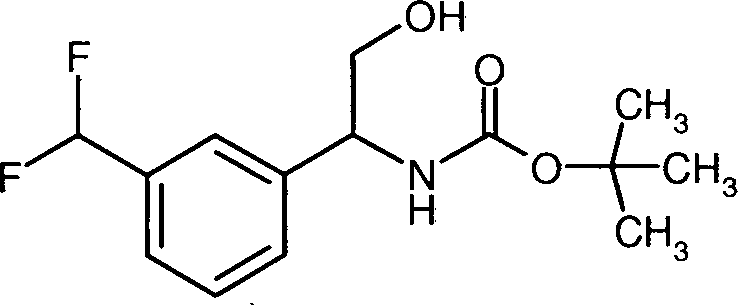
Bei
RT wurden 11.97 mg (0.28 mmol) Lithiumchlorid und 10.68 mg (0.28
mmol) Natriumborhydrid für 15 min in 0.25 ml Ethanol verrührt.
Anschließend wurde die Mischung auf 0°C abgekühlt
und eine Lösung von 62 mg (ca. 0.09 mmol, Reinheit 49%)
der Verbindung aus Beispiel 131A in 0.25 ml Tetrahydrofuran zugetropft. Es
wurde bei RT über Nacht nachgerührt. Zur Aufarbeitung
wurde mit Eiswasser gekühlt und mit 1M Salzsäure auf
pH 2 gestellt. Der Reaktionsinhalt wurde über präparative
HPLC [Methode 20] gereinigt. Die Produktfraktion wurde am Rotationsverdampfer
vom Lösungsmittel befreit und im HV getrocknet. Es wurden
56 mg (ca. 45%ige Reinheit, 93% d. Th.) der Titelverbindung in erhalten.
1H-NMR (400 MHz, DMSO-d6): δ =
1.36 (br.s, 9H), 3.45-3.56 (m, 2H), 4.49-4.64 (m, 1H), 4.82 (t,
1H), 7.01 (t, JH-F = 56 Hz, 1H), 7.18-7.53
(m, 4H).At RT, 11.97 mg (0.28 mmol) of lithium chloride and 10.68 mg (0.28 mmol) of sodium borohydride were stirred for 15 min in 0.25 ml of ethanol. The mixture was then cooled to 0 ° C. and a solution of 62 mg (about 0.09 mmol, purity 49%) of the compound from example 131A in 0.25 ml of tetrahydrofuran was added dropwise. It was stirred at RT overnight. For work-up, the mixture was cooled with ice-water and adjusted to pH 2 with 1M hydrochloric acid. The reaction contents were purified by preparative HPLC [Method 20]. The product fraction was freed from the solvent on a rotary evaporator and dried under HV. 56 mg (about 45% purity, 93% of theory) of the title compound were obtained.
1 H-NMR (400 MHz, DMSO-d 6 ): δ = 1.36 (br.s, 9H), 3.45-3.56 (m, 2H), 4.49-4.64 (m, 1H), 4.82 (t, 1H), 7.01 (t, J HF = 56 Hz, 1H), 7.18-7.53 (m, 4H).
Beispiel
133A tert.-Butyl-({2-[(tert.-butoxycarbonyl)amino]-2-[3-trifluormethyl)phenyl]ethyl}sulfamoyl)carbamat 
Eine
Lösung von 110 mg (1.48 mmol) tert.-Butanol in 2 ml Dichlormethan
wurde auf 0°C gekühlt und mit einer Lösung
von 129 μl (1.48 mmol) Chlorsulfonylisocyanat in 2 ml Dichlormethan
tropfenweise versetzt. Die Mischung wurde 1 h bei RT gerührt.
In einer Spritze wurden 820 μl dieser Lösung genommen
und zu einer vorgelegten Lösung von 90 mg (296 μmol)
der Verbindung aus Beispiel 22A in 2 ml Dichlormethan zugetropft. Anschließend
wurden 103 μl N,N-Diisopropylethylamin hinzugefügt
und die Reaktionsmischung 2 h bei RT weiter gerührt. Die
flüchtigen Bestandteile wurden am Rotationsverdampfer entfernt.
Der Rückstand wurde in wenig Acetonitril gelöst,
mit 1 ml 1M Salzsäure versetzt und die erhaltene Lösung
durch präparative HPLC [Methode 23] gereinigt. Die produkthaltige
Fraktion wurde am Rotationsverdampfer von den Lösungsmitteln
befreit und der Rückstand im HV getrocknet. Man erhielt
111 mg (76% d. Th.) der Titelverbindung.
LC/MS [Methode 5]:
Rt = 1.16 min.; m/z = 484 (M+H)+.
1H-NMR (400 MHz, DMSO-d6): δ =
1.36 (s, 9H), 1.41 (s, 9H), 3.08-3.23 (m, 2H), 4.70-4.82 (m, 1H),
7.50 (br. d, 1H), 7.54-7.72 (m, 5H), 10.91 (br.s, 1H).A solution of 110 mg (1.48 mmol) of tert-butanol in 2 ml of dichloromethane was cooled to 0 ° C and treated dropwise with a solution of 129 .mu.l (1.48 mmol) of chlorosulfonyl isocyanate in 2 ml of dichloromethane. The mixture was stirred for 1 h at RT. In a syringe, 820 μl of this solution were taken and added dropwise to a solution of 90 mg (296 μmol) of the compound from Example 22A in 2 ml of dichloromethane. Subsequently, 103 μl of N, N-diisopropylethylamine were added and the reaction mixture was stirred further at RT for 2 h. The volatiles were removed on a rotary evaporator. The residue was dissolved in a little acetonitrile, treated with 1 ml of 1M hydrochloric acid and the resulting solution was purified by preparative HPLC [Method 23]. The product-containing fraction was freed from the solvents on a rotary evaporator and the residue was dried in a HV. 111 mg (76% of theory) of the title compound were obtained.
LC / MS [Method 5]: R t = 1.16 min .; m / z = 484 (M + H) + .
1 H-NMR (400 MHz, DMSO-d 6 ): δ = 1.36 (s, 9H), 1.41 (s, 9H), 3.08-3.23 (m, 2H), 4.70-4.82 (m, 1H), 7.50 ( br.d, 1H), 7.54-7.72 (m, 5H), 10.91 (br.s, 1H).
Beispiel
134A N-{2-Amino-2-[3-(trifluormethyl)phenyl]ethyl}schwefelsäurediamid 
Eine
Lösung von 100 mg (0.20 mmol) der Verbindung aus. Beispiel
133A in 2 ml Dichlormethan wurde mit 2 ml einer 4M Chlorwasserstoff-Lösung
in Dioxan versetzt und die Mischung 2 h bei RT gerührt.
Sie wurde mit Essigsäureethylester verdünnt und
einer 10%igen wässrigen Natriumhydrogencarbonatlösung
versetzt. Die alkalische wässrige Phase wurde zweimal mit
Essigsäureethylester extrahiert. Die vereinigten organischen Phasen
wurden über Natriumsulfat getrocknet und am Rotationsverdampfer
von den Lösungsmitteln befreit. Der Rückstand
entsprach der Titelverbindung (53 mg, 92% d. Th.).
1H-NMR (400 MHz, DMSO-d6): δ =
ca. 2.66 (br.s, 2H), 2.86-2.99 (m, 1H), 2.99-3.12 (m, 1H), 4.09
(dd, 1H), 6.60 (br.s, 3H), 7.52-7.64 (m, 2H), 7.68 (br. d, 1H),
7.75 (br.s, 1H).A solution of 100 mg (0.20 mmol) of the compound. Example 133A in 2 ml of dichloromethane was added 2 ml of a 4M hydrogen chloride solution in dioxane and the mixture was stirred for 2 h at RT. It was diluted with ethyl acetate and a 10% aqueous sodium bicarbonate solution was added. The alkaline aqueous phase was extracted twice with ethyl acetate. The combined organic phases were dried over sodium sulfate and freed from the solvents on a rotary evaporator. The residue corresponded to the title compound (53 mg, 92% of theory).
1 H-NMR (400 MHz, DMSO-d 6 ): δ = ca. 2.66 (br.s, 2H), 2.86-2.99 (m, 1H), 2.99-3.12 (m, 1H), 4.09 (dd, 1H ), 6.60 (br.s, 3H), 7.52-7.64 (m, 2H), 7.68 (br d, 1H), 7.75 (br.s, 1H).
Beispiel
135A tert.-Butyl-{2-hydroxy-1-[3-(trifluormethyl)phenyl]ethyl}methylcarbamat 
438
ml Boran-Tetrahydrofuran-Komplex (1M Lösung in THF, 438
mmol) wurden unter Eiskühlung vorgelegt. Anschließend
wurden 35 g (110 mmol) N-Boc-2-(3-trifluormethyl-phenyl)-DL-glycin
portionsweise zugegeben. Das Reaktionsgemisch wurde 2 h bei RT verrührt
und dann vorsichtig mit Eisstückchen versetzt. Nach Ende
der Gasentwicklung wurde am Rotationsverdampfer das Lösungsmittel
entfernt. Der wässrige Rückstand wurde mit gesättigter
Natriumhydrogencarbonatlösung versetzt und dreimal mit
Essigsäureethylester extrahiert. Die vereinigten organischen
Phasen wurden über Natriumsulfat getrocknet und am Rotationsverdampfer
vom Lösungsmittel befreit. Der Rückstand wurde
in Acetonitril und 2.5%iger wässriger Natriumhydrogencarbonatlösung
aufgenommen. Dann wurde mit 25.18 ml (109.62 mmol) Di-tert.-butyldicarbonat
versetzt und 3 h bei RT verrührt. Das Acetonitril wurde
am Rotationsverdampfer entfernt. Der Rückstand wurde dreimal
mit Essigsäureethylester extrahiert, über Natriumsulfat
getrocknet, filtriert und am Rotationsverdampfer vom Lösungsmittel
befreit. Der Rückstand wurde erneut mit 438 ml Boran-Tetrahydrofuran-Komplex
(1M Lösung in THF, 438 mmol) versetzt und 3 h bei 70°C
gerührt. Es wurde erneut aufgearbeitet und alles komplett mit
einem Überschuss einer 4N Chlorwasserstofflösung
in Dioxan versetzt und über Nacht gerührt. Danach wurde
das Lösungsmittel am Rotationsverdampfer entfernt. Der
Rückstand wurde am HV getrocknet dann noch einmal mit 400
ml Boran-Tetrahydrofuran-Komplex (1M Lösung in THF, 400
mmol) versetzt und über Nacht verrührt. Dann wurde
aufgearbeitet und erneut wie oben beschrieben mit 25.18 ml (109.62
mmol) Di-tert.-butyldicarbonat umgesetzt. Das nach der Aufarbeitung
erhaltene Rohprodukt wurde durch präparative HPLC gereinigt.
Nach Trocknen am HV wurden 10.2 g (29% d. Th.) der Titelverbindung
erhalten.
LC/MS [Methode 3]: Rt = 1.24
min.; m/z = 220 (M+H-BOC)+.
1H-NMR (400 MHz, DMSO-d6): δ =
7.53-7.68 (m, 4H), 5.20 (br.s , 0.5H (Rotamer)), 5.04 (t, 1H), 5.03
(br.s, 0.5H (Rotamer)), 3.77-3.98 (m, 2H), 2.60-2.83 (br.s, 3H),
1.37 (br.s, 9H).438 ml of borane-tetrahydrofuran complex (1M solution in THF, 438 mmol) were placed under ice-cooling. Subsequently, 35 g (110 mmol) of N-Boc-2- (3-trifluoromethylphenyl) -DL-glycine were added in portions. The reaction mixture was stirred for 2 h at RT and then carefully mixed with ice chips. After the evolution of gas had ceased, the solvent was removed on a rotary evaporator. The aqueous residue was treated with saturated sodium bicarbonate solution and extracted three times with ethyl acetate. The combined organic phases were dried over sodium sulfate and freed from the solvent on a rotary evaporator. The residue was taken up in acetonitrile and 2.5% aqueous sodium bicarbonate solution. Then 25.18 ml (109.62 mmol) of di-tert-butyl dicarbonate were added and the mixture was stirred at RT for 3 h. The acetonitrile was removed on a rotary evaporator. The residue was extracted three times with ethyl acetate, dried over sodium sulfate, filtered and freed from the solvent on a rotary evaporator. The residue was again treated with 438 ml of borane-tetrahydrofuran complex (1M solution in THF, 438 mmol) and stirred at 70 ° C for 3 h. It was worked up again and all completely mixed with an excess of 4N hydrogen chloride solution in dioxane and stirred overnight. Thereafter, the solvent was removed on a rotary evaporator. The residue was dried under HV then added again with 400 ml borane-tetrahydrofuran complex (1M solution in THF, 400 mmol) and stirred overnight. It was then worked up and reacted again as described above with 25.18 ml (109.62 mmol) of di-tert-butyl dicarbonate. The crude product obtained after the work-up was purified by preparative HPLC. After drying under HV, 10.2 g (29% of theory) of the title compound were obtained.
LC / MS [Method 3]: R t = 1.24 min .; m / z = 220 (M + H-BOC) + .
1 H-NMR (400 MHz, DMSO-d 6 ): δ = 7.53-7.68 (m, 4H), 5.20 (br.s, 0.5H (rotamer)), 5.04 (t, 1H), 5.03 (br.s , 0.5H (rotamer)), 3.77-3.98 (m, 2H), 2.60-2.83 (br.s, 3H), 1.37 (br.s, 9H).
Beispiel
136A tert.-Butyl-{2-(sulfamoyloxy)-1-[3-(trifluormethyl)phenyl]ethyl}carbamat 
171 μl
(1.97 mmol) Chlorsulfonylisocyanat wurden unter Argon bei 0°C
unter starkem Rühren mit 74 μl (1.97 mmol) wasserfreier
Ameisensäure versetzt. Nach der Zugabe verfestigte sich
die Reaktionsmischung innerhalb von Sekunden. Es wurden 2 ml Dichlormethan
hinzugefügt. Dann wurde die Reaktionsmischung 1 h bei 0°C
dann 8 h bei RT weitergerührt. Anschließend wurde
sie wieder auf 0°C gekühlt und mit einer Lösung von
400 mg (1.31 mmol) der Verbindung aus Beispiel 59A und 159 μl
(1.97 mmol) Pyridin in 2 ml Dichlormethan versetzt. Das Kühlbad
wurde entfernt und das Reaktionsgemisch bei RT über Nacht
nachgerührt. Zur Aufarbeitung wurden 5 ml Wasser und 5
ml Essigsäureethylester zugegeben. Nach 10 min wurde die
Mischung mit 100 ml Essigsäureethylester verdünnt,
zweimal mit Wasser und einmal mit gesättigter wässriger
Natriumchloridlösung gewaschen. Die organische Phase wurde über
Natriumsulfat getrocknet und am Rotationsverdampfer vom Lösungsmittel
befreit. Der Rückstand wurde über präparative
HPLC [Methode 10] gereinigt. Die Produktfraktion wurde am Rotationsverdampfer
vom Lösungsmittel befreit. Nach Trocknen am HV erhielt
man 260 mg (52% d. Th.) der Titelverbindung.
LC/MS [Methode
3]: Rt = 1.21 min; ESIneg.: m/z = 383 (M-H)-.
H-NMR (400 MHz, DMSO-d6): δ =
7.67 (s, 5H), 7.55 (s, 2H), 4.96 (d, 1H), 4.08-4.18 (m, 2H), 1.21-1.44
(m, 9H).171 μl (1.97 mmol) of chlorosulfonyl isocyanate were added under argon at 0 ° C. with vigorous stirring to 74 μl (1.97 mmol) of anhydrous formic acid. After the addition, the reaction mixture solidified within seconds. 2 ml of dichloromethane were added. The reaction mixture was then further stirred at 0 ° C. for 1 h then at RT for 8 h. It was then cooled again to 0 ° C., and a solution of 400 mg (1.31 mmol) of the compound from Example 59A and 159 μl (1.97 mmol) of pyridine in 2 ml of dichloromethane were added. The cooling bath was removed and the reaction mixture was stirred at RT overnight. For workup, 5 ml of water and 5 ml of ethyl acetate were added. After 10 minutes, the mixture was diluted with 100 ml of ethyl acetate, washed twice with water and once with saturated aqueous sodium chloride solution. The organic phase was dried over sodium sulfate and freed from the solvent on a rotary evaporator. The residue was purified by preparative HPLC [Method 10]. The product fraction was freed from the solvent on a rotary evaporator. Drying under HV gave 260 mg (52% of theory) of the title compound.
LC / MS [Method 3]: R t = 1.21 min; ESIneg .: m / z = 383 (MH) - .
H-NMR (400 MHz, DMSO-d 6 ): δ = 7.67 (s, 5H), 7.55 (s, 2H), 4.96 (d, 1H), 4.08-4.18 (m, 2H), 1.21-1.44 (m , 9H).
Beispiel
137A Ethyl-{2-amino-2-[3-(trifluormethyl)phenyl]ethyl}carbamat-Hydrochlorid
(nicht
racemisches Enantiomerengemisch) 
Eine
Lösung von 527 mg (1.40 mmol) der Verbindung aus Beispiel
103A in 9.6 ml Dichlormethan wurde bei RT mit 9.4 ml (37 mmol) 4M
Chlorwasserstoff in Dioxan versetzt und 1 h gerührt. Anschließend
wurden alle flüchtigen Bestandteile am Rotationsverdampfer
entfernt. Nach Trocknen des Rückstands am HV erhielt man
437 mg (94% d. Th.) der Titelverbindung.
LC/MS [Methode 2]:
Rt = 1.31 min; m/z = 277 (M+H)+.
1H-NMR (400 MHz, DMSO-d6): δ =
1.09 (t, 3H), 3.38-3.59 (m, 2H), 3.95 (q, 2H), 4.41-4.51 (m, 1H),
7.31 (br.t, 1H), 7.64-7.72 (m, 1H), 7.73-7.81 (m, 2H), 7.87 (br.s,
1H), 8.56 (br.s, 3H).A solution of 527 mg (1.40 mmol) of the compound from Example 103A in 9.6 ml of dichloromethane was admixed at RT with 9.4 ml (37 mmol) of 4M hydrogen chloride in dioxane and stirred for 1 h. Subsequently, all volatiles were removed on a rotary evaporator. Drying of the residue on HV gave 437 mg (94% of theory) of the title compound.
LC / MS [Method 2]: R t = 1.31 min; m / z = 277 (M + H) + .
1 H-NMR (400 MHz, DMSO-d 6 ): δ = 1.09 (t, 3H), 3.38-3.59 (m, 2H), 3.95 (q, 2H), 4.41-4.51 (m, 1H), 7.31 ( br.t, 1H), 7.64-7.72 (m, 1H), 7.73-7.81 (m, 2H), 7.87 (br.s, 1H), 8.56 (br.s, 3H).
In
Analogie zu Beispiel 137A wurden folgende Beispiele hergestellt.
Die Ausbeuten liegen jeweils über 94% d. Th.: 


1.08 g (3.3 mmol) der Verbindung aus Beispiel 3A wurden in 11 ml N,N-Dimethylacetamid gelöst. Die Lösung wurde mittels Vakuum von Luftsauerstoff befreit und mit Argon gesättigt. In diese Lösung gab man unter Argon 21 mg (0.033 mmol) des Rutheniumkomplexes RuCl(p-cymene)[(S,S)-Ts-DPEN)](CAS-Nr. 192139-90-5). Anschließend versetzte man mit einem Gemisch aus 0.63 ml (16.6 mmol) Ameisensäure und 0.27 ml (1.91 mmol) Triethylamin und rührte unter Luftausschluß 48 h bei RT. Zur Aufarbeitung gab man das Gemisch in 10 ml 0.1N Salzsäure und extrahierte zweimal mit je 20 ml Essigsäureethylester. Die vereinigten organischen Phasen wurden mit gesättigter wässriger Natriumhydrogencarbonatlösung gewaschen, über Natriumsulfat getrocknet, filtriert und im Vakuum eingeengt. Das Rohprodukt wurde durch Chromatographie an Kieselgel (Elutionsmittel: 1. Cyclohexan/Essigsäureethylester 3:1, 2. Cyclohexan/Essigsäureethylester 1:1) gereinigt. Es wurden 830 mg (81% d. Th.) der Zielverbindung erhalten.1:08 g (3.3 mmol) of the compound from Example 3A were dissolved in 11 ml of N, N-dimethylacetamide solved. The solution was made by vacuum of atmospheric oxygen freed and saturated with argon. In this solution Under argon, 21 mg (0.033 mmol) of the ruthenium complex RuCl (p-cymene) [(S, S) -Ts-DPEN)] (CAS No. 192139-90-5) were added. Subsequently, it was mixed with a mixture of 0.63 ml (16.6 mmol) formic acid and 0.27 ml (1.91 mmol) triethylamine and stirred under exclusion of air for 48 h at RT. to Work-up was added to the mixture in 10 ml of 0.1N hydrochloric acid and extracted twice with 20 ml each of ethyl acetate. The combined organic phases became with saturated washed aqueous sodium bicarbonate solution, over Dried sodium sulfate, filtered and concentrated in vacuo. The Crude product was purified by chromatography on silica gel (eluant: 1. cyclohexane / ethyl acetate 3: 1, 2. cyclohexane / ethyl acetate 1: 1). There were 830 mg (81% of theory) of the target compound receive.
Der
Enantiomerenüberschuß wurde chromatographisch
nach Methode 27c zu 96% ee bestimmt.
(S)-Enantiomer: Rt = 5.73 min
(R)-Enantiomer: Rt = 6.82 min Beispiel
159A [(tert.-Butoxycarbonyl)amino](3-chlor-2-fluorphenyl)essigsäure 
(S) -enantiomer: R t = 5.73 min
(R) -enantiomer: R t = 6.82 min. Example 159A [(tert-butoxycarbonyl) amino] (3-chloro-2-fluorophenyl) acetic acid
5 g (24.56 mmol) 3-Chlor-2-fluor-DL-phenylglycin wurden in Dioxan und 147 ml 5%iger wässriger Natriumhydrogencarbonatlösung suspendiert. Dann wurden 5.36 g (24.56 mmol) Di-tert.-butyldicarbonat zugegeben. Es wurde über Nacht bei RT gerührt. Die weiße Suspension wurde mit Essigsäureethylester versetzt, verrührt und der Niederschlag abgesaugt. Die Mutterlauge wurde extrahiert. Die wässrige Phase wurde noch einmal mit Essigsäureethylester extrahiert. Die vereinigten organischen Phasen wurden über Natriumsulfat getrocknet, filtriert und einrotiert. Nach Trocknung am HV wurden 0.59 g (7.7% d. Th.) der Titelverbindung erhalten.5 g (24.56 mmol) of 3-chloro-2-fluoro-DL-phenylglycine were dissolved in dioxane and 147 ml of 5% aqueous sodium bicarbonate solution suspended. Then, 5.36 g (24.56 mmol) of di-tert-butyl dicarbonate added. It was stirred overnight at RT. The white suspension was treated with ethyl acetate added, stirred and the precipitate sucked off. The Mother liquor was extracted. The aqueous phase became extracted once more with ethyl acetate. The United organic phases were dried over sodium sulfate, filtered and evaporated. After drying at HV, 0.59 g (7.7%) d. Th.) Of the title compound.
Die
wässrige Phase wurde mit 1M Salzsäure sauer gestellt
und zweimal mit Essigsäureethylester extrahiert. Es wurde über
Natriumsulfat getrocknet, filtriert und am Rotationsverdampfer einrotiert.
Nach Trocknung am HV wurden 5.05 g (65.4% d. Th.) der Titelverbindung
erhalten.
LC/MS [Methode 2]: Rt = 2.08
min; m/z = 204 (M+H)+.The aqueous phase was acidified with 1M hydrochloric acid and extracted twice with ethyl acetate. It was dried over sodium sulfate, filtered and concentrated on a rotary evaporator. After drying on HV, 5.05 g (65.4% of theory) of the title compound were obtained.
LC / MS [Method 2]: R t = 2.08 min; m / z = 204 (M + H) + .
Beispiel
160A tert.-Butyl-[1-(3-chlor-2-fluorphenyl)-2-hydroxyethyl]carbamat 
2
g (6.59 mmol) der Verbindung aus Beispiel 159A wurden unter Argon
in 20 ml THF gelöst. Dann wurde auf 0°C gekühlt
und 0.918 ml (6.59 mmol) Triethylamin und 0.94 ml (7.24 mmol) Chlorameisensäureisobutylester
zugetropft. Das Reaktionsgemisch wurde 1H bei 0°C nachgerührt.
Anschließend wurde die Suspension über eine Seitz-Fritte
in einen gekühlten Kolben filtriert und mit wenig THF nachgewaschen.
In einen zweiten Kolben wurden 747 mg (19.76 mmol) Natriumborhydrid
in 3 ml Wasser unter Eiskühlung vorgelegt. Unter kräftigem
Rühren wurde das Filtrat langsam zugetropft. Nach 1 h wurde
der Ansatz vorsichtig mit gesättigter wässriger
Natriumhydrogencarbonatlösung versetzt. Dann wurde mit
30 ml Essigsäureethylester extrahiert. Die organische Phase
wurde noch einmal mit gesättigter wässriger Natriumhydrogencarbonatlösung
und einmal mit gesättigter wässriger Natriumchloridlösung
gewaschen. Anschließend wurde über Natriumsulfat
getrocknet, filtriert und am Rotationsverdampfer vom Lösungsmittel
befreit. Nach Trocknen am HV wurden 1.74 g (75% d. Th.) der Titelverbindung
in ca. 83%iger Reinheit erhalten.
LC/MS [Methode 5]: Rt = 0.99 min.; m/z = 290 (M+H)+.
1H-NMR (400 MHz, CDCl3): δ =
1.43 (s, 9H), 1.90-1.98 (m, 1H), 3.78-3.93 (m, 2H), 5.01-5.12 (m,
1H), 5.32-5.42 (m, 1H), 7.08 (t, 1H), 7.23 (t, 1H), 7.30-7.37 (m,
1H).2 g (6.59 mmol) of the compound from Example 159A were dissolved in 20 ml of THF under argon. It was then cooled to 0 ° C. and 0.918 ml (6.59 mmol) of triethylamine and 0.94 ml (7.24 mmol) of isobutyl chloroformate were added dropwise. The reaction mixture was stirred for 1 h at 0 ° C. Subsequently, the suspension was filtered through a Seitz frit into a cooled flask and washed with a little THF. In a second flask, 747 mg (19.76 mmol) of sodium borohydride in 3 ml of water were placed under ice cooling. With vigorous stirring, the filtrate was slowly added dropwise. After 1 h, the mixture was carefully mixed with saturated aqueous sodium bicarbonate solution. Then it was extracted with 30 ml of ethyl acetate. The organic phase was washed once more with saturated aqueous sodium bicarbonate solution and once with saturated aqueous sodium chloride solution. It was then dried over sodium sulfate, filtered and freed from the solvent on a rotary evaporator. Drying under HV gave 1.74 g (75% of theory) of the title compound in about 83% purity.
LC / MS [Method 5]: R t = 0.99 min .; m / z = 290 (M + H) + .
1 H-NMR (400 MHz, CDCl 3 ): δ = 1.43 (s, 9H), 1.90-1.98 (m, 1H), 3.78-3.93 (m, 2H), 5.01-5.12 (m, 1H), 5.32- 5.42 (m, 1H), 7.08 (t, 1H), 7.23 (t, 1H), 7.30-7.37 (m, 1H).
Beispiel
161A 2-Amino-2-(3-chlor-2-fluorphenyl)ethanol-Hydrochlorid 
1.74
g (6.01 mmol) der Verbindung aus Beispiel 160A wurden in 20 ml Dichlormethan
vorgelegt. Es wurden 22 ml (88.00 mmol) 4M Chlorwasserstoff in Dioxan
zugegeben. Nach 1 h Rühren bei RT wurde das Reaktionsgemisch
am Rotationsverdampfer bis zur Trockene eingedampft und im HV getrocknet.
Es wurden 1.38 g (88% d. Th.) der Titelverbindung in ca. 87%iger
Reinheit erhalten.
LC/MS [Methode 5]: Rt =
0.27 min.; m/z = 190 (M+H)+. Beispiel
162A 2-Amino-2-(3-chlor-2-fluorphenyl)ethylcarbamat-Hydrochlorid 
LC / MS [Method 5]: R t = 0.27 min .; m / z = 190 (M + H) + . Example 162A 2-Amino-2- (3-chloro-2-fluorophenyl) ethylcarbamate hydrochloride
243
mg (0.84 mmol) der Verbindung aus Beispiel 160A wurden in 10 ml
Acetonitril unter Argon vorgelegt. Dann wurden bei –15°C
102 μl (1.17 mmol) Chlorsulfonylisocyanat zugetropft. Nach
30 min wurde die Reaktionslösung mit 20 ml Wasser versetzt
und über Nacht bei 60°C erhitzt. Das Reaktionsgemisch
wurde abgekühlt und auf gesättigte wässrige
Natriumhydrogencarbonatlösung gegeben. Nun wurde mit Essigsäureethylester
extrahiert. Die organische Phase wurde über Natriumsulfat
getrocknet, filtriert und am Rotationsverdampfer vom Lösungsmittel
befreit. Der Rückstand wurde in 4 ml Dichlormethan aufgenommen
und mit 4 ml einer 4M Lösung von Chlorwasserstoff in Dioxan
versetzt. Es bildete sich sofort ein Niederschlag. Nach 10 min Nachrührzeit
wurde der Ansatz am Rotationsverdampfer vom Lösungsmittel
befreit. Nach Trocknen am HV erhielt man 219 mg (77% d. Th.) der
Titelverbindung in 79%iger Reinheit.
LC/MS [Methode 5]: Rt = 0.27 min; m/z = 233 (M+H)+. Beispiel
163A N-Allyl-2-(2-brom-4-chlorbenzoyl)hydrazincarboxamid 
LC / MS [Method 5]: R t = 0.27 min; m / z = 233 (M + H) + . Example 163A N-Allyl-2- (2-bromo-4-chlorobenzoyl) hydrazinecarboxamide
10.0
g (40.1 mmol) 2-Brom-4-chlorbenzhydrazid wurden in 100 ml THF bei
50°C suspendiert und mit 3.59 ml (40.9 mmol) Allylisocyanat
gelöst in 50 ml THF versetzt. Man rührte weitere
16 h bei 50°C. Anschließend ließ man
auf RT abkühlen und verdünnte mit 50 ml Diethylether.
Der ausgefallene Feststoff wurde abgesaugt, mit wenig Diethylether
nachgewaschen und im HV getrocknet. Erhalten wurden 11.30 g (85%
d. Th.) der Titelverbindung.
LC/MS [Methode 6]: Rt =
1.81 min; m/z = 332 (M+H)+.
1H-NMR (400 MHz, DMSO-d6): δ =
3.69 (t, 2H), 5.04 (d, 1H), 5.16 (d, 1H), 5.76-5.88 (m, 1H), 6.45
(t, 1H), 7.58 (s, 2H), 7.84 (s, 1H), 8.10 (s, 1H), 10.07 (s, 1H).10.0 g (40.1 mmol) of 2-bromo-4-chlorobenzhydrazide were suspended in 100 ml of THF at 50 ° C. and admixed with 3.59 ml (40.9 mmol) of allyl isocyanate dissolved in 50 ml of THF. The mixture was stirred for a further 16 h at 50.degree. It was then allowed to cool to RT and diluted with 50 ml of diethyl ether. The precipitated solid was filtered off with suction, washed with a little diethyl ether and dried in a HV. 11.30 g (85% of theory) of the title compound were obtained.
LC / MS [Method 6]: R t = 1.81 min; m / z = 332 (M + H) + .
1 H-NMR (400 MHz, DMSO-d 6 ): δ = 3.69 (t, 2H), 5.04 (d, 1H), 5.16 (d, 1H), 5.76-5.88 (m, 1H), 6.45 (t, 1H), 7.58 (s, 2H), 7.84 (s, 1H), 8.10 (s, 1H), 10.07 (s, 1H).
Beispiel
164A 4-Allyl-5-(2-brom-4-chlorphenyl)-2,4-dihydro-3H-1,2,4-triazol-3-on 
11.3
g (33.98 mmol) der Verbindung aus Beispiel 163A wurden in 61 ml
(183.47 mmol) 3 M Natronlauge aufgenommen und 36 h unter Rückfluss
erhitzt. Anschließend kühlte man ab, filtrierte von
dem feinen Niederschlag und versetzte das Filtrat unter Eiskühlung
mit 28 ml (169.88 mmol) halbkonzentrierter Salzsäure bis auf
pH 10. Man saugte ab und löste aus dem Niederschlag das
Produkt mit Methanol. Das Methanol wurde am Rotationsverdampfer
entfernt. Der Rückstand wurde am HV getrocknet. Erhalten
wurden 9.78 g (69% d. Th.) der Titelverbindung in 75%iger Reinheit.
LC/MS
[Methode 2]: Rt = 1.88 min; m/z = 314 und
316 (M+H)+.
1H-NMR
(400 MHz, CDCl3): δ = 4.19 (d,
2H), 4.93 (d, 1H), 5.09 (d, 1H), 5.64-5.74 (m, 1H), 7.32 (d, 1H), 7.39-7.44
(m, 1H), 7.72 (s, 1H), 9.45 (br.s., 1H).11.3 g (33.98 mmol) of the compound from Example 163A were taken up in 61 ml (183.47 mmol) of 3 M sodium hydroxide solution and heated under reflux for 36 h. It was then cooled, filtered from the fine precipitate and the filtrate under ice cooling with 28 ml (169.88 mmol) of half-concentrated hydrochloric acid to pH 10. It was sucked off and the product was dissolved with methanol from the precipitate. The methanol was removed on a rotary evaporator. The residue was dried under HV. 9.78 g (69% of theory) of the title compound were obtained in 75% purity.
LC / MS [Method 2]: R t = 1.88 min; m / z = 314 and 316 (M + H) + .
1 H-NMR (400 MHz, CDCl 3): δ = 4.19 (d, 2H), 4.93 (d, 1H), 5:09 (d, 1H), 5.64-5.74 (m, 1H), 7:32 (d, 1H) , 7.39-7.44 (m, 1H), 7.72 (s, 1H), 9.45 (br.s., 1H).
Beispiel
165A Methyl-[4-allyl-3-(2-brom-4-chlorphenyl)-5-oxo-4,5-dihydro-1H-1,2,4-triazol-1-yl]acetat 
9.78
g (ca. 23.32 mmol, Reinheit 75%) der Verbindung aus Beispiel 164A
wurden in 75 ml Acetonitril gelöst. Dann wurden 3.55 g
(25.65 mmol) Kaliumcarbonat und 2.46 ml (27.98 mmol) Chloressigsäuremethylester
hinzugefügt. Es wurde 5 Stunden unter Rückfluss
gerührt. Nach dem Abkühlen wurde abgesaugt. Das Filtrat
wurde am Rotationsverdampfer etwas aufkonzentriert und anschließend
mit 30 ml Essigsäureethylester verdünnt und mit
je 30 ml 1M Salzsäure sowie gesättigter wässriger
Natriumchloridlösung gewaschen. Die organische Phase wurde über
Natriumsulfat getrocknet, filtriert und am Rotationsverdampfer vom
Lösungsmittel befreit. Der Rückstand wurde durch
Chromatographie an Kieselgel gereinigt (Flution: Cyclohexan/Essigsäureethylester
2:1). Es wurden 7.1 g (79% d. Th.) der Titelverbindung erhalten.
LC/MS
[Methode 6]: Rt = 2.37 min; m/z = 386 (M+H)+. Beispiel
166A [4-Allyl-3-(2-brom-4-chlorphenyl)-5-oxo-4,5-dihydro-1H-1,2,4-triazol-1-yl]essigsäure 
LC / MS [Method 6]: R t = 2.37 min; m / z = 386 (M + H) + . Example 166A [4-Allyl-3- (2-bromo-4-chlorophenyl) -5-oxo-4,5-dihydro-1H-1,2,4-triazol-1-yl] acetic acid
4
g (10.35 mmol) der Verbindung aus Beispiel 156A wurden in 30 ml
Methanol aufgenommen und mit 15.5 ml (15.52 mmol) 1M Lithiumhydroxidlösung
versetzt. Es wurde 2 h bei RT gerührt. Anschließend
wurde das Lösungsmittel am Rotationsverdampfer entfernt.
Der Rückstand wurde mit 100 ml Wasser verdünnt,
mit 20 ml Essigsäureethylester gewaschen und anschließend
mit 1M Salzsäure sauer gestellt. Nun wurde erneut mit 50
ml Essigsäureethylester extrahiert. Die organische Phase
wurde über Natriumsulfat getrocknet, filtriert, am Rotationsverdampfer
eingeengt und am HV getrocknet. Man erhielt 3.61 g (94% d. Th.)
der Titelverbindung.
LC/MS [Methode 3]: Rt =
0.99 min; m/z = 372 und 374 (M+H)+.
1H-NMR (400 MHz, CDCl3): δ =
4.21 (d, 2H), 4.72 (s, 2H), 4.94 (d, 1H), 5.09 (d, 1H), 5.63-5.76
(m, 1H), 7.31-7.43 (m, 2H), 7.71 (s, 1H).4 g (10.35 mmol) of the compound from Example 156A were taken up in 30 ml of methanol and admixed with 15.5 ml (15.52 mmol) of 1M lithium hydroxide solution. It was stirred for 2 h at RT. Subsequently, the solvent was removed on a rotary evaporator. The residue was diluted with 100 ml of water, washed with 20 ml of ethyl acetate and then acidified with 1M hydrochloric acid. Now it was extracted again with 50 ml of ethyl acetate. The organic phase was dried over sodium sulfate, filtered, concentrated on a rotary evaporator and dried under HV. 3.61 g (94% of theory) of the title compound were obtained.
LC / MS [Method 3]: R t = 0.99 min; m / z = 372 and 374 (M + H) + .
1 H-NMR (400 MHz, CDCl 3): δ = 4.21 (d, 2H), 4.72 (s, 2H), 4.94 (d, 1H), 5:09 (d, 1H), 5.63-5.76 (m, 1H) , 7.31-7.43 (m, 2H), 7.71 (s, 1H).
Beispiel
167A 2-[(5-Chlor-2-thienyl)carbonyl]-N-(2-methoxyethyl)hydrazincarboxamid 
3.1
g (17.55 mmol) 5-Chlorthiophen-2-carbohydrazid wurden in 30 ml trockenem
THF bei 50°C weitgehend fein suspendiert. Anschließend
wurden 1.81 g (17.90 mmol) 1-Isocyanato-2-methoxyethan in 30 ml THF
gelöst zugetropft. Es wurde 2.5 h bei 50°C gerührt.
Nach dem Abkühlen auf RT wurde das Lösungsmittel am
Rotationsverdampfer entfernt und der Rückstand mit Diethylether
versetzt. Die Kristalle wurden abgesaugt, mit Diethylether nachgewaschen
und im HV getrocknet. Es wurden 4.87 g (100% d. Th.) der Titelverbindung erhalten.
1H-NMR (400 MHz, DMSO-d6): δ =
3.14-3.21 (m, 2H), 3.28-3.36 (m, 5H), 6.52 (br.s., 1H), 7.22 (d,
1H), 7.70 (d, 1H), 7.97 (s, 1H), 10.24 (s, 1H).3.1 g (17.55 mmol) of 5-chlorothiophene-2-carbohydrazide were largely finely suspended in 30 ml of dry THF at 50 ° C. Subsequently, 1.81 g (17.90 mmol) of 1-isocyanato-2-methoxyethane dissolved in 30 ml of THF were added dropwise. It was stirred for 2.5 h at 50 ° C. After cooling to RT, the solvent was removed on a rotary evaporator and the residue was treated with diethyl ether. The crystals were filtered off with suction, washed with diethyl ether and dried in a HV. There were obtained 4.87 g (100% of theory) of the title compound.
1 H-NMR (400 MHz, DMSO-d 6 ): δ = 3.14-3.21 (m, 2H), 3.28-3.36 (m, 5H), 6.52 (br.s., 1H), 7.22 (d, 1H) , 7.70 (d, 1H), 7.97 (s, 1H), 10.24 (s, 1H).
Beispiel
168A 5-(5-Chlor-2-thienyl)-4-(2-methoxyethyl)-2,4-dihydro-3H-1,2,4-triazol-3-on 
4.85
g (17.46) mmol der Verbindung aus Beispiel 167A wurden in 17 ml
(52.39 mmol) 3M Natronlauge gelöst und 168 h unter Rückfluss
erhitzt. Dabei wurden nach 16, 40, 64 und 88 h je 1.05 g (26.19
mmol, insgesamt 104.76 mmol) festes Natriumhydroxid zugegeben. Der
Ansatz wurde mit 1M Salzsäure auf pH 10 gestellt, und das
Gemisch zweimal mit je 30 ml Essigsäureethylester extrahiert.
Die vereinigten organischen Phasen wurden über Natriumsulfat
getrocknet, filtriert und am Rotationsverdampfer vom Lösungsmittel
befreit und im HV getrocknet. Es wurden 2.44 g (54% d. Th.) der
Titelverbindung erhalten.
1H-NMR (400
MHz, DMSO-d6): δ = 3.20 (s, 3H),
3.53 (t, 2H), 3.92 (t, 2H), 7.24 (d, 1H), 7.51 (d, 1H), 12.04 (s, 1H).4.85 g (17.46) mmol of the compound from Example 167A were dissolved in 17 ml (52.39 mmol) of 3M sodium hydroxide solution and heated under reflux for 168 h. In each case 1.05 g (26.19 mmol, a total of 104.76 mmol) of solid sodium hydroxide were added after 16, 40, 64 and 88 hours. The batch was adjusted to pH 10 with 1M hydrochloric acid, and the mixture was extracted twice with 30 ml of ethyl acetate each time. The combined organic phases were dried over sodium sulfate, filtered and freed from the solvent on a rotary evaporator and dried under HV. 2.44 g (54% of theory) of the title compound were obtained.
1 H-NMR (400 MHz, DMSO-d 6 ): δ = 3.20 (s, 3H), 3.53 (t, 2H), 3.92 (t, 2H), 7.24 (d, 1H), 7.51 (d, 1H) , 12.04 (s, 1H).
Beispiel
169A Ethyl-[3-(5-chlor-2-thienyl)-4-(2-methoxyethyl)-5-oxo-4,5-dihydro-1H-1,2,4-triazol-1-yl]acetat 
2.4
g (9.24 mmol) der Verbindung aus Beispiel 168A wurden mit 2.55 g
(18.48 mmol) Kaliumcarbonat in 48 ml Acetonitril suspendiert. Anschließend
wurde mit 1.08 ml (10.17 mmol) Chloressigsäureethylester
versetzt und 4.5 h bei 80°C unter Rückfluss erhitzt.
Es wurden nochmals 113 mg (0.92 mmol) Chloressigsäureethylester
zugegeben und 2 h bei 80°C gerührt. Die Suspension
wurde über eine Schicht Kieselgel filtriert, mit Essigsäureethylester
nachgewaschen, am Rotationsverdampfer eingedampft und am HV getrocknet.
Erhalten wurden 3.24 g (100% d. Th.) der Titelverbindung.
LC/MS
[Methode 6]: Rt = 2.42 min; m/z = 346 (M+H)+.
1H-NMR (400
MHz, DMSO-d6): δ = 1.21 (t, 3H),
3.30 (s, 3H), 3.55 (t, 2H), 3.99 (t, 2H), 4.15 (q, 2H), 4.65 (s, 2H),
7.27 (d, 1H), 7.58 (d, 1H).2.4 g (9.24 mmol) of the compound from Example 168A were suspended with 2.55 g (18.48 mmol) of potassium carbonate in 48 ml of acetonitrile. Subsequently, 1.08 ml (10.17 mmol) of ethyl chloroacetate were added and the mixture was refluxed at 80 ° C. for 4.5 h. Another 113 mg (0.92 mmol) of ethyl chloroacetate were added and the mixture was stirred at 80 ° C. for 2 h. The suspension was filtered through a layer of silica gel, washed with ethyl acetate, evaporated on a rotary evaporator and dried under HV. Obtained were 3.24 g (100% of theory) of the title compound.
LC / MS [Method 6]: R t = 2.42 min; m / z = 346 (M + H) + .
1 H-NMR (400 MHz, DMSO-d 6 ): δ = 1.21 (t, 3H), 3.30 (s, 3H), 3.55 (t, 2H), 3.99 (t, 2H), 4.15 (q, 2H) , 4.65 (s, 2H), 7.27 (d, 1H), 7.58 (d, 1H).
Beispiel
170A [3-(5-Chlor-2-thienyl)-4-(2-methoxyethyl)-5-oxo-4,5-dihydro-1H-1,2,4-triazol-1-yl]essigsäure 
3.2
g (9.25 mmol) der Verbindung aus Beispiel 169A wurden in 28 ml Methanol
gelöst. Anschließend wurden 2.82 ml 20%ige wässrige
Kaliumhydroxidlösung zugegeben. Es wurde 2 h bei RT gerührt.
Der Methanolanteil wurde am Rotationsverdampfer auf die Hälfte
reduziert. Anschließend wurde mit Wasser verdünnt und
einmal mit 15 ml Essigsäureethylester extrahiert. Die wässrige
Phase wurde mit 920 μl konzentrierter Salzsäure
angesäuert und zweimal mit je 15 ml Essigsäureethylester
extrahiert. Die vereinigten organischen Phasen wurden über
Natriumsulfat getrocknet, filtriert und am Rotationsverdampfer vom
Lösungsmittel befreit. Nach Trocknen am HV erhielt man
2.34 g (80% d. Th.) der Titelverbindung.
LC/MS [Methode 6]:
Rt 2.05 min; m/z = 318 (M+H)+.
1H-NMR (400 MHz, DMSO-d6): δ =
3.20 (s, 3H), 3.55 (t, 2H), 3.99 (t, 2H), 4.53 (s, 2H), 7.27 (d,
1H), 7.58 (d, 1H), 13.14 (br.s., 1H).3.2 g (9.25 mmol) of the compound from Example 169A were dissolved in 28 ml of methanol. Subsequently, 2.82 ml of 20% aqueous potassium hydroxide solution was added. It was stirred for 2 h at RT. The proportion of methanol was reduced by half on a rotary evaporator. It was then diluted with water and extracted once with 15 ml of ethyl acetate. The aqueous phase was acidified with 920 μl of concentrated hydrochloric acid and extracted twice with 15 ml of ethyl acetate each time. The combined organic phases were dried over sodium sulfate, filtered and freed from the solvent on a rotary evaporator. Drying under HV gave 2.34 g (80% of theory) of the title compound.
LC / MS [Method 6]: R t 2.05 min; m / z = 318 (M + H) + .
1 H-NMR (400 MHz, DMSO-d 6 ): δ = 3.20 (s, 3H), 3.55 (t, 2H), 3.99 (t, 2H), 4.53 (s, 2H), 7.27 (d, 1H) , 7.58 (d, 1H), 13.14 (br.s., 1H).
Beispiel
171A Methyl-3-[(tert.-butoxycarbonyl)amino]-3-(2-methoxyphenyl)propanoat 
1.0
g (4.10 mmol) Methyl-3-amino-3-(2-methoxyphenyl)propanoat wurden
in 25 ml Dioxan und 27.5 ml 5%iger wässriger Natriumhydrogencarbonatlösung
suspendiert. Anschließend wurden 0.89 g (4.10 mmol) Di-tert.-butyldicarbonat
zugegeben. Es wurde über Nacht bei RT gerührt.
Die weiße Suspension wurde mit 50 ml Wasser versetzt und
dreimal mit je 25 ml Essigsäureethylester extrahiert. Die
vereinigten organischen Phasen wurden über Magnesiumsulfat
getrocknet, filtriert und am Rotationsverdampfer vom Lösungsmittel
befreit. Erhalten wurden 1.34 g (100% d. Th.) der Titelverbindung
erhalten.
LC/MS [Methode 4]: Rt = 1.06
min.; m/z = 310 (M+H)+. Beispiel
172A tert.-Butyl-[3-hydroxy-1-(2-methoxyphenyl)propyl]carbamat 
LC / MS [Method 4]: R t = 1.06 min .; m / z = 310 (M + H) + . Example 172A tert -Butyl [3-hydroxy-1- (2-methoxyphenyl) propyl] carbamate
1.34
g (4.33 mmol) der Verbindung aus Beispiel 171A wurden in 10 ml Dimethoxyethan
gelöst und mit 246 mg (6.50 mmol) Natriumborhydrid sowie
37 mg (0.87 mmol) Lithiumchlorid versetzt. Es wurde 16 h auf 85°C
erhitzt. Zur Aufarbeitung wurde auf RT gekühlt und vorsichtig
mit 10 ml gesättigter wässriger Natrium-Kaliumtartratlösung
versetzt. Es wurde dreimal mit je 20 ml Essigsäureethylester
extrahiert. Die vereinigten organischen Phasen wurden über
Magnesiumsulfat getrocknet, filtriert und am Rotationsverdampfer
vom Lösungsmittel befreit. Das Rohprodukt wurde chromatographisch
an Kieselgel gereinigt (Elution: Cyclohexan/Essigsäureethylester
9:1, 7:3). Es wurden 348 mg (29% d. Th.) der Titelverbindung erhalten.
LC/MS
[Methode 2]: Rt = 1.90 min.; m/z = 282 (M+H)+. Beispiel
173A 3-Amino-3-(2-methoxyphenyl)propan-1-ol-Hydrochlorid 
LC / MS [Method 2]: R t = 1.90 min .; m / z = 282 (M + H) + . Example 173A 3-Amino-3- (2-methoxyphenyl) propan-1-ol hydrochloride
100
mg (0.36 mmol) der Verbindung aus Beispiel 172A wurden in 2 ml Dichlormethan
gelöst und 1.63 ml (6.52 mmol) einer 4M Lösung
von Chlorwasserstoff in Dioxan zugegeben. Die gelbe Lösung
wurde bei RT 1 h nachgerührt. Das Reaktionsgemisch wurde
am Rotationsverdampfer bis zur Trockenen eingedampft und im HV getrocknet.
Erhalten wurden 88 mg (100% d. Th.) der Titelverbindung.
1H-NMR (400 MHz, DMSO-d6): δ =
1.90-2.11 (m, 2H), 3.28-3.44 (m, 2H), 3.83 (s, 3H), 4.52-4.61 (m,
1H), 4.76 (br.s., 1H), 7.02 (t, 1H), 7.09 (d, 1H), 7.40 (t, 2H),
8.21 (br.s., 3H).100 mg (0.36 mmol) of the compound from Example 172A were dissolved in 2 ml of dichloromethane and 1.63 ml (6.52 mmol) of a 4M solution of hydrogen chloride in dioxane were added. The yellow solution was stirred at RT for 1 h. The reaction mixture was evaporated to dryness on a rotary evaporator and dried under HV. Obtained were 88 mg (100% of theory) of the title compound.
1 H-NMR (400 MHz, DMSO-d 6 ): δ = 1.90-2.11 (m, 2H), 3.28-3.44 (m, 2H), 3.83 (s, 3H), 4.52-4.61 (m, 1H), 4.76 (br.s., 1H), 7.02 (t, 1H), 7.09 (d, 1H), 7.40 (t, 2H), 8.21 (br.s., 3H).
Beispiel
174A 3-Amino-3-(2-methoxyphenyl)propylcarbamat-Hydrochlorid 
242
mg (0.86 mmol) der Verbindung aus Beispiel 172A wurden in 12 ml
Acetonitril unter Argon vorgelegt und bei –15°C
wurden 105 μl (1.20 mmol) Chlorsulfonylisocyanat zugetropft.
Das Reaktionsgemisch wurde 30 Minuten bei –10°C
gerührt. Dann wurde mit 12 ml Wasser versetzt und über
Nacht bei 60°C gerührt. Das Reaktionsgemisch wurde
abgekühlt, mit gesättigter wässriger
Natriumhydrogencarbonatlösung basisch gestellt und dreimal
mit je 10 ml Essigsäureethylester extrahiert. Die organischen
Phasen wurden vereinigt, über Magnesiumsulfat getrocknet,
filtriert und am Rotationsverdampfer vom Lösungsmittel
befreit. Der Rückstand wurde mit 6 ml 4M Chlorwasserstofflösung
in Dioxan versetzt, 10 Minuten verrührt und am Rotationsverdampfer
eingeengt. Der Rückstand wurde am HV getrocknet. Man erhielt
186 mg (83% d. Th.) der Titelverbindung.
1H-NMR
(400 MHz, DMSO-d6): δ = 2.03-2.29
(m, 2H), 3.64-3.76 (m, 2H), 3.83 (s, 3H), 4.49-4.61 (m, 1H), 6.98-7.13
(m, 2H), 7.34-7.46 (m, 2H), 8.23 (br.s., 1H), 8.35 (br.s., 2H).242 mg (0.86 mmol) of the compound from Example 172A were initially charged in 12 ml of acetonitrile under argon, and 105 μl (1.20 mmol) of chlorosulfonyl isocyanate were added dropwise at -15 ° C. The reaction mixture was stirred at -10 ° C for 30 minutes. Then, 12 ml of water were added and the mixture was stirred overnight at 60.degree. The reaction mixture was cooled, basified with saturated aqueous sodium bicarbonate solution and extracted three times with 10 ml of ethyl acetate each time. The organic phases were combined, dried over magnesium sulfate, filtered and freed from the solvent on a rotary evaporator. The residue was treated with 6 ml of 4M hydrogen chloride solution in dioxane, stirred for 10 minutes and concentrated on a rotary evaporator. The residue was dried under HV. 186 mg (83% of theory) of the title compound were obtained.
1 H-NMR (400 MHz, DMSO-d 6 ): δ = 2.03-2.29 (m, 2H), 3.64-3.76 (m, 2H), 3.83 (s, 3H), 4.49-4.61 (m, 1H), 6.98-7.13 (m, 2H), 7.34-7.46 (m, 2H), 8.23 (br.s., 1H), 8.35 (br.s., 2H).
Beispiel
175A 2-Amino-2-(2,3-dichlorphenyl)ethanol 
1.0
g (4.54 mmol) Amino-(2,3-dichlor-phenyl)-essigsäure und
18.18 ml (18.18 mmol) Boran-THF-Komplex (1M Lösung in THF)
wurden bei RT bis zur vollständigen Umsetzung verrührt.
Zur Aufarbeitung wurden Eisstückchen zugegeben. Nach Ende
der Gasentwicklung wurde mit 1 M Natronlauge auf pH 9-10 gestellt
und dreimal mit tert.-Butyl-methylether extrahiert. Die vereinigten
organischen Phasen wurden über Natriumsulfat getrocknet,
filtriert und am Rotationsverdampfer vom Lösungsmittel
befreit. Nach Trocknen im HV erhielt man 880 mg (91% d. Th.) der
Titelverbindung.
LC/MS [Methode 5]: Rt =
0.39 min; m/z = 206 und 208 (M+H)+.1.0 g (4.54 mmol) of amino (2,3-dichloro-phenyl) -acetic acid and 18.18 ml (18.18 mmol) of borane-THF complex (1M solution in THF) were stirred at RT until complete reaction. For workup, pieces of ice were added. After the evolution of gas had ceased, it was adjusted to pH 9-10 with 1 M sodium hydroxide solution and extracted three times with tert-butyl methyl ether. The combined organic phases were dried over sodium sulfate, filtered and freed from the solvent on a rotary evaporator. Drying under HV gave 880 mg (91% of theory) of the title compound.
LC / MS [Method 5]: R t = 0.39 min; m / z = 206 and 208 (M + H) + .
Beispiel
176A Methyl-[3-(4-chlorphenyl)-5-oxo-4-(3,3,3-trifluorpropyl)-4,5-dihydro-1H-1,2,4-triazol-1-yl]acetat 
1.2
g (3.32 mmol) der Verbindung aus Beispiel 76A, 150 mg Platin auf
Kohle (5%) und 150 ml Methanol wurden bei Wasserstoff-Normaldruck
hydriert. Zur Aufarbeitung wurde der Katalysator abfiltriert und
das Filtrat am Rotationsverdampfer einotiert. Das Rohprodukt wurde
durch präparative HPLC gereinigt (Methode 20). Die Produktfraktionen
wurden vereinigt und am Rotationsverdampfer vom Lösungsmittel
befreit. Nach Trocknen am HV erhielt man 890 mg (73% d. Th.) der
Titelverbindung.
LC/MS [Methode 4]: Rt =
1.00 min; m/z = 364 (M+H)+.
1H-NMR (400 MHz, DMSO-d6): δ =
2.55-2.68 (m, 2H), 3.69 (s, 3H), 4.01 (t, 2H), 4.70 (s, 2H), 7.61-7.72
(m, 4H).1.2 g (3.32 mmol) of the compound from Example 76A, 150 mg of platinum on carbon (5%) and 150 ml of methanol were hydrogenated at normal hydrogen pressure. For workup, the catalyst was filtered off and the filtrate was added to a rotary evaporator. The crude product was purified by preparative HPLC (Method 20). The product fractions were combined and freed from the solvent on a rotary evaporator. Drying under HV gave 890 mg (73% of theory) of the title compound.
LC / MS [Method 4]: R t = 1.00 min; m / z = 364 (M + H) + .
1 H-NMR (400 MHz, DMSO-d 6 ): δ = 2.55-2.68 (m, 2H), 3.69 (s, 3H), 4.01 (t, 2H), 4.70 (s, 2H), 7.61-7.72 ( m, 4H).
Beispiel
177A [3-(4-Chlorphenyl)-5-oxo-4-(3,3,3-trifluorpropyl)-4,5-dihydro-1H-1,2,4-triazol-1-yl]essigsäure 
1.27
g (3.49 mmol) der Verbindung aus Beispiel 176A wurden in 200 ml
Methanol und 100 ml Wasser vorgelegt. Dann wurden 6.98 ml (6.98
mmol) 1M wässrige Lithiumhydroxidlösung zugegeben.
Es wurde 2 h bei RT verrührt. Zur Reinigung wurden 15 ml
1N Salzsäure zugegeben und am Rotationsverdampfer vom Methanol
befreit. Der Rückstand wurde mit 100 ml Wasser verdünnt
und dreimal mit Essigsäureethylester extrahiert. Die vereinigten
organischen Phasen wurden über Natriumsulfat getrocknet,
filtriert und am Rotationsverdampfer vom Lösungsmittel
befreit und am HV getrocknet. Erhalten wurden 1.11 g (91% d. Th.)
der Titelverbindung.
LC/MS [Methode 21: Rt =
1.92 min; m/z = 350 (M+H)+.
1H-NMR (400 MHz, DMSO-d6): δ =
2.55-2.68 (m, 2H), 4.01 (t, 2H), 4.56 (s, 2H), 7.61-7.72 (m, 4H),
13.12 (br.s., 1H).1.27 g (3.49 mmol) of the compound from Example 176A were initially charged in 200 ml of methanol and 100 ml of water. Then, 6.98 ml (6.98 mmol) of 1M aqueous lithium hydroxide solution was added. It was stirred for 2 h at RT. For purification, 15 ml of 1N hydrochloric acid were added and the methanol was removed on a rotary evaporator. The residue was diluted with 100 ml of water and extracted three times with ethyl acetate. The combined organic phases were dried over sodium sulfate, filtered and freed from the solvent on a rotary evaporator and dried under HV. This gave 1.11 g (91% of theory) of the title compound.
LC / MS [Method 21: R t = 1.92 min; m / z = 350 (M + H) + .
1 H-NMR (400 MHz, DMSO-d 6 ): δ = 2.55-2.68 (m, 2H), 4.01 (t, 2H), 4.56 (s, 2H), 7.61-7.72 (m, 4H), 13.12 ( br.s., 1H).
Beispiel
178A tert-Butyl-{2-hydroxy-1-[2-(trifluormethyl)phenyl]ethyl}carbamat
(Enantiomer I) 
52.8
g der Verbindung aus Beispiel 62A wurden durch chirale präparative
HPLC [Methode 33] getrennt. Das zuerst eluierende Enantiomer (21
g) wurde mit 93% ee laut chiraler analytischen HPLC (Methode 34)
erhalten.
Chirale analytische HPLC [Methode 34]: Rt =
1.74 min.52.8 g of the compound from Example 62A were separated by chiral preparative HPLC [Method 33]. The first eluting enantiomer (21 g) was obtained with 93% ee by chiral analytical HPLC (Method 34).
Chiral analytical HPLC [Method 34]: R t = 1.74 min.
Für
das zuletzt eluierende Enantiomer, siehe Beispiel 179A. Beispiel
179A tert-Butyl-{2-hydroxy-1-[2-(trifluormethyl)phenyl]ethyl}carbamat
(Enantiomer II) 
Zuletzt
eluierende Enantiomer (18.9 g, 99.7% ee) aus der Trennung von 52.8
g der Verbindung aus Beispiel 62A nach Methode 33.
Chirale
analytische HPLC [Methode 34]: Rt = 2.48
min.
LC/MS [Methode 3]: Rt = 1.13 min; m/z = 206 (M-BOC)+.
1H-NMR (400
MHz, DMSO-d6): δ = 1.35 (s, 9H),
3.36-3.50 (m, 2H), 4.90-5.01 (m, 2H), 7.37-7.48 (m, 2H), 7.61-7.70
(m, 4H).Last eluting enantiomers (18.9 g, 99.7% ee) from the separation of 52.8 g of the compound from Example 62A by Method 33.
Chiral analytical HPLC [Method 34]: R t = 2.48 min.
LC / MS [Method 3]: Rt = 1.13 min; m / z = 206 (M-BOC) + .
1 H-NMR (400 MHz, DMSO-d 6 ): δ = 1.35 (s, 9H), 3.36-3.50 (m, 2H), 4.90-5.01 (m, 2H), 7.37-7.48 (m, 2H), 7.61-7.70 (m, 4H).
Eine erneute Trennung der Mischfraktion unter den gleichen Bedingungen ergab noch 4.0 g des zweiten Enantiomers mit 99.5% ee.A re-separation of the mixed fraction under the same conditions gave still 4.0 g of the second enantiomer with 99.5% ee.
Beispiel
180A 2-Amino-2-[2-(trifluormethyl)phenyl]ethylcarbamathydrochlorid
(Enantiomer II) 
250
mg (0.82 mmol) der Verbindung aus Beispiel 179A wurden in 9.76 ml
Acetonitril unter Argon vorgelegt. Bei –15°C wurden
100 μl (1.15 mmol) Chlorsulfonylisocyanat zugetropft. Nach
30 min wurde die Reaktionslösung mit 20 ml Wasser versetzt
und über Nacht bei 60°C erhitzt. Der Ansatz wurde
abgekühlt und auf gesättigte wässrige
Natriumhydrogencarbonatlösung gegeben. Es wurde zweimal
mit Essigsäureethylester extrahiert. Die vereinigten organischen
Phasen wurden über Natriumsulfat getrocknet, filtriert
und am Rotationsverdampfer vom Lösungsmittel befreit. Nach
Trocknen am HV erhielt man 220 mg (100% d. Th.) der Titelverbindung.
LC/MS
[Methode 4]: Rt = 0.39 min; m/z = 249 (M+H)+. Beispiel
181A [(tert.-Butoxycarbonyl)amino](2,3-dichlorphenyl)essigsäure 
LC / MS [Method 4]: R t = 0.39 min; m / z = 249 (M + H) + . Example 181A [(tert-butoxycarbonyl) amino] (2,3-dichlorophenyl) acetic acid
500
mg (2.27 mmol) Amino(2,3-dichlorphenyl)essigsäure wurden
in 5 ml Dioxan und 5%iger wässriger Natriumhydrogencarbonatlösung
suspendiert. Anschließend wurden 522 μl (2.27
mmol) Di-tert.-butyldicarbonat zugegeben. Der Ansatz wurde über
Nacht bei RT gerührt. Das Reaktionsgemisch wurde zweimal
mit Essigsäureethylester extrahiert. Die wässrige
Phase wurde mit 1M Salzsäure sauer gestellt und zweimal
mit Essigsäureethylester extrahiert. Die vereinigten organischen
Phasen wurden über Natriumsulfat getrocknet, filtriert
und am Rotationsverdampfer vom Lösungsmittel befreit. Nach
Trocknen am HV erhielt man 703 mg (94% d. Th.) der Titelverbindung.
LC/MS
[Methode 5]: Rt = 1.02 min; m/z = 318 und
320 (M-H)-.500 mg (2.27 mmol) of amino (2,3-dichlorophenyl) acetic acid were suspended in 5 ml of dioxane and 5% aqueous sodium bicarbonate solution. Subsequently, 522 μl (2.27 mmol) of di-tert-butyl dicarbonate were added. The reaction was stirred at RT overnight. The reaction mixture was extracted twice with ethyl acetate. The aqueous phase was acidified with 1M hydrochloric acid and extracted twice with ethyl acetate. The combined organic phases were dried over sodium sulfate, filtered and freed from the solvent on a rotary evaporator. Drying under HV gave 703 mg (94% of theory) of the title compound.
LC / MS [Method 5]: R t = 1.02 min; m / z = 318 and 320 (MH) -.
Beispiel
182A tert.-Butyl-[1-(2,3-dichlorphenyl)-2-hydroxyethyl]carbamat 
702
mg (2.19 mmol) der Verbindung aus Beispiel 181A wurden unter Argon
in 7 ml THF gelöst und auf 0°C gekühlt.
Anschließend wurden 306 μl (2.19 mmol) Triethylamin
und 313 μl (2.41 mmol) Chlorameisensäureisobutylester
zugetropft. Es wurde 1 h bei 0°C nachgerührt.
Die Suspension wurde über eine Seitz-Fritte in einen gekühlten
Kolben filtriert und mit wenig THF nachgewaschen. Das so erhaltene
Filtrat wurde langsam auf eine auf 0°C gekühlte
Lösung von 249 mg (6.58 mmol) Natriumborhydrid in 1.5 ml
Wasser zugetropft. Nach 1 h wurde der Ansatz vorsichtig mit gesättigter
wässriger Natriumhydrogencarbonatlösung versetzt
und mit Essigsäureethylester extrahiert. Die organische
Phase wurde noch einmal mit gesättigter wässringer
Natriumhydrogencarbonatlösung und einmal mit gesättigter
wässriger Natriumchloridlösung gewaschen. Es wurde über Natriumsulfat
getrocknet, filtriert und am Rotationsverdampfer vom Lösungsmittel
befreit. Nach Trocknen am HV erhielt man 537 mg (56% d. Th.) der
Titelverbindung in 70%iger Reinheit.
LC/MS [Methode 4]: Rt = 1.02 min; m/z = 306 und 308 (M+H)+.702 mg (2.19 mmol) of the compound from Example 181A were dissolved in 7 ml of THF under argon and cooled to 0 ° C. Subsequently, 306 μl (2.19 mmol) of triethylamine and 313 μl (2.41 mmol) of isobutyl chloroformate were added dropwise. The mixture was stirred for 1 h at 0 ° C. The suspension was filtered through a Seitz frit into a chilled flask and washed with a little THF. The filtrate thus obtained was slowly added dropwise to a cooled to 0 ° C solution of 249 mg (6.58 mmol) of sodium borohydride in 1.5 ml of water. After 1 h, the mixture was cautiously treated with saturated aqueous sodium bicarbonate solution and extracted with ethyl acetate. The organic phase was washed once more with saturated aqueous sodium bicarbonate solution and once with saturated aqueous sodium chloride solution. It was dried over sodium sulfate, filtered and freed from the solvent on a rotary evaporator. Drying under HV gave 537 mg (56% of theory) of the title compound in 70% purity.
LC / MS [Method 4]: R t = 1.02 min; m / z = 306 and 308 (M + H) + .
Beispiel
183A 2-Amino-2-(2,3-dichlorphenyl)ethylcarbamat 
290
mg (ca. 0.95 mmol) der Verbindung aus Beispiel 182A wurden in 5
ml Acetonitril unter Argon vorgelegt. Bei –15°C
wurden 115 μl (1.33 mmol) Chlorsulfonylisocyanat zugetropft.
Nach 30 min wurde die Reaktionslösung mit 20 ml Wasser
versetzt und über Nacht bei 60°C erhitzt. Das
Reaktionsgemisch wurde abgekühlt und auf gesättigte
wässrige Natriumhydrogencarbonatlösung gegeben.
Es wurde zweimal mit je 20 ml Essigsäureethylester extrahiert.
Die vereinigten organischen Phasen wurden über Natriumsulfat
getrocknet, filtriert und am Rotationsverdampfer vom Lösungsmittel
befreit. Nach Trocknen am HV erhielt man 176 mg (66% d. Th.) der
Titelverbindung in 89% Reinheit.
LC/MS [Methode 2]: Rt = 1.07 min; m/z = 249 (M+H)+. Beispiel
184A 2-Amino-2-[3-(trifluormethyl)phenyl]ethylcarbamat 
LC / MS [Method 2]: R t = 1.07 min; m / z = 249 (M + H) + . Example 184A 2-Amino-2- [3- (trifluoromethyl) phenyl] ethylcarbamate
93
mg (0.31 mmol) der Verbindung aus Beispiel 59A wurden in 4 ml Acetonitril
unter Argon vorgelegt. Bei –15°C wurden 37 μl
(0.43 mmol) Chlorsulfonylisocyanat zugetropft. Nach 30 min wurde
die Reaktionslösung mit 8 ml Wasser versetzt und über
Nacht bei 60°C erhitzt. Das Reaktionsgemisch wurde abgekühlt
und auf gesättigte Natriumhydrogencarbonatlösung
gegeben. Es wurde zweimal mit je 10 ml Essigsäureethylester extrahiert.
Die vereinigten organischen Phasen wurden über Natriumsulfat
getrocknet, filtriert und am Rotationsverdampfer vom Lösungsmittel
befreit. Nach Trocknen am HV erhielt man 66 mg (64% d. Th.) der
Titelverbindung in 73% Reinheit.
LC/MS [Methode 3]: Rt = 0.50 min; m/z = 249 (M+H)+. Beispiel
185A [4-(4-Chlorphenyl)-2-oxo-3-(3,3,3-trifluor-2-hydroxypropyl)-2,3-dihydro-1H-imidazol-1-yl]essigsäure
(Enantiomerengemisch) 
LC / MS [Method 3]: R t = 0.50 min; m / z = 249 (M + H) + . Example 185A [4- (4-Chlorophenyl) -2-oxo-3- (3,3,3-trifluoro-2-hydroxypropyl) -2,3-dihydro-1H-imidazol-1-yl] acetic acid (mixture of enantiomers)
1.0
g (3.75 mmol)[4-(4-Chlorphenyl)-2-oxo-2,3-dihydro-1H-imidazol-1-yl]-essigsäuremethylester
(Herstellung gemäß
LC-MS [Methode 3] Rt = 1.02 min; MS [ESIpos]: m/z = 365 (M+H)+ Beispiel
186A 2-[(tert-Butoxycarbonyl)amino]-2-[2-(trifluormethyl)phenyl]ethyl-ethylcarbamat
(enantiomerenrein) 
LC-MS [Method 3] R t = 1.02 min; MS [ESIpos]: m / z = 365 (M + H) + Example 186A 2 - [(tert-butoxycarbonyl) amino] -2- [2- (trifluoromethyl) phenyl] ethyl ethylcarbamate (enantiomerically pure)
379 μl
(4.78 mmol) Ethylisocyanat wurden zu einer Lösung von 365
mg ( 1.20 mmol) der Verbindung aus Beispiel 179A und 15 mg (0,12
mmol) 4-Dimethylaminopyridin in 7 ml Pyridin zugegeben. Die Reaktionsmischung
wurde über Nacht bei 50°C verrührt. Nach
Abkühlung auf RT wurde die Mischung mit 0.5 ml einer Ammoniak-Lösung
(35% in Wasser) versetzt. Die flüchtigen Bestandteile wurden
am Rotationsverdampfer entfernt. Der Rückstand wurde in
wenig Acetonitril und 1N Salzsäure gelöst und
durch präparative HPLC [Methode 20] getrennt. Die produkthaltige
Fraktion wurde am Rotationsverdampfer von den Lösungsmitteln
befreit und der Rückstand im HV getrocknet. Man erhielt
380 mg (84% d. Th.) der Titelverbindung.
LC-MS [Methode 4]
Rt = 1.09 min; MS [ESIpos]: m/z = 377 (M+H)+ Beispiel
187A 2-Amino-2-[2-(trifluormethyl)phenyl]ethyl-ethylcarbamat
Hydrochlorid (enantiomerenrein) 
LC-MS [Method 4] R t = 1.09 min; MS [ESIpos]: m / z = 377 (M + H) + Example 187A 2-Amino-2- [2- (trifluoromethyl) phenyl] ethyl-ethylcarbamate hydrochloride (enantiomerically pure)
345
mg (0.92 mmol) der Verbindung aus Beispiel 186A wurden mit 10 ml
einer 4N-Chlorwasserstoff-Lösung in Dioxan versetzt und
die Mischung 30 min bei RT verrührt. Alle flüchtigen
Bestandteile wurden anschließend am Rotationsverdampfer
entfernt. Der Rückstand (311 mg, 100% der Th.) entsprach
der Titelverbindung.
LC-MS [Methode 2] Rt =
1.20 min; MS [ESIpos]: m/z = 277 (M+H)+
1H-NMR (500 MHz, DMSO-d6): δ [ppm]
= 1.00 (t, 3H), 2.93-3.06 (m, 2H), 4.28 (dd, 1H), 4.38 (dd, 1H),
4.62-4.70 (m, 1H), 7.12 (br.t, 1H), 7.67 (t, 1H), 7.80-7.88 (m,
2H), 7.98 (d, 1H), 8.84 (br.s., 3H).345 mg (0.92 mmol) of the compound from Example 186A were admixed with 10 ml of a 4N hydrogen chloride solution in dioxane and the mixture was stirred at RT for 30 min. All volatiles were then removed on a rotary evaporator. The residue (311 mg, 100% of th.) Corresponded to the title compound.
LC-MS [Method 2] R t = 1.20 min; MS [ESIpos]: m / z = 277 (M + H) +
1 H-NMR (500 MHz, DMSO-d 6 ): δ [ppm] = 1.00 (t, 3H), 2.93-3.06 (m, 2H), 4.28 (dd, 1H), 4.38 (dd, 1H), 4.62 -4.70 (m, 1H), 7.12 (br.t, 1H), 7.67 (t, 1H), 7.80-7.88 (m, 2H), 7.98 (d, 1H), 8.84 (br.s., 3H).
Ausführungsbeispiele: Beispiel
1 2-{3-(4-Chlorphenyl)-5-oxo-4-[(2S)-3,3,3-trifluor-2-hydroxypropyl]-4,5-dihydro-1H-1,2,4-triazol-1-yl}-N-{2-nitro-1-[3-(trifluormethyl)phenyl]ethyl}acetamid
(Diastereomerengemisch) 
337
mg der Verbindung aus Beispiel 8A (0.92 mmol) wurden zusammen mit
274 mg (1.01 mmol, 1.1 eq.) der Verbindung aus Beispiel 13A, 247
mg (1.29 mmol, 1.4 eq.) EDC und 174 mg (1.29 mmol, 1.4 eq.) HOBt mit
8 ml DMF vorgelegt, dann mit 192 μl (1.10 mmol, 1.2 eq.)
N,N-Diisopropylethylamin versetzt. Die Mischung wurde 1 h bei RT
gerührt, dann durch präparative HPLC (Methode
10) gereinigt. Es wurden 445 mg (81% d. Th.) der Titelverbindung
erhalten.
LC-MS [Methode 2]: Rt = 2.46
min; MS [ESIpos]: m/z = 582 (M+H)+
1H NMR (DMSO-d6,
400 MHz): δ = 9.07 (d, 1H), 7.83 (s, 1H), 7.66-7.79 (m,
4H), 7.56-7.66 (m, 3H), 6.925 (d, 0.5H (1H aus Diastereomer I)),
6.91 (d, 0.5H (1H aus Diastereomer II)), 5.63-5.77 (m, 1H), 5.08
(dd, 1H), 4.95 (dd, 1H), 4.53 (s, 1H (2H aus Diastereomer I)), 4.43-4.61
(m[AB], 1H (2H aus Diastereomer II)), 4.18-4.37 (m, 1H), 3.96 (br.
d, 1H), 3.83 (dd, J = 14.7, 9.5 Hz, 1H).337 mg of the compound from Example 8A (0.92 mmol) was added along with 274 mg (1.01 mmol, 1.1 eq.) Of the compound from Example 13A, 247 mg (1.29 mmol, 1.4 eq.) EDC and 174 mg (1.29 mmol, 1.4 eq .) HOBt presented with 8 ml of DMF, then with 192 .mu.l (1.10 mmol, 1.2 eq.) N, N-Diisopropylethylamin added. The mixture was stirred at RT for 1 h, then purified by preparative HPLC (Method 10). There were obtained 445 mg (81% of theory) of the title compound.
LC-MS [Method 2]: R t = 2.46 min; MS [ESIpos]: m / z = 582 (M + H) +
1 H NMR (DMSO-d 6 , 400 MHz): δ = 9.07 (d, 1H), 7.83 (s, 1H), 7.66-7.79 (m, 4H), 7.56-7.66 (m, 3H), 6.925 (i.e. , 0.5H (1H from diastereomer I)), 6.91 (d, 0.5H (1H from diastereomer II)), 5.63-5.77 (m, 1H), 5.08 (dd, 1H), 4.95 (dd, 1H), 4.53 ( s, 1H (2H from diastereomer I)), 4.43-4.61 (m [AB], 1H (2H from diastereomer II)), 4.18-4.37 (m, 1H), 3.96 (br d, 1H), 3.83 (dd , J = 14.7, 9.5 Hz, 1H).
Die Diastereomeren aus Beispiel 1 konnten durch präparative Chromatographie an einer chiralen Phase (Methode 11a) getrennt werden: siehe Beispiel 2 und Beispiel 3.The Diastereomers from Example 1 could by preparative Chromatography on a chiral phase (method 11a) are separated: see Example 2 and Example 3.
Beispiel
2 2-{3-(4-Chlorphenyl)-5-oxo-4-[(2S)-3,3,3-trifluor-2-hydroxypropyl]-4,5-dihydro-1H-1,2,4-triazol-1-yl}-N-{2-nitro-1-[3-(trifluormethyl)phenyl]ethyl}acetamid
(Diastereomer I) 
Zuerst
eluierendes Diastereomer aus der Trennung von Beispiel 1 nach Methode
11a.
LC-MS [Methode 2]: Rt = 2.43 min;
MS [ESIpos]: m/z = 582 (M+H)+
Analytische
chirale HPLC [Methode 12a]: Rt = 4.40 min Beispiel
3 2-{3-(4-Chlorphenyl)-5-oxo-4-[(2S)-3,3,3-trifluor-2-hydroxypropyl]-4,5-dihydro-1H-1,2,4-triazol-1-yl}-N-{2-nitro-1-[3-(trifluormethyl)phenyl]ethyl}acetamid
(Diastereomer II) 
LC-MS [Method 2]: R t = 2.43 min; MS [ESIpos]: m / z = 582 (M + H) +
Analytical chiral HPLC [Method 12a]: R t = 4.40 min Example 3 2- {3- (4-Chlorophenyl) -5-oxo-4 - [(2S) -3,3,3-trifluoro-2-hydroxypropyl] -4,5-dihydro-1H-1,2,4 -triazol-1-yl} - N - {2-nitro-1- [3- (trifluoromethyl) phenyl] ethyl} acetamide (Diastereomer II)
Zuletzt
eluierendes Diastereomer aus der Trennung von Beispiel 1 nach Methode
11a.
LC-MS [Methode 2]: Rt = 2.44 min;
MS [ESIpos]: m/z = 582 (M+H)+
Analytische
chirale HPLC [Methode 12a]: Rt = 5.37 min. Beispiel
4 2-{3-(4-Chlorphenyl)-5-oxo-4-[(2S)-3,3,3-trifluor-2-hydroxypropyl]-4,5-dihydro-1H-1,2,4-triazol-1-yl}-N-{2-nitro-1-[2-(trifluormethyl)phenyl]ethyl}acetamid
(Diastereomerengemisch) 
LC-MS [Method 2]: R t = 2.44 min; MS [ESIpos]: m / z = 582 (M + H) +
Analytical chiral HPLC [Method 12a]: R t = 5.37 min. Example 4 2- {3- (4-Chlorophenyl) -5-oxo-4 - [(2S) -3,3,3-trifluoro-2-hydroxypropyl] -4,5-dihydro-1H-1,2,4 -triazol-1-yl} -N- {2-nitro-1- [2- (trifluoromethyl) phenyl] ethyl} acetamide (mixture of diastereomers)
Analog
zur Herstellung von Beispiel 1 wurden aus 766 mg (2.09 mmol) der
Verbindung aus Beispiel 8A und 656 mg (2.30 mmol) der Verbindung
aus Beipiel 17A 880 mg (72% d. Th.) der Titelverbindung erhalten.
LC-MS
[Methode 5]: Rt = 1.12 min; MS [ESIpos]:
m/z = 582 (M+H)+
Die Diastereomeren
aus Beispiel 4 konnten durch präparative Chromatographie
an einer chiralen Phase (Methode 11b) getrennt werden: siehe Beispiel
5 und Beispiel 6.Analogously to the preparation of Example 1, 766 mg (2.09 mmol) of the compound from Example 8A and 656 mg (2.30 mmol) of the compound from Example 17A gave 880 mg (72% of theory) of the title compound.
LC-MS [Method 5]: R t = 1.12 min; MS [ESIpos]: m / z = 582 (M + H) +
The diastereomers from Example 4 could be separated by preparative chromatography on a chiral phase (Method 11b): see Example 5 and Example 6.
Beispiel
5 2-{3-(4-Chlorphenyl)-5-oxo-4-[(2S)-3,3,3-trifluor-2-hydroxypropyl]-4,5-dihydro-1H-1,2,4-triazol-1-yl}-N-{2-nitro-1-[2-(trifluormethyl)phenyl]ethyl}acetamid
(Diastereomer I) 
Zuerst
eluierendes Diastereomer (419 mg) aus der Diastereomerentrennung
von 880 mg der Verbindung aus Beispiel 4 nach Methode 11b
LC-MS
[Methode 2]: Rt = 2.40 min; MS [ESIpos]:
m/z = 582 (M+H)+
Analytische chirale
HPLC [Methode 12a]: Rt = 4.20 min.
1H NMR (DMSO-d6,
400 MHz): δ = 9.20 (d, 1H), 7.82 (d, 1H), 7.80-7.71 (m,
4H), 7.63 (d, 2H), 7.58 (t, 1H), 6.92 (d , 1H), 6.02-5.94 (m, 1H),
4.92 (dd, 1H), 4.82 (dd, 1H), 4.49 (s, 2H), 4.32-4.19 (m, 1H), 3.95
(dd, 1H), 3.82 (dd, 1H).First eluting diastereomer (419 mg) from the diastereomer separation of 880 mg of the compound from Example 4 according to Method 11b
LC-MS [Method 2]: R t = 2.40 min; MS [ESIpos]: m / z = 582 (M + H) +
Analytical chiral HPLC [Method 12a]: R t = 4.20 min.
1 H NMR (DMSO-d 6 , 400 MHz): δ = 9.20 (d, 1H), 7.82 (d, 1H), 7.80-7.71 (m, 4H), 7.63 (d, 2H), 7.58 (t, 1H ), 6.92 (d, 1H), 6.02-5.94 (m, 1H), 4.92 (dd, 1H), 4.82 (dd, 1H), 4.49 (s, 2H), 4.32-4.19 (m, 1H), 3.95 ( dd, 1H), 3.82 (dd, 1H).
Beispiel
6 2-{3-(4-Chlorphenyl)-5-oxo-4-[(2S)-3,3,3-trifluor-2-hydroxypropyl]-4,5-dihydro-1H-1,2,4-triazol-1-yl}-N-{2-nitro-1-[2-(trifluormethyl)phenyl]ethyl}acetamid
(Diastereomer II) 
Zuletzt
eluierendes Diastereomer (417 mg) aus der Diastereomerentrennung
von 880 mg der Verbindung aus Beispiel 4 nach Methode 11b.
LC-MS
[Methode 2]: Rt = 2.39 min; MS [ESIpos]:
m/z = 582 (M+H)+
Analytische chirale
HPLC [Methode 12a]: Rt = 5.64 min.
1H NMR (DMSO-d6,
400 MHz): δ = 9.20 (d, 1H), 7.82 (d, 1H), 7.80-7.70 (m,
4H), 7.62 (d, 2H), 7.58 (t, 1H), 6.90 (d, 1H), 6.00-5.93 (m, 1H),
4.92 (dd, 1H), 4.82 (dd, 1H), 4.48 (dd[AB], 2H), 4.31-4.20 (m, 1H),
3.96 (dd, 1H), 3.82 (dd, 1H).Last eluting diastereomer (417 mg) from the diastereomer separation of 880 mg of the compound from Example 4 according to Method 11b.
LC-MS [Method 2]: R t = 2.39 min; MS [ESIpos]: m / z = 582 (M + H) +
Analytical chiral HPLC [Method 12a]: R t = 5.64 min.
1 H NMR (DMSO-d 6 , 400 MHz): δ = 9.20 (d, 1H), 7.82 (d, 1H), 7.80-7.70 (m, 4H), 7.62 (d, 2H), 7.58 (t, 1H ), 6.90 (d, 1H), 6.00-5.93 (m, 1H), 4.92 (dd, 1H), 4.82 (dd, 1H), 4.48 (dd [AB], 2H), 4.31-4.20 (m, 1H) , 3.96 (dd, 1H), 3.82 (dd, 1H).
Beispiel
7 2-{3-(4-Chlorphenyl)-5-oxo-4-[(2S)-3,3,3-trifluor-2-hydroxypropyl]-4,5-dihydro-1H-1,2,4-triazol-1-yl}-N-(1-[2,3-dichlorphenyl]-2-nitroethyl}acetamid
(Diastereomerengemisch) 
Analog
zur Herstellung von Beispiel 1 wurden aus 422 mg (1.16 mmol) der
Verbindung aus Beispiel 8A und 363 mg (1.27 mmol) der Verbindung
aus Beispiel 21A 638 mg (91% d. Th.) der Titelverbindung erhalten.
LC-MS
[Methode 5]: Rt = 1.13 min; MS [ESIpos]:
m/z = 582 (M+H)+
Die Diastereomeren
aus Beispiel 7 konnten durch präparative Chromatographie
an einer chiralen Phase (Methode 11c) getrennt werden: siehe Beispiel
8 und Beispiel 9.Analogously to the preparation of Example 1, 428 mg (91% of theory) of the title compound were obtained from 422 mg (1.16 mmol) of the compound from Example 8A and 363 mg (1.27 mmol) of the compound from Example 21A.
LC-MS [Method 5]: R t = 1.13 min; MS [ESIpos]: m / z = 582 (M + H) +
The diastereomers from Example 7 could be separated by preparative chromatography on a chiral phase (Method 11c): see Example 8 and Example 9.
Beispiel
8 2-{3-(4-Chlorphenyl)-5-oxo-4-[(2S)-3,3,3-trifluor-2-hydroxypropyl]-4,5-dihydro-1H-1,2,4-triazol-1-yl}-N-{1-[2,3-dichlorphenyl]-2-nitroethyl}acetamid
(Diastereomer I) 
Zuerst
eluierendes Diastereomer (181 mg) aus der Diastereomerentrennung
von 630 mg der Verbindung aus Beispiel 7 nach Methode 11c.
LC-MS
[Methode 2]: Rt = 2.44 min; MS [ESIpos]:
m/z = 582 (M+H)+ Analytische chirale HPLC
[Methode 12b]: Rt = 5.81 min.
1H NMR (DMSO-d6,
400 MHz): δ = 9.22 (d, 1H), 7.74 (d, 2H), 7.67-7.61 (m,
3H), 7.55 (dd, 1H), 7.43 (t, 1H), 6.91 (d, 1H), 6.04-5.97 (m, 1H),
5.01 (dd, 1H), 4.81 (dd, 1H), 4.58-4.47 (m[AB], 2H), 4.33-4.21 (m,
1H), 3.95 (dd, 1H), 3.82 (dd, 1H).First eluting diastereomer (181 mg) from the diastereomer separation of 630 mg of the compound from Example 7 according to Method 11c.
LC-MS [Method 2]: R t = 2.44 min; MS [ESIpos]: m / z = 582 (M + H) + Analytical chiral HPLC [Method 12b]: R t = 5.81 min.
1 H NMR (DMSO-d 6 , 400 MHz): δ = 9.22 (d, 1H), 7.74 (d, 2H), 7.67-7.61 (m, 3H), 7.55 (dd, 1H), 7.43 (t, 1H ), 6.91 (d, 1H), 6.04-5.97 (m, 1H), 5.01 (dd, 1H), 4.81 (dd, 1H), 4.58-4.47 (m [AB], 2H), 4.33-4.21 (m, 1H), 3.95 (dd, 1H), 3.82 (dd, 1H).
Beispiel
9 2-{3-(4-Chlorphenyl)-5-oxo-4-[(2S)-3,3,3-trifluor-2-hydroxypropyl]-4,5-dihydro-1H-1,2,4-triazol-1-yl}-N-{1-[2,3-dichlorphenyl]-2-nitroethyl}acetamid
(Diastereomer II) 
Zuletzt
eluierendes Diastereomer (281 mg) aus der Diastereomerentrennung
von 630 mg der Verbindung aus Beispiel 7 nach Methode 11c.
LC-MS
[Methode 2]: Rt = 2.44 min; MS [ESIpos]:
m/z = 582 (M+H)+ Analytische chirale HPLC
[Methode 12b]: Rt = 6.66 min.
1H NMR (DMSO-d6,
400 MHz): δ = 9.22 (d, 1H), 7.74 (d, 2H), 7.66 (d, 1H),
7.63 (d, 2H), 7.55 (dd, 1H), 7.44 (t, 1H), 6.90 (d, 1H), 6.04-5.96
(m, 1H), 5.01 (dd, 1H), 4.81 (dd, 1H), 4.58-4.47 (m[AB], 2H), 4.31-4.20
(m, 1H), 3.96 (dd, 1H), 3.82 (dd, 1H).Last eluting diastereomer (281 mg) from the diastereomer separation of 630 mg of the compound from Example 7 according to Method 11c.
LC-MS [Method 2]: R t = 2.44 min; MS [ESIpos]: m / z = 582 (M + H) + Analytical chiral HPLC [Method 12b]: R t = 6.66 min.
1 H NMR (DMSO-d 6 , 400 MHz): δ = 9.22 (d, 1H), 7.74 (d, 2H), 7.66 (d, 1H), 7.63 (d, 2H), 7.55 (dd, 1H), 7.44 (t, 1H), 6.90 (d, 1H), 6.04-5.96 (m, 1H), 5.01 (dd, 1H), 4.81 (dd, 1H), 4.58-4.47 (m [AB], 2H), 4.31 -4.20 (m, 1H), 3.96 (dd, 1H), 3.82 (dd, 1H).
Beispiel
10 N-{2-Amino-1-[3-(trifluormethyl)phenyl]ethyl}-2-{3-(4-chlorphenyl)-5-oxo-4-[(2S)-3,3,3-trifluor-2-hydroxypropyl]-4,5-dihydro-1H-1,2,4-triazol-1-yl)acetamid-Hydrochlorid
(Diastereomerengemisch) 
45
mg (77 μmol) der Verbindung aus Beispiel 1 und 40 mg (348 μmol)
Indiumpulver wurden in 0.5 ml THF mit 42 μl konz. Salzsäure
versetzt und die Mischung 2 h bei RT gerührt. Dann wurde
die Mischung durch präparative HPLC (Methode 10) gereinigt.
Die produkthaltigen Fraktionen wurden mit 2 ml 1N Salzsäure
versetzt und am Rotationsverdampfer eingeengt. Nach Trocknen am
HV erhielt man 21 mg (46% d. Th.) der Titelverbindung als Diastereomerengemisch.
LC-MS
[Methode 5]: Rt = 0.85 min; MS [ESIpos]:
m/z = 552 (M+H)+ Beispiel
11 N-{2-Amino-1-[3-(trifluormethyl)phenyl]ethyl}-2-{3-(4-chlorphenyl)-5-oxo-4-[(2S)-3,3,3-trifluor-2-hydroxypropyl]-4,5-dihydro-1H-1,2,4-triazol-1-yl}acetamid-Hydrochlorid
(Diastereomer I) 
LC-MS [Method 5]: R t = 0.85 min; MS [ESIpos]: m / z = 552 (M + H) + Example 11 N- {2-Amino-1- [3- (trifluoromethyl) phenyl] ethyl} -2- {3- (4-chlorophenyl) -5 -oxo-4 - [(2S) -3,3,3-trifluoro-2-hydroxypropyl] -4,5-dihydro-1H-1,2,4-triazol-1-yl} acetamide hydrochloride (diastereomer I)
In
einer Durchfluss-Hydrierapparatur (H-Cube der Firma Thales Nano,
Budapest, Modell HC-2-SS) wurde eine Lösung von 325 mg
(0.56 mmol) der Verbindung aus Beispiel 2 in 50 ml Methanol hydriert
(Bedingungen: Raney-Nickel Kartusche, Fluss von 1 ml/min, 45°C,
Wasserstoff-Normaldruck). Das Methanol wurde am Rotationsverdampfer
entfernt und der Rückstand durch präparative HPLC
(Methode 10) gereinigt. Die produkthaltigen Fraktionen wurden mit
20 ml 1N Salzsäure versetzt und am Rotationsverdampfer
eingeengt. Nach Trocknen am HV erhielt man 266 mg (81% d. Th.) der
Titelverbindung.
LC-MS [Methode 4): Rt =
0.90 min; MS [ESIpos]: m/z = 552 (M+H)+
1H NMR (DMSO-d6,
400 MHz): δ = 8.99 (d, 1H), 7.99-8.21 (m, 3H), 7.67-7.80
(m, 5H), 7.57-7.67 (m, 3H), 6.89 (d, 1H), 5.18-5.28 (m, 1H), 4.50-4.67
(m[AB], 2H), 4.21-4.34 (m, 1H), 3.97 (dd, 1H), 3.83 (dd, 1H), 3.13-3.28 (m,
2H).In a flow hydrogenation apparatus (H-Cube from Thales Nano, Budapest, model HC-2-SS), a solution of 325 mg (0.56 mmol) of the compound from Example 2 in 50 ml of methanol was hydrogenated (conditions: Raney nickel cartridge , Flow of 1 ml / min, 45 ° C, hydrogen normal pressure). The methanol was removed on a rotary evaporator and the residue was purified by preparative HPLC (Method 10). The product-containing fractions were mixed with 20 ml of 1N hydrochloric acid and concentrated on a rotary evaporator. Drying under HV gave 266 mg (81% of theory) of the title compound.
LC-MS [Method 4): R t = 0.90 min; MS [ESIpos]: m / z = 552 (M + H) +
1 H NMR (DMSO-d 6 , 400 MHz): δ = 8.99 (d, 1H), 7.99-8.21 (m, 3H), 7.67-7.80 (m, 5H), 7.57-7.67 (m, 3H), 6.89 (d, 1H), 5.18-5.28 (m, 1H), 4.50-4.67 (m [AB], 2H), 4.21-4.34 (m, 1H), 3.97 (dd, 1H), 3.83 (dd, 1H), 3.13-3.28 (m, 2H).
Beispiel
12 N-{2-Amino-1-[3-(trifluormethyl)phenyl]ethyl}-2-{3-(4-chlorphenyl)-5-oxo-4-[(2S)-3,3,3-trifluor-2-hydroxypropyl]-4,5-dihydro-1H-1,2,4-triazol-1-yl}acetamid-Hydrochlorid
(Diastereomer II) 
Analog
zu Beispiel 11 aber bei RT wurden 316 mg (0.54 mmol) der Verbindung
aus Beispiel 3 hydriert. Es wurden 180 mg (56% d. Th.) der Titelverbindung
erhalten.
LC-MS [Methode 4]: Rt = 0.89
min; MS [ESIpos]: m/z = 552 (M+H)+
1H NMR (DMSO-d6,
400 MHz): δ = 9.00 (d, 1H), 8.12 (br.s, 3H), 7.66-7.81
(m, 5H), 7.57-7.66 (m, 3H), 6.94 (d, 1H), 5.20-5.29 (m, 1H), 4.50-4.66
(m[AB], 2H), 4.20-4.33 (m, 1H), 3.97 (dd, 1H), 3.83 (dd, 1H), 3.13-3.28
(m, 2H).However, at RT, 316 mg (0.54 mmol) of the compound from Example 3 were hydrogenated analogously to Example 11. 180 mg (56% of theory) of the title compound were obtained.
LC-MS [Method 4]: R t = 0.89 min; MS [ESIpos]: m / z = 552 (M + H) +
1 H NMR (DMSO-d 6 , 400 MHz): δ = 9.00 (d, 1H), 8.12 (br.s, 3H), 7.66-7.81 (m, 5H), 7.57-7.66 (m, 3H), 6.94 (d, 1H), 5.20-5.29 (m, 1H), 4.50-4.66 (m [AB], 2H), 4.20-4.33 (m, 1H), 3.97 (dd, 1H), 3.83 (dd, 1H), 3.13-3.28 (m, 2H).
Beispiel
13 N-{2-Amino-1-[2-(trifluormethyl)phenyl]ethyl}-2-{3-(4-chlorphenyl)-5-oxo-4-[(2S)-3,3,3-trifluor-2-hydroxypropyl]-4,5-dihydro-1H-1,2,4-triazol-1-yl}acetamid-Hydrochlorid
(Diastereomer I) 
Analog
zu Beispiel 11 aber bei RT wurden 415 mg (0.71 mmol) der Verbindung
aus Beispiel 5 in 100 ml Methanol hydriert. Es wurden 330 mg (79%
d. Th.) der Titelverbindung erhalten.
LC-MS [Methode 6]: Rt = 1.57 min; MS [ESIpos]: m/z = 552 (M+H)+
1H NMR (DMSO-d6, 400 MHz): δ = 9.11-9.18 (m, 1H),
8.24 (br.s, 3H), 7.87 (d, 1H), 7.71-7.78 (m, 4H), 7.60-7.65 (m,
2H), 7.55 (t, 1H), 6.93 (d, 1H), 5.44-5.53 (m, 1H), 4.66 (dd, 1H),
4.52 (d, 1H), 4.19-4.30 (m, 1H), 3.96 (dd, 1H), 3.82 (dd, 1H), 3.07-3.22
(m, 1H), 2.95-3.07 (m, 1H).415 mg (0.71 mmol) of the compound from Example 5 were hydrogenated in 100 ml of methanol analogously to Example 11 but at RT. 330 mg (79% of theory) of the title compound were obtained.
LC-MS [Method 6]: R t = 1.57 min; MS [ESIpos]: m / z = 552 (M + H) +
1 H NMR (DMSO-d 6 , 400 MHz): δ = 9.11-9.18 (m, 1H), 8.24 (br.s, 3H), 7.87 (d, 1H), 7.71-7.78 (m, 4H), 7.60 -7.65 (m, 2H), 7.55 (t, 1H), 6.93 (d, 1H), 5.44-5.53 (m, 1H), 4.66 (dd, 1H), 4.52 (d, 1H), 4.19-4.30 (m , 1H), 3.96 (dd, 1H), 3.82 (dd, 1H), 3.07-3.22 (m, 1H), 2.95-3.07 (m, 1H).
Beispiel
14 N-{2-Amino-1-[2-(trifluormethyl)phenyl]ethyl}-2-{3-(4-chlorphenyl)-5-oxo-4-[(2S)-3,3,3-trifluor-2-hydroxypropyl]-4,5-dihydro-1H-1,2,4-triazol-1-yl}acetamid-Hydrochlorid
(Diastereomer II) 
Analog
zu Beispiel 11 aber bei RT wurden 415 mg (0.71 mmol) der Verbindung
aus Beispiel δ in 100 ml Methanol hydriert. Es wurden 330
mg (79% d. Th.) der Titelverbindung erhalten.
LC-MS [Methode
6]: R = 1.56 min; MS [ESIpos]: m/z = 552 (M+H)+
1H NMR (DMSO-d6,
400 MHz): δ = 9.08-9.17 (m, 1H), 8.21 (br.s, 3H), 7.86
(d, 1H), 7.70-7.78 (m, 4H), 7.62 (d, 2H), 7.53-7.59 (m, 1H), 6.88
(d, 1H), 5.44-5.52 (m, 1H), 4.67 (d, 1H), 4.51 (d, 1H), 4.20-4.32
(m, 1H), 3.96 (dd, 1H), 3.82 (dd, 1H), 3.09-3.22 (m, 1H), 2.96-3.08
(m, 1H).Analogously to Example 11 but at RT, 415 mg (0.71 mmol) of the compound from Example δ were hydrogenated in 100 ml of methanol. 330 mg (79% of theory) of the title compound were obtained.
LC-MS [Method 6]: R = 1.56 min; MS [ESIpos]: m / z = 552 (M + H) +
1 H NMR (DMSO-d 6 , 400 MHz): δ = 9.08-9.17 (m, 1H), 8.21 (br.s, 3H), 7.86 (d, 1H), 7.70-7.78 (m, 4H), 7.62 (d, 2H), 7.53-7.59 (m, 1H), 6.88 (d, 1H), 5.44-5.52 (m, 1H), 4.67 (d, 1H), 4.51 (d, 1H), 4.20-4.32 (m , 1H), 3.96 (dd, 1H), 3.82 (dd, 1H), 3.09-3.22 (m, 1H), 2.96-3.08 (m, 1H).
Beispiel
15 N-[2-Amino-1-(2,3-dichlorphenyl)ethyl]-2-{3-(4-chlorphenyl)-5-oxo-4-[(2S)-3,3,3-trifluor-2-hydroxypropyl]-4,5-dihydro-1H-1,2,4-triazol-1-yl}acetamid-Hydrochlorid
(Diastereomer I) 
Analog
zu Beispiel 11 aber bei RT wurden 180 mg (0.31 mmol) der Verbindung
aus Beispiel 8 in 50 ml Methanol hydriert. Es wurden 116 mg (64%
d. Th.) der Titelverbindung erhalten.
LC-MS [Methode 6]: Rt = 1.61 min; MS [ESIpos]: m/z = 552 (M+H)+
1H NMR (DMSO-d6, 400 MHz): δ = 9.15 (d, 1H), 8.23
(br.s, 3H), 7.75 (d, 2H), 7.57-7.66 (m, 4H), 7.42 (t, 1H), 6.93
(d, 1H), 5.53 (td, 1H), 4.52-4.68 (m, 2H), 4.19-4.31 (m, 1H), 3.96
(dd, 1H), 3.83 (dd, 1H), 3.06-3.18 (m, 2H).Analogously to Example 11 but at RT, 180 mg (0.31 mmol) of the compound from Example 8 were hydrogenated in 50 ml of methanol. 116 mg (64% of theory) of the title compound were obtained.
LC-MS [Method 6]: R t = 1.61 min; MS [ESIpos]: m / z = 552 (M + H) +
1 H NMR (DMSO-d 6 , 400 MHz): δ = 9.15 (d, 1H), 8.23 (br.s, 3H), 7.75 (d, 2H), 7.57-7.66 (m, 4H), 7.42 (t , 1H), 6.93 (d, 1H), 5.53 (td, 1H), 4.52-4.68 (m, 2H), 4.19-4.31 (m, 1H), 3.96 (dd, 1H), 3.83 (dd, 1H), 3.06-3.18 (m, 2H).
Beispiel
16 N-[2-Amino-1-(2,3-dichlorphenyl)ethyl]-2-{3-(4-chlorphenyl)-5-oxo-4-[(2S)-3,3,3-trifluor-2-hydroxypropyl]-4,5-dihydro-1H-1,2,4-triazol-1-yl}acetamid-Hydrochlorid
(Diastereomer II) 
Analog
zu Beispiel 11 aber bei RT wurden 280 mg (0.48 mmol) der Verbindung
aus Beispiel 9 in 80 ml Methanol hydriert. Es wurden 177 mg (63%
d. Th.) der Titelverbindung erhalten.
LC-MS [Methode 5]: Rt = 0.84 min; MS [ESIpos]: m/z = 552 (M+H)+
1H NMR (DMSO-d6, 400 MHz): δ = 9.23 (d, 1H), 8.26
(br.s, 3H), 7.74 (d, 2H), 7.58-7.67 (m, 4H), 7.42 (t, 1H), 6.90
(d, 1H), 5.52 (q, 1H), 4.52-4.69 (m[AB], 2H), 4.22-4.33 (m, 1H),
3.96 (dd, 1H), 3.82 (dd, 1H), 3.08-3.18 (m, 2H).However, at RT, 280 mg (0.48 mmol) of the compound from Example 9 were hydrogenated in 80 ml of methanol analogously to Example 11. 177 mg (63% of theory) of the title compound were obtained.
LC-MS [Method 5]: R t = 0.84 min; MS [ESIpos]: m / z = 552 (M + H) +
1 H NMR (DMSO-d 6 , 400 MHz): δ = 9.23 (d, 1H), 8.26 (br.s, 3H), 7.74 (d, 2H), 7.58-7.67 (m, 4H), 7.42 (t , 1H), 6.90 (d, 1H), 5.52 (q, 1H), 4.52-4.69 (m [AB], 2H), 4.22-4.33 (m, 1H), 3.96 (dd, 1H), 3.82 (dd, 1H), 3.08-3.18 (m, 2H).
Beispiel
17 2-{3-(4-Chlorphenyl)-5-oxo-4-[(2S)-3,3,3-trifluor-2-hydroxypropyl]-4,5-dihydro-1H-1,2,4-triazol-1-yl}-N-{2-(formylamino)-1-[2-(trifluormethyl)phenyl]ethyl}acetamid
(Diastereomerengemisch) 
Nach
der unter Beispiel 1 beschriebenen Methode wurde aus 62 mg (0.17
mmol) der Verbindung aus Beispiel 8A und 50 mg (0.19 mmol) der Verbindung
aus Beispiel 24A die Titelverbindung erhalten: 80 mg (82% d. Th).
LC-MS
[Methode 5]: Rt = 1.06 min; MS [ESIpos]:
m/z = 580 (M+H)+
Die Diastereomeren
aus Beispiel 17 konnten durch präparative Chromatographie
an einer chiralen Phase (Methode 17a) getrennt werden: siehe Beispiel
18 und Beispiel 19.The title compound was obtained from 62 mg (0.17 mmol) of the compound from Example 8A and 50 mg (0.19 mmol) of the compound from Example 24A according to the method described in Example 1: 80 mg (82% of theory).
LC-MS [Method 5]: R t = 1.06 min; MS [ESIpos]: m / z = 580 (M + H) +
The diastereomers from Example 17 could be separated by preparative chromatography on a chiral phase (Method 17a): see Example 18 and Example 19.
Beispiel
18 2-{3-(4-Chlorphenyl)-5-oxo-4-[(2S)-3,3,3-trifluor-2-hydroxypropyl]-4,5-dihydro-1H-1,2,4-triazol-1-yl}-N-{2-(formylamino)-1-[3-(trifluormethyl)phenyl]ethyl}acetamid
(Diastereomer I) 
Zuerst
eluierendes Diastereomer (28 mg) aus der Trennung von 80 mg der
Verbindung aus Beispiel 17 nach Methode 17a.
LC-MS [Methode
4]: Rt = 1.04 min; MS [ESIpos]: m/z = 580
(M+H)+ Analytische chirale HPLC [Methode
18a]: = 5.28 min
1H NMR (DMSO-d6, 400 MHz): δ = 8.72 (d, 1H), 8.17
(t, 1H), 7.99 (s, 1H), 7.75 (d, 2H), 7.69 (s, 1H), 7.55-7.68 (m,
5H), 6.92 (d, 1H), 5.00-5.08 (m, 1H), 4.51 (s, 2H), 4.21-4.35 (m,
1H), 3.96 (dd, 1H), 3.83 (dd, 1H), 3.46-3.55 (m, 1H), 3.32-3.40
(m, 1H).First eluting diastereomer (28 mg) from the separation of 80 mg of the compound from Example 17 by Method 17a.
LC-MS [Method 4]: R t = 1.04 min; MS [ESIpos]: m / z = 580 (M + H) + Analytical chiral HPLC [Method 18a]: = 5.28 min
1 H NMR (DMSO-d 6 , 400 MHz): δ = 8.72 (d, 1H), 8.17 (t, 1H), 7.99 (s, 1H), 7.75 (d, 2H), 7.69 (s, 1H), 7.55-7.68 (m, 5H), 6.92 (d, 1H), 5.00-5.08 (m, 1H), 4.51 (s, 2H), 4.21-4.35 (m, 1H), 3.96 (dd, 1H), 3.83 ( dd, 1H), 3.46-3.55 (m, 1H), 3.32-3.40 (m, 1H).
Beispiel
19 2-{3-(4-Chlorphenyl)-5-oxo-4-[(2S)-3,3,3-trifluor-2-hydroxypropyl]-4,5-dihydro-1H-1,2,4-triazol-1-yl}-N-{2-(formylamino)-1-[3-(trifluormethyl)phenyl]ethyl}acetamid
(Diastereomer II) 
Zuletzt
eluierendes Diastereomer (30 mg) aus der Trennung von 80 mg der
Verbindung aus Beispiel 17 nach Methode 17a.
LC-MS [Methode
4]: Rt = 1.04 min; MS [ESIpos]: m/z = 580
(M+H)+
Analytische chirale HPLC [Methode
18a]: Rt = 15.29 min
1H
NMR (DMSO-d6, 400 MHz): δ = 8.73
(d, 1H), 8.16 (t, 1H), 7.99 (s, 1H), 7.74 (d, 2H), 7.69 (s, 1H),
7.56-7.67 (m, 5H), 6.89 (d, 1H), 5.00-5.08 (m, 1H), 4.45-4.56 (m[AB],
2H), 4.22-4.34 (m, 1H), 3.97 (dd, 1H), 3.83 (dd, 1H), 3.47-3.55
(m, 1H), 3.32-3.40 (m, 1H).Last eluting diastereomer (30 mg) from the separation of 80 mg of the compound from Example 17 by Method 17a.
LC-MS [Method 4]: R t = 1.04 min; MS [ESIpos]: m / z = 580 (M + H) +
Analytical chiral HPLC [Method 18a]: R t = 15.29 min
1 H NMR (DMSO-d 6 , 400 MHz): δ = 8.73 (d, 1H), 8.16 (t, 1H), 7.99 (s, 1H), 7.74 (d, 2H), 7.69 (s, 1H), 7.56-7.67 (m, 5H), 6.89 (d, 1H), 5.00-5.08 (m, 1H), 4.45-4.56 (m [AB], 2H), 4.22-4.34 (m, 1H), 3.97 (dd, 1H), 3.83 (dd, 1H), 3.47-3.55 (m, 1H), 3.32-3.40 (m, 1H).
Beispiel
20 N-{2-(Acetylamino)-1-[3-(trifluormethyl)phenyl]ethyl}-2-{3-(4-chlorphenyl)-5-oxo-4-[(2S)-3,3,3-trifluor-2-hydroxypropyl]-4,5-dihydro-1H-1,2,4-triazol-1-yl}acetamid
(Diastereomerengemisch) 
Nach
der unter Beispiel 1 beschriebenen Methode wurde aus 82 mg (0.22
mmol) der Verbindung aus Beispiel 8A und 70 mg (0.25 mmol) der Verbindung
aus Beispiel 26A die Titelverbindung erhalten: 110 mg (75% d. Th.).
LC-MS
[Methode 2] Rt = 2.26/2.28 min; MS [ESIpos]:
m/z = 594 (M+H)+
Durch präparative
Chromatographie an einer chiralen Phase (Methode 17e) konnten die
beiden Diastereomeren getrennt werden: siehe Beispiele 21 und 22.The title compound was obtained according to the method described in Example 1 from 82 mg (0.22 mmol) of the compound from Example 8A and 70 mg (0.25 mmol) of the compound from Example 26A: 110 mg (75% of theory).
LC-MS [Method 2] R t = 2.26 / 2.28 min; MS [ESIpos]: m / z = 594 (M + H) +
Preparative chromatography on a chiral phase (Method 17e) allowed the two diastereomers to be separated: see Examples 21 and 22.
Beispiel
21 N-{2-(Acetylamino)-1-[3-(trifluormethyl)phenyl]ethyl}-2-{3-(4-chlorphenyl)-5-oxo-4-[(2S)-3,3,3-trifluor-2-hydroxypropyl]-4,5-dihydro-1H-1,2,4-triazol-1-yl}acetamid
(Diastereomer I) 
Zuerst
eluierendes Diastereomer (42 mg) aus der Trennung von 110 mg der
Verbindung aus Beispiel 20 nach Methode 17e.
LC-MS [Methode
4]: Rt = 1.06 min; MS [ESIpos]: m/z = 594
(M+H)+
Analytische chirale HPLC [Methode
18a]: Rt = 4.18 min
1H
NMR (DMSO-d6, 400 MHz): δ = 8.67
(d, 1H), 8.01 (t, 1H), 7.76 (d, 2H), 7.54-7.68 (m, 6H), 6.94 (d,
1H), 4.96-5.04 (m, 1H), 4.45-4.56 (m[AB], 2H), 4.25-4.36 (m, 1H),
3.97 (dd, 1H), 3.83 (dd, 1H), 3.36-3.46 (m, 1H), 3.27-3.35 (m, 1H),
1.75 (s, 3H).First eluting diastereomer (42 mg) from the separation of 110 mg of the compound from Example 20 by Method 17e.
LC-MS [Method 4]: R t = 1.06 min; MS [ESIpos]: m / z = 594 (M + H) +
Analytical chiral HPLC [Method 18a]: R t = 4.18 min
1 H NMR (DMSO-d 6 , 400 MHz): δ = 8.67 (d, 1H), 8.01 (t, 1H), 7.76 (d, 2H), 7.54-7.68 (m, 6H), 6.94 (d, 1H ), 4.96-5.04 (m, 1H), 4.45-4.56 (m [AB], 2H), 4.25-4.36 (m, 1H), 3.97 (dd, 1H), 3.83 (dd, 1H), 3.36-3.46 ( m, 1H), 3.27-3.35 (m, 1H), 1.75 (s, 3H).
Beispiel
22 N-{2-(Acetylamino)-1-[3-(trifluormethyl)phenyl]ethyl}-2-{3-(4-chlorphenyl)-5-oxo-4-[(2S)-3,3,3-trifluor-2-hydroxypropyl]-4,5-dihydro-1H-1,2,4-triazol-1-yl}acetamid
(Diastereomer II) 
Zuletzt
eluierendes Diastereomer (43 mg) aus der Trennung von 110 mg der
Verbindung aus Beispiel 20 nach Methode 17e.
LC-MS [Methode
4]: Rt = 1.08 min; MS [ESIpos]: m/z = 594
(M+H)+
Analytische chirale HPLC [Methode
18a]: Rt = 9.35 min
1H
NMR (DMSO-d6, 400 MHz): δ = 8.68
(d, 1H), 8.01 (t, 1H), 7.75 (d, 2H), 7.55-7.68 (m, 6H), 6.92 (d,
1H), 4.96-5.03 (m, 1H), 4.45-4.55 (m, 2H), 4.24-4.36 (m, 1H), 3.97
(dd, 1H), 3.83 (dd, 1H), 3.37-3.45 (m, 1H), 3.26-3.36 (m, 1H), 1.75
(s, 3H).Last eluting diastereomer (43 mg) from the separation of 110 mg of the compound from Example 20 by Method 17e.
LC-MS [Method 4]: R t = 1.08 min; MS [ESIpos]: m / z = 594 (M + H) +
Analytical chiral HPLC [Method 18a]: R t = 9.35 min
1 H NMR (DMSO-d 6 , 400 MHz): δ = 8.68 (d, 1H), 8.01 (t, 1H), 7.75 (d, 2H), 7.55-7.68 (m, 6H), 6.92 (d, 1H ), 4.96-5.03 (m, 1H), 4.45-4.55 (m, 2H), 4.24-4.36 (m, 1H), 3.97 (dd, 1H), 3.83 (dd, 1H), 3.37-3.45 (m, 1H ), 3.26-3.36 (m, 1H), 1.75 (s, 3H).
Beispiel
23 2-{3-(4-Chlorphenyl)-5-oxo-4-[(2S)-3,3,3-trifluor-2-hydroxypropyl]-4,5-dihydro-1H-1,2,4-triazol-1-yl}-N-{2-[(methylsulfonyl)amino]-1-[3-(trifluormethyl)phenyl]ethyl}acetamid
(Diastereomer I) 
Eine
Mischung von 52 mg der Verbindung aus Beispiel 8A (0.14 mmol) und
27 mg (0.20 mmol) HOBt in 2 ml DMF wurde vorgelegt, mit 38 mg (0.20
mmol) EDC versetzt und 20 min bei RT gerührt. Dann wurden 50
mg (0.16 mmol) der Verbindung aus Beispiel 50A und 35 μl
(0.20 mmol) N,N-Diisopropylethylamin zugegeben und die Reaktionsmischung über
Nacht bei RT weiter gerührt. Die gesamte Mischung wurde
komplett durch präparative HPLC (Methode 10) gereinigt.
Es wurden 68 mg (76% d. Th.) der Titelverbindung erhalten.
LC-MS
[Methode 2]: Rt = 2.32 min; MS [ESIpos]:
m/z = 630 (M+H)+
1H
NMR (DMSO-d6, 400 MHz): δ = 8.70
(d, 1H), 7.71-7.78 (m, 3H), 7.57-7.70 (m, 5H), 7.24 (t, 1H), 6.92
(d, 1H), 5.02-5.11 (m, 1H), 4.48-4.60 (m[AB], 2H), 4.23-4.34 (m,
1H), 3.96 (dd, 1H), 3.83 (dd, 1H), 3.25-3.33 (m, 2H), 2.86 (s, 3H).A mixture of 52 mg of the compound from Example 8A (0.14 mmol) and 27 mg (0.20 mmol) HOBt in 2 ml of DMF was initially charged, combined with 38 mg (0.20 mmol) of EDC and stirred at RT for 20 min. Then, 50 mg (0.16 mmol) of the compound from Example 50A and 35 μl (0.20 mmol) of N, N-diisopropylethylamine were added and the reaction mixture was stirred further at RT overnight. The entire mixture was completely purified by preparative HPLC (Method 10). There were obtained 68 mg (76% of theory) of the title compound.
LC-MS [Method 2]: R t = 2.32 min; MS [ESIpos]: m / z = 630 (M + H) +
1 H NMR (DMSO-d 6 , 400 MHz): δ = 8.70 (d, 1H), 7.71-7.78 (m, 3H), 7.57-7.70 (m, 5H), 7.24 (t, 1H), 6.92 (i.e. , 1H), 5.02-5.11 (m, 1H), 4.48-4.60 (m [AB], 2H), 4.23-4.34 (m, 1H), 3.96 (dd, 1H), 3.83 (dd, 1H), 3.25- 3.33 (m, 2H), 2.86 (s, 3H).
Beispiel
24 2-{3-(4-Chlorphenyl)-5-oxo-4-[(2S)-3,3,3-trifluor-2-hydroxypropyl]-4,5-dihydro-1H-1,2,4-triazol-1-yl}-N-{2-[(methylsulfonyl)amino]-1-[3-(trifluormethyl)phenyl]ethyl}acetamid
(Diastereomer II) 
Eine
Mischung von 45 mg der Verbindung aus Beispiel 8A (0.12 mmol) und
23 mg (0.17 mmol, 1.4 eq.) HOBt in 1.7 ml DMF wurde vorgelegt, mit
33 mg (0.17 mmol, 1.4 eq.) EDC versetzt und 20 min bei RT gerührt. Dann
wurden 43 mg (0.14 mmol, 1.1 eq.) der Verbindung aus Beispiel 47A
und 30 μl (0.17 mmol, 1.4 eq.) N,N-Diisopropylethylamin
zugegeben und die Reaktionsmischung über Nacht bei RT weiter
gerührt. Die gesamte Mischung wurde durch präparative
HPLC (Methode 10) gereinigt. Es wurden 51 mg (66% d. Th.) der Titelverbindung
erhalten.
LC-MS [Methode 2]: Rt = 2.30
min; MS [ESIpos]: m/z = 630 (M+H)+
1H NMR (DMSO-d6,
400 MHz): δ = 8.72 (d, 1H), 7.72-7.77 (m, 3H), 7.57-7.70
(m, 5H), 7.24 (t, 1H), 6.89 (d, 1H), 5.02-5.10 (m, 1H), 4.46-4.62
(m[AB], 2H), 4.22-4.32 (m, 1H), 3.97 (dd, 1H), 3.83 (dd, 1H), 3.25-3.31
(m, 2H), 2.86 (s, 3H).A mixture of 45 mg of the compound from Example 8A (0.12 mmol) and 23 mg (0.17 mmol, 1.4 eq.) HOBt in 1.7 ml of DMF was initially charged, admixed with 33 mg (0.17 mmol, 1.4 eq.) EDC and 20 min at RT stirred. Then 43 mg (0.14 mmol, 1.1 eq.) Of the compound from Example 47A and 30 μl (0.17 mmol, 1.4 eq.) Of N, N-diisopropylethylamine were added and the reaction mixture was stirred further at RT overnight. The entire mixture was purified by preparative HPLC (Method 10). 51 mg (66% of theory) of the title compound were obtained.
LC-MS [Method 2]: R t = 2.30 min; MS [ESIpos]: m / z = 630 (M + H) +
1 H NMR (DMSO-d 6 , 400 MHz): δ = 8.72 (d, 1H), 7.72-7.77 (m, 3H), 7.57-7.70 (m, 5H), 7.24 (t, 1H), 6.89 (i.e. , 1H), 5.02-5.10 (m, 1H), 4.46-4.62 (m [AB], 2H), 4.22-4.32 (m, 1H), 3.97 (dd, 1H), 3.83 (dd, 1H), 3.25- 3.31 (m, 2H), 2.86 (s, 3H).
Beispiel
25 2-{3-(4-Chlorphenyl)-5-oxo-4-[(2S)-3,3,3-trifluor-2-hydroxypropyl]-4,5-dihydro-1H-1,2,4-triazol-1-yl}-N-{2-[(methylsulfonyl)amino]-1-[2-(trifluormethyl)phenyl]ethyl}acetamid
(Diastereomer I) 
Analog
zu Beispiel 24 wurden aus 54 mg (0.15 mmol) der Verbindung aus Beispiel
8A und 52 mg (0.16 mmol) der Verbindung aus Beispiel 53A die Titelverbindung
erhalten: 73 mg (78% d. Th.).
LC-MS [Methode 5]: R = 1.07 min;
MS [ESIpos]: m/z = 630 (M+H)+
1H NMR (DMSO-d6,
400 MHz): δ = 8.75 (d, 1H), 7.68-7.80 (m, 5H), 7.62 (d,
2H), 7.51 (t, 1H), 7.41 (t, 1H), 6.93 (d, 1H), 5.30-5.38 (m, 1H),
4.61 (d, 1H), 4.47 (d, 1H), 4.22-4.33 (m, 1H), 3.95 (dd, 1H), 3.82
(dd, 1H), 3.12-3.27 (m, 2H), 2.88 (s, 3H).Analogously to Example 24, the title compound was obtained from 54 mg (0.15 mmol) of the compound from Example 8A and 52 mg (0.16 mmol) of the compound from Example 53A: 73 mg (78% of theory).
LC-MS [Method 5]: R = 1.07 min; MS [ESIpos]: m / z = 630 (M + H) +
1 H NMR (DMSO-d 6 , 400 MHz): δ = 8.75 (d, 1H), 7.68-7.80 (m, 5H), 7.62 (d, 2H), 7.51 (t, 1H), 7.41 (t, 1H ), 6.93 (d, 1H), 5.30-5.38 (m, 1H), 4.61 (d, 1H), 4.47 (d, 1H), 4.22-4.33 (m, 1H), 3.95 (dd, 1H), 3.82 ( dd, 1H), 3.12-3.27 (m, 2H), 2.88 (s, 3H).
Beispiel
26 2-{3-(4-Chlorphenyl)-5-oxo-4-[(2S)-3,3,3-trifluor-2-hydroxypropyl]-4,5-dihydro-1H-1,2,4-triazol-1-yl}-N-{2-[(methylsulfonyl)amino]-1-[2-(trifluormethyl)phenyl]ethyl}acetamid
(Diastereomer II) 
Analog
zu Beispiel 24 wurden aus 57 mg (0.16 mmol) der Verbindung aus Beispiel
8A und 55 mg (0.17 mmol) der Verbindung aus Beispiel 54A die Titelverbindung
erhalten: 70 mg (71% d. Th.).
LC-MS [Methode 5]: Rt =
1.06 min; MS [ESIpos]: m/z = 630 (M+H)+
1H NMR (DMSO-d6,
400 MHz): δ = 8.76 (d, 1H), 7.70-7.80 (m, 5H), 7.61 (d,
2H), 7.52 (t, 1H), 7.41 (t, 1H), 6.89 (d, 1H), 5.29-5.37 (m, 1H),
4.62 (d, 1H), 4.46 (d, 1H), 4.21-4.34 (m, 1H), 3.96 (dd, 1H), 3.82
(dd, 1H), 3.13-3.27 (m, 2H), 2.88 (s, 3H).Analogously to Example 24, from 57 mg (0.16 mmol) of the compound from Example 8A and 55 mg (0.17 mmol) of the compound from Example 54A, the title compound was obtained: 70 mg (71% of theory).
LC-MS [Method 5]: R t = 1.06 min; MS [ESIpos]: m / z = 630 (M + H) +
1 H NMR (DMSO-d 6 , 400 MHz): δ = 8.76 (d, 1H), 7.70-7.80 (m, 5H), 7.61 (d, 2H), 7.52 (t, 1H), 7.41 (t, 1H ), 6.89 (d, 1H), 5.29-5.37 (m, 1H), 4.62 (d, 1H), 4.46 (d, 1H), 4.21-4.34 (m, 1H), 3.96 (dd, 1H), 3.82 ( dd, 1H), 3.13-3.27 (m, 2H), 2.88 (s, 3H).
Beispiel
27 2-{3-(4-Chlorphenyl)-5-oxo-4-[(2S)-3,3,3-trifluor-2-hydroxypropyl]-4,5-dihydro-1H-1,2,4-triazol-1-yl}-N-{1-(2,3-dichlorphenyl)-2-[(methylsulfonyl)amino]ethyl}acetamid
(Diastereomer I) 
Analog
zu Beispiel 24 wurden aus 50 mg (0.14 mmol) der Verbindung aus Beispiel
8A und 48 mg (0.15 mmol) der Verbindung aus Beispiel 57A die Titelverbindung
erhalten: 64 mg (74% d. Th.).
LC-MS [Methode 5]: Rt =
1.08 min; MS [ESIpos]: m/z = 630 (M+H)+
1H NMR (DMSO-d6,
400 MHz): δ = 8.76 (d, 1H), 7.74 (d, 2H), 7.62 (d, 2H),
7.59 (dd, 1H), 7.51 (dd, 1H), 7.40 (t, 1H), 7.36 (t, 1H), 6.92 (d,
1H), 5.37 (td, 1H), 4.49-4.62 (m[AB], 2H), 4.22-4.34 (m, 1H), 3.96
(dd, 1H), 3.82 (dd, 1H), 3.25-3.33 (m, 1H), 3.17 (ddd, 1H), 2.90
(s, 3H).Analogously to Example 24, the title compound was obtained from 50 mg (0.14 mmol) of the compound from Example 8A and 48 mg (0.15 mmol) of the compound from Example 57A: 64 mg (74% of theory).
LC-MS [Method 5]: R t = 1.08 min; MS [ESIpos]: m / z = 630 (M + H) +
1 H NMR (DMSO-d 6 , 400 MHz): δ = 8.76 (d, 1H), 7.74 (d, 2H), 7.62 (d, 2H), 7.59 (dd, 1H), 7.51 (dd, 1H), 7.40 (t, 1H), 7.36 (t, 1H), 6.92 (d, 1H), 5.37 (td, 1H), 4.49-4.62 (m [AB], 2H), 4.22-4.34 (m, 1H), 3.96 (dd, 1H), 3.82 (dd, 1H), 3.25-3.33 (m, 1H), 3.17 (ddd, 1H), 2.90 (s, 3H).
Beispiel
28 2-{3-(4-Chlorphenyl)-5-oxo-4-[(2S)-3,3,3-trifluor-2-hydroxypropyl]-4,5-dihydro-1H-1,2,4-triazol-1-yl}-N-{1-(2,3-dichlorphenyl)-2-[(methylsulfonyl)amino]ethyl}acetamid
(Diastereomer II) 
Analog
zu Beispiel 24 wurden aus 51 mg (0.14 mmol) der Verbindung aus Beispiel
8A und 49 mg (0.15 mmol) der Verbindung aus Beispiel 58A die Titelverbindung
erhalten: 59 mg (67% d. Th.).
LC-MS [Methode 5]: Rt =
1.08 min; MS [ESIpos]: m/z = 630 (M+H)+
1H NMR (DMSO-d6,
400 MHz): δ = 8.77 (d, 1H), 7.74 (d, 2H), 7.58-7.64 (m,
3H), 7.51 (br.d, 1H), 7.42 (t, 1H), 7.36 (t, 1H), 6.89 (d, 1H),
5.37 (td, 1H), 4.46-4.64 (m[AB], 2H), 4.21-4.31 (m, 1H), 3.96 (dd,
1H), 3.82 (dd, 1H), 3.25-3.35 (m, 1H), 3.17 (ddd, 1H), 2.89 (s,
3H).Analogously to Example 24, the title compound was obtained from 51 mg (0.14 mmol) of the compound from Example 8A and 49 mg (0.15 mmol) of the compound from Example 58A: 59 mg (67% of theory).
LC-MS [Method 5]: R t = 1.08 min; MS [ESIpos]: m / z = 630 (M + H) +
1 H NMR (DMSO-d 6 , 400 MHz): δ = 8.77 (d, 1H), 7.74 (d, 2H), 7.58-7.64 (m, 3H), 7.51 (br.d, 1H), 7.42 (t , 1H), 7.36 (t, 1H), 6.89 (d, 1H), 5.37 (td, 1H), 4.46-4.64 (m [AB], 2H), 4.21-4.31 (m, 1H), 3.96 (dd, 1H), 3.82 (dd, 1H), 3.25-3.35 (m, 1H), 3.17 (ddd, 1H), 2.89 (s, 3H).
Beispiel
29 2-{3-(4-Chlorphenyl)-5-oxo-4-[(2S)-3,3,3-trifluor-2-hydroxypropyl]-4,5-dihydro-1H-1,2,4-triazol-1-yl}-N-{2-[(ethylsulfonyl)amino]-1-[3-(trifluormethyl)phenyl]ethyl}acetamid
(Diastereomer I) 
Analog
zu Beispiel 24 wurden aus 40 mg (0.11 mmol) der Verbindung aus Beispiel
8A und 40 mg (0.12 mmol) der Verbindung aus Beispiel 48A die Titelverbindung
erhalten: 57 mg (81% d. Th.).
LC-MS [Methode 5]: Rt =
1.11 min; MS [ESIpos]: m/z = 644 (M+H)+
1H NMR (DMSO-d6,
400 MHz): δ = 8.68 (d, 1H), 7.71-7.78 (m, 3H), 7.57-7.69
(m, 5H), 7.27 (t, 1H), 6.93 (d, 1H), 5.00-5.08 (m, 1H), 4.48-4.58
(m[AB], 2H), 4.23-4.34 (m, 1H), 3.96 (dd, 1H), 3.83 (dd, 1H), 3.27
(t, 2H), 2.94 (dd, 2H), 1.11 (t, 3H).Analogously to Example 24, from 40 mg (0.11 mmol) of the compound from Example 8A and 40 mg (0.12 mmol) of the compound from Example 48A, the title compound was obtained: 57 mg (81% of theory).
LC-MS [Method 5]: R t = 1.11 min; MS [ESIpos]: m / z = 644 (M + H) +
1 H NMR (DMSO-d 6 , 400 MHz): δ = 8.68 (d, 1H), 7.71-7.78 (m, 3H), 7.57-7.69 (m, 5H), 7.27 (t, 1H), 6.93 (i.e. , 1H), 5.00-5.08 (m, 1H), 4.48-4.58 (m [AB], 2H), 4.23-4.34 (m, 1H), 3.96 (dd, 1H), 3.83 (dd, 1H), 3.27 ( t, 2H), 2.94 (dd, 2H), 1.11 (t, 3H).
Beispiel
30 2-{3-(4-Chlorphenyl)-5-oxo-4-[(2S)-3,3,3-trifluor-2-hydroxypropyl]-4,5-dihydro-1H-1,2,4-triazol-1-yl}-N-{2-[(ethylsulfonyl)amino]-1-{3-(trifluormethyl)phenyl]ethyl}acetamid
(Diastereomer II) 
Analog
zu Beispiel 24 wurden aus 40 mg (0.11 mmol) der Verbindung aus Beispiel
8A und 40 mg (0.12 mmol) der Verbindung aus Beispiel 49A die Titelverbindung
erhalten: 56 mg (80% d. Th.).
LC-MS [Methode 2]: Rt =
2.35 min; MS [ESIpos]: m/z = 644 (M+H)+
1H NMR (DMSO-d6,
400 MHz): δ = 8.69 (d, 1H), 7.71-7.76 (m, 3H), 7.57-7.69
(m, 5H), 7.26 (t, 1H), 6.89 (d, 1H), 5.00-5.07 (m, 1H), 4.46-4.61
(m [AB], 2H), 4.21-4.33 (m, 1H), 3.97 (dd, 1H), 3.83 (dd, 1H), 3.27
(t, 2H), 2.90-2.98 (m, 2H), 1.10 (t, 3H).Analogously to Example 24, from 40 mg (0.11 mmol) of the compound from Example 8A and 40 mg (0.12 mmol) of the compound from Example 49A, the title compound was obtained: 56 mg (80% of theory).
LC-MS [Method 2]: R t = 2.35 min; MS [ESIpos]: m / z = 644 (M + H) +
1 H NMR (DMSO-d 6 , 400 MHz): δ = 8.69 (d, 1H), 7.71-7.76 (m, 3H), 7.57-7.69 (m, 5H), 7.26 (t, 1H), 6.89 (i.e. , 1H), 5.00-5.07 (m, 1H), 4.46-4.61 (m [AB], 2H), 4.21-4.33 (m, 1H), 3.97 (dd, 1H), 3.83 (dd, 1H), 3.27 ( t, 2H), 2.90-2.98 (m, 2H), 1.10 (t, 3H).
Beispiel
31 2-{3-(4-Chlorphenyl)-5-oxo-4-[(2S)-3,3,3-trifluor-2-hydroxypropyl]-4,5-dihydro-1H-1,2,4-triazol-1-yl}-N-{2-[(ethylsulfonyl)amino]-1-[2-(trifluormethyl)phenyl]ethyl}acetamid
(Diastereomer I) 
Analog
zu Beispiel 24 wurden aus 40 mg (0.11 mmol) der Verbindung aus Beispiel
8A und 40 mg (0.12 mmol) der Verbindung aus Beispiel 51A die Titelverbindung
erhalten: 53 mg (75% d. Th.).
LC-MS [Methode 5]: Rt =
1.10 min; MS [ESIpos]: m/z = 644 (M+H)+
1H NMR (DMSO-d6,
400 MHz): δ = 8.74 (d, 1H), 7.68-7.79 (m, 5H), 7.62 (d,
2H), 7.51 (t, 1H), 7.46 (t, 1H), 6.93 (d, 1H), 5.27-5.35 (m, 1H),
4.43-4.63 (m[AB], 2H), 4.22-4.34 (m, 1H), 3.95 (dd, 1H), 3.82 (dd,
1H), 3.10-3.26 (m, 2H), 2.91-3.02 (m, 2H), 1.16 (t, 3H).Analogously to Example 24, the title compound was obtained from 40 mg (0.11 mmol) of the compound from Example 8A and 40 mg (0.12 mmol) of the compound from Example 51A: 53 mg (75% of theory).
LC-MS [Method 5]: R t = 1.10 min; MS [ESIpos]: m / z = 644 (M + H) +
1 H NMR (DMSO-d 6 , 400 MHz): δ = 8.74 (d, 1H), 7.68-7.79 (m, 5H), 7.62 (d, 2H), 7.51 (t, 1H), 7.46 (t, 1H ), 6.93 (d, 1H), 5.27-5.35 (m, 1H), 4.43-4.63 (m [AB], 2H), 4.22-4.34 (m, 1H), 3.95 (dd, 1H), 3.82 (dd, 1H), 3.10-3.26 (m, 2H), 2.91-3.02 (m, 2H), 1.16 (t, 3H).
Beispiel
32 2-{3-(4-Chlorphenyl)-5-oxo-4-[(2S)-3,3,3-trifluor-2-hydroxypropyl]-4,5-dihydro-1H-1,2,4-triazol-1-yl}-N-{2-[(ethylsulfonyl)amino]-1-[2-(trifluormethyl)phenyl]ethyl}acetamid
(Diastereomer II) 
Analog
zu Beispiel 24 wurden aus 40 mg (0.11 mmol) der Verbindung aus Beispiel
8A und 40 mg (0.12 mmol) der Verbindung aus Beispiel 52A die Titelverbindung
erhalten: 51 mg (72% d. Th.).
LC-MS [Methode 2]: Rt =
2.31 min; MS [ESIpos]: m/z = 644 (M+H)+
1H NMR (DMSO-d6,
400 MHz): δ = 8.74 (d, 1H), 7.69-7.79 (m, 5H), 7.61 (d,
2H), 7.51 (t, 1H), 7.45 (t, 1H), 6.89 (d, 1H), 5.26-5.36 (m, 1H),
4.42-4.65 (m[AB], 2H), 4.20-4.32 (m, 1H), 3.96 (dd, 1H), 3.82 (dd,
1H), 3.10-3.25 (m, 2H), 2.90-3.02 (m, 2H), 1.15 (t, 3H).Analogously to Example 24, the title compound was obtained from 40 mg (0.11 mmol) of the compound from Example 8A and 40 mg (0.12 mmol) of the compound from Example 52A: 51 mg (72% of theory).
LC-MS [Method 2]: R t = 2.31 min; MS [ESIpos]: m / z = 644 (M + H) +
1 H NMR (DMSO-d 6 , 400 MHz): δ = 8.74 (d, 1H), 7.69-7.79 (m, 5H), 7.61 (d, 2H), 7.51 (t, 1H), 7.45 (t, 1H 4.42-4.36 (m, 1H), 4.96-4.32 (m, 1H), 3.96 (dd, 1H), 3.82 (dd, 1H), 3.10-3.25 (m, 2H), 2.90-3.02 (m, 2H), 1.15 (t, 3H).
Beispiel
33 2-{3-(4-Chlorphenyl)-5-oxo-4-[(2S)-3,3,3-trifluor-2-hydroxypropyl]-4,5-dihydro-1H-1,2,4-triazol-1-yl}-N-{1-(2,3-dichlorphenyl)-2-[(ethylsulfonyl)amino]ethyl}acetamid
(Diastereomer I) 
Analog
zu Beispiel 24 wurden aus 40 mg (0.11 mmol) der Verbindung aus Beispiel
8A und 40 mg (0.12 mmol) der Verbindung aus Beispiel 55A die Titelverbindung
erhalten: 54 mg (77% d. Th.).
LC-MS [Methode 2]: Rt =
2.35 min; MS [ESIpos]: m/z = 644 (M+H)+
1H NMR (DMSO-d6,
400 MHz): δ = 8.72 (d, 1H), 7.75 (d, 2H), 7.63 (d, 2H),
7.59 (dd, 1H), 7.50 (d, 1H), 7.36-7.43 (m, 2H), 6.92 (d, 1H), 5.31-5.39
(m, 1H), 4.49-4.61 (m[AB], 2H), 4.23-4.33 (m, 1H), 3.95 (dd, 1H),
3.82 (dd, 1H), 3.23-3.29 (m, 1H), 3.11-3.20 (m, 1H), 2.92-3.03 (m,
2H), 1.15 (t, 3H).Analogously to Example 24, the title compound was obtained from 40 mg (0.11 mmol) of the compound from Example 8A and 40 mg (0.12 mmol) of the compound from Example 55A: 54 mg (77% of theory).
LC-MS [Method 2]: R t = 2.35 min; MS [ESIpos]: m / z = 644 (M + H) +
1 H NMR (DMSO-d 6 , 400 MHz): δ = 8.72 (d, 1H), 7.75 (d, 2H), 7.63 (d, 2H), 7.59 (dd, 1H), 7.50 (d, 1H), 7.36-7.43 (m, 2H), 6.92 (d, 1H), 5.31-5.39 (m, 1H), 4.49-4.61 (m [AB], 2H), 4.23-4.33 (m, 1H), 3.95 (dd, 1H), 3.82 (dd, 1H), 3.23-3.29 (m, 1H), 3.11-3.20 (m, 1H), 2.92-3.03 (m, 2H), 1.15 (t, 3H).
Beispiel
34 2-{3-(4-Chlorphenyl)-5-oxo-4-[(2S)-3,3,3-trifluor-2-hydroxypropyl]-4,5-dihydro-1H-1,2,4-triazol-1-yl}-N-{1-(2,3-dichlorphenyl)-2-[(ethylsulfonyl)amino]ethyl}acetamid
(Diastereomer II) 
Analog
zu Beispiel 24 wurden aus 40 mg (0.11 mmol) der Verbindung aus Beispiel
8A und 40 mg (0.12 mmol) der Verbindung aus Beispiel 56A die Titelverbindung
erhalten: 56 mg (80% d. Th.).
LC-MS [Methode 2]: Rt =
2.34 min; MS [ESIpos]: m/z = 644 (M+H)+
1H NMR (DMSO-d6,
400 MHz): δ = 8.74 (d, 1H), 7.74 (d, 2H), 7.62 (d, 2H),
7.60 (dd, 1H), 7.50 (d, 1H), 7.37-7.43 (m, 2H), 6.89 (d, 1H), 5.34
(td, 1H), 4.46-4.63 (m[AB], 2H), 4.21-4.33 (m, 1H), 3.96 (dd, 1H),
3.82 (dd, 1H), 3.23-3.30 (m, 1H), 3.11-3.21 (m, 1H), 2.92-3.03 (m,
2H), 1.15 (t, 3H).Analogously to Example 24, from 40 mg (0.11 mmol) of the compound from Example 8A and 40 mg (0.12 mmol) of the compound from Example 56A, the title compound was obtained: 56 mg (80% of theory).
LC-MS [Method 2]: R t = 2.34 min; MS [ESIpos]: m / z = 644 (M + H) +
1 H NMR (DMSO-d 6 , 400 MHz): δ = 8.74 (d, 1H), 7.74 (d, 2H), 7.62 (d, 2H), 7.60 (dd, 1H), 7.50 (d, 1H), 7.37-7.43 (m, 2H), 6.89 (d, 1H), 5.34 (td, 1H), 4.46-4.63 (m [AB], 2H), 4.21-4.33 (m, 1H), 3.96 (dd, 1H) , 3.82 (dd, 1H), 3.23-3.30 (m, 1H), 3.11-3.21 (m, 1H), 2.92-3.03 (m, 2H), 1.15 (t, 3H).
Beispiel
35 2-{3-(4-Chlorphenyl)-5-oxo-4-[(2S)-3,3,3-trifluor-2-hydroxypropyl]-4,5-dihydro-1H-1,2,4-triazol-1-yl}-N-{2-hydroxy-1-[3-(trifluormethyl)phenyl]ethyl}acetamid
(Diastereomerengemisch) 
Die
Verbindung aus Beispiel 59A (300 mg, 0.98 mmol) wurde entschützt
durch Verrühren mit einer 4N Chlorwasserstofflösung
in Dioxan während 10 min, dann Entfernung der flüchtigen
Komponenten am Rotationsverdampfer und Trocknung am HV. Der so erhaltene
Rückstand wurde in 3 ml DMF gelöst und mit 202 μl (1.16
mmol) N,N-Diisopropylethylamin versetzt. In einem separaten Kolben
wurden 327 mg der Verbindung aus Beispiel 8A (0.89 mmol) mit 257
mg (1.34 mmol) EDC und 181 mg (1.34 mmol) HOBt in 4.8 ml DMF 20 min
bei RT verrührt. Diese Lösung wurde zur Lösung
des Aminoalkohols zugegeben und die Mischung 20 min bei RT reagieren
lassen. Anschließend wurde 1 ml 1N Salzsäure zugegeben
und die komplette Reaktionsmischung durch präparative HPLC
(Methode 10) gereinigt. Es wurden 324 mg (66% d. Th.) der Titelverbindung erhalten.
LC-MS
[Methode 5]: Rt = 1.07 min; MS [ESIpos]:
m/z = 553 (M+H)+
Durch präparative
Chromatographie an einer chiralen Phase (Methode 17b) konnten die
beiden Diastereomeren getrennt werden: siehe Beispiele 36 und 37.The compound of Example 59A (300 mg, 0.98 mmol) was deprotected by stirring with a 4N hydrogen chloride solution in dioxane for 10 min, then removing the volatile components on a rotary evaporator and drying on HV. The residue thus obtained was dissolved in 3 ml of DMF and admixed with 202 μl (1.16 mmol) of N, N-diisopropylethylamine. In a separate flask, 327 mg of the compound from Example 8A (0.89 mmol) with 257 mg (1.34 mmol) EDC and 181 mg (1.34 mmol) HOBt in 4.8 ml DMF were stirred for 20 min at RT. This solution was added to the aminoalcohol solution and the mixture allowed to react at RT for 20 min. Subsequently, 1 ml of 1N hydrochloric acid was added and the complete reaction mixture was purified by preparative HPLC (Method 10). There were obtained 324 mg (66% of theory) of the title compound.
LC-MS [Method 5]: R t = 1.07 min; MS [ESIpos]: m / z = 553 (M + H) +
Preparative chromatography on a chiral phase (Method 17b) allowed the two diastereomers to be separated: see Examples 36 and 37.
Beispiel
36 2-{3-(4-Chlorphenyl)-5-oxo-4-[(2S)-3,3,3-trifluor-2-hydroxypropyl]-4,5-dihydro-1H-1,2,4-triazol-1-yl}-N-{2-hydroxy-1-[3-(trifluormethyl)phenyl]ethyl}acetamid
(Diastereomer I) 
Zuerst
eluierendes Diastereomer (147 mg) aus der Trennung von 315 mg der
Verbindung aus Beispiel 35 nach Methode 17b.
Analytische chirale
HPLC [Methode 18a]: Rt = 9.82 min.
1H NMR (DMSO-d6,
400 MHz): δ = 8.71 (d, 1H), 7.75 (d, 2H), 7.69 (s, 1H),
7.53-7.66 (m, 5H), 6.91 (d, 1H), 5.02 (t, 1H), 4.91-4.98 (m, 1H),
4.49-4.59 (m[AB], 2H), 4.21-4.33 (m, 1H), 3.96 (dd, 1H), 3.82 (dd,
1H), 3.62 (t, 2H).First eluting diastereomer (147 mg) from the separation of 315 mg of the compound from Example 35 according to Method 17b.
Analytical chiral HPLC [Method 18a]: R t = 9.82 min.
1 H NMR (DMSO-d 6 , 400 MHz): δ = 8.71 (d, 1H), 7.75 (d, 2H), 7.69 (s, 1H), 7.53-7.66 (m, 5H), 6.91 (d, 1H ), 5.02 (t, 1H), 4.91-4.98 (m, 1H), 4.49-4.59 (m [AB], 2H), 4.21-4.33 (m, 1H), 3.96 (dd, 1H), 3.82 (dd, 1H), 3.62 (t, 2H).
Beispiel
37 2-{3-(4-Chlorphenyl)-5-oxo-4-[(2S)-3,3,3-trifluor-2-hydroxypropyl]-4,5-dihydro-1H-1,2,4-triazol-1-yl}-N-{2-hydroxy-1-[3-(trifluormethyl)phenyl]ethyl}acetamid
(Diastereomer II) 
Zuletzt
eluierendes Diastereomer (147 mg) aus der Trennung von 315 mg der
Verbindung aus Beispiel 35 nach Methode 17b.
Analytische chirale
HPLC [Methode 18a]: Rt = 13.98 min
1H NMR (DMSO-d6,
400 MHz): δ = 8.72 (d, 1H), 7.74 (d, 2H), 7.69 (s, 1H),
7.52-7.66 (m, 5H), 6.89 (d, 1H), 5.02 (t, 1H), 4.91-4.98 (m, 1H),
4.49-4.60 (m[AB], 2H), 4.21-4.33 (m, 1H), 3.96 (dd, 1H), 3.82 (dd,
1H), 3.62 (t, 2H).Last eluting diastereomer (147 mg) from the separation of 315 mg of the compound of Example 35 according to Method 17b.
Analytical chiral HPLC [Method 18a]: R t = 13.98 min
1 H NMR (DMSO-d 6 , 400 MHz): δ = 8.72 (d, 1H), 7.74 (d, 2H), 7.69 (s, 1H), 7.52-7.66 (m, 5H), 6.89 (d, 1H ), 5.02 (t, 1H), 4.91-4.98 (m, 1H), 4.49-4.60 (m [AB], 2H), 4.21-4.33 (m, 1H), 3.96 (dd, 1H), 3.82 (dd, 1H), 3.62 (t, 2H).
Beispiel
38 2-{3-(4-Chlorphenyl)-5-oxo-4-[(2S)-3,3,3-trifluor-2-hydroxypropyl]-4,5-dihydro-1H-1,2,4-triazol-1-yl}-N-{2-hydroxy-1-[2-(trifluormethyl)phenyl]ethyl}acetamid
(Diastereomerengemisch) 
278
mg der Verbindung aus Beispiel 8A (0.76 mmol) wurden zusammen mit
184 mg (0.76 mmol) der Verbindung aus Beispiel 61A, 219 mg (1.14
mmol) EDC und 154 mg (1.14 mmol) HOBt in 18 ml DMF vorgelegt, dann
265 μl (1.52 mmol) N,N-Diisopropylethylamin versetzt. Die
Mischung wurde über Nacht bei RT gerührt, mit
1 ml 1N Salzsäure versetzt und anschließend durch
präparative HPLC (Methode 10) gereinigt. Es wurden 310
mg (74% d. Th.) der Titelverbindung erhalten.
LC-MS [Methode
4]: Rt = 1.03 min; MS [ESIpos]: m/z = 553
(M+H)+
Durch präparative Chromatographie
an einer chiralen Phase (Methode 17e) konnten die beiden Diastereomeren
getrennt werden: siehe Beispiele 39 und 40.278 mg of the compound from Example 8A (0.76 mmol) were initially charged together with 184 mg (0.76 mmol) of the compound from Example 61A, 219 mg (1.14 mmol) EDC and 154 mg (1.14 mmol) HOBt in 18 ml DMF, then 265 μl (1.52 mmol) of N, N-diisopropylethylamine. The mixture was stirred at RT overnight, treated with 1 ml of 1N hydrochloric acid and then purified by preparative HPLC (Method 10). There were obtained 310 mg (74% of theory) of the title compound.
LC-MS [Method 4]: R t = 1.03 min; MS [ESIpos]: m / z = 553 (M + H) +
Preparative chromatography on a chiral phase (Method 17e) allowed the two diastereomers to be separated: see Examples 39 and 40.
Beispiel
39 2-(3-(4-Chlorphenyl)-5-oxo-4-[(25)-3,3,3-trifluor-2-hydroxypropyl]-4,5-dihydro-1H-1,2,4-triazol-1-yl}-N-{2-hydroxy-1-[2-(trifluormethyl)phenyl]ethyl}acetamid
(Diastereomer I) 
Zuerst
eluierendes Diastereomer (134 mg) aus der Trennung von 310 mg der
Verbindung aus Beispiel 38 nach Methode 17e. Dieses Produkt wurde
durch präparative HPLC (Methode 10) von Lösungsmittelrückständen
gereinigt. Man erhielt 99 mg der Titelverbindung.
Analytische
chirale HPLC [Methode 18a]: Rt = 2.12 min
1H NMR (DMSO-d6,
400 MHz): δ = 8.79 (d, 1H), 7.73 (d, 2H), 7.64-7.71 (m,
3H), 7.61 (d, 2H), 7.44-7.51 (m, 1H), 6.89 (d, 1H), 5.17-5.24 (m,
1H), 5.14 (t, 1H), 4.52 (q[AB], 2H), 4.19-4.31 (m, 1H), 3.95 (dd,
1H), 3.82 (dd, 1H), 3.54-3.62 (m, 1H), 3.44-3.53 (m, 1H).First eluting diastereomer (134 mg) from the separation of 310 mg of the compound from Example 38 by Method 17e. This product was purified from solvent residues by preparative HPLC (Method 10). 99 mg of the title compound were obtained.
Analytical chiral HPLC [Method 18a]: R t = 2.12 min
1 H NMR (DMSO-d 6 , 400 MHz): δ = 8.79 (d, 1H), 7.73 (d, 2H), 7.64-7.71 (m, 3H), 7.61 (d, 2H), 7.44-7.51 (m , 1H), 6.89 (d, 1H), 5.17-5.24 (m, 1H), 5.14 (t, 1H), 4.52 (q [AB], 2H), 4.19-4.31 (m, 1H), 3.95 (dd, 1H), 3.82 (dd, 1H), 3.54-3.62 (m, 1H), 3.44-3.53 (m, 1H).
Beispiel
40 2-{3-(4-Chlorphenyl)-5-oxo-4-[(2S)-3,3,3-trifluor-2-hydroxypropyl]-4,5-dihydro-1H-1,2,4-triazol-1-yl}-N-{2-hydroxy-l-[2-(trifluormethyl)phenyl]ethyl}acetamid
(Diastereomer II) 
Zuletzt
eluierendes Diastereomer (156 mg), aus der Trennung von 310 mg der
Verbindung aus Beispiel 38 nach Methode 17e. Dieses Produkt wurde
noch durch präparative HPLC (Methode 10) von Lösungsmittelrückständen
gereinigt. Man erhielt 128 mg der Titelverbindung.
Analytische
chirale HPLC [Methode 18a]: Rt = 5.59 min
1H NMR (DMSO-d6,
400 MHz): δ = 8.79 (d, 1H), 7.74 (d, 2H), 7.65-7.70 (m,
3H), 7.62 (d, 2H), 7.44-7.50 (m, 1H), 6.91 (d, 1H), 5.18-5.26 (m,
1H), 5.15 (t, 1H), 4.46-4.57 (m[AB], 2H), 4.20-4.33 (m, 1H), 3.95
(dd, 1H), 3.82 (dd, 1H), 3.54-3.62 (m, 1H), 3.44-3.53 (m, 1H).Last eluting diastereomer (156 mg), from the separation of 310 mg of the compound from Example 38 by Method 17e. This product was still purified by preparative HPLC (Method 10) solvent residues. This gave 128 mg of the title compound.
Analytical chiral HPLC [Method 18a]: R t = 5.59 min
1 H NMR (DMSO-d 6 , 400 MHz): δ = 8.79 (d, 1H), 7.74 (d, 2H), 7.65-7.70 (m, 3H), 7.62 (d, 2H), 7.44-7.50 (m , 1H), 6.91 (d, 1H), 5.18-5.26 (m, 1H), 5.15 (t, 1H), 4.46-4.57 (m [AB], 2H), 4.20-4.33 (m, 1H), 3.95 ( dd, 1H), 3.82 (dd, 1H), 3.54-3.62 (m, 1H), 3.44-3.53 (m, 1H).
Beispiel
41 N-[1-(2-Chlorphenyl)-2-hydroxyethyl]-2-{3-(4-chlorphenyl)-5-oxo-4-[(2S)-3,3,3-trifluor-2-hydroxypropyl]-4,5-dihydro-1H-1,2,4-triazol-1-yl}acetamid
(Diastereomerengemisch) 
355
mg der Verbindung aus Beispiel 8A (0.97 mmol), 223 mg (1.17 mmol)
EDC und 166 mg (1.17 mmol) HOBt wurden in 5 ml DMF und 10 ml Acetonitril
20 min bei RT verrührt. Diese Lösung wurde zur
einer Lösung des Aminoalkohols aus Beispiel 66A (200 mg,
1.17 mmol) in 10 ml Acetonitril zugetropft und die Mischung 30 min
bei RT reagieren lassen. Anschließend wurde 1 ml 1N Salzsäure
zugegeben und die komplette Reaktionsmischung durch präparative
HPLC (Methode 10) gereinigt. Es wurden 400 mg (77% d. Th.) der Titelverbindung
erhalten.
LC-MS [Methode 3]: Rt = 1.15
min + 1.16 min; jeweils MS [ESIpos]: m/z = 519 (M+H)+
Durch
präparative Chromatographie an einer chiralen Phase (Methode
17f) konnten die beiden Diastereomeren getrennt werden: siehe Beispiele
42 und 43.355 mg of the compound from Example 8A (0.97 mmol), 223 mg (1.17 mmol) EDC and 166 mg (1.17 mmol) HOBt were stirred in 5 ml DMF and 10 ml acetonitrile for 20 min at RT. This solution was added dropwise to a solution of the amino alcohol from Example 66A (200 mg, 1.17 mmol) in 10 ml of acetonitrile and the mixture allowed to react for 30 min at RT. Subsequently, 1 ml of 1N hydrochloric acid was added and the complete reaction mixture was purified by preparative HPLC (Method 10). 400 mg (77% of theory) of the title compound were obtained.
LC-MS [Method 3]: R t = 1.15 min + 1.16 min; MS [ESIpos]: m / z = 519 (M + H) +
Preparative chromatography on a chiral phase (Method 17f) allowed the two diastereomers to be separated: see Examples 42 and 43.
Beispiel
42 N-[1-(2-Chlorphenyl)-2-hydroxyethyl]-2-{3-(4-chlorphenyl)-5-oxo-4-[(2S)-3,3,3-trifluor-2-hydroxypropyl]-4,5-dihydro-1H-1,2,4-triazol-1-yl}acetamid
(Diastereomer I) 
Zuerst
eluierendes Diastereomer (186 mg) aus der Trennung von 400 mg der
Verbindung aus Beispiel 41 nach Methode 17f. Dieses Produkt wurde
noch durch präparative HPLC (Methode 10) von Lösungsmittelrückständen
gereinigt. Man erhielt 153 mg der Titelverbindung.
Analytische
chirale HPLC [Methode 18b]: Rt = 5.30 min
1H NMR (DMSO-d6,
400 MHz): δ = 8.75 (d, 1H), 7.74 (d, 2H), 7.62 (d, 2H),
7.46 (dd, 1H), 7.41 (dd, 1H), 7.25-7.36 (m, 2H), 6.89 (d, 1H), 5.24
(td, 1H), 5.09 (t, 1H), 4.48-4.60 (m [AB], 2H), 4.20-4.32 (m, 1H),
3.96 (dd, 1H), 3.82 (dd, 1H), 3.57-3.65 (m, 1H), 3.46-3.54 (m, 1H).First eluting diastereomer (186 mg) from the separation of 400 mg of the compound of Example 41 according to Method 17f. This product was still purified by preparative HPLC (Method 10) solvent residues. This gave 153 mg of the title compound.
Analytical chiral HPLC [Method 18b]: R t = 5.30 min
1 H NMR (DMSO-d 6 , 400 MHz): δ = 8.75 (d, 1H), 7.74 (d, 2H), 7.62 (d, 2H), 7.46 (dd, 1H), 7.41 (dd, 1H), 7.25-7.36 (m, 2H), 6.89 (d, 1H), 5.24 (td, 1H), 5.09 (t, 1H), 4.48-4.60 (m [AB], 2H), 4.20-4.32 (m, 1H) , 3.96 (dd, 1H), 3.82 (dd, 1H), 3.57-3.65 (m, 1H), 3.46-3.54 (m, 1H).
Beispiel
43 N-[1-(2-Chlorphenyl)-2-hydroxyethyl]-2-{3-(4-chlorphenyl)-5-oxo-4-[(2S)-3,3,3-trifluor-2-hydroxypropyl]-4,5-dihydro-1H-1,2,4-triazol-1-yl}acetamid
(Diastereomer II) 
Zuletzt
eluierendes Diastereomer (209 mg) aus der Trennung von 400 mg der
Verbindung aus Beispiel 41 nach Methode 17f. Dieses Produkt wurde
noch durch präparative HPLC (Methode 10) von Lösungsmittelrückständen
gereinigt. Man erhielt 156 mg der Titelverbindung.
Analytische
chirale HPLC [Methode 18b]: Rt = 6.94 min
1H NMR (DMSO-d6,
400 MHz): δ = 8.74 (d, 1H), 7.75 (d, 2H), 7.63 (d, 2H),
7.46 (dd, 1H), 7.41 (dd, 1H), 7.24-7.36 (m, 2H), 6.91 (d, 1H), 5.25
(td, 1H), 5.09 (t, 1H), 4.54 (s, 2H), 4.22-4.32 (m, 1H), 3.95 (dd,
1H), 3.82 (dd, 1H), 3.57-3.65 (m, 1H), 3.45-3.54 (m, 1H).Last eluting diastereomer (209 mg) from the separation of 400 mg of the compound of Example 41 according to Method 17f. This product was still purified by preparative HPLC (Method 10) solvent residues. 156 mg of the title compound were obtained.
Analytical chiral HPLC [Method 18b]: R t = 6.94 min
1 H NMR (DMSO-d 6 , 400 MHz): δ = 8.74 (d, 1H), 7.75 (d, 2H), 7.63 (d, 2H), 7.46 (dd, 1H), 7.41 (dd, 1H), 7.24-7.36 (m, 2H), 6.91 (d, 1H), 5.25 (td, 1H), 5.09 (t, 1H), 4.54 (s, 2H), 4.22-4.32 (m, 1H), 3.95 (dd, 1H), 3.82 (dd, 1H), 3.57-3.65 (m, 1H), 3.45-3.54 (m, 1H).
Beispiel
44 2-{3-(4-Chlorphenyl)-5-oxo-4-[(2S)-3,3,3-trifluor-2-hydroxypropyl]-4,5-dihydro-1H-1,2,4-triazol-1-yl}-N-{(2R)-1-hydroxy-2-[3-(trifluormethyl)phenyl]propan-2-yl}acetamid 
151
mg der Verbindung aus Beispiel 8A (0.42 mmol) wurden zusammen mit
100 mg (0.46 mmol) der Verbindung aus Beispiel 69A, 119 mg (0.62
mmol) EDC und 84 mg (0.62 mmol) HOBt in 4 ml DMF über Nacht bei
RT gerührt, mit 1 ml 1N Salzsäure versetzt dann
komplett durch präparative HPLC (Methode 10) gereinigt. Es
wurden 91 mg (39% d. Th.) der Titelverbindung erhalten.
LC-MS
[Methode 1] Rt = 2.04 min; MS [ESIpos]:
m/z = 567 (M+H)+
1H
NMR (DMSO-d6, 400 MHz): δ = 8.33
(s, 1H), 7.74 (d, 2H), 7.60-7.66 (m, 4H), 7.48-7.57 (m, 2H), 6.89
(d, 1H), 5.12 (t, 1H), 4.48-4.60 (m[AB], 2H), 4.20-4.32 (m, 1H),
3.95 (dd, 1H), 3.81 (dd, 1H), 3.55-3.66 (m, 2H), 1.62 (s, 3H).151 mg of the compound from Example 8A (0.42 mmol) were stirred together with 100 mg (0.46 mmol) of the compound from Example 69A, 119 mg (0.62 mmol) EDC and 84 mg (0.62 mmol) HOBt in 4 ml DMF overnight at RT , treated with 1 ml of 1N hydrochloric acid then completely purified by preparative HPLC (Method 10). 91 mg (39% of theory) of the title compound were obtained.
LC-MS [Method 1] R t = 2.04 min; MS [ESIpos]: m / z = 567 (M + H) +
1 H NMR (DMSO-d 6 , 400 MHz): δ = 8.33 (s, 1H), 7.74 (d, 2H), 7.60-7.66 (m, 4H), 7.48-7.57 (m, 2H), 6.89 (i.e. , 1H), 5.12 (t, 1H), 4.48-4.60 (m [AB], 2H), 4.20-4.32 (m, 1H), 3.95 (dd, 1H), 3.81 (dd, 1H), 3.55-3.66 ( m, 2H), 1.62 (s, 3H).
Beispiel
45 (2R)-2-[({3-(4-Chlorphenyl)-5-oxo-4-[(2S)-3,3,3-trifluor-2-hydroxypropyl]-4,5-dihydro-1H-1,2,4-triazol-1-yl)acetyl)amino]-2-[3-(trifluormethyl)phenyl]propylcarbamat 
76
mg der Verbindung aus Beispiel 8A (0.21 mmol) wurden zusammen mit
75 mg (0.25 mmol) der Verbindung aus Beispiel 71A, 48 mg (0.25 mmol)
EDC, 36 mg (0.25 mmol) HOBt und in 2 ml DMF vorgelegt, mit 73 μl
(0.42 mmol) N,N-Diisopropylethylamin versetzt und die Mischung über Nacht
bei RT gerührt. Sie wurde mit 1 ml 1N Salzsäure
versetzt und dann komplett durch präparative HPLC (Methode
10) gereinigt. Es wurden 78 mg der Titelverbindung erhalten (58%
d. Th.).
LC-MS [Methode 3] Rt 1.23
min; MS [ESIpos]: m/z = 610 (M+H)+
1H NMR (DMSO-d6,
400 MHz): δ = 8.58 (s, 1H), 7.74 (d, 2H), 7.69 (d, 1H),
7.57-7.66 (m, 4H), 7.54 (t, 1H), 6.87 (d, 1H), 6.40-6.75 (br.s,
2H), 4.50 (s, 2H), 4.22-4.32 (m, 1H), 4.22 (d, 1H), 4.16 (d, 1H),
3.95 (dd, 1H), 3.81 (dd, 1H), 1.68 (s, 3H).76 mg of the compound from Example 8A (0.21 mmol) were introduced together with 75 mg (0.25 mmol) of the compound from Example 71A, 48 mg (0.25 mmol) EDC, 36 mg (0.25 mmol) HOBt and in 2 ml DMF, with 73 μl (0.42 mmol) of N, N-diisopropylethylamine and the mixture was stirred at RT overnight. It was treated with 1 ml of 1N hydrochloric acid and then completely purified by preparative HPLC (Method 10). There was obtained 78 mg of the title compound (58% of theory).
LC-MS [Method 3] R t 1.23 min; MS [ESIpos]: m / z = 610 (M + H) +
1 H NMR (DMSO-d 6 , 400 MHz): δ = 8.58 (s, 1H), 7.74 (d, 2H), 7.69 (d, 1H), 7.57-7.66 (m, 4H), 7.54 (t, 1H ), 6.87 (d, 1H), 6.40-6.75 (br.s, 2H), 4.50 (s, 2H), 4.22-4.32 (m, 1H), 4.22 (d, 1H), 4.16 (d, 1H), 3.95 (dd, 1H), 3.81 (dd, 1H), 1.68 (s, 3H).
Beispiel
46 2-[({3-(4-Chlorphenyl)-5-oxo-4-[(2S)-3,3,3-trifluor-2-hydroxypropyl}-4,5-dihydro-1H-1,2,4-triazol-1-yl}acetyl)amino]-2-[3-(trifluormethyl)phenyl]ethylcarbamat
(Diastereomerengemisch) 
599
mg der Verbindung aus Beispiel 8A (1.64 mmol) wurden zusammen mit
750 mg (1.96 mmol) der Verbindung aus Beispiel 60A, 377 mg (1.96
mmol) EDC und 279 mg (1.96 mmol) HOBt in 20 ml DMF vorgelegt, mit
570 μl (3.27 mmol) N,N-Diisopropylethylamin versetzt und
die Mischung über Nacht bei RT gerührt. Sie wurde
mit 5 ml 1N Salzsäure versetzt und dann komplett durch
präparative HPLC (Methode 10) gereinigt. Es wurden 450
mg der Titelverbindung erhalten (46% de. Th.).
LC-MS [Methode
5] Rt = 1.06 min; MS [ESIpos]: m/z = 596
(M+H)+
Durch präparative Chromatographie
an einer chiralen Phase (Methode 17a) konnten die beiden Diastereomeren
getrennt werden: siehe Beispiele 47 und 48.599 mg of the compound from Example 8A (1.64 mmol) were initially charged together with 750 mg (1.96 mmol) of the compound from Example 60A, 377 mg (1.96 mmol) EDC and 279 mg (1.96 mmol) HOBt in 20 ml DMF, with 570 μl (3.27 mmol) of N, N-diisopropylethylamine and the mixture was stirred at RT overnight. It was treated with 5 ml of 1N hydrochloric acid and then completely purified by preparative HPLC (Method 10). 450 mg of the title compound were obtained (46% of theory).
LC-MS [Method 5] R t = 1.06 min; MS [ESIpos]: m / z = 596 (M + H) +
Preparative chromatography on a chiral phase (Method 17a) allowed the two diastereomers to be separated: see Examples 47 and 48.
Beispiel
47 (2-[({3-(4-Chlorphenyl)-5-oxo-4-[(2S)-3,3,3-trifluor-2-hydroxypropyl]-4,5-dihydro-1H-1,2,4-triazol-1-yl}acetyl)amino]-2-[3-(trifluormethyl)phenyl]ethylcarbamat
(Diastereomer I) 
Zuerst
eluierendes Diastereomer (209 mg) aus der Trennung von 400 mg der
Verbindung aus Beispiel 46 nach Methode 17a. Dieses Produkt wurde
noch durch präparative HPLC (Methode 10) von Lösungsmittelrückständen
gereinigt. Man erhielt 169 mg der Titelverbindung.
Analytische
chirale HPLC [Methode 18a]: Rt = 7.44 min.
1H NMR (DMSO-d6,
400 MHz): δ = 8.88 (d, 1H), 7.70-7.78 (m, 3H), 7.56-7.70
(m, 5H), 6.92 (d, 1H), 6.39-6.79 (br.s, 2H), 5.12-5.20 (m, 1H),
4.45-4.60 (m[AB], 2H), 4.22-4.34 (m, 1H), 4.06-4.17 (m, 2H), 3.96
(dd, 1H), 3.83 (dd, 1H).First eluting diastereomer (209 mg) from the separation of 400 mg of the compound from Example 46 by Method 17a. This product was still purified by preparative HPLC (Method 10) solvent residues. 169 mg of the title compound were obtained.
Analytical chiral HPLC [Method 18a]: R t = 7.44 min.
1 H NMR (DMSO-d 6 , 400 MHz): δ = 8.88 (d, 1H), 7.70-7.78 (m, 3H), 7.56-7.70 (m, 5H), 6.92 (d, 1H), 6.39-6.79 (br.s, 2H), 5.12-5.20 (m, 1H), 4.45-4.60 (m [AB], 2H), 4.22-4.34 (m, 1H), 4.06-4.17 (m, 2H), 3.96 (dd , 1H), 3.83 (dd, 1H).
Beispiel
48 2-[({3-(4-Chlorphenyl)-5-oxo-4-[(2S)-3,3,3-trifluor-2-hydroxypropyl]-4,5-dihydro-1H-1,2,4-triazol-1-yl}acetyl)amino]-2-[3-(trifluormethyl)phenyl]ethylcarbamat
(Diastereomer II) 
Zuletzt
eluierendes Diastereomer (190 mg) aus der Trennung von 450 mg der
Verbindung aus Beispiel 46 nach Methode 17a. Dieses Produkt wurde
noch durch präparative HPLC (Methode 10) von Lösungsmittelrückständen
gereinigt. Man erhielt 167 mg der Titelverbindung.
Analytische
chirale HPLC [Methode 18a]: Rt = 17.99 min
1H NMR (DMSO-d6,
400 MHz): δ = 8.89 (d, 1H), 7.70-7.77 (m, 3H), 7.56-7.70
(m, 5H), 6.90 (d, 1H), 6.45-6.77 (br.s, 2H), 5.12-5.19 (m, 1H),
4.53 (s, 2H), 4.21-4.33 (m, 1H), 4.07-4.17 (m, 2H), 3.96 (dd, 1H),
3.83 (dd, 1H).Last eluting diastereomer (190 mg) from the separation of 450 mg of the compound from Example 46 by Method 17a. This product was still purified by preparative HPLC (Method 10) solvent residues. 167 mg of the title compound were obtained.
Analytical chiral HPLC [Method 18a]: R t = 17.99 min
1 H NMR (DMSO-d 6 , 400 MHz): δ = 8.89 (d, 1H), 7.70-7.77 (m, 3H), 7.56-7.70 (m, 5H), 6.90 (d, 1H), 6.45-6.77 (br.s, 2H), 5.12-5.19 (m, 1H), 4.53 (s, 2H), 4.21-4.33 (m, 1H), 4.07-4.17 (m, 2H), 3.96 (dd, 1H), 3.83 (dd, 1H).
Beispiel
49 2-[({3-(4-Chlorphenyl)-5-oxo-4-[(2S)-3,3,3-trifluor-2-hydroxypropyl]-4,5-dihydro-1H-1,2,4-triazol-1-yl}acetyl)amino]-2-[2-(trifluormethyl)phenyl]ethylcarbamat
(Diastereomerengemisch) 
428
mg der Verbindung aus Beispiel 8A (1.17 mmol) wurden zusammen mit
269 mg (1.41 mmol) EDC und 200 mg (1.41 mmol) HOBt in 10 ml DMF
und 40 ml Acetonitril 10 min bei RT gerührt. Diese Lösung
wurde zu einer vorgelegter Lösung von 400 mg (1.41 mmol)
der Verbindung aus Beispiel 63A und 408 μl (2.34 mmol) N,N-Diisopropylethylamin
in 50 ml Acetonitril zugetropft und die Mischung über Nacht
bei RT gerührt. Sie wurde dann mit 1 ml 1N Salzsäure
versetzt und komplett durch präparative HPLC (Methode 10)
gereinigt. Es wurden 580 mg der Titelverbindung erhalten (83% d.
Th.).
LC-MS [Methode 2] Rt = 2.24 min;
MS [ESIpos]: m/z = 596 (M+H)+
Durch
präparative Chromatographie an einer chiralen Phase (Methode
17d) konnten die beiden Diastereomeren getrennt werden: siehe Beispiele
50 und 51.428 mg of the compound from Example 8A (1.17 mmol) were stirred together with 269 mg (1.41 mmol) of EDC and 200 mg (1.41 mmol) of HOBt in 10 ml of DMF and 40 ml of acetonitrile at RT for 10 min. This solution was added dropwise to a preliminary solution of 400 mg (1.41 mmol) of the compound from Example 63A and 408 .mu.l (2.34 mmol) of N, N-diisopropylethylamine in 50 ml of acetonitrile and the mixture was stirred overnight at RT. It was then admixed with 1 ml of 1N hydrochloric acid and completely purified by preparative HPLC (Method 10). 580 mg of the title compound were obtained (83% of theory).
LC-MS [Method 2] R t = 2.24 min; MS [ESIpos]: m / z = 596 (M + H) +
Preparative chromatography on a chiral phase (Method 17d) allowed the two diastereomers to be separated: see Examples 50 and 51.
Beispiel
50 2-[({3-(4-Chlorphenyl)-5-oxo-4-[(2S)-3,3,3-trifluor-2-hydroxypropyl]-4,5-dihydro-1H-1,2,4-triazol-1-yl}acetyl)amino]-2-[2-(trifluormethyl)phenyl]ethylcarbamat
(Diastereomer I) 
Zuerst
eluierendes Diastereomer (297 mg) aus der Trennung von 580 mg der
Verbindung aus Beispiel 49 nach Methode 17d. Dieses Produkt wurde
noch durch präparative HPLC (Methode 10) von Lösungsmittelrückständen
gereinigt. Man erhielt 239 mg der Titelverbindung.
Analytische
chirale HPLC [Methode 18c]: Rt = 3.26 min.
1H NMR (DMSO-d6,
400 MHz): δ = 8.97 (d, 1H), 7.68-7.78 (m, 5H), 7.62 (d,
2H), 7.52 (t, 1H), 6.92 (d, 1H), 6.40-6.81 (2 br.s, 2H), 5.36-5.44
(m, 1H), 4.49 (s, 2H), 4.21-4.33 (m, 1H), 4.13 (dd, 1H), 3.91-4.01
(m, 2H), 3.81 (dd, 1H).First eluting diastereomer (297 mg) from the separation of 580 mg of the compound from Example 49 according to Method 17d. This product was still purified by preparative HPLC (Method 10) solvent residues. This gave 239 mg of the title compound.
Analytical chiral HPLC [Method 18c]: R t = 3.26 min.
1 H NMR (DMSO-d 6 , 400 MHz): δ = 8.97 (d, 1H), 7.68-7.78 (m, 5H), 7.62 (d, 2H), 7.52 (t, 1H), 6.92 (d, 1H , 6.40-6.81 (2 br.s, 2H), 5.36-5.44 (m, 1H), 4.49 (s, 2H), 4.21-4.33 (m, 1H), 4.13 (dd, 1H), 3.91-4.01 ( m, 2H), 3.81 (dd, 1H).
Beispiel
51 2-[({3-(4-Chlorphenyl)-5-oxo-4-[(2S)-3,3,3-trifluor-2-hydroxypropyl]-4,5-dihydro-1H-1,2,4-triazol-1-yl}acetyl)amino]-2-[2-(trifluormethyl)phenyl]ethylcarbamat
(Diastereomer II) 
Zuletzt
eluierendes Diastereomer (280 mg) aus der Trennung von 580 mg der
Verbindung aus Beispiel 49 nach Methode 17d. Dieses Produkt wurde
noch durch präparative HPLC (Methode 10) gereinigt. Man
erhielt 222 mg der Titelverbindung.
Analytische chirale HPLC
[Methode 18c]: Rt = 4.49 min.
1H NMR (DMSO-d6,
400 MHz): δ = 8.98 (d, 1H), 7.69-7.79 (m, 5H), 7.62 (d,
2H), 7.49-7.56 (m, 1H), 6.90 (d, 1H), 6.40-6.81 (2 br.s, 2H), 5.35-5.42
(m, 1H), 4.43-4.55 (m[AB], 2H), 4.19-4.32 (m, 1H), 4.13 (dd, 1H), 3.92-4.01
(m, 2H), 3.82 (dd, 1H).Last eluting diastereomer (280 mg) from the separation of 580 mg of the compound from Example 49 by Method 17d. This product was purified by preparative HPLC (Method 10). 222 mg of the title compound were obtained.
Analytical chiral HPLC [Method 18c]: R t = 4.49 min.
1 H NMR (DMSO-d 6 , 400 MHz): δ = 8.98 (d, 1H), 7.69-7.79 (m, 5H), 7.62 (d, 2H), 7.49-7.56 (m, 1H), 6.90 (i.e. , 1H), 6.40-6.81 (2 br.s, 2H), 5.35-5.42 (m, 1H), 4.43-4.55 (m [AB], 2H), 4.19-4.32 (m, 1H), 4.13 (dd, 1H), 3.92-4.01 (m, 2H), 3.82 (dd, 1H).
Beispiel
52 (2R)-2-(3-Chlorphenyl)-2-[({3-(4-chlorphenyl)-5-oxo-4-[(2S)-3,3,3-trifluor-2-hydroxypropyl]-4,5-dihydro-1H-1,2,4-triazol-1-yl}acetyl)amino]ethylcarbamat 
Analog
zu Beispiel 1 wurden aus 203 mg (0.55 mmol) der Verbindung aus Beispiel
8A und 153 mg (0.61 mmol) der Verbindung aus Beispiel 65A 183 mg
der Titelverbindung erhalten (59% d. Th.).
LC-MS [Methode 3]
Rt = 1.19 min; MS [ESIpos]: m/z = 562 (M+H)+
1H NMR (DMSO-d6, 400 MHz): δ = 8.79 (d, 1H), 7.76
(d, 2H), 7.63 (d, 2H), 7.43 (s, 1H), 7.29-7.41 (m, 3H), 6.92 (d,
1H), 6.41-6.80 (2 br.s, 2H), 5.02-5.11 (m, 1H), 4.43-4.59 (m, 2H),
4.22-4.34 (m, 1H), 4.02-4.15 (m, 2H), 3.96 (dd, 1H), 3.83 (dd, 1H).Analogously to Example 1, from 203 mg (0.55 mmol) of the compound from Example 8A and 153 mg (0.61 mmol) of the compound from Example 65A, 183 mg of the title compound were obtained (59% of theory).
LC-MS [Method 3] R t = 1.19 min; MS [ESIpos]: m / z = 562 (M + H) +
1 H NMR (DMSO-d 6 , 400 MHz): δ = 8.79 (d, 1H), 7.76 (d, 2H), 7.63 (d, 2H), 7.43 (s, 1H), 7.29-7.41 (m, 3H ), 6.92 (d, 1H), 6.41-6.80 (2 br.s, 2H), 5.02-5.11 (m, 1H), 4.43-4.59 (m, 2H), 4.22-4.34 (m, 1H), 4.02- 4.15 (m, 2H), 3.96 (dd, 1H), 3.83 (dd, 1H).
Beispiel
53 2-(2-Chlorphenyl)-2-[({3-(4-chlorphenyl)-5-oxo-4-[(2S)-3,3,3-trifluor-2-hydroxypropyl]-4,5-dihydro-1H-1,2,4-triazol-1-yl}acetyl)amino]ethylcarbamat
(Diastereomerengemisch) 
606
mg der Verbindung aus Beispiel 8A (1.66 mmol) wurden zusammen mit
382 mg (1.99 mmol) EDC und 283 mg (1.99 mmol) HOBt in 5 ml DMF und
10 ml Acetonitril 10 min bei RT gerührt. Diese Lösung
wurde zu einer vorgelegten Lösung von 500 mg (1.99 mmol)
der Verbindung aus 68A und 578 μl (3.31 mmol) N,N-Diisopropylethylamin
in 10 ml Acetonitril zugetropft und die Mischung noch 30 min bei
RT gerührt. Sie wurde mit 1 ml 1N Salzsäure versetzt
und dann komplett durch präparative HPLC (Methode 10) gereinigt.
Es wurden 446 mg der Titelverbindung erhalten (48% d. Th.).
LC-MS
[Methode 5] Rt = 1.01. min; MS [ESIpos]:
m/z = 562 (M+H)+
Durch präparative
Chromatographie an einer chiralen Phase (Methode 17f) konnten die
beiden Diastereomeren getrennt werden: siehe Beispiele 54 und 55.606 mg of the compound from Example 8A (1.66 mmol) were stirred together with 382 mg (1.99 mmol) EDC and 283 mg (1.99 mmol) HOBt in 5 ml DMF and 10 ml acetonitrile at RT for 10 min. This solution was added dropwise to a solution of 500 mg (1.99 mmol) of the compound of 68A and 578 μl (3.31 mmol) of N, N-diisopropylethylamine in 10 ml of acetonitrile and the mixture was stirred at RT for a further 30 min. It was treated with 1 ml of 1N hydrochloric acid and then completely purified by preparative HPLC (Method 10). There were obtained 446 mg of the title compound (48% of theory).
LC-MS [Method 5] R t = 1.01. min; MS [ESIpos]: m / z = 562 (M + H) +
Preparative chromatography on a chiral phase (Method 17f) allowed the two diastereomers to be separated: see Examples 54 and 55.
Beispiel
54 2-(2-Chlorphenyl)-2-[({3-(4-chlorphenyl)-5-oxo-4-[(2S)-3,3,3-trifluor-2-hydroxypropyl]-4,5-dihydro-1H-1,2,4-triazol-1-yl}acetyl)amino]ethylcarbamat
(Diastereomer I) 
Zuerst
eluierendes Diastereomer (227 mg) aus der Trennung von 443 mg der
Verbindung aus Beispiel 53 nach Methode 17f. Dieses Produkt wurde
noch durch präparative HPLC (Methode 10) von Lösungsmittelrückständen
gereinigt. Man erhielt 200 mg der Titelverbindung.
Analytische
chirale HPLC [Methode 18b]: Rt = 1.77 min
1H NMR (DMSO-d6,
400 MHz): δ = 8.92 (d, 1H), 7.75 (d, 2H), 7.63 (d, 2H),
7.51 (dd, 1H), 7.44 (dd, 1H), 7.29-7.40 (m, 2H), 6.92 (d, 1H), 6.43-6.80
(2 br.s, 2H), 5.40-5.47 (m, 1H), 4.45-4.57 (m[AB], 2H), 4.21-4.32
(m, 1H), 4.00-4.12 (m, 2H), 3.96 (dd, 1H), 3.82 (dd, 1H).First eluting diastereomer (227 mg) from the separation of 443 mg of the compound from Example 53 according to Method 17f. This product was still purified by preparative HPLC (Method 10) solvent residues. 200 mg of the title compound were obtained.
Analytical chiral HPLC [Method 18b]: R t = 1.77 min
1 H NMR (DMSO-d 6 , 400 MHz): δ = 8.92 (d, 1H), 7.75 (d, 2H), 7.63 (d, 2H), 7.51 (dd, 1H), 7.44 (dd, 1H), 7.29-7.40 (m, 2H), 6.92 (d, 1H), 6.43-6.80 (2 br.s, 2H), 5.40-5.47 (m, 1H), 4.45-4.57 (m [AB], 2H), 4.21 -4.32 (m, 1H), 4.00-4.12 (m, 2H), 3.96 (dd, 1H), 3.82 (dd, 1H).
Beispiel
55 2-(2-Chlorphenyl)-2-[({3-(4-chlorphenyl)-5-oxo-4-[(2S)-3,3,3-trifluor-2-hydroxypropyl]-4,5-dihydro-1H-1,2,4-triazol-1-yl}acetyl)amino]ethylcarbamat
(Diastereomer II) 
Zuletzt
eluierendes Diastereomer (231 mg) aus der Trennung von 443 mg der
Verbindung aus Beispiel 53 nach Methode 17f. Dieses Produkt wurde
noch durch präparative HPLC (Methode 10) von Lösungsmittelrückständen
gereinigt. Man erhielt 202 mg der Titelverbindung.
Analytische
chirale HPLC [Methode 18b]: Rt = 2.46 min
1H NMR (DMSO-d6,
400 MHz): δ = 8.93 (d, 1H), 7.74 (d, 2H), 7.62 (d, 2H),
7.51 (dd, 1H), 7.45 (dd, 1H), 7.30-7.40 (m, 2H), 6.90 (d, 1H), 6.44-6.79
(2 br.s, 2H), 5.38-5.46 (m, 1H), 4.52 (s, 2H), 4.21-4.32 (m, 1H), 4.00-4.12
(m, 2H), 3.96 (dd, 1H), 3.82 (dd, 1H).Last eluting diastereomer (231 mg) from the separation of 443 mg of the compound from Example 53 according to Method 17f. This product was still purified by preparative HPLC (Method 10) solvent residues. 202 mg of the title compound were obtained.
Analytical chiral HPLC [Method 18b]: R t = 2.46 min
1 H NMR (DMSO-d 6 , 400 MHz): δ = 8.93 (d, 1H), 7.74 (d, 2H), 7.62 (d, 2H), 7.51 (dd, 1H), 7.45 (dd, 1H), 7.30-7.40 (m, 2H), 6.90 (d, 1H), 6.44-6.79 (2 br.s, 2H), 5.38-5.46 (m, 1H), 4.52 (s, 2H), 4.21-4.32 (m, 1H), 4.00-4.12 (m, 2H), 3.96 (dd, 1H), 3.82 (dd, 1H).
Beispiel
56 (2R)-2-(2-Chlorphenyl)-2-[({3-(4-chlorphenyl)-5-oxo-4-[(2S)-3,3,3-trifluor-2-hydroxypropyl]-4,5-dihydro-1H-1,2,4-triazol-1-yl}acetyl)amino]propylcarbamat 
42
mg der Verbindung aus Beispiel 8A (0.12 mmol) wurden zusammen mit
32 mg (ca. 90% rein, 0.13 mmol) der Verbindung aus Beispiel 75A,
26 mg (0.14 mmol) EDC, 17 mg (0.14 mmol) HOBt und in 1.3 ml DMF 1
h bei RT gerührt. Die Mischung wurde dann komplett durch
präparative HPLC (Methode 10) gereinigt. Es wurden 42 mg
der Titelverbindung erhalten (63% d. Th.).
LC-MS [Methode 4]
Rt = 1.01 min; MS [ESIpos]: m/z = 576 (M+H)+
1H NMR (DMSO-d6, 400 MHz): δ = 8.58 (s, 1H), 7.74
(d, 2H), 7.62 (d, 2H), 7.46 (dd, 1H), 7.37 (dd, 1H), 7.22-7.32 (br.s,
2H), 6.89 (d, 1H), 6.45-6.75 (m, 2H), 4.45 (s, 2H), 4.36-4.44 (m,
2H), 4.20-4.33 (m, 1H), 3.93 (dd, 1H), 3.80 (dd, 1H), 1.74 (s, 3H).42 mg of the compound from Example 8A (0.12 mmol) were combined with 32 mg (approximately 90% pure, 0.13 mmol) of the compound from Example 75A, 26 mg (0.14 mmol) EDC, 17 mg (0.14 mmol) HOBt and in 1.3 ml of DMF for 1 h at RT. The mixture was then completely purified by preparative HPLC (Method 10). There was obtained 42 mg of the title compound (63% of theory).
LC-MS [Method 4] R t = 1.01 min; MS [ESIpos]: m / z = 576 (M + H) +
1 H NMR (DMSO-d 6 , 400 MHz): δ = 8.58 (s, 1H), 7.74 (d, 2H), 7.62 (d, 2H), 7.46 (dd, 1H), 7.37 (dd, 1H), 7.22-7.32 (br.s, 2H), 6.89 (d, 1H), 6.45-6.75 (m, 2H), 4.45 (s, 2H), 4.36-4.44 (m, 2H), 4.20-4.33 (m, 1H ), 3.93 (dd, 1H), 3.80 (dd, 1H), 1.74 (s, 3H).
Beispiel
57 N-{2-(Carbamoylamino)-1-[3-(trifluormethyl)phenyl]ethyl}-2-{3-(4-chlorphenyl)-5-oxo-4-[(2S)-3,3,3-trifluor-2-hydroxypropyl]-4,5-dihydro-1H-1,2,4-triazol-1-yl}acetamid
(Diastereomer I) 
266
mg (0.45 mmol) der Verbindung aus Beispiel 11 wurden in 6 ml Methanol/Wasser
1:1 vorgelegt und mit Kaliumcyanat (110 mg, 1.36 mmol) bei RT versetzt.
Die Mischung wurde 90 min auf 40°C erwärmt. Nach
vollständiger Umsetzung wurde die Mischung auf RT gekühlt
und komplett über präparative HPLC (Methode 10)
gereinigt. Nach Trocknen am HV erhielt man 232 mg (84% d. Th.) der
Titelverbindung.
LC-MS [Methode 4]: Rt =
1.02 min; MS [ESIpos]: m/z = 595 (M+H)+
1H NMR (DMSO-d6,
400 MHz): δ = 8.78 (d, 1H), 7.76 (d, 2H), 7.54-7.66 (m,
6H), 6.94 (d, 1H), 6.09 (t, 1H), 5.60 (s, 2H), 4.87-4.95 (m, 1H),
4.49 (s, 2, 4.25-4.38 (m, 1H), 3.97 (dd, 1H), 3.83 (dd, 1H), 3.29-3.38
(m, 1H), 3.19-3.27 (m, 1H).266 mg (0.45 mmol) of the compound from Example 11 were initially charged in 6 ml of methanol / water 1: 1 and treated with potassium cyanate (110 mg, 1.36 mmol) at RT. The mixture was heated to 40 ° C for 90 minutes. After complete reaction, the mixture was cooled to RT and completely purified by preparative HPLC (Method 10). Drying under HV gave 232 mg (84% of theory) of the title compound.
LC-MS [Method 4]: R t = 1.02 min; MS [ESIpos]: m / z = 595 (M + H) +
1 H NMR (DMSO-d 6 , 400 MHz): δ = 8.78 (d, 1H), 7.76 (d, 2H), 7.54-7.66 (m, 6H), 6.94 (d, 1H), 6.09 (t, 1H ), 5.60 (s, 2H), 4.87-4.95 (m, 1H), 4.49 (s, 2, 4.25-4.38 (m, 1H), 3.97 (dd, 1H), 3.83 (dd, 1H), 3.29-3.38 (m, 1H), 3.19-3.27 (m, 1H).
Beispiel
58 N-{2-(Carbamoylamino)-1-[3-(trifluormethyl)phenyl]ethyl}-2-{3-(4-chlorphenyl)-5-oxo-4-[(2S)-3,3,3-trifluor-2-hydroxypropyl]-4,5-dihydro-1H-1,2,4-triazol-1-yl}acetamid
(Diastereomer II) 
180
mg (0.31 mmol) der Verbindung aus Beispiel 12 wurden in 3 ml Methanol/Wasser
1:1 vorgelegt und mit Kaliumcyanat (75 mg, 0.92 mmol) bei RT versetzt.
Die Mischung wurde 90 min auf 40°C erwärmt. Das Methanol
wurde am Rotationsverdampfer entfernt und der wässrige
Rückstand mit 20 ml Wasser verdünnt. Der ausgefallene
Feststoff wurde durch Filtration isoliert, mit wenig Wasser gewaschen
und am HV getrocknet. Man erhielt 146 mg (76% d. Th.) der Titelverbindung.
LC-MS
[Methode 4]: Rt = 1.02 min; MS [ESIpos]:
m/z = 595 (M+H)+
1H
NMR (DMSO-d6, 400 MHz): δ = 8.79
(d, 1H), 7.77 (d, 2H), 7.54-7.66 (m, 6H), 6.94 (d, 1H), 6.08 (t,
1H), 5.59 (s, 2H), 4.88-4.95 (m, 1H), 4.41-4.56 (m[AB], 2H), 4.25-4.37
(m, 1H), 3.97 (dd, 1H), 3.84 (dd, 1H), 3.29-3.38 (m, 1H), 3.16-3.27
(m, 1H).180 mg (0.31 mmol) of the compound from Example 12 were initially charged in 3 ml of methanol / water 1: 1 and treated with potassium cyanate (75 mg, 0.92 mmol) at RT. The mixture was heated to 40 ° C for 90 minutes. The methanol was removed on a rotary evaporator and the aqueous residue was diluted with 20 ml of water. The precipitated solid was isolated by filtration, washed with a little water and dried under HV. 146 mg (76% of theory) of the title compound were obtained.
LC-MS [Method 4]: R t = 1.02 min; MS [ESIpos]: m / z = 595 (M + H) +
1 H NMR (DMSO-d 6 , 400 MHz): δ = 8.79 (d, 1H), 7.77 (d, 2H), 7.54-7.66 (m, 6H), 6.94 (d, 1H), 6.08 (t, 1H ), 5.59 (s, 2H), 4.88-4.95 (m, 1H), 4.41-4.56 (m [AB], 2H), 4.25-4.37 (m, 1H), 3.97 (dd, 1H), 3.84 (dd, 1H), 3.29-3.38 (m, 1H), 3.16-3.27 (m, 1H).
Beispiel
59 N-{2-(Carbamoylamino)-1-[2-(trifluormethyl)phenyl]ethyl}-2-{3-(4-chlorphenyl)-5-oxo-4-[(2S)-3,3,3-trifluor-2-hydroxypropyl]-4,5-dihydro-1H-1,2,4-triazol-1-yl}acetamid
(Diastereomer I) 
Analog
zu Beispiel 57 wurde aus 230 mg (0.39 mmol) der Verbindung aus Beispiel
13 die Titelverbindung erhalten (190 mg, 79% d. Th.).
LC-MS
[Methode 3]: Rt = 1.17 min; MS [ESIpos]:
m/z = 595 (M+H)+
1H
NMR (DMSO-d6, 400 MHz): δ = 8.84
(d, 1H), 7.77 (d, 2H), 7.62-7.74 (m, 5H), 7.48 (t, 1H), 6.95 (d,
1H), 6.22 (t, 1H), 5.58 (s, 2H), 5.06-5.13 (m, 1H), 4.39-4.51 (m[AB],
2H), 4.25-4.37 (m, 1H), 3.97 (dd, 1H), 3.83 (dd, 1H), 3.21-3.27
(m, 2H).The title compound was obtained from 230 mg (0.39 mmol) of the compound from Example 13 analogously to Example 57 (190 mg, 79% of theory).
LC-MS [Method 3]: R t = 1.17 min; MS [ESIpos]: m / z = 595 (M + H) +
1 H NMR (DMSO-d 6 , 400 MHz): δ = 8.84 (d, 1H), 7.77 (d, 2H), 7.62-7.74 (m, 5H), 7.48 (t, 1H), 6.95 (d, 1H ), 6.22 (t, 1H), 5.58 (s, 2H), 5.06-5.13 (m, 1H), 4.39-4.51 (m [AB], 2H), 4.25-4.37 (m, 1H), 3.97 (dd, 1H), 3.83 (dd, 1H), 3.21-3.27 (m, 2H).
Beispiel
60 N-{2-(Carbamoylamino)-1-[2-(trifluormethyl)phenyl]ethyl}-2-{3-(4-chlorphenyl)-5-oxo-4-[(2S)-3,3,3-trifluor-2-hydroxypropyl]-4,5-dihydro-1H-1,2,4-triazol-1-yl}acetamid
(Diastereomer II) 
Analog
zu Beispiel 57 aber bei RT wurde aus 50 mg (85 μmol) der
Verbindung aus Beispiel 14 die Titelverbindung erhalten (41 mg,
81% d. Th.).
LC-MS [Methode 2]: R = 2.19 min; MS [ESIpos]:
m/z = 595 (M+H)+
1H
NMR (DMSO-d6, 400 MHz): δ = 8.84
(d, 1H), 7.76 (d, 2H), 7.60-7.72 (m, 5H), 7.48 (t, 1H), 6.93 (d,
1H), 6.23 (t, 1H), 5.59 (s, 2H), 5.05-5.12 (m, 1H), 4.45 (s, 2H),
4.25-4.37 (m, 1H), 3.97 (dd, 1H), 3.83 (dd, 1H), 3.15-3.34 (m, 2H).Analogously to Example 57, but at RT, the title compound was obtained from 50 mg (85 μmol) of the compound from Example 14 (41 mg, 81% of theory).
LC-MS [Method 2]: R = 2.19 min; MS [ESIpos]: m / z = 595 (M + H) +
1 H NMR (DMSO-d 6 , 400 MHz): δ = 8.84 (d, 1H), 7.76 (d, 2H), 7.60-7.72 (m, 5H), 7.48 (t, 1H), 6.93 (d, 1H ), 6.23 (t, 1H), 5.59 (s, 2H), 5.05-5.12 (m, 1H), 4.45 (s, 2H), 4.25-4.37 (m, 1H), 3.97 (dd, 1H), 3.83 ( dd, 1H), 3.15-3.34 (m, 2H).
Beispiel
61 N-[2-(Carbamoylamino)-1-(2,3-dichlorphenyl)ethyl]-2-{3-(4-chlorphenyl)-5-oxo-4-[(2S)-3,3,3-trifluor-2-hydroxypropyl]-4,5-dihydro-1H-1,2,4-triazol-1-yl}acetamid
(Diastereomer I) 
Analog
zu Beispiel 57 wurde aus 116 mg (0.20 mmol) der Verbindung aus Beispiel
15 die Titelverbindung erhalten (90 mg, 77% d. Th.).
LC-MS
[Methode 3]: Rt = 1.19 min; MS [ESIpos]:
m/z = 595 (M+H)+
1H
NMR (DMSO-d6, 400 MHz): δ = 8.91
(d, 1H), 7.77 (d, 2H), 7.63 (d, 2H), 7.52-7.59 (m, 1H), 7.34-7.40
(m, 2H), 6.94 (d, 1H), 6.19 (t, 1H), 5.60 (s, 2H), 5.12-5.20 (m,
1H), 4.40-4.55 (q [AB], 2H), 4.25-4.37 (m, 1H), 3.97 (dd, 1H), 3.84
(dd, 1H), 3.28-3.37 (m, 1H), 3.19-3.28 (m, 1H).Analogously to Example 57, from 116 mg (0.20 mmol) of the compound from Example 15, the title compound was obtained (90 mg, 77% of theory).
LC-MS [Method 3]: R t = 1.19 min; MS [ESIpos]: m / z = 595 (M + H) +
1 H NMR (DMSO-d 6 , 400 MHz): δ = 8.91 (d, 1H), 7.77 (d, 2H), 7.63 (d, 2H), 7.52-7.59 (m, 1H), 7.34-7.40 (m , 2H), 6.94 (d, 1H), 6.19 (t, 1H), 5.60 (s, 2H), 5.12-5.20 (m, 1H), 4.40-4.55 (q [AB], 2H), 4.25-4.37 ( m, 1H), 3.97 (dd, 1H), 3.84 (dd, 1H), 3.28-3.37 (m, 1H), 3.19-3.28 (m, 1H).
Beispiel
62 N-[2-(Carbamoylamino)-1-(2,3-dichlorphenyl)ethyl]-2-{3-(4-chlorphenyl)-5-oxo-4-[(2S)-3,3,3-trifluor-2-hydroxypropyl]-4,5-dihydro-1H-1,2,4-triazol-1-yl}acetamid
(Diastereomer II) 
Analog
zu Beispiel 57 wurde aus 177 mg (0.30 mmol) der Verbindung aus Beispiel
16 die Titelverbindung erhalten (153 mg, 85% d. Th.).
LC-MS
[Methode 3]: Rt = 1.20 min; MS [ESIpos]:
m/z = 595 (M+H)+
1H
NMR (DMSO-d6, 400 MHz): δ = 8.91
(d, 1H), 7.76 (d, 2H), 7.63 (d, 2H), 7.52-7.59 (m, 1H), 7.34-7.40
(m, 2H), 6.94 (d, 1H), 6.19 (t, 1H), 5.61 (s, 2H), 5.12-5.19 (m,
1H), 4.48 (s, 2H), 4.26 -4.38 (m, 1H), 3.97 (dd, 1H), 3.83 (dd,
1H), 3.29-3.38 (m, 1H), 3.18-3.27 (m, 1H).Analogously to Example 57, the title compound was obtained from 177 mg (0.30 mmol) of the compound from Example 16 (153 mg, 85% of theory).
LC-MS [Method 3]: R t = 1.20 min; MS [ESIpos]: m / z = 595 (M + H) +
1 H NMR (DMSO-d 6 , 400 MHz): δ = 8.91 (d, 1H), 7.76 (d, 2H), 7.63 (d, 2H), 7.52-7.59 (m, 1H), 7.34-7.40 (m , 2H), 6.94 (d, 1H), 6.19 (t, 1H), 5.61 (s, 2H), 5.12-5.19 (m, 1H), 4.48 (s, 2H), 4.26 -4.38 (m, 1H), 3.97 (dd, 1H), 3.83 (dd, 1H), 3.29-3.38 (m, 1H), 3.18-3.27 (m, 1H).
Beispiel
63 2-[({3-(4-Chlorphenyl)-5-oxo-4-[(1E)-3,3,3-trifluorprop-1-en-1-yl]-4,5-dihydro-1H-1,2,4-triazol-1-yl}acetyl)amino]-2-[3-(trifluormethyl)phenyl]ethylcarbamat
(Racemat) 
100
mg (0.29 mmol) der Verbindung aus Beispiel 77A wurden in 3 ml DMF
vorgelegt und mit 98.3 mg (0.35 mmol) der Verbindung aus Beispiel
60A, 66.1 mg (0.35 mmol) EDC, 49 mg (0.35 mmol) HOBt und 75 μl (0.43
mmol) N,N-Diisopropylethylamin versetzt. Die Mischung wurde 30 min
bei RT gerührt dann mit 1 ml 1N Salzsäure versetzt
und über die präparative HLPC (Methode 10) gereinigt.
Erhalten wurden 140 mg (84% d. Th.) der Titelverbindung.
LC/MS
[Methode 5]: Rt = 1.16 min; m/z = 578 (M+H)+
1H-NMR (400
MHz, DMSO-d6): δ = 8.90 (d, 1H),
7.73 (s, 1H), 7.57-7.69 (m, 7H), 7.18 (dq, 1H), 6.87 (dq, 1H), 5.09-5.27
(m, 1H), 4.47-4.68 (m[AB], 2H), 3.99-4.21 (m, 2H).100 mg (0.29 mmol) of the compound from Example 77A were initially charged in 3 ml of DMF and treated with 98.3 mg (0.35 mmol) of the compound from Example 60A, 66.1 mg (0.35 mmol) EDC, 49 mg (0.35 mmol) HOBt and 75 μl ( 0.43 mmol) of N, N-diisopropylethylamine. The mixture was stirred for 30 min at RT then treated with 1 ml of 1N hydrochloric acid and purified over the preparative HLPC (Method 10). This gave 140 mg (84% of theory) of the title compound.
LC / MS [Method 5]: R t = 1.16 min; m / z = 578 (M + H) +
1 H-NMR (400 MHz, DMSO-d 6 ): δ = 8.90 (d, 1H), 7.73 (s, 1H), 7.57-7.69 (m, 7H), 7.18 (dq, 1H), 6.87 (dq, 1H), 5.09-5.27 (m, 1H), 4.47-4.68 (m [AB], 2H), 3.99-4.21 (m, 2H).
Die Enantiomeren aus Beispiel 63 konnten durch präparative Chromatographie an einer chiralen Phase (Methode 15b) getrennt werden: siehe Beispiel 64 und Beispiel 65.The Enantiomers from Example 63 could be prepared by preparative Chromatography on a chiral phase (Method 15b) are separated: see Example 64 and Example 65.
Beispiel
64 2-[({3-(4-Chlorphenyl)-5-oxo-4-[(1E)-3,3,3-trifluorprop-1-en-1-yl]-4,5-dihydro-1H-1,2,4-triazol-1-yl}acetyl)amino]-2-[3-(trifluormethyl)phenyl]ethylcarbamat
(Enantiomer I) 
Zuerst
eluierendes Enantiomer (64 mg) aus der Trennung von 135 mg der Verbindung
aus Beispiel 63 nach Methode 15b.
Analytische chirale HPLC
[Methode 16]: Rt = 1.50 min. Beispiel
65 2-[({3-(4-Chlorphenyl)-5-oxo-4-[(1E)-3,3,3-trifluorprop-1-en-1-yl]-4,5-dihydro-1H-1,2,4-triazol-1-yl}acetyl)amino]-2-[3-(trifluormethyl)phenyl]ethylcarbamat
(Enantiomer II) 
Analytical chiral HPLC [Method 16]: R t = 1.50 min. Example 65 2 - [({3- (4-Chloro-phenyl) -5-oxo-4 - [(1E) -3,3,3-trifluoroprop-1-en-1-yl] -4,5-dihydro-1H -1,2,4-triazol-1-yl} acetyl) amino] -2- [3- (trifluoromethyl) phenyl] ethylcarbamate (enantiomer II)
Zuletzt
eluierendes Enantiomer (62 mg) aus der Trennung von 135 mg der Verbindung
aus Beispiel 63 nach Methode 15b.
Analytische chirale HPLC
[Methode 16]: Rt = 1.90 min. Beispiel
66 2-{3-(4-Chlorphenyl)-5-oxo-4-[(2S)-3,3,3-trifluor-2-hydroxypropyl]-4,5-dihydro-1H-1,2,4-triazol-1-yl}-N-{3-hydroxy-1-[3-(trifluormethyl)phenyl]propyl}acetamid
(Diastereomerengemisch) 
Analytical chiral HPLC [Method 16]: R t = 1.90 min. Example 66 2- {3- (4-Chlorophenyl) -5-oxo-4 - [(2S) -3,3,3-trifluoro-2-hydroxypropyl] -4,5-dihydro-1H-1,2,4 -triazol-1-yl} -N- {3-hydroxy-1- [3- (trifluoromethyl) phenyl] propyl} acetamide (mixture of diastereomers)
Analog
zu Beispiel 24 wurde aus 100 mg (0.27 mmol) der Verbindung aus Beispiel
8A und 84 mg (0.33 mmol) der Verbindung aus Beispiel 78A die Titelverbindung
erhalten: 112 mg (72% d. Th.).
LC-MS [Methode 3] Rt =
1.22 min; MS [ESIpos]: m/z = 567 (M+H)+
Die
Diastereomeren aus Beispiel 66 konnten durch präparative
Chromatographie an einer chiralen Phase (Methode 8) getrennt werden:
siehe Beispiel 67 und Beispiel 68.Analogously to Example 24, 100 mg (0.27 mmol) of the compound from Example 8A and 84 mg (0.33 mmol) were used mmol) of the compound from Example 78A the title compound: 112 mg (72% of theory).
LC-MS [Method 3] R t = 1.22 min; MS [ESIpos]: m / z = 567 (M + H) +
The diastereomers from Example 66 could be separated by preparative chromatography on a chiral phase (Method 8): see Example 67 and Example 68.
Beispiel
67 2-{3-(4-Chlorphenyl)-5-oxo-4-[(2S)-3,3,3-trifluor-2-hydroxypropyl]-4,5-dihydro-1H-1,2,4-triazol-1-yl}-N-{3-hydroxy-1-[3-(trifluormethyl)phenyl]propyl}acetamid
(Diastereomer I) 
Zuerst
eluierendes Diastereomer (50 mg) aus der chromatographischen Trennung
von 112 mg der Verbindung aus Beispiel 66 nach Methode 8
Analytische
chirale HPLC [Methode 9]: Rt = 3.25 min.
1H NMR (DMSO-d6,
400 MHz): δ = 8.71 (d, 1H), 7.73 (dd, 2H), 7.54-7.66 (m,
6H), 6.90 (d, 1H), 4.97-5.05 (m, 1H), 4.58 (t, 1H), 4.42-4.56 (m[AB],
2H), 4.21-4.33 (m, 1H), 3.96 (dd, 1H), 3.82 (dd, 1H), 3.32-3.47
(m, 2H), 1.77-1.96 (m, 2H).First eluting diastereomer (50 mg) from the chromatographic separation of 112 mg of the compound from Example 66 according to Method 8
Analytical chiral HPLC [Method 9]: R t = 3.25 min.
1 H NMR (DMSO-d 6 , 400 MHz): δ = 8.71 (d, 1H), 7.73 (dd, 2H), 7.54-7.66 (m, 6H), 6.90 (d, 1H), 4.97-5.05 (m , 1H), 4.58 (t, 1H), 4.42-4.56 (m [AB], 2H), 4.21-4.33 (m, 1H), 3.96 (dd, 1H), 3.82 (dd, 1H), 3.32-3.47 ( m, 2H), 1.77-1.96 (m, 2H).
Beispiel
68 2-{3-(4-Chlorphenyl)-5-oxo-4-[(2S)-3,3,3-trifluor-2-hydroxypropyl]-4,5-dihydro-1H-1,2,4-triazol-1-yl}-N-{3-hydroxy-1-[3-(trifluormethyl)phenyl]propyl}acetamid
(Diastereomer II) 
Zuletzt
eluierendes Diastereomer (47 mg) aus der chromatographischen Trennung
von 112 mg der. Verbindung aus Beispiel 66 nach Methode 8.
Analytische
chirale HPLC [Methode 9]: Rt 4.41 min.
1H NMR (DMSO-d6,
400 MHz): δ = 8.70 (d, 1H), 7.74 (dd, 2H), 7.53-7.66 (m,
6H), 6.92 (d, 1H), 4.98-5.08 (m, 1H), 4.59 (t, 1H), 4.49 (s, 2H),
4.21-4.33 (m, 1H), 3.95 (dd, 1H), 3.82 (dd, 1H), 3.32-3.47 (m, 2H),
1.77-1.96 (m, 2H).Last eluting diastereomer (47 mg) from the chromatographic separation of 112 mg of. Compound from example 66 according to method 8.
Analytical chiral HPLC [Method 9]: R t 4.41 min.
1 H NMR (DMSO-d 6 , 400 MHz): δ = 8.70 (d, 1H), 7.74 (dd, 2H), 7.53-7.66 (m, 6H), 6.92 (d, 1H), 4.98-5.08 (m , 1H), 4.59 (t, 1H), 4.49 (s, 2H), 4.21-4.33 (m, 1H), 3.95 (dd, 1H), 3.82 (dd, 1H), 3.32-3.47 (m, 2H), 1.77-1.96 (m, 2H).
Beispiel
69 2-{3-(4-Chlorphenyl)-5-oxo-4-[(2S)-3,3,3-trifluor-2-hydroxypropyl]-4,5-dihydro-1H-1,2,4-triazol-1-yl}-N-{(1S)-3-hydroxy-1-[2-(trifluormethyl)phenyl]propyl}acetamid 
Analog
zu Beispiel 49 wurde aus 167 mg (0.46 mmol) der Verbindung aus Beispiel
8A und 140 mg (0.55 mmol) der Verbindung aus Beispiel 80A die Titelverbindung
erhalten: 152 mg (58% d. Th.).
LC-MS [Methode 3] Rt =
1.21 min; MS [ESIpos]: m/z = 567 (M+H)+
1H NMR (DMSO-d6,
400 MHz): δ = 8.75 (d, 1H), 7.74 (d, 2H), 7.64-7.70 (m,
3H), 7.62 (d, 2H), 7.41-7.50 (m, 1H), 6.90 (d, 1H), 5.20-5.28 (m,
1H), 4.57 (t, 1H), 4.40-4.55 (m[AB], 2H), 4.21 -4.32 (m, 1H), 3.95
(dd, 1H), 3.81 (dd, 1H), 3.41-3.56 (m, 2H), 1.69-1.87 (m, 2H).Analogously to Example 49, the title compound was obtained from 167 mg (0.46 mmol) of the compound from Example 8A and 140 mg (0.55 mmol) of the compound from Example 80A: 152 mg (58% of theory).
LC-MS [Method 3] R t = 1.21 min; MS [ESIpos]: m / z = 567 (M + H) +
1 H NMR (DMSO-d 6 , 400 MHz): δ = 8.75 (d, 1H), 7.74 (d, 2H), 7.64-7.70 (m, 3H), 7.62 (d, 2H), 7.41-7.50 (m , 1H), 6.90 (d, 1H), 5.20-5.28 (m, 1H), 4.57 (t, 1H), 4.40-4.55 (m [AB], 2H), 4.21-4.32 (m, 1H), 3.95 ( dd, 1H), 3.81 (dd, 1H), 3.41-3.56 (m, 2H), 1.69-1.87 (m, 2H).
Beispiel
70 (3S)-3-[({3-(4-Chlorphenyl)-5-oxo-4-[(2S)-3,3,3-trifluor-2-hydroxypropyl]-4,5-dihydro-1H-1,2,4-triazol-1-yl]acetyl)amino]-3-[2-(trifluormethyl)phenyl]propylcarbamat 
Analog
zu Beispiel 49 wurde aus 194 mg (0.53 mmol) der Verbindung aus Beispiel
8A und 190 mg (0.64 mmol) der Verbindung aus Beispiel 81A die Titelverbindung
erhalten: 138 mg (43% d. Th.).
LC-MS [Methode 5] Rt =
1.04 min; MS [ESIpos]: m/z = 610 (M+H)+
1H NMR (DMSO-d6,
400 MHz): δ = 8.84 (d, 1H), 7.65-7.76 (m, 5H), 7.62 (d,
2H), 7.42-7.51 (m, 1H), 6.90 (d, 1H), 6.33-6.58 (br.s, 2H), 5.20-5.28
(m, 1H), 4.57 (t, 1H), 4.42-4.59 (m[AB], 2H), 4.01-4.08 (m, 1H),
3.86-3.99 (m, 2H), 3.82 (dd, 1H), 1.83-1.99 (m, 2H).Analogously to Example 49, the title compound was obtained from 194 mg (0.53 mmol) of the compound from Example 8A and 190 mg (0.64 mmol) of the compound from Example 81A: 138 mg (43% of theory).
LC-MS [Method 5] R t = 1.04 min; MS [ESIpos]: m / z = 610 (M + H) +
1 H NMR (DMSO-d 6 , 400 MHz): δ = 8.84 (d, 1H), 7.65-7.76 (m, 5H), 7.62 (d, 2H), 7.42-7.51 (m, 1H), 6.90 (i.e. , 1H), 6.33-6.58 (br.s, 2H), 5.20-5.28 (m, 1H), 4.57 (t, 1H), 4.42-4.59 (m [AB], 2H), 4.01-4.08 (m, 1H ), 3.86-3.99 (m, 2H), 3.82 (dd, 1H), 1.83-1.99 (m, 2H).
Beispiel
71 3-[({3-(4-Chlorphenyl)-5-oxo-4-[(2S)-3,3,3-trifluor-2-hydroxypropyl]-4,5-dihydro-1H-1,2,4-triazol-1-yl}acetyl)amino]-3-(2,3-dichlorphenyl)propylcarbamat
(Diastereomerengemisch) 
Analog
zu Beispiel 1 wurde aus 630 mg (1.72 mmol) der Verbindung aus Beispiel
8A und 568 mg (1.90 mmol) der Verbindung aus Beispiel 88A die Titelverbindung
erhalten: 809 mg (77% d. Th.).
LC-MS [Methode 3] Rt =
1.22 + 1.23 min; MS [ESIpos]: m/z = 610 (M+H)+
Die
Diastereomeren aus Beispiel 71 konnten durch präparative
Chromatographie an einer chiralen Phase (Methode 13) getrennt werden:
siehe Beispiel 72 und Beispiel 73.Analogously to Example 1, the title compound was obtained from 630 mg (1.72 mmol) of the compound from Example 8A and 568 mg (1.90 mmol) of the compound from Example 88A: 809 mg (77% of theory).
LC-MS [Method 3] R t = 1.22 + 1.23 min; MS [ESIpos]: m / z = 610 (M + H) +
The diastereomers from Example 71 could be separated by preparative chromatography on a chiral phase (Method 13): see Example 72 and Example 73.
Beispiel
72 3-[({3-(4-Chlorphenyl)-5-oxo-4-[(2S)-3,3,3-trifluor-2-hydroxypropyl]-4,5-dihydro-1H-1,2,4-triazol-1-yl}acetyl)amino]-3-(2,3-dichlorphenyl)propylcarbamat
(Diastereomer I) 
Zuerst
eluierendes Diastereomer (270 mg) aus der chromatographischen Trennung
von 800 mg der Verbindung aus Beispiel 71 nach Methode 13.
LC-MS
[Methode 5] R = 1.07 min; MS [ESIpos]: m/z = 610 (M+H)+
Analytische
chirale HPLC [Methode 14]: Rt = 5.61 min.
1H NMR (DMSO-d6,
400 MHz): δ = 8.83-8.90 (m, 1H), 7.75 (d, 2H), 7.63 (d,
2H), 7.54 (d, 1H), 7.44 (dd, 1H), 7.37 (t, 1H), 6.91 (d, 1H), 6.32-6.70
(br.s, 2H), 5.25-5.33 (m, 1H), 4.47-4.60 (m[AB], 2H), 4.20-4.34
(m, 1H), 3.88-4.04 (m, 3H), 3.82 (dd, 1H), 1.83-2.02 (m, 2H).First eluting diastereomer (270 mg) from the chromatographic separation of 800 mg of the compound from Example 71 according to Method 13.
LC-MS [Method 5] R = 1.07 min; MS [ESIpos]: m / z = 610 (M + H) +
Analytical chiral HPLC [Method 14]: R t = 5.61 min.
1 H NMR (DMSO-d 6 , 400 MHz): δ = 8.83-8.90 (m, 1H), 7.75 (d, 2H), 7.63 (d, 2H), 7.54 (d, 1H), 7.44 (dd, 1H ), 7.37 (t, 1H), 6.91 (d, 1H), 6.32-6.70 (br.s, 2H), 5.25-5.33 (m, 1H), 4.47-4.60 (m [AB], 2H), 4.20- 4.34 (m, 1H), 3.88-4.04 (m, 3H), 3.82 (dd, 1H), 1.83-2.02 (m, 2H).
Beispiel
73 3-[({3-(4-Chlorphenyl)-5-oxo-4-[(2S)-3,3,3-trifluor-2-hydroxypropyl]-4,5-dihydro-1H-1,2,4-triazol-1-yl}acetyl)amino]-3-(2,3-dichlorphenyl)propylcarbamat
(Diastereomer II) 
Zuletzt
eluierendes Diastereomer (270 mg) aus der chromatographischen Trennung
von 800 mg der Verbindung aus Beispiel 71 nach Methode 13.
LC-MS
[Methode 5] Rt = 1.07 min; MS [ESIpos]:
m/z = 610 (M+H)+
Analytische chirale
HPLC [Methode 14]: Rt = 14.96 min.
1H NMR (DMSO-d6,
400 MHz): δ = 8.87 (d, 1H), 7.74 (d, 2H), 7.62 (d, 2H),
7.55 (dd, 1H), 7.44 (dd, 1H), 7.38 (t, 1H), 6.90 (d, 1H), 6.34-6.69
(br.s, 2H), 5.24-5.32 (m, 1H), 4.44-4.62 (m[AB], 2H), 4.21-4.32
(m, 1H), 3.88-4.05 (m, 3H), 3.82 (dd, 1H), 1.83-2.02 (m, 2H) Beispiel
74 2-{3-(4-Chlorphenyl)-5-oxo-4-[(2S)-3,3,3-trifluor-2-hydroxypropyl]-4,5-dihydro-1H-1,2,4-triazol-1-yl}-N-[(1R)-1-(2,3-dimethylphenyl)-2-hydroxyethyl]acetamid 
LC-MS [Method 5] R t = 1.07 min; MS [ESIpos]: m / z = 610 (M + H) +
Analytical chiral HPLC [Method 14]: R t = 14.96 min.
1 H NMR (DMSO-d 6 , 400 MHz): δ = 8.87 (d, 1H), 7.74 (d, 2H), 7.62 (d, 2H), 7.55 (dd, 1H), 7.44 (dd, 1H), 7.38 (t, 1H), 6.90 (d, 1H), 6.34-6.69 (br.s, 2H), 5.24-5.32 (m, 1H), 4.44-4.62 (m [AB], 2H), 4.21-4.32 ( m, 1H), 3.88-4.05 (m, 3H), 3.82 (dd, 1H), 1.83-2.02 (m, 2H). Example 74 2- {3- (4-Chlorophenyl) -5-oxo-4 - [( 2S) -3,3,3-trifluoro-2-hydroxypropyl] -4,5-dihydro-1H-1,2,4-triazol-1-yl} -N - [(1R) -1- (2,3 -dimethylphenyl) -2-hydroxyethyl] acetamide
50
mg der Verbindung aus Beispiel 8A (0.14 mmol), 39 mg (0.21 mmol)
EDC und 28 mg (0.21 mmol) HOBt wurden in 1.2 ml DMF 20 min bei RT
verrührt, dann mit 30 mg (2R)-2-Amino-2-(2,3-dimethylphenyl)ethanol-Hydrochlorid
(0.15 mmol) und 31 μl (0.18 mmol) N,N-Diisopropylamin versetzt.
Die Mischung wurde 2 h bei RT gerührt. Anschließend
wurde die komplette Reaktionsmischung durch präparative
HPLC (Methode 10) gereinigt. Es wurden 58 mg (81% d. Th.) der Titelverbindung
erhalten.
LC-MS [Methode 5]: Rt = 1.04
min; m/z = 513 (M+H)+
1H
NMR (DMSO-d6, 400 MHz): δ = 8.60
(d, 1H), 7.74 (d, 2H), 7.62 (d, 2H), 7.16 (dd, 1H), 7.01-7.08 (m,
2H), 6.89 (d, 1H), 5.08-5.16 (m, 1H), 4.94 (t, 1H), 4.41-4.56 (m[AB],
2H), 4.21-4.32 (m, 1H), 3.96 (dd, 1H), 3.82 (dd, 1H), 3.41-3.56
(m, 2H), 2.23 (s, 3H), 2.20 (s, 3H).50 mg of the compound from Example 8A (0.14 mmol), 39 mg (0.21 mmol) EDC and 28 mg (0.21 mmol) HOBt were stirred in 1.2 ml DMF for 20 min at RT, then with 30 mg (2R) -2-amino- Added 2- (2,3-dimethylphenyl) ethanol hydrochloride (0.15 mmol) and 31 .mu.l (0.18 mmol) of N, N-diisopropylamine. The mixture was stirred at RT for 2 h. Subsequently, the complete reaction mixture was purified by preparative HPLC (Method 10). 58 mg (81% of theory) of the title compound were obtained.
LC-MS [Method 5]: R t = 1.04 min; m / z = 513 (M + H) +
1 H NMR (DMSO-d 6 , 400 MHz): δ = 8.60 (d, 1H), 7.74 (d, 2H), 7.62 (d, 2H), 7.16 (dd, 1H), 7.01-7.08 (m, 2H , 4.89 (d, 1H), 4.41-4.56 (m [AB], 2H), 4.21-4.32 (m, 1H), 3.96 (dd, 1H), 3.82 (dd, 1H), 3.41-3.56 (m, 2H), 2.23 (s, 3H), 2.20 (s, 3H).
Beispiel
75 2-{3-(4-Chlorphenyl)-5-oxo-4-[(2S)-3,3,3-trifluor-2-hydroxypropyl]-4,5-dihydro-1H-1,2,4-triazol-1-yl}-N-[(1R)-1-(3-cyanphenyl)-2-hydroxyethyl]acetamid 
Analog
zu Beispiel 74 wurden aus 50 mg der Verbindung aus Beispiel 8A (0.14
mmol) und 30 mg (2R)-2-Amino-2-(3-cyanphenyl)ethanol-Hydrochlorid
(0.15 mmol) 42 mg (60% d. Th.) der Titelverbindung erhalten.
LC-MS
[Methode 5]: Rt = 0.95 min; m/z = 510 (M+H)+
1H NMR (DMSO-d6, 400 MHz): δ = 8.68 (d, 1H), 7.79
(s, 1H), 7.70-7.77 (m, 3H), 7.68 (d, 1H), 7.62 (d, 2H), 7.54 (t,
1H), 6.90 (d, 1H), 5.03 (t, 1H), 4.87-4.94 (m, 1H), 4.56 (s, 2H),
4.22-4.33 (m, 1H), 3.97 (dd, 1H), 3.83 (dd, 1H), 3.58-3.64 (m, 2H) Beispiel
76 2-{3-(4-Chlorphenyl)-5-oxo-4-[(2S)-3,3,3-trifluor-2-hydroxypropyl]-4,5-dihydro-1H-1,2,4-triazol-1-yl}-N-[(1R)-1-(3-chlorphenyl)-2-hydroxyethyl]acetamid 
LC-MS [Method 5]: R t = 0.95 min; m / z = 510 (M + H) +
1 H NMR (DMSO-d 6 , 400 MHz): δ = 8.68 (d, 1H), 7.79 (s, 1H), 7.70-7.77 (m, 3H), 7.68 (d, 1H), 7.62 (d, 2H ), 7.54 (t, 1H), 6.90 (d, 1H), 5.03 (t, 1H), 4.87-4.94 (m, 1H), 4.56 (s, 2H), 4.22-4.33 (m, 1H), 3.97 ( dd, 1H), 3.83 (dd, 1H), 3.58-3.64 (m, 2H). Example 76 2- {3- (4-Chlorophenyl) -5-oxo-4 - [(2S) -3,3,3- trifluoro-2-hydroxypropyl] -4,5-dihydro-1H-1,2,4-triazol-1-yl} -N - [(1R) -1- (3-chlorophenyl) -2-hydroxyethyl] acetamide
Analog
zu Beispiel 74 wurden aus 50 mg der Verbindung aus Beispiel 8A (0.14
mmol) und 31 mg (2R)-2-Amino-2-(3-chlorphenyl)ethanol-Hydrochlorid
(0.15 mmol) 54 mg (76% d. Th.) der Titelverbindung erhalten.
LC-MS
[Methode 5]: Rt = 1.03 min; m/z = 519 (M+H)+
1H NMR (DMSO-d6, 400 MHz): δ = 8.62 (d, 1H), 7.76
(d, 2H), 7.62 (d, 2H), 7.39 (s, 1H), 7.26-7.38 (m, 3H), 6.92 (d,
1H), 5.00 (t, 1H), 4.82-4.90 (m, 1H), 4.47-4.59 (m[AB], 2H), 4.21-4.35
(m, 1H), 3.96 (dd, 1H), 3.83 (dd, 1H), 3.55-3.63 (m, 2H) Beispiel
77 N-[(2R)-2-(2-Chlorphenyl)-1-hydroxypropan-2-yl]-2-{3-(4-chlorphenyl)-5-oxo-4-[(2S)-3,3,3-trifluor-2-hydroxypropyl]-4,5-dihydro-1H-1,2,4-triazol-1-yl}acetamid 
LC-MS [Method 5]: R t = 1.03 min; m / z = 519 (M + H) +
1 H NMR (DMSO-d 6 , 400 MHz): δ = 8.62 (d, 1H), 7.76 (d, 2H), 7.62 (d, 2H), 7.39 (s, 1H), 7.26-7.38 (m, 3H ), 6.92 (d, 1H), 5.00 (t, 1H), 4.82-4.90 (m, 1H), 4.47-4.59 (m [AB], 2H), 4.21-4.35 (m, 1H), 3.96 (dd, 1H), 3.83 (dd, 1H), 3.55-3.63 (m, 2H) Example 77 N - [(2R) -2- (2-Chlorophenyl) -1-hydroxypropan-2-yl] -2- {3- (4-chlorophenyl) -5-oxo-4 - [(2S) -3, 3,3-trifluoro-2-hydroxypropyl] -4,5-dihydro-1H-1,2,4-triazol-1-yl} acetamide
Analog
zu Beispiel 1 wurden aus 62 mg der Verbindung aus Beispiel 8A (0.17
mmol) und 49 mg der Verbindung aus Beispiel 74A (0.19 mmol) 33 mg
(36% d. Th.) der Titelverbindung erhalten.
LC-MS [Methode 4]:
Rt = 1.02 min; m/z = 533 (M+H)+
1H NMR (DMSO-d6,
400 MHz): δ = 8.27 (s, 1H), 7.74 (d, 2H), 7.62 (d, 2H),
7.47 (dd, 1H), 7.33 (dd, 1H), 7.18-7.28 (m, 2H), 6.89 (d, 1H), 5.11
(t, 1H), 4.48 (s, 2H), 4.19-4.33 (m, 1H), 3.86-3.97 (m, 2H), 3.73-3.85
(m, 2H), 1.68 (s, 3H).Analogously to Example 1, from 62 mg of the compound from Example 8A (0.17 mmol) and 49 mg of the compound from Example 74A (0.19 mmol), 33 mg (36% of theory) of the title compound were obtained.
LC-MS [Method 4]: R t = 1.02 min; m / z = 533 (M + H) +
1 H NMR (DMSO-d 6 , 400 MHz): δ = 8.27 (s, 1H), 7.74 (d, 2H), 7.62 (d, 2H), 7.47 (dd, 1H), 7.33 (dd, 1H), 7.18-7.28 (m, 2H), 6.89 (d, 1H), 5.11 (t, 1H), 4.48 (s, 2H), 4.19-4.33 (m, 1H), 3.86-3.97 (m, 2H), 3.73- 3.85 (m, 2H), 1.68 (s, 3H).
Beispiel
78 2-{-(4-Chlorphenyl)-5-oxo-4-[(2S)-3,3,3-trifluor-2-hydroxypropyl]-4,5-dihydro-1H-1,2,4-triazol-1-yl}-N-{3,3,3-trifluor-2-hydroxy-1-[3-(trifluormethyl)phenyl]propyl}acetamid
(Diastereomerengemisch) 
113
mg der Verbindung aus Beispiel 8A (0.31 mmol), 93 mg (0.34 mmol)
des Aminoalkohols aus Beispiel 99A, 83 mg (0.43 mmol) EDC und 59
mg (0.43 mmol) HOBt wurden in 4.3 ml DMF 2 h bei RT verrührt. Anschließend
wurde die Reaktionsmischung durch präparative HPLC (Methode
10) gereinigt. Es wurden 162 mg (80% d. Th.) der Titelverbindung
als Mischung von 4 Diastereomeren erhalten.
LC-MS [Methode
5]: Rt = 1.14 min; MS [ESIpos]: m/z = 621
(M+H)+
1H NMR
(DMSO-d6, 400 MHz): δ = 8.97 +
8.93 + 8.92 (3 × d, 1H), 7.86 + 7.81 (2 × s, 1H),
7.55-7.77 (m, 7H), 6.82-6.93 (5 × d, 1.4H), 6.72 (d, 0.6H),
5.41 (br d, 0.4H), 5.15-5.21 (m, 0.6H), 4.42-4.66 (m, 2H), 4.20-4.40
(m, 2H), 3.92-4.01 (br d, 1H), 3.77-3.87 (2 × dd, 1H).113 mg of the compound from Example 8A (0.31 mmol), 93 mg (0.34 mmol) of the aminoalcohol from Example 99A, 83 mg (0.43 mmol) EDC and 59 mg (0.43 mmol) HOBt were stirred in 4.3 ml of DMF for 2 h at RT. Subsequently, the reaction mixture was purified by preparative HPLC (Method 10). 162 mg (80% of theory) of the title compound were obtained as a mixture of 4 diastereomers.
LC-MS [Method 5]: R t = 1.14 min; MS [ESIpos]: m / z = 621 (M + H) +
1 H NMR (DMSO-d 6 , 400 MHz): δ = 8.97 + 8.93 + 8.92 (3 × d, 1H), 7.86 + 7.81 (2 × s, 1H), 7.55-7.77 (m, 7H), 6.82- 6.93 (5 × d, 1.4H), 6.72 (d, 0.6H), 5.41 (br d, 0.4H), 5.15-5.21 (m, 0.6H), 4.42-4.66 (m, 2H), 4.20-4.40 ( m, 2H), 3.92-4.01 (br d, 1H), 3.77-3.87 (2 x dd, 1H).
Beispiel
79 2-{3-(4-Chlorphenyl)-5-oxo-4-[(2S)-3,3,3-trifluor-2-hydroxypropyl]-4,5-dihydro-1H-1,2,4-triazol-1-yl}-N-[1-(2,3-dichlorphenyl)-3-hydroxypropyl]acetamid
(Diastereomerengemisch) 
100
mg (0.27 mmol) der Verbindung aus Beispiel 8A wurden in 4 ml DMF
gelöst, mit 68 mg (0.36 mmol) EDC sowie 44 mg (0.33 mmol)
HOBt versetzt und 10 Minuten bei Raumtemperatur nachgerührt.
Anschließend fügte man 66 mg (0.30 mmol) der Verbindung
aus Beispiel 90A hinzu. und ließ das Gemisch 16 h bei Raumtemperatur
rühren. Zur Aufarbeitung wurde mit 10 ml Wasser versetzt
und zweimal mit je 10 ml Essigsäureethylester extrahiert.
Die vereinigten organischen Phasen wurden über Natriumsulfat
getrocknet, filtriert und am Rotationsverdampfer eingeengt. Das
Rohprodukt wurde durch präparative HPLC [Methode 19] gereinigt.
Man erhielt so 44 mg (28% d. Th.) der Zielverbindung.
LC-MS
[Methode 3] Rt = 1.24 min; MS [ESIpos]:
m/z = 567/569/571 (M+H)+
Durch präparative
HPLC an chiraler Phase [Methode 11d] wurde das Diastereomerengemisch
aus Beispiel 79 in die Diastereomere getrennt: siehe Beispiel 80
und 81.100 mg (0.27 mmol) of the compound from Example 8A were dissolved in 4 ml of DMF, admixed with 68 mg (0.36 mmol) of EDC and 44 mg (0.33 mmol) of HOBt and stirred at room temperature for 10 minutes. Subsequently, 66 mg (0.30 mmol) of the compound from Example 90A were added. and the mixture was allowed to stir for 16 h at room temperature. For workup, 10 ml of water were added and the mixture was extracted twice with 10 ml of ethyl acetate each time. The combined organic phases were dried over sodium sulfate, filtered and concentrated on a rotary evaporator. The crude product was purified by preparative HPLC [Method 19]. This gave 44 mg (28% of theory) of the target compound.
LC-MS [Method 3] R t = 1.24 min; MS [ESIpos]: m / z = 567/569/571 (M + H) +
Preparative HPLC on a chiral phase [Method 11d] was used to separate the diastereomer mixture from Example 79 into the diastereomers: see Examples 80 and 81.
Beispiel
80 2-{3-(4-Chlorphenyl)-5-oxo-4-[(2S)-3,3,3-trifluor-2-hydroxypropyl]-4,5-dihydro-1H-1,2,4-triazol-1-yl}-N-[1-(2,3-dichlorphenyl)-3-hydroxypropyl]acetamid
(Diastereomer I) 
Zuerst
eluierendes Diastereomer aus der Trennung von Beispiel 79.
Ausbeute:
21 mg (14% d. Th.)
Rt = 4.04 min [Methode
12c]
LC-MS [Methode 5] Rt = 1.07 min;
MS [ESIpos]: m/z = 567/569/571 (M+H)+
1H-NMR (400 MHz, CDCl3): δ =
1.92-2.03 (m, 1H), 2.04-2.15 (m, 1H), 3.02 (br.s, 1H), 3.55-3.66
(m, 1H), 3.68-3.78 (m, 1H), 3.93-4.05 (m, 2H), 4.47-4.60 (m, 2H),
4.70 (d, 1H), 5.26 (d, 1H), 5.49 (td, 1H), 7.15-7.23 (m, 1H), 7.27-7.31
(m, 1H), 7.35-7.42 (m, 1H), 7.50 (d, 2H), 7.57 -7.71 (m, 3H).First eluting diastereomer from the separation of Example 79.
Yield: 21 mg (14% of theory)
R t = 4.04 min [Method 12c]
LC-MS [Method 5] R t = 1.07 min; MS [ESIpos]: m / z = 567/569/571 (M + H) +
1 H-NMR (400 MHz, CDCl 3 ): δ = 1.92-2.03 (m, 1H), 2.04-2.15 (m, 1H), 3.02 (br.s, 1H), 3.55-3.66 (m, 1H), 3.68-3.78 (m, 1H), 3.93-4.05 (m, 2H), 4.47-4.60 (m, 2H), 4.70 (d, 1H), 5.26 (d, 1H), 5.49 (td, 1H), 7.15- 7.23 (m, 1H), 7.27-7.31 (m, 1H), 7.35-7.42 (m, 1H), 7.50 (d, 2H), 7.57-7.71 (m, 3H).
Beispiel
81 2-{3-(4-Chlorphenyl)-5-oxo-4-[(2S)-3,3,3-trifluor-2-hydroxypropyl]-4,5-dihydro-1H-1,2,4-triazol-1-yl}-N-[1-(2,3-dichlorphenyl)-3-hydroxypropyl]acetamid
(Diastereomer II) 
Zuletzt
eluierendes Diastereomer aus der Trennung von Beispiel 79.
Ausbeute:
20 mg (13% d. Th.)
Rt = 4.84 min [Methode
12c]
LC-MS [Methode 5] Rt = 1.07 min; MS [ESIpos]: m/z = 567
(M+H)+
1H-NMR
(400 MHz, CDCl3): δ = 1.88-2.00
(m, 1H), 2.04-2.15 (m, 1H), 3.05 (br.s, 1H), 3.54-3.68 (m, 1H), 3.70-3.81
(m, 1H), 3.91-4.06 (m, 2H), 4.51 (d, 1H), 4.54-4.62 (m, 1H), 4.69
(d, 1H), 5.22 (d, 1H), 5.49 (td, 1H), 7.10-7.23 (m, 2H), 7.37 (dd,
1H), 7.45 (d, 1H), 7.52 (d, 2H), 7.65 (d, 2H).Last eluting diastereomer from the separation of Example 79.
Yield: 20 mg (13% of theory)
R t = 4.84 min [Method 12c]
LC-MS [Method 5] Rt = 1.07 min; MS [ESIpos]: m / z = 567 (M + H) +
1 H-NMR (400 MHz, CDCl 3): δ = 1.88-2.00 (m, 1H), 2:04 to 2:15 (m, 1H), 3:05 (br.s, 1H), 3.54-3.68 (m, 1H), 3.70-3.81 (m, 1H), 3.91-4.06 (m, 2H), 4.51 (d, 1H), 4.54-4.62 (m, 1H), 4.69 (d, 1H), 5.22 (d, 1H), 5.49 ( Td, 1H), 7.10-7.23 (m, 2H), 7.37 (dd, 1H), 7.45 (d, 1H), 7.52 (d, 2H), 7.65 (d, 2H).
Beispiel
82 N-[1-(2-Chlorphenyl)-3-hydroxypropyl]-2-{3-(4-chlorphenyl)-5-oxo-4-[(2S)-3,3,3-trifluor-2-hydroxypropyl]-4,5-dihydro-1H-1,2,4-triazol-1-yl}(Diastereomerengemisch) 
100
mg (0.27 mmol) der Verbindung aus Beispiel 8A wurden in 1 ml DMF
gelöst, mit 79 mg (0.41 mmol) EDC sowie 55 mg (0.41 mmol)
HOBt versetzt und 10 Minuten bei Raumtemperatur nachgerührt.
Anschließend fügte man 67 mg (0.30 mmol) 3-Amino-3-(2-chlorphenyl)propan-1-ol-Hydrochlorid
sowie 63 μl (0.38 mmol) N,N-Diisopropylethylamin hinzu
und ließ das Gemisch 16 h bei Raumtemperatur rühren.
Zur Aufarbeitung wurde mit 10 ml Wasser versetzt und zweimal mit
je 10 ml Essigsäureethylester extrahiert. Die vereinigten
organischen Phasen wurden über Magnesiumsulfat getrocknet,
filtriert und am Rotationsverdampfer eingeengt. Das Rohprodukt wurde
durch präparative HPLC [Methode 19] gereinigt. Man erhielt
so 93 mg (64% d. Th.) der Zielverbindung.
LC-MS [Methode 3]
Rt = 1.16 min; MS [ESIpos]: m/z = 533/535
(M+H)+
Durch präparative HPLC
an chiraler Phase [Methode 8a] wurde das Diastereomerengemisch aus
Beispiel 82 in die Diastereomere getrennt: siehe Beispiel 83 und
84.100 mg (0.27 mmol) of the compound from Example 8A were dissolved in 1 ml of DMF, admixed with 79 mg (0.41 mmol) of EDC and 55 mg (0.41 mmol) of HOBt and stirred at room temperature for 10 minutes. Subsequently, 67 mg (0.30 mmol) of 3-amino-3- (2-chlorophenyl) propan-1-ol hydrochloride and 63 μl (0.38 mmol) of N, N-diisopropylethylamine were added and the mixture was stirred at room temperature for 16 h. For workup, 10 ml of water were added and the mixture was extracted twice with 10 ml of ethyl acetate each time. The combined organic phases were dried over magnesium sulfate, filtered and concentrated on a rotary evaporator. The crude product was purified by preparative HPLC [Method 19]. This gave 93 mg (64% of theory) of the target compound.
LC-MS [Method 3] R t = 1.16 min; MS [ESIpos]: m / z = 533/535 (M + H) +
Preparative HPLC on a chiral phase [Method 8a] separated the diastereomer mixture from Example 82 into the diastereomers: see Examples 83 and 84.
Beispiel
83 N-[1-(2-Chlorphenyl)-3-hydroxypropyl]-2-{3-(4-chlorphenyl)-5-oxo-4-[(2S)-3,3,3-trifluor-2-hydroxypropyl]-4,5-dihydro-1H-1,2,4-triazol-1-yl}(Diastereomer
I) 
Zuerst
eluierendes Diastereomer aus der Trennung von Beispiel 82.
Ausbeute:
34 mg (23% d. Th.)
Rt = 2.00 min. [Methode
14]
LC-MS [Methode 6] Rt = 2.21 min;
MS [ESIpos]: m/z = 533/535 (M+H)+
1H-NMR (400 MHz, CDCl3): δ =
1.93-2.15 (m, 2H), 3.26 (br.s, 1H), 3.57-3.67 (m, 1H), 3.68-3.77
(m, 1H), 3.89-4.05 (m, 2H), 4.48-4.62 (m, 2H), 4.72 (d, 1H), 5.36-5.45
(m, 1H), 5.49 (td, 1H), 7.17-7.25 (m, 1H), 7.35 (d, 2H), 7.49 (d,
2H), 7.57 (d, 1H), 7.64 (d, 2H).First eluting diastereomer from the separation of Example 82.
Yield: 34 mg (23% of theory)
R t = 2.00 min. [Method 14]
LC-MS [Method 6] R t = 2.21 min; MS [ESIpos]: m / z = 533/535 (M + H) +
1 H-NMR (400 MHz, CDCl 3): δ = 1.93-2.15 (m, 2H), 3.26 (br.s, 1H), 3.57-3.67 (m, 1H), 3.68-3.77 (m, 1H), 3.89-4.05 (m, 2H), 4.48-4.62 (m, 2H), 4.72 (d, 1H), 5.36-5.45 (m, 1H), 5.49 (td, 1H), 7.17-7.25 (m, 1H), 7.35 (d, 2H), 7.49 (d, 2H), 7.57 (d, 1H), 7.64 (d, 2H).
Beispiel
84 N-[1-(2-Chlorphenyl)-3-hydroxypropyl]-2-{3-(4-chlorphenyl)-5-oxo-4-[(2S)-3,3,3-trifluor-2-hydroxypropyl]-4,5-dihydro-1H-1,2,4-triazol-1-yl}acetamid
(Diastereomer II) 
Zuletzt
eluierendes Diastereomer aus der Trennung von Beispiel 82.
Ausbeute:
38 mg (26% d. Th.)
Rt = 2.92 min [Methode
14]
LC-MS [Methode 1] Rt = 1.86 min;
MS [ESIpos]: m/z = 533/535 (M+H)+
1H-NMR (400 MHz, CDCl3): δ =
1.90-2.15 (m, 2H), 3.56-3.68 (m, 1H), 3.69-3.79 (m, 1H), 3.87 -4.06
(m, 2H), 4.50 (d, 1H), 4.53-4.63 (m, 1H), 4.70 (d, 1H), 5.48 (td,
1H), 7.16-7.23 (m, 2H), 7.30-7.40 (m, 2H), 7.51 (d, 2H), 7.65 (d,
2H).Last eluting diastereomer from the separation of Example 82.
Yield: 38 mg (26% of theory)
R t = 2.92 min [Method 14]
LC-MS [Method 1] R t = 1.86 min; MS [ESIpos]: m / z = 533/535 (M + H) +
1 H-NMR (400 MHz, CDCl 3): δ = 1.90-2.15 (m, 2H), 3.56-3.68 (m, 1H), 3.69-3.79 (m, 1H), 3.87 -4.06 (m, 2H), 4.50 (d, 1H), 4.53-4.63 (m, 1H), 4.70 (d, 1H), 5.48 (td, 1H), 7.16-7.23 (m, 2H), 7.30-7.40 (m, 2H), 7.51 ( d, 2H), 7.65 (d, 2H).
Beispiel
85 2-[3-(4-Chlorphenyl)-4-cyclopropyl-5-oxo-4,5-dihydro-1H-1,2,4-triazol-1-yl]-N-[1-(2-chlorphenyl)-3-hydroxypropyl]acetamid
(Racemat) 
In
Analogie zur Verbindung aus Beispiel 82 wurden 30 mg (0.10 mmol)[3-(4-Chlorphenyl)-4-cyclopropyl-5-oxo-4,5-dihydro-1H-1,2,4-triazol-1-yl]essigsäure
(Herstellung siehe
LC-MS
[Methode 3] Rt = 1.12 min; MS [ESIpos]:
m/z = 461/463 (M+H)+
1H-NMR
(400 MHz, CDCl3): δ = 0.67-0.79
(m, 2H), 0.97-1.09 (m, 2H), 1.92-2.15 (m, 2H), 2.67 (br.s, 1H),
2.99 (tt, 1H), 3.57-3.79 (m, 2H), 4.45-4.65 (m, 2H), 5.51 (td, 1H),
7.17-7.25 (m, 2H), 7.30-7.39 (m, 2H), 7.47 (d, 2H), 7.68 (d, 2H).Analogously to the compound from Example 82, 30 mg (0.10 mmol) of [3- (4-chlorophenyl) -4-cyclopropyl-5-oxo-4,5-dihydro-1H-1,2,4-triazol-1-yl ] acetic acid (see production
LC-MS [Method 3] R t = 1.12 min; MS [ESIpos]: m / z = 461/463 (M + H) +
1 H-NMR (400 MHz, CDCl 3): δ = 0.67-0.79 (m, 2H), 0.97-1.09 (m, 2H), 1.92-2.15 (m, 2H), 2.67 (br.s, 1H), 2.99 (tt, 1H), 3.57-3.79 (m, 2H), 4.45-4.65 (m, 2H), 5.51 (td, 1H), 7.17-7.25 (m, 2H), 7.30-7.39 (m, 2H), 7.47 (d, 2H), 7.68 (d, 2H).
Beispiel
86 2-{3-(4-Chlorphenyl)-5-oxo-4-[(2S)-3,3,3-trifluor-2-hydroxypropyl]-4,5-dihydro-1H-1,2,4-triazol-1-yl}-N-[3-hydroxy-1-(2-methylphenyl)propyl]acetamid
(Diastereomerengemisch) 
250
mg (0.68 mmol) der Verbindung aus Beispiel 8A wurden in 5 ml DMF
gelöst, mit 170 mg (0.89 mmol) EDC sowie 111 mg (0.82 mmol)
HOBt versetzt und 10 Minuten bei Raumtemperatur nachgerührt.
Anschließend fügte man 124 mg (0.75 mmol) 3-Amino-3-(2-methylphenyl)propan-1-ol
hinzu und ließ das Gemisch 16 h bei Raumtemperatur rühren.
Zur Aufarbeitung wurde mit 10 ml Wasser versetzt und zweimal mit
je 10 ml Essigsäureethylester extrahiert. Die vereinigten
organischen Phasen wurden über Natriumsulfat getrocknet,
filtriert und am Rotationsverdampfer eingeengt. Das Rohprodukt wurde
durch präparative HPLC [Methode 19] gereinigt. Man erhielt
so 181 mg (52% d. Th.) der Zielverbindung.
LC-MS [Methode 1]
Rt = 1.84 und 1.86 min; MS [ESIpos]: m/z
= 513 (M+H)+
Durch präparative
HPLC an chiraler Phase [Methode 8a] wurde das Diastereomerengemisch
aus Beispiel 86 in die Diastereomere getrennt: siehe Beispiel 87
und 88.250 mg (0.68 mmol) of the compound from Example 8A were dissolved in 5 ml of DMF, treated with 170 mg (0.89 mmol) of EDC and 111 mg (0.82 mmol) of HOBt and stirred for 10 minutes at room temperature. Subsequently, 124 mg (0.75 mmol) of 3-amino-3- (2-methylphenyl) propan-1-ol were added and the mixture was stirred at room temperature for 16 h. For workup, 10 ml of water were added and the mixture was extracted twice with 10 ml of ethyl acetate each time. The combined organic phases were dried over sodium sulfate, filtered and concentrated on a rotary evaporator. The crude product was purified by preparative HPLC [Method 19]. This gave 181 mg (52% of theory) of the target compound.
LC-MS [Method 1] R t = 1.84 and 1.86 min; MS [ESIpos]: m / z = 513 (M + H) +
Preparative HPLC on a chiral phase [Method 8a] separated the diastereomer mixture from Example 86 into the diastereomers: see Examples 87 and 88.
Beispiel
87 2-{3-(4-Chlorphenyl)-5-oxo-4-[(2S)-3,3,3-trifluor-2-hydroxypropyl]-4,5-dihydro-1H-1,2,4-triazol-1-yl}-N-[3-hydroxy-1-(2-methylphenyl)propyl](Diastereomer
I) 
Zuerst
eluierendes Diastereomer aus der Trennung von Beispiel 86.
Ausbeute:
86 mg (25% d. Th.)
Rt = 1.80 min [Methode
14]
LC-MS [Methode 6] Rt = 2.19 min;
MS [ESIpos]: m/z = 513 (M+H)+
1H-NMR (400 MHz, DMSO-d6): δ =
1.65-1.91 (m, 2H), 2.32 (s, 3H), 3.33-3.48 (m, 2H), 3.81 (dd, 1H),
3.95 (dd, 1H), 4.20-4.34 (m, 1H), 4.35-4.57 (m, 3H), 5.06-5.18 (m,
1H), 6.90 (d, 1H), 7.11 (d, 2H), 7.14-7.21 (m, 1H), 7.31 (d, 1H),
7.62 (d, 2H), 7.74 (d, 2H), 8.59 (d, 1H).First eluting diastereomer from the separation of Example 86.
Yield: 86 mg (25% of theory)
R t = 1.80 min [Method 14]
LC-MS [Method 6] R t = 2.19 min; MS [ESIpos]: m / z = 513 (M + H) +
1 H-NMR (400 MHz, DMSO-d 6 ): δ = 1.65-1.91 (m, 2H), 2.32 (s, 3H), 3.33-3.48 (m, 2H), 3.81 (dd, 1H), 3.95 ( d, 1H), 4.20-4.34 (m, 1H), 4.35-4.57 (m, 3H), 5.06-5.18 (m, 1H), 6.90 (d, 1H), 7.11 (d, 2H), 7.14-7.21 ( m, 1H), 7.31 (d, 1H), 7.62 (d, 2H), 7.74 (d, 2H), 8.59 (d, 1H).
Beispiel
88 2-{3-(4-Chlorphenyl)-5-oxo-4-[(2S)-3,3,3-trifluor-2-hydroxypropyl]-4,5-dihydro-1H-1,2,4-triazol-1-yl}-N-[3-hydroxy-1-(2-methylphenyl)propyl](Diastereomer
II) 
Zuletzt
eluierendes Diastereomer aus der Trennung von Beispiel 86.
Ausbeute:
87 mg (25% d. Th.)
Rt = 2.76 min [Methode
14]
LC-MS [Methode 6] Rt = 2.21 min;
MS [ESIpos]: m/z = 513 (M+H)+
1H-NMR (400 MHz, DMSO-d6): δ =
1.68-1.89 (m, 2H), 2.32 (s, 3H), 3.34-3.49 (m, 2H), 3.82 (dd, 1H),
3.95 (dd, 1H), 4.20-4.33 (m, 1H), 4.45 (dd, 2H), 4.53 (t, 1H), 5.08-5.18
(m, 1H), 6.91 (d, 1H), 7.11 (d, 2H), 7.14-7.20 (m, 1H), 7.31 (d,
114), 7.59-7.65 (m, 2H), 7.74 (d, 2H), 8.58 (d, 1H).Last eluting diastereomer from the separation of Example 86.
Yield: 87 mg (25% of theory)
R t = 2.76 min [Method 14]
LC-MS [Method 6] R t = 2.21 min; MS [ESIpos]: m / z = 513 (M + H) +
1 H-NMR (400 MHz, DMSO-d 6 ): δ = 1.68-1.89 (m, 2H), 2.32 (s, 3H), 3.34-3.49 (m, 2H), 3.82 (dd, 1H), 3.95 ( dd, 1H), 4.20-4.33 (m, 1H), 4.45 (dd, 2H), 4.53 (t, 1H), 5.08-5.18 (m, 1H), 6.91 (d, 1H), 7.11 (d, 2H) , 7.14-7.20 (m, 1H), 7.31 (d, 114), 7.59-7.65 (m, 2H), 7.74 (d, 2H), 8.58 (d, 1H).
Beispiel
89 2-[3-(4-Chlorphenyl)-4-cyclopropyl-5-oxo-4,5-dihydro-1H-1,2,4-triazol-1-yl]-N-[3-hydroxy-1-(3-methoxyphenyl)propyl]acetamid
(Racemat) 
In
Analogie zur Verbindung aus Beispiel 86 wurden 30 mg (0.10 mmol)[3-(4-Chlorphenyl)-4-cyclopropyl-5-oxo-4,5-dihydro-1H-1,2,4-triazol-1-yl]essigsäure
(Herstellung siehe
LC-MS
[Methode 3] Rt = 1.08 min; MS [ESIpos]:
m/z = 456 (M+H)+
1H-NMR
(400 MHz, CDCl3): δ = 0.69-0.80
(m, 2H), 0.97-1.08 (m, 2H), 1.78-1.90 (m, 1H), 2.05 -2.17 (m, 1H), 2.86
(br.s, 1H), 2.98 (tt, 1H), 3.57-3.74 (m, 2H), 3.77 (s, 3H), 4.55
(q, 2H), 5.20 (td, 1H), 6.75-6.84 (m, 2H), 6.87 (d, 1H), 7.04 (d,
1H), 7.21-7.25 (m, 1H), 7.46 (d, 2H), 7.67 (d, 2H).In analogy to the compound from Example 86, 30 mg (0.10 mmol) of [3- (4-chlorophenyl) -4-cyclopropyl-5-oxo-4,5-dihydro-1H-1,2,4-triazol-1-yl ] acetic acid (see production
LC-MS [Method 3] R t = 1.08 min; MS [ESIpos]: m / z = 456 (M + H) +
1 H-NMR (400 MHz, CDCl 3): δ = 0.69-0.80 (m, 2H), 0.97-1.08 (m, 2H), 1.78-1.90 (m, 1H), 2:05 to 2:17 (m, 1H), 2.86 (br.s, 1H), 2.98 (tt, 1H), 3.57-3.74 (m, 2H), 3.77 (s, 3H), 4.55 (q, 2H), 5.20 (td, 1H), 6.75-6.84 ( m, 2H), 6.87 (d, 1H), 7.04 (d, 1H), 7.21-7.25 (m, 1H), 7.46 (d, 2H), 7.67 (d, 2H).
Beispiel
90 2-{3-(4-Chlorphenyl)-5-oxo-4-[(2S)-3,3,3-trifluor-2-hydroxypropyl]-4,5-dihydro-1H-1,2,4-triazol-1-yl}-N-(3,3,3-trifluor-1-phenylpropyl)acetamid
(Diastereomerengemisch) 
In
Analogie zur Verbindung aus Beispiel 86 wurden 50 mg (0.14 mmol)
der Verbindung aus Beispiel 8A und 28 mg (0.15 mmol) 3,3,3-Trifluor-1-phenylpropan-1-amin
umgesetzt. Man erhielt 44 mg (59% d. Th.) der Zielverbindung.
LC-MS
[Methode 3] Rt = 1.30 min; MS [ESIpos]:
m/z = 537 (M+H)+
1H-NMR
(400 MHz, CDCl3): δ = 2.53-2.81
(m, 2H), 3.92-4.07 (m, 2H), 4.43-4.67 (m, 4H), 5.28 -5.37 (m, 1H), 6.70
(dd, 1H), 7.27-7.40 (m, 5H), 7.46-7.56 (m, 4H).In analogy to the compound from Example 86, 50 mg (0.14 mmol) of the compound from Example 8A and 28 mg (0.15 mmol) of 3,3,3-trifluoro-1-phenylpropan-1-amine were reacted. 44 mg (59% of theory) of the target compound were obtained.
LC-MS [Method 3] R t = 1.30 min; MS [ESIpos]: m / z = 537 (M + H) +
1 H-NMR (400 MHz, CDCl 3 ): δ = 2.53-2.81 (m, 2H), 3.92-4.07 (m, 2H), 4.43-4.67 (m, 4H), 5.28-5.37 (m, 1H), 6.70 (dd, 1H), 7.27-7.40 (m, 5H), 7.46-7.56 (m, 4H).
Beispiel
91 N-[1-(3-Chlorphenyl)-3-hydroxypropyl]-2-{3-(4-chlorphenyl)-5-oxo-4-[(2S)-3,3,3-trifluor-2-hydroxypropyl]-4,5-dihydro-1H-1,2,4-triazol-1-yl}acetamid
(Diastereomerengemisch) 
Analog
zur Verbindung aus Beispiel 79 erhielt man aus 50 mg (0.14 mmol)
der Verbindung aus Beispiel 8A und 28 mg (0.15 mmol) 3-Amino-3-(3-chlorphenyl)propan-1-ol
48 mg (65% d. Th.) der Titelverbindung.
LC-MS [Methode 1] Rt = 1.89 und 1.90 min; MS [ESIpos]: m/z =
533 (M+H)+
1H-NMR
(400 MHz, CDCl3): δ = 1.78-1.91
(m, 1H), 2.00-2.15 (m, 1H), 3.14 (br.s, 0.5H), 3.25 (br.s, 0.5H), 3.54-3.74
(m, 2H), 3.89-4.06 (m, 2H), 4.43-4.74 (m, 3H), 5.10-5.22 (m, 1H),
5.28 -5.40 (m, 1H), 7.10-7.30 (m, 4.5H), 7.42 (d, 0.5H), 7.46-7.53
(m, 2H), 7.64 (m, 2H) (teilweise Auflösung des doppelten
Signalsatzes des Diastereomerengemisches).Analogously to the compound from Example 79, 50 mg (0.14 mmol) of the compound from Example 8A and 28 mg (0.15 mmol) of 3-amino-3- (3-chlorophenyl) propan-1-ol were admixed with 48 mg (65% of theory). Th.) Of the title compound.
LC-MS [Method 1] R t = 1.89 and 1.90 min; MS [ESIpos]: m / z = 533 (M + H) +
1 H-NMR (400 MHz, CDCl 3): δ = 1.78-1.91 (m, 1H), 2:00 to 2:15 (m, 1H), 3.14 (br.s, 0.5H), 3.25 (br.s, 0.5H ), 3.54-3.74 (m, 2H), 3.89-4.06 (m, 2H), 4.43-4.74 (m, 3H), 5.10-5.22 (m, 1H), 5.28-5.40 (m, 1H), 7.10-7.30 (m, 4.5H), 7.42 (d, 0.5H), 7.46-7.53 (m, 2H), 7.64 (m, 2H) (partial resolution of the double signal set of the diastereomeric mixture).
Beispiel
92 2-{3-(4-Chlorphenyl)-5-oxo-4-[(2S)-3,3,3-trifluor-2-hydroxypropyl]-4,5-dihydro-1H-1,2,4-triazol1-yl}-N-[1-(2-fluorphenyl)-3-hydroxypropyl]acetamid
(Diastereomerengemisch) 
39
mg (0.07 mmol) der Verbindung aus Beispiel 93A wurden in 2 ml 1,2-Dimethoxyethan
gelöst und bei Raumtemperatur nacheinander mit 4.1 mg (0.11
mmol) Natriumborhydrid sowie 0.6 mg (0.014 mmol) Lithiumchlorid
versetzt. Anschließend wurde das Gemisch 16 h bei 85°C
gerührt. Zur Aufarbeitung wurde mit 10 ml gesättigter
wässriger Natrium-Kaliumtartrat-Lösung versetzt
und dreimal mit je 10 ml Essigsäureethylester extrahiert.
Die vereinigten organischen Phasen wurden über Magnesiumsulfat
getrocknet, filtriert und am Rotationsverdampfer eingeengt. Das
Rohprodukt wurde durch präparative HPLC [Methode 19] gereinigt.
Man erhielt so 19 mg (49% d. Th.) der Zielverbindung.
LC-MS
[Methode 6] Rt = 2.13 min; MS [ESIpos]:
m/z = 517 (M+H)+
1H-NMR
(400 MHz, CDCl3): δ = 1.92-2.11
(m, 2H), 3.55-3.76 (m, 2H), 3.89-4.07 (m, 2H), 4.43 -4.77 (m, 3H), 5.31-5.44
(m, 1H), 6.98-7.15 (m, 2H), 7.17-7.39 (m, 2H), 7.46-7.54 (m, 2H),
7.59-7.68 (m, 2H).39 mg (0.07 mmol) of the compound from Example 93A were dissolved in 2 ml of 1,2-dimethoxyethane and treated successively with 4.1 mg (0.11 mmol) of sodium borohydride and 0.6 mg (0.014 mmol) of lithium chloride at room temperature. Subsequently, the mixture was stirred at 85 ° C for 16 h. For work-up, 10 ml of saturated aqueous sodium potassium tartrate solution were added and the mixture was extracted three times with 10 ml of ethyl acetate each time. The combined organic phases were dried over magnesium sulfate, filtered and concentrated on a rotary evaporator. The crude product was purified by preparative HPLC [Method 19]. This gave 19 mg (49% of theory) of the target compound.
LC-MS [Method 6] R t = 2.13 min; MS [ESIpos]: m / z = 517 (M + H) +
1 H-NMR (400 MHz, CDCl 3): δ = 1.92-2.11 (m, 2H), 3.55-3.76 (m, 2H), 3.89-4.07 (m, 2H), 4:43 -4.77 (m, 3H), 5.31-5.44 (m, 1H), 6.98-7.15 (m, 2H), 7.17-7.39 (m, 2H), 7.46-7.54 (m, 2H), 7.59-7.68 (m, 2H).
Beispiel
93 3-[({3-(4-Chlorphenyl)-5-oxo-4-[(2S)-3,3,3-trifluor-2-hydroxypropyl]-4,5-dihydro-1H-1,2,4-triazol-1-yl}acetyl)amino]-3-(2-fluorphenyl)propylcarbamat
(Diastereomerengemisch) 
354
mg (0.97 mmol) der Verbindung aus Beispiel 8A wurden in 3 ml DMF
gelöst, mit 260 mg (1.36 mmol) EDC sowie 183 mg (1.36 mmol)
HOBt versetzt und 10 Minuten bei Raumtemperatur nachgerührt.
Anschließend fügte man 265 mg (1.07 mmol) der
Verbindung aus Beispiel 89A sowie 192 μl (1.16 mmol) N,N-Diisopropylethylamin
hinzu und ließ das Gemisch 2 h bei Raumtemperatur rühren.
Zur Aufarbeitung wurde mit 5 ml DMF verdünnt und das Rohprodukt
direkt durch präparative HPLC [Methode 19] gereinigt. Man
erhielt so 420 mg (77% d. Th.) der Zielverbindung.
LC-MS [Methode
5] Rt = 0.99 min; MS [ESIpos]: m/z = 560
(M+H)+
1H-NMR
(400 MHz, DMSO-d6): δ = 1.74-2.09
(m, 2H), 3.36-3.47 (m, 1H), 3.72-4.03 (m, 3H), 4.19-4.36 (m, 1H), 4.38-4.60
(m, 2H), 5.10-5.25 (m, 1H), 6.50 (br.s, 2H), 6.86-6.95 (m, 1H),
7.09-7.23 (m, 2H), 7.24-7.36 (m, 1H), 7.36-7.46 (m, 1H), 7.56-7.67
(m, 2H), 7.69-7.78 (m, 2H), 8.57-8.77 (m, 1H).354 mg (0.97 mmol) of the compound from Example 8A were dissolved in 3 ml of DMF, treated with 260 mg (1.36 mmol) of EDC and 183 mg (1.36 mmol) of HOBt and stirred for 10 minutes at room temperature. Subsequently, 265 mg (1.07 mmol) of the compound from Example 89A and 192 μl (1.16 mmol) of N, N-diisopropylethylamine were added and the mixture was stirred at room temperature for 2 h. For work-up, it was diluted with 5 ml of DMF and the crude product was purified directly by preparative HPLC [Method 19]. This gave 420 mg (77% of theory) of the target compound.
LC-MS [Method 5] R t = 0.99 min; MS [ESIpos]: m / z = 560 (M + H) +
1 H-NMR (400 MHz, DMSO-d 6 ): δ = 1.74-2.09 (m, 2H), 3.36-3.47 (m, 1H), 3.72-4.03 (m, 3H), 4.19-4.36 (m, 1H ), 4.38-4.60 (m, 2H), 5.10-5.25 (m, 1H), 6.50 (br.s, 2H), 6.86-6.95 (m, 1H), 7.09-7.23 (m, 2H), 7.24-7.36 (m, 1H), 7.36-7.46 (m, 1H), 7.56-7.67 (m, 2H), 7.69-7.78 (m, 2H), 8.57-8.77 (m, 1H).
Beispiel
94 2-{3-(4-Chlorphenyl)-5-oxo-4-[(2S)-3,3,3-trifluor-2-hydroxypropyl]-4,5-dihydro-1H-1,2,4-triazol-1-yl}-N-(3,3,3-trifluor-2-hydroxy-1-phenylpropyl)acetamid
(Diastereomerengemisch) 
In
Analogie zur Verbindung aus Beispiel 93 wurden 100 mg (0.27 mmol)
der Verbindung aus Beispiel 8A und 73 mg (0.30 mmol) 3-Amino-1,1,1-trifluor-3-phenylpropan-2-ol-Hydrochlorid
umgesetzt. Man erhielt 102 mg (63% d. Th.) der Zielverbindung als
Diastereomerengemisch.
LC-MS [Methode 2] Rt =
2.29 min; MS [ESIpos]: m/z = 552 (M+H)+
1H-NMR (400 MHz, CDCl3): δ =
3.88-4.07 (m, 2H), 4.15-4.26 (m, 1H), 4.42-4.75 (m, 5H), 4.97 -5.09
(m, 1H), 5.37 (dd, 1H), 7.15-7.41 (m, 5H), 7.44-7.53 (m, 2H), 7.56-7.65
(m, 2H).In analogy to the compound from Example 93, 100 mg (0.27 mmol) of the compound from Example 8A and 73 mg (0.30 mmol) of 3-amino-1,1,1-trifluoro-3-phenylpropan-2-ol hydrochloride were reacted. This gave 102 mg (63% of theory) of the target compound as a mixture of diastereomers.
LC-MS [Method 2] R t = 2.29 min; MS [ESIpos]: m / z = 552 (M + H) +
1 H-NMR (400 MHz, CDCl 3): δ = 3.88-4.07 (m, 2H), 4:15 to 4:26 (m, 1H), 4.42-4.75 (m, 5H), 4.97 -5.09 (m, 1H), 5.37 (dd, 1H), 7.15-7.41 (m, 5H), 7.44-7.53 (m, 2H), 7.56-7.65 (m, 2H).
Beispiel
95 2-{3-(4-Chlorphenyl)-5-oxo-4-[(2S)-3,3,3-trifluor-2-hydroxypropyl]-4,5-dihydro-1H-1,2,4-triazol-1-yl}-N-[1-(2,3-difluorphenyl)-2-hydroxyethyl]acetamid
(Diastereomerengemisch) 
128
mg (0.33 mmol) der Verbindung aus Beispiel 8A wurden in 1 ml DMF
gelöst, mit 83 mg (0.43 mmol) EDC sowie 58 mg (0.43 mmol)
HOBt versetzt und 10 Minuten bei Raumtemperatur nachgerührt.
Anschließend fügte man 79 mg (0.37 mmol) der Verbindung
aus Beispiel 92A sowie 51 μl (0.37 mmol) Triethylamin hinzu
und ließ das Gemisch 16 h bei Raumtemperatur rühren.
Zur Aufarbeitung wurde mit 10 ml Wasser versetzt und zweimal mit
je 10 ml Essigsäureethylester extrahiert. Die vereinigten
organischen Phasen wurden über Natriumsulfat getrocknet,
filtriert und am Rotationsverdampfer eingeengt. Das Rohprodukt wurde
durch präparative HPLC [Methode 19] gereinigt. Man erhielt
so 118 mg (68% d. Th.) der Zielverbindung.
LC-MS [Methode 4]
Rt = 0.99 min; MS [ESIpos]: m/z = 521 (M+H)+
1H-NMR (400
MHz, CDCl3): δ = 3.13-3.25 (m,
H), 3.45-3.52 (m, H), 3.58-3.70 (m, H), 3.74-3.83 (m, H), 3.83-4.10
(m, H), 4.46-4.57 (m, H), 4.58-4.78 (m, H), 5.25 (d, H), 5.29-5.40
(m, H), 5.62 (d, H), 6.95 (d, H), 6.99-7.16 (m, H), 7.48 (dd, H),
7.54 (d, H), 7.62 (d, H), 7.68 (d, H). (teilweise Auflösung
des doppelten Signalsatzes des Diastereomerengemisches).128 mg (0.33 mmol) of the compound from Example 8A were dissolved in 1 ml of DMF, treated with 83 mg (0.43 mmol) of EDC and 58 mg (0.43 mmol) of HOBt and stirred at room temperature for 10 minutes. Subsequently, 79 mg (0.37 mmol) of the compound from Example 92A and 51 μl (0.37 mmol) of triethylamine were added, and the mixture was stirred at room temperature for 16 h. For workup, 10 ml of water were added and the mixture was extracted twice with 10 ml of ethyl acetate each time. The combined organic phases were dried over sodium sulfate, filtered and concentrated on a rotary evaporator. The crude product was purified by preparative HPLC [Method 19]. This gave 118 mg (68% of theory) of the target compound.
LC-MS [Method 4] R t = 0.99 min; MS [ESIpos]: m / z = 521 (M + H) +
1 H-NMR (400 MHz, CDCl 3): δ = 3:13 to 3:25 (m, H), 3:45 to 3:52 (m, H), 3.58-3.70 (m, H), 3.74-3.83 (m, H), 3.83-4.10 (m, H), 4.46-4.57 (m, H), 4.58-4.78 (m, H), 5.25 (d, H), 5.29-5.40 (m, H), 5.62 (d, H), 6.95 (d, H), 6.99-7.16 (m, H), 7.48 (dd, H), 7.54 (d, H), 7.62 (d, H), 7.68 (d, H). (partial resolution of the double signal set of the diastereomeric mixture).
Beispiel
96 2-[3-(4-Chlorphenyl)-4-cyclopropyl-5-oxo-4,5-dihydro-1H-1,2,4-triazol-1-yl]-N-{2-hydroxy-1-[3-(trifluormethyl)phenyl]ethyl}acetamid
(Racemat) 
In
Analogie zur Verbindung aus Beispiel 95 wurden 48 mg (0.16 mmol)[3-(4-Chlorphenyl)-4-cyclopropyl-5-oxo-4,5-dihydro-1H-1,2,4-triazol-1-yl]essigsäure
(Herstellung siehe
LC-MS
[Methode 4] Rt = 1.02 min; MS [ESIpos]:
m/z = 481 (M+H)+
1H-NMR
(400 MHz, CDCl3): δ = 0.72-0.82
(m, 2H), 0.99-1.09 (m, 2H), 2.36-2.45 (m, 1H), 3.00 (spt, 1H), 3.83-4.00
(m, 2H), 4.53-4.67 (m, 2H), 5.13-5.20 (m, 1H), 7.43-7.50 (m, 3H),
7.50-7.58 (m, 3H), 7.69 (d, 2H).In analogy to the compound from Example 95, 48 mg (0.16 mmol) of [3- (4-chlorophenyl) -4-cyclopropyl-5-oxo-4,5-dihydro-1H-1,2,4-triazol-1-yl ] acetic acid (see production
LC-MS [Method 4] R t = 1.02 min; MS [ESIpos]: m / z = 481 (M + H) +
1 H-NMR (400 MHz, CDCl 3 ): δ = 0.72-0.82 (m, 2H), 0.99-1.09 (m, 2H), 2.36-2.45 (m, 1H), 3.00 (spt, 1H), 3.83- 4.00 (m, 2H), 4.53-4.67 (m, 2H), 5.13-5.20 (m, 1H), 7.43-7.50 (m, 3H), 7.50-7.58 (m, 3H), 7.69 (d, 2H).
Beispiel
97 Methyl-{2-[({3-(4-chlorphenyl)-5-oxo-4-[(2S)-3,3,3-trifluor-2-hydroxypropyl]-4,5-dihydro-1H-1,2,4-triazol-1-yl}acetyl)amino]-2-[3-(trifluormethyl)phenyl]ethyl}carbamat
(Diastereomerengemisch) 
393
mg (1.07 mmol) der Verbindung aus Beispiel 8A, 353 mg (1.18 mmol)
der Verbindung aus Beispiel 138A, 247 mg (1.29 mmol) EDC, 174 mg
(1.29 mmol) HOBt und 225 μl (1.29 mmol) N,N'-Diisopropylethylamin wurden
in 13 ml DMF eine Stunde bei RT gerührt. Die gesamte Reaktionslösung
wurde durch präparative HPLC [Methode 23] gereinigt. Die
geeignete Fraktion wurde am Rotationsverdampfer von den Lösungsmitteln befreit
und der Rückstand im HV getrocknet. Man erhielt 416 mg
(64% d. Th.) der Titelverbindung als Diastereomerengemisch (Verhältnis
20:78 laut analytischer HPLC [Methode 22]).
LC-MS [Methode
5] Rt = 1.09 min; MS [ESIpos]: m/z = 610
(M+H)+
Durch präparative HPLC
an einer chiralen Phase [Methode 21a] wurden die beiden Diastereomere
getrennt: siehe Beispiel 98 und Beispiel 99.393 mg (1.07 mmol) of the compound from Example 8A, 353 mg (1.18 mmol) of the compound from Example 138A, 247 mg (1.29 mmol) EDC, 174 mg (1.29 mmol) HOBt and 225 μl (1.29 mmol) N, N ' -Diisopropylethylamin were stirred in 13 ml of DMF for one hour at RT. The entire reaction solution was purified by preparative HPLC [Method 23]. The appropriate fraction was freed from the solvents on a rotary evaporator and the residue was dried in a HV. 416 mg (64% of theory) of the title compound were obtained as a mixture of diastereomers (ratio 20:78 according to analytical HPLC [Method 22]).
LC-MS [Method 5] R t = 1.09 min; MS [ESIpos]: m / z = 610 (M + H) +
By preparative HPLC on a chiral phase [Method 21a], the two diastereomers were separated: see Example 98 and Example 99.
Beispiel
98 Methyl-{2-[({3-(4-chlorphenyl)-5-oxo-4-[(2S)-3,3,3-trifluor-2-hydroxypropyl]-4,5-dihydro-1H-1,2,4-triazol-1-yl}acetyl)amino]-2-[3-(trifluormethyl)phenyl]ethyl}carbamat
(Diastereomer I) 
Zuerst
eluierendes Diastereomer (51 mg, d. e. > 99.5%) aus der chromatographischen Trennung
von 416 mg der Verbindung aus Beispiel 97 [Methode 21a].
Chirale
analytische HPLC [Methode 22]: Rt = 3.52
min.
LC-MS [Methode 4] Rt = 1.11 min;
MS [ESIpos]: m/z = 610 (M+H)+
1H NMR (400 MHz, DMSO-d6): δ =
3.22-3.40 (m, 2H), 3.47 (s, 3H), 3.83 (dd, 1H), 3.96 (dd, 1H), 4.22-4.35
(m, 1H), 4.51 (s, 2H), 5.02 (q, 1H), 6.91 (d, 1H), 7.26 (t, 1H),
7.54-7.65 (m, 5H), 7.66 (s, 1H), 7.75 (d, 2H), 8.68 (d, 1H).First eluting diastereomer (51 mg,> 99.5%) from the chromatographic separation of 416 mg of the compound from Example 97 [Method 21a].
Chiral analytical HPLC [Method 22]: R t = 3.52 min.
LC-MS [Method 4] R t = 1.11 min; MS [ESIpos]: m / z = 610 (M + H) +
1 H NMR (400 MHz, DMSO-d 6 ): δ = 3.22-3.40 (m, 2H), 3.47 (s, 3H), 3.83 (dd, 1H), 3.96 (dd, 1H), 4.22-4.35 (m , 1H), 4.51 (s, 2H), 5.02 (q, 1H), 6.91 (d, 1H), 7.26 (t, 1H), 7.54-7.65 (m, 5H), 7.66 (s, 1H), 7.75 ( d, 2H), 8.68 (d, 1H).
Beispiel
99 Methyl-(2-[({3-(4-chlorphenyl)-5-oxo-4-[(2S)-3,3,3-trifluor-2-hydroxypropyl]-4,5-dihydro-1H-1,2,4-triazol-1-yl}acetyl)amino]-2-[3-(trifluormethyl)phenyl]ethyl}carbamat
(Diastereomer II) 
Zuletzt
eluierendes Diastereomer aus der chromatographischen Trennung von
416 mg der Verbindung aus Beispiel 97 nach Methode 21a. Das so erhaltene
Produkt (238 mg, d. e. > 99.5%)
wurde noch durch präparative HPLC [Methode 20]aufgereinigt.
Man erhielt 180 mg der Titelverbindung.
Chirale analytische
HPLC [Methode 22]: Rt = 4.81 min.
LC-MS
[Methode 5]R = 1.11 min; MS [ESIpos]: m/z = 610 (M+H)+
1H NMR (400 MHz, DMSO-d6): δ =
3.23-3.39 (m, 2H), 3.47 (s, 3H), 3.83 (dd, 1H), 3.97 (dd, 1H), 4.21-4.33
(m, 1H), 4.44-4.57 (m, 2H[AB]), 5.01 (q, 1H), 6.88 (d, 1H), 7.26
(t, 1H), 7.53 -7.65 (m, 5H), 7.67 (s, 1H), 7.74 (d, 2H), 8.69 (d,
1H).Last eluting diastereomer from the chromatographic separation of 416 mg of the compound from Example 97 according to Method 21a. The product thus obtained (238 mg,> 99.5%) was purified by preparative HPLC [Method 20]. 180 mg of the title compound were obtained.
Chiral analytical HPLC [Method 22]: R t = 4.81 min.
LC-MS [Method 5] R = 1.11 min; MS [ESIpos]: m / z = 610 (M + H) +
1 H NMR (400 MHz, DMSO-d 6 ): δ = 3.23-3.39 (m, 2H), 3.47 (s, 3H), 3.83 (dd, 1H), 3.97 (dd, 1H), 4.21-4.33 (m , 1H), 4.44-4.57 (m, 2H [AB]), 5.01 (q, 1H), 6.88 (d, 1H), 7.26 (t, 1H), 7.53-7.65 (m, 5H), 7.67 (s, 1H), 7.74 (d, 2H), 8.69 (d, 1H).
Beispiel
100 Ethyl-{2-[({3-(4-chlorphenyl)-5-oxo-4-[(2S)-3,3,3-trifluor-2-hydroxypropyl]-4,5-dihydro-1H-1,2,4-triazol-1-yl}acetyl)amino]-2-[3-(trifluormethyl)phenyl]ethyl}carbamat
(Diasteromerengemisch) 
465
mg (1.27 mmol) der Verbindung aus Beispiel 8A, 437 mg (1.40 mmol)
der Verbindung aus Beispiel 137A, 292 mg (1.52 mmol) EDC, 206 mg
(1.52 mmol) HOBt und 266 μl (1.52 mmol) N,N'-Diisopropylethylamin wurden
in 15 ml DMF eine Stunde bei RT gerührt. Die gesamte Lösung
wurde durch präparative HPLC [Methode 23] gereinigt. Die
geeignete Fraktion wurde am Rotationsverdampfer von den Lösungsmitteln
befreit und der Rückstand im HV getrocknet. Man erhielt
524 mg (66% d. Th.) der Titelverbindung als Diastereomerengemisch
(Verhältnis 23:74).
LC-MS [Methode 5] Rt =
1.15 min; MS [ESIpos]: m/z = 624 (M+H)+
Durch
präparative HPLC an einer chiralen Phase [Methode 21a]
wurden die beiden Diastereomere getrennt: siehe Beispiel 101 und
Beispiel 102.465 mg (1.27 mmol) of the compound from Example 8A, 437 mg (1.40 mmol) of the compound from Example 137A, 292 mg (1.52 mmol) EDC, 206 mg (1.52 mmol) HOBt and 266 μl (1.52 mmol) N, N ' -Diisopropylethylamin were stirred in 15 ml of DMF for one hour at RT. The entire solution was purified by preparative HPLC [Method 23]. The appropriate fraction was freed from the solvents on a rotary evaporator and the residue was dried in a HV. 524 mg (66% of theory) of the title compound were obtained as a mixture of diastereomers (ratio 23:74).
LC-MS [Method 5] R t = 1.15 min; MS [ESIpos]: m / z = 624 (M + H) +
Preparative HPLC on a chiral phase [Method 21a] separated the two diastereomers: see Example 101 and Example 102.
Beispiel
101 Ethyl-{2-[({3-(4-chlorphenyl)-5-oxo-4-[(2S)-3,3,3-trifluor-2-hydroxypropyl]-4,5-dihydro-1H-1,2,4-triazol-1-yl}acetyl)amino]-2-[3-(trifluormethyl)phenyl]ehyl}carbamat
(Diastereomer I) 
Zuerst
eluierendes Diastereomer (109 mg) aus der chromatographischen Trennung
von 520 mg der Verbindung aus Beispiel 100 nach Methode 21a.
Chirale
analytische HPLC [Methode 22]: Rt = 3.42
min.
LC-MS [Methode 5] Rt = 1.15 min;
MS [ESIpos]: m/z = 624 (M+H)+
1H NMR (400 MHz, DMSO-d6): δ =
1.08 (t, 3H), 3.23-3.40 (m, 2H), 3.79-3.99 (m, 4H), 4.22-4.33 (m,
1H), 4.51 (s, 2H), 5.02 (q, 1H), 6.91 (d, 1H), 7.21 (t, 1H), 7.53-7.68
(m, 6H), 7.75 (d, 2H), 8.68 (d, 1H).First eluting diastereomer (109 mg) from the chromatographic separation of 520 mg of the compound from Example 100 according to Method 21a.
Chiral analytical HPLC [Method 22]: R t = 3.42 min.
LC-MS [Method 5] R t = 1.15 min; MS [ESIpos]: m / z = 624 (M + H) +
1 H NMR (400 MHz, DMSO-d 6 ): δ = 1.08 (t, 3H), 3.23-3.40 (m, 2H), 3.79-3.99 (m, 4H), 4.22-4.33 (m, 1H), 4.51 (s, 2H), 5.02 (q, 1H), 6.91 (d, 1H), 7.21 (t, 1H), 7.53-7.68 (m, 6H), 7.75 (d, 2H), 8.68 (d, 1H).
Beispiel
102 Ethyl-{2-[({3-(4-chlorphenyl)-5-oxo-4-[(2S)-3,3,3-trifluor-2-hydroxypropyl]-4,5-dihydro-1H-1,2,4-triazol-1-yl}acetyl)amino]-2-[3-(trifluormethyl)phenyl]ethyl}carbamat
(Diastereomer II) 
Zuletzt
eluierendes Diastereomer aus der chromatographischen Trennung von
520 mg der Verbindung aus Beispiel 100 nach Methode 21a. Das so
erhaltene Produkt (356 mg) wurde noch durch präparative
HPLC [Methode 20]aufgereinigt. Man erhielt 297 mg der Titelverbindung.
Chirale
analytische HPLC [Methode 22]: Rt = 4.31
min.
LC-MS [Methode 5] Rt = 1.15 min;
MS [ESIpos]: m/z = 624 (M+H)+
1H NMR (400 MHz, DMSO-d6): δ =
1.08 (t, 3H), 3.23-3.37 (m, 2H), 3.28-4.01 (m, 4H), 4.22-4.33 (m,
1H), 4.42-4.60 (m[AB], 2H), 5.01 (q, 1H), 6.88 (d, 1H), 7.21 (t,
1H), 7.50-7.68 (m, 6H), 7.73 (d, 2H), 8.69 (d, 1H).Last eluting diastereomer from the chromatographic separation of 520 mg of the compound of Example 100 according to Method 21a. The product thus obtained (356 mg) was purified by preparative HPLC [Method 20]. 297 mg of the title compound were obtained.
Chiral analytical HPLC [Method 22]: R t = 4.31 min.
LC-MS [Method 5] R t = 1.15 min; MS [ESIpos]: m / z = 624 (M + H) +
1 H NMR (400 MHz, DMSO-d 6 ): δ = 1.08 (t, 3H), 3.23-3.37 (m, 2H), 3.28-4.01 (m, 4H), 4.22-4.33 (m, 1H), 4.42 -4.60 (m [AB], 2H), 5.01 (q, 1H), 6.88 (d, 1H), 7.21 (t, 1H), 7.50-7.68 (m, 6H), 7.73 (d, 2H), 8.69 ( d, 1H).
Beispiel
103 2-{3-(4-Chlorphenyl)-5-oxo-4-[(2S)-3,3,3-trifluor-2-hydroxypropyl]-4,5-dihydro-1H-1,2,4-triazol-1-yl}-N-{2-[(ethylcarbamoyl)amino]-1-[3-(trifluormethyl)phenyl]ethyl}acetamid
(Diastereomerengemisch) 
483
mg (1.32 mmol) der Verbindung aus Beispiel 8A, 453 mg (1.45 mmol)
der Verbindung aus Beispiel 139A, 304 mg (1.59 mmol) EDC, 214 mg
(1.59 mmol) HOBt und 276 μl (1.59 mmol) N,N'-Diisopropylethylamin wurden
in 15.5 ml DMF über Nacht bei RT gerührt. Da die Umsetzung
unvollständig war, wurden je 0.8 mmol EDC, HOBt und N,N'-Diisopropylethylamin
zugegeben und die Mischung 1 h weiter gerührt. Die gesamte
Lösung wurde durch präparative HPLC [Methode 23]
gereinigt. Die geeignete Fraktion wurde am Rotationsverdampfer von
den Lösungsmitteln befreit und der Rückstand im
HV getrocknet. Man erhielt 428 mg (52% d. Th.) der Titelverbindung
als Diastereomerengemisch (Verhältnis 3.5:1 laut NMR).
LC-MS
[Methode 4] Rt = 1.09 min; MS [ESIpos]:
m/z = 623 (M+H)+
Durch präparative
HPLC an einer chiralen Phase [Methode 13a] wurden die beiden Diastereomere
getrennt: siehe Beispiel 104 und Beispiel 105.483 mg (1.32 mmol) of the compound from Example 8A, 453 mg (1.45 mmol) of the compound from Example 139A, 304 mg (1.59 mmol) EDC, 214 mg (1.59 mmol) HOBt and 276 μl (1.59 mmol) N, N ' -Diisopropylethylamin were stirred in 15.5 ml of DMF overnight at RT. Since the reaction was incomplete, in each case 0.8 mmol EDC, HOBt and N, N'-diisopropylethylamine were added and the mixture was stirred for a further 1 h. The entire solution was purified by preparative HPLC [Method 23]. The appropriate fraction was freed from the solvents on a rotary evaporator and the residue was dried in a HV. 428 mg (52% of theory) of the title compound were obtained as a mixture of diastereomers (ratio 3.5: 1 by NMR).
LC-MS [Method 4] R t = 1.09 min; MS [ESIpos]: m / z = 623 (M + H) +
Preparative HPLC on a chiral phase [Method 13a] separated the two diastereomers: see Example 104 and Example 105.
Beispiel
104 2-{3-(4-Chlorphenyl)-5-oxo-4-[(2S)-3,3,3-trifluor-2-hydroxypropyl]-4,5-dihydro-1H-1,2,4-triazol-1-yl}-N-{2-[(ethylcarbamoyl)amino]-1-[3-(trifluormethyl)phenyl]ethyl}acetamid
(Diastereomer I) 
Zuerst
eluierendes Diastereomer (333 mg) aus der chromatographischen Trennung
von 428 mg der Verbindung aus Beispiel 103 nach Methode 13a.
Chirale
analytische HPLC [Methode 14]: Rt = 1.62
min.
1H NMR (400 MHz, DMSO-d6): δ = 0.92 (t, 3H), 2.88-3.00
(m, 2H), 3.21-3.39 (m, 2H), 3.82 (dd, 1H), 3.97 (dd, 1H), 4.24-4.38
(m, 1H), 4.44-4.54 (m[AB], 2H), 4.87-4.98 (m, 1H), 5.95 (q, 2H),
6.91 (d, 1H), 7.53-7.66 (m, 6H), 7.76 (d, 2H), 8.79 (d, 1H).First eluting diastereomer (333 mg) from the chromatographic separation of 428 mg of the compound of Example 103 according to Method 13a.
Chiral analytical HPLC [Method 14]: R t = 1.62 min.
1 H NMR (400 MHz, DMSO-d 6 ): δ = 0.92 (t, 3H), 2.88-3.00 (m, 2H), 3.21-3.39 (m, 2H), 3.82 (dd, 1H), 3.97 (dd , 1H), 4.24-4.38 (m, 1H), 4.44-4.54 (m [AB], 2H), 4.87-4.98 (m, 1H), 5.95 (q, 2H), 6.91 (d, 1H), 7.53- 7.66 (m, 6H), 7.76 (d, 2H), 8.79 (d, 1H).
Beispiel
105 2-{3-(4-Chlorphenyl)-5-oxo-4-[(2S)-3,3,3-trifluor-2-hydroxypropyl]-4,5-dihydro-1H-1,2,4-triazol-1-yl}-N-{2-[(ethylcarbamoyl)amino]-1-[3-(trifluormethyl)phenyl]ethyl}acetamid
(Diastereomer II) 
Zuletzt
eluierendes Diastereomer (100 mg) aus der chromatographischen Trennung
von 428 mg der Verbindung aus Beispiel 103 nach Methode 13a.
Chirale
analytische HPLC [Methode 14]: Rt = 2.60
min.
1H NMR (400 MHz, DMSO-d6): δ = 0.91 (t, 3H), 2.83-3.00
(m, 2H), 3.20-3.38 (m, 2H), 3.83 (dd, 1H), 3.97 (dd, 1H), 4.27-4.39
(m, 1H), 4.41-4.51 (m [AB], 2H), 4.89-4.96 (m, 1H), 5.95 (q, 2H),
6.95 (d, 1H), 7.54-7.66 (m, 6H), 7.77 (d, 2H), 8.79 (d, 1H).Last eluting diastereomer (100 mg) from the chromatographic separation of 428 mg of the compound of Example 103 according to Method 13a.
Chiral analytical HPLC [Method 14]: R t = 2.60 min.
1 H NMR (400 MHz, DMSO-d 6 ): δ = 0.91 (t, 3H), 2.83-3.00 (m, 2H), 3.20-3.38 (m, 2H), 3.83 (dd, 1H), 3.97 (dd , 1H), 4.27-4.39 (m, 1H), 4.41-4.51 (m [AB], 2H), 4.89-4.96 (m, 1H), 5.95 (q, 2H), 6.95 (d, 1H), 7.54- 7.66 (m, 6H), 7.77 (d, 2H), 8.79 (d, 1H).
Beispiel
106 N-[2-(Carbamoylamino)-1-(2-chlorphenyl)ethyl]-2-{3-(4-chlorphenyl)-5-oxo-4-[(2S)-3,3,3-trifluor-2-hydroxypropyl]-4,5-dihydro-1H-1,2,4-triazo1-1-yl}acetamid
(Diastereomerengemisch) 
311
mg (0.85 mmol) der Verbindung aus Beispiel 8A, 279 mg (0.94 mmol)
der Verbindung aus Beispiel 143A, 245 mg (1.28 mmol) EDC, 173 mg
(1.28 mmol) HOBt und 193 μl (1.11 mmol) N,N'-Diisopropylethylamin wurden
in 8 ml DMF 2 h bei RT gerührt. Die gesamte Lösung
wurde durch präparative HPLC [Methode 10] gereinigt. Die
geeignete Fraktion wurde am Rotationsverdampfer von den Lösungsmitteln
befreit und der Rückstand im HV getrocknet. Man erhielt
182 mg (36% d. Th.) der Titelverbindung als Diastereomerengemisch.
LC-MS
[Methode 4] Rt = 0.97 und 0.98 min; MS [ESIpos]:
m/z = 561 (M+H)+
Durch präparative
HPLC an einer chiralen Phase [Methode 17d] wurden die beiden Diastereomere
getrennt: siehe Beispiel 107 und Beispiel 108.311 mg (0.85 mmol) of the compound from Example 8A, 279 mg (0.94 mmol) of the compound from Example 143A, 245 mg (1.28 mmol) EDC, 173 mg (1.28 mmol) HOBt and 193 μl (1.11 mmol) N, N ' -Diisopropylethylamin were stirred in 8 ml of DMF for 2 h at RT. The entire solution was purified by preparative HPLC [Method 10]. The appropriate fraction was freed from the solvents on a rotary evaporator and the residue was dried in a HV. This gave 182 mg (36% of theory) of the title compound as a mixture of diastereomers.
LC-MS [Method 4] R t = 0.97 and 0.98 min; MS [ESIpos]: m / z = 561 (M + H) +
Preparative HPLC on a chiral phase [Method 17d] separated the two diastereomers: see Example 107 and Example 108.
Beispiel
107 N-[2-(Carbamoylamino)-1-(2-chlorphenyl)ethyl]-2-{3-(4-chlorphenyl)-5-oxo-4-[(2S)-3,3,3-trifluor-2-hydroxypropyl]-4,5-dihydro-1H-1,2,4-triazol-1-yl}acetamid
(Diastereomer I) 
Zuerst
eluierendes Diastereomer aus der chromatographischen Trennung von
120 mg der Verbindung aus Beispiel 106 nach Methode 17d. Das so
erhaltene Produkt wurde noch durch präparative HPLC [Methode 10]
aufgereinigt. Man erhielt 40 mg der Titelverbindung.
Chirale
analytische HPLC [Methode 18b]: Rt = 1.81
min.
LC-MS [Methode 3] Rt = 1.12 min;
MS [ESIpos]: m/z = 561 (M+H)+
1H NMR (400 MHz, DMSO-d6): δ =
3.15-3.25 (m, 1H), 3.26-3.36 (m, 1H), 3.84 (dd, 1H), 3.98 (dd, 1H),
4.24-4.37 (m, 1H), 4.39-4.55 (m [AB], 2H), 5.09-5.18 (m, 1H), 5.58
(s, 2H), 6.17 (t, 1H), 6.95 (d, 1H), 7.25-7.37 (m, 2H), 7.39-7.45
(m, 2H), 7.63 (d, 2H), 7.77 (d, 2H), 8.81 (d, 1H).First eluting diastereomer from the chromatographic separation of 120 mg of the compound from Example 106 according to Method 17d. The product thus obtained was purified by preparative HPLC [Method 10]. 40 mg of the title compound were obtained.
Chiral analytical HPLC [Method 18b]: R t = 1.81 min.
LC-MS [Method 3] R t = 1.12 min; MS [ESIpos]: m / z = 561 (M + H) +
1 H NMR (400 MHz, DMSO-d 6 ): δ = 3.15-3.25 (m, 1H), 3.26-3.36 (m, 1H), 3.84 (dd, 1H), 3.98 (dd, 1H), 4.24-4.37 (m, 1H), 4.39-4.55 (m [AB], 2H), 5.09-5.18 (m, 1H), 5.58 (s, 2H), 6.17 (t, 1H), 6.95 (d, 1H), 7.25- 7.37 (m, 2H), 7.39-7.45 (m, 2H), 7.63 (d, 2H), 7.77 (d, 2H), 8.81 (d, 1H).
Beispiel
108 N-[2-(Carbamoylamino)-1-(2-chlorphenyl)ethyl]-2-{3-(4-chlorphenyl)-5-oxo-4-[(2S)-3,3,3-trifluor-2-hydroxypropyl]-4,5-dihydro-1H-1,2,4-triazol-1-yl}acetamid
(Diastereomer II) 
Zuletzt
eluierendes Diastereomer aus der chromatographischen Trennung von
120 mg der Verbindung aus Beispiel 106 nach Methode 17d. Das so
erhaltene Produkt (51 mg) wurde noch durch präparative
HPLC [Methode 10] aufgereinigt. Man erhielt 40 mg der Titelverbindung.
Chirale
analytische HPLC [Methode 18b]: Rt = 2.77
min.
LC-MS [Methode 3] Rt = 1.13 min;
MS [ESIpos]: m/z = 561 (M+H)+
1H NMR (400 MHz, DMSO-d6): δ =
3.15-3.25 (m, 1H), 3.26-3.36 (m, 1H), 3.83 (dd, 1H), 3.97 (dd, 1H),
4.26-4.38 (m, 1H), 4.42-4.53 (m[AB], 2H), 5.09-5.17 (m, 1H), 5.59
(s, 2H), 6.18 (t, 1H), 6.95 (d, 1H), 7.25-7.37 (m, 2H), 7.38-7.45
(m, 2H), 7.63 (d, 2H), 7.77 (d, 2H), 8.81 (d, 1H).Last eluting diastereomer from the chromatographic separation of 120 mg of the compound from Example 106 by Method 17d. The product thus obtained (51 mg) was purified by preparative HPLC [Method 10]. 40 mg of the title compound were obtained.
Chiral analytical HPLC [Method 18b]: R t = 2.77 min.
LC-MS [Method 3] R t = 1.13 min; MS [ESIpos]: m / z = 561 (M + H) +
1 H NMR (400 MHz, DMSO-d 6 ): δ = 3.15-3.25 (m, 1H), 3.26-3.36 (m, 1H), 3.83 (dd, 1H), 3.97 (dd, 1H), 4.26-4.38 (m, 1H), 4.42-4.53 (m [AB], 2H), 5.09-5.17 (m, 1H), 5.59 (s, 2H), 6.18 (t, 1H), 6.95 (d, 1H), 7.25- 7.37 (m, 2H), 7.38-7.45 (m, 2H), 7.63 (d, 2H), 7.77 (d, 2H), 8.81 (d, 1H).
Beispiel
109 3-[({3-(4-Chlorphenyl)-5-oxo-4-[(2S)-3,3,3-trifluor-2-hydroxypropyl]-4,5-dihydro-1H-1,2,4-triazol-1-yl}acetyl)amino]-3-[3-(trifluormethyl)phenyl]propylcarbamat
(Diastereomerengemisch) 
945
mg (2.59 mmol) der Verbindung aus Beispiel 8A, 743 mg (3.88 mmol)
EDC und 552 mg (3.88 mmol) HOBt wurden in 25 ml DMF 20 min bei RT
gerührt. Die resultierende Lösung wurde zu einer
Lösung von 678 mg (2.59 mmol) der Verbindung aus Beispiel
129A in 75 ml Acetonitril getropft. Nach 30 min bei RT wurde das
Acetonitril am Rotationsverdampfer entfernt. Die restliche Lösung
wurde mit 1 ml 1M Salzsäure versetzt und durch präparative
HPLC [Methode 10] gereinigt. Die geeignete Fraktion wurde am Rotationsverdampfer
von den Lösungsmitteln befreit und der Rückstand
im HV getrocknet. Man erhielt 1.18 g (75% d. Th.) der Titelverbindung.
LC-MS
[Methode 2] Rt = 2.27 min; MS [ESIpos]:
m/z = 610 (M+H)+
Aus 180 mg der erhaltenen
Verbindung wurden durch präparative HPLC an einer chiralen
Phase [Methode 15a] die beiden Diastereomere getrennt: siehe Beispiel
110 und Beispiel 111 Beispiel
110 3-[({3-(4-Chlorphenyl)-5-oxo-4-[(2S)-3,3,3-trifluor-2-hydroxypropyl]-4,5-dihydro-1H-1,2,4-triazol-1-yl}acetyl)amino]-3-[3-(trifluormethyl)phenyl]propylcarbamat
(Diastereomer I) 
LC-MS [Method 2] R t = 2.27 min; MS [ESIpos]: m / z = 610 (M + H) +
From 180 mg of the compound obtained, the two diastereomers were separated by preparative HPLC on a chiral phase [Method 15a]: see Example 110 and Example III Example 110 3 - [({3- (4-chlorophenyl) -5-oxo-4- [(2S) -3,3,3-trifluoro-2-hydroxypropyl] -4,5-dihydro-1H-1,2,4-triazol-1-yl} acetyl) amino] -3- [3- (trifluoromethyl ) phenyl] propylcarbamate (diastereomer I)
Zuerst
eluierendes Diastereomer aus der Trennung von 180 mg der Verbindung
aus Beispiel 109 nach Methode 15a. Das isolierte Produkt wurde noch
durch präparative HPLC [Methode 10] aufgereinigt. Man erhielt
81 mg der Titelverbindung.
Chirale analytische HPLC [Methode
16]: Rt = 2.40 min
LC-MS [Methode 5]
Rt = 1.07 min; MS [ESIpos]: m/z = 610 (M+H)+
1H NMR (400 MHz, DMSO-d6): δ =
1.91-2.07 (m, 2H), 3.77-3.87 (m, 2H), 3.88-3.99 (m, 2H), 4.22-4.35
(m, 1H), 4.50 (s, 2H), 4.95-5.04 (m, 1H), 6.51 (br.s., 2H), 6.93
(d, 1H), 7.55-7.68 (m, 6H), 7.71-7.78 (m, 2H), 8.78 (d, 1H).First eluting diastereomer from the separation of 180 mg of the compound from Example 109 by Method 15a. The isolated product was purified by preparative HPLC [Method 10]. 81 mg of the title compound were obtained.
Chiral analytical HPLC [Method 16]: R t = 2.40 min
LC-MS [Method 5] Rt = 1.07 min; MS [ESIpos]: m / z = 610 (M + H) +
1 H NMR (400 MHz, DMSO-d 6 ): δ = 1.91-2.07 (m, 2H), 3.77-3.87 (m, 2H), 3.88-3.99 (m, 2H), 4.22-4.35 (m, 1H) , 4.50 (s, 2H), 4.95-5.04 (m, 1H), 6.51 (br.s, 2H), 6.93 (d, 1H), 7.55-7.68 (m, 6H), 7.71-7.78 (m, 2H ), 8.78 (d, 1H).
Beispiel
111 3-[({3-(4-Chlorphenyl)-5-oxo-4-[(2S)-3,3,3-trifluor-2-hydroxypropyl]-4,5-dihydro-1H-1,2,4-triazol-1-yl}acetyl)amino]-3-[3-(trifluormethyl)phenyl]propylcarbamat
(Diastereomer II) 
Zuletzt
eluierendes Diastereomer aus der Trennung von 180 mg der Verbindung
aus Beispiel 109 nach Methode 15a. Das isolierte Produkt wurde noch
durch präparative HPLC [Methode 10] aufgereinigt. Man erhielt
68 mg der Titelverbindung.
Chirale analytische HPLC [Methode
16]: Rt = 3.28 min.
LC-MS [Methode
4] Rt = 1.05 min; MS [ESIpos]: m/z = 610
(M+H)+
1H NMR
(400 MHz, DMSO-d6): δ = 1.90-2.07
(m, 2H), 3.76-4.03 (m, 4H), 4.20-4.34 (m, 1H), 4.41-4.60 (m[AB], 2H),
4.93-5.05 (m, 1H), 6.52 (br.s., 2H), 6.91 (d, 1H), 7.55-7.68 (m,
6H), 7.74 (d, 2H), 8.79 (d, 1H). Beispiel
112 2-({[3-(4-Chlorphenyl)-5-oxo-4-(3,3,3-trifluorpropyl)-4,5-dihydro-1H-1,2,4-triazol-1-yl]acetyl}amino)-2-[3-(trifluormethyl)phenyl]ethylcarbamat
(enantiomerenrein) 
Chiral analytical HPLC [Method 16]: R t = 3.28 min.
LC-MS [Method 4] R t = 1.05 min; MS [ESIpos]: m / z = 610 (M + H) +
1 H NMR (400 MHz, DMSO-d 6 ): δ = 1.90-2.07 (m, 2H), 3.76-4.03 (m, 4H), 4.20-4.34 (m, 1H), 4.41-4.60 (m [AB] , 2H), 4.93-5.05 (m, 1H), 6.52 (br.s., 2H), 6.91 (d, 1H), 7.55-7.68 (m, 6H), 7.74 (d, 2H), 8.79 (d, 1H). Example 112 2 - ({[3- (4-Chloro-phenyl) -5-oxo-4- (3,3,3-trifluoropropyl) -4,5-dihydro-1H-1,2,4-triazol-1-yl ] acetyl} amino) -2- [3- (trifluoromethyl) phenyl] ethylcarbamate (enantiomerically pure)
250
mg (0.43 mmol) der Verbindung aus Beispiel 65 wurden in 37 ml Methanol
in Gegenwart von Platin (5% auf Kohle, 104 mg) bei RT über
Nacht unter Wasserstoff (Druck = 1 atm) hydriert. Anschließend
wurde der Katalysator abfiltriert und das Filtrat durch präparative
HPLC [Methode 20] gereinigt. Man erhielt 161 mg (64% d. Th.) der
Titelverbindung.
LC-MS [Methode 2] Rt =
2.34 min; MS [ESIpos]: m/z = 580 (M+H)+
1H NMR (400 MHz, DMSO-d6): δ =
2.56-2.69 (m, 2H), 3.98 (t, 2H), 4.03-4.20 (m, 2H), 4.43-4.59 (m[AB],
2H), 5.06-5.22 (m, 1H), 6.57 (br.s., 2H), 7.55-7.75 (m, 8H), 8.85
(d, 1H).250 mg (0.43 mmol) of the compound from Example 65 were hydrogenated in 37 ml of methanol in the presence of platinum (5% on charcoal, 104 mg) at RT overnight under hydrogen (pressure = 1 atm). The catalyst was then filtered off and the filtrate was purified by preparative HPLC [Method 20]. 161 mg (64% of theory) of the title compound were obtained.
LC-MS [Method 2] R t = 2.34 min; MS [ESIpos]: m / z = 580 (M + H) +
1 H NMR (400 MHz, DMSO-d 6 ): δ = 2.56-2.69 (m, 2H), 3.98 (t, 2H), 4.03-4.20 (m, 2H), 4.43-4.59 (m [AB], 2H ), 5.06-5.22 (m, 1H), 6.57 (br.s., 2H), 7.55-7.75 (m, 8H), 8.85 (d, 1H).
Beispiel
113 Methyl-[2-({[3-(4-chlorphenyl)-5-oxo-4-(3,3,3-trifluorpropyl)-4,5-dihydro-1H-1,2,4-triazol-1-yl]acetyl}amino)-2-(2,3-dichlorphenyl)ethyl]carbamat
(Racemat) 
144
mg (0.41 mmol) der Verbindung aus Beispiel 177A, 136 mg (0.45 mmol)
der Verbindung aus Beispiel 151A, 94 mg (0.50 mmol) EDC, 67 mg (0.50
mmol) HOBt und 86 μl (0.50 mmol) N,N'-Diisopropylethylamin
wurden in 4.9 ml DMF 1 h bei RT gerührt. Die gesamte Lösung
wurde durch präparative HPLC [Methode 20] gereinigt. Die
geeignete Fraktion wurde am Rotationsverdampfer von den Lösungsmitteln
befreit und der Rückstand im HV getrocknet. Man erhielt
173 mg (70% d. Th.) der Titelverbindung.
LC-MS [Methode 5]
Rt = 1.15 min; MS [ESIpos]: m/z = 594 (M+H)+
1H NMR (400
MHz, DMSO-d6): δ = 2.54-2.68 (m,
2H), 3.21-3.36 (m, 2H), 3.50 (s, 3H), 3.98 (t, 2H), 4.44-4.56 (m
[AB], 2H), 5.31 (q, 1H), 7.31 (br.t, 1H), 7.36 (t, 1H), 7.45 (dd,
1H), 7.56 (dd, 1H), 7.61-7.69 (m, 4H), 8.67 (d, 1H).
Durch
präparative HPLC an einer chiralen Phase [Methode 21b]
wurden die beiden Enantiomere getrennt: siehe Beispiel 114 und Beispiel
115.144 mg (0.41 mmol) of the compound from Example 177A, 136 mg (0.45 mmol) of the compound from Example 151A, 94 mg (0.50 mmol) EDC, 67 mg (0.50 mmol) HOBt and 86 μl (0.50 mmol) N, N ' -Diisopropylethylamin were stirred in 4.9 ml of DMF for 1 h at RT. The entire solution was purified by preparative HPLC [Method 20]. The appropriate fraction was freed from the solvents on a rotary evaporator and the residue was dried in a HV. 173 mg (70% of theory) of the title compound were obtained.
LC-MS [Method 5] R t = 1.15 min; MS [ESIpos]: m / z = 594 (M + H) +
1 H NMR (400 MHz, DMSO-d 6 ): δ = 2.54-2.68 (m, 2H), 3.21-3.36 (m, 2H), 3.50 (s, 3H), 3.98 (t, 2H), 4.44-4.56 (m [AB], 2H), 5.31 (q, 1H), 7.31 (br.t, 1H), 7.36 (t, 1H), 7.45 (dd, 1H), 7.56 (dd, 1H), 7.61-7.69 ( m, 4H), 8.67 (d, 1H).
Preparative HPLC on a chiral phase [Method 21b] separated the two enantiomers: see Example 114 and Example 115.
Beispiel
114 Methyl-[2-({[3-(4-chlorphenyl)-5-oxo-4-(3,3,3-trifluorpropyl)-4,5-dihydro-1H-1,2,4-triazol-1-yl]acetyl}amino)-2-(2,3-dichlorphenyl)ethyl]carbamat
(Enantiomer 1) 
Zuerst
eluierendes Enantiomer (77 mg) aus der chromatographischen Enantiomerentrennung
von 173 mg der Verbindung aus Beispiel 113 nach Methode 21b. Das
erhaltene Produkt wurde noch durch präparative HPLC [Methode
20] aufgereinigt. Nach Trocknung im HV erhielt man 62 mg der Titelverbindung
als weißen Feststoff.
Chirale analytische HPLC [Methode
22]: Rt = 6.48 min. Beispiel
115 Methyl-[2-({[3-(4-chlorphenyl)-5-oxo-4-(3,3,3-trifluorpropyl)-4,5-dihydro-1H-1,2,4-triazol-1-yl]acetyl}amino)-2-(2,3-dichlorphenyl)ethyl]carbamat
(Enantiomer 2) 
Chiral analytical HPLC [Method 22]: R t = 6.48 min. Example 115 Methyl [2 - ({[3- (4-chlorophenyl) -5-oxo-4- (3,3,3-trifluoropropyl) -4,5-dihydro-1H-1,2,4-triazole] 1-yl] acetyl} amino) -2- (2,3-dichlorophenyl) ethyl] carbamate (enantiomer 2)
Zuletzt
eluierendes Enantiomer (71 mg) aus der chromatographischen Enantiomerentrennung
von 173 mg der Verbindung aus Beispiel 113 nach Methode 21b. Das
erhaltene Produkt wurde noch durch präparative HPLC [Methode
20] aufgereinigt. Nach Trocknung im HV erhielt man 60 mg der Titelverbindung
als weißen Feststoff.
Chirale analytische HPLC [Methode
22]: Rt = 11.02 min.Last eluting enantiomer (71 mg) from the chromatographic separation of enantiomers of 173 mg of the compound from Example 113 according to Method 21b. The resulting product was purified by preparative HPLC [Method 20]. Drying under HV gave 60 mg of the title compound as a white solid.
Chiral analytical HPLC [Method 22]: R t = 11.02 min.
Beispiel
116 Ethyl-[2-({[3-(4-chlorphenyl)-5-oxo-4-(3,3,3-trifluorpropyl)-4,5-dihydro-1H-1,2,4-triazol-1-yl]acetyl}amino)-2-(2,3-dichlorphenyl)ethyl]carbamat
(Racemat) 
155
mg (0.44 mmol) der Verbindung aus Beispiel 177A, 153 mg (0.49 mmol)
der Verbindung aus Beispiel 152A, 102 mg (0.53 mmol) EDC, 72 mg
(0.53 mmol) HOBt und 93 μl (0.53 mmol) N,N'-Diisopropylethylamin
wurden in 5 ml DMF 1H bei RT gerührt. Die Reaktionslösung
wurde durch präparative HPLC [Methode 20] gereinigt. Die
Produktfraktion wurde am Rotationsverdampfer von den Lösungsmitteln
befreit und der Rückstand im HV getrocknet. Man erhielt
168 mg (62% d. Th.) der Titelverbindung.
LC-MS [Methode 5]
Rt = 1.20 min; MS [ESIpos]: m/z = 608 (M+H)+
1H NMR (400
MHz, DMSO-d6): δ = 1.11 (t, 3H),
2.53-2.69 (m, 2H), 3.21 3.35 (m, 1H), 3.89-4.01 (m, 4H), 4.44-4.57
(m[AB], 2H), 5.31 (br.q, 1H), 7.26 (br.t, 1H), 7.36 (t, 1H), 7.44
(dd, 1H), 7.55 (dd, 1H), 7.60-7.68 (m, 4H), 8.67 (d, 1H).
Durch
präparative HPLC an einer chiralen Phase [Methode 21b]
wurden die beiden Enantiomere getrennt: siehe Beispiel 117 und Beispiel
118.155 mg (0.44 mmol) of the compound from Example 177A, 153 mg (0.49 mmol) of the compound from Example 152A, 102 mg (0.53 mmol) EDC, 72 mg (0.53 mmol) HOBt and 93 μl (0.53 mmol) N, N ' -Diisopropylethylamine were stirred in 5 ml of DMF 1H at RT. The reaction solution was purified by preparative HPLC [Method 20]. The product fraction was freed from the solvents on a rotary evaporator and the residue was dried in a HV. 168 mg (62% of theory) of the title compound were obtained.
LC-MS [Method 5] R t = 1.20 min; MS [ESIpos]: m / z = 608 (M + H) +
1 H NMR (400 MHz, DMSO-d 6 ): δ = 1.11 (t, 3H), 2.53-2.69 (m, 2H), 3.21 3.35 (m, 1H), 3.89-4.01 (m, 4H), 4.44- 4.57 (m [AB], 2H), 5.31 (br.q, 1H), 7.26 (br.t, 1H), 7.36 (t, 1H), 7.44 (dd, 1H), 7.55 (dd, 1H), 7.60 -7.68 (m, 4H), 8.67 (d, 1H).
Preparative HPLC on a chiral phase [Method 21b] separated the two enantiomers: see Example 117 and Example 118.
Beispiel
117 Ethyl-[2-({[3-(4-chlorphenyl)-5-oxo-4-(3,3,3-trifluorpropyl)-4,5-dihydro-1H-1,2,4-triazol-1-yl]acetyl}amino)-2-(2,3-dichlorphenyl)ethyl]carbamat
(Enantiomer I) 
Zuerst
eluierendes Enantiomer (67 mg) aus der chromatographischen Enantiomerentrennung
von 168 mg der Verbindung aus Beispiel 116 nach Methode 21b. Das
erhaltene Produkt wurde noch durch präparative HPLC [Methode
20] aufgereinigt. Nach Trocknung im HV erhielt man 54 mg der Titelverbindung
als weißen Feststoff.
Chirale analytische HPLC [Methode
22]: Rt = 5.36 min. Beispiel
118 Ethyl-[2-({[3-(4-chlorphenyl)-5-oxo-4-(3,3,3-trifluorpropyl)-4,5-dihydro-1H-1,2,4-triazol-1-yl]acetyl}amino)-2-(2,3-dichlorphenyl)ethyl]carbamat
(Enantiomer 2) 
Chiral analytical HPLC [Method 22]: R t = 5.36 min. Example 118 Ethyl [2 - ({[3- (4-chlorophenyl) -5-oxo-4- (3,3,3-trifluoropropyl) -4,5-dihydro-1H-1,2,4-triazole] 1-yl] acetyl} amino) -2- (2,3-dichlorophenyl) ethyl] carbamate (enantiomer 2)
Zuletzt
eluierendes Enantiomer (71 mg) aus der chromatographischen Enantiomerentrennung
von 168 mg der Verbindung aus Beispiel 116 nach Methode 21b. Das
erhaltene Produkt wurde noch durch präparative HPLC [Methode
20] aufgereinigt. Nach Trocknung im HV erhielt man 60 mg der Titelverbindung
als weißen Feststoff.
Chirale analytische HPLC [Methode
22]: Rt = 9.85 min Beispiel
119 N-[2-(Carbamoylamino)-1-(2,3-dichlorphenyl)ethyl]-2-[3-(4-chlorphenyl)-5-oxo-4-(3,3,3-trifluorpropyl)-4,5-dihydro-1H-1,2,4-triazol-1-yl]acetamid
(Racemat) 
Chiral analytical HPLC [Method 22]: R t = 9.85 min Example 119 N- [2- (Carbamoylamino) -1- (2,3-dichlorophenyl) ethyl] -2- [3- (4-chlorophenyl) -5-oxo-4- (3,3,3-trifluoropropyl) -] 4,5-dihydro-1H-1,2,4-triazol-1-yl] acetamide (racemate)
162
mg (0.46 mmol) der Verbindung aus Beispiel 177A, 145 mg (0.51 mmol)
der Verbindung aus Beispiel 153A, 107 mg (0.56 mmol) EDC, 75 mg
(0.56 mmol) HOBt und 97 μl (0.56 mmol) N,N'-Diisopropylethylamin
wurden in 5.4 ml DMF über Nacht bei RT gerührt.
Die Lösung wurde mit 150 ml Essigsäureethylester verdünnt
und nacheinander je zweimal mit 1M Salzsäure und einer
1M wässrigen Natriumhydrogencarbonatlösung extrahiert.
Die organische Phase wurde über Natriumsulfat getrocknet
und am Rotationsverdampfer von den flüchtigen Komponenten
befreit. Der Rückstand wurde durch präparative
HPLC [Methode 20] gereinigt. Die Produktfraktion wurde am Rotationsverdampfer
von den Lösungsmitteln befreit und der Rückstand
im HV getrocknet. Man erhielt 163 mg (61% d.Th.) der Titelverbindung.
LC-MS
[Methode 5] Rt = 1.04 min; MS [ESIpos]:
m/z = 579 (M+H)+
1H
NMR (400 MHz, DMSO-d6): δ = 2.56-2.72
(m, 2H), 3.17-3.37 (m, 2H), 3.98 (t, 2H), 4.40-4.52 (m[AB], 2H), 5.11-5.18
(m, 1H), 5.56 (s, 2H), 6.14 (t, 1H), 7.32-7.39 (m, 2H), 7.52-7.57
(m, 1H), 7.61-7.66 (m, 2H), 7.66-7.71 (m, 2H), 8.93 (d, 1H).
Durch
präparative HPLC an einer chiralen Phase [Methode 24a]
wurden die beiden Enantiomere getrennt: siehe Beispiel 120 und Beispiel
121.162 mg (0.46 mmol) of the compound from Example 177A, 145 mg (0.51 mmol) of the compound from Example 153A, 107 mg (0.56 mmol) EDC, 75 mg (0.56 mmol) HOBt and 97 μl (0.56 mmol) N, N ' -Diisopropylethylamin were stirred in 5.4 ml of DMF overnight at RT. The solution was diluted with 150 ml of ethyl acetate and extracted successively twice each with 1M hydrochloric acid and a 1M aqueous sodium bicarbonate solution. The organic phase was dried over sodium sulfate and freed from the volatile components on a rotary evaporator. The residue was purified by preparative HPLC [Method 20]. The product fraction was freed from the solvents on a rotary evaporator and the residue was dried in a HV. 163 mg (61% of theory) of the title compound were obtained.
LC-MS [Method 5] R t = 1.04 min; MS [ESIpos]: m / z = 579 (M + H) +
1 H NMR (400 MHz, DMSO-d 6 ): δ = 2.56-2.72 (m, 2H), 3.17-3.37 (m, 2H), 3.98 (t, 2H), 4.40-4.52 (m [AB], 2H ), 5.11-5.18 (m, 1H), 5.56 (s, 2H), 6.14 (t, 1H), 7.32-7.39 (m, 2H), 7.52-7.57 (m, 1H), 7.61-7.66 (m, 2H ), 7.66-7.71 (m, 2H), 8.93 (d, 1H).
Preparative HPLC on a chiral phase [Method 24a] separated the two enantiomers: see Example 120 and Example 121.
Beispiel
120 N-[2-(Carbamoylamino)-1-(2,3-dichlorphenyl)ethyl]-2-[3-(4-chlorphenyl)-5-oxo-4-(3,3,3-trifluorpropyl)-4,5-dihydro-1H-1,2,4-triazol-1-yl]acetamid
(Enantiomer I) 
Zuerst
eluierendes Enantiomer (61 mg) aus der chromatographischen Enantiomerentrennung
von 160 mg der Verbindung aus Beispiel 119 nach Methode 24a. Das
erhaltene Produkt wurde noch durch präparative HPLC [Methode
20] aufgereinigt. Nach Trocknung im HV erhielt man 34 mg der Titelverbindung.
Chirale
analytische HPLC [Methode 25a]: Rt = 4.28
min. Beispiel
121 N-[2-(Carbamoylamino)-1-(2,3-dichlorphenyl)ethyl]-2-[3-(4-chlorphenyl)-5-oxo-4-(3,3,3-trifluorpropyl)-4,5-dihydro-1H-1,2,4-triazol-1-yl]acetamid
(Enantiomer 2) 
Chiral analytical HPLC [Method 25a]: R t = 4.28 min. Example 121 N- [2- (Carbamoylamino) -1- (2,3-dichlorophenyl) ethyl] -2- [3- (4-chlorophenyl) -5-oxo-4- (3,3,3-trifluoropropyl) -] 4,5-dihydro-1H-1,2,4-triazol-1-yl] acetamide (enantiomer 2)
Zuletzt
eluierendes Enantiomer (81 mg) aus der chromatographischen Enantiomerentrennung
von 160 mg der Verbindung aus Beispiel 119 nach Methode 24a. Das
erhaltene Produkt wurde noch durch präparative HPLC [Methode
20] aufgereinigt. Nach Trocknung im HV erhielt man 39 mg der Titelverbindung.
Chirale
analytische HPLC [Methode 25a]: Rt = 9.50
min.Last eluting enantiomer (81 mg) from the chromatographic enantiomer separation of 160 mg of the compound from Example 119 according to Method 24a. The resulting product was purified by preparative HPLC [Method 20]. Drying under HV gave 39 mg of the title compound.
Chiral analytical HPLC [Method 25a]: R t = 9.50 min.
Beispiel
122 2-[3-(4-Chlorphenyl)-5-oxo-4-(3,3,3-trifluorpropyl)-4,5-dihydro-1H-1,2,4-triazol-1-yl]-N-{1-(2,3-dichlorphenyl)-2-[(ethylcarbamoyl)amino]ethyl}acetamid
(Racemat) 
145
mg (0.42 mmol) der Verbindung aus Beispiel 177A, 143 mg (0.46 mmol)
der Verbindung aus Beispiel 154A, 96 mg (0.50 mmol) EDC, 67 mg (0.50
mmol) HOBt und 87 μl (0.50 mmol) N,N'-Diisopropylethylamin
wurden in 4.9 ml DMF 1H bei RT gerührt. Die gesamte Lösung
wurde durch präparative HPLC [Methode 20] gereinigt. Die
Produktfraktion wurde am Rotationsverdampfer von den Lösungsmitteln
befreit und der Rückstand im HV getrocknet. Man erhielt
150 mg (58% d. Th.) der Titelverbindung.
LC-MS [Methode 5]
Rt = 1.12 min; MS [ESIpos]: m/z = 607 (M+H)+
1H NMR (400
MHz, DMSO-d6): δ = 0.92 (t, 3H),
2.57-2.71 (m, 2H), 2.86-2.99 (m, 2H), 3.19-3.38 (m, 2H), 3.98 (t,
2H), 4.40-4.53 (m[AB], 2H), 5.13-5.20 (m, 1H), 5.93 (t, 1H), 6.02
(t, 1H), 7.32-7.39 (m, 2H), 7.50-7.58 (m, 1H), 7.61-7.72 (m, 4H),
8.91 (d, 1H).
Durch präparative HPLC an einer chiralen
Phase [Methode 24b] wurden die beiden Enantiomere getrennt: siehe
Beispiel 123 und Beispiel 124.145 mg (0.42 mmol) of the compound from Example 177A, 143 mg (0.46 mmol) of the compound from Example 154A, 96 mg (0.50 mmol) EDC, 67 mg (0.50 mmol) HOBt and 87 μl (0.50 mmol) N, N ' -Diisopropylethylamine were stirred in 4.9 ml of DMF 1H at RT. The entire solution was purified by preparative HPLC [Method 20]. The product fraction was freed from the solvents on a rotary evaporator and the residue was dried in a HV. 150 mg (58% of theory) of the title compound were obtained.
LC-MS [Method 5] R t = 1.12 min; MS [ESIpos]: m / z = 607 (M + H) +
1 H NMR (400 MHz, DMSO-d 6 ): δ = 0.92 (t, 3H), 2.57-2.71 (m, 2H), 2.86-2.99 (m, 2H), 3.19-3.38 (m, 2H), 3.98 (t, 2H), 4.40-4.53 (m [AB], 2H), 5.13-5.20 (m, 1H), 5.93 (t, 1H), 6.02 (t, 1H), 7.32-7.39 (m, 2H), 7.50-7.58 (m, 1H), 7.61-7.72 (m, 4H), 8.91 (d, 1H).
Preparative HPLC on a chiral phase [Method 24b] separated the two enantiomers: see Example 123 and Example 124.
Beispiel
123 2-[3-(4-Chlorphenyl)-5-oxo-4-(3,3,3-trifluorpropyl)-4,5-dihydro-1H-1,2,4-triazol-1-yl]-N-{1-(2,3-dichlorphenyl)-2-[(ethylcarbamoyl)amino]ethyl}acetamid
(Enantiomer I) 
Zuerst
eluierendes Enantiomer aus der chromatographischen Enantiomerentrennung
von 160 mg der Verbindung aus Beispiel 122 nach Methode 24b. Das
erhaltene Produkt wurde noch durch präparative HPLC [Methode
20] aufgereinigt. Nach Trocknung im HV erhielt man 55 mg der Titelverbindung.
Chirale
analytische HPLC [Methode 25b]: Rt = 4.69
min. Beispiel
124 2-[3-(4-Chlorphenyl)-5-oxo-4-(3,3,3-trifluorpropyl)-4,5-dihydro-1H-1,2,4-triazol-1-yl]-N-{1-(2,3-dichlorphenyl)-2-[(ethylcarbamoyl)amino]ethyl}acetamid
(Enantiomer 2) 
Chiral analytical HPLC [Method 25b]: R t = 4.69 min. Example 124 2- [3- (4-Chloro-phenyl) -5-oxo-4- (3,3,3-trifluoropropyl) -4,5-dihydro-1H-1,2,4-triazol-1-yl] - N- {1- (2,3-dichlorophenyl) -2 - [(ethylcarbamoyl) amino] ethyl} acetamide (enantiomer 2)
Zuletzt
eluierendes Enantiomer aus der chromatographischen Enantiomerentrennung
von 160 mg der Verbindung aus Beispiel 122 nach Methode 24b. Das
erhaltene Produkt wurde noch durch präparative HPLC [Methode
20] aufgereinigt. Nach Trocknung im HV erhielt man 51 mg der Titelverbindung.
Chirale
analytische HPLC [Methode 25b]: Rt = 9.41
min.Last eluting enantiomer from the chromatographic enantiomer separation of 160 mg of the compound from Example 122 according to Method 24b. The resulting product was purified by preparative HPLC [Method 20]. Drying under HV gave 51 mg of the title compound.
Chiral analytical HPLC [Method 25b]: R t = 9.41 min.
Beispiel
125 N-{1-(2-Chlorphenyl)-2-[(methylsulfonyl)amino]ethyl}-2-{3-(4-chlorphenyl)-5-oxo-4-[(2S)-3,3,3-trifluor-2-hydroxypropyl]-4,5-dihydro-1H-1,2,4-triazol-1-yl}acetamid
(Diastereomerengemisch) 
298
mg (0.81 mmol) der Verbindung aus Beispiel 8A, 304 mg (0.90 mmol)
der Verbindung aus Beispiel 144A, 234 mg (1.22 mmol) EDC, 165 mg
(1.22 mmol) HOBt und 184 μl (1.06 mmol) N,N'-Diisopropylethylamin wurden
in 7.7 ml DMF 2 h bei RT gerührt. Die gesamte Lösung
wurde durch präparative HPLC [Methode 10] gereinigt. Die
Produktfraktion wurde am Rotationsverdampfer von den Lösungsmitteln
befreit und der Rückstand im HV getrocknet. Man erhielt
448 mg (90% d. Th.) der Titelverbindung.
LC-MS [Methode 4]
Rt = 1.02 min; MS [ESIpos]: m/z = 596 (M+H)+
Durch präparative HPLC an
einer chiralen Phase [Methode 17h] wurden die beiden Diastereomere
getrennt: siehe Beispiel 126 und Beispiel 127.298 mg (0.81 mmol) of the compound from Example 8A, 304 mg (0.90 mmol) of the compound from Example 144A, 234 mg (1.22 mmol) EDC, 165 mg (1.22 mmol) HOBt and 184 μl (1.06 mmol) N, N ' -Diisopropylethylamin were stirred in 7.7 ml of DMF for 2 h at RT. The entire solution was purified by preparative HPLC [Method 10]. The product fraction was freed from the solvents on a rotary evaporator and the residue was dried in a HV. 448 mg (90% of theory) of the title compound were obtained.
LC-MS [Method 4] R t = 1.02 min; MS [ESIpos]: m / z = 596 (M + H) +
Preparative HPLC on a chiral phase [Method 17h] separated the two diastereomers: see Example 126 and Example 127.
Beispiel
126 N-{1-(2-Chlorphenyl)-2-[(methylsulfonyl)amino]ethyl}-2-{3-(4-chlorphenyl)-5-oxo-4-[(2S)-3,3,3-trifluor-2-hydroxypropyl]-4,5-dihydro-1H-1,2,4-triazol-1-yl}acetamid
(Diastereomer I) 
Zuerst
eluierendes Diastereomer aus der chromatographischen Diastereomerentrennung
von 440 mg der Verbindung aus Beispiel 125 nach Methode 17 h. Das
erhaltene Produkt wurde noch durch präparative HPLC [Methode
20] aufgereinigt. Nach Trocknung im HV erhielt man 141 mg der Titelverbindung.
Chirale
analytische HPLC [Methode 18e]: Rt = 2.81
min.
LC-MS [Methode 4] Rt = 1.01 min;
MS [ESIpos]: m/z = 596 (M+H)+
1H NMR (400 MHz, DMSO-d6): δ =
2.87 (s, 3H), 3.11-3.20 (m, 1H), 3.25-3.35 (m, 1H), 3.82 (dd, 1H),
3.96 (dd, 1H), 4.22-4.34 (m, 1H), 4.46-4.64 (m[AB], 2H), 5.31-5.39
(m, 1H), 6.85 (d, 1H), 7.28-7.40 (m, 3H), 7.44 (d, 1H), 7.54 (d,
1H), 7.61 (d, 2H), 7.74 (d, 2H), 8.66 (d, 1H).First eluting diastereomer from the chromatographic diastereomer separation of 440 mg of the compound from Example 125 by Method 17 h. The resulting product was purified by preparative HPLC [Method 20]. Drying under HV gave 141 mg of the title compound.
Chiral analytical HPLC [Method 18e]: R t = 2.81 min.
LC-MS [Method 4] R t = 1.01 min; MS [ESIpos]: m / z = 596 (M + H) +
1 H NMR (400 MHz, DMSO-d 6 ): δ = 2.87 (s, 3H), 3.11-3.20 (m, 1H), 3.25-3.35 (m, 1H), 3.82 (dd, 1H), 3.96 (dd , 1H), 4.22-4.34 (m, 1H), 4.46-4.64 (m [AB], 2H), 5.31-5.39 (m, 1H), 6.85 (d, 1H), 7.28-7.40 (m, 3H), 7.44 (d, 1H), 7.54 (d, 1H), 7.61 (d, 2H), 7.74 (d, 2H), 8.66 (d, 1H).
Beispiel
127 N-{1-(2-Chlorphenyl)-2-[(methylsulfonyl)amino]ethyl}-2-{3-(4-chlorphenyl)-5-oxo-4-[(2S)-3,3,3
trifluor-2-hydroxypropyl]-4,5-dihydro-1H-1,2,4-triazol-1-yl}acetamid
(Diastereomer II) 
Zuletzt
eluierendes Diastereomer aus der chromatographischen Diastereomerentrennung
von 440 mg der Verbindung aus Beispiel 125 nach Methode 17 h. Das
erhaltene Produkt wurde noch durch präparative HPLC [Methode
20] aufgereinigt. Nach Trocknung im HV erhielt man 102 mg der Titelverbindung.
Chirale
analytische HPLC [Methode 18e]: Rt = 4.14
min.
LC-MS [Methode 2] Rt = 2.20 min;
MS [ESIpos]: m/z = 596 (M+H)+
1H NMR (400 MHz, DMSO-d6): δ =
2.88 (s, 3H), 3.11-3.19 (m, 1H), 3.25-3.33 (m, 1H), 3.83 (dd, 1H),
3.96 (br d, 1H), 4.23-4.34 (m, 1H), 4.55 (q, 2H), 5.32-5.40 (m,
1H), 6.88 (d, 1H), 7.29 -7.34 (br t, 2H), 7.37 (t, 1H), 7.44 (d,
1H), 7.54 (d, 1H), 7.62 (d, 2H), 7.75 (d, 2H), 8.65 (d, 1H).Last eluting diastereomer from the chromatographic diastereomer separation of 440 mg of the compound from Example 125 by Method 17 h. The resulting product was purified by preparative HPLC [Method 20]. After drying in the HV, 102 mg of the title compound were obtained.
Chiral analytical HPLC [Method 18e]: R t = 4.14 min.
LC-MS [Method 2] R t = 2.20 min; MS [ESIpos]: m / z = 596 (M + H) +
1 H NMR (400 MHz, DMSO-d 6 ): δ = 2.88 (s, 3H), 3.11-3.19 (m, 1H), 3.25-3.33 (m, 1H), 3.83 (dd, 1H), 3.96 (br d, 1H), 4.23-4.34 (m, 1H), 4.55 (q, 2H), 5.32-5.40 (m, 1H), 6.88 (d, 1H), 7.29-7.34 (br t, 2H), 7.37 (t , 1H), 7.44 (d, 1H), 7.54 (d, 1H), 7.62 (d, 2H), 7.75 (d, 2H), 8.65 (d, 1H).
Beispiel
128 N-{1-(2-Chlorphenyl)-2-[(ethylsulfonyl)amino]ethyl}-2-{3-(4-chlorphenyl)-5-oxo-4-[(2S)-3,3,3-trifluor-2-hydroxypropyl]-4,5-dihydro-1H-1,2,4-triazol-1-yl}acetamid
(Diastereomerengemisch) 
241
mg (0.66 mmol) der Verbindung aus Beispiel 8A, 249 mg (0.74 mmol)
der Verbindung aus Beispiel 145A, 189 mg (0.99 mmol) EDC, 133 mg
(0.99 mmol) HOBt und 149 μl (0.99 mmol) N,N'-Diisopropylethylamin wurden
in 6.2 ml DMF 2 h bei RT gerührt. Die gesamte Lösung
wurde durch präparative HPLC [Methode 10] gereinigt. Die
Produktfraktion wurde am Rotationsverdampfer von den Lösungsmitteln
befreit und der Rückstand im HV getrocknet. Man erhielt
375 mg (91% d. Th.) der Titelverbindung.
LC-MS [Methode 4]
Rt = 1.05 min; MS [ESIpos]: m/z = 610 (M+H)+
Durch präparative HPLC an
einer chiralen Phase [Methode 17g] wurden die beiden Diastereomere
getrennt: siehe Beispiel 129 und Beispiel 130.241 mg (0.66 mmol) of the compound from Example 8A, 249 mg (0.74 mmol) of the compound from Example 145A, 189 mg (0.99 mmol) EDC, 133 mg (0.99 mmol) HOBt and 149 μl (0.99 mmol) N, N ' -Diisopropylethylamin were stirred in 6.2 ml of DMF for 2 h at RT. The entire solution was purified by preparative HPLC [Method 10]. The product fraction was freed from the solvents on a rotary evaporator and the residue was dried in a HV. 375 mg (91% of theory) of the title compound were obtained.
LC-MS [Method 4] R t = 1.05 min; MS [ESIpos]: m / z = 610 (M + H) +
Preparative HPLC on a chiral phase [Method 17g] separated the two diastereomers: see Example 129 and Example 130.
Beispiel
129 N-{1-(2-Chlorphenyl)-2-[(ethylsulfonyl)amino]ethyl}-2-{3-(4-chlorphenyl)-5-oxo-4-[(2S)-3,3,3-trifluor-2-hydroxypropyl]-4,5-dihydro-1H-1,2,4-triazol-1-yl}acetamid
(Diastereomer I) 
Zuerst
eluierendes Diastereomer aus der chromatographischen Diastereomerentrennung
von 370 mg der Verbindung aus Beispiel 128 nach Methode 17g. Das
erhaltene Produkt wurde noch durch präparative HPLC [Methode
20] aufgereinigt. Nach Trocknung im HV erhielt man 96 mg der Titelverbindung
als weißen Feststoff.
Chirale analytische HPLC [Methode
18d]: Rt = 3.87 min.
LC-MS [Methode
4] Rt = 1.04 min; MS [ESIpos]: m/z = 610
(M+H)+
1H NMR
(400 MHz, DMSO-d6): δ = 1.15 (t,
3H), 2.88-3.02 (m, 2H), 3.11-3.19 (m, 1H), 3.24-3.33 (m, 1H, verdeckt
unter Wasser-Signal), 3.82 (dd, 1H), 3.96 (dd, 1H), 4.22-4.33 (m,
1H), 4.49 (d, 1H), 4.60 (d, 1H), 5.28-5.37 (m, 1H), 6.85 (d, 1H),
7.29-7.40 (m, 3H), 7.44 (d, 1H), 7.53 (d, 1H), 7.61 (d, 2H), 7.74
(d, 2H), 8.64 (d, 1H).First eluting diastereomer from the chromatographic diastereomer separation of 370 mg of the compound from Example 128 according to Method 17g. The resulting product was purified by preparative HPLC [Method 20]. After drying in the HV, 96 mg of the title compound were obtained as a white solid.
Chiral analytical HPLC [Method 18d]: R t = 3.87 min.
LC-MS [Method 4] R t = 1.04 min; MS [ESIpos]: m / z = 610 (M + H) +
1 H NMR (400 MHz, DMSO-d 6 ): δ = 1.15 (t, 3H), 2.88-3.02 (m, 2H), 3.11-3.19 (m, 1H), 3.24-3.33 (m, 1H, concealed under Water signal), 3.82 (dd, 1H), 3.96 (dd, 1H), 4.22-4.33 (m, 1H), 4.49 (d, 1H), 4.60 (d, 1H), 5.28-5.37 (m, 1H). , 6.85 (d, 1H), 7.29-7.40 (m, 3H), 7.44 (d, 1H), 7.53 (d, 1H), 7.61 (d, 2H), 7.74 (d, 2H), 8.64 (d, 1H ).
Beispiel
130 N-{1-(2-Chlorphenyl)-2-[(ethylsulfonyl)amino]ethyl}-2-{3-(4-chlorphenyl)-5-oxo-4-[(2S)-3,3,3-trifluor-2-hydroxypropyl]-4,5-dihydro-1H-1,2,4-triazol-1-yl}acetamid
(Diastereomer II) 
Zuletzt
eluierendes Diastereomer aus der chromatographischen Diastereomerentrennung
von 370 mg der Verbindung aus Beispiel 128 nach Methode 17g. Das
erhaltene Produkt wurde noch durch präparative HPLC [Methode
20] aufgereinigt. Nach Trocknung im HV erhielt man 134 mg der Titelverbindung.
Chirale
analytische HPLC [Methode 18d]: Rt = 5.08
min.
LC-MS [Methode 4] Rt = 1.05 min;
MS [ESIpos]: m/z = 610 (M+H)+
1H NMR (400 MHz, DMSO-d6): δ =
1.16 (t, 3H), 2.90-3.02 (m, 2H), 3.10-3.19 (m, 1H), 3.24-3.33 (m,
1H, verdeckt unter Wasser-Signal), 3.83 (dd, 1H), 3.96 (br d, 1H),
4.23-4.34 (m, 1H), 4.48-4.61 (m [AB], 2H), 5.30-5.37 (m, 1H), 6.88
(d, 1H), 7.28-7.39 (m, 3H), 7.43 (d, 1H), 7.53 (d, 1H), 7.62 (d,
2H), 7.75 (d, 2H), 8.62 (d, 1H).Last eluting diastereomer from the chromatographic diastereomer separation of 370 mg of the compound from Example 128 according to Method 17g. The resulting product was purified by preparative HPLC [Method 20]. After drying in the HV, 134 mg of the title compound were obtained.
Chiral analytical HPLC [Method 18d]: R t = 5.08 min.
LC-MS [Method 4] R t = 1.05 min; MS [ESIpos]: m / z = 610 (M + H) +
1 H NMR (400 MHz, DMSO-d 6 ): δ = 1.16 (t, 3H), 2.90-3.02 (m, 2H), 3.10-3.19 (m, 1H), 3.24-3.33 (m, 1H, concealed under Water signal), 3.83 (dd, 1H), 3.96 (br d, 1H), 4.23-4.34 (m, 1H), 4.48-4.61 (m [AB], 2H), 5.30-5.37 (m, 1H), 6.88 (d, 1H), 7.28-7.39 (m, 3H), 7.43 (d, 1H), 7.53 (d, 1H), 7.62 (d, 2H), 7.75 (d, 2H), 8.62 (d, 1H) ,
Beispiel
131 N-[1-(2-Chlorphenyl)-2-(methylsulfonyl)ethyl]-2-{3-(4-chlorphenyl)-5-oxo-4-[(2S)-3,3,3-trifluor-2-hydroxypropyl]-4,5-dihydro-1H-1,2,4-triazol-1-yl)acetamid
(Diastereomerengemisch) 
327
mg (0.89 mmol) der Verbindung aus Beispiel 8A, 266 mg (0.98 mmol)
der Verbindung aus Beispiel 146A, 206 mg (1.07 mmol) EDC, 145 mg
(1.07 mmol) HOBt und 187 μl (1.07 mmol) N,N'-Diisopropylethylamin wurden
in 10.5 ml DMF 1H bei RT gerührt. Die gesamte Lösung
wurde durch präparative HPLC [Methode 20] gereinigt. Die
geeignete Fraktion wurde am Rotationsverdampfer von den Lösungsmitteln
befreit und der Rückstand im HV getrocknet. Man erhielt
354 mg (68% d. Th.) der Titelverbindung.
LC-MS [Methode 3]
Rt = 1.16 min; MS [ESIpos]: m/z = 581 (M+H)+
Durch präparative HPLC an
einer chiralen Phase [Methode 26a] wurden die beiden Diastereomere
getrennt: siehe Beispiel 132 und Beispiel 133.327 mg (0.89 mmol) of the compound from Example 8A, 266 mg (0.98 mmol) of the compound from Example 146A, 206 mg (1.07 mmol) EDC, 145 mg (1.07 mmol) HOBt and 187 μl (1.07 mmol) N, N ' -Diisopropylethylamine were stirred in 10.5 ml of DMF 1H at RT. The entire solution was purified by preparative HPLC [Method 20]. The appropriate fraction was freed from the solvents on a rotary evaporator and the residue was dried in a HV. 354 mg (68% of theory) of the title compound were obtained.
LC-MS [Method 3] R t = 1.16 min; MS [ESIpos]: m / z = 581 (M + H) +
Preparative HPLC on a chiral phase [Method 26a] separated the two diastereomers: see Example 132 and Example 133.
Beispiel
132 N-[1-(2-Chlorphenyl)-2-(methylsulfonyl)ethyl]-2-{3-(4-chlorphenyl)-5-oxo-4-[(2S)-3,3,3-trifluor-2-hydroxypropyl]-4,5-dihydro-1H-1,2,4-triazol-1-yl}acetamid
(Diastereomer I) 
Zuerst
eluierendes Diastereomer aus der chromatographischen Diastereomerentrennung
von 354 mg der Verbindung aus Beispiel 131 nach Methode 26a. Das
erhaltene Produkt (163 mg) wurde noch durch präparative
HPLC [Methode 20] aufgereinigt. Nach Trocknung im HV erhielt man
116 mg der Titelverbindung.
Chirale analytische HPLC [Methode
27a]: Rt = 4.06 min.
LC-MS [Methode
5] Rt = 1.03 min; MS [ESIpos]: m/z = 581
(M+H)+
1H NMR
(400 MHz, DMSO-d6): δ = 3.02 (s,
3H), 3.42 (m, 1H), 3.62 (dd, 1H), 3.82 (dd, 1H), 3.96 (dd, 1H), 4.20-4.33
(m, 1H), 4.51 (s, 2H), 5.72-5.80 (m, 1H), 6.89 (d, 1H), 7.31-7.42
(m, 2H), 7.47 (dd, 1H), 7.55 (dd, 1H), 7.60-7.65 (m, 2H), 7.71-7.77
(m, 2H), 9.03 (d, 1H).First eluting diastereomer from the chromatographic diastereomer separation of 354 mg of the compound from Example 131 according to Method 26a. The product obtained (163 mg) was purified by preparative HPLC [Method 20]. After drying in the HV, 116 mg of the title compound were obtained.
Chiral analytical HPLC [Method 27a]: R t = 4.06 min.
LC-MS [Method 5] R t = 1.03 min; MS [ESIpos]: m / z = 581 (M + H) +
1 H NMR (400 MHz, DMSO-d 6 ): δ = 3.02 (s, 3H), 3.42 (m, 1H), 3.62 (dd, 1H), 3.82 (dd, 1H), 3.96 (dd, 1H), 4.20-4.33 (m, 1H), 4.51 (s, 2H), 5.72-5.80 (m, 1H), 6.89 (d, 1H), 7.31-7.42 (m, 2H), 7.47 (dd, 1H), 7.55 ( dd, 1H), 7.60-7.65 (m, 2H), 7.71-7.77 (m, 2H), 9.03 (d, 1H).
Beispiel
133 N-[1-(2-Chlorphenyl)-2-(methylsulfonyl)ethyl]-2-{3-(4-chlorphenyl)-5-oxo-4-[(2S)-3,3,3-trifluor-2-hydroxypropyl]-4,5-dihydro-1H-1,2,4-triazol-1-yl}acetamid
(Diastereomer II) 
Zuletzt
eluierendes Diastereomer aus der chromatographischen Diastereomerentrennung
von 354 mg der Verbindung aus Beispiel 131 nach Methode 26a. Das
erhaltene Produkt wurde noch durch präparative HPLC [Methode
20] aufgereinigt. Nach Trocknung im HV erhielt man 131 mg der Titelverbindung.
Chirale
analytische HPLC [Methode 27a]: Rt = 4.71
min.
LC-MS [Methode 5] Rt = 1.03 min;
MS [ESIpos]: m/z = 581 (M+H)+
1H NMR (400 MHz, DMSO-d6): δ =
3.02 (s, 3H), 3.42 (m, 1H), 3.62 (dd, 1H), 3.83 (dd, 1H), 3.96 (dd,
1H), 4.21-4.35 (m, 1H), 4.46-4.57 (m[AB], 2H), 5.74-5.81 (m, 1H),
6.91 (d, 1H), 7.31-7.42 (m, 2H), 7.46 (dd, 1H), 7.56 (dd, 1H), 7.60-7.66
(m, 2H), 7.72-7.78 (m, 2H), 9.03 (d, 1H).Last eluting diastereomer from the chromatographic diastereomer separation of 354 mg of the compound from Example 131 according to Method 26a. The resulting product was purified by preparative HPLC [Method 20]. After drying in the HV gave 131 mg of the title compound.
Chiral analytical HPLC [Method 27a]: R t = 4.71 min.
LC-MS [Method 5] R t = 1.03 min; MS [ESIpos]: m / z = 581 (M + H) +
1 H NMR (400 MHz, DMSO-d 6 ): δ = 3.02 (s, 3H), 3.42 (m, 1H), 3.62 (dd, 1H), 3.83 (dd, 1H), 3.96 (dd, 1H), 4.21-4.35 (m, 1H), 4.46-4.57 (m [AB], 2H), 5.74-5.81 (m, 1H), 6.91 (d, 1H), 7.31-7.42 (m, 2H), 7.46 (dd, 1H), 7.56 (dd, 1H), 7.60-7.66 (m, 2H), 7.72-7.78 (m, 2H), 9.03 (d, 1H).
Beispiel
134 2-{3-(4-Chlorphenyl)-5-oxo-4-[(25)-3,3,3-trifluor-2-hydroxypropyl]-4,5-dihydro-1H-1,2,4-triazol-1-yl}-N-{2-(methylsulfonyl)-1-[2-(trifluormethyl)phenyl]ethyl}acetamid
(Diastereomerengemisch) 
438
mg (1.20 mmol) der Verbindung aus Beispiel 8A, 400 mg (1.32 mmol)
der Verbindung aus Beispiel 148A, 275 mg (1.44 mmol) EDC, 194 mg
(1.44 mmol) HOBt und 250 μl (1.44 mmol) N,N'-Diisopropylethylamin wurden
in 10.5 ml DMF 1H bei RT gerührt. Die gesamte Lösung
wurde durch präparative HPLC [Methode 20] gereinigt. Die
geeignete Fraktion wurde am Rotationsverdampfer von den Lösungsmitteln
befreit und der Rückstand im HV getrocknet. Man erhielt
594 mg (79% d. Th.) der Titelverbindung.
LC-MS [Methode 3]
Rt = 1.19 min; MS [ESIpos]: m/z = 615 (M+H)+
Durch präparative HPLC an
einer chiralen Phase [Methode11e] wurden die beiden Diastereomere
getrennt: siehe Beispiel 135 und Beispiel 136.438 mg (1.20 mmol) of the compound from Example 8A, 400 mg (1.32 mmol) of the compound from Example 148A, 275 mg (1.44 mmol) EDC, 194 mg (1.44 mmol) HOBt and 250 μl (1.44 mmol) N, N ' -Diisopropylethylamine were stirred in 10.5 ml of DMF 1H at RT. The entire solution was purified by preparative HPLC [Method 20]. The appropriate fraction was freed from the solvents on a rotary evaporator and the residue was dried in a HV. 594 mg (79% of theory) of the title compound were obtained.
LC-MS [Method 3] R t = 1.19 min; MS [ESIpos]: m / z = 615 (M + H) +
Preparative HPLC on a chiral phase [Method 11e] separated the two diastereomers: see Example 135 and Example 136.
Beispiel
135 2-{3-(4-Chlorphenyl)-5-oxo-4-[(2S)-3,3,3-trifluor-2-hydroxypropyl]-4,5-dihydro-1H-1,2,4-triazol-1-yl}-N-{2-(methylsulfonyl)-1-[2-(trifluormethyl)phenyl]ethyl}acetamid
(Diastereomer I) 
Zuerst
eluierendes Diastereomer (245 mg) aus der chromatographischen Diastereomerentrennung von
594 mg der Verbindung aus Beispiel 134 nach Methode 11e. Das erhaltene
Produkt wurde mit 10 ml Acetonitril und 20 ml Wasser versetzt und
anschließend lyophylisiert.
Chirale analytische HPLC
[Methode 12a]: Rt = 5.11 min.
LC-MS
[Methode 4] Rt = 1.04 min; MS [ESIpos]:
m/z = 615 (M+H)+
1H
NMR (400 MHz, DMSO-d6): δ = 3.01
(s, 3H), 3.36 (dd, 1H), 3.67 (dd, 1H), 3.82 (dd, 1H), 3.95 (dd,
1H), 4.21-4.33 (m, 1H), 4.48 (s, 2H), 5.74-5.84 (m, 1H), 6.92 (d,
1H), 7.53 (t, 1H), 7.59-7.65 (m, 2H), 7.70-7.82 (m, 5H), 9.08 (d,
1H).First eluting diastereomer (245 mg) from the chromatographic diastereomer separation of 594 mg of the compound from Example 134 according to Method 11e. The resulting product was treated with 10 ml of acetonitrile and 20 ml of water and then lyophilized.
Chiral analytical HPLC [Method 12a]: R t = 5.11 min.
LC-MS [Method 4] R t = 1.04 min; MS [ESIpos]: m / z = 615 (M + H) +
1 H NMR (400 MHz, DMSO-d 6 ): δ = 3.01 (s, 3H), 3.36 (dd, 1H), 3.67 (dd, 1H), 3.82 (dd, 1H), 3.95 (dd, 1H), 4.21-4.33 (m, 1H), 4.48 (s, 2H), 5.74-5.84 (m, 1H), 6.92 (d, 1H), 7.53 (t, 1H), 7.59-7.65 (m, 2H), 7.70- 7.82 (m, 5H), 9.08 (d, 1H).
Beispiel
136 2-{3-(4-Chlorphenyl)-5-oxo-4-[(2S)-3,3,3-trifluor-2-hydroxypropyl]-4,5-dihydro-1H-1,2,4-triazol-1-yl}-N-{2-(methylsulfonyl)-1-[2-(trifluormethyl)phenyl]ethyl}acetamid
(Diastereomer II) 
Zuletzt
eluierendes Diastereomer (225 mg) aus der chromatographischen Diastereomerentrennung von
594 mg der Verbindung aus Beispiel 134 nach Methode 11e. Das erhaltene
Produkt wurde mit 10 ml Acetonitril und 20 ml Wasser versetzt und
anschließend lyophylisiert.
Chirale analytische HPLC
[Methode 12a]: Rt = 8.30 min.
LC-MS
[Methode 4] Rt = 1.03 min; MS [ESIpos]:
m/z = 615 (M+H)+
1H
NMR (400 MHz, DMSO-d6): δ = 3.01
(s, 3H), 3.36 (dd, 1H), 3.68 (dd, 1H), 3.82 (dd, 1H), 3.96 (dd,
1H), 4.20-4.31 (m, 1H), 4.44-4.53 (m[AB], 2H), 5.73-5.82 (m, 1H),
6.89 (d, 1H), 7.53 (t, 1H), 7.59-7.64 (m, 2H), 7.70-7.82 (m, 5H),
9.08 (d, 1H).Last eluting diastereomer (225 mg) from the chromatographic diastereomer separation of 594 mg of the compound from Example 134 according to Method 11e. The resulting product was treated with 10 ml of acetonitrile and 20 ml of water and then lyophilized.
Chiral analytical HPLC [Method 12a]: R t = 8.30 min.
LC-MS [Method 4] R t = 1.03 min; MS [ESIpos]: m / z = 615 (M + H) +
1 H NMR (400 MHz, DMSO-d 6 ): δ = 3.01 (s, 3H), 3.36 (dd, 1H), 3.68 (dd, 1H), 3.82 (dd, 1H), 3.96 (dd, 1H), 4.20-4.31 (m, 1H), 4.44-4.53 (m [AB], 2H), 5.73-5.82 (m, 1H), 6.89 (d, 1H), 7.53 (t, 1H), 7.59-7.64 (m, 2H), 7.70-7.82 (m, 5H), 9.08 (d, 1H).
Beispiel
137 2-{3-(4-Chlorphenyl)-5-oxo-4-[(2S)-3,3,3-trifluor-2-hydroxypropyl]-4,5-dihydro-1H-1,2,4-triazol-1-yl}-N-{2-(methylsulfonyl)-1-[3-(trifluormethyl)phenyl]ethyl}acetamid
(Diastereomerengemisch) 
416
mg (1.14 mmol) der Verbindung aus Beispiel 8A, 380 mg (1.25 mmol)
der Verbindung aus Beispiel 149A, 262 mg (1.37 mmol) EDC, 184 mg
(1.37 mmol) HOBt und 238 μl (1.37 mmol) N,N'-Diisopropylethylamin wurden
in 13.4 ml DMF 1H bei RT gerührt. Die gesamte Lösung
wurde durch präparative HPLC [Methode 23] gereinigt. Die
geeignete Fraktion wurde am Rotationsverdampfer von den Lösungsmitteln
befreit und der Rückstand im HV getrocknet. Man erhielt
458 mg (65% d. Th.) der Titelverbindung.
LC-MS [Methode 4]
Rt = 1.06 min; MS [ESIpos]: m/z = 615 (M+H)+
Durch präparative HPLC an
einer chiralen Phase [Methode 26b] wurden die beiden Diastereomere
getrennt: siehe Beispiel 138 und Beispiel 139.416 mg (1.14 mmol) of the compound from Example 8A, 380 mg (1.25 mmol) of the compound from Example 149A, 262 mg (1.37 mmol) EDC, 184 mg (1.37 mmol) HOBt and 238 μl (1.37 mmol) N, N ' -Diisopropylethylamine were stirred in 13.4 ml of DMF 1H at RT. The entire solution was purified by preparative HPLC [Method 23]. The appropriate fraction was freed from the solvents on a rotary evaporator and the residue was dried in a HV. 458 mg (65% of theory) of the title compound were obtained.
LC-MS [Method 4] R t = 1.06 min; MS [ESIpos]: m / z = 615 (M + H) +
Preparative HPLC on a chiral phase [Method 26b] separated the two diastereomers: see Example 138 and Example 139.
Beispiel
138 2-{3-(4-Chlorphenyl)-5-oxo-4-[(2S)-3,3,3-trifluor-2-hydroxypropyl]-4,5-dihydro-1H-1,2,4-triazol-1-yl}-N-{2-(methylsulfonyl)-1-[3-(trifluormethyl)phenyl]ethyl}acetamid
(Diastereomer I) 
Zuerst
eluierendes Diastereomer aus der chromatographischen Diastereomerentrennung
von 450 mg der Verbindung aus Beispiel 137 nach Methode 26b. Das
erhaltene Produkt wurde noch durch präparative HPLC [Methode
20] aufgereinigt. Nach Trocknung im HV erhielt man 151 mg der Titelverbindung.
Chirale
analytische HPLC [Methode 27a]: Rt = 3.61
min.
LC-MS [Methode 5] Rt = 1.07 min;
MS [ESIpos]: m/z = 615 (M+H)+
1H NMR (400 MHz, DMSO-d6): δ =
2.99 (s, 3H), 3.69 (d, 2H), 3.83 (dd, 1H), 3.96 (dd, 1H), 4.21-4.31
(m, 1H), 4.45-4.55 (m[AB], 2H), 5.48 (q, 1H), 6.89 (d, 1H), 7.57-7.80
(m, 8H), 8.99 (d, 1H).First eluting diastereomer from the chromatographic diastereomer separation of 450 mg of the compound from Example 137 according to Method 26b. The resulting product was purified by preparative HPLC [Method 20]. After drying in the HV, 151 mg of the title compound were obtained.
Chiral analytical HPLC [Method 27a]: R t = 3.61 min.
LC-MS [Method 5] R t = 1.07 min; MS [ESIpos]: m / z = 615 (M + H) +
1 H NMR (400 MHz, DMSO-d 6 ): δ = 2.99 (s, 3H), 3.69 (d, 2H), 3.83 (dd, 1H), 3.96 (dd, 1H), 4.21-4.31 (m, 1H ), 4.45-4.55 (m [AB], 2H), 5.48 (q, 1H), 6.89 (d, 1H), 7.57-7.80 (m, 8H), 8.99 (d, 1H).
Beispiel
139 2-{3-(4-Chlorphenyl)-5-oxo-4-[(2S)-3,3,3-trifluor-2-hydroxypropyl]-4,5-dihydro-1H-1,2,4-triazol-1-yl}-N-{2-(methylsulfonyl)-1-[3-(trifluormethyl)phenyl]ethyl}acetamid
(Diastereomer II) 
Zuletzt
eluierendes Diastereomer aus der chromatographischen Diastereomerentrennung
von 450 mg der Verbindung aus Beispiel 137 nach Methode 26b. Das
erhaltene Produkt wurde noch durch präparative HPLC [Methode
20] aufgereinigt. Nach Trocknung im HV erhielt man 145 mg der Titelverbindung.
Chirale
analytische HPLC [Methode 27a]: Rt = 4.40
min.
LC-MS [Methode 5] Rt = 1.08 min;
MS [ESIpos]: m/z = 615 (M+H)+
1H NMR (400 MHz, DMSO-d6): δ =
2.99 (s, 3H), 3.64-3.74 (m, 2H), 3.83 (dd, 1H), 3.96 (dd, 1H), 4.22-4.34
(m, 1H), 4.44-4.56 (m[AB], 2H), 5.45-5.53 (m, 1H), 6.91 (d, 1H),
7.57-7.80 (m, 8H), 8.98 (d, 1H).Last eluting diastereomer from the chromatographic diastereomer separation of 450 mg of the compound from Example 137 according to Method 26b. The resulting product was purified by preparative HPLC [Method 20]. After drying in a HV, 145 mg of the title compound were obtained.
Chiral analytical HPLC [Method 27a]: R t = 4.40 min.
LC-MS [Method 5] R t = 1.08 min; MS [ESIpos]: m / z = 615 (M + H) +
1 H NMR (400 MHz, DMSO-d 6 ): δ = 2.99 (s, 3H), 3.64-3.74 (m, 2H), 3.83 (dd, 1H), 3.96 (dd, 1H), 4.22-4.34 (m , 1H), 4.44-4.56 (m [AB], 2H), 5.45-5.53 (m, 1H), 6.91 (d, 1H), 7.57-7.80 (m, 8H), 8.98 (d, 1H).
Beispiel
140 2-{3-(4-Chlorphenyl)-5-oxo-4-[(2S)-3,3,3-trifluor-2-hydroxypropyl]-4,5-dihydro-1H-1,2,4-triazol-1-yl}-N-{2-(dimethylsulfamoyl)-1-[3-(trifluormethyl)phenyl]ethyl}acetamid
(Diastereomerengemisch) 
221
mg (0.60 mmol) der Verbindung aus Beispiel 8A, 221 mg (0.66 mmol)
der Verbindung aus Beispiel 150A, 174 mg (0.91 mmol) EDC, 122 mg
(0.91 mmol) HOBt und 137 μl (0.79 mmol) N,N'-Diisopropylethylamin wurden
in 5.7 ml DMF 2h bei RT gerührt. Die gesamte Lösung
wurde durch präparative HPLC [Methode 10] gereinigt. Die
Produktfraktion wurde am Rotationsverdampfer von den Lösungsmitteln
befreit und der Rückstand im HV getrocknet. Man erhielt
337 mg (87% d. Th.) der Titelverbindung.
LC-MS [Methode 2]
Rt = 2.41 min; MS [ESIpos]: m/z = 644 (M+H)+
Durch präparative HPLC an
einer chiralen Phase [Methode 28] wurden die beiden Diastereomere
getrennt: siehe Beispiel 141 und Beispiel 142.221 mg (0.60 mmol) of the compound from Example 8A, 221 mg (0.66 mmol) of the compound from Example 150A, 174 mg (0.91 mmol) EDC, 122 mg (0.91 mmol) HOBt and 137 μl (0.79 mmol) N, N ' -Diisopropylethylamin were stirred in 5.7 ml of DMF for 2 h at RT. The entire solution was purified by preparative HPLC [Method 10]. The product fraction was freed from the solvents on a rotary evaporator and the residue was dried in a HV. 337 mg (87% of theory) of the title compound were obtained.
LC-MS [Method 2] R t = 2.41 min; MS [ESIpos]: m / z = 644 (M + H) +
Preparative HPLC on a chiral phase [Method 28] separated the two diastereomers: see Example 141 and Example 142.
Beispiel
141 2-{3-(4-Chlorphenyl)-5-oxo-4-[(2S)-3,3,3-trifluor-2-hydroxypropyl]-4,5-dihydro-1H-1,2,4-triazol-1-yl}-N-{2-(dimethylsulfamoyl)-1-[3-(trifluormethyl)phenyl]ethyl)acetamid
(Diastereomer I) 
Zuerst
eluierendes Diastereomer aus der chromatographischen Diastereomerentrennung
von 337 mg der Verbindung aus Beispiel 140 nach Methode 28. Das
erhaltene Produkt (153 mg) wurde noch durch präparative
HPLC [Methode 20] aufgereinigt. Nach Trocknung im HV erhielt man
120 mg der Titelverbindung.
Chirale analytische HPLC [Methode
18d]: Rt = 2.56 min.
LC-MS [Methode
5] Rt = 1.13 min; MS [ESIpos]: m/z = 644
(M+H)+
1H NMR
(400 MHz, DMSO-d6): δ = 2.75 (s,
6H), 3.48-3.63 (m, 2H), 3.83 (dd, 1H), 3.97 (dd, 1H), 4.20-4.33
(m, 1H), 4.49 (s, 2H), 5.33-5.41 (m, 1H), 6.90 (d, 1H), 7.58-7.79
(m, 8H), 8.92 (d, 1H).First eluting diastereomer from the chromatographic diastereomer separation of 337 mg of the compound from Example 140 according to Method 28. The product obtained (153 mg) was purified by preparative HPLC [Method 20]. Drying in the HV gave 120 mg of the title compound.
Chiral analytical HPLC [Method 18d]: R t = 2.56 min.
LC-MS [Method 5] R t = 1.13 min; MS [ESIpos]: m / z = 644 (M + H) +
1 H NMR (400 MHz, DMSO-d 6 ): δ = 2.75 (s, 6H), 3.48-3.63 (m, 2H), 3.83 (dd, 1H), 3.97 (dd, 1H), 4.20-4.33 (m , 1H), 4.49 (s, 2H), 5.33-5.41 (m, 1H), 6.90 (d, 1H), 7.58-7.79 (m, 8H), 8.92 (d, 1H).
Beispiel
142 2-{3-(4-Chlorphenyl)-5-oxo-4-[(2S)-3,3,3-trifluor-2-hydroxypropyl]-4,5-dihydro-1H-1,2,4-triazol-1-yl}-N-{2-(dimethylsulfamoyl)-1-[3-(trifluormethyl)phenyl]ethyl}acetamid
(Diastereomer II) 
Zuletzt
eluierendes Diastereomer aus der chromatographischen Diastereomerentrennung
von 337 mg der Verbindung aus Beispiel 140 nach Methode 28. Das
erhaltene Produkt (160 mg) wurde noch durch präparative
HPLC [Methode 10] aufgereinigt. Nach Trocknung im HV erhielt man
129 mg der Titelverbindung.
Chirale analytische HPLC [Methode
18d]: Rt = 2.56 min.
LC-MS [Methode
5] Rt = 1.13 min; MS [ESIpos]: m/z = 644
(M+H)+
1H NMR
(400 MHz, DMSO-d6): δ = 2.76 (s,
6H), 3.48-3.63 (m, 2H), 3.83 (dd, 1H), 3.96 (dd, 1H), 4.21-4.34
(m, 1H), 4.42-4.55 (m[AB], 2H), 5.34-5.44 (m, 1H), 6.92 (d, 1H),
7.58-7.79 (m, 8H), 8.91 (d, 1H).Last eluting diastereomer from the chromatographic diastereomer separation of 337 mg of the compound from Example 140 according to Method 28. The product obtained (160 mg) was purified by preparative HPLC [Method 10]. After drying in a HV, 129 mg of the title compound were obtained.
Chiral analytical HPLC [Method 18d]: R t = 2.56 min.
LC-MS [Method 5] R t = 1.13 min; MS [ESIpos]: m / z = 644 (M + H) +
1 H NMR (400 MHz, DMSO-d 6 ): δ = 2.76 (s, 6H), 3.48-3.63 (m, 2H), 3.83 (dd, 1H), 3.96 (dd, 1H), 4.21-4.34 (m , 1H), 4.42-4.55 (m [AB], 2H), 5.34-5.44 (m, 1H), 6.92 (d, 1H), 7.58-7.79 (m, 8H), 8.91 (d, 1H).
Beispiel
143 2-[({3-(4-Chlorphenyl)-5-oxo-4-[(1E)-3,3,3-trifluorprop-1-en-1-yl]-4,5-dihydro-1H-1,2,4-triazol-1-yl}acetyl)amino]-2-[2-(trifluormethyl)phenyl]ethylcarbamat
(enantiomerenrein) 
Eine
Lösung von 135 mg (0.23 mmol) der Verbindung aus Beispiel
51 und 33 mg (0.27 mmol) DMAP in 1.6 ml Pyridin wurde mit 95 μl
(0.57 mmol) Trifluormethansäureanhydrid tropfenweise versetzt
und die resultierende Mischung 3 Tage bei RT gerührt. Anschliessend
wurden 2 ml 1N Salzsäure und die flüchtigen Komponenten
am Rotationsverdampfer entfernt. Der Rückstand wurde in
wenig DMSO gelöst und durch präparative HPLC [Methode
10] gereinigt. Die produkthaltige Fraktion wurde am Rotationsverdampfer
von den Lösungsmitteln befreit und der Rückstand
im HV getrocknet. Man erhielt 118 mg (90% d. Th.) der Titelverbindung.
LC-MS
[Methode 4] Rt = 1.13 min; MS [ESIpos]:
m/z = 578 (M+H)+
1H
NMR (400 MHz, DMSO-d6): δ = 3.98
(dd, 1H), 4.14 (dd, 1H), 4.48-4.58 (m[AB], 2H), 5.36-5.45 (m, 1H), 6.40-6.77
(br.s., 2H), 6.84 (dq, 1H), 7.17 (dq, 1H), 7.52 (t, 1H), 7.61-7.76
(m, 7H), 8.98 (d, 1H).A solution of 135 mg (0.23 mmol) of the compound from Example 51 and 33 mg (0.27 mmol) of DMAP in 1.6 ml of pyridine was added dropwise with 95 μl (0.57 mmol) of trifluoromethanoic anhydride and the resulting mixture was stirred at RT for 3 days. Subsequently, 2 ml of 1N hydrochloric acid and the volatile components were removed on a rotary evaporator. The residue was dissolved in a little DMSO and purified by preparative HPLC [Method 10]. The product-containing fraction was freed from the solvents on a rotary evaporator and the residue was dried in a HV. 118 mg (90% of theory) of the title compound were obtained.
LC-MS [Method 4] R t = 1.13 min; MS [ESIpos]: m / z = 578 (M + H) +
1 H NMR (400 MHz, DMSO-d 6 ): δ = 3.98 (dd, 1H), 4.14 (dd, 1H), 4.48-4.58 (m [AB], 2H), 5.36-5.45 (m, 1H), 6.40-6.77 (br.s., 2H), 6.84 (dq, 1H), 7.17 (dq, 1H), 7.52 (t, 1H), 7.61-7.76 (m, 7H), 8.98 (d, 1H).
Beispiel
144 2-({[3-(4-Chlorphenyl)-5-oxo-4-(3,3,3-trifluorpropyl)-4,5-dihydro-1H-1,2,4-triazol-1-yl]acetyl}amino)-2-[2-(trifluormethyl)phenyl]ethylcarbamat
(enantiomerenrein) 
Eine
Lösung von 118 mg (0.20 mmol) der Verbindung aus Beispiel
143 in 20 ml Methanol wurde mittels einer Durchflusshydrierapparatur
(H-Cube, Firma Thales Nano, Budapest, Modell HC-2-SS), ausgestattet
mit einer 5% Pt/C Katalysatorkartusche, bei 45°C und einem
Durchfluss von 1 ml/min unter Normaldruck hydriert. Das Methanol
wurde am Rotationsverdampfer entfernt und der Rückstand
durch präparative HPLC [Methode 10], gereinigt. Man erhielt
31 mg (26% d. Th.) der Titelverbindung.
LC-MS [Methode 2] Rt = 2.30 min; MS [ESIpos]: m/z = 580 (M+H)+
1H NMR (400
MHz, DMSO-d6): δ = 2.51-2.69 (m,
2H), 3.93-4.01 (m, 3H), 4.12 (dd, 1H), 4.48 (s, 2H), 5.34-5.42 (m,
1H), 6.40-6.78 (br.s., 2H), 7.49-7.55 (m, 1H), 7.60-7.76 (m, 7H),
8.94 (d, 1H).A solution of 118 mg (0.20 mmol) of the compound of Example 143 in 20 ml of methanol was made by means of a flow hydrogenation apparatus (H-Cube, Thales Nano, Budapest, Model HC-2-SS) equipped with a 5% Pt / C catalyst cartridge , Hydrogenated at 45 ° C and a flow rate of 1 ml / min under atmospheric pressure. The methanol was removed on a rotary evaporator and the residue was purified by preparative HPLC [Method 10]. 31 mg (26% of theory) of the title compound were obtained.
LC-MS [Method 2] R t = 2.30 min; MS [ESIpos]: m / z = 580 (M + H) +
1 H NMR (400 MHz, DMSO-d 6 ): δ = 2.51-2.69 (m, 2H), 3.93-4.01 (m, 3H), 4.12 (dd, 1H), 4.48 (s, 2H), 5.34-5.42 (m, 1H), 6.40-6.78 (br.s., 2H), 7.49-7.55 (m, 1H), 7.60-7.76 (m, 7H), 8.94 (d, 1H).
Beispiel
145 2-[({3-(4-Chlorphenyl)-5-oxo-4-[(2S)-3,3,3-trifluor-2-hydroxypropyl]-4,5-dihydro-1H-1,2,4-triazol-1-yl}acetyl)amino]-2-[2-(trifluormethyl)phenyl]ethyl-ethylcarbamat
(Diastereomerenrein) 
298
mg (0.81 mmol) der Verbindung aus Beispiel 8A, 187 mg (0.98 mmol)
EDC und 132 mg (0.98 mmol) HOBt wurde in 5 ml DMF 10 min. gerührt.
Die entstandene Lösung wurde tropfenweise zu einer vorgelegten
Lösung von 280 mg (0.90 mmol) der Verbindung aus Beispiel
187A und 156 μl (0.90 mmol) N,N'-Diisopropylethylamin in
10 ml Acetonitril zugegeben. Die gesamte Mischung wurde 20 min bei
RT rühren lassen, dann mit 3 ml 1N Salzsäure versetzt
und durch präparative Chromatographie [Methode 10] gereinigt.
Die Produktfraktion wurde am Rotationsverdampfer von den Lösungsmitteln
befreit und der Rückstand im HV getrocknet. Man erhielt
420 mg (83% d. Th.) der Titelverbindung.
LC-MS [Methode 4]
Rt = 1.11 min; MS [ESIpos]: m/z = 624 (M+H)+
1H NMR (400
MHz, DMSO-d6): δ = 0.98 (t, 3H),
2.90-3.04 (m, 2H), 3.82 (dd, 1H), 3.92-4.03 (m, 2H), 4.11-4.20 (m,
1H), 4.20-4.32 (m, 1H), 4.49 (s, 2H), 5.35-5.44 (m, 1H), 6.88 (d,
1H), 7.20 (t, 1H), 7.53 (t, 1H), 7.58-7.65 (m, 2H), 7.68-7.79 (m,
5H), 8.96 (d, 1H).298 mg (0.81 mmol) of the compound from Example 8A, 187 mg (0.98 mmol) EDC and 132 mg (0.98 mmol) HOBt were dissolved in 5 ml DMF for 10 min. touched. The resulting solution was added dropwise to a charged solution of 280 mg (0.90 mmol) of the compound of Example 187A and 156 μl (0.90 mmol) of N, N'-diisopropylethylamine in 10 ml of acetonitrile. The entire mixture was allowed to stir at RT for 20 min, then admixed with 3 ml of 1N hydrochloric acid and purified by preparative chromatography [Method 10]. The product fraction was freed from the solvents on a rotary evaporator and the residue was dried in a HV. 420 mg (83% of theory) of the title compound were obtained.
LC-MS [Method 4] R t = 1.11 min; MS [ESIpos]: m / z = 624 (M + H) +
1 H NMR (400 MHz, DMSO-d 6 ): δ = 0.98 (t, 3H), 2.90-3.04 (m, 2H), 3.82 (dd, 1H), 3.92-4.03 (m, 2H), 4.11-4.20 (m, 1H), 4.20-4.32 (m, 1H), 4.49 (s, 2H), 5.35-5.44 (m, 1H), 6.88 (d, 1H), 7.20 (t, 1H), 7.53 (t, 1H ), 7.58-7.65 (m, 2H), 7.68-7.79 (m, 5H), 8.96 (d, 1H).
Beispiel
146 2-[({3-(4-Chlorphenyl)-5-oxo-4-[(1E)-3,3,3-trifluorprop-1-en-1-yl]-4,5-dihydro-1H-1,2,4-triazol-1-yl}acetyl)amino]-2-[2-(trifluormethyl)phenyl]ethyl-ethylcarbamat
(enantiomerenrein) 
Eine
Lösung von 230 mg (0.37 mmol) der Verbindung aus Beispiel
145 und 54 mg (0.44 mmol) DMAP in 5 ml Pyridin wurde mit 155 μl
(0.92 mmol) Trifluormethansäureanhydrid tropfenweise versetzt
und die resultierende Mischung über Nacht bei RT gerührt.
Anschliessend wurden 2 ml 1N Salzsäure zugegeben und die flüchtigen
Komponenten am Rotationsverdampfer entfernt. Der Rückstand
wurde in wenig DMSO gelöst und durch präparative
HPLC [Methode 10] gereinigt. Die produkthaltige Fraktion wurde am
Rotationsverdampfer von den Lösungsmitteln befreit und
der Rückstand im HV getrocknet. Man erhielt 168 mg (75%
d. Th.) der Titelverbindung.
LC-MS [Methode 4] Rt =
1.22 min; MS [ESIpos]: m/z = 606 (M+H)+
1H NMR (400 MHz, DMSO-d6): δ =
0.98 (t, 3H), 2.92-3.04 (m, 2H), 3.99 (dd, 1H), 4.13-4.20 (m, 1H),
4.48-4.59 (m[AB], 2H), 5.37-5.45 (m, 1H), 6.85 (dq, 1H), 7.17 (dq,
1H), 7.23 (t, 1H), 7.50-7.56 (m, 1H), 7.60-7.77 (m, 7H), 8.99 (d,
1H).A solution of 230 mg (0.37 mmol) of the compound from Example 145 and 54 mg (0.44 mmol) of DMAP in 5 ml of pyridine was added dropwise with 155 μl (0.92 mmol) of trifluoromethanoic anhydride and the resulting mixture was stirred at RT overnight. Subsequently, 2 ml of 1N hydrochloric acid were added and the volatile components were removed on a rotary evaporator. The residue was dissolved in a little DMSO and purified by preparative HPLC [Method 10]. The product-containing fraction was freed from the solvents on a rotary evaporator and the residue was dried in a HV. 168 mg (75% of theory) of the title compound were obtained.
LC-MS [Method 4] R t = 1.22 min; MS [ESIpos]: m / z = 606 (M + H) +
1 H NMR (400 MHz, DMSO-d 6 ): δ = 0.98 (t, 3H), 2.92-3.04 (m, 2H), 3.99 (dd, 1H), 4.13-4.20 (m, 1H), 4.48-4.59 (m [AB], 2H), 5.37-5.45 (m, 1H), 6.85 (dq, 1H), 7.17 (dq, 1H), 7.23 (t, 1H), 7.50-7.56 (m, 1H), 7.60- 7.77 (m, 7H), 8.99 (d, 1H).
Beispiel
147 2-({[3-(4-Chlorphenyl)-5-oxo-4-(3,3,3-trifluorpropyl)-4,5-dihydro-1H-1,2,4-triazol-1-yl]acetyl}amino)-2-[2-(trifluormethyl)phenyl]ethyl-ethylcarbamat
(enantiomerenrein) 
Eine
Lösung von 168 mg (0.28 mmol) der Verbindung aus Beispiel
146 in 30 ml Methanol wurde mittels einer Durchflusshydrierapparatur
(H-Cube, Firma Thales Nano, Budapest, Modell HC-2-SS), ausgestattet
mit einer 5% Pt/C Katalysatorkartusche, bei 70°C und einem
Durchfluss von 1 ml/min unter Normaldruck hydriert. Das Methanol
wurde am Rotationsverdampfer entfernt und der Rückstand
durch präparative HPLC [Methode 20] gereinigt. Man erhielt
96 mg (55% d. Th.) der Titelverbindung.
LC-MS [Methode 5] Rt = 1.16 min; MS [ESIpos]: m/z = 608 (M+H)+
1H NMR (400
MHz, DMSO-d6): δ = 0.98 (t, 3H),
2.55-2.65 (m, 2H), 2.91-3.03 (m, 2H), 3.94-4.02 (m, 3H), 4.10-4.19
(m, 1H), 4.47 (s, 2H), 5.35-5.43 (m, 1H), 7.21 (t, 1H), 7.52 (t,
1H), 7.59-7.68 (m, 4H), 7.68-7.76 (m, 3H), 8.94 (d, 1H).A solution of 168 mg (0.28 mmol) of the compound of Example 146 in 30 ml of methanol was made by means of a flow hydrogenation apparatus (H-Cube, Thales Nano, Budapest, Model HC-2-SS) equipped with a 5% Pt / C catalyst cartridge , Hydrogenated at 70 ° C and a flow rate of 1 ml / min under atmospheric pressure. The methanol was removed on a rotary evaporator and the residue was purified by preparative HPLC [Method 20]. 96 mg (55% of theory) of the title compound were obtained.
LC-MS [Method 5] R t = 1.16 min; MS [ESIpos]: m / z = 608 (M + H) +
1 H NMR (400 MHz, DMSO-d 6 ): δ = 0.98 (t, 3H), 2.55-2.65 (m, 2H), 2.91-3.03 (m, 2H), 3.94-4.02 (m, 3H), 4.10 -4.19 (m, 1H), 4.47 (s, 2H), 5.35-5.43 (m, 1H), 7.21 (t, 1H), 7.52 (t, 1H), 7.59-7.68 (m, 4H), 7.68-7.76 (m, 3H), 8.94 (d, 1H).
Beispiel
148 2-{3-(4-Chlorphenyl)-5-oxo-4-[(2S)-3,3,3-trifluor-2-hydroxypropyl]-4,5-dihydro-1H-1,2,4-triazol-1-yl}-N-{2-(2-oxo-1,3-oxazolidin-3-yl)-1-[3-(trifluormethyl)phenyl]ethyl}acetamid
(Diastereomerengemisch) 
187
mg (0.51 mmol) der Verbindung aus Beispiel 8A, 118 mg (0.61 mmol)
EDC und 87 mg (0.61 mmol) HOBt wurden in 5 ml DMF 5 min gerührt.
Die entstandene Lösung wurde tropfenweise zu einer vorgelegten Lösung
von 175 mg (0.56 mmol) der Verbindung aus Beispiel 140A und 89 μl
(0.51 mmol) N,N'-Diisopropylethylamin in 5 ml DMF gegeben. Die gesamte
Mischung wurde bei RT 2 h gerührt, dann mit 100 ml 1N Salzsäure versetzt.
Es wurde mit 500 ml Essigsäureethylester extrahiert. Die
organische Phase wurde viermal mit Wasser und einmal mit einer gesättigter
wässriger Natriumchloridlösung gewaschen, dann über
Natriumsulfat getrocknet und am Rotationsverdampfer von den flüchtigen
Bestandteilen befreit. Der Rückstand wurde durch präparative
Chromatographie [Methode 10] gereinigt. Die Produktfraktion wurde
am Rotationsverdampfer von den Lösungsmitteln befreit und
der Rückstand im HV getrocknet. Man erhielt 265 mg (83%
d. Th.) der Titelverbindung als Diastereomerengemisch (Ratio ca.
3:1 laut NMR, 77:23 laut chiraler HPLC [Methode 27a].
LC-MS
[Methode 4] Rt = 1.09 min; MS [ESIpos]: m/z = 622 (M+H)+
Durch
präparative HPLC an einer chiralen Phase [Methode 26c]wurden
die beiden Diastereomere getrennt: siehe Beispiel 149 und Beispiel
150.187 mg (0.51 mmol) of the compound from Example 8A, 118 mg (0.61 mmol) EDC and 87 mg (0.61 mmol) HOBt were stirred in 5 ml DMF for 5 min. The resulting solution was added dropwise to a preformed solution of 175 mg (0.56 mmol) of the compound of Example 140A and 89 μl (0.51 mmol) of N, N'-diisopropylethylamine in 5 ml of DMF. The entire mixture was stirred at RT for 2 h, then treated with 100 ml of 1N hydrochloric acid. It was extracted with 500 ml of ethyl acetate. The organic phase was washed four times with water and once with a saturated aqueous sodium chloride solution, then dried over sodium sulfate and freed from the volatile constituents on a rotary evaporator. The residue was purified by preparative chromatography [Method 10]. The product fraction was freed from the solvents on a rotary evaporator and the residue was dried in a HV. This gave 265 mg (83% of theory) of the title compound as a mixture of diastereomers (ratio about 3: 1 according to NMR, 77:23 according to chiral HPLC [method 27a].
LC-MS [Method 4] Rt = 1.09 min; MS [ESIpos]: m / z = 622 (M + H) +
Preparative HPLC on a chiral phase [Method 26c] separated the two diastereomers: see Example 149 and Example 150.
Beispiel
149 2-{3-(4-Chlorphenyl)-5-oxo-4-[(2S)-3,3,3-trifluor-2-hydroxypropyl]-4,5-dihydro-1H-1,2,4-triazol-1-yl}-N-{2-(2-oxo-1,3-oxazolidin-3-yl)-1-[3-(trifluormethyl)phenyl]ethyl}acetamid
(Diastereomer 1) 
Zuerst
eluierendes Diastereomer aus der chromatographischen Diastereomerentrennung
von 265 mg der Verbindung aus Beispiel 148 nach Methode 26c. Das
erhaltene Produkt (192 mg) wurde noch durch präparative
HPLC [Methode 20] aufgereinigt. Nach Trocknung im HV erhielt man
126 mg der Titelverbindung.
Chirale analytische HPLC [Methode
27a]: Rt = 3.75 min
LC-MS [Methode
4]: Rt 1.09 min; MS [ESIpos]: m/z = 622
(M+H)+
1H-NMR
(400 MHz, DMSO-d6): d = 3.42-3.52 (m, 3H),
3.57 (q, 1H), 3.83 (dd, 1H), 3.97 (dd, 1H), 4.16 (t, 2H), 4.21-4.35
(m, 1H), 4.51 (s, 2H), 5.24 (q, 1H), 6.89 (d, 1H), 7.57-7.64 (m,
3H), 7.64-7.69 (m, 1H), 7.69-7.78 (m, 3H), 7.80 (s, 1H), 8.81 (d,
1H).First eluting diastereomer from the chromatographic diastereomer separation of 265 mg of the compound from Example 148 according to Method 26c. The product obtained (192 mg) was purified by preparative HPLC [Method 20]. After drying in a HV, 126 mg of the title compound were obtained.
Chiral analytical HPLC [Method 27a]: R t = 3.75 min
LC-MS [Method 4]: R t 1.09 min; MS [ESIpos]: m / z = 622 (M + H) +
1 H-NMR (400 MHz, DMSO-d 6 ): d = 3.42-3.52 (m, 3H), 3.57 (q, 1H), 3.83 (dd, 1H), 3.97 (dd, 1H), 4.16 (t, 2H), 4.21-4.35 (m, 1H), 4.51 (s, 2H), 5.24 (q, 1H), 6.89 (d, 1H), 7.57-7.64 (m, 3H), 7.64-7.69 (m, 1H) , 7.69-7.78 (m, 3H), 7.80 (s, 1H), 8.81 (d, 1H).
Beispiel
150 2-{3-(4-Chlorphenyl)-5-oxo-4-[(2S)-3,3,3-trifluor-2-hydroxypropyl]-4,5-dihydro-1H-1,2,4-triazol-1-yl}-N-{2-(2-oxo-1,3-oxazolidin-3-yl)-1-[3-(trifluormethyl)phenyl]ethyl}acetamid
(Diastereomer II) 
Zuletzt
eluierendes Diastereomer aus der chromatographischen Diastereomerentrennung
von 265 mg der Verbindung aus Beispiel 148 nach Methode 26c. Man
erhielt 65 mg der Titelverbindung in ca. 90%-iger Reinheit.
Chirale
analytische HPLC [Methode 27a]: Rt = 6.01
min
LC-MS [Methode 4] Rt = 1.08 min;
MS [ESIpos]: m/z = 622 (M+H)+
1H-NMR (400 MHz, DMSO-d6): δ =
3.43-3.53 (m, 3H), 3.57 (q, 1H), 3.83 (dd, 1H), 3.96 (dd, 1H), 4.17
(t, 2H), 4.22-4.33 (m, 1H), 4.43-4.58 (m, 2H), 5.24 (q, 1H), 6.90
(d, 1H), 7.57-7.69 (m, 4H), 7.69-7.78 (m, 3H), 7.80 (s, 1H), 8.80
(d, 1H).Last eluting diastereomer from the chromatographic diastereomer separation of 265 mg of the compound from Example 148 according to Method 26c. 65 mg of the title compound were obtained in about 90% purity.
Chiral analytical HPLC [Method 27a]: R t = 6.01 min
LC-MS [Method 4] R t = 1.08 min; MS [ESIpos]: m / z = 622 (M + H) +
1 H-NMR (400 MHz, DMSO-d 6 ): δ = 3.43-3.53 (m, 3H), 3.57 (q, 1H), 3.83 (dd, 1H), 3.96 (dd, 1H), 4.17 (t, 2H), 4.22-4.33 (m, 1H), 4.43-4.58 (m, 2H), 5.24 (q, 1H), 6.90 (d, 1H), 7.57-7.69 (m, 4H), 7.69-7.78 (m, 3H), 7.80 (s, 1H), 8.80 (d, 1H).
Beispiel
151 2-{3-(4-Chlorphenyl)-5-oxo-4-[(2S)-3,3,3-trifluor-2-hydroxypropyl]-4,5-dihydro-1H-1,2,4-triazol-1-yl}-N-{2-(2-oxoimidazolidin-1-yl)-1-[3-(trifluormethyl)phenyl]ethyl}acetamid
(Diastereomerengemisch) 
182
mg (0.50 mmol) der Verbindung aus Beispiel 8A, 115 mg (0.60 mmol)
EDC und 85 mg (0.60 mmol) HOBt wurden in 5 ml DMF 5 min gerührt.
Die entstandene Lösung wurde tropfenweise zu einer vorgelegten Lösung
von 170 mg (0.55 mmol) der Verbindung aus Beispiel 141A und 87 μl
(0.50 mmol) N,N'-Diisopropylethylamin in 5 ml DMF gegeben. Die gesamte
Mischung wurde bei RT 2 h gerührt, dann mit 100 ml 1N Salzsäure versetzt.
Es wurde mit 500 ml Essigsäureethylester extrahiert. Die
organische Phase wurde viermal mit Wasser und einmal mit einer gesättigter
wässriger Natriumchloridlösung gewaschen, dann über
Natriumsulfat getrocknet und am Rotationsverdampfer von den flüchtigen
Bestandteilen befreit. Der Rückstand wurde durch präparative
Chromatographie [Methode 10] gereinigt. Die Produktfraktion wurde
am Rotationsverdampfer von den Lösungsmitteln befreit und
der Rückstand im HV getrocknet. Man erhielt 168 mg (54%
d. Th.) der Titelverbindung als Diastereomerengemisch (Ratio 72:25
laut chiraler HPLC [Methode 27a]).
LC-MS [Methode 4] Rt = 1.08 min; MS [ESIpos]: m/z = 621 (M+H)+
Durch präparative HPLC an
einer chiralen Phase [Methode 26c] wurde das Hauptdiastereomer in
reiner Form isoliert (siehe Beispiel 152). Das Nebendiastereomer
(Diastereomer 2) (Rt [Methode 27a]= 4.66
min) wurde nicht isoliert.182 mg (0.50 mmol) of the compound from Example 8A, 115 mg (0.60 mmol) EDC and 85 mg (0.60 mmol) HOBt were stirred in 5 ml DMF for 5 min. The resulting solution was added dropwise to a preformed solution of 170 mg (0.55 mmol) of the compound of Example 141A and 87 μl (0.50 mmol) of N, N'-diisopropylethylamine in 5 ml of DMF. The entire mixture was stirred at RT for 2 h, then treated with 100 ml of 1N hydrochloric acid. It was extracted with 500 ml of ethyl acetate. The organic phase was washed four times with water and once with a saturated aqueous sodium chloride solution, then dried over sodium sulfate and freed from the volatile constituents on a rotary evaporator. The residue was purified by preparative chromatography [Method 10]. The product fraction was freed from the solvents on a rotary evaporator and the residue was dried in a HV. 168 mg (54% of theory) of the title compound were obtained as a mixture of diastereomers (ratio 72:25 by chiral HPLC [Method 27a]).
LC-MS [Method 4] R t = 1.08 min; MS [ESIpos]: m / z = 621 (M + H) +
Preparative HPLC on a chiral phase [Method 26c] isolated the major diastereomer in pure form (see Example 152). The secondary diastereomer (diastereomer 2) (R t [Method 27a] = 4.66 min) was not isolated.
Beispiel
152 2-{3-(4-Chlorphenyl)-5-oxo-4-[(2S)-3,3,3-trifluor-2-hydroxypropyl]-4,5-dihydro-1H-1,2,4-triazol-1-yl}-N-{2-(2-oxoimidazolidin-1-yl)-1-[3-(trifluormethyl)phenyl]ethyl}acetamid
(Diastereomer I) 
Zuerst
eluierendes Diastereomer aus der chromatographischen Diastereomerentrennung
von 168 mg der Verbindung aus Beispiel 151 nach Methode 26a. Nach
Trocknung im HV erhielt man 107 mg der Titelverbindung.
Chirale
analytische HPLC [Methode 27a]: Rt = 3.87
min.
LC-MS [Methode 4] Rt = 1.08 min;
MS [ESIpos]: m/z = 621 (M+H)+
1HNMR (400 MHz, DMSO-d6): δ =
3.07-3.19 (m, 2H), 3.20-3.43 (m, 4H), 3.82 (dd, 1H), 3.97 (m, 1H),
4.25-4.36 (m, 1H), 4.49 (s, 2H), 5.08-5.15 (m, 1H), 6.37 (s, 1H),
6.90 (d, 1H), 7.56-7.70 (m, 5H), 7.72-7.78 (m, 3H), 8.70 (d, 1H).First eluting diastereomer from the chromatographic diastereomer separation of 168 mg of the compound from Example 151 according to Method 26a. After drying in the HV, 107 mg of the title compound were obtained.
Chiral analytical HPLC [Method 27a]: R t = 3.87 min.
LC-MS [Method 4] R t = 1.08 min; MS [ESIpos]: m / z = 621 (M + H) +
1 HNMR (400 MHz, DMSO-d 6 ): δ = 3.07-3.19 (m, 2H), 3.20-3.43 (m, 4H), 3.82 (dd, 1H), 3.97 (m, 1H), 4.25-4.36 ( m, 1H), 4.49 (s, 2H), 5.08-5.15 (m, 1H), 6.37 (s, 1H), 6.90 (d, 1H), 7.56-7.70 (m, 5H), 7.72-7.78 (m, 3H), 8.70 (d, 1H).
Beispiel
153 N-[1-(2-Chlorphenyl)-2-(methylsulfanyl)ethyl]-2-{3-(4-chlorphenyl)-5-oxo-4-[(2S)-3,3,3-trifluor-2-hydroxypropyl]-4,5-dihydro-1H-1,2,4-triazol-1-yl}acetamid
(Diastereomerengemisch) 
53
mg (0.14 mmol) der Verbindung aus Beispiel 8A, 38 mg (0.16 mmol)
der Verbindung aus Beispiel 147A, 33 mg (0.17 mmol) EDC, 24 mg (0.17
mmol) HOBt und 30 μl (0.17 mmol) N,N'-Diisopropylethylamin
wurden in 1.7 ml DMF 1H bei RT gerührt. Anschließend
wurde mit 1N Salzsäure angesäuert und die gesamte
Lösung wurde durch präparative HPLC [Methode 20]
gereinigt. Die Produktfraktion wurde am Rotationsverdampfer von
den Lösungsmitteln befreit und der Rückstand im
HV getrocknet. Man erhielt 70 mg der Titelverbindung (87% d. Th.).
LC-MS
[Methode 5] Rt = 1.16 min; MS [ESIpos]:
m/z = 549 (M+H)+
1H
NMR (400 MHz, DMSO-d6): δ = 2.09
(2s je 1s pro Diastereomer, 3H), 2.71-2.85 (m, 2H), 3.83 (dd, 1H),
3.96 (br d, 1H), 4.20-4.33 (m, 1H), 4.47-4.58 (m, 2H), 5.35-5.44
(m, 1H), 6.87-6.92 (m, interpretiert als je 1d pro Diasteromer,
(6.89 + 6.90), 1H), 7.27-7.40 (m, 2H), 7.43 (br d, 1H), 7.52 (br
d, 1H), 7.63 (2d, 2H), 7.74 (d, 2H), 8.82 (d, 1H).53 mg (0.14 mmol) of the compound from Example 8A, 38 mg (0.16 mmol) of the compound from Example 147A, 33 mg (0.17 mmol) EDC, 24 mg (0.17 mmol) HOBt and 30 μl (0.17 mmol) N, N ' -Diisopropylethylamin were stirred in 1.7 ml of DMF 1H at RT. It was then acidified with 1N hydrochloric acid and the entire solution was purified by preparative HPLC [Method 20]. The product fraction was freed from the solvents on a rotary evaporator and the residue was dried in a HV. 70 mg of the title compound (87% of theory) were obtained.
LC-MS [Method 5] R t = 1.16 min; MS [ESIpos]: m / z = 549 (M + H) +
1 H NMR (400 MHz, DMSO-d 6 ): δ = 2.09 (2s per 1s per diastereomer, 3H), 2.71-2.85 (m, 2H), 3.83 (dd, 1H), 3.96 (br d, 1H), 4.20-4.33 (m, 1H), 4.47-4.58 (m, 2H), 5.35-5.44 (m, 1H), 6.87-6.92 (m, interpreted as each 1d per diastereomer, (6.89 + 6.90), 1H), 7.27 -7.40 (m, 2H), 7.43 (br d, 1H), 7.52 (br d, 1H), 7.63 (2d, 2H), 7.74 (d, 2H), 8.82 (d, 1H).
Beispiel
154 2-{3-(4-Chlorphenyl)-5-oxo-4-[(2S)-3,3,3-trifluor-2-hydroxypropyl]-4,5-dihydro-1H-1,2,4-triazol-1-yl}-N-{2-(methylsulfanyl)-1-[2-(trifluormethyl)phenyl]ethyl}acetamid
(Diastereomerengemisch) 
303
mg (0.83 mmol) der Verbindung aus Beispiel 8A, 248 mg (0.91 mmol)
der Verbindung aus Beispiel 142A, 191 mg (1.00 mmol) EDC, 135 mg
(1.00 mmol) HOBt und 173 μl (1.00 mmol) N,N'-Diisopropylethylamin wurden
in 9.8 ml DMF 1H bei RT gerührt. Die gesamte Lösung
wurde durch präparative HPLC [Methode 20]gereinigt. Die
geeignete Fraktion wurde am Rotationsverdampfer von den Lösungsmitteln
befreit und der Rückstand im HV getrocknet. Man erhielt
362 mg (73% d. Th.) der Titelverbindung.
LC-MS [Methode 3]
Rt = 1.33 min; MS [ESIpos]: m/z = 583 (M+H)+
Durch präparative HPLC an
einer chiralen Phase [Methode 29] wurden die beiden Diastereomere
getrennt: siehe Beispiel 155 und Beispiel 156.303 mg (0.83 mmol) of the compound from Example 8A, 248 mg (0.91 mmol) of the compound from Example 142A, 191 mg (1.00 mmol) EDC, 135 mg (1.00 mmol) HOBt and 173 μl (1.00 mmol) N, N ' -Diisopropylethylamin were stirred in 9.8 ml of DMF 1H at RT. The entire solution was purified by preparative HPLC [Method 20]. The appropriate fraction was freed from the solvents on a rotary evaporator and the residue was dried in a HV. 362 mg (73% of theory) of the title compound were obtained.
LC-MS [Method 3] R t = 1.33 min; MS [ESIpos]: m / z = 583 (M + H) +
Preparative HPLC on a chiral phase [Method 29] separated the two diastereomers: see Example 155 and Example 156.
Beispiel
155 2-{3-(4-Chlorphenyl)-5-oxo-4-[(2S)-3,3,3-trifluor-2-hydroxypropyl]-4,5-dihydro-1H-1,2,4-triazol-1-yl}-N-{2-(methylsulfanyl)-1-[2-(trifluormethyl)phenyl]ethyl}acetamid
(Diastereomer I) 
Zuerst
eluierendes Diastereomer aus der chromatographischen Diastereomerentrennung
von 360 mg der Verbindung aus Beispiel 154 nach Methode 29. Das
erhaltene Produkt (148 mg) wurde noch durch präparative
HPLC [Methode 20]aufgereinigt. Nach Trocknung im HV erhielt man
119 mg der Titelverbindung.
Chirale analytische HPLC [Methode
30]: Rt = 4.40 min.
LC-MS [Methode
31] Rt = 2.53 min; MS [ESIpos]: m/z = 583
(M+H)+
1H-NMR
(400 MHz, DMSO-d6): δ = 2.06 (s,
3H), 2.74-2.83 (m, 2H), 3.82 (dd, 1H), 3.95 (dd, 1H), 4.20-4.34
(m, 1H), 4.44-4.55 (m[AB], 2H), 5.32-5.41 (m, 1H), 6.92 (d, 1H),
7.50 (t, 1H), 7.60-7.65 (m, 2H), 7.677.78 (m, 5H), 8.86 (d, 1H).First eluting diastereomer from the chromatographic diastereomer separation of 360 mg of the compound from Example 154 according to Method 29. The product obtained (148 mg) was purified by preparative HPLC [Method 20]. After drying in a HV, 119 mg of the title compound were obtained.
Chiral analytical HPLC [Method 30]: R t = 4.40 min.
LC-MS [Method 31] R t = 2.53 min; MS [ESIpos]: m / z = 583 (M + H) +
1 H-NMR (400 MHz, DMSO-d 6 ): δ = 2.06 (s, 3H), 2.74-2.83 (m, 2H), 3.82 (dd, 1H), 3.95 (dd, 1H), 4.20-4.34 ( m, 1H), 4.44-4.55 (m [AB], 2H), 5.32-5.41 (m, 1H), 6.92 (d, 1H), 7.50 (t, 1H), 7.60-7.65 (m, 2H), 7.677 .78 (m, 5H), 8.86 (d, 1H).
Beispiel
156 2-{3-(4-Chlorphenyl)-5-oxo-4-[(2S)-3,3,3-trifluor-2-hydroxypropyl]-4,5-dihydro-1H-1,2,4-triazol-1-yl}-N-{2-(methylsulfanyl)-1-[2-(trifluormethyl)phenyl]ethyl}acetamid
(Diastereomer II) 
Zuletzt
eluierendes Diastereomer aus der chromatographischen Diastereomerentrennung
von 360 mg der Verbindung aus Beispiel 154 nach Methode 29. Das
erhaltene Produkt (157 mg) wurde noch durch präparative
HPLC [Methode 20] aufgereinigt. Nach Trocknung im HV erhielt man
108 mg der Titelverbindung.
Chirale analytische HPLC [Methode
30]: Rt = 5.97 min.
LC-MS [Methode
31] Rt = 2.54 min; MS [ESIpos]: m/z = 583 (M+H)+
1H-NMR (400 MHz, DMSO-d6): δ =
2.06 (s, 3H), 2.73-2.84 (m, 2H), 3.82 (dd, 1H), 3.96 (dd, 1H), 4.20-4.32
(m, 1H), 4.43-4.56 (m[AB], 2H), 5.36 (q, 1H), 6.90 (d, 1H), 7.51
(t, 1H), 7.59-7.65 (m, 2H), 7.68-7.78 (m, 5H), 8.87 (d, 1H).Last eluted diastereomer from the chromatographic diastereomer separation of 360 mg of the compound from Example 154 according to Method 29. The product obtained (157 mg) was purified by preparative HPLC [Method 20]. After drying in a HV, 108 mg of the title compound were obtained.
Chiral analytical HPLC [Method 30]: R t = 5.97 min.
LC-MS [Method 31] Rt = 2.54 min; MS [ESIpos]: m / z = 583 (M + H) +
1 H-NMR (400 MHz, DMSO-d 6 ): δ = 2.06 (s, 3H), 2.73-2.84 (m, 2H), 3.82 (dd, 1H), 3.96 (dd, 1H), 4.20-4.32 ( m, 1H), 4.43-4.56 (m [AB], 2H), 5.36 (q, 1H), 6.90 (d, 1H), 7.51 (t, 1H), 7.59-7.65 (m, 2H), 7.68-7.78 (m, 5H), 8.87 (d, 1H).
Beispiel
157 2-{3-(4-Chlorphenyl)-5-oxo-4-[(2S)-3,3,3-trifluor-2-hydroxypropyl]-4,5-dihydro-1H-1,2,4-triazol-1-yl}-N-{1-[3-(difluormethyl)phenyl]-2-hydroxyethyl}acetamid
(Diastereomerengemisch) 
53
mg (0.14 mmol) der Verbindung aus Beispiel 8A, 39 mg (0.17 mmol)
der Verbindung aus Beispiel 155A, 33 mg (0.17 mmol) EDC, 24 mg (0.17
mmol) HOBt und 30 μl (0.17 mmol) N,N'-Diisopropylethylamin
wurden in 1.7 ml DMF über Nacht bei RT gerührt.
Aufgrund der partiellen Veresterung des Produkts mit dem Edukt 8A
wurden 0.5 ml einer 1N wässrigen Lithiumhydroxidlösung
zugegeben und die Mischung 1 h gerührt. Anschließend
wurde mit 1N Salzsäure angesäuert und die gesamte
Lösung wurde durch präparative HPLC [Methode 20]
gereinigt. Die Produktfraktion wurde am Rotationsverdampfer von
den Lösungsmitteln befreit und der Rückstand im
HV getrocknet. Man erhielt 362 mg (73% d. Th.) der Titelverbindung.
LC-MS
[Methode 5] Rt = 1.01 min; MS [ESIpos]:
m/z = 535 (M+H)+
1H
NMR (400 MHz, DMSO-d6): δ = 3.61
(t, 2H), 3.83 (dd, 1H), 3.96 (dd, 1H), 4.21-4.33 (m, 1H), 4.47-4.59
(m, 2H), 4.86-4.95 (m, 1H), 4.98 (t, 1H), 6.89 (t, 1H interpretiert
als je 1d pro Diastereomer), 7.00 (dt, J = 3 Hz, 56 Hz, 1H), 7.42-7.55
(m, 4H), 7.59-7.66 (m, 2H), 7.74 (dd, 2H, interpretiert als je 1d
pro Diastereomer), 8.66 (dd, 1H, interpretiert als je 1d pro Diastereomer).53 mg (0.14 mmol) of the compound from Example 8A, 39 mg (0.17 mmol) of the compound from Example 155A, 33 mg (0.17 mmol) EDC, 24 mg (0.17 mmol) HOBt and 30 μl (0.17 mmol) N, N ' -Diisopropylethylamin were stirred in 1.7 ml of DMF overnight at RT. Due to the partial esterification of the product with the starting material 8A, 0.5 ml of a 1N aqueous lithium hydroxide solution was added and the mixture was stirred for 1 h. It was then acidified with 1N hydrochloric acid and the entire solution was purified by preparative HPLC [Method 20]. The product fraction was freed from the solvents on a rotary evaporator and the residue was dried in a HV. 362 mg (73% of theory) of the title compound were obtained.
LC-MS [Method 5] R t = 1.01 min; MS [ESIpos]: m / z = 535 (M + H) +
1 H NMR (400 MHz, DMSO-d 6 ): δ = 3.61 (t, 2H), 3.83 (dd, 1H), 3.96 (dd, 1H), 4.21-4.33 (m, 1H), 4.47-4.59 (m , 2H), 4.86-4.95 (m, 1H), 4.98 (t, 1H), 6.89 (t, 1H interprets as 1d per diastereomer), 7.00 (dt, J = 3 Hz, 56 Hz, 1H), 7.42- 7.55 (m, 4H), 7.59-7.66 (m, 2H), 7.74 (dd, 2H, interpreted as 1d per diastereomer per each), 8.66 (dd, 1H, interpreted as 1d per diastereomer, respectively).
Beispiel
158 3-[({3-(4-Chlorphenyl)-5-oxo-4-[(2S)-3,3,3-trifluor-2-hydroxypropyl]-4,5-dihydro-1H-1,2,4-triazol-1-yl]acetyl)amino]-3-[3-(trifluormethyl)phenyl]propylsulfamat
(Diastereomerengemisch) 
Zu
einer Lösung von 27 mg (48 μmol) der Verbindung
aus Beispiel 66 in 0.5 ml trockenem DMF und 100 μl Triethylamin
wurde eine Lösung von 83 mg Sulfamylchlorid in 2 ml DMF
langsam zugetropft. Nachdem eine Reaktionskontrolle nur 20% Umsatz
zeigte, wurden noch 200 mg Sulfamylchlorid als Feststoff zugegeben. Nach
10 min wurden 2 ml 1N Salzsäure zugegeben und die gesamte
Reaktionsmischung durch präparative HPLC [Methode 10] gereinigt.
Die Produktfraktion wurde am Rotationsverdampfer von den flüchtigen
Komponenten befreit und der Rückstand im HV getrocknet.
Man erhielt 12 mg (36% d. Th.) der Titelverbindung in ca. 92% Reinheit.
LC-MS
[Methode 3] Rt = 1.25 und 1.26 min; MS [ESIpos]:
m/z = 646 (M+H)+
1H
NMR (400 MHz, DMSO-d6): δ = 2.12
(q, 2H), 3.82 (dd, 1H), 3.92-4.04 (m, 2H), 4.04-4.13 (m, 1H), 4.22-4.32 (m,
1H), 4.44-4.59 (m, 2H), 4.98-5.07 (m, 1H), 6.91 (t, 1H interpretiert
als je 1d pro Diastereomer), 7.48 (s, 2, 7.56-7.78 (m, 9H), 8.84
(dd, 1H, interpretiert als je 1d pro Diastereomer).To a solution of 27 mg (48 .mu.mol) of the compound from Example 66 in 0.5 ml of dry DMF and 100 .mu.l of triethylamine, a solution of 83 mg of sulfamyl chloride in 2 ml of DMF was slowly added dropwise. After a reaction control showed only 20% conversion, 200 mg sulfamyl chloride were added as a solid. After 10 minutes, 2 ml of 1N hydrochloric acid were added and the entire reaction mixture was purified by preparative HPLC [Method 10]. The product fraction was freed from the volatile components on a rotary evaporator and the residue was dried under HV. 12 mg (36% of theory) of the title compound were obtained in about 92% purity.
LC-MS [Method 3] R t = 1.25 and 1.26 min; MS [ESIpos]: m / z = 646 (M + H) +
1 H NMR (400 MHz, DMSO-d 6 ): δ = 2.12 (q, 2H), 3.82 (dd, 1H), 3.92-4.04 (m, 2H), 4.04-4.13 (m, 1H), 4.22-4.32 (m, 1H), 4.44-4.59 (m, 2H), 4.98-5.07 (m, 1H), 6.91 (t, 1H interpreted as 1d per diastereomer each), 7.48 (s, 2, 7.56-7.78 (m, 9H ), 8.84 (dd, 1H, interpreted as 1d per diastereomer each).
Beispiel
159 2-[({3-(4-Chlorphenyl)-5-oxo-4-[(2S)-3,3,3-trifluor-2-hydroxypropyl]-4,5-dihydro-1H-1,2,4-triazol-1-yl}acetyl)amino]-2-[3-(trifluormethyl)phenyl]ethylsulfamat
(Diastereomerengemisch) 
187
mg (0.51 mmol) der Verbindung aus Beispiel 8A, 200 mg (ca. 90% rein,
0.56 mmol) der Verbindung aus Beispiel 157A, 117 mg (0.61 mmol)
EDC, 83 mg (0.61 mmol) HOBt und 107 μl (0.61 mmol) N,N'-Diisopropylethylamin
wurden in 5.9 ml DMF 1H bei RT gerührt. Anschließend
wurde mit 1N Salzsäure angesäuert und die gesamte
Lösung wurde durch präparative HPLC [Methode 10]
gereinigt. Die Produktfraktion wurde am Rotationsverdampfer von
den Lösungsmitteln befreit und der Rückstand im
HV getrocknet. Man erhielt 215 mg (60% d. Th.) der Titelverbindung
in ca. 90%iger Reinheit.
LC-MS [Methode 3] Rt =
1.26 und 1.27 min; MS [ESIpos]: m/z = 632 (M+H)+
1H NMR (400 MHz, DMSO-d6): δ =
3.83 (dd, 1H), 3.97 (br d, 1H), 4.18-4.34 (m, 3H), 4.51-4.63 (m,
2H), 5.28-5.35 (m, 1H), 6.91 (t (interpretiert als je 1 d pro Diastereomer,
1H), 7.53-7.83 (m, 10H), 8.95 + 8.97 (je 1 d pro Diastereomer, 1H).187 mg (0.51 mmol) of the compound from Example 8A, 200 mg (approximately 90% pure, 0.56 mmol) of the compound from Example 157A, 117 mg (0.61 mmol) EDC, 83 mg (0.61 mmol) HOBt and 107 μl (0.61 mmol) of N, N'-diisopropylethylamine were stirred in 5.9 ml of DMF 1H at RT. It was then acidified with 1N hydrochloric acid and the entire solution was purified by preparative HPLC [Method 10]. The product fraction was freed from the solvents on a rotary evaporator and the residue was dried in a HV. This gave 215 mg (60% of theory) of the title compound in about 90% purity.
LC-MS [Method 3] R t = 1.26 and 1.27 min; MS [ESIpos]: m / z = 632 (M + H) +
1 H NMR (400 MHz, DMSO-d 6 ): δ = 3.83 (dd, 1H), 3.97 (br d, 1H), 4.18-4.34 (m, 3H), 4.51-4.63 (m, 2H), 5.28- 5.35 (m, 1H), 6.91 (t (interpreted as each 1 d per diastereomer, 1H), 7.53-7.83 (m, 10H), 8.95 + 8.97 (1 d each per diastereomer, 1H).
Beispiel
160 N-[2-(Carbamoylamino)-1-(2,3-dichlorphenyl)ethyl]-2-{3-(4-chlorphenyl)-5-oxo-4-[(1E)-3,3,3-trifluorprop-1-en-1-yl]-4,5-dihydro-1H-1,2,4-triazol-1-yl}acetamid
(enantiomerenrein) 
Analog
zu Beispiel 146 wurde aus 110 mg (185 μmol) der Verbindung
aus Beispiel 62 die Titelverbindung erhalten (22 mg, 21% d. Th.).
LC-MS
[Methode 3] Rt = 1.28 min; MS [ESIpos]:
m/z = 577 (M+H)+
1H-NMR
(400 MHz, DMSO-d6): δ = 3.19-3.38
(m, 2H), 4.45-4.60 (m, 2H), 5.14-5.23 (m, 1H), 5.54 (s, 2H), 6.14 (t,
1H), 6.85 (dq, 1H), 7.19 (dq, 1H), 7.33-7.42 (m, 2H), 7.55 (dd,
1H), 7.63-7.71 (m, 4H), 8.99 (d, 1H).Analogously to Example 146, the title compound was obtained from 110 mg (185 μmol) of the compound from Example 62 (22 mg, 21% of theory).
LC-MS [Method 3] R t = 1.28 min; MS [ESIpos]: m / z = 577 (M + H) +
1 H-NMR (400 MHz, DMSO-d 6 ): δ = 3.19-3.38 (m, 2H), 4.45-4.60 (m, 2H), 5.14-5.23 (m, 1H), 5.54 (s, 2H), 6.14 (t, 1H), 6.85 (dq, 1H), 7.19 (dq, 1H), 7.33-7.42 (m, 2H), 7.55 (dd, 1H), 7.63-7.71 (m, 4H), 8.99 (d, 1H).
Beispiel
161 N-{2-(Carbamoylamino)-1-[3-(trifluormethyl)phenyl]ethyl}-2-{3-(4-chlorphenyl)-5-oxo-4-[(1E)-3,3,3-trifluorprop-1-en-1-yl]-4,5-dihydro-1H-1,2,4-triazol-1-yl}acetamid
(enantiomerenrein) 
Analog
zu Beispiel 146 wurde aus 87 mg (146 μmol) der Verbindung
aus Beispiel 57 die Titelverbindung erhalten (15 mg, 18% d. Th.).
LC-MS
[Methode 4] Rt = 1.09 min; MS [ESIpos]:
m/z = 577 (M+H)+
1H-NMR
(400 MHz, DMSO-d6): δ = 3.18-3.40
(m, 2H), 4.46-4.60 (m, 2H), 4.89-4.97 (m, 1H), 5.55 (s, 2H), 6.05 (t,
1H), 6.86 (dq, 1H), 7.19 (dq, 1H), 7.54-7.69 (m, 8H), 8.86 (d, 1H).The title compound was obtained from 87 mg (146 μmol) of the compound from Example 57 analogously to Example 146 (15 mg, 18% of theory).
LC-MS [Method 4] R t = 1.09 min; MS [ESIpos]: m / z = 577 (M + H) +
1 H-NMR (400 MHz, DMSO-d 6 ): δ = 3.18-3.40 (m, 2H), 4.46-4.60 (m, 2H), 4.89-4.97 (m, 1H), 5.55 (s, 2H), 6.05 (t, 1H), 6.86 (dq, 1H), 7.19 (dq, 1H), 7.54-7.69 (m, 8H), 8.86 (d, 1H).
Beispiel
162 2-{3-(4-Chlorphenyl)-5-oxo-4-[(2S)-3,3,3-trifluor-2-hydroxypropyl]-4,5-dihydro-1H-1,2,4-triazol-1-yl]-N-{2-(sulfamoylamino)-1-[3-(trifluormethyl)phenyl]ethyl}acetamid
(Diastereomerengemisch) 
62.2
mg (0.17 mmol) der Verbindung aus Beispiel 8A, 53 mg (0.19 mmol)
der Verbindung aus Beispiel 134A, 39 mg (0.20 mmol) EDC und 20 mg
(0.20 mmol) HOBt wurden in 2 ml DMF über Nacht bei RT gerührt. Anschließend
wurde 1 ml 1N Salzsäure hinzugefügt und die gesamte
Lösung durch präparative HPLC [Methode 20] gereinigt.
Die Produktfraktion wurde am Rotationsverdampfer von den Lösungsmitteln
befreit und der Rückstand im HV getrocknet. Man erhielt
84 mg der Titelverbindung (78% d. Th.).
LC-MS [Methode 5] Rt = 1.03 min; MS [ESIpos]: m/z = 631 (M+H)+
1H-NMR (400
MHz, DMSO-d6): δ = 3.20 (br.t,
1H), 3.82 (dd, 1H), 3.96 (dt, interpretiert als je 1 dd pro Diastereomer,
1H), 4.21-4.34 (m., 1H), 4.45-4.62 (m, 2H), 5.05-5.14 (m, 1H,) 6.61-6.65
(m, 2H), 6.70-6.78 (m, 1H), 6.91 (dd, interpretiert als je 1d pro
Diastereomer, 2H), 7.56-7.64 (m, 5H), 7.70 (br.s, 1H), 7.74-7.78
(m, 2H), 8.62-8.70 (t, 1H, interpretiert als je 1 d pro Diastereomer).62.2 mg (0.17 mmol) of the compound from Example 8A, 53 mg (0.19 mmol) of the compound from Example 134A, 39 mg (0.20 mmol) EDC and 20 mg (0.20 mmol) HOBt were stirred in 2 ml DMF at RT overnight. Subsequently, 1 ml of 1N hydrochloric acid was added and the entire solution was purified by preparative HPLC [Method 20]. The product fraction was freed from the solvents on a rotary evaporator and the residue was dried in a HV. 84 mg of the title compound (78% of theory) were obtained.
LC-MS [Method 5] R t = 1.03 min; MS [ESIpos]: m / z = 631 (M + H) +
1 H-NMR (400 MHz, DMSO-d 6 ): δ = 3.20 (br.t, 1H), 3.82 (dd, 1H), 3.96 (dt, interpreted as 1 dd per diastereomer, 1H), 4.21-4.34 (m., 1H), 4.45-4.62 (m, 2H), 5.05-5.14 (m, 1H,) 6.61-6.65 (m, 2H), 6.70-6.78 (m, 1H), 6.91 (dd, interpreted as each 1d per diastereomer, 2H), 7.56-7.64 (m, 5H), 7.70 (br.s, 1H), 7.74-7.78 (m, 2H), 8.62-8.70 (t, 1H, interpreted as 1 d each per diastereomer) ,
Beispiel
163 2-{3-(4-Chlorphenyl)-5-oxo-4-[(2S)-3,3,3-trifluor-2-hydroxypropyl]-4,5-dihydro-1H-1,2,4-triazol-1-yl}-N-{2-hydroxy-1-[3-(trifluormethyl)phenyl]ethyl}-N-methylacetamid
(Diastereomerengemisch) 
1.87
g (5.12 mmol) der Verbindung aus Beispiel 8A, 1.18 mg (6.14 mmol)
EDC und 874 mg (6.14 mmol) HOBt wurden in 100 ml DMF 5 min gerührt.
Die entstandene Lösung wurde tropfenweise zu einer vorgelegten
Lösung von 1.44 g mg (5.63 mmol) der Verbindung aus Beispiel
156A und 892 μl (5.12 mmol) N,N'-Diisopropylethylamin in
50 ml DMF gegeben. Die gesamte Mischung wurde 1 h bei RT rühren
lassen, dann mit 100 ml 1N Salzsäure versetzt. Es wurde
mit 500 ml Essigsäureethylester extrahiert. Die organische
Phase wurde viermal mit Wasser und einmal mit einer gesättigter
wässriger Natriumchloridlösung gewaschen, dann über Natriumsulfat
getrocknet und am Rotationsverdampfer von den flüchtigen
Bestandteilen befreit. Der Rückstand wurde durch: präparative
Chromatographie (Methode 20 und anschließend noch mal nach
Methode 32) gereinigt. Die Produktfraktion wurde am Rotationsverdampfer
von den Lösungsmitteln befreit und der Rückstand
im HV getrocknet. Man erhielt 637 mg (22% d. Th.) der Titelverbindung
als Diastereomerengemisch.
LC-MS [Methode 4] Rt =
1.08 min; MS [ESIpos]: m/z = 567 (M+H)+ 1.87 g (5.12 mmol) of the compound from Example 8A, 1.18 mg (6.14 mmol) EDC and 874 mg (6.14 mmol) HOBt were stirred in 100 ml DMF for 5 min. The resulting solution was added dropwise to a charged solution of 1.44 g mg (5.63 mmol) of the compound of Example 156A and 892 μl (5.12 mmol) of N, N'-diisopropylethylamine in 50 ml of DMF. The entire mixture was allowed to stir for 1 h at RT, then treated with 100 ml of 1N hydrochloric acid. It was extracted with 500 ml of ethyl acetate. The organic phase was washed four times with water and once with a saturated aqueous sodium chloride solution, then dried over sodium sulfate and freed from the volatile constituents on a rotary evaporator. The residue was purified by preparative chromatography (method 20 and then again by method 32). The product fraction was freed from the solvents on a rotary evaporator and the residue was dried in a HV. 637 mg (22% of theory) of the title compound were obtained as mixture of diastereomers.
LC-MS [Method 4] R t = 1.08 min; MS [ESIpos]: m / z = 567 (M + H) +
Durch präparative HPLC an einer chiralen Phase [Methode 26d] wurden die beiden Diastereomere getrennt: siehe Beispiel 164 und Beispiel 165.By preparative HPLC on a chiral phase [Method 26d] the two diastereomers were separated: see Example 164 and Example 165.
Beispiel
164 2-{3-(4-Chlorphenyl)-5-oxo-4-[(2S)-3,3,3-trifluor-2-hydroxypropyl]-4,5-dihydro-1H-1,2,4-triazol-1-yl}-N-{2-hydroxy-1-[3-(trifluormethyl)phenyl]ethyl}-N-methylacetamid
(Diastereomer I) 
Zuerst
eluierendes Diastereomer aus der chromatographischen Diastereomerentrennung
von 200 mg der Verbindung aus Beispiel 163 nach Methode 26d. Das
erhaltene Produkt (93 mg) wurde noch durch präparative
HPLC [Methode 20] aufgereinigt. Nach Trocknung im HV erhielt man
80 mg der Titelverbindung.
Chirale analytische HPLC [Methode
27b]: Rt = 4.82 min.
LC-MS [Methode
4] Rt = 1.08 min; MS [ESIpos]: m/z = 567
(M+H)+
NMR zeigt zwei Rotamere A und
B im Verhältnis ca. 2:1:
1H
NMR (400 MHz, DMSO-d6): δ = 2.64
(s, 3HB), 2.94 (s, 3HA),
3.77-4.04 (m, 4H), 4.21-4.33 (m, 1H), 4.78 (d, 1HA),
4.90 (d, 1HB), 4.91 (d, 1HA),
5.00 (d, 1HB), 5.05 (t, 1HA),
5.18-5.25 (m, 1HB), 5.28-5.33 (m, 1HB), 5.57 (t, 1HA),
6.89 (d, 1HA), 6.92 (d, 1HB),
7.55-7.72 (m, 6H), 7.76 (d, 2H).First eluting diastereomer from the chromatographic diastereomer separation of 200 mg of the compound from Example 163 according to Method 26d. The product obtained (93 mg) was purified by preparative HPLC [Method 20]. Drying in the HV gave 80 mg of the title compound.
Chiral analytical HPLC [Method 27b]: R t = 4.82 min.
LC-MS [Method 4] R t = 1.08 min; MS [ESIpos]: m / z = 567 (M + H) +
NMR shows two rotamers A and B in the ratio ca. 2: 1:
1 H NMR (400 MHz, DMSO-d 6 ): δ = 2.64 (s, 3H B ), 2.94 (s, 3H A ), 3.77-4.04 (m, 4H), 4.21-4.33 (m, 1H), 4.78 (d, 1H A ), 4.90 (d, 1H B ), 4.91 (d, 1H A ), 5.00 (d, 1H B ), 5.05 (t, 1H A ), 5.18-5.25 (m, 1H B ), 5.28 -5.33 (m, 1H B ), 5.57 (t, 1H A ), 6.89 (d, 1H A ), 6.92 (d, 1H B ), 7.55-7.72 (m, 6H), 7.76 (d, 2H).
Beispiel
165 2-{3-(4-Chlorphenyl)-5-oxo-4-[(2S)-3,3,3-trifluor-2-hydroxypropyl]-4,5-dihydro-1H-1,2,4-triazol-1-yl}-N-{2-hydroxy-1-[3-(trifluormethyl)phenyl]ethyl}-N-methylacetamid
(Diastereomer II) 
Zuletzt
eluierendes Diastereomer aus der chromatographischen Diastereomerentrennung
von 200 mg der Verbindung aus Beispiel 163 nach Methode 26d. Das
erhaltene Produkt (96 mg) wurde noch durch präparative
HPLC [Methode 20] aufgereinigt. Nach Trocknung im HV erhielt man
63 mg der Titelverbindung.
Chirale analytische HPLC [Methode
27b]: Rt = 6.60 min.
LC-MS [Methode
4] Rt = 2.54 min; MS [ESIpos]: m/z = 567
(M+H)+
NMR (in D6-DMSO)
zeigt zwei Rotamere A und B im Verhältnis ca. 2:1:
1H NMR (400 MHz, DMSO-d6): δ =
2.63 (s, 3HB), 2.94 (s, 3HA),
3.81-4.03 (m, 4H), 4.21-4.33 (m, 1H), 4.78 (d, 1HA),
4.91 (d, 1HA), 4.90-5.03 (m[AB], 2HB), 5.05 (t, 1HA),
5.21 (t, 1HB), 5.31 (t, 1HB),
5.57 (t, 1HA), 6.89 (d, 1Hb), 6.91
(d, 1HA), 7.55-7.73 (m, 6H), 7.758 (d, 2HB), 7.764 (d, 2HA).Last eluting diastereomer from the chromatographic diastereomer separation of 200 mg of the compound from Example 163 according to Method 26d. The product obtained (96 mg) was purified by preparative HPLC [Method 20]. Drying in the HV gave 63 mg of the title compound.
Chiral analytical HPLC [Method 27b]: R t = 6.60 min.
LC-MS [Method 4] R t = 2.54 min; MS [ESIpos]: m / z = 567 (M + H) +
NMR (in D 6 -DMSO) shows two rotamers A and B in the ratio ca. 2: 1:
1 H NMR (400 MHz, DMSO-d 6 ): δ = 2.63 (s, 3H B ), 2.94 (s, 3H A ), 3.81-4.03 (m, 4H), 4.21-4.33 (m, 1H), 4.78 (d, 1H A ), 4.91 (d, 1H A ), 4.90-5.03 (m [AB], 2H B ), 5.05 (t, 1H A ), 5.21 (t, 1H B ), 5.31 (t, 1H B ), 5.57 (t, 1H A ), 6.89 (d, 1H b ), 6.91 (d, 1H A ), 7.55-7.73 (m, 6H), 7.758 (d, 2H B ), 7.764 (d, 2H A ) ,
Beispiel
166 N-[1-(3-Chlor-2-fluorphenyl)-2-hydroxyethyl]-2-{3-(4-chlorphenyl)-5-oxo-4-[(2S)-3,3,3-trifluor-2-hydroxypropyl]-4,5-dihydro-1H-1,2,4-triazol-1-yl}acetamid
(Diastereomerengemisch) 
150
mg (0.39 mmol) der Verbindung aus Beispiel 8A wurden in 1 ml DMF
gelöst, mit 87 mg (0.51 mmol) EDC sowie 68 mg (0.51 mmol)
HOBt versetzt und 20 Minuten bei Raumtemperatur nachgerührt.
Anschließend fügte man 115 mg (0.43 mmol) der
Verbindung aus Beispiel 161A sowie 60 μl (0.43 mmol) Triethylamin
hinzu und ließ das Gemisch 16 h bei Raumtemperatur rühren.
Zur Aufarbeitung wurde mit 100 μl 1N Salzsäure
versetzt und das Rohprodukt direkt durch präparative HPLC
[Methode 19] gereinigt. Man erhielt so 171 mg (82% d. Th.) der Zielverbindung
als Diastereomerengemisch.
LC-MS [Methode 3] Rt =
1.18 und 1.19 min; MS [ESIpos]: m/z = 537 (M+H)+
1H-NMR (400 MHz, CDCl3): δ =
3.24 und 3.48 (2m, 1H), 3.58-3.68 (m, 1H), 3.73-3.81 (2m, 1H), 3.83-4.16
(m, 3H), 4.47-4.77 (m, 3H), 5.28 und 5.62 (2d, 1H), 5.27-5.37 (m,
1H), 6.98 und 7.56 (2d, 1H), 7.01-7.10 (m, 1H), 7.12-7.22 (m, 1H),
7.29-7.37 (m, 1H), 7.46 und 7.49 (2d, 2H), 7.62 und 7.68 (2d, 2H).
(teilweise Auflösung des doppelten Signalsatzes des Diastereomerengemisches)150 mg (0.39 mmol) of the compound from Example 8A were dissolved in 1 ml of DMF, treated with 87 mg (0.51 mmol) of EDC and 68 mg (0.51 mmol) of HOBt and stirred for 20 minutes at room temperature. Subsequently, 115 mg (0.43 mmol) of the compound from Example 161A and 60 μl (0.43 mmol) of triethylamine were added and the mixture was stirred at room temperature for 16 h. For work-up, 100 μl of 1N hydrochloric acid were added and the crude product was purified directly by preparative HPLC [Method 19]. This gave 171 mg (82% of theory) of the target compound as a mixture of diastereomers.
LC-MS [Method 3] R t = 1.18 and 1.19 min; MS [ESIpos]: m / z = 537 (M + H) +
1 H-NMR (400 MHz, CDCl 3): δ = 3.24 and 3:48 (2m, 1H), 3.58-3.68 (m, 1H), 3.73-3.81 (2m, 1H), 3.83-4.16 (m, 3H), 4.47-4.77 (m, 3H), 5.28 and 5.62 (2d, 1H), 5.27-5.37 (m, 1H), 6.98 and 7.56 (2d, 1H), 7.01-7.10 (m, 1H), 7.12-7.22 (m , 1H), 7.29-7.37 (m, 1H), 7.46 and 7.49 (2d, 2H), 7.62 and 7.68 (2d, 2H). (partial resolution of the double signal set of the diastereomeric mixture)
In
analoger Weise wurden die folgenden Verbindungen erhalten: 


134
mg (0.37 mmol) der Verbindung aus Beispiel 8A wurden in 1 ml DMF
gelöst, mit 106 mg (0.55 mmol) EDC sowie 74 mg (0.55 mmol)
HOBt versetzt und 20 Minuten bei Raumtemperatur nachgerührt.
Anschließend fügte man 88 mg (0.40 mmol) der Verbindung
aus Beispiel 172A sowie 85 μl (0.51 mmol) N,N-Diisopropylethylamin
hinzu und ließ das Gemisch 16 h bei Raumtemperatur rühren.
Zur Aufarbeitung wurde mit 100 μl 1N Salzsäure
versetzt und das Rohprodukt direkt durch präparative HPLC
[Methode 19] gereinigt. Man erhielt so 77 mg (40% d. Th.) der Zielverbindung
als Diastereomerengemisch.
LC-MS [Methode 4] Rt =
0.99 min; MS [ESIpos]: m/z = 529 (M+H)+
1H NMR (400 MHz, DMSO-d6): δ =
1.70-1.87 (m, 2H), 3.35-3.45 (m, 2H), 3.78 (s, 3H), 3.80-3.86 (m,
1H), 3.92-4.01 (m, 1H), 4.22-4.33 (m, 1H), 4.40-4.56 (m, 3H), 5.16-5.26
(m, 1H), 6.86-6.99 (m, 3H), 7.16-7.31 (m, 2H), 7.59-7.68 (m, 2H),
7.71-7.79 (m, 2H), 8.42 (d, 1H). (teilweise Auflösung des
doppelten Signalsatzes des Diastereomerengemisches) Beispiel
188 3-[({3-(4-Chlorphenyl)-5-oxo-4-[(2S)-3,3,3-trifluor-2-hydroxypropyl]-4,5-dihydro-1H-1,2,4-triazol-1-yl}acetyl)amino]-3-(2-methoxyphenyl)propylcarbamat
(Diastereomerengemisch) 
LC-MS [Method 4] R t = 0.99 min; MS [ESIpos]: m / z = 529 (M + H) +
1 H NMR (400 MHz, DMSO-d 6 ): δ = 1.70-1.87 (m, 2H), 3.35-3.45 (m, 2H), 3.78 (s, 3H), 3.80-3.86 (m, 1H), 3.92 -4.01 (m, 1H), 4.22-4.33 (m, 1H), 4.40-4.56 (m, 3H), 5.16-5.26 (m, 1H), 6.86-6.99 (m, 3H), 7.16-7.31 (m, 2H), 7.59-7.68 (m, 2H), 7.71-7.79 (m, 2H), 8.42 (d, 1H). (partial resolution of the double signal set of the diastereomeric mixture) Example 188 3 - [({3- (4-chlorophenyl) -5-oxo-4 - [(2S) -3,3,3-trifluoro-2-hydroxypropyl] -4, 5-dihydro-1H-1,2,4-triazol-1-yl} acetyl) amino] -3- (2-methoxyphenyl) propylcarbamate (mixture of diastereomers)
237
mg (0.65 mmol) der Verbindung aus Beispiel 8A wurden in 2 ml DMF
gelöst, mit 174 mg (0.91 mmol) EDC sowie 123 mg (0.91 mmol)
HOBt versetzt und 20 Minuten bei Raumtemperatur nachgerührt.
Anschließend fügte man 186 mg (0.71 mmol) der
Verbindung aus Beispiel 174A sowie 129 μl (0.78 mmol) N,N-Diisopropylethylamin
hinzu und ließ das Gemisch 16 h bei Raumtemperatur rühren.
Zur Aufarbeitung wurde mit 100 μl IN Salzsäure
versetzt und das Rohprodukt direkt durch präparative HPLC
[Methode 19] gereinigt. Man erhielt so 123 mg (33% d. Th.) der Zielverbindung
als Diastereomerengemisch.
LC-MS [Methode 5] Rt =
1.01 min; MS [ESIpos]: m/z = 572 (M+H)+
1H NMR (400 MHz, DMSO-d6): δ =
1.71-1.99 (m, 2H), 3.78 (s, 3H), 3.80-4.00 (m, 4H), 4.22-4.34 (m,
1H), 4.40-4.60 (m, 2H), 5.14-5.31 (m, 1H), 6.46 (br.s., 2H), 6.85-7.01
(m, 3H), 7.16-7.33 (m, 2H), 7.59-7.67 (m, 2H), 7.69-7.80 (m, 2H),
8.38-8.54 (m, 1H). (teilweise Auflösung des doppelten Signalsatzes
des Diastereomerengemisches)237 mg (0.65 mmol) of the compound from Example 8A were dissolved in 2 ml of DMF, treated with 174 mg (0.91 mmol) of EDC and 123 mg (0.91 mmol) of HOBt and stirred for 20 minutes at room temperature. Subsequently, 186 mg (0.71 mmol) of the compound from Example 174A and 129 μl (0.78 mmol) of N, N-diisopropylethylamine were added, and the mixture was stirred at room temperature for 16 h. For work-up, 100 μl of 1N hydrochloric acid were added and the crude product was purified directly by preparative HPLC [Method 19]. This gave 123 mg (33% of theory) of the target compound as a mixture of diastereomers.
LC-MS [Method 5] R t = 1.01 min; MS [ESIpos]: m / z = 572 (M + H) +
1 H NMR (400 MHz, DMSO-d 6 ): δ = 1.71-1.99 (m, 2H), 3.78 (s, 3H), 3.80-4.00 (m, 4H), 4.22-4.34 (m, 1H), 4.40 -4.60 (m, 2H), 5.14-5.31 (m, 1H), 6.46 (br.s., 2H), 6.85-7.01 (m, 3H), 7.16-7.33 (m, 2H), 7.59-7.67 (m , 2H), 7.69-7.80 (m, 2H), 8.38-8.54 (m, 1H). (partial resolution of the double signal set of the diastereomeric mixture)
Durch präparative HPLC an chiraler Phase [Methode 13a] wurde das Diastereomerengemisch getrennt: siehe Beispiele 189 und 190.By preparative HPLC on a chiral phase [Method 13a] separated the diastereomer mixture: see Examples 189 and 190.
Beispiel
189 3-[({3-(4-Chlorphenyl)-5-oxo-4-[(2S)-3,3,3-trifluor-2-hydroxypropyl]-4,5-dihydro-1H-1,2,4-triazol-1-yl}acetyl)amino]-3-(2-methoxyphenyl)propylcarbamat
(Diastereomer I) 
Zuerst
eluierendes Diastereomer aus der Trennung aus Beispiel 188.
Ausbeute:
33 mg (9% d. Th.)
Chirale analytische HPLC [Methode 9]: Rt = 3.46 min
LC-MS [Methode 5] Rt = 1.01 min; MS [ESIpos]: m/z = 572 (M+H)+
1H NMR (400
MHz, DMSO-d6): δ = 1.81-2.00 (m,
2H), 3.79 (s, 3H), 3.81-4.07 (m, 4H), 4.22-4.35 (m, 1H); 4.44-4.56
(m, 2H), 5.17-5.29 (m, 1H), 6.47 (br.s., 2H), 6.87-7.01 (m, 3H),
7.19-7.33 (m, 2H), 7.63 (d, 2H), 7.76 (d, 2H), 8.50 (d, 1H).First eluting diastereomer from the separation of Example 188.
Yield: 33 mg (9% of theory)
Chiral analytical HPLC [Method 9]: R t = 3.46 min
LC-MS [Method 5] R t = 1.01 min; MS [ESIpos]: m / z = 572 (M + H) +
1 H NMR (400 MHz, DMSO-d 6 ): δ = 1.81-2.00 (m, 2H), 3.79 (s, 3H), 3.81-4.07 (m, 4H), 4.22-4.35 (m, 1H); 4.44-4.56 (m, 2H), 5.17-5.29 (m, 1H), 6.47 (br.s., 2H), 6.87-7.01 (m, 3H), 7.19-7.33 (m, 2H), 7.63 (d, 2H), 7.76 (d, 2H), 8.50 (d, 1H).
Beispiel
190 3-[({3-(4-Chlorphenyl)-5-oxo-4-[(2S)-3,3,3-trifluor-2-hydroxypropyl]-4,5-dihydro-1H-1,2,4-triazol-1-yl}acetyl)amino]-3-(2-methoxyphenyl)propylcarbamat
(Diastereomer II) 
Zuletzt
eluierendes Diastereomer aus der Trennung aus Beispiel 188.
LC-MS
[Methode 5] Rt = 1.00 min; MS [ESIpos]:
m/z = 572 (M+H)+
Chirale analytische
HPLC [Methode 9]: R = 3.83 min
Ausbeute: 47 mg (12% d. Th.)
1H NMR (400 MHz, DMSO-d6): δ =
1.81-1.98 (m, 2H), 3.78 (s, 3H), 3.81-4.00 (m, 4H), 4.21-4.34 (m,
1H), 4.42-4.58 (m, 2H), 5.17-5.26 (m, 1H), 6.44 (br.s., 2H), 6.87-7.00
(m, 3H), 7.20-7.30 (m, 2H), 7.62 (d, 2H), 7.76 (d, 2H), 8.48 (d,
1H).Last eluting diastereomer from the separation of Example 188.
LC-MS [Method 5] R t = 1.00 min; MS [ESIpos]: m / z = 572 (M + H) +
Chiral analytical HPLC [Method 9]: R = 3.83 min
Yield: 47 mg (12% of theory)
1 H NMR (400 MHz, DMSO-d 6 ): δ = 1.81-1.98 (m, 2H), 3.78 (s, 3H), 3.81-4.00 (m, 4H), 4.21-4.34 (m, 1H), 4.42 -4.58 (m, 2H), 5.17-5.26 (m, 1H), 6.44 (br.s, 2H), 6.87-7.00 (m, 3H), 7.20-7.30 (m, 2H), 7.62 (d, 2H ), 7.76 (d, 2H), 8.48 (d, 1H).
Beispiel
191 2-({[3-(4-Chlorphenyl)-4-(2-fluorbenzyl)-5-oxo-4,5-dihydro-1H-1,2,4-triazol-1-yl]acetyl}amino)-2-[2-(trifluormethyl)phenyl]ethylcarbamat
(Enantiomer II) 
30
mg (0.08 mmol)[3-(4-Chlorphenyl)-4-(2-fluorbenzyl)-5-oxo-4,5-dihydro-1H-1,2,4-triazol-1-yl]essigsäure
(Herstellung gemäß
LC-MS
[Methode 4] Rt = 1.09 min; MS [ESIpos]:
m/z = 592 (M+H)+
1H
NMR (400 MHz, DMSO-d6): δ = 3.98
(dd, 1H), 4.13 (dd, 1H), 4.47-4.57 (m, 2H), 5.01 (s, 2H), 5.37-5.44
(m, 1H), 6.59 (br.s., 2H), 7.02-7.17 (m, 3H), 7.26-7.34 (m, 1H),
7.48-7.55 (m, 5H), 7.68-7.77 (m, 3H), 8.98 (d, 1H).30 mg (0.08 mmol) of [3- (4-chlorophenyl) -4- (2-fluorobenzyl) -5-oxo-4,5-dihydro-1H-1,2,4-triazol-1-yl] acetic acid (preparation according to
LC-MS [Method 4] R t = 1.09 min; MS [ESIpos]: m / z = 592 (M + H) +
1 H NMR (400 MHz, DMSO-d 6 ): δ = 3.98 (dd, 1H), 4.13 (dd, 1H), 4.47-4.57 (m, 2H), 5.01 (s, 2H), 5.37-5.44 (m , 1H), 6.59 (br.s., 2H), 7.02-7.17 (m, 3H), 7.26-7.34 (m, 1H), 7.48-7.55 (m, 5H), 7.68-7.77 (m, 3H), 8.98 (d, 1H).
In
analoger Weise wurden die folgenden Verbindungen erhalten: 


Zuerst
eluierendes Diastereomer aus der Trennung des Diastereomerengemisches
nach Methode 11b aus Beispiel 199.
Ausbeute: 43 mg (32% d.
Th.)
Chirale analytische HPLC [Methode 12a]: Rt =
4.50 min
LC-MS [Methode 4]Rt = 1.05
min; MS [ESIpos]: m/z = 596 und 598 (M+H)+
1H NMR (400 MHz, DMSO-d6): δ =
3.82 (dd, 1H), 3.95 (dd, 1H), 4.02-4.15 (m, 2H), 4.22-4.33 (m, 1H),
4.46-4.58 (m, 2H), 5.41-5.48 (m, 1H), 6.60 (s br., 2H), 6.91 (d,
1H), 7.39 (t, 1H), 7.45-7.50 (m, 1H), 7.56-7.66 (m, 3H), 7.74 (d,
2H), 8.99 (d, 1H).First eluting diastereomer from the separation of the diastereomer mixture according to method 11b from Example 199.
Yield: 43 mg (32% of theory)
Chiral analytical HPLC [Method 12a]: R t = 4.50 min
LC-MS [Method 4] R t = 1.05 min; MS [ESIpos]: m / z = 596 and 598 (M + H) +
1 H NMR (400 MHz, DMSO-d 6 ): δ = 3.82 (dd, 1H), 3.95 (dd, 1H), 4.02-4.15 (m, 2H), 4.22-4.33 (m, 1H), 4.46-4.58 (m, 2H), 5.41-5.48 (m, 1H), 6.60 (s br., 2H), 6.91 (d, 1H), 7.39 (t, 1H), 7.45-7.50 (m, 1H), 7.56-7.66 (m, 3H), 7.74 (d, 2H), 8.99 (d, 1H).
Beispiel
203 2-[({3-(4-Chlorphenyl)-5-oxo-4-[(2S)-3,3,3-trifluor-2-hydroxypropyl]-4,5-dihydro-1H-1,2,4-triazol-1-yl)acetyl)amino]-2-(2,3-dichlorphenyl)ethylcarbamat
(Diastereomer II) 
Zuletzt
eluierendes Diastereomer aus der Trennung des Diastereomerengemisches
nach Methode 11b aus Beispiel 199.
Ausbeute: 50 mg (41% d.
Th.)
Chirale analytische HPLC [Methode 12a]: Rt =
6.55 min
LC-MS [Methode 4] Rt = 1.05
min; MS [ESIpos]: m/z = 596 und 598 (M+H)+
1H NMR (400 MHz, DMSO-d6): δ =
3.82 (dd, 1H), 3.96 (dd, 1H), 4.02-4.16 (m, 2H), 4.22-4.29 (m, 1H),
4.47-4.57 (m, 2H), 5.40-5.48 (m, 1H), 6.60 (s br., 2H), 6.89 (d,
1H), 7.40 (t, 1H), 7.46-7.50 (m, 1H), 7.57-7.65 (m, 3H), 7.74 (d,
0H), 9.00 (d, 1H).Last eluting diastereomer from the separation of the diastereomer mixture by Method 11b from Example 199.
Yield: 50 mg (41% of theory)
Chiral analytical HPLC [Method 12a]: R t = 6.55 min
LC-MS [Method 4] R t = 1.05 min; MS [ESIpos]: m / z = 596 and 598 (M + H) +
1 H NMR (400 MHz, DMSO-d 6 ): δ = 3.82 (dd, 1H), 3.96 (dd, 1H), 4.02-4.16 (m, 2H), 4.22-4.29 (m, 1H), 4.47-4.57 (m, 2H), 5.40-5.48 (m, 1H), 6.60 (s br., 2H), 6.89 (d, 1H), 7.40 (t, 1H), 7.46-7.50 (m, 1H), 7.57-7.65 (m, 3H), 7.74 (d, 0H), 9.00 (d, 1H).
Beispiel
204 2-({[3-(4-Chlorphenyl)-5-oxo-4-(3,3,3-trifluorpropyl)-4,5-dihydro-1H-1,2,4-triazol-1-yl]acetyl}amino)-2-(2,3-dichlorphenyl)ethylcarbamat
(Enantiomer 1) 
Zuerst
eluierendes Enantiomer aus der Trennung des Enantiomerengemisches
nach Methode 25 aus Beispiel 201.
Ausbeute: 128 mg (36% d.
Th.)
Chirale analytische HPLC [Methode 27d]: = 4.35 min
LC-MS
[Methode 3] Rt = 1.24 min; MS [ESIpos]:
m/z = 580 und 582 (M+H)+
1H
NMR (400 MHz, DMSO-d6): δ = 2.52-2.68
(m, 2H), 3.97 (t, 2H), 4.02-4.15 (m, 2H), 4.46-4.55 (m, 2H), 5.40-5.47
(m, 1H), 6.40-6.80 (m br., 2H), 7.38 (t, 1H), 7.47 (dd, 1H), 7.56-7.68
(m, 5H), 8.97 (d, 1H).First eluting enantiomer from the separation of the enantiomeric mixture by Method 25 from Example 201.
Yield: 128 mg (36% of theory)
Chiral analytical HPLC [Method 27d]: = 4.35 min
LC-MS [Method 3] R t = 1.24 min; MS [ESIpos]: m / z = 580 and 582 (M + H) +
1 H NMR (400 MHz, DMSO-d 6 ): δ = 2.52-2.68 (m, 2H), 3.97 (t, 2H), 4.02-4.15 (m, 2H), 4.46-4.55 (m, 2H), 5.40 -5.47 (m, 1H), 6.40-6.80 (mbr., 2H), 7.38 (t, 1H), 7.47 (dd, 1H), 7.56-7.68 (m, 5H), 8.97 (d, 1H).
Beispiel
205 2-({[3-(4-Chlorphenyl)-5-oxo-4-(3,3,3-trifluorpropyl)-4,5-dihydro-1H-1,2,4-triazol-1-yl]acetyl}amino)-2-(2,3-dichlorphenyl)ethylcarbamat
(Enantiomer II) 
Zuletzt
eluierendes Enantiomer aus der Trennung des Enatiomerengemisches
nach Methode 25 aus Beispiel 201.
Ausbeute: 135 mg (40% d.
Th.)
Chirale analytische HPLC [Methode 27d]: Rt =
5.04 min
LC-MS [Methode 3] Rt = 1.24
min; MS [ESIpos]: m/z = 580 und 582 (M+H)+
1H NMR (400 MHz, DMSO-d6): δ =
2.52-2.68 (m, 2H), 3.97 (t, 2H), 4.02-4.15 (m, 2H), 4.46-4.55 (m,
2H), 5.40-5.47 (m, 1H), 6.40-6.80 (m br., 2H), 7.38 (t, 1H), 7.47
(dd, 1H), 7.56-7.68 (m, 5H), 8.97 (d, 1H).Last eluting enantiomer from the separation of the enantiomeric mixture by Method 25 from Example 201.
Yield: 135 mg (40% of theory)
Chiral analytical HPLC [Method 27d]: R t = 5.04 min
LC-MS [Method 3] R t = 1.24 min; MS [ESIpos]: m / z = 580 and 582 (M + H) +
1 H NMR (400 MHz, DMSO-d 6 ): δ = 2.52-2.68 (m, 2H), 3.97 (t, 2H), 4.02-4.15 (m, 2H), 4.46-4.55 (m, 2H), 5.40 -5.47 (m, 1H), 6.40-6.80 (mbr., 2H), 7.38 (t, 1H), 7.47 (dd, 1H), 7.56-7.68 (m, 5H), 8.97 (d, 1H).
Beispiel
206 2-({[4-(4-Chlorphenyl)-2-oxo-3-(3,3,3-trifluor-2-hydroxypropyl)-2,3-dihydro-1H-imidazol-1-yl]acetyl}amino)-2-[3-(trifluormethyl)phenyl]ethylcarbamat
(Diastereomerengemisch) 
58
mg (0.11 mmol)[4-(4-Chlorphenyl)-2-oxo-3-(3,3,3-trifluor-2-hydroxypropyl)-2,3-dihydro-1H-imidazol-1-yl]essigsäure
aus Beispiel 184A wurden in 2 ml DMF gelöst, mit 28 mg
(0.15 mmol) EDC sowie 20 mg (0.15 mmol) HOBt versetzt und 20 Minuten
bei Raumtemperatur nachgerührt. Anschließend fügte
man 42 mg (0.12 mmol) der Verbindung aus Beispiel 183A hinzu und
ließ das Gemisch 16 h bei Raumtemperatur rühren. Zur
Aufarbeitung wurde mit 100 μl 1N Salzsäure versetzt
und das Rohprodukt direkt durch präparative HPLC [Methode
19] gereinigt. Man erhielt so 13 mg (18% d. Th.) der Zielverbindung.
LC-MS
[Methode 3] Rt = 1.23 min; MS [ESIpos]:
m/z = 595 (M+H)+
1H
NMR (400 MHz, DMSO-d6): δ = 3.74
(dd, 1H), 3.87 (dd, 1H), 4.05-4.15 (m, 2H), 4.19-4.28 (m, 1H), 4.32-4.39 (m,
2H), 5.12-5.21 (m, 1H), 6.59 (s br., 2H), 6.68 6.74 (m, 2H), 7.47-7.77
(m, 8H), 8.87 (d, 1H).58 mg (0.11 mmol) of [4- (4-chlorophenyl) -2-oxo-3- (3,3,3-trifluoro-2-hydroxypropyl) -2,3-dihydro-1H-imidazol-1-yl] acetic acid from Example 184A were dissolved in 2 ml of DMF, mixed with 28 mg (0.15 mmol) of EDC and 20 mg (0.15 mmol) of HOBt and stirred for 20 minutes at room temperature. Then 42 mg (0.12 mmol) of the compound from Example 183A were added and the mixture was allowed to stir for 16 h at room temperature. For work-up, 100 μl of 1N hydrochloric acid were added and the crude product was purified directly by preparative HPLC [Method 19]. This gave 13 mg (18% of theory) of the target compound.
LC-MS [Method 3] R t = 1.23 min; MS [ESIpos]: m / z = 595 (M + H) +
1 H NMR (400 MHz, DMSO-d 6 ): δ = 3.74 (dd, 1H), 3.87 (dd, 1H), 4.05-4.15 (m, 2H), 4.19-4.28 (m, 1H), 4.32-4.39 (m, 2H), 5.12-5.21 (m, 1H), 6.59 (s br., 2H), 6.68 6.74 (m, 2H), 7.47-7.77 (m, 8H), 8.87 (d, 1H).
Beispiel
207 2-({[4-(4-Chlorphenyl)-2-oxo-3-(3,3,3-trifluor-2-hydroxypropyl)-2,3-dihydro-1H-imidazol-1-yl]acetyl)amino)-2-[2-(trifluormethyl)phenyl]ethylcarbamat
(Diastereomerengemisch) 
Analog
zur Verbindung aus Beispiel 206 wurden 58 mg (0.11 mmol)[4-(4-Chlorphenyl)-2-oxo-3-(3,3,3-trifluor-2-hydroxypropyl)-2,3-dihydro-1H-imidazol-1-yl]essigsäure
aus Beispiel 185A wurden mit 42 mg (0.12 mmol) der Verbindung aus
Beispiel 180A umgesetzt. Man erhielt 12 mg (18% d. Th.) der Zielverbindung.
LC-MS
[Methode 5] Rt = 1.06 min; MS [ESIpos]:
m/z = 595 (M+H)+
1H
NMR (400 MHz, DMSO-d6): δ = 3.73
(dd, 1H), 3.86 (dd, 1H), 3.98 (dd, 1H), 4.13 (dd, 1H), 4.19-4.27
(m, 1H), 4.27-4.38 (m, 2H), 5.37-5.45 (m, 1H), 6.59 (s br., 2H),
6.68-6.74 (m, 2H), 7.47-7.56 (m, 6H), 7.69-7.77 (m, 4H), 8.95 (d,
1H).Analogously to the compound from Example 206, 58 mg (0.11 mmol) of [4- (4-chlorophenyl) -2-oxo-3- (3,3,3-trifluoro-2-hydroxypropyl) -2,3-dihydro-1H- Imidazol-1-yl] acetic acid from Example 185A was reacted with 42 mg (0.12 mmol) of the compound from Example 180A. 12 mg (18% of theory) of the target compound were obtained.
LC-MS [Method 5] R t = 1.06 min; MS [ESIpos]: m / z = 595 (M + H) +
1 H NMR (400 MHz, DMSO-d 6 ): δ = 3.73 (dd, 1H), 3.86 (dd, 1H), 3.98 (dd, 1H), 4.13 (dd, 1H), 4.19-4.27 (m, 1H ), 4.27-4.38 (m, 2H), 5.37-5.45 (m, 1H), 6.59 (s br., 2H), 6.68-6.74 (m, 2H), 7.47-7.56 (m, 6H), 7.69-7.77 (m, 4H), 8.95 (d, 1H).
B. Bewertung der pharmakologischen WirksamkeitB. Evaluation of Pharmacological Activity
Abkürzungen:Abbreviations:
- EDTAEDTA
- Ethylendiamintetraessigsäureethylenediaminetetraacetic
- DMEMDMEM
- Dulbecco's Modified Eagle MediumDulbecco's Modified Eagle Medium
- FCSFCS
- Fötales KälberserumFetal calf serum
- HEPESHEPES
- 4-(2-Hydroxyethyl)-1-piperazinethansulfonsäure4- (2-hydroxyethyl) -1-piperazineethanesulfonic acid
- SmGMSMGM
- Smooth Muscle Cell Growth MediaSmooth Muscle Cell Growth Media
- Tris-HClTris-HCl
- 2-Amino-2-(hydroxymethyl)-1,3-propandiol-Hydrochlorid2-amino-2- (hydroxymethyl) -1,3-propanediol hydrochloride
- UtSMCUtSMC
- Uterine Smooth Muscle CellsUterine Smooth Muscle Cells
Die pharmakologische Wirkung der erfindungsgemäßen Verbindungen kann in folgenden Assays gezeigt werden:The Pharmacological action of the invention Compounds can be shown in the following assays:
B-1. Zellulärer in vitro-Test zur Bestimmung der Vasopressin-Rezeptor-AktivitätB-1. Cellular in vitro test for determination of vasopressin receptor activity
Die
Identifizierung von Agonisten und Antagonisten der V1a und V2 Vasopressin
Rezeptoren aus Mensch und Ratte sowie die Quantifizierung der Wirksamkeit
der hier beschriebenen Substanzen erfolgte mit Hilfe von rekombinanten
Zelllinien. Diese Zellen leiten sich ursprünglich von einer
Ovarepithelzelle des Hamsters (Chinese Hamster Ovary, CHO K1, ATCC:
American Type Culture Collection, Manassas, VA 20108, USA) ab. Die
Testzelllinien exprimieren konstitutiv eine modifizierte Form des
Calcium-sensitiven Photoproteins Aequorin, das nach Rekonstitution
mit dem Co-Faktor Coelenterazin bei Erhöhungen der freien
Calcium-Konzentration im Licht emittiert (
Testablauf: Die Zellen werden am Tag vor dem Test in Kulturmedium (DMEM, 10% FCS, 2 mM Glutamine, 10 mM HEPES) in 384-Loch-Mikrotiterplatten ausplattiert und in einem Zellinkubator (96% Luftfeuchtigkeit, 5% v/v Kohlendioxid, 37°C) gehalten. Am Testtag wird das Kulturmedium durch eine Tyrodelösung (140 mM Natriumchlorid, 5 mM Kaliumchlorid, 1 mM Magnesiumchlorid, 2 mM Calciumchlorid, 20 mM Glucose, 20 mM HEPES), das zusätzlich den Co-Faktor Coelenterazin (50 μM) enthält, ausgetauscht und die Mikrotiterplatte anschließend für weitere 3-4 Stunden inkubiert. Die Testsubstanzen werden in verschiedenen Konzentrationen für 10 bis 20 Minuten in den Lochern der Mikrotiterplatte vorgelegt, ehe der Agonist [Arg8]-Vasopressin hinzugegeben wird und das resultierende Lichtsignal sofort im Luminometer gemessen wird. Die Berechnung der IC50-Werte erfolgt mit Hilfe des Computerprogramms GraphPad PRISM (Version 3.02).Test Procedure: The cells are plated in culture medium (DMEM, 10% FCS, 2 mM glutamine, 10 mM HEPES) in 384-well microtiter plates the day before the test and in a cell incubator (96% humidity, 5% v / v carbon dioxide, 37 ° C). On the test day, the culture medium is exchanged with a Tyrodel solution (140 mM sodium chloride, 5 mM potassium chloride, 1 mM magnesium chloride, 2 mM calcium chloride, 20 mM glucose, 20 mM HEPES), which additionally contains the co-factor coelenterazine (50 μM), and the Microtiter plate then incubated for a further 3-4 hours. The test substances are placed in different concentrations in the holes of the microtiter plate for 10 to 20 minutes before the agonist [Arg8] -vasopressin is added and the resulting light signal is measured immediately in the luminometer. The IC 50 values are calculated using the computer program GraphPad PRISM (Version 3.02).
In
der folgenden Tabelle sind repräsentative IC50-Werte
für die erfindungsgemäßen Verbindungen
an der mit dem humanen V1a- bzw. V2-Rezeptor transfizierten Zelllinie
aufgeführt: Tabelle 1:
B-2. Zellulärer in vitro Test zum Nachweis der Wirkung von Vasopressin Via Rezeptor Antagonisten auf die Regulation pro-fibrotischer GeneB-2. Cellular in vitro test to demonstrate the effect of vasopressin via receptor antagonists on the regulation of pro-fibrotic genes
Die
als Kardiomyozyten-Typ beschriebene Zelllinie H9C2 (American Type
Culture Collection ATCC-Nr. CRL-1446), die aus Herzgewebe der Ratte
isoliert wurde, exprimiert endogen den Vasopressin V1A Rezeptor AVPR1A
in hoher Kopienzahl, während die AVPR2 Expression nicht
nachweisbar ist. Für Zell-Tests zur Hemmung der AVPR1A
Rezeptor abhängigen Regulation der Genexpression durch
Rezeptor-Antagonisten wird wie folgt verfahren:
H9C2 Zellen
werden in 1.0 ml Medium Opti-MEM (Invitrogen Corp. Carlsbad CA,
USA, Kat. Nr. 11058-021) mit 2% FCS und 1% Penicillin/Streptomycin
Lösung (Invitrogen Kat. Nr. 10378-016) mit einer Zelldichte
von 100000 Zellen/Well in 12-Well Mikrotiterplatten für
die Zellkultur ausgesät und in einem Zellinkubator (96% Luftfeuchtigkeit,
5% v/v Kohlendioxid, 37°C) gehalten. Nach 24 Stunden werden
in je drei Wells (Triplikate) Vehikel-Lösung (Negativ-Kontrolle),
Vasopressin-Lösung [Arg8]-Vasopressin Acetat (Sigma Kat.
Nr. V9879) oder Testsubstanzen (gelöst in Vehikel Wasser
mit 20 Vol% Ethanol) und Vasopressin-Lösung gegeben. In
der Zellkultur ist die finale Vasopressin-Konzentration 0.05 μM.
Die Testsubstanz Lösung wird in kleinen Volumina zur Zellkultur
gegeben, so dass eine finale Konzentration von 0.1% Ethanol im Zelltest
nicht überschritten wird. Nach einer Inkubationszeit von δ Stunden
wird der Kulturüberstand abgesaugt, die adhärenten
Zellen werden in 250 μl RLT-Puffer (Qiagen, Ratingen, Kat.
Nr. 79216) lysiert, und die RNA wird aus diesem Lysat mit dem RNeasy
Kit (Qiagen, Kat. Nr. 74104) isoliert. Anschliessend erfolgt der
DNAse-Verdau (Invitrogen Kat. Nr. 18068-015), die cDNA Synthese
(Promaga ImProm-II Reverse Transcription System Kat. Nr. A3800)
und die RTPCR mit dem pPCR MasterMix RT-QP2X-03-075 von Eurogentec,
Seraing, Belgien. Alle Prozeduren erfolgen gemäß den
Arbeitsprotokollen der Test-Reagenzien Hersteller. Die Primer-Sets
für die RTPCR werden anhand der mRNA Gensequenzen (NCBI
Genbank Entrez Nucleotide Data Base) mit Hilfe des Programms Primer3Plus
mit 6-FAM – TAMRA markierten Sonden ausgewählt.
Die RTPCR zur Bestimmung der relativen mRNA Expression in den Zellen
der verschiedenen Test-Ansätze erfolgt mit dem Applied
Biosystems ABI Prism 7700 Sequence Detector im 96-Well oder 384-Well
Mikrotiterplatten-Format gemäß der Betriebsanleitung
des Gerätes. Die relative Genexpression wird durch den
delta-delta Ct-Wert dargestellt [
H9C2 cells are seeded in 1.0 ml of Opti-MEM medium (Invitrogen Corp. Carlsbad CA, USA, cat. No. 11058-021) with 2% FCS and 1% penicillin / streptomycin solution (Invitrogen Cat. No. 10378-016) Cell density of 100,000 cells / well seeded in 12-well microtiter plates for cell culture and kept in a cell incubator (96% humidity, 5% v / v carbon dioxide, 37 ° C). After 24 hours, in each case three wells (triplicate) of vehicle solution (negative control), vasopressin solution [Arg8] -vasopressin acetate (Sigma Cat. No. V9879) or test substances (dissolved in vehicle water with 20% by volume ethanol) and vasopressin solution given. In cell culture, the final vasopressin concentration is 0.05 μM. The test substance solution is added in small volumes to the cell culture, so that a final concentration of 0.1% ethanol is not exceeded in the cell test. After an incubation period of δ hours, the culture supernatant is aspirated, the adherent cells are lysed in 250 μl of RLT buffer (Qiagen, Ratingen, Cat. No. 79216), and the RNA is extracted from this lysate with the RNeasy kit (Qiagen, Cat. No. 74104). This is followed by DNAse digestion (Invitrogen Cat. No. 18068-015), cDNA synthesis (Promaga ImProm-II Reverse Transcription System Cat. No. A3800) and RTPCR with the pPCR MasterMix RT-QP2X-03-075 from Eurogentec , Seraing, Belgium. All procedures are performed according to the work protocols of the test reagents manufacturer. The primer sets for the RTPCR are selected from the mRNA gene sequences (NCBI Genbank Entrez Nucleotide Data Base) using the program Primer3Plus with 6-FAM-TAMRA labeled probes. The RTPCR for determining the relative mRNA expression in the cells of the various test batches is carried out using the Applied Biosystems ABI Prism 7700 Sequence Detector in the 96-well or 384-well microtiter plate format according to the operating instructions of the device. The relative gene expression is represented by the delta-delta Ct value [
B-3. In vivo-Test zum Nachweis der kardiovaskulären Wirkung: Blutdruckmessung an narkotisierten Ratten (Vasopressin ,Challenge' Modell)B-3. In vivo test for the detection of cardiovascular Effect: Blood pressure measurement in anesthetized rats (vasopressin 'Challenge' model)
Bei männlichen Sprague-Dawley-Ratten (250-350 g Körpergewicht) werden in Ketamin/Xylazin/Pentobarbital-Injektionsnarkose Polyethylenschläuche (PE-50; Intramedic®), die mit Heparin-haltiger (500 I.E./ml) isotoner Natriumchlorid-Lösung vorgefüllt sind, in die Vena jugularis und die Vena femoralis eingeführt und anschließend eingebunden. Über einen venösen Zugang wird mit Hilfe einer Spritze Arginin-Vasopressin injiziert, über den zweiten venösen Zugang werden die Testsubstanzen appliziert. Zur Ermittlung des systolischen Blutdruckes wird ein Druckkatheter (Millar SPR-320 2F) in die A. carotis eingebunden. Der arterielle Katheter wird an einen Druckwandler angeschlossen, der seine Signale in einen mit einer geeigneten Registrierungssoftware ausgestatteten Messcomputer einspeist. In einem typischen Experiment werden dem Versuchstier 3-4 aufeinanderfolgende Bolusinjektionen im Abstand von 10-15 min mit einer definierten Menge Arginin-Vasopressin (30 ng/kg) in isotoner Natriumchlorid-Lösung verabreicht und, nachdem der Blutdruck wieder Ausgangswerte erreicht hat, die zu testende Substanz als Bolus mit anschließender Dauerinfusion in einem geeigneten Lösungsmittel appliziert. Hiernach wird in definierten Abständen (10-15 min) erneut die gleiche Menge Vasopressin wie zu Anfang verabreicht. Anhand der Blutdruckwerte wird ermittelt, inwieweit die Testsubstanz der blutdrucksteigernden Wirkung des Vasopressins entgegenwirkt. Kontrolltiere erhalten nur Lösungsmittel statt der Testsubstanz.In male Sprague-Dawley rats (250-350 g body weight) are in ketamine / xylazine / pentobarbital injection anesthesia polyethylene tubing (PE-50; Intramedic ®) provided with heparin-containing (500 IU / ml) isotonic sodium chloride solution are pre-filled , introduced into the jugular vein and the femoral vein, and then involved. Arginine vasopressin is injected via a venous access via a syringe and the test substances are administered via the second venous access. To determine the systolic blood pressure, a pressure catheter (Millar SPR-320 2F) is integrated into the carotid artery. The arterial catheter is connected to a pressure transducer, which feeds its signals into a measuring computer equipped with suitable registration software. In a typical experiment, the test animal is given 3-4 consecutive bolus injections at intervals of 10-15 min with a defined amount of arginine vasopressin (30 ng / kg) in isotonic sodium chloride solution and, after the blood pressure has returned to baseline levels testing substance applied as a bolus with subsequent continuous infusion in a suitable solvent. Thereafter, at defined intervals (10-15 min) again the same amount of vasopressin administered as at the beginning. The blood pressure values are used to determine the extent to which the test substance counteracts the hypertensive effect of the vasopressin. Control animals receive only solvent instead of the test substance.
Die erfindungsgemäßen Verbindungen bewirken nach intravenöser Applikation im Vergleich zu den Lösungsmittelkontrollen eine Hemmung des durch Arginin-Vasopressin verursachten Blutdruckanstiegs.The Compounds of the invention cause after intravenous Application compared to the solvent controls an inhibition of the increase in blood pressure caused by arginine vasopressin.
B-4. In vivo-Test zum Nachweis der kardiovaskulären Wirkung: Diurese-Untersuchungen an wachen Ratten in StoffwechselkäfigenB-4. In vivo test for the detection of cardiovascular Effect: Diuresis studies on awake rats in metabolic cages
Wistar Ratten (220-400 g Körpergewicht) werden mit freiem Zugang zu Futter (Altromin) und Trinkwasser gehalten. Während des Versuches werden die Tiere für 4 bis 8 Stunden einzeln in für Ratten dieser Gewichtsklasse geeigneten Stoffwechselkäfigen (Tecniplast Deutschland GmbH, D-82383 Hohenpeißenberg) mit freiem Zugang zu Trinkwasser gehalten. Am Versuchsbeginn wird den Tieren die zu prüfende Substanz in einem Volumen von 1 bis 3 ml/kg Körpergewicht eines geeigneten Lösungsmittels mittels einer Schlundsonde in den Magen verabreicht. Als Kontrolle dienende Tiere erhalten nur Lösungsmittel. Kontrollen und Substanztestungen werden am selben Tag parallel durchgeführt. Kontrollgruppen und Substanzdosisgruppen bestehen aus jeweils 4 bis 8 Tieren. Während des Versuchs wird der von den Tieren ausgeschiedene Urin kontinuierlich in einem Auffangbehälter am Käfigboden gesammelt. Für jedes Tier wird gesondert das Urinvolumen pro Zeiteinheit bestimmt und die Konzentration der im Urin ausgeschiedenen Natrium- bzw. Kalium-Ionen mittels flammenphotometrischer Standardmethoden gemessen. Um eine ausreichende Urinmenge zu erhalten, wird den Tieren zu Versuchsbeginn per Schlundsonde eine definierte Menge Wasser zugeführt (typischerweise 10 ml pro Kilogramm Körpergewicht). Vor Versuchsbeginn und nach Versuchsende wird das Körpergewicht der einzelnen Tiere bestimmt.Wistar rats (220-400 g body weight) are kept with free access to feed (Altromin) and drinking water. During the experiment, the animals are kept individually for 4 to 8 hours in suitable for rats of this weight category metabolic cages (Tecniplast Germany GmbH, D-82383 Hohenpeissenberg) with free access to drinking water. At the beginning of the experiment, the substance to be tested is administered to the animals in a volume of 1 to 3 ml / kg of body weight of a suitable solvent in the stomach by gavage. Control animals receive only solvents. Controls and substance testing are done in parallel on the same day. Control groups and substance dose groups each consist of 4 to 8 animals. During the experiment, the urine excreted by the animals is continuously collected in a container on the floor of the cage. For each animal, the urine volume per time is separately determined unit and the concentration of excreted in the urine sodium or potassium ions by flame photometric standard methods. To obtain a sufficient amount of urine, the animals are supplied by gavage a defined amount of water at the beginning of the experiment (typically 10 ml per kilogram of body weight). Before the start of the experiment and after the end of the experiment, the body weight of the individual animals is determined.
Die erfindungsgemäßen Verbindungen bewirken nach oraler Applikation im Vergleich mit Kontrolltieren eine gesteigerte Ausscheidung von Urin, die im wesentlichen auf einer gesteigerten Wasserauscheidung (Aquarese) beruht.The compounds of the invention cause oral Application in comparison with control animals increased excretion of urine, which is essentially due to an increased water excretion (Aquarese) based.
B-5. In vivo-Test zum Nachweis der kardiovaskulären Wirkung: Hämodynamische Untersuchungen an narkotisierten HundenB-fifth In vivo test for the detection of cardiovascular Effect: Haemodynamic investigations on anesthetized dogs
Männliche oder weibliche Mischlingshunde (Mongrels, Marshall BioResources, USA) mit einem Gewicht zwischen 20 und 30 kg werden mit Pentobarbital (30 mg/kg iv, Narcoren®, Merial, Deutschland) werden für die operativen Eingriffe und die hämodynamische und funktionellen Untersuchungstermine jeweils annarkotisiert. Alcuroniumchlorid (Alloferin®, ICN Pharmaceuticals, Deutschland, 3 mg/Tier iv) dient dabei zusätzlich als. Muskelrelaxans. Die Hunde werden intubiert und mit einem Sauerstoff-Raumluft-Gemisch (40/60%) beatmet (etwa 5-6 L/min). Die Beatmung erfolgt mit einem Beatmungsgerät der Firma Draeger (Sulla 808) und wird überwacht mit einem Kohlendioxid-Analysator (Engström).Male or female mongrel dogs (Mongrels, Marshall BioResources, USA) weighing 20-30 kg are anesthetized with pentobarbital (30 mg / kg iv, Narcoren ®, Merial, Germany) are used for surgical procedures and the hemodynamic and functional examination appointments each annarkotisiert , Alcuronium chloride (Alloferin ®, ICN Pharmaceuticals, Germany, 3 mg / animal iv) serves additionally as. Muscle relaxant. The dogs are intubated and ventilated with an oxygen-room air mixture (40/60%) (about 5-6 L / min). Ventilation takes place with a ventilator from Draeger (Sulla 808) and monitored with a carbon dioxide analyzer (Engström).
Die Narkose wird aufrechterhalten durch eine ständige Infusion von Pentobarbital (50 μg/kg/min); als Analgetikum dient Fentanyl (10 μg/kg/h). Eine Alternative zu Pentobarbital besteht in der Verwendung von Isofluran (1-2 Vol%).The Anesthesia is maintained by a constant infusion of pentobarbital (50 μg / kg / min); serves as an analgesic Fentanyl (10 μg / kg / h). An alternative to pentobarbital consists in the use of isoflurane (1-2% by volume).
Die Hunde werden in vorbereitenden Eingriffen mit einem Herzschrittmacher ausgestattet.
- • Zum Zeitpunkt 21 Tage vor der ersten Medikamenten-Testung = (Versuchsbeginn) wird eine Herzschrittmacher der Fa. Biotronik (Logos®) in eine subcutane Hauttasche implantiert und über eine Schrittmacher-Elektrode, die durch die Vena jugularis externa unter Durchleuchtung bis in den rechten Ventrikel vorgeschoben wird, mit dem Herzen in Kontakt gebracht.
- • Zum gleichen Zeitpunkt der Schrittmacher-Implantation erfolgt durch retrogrades Vorschieben eine 7F-Biopsie-Zange (Fa. Cordis) über eine Schleuse (Avanti+®; Fa. Cordis) in der Arteria femoralis und nach atraumatischer Passager der Aortenklappe eine definierte Läsion der Mitralklappe unter echokardiographischer und Durchleuchtungskontrolle. Im Anschluss werden alle Zugänge entfernt und der Hund wacht spontan aus der Narkose auf.
- • Nach 7 weiteren Tagen (= 14 Tage vor der ersten Medikamenten-Testung) wird der o. g. Schrittmacher aktiviert und das Herz mit einer Frequenz von 220 Schlägen pro Minute stimuliert.
- • At the time 21 days before the first drug testing = (start of the trial), a Biotronik pacemaker (Logos ® ) is implanted in a subcutaneous skin pocket and a pacemaker electrode, which passes through the external jugular vein to the right Ventricle is advanced, brought into contact with the heart.
- • At the same time of pacemaker implantation, retrograde advancement of a 7F biopsy forceps (Cordis) via a sluice (Avanti + ® , Cordis) in the femoral artery and after atraumatic passage of the aortic valve will result in a defined mitral valve lesion echocardiographic and fluoroscopic control. Afterwards, all accesses are removed and the dog wakes up spontaneously from anesthesia.
- • After 7 more days (= 14 days before the first drug testing), the above pacemaker is activated and the heart stimulated at a rate of 220 beats per minute.
Die eigentlichen Experimente zur Medikamenten-Testung erfolgen 14 und 28 Tagen nach Beginn der Schrittmacher-Stimulation nach folgender Instrumentierung:
- • Blasenkatheter zur Blasenentlastung bzw. zur Messung des Urinflusses
- • EKG-Ableitungen an den Extremitäten (zur EKG Messung)
- • Einführen eines NaCl-gefüllten Fluidmedic-PE-300-Schlauches in die A. femoralis. Dieser ist verbunden mit einem Drucksensor (Braun Melsungen, Melsungen, Deutschland) zur Messung des systemischen Blutdrucks
- • Einführen eines Millar Tip Katheters (Typ 350 PC, Millar Instruments, Houston, USA) über den linken Vorhof oder über eine in der A. carotis eingebundene Schleuse zur Messung der Herz-Hämodynamik
- • Einführen eines Swan-Ganz-Katheters (CCOmbo 7.5F, Edwards, Irvine, USA) über die V. jugularis in die A. pulmonalis zur Messung von Herzzeitvolumen, Sauerstoffsättigung, Pulmonalartiendrücken und zentralvenösem Druck.
- • Platzieren einer Braunöle in den Venae cephalicae zur Infusion von Pentobarbital, der Flüssigkeitssubstitution und zur Blutentnahme (Bestimmung der Substanz-Plasmaspiegeln oder sonstiger klinischer Blutwerte)
- • Platzieren einer Braunöle in der Venae saphenae zur Infusion von Fentanyl und zur Substanzapplikation
- • Infusion von Vasopressin (Fa. Sigma) in aufsteigender Dosierung bis zu einer Dosis von 4 mU/kg/min. Unter dieser Dosierung erfolgt dann die Testung pharmakologischer Substanzen.
- • Bladder catheter for bladder relief or urine flow measurement
- • ECG leads at the extremities (for ECG measurement)
- • Introduce a NaCl-filled Fluidmedic PE-300 tube into the femoral artery. This is connected to a pressure sensor (Braun Melsungen, Melsungen, Germany) for measuring systemic blood pressure
- • Introduce a Millar Tip catheter (type 350 PC, Millar Instruments, Houston, USA) via the left atrium or via a carotid-wrapped lock to measure cardiac hemodynamics
- • Insert a Swan-Ganz catheter (CCOmbo 7.5F, Edwards, Irvine, USA) into the pulmonary artery to measure cardiac output, oxygen saturation, pulmonary arterial pressures, and central venous pressure via the jugular vein.
- • Placing a brown oil in the cephalic vein for infusion of pentobarbital, fluid replacement, and blood sampling (determination of plasma levels of substance or other clinical blood levels)
- • Place a brown oil in the saphenous vein for infusion of fentanyl and for substance administration
- • Infusion of vasopressin (Sigma) in increasing doses up to a dose of 4 mU / kg / min. At this dosage then the testing of pharmacological substances takes place.
Die Primärsignale werden eventuell verstärkt (Gould Verstärker, Gould Instrument Systems, Valley View, USA) bzw. Edwards-Vigilance-Monitor (Edwards, Irvine, USA) und anschließend zur Auswertung in das Ponemah-System (DataSciences Inc, Minneapolis, USA) eingespeist. Die Signale werden kontinuierlich über den gesamten Versuchszeitraum aufgezeichnet, von dieser Software digital weiterarbeitet und über 30 s gemittelt.The primary signals may be amplified (Gould Amplifier, Gould Instrument Systems, Valley View, USA) or Edwards Vigilance Monitor (Edwards, Irvine, USA) and then fed to the Ponemah System (DataSciences Inc, Minneapolis, USA) for evaluation , The signals are continuously over recorded over the entire trial period, processed digitally by this software and averaged over 30 s.
C. Ausführungsbeispiele für pharmazeutische ZusammensetzungenC. Embodiments for pharmaceutical compositions
Die erfindungsgemäßen Verbindungen können folgendermaßen in pharmazeutische Zubereitungen überführt werden:The Compounds according to the invention can converted into pharmaceutical preparations as follows become:
Tablette:Tablet:
Zusammensetzung:Composition:
100 mg der erfindungsgemäßen Verbindung, 50 mg Lactose (Monohydrat), 50 mg Maisstärke (nativ), 10 mg Polyvinylpyrrolidon (PVP 25) (Fa. BASF, Ludwigshafen, Deutschland) und 2 mg Magnesiumstearat.100 mg of the compound according to the invention, 50 mg lactose (Monohydrate), 50 mg corn starch (native), 10 mg polyvinylpyrrolidone (PVP 25) (BASF, Ludwigshafen, Germany) and 2 mg of magnesium stearate.
Tablettengewicht 212 mg. Durchmesser 8 mm, Wölbungsradius 12 mm.tablet weight 212 mg. Diameter 8 mm, radius of curvature 12 mm.
Herstellung:production:
Die Mischung aus erfindungsgemäßer Verbindung, Lactose und Stärke wird mit einer 5%-igen Lösung (m/m) des PVPs in Wasser granuliert. Das Granulat wird nach dem Trocknen mit dem Magnesiumstearat 5 Minuten gemischt. Diese Mischung wird mit einer üblichen Tablettenpresse verpresst (Format der Tablette siehe oben). Als Richtwert für die Verpressung wird eine Presskraft von 15 kN verwendet.The Mixture of compound of the invention, lactose and starch is mixed with a 5% solution (m / m) of the PVP in water granulated. The granules will dry after drying mixed with the magnesium stearate for 5 minutes. This mixture will compressed with a standard tablet press (format of Tablet see above). As a guide for the compression a pressing force of 15 kN is used.
Oral applizierbare Suspension:Orally administrable suspension:
Zusammensetzung:Composition:
1000 mg der erfindungsgemäßen Verbindung, 1000 mg Ethanol (96%), 400 mg Rhodigel® (Xanthan gum der Firma FMC, Pennsylvania, USA) und 99 g Wasser.1000 mg of the compound of the invention, 1000 mg of ethanol (96%), 400 mg of Rhodigel ® (xanthan gum of the firm FMC, Pennsylvania, USA) and 99 g of water.
Einer Einzeldosis von 100 mg der erfindungsgemäßen Verbindung entsprechen 10 ml orale Suspension.one Single dose of 100 mg of the compound of the invention correspond to 10 ml of oral suspension.
Herstellung:production:
Das Rhodigel wird in Ethanol suspendiert, die erfindungsgemäße Verbindung wird der Suspension zugefügt. Unter Rühren erfolgt die Zugabe des Wassers. Bis zum Abschluß der Quellung des Rhodigels wird ca. 6 h gerührt.The Rhodigel is suspended in ethanol, the inventive Compound is added to the suspension. While stirring the addition of the water takes place. Until the completion of the swelling Rhodigels is stirred for about 6 h.
Oral applizierbare Lösung:Orally administrable solution:
Zusammensetzung:Composition:
500 mg der erfindungsgemäßen Verbindung, 2.5 g Polysorbat und 97 g Polyethylenglycol 400. Einer Einzeldosis von 100 mg der erfindungsgemäßen Verbindung entsprechen 20 g orale Lösung.500 mg of the compound according to the invention, 2.5 g of polysorbate and 97 g of polyethylene glycol 400. A single dose of 100 mg of the Compound of the invention correspond to 20 g oral solution.
Herstellung:production:
Die erfindungsgemäße Verbindung wird in der Mischung aus Polyethylenglycol und Polysorbat unter Rühren suspendiert. Der Rührvorgang wird bis zur vollständigen Auflösung der erfindungsgemäßen Verbindung fortgesetzt.The Compound of the invention is in the mixture of polyethylene glycol and polysorbate suspended with stirring. The stirring process is until complete dissolution continued the compound of the invention.
i.v.-Lösung:iv solution:
Die erfindungsgemäße Verbindung wird in einer Konzentration unterhalb der Sättigungslöslichkeit in einem physiologisch verträglichen Lösungsmittel (z. B. isotonische Kochsalzlösung, Glucoselösung 5% und/oder PEG 400-Lösung 30%) gelöst. Die Lösung wird steril filtriert und in sterile und pyrogenfreie Injektionsbehältnisse abgefüllt.The Compound of the invention is in a concentration below the saturation solubility in a physiological compatible solvents (eg isotonic Saline, glucose solution 5% and / or PEG 400 solution 30%). The solution will be filtered sterile and into sterile and pyrogen-free injection containers bottled.
ZITATE ENTHALTEN IN DER BESCHREIBUNGQUOTES INCLUDE IN THE DESCRIPTION
Diese Liste der vom Anmelder aufgeführten Dokumente wurde automatisiert erzeugt und ist ausschließlich zur besseren Information des Lesers aufgenommen. Die Liste ist nicht Bestandteil der deutschen Patent- bzw. Gebrauchsmusteranmeldung. Das DPMA übernimmt keinerlei Haftung für etwaige Fehler oder Auslassungen.This list The documents listed by the applicant have been automated generated and is solely for better information recorded by the reader. The list is not part of the German Patent or utility model application. The DPMA takes over no liability for any errors or omissions.
Zitierte PatentliteraturCited patent literature
- - WO 99/54315 [0009] WO 99/54315 [0009]
- - WO 2006/117657 [0009] WO 2006/117657 [0009]
- - EP 503548 A1 [0009] - EP 503548 A1 [0009]
- - EP 587134 A2 [0009] - EP 587134 A2 [0009]
- - WO 2005/097112 [0009] WO 2005/097112 [0009]
- - WO 2007/134862 [0009, 0143, 0308, 0397, 0401, 0408, 0486] - WO 2007/134862 [0009, 0143, 0308, 0397, 0401, 0408, 0486]
- - WO 01/19355 [0091] WO 01/19355 [0091]
- - WO 01/19776 [0091] WO 01/19776 [0091]
- - WO 01/19778 [0091] WO 01/19778 [0091]
- - WO 01/19780 [0091] WO 01/19780 [0091]
- - WO 02/070462 [0091] WO 02/070462 [0091]
- - WO 02/070510 [0091] WO 02/070510 [0091]
- - WO 00/06568 [0091] WO 00/06568 [0091]
- - WO 00/06569 [0091] WO 00/06569 [0091]
- - WO 02/42301 [0091] - WO 02/42301 [0091]
- - WO 03/095451 [0091] WO 03/095451 [0091]
Zitierte Nicht-PatentliteraturCited non-patent literature
- - Schrier R. W., Abraham, W. T., New Engl. J. Med. 341, 577-585 (1999) [0002] Schrier RW, Abraham, WT, New Engl. J. Med. 341, 577-585 (1999) [0002]
- - De Luca L. et al., Am. J. Cardiol. 96 (suppl.), 19L-23L (2005) [0006] De Luca L. et al., Am. J. Cardiol. 96 (suppl.), 19L-23L (2005) [0006]
- - Francis G. S. et al., Circulation 82, 1724-1729 (1990) [0006] - Francis GS et al., Circulation 82, 1724-1729 (1990) [0006]
- - Saghi P. et al., Europ. Heart J. 26, 538-543 (2005) [0008] Saghi P. et al., Europ. Heart J. 26, 538-543 (2005) [0008]
- - M. Arnswald, W. P. Neumann, J. Org. Chem. 58 (25), 7022-7028 (1993); E. P. Papadopoulos, J. Org. Chem. 41 (6), 962-965 (1976) [0069] M. Arnswald, WP Neumann, J. Org. Chem. 58 (25), 7022-7028 (1993); EP Papadopoulos, J. Org. Chem. 41 (6), 962-965 (1976) [0069]
- - Rizzuto R., Simpson A. W., Brini M., Pozzan T.; Nature 358 (1992) 325-327 [0496] Rizzuto R., Simpson AW, Brini M., Pozzan T .; Nature 358 (1992) 325-327 [0496]
- - Amatruda T. T., Steele D. A., Slepak V. Z., Simon M. I., Proc. Na. Acad. Sci. USA 88 (1991), 5587-5591 [0496] - Amatruda TT, Steele DA, Slepak VZ, Simon MI, Proc. N / A. Acad. Sci. USA 88 (1991), 5587-5591 [0496]
- - Milligan G., Marshall F., Rees S., Trends in Pharmaco. Sci. 17 (1996) 235-237 [0496] Milligan G., Marshall F., Rees S., Trends in Pharmaco. Sci. 17 (1996) 235-237 [0496]
- - Applied Biosystems, User Bulletin No. 2 ABI Prism 7700 SDS December 11, 1997 (updated 10/2001) [0499] Applied Biosystems, User Bulletin No. 2 ABI Prism 7700 SDS December 11, 1997 (updated 10/2001) [0499]
Claims (11)


Priority Applications (37)
| Application Number | Priority Date | Filing Date | Title |
|---|---|---|---|
| DE102010001064A DE102010001064A1 (en) | 2009-03-18 | 2010-01-20 | Substituted 2-acetamido-5-aryl-1,2,4-triazolones and their use |
| CA2755641A CA2755641C (en) | 2009-03-18 | 2010-03-12 | Substituted 2-acetamido-5-aryl-1,2,4-triazolones and use thereof |
| PE2011001629A PE20120656A1 (en) | 2009-03-18 | 2010-03-12 | 2-ACETAMIDO-5-ARIL-1, 2, 4-SUBSTITUTED TRIAZOLONES AND THEIR USE |
| MA34170A MA33123B1 (en) | 2009-03-18 | 2010-03-12 | 2-Astmedo-5-aryl-1,2,4-triazolone substitute and its use |
| NZ595207A NZ595207A (en) | 2009-03-18 | 2010-03-12 | Substituted 2-acetamido-5-aryl-1,2,4-triazolones and use thereof |
| PCT/EP2010/001565 WO2010105770A1 (en) | 2009-03-18 | 2010-03-12 | Substituted 2-acetamido-5-aryl-1,2,4-triazolones and use thereof |
| CU2011000174A CU24085B1 (en) | 2009-03-18 | 2010-03-12 | 2-ACETAMIDO-5-ARIL-1,2,4-SUBSTITUTED TRIAZOLONES |
| MYPI2011004366A MY156777A (en) | 2009-03-18 | 2010-03-12 | Substituted 2-acetamido-5-ary1-1,2,4-triazolones and use thereof |
| MX2011009539A MX2011009539A (en) | 2009-03-18 | 2010-03-12 | Substituted 2-acetamido-5-aryl-1,2,4-triazolones and use thereof. |
| KR1020117024400A KR20110128206A (en) | 2009-03-18 | 2010-03-12 | Substituted 2-acetamido-5-aryl- 1,2,4-triazolone and uses thereof |
| EP10709419.5A EP2408751B1 (en) | 2009-03-18 | 2010-03-12 | Substituted 2-acetamido-5-aryl-1,2,4-triazolones and use thereof |
| AU2010225170A AU2010225170B2 (en) | 2009-03-18 | 2010-03-12 | Substituted 2-acetamido-5-aryl-1,2,4-triazolones and use thereof |
| HK12108679.7A HK1167864B (en) | 2009-03-18 | 2010-03-12 | Substituted 2-acetamido-5-aryl-1,2,4-triazolones and use thereof |
| SG2011065398A SG174332A1 (en) | 2009-03-18 | 2010-03-12 | Substituted 2-acetamido-5-aryl-1,2,4-triazolones and use thereof |
| UAA201112101A UA108198C2 (en) | 2009-03-18 | 2010-03-12 | Substituted 2-acetamido-5-aryl-l, 2,4-triazolones and their use |
| CN201410089595.2A CN103864704A (en) | 2009-03-18 | 2010-03-12 | Substituted 2-acetamido-5-aryl-1,2,4-triazolones and use thereof |
| ES10709419.5T ES2648871T3 (en) | 2009-03-18 | 2010-03-12 | 2-Acetamido-5-aryl-1,2,4-substituted triazolones and their use |
| JP2012500120A JP5849043B2 (en) | 2009-03-18 | 2010-03-12 | Substituted 2-acetamido-5-aryl-1,2,4-triazolones and uses thereof |
| CN201080021641.5A CN102438990B (en) | 2009-03-18 | 2010-03-12 | Substituted 2-acetamido-5-aryl-1,2,4-triazolones and their uses |
| EA201190217A EA023694B1 (en) | 2009-03-18 | 2010-03-12 | Substituted 2-acetamido-5-aryl-1,2,4-triazolones and use thereof |
| SG10201401415QA SG10201401415QA (en) | 2009-03-18 | 2010-03-12 | Substituted 2-acetamido-5-aryl-1,2,4-triazolones and use thereof |
| BRPI1009481A BRPI1009481A2 (en) | 2009-03-18 | 2010-03-12 | substituted 2-acetamido-5-aryl-1,2,4-triazolones compounds, their preparation process, their use and medicament comprising the same |
| UY0001032497A UY32497A (en) | 2009-03-18 | 2010-03-16 | "2-ACETAMIDO-5-ARIL-1,2,4-SUBSTITUTED TRIAZOLONS AND THEIR USE" |
| ARP100100847A AR075868A1 (en) | 2009-03-18 | 2010-03-17 | 2-ACETAMIDO-5-ARIL-1,2,4-SUBSTITUTED TRIAZOLONS AND ITS USE |
| TW099107705A TW201100392A (en) | 2009-03-18 | 2010-03-17 | Substituted 2-acetamido-5-aryl-1,2,4-triazolones and use thereof |
| US12/727,044 US8202895B2 (en) | 2009-03-18 | 2010-03-18 | Substituted 2-acetamido-5-aryl-1,2,4-triazolones and use thereof |
| IL214614A IL214614A0 (en) | 2009-03-18 | 2011-08-11 | Substituted 2-acetamido-5-aryl-1,2,4-triazolones and use thereof |
| EC2011011320A ECSP11011320A (en) | 2009-03-18 | 2011-09-12 | 2-ACETAMIDO-5-ARIL-1,2,4-SUBSTITUTED TRIAZOLONS AND ITS USE |
| CL2011002255A CL2011002255A1 (en) | 2009-03-18 | 2011-09-12 | Compounds derived from 2-acetamino-5-aryl- (1,2,4-triazolone or imidazolone), antagonist of the v1a and v2 receptor; pharmaceutical composition comprising them; preparation procedure; and its use in the treatment of heart failure, hypervolemic and euvolemic hyponatremia, ascites, in addition, among others. |
| CO11117739A CO6440531A2 (en) | 2009-03-18 | 2011-09-12 | 2-ACETAMIDO-5-ARIL-1,2,4-SUBSTITUTED TRIAZOLONES AND ITS USE |
| CR20110485A CR20110485A (en) | 2009-03-18 | 2011-09-13 | 2-ACETAMIDO-5-ARIL-1,2,4-SUBSTITUTED TRIAZOLONES AND ITS USE |
| DO2011000285A DOP2011000285A (en) | 2009-03-18 | 2011-09-13 | 2-ACETAMIDO-5-ARIL-1, 2, 4-SUBSTITUTED TRIAZOLONS AND ITS USE |
| SV2011004019A SV2011004019A (en) | 2009-03-18 | 2011-09-13 | 2-ACETAMIDO-5-ARIL-1,2,4-SUBSTITUTED TRIAZOLONS AND ITS USE |
| GT201100239A GT201100239A (en) | 2009-03-18 | 2011-09-13 | 2-ACETAMIDO-5-ARIL-1,2,4-SUBSTITUTED TRIAZOLONES AND ITS USE |
| US13/426,444 US8796324B2 (en) | 2009-03-18 | 2012-03-21 | Substituted 2-acetamido-5-aryl-1,2,4-triazolones and use thereof |
| HK14112582.3A HK1199031A1 (en) | 2009-03-18 | 2014-12-16 | Substituted 2-acetamido-5-aryl-1,2,4-triazolones and use thereof |
| IL241360A IL241360A0 (en) | 2009-03-18 | 2015-09-09 | Substituted 2-acetamido-5-aryl-1,2,4-triazolone |
Applications Claiming Priority (3)
| Application Number | Priority Date | Filing Date | Title |
|---|---|---|---|
| DE102009013640.1 | 2009-03-18 | ||
| DE102009013640 | 2009-03-18 | ||
| DE102010001064A DE102010001064A1 (en) | 2009-03-18 | 2010-01-20 | Substituted 2-acetamido-5-aryl-1,2,4-triazolones and their use |
Publications (1)
| Publication Number | Publication Date |
|---|---|
| DE102010001064A1 true DE102010001064A1 (en) | 2010-09-23 |
Family
ID=42629029
Family Applications (1)
| Application Number | Title | Priority Date | Filing Date |
|---|---|---|---|
| DE102010001064A Withdrawn DE102010001064A1 (en) | 2009-03-18 | 2010-01-20 | Substituted 2-acetamido-5-aryl-1,2,4-triazolones and their use |
Country Status (34)
| Country | Link |
|---|---|
| US (2) | US8202895B2 (en) |
| EP (1) | EP2408751B1 (en) |
| JP (1) | JP5849043B2 (en) |
| KR (1) | KR20110128206A (en) |
| CN (2) | CN102438990B (en) |
| AR (1) | AR075868A1 (en) |
| AU (1) | AU2010225170B2 (en) |
| BR (1) | BRPI1009481A2 (en) |
| CA (1) | CA2755641C (en) |
| CL (1) | CL2011002255A1 (en) |
| CO (1) | CO6440531A2 (en) |
| CR (1) | CR20110485A (en) |
| CU (2) | CU24085B1 (en) |
| DE (1) | DE102010001064A1 (en) |
| DO (1) | DOP2011000285A (en) |
| EA (1) | EA023694B1 (en) |
| EC (1) | ECSP11011320A (en) |
| ES (1) | ES2648871T3 (en) |
| GT (1) | GT201100239A (en) |
| HK (1) | HK1199031A1 (en) |
| HN (1) | HN2011002406A (en) |
| IL (2) | IL214614A0 (en) |
| MA (1) | MA33123B1 (en) |
| MX (1) | MX2011009539A (en) |
| MY (1) | MY156777A (en) |
| NZ (1) | NZ595207A (en) |
| PE (1) | PE20120656A1 (en) |
| SG (2) | SG174332A1 (en) |
| SV (1) | SV2011004019A (en) |
| TN (1) | TN2011000466A1 (en) |
| TW (1) | TW201100392A (en) |
| UA (1) | UA108198C2 (en) |
| UY (1) | UY32497A (en) |
| WO (1) | WO2010105770A1 (en) |
Families Citing this family (48)
| Publication number | Priority date | Publication date | Assignee | Title |
|---|---|---|---|---|
| DE102006024024A1 (en) * | 2006-05-23 | 2007-11-29 | Bayer Healthcare Aktiengesellschaft | Substituted arylimidazolones and triazolones and their use |
| DE102008060967A1 (en) | 2008-12-06 | 2010-06-10 | Bayer Schering Pharma Aktiengesellschaft | Substituted phenylsulfonyltriazolones and their use |
| DE102010001064A1 (en) | 2009-03-18 | 2010-09-23 | Bayer Schering Pharma Aktiengesellschaft | Substituted 2-acetamido-5-aryl-1,2,4-triazolones and their use |
| DE102009028929A1 (en) * | 2009-08-27 | 2011-07-07 | Bayer Schering Pharma Aktiengesellschaft, 13353 | Heterocyclic-substituted 2-acetamido-5-aryl-1,2,4-triazolones and their use |
| US9187466B2 (en) | 2010-02-27 | 2015-11-17 | Bayer Intellectual Property Gmbh | Bisaryl-bonded aryltriazolones and use thereof |
| DE102010040187A1 (en) | 2010-09-02 | 2012-03-08 | Bayer Schering Pharma Aktiengesellschaft | Substituted N-phenethyl-triazolone acetamides and their use |
| DE102010040924A1 (en) | 2010-09-16 | 2012-03-22 | Bayer Schering Pharma Aktiengesellschaft | Substituted phenylacet and phenylpropanamides and their use |
| EP3197891B1 (en) | 2014-09-24 | 2018-11-21 | Bayer Pharma Aktiengesellschaft | Factor xia-inhibiting pyridobenzazepine and pyridobenzazocine derivatives |
| BR112017009204A2 (en) * | 2014-11-03 | 2018-07-03 | Bayer Pharma Aktiengesellschaft | HYDROXYALKYL PHENYLTRIAZOL DERIVATIVES- REPLACED AND USES THEREFORE |
| WO2017191114A1 (en) | 2016-05-03 | 2017-11-09 | Bayer Aktiengesellschaft | Hydroxyalkyl-substituted heteroaryltriazole derivatives and uses thereof |
| WO2017191107A1 (en) | 2016-05-03 | 2017-11-09 | Bayer Pharma Aktiengesellschaft | Amide-substituted phenyltriazole derivatives and uses thereof |
| US9988367B2 (en) | 2016-05-03 | 2018-06-05 | Bayer Pharma Aktiengesellschaft | Amide-substituted pyridinyltriazole derivatives and uses thereof |
| US20190119251A1 (en) | 2016-05-03 | 2019-04-25 | Bayer Pharma Aktiengesellschaft | Amide-substituted aryltriazole derivatives and uses thereof |
| WO2017191112A1 (en) | 2016-05-03 | 2017-11-09 | Bayer Pharma Aktiengesellschaft | Fluoroalkyl-substituted aryltriazole derivatives and uses thereof |
| EP3452457B1 (en) | 2016-05-03 | 2020-03-18 | Bayer Pharma Aktiengesellschaft | Oxoalkyl-substituted phenyltriazole derivatives and uses thereof |
| WO2017191117A1 (en) | 2016-05-03 | 2017-11-09 | Bayer Pharma Aktiengesellschaft | V1a receptor antagonists for use in the treatment of renal diseases |
| SG11201809672YA (en) | 2016-05-03 | 2018-11-29 | Bayer Pharma AG | Process For Preparing 5-Hydroxyalkyl-Substituted 1-Phenyl-1,2,4-Triazole Derivatives |
| CA3030204A1 (en) | 2016-07-11 | 2018-01-18 | Bayer Pharma Aktiengesellschaft | 7-substituted 1-pyridyl-naphthyridine-3-carboxylic acid amides and use thereof |
| JOP20190045A1 (en) | 2016-09-14 | 2019-03-14 | Bayer Ag | Amide-1-aryl-naphthridine-3-carboxylic acid amide compounds are substituted at position 7 and used. |
| EP3296298A1 (en) | 2016-09-14 | 2018-03-21 | Bayer Pharma Aktiengesellschaft | 7-substituted 1-aryl-naphthyridin-3-carboxamides and their use |
| JOP20190080A1 (en) | 2016-10-14 | 2019-04-11 | Bayer Pharma AG | Compounds derived from 6-(1H-pyrazole-1-yl)pyrimidine-4-amine substituted and their uses |
| EP3529244A1 (en) | 2016-10-20 | 2019-08-28 | Bayer Pharma Aktiengesellschaft | Hydroxyalkyl-substituted triazole derivatives and uses thereof |
| US20210253557A1 (en) | 2017-10-24 | 2021-08-19 | Bayer Pharma Aktiengesellschaft | Substituted triazole derivatives and uses thereof |
| WO2019081299A1 (en) | 2017-10-24 | 2019-05-02 | Bayer Pharma Aktiengesellschaft | Amine substituted triazole derivatives and uses thereof |
| WO2019081291A1 (en) | 2017-10-24 | 2019-05-02 | Bayer Aktiengesellschaft | Prodrugs of substituted triazole derivatives and uses thereof |
| WO2019081353A1 (en) | 2017-10-24 | 2019-05-02 | Bayer Aktiengesellschaft | SUBSTITUTED IMIDAZOPYRIDINAMIDES AND THEIR USE |
| WO2019081292A1 (en) | 2017-10-24 | 2019-05-02 | Bayer Aktiengesellschaft | Prodrugs of substituted triazole derivatives and uses thereof |
| WO2019081306A1 (en) | 2017-10-24 | 2019-05-02 | Bayer Pharma Aktiengesellschaft | Substituted triazole derivatives and uses thereof |
| EP3700898A1 (en) | 2017-10-24 | 2020-09-02 | Bayer Pharma Aktiengesellschaft | Substituted triazole derivatives and uses thereof |
| US11173151B2 (en) | 2017-10-24 | 2021-11-16 | Bayer Aktiengesellschaft | Substituted triazole derivatives and uses thereof |
| EP3553079A1 (en) | 2018-04-12 | 2019-10-16 | Bayer Aktiengesellschaft | C-type natriuretic peptide engrafted antibodies |
| EP3553082A1 (en) | 2018-04-12 | 2019-10-16 | Bayer Aktiengesellschaft | Brain natriuretic peptide engrafted antibodies |
| EP3553081A1 (en) | 2018-04-12 | 2019-10-16 | Bayer Aktiengesellschaft | Atrial natriuretic peptide engrafted antibodies |
| KR20210008070A (en) | 2018-05-15 | 2021-01-20 | 바이엘 악티엔게젤샤프트 | 1,3-thiazol-2-yl substituted benzamide for treatment of diseases associated with nerve fiber sensitization |
| CU20200084A7 (en) | 2018-05-17 | 2021-06-08 | Bayer Ag | SUBSTITUTE DERIVATIVES OF CARBOXAMIDE DIHYDROPIRAZOLO PIRAZINE |
| WO2020216669A1 (en) | 2019-04-23 | 2020-10-29 | Bayer Aktiengesellschaft | Phenyl-substituted imidazopyridine amides and use thereof |
| WO2021094208A1 (en) | 2019-11-12 | 2021-05-20 | Bayer Aktiengesellschaft | Substituted imidazo pyrimidine ep3 antagonists |
| WO2021094210A1 (en) | 2019-11-12 | 2021-05-20 | Bayer Aktiengesellschaft | Substituted pyrazine carboxamide derivatives as prostaglandin ep3 receptor antagonists |
| WO2021094209A1 (en) | 2019-11-12 | 2021-05-20 | Bayer Aktiengesellschaft | Substituted pyrrolo triazine carboxamide derivatives as prostaglandin ep3 receptor antagonists |
| EP3822265A1 (en) | 2019-11-15 | 2021-05-19 | Bayer AG | Substituted hydantoinamides as adamts7 antagonists |
| EP3822268A1 (en) | 2019-11-15 | 2021-05-19 | Bayer Aktiengesellschaft | Substituted hydantoinamides as adamts7 antagonists |
| WO2021259852A1 (en) | 2020-06-25 | 2021-12-30 | Bayer Aktiengesellschaft | Process for preparing 5-(alkoxycarbonyl)-and 5-(carboxamide)-1-aryl-1,2,4-triazole derivatives |
| EP4011874A1 (en) | 2020-12-10 | 2022-06-15 | Bayer Aktiengesellschaft | Substituted pyrazolo piperidine carboxylic acids |
| MX2023006902A (en) | 2020-12-10 | 2023-06-26 | Bayer Ag | The use of sgc activators for the treatment of ophthalmologic diseases. |
| HUE069255T2 (en) | 2020-12-10 | 2025-02-28 | Bayer Ag | Substituted pyrazolo piperidine carboxylic acids |
| EP4011873A1 (en) | 2020-12-10 | 2022-06-15 | Bayer Aktiengesellschaft | Substituted pyrazolo piperidine carboxylic acids |
| WO2022122916A1 (en) | 2020-12-10 | 2022-06-16 | Bayer Aktiengesellschaft | Substituted pyrazolyl piperidine carboxylic acids |
| JP2025518350A (en) | 2022-06-09 | 2025-06-12 | バイエル・アクチエンゲゼルシヤフト | Soluble guanylate cyclase activators for use in the treatment of heart failure with preserved ejection fraction in women - Patents.com |
Citations (16)
| Publication number | Priority date | Publication date | Assignee | Title |
|---|---|---|---|---|
| EP0503548A1 (en) | 1991-03-12 | 1992-09-16 | Dr. Karl Thomae GmbH | Cyclic urea derivatives, medicaments contaning them and process for their preparation |
| EP0587134A2 (en) | 1992-09-11 | 1994-03-16 | Dr. Karl Thomae GmbH | Cyclic urea derivatives, medicaments containing them and process for their preparation |
| WO1999054315A2 (en) | 1998-04-17 | 1999-10-28 | Boehringer Ingelheim Pharma Kg | Triazolones with a neuroprotective action |
| WO2000006568A1 (en) | 1998-07-29 | 2000-02-10 | Bayer Aktiengesellschaft | Substituted pyrazole derivatives |
| WO2000006569A1 (en) | 1998-07-29 | 2000-02-10 | Bayer Aktiengesellschaft | Substituted pyrazole derivatives condensed with six-membered heterocyclic rings |
| WO2001019776A2 (en) | 1999-09-13 | 2001-03-22 | Bayer Aktiengesellschaft | Novel derivatives of dicarboxylic acid having pharmaceutical properties |
| WO2001019780A2 (en) | 1999-09-13 | 2001-03-22 | Bayer Aktiengesellschaft | Novel derivatives of dicarboxylic acid having pharmaceutical properties |
| WO2001019778A1 (en) | 1999-09-13 | 2001-03-22 | Bayer Aktiengesellschaft | Novel dicarboxylic acid derivatives with pharmaceutical properties |
| WO2001019355A2 (en) | 1999-09-13 | 2001-03-22 | Bayer Aktiengesellschaft | Novel dicarboxylic acid derivatives with pharmaceutical properties |
| WO2002042301A1 (en) | 2000-11-22 | 2002-05-30 | Bayer Aktiengesellschaft | Novel pyridine-substituted pyrazolopyridine derivatives |
| WO2002070510A2 (en) | 2001-03-07 | 2002-09-12 | Bayer Aktiengesellschaft | Amino dicarboxylic acid derivatives with pharmaceutical properties |
| WO2002070462A1 (en) | 2001-03-07 | 2002-09-12 | Bayer Aktiengesellschaft | Substituted amino dicarboxylic acid derivatives |
| WO2003095451A1 (en) | 2002-05-08 | 2003-11-20 | Bayer Healthcare Ag | Carbamate-substituted pyrazolopyridines |
| WO2005097112A2 (en) | 2004-03-08 | 2005-10-20 | Wyeth | Ion channel modulators |
| WO2006117657A1 (en) | 2005-05-03 | 2006-11-09 | Ranbaxy Laboratories Limited | Triazolone derivatives as anti-inflammatory agents |
| WO2007134862A1 (en) | 2006-05-23 | 2007-11-29 | Bayer Healthcare Ag | Substituted arylimidaz0l0ne and triaz0l0ne as inhibitors of vasopressin receptors |
Family Cites Families (36)
| Publication number | Priority date | Publication date | Assignee | Title |
|---|---|---|---|---|
| DE3042466A1 (en) | 1980-11-11 | 1982-06-16 | A. Nattermann & Cie GmbH, 5000 Köln | N-SUBSTITUTED (OMEGA) - (2-OXO-4-IMIDAZOLIN-L-YL) -ALKANIC ACID DERIVATIVES, METHOD FOR THE PRODUCTION THEREOF AND PHARMACEUTICAL PREPARATIONS CONTAINING THEM |
| EP0412594B1 (en) | 1989-07-28 | 1996-01-03 | Merck & Co. Inc. | Substituted triazolinones, triazolinethiones, and triazolinimines as angiotensin II antagonists |
| US5468448A (en) * | 1989-12-28 | 1995-11-21 | Ciba-Geigy Corporation | Peroxide disinfection method and devices therefor |
| ZA913730B (en) * | 1990-05-30 | 1992-02-26 | Ici Plc | Anti-tumor compounds |
| WO1992020662A1 (en) | 1991-05-10 | 1992-11-26 | Merck & Co., Inc. | Acidic aralkyl triazole derivatives active as angiotensin ii antagonists |
| IT1251488B (en) | 1991-09-17 | 1995-05-15 | Mini Ricerca Scient Tecnolog | OSSA (TIA) DIAZOL- AND TRIAZOL-ONI (TIONI) WITH ACARICIDE AND INSECTICIDE ACTIVITY |
| US5326776A (en) | 1992-03-02 | 1994-07-05 | Abbott Laboratories | Angiotensin II receptor antagonists |
| US6844005B2 (en) * | 2002-02-25 | 2005-01-18 | Trutek Corp | Electrostatically charged nasal application product with increased strength |
| FR2708608B1 (en) * | 1993-07-30 | 1995-10-27 | Sanofi Sa | N-sulfonylbenzimidazolone derivatives, their preparation, pharmaceutical compositions containing them. |
| US5897858A (en) * | 1994-02-03 | 1999-04-27 | Schering-Plough Healthcare Products, Inc. | Nasal spray compositions exhibiting increased retention in the nasal cavity |
| US20010020100A1 (en) | 1994-06-14 | 2001-09-06 | G.D. Searle & Co. | N-substituted-1, 2, 4-triazolone compounds for treatment of cardiovascular disorders |
| JP3951342B2 (en) * | 1996-07-10 | 2007-08-01 | 味の素株式会社 | Novel aspartyl dipeptide amide derivatives and sweeteners |
| DK1040111T3 (en) | 1997-12-17 | 2005-10-10 | Merck & Co Inc | Integrin receptor antagonists |
| EP1100789B1 (en) | 1998-07-24 | 2005-02-09 | Bayer CropScience AG | Substituted benzoylcyclohexandiones |
| DE19914140A1 (en) * | 1999-03-27 | 2000-09-28 | Bayer Ag | Substituted benzoylpyrazoles |
| DE19920791A1 (en) * | 1999-05-06 | 2000-11-09 | Bayer Ag | Substituted benzoyl isoxazoles |
| DE19921424A1 (en) * | 1999-05-08 | 2000-11-09 | Bayer Ag | Substituted benzoyl ketones |
| DE19929348A1 (en) | 1999-06-26 | 2000-12-28 | Bayer Ag | Pure 2-heterocyclylmethyl-benzoic acid derivative preparation in high yield, for use as pharmaceutical or agrochemical intermediate, from phthalide compound and nitrogen-containing heterocycle |
| US6531142B1 (en) * | 1999-08-18 | 2003-03-11 | The Procter & Gamble Company | Stable, electrostatically sprayable topical compositions |
| AR027575A1 (en) | 2000-03-06 | 2003-04-02 | Bayer Ag | SUBSTITUTED BENZOILCICLOHEXENONAS |
| US7080644B2 (en) | 2000-06-28 | 2006-07-25 | Microdose Technologies, Inc. | Packaging and delivery of pharmaceuticals and drugs |
| UA82048C2 (en) * | 2000-11-10 | 2008-03-11 | Эли Лилли Энд Компани | Peroxisome proliferator activated receptor alpha agonists |
| WO2002066447A1 (en) | 2001-02-21 | 2002-08-29 | Ono Pharmaceutical Co., Ltd. | 4h-1,2,4-triazole-3(2h)-thione deratives as sphingomyelinase inhibitors |
| BR0208373A (en) * | 2001-03-28 | 2005-02-22 | Bristol Myers Squibb Co | Tyrosine kinase inhibitors |
| US20040071757A1 (en) * | 2001-11-20 | 2004-04-15 | David Rolf | Inhalation antiviral patch |
| AU2004221891B2 (en) * | 2003-03-14 | 2009-11-19 | Merck Sharp & Dohme Corp. | Monocyclic anilide spirohydantoin CGRP receptor antagonists |
| KR20060066141A (en) | 2003-06-27 | 2006-06-15 | 버글린 코퍼레이션 오브 워싱턴 | Machine for precisely decoiling and slicing apples and other fruits with soft cores or feet with small stresses |
| JP2007527909A (en) | 2004-03-08 | 2007-10-04 | ワイス | Ion channel modulator |
| DE102004017627A1 (en) | 2004-04-10 | 2005-10-27 | Bayer Healthcare Ag | Use of full 5-HT1A agonists to inhibit opiate / opioid-induced respiratory depression |
| EP1742932A1 (en) | 2004-04-28 | 2007-01-17 | Pfizer Limited | 3-heterocyclyl-4-phenyl-triazole derivatives as inhibitors of the vasopressin v1a receptor |
| WO2006066133A2 (en) | 2004-12-16 | 2006-06-22 | Takeda San Diego, Inc. | Histone deacetylase inhibitors |
| US20080095863A1 (en) * | 2006-10-24 | 2008-04-24 | Alcon Manufacturing Ltd. | 2-pyrrolidone derivatives for preservation of ophthalmic, otic and nasal compositions |
| DE102009013642A1 (en) * | 2009-03-18 | 2010-09-23 | Bayer Schering Pharma Aktiengesellschaft | Substituted phenylalanine derivatives and their use |
| DE102010001064A1 (en) | 2009-03-18 | 2010-09-23 | Bayer Schering Pharma Aktiengesellschaft | Substituted 2-acetamido-5-aryl-1,2,4-triazolones and their use |
| DE102009028929A1 (en) * | 2009-08-27 | 2011-07-07 | Bayer Schering Pharma Aktiengesellschaft, 13353 | Heterocyclic-substituted 2-acetamido-5-aryl-1,2,4-triazolones and their use |
| US9187466B2 (en) * | 2010-02-27 | 2015-11-17 | Bayer Intellectual Property Gmbh | Bisaryl-bonded aryltriazolones and use thereof |
-
2010
- 2010-01-20 DE DE102010001064A patent/DE102010001064A1/en not_active Withdrawn
- 2010-03-12 JP JP2012500120A patent/JP5849043B2/en not_active Expired - Fee Related
- 2010-03-12 MY MYPI2011004366A patent/MY156777A/en unknown
- 2010-03-12 CN CN201080021641.5A patent/CN102438990B/en not_active Expired - Fee Related
- 2010-03-12 EA EA201190217A patent/EA023694B1/en not_active IP Right Cessation
- 2010-03-12 CA CA2755641A patent/CA2755641C/en not_active Expired - Fee Related
- 2010-03-12 ES ES10709419.5T patent/ES2648871T3/en active Active
- 2010-03-12 MX MX2011009539A patent/MX2011009539A/en active IP Right Grant
- 2010-03-12 AU AU2010225170A patent/AU2010225170B2/en not_active Ceased
- 2010-03-12 CN CN201410089595.2A patent/CN103864704A/en active Pending
- 2010-03-12 CU CU2011000174A patent/CU24085B1/en active IP Right Grant
- 2010-03-12 NZ NZ595207A patent/NZ595207A/en not_active IP Right Cessation
- 2010-03-12 BR BRPI1009481A patent/BRPI1009481A2/en not_active IP Right Cessation
- 2010-03-12 WO PCT/EP2010/001565 patent/WO2010105770A1/en not_active Ceased
- 2010-03-12 EP EP10709419.5A patent/EP2408751B1/en active Active
- 2010-03-12 PE PE2011001629A patent/PE20120656A1/en not_active Application Discontinuation
- 2010-03-12 SG SG2011065398A patent/SG174332A1/en unknown
- 2010-03-12 UA UAA201112101A patent/UA108198C2/en unknown
- 2010-03-12 SG SG10201401415QA patent/SG10201401415QA/en unknown
- 2010-03-12 MA MA34170A patent/MA33123B1/en unknown
- 2010-03-12 KR KR1020117024400A patent/KR20110128206A/en not_active Abandoned
- 2010-03-16 UY UY0001032497A patent/UY32497A/en not_active Application Discontinuation
- 2010-03-17 AR ARP100100847A patent/AR075868A1/en unknown
- 2010-03-17 TW TW099107705A patent/TW201100392A/en unknown
- 2010-03-18 US US12/727,044 patent/US8202895B2/en not_active Expired - Fee Related
-
2011
- 2011-08-11 IL IL214614A patent/IL214614A0/en unknown
- 2011-09-09 HN HN2011002406A patent/HN2011002406A/en unknown
- 2011-09-12 EC EC2011011320A patent/ECSP11011320A/en unknown
- 2011-09-12 CL CL2011002255A patent/CL2011002255A1/en unknown
- 2011-09-12 CO CO11117739A patent/CO6440531A2/en not_active Application Discontinuation
- 2011-09-13 GT GT201100239A patent/GT201100239A/en unknown
- 2011-09-13 CR CR20110485A patent/CR20110485A/en unknown
- 2011-09-13 DO DO2011000285A patent/DOP2011000285A/en unknown
- 2011-09-13 SV SV2011004019A patent/SV2011004019A/en not_active Application Discontinuation
- 2011-09-15 TN TN2011000466A patent/TN2011000466A1/en unknown
-
2012
- 2012-03-21 US US13/426,444 patent/US8796324B2/en not_active Expired - Fee Related
-
2014
- 2014-12-15 CU CUP2014000141A patent/CU20140141A7/en unknown
- 2014-12-16 HK HK14112582.3A patent/HK1199031A1/en unknown
-
2015
- 2015-09-09 IL IL241360A patent/IL241360A0/en unknown
Patent Citations (16)
| Publication number | Priority date | Publication date | Assignee | Title |
|---|---|---|---|---|
| EP0503548A1 (en) | 1991-03-12 | 1992-09-16 | Dr. Karl Thomae GmbH | Cyclic urea derivatives, medicaments contaning them and process for their preparation |
| EP0587134A2 (en) | 1992-09-11 | 1994-03-16 | Dr. Karl Thomae GmbH | Cyclic urea derivatives, medicaments containing them and process for their preparation |
| WO1999054315A2 (en) | 1998-04-17 | 1999-10-28 | Boehringer Ingelheim Pharma Kg | Triazolones with a neuroprotective action |
| WO2000006568A1 (en) | 1998-07-29 | 2000-02-10 | Bayer Aktiengesellschaft | Substituted pyrazole derivatives |
| WO2000006569A1 (en) | 1998-07-29 | 2000-02-10 | Bayer Aktiengesellschaft | Substituted pyrazole derivatives condensed with six-membered heterocyclic rings |
| WO2001019776A2 (en) | 1999-09-13 | 2001-03-22 | Bayer Aktiengesellschaft | Novel derivatives of dicarboxylic acid having pharmaceutical properties |
| WO2001019780A2 (en) | 1999-09-13 | 2001-03-22 | Bayer Aktiengesellschaft | Novel derivatives of dicarboxylic acid having pharmaceutical properties |
| WO2001019778A1 (en) | 1999-09-13 | 2001-03-22 | Bayer Aktiengesellschaft | Novel dicarboxylic acid derivatives with pharmaceutical properties |
| WO2001019355A2 (en) | 1999-09-13 | 2001-03-22 | Bayer Aktiengesellschaft | Novel dicarboxylic acid derivatives with pharmaceutical properties |
| WO2002042301A1 (en) | 2000-11-22 | 2002-05-30 | Bayer Aktiengesellschaft | Novel pyridine-substituted pyrazolopyridine derivatives |
| WO2002070510A2 (en) | 2001-03-07 | 2002-09-12 | Bayer Aktiengesellschaft | Amino dicarboxylic acid derivatives with pharmaceutical properties |
| WO2002070462A1 (en) | 2001-03-07 | 2002-09-12 | Bayer Aktiengesellschaft | Substituted amino dicarboxylic acid derivatives |
| WO2003095451A1 (en) | 2002-05-08 | 2003-11-20 | Bayer Healthcare Ag | Carbamate-substituted pyrazolopyridines |
| WO2005097112A2 (en) | 2004-03-08 | 2005-10-20 | Wyeth | Ion channel modulators |
| WO2006117657A1 (en) | 2005-05-03 | 2006-11-09 | Ranbaxy Laboratories Limited | Triazolone derivatives as anti-inflammatory agents |
| WO2007134862A1 (en) | 2006-05-23 | 2007-11-29 | Bayer Healthcare Ag | Substituted arylimidaz0l0ne and triaz0l0ne as inhibitors of vasopressin receptors |
Non-Patent Citations (9)
| Title |
|---|
| Amatruda T. T., Steele D. A., Slepak V. Z., Simon M. I., Proc. Na. Acad. Sci. USA 88 (1991), 5587-5591 |
| Applied Biosystems, User Bulletin No. 2 ABI Prism 7700 SDS December 11, 1997 (updated 10/2001) |
| De Luca L. et al., Am. J. Cardiol. 96 (suppl.), 19L-23L (2005) |
| Francis G. S. et al., Circulation 82, 1724-1729 (1990) |
| M. Arnswald, W. P. Neumann, J. Org. Chem. 58 (25), 7022-7028 (1993); E. P. Papadopoulos, J. Org. Chem. 41 (6), 962-965 (1976) |
| Milligan G., Marshall F., Rees S., Trends in Pharmaco. Sci. 17 (1996) 235-237 |
| Rizzuto R., Simpson A. W., Brini M., Pozzan T.; Nature 358 (1992) 325-327 |
| Saghi P. et al., Europ. Heart J. 26, 538-543 (2005) |
| Schrier R. W., Abraham, W. T., New Engl. J. Med. 341, 577-585 (1999) |
Also Published As
Similar Documents
| Publication | Publication Date | Title |
|---|---|---|
| EP2408751B1 (en) | Substituted 2-acetamido-5-aryl-1,2,4-triazolones and use thereof | |
| EP2539326B1 (en) | Bisaryl-bonded aryltriazolones and use thereof | |
| EP2027096B1 (en) | Substituted arylimidaz0l0ne and triaz0l0ne as inhibitors of vasopressin receptors | |
| EP2408754B1 (en) | Triazole derivatives as inhibitors of the vasopressin receptor for the treatment of cardiac insufficiency | |
| EP2373632B1 (en) | Substituted benzyl and phenylsulfonyl triazolones, and use thereof | |
| DE102009028929A1 (en) | Heterocyclic-substituted 2-acetamido-5-aryl-1,2,4-triazolones and their use | |
| EP2619188B1 (en) | Substituted n-phenethyltriazoloneacetamides and use thereof | |
| US20200316045A1 (en) | Substituted triazole derivatives and uses thereof | |
| EP2616448B1 (en) | Substituted phenylacetate and phenylpropane amides and use thereof | |
| HK1167864B (en) | Substituted 2-acetamido-5-aryl-1,2,4-triazolones and use thereof |
Legal Events
| Date | Code | Title | Description |
|---|---|---|---|
| R081 | Change of applicant/patentee |
Owner name: BAYER INTELLECTUAL PROPERTY GMBH, DE Free format text: FORMER OWNER: BAYER SCHERING PHARMA AKTIENGESELLSCHAFT, 13353 BERLIN, DE Effective date: 20120613 |
|
| R081 | Change of applicant/patentee |
Owner name: BAYER INTELLECTUAL PROPERTY GMBH, DE Free format text: FORMER OWNER: BAYER PHARMA AKTIENGESELLSCHAFT, 13353 BERLIN, DE Effective date: 20130410 |
|
| R119 | Application deemed withdrawn, or ip right lapsed, due to non-payment of renewal fee | ||
| R119 | Application deemed withdrawn, or ip right lapsed, due to non-payment of renewal fee |
Effective date: 20140801 |