DE102009047351A1 - Composite silicone membranes with high separation efficiency - Google Patents
Composite silicone membranes with high separation efficiency Download PDFInfo
- Publication number
- DE102009047351A1 DE102009047351A1 DE102009047351A DE102009047351A DE102009047351A1 DE 102009047351 A1 DE102009047351 A1 DE 102009047351A1 DE 102009047351 A DE102009047351 A DE 102009047351A DE 102009047351 A DE102009047351 A DE 102009047351A DE 102009047351 A1 DE102009047351 A1 DE 102009047351A1
- Authority
- DE
- Germany
- Prior art keywords
- silicone
- membrane
- different
- formula
- membranes
- Prior art date
- Legal status (The legal status is an assumption and is not a legal conclusion. Google has not performed a legal analysis and makes no representation as to the accuracy of the status listed.)
- Ceased
Links
- 239000012528 membrane Substances 0.000 title claims abstract description 132
- 229920001296 polysiloxane Polymers 0.000 title claims abstract description 87
- 239000002131 composite material Substances 0.000 title claims abstract description 31
- 238000000926 separation method Methods 0.000 title claims description 30
- 150000001252 acrylic acid derivatives Chemical class 0.000 claims abstract description 46
- VLKZOEOYAKHREP-UHFFFAOYSA-N n-Hexane Chemical compound CCCCCC VLKZOEOYAKHREP-UHFFFAOYSA-N 0.000 claims description 51
- IMNFDUFMRHMDMM-UHFFFAOYSA-N N-Heptane Chemical compound CCCCCCC IMNFDUFMRHMDMM-UHFFFAOYSA-N 0.000 claims description 35
- 239000000203 mixture Substances 0.000 claims description 26
- NIXOWILDQLNWCW-UHFFFAOYSA-M acrylate group Chemical group C(C=C)(=O)[O-] NIXOWILDQLNWCW-UHFFFAOYSA-M 0.000 claims description 15
- XUIMIQQOPSSXEZ-UHFFFAOYSA-N Silicon Chemical compound [Si] XUIMIQQOPSSXEZ-UHFFFAOYSA-N 0.000 claims description 13
- 229910052710 silicon Inorganic materials 0.000 claims description 13
- 239000010703 silicon Substances 0.000 claims description 13
- 150000003254 radicals Chemical class 0.000 claims description 11
- 125000000217 alkyl group Chemical group 0.000 claims description 9
- 150000005840 aryl radicals Chemical class 0.000 claims description 9
- 125000004432 carbon atom Chemical group C* 0.000 claims description 9
- 238000004519 manufacturing process Methods 0.000 claims description 9
- 230000014759 maintenance of location Effects 0.000 claims description 8
- 239000011541 reaction mixture Substances 0.000 claims description 8
- 238000000108 ultra-filtration Methods 0.000 claims description 8
- -1 hydrocarbon radicals Chemical class 0.000 claims description 7
- VYPSYNLAJGMNEJ-UHFFFAOYSA-N Silicium dioxide Chemical compound O=[Si]=O VYPSYNLAJGMNEJ-UHFFFAOYSA-N 0.000 claims description 6
- 239000000463 material Substances 0.000 claims description 6
- 229920002239 polyacrylonitrile Polymers 0.000 claims description 5
- 230000005855 radiation Effects 0.000 claims description 5
- 150000003626 triacylglycerols Chemical class 0.000 claims description 5
- RTZKZFJDLAIYFH-UHFFFAOYSA-N Diethyl ether Chemical compound CCOCC RTZKZFJDLAIYFH-UHFFFAOYSA-N 0.000 claims description 4
- 239000002033 PVDF binder Substances 0.000 claims description 4
- 239000004696 Poly ether ether ketone Substances 0.000 claims description 4
- 239000004693 Polybenzimidazole Substances 0.000 claims description 4
- 239000004642 Polyimide Substances 0.000 claims description 4
- 239000004721 Polyphenylene oxide Substances 0.000 claims description 4
- GWEVSGVZZGPLCZ-UHFFFAOYSA-N Titan oxide Chemical compound O=[Ti]=O GWEVSGVZZGPLCZ-UHFFFAOYSA-N 0.000 claims description 4
- MCMNRKCIXSYSNV-UHFFFAOYSA-N Zirconium dioxide Chemical compound O=[Zr]=O MCMNRKCIXSYSNV-UHFFFAOYSA-N 0.000 claims description 4
- 239000000919 ceramic Substances 0.000 claims description 4
- 230000005670 electromagnetic radiation Effects 0.000 claims description 4
- 239000002815 homogeneous catalyst Substances 0.000 claims description 4
- 239000000178 monomer Substances 0.000 claims description 4
- 229920002480 polybenzimidazole Polymers 0.000 claims description 4
- 229920000570 polyether Polymers 0.000 claims description 4
- 229920002530 polyetherether ketone Polymers 0.000 claims description 4
- 229920001721 polyimide Polymers 0.000 claims description 4
- 229920002981 polyvinylidene fluoride Polymers 0.000 claims description 4
- 239000004215 Carbon black (E152) Substances 0.000 claims description 3
- 239000004952 Polyamide Substances 0.000 claims description 3
- 229930195733 hydrocarbon Natural products 0.000 claims description 3
- 125000002496 methyl group Chemical group [H]C([H])([H])* 0.000 claims description 3
- 125000001997 phenyl group Chemical group [H]C1=C([H])C([H])=C(*)C([H])=C1[H] 0.000 claims description 3
- 229920002647 polyamide Polymers 0.000 claims description 3
- 239000000377 silicon dioxide Substances 0.000 claims description 3
- 239000004593 Epoxy Substances 0.000 claims description 2
- 125000002777 acetyl group Chemical group [H]C([H])([H])C(*)=O 0.000 claims description 2
- 239000013543 active substance Substances 0.000 claims description 2
- 125000003158 alcohol group Chemical group 0.000 claims description 2
- PNEYBMLMFCGWSK-UHFFFAOYSA-N aluminium oxide Inorganic materials [O-2].[O-2].[O-2].[Al+3].[Al+3] PNEYBMLMFCGWSK-UHFFFAOYSA-N 0.000 claims description 2
- 238000010894 electron beam technology Methods 0.000 claims description 2
- 150000002148 esters Chemical class 0.000 claims description 2
- 125000001495 ethyl group Chemical group [H]C([H])([H])C([H])([H])* 0.000 claims description 2
- 229920002312 polyamide-imide Polymers 0.000 claims description 2
- 239000011148 porous material Substances 0.000 claims description 2
- 239000002243 precursor Substances 0.000 claims description 2
- 125000001424 substituent group Chemical group 0.000 claims description 2
- XOUPWBJVJFQSLK-UHFFFAOYSA-J titanium(4+);tetranitrite Chemical compound [Ti+4].[O-]N=O.[O-]N=O.[O-]N=O.[O-]N=O XOUPWBJVJFQSLK-UHFFFAOYSA-J 0.000 claims description 2
- 229920012266 Poly(ether sulfone) PES Polymers 0.000 claims 1
- 239000002904 solvent Substances 0.000 description 28
- YXFVVABEGXRONW-UHFFFAOYSA-N Toluene Chemical compound CC1=CC=CC=C1 YXFVVABEGXRONW-UHFFFAOYSA-N 0.000 description 9
- 238000000576 coating method Methods 0.000 description 9
- 150000001875 compounds Chemical class 0.000 description 9
- 238000000034 method Methods 0.000 description 9
- 238000001728 nano-filtration Methods 0.000 description 8
- 239000012466 permeate Substances 0.000 description 7
- CSCPPACGZOOCGX-UHFFFAOYSA-N Acetone Chemical compound CC(C)=O CSCPPACGZOOCGX-UHFFFAOYSA-N 0.000 description 6
- YMWUJEATGCHHMB-UHFFFAOYSA-N Dichloromethane Chemical compound ClCCl YMWUJEATGCHHMB-UHFFFAOYSA-N 0.000 description 6
- XEKOWRVHYACXOJ-UHFFFAOYSA-N Ethyl acetate Chemical compound CCOC(C)=O XEKOWRVHYACXOJ-UHFFFAOYSA-N 0.000 description 6
- 239000003921 oil Substances 0.000 description 6
- 235000019198 oils Nutrition 0.000 description 6
- 239000003960 organic solvent Substances 0.000 description 6
- 229920000642 polymer Polymers 0.000 description 6
- 239000000126 substance Substances 0.000 description 6
- 239000004793 Polystyrene Substances 0.000 description 5
- 229920002223 polystyrene Polymers 0.000 description 5
- 238000011084 recovery Methods 0.000 description 5
- 230000008961 swelling Effects 0.000 description 5
- IJGRMHOSHXDMSA-UHFFFAOYSA-N Atomic nitrogen Chemical compound N#N IJGRMHOSHXDMSA-UHFFFAOYSA-N 0.000 description 4
- KFZMGEQAYNKOFK-UHFFFAOYSA-N Isopropanol Chemical compound CC(C)O KFZMGEQAYNKOFK-UHFFFAOYSA-N 0.000 description 4
- PPBRXRYQALVLMV-UHFFFAOYSA-N Styrene Chemical compound C=CC1=CC=CC=C1 PPBRXRYQALVLMV-UHFFFAOYSA-N 0.000 description 4
- WYURNTSHIVDZCO-UHFFFAOYSA-N Tetrahydrofuran Chemical compound C1CCOC1 WYURNTSHIVDZCO-UHFFFAOYSA-N 0.000 description 4
- 230000004907 flux Effects 0.000 description 4
- 239000007789 gas Substances 0.000 description 4
- 230000002209 hydrophobic effect Effects 0.000 description 4
- 239000011256 inorganic filler Substances 0.000 description 4
- 229910003475 inorganic filler Inorganic materials 0.000 description 4
- 238000006243 chemical reaction Methods 0.000 description 3
- 239000011248 coating agent Substances 0.000 description 3
- 239000000047 product Substances 0.000 description 3
- 230000000717 retained effect Effects 0.000 description 3
- 238000012360 testing method Methods 0.000 description 3
- 125000003903 2-propenyl group Chemical group [H]C([*])([H])C([H])=C([H])[H] 0.000 description 2
- OKTJSMMVPCPJKN-UHFFFAOYSA-N Carbon Chemical compound [C] OKTJSMMVPCPJKN-UHFFFAOYSA-N 0.000 description 2
- 238000005865 alkene metathesis reaction Methods 0.000 description 2
- 239000003054 catalyst Substances 0.000 description 2
- 230000008859 change Effects 0.000 description 2
- 239000000084 colloidal system Substances 0.000 description 2
- 238000004132 cross linking Methods 0.000 description 2
- 238000006880 cross-coupling reaction Methods 0.000 description 2
- 238000009826 distribution Methods 0.000 description 2
- 239000000975 dye Substances 0.000 description 2
- 230000000694 effects Effects 0.000 description 2
- 238000005516 engineering process Methods 0.000 description 2
- 238000000605 extraction Methods 0.000 description 2
- 239000000945 filler Substances 0.000 description 2
- 235000021588 free fatty acids Nutrition 0.000 description 2
- 150000002632 lipids Chemical class 0.000 description 2
- 239000007788 liquid Substances 0.000 description 2
- 230000007774 longterm Effects 0.000 description 2
- 238000002156 mixing Methods 0.000 description 2
- 229910052757 nitrogen Inorganic materials 0.000 description 2
- 125000002524 organometallic group Chemical group 0.000 description 2
- 230000035699 permeability Effects 0.000 description 2
- 230000008569 process Effects 0.000 description 2
- SOGFHWHHBILCSX-UHFFFAOYSA-J prop-2-enoate silicon(4+) Chemical compound [Si+4].[O-]C(=O)C=C.[O-]C(=O)C=C.[O-]C(=O)C=C.[O-]C(=O)C=C SOGFHWHHBILCSX-UHFFFAOYSA-J 0.000 description 2
- 238000003849 solvent resist ant nanofiltration Methods 0.000 description 2
- YLQBMQCUIZJEEH-UHFFFAOYSA-N tetrahydrofuran Natural products C=1C=COC=1 YLQBMQCUIZJEEH-UHFFFAOYSA-N 0.000 description 2
- 235000015112 vegetable and seed oil Nutrition 0.000 description 2
- 239000008158 vegetable oil Substances 0.000 description 2
- BUHVIAUBTBOHAG-FOYDDCNASA-N (2r,3r,4s,5r)-2-[6-[[2-(3,5-dimethoxyphenyl)-2-(2-methylphenyl)ethyl]amino]purin-9-yl]-5-(hydroxymethyl)oxolane-3,4-diol Chemical compound COC1=CC(OC)=CC(C(CNC=2C=3N=CN(C=3N=CN=2)[C@H]2[C@@H]([C@H](O)[C@@H](CO)O2)O)C=2C(=CC=CC=2)C)=C1 BUHVIAUBTBOHAG-FOYDDCNASA-N 0.000 description 1
- 235000010469 Glycine max Nutrition 0.000 description 1
- 244000068988 Glycine max Species 0.000 description 1
- UFHFLCQGNIYNRP-UHFFFAOYSA-N Hydrogen Chemical compound [H][H] UFHFLCQGNIYNRP-UHFFFAOYSA-N 0.000 description 1
- 229930182558 Sterol Natural products 0.000 description 1
- 238000006069 Suzuki reaction reaction Methods 0.000 description 1
- 239000004480 active ingredient Substances 0.000 description 1
- 239000008186 active pharmaceutical agent Substances 0.000 description 1
- 238000007605 air drying Methods 0.000 description 1
- 125000001931 aliphatic group Chemical group 0.000 description 1
- QVGXLLKOCUKJST-UHFFFAOYSA-N atomic oxygen Chemical compound [O] QVGXLLKOCUKJST-UHFFFAOYSA-N 0.000 description 1
- 230000008901 benefit Effects 0.000 description 1
- 150000001720 carbohydrates Chemical class 0.000 description 1
- 235000014633 carbohydrates Nutrition 0.000 description 1
- BVKZGUZCCUSVTD-UHFFFAOYSA-N carbonic acid Chemical compound OC(O)=O BVKZGUZCCUSVTD-UHFFFAOYSA-N 0.000 description 1
- 230000000052 comparative effect Effects 0.000 description 1
- 230000001143 conditioned effect Effects 0.000 description 1
- 239000000470 constituent Substances 0.000 description 1
- 238000009295 crossflow filtration Methods 0.000 description 1
- 239000007857 degradation product Substances 0.000 description 1
- 238000004821 distillation Methods 0.000 description 1
- 238000001704 evaporation Methods 0.000 description 1
- 230000008020 evaporation Effects 0.000 description 1
- 230000007717 exclusion Effects 0.000 description 1
- 235000013305 food Nutrition 0.000 description 1
- 150000002430 hydrocarbons Chemical class 0.000 description 1
- 238000007037 hydroformylation reaction Methods 0.000 description 1
- 239000001257 hydrogen Substances 0.000 description 1
- 229910052739 hydrogen Inorganic materials 0.000 description 1
- 238000010348 incorporation Methods 0.000 description 1
- 238000005259 measurement Methods 0.000 description 1
- 238000005649 metathesis reaction Methods 0.000 description 1
- 230000004048 modification Effects 0.000 description 1
- 238000012986 modification Methods 0.000 description 1
- 239000012299 nitrogen atmosphere Substances 0.000 description 1
- 239000013110 organic ligand Substances 0.000 description 1
- 239000001301 oxygen Substances 0.000 description 1
- 229910052760 oxygen Inorganic materials 0.000 description 1
- 150000003904 phospholipids Chemical class 0.000 description 1
- 239000000049 pigment Substances 0.000 description 1
- 235000018102 proteins Nutrition 0.000 description 1
- 102000004169 proteins and genes Human genes 0.000 description 1
- 108090000623 proteins and genes Proteins 0.000 description 1
- 238000000746 purification Methods 0.000 description 1
- 239000002994 raw material Substances 0.000 description 1
- 230000009467 reduction Effects 0.000 description 1
- 238000011160 research Methods 0.000 description 1
- LIVNPJMFVYWSIS-UHFFFAOYSA-N silicon monoxide Chemical group [Si-]#[O+] LIVNPJMFVYWSIS-UHFFFAOYSA-N 0.000 description 1
- 239000004447 silicone coating Substances 0.000 description 1
- 239000003381 stabilizer Substances 0.000 description 1
- 150000003432 sterols Chemical class 0.000 description 1
- 235000003702 sterols Nutrition 0.000 description 1
- 239000000758 substrate Substances 0.000 description 1
- 239000012855 volatile organic compound Substances 0.000 description 1
Classifications
-
- B—PERFORMING OPERATIONS; TRANSPORTING
- B01—PHYSICAL OR CHEMICAL PROCESSES OR APPARATUS IN GENERAL
- B01D—SEPARATION
- B01D69/00—Semi-permeable membranes for separation processes or apparatus characterised by their form, structure or properties; Manufacturing processes specially adapted therefor
- B01D69/12—Composite membranes; Ultra-thin membranes
-
- B—PERFORMING OPERATIONS; TRANSPORTING
- B01—PHYSICAL OR CHEMICAL PROCESSES OR APPARATUS IN GENERAL
- B01D—SEPARATION
- B01D67/00—Processes specially adapted for manufacturing semi-permeable membranes for separation processes or apparatus
- B01D67/0081—After-treatment of organic or inorganic membranes
- B01D67/009—After-treatment of organic or inorganic membranes with wave-energy, particle-radiation or plasma
-
- B—PERFORMING OPERATIONS; TRANSPORTING
- B01—PHYSICAL OR CHEMICAL PROCESSES OR APPARATUS IN GENERAL
- B01D—SEPARATION
- B01D2259/00—Type of treatment
- B01D2259/80—Employing electric, magnetic, electromagnetic or wave energy, or particle radiation
Landscapes
- Chemical & Material Sciences (AREA)
- Chemical Kinetics & Catalysis (AREA)
- Engineering & Computer Science (AREA)
- Physics & Mathematics (AREA)
- Plasma & Fusion (AREA)
- Inorganic Chemistry (AREA)
- Manufacturing & Machinery (AREA)
- Separation Using Semi-Permeable Membranes (AREA)
- Macromonomer-Based Addition Polymer (AREA)
- Addition Polymer Or Copolymer, Post-Treatments, Or Chemical Modifications (AREA)
- Manufacture Of Macromolecular Shaped Articles (AREA)
Abstract
Kompositmembran mit einer trennaktiven Membranschicht dadurch gekennzeichnet, dass eine trennaktive Membranschicht durch die Aushärtung von seitenständig modifizierten Siliconacrylaten der allgemeinen Formel I hergestellt wird 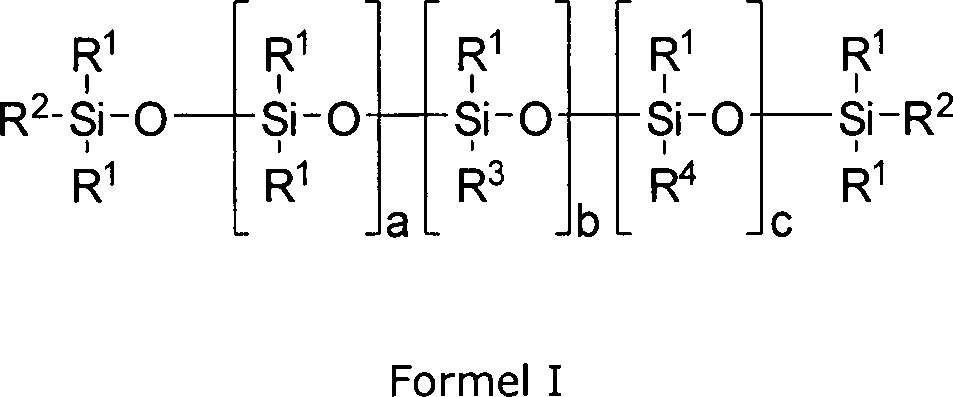
Description
Stand der TechnikState of the art
Siliconmembranen eignen sich für eine Vielzahl von Trennprozessen. Ein Vorteil von Siliconmembranen ist insbesondere, dass sie resistent gegenüber einer Reihe organischer Lösemittel sind und daher zumeist problemlos in lösemittelbasierten Nanofiltrationsprozessen eingesetzt werden können. Bei der lösemittelbasierten Nanofiltration handelt es sich um einen druckgetriebenen Separationsprozess auf der Basis von Membranen, der in organischen Lösungsmitteln gelöste Moleküle auf molekularer Ebene trennt. Zurzeit werden Lösemittel-resistente Membranen insbesondere in der Nahrungsmittelindustrie, der Petrochemie, der Chemieindustrie und zur Herstellung pharmazeutischer Wirkstoffe in der Pharmaindustrie eingesetzt.Silicone membranes are suitable for a variety of separation processes. An advantage of silicone membranes is, in particular, that they are resistant to a number of organic solvents and therefore can usually be used without problems in solvent-based nanofiltration processes. Solvent-based nanofiltration is a pressure-driven membrane-based separation process that separates molecules dissolved in organic solvents at the molecular level. Currently, solvent-resistant membranes are used in particular in the food industry, the petrochemical industry, the chemical industry and for the production of pharmaceutical active ingredients in the pharmaceutical industry.
Des Weiteren werden Siliconmembranen zur Gas-Separation (GS) eingesetzt. Typische Gas-Separationsprozesse sind die Abtrennung von Stickstoff aus der Luft, die Wasserstoffrückgewinnung, die Lufttrocknung, Verfahren zur Auftrennung von Kohlenwasserstoffen und die Entfernung von flüchtigen organischen Komponenten. Im Vergleich zu anderen Polymeren, die in Gas-Separationsprozessen eingesetzt werden, besitzen Siliconmembranen in allgemeinen eine deutlich höhere Permeabilität, haben jedoch zumeist eine geringere Selektivität. Verschiedenen Anwendungen im Bereich der Gas-Separation sind detailliert in der folgender Literaturstelle beschrieben:
Ein Beispiel für eine lösemittelbasierte Nanofiltration, für die sich Siliconmembranen eignen, ist die Hexan-Rückgewinnung bei der Herstellung von Pflanzenölen. Durch die Verwendung von Membranen bei der Rückgewinnung von Hexan lassen sich bedeutende Mengen an Energie einsparen.An example of solvent-based nanofiltration that silicone membranes are suitable for is hexane recovery in the manufacture of vegetable oils. The use of membranes in the recovery of hexane can save significant amounts of energy.
Der erste Schritt bei der Ölherstellung ist die Ölextraktion. Bei der Extraktion werden die ölhaltigen Rohstoffe mit Hexan versetzt. Man erhält eine Lösung des Öls in Hexan, die auch Miscella genannt wird. Das gelöste Öl enthält zu über 95% Triacylglyceride und als Nebenbestandteile Phospholipide, freie Fettsäuren (FFA), Pigmente, Sterole, Kohlenhydrate, Proteine und deren Abbauprodukte.The first step in oil production is oil extraction. During the extraction, the oil-containing raw materials are mixed with hexane. A solution of the oil in hexane, which is also called miscella, is obtained. The dissolved oil contains more than 95% triacylglycerides and as minor components phospholipids, free fatty acids (FFA), pigments, sterols, carbohydrates, proteins and their degradation products.
Die Miscella besteht zu 70 bis 75% aus Hexan. Die Trennung von Öl und Hexan kann zum Beispiel durch eine mehrstufige destillative Trennung erfolgen. Diese erfordert einen vergleichsweise hohen Energieaufwand für die Verdampfung des Hexans. Wird dagegen eine Membran zur Abtrennung von zumindest einem Großteil des Hexans eingesetzt, so lässt sich eine erhebliche Energiemenge einsparen.The miscella consists of 70 to 75% of hexane. The separation of oil and hexane can be carried out, for example, by a multistage separation by distillation. This requires a comparatively high energy expenditure for the evaporation of the hexane. If, on the other hand, a membrane is used to separate at least a large part of the hexane, then a considerable amount of energy can be saved.
Ein Problem, das beim Einsatz von Siliconmembranen auftreten kann, ist eine unzureichende Langzeitstabilität in Hexan-haltigen Systemen sowie die unerwünschte Anlagerung von Stoffen an der Membranoberfläche.A problem that can occur when using silicone membranes is insufficient long-term stability in hexane-containing systems and the undesired attachment of substances to the membrane surface.
Die Verwendung von Silicon-Komposit-Membranen, oder auch als Composite-Silicon-Membranes bezeichnet, in der Pflanzenöl-Industrie ist wohlbekannt. Forschung, die auf diesem Gebiet stattgefunden hat, ist zum Beispiel in der folgenden Literaturstelle beschrieben:
Ein weiteres Beispiel für lösemittelbasierte Nanofiltrationsanwendungen für die sich Siliconmembranen prinzipiell eignen ist die Abtrennung von Homogenkatalysatoren z. B. aus Hydroformylierungs-Reaktionsmischungen:
Einen weitergehende Überblick über verschiedene lösemittelbasierende Nanofiltrations-Prozesse (Organic Solvent Nanofiltration, OSN) gibt die Literaturstelle:
Ein Hersteller von am Markt verfügbaren Siliconmembranen ist die GMT Membrantechnik GmbH (Deutschland). Die Silicontrennschicht ihrer Membranen wird zum Beispiel mit dem in der Patentschrift
In den Patentanmeldungen
Es zeigt sich außerdem, dass derartige Membranen keine gegenüber
Vor diesem Hintergrund bestand die Aufgaben der Erfindung darin Membranen auf Basis von Siliconen bereitzustellen, die mindestens 95% von Komponenten mit einer Molekülmasse kleiner als 800 g/mol aus einem organischen Lösungsmittel mit einer molaren Masse < 200 g/mol bevorzugt < 150 g/mol besonders bevorzugt < 120 g/mol abtrennen können. Beispiel für solche Losungsmittel sind Tetrahydrofuran, Hexan, Heptan, Isopropanol, Toluol, Dichlormethan, Aceton und Essigsäureethylester.Against this background, the objects of the invention to provide membranes based on silicones, the at least 95% of components having a molecular weight less than 800 g / mol of an organic solvent having a molecular weight <200 g / mol preferably <150 g / mol particularly preferably <120 g / mol can be separated off. Examples of such solvents are tetrahydrofuran, hexane, heptane, isopropanol, toluene, dichloromethane, acetone and ethyl acetate.
Weiterhin bestand die Aufgabe darin die hohe Neigung zur Quellung der bisher bekannten Siliconmembranen insbesondere z. B. in aliphatischen Lösungsmitteln, wie z. Hexan und Heptan durch eine geeignete Vernetzung zu reduzieren.Furthermore, the object was the high tendency to swell the previously known silicone membranes in particular z. B. in aliphatic solvents, such as. To reduce hexane and heptane by a suitable crosslinking.
Die erfolgreiche Reduktion der Quellung in den vorgenannten Lösungsmitteln zeigt sich in dem Erhalt der Trenneigenschaften über die Zeit. Membranen nach dem Stand der Technik zeigen z. B. bei dem Wechsel vom Lösungsmittel Toluol in das stark quellende Lösungsmittel Hexan einen Verdoppelung der molekularen Ausschlussgrenze (90%iger Rückhalt eines Polystyrols des entsprechenden Molekulargewichtes, MWCO) unter ansonsten gleichen Bedingungen. Dies gilt ausdrücklich auch für Membranen, die nach
Weiterhin bestand die Aufgabe darin, die sehr hydrophoben Eigenschaften der bisher bekannten Siliconmembranen über den Einbau von hydrophilen Bestandteilen in das Membranpolymer zu Gunsten der Hydrophilie zu vermindern.Furthermore, the object was to reduce the very hydrophobic properties of the hitherto known silicone membranes via the incorporation of hydrophilic components in the membrane polymer in favor of hydrophilicity.
Überraschenderweise wurde gefunden, dass Silicon-Kompositmembranen, die ein oder mehrere trennaktive Membranschichten aufweisen, besonders vorteilhafte Eigenschaften im Sinne der Aufgabenstellungen besitzen.Surprisingly, it has been found that silicone composite membranes which have one or more separation-active membrane layers have particularly advantageous properties in the sense of the problems.
Gelöst wird die Aufgabe der Erfindung daher durch Silicon-Kompositmembranen, die ein oder mehrere trennaktive Membranschichten aufweisen wenn zumindest eine trennaktive Membranschicht durch die Aushärtung von seitenständig modifizierten Siliconacrylaten der allgemeinen Formel I hergestellt wurde. 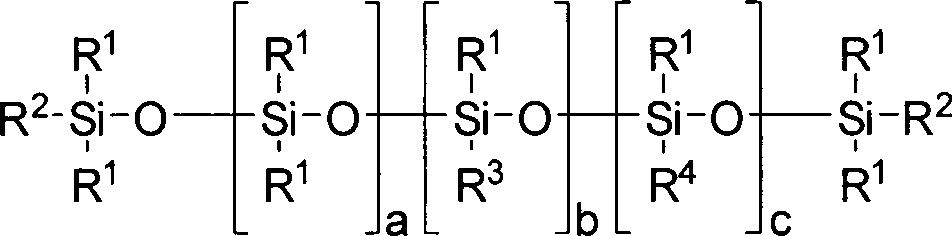
a = 25–500, bevorzugt 25–300, insbesondere 30–200,
b = 1–25, bevorzugt 1–15, insbesondere 1–8,
c = 0–20, bevorzugt 0–10, insbesondere 0,
R1 = unabhängig voneinander gleiche oder verschiedene Alkyl- oder Arylreste mit 1 bis 30 C-Atomen die gegebenenfalls Ether- und/oder Ester- und/oder Epoxy- und/oder Alkohol-Funktionen tragen, bevorzugt gleiche oder verschiedene Alkyl- oder Arylreste mit 1 bis 30 C-Atomen, insbesondere Methyl oder Phenyl,
R2 = unabhängig voneinander gleiche oder verschiedene Reste aus der Gruppe:
R1, R3 und R4,
R3 = gleiche oder verschiedene organische Reste die ein oder mehrere Acrylatgruppen tragen, bevorzugt Substituenten der allgemeinen Formel II oder III, 

wobei gilt: g + h = 3,
R6 = unabhängig voneinander gleiche oder verschiedene Alkyl- oder Arylreste mit 1 bis 30 C-Atomen oder H,
R7 = gleiche oder verschiedene zweibindige Kohlenwasserstoffreste, bevorzugt -CR6 2-, insbesondere -CH2-
R4 = gleiche oder verschiedene Polyether-Reste, bevorzugt gleiche oder verschiedene Polyetherreste der allgemeinen Formel IV
j = 0–50, k = 0–50, l = 0–50,
R8 = gleiche oder verschiedene Alkyl oder Arylreste mit 2–30 Kohlenstoffatomen, bevorzugt Ethyl und Phenyl,
R9 = gleiche oder verschiedene Alkyl- oder Arylreste mit 2–30 Kohlenstoffatomen oder H oder Alkanoyl-reste, bevorzugt Methyl, H oder Acetyl.The object of the invention is therefore achieved by silicone composite membranes which have one or more separation-active membrane layers if at least one release-active membrane layer has been produced by the curing of laterally modified silicone acrylates of the general formula I.
a = 25-500, preferably 25-300, in particular 30-200,
b = 1-25, preferably 1-15, in particular 1-8,
c = 0-20, preferably 0-10, in particular 0,
R 1 = independently of one another identical or different alkyl or aryl radicals having 1 to 30 C atoms which optionally bear ether and / or ester and / or epoxy and / or alcohol functions, preferably identical or different alkyl or aryl radicals 1 to 30 C atoms, in particular methyl or phenyl,
R 2 = independently of one another identical or different radicals from the group:
R 1 , R 3 and R 4 ,
R 3 = identical or different organic radicals which carry one or more acrylate groups, preferably substituents of the general formula II or III,
where g + h = 3,
R 6 = independently of one another identical or different alkyl or aryl radicals having 1 to 30 C atoms or H,
R 7 = identical or different divalent hydrocarbon radicals, preferably -CR 6 2 -, in particular -CH 2 -
R 4 = identical or different polyether radicals, preferably identical or different polyether radicals of the general formula IV
j = 0-50, k = 0-50, l = 0-50,
R 8 = identical or different alkyl or aryl radicals having 2-30 carbon atoms, preferably ethyl and phenyl,
R 9 = identical or different alkyl or aryl radicals having 2-30 carbon atoms or H or alkanoyl radicals, preferably methyl, H or acetyl.
Ein weiterer Gegenstand der Erfindung sind auch Kompositmembranen hergestellt durch die Härtung von Siliconacrylaten der Formel I, die aus mehreren Schichten von verschiedenen Siliconacrylaten aufgebaut sind.Another object of the invention are also composite membranes prepared by the curing of silicone acrylates of the formula I, which are composed of several layers of different silicone acrylates.
Weiterhin hat sich gezeigt, dass sich eine besonders vorteilhafte Familie von Siliconmembranen herstellen lassen, wenn diese durch die Aushärtung einer Mischung verschiedener Siliconacrylate erfolgt. Durch die Wahl der Mischung lassen sich die Eigenschaften Trenngrenze, Vernetzungsgrad und Hydrophile nahezu stufenlos in bisher nicht bekannten Bereichen einstellen.Furthermore, it has been shown that it is possible to produce a particularly advantageous family of silicone membranes if this takes place by the curing of a mixture of different silicone acrylates. By choosing the mixture, the properties separation limit, degree of crosslinking and hydrophilic can be adjusted almost continuously in previously unknown areas.
Daher sind weitere Gegenstände dieser Erfindungen Silicon-Kompositmembranen, die ein oder mehrere trennaktive Membranschichten aufweisen, welche durch die Aushärtung einer Mischung verschiedener Siliconacrylate hergestellt wurden.Therefore, other objects of this invention are silicone composite membranes having one or more release active membrane layers made by curing a mixture of various silicone acrylates.
Besonders vorteilhaft besteht die Mischung der verschiedenen Siliconacrylate aus zumindest folgenden Komponenten:
- a) ein oder mehrere Siliconacrylate mit einem Siliziumgehalt von durchschnittlich > 29 Gew.-%, bevorzugt ein oder mehrere Siliconacrylate mit einem Siliziumgehalt von durchschnittlich > 29 Gew.-% der allgemeinen Formel I, insbesondere ein oder mehrere Siliconacrylate mit einem Siliziumgehalt von > 29 Gew.-% der allgemeinen Formel I mit b = c = 0, Formel I wobei für die Komponente a gilt: a = 25–500, bevorzugt 25–300, insbesondere 30–200, b = 0–15, bevorzugt 0–8, insbesondere 0 c = 0–20, bevorzugt 0–10, insbesondere 0 mit der Maßgabe, dass bei b = 0 R2 = R3 ist,

- b) ein oder mehrere Siliconacrylate mit einem Siliziumgehalt von < 27,5 Gew.-%, bevorzugt ein oder mehrere Siliconacrylate mit einem Siliziumgehalt von < 27,5 Gew.-% der allgemeinen Formel I, insbesondere ein oder mehrere Siliconacrylate mit einem Siliziumgehalt von < 27,5 Gew.-% der allgemeinen Formel I mit c > 3,
a = 1–24, bevorzugt 5–20, besonders bevorzugt 10–20 und insbesondere 10, 11, 12, 13, 14, 15, 16 oder 17, insbesondere
b = 0–25, bevorzugt 3–10, besonders bevorzugt 3, 4, 5, 6, 7 oder 8,
c = 0–20, bevorzugt 0–10, besonders bevorzugt 0 oder 1, 2, 3 oder 4,
mit der Maßgabe, dass bei b = 0 R2 = R3 ist. Particularly advantageously, the mixture of the various silicone acrylates consists of at least the following components:
- a) one or more silicone acrylates having a silicon content of on average> 29 wt .-%, preferably one or more silicone acrylates having a silicon content of on average> 29 wt .-% of the general formula I, in particular one or more silicone acrylates having a silicon content of> 29 Wt .-% of the general formula I with b = c = 0, Formula I wherein the following applies to component a: a = 25-500, preferably 25-300, in particular 30-200, b = 0-15, preferably 0-8, in particular 0 c = 0-20, preferably 0-10, in particular 0 with the proviso that at b = 0 R 2 = R 3 ,
- b) one or more silicone acrylates having a silicon content of <27.5 wt .-%, preferably one or more silicone acrylates having a silicon content of <27.5 wt .-% of the general formula I, in particular one or more silicone acrylates having a silicon content of <27.5 wt .-% of the general formula I with c> 3,
a = 1-24, preferably 5-20, more preferably 10-20 and especially 10, 11, 12, 13, 14, 15, 16 or 17, in particular
b = 0-25, preferably 3-10, more preferably 3, 4, 5, 6, 7 or 8,
c = 0-20, preferably 0-10, particularly preferably 0 or 1, 2, 3 or 4,
with the proviso that at b = 0 R 2 = R 3 .
Bevorzugt werden liegen die Komponenten a) und b) in der Mischungen in einem Massenverhältnis von 10 zu 1 bis 1 zu 10 vor, insbesondere im Verhältnis 2 zu 8 bis 8 zu 2.The components a) and b) are preferably present in the mixtures in a mass ratio of 10: 1 to 1: 10, in particular in a ratio of 2: 8 to 8: 2.
Bei den angegeben Strukturformeln handelt es sich um Polymere mit einer Molgewichtsverteilung. Die Indizes a, b, c, j, k und l stellen daher Mittelwerte dar und sind gegebenenfalls nicht ganzzahlig.The structural formulas given are polymers with a molecular weight distribution. The indices a, b, c, j, k and l therefore represent mean values and may not be integers.
Die verschiedenen Monomereinheiten der in den Formeln angegebenen Bausteine (Siloxanketten bzw. Polyoxyalkylenkette) können untereinander blockweise aufgebaut sein mit einer beliebigen Anzahl an Blöcken und einer beliebigen Sequenz oder einer statistischen Verteilung unterliegen. Die in den Formeln verwendeten Indices sind als statistische Mittelwerte zu betrachten.The various monomer units of the structural units indicated in the formulas (siloxane chains or polyoxyalkylene chain) can be constructed in blocks with any number of blocks and any sequence or statistical distribution. The indices used in the formulas are to be regarded as statistical averages.
Der Siliziumgehalt der Siliconacrylate wird durch den Grad der organischen Modifikation beeinflusst. Je mehr organische Liganden an das Siloxangerüst gebunden sind, desto niedriger ist der Siliziumgehalt. Es hat sich gezeigt, dass Silicon-Composite-Membranen mit vorteilhaften Eigenschaften erhalten werden, wenn diese eine trennaktive Schicht besitzen, die durch die Aushärtung von einer Mischung verschiedenartiger Siliconacrylate hergestellt wird. Dabei werden ein oder mehrere verhältnismäßig hoch modifizierte Siliconacrylate mit einem Si-Gehalt von unter 27,5 Gew.-% (Komponente b) mit ein oder mehreren verhältnismäßig niedrig modifizierten Siliconacrylaten mit einem Si-Gehalt von > 29 Gew.-% (Komponente a) als Mischung ausgehärtet.The silicon content of the silicone acrylates is influenced by the degree of organic modification. The more organic ligands attached to the siloxane backbone, the lower the silicon content. It has been found that silicone composite membranes are obtained with advantageous properties when they have a release active layer, which is prepared by the curing of a mixture of different types of silicone acrylates. In this case, one or more relatively highly modified silicone acrylates having a Si content of less than 27.5 wt .-% (component b) with one or more relatively low modified silicone acrylates having a Si content of> 29 wt .-% (component a ) cured as a mixture.
Die Eigenschaften der Membranen, die mit einer erfindungsgemäßen Mischung an Siliconacrylaten erhalten wird, weist vorteilhafte Eigenschaften auf, wie im folgendem gezeigt wird.The properties of the membranes obtained with a mixture of silicone acrylates according to the invention have advantageous properties, as shown below.
Besonders vorteilhafte Eigenschaften ergeben sich, wenn als Komponente a) Siliconacrylate eingesetzt werden, die lediglich an den Kettenenden modifiziert sind, sogenannte α,ω-modifizierte Siliconacrylate. Weiterhin zeigen sich vorteilhafte Eigenschaften, wenn als Komponente b) seitenständig modifizierte Siliconacrylate eingesetzt werden.Particularly advantageous properties are obtained if, as component a), silicone acrylates are used which are modified only at the chain ends, so-called α, ω-modified silicone acrylates. Furthermore, advantageous properties are exhibited when, as component b), laterally modified silicone acrylates are used.
Neben den Siliconacrylaten kann es sinnvoll sein eine Reihe weiterer Stoffe, wie beispielsweise Füllstoffe, Stabilisatoren, Farben oder organische Acrylate der Mischung zuzusetzen. Diese Aufzählung ist nicht beschränkend aufzufassen. In addition to the silicone acrylates, it may be useful to add a number of other substances, such as fillers, stabilizers, dyes or organic acrylates of the mixture. This list is not meant to be limiting.
Die vorliegende Erfindung beschreibt neuartige Komposit-Membranen, welche mindestens eine trennaktive Schicht besitzen, die durch spezielle Siliconacrylate oder eine Mischung von Siliconacrylaten hergestellt wird.The present invention describes novel composite membranes which have at least one release active layer made by specific silicone acrylates or a mixture of silicone acrylates.
Ein weiterer Gegenstand der Erfindung sind auch Kompositmembranen die durch Aushärtung der erfindungsgegenständlichen Siliconacrylate der Formel I mit einem Photoinitiator durch elektromagnetische Strahlung mit einer Wellenlänge, die kleiner als 800 nm ist, und/oder durch Elektronenstrahlen erhalten werden. Insbesondere erfolgt die Aushärtung durch UV-Strahlung bei Wellenlängen unterhalb von 400 nm.Another object of the invention are composite membranes obtained by curing the silicone acrylate of the formula I according to the invention with a photoinitiator by electromagnetic radiation having a wavelength which is less than 800 nm, and / or by electron beams. In particular, the curing is carried out by UV radiation at wavelengths below 400 nm.
Ein weiterer Gegenstand der Erfindung sind auch die Kompositmembranen enthaltend die gehärteten Siliconacrylate nach Formel I, die als Trägermembranen eine Ultrafiltrationsmembran aufweisen.Another object of the invention are also the composite membranes containing the cured silicone acrylates of the formula I, which have an ultrafiltration membrane as support membranes.
Insbesondere der Einsatz von Mischungen verschiedener Siliconacrylate erlaubt es die Eigenschaften der Membran gezielt einzustellen. Durch die Einstellung eines bestimmten Mischungsverhältnisses ist es möglich die Membran für bestimmte Anforderungen anzupassen und spezielle Trennprobleme zu adressieren.In particular, the use of mixtures of different silicone acrylates allows the properties of the membrane to be adjusted in a targeted manner. By setting a certain mixing ratio, it is possible to adapt the membrane for specific requirements and to address specific separation problems.
Die Evonik Goldschmidt GmbH bietet eine Reihe von kommerziell verfügbaren Siliconacrylaten an, die sich zur Herstellung von erfindungsgemäßen Membranen eignen.Evonik Goldschmidt GmbH offers a range of commercially available silicone acrylates which are suitable for the production of membranes according to the invention.
Typische Produkte der Evonik Goldschmidt GmbH sind TEGO® RC 902, TEGO® RC 715. TEGO® RC 902 und TEGO® RC 715 sind lineare Polymere, die lediglich an den Kettenenden modifiziert sind. TEGO® RC 902 hat einen Siliziumanteil von beispielsweise 34 Gew.-% und TEGO® RC 715 einen Siliziumanteil von beispielsweise 32 Gew.-%, es handelt sich um vergleichsweise niedrig modifizierte Produkte. Auchseitenständig modifizierte Siloxane sind verfügbar, die einen Siliziumanteil von beispielsweise 24 Gew.-%. Der Anteil an organischen Bestandteilen/Gruppen ist verhältnismäßig hoch im Vergleich zum Siliciumoxidgerüst. TEGO® RC 902 und TEGO® RC 715 entsprechen beispielsweise den linearen, kettenendenmodifizierten Polymeren der Komponente a) wenn Mischungen verschiedener Siliconacrylate eingesetzt werden, wohingegen seitenständig modifizierte Polymere der Komponente b) entsprechen.Typical products of Evonik Goldschmidt GmbH are TEGO ® RC 902, TEGO ® RC 715, TEGO ® RC 902 and RC 715, TEGO ® are linear polymers which are modified only at the chain ends. TEGO ® RC 902 has a silicon content of, for example 34 wt .-%, and TEGO ® RC 715 a silicon content of, for example 32 wt .-%, is comparatively low modified products. Also laterally modified siloxanes are available which have a silicon content of, for example, 24% by weight. The proportion of organic constituents / groups is relatively high in comparison to the silicon oxide skeleton. TEGO ® RC 902 and RC 715, TEGO ®, for example, correspond to the linear chain-end modified polymer of component a) when mixtures of various silicon acrylates are used, whereas pendant modified polymers of component B) correspond.
Die oben beschriebenen Silicon-Kompositmembranen werden durch Beschichtung auf der Basis von Ultrafiltrationsmembranen hergestellt. Als Ultrafiltrationsmembranen können dabei prinzipiell alle bekannten Membranmaterialien eingesetzt werden:
Die oben beschriebenen Silicon_Kompositmembranen eignen sich für Trennaufgaben in organischen Lösungsmitteln. Sie sind je nach Ausführung in der Lage gelöste Moleküle mit einem Molekulargewicht von kleiner als 2000 g/mol bevorzugt Moleküle mit einem Molekulargewicht von kleiner als 1000 g/mol und besonders bevorzugt Moleküle mit einem Molekulargewicht von kleiner als 500 g/mol mit mindestens 90 Gew.-% abzutrennen oder zurückzuhalten.The Silicon_Kompositmembranen described above are suitable for separation tasks in organic solvents. Depending on the embodiment, they are capable of dissolved molecules having a molecular weight of less than 2000 g / mol, preferably molecules having a molecular weight of less than 1000 g / mol and particularly preferably molecules having a molecular weight of less than 500 g / mol of at least 90 wt Separate or retain%.
In einer besonders bevorzugten Ausführungsform der Erfindung lassen sich durch die erfindungsgegenständlichen Membranen aus in einem organischen Lösungsmittel gelösten Komponenten unterschiedlicher Molekularmassen mindestens 95% von Komponenten mit einer Molekülmasse kleiner als 800 g/mol, bevorzugt mit einer molaren Masse < 200 g/mol, besonders bevorzugt < 150 g/mol und insbesondere < 120 g/mol abtrennen. Beispiel für solche Lösungsmittel sind Tetrahydrofuran, Hexan, Heptan, Isopropanol, Toluol, Dichlormethan, Aceton und Essigsäureethylester.In a particularly preferred embodiment of the invention, the membranes according to the invention of components of different molecular masses dissolved in an organic solvent at least 95% of components having a molecular weight of less than 800 g / mol, preferably with a molar mass <200 g / mol, are particularly preferred <150 g / mol and in particular <120 g / mol. Examples of such solvents are tetrahydrofuran, hexane, heptane, isopropanol, toluene, dichloromethane, acetone and ethyl acetate.
Bei den gelösten Molekülen kann es sich prinzipiell um alle im jeweiligen Lösungsmittel lösliche Moleküle handeln. Ein weiterer Gegenstand der Erfindung ist daher die Verwendung der erfindungsgegenständlichen Silicon-Kompositmembranen z. B. zur Abtrennung von Homogenkatalysatorsystemen aus Reaktionsmischungen, zur Trennung von Triglyceriden aus Hexan, zur Abtrennung von Oligomeren aus Monomerlösungen oder zur Abtrennung von (Pharma-)Wirkstoffen oder deren Vorprodukten aus Reaktionsgemischen oder Lösungen.The dissolved molecules can in principle be all molecules soluble in the respective solvent. Another object of the invention is therefore the use of the inventive silicone composite membranes z. B. for the separation of homogeneous catalyst systems Reaction mixtures, for the separation of triglycerides from hexane, for the separation of oligomers from monomer solutions or for the separation of (pharmaceutically) active substances or their precursors from reaction mixtures or solutions.
Zur Aufreinigung von Substanzen eignen sich die erfindungsgemäßen Komposit-Membranen insbesondere, da beispielsweise bei festgelegten Trennparamentern wie Temperatur, Druck und Lösungsmittel sich gezielt Molkulargewichtsfraktionen unterhalb festgelegter Bereiche aus Lösungen abtrennen lassen. Bei typischen Systembedingungen wie z. B. 30°C, 30 bar Druck (TMP – Trans Membrane Pressure) können so Molekulargewichtsfraktionen von kleiner 1000 g/mol, bevorzugt kleiner 600 g/mol und insbesondere kleiner 300 g/mol aus Lösungen in n-Heptan abgetrennt werden.For the purification of substances, the composite membranes according to the invention are particularly suitable, since, for example, in the case of defined separation parameters such as temperature, pressure and solvent, it is possible to selectively separate molecular weight fractions below defined ranges from solutions. In typical system conditions such. B. 30 ° C, 30 bar pressure (TMP - Trans Membrane Pressure) can thus molecular weight fractions of less than 1000 g / mol, preferably less than 600 g / mol and in particular less than 300 g / mol of solutions in n-heptane are separated.
Ausgehend von einer Mischung von seitenständig modifizierten und endständig α,ω-modifizierte Siliconacrylaten lässt sich die Membrantrennleistung (in weiten Grenzen) für die unterschiedlichen Lösungsmittelsysteme gezielt einstellen (siehe dazu auch
Ein weiterer Gegenstand der Erfindung ist ein Verfahren zur Herstellung einer Kompositmembran wobei eine Trägermembran mit zumindest einem Siliconacrylat der Formel I und/oder Mischungen verschiedener Siliconacrylate beschichtet und anschließend durch elektromagnetische Strahlung und/oder Elektronenstrahlung ausgehärtet wird bei Raumtemperatur.Another object of the invention is a process for preparing a composite membrane wherein a support membrane is coated with at least one silicone acrylate of the formula I and / or mixtures of various silicone acrylates and then cured by electromagnetic radiation and / or electron radiation at room temperature.
Das Siliconacrylat oder ggf. die Siliconacrylatmischung wird ggf. unter Mitverwendung eines Lösungsmittels auf ein Walzensystem gegeben, wie es herkömmlich z. B. für die Beschichtung von Antihaftbeschichtungen von Trägermaterialen für z. B. Etiketten Anwendung findet, besonders vorteilhaft wird dazu kein weiteres Lösungsmittel verwendet. Dem Siliconacrylat wurde zuvor ein Photoinitiator zugegeben. Durch das Walzensystem wird das Siliconacrylat in Schichtdicken zwischen 0,3–2 Mikrometer auf das Membranmaterial aufgetragen und mittels UV-Strahlung oder Elektronenstrahlung radikalisch ausgehärtet. Weitere thermische Energie wird nicht benötigt. Das Siliconacrylat ist sofort nach Durchlaufen der Reaktionskammer ausgehärtet. In der Reaktionskammer werden freie Radikalstellen durch Sauerstoff gequenscht, weshalb es unumgänglich ist die Reaktionskammer mit Stickstoff zu inertisieren.The silicone acrylate or optionally the silicone acrylate mixture is optionally added to a roller system with the concomitant use of a solvent, as is conventional z. B. for the coating of non-stick coatings of substrates for z. B. labels application, particularly advantageous, no further solvent is used. The silicone acrylate was previously added a photoinitiator. By means of the roller system, the silicone acrylate is applied to the membrane material in layer thicknesses of between 0.3 and 2 micrometers and radically cured by means of UV radiation or electron radiation. Further thermal energy is not needed. The silicone acrylate is cured immediately after passing through the reaction chamber. In the reaction chamber free radical sites are quenched by oxygen, which is why it is inevitable to inertize the reaction chamber with nitrogen.
BeispieleExamples
In den nachfolgend aufgeführten Beispielen wird die vorliegende Erfindung zur Verdeutlichung der Erfindung beschrieben, ohne dass die Erfindung, deren Anwendungsbreite sich aus der gesamten Beschreibung und den Ansprüchen ergibt, auf die in den Beispielen genannten Ausführungsformen beschränkt sein soll. Sind nachfolgend Bereiche, allgemeine Formeln oder Verbindungsklassen angegeben, so sollen diese nicht nur die entsprechenden Bereiche oder Gruppen von Verbindungen umfassen, die explizit erwähnt sind, sondern auch alle Teilbereiche und Teilgruppen von Verbindungen, die durch Herausnahme von einzelnen Werten (Bereichen) oder Verbindungen erhalten werden können. Werden im Rahmen der vorliegenden Beschreibung Dokumente zitiert, so soll deren Inhalt vollständig zum Offenbarungsgehalt der vorliegenden Erfindung gehören. Werden im Rahmen der vorliegenden Erfindung Verbindungen, wie z. B. organomodifizierte Siliconacrylate beschrieben, die verschiedene Monomereinheiten mehrfach aufweisen können, so können diese statistisch verteilt (statistisches Oligomer) oder geordnet (Blockoligomer) in diesen Verbindungen vorkommen. Angaben zu Anzahl von Einheiten in solchen Verbindungen sind als statistische Mittelwerte, gemittelt über alle entsprechenden Verbindungen, zu verstehen.In the examples given below, the present invention is described to illustrate the invention, without the invention, the scope of application of which is apparent from the entire description and the claims, to be limited to the embodiments mentioned in the examples. Given below, ranges, general formulas, or classes of compounds are intended to encompass not only the corresponding regions or groups of compounds explicitly mentioned, but also all sub-regions and sub-groups of compounds obtained by removing individual values (ranges) or compounds can be. If documents are cited in the context of the present description, their contents are intended to form part of the disclosure content of the present invention. Be in the context of the present invention, compounds such. As described organomodified silicone acrylates, which may have several monomer units multiply, they may occur statistically distributed (statistical oligomer) or ordered (block oligomer) in these compounds. Information on the number of units in such compounds is to be understood as statistical averages, averaged over all corresponding compounds.
Herstellung der MembranenProduction of the membranes
Auf der Basis von am Markt verfügbaren Ultrafiltrationsmembranen aus Polyacrylnitril, zu beziehen z. B. von der Fa. GMT, Rheinfelden oder GE-Osmonics, Vista, USA vertrieben von der Firma Desalogics, Ratzeburg wurden Beschichtungen mit TEGO Siliconacrylaten der Evonik Goldschmidt GmbH durchgeführt. Die Beschichtungen wurden mit einem Glattwalzen-Auftragswerken mit 5 Walzen schichtweise durchgeführt. Die Beschichtungen erfolgten mit einem Auftragsgewicht von 0,6 bis 1,5 g/m2. Die Beschichtungen wurden in einer inerten Stickstoffatmosphere über eine UV-Lampe vernetzt. Hierzu wird den Siliconacrylaten ein geeigneter Photoinitiator, wie z. B. ein Hydroxylketon in einer Menge von 1/100 bezogen auf die Siliconmasse zugegeben. Auf diese Art wurden auf der Basis der genannten Ultrafiltrationsmembran Composite-Membranen erzeugt, die unterschiedliche Mischungen und Schichtfolgen der Siliconarylate entsprechend Komponente a) und Komponente b) aufwiesen. Hergestellt wurden folgende Beschichtungen, mit unterschiedlichen Massenanteilen der Komponente a) und Komponente b) jeweils bezogen auf die Gesamt-Siliconacrylatmenge:
- • 90 Gew.-% a) & 10 Gew.-% b);
- • 80 Gew.-% a) & 20 Gew.-% b), mit zusätzlichen 3 Gew.-% anorganischem Füllstoff bezogen auf die Gesamt-Siliconacrylatmenge;
- • 70 Gew.-% a) & 30 Gew.-% b) mit zusätzlich 3 Gew.-% anorganische Füllstoffe bezogen auf die Gesamt-Siliconacrylatmenge und ohne anorganische Füllstoffe sowie
- • 100 Gew.-% b).
- 90% by weight of a) and 10% by weight of b);
- 80% by weight a) and 20% by weight b), with an additional 3% by weight of inorganic filler based on the total amount of silicone acrylate;
- 70% by weight a) and 30% by weight b) with additionally 3% by weight of inorganic fillers based on the total amount of silicone acrylate and without inorganic fillers and
- 100% by weight of b).
Als anorganischer Füllstoff wurde Kieselsäure eingesetzt.Silica was used as the inorganic filler.
Als Vergleichsmuster einer Membran nach dem Stand der Technik wurde eine Membran die ausschließlich auf der Basis des TEGO® RC 902 entsprechend der Komponente a) hergestellt wurde, untersucht.As a comparison sample of a membrane according to the prior art, a membrane that has been manufactured exclusively on the basis of TEGO ® RC 902 corresponding to the component a), examined.
Die hergestellten Membranen wurden durch die sogenannte MWCO (Molecular Weight Cut-Off)-Methode in n-Heptan charakterisiert. Die MWCO-Methode ist zum Beispiel in der folgenden Literatur beschrieben:
Mit Hilfe der MWCO-Methode läßt sich abschätzen, in wie weit sich ein gelöster Stoff mit einem bestimmten Molgewicht abgetrennen lässt. In
Die Stabilität der trennaktiven Schicht wurde bestimmt, indem die MWCO-Kurve und die Permeabilität der Membran über einen langen Zeitraum in n-Heptan bestimmt wurden.The stability of the separation-active layer was determined by determining the MWCO curve and the permeability of the membrane over a long period in n-heptane.
Die Membranen wurden mittels einer Querstromfiltration getestet. Die Betriebstemperatur betrug 30°C und der transmembrane Druck (TMP) 30 bar. Bei den Langzeitversuchen wurde ein Druck von 10 bar angewendet. Die Membranen wurden mit reinen Lösemitteln konditioniert bis ein stationärer Fluss erreicht wurde. Anschließend wurde das reine Lösemittel durch eine Mischung aus Lösemittel und Oligostyrol-Indikator ersetzt. Nachdem wiederum ein stationärer Fluss erreicht wurde, wurden Proben vom Permeat und vom Einspeisestrom entnommen und der Anteil an Styrololigomer in Analogie zur MWCO-Methode bestimmt.The membranes were tested by means of a crossflow filtration. The operating temperature was 30 ° C and the transmembrane pressure (TMP) 30 bar. In the long-term tests, a pressure of 10 bar was used. The membranes were conditioned with pure solvents until steady state flow was achieved. Subsequently, the pure solvent was replaced by a mixture of solvent and oligostyrene indicator. Once again a steady flow was achieved, samples were taken from the permeate and the feed stream and determined the proportion of styrene oligomer in analogy to the MWCO method.
Die Ergebnisse in
Aus den MWCO-Kurven kann entnommen werden, dass die Membran mit dem höchsten Anteil der Komponenten a) von 90% den relativ niedrigsten Rückhalt aufweist und den höchsten Permeatfluss zeigt. Auf der anderen Seite zeigt eine Membran die zu 100% aus der Komponente b) besteht fast keinen Permeatfluss mehr für n-Heptan und einen sehr hohen Rückhalt. Die dargestellten Ergebnisse der Mischungen 20/80 und 30/70 mit und ohne Füllstoffe zeigen, dass die Eigenschaften fast stufenlos einstellbar sind.From the MWCO curves it can be seen that the membrane with the highest proportion of components a) of 90% has the relatively lowest retention and shows the highest permeate flux. On the other hand, a membrane which consists of 100% of the component b) shows almost no permeate flow for n-heptane and a very high retention. The results of mixtures 20/80 and 30/70 with and without fillers show that the properties are almost infinitely adjustable.
Der Vergleichstest der erfindungsgemäßen Membranen mit einer Zusammensetzung 30% b) & 70% a) mit Siliconmembranen nach dem Stand der Technik (100% a)) wurden wie oben beschrieben in n-Heptan durchgeführt. Nach weiteren 11 Tagen Dauerbetrieb der Membrane bei 10 bar und 30°C in Hexan wurde der MWCO-Test erneut durchgeführt.The comparative test of the membranes according to the invention with a composition 30% b) & 70% a) with silicone membranes according to the prior art (100% a)) were carried out in n-heptane as described above. After another 11 days of continuous operation of the membrane at 10 bar and 30 ° C in hexane, the MWCO test was carried out again.
Die in
Aus der deutlichen Verschiebung der Trennkurve der Membran nach dem Stand der Technik zu höheren Molekulargewichten und der Steigerung des Permeatflusses folgt, dass diese in Heptan nicht stabil ist. Die erfindungsgemäße Membran zeigt keine relevante Änderung der Permeatflussleistung und der Trenneigenschaften als Funktion der Betriebszeit, was die Stabilität der Membran in n-Heptan belegt. 

ZITATE ENTHALTEN IN DER BESCHREIBUNG QUOTES INCLUDE IN THE DESCRIPTION
Diese Liste der vom Anmelder aufgeführten Dokumente wurde automatisiert erzeugt und ist ausschließlich zur besseren Information des Lesers aufgenommen. Die Liste ist nicht Bestandteil der deutschen Patent- bzw. Gebrauchsmusteranmeldung. Das DPMA übernimmt keinerlei Haftung für etwaige Fehler oder Auslassungen.This list of the documents listed by the applicant has been generated automatically and is included solely for the better information of the reader. The list is not part of the German patent or utility model application. The DPMA assumes no liability for any errors or omissions.
Zitierte PatentliteraturCited patent literature
- EP 1931472 A1 [0008] EP 1931472 A1 [0008]
- EP 1817097 [0008] EP 1817097 [0008]
- US 20090032465 A1 [0008] US 20090032465 A1 [0008]
- DE 19507584 [0010, 0012] DE 19507584 [0010, 0012]
- US 20070007195 [0011] US 20070007195 [0011]
- EP 1741481 [0011, 0015, 0015] EP 1741481 [0011, 0015, 0015]
- EP 0979851 [0011] EP 0979851 [0011]
Zitierte Nicht-PatentliteraturCited non-patent literature
- Ind. Eng. Chem. Res., Vol. 41, No. 6, 2002 [0002] Ind. Eng. Chem. Res., Vol. 41, no. 6, 2002 [0002]
- Fett. Lipid 98(1996), pp. 10–14 [0007] Fat. Lipid 98 (1996), pp. 10-14 [0007]
- JAOCS 79(2002) pp. 937–942 [0007] JAOCS 79 (2002) pp. 937-942 [0007]
- in Colloids and Surfaces, A: Physicochemical and Engineering Aspects 204(2002)31–41 [0007] in Colloids and Surfaces, A: Physicochemical and Engineering Aspects 204 (2002) 31-41 [0007]
- Elements, Degussa-ScienceNewsletter, 18, (2007) 30–35 [0008] Elements, Degussa Science Newsletter, 18, (2007) 30-35 [0008]
- Recovery of Enlarged Olefin Metathesis Catalysts by Nanofiltration in an Eco-Friendly Solvent, A. Keraani, T. Renouard, C. Fischmeister, C. Bruneau, M. Rabiller-Baudry, ChemSusChem 2008, 1, 927 [0008] Recovery of Enlarged Olefin Metathesis Catalysts by Nanofiltration in Eco-Friendly Solvent, A. Keraani, T. Renouard, C. Fischmeister, C. Bruneau, M. Rabiller-Baudry, ChemSusChem 2008, 1, 927 [0008]
- Solvent-Resistant Nanofiltration of Enlarged (NHC)Pd(allyl)Cl Complexes for Cross-Coupling Reactions, Dirk Schoeps, Volodymyr Sashuk, Katrin Ebert, Herbert Plenio, Organometallics 2009, 28, 3922 [0008] Solvent-Resistant Nanofiltration of Enlarged (NHC) Pd (allyl) Cl Complexes for Cross-Coupling Reactions, Dirk Schoeps, Volodymyr Sashuk, Katrin Ebert, Herbert Plenio, Organometallics 2009, 28, 3922 [0008]
- Chem. Soc. Rev., 2008, 37, 365–405 [0009] Chem. Soc. Rev., 2008, 37, 365-405 [0009]
- K.-V. Peinemann und S. Nunes, Membrane Technology in the Chemical Industry, Wiley-VCH Verlag GmbH, 2006 [0036] K.-V. Peinemann and S. Nunes, Membrane Technology in the Chemical Industry, Wiley-VCH Verlag GmbH, 2006 [0036]
- Journal of Membrane Science 291(2007)120–125 [0048] Journal of Membrane Science 291 (2007) 120-125 [0048]
Claims (15)


Priority Applications (20)
| Application Number | Priority Date | Filing Date | Title |
|---|---|---|---|
| DE102009047351A DE102009047351A1 (en) | 2009-12-01 | 2009-12-01 | Composite silicone membranes with high separation efficiency |
| BR112012013130-3A BR112012013130B1 (en) | 2009-12-01 | 2010-11-02 | COMPOSED SILICON MEMBRANES WITH HIGH SEPARATION EFFECT, THEIR USE AND THE PRODUCTION PROCESS |
| PL10773077T PL2506957T3 (en) | 2009-12-01 | 2010-11-02 | Composite silicone membranes with high separating action |
| CN201080054588.9A CN102665879B (en) | 2009-12-01 | 2010-11-02 | The compound polysiloxane film of high centrifugation |
| ES10773077.2T ES2553765T3 (en) | 2009-12-01 | 2010-11-02 | Composite silicone membranes with high separation effect |
| AU2010327002A AU2010327002B2 (en) | 2009-12-01 | 2010-11-02 | Composite silicone membranes with high separating action |
| CA2782798A CA2782798C (en) | 2009-12-01 | 2010-11-02 | Composite silicone membranes of high separation efficiency |
| KR1020127014147A KR101725575B1 (en) | 2009-12-01 | 2010-11-02 | Composite silicone membranes with high separating action |
| DK10773077.2T DK2506957T3 (en) | 2009-12-01 | 2010-11-02 | COMPOSITE SILICONE MEMBRANES WITH HIGH DIFFERENCE |
| HK13103011.4A HK1175735B (en) | 2009-12-01 | 2010-11-02 | Composite silicone membranes with high separating action |
| JP2012541377A JP5923447B2 (en) | 2009-12-01 | 2010-11-02 | High separation efficiency silicone composite membrane |
| EP10773077.2A EP2506957B1 (en) | 2009-12-01 | 2010-11-02 | Composite silicone membranes with high separating action |
| MYPI2012002409A MY169960A (en) | 2009-12-01 | 2010-11-02 | Composite silicone membranes with high sepating action |
| US13/513,225 US9539549B2 (en) | 2009-12-01 | 2010-11-02 | Composite silicone membranes of high separation efficiency |
| PCT/EP2010/066604 WO2011067054A1 (en) | 2009-12-01 | 2010-11-02 | Composite silicone membranes with high separating action |
| HUE10773077A HUE026270T2 (en) | 2009-12-01 | 2010-11-02 | Composite silicone membranes with high separating action |
| RU2012127210/05A RU2574444C2 (en) | 2009-12-01 | 2010-11-02 | Composite silicone membranes with high separating capacity |
| PT107730772T PT2506957E (en) | 2009-12-01 | 2010-11-02 | Composite silicone membranes with high separating action |
| ARP100104223A AR079039A1 (en) | 2009-12-01 | 2010-11-16 | SILICONE COMPOSITE MEMBERS OF GREAT SEPARATING POWER |
| TW099141142A TWI511778B (en) | 2009-12-01 | 2010-11-29 | Composite silicone membranes of high separation efficiency, use thereof and process for producing the same |
Applications Claiming Priority (1)
| Application Number | Priority Date | Filing Date | Title |
|---|---|---|---|
| DE102009047351A DE102009047351A1 (en) | 2009-12-01 | 2009-12-01 | Composite silicone membranes with high separation efficiency |
Publications (1)
| Publication Number | Publication Date |
|---|---|
| DE102009047351A1 true DE102009047351A1 (en) | 2011-06-09 |
Family
ID=43243717
Family Applications (1)
| Application Number | Title | Priority Date | Filing Date |
|---|---|---|---|
| DE102009047351A Ceased DE102009047351A1 (en) | 2009-12-01 | 2009-12-01 | Composite silicone membranes with high separation efficiency |
Country Status (18)
| Country | Link |
|---|---|
| US (1) | US9539549B2 (en) |
| EP (1) | EP2506957B1 (en) |
| JP (1) | JP5923447B2 (en) |
| KR (1) | KR101725575B1 (en) |
| CN (1) | CN102665879B (en) |
| AR (1) | AR079039A1 (en) |
| AU (1) | AU2010327002B2 (en) |
| BR (1) | BR112012013130B1 (en) |
| CA (1) | CA2782798C (en) |
| DE (1) | DE102009047351A1 (en) |
| DK (1) | DK2506957T3 (en) |
| ES (1) | ES2553765T3 (en) |
| HU (1) | HUE026270T2 (en) |
| MY (1) | MY169960A (en) |
| PL (1) | PL2506957T3 (en) |
| PT (1) | PT2506957E (en) |
| TW (1) | TWI511778B (en) |
| WO (1) | WO2011067054A1 (en) |
Cited By (10)
| Publication number | Priority date | Publication date | Assignee | Title |
|---|---|---|---|---|
| WO2013068443A1 (en) | 2011-11-09 | 2013-05-16 | Sondboe Sverre | Membrane-based processes for reducing at least one impurity and making a concentrate comprising at least one natural component from a non-marine fatty acid oil mixture, and compositions resulting thereof |
| WO2013167307A1 (en) | 2012-05-07 | 2013-11-14 | Evonik Membrane Extraction Technology Ltd. | Membrane-based processes for selectively fractionating essential oils |
| WO2016046214A1 (en) * | 2014-09-22 | 2016-03-31 | Evonik Membrane Extraction Technology Limited | Method for improved reactive monomer production with membrane filtration |
| EP3059005A1 (en) | 2015-02-18 | 2016-08-24 | Evonik Degussa GmbH | Separation of a homogeneous catalyst from a reaction mixture using organophilic nanofiltration under consideration of a membrane performance indicator |
| EP3251737A1 (en) | 2016-05-31 | 2017-12-06 | Evonik Degussa GmbH | Membrane-based processes for purification of cashew nut shell liquid |
| US10017712B2 (en) | 2014-02-11 | 2018-07-10 | Evonik Degussa Gmbh | Method for producing vitamin E-enriched, especially tocotrienol-enriched, compositions from natural oils |
| WO2020257503A1 (en) | 2019-06-18 | 2020-12-24 | Conamix Inc. | Selectively permeable nanostructured materials for lithium anode compositions |
| WO2021003088A1 (en) | 2019-06-30 | 2021-01-07 | Evonik Corporation | Cannabinoid separation |
| US20210122995A1 (en) * | 2017-08-01 | 2021-04-29 | Symrise Ag | Cold treatment |
| CN113731194A (en) * | 2021-09-16 | 2021-12-03 | 佛山市澳欣膜科技有限公司 | MABR hollow fiber composite membrane and preparation method and application thereof |
Families Citing this family (49)
| Publication number | Priority date | Publication date | Assignee | Title |
|---|---|---|---|---|
| JP6125229B2 (en) | 2009-07-23 | 2017-05-10 | エボニック ファイバース ゲゼルシャフト ミット ベシュレンクテル ハフツングEvonik Fibres GmbH | Polyimide membranes produced from polymerization solutions |
| DE102012202779A1 (en) | 2012-02-23 | 2013-08-29 | Evonik Oxeno Gmbh | Process and apparatus for the technical hydroformylation of isobutene and for separating the product mixture |
| JP2014000533A (en) * | 2012-06-19 | 2014-01-09 | Mitsui Chemicals Inc | Resin composition for fine porous support membrane, fine porous support membrane using the same, and composite semipermeable membrane |
| MX2015004616A (en) | 2012-10-12 | 2015-07-17 | Evonik Degussa Gmbh | Asymmetrical bisphosphite. |
| CN103846013A (en) * | 2012-12-05 | 2014-06-11 | 中国科学院大连化学物理研究所 | Porous material-polymer gas separation composite membrane |
| DE102012223572A1 (en) | 2012-12-18 | 2014-06-18 | Evonik Industries Ag | Control of the viscosity of reaction solutions in hydroformylation processes |
| EP2799465A1 (en) | 2013-04-29 | 2014-11-05 | Evonik Industries AG | Method for the purification of poly(arylene ethers) |
| MX359580B (en) * | 2013-05-10 | 2018-10-03 | Arstroma Co Ltd | Device for separating carbon dioxide using silicone separation film and method for manufacturing same. |
| DE102013216781A1 (en) | 2013-08-23 | 2015-02-26 | Evonik Industries Ag | coating materials |
| DE102013216787A1 (en) | 2013-08-23 | 2015-02-26 | Evonik Degussa Gmbh | Guanidinruppen containing semi-organic silicon group-containing compounds |
| CN103657430B (en) * | 2014-01-02 | 2015-10-21 | 北京碧水源膜科技有限公司 | A kind of online method preparing high-flux composite reverse osmosis membrane |
| US9375685B2 (en) * | 2014-03-28 | 2016-06-28 | L'Air Liquide Société Anonyme Pour L'Étude Et L'Exploitation Des Procedes Georges Claude | Membrane for the separation of a mixture of a polar fluid and a non-polar fluid and methods for use thereof |
| US9458022B2 (en) * | 2014-03-28 | 2016-10-04 | L'Air Liquide Société Anonyme Pour L'Étude Et L'Exploitation Des Procedes Georges Claude | Process and apparatus for separating NO2 from a CO2 and NO2—containing fluid |
| DE102014209413A1 (en) | 2014-05-19 | 2015-11-19 | Evonik Degussa Gmbh | Membrane-assisted catalyst separation in the epoxidation of fatty acid alkyl esters |
| DE102014209421A1 (en) * | 2014-05-19 | 2015-11-19 | Evonik Degussa Gmbh | Membrane-assisted catalyst separation in the epoxidation of cyclic, unsaturated C12 compounds, for example cyclododecene (CDEN) |
| CN104214663B (en) * | 2014-08-27 | 2015-09-30 | 苏州骏发精密机械有限公司 | Automobile head light lampshade |
| DE102014217790A1 (en) | 2014-09-05 | 2016-03-10 | Evonik Degussa Gmbh | Process for the preparation of hydrosilylatable eugenol polyethers and eugenol polyether siloxanes and their use |
| CA2970970C (en) | 2014-12-18 | 2023-01-10 | Evonik Degussa Gmbh | Radiation-curable coating compounds consisting of a plurality of components, and the use of same in release-coated substrates |
| PL3106033T3 (en) | 2015-06-16 | 2017-09-29 | Evonik Degussa Gmbh | Biodegradable super dispersing organomodified trisiloxane |
| EP3153227A1 (en) | 2015-10-07 | 2017-04-12 | Evonik Degussa GmbH | Method for the preparation of polyalkenamers for packaging applications |
| PL3168273T3 (en) | 2015-11-11 | 2018-10-31 | Evonik Degussa Gmbh | Curable polymers |
| EP3380448B1 (en) | 2015-11-25 | 2019-08-28 | Evonik Degussa GmbH | Method for the production of 1,2-propane diol from propene and hydrogen peroxide |
| KR102642647B1 (en) | 2015-11-26 | 2024-02-29 | 에보닉 오퍼레이션스 게엠베하 | Method for epoxidation of olefins |
| HUE054720T2 (en) | 2015-11-26 | 2021-09-28 | Evonik Operations Gmbh | Process and reactor for the epoxidation of propene |
| TWI707847B (en) | 2015-11-26 | 2020-10-21 | 德商贏創運營有限公司 | Process for the epoxidation of propene |
| MY183767A (en) | 2016-01-19 | 2021-03-12 | Evonik Operations Gmbh | Process for the epoxidation of an olefin |
| PL3433240T3 (en) | 2016-03-21 | 2021-06-28 | Evonik Operations Gmbh | Process for the epoxidation of propene |
| EP3239205A1 (en) * | 2016-04-27 | 2017-11-01 | Evonik Degussa GmbH | Radiation curable silicone epoxy resins |
| EP3246323A1 (en) | 2016-05-17 | 2017-11-22 | Evonik Degussa GmbH | Integrated process for making propene oxide from propane |
| PL3263666T3 (en) | 2016-06-27 | 2018-12-31 | Evonik Degussa Gmbh | Permeation-inhibiting separating coating |
| EP3604393A4 (en) * | 2017-03-29 | 2020-12-30 | Shin-Etsu Chemical Co., Ltd. | (meth)acrylic modified siloxane compound |
| WO2018181645A1 (en) * | 2017-03-29 | 2018-10-04 | 信越化学工業株式会社 | (meth)acrylic modified silicone macromonomer |
| EP3406603A1 (en) | 2017-05-22 | 2018-11-28 | Evonik Degussa GmbH | Process for the epoxidation of propene |
| CN109694724B (en) * | 2017-10-24 | 2022-03-15 | 中国石油化工股份有限公司 | Method for recovering dewaxing solvent for lube-oil feedstock and method for dewaxing lube-oil feedstock |
| CN109694744B (en) * | 2017-10-24 | 2022-03-15 | 中国石油化工股份有限公司 | Method for recovering dewaxing solvent for lube-oil feedstock and method for dewaxing lube-oil feedstock |
| EP3498361A1 (en) | 2017-12-18 | 2019-06-19 | Evonik Degussa GmbH | Method for producing temperature-stable polyalkenamers |
| EP3546495A1 (en) | 2018-03-29 | 2019-10-02 | Evonik Degussa GmbH | Method for producing temperature-stable polyalkenamers |
| EP3898858B1 (en) | 2018-12-19 | 2025-11-19 | Evonik Operations GmbH | Use of organosiloxanes with aromatic remnants in release coatings |
| CN112574469B (en) * | 2019-09-27 | 2022-07-12 | 中国石油化工股份有限公司 | Water removal method for synthetic rubber solvent |
| CN112569787B (en) * | 2019-09-27 | 2023-03-28 | 中国石油化工股份有限公司 | Impurity removal method for synthetic rubber crude monomer by using composite nanofiltration membrane |
| CN112569788B (en) * | 2019-09-27 | 2023-02-28 | 中国石油化工股份有限公司 | Method for removing water from crude solvent for rubber polymerization by using composite nanofiltration membrane |
| JP7602209B2 (en) * | 2019-11-28 | 2024-12-18 | 日産化学株式会社 | Membrane-forming composition and gas separation membrane |
| EP3851183A1 (en) | 2020-01-17 | 2021-07-21 | Evonik Operations GmbH | Composite bodies and their use in organophilic nanofiltration |
| CN111530307B (en) * | 2020-05-07 | 2021-04-16 | 吉林大学 | Preparation method of while-drilling sensor silicon rubber gas-liquid separation membrane |
| EP3954740A1 (en) | 2020-08-14 | 2022-02-16 | Evonik Operations GmbH | Defoamer composition based on polysiloxanes with organofunctionally modified polysiloxanes |
| HUE061260T2 (en) | 2020-10-21 | 2023-05-28 | Evonik Operations Gmbh | A method for the preparation of 1,2-propanediol |
| CN114471191B (en) * | 2021-12-13 | 2022-11-04 | 华南理工大学 | A kind of high moisture permeability and anti-blocking coating composite film and preparation method thereof |
| KR20240148853A (en) | 2022-02-11 | 2024-10-11 | 에보니크 오퍼레이션즈 게엠베하 | Improved process for producing 1,2-alkanediols from corresponding alkenes and hydrogen peroxide |
| CN116785940A (en) * | 2023-06-02 | 2023-09-22 | 广东电网有限责任公司广州供电局 | High-temperature-resistant ceramic separation membrane and preparation and application thereof |
Citations (6)
| Publication number | Priority date | Publication date | Assignee | Title |
|---|---|---|---|---|
| DE19507584A1 (en) | 1995-03-04 | 1996-09-12 | Geesthacht Gkss Forschung | Radiation-chemically modified silicone composite membrane for ultrafiltration |
| EP0979851A2 (en) | 1998-08-11 | 2000-02-16 | Th. Goldschmidt AG | Radiation cured coating compositions |
| EP1741481A2 (en) | 2005-07-05 | 2007-01-10 | Gkss-Forschungszentrum Geesthacht Gmbh | Composite membrane |
| EP1817097A2 (en) | 2004-10-21 | 2007-08-15 | Dow Gloval Technologies Inc. | Membrane separation of a metathesis reaction mixture |
| EP1931472A1 (en) | 2005-09-27 | 2008-06-18 | Evonik Oxeno GmbH | Method for separating organic transition metal complex catalysts |
| US20090032465A1 (en) | 2006-01-26 | 2009-02-05 | Evonik Oxeno Gmbh | Method for the elimination of metal complex catalysts from telomerization mixtures |
Family Cites Families (73)
| Publication number | Priority date | Publication date | Assignee | Title |
|---|---|---|---|---|
| JPS59225705A (en) * | 1983-06-07 | 1984-12-18 | Nitto Electric Ind Co Ltd | Composite membrane and preparation thereof |
| JPS61192322A (en) * | 1985-02-21 | 1986-08-26 | Sanyo Chem Ind Ltd | Composite membrane for separation |
| DE3820294C1 (en) | 1988-06-15 | 1989-10-05 | Th. Goldschmidt Ag, 4300 Essen, De | |
| DE3933420C1 (en) | 1989-10-06 | 1991-03-07 | Th. Goldschmidt Ag, 4300 Essen, De | |
| DE4009889C1 (en) | 1990-03-28 | 1991-06-13 | Th. Goldschmidt Ag, 4300 Essen, De | |
| US5260402A (en) | 1990-06-21 | 1993-11-09 | Th. Goldschmidt Ag | Curable organopolysiloxanes with oxyalkylene ether groups linked through SiOC groups, their synthesis and use |
| US5265734A (en) | 1991-08-30 | 1993-11-30 | Membrane Products Kiryat Weitzman Ltd. | Silicon-derived solvent stable membranes |
| US5205934A (en) * | 1991-08-30 | 1993-04-27 | Membrane Products Kiryat Weitzman Ltd. | Silicone-derived solvent stable membranes |
| JPH05329346A (en) * | 1992-06-01 | 1993-12-14 | Nitto Denko Corp | Composite semipermeable membrane |
| KR100338136B1 (en) | 1998-03-03 | 2002-05-24 | 울프 크라스텐센, 스트라쎄 로텐베르그 | New(meth) acrylate esters of organosiloxane polyols, process for their prepartion and their use as radiation-curable coating materials |
| US6245387B1 (en) * | 1998-11-03 | 2001-06-12 | Diamon-Fusion International, Inc. | Capped silicone film and method of manufacture thereof |
| DE10034360A1 (en) | 2000-07-14 | 2002-01-24 | Oxeno Olefinchemie Gmbh | Multi-stage process for the production of oxo aldehydes and / or alcohols |
| DE10048301A1 (en) | 2000-09-29 | 2002-04-11 | Oxeno Olefinchemie Gmbh | Stabilization of rhodium catalysts for the hydroformylation of olefins |
| DE10208278A1 (en) | 2002-02-26 | 2003-09-04 | Creavis Tech & Innovation Gmbh | Hybrid membrane, process for its manufacture and the use of the membrane |
| EP1485341A2 (en) | 2002-03-15 | 2004-12-15 | Oxeno Olefinchemie GmbH | Method for the hydroformylation of olefins |
| DE10220799A1 (en) | 2002-05-10 | 2003-12-11 | Oxeno Olefinchemie Gmbh | Process for the preparation of C13 alcohol mixtures |
| DE10220801A1 (en) | 2002-05-10 | 2003-11-20 | Oxeno Olefinchemie Gmbh | Process for the rhodium-catalyzed hydroformylation of olefins while reducing the rhodium loss |
| JP4217870B2 (en) * | 2002-07-15 | 2009-02-04 | 日本電気株式会社 | Organosiloxane copolymer film, manufacturing method thereof, growth apparatus, and semiconductor device using the copolymer film |
| US7317130B2 (en) | 2002-08-31 | 2008-01-08 | Oxeno Olefinchemie Gmbh | Method for the hydroformylation of olefinically unsaturated compounds, especially olefins, in the presence of cyclic carbonic acid esters |
| JP2005537330A (en) | 2002-08-31 | 2005-12-08 | オクセノ オレフィンヒェミー ゲゼルシャフト ミット ベシュレンクテル ハフツング | Process for the preparation of aldehydes by hydroformylation of olefinically unsaturated compounds catalyzed by unmodified metal complexes in the presence of cyclic carboxylic esters |
| DE10248111A1 (en) | 2002-10-15 | 2004-04-29 | Goldschmidt Ag | Use of photoinitiators of the hydroxyalkylphenone type in radiation-curable organopolysiloxanes for the production of abhesive coatings |
| DE10321320A1 (en) * | 2003-05-13 | 2004-12-02 | Degussa Ag | Organofunctional siloxane mixtures |
| DE10341137A1 (en) | 2003-09-06 | 2005-03-31 | Goldschmidt Ag | Use of hydroxy-functional polyalkylorganosiloxanes as solvents for cationic photoinitiators for use in radiation-curable silicones |
| DE10359764A1 (en) | 2003-12-19 | 2005-07-14 | Goldschmidt Ag | Polysiloxanes with (meth) acrylic ester groups bonded via SiOC groups, processes for their preparation and their use as radiation-curable, abhesive coatings |
| DE102004033410A1 (en) | 2004-02-14 | 2005-09-01 | Oxeno Olefinchemie Gmbh | Preparation of higher olefins from lower olefins, useful to form alcohols and/or aldehydes, comprises hydroformylation of olefin to aldehyde, hydrogenation of the aldehyde to alcohol, removal of water and extraction |
| DE102004049427A1 (en) * | 2004-10-08 | 2006-04-13 | Degussa Ag | Polyether-functional siloxanes, polyethersiloxane-containing compositions, processes for their preparation and their use |
| DE102004059292A1 (en) | 2004-12-09 | 2006-06-14 | Oxeno Olefinchemie Gmbh | Process for the preparation of alcohols from olefins by hydroformylation and hydrogenation |
| DE102004059293A1 (en) | 2004-12-09 | 2006-06-14 | Oxeno Olefinchemie Gmbh | Process for the hydroformylation of olefins |
| DE102005001041A1 (en) | 2005-01-07 | 2006-07-20 | Goldschmidt Gmbh | Novel siloxane block copolymers |
| DE102005001039B4 (en) | 2005-01-07 | 2017-11-09 | Evonik Degussa Gmbh | Process for the preparation of equilibration products of organosiloxanes and the organopolysiloxanes obtainable in this way |
| DE102005004706A1 (en) | 2005-02-02 | 2006-08-10 | Goldschmidt Gmbh | UV-absorbing quaternary polysiloxanes |
| US7604690B2 (en) | 2005-04-05 | 2009-10-20 | Wostec, Inc. | Composite material for ultra thin membranes |
| DE102005043742A1 (en) | 2005-09-14 | 2007-03-22 | Goldschmidt Gmbh | Use of epoxy-functional silanes as adhesion additives for cationically radiation-curing silicone release coatings |
| DE102005051939A1 (en) | 2005-10-29 | 2007-05-03 | Goldschmidt Gmbh | Dehydrogenative condensation of alcohol with organo-hydrogen-siloxane in presence of quat. ammonium hydroxide catalyst, used to make modified polyorgano-siloxane for use e.g. as emulsifier or in release coatings |
| DE102005056246A1 (en) | 2005-11-25 | 2007-06-06 | Goldschmidt Gmbh | Grafted polyether copolymers and their use for the stabilization of foams |
| DE102005061782A1 (en) | 2005-12-23 | 2007-06-28 | Goldschmidt Gmbh | Silicone-containing graft copolymers based on styrene oxide-based silicone polyethers |
| DE102006005100A1 (en) | 2006-02-04 | 2007-08-09 | Goldschmidt Gmbh | Process for the preparation of organomodified siloxanes |
| DE102006008387A1 (en) | 2006-02-21 | 2007-08-30 | Goldschmidt Gmbh | Process for the preparation of siloxane-containing release coatings |
| DE102006027339A1 (en) | 2006-06-13 | 2007-12-20 | Goldschmidt Gmbh | Cationic Radiation-curing Controlled Release Coating Materials |
| DE102006030055A1 (en) * | 2006-06-29 | 2008-01-03 | Evonik Degussa Gmbh | Process for the preparation of a removable, anti-fouling coating |
| DE102006041089A1 (en) | 2006-09-01 | 2008-03-06 | Evonik Goldschmidt Gmbh | Use of grafted Polyethersiloxanmischpolymeren to improve the low-temperature stability of defoamers in aqueous dispersions |
| DE102006041088A1 (en) | 2006-09-01 | 2008-03-06 | Evonik Goldschmidt Gmbh | Silicone-containing block-shaped graft copolymers |
| DE102006041971A1 (en) | 2006-09-07 | 2008-03-27 | Evonik Goldschmidt Gmbh | Use of particulate emulsifiers in abhesive siloxane-containing coating compositions |
| DE102007005508A1 (en) | 2007-02-03 | 2008-08-07 | Evonik Goldschmidt Gmbh | Method for reducing the release value increase in the production of no-label-look labels |
| DE102007041028A1 (en) | 2007-08-29 | 2009-03-05 | Evonik Goldschmidt Gmbh | Use of ester-modified organopolysiloxanes for the preparation of cosmetic or pharmaceutical compositions |
| DE102007044148A1 (en) | 2007-09-15 | 2009-03-26 | Evonik Goldschmidt Gmbh | Novel siloxane-containing block copolymers, processes for their preparation and their use for lubricants |
| DE102007054885A1 (en) | 2007-11-15 | 2009-05-20 | Evonik Degussa Gmbh | Process for the fractionation of oxide nanoparticles by cross-flow membrane filtration |
| DE102007058713A1 (en) | 2007-12-06 | 2009-06-10 | Evonik Goldschmidt Gmbh | Silicone (meth) acrylate particles, process for their preparation and their use |
| DE102007061648A1 (en) | 2007-12-20 | 2009-07-02 | Evonik Oxeno Gmbh | Multi-stage continuous process for the hydroformylation of higher olefins or olefin mixtures |
| DE102007061649A1 (en) | 2007-12-20 | 2009-07-02 | Evonik Oxeno Gmbh | One-step continuous process for the hydroformylation of higher olefins or olefin mixtures |
| DE102008000243A1 (en) | 2008-02-06 | 2009-08-13 | Evonik Goldschmidt Gmbh | Novel compatibilizers to improve the shelf life of polyol blends |
| DE102008000287A1 (en) | 2008-02-13 | 2009-08-20 | Evonik Goldschmidt Gmbh | Reactive, liquid ceramic binder |
| DE102008001786A1 (en) | 2008-05-15 | 2009-11-26 | Evonik Goldschmidt Gmbh | Use of organomodified siloxane block copolymers as a care active substance for the care of human or animal body parts |
| DE102008001788A1 (en) | 2008-05-15 | 2009-11-26 | Evonik Goldschmidt Gmbh | Use of organomodified siloxane block copolymers for the preparation of cosmetic or pharmaceutical compositions |
| DE102008002188A1 (en) | 2008-06-03 | 2009-12-10 | Evonik Oxeno Gmbh | Process for the separation of 1-butene from C4-containing hydrocarbon streams by hydroformylation |
| DE102008002187A1 (en) | 2008-06-03 | 2009-12-10 | Evonik Oxeno Gmbh | Process for the preparation of C5-aldehyde mixtures with high n-pentanal content |
| DE102008040986A1 (en) | 2008-08-05 | 2010-02-11 | Evonik Goldschmidt Gmbh | Hydrophobization of mineral fiber components |
| DE102008041601A1 (en) | 2008-08-27 | 2010-03-04 | Evonik Goldschmidt Gmbh | Process for the preparation of branched SiH-functional polysiloxanes and their use for the preparation of liquid, SiC or SiOC-linked, branched organomodified polysiloxanes |
| DE102008041870A1 (en) | 2008-09-08 | 2010-03-11 | Evonik Degussa Gmbh | Reactor with titanium silicate recycle |
| DE102008042381A1 (en) | 2008-09-26 | 2010-04-01 | Evonik Goldschmidt Gmbh | Emulsifier systems for cosmetic and pharmaceutical oil-in-water emulsions |
| WO2010043447A2 (en) | 2008-10-17 | 2010-04-22 | Evonik Goldschmidt Gmbh | Agrochemical oil compositions comprising alkylpolysiloxane adjuvants of high silicone character |
| DE102008043422B3 (en) | 2008-11-03 | 2010-01-07 | Evonik Degussa Gmbh | Process for the purification of low molecular weight hydridosilanes |
| DE102009001230A1 (en) | 2009-02-27 | 2010-09-02 | Evonik Oxeno Gmbh | Process for the separation and partial recycling of transition metals or their catalytically active complex compounds from process streams |
| DE102009001225A1 (en) | 2009-02-27 | 2010-09-02 | Evonik Oxeno Gmbh | Process for the enrichment of a homogeneous catalyst from a process stream |
| DE102009015211A1 (en) | 2009-03-31 | 2010-10-14 | Evonik Goldschmidt Gmbh | Self-crosslinking polysiloxanes in coatings of enzyme immobilizates |
| DE102009002415A1 (en) | 2009-04-16 | 2010-10-21 | Evonik Goldschmidt Gmbh | Emulsifier containing glycerol-modified organopolysiloxanes |
| DE102009003275A1 (en) | 2009-05-20 | 2010-11-25 | Evonik Goldschmidt Gmbh | Branched polydimethylsiloxane-polyoxyalkylene copolymers, a process for their preparation and their use as anti-fogging additive in UV-curing silicones |
| JP6125229B2 (en) | 2009-07-23 | 2017-05-10 | エボニック ファイバース ゲゼルシャフト ミット ベシュレンクテル ハフツングEvonik Fibres GmbH | Polyimide membranes produced from polymerization solutions |
| DE102009028640A1 (en) | 2009-08-19 | 2011-02-24 | Evonik Goldschmidt Gmbh | Curable composition containing urethane-containing silylated polymers and their use in sealants and adhesives, binders and / or surface modifiers |
| DE102009028636A1 (en) | 2009-08-19 | 2011-02-24 | Evonik Goldschmidt Gmbh | Novel urethane-containing silylated prepolymers and process for their preparation |
| DE102010002178A1 (en) | 2010-02-22 | 2011-08-25 | Evonik Goldschmidt GmbH, 45127 | Process for the preparation of amine-amide-functional siloxanes |
| DE102010002180A1 (en) | 2010-02-22 | 2011-08-25 | Evonik Goldschmidt GmbH, 45127 | Nitrogen-containing silicon-organic graft copolymers |
| DE102010031087A1 (en) | 2010-07-08 | 2012-01-12 | Evonik Goldschmidt Gmbh | Novel polyester-modified organopolysiloxanes |
-
2009
- 2009-12-01 DE DE102009047351A patent/DE102009047351A1/en not_active Ceased
-
2010
- 2010-11-02 WO PCT/EP2010/066604 patent/WO2011067054A1/en not_active Ceased
- 2010-11-02 PT PT107730772T patent/PT2506957E/en unknown
- 2010-11-02 US US13/513,225 patent/US9539549B2/en active Active
- 2010-11-02 EP EP10773077.2A patent/EP2506957B1/en active Active
- 2010-11-02 ES ES10773077.2T patent/ES2553765T3/en active Active
- 2010-11-02 PL PL10773077T patent/PL2506957T3/en unknown
- 2010-11-02 AU AU2010327002A patent/AU2010327002B2/en active Active
- 2010-11-02 DK DK10773077.2T patent/DK2506957T3/en active
- 2010-11-02 JP JP2012541377A patent/JP5923447B2/en active Active
- 2010-11-02 CN CN201080054588.9A patent/CN102665879B/en active Active
- 2010-11-02 KR KR1020127014147A patent/KR101725575B1/en active Active
- 2010-11-02 MY MYPI2012002409A patent/MY169960A/en unknown
- 2010-11-02 CA CA2782798A patent/CA2782798C/en active Active
- 2010-11-02 HU HUE10773077A patent/HUE026270T2/en unknown
- 2010-11-02 BR BR112012013130-3A patent/BR112012013130B1/en active IP Right Grant
- 2010-11-16 AR ARP100104223A patent/AR079039A1/en active IP Right Grant
- 2010-11-29 TW TW099141142A patent/TWI511778B/en active
Patent Citations (7)
| Publication number | Priority date | Publication date | Assignee | Title |
|---|---|---|---|---|
| DE19507584A1 (en) | 1995-03-04 | 1996-09-12 | Geesthacht Gkss Forschung | Radiation-chemically modified silicone composite membrane for ultrafiltration |
| EP0979851A2 (en) | 1998-08-11 | 2000-02-16 | Th. Goldschmidt AG | Radiation cured coating compositions |
| EP1817097A2 (en) | 2004-10-21 | 2007-08-15 | Dow Gloval Technologies Inc. | Membrane separation of a metathesis reaction mixture |
| EP1741481A2 (en) | 2005-07-05 | 2007-01-10 | Gkss-Forschungszentrum Geesthacht Gmbh | Composite membrane |
| US20070007195A1 (en) | 2005-07-05 | 2007-01-11 | Gkss-Forschungszentrum Geesthacht Gmbh | Composite membrane and process |
| EP1931472A1 (en) | 2005-09-27 | 2008-06-18 | Evonik Oxeno GmbH | Method for separating organic transition metal complex catalysts |
| US20090032465A1 (en) | 2006-01-26 | 2009-02-05 | Evonik Oxeno Gmbh | Method for the elimination of metal complex catalysts from telomerization mixtures |
Non-Patent Citations (10)
| Title |
|---|
| Chem. Soc. Rev., 2008, 37, 365-405 |
| Elements, Degussa-ScienceNewsletter, 18, (2007) 30-35 |
| Fett. Lipid 98(1996), pp. 10-14 |
| in Colloids and Surfaces, A: Physicochemical and Engineering Aspects 204(2002)31-41 |
| Ind. Eng. Chem. Res., Vol. 41, No. 6, 2002 |
| JAOCS 79(2002) pp. 937-942 |
| Journal of Membrane Science 291(2007)120-125 |
| K.-V. Peinemann und S. Nunes, Membrane Technology in the Chemical Industry, Wiley-VCH Verlag GmbH, 2006 |
| Recovery of Enlarged Olefin Metathesis Catalysts by Nanofiltration in an Eco-Friendly Solvent, A. Keraani, T. Renouard, C. Fischmeister, C. Bruneau, M. Rabiller-Baudry, ChemSusChem 2008, 1, 927 |
| Solvent-Resistant Nanofiltration of Enlarged (NHC)Pd(allyl)Cl Complexes for Cross-Coupling Reactions, Dirk Schoeps, Volodymyr Sashuk, Katrin Ebert, Herbert Plenio, Organometallics 2009, 28, 3922 |
Cited By (17)
| Publication number | Priority date | Publication date | Assignee | Title |
|---|---|---|---|---|
| WO2013068846A1 (en) | 2011-11-09 | 2013-05-16 | Pronova Biopharma Norge As | Membrane-based processes for reducing at least one impurity and making a concentrate comprising at least one natural component from a marine fatty acid oil mixture, and compositions resulting thereof |
| WO2013068443A1 (en) | 2011-11-09 | 2013-05-16 | Sondboe Sverre | Membrane-based processes for reducing at least one impurity and making a concentrate comprising at least one natural component from a non-marine fatty acid oil mixture, and compositions resulting thereof |
| US10202562B2 (en) | 2012-05-07 | 2019-02-12 | Evonik Degussa Gmbh | Membrane-based processes for selectively fractionating essential oils |
| WO2013167307A1 (en) | 2012-05-07 | 2013-11-14 | Evonik Membrane Extraction Technology Ltd. | Membrane-based processes for selectively fractionating essential oils |
| US10934501B2 (en) | 2012-05-07 | 2021-03-02 | Evonik Operations Gmbh | Membrane-based processes for selectively fractionating essential oils |
| EP3677328A1 (en) | 2012-05-07 | 2020-07-08 | Evonik Operations GmbH | Membrane-based processes for selectively fractionating essential oils |
| US10017712B2 (en) | 2014-02-11 | 2018-07-10 | Evonik Degussa Gmbh | Method for producing vitamin E-enriched, especially tocotrienol-enriched, compositions from natural oils |
| WO2016046214A1 (en) * | 2014-09-22 | 2016-03-31 | Evonik Membrane Extraction Technology Limited | Method for improved reactive monomer production with membrane filtration |
| RU2674469C2 (en) * | 2014-09-22 | 2018-12-11 | Эвоник Дегусса Гмбх | Method of improved production of reactive monomers by means of membrane filtration |
| US10155200B2 (en) | 2015-02-18 | 2018-12-18 | Evonik Degussa Gmbh | Separation off of a homogeneous catalyst from a reaction mixture with the help of organophilic nanofiltration |
| EP3059005A1 (en) | 2015-02-18 | 2016-08-24 | Evonik Degussa GmbH | Separation of a homogeneous catalyst from a reaction mixture using organophilic nanofiltration under consideration of a membrane performance indicator |
| EP3251737A1 (en) | 2016-05-31 | 2017-12-06 | Evonik Degussa GmbH | Membrane-based processes for purification of cashew nut shell liquid |
| US20210122995A1 (en) * | 2017-08-01 | 2021-04-29 | Symrise Ag | Cold treatment |
| US12371633B2 (en) * | 2017-08-01 | 2025-07-29 | Symrise Ag | Cold treatment |
| WO2020257503A1 (en) | 2019-06-18 | 2020-12-24 | Conamix Inc. | Selectively permeable nanostructured materials for lithium anode compositions |
| WO2021003088A1 (en) | 2019-06-30 | 2021-01-07 | Evonik Corporation | Cannabinoid separation |
| CN113731194A (en) * | 2021-09-16 | 2021-12-03 | 佛山市澳欣膜科技有限公司 | MABR hollow fiber composite membrane and preparation method and application thereof |
Also Published As
| Publication number | Publication date |
|---|---|
| PL2506957T3 (en) | 2016-01-29 |
| AR079039A1 (en) | 2011-12-21 |
| BR112012013130B1 (en) | 2020-02-11 |
| AU2010327002A1 (en) | 2012-07-19 |
| CN102665879B (en) | 2016-06-08 |
| DK2506957T3 (en) | 2015-12-14 |
| WO2011067054A1 (en) | 2011-06-09 |
| TWI511778B (en) | 2015-12-11 |
| RU2012127210A (en) | 2014-01-10 |
| PT2506957E (en) | 2015-12-16 |
| EP2506957A1 (en) | 2012-10-10 |
| CA2782798A1 (en) | 2011-06-09 |
| US9539549B2 (en) | 2017-01-10 |
| EP2506957B1 (en) | 2015-09-02 |
| AU2010327002B2 (en) | 2014-06-26 |
| JP2013512100A (en) | 2013-04-11 |
| HK1175735A1 (en) | 2013-07-12 |
| JP5923447B2 (en) | 2016-05-25 |
| ES2553765T3 (en) | 2015-12-11 |
| KR20120114244A (en) | 2012-10-16 |
| HUE026270T2 (en) | 2016-06-28 |
| CN102665879A (en) | 2012-09-12 |
| TW201130557A (en) | 2011-09-16 |
| MY169960A (en) | 2019-06-19 |
| BR112012013130A2 (en) | 2017-04-04 |
| US20120279922A1 (en) | 2012-11-08 |
| CA2782798C (en) | 2017-06-20 |
| KR101725575B1 (en) | 2017-04-26 |
Similar Documents
| Publication | Publication Date | Title |
|---|---|---|
| EP2506957B1 (en) | Composite silicone membranes with high separating action | |
| DE102005031703B3 (en) | composite | |
| EP2531282B1 (en) | Method for producing porous silicon molded bodies | |
| DE102011085179A1 (en) | Permeation of organic fluids through fluoropolymer membranes | |
| DE102008029830A1 (en) | polymer membrane | |
| EP2315626A1 (en) | Porous membranes made up of organopolysiloxane copolymers | |
| DE102013203129A1 (en) | Asymmetric porous membranes of cross-linked thermoplastic silicone elastomer | |
| DE102005017195A1 (en) | Kompsitmaterial, in particular composite membrane and method for producing the same | |
| EP2961520A1 (en) | Porous membranes made of cross-linked thermoplastic silicone elastomer | |
| DE102012202779A1 (en) | Process and apparatus for the technical hydroformylation of isobutene and for separating the product mixture | |
| DE112017001778T5 (en) | Ceramic membrane filter and method for its production | |
| EP2081661B1 (en) | Method for the separation of an organic phase from an electrolyte-containing aqueous and organic phase | |
| DE102013201124A1 (en) | Nonwovens made of thermoplastic silicone elastomers, producible by electrospinning | |
| EP2063982A1 (en) | Gas separation membrane | |
| DE102011079778A1 (en) | Membrane useful for nano-filtration and for separating higher molecular weight compounds of an organic solvent, comprises a photochemically crosslinked polyimide prepared by e.g. reacting imide group of the polyimide with a primary amine | |
| DE69304346T2 (en) | GAS-PERMEABLE MATERIALS | |
| DE102009036947A1 (en) | Direct modification of polymer membranes with low molecular weight compounds | |
| Cui et al. | A facile way to prepare a sponge/cellulose FIBER composite and its application in oil/water separation | |
| RU2574444C2 (en) | Composite silicone membranes with high separating capacity | |
| DE102012202792A1 (en) | Process for the treatment of water by means of membrane distillation | |
| HK1175735B (en) | Composite silicone membranes with high separating action | |
| KR20160106273A (en) | composition, manufacturing method thereof and membrane prepared by using the same |
Legal Events
| Date | Code | Title | Description |
|---|---|---|---|
| R081 | Change of applicant/patentee |
Owner name: EVONIK DEGUSSA GMBH, DE Free format text: FORMER OWNER: EVONIK GOLDSCHMIDT GMBH, 45127 ESSEN, DE Effective date: 20110819 |
|
| R081 | Change of applicant/patentee |
Owner name: EVONIK DEGUSSA GMBH, DE Free format text: FORMER OWNERS: EVONIK DEGUSSA GMBH, 45128 ESSEN, DE; EVONIK GOLDSCHMIDT GMBH, 45127 ESSEN, DE Effective date: 20131024 Owner name: EVONIK DEGUSSA GMBH, DE Free format text: FORMER OWNER: EVONIK DEGUSSA GMBH, EVONIK GOLDSCHMIDT GMBH, , DE Effective date: 20131024 |
|
| R012 | Request for examination validly filed | ||
| R002 | Refusal decision in examination/registration proceedings | ||
| R003 | Refusal decision now final |