DE102009041241A1 - New heteroaromatic compounds are hypoxia-inducible factor inhibitors useful to treat and/or prevent e.g. cancer or tumor diseases, heart attack, arrhythmia, stroke, psoriasis, diabetic retinopathy, rheumatoid arthritis and polycythemia - Google Patents
New heteroaromatic compounds are hypoxia-inducible factor inhibitors useful to treat and/or prevent e.g. cancer or tumor diseases, heart attack, arrhythmia, stroke, psoriasis, diabetic retinopathy, rheumatoid arthritis and polycythemia Download PDFInfo
- Publication number
- DE102009041241A1 DE102009041241A1 DE102009041241A DE102009041241A DE102009041241A1 DE 102009041241 A1 DE102009041241 A1 DE 102009041241A1 DE 102009041241 A DE102009041241 A DE 102009041241A DE 102009041241 A DE102009041241 A DE 102009041241A DE 102009041241 A1 DE102009041241 A1 DE 102009041241A1
- Authority
- DE
- Germany
- Prior art keywords
- ring
- alkyl
- fluorine
- group
- cycloalkyl
- Prior art date
- Legal status (The legal status is an assumption and is not a legal conclusion. Google has not performed a legal analysis and makes no representation as to the accuracy of the status listed.)
- Withdrawn
Links
- 206010028980 Neoplasm Diseases 0.000 title claims description 47
- 201000011510 cancer Diseases 0.000 title claims description 11
- 208000006011 Stroke Diseases 0.000 title claims description 8
- 201000004681 Psoriasis Diseases 0.000 title claims description 7
- 206010003119 arrhythmia Diseases 0.000 title claims description 7
- 230000006793 arrhythmia Effects 0.000 title claims description 7
- 208000010125 myocardial infarction Diseases 0.000 title claims description 7
- 206010039073 rheumatoid arthritis Diseases 0.000 title claims description 7
- 206010012689 Diabetic retinopathy Diseases 0.000 title claims description 6
- 208000008601 Polycythemia Diseases 0.000 title claims description 5
- 239000003112 inhibitor Substances 0.000 title abstract description 11
- 206010021143 Hypoxia Diseases 0.000 title abstract description 10
- 150000002390 heteroarenes Chemical class 0.000 title abstract 3
- 229910052731 fluorine Inorganic materials 0.000 claims abstract description 169
- 229910052801 chlorine Inorganic materials 0.000 claims abstract description 64
- 229910052739 hydrogen Inorganic materials 0.000 claims abstract description 64
- 150000003839 salts Chemical class 0.000 claims abstract description 62
- 239000012453 solvate Substances 0.000 claims abstract description 55
- 125000001997 phenyl group Chemical group [H]C1=C([H])C([H])=C(*)C([H])=C1[H] 0.000 claims abstract description 29
- 125000004076 pyridyl group Chemical group 0.000 claims abstract description 19
- 238000002360 preparation method Methods 0.000 claims abstract description 17
- 239000003814 drug Substances 0.000 claims abstract description 13
- 231100000252 nontoxic Toxicity 0.000 claims abstract description 4
- 230000003000 nontoxic effect Effects 0.000 claims abstract description 4
- 150000001875 compounds Chemical class 0.000 claims description 386
- 238000000034 method Methods 0.000 claims description 279
- -1 cyano, methyl Chemical group 0.000 claims description 185
- 239000011737 fluorine Substances 0.000 claims description 167
- 125000004178 (C1-C4) alkyl group Chemical group 0.000 claims description 136
- 125000005913 (C3-C6) cycloalkyl group Chemical group 0.000 claims description 111
- 125000000229 (C1-C4)alkoxy group Chemical group 0.000 claims description 101
- 125000001424 substituent group Chemical group 0.000 claims description 89
- 125000000623 heterocyclic group Chemical group 0.000 claims description 80
- 125000002023 trifluoromethyl group Chemical group FC(F)(F)* 0.000 claims description 79
- 125000000876 trifluoromethoxy group Chemical group FC(F)(F)O* 0.000 claims description 78
- 125000002887 hydroxy group Chemical group [H]O* 0.000 claims description 73
- 239000000460 chlorine Substances 0.000 claims description 70
- 125000004169 (C1-C6) alkyl group Chemical group 0.000 claims description 63
- 239000001257 hydrogen Substances 0.000 claims description 63
- 230000008569 process Effects 0.000 claims description 58
- 125000000753 cycloalkyl group Chemical group 0.000 claims description 53
- ZAMOUSCENKQFHK-UHFFFAOYSA-N Chlorine atom Chemical compound [Cl] ZAMOUSCENKQFHK-UHFFFAOYSA-N 0.000 claims description 52
- 125000002496 methyl group Chemical group [H]C([H])([H])* 0.000 claims description 50
- 125000001072 heteroaryl group Chemical group 0.000 claims description 49
- UFHFLCQGNIYNRP-UHFFFAOYSA-N Hydrogen Chemical compound [H][H] UFHFLCQGNIYNRP-UHFFFAOYSA-N 0.000 claims description 48
- 125000001412 tetrahydropyranyl group Chemical group 0.000 claims description 42
- 125000004043 oxo group Chemical group O=* 0.000 claims description 34
- 125000003718 tetrahydrofuranyl group Chemical group 0.000 claims description 34
- 238000011282 treatment Methods 0.000 claims description 33
- 208000037265 diseases, disorders, signs and symptoms Diseases 0.000 claims description 32
- 125000001495 ethyl group Chemical group [H]C([H])([H])C([H])([H])* 0.000 claims description 32
- 125000006570 (C5-C6) heteroaryl group Chemical group 0.000 claims description 31
- 125000004433 nitrogen atom Chemical group N* 0.000 claims description 31
- 201000010099 disease Diseases 0.000 claims description 30
- 125000004093 cyano group Chemical group *C#N 0.000 claims description 27
- 125000001995 cyclobutyl group Chemical group [H]C1([H])C([H])([H])C([H])(*)C1([H])[H] 0.000 claims description 27
- 125000003566 oxetanyl group Chemical group 0.000 claims description 24
- 125000004432 carbon atom Chemical group C* 0.000 claims description 22
- 229910052717 sulfur Inorganic materials 0.000 claims description 22
- 229910052757 nitrogen Inorganic materials 0.000 claims description 20
- 125000006650 (C2-C4) alkynyl group Chemical group 0.000 claims description 19
- WKBOTKDWSSQWDR-UHFFFAOYSA-N Bromine atom Chemical compound [Br] WKBOTKDWSSQWDR-UHFFFAOYSA-N 0.000 claims description 19
- 125000004453 alkoxycarbonyl group Chemical group 0.000 claims description 19
- GDTBXPJZTBHREO-UHFFFAOYSA-N bromine Substances BrBr GDTBXPJZTBHREO-UHFFFAOYSA-N 0.000 claims description 19
- 229910052794 bromium Inorganic materials 0.000 claims description 19
- 125000001559 cyclopropyl group Chemical group [H]C1([H])C([H])([H])C1([H])* 0.000 claims description 17
- 125000001153 fluoro group Chemical group F* 0.000 claims description 16
- 125000005842 heteroatom Chemical group 0.000 claims description 16
- 229910052760 oxygen Inorganic materials 0.000 claims description 16
- 125000001301 ethoxy group Chemical group [H]C([H])([H])C([H])([H])O* 0.000 claims description 14
- 125000000026 trimethylsilyl group Chemical group [H]C([H])([H])[Si]([*])(C([H])([H])[H])C([H])([H])[H] 0.000 claims description 13
- 150000002431 hydrogen Chemical class 0.000 claims description 11
- 230000002265 prevention Effects 0.000 claims description 11
- 125000002924 primary amino group Chemical group [H]N([H])* 0.000 claims description 11
- 125000001309 chloro group Chemical group Cl* 0.000 claims description 10
- 125000000956 methoxy group Chemical group [H]C([H])([H])O* 0.000 claims description 10
- 125000002777 acetyl group Chemical group [H]C([H])([H])C(*)=O 0.000 claims description 9
- PNDPGZBMCMUPRI-UHFFFAOYSA-N iodine Chemical group II PNDPGZBMCMUPRI-UHFFFAOYSA-N 0.000 claims description 9
- 125000001501 propionyl group Chemical group O=C([*])C([H])([H])C([H])([H])[H] 0.000 claims description 9
- KOPFEFZSAMLEHK-UHFFFAOYSA-N 1h-pyrazole-5-carboxylic acid Chemical compound OC(=O)C=1C=CNN=1 KOPFEFZSAMLEHK-UHFFFAOYSA-N 0.000 claims description 8
- 125000003282 alkyl amino group Chemical group 0.000 claims description 8
- 230000006806 disease prevention Effects 0.000 claims description 8
- 210000004072 lung Anatomy 0.000 claims description 8
- 125000003601 C2-C6 alkynyl group Chemical group 0.000 claims description 7
- 229910052736 halogen Inorganic materials 0.000 claims description 7
- 150000002367 halogens Chemical class 0.000 claims description 7
- 125000000882 C2-C6 alkenyl group Chemical group 0.000 claims description 6
- 230000000302 ischemic effect Effects 0.000 claims description 6
- 210000003734 kidney Anatomy 0.000 claims description 6
- 208000002780 macular degeneration Diseases 0.000 claims description 6
- ZCYVEMRRCGMTRW-UHFFFAOYSA-N 7553-56-2 Chemical compound [I] ZCYVEMRRCGMTRW-UHFFFAOYSA-N 0.000 claims description 5
- 208000024172 Cardiovascular disease Diseases 0.000 claims description 5
- 206010019280 Heart failures Diseases 0.000 claims description 5
- 229940079593 drug Drugs 0.000 claims description 5
- 125000004435 hydrogen atom Chemical group [H]* 0.000 claims description 5
- 239000011630 iodine Substances 0.000 claims description 5
- 229910052740 iodine Inorganic materials 0.000 claims description 5
- 125000004458 methylaminocarbonyl group Chemical group [H]N(C(*)=O)C([H])([H])[H] 0.000 claims description 5
- 239000008194 pharmaceutical composition Substances 0.000 claims description 5
- 208000002815 pulmonary hypertension Diseases 0.000 claims description 5
- 125000005931 tert-butyloxycarbonyl group Chemical group [H]C([H])([H])C(OC(*)=O)(C([H])([H])[H])C([H])([H])[H] 0.000 claims description 5
- 125000003830 C1- C4 alkylcarbonylamino group Chemical group 0.000 claims description 4
- AFVFQIVMOAPDHO-UHFFFAOYSA-N Methanesulfonic acid Chemical compound CS(O)(=O)=O AFVFQIVMOAPDHO-UHFFFAOYSA-N 0.000 claims description 4
- 239000004480 active ingredient Substances 0.000 claims description 4
- 125000004448 alkyl carbonyl group Chemical group 0.000 claims description 4
- 125000003754 ethoxycarbonyl group Chemical group C(=O)(OCC)* 0.000 claims description 4
- 125000001449 isopropyl group Chemical group [H]C([H])([H])C([H])(*)C([H])([H])[H] 0.000 claims description 4
- 238000004519 manufacturing process Methods 0.000 claims description 4
- 239000000546 pharmaceutical excipient Substances 0.000 claims description 4
- JOXIMZWYDAKGHI-UHFFFAOYSA-N toluene-4-sulfonic acid Chemical compound CC1=CC=C(S(O)(=O)=O)C=C1 JOXIMZWYDAKGHI-UHFFFAOYSA-N 0.000 claims description 4
- 229910052727 yttrium Inorganic materials 0.000 claims description 4
- 150000005071 1,2,4-oxadiazoles Chemical class 0.000 claims description 3
- 241001465754 Metazoa Species 0.000 claims description 3
- 125000005103 alkyl silyl group Chemical group 0.000 claims description 3
- 125000003917 carbamoyl group Chemical group [H]N([H])C(*)=O 0.000 claims description 3
- ITMCEJHCFYSIIV-UHFFFAOYSA-M triflate Chemical compound [O-]S(=O)(=O)C(F)(F)F ITMCEJHCFYSIIV-UHFFFAOYSA-M 0.000 claims description 3
- 125000000217 alkyl group Chemical group 0.000 claims description 2
- 125000006125 ethylsulfonyl group Chemical group 0.000 claims description 2
- YCKRFDGAMUMZLT-UHFFFAOYSA-N Fluorine atom Chemical compound [F] YCKRFDGAMUMZLT-UHFFFAOYSA-N 0.000 claims 68
- 230000003176 fibrotic effect Effects 0.000 claims 4
- 125000004457 alkyl amino carbonyl group Chemical group 0.000 claims 2
- 125000003342 alkenyl group Chemical group 0.000 claims 1
- 150000002221 fluorine Chemical class 0.000 claims 1
- 230000000694 effects Effects 0.000 abstract description 11
- RAXXELZNTBOGNW-UHFFFAOYSA-N 1H-imidazole Chemical group C1=CNC=N1 RAXXELZNTBOGNW-UHFFFAOYSA-N 0.000 abstract description 7
- WTKZEGDFNFYCGP-UHFFFAOYSA-N Pyrazole Chemical group C=1C=NNC=1 WTKZEGDFNFYCGP-UHFFFAOYSA-N 0.000 abstract description 4
- BBVIDBNAYOIXOE-UHFFFAOYSA-N 1,2,4-oxadiazole Chemical group C=1N=CON=1 BBVIDBNAYOIXOE-UHFFFAOYSA-N 0.000 abstract description 3
- KAESVJOAVNADME-UHFFFAOYSA-N Pyrrole Chemical group C=1C=CNC=1 KAESVJOAVNADME-UHFFFAOYSA-N 0.000 abstract description 3
- 239000000824 cytostatic agent Substances 0.000 abstract description 3
- 230000001085 cytostatic effect Effects 0.000 abstract description 3
- 125000001475 halogen functional group Chemical group 0.000 abstract 2
- FKASFBLJDCHBNZ-UHFFFAOYSA-N 1,3,4-oxadiazole Chemical group C1=NN=CO1 FKASFBLJDCHBNZ-UHFFFAOYSA-N 0.000 abstract 1
- 230000003288 anthiarrhythmic effect Effects 0.000 abstract 1
- 230000002424 anti-apoptotic effect Effects 0.000 abstract 1
- 230000002456 anti-arthritic effect Effects 0.000 abstract 1
- 230000003110 anti-inflammatory effect Effects 0.000 abstract 1
- 230000002682 anti-psoriatic effect Effects 0.000 abstract 1
- 230000003356 anti-rheumatic effect Effects 0.000 abstract 1
- 239000003416 antiarrhythmic agent Substances 0.000 abstract 1
- 239000003435 antirheumatic agent Substances 0.000 abstract 1
- 239000012752 auxiliary agent Substances 0.000 abstract 1
- 230000001966 cerebroprotective effect Effects 0.000 abstract 1
- 230000002439 hemostatic effect Effects 0.000 abstract 1
- 238000003670 luciferase enzyme activity assay Methods 0.000 abstract 1
- 230000010534 mechanism of action Effects 0.000 abstract 1
- XEKOWRVHYACXOJ-UHFFFAOYSA-N Ethyl acetate Chemical compound CCOC(C)=O XEKOWRVHYACXOJ-UHFFFAOYSA-N 0.000 description 309
- YMWUJEATGCHHMB-UHFFFAOYSA-N Dichloromethane Chemical compound ClCCl YMWUJEATGCHHMB-UHFFFAOYSA-N 0.000 description 144
- 239000000243 solution Substances 0.000 description 142
- 238000005160 1H NMR spectroscopy Methods 0.000 description 125
- XLYOFNOQVPJJNP-UHFFFAOYSA-N water Substances O XLYOFNOQVPJJNP-UHFFFAOYSA-N 0.000 description 112
- 239000000203 mixture Substances 0.000 description 101
- WYURNTSHIVDZCO-UHFFFAOYSA-N Tetrahydrofuran Chemical compound C1CCOC1 WYURNTSHIVDZCO-UHFFFAOYSA-N 0.000 description 96
- PXGOKWXKJXAPGV-UHFFFAOYSA-N Fluorine Chemical compound FF PXGOKWXKJXAPGV-UHFFFAOYSA-N 0.000 description 92
- 150000003254 radicals Chemical class 0.000 description 89
- WEVYAHXRMPXWCK-UHFFFAOYSA-N Acetonitrile Chemical compound CC#N WEVYAHXRMPXWCK-UHFFFAOYSA-N 0.000 description 87
- 239000002904 solvent Substances 0.000 description 75
- OKKJLVBELUTLKV-UHFFFAOYSA-N Methanol Chemical compound OC OKKJLVBELUTLKV-UHFFFAOYSA-N 0.000 description 57
- VYPSYNLAJGMNEJ-UHFFFAOYSA-N Silicium dioxide Chemical compound O=[Si]=O VYPSYNLAJGMNEJ-UHFFFAOYSA-N 0.000 description 57
- 239000003480 eluent Substances 0.000 description 57
- CSNNHWWHGAXBCP-UHFFFAOYSA-L Magnesium sulfate Chemical compound [Mg+2].[O-][S+2]([O-])([O-])[O-] CSNNHWWHGAXBCP-UHFFFAOYSA-L 0.000 description 54
- RTZKZFJDLAIYFH-UHFFFAOYSA-N Diethyl ether Chemical compound CCOCC RTZKZFJDLAIYFH-UHFFFAOYSA-N 0.000 description 53
- 239000000741 silica gel Substances 0.000 description 52
- 229910002027 silica gel Inorganic materials 0.000 description 52
- ZMANZCXQSJIPKH-UHFFFAOYSA-N Triethylamine Chemical compound CCN(CC)CC ZMANZCXQSJIPKH-UHFFFAOYSA-N 0.000 description 51
- 238000004128 high performance liquid chromatography Methods 0.000 description 49
- BDAGIHXWWSANSR-UHFFFAOYSA-N methanoic acid Natural products OC=O BDAGIHXWWSANSR-UHFFFAOYSA-N 0.000 description 48
- ZMXDDKWLCZADIW-UHFFFAOYSA-N N,N-Dimethylformamide Chemical compound CN(C)C=O ZMXDDKWLCZADIW-UHFFFAOYSA-N 0.000 description 46
- XDTMQSROBMDMFD-UHFFFAOYSA-N Cyclohexane Chemical compound C1CCCCC1 XDTMQSROBMDMFD-UHFFFAOYSA-N 0.000 description 45
- LFQSCWFLJHTTHZ-UHFFFAOYSA-N Ethanol Chemical compound CCO LFQSCWFLJHTTHZ-UHFFFAOYSA-N 0.000 description 40
- 239000012071 phase Substances 0.000 description 40
- 239000011541 reaction mixture Substances 0.000 description 40
- HEMHJVSKTPXQMS-UHFFFAOYSA-M Sodium hydroxide Chemical compound [OH-].[Na+] HEMHJVSKTPXQMS-UHFFFAOYSA-M 0.000 description 36
- 238000001816 cooling Methods 0.000 description 33
- XKRFYHLGVUSROY-UHFFFAOYSA-N Argon Chemical compound [Ar] XKRFYHLGVUSROY-UHFFFAOYSA-N 0.000 description 32
- 238000001035 drying Methods 0.000 description 32
- 238000003820 Medium-pressure liquid chromatography Methods 0.000 description 31
- 238000006243 chemical reaction Methods 0.000 description 30
- 239000000284 extract Substances 0.000 description 28
- 239000007787 solid Substances 0.000 description 27
- 239000012043 crude product Substances 0.000 description 26
- 239000000047 product Substances 0.000 description 26
- 238000003756 stirring Methods 0.000 description 26
- OSWFIVFLDKOXQC-UHFFFAOYSA-N 4-(3-methoxyphenyl)aniline Chemical compound COC1=CC=CC(C=2C=CC(N)=CC=2)=C1 OSWFIVFLDKOXQC-UHFFFAOYSA-N 0.000 description 24
- FAPWRFPIFSIZLT-UHFFFAOYSA-M Sodium chloride Chemical compound [Na+].[Cl-] FAPWRFPIFSIZLT-UHFFFAOYSA-M 0.000 description 24
- 235000019253 formic acid Nutrition 0.000 description 24
- 229920006395 saturated elastomer Polymers 0.000 description 24
- OFBQJSOFQDEBGM-UHFFFAOYSA-N Pentane Chemical compound CCCCC OFBQJSOFQDEBGM-UHFFFAOYSA-N 0.000 description 22
- HPALAKNZSZLMCH-UHFFFAOYSA-M sodium;chloride;hydrate Chemical class O.[Na+].[Cl-] HPALAKNZSZLMCH-UHFFFAOYSA-M 0.000 description 22
- VEXZGXHMUGYJMC-UHFFFAOYSA-N Hydrochloric acid Chemical compound Cl VEXZGXHMUGYJMC-UHFFFAOYSA-N 0.000 description 21
- YXFVVABEGXRONW-UHFFFAOYSA-N Toluene Chemical compound CC1=CC=CC=C1 YXFVVABEGXRONW-UHFFFAOYSA-N 0.000 description 21
- 239000012074 organic phase Substances 0.000 description 20
- UIIMBOGNXHQVGW-UHFFFAOYSA-M Sodium bicarbonate Chemical compound [Na+].OC([O-])=O UIIMBOGNXHQVGW-UHFFFAOYSA-M 0.000 description 19
- 239000000706 filtrate Substances 0.000 description 19
- 238000002953 preparative HPLC Methods 0.000 description 19
- 229910052786 argon Inorganic materials 0.000 description 16
- 238000001914 filtration Methods 0.000 description 16
- DTQVDTLACAAQTR-UHFFFAOYSA-N trifluoroacetic acid Substances OC(=O)C(F)(F)F DTQVDTLACAAQTR-UHFFFAOYSA-N 0.000 description 16
- 238000000825 ultraviolet detection Methods 0.000 description 16
- WSMQKESQZFQMFW-UHFFFAOYSA-N 5-methyl-pyrazole-3-carboxylic acid Chemical compound CC1=CC(C(O)=O)=NN1 WSMQKESQZFQMFW-UHFFFAOYSA-N 0.000 description 15
- NLXLAEXVIDQMFP-UHFFFAOYSA-N Ammonium chloride Substances [NH4+].[Cl-] NLXLAEXVIDQMFP-UHFFFAOYSA-N 0.000 description 15
- IAZDPXIOMUYVGZ-UHFFFAOYSA-N Dimethylsulphoxide Chemical compound CS(C)=O IAZDPXIOMUYVGZ-UHFFFAOYSA-N 0.000 description 14
- CSJLBAMHHLJAAS-UHFFFAOYSA-N diethylaminosulfur trifluoride Chemical compound CCN(CC)S(F)(F)F CSJLBAMHHLJAAS-UHFFFAOYSA-N 0.000 description 14
- NFHFRUOZVGFOOS-UHFFFAOYSA-N palladium;triphenylphosphane Chemical compound [Pd].C1=CC=CC=C1P(C=1C=CC=CC=1)C1=CC=CC=C1.C1=CC=CC=C1P(C=1C=CC=CC=1)C1=CC=CC=C1.C1=CC=CC=C1P(C=1C=CC=CC=1)C1=CC=CC=C1.C1=CC=CC=C1P(C=1C=CC=CC=1)C1=CC=CC=C1 NFHFRUOZVGFOOS-UHFFFAOYSA-N 0.000 description 14
- FYSNRJHAOHDILO-UHFFFAOYSA-N thionyl chloride Chemical compound ClS(Cl)=O FYSNRJHAOHDILO-UHFFFAOYSA-N 0.000 description 14
- PMZURENOXWZQFD-UHFFFAOYSA-L Sodium Sulfate Chemical compound [Na+].[Na+].[O-]S([O-])(=O)=O PMZURENOXWZQFD-UHFFFAOYSA-L 0.000 description 13
- 239000008346 aqueous phase Substances 0.000 description 13
- QGZKDVFQNNGYKY-UHFFFAOYSA-N Ammonia Chemical compound N QGZKDVFQNNGYKY-UHFFFAOYSA-N 0.000 description 12
- KEAYESYHFKHZAL-UHFFFAOYSA-N Sodium Chemical compound [Na] KEAYESYHFKHZAL-UHFFFAOYSA-N 0.000 description 12
- VLKZOEOYAKHREP-UHFFFAOYSA-N n-Hexane Chemical compound CCCCCC VLKZOEOYAKHREP-UHFFFAOYSA-N 0.000 description 12
- 238000000746 purification Methods 0.000 description 12
- 239000012312 sodium hydride Substances 0.000 description 12
- 229910000104 sodium hydride Inorganic materials 0.000 description 12
- 238000005481 NMR spectroscopy Methods 0.000 description 11
- KDLHZDBZIXYQEI-UHFFFAOYSA-N Palladium Chemical compound [Pd] KDLHZDBZIXYQEI-UHFFFAOYSA-N 0.000 description 11
- 239000002585 base Substances 0.000 description 11
- 210000004027 cell Anatomy 0.000 description 11
- 239000000543 intermediate Substances 0.000 description 11
- 229910052938 sodium sulfate Inorganic materials 0.000 description 11
- 235000011152 sodium sulphate Nutrition 0.000 description 11
- 239000000725 suspension Substances 0.000 description 11
- 238000004440 column chromatography Methods 0.000 description 10
- 229910052943 magnesium sulfate Inorganic materials 0.000 description 10
- 235000019341 magnesium sulphate Nutrition 0.000 description 10
- 108090000623 proteins and genes Proteins 0.000 description 10
- 239000011780 sodium chloride Substances 0.000 description 10
- JGFZNNIVVJXRND-UHFFFAOYSA-N N,N-Diisopropylethylamine (DIPEA) Chemical compound CCN(C(C)C)C(C)C JGFZNNIVVJXRND-UHFFFAOYSA-N 0.000 description 9
- 230000000875 corresponding effect Effects 0.000 description 9
- 235000017557 sodium bicarbonate Nutrition 0.000 description 9
- 229910000030 sodium bicarbonate Inorganic materials 0.000 description 9
- 239000003643 water by type Substances 0.000 description 9
- QTBSBXVTEAMEQO-UHFFFAOYSA-N Acetic acid Chemical compound CC(O)=O QTBSBXVTEAMEQO-UHFFFAOYSA-N 0.000 description 8
- WTDHULULXKLSOZ-UHFFFAOYSA-N Hydroxylamine hydrochloride Chemical compound Cl.ON WTDHULULXKLSOZ-UHFFFAOYSA-N 0.000 description 8
- 235000018102 proteins Nutrition 0.000 description 8
- 102000004169 proteins and genes Human genes 0.000 description 8
- 239000007858 starting material Substances 0.000 description 8
- 238000000967 suction filtration Methods 0.000 description 8
- JUJWROOIHBZHMG-UHFFFAOYSA-N Pyridine Chemical group C1=CC=NC=C1 JUJWROOIHBZHMG-UHFFFAOYSA-N 0.000 description 7
- 239000003153 chemical reaction reagent Substances 0.000 description 7
- 239000002480 mineral oil Substances 0.000 description 7
- 235000010446 mineral oil Nutrition 0.000 description 7
- 230000037361 pathway Effects 0.000 description 7
- LPNYRYFBWFDTMA-UHFFFAOYSA-N potassium tert-butoxide Chemical compound [K+].CC(C)(C)[O-] LPNYRYFBWFDTMA-UHFFFAOYSA-N 0.000 description 7
- 238000010992 reflux Methods 0.000 description 7
- 210000001519 tissue Anatomy 0.000 description 7
- CSCPPACGZOOCGX-UHFFFAOYSA-N Acetone Chemical compound CC(C)=O CSCPPACGZOOCGX-UHFFFAOYSA-N 0.000 description 6
- WMFOQBRAJBCJND-UHFFFAOYSA-M Lithium hydroxide Chemical compound [Li+].[OH-] WMFOQBRAJBCJND-UHFFFAOYSA-M 0.000 description 6
- MZRVEZGGRBJDDB-UHFFFAOYSA-N N-Butyllithium Chemical compound [Li]CCCC MZRVEZGGRBJDDB-UHFFFAOYSA-N 0.000 description 6
- 108091023040 Transcription factor Proteins 0.000 description 6
- 102000040945 Transcription factor Human genes 0.000 description 6
- 150000001412 amines Chemical class 0.000 description 6
- 235000019270 ammonium chloride Nutrition 0.000 description 6
- 125000002915 carbonyl group Chemical group [*:2]C([*:1])=O 0.000 description 6
- INQOMBQAUSQDDS-UHFFFAOYSA-N iodomethane Chemical compound IC INQOMBQAUSQDDS-UHFFFAOYSA-N 0.000 description 6
- IUYHWZFSGMZEOG-UHFFFAOYSA-M magnesium;propane;chloride Chemical compound [Mg+2].[Cl-].C[CH-]C IUYHWZFSGMZEOG-UHFFFAOYSA-M 0.000 description 6
- CTSLXHKWHWQRSH-UHFFFAOYSA-N oxalyl chloride Chemical compound ClC(=O)C(Cl)=O CTSLXHKWHWQRSH-UHFFFAOYSA-N 0.000 description 6
- 229910052763 palladium Inorganic materials 0.000 description 6
- NLKNQRATVPKPDG-UHFFFAOYSA-M potassium iodide Chemical compound [K+].[I-] NLKNQRATVPKPDG-UHFFFAOYSA-M 0.000 description 6
- 239000002244 precipitate Substances 0.000 description 6
- FPGGTKZVZWFYPV-UHFFFAOYSA-M tetrabutylammonium fluoride Chemical compound [F-].CCCC[N+](CCCC)(CCCC)CCCC FPGGTKZVZWFYPV-UHFFFAOYSA-M 0.000 description 6
- GTLDTDOJJJZVBW-UHFFFAOYSA-N zinc cyanide Chemical compound [Zn+2].N#[C-].N#[C-] GTLDTDOJJJZVBW-UHFFFAOYSA-N 0.000 description 6
- RYHBNJHYFVUHQT-UHFFFAOYSA-N 1,4-Dioxane Chemical compound C1COCCO1 RYHBNJHYFVUHQT-UHFFFAOYSA-N 0.000 description 5
- AOJJSUZBOXZQNB-TZSSRYMLSA-N Doxorubicin Chemical compound O([C@H]1C[C@@](O)(CC=2C(O)=C3C(=O)C=4C=CC=C(C=4C(=O)C3=C(O)C=21)OC)C(=O)CO)[C@H]1C[C@H](N)[C@H](O)[C@H](C)O1 AOJJSUZBOXZQNB-TZSSRYMLSA-N 0.000 description 5
- BZLVMXJERCGZMT-UHFFFAOYSA-N Methyl tert-butyl ether Chemical compound COC(C)(C)C BZLVMXJERCGZMT-UHFFFAOYSA-N 0.000 description 5
- NKANXQFJJICGDU-QPLCGJKRSA-N Tamoxifen Chemical compound C=1C=CC=CC=1C(/CC)=C(C=1C=CC(OCCN(C)C)=CC=1)/C1=CC=CC=C1 NKANXQFJJICGDU-QPLCGJKRSA-N 0.000 description 5
- 125000003277 amino group Chemical group 0.000 description 5
- 230000015572 biosynthetic process Effects 0.000 description 5
- 210000004204 blood vessel Anatomy 0.000 description 5
- 238000004587 chromatography analysis Methods 0.000 description 5
- 239000000843 powder Substances 0.000 description 5
- 239000000126 substance Substances 0.000 description 5
- 238000002560 therapeutic procedure Methods 0.000 description 5
- VOXZDWNPVJITMN-ZBRFXRBCSA-N 17β-estradiol Chemical compound OC1=CC=C2[C@H]3CC[C@](C)([C@H](CC4)O)[C@@H]4[C@@H]3CCC2=C1 VOXZDWNPVJITMN-ZBRFXRBCSA-N 0.000 description 4
- MLDQJTXFUGDVEO-UHFFFAOYSA-N BAY-43-9006 Chemical compound C1=NC(C(=O)NC)=CC(OC=2C=CC(NC(=O)NC=3C=C(C(Cl)=CC=3)C(F)(F)F)=CC=2)=C1 MLDQJTXFUGDVEO-UHFFFAOYSA-N 0.000 description 4
- OKTJSMMVPCPJKN-UHFFFAOYSA-N Carbon Chemical compound [C] OKTJSMMVPCPJKN-UHFFFAOYSA-N 0.000 description 4
- 229910021595 Copper(I) iodide Inorganic materials 0.000 description 4
- 239000012359 Methanesulfonyl chloride Substances 0.000 description 4
- NWIBSHFKIJFRCO-WUDYKRTCSA-N Mytomycin Chemical compound C1N2C(C(C(C)=C(N)C3=O)=O)=C3[C@@H](COC(N)=O)[C@@]2(OC)[C@@H]2[C@H]1N2 NWIBSHFKIJFRCO-WUDYKRTCSA-N 0.000 description 4
- IMNFDUFMRHMDMM-UHFFFAOYSA-N N-Heptane Chemical compound CCCCCCC IMNFDUFMRHMDMM-UHFFFAOYSA-N 0.000 description 4
- DRTQHJPVMGBUCF-XVFCMESISA-N Uridine Chemical compound O[C@@H]1[C@H](O)[C@@H](CO)O[C@H]1N1C(=O)NC(=O)C=C1 DRTQHJPVMGBUCF-XVFCMESISA-N 0.000 description 4
- RJURFGZVJUQBHK-UHFFFAOYSA-N actinomycin D Natural products CC1OC(=O)C(C(C)C)N(C)C(=O)CN(C)C(=O)C2CCCN2C(=O)C(C(C)C)NC(=O)C1NC(=O)C1=C(N)C(=O)C(C)=C2OC(C(C)=CC=C3C(=O)NC4C(=O)NC(C(N5CCCC5C(=O)N(C)CC(=O)N(C)C(C(C)C)C(=O)OC4C)=O)C(C)C)=C3N=C21 RJURFGZVJUQBHK-UHFFFAOYSA-N 0.000 description 4
- 229910021529 ammonia Inorganic materials 0.000 description 4
- 238000009835 boiling Methods 0.000 description 4
- 239000003054 catalyst Substances 0.000 description 4
- 238000010276 construction Methods 0.000 description 4
- LSXDOTMGLUJQCM-UHFFFAOYSA-M copper(i) iodide Chemical compound I[Cu] LSXDOTMGLUJQCM-UHFFFAOYSA-M 0.000 description 4
- 229940127089 cytotoxic agent Drugs 0.000 description 4
- 230000006378 damage Effects 0.000 description 4
- 238000003818 flash chromatography Methods 0.000 description 4
- 230000014509 gene expression Effects 0.000 description 4
- PCHJSUWPFVWCPO-UHFFFAOYSA-N gold Chemical compound [Au] PCHJSUWPFVWCPO-UHFFFAOYSA-N 0.000 description 4
- 229910052737 gold Inorganic materials 0.000 description 4
- 239000010931 gold Substances 0.000 description 4
- 230000012010 growth Effects 0.000 description 4
- NPZTUJOABDZTLV-UHFFFAOYSA-N hydroxybenzotriazole Substances O=C1C=CC=C2NNN=C12 NPZTUJOABDZTLV-UHFFFAOYSA-N 0.000 description 4
- 230000003463 hyperproliferative effect Effects 0.000 description 4
- 230000001146 hypoxic effect Effects 0.000 description 4
- 230000002401 inhibitory effect Effects 0.000 description 4
- 239000012280 lithium aluminium hydride Substances 0.000 description 4
- GLVAUDGFNGKCSF-UHFFFAOYSA-N mercaptopurine Chemical compound S=C1NC=NC2=C1NC=N2 GLVAUDGFNGKCSF-UHFFFAOYSA-N 0.000 description 4
- QARBMVPHQWIHKH-UHFFFAOYSA-N methanesulfonyl chloride Chemical compound CS(Cl)(=O)=O QARBMVPHQWIHKH-UHFFFAOYSA-N 0.000 description 4
- TZIHFWKZFHZASV-UHFFFAOYSA-N methyl formate Chemical compound COC=O TZIHFWKZFHZASV-UHFFFAOYSA-N 0.000 description 4
- 210000000056 organ Anatomy 0.000 description 4
- 229960001592 paclitaxel Drugs 0.000 description 4
- 238000007911 parenteral administration Methods 0.000 description 4
- VLTRZXGMWDSKGL-UHFFFAOYSA-N perchloric acid Chemical compound OCl(=O)(=O)=O VLTRZXGMWDSKGL-UHFFFAOYSA-N 0.000 description 4
- 229920001223 polyethylene glycol Polymers 0.000 description 4
- TVDSBUOJIPERQY-UHFFFAOYSA-N prop-2-yn-1-ol Chemical compound OCC#C TVDSBUOJIPERQY-UHFFFAOYSA-N 0.000 description 4
- 230000001105 regulatory effect Effects 0.000 description 4
- QEVHRUUCFGRFIF-MDEJGZGSSA-N reserpine Chemical compound O([C@H]1[C@@H]([C@H]([C@H]2C[C@@H]3C4=C(C5=CC=C(OC)C=C5N4)CCN3C[C@H]2C1)C(=O)OC)OC)C(=O)C1=CC(OC)=C(OC)C(OC)=C1 QEVHRUUCFGRFIF-MDEJGZGSSA-N 0.000 description 4
- 229960003787 sorafenib Drugs 0.000 description 4
- RCINICONZNJXQF-MZXODVADSA-N taxol Chemical compound O([C@@H]1[C@@]2(C[C@@H](C(C)=C(C2(C)C)[C@H](C([C@]2(C)[C@@H](O)C[C@H]3OC[C@]3([C@H]21)OC(C)=O)=O)OC(=O)C)OC(=O)[C@H](O)[C@@H](NC(=O)C=1C=CC=CC=1)C=1C=CC=CC=1)O)C(=O)C1=CC=CC=C1 RCINICONZNJXQF-MZXODVADSA-N 0.000 description 4
- YLQBMQCUIZJEEH-UHFFFAOYSA-N tetrahydrofuran Natural products C=1C=COC=1 YLQBMQCUIZJEEH-UHFFFAOYSA-N 0.000 description 4
- WJKHJLXJJJATHN-UHFFFAOYSA-N triflic anhydride Chemical compound FC(F)(F)S(=O)(=O)OS(=O)(=O)C(F)(F)F WJKHJLXJJJATHN-UHFFFAOYSA-N 0.000 description 4
- CWMFRHBXRUITQE-UHFFFAOYSA-N trimethylsilylacetylene Chemical compound C[Si](C)(C)C#C CWMFRHBXRUITQE-UHFFFAOYSA-N 0.000 description 4
- 238000004704 ultra performance liquid chromatography Methods 0.000 description 4
- VNDYJBBGRKZCSX-UHFFFAOYSA-L zinc bromide Chemical class Br[Zn]Br VNDYJBBGRKZCSX-UHFFFAOYSA-L 0.000 description 4
- DGHHQBMTXTWTJV-BQAIUKQQSA-N 119413-54-6 Chemical compound Cl.C1=C(O)C(CN(C)C)=C2C=C(CN3C4=CC5=C(C3=O)COC(=O)[C@]5(O)CC)C4=NC2=C1 DGHHQBMTXTWTJV-BQAIUKQQSA-N 0.000 description 3
- AOJJSUZBOXZQNB-VTZDEGQISA-N 4'-epidoxorubicin Chemical compound O([C@H]1C[C@@](O)(CC=2C(O)=C3C(=O)C=4C=CC=C(C=4C(=O)C3=C(O)C=21)OC)C(=O)CO)[C@H]1C[C@H](N)[C@@H](O)[C@H](C)O1 AOJJSUZBOXZQNB-VTZDEGQISA-N 0.000 description 3
- XOKDXPVXJWTSRM-UHFFFAOYSA-N 4-iodobenzonitrile Chemical compound IC1=CC=C(C#N)C=C1 XOKDXPVXJWTSRM-UHFFFAOYSA-N 0.000 description 3
- HBAQYPYDRFILMT-UHFFFAOYSA-N 8-[3-(1-cyclopropylpyrazol-4-yl)-1H-pyrazolo[4,3-d]pyrimidin-5-yl]-3-methyl-3,8-diazabicyclo[3.2.1]octan-2-one Chemical class C1(CC1)N1N=CC(=C1)C1=NNC2=C1N=C(N=C2)N1C2C(N(CC1CC2)C)=O HBAQYPYDRFILMT-UHFFFAOYSA-N 0.000 description 3
- VHUUQVKOLVNVRT-UHFFFAOYSA-N Ammonium hydroxide Chemical compound [NH4+].[OH-] VHUUQVKOLVNVRT-UHFFFAOYSA-N 0.000 description 3
- COVZYZSDYWQREU-UHFFFAOYSA-N Busulfan Chemical compound CS(=O)(=O)OCCCCOS(C)(=O)=O COVZYZSDYWQREU-UHFFFAOYSA-N 0.000 description 3
- 108010074604 Epoetin Alfa Proteins 0.000 description 3
- GHASVSINZRGABV-UHFFFAOYSA-N Fluorouracil Chemical compound FC1=CNC(=O)NC1=O GHASVSINZRGABV-UHFFFAOYSA-N 0.000 description 3
- 206010051066 Gastrointestinal stromal tumour Diseases 0.000 description 3
- 239000005909 Kieselgur Substances 0.000 description 3
- FBOZXECLQNJBKD-ZDUSSCGKSA-N L-methotrexate Chemical compound C=1N=C2N=C(N)N=C(N)C2=NC=1CN(C)C1=CC=C(C(=O)N[C@@H](CCC(O)=O)C(O)=O)C=C1 FBOZXECLQNJBKD-ZDUSSCGKSA-N 0.000 description 3
- 239000005511 L01XE05 - Sorafenib Substances 0.000 description 3
- 206010025323 Lymphomas Diseases 0.000 description 3
- SJRJJKPEHAURKC-UHFFFAOYSA-N N-Methylmorpholine Chemical compound CN1CCOCC1 SJRJJKPEHAURKC-UHFFFAOYSA-N 0.000 description 3
- PXHVJJICTQNCMI-UHFFFAOYSA-N Nickel Chemical compound [Ni] PXHVJJICTQNCMI-UHFFFAOYSA-N 0.000 description 3
- 229930012538 Paclitaxel Natural products 0.000 description 3
- 229960000583 acetic acid Drugs 0.000 description 3
- 239000002253 acid Substances 0.000 description 3
- 235000011114 ammonium hydroxide Nutrition 0.000 description 3
- 230000033115 angiogenesis Effects 0.000 description 3
- 239000002246 antineoplastic agent Substances 0.000 description 3
- 230000006907 apoptotic process Effects 0.000 description 3
- QVGXLLKOCUKJST-UHFFFAOYSA-N atomic oxygen Chemical compound [O] QVGXLLKOCUKJST-UHFFFAOYSA-N 0.000 description 3
- 229940120638 avastin Drugs 0.000 description 3
- 230000033228 biological regulation Effects 0.000 description 3
- 230000037396 body weight Effects 0.000 description 3
- 239000002775 capsule Substances 0.000 description 3
- 229910052799 carbon Inorganic materials 0.000 description 3
- 150000001721 carbon Chemical group 0.000 description 3
- 230000015556 catabolic process Effects 0.000 description 3
- 230000001684 chronic effect Effects 0.000 description 3
- STQGQHZAVUOBTE-VGBVRHCVSA-N daunorubicin Chemical compound O([C@H]1C[C@@](O)(CC=2C(O)=C3C(=O)C=4C=CC=C(C=4C(=O)C3=C(O)C=21)OC)C(C)=O)[C@H]1C[C@H](N)[C@H](O)[C@H](C)O1 STQGQHZAVUOBTE-VGBVRHCVSA-N 0.000 description 3
- 238000006731 degradation reaction Methods 0.000 description 3
- GUJOJGAPFQRJSV-UHFFFAOYSA-N dialuminum;dioxosilane;oxygen(2-);hydrate Chemical compound O.[O-2].[O-2].[O-2].[Al+3].[Al+3].O=[Si]=O.O=[Si]=O.O=[Si]=O.O=[Si]=O GUJOJGAPFQRJSV-UHFFFAOYSA-N 0.000 description 3
- UAOMVDZJSHZZME-UHFFFAOYSA-N diisopropylamine Chemical compound CC(C)NC(C)C UAOMVDZJSHZZME-UHFFFAOYSA-N 0.000 description 3
- 238000010790 dilution Methods 0.000 description 3
- 239000012895 dilution Substances 0.000 description 3
- 238000010931 ester hydrolysis Methods 0.000 description 3
- 229960002949 fluorouracil Drugs 0.000 description 3
- 201000011243 gastrointestinal stromal tumor Diseases 0.000 description 3
- 238000005984 hydrogenation reaction Methods 0.000 description 3
- 239000007943 implant Substances 0.000 description 3
- 239000012442 inert solvent Substances 0.000 description 3
- 230000005764 inhibitory process Effects 0.000 description 3
- GFIJNRVAKGFPGQ-LIJARHBVSA-N leuprolide Chemical compound CCNC(=O)[C@@H]1CCCN1C(=O)[C@H](CCCNC(N)=N)NC(=O)[C@H](CC(C)C)NC(=O)[C@@H](CC(C)C)NC(=O)[C@@H](NC(=O)[C@H](CO)NC(=O)[C@H](CC=1C2=CC=CC=C2NC=1)NC(=O)[C@H](CC=1N=CNC=1)NC(=O)[C@H]1NC(=O)CC1)CC1=CC=C(O)C=C1 GFIJNRVAKGFPGQ-LIJARHBVSA-N 0.000 description 3
- 229960004338 leuprorelin Drugs 0.000 description 3
- 239000007788 liquid Substances 0.000 description 3
- 238000004949 mass spectrometry Methods 0.000 description 3
- 239000001301 oxygen Substances 0.000 description 3
- 125000001500 prolyl group Chemical group [H]N1C([H])(C(=O)[*])C([H])([H])C([H])([H])C1([H])[H] 0.000 description 3
- 210000002307 prostate Anatomy 0.000 description 3
- UMJSCPRVCHMLSP-UHFFFAOYSA-N pyridine Natural products COC1=CC=CN=C1 UMJSCPRVCHMLSP-UHFFFAOYSA-N 0.000 description 3
- 239000000376 reactant Substances 0.000 description 3
- 208000037803 restenosis Diseases 0.000 description 3
- 238000009097 single-agent therapy Methods 0.000 description 3
- FVAUCKIRQBBSSJ-UHFFFAOYSA-M sodium iodide Chemical compound [Na+].[I-] FVAUCKIRQBBSSJ-UHFFFAOYSA-M 0.000 description 3
- JMHCCAYJTTWMCX-QWPJCUCISA-M sodium;(2s)-2-amino-3-[4-(4-hydroxy-3,5-diiodophenoxy)-3,5-diiodophenyl]propanoate;pentahydrate Chemical compound O.O.O.O.O.[Na+].IC1=CC(C[C@H](N)C([O-])=O)=CC(I)=C1OC1=CC(I)=C(O)C(I)=C1 JMHCCAYJTTWMCX-QWPJCUCISA-M 0.000 description 3
- 210000000130 stem cell Anatomy 0.000 description 3
- 238000006467 substitution reaction Methods 0.000 description 3
- 230000004083 survival effect Effects 0.000 description 3
- 239000003826 tablet Substances 0.000 description 3
- 150000003512 tertiary amines Chemical class 0.000 description 3
- 238000005406 washing Methods 0.000 description 3
- BMKDZUISNHGIBY-ZETCQYMHSA-N (+)-dexrazoxane Chemical compound C([C@H](C)N1CC(=O)NC(=O)C1)N1CC(=O)NC(=O)C1 BMKDZUISNHGIBY-ZETCQYMHSA-N 0.000 description 2
- IQNUGAFIKDRYRP-UHFFFAOYSA-N (2-bromopyridin-4-yl)methanol Chemical compound OCC1=CC=NC(Br)=C1 IQNUGAFIKDRYRP-UHFFFAOYSA-N 0.000 description 2
- DEQANNDTNATYII-OULOTJBUSA-N (4r,7s,10s,13r,16s,19r)-10-(4-aminobutyl)-19-[[(2r)-2-amino-3-phenylpropanoyl]amino]-16-benzyl-n-[(2r,3r)-1,3-dihydroxybutan-2-yl]-7-[(1r)-1-hydroxyethyl]-13-(1h-indol-3-ylmethyl)-6,9,12,15,18-pentaoxo-1,2-dithia-5,8,11,14,17-pentazacycloicosane-4-carboxa Chemical compound C([C@@H](N)C(=O)N[C@H]1CSSC[C@H](NC(=O)[C@H]([C@@H](C)O)NC(=O)[C@H](CCCCN)NC(=O)[C@@H](CC=2C3=CC=CC=C3NC=2)NC(=O)[C@H](CC=2C=CC=CC=2)NC1=O)C(=O)N[C@H](CO)[C@H](O)C)C1=CC=CC=C1 DEQANNDTNATYII-OULOTJBUSA-N 0.000 description 2
- FPVKHBSQESCIEP-UHFFFAOYSA-N (8S)-3-(2-deoxy-beta-D-erythro-pentofuranosyl)-3,6,7,8-tetrahydroimidazo[4,5-d][1,3]diazepin-8-ol Natural products C1C(O)C(CO)OC1N1C(NC=NCC2O)=C2N=C1 FPVKHBSQESCIEP-UHFFFAOYSA-N 0.000 description 2
- FDKXTQMXEQVLRF-ZHACJKMWSA-N (E)-dacarbazine Chemical compound CN(C)\N=N\c1[nH]cnc1C(N)=O FDKXTQMXEQVLRF-ZHACJKMWSA-N 0.000 description 2
- XQODFBIAQVJQHF-UHFFFAOYSA-N 1-(3,4-dimethoxyphenyl)-n-methylmethanamine Chemical compound CNCC1=CC=C(OC)C(OC)=C1 XQODFBIAQVJQHF-UHFFFAOYSA-N 0.000 description 2
- ASOKPJOREAFHNY-UHFFFAOYSA-N 1-Hydroxybenzotriazole Chemical compound C1=CC=C2N(O)N=NC2=C1 ASOKPJOREAFHNY-UHFFFAOYSA-N 0.000 description 2
- PNAOBNYVSZCZHW-UHFFFAOYSA-N 1-[(6-chloropyridin-3-yl)methyl]-5-methylpyrazole-3-carboxylic acid Chemical compound CC1=CC(C(O)=O)=NN1CC1=CC=C(Cl)N=C1 PNAOBNYVSZCZHW-UHFFFAOYSA-N 0.000 description 2
- KCMFVVUMWHXLEE-UHFFFAOYSA-N 1-[(6-chloropyridin-3-yl)methyl]-5-methylpyrrole-3-carboxylic acid Chemical compound CC1=CC(C(O)=O)=CN1CC1=CC=C(Cl)N=C1 KCMFVVUMWHXLEE-UHFFFAOYSA-N 0.000 description 2
- IFHMDIOFCMWROX-UHFFFAOYSA-N 1-methyl-5-[(4-methylphenyl)methyl]pyrazole-3-carboxylic acid Chemical compound C1=CC(C)=CC=C1CC1=CC(C(O)=O)=NN1C IFHMDIOFCMWROX-UHFFFAOYSA-N 0.000 description 2
- HULAXPFIPPGGQZ-UHFFFAOYSA-N 1-methyl-5-[(4-methylphenyl)methyl]pyrrole-3-carboxylic acid Chemical compound C1=CC(C)=CC=C1CC1=CC(C(O)=O)=CN1C HULAXPFIPPGGQZ-UHFFFAOYSA-N 0.000 description 2
- PAMIQIKDUOTOBW-UHFFFAOYSA-N 1-methylpiperidine Chemical compound CN1CCCCC1 PAMIQIKDUOTOBW-UHFFFAOYSA-N 0.000 description 2
- VSNHCAURESNICA-NJFSPNSNSA-N 1-oxidanylurea Chemical compound N[14C](=O)NO VSNHCAURESNICA-NJFSPNSNSA-N 0.000 description 2
- BFPYWIDHMRZLRN-UHFFFAOYSA-N 17alpha-ethynyl estradiol Natural products OC1=CC=C2C3CCC(C)(C(CC4)(O)C#C)C4C3CCC2=C1 BFPYWIDHMRZLRN-UHFFFAOYSA-N 0.000 description 2
- NTVKSUPEUFXUGS-UHFFFAOYSA-N 2-(1h-pyrazol-5-yl)acetic acid Chemical compound OC(=O)CC=1C=CNN=1 NTVKSUPEUFXUGS-UHFFFAOYSA-N 0.000 description 2
- CHMBLTXRDNJTAO-UHFFFAOYSA-N 2-(chloromethyl)-5-iodopyridine Chemical compound ClCC1=CC=C(I)C=N1 CHMBLTXRDNJTAO-UHFFFAOYSA-N 0.000 description 2
- VOXBZHOHGGBLCQ-UHFFFAOYSA-N 2-amino-3,7-dihydropurine-6-thione;hydrate Chemical compound O.N1C(N)=NC(=S)C2=C1N=CN2.N1C(N)=NC(=S)C2=C1N=CN2 VOXBZHOHGGBLCQ-UHFFFAOYSA-N 0.000 description 2
- SKCNYHLTRZIINA-UHFFFAOYSA-N 2-chloro-5-(chloromethyl)pyridine Chemical compound ClCC1=CC=C(Cl)N=C1 SKCNYHLTRZIINA-UHFFFAOYSA-N 0.000 description 2
- KWAHADSKPFGJQF-UHFFFAOYSA-N 2-iodoprop-1-ene Chemical compound CC(I)=C KWAHADSKPFGJQF-UHFFFAOYSA-N 0.000 description 2
- GTZWFLYEPBTBOC-UHFFFAOYSA-N 2-methyl-1-[(4-methylphenyl)methyl]imidazole-4-carboxylic acid Chemical compound CC1=NC(C(O)=O)=CN1CC1=CC=C(C)C=C1 GTZWFLYEPBTBOC-UHFFFAOYSA-N 0.000 description 2
- BKOOMYPCSUNDGP-UHFFFAOYSA-N 2-methylbut-2-ene Chemical compound CC=C(C)C BKOOMYPCSUNDGP-UHFFFAOYSA-N 0.000 description 2
- LGEXGKUJMFHVSY-UHFFFAOYSA-N 2-n,4-n,6-n-trimethyl-1,3,5-triazine-2,4,6-triamine Chemical compound CNC1=NC(NC)=NC(NC)=N1 LGEXGKUJMFHVSY-UHFFFAOYSA-N 0.000 description 2
- NDMPLJNOPCLANR-UHFFFAOYSA-N 3,4-dihydroxy-15-(4-hydroxy-18-methoxycarbonyl-5,18-seco-ibogamin-18-yl)-16-methoxy-1-methyl-6,7-didehydro-aspidospermidine-3-carboxylic acid methyl ester Natural products C1C(CC)(O)CC(CC2(C(=O)OC)C=3C(=CC4=C(C56C(C(C(O)C7(CC)C=CCN(C67)CC5)(O)C(=O)OC)N4C)C=3)OC)CN1CCC1=C2NC2=CC=CC=C12 NDMPLJNOPCLANR-UHFFFAOYSA-N 0.000 description 2
- FPQQSJJWHUJYPU-UHFFFAOYSA-N 3-(dimethylamino)propyliminomethylidene-ethylazanium;chloride Chemical compound Cl.CCN=C=NCCCN(C)C FPQQSJJWHUJYPU-UHFFFAOYSA-N 0.000 description 2
- PMOMKYQRGSXTQD-UHFFFAOYSA-N 4-(1-fluorocyclobutyl)-n'-hydroxybenzenecarboximidamide Chemical compound C1=CC(C(=NO)N)=CC=C1C1(F)CCC1 PMOMKYQRGSXTQD-UHFFFAOYSA-N 0.000 description 2
- PPDAHRHIPZNAHL-UHFFFAOYSA-N 4-(2-fluoropropan-2-yl)-n'-hydroxybenzenecarboximidamide Chemical compound CC(C)(F)C1=CC=C(C(N)=NO)C=C1 PPDAHRHIPZNAHL-UHFFFAOYSA-N 0.000 description 2
- FJDCEKDPEOIGEJ-UHFFFAOYSA-N 4-(2-hydroxypropan-2-yl)benzonitrile Chemical compound CC(C)(O)C1=CC=C(C#N)C=C1 FJDCEKDPEOIGEJ-UHFFFAOYSA-N 0.000 description 2
- JAJMBGOYUVAIKW-UHFFFAOYSA-N 4-(3-fluorooxetan-3-yl)-n'-hydroxybenzenecarboximidamide Chemical compound C1=CC(C(=NO)N)=CC=C1C1(F)COC1 JAJMBGOYUVAIKW-UHFFFAOYSA-N 0.000 description 2
- HFOQPLALJPQGBL-UHFFFAOYSA-N 4-(4-fluorooxan-4-yl)-n'-hydroxybenzenecarboximidamide Chemical compound C1=CC(C(=NO)N)=CC=C1C1(F)CCOCC1 HFOQPLALJPQGBL-UHFFFAOYSA-N 0.000 description 2
- VHYFNPMBLIVWCW-UHFFFAOYSA-N 4-Dimethylaminopyridine Chemical compound CN(C)C1=CC=NC=C1 VHYFNPMBLIVWCW-UHFFFAOYSA-N 0.000 description 2
- GNKUEPLVJUGUPQ-UHFFFAOYSA-N 4-[[di(propan-2-yl)amino]methyl]-n'-hydroxybenzenecarboximidamide Chemical compound CC(C)N(C(C)C)CC1=CC=C(C(N)=NO)C=C1 GNKUEPLVJUGUPQ-UHFFFAOYSA-N 0.000 description 2
- JTRNQTFTRDPITG-UHFFFAOYSA-N 4-iodooxane Chemical compound IC1CCOCC1 JTRNQTFTRDPITG-UHFFFAOYSA-N 0.000 description 2
- YFDJCWXBKWRDPW-UHFFFAOYSA-N 4-propan-2-ylbenzonitrile Chemical compound CC(C)C1=CC=C(C#N)C=C1 YFDJCWXBKWRDPW-UHFFFAOYSA-N 0.000 description 2
- TVOUDBACNHALJQ-UHFFFAOYSA-N 5-(chloromethyl)-n-[(3,4-dimethoxyphenyl)methyl]-n-methylpyridin-2-amine;dihydrochloride Chemical compound Cl.Cl.C1=C(OC)C(OC)=CC=C1CN(C)C1=CC=C(CCl)C=N1 TVOUDBACNHALJQ-UHFFFAOYSA-N 0.000 description 2
- UFTHYXJJRHOQGT-UHFFFAOYSA-N 5-(hydroxymethyl)pyridine-2-carbonitrile Chemical compound OCC1=CC=C(C#N)N=C1 UFTHYXJJRHOQGT-UHFFFAOYSA-N 0.000 description 2
- NMUSYJAQQFHJEW-UHFFFAOYSA-N 5-Azacytidine Natural products O=C1N=C(N)N=CN1C1C(O)C(O)C(CO)O1 NMUSYJAQQFHJEW-UHFFFAOYSA-N 0.000 description 2
- OCKGFTQIICXDQW-ZEQRLZLVSA-N 5-[(1r)-1-hydroxy-2-[4-[(2r)-2-hydroxy-2-(4-methyl-1-oxo-3h-2-benzofuran-5-yl)ethyl]piperazin-1-yl]ethyl]-4-methyl-3h-2-benzofuran-1-one Chemical compound C1=C2C(=O)OCC2=C(C)C([C@@H](O)CN2CCN(CC2)C[C@H](O)C2=CC=C3C(=O)OCC3=C2C)=C1 OCKGFTQIICXDQW-ZEQRLZLVSA-N 0.000 description 2
- NMUSYJAQQFHJEW-KVTDHHQDSA-N 5-azacytidine Chemical compound O=C1N=C(N)N=CN1[C@H]1[C@H](O)[C@H](O)[C@@H](CO)O1 NMUSYJAQQFHJEW-KVTDHHQDSA-N 0.000 description 2
- HFEKDTCAMMOLQP-RRKCRQDMSA-N 5-fluorodeoxyuridine monophosphate Chemical compound O1[C@H](COP(O)(O)=O)[C@@H](O)C[C@@H]1N1C(=O)NC(=O)C(F)=C1 HFEKDTCAMMOLQP-RRKCRQDMSA-N 0.000 description 2
- TTZUAKONOHDKJY-UHFFFAOYSA-N 5-methyl-1-[(4-methylphenyl)methyl]pyrrole-3-carboxylic acid Chemical compound CC1=CC(C(O)=O)=CN1CC1=CC=C(C)C=C1 TTZUAKONOHDKJY-UHFFFAOYSA-N 0.000 description 2
- WYWHKKSPHMUBEB-UHFFFAOYSA-N 6-Mercaptoguanine Natural products N1C(N)=NC(=S)C2=C1N=CN2 WYWHKKSPHMUBEB-UHFFFAOYSA-N 0.000 description 2
- VVIAGPKUTFNRDU-UHFFFAOYSA-N 6S-folinic acid Natural products C1NC=2NC(N)=NC(=O)C=2N(C=O)C1CNC1=CC=C(C(=O)NC(CCC(O)=O)C(O)=O)C=C1 VVIAGPKUTFNRDU-UHFFFAOYSA-N 0.000 description 2
- STQGQHZAVUOBTE-UHFFFAOYSA-N 7-Cyan-hept-2t-en-4,6-diinsaeure Natural products C1=2C(O)=C3C(=O)C=4C(OC)=CC=CC=4C(=O)C3=C(O)C=2CC(O)(C(C)=O)CC1OC1CC(N)C(O)C(C)O1 STQGQHZAVUOBTE-UHFFFAOYSA-N 0.000 description 2
- MKBLHFILKIKSQM-UHFFFAOYSA-N 9-methyl-3-[(2-methyl-1h-imidazol-3-ium-3-yl)methyl]-2,3-dihydro-1h-carbazol-4-one;chloride Chemical compound Cl.CC1=NC=CN1CC1C(=O)C(C=2C(=CC=CC=2)N2C)=C2CC1 MKBLHFILKIKSQM-UHFFFAOYSA-N 0.000 description 2
- CIWBSHSKHKDKBQ-JLAZNSOCSA-N Ascorbic acid Chemical compound OC[C@H](O)[C@H]1OC(=O)C(O)=C1O CIWBSHSKHKDKBQ-JLAZNSOCSA-N 0.000 description 2
- 108010024976 Asparaginase Proteins 0.000 description 2
- 208000032791 BCR-ABL1 positive chronic myelogenous leukemia Diseases 0.000 description 2
- 206010004446 Benign prostatic hyperplasia Diseases 0.000 description 2
- 108010006654 Bleomycin Proteins 0.000 description 2
- 208000026310 Breast neoplasm Diseases 0.000 description 2
- NPILPEKWDDMYJS-UHFFFAOYSA-N C[SiH](C)C.[Br] Chemical compound C[SiH](C)C.[Br] NPILPEKWDDMYJS-UHFFFAOYSA-N 0.000 description 2
- VTYYLEPIZMXCLO-UHFFFAOYSA-L Calcium carbonate Chemical compound [Ca+2].[O-]C([O-])=O VTYYLEPIZMXCLO-UHFFFAOYSA-L 0.000 description 2
- DLGOEMSEDOSKAD-UHFFFAOYSA-N Carmustine Chemical compound ClCCNC(=O)N(N=O)CCCl DLGOEMSEDOSKAD-UHFFFAOYSA-N 0.000 description 2
- JWBOIMRXGHLCPP-UHFFFAOYSA-N Chloditan Chemical compound C=1C=CC=C(Cl)C=1C(C(Cl)Cl)C1=CC=C(Cl)C=C1 JWBOIMRXGHLCPP-UHFFFAOYSA-N 0.000 description 2
- HEDRZPFGACZZDS-UHFFFAOYSA-N Chloroform Chemical compound ClC(Cl)Cl HEDRZPFGACZZDS-UHFFFAOYSA-N 0.000 description 2
- 208000010833 Chronic myeloid leukaemia Diseases 0.000 description 2
- CMSMOCZEIVJLDB-UHFFFAOYSA-N Cyclophosphamide Chemical compound ClCCN(CCCl)P1(=O)NCCCO1 CMSMOCZEIVJLDB-UHFFFAOYSA-N 0.000 description 2
- UHDGCWIWMRVCDJ-CCXZUQQUSA-N Cytarabine Chemical compound O=C1N=C(N)C=CN1[C@H]1[C@@H](O)[C@H](O)[C@@H](CO)O1 UHDGCWIWMRVCDJ-CCXZUQQUSA-N 0.000 description 2
- 108010092160 Dactinomycin Proteins 0.000 description 2
- ROSDSFDQCJNGOL-UHFFFAOYSA-N Dimethylamine Chemical compound CNC ROSDSFDQCJNGOL-UHFFFAOYSA-N 0.000 description 2
- HTIJFSOGRVMCQR-UHFFFAOYSA-N Epirubicin Natural products COc1cccc2C(=O)c3c(O)c4CC(O)(CC(OC5CC(N)C(=O)C(C)O5)c4c(O)c3C(=O)c12)C(=O)CO HTIJFSOGRVMCQR-UHFFFAOYSA-N 0.000 description 2
- BFPYWIDHMRZLRN-SLHNCBLASA-N Ethinyl estradiol Chemical compound OC1=CC=C2[C@H]3CC[C@](C)([C@](CC4)(O)C#C)[C@@H]4[C@@H]3CCC2=C1 BFPYWIDHMRZLRN-SLHNCBLASA-N 0.000 description 2
- QUSNBJAOOMFDIB-UHFFFAOYSA-N Ethylamine Chemical compound CCN QUSNBJAOOMFDIB-UHFFFAOYSA-N 0.000 description 2
- DBVJJBKOTRCVKF-UHFFFAOYSA-N Etidronic acid Chemical compound OP(=O)(O)C(O)(C)P(O)(O)=O DBVJJBKOTRCVKF-UHFFFAOYSA-N 0.000 description 2
- 108010029961 Filgrastim Proteins 0.000 description 2
- 241000282412 Homo Species 0.000 description 2
- 241000282414 Homo sapiens Species 0.000 description 2
- 101001046870 Homo sapiens Hypoxia-inducible factor 1-alpha Proteins 0.000 description 2
- XDXDZDZNSLXDNA-TZNDIEGXSA-N Idarubicin Chemical compound C1[C@H](N)[C@H](O)[C@H](C)O[C@H]1O[C@@H]1C2=C(O)C(C(=O)C3=CC=CC=C3C3=O)=C3C(O)=C2C[C@@](O)(C(C)=O)C1 XDXDZDZNSLXDNA-TZNDIEGXSA-N 0.000 description 2
- XDXDZDZNSLXDNA-UHFFFAOYSA-N Idarubicin Natural products C1C(N)C(O)C(C)OC1OC1C2=C(O)C(C(=O)C3=CC=CC=C3C3=O)=C3C(O)=C2CC(O)(C(C)=O)C1 XDXDZDZNSLXDNA-UHFFFAOYSA-N 0.000 description 2
- 206010061218 Inflammation Diseases 0.000 description 2
- 108010078049 Interferon alpha-2 Proteins 0.000 description 2
- 108010047761 Interferon-alpha Proteins 0.000 description 2
- 102000006992 Interferon-alpha Human genes 0.000 description 2
- KFZMGEQAYNKOFK-UHFFFAOYSA-N Isopropanol Chemical compound CC(C)O KFZMGEQAYNKOFK-UHFFFAOYSA-N 0.000 description 2
- 239000005517 L01XE01 - Imatinib Substances 0.000 description 2
- 239000005551 L01XE03 - Erlotinib Substances 0.000 description 2
- 239000002147 L01XE04 - Sunitinib Substances 0.000 description 2
- 108010000817 Leuprolide Proteins 0.000 description 2
- GQYIWUVLTXOXAJ-UHFFFAOYSA-N Lomustine Chemical compound ClCCN(N=O)C(=O)NC1CCCCC1 GQYIWUVLTXOXAJ-UHFFFAOYSA-N 0.000 description 2
- 241000124008 Mammalia Species 0.000 description 2
- 206010027476 Metastases Diseases 0.000 description 2
- BAVYZALUXZFZLV-UHFFFAOYSA-N Methylamine Chemical compound NC BAVYZALUXZFZLV-UHFFFAOYSA-N 0.000 description 2
- 208000033761 Myelogenous Chronic BCR-ABL Positive Leukemia Diseases 0.000 description 2
- SECXISVLQFMRJM-UHFFFAOYSA-N N-Methylpyrrolidone Chemical compound CN1CCCC1=O SECXISVLQFMRJM-UHFFFAOYSA-N 0.000 description 2
- ZDZOTLJHXYCWBA-VCVYQWHSSA-N N-debenzoyl-N-(tert-butoxycarbonyl)-10-deacetyltaxol Chemical compound O([C@H]1[C@H]2[C@@](C([C@H](O)C3=C(C)[C@@H](OC(=O)[C@H](O)[C@@H](NC(=O)OC(C)(C)C)C=4C=CC=CC=4)C[C@]1(O)C3(C)C)=O)(C)[C@@H](O)C[C@H]1OC[C@]12OC(=O)C)C(=O)C1=CC=CC=C1 ZDZOTLJHXYCWBA-VCVYQWHSSA-N 0.000 description 2
- 208000015914 Non-Hodgkin lymphomas Diseases 0.000 description 2
- 108010016076 Octreotide Proteins 0.000 description 2
- ZCQWOFVYLHDMMC-UHFFFAOYSA-N Oxazole Chemical compound C1=COC=N1 ZCQWOFVYLHDMMC-UHFFFAOYSA-N 0.000 description 2
- 208000004403 Prostatic Hyperplasia Diseases 0.000 description 2
- 102000004245 Proteasome Endopeptidase Complex Human genes 0.000 description 2
- 108090000708 Proteasome Endopeptidase Complex Proteins 0.000 description 2
- 208000000453 Skin Neoplasms Diseases 0.000 description 2
- CDBYLPFSWZWCQE-UHFFFAOYSA-L Sodium Carbonate Chemical compound [Na+].[Na+].[O-]C([O-])=O CDBYLPFSWZWCQE-UHFFFAOYSA-L 0.000 description 2
- PDMMFKSKQVNJMI-BLQWBTBKSA-N Testosterone propionate Chemical compound C1CC2=CC(=O)CC[C@]2(C)[C@@H]2[C@@H]1[C@@H]1CC[C@H](OC(=O)CC)[C@@]1(C)CC2 PDMMFKSKQVNJMI-BLQWBTBKSA-N 0.000 description 2
- FOCVUCIESVLUNU-UHFFFAOYSA-N Thiotepa Chemical compound C1CN1P(N1CC1)(=S)N1CC1 FOCVUCIESVLUNU-UHFFFAOYSA-N 0.000 description 2
- JXLYSJRDGCGARV-WWYNWVTFSA-N Vinblastine Natural products O=C(O[C@H]1[C@](O)(C(=O)OC)[C@@H]2N(C)c3c(cc(c(OC)c3)[C@]3(C(=O)OC)c4[nH]c5c(c4CCN4C[C@](O)(CC)C[C@H](C3)C4)cccc5)[C@@]32[C@H]2[C@@]1(CC)C=CCN2CC3)C JXLYSJRDGCGARV-WWYNWVTFSA-N 0.000 description 2
- UEHIACQYJXFKOI-UHFFFAOYSA-N [2-(2-hydroxypropan-2-yl)pyridin-4-yl]methyl methanesulfonate Chemical compound CC(C)(O)C1=CC(COS(C)(=O)=O)=CC=N1 UEHIACQYJXFKOI-UHFFFAOYSA-N 0.000 description 2
- IAPWYVHXSCIFGL-UHFFFAOYSA-N [3-(bromomethyl)phenoxy]-tri(propan-2-yl)silane Chemical compound CC(C)[Si](C(C)C)(C(C)C)OC1=CC=CC(CBr)=C1 IAPWYVHXSCIFGL-UHFFFAOYSA-N 0.000 description 2
- 229940022663 acetate Drugs 0.000 description 2
- 230000002378 acidificating effect Effects 0.000 description 2
- RJURFGZVJUQBHK-IIXSONLDSA-N actinomycin D Chemical compound C[C@H]1OC(=O)[C@H](C(C)C)N(C)C(=O)CN(C)C(=O)[C@@H]2CCCN2C(=O)[C@@H](C(C)C)NC(=O)[C@H]1NC(=O)C1=C(N)C(=O)C(C)=C2OC(C(C)=CC=C3C(=O)N[C@@H]4C(=O)N[C@@H](C(N5CCC[C@H]5C(=O)N(C)CC(=O)N(C)[C@@H](C(C)C)C(=O)O[C@@H]4C)=O)C(C)C)=C3N=C21 RJURFGZVJUQBHK-IIXSONLDSA-N 0.000 description 2
- 230000001154 acute effect Effects 0.000 description 2
- YKIOKAURTKXMSB-UHFFFAOYSA-N adams's catalyst Chemical compound O=[Pt]=O YKIOKAURTKXMSB-UHFFFAOYSA-N 0.000 description 2
- 230000006978 adaptation Effects 0.000 description 2
- 206010064930 age-related macular degeneration Diseases 0.000 description 2
- OFCNXPDARWKPPY-UHFFFAOYSA-N allopurinol Chemical compound OC1=NC=NC2=C1C=NN2 OFCNXPDARWKPPY-UHFFFAOYSA-N 0.000 description 2
- 229960000473 altretamine Drugs 0.000 description 2
- JKOQGQFVAUAYPM-UHFFFAOYSA-N amifostine Chemical compound NCCCNCCSP(O)(O)=O JKOQGQFVAUAYPM-UHFFFAOYSA-N 0.000 description 2
- 229960003437 aminoglutethimide Drugs 0.000 description 2
- ROBVIMPUHSLWNV-UHFFFAOYSA-N aminoglutethimide Chemical compound C=1C=C(N)C=CC=1C1(CC)CCC(=O)NC1=O ROBVIMPUHSLWNV-UHFFFAOYSA-N 0.000 description 2
- 230000002491 angiogenic effect Effects 0.000 description 2
- 208000008784 apnea Diseases 0.000 description 2
- 229960002756 azacitidine Drugs 0.000 description 2
- VSRXQHXAPYXROS-UHFFFAOYSA-N azanide;cyclobutane-1,1-dicarboxylic acid;platinum(2+) Chemical compound [NH2-].[NH2-].[Pt+2].OC(=O)C1(C(O)=O)CCC1 VSRXQHXAPYXROS-UHFFFAOYSA-N 0.000 description 2
- LMEKQMALGUDUQG-UHFFFAOYSA-N azathioprine Chemical compound CN1C=NC([N+]([O-])=O)=C1SC1=NC=NC2=C1NC=N2 LMEKQMALGUDUQG-UHFFFAOYSA-N 0.000 description 2
- 229960002170 azathioprine Drugs 0.000 description 2
- 125000002393 azetidinyl group Chemical group 0.000 description 2
- MXOQNVMDKHLYCZ-UHFFFAOYSA-N benzamidoxime Chemical compound ON=C(N)C1=CC=CC=C1 MXOQNVMDKHLYCZ-UHFFFAOYSA-N 0.000 description 2
- JFDZBHWFFUWGJE-UHFFFAOYSA-N benzonitrile Chemical compound N#CC1=CC=CC=C1 JFDZBHWFFUWGJE-UHFFFAOYSA-N 0.000 description 2
- 150000008359 benzonitriles Chemical class 0.000 description 2
- DRTQHJPVMGBUCF-PSQAKQOGSA-N beta-L-uridine Natural products O[C@H]1[C@@H](O)[C@H](CO)O[C@@H]1N1C(=O)NC(=O)C=C1 DRTQHJPVMGBUCF-PSQAKQOGSA-N 0.000 description 2
- YNHIGQDRGKUECZ-UHFFFAOYSA-L bis(triphenylphosphine)palladium(ii) dichloride Chemical compound [Cl-].[Cl-].[Pd+2].C1=CC=CC=C1P(C=1C=CC=CC=1)C1=CC=CC=C1.C1=CC=CC=C1P(C=1C=CC=CC=1)C1=CC=CC=C1 YNHIGQDRGKUECZ-UHFFFAOYSA-L 0.000 description 2
- 230000036770 blood supply Effects 0.000 description 2
- 210000000481 breast Anatomy 0.000 description 2
- CODNYICXDISAEA-UHFFFAOYSA-N bromine monochloride Chemical compound BrCl CODNYICXDISAEA-UHFFFAOYSA-N 0.000 description 2
- 244000309464 bull Species 0.000 description 2
- YSHOWEKUVWPFNR-UHFFFAOYSA-N burgess reagent Chemical compound CC[N+](CC)(CC)S(=O)(=O)N=C([O-])OC YSHOWEKUVWPFNR-UHFFFAOYSA-N 0.000 description 2
- 229960002092 busulfan Drugs 0.000 description 2
- KVUAALJSMIVURS-ZEDZUCNESA-L calcium folinate Chemical compound [Ca+2].C1NC=2NC(N)=NC(=O)C=2N(C=O)C1CNC1=CC=C(C(=O)N[C@@H](CCC([O-])=O)C([O-])=O)C=C1 KVUAALJSMIVURS-ZEDZUCNESA-L 0.000 description 2
- 229960004562 carboplatin Drugs 0.000 description 2
- 150000001735 carboxylic acids Chemical class 0.000 description 2
- 238000000451 chemical ionisation Methods 0.000 description 2
- JCKYGMPEJWAADB-UHFFFAOYSA-N chlorambucil Chemical compound OC(=O)CCCC1=CC=C(N(CCCl)CCCl)C=C1 JCKYGMPEJWAADB-UHFFFAOYSA-N 0.000 description 2
- 229960004630 chlorambucil Drugs 0.000 description 2
- KQIADDMXRMTWHZ-UHFFFAOYSA-N chloro-tri(propan-2-yl)silane Chemical compound CC(C)[Si](Cl)(C(C)C)C(C)C KQIADDMXRMTWHZ-UHFFFAOYSA-N 0.000 description 2
- DQLATGHUWYMOKM-UHFFFAOYSA-L cisplatin Chemical compound N[Pt](N)(Cl)Cl DQLATGHUWYMOKM-UHFFFAOYSA-L 0.000 description 2
- 229960004316 cisplatin Drugs 0.000 description 2
- ZNEWHQLOPFWXOF-UHFFFAOYSA-N coenzyme M Chemical compound OS(=O)(=O)CCS ZNEWHQLOPFWXOF-UHFFFAOYSA-N 0.000 description 2
- 239000000470 constituent Substances 0.000 description 2
- 230000008878 coupling Effects 0.000 description 2
- 238000010168 coupling process Methods 0.000 description 2
- 238000005859 coupling reaction Methods 0.000 description 2
- 229960004397 cyclophosphamide Drugs 0.000 description 2
- 229960000684 cytarabine Drugs 0.000 description 2
- 231100000433 cytotoxic Toxicity 0.000 description 2
- 239000002254 cytotoxic agent Substances 0.000 description 2
- 231100000599 cytotoxic agent Toxicity 0.000 description 2
- 230000001472 cytotoxic effect Effects 0.000 description 2
- 229960003901 dacarbazine Drugs 0.000 description 2
- 229960000640 dactinomycin Drugs 0.000 description 2
- 230000034994 death Effects 0.000 description 2
- 231100000517 death Toxicity 0.000 description 2
- CYQFCXCEBYINGO-IAGOWNOFSA-N delta1-THC Chemical compound C1=C(C)CC[C@H]2C(C)(C)OC3=CC(CCCCC)=CC(O)=C3[C@@H]21 CYQFCXCEBYINGO-IAGOWNOFSA-N 0.000 description 2
- 238000001514 detection method Methods 0.000 description 2
- 230000001627 detrimental effect Effects 0.000 description 2
- 229960000605 dexrazoxane Drugs 0.000 description 2
- WYACBZDAHNBPPB-UHFFFAOYSA-N diethyl oxalate Chemical compound CCOC(=O)C(=O)OCC WYACBZDAHNBPPB-UHFFFAOYSA-N 0.000 description 2
- RGLYKWWBQGJZGM-ISLYRVAYSA-N diethylstilbestrol Chemical compound C=1C=C(O)C=CC=1C(/CC)=C(\CC)C1=CC=C(O)C=C1 RGLYKWWBQGJZGM-ISLYRVAYSA-N 0.000 description 2
- 229960000452 diethylstilbestrol Drugs 0.000 description 2
- 208000035475 disorder Diseases 0.000 description 2
- 239000006185 dispersion Substances 0.000 description 2
- 229960003668 docetaxel Drugs 0.000 description 2
- 229960004679 doxorubicin Drugs 0.000 description 2
- 239000000839 emulsion Substances 0.000 description 2
- 239000002532 enzyme inhibitor Substances 0.000 description 2
- 229960001904 epirubicin Drugs 0.000 description 2
- AAKJLRGGTJKAMG-UHFFFAOYSA-N erlotinib Chemical compound C=12C=C(OCCOC)C(OCCOC)=CC2=NC=NC=1NC1=CC=CC(C#C)=C1 AAKJLRGGTJKAMG-UHFFFAOYSA-N 0.000 description 2
- 229960002568 ethinylestradiol Drugs 0.000 description 2
- KCJHAUSRNOSFDP-UHFFFAOYSA-N ethyl 4-[4-(n'-hydroxycarbamimidoyl)phenyl]oxane-4-carboxylate Chemical compound C=1C=C(C(N)=NO)C=CC=1C1(C(=O)OCC)CCOCC1 KCJHAUSRNOSFDP-UHFFFAOYSA-N 0.000 description 2
- VJJPUSNTGOMMGY-MRVIYFEKSA-N etoposide Chemical compound COC1=C(O)C(OC)=CC([C@@H]2C3=CC=4OCOC=4C=C3[C@@H](O[C@H]3[C@@H]([C@@H](O)[C@@H]4O[C@H](C)OC[C@H]4O3)O)[C@@H]3[C@@H]2C(OC3)=O)=C1 VJJPUSNTGOMMGY-MRVIYFEKSA-N 0.000 description 2
- 229960005420 etoposide Drugs 0.000 description 2
- ODKNJVUHOIMIIZ-RRKCRQDMSA-N floxuridine Chemical compound C1[C@H](O)[C@@H](CO)O[C@H]1N1C(=O)NC(=O)C(F)=C1 ODKNJVUHOIMIIZ-RRKCRQDMSA-N 0.000 description 2
- 229960000961 floxuridine Drugs 0.000 description 2
- RFHAOTPXVQNOHP-UHFFFAOYSA-N fluconazole Chemical compound C1=NC=NN1CC(C=1C(=CC(F)=CC=1)F)(O)CN1C=NC=N1 RFHAOTPXVQNOHP-UHFFFAOYSA-N 0.000 description 2
- GIUYCYHIANZCFB-FJFJXFQQSA-N fludarabine phosphate Chemical compound C1=NC=2C(N)=NC(F)=NC=2N1[C@@H]1O[C@H](COP(O)(O)=O)[C@@H](O)[C@@H]1O GIUYCYHIANZCFB-FJFJXFQQSA-N 0.000 description 2
- 229960001751 fluoxymesterone Drugs 0.000 description 2
- YLRFCQOZQXIBAB-RBZZARIASA-N fluoxymesterone Chemical compound C1CC2=CC(=O)CC[C@]2(C)[C@]2(F)[C@@H]1[C@@H]1CC[C@](C)(O)[C@@]1(C)C[C@@H]2O YLRFCQOZQXIBAB-RBZZARIASA-N 0.000 description 2
- MKXKFYHWDHIYRV-UHFFFAOYSA-N flutamide Chemical compound CC(C)C(=O)NC1=CC=C([N+]([O-])=O)C(C(F)(F)F)=C1 MKXKFYHWDHIYRV-UHFFFAOYSA-N 0.000 description 2
- 229960002074 flutamide Drugs 0.000 description 2
- 235000008191 folinic acid Nutrition 0.000 description 2
- 239000011672 folinic acid Substances 0.000 description 2
- 125000002541 furyl group Chemical group 0.000 description 2
- 230000004153 glucose metabolism Effects 0.000 description 2
- 230000034659 glycolysis Effects 0.000 description 2
- 239000001307 helium Substances 0.000 description 2
- 229910052734 helium Inorganic materials 0.000 description 2
- SWQJXJOGLNCZEY-UHFFFAOYSA-N helium atom Chemical compound [He] SWQJXJOGLNCZEY-UHFFFAOYSA-N 0.000 description 2
- 206010073071 hepatocellular carcinoma Diseases 0.000 description 2
- UUVWYPNAQBNQJQ-UHFFFAOYSA-N hexamethylmelamine Chemical compound CN(C)C1=NC(N(C)C)=NC(N(C)C)=N1 UUVWYPNAQBNQJQ-UHFFFAOYSA-N 0.000 description 2
- HHXHVIJIIXKSOE-QILQGKCVSA-N histrelin Chemical compound CCNC(=O)[C@@H]1CCCN1C(=O)[C@H](CCCNC(N)=N)NC(=O)[C@H](CC(C)C)NC(=O)[C@H](NC(=O)[C@H](CC=1C=CC(O)=CC=1)NC(=O)[C@H](CO)NC(=O)[C@H](CC=1C2=CC=CC=C2NC=1)NC(=O)[C@H](CC=1N=CNC=1)NC(=O)[C@H]1NC(=O)CC1)CC(N=C1)=CN1CC1=CC=CC=C1 HHXHVIJIIXKSOE-QILQGKCVSA-N 0.000 description 2
- 108700020746 histrelin Proteins 0.000 description 2
- 229960002193 histrelin Drugs 0.000 description 2
- 150000004677 hydrates Chemical class 0.000 description 2
- 230000007954 hypoxia Effects 0.000 description 2
- 239000005457 ice water Substances 0.000 description 2
- 229960000908 idarubicin Drugs 0.000 description 2
- 229960001101 ifosfamide Drugs 0.000 description 2
- HOMGKSMUEGBAAB-UHFFFAOYSA-N ifosfamide Chemical compound ClCCNP1(=O)OCCCN1CCCl HOMGKSMUEGBAAB-UHFFFAOYSA-N 0.000 description 2
- KTUFNOKKBVMGRW-UHFFFAOYSA-N imatinib Chemical compound C1CN(C)CCN1CC1=CC=C(C(=O)NC=2C=C(NC=3N=C(C=CN=3)C=3C=NC=CC=3)C(C)=CC=2)C=C1 KTUFNOKKBVMGRW-UHFFFAOYSA-N 0.000 description 2
- 150000002460 imidazoles Chemical class 0.000 description 2
- 125000002883 imidazolyl group Chemical group 0.000 description 2
- 230000004054 inflammatory process Effects 0.000 description 2
- 238000002347 injection Methods 0.000 description 2
- 239000007924 injection Substances 0.000 description 2
- 229940079865 intestinal antiinfectives imidazole derivative Drugs 0.000 description 2
- 229960004768 irinotecan Drugs 0.000 description 2
- GURKHSYORGJETM-WAQYZQTGSA-N irinotecan hydrochloride (anhydrous) Chemical compound Cl.C1=C2C(CC)=C3CN(C(C4=C([C@@](C(=O)OC4)(O)CC)C=4)=O)C=4C3=NC2=CC=C1OC(=O)N(CC1)CCC1N1CCCCC1 GURKHSYORGJETM-WAQYZQTGSA-N 0.000 description 2
- ZXEKIIBDNHEJCQ-UHFFFAOYSA-N isobutanol Chemical compound CC(C)CO ZXEKIIBDNHEJCQ-UHFFFAOYSA-N 0.000 description 2
- 125000001786 isothiazolyl group Chemical group 0.000 description 2
- 125000000842 isoxazolyl group Chemical group 0.000 description 2
- 229960001691 leucovorin Drugs 0.000 description 2
- 208000032839 leukemia Diseases 0.000 description 2
- 230000037356 lipid metabolism Effects 0.000 description 2
- 238000004895 liquid chromatography mass spectrometry Methods 0.000 description 2
- YNESATAKKCNGOF-UHFFFAOYSA-N lithium bis(trimethylsilyl)amide Chemical compound [Li+].C[Si](C)(C)[N-][Si](C)(C)C YNESATAKKCNGOF-UHFFFAOYSA-N 0.000 description 2
- 229960002247 lomustine Drugs 0.000 description 2
- 230000014759 maintenance of location Effects 0.000 description 2
- 229960004961 mechlorethamine Drugs 0.000 description 2
- HAWPXGHAZFHHAD-UHFFFAOYSA-N mechlorethamine Chemical compound ClCCN(C)CCCl HAWPXGHAZFHHAD-UHFFFAOYSA-N 0.000 description 2
- 229960002985 medroxyprogesterone acetate Drugs 0.000 description 2
- PSGAAPLEWMOORI-PEINSRQWSA-N medroxyprogesterone acetate Chemical compound C([C@@]12C)CC(=O)C=C1[C@@H](C)C[C@@H]1[C@@H]2CC[C@]2(C)[C@@](OC(C)=O)(C(C)=O)CC[C@H]21 PSGAAPLEWMOORI-PEINSRQWSA-N 0.000 description 2
- 229960004296 megestrol acetate Drugs 0.000 description 2
- RQZAXGRLVPAYTJ-GQFGMJRRSA-N megestrol acetate Chemical compound C1=C(C)C2=CC(=O)CC[C@]2(C)[C@@H]2[C@@H]1[C@@H]1CC[C@@](C(C)=O)(OC(=O)C)[C@@]1(C)CC2 RQZAXGRLVPAYTJ-GQFGMJRRSA-N 0.000 description 2
- 229960001924 melphalan Drugs 0.000 description 2
- SGDBTWWWUNNDEQ-LBPRGKRZSA-N melphalan Chemical compound OC(=O)[C@@H](N)CC1=CC=C(N(CCCl)CCCl)C=C1 SGDBTWWWUNNDEQ-LBPRGKRZSA-N 0.000 description 2
- 229960001428 mercaptopurine Drugs 0.000 description 2
- QSHDDOUJBYECFT-UHFFFAOYSA-N mercury Chemical compound [Hg] QSHDDOUJBYECFT-UHFFFAOYSA-N 0.000 description 2
- 229910052753 mercury Inorganic materials 0.000 description 2
- 229960004635 mesna Drugs 0.000 description 2
- 230000002503 metabolic effect Effects 0.000 description 2
- 230000004060 metabolic process Effects 0.000 description 2
- 229960000485 methotrexate Drugs 0.000 description 2
- CFCUWKMKBJTWLW-BKHRDMLASA-N mithramycin Chemical compound O([C@@H]1C[C@@H](O[C@H](C)[C@H]1O)OC=1C=C2C=C3C[C@H]([C@@H](C(=O)C3=C(O)C2=C(O)C=1C)O[C@@H]1O[C@H](C)[C@@H](O)[C@H](O[C@@H]2O[C@H](C)[C@H](O)[C@H](O[C@@H]3O[C@H](C)[C@@H](O)[C@@](C)(O)C3)C2)C1)[C@H](OC)C(=O)[C@@H](O)[C@@H](C)O)[C@H]1C[C@@H](O)[C@H](O)[C@@H](C)O1 CFCUWKMKBJTWLW-BKHRDMLASA-N 0.000 description 2
- 229960004857 mitomycin Drugs 0.000 description 2
- 229960000350 mitotane Drugs 0.000 description 2
- KKZJGLLVHKMTCM-UHFFFAOYSA-N mitoxantrone Chemical compound O=C1C2=C(O)C=CC(O)=C2C(=O)C2=C1C(NCCNCCO)=CC=C2NCCNCCO KKZJGLLVHKMTCM-UHFFFAOYSA-N 0.000 description 2
- 229960001156 mitoxantrone Drugs 0.000 description 2
- 230000004048 modification Effects 0.000 description 2
- 238000012986 modification Methods 0.000 description 2
- 125000002950 monocyclic group Chemical group 0.000 description 2
- 229910052901 montmorillonite Inorganic materials 0.000 description 2
- 125000002757 morpholinyl group Chemical group 0.000 description 2
- 239000012452 mother liquor Substances 0.000 description 2
- 210000000214 mouth Anatomy 0.000 description 2
- RGCYXMCTRZJYNJ-UHFFFAOYSA-N n'-hydroxy-4-(1,1,1-trifluoro-2-methylpropan-2-yl)benzenecarboximidamide Chemical compound FC(F)(F)C(C)(C)C1=CC=C(C(N)=NO)C=C1 RGCYXMCTRZJYNJ-UHFFFAOYSA-N 0.000 description 2
- KHDODDNSYIEUMC-UHFFFAOYSA-N n'-hydroxy-4-(1-hydroxycyclobutyl)benzenecarboximidamide Chemical compound C1=CC(C(=NO)N)=CC=C1C1(O)CCC1 KHDODDNSYIEUMC-UHFFFAOYSA-N 0.000 description 2
- HRUTZDVDUFHERD-UHFFFAOYSA-N n'-hydroxy-4-(1-methoxycyclobutyl)benzenecarboximidamide Chemical compound C=1C=C(C(N)=NO)C=CC=1C1(OC)CCC1 HRUTZDVDUFHERD-UHFFFAOYSA-N 0.000 description 2
- WBEOSDFOXLUUPI-UHFFFAOYSA-N n'-hydroxy-4-(2-methylpropyl)benzenecarboximidamide Chemical compound CC(C)CC1=CC=C(C(=N)NO)C=C1 WBEOSDFOXLUUPI-UHFFFAOYSA-N 0.000 description 2
- BTOKJFUHINYSGW-UHFFFAOYSA-N n'-hydroxy-4-(3-methoxyoxetan-3-yl)benzenecarboximidamide Chemical compound C=1C=C(C(N)=NO)C=CC=1C1(OC)COC1 BTOKJFUHINYSGW-UHFFFAOYSA-N 0.000 description 2
- MGQDDZCGSXMSKV-UHFFFAOYSA-N n'-hydroxy-4-(4-methoxyoxan-4-yl)benzenecarboximidamide Chemical compound C=1C=C(C(N)=NO)C=CC=1C1(OC)CCOCC1 MGQDDZCGSXMSKV-UHFFFAOYSA-N 0.000 description 2
- JCOUDKVWKDJXBS-UHFFFAOYSA-N n'-hydroxy-4-[1-(methoxymethyl)cyclobutyl]benzenecarboximidamide Chemical compound C=1C=C(C(\N)=N\O)C=CC=1C1(COC)CCC1 JCOUDKVWKDJXBS-UHFFFAOYSA-N 0.000 description 2
- IXWQSSOZUGKENC-UHFFFAOYSA-N n'-hydroxy-4-[1-(trifluoromethyl)cyclopropyl]benzenecarboximidamide Chemical compound C1=CC(C(=N/O)/N)=CC=C1C1(C(F)(F)F)CC1 IXWQSSOZUGKENC-UHFFFAOYSA-N 0.000 description 2
- KFMFGUFZENALTR-UHFFFAOYSA-N n'-hydroxy-4-[n-methyl-s-(trifluoromethyl)sulfonimidoyl]benzenecarboximidamide Chemical compound CN=S(=O)(C(F)(F)F)C1=CC=C(C(\N)=N\O)C=C1 KFMFGUFZENALTR-UHFFFAOYSA-N 0.000 description 2
- 125000004108 n-butyl group Chemical group [H]C([H])([H])C([H])([H])C([H])([H])C([H])([H])* 0.000 description 2
- JMJRYTGVHCAYCT-UHFFFAOYSA-N oxan-4-one Chemical compound O=C1CCOCC1 JMJRYTGVHCAYCT-UHFFFAOYSA-N 0.000 description 2
- 125000002971 oxazolyl group Chemical group 0.000 description 2
- 230000003647 oxidation Effects 0.000 description 2
- 238000007254 oxidation reaction Methods 0.000 description 2
- 125000004430 oxygen atom Chemical group O* 0.000 description 2
- FXLOVSHXALFLKQ-UHFFFAOYSA-N p-tolualdehyde Chemical compound CC1=CC=C(C=O)C=C1 FXLOVSHXALFLKQ-UHFFFAOYSA-N 0.000 description 2
- 229960002340 pentostatin Drugs 0.000 description 2
- FPVKHBSQESCIEP-JQCXWYLXSA-N pentostatin Chemical compound C1[C@H](O)[C@@H](CO)O[C@H]1N1C(N=CNC[C@H]2O)=C2N=C1 FPVKHBSQESCIEP-JQCXWYLXSA-N 0.000 description 2
- 125000004193 piperazinyl group Chemical group 0.000 description 2
- 125000003386 piperidinyl group Chemical group 0.000 description 2
- BASFCYQUMIYNBI-UHFFFAOYSA-N platinum Chemical compound [Pt] BASFCYQUMIYNBI-UHFFFAOYSA-N 0.000 description 2
- 229960003171 plicamycin Drugs 0.000 description 2
- BWHMMNNQKKPAPP-UHFFFAOYSA-L potassium carbonate Chemical compound [K+].[K+].[O-]C([O-])=O BWHMMNNQKKPAPP-UHFFFAOYSA-L 0.000 description 2
- NNFCIKHAZHQZJG-UHFFFAOYSA-N potassium cyanide Chemical compound [K+].N#[C-] NNFCIKHAZHQZJG-UHFFFAOYSA-N 0.000 description 2
- NROKBHXJSPEDAR-UHFFFAOYSA-M potassium fluoride Chemical compound [F-].[K+] NROKBHXJSPEDAR-UHFFFAOYSA-M 0.000 description 2
- 229960005205 prednisolone Drugs 0.000 description 2
- OIGNJSKKLXVSLS-VWUMJDOOSA-N prednisolone Chemical compound O=C1C=C[C@]2(C)[C@H]3[C@@H](O)C[C@](C)([C@@](CC4)(O)C(=O)CO)[C@@H]4[C@@H]3CCC2=C1 OIGNJSKKLXVSLS-VWUMJDOOSA-N 0.000 description 2
- VJZLQIPZNBPASX-OJJGEMKLSA-L prednisolone sodium phosphate Chemical compound [Na+].[Na+].O=C1C=C[C@]2(C)[C@H]3[C@@H](O)C[C@](C)([C@@](CC4)(O)C(=O)COP([O-])([O-])=O)[C@@H]4[C@@H]3CCC2=C1 VJZLQIPZNBPASX-OJJGEMKLSA-L 0.000 description 2
- XOFYZVNMUHMLCC-ZPOLXVRWSA-N prednisone Chemical compound O=C1C=C[C@]2(C)[C@H]3C(=O)C[C@](C)([C@@](CC4)(O)C(=O)CO)[C@@H]4[C@@H]3CCC2=C1 XOFYZVNMUHMLCC-ZPOLXVRWSA-N 0.000 description 2
- 229960004618 prednisone Drugs 0.000 description 2
- 229960000624 procarbazine Drugs 0.000 description 2
- CPTBDICYNRMXFX-UHFFFAOYSA-N procarbazine Chemical compound CNNCC1=CC=C(C(=O)NC(C)C)C=C1 CPTBDICYNRMXFX-UHFFFAOYSA-N 0.000 description 2
- 229940002612 prodrug Drugs 0.000 description 2
- 239000000651 prodrug Substances 0.000 description 2
- 230000002062 proliferating effect Effects 0.000 description 2
- FVSKHRXBFJPNKK-UHFFFAOYSA-N propionitrile Chemical compound CCC#N FVSKHRXBFJPNKK-UHFFFAOYSA-N 0.000 description 2
- 125000006239 protecting group Chemical group 0.000 description 2
- 239000003586 protic polar solvent Substances 0.000 description 2
- 125000003373 pyrazinyl group Chemical group 0.000 description 2
- 150000003217 pyrazoles Chemical class 0.000 description 2
- 125000003226 pyrazolyl group Chemical group 0.000 description 2
- 125000002098 pyridazinyl group Chemical group 0.000 description 2
- 125000000714 pyrimidinyl group Chemical group 0.000 description 2
- 125000000719 pyrrolidinyl group Chemical group 0.000 description 2
- 125000000168 pyrrolyl group Chemical group 0.000 description 2
- 238000001959 radiotherapy Methods 0.000 description 2
- 229960004622 raloxifene Drugs 0.000 description 2
- GZUITABIAKMVPG-UHFFFAOYSA-N raloxifene Chemical compound C1=CC(O)=CC=C1C1=C(C(=O)C=2C=CC(OCCN3CCCCC3)=CC=2)C2=CC=C(O)C=C2S1 GZUITABIAKMVPG-UHFFFAOYSA-N 0.000 description 2
- 230000035484 reaction time Effects 0.000 description 2
- 230000009467 reduction Effects 0.000 description 2
- 238000007363 ring formation reaction Methods 0.000 description 2
- 125000006413 ring segment Chemical group 0.000 description 2
- 229960004641 rituximab Drugs 0.000 description 2
- 230000019491 signal transduction Effects 0.000 description 2
- 125000003808 silyl group Chemical group [H][Si]([H])([H])[*] 0.000 description 2
- LPXPTNMVRIOKMN-UHFFFAOYSA-M sodium nitrite Chemical compound [Na+].[O-]N=O LPXPTNMVRIOKMN-UHFFFAOYSA-M 0.000 description 2
- 238000011301 standard therapy Methods 0.000 description 2
- 229960001052 streptozocin Drugs 0.000 description 2
- ZSJLQEPLLKMAKR-GKHCUFPYSA-N streptozocin Chemical compound O=NN(C)C(=O)N[C@H]1[C@@H](O)O[C@H](CO)[C@@H](O)[C@@H]1O ZSJLQEPLLKMAKR-GKHCUFPYSA-N 0.000 description 2
- WINHZLLDWRZWRT-ATVHPVEESA-N sunitinib Chemical compound CCN(CC)CCNC(=O)C1=C(C)NC(\C=C/2C3=CC(F)=CC=C3NC\2=O)=C1C WINHZLLDWRZWRT-ATVHPVEESA-N 0.000 description 2
- 229960001796 sunitinib Drugs 0.000 description 2
- 229960001603 tamoxifen Drugs 0.000 description 2
- 238000002626 targeted therapy Methods 0.000 description 2
- NRUKOCRGYNPUPR-QBPJDGROSA-N teniposide Chemical compound COC1=C(O)C(OC)=CC([C@@H]2C3=CC=4OCOC=4C=C3[C@@H](O[C@H]3[C@@H]([C@@H](O)[C@@H]4O[C@@H](OC[C@H]4O3)C=3SC=CC=3)O)[C@@H]3[C@@H]2C(OC3)=O)=C1 NRUKOCRGYNPUPR-QBPJDGROSA-N 0.000 description 2
- 229960001278 teniposide Drugs 0.000 description 2
- BNWCETAHAJSBFG-UHFFFAOYSA-N tert-butyl 2-bromoacetate Chemical compound CC(C)(C)OC(=O)CBr BNWCETAHAJSBFG-UHFFFAOYSA-N 0.000 description 2
- 125000000999 tert-butyl group Chemical group [H]C([H])([H])C(*)(C([H])([H])[H])C([H])([H])[H] 0.000 description 2
- 229960001712 testosterone propionate Drugs 0.000 description 2
- HJUGFYREWKUQJT-UHFFFAOYSA-N tetrabromomethane Chemical compound BrC(Br)(Br)Br HJUGFYREWKUQJT-UHFFFAOYSA-N 0.000 description 2
- 230000001225 therapeutic effect Effects 0.000 description 2
- 125000000335 thiazolyl group Chemical group 0.000 description 2
- 125000001544 thienyl group Chemical group 0.000 description 2
- 125000004568 thiomorpholinyl group Chemical group 0.000 description 2
- 229960001196 thiotepa Drugs 0.000 description 2
- 229960003087 tioguanine Drugs 0.000 description 2
- JOXIMZWYDAKGHI-UHFFFAOYSA-M toluene-4-sulfonate Chemical compound CC1=CC=C(S([O-])(=O)=O)C=C1 JOXIMZWYDAKGHI-UHFFFAOYSA-M 0.000 description 2
- 229960000303 topotecan Drugs 0.000 description 2
- 231100000331 toxic Toxicity 0.000 description 2
- 230000002588 toxic effect Effects 0.000 description 2
- 230000009466 transformation Effects 0.000 description 2
- 230000001052 transient effect Effects 0.000 description 2
- AQRLNPVMDITEJU-UHFFFAOYSA-N triethylsilane Chemical compound CC[SiH](CC)CC AQRLNPVMDITEJU-UHFFFAOYSA-N 0.000 description 2
- PYOKUURKVVELLB-UHFFFAOYSA-N trimethyl orthoformate Chemical compound COC(OC)OC PYOKUURKVVELLB-UHFFFAOYSA-N 0.000 description 2
- RIOQSEWOXXDEQQ-UHFFFAOYSA-N triphenylphosphine Chemical compound C1=CC=CC=C1P(C=1C=CC=CC=1)C1=CC=CC=C1 RIOQSEWOXXDEQQ-UHFFFAOYSA-N 0.000 description 2
- 210000004881 tumor cell Anatomy 0.000 description 2
- DRTQHJPVMGBUCF-UHFFFAOYSA-N uracil arabinoside Natural products OC1C(O)C(CO)OC1N1C(=O)NC(=O)C=C1 DRTQHJPVMGBUCF-UHFFFAOYSA-N 0.000 description 2
- 229940045145 uridine Drugs 0.000 description 2
- 229960003048 vinblastine Drugs 0.000 description 2
- JXLYSJRDGCGARV-XQKSVPLYSA-N vincaleukoblastine Chemical compound C([C@@H](C[C@]1(C(=O)OC)C=2C(=CC3=C([C@]45[C@H]([C@@]([C@H](OC(C)=O)[C@]6(CC)C=CCN([C@H]56)CC4)(O)C(=O)OC)N3C)C=2)OC)C[C@@](C2)(O)CC)N2CCC2=C1NC1=CC=CC=C21 JXLYSJRDGCGARV-XQKSVPLYSA-N 0.000 description 2
- OGWKCGZFUXNPDA-XQKSVPLYSA-N vincristine Chemical compound C([N@]1C[C@@H](C[C@]2(C(=O)OC)C=3C(=CC4=C([C@]56[C@H]([C@@]([C@H](OC(C)=O)[C@]7(CC)C=CCN([C@H]67)CC5)(O)C(=O)OC)N4C=O)C=3)OC)C[C@@](C1)(O)CC)CC1=C2NC2=CC=CC=C12 OGWKCGZFUXNPDA-XQKSVPLYSA-N 0.000 description 2
- 229960004528 vincristine Drugs 0.000 description 2
- OGWKCGZFUXNPDA-UHFFFAOYSA-N vincristine Natural products C1C(CC)(O)CC(CC2(C(=O)OC)C=3C(=CC4=C(C56C(C(C(OC(C)=O)C7(CC)C=CCN(C67)CC5)(O)C(=O)OC)N4C=O)C=3)OC)CN1CCC1=C2NC2=CC=CC=C12 OGWKCGZFUXNPDA-UHFFFAOYSA-N 0.000 description 2
- UGGWPQSBPIFKDZ-KOTLKJBCSA-N vindesine Chemical compound C([C@@H](C[C@]1(C(=O)OC)C=2C(=CC3=C([C@]45[C@H]([C@@]([C@H](O)[C@]6(CC)C=CCN([C@H]56)CC4)(O)C(N)=O)N3C)C=2)OC)C[C@@](C2)(O)CC)N2CCC2=C1N=C1[C]2C=CC=C1 UGGWPQSBPIFKDZ-KOTLKJBCSA-N 0.000 description 2
- 229960004355 vindesine Drugs 0.000 description 2
- GBABOYUKABKIAF-GHYRFKGUSA-N vinorelbine Chemical compound C1N(CC=2C3=CC=CC=C3NC=22)CC(CC)=C[C@H]1C[C@]2(C(=O)OC)C1=CC([C@]23[C@H]([C@]([C@H](OC(C)=O)[C@]4(CC)C=CCN([C@H]34)CC2)(O)C(=O)OC)N2C)=C2C=C1OC GBABOYUKABKIAF-GHYRFKGUSA-N 0.000 description 2
- 229960002066 vinorelbine Drugs 0.000 description 2
- 235000012431 wafers Nutrition 0.000 description 2
- QCHFTSOMWOSFHM-WPRPVWTQSA-N (+)-Pilocarpine Chemical compound C1OC(=O)[C@@H](CC)[C@H]1CC1=CN=CN1C QCHFTSOMWOSFHM-WPRPVWTQSA-N 0.000 description 1
- DNXHEGUUPJUMQT-UHFFFAOYSA-N (+)-estrone Natural products OC1=CC=C2C3CCC(C)(C(CC4)=O)C4C3CCC2=C1 DNXHEGUUPJUMQT-UHFFFAOYSA-N 0.000 description 1
- CYPYTURSJDMMMP-WVCUSYJESA-N (1e,4e)-1,5-diphenylpenta-1,4-dien-3-one;palladium Chemical compound [Pd].[Pd].C=1C=CC=CC=1\C=C\C(=O)\C=C\C1=CC=CC=C1.C=1C=CC=CC=1\C=C\C(=O)\C=C\C1=CC=CC=C1.C=1C=CC=CC=1\C=C\C(=O)\C=C\C1=CC=CC=C1 CYPYTURSJDMMMP-WVCUSYJESA-N 0.000 description 1
- WQOFUPDIPWUNKO-UHFFFAOYSA-N (2-bromopyridin-4-yl)methoxy-tert-butyl-dimethylsilane Chemical compound CC(C)(C)[Si](C)(C)OCC1=CC=NC(Br)=C1 WQOFUPDIPWUNKO-UHFFFAOYSA-N 0.000 description 1
- ZBGBSPWRJGSDLZ-UHFFFAOYSA-N (2-carbamoylpyridin-4-yl)methyl methanesulfonate Chemical compound CS(=O)(=O)OCC1=CC=NC(C(N)=O)=C1 ZBGBSPWRJGSDLZ-UHFFFAOYSA-N 0.000 description 1
- UDDVPFLXGOBESH-UHFFFAOYSA-N (2-chloropyridin-4-yl)methanol Chemical compound OCC1=CC=NC(Cl)=C1 UDDVPFLXGOBESH-UHFFFAOYSA-N 0.000 description 1
- FKHUGQZRBPETJR-RXSRXONKSA-N (2r)-2-[[(4r)-4-[[(2s)-2-[[(2r)-2-[(3r,4r,5s,6r)-3-acetamido-2,5-dihydroxy-6-(hydroxymethyl)oxan-4-yl]oxypropanoyl]amino]propanoyl]amino]-5-amino-5-oxopentanoyl]amino]-6-(octadecanoylamino)hexanoic acid Chemical compound CCCCCCCCCCCCCCCCCC(=O)NCCCC[C@H](C(O)=O)NC(=O)CC[C@H](C(N)=O)NC(=O)[C@H](C)NC(=O)[C@@H](C)O[C@H]1[C@H](O)[C@@H](CO)OC(O)[C@@H]1NC(C)=O FKHUGQZRBPETJR-RXSRXONKSA-N 0.000 description 1
- WDQLRUYAYXDIFW-RWKIJVEZSA-N (2r,3r,4s,5r,6r)-4-[(2s,3r,4s,5r,6r)-3,5-dihydroxy-4-[(2r,3r,4s,5s,6r)-3,4,5-trihydroxy-6-(hydroxymethyl)oxan-2-yl]oxy-6-[[(2r,3r,4s,5s,6r)-3,4,5-trihydroxy-6-(hydroxymethyl)oxan-2-yl]oxymethyl]oxan-2-yl]oxy-6-(hydroxymethyl)oxane-2,3,5-triol Chemical compound O[C@@H]1[C@@H](CO)O[C@@H](O)[C@H](O)[C@H]1O[C@H]1[C@H](O)[C@@H](O[C@H]2[C@@H]([C@@H](O)[C@H](O)[C@@H](CO)O2)O)[C@H](O)[C@@H](CO[C@H]2[C@@H]([C@@H](O)[C@H](O)[C@@H](CO)O2)O)O1 WDQLRUYAYXDIFW-RWKIJVEZSA-N 0.000 description 1
- NECZZOFFLFZNHL-XVGZVFJZSA-N (2s)-2-amino-5-[[(2r)-3-[2-[bis[bis(2-chloroethyl)amino]-oxidophosphaniumyl]oxyethylsulfonyl]-1-[[(r)-carboxy(phenyl)methyl]amino]-1-oxopropan-2-yl]amino]-5-oxopentanoic acid;hydron;chloride Chemical compound Cl.ClCCN(CCCl)P(=O)(N(CCCl)CCCl)OCCS(=O)(=O)C[C@H](NC(=O)CC[C@H](N)C(O)=O)C(=O)N[C@@H](C(O)=O)C1=CC=CC=C1 NECZZOFFLFZNHL-XVGZVFJZSA-N 0.000 description 1
- ZBVJFYPGLGEMIN-OYLNGHKZSA-N (2s)-n-[(2s)-1-[[(2s)-1-[[(2s)-1-[[(2s)-1-[[(2r)-1-[[(2s)-1-[[(2s)-1-[(2s)-2-[(2-amino-2-oxoethyl)carbamoyl]pyrrolidin-1-yl]-5-(diaminomethylideneamino)-1-oxopentan-2-yl]amino]-4-methyl-1-oxopentan-2-yl]amino]-3-(1h-indol-3-yl)-1-oxopropan-2-yl]amino]-3-( Chemical compound C1=CC=C2C(CC=3C4=CC=CC=C4C=C(C=3O)C(=O)O)=C(O)C(C(O)=O)=CC2=C1.C([C@@H](C(=O)N[C@H](CC=1C2=CC=CC=C2NC=1)C(=O)N[C@@H](CC(C)C)C(=O)N[C@@H](CCCNC(N)=N)C(=O)N1[C@@H](CCC1)C(=O)NCC(N)=O)NC(=O)[C@H](CO)NC(=O)[C@H](CC=1C2=CC=CC=C2NC=1)NC(=O)[C@H](CC=1N=CNC=1)NC(=O)[C@H]1NC(=O)CC1)C1=CC=C(O)C=C1 ZBVJFYPGLGEMIN-OYLNGHKZSA-N 0.000 description 1
- DRHZYJAUECRAJM-DWSYSWFDSA-N (2s,3s,4s,5r,6r)-6-[[(3s,4s,4ar,6ar,6bs,8r,8ar,12as,14ar,14br)-8a-[(2s,3r,4s,5r,6r)-3-[(2s,3r,4s,5r,6s)-5-[(2s,3r,4s,5r)-4-[(2s,3r,4r)-3,4-dihydroxy-4-(hydroxymethyl)oxolan-2-yl]oxy-3,5-dihydroxyoxan-2-yl]oxy-3,4-dihydroxy-6-methyloxan-2-yl]oxy-5-[(3s,5s, Chemical compound O([C@H]1[C@H](O)[C@H](O[C@H]([C@@H]1O[C@H]1[C@@H]([C@@H](O)[C@@H](O)[C@@H](CO)O1)O)O[C@H]1CC[C@]2(C)[C@H]3CC=C4[C@@H]5CC(C)(C)CC[C@@]5([C@@H](C[C@@]4(C)[C@]3(C)CC[C@H]2[C@@]1(C=O)C)O)C(=O)O[C@@H]1O[C@H](C)[C@@H]([C@@H]([C@H]1O[C@H]1[C@@H]([C@H](O)[C@@H](O[C@H]2[C@@H]([C@@H](O[C@H]3[C@@H]([C@@](O)(CO)CO3)O)[C@H](O)CO2)O)[C@H](C)O1)O)O)OC(=O)C[C@@H](O)C[C@H](OC(=O)C[C@@H](O)C[C@@H]([C@@H](C)CC)O[C@H]1[C@@H]([C@@H](O)[C@H](CO)O1)O)[C@@H](C)CC)C(O)=O)[C@@H]1OC[C@@H](O)[C@H](O)[C@H]1O DRHZYJAUECRAJM-DWSYSWFDSA-N 0.000 description 1
- RGCVYEOTYJCNOS-UHFFFAOYSA-N (4-cyano-2-methylphenyl)boronic acid Chemical compound CC1=CC(C#N)=CC=C1B(O)O RGCVYEOTYJCNOS-UHFFFAOYSA-N 0.000 description 1
- CEBAHYWORUOILU-UHFFFAOYSA-N (4-cyanophenyl)boronic acid Chemical compound OB(O)C1=CC=C(C#N)C=C1 CEBAHYWORUOILU-UHFFFAOYSA-N 0.000 description 1
- ZHIJDUORJHKUMW-UHFFFAOYSA-N (4-fluorophenyl)-imino-oxo-(trifluoromethyl)-$l^{6}-sulfane Chemical compound FC1=CC=C(S(=N)(=O)C(F)(F)F)C=C1 ZHIJDUORJHKUMW-UHFFFAOYSA-N 0.000 description 1
- HMTSWYPNXFHGEP-UHFFFAOYSA-N (4-methylphenyl)methanamine Chemical compound CC1=CC=C(CN)C=C1 HMTSWYPNXFHGEP-UHFFFAOYSA-N 0.000 description 1
- SWXOGPJRIDTIRL-DOUNNPEJSA-N (4r,7s,10s,13r,16s,19r)-10-(4-aminobutyl)-n-[(2s)-1-amino-3-(1h-indol-3-yl)-1-oxopropan-2-yl]-19-[[(2r)-2-amino-3-phenylpropanoyl]amino]-16-[(4-hydroxyphenyl)methyl]-13-(1h-indol-3-ylmethyl)-6,9,12,15,18-pentaoxo-7-propan-2-yl-1,2-dithia-5,8,11,14,17-pent Chemical compound C([C@H]1C(=O)N[C@H](CC=2C3=CC=CC=C3NC=2)C(=O)N[C@@H](CCCCN)C(=O)N[C@H](C(N[C@@H](CSSC[C@@H](C(=O)N1)NC(=O)[C@H](N)CC=1C=CC=CC=1)C(=O)N[C@@H](CC=1C2=CC=CC=C2NC=1)C(N)=O)=O)C(C)C)C1=CC=C(O)C=C1 SWXOGPJRIDTIRL-DOUNNPEJSA-N 0.000 description 1
- PUDHBTGHUJUUFI-SCTWWAJVSA-N (4r,7s,10s,13r,16s,19r)-10-(4-aminobutyl)-n-[(2s,3r)-1-amino-3-hydroxy-1-oxobutan-2-yl]-19-[[(2r)-2-amino-3-naphthalen-2-ylpropanoyl]amino]-16-[(4-hydroxyphenyl)methyl]-13-(1h-indol-3-ylmethyl)-6,9,12,15,18-pentaoxo-7-propan-2-yl-1,2-dithia-5,8,11,14,17-p Chemical compound C([C@H]1C(=O)N[C@H](CC=2C3=CC=CC=C3NC=2)C(=O)N[C@@H](CCCCN)C(=O)N[C@H](C(N[C@@H](CSSC[C@@H](C(=O)N1)NC(=O)[C@H](N)CC=1C=C2C=CC=CC2=CC=1)C(=O)N[C@@H]([C@@H](C)O)C(N)=O)=O)C(C)C)C1=CC=C(O)C=C1 PUDHBTGHUJUUFI-SCTWWAJVSA-N 0.000 description 1
- QFUMMMIVEFHBEV-UHFFFAOYSA-N (5-iodopyridin-2-yl)methanol Chemical compound OCC1=CC=C(I)C=N1 QFUMMMIVEFHBEV-UHFFFAOYSA-N 0.000 description 1
- XPARFBOWIYMLMY-UHFFFAOYSA-N (6-chloropyridin-3-yl)methanamine Chemical compound NCC1=CC=C(Cl)N=C1 XPARFBOWIYMLMY-UHFFFAOYSA-N 0.000 description 1
- SATPITUZDZELJX-UHFFFAOYSA-N (6-cyanopyridin-3-yl)methyl methanesulfonate Chemical compound CS(=O)(=O)OCC1=CC=C(C#N)N=C1 SATPITUZDZELJX-UHFFFAOYSA-N 0.000 description 1
- TUVYPWRKJVFZRO-UHFFFAOYSA-N (6-iodopyridin-3-yl)methanol Chemical compound OCC1=CC=C(I)N=C1 TUVYPWRKJVFZRO-UHFFFAOYSA-N 0.000 description 1
- MWWSFMDVAYGXBV-MYPASOLCSA-N (7r,9s)-7-[(2r,4s,5s,6s)-4-amino-5-hydroxy-6-methyloxan-2-yl]oxy-6,9,11-trihydroxy-9-(2-hydroxyacetyl)-4-methoxy-8,10-dihydro-7h-tetracene-5,12-dione;hydrochloride Chemical compound Cl.O([C@@H]1C[C@@](O)(CC=2C(O)=C3C(=O)C=4C=CC=C(C=4C(=O)C3=C(O)C=21)OC)C(=O)CO)[C@H]1C[C@H](N)[C@H](O)[C@H](C)O1 MWWSFMDVAYGXBV-MYPASOLCSA-N 0.000 description 1
- ZGMJYTYLTJFNCS-VQYXCCSOSA-N (e)-but-2-enedioic acid;1-[4-(2-hydroxy-3-quinolin-5-yloxypropyl)piperazin-1-yl]-2,2-diphenylethanone Chemical compound OC(=O)\C=C\C(O)=O.OC(=O)\C=C\C(O)=O.OC(=O)\C=C\C(O)=O.C=1C=CC2=NC=CC=C2C=1OCC(O)CN(CC1)CCN1C(=O)C(C=1C=CC=CC=1)C1=CC=CC=C1.C=1C=CC2=NC=CC=C2C=1OCC(O)CN(CC1)CCN1C(=O)C(C=1C=CC=CC=1)C1=CC=CC=C1 ZGMJYTYLTJFNCS-VQYXCCSOSA-N 0.000 description 1
- JRMGHBVACUJCRP-BTJKTKAUSA-N (z)-but-2-enedioic acid;4-[(4-fluoro-2-methyl-1h-indol-5-yl)oxy]-6-methoxy-7-(3-pyrrolidin-1-ylpropoxy)quinazoline Chemical compound OC(=O)\C=C/C(O)=O.COC1=CC2=C(OC=3C(=C4C=C(C)NC4=CC=3)F)N=CN=C2C=C1OCCCN1CCCC1 JRMGHBVACUJCRP-BTJKTKAUSA-N 0.000 description 1
- VEFLKXRACNJHOV-UHFFFAOYSA-N 1,3-dibromopropane Chemical compound BrCCCBr VEFLKXRACNJHOV-UHFFFAOYSA-N 0.000 description 1
- IGERFAHWSHDDHX-UHFFFAOYSA-N 1,3-dioxanyl Chemical group [CH]1OCCCO1 IGERFAHWSHDDHX-UHFFFAOYSA-N 0.000 description 1
- 125000005940 1,4-dioxanyl group Chemical group 0.000 description 1
- HJTAZXHBEBIQQX-UHFFFAOYSA-N 1,5-bis(chloromethyl)naphthalene Chemical compound C1=CC=C2C(CCl)=CC=CC2=C1CCl HJTAZXHBEBIQQX-UHFFFAOYSA-N 0.000 description 1
- NOXKUHSBIXPZBJ-UHFFFAOYSA-N 1-(4-methylphenyl)propan-2-one Chemical compound CC(=O)CC1=CC=C(C)C=C1 NOXKUHSBIXPZBJ-UHFFFAOYSA-N 0.000 description 1
- WZRKSPFYXUXINF-UHFFFAOYSA-N 1-(bromomethyl)-4-methylbenzene Chemical compound CC1=CC=C(CBr)C=C1 WZRKSPFYXUXINF-UHFFFAOYSA-N 0.000 description 1
- QWFYYCOHBCIDFW-UHFFFAOYSA-N 1-[(6-chloropyridin-3-yl)methyl]-5-methylpyrazole-3-carbonitrile Chemical compound CC1=CC(C#N)=NN1CC1=CC=C(Cl)N=C1 QWFYYCOHBCIDFW-UHFFFAOYSA-N 0.000 description 1
- HZEROTAFBKHTSB-UHFFFAOYSA-N 1-[(6-chloropyridin-3-yl)methyl]-5-methylpyrazole-3-carboxamide Chemical compound CC1=CC(C(N)=O)=NN1CC1=CC=C(Cl)N=C1 HZEROTAFBKHTSB-UHFFFAOYSA-N 0.000 description 1
- ZTJUZSONYFVSJZ-UHFFFAOYSA-N 1-[(6-chloropyridin-3-yl)methyl]-N'-hydroxy-5-methylpyrazole-3-carboximidamide Chemical compound CC1=CC(=NN1CC1=CC=C(Cl)N=C1)C(\N)=N\O ZTJUZSONYFVSJZ-UHFFFAOYSA-N 0.000 description 1
- 102100025573 1-alkyl-2-acetylglycerophosphocholine esterase Human genes 0.000 description 1
- AKQAJYLKBCWJBV-UHFFFAOYSA-N 1-benzylpyrazole Chemical class C1=CC=NN1CC1=CC=CC=C1 AKQAJYLKBCWJBV-UHFFFAOYSA-N 0.000 description 1
- FOZVXADQAHVUSV-UHFFFAOYSA-N 1-bromo-2-(2-bromoethoxy)ethane Chemical compound BrCCOCCBr FOZVXADQAHVUSV-UHFFFAOYSA-N 0.000 description 1
- LCCQUAUGYNBEHE-UHFFFAOYSA-N 1-bromo-4-(1,1,1-trifluoro-2-methylpropan-2-yl)benzene Chemical compound FC(F)(F)C(C)(C)C1=CC=C(Br)C=C1 LCCQUAUGYNBEHE-UHFFFAOYSA-N 0.000 description 1
- SYERREWLUUWURN-UHFFFAOYSA-N 1-bromo-4-(2,2,2-trifluoroethyl)benzene Chemical compound FC(F)(F)CC1=CC=C(Br)C=C1 SYERREWLUUWURN-UHFFFAOYSA-N 0.000 description 1
- BVBHVVRVSMBCPW-UHFFFAOYSA-N 1-bromo-4-(2-methylpropyl)benzene Chemical compound CC(C)CC1=CC=C(Br)C=C1 BVBHVVRVSMBCPW-UHFFFAOYSA-N 0.000 description 1
- JLFBVVVSUXYCMO-UHFFFAOYSA-N 1-bromo-4-[1-(methoxymethyl)cyclobutyl]benzene Chemical compound C=1C=C(Br)C=CC=1C1(COC)CCC1 JLFBVVVSUXYCMO-UHFFFAOYSA-N 0.000 description 1
- LJOJKFHNKMTEFS-UHFFFAOYSA-N 1-bromo-4-[1-(trifluoromethyl)cyclopropyl]benzene Chemical compound C=1C=C(Br)C=CC=1C1(C(F)(F)F)CC1 LJOJKFHNKMTEFS-UHFFFAOYSA-N 0.000 description 1
- QMVPQBFHUJZJCS-NTKFZFFISA-N 1v8x590xdp Chemical compound O=C1N(NC(CO)CO)C(=O)C(C2=C3[CH]C=C(O)C=C3NC2=C23)=C1C2=C1C=CC(O)=C[C]1N3[C@@H]1O[C@H](CO)[C@@H](O)[C@H](O)[C@H]1O QMVPQBFHUJZJCS-NTKFZFFISA-N 0.000 description 1
- 125000004793 2,2,2-trifluoroethoxy group Chemical group FC(CO*)(F)F 0.000 description 1
- YQTCQNIPQMJNTI-UHFFFAOYSA-N 2,2-dimethylpropan-1-one Chemical group CC(C)(C)[C]=O YQTCQNIPQMJNTI-UHFFFAOYSA-N 0.000 description 1
- ROZCIVXTLACYNY-UHFFFAOYSA-N 2,3,4,5,6-pentafluoro-n-(3-fluoro-4-methoxyphenyl)benzenesulfonamide Chemical compound C1=C(F)C(OC)=CC=C1NS(=O)(=O)C1=C(F)C(F)=C(F)C(F)=C1F ROZCIVXTLACYNY-UHFFFAOYSA-N 0.000 description 1
- YHWFCFIXXMXRBF-UHFFFAOYSA-N 2,5-diiodopyridine Chemical compound IC1=CC=C(I)N=C1 YHWFCFIXXMXRBF-UHFFFAOYSA-N 0.000 description 1
- ZWLWJQBJGOXGMA-UHFFFAOYSA-N 2-(4-bromophenyl)-1,1,1-trifluoropropan-2-ol Chemical compound FC(F)(F)C(O)(C)C1=CC=C(Br)C=C1 ZWLWJQBJGOXGMA-UHFFFAOYSA-N 0.000 description 1
- HZAXFHJVJLSVMW-UHFFFAOYSA-N 2-Aminoethan-1-ol Chemical compound NCCO HZAXFHJVJLSVMW-UHFFFAOYSA-N 0.000 description 1
- QXLQZLBNPTZMRK-UHFFFAOYSA-N 2-[(dimethylamino)methyl]-1-(2,4-dimethylphenyl)prop-2-en-1-one Chemical compound CN(C)CC(=C)C(=O)C1=CC=C(C)C=C1C QXLQZLBNPTZMRK-UHFFFAOYSA-N 0.000 description 1
- NGNBDVOYPDDBFK-UHFFFAOYSA-N 2-[2,4-di(pentan-2-yl)phenoxy]acetyl chloride Chemical compound CCCC(C)C1=CC=C(OCC(Cl)=O)C(C(C)CCC)=C1 NGNBDVOYPDDBFK-UHFFFAOYSA-N 0.000 description 1
- SFIRRCXBARWLCA-UHFFFAOYSA-N 2-[3-[4-(dibenzylamino)phenyl]oxetan-3-yl]acetaldehyde Chemical compound C=1C=C(N(CC=2C=CC=CC=2)CC=2C=CC=CC=2)C=CC=1C1(CC=O)COC1 SFIRRCXBARWLCA-UHFFFAOYSA-N 0.000 description 1
- DBBDVPVAFSNBHH-UHFFFAOYSA-N 2-[3-[4-(dibenzylamino)phenyl]oxetan-3-yl]ethanol Chemical compound C=1C=C(N(CC=2C=CC=CC=2)CC=2C=CC=CC=2)C=CC=1C1(CCO)COC1 DBBDVPVAFSNBHH-UHFFFAOYSA-N 0.000 description 1
- FUPSNHNTDPBNDF-UHFFFAOYSA-N 2-[4-(hydroxymethyl)pyridin-2-yl]propan-2-ol Chemical compound CC(C)(O)C1=CC(CO)=CC=N1 FUPSNHNTDPBNDF-UHFFFAOYSA-N 0.000 description 1
- AIXYMPNCMIMBMU-UHFFFAOYSA-N 2-[4-[[tert-butyl(dimethyl)silyl]oxymethyl]pyridin-2-yl]propan-2-ol Chemical compound CC(C)(O)C1=CC(CO[Si](C)(C)C(C)(C)C)=CC=N1 AIXYMPNCMIMBMU-UHFFFAOYSA-N 0.000 description 1
- RTQWWZBSTRGEAV-PKHIMPSTSA-N 2-[[(2s)-2-[bis(carboxymethyl)amino]-3-[4-(methylcarbamoylamino)phenyl]propyl]-[2-[bis(carboxymethyl)amino]propyl]amino]acetic acid Chemical compound CNC(=O)NC1=CC=C(C[C@@H](CN(CC(C)N(CC(O)=O)CC(O)=O)CC(O)=O)N(CC(O)=O)CC(O)=O)C=C1 RTQWWZBSTRGEAV-PKHIMPSTSA-N 0.000 description 1
- ZWWLHDJVEDSDGM-UHFFFAOYSA-N 2-amino-2-[4-(trifluoromethoxy)phenyl]ethanol Chemical compound OCC(N)C1=CC=C(OC(F)(F)F)C=C1 ZWWLHDJVEDSDGM-UHFFFAOYSA-N 0.000 description 1
- KBWQXEWTAXZMRX-UHFFFAOYSA-N 2-azaniumyl-2-[4-(trifluoromethoxy)phenyl]acetate Chemical compound OC(=O)C(N)C1=CC=C(OC(F)(F)F)C=C1 KBWQXEWTAXZMRX-UHFFFAOYSA-N 0.000 description 1
- MWSJMNJBKAPIOX-UHFFFAOYSA-N 2-bromo-4-(bromomethyl)pyridine Chemical compound BrCC1=CC=NC(Br)=C1 MWSJMNJBKAPIOX-UHFFFAOYSA-N 0.000 description 1
- QELZCGMVHLQNSO-UHFFFAOYSA-N 2-chloro-4-(chloromethyl)pyridine Chemical compound ClCC1=CC=NC(Cl)=C1 QELZCGMVHLQNSO-UHFFFAOYSA-N 0.000 description 1
- SRUSIQZBJDJPDH-UHFFFAOYSA-N 2-methyl-1-[(4-methylphenyl)methyl]imidazole-4-carbaldehyde Chemical compound CC1=NC(C=O)=CN1CC1=CC=C(C)C=C1 SRUSIQZBJDJPDH-UHFFFAOYSA-N 0.000 description 1
- ZWULFIBGPXWGFG-UHFFFAOYSA-N 2-methyl-1h-imidazole-5-carbaldehyde Chemical compound CC1=NC=C(C=O)N1 ZWULFIBGPXWGFG-UHFFFAOYSA-N 0.000 description 1
- ZCMNRFBWTDHMAQ-UHFFFAOYSA-N 2-methyl-1h-imidazole-5-carboxylic acid;hydrate Chemical compound O.CC1=NC(C(O)=O)=CN1 ZCMNRFBWTDHMAQ-UHFFFAOYSA-N 0.000 description 1
- UQIKHRPHDFGSFE-UHFFFAOYSA-N 2-methyl-3-[(4-methylphenyl)methyl]imidazole-4-carbaldehyde Chemical compound CC1=NC=C(C=O)N1CC1=CC=C(C)C=C1 UQIKHRPHDFGSFE-UHFFFAOYSA-N 0.000 description 1
- JNNODAUHLRZPQM-UHFFFAOYSA-N 2-methyl-3-[(4-methylphenyl)methyl]imidazole-4-carboxylic acid Chemical compound CC1=NC=C(C(O)=O)N1CC1=CC=C(C)C=C1 JNNODAUHLRZPQM-UHFFFAOYSA-N 0.000 description 1
- 239000001431 2-methylbenzaldehyde Substances 0.000 description 1
- 125000003903 2-propenyl group Chemical group [H]C([*])([H])C([H])=C([H])[H] 0.000 description 1
- QXFRUYBCZHYLAU-UHFFFAOYSA-N 3-(3-fluoro-4-methoxyphenyl)-5-(5-methyl-1h-pyrazol-3-yl)-1,2,4-oxadiazole Chemical compound C1=C(F)C(OC)=CC=C1C1=NOC(C2=NNC(C)=C2)=N1 QXFRUYBCZHYLAU-UHFFFAOYSA-N 0.000 description 1
- DBACVGKFAVPFKN-UHFFFAOYSA-N 3-(4-methoxyphenyl)-5-(5-methyl-1h-pyrazol-3-yl)-1,2,4-oxadiazole Chemical compound C1=CC(OC)=CC=C1C1=NOC(C2=NNC(C)=C2)=N1 DBACVGKFAVPFKN-UHFFFAOYSA-N 0.000 description 1
- MSUUJTKNEOTHES-UHFFFAOYSA-N 3-(4-tert-butylphenyl)-5-(5-methyl-1h-pyrazol-3-yl)-1,2,4-oxadiazole Chemical compound N1C(C)=CC(C=2ON=C(N=2)C=2C=CC(=CC=2)C(C)(C)C)=N1 MSUUJTKNEOTHES-UHFFFAOYSA-N 0.000 description 1
- UZFPOOOQHWICKY-UHFFFAOYSA-N 3-[13-[1-[1-[8,12-bis(2-carboxyethyl)-17-(1-hydroxyethyl)-3,7,13,18-tetramethyl-21,24-dihydroporphyrin-2-yl]ethoxy]ethyl]-18-(2-carboxyethyl)-8-(1-hydroxyethyl)-3,7,12,17-tetramethyl-22,23-dihydroporphyrin-2-yl]propanoic acid Chemical compound N1C(C=C2C(=C(CCC(O)=O)C(C=C3C(=C(C)C(C=C4N5)=N3)CCC(O)=O)=N2)C)=C(C)C(C(C)O)=C1C=C5C(C)=C4C(C)OC(C)C1=C(N2)C=C(N3)C(C)=C(C(O)C)C3=CC(C(C)=C3CCC(O)=O)=NC3=CC(C(CCC(O)=O)=C3C)=NC3=CC2=C1C UZFPOOOQHWICKY-UHFFFAOYSA-N 0.000 description 1
- XGZUTETXHXNAAB-UHFFFAOYSA-N 3-[3-chloro-4-(trifluoromethoxy)phenyl]-5-(5-methyl-1h-pyrazol-3-yl)-1,2,4-oxadiazole Chemical compound N1C(C)=CC(C=2ON=C(N=2)C=2C=C(Cl)C(OC(F)(F)F)=CC=2)=N1 XGZUTETXHXNAAB-UHFFFAOYSA-N 0.000 description 1
- CGGBJIXMNHRJAS-UHFFFAOYSA-N 3-[3-fluoro-4-(trifluoromethoxy)phenyl]-5-(5-methyl-1h-pyrazol-3-yl)-1,2,4-oxadiazole Chemical compound N1C(C)=CC(C=2ON=C(N=2)C=2C=C(F)C(OC(F)(F)F)=CC=2)=N1 CGGBJIXMNHRJAS-UHFFFAOYSA-N 0.000 description 1
- XBMSDEPACBKOTI-UHFFFAOYSA-N 3-[3-methyl-4-(oxan-4-yl)phenyl]-5-(5-methyl-1h-pyrazol-3-yl)-1,2,4-oxadiazole Chemical compound N1C(C)=CC(C=2ON=C(N=2)C=2C=C(C)C(C3CCOCC3)=CC=2)=N1 XBMSDEPACBKOTI-UHFFFAOYSA-N 0.000 description 1
- OGWOPLOBGRDJOI-UHFFFAOYSA-N 3-[4-(2-methylpropyl)phenyl]-5-(5-methyl-1h-pyrazol-3-yl)-1,2,4-oxadiazole Chemical compound C1=CC(CC(C)C)=CC=C1C1=NOC(C2=NNC(C)=C2)=N1 OGWOPLOBGRDJOI-UHFFFAOYSA-N 0.000 description 1
- PDJHLNFNPHXOOC-UHFFFAOYSA-N 3-[4-(chloromethyl)phenyl]propan-1-ol Chemical compound OCCCC1=CC=C(CCl)C=C1 PDJHLNFNPHXOOC-UHFFFAOYSA-N 0.000 description 1
- HOLRRRVDKVZVNG-UHFFFAOYSA-N 3-[4-(hydroxymethyl)phenyl]propan-1-ol Chemical compound OCCCC1=CC=C(CO)C=C1 HOLRRRVDKVZVNG-UHFFFAOYSA-N 0.000 description 1
- LJRHMCSSUDOSOO-UHFFFAOYSA-N 3-[4-(methoxymethyl)phenyl]-5-(5-methyl-1h-pyrazol-3-yl)-1,2,4-oxadiazole Chemical compound C1=CC(COC)=CC=C1C1=NOC(C2=NNC(C)=C2)=N1 LJRHMCSSUDOSOO-UHFFFAOYSA-N 0.000 description 1
- QUZNTMLLRGMXPJ-UHFFFAOYSA-N 3-[4-[1-(methoxymethyl)cyclobutyl]phenyl]-5-(5-methyl-1h-pyrazol-3-yl)-1,2,4-oxadiazole Chemical compound C=1C=C(C=2N=C(ON=2)C2=NNC(C)=C2)C=CC=1C1(COC)CCC1 QUZNTMLLRGMXPJ-UHFFFAOYSA-N 0.000 description 1
- ZZGQOKWJRZAXRW-UHFFFAOYSA-N 3-[5-[[5-methyl-3-[3-[4-(trifluoromethoxy)phenyl]-1,2,4-oxadiazol-5-yl]pyrazol-1-yl]methyl]pyridin-2-yl]propan-1-ol Chemical compound CC1=CC(C=2ON=C(N=2)C=2C=CC(OC(F)(F)F)=CC=2)=NN1CC1=CC=C(CCCO)N=C1 ZZGQOKWJRZAXRW-UHFFFAOYSA-N 0.000 description 1
- WUIABRMSWOKTOF-OYALTWQYSA-N 3-[[2-[2-[2-[[(2s,3r)-2-[[(2s,3s,4r)-4-[[(2s,3r)-2-[[6-amino-2-[(1s)-3-amino-1-[[(2s)-2,3-diamino-3-oxopropyl]amino]-3-oxopropyl]-5-methylpyrimidine-4-carbonyl]amino]-3-[(2r,3s,4s,5s,6s)-3-[(2r,3s,4s,5r,6r)-4-carbamoyloxy-3,5-dihydroxy-6-(hydroxymethyl)ox Chemical compound OS([O-])(=O)=O.N([C@H](C(=O)N[C@H](C)[C@@H](O)[C@H](C)C(=O)N[C@@H]([C@H](O)C)C(=O)NCCC=1SC=C(N=1)C=1SC=C(N=1)C(=O)NCCC[S+](C)C)[C@@H](O[C@H]1[C@H]([C@@H](O)[C@H](O)[C@H](CO)O1)O[C@@H]1[C@H]([C@@H](OC(N)=O)[C@H](O)[C@@H](CO)O1)O)C=1NC=NC=1)C(=O)C1=NC([C@H](CC(N)=O)NC[C@H](N)C(N)=O)=NC(N)=C1C WUIABRMSWOKTOF-OYALTWQYSA-N 0.000 description 1
- ITKCOGUNHYXLND-UHFFFAOYSA-N 3-chloro-4-(trifluoromethoxy)benzonitrile Chemical compound FC(F)(F)OC1=CC=C(C#N)C=C1Cl ITKCOGUNHYXLND-UHFFFAOYSA-N 0.000 description 1
- FJAZNVHCSMUTKN-UHFFFAOYSA-N 3-chloro-n'-hydroxy-4-(trifluoromethoxy)benzenecarboximidamide Chemical compound O\N=C(/N)C1=CC=C(OC(F)(F)F)C(Cl)=C1 FJAZNVHCSMUTKN-UHFFFAOYSA-N 0.000 description 1
- BMDFWWSJQONADD-UHFFFAOYSA-N 3-fluoro-4-(trifluoromethoxy)benzonitrile Chemical compound FC1=CC(C#N)=CC=C1OC(F)(F)F BMDFWWSJQONADD-UHFFFAOYSA-N 0.000 description 1
- FEEOVAOEPGQDTJ-UHFFFAOYSA-N 3-fluoro-4-methoxybenzonitrile Chemical compound COC1=CC=C(C#N)C=C1F FEEOVAOEPGQDTJ-UHFFFAOYSA-N 0.000 description 1
- LICLQYBQLUFLRO-UHFFFAOYSA-N 3-fluoro-n'-hydroxy-4-(trifluoromethoxy)benzenecarboximidamide Chemical compound O\N=C(/N)C1=CC=C(OC(F)(F)F)C(F)=C1 LICLQYBQLUFLRO-UHFFFAOYSA-N 0.000 description 1
- KWYOCWVBNQQXCU-UHFFFAOYSA-N 3-fluoro-n'-hydroxy-4-methoxybenzenecarboximidamide Chemical compound COC1=CC=C(C(\N)=N\O)C=C1F KWYOCWVBNQQXCU-UHFFFAOYSA-N 0.000 description 1
- OUBABYNWKQRLMR-UHFFFAOYSA-N 3-methyl-4-(oxan-4-yl)benzonitrile Chemical compound CC1=CC(C#N)=CC=C1C1CCOCC1 OUBABYNWKQRLMR-UHFFFAOYSA-N 0.000 description 1
- ROADCYAOHVSOLQ-UHFFFAOYSA-N 3-oxetanone Chemical compound O=C1COC1 ROADCYAOHVSOLQ-UHFFFAOYSA-N 0.000 description 1
- HWQIWGYRCIILHQ-UHFFFAOYSA-N 4-(1,1,1-trifluoro-2-methylpropan-2-yl)benzonitrile Chemical compound FC(F)(F)C(C)(C)C1=CC=C(C#N)C=C1 HWQIWGYRCIILHQ-UHFFFAOYSA-N 0.000 description 1
- SFTVGGBETSCXSV-UHFFFAOYSA-N 4-(1-fluorocyclobutyl)benzonitrile Chemical compound C=1C=C(C#N)C=CC=1C1(F)CCC1 SFTVGGBETSCXSV-UHFFFAOYSA-N 0.000 description 1
- YBCRWEVBAAPJLE-UHFFFAOYSA-N 4-(1-hydroxycyclobutyl)benzonitrile Chemical compound C=1C=C(C#N)C=CC=1C1(O)CCC1 YBCRWEVBAAPJLE-UHFFFAOYSA-N 0.000 description 1
- BZRJZAHRWHEBRJ-UHFFFAOYSA-N 4-(1-methoxycyclobutyl)benzonitrile Chemical compound C=1C=C(C#N)C=CC=1C1(OC)CCC1 BZRJZAHRWHEBRJ-UHFFFAOYSA-N 0.000 description 1
- ASHNFUJQYKNUCF-UHFFFAOYSA-N 4-(2,2,2-trifluoroethoxy)benzonitrile Chemical compound FC(F)(F)COC1=CC=C(C#N)C=C1 ASHNFUJQYKNUCF-UHFFFAOYSA-N 0.000 description 1
- PDIMKSZACVVORK-UHFFFAOYSA-N 4-(2-fluoropropan-2-yl)benzonitrile Chemical compound CC(C)(F)C1=CC=C(C#N)C=C1 PDIMKSZACVVORK-UHFFFAOYSA-N 0.000 description 1
- WGSUCWKLLNAUDM-UHFFFAOYSA-N 4-(2-methylpropyl)benzonitrile Chemical compound CC(C)CC1=CC=C(C#N)C=C1 WGSUCWKLLNAUDM-UHFFFAOYSA-N 0.000 description 1
- OXMUWMMBQDJNKD-UHFFFAOYSA-N 4-(3-fluorooxetan-3-yl)benzonitrile Chemical compound C=1C=C(C#N)C=CC=1C1(F)COC1 OXMUWMMBQDJNKD-UHFFFAOYSA-N 0.000 description 1
- SGJZNOLCINGTBN-UHFFFAOYSA-N 4-(3-hydroxyoxetan-3-yl)benzonitrile Chemical compound C=1C=C(C#N)C=CC=1C1(O)COC1 SGJZNOLCINGTBN-UHFFFAOYSA-N 0.000 description 1
- VLTVBKMPORXZMG-UHFFFAOYSA-N 4-(3-methoxyoxetan-3-yl)benzonitrile Chemical compound C=1C=C(C#N)C=CC=1C1(OC)COC1 VLTVBKMPORXZMG-UHFFFAOYSA-N 0.000 description 1
- VLCQTNSZCIBOTL-UHFFFAOYSA-N 4-(3-methyloxetan-3-yl)aniline Chemical compound C=1C=C(N)C=CC=1C1(C)COC1 VLCQTNSZCIBOTL-UHFFFAOYSA-N 0.000 description 1
- MQGUTDKAQPAGMK-UHFFFAOYSA-N 4-(3-methyloxetan-3-yl)benzonitrile Chemical compound C=1C=C(C#N)C=CC=1C1(C)COC1 MQGUTDKAQPAGMK-UHFFFAOYSA-N 0.000 description 1
- GBKFSJIUYWDHHD-UHFFFAOYSA-N 4-(4-bromophenyl)-n,n-dimethyloxane-4-carboxamide Chemical compound C=1C=C(Br)C=CC=1C1(C(=O)N(C)C)CCOCC1 GBKFSJIUYWDHHD-UHFFFAOYSA-N 0.000 description 1
- BOZBBUJILQBHSJ-UHFFFAOYSA-N 4-(4-bromophenyl)oxane-4-carbonyl chloride Chemical compound C=1C=C(Br)C=CC=1C1(C(=O)Cl)CCOCC1 BOZBBUJILQBHSJ-UHFFFAOYSA-N 0.000 description 1
- VTAWBRQRLDUOOG-UHFFFAOYSA-N 4-(4-bromophenyl)oxane-4-carboxylic acid Chemical compound C=1C=C(Br)C=CC=1C1(C(=O)O)CCOCC1 VTAWBRQRLDUOOG-UHFFFAOYSA-N 0.000 description 1
- GIKDRDLGLCGWRY-UHFFFAOYSA-N 4-(4-cyanophenyl)-n,n-dimethyloxane-4-carboxamide Chemical compound C=1C=C(C#N)C=CC=1C1(C(=O)N(C)C)CCOCC1 GIKDRDLGLCGWRY-UHFFFAOYSA-N 0.000 description 1
- XUUXMYVFPBMCGE-UHFFFAOYSA-N 4-(4-cyanophenyl)-n-methyloxane-4-carboxamide Chemical compound C=1C=C(C#N)C=CC=1C1(C(=O)NC)CCOCC1 XUUXMYVFPBMCGE-UHFFFAOYSA-N 0.000 description 1
- MZECYPGZUORQDF-UHFFFAOYSA-N 4-(4-fluorooxan-4-yl)benzonitrile Chemical compound C=1C=C(C#N)C=CC=1C1(F)CCOCC1 MZECYPGZUORQDF-UHFFFAOYSA-N 0.000 description 1
- OOERBKAMHLPCGO-UHFFFAOYSA-N 4-(4-hydroxyoxan-4-yl)benzonitrile Chemical compound C=1C=C(C#N)C=CC=1C1(O)CCOCC1 OOERBKAMHLPCGO-UHFFFAOYSA-N 0.000 description 1
- YUAVFYVVBJYPBT-UHFFFAOYSA-N 4-(4-methoxyoxan-4-yl)benzonitrile Chemical compound C=1C=C(C#N)C=CC=1C1(OC)CCOCC1 YUAVFYVVBJYPBT-UHFFFAOYSA-N 0.000 description 1
- CLPFFLWZZBQMAO-UHFFFAOYSA-N 4-(5,6,7,8-tetrahydroimidazo[1,5-a]pyridin-5-yl)benzonitrile Chemical compound C1=CC(C#N)=CC=C1C1N2C=NC=C2CCC1 CLPFFLWZZBQMAO-UHFFFAOYSA-N 0.000 description 1
- UMLFTCYAQPPZER-UHFFFAOYSA-N 4-(bromomethyl)benzonitrile Chemical compound BrCC1=CC=C(C#N)C=C1 UMLFTCYAQPPZER-UHFFFAOYSA-N 0.000 description 1
- SNEIGCJVCZVMKA-UHFFFAOYSA-N 4-(hydroxymethyl)pyridine-2-carboxamide Chemical compound NC(=O)C1=CC(CO)=CC=N1 SNEIGCJVCZVMKA-UHFFFAOYSA-N 0.000 description 1
- RUWUCOYLNIGKRD-UHFFFAOYSA-N 4-(methoxymethyl)benzonitrile Chemical compound COCC1=CC=C(C#N)C=C1 RUWUCOYLNIGKRD-UHFFFAOYSA-N 0.000 description 1
- BYIBKGKWTUPLRA-UHFFFAOYSA-N 4-(oxan-4-yl)benzonitrile Chemical compound C1=CC(C#N)=CC=C1C1CCOCC1 BYIBKGKWTUPLRA-UHFFFAOYSA-N 0.000 description 1
- PHDOLBTZSIIYSV-UHFFFAOYSA-N 4-(pyrrol-1-ylmethyl)benzonitrile Chemical compound C1=CC(C#N)=CC=C1CN1C=CC=C1 PHDOLBTZSIIYSV-UHFFFAOYSA-N 0.000 description 1
- UNNVKBBGASZHOB-UHFFFAOYSA-N 4-(trifluoromethylsulfonimidoyl)benzonitrile Chemical compound FC(F)(F)S(=N)(=O)C1=CC=C(C#N)C=C1 UNNVKBBGASZHOB-UHFFFAOYSA-N 0.000 description 1
- UHCGSMMNICMDIX-UHFFFAOYSA-N 4-(trifluoromethylsulfonyl)benzonitrile Chemical compound FC(F)(F)S(=O)(=O)C1=CC=C(C#N)C=C1 UHCGSMMNICMDIX-UHFFFAOYSA-N 0.000 description 1
- AKJHMTWEGVYYSE-AIRMAKDCSA-N 4-HPR Chemical compound C=1C=C(O)C=CC=1NC(=O)/C=C(\C)/C=C/C=C(C)C=CC1=C(C)CCCC1(C)C AKJHMTWEGVYYSE-AIRMAKDCSA-N 0.000 description 1
- SIGALOUOFIKTBM-UHFFFAOYSA-N 4-[1-(methoxymethyl)cyclobutyl]benzonitrile Chemical compound C=1C=C(C#N)C=CC=1C1(COC)CCC1 SIGALOUOFIKTBM-UHFFFAOYSA-N 0.000 description 1
- UHKOGKMUYCIYLR-UHFFFAOYSA-N 4-[1-(trifluoromethyl)cyclopropyl]benzonitrile Chemical compound C=1C=C(C#N)C=CC=1C1(C(F)(F)F)CC1 UHKOGKMUYCIYLR-UHFFFAOYSA-N 0.000 description 1
- BAYGFXFVPGPGJM-UHFFFAOYSA-N 4-[4-(hydroxymethyl)pyridin-2-yl]oxan-4-ol Chemical compound OCC1=CC=NC(C2(O)CCOCC2)=C1 BAYGFXFVPGPGJM-UHFFFAOYSA-N 0.000 description 1
- CKGWIFLYWXGVHZ-UHFFFAOYSA-N 4-[4-(n'-hydroxycarbamimidoyl)phenyl]-n,n-dimethyloxane-4-carboxamide Chemical compound C=1C=C(C(N)=NO)C=CC=1C1(C(=O)N(C)C)CCOCC1 CKGWIFLYWXGVHZ-UHFFFAOYSA-N 0.000 description 1
- JCNHMFAZWIGLMI-UHFFFAOYSA-N 4-[4-(n'-hydroxycarbamimidoyl)phenyl]-n-methyloxane-4-carboxamide Chemical compound C=1C=C(C(N)=NO)C=CC=1C1(C(=O)NC)CCOCC1 JCNHMFAZWIGLMI-UHFFFAOYSA-N 0.000 description 1
- VCVWZJAQEVBFPX-UHFFFAOYSA-N 4-[4-[[tert-butyl(dimethyl)silyl]oxymethyl]pyridin-2-yl]oxan-4-ol Chemical compound CC(C)(C)[Si](C)(C)OCC1=CC=NC(C2(O)CCOCC2)=C1 VCVWZJAQEVBFPX-UHFFFAOYSA-N 0.000 description 1
- JJCKXWKFHMELOC-UHFFFAOYSA-N 4-[[di(propan-2-yl)amino]methyl]benzonitrile Chemical compound CC(C)N(C(C)C)CC1=CC=C(C#N)C=C1 JJCKXWKFHMELOC-UHFFFAOYSA-N 0.000 description 1
- YLHLMUBJAIGQDY-UHFFFAOYSA-N 4-[n-methyl-s-(trifluoromethyl)sulfonimidoyl]benzonitrile Chemical compound CN=S(=O)(C(F)(F)F)C1=CC=C(C#N)C=C1 YLHLMUBJAIGQDY-UHFFFAOYSA-N 0.000 description 1
- TVZGACDUOSZQKY-LBPRGKRZSA-N 4-aminofolic acid Chemical compound C1=NC2=NC(N)=NC(N)=C2N=C1CNC1=CC=C(C(=O)N[C@@H](CCC(O)=O)C(O)=O)C=C1 TVZGACDUOSZQKY-LBPRGKRZSA-N 0.000 description 1
- OFYAEKMIQIIUAT-UHFFFAOYSA-N 4-cyclohexylbenzonitrile Chemical compound C1=CC(C#N)=CC=C1C1CCCCC1 OFYAEKMIQIIUAT-UHFFFAOYSA-N 0.000 description 1
- 229960000549 4-dimethylaminophenol Drugs 0.000 description 1
- 125000006181 4-methyl benzyl group Chemical group [H]C1=C([H])C(=C([H])C([H])=C1C([H])([H])[H])C([H])([H])* 0.000 description 1
- ZEPXHFFGXQFUDP-UHFFFAOYSA-N 4-piperidin-1-ylbenzonitrile Chemical compound C1=CC(C#N)=CC=C1N1CCCCC1 ZEPXHFFGXQFUDP-UHFFFAOYSA-N 0.000 description 1
- QUCZBZUPJKDIRP-UHFFFAOYSA-N 4-tert-butyl-n'-hydroxybenzenecarboximidamide Chemical compound CC(C)(C)C1=CC=C(C(N)=NO)C=C1 QUCZBZUPJKDIRP-UHFFFAOYSA-N 0.000 description 1
- VLMZJZUVZAHCFT-UHFFFAOYSA-N 4-trimethylsilylbenzonitrile Chemical compound C[Si](C)(C)C1=CC=C(C#N)C=C1 VLMZJZUVZAHCFT-UHFFFAOYSA-N 0.000 description 1
- QESIUPDVNCIPOK-UHFFFAOYSA-N 5-(1h-pyrazol-5-yl)-1,2,4-oxadiazole Chemical class N1C=CC(C=2ON=CN=2)=N1 QESIUPDVNCIPOK-UHFFFAOYSA-N 0.000 description 1
- HVEQEGUIJJYKJH-UHFFFAOYSA-N 5-(5-methyl-1h-pyrazol-3-yl)-3-(4-propan-2-ylphenyl)-1,2,4-oxadiazole Chemical compound C1=CC(C(C)C)=CC=C1C1=NOC(C2=NNC(C)=C2)=N1 HVEQEGUIJJYKJH-UHFFFAOYSA-N 0.000 description 1
- AZNIEBZTJBYKFD-UHFFFAOYSA-N 5-(5-methyl-1h-pyrazol-3-yl)-3-[4-(oxan-4-yl)phenyl]-1,2,4-oxadiazole Chemical compound N1C(C)=CC(C=2ON=C(N=2)C=2C=CC(=CC=2)C2CCOCC2)=N1 AZNIEBZTJBYKFD-UHFFFAOYSA-N 0.000 description 1
- PSPUWRAJAHKTMS-UHFFFAOYSA-N 5-(5-methyl-1h-pyrazol-3-yl)-3-[4-(trifluoromethoxy)phenyl]-1,2,4-oxadiazole Chemical compound N1C(C)=CC(C=2ON=C(N=2)C=2C=CC(OC(F)(F)F)=CC=2)=N1 PSPUWRAJAHKTMS-UHFFFAOYSA-N 0.000 description 1
- WFHNIDOYSMAWDB-UHFFFAOYSA-N 5-(5-methyl-1h-pyrazol-3-yl)-3-[4-[1-(trifluoromethyl)cyclopropyl]phenyl]-1,2,4-oxadiazole Chemical compound N1C(C)=CC(C=2ON=C(N=2)C=2C=CC(=CC=2)C2(CC2)C(F)(F)F)=N1 WFHNIDOYSMAWDB-UHFFFAOYSA-N 0.000 description 1
- ZFJZMAXHJRENOK-UHFFFAOYSA-N 5-(chloromethyl)pyridine-2-carbonitrile;hydrochloride Chemical compound Cl.ClCC1=CC=C(C#N)N=C1 ZFJZMAXHJRENOK-UHFFFAOYSA-N 0.000 description 1
- CIVNBJPTGRMGRS-UHFFFAOYSA-N 5-(trifluoromethyl)-1h-pyrazole-3-carboxylic acid Chemical compound OC(=O)C=1C=C(C(F)(F)F)NN=1 CIVNBJPTGRMGRS-UHFFFAOYSA-N 0.000 description 1
- CLCYIHAARICOOB-UHFFFAOYSA-N 5-[1-[(2-chloropyridin-4-yl)methyl]-5-methylpyrazol-3-yl]-3-[4-(trifluoromethoxy)phenyl]-1,2,4-oxadiazole Chemical compound CC1=CC(C=2ON=C(N=2)C=2C=CC(OC(F)(F)F)=CC=2)=NN1CC1=CC=NC(Cl)=C1 CLCYIHAARICOOB-UHFFFAOYSA-N 0.000 description 1
- PCMYMIULCIGGBY-UHFFFAOYSA-N 5-[1-[(6-bromopyridin-3-yl)methyl]-5-methylpyrazol-3-yl]-3-[4-(trifluoromethoxy)phenyl]-1,2,4-oxadiazole Chemical compound CC1=CC(C=2ON=C(N=2)C=2C=CC(OC(F)(F)F)=CC=2)=NN1CC1=CC=C(Br)N=C1 PCMYMIULCIGGBY-UHFFFAOYSA-N 0.000 description 1
- ACUIBVQSGWRYEI-UHFFFAOYSA-N 5-[1-[(6-chloropyridin-3-yl)methyl]-5-methylpyrazol-3-yl]-3-[4-(trifluoromethoxy)phenyl]-1,2,4-oxadiazole Chemical compound CC1=CC(C=2ON=C(N=2)C=2C=CC(OC(F)(F)F)=CC=2)=NN1CC1=CC=C(Cl)N=C1 ACUIBVQSGWRYEI-UHFFFAOYSA-N 0.000 description 1
- DCIPEMSRUVIZQJ-UHFFFAOYSA-N 5-[1-[(6-ethynylpyridin-3-yl)methyl]-5-methylpyrazol-3-yl]-3-[4-(trifluoromethoxy)phenyl]-1,2,4-oxadiazole Chemical compound CC1=CC(C=2ON=C(N=2)C=2C=CC(OC(F)(F)F)=CC=2)=NN1CC1=CC=C(C#C)N=C1 DCIPEMSRUVIZQJ-UHFFFAOYSA-N 0.000 description 1
- PDTKPDDOVMXWSC-UHFFFAOYSA-N 5-[1-[(6-iodopyridin-3-yl)methyl]-5-methylpyrazol-3-yl]-3-[4-(trifluoromethoxy)phenyl]-1,2,4-oxadiazole Chemical compound CC1=CC(C=2ON=C(N=2)C=2C=CC(OC(F)(F)F)=CC=2)=NN1CC1=CC=C(I)N=C1 PDTKPDDOVMXWSC-UHFFFAOYSA-N 0.000 description 1
- UBWWEWJIXRYRQE-UHFFFAOYSA-N 5-[3-[4-(trifluoromethoxy)phenyl]-1,2,4-oxadiazol-5-yl]-1h-pyrazol-3-amine Chemical compound N1C(N)=CC(C=2ON=C(N=2)C=2C=CC(OC(F)(F)F)=CC=2)=N1 UBWWEWJIXRYRQE-UHFFFAOYSA-N 0.000 description 1
- LUVMNUHNXOXELC-UHFFFAOYSA-N 5-[[5-methyl-3-[3-[4-(trifluoromethoxy)phenyl]-1,2,4-oxadiazol-5-yl]pyrazol-1-yl]methyl]pyridine-2-carbonitrile Chemical compound CC1=CC(C=2ON=C(N=2)C=2C=CC(OC(F)(F)F)=CC=2)=NN1CC1=CC=C(C#N)N=C1 LUVMNUHNXOXELC-UHFFFAOYSA-N 0.000 description 1
- XAUDJQYHKZQPEU-KVQBGUIXSA-N 5-aza-2'-deoxycytidine Chemical compound O=C1N=C(N)N=CN1[C@@H]1O[C@H](CO)[C@@H](O)C1 XAUDJQYHKZQPEU-KVQBGUIXSA-N 0.000 description 1
- WOVKYSAHUYNSMH-RRKCRQDMSA-N 5-bromodeoxyuridine Chemical compound C1[C@H](O)[C@@H](CO)O[C@H]1N1C(=O)NC(=O)C(Br)=C1 WOVKYSAHUYNSMH-RRKCRQDMSA-N 0.000 description 1
- UAWMVMPAYRWUFX-UHFFFAOYSA-N 6-Chloronicotinic acid Chemical compound OC(=O)C1=CC=C(Cl)N=C1 UAWMVMPAYRWUFX-UHFFFAOYSA-N 0.000 description 1
- SSKSPMBSZUJNGN-UHFFFAOYSA-N 6-[(3,4-dimethoxyphenyl)methyl-methylamino]pyridine-3-carboxylic acid Chemical compound C1=C(OC)C(OC)=CC=C1CN(C)C1=CC=C(C(O)=O)C=N1 SSKSPMBSZUJNGN-UHFFFAOYSA-N 0.000 description 1
- SHGAZHPCJJPHSC-ZVCIMWCZSA-N 9-cis-retinoic acid Chemical compound OC(=O)/C=C(\C)/C=C/C=C(/C)\C=C\C1=C(C)CCCC1(C)C SHGAZHPCJJPHSC-ZVCIMWCZSA-N 0.000 description 1
- DBTMQODRSDEGRZ-UHFFFAOYSA-N 9h-fluoren-9-ylmethyl n-(2-oxoethyl)carbamate Chemical compound C1=CC=C2C(COC(=O)NCC=O)C3=CC=CC=C3C2=C1 DBTMQODRSDEGRZ-UHFFFAOYSA-N 0.000 description 1
- 208000030507 AIDS Diseases 0.000 description 1
- 108010012934 Albumin-Bound Paclitaxel Proteins 0.000 description 1
- 108010088751 Albumins Proteins 0.000 description 1
- 102000009027 Albumins Human genes 0.000 description 1
- OGSPWJRAVKPPFI-UHFFFAOYSA-N Alendronic Acid Chemical compound NCCCC(O)(P(O)(O)=O)P(O)(O)=O OGSPWJRAVKPPFI-UHFFFAOYSA-N 0.000 description 1
- GUBGYTABKSRVRQ-XLOQQCSPSA-N Alpha-Lactose Chemical compound O[C@@H]1[C@@H](O)[C@@H](O)[C@@H](CO)O[C@H]1O[C@@H]1[C@@H](CO)O[C@H](O)[C@H](O)[C@H]1O GUBGYTABKSRVRQ-XLOQQCSPSA-N 0.000 description 1
- 208000003120 Angiofibroma Diseases 0.000 description 1
- 239000004475 Arginine Substances 0.000 description 1
- BFYIZQONLCFLEV-DAELLWKTSA-N Aromasine Chemical compound O=C1C=C[C@]2(C)[C@H]3CC[C@](C)(C(CC4)=O)[C@@H]4[C@@H]3CC(=C)C2=C1 BFYIZQONLCFLEV-DAELLWKTSA-N 0.000 description 1
- 108010049386 Aryl Hydrocarbon Receptor Nuclear Translocator Proteins 0.000 description 1
- 102100030907 Aryl hydrocarbon receptor nuclear translocator Human genes 0.000 description 1
- 102000015790 Asparaginase Human genes 0.000 description 1
- 206010003571 Astrocytoma Diseases 0.000 description 1
- WOVKYSAHUYNSMH-UHFFFAOYSA-N BROMODEOXYURIDINE Natural products C1C(O)C(CO)OC1N1C(=O)NC(=O)C(Br)=C1 WOVKYSAHUYNSMH-UHFFFAOYSA-N 0.000 description 1
- VGGGPCQERPFHOB-MCIONIFRSA-N Bestatin Chemical compound CC(C)C[C@H](C(O)=O)NC(=O)[C@@H](O)[C@H](N)CC1=CC=CC=C1 VGGGPCQERPFHOB-MCIONIFRSA-N 0.000 description 1
- VGGGPCQERPFHOB-UHFFFAOYSA-N Bestatin Natural products CC(C)CC(C(O)=O)NC(=O)C(O)C(N)CC1=CC=CC=C1 VGGGPCQERPFHOB-UHFFFAOYSA-N 0.000 description 1
- 208000003174 Brain Neoplasms Diseases 0.000 description 1
- 206010006417 Bronchial carcinoma Diseases 0.000 description 1
- 208000011691 Burkitt lymphomas Diseases 0.000 description 1
- 125000004399 C1-C4 alkenyl group Chemical group 0.000 description 1
- UUZDOZNTHMBVFA-UHFFFAOYSA-N CCOC(=O)C(=O)C(=C(C)O)C1=CC=C(C)C=C1 Chemical compound CCOC(=O)C(=O)C(=C(C)O)C1=CC=C(C)C=C1 UUZDOZNTHMBVFA-UHFFFAOYSA-N 0.000 description 1
- MCDKVYIYQYZIBO-UHFFFAOYSA-N CCOC(=O)C(=O)C=C(O)CC1=CC=C(C)C=C1 Chemical compound CCOC(=O)C(=O)C=C(O)CC1=CC=C(C)C=C1 MCDKVYIYQYZIBO-UHFFFAOYSA-N 0.000 description 1
- 102000055006 Calcitonin Human genes 0.000 description 1
- 108060001064 Calcitonin Proteins 0.000 description 1
- OYPRJOBELJOOCE-UHFFFAOYSA-N Calcium Chemical compound [Ca] OYPRJOBELJOOCE-UHFFFAOYSA-N 0.000 description 1
- KLWPJMFMVPTNCC-UHFFFAOYSA-N Camptothecin Natural products CCC1(O)C(=O)OCC2=C1C=C3C4Nc5ccccc5C=C4CN3C2=O KLWPJMFMVPTNCC-UHFFFAOYSA-N 0.000 description 1
- GAGWJHPBXLXJQN-UORFTKCHSA-N Capecitabine Chemical compound C1=C(F)C(NC(=O)OCCCCC)=NC(=O)N1[C@H]1[C@H](O)[C@H](O)[C@@H](C)O1 GAGWJHPBXLXJQN-UORFTKCHSA-N 0.000 description 1
- GAGWJHPBXLXJQN-UHFFFAOYSA-N Capecitabine Natural products C1=C(F)C(NC(=O)OCCCCC)=NC(=O)N1C1C(O)C(O)C(C)O1 GAGWJHPBXLXJQN-UHFFFAOYSA-N 0.000 description 1
- CURLTUGMZLYLDI-UHFFFAOYSA-N Carbon dioxide Chemical compound O=C=O CURLTUGMZLYLDI-UHFFFAOYSA-N 0.000 description 1
- 201000009030 Carcinoma Diseases 0.000 description 1
- 208000010667 Carcinoma of liver and intrahepatic biliary tract Diseases 0.000 description 1
- 206010007558 Cardiac failure chronic Diseases 0.000 description 1
- PTOAARAWEBMLNO-KVQBGUIXSA-N Cladribine Chemical compound C1=NC=2C(N)=NC(Cl)=NC=2N1[C@H]1C[C@H](O)[C@@H](CO)O1 PTOAARAWEBMLNO-KVQBGUIXSA-N 0.000 description 1
- 206010009944 Colon cancer Diseases 0.000 description 1
- 208000001333 Colorectal Neoplasms Diseases 0.000 description 1
- 208000011231 Crohn disease Diseases 0.000 description 1
- FBPFZTCFMRRESA-KVTDHHQDSA-N D-Mannitol Chemical compound OC[C@@H](O)[C@@H](O)[C@H](O)[C@H](O)CO FBPFZTCFMRRESA-KVTDHHQDSA-N 0.000 description 1
- 229960005500 DHA-paclitaxel Drugs 0.000 description 1
- 230000008836 DNA modification Effects 0.000 description 1
- 230000033616 DNA repair Effects 0.000 description 1
- 108010019673 Darbepoetin alfa Proteins 0.000 description 1
- 101710088194 Dehydrogenase Proteins 0.000 description 1
- GJKXGJCSJWBJEZ-XRSSZCMZSA-N Deslorelin Chemical compound CCNC(=O)[C@@H]1CCCN1C(=O)[C@H](CCCN=C(N)N)NC(=O)[C@H](CC(C)C)NC(=O)[C@H](NC(=O)[C@H](CC=1C=CC(O)=CC=1)NC(=O)[C@H](CO)NC(=O)[C@H](CC=1C2=CC=CC=C2NC=1)NC(=O)[C@H](CC=1NC=NC=1)NC(=O)[C@H]1NC(=O)CC1)CC1=CNC2=CC=CC=C12 GJKXGJCSJWBJEZ-XRSSZCMZSA-N 0.000 description 1
- BWLUMTFWVZZZND-UHFFFAOYSA-N Dibenzylamine Chemical compound C=1C=CC=CC=1CNCC1=CC=CC=C1 BWLUMTFWVZZZND-UHFFFAOYSA-N 0.000 description 1
- XBPCUCUWBYBCDP-UHFFFAOYSA-N Dicyclohexylamine Chemical compound C1CCCCC1NC1CCCCC1 XBPCUCUWBYBCDP-UHFFFAOYSA-N 0.000 description 1
- CYQFCXCEBYINGO-DLBZAZTESA-N Dronabinol Natural products C1=C(C)CC[C@H]2C(C)(C)OC3=CC(CCCCC)=CC(O)=C3[C@H]21 CYQFCXCEBYINGO-DLBZAZTESA-N 0.000 description 1
- 208000005189 Embolism Diseases 0.000 description 1
- 102000004190 Enzymes Human genes 0.000 description 1
- 108090000790 Enzymes Proteins 0.000 description 1
- 206010014967 Ependymoma Diseases 0.000 description 1
- PIICEJLVQHRZGT-UHFFFAOYSA-N Ethylenediamine Chemical compound NCCN PIICEJLVQHRZGT-UHFFFAOYSA-N 0.000 description 1
- 206010016654 Fibrosis Diseases 0.000 description 1
- KRHYYFGTRYWZRS-UHFFFAOYSA-M Fluoride anion Chemical compound [F-] KRHYYFGTRYWZRS-UHFFFAOYSA-M 0.000 description 1
- VWUXBMIQPBEWFH-WCCTWKNTSA-N Fulvestrant Chemical compound OC1=CC=C2[C@H]3CC[C@](C)([C@H](CC4)O)[C@@H]4[C@@H]3[C@H](CCCCCCCCCS(=O)CCCC(F)(F)C(F)(F)F)CC2=C1 VWUXBMIQPBEWFH-WCCTWKNTSA-N 0.000 description 1
- 208000010412 Glaucoma Diseases 0.000 description 1
- WQZGKKKJIJFFOK-GASJEMHNSA-N Glucose Natural products OC[C@H]1OC(O)[C@H](O)[C@@H](O)[C@@H]1O WQZGKKKJIJFFOK-GASJEMHNSA-N 0.000 description 1
- BLCLNMBMMGCOAS-URPVMXJPSA-N Goserelin Chemical compound C([C@@H](C(=O)N[C@H](COC(C)(C)C)C(=O)N[C@@H](CC(C)C)C(=O)N[C@@H](CCCN=C(N)N)C(=O)N1[C@@H](CCC1)C(=O)NNC(N)=O)NC(=O)[C@H](CO)NC(=O)[C@H](CC=1C2=CC=CC=C2NC=1)NC(=O)[C@H](CC=1NC=NC=1)NC(=O)[C@H]1NC(=O)CC1)C1=CC=C(O)C=C1 BLCLNMBMMGCOAS-URPVMXJPSA-N 0.000 description 1
- 108010069236 Goserelin Proteins 0.000 description 1
- 102100039619 Granulocyte colony-stimulating factor Human genes 0.000 description 1
- 102100039620 Granulocyte-macrophage colony-stimulating factor Human genes 0.000 description 1
- 239000007821 HATU Substances 0.000 description 1
- 206010073069 Hepatic cancer Diseases 0.000 description 1
- 206010019695 Hepatic neoplasm Diseases 0.000 description 1
- 208000017604 Hodgkin disease Diseases 0.000 description 1
- 208000021519 Hodgkin lymphoma Diseases 0.000 description 1
- 208000010747 Hodgkins lymphoma Diseases 0.000 description 1
- 101001012157 Homo sapiens Receptor tyrosine-protein kinase erbB-2 Proteins 0.000 description 1
- DOMWKUIIPQCAJU-LJHIYBGHSA-N Hydroxyprogesterone caproate Chemical compound C1CC2=CC(=O)CC[C@]2(C)[C@@H]2[C@@H]1[C@@H]1CC[C@@](C(C)=O)(OC(=O)CCCCC)[C@@]1(C)CC2 DOMWKUIIPQCAJU-LJHIYBGHSA-N 0.000 description 1
- 206010020772 Hypertension Diseases 0.000 description 1
- 102100022875 Hypoxia-inducible factor 1-alpha Human genes 0.000 description 1
- MPBVHIBUJCELCL-UHFFFAOYSA-N Ibandronate Chemical compound CCCCCN(C)CCC(O)(P(O)(O)=O)P(O)(O)=O MPBVHIBUJCELCL-UHFFFAOYSA-N 0.000 description 1
- DGAQECJNVWCQMB-PUAWFVPOSA-M Ilexoside XXIX Chemical compound C[C@@H]1CC[C@@]2(CC[C@@]3(C(=CC[C@H]4[C@]3(CC[C@@H]5[C@@]4(CC[C@@H](C5(C)C)OS(=O)(=O)[O-])C)C)[C@@H]2[C@]1(C)O)C)C(=O)O[C@H]6[C@@H]([C@H]([C@@H]([C@H](O6)CO)O)O)O.[Na+] DGAQECJNVWCQMB-PUAWFVPOSA-M 0.000 description 1
- 208000022559 Inflammatory bowel disease Diseases 0.000 description 1
- 102100039350 Interferon alpha-7 Human genes 0.000 description 1
- 108010005716 Interferon beta-1a Proteins 0.000 description 1
- 102000003996 Interferon-beta Human genes 0.000 description 1
- 108090000467 Interferon-beta Proteins 0.000 description 1
- 102000008070 Interferon-gamma Human genes 0.000 description 1
- 108010074328 Interferon-gamma Proteins 0.000 description 1
- 108010050904 Interferons Proteins 0.000 description 1
- 102000014150 Interferons Human genes 0.000 description 1
- 108010002350 Interleukin-2 Proteins 0.000 description 1
- 102100020873 Interleukin-2 Human genes 0.000 description 1
- 206010061252 Intraocular melanoma Diseases 0.000 description 1
- SHGAZHPCJJPHSC-NUEINMDLSA-N Isotretinoin Chemical compound OC(=O)C=C(C)/C=C/C=C(C)C=CC1=C(C)CCCC1(C)C SHGAZHPCJJPHSC-NUEINMDLSA-N 0.000 description 1
- 208000012659 Joint disease Diseases 0.000 description 1
- 208000007766 Kaposi sarcoma Diseases 0.000 description 1
- 208000002260 Keloid Diseases 0.000 description 1
- 208000008839 Kidney Neoplasms Diseases 0.000 description 1
- ODKSFYDXXFIFQN-BYPYZUCNSA-P L-argininium(2+) Chemical compound NC(=[NH2+])NCCC[C@H]([NH3+])C(O)=O ODKSFYDXXFIFQN-BYPYZUCNSA-P 0.000 description 1
- KDXKERNSBIXSRK-YFKPBYRVSA-N L-lysine Chemical compound NCCCC[C@H](N)C(O)=O KDXKERNSBIXSRK-YFKPBYRVSA-N 0.000 description 1
- 239000005411 L01XE02 - Gefitinib Substances 0.000 description 1
- GUBGYTABKSRVRQ-QKKXKWKRSA-N Lactose Natural products OC[C@H]1O[C@@H](O[C@H]2[C@H](O)[C@@H](O)C(O)O[C@@H]2CO)[C@H](O)[C@@H](O)[C@H]1O GUBGYTABKSRVRQ-QKKXKWKRSA-N 0.000 description 1
- 229920001491 Lentinan Polymers 0.000 description 1
- HLFSDGLLUJUHTE-SNVBAGLBSA-N Levamisole Chemical compound C1([C@H]2CN3CCSC3=N2)=CC=CC=C1 HLFSDGLLUJUHTE-SNVBAGLBSA-N 0.000 description 1
- 241000408529 Libra Species 0.000 description 1
- 238000005684 Liebig rearrangement reaction Methods 0.000 description 1
- 239000012448 Lithium borohydride Substances 0.000 description 1
- KDXKERNSBIXSRK-UHFFFAOYSA-N Lysine Natural products NCCCCC(N)C(O)=O KDXKERNSBIXSRK-UHFFFAOYSA-N 0.000 description 1
- 239000004472 Lysine Substances 0.000 description 1
- 208000006644 Malignant Fibrous Histiocytoma Diseases 0.000 description 1
- 229930195725 Mannitol Natural products 0.000 description 1
- 208000000172 Medulloblastoma Diseases 0.000 description 1
- FQISKWAFAHGMGT-SGJOWKDISA-M Methylprednisolone sodium succinate Chemical compound [Na+].C([C@@]12C)=CC(=O)C=C1[C@@H](C)C[C@@H]1[C@@H]2[C@@H](O)C[C@]2(C)[C@@](O)(C(=O)COC(=O)CCC([O-])=O)CC[C@H]21 FQISKWAFAHGMGT-SGJOWKDISA-M 0.000 description 1
- GCKMFJBGXUYNAG-HLXURNFRSA-N Methyltestosterone Chemical compound C1CC2=CC(=O)CC[C@]2(C)[C@@H]2[C@@H]1[C@@H]1CC[C@](C)(O)[C@@]1(C)CC2 GCKMFJBGXUYNAG-HLXURNFRSA-N 0.000 description 1
- 229920000168 Microcrystalline cellulose Polymers 0.000 description 1
- 206010027761 Mixed hepatocellular cholangiocarcinoma Diseases 0.000 description 1
- 102000010909 Monoamine Oxidase Human genes 0.000 description 1
- 108010062431 Monoamine oxidase Proteins 0.000 description 1
- 208000014767 Myeloproliferative disease Diseases 0.000 description 1
- LKJPYSCBVHEWIU-UHFFFAOYSA-N N-[4-cyano-3-(trifluoromethyl)phenyl]-3-[(4-fluorophenyl)sulfonyl]-2-hydroxy-2-methylpropanamide Chemical compound C=1C=C(C#N)C(C(F)(F)F)=CC=1NC(=O)C(O)(C)CS(=O)(=O)C1=CC=C(F)C=C1 LKJPYSCBVHEWIU-UHFFFAOYSA-N 0.000 description 1
- UEEJHVSXFDXPFK-UHFFFAOYSA-N N-dimethylaminoethanol Chemical compound CN(C)CCO UEEJHVSXFDXPFK-UHFFFAOYSA-N 0.000 description 1
- 150000001204 N-oxides Chemical class 0.000 description 1
- 108010021717 Nafarelin Proteins 0.000 description 1
- 206010029098 Neoplasm skin Diseases 0.000 description 1
- 229910021588 Nickel(II) iodide Inorganic materials 0.000 description 1
- 208000002471 Penile Neoplasms Diseases 0.000 description 1
- 239000005922 Phosphane Substances 0.000 description 1
- XYFCBTPGUUZFHI-UHFFFAOYSA-N Phosphine Chemical compound P XYFCBTPGUUZFHI-UHFFFAOYSA-N 0.000 description 1
- 108091000080 Phosphotransferase Proteins 0.000 description 1
- 208000007641 Pinealoma Diseases 0.000 description 1
- KMSKQZKKOZQFFG-HSUXVGOQSA-N Pirarubicin Chemical compound O([C@H]1[C@@H](N)C[C@@H](O[C@H]1C)O[C@H]1C[C@@](O)(CC=2C(O)=C3C(=O)C=4C=CC=C(C=4C(=O)C3=C(O)C=21)OC)C(=O)CO)[C@H]1CCCCO1 KMSKQZKKOZQFFG-HSUXVGOQSA-N 0.000 description 1
- 239000002202 Polyethylene glycol Substances 0.000 description 1
- 108010020346 Polyglutamic Acid Proteins 0.000 description 1
- ZLMJMSJWJFRBEC-UHFFFAOYSA-N Potassium Chemical compound [K] ZLMJMSJWJFRBEC-UHFFFAOYSA-N 0.000 description 1
- KWYUFKZDYYNOTN-UHFFFAOYSA-M Potassium hydroxide Chemical compound [OH-].[K+] KWYUFKZDYYNOTN-UHFFFAOYSA-M 0.000 description 1
- 208000005107 Premature Birth Diseases 0.000 description 1
- 206010036590 Premature baby Diseases 0.000 description 1
- 229940079156 Proteasome inhibitor Drugs 0.000 description 1
- IKMPWMZBZSAONZ-UHFFFAOYSA-N Quazepam Chemical compound FC1=CC=CC=C1C1=NCC(=S)N(CC(F)(F)F)C2=CC=C(Cl)C=C12 IKMPWMZBZSAONZ-UHFFFAOYSA-N 0.000 description 1
- 239000007868 Raney catalyst Substances 0.000 description 1
- 229910000564 Raney nickel Inorganic materials 0.000 description 1
- 102100030086 Receptor tyrosine-protein kinase erbB-2 Human genes 0.000 description 1
- 108010008281 Recombinant Fusion Proteins Proteins 0.000 description 1
- 102000007056 Recombinant Fusion Proteins Human genes 0.000 description 1
- 208000006265 Renal cell carcinoma Diseases 0.000 description 1
- 206010063837 Reperfusion injury Diseases 0.000 description 1
- 208000017442 Retinal disease Diseases 0.000 description 1
- 201000000582 Retinoblastoma Diseases 0.000 description 1
- 206010038923 Retinopathy Diseases 0.000 description 1
- 206010038933 Retinopathy of prematurity Diseases 0.000 description 1
- YJDYDFNKCBANTM-QCWCSKBGSA-N SDZ PSC 833 Chemical compound C\C=C\C[C@@H](C)C(=O)[C@@H]1N(C)C(=O)[C@H](C(C)C)N(C)C(=O)[C@H](CC(C)C)N(C)C(=O)[C@H](CC(C)C)N(C)C(=O)[C@@H](C)NC(=O)[C@H](C)NC(=O)[C@H](CC(C)C)N(C)C(=O)[C@H](C(C)C)NC(=O)[C@H](CC(C)C)N(C)C(=O)CN(C)C(=O)[C@H](C(C)C)NC1=O YJDYDFNKCBANTM-QCWCSKBGSA-N 0.000 description 1
- 206010039491 Sarcoma Diseases 0.000 description 1
- 229920000519 Sizofiran Polymers 0.000 description 1
- DBMJMQXJHONAFJ-UHFFFAOYSA-M Sodium laurylsulphate Chemical compound [Na+].CCCCCCCCCCCCOS([O-])(=O)=O DBMJMQXJHONAFJ-UHFFFAOYSA-M 0.000 description 1
- QAOWNCQODCNURD-UHFFFAOYSA-L Sulfate Chemical compound [O-]S([O-])(=O)=O QAOWNCQODCNURD-UHFFFAOYSA-L 0.000 description 1
- 208000031673 T-Cell Cutaneous Lymphoma Diseases 0.000 description 1
- 108700011582 TER 286 Proteins 0.000 description 1
- CYQFCXCEBYINGO-UHFFFAOYSA-N THC Natural products C1=C(C)CCC2C(C)(C)OC3=CC(CCCCC)=CC(O)=C3C21 CYQFCXCEBYINGO-UHFFFAOYSA-N 0.000 description 1
- DRHKJLXJIQTDTD-OAHLLOKOSA-N Tamsulosine Chemical compound CCOC1=CC=CC=C1OCCN[C@H](C)CC1=CC=C(OC)C(S(N)(=O)=O)=C1 DRHKJLXJIQTDTD-OAHLLOKOSA-N 0.000 description 1
- NAVMQTYZDKMPEU-UHFFFAOYSA-N Targretin Chemical compound CC1=CC(C(CCC2(C)C)(C)C)=C2C=C1C(=C)C1=CC=C(C(O)=O)C=C1 NAVMQTYZDKMPEU-UHFFFAOYSA-N 0.000 description 1
- BPEGJWRSRHCHSN-UHFFFAOYSA-N Temozolomide Chemical compound O=C1N(C)N=NC2=C(C(N)=O)N=CN21 BPEGJWRSRHCHSN-UHFFFAOYSA-N 0.000 description 1
- CBPNZQVSJQDFBE-FUXHJELOSA-N Temsirolimus Chemical compound C1C[C@@H](OC(=O)C(C)(CO)CO)[C@H](OC)C[C@@H]1C[C@@H](C)[C@H]1OC(=O)[C@@H]2CCCCN2C(=O)C(=O)[C@](O)(O2)[C@H](C)CC[C@H]2C[C@H](OC)/C(C)=C/C=C/C=C/[C@@H](C)C[C@@H](C)C(=O)[C@H](OC)[C@H](O)/C(C)=C/[C@@H](C)C(=O)C1 CBPNZQVSJQDFBE-FUXHJELOSA-N 0.000 description 1
- 108010078233 Thymalfasin Proteins 0.000 description 1
- 102400000800 Thymosin alpha-1 Human genes 0.000 description 1
- 102000011923 Thyrotropin Human genes 0.000 description 1
- 108010061174 Thyrotropin Proteins 0.000 description 1
- DKJJVAGXPKPDRL-UHFFFAOYSA-N Tiludronic acid Chemical compound OP(O)(=O)C(P(O)(O)=O)SC1=CC=C(Cl)C=C1 DKJJVAGXPKPDRL-UHFFFAOYSA-N 0.000 description 1
- IVTVGDXNLFLDRM-HNNXBMFYSA-N Tomudex Chemical compound C=1C=C2NC(C)=NC(=O)C2=CC=1CN(C)C1=CC=C(C(=O)N[C@@H](CCC(O)=O)C(O)=O)S1 IVTVGDXNLFLDRM-HNNXBMFYSA-N 0.000 description 1
- GSEJCLTVZPLZKY-UHFFFAOYSA-N Triethanolamine Chemical compound OCCN(CCO)CCO GSEJCLTVZPLZKY-UHFFFAOYSA-N 0.000 description 1
- OKJPEAGHQZHRQV-UHFFFAOYSA-N Triiodomethane Natural products IC(I)I OKJPEAGHQZHRQV-UHFFFAOYSA-N 0.000 description 1
- 108010050144 Triptorelin Pamoate Proteins 0.000 description 1
- 102000004243 Tubulin Human genes 0.000 description 1
- 108090000704 Tubulin Proteins 0.000 description 1
- 102000044159 Ubiquitin Human genes 0.000 description 1
- 108090000848 Ubiquitin Proteins 0.000 description 1
- 102000006275 Ubiquitin-Protein Ligases Human genes 0.000 description 1
- 108010083111 Ubiquitin-Protein Ligases Proteins 0.000 description 1
- 208000007097 Urinary Bladder Neoplasms Diseases 0.000 description 1
- 201000005969 Uveal melanoma Diseases 0.000 description 1
- 108091008605 VEGF receptors Proteins 0.000 description 1
- 102000005789 Vascular Endothelial Growth Factors Human genes 0.000 description 1
- 108010019530 Vascular Endothelial Growth Factors Proteins 0.000 description 1
- 102100033177 Vascular endothelial growth factor receptor 2 Human genes 0.000 description 1
- 206010058990 Venous occlusion Diseases 0.000 description 1
- ZVNYJIZDIRKMBF-UHFFFAOYSA-N Vesnarinone Chemical compound C1=C(OC)C(OC)=CC=C1C(=O)N1CCN(C=2C=C3CCC(=O)NC3=CC=2)CC1 ZVNYJIZDIRKMBF-UHFFFAOYSA-N 0.000 description 1
- XJXKGUZINMNEDK-GPJOBVNKSA-L [(4r,5r)-5-(aminomethyl)-2-propan-2-yl-1,3-dioxolan-4-yl]methanamine;platinum(2+);propanedioate Chemical compound [Pt+2].[O-]C(=O)CC([O-])=O.CC(C)C1O[C@H](CN)[C@@H](CN)O1 XJXKGUZINMNEDK-GPJOBVNKSA-L 0.000 description 1
- QOVXGMUWKJOYQF-UHFFFAOYSA-N [1-(4-bromophenyl)cyclobutyl]methanol Chemical compound C=1C=C(Br)C=CC=1C1(CO)CCC1 QOVXGMUWKJOYQF-UHFFFAOYSA-N 0.000 description 1
- RBZAHILDWCBKFX-UHFFFAOYSA-N [1-(trifluoromethyl)cyclopropyl]benzene Chemical compound C=1C=CC=CC=1C1(C(F)(F)F)CC1 RBZAHILDWCBKFX-UHFFFAOYSA-N 0.000 description 1
- DOIIWOSCJOIGLQ-UHFFFAOYSA-N [2-(4-bromophenyl)-1,1,1-trifluoropropan-2-yl] methanesulfonate Chemical compound CS(=O)(=O)OC(C)(C(F)(F)F)C1=CC=C(Br)C=C1 DOIIWOSCJOIGLQ-UHFFFAOYSA-N 0.000 description 1
- BIBXWJVJKGVRBA-UHFFFAOYSA-N [2-tert-butyl-1-[4-(N'-hydroxycarbamimidoyl)phenyl]cyclobutyl] ethaneperoxoate Chemical compound C(C)(=O)OOC1(C(CC1)C(C)(C)C)C1=CC=C(C=C1)C(N)=NO BIBXWJVJKGVRBA-UHFFFAOYSA-N 0.000 description 1
- YSVZGWAJIHWNQK-UHFFFAOYSA-N [3-(hydroxymethyl)-2-bicyclo[2.2.1]heptanyl]methanol Chemical compound C1CC2C(CO)C(CO)C1C2 YSVZGWAJIHWNQK-UHFFFAOYSA-N 0.000 description 1
- QRMCIDBYXHYBCS-UHFFFAOYSA-N [3-tri(propan-2-yl)silyloxyphenyl]methanol Chemical compound CC(C)[Si](C(C)C)(C(C)C)OC1=CC=CC(CO)=C1 QRMCIDBYXHYBCS-UHFFFAOYSA-N 0.000 description 1
- KLGQJKOCSXZOBV-UHFFFAOYSA-N [4-(dibenzylamino)phenyl]boronic acid Chemical compound C1=CC(B(O)O)=CC=C1N(CC=1C=CC=CC=1)CC1=CC=CC=C1 KLGQJKOCSXZOBV-UHFFFAOYSA-N 0.000 description 1
- XBSFUKCHQXRMQZ-UHFFFAOYSA-N [6-[(3,4-dimethoxyphenyl)methyl-methylamino]pyridin-3-yl]methanol Chemical compound C1=C(OC)C(OC)=CC=C1CN(C)C1=CC=C(CO)C=N1 XBSFUKCHQXRMQZ-UHFFFAOYSA-N 0.000 description 1
- XWMCJIOSNAXGAT-UHFFFAOYSA-L [Cl-].[Cl-].C[Ti+2]C Chemical compound [Cl-].[Cl-].C[Ti+2]C XWMCJIOSNAXGAT-UHFFFAOYSA-L 0.000 description 1
- CLWRFNUKIFTVHQ-UHFFFAOYSA-N [N].C1=CC=NC=C1 Chemical group [N].C1=CC=NC=C1 CLWRFNUKIFTVHQ-UHFFFAOYSA-N 0.000 description 1
- GOPYZMJAIPBUGX-UHFFFAOYSA-N [O-2].[O-2].[Mn+4] Chemical class [O-2].[O-2].[Mn+4] GOPYZMJAIPBUGX-UHFFFAOYSA-N 0.000 description 1
- XSRWPJFTHDOKTA-UHFFFAOYSA-M [Rh]Cl.C1CC=CCCC=C1 Chemical class [Rh]Cl.C1CC=CCCC=C1 XSRWPJFTHDOKTA-UHFFFAOYSA-M 0.000 description 1
- 230000002159 abnormal effect Effects 0.000 description 1
- 238000010521 absorption reaction Methods 0.000 description 1
- 238000005798 acetal elimination reaction Methods 0.000 description 1
- 150000001241 acetals Chemical class 0.000 description 1
- HPPONSCISKROOD-OYLNGHKZSA-N acetic acid;(2s)-n-[(2s)-1-[[(2s)-1-[[(2s)-1-[[(2s)-1-[[(2r)-1-[[(2s)-1-[[(2s)-1-[(2s)-2-[(2-amino-2-oxoethyl)carbamoyl]pyrrolidin-1-yl]-5-(diaminomethylideneamino)-1-oxopentan-2-yl]amino]-4-methyl-1-oxopentan-2-yl]amino]-3-(1h-indol-3-yl)-1-oxopropan-2-y Chemical compound CC(O)=O.C([C@@H](C(=O)N[C@H](CC=1C2=CC=CC=C2NC=1)C(=O)N[C@@H](CC(C)C)C(=O)N[C@@H](CCCN=C(N)N)C(=O)N1[C@@H](CCC1)C(=O)NCC(N)=O)NC(=O)[C@H](CO)NC(=O)[C@H](CC=1C2=CC=CC=C2NC=1)NC(=O)[C@H](CC=1NC=NC=1)NC(=O)[C@H]1NC(=O)CC1)C1=CC=C(O)C=C1 HPPONSCISKROOD-OYLNGHKZSA-N 0.000 description 1
- MGVGMXLGOKTYKP-ZFOBEOMCSA-N acetic acid;(6s,8s,9s,10r,11s,13s,14s,17r)-11,17-dihydroxy-17-(2-hydroxyacetyl)-6,10,13-trimethyl-7,8,9,11,12,14,15,16-octahydro-6h-cyclopenta[a]phenanthren-3-one Chemical compound CC(O)=O.C([C@@]12C)=CC(=O)C=C1[C@@H](C)C[C@@H]1[C@@H]2[C@@H](O)C[C@]2(C)[C@@](O)(C(=O)CO)CC[C@H]21 MGVGMXLGOKTYKP-ZFOBEOMCSA-N 0.000 description 1
- 150000007513 acids Chemical class 0.000 description 1
- 230000036982 action potential Effects 0.000 description 1
- 239000013543 active substance Substances 0.000 description 1
- 239000002671 adjuvant Substances 0.000 description 1
- 239000000443 aerosol Substances 0.000 description 1
- 108700025316 aldesleukin Proteins 0.000 description 1
- 229960005310 aldesleukin Drugs 0.000 description 1
- 229960004343 alendronic acid Drugs 0.000 description 1
- 229960001445 alitretinoin Drugs 0.000 description 1
- 229910052783 alkali metal Inorganic materials 0.000 description 1
- SHGAZHPCJJPHSC-YCNIQYBTSA-N all-trans-retinoic acid Chemical compound OC(=O)\C=C(/C)\C=C\C=C(/C)\C=C\C1=C(C)CCCC1(C)C SHGAZHPCJJPHSC-YCNIQYBTSA-N 0.000 description 1
- 229960003459 allopurinol Drugs 0.000 description 1
- 229940062334 aloprim Drugs 0.000 description 1
- 229940014175 aloxi Drugs 0.000 description 1
- HSFWRNGVRCDJHI-UHFFFAOYSA-N alpha-acetylene Natural products C#C HSFWRNGVRCDJHI-UHFFFAOYSA-N 0.000 description 1
- 229960001097 amifostine Drugs 0.000 description 1
- 229940024606 amino acid Drugs 0.000 description 1
- 235000001014 amino acid Nutrition 0.000 description 1
- 230000037354 amino acid metabolism Effects 0.000 description 1
- 150000001413 amino acids Chemical class 0.000 description 1
- 150000001414 amino alcohols Chemical class 0.000 description 1
- 229960003896 aminopterin Drugs 0.000 description 1
- 150000003863 ammonium salts Chemical class 0.000 description 1
- 229960002550 amrubicin Drugs 0.000 description 1
- VJZITPJGSQKZMX-XDPRQOKASA-N amrubicin Chemical compound O([C@H]1C[C@](CC2=C(O)C=3C(=O)C4=CC=CC=C4C(=O)C=3C(O)=C21)(N)C(=O)C)[C@H]1C[C@H](O)[C@H](O)CO1 VJZITPJGSQKZMX-XDPRQOKASA-N 0.000 description 1
- 229960001220 amsacrine Drugs 0.000 description 1
- XCPGHVQEEXUHNC-UHFFFAOYSA-N amsacrine Chemical compound COC1=CC(NS(C)(=O)=O)=CC=C1NC1=C(C=CC=C2)C2=NC2=CC=CC=C12 XCPGHVQEEXUHNC-UHFFFAOYSA-N 0.000 description 1
- 229960002932 anastrozole Drugs 0.000 description 1
- YBBLVLTVTVSKRW-UHFFFAOYSA-N anastrozole Chemical compound N#CC(C)(C)C1=CC(C(C)(C#N)C)=CC(CN2N=CN=C2)=C1 YBBLVLTVTVSKRW-UHFFFAOYSA-N 0.000 description 1
- 239000002870 angiogenesis inducing agent Substances 0.000 description 1
- 230000003388 anti-hormonal effect Effects 0.000 description 1
- 239000003963 antioxidant agent Substances 0.000 description 1
- 235000006708 antioxidants Nutrition 0.000 description 1
- 239000000010 aprotic solvent Substances 0.000 description 1
- 239000007900 aqueous suspension Substances 0.000 description 1
- 229940115115 aranesp Drugs 0.000 description 1
- ODKSFYDXXFIFQN-UHFFFAOYSA-N arginine Natural products OC(=O)C(N)CCCNC(N)=N ODKSFYDXXFIFQN-UHFFFAOYSA-N 0.000 description 1
- 239000012300 argon atmosphere Substances 0.000 description 1
- GOLCXWYRSKYTSP-UHFFFAOYSA-N arsenic trioxide Inorganic materials O1[As]2O[As]1O2 GOLCXWYRSKYTSP-UHFFFAOYSA-N 0.000 description 1
- 229960002594 arsenic trioxide Drugs 0.000 description 1
- 206010003246 arthritis Diseases 0.000 description 1
- 235000010323 ascorbic acid Nutrition 0.000 description 1
- 229960005070 ascorbic acid Drugs 0.000 description 1
- 239000011668 ascorbic acid Substances 0.000 description 1
- GJMNAFGEUJBOCE-MEQIQULJSA-N asoprisnil Chemical compound C1([C@@H]2C3=C4CCC(=O)C=C4CC[C@H]3[C@@H]3CC[C@]([C@]3(C2)C)(COC)OC)=CC=C(\C=N\O)C=C1 GJMNAFGEUJBOCE-MEQIQULJSA-N 0.000 description 1
- 229950003620 asoprisnil Drugs 0.000 description 1
- 125000000613 asparagine group Chemical group N[C@@H](CC(N)=O)C(=O)* 0.000 description 1
- 125000004429 atom Chemical group 0.000 description 1
- 229950010993 atrasentan Drugs 0.000 description 1
- MOTJMGVDPWRKOC-QPVYNBJUSA-N atrasentan Chemical compound C1([C@H]2[C@@H]([C@H](CN2CC(=O)N(CCCC)CCCC)C=2C=C3OCOC3=CC=2)C(O)=O)=CC=C(OC)C=C1 MOTJMGVDPWRKOC-QPVYNBJUSA-N 0.000 description 1
- 239000003719 aurora kinase inhibitor Substances 0.000 description 1
- RITAVMQDGBJQJZ-FMIVXFBMSA-N axitinib Chemical compound CNC(=O)C1=CC=CC=C1SC1=CC=C(C(\C=C\C=2N=CC=CC=2)=NN2)C2=C1 RITAVMQDGBJQJZ-FMIVXFBMSA-N 0.000 description 1
- 229960003005 axitinib Drugs 0.000 description 1
- KLNFSAOEKUDMFA-UHFFFAOYSA-N azanide;2-hydroxyacetic acid;platinum(2+) Chemical compound [NH2-].[NH2-].[Pt+2].OCC(O)=O KLNFSAOEKUDMFA-UHFFFAOYSA-N 0.000 description 1
- PXXJHWLDUBFPOL-UHFFFAOYSA-N benzamidine Chemical compound NC(=N)C1=CC=CC=C1 PXXJHWLDUBFPOL-UHFFFAOYSA-N 0.000 description 1
- 235000010233 benzoic acid Nutrition 0.000 description 1
- 150000001559 benzoic acids Chemical class 0.000 description 1
- WQZGKKKJIJFFOK-VFUOTHLCSA-N beta-D-glucose Chemical compound OC[C@H]1O[C@@H](O)[C@H](O)[C@@H](O)[C@@H]1O WQZGKKKJIJFFOK-VFUOTHLCSA-N 0.000 description 1
- AKUJBENLRBOFTD-QZIXMDIESA-N betamethasone acetate Chemical compound C1CC2=CC(=O)C=C[C@]2(C)[C@]2(F)[C@@H]1[C@@H]1C[C@H](C)[C@@](C(=O)COC(C)=O)(O)[C@@]1(C)C[C@@H]2O AKUJBENLRBOFTD-QZIXMDIESA-N 0.000 description 1
- 229960004648 betamethasone acetate Drugs 0.000 description 1
- PLCQGRYPOISRTQ-LWCNAHDDSA-L betamethasone sodium phosphate Chemical compound [Na+].[Na+].C1CC2=CC(=O)C=C[C@]2(C)[C@]2(F)[C@@H]1[C@@H]1C[C@H](C)[C@@](C(=O)COP([O-])([O-])=O)(O)[C@@]1(C)C[C@@H]2O PLCQGRYPOISRTQ-LWCNAHDDSA-L 0.000 description 1
- 229960005354 betamethasone sodium phosphate Drugs 0.000 description 1
- 229960000397 bevacizumab Drugs 0.000 description 1
- 229960002938 bexarotene Drugs 0.000 description 1
- 239000011230 binding agent Substances 0.000 description 1
- 230000008275 binding mechanism Effects 0.000 description 1
- 230000002051 biphasic effect Effects 0.000 description 1
- 229960001561 bleomycin Drugs 0.000 description 1
- OYVAGSVQBOHSSS-UAPAGMARSA-O bleomycin A2 Chemical compound N([C@H](C(=O)N[C@H](C)[C@@H](O)[C@H](C)C(=O)N[C@@H]([C@H](O)C)C(=O)NCCC=1SC=C(N=1)C=1SC=C(N=1)C(=O)NCCC[S+](C)C)[C@@H](O[C@H]1[C@H]([C@@H](O)[C@H](O)[C@H](CO)O1)O[C@@H]1[C@H]([C@@H](OC(N)=O)[C@H](O)[C@@H](CO)O1)O)C=1N=CNC=1)C(=O)C1=NC([C@H](CC(N)=O)NC[C@H](N)C(N)=O)=NC(N)=C1C OYVAGSVQBOHSSS-UAPAGMARSA-O 0.000 description 1
- 229960004395 bleomycin sulfate Drugs 0.000 description 1
- 230000000903 blocking effect Effects 0.000 description 1
- 210000004369 blood Anatomy 0.000 description 1
- 239000008280 blood Substances 0.000 description 1
- 210000000601 blood cell Anatomy 0.000 description 1
- 230000036772 blood pressure Effects 0.000 description 1
- GXJABQQUPOEUTA-RDJZCZTQSA-N bortezomib Chemical compound C([C@@H](C(=O)N[C@@H](CC(C)C)B(O)O)NC(=O)C=1N=CC=NC=1)C1=CC=CC=C1 GXJABQQUPOEUTA-RDJZCZTQSA-N 0.000 description 1
- 229960001467 bortezomib Drugs 0.000 description 1
- 210000004556 brain Anatomy 0.000 description 1
- 210000000133 brain stem Anatomy 0.000 description 1
- 239000012267 brine Substances 0.000 description 1
- 150000001649 bromium compounds Chemical class 0.000 description 1
- MAPRDOKILZKGDP-UHFFFAOYSA-N bromo-chloro-iodomethanesulfonic acid Chemical compound OS(=O)(=O)C(Cl)(Br)I MAPRDOKILZKGDP-UHFFFAOYSA-N 0.000 description 1
- 208000003362 bronchogenic carcinoma Diseases 0.000 description 1
- 229950004398 broxuridine Drugs 0.000 description 1
- 239000006189 buccal tablet Substances 0.000 description 1
- 125000000484 butyl group Chemical group [H]C([*])([H])C([H])([H])C([H])([H])C([H])([H])[H] 0.000 description 1
- BBBFJLBPOGFECG-VJVYQDLKSA-N calcitonin Chemical compound N([C@H](C(=O)N[C@@H](CC(C)C)C(=O)NCC(=O)N[C@@H](CCCCN)C(=O)N[C@@H](CC(C)C)C(=O)N[C@@H](CO)C(=O)N[C@@H](CCC(N)=O)C(=O)N[C@@H](CCC(O)=O)C(=O)N[C@@H](CC(C)C)C(=O)N[C@@H](CC=1NC=NC=1)C(=O)N[C@@H](CCCCN)C(=O)N[C@@H](CC(C)C)C(=O)N[C@@H](CCC(N)=O)C(=O)N[C@@H]([C@@H](C)O)C(=O)N[C@@H](CC=1C=CC(O)=CC=1)C(=O)N1[C@@H](CCC1)C(=O)N[C@@H](CCCNC(N)=N)C(=O)N[C@@H]([C@@H](C)O)C(=O)N[C@@H](CC(N)=O)C(=O)N[C@@H]([C@@H](C)O)C(=O)NCC(=O)N[C@@H](CO)C(=O)NCC(=O)N[C@@H]([C@@H](C)O)C(=O)N1[C@@H](CCC1)C(N)=O)C(C)C)C(=O)[C@@H]1CSSC[C@H](N)C(=O)N[C@@H](CO)C(=O)N[C@@H](CC(N)=O)C(=O)N[C@@H](CC(C)C)C(=O)N[C@@H](CO)C(=O)N[C@@H]([C@@H](C)O)C(=O)N1 BBBFJLBPOGFECG-VJVYQDLKSA-N 0.000 description 1
- 229960004015 calcitonin Drugs 0.000 description 1
- GMRQFYUYWCNGIN-NKMMMXOESA-N calcitriol Chemical compound C1(/[C@@H]2CC[C@@H]([C@]2(CCC1)C)[C@@H](CCCC(C)(C)O)C)=C\C=C1\C[C@@H](O)C[C@H](O)C1=C GMRQFYUYWCNGIN-NKMMMXOESA-N 0.000 description 1
- 239000011575 calcium Substances 0.000 description 1
- 229910052791 calcium Inorganic materials 0.000 description 1
- 229910000019 calcium carbonate Inorganic materials 0.000 description 1
- 159000000007 calcium salts Chemical class 0.000 description 1
- 229940112129 campath Drugs 0.000 description 1
- VSJKWCGYPAHWDS-FQEVSTJZSA-N camptothecin Chemical compound C1=CC=C2C=C(CN3C4=CC5=C(C3=O)COC(=O)[C@]5(O)CC)C4=NC2=C1 VSJKWCGYPAHWDS-FQEVSTJZSA-N 0.000 description 1
- 229940127093 camptothecin Drugs 0.000 description 1
- 239000003520 cannabinoid receptor affecting agent Substances 0.000 description 1
- 229960004117 capecitabine Drugs 0.000 description 1
- 235000011089 carbon dioxide Nutrition 0.000 description 1
- 150000003857 carboxamides Chemical class 0.000 description 1
- 125000003178 carboxy group Chemical group [H]OC(*)=O 0.000 description 1
- 229960005243 carmustine Drugs 0.000 description 1
- 229940097647 casodex Drugs 0.000 description 1
- 230000003197 catalytic effect Effects 0.000 description 1
- 229960002412 cediranib Drugs 0.000 description 1
- 229940047495 celebrex Drugs 0.000 description 1
- RZEKVGVHFLEQIL-UHFFFAOYSA-N celecoxib Chemical compound C1=CC(C)=CC=C1C1=CC(C(F)(F)F)=NN1C1=CC=C(S(N)(=O)=O)C=C1 RZEKVGVHFLEQIL-UHFFFAOYSA-N 0.000 description 1
- 230000006369 cell cycle progression Effects 0.000 description 1
- 230000032823 cell division Effects 0.000 description 1
- 230000010261 cell growth Effects 0.000 description 1
- 230000012292 cell migration Effects 0.000 description 1
- 230000004663 cell proliferation Effects 0.000 description 1
- 230000019522 cellular metabolic process Effects 0.000 description 1
- 229950001357 celmoleukin Drugs 0.000 description 1
- 210000003169 central nervous system Anatomy 0.000 description 1
- 229960005395 cetuximab Drugs 0.000 description 1
- 230000008859 change Effects 0.000 description 1
- 239000003795 chemical substances by application Substances 0.000 description 1
- 238000002512 chemotherapy Methods 0.000 description 1
- 238000005660 chlorination reaction Methods 0.000 description 1
- 208000006990 cholangiocarcinoma Diseases 0.000 description 1
- 238000011097 chromatography purification Methods 0.000 description 1
- KRKNYBCHXYNGOX-UHFFFAOYSA-N citric acid group Chemical group C(CC(O)(C(=O)O)CC(=O)O)(=O)O KRKNYBCHXYNGOX-UHFFFAOYSA-N 0.000 description 1
- 229960002436 cladribine Drugs 0.000 description 1
- 238000003776 cleavage reaction Methods 0.000 description 1
- 229960002286 clodronic acid Drugs 0.000 description 1
- ACSIXWWBWUQEHA-UHFFFAOYSA-N clodronic acid Chemical compound OP(O)(=O)C(Cl)(Cl)P(O)(O)=O ACSIXWWBWUQEHA-UHFFFAOYSA-N 0.000 description 1
- 238000000576 coating method Methods 0.000 description 1
- 208000011588 combined hepatocellular carcinoma and cholangiocarcinoma Diseases 0.000 description 1
- 239000007859 condensation product Substances 0.000 description 1
- 238000006482 condensation reaction Methods 0.000 description 1
- 230000001276 controlling effect Effects 0.000 description 1
- 238000011443 conventional therapy Methods 0.000 description 1
- DOBRDRYODQBAMW-UHFFFAOYSA-N copper(i) cyanide Chemical compound [Cu+].N#[C-] DOBRDRYODQBAMW-UHFFFAOYSA-N 0.000 description 1
- 230000002596 correlated effect Effects 0.000 description 1
- 239000006071 cream Substances 0.000 description 1
- 229950007258 crisnatol Drugs 0.000 description 1
- SBRXTSOCZITGQG-UHFFFAOYSA-N crisnatol Chemical compound C1=CC=C2C(CNC(CO)(CO)C)=CC3=C(C=CC=C4)C4=CC=C3C2=C1 SBRXTSOCZITGQG-UHFFFAOYSA-N 0.000 description 1
- 238000002425 crystallisation Methods 0.000 description 1
- 230000008025 crystallization Effects 0.000 description 1
- 201000007241 cutaneous T cell lymphoma Diseases 0.000 description 1
- 208000035250 cutaneous malignant susceptibility to 1 melanoma Diseases 0.000 description 1
- SHQSVMDWKBRBGB-UHFFFAOYSA-N cyclobutanone Chemical compound O=C1CCC1 SHQSVMDWKBRBGB-UHFFFAOYSA-N 0.000 description 1
- 125000000113 cyclohexyl group Chemical group [H]C1([H])C([H])([H])C([H])([H])C([H])(*)C([H])([H])C1([H])[H] 0.000 description 1
- 125000001511 cyclopentyl group Chemical group [H]C1([H])C([H])([H])C([H])([H])C([H])(*)C1([H])[H] 0.000 description 1
- UWFYSQMTEOIJJG-FDTZYFLXSA-N cyproterone acetate Chemical compound C1=C(Cl)C2=CC(=O)[C@@H]3C[C@@H]3[C@]2(C)[C@@H]2[C@@H]1[C@@H]1CC[C@@](C(C)=O)(OC(=O)C)[C@@]1(C)CC2 UWFYSQMTEOIJJG-FDTZYFLXSA-N 0.000 description 1
- 229960000978 cyproterone acetate Drugs 0.000 description 1
- 229960000975 daunorubicin Drugs 0.000 description 1
- 229940107841 daunoxome Drugs 0.000 description 1
- 229960002887 deanol Drugs 0.000 description 1
- 229940026692 decadron Drugs 0.000 description 1
- 229960003603 decitabine Drugs 0.000 description 1
- 230000007423 decrease Effects 0.000 description 1
- 229940005558 delestrogen Drugs 0.000 description 1
- 229960002923 denileukin diftitox Drugs 0.000 description 1
- 108010017271 denileukin diftitox Proteins 0.000 description 1
- 229940003382 depo-medrol Drugs 0.000 description 1
- 229960005408 deslorelin Drugs 0.000 description 1
- 108700025485 deslorelin Proteins 0.000 description 1
- 238000011161 development Methods 0.000 description 1
- UREBDLICKHMUKA-CXSFZGCWSA-N dexamethasone Chemical compound C1CC2=CC(=O)C=C[C@]2(C)[C@]2(F)[C@@H]1[C@@H]1C[C@@H](C)[C@@](C(=O)CO)(O)[C@@]1(C)C[C@@H]2O UREBDLICKHMUKA-CXSFZGCWSA-N 0.000 description 1
- PLCQGRYPOISRTQ-FCJDYXGNSA-L dexamethasone sodium phosphate Chemical compound [Na+].[Na+].C1CC2=CC(=O)C=C[C@]2(C)[C@]2(F)[C@@H]1[C@@H]1C[C@@H](C)[C@@](C(=O)COP([O-])([O-])=O)(O)[C@@]1(C)C[C@@H]2O PLCQGRYPOISRTQ-FCJDYXGNSA-L 0.000 description 1
- LRCZQSDQZJBHAF-PUBGEWHCSA-N dha-paclitaxel Chemical compound N([C@H]([C@@H](OC(=O)CC\C=C/C\C=C/C\C=C/C\C=C/C\C=C/C\C=C/CC)C(=O)O[C@@H]1C(=C2[C@@H](OC(C)=O)C(=O)[C@]3(C)[C@@H](O)C[C@H]4OC[C@]4([C@H]3[C@H](OC(=O)C=3C=CC=CC=3)[C@](C2(C)C)(O)C1)OC(C)=O)C)C=1C=CC=CC=1)C(=O)C1=CC=CC=C1 LRCZQSDQZJBHAF-PUBGEWHCSA-N 0.000 description 1
- ZBCBWPMODOFKDW-UHFFFAOYSA-N diethanolamine Chemical compound OCCNCCO ZBCBWPMODOFKDW-UHFFFAOYSA-N 0.000 description 1
- HPNMFZURTQLUMO-UHFFFAOYSA-N diethylamine Chemical compound CCNCC HPNMFZURTQLUMO-UHFFFAOYSA-N 0.000 description 1
- 229940063123 diflucan Drugs 0.000 description 1
- SBZXBUIDTXKZTM-UHFFFAOYSA-N diglyme Chemical compound COCCOCCOC SBZXBUIDTXKZTM-UHFFFAOYSA-N 0.000 description 1
- 229940043279 diisopropylamine Drugs 0.000 description 1
- UXGNZZKBCMGWAZ-UHFFFAOYSA-N dimethylformamide dmf Chemical compound CN(C)C=O.CN(C)C=O UXGNZZKBCMGWAZ-UHFFFAOYSA-N 0.000 description 1
- AXAZMDOAUQTMOW-UHFFFAOYSA-N dimethylzinc Chemical compound C[Zn]C AXAZMDOAUQTMOW-UHFFFAOYSA-N 0.000 description 1
- KPUWHANPEXNPJT-UHFFFAOYSA-N disiloxane Chemical compound [SiH3]O[SiH3] KPUWHANPEXNPJT-UHFFFAOYSA-N 0.000 description 1
- 239000002270 dispersing agent Substances 0.000 description 1
- VSJKWCGYPAHWDS-UHFFFAOYSA-N dl-camptothecin Natural products C1=CC=C2C=C(CN3C4=CC5=C(C3=O)COC(=O)C5(O)CC)C4=NC2=C1 VSJKWCGYPAHWDS-UHFFFAOYSA-N 0.000 description 1
- UZZWBUYVTBPQIV-UHFFFAOYSA-N dme dimethoxyethane Chemical compound COCCOC.COCCOC UZZWBUYVTBPQIV-UHFFFAOYSA-N 0.000 description 1
- CETRZFQIITUQQL-UHFFFAOYSA-N dmso dimethylsulfoxide Chemical compound CS(C)=O.CS(C)=O CETRZFQIITUQQL-UHFFFAOYSA-N 0.000 description 1
- ZWAOHEXOSAUJHY-ZIYNGMLESA-N doxifluridine Chemical compound O[C@@H]1[C@H](O)[C@@H](C)O[C@H]1N1C(=O)NC(=O)C(F)=C1 ZWAOHEXOSAUJHY-ZIYNGMLESA-N 0.000 description 1
- 229950005454 doxifluridine Drugs 0.000 description 1
- 239000008298 dragée Substances 0.000 description 1
- 229960004242 dronabinol Drugs 0.000 description 1
- 239000006196 drop Substances 0.000 description 1
- JWJOTENAMICLJG-QWBYCMEYSA-N dutasteride Chemical compound O=C([C@H]1CC[C@H]2[C@H]3[C@@H]([C@]4(C=CC(=O)N[C@@H]4CC3)C)CC[C@@]21C)NC1=CC(C(F)(F)F)=CC=C1C(F)(F)F JWJOTENAMICLJG-QWBYCMEYSA-N 0.000 description 1
- 229960004199 dutasteride Drugs 0.000 description 1
- 239000000975 dye Substances 0.000 description 1
- 229950001287 edotecarin Drugs 0.000 description 1
- 230000002500 effect on skin Effects 0.000 description 1
- VLCYCQAOQCDTCN-UHFFFAOYSA-N eflornithine Chemical compound NCCCC(N)(C(F)F)C(O)=O VLCYCQAOQCDTCN-UHFFFAOYSA-N 0.000 description 1
- 229960002759 eflornithine Drugs 0.000 description 1
- 238000000132 electrospray ionisation Methods 0.000 description 1
- 229940053603 elitek Drugs 0.000 description 1
- 229940087477 ellence Drugs 0.000 description 1
- 229940108890 emend Drugs 0.000 description 1
- 239000003995 emulsifying agent Substances 0.000 description 1
- 230000002124 endocrine Effects 0.000 description 1
- 210000003372 endocrine gland Anatomy 0.000 description 1
- 230000002357 endometrial effect Effects 0.000 description 1
- 230000029578 entry into host Effects 0.000 description 1
- 229940088598 enzyme Drugs 0.000 description 1
- 102000052116 epidermal growth factor receptor activity proteins Human genes 0.000 description 1
- 108700015053 epidermal growth factor receptor activity proteins Proteins 0.000 description 1
- 230000001973 epigenetic effect Effects 0.000 description 1
- 230000001037 epileptic effect Effects 0.000 description 1
- 229960003388 epoetin alfa Drugs 0.000 description 1
- 229940089118 epogen Drugs 0.000 description 1
- 229930013356 epothilone Natural products 0.000 description 1
- 150000003883 epothilone derivatives Chemical class 0.000 description 1
- 229950006835 eptaplatin Drugs 0.000 description 1
- 229940082789 erbitux Drugs 0.000 description 1
- 229960001433 erlotinib Drugs 0.000 description 1
- 210000003743 erythrocyte Anatomy 0.000 description 1
- 230000010437 erythropoiesis Effects 0.000 description 1
- 210000003238 esophagus Anatomy 0.000 description 1
- 229940064258 estrace Drugs 0.000 description 1
- 229960005309 estradiol Drugs 0.000 description 1
- 229930182833 estradiol Natural products 0.000 description 1
- IIUMCNJTGSMNRO-VVSKJQCTSA-L estramustine sodium phosphate Chemical compound [Na+].[Na+].ClCCN(CCCl)C(=O)OC1=CC=C2[C@H]3CC[C@](C)([C@H](CC4)OP([O-])([O-])=O)[C@@H]4[C@@H]3CCC2=C1 IIUMCNJTGSMNRO-VVSKJQCTSA-L 0.000 description 1
- JKKFKPJIXZFSSB-CBZIJGRNSA-N estrone 3-sulfate Chemical compound OS(=O)(=O)OC1=CC=C2[C@H]3CC[C@](C)(C(CC4)=O)[C@@H]4[C@@H]3CCC2=C1 JKKFKPJIXZFSSB-CBZIJGRNSA-N 0.000 description 1
- AHDDWEXORSIRBC-UHFFFAOYSA-N ethyl 1-(4-bromophenyl)cyclobutane-1-carboxylate Chemical compound C=1C=C(Br)C=CC=1C1(C(=O)OCC)CCC1 AHDDWEXORSIRBC-UHFFFAOYSA-N 0.000 description 1
- OCOPAFDIQVHFCZ-UHFFFAOYSA-N ethyl 1-[(6-chloropyridin-3-yl)methyl]-5-methylpyrazole-3-carboxylate Chemical compound N1=C(C(=O)OCC)C=C(C)N1CC1=CC=C(Cl)N=C1 OCOPAFDIQVHFCZ-UHFFFAOYSA-N 0.000 description 1
- NCECOKXJBMEAHB-UHFFFAOYSA-N ethyl 1-methyl-5-[(4-methylphenyl)methyl]pyrazole-3-carboxylate Chemical compound CN1N=C(C(=O)OCC)C=C1CC1=CC=C(C)C=C1 NCECOKXJBMEAHB-UHFFFAOYSA-N 0.000 description 1
- CVZGHWOZWYWLBL-UHFFFAOYSA-N ethyl 2-(oxetan-3-ylidene)acetate Chemical compound CCOC(=O)C=C1COC1 CVZGHWOZWYWLBL-UHFFFAOYSA-N 0.000 description 1
- KNJZNONZIGWFRD-UHFFFAOYSA-N ethyl 2-[4-(hydroxymethyl)phenyl]acetate Chemical compound CCOC(=O)CC1=CC=C(CO)C=C1 KNJZNONZIGWFRD-UHFFFAOYSA-N 0.000 description 1
- RKFIENALHZJUHQ-UHFFFAOYSA-N ethyl 2-[4-(methylsulfonyloxymethyl)phenyl]acetate Chemical compound CCOC(=O)CC1=CC=C(COS(C)(=O)=O)C=C1 RKFIENALHZJUHQ-UHFFFAOYSA-N 0.000 description 1
- MWSMNBYIEBRXAL-UHFFFAOYSA-N ethyl 3-hydroxybenzoate Chemical compound CCOC(=O)C1=CC=CC(O)=C1 MWSMNBYIEBRXAL-UHFFFAOYSA-N 0.000 description 1
- IOFPSLPHMVQUBD-UHFFFAOYSA-N ethyl 3-tri(propan-2-yl)silyloxybenzoate Chemical compound CCOC(=O)C1=CC=CC(O[Si](C(C)C)(C(C)C)C(C)C)=C1 IOFPSLPHMVQUBD-UHFFFAOYSA-N 0.000 description 1
- CURIPJRQTKYABG-UHFFFAOYSA-N ethyl 4-(4-bromophenyl)oxane-4-carboxylate Chemical compound C=1C=C(Br)C=CC=1C1(C(=O)OCC)CCOCC1 CURIPJRQTKYABG-UHFFFAOYSA-N 0.000 description 1
- BOTXQJAHRCGJEG-UHFFFAOYSA-N ethyl 5-methyl-1h-pyrazole-3-carboxylate Chemical compound CCOC(=O)C=1C=C(C)NN=1 BOTXQJAHRCGJEG-UHFFFAOYSA-N 0.000 description 1
- 239000002024 ethyl acetate extract Substances 0.000 description 1
- 125000006260 ethylaminocarbonyl group Chemical group [H]N(C(*)=O)C([H])([H])C([H])([H])[H] 0.000 description 1
- 125000002534 ethynyl group Chemical group [H]C#C* 0.000 description 1
- 229940098617 ethyol Drugs 0.000 description 1
- 229940009626 etidronate Drugs 0.000 description 1
- 229960004585 etidronic acid Drugs 0.000 description 1
- LIQODXNTTZAGID-OCBXBXKTSA-N etoposide phosphate Chemical compound COC1=C(OP(O)(O)=O)C(OC)=CC([C@@H]2C3=CC=4OCOC=4C=C3[C@@H](O[C@H]3[C@@H]([C@@H](O)[C@@H]4O[C@H](C)OC[C@H]4O3)O)[C@@H]3[C@@H]2C(OC3)=O)=C1 LIQODXNTTZAGID-OCBXBXKTSA-N 0.000 description 1
- 229960000752 etoposide phosphate Drugs 0.000 description 1
- 238000001704 evaporation Methods 0.000 description 1
- 230000008020 evaporation Effects 0.000 description 1
- ZVYVPGLRVWUPMP-FYSMJZIKSA-N exatecan Chemical compound C1C[C@H](N)C2=C(CN3C4=CC5=C(C3=O)COC(=O)[C@]5(O)CC)C4=NC3=CC(F)=C(C)C1=C32 ZVYVPGLRVWUPMP-FYSMJZIKSA-N 0.000 description 1
- 229950009429 exatecan Drugs 0.000 description 1
- 229960000255 exemestane Drugs 0.000 description 1
- 210000003499 exocrine gland Anatomy 0.000 description 1
- 238000000605 extraction Methods 0.000 description 1
- 229950011548 fadrozole Drugs 0.000 description 1
- 230000002349 favourable effect Effects 0.000 description 1
- 229950003662 fenretinide Drugs 0.000 description 1
- 229960004177 filgrastim Drugs 0.000 description 1
- 239000012065 filter cake Substances 0.000 description 1
- DBEPLOCGEIEOCV-WSBQPABSSA-N finasteride Chemical compound N([C@@H]1CC2)C(=O)C=C[C@]1(C)[C@@H]1[C@@H]2[C@@H]2CC[C@H](C(=O)NC(C)(C)C)[C@@]2(C)CC1 DBEPLOCGEIEOCV-WSBQPABSSA-N 0.000 description 1
- 229960004039 finasteride Drugs 0.000 description 1
- 239000000796 flavoring agent Substances 0.000 description 1
- 235000019634 flavors Nutrition 0.000 description 1
- 229960004884 fluconazole Drugs 0.000 description 1
- 229960000390 fludarabine Drugs 0.000 description 1
- 229960005304 fludarabine phosphate Drugs 0.000 description 1
- 239000006260 foam Substances 0.000 description 1
- 229960004421 formestane Drugs 0.000 description 1
- OSVMTWJCGUFAOD-KZQROQTASA-N formestane Chemical compound O=C1CC[C@]2(C)[C@H]3CC[C@](C)(C(CC4)=O)[C@@H]4[C@@H]3CCC2=C1O OSVMTWJCGUFAOD-KZQROQTASA-N 0.000 description 1
- 229960004783 fotemustine Drugs 0.000 description 1
- YAKWPXVTIGTRJH-UHFFFAOYSA-N fotemustine Chemical compound CCOP(=O)(OCC)C(C)NC(=O)N(CCCl)N=O YAKWPXVTIGTRJH-UHFFFAOYSA-N 0.000 description 1
- 229960002258 fulvestrant Drugs 0.000 description 1
- 150000002238 fumaric acids Chemical class 0.000 description 1
- 125000000524 functional group Chemical group 0.000 description 1
- 210000000232 gallbladder Anatomy 0.000 description 1
- 229920000370 gamma-poly(glutamate) polymer Polymers 0.000 description 1
- 229940009600 gammagard Drugs 0.000 description 1
- 238000004817 gas chromatography Methods 0.000 description 1
- XGALLCVXEZPNRQ-UHFFFAOYSA-N gefitinib Chemical compound C=12C=C(OCCCN3CCOCC3)C(OC)=CC2=NC=NC=1NC1=CC=C(F)C(Cl)=C1 XGALLCVXEZPNRQ-UHFFFAOYSA-N 0.000 description 1
- 239000007903 gelatin capsule Substances 0.000 description 1
- 229960005277 gemcitabine Drugs 0.000 description 1
- SDUQYLNIPVEERB-QPPQHZFASA-N gemcitabine Chemical compound O=C1N=C(N)C=CN1[C@H]1C(F)(F)[C@H](O)[C@@H](CO)O1 SDUQYLNIPVEERB-QPPQHZFASA-N 0.000 description 1
- 229960000578 gemtuzumab Drugs 0.000 description 1
- 239000012362 glacial acetic acid Substances 0.000 description 1
- 229940080856 gleevec Drugs 0.000 description 1
- 229940084910 gliadel Drugs 0.000 description 1
- 239000008103 glucose Substances 0.000 description 1
- 229960002913 goserelin Drugs 0.000 description 1
- 229960003607 granisetron hydrochloride Drugs 0.000 description 1
- 239000008187 granular material Substances 0.000 description 1
- 210000002768 hair cell Anatomy 0.000 description 1
- 210000003128 head Anatomy 0.000 description 1
- 230000036541 health Effects 0.000 description 1
- 208000014951 hematologic disease Diseases 0.000 description 1
- 231100000844 hepatocellular carcinoma Toxicity 0.000 description 1
- 229940022353 herceptin Drugs 0.000 description 1
- 239000008241 heterogeneous mixture Substances 0.000 description 1
- 125000004051 hexyl group Chemical group [H]C([H])([H])C([H])([H])C([H])([H])C([H])([H])C([H])([H])C([H])([H])* 0.000 description 1
- PPZMYIBUHIPZOS-UHFFFAOYSA-N histamine dihydrochloride Chemical compound Cl.Cl.NCCC1=CN=CN1 PPZMYIBUHIPZOS-UHFFFAOYSA-N 0.000 description 1
- 229960004931 histamine dihydrochloride Drugs 0.000 description 1
- 229940121372 histone deacetylase inhibitor Drugs 0.000 description 1
- 239000003276 histone deacetylase inhibitor Substances 0.000 description 1
- 229940088013 hycamtin Drugs 0.000 description 1
- 150000002429 hydrazines Chemical class 0.000 description 1
- 150000004678 hydrides Chemical class 0.000 description 1
- 239000000017 hydrogel Substances 0.000 description 1
- IXCSERBJSXMMFS-UHFFFAOYSA-N hydrogen chloride Substances Cl.Cl IXCSERBJSXMMFS-UHFFFAOYSA-N 0.000 description 1
- 229910000041 hydrogen chloride Inorganic materials 0.000 description 1
- QYZRTBKYBJRGJB-UHFFFAOYSA-N hydron;1-methyl-n-(9-methyl-9-azabicyclo[3.3.1]nonan-3-yl)indazole-3-carboxamide;chloride Chemical compound Cl.C1=CC=C2C(C(=O)NC3CC4CCCC(C3)N4C)=NN(C)C2=C1 QYZRTBKYBJRGJB-UHFFFAOYSA-N 0.000 description 1
- 230000033444 hydroxylation Effects 0.000 description 1
- 238000005805 hydroxylation reaction Methods 0.000 description 1
- 229950000801 hydroxyprogesterone caproate Drugs 0.000 description 1
- 210000003026 hypopharynx Anatomy 0.000 description 1
- 210000003016 hypothalamus Anatomy 0.000 description 1
- 229960005236 ibandronic acid Drugs 0.000 description 1
- 229960001001 ibritumomab tiuxetan Drugs 0.000 description 1
- 229960002411 imatinib Drugs 0.000 description 1
- 230000028993 immune response Effects 0.000 description 1
- 238000002513 implantation Methods 0.000 description 1
- 239000012535 impurity Substances 0.000 description 1
- 238000011065 in-situ storage Methods 0.000 description 1
- 210000004969 inflammatory cell Anatomy 0.000 description 1
- 230000002757 inflammatory effect Effects 0.000 description 1
- 238000001802 infusion Methods 0.000 description 1
- 229910052500 inorganic mineral Inorganic materials 0.000 description 1
- 239000001023 inorganic pigment Substances 0.000 description 1
- 229940079322 interferon Drugs 0.000 description 1
- 229960003130 interferon gamma Drugs 0.000 description 1
- 229960001388 interferon-beta Drugs 0.000 description 1
- 210000000936 intestine Anatomy 0.000 description 1
- 230000035987 intoxication Effects 0.000 description 1
- 231100000566 intoxication Toxicity 0.000 description 1
- 201000008893 intraocular retinoblastoma Diseases 0.000 description 1
- 238000001990 intravenous administration Methods 0.000 description 1
- 229940065638 intron a Drugs 0.000 description 1
- 150000002500 ions Chemical class 0.000 description 1
- 229940084651 iressa Drugs 0.000 description 1
- UQSXHKLRYXJYBZ-UHFFFAOYSA-N iron oxide Inorganic materials [Fe]=O UQSXHKLRYXJYBZ-UHFFFAOYSA-N 0.000 description 1
- 235000013980 iron oxide Nutrition 0.000 description 1
- VBMVTYDPPZVILR-UHFFFAOYSA-N iron(2+);oxygen(2-) Chemical class [O-2].[Fe+2] VBMVTYDPPZVILR-UHFFFAOYSA-N 0.000 description 1
- 208000028867 ischemia Diseases 0.000 description 1
- 125000000959 isobutyl group Chemical group [H]C([H])([H])C([H])(C([H])([H])[H])C([H])([H])* 0.000 description 1
- 238000002955 isolation Methods 0.000 description 1
- 125000000555 isopropenyl group Chemical group [H]\C([H])=C(\*)C([H])([H])[H] 0.000 description 1
- 125000005928 isopropyloxycarbonyl group Chemical group [H]C([H])([H])C([H])(OC(*)=O)C([H])([H])[H] 0.000 description 1
- 229960005280 isotretinoin Drugs 0.000 description 1
- 150000002545 isoxazoles Chemical class 0.000 description 1
- FABUFPQFXZVHFB-CFWQTKTJSA-N ixabepilone Chemical compound C/C([C@@H]1C[C@@H]2O[C@]2(C)CCC[C@@H]([C@@H]([C@H](C)C(=O)C(C)(C)[C@H](O)CC(=O)N1)O)C)=C\C1=CSC(C)=N1 FABUFPQFXZVHFB-CFWQTKTJSA-N 0.000 description 1
- 229960002014 ixabepilone Drugs 0.000 description 1
- 210000001117 keloid Anatomy 0.000 description 1
- 108010045069 keyhole-limpet hemocyanin Proteins 0.000 description 1
- 210000000244 kidney pelvis Anatomy 0.000 description 1
- 229940043355 kinase inhibitor Drugs 0.000 description 1
- 239000008101 lactose Substances 0.000 description 1
- 108010021336 lanreotide Proteins 0.000 description 1
- 229960002437 lanreotide Drugs 0.000 description 1
- 210000002429 large intestine Anatomy 0.000 description 1
- 210000000867 larynx Anatomy 0.000 description 1
- GOTYRUGSSMKFNF-UHFFFAOYSA-N lenalidomide Chemical compound C1C=2C(N)=CC=CC=2C(=O)N1C1CCC(=O)NC1=O GOTYRUGSSMKFNF-UHFFFAOYSA-N 0.000 description 1
- 229940115286 lentinan Drugs 0.000 description 1
- 229960003881 letrozole Drugs 0.000 description 1
- HPJKCIUCZWXJDR-UHFFFAOYSA-N letrozole Chemical compound C1=CC(C#N)=CC=C1C(N1N=CN=C1)C1=CC=C(C#N)C=C1 HPJKCIUCZWXJDR-UHFFFAOYSA-N 0.000 description 1
- 229960001614 levamisole Drugs 0.000 description 1
- 229940080161 levothroid Drugs 0.000 description 1
- 229940080162 levoxyl Drugs 0.000 description 1
- 210000000088 lip Anatomy 0.000 description 1
- 238000004811 liquid chromatography Methods 0.000 description 1
- 239000006193 liquid solution Substances 0.000 description 1
- 201000002250 liver carcinoma Diseases 0.000 description 1
- 208000014018 liver neoplasm Diseases 0.000 description 1
- DHMTURDWPRKSOA-RUZDIDTESA-N lonafarnib Chemical compound C1CN(C(=O)N)CCC1CC(=O)N1CCC([C@@H]2C3=C(Br)C=C(Cl)C=C3CCC3=CC(Br)=CN=C32)CC1 DHMTURDWPRKSOA-RUZDIDTESA-N 0.000 description 1
- 229950001750 lonafarnib Drugs 0.000 description 1
- WDRYRZXSPDWGEB-UHFFFAOYSA-N lonidamine Chemical compound C12=CC=CC=C2C(C(=O)O)=NN1CC1=CC=C(Cl)C=C1Cl WDRYRZXSPDWGEB-UHFFFAOYSA-N 0.000 description 1
- 229960003538 lonidamine Drugs 0.000 description 1
- 239000006210 lotion Substances 0.000 description 1
- 108010078259 luprolide acetate gel depot Proteins 0.000 description 1
- 210000002751 lymph Anatomy 0.000 description 1
- 230000000527 lymphocytic effect Effects 0.000 description 1
- 229940124302 mTOR inhibitor Drugs 0.000 description 1
- 159000000003 magnesium salts Chemical class 0.000 description 1
- 150000002689 maleic acids Chemical class 0.000 description 1
- 239000003628 mammalian target of rapamycin inhibitor Substances 0.000 description 1
- 239000000594 mannitol Substances 0.000 description 1
- 235000010355 mannitol Nutrition 0.000 description 1
- 229940099262 marinol Drugs 0.000 description 1
- 230000007246 mechanism Effects 0.000 description 1
- 229960005321 mecobalamin Drugs 0.000 description 1
- 230000001404 mediated effect Effects 0.000 description 1
- 201000001441 melanoma Diseases 0.000 description 1
- 229940101513 menest Drugs 0.000 description 1
- 210000000716 merkel cell Anatomy 0.000 description 1
- 108020004999 messenger RNA Proteins 0.000 description 1
- 229910052751 metal Inorganic materials 0.000 description 1
- 239000002184 metal Substances 0.000 description 1
- 230000009401 metastasis Effects 0.000 description 1
- 206010061289 metastatic neoplasm Diseases 0.000 description 1
- AFVFQIVMOAPDHO-UHFFFAOYSA-M methanesulfonate group Chemical class CS(=O)(=O)[O-] AFVFQIVMOAPDHO-UHFFFAOYSA-M 0.000 description 1
- GXHMMDRXHUIUMN-UHFFFAOYSA-N methanesulfonic acid Chemical compound CS(O)(=O)=O.CS(O)(=O)=O GXHMMDRXHUIUMN-UHFFFAOYSA-N 0.000 description 1
- 125000001160 methoxycarbonyl group Chemical group [H]C([H])([H])OC(*)=O 0.000 description 1
- FKQCBGJOBWIWCH-UHFFFAOYSA-N methyl 1-[(6-chloropyridin-3-yl)methyl]-5-methylpyrrole-3-carboxylate Chemical compound C1=C(C(=O)OC)C=C(C)N1CC1=CC=C(Cl)N=C1 FKQCBGJOBWIWCH-UHFFFAOYSA-N 0.000 description 1
- CJBYZDHDVSPMMB-UHFFFAOYSA-N methyl 1-methyl-5-[(4-methylphenyl)methyl]pyrrole-3-carboxylate Chemical compound CN1C=C(C(=O)OC)C=C1CC1=CC=C(C)C=C1 CJBYZDHDVSPMMB-UHFFFAOYSA-N 0.000 description 1
- VOUSUSQFFLMQAC-UHFFFAOYSA-N methyl 2-(hydroxymethylidene)-4-oxopentanoate Chemical compound COC(=O)C(=CO)CC(C)=O VOUSUSQFFLMQAC-UHFFFAOYSA-N 0.000 description 1
- LJUGGVUDXRWTGO-UHFFFAOYSA-N methyl 4,4-dimethoxypentanoate Chemical compound COC(=O)CCC(C)(OC)OC LJUGGVUDXRWTGO-UHFFFAOYSA-N 0.000 description 1
- OUYOOQMYZAJMMF-UHFFFAOYSA-N methyl 5-[hydroxy-(4-methylphenyl)methyl]-1-methylpyrrole-3-carboxylate Chemical compound CN1C=C(C(=O)OC)C=C1C(O)C1=CC=C(C)C=C1 OUYOOQMYZAJMMF-UHFFFAOYSA-N 0.000 description 1
- YUUAYBAIHCDHHD-UHFFFAOYSA-N methyl 5-aminolevulinate Chemical compound COC(=O)CCC(=O)CN YUUAYBAIHCDHHD-UHFFFAOYSA-N 0.000 description 1
- QRNFLYKMTOOPNM-UHFFFAOYSA-N methyl 5-bromo-1-methylpyrrole-3-carboxylate Chemical compound COC(=O)C=1C=C(Br)N(C)C=1 QRNFLYKMTOOPNM-UHFFFAOYSA-N 0.000 description 1
- XFBMRYPQVXPYQB-UHFFFAOYSA-N methyl 5-bromo-1h-pyrrole-3-carboxylate Chemical compound COC(=O)C1=CNC(Br)=C1 XFBMRYPQVXPYQB-UHFFFAOYSA-N 0.000 description 1
- JEWJRMKHSMTXPP-BYFNXCQMSA-M methylcobalamin Chemical compound C[Co+]N([C@]1([H])[C@H](CC(N)=O)[C@]\2(CCC(=O)NC[C@H](C)OP(O)(=O)OC3[C@H]([C@H](O[C@@H]3CO)N3C4=CC(C)=C(C)C=C4N=C3)O)C)C/2=C(C)\C([C@H](C/2(C)C)CCC(N)=O)=N\C\2=C\C([C@H]([C@@]/2(CC(N)=O)C)CCC(N)=O)=N\C\2=C(C)/C2=N[C@]1(C)[C@@](C)(CC(N)=O)[C@@H]2CCC(N)=O JEWJRMKHSMTXPP-BYFNXCQMSA-M 0.000 description 1
- 235000007672 methylcobalamin Nutrition 0.000 description 1
- 239000011585 methylcobalamin Substances 0.000 description 1
- 239000008108 microcrystalline cellulose Substances 0.000 description 1
- 229940016286 microcrystalline cellulose Drugs 0.000 description 1
- 235000019813 microcrystalline cellulose Nutrition 0.000 description 1
- 229960005225 mifamurtide Drugs 0.000 description 1
- JMUHBNWAORSSBD-WKYWBUFDSA-N mifamurtide Chemical compound CCCCCCCCCCCCCCCC(=O)OC[C@@H](OC(=O)CCCCCCCCCCCCCCC)COP(O)(=O)OCCNC(=O)[C@H](C)NC(=O)CC[C@H](C(N)=O)NC(=O)[C@H](C)NC(=O)[C@@H](C)O[C@H]1[C@H](O)[C@@H](CO)OC(O)[C@@H]1NC(C)=O JMUHBNWAORSSBD-WKYWBUFDSA-N 0.000 description 1
- 235000013336 milk Nutrition 0.000 description 1
- 239000008267 milk Substances 0.000 description 1
- 210000004080 milk Anatomy 0.000 description 1
- 229960003775 miltefosine Drugs 0.000 description 1
- PQLXHQMOHUQAKB-UHFFFAOYSA-N miltefosine Chemical compound CCCCCCCCCCCCCCCCOP([O-])(=O)OCC[N+](C)(C)C PQLXHQMOHUQAKB-UHFFFAOYSA-N 0.000 description 1
- 235000010755 mineral Nutrition 0.000 description 1
- 239000011707 mineral Substances 0.000 description 1
- 229960004023 minocycline Drugs 0.000 description 1
- DYKFCLLONBREIL-KVUCHLLUSA-N minocycline Chemical compound C([C@H]1C2)C3=C(N(C)C)C=CC(O)=C3C(=O)C1=C(O)[C@@]1(O)[C@@H]2[C@H](N(C)C)C(O)=C(C(N)=O)C1=O DYKFCLLONBREIL-KVUCHLLUSA-N 0.000 description 1
- VMMKGHQPQIEGSQ-UHFFFAOYSA-N minodronic acid Chemical compound C1=CC=CN2C(CC(O)(P(O)(O)=O)P(O)(O)=O)=CN=C21 VMMKGHQPQIEGSQ-UHFFFAOYSA-N 0.000 description 1
- 229950011129 minodronic acid Drugs 0.000 description 1
- 238000002156 mixing Methods 0.000 description 1
- HDZGCSFEDULWCS-UHFFFAOYSA-N monomethylhydrazine Chemical compound CNN HDZGCSFEDULWCS-UHFFFAOYSA-N 0.000 description 1
- 229910000403 monosodium phosphate Inorganic materials 0.000 description 1
- 235000019799 monosodium phosphate Nutrition 0.000 description 1
- 201000005962 mycosis fungoides Diseases 0.000 description 1
- RESGFIQCCUWRKL-UHFFFAOYSA-N n'-hydroxy-4-(3-methyloxetan-3-yl)benzenecarboximidamide Chemical compound C=1C=C(C(N)=NO)C=CC=1C1(C)COC1 RESGFIQCCUWRKL-UHFFFAOYSA-N 0.000 description 1
- QGFKNWVGIDMEBW-UHFFFAOYSA-N n'-hydroxy-4-(methoxymethyl)benzenecarboximidamide Chemical compound COCC1=CC=C(C(\N)=N\O)C=C1 QGFKNWVGIDMEBW-UHFFFAOYSA-N 0.000 description 1
- COHKFOZYLCDVRK-UHFFFAOYSA-N n'-hydroxy-4-(trifluoromethoxy)benzenecarboximidamide Chemical compound O/N=C(/N)C1=CC=C(OC(F)(F)F)C=C1 COHKFOZYLCDVRK-UHFFFAOYSA-N 0.000 description 1
- WVALRFKCJCIVBR-UHFFFAOYSA-N n'-hydroxy-4-methoxybenzenecarboximidamide Chemical compound COC1=CC=C(C(N)=NO)C=C1 WVALRFKCJCIVBR-UHFFFAOYSA-N 0.000 description 1
- RBAATUXPVYZRRR-UHFFFAOYSA-N n'-hydroxy-4-propan-2-ylbenzenecarboximidamide Chemical compound CC(C)C1=CC=C(C(N)=NO)C=C1 RBAATUXPVYZRRR-UHFFFAOYSA-N 0.000 description 1
- AMDRJXOGTJHMHX-UHFFFAOYSA-N n,n-dibenzyl-4-(3-methyloxetan-3-yl)aniline Chemical compound C=1C=C(N(CC=2C=CC=CC=2)CC=2C=CC=CC=2)C=CC=1C1(C)COC1 AMDRJXOGTJHMHX-UHFFFAOYSA-N 0.000 description 1
- RSFLPIGKWXARAL-UHFFFAOYSA-N n,n-dibenzyl-4-bromoaniline Chemical compound C1=CC(Br)=CC=C1N(CC=1C=CC=CC=1)CC1=CC=CC=C1 RSFLPIGKWXARAL-UHFFFAOYSA-N 0.000 description 1
- DIXQMZISGSJRBM-UHFFFAOYSA-N n-[[4-[5-(5-methyl-1h-pyrazol-3-yl)-1,2,4-oxadiazol-3-yl]phenyl]methyl]-n-propan-2-ylpropan-2-amine Chemical compound C1=CC(CN(C(C)C)C(C)C)=CC=C1C1=NOC(C2=NNC(C)=C2)=N1 DIXQMZISGSJRBM-UHFFFAOYSA-N 0.000 description 1
- 125000000740 n-pentyl group Chemical group [H]C([H])([H])C([H])([H])C([H])([H])C([H])([H])C([H])([H])* 0.000 description 1
- 125000004123 n-propyl group Chemical group [H]C([H])([H])C([H])([H])C([H])([H])* 0.000 description 1
- RWHUEXWOYVBUCI-ITQXDASVSA-N nafarelin Chemical compound C([C@@H](C(=O)N[C@H](CC=1C=C2C=CC=CC2=CC=1)C(=O)N[C@@H](CC(C)C)C(=O)N[C@@H](CCCN=C(N)N)C(=O)N1[C@@H](CCC1)C(=O)NCC(N)=O)NC(=O)[C@H](CO)NC(=O)[C@H](CC=1C2=CC=CC=C2NC=1)NC(=O)[C@H](CC=1NC=NC=1)NC(=O)[C@H]1NC(=O)CC1)C1=CC=C(O)C=C1 RWHUEXWOYVBUCI-ITQXDASVSA-N 0.000 description 1
- 229960002333 nafarelin Drugs 0.000 description 1
- 239000007923 nasal drop Substances 0.000 description 1
- 229940100662 nasal drops Drugs 0.000 description 1
- 210000001989 nasopharynx Anatomy 0.000 description 1
- 229920005615 natural polymer Polymers 0.000 description 1
- 229950007221 nedaplatin Drugs 0.000 description 1
- 230000010046 negative regulation of endothelial cell proliferation Effects 0.000 description 1
- CTMCWCONSULRHO-UHQPFXKFSA-N nemorubicin Chemical compound C1CO[C@H](OC)CN1[C@@H]1[C@H](O)[C@H](C)O[C@@H](O[C@@H]2C3=C(O)C=4C(=O)C5=C(OC)C=CC=C5C(=O)C=4C(O)=C3C[C@](O)(C2)C(=O)CO)C1 CTMCWCONSULRHO-UHQPFXKFSA-N 0.000 description 1
- 229950010159 nemorubicin Drugs 0.000 description 1
- QZGIWPZCWHMVQL-UIYAJPBUSA-N neocarzinostatin chromophore Chemical compound O1[C@H](C)[C@H](O)[C@H](O)[C@@H](NC)[C@H]1O[C@@H]1C/2=C/C#C[C@H]3O[C@@]3([C@@H]3OC(=O)OC3)C#CC\2=C[C@H]1OC(=O)C1=C(O)C=CC2=C(C)C=C(OC)C=C12 QZGIWPZCWHMVQL-UIYAJPBUSA-N 0.000 description 1
- 125000001971 neopentyl group Chemical group [H]C([*])([H])C(C([H])([H])[H])(C([H])([H])[H])C([H])([H])[H] 0.000 description 1
- 210000005170 neoplastic cell Anatomy 0.000 description 1
- 230000001613 neoplastic effect Effects 0.000 description 1
- 201000003142 neovascular glaucoma Diseases 0.000 description 1
- 210000005036 nerve Anatomy 0.000 description 1
- 229940071846 neulasta Drugs 0.000 description 1
- 229940082926 neumega Drugs 0.000 description 1
- 229940029345 neupogen Drugs 0.000 description 1
- 229910052759 nickel Inorganic materials 0.000 description 1
- BFSQJYRFLQUZKX-UHFFFAOYSA-L nickel(ii) iodide Chemical compound I[Ni]I BFSQJYRFLQUZKX-UHFFFAOYSA-L 0.000 description 1
- 229960002653 nilutamide Drugs 0.000 description 1
- XWXYUMMDTVBTOU-UHFFFAOYSA-N nilutamide Chemical compound O=C1C(C)(C)NC(=O)N1C1=CC=C([N+]([O-])=O)C(C(F)(F)F)=C1 XWXYUMMDTVBTOU-UHFFFAOYSA-N 0.000 description 1
- VWBWQOUWDOULQN-UHFFFAOYSA-N nmp n-methylpyrrolidone Chemical compound CN1CCCC1=O.CN1CCCC1=O VWBWQOUWDOULQN-UHFFFAOYSA-N 0.000 description 1
- 229950000891 nolatrexed Drugs 0.000 description 1
- XHWRWCSCBDLOLM-UHFFFAOYSA-N nolatrexed Chemical compound CC1=CC=C2NC(N)=NC(=O)C2=C1SC1=CC=NC=C1 XHWRWCSCBDLOLM-UHFFFAOYSA-N 0.000 description 1
- 229940085033 nolvadex Drugs 0.000 description 1
- 102000039446 nucleic acids Human genes 0.000 description 1
- 108020004707 nucleic acids Proteins 0.000 description 1
- 150000007523 nucleic acids Chemical class 0.000 description 1
- 229960000435 oblimersen Drugs 0.000 description 1
- MIMNFCVQODTQDP-NDLVEFNKSA-N oblimersen Chemical compound O=C1NC(=O)C(C)=CN1[C@@H]1O[C@H](COP(S)(=O)O[C@@H]2[C@H](O[C@H](C2)N2C3=NC=NC(N)=C3N=C2)COP(O)(=S)O[C@@H]2[C@H](O[C@H](C2)N2C(N=C(N)C=C2)=O)COP(O)(=S)O[C@@H]2[C@H](O[C@H](C2)N2C(N=C(N)C=C2)=O)COP(O)(=S)O[C@@H]2[C@H](O[C@H](C2)N2C3=C(C(NC(N)=N3)=O)N=C2)COP(O)(=S)O[C@@H]2[C@H](O[C@H](C2)N2C(N=C(N)C=C2)=O)COP(O)(=S)O[C@@H]2[C@H](O[C@H](C2)N2C3=C(C(NC(N)=N3)=O)N=C2)COP(O)(=S)O[C@@H]2[C@H](O[C@H](C2)N2C(NC(=O)C(C)=C2)=O)COP(O)(=S)O[C@@H]2[C@H](O[C@H](C2)N2C3=C(C(NC(N)=N3)=O)N=C2)COP(O)(=S)O[C@@H]2[C@H](O[C@H](C2)N2C(N=C(N)C=C2)=O)COP(O)(=S)O[C@@H]2[C@H](O[C@H](C2)N2C3=C(C(NC(N)=N3)=O)N=C2)COP(O)(=S)O[C@@H]2[C@H](O[C@H](C2)N2C3=NC=NC(N)=C3N=C2)COP(O)(=S)O[C@@H]2[C@H](O[C@H](C2)N2C(N=C(N)C=C2)=O)COP(O)(=S)O[C@@H]2[C@H](O[C@H](C2)N2C(N=C(N)C=C2)=O)COP(O)(=S)O[C@@H]2[C@H](O[C@H](C2)N2C(N=C(N)C=C2)=O)COP(O)(=S)O[C@@H]2[C@H](O[C@H](C2)N2C(NC(=O)C(C)=C2)=O)COP(O)(=S)O[C@@H]2[C@H](O[C@H](C2)N2C(N=C(N)C=C2)=O)COP(O)(=S)O[C@@H]2[C@H](O[C@H](C2)N2C(NC(=O)C(C)=C2)=O)CO)[C@@H](O)C1 MIMNFCVQODTQDP-NDLVEFNKSA-N 0.000 description 1
- 229960002700 octreotide Drugs 0.000 description 1
- 201000002575 ocular melanoma Diseases 0.000 description 1
- 239000003921 oil Substances 0.000 description 1
- 239000002674 ointment Substances 0.000 description 1
- 238000011275 oncology therapy Methods 0.000 description 1
- 229960000770 ondansetron hydrochloride Drugs 0.000 description 1
- 108010046821 oprelvekin Proteins 0.000 description 1
- 229940003515 orapred Drugs 0.000 description 1
- 239000003960 organic solvent Substances 0.000 description 1
- 210000004798 organs belonging to the digestive system Anatomy 0.000 description 1
- 210000003300 oropharynx Anatomy 0.000 description 1
- 201000008968 osteosarcoma Diseases 0.000 description 1
- 230000002611 ovarian Effects 0.000 description 1
- 210000001672 ovary Anatomy 0.000 description 1
- 230000002018 overexpression Effects 0.000 description 1
- WCPAKWJPBJAGKN-UHFFFAOYSA-N oxadiazole Chemical compound C1=CON=N1 WCPAKWJPBJAGKN-UHFFFAOYSA-N 0.000 description 1
- 150000004866 oxadiazoles Chemical class 0.000 description 1
- 125000001715 oxadiazolyl group Chemical group 0.000 description 1
- 229960001756 oxaliplatin Drugs 0.000 description 1
- DWAFYCQODLXJNR-BNTLRKBRSA-L oxaliplatin Chemical compound O1C(=O)C(=O)O[Pt]11N[C@@H]2CCCC[C@H]2N1 DWAFYCQODLXJNR-BNTLRKBRSA-L 0.000 description 1
- 239000007800 oxidant agent Substances 0.000 description 1
- 230000010627 oxidative phosphorylation Effects 0.000 description 1
- OLDRWYVIKMSFFB-SSPJITILSA-N palonosetron hydrochloride Chemical compound Cl.C1N(CC2)CCC2[C@@H]1N1C(=O)C(C=CC=C2CCC3)=C2[C@H]3C1 OLDRWYVIKMSFFB-SSPJITILSA-N 0.000 description 1
- WRUUGTRCQOWXEG-UHFFFAOYSA-N pamidronate Chemical compound NCCC(O)(P(O)(O)=O)P(O)(O)=O WRUUGTRCQOWXEG-UHFFFAOYSA-N 0.000 description 1
- 229960003978 pamidronic acid Drugs 0.000 description 1
- 210000000496 pancreas Anatomy 0.000 description 1
- 210000002990 parathyroid gland Anatomy 0.000 description 1
- 239000006072 paste Substances 0.000 description 1
- 230000035778 pathophysiological process Effects 0.000 description 1
- 229940097097 pediapred Drugs 0.000 description 1
- 229960001744 pegaspargase Drugs 0.000 description 1
- 108010001564 pegaspargase Proteins 0.000 description 1
- 229940002988 pegasys Drugs 0.000 description 1
- 108010044644 pegfilgrastim Proteins 0.000 description 1
- 108010092853 peginterferon alfa-2a Proteins 0.000 description 1
- 239000008188 pellet Substances 0.000 description 1
- 208000011252 penile benign neoplasm Diseases 0.000 description 1
- 125000003538 pentan-3-yl group Chemical group [H]C([H])([H])C([H])([H])C([H])(*)C([H])([H])C([H])([H])[H] 0.000 description 1
- 239000003208 petroleum Substances 0.000 description 1
- 230000000144 pharmacologic effect Effects 0.000 description 1
- 238000005191 phase separation Methods 0.000 description 1
- 229910000064 phosphane Inorganic materials 0.000 description 1
- 230000026731 phosphorylation Effects 0.000 description 1
- 238000006366 phosphorylation reaction Methods 0.000 description 1
- 102000020233 phosphotransferase Human genes 0.000 description 1
- 239000003757 phosphotransferase inhibitor Substances 0.000 description 1
- RNAICSBVACLLGM-GNAZCLTHSA-N pilocarpine hydrochloride Chemical compound Cl.C1OC(=O)[C@@H](CC)[C@H]1CC1=CN=CN1C RNAICSBVACLLGM-GNAZCLTHSA-N 0.000 description 1
- 229960002139 pilocarpine hydrochloride Drugs 0.000 description 1
- 229960001221 pirarubicin Drugs 0.000 description 1
- 229910052697 platinum Inorganic materials 0.000 description 1
- 239000003880 polar aprotic solvent Substances 0.000 description 1
- 229920001467 poly(styrenesulfonates) Polymers 0.000 description 1
- 229920000036 polyvinylpyrrolidone Polymers 0.000 description 1
- 239000001267 polyvinylpyrrolidone Substances 0.000 description 1
- 235000013855 polyvinylpyrrolidone Nutrition 0.000 description 1
- 229960004293 porfimer sodium Drugs 0.000 description 1
- 230000008092 positive effect Effects 0.000 description 1
- 230000023603 positive regulation of transcription initiation, DNA-dependent Effects 0.000 description 1
- 229910052700 potassium Inorganic materials 0.000 description 1
- 239000011591 potassium Substances 0.000 description 1
- 229910000027 potassium carbonate Inorganic materials 0.000 description 1
- 239000011698 potassium fluoride Substances 0.000 description 1
- 235000003270 potassium fluoride Nutrition 0.000 description 1
- 159000000001 potassium salts Chemical class 0.000 description 1
- 230000003389 potentiating effect Effects 0.000 description 1
- 238000001556 precipitation Methods 0.000 description 1
- 229940063238 premarin Drugs 0.000 description 1
- 208000025638 primary cutaneous T-cell non-Hodgkin lymphoma Diseases 0.000 description 1
- MFDFERRIHVXMIY-UHFFFAOYSA-N procaine Chemical compound CCN(CC)CCOC(=O)C1=CC=C(N)C=C1 MFDFERRIHVXMIY-UHFFFAOYSA-N 0.000 description 1
- 229960004919 procaine Drugs 0.000 description 1
- 238000012545 processing Methods 0.000 description 1
- 229940029359 procrit Drugs 0.000 description 1
- 230000035755 proliferation Effects 0.000 description 1
- 125000001436 propyl group Chemical group [H]C([*])([H])C([H])([H])C([H])([H])[H] 0.000 description 1
- 239000003207 proteasome inhibitor Substances 0.000 description 1
- 208000020016 psychiatric disease Diseases 0.000 description 1
- 230000002685 pulmonary effect Effects 0.000 description 1
- 238000011403 purification operation Methods 0.000 description 1
- 125000003072 pyrazolidinyl group Chemical group 0.000 description 1
- DOYOPBSXEIZLRE-UHFFFAOYSA-N pyrrole-3-carboxylic acid Chemical compound OC(=O)C=1C=CNC=1 DOYOPBSXEIZLRE-UHFFFAOYSA-N 0.000 description 1
- 150000003233 pyrroles Chemical class 0.000 description 1
- 229960001964 quazepam Drugs 0.000 description 1
- 230000003439 radiotherapeutic effect Effects 0.000 description 1
- 229960004432 raltitrexed Drugs 0.000 description 1
- 108010084837 rasburicase Proteins 0.000 description 1
- 229940038850 rebif Drugs 0.000 description 1
- 102000005962 receptors Human genes 0.000 description 1
- 108020003175 receptors Proteins 0.000 description 1
- 238000011084 recovery Methods 0.000 description 1
- 210000000664 rectum Anatomy 0.000 description 1
- 201000008946 renal pelvis neoplasm Diseases 0.000 description 1
- 230000001850 reproductive effect Effects 0.000 description 1
- 230000000241 respiratory effect Effects 0.000 description 1
- 230000004044 response Effects 0.000 description 1
- 230000002207 retinal effect Effects 0.000 description 1
- 201000009410 rhabdomyosarcoma Diseases 0.000 description 1
- WUAPFZMCVAUBPE-IGMARMGPSA-N rhenium-186 Chemical compound [186Re] WUAPFZMCVAUBPE-IGMARMGPSA-N 0.000 description 1
- QBERHIJABFXGRZ-UHFFFAOYSA-M rhodium;triphenylphosphane;chloride Chemical compound [Cl-].[Rh].C1=CC=CC=C1P(C=1C=CC=CC=1)C1=CC=CC=C1.C1=CC=CC=C1P(C=1C=CC=CC=1)C1=CC=CC=C1.C1=CC=CC=C1P(C=1C=CC=CC=1)C1=CC=CC=C1 QBERHIJABFXGRZ-UHFFFAOYSA-M 0.000 description 1
- 229950003733 romurtide Drugs 0.000 description 1
- 108700033545 romurtide Proteins 0.000 description 1
- 229940063635 salagen Drugs 0.000 description 1
- 210000003079 salivary gland Anatomy 0.000 description 1
- 239000004576 sand Substances 0.000 description 1
- 229940072272 sandostatin Drugs 0.000 description 1
- 108010038379 sargramostim Proteins 0.000 description 1
- 229960002530 sargramostim Drugs 0.000 description 1
- 229960005399 satraplatin Drugs 0.000 description 1
- 190014017285 satraplatin Chemical compound 0.000 description 1
- 230000037390 scarring Effects 0.000 description 1
- 230000007017 scission Effects 0.000 description 1
- 125000002914 sec-butyl group Chemical group [H]C([H])([H])C([H])([H])C([H])(*)C([H])([H])[H] 0.000 description 1
- 229950009921 seocalcitol Drugs 0.000 description 1
- LVLLALCJVJNGQQ-ZCPUWASBSA-N seocalcitol Chemical compound C1(/[C@H]2CC[C@@H]([C@@]2(CCC1)C)[C@H](C)/C=C/C=C/C(O)(CC)CC)=C/C=C1/C[C@H](O)C[C@@H](O)C1=C LVLLALCJVJNGQQ-ZCPUWASBSA-N 0.000 description 1
- 238000000926 separation method Methods 0.000 description 1
- 108700022137 serine(71)- interleukin-1 beta Proteins 0.000 description 1
- 229950001403 sizofiran Drugs 0.000 description 1
- 210000003491 skin Anatomy 0.000 description 1
- 201000000849 skin cancer Diseases 0.000 description 1
- 201000008261 skin carcinoma Diseases 0.000 description 1
- 208000000649 small cell carcinoma Diseases 0.000 description 1
- 210000000813 small intestine Anatomy 0.000 description 1
- 229910052708 sodium Inorganic materials 0.000 description 1
- 239000011734 sodium Substances 0.000 description 1
- WRIKHQLVHPKCJU-UHFFFAOYSA-N sodium bis(trimethylsilyl)amide Chemical compound C[Si](C)(C)N([Na])[Si](C)(C)C WRIKHQLVHPKCJU-UHFFFAOYSA-N 0.000 description 1
- 239000012279 sodium borohydride Substances 0.000 description 1
- 229910000033 sodium borohydride Inorganic materials 0.000 description 1
- 229910000029 sodium carbonate Inorganic materials 0.000 description 1
- UKLNMMHNWFDKNT-UHFFFAOYSA-M sodium chlorite Chemical compound [Na+].[O-]Cl=O UKLNMMHNWFDKNT-UHFFFAOYSA-M 0.000 description 1
- 229960002218 sodium chlorite Drugs 0.000 description 1
- AJPJDKMHJJGVTQ-UHFFFAOYSA-M sodium dihydrogen phosphate Chemical compound [Na+].OP(O)([O-])=O AJPJDKMHJJGVTQ-UHFFFAOYSA-M 0.000 description 1
- 229940083575 sodium dodecyl sulfate Drugs 0.000 description 1
- QDRKDTQENPPHOJ-UHFFFAOYSA-N sodium ethoxide Chemical compound [Na+].CC[O-] QDRKDTQENPPHOJ-UHFFFAOYSA-N 0.000 description 1
- 235000009518 sodium iodide Nutrition 0.000 description 1
- 235000019333 sodium laurylsulphate Nutrition 0.000 description 1
- 235000010288 sodium nitrite Nutrition 0.000 description 1
- AKHNMLFCWUSKQB-UHFFFAOYSA-L sodium thiosulfate Chemical compound [Na+].[Na+].[O-]S([O-])(=O)=S AKHNMLFCWUSKQB-UHFFFAOYSA-L 0.000 description 1
- 235000019345 sodium thiosulphate Nutrition 0.000 description 1
- 210000004872 soft tissue Anatomy 0.000 description 1
- 229940087854 solu-medrol Drugs 0.000 description 1
- 241000894007 species Species 0.000 description 1
- 210000000952 spleen Anatomy 0.000 description 1
- 239000007921 spray Substances 0.000 description 1
- 206010041823 squamous cell carcinoma Diseases 0.000 description 1
- 239000003381 stabilizer Substances 0.000 description 1
- 238000010561 standard procedure Methods 0.000 description 1
- 230000003637 steroidlike Effects 0.000 description 1
- 210000002784 stomach Anatomy 0.000 description 1
- 229940084642 strontium-89 chloride Drugs 0.000 description 1
- AHBGXTDRMVNFER-FCHARDOESA-L strontium-89(2+);dichloride Chemical compound [Cl-].[Cl-].[89Sr+2] AHBGXTDRMVNFER-FCHARDOESA-L 0.000 description 1
- 239000006190 sub-lingual tablet Substances 0.000 description 1
- 125000004426 substituted alkynyl group Chemical group 0.000 description 1
- 125000003107 substituted aryl group Chemical group 0.000 description 1
- 150000003460 sulfonic acids Chemical class 0.000 description 1
- 125000000472 sulfonyl group Chemical group *S(*)(=O)=O 0.000 description 1
- QAOWNCQODCNURD-UHFFFAOYSA-N sulfuric acid Substances OS(O)(=O)=O QAOWNCQODCNURD-UHFFFAOYSA-N 0.000 description 1
- 239000000829 suppository Substances 0.000 description 1
- 230000001629 suppression Effects 0.000 description 1
- 238000011477 surgical intervention Methods 0.000 description 1
- HKYHBMLIEAMWRO-UHFFFAOYSA-N sy002454 Chemical compound OC(=O)C1=CC([N+]([O-])=O)=NN1 HKYHBMLIEAMWRO-UHFFFAOYSA-N 0.000 description 1
- 238000003786 synthesis reaction Methods 0.000 description 1
- 229920001059 synthetic polymer Polymers 0.000 description 1
- 229940099268 synthroid Drugs 0.000 description 1
- 229960002613 tamsulosin Drugs 0.000 description 1
- 229940120982 tarceva Drugs 0.000 description 1
- 229960003102 tasonermin Drugs 0.000 description 1
- 229950001699 teceleukin Drugs 0.000 description 1
- 229960004964 temozolomide Drugs 0.000 description 1
- 229960000235 temsirolimus Drugs 0.000 description 1
- 125000004213 tert-butoxy group Chemical group [H]C([H])([H])C(O*)(C([H])([H])[H])C([H])([H])[H] 0.000 description 1
- 125000006633 tert-butoxycarbonylamino group Chemical group 0.000 description 1
- 125000006318 tert-butyl amino group Chemical group [H]N(*)C(C([H])([H])[H])(C([H])([H])[H])C([H])([H])[H] 0.000 description 1
- BCNZYOJHNLTNEZ-UHFFFAOYSA-N tert-butyldimethylsilyl chloride Chemical compound CC(C)(C)[Si](C)(C)Cl BCNZYOJHNLTNEZ-UHFFFAOYSA-N 0.000 description 1
- 125000001981 tert-butyldimethylsilyl group Chemical group [H]C([H])([H])[Si]([H])(C([H])([H])[H])[*]C(C([H])([H])[H])(C([H])([H])[H])C([H])([H])[H] 0.000 description 1
- 230000002381 testicular Effects 0.000 description 1
- 238000012360 testing method Methods 0.000 description 1
- 229940085503 testred Drugs 0.000 description 1
- WHRNULOCNSKMGB-UHFFFAOYSA-N tetrahydrofuran thf Chemical compound C1CCOC1.C1CCOC1 WHRNULOCNSKMGB-UHFFFAOYSA-N 0.000 description 1
- 125000004632 tetrahydrothiopyranyl group Chemical group S1C(CCCC1)* 0.000 description 1
- 238000009210 therapy by ultrasound Methods 0.000 description 1
- 125000001113 thiadiazolyl group Chemical group 0.000 description 1
- 125000002053 thietanyl group Chemical group 0.000 description 1
- 125000001166 thiolanyl group Chemical group 0.000 description 1
- NZVYCXVTEHPMHE-ZSUJOUNUSA-N thymalfasin Chemical compound CC(=O)N[C@@H](CO)C(=O)N[C@@H](CC(O)=O)C(=O)N[C@@H](C)C(=O)N[C@@H](C)C(=O)N[C@@H](C(C)C)C(=O)N[C@@H](CC(O)=O)C(=O)N[C@@H]([C@@H](C)O)C(=O)N[C@@H](CO)C(=O)N[C@@H](CO)C(=O)N[C@@H](CCC(O)=O)C(=O)N[C@@H]([C@@H](C)CC)C(=O)N[C@@H]([C@@H](C)O)C(=O)N[C@@H]([C@@H](C)O)C(=O)N[C@@H](CCCCN)C(=O)N[C@@H](CC(O)=O)C(=O)N[C@@H](CC(C)C)C(=O)N[C@@H](CCCCN)C(=O)N[C@@H](CCC(O)=O)C(=O)N[C@@H](CCCCN)C(=O)N[C@@H](CCCCN)C(=O)N[C@@H](CCC(O)=O)C(=O)N[C@@H](C(C)C)C(=O)N[C@@H](C(C)C)C(=O)N[C@@H](CCC(O)=O)C(=O)N[C@@H](CCC(O)=O)C(=O)N[C@@H](C)C(=O)N[C@@H](CCC(O)=O)C(=O)N[C@@H](CC(N)=O)C(O)=O NZVYCXVTEHPMHE-ZSUJOUNUSA-N 0.000 description 1
- 229960004231 thymalfasin Drugs 0.000 description 1
- 210000001685 thyroid gland Anatomy 0.000 description 1
- 229960000874 thyrotropin Drugs 0.000 description 1
- 230000001748 thyrotropin Effects 0.000 description 1
- 229960003723 tiazofurine Drugs 0.000 description 1
- FVRDYQYEVDDKCR-DBRKOABJSA-N tiazofurine Chemical compound NC(=O)C1=CSC([C@H]2[C@@H]([C@H](O)[C@@H](CO)O2)O)=N1 FVRDYQYEVDDKCR-DBRKOABJSA-N 0.000 description 1
- 229940111100 tice bcg Drugs 0.000 description 1
- 229960005324 tiludronic acid Drugs 0.000 description 1
- PLHJCIYEEKOWNM-HHHXNRCGSA-N tipifarnib Chemical compound CN1C=NC=C1[C@](N)(C=1C=C2C(C=3C=C(Cl)C=CC=3)=CC(=O)N(C)C2=CC=1)C1=CC=C(Cl)C=C1 PLHJCIYEEKOWNM-HHHXNRCGSA-N 0.000 description 1
- 229950009158 tipifarnib Drugs 0.000 description 1
- 229950002376 tirapazamine Drugs 0.000 description 1
- QVMPZNRFXAKISM-UHFFFAOYSA-N tirapazamine Chemical compound C1=CC=C2[N+]([O-])=NC(=N)N(O)C2=C1 QVMPZNRFXAKISM-UHFFFAOYSA-N 0.000 description 1
- XJDNKRIXUMDJCW-UHFFFAOYSA-J titanium tetrachloride Chemical compound Cl[Ti](Cl)(Cl)Cl XJDNKRIXUMDJCW-UHFFFAOYSA-J 0.000 description 1
- XFCLJVABOIYOMF-QPLCGJKRSA-N toremifene Chemical compound C1=CC(OCCN(C)C)=CC=C1C(\C=1C=CC=CC=1)=C(\CCCl)C1=CC=CC=C1 XFCLJVABOIYOMF-QPLCGJKRSA-N 0.000 description 1
- 229960005026 toremifene Drugs 0.000 description 1
- 229960005267 tositumomab Drugs 0.000 description 1
- 238000013518 transcription Methods 0.000 description 1
- 230000035897 transcription Effects 0.000 description 1
- 238000012546 transfer Methods 0.000 description 1
- 230000007704 transition Effects 0.000 description 1
- 238000013519 translation Methods 0.000 description 1
- 238000002054 transplantation Methods 0.000 description 1
- 230000000472 traumatic effect Effects 0.000 description 1
- 229960001727 tretinoin Drugs 0.000 description 1
- 229940111528 trexall Drugs 0.000 description 1
- 125000004306 triazinyl group Chemical group 0.000 description 1
- 125000001425 triazolyl group Chemical group 0.000 description 1
- 230000004102 tricarboxylic acid cycle Effects 0.000 description 1
- VHKIEYIESYMHPT-UHFFFAOYSA-N triethyl(methoxycarbonylsulfamoyl)azanium;hydroxide Chemical compound [OH-].CC[N+](CC)(CC)S(=O)(=O)NC(=O)OC VHKIEYIESYMHPT-UHFFFAOYSA-N 0.000 description 1
- YOIAWAIKYVEKMF-UHFFFAOYSA-N trifluoromethanesulfonic acid Chemical compound OS(=O)(=O)C(F)(F)F.OS(=O)(=O)C(F)(F)F YOIAWAIKYVEKMF-UHFFFAOYSA-N 0.000 description 1
- 125000000025 triisopropylsilyl group Chemical group C(C)(C)[Si](C(C)C)(C(C)C)* 0.000 description 1
- KVJXBPDAXMEYOA-CXANFOAXSA-N trilostane Chemical compound OC1=C(C#N)C[C@]2(C)[C@H]3CC[C@](C)([C@H](CC4)O)[C@@H]4[C@@H]3CC[C@@]32O[C@@H]31 KVJXBPDAXMEYOA-CXANFOAXSA-N 0.000 description 1
- 229960001670 trilostane Drugs 0.000 description 1
- KQUILDMJQKYCRH-UHFFFAOYSA-N trimethyl-[2-[5-[[5-methyl-3-[3-[4-(trifluoromethoxy)phenyl]-1,2,4-oxadiazol-5-yl]pyrazol-1-yl]methyl]pyridin-2-yl]ethynyl]silane Chemical compound CC1=CC(C=2ON=C(N=2)C=2C=CC(OC(F)(F)F)=CC=2)=NN1CC1=CC=C(C#C[Si](C)(C)C)N=C1 KQUILDMJQKYCRH-UHFFFAOYSA-N 0.000 description 1
- JLTRXTDYQLMHGR-UHFFFAOYSA-N trimethylaluminium Chemical compound C[Al](C)C JLTRXTDYQLMHGR-UHFFFAOYSA-N 0.000 description 1
- FTVLMFQEYACZNP-UHFFFAOYSA-N trimethylsilyl trifluoromethanesulfonate Chemical compound C[Si](C)(C)OS(=O)(=O)C(F)(F)F FTVLMFQEYACZNP-UHFFFAOYSA-N 0.000 description 1
- NOYPYLRCIDNJJB-UHFFFAOYSA-N trimetrexate Chemical compound COC1=C(OC)C(OC)=CC(NCC=2C(=C3C(N)=NC(N)=NC3=CC=2)C)=C1 NOYPYLRCIDNJJB-UHFFFAOYSA-N 0.000 description 1
- 229960001099 trimetrexate Drugs 0.000 description 1
- NHDIQVFFNDKAQU-UHFFFAOYSA-N tripropan-2-yl borate Chemical compound CC(C)OB(OC(C)C)OC(C)C NHDIQVFFNDKAQU-UHFFFAOYSA-N 0.000 description 1
- 229960000434 triptorelin acetate Drugs 0.000 description 1
- 229960000294 triptorelin pamoate Drugs 0.000 description 1
- 230000004614 tumor growth Effects 0.000 description 1
- 229950009811 ubenimex Drugs 0.000 description 1
- KIGCDEJCMKDBHU-NIQQUOCOSA-K ukrain Chemical compound [OH-].[OH-].[OH-].C([C@H](O)[C@@H]1C2=CC=C3OCOC3=C2C2)C3=CC=4OCOC=4C=C3[C@H]1[N+]2(C)CCNP(=S)(NCC[N+]1(C)[C@@H]2C3=CC=4OCOC=4C=C3C[C@H](O)[C@@H]2C2=CC=C3OCOC3=C2C1)NCC[N+]1(C)[C@@H]2C3=CC(OCO4)=C4C=C3C[C@H](O)[C@@H]2C2=CC=C3OCOC3=C2C1 KIGCDEJCMKDBHU-NIQQUOCOSA-K 0.000 description 1
- 238000002604 ultrasonography Methods 0.000 description 1
- 238000000870 ultraviolet spectroscopy Methods 0.000 description 1
- 230000004222 uncontrolled growth Effects 0.000 description 1
- 230000003827 upregulation Effects 0.000 description 1
- 208000026517 ureter neoplasm Diseases 0.000 description 1
- 201000011476 ureteral benign neoplasm Diseases 0.000 description 1
- AUFUWRKPQLGTGF-FMKGYKFTSA-N uridine triacetate Chemical compound CC(=O)O[C@@H]1[C@H](OC(C)=O)[C@@H](COC(=O)C)O[C@H]1N1C(=O)NC(=O)C=C1 AUFUWRKPQLGTGF-FMKGYKFTSA-N 0.000 description 1
- 210000001635 urinary tract Anatomy 0.000 description 1
- 206010046766 uterine cancer Diseases 0.000 description 1
- 208000012991 uterine carcinoma Diseases 0.000 description 1
- 229960000653 valrubicin Drugs 0.000 description 1
- ZOCKGBMQLCSHFP-KQRAQHLDSA-N valrubicin Chemical compound O([C@H]1C[C@](CC2=C(O)C=3C(=O)C4=CC=CC(OC)=C4C(=O)C=3C(O)=C21)(O)C(=O)COC(=O)CCCC)[C@H]1C[C@H](NC(=O)C(F)(F)F)[C@H](O)[C@H](C)O1 ZOCKGBMQLCSHFP-KQRAQHLDSA-N 0.000 description 1
- 229950010938 valspodar Drugs 0.000 description 1
- 108010082372 valspodar Proteins 0.000 description 1
- 229960002730 vapreotide Drugs 0.000 description 1
- 108700029852 vapreotide Proteins 0.000 description 1
- 230000002792 vascular Effects 0.000 description 1
- 229950000578 vatalanib Drugs 0.000 description 1
- YCOYDOIWSSHVCK-UHFFFAOYSA-N vatalanib Chemical compound C1=CC(Cl)=CC=C1NC(C1=CC=CC=C11)=NN=C1CC1=CC=NC=C1 YCOYDOIWSSHVCK-UHFFFAOYSA-N 0.000 description 1
- 229960003895 verteporfin Drugs 0.000 description 1
- ZQFGRJWRSLZCSQ-ZSFNYQMMSA-N verteporfin Chemical compound C=1C([C@@]2([C@H](C(=O)OC)C(=CC=C22)C(=O)OC)C)=NC2=CC(C(=C2C=C)C)=NC2=CC(C(=C2CCC(O)=O)C)=NC2=CC2=NC=1C(C)=C2CCC(=O)OC ZQFGRJWRSLZCSQ-ZSFNYQMMSA-N 0.000 description 1
- 229950005577 vesnarinone Drugs 0.000 description 1
- NMDYYWFGPIMTKO-HBVLKOHWSA-N vinflunine Chemical compound C([C@@](C1=C(C2=CC=CC=C2N1)C1)(C2=C(OC)C=C3N(C)[C@@H]4[C@@]5(C3=C2)CCN2CC=C[C@]([C@@H]52)([C@H]([C@]4(O)C(=O)OC)OC(C)=O)CC)C(=O)OC)[C@H]2C[C@@H](C(C)(F)F)CN1C2 NMDYYWFGPIMTKO-HBVLKOHWSA-N 0.000 description 1
- 229960000922 vinflunine Drugs 0.000 description 1
- 125000000391 vinyl group Chemical group [H]C([*])=C([H])[H] 0.000 description 1
- 229920002554 vinyl polymer Polymers 0.000 description 1
- 239000000080 wetting agent Substances 0.000 description 1
- 229940102001 zinc bromide Drugs 0.000 description 1
- 229950009268 zinostatin Drugs 0.000 description 1
- 229940072018 zofran Drugs 0.000 description 1
- 229960004276 zoledronic acid Drugs 0.000 description 1
- XRASPMIURGNCCH-UHFFFAOYSA-N zoledronic acid Chemical compound OP(=O)(O)C(P(O)(O)=O)(O)CN1C=CN=C1 XRASPMIURGNCCH-UHFFFAOYSA-N 0.000 description 1
- ZAFYATHCZYHLPB-UHFFFAOYSA-N zolpidem Chemical compound N1=C2C=CC(C)=CN2C(CC(=O)N(C)C)=C1C1=CC=C(C)C=C1 ZAFYATHCZYHLPB-UHFFFAOYSA-N 0.000 description 1
Classifications
-
- C—CHEMISTRY; METALLURGY
- C07—ORGANIC CHEMISTRY
- C07D—HETEROCYCLIC COMPOUNDS
- C07D413/00—Heterocyclic compounds containing two or more hetero rings, at least one ring having nitrogen and oxygen atoms as the only ring hetero atoms
-
- A—HUMAN NECESSITIES
- A61—MEDICAL OR VETERINARY SCIENCE; HYGIENE
- A61P—SPECIFIC THERAPEUTIC ACTIVITY OF CHEMICAL COMPOUNDS OR MEDICINAL PREPARATIONS
- A61P3/00—Drugs for disorders of the metabolism
-
- A—HUMAN NECESSITIES
- A61—MEDICAL OR VETERINARY SCIENCE; HYGIENE
- A61P—SPECIFIC THERAPEUTIC ACTIVITY OF CHEMICAL COMPOUNDS OR MEDICINAL PREPARATIONS
- A61P35/00—Antineoplastic agents
-
- C—CHEMISTRY; METALLURGY
- C07—ORGANIC CHEMISTRY
- C07D—HETEROCYCLIC COMPOUNDS
- C07D413/00—Heterocyclic compounds containing two or more hetero rings, at least one ring having nitrogen and oxygen atoms as the only ring hetero atoms
- C07D413/14—Heterocyclic compounds containing two or more hetero rings, at least one ring having nitrogen and oxygen atoms as the only ring hetero atoms containing three or more hetero rings
Landscapes
- Organic Chemistry (AREA)
- Chemical & Material Sciences (AREA)
- Health & Medical Sciences (AREA)
- Life Sciences & Earth Sciences (AREA)
- General Health & Medical Sciences (AREA)
- Nuclear Medicine, Radiotherapy & Molecular Imaging (AREA)
- General Chemical & Material Sciences (AREA)
- Pharmacology & Pharmacy (AREA)
- Chemical Kinetics & Catalysis (AREA)
- Animal Behavior & Ethology (AREA)
- Medicinal Chemistry (AREA)
- Public Health (AREA)
- Veterinary Medicine (AREA)
- Engineering & Computer Science (AREA)
- Bioinformatics & Cheminformatics (AREA)
- Diabetes (AREA)
- Hematology (AREA)
- Obesity (AREA)
- Pharmaceuticals Containing Other Organic And Inorganic Compounds (AREA)
Abstract
Description
Die vorliegende Anmeldung betrifft neue substituierte Aryl-Verbindungen, Verfahren zu ihrer Herstellung, ihre Verwendung zur Behandlung und/oder Prävention von Krankheiten sowie ihre Verwendung zur Herstellung von Arzneimitteln zur Behandlung und/oder Prävention von Krankheiten, insbesondere zur Behandlung und/oder Prävention von hyperproliferativen und angiogenen Erkrankungen sowie solcher Erkrankungen, die durch eine metabolische Adaptation an hypoxische Zustände entstehen. Solche Behandlungen können als Monotherapie oder auch in Kombination mit anderen Arzneimitteln oder weiteren therapeutischen Maßnahmen erfolgen.The present application relates to novel substituted aryl compounds, processes for their preparation, their use for the treatment and / or prevention of diseases and their use for the preparation of medicaments for the treatment and / or prevention of diseases, in particular for the treatment and / or prevention of hyperproliferative and angiogenic diseases and diseases resulting from metabolic adaptation to hypoxic conditions. Such treatments may be monotherapy or in combination with other medicines or other therapeutic measures.
Krebserkrankungen sind die Folge unkontrollierten Zellwachstums verschiedenster Gewebe. In vielen Fällen dringen die neuen Zellen in bestehende Gewebe ein (invasives Wachstum), oder sie metastasieren in entfernte Organe. Krebserkrankungen treten in verschiedensten Organen auf und haben oft gewebespezifische Krankheitsverläufe. Daher beschreibt die Bezeichnung Krebserkrankung als Oberbegriff eine große Gruppe definierter Erkrankungen verschiedener Organe, Gewebe und Zelltypen.Cancers are the result of uncontrolled cell growth of various tissues. In many cases, the new cells invade existing tissues (invasive growth) or they metastasize to distant organs. Cancers occur in various organs and often have tissue-specific disease courses. Therefore, the term cancer as a generic term describes a large group of defined diseases of various organs, tissues and cell types.
Im Jahr 2002 wurden weltweit 4,4 Millionen Menschen mit Tumorerkrankungen der Brust, des Darms, der Eierstöcke, der Lunge oder der Prostata diagnostiziert. Für das gleiche Jahr wurden ca. 2,5 Millionen Todesfälle als Folge dieser Erkrankungen angenommen (
Tumore früher Stadien lassen sich gegebenenfalls durch chirurgische und radiotherapeutische Maßnahmen entfernen. Metastasierte Tumore können im Regelfall durch Chemotherapeutika nur palliativ therapiert werden. Ziel hierbei ist, die optimale Kombination aus einer Verbesserung der Lebensqualität und der Verlängerung der Lebenszeit zu erreichen.If necessary, early stage tumors may be removed by surgical and radiotherapeutic measures. As a rule, metastatic tumors can only be treated palliatively by chemotherapeutic agents. The goal here is to achieve the optimal combination of improving the quality of life and extending the lifetime.
Chemotherapien setzen sich häufig aus Kombinationen von zytotoxischen Arzneimitteln zusammen. Die Mehrheit dieser Substanzen haben als Wirkmechanismus eine Bindung an Tubulin, oder es handelt sich um Verbindungen, die mit der Bildung und Prozessierung von Nukleinsäuren interagieren. In neuerer Zeit zählen dazu auch Enzym-Inhibitoren, die mit der epigenetischen DNA-Modifikation oder der Zellzyklusprogression interferieren (z. B. Histon-Deacetylase-Inhibitoren, Aurora-Kinase-Inhibitoren). Da solche Therapien toxisch sind, setzt man in neuerer Zeit vermehrt auf gezielte Therapien, bei denen spezielle Prozesse in der Zelle blockiert werden, ohne dass eine hohe toxische Belastung erfolgt. Dazu zählen insbesondere Inhibitoren von Kinasen, welche die Phosphorylierung von Rezeptoren und Signalübertragungsmolekülen hemmen. Ein Beispiel hierfür ist Imatinib, das sehr erfolgreich zur Behandlung von chronisch-myeloischer Leukämie (CML) und gastrointestinalen stromalen Tumoren (GIST) eingesetzt wird. Weitere Beispiele sind EGFR-Kinase- und HER2-blockierende Substanzen wie Erlotinib sowie VEGFR-Kinase-Inhibitoren wie Sorafenib und Sunitinib, welche bei Nierenzellkarzinomen, Leberkarzinomen bzw. fortgeschrittenen Stadien von GIST eingesetzt werden.Chemotherapies often consist of combinations of cytotoxic drugs. The majority of these substances have a binding mechanism to tubulin, or they are compounds that interact with the formation and processing of nucleic acids. More recently, these also include enzyme inhibitors that interfere with epigenetic DNA modification or cell cycle progression (eg, histone deacetylase inhibitors, Aurora kinase inhibitors). Since such therapies are toxic, more and more recently targeted therapies are being used in which special processes in the cell are blocked without causing a high toxic load. These include in particular inhibitors of kinases which inhibit the phosphorylation of receptors and signal transduction molecules. An example of this is imatinib, which is used very successfully for the treatment of chronic myeloid leukemia (CML) and gastrointestinal stromal tumors (GIST). Other examples include EGFR kinase and HER2 blocking substances such as erlotinib and VEGFR kinase inhibitors such as sorafenib and sunitinib, which are used in renal cell carcinoma, liver carcinoma and advanced stages of GIST.
Mit einem gegen VEGF gerichteten Antikörper ist es gelungen, die Lebenserwartung von Kolorektalkarzinom-Patienten zu verlängern. Bevacizumab hemmt das Blutgefäßwachstum, was der schnellen Ausdehnung eines Tumors im Wege steht, da dieser für eine kontinuierlich funktionierende Ver- und Entsorgung einen Anschluß an das Blutgefäßsystem benötigt.An anti-VEGF antibody has been shown to extend the life expectancy of colorectal cancer patients. Bevacizumab inhibits blood vessel growth, which hinders the rapid expansion of a tumor, as it requires a connection to the blood vessel system for a continuously functioning supply and disposal.
Ein Stimulus für die Angiogenese ist die Hypoxie, welche bei soliden Tumoren immer wieder auftritt, da die Blutversorgung aufgrund des ungeregelten Wachstums unzureichend ist. Bei Sauerstoffarmut stellen die Zellen ihren Stoffwechsel von der oxidativen Phosphorylierung auf die Glykolyse um, damit der ATP-Spiegel in der Zelle stabilisiert wird. Dieser Prozess wird durch einen Transkriptionsfaktor gesteuert, der abhängig vom Sauerstoffgehalt in der Zelle hochreguliert wird. Dieser ”Hypoxie-induzierter Faktor” (HIF) genannte Transkriptionsfaktor wird normalerweise post-translational durch einen schnellen Abbau entfernt und am Transport in den Zellkern gehindert. Dies geschieht durch die Hydroxylierung zweier Prolin-Einheiten in der sauerstoffabbaubaren Domäne (ODD) und einer Asparagin-Einheit in der Nähe des C-Terminus durch die Enzyme Prolyl-Dehydrogenase und FIH (”factor inhibiting HIF”). Nach der Modifikation der Prolin-Einheiten kann HIF vermittels des Hippel-Lindau-Proteins (Teil eines Ubiquitin-E3-Ligase-Komplexes) über den Proteasomenapparat abgebaut werden (
Der Transkriptionsfaktor HIF wird durch die regulierte α- und eine konstitutiv vorhandene (3-Untereinheit (ARNT, aryl hydrocarbon receptor nuclear translocator) gebildet. Von der α-Untereinheit gibt es drei verschiedene Spezies 1α, 2α und 3α, wobei die letzte eher als Suppressor anzunehmen ist (
In den wichtigsten Tumorentitäten wird die Überexpression des HIF1α-Proteins mit zunehmender Blutgefäßdichte und verstärkter VEGF-Expression korreliert (Hirota und Semenza, 2006). Gleichzeitig wird der Glukosestoffwechsel hin zur Glykolyse verändert, und der Krebs-Zyklus wird zugunsten der Produktion von Zellbausteinen reduziert. Dies impliziert auch eine Änderung des Fettstoffwechsels. Solche Änderungen scheinen das Überleben der Tumore zu gewährleisten. Wird nun andererseits die Aktivität von HIF gehemmt, so könnte man folglich die Entwicklung von Tumoren unterdrücken. Dies wurde bereits in verschiedenen experimentellen Modellen beobachtet (
Aufgabe der vorliegenden Erfindung war somit die Bereitstellung neuer Verbindungen, welche als Inhibitoren der transaktivierenden Wirkung des Transkriptionsfaktors HIF agieren und als solche zur Behandlung und/oder Prävention von Erkrankungen, insbesondere von hyperproliferativen und angiogenen Erkrankungen wie Krebserkrankungen, eingesetzt werden können Substituierte multicyclische Heteroaryl-Verbindungen mit Pyrrol-, Pyrazol- und/oder Oxadiazol-Partialstrukturen sowie die Verwendung dieser Verbindungen zur Behandlung verschiedenartiger Erkrankungen sind in zahlreicher Form in der Patentliteratur beschrieben, so unter anderem in
Gegenstand der vorliegenden Erfindung sind Verbindungen der allgemeinen Formel (I) 
entweder (a)
der Ring 
und
der Ring 

# die Verknüpfungsstelle mit der angrenzenden CH2-Gruppe
und
## die Verknüpfungsstelle mit dem Ring 
oder (b)
der Ring 
und
der Ring 

# die Verknüpfungsstelle mit der angrenzenden CH2-Gruppe
und
## die Verknüpfungsstelle mit dem Ring 
stehen,
der Ring 

* die Verknüpfungsstelle mit dem Ring 
und
** die Verknüpfungsstelle mit dem Ring 
der Ring 
R1 für Wasserstoff oder einen Substituenten ausgewählt aus der Reihe Halogen, Cyano, (C1-C6)-Alkyl, (C2-C6)-Alkenyl, (C2-C6)-Alkinyl, (C3-C6)-Cycloalkyl, Oxetanyl, Tetrahydrofuranyl, Tetrahydropyranyl, -OR6, -SR6, -S(=O)-R6, -S(=O)2-R6, -C(=O)-OR6, -C(=O)-NR6R7, -S(=O)2-NR6R7, -NR6R8, -N(R6)-C(=O)-R7 und -N(R6)-S(=O)2-R7 steht,
wobei (C1-C6)-Alkyl, (C2-C6)-Alkenyl und (C2-C6)-Alkinyl ihrerseits bis zu dreifach mit Fluor sowie bis zu zweifach, gleich oder verschieden, mit einem Rest ausgewählt aus der Reihe Hydroxy, (C1-C4)-Alkoxy, Trifluormethoxy, Tri-(C1-C4)-alkylsilyl, (C1-C4)-Alkoxycarbonyl und (C3-C6)-Cycloalkyl substituiert sein können
und
Oxetanyl, Tetrahydrofuranyl, Tetrahydropyranyl sowie die genannten Cycloalkyl-Gruppen ihrerseits bis zu zweifach, gleich oder verschieden, mit einem Rest ausgewählt aus der Reihe Fluor, (C1-C4)-Alkyl, Trifluormethyl, Hydroxy, (C1-C4)-Alkoxy, Trifluormethoxy und (C1-C4)-Alkoxycarbonyl substituiert sein können,
und worin
R6 und R7 unabhängig voneinander Wasserstoff, (C1-C6)-Alkyl oder (C3-C6)-Cycloalkyl bedeuten,
wobei (C1-C6)-Alkyl bis zu dreifach mit Fluor sowie bis zu zweifach, gleich oder verschieden, mit einem Rest ausgewählt aus der Reihe Hydroxy, (C1-C4)-Alkoxy, Trifluormethoxy, (C1-C4)-Alkoxycarbonyl und (C3-C6)-Cycloalkyl substituiert sein kann
und
die genannten Cycloalkyl-Gruppen bis zu zweifach, gleich oder verschieden, mit einem Rest ausgewählt aus der Reihe Fluor, (C1-C4)-Alkyl, Trifluormethyl, Hydroxy, (C1-C4)-Alkoxy, Trifluormethoxy und (C1-C4)-Alkoxycarbonyl substituiert sein können,
und
R8 Wasserstoff, Amino, (C1-C6)-Alkyl, (C3-C6)-Cycloalkyl oder 5- oder 6-gliedriges Heteroaryl bedeutet,
wobei (C1-C6)-Alkyl bis zu dreifach mit Fluor sowie bis zu zweifach, gleich oder verschieden, mit einem Rest ausgewählt aus der Reihe Hydroxy, (C1-C4)-Alkoxy, Trifluormethoxy, (C1-C4)-Alkoxycarbonyl, (C3-C6)-Cycloalkyl, Oxetanyl, Tetrahydrofuranyl, Tetrahydropyranyl und 5- oder 6-gliedriges Heteroaryl substituiert sein kann
und wobei
Oxetanyl, Tetrahydrofuranyl, Tetrahydropyranyl sowie die genannten Cycloalkyl-Gruppen bis zu zweifach, gleich oder verschieden, mit einem Rest ausgewählt aus der Reihe Fluor, (C1-C4)-Alkyl, Trifluormethyl, Hydroxy, (C1-C4)-Alkoxy und (C1-C4)-Alkoxycarbonyl
und
die genannten Heteroaryl-Gruppen bis zu dreifach, gleich oder verschieden, mit einem Rest ausgewählt aus der Reihe Fluor, Chlor, Cyano, (C1-C4)-Alkyl, Trifluormethyl, (C1-C4)-Alkoxy und Trifluormethoxy
substituiert sein können,
R2 für Wasserstoff oder einen Substituenten ausgewählt aus der Reihe Fluor, Chlor, Cyano, Methyl, Trifluormethyl, Hydroxy, Methoxy und Trifluormethoxy steht,
R3 für Methyl, Ethyl oder Trifluormethyl steht,
R4 für Wasserstoff oder einen Substituenten ausgewählt aus der Reihe Halogen, Cyano, Pentafluorthio, (C1-C6)-Alkyl, Tri-(C1-C4)-alkylsilyl, -OR9, -NR9R10, -N(R9)-C(=O)-R10, -N(R9)-C(=O)-OR10, -N(R9)-S(=O)2-R10, -C(=O)-OR9, -C(=O)-NR9R10, -SR9, -S(=O)-R9, -S(=O)2-R9, -S(=O)2-NR9R10, -S(=O)(=NH)-R9, -S(=O)(=NCH3)-R9, (C3-C6)-Cycloalkyl, 4- bis 6-gliedriges Heterocyclyl und 5- oder 6-gliedriges Heteroaryl steht,
wobei (C1-C6)-Alkyl seinerseits bis zu dreifach mit Fluor sowie bis zu zweifach, gleich oder verschieden, mit einem Rest ausgewählt aus der Reihe -OR9, -NR9R10, -N(R9)-C(=O)-R10, -N(R9)-C(=O)-OR10, -C(=O)-OR9, -C(=O)-NR9R10, (C3-C6)-Cycloalkyl, 4- bis 6-gliedriges Heterocyclyl und 5- oder 6-gliedriges Heteroaryl substituiert sein kann
und wobei
die genannten Cycloalkyl- und Heterocyclyl-Gruppen ihrerseits bis zu zweifach, gleich oder verschieden, mit einem Rest ausgewählt aus der Reihe Fluor, (C1-C4)-Alkyl, Hydroxy, (C1-C4)-Alkoxy, Oxo, Amino, Mono-(C1-C4)-alkylamino, Di-(C1-C4)-alkylamino, (C1-C4)-Alkylcarbonylamino, (C1-C4)-Alkoxycarbonylamino, (C1-C4)-Alkylcarbonyl, (C1-C4)-Alkoxycarbonyl, Aminocarbonyl, Mono-(C1-C4)-alkylaminocarbonyl und Di-(C1-C4)-alkylaminocarbonyl
sowie
die genannten Heteroaryl-Gruppen ihrerseits bis zu zweifach, gleich oder verschieden, mit einem Rest ausgewählt aus der Reihe Fluor, Chlor, Cyano, (C1-C4)-Alkyl und (C1-C4)-Alkoxy
substituiert sein können,
wobei die hierin genannten (C1-C4)-Alkyl-Substituenten und die hierin genannten (C1-C4)-Alkoxy-Substituenten ihrerseits mit Hydroxy, (C1-C4)-Alkoxy, Trifluormethoxy, (C1-C4)-Alkylcarbonyloxy, (C1-C4)-Alkoxycarbonyl, Aminocarbonyl, Mono-(C1-C4)-alkylaminocarbonyl oder Di-(C1-C4)-alkylaminocarbonyl oder bis zu dreifach mit Fluor substituiert sein können,
und worin
R9 und R10 unabhängig voneinander bei jedem einzelnen Auftreten Wasserstoff, (C1-C6)-Alkyl, (C3-C6)-Cycloalkyl oder 4- bis 6-gliedriges Heterocyclyl bedeuten,
wobei (C1-C6)-Alkyl bis zu dreifach mit Fluor sowie bis zu zweifach, gleich oder verschieden, mit einem Rest ausgewählt aus der Reihe Hydroxy, (C1-C4)-Alkoxy, Trifluormethoxy, Amino, Mono-(C1-C4)-alkylamino, Di-(C1-C4)-alkylamino, (C1-C4)-Alkoxycarbonyl, (C3-C6)-Cycloalkyl und 4- bis 6-gliedriges Heterocyclyl substituiert sein kann
und
die genannten Cycloalkyl- und Heterocyclyl-Gruppen bis zu zweifach, gleich oder verschieden, mit einem Rest ausgewählt aus der Reihe Fluor, (C1-C4)-Alkyl, Trifluormethyl, Hydroxy, (C1-C4)-Alkoxy, Trifluormethoxy, Oxo, Amino, Mono-(C1-C4)-alkylamino, Di-(C1-C4)-alkylamino, (C1-C4)-Alkylcarbonyl und (C1-C4)-Alkoxycarbonyl substituiert sein können,
oder
R9 und R10 im Fall, dass beide an ein Stickstoffatom gebunden sind, zusammen mit diesem Stickstoffatom einen 4- bis 6-gliedrigen Heterocyclus bilden, der ein weiteres Ring-Heteroatom aus der Reihe N, O, S oder S(O)2 enthalten kann und der bis zu zweifach, gleich oder verschieden, mit einem Rest ausgewählt aus der Reihe Fluor, (C1-C4)-Alkyl, Trifluormethyl, Hydroxy, (C1-C4)-Alkoxy, Oxo, Amino, Mono-(C1-C4)-alkylamino, Di-(C1-C4)-alkylamino, (C1-C4)-Alkylcarbonyl und (C1-C4)-Alkoxycarbonyl substituiert sein kann,
R5 für einen Substituenten ausgewählt aus der Reihe Fluor, Chlor, Cyano, Methyl, Trifluormethyl und Hydroxy steht
und
n für die Zahl 0, 1 oder 2 steht,
wobei im Fall, dass der Substituent R5 zweifach auftritt, seine Bedeutungen gleich oder verschieden sein können,
sowie ihre Salze, Solvate und Solvate der Salze.The present invention relates to compounds of the general formula (I)
either (a)
the ring
and
the ring
# the point of attachment to the adjacent CH 2 group
and
## the link with the ring
or (b)
the ring
and
the ring
# the point of attachment to the adjacent CH 2 group
and
## the link with the ring
stand,
the ring
* the link with the ring
and
** the point of attachment to the ring
the ring
R 1 is hydrogen or a substituent selected from the group halogen, cyano, (C 1 -C 6 ) alkyl, (C 2 -C 6 ) alkenyl, (C 2 -C 6 ) alkynyl, (C 3 -C 6 ) -cycloalkyl, oxetanyl, tetrahydrofuranyl, tetrahydropyranyl, -OR 6 , -SR 6 , -S (= O) -R 6 , -S (= O) 2 -R 6 , -C (= O) -OR 6 , -C (= O) -NR 6 R 7 , -S (= O) 2 -NR 6 R 7 , -NR 6 R 8 , -N (R 6 ) -C (= O) -R 7 and -N ( R 6 ) -S (= O) 2 -R 7 ,
where (C 1 -C 6 ) -alkyl, (C 2 -C 6 ) -alkenyl and (C 2 -C 6 ) -alkynyl in turn up to three times with fluorine and up to two times, identically or differently, with a radical selected from the series hydroxy, (C 1 -C 4 ) alkoxy, trifluoromethoxy, tri (C 1 -C 4 ) alkylsilyl, (C 1 -C 4 ) alkoxycarbonyl and (C 3 -C 6 ) cycloalkyl may be substituted
and
Oxetanyl, tetrahydrofuranyl, tetrahydropyranyl and the said cycloalkyl groups in turn up to two times, identically or differently, with a radical selected from the group fluorine, (C 1 -C 4 ) -alkyl, trifluoromethyl, hydroxy, (C 1 -C 4 ) Alkoxy, trifluoromethoxy and (C 1 -C 4 ) -alkoxycarbonyl may be substituted,
and in which
R 6 and R 7 independently of one another are hydrogen, (C 1 -C 6 ) -alkyl or (C 3 -C 6 ) -cycloalkyl,
wherein (C 1 -C 6 ) -alkyl up to three times with fluorine and up to twice, identically or differently, with a group selected from the group hydroxy, (C 1 -C 4 ) -alkoxy, trifluoromethoxy, (C 1 -C 4 ) alkoxycarbonyl and (C 3 -C 6 ) -cycloalkyl may be substituted
and
said cycloalkyl groups up to two times, identically or differently, with a radical selected from the group fluorine, (C 1 -C 4 ) -alkyl, trifluoromethyl, hydroxy, (C 1 -C 4 ) -alkoxy, trifluoromethoxy and (C 1 -C 4 ) -alkoxycarbonyl may be substituted,
and
R 8 is hydrogen, amino, (C 1 -C 6 ) -alkyl, (C 3 -C 6 ) -cycloalkyl or 5- or 6-membered heteroaryl,
wherein (C 1 -C 6 ) -alkyl up to three times with fluorine and up to twice, identically or differently, with a group selected from the group hydroxy, (C 1 -C 4 ) -alkoxy, trifluoromethoxy, (C 1 -C 4 ) alkoxycarbonyl, (C 3 -C 6 ) cycloalkyl, oxetanyl, tetrahydrofuranyl, tetrahydropyranyl and 5- or 6-membered heteroaryl may be substituted
and where
Oxetanyl, tetrahydrofuranyl, tetrahydropyranyl and the abovementioned cycloalkyl groups up to twice, identically or differently, with a radical selected from the group fluorine, (C 1 -C 4 ) -alkyl, trifluoromethyl, hydroxy, (C 1 -C 4 ) - Alkoxy and (C 1 -C 4 ) alkoxycarbonyl
and
said heteroaryl groups up to three times, identically or differently, with a radical selected from the group consisting of fluorine, chlorine, cyano, (C 1 -C 4 ) -alkyl, trifluoromethyl, (C 1 -C 4 ) -alkoxy and trifluoromethoxy
can be substituted
R 2 is hydrogen or a substituent selected from the group fluorine, chlorine, cyano, methyl, trifluoromethyl, hydroxy, methoxy and trifluoromethoxy,
R 3 is methyl, ethyl or trifluoromethyl,
R 4 is hydrogen or a substituent selected from the group halogen, cyano, pentafluorothio, (C 1 -C 6 ) -alkyl, tri- (C 1 -C 4 ) -alkylsilyl, -OR 9 , -NR 9 R 10 , - N (R 9 ) -C (= O) -R 10 , -N (R 9 ) -C (= O) -OR 10 , -N (R 9 ) -S (= O) 2 -R 10 , -C (= O) -OR 9 , -C (= O) -NR 9 R 10 , -SR 9 , -S (= O) -R 9 , -S (= O) 2 -R 9 , -S (= O ) 2 -NR 9 R 10 , -S (= O) (= NH) -R 9 , -S (= O) (= NCH 3 ) -R 9 , (C 3 -C 6 ) -cycloalkyl, 4-bis 6-membered heterocyclyl and 5- or 6-membered heteroaryl,
wherein (C 1 -C 6 ) -alkyl in turn up to three times with fluorine and up to two times, identically or differently, with a radical selected from the group -OR 9 , -NR 9 R 10 , -N (R 9 ) -C (= O) -R 10 , -N (R 9 ) -C (= O) -OR 10 , -C (= O) -OR 9 , -C (= O) -NR 9 R 10 , (C 3 - C 6 ) -cycloalkyl, 4- to 6-membered heterocyclyl and 5- or 6-membered heteroaryl may be substituted
and where
said cycloalkyl and heterocyclyl groups in turn up to twice, identically or differently, with a radical selected from the group consisting of fluoro, (C 1 -C 4 ) -alkyl, hydroxy, (C 1 -C 4 ) -alkoxy, oxo, Amino, mono (C 1 -C 4 ) -alkylamino, di (C 1 -C 4 ) -alkylamino, (C 1 -C 4 ) -alkylcarbonylamino, (C 1 -C 4 ) -alkoxycarbonylamino, (C 1 - C 4 ) -alkylcarbonyl, (C 1 -C 4 ) -alkoxycarbonyl, aminocarbonyl, mono- (C 1 -C 4 ) -alkylaminocarbonyl and di (C 1 -C 4 ) -alkylaminocarbonyl
such as
said heteroaryl groups in turn up to twice, identically or differently, with a radical selected from the group consisting of fluorine, chlorine, cyano, (C 1 -C 4 ) -alkyl and (C 1 -C 4 ) -alkoxy
can be substituted
wherein the (C 1 -C 4 ) -alkyl substituents and the (C 1 -C 4 ) -alkoxy substituents mentioned herein are in turn linked to hydroxy, (C 1 -C 4 ) -alkoxy, trifluoromethoxy, (C 1 -) C 4 ) -alkylcarbonyloxy, (C 1 -C 4 ) -alkoxycarbonyl, aminocarbonyl, mono- (C 1 -C 4 ) -alkylaminocarbonyl or di- (C 1 -C 4 ) -alkylaminocarbonyl or may be substituted up to three times by fluorine .
and in which
R 9 and R 10 independently of one another each occurrence are hydrogen, (C 1 -C 6 ) -alkyl, (C 3 -C 6 ) -cycloalkyl or 4- to 6-membered heterocyclyl,
where (C 1 -C 6 ) -alkyl is up to three times fluorine and up to twice, identically or differently, with a radical selected from the group consisting of hydroxy, (C 1 -C 4 ) -alkoxy, trifluoromethoxy, amino, and mono- (C 1 -C 4 ) -alkyl. C 1 -C 4 ) -alkylamino, di- (C 1 -C 4 ) -alkylamino, (C 1 -C 4 ) -alkoxycarbonyl, (C 3 -C 6 ) -cycloalkyl and 4- to 6-membered heterocyclyl be substituted can
and
said cycloalkyl and heterocyclyl groups up to two times, identically or differently, with a radical selected from the group fluorine, (C 1 -C 4 ) -alkyl, trifluoromethyl, hydroxy, (C 1 -C 4 ) -alkoxy, trifluoromethoxy , Oxo, amino, mono (C 1 -C 4 ) alkylamino, di (C 1 -C 4 ) alkylamino, (C 1 -C 4 ) alkylcarbonyl and (C 1 -C 4 ) alkoxycarbonyl can,
or
R 9 and R 10 in the case where both are attached to a nitrogen atom together with this nitrogen atom form a 4- to 6-membered heterocycle which is another ring heteroatom from the series N, O, S or S (O) 2 may contain up to two times, identically or differently, with a radical selected from the group fluorine, (C 1 -C 4 ) -alkyl, trifluoromethyl, hydroxy, (C 1 -C 4 ) -alkoxy, oxo, amino, mono (C 1 -C 4 ) -alkylamino, di- (C 1 -C 4 ) -alkylamino, (C 1 -C 4 ) -alkylcarbonyl and (C 1 -C 4 ) -alkoxycarbonyl,
R 5 is a substituent selected from the group fluorine, chlorine, cyano, methyl, trifluoromethyl and hydroxy
and
n is the number 0, 1 or 2,
in the case that the substituent R 5 occurs twice, its meanings may be the same or different,
and their salts, solvates and solvates of the salts.
Eine alternative Ausführungsform innerhalb des zuvor beschriebenen Gegenstands der Erfindung umfasst Verbindungen der Formel (I), in welcher
R1 für Wasserstoff oder einen Substituenten ausgewählt aus der Reihe Halogen, Cyano, (C1-C6)-Alkyl, (C2-C6)-Alkenyl, (C2-C6)-Alkinyl, (C3-C6)-Cycloalkyl, -OR6, -SR6, -S(=O)-R6, -S(=O)2-R6, -C(=O)-OR6, -C(=O)-NR6R7, -S(=O)2-NR6R7, -NR6R8, -N(R6)-C(=O)-R7 und -N(R6)-S(=O)2-R7 steht,
wobei (C1-C6)-Alkyl, (C2-C6)-Alkenyl und (C2-C6)-Alkinyl ihrerseits bis zu dreifach mit Fluor sowie bis zu zweifach, gleich oder verschieden, mit einem Rest ausgewählt aus der Reihe Hydroxy, (C1-C4)-Alkoxy, Trifluormethoxy, Tri-(C1-C4)-alkylsilyl, (C1-C4)-Alkoxycarbonyl und (C3-C6)-Cycloalkyl substituiert sein können
und
die genannten Cycloalkyl-Gruppen ihrerseits bis zu zweifach, gleich oder verschieden, mit einem Rest ausgewählt aus der Reihe Fluor, (C1-C4)-Alkyl, Trifluormethyl, Hydroxy, (C1-C4)-Alkoxy, Trifluormethoxy und (C1-C4)-Alkoxycarbonyl substituiert sein können,
und worin
R6 und R7 die zuvor angegebenen Bedeutungen haben
und
R8 Wasserstoff, (C1-C6)-Alkyl, (C3-C6)-Cycloalkyl oder 5- oder 6-gliedriges Heteroaryl bedeutet,
wobei (C1-C6)-Alkyl bis zu dreifach mit Fluor sowie bis zu zweifach, gleich oder verschieden, mit einem Rest ausgewählt aus der Reihe Hydroxy, (C1-C4)-Alkoxy, Trifluormethoxy, (C1-C4)-Alkoxycarbonyl, (C3-C6)-Cycloalkyl, Oxetanyl, Tetrahydrofuranyl, Tetrahydropyranyl und 5- oder 6-gliedriges Heteroaryl substituiert sein kann
und wobei
Oxetanyl, Tetrahydrofuranyl, Tetrahydropyranyl sowie die genannten Cycloalkyl-Gruppen bis zu zweifach, gleich oder verschieden, mit einem Rest ausgewählt aus der Reihe Fluor, (C1-C4)-Alkyl, Trifluormethyl, Hydroxy, (C1-C4)-Alkoxy und (C1-C4)-Alkoxycarbonyl
und
die genannten Heteroaryl-Gruppen bis zu dreifach, gleich oder verschieden, mit einem Rest ausgewählt aus der Reihe Fluor, Chlor, Cyano, (C1-C4)-Alkyl, Trifluormethyl, (C1-C4)-Alkoxy und Trifluormethoxy
substituiert sein können,
und
R4 für Wasserstoff oder einen Substituenten ausgewählt aus der Reihe Halogen, Cyano, Pentafluorthio, (C1-C6)-Alkyl, Tri-(C1-C4)-alkylsilyl, -OR9, -NR9R10, -N(R9)-C(=O)-R10, -N(R9)-C(=O)-OR10, -N(R9)-S(=O)2-R10, -C(=O)-OR9, -C(=O)-NR9R10, -SR9, -S(=O)-R9, -S(=O)2-R9, -S(=O)2-NR9R10, (C3-C6)-Cycloalkyl, 4- bis 6-gliedriges Heterocyclyl und 5- oder 6-gliedriges Heteroaryl steht,
wobei (C1-C6)-Alkyl seinerseits bis zu dreifach mit Fluor sowie bis zu zweifach, gleich oder verschieden, mit einem Rest ausgewählt aus der Reihe -OR9, -NR9R10, -N(R9)-C(=O)-R10, -N(R9)-C(=O)-OR10, -C(=O)-OR9, -C(=O)-NR9R10, (C3-C6)-Cycloalkyl, 4- bis 6-gliedriges Heterocyclyl und 5- oder 6-gliedriges Heteroaryl substituiert sein kann
und wobei
die genannten Cycloalkyl- und Heterocyclyl-Gruppen ihrerseits bis zu zweifach, gleich oder verschieden, mit einem Rest ausgewählt aus der Reihe Fluor, (C1-C4)-Alkyl, Trifluormethyl, Hydroxy, (C1-C4)-Alkoxy, Trifluormethoxy, Oxo, Amino, Mono-(C1-C4)-alkylamino, Di-(C1-C4)-alkylamino, (C1-C4)-Alkylcarbonylamino, (C1-C4)-Alkoxycarbonylamino, (C1-C4)-Alkylcarbonyl und (C1-C4)-Alkoxycarbonyl
sowie
die genannten Heteroaryl-Gruppen ihrerseits bis zu zweifach, gleich oder verschieden, mit einem Rest ausgewählt aus der Reihe Fluor, Chlor, Cyano, (C1-C4)-Alkyl, Trifluormethyl, (C1-C4)-Alkoxy und Trifluormethoxy
substituiert sein können,
und worin R9 und R10 die zuvor angegebenen Bedeutungen haben,
sowie ihre Salze, Solvate und Solvate der Salze.An alternative embodiment within the subject matter of the invention described above comprises compounds of formula (I) in which
R 1 is hydrogen or a substituent selected from the group halogen, cyano, (C 1 -C 6 ) alkyl, (C 2 -C 6 ) alkenyl, (C 2 -C 6 ) alkynyl, (C 3 -C 6 ) -cycloalkyl, -OR 6 , -SR 6 , -S (= O) -R 6 , -S (= O) 2 -R 6 , -C (= O) -OR 6 , -C (= O) -NR 6 R 7 , -S (= O) 2 -NR 6 R 7 , -NR 6 R 8 , -N (R 6 ) -C (= O) -R 7 and -N (R 6 ) -S ( = O) 2 -R 7 ,
where (C 1 -C 6 ) -alkyl, (C 2 -C 6 ) -alkenyl and (C 2 -C 6 ) -alkynyl in turn up to three times with fluorine and up to two times, identically or differently, with a radical selected from the series hydroxy, (C 1 -C 4 ) alkoxy, trifluoromethoxy, tri (C 1 -C 4 ) alkylsilyl, (C 1 -C 4 ) alkoxycarbonyl and (C 3 -C 6 ) cycloalkyl may be substituted
and
the said cycloalkyl groups themselves are up to twice, identically or differently, selected from the group fluorine, (C 1 -C 4 ) -alkyl, trifluoromethyl, hydroxy, (C 1 -C 4 ) -alkoxy, trifluoromethoxy and ( C 1 -C 4 ) -alkoxycarbonyl may be substituted,
and in which
R 6 and R 7 have the meanings given above
and
R 8 is hydrogen, (C 1 -C 6 ) -alkyl, (C 3 -C 6 ) -cycloalkyl or 5- or 6-membered heteroaryl,
wherein (C 1 -C 6 ) -alkyl up to three times with fluorine and up to twice, identically or differently, with a group selected from the group hydroxy, (C 1 -C 4 ) -alkoxy, trifluoromethoxy, (C 1 -C 4 ) alkoxycarbonyl, (C 3 -C 6 ) cycloalkyl, oxetanyl, tetrahydrofuranyl, tetrahydropyranyl and 5- or 6-membered heteroaryl may be substituted
and where
Oxetanyl, tetrahydrofuranyl, tetrahydropyranyl and the abovementioned cycloalkyl groups up to twice, identically or differently, with a radical selected from the group fluorine, (C 1 -C 4 ) -alkyl, trifluoromethyl, hydroxy, (C 1 -C 4 ) - Alkoxy and (C 1 -C 4 ) alkoxycarbonyl
and
said heteroaryl groups up to three times, identically or differently, with a radical selected from the group consisting of fluorine, chlorine, cyano, (C 1 -C 4 ) -alkyl, trifluoromethyl, (C 1 -C 4 ) -alkoxy and trifluoromethoxy
can be substituted
and
R 4 is hydrogen or a substituent selected from the group halogen, cyano, pentafluorothio, (C 1 -C 6 ) -alkyl, tri- (C 1 -C 4 ) -alkylsilyl, -OR 9 , -NR 9 R 10 , - N (R 9 ) -C (= O) -R 10 , -N (R 9 ) -C (= O) -OR 10 , -N (R 9 ) -S (= O) 2 -R 10 , -C (= O) -OR 9 , -C (= O) -NR 9 R 10 , -SR 9 , -S (= O) -R 9 , -S (= O) 2 -R 9 , -S (= O) 2 -NR 9 R 10 , (C 3 - C 6 ) -cycloalkyl, 4- to 6-membered heterocyclyl and 5- or 6-membered heteroaryl,
wherein (C 1 -C 6 ) -alkyl in turn up to three times with fluorine and up to two times, identically or differently, with a radical selected from the group -OR 9 , -NR 9 R 10 , -N (R 9 ) -C (= O) -R 10 , -N (R 9 ) -C (= O) -OR 10 , -C (= O) -OR 9 , -C (= O) -NR 9 R 10 , (C 3 - C 6 ) -cycloalkyl, 4- to 6-membered heterocyclyl and 5- or 6-membered heteroaryl may be substituted
and where
the said cycloalkyl and heterocyclyl groups themselves are up to twice, identically or differently, selected from the group fluorine, (C 1 -C 4 ) -alkyl, trifluoromethyl, hydroxy, (C 1 -C 4 ) -alkoxy, Trifluoromethoxy, oxo, amino, mono- (C 1 -C 4 ) -alkylamino, di (C 1 -C 4 ) -alkylamino, (C 1 -C 4 ) -alkylcarbonylamino, (C 1 -C 4 ) -alkoxycarbonylamino, (C 1 -C 4 ) -alkylcarbonyl and (C 1 -C 4 ) -alkoxycarbonyl
such as
said heteroaryl groups in turn up to twice, identically or differently, with a radical selected from the group consisting of fluorine, chlorine, cyano, (C 1 -C 4 ) -alkyl, trifluoromethyl, (C 1 -C 4 ) -alkoxy and trifluoromethoxy
can be substituted
and R 9 and R 10 have the meanings given above,
and their salts, solvates and solvates of the salts.
Erfindungsgemäße Verbindungen sind die Verbindungen der Formel (I) und deren Salze, Solvate und Solvate der Salze, die von Formel (I) umfassten Verbindungen der nachfolgend genannten Formeln und deren Salze, Solvate und Solvate der Salze sowie die von Formel (I) umfassten, nachfolgend als Ausführungsbeispiele genannten Verbindungen und deren Salze, Solvate und Solvate der Salze, soweit es sich bei den von Formel (I) umfassten, nachfolgend genannten Verbindungen nicht bereits um Salze, Solvate und Solvate der Salze handelt.Compounds according to the invention are the compounds of the formula (I) and their salts, solvates and solvates of the salts comprising the compounds of the formulas below and their salts, solvates and solvates of the salts and of the formula (I) encompassed by formula (I), hereinafter referred to as exemplary compounds and their salts, solvates and solvates of the salts, as far as the compounds of formula (I), the compounds mentioned below are not already salts, solvates and solvates of the salts.
Die erfindungsgemäßen Verbindungen können in Abhängigkeit von ihrer Struktur in stereoisomeren Formen (Enantiomere, Diastereomere) existieren. Die Erfindung umfasst deshalb die Enantiomeren oder Diastereomeren und ihre jeweiligen Mischungen. Aus solchen Mischungen von Enantiomeren und/oder Diastereomeren lassen sich die stereoisomer einheitlichen Bestandteile in bekannter Weise isolieren; vorzugsweise werden hierfür chromatographische Verfahren verwendet, insbesondere die HPLC-Chromatographie an achiraler bzw. chiraler Phase.Depending on their structure, the compounds of the invention may exist in stereoisomeric forms (enantiomers, diastereomers). The invention therefore includes the enantiomers or diastereomers and their respective mixtures. From such mixtures of enantiomers and / or diastereomers, the stereoisomerically uniform components can be isolated in a known manner; Preferably, chromatographic methods are used for this, in particular HPLC chromatography on achiral or chiral phase.
Sofern die erfindungsgemäßen Verbindungen in tautomeren Formen vorkommen können, umfasst die vorliegende Erfindung sämtliche tautomere Formen.If the compounds according to the invention can occur in tautomeric forms, the present invention encompasses all tautomeric forms.
Als Salze sind im Rahmen der vorliegenden Erfindung physiologisch unbedenkliche Salze der erfindungsgemäßen Verbindungen bevorzugt. Umfasst sind auch Salze, die für pharmazeutische Anwendungen selbst nicht geeignet sind, jedoch beispielsweise für die Isolierung oder Reinigung der erfindungsgemäßen Verbindungen verwendet werden können.Salts used in the context of the present invention are physiologically acceptable salts of the compounds according to the invention. Also included are salts which are themselves unsuitable for pharmaceutical applications but can be used, for example, for the isolation or purification of the compounds of the invention.
Physiologisch unbedenkliche Salze der erfindungsgemäßen Verbindungen umfassen Säureadditionssalze von Mineralsäuren, Carbonsäuren und Sulfonsäuren, z. B. Salze der Chlorwasserstoffsäure, Bromwasserstoffsäure, Schwefelsäure, Phosphorsäure, Methansulfonsäure, Ethansulfonsäure, Benzolsulfonsäure, Toluolsulfonsäure, Naphthalindisulfonsäure, Ameisensäure, Essigsäure, Trifluoressigsäure, Propionsäure, Milchsäure, Weinsäure, Äpfelsäure, Zitronensäure, Fumarsäure, Maleinsäure und Benzoesäure.Physiologically acceptable salts of the compounds of the invention include acid addition salts of mineral acids, carboxylic acids and sulfonic acids, eg. Salts of hydrochloric, hydrobromic, sulfuric, phosphoric, methanesulfonic, ethanesulfonic, benzenesulfonic, toluenesulfonic, naphthalenedisulfonic, formic, acetic, trifluoroacetic, propionic, lactic, tartaric, malic, citric, fumaric, maleic and benzoic acids.
Physiologisch unbedenkliche Salze der erfindungsgemäßen Verbindungen umfassen auch Salze üblicher Basen, wie beispielhaft und vorzugsweise Alkalimetallsalze (z. B. Natrium- und Kaliumsalze), Erdalkalisalze (z. B. Calcium- und Magnesiumsalze) und Ammoniumsalze, abgeleitet von Ammoniak oder organischen Aminen mit 1 bis 16 C-Atomen, wie beispielhaft und vorzugsweise Ethylamin, Diethylamin, Triethylamin, Ethyldiisopropylamin, Monoethanolamin, Diethanolamin, Triethanolamin, Dicyclohexylamin, Dimethylaminoethanol, Prokain, Dibenzylamin, N-Methylmorpholin, Arginin, Lysin, Ethylendiamin und N-Methylpiperidin.Physiologically acceptable salts of the compounds according to the invention also include salts of customary bases, such as, by way of example and by way of preference, alkali metal salts (for example sodium and potassium salts), alkaline earth salts (for example calcium and magnesium salts) and ammonium salts derived from ammonia or organic amines with 1 to 16 carbon atoms, such as, by way of example and by way of preference, ethylamine, diethylamine, triethylamine, ethyldiisopropylamine, monoethanolamine, diethanolamine, triethanolamine, dicyclohexylamine, dimethylaminoethanol, procaine, dibenzylamine, N-methylmorpholine, arginine, lysine, ethylenediamine and N-methylpiperidine.
Als Solvate werden im Rahmen der Erfindung solche Formen der erfindungsgemäßen Verbindungen bezeichnet, welche in festem oder flüssigem Zustand durch Koordination mit Lösungsmittelmolekülen einen Komplex bilden. Hydrate sind eine spezielle Form der Solvate, bei denen die Koordination mit Wasser erfolgt. Als Solvate sind im Rahmen der vorliegenden Erfindung Hydrate bevorzugt.Solvates in the context of the invention are those forms of the compounds according to the invention which form a complex in the solid or liquid state by coordination with solvent molecules. Hydrates are a special form of solvates that coordinate with water. As solvates, hydrates are preferred in the context of the present invention.
Die N-Oxide von in erfindungsgemäßen Verbindungen enthaltenen Pyridyl-Ringen und tertiären cyclischen Amin-Gruppierungen sind gleichfalls von der vorliegenden Erfindung umfasst.The N-oxides of pyridyl rings and tertiary cyclic amine moieties contained in compounds of this invention are also encompassed by the present invention.
Außerdem umfasst die vorliegende Erfindung auch Prodrugs der erfindungsgemäßen Verbindungen. Der Begriff ”Prodrugs” bezeichnet hierbei Verbindungen, welche selbst biologisch aktiv oder inaktiv sein können, jedoch während ihrer Verweilzeit im Körper zu erfindungsgemäßen Verbindungen umgesetzt werden (beispielsweise metabolisch oder hydrolytisch).In addition, the present invention also includes prodrugs of the compounds of the invention. The term "prodrugs" refers to compounds which themselves are biologically active or inactive may, however, be converted into compounds of the invention during their residence time in the body (for example metabolically or hydrolytically).
Im Rahmen der vorliegenden Erfindung haben die Substituenten, soweit nicht anders spezifiziert, die folgende Bedeutung:
(C1-C6)-Alkyl und (C1-C4)-Alkyl stehen im Rahmen der Erfindung für einen geradkettigen oder verzweigten Alkylrest mit 1 bis 6 bzw. 1 bis 4 Kohlenstoffatomen. Bevorzugt ist ein geradkettiger oder verzweigter Alkylrest mit 1 bis 4 Kohlenstoffatomen. Beispielhaft und vorzugsweise seien genannt: Methyl, Ethyl, n-Propyl, Isopropyl, n-Butyl, iso-Butyl, sec.-Butyl, tert.-Butyl, n-Pentyl, 2-Pentyl, 3-Pentyl, Neopentyl, n-Hexyl, 2-Hexyl und 3-Hexyl.Unless otherwise specified, in the context of the present invention, the substituents have the following meaning:
(C 1 -C 6 ) -Alkyl and (C 1 -C 4 ) -alkyl are in the context of the invention a straight-chain or branched alkyl radical having 1 to 6 or 1 to 4 carbon atoms. Preferred is a straight-chain or branched alkyl radical having 1 to 4 carbon atoms. Examples which may be mentioned by way of example and are preferably: methyl, ethyl, n-propyl, isopropyl, n-butyl, isobutyl, sec-butyl, tert-butyl, n-pentyl, 2-pentyl, 3-pentyl, neopentyl, n-butyl. Hexyl, 2-hexyl and 3-hexyl.
(C2-C6)-Alkenyl und (C2-C4)-Alkenyl stehen im Rahmen der Erfindung für einen geradkettigen oder verzweigten Alkenylrest mit 2 bis 6 bzw. 2 bis 4 Kohlenstoffatomen und einer Doppelbindung. Bevorzugt ist ein geradkettiger oder verzweigter Alkenylrest mit 2 bis 4 Kohlenstoffatomen. Beispielhaft und vorzugsweise seien genannt: Vinyl, Allyl, n-Prop-1-en-1-yl, Isopropenyl, 2-Methyl-2-propen-1-yl, n-But-1-en-1-yl, n-But-2-en-1-yl und n-But-3-en-1-yl.In the context of the invention, (C 2 -C 6 ) -alkenyl and (C 2 -C 4 ) -alkenyl are a straight-chain or branched alkenyl radical having 2 to 6 or 2 to 4 carbon atoms and one double bond. Preference is given to a straight-chain or branched alkenyl radical having 2 to 4 carbon atoms. Exemplary and preferred are: vinyl, allyl, n-prop-1-en-1-yl, isopropenyl, 2-methyl-2-propen-1-yl, n-but-1-en-1-yl, n- But-2-en-1-yl and n-but-3-en-1-yl.
(C2-C6)-Alkinyl und (C2-C4)-Alkinyl stehen im Rahmen der Erfindung für einen geradkettigen oder verzweigten Alkinylrest mit 2 bis 6 bzw. 2 bis 4 Kohlenstoffatomen und einer Dreifachbindung. Bevorzugt ist ein geradkettiger Alkinylrest mit 2 bis 4 Kohlenstoffatomen. Beispielhaft und vorzugsweise seien genannt: Ethinyl, n-Prop-1-in-1-yl, n-Prop-2-in-1-yl, n-But-1-in-1-yl, n-But-2-in-1-yl und n-But-3-in-1-yl.(C 2 -C 6 ) -alkynyl and (C 2 -C 4 ) -alkynyl are in the context of the invention a straight-chain or branched alkynyl radical having 2 to 6 or 2 to 4 carbon atoms and a triple bond. Preference is given to a straight-chain alkynyl radical having 2 to 4 carbon atoms. By way of example and preferably mention may be made of: ethynyl, n-prop-1-yn-1-yl, n-prop-2-yn-1-yl, n-but-1-yn-1-yl, n-but-2-yl in-1-yl and n-but-3-yn-1-yl.
(C1-C4)-Alkylcarbonyl steht im Rahmen der Erfindung für einen geradkettigen oder verzweigten Alkylrest mit 1 bis 4 Kohlenstoffatomen, der über eine Carbonyl-Gruppe [-C(=O)-] verknüpft ist. Beispielhaft und vorzugsweise seien genannt: Acetyl, Propionyl, n-Butyryl, iso-Butyryl, n-Pentanoyl und Pivaloyl.(C 1 -C 4 ) -Alkylcarbonyl in the context of the invention is a straight-chain or branched alkyl radical having 1 to 4 carbon atoms, which is linked via a carbonyl group [-C (= O) -]. Examples which may be mentioned are: acetyl, propionyl, n-butyryl, isobutyryl, n-pentanoyl and pivaloyl.
Tri-(C1-C4)-alkylsilyl steht im Rahmen der Erfindung für eine Silyl-Gruppe mit drei gleichen oder verschiedenen geradkettigen oder verzweigten Alkylsubstituenten, die jeweils 1 bis 4 Kohlenstoffatome aufweisen. Beispielhaft und vorzugsweise seien genannt: Trimethylsilyl, tert.-Butyldimethylsilyl und Triisopropylsilyl.Tri- (C 1 -C 4 ) -alkylsilyl in the context of the invention is a silyl group having three identical or different straight-chain or branched alkyl substituents, each having 1 to 4 carbon atoms. Examples which may be mentioned by way of example include trimethylsilyl, tert-butyldimethylsilyl and triisopropylsilyl.
(C1-C4)-Alkoxy steht im Rahmen der Erfindung für einen geradkettigen oder verzweigten Alkoxyrest mit 1 bis 4 Kohlenstoffatomen. Beispielhaft und vorzugsweise seien genannt: Methoxy, Ethoxy, n-Propoxy, Isopropoxy, n-Butoxy, iso-Butoxy, sec.-Butoxy und tert.-Butoxy.(C 1 -C 4 ) -Alkoxy in the context of the invention is a straight-chain or branched alkoxy radical having 1 to 4 carbon atoms. Examples which may be mentioned are: methoxy, ethoxy, n-propoxy, isopropoxy, n-butoxy, isobutoxy, sec-butoxy and tert-butoxy.
(C1-C4)-Alkoxycarbonyl steht im Rahmen der Erfindung für einen geradkettigen oder verzweigten Alkoxyrest mit 1 bis 6 bzw. 1 bis 4 Kohlenstoffatomen, der über eine Carbonyl-Gruppe [-C(=O)-] verknüpft ist. Beispielhaft und vorzugsweise seien genannt: Methoxycarbonyl, Ethoxycarbonyl, n-Propoxycarbonyl, Isopropoxycarbonyl, n-Butoxycarbonyl und tert.-Butoxycarbonyl.(C 1 -C 4 ) -alkoxycarbonyl in the context of the invention represents a straight-chain or branched alkoxy radical having 1 to 6 or 1 to 4 carbon atoms which is linked via a carbonyl group [-C (OO) -]. By way of example and preferably mention may be made of: methoxycarbonyl, ethoxycarbonyl, n-propoxycarbonyl, isopropoxycarbonyl, n-butoxycarbonyl and tert-butoxycarbonyl.
Mono-(C1-C4)-alkylamino steht im Rahmen der Erfindung für eine Amino-Gruppe mit einem geradkettigen oder verzweigten Alkylsubstituenten, der 1 bis 4 Kohlenstoffatome aufweist. Beispielhaft und vorzugsweise seien genannt: Methylamino, Ethylamino, n-Propylamino, Isopropylamino, n-Butylamino und tert.-Butylamino.Mono- (C 1 -C 4 ) -alkylamino in the context of the invention represents an amino group having a straight-chain or branched alkyl substituent which has 1 to 4 carbon atoms. Examples which may be mentioned by way of example include methylamino, ethylamino, n-propylamino, isopropylamino, n-butylamino and tert-butylamino.
Di-(C1-C4)-alkylamino steht im Rahmen der Erfindung für eine Amino-Gruppe mit zwei gleichen oder verschiedenen geradkettigen oder verzweigten Alkylsubstituenten, die jeweils 1 bis 4 Kohlenstoffatome aufweisen. Beispielhaft und vorzugsweise seien genannt: N,N-Dimethylamino, N,N-Diethylamino, N-Ethyl-N-methylamino, N-Methyl-N-n-propylamino, N-Isopropyl-N-methylamino, N-Isopropyl-N-n-propylamino, N,N-Diisopropylamino, N-n-Butyl-N-methylamino und N-tert.-Butyl-N-methylamino.Di (C 1 -C 4 ) -alkylamino in the context of the invention is an amino group having two identical or different straight-chain or branched alkyl substituents, each having 1 to 4 carbon atoms. Examples which may be mentioned by way of example and with preference: N, N-dimethylamino, N, N-diethylamino, N-ethyl-N-methylamino, N-methyl-Nn-propylamino, N-isopropyl-N-methylamino, N-isopropyl-Nn-propylamino, N, N-diisopropylamino, Nn-butyl-N-methylamino and N-tert-butyl-N-methylamino.
Mono- bzw. Di-(C1-C4)-alkylaminocarbonyl steht im Rahmen der Erfindung für eine Amino-Gruppe, die über eine Carbonyl-Gruppe [-C(=O)-] verknüpft ist und die einen geradkettigen oder verzweigten bzw. zwei gleiche oder verschiedene geradkettige oder verzweigte Alkylsubstituenten mit jeweils 1 bis 4 Kohlenstoffatomen aufweist. Beispielhaft und vorzugsweise seien genannt: Methylaminocarbonyl, Ethylaminocarbonyl, n-Propylaminocarbonyl, Isopropylaminocarbonyl, n-Butylaminocarbonyl, tert.-Butylaminocarbonyl, N,N-Dimethylaminocarbonyl, N,N-Diethylaminocarbonyl, N-Ethyl-N-methylaminocarbonyl, N-Methyl-N-n-propylaminocarbonyl, N-Isopropyl-N-methylaminocarbonyl, N,N-Diisopropylaminocarbonyl, N-n-Butyl-N-methylaminocarbonyl und N-tert.-Butyl-N-methylaminocarbonyl.Mono- or di- (C 1 -C 4 ) -alkylaminocarbonyl is in the context of the invention an amino group which is linked via a carbonyl group [-C (= O) -] and which has a straight-chain or branched or ., two identical or different straight-chain or branched alkyl substituents each having 1 to 4 carbon atoms. By way of example and by way of preference: methylaminocarbonyl, ethylaminocarbonyl, n-propylaminocarbonyl, isopropylaminocarbonyl, n-butylaminocarbonyl, tert-butylaminocarbonyl, N, N-dimethylaminocarbonyl, N, N-diethylaminocarbonyl, N-ethyl-N-methylaminocarbonyl, N-methyl-Nn -propylaminocarbonyl, N-isopropyl-N-methylaminocarbonyl, N, N-diisopropylaminocarbonyl, Nn-butyl-N-methylaminocarbonyl and N-tert-butyl-N-methylaminocarbonyl.
(C1-C4)-Alkylcarbonylamino steht im Rahmen der Erfindung für eine Amino-Gruppe mit einem geradkettigen oder verzweigten Alkylcarbonyl-Substituenten, der 1 bis 4 Kohlenstoffatome im Alkylrest aufweist und über die Carbonylgruppe mit dem N-Atom verknüpft ist. Beispielhaft und vorzugsweise seien genannt: Acetylamino, Propionylamino, n-Butyrylamino, iso-Butyrylamino, n-Pentanoylamino und Pivaloylamino.(C 1 -C 4 ) -Alkylcarbonylamino in the context of the invention represents an amino group having a straight-chain or branched alkylcarbonyl substituent which has 1 to 4 carbon atoms in the alkyl radical and via the carbonyl group is linked to the N atom. Examples which may be mentioned are: acetylamino, propionylamino, n-butyrylamino, isobutyrylamino, n-pentanoylamino and pivaloylamino.
(C1-C4)-Alkylcarbonyloxy steht im Rahmen der Erfindung für einen Oxyrest mit einem geradkettigen oder verzweigten Alkylcarbonyl-Substituenten, der 1 bis 4 Kohlenstoffatome im Alkylrest aufweist und über die Carbonylgruppe mit dem O-Atom verknüpft ist. Beispielhaft und vorzugsweise seien genannt: Acetoxy, Propionoxy, n-Butyroxy, iso-Butyroxy, n-Pentanoyloxy und Pivaloyloxy.(C 1 -C 4 ) -Alkylcarbonyloxy in the context of the invention is an oxo radical having a straight-chain or branched alkylcarbonyl substituent which has 1 to 4 carbon atoms in the alkyl radical and is linked to the O atom via the carbonyl group. Examples which may be mentioned by way of example include: acetoxy, propionoxy, n-butyroxy, isobutoxy, n-pentanoyloxy and pivaloyloxy.
(C1-C4)-Alkoxycarbonylamino steht im Rahmen der Erfindung für eine Amino-Gruppe mit einem geradkettigen oder verzweigten Alkoxycarbonyl-Substituenten, der 1 bis 4 Kohlenstoffatome im Alkoxyrest aufweist und über die Carbonylgruppe mit dem N-Atom verknüpft ist. Beispielhaft und vorzugsweise seien genannt: Methoxycarbonylamino, Ethoxycarbonylamino, n-Propoxycarbonylamino, Isopropoxycarbonylamino, n-Butoxycarbonylamino und tert.-Butoxycarbonylamino.(C 1 -C 4 ) -Alkoxycarbonylamino in the context of the invention represents an amino group having a straight-chain or branched alkoxycarbonyl substituent which has 1 to 4 carbon atoms in the alkoxy radical and is linked via the carbonyl group to the N-atom. By way of example and preferably mention may be made of: methoxycarbonylamino, ethoxycarbonylamino, n-propoxycarbonylamino, isopropoxycarbonylamino, n-butoxycarbonylamino and tert-butoxycarbonylamino.
(C3-C6)-Cycloalkyl steht im Rahmen der Erfindung für eine monocyclische, gesättigte Cycloalkylgruppe mit 3 bis 6 Ring-Kohlenstoffatomen. Beispielhaft und vorzugsweise seien genannt: Cyclopropyl, Cyclobutyl, Cyclopentyl und Cyclohexyl.(C 3 -C 6 ) -cycloalkyl in the context of the invention is a monocyclic, saturated cycloalkyl group having 3 to 6 ring carbon atoms. By way of example and preferably mention may be made of: cyclopropyl, cyclobutyl, cyclopentyl and cyclohexyl.
4- bis 6-gliedriges Heterocyclyl steht im Rahmen der Erfindung für einen monocyclischen, gesättigten Heterocyclus mit insgesamt 4 bis 6 Ringatomen, der ein oder zwei Ring-Heteroatome aus der Reihe N, O, S und/oder S(O)2 enthält und über ein Ring-Kohlenstoffatom oder gegebenenfalls über ein Ring-Stickstoffatom verknüpft ist. Bevorzugt ist 4- bis 6-gliedriges Heterocyclyl mit ein oder zwei Ring-Heteroatomen aus der Reihe N, O und/oder S. Beispielhaft seien genannt: Azetidinyl, Oxetanyl, Thietanyl, Pyrrolidinyl, Pyrazolidinyl, Tetrahydrofuranyl, Thiolanyl, 1,1-Dioxidothiolanyl, 1,3-Oxazolidinyl, 1,3-Thiazolidinyl, Piperidinyl, Piperazinyl, Tetrahydropyranyl, Tetrahydrothiopyranyl, 1,3-Dioxanyl, 1,4-Dioxanyl, Morpholinyl, Thiomorpholinyl und 1,1-Dioxidothiomorpholinyl. Bevorzugt sind Azetidinyl, Oxetanyl, Pyrrolidinyl, Tetrahydrofuranyl, Piperidinyl, Piperazinyl, Tetrahydropyranyl, Morpholinyl und Thiomorpholinyl.4- to 6-membered heterocyclyl is in the context of the invention for a monocyclic, saturated heterocycle having a total of 4 to 6 ring atoms containing one or two ring heteroatoms from the series N, O, S and / or S (O) 2 and is linked via a ring carbon atom or optionally via a ring nitrogen atom. Preference is given to 4- to 6-membered heterocyclyl having one or two ring heteroatoms from the series N, O and / or S. Examples include: azetidinyl, oxetanyl, thietanyl, pyrrolidinyl, pyrazolidinyl, tetrahydrofuranyl, thiolanyl, 1,1-Dioxidothiolanyl , 1,3-oxazolidinyl, 1,3-thiazolidinyl, piperidinyl, piperazinyl, tetrahydropyranyl, tetrahydrothiopyranyl, 1,3-dioxanyl, 1,4-dioxanyl, morpholinyl, thiomorpholinyl and 1,1-dioxideothiomorpholinyl. Preferred are azetidinyl, oxetanyl, pyrrolidinyl, tetrahydrofuranyl, piperidinyl, piperazinyl, tetrahydropyranyl, morpholinyl and thiomorpholinyl.
5- oder 6-gliedriges Heteroaryl steht im Rahmen der Erfindung für einen aromatischen Heterocyclus (Heteroaromaten) mit insgesamt 5 bzw. 6 Ringatomen, der bis zu drei gleiche oder verschiedene Ring-Heteroatome aus der Reihe N, O und/oder S enthält und über ein Ring-Kohlenstoffatom oder gegebenenfalls über ein Ring-Stickstoffatom verknüpft ist. Beispielhaft seien genannt: Furyl, Pyrrolyl, Thienyl, Pyrazolyl, Imidazolyl, Thiazolyl, Oxazolyl, Isoxazolyl, Isothiazolyl, Triazolyl, Oxadiazolyl, Thiadiazolyl, Pyridyl, Pyrimidinyl, Pyridazinyl, Pyrazinyl und Triazinyl. Bevorzugt sind 5- oder 6-gliedrige Heteroaryl-Reste mit bis zu zwei Ring-Heteroatomen aus der Reihe N, O und/oder S, wie beispielsweise Furyl, Pyrrolyl, Thienyl, Thiazolyl, Oxazolyl, Isothiazolyl, Isoxazolyl, Pyrazolyl, Imidazolyl, Pyridyl, Pyrimidinyl, Pyridazinyl und Pyrazinyl.5- or 6-membered heteroaryl is in the context of the invention for an aromatic heterocycle (heteroaromatic) with a total of 5 or 6 ring atoms, which contains up to three identical or different ring heteroatoms from the series N, O and / or S. a ring carbon atom or optionally linked via a ring nitrogen atom. Examples which may be mentioned are: furyl, pyrrolyl, thienyl, pyrazolyl, imidazolyl, thiazolyl, oxazolyl, isoxazolyl, isothiazolyl, triazolyl, oxadiazolyl, thiadiazolyl, pyridyl, pyrimidinyl, pyridazinyl, pyrazinyl and triazinyl. Preferred are 5- or 6-membered heteroaryl radicals having up to two ring heteroatoms from the series N, O and / or S, such as furyl, pyrrolyl, thienyl, thiazolyl, oxazolyl, isothiazolyl, isoxazolyl, pyrazolyl, imidazolyl, pyridyl , Pyrimidinyl, pyridazinyl and pyrazinyl.
Halogen schließt im Rahmen der Erfindung Fluor, Chlor, Brom und Iod ein. Bevorzugt sind Chlor, Fluor oder Brom, besonders bevorzugt Fluor oder Chlor.Halogen in the context of the invention includes fluorine, chlorine, bromine and iodine. Preference is given to chlorine, fluorine or bromine, more preferably fluorine or chlorine.
Ein Oxo-Substituent steht im Rahmen der Erfindung für ein Sauerstoffatom, das über eine Doppelbindung an ein Kohlenstoffatom gebunden ist.An oxo substituent in the context of the invention is an oxygen atom which is bonded via a double bond to a carbon atom.
Wenn Reste in den erfindungsgemäßen Verbindungen substituiert sind, können die Reste, soweit nicht anders spezifiziert, ein- oder mehrfach substituiert sein. Im Rahmen der vorliegenden Erfindung gilt, dass für alle Reste, die mehrfach auftreten, deren Bedeutung unabhängig voneinander ist. Eine Substitution mit einem oder mit zwei oder drei gleichen oder verschiedenen Substituenten ist bevorzugt. Besonders bevorzugt ist die Substitution mit einem oder mit zwei gleichen oder verschiedenen Substituenten.If radicals are substituted in the compounds according to the invention, the radicals can, unless otherwise specified, be monosubstituted or polysubstituted. In the context of the present invention, the meaning is independent of each other for all radicals which occur repeatedly. Substitution with one or two or three identical or different substituents is preferred. Particularly preferred is the substitution with one or two identical or different substituents.
Gegenstand der vorliegenden Erfindung sind insbesondere solche Verbindungen der allgemeinen Formel (I), in denen
der Ring 

und
der Ring 

*** die Verknüpfungsstelle mit dem Ring 
sowie ihre Salze, Solvate und Solvate der Salze.The present invention relates, in particular, to those compounds of the general formula (I) in which
the ring
and
the ring
*** the point of attachment to the ring
and their salts, solvates and solvates of the salts.
Bevorzugt im Rahmen der vorliegenden Erfindung sind Verbindungen der Formel (I), in welcher entweder (a)
der Ring 
und
der Ring 

# die Verknüpfungsstelle mit der angrenzenden CH2-Gruppe
und
## die Verknüpfungsstelle mit dem Ring 
oder (b)
der Ring 
und
der Ring 

# die Verknüpfungsstelle mit der angrenzenden CH2-Gruppe
und
## die Verknüpfungsstelle mit dem Ring 


* die Verknüpfungsstelle mit dem Ring 
und
** die Verknüpfungsstelle mit dem Ring 
der Ring 
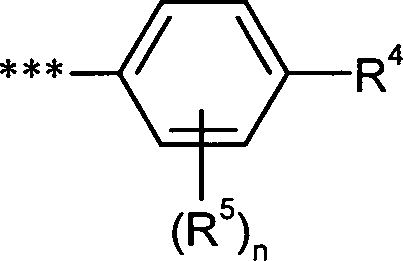
*** die Verknüpfungsstelle mit dem Ring 
R1 für Wasserstoff oder einen Substituenten ausgewählt aus der Reihe Fluor, Chlor, Brom, Cyano, (C1-C4)-Alkyl, (C2-C4)-Alkinyl, (C3-C6)-Cycloalkyl, Oxetanyl, Tetrahydrofuranyl, Tetrahydropyranyl, -OR6, -SR6, -S(=O)-R6, -S(=O)2-R6, -C(=O)-OR6, -C(=O)-NR6R7, -S(=O)2-NR6R7 und -NR6R8 steht,
wobei (C1-C4)-Alkyl und (C2-C4)-Alkinyl ihrerseits mit einem Rest ausgewählt aus der Reihe Hydroxy, (C1-C4)-Alkoxy, Trifluormethoxy, Trimethylsilyl, (C1-C4)-Alkoxycarbonyl und (C3-C6)-Cycloalkyl sowie bis zu dreifach mit Fluor substituiert sein können
und
Oxetanyl, Tetrahydrofuranyl, Tetrahydropyranyl sowie die genannten Cycloalkyl-Gruppen ihrerseits bis zu zweifach, gleich oder verschieden, mit einem Rest ausgewählt aus der Reihe Fluor, (C1-C4)-Alkyl, Trifluormethyl, Hydroxy, (C1-C4)-Alkoxy, Trifluormethoxy und (C1-C4)-Alkoxycarbonyl substituiert sein können,
und worin
R6 und R7 unabhängig voneinander Wasserstoff, (C1-C4)-Alkyl oder (C3-C6)-Cycloalkyl bedeuten,
wobei (C1-C4)-Alkyl mit einem Rest ausgewählt aus der Reihe Hydroxy, (C1-C4)-Alkoxy, Trifluormethoxy und (C3-C6)-Cycloalkyl sowie bis zu dreifach mit Fluor substituiert sein kann
und
die genannten Cycloalkyl-Gruppen bis zu zweifach, gleich oder verschieden, mit einem Rest ausgewählt aus der Reihe Fluor, (C1-C4)-Alkyl, Trifluormethyl, Hydroxy, (C1-C4)-Alkoxy und Trifluormethoxy substituiert sein können,
und
R8 Wasserstoff, Amino, (C1-C6)-Alkyl, (C3-C6)-Cycloalkyl oder 5- oder 6-gliedriges Heteroaryl bedeutet,
wobei (C1-C6)-Alkyl mit einem Rest ausgewählt aus der Reihe Hydroxy, (C1-C4)-Alkoxy, Trifluormethoxy, (C1-C4)-Alkoxycarbonyl, (C3-C6)-Cycloalkyl, Tetrahydrofuranyl, Tetrahydropyranyl und 5- oder 6-gliedriges Heteroaryl sowie bis zu dreifach mit Fluor substituiert sein kann
und wobei
Tetrahydrofuranyl, Tetrahydropyranyl sowie die genannten Cycloalkyl-Gruppen bis zu zweifach, gleich oder verschieden, mit einem Rest ausgewählt aus der Reihe Fluor, (C1-C4)-Alkyl, Trifluormethyl, Hydroxy, (C1-C4)-Alkoxy und (C1-C4)-Alkoxycarbonyl
und
die genannten Heteroaryl-Gruppen bis zu dreifach, gleich oder verschieden, mit einem Rest ausgewählt aus der Reihe (C1-C4)-Alkyl, Trifluormethyl, (C1-C4)-Alkoxy und Trifluormethoxy
substituiert sein können,
R2 für Wasserstoff oder einen Substituenten ausgewählt aus der Reihe Fluor, Chlor, Methyl, Trifluormethyl, Methoxy und Trifluormethoxy steht,
R3 für Methyl, Ethyl oder Trifluormethyl steht,
R4 für einen Substituenten ausgewählt aus der Reihe Chlor, Cyano, Pentafluorthio, (C1-C6)-Alkyl, Tri-(C1-C4)-alkylsilyl, -OR9, -NR9R10, -SR9, -S(=O)-R9, -S(=O)2-R9, -S(=O)(=NH)-R9, -S(=O)(=NCH3)-R9, (C3-C6)-Cycloalkyl und 4- bis 6-gliedriges Heterocyclyl steht,
wobei (C1-C6)-Alkyl seinerseits mit einem Rest ausgewählt aus der Reihe -OR9, -NR9R10, -N(R9)-C(=O)-R10, -C(=O)-NR9R10, (C3-C6)-Cycloalkyl, 4- bis 6-gliedriges Heterocyclyl und 5- oder 6-gliedriges Heteroaryl sowie bis zu dreifach mit Fluor substituiert sein kann
und wobei
die genannten Cycloalkyl- und Heterocyclyl-Gruppen ihrerseits bis zu zweifach, gleich oder verschieden, mit einem Rest ausgewählt aus der Reihe Fluor, (C1-C4)-Alkyl, Hydroxy, (C1-C4)-Alkoxy, Oxo, (C1-C4)-Alkylcarbonyl, Mono-(C1-C4)-alkylaminocarbonyl und Di-(C1-C4)-alkylaminocarbonyl
sowie
die genannten Heteroaryl-Gruppen ihrerseits bis zu zweifach, gleich oder verschieden, mit einem Rest ausgewählt aus der Reihe Fluor, Chlor, Cyano, (C1-C4)-Alkyl und (C1-C4)-Alkoxy
substituiert sein können,
wobei die hierin genannten (C1-C4)-Alkyl-Substituenten und die hierin genannten (C1-C4)-Alkoxy-Substituenten ihrerseits mit Hydroxy, (C1-C4)-Alkoxy, Trifluormethoxy, (C1-C4)-Alkoxycarbonyl, Mono-(C1-C4)-alkylaminocarbonyl oder Di-(C1-C4)-alkylaminocarbonyl oder bis zu dreifach mit Fluor substituiert sein können,
und worin
R9 und R10 unabhängig voneinander bei jedem einzelnen Auftreten Wasserstoff, (C1-C4)-Alkyl, (C3-C6)-Cycloalkyl oder 4- bis 6-gliedriges Heterocyclyl bedeuten,
wobei (C1-C4)-Alkyl mit einem Rest ausgewählt aus der Reihe Hydroxy, (C1-C4)-Alkoxy, Trifluormethoxy, (C3-C6)-Cycloalkyl und 4- bis 6-gliedriges Heterocyclyl sowie bis zu dreifach mit Fluor substituiert sein kann
und
die genannten Cycloalkyl- und Heterocyclyl-Gruppen bis zu zweifach, gleich oder verschieden, mit einem Rest ausgewählt aus der Reihe Fluor, (C1-C4)-Alkyl, Trifluormethyl, Hydroxy, (C1-C4)-Alkoxy, Trifluormethoxy, Oxo und (C1-C4)-Alkylcarbonyl substituiert sein können,
oder
R9 und R10 im Fall, dass beide an ein Stickstoffatom gebunden sind, zusammen mit diesem Stickstoffatom einen 4- bis 6-gliedrigen Heterocyclus bilden, der ein weiteres Ring-Heteroatom aus der Reihe N, O, S oder S(O)2 enthalten kann und der bis zu zweifach, gleich oder verschieden, mit einem Rest ausgewählt aus der Reihe Fluor, (C1-C4)-Alkyl, Trifluormethyl, Hydroxy, (C1-C4)-Alkoxy, Oxo und (C1-C4)-Alkylcarbonyl substituiert sein kann,
R5 für einen Substituenten ausgewählt aus der Reihe Fluor, Chlor und Methyl steht
und
n für die Zahl 0 oder 1 steht,
sowie ihre Salze, Solvate und Solvate der Salze.Preferred in the context of the present invention are compounds of the formula (I) in which either (a)
the ring
and
the ring
# the point of attachment to the adjacent CH 2 group
and
## the link with the ring
or (b)
the ring
and
the ring
# the point of attachment to the adjacent CH 2 group
and
## the link with the ring
* the link with the ring
and
** the point of attachment to the ring
the ring
*** the point of attachment to the ring
R 1 is hydrogen or a substituent selected from the group fluorine, chlorine, bromine, cyano, (C 1 -C 4 ) -alkyl, (C 2 -C 4 ) -alkynyl, (C 3 -C 6 ) -cycloalkyl, oxetanyl , Tetrahydrofuranyl, tetrahydropyranyl, -OR 6 , -SR 6 , -S (= O) -R 6 , -S (= O) 2 -R 6 , -C (= O) -OR 6 , -C (= O) -NR 6 R 7 , -S (= O) 2 -NR 6 R 7 and -NR 6 R 8 ,
where (C 1 -C 4 ) -alkyl and (C 2 -C 4 ) -alkynyl in turn contain a radical selected from the group consisting of hydroxy, (C 1 -C 4 ) -alkoxy, trifluoromethoxy, trimethylsilyl, (C 1 -C 4 ) -Alkoxycarbonyl and (C 3 -C 6 ) -cycloalkyl and may be substituted up to three times with fluorine
and
Oxetanyl, tetrahydrofuranyl, tetrahydropyranyl and the said cycloalkyl groups in turn up to two times, identically or differently, with a radical selected from the group fluorine, (C 1 -C 4 ) -alkyl, trifluoromethyl, hydroxy, (C 1 -C 4 ) Alkoxy, trifluoromethoxy and (C 1 -C 4 ) -alkoxycarbonyl may be substituted,
and in which
R 6 and R 7 independently of one another are hydrogen, (C 1 -C 4 ) -alkyl or (C 3 -C 6 ) -cycloalkyl,
where (C 1 -C 4 ) -alkyl can be substituted by a radical selected from the series hydroxy, (C 1 -C 4 ) -alkoxy, trifluoromethoxy and (C 3 -C 6 ) -cycloalkyl and up to three times with fluorine
and
said cycloalkyl groups may be substituted up to two times, identically or differently, by a radical selected from the group consisting of fluoro, (C 1 -C 4 ) -alkyl, trifluoromethyl, hydroxy, (C 1 -C 4 ) -alkoxy and trifluoromethoxy .
and
R 8 is hydrogen, amino, (C 1 -C 6 ) -alkyl, (C 3 -C 6 ) -cycloalkyl or 5- or 6-membered heteroaryl,
where (C 1 -C 6 ) -alkyl having one radical selected from the group consisting of hydroxy, (C 1 -C 4 ) -alkoxy, trifluoromethoxy, (C 1 -C 4 ) -alkoxycarbonyl, (C 3 -C 6 ) -cycloalkyl , Tetrahydrofuranyl, tetrahydropyranyl and 5- or 6-membered heteroaryl and may be substituted up to three times with fluorine
and where
Tetrahydrofuranyl, tetrahydropyranyl and said cycloalkyl groups up to two times, same or different, with a radical selected from the group fluorine, (C 1 -C 4 ) alkyl, trifluoromethyl, hydroxy, (C 1 -C 4 ) alkoxy and (C 1 -C 4 ) alkoxycarbonyl
and
said heteroaryl groups up to three times, identically or differently, with a radical selected from the group consisting of (C 1 -C 4 ) -alkyl, trifluoromethyl, (C 1 -C 4 ) -alkoxy and trifluoromethoxy
can be substituted
R 2 is hydrogen or a substituent selected from the group fluorine, chlorine, methyl, trifluoromethyl, methoxy and trifluoromethoxy,
R 3 is methyl, ethyl or trifluoromethyl,
R 4 is a substituent selected from the group chlorine, cyano, pentafluorothio, (C 1 -C 6 ) -alkyl, tri- (C 1 -C 4 ) -alkylsilyl, -OR 9 , -NR 9 R 10 , -SR 9 , -S (= O) -R 9 , -S (= O) 2 -R 9 , -S (= O) (= NH) -R 9 , -S (= O) (= NCH 3 ) -R 9 , (C 3 -C 6 ) -cycloalkyl and 4- to 6-membered heterocyclyl,
in which (C 1 -C 6 ) -alkyl in turn contains a radical selected from the group -OR 9 , -NR 9 R 10 , -N (R 9 ) -C (= O) -R 10 , -C (= O) -NR 9 R 10 , (C 3 -C 6 ) -cycloalkyl, 4- to 6-membered heterocyclyl and 5- or 6-membered heteroaryl and may be substituted up to three times by fluorine
and where
said cycloalkyl and heterocyclyl groups in turn up to twice, identically or differently, with a radical selected from the group consisting of fluoro, (C 1 -C 4 ) -alkyl, hydroxy, (C 1 -C 4 ) -alkoxy, oxo, (C 1 -C 4 ) -alkylcarbonyl, mono- (C 1 -C 4 ) -alkylaminocarbonyl and di- (C 1 -C 4 ) -alkylaminocarbonyl
such as
said heteroaryl groups in turn up to twice, identically or differently, with a radical selected from the group consisting of fluorine, chlorine, cyano, (C 1 -C 4 ) -alkyl and (C 1 -C 4 ) -alkoxy
can be substituted
wherein the (C 1 -C 4 ) -alkyl substituents and the (C 1 -C 4 ) -alkoxy substituents mentioned herein are in turn linked to hydroxy, (C 1 -C 4 ) -alkoxy, trifluoromethoxy, (C 1 -) C 4 ) alkoxycarbonyl, mono- (C 1 -C 4 ) -alkylaminocarbonyl or di- (C 1 -C 4 ) -alkylaminocarbonyl or may be substituted up to three times by fluorine,
and in which
R 9 and R 10 independently of one another each occurrence are hydrogen, (C 1 -C 4 ) -alkyl, (C 3 -C 6 ) -cycloalkyl or 4- to 6-membered heterocyclyl,
wherein (C 1 -C 4 ) -alkyl having a radical selected from the group consisting of hydroxy, (C 1 -C 4 ) -alkoxy, trifluoromethoxy, (C 3 -C 6 ) -cycloalkyl and 4- to 6-membered heterocyclyl and also to may be substituted in trisubstituted with fluorine
and
said cycloalkyl and heterocyclyl groups up to two times, identically or differently, with a radical selected from the group fluorine, (C 1 -C 4 ) -alkyl, trifluoromethyl, hydroxy, (C 1 -C 4 ) -alkoxy, trifluoromethoxy , Oxo and (C 1 -C 4 ) -alkylcarbonyl may be substituted,
or
R 9 and R 10 in the case where both are attached to a nitrogen atom together with this nitrogen atom form a 4- to 6-membered heterocycle which is another ring heteroatom from the series N, O, S or S (O) 2 may contain up to two times, identically or differently, with a radical selected from the group fluorine, (C 1 -C 4 ) -alkyl, trifluoromethyl, hydroxy, (C 1 -C 4 ) -alkoxy, oxo and (C 1 C 4 ) -alkylcarbonyl may be substituted,
R 5 is a substituent selected from the group fluorine, chlorine and methyl
and
n is the number 0 or 1,
and their salts, solvates and solvates of the salts.
Eine alternative Ausführungsform innerhalb der zuletzt beschriebenen Ausführungsform umfasst Verbindungen der Formel (I), in welcher
R1 für Wasserstoff oder einen Substituenten ausgewählt aus der Reihe Fluor, Chlor, Brom, Cyano, (C1-C4)-Alkyl, (C2-C4)-Alkinyl, (C3-C6)-Cycloalkyl, -OR6, -SR6, -S(=O)-R6, -S(=O)2-R6, -C(=O)-OR6, -C(=O)-NR6R7, -S(=O)2-NR6R7 und -NR6R8 steht,
wobei (C1-C4)-Alkyl und (C2-C4)-Alkinyl ihrerseits mit einem Rest ausgewählt aus der Reihe Hydroxy, (C1-C4)-Alkoxy, Trifluormethoxy, Trimethylsilyl, (C1-C4)-Alkoxycarbonyl und (C3-C6)-Cycloalkyl sowie bis zu dreifach mit Fluor substituiert sein können
und
die genannten Cycloalkyl-Gruppen ihrerseits bis zu zweifach, gleich oder verschieden, mit einem Rest ausgewählt aus der Reihe Fluor, (C1-C4)-Alkyl, Trifluormethyl, Hydroxy, (C1-C4)-Alkoxy, Trifluormethoxy und (C1-C4)-Alkoxycarbonyl substituiert sein können,
und worin
R6 und R7 die in der zuletzt beschriebenen Ausführungsform genannten Bedeutungen haben
und
R8 Wasserstoff, (C1-C6)-Alkyl, (C3-C6)-Cycloalkyl oder 5- oder 6-gliedriges Heteroaryl bedeutet,
wobei (C1-C6)-Alkyl mit einem Rest ausgewählt aus der Reihe Hydroxy, (C1-C4)-Alkoxy, Trifluormethoxy, (C1-C4)-Alkoxycarbonyl, (C3-C6)-Cycloalkyl, Tetrahydrofuranyl, Tetrahydropyranyl und 5- oder 6-gliedriges Heteroaryl sowie bis zu dreifach mit Fluor substituiert sein kann
und wobei
Tetrahydrofuranyl, Tetrahydropyranyl sowie die genannten Cycloalkyl-Gruppen bis zu zweifach, gleich oder verschieden, mit einem Rest ausgewählt aus der Reihe Fluor, (C1-C4)-Alkyl, Trifluormethyl, Hydroxy, (C1-C4)-Alkoxy und (C1-C4)-Alkoxycarbonyl
und
die genannten Heteroaryl-Gruppen bis zu dreifach, gleich oder verschieden, mit einem Rest ausgewählt aus der Reihe (C1-C4)-Alkyl, Trifluormethyl, (C1-C4)-Alkoxy und Trifluormethoxy
substituiert sein können,
und
R4 für einen Substituenten ausgewählt aus der Reihe Chlor, Cyano, Pentafluorthio, (C1-C6)-Alkyl, Tri-(C1-C4)-alkylsilyl, -OR9, -NR9R10, -SR9, -S(=O)-R9, -S(=O)2-R9, (C3-C6)-Cycloalkyl und 4- bis 6-gliedriges Heterocyclyl steht,
wobei (C1-C6)-Alkyl seinerseits mit einem Rest ausgewählt aus der Reihe -OR9, -NR9R10, -N(R9)-C(=O)-R10, -C(=O)-NR9R10, (C3-C6)-Cycloalkyl, 4- bis 6-gliedriges Heterocyclyl und 5- oder 6-gliedriges Heteroaryl sowie bis zu dreifach mit Fluor substituiert sein kann
und wobei
die genannten Cycloalkyl- und Heterocyclyl-Gruppen ihrerseits bis zu zweifach, gleich oder verschieden, mit einem Rest ausgewählt aus der Reihe Fluor, (C1-C4)-Alkyl, Trifluormethyl, Hydroxy, (C1-C4)-Alkoxy, Trifluormethoxy, Oxo und (C1-C4)-Alkylcarbonyl
sowie
die genannten Heteroaryl-Gruppen ihrerseits bis zu zweifach, gleich oder verschieden, mit einem Rest ausgewählt aus der Reihe Fluor, Chlor, Cyano, (C1-C4)-Alkyl, Trifluormethyl, (C1-C4)-Alkoxy und Trifluormethoxy
substituiert sein können,
und worin R9 und R10 die in der zuletzt beschriebenen Ausführungsform genannten Bedeutungen haben,
sowie ihre Salze, Solvate und Solvate der Salze.An alternative embodiment within the last-described embodiment comprises compounds of the formula (I) in which
R 1 is hydrogen or a substituent selected from the group fluorine, chlorine, bromine, cyano, (C 1 -C 4 ) -alkyl, (C 2 -C 4 ) -alkynyl, (C 3 -C 6 ) -cycloalkyl, - OR 6 , -SR 6 , -S (= O) -R 6 , -S (= O) 2 -R 6 , -C (= O) -OR 6 , -C (= O) -NR 6 R 7 , -S (= O) 2 -NR 6 R 7 and -NR 6 R 8 ,
where (C 1 -C 4 ) -alkyl and (C 2 -C 4 ) -alkynyl in turn contain a radical selected from the group consisting of hydroxy, (C 1 -C 4 ) -alkoxy, trifluoromethoxy, trimethylsilyl, (C 1 -C 4 ) -Alkoxycarbonyl and (C 3 -C 6 ) -cycloalkyl and may be substituted up to three times with fluorine
and
the said cycloalkyl groups themselves are up to twice, identically or differently, selected from the group fluorine, (C 1 -C 4 ) -alkyl, trifluoromethyl, hydroxy, (C 1 -C 4 ) -alkoxy, trifluoromethoxy and ( C 1 -C 4 ) -alkoxycarbonyl may be substituted,
and in which
R 6 and R 7 have the meanings mentioned in the last-described embodiment
and
R 8 is hydrogen, (C 1 -C 6 ) -alkyl, (C 3 -C 6 ) -cycloalkyl or 5- or 6-membered heteroaryl,
where (C 1 -C 6 ) -alkyl having one radical selected from the group consisting of hydroxy, (C 1 -C 4 ) -alkoxy, trifluoromethoxy, (C 1 -C 4 ) -alkoxycarbonyl, (C 3 -C 6 ) -cycloalkyl , Tetrahydrofuranyl, tetrahydropyranyl and 5- or 6-membered heteroaryl and may be substituted up to three times with fluorine
and where
Tetrahydrofuranyl, tetrahydropyranyl and said cycloalkyl groups up to two times, same or different, with a radical selected from the group fluorine, (C 1 -C 4 ) alkyl, trifluoromethyl, hydroxy, (C 1 -C 4 ) alkoxy and (C 1 -C 4 ) alkoxycarbonyl
and
said heteroaryl groups up to three times, identically or differently, with a radical selected from the group consisting of (C 1 -C 4 ) -alkyl, trifluoromethyl, (C 1 -C 4 ) -alkoxy and trifluoromethoxy
can be substituted
and
R 4 is a substituent selected from the group chlorine, cyano, pentafluorothio, (C 1 -C 6 ) -alkyl, tri- (C 1 -C 4 ) -alkylsilyl, -OR 9 , -NR 9 R 10 , -SR 9 , -S (= O) -R 9 , -S (= O) 2 -R 9 , (C 3 -C 6 ) -cycloalkyl and 4- to 6-membered heterocyclyl,
in which (C 1 -C 6 ) -alkyl in turn contains a radical selected from the group -OR 9 , -NR 9 R 10 , -N (R 9 ) -C (= O) -R 10 , -C (= O) -NR 9 R 10 , (C 3 -C 6 ) -cycloalkyl, 4- to 6-membered heterocyclyl and 5- or 6-membered heteroaryl and may be substituted up to three times by fluorine
and where
the said cycloalkyl and heterocyclyl groups themselves are up to twice, identically or differently, selected from the group fluorine, (C 1 -C 4 ) -alkyl, trifluoromethyl, hydroxy, (C 1 -C 4 ) -alkoxy, Trifluoromethoxy, oxo and (C 1 -C 4 ) -alkylcarbonyl
such as
said heteroaryl groups in turn up to twice, identically or differently, with a radical selected from the group consisting of fluorine, chlorine, cyano, (C 1 -C 4 ) -alkyl, trifluoromethyl, (C 1 -C 4 ) -alkoxy and trifluoromethoxy
can be substituted
and R 9 and R 10 have the meanings given in the last-described embodiment,
and their salts, solvates and solvates of the salts.
Besonders bevorzugt im Rahmen der vorliegenden Erfindung sind Verbindungen der Formel (I), in welcher
der Ring 
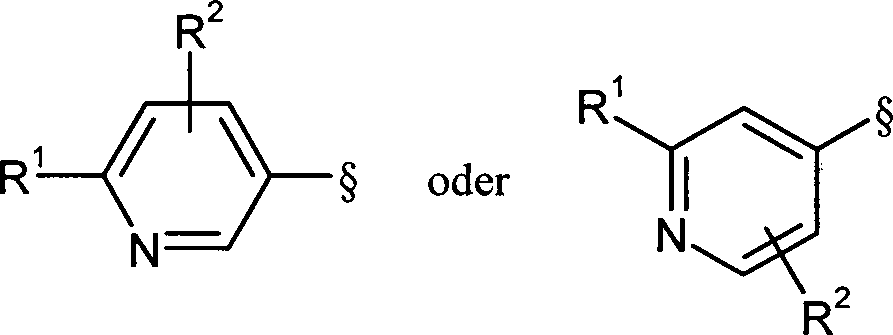
§ die Verknüpfungsstelle mit der angrenzenden CH2-Gruppe bezeichnet,
der Ring 

# die Verknüpfungsstelle mit der angrenzenden CH2-Gruppe
und
## die Verknüpfungsstelle mit dem Ring 
der Ring 

* die Verknüpfungsstelle mit dem Ring 
und
** die Verknüpfungsstelle mit dem Ring 
der Ring 

*** die Verknüpfungsstelle mit dem Ring 
R1 für Wasserstoff oder einen Substituenten ausgewählt aus der Reihe Chlor, Cyano, (C1-C4)-Alkyl, (C2-C4)-Alkinyl, Cyclopropyl, Cyclobutyl, Oxetanyl, Tetrahydropyranyl, -OR6, -SR6, -S(=O)-R6, -S(=O)2-R6, -C(=O)-OR6, -C(=O)-NR6R7, -S(=O)2-NR6R7 und -NR6R8 steht,
wobei (C1-C4)-Alkyl und (C2-C4)-Alkinyl ihrerseits mit einem Rest ausgewählt aus der Reihe Hydroxy, Methoxy, Ethoxy, Trifluormethoxy, Cyclopropyl und Cyclobutyl sowie bis zu dreifach mit Fluor substituiert sein können
und
Oxetanyl und Tetrahydropyranyl ihrerseits mit Methyl, Ethyl, Hydroxy, Methoxy oder Ethoxy substituiert sein können
und
die genannten Cyclopropyl- und Cyclobutyl-Gruppen ihrerseits bis zu zweifach, gleich oder verschieden, mit einem Rest ausgewählt aus der Reihe Fluor, Methyl, Ethyl und Trifluormethyl substituiert sein können,
und worin
R6 und R7 unabhängig voneinander Wasserstoff, (C1-C4)-Alkyl oder (C3-C6)-Cycloalkyl bedeuten,
wobei (C1-C4)-Alkyl mit einem Rest ausgewählt aus der Reihe Hydroxy, Methoxy, Ethoxy, Trifluormethoxy, Cyclopropyl und Cyclobutyl sowie bis zu dreifach mit Fluor substituiert sein kann,
und
R8 Wasserstoff, (C1-C4)-Alkyl, (C3-C6)-Cycloalkyl oder 5- oder 6-gliedriges Heteroaryl bedeutet,
wobei (C1-C4)-Alkyl mit einem Rest ausgewählt aus der Reihe Hydroxy, Methoxy, Ethoxy, Trifluormethoxy, (C3-C6)-Cycloalkyl, Tetrahydrofuranyl, Tetrahydropyranyl und 5- oder 6-gliedriges Heteroaryl sowie bis zu dreifach mit Fluor substituiert sein kann
und wobei
Tetrahydrofuranyl, Tetrahydropyranyl sowie die genannten Cycloalkyl-Gruppen bis zu zweifach, gleich oder verschieden, mit einem Rest ausgewählt aus der Reihe Fluor, Methyl, Ethyl, Trifluormethyl, Hydroxy, Methoxy und Ethoxy
und
die genannten Heteroaryl-Gruppen bis zu dreifach, gleich oder verschieden, mit einem Rest ausgewählt aus der Reihe Methyl, Ethyl und Trifluormethyl
substituiert sein können,
R2 für Wasserstoff oder einen Substituenten ausgewählt aus der Reihe Fluor, Chlor, Methyl und Methoxy steht,
R3 für Methyl steht,
R4 für einen Substituenten ausgewählt aus der Reihe Chlor, Pentafluorthio, (C1-C6)-Alkyl, Trimethylsilyl, -OR9, -SR9, -S(=O)-R9, -S(=O)2-R9, -S(=O)(=NH)-R9, -S(=O)(=NCH3)-R9, (C3-C6)-Cycloalkyl und 4- bis 6-gliedriges Heterocyclyl steht,
wobei (C1-C6)-Alkyl seinerseits mit einem Rest ausgewählt aus der Reihe -OR9, -NR9R10, -C(=O)-NR9R10, (C3-C6)-Cycloalkyl und 4- bis 6-gliedriges Heterocyclyl sowie bis zu dreifach mit Fluor substituiert sein kann
und
die genannten Cycloalkyl- und Heterocyclyl-Gruppen ihrerseits bis zu zweifach, gleich oder verschieden, mit einem Rest ausgewählt aus der Reihe Fluor, (C1-C4)-Alkyl, (C1-C4)-Alkoxy und Oxo substituiert sein können,
wobei der genannte (C1-C4)-Alkyl-Substituent und der (C1-C4)-Alkoxy-Substituent ihrerseits mit Hydroxy, Methoxy, Trifluormethoxy, Ethoxy, Methoxycarbonyl, Ethoxycarbonyl, tert.-Butoxycarbonyl, Methylaminocarbonyl oder Dimethylaminocarbonyl oder bis zu dreifach mit Fluor substituiert sein können,
und worin
R9 und R10 unabhängig voneinander bei jedem einzelnen Auftreten Wasserstoff, (C1-C4)-Alkyl oder (C3-C6)-Cycloalkyl bedeuten,
wobei (C1-C4)-Alkyl mit einem Rest ausgewählt aus der Reihe Hydroxy, (C1-C4)-Alkoxy, Trifluormethoxy und (C3-C6)-Cycloalkyl sowie bis zu dreifach mit Fluor substituiert sein kann
und
die genannten Cycloalkyl-Gruppen bis zu zweifach, gleich oder verschieden, mit einem Rest ausgewählt aus der Reihe Fluor, (C1-C4)-Alkyl, Trifluormethyl, (C1-C4)-Alkoxy und Trifluormethoxy substituiert sein können,
oder
R9 und R10 im Fall, dass beide an ein Stickstoffatom gebunden sind, zusammen mit diesem Stickstoffatom einen 4- bis 6-gliedrigen Heterocyclus bilden, der ein weiteres Ring-Heteroatom aus der Reihe N, O, S oder S(O)2 enthalten kann und der bis zu zweifach, gleich oder verschieden, mit einem Rest ausgewählt aus der Reihe Fluor, (C1-C4)-Alkyl, Hydroxy, (C1-C4)-Alkoxy, Oxo, Acetyl und Propionyl substituiert sein kann,
R5 für Fluor steht
und
n für die Zahl 0 oder 1 steht,
sowie ihre Salze, Solvate und Solvate der Salze.Particularly preferred in the context of the present invention are compounds of the formula (I) in which
the ring
§ denotes the point of attachment to the adjacent CH 2 group,
the ring
# the point of attachment to the adjacent CH 2 group
and
## the link with the ring
the ring
* the link with the ring
and
** the point of attachment to the ring
the ring
*** the point of attachment to the ring
R 1 is hydrogen or a substituent selected from the group chlorine, cyano, (C 1 -C 4 ) -alkyl, (C 2 -C 4 ) -alkynyl, cyclopropyl, cyclobutyl, oxetanyl, tetrahydropyranyl, -OR 6 , -SR 6 , -S (= O) -R 6 , -S (= O) 2 -R 6 , -C (= O) -OR 6 , -C (= O) -NR 6 R 7 , -S (= O) 2 -NR 6 R 7 and -NR 6 R 8 ,
where (C 1 -C 4 ) -alkyl and (C 2 -C 4 ) -alkynyl may in turn be substituted by one radical selected from the series hydroxy, methoxy, ethoxy, trifluoromethoxy, cyclopropyl and cyclobutyl and up to three times by fluorine
and
Oxetanyl and tetrahydropyranyl may in turn be substituted by methyl, ethyl, hydroxy, methoxy or ethoxy
and
the said cyclopropyl and cyclobutyl groups may in turn be substituted up to twice, identically or differently, by a radical selected from the group consisting of fluorine, methyl, ethyl and trifluoromethyl,
and in which
R 6 and R 7 independently of one another are hydrogen, (C 1 -C 4 ) -alkyl or (C 3 -C 6 ) -cycloalkyl,
where (C 1 -C 4 ) -alkyl may be substituted by a radical selected from the series hydroxy, methoxy, ethoxy, trifluoromethoxy, cyclopropyl and cyclobutyl and up to three times by fluorine,
and
R 8 is hydrogen, (C 1 -C 4 ) -alkyl, (C 3 -C 6 ) -cycloalkyl or 5- or 6-membered heteroaryl,
wherein (C 1 -C 4 ) -alkyl having a radical selected from the series hydroxy, methoxy, ethoxy, trifluoromethoxy, (C 3 -C 6 ) -cycloalkyl, tetrahydrofuranyl, tetrahydropyranyl and 5- or 6-membered heteroaryl and up to three times may be substituted with fluorine
and where
Tetrahydrofuranyl, tetrahydropyranyl and said cycloalkyl groups up to two times, same or different, with a radical selected from the group fluorine, methyl, ethyl, trifluoromethyl, hydroxy, methoxy and ethoxy
and
said heteroaryl groups up to three times, identically or differently, with a radical selected from the group consisting of methyl, ethyl and trifluoromethyl
can be substituted
R 2 is hydrogen or a substituent selected from the group fluorine, chlorine, methyl and methoxy,
R 3 is methyl,
R 4 is a substituent selected from the group consisting of chlorine, pentafluorothio, (C 1 -C 6 ) -alkyl, trimethylsilyl, -OR 9 , -SR 9 , -S (= O) -R 9 , -S (= O) 2 -R 9 , -S (= O) (= NH) -R 9 , -S (= O) (= NCH 3 ) -R 9 , (C 3 -C 6 ) -cycloalkyl and 4- to 6-membered heterocyclyl stands,
wherein (C 1 -C 6 ) -alkyl in turn having a radical selected from the group -OR 9 , -NR 9 R 10 , -C (= O) -NR 9 R 10 , (C 3 -C 6 ) -cycloalkyl and 4- to 6-membered heterocyclyl and may be substituted up to three times with fluorine
and
the said cycloalkyl and heterocyclyl groups in turn may be substituted up to two times, identically or differently, by a radical selected from the group consisting of fluoro, (C 1 -C 4 ) -alkyl, (C 1 -C 4 ) -alkoxy and oxo .
wherein said (C 1 -C 4 ) alkyl substituent and the (C 1 -C 4 ) alkoxy substituent are themselves hydroxy, methoxy, trifluoromethoxy, ethoxy, methoxycarbonyl, ethoxycarbonyl, tert -butoxycarbonyl, methylaminocarbonyl or dimethylaminocarbonyl or can be substituted up to three times with fluorine,
and in which
R 9 and R 10 independently of one another at each occurrence represent hydrogen, (C 1 -C 4 ) -alkyl or (C 3 -C 6 ) -cycloalkyl,
where (C 1 -C 4 ) -alkyl can be substituted by a radical selected from the series hydroxy, (C 1 -C 4 ) -alkoxy, trifluoromethoxy and (C 3 -C 6 ) -cycloalkyl and up to three times with fluorine
and
said cycloalkyl groups may be substituted up to two times, identically or differently, by a radical selected from the group consisting of fluoro, (C 1 -C 4 ) -alkyl, trifluoromethyl, (C 1 -C 4 ) -alkoxy and trifluoromethoxy,
or
R 9 and R 10 in the case that both are attached to a nitrogen atom together with this nitrogen atom form a 4- to 6-membered heterocycle which is another ring heteroatom from the series N, O, S or May contain S (O) 2 and which may be up to twice, identically or differently, selected from the group consisting of fluorine, (C 1 -C 4 ) -alkyl, hydroxy, (C 1 -C 4 ) -alkoxy, oxo, Acetyl and propionyl may be substituted,
R 5 is fluorine
and
n is the number 0 or 1,
and their salts, solvates and solvates of the salts.
Eine alternative Ausführungsform innerhalb der zuletzt beschriebenen Ausführungsform umfasst Verbindungen der Formel (I), in welcher
R1 für Wasserstoff oder einen Substituenten ausgewählt aus der Reihe Chlor, Cyano, (C1-C4)-Alkyl, (C2-C4)-Alkinyl, Cyclopropyl, Cyclobutyl, -OR6, -SR6, -S(=O)-R6, -S(=O)2-R6, -C(O)-OR6, -C(=O)-OR6, -C(=O)-NR6R7, -S(=O)2-NR6R7 und -NR6R8 steht,
wobei (C1-C4)-Alkyl und (C2-C4)-Alkinyl ihrerseits mit einem Rest ausgewählt aus der Reihe Hydroxy, Methoxy, Ethoxy, Trifluormethoxy, Cyclopropyl und Cyclobutyl sowie bis zu dreifach mit Fluor substituiert sein können
und
die genannten Cyclopropyl- und Cyclobutyl-Gruppen ihrerseits bis zu zweifach, gleich oder verschieden, mit einem Rest ausgewählt aus der Reihe Fluor, Methyl, Ethyl und Trifluormethyl substituiert sein können,
und worin R6, R7 und R8 die in der zuletzt beschriebenen Ausführungsform genannten Bedeutungen haben,
und
R4 für einen Substituenten ausgewählt aus der Reihe Chlor, Pentafluorthio, (C1-C6)-Alkyl, Trimethylsilyl, -OR9, -SR9, -S(=O)-R9, -S(=O)2-R9, (C3-C6)-Cycloalkyl und 4- bis 6-gliedriges Heterocyclyl steht,
wobei (C1-C6)-Alkyl seinerseits mit einem Rest ausgewählt aus der Reihe -OR9, -NR9R10, -C(=O)-NR9R10, (C3-C6)-Cycloalkyl und 4- bis 6-gliedriges Heterocyclyl sowie bis zu dreifach mit Fluor substituiert sein kann
und
die genannten Cycloalkyl- und Heterocyclyl-Gruppen ihrerseits bis zu zweifach, gleich oder verschieden, mit einem Rest ausgewählt aus der Reihe Fluor, (C1-C4)-Alkyl, Trifluormethyl, (C1-C4)-Alkoxy, Trifluormethoxy und Oxo substituiert sein können,
und worin R9 und R10 die in der zuletzt beschriebenen Ausführungsform genannten Bedeutungen haben,
sowie ihre Salze, Solvate und Solvate der Salze.An alternative embodiment within the last-described embodiment comprises compounds of the formula (I) in which
R 1 is hydrogen or a substituent selected from the group chlorine, cyano, (C 1 -C 4 ) -alkyl, (C 2 -C 4 ) -alkynyl, cyclopropyl, cyclobutyl, -OR 6 , -SR 6 , -S ( = O) -R 6 , -S (= O) 2 -R 6 , -C (O) -OR 6 , -C (= O) -OR 6 , -C (= O) -NR 6 R 7 , - S (= O) 2 -NR 6 R 7 and -NR 6 R 8 ,
where (C 1 -C 4 ) -alkyl and (C 2 -C 4 ) -alkynyl may in turn be substituted by one radical selected from the series hydroxy, methoxy, ethoxy, trifluoromethoxy, cyclopropyl and cyclobutyl and up to three times by fluorine
and
the said cyclopropyl and cyclobutyl groups may in turn be substituted up to twice, identically or differently, by a radical selected from the group consisting of fluorine, methyl, ethyl and trifluoromethyl,
and wherein R 6 , R 7 and R 8 have the meanings given in the last-described embodiment,
and
R 4 is a substituent selected from the group consisting of chlorine, pentafluorothio, (C 1 -C 6 ) -alkyl, trimethylsilyl, -OR 9 , -SR 9 , -S (= O) -R 9 , -S (= O) 2 R 9 , (C 3 -C 6 ) -cycloalkyl and 4- to 6-membered heterocyclyl,
wherein (C 1 -C 6 ) -alkyl in turn having a radical selected from the group -OR 9 , -NR 9 R 10 , -C (= O) -NR 9 R 10 , (C 3 -C 6 ) -cycloalkyl and 4- to 6-membered heterocyclyl and may be substituted up to three times with fluorine
and
the said cycloalkyl and heterocyclyl groups in turn up to two times, identically or differently, with a radical selected from the group fluorine, (C 1 -C 4 ) alkyl, trifluoromethyl, (C 1 -C 4 ) alkoxy, trifluoromethoxy and Oxo may be substituted,
and R 9 and R 10 have the meanings given in the last-described embodiment,
and their salts, solvates and solvates of the salts.
Besonders bevorzugt sind auch Verbindungen der Formel (I), in welcher
der Ring 

§ die Verknüpfungsstelle mit der angrenzenden CH2-Gruppe bezeichnet,
der Ring 

# die Verknüpfungsstelle mit der angrenzenden CH2-Gruppe
und
## die Verknüpfungsstelle mit dem Ring 
der Ring 

* die Verknüpfungsstelle mit dem Ring 
und
** die Verknüpfungsstelle mit dem Ring 
der Ring 

*** die Verknüpfungsstelle mit dem Ring 
R1 für Wasserstoff oder einen Substituenten ausgewählt aus der Reihe Chlor, Cyano, (C1-C4)-Alkyl, (C2-C4)-Alkinyl, Cyclopropyl, Cyclobutyl, Oxetanyl, Tetrahydropyranyl, -OR6, -SR6, -S(=O)-R6, -S(=O)2-R6, -C(=O)-OR6, -C(=O)-NR6R7, -S(=O)2-NR6R7 und -NR6R8 steht,
wobei (C1-C4)-Alkyl und (C2-C4)-Alkinyl ihrerseits mit einem Rest ausgewählt aus der Reihe Hydroxy, Methoxy, Ethoxy, Trifluormethoxy, Cyclopropyl und Cyclobutyl sowie bis zu dreifach mit Fluor substituiert sein können
und
Oxetanyl und Tetrahydropyranyl ihrerseits mit Methyl, Ethyl, Hydroxy, Methoxy oder Ethoxy substituiert sein können
und
die genannten Cyclopropyl- und Cyclobutyl-Gruppen ihrerseits bis zu zweifach, gleich oder verschieden, mit einem Rest ausgewählt aus der Reihe Fluor, Methyl, Ethyl und Trifluormethyl substituiert sein können,
und worin
R6 und R7 unabhängig voneinander Wasserstoff, (C1-C4)-Alkyl oder (C3-C6)-Cycloalkyl bedeuten,
wobei (C1-C4)-Alkyl mit einem Rest ausgewählt aus der Reihe Hydroxy, Methoxy, Ethoxy, Trifluormethoxy, Cyclopropyl und Cyclobutyl sowie bis zu dreifach mit Fluor substituiert sein kann,
und
R8 Wasserstoff, (C1-C4)-Alkyl, (C3-C6)-Cycloalkyl oder 5- oder 6-gliedriges Heteroaryl bedeutet,
wobei (C1-C4)-Alkyl mit einem Rest ausgewählt aus der Reihe Hydroxy, Methoxy, Ethoxy, Trifluormethoxy, (C3-C6)-Cycloalkyl, Tetrahydrofuranyl, Tetrahydropyranyl und 5- oder 6-gliedriges Heteroaryl sowie bis zu dreifach mit Fluor substituiert sein kann
und wobei
Tetrahydrofuranyl, Tetrahydropyranyl sowie die genannten Cycloalkyl-Gruppen bis zu zweifach, gleich oder verschieden, mit einem Rest ausgewählt aus der Reihe Fluor, Methyl, Ethyl, Trifluormethyl, Hydroxy, Methoxy und Ethoxy
und
die genannten Heteroaryl-Gruppen bis zu dreifach, gleich oder verschieden, mit einem Rest ausgewählt aus der Reihe Methyl, Ethyl und Trifluormethyl substituiert sein können,
R2 für Wasserstoff oder einen Substituenten ausgewählt aus der Reihe Fluor, Chlor, Methyl und Methoxy steht,
R3 für Methyl steht,
R4 für einen Substituenten ausgewählt aus der Reihe Chlor, Pentafluorthio, (C1-C6)-Alkyl, Trimethylsilyl, -OR9, -SR9, -S(=O)-R9, -S(=O)2-R9, -S(=O)(=NH)-R9, -S(=O)(=NCH3)-R9, (C3-C6)-Cycloalkyl und 4- bis 6-gliedriges Heterocyclyl steht,
wobei (C1-C6)-Alkyl seinerseits mit einem Rest ausgewählt aus der Reihe -OR9, -NR9R10, -C(=O)-NR9R10, (C3-C6)-Cycloalkyl und 4- bis 6-gliedriges Heterocyclyl sowie bis zu dreifach mit Fluor substituiert sein kann
und
die genannten Cycloalkyl- und Heterocyclyl-Gruppen ihrerseits bis zu zweifach, gleich oder verschieden, mit einem Rest ausgewählt aus der Reihe Fluor, (C1-C4)-Alkyl, (C1-C4)-Alkoxy und Oxo substituiert sein können,
wobei der genannte (C1-C4)-Alkyl-Substituent und der (C1-C4)-Alkoxy-Substituent ihrerseits mit Hydroxy, Methoxy, Trifluormethoxy, Ethoxy, Methoxycarbonyl, Ethoxycarbonyl, tert.-Butoxycarbonyl, Methylaminocarbonyl oder Dimethylaminocarbonyl oder bis zu dreifach mit Fluor substituiert sein können,
und worin
R9 und R10 unabhängig voneinander bei jedem einzelnen Auftreten Wasserstoff, (C1-C4)-Alkyl oder (C3-C6)-Cycloalkyl bedeuten,
wobei (C1-C4)-Alkyl mit einem Rest ausgewählt aus der Reihe Hydroxy, (C1-C4)-Alkoxy, Trifluormethoxy und (C3-C6)-Cycloalkyl sowie bis zu dreifach mit Fluor substituiert sein kann
und
die genannten Cycloalkyl-Gruppen bis zu zweifach, gleich oder verschieden, mit einem Rest ausgewählt aus der Reihe Fluor, (C1-C4)-Alkyl, Trifluormethyl, (C1-C4)-Alkoxy und Trifluormethoxy substituiert sein können,
oder
R9 und R10 im Fall, dass beide an ein Stickstoffatom gebunden sind, zusammen mit diesem Stickstoffatom einen 4- bis 6-gliedrigen Heterocyclus bilden, der ein weiteres Ring-Heteroatom aus der Reihe N, O, S oder S(O)2 enthalten kann und der bis zu zweifach, gleich oder verschieden, mit einem Rest ausgewählt aus der Reihe Fluor, (C1-C4)-Alkyl, Hydroxy, (C1-C4)-Alkoxy, Oxo, Acetyl und Propionyl substituiert sein kann,
R5 für Fluor steht
und
n für die Zahl 0 oder 1 steht,
sowie ihre Salze, Solvate und Solvate der Salze.Particular preference is also given to compounds of the formula (I) in which
the ring
§ denotes the point of attachment to the adjacent CH 2 group,
the ring
# the point of attachment to the adjacent CH 2 group
and
## the link with the ring
the ring
* the link with the ring
and
** the point of attachment to the ring
the ring
*** the point of attachment to the ring
R 1 is hydrogen or a substituent selected from the group chlorine, cyano, (C 1 -C 4 ) -alkyl, (C 2 -C 4 ) -alkynyl, cyclopropyl, cyclobutyl, oxetanyl, tetrahydropyranyl, -OR 6 , -SR 6 , -S (= O) -R 6 , -S (= O) 2 -R 6 , -C (= O) -OR 6 , -C (= O) -NR 6 R 7 , -S (= O) 2 -NR 6 R 7 and -NR 6 R 8 ,
where (C 1 -C 4 ) -alkyl and (C 2 -C 4 ) -alkynyl may in turn be substituted by one radical selected from the series hydroxy, methoxy, ethoxy, trifluoromethoxy, cyclopropyl and cyclobutyl and up to three times by fluorine
and
Oxetanyl and tetrahydropyranyl may in turn be substituted by methyl, ethyl, hydroxy, methoxy or ethoxy
and
the said cyclopropyl and cyclobutyl groups may in turn be substituted up to twice, identically or differently, by a radical selected from the group consisting of fluorine, methyl, ethyl and trifluoromethyl,
and in which
R 6 and R 7 independently of one another are hydrogen, (C 1 -C 4 ) -alkyl or (C 3 -C 6 ) -cycloalkyl,
where (C 1 -C 4 ) -alkyl may be substituted by a radical selected from the series hydroxy, methoxy, ethoxy, trifluoromethoxy, cyclopropyl and cyclobutyl and up to three times by fluorine,
and
R 8 is hydrogen, (C 1 -C 4 ) -alkyl, (C 3 -C 6 ) -cycloalkyl or 5- or 6-membered heteroaryl,
wherein (C 1 -C 4 ) -alkyl having a radical selected from the series hydroxy, methoxy, ethoxy, trifluoromethoxy, (C 3 -C 6 ) -cycloalkyl, tetrahydrofuranyl, tetrahydropyranyl and 5- or 6-membered heteroaryl and up to three times may be substituted with fluorine
and where
Tetrahydrofuranyl, tetrahydropyranyl and said cycloalkyl groups up to two times, same or different, with a radical selected from the group fluorine, methyl, ethyl, trifluoromethyl, hydroxy, methoxy and ethoxy
and
said heteroaryl groups may be substituted up to three times, identically or differently, by a radical selected from the group consisting of methyl, ethyl and trifluoromethyl,
R 2 is hydrogen or a substituent selected from the group fluorine, chlorine, methyl and methoxy,
R 3 is methyl,
R 4 is a substituent selected from the group consisting of chlorine, pentafluorothio, (C 1 -C 6 ) -alkyl, trimethylsilyl, -OR 9 , -SR 9 , -S (= O) -R 9 , -S (= O) 2 -R 9 , -S (= O) (= NH) -R 9 , -S (= O) (= NCH 3 ) -R 9 , (C 3 -C 6 ) -cycloalkyl and 4- to 6-membered heterocyclyl stands,
wherein (C 1 -C 6 ) -alkyl in turn having a radical selected from the group -OR 9 , -NR 9 R 10 , -C (= O) -NR 9 R 10 , (C 3 -C 6 ) -cycloalkyl and 4- to 6-membered heterocyclyl and may be substituted up to three times with fluorine
and
the said cycloalkyl and heterocyclyl groups in turn may be substituted up to two times, identically or differently, by a radical selected from the group consisting of fluoro, (C 1 -C 4 ) -alkyl, (C 1 -C 4 ) -alkoxy and oxo .
wherein said (C 1 -C 4 ) alkyl substituent and the (C 1 -C 4 ) alkoxy substituent are themselves hydroxy, methoxy, trifluoromethoxy, ethoxy, methoxycarbonyl, ethoxycarbonyl, tert -butoxycarbonyl, methylaminocarbonyl or dimethylaminocarbonyl or can be substituted up to three times with fluorine,
and in which
R 9 and R 10 independently of one another at each occurrence represent hydrogen, (C 1 -C 4 ) -alkyl or (C 3 -C 6 ) -cycloalkyl,
where (C 1 -C 4 ) -alkyl can be substituted by a radical selected from the series hydroxy, (C 1 -C 4 ) -alkoxy, trifluoromethoxy and (C 3 -C 6 ) -cycloalkyl and up to three times with fluorine
and
said cycloalkyl groups may be substituted up to two times, identically or differently, by a radical selected from the group consisting of fluoro, (C 1 -C 4 ) -alkyl, trifluoromethyl, (C 1 -C 4 ) -alkoxy and trifluoromethoxy,
or
R 9 and R 10 in the case where both are attached to a nitrogen atom together with this nitrogen atom form a 4- to 6-membered heterocycle which is another ring heteroatom from the series N, O, S or S (O) 2 may be substituted up to two times, identically or differently, with a radical selected from the group consisting of fluorine, (C 1 -C 4 ) -alkyl, hydroxy, (C 1 -C 4 ) -alkoxy, oxo, acetyl and propionyl can
R 5 is fluorine
and
n is the number 0 or 1,
and their salts, solvates and solvates of the salts.
Eine alternative Ausführungsform innerhalb der zuletzt beschriebenen Ausführungsform umfasst Verbindungen der Formel (I), in welcher
R1 für Wasserstoff oder einen Substituenten ausgewählt aus der Reihe Chlor, Cyano, (C1-C4)-Alkyl, (C2-C4)-Alkinyl, Cyclopropyl, Cyclobutyl, -OR6, -SR6, -S(=O)-R6, -S(=O)2-R6, -C(=O)-OR6, -C(=O)-NR6R7, -S(=O)2-NR6R7 und -NR6R8 steht,
wobei (C1-C4)-Alkyl und (C2-C4)-Alkinyl ihrerseits mit einem Rest ausgewählt aus der Reihe Hydroxy, Methoxy, Ethoxy, Trifluormethoxy, Cyclopropyl und Cyclobutyl sowie bis zu dreifach mit Fluor substituiert sein können
und
die genannten Cyclopropyl- und Cyclobutyl-Gruppen ihrerseits bis zu zweifach, gleich oder verschieden, mit einem Rest ausgewählt aus der Reihe Fluor, Methyl, Ethyl und Trifluormethyl substituiert sein können,
und worin R6, R7 und R8 die in der zuletzt beschriebenen Ausführungsform genannten Bedeutungen haben,
und
R4 für einen Substituenten ausgewählt aus der Reihe Chlor, Pentafluorthio, (C1-C6)-Alkyl, Trimethylsilyl, -OR9, -SR9, -S(=O)-R9, -S(=O)2-R9, (C3-C6)-Cycloalkyl und 4- bis 6-gliedriges Heterocyclyl steht,
wobei (C1-C6)-Alkyl seinerseits mit einem Rest ausgewählt aus der Reihe -OR9, -NR9R10, -C(=O)-NR9R10, (C3-C6)-Cycloalkyl und 4- bis 6-gliedriges Heterocyclyl sowie bis zu dreifach mit Fluor substituiert sein kann
und
die genannten Cycloalkyl- und Heterocyclyl-Gruppen ihrerseits bis zu zweifach, gleich oder verschieden, mit einem Rest ausgewählt aus der Reihe Fluor, (C1-C4)-Alkyl, Trifluormethyl, (C1-C4)-Alkoxy, Trifluormethoxy und Oxo substituiert sein können,
und worin R9 und R10 die in der zuletzt beschriebenen Ausführungsform genannten Bedeutungen haben,
sowie ihre Salze, Solvate und Solvate der Salze.An alternative embodiment within the last-described embodiment comprises compounds of the formula (I) in which
R 1 is hydrogen or a substituent selected from the group chlorine, cyano, (C 1 -C 4 ) -alkyl, (C 2 -C 4 ) -alkynyl, cyclopropyl, cyclobutyl, -OR 6 , -SR 6 , -S ( = O) -R 6 , -S (= O) 2 -R 6 , -C (= O) -OR 6 , -C (= O) -NR 6 R 7 , -S (= O) 2 -NR 6 R 7 and -NR 6 R 8 ,
where (C 1 -C 4 ) -alkyl and (C 2 -C 4 ) -alkynyl may in turn be substituted by one radical selected from the series hydroxy, methoxy, ethoxy, trifluoromethoxy, cyclopropyl and cyclobutyl and up to three times by fluorine
and
the said cyclopropyl and cyclobutyl groups may in turn be substituted up to twice, identically or differently, by a radical selected from the group consisting of fluorine, methyl, ethyl and trifluoromethyl,
and wherein R 6 , R 7 and R 8 have the meanings given in the last-described embodiment,
and
R 4 is a substituent selected from the group consisting of chlorine, pentafluorothio, (C 1 -C 6 ) -alkyl, trimethylsilyl, -OR 9 , -SR 9 , -S (= O) -R 9 , -S (= O) 2 R 9 , (C 3 -C 6 ) -cycloalkyl and 4- to 6-membered heterocyclyl,
wherein (C 1 -C 6 ) -alkyl in turn having a radical selected from the group -OR 9 , -NR 9 R 10 , -C (= O) -NR 9 R 10 , (C 3 -C 6 ) -cycloalkyl and 4- to 6-membered heterocyclyl and may be substituted up to three times with fluorine
and
the said cycloalkyl and heterocyclyl groups in turn up to two times, identically or differently, with a radical selected from the group fluorine, (C 1 -C 4 ) alkyl, trifluoromethyl, (C 1 -C 4 ) alkoxy, trifluoromethoxy and Oxo may be substituted,
and R 9 and R 10 have the meanings given in the last-described embodiment,
and their salts, solvates and solvates of the salts.
Ganz besonders bevorzugt im Rahmen der vorliegenden Erfindung sind Verbindungen der Formel (I), in welcher
der Ring 
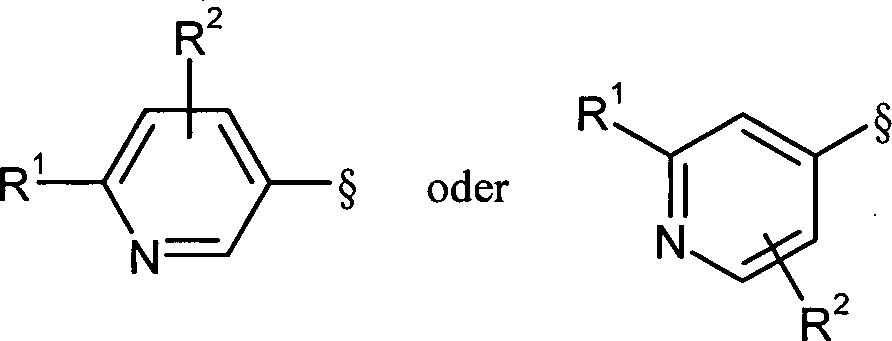
§ die Verknüpfungsstelle mit der angrenzenden CH2-Gruppe bezeichnet,
der Ring 

# die Verknüpfungsstelle mit der angrenzenden CH2-Gruppe
und
## die Verknüpfungsstelle mit dem Ring 
der Ring 

* die Verknüpfungsstelle mit dem Ring 
und
** die Verknüpfungsstelle mit dem Ring 
der Ring 

*** die Verknüpfungsstelle mit dem Ring 
R1 für Methyl oder die Gruppe -NR6R8 steht, worin
R6 Wasserstoff, Methyl, Ethyl oder Cyclopropyl bedeutet,
und
R8 (C1-C4)-Alkyl oder (C3-C6)-Cycloalkyl bedeutet,
wobei (C1-C4)-Alkyl mit einem Rest ausgewählt aus der Reihe Hydroxy, Methoxy, Ethoxy, (C3-C6)-Cycloalkyl, Tetrahydrofuranyl, Tetrahydropyranyl und 5- oder 6-gliedriges Heteroaryl sowie bis zu dreifach mit Fluor substituiert sein kann
und wobei
Tetrahydrofuranyl, Tetrahydropyranyl sowie die genannten Cycloalkyl-Gruppen bis zu zweifach, gleich oder verschieden, mit einem Rest ausgewählt aus der Reihe Fluor, Methyl, Ethyl, Trifluormethyl, Hydroxy, Methoxy und Ethoxy
und
die genannte Heteroaryl-Gruppe bis zu dreifach, gleich oder verschieden, mit einem Rest ausgewählt aus der Reihe Methyl, Ethyl und Trifluormethyl
substituiert sein können,
R2 für Wasserstoff steht,
R3 für Methyl steht,
R4 für einen Substituenten ausgewählt aus der Reihe Chlor, Pentafluorthio, (C1-C6)-Alkyl, Trimethylsilyl, -OR9, -SR9, -S(=O)-R9, -S(=O)2-R9, -S(=O)(=NH)-CH3, -S(=O)(=NH)-CF3, -S(=O)(=NCH3)-CH3, -S(=O)(=NCH3)-CF3, (C3-C6)-Cycloalkyl und 4- bis 6-gliedriges Heterocyclyl steht,
wobei (C1-C6)-Alkyl seinerseits mit einem Rest ausgewählt aus der Reihe -OR9, -NR9R10, -C(=O)-NR9R10, (C3-C6)-Cycloalkyl und 4- bis 6-gliedriges Heterocyclyl sowie bis zu dreifach mit Fluor substituiert sein kann
und
die genannten Cycloalkyl- und Heterocyclyl-Gruppen ihrerseits bis zu zweifach, gleich oder verschieden, mit einem Rest ausgewählt aus der Reihe Fluor, (C1-C4)-Alkyl, Trifluormethyl, (C1-C4)-Alkoxy, Trifluormethoxy und Oxo substituiert sein können,
wobei der genannte (C1-C4)-Alkyl-Substituen seinerseits mit Methoxy, Trifluormethoxy oder Ethoxy substituiert sein kann,
und worin
R9 und R10 unabhängig voneinander bei jedem einzelnen Auftreten Wasserstoff, (C1-C4)-Alkyl oder (C3-C6)-Cycloalkyl bedeuten,
wobei (C1-C4)-Alkyl mit einem Rest ausgewählt aus der Reihe Hydroxy, (C1-C4)-Alkoxy, Trifluormethoxy und (C3-C6)-Cycloalkyl sowie bis zu dreifach mit Fluor substituiert sein kann
und
die genannten Cycloalkyl-Gruppen bis zu zweifach, gleich oder verschieden, mit einem Rest ausgewählt aus der Reihe Fluor, (C1-C4)-Alkyl, Trifluormethyl, (C1-C4)-Alkoxy und Trifluormethoxy substituiert sein können,
oder
R9 und R10 im Fall, dass beide an ein Stickstoffatom gebunden sind, zusammen mit diesem Stickstoffatom einen 4- bis 6-gliedrigen Heterocyclus bilden, der ein weiteres Ring-Heteroatom aus der Reihe N, O, S oder S(O)2 enthalten kann und der bis zu zweifach, gleich oder verschieden, mit einem Rest ausgewählt aus der Reihe Fluor, (C1-C4)-Alkyl, Hydroxy, (C1-C4)-Alkoxy, Oxo, Acetyl und Propionyl substituiert sein kann,
R5 für Fluor steht
und
n für die Zahl 0 oder 1 steht,
sowie ihre Salze, Solvate und Solvate der Salze.Very particularly preferred in the context of the present invention are compounds of the formula (I) in which
the ring
§ denotes the point of attachment to the adjacent CH 2 group,
the ring
# the point of attachment to the adjacent CH 2 group
and
## the link with the ring
the ring
* the link with the ring
and
** the point of attachment to the ring
the ring
*** the point of attachment to the ring
R 1 is methyl or the group -NR 6 R 8 , wherein
R 6 is hydrogen, methyl, ethyl or cyclopropyl,
and
R 8 is (C 1 -C 4 ) -alkyl or (C 3 -C 6 ) -cycloalkyl,
where (C 1 -C 4 ) -alkyl having a radical selected from the group hydroxy, methoxy, ethoxy, (C 3 -C 6 ) -cycloalkyl, tetrahydrofuranyl, tetrahydropyranyl and 5- or 6-membered heteroaryl and up to three times with fluorine may be substituted
and where
Tetrahydrofuranyl, tetrahydropyranyl and said cycloalkyl groups up to two times, same or different, with a radical selected from the group fluorine, methyl, ethyl, trifluoromethyl, hydroxy, methoxy and ethoxy
and
said heteroaryl group up to three times, identically or differently, with a radical selected from the group consisting of methyl, ethyl and trifluoromethyl
can be substituted
R 2 is hydrogen,
R 3 is methyl,
R 4 is a substituent selected from the group consisting of chlorine, pentafluorothio, (C 1 -C 6 ) -alkyl, trimethylsilyl, -OR 9 , -SR 9 , -S (= O) -R 9 , -S (= O) 2 -R 9 , -S (= O) (= NH) -CH 3 , -S (= O) (= NH) -CF 3 , -S (= O) (= NCH 3 ) -CH 3 , -S ( = O) (= NCH 3 ) -CF 3 , (C 3 -C 6 ) -cycloalkyl and 4- to 6-membered heterocyclyl,
wherein (C 1 -C 6 ) -alkyl in turn having a radical selected from the group -OR 9 , -NR 9 R 10 , -C (= O) -NR 9 R 10 , (C 3 -C 6 ) -cycloalkyl and 4- to 6-membered heterocyclyl and may be substituted up to three times with fluorine
and
the said cycloalkyl and heterocyclyl groups in turn up to two times, identically or differently, with a radical selected from the group fluorine, (C 1 -C 4 ) alkyl, trifluoromethyl, (C 1 -C 4 ) alkoxy, trifluoromethoxy and Oxo may be substituted,
wherein said (C 1 -C 4 ) alkyl substituent may in turn be substituted with methoxy, trifluoromethoxy or ethoxy,
and in which
R 9 and R 10 independently of one another at each occurrence represent hydrogen, (C 1 -C 4 ) -alkyl or (C 3 -C 6 ) -cycloalkyl,
where (C 1 -C 4 ) -alkyl can be substituted by a radical selected from the series hydroxy, (C 1 -C 4 ) -alkoxy, trifluoromethoxy and (C 3 -C 6 ) -cycloalkyl and up to three times with fluorine
and
said cycloalkyl groups may be substituted up to two times, identically or differently, by a radical selected from the group consisting of fluoro, (C 1 -C 4 ) -alkyl, trifluoromethyl, (C 1 -C 4 ) -alkoxy and trifluoromethoxy,
or
R 9 and R 10 in the case where both are attached to a nitrogen atom together with this nitrogen atom form a 4- to 6-membered heterocycle which is another ring heteroatom from the series N, O, S or S (O) 2 may be substituted up to two times, identically or differently, with a radical selected from the group consisting of fluorine, (C 1 -C 4 ) -alkyl, hydroxy, (C 1 -C 4 ) -alkoxy, oxo, acetyl and propionyl can
R 5 is fluorine
and
n is the number 0 or 1,
and their salts, solvates and solvates of the salts.
Eine alternative Ausführungsform innerhalb der zuletzt beschriebenen Ausführungsform umfasst Verbindungen der Formel (I), in welcher
R4 für einen Substituenten ausgewählt aus der Reihe Chlor, Pentafluorthio, (C1-C6)-Alkyl, Trimethylsilyl, -OR9, -SR9, -S(=O)-R9, -S(=O)2-R9, (C3-C6)-Cycloalkyl und 4- bis 6-gliedriges Heterocyclyl steht,
wobei (C1-C6)-Alkyl seinerseits mit einem Rest ausgewählt aus der Reihe -OR9, -NR9R10, -C(=O)-NR9R10, (C3-C6)-Cycloalkyl und 4- bis 6-gliedriges Heterocyclyl sowie bis zu dreifach mit Fluor substituiert sein kann
und
die genannten Cycloalkyl- und Heterocyclyl-Gruppen ihrerseits bis zu zweifach, gleich oder verschieden, mit einem Rest ausgewählt aus der Reihe Fluor, (C1-C4)-Alkyl, Trifluormethyl, (C1-C4)-Alkoxy, Trifluormethoxy und Oxo substituiert sein können,
und worin R9 und R10 die in der zuletzt beschriebenen Ausführungsform genannten Bedeutungen haben,
sowie ihre Salze, Solvate und Solvate der Salze.An alternative embodiment within the last-described embodiment comprises compounds of the formula (I) in which
R 4 is a substituent selected from the group consisting of chlorine, pentafluorothio, (C 1 -C 6 ) -alkyl, trimethylsilyl, -OR 9 , -SR 9 , -S (= O) -R 9 , -S (= O) 2 R 9 , (C 3 -C 6 ) -cycloalkyl and 4- to 6-membered heterocyclyl,
wherein (C 1 -C 6 ) -alkyl in turn having a radical selected from the group -OR 9 , -NR 9 R 10 , -C (= O) -NR 9 R 10 , (C 3 -C 6 ) -cycloalkyl and 4- to 6-membered heterocyclyl and may be substituted up to three times with fluorine
and
the said cycloalkyl and heterocyclyl groups in turn up to two times, identically or differently, with a radical selected from the group fluorine, (C 1 -C 4 ) alkyl, trifluoromethyl, (C 1 -C 4 ) alkoxy, trifluoromethoxy and Oxo may be substituted,
and R 9 and R 10 have the meanings given in the last-described embodiment,
and their salts, solvates and solvates of the salts.
Ganz besonders bevorzugt sind auch Verbindungen der Formel (I), in welcher
der Ring 
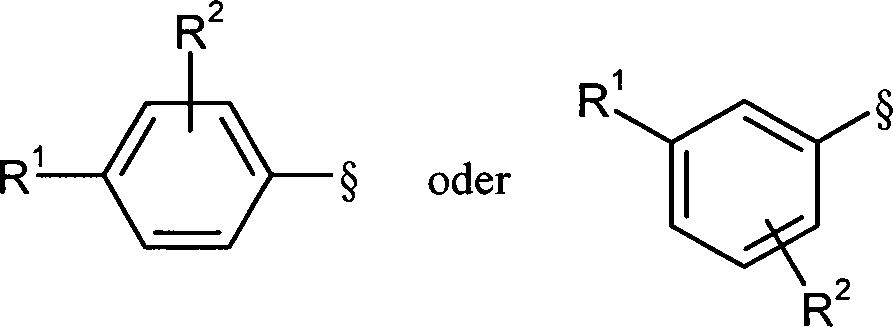
§ die Verknüpfungsstelle mit der angrenzenden CH2-Gruppe bezeichnet,
der Ring 

# die Verknüpfungsstelle mit der angrenzenden CH2-Gruppe
und
## die Verknüpfungsstelle mit dem Ring 
der Ring 

* die Verknüpfungsstelle mit dem Ring 
und
** die Verknüpfungsstelle mit dem Ring 
der Ring 

*** die Verknüpfungsstelle mit dem Ring 
R1 für Chlor, Cyano, Methyl, Ethyl, Isopropyl, Cyclopropyl, Cyclobutyl, Methoxy, Ethoxy, Methylsulfonyl, Ethylsulfonyl, Isopropylsulfonyl oder die Gruppe -C(=O)-NR6R7 steht, worin
R6 und R7 unabhängig voneinander Wasserstoff, (C1-C4)-Alkyl oder (C3-C6)-Cycloalkyl bedeuten,
wobei (C1-C4)-Alkyl mit einem Rest ausgewählt aus der Reihe Hydroxy, Methoxy, Ethoxy, Cyclopropyl und Cyclobutyl sowie bis zu dreifach mit Fluor substituiert sein kann,
R2 für Wasserstoff steht,
R3 für Methyl steht,
R4 für einen Substituenten ausgewählt aus der Reihe Chlor, Pentafluorthio, (C1-C6)-Alkyl, Trimethylsilyl, -OR9, -SR9, -S(=O)-R9, -S(=O)2-R9, -S(=O)(=NH)-CH3, -S(=O)(=NH)-CF3, -S(=O)(=NCH3)-CH3, -S(=O)(=NCH3)-CF3, (C3-C6)-Cycloalkyl und 4- bis 6-gliedriges Heterocyclyl steht,
wobei (C1-C6)-Alkyl seinerseits mit einem Rest ausgewählt aus der Reihe -OR9, -NR9R10, -C(=O)-NR9R10, (C3-C6)-Cycloalkyl und 4- bis 6-gliedriges Heterocyclyl sowie bis zu dreifach mit Fluor substituiert sein kann
und
die genannten Cycloalkyl- und Heterocyclyl-Gruppen ihrerseits bis zu zweifach, gleich oder verschieden, mit einem Rest ausgewählt aus der Reihe Fluor, (C1-C4)-Alkyl, Trifluormethyl, (C1-C4)-Alkoxy, Trifluormethoxy und Oxo substituiert sein können, wobei der genannte (C1-C4)-Alkyl-Substituen seinerseits mit Methoxy, Trifluormethoxy oder Ethoxy substituiert sein kann,
und worin
R9 und R10 unabhängig voneinander bei jedem einzelnen Auftreten Wasserstoff, (C1-C4)-Alkyl oder (C3-C6)-Cycloalkyl bedeuten,
wobei (C1-C4)-Alkyl mit einem Rest ausgewählt aus der Reihe Hydroxy, (C1-C4)-Alkoxy, Trifluormethoxy und (C3-C6)-Cycloalkyl sowie bis zu dreifach mit Fluor substituiert sein kann
und
die genannten Cycloalkyl-Gruppen bis zu zweifach, gleich oder verschieden, mit einem Rest ausgewählt aus der Reihe Fluor, (C1-C4)-Alkyl, Trifluormethyl, (C1-C4)-Alkoxy und Trifluormethoxy substituiert sein können,
oder
R9 und R10 im Fall, dass beide an ein Stickstoffatom gebunden sind, zusammen mit diesem Stickstoffatom einen 4- bis 6-gliedrigen Heterocyclus bilden, der ein weiteres Ring-Heteroatom aus der Reihe N, O, S oder S(O)2 enthalten kann und der bis zu zweifach, gleich oder verschieden, mit einem Rest ausgewählt aus der Reihe Fluor, (C1-C4)-Alkyl, Hydroxy, (C1-C4)-Alkoxy, Oxo, Acetyl und Propionyl substituiert sein kann,
R5 für Fluor steht
und
n für die Zahl 0 oder 1 steht,
sowie ihre Salze, Solvate und Solvate der Salze.Very particular preference is also given to compounds of the formula (I) in which
the ring
§ denotes the point of attachment to the adjacent CH 2 group,
the ring
# the point of attachment to the adjacent CH 2 group
and
## the link with the ring
the ring
* the link with the ring
and
** the point of attachment to the ring
the ring
*** the point of attachment to the ring
R 1 is chloro, cyano, methyl, ethyl, isopropyl, cyclopropyl, cyclobutyl, methoxy, ethoxy, methylsulfonyl, ethylsulfonyl, isopropylsulfonyl or the group -C (= O) -NR 6 R 7 wherein
R 6 and R 7 independently of one another are hydrogen, (C 1 -C 4 ) -alkyl or (C 3 -C 6 ) -cycloalkyl,
where (C 1 -C 4 ) -alkyl may be substituted by one radical selected from the series hydroxy, methoxy, ethoxy, cyclopropyl and cyclobutyl and up to three times by fluorine,
R 2 is hydrogen,
R 3 is methyl,
R 4 is a substituent selected from the group consisting of chlorine, pentafluorothio, (C 1 -C 6 ) -alkyl, trimethylsilyl, -OR 9 , -SR 9 , -S (= O) -R 9 , -S (= O) 2 -R 9 , -S (= O) (= NH) -CH 3 , -S (= O) (= NH) -CF 3 , -S (= O) (= NCH 3 ) -CH 3 , -S ( = O) (= NCH 3 ) -CF 3 , (C 3 -C 6 ) -cycloalkyl and 4- to 6-membered heterocyclyl,
wherein (C 1 -C 6 ) -alkyl in turn having a radical selected from the group -OR 9 , -NR 9 R 10 , -C (= O) -NR 9 R 10 , (C 3 -C 6 ) -cycloalkyl and 4- to 6-membered heterocyclyl and may be substituted up to three times with fluorine
and
the said cycloalkyl and heterocyclyl groups in turn up to two times, identically or differently, with a radical selected from the group fluorine, (C 1 -C 4 ) alkyl, trifluoromethyl, (C 1 -C 4 ) alkoxy, trifluoromethoxy and Oxo may be substituted, said (C 1 -C 4 ) alkyl substituent in turn may be substituted with methoxy, trifluoromethoxy or ethoxy,
and in which
R 9 and R 10 independently of one another at each occurrence represent hydrogen, (C 1 -C 4 ) -alkyl or (C 3 -C 6 ) -cycloalkyl,
where (C 1 -C 4 ) -alkyl can be substituted by a radical selected from the series hydroxy, (C 1 -C 4 ) -alkoxy, trifluoromethoxy and (C 3 -C 6 ) -cycloalkyl and up to three times with fluorine
and
said cycloalkyl groups may be substituted up to two times, identically or differently, by a radical selected from the group consisting of fluoro, (C 1 -C 4 ) -alkyl, trifluoromethyl, (C 1 -C 4 ) -alkoxy and trifluoromethoxy,
or
R 9 and R 10 in the case where both are attached to a nitrogen atom together with this nitrogen atom form a 4- to 6-membered heterocycle which is another ring heteroatom from the series N, O, S or S (O) 2 may be substituted up to two times, identically or differently, with a radical selected from the group consisting of fluorine, (C 1 -C 4 ) -alkyl, hydroxy, (C 1 -C 4 ) -alkoxy, oxo, acetyl and propionyl can
R 5 is fluorine
and
n is the number 0 or 1,
and their salts, solvates and solvates of the salts.
Eine alternative Ausführungsform innerhalb der zuletzt beschriebenen Ausführungsform umfasst Verbindungen der Formel (I), in welcher
R4 für einen Substituenten ausgewählt aus der Reihe Chlor, Pentafluorthio, (C1-C6)-Alkyl, Trimethylsilyl, -OR9, -SR9, -S(=O)-R9, -S(=O)2-R9, (C3-C6)-Cycloalkyl und 4- bis 6-gliedriges Heterocyclyl steht,
wobei (C1-C6)-Alkyl seinerseits mit einem Rest ausgewählt aus der Reihe -OR9, -NR9R10, -C(=O)-NR9R10, (C3-C6)-Cycloalkyl und 4- bis 6-gliedriges Heterocyclyl sowie bis zu dreifach mit Fluor substituiert sein kann
und
die genannten Cycloalkyl- und Heterocyclyl-Gruppen ihrerseits bis zu zweifach, gleich oder verschieden, mit einem Rest ausgewählt aus der Reihe Fluor, (C1-C4)-Alkyl, Trifluormethyl, (C1-C4)-Alkoxy, Trifluormethoxy und Oxo substituiert sein können,
und worin R9 und R10 die in der zuletzt beschriebenen Ausführungsform genannten Bedeutungen haben,
sowie ihre Salze, Solvate und Solvate der Salze.An alternative embodiment within the last-described embodiment comprises compounds of the formula (I) in which
R 4 is a substituent selected from the group consisting of chlorine, pentafluorothio, (C 1 -C 6 ) -alkyl, trimethylsilyl, -OR 9 , -SR 9 , -S (= O) -R 9 , -S (= O) 2 R 9 , (C 3 -C 6 ) -cycloalkyl and 4- to 6-membered heterocyclyl,
wherein (C 1 -C 6 ) -alkyl in turn having a radical selected from the group -OR 9 , -NR 9 R 10 , -C (= O) -NR 9 R 10 , (C 3 -C 6 ) -cycloalkyl and 4- to 6-membered heterocyclyl and may be substituted up to three times with fluorine
and
the said cycloalkyl and heterocyclyl groups in turn up to two times, identically or differently, with a radical selected from the group fluorine, (C 1 -C 4 ) alkyl, trifluoromethyl, (C 1 -C 4 ) alkoxy, trifluoromethoxy and Oxo may be substituted,
and R 9 and R 10 have the meanings given in the last-described embodiment,
and their salts, solvates and solvates of the salts.
Die in den jeweiligen Kombinationen bzw. bevorzugten Kombinationen von Resten im einzelnen angegebenen Reste-Definitionen werden unabhängig von den jeweiligen angegebenen Kombinationen der Reste beliebig auch durch Reste-Definitionen anderer Kombinationen ersetzt.The residue definitions given in detail in the respective combinations or preferred combinations of residues are also replaced by residue definitions of other combinations, regardless of the particular combinations of the residues indicated.
Ganz besonders bevorzugt sind Kombinationen von zwei oder mehreren der oben genannten Vorzugsbereiche.Very particular preference is given to combinations of two or more of the abovementioned preferred ranges.
Die erfindungsgemäßen Verbindungen können auf vielfältige Art und Weise hergestellt werden. Zur Anwendung kamen hier insbesondere die im Folgenden als Verfahren A, B und C bezeichneten prinzipiellen Methoden, die in unterschiedlichen Varianten ausgeführt werden können.The compounds of the invention can be prepared in a variety of ways. In particular, the principal methods referred to below as methods A, B and C, which can be carried out in different variants, were used.
Verfahren A (mit den Varianten A.1 und A.2; siehe Schemata 1 und 2) ist dadurch gekennzeichnet, dass Verbindungen der Formel (IV), in welcher B, D, E, R3, R4, R5 und n die oben beschriebenen Bedeutungen haben und in der das angezeigte Wasserstoffatom an ein Stickstoffatom des Ringes B gebunden ist, mit Verbindungen der Formel (II) oder (III) umgesetzt werden, in denen A, R1 und R2 die oben beschriebenen Bedeutungen haben und in denen Y1 ganz allgemein für ein Atom oder eine Gruppe steht, aus der oder mit deren Hilfe sich gegebenenfalls der Substituent R1 aufbauen oder einführen läßt, und in denen X für eine Abgangsgruppe steht. Beispiele für Y1 sind Chlor, Brom, Iod, Cyano, Nitro, Hydroxy, Formyl, Carboxyl und Alkoxycarbonyl; Beispiele für X sind Chlor, Brom, Iod, Methansulfonat (Mesylat), Trifluormethansulfonat (Triflat) und 4-Methylbenzolsulfonat (Tosylat). Schema 1: Verfahren A.1 [Ring B = 1H-Pyrazol-1,3-diyl oder 1H-Imidazol-1,4-diyl] 

Bei den in Schema 1 und 2 dargestellten Verfahren A.1 und A.2 handelt es sich im ersten Reaktionsschritt um eine Substitutionsreaktion, bei der die Fluchtgruppe X, welche zum Beispiel für Chlor, Brom, Methansulfonat (Mesylat) oder 4-Methylbenzolsulfonat (Tosylat) stehen kann, gegen das N1-Stickstoffatom des Ringes B ausgetauscht wird (Ring B = 1H-Pyrazol-1,3-diyl oder 1H-Imidazol-1,4-diyl). Diese Umsetzung wird bevorzugt unter Verwendung einer Base wie Kalium-tert.-butylat oder Natriumhydrid in Lösungsmitteln wie Tetrahydrofuran oder Toluol bei Temperaturen zwischen 0°C und dem Siedepunkt des Lösungsmittels durchgeführt.In the processes A.1 and A.2 shown in Schemes 1 and 2, the first reaction step is a substitution reaction in which the leaving group X, which is, for example, chlorine, bromine, methanesulfonate (mesylate) or 4-methylbenzenesulfonate (tosylate ), is substituted for the N 1 nitrogen atom of ring B (ring B = 1H-pyrazole-1,3-diyl or 1H-imidazole-1,4-diyl). This reaction is preferably carried out using a base such as potassium tert-butoxide or sodium hydride in solvents such as tetrahydrofuran or toluene at temperatures between 0 ° C and the boiling point of the solvent.
Bei der in Schema 2 (Verfahren A.2) gezeigten Umwandlung von Verbindungen der Formel (V) in die Produkte der Formel (I) kommen unterschiedliche chemische Transformationen zur Anwendung, die dem Fachmann geläufig sind und von denen einige exemplarisch weiter unten beschrieben werden. Für den Fall, dass der Substituent R2 nicht chemisch inert gegenüber der Transformation von Y1 zu R1 ist, können temporäre Schutzgruppen bei R2 eingesetzt werden. Als Beispiel sei der Schutz einer Hydroxy-Gruppe als Silylether und die nachfolgende Abspaltung der Silylgruppe mit Hilfe von Fluorid-Reagenzien wie Tetrabutylammoniumfluorid oder Kaliumfluorid genannt. Solche Schutzgruppen-Operationen sind in der Literatur beschrieben und dem Fachmann bekannt.In the conversion of compounds of the formula (V) into the products of the formula (I) shown in Scheme 2 (method A.2), different chemical transformations are used, which are familiar to the person skilled in the art and some of which are described below by way of example. In the event that the substituent R 2 is not chemically inert to the transformation of Y 1 to R 1 , temporary protecting groups can be used at R 2 . An example which may be mentioned is the protection of a hydroxy group as silyl ether and the subsequent cleavage of the silyl group with the aid of fluoride reagents such as tetrabutylammonium fluoride or potassium fluoride. Such protecting group operations are described in the literature and known to those skilled in the art.
Im Verfahren B (Schemata 3 und 4) wird der Ring D aufgebaut, wobei der Ring D hier für ein 1,2,4-Oxadiazol steht. Auch das Verfahren B kommt in verschiedenen Abwandlungen zur Anwendung (Varianten B.1 und B.2). Die Verfahrensvariante B.2 ähnelt der Verfahrensvariante A.2 bezüglich der Teilreaktionen, die die Umwandlung des Restes Y1 in den Substituenten R1 betreffen. Im Folgenden soll deshalb nur die Variante B.1 detaillierter dargestellt werden (Schema 3). Hierbei werden Verbindungen der Formel (VI), in welcher A, B, R1, R2 und R3 die oben beschriebenen Bedeutungen haben, mit Hydroxyamidinen der Formel (VIII), in welcher E, R4, R5 und n die oben angegebenen Bedeutungen haben, zu den Oxadiazol-Derivaten der Formel (I-A) umgesetzt. Schema 3: Verfahren B.1 
Die Umsetzung der Verbindungen der Formel (VI) mit den Verbindungen der Formel (VIII) erfolgt in Gegenwart von Kupplungsreagenzien, wie zum Beispiel 1H-Benzotriazol-1-ol und N-[3-(Dimethylamino)propyl]-N'-ethylcarbodiimid-Hydrochlorid, sowie in Gegenwart von tertiären Aminbasen, wie zum Beispiel Triethylamin, und in geeigneten Lösungsmitteln wie zum Beispiel N,N-Dimethylformamid. Die Reaktionspartner werden zunächst einige Zeit bei Raumtemperatur miteinander umgesetzt, bevor das Gemisch dann auf Temperaturen im Bereich von +80°C bis +140°C erhitzt wird. Alternativ können die Verbindungen der Formel (VI) zunächst in die entsprechenden Carbonsäurechloride überführt werden. Dazu werden Chlorierungsreagenzien, wie zum Beispiel Oxalylchlorid oder Thionylchlorid, in inerten Lösungsmitteln, wie zum Beispiel Dichlormethan oder Chloroform, eingesetzt. Die Reaktion erfolgt bevorzugt bei Raumtemperatur und in Gegenwart einer katalytischen Menge N,N-Dimethylformamids. Das so erhaltene Säurechlorid wird anschließend mit den Verbindungen der Formel (VIII) zur Reaktion gebracht. Das primäre Kondensationsprodukt dieser Reaktion wird dann in inerten Lösungsmitteln, wie zum Beispiel Dimethylsulfoxid oder N,N-Dimethylformamid, auf Temperaturen im Bereich von +80°C bis +140°C erhitzt und ergibt so die Zielverbindung der Formel (I-A).The reaction of the compounds of the formula (VI) with the compounds of the formula (VIII) is carried out in the presence of coupling reagents, for example 1H-benzotriazol-1-ol and N- [3- (dimethylamino) propyl] -N'-ethylcarbodiimide- Hydrochloride, as well as in the presence of tertiary amine bases, such as triethylamine, and in suitable solvents such as N, N-dimethylformamide. The reactants are first reacted with each other for some time at room temperature before the mixture is then heated to temperatures in the range of + 80 ° C to + 140 ° C. Alternatively, the compounds of formula (VI) may first be converted to the corresponding carboxylic acid chlorides. For this chlorination reagents, such as oxalyl chloride or thionyl chloride, in inert solvents, such as dichloromethane or chloroform, are used. The reaction is preferably carried out at room temperature and in the presence of a catalytic amount of N, N-dimethylformamide. The acid chloride thus obtained is subsequently reacted with the compounds of the formula (VIII). The primary condensation product of this reaction is then heated in inert solvents, such as dimethyl sulfoxide or N, N-dimethylformamide, to temperatures in the range of + 80 ° C to + 140 ° C to yield the target compound of formula (I-A).
In der Verfahrensvariante B.2 kommen anstelle von Verbindungen der Formel (VI) Carbonsäuren der Formel (VII) zum Einsatz, in welcher A, B, R2, R3 und Y1 die oben beschriebenen Bedeutungen haben. Schema 4: Verfahren B.2 
Wenn der Ring D für ein 1,3-Oxazol steht, kann Verfahren C benutzt werden. Hierbei werden Verbindungen der Formel (VI) mit Verbindungen der Formel (IX) zu Intermediaten der Formel (X) umgesetzt, die wiederum zu Intermediaten der Formel (XI) cyclisiert und abschließend zu den Produkten der Formel (I-B) aufoxidiert werden. A, B, E, R1, R2, R3, R4, R5 und n haben jeweils die oben angegebenen Bedeutungen. Schema 5: Verfahren C 
Die Verbindungen der Formel (VI) werden mit den Aminoalkoholen der Formel (IX) in Gegenwart von Kupplungsreagenzien, wie zum Beispiel O-(7-Azabenzotriazol-1-yl)-N,N,N',N'-tetramethyluronium-Hexafluorophosphat, zu Intermediaten der Formel (X) umgesetzt. Die Reaktion erfolgt bei Raumtemperatur in Gegenwart von tertiären Aminbasen, wie zum Beispiel Triethylamin, in polar-aprotischen Lösungsmitteln wie zum Beispiel N,N-Dimethylformamid. Die anschließende Cyclisierung zu den Verbindungen der Formel (XI) wird mit Hilfe eines Cyclisierungsreagenzes erreicht, wie beispielsweise und bevorzugt mit Burgess-Reagenz (Carbomethoxysulfamoyl-triethylammoniumhydroxid). Die Reaktion erfolgt in geeigneten Lösungsmitteln, wie zum Beispiel Tetrahydrofuran, am Siedepunkt des Lösungsmittels. Die abschließende Oxidation zu den 1,3-Oxazol-Derivaten der Formel (I-B) kann mit verschiedenen Oxidationsmitteln erfolgen; bevorzugt ist die Oxidation mit aktiviertem Mangandioxid in Tetrahydrofuran beim Siedepunkt des Lösungsmittels.The compounds of the formula (VI) are reacted with the aminoalcohols of the formula (IX) in the presence of coupling reagents, such as, for example, O- (7-azabenzotriazol-1-yl) -N, N, N ', N'-tetramethyluronium hexafluorophosphate, converted to intermediates of formula (X). The reaction is carried out at room temperature in the presence of tertiary amine bases such as triethylamine in polar aprotic solvents such as N, N-dimethylformamide. The subsequent cyclization to the compounds of the formula (XI) is achieved by means of a cyclization reagent, such as, for example, and preferably with Burgess reagent (carbomethoxysulfamoyl-triethylammonium hydroxide). The reaction is carried out in suitable solvents, such as tetrahydrofuran, at the boiling point of the solvent. The final oxidation to the 1,3-oxazole derivatives of the formula (I-B) can be carried out with various oxidizing agents; Preferably, the oxidation with activated manganese dioxide in tetrahydrofuran is at the boiling point of the solvent.
Im Folgenden werden exemplarisch zwei Verfahren beschrieben (siehe Schemata 6 und 7), in denen die Intermediate der Formel (V) (vgl. Schemata 2 und 4) zu Zielverbindungen der Formel (I) umgesetzt werden. Weitere Umsetzungen dieser Art sind im Experimentellen Teil beschrieben und bedürfen hier keiner weiteren Darstellung, da sie nicht den Charakter eines allgemeinen Verfahrens, sondern eher einer spezifischen Funktionsgruppen-Umwandlung haben. Bei dem Ring A handelt es sich in den beiden nachstehend beschriebenen Fällen um einen Pyridinring, welcher den Rest Y1 in direkter Nachbarschaft zum Pyridin-Stickstoffatom trägt.Two processes are described below by way of example (see Schemes 6 and 7) in which the intermediates of the formula (V) (compare Schemes 2 and 4) are converted into target compounds of the formula (I). Further reactions of this type are described in the Experimental Section and need not be further described here, since they do not have the character of a general procedure but rather a specific functional group transformation. In the two cases described below, the ring A is a pyridine ring which carries the radical Y 1 in direct proximity to the pyridine nitrogen atom.
Wenn der Substituent R1 in den Zielverbindungen der Formel (I) für die Gruppe -NR6R8 steht, worin R6 und R8 die oben beschriebenen Bedeutungen haben, und Y1 für Chlor, Brom oder Iod steht, werden die Intermediate der Formel (V) mit Aminen der Formel (XII) umgesetzt (siehe Schema 6). Gegebenenfalls kann hierbei der Zusatz eines tertiären Amins als Hilfsbase, wie beispielsweise N,N-Diisopropylethylamin, von Vorteil sein. Die Reaktion findet bevorzugt in Lösungsmitteln wie Diethylenglykoldimethylether oder N-Methylpyrrolidinon statt, oder die Verbindungen der Formel (XII) dienen, im Überschuss eingesetzt, selbst als Lösungsmittel. Die Reaktion wird bei erhöhter Temperatur ausgeführt, vorzugsweise in einem Temperaturbereich zwischen +80°C und +200°C. Reaktionen im oberen Bereich des genannten Temperaturintervalls werden bevorzugt in geschlossenen Druckgefäßen in einem Mikrowellengerät durchgeführt. Schema 6: Umsetzung von Verbindungen der Formel (V) mit Aminen [Ring A = Pyridin mit Y1 in 2-Position; Y1 = Chlor, Brom oder Iod] 
Wenn der Substituent R1 in den Zielverbindungen der Formel (I) für eine gegebenenfalls substituierte Alkinyl- oder Alkyl-Gruppe steht und Y1 für Chlor, Brom oder Iod steht, können die Intermediate der Formel (V) beispielsweise mit Propargylalkohol (XIII) zu Produkten der Formel (I-D) umgesetzt werden (siehe Schema 7). Die Reaktion wird vorzugsweise bei Raumtemperatur in einem aprotischen Lösungsmittel wie Tetrahydrofuran in Anwesenheit einer Aminbase wie Triethylamin und eines Palladium-Katalysators, wie beispielsweise Tetrakis(triphenylphosphin)palladium(0) sowie von Kupfer(I)iodid durchgeführt (Variante der so genannten ”Sonogashira-Kupplung”). Eine gegebenenfalls anschließende Reduktion der Alkin-Bindung zu Produkten der Formel (I-E) erfolgt mit Wasserstoff bevorzugt unter Normaldruck oder auch bei erhöhtem Druck von bis zu ca. 100 bar in Gegenwart eines Metall-Katalysators, vorzugsweise auf Basis von Platin, Palladium oder Nickel; beispielhaft erwähnt seien Platin(IV)oxid, Palladium auf Aktivkohle sowie Raney-Nickel. Schema 7: Umsetzung von Verbindungen der Formel (V) mit Propargylalkohol und nachfolgende Hydrierung [Ring A = Pyridin mit Y1 in 2-Position; Y1 = Chlor, Brom oder Iod] 
Im Folgenden werden exemplarisch Verfahren beschrieben, mit denen die in Schema 1 und 2 aufgeführten Verbindungen der Formel (IV) hergestellt werden können.In the following, methods are described by way of example with which the compounds of the formula (IV) listed in Scheme 1 and 2 can be prepared.
Verbindungen der Formel (IV), in welcher der Ring D die Bedeutung eines 1,2,4-Oxadiazols hat und der Ring B für eine 1H-Pyrazol-1,3-diyl- oder 1H-Imidazol-1,4-diyl-Gruppe steht, werden aufgebaut, indem Verbindungen der Formel (VIII), in welcher E, R4, R5 und n die oben angegebenen Bedeutungen haben, und Verbindungen der Formel (XIV), in welcher R3 die oben angegebene Bedeutung hat und Ring B für 1H-Pyrazol-1,3-diyl oder 1H-Imidazol-1,4-diyl steht, miteinander umgesetzt werden (siehe Schema 8). Dieser Typ von Kondensationsreaktion ist bereits in Verfahren B.1 (Schema 3) beschrieben worden und wird hier unter vollkommen analogen Bedingungen durchgeführt. Schema 8: Aufbau von Verbindungen der Formel (IV) [Ring B = 1H-Pyrazol-1,3-diyl oder 1H-Imidazol-1,4-diyl] 
Im Folgenden werden Verfahren beschrieben, mit denen die in Schema 3 gezeigten Verbindungen der Formel (VI) und die in Schema 4 gezeigten Verbindungen der Formel (VII) in Abhängigkeit von der Natur des Ringes B aufgebaut werden können (siehe Schemata 9–11).The following is a description of methods by which the compounds of formula (VI) shown in Scheme 3 and the compounds of formula (VII) shown in Scheme 4 can be synthesized depending on the nature of ring B (see Schemes 9-11).
Schema 9 beschreibt die Herstellung von Pyrazol- und Imidazol-Derivaten der Formel (VII) ausgehend von Verbindungen der Formel (XV), in welcher der Ring B für 1H-Pyrazol-1,3-diyl oder 1H-Imidazol-1,4-diyl steht, der angezeigte Wasserstoff an das N1-Stickstoffatom des Ringes B gebunden ist und R3 die oben angegebene Bedeutung hat. Diese Verbindungen werden mit den Verbindungen der Formel (III) zu Intermediaten der Formel (XVI) umgesetzt. Die Reaktionsbedingungen hierbei sind die gleichen wie die in Verfahren A.2 (Schema 2) beschriebenen. Die Ester-Hydrolyse im zweiten Reaktionsschritt erfolgt unter Standardbedingungen, beispielsweise mit Natronlauge in Methanol oder Ethanol als Lösungsmittel bei Temperaturen in einem Bereich von Raumtemperatur bis +60°C. Schema 9: Aufbau von Verbindungen der Formel (VII) [Ring B = 1H-Pyrazol-1,3-diyl oder 1H-Imidazol-1,4-diyl] 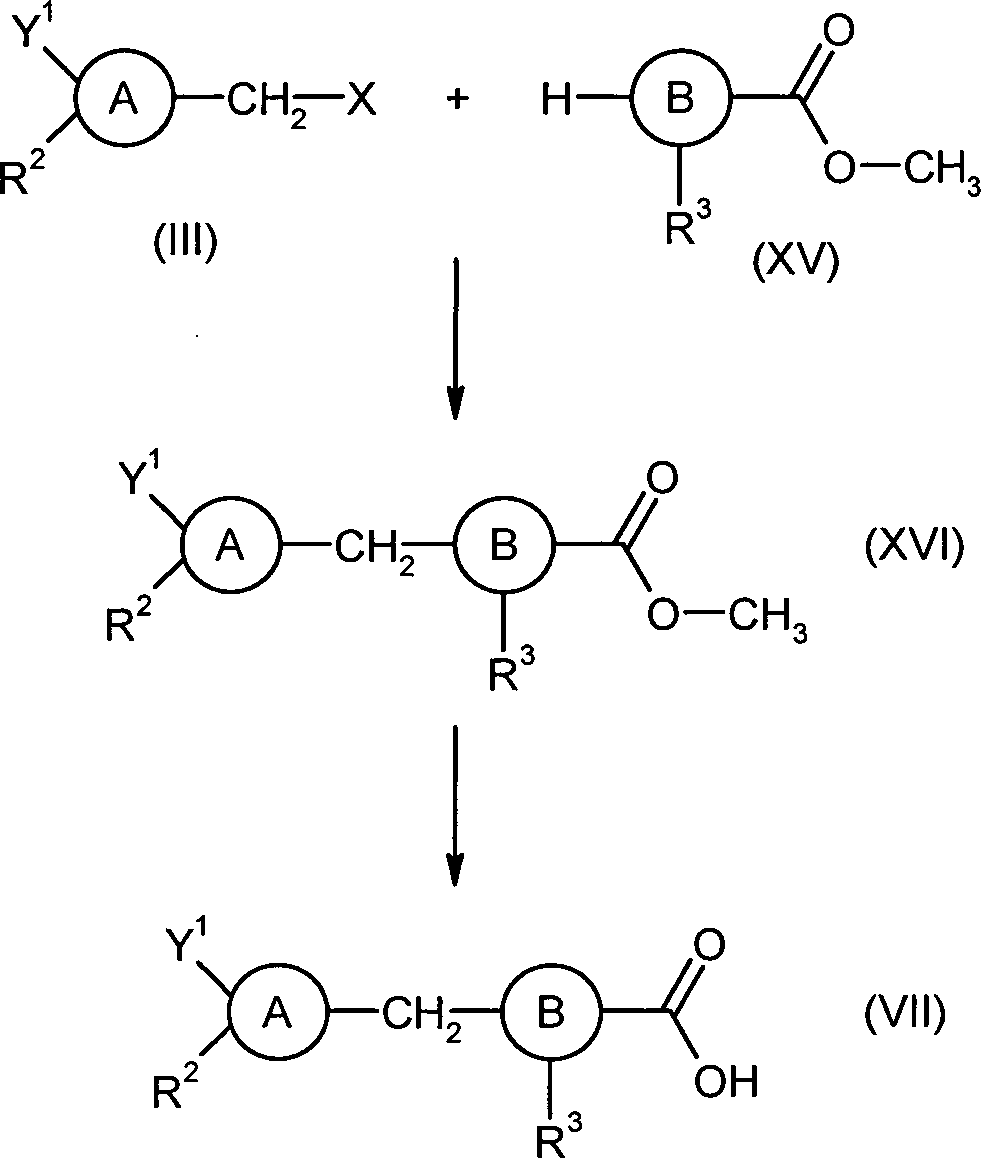
Die Darstellung von korrespondierenden Pyrazol- und Imidazol-Derivaten der Formel (VI) erfolgt in Analogie zu dem in Schema 9 beschriebenen Verfahren, indem Ausgangsverbindungen der Formeln (II) und (XV) eingesetzt werden.The preparation of corresponding pyrazole and imidazole derivatives of the formula (VI) is carried out analogously to the process described in Scheme 9 using starting compounds of the formulas (II) and (XV).
Zur Herstellung von Verbindungen der Formel (VII), in welcher der Ring B für 1H-Pyrrol-1,3-diyl steht, kann wie in Schema 10 gezeigt vorgegangen werden: γ-Ketoester der Formel (XVII), in welcher R3 die oben angegebene Bedeutung hat, werden zunächst mit Hilfe von Trimethylorthoformiat in Acetale der Formel (XVIII) überführt und anschließend mit Ameisensäuremethylester in Gegenwart einer Base, wie vorzugsweise Natriumhydrid, in inerten Lösungsmitteln wie Diethylether oder Pentan, gegebenenfalls unter Zusatz von protischen Lösungsmitteln wie Methanol, umgesetzt. Nachfolgende Acetalspaltung unter sauren Bedingungen, zum Beispiel mittels einer wässrigen oder methanolischen Chlorwasserstoff-Lösung, liefert die Intermediate der Formel (XIX). Diese werden dann mit Aminen der Formel (XX), in welcher A, R2 und Y1 die oben angegebenen Bedeutungen haben, zu Verbindungen der Formel (XXI) kondensiert. Diese Reaktion wird bevorzugt bei Raumtemperatur oder leicht erhöhter Temperatur in Methanol als Lösungsmittel durchgeführt. Die abschließende Ester-Hydrolyse erfolgt unter basischen Standardbedingungen. Schema 10: Aufbau von Verbindungen der Formel (VII) [Ring B = 1H-Pyrrol-1,3-diyl] 
Wird anstelle des Amins der Formel (XX) die entsprechende Verbindung verwendet, die statt des Restes Y1 bereits den Substituenten R1 enthält, so werden nach dem oben beschriebenen Verfahren in analoger Weise die zur Formel (VI) korrespondierenden Pyrrol-Derivate erhalten.If, instead of the amine of the formula (XX), the corresponding compound is used which already contains the substituent R 1 instead of the radical Y 1 , the pyrrole derivatives corresponding to the formula (VI) are obtained in an analogous manner by the process described above.
Verbindungen der Formel (VII), in welcher der Ring B für eine Pyrazol-3,5-diyl-Gruppe steht, können gemäß dem in Schema 11 beschriebenen Verfahren hergestellt werden: Im ersten Schritt werden Verbindungen der Formel (XXII), in welcher A, R2 und Y1 die oben angegebenen Bedeutungen haben, mit Oxalsäurediethylester unter Verwendung einer Base, wie vorzugsweise Natriumhydrid, in einem protischen Lösungsmittel wie Ethanol bei Temperaturen zwischen –10°C und Raumtemperatur zu Intermediaten der Formel (XXIII) umgesetzt. Diese werden dann in Essigsäure bei Temperaturen zwischen Raumtemperatur und +100°C mit Hydrazin-Derivaten der Formel (XXIV), in welcher R3 die oben angegebene Bedeutung hat, zu Verbindungen der Formel (XXV) kondensiert. Die abschließende Ester-Hydrolyse erfolgt nach Standardmethoden, beispielsweise durch Behandlung mit Lithiumhydroxid in Ethanol bei Temperaturen von Raumtemperatur bis zum Siedepunkt des Lösungsmittels. Schema 11: Aufbau von Verbindungen der Formel (VII) [Ring B = Pyrazol-3,5-diyl] 
Der Formel (VI) entsprechende Pyrazol-Derivate werden in analoger Weise erhalten, indem man von den korrespondierenden Verbindungen der Formel (XXII) ausgeht, in denen der Rest Y1 bereits gegen den Substituenten R1 ausgetauscht ist.Pyrazole derivatives corresponding to the formula (VI) are obtained in an analogous manner by starting from the corresponding compounds of the formula (XXII) in which the radical Y 1 has already been replaced by the substituent R 1 .
Zur beispielhaften Veranschaulichung der zuvor beschriebenen Verfahrensvarianten wird im Folgenden die Herstellung von erfindungsgemäßen Verbindungen der Formel (I-F) 
näher erläutert:
Solche Verbindungen der Formel (I-F) können dadurch hergestellt werden, dass man ein N'-Hydroxyamidin der Formel (VIII) 
zunächst entweder
- [A] mit einer Pyrazolcarbonsäure der Formel (XXVI) in welcher R3 die oben angegebene Bedeutung hat, zu einem 1,2,4-Oxadiazol-Derivat der Formel (XXVII)
 in welcher der Ring E sowie R3, R4, R5 und n die oben angegebenen Bedeutungen haben, kondensiert und dieses dann in Gegenwart einer Base mit einer Verbindung der Formel (XXVIII)
 in welcher Y1 für Chlor, Brom oder Iod steht und X für Chlor, Brom, Iod, Mesylat, Triflat oder Tosylat steht, zu einer Verbindung der Formel (XXIX)
 in welcher der Ring E sowie R3, R4, R5, n und Y1 die oben angegebenen Bedeutungen haben, alkyliert oder
- [B] mit einer Pyrazolcarbonsäure der Formel (XXX) in welcher R3 die oben angegebene Bedeutung hat und Y1 für Chlor, Brom oder Iod steht, zu der Verbindung der Formel (XXIX)
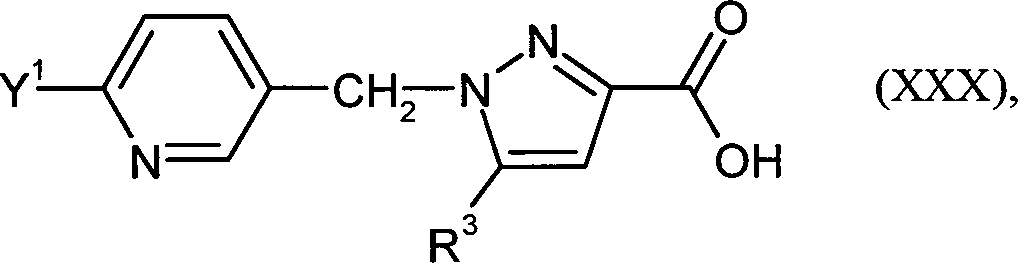 in welcher der Ring E sowie R3, R4, R5, n und Y1 die oben angegebenen Bedeutungen haben, kondensiert und anschließend die so erhaltene Verbindung der Formel (XXIX) gegebenenfalls in Gegenwart einer Hilfsbase mit einer Verbindung der Formel (XII)
 in welcher R6 und R8 die oben angegebenen Bedeutungen haben, umsetzt (vgl. hierzu die zuvor beschriebenen Verfahren A.2 und B.2 in Verbindung mit den in Schema 6, 8 und 9 dargestellten Umsetzungen sowie die dort jeweils angegebenen Reaktionsparameter).
explained in more detail:
Such compounds of formula (IF) can be prepared by reacting a N'-hydroxyamidine of formula (VIII)
first, either
- [A] with a pyrazolecarboxylic acid of the formula (XXVI) in which R 3 has the abovementioned meaning, to give a 1,2,4-oxadiazole derivative of the formula (XXVII)in which the ring E and R 3 , R 4 , R 5 and n have the meanings given above, and then condensing this in the presence of a base with a compound of the formula (XXVIII)in which Y 1 is chlorine, bromine or iodine and X is chlorine, bromine, iodine, mesylate, triflate or tosylate, to give a compound of the formula (XXIX)in which the ring E and R 3 , R 4 , R 5 , n and Y 1 have the meanings given above, alkylated or
- [B] with a pyrazolecarboxylic acid of the formula (XXX) in which R 3 has the abovementioned meaning and Y 1 represents chlorine, bromine or iodine, to give the compound of the formula (XXIX)in which the ring E and R 3 , R 4 , R 5 , n and Y 1 have the meanings given above, and then condensing the resulting compound of the formula (XXIX) optionally in the presence of an auxiliary base with a compound of the formula (XII)in which R 6 and R 8 have the meanings given above (cf., for this, the previously described processes A.2 and B.2 in conjunction with the reactions shown in Scheme 6, 8 and 9 and the reaction parameters given there).
Die Ausgangsverbindungen der Formeln (II), (III), (VIII), (IX), (XII), (XIII), (XIV), (XV), (XVII), (XX), (XXII) und (XXIV) sind entweder kommerziell erhältlich oder als solche in der Literatur beschrieben, oder sie können auf für den Fachmann offensichtlichem Wege analog zu in der Literatur publizierten Methoden hergestellt werden. Zahlreiche detaillierte Vorschriften sowie Literaturangaben zur Herstellung der Ausgangsmaterialien befinden sich auch im Experimentellen Teil im Abschnitt zur Herstellung der Ausgangsverbindungen und Intermediate.The starting compounds of the formulas (II), (III), (VIII), (IX), (XII), (XIII), (XIV), (XV), (XVII), (XX), (XXII) and (XXIV ) are either commercially available or described as such in the literature, or they can be prepared in ways obvious to those skilled in the art analogously to methods published in the literature. Numerous detailed instructions as well as literature references for the preparation of the starting materials can be found in the Experimental Section in the section on the preparation of the starting compounds and intermediates.
Die erfindungsgemäßen Verbindungen besitzen wertvolle pharmakologische Eigenschaften und können zur Vorbeugung und Behandlung von Erkrankungen bei Menschen und Tieren verwendet werden.The compounds according to the invention have valuable pharmacological properties and can be used for the prevention and treatment of diseases in humans and animals.
Die erfindungsgemäßen Verbindungen stellen hochpotente Inhibitoren des HIF-Regulationsweges dar und weisen eine gute Bioverfügbarkeit nach peroraler Gabe auf.The compounds according to the invention are highly potent inhibitors of the HIF regulation pathway and have good bioavailability after peroral administration.
Die erfindungsgemäßen Verbindungen eignen sich aufgrund ihres Wirkprofils insbesondere zur Behandlung von hyperproliferativen Erkrankungen beim Menschen und bei Säugetieren allgemein. Die Verbindungen können die Zellproliferation und Zellteilung hemmen, blockieren, verringern oder senken und andererseits die Apoptose verstärken.Because of their active profile, the compounds according to the invention are particularly suitable for the treatment of hyperproliferative disorders in humans and in mammals in general. The compounds can inhibit, block, reduce or decrease cell proliferation and cell division and, on the other hand, enhance apoptosis.
Zu den hyperproliferativen Erkrankungen, zu deren Behandlung die erfindungsgemäßen Verbindungen eingesetzt werden können, zählen unter anderem Psoriasis, Keloide, Narbenbildungen und andere proliferative Erkrankungen der Haut, benigne Erkrankungen wie die benigne Prostatahyperplasie (BPH), sowie insbesondere die Gruppe der Tumorerkrankungen. Hierunter werden im Rahmen der vorliegenden Erfindung insbesondere die folgenden Erkrankungen verstanden, ohne jedoch auf sie beschränkt zu sein: Brustkarzinome und Brusttumore (ductale und lobuläre Formen, auch in situ), Atemwegstumore (kleinzelliges und nicht-kleinzelliges Karzinom, Bronchialkarzinom), Hirntumore (z. B. des Hirnstamms und des Hypothalamus, Astrocytoma, Medulloblastoma, Ependymoma sowie neuro-ectodermale und pineale Tumore), Tumore der Verdauungsorgane (Speiseröhre, Magen, Gallenblase, Dünndarm, Dickdarm, Rektum), Lebertumore (u. a. hepatozelluläres Karzinom, Cholangiokarzinom und gemischt-hepatozelluläres Cholangiokarzinom), Tumore des Kopf- und Halsbereiches (Larynx, Hypopharynx, Nasopharynx, Oropharynx, Lippen und Mundhöhle), Hauttumore (Plattenepithelkarzinom, Kaposi-Sarkom, malignes Melanom, Merkelzell-Hautkrebs und nicht-melanomartiger Hautkrebs), Tumore der Weichteile (u. a. Weichteilsarkome, Osteosarkome, maligne fibröse Histiozytome, Lymphosarkome und Rhabdomyosarkome), Tumore der Augen (u. a. intraokuläres Melanom und Retinoblastom), Tumore der endokrinen und exokrinen Drüsen (z. B. thyroide und parathyroide Drüsen, Bauchspeicheldrüse und Speicheldrüse), Tumore des Harntrakts (Blasen-, Penis-, Nieren-, Nierenbecken- und Harnleitertumore) sowie Tumore der reproduktiven Organe (Endometrium-, Zervix-, Ovarial-, Vaginal-, Vulva- und Uteruskarzinome der Frau sowie Prostata- und Hodenkarzinome des Mannes). Dazu gehören auch proliferative Bluterkrankungen in solider Form und als zirkulierende Blutzellen, wie Lymphome, Leukämien und myeloproliferative Erkrankungen, z. B. akute myeloide, akute lymphoblastische, chronisch-lymphozytische, chronisch-myelogene und Haarzell-Leukämie, sowie AIDS-korrelierte Lymphome, Hodgkin-Lymphome, Non-Hodgkin-Lymphome, kutane T-Zell-Lymphome, Burkitt-Lymphome und Lymphome im zentralen Nervensystem.The hyperproliferative diseases for the treatment of which the compounds according to the invention can be used include, among others, psoriasis, keloids, scarring and other proliferative disorders of the skin, benign diseases such as benign prostatic hyperplasia (BPH), and in particular the group of tumor diseases. For the purposes of the present invention, these include, but are not limited to, the following diseases: breast carcinomas and breast tumors (ductal and lobular forms, also in situ), respiratory tumors (small cell and non-small cell carcinoma, bronchial carcinoma), brain tumors (e.g. B. brainstem and hypothalamus, astrocytoma, medulloblastoma, ependymoma and neuro-ectodermale and pineal tumors), tumors of the digestive organs (esophagus, stomach, gallbladder, small intestine, large intestine, rectum), liver tumors (including hepatocellular carcinoma, cholangiocarcinoma and mixed hepatocellular cholangiocarcinoma), tumors of the head and neck area (larynx, hypopharynx, nasopharynx, oropharynx, lips and oral cavity), skin tumors (squamous cell carcinoma, Kaposi's sarcoma, malignant melanoma, Merkel cell skin cancer and non-melanoma skin cancer), tumors of the soft tissues (ia Soft tissue sarcomas, osteosarcomas, malignant fibrous histiocytomas, lymphosarcomas and Rhabd omyosarcoma), tumors of the eyes (including intraocular melanoma and retinoblastoma), tumors of the endocrine and exocrine glands (eg. Thyroid and parathyroid glands, pancreas and salivary gland), tumors of the urinary tract (bladder, penile, renal, renal pelvis and ureteral tumors) and tumors of the reproductive organs (endometrial, cervical, ovarian, vaginal, vulvar). and uterine carcinomas of the woman as well as prostate and testicular carcinomas of the man). These also include proliferative blood diseases in solid form and as circulating blood cells, such as lymphomas, leukemias and myeloproliferative diseases, eg. Acute myeloid, acute lymphoblastic, chronic lymphocytic, chronic myelogenous and hair cell Leukemia, as well as AIDS-correlated lymphomas, Hodgkin's lymphoma, non-Hodgkin's lymphoma, cutaneous T-cell lymphoma, Burkitt's lymphoma and lymphoma in the central nervous system.
Diese gut beschriebenen Krankheiten des Menschen können mit vergleichbarer Ätiologie auch in anderen Säugetieren vorkommen und dort mit den Verbindungen der vorliegenden Erfindung behandelt werden.These well-described human diseases can also occur in other mammals with comparable aetiology and be treated there with the compounds of the present invention.
Der Begriff ”Behandlung” oder ”behandeln” wird im Rahmen dieser Erfindung konventionell verwendet und bedeutet die Versorgung, Pflege und Betreuung eines Patienten mit dem Ziel, eine Krankheit oder gesundheitliche Abweichung zu bekämpfen, zu verringern, abzuschwächen oder zu erleichtern und die Lebensbedingungen zu verbessern, die durch diese Krankheit beeinträchtigt werden, wie beispielsweise bei einer Krebserkrankung.The term "treatment" or "treating" is used conventionally within the context of this invention and means the care, care and supervision of a patient with the aim of combating, reducing, alleviating or alleviating a disease or health deviation and improving living conditions that are affected by this disease, such as cancer.
Die erfindungsgemäßen Verbindungen wirken als Modulatoren des HIF-Regulationsweges und eignen sich daher auch zur Behandlung von Erkrankungen, welche mit einer schädlichen Expression des HIF-Transkriptionsfaktors assoziiert sind. Dies betrifft insbesondere die Transkriptionsfaktoren HIF-1α und HIF-2α. Der Begriff ”schädliche Expression von HIF” bedeutet hierbei ein nicht-normal-physiologisches Vorhandensein von HIF-Protein. Dies kann bedingt sein durch übermäßige Synthese des Proteins (mRNA- oder translationsbedingt), durch verringerten Abbau oder durch unzureichende Gegenregulation bei der Funktion des Transkriptionsfaktors.The compounds according to the invention act as modulators of the HIF regulation pathway and are therefore also suitable for the treatment of diseases which are associated with a detrimental expression of the HIF transcription factor. This applies in particular to the transcription factors HIF-1α and HIF-2α. The term "harmful expression of HIF" herein means a non-normal physiological presence of HIF protein. This may be due to excessive synthesis of the protein (due to mRNA or translation), reduced degradation or insufficient counterregulation in the function of the transcription factor.
HIF-1α und HIF-2α regulieren mehr als 100 Gene. Dies betrifft Proteine, die bei der Angiogenese eine Rolle spielen und daher direkt tumorrelevant sind, und auch solche, die den Glukose-, Aminosäure- und Lipid-Stoffwechsel sowie Zellmigration, Metastase und DNA-Reparatur beeinflussen oder durch Unterdrückung der Apoptose das Überleben der Tumorzellen verbessern. Andere wirken eher indirekt über die Hemmung der Immunreaktion und Hochregulierung von angiogenen Faktoren in Entzündungszellen. Eine wichtige Rolle spielt HIF auch bei den Stammzellen, hier insbesondere den Tumorstammzellen, von denen berichtet wird, dass sie erhöhte HIF-Spiegel aufweisen. Durch die Hemmung des HIF-Regulationsweges durch die Verbindungen der vorliegenden Erfindung werden damit auch Tumorstammzellen therapeutisch beeinflusst, die keine hohe Proliferationsrate aufweisen und daher von zytotoxischen Substanzen nur unzureichend betroffen sind (vgl. Semenza, 2007; Weidemann und Johnson, 2008).HIF-1α and HIF-2α regulate more than 100 genes. This concerns proteins that play a role in angiogenesis and are therefore directly tumor-relevant, as well as those that influence the glucose, amino acid and lipid metabolism as well as cell migration, metastasis and DNA repair, or by suppression of apoptosis the survival of the tumor cells improve. Others act more indirectly via inhibition of the immune response and upregulation of angiogenic factors in inflammatory cells. HIF also plays an important role in the stem cells, in particular the tumor stem cells, which are reported to have elevated HIF levels. Inhibition of the HIF-regulation pathway by the compounds of the present invention thus also therapeutically influences tumor stem cells which do not have a high proliferation rate and therefore are only insufficiently affected by cytotoxic substances (see Semenza, 2007, Weidemann and Johnson, 2008).
Veränderungen des Zellmetabolismus durch HIF sind nicht exklusiv für Tumore, sondern treten auch bei anderen hypoxischen pathophysiologischen Prozessen auf, mögen sie chronisch oder transient sein. HIF-Inhibitoren – wie die Verbindungen der vorliegenden Erfindung – sind in solchen Zusammenhängen therapeutisch hilfreich, in denen beispielsweise durch eine Adaptation von Zellen an hypoxische Situationen zusätzlicher Schaden entsteht, da geschädigte Zellen, wenn sie nicht wie vorgesehen funktionieren, weitere Schäden hervorrufen können. Ein Beispiel hierfür ist die Bildung von epileptischen Herden in partiell zerstörtem Gewebe nach Schlaganfällen. Ähnliches findet man bei Herz-Kreislauf-Erkrankungen, wenn als Folge von thromboembolischen Ereignissen, Entzündungen, Verwundungen, Intoxikationen oder anderen Ursachen ischämische Prozesse im Herzen oder im Gehirn auftreten. Diese können zu Schäden führen wie einem lokal verlangsamten Aktionspotential, welches seinerseits Arrhythmien oder ein chronisches Herzversagen nach sich ziehen kann. In transienter Form, z. B. durch Apnoe, kann es unter Umständen zu einer essentiellen Blutdruckerhöhung kommen, was zu bekannten Folgeerkrankungen wie beispielsweise Schlaganfall und Herzinfarkt führen kann.Changes in cellular metabolism by HIF are not exclusive to tumors, but also occur in other hypoxic pathophysiological processes, whether chronic or transient. HIF inhibitors - such as the compounds of the present invention - are therapeutically useful in those contexts in which, for example, adaptation of cells to hypoxic situations causes additional damage, as damaged cells, if not functioning properly, can cause further damage. An example of this is the formation of epileptic foci in partially destroyed tissue after strokes. The same is true of cardiovascular disease when ischemic processes occur in the heart or brain as a result of thromboembolic events, inflammation, wounding, intoxication or other causes. These can lead to damage such as a locally slowed down action potential, which in turn can cause arrhythmias or chronic heart failure. In transient form, e.g. B. by apnea, it may lead to an essential increase in blood pressure, which can lead to known sequelae such as stroke and myocardial infarction.
Die Hemmung des HIF-Regulationsweges, wie sie durch die erfindungsgemäßen Verbindungen erreicht wird, kann daher auch bei Erkrankungen wie Herzinsuffizienz, Arrhythmie, Herzinfarkt, Apnoe-induzierte Hypertonie, pulmonale Hypertonie, Transplantationsischämie, Reperfusionsschäden, Schlaganfall und Makuladegeneration sowie zur Wiedergewinnung der Nervenfunktion nach traumatischer Schädigung oder Durchtrennung hilfreich sein.Inhibition of the HIF-regulation pathway as achieved by the compounds of the invention can therefore also be used in diseases such as cardiac insufficiency, arrhythmia, myocardial infarction, apnea-induced hypertension, pulmonary hypertension, transplantation ischemia, reperfusion injury, stroke and macular degeneration as well as for the recovery of nerve function after traumatic Damage or severing be helpful.
Da HIF einer der Faktoren ist, welche den Übergang von einem epithelialen zu einem mesenchymalen Zelltyp steuern, was im Speziellen für die Lunge und die Niere von Bedeutung ist, können die erfindungsgemäßen Verbindungen auch eingesetzt werden, um mit HIF assoziierte Fibrosen von Lunge und Niere zu verhindern oder einzudämmen.Since HIF is one of the factors controlling the transition from an epithelial to a mesenchymal cell type, which is particularly important for the lung and kidney, the compounds of the invention can also be used to access HIF-associated lung and kidney fibroses prevent or curb.
Weitere Erkrankungen, zu deren Behandlung die erfindungsgemäßen Verbindungen verwendet werden können, sind entzündliche Gelenkerkrankungen, wie verschiedene Formen der Arthritis, sowie entzündliche Darmerkrankungen, wie beispielsweise Morbus Crohn.Other diseases for the treatment of which the compounds according to the invention can be used are inflammatory joint diseases, such as various forms of arthritis, as well as inflammatory bowel diseases, such as, for example, Crohn's disease.
Die Chugwash-Polyzythämie wird durch HIF-2α-Aktivität während der Erythropoese unter anderem in der Milz vermittelt. Die erfindungsgemäßen Verbindungen, als Hemmstoffe des HIF-Regulationsweges, sind daher auch geeignet, hier die exzessive Erythrozytenbildung zu unterdrücken und damit die Auswirkungen dieser Erkrankung zu milder. Chugwash polycythemia is mediated by HIF-2α activity during erythropoiesis, inter alia in the spleen. The compounds according to the invention, as inhibitors of the HIF regulation pathway, are therefore also suitable for suppressing the excessive formation of erythrocytes here and thus for alleviating the effects of this disease.
Die Verbindungen der vorliegenden Erfindung können ferner verwendet werden zur Behandlung von Erkrankungen, die mit exzessiver oder anormaler Angiogenese verbunden sind. Dazu gehören unter anderem diabetische Retinopathie, ischämische Retinalvenenocclusion und Retinopathie bei Frühgeburt (vgl.
Eine gesteigerte Blutversorgung ist außerdem mit kanzerösem, neoplastischem Gewebe assoziiert und führt hier zu einem beschleunigten Tumorwachstum. Zudem erleichtert das Wachstum neuer Blut- und Lymphgefäße die Bildung von Metastasen und damit die Verbreitung des Tumors. Neue Lymph- und Blutgefäße sind auch schädlich für Allografts in immunprivilegierten Geweben, wie dem Auge, was zum Beispiel die Anfälligkeit für Abstoßungsreaktionen erhöht. Verbindungen der vorliegenden Erfindung können daher auch eingesetzt werden, um eine der vorgenannten Erkrankungen zu therapieren, z. B. durch eine Hemmung des Wachstums oder eine Verringerung der Anzahl von Blutgefäßen. Dies kann über eine Hemmung der Endothelzellproliferation oder andere Mechanismen zur Verhinderung oder Abschwächung der Gefäßbildung und über eine Reduktion von neoplastischen Zellen durch Apoptose erreicht werden.Increased blood supply is also associated with cancerous neoplastic tissue, leading to accelerated tumor growth. In addition, the growth of new blood and lymph vessels facilitates the formation of metastases and thus the spread of the tumor. New lymphoid and blood vessels are also detrimental to allografts in immune-privileged tissues, such as the eye, which, for example, increases susceptibility to rejection. Compounds of the present invention can therefore also be used to treat any of the aforementioned diseases, for. By inhibiting growth or reducing the number of blood vessels. This can be achieved via inhibition of endothelial cell proliferation or other mechanisms to prevent or attenuate vascularization and via reduction of neoplastic cells by apoptosis.
Weiterer Gegenstand der vorliegenden Erfindung ist die Verwendung der erfindungsgemäßen Verbindungen zur Behandlung und/oder Prävention von Erkrankungen, insbesondere der zuvor genannten Erkrankungen.Another object of the present invention is the use of the compounds of the invention for the treatment and / or prevention of diseases, in particular the aforementioned diseases.
Weiterer Gegenstand der vorliegenden Erfindung ist die Verwendung der erfindungsgemäßen Verbindungen zur Herstellung eines Arzneimittels zur Behandlung und/oder Prävention von Erkrankungen, insbesondere der zuvor genannten Erkrankungen.Another object of the present invention is the use of the compounds of the invention for the manufacture of a medicament for the treatment and / or prevention of diseases, in particular the aforementioned diseases.
Weiterer Gegenstand der vorliegenden Erfindung ist die Verwendung der erfindungsgemäßen Verbindungen in einem Verfahren zur Behandlung und/oder Prävention von Erkrankungen, insbesondere der zuvor genannten Erkrankungen.Another object of the present invention is the use of the compounds of the invention in a method for the treatment and / or prevention of diseases, in particular the aforementioned diseases.
Weiterer Gegenstand der vorliegenden Erfindung ist ein Verfahren zur Behandlung und/oder Prävention von Erkrankungen, insbesondere der zuvor genannten Erkrankungen, unter Verwendung einer wirksamen Menge von mindestens einer der erfindungsgemäßen Verbindungen.Another object of the present invention is a method for the treatment and / or prevention of diseases, in particular the aforementioned diseases, using an effective amount of at least one of the compounds of the invention.
Die erfindungsgemäßen Verbindungen können allein oder bei Bedarf in Kombination mit einer oder mehreren anderen pharmakologisch wirksamen Substanzen eingesetzt werden, solange diese Kombination nicht zu unerwünschten und inakzeptablen Nebenwirkungen führt. Weiterer Gegenstand der vorliegenden Erfindung sind daher Arzneimittel, enthaltend mindestens eine der erfindungsgemäßen Verbindungen und einen oder mehrere weitere Wirkstoffe, insbesondere zur Behandlung und/oder Prävention der zuvor genannten Erkrankungen.The compounds according to the invention can be used alone or as needed in combination with one or more other pharmacologically active substances, as long as this combination does not lead to undesired and unacceptable side effects. Another object of the present invention are therefore pharmaceutical compositions containing at least one of the compounds of the invention and one or more other active ingredients, in particular for the treatment and / or prevention of the aforementioned diseases.
Beispielsweise können die Verbindungen der vorliegenden Erfindung mit bekannten anti-hyperproliferativen, zytostatischen oder zytotoxischen Substanzen zur Behandlung von Krebserkrankungen kombiniert werden. Die Kombination der erfindungsgemäßen Verbindungen mit anderen für die Krebstherapie gebräuchlichen Substanzen oder auch mit der Strahlentherapie ist deshalb besonders angezeigt, da hypoxische Regionen eines Tumors nur wenig auf die genannten konventionellen Therapien ansprechen, wohingegen die Verbindungen der vorliegenden Erfindung insbesondere dort ihre Aktivität entfalten.For example, the compounds of the present invention may be combined with known anti-hyperproliferative, cytostatic or cytotoxic agents for the treatment of cancers. The combination of the compounds according to the invention with other substances which are commonly used for cancer therapy or else with radiation therapy is therefore particularly indicated since hypoxic regions of a tumor respond only slightly to the said conventional therapies, whereas the compounds of the present invention in particular exert their activity there.
Als geeignete Kombinationswirkstoffe seien beispielhaft genannt:
Aldesleukin, Alendronsäure, Alfaferon, Alitretinoin, Allopurinol, Aloprim, Aloxi, Altretamin, Aminoglutethimid, Amifostin, Amrubicin, Amsacrin, Anastrozol, Anzmet, Aranesp, Arglabin, Arsentrioxid, Aromasin, 5-Azacytidin, Azathioprin, BCG oder tice-BCG, Bestatin, Betamethason-Acetat, Betamethason-Natriumphosphat, Bexaroten, Bleomycin-Sulfat, Broxuridin, Bortezomib, Busulfan, Calcitonin, Campath, Capecitabin, Carboplatin, Casodex, Cefeson, Celmoleukin, Cerubidin, Chlorambucil, Cisplatin, Cladribin, Clodronsäure, Cyclophosphamid, Cytarabin, Dacarbazin, Dactinomycin, DaunoXome, Decadron, Decadron-Phosphat, Delestrogen, Denileukin Diftitox, Depomedrol, Deslorelin, Dexrazoxan, Diethylstilbestrol, Diflucan, Docetaxel, Doxifluridin, Doxorubicin, Dronabinol, DW-166HC, Eligard, Elitek, Ellence, Emend, Epirubicin, Epoetin-alfa, Epogen, Eptaplatin, Ergamisol, Estrace, Estradiol, Estramustin-Natriumphosphat, Ethinylestradiol, Ethyol, Etidronsäure, Etopophos, Etoposid, Fadrozol, Farston, Filgrastim, Finasterid, Fligrastim, Floxuridin, Fluconazol, Fludarabin, 5-Fluordeoxyuridin-Monophosphat, 5-Fluoruracil (5-FU), Fluoxymesteron, Flutamid, Formestan, Fosteabin, Fotemustin, Fulvestrant, Gammagard, Gemcitabin, Gemtuzumab, Gleevec, Gliadel, Goserelin, Granisetron-Hydrochlorid, Histrelin, Hycamtin, Hydrocorton, erythro-Hydroxynonyladenin, Hydroxyharnstoff, Ibritumomab Tiuxetan, Idarubicin, Ifosfamid, Interferon-alpha, Interferon-alpha-2, Interferon-alpha-2α, Interferon-alpha-2β, Interferon-alpha-n1, Interferon-alpha-n3, Interferon-beta, Interferon-gamma-1α, Interleukin-2, Intron A, Iressa, Irinotecan, Kytril, Lentinan-Sulfat, Letrozol, Leucovorin, Leuprolid, Leuprolid-Acetat, Levamisol, Levofolinsäure-Calciumsalz, Levothroid, Levoxyl, Lomustin, Lonidamin, Marinol, Mechlorethamin, Mecobalamin, Medroxyprogesteron-Acetat, Megestrol-Acetat, Melphalan, Menest, 6-Mercaptopurin, Mesna, Methotrexat, Metvix, Miltefosin, Minocyclin, Mitomycin C, Mitotan, Mitoxantron, Modrenal, Myocet, Nedaplatin, Neulasta, Neumega, Neupogen, Nilutamid, Nolvadex, NSC-631570, OCT-43, Octreotid, Ondansetron-Hydrochlorid, Orapred, Oxaliplatin, Paclitaxel, Pediapred, Pegaspargase, Pegasys, Pentostatin, Picibanil, Pilocarpin-Hydrochlorid, Pirarubicin, Plicamycin, Porfimer-Natrium, Prednimustin, Prednisolon, Prednison, Premarin, Procarbazin, Procrit, Raltitrexed, Rebif, Rhenium-186-Etidronat, Rituximab, Roferon-A, Romurtid, Salagen, Sandostatin, Sargramostim, Semustin, Sizofiran, Sobuzoxan, Solu-Medrol, Streptozocin, Strontium-89-chlorid, Synthroid, Tamoxifen, Tamsulosin, Tasonermin, Tastolacton, Taxoter, Teceleukin, Temozolomid, Teniposid, Testosteron-Propionat, Testred, Thioguanin, Thiotepa, Thyrotropin, Tiludronsäure, Topotecan, Toremifen, Tositumomab, Tastuzumab, Teosulfan, Tretinoin, Trexall, Trimethylmelamin, Trimetrexat, Triptorelin-Acetat, Triptorelin-Pamoat, UFT, Uridin, Valrubicin, Vesnarinon, Vinblastin, Vincristin, Vindesin, Vinorelbin, Virulizin, Zinecard, Zinostatin-Stimalamer, Zofran; ABI-007, Acolbifen, Actimmun, Affinitak, Aminopterin, Arzoxifen, Asoprisnil, Atamestan, Atrasentan, Avastin, BAY 43-9006 (Sorafenib), CCI-779, CDC-501, Celebrex, Cetuximab, Crisnatol, Cyproteron-Acetat, Decitabin, DN-101, Doxorubicin-MTC, dSLIM, Dutasterid, Edotecarin, Eflornithin, Exatecan, Fenretinid, Histamin-Dihydrochlorid, Histrelin-Hydrogel-Implant, Holmium-166-DOTMP, Ibandronsäure, Interferon-gamma, Intron-PEG, Ixabepilon, Keyhole Limpet-Hemocyanin, L-651582, Lanreotid, Lasofoxifen, Libra, Lonafarnib, Miproxifen, Minodronat, MS-209, liposomales MTP-PE, MX-6, Nafarelin, Nemorubicin, Neovastat, Nolatrexed, Oblimersen, Onko-TCS, Osidem, Paclitaxel-Polyglutamat, Pamidronat-Dinatrium, PN-401, QS-21, Quazepam, R-1549, Raloxifen, Ranpirnas, 13-cis-Retinsäure, Satraplatin, Seocalcitol, T-138067, Tarceva, Taxoprexin, Thymosin-alpha-1, Tiazofurin, Tipifarnib, Tirapazamin, TLK-286, Toremifen, TransMID-107R, Valspodar, Vapreotid, Vatalanib, Verteporfin, Vinflunin, Z-100, Zoledronsäure, sowie Kombinationen hiervon.Examples of suitable combination active ingredients are:
Aldesleukin, alendronic acid, alfaferone, alitretinoin, allopurinol, aloprim, aloxi, altretamine, aminoglutethimide, amifostine, amrubicin, amsacrine, anastrozole, anzmet, aranesp, arglabine, arsenic trioxide, aromasine, 5-azacytidine, azathioprine, BCG or tice-BCG, bestatin, Betamethasone acetate, betamethasone sodium phosphate, bexarotene, bleomycin sulfate, broxuridine, bortezomib, busulfan, calcitonin, campath, capecitabine, carboplatin, casodex, cefeson, celmoleukin, cerubidine, chlorambucil, cisplatin, cladribine, clodronic acid, cyclophosphamide, cytarabine, dacarbazine, Dactinomycin, DaunoXome, Decadron, Decadron Phosphate, Delestrogen, Denileukin Diftitox, Depomedrol, Deslorelin, Dexrazoxane, Diethylstilbestrol, Diflucan, Docetaxel, Doxifluridine, Doxorubicin, Dronabinol, DW-166HC, Eligard, Elitek, Ellence, Emend, Epirubicin, Epoetin-alfa, Epogen, Eptaplatin, Ergamisole, Estrace, Estradiol, Estramustine Sodium Phosphate, Ethinylestradiol, Ethyol, Etidronic Acid, Etopophos, Etoposide, Fadrozole, Farston, Filgrastim, finasteride, fligrastim, floxuridine, fluconazole, fludarabine, 5-fluorodeoxyuridine monophosphate, 5-fluorouracil (5-FU), fluoxymesterone, flutamide, formestane, fosteabin, fotemustine, fulvestrant, gammagard, gemcitabine, gemtuzumab, gleevec, gliadel, goserelin , Granisetron hydrochloride, histrelin, hycamtin, hydrocorton, erythro-hydroxynonyladenine, hydroxyurea, ibritumomab tiuxetan, idarubicin, ifosfamide, interferon-alpha, interferon-alpha-2, interferon-alpha-2α, interferon-alpha-2β, interferon-alpha n1, interferon-alpha-n3, interferon-beta, interferon-gamma-1α, interleukin-2, intron A, Iressa, irinotecan, cytril, lentinan sulfate, letrozole, leucovorin, leuprolide, leuprolide acetate, levamisole, levofolic acid calcium salt , Levoth roid, levoxyl, lomustine, lonidamine, marinol, mechlorethamine, mecobalamin, medroxyprogesterone acetate, megestrol acetate, melphalan, menest, 6-mercaptopurine, mesna, methotrexate, metvix, miltefosine, minocycline, mitomycin C, mitotane, mitoxantrone, modrenal, myocet , Nedaplatin, Neulasta, Neumega, Neupogen, Nilutamide, Nolvadex, NSC-631570, OCT-43, Octreotide, Ondansetron hydrochloride, Orapred, Oxaliplatin, Paclitaxel, Pediapred, Pegaspargase, Pegasys, Pentostatin, Picibanil, Pilocarpine hydrochloride, Pirarubicin, Plicamycin , Porfimer Sodium, Prednimustin, Prednisolone, Prednisone, Premarin, Procarbazine, Procrit, Raltitrexed, Rebif, Rhenium-186 Etidronate, Rituximab, Roferon-A, Romurtide, Salagen, Sandostatin, Sargramostim, Semustin, Sizofiran, Sobuzoxan, Solu-Medrol , Streptozocin, Strontium-89-chloride, Synthroid, Tamoxifen, Tamsulosin, Tasonermin, Tastolactone, Taxoter, Teceleukin, Temozolomide, Teniposide, Testosterone Propionate, Testred, Thioguanine, Thiotepa, Thyrotropin, Tiludronic Acid, Topotecan, T oremifene, Tositumomab, Tastuzumab, Teosulfan, Tretinoin, Trexall, trimethylmelamine, trimetrexate, triptorelin acetate, triptorelin pamoate, UFT, uridine, valrubicin, vesnarinone, vinblastine, vincristine, vindesine, vinorelbine, virulizine, zinecard, zinostatin, Zofran; ABI-007, Acolbifen, Actimmun, Affinitak, Aminopterin, Arzoxifen, Asoprisnil, Atamestan, Atrasentan, Avastin, BAY 43-9006 (sorafenib), CCI-779, CDC-501, Celebrex, Cetuximab, Crisnatol, cyproterone acetate, decitabine, DN-101, doxorubicin MTC, dSLIM, dutasteride, edotecarin, eflornithine, exatecan, fenretinide, histamine dihydrochloride, histrelin hydrogel implant, holmium-166-DOTMP, ibandronic acid, interferon-gamma, intron-PEG, ixabepilone, keyhole limpet Hemocyanin, L-651582, Lanreotide, Lasofoxifen, Libra, Lonafarnib, Miproxifen, Minodronate, MS-209, Liposomal MTP-PE, MX-6, Nafarelin, Nemorubicin, Neovastat, Nolatrexed, Oblimersen, Onko-TCS, Osidem, Paclitaxel Polyglutamate, pamidronate disodium, PN-401, QS-21, quazepam, R-1549, raloxifene, ranpirnas, 13-cis-retinoic acid, satraplatin, seocalcitol, T-138067, tarceva, taxoprexin, thymosin-alpha-1, tiazofurin, Tipifarnib, tirapazamine, TLK-286, toremifene, TransMID-107R, valspodar, vapreotide, vatalanib, verteporfin, vinflunine, Z-100, zoledronic acid, s as well as combinations thereof.
In einer bevorzugten Ausführungsform können die Verbindungen der vorliegenden Erfindung mit anti-hyperproliferativen Agentien kombiniert werden, welche beispielhaft – ohne dass diese Aufzählung abschließend wäre – sein können:
Aminoglutethimid, L-Asparaginase, Azathioprin, 5-Azacytidin, Bleomycin, Busulfan, Camptothecin, Carboplatin, Carmustin, Chlorambucil, Cisplatin, Colaspase, Cyclophosphamid, Cytarabin, Dacarbazin, Dactinomycin, Daunorubicin, Diethylstilbestrol, 2',2'-Difluordeoxycytidin, Docetaxel, Doxorubicin (Adriamycin), Epirubicin, Epothilon und seine Derivate, erythro-Hydroxynonyladenin, Ethinylestradiol, Etoposid, Fludarabin-Phosphat, 5-Fluordeoxyuridin, 5-Fluordeoxyuridin-Monophosphat, 5-Fluoruracil, Fluoxymesteron, Flutamid, Hexamethylmelamin, Hydroxyharnstoff, Hydroxyprogesteron-Caproat, Idarubicin, Ifosfamid, Interferon, Irinotecan, Leucovorin, Lomustin, Mechlorethamin, Medroxyprogesteron-Acetat, Megestrol-Acetat, Melphalan, 6-Mercaptopurin, Mesna, Methotrexat, Mitomycin C, Mitotan, Mitoxantron, Paclitaxel, Pentostatin, N-Phosphonoacetyl-L-aspartat (PALA), Plicamycin, Prednisolon, Prednison, Procarbazin, Raloxifen, Semustin, Streptozocin, Tamoxifen, Teniposid, Testosteron-Propionat, Thioguanin, Thiotepa, Topotecan, Trimethylmelamin, Uridin, Vinblastin, Vincristin, Vindesin und Vinorelbin.In a preferred embodiment, the compounds of the present invention may be combined with anti-hyperproliferative agents, which may be by way of example, without being exhaustive:
Aminoglutethimide, L-asparaginase, azathioprine, 5-azacytidine, bleomycin, busulfan, camptothecin, carboplatin, carmustine, chlorambucil, cisplatin, colaspase, cyclophosphamide, cytarabine, dacarbazine, dactinomycin, daunorubicin, diethylstilbestrol, 2 ', 2'-difluorodetoxycytidine, docetaxel, Doxorubicin (adriamycin), epirubicin, epothilone and its derivatives, erythro-hydroxynonyladenine, ethinyl estradiol, etoposide, fludarabine phosphate, 5-fluorodeoxyuridine, 5-fluorodeoxyuridine monophosphate, 5-fluorouracil, fluoxymesterone, flutamide, hexamethylmelamine, hydroxyurea, hydroxyprogesterone caproate, Idarubicin, ifosfamide, interferon, irinotecan, leucovorin, lomustine, mechlorethamine, medroxyprogesterone acetate, megestrol acetate, melphalan, 6-mercaptopurine, mesna, methotrexate, mitomycin C, mitotane, mitoxantrone, paclitaxel, pentostatin, N-phosphonoacetyl-L-aspartate (PALA), plicamycin, prednisolone, prednisone, procarbazine, raloxifene, semustin, streptozocin, tamoxifen, teniposide, testosterone propionate, thioguanine , Thiotepa, topotecan, trimethylmelamine, uridine, vinblastine, vincristine, vindesine and vinorelbine.
In viel versprechender Weise lassen sich die erfindungsgemäßen Verbindungen auch mit biologischen Therapeutika wie Antikörpern (z. B. Avastin, Rituxan, Erbitux, Herceptin) und rekombinanten Proteinen kombinieren, welche additiv oder synergistisch die Effekte der Hemmung der HIF-Signalwegsübertragung verstärken.Promisingly, the compounds of the invention may also be combined with biological therapeutics such as antibodies (eg, Avastin, Rituxan, Erbitux, Herceptin) and recombinant proteins which additively or synergistically enhance the effects of inhibiting HIF signaling pathway transfer.
Inhibitoren des HIF-Regulationsweges wie die erfindungsgemäßen Verbindungen können auch in Kombination mit anderen, gegen die Angiogenese gerichteten Therapien positive Effekte erzielen, wie zum Beispiel mit Avastin, Axitinib, DAST, Recentin, Sorafenib oder Sunitinib. Kombinationen mit Inhibitoren des Proteasoms und von mTOR sowie Antihormone und steroidale metabolische Enzyminhibitoren sind wegen ihres günstigen Nebenwirkungsprofils besonders geeignet.Inhibitors of the HIF-regulatory pathway, such as the compounds of the present invention, may also produce positive effects in combination with other angiogenesis-targeted therapies, such as Avastin, axitinib, DAST, recentin, sorafenib, or sunitinib. Combinations with proteasome and mTOR inhibitors as well as antihormones and steroidal metabolic enzyme inhibitors are particularly suitable because of their favorable side effect profile.
Generell können mit der Kombination von Verbindungen der vorliegenden Erfindung mit anderen, zytostatisch oder zytotoxisch wirksamen Agentien folgende Ziele verfolgt werden:
- • eine verbesserte Wirksamkeit bei der Verlangsamung des Wachstums eines Tumors, bei der Reduktion seiner Größe oder sogar bei seiner völligen Eliminierung im Vergleich zu einer Behandlung mit einem einzelnen Wirkstoff,
- • die Möglichkeit, die verwendeten Chemotherapeutika in geringerer Dosierung als bei der Monotherapie einzusetzen;
- • die Möglichkeit einer verträglicheren Therapie mit weniger Nebeneffekten im Vergleich zur Einzelgabe;
- • die Möglichkeit zur Behandlung eines breiteren Spektrums von Tumorerkrankungen;
- • das Erreichen einer höheren Ansprechrate auf die Therapie;
- • eine längere Überlebenszeit der Patienten im Vergleich zur heutigen Standardtherapie.
- • improved efficacy in slowing down the growth of a tumor, reducing its size or even eliminating it completely compared to treatment with a single drug,
- • the possibility of using the chemotherapeutic agents used in lower doses than in monotherapy;
- • the possibility of a more tolerable therapy with fewer side effects compared to a single dose;
- • the ability to treat a wider range of tumors;
- • achieving a higher response rate to therapy;
- • longer patient survival compared to today's standard therapy.
Darüber hinaus können die erfindungsgemäßen Verbindungen auch in Verbindung mit einer Strahlentherapie und/oder einer chirurgischen Intervention eingesetzt werden.In addition, the compounds of the invention may also be used in conjunction with radiotherapy and / or surgical intervention.
Weiterer Gegenstand der vorliegenden Erfindung sind Arzneimittel, die mindestens eine erfindungsgemäße Verbindung, üblicherweise zusammen mit einem oder mehreren inerten, nichttoxischen, pharmazeutisch geeigneten Hilfsstoffen enthalten, sowie deren Verwendung zu den zuvor genannten Zwecken.Another object of the present invention are pharmaceutical compositions containing at least one compound of the invention, usually together with one or more inert, non-toxic, pharmaceutically suitable excipients, and their use for the purposes mentioned above.
Die erfindungsgemäßen Verbindungen können systemisch und/oder lokal wirken. Zu diesem Zweck können sie auf geeignete Weise appliziert werden, wie z. B. oral, parenteral, pulmonal, nasal, sublingual, lingual, buccal, rectal, dermal, transdermal, conjunctival, otisch oder als Implantat bzw. Stent.The compounds according to the invention can act systemically and / or locally. For this purpose, they can be applied in a suitable manner, such as. As oral, parenteral, pulmonary, nasal, sublingual, lingual, buccal, rectal, dermal, transdermal, conjunctival, otic or implant or stent.
Für diese Applikationswege können die erfindungsgemäßen Verbindungen in geeigneten Applikationsformen verabreicht werden.For these administration routes, the compounds according to the invention can be administered in suitable administration forms.
Für die orale Applikation eignen sich nach dem Stand der Technik funktionierende, die erfindungsgemäßen Verbindungen schnell und/oder modifiziert abgebende Applikationsformen, die die erfindungsgemäßen Verbindungen in kristalliner und/oder amorphisierter und/oder gelöster Form enthalten, wie z. B. Tabletten (nicht-überzogene oder überzogene Tabletten, beispielsweise mit magensaftresistenten oder sich verzögert auflösenden oder unlöslichen Überzügen, die die Freisetzung der erfindungsgemäßen Verbindung kontrollieren), in der Mundhöhle schnell zerfallende Tabletten oder Filme/Oblaten, Filme/Lyophylisate, Kapseln (beispielsweise Hart- oder Weichgelatinekapseln), Dragees, Granulate, Pellets, Pulver, Emulsionen, Suspensionen, Aerosole oder Lösungen.For oral administration are according to the prior art working, the compounds of the invention rapidly and / or modified donating application forms containing the compounds of the invention in crystalline and / or amorphized and / or dissolved form, such. As tablets (uncoated or coated tablets, for example, with enteric or delayed-dissolving or insoluble coatings that control the release of the compound of the invention), in the oral cavity rapidly disintegrating tablets or films / wafers, films / lyophilisates, capsules (for example Hart - or soft gelatin capsules), dragees, granules, pellets, powders, emulsions, suspensions, aerosols or solutions.
Die parenterale Applikation kann unter Umgehung eines Resorptionsschrittes geschehen (z. B. intravenös, intraarteriell, intrakardial, intraspinal oder intralumbal) oder unter Einschaltung einer Resorption (z. B. intramuskulär, subcutan, intracutan, percutan oder intraperitoneal). Für die parenterale Applikation eignen sich als Applikationsformen u. a. Injektions- und Infusionszubereitungen in Form von Lösungen, Suspensionen, Emulsionen, Lyophilisaten oder sterilen Pulvern.Parenteral administration can be carried out bypassing a resorption step (eg intravenously, intraarterially, intracardially, intraspinally or intralumbarly) or using absorption (for example intramuscularly, subcutaneously, intracutaneously, percutaneously or intraperitoneally). For parenteral administration are suitable as application forms u. a. Injection and infusion preparations in the form of solutions, suspensions, emulsions, lyophilisates or sterile powders.
Für die sonstigen Applikationswege eignen sich z. B. Inhalationsarzneiformen (u. a. Pulverinhalatoren, Nebulizer), Nasentropfen, -lösungen oder -sprays, lingual, sublingual oder buccal zu applizierende Tabletten, Filme/Oblaten oder Kapseln, Suppositorien, Ohren- oder Augenpräparationen, Vaginalkapseln, wäßrige Suspensionen (Lotionen, Schüttelmixturen), lipophile Suspensionen, Salben, Cremes, transdermale therapeutische Systeme (z. B. Pflaster), Milch, Pasten, Schäume, Streupuder, Implantate oder Stents.For the other routes of administration are z. As inhalation medicines (including powder inhalers, nebulizers), nasal drops, solutions or sprays, lingual, sublingual or buccal tablets to be applied, films / wafers or capsules, suppositories, ear or eye preparations, vaginal capsules, aqueous suspensions (lotions, shaking mixtures), lipophilic suspensions, ointments, creams, transdermal therapeutic systems (eg patches), milk, pastes, foams, powdered powders, implants or stents.
Bevorzugt sind die orale oder parenterale Applikation, insbesondere die orale und die intravenöse Applikation.Preference is given to oral or parenteral administration, in particular oral and intravenous administration.
Die erfindungsgemäßen Verbindungen können in die angeführten Applikationsformen überführt werden. Dies kann in an sich bekannter Weise durch Mischen mit inerten, nichttoxischen, pharmazeutisch geeigneten Hilfsstoffen geschehen. Zu diesen Hilfsstoffen zählen u. a. Trägerstoffe (beispielsweise mikrokristalline Cellulose, Lactose, Mannitol), Lösungsmittel (z. B. flüssige Polyethylenglycole), Emulgatoren und Dispergier- oder Netzmittel (beispielsweise Natriumdodecylsulfat, Polyoxysorbitanoleat), Bindemittel (beispielsweise Polyvinylpyrrolidon), synthetische und natürliche Polymere (beispielsweise Albumin), Stabilisatoren (z. B. Antioxidantien wie beispielsweise Ascorbinsäure), Farbstoffe (z. B. anorganische Pigmente wie beispielsweise Eisenoxide) und Geschmacks- und/oder Geruchskorrigentien.The compounds according to the invention can be converted into the stated administration forms. This can be done in a conventional manner by mixing with inert, non-toxic, pharmaceutically suitable excipients. These adjuvants include u. a. Excipients (for example microcrystalline cellulose, lactose, mannitol), solvents (for example liquid polyethylene glycols), emulsifiers and dispersing or wetting agents (for example sodium dodecylsulfate, polyoxysorbitanoleate), binders (for example polyvinylpyrrolidone), synthetic and natural polymers (for example albumin), stabilizers (For example, antioxidants such as ascorbic acid), dyes (eg, inorganic pigments such as iron oxides) and flavor and / or odoriferous.
Im Allgemeinen hat es sich als vorteilhaft erwiesen, bei parenteraler Applikation Mengen von etwa 0.001 bis 1 mg/kg, vorzugsweise etwa 0.01 bis 0.5 mg/kg Körpergewicht zur Erzielung wirksamer Ergebnisse zu verabreichen. Bei oraler Applikation beträgt die Dosierung etwa 0.01 bis 100 mg/kg, vorzugsweise etwa 0.01 bis 20 mg/kg und ganz besonders bevorzugt 0.1 bis 10 mg/kg Körpergewicht.In general, it has proven to be advantageous for parenteral administration amounts of about 0.001 to 1 mg / kg, preferably about 0.01 to 0.5 mg / kg body weight to achieve effective results to administer. When administered orally, the dosage is about 0.01 to 100 mg / kg, preferably about 0.01 to 20 mg / kg and most preferably 0.1 to 10 mg / kg of body weight.
Trotzdem kann es gegebenenfalls erforderlich sein, von den genannten Mengen abzuweichen, und zwar in Abhängigkeit von Körpergewicht, Applikationsweg, individuellem Verhalten gegenüber dem Wirkstoff, Art der Zubereitung und Zeitpunkt bzw. Intervall, zu welchem die Applikation erfolgt. So kann es in einigen Fällen ausreichend sein, mit weniger als der vorgenannten Mindestmenge auszukommen, während in anderen Fällen die genannte obere Grenze überschritten werden muss. Im Falle der Applikation größerer Mengen kann es empfehlenswert sein, diese in mehreren Einzelgaben über den Tag zu verteilen.Nevertheless, it may be necessary to deviate from the stated amounts, depending on body weight, route of administration, individual behavior towards the active ingredient, type of preparation and time or interval at which the application is carried out. Thus, in some cases it may be sufficient to manage with less than the aforementioned minimum amount, while in other cases, the said upper limit must be exceeded. In the case of the application of larger quantities, it may be advisable to distribute these in several single doses throughout the day.
Die nachfolgenden Ausführungsbeispiele erläutern die Erfindung. Die Erfindung ist nicht auf die Beispiele beschränkt.The following embodiments illustrate the invention. The invention is not limited to the examples.
Die Prozentangaben in den folgenden Tests und Beispielen sind, sofern nicht anders angegeben, Gewichtsprozente; Teile sind Gewichtsteile. Lösungsmittelverhältnisse, Verdünnungsverhältnisse und Konzentrationsangaben von flüssig/flüssig-Lösungen beziehen sich jeweils auf das Volumen.The percentages in the following tests and examples are by weight unless otherwise indicated; Parts are parts by weight. Solvent ratios, dilution ratios and concentration data of liquid / liquid solutions are based on volume.
A. BeispieleA. Examples
Abkürzungen und Akronyme:Abbreviations and acronyms:
-
- abs.Section.
- absolutabsolutely
- aq.aq.
- wässrigaqueous
- BocBoc
- tert.-Butoxycarbonyltert-butoxycarbonyl
- Bsp.Ex.
- Beispielexample
- BuBu
- Butylbutyl
- ca.approximately
- circa, ungefährabout, about
- CICI
- chemische Ionisation (bei MS)chemical ionization (in MS)
- dd
- Dublett (bei NMR)Doublet (by NMR)
- dd
- Tag(e)Day (s)
- DCDC
- DünnschichtchromatographieTLC
- DCIDCI
- direkte chemische Ionisation (bei MS)direct chemical ionization (in MS)
- dddd
- Dublett von Dublett (bei NMR)Doublet of doublet (by NMR)
- DMAPDMAP
- 4-N,N-Dimethylaminopyridin4-N, N-dimethylaminopyridine
- DMEDME
- 1,2-Dimethoxyethan1,2-dimethoxyethane
- DMFDMF
- Dimethylformamiddimethylformamide
- DMSODMSO
- Dimethylsulfoxiddimethyl sulfoxide
- dtdt
- Dublett von Triplett (bei NMR)Doublet of triplet (by NMR)
- d. Th.d. Th.
- der Theorie (bei chemischer Ausbeute)the theory (in chemical yield)
- EDCEDC
- N'-(3-Dimethylaminopropyl)-N-ethylcarbodiimid-HydrochloridN '- (3-dimethylaminopropyl) -N-ethylcarbodiimide hydrochloride
- EIEGG
- Elektronenstoß-Ionisation (bei MS)Electron impact ionization (in MS)
- eq.eq.
- Äquivalent(e)Equivalent (s)
- ESIIT I
- Elektrospray-Ionisation (bei MS)Electrospray ionization (in MS)
- Etet
- Ethylethyl
- GCGC
- GaschromatographieGas chromatography
- hH
- Stunde(n)Hour (s)
- HATUHATU
- O-(7-Azabenzotriazol-1-yl)-N,N,N',N'-tetramethyluronium-HexafluorophosphatO- (7-azabenzotriazol-1-yl) -N, N, N ', N'-tetramethyluronium hexafluorophosphate
- HOBtHOBt
- 1-Hydroxy-1H-benzotriazol-Hydrat1-hydroxy-1H-benzotriazole hydrate
- HPLCHPLC
- Hochdruck-, HochleistungsflüssigchromatographieHigh pressure, high performance liquid chromatography
- iPr i Pr
- Isopropylisopropyl
- LC-MSLC-MS
- Flüssigchromatographie-gekoppelte MassenspektrometrieLiquid chromatography-coupled mass spectrometry
- mm
- Multiplett (bei NMR)Multiplet (by NMR)
- minmin
- Minute(n) Minute (n)
- MPLCMPLC
- Mitteldruckflüssigchromatographie (über Kieselgel; auch ”flash-Chromatographie” genannt)Medium pressure liquid chromatography (over silica gel, also called "flash chromatography")
- MSMS
- MassenspektrometrieMass spectrometry
- NMPNMP
- N-Methyl-2-pyrrolidonN-methyl-2-pyrrolidone
- NMRNMR
- Kernresonanzspektrometrienuclear magnetic resonance spectrometry
- Pd/CPd / C
- Palladium auf AktivkohlePalladium on activated carbon
- PEGPEG
- Polyethylenglykolpolyethylene glycol
- Prpr
- Propylpropyl
- quart quart
- Quartett (bei NMR)Quartet (by NMR)
- quintfifth
- Quintett (bei NMR)Quintet (by NMR)
- RfRf
- Retentionsindex (bei DC)Retention Index (at DC)
- RTRT
- Raumtemperaturroom temperature
- Rt R t
- Retentionszeit (bei HPLC)Retention time (by HPLC)
- ss
- Singulett (bei NMR)Singlet (by NMR)
- septsept
- Septett (bei NMR)Septet (by NMR)
- tt
- Triplett (bei NMR)Triplet (by NMR)
- tBu t Bu
- tert.-Butyltert-butyl
- TFATFA
- Trifluoressigsäuretrifluoroacetic
- THFTHF
- Tetrahydrofurantetrahydrofuran
- UVUV
- Ultraviolett-SpektrometrieUltraviolet spectrometry
- v/vv / v
- Volumen zu Volumen-Verhältnis (einer Lösung)Volume to volume ratio (of a solution)
- zus.add.
- zusammentogether
HPLC-, LC/MS- und GC/MS-Methoden:HPLC, LC / MS and GC / MS methods:
Methode A (analytische HPLC):Method A (analytical HPLC):
Instrument: HP 1100 mit DAD-Detektion; Säule: Kromasil 100 RP-18, 60 mm × 2.1 mm, 3.5 μm; Eluent A: 5 ml Perchlorsäure (70%-ig)/L Wasser, Eluent B: Acetonitril; Gradient: 0 min 2% B → 0.5 min 2% B → 4.5 min 90% B → 6.5 min 90% B → 6.7 min 2% B → 7.5 min 2% B; Fluss: 0.75 ml/min; Säulentemperatur: 30°C; UV-Detektion: 210 nm.Instrument: HP 1100 with DAD detection; Column: Kromasil 100 RP-18, 60 mm × 2.1 mm, 3.5 μm; Eluent A: 5 ml perchloric acid (70%) / L water, eluent B: acetonitrile; Gradient: 0 min 2% B → 0.5 min 2% B → 4.5 min 90% B → 6.5 min 90% B → 6.7 min 2% B → 7.5 min 2% B; Flow: 0.75 ml / min; Column temperature: 30 ° C; UV detection: 210 nm.
Methode B (analytische HPLC):Method B (analytical HPLC):
Instrument: HP 1100 mit DAD-Detektion; Säule: Kromasil 100 RP-18, 60 mm × 2.1 mm, 3.5 μm; Eluent A: 5 ml Perchlorsäure (70%-ig)/L Wasser, Eluent B: Acetonitril; Gradient: 0 min 2% B → 0.5 min 2% B → 4.5 min 90% B → 9 min 90% B → 9.2 min 2% B → 10 min 2% B; Fluss: 0.75 ml/min; Säulentemperatur: 30°C; UV-Detektion: 210 nm.Instrument: HP 1100 with DAD detection; Column: Kromasil 100 RP-18, 60 mm × 2.1 mm, 3.5 μm; Eluent A: 5 ml perchloric acid (70%) / L water, eluent B: acetonitrile; Gradient: 0 min 2% B → 0.5 min 2% B → 4.5 min 90% B → 9 min 90% B → 9.2 min 2% B → 10 min 2% B; Flow: 0.75 ml / min; Column temperature: 30 ° C; UV detection: 210 nm.
Methode C (LC/MS):Method C (LC / MS):
Gerätetyp MS: Micromass ZQ; Gerätetyp HPLC: HP 1100 Series; UV DAD; Säule: Phenomenex Gemini 3 μ, 30 mm × 3.00 mm; Eluent A: 1 L Wasser + 0.5 ml 50%-ige Ameisensäure, Eluent B: 1 L Acetonitril + 0.5 ml 50%-ige Ameisensäure; Gradient: 0.0 min 90% A → 2.5 min 30% A → 3.0 min 5% A → 4.5 min 5% A; Fluss: 0.0 min 1 ml/min → 2.5 min/3.0 min/4.5 min 2 ml/min; Ofen: 50°C; UV-Detektion: 210 nm.Device type MS: Micromass ZQ; Device type HPLC: HP 1100 Series; UV DAD; Column: Phenomenex Gemini 3 μ, 30 mm × 3.00 mm; Eluent A: 1 L water + 0.5 ml 50% formic acid, eluent B: 1 L acetonitrile + 0.5 ml 50% formic acid; Gradient: 0.0 min 90% A → 2.5 min 30% A → 3.0 min 5% A → 4.5 min 5% A; Flow: 0.0 min 1 ml / min → 2.5 min / 3.0 min / 4.5 min 2 ml / min; Oven: 50 ° C; UV detection: 210 nm.
Methode D (LC/MS):Method D (LC / MS):
Gerätetyp MS: Waters Micromass Quattro Micro; Gerätetyp HPLC: Agilent 1100 Serie; Säule: Thermo Hypersil GOLD 3 μ, 20 mm × 4 mm; Eluent A: 1 L Wasser + 0.5 ml 50%-ige Ameisensäure, Eluent B: 1 L Acetonitril + 0.5 ml 50%-ige Ameisensäure; Gradient: 0.0 min 100% A → 3.0 min 10% A → 4.0 min 10% A → 4.01 min 100% A → 5.00 min 100% A; Ofen: 50°C; Fluss: 2 ml/min; UV-Detektion: 210 nm.Device Type MS: Waters Micromass Quattro Micro; Device type HPLC: Agilent 1100 series; Column: Thermo Hypersil GOLD 3 μ, 20 mm × 4 mm; Eluent A: 1 L water + 0.5 ml 50% formic acid, eluent B: 1 L acetonitrile + 0.5 ml 50% formic acid; Gradient: 0.0 min 100% A → 3.0 min 10% A → 4.0 min 10% A → 4.01 min 100% A → 5.00 min 100% A; Oven: 50 ° C; Flow: 2 ml / min; UV detection: 210 nm.
Methode E (LC/MS):Method E (LC / MS):
Gerätetyp MS: Micromass ZQ; Gerätetyp HPLC: Waters Alliance 2795; Säule: Phenomenex Synergi 2.5 μ MAX-RP 100A Mercury 20 mm × 4 mm; Eluent A: 1 L Wasser + 0.5 ml 50%-ige Ameisensäure, Eluent B: 1 L Acetonitril + 0.5 ml 50%-ige Ameisensäure; Gradient: 0.0 min 90% A → 0.1 min 90% A → 3.0 min 5% A → 4.0 min 5% A → 4.01 min 90% A; Fluss: 2 ml/min; Ofen: 50°C; UV-Detektion: 210 nm.Device type MS: Micromass ZQ; Device type HPLC: Waters Alliance 2795; Column: Phenomenex Synergi 2.5 μ MAX-RP 100A Mercury 20 mm × 4 mm; Eluent A: 1 L water + 0.5 ml 50% formic acid, eluent B: 1 L acetonitrile + 0.5 ml 50% formic acid; Gradient: 0.0 min 90% A → 0.1 min 90% A → 3.0 min 5% A → 4.0 min 5% A → 4.01 min 90% A; Flow: 2 ml / min; Oven: 50 ° C; UV detection: 210 nm.
Methode F (LC/MS):Method F (LC / MS):
Instrument: Micromass Quattro Premier mit Waters UPLC Acquity; Säule: Thermo Hypersil GOLD 1.9 μ, 50 mm × 1 mm; Eluent A: 1 L Wasser + 0.5 ml 50%-ige Ameisensäure, Eluent B: 1 L Acetonitril + 0.5 ml 50%-ige Ameisensäure; Gradient: 0.0 min 90% A → 0.1 min 90% A → 1.5 min 10% A → 2.2 min 10% A; Fluss: 0.33 ml/min; Ofen: 50°C; UV-Detektion: 210 nm.Instrument: Micromass Quattro Premier with Waters UPLC Acquity; Column: Thermo Hypersil GOLD 1.9 μ, 50 mm × 1 mm; Eluent A: 1 L water + 0.5 ml 50% formic acid, eluent B: 1 L acetonitrile + 0.5 ml 50% formic acid; Gradient: 0.0 min 90% A → 0.1 min 90% A → 1.5 min 10% A → 2.2 min 10% A; Flow: 0.33 ml / min; Oven: 50 ° C; UV detection: 210 nm.
Methode G (LC/MS): Method G (LC / MS):
Instrument: Micromass Platform LCZ mit HPLC Agilent Serie 1100; Säule: Thermo Hypersil GOLD 3 μ, 20 mm × 4 mm; Eluent A: 1 L Wasser + 0.5 ml 50%-ige Ameisensäure, Eluent B: 1 L Acetonitril + 0.5 ml 50%-ige Ameisensäure; Gradient: 0.0 min 100% A → 0.2 min 100% A → 2.9 min 30% A → 3.1 min 10% A → 5.5 min 10% A; Ofen: 50°C; Fluss: 0.8 ml/min; UV-Detektion: 210 nm.Instrument: Micromass Platform LCZ with HPLC Agilent Series 1100; Column: Thermo Hypersil GOLD 3 μ, 20 mm × 4 mm; Eluent A: 1 L water + 0.5 ml 50% formic acid, eluent B: 1 L acetonitrile + 0.5 ml 50% formic acid; Gradient: 0.0 min 100% A → 0.2 min 100% A → 2.9 min 30% A → 3.1 min 10% A → 5.5 min 10% A; Oven: 50 ° C; Flow: 0.8 ml / min; UV detection: 210 nm.
Methode H (LC/MS):Method H (LC / MS):
Instrument: Micromass Quattro LCZ mit HPLC Agilent Serie 1100; Säule: Phenomenex Synergi 2.5 μ MAX-RP 100A Mercury 20 mm × 4 mm; Eluent A: 1 L Wasser + 0.5 ml 50%-ige Ameisensäure, Eluent B: 1 L Acetonitril + 0.5 ml 50%-ige Ameisensäure; Gradient: 0.0 min 90% A → 0.1 min 90% A → 3.0 min 5% A → 4.0 min 5% A → 4.1 min 90% A; Fluss: 2 ml/min; Ofen: 50°C; UV-Detektion: 208–400 nm.Instrument: Micromass Quattro LCZ with HPLC Agilent Series 1100; Column: Phenomenex Synergi 2.5 μ MAX-RP 100A Mercury 20 mm × 4 mm; Eluent A: 1 L water + 0.5 ml 50% formic acid, eluent B: 1 L acetonitrile + 0.5 ml 50% formic acid; Gradient: 0.0 min 90% A → 0.1 min 90% A → 3.0 min 5% A → 4.0 min 5% A → 4.1 min 90% A; Flow: 2 ml / min; Oven: 50 ° C; UV detection: 208-400 nm.
Methode I (LC/MS):Method I (LC / MS):
Instrument: Waters Acquity SQD UPLC System; Säule: Waters Acquity UPLC HSS T3 1.8 μm, 50 mm × 1 mm; Eluent A: 1 L Wasser + 0.25 ml 99%-ige Ameisensäure, Eluent B: 1 L Acetonitril + 0.25 ml 99%-ige Ameisensäure; Gradient: 0.0 min 90% A → 1.2 min 5% A → 2.0 min 5% A; Fluss: 0.40 ml/min; Ofen: 50°C; UV-Detektion: 210–400 nm.Instrument: Waters Acquity SQD UPLC System; Column: Waters Acquity UPLC HSS T3 1.8 μm, 50 mm × 1 mm; Eluent A: 1 L water + 0.25 ml 99% formic acid, eluent B: 1 L acetonitrile + 0.25 ml 99% formic acid; Gradient: 0.0 min 90% A → 1.2 min 5% A → 2.0 min 5% A; Flow: 0.40 ml / min; Oven: 50 ° C; UV detection: 210-400 nm.
Methode J (LC/MS):Method J (LC / MS):
Instrument MS: Waters ZQ 2000; Instrument HPLC: Agilent 1100, 2-Säulen-Schaltung; Autosampler: HTC PAL; Säule: YMC-ODS-AQ, 50 mm × 4.6 mm, 3.0 μm; Eluent A: Wasser + 0.1% Ameisensäure, Eluent B: Acetonitril + 0.1% Ameisensäure; Gradient: 0.0 min 100% A → 0.2 min 95%A → 1.8 min 25% A → 1.9 min 10% A → 2.0 min 5% A → 3.2 min 5% A → 3.21 min 100% A → 3.35 min 100% A; Ofen: 40°C; Fluss: 3.0 ml/min; UV Detektion: 210 nm.Instrument MS: Waters ZQ 2000; Instrument HPLC: Agilent 1100, 2-column circuit; Autosampler: HTC PAL; Column: YMC-ODS-AQ, 50 mm × 4.6 mm, 3.0 μm; Eluent A: water + 0.1% formic acid, eluent B: acetonitrile + 0.1% formic acid; Gradient: 0.0 min 100% A → 0.2 min 95% A → 1.8 min 25% A → 1.9 min 10% A → 2.0 min 5% A → 3.2 min 5% A → 3.21 min 100% A → 3.35 min 100% A; Oven: 40 ° C; Flow: 3.0 ml / min; UV detection: 210 nm.
Methode K (GC/MS):Method K (GC / MS):
Instrument: Micromass GCT, GC 6890; Säule: Restek RTX-35, 15 m × 200 μm × 0.33 μm; konstanter Fluss mit Helium: 0.88 ml/min; Ofen: 70°C; Inlet: 250°C; Gradient: 70°C, 30°C/min → 310°C (3 min halten).Instrument: Micromass GCT, GC 6890; Column: Restek RTX-35, 15 m × 200 μm × 0.33 μm; constant flow with helium: 0.88 ml / min; Oven: 70 ° C; Inlet: 250 ° C; Gradient: 70 ° C, 30 ° C / min → 310 ° C (hold for 3 min).
Methode L (GC/MS):Method L (GC / MS):
Instrument: Micromass GCT, GC 6890; Säule: Restek RTX-35, 15 m × 200 μm × 0.33 μm; konstanter Fluss mit Helium: 0.88 ml/min; Ofen: 70°C; Inlet: 250°C; Gradient: 70°C, 30°C/min → 310°C (12 min halten).Instrument: Micromass GCT, GC 6890; Column: Restek RTX-35, 15 m × 200 μm × 0.33 μm; constant flow with helium: 0.88 ml / min; Oven: 70 ° C; Inlet: 250 ° C; Gradient: 70 ° C, 30 ° C / min → 310 ° C (hold for 12 min).
Methode M (präparative HPLC):Method M (preparative HPLC):
Säule: GROM-SIL 120 ODS-4 HE, 10 μm, 250 mm × 30 mm; Laufmittel und Gradientenprogramm: Acetonitril/0.1% aq. Ameisensäure 10:90 (0–3 min), Acetonitril/0.1% aq. Ameisensäure 10:90 → 95:5 (3–27 min), Acetonitril/0.1% aq. Ameisensäure 95:5 (27–34 min), Acetonitril/0.1% aq. Ameisensäure 10:90 (34–38 min); Fluss: 50 ml/min; Temperatur: 22°C; UV-Detektion: 254 nm.Column: GROM-SIL 120 ODS-4 HE, 10 μm, 250 mm × 30 mm; Eluent and gradient program: acetonitrile / 0.1% aq. Formic acid 10:90 (0-3 min), acetonitrile / 0.1% aq. Formic acid 10:90 → 95: 5 (3-27 min), acetonitrile / 0.1% aq. Formic acid 95 : 5 (27-34 min), acetonitrile / 0.1% aq. Formic acid 10:90 (34-38 min); Flow: 50 ml / min; Temperature: 22 ° C; UV detection: 254 nm.
Methode N (präparative HPLC):Method N (preparative HPLC):
Säule: Reprosil C18, 10 μm, 250 mm × 30 mm; Laufmittel und Gradientenprogramm: Acetonitril/0.1% aq. Trifluoressigsäure 10:90 (0–2 min), Acetonitril/0.1% aq. Trifluoressigsäure 10:90 → 90:10 (2–23 min), Acetonitril/0.1% aq. Trifluoressigsäure 90:10 (23–28 min), Acetonitril/0.1% aq. Trifluoressigsäure 10:90 (28–30 min); Fluss: 50 ml/min; Temperatur: 22°C; UV-Detektion: 210 nm.Column: Reprosil C18, 10 μm, 250 mm × 30 mm; Mobile phase and gradient program: acetonitrile / 0.1% aq. Trifluoroacetic acid 10:90 (0-2 min), acetonitrile / 0.1% aq. Trifluoroacetic acid 10:90 → 90:10 (2-23 min), acetonitrile / 0.1% aq. Trifluoroacetic acid 90 : 10 (23-28 min), acetonitrile / 0.1% aq. Trifluoroacetic acid 10:90 (28-30 min); Flow: 50 ml / min; Temperature: 22 ° C; UV detection: 210 nm.
Methode O (LC/MS):Method O (LC / MS):
Instrument MS: Waters SQD; Instrument HPLC: Waters UPLC; Säule: Zorbax SB-Aq (Agilent), 50 mm × 2.1 mm, 1.8 μm; Eluent A: Wasser + 0.025% Ameisensäure, Eluent B: Acetonitril + 0.025% Ameisensäure; Gradient: 0.0 min 98% A → 0.9 min 25% A → 1.0 min 5% A → 1.4 min 5% A → 1.41 min 98% A → 1.5 min 98% A; Ofen: 40°C; Fluss: 0.60 ml/min; UV-Detektion: DAD, 210 nm.Instrument MS: Waters SQD; Instrument HPLC: Waters UPLC; Column: Zorbax SB-Aq (Agilent), 50 mm × 2.1 mm, 1.8 μm; Eluent A: water + 0.025% formic acid, eluent B: acetonitrile + 0.025% formic acid; Gradient: 0.0 min 98% A → 0.9 min 25% A → 1.0 min 5% A → 1.4 min 5% A → 1.41 min 98% A → 1.5 min 98% A; Oven: 40 ° C; Flow: 0.60 ml / min; UV detection: DAD, 210 nm.
Methode P (präparative HPLC): Method P (preparative HPLC):
Säule: Reprosil C18, 10 μm, 250 mm × 30 mm; Laufmittel und Gradientenprogramm: Acetonitril/0.1% aq. Ammoniak 20:80 (0–3 min), Acetonitril/0.1% aq. Ammoniak 20:80 → 98:2 (3–35 min), Acetonitril/0.1% aq. Ammoniak 98:2 (35–40 min); Fluss: 50 ml/min; Temperatur: 22°C; UV-Detektion: 210 nm.Column: Reprosil C18, 10 μm, 250 mm × 30 mm; Mobile phase and gradient program: acetonitrile / 0.1% aq. Ammonia 20:80 (0-3 min), acetonitrile / 0.1% aq. Ammonia 20:80 → 98: 2 (3-35 min), acetonitrile / 0.1% aq. Ammonia 98 : 2 (35-40 minutes); Flow: 50 ml / min; Temperature: 22 ° C; UV detection: 210 nm.
Methode Q (LC/MS):Method Q (LC / MS):
Gerätetyp MS: Waters ZQ; Gerätetyp HPLC: Agilent 1100 Serie; UV DAD; Säule: Thermo Hypersil GOLD 3 μ, 20 mm × 4 mm; Eluent A: 1 L Wasser + 0.5 ml 50%-ige Ameisensäure, Eluent B: 1 L Acetonitril + 0.5 ml 50%-ige Ameisensäure; Gradient: 0.0 min 100% A → 3.0 min 10% A → 4.0 min 10% A → 4.1 min 100% A (Fluss 2.5 ml/min); Ofen: 55°C; Fluss: 2 ml/min; UV-Detektion: 210 nm.Device Type MS: Waters ZQ; Device type HPLC: Agilent 1100 series; UV DAD; Column: Thermo Hypersil GOLD 3 μ, 20 mm × 4 mm; Eluent A: 1 L water + 0.5 ml 50% formic acid, eluent B: 1 L acetonitrile + 0.5 ml 50% formic acid; Gradient: 0.0 min 100% A → 3.0 min 10% A → 4.0 min 10% A → 4.1 min 100% A (flow 2.5 ml / min); Oven: 55 ° C; Flow: 2 ml / min; UV detection: 210 nm.
Methode R (präparative HPLC):Method R (preparative HPLC):
Säule: Sunfire C18 OBD, 5 μm, 19 mm × 150 mm; Laufmittel und Gradientenprogramm: Wasser/Methanol/1% aq. TFA 40:50:10 (0:00–1:15 min), Wasser/Methanol/1% aq. TFA 40:50:10 → 24:70:6 (1:15–1:30 min), Wasser/Methanol/1% aq. TFA 24:70:6 → 8:90:2 (1:30–8:30 min), Wasser/Methanol/1% aq. TFA 8:90:2 → 80:0:20 (8:30–9:00 min), Wasser/Methanol/1% aq. TFA 80:0:20 (9:00–11:30 min); Fluss: 25 ml/min; Temperatur: 40°C; UV-Detektion: 210 nm.Column: Sunfire C18 OBD, 5 μm, 19 mm × 150 mm; Eluent and gradient program: water / methanol / 1% aq. TFA 40:50:10 (0: 00-1: 15 min), water / methanol / 1% aq. TFA 40:50:10 → 24: 70: 6 ( TFA 24: 70: 6 → 8: 90: 2 (1: 30-8: 30 min), water / methanol / 1% aq. TFA 8: 90: 2 → 80: 0: 20 (8: 30-9: 00min), water / methanol / 1% aq. TFA 80: 0: 20 (9: 00-11: 30min); Flow: 25 ml / min; Temperature: 40 ° C; UV detection: 210 nm.
Für alle Reaktanden oder Reagenzien, deren Herstellung im Folgenden nicht explizit beschrieben ist, gilt, dass sie von allgemein zugänglichen Quellen kommerziell bezogen wurden. Für alle übrigen Reaktanden oder Reagenzien, deren Herstellung im Folgenden ebenfalls nicht beschrieben ist und die nicht kommerziell erhältlich waren oder von Quellen bezogen wurden, die nicht allgemein zugänglich sind, ist ein Verweis auf die veröffentlichte Literatur angegeben, in der ihre Herstellung beschrieben ist.For all reactants or reagents, the preparation of which is not explicitly described below, it is true that they were obtained commercially from generally available sources. For all other reactants or reagents, the preparation of which is also not described below and which were not commercially available or obtained from sources that are not generally available, reference is made to the published literature describing their preparation.
Ausgangsverbindungen und Intermediate:Starting compounds and intermediates:
Beispiel 1AExample 1A
N'-Hydroxy-4-(1,1,1-trifluor-2-methylpropan-2-yl)benzolcarboximidamid 

Zunächst wurde eine Suspension von Dichlor(dimethyl)titan in einem Heptan/Dichlormethan-Gemisch wie folgt hergestellt: Man kühlte 100 ml (100 mmol) einer 1 M Lösung von Titantetrachlorid in Dichlormethan auf –30°C, tropfte 100 ml (100 mmol) einer 1 M Lösung von Dimethylzink in Heptan hinzu und rührte 30 min bei –30°C nach. Anschließend wurde diese Suspension auf –40°C abgekühlt und eine Lösung von 10 g (39.5 mmol) 1-(4-Bromphenyl)-2,2,2-trifluorethanon in 50 ml Dichlormethan hinzugegeben. Man rührte 5 min bei –40°C nach, ließ dann die Temperatur auf RT kommen und rührte weitere 2 h bei RT. Unter Eiskühlung ließ man langsam 50 ml Wasser hinzutropfen und verdünnte anschließend mit weiteren 300 ml Wasser. Man extrahierte zweimal mit Dichlormethan, wusch die vereinigten Dichlormethan-Phasen einmal mit Wasser, trocknete über wasserfreiem Magnesiumsulfat, filtrierte und entfernte das Lösungsmittel am Rotationsverdampfer. Der Rückstand wurde säulenchromatographisch an Kieselgel gereinigt (Laufmittel: Cyclohexan/Ethylacetat 85:15). Es wurden 10.5 g (100% d. Th.) der Titelverbindung erhalten, wobei laut 1H-NMR noch Reste von Lösungsmittel enthalten waren.
1H-NMR (400 MHz, CDCl3, δ/ppm): 7.52 (d, 2H), 7.47 (d, 2H), 1.76 (s, 3H).
LC/MS (Methode C, ESIpos): Rt = 2.27 min, m/z = 268 [M+H]+. Schritt 2: 2-(4-Bromphenyl)-1,1,1-trifluorpropan-2-ylmethansulfonat 
1 H-NMR (400 MHz, CDCl 3, δ / ppm): 7:52 (d, 2H), 7:47 (d, 2H), 1.76 (s, 3H).
LC / MS (method C, ESIpos): R t = 2.27 min, m / z = 268 [M + H] + . Step 2: 2- (4-Bromophenyl) -1,1,1-trifluoropropan-2-ylmethanesulfonate
Man legte 3.12 g (78.05 mmol, 60%-ig in Mineralöl) Natriumhydrid in 45 ml THF unter Argon vor und tropfte eine Lösung von 10.5 g (39.03 mmol) der in Beispiel 1A/Schritt 1 erhaltenen Verbindung in 20 ml THF bei RT hinzu. Nachdem man 1 h bei RT und 30 min bei 40°C gerührt hatte, wurde eine Lösung von 8.94 g (78.05 mmol) Methansulfonylchlorid in 45 ml THF hinzugetropft und das Reaktionsgemisch weitere 60 min bei 40°C gerührt. Anschließend tropfte man langsam 50 ml Wasser zum Gemisch hinzu, verdünnte mit gesättigter wässriger Natriumhydrogencarbonat-Lösung und extrahierte zweimal mit Ethylacetat. Man trocknete die vereinigten Ethylacetat-Phasen über wasserfreiem Magnesiumsulfat, filtrierte und entfernte das Lösungsmittel am Rotationsverdampfer. Der Rückstand wurde in Hexan verrührt und der erhaltene Feststoff abfiltriert und im Vakuum getrocknet. Es wurden 12.4 g (92% d. Th.) der Titelverbindung erhalten.
1H-NMR (400 MHz, CDCl3, δ/ppm): 7.58 (d, 2H), 7.43 (d, 2H), 3.16 (s, 3H), 2.28 (s, 3H).
LC/MS (Methode D, ESIpos): Rt = 2.32 min, m/z = 364 [M+NH4]+. Schritt 3: 1-Brom-4-(1,1,1-trifluor-2-methylpropan-2-yl)benzol 
1 H-NMR (400 MHz, CDCl 3, δ / ppm): 7:58 (d, 2H), 7:43 (d, 2H), 3.16 (s, 3H), 2.28 (s, 3H).
LC / MS (method D, ESIpos): R t = 2.32 min, m / z = 364 [M + NH 4 ] + . Step 3: 1-Bromo-4- (1,1,1-trifluoro-2-methylpropan-2-yl) benzene
Man legte 12.4 g (35.72 mmol) der in Beispiel 1A/Schritt 2 erhaltenen Verbindung in 250 ml Dichlormethan vor und kühlte auf 0°C ab. Dann tropfte man langsam unter Rühren 35.7 ml (71.44 mmol) einer 2 M Lösung von Trimethylaluminium bei 0°C hinzu, ließ das Gemisch anschließend auf RT kommen und rührte weitere 1.5 h bei RT nach. Zu dem Gemisch tropfte man langsam 120 ml einer gesättigten wässrigen Natriumhydrogencarbonat-Lösung und danach 40 ml einer gesättigten wässrigen Natriumchlorid-Lösung hinzu. Man filtrierte über Kieselgur und wusch das Kieselgur zweimal mit Dichlormethan nach. Man wusch die vereinigten Dichlormethan-Phasen einmal mit gesättigter wässriger Natriumchlorid-Lösung, trocknete über wasserfreiem Magnesiumsulfat und entfernte das Lösungsmittel am Rotationsverdampfer. Es wurden 8.69 g (87% d. Th.) der Titelverbindung in 95%-iger Reinheit erhalten.
1H-NMR (400 MHz, CDCl3, δ/ppm): 7.49 (d, 2H), 7.33 (d, 2H), 1.55 (s, 6H).
LC/MS (Methode E, ESIpos): Rt = 2.54 min, keine Ionisierung.
GC/MS (Methode K, EI): Rt = 3.48 min, m/z = 266 [M]+. Schritt 4: 4-(1,1,1-Trifluor-2-methylpropan-2-yl)benzolcarbonitril 
1 H-NMR (400 MHz, CDCl 3, δ / ppm): 7.49 (d, 2H), 7:33 (d, 2H), 1:55 (s, 6H).
LC / MS (method E, ESIpos): R t = 2.54 min, no ionization.
GC / MS (Method K, EI): R t = 3.48 min, m / z = 266 [M] + . Step 4: 4- (1,1,1-Trifluoro-2-methylpropan-2-yl) benzenecarbonitrile
Man legte 3.34 g (12.50 mmol) der in Beispiel 1A/Schritt 3 erhaltenen Verbindung in 2.5 ml entgastem DMF unter Argon vor, gab 881 mg (7.50 mmol) Zinkcyanid sowie 867 mg (0.75 mmol) Tetrakis(triphenylphosphin)palladium(0) hinzu und rührte über Nacht bei 80°C. Nach Abkühlen auf RT verdünnte man das Reaktionsgemisch mit Ethylacetat und filtrierte feste Bestandteile ab. Das Filtrat wurde zweimal mit 2 N wässriger Ammoniak-Lösung und einmal mit gesättigter wässriger Natriumchlorid-Lösung gewaschen, über wasserfreiem Magnesiumsulfat getrocknet und am Rotationsverdampfer vom Lösungsmittel befreit. Der Rückstand wurde säulenchromatographisch an Kieselgel gereinigt (Laufmittel: Cyclohexan/Ethylacetat 85:15). Es wurden 2.08 g (78% d. Th.) der Titelverbindung erhalten.
1H-NMR (400 MHz, CDCl3, δ/ppm): 7.68 (d, 2H), 7.62 (d, 2H), 1.60 (s, 6H).
GC/MS (Methode K, EI): Rt = 3.83 min, m/z = 213 [M]+. Schritt 5: N'-Hydroxy-4-(1,1,1-trifluor-2-methylpropan-2-yl)benzolcarboximidamid 
1 H-NMR (400 MHz, CDCl 3, δ / ppm): 7.68 (d, 2H), 7.62 (d, 2H), 1.60 (s, 6H).
GC / MS (method K, EI): R t = 3.83 min, m / z = 213 [M] + . Step 5: N'-hydroxy-4- (1,1,1-trifluoro-2-methylpropan-2-yl) benzenecarboximidamide
Ein Gemisch aus 2.40 g (11.26 mmol) der Verbindung aus Beispiel 1A/Schritt 4, 1.72 g (24.77 mmol) Hydroxylamin-Hydrochlorid und 3.45 ml (24.77 mmol) Triethylamin in 60 ml Ethanol wurde 1 h unter Rückfluss gerührt. Nach Abkühlen auf RT wurde das Lösungsmittel am Rotationsverdampfer entfernt. Man versetzte den Rückstand mit Ethylacetat und filtrierte den vorhandenen Feststoff ab. Die Ethylacetat-Lösung wurde nacheinander mit Wasser und gesättigter wässriger Natriumchlorid-Lösung gewaschen, über wasserfreiem Magnesiumsulfat getrocknet und filtriert. Nach Entfernen des Lösungsmittels wurde das erhaltene Öl mit Petrolether verrieben. Nach Absaugen des resultierenden Feststoffs und Trocknen im Hochvakuum wurden 2.65 g (96% d. Th.) der Titelverbindung erhalten.
1H-NMR (400 MHz, CDCl3, δ/ppm): 8.0 (s, breit, 1H), 7.62 (d, 2H), 7.52 (d, 2H), 4.88 (s, breit, 2H), 1.60 (s, 6H).
LC/MS (Methode D, ESIpos): Rt = 1.34 min, m/z = 247 [M+H]+.A mixture of 2.40 g (11.26 mmol) of the compound of Example 1A / Step 4, 1.72 g (24.77 mmol) of hydroxylamine hydrochloride and 3.45 mL (24.77 mmol) of triethylamine in 60 mL of ethanol was stirred at reflux for 1 h. After cooling to RT, the solvent was removed on a rotary evaporator. The residue was combined with ethyl acetate and the resulting solid was filtered off. The ethyl acetate solution was washed successively with water and saturated aqueous sodium chloride solution, dried over anhydrous magnesium sulfate and filtered. After removal of the solvent, the resulting oil was triturated with petroleum ether. After aspirating the resulting solid and drying in a high vacuum, 2.65 g (96% of theory) of the title compound were obtained.
1 H-NMR (400 MHz, CDCl 3 , δ / ppm): 8.0 (s, broad, 1H), 7.62 (d, 2H), 7.52 (d, 2H), 4.88 (s, broad, 2H), 1.60 ( s, 6H).
LC / MS (method D, ESIpos): R t = 1.34 min, m / z = 247 [M + H] + .
Beispiel 2AExample 2A
4-(2-Fluorpropan-2-yl)-N'-hydroxybenzolcarboximidamid 

Zu einer Lösung von 1.00 g (6.20 mmol) 4-(2-Hydroxypropan-2-yl)benzolcarbonitril [erhalten aus 4-(Propan-2-yl)benzolcarbonitril gemäß
1H-NMR (400 MHz, CDCl3, δ/ppm): 7.57 (d, 2H), 7.48 (d, 2H), 1.72 (s, 3H), 1.68 (s, 3H).
LC/MS (Methode D, ESIpos): Rt = 2.12 min, m/z = 163 [M+H]+. Schritt 2: 4-(2-Fluorpropan-2-yl)-N'-hydroxybenzolcarboximidamid 
1 H-NMR (400 MHz, CDCl 3, δ / ppm): 7.57 (d, 2H), 7:48 (d, 2H), 1.72 (s, 3H), 1.68 (s, 3H).
LC / MS (Method D, ESIpos): R t = 2.12 min, m / z = 163 [M + H] + . Step 2: 4- (2-fluoropropan-2-yl) -N'-hydroxybenzenecarboximidamide
Nach dem unter Beispiel 1A/Schritt 5 beschriebenen Verfahren wurden aus 675 mg (4.14 mmol) der Verbindung aus Beispiel 2A/Schritt 1 756 mg (93% d. Th.) der Titelverbindung erhalten.
1H-NMR (400 MHz, CDCl3, δ/ppm): 7.62 (d, 2H), 7.41 (d, 2H), 4.89 (s, breit, 2H), 1.72 (s, 3H), 1.68 (s, 3H).
LC/MS (Methode D, ESIpos): Rt = 1.04 min, m/z = 197 [M+H]+.According to the procedure described under Example 1A / step 5, from 675 mg (4.14 mmol) of the compound from Example 2A / step 1, 756 mg (93% of theory) of the title compound were obtained.
1 H-NMR (400 MHz, CDCl 3, δ / ppm): 7.62 (d, 2H), 7:41 (d, 2H), 4.89 (s, broad, 2H), 1.72 (s, 3H), 1.68 (s, 3H).
LC / MS (method D, ESIpos): R t = 1.04 min, m / z = 197 [M + H] + .
Beispiel 3AExample 3A
N'-Hydroxy-4-[(trifluormethyl)sulfonyl]benzolcarboximidamid 
Nach dem unter Beispiel 1A/Schritt 5 beschriebenen Verfahren wurden aus 4.60 g (19.56 mmol) 4-[(Trifluormethyl)sulfonyl]benzolcarbonitril [
1H-NMR (400 MHz, DMSO-d6, δ/ppm): 10.26 (s, 1H), 8.13 (dd, 4H), 6.12 (s, 2H).
LC/MS (Methode D, ESIpos): Rt = 1.57 min, m/z = 269 [M+H]+.4.60 g (19.56 mmol) of 4 - [(trifluoromethyl) sulfonyl] benzenecarbonitrile were used according to the procedure described under Example 1A / step 5.
1 H-NMR (400 MHz, DMSO-d 6 , δ / ppm): 10.26 (s, 1H), 8.13 (dd, 4H), 6.12 (s, 2H).
LC / MS (Method D, ESIpos): R t = 1.57 min, m / z = 269 [M + H] + .
Beispiel 4AExample 4A
N'-Hydroxy-4-(3-methyloxetan-3-yl)benzolcarboximidamid 

Unter inerten Bedingungen wurde eine Lösung von 6.0 g (17.03 mmol) N,N-Dibenzyl-4-bromanilin [
1H-NMR (400 MHz, DMSO-d6, δ/ppm): 7.58 (d, 2H), 7.32-7.30 (m, 4H), 7.27-7.23 (m, 6H), 6.66 (d, 2H), 4.70 (s, 4H).
HPLC (Methode A): Rt = 4.35 min.
MS (ESIpos): m/z = 318 [M+H]+. Schritt 2: Ethyl-{3-[4-(dibenzylamino)phenyl]oxetan-3-yl}acetat 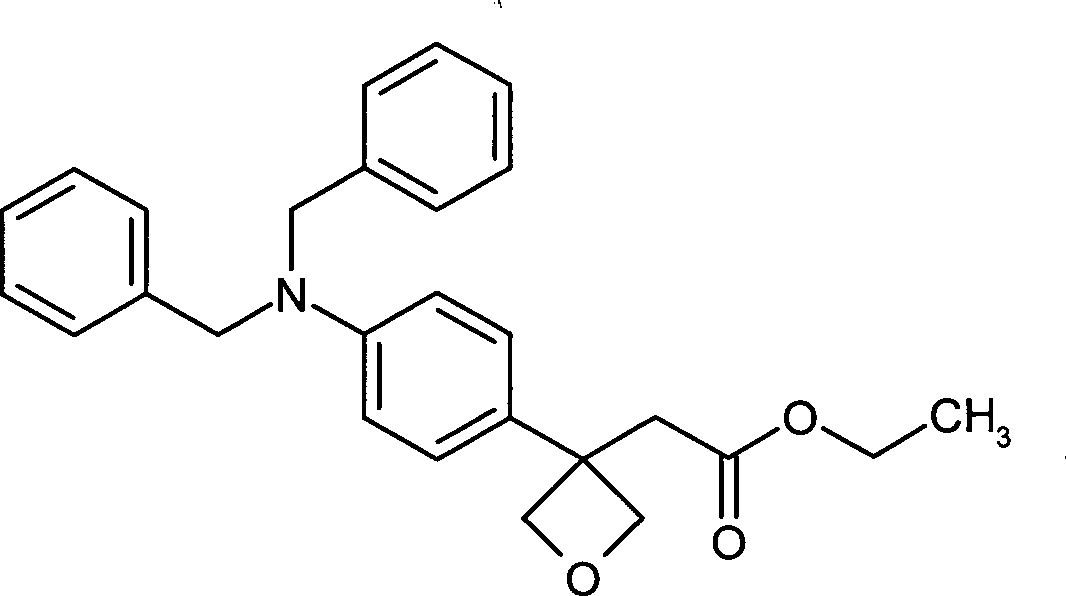
1 H-NMR (400 MHz, DMSO-d 6 , δ / ppm): 7.58 (d, 2H), 7.32-7.30 (m, 4H), 7.27-7.23 (m, 6H), 6.66 (d, 2H), 4.70 (s, 4H).
HPLC (Method A): R t = 4.35 min.
MS (ESIpos): m / z = 318 [M + H] + . Step 2: Ethyl {3- [4- (dibenzylamino) phenyl] oxetan-3-yl} acetate
Eine Lösung von 304 mg (0.616 mmol) (1,5-Cyclooctadien)rhodium(I)chlorid-Dimer in 30 ml 1,4-Dioxan wurde mit 10.7 ml (16.0 mmol) einer 1.5 M Kalilauge versetzt. Nacheinander wurden dann Lösungen von 1.75 g (12.31 mmol) Ethyl-oxetan-3-ylidenacetat [
1H-NMR (400 MHz, CDCl3, δ/ppm): 7.33-7.30 (m, 4H), 7.27-7.23 (m, 6H), 6.97 (d, 2H), 6.69 (d, 2H), 4.94 (d, 2H), 4.81 (d, 2H), 4.62 (s, 4H), 4.00 (quart, 2H), 3.04 (s, 2H), 1.11 (t, 3H).
LC/MS (Methode E, ESIpos): Rt = 2.57 min, m/z = 416 [M+H]+. Schritt 3: 2-{3-[4-(Dibenzylamino)phenyl]oxetan-3-yl}ethanol 
1 H-NMR (400 MHz, CDCl 3, δ / ppm): 7:33 to 7:30 (m, 4H), 7:27 to 7:23 (m, 6H), 6.97 (d, 2H), 6.69 (d, 2H), 4.94 ( d, 2H), 4.81 (d, 2H), 4.62 (s, 4H), 4.00 (quart, 2H), 3.04 (s, 2H), 1.11 (t, 3H).
LC / MS (method E, ESIpos): R t = 2.57 min, m / z = 416 [M + H] + . Step 3: 2- {3- [4- (Dibenzylamino) phenyl] oxetan-3-yl} ethanol
Unter inerten Bedingungen und bei einer Temperatur von 0°C wurde eine Lösung von 2.90 g (6.98 mmol) der Verbindung aus Beispiel 4A/Schritt 2 in 145 ml wasserfreiem THF tropfenweise mit 4.9 ml (4.88 mmol) einer 1 M Lösung von Lithiumaluminiumhydrid in THF versetzt. Nach beendetem Zutropfen wurde das Reaktionsgemisch 1.5 h bei 0°C gerührt. Anschließend wurden 2 g Kieselgur und 2 ml Wasser vorsichtig hinzugefügt. Das heterogene Gemisch wurde über ein Papierfilter abgesaugt. Das Filtrat wurde mit ca. 250 ml Wasser verdünnt und dreimal mit je ca. 250 ml Ethylacetat extrahiert. Die vereinigten organischen Extrakte wurden nacheinander mit Wasser und gesättigter Kochsalz-Lösung gewaschen. Nach Trocknen über wasserfreiem Magnesiumsulfat wurde filtriert und das Lösungsmittel am Rotationsverdampfer entfernt. Das erhaltene Rohprodukt wurde mittels MPLC gereinigt (Kieselgel, Laufmittel: Cyclohexan/Ethylacetat 4:1). Es wurden 2.34 g (87% d. Th.) der Titelverbindung erhalten.
1H-NMR (400 MHz, CDCl3, δ/ppm): 7.36-7.31 (m, 4H), 7.27-7.22 (m, 6H), 6.88 (d, 2H), 6.71 (d, 2H), 4.93 (d, 2H), 4.71 (d, 2H), 4.63 (s, 4H), 3.55 (quart, 2H), 2.29 (t, 2H), 1.12 (t, 1H).
HPLC (Methode B): Rt = 3.98 min.
MS (DCI, NH3): m/z = 374 [M+H]+.
LC/MS (Methode E, ESIpos): Rt = 2.15 min, m/z = 374 [M+H]+. Schritt 4: {3-[4-(Dibenzylamino)phenyl]oxetan-3-yl}acetaldehyd 
1 H-NMR (400 MHz, CDCl 3, δ / ppm): 7:36 to 7:31 (m, 4H), 7:27 to 7:22 (m, 6H), 6.88 (d, 2H), 6.71 (d, 2H), 4.93 ( d, 2H), 4.71 (d, 2H), 4.63 (s, 4H), 3.55 (quart, 2H), 2.29 (t, 2H), 1.12 (t, 1H).
HPLC (Method B): R t = 3.98 min.
MS (DCI, NH 3): m / z = 374 [M + H] +.
LC / MS (method E, ESIpos): R t = 2.15 min, m / z = 374 [M + H] + . Step 4: {3- [4- (Dibenzylamino) phenyl] oxetan-3-yl} acetaldehyde
Unter inerten Bedingungen wurde eine Lösung von 496 μl (5.68 mmol) Oxalylchlorid in 5 ml wasserfreiem Dichlormethan bei –78°C tropfenweise mit 807 μl wasserfreiem DMSO versetzt. Nach 20 min wurde bei derselben Temperatur eine Lösung von 1.93 g (5.17 mmol) der Verbindung aus Beispiel 4A/Schritt 3 in 5 ml wasserfreiem Dichlormethan langsam zugetropft. Nach 60 min Rühren bei –78°C wurden 3.7 ml (26.87 mmol) wasserfreies Triethylamin zugetropft. Nach weiteren 10 min bei dieser Temperatur ließ man das Reaktionsgemisch auf RT erwärmen. Anschließend wurde das Gemisch in einen mit Kieselgel gefüllten Saugfilter gegeben, und es wurde zunächst mit Cyclohexan und dann mit Cyclohexan/Ethylacetat 7:1 → 1:1 eluiert. Die Produktfraktionen wurden vereinigt, zur Trockene eingedampft und der Rückstand in Ethylacetat aufgenommen. Es wurde nacheinander mit gesättigter Natriumhydrogencarbonat-Lösung, Wasser und gesättigter Kochsalz-Lösung gewaschen. Nach Trocknen über wasserfreiem Magnesiumsulfat wurde filtriert und das Lösungsmittel am Rotationsverdampfer entfernt. Es wurden 1.81 g (92% d. Th.) der Titelverbindung erhalten.
1H-NMR (400 MHz, CDCl3, δ/ppm): 9.69 (t, 1H), 7.34-7.31 (m, 4H), 7.28-7.23 (m, 6H), 6.97 (d, 2H), 6.70 (d, 2H), 5.00 (d, 2H), 4.72 (d, 2H), 4.63 (s, 4H), 3.18 (d, 2H).
HPLC (Methode B): Rt = 4.61 min.
MS (DCI, NH3): m/z = 372 [M+H]+.
LC/MS (Methode F, ESIpos): Rt = 1.43 min, m/z = 372 [M+H]+. Schritt 5: N,N-Dibenzyl-4-(3-methyloxetan-3-yl)anilin 
1 H-NMR (400 MHz, CDCl 3 , δ / ppm): 9.69 (t, 1H), 7.34-7.31 (m, 4H), 7.28-7.23 (m, 6H), 6.97 (d, 2H), 6.70 ( d, 2H), 5.00 (d, 2H), 4.72 (d, 2H), 4.63 (s, 4H), 3.18 (d, 2H).
HPLC (Method B): R t = 4.61 min.
MS (DCI, NH 3): m / z = 372 [M + H] +.
LC / MS (Method F, ESIpos): R t = 1.43 min, m / z = 372 [M + H] + . Step 5: N, N-Dibenzyl-4- (3-methyloxetan-3-yl) aniline
Unter inerten Bedingungen wurde eine Lösung von 1.81 g (4.87 mmol) der Verbindung aus Beispiel 4A/Schritt 4 und 13.57 g (14.62 mmol) Tris(triphenylphosphin)rhodium(I)chlorid in 240 ml Toluol eine Stunde unter Rückfluss erhitzt. Nach dem Abkühlen auf RT wurde von unlöslichen Bestandteilen abfiltriert. Das Lösungsmittel wurde am Rotationsverdampfer entfernt und der Rückstand mittels MPLC gereinigt (Kieselgel, Laufmittel: Cyclohexan/Ethylacetat 20:1 → 5:1). Es wurden 1.36 g (73% d. Th., ca. 90% Reinheit) der Titelverbindung erhalten.
1H-NMR (400 MHz, CDCl3, δ/ppm): 7.35-7.31 (m, 4H), 7.27-7.24 (m, 6H), 7.07 (d, 2H), 6.72 (d, 2H), 4.90 (d, 2H), 4.64 (s, 4H), 4.55 (d, 2H), 1.96 (s, 3H). L
C/MS (Methode F, ESIpos): Rt = 1.55 min, m/z = 344 [M+H]+. Schritt 6: 4-(3-Methyloxetan-3-yl)anilin 
1 H-NMR (400 MHz, CDCl 3, δ / ppm): 7:35 to 7:31 (m, 4H), 7:27 to 7:24 (m, 6H), 7:07 (d, 2H), 6.72 (d, 2H), 4.90 ( d, 2H), 4.64 (s, 4H), 4.55 (d, 2H), 1.96 (s, 3H). L
C / MS (Method F, ESIpos): R t = 1.55 min, m / z = 344 [M + H] + . Step 6: 4- (3-Methyloxetan-3-yl) aniline
In einer Durchfluss-Hydrierapparatur (”H-Cube” der Firma ThalesNano, Budapest, Ungarn) wurde eine Lösung von 1.35 g (3.93 mmol) der Verbindung aus Beispiel 4A/Schritt 5 in 135 ml Ethanol hydriert (Bedingungen: 10% Pd/C-Katalysator, ”full H2”-Modus, 1 ml/min, 50°C). Nach Entfernen des Lösungsmittels am Rotationsverdampfer wurde das Rohprodukt mittels MPLC gereinigt (Kieselgel, Laufmittel: Cyclohexan/Ethylacetat 4:1 → 2:1). Es wurden 386 mg (60% d. Th.) der Titelverbindung erhalten.
1H-NMR (400 MHz, CDCl3, δ/ppm): 7.03 (d, 2H), 6.69 (d, 2H), 4.92 (d, 2H), 4.58 (d, 2H), 3.63 (s, breit, 2H), 1.69 (s, 3H).
LC/MS (Methode D, ESIpos): R = 0.77 min, m/z = 164 [M+H]+. Schritt 7: 4-(3-Methyloxetan-3-yl)benzolcarbonitril 
1 H-NMR (400 MHz, CDCl 3 , δ / ppm): 7.03 (d, 2H), 6.69 (d, 2H), 4.92 (d, 2H), 4.58 (d, 2H), 3.63 (s, broad, 2H), 1.69 (s, 3H).
LC / MS (method D, ESIpos): R = 0.77 min, m / z = 164 [M + H] + . Step 7: 4- (3-Methyloxetan-3-yl) benzenecarbonitrile
Eine Lösung von 375 mg (2.30 mmol) der Verbindung aus Beispiel 4A/Schritt 6 in 17 ml Wasser wurde bei 0°C zunächst mit 1.7 ml (20.7 mmol) konzentrierter Salzsäure und dann tropfenweise mit einer Lösung von 159 mg (2.30 mmol) Natriumnitrit in 5 ml Wasser versetzt. Es wurde 30 min bei 0°C gerührt, bevor 1.1 g (10.3 mmol) festes Natriumcarbonat portionsweise zugesetzt wurden. Die so erhaltene Lösung wurde bei 0°C zu einer Lösung von 257 mg (2.87 mmol) Kupfer(I)cyanid und 464 mg (7.12 mmol) Kaliumcyanid in 16 ml Toluol/Wasser (2:1) getropft. Das Reaktionsgemisch wurde 1 h bei 0°C gerührt. Anschließend ließ man das Gemisch auf RT erwärmen. Die organische Phase wurde danach abgetrennt und nacheinander mit Wasser und gesättigter Kochsalz-Lösung gewaschen. Nachdem das Lösungsmittel am Rotationsverdampfer abgetrennt worden war, wurde das Rohprodukt mittels MPLC gereinigt (Kieselgel, Laufmittel: Cyclohexan/Ethylacetat 10:1 → 2:1). Es wurden 390 mg (83% d. Th., 84% Reinheit) der Titelverbindung erhalten.
1H-NMR (400 MHz, CDCl3, δ/ppm): 7.66 (d, 2H), 7.31 (d, 2H), 4.92 (d, 2H), 4.68 (d, 2H), 1.73 (s, 3H).
GC/MS (Methode K, EIpos): Rt = 5.45 min, m/z = 173 (M)+. Schritt 8: N'-Hydroxy-4-(3-methyloxetan-3-yl)benzolcarboximidamid 
1 H-NMR (400 MHz, CDCl 3, δ / ppm): 7.66 (d, 2H), 7.31 (d, 2H), 4.92 (d, 2H), 4.68 (d, 2H), 1.73 (s, 3H) ,
GC / MS (method K, EIpos): R t = 5.45 min, m / z = 173 (M) + . Step 8: N'-hydroxy-4- (3-methyloxetan-3-yl) benzenecarboximidamide
Nach dem unter Beispiel 1A/Schritt 5 beschriebenen Verfahren wurden aus 375 mg (1.83 mmol) der Verbindung aus Beispiel 4A/Schritt 7 297 mg (74% d. Th.) der Titelverbindung erhalten.
1H-NMR (400 MHz, DMSO-d6, δ/ppm): 9.59 (s, 1H), 7.64 (d, 2H), 7.23 (d, 2H), 5.79 (s, breit, 2H), 4.80 (d, 2H), 4.53 (d, 2H), 1.62 (s, 3H).
HPLC (Methode A): Rt = 2.74 min.
MS (DCI, NH3): m/z = 207 [M+H]+.375 mg (1.83 mmol) of the compound from Example 4A / step 7 gave 297 mg (74% of theory) of the title compound by the method described under Example 1A / step 5.
1 H-NMR (400 MHz, DMSO-d 6 , δ / ppm): 9.59 (s, 1H), 7.64 (d, 2H), 7.23 (d, 2H), 5.79 (s, broad, 2H), 4.80 ( d, 2H), 4.53 (d, 2H), 1.62 (s, 3H).
HPLC (Method A): R t = 2.74 min.
MS (DCI, NH 3): m / z = 207 [M + H] +.
Beispiel 5AExample 5A
4-(3-Fluoroxetan-3-yl)-N'-hydroxybenzolcarboximidamid 
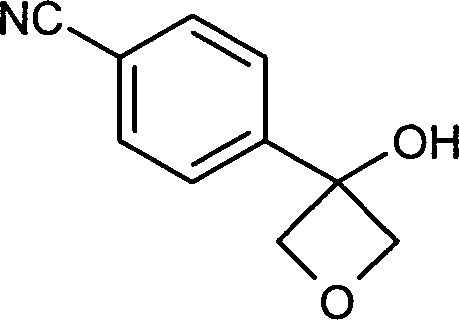
Unter inerten Bedingungen wurde bei –40°C eine Lösung von 5.0 g (21.8 mmol) 4-Iodbenzonitril in 100 ml wasserfreiem THF tropfenweise mit 11 ml (21.8 mmol) einer 2 M Lösung von Isopropylmagnesiumchlorid in Diethylether versetzt. Nachdem das Gemisch 1.5 h bei derselben Temperatur gerührt worden war, wurde es auf –78°C heruntergekühlt und mit Hilfe einer Kanüle zu einer ebenfalls auf –78°C gekühlten Lösung von 2.95 g (32.7 mmol, 80% in Dichlormethan) 3-Oxooxetan [
1H-NMR (400 MHz, DMSO-d6, δ/ppm): 7.88 (d, 2H), 7.80 (d, 2H), 6.63 (s, 1H), 4.79 (d, 2H), 4.65 (d, 2H).
HPLC (Methode A): Rt = 3.09 min.
MS (DCI, NH3): m/z = 193 [M+NH4]+. Schritt 2: 4-(3-Fluoroxetan-3-yl)benzolcarbonitril 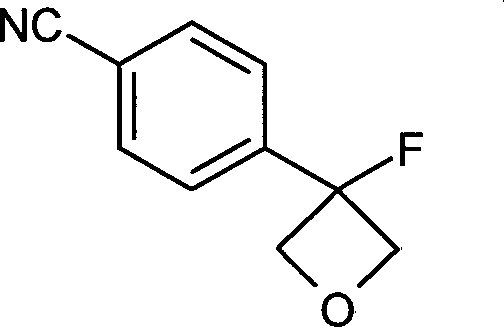
1 H-NMR (400 MHz, DMSO-d 6 , δ / ppm): 7.88 (d, 2H), 7.80 (d, 2H), 6.63 (s, 1H), 4.79 (d, 2H), 4.65 (d, 2H).
HPLC (method A): R t = 3.09 min.
MS (DCI, NH 3): m / z = 193 [M + NH 4] +. Step 2: 4- (3-Fluorooxetan-3-yl) benzenecarbonitrile
Unter inerten Bedingungen wurde bei –78°C eine Suspension von 600 mg (3.43 mmol) der Verbindung aus Beispiel 5A/Schritt 1 in 55 ml Dichlormethan tropfenweise mit einer Lösung von 662 mg (4.11 mmol) Diethylaminoschwefeltrifluorid (DAST) in 5 ml Dichlormethan versetzt. Nach 30 min bei –78°C wurde das Reaktionsgemisch mit Hilfe eines Eis/Wasser-Bades sehr schnell auf –20°C erwärmt. Nach ca. 30 Sekunden wurden 20 ml 1 M Natronlauge zugesetzt, und man ließ das Gemisch auf RT erwärmen. Nach Verdünnen mit 150 ml Wasser wurde dreimal mit je ca. 50 ml Diethylether extrahiert. Die vereinigten organischen Extrakte wurden über wasserfreiem Magnesiumsulfat getrocknet. Nach Filtration wurde das Lösungsmittel am Rotationsverdampfer entfernt. Das Rohprodukt wurde mittels MPLC gereinigt (Kieselgel, Laufmittel: Cyclohexan/Ethylacetat 8:1). Es wurden 495 mg (82% d. Th.) der Titelverbindung erhalten.
1H-NMR (400 MHz, CDCl3, δ/ppm): 7.76 (d, 2H), 7.73 (d, 2H), 5.15 (dd, 2H), 4.81 (dd, 2H).
LC/MS (Methode D, ESIpos): Rt = 1.59 min, m/z = 178 [M+H]+. Schritt 3: 4-(3-Fluoroxetan-3-yl)-N'-hydroxybenzolcarboximidamid 
1 H-NMR (400 MHz, CDCl 3, δ / ppm): 7.76 (d, 2H), 7.73 (d, 2H), 5.15 (dd, 2H), 4.81 (dd, 2H).
LC / MS (Method D, ESIpos): R t = 1.59 min, m / z = 178 [M + H] + . Step 3: 4- (3-Fluorooxetan-3-yl) -N'-hydroxybenzenecarboximidamide
Nach dem unter Beispiel 1A/Schritt 5 beschriebenen Verfahren wurden aus 450 mg (2.54 mmol) der Verbindung aus Beispiel 5A/Schritt 2 470 mg (86% d. Th.) der Titelverbindung erhalten.
1H-NMR (400 MHz, DMSO-d6, δ/ppm): 9.71 (s, 1H), 7.77 (d, 2H), 7.54 (d, 2H), 5.87 (breites s, 2H), 4.97 (dd, 2H), 4.91 (dd, 2H).
HPLC (Methode A): Rt = 2.64 min.
MS (DCI, NH3): m/z = 211 [M+H]+.
LC/MS (Methode D, ESIpos): Rt = 0.80 min, m/z = 211 [M+H]+. According to the procedure described under Example 1A / step 5, 450 mg (2.54 mmol) of the compound from Example 5A / step 2 gave 470 mg (86% of theory) of the title compound.
1 H-NMR (400 MHz, DMSO-d 6 , δ / ppm): 9.71 (s, 1H), 7.77 (d, 2H), 7.54 (d, 2H), 5.87 (broad s, 2H), 4.97 (dd , 2H), 4.91 (dd, 2H).
HPLC (Method A): R t = 2.64 min.
MS (DCI, NH 3): m / z = 211 [M + H] +.
LC / MS (Method D, ESIpos): R t = 0.80 min, m / z = 211 [M + H] + .
Beispiel 6AExample 6A
N'-Hydroxy-4-(3-methoxyoxetan-3-yl)benzolcarboximidamid 
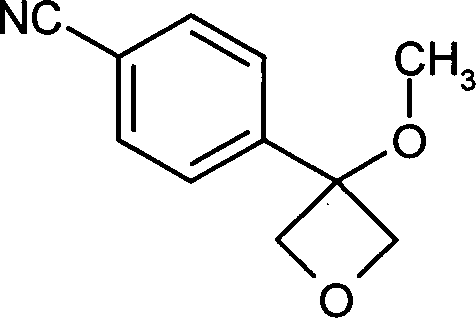
Eine Lösung von 600 mg (3.43 mmol) der Verbindung aus Beispiel 5A/Schritt 1 in 12.5 ml wasserfreiem DMF wurde bei 5°C mit 151 mg (3.77 mmol) einer 60%-igen Dispersion von Natriumhydrid in Mineralöl versetzt. Das Gemisch wurde 1 h bei 5°C gerührt, bevor 256 μl (4.11 mmol) Methyliodid zugesetzt wurden. Man ließ das Reaktionsgemisch dann auf RT kommen. Nach 15 h Rühren wurden 150 ml Wasser zugesetzt, und es wurde zweimal mit je ca. 150 ml Diethylether extrahiert. Die vereinigten organischen Extrakte wurden über wasserfreiem Magnesiumsulfat getrocknet. Nach Filtration und Entfernen des Lösungsmittels am Rotationsverdampfer wurde der erhaltene Rückstand mittels MPLC gereinigt (Kieselgel, Laufmittel: Cyclohexan/Ethylacetat 20:1 → 4:1). Es wurden 566 mg (87% d. Th.) der Titelverbindung erhalten.
1H-NMR (400 MHz, DMSO-d6, δ/ppm): 7.92 (d, 2H), 7.68 (d, 2H), 4.81 (d, 2H), 4.74 (d, 2H), 3.07 (s, 3H).
HPLC (Methode A): Rt = 3.63 min.
MS (DCI, NH3): m/z = 207 [M+NH4]+.
LC/MS (Methode D, ESIpos): Rt = 1.50 min, m/z = 190 [M+H]+. Schritt 2: N'-Hydroxy-4-(3-methoxyoxetan-3-yl)benzolcarboximidamid 
1 H-NMR (400 MHz, DMSO-d 6 , δ / ppm): 7.92 (d, 2H), 7.68 (d, 2H), 4.81 (d, 2H), 4.74 (d, 2H), 3.07 (s, 3H).
HPLC (Method A): R t = 3.63 min.
MS (DCI, NH 3): m / z = 207 [M + NH4] +.
LC / MS (method D, ESIpos): R t = 1.50 min, m / z = 190 [M + H] + . Step 2: N'-hydroxy-4- (3-methoxyoxetan-3-yl) benzenecarboximidamide
Nach dem unter Beispiel 1A/Schritt 5 beschriebenen Verfahren wurden aus 500 mg (2.64 mmol) der Verbindung aus Beispiel 6A/Schritt 1 520 mg (89% d. Th.) der Titelverbindung erhalten.
1H-NMR (400 MHz, DMSO-d6, δ/ppm): 9.67 (s, 1H), 7.73 (d, 2H), 7.43 (d, 2H), 5.83 (breites s, 2H), 4.77 (m, 4H), 3.03 (s, 3H).
HPLC (Methode A): Rt = 2.54 min.
MS (DCI, NH3): m/z = 223 [M+H]+. 500 mg (2.64 mmol) of the compound from Example 6A / Step 1 gave 520 mg (89% of theory) of the title compound by the method described under Example 1A / Step 5.
1 H-NMR (400 MHz, DMSO-d 6 , δ / ppm): 9.67 (s, 1H), 7.73 (d, 2H), 7.43 (d, 2H), 5.83 (broad s, 2H), 4.77 (m , 4H), 3.03 (s, 3H).
HPLC (method A): R t = 2.54 min.
MS (DCI, NH 3): m / z = 223 [M + H] +.
Beispiel 7AExample 7A
4-(4-Fluortetrahydro-2H-pyran-4-yl)-N'-hydroxybenzolcarboximidamid 

Nach dem unter Beispiel 5A/Schritt 1 beschriebenen Verfahren wurden 25.0 g (109 mmol) 4-Iodbenzonitril mit 16.4 g (164 mmol) Tetrahydro-4H-pyran-4-on zu 7.56 g (34% d. Th.) der Titelverbindung umgesetzt.
1H-NMR (400 MHz, DMSO-d6, δ/ppm): 7.80 (d, 2H), 7.70 (d, 2H), 5.30 (s, 1H), 3.81-3.70 (m, 4H), 2.02-1.94 (m, 2H), 1.51-1.48 (m, 2H).
HPLC (Methode A): Rt = 3.35 min.
MS (DCI, NH3): m/z = 204 [M+H]+, 221 [M+NH4]+. Schritt 2: 4-(4-Fluortetrahydro-2H-pyran-4-yl)benzolcarbonitril 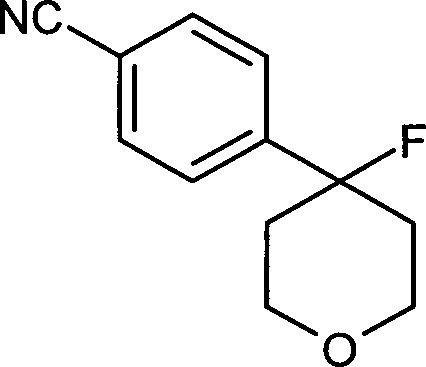
1 H-NMR (400 MHz, DMSO-d 6 , δ / ppm): 7.80 (d, 2H), 7.70 (d, 2H), 5.30 (s, 1H), 3.81-3.70 (m, 4H), 2.02- 1.94 (m, 2H), 1.51-1.48 (m, 2H).
HPLC (Method A): R t = 3.35 min.
MS (DCI, NH 3): m / z = 204 [M + H] +, 221 [M + NH 4] +. Step 2: 4- (4-fluorotetrahydro-2H-pyran-4-yl) benzenecarbonitrile
Nach dem unter Beispiel 5A/Schritt 2 beschriebenen Verfahren wurden 6.5 g (31.98 mmol) der Verbindung aus Beispiel 7A/Schritt 1 zu 3.73 g (57% d. Th.) der Titelverbindung umgesetzt.
1H-NMR (400 MHz, CDCl3, δ/ppm): 7.68 (d, 2H), 7.50 (d, 2H), 3.98-3.83 (m, 4H), 2.23-2.05 (m, 2H), 1.91-1.85 (m, 2H).
HPLC (Methode A): Rt = 4.04 min.
MS (DCI, NH3): m/z = 223 [M+NH4]+. Schritt 3: 4-(4-Fluortetrahydro-2H-pyran-4-yl)-N'-hydroxybenzolcarboximidamid 
1 H-NMR (400 MHz, CDCl 3, δ / ppm): 7.68 (d, 2H), 7.50 (d, 2H), 3.98-3.83 (m, 4H), 2:23 to 2:05 (m, 2H), 1.91- 1.85 (m, 2H).
HPLC (Method A): R t = 4.04 min.
MS (DCI, NH 3): m / z = 223 [M + NH 4] +. Step 3: 4- (4-fluorotetrahydro-2H-pyran-4-yl) -N'-hydroxybenzenecarboximidamide
Nach dem unter Beispiel 1A/Schritt 5 beschriebenen Verfahren wurden aus 3.5 g (17.05 mmol) der Verbindung aus Beispiel 7A/Schritt 2 3.57 g (88% d. Th.) der Titelverbindung erhalten.
1H-NMR (500 MHz, DMSO-d6, δ/ppm): 9.64 (s, 1H), 7.70 (d, 2H), 7.44 (d, 2H), 5.81 (s, 2H), 3.88-3.83 (m, 2H), 3.73-3.67 (m, 2H), 2.23-2.06 (m, 2H), 1.87-1.81 (m, 2H).
HPLC (Methode A): Rt = 3.06 min.
MS (DCI, NH3): m/z = 239 [M+H]+.
LC/MS (Methode F, ESIpos): Rt = 0.40 min, m/z = 239 [M+H]+.3.5 g (17.05 mmol) of the compound from Example 7A / Step 2 gave 3.57 g (88% of theory) of the title compound by the method described under Example 1A / step 5.
1 H-NMR (500 MHz, DMSO-d 6 , δ / ppm): 9.64 (s, 1H), 7.70 (d, 2H), 7.44 (d, 2H), 5.81 (s, 2H), 3.88-3.83 ( m, 2H), 3.73-3.67 (m, 2H), 2.23-2.06 (m, 2H), 1.87-1.81 (m, 2H).
HPLC (Method A): R t = 3.06 min.
MS (DCI, NH 3): m / z = 239 [M + H] +.
LC / MS (method F, ESIpos): R t = 0.40 min, m / z = 239 [M + H] + .
Beispiel 8AExample 8A
N'-Hydroxy-4-(4-methoxytetrahydro-2H-pyran-4-yl)benzolcarboximidamid 

Nach dem unter Beispiel 6A/Schritt 1 beschriebenen Verfahren wurden aus 300 mg (1.48 mmol) der Verbindung aus Beispiel 7A/Schritt 1 und 111 μl (1.77 mmol) Methyliodid 238 mg (74% d. Th.) der Titelverbindung erhalten.
1H-NMR (500 MHz, CDCl3, δ/ppm): 7.68 (d, 2H), 7.51 (d, 2H), 3.89-3.82 (m, 4H), 2.99 (s, 3H), 2.03-1.98 (m, 2H), 1.94-1.91 (m, 2H).
HPLC (Methode A): Rt = 3.99 min.
MS (DCI, NH3): m/z = 235 [M+NH4]+.
GC/MS (Methode K, EIpos): Rt = 6.57 min, m/z = 217 (M)+. Schritt 2: N'-Hydroxy-4-(4-methoxytetrahydro-2H-pyran-4-yl)benzolcarboximidamid 
1 H-NMR (500 MHz, CDCl 3, δ / ppm): 7.68 (d, 2H), 7:51 (d, 2H), 3.89-3.82 (m, 4H), 2.99 (s, 3H), 2.03-1.98 ( m, 2H), 1.94-1.91 (m, 2H).
HPLC (method A): R t = 3.99 min.
MS (DCI, NH 3): m / z = 235 [M + NH 4] +.
GC / MS (method K, EIpos): R t = 6.57 min, m / z = 217 (M) + . Step 2: N'-hydroxy-4- (4-methoxytetrahydro-2H-pyran-4-yl) benzenecarboximidamide
Nach dem unter Beispiel 1A/Schritt 5 beschriebenen Verfahren wurden aus 200 mg (0.921 mmol) der Verbindung aus Beispiel 8A/Schritt 1 229 mg (99% d. Th.) der Titelverbindung erhalten.
1H-NMR (400 MHz, DMSO-d6, δ/ppm): 9.63 (s, 1H), 7.68 (d, 2H), 7.39 (d, 2H), 5.80 (s, 2H), 3.71-3.67 (m, 4H), 2.88 (m, 2H), 1.93-1.89 (m, 4H).
HPLC (Methode B): Rt = 2.95 min.
MS (DCI, NH3): m/z = 251 [M+H]+.
LC/MS (Methode D, ESIpos): Rt = 0.93 min, m/z = 251 [M+H]+.200 mg (0.921 mmol) of the compound from Example 8A / Step 1 gave 229 mg (99% of theory) of the title compound by the method described under Example 1A / Step 5.
1 H-NMR (400 MHz, DMSO-d 6 , δ / ppm): 9.63 (s, 1H), 7.68 (d, 2H), 7.39 (d, 2H), 5.80 (s, 2H), 3.71-3.67 ( m, 4H), 2.88 (m, 2H), 1.93-1.89 (m, 4H).
HPLC (Method B): R t = 2.95 min.
MS (DCI, NH 3): m / z = 251 [M + H] +.
LC / MS (Method D, ESIpos): R t = 0.93 min, m / z = 251 [M + H] + .
Analog zu dem unter Beispiel 1A/Schritt 5 beschriebenen Verfahren wurden die in der folgenden Tabelle aufgeführten N'-Hydroxybenzolcarboximidamide aus den entsprechenden, kommerziell erhältlichen Benzonitrilen hergestellt. Die nicht kommerziell erhältlichen Benzonitrile wurden gemäß der folgenden Literaturvorschriften hergestellt: 4-Cyclohexylbenzolcarbonitril [
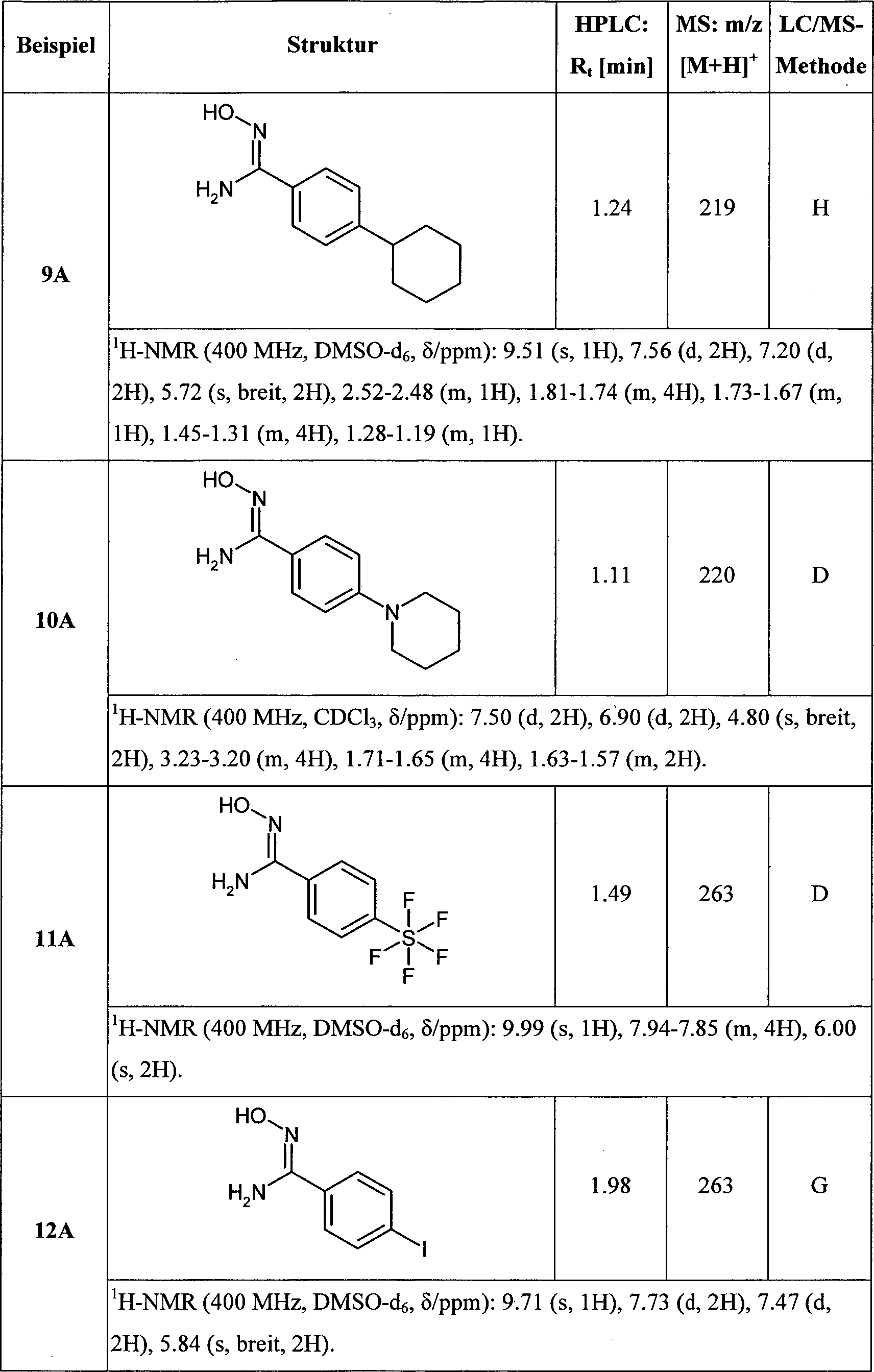
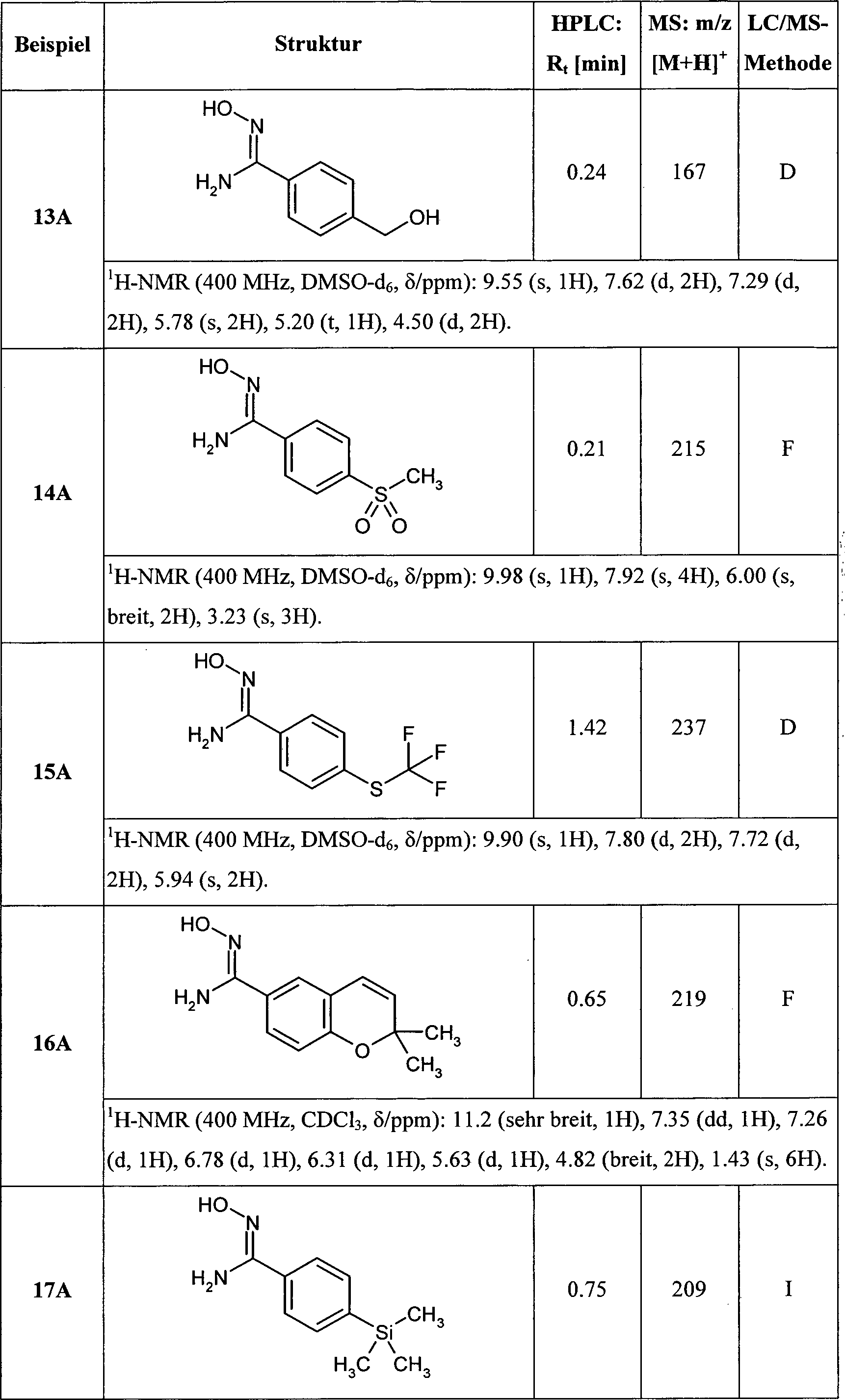
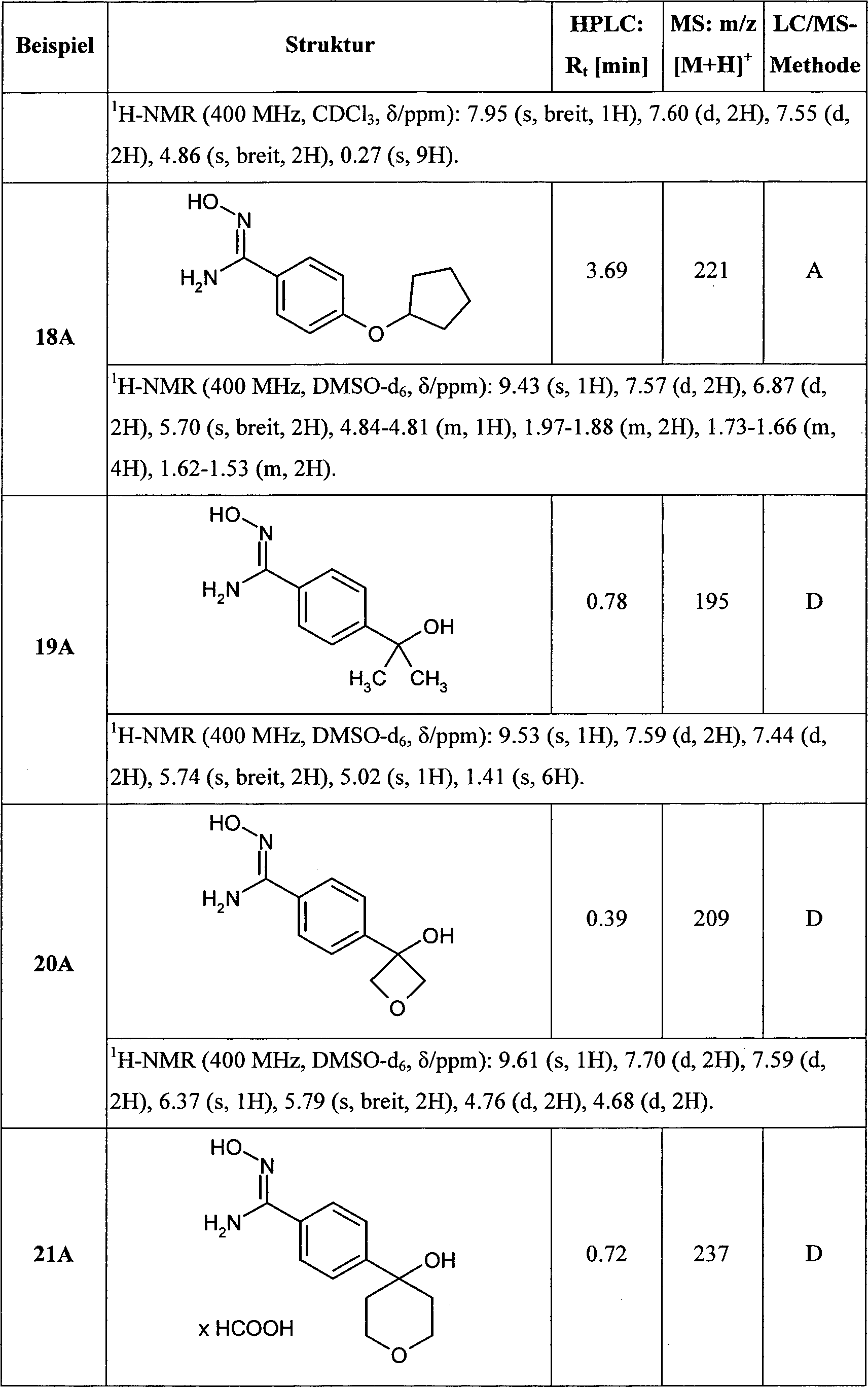

Beispiel 22AExample 22A
2-Amino-2-[4-(trifluormethoxy)phenyl]ethanol 
Eine Lösung von 3.0 g (12.8 mmol) racemischem 4-(Trifluormethoxy)phenylglycin in 20 ml THF wurde nacheinander mit 834 mg (38.3 mmol) Lithiumborhydrid und 1 ml (19.1 mmol) konzentrierter Schwefelsäure, gelöst in 1 ml THF, versetzt. Das Reaktionsgemisch wurde 24 h bei RT gerührt. Dann wurden 15 ml Methanol zugesetzt und die Mischung so lange gerührt, bis eine klare Lösung entstand. Zu dieser Lösung wurden anschließend 20 ml 4 M Natronlauge hinzugetropft. Dabei fiel ein Niederschlag aus, der abgesaugt und verworfen wurde. Das Filtrat wurde am Rotationsverdampfer von den organischen Lösungsmitteln befreit. Der Rückstand wurde dreimal mit je ca. 20 ml Toluol extrahiert. Die vereinigten organischen Extrakte wurden am Rotationsverdampfer eingeengt. Es wurden 2.25 g (80% d. Th.) der Titelverbindung erhalten.
1H-NMR (400 MHz, DMSO-d6, δ/ppm): 7.48 (d, 2H), 7.31 (d, 2H), 5.63 und 5.51 (jeweils breit, zus. 2H), 4.91 (breit, 1H), 3.71-3.67 (m, 1H), 3.66-3.59 (m, 2H).
MS (DCI, NH3): m/z = 222 [M+H]+.A solution of 3.0 g (12.8 mmol) of racemic 4- (trifluoromethoxy) phenylglycine in 20 ml of THF was treated successively with 834 mg (38.3 mmol) of lithium borohydride and 1 ml (19.1 mmol) of concentrated sulfuric acid dissolved in 1 ml of THF. The reaction mixture was stirred at RT for 24 h. Then 15 ml of methanol were added and the mixture was stirred until a clear solution formed. 20 ml of 4 M sodium hydroxide solution were subsequently added dropwise to this solution. This precipitated out, which was sucked off and discarded. The filtrate was freed from the organic solvents on a rotary evaporator. The residue was extracted three times with about 20 ml of toluene. The combined organic extracts were concentrated on a rotary evaporator. 2.25 g (80% of theory) of the title compound were obtained.
1 H-NMR (400 MHz, DMSO-d 6 , δ / ppm): 7.48 (d, 2H), 7.31 (d, 2H), 5.63 and 5.51 (each broad, total 2H), 4.91 (broad, 1H) , 3.71-3.67 (m, 1H), 3.66-3.59 (m, 2H).
MS (DCI, NH 3): m / z = 222 [M + H] +.
Beispiel 23AExample 23A
5-(5-Methyl-1H-pyrazol-3-yl)-3-[4-(trifluormethoxy)phenyl]-1,2,4-oxadiazol 
Eine Lösung von 15.3 g (0.121 mol) 5-Methyl-1H-pyrazol-3-carbonsäure in 600 ml wasserfreiem DMF wurde bei RT nacheinander mit 23.3 g (0.121 mol) EDC, 16.4 g (0.121 mol) HOBt und 26.7 g (0.121 mol) N'-Hydroxy-4-(trifluormethoxy)benzolcarboximidamid versetzt. Das Gemisch wurde zunächst 2 h bei RT und anschließend 5 h bei 140°C gerührt. Nach dem Abkühlen wurde mit 2 Litern Wasser verdünnt und dreimal mit je 1 Liter Ethylacetat extrahiert. Die vereinigten organischen Extrakte wurden nacheinander mit Wasser und gesättigter Kochsalz-Lösung gewaschen. Nach Trocknen über wasserfreiem Magnesiumsulfat wurde filtriert und das Lösungsmittel am Rotationsverdampfer entfernt. Das erhaltene Rohprodukt wurde mittels Saugfiltration über eine mit Kieselgel gefüllte Filternutsche gereinigt (Eluent: Cyclohexan/Ethylacetat 5:1 → 1:1). Die Produktfraktionen wurden vereinigt und das Lösungsmittel am Rotationsverdampfer so weit entfernt, dass das Produkt gerade begann auszufallen. Die Fällung wurde bei RT vervollständigt. Durch Filtration und weiteres Einengen der Mutterlauge wurden zwei Fraktionen Feststoff erhalten, die vereinigt und im Hochvakuum getrocknet wurden. Insgesamt wurden so 19.7 g (52% d. Th.) der Titelverbindung erhalten.
1H-NMR (400 MHz, CDCl3, δ/ppm): 10.75 (breit, 1H), 8.24 (d, 2H), 7.34 (d, 2H), 6.81 (s, 1H), 2.46 (s, 3H).
HPLC (Methode A): Rt = 4.72 min.
MS (DCI, NH3): m/z = 311 [M+H]+.
LC/MS (Methode F, ESIpos): Rt = 1.27 min, m/z = 311 [M+H]+.A solution of 15.3 g (0.121 mol) of 5-methyl-1H-pyrazole-3-carboxylic acid in 600 ml of anhydrous DMF was added successively at RT with 23.3 g (0.121 mol) EDC, 16.4 g (0.121 mol) HOBt and 26.7 g (0.121 mol) of N'-hydroxy-4- (trifluoromethoxy) benzenecarboximidamide. The mixture was stirred initially at RT for 2 h and then at 140 ° C. for 5 h. After cooling, it was diluted with 2 liters of water and extracted three times with 1 liter of ethyl acetate. The combined organic extracts were washed successively with water and saturated brine. After drying over anhydrous magnesium sulfate, it was filtered and the solvent removed on a rotary evaporator. The crude product obtained was purified by suction filtration through a filter slide filled with silica gel (eluent: cyclohexane / ethyl acetate 5: 1 → 1: 1). The product fractions were combined and the solvent removed on a rotary evaporator so far that the product was just beginning to precipitate. The precipitation was completed at RT. By filtration and further concentration of the mother liquor two fractions solid were obtained, which were combined and dried under high vacuum. In total, 19.7 g (52% of theory) of the title compound were obtained in this way.
1 H-NMR (400 MHz, CDCl 3, δ / ppm): 10.75 (broad, 1H), 8.24 (d, 2H), 7:34 (d, 2H), 6.81 (s, 1H) 2.46 (s, 3H) ,
HPLC (Method A): R t = 4.72 min.
MS (DCI, NH 3): m / z = 311 [M + H] +.
LC / MS (method F, ESIpos): R t = 1.27 min, m / z = 311 [M + H] + .
Die in der folgenden Tabelle aufgeführten Verbindungen wurden nach dem in Beispiel 23A beschriebenen Verfahren aus 5-Methyl-1H-pyrazol-3-carbonsäure, 5-(Trifluormethyl)-1H-pyrazol-3-carbonsäure, 5-Nitro-1H-pyrazol-3-carbonsäure bzw. 2-Methyl-1H-imidazol-4-carbonsäure-Hydrat und den entsprechenden N'-Hydroxybenzolcarboximidamiden hergestellt. Je nach Größe des Ansatzes betrug die Reaktionszeit, während der zunächst bei RT gerührt wurde, 0.5 bis 4 h. Auf 140°C wurde nachfolgend für 1 bis 15 h erhitzt. Je nach Polarität des erhaltenen Produkts fiel dieses bereits bei der Zugabe von Wasser nach der beendeten Reaktion aus, es wurde dann gewaschen und im Hochvakuum getrocknet. Alternativ wurde, wie oben beschrieben, extraktiv aufgearbeitet und anschließend chromatographisch über Kieselgel gereinigt; für die Chromatographie wurden unterschiedliche Laufmittel verwendet. In manchen Fällen konnte auf die Chromatographie verzichtet und das Produkt direkt durch Ausrühren in Dichlormethan, Ethylacetat, Acetonitril oder tert.-Butyl-methylether gereinigt werden. Die Verbindung in Beispiel 36A wurde mittels präparativer HPLC (Methode M) gereinigt.The compounds listed in the following table were prepared according to the method described in Example 23A from 5-methyl-1H-pyrazole-3-carboxylic acid, 5- (trifluoromethyl) -1H-pyrazole-3-carboxylic acid, 5-nitro-1H-pyrazole 3-carboxylic acid or 2-methyl-1H-imidazole-4-carboxylic acid hydrate and the corresponding N'-Hydroxybenzolcarboximidamiden prepared. Depending on the size of the mixture, the reaction time during which it was stirred initially at RT was 0.5 to 4 h. At 140 ° C was subsequently heated for 1 to 15 h. Depending on the polarity of the product obtained, this precipitated out already upon the addition of water after the reaction had ended, it was then washed and dried under high vacuum. Alternatively, as described above, worked up by extraction and then purified by chromatography on silica gel; For the chromatography, different eluents were used. In some cases, the chromatography was omitted and the product was purified directly by stirring in dichloromethane, ethyl acetate, acetonitrile or tert-butyl methyl ether. The compound in Example 36A was purified by preparative HPLC (Method M).
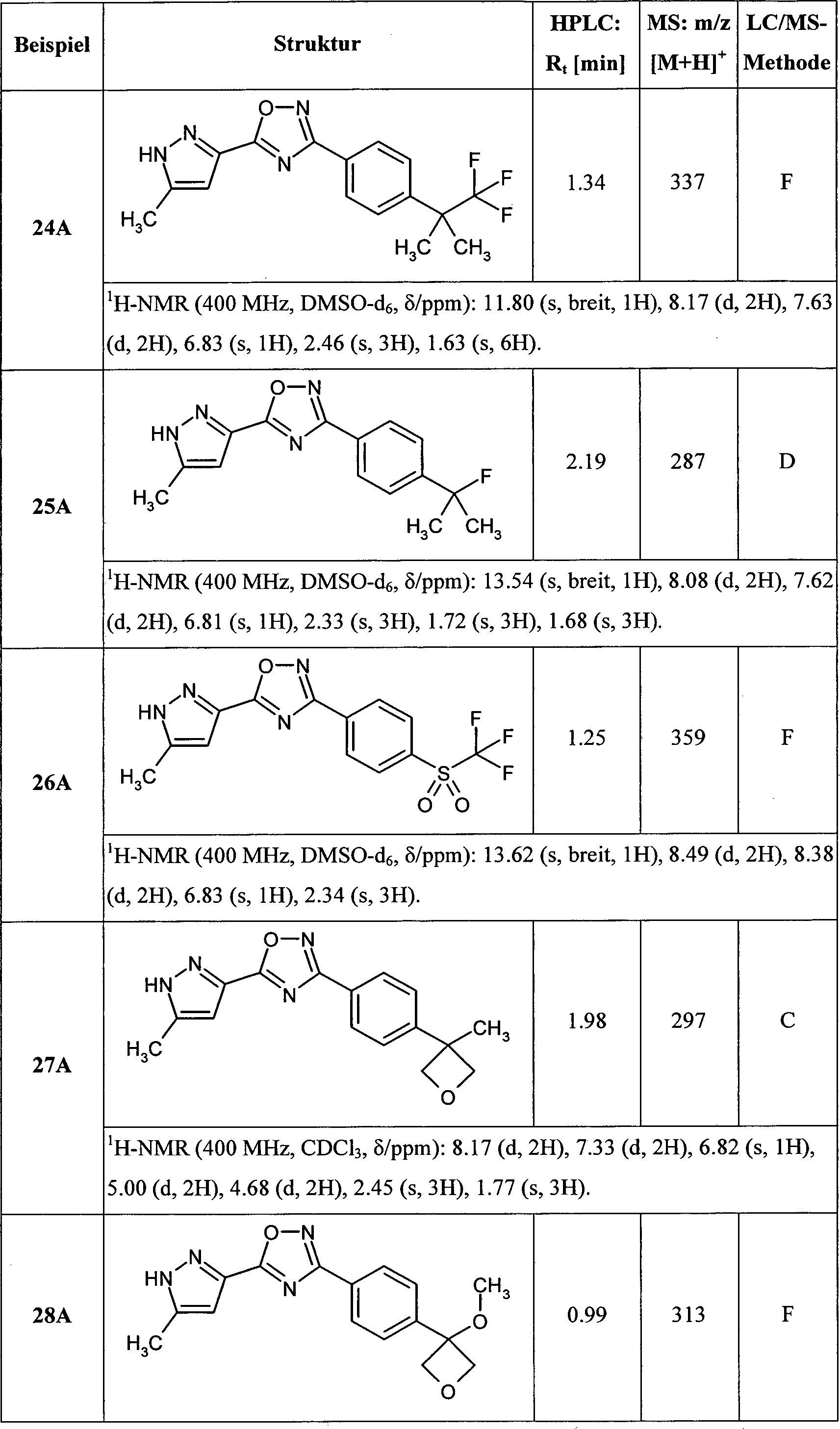

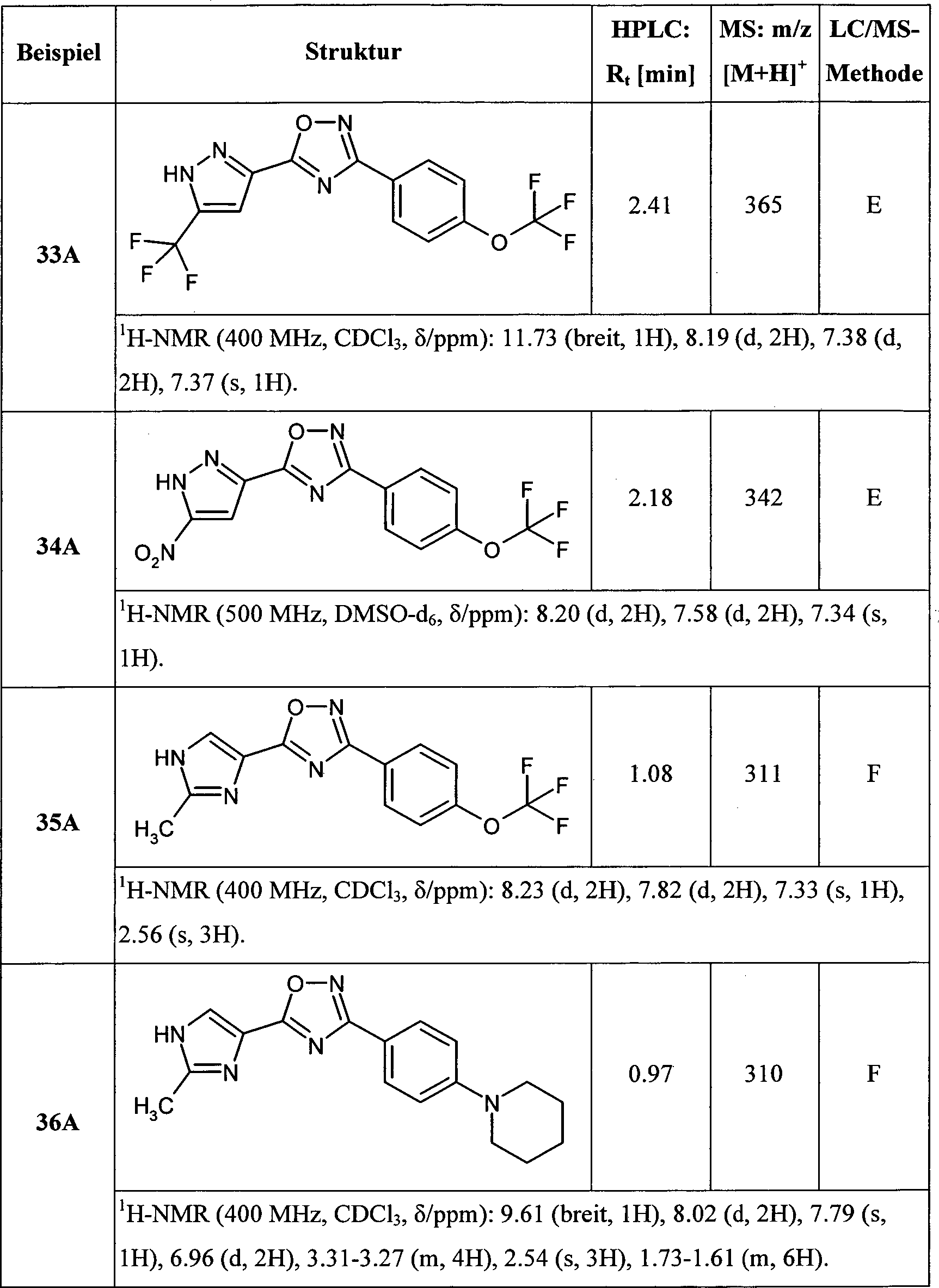
Beispiel 37AExample 37A
3-{3-[4-(Trifluormethoxy)phenyl]-1,2,4-oxadiazol-5-yl}-1H-pyrazol-5-amin 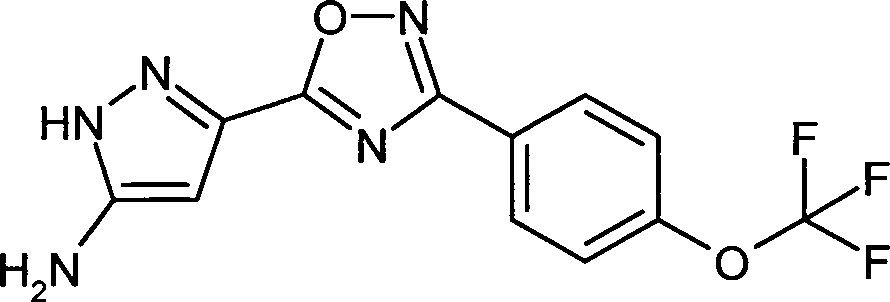
In einer Durchfluss-Hydrierapparatur (”H-Cube” der Firma ThalesNano, Budapest, Ungarn) wurde eine Lösung von 342 mg (1.0 mmol) der Verbindung aus Beispiel 34A in 43 ml Ethylacetat hydriert (Bedingungen: 10% Pd/C-Katalysator, 1 bar HZ, 25°C, 1 ml/min). Nach Entfernen des Lösungsmittels am Rotationsverdampfer wurde das Rohprodukt mittels MPLC gereinigt (Kieselgel, Laufmittel: Cyclohexan/Ethylacetat 1:1). Es wurden 322 mg (93% d. Th.) der Titelverbindung erhalten.
1H-NMR (400 MHz, DMSO-d6, δ/ppm): 12.49 (s, 1H), 8.19 (d, 2H), 7.49 (d, 2H), 5.93 (s, 1H), 5.44 (s, 2H).
MS (DCI, NH3): m/z = 312 [M+H]+.
LC/MS (Methode E, ESIpos): Rt = 1.76 min, m/z = 312 [M+H]+.In a flow hydrogenation apparatus ("H-Cube" from ThalesNano, Budapest, Hungary), a solution of 342 mg (1.0 mmol) of the compound from Example 34A in 43 ml of ethyl acetate was hydrogenated (conditions: 10% Pd / C catalyst, 1 bar HZ, 25 ° C, 1 ml / min). After removal of the solvent on a rotary evaporator, the crude product was purified by MPLC (silica gel, mobile phase: cyclohexane / ethyl acetate 1: 1). There were obtained 322 mg (93% of theory) of the title compound.
1 H-NMR (400 MHz, DMSO-d 6 , δ / ppm): 12.49 (s, 1H), 8.19 (d, 2H), 7.49 (d, 2H), 5.93 (s, 1H), 5.44 (s, 2H).
MS (DCI, NH 3): m / z = 312 [M + H] +.
LC / MS (method E, ESIpos): R t = 1.76 min, m / z = 312 [M + H] + .
Beispiel 38AExample 38A
2-Chlor-4-(chlormethyl)pyridin 
Man löste 1.00 g (6.97 mmol) (2-Chlorpyridin-4-yl)methanol in 40 ml Dichlormethan, gab langsam 10 ml Thionylchlorid bei RT hinzu und rührte das Gemisch über Nacht bei RT. Anschließend wurde das Gemisch am Rotationsverdampfer eingeengt und der Rückstand in einem Mischung aus Dichlormethan und wässriger Natriumhydrogencarbonat-Lösung verrührt. Man trennte die Phasen, trocknete die Dichlormethan-Phase über wasserfreiem Magnesiumsulfat, filtrierte und engte am Rotationsverdampfer ein. Es wurden 1.10 g (97% d. Th.) der Titelverbindung erhalten.
1H-NMR (400 MHz, CDCl3, δ/ppm): 8.49 (d, 1H), 7.38 (s, 1H), 7.27-7.22 (m, 1H), 4.52 (s, 2H).
LC/MS (Methode E, ESIpos): Rt = 1.43 min, m/z = 162 [M+H]+.1.00 g (6.97 mmol) of (2-chloropyridin-4-yl) methanol were dissolved in 40 ml of dichloromethane, 10 ml of thionyl chloride were added slowly at RT, and the mixture was stirred at RT overnight. The mixture was then concentrated on a rotary evaporator and the residue was stirred in a mixture of dichloromethane and aqueous sodium bicarbonate solution. The phases were separated, the dichloromethane phase was dried over anhydrous magnesium sulfate, filtered and concentrated on a rotary evaporator. There were obtained 1.10 g (97% of theory) of the title compound.
1 H-NMR (400 MHz, CDCl 3, δ / ppm): 8.49 (d, 1H), 7:38 (s, 1H), 7:27 to 7:22 (m, 1H), 4:52 (s, 2H).
LC / MS (method E, ESIpos): R t = 1.43 min, m / z = 162 [M + H] + .
Beispiel 39AExample 39A
2-(Chlormethyl)-5-iodpyridin 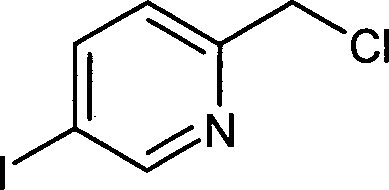
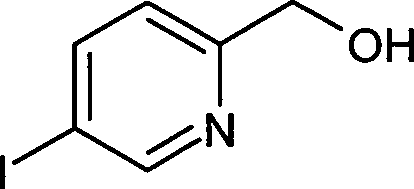
Unter inerten Bedingungen und einer Temperatur von –78°C wurde eine Lösung von 2.50 g (7.56 mmol) 2,5-Diiodpyridin in 90 ml Toluol tropfenweise mit 5.7 ml (9.07 mmol) einer 1.6 M Lösung von n-Butyllithium in Hexan versetzt. Es wurde 2.5 h bei –78°C gerührt und dann bei derselben Temperatur 756 μl wasserfreies DMF zugegeben. Nach weiteren 60 min bei –78°C ließ man das Reaktionsgemisch auf –10°C erwärmen, fügte 572 mg (15.11 mmol) festes Natriumborhydrid hinzu und setzte das Rühren für 30 min bei 0°C fort. Anschließend wurde mit 25 ml gesättigter wässriger Ammoniumchlorid-Lösung versetzt und das Gemisch auf RT erwärmt. Die organische Phase wurde abgetrennt und das Lösungsmittel am Rotationsverdampfer entfernt. Der Rückstand wurde mittels präparativer HPLC gereinigt Es wurden 890 mg (50% d. Th.) der Titelverbindung (analytische Daten siehe unten) sowie 243 mg (14% d. Th.) des isomeren 5-(Hydroxymethyl)-2-iodpyridins erhalten [präparative HPLC-Bedingungen: Säule: Sunfire C18 OBD 5 μm, 19 mm × 150 mm; Temperatur: 40°C; Laufmittel: Wasser/Acetonitril/1%-ige wässrige TFA 76:5:19; Flussrate: 25 ml/min; 1.3 g Rohprodukt wurden in einem Gemisch aus 8 ml 1%-iger wässriger TFA und 4 ml Acetonitril gelöst; Injektionsvolumen: 1 ml].
1H-NMR (400 MHz, CDCl3, δ/ppm): 8.87 (d, 1H), 8.30 (dd, 1H), 7.38 (d, 1H), 5.43 (breit, 1H), 4.85 (s, 2H).
HPLC (Methode A): Rt = 0.87 min.
MS (DCI, NH3): m/z = 236 [M+H]+.
LC/MS (Methode E, ESIpos): Rt = 0.85 min, m/z = 236 [M+H]+. Schritt 2: 2-(Chlormethyl)-5-iodpyridin 
1 H-NMR (400 MHz, CDCl 3, δ / ppm): 8.87 (d, 1H), 8.30 (dd, 1H), 7:38 (d, 1H), 5:43 (broad, 1H), 4.85 (s, 2H) ,
HPLC (Method A): R t = 0.87 min.
MS (DCI, NH 3): m / z = 236 [M + H] +.
LC / MS (method E, ESIpos): R t = 0.85 min, m / z = 236 [M + H] + . Step 2: 2- (Chloromethyl) -5-iodopyridine
Eine Lösung von 765 mg (3.26 mmol) der Verbindung aus Beispiel 39A/Schritt 1 in 12 ml wasserfreiem Dichlormethan wurde bei 0°C tropfenweise mit 357 μl (4.88 mmol) Thionylchlorid versetzt. Man ließ das Reaktionsgemisch anschließend 15 h bei RT rühren. Dann wurde mit ca. 50 ml gesättigter wässriger Natriumhydrogencarbonat-Lösung versetzt und dreimal mit je ca. 50 ml Dichlormethan extrahiert. Die vereinigten organischen Extrakte wurden mit gesättigter Kochsalz-Lösung gewaschen und über wasserfreiem Magnesiumsulfat getrocknet. Nach dem Filtrieren wurde das Lösungsmittel am Rotationsverdampfer entfernt. Es wurden 541 mg (66% d. Th.) der Titelverbindung erhalten.
1H-NMR (400 MHz, CDCl3, δ/ppm): 8.79 (d, 1H), 8.03 (dd, 1H), 7.29 (d, 1H), 4.61 (s, 2H).
MS (ESIpos): m/z = 254/256 (35Cl/37Cl) [M+H]+.
LC/MS (Methode D, ESIpos): Rt = 1.87 min, m/z = 254/256 (35Cl/37Cl) [M+H]+.A solution of 765 mg (3.26 mmol) of the compound from Example 39A / Step 1 in 12 ml of anhydrous dichloromethane was added dropwise at 0 ° C with 357 .mu.l (4.88 mmol) of thionyl chloride. The reaction mixture was then allowed to stir at RT for 15 h. Then, it was mixed with about 50 ml of saturated aqueous sodium bicarbonate solution and extracted three times with about 50 ml of dichloromethane each time. The combined organic extracts were washed with saturated brine and dried over anhydrous magnesium sulfate. After filtration, the solvent was removed on a rotary evaporator. 541 mg (66% of theory) of the title compound were obtained.
1 H-NMR (400 MHz, CDCl 3, δ / ppm): 8.79 (d, 1H), 8:03 (dd, 1H), 7.29 (d, 1H), 4.61 (s, 2H).
MS (ESIpos): m / z = 254/256 ( 35 Cl / 37 Cl) [M + H] + .
LC / MS (Method D, ESIpos): R t = 1.87 min, m / z = 254/256 ( 35 Cl / 37 Cl) [M + H] + .
Beispiel 40AExample 40A
5-(Chlormethyl)pyridin-2-carbonitril-Hydrochlorid 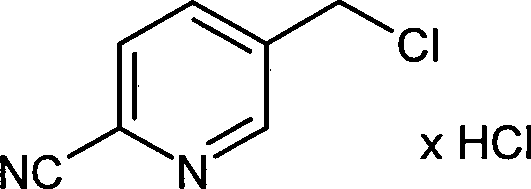
Eine Lösung von 250 mg (1.86 mmol) 5-(Hydroxymethyl)pyridin-2-carbonitril [
1H-NMR (400 MHz, CDCl3, δ/ppm): 8.73 (d, 1H), 7.90 (dd, 1H), 7.72 (d, 1H), 4.63 (s, 2H).
MS (ESIpos): m/z = 153/155 (35Cl/37Cl) [M+H]+.
LC/MS (Methode F, ESIpos): Rt = 0.75 min, m/z = 153/155 (35Cl/37Cl) [M+H]+.A solution of 250 mg (1.86 mmol) of 5- (hydroxymethyl) pyridine-2-carbonitrile [
1 H-NMR (400 MHz, CDCl 3, δ / ppm): 8.73 (d, 1H), 7.90 (dd, 1H), 7.72 (d, 1H), 4.63 (s, 2H).
MS (ESIpos): m / z = 153/155 ( 35 Cl / 37 Cl) [M + H] + .
LC / MS (Method F, ESIpos): R t = 0.75 min, m / z = 153/155 ( 35 Cl / 37 Cl) [M + H] + .
Beispiel 41AExample 41A
(6-Cyanopyridin-3-yl)methylmethansulfonat 
Eine Lösung von 2.8 g (20.87 mmol) 5-(Hydroxymethyl)pyridin-2-carbonitril [
1H-NMR (400 MHz, CDCl3, δ/ppm): 8.76 (d, 1H), 7.93 (dd, 1H), 7.78 (d, 1H), 5.32 (s, 2H), 3.10 (s, 3H).
MS (DCI, NH3): m/z = 213 [M+H]+, 230 [M+NH4]+.
LC/MS (Methode F, ESIpos): Rt = 0.57 min, m/z = 213 [M+H]+.A solution of 2.8 g (20.87 mmol) of 5- (hydroxymethyl) pyridine-2-carbonitrile [
1 H-NMR (400 MHz, CDCl 3, δ / ppm): 8.76 (d, 1H), 7.93 (dd, 1H), 7.78 (d, 1H), 5:32 (s, 2H), 3.10 (s, 3H) ,
MS (DCI, NH 3): m / z = 213 [M + H] +, 230 [M + NH 4] +.
LC / MS (Method F, ESIpos): R t = 0.57 min, m / z = 213 [M + H] + .
Beispiel 42AExample 42A
[3-(Brommethyl)phenoxy](tripropan-2-yl)silan 

Eine Lösung von 5.0 g (30.09 mmol) 3-Hydroxybenzoesäureethylester und 2.41 g (35.35 mmol) Imidazol in 20 ml wasserfreiem DMF wurde bei 0°C tropfenweise mit 5.98 g (30.99 mmol) Triisopropylsilylchlorid versetzt. Nachdem das Reaktionsgemisch 15 h bei RT gerührt worden war, wurde mit ca. 100 ml Wasser versetzt und dreimal mit je ca. 100 ml Diethylether extrahiert. Die vereinigten organischen Extrakte wurden nacheinander mit Wasser und gesättigter Kochsalz-Lösung gewaschen. Nach Trocknen über wasserfreiem Magnesiumsulfat und Filtration wurde das Lösungsmittel am Rotationsverdampfer entfernt. Der erhaltene Rückstand wurde per Saugfiltration über Kieselgel mit Cyclohexan/Ethylacetat 10:1 → 1:1 als Laufmittel gereinigt. Es wurden 9.70 g (100% d. Th.) der Titelverbindung erhalten.
1H-NMR (400 MHz, CDCl3, δ/ppm): 7.62 (dd, 1H), 7.53 (m, 1H), 7.28 (dd, 1H), 7.06 (dd, 1H), 4.37 (quart, 2H), 1.39 (t, 3H), 1.28 (sept, 3H), 1.10 (d, 18H).
GC/MS (Methode K, EI): Rt = 6.62 min, m/z = 322 (M)+, 279 (M-C3H7)+. Schritt 2: {3-[(Tripropan-2-ylsilyl)oxy]phenyl}methanol 
1 H-NMR (400 MHz, CDCl 3 , δ / ppm): 7.62 (dd, 1H), 7.53 (m, 1H), 7.28 (dd, 1H), 7.06 (dd, 1H), 4.37 (quart, 2H) , 1.39 (t, 3H), 1.28 (sept, 3H), 1.10 (d, 18H).
GC / MS (method K, EI): R t = 6.62 min, m / z = 322 (M) + , 279 (MC 3 H 7 ) + . Step 2: {3 - [(Tripropan-2-ylsilyl) oxy] phenyl} methanol
Unter inerten Bedingungen wurden 50 ml (49.61 mmol) einer 1 M Lösung von Lithiumaluminiumhydrid in THF mit 50 ml wasserfreiem Diethylether verdünnt und anschließend bei 0°C tropfenweise mit einer Lösung von 8.0 g (24.80 mmol) der Verbindung aus Beispiel 42A/Schritt 1 in 50 ml wasserfreiem Diethylether versetzt. Das Reaktionsgemisch wurde 1 h bei RT gerührt. Dann wurden zunächst einige ml Methanol zugesetzt, um überschüssiges Hydrid zu solvolysieren, und anschließend ca. 150 ml 0.1 M Salzsäure. Die organische Phase wurde zügig abgetrennt, und die wässrige Phase wurde zweimal mit je ca. 50 ml Diethylether extrahiert. Die vereinigten organischen Extrakte wurden nacheinander mit Wasser und gesättigter Kochsalz-Lösung gewaschen. Nach Trocknen über wasserfreiem Magnesiumsulfat und anschließender Filtration wurde das Lösungsmittel am Rotationsverdampfer entfernt. Der erhaltene Rückstand wurde per Saugfiltration über Kieselgel mit Cyclohexan/Ethylacetat 5:1 → 1:1 als Laufmittel gereinigt. Es wurden 6.69 g (96% d. Th.) der Titelverbindung erhalten.
1H-NMR (400 MHz, CDCl3, δ/ppm): 7.20 (dd, 1H), 6.93-6.90 (m, 2H), 6.80 (dd, 1H), 4.64 (d, 2H), 1.61 (t, 3H), 1.26 (sept, 3H), 1.09 (d, 18H).
GC/MS (Methode K, EI): Rt = 6.38 min, m/z = 280 (M)+, 237 (M-C3H7)+. Schritt 3: [3-(Brommethyl)phenoxy](tripropan-2-yl)silan 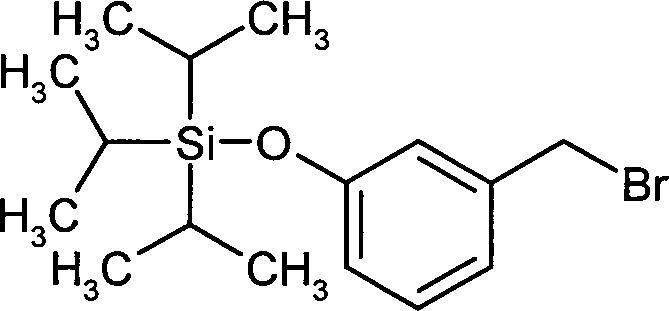
1 H-NMR (400 MHz, CDCl 3, δ / ppm): 7.20 (dd, 1H), 6.93-6.90 (m, 2H), 6.80 (dd, 1H), 4.64 (d, 2H), 1.61 (t, 3H), 1.26 (sept, 3H), 1.09 (d, 18H).
GC / MS (method K, EI): R t = 6.38 min, m / z = 280 (M) + , 237 (MC 3 H 7 ) + . Step 3: [3- (Bromomethyl) phenoxy] (tripropan-2-yl) silane
1.0 g (3.57 mmol) der Verbindung aus Beispiel 42A/Schritt 2 wurde in 20 ml wasserfreiem THF gelöst und mit 1.12 g (4.28 mmol) Triphenylphosphin versetzt. Nachdem dieses in Lösung gegangen war, wurden 1.42 g (4.28 mmol) Tetrabrommethan zugesetzt. Anschließend wurde 20 h bei RT gerührt. Dann wurde von dem ausgefallenen Niederschlag abfiltriert und das Filtrat am Rotationsverdampfer vom Lösungsmittel befreit. Das Rohprodukt wurde mittels MPLC gereinigt (Kieselgel, Laufmittel: Cyclohexan/Ethylacetat 50:1). Es wurden 1.10 g (90% d. Th., ca. 90% Reinheit) der Titelverbindung erhalten, welche ohne weitere Aufreinigung verwendet wurde.
1H-NMR (400 MHz, CDCl3, δ/ppm): 7.18 (dd, 1H), 6.95 (dd, 1H), 6.91 (m, 1H), 6.80 (dd, 1H), 4.43 (s, 2H), 1.25 (sept, 3H), 1.10 (d, 18H).
HPLC (Methode B): Rt = 6.17 min.
GC/MS (Methode K, EI): Rt = 6.56 min, m/z = 342/344 (79Br/81Br) (M)+.1.0 g (3.57 mmol) of the compound from Example 42A / Step 2 was dissolved in 20 ml of anhydrous THF and admixed with 1.12 g (4.28 mmol) of triphenylphosphine. After this had gone into solution, 1.42 g (4.28 mmol) of tetrabromomethane was added. The mixture was then stirred at RT for 20 h. Then, the precipitate was filtered off and the filtrate was freed from the solvent on a rotary evaporator. The crude product was purified by MPLC (silica gel, eluent: cyclohexane / ethyl acetate 50: 1). There were obtained 1.10 g (90% of theory, about 90% purity) of the title compound, which was used without further purification.
1 H-NMR (400 MHz, CDCl 3, δ / ppm): 7.18 (dd, 1H), 6.95 (dd, 1H), 6.91 (m, 1H), 6.80 (dd, 1H), 4:43 (s, 2H) , 1.25 (sept, 3H), 1.10 (d, 18H).
HPLC (Method B): R t = 6.17 min.
GC / MS (method K, EI): R t = 6.56 min, m / z = 342/344 ( 79 Br / 81 Br) (M) + .
Beispiel 43AExample 43A
Ethyl-(4-{[(methylsulfonyl)oxy]methyl}phenyl)acetat 
Eine Lösung von 1.1 g (5.66 mmol) [4-(Hydroxymethyl)phenyl]essigsäureethylester [
MS (DCI, NH3): m/z = 290 [M+NH4]+.
LC/MS (Methode C, ESIpos): Rt = 1.96 min, m/z = 177 (M-CH3SO2O)+.A solution of 1.1 g (5.66 mmol) of [4- (hydroxymethyl) phenyl] acetic acid ethyl ester [
MS (DCI, NH 3): m / z = 290 [M + NH 4] +.
LC / MS (Method C, ESIpos): R t = 1.96 min, m / z = 177 (M-CH 3 SO 2 O) + .
Beispiel 44AExample 44A
3-[4-(Chlormethyl)phenyl]propan-1-ol 
Eine Lösung von 1.0 g (6.02 mmol) 3-[4-(Hydroxymethyl)phenyl]propan-1-ol [
1H-NMR (400 MHz, CDCl3, δ/ppm): 7.31 (d, 2H), 7.20 (d, 2H), 4.57 (s, 2H), 3.68 (t, 2H), 2.71 (t, 2H), 1.89 (quint, 2H), 1.31 (s, breit, 1H).
MS (DCI, NH3): m/z = 202 [M+NH4]+.
GC/MS (Methode K, EI): Rt = 5.51 min, m/z = 184 [M]+.A solution of 1.0 g (6.02 mmol) of 3- [4- (hydroxymethyl) phenyl] propan-1-ol [
1 H-NMR (400 MHz, CDCl 3, δ / ppm): 7.31 (d, 2H), 7.20 (d, 2H), 4:57 (s, 2H), 3.68 (t, 2H), 2.71 (t, 2H) , 1.89 (quint, 2H), 1.31 (s, wide, 1H).
MS (DCI, NH 3): m / z = 202 [M + NH 4] +.
GC / MS (Method K, EI): R t = 5.51 min, m / z = 184 [M] + .
Beispiel 45AExample 45A
1-[(6-Chlorpyridin-3-yl)methyl]-5-methyl-1H-pyrazol-3-carbonsäure 

Zu einer Lösung von 10.0 g (64.9 mmol) Ethyl-3-methyl-1H-pyrazol-5-carboxylat und 13.66 g (84.3 mmol) 2-Chlor-5-(chlormethyl)pyridin in 162 ml wasserfreiem THF gab man 9.46 g (84.3 mmol) Kalium-tert.-butylat bei 0°C hinzu. Man ließ das Gemisch auf RT kommen und rührte weitere 18 h bei RT. Anschließend verdünnte man mit 200 ml Ethylacetat und 350 ml Wasser, durchmischte die Phasen und extrahierte die abgetrennte wässrige Phase noch zweimal mit jeweils 200 ml Ethylacetat. Man trocknete die vereinigten organischen Phasen über wasserfreiem Natriumsulfat, filtrierte und engte am Rotationsverdampfer ein. Der Rückstand wurde säulenchromatographisch an Kieselgel gereinigt (Laufmittel: Cyclohexan/Ethylacetat 4:1 → 2:1). Nach Trocknen im Vakuum erhielt man 12.4 g (65% d. Th.) der Titelverbindung in einer Reinheit von 95%.
1H-NMR (400 MHz, DMSO-d6, δ/ppm): 8.30 (d, 1H), 7.58 (dd, 111), 7.52 (d, 1H), 6.60 (s, 1H), 5.45 (s, 2H), 4.24 (quart, 2H), 2.28 (s, 3H), 1.27 (t, 3H).
LC/MS (Methode C, ESIpos): Rt = 1.88 min, m/z = 280 [M+H]+. Schritt 2: 1-[(6-Chlorpyridin-3-yl)methyl]-5-methyl-1H-pyrazo1-3-carbonsäure 
1 H-NMR (400 MHz, DMSO-d 6 , δ / ppm): 8.30 (d, 1H), 7.58 (dd, 111), 7.52 (d, 1H), 6.60 (s, 1H), 5.45 (s, 2H), 4.24 (quart, 2H), 2.28 (s, 3H), 1.27 (t, 3H).
LC / MS (Method C, ESIpos): R t = 1.88 min, m / z = 280 [M + H] + . Step 2: 1 - [(6-Chloropyridin-3-yl) methyl] -5-methyl-1H-pyrazole-3-carboxylic acid
Zu einer Lösung von 11.85 g (42.36 mmol) der Verbindung aus Beispiel 45A/Schritt 1 in 100 ml THF gab man 3.39 g (84.7 mmol) Natriumhydroxid, gelöst in 100 ml Wasser, und rührte das Gemisch 5 h bei RT. Anschließend verdünnte man das Gemisch mit 150 ml Wasser und wusch einmal mit 100 ml Ethylacetat. Die wässrige Phase wurde mit 1 N Salzsäure auf einen pH-Wert von ca. 3 eingestellt und dreimal mit jeweils 150 ml Ethylacetat extrahiert. Letztere Ethylacetat-Phasen wurden vereinigt, über wasserfreiem Natriumsulfat getrocknet, filtriert und am Rotationsverdampfer eingeengt. Nach Trocknen des Rückstands im Vakuum wurden 9.72 g (91% d. Th.) der Titelverbindung erhalten.
1H-NMR (400 MHz, DMSO-d6, δ/ppm): 12.60 (s, breit, 1H), 8.31 (d, 1H), 7.60 (dd, 1H), 7.52 (d, 1H), 6.53 (s, 1H), 5.42 (s, 2H), 2.28 (s, 3H).
LC/MS (Methode F, ESIpos): Rt = 0.75 min, m/z = 252 [M+H]+.To a solution of 11.85 g (42.36 mmol) of the compound from Example 45A / Step 1 in 100 ml of THF was added 3.39 g (84.7 mmol) of sodium hydroxide dissolved in 100 ml of water, and the mixture was stirred at RT for 5 h. The mixture was then diluted with 150 ml of water and washed once with 100 ml of ethyl acetate. The aqueous phase was adjusted to a pH of about 3 with 1 N hydrochloric acid and extracted three times with 150 ml of ethyl acetate each time. The latter ethyl acetate phases were combined, dried over anhydrous sodium sulfate, filtered and concentrated on a rotary evaporator. Drying of the residue in vacuo gave 9.72 g (91% of theory) of the title compound.
1 H-NMR (400 MHz, DMSO-d 6 , δ / ppm): 12.60 (s, broad, 1H), 8.31 (d, 1H), 7.60 (dd, 1H), 7.52 (d, 1H), 6.53 ( s, 1H), 5.42 (s, 2H), 2.28 (s, 3H).
LC / MS (method F, ESIpos): R t = 0.75 min, m / z = 252 [M + H] + .
Beispiel 46AExample 46A
1-[(6-Chlorpyridin-3-yl)methyl]-5-methyl-1H-pyrrol-3-carbonsäure 

Unter inerten Bedingungen wurden 7.63 g (190.7 mmol) einer 60%-igen Suspension von Natriumhydrid in Mineralöl mit Pentan entölt. Anschließend wurden 150 ml wasserfreier Diethylether und bei 0°C 138 μl (3.4 mmol) Methanol zugesetzt. Nach 10 min Rühren bei RT wurde erneut auf 0°C abgekühlt und ein Gemisch von 12.6 ml (204.3 mmol) Ameisensäuremethylester und 30.0 g (170.2 mmol) Methyl-4,4-dimethoxypentanoat [
GC/MS (Methode K, EI): Rt = 3.33 min, m/z = 158 [M]+, 140 [M-H2O]+. Schritt 2: Methyl-1-[(6-chlorpyridin-3-yl)methyl]-5-methyl-1H-pyrrol-3-carboxylat 
GC / MS (Method K, EI): R t = 3.33 min, m / z = 158 [M] + , 140 [MH 2 O] + . Step 2: Methyl 1 - [(6-chloropyridin-3-yl) methyl] -5-methyl-1H-pyrrole-3-carboxylate
Eine Mischung von 4.20 g (22.73 mmol, 85% Reinheit) der Verbindung aus Beispiel 46A/Schritt 1 und 3.24 g (22.73 mmol) 5-(Aminomethyl)-2-chlorpyridin in 42 ml Methanol wurde drei Tage lang bei RT gerührt. Anschließend wurde das Lösungsmittel am Rotationsverdampfer entfernt und das Rohprodukt mittels MPLC gereinigt (Kieselgel, Laufmittel: Cyclohexan/Ethylacetat 2:1). Es wurden 3.37 g (56% d. Th.) der Titelverbindung erhalten.
1H-NMR (400 MHz, CDCl3, δ/ppm): 8.19 (d, 1H), 7.30-7.20 (m, 3H), 6.38 (d, 1H), 5.03 (s, 2H), 3.79 (s, 3H), 2.12 (s, 3H).
HPLC (Methode A): Rt = 4.10 min.
MS (DCI, NH3): m/z = 265 [M+H]+. Schritt 3: 1-[(6-Chlorpyridin-3-yl)methyl]-5-methyl-1H-pyrrol-3-carbonsäure 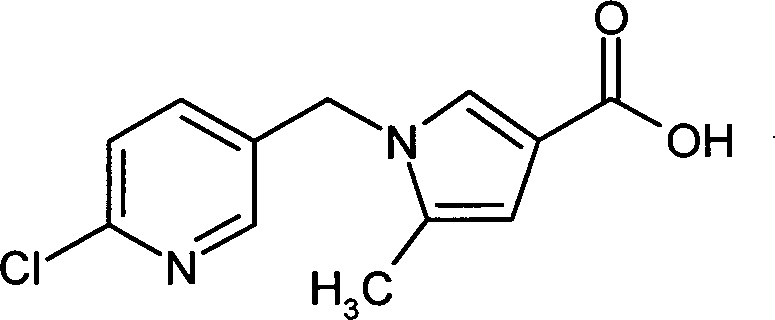
1 H-NMR (400 MHz, CDCl 3 , δ / ppm): 8.19 (d, 1H), 7.30-7.20 (m, 3H), 6.38 (d, 1H), 5.03 (s, 2H), 3.79 (s, 3H), 2.12 (s, 3H).
HPLC (Method A): R t = 4.10 min.
MS (DCI, NH 3): m / z = 265 [M + H] +. Step 3: 1 - [(6-Chloropyridin-3-yl) methyl] -5-methyl-1H-pyrrole-3-carboxylic acid
Eine Lösung von 1.93 g (7.29 mmol) der Verbindung aus Beispiel 46A/Schritt 2 in 38 ml Methanol wurde mit 14.5 ml (14.5 mmol) 1 M Natronlauge versetzt. Das Reaktionsgemisch wurde 15 h unter Rückfluss erhitzt. Nach dem Abkühlen auf RT wurde das Methanol am Rotationsverdampfer weitestgehend entfernt. Der Rückstand wurde zunächst mit 100 ml Wasser verdünnt und dann mit 2 M Salzsäure sauer gestellt. Der ausfallende Niederschlag wurde abfiltriert, mit Wasser nachgewaschen und im Hochvakuum getrocknet. Es wurden 1.41 g (76% d. Th.) der Titelverbindung erhalten.
1H-NMR (400 MHz, DMSO-d6, δ/ppm): 11.67 (s, 1H), 8.23 (s, 1H), 7.51 (d, 2H), 7.45 (d, 2H), 6.18 (d, 1H), 5.19 (s, 2H), 2.07 (s, 3H).
HPLC (Methode A): Rt = 3.59 min.
MS (ESIpos): m/z = 251 [M+H]+.A solution of 1.93 g (7.29 mmol) of the compound from Example 46A / Step 2 in 38 ml of methanol was admixed with 14.5 ml (14.5 mmol) of 1 M sodium hydroxide solution. The reaction mixture was heated at reflux for 15 h. After cooling to RT, the methanol was removed as far as possible on a rotary evaporator. The residue was first diluted with 100 ml of water and then made acidic with 2 M hydrochloric acid. The precipitate was filtered off, washed with water and dried under high vacuum. 1.41 g (76% of theory) of the title compound were obtained.
1 H-NMR (400 MHz, DMSO-d 6 , δ / ppm): 11.67 (s, 1H), 8.23 (s, 1H), 7.51 (d, 2H), 7.45 (d, 2H), 6.18 (d, 1H), 5.19 (s, 2H), 2.07 (s, 3H).
HPLC (Method A): R t = 3.59 min.
MS (ESIpos): m / z = 251 [M + H] + .
Beispiel 47AExample 47A
5-Methyl-1-(4-methylbenzyl)-1H-pyrrol-3-carbonsäure 

13.25 g (36.03 mmol) der Verbindung aus Beispiel 46A/Schritt 1 sowie 4.6 ml (36.03 mmol) 4-Methylbenzylamin wurden in 100 ml Methanol gelöst. Diese Lösung wurde, verteilt auf sieben Portionen, in der Mikrowelle (CEM Discover, initiale Einstrahlleistung 100 W) 10 min lang auf 100°C erhitzt. Anschließend wurden die Reaktionsmischungen wieder vereinigt und am Rotationsverdampfer vom Lösungsmittel befreit. Die Titelverbindung wurde mittels Saugfiltration über Kieselgel isoliert (Cyclohexan/Ethylacetat-Gradient 7:1 → 6:1 → 5:1). Es wurden 7.25 g (83% d. Th.) erhalten.
1H-NMR (400 MHz, CDCl3, δ/ppm): 7.26 (d, 1H), 7.13 (d, 2H), 6.92 (d, 2H), 6.34 (d, 1H), 4.97 (s, 2H), 3.77 (s, 3H), 2.33 (s, 3H), 2.11 (s, 3H).
LC/MS (Methode D, ESIpos): Rt = 2.35 min, m/z = 244 [M+H]+. Schritt 2: 5-Methyl-1-(4-methylbenzyl)-1H-pyrrol-3-carbonsäure 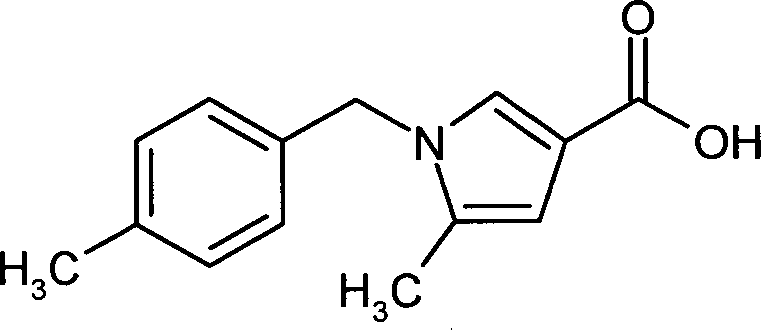
1 H-NMR (400 MHz, CDCl 3, δ / ppm): 7.26 (d, 1H), 7.13 (d, 2H), 6.92 (d, 2H), 6:34 (d, 1H), 4.97 (s, 2H) , 3.77 (s, 3H), 2.33 (s, 3H), 2.11 (s, 3H).
LC / MS (Method D, ESIpos): R t = 2.35 min, m / z = 244 [M + H] + . Step 2: 5-Methyl-1- (4-methylbenzyl) -1H-pyrrole-3-carboxylic acid
Nach dem unter Beispiel 46A/Schritt 3 beschriebenen Verfahren wurden aus 2.0 g (8.22 mmol) der Verbindung aus Beispiel 47A/Schritt 1 1.78 g (94% d. Th.) der Titelverbindung erhalten.
1H-NMR (400 MHz, DMSO-d6, δ/ppm): 11.58 (s, breit, 1H), 7.36 (d, 1H), 7.15 (d, 2H), 6.99 (d, 2H), 6.14 (d, 1H), 5.05 (s, 2H), 2.28 (s, 3H), 2.05 (s, 3H).
HPLC (Methode A): Rt = 4.22 min.
MS (DCI, NH3): m/z = 230 [M+H]+, 247 [M+NH4]+.
LC/MS (Methode C, ESIpos): Rt = 2.12 min, m/z = 230 [M+H]+.According to the procedure described under Example 46A / Step 3, 2.0 g (8.22 mmol) of the compound from Example 47A / Step 1 gave 1.78 g (94% of theory) of the title compound.
1 H-NMR (400 MHz, DMSO-d 6 , δ / ppm): 11.58 (s, broad, 1H), 7.36 (d, 1H), 7.15 (d, 2H), 6.99 (d, 2H), 6.14 ( d, 1H), 5.05 (s, 2H), 2.28 (s, 3H), 2.05 (s, 3H).
HPLC (Method A): R t = 4.22 min.
MS (DCI, NH 3 ): m / z = 230 [M + H] + , 247 [M + NH 4 ] + .
LC / MS (Method C, ESIpos): R t = 2.12 min, m / z = 230 [M + H] + .
Beispiel 48AExample 48A
1-Methyl-5-(4-methylbenzyl)-1H-pyrrol-3-carbonsäure 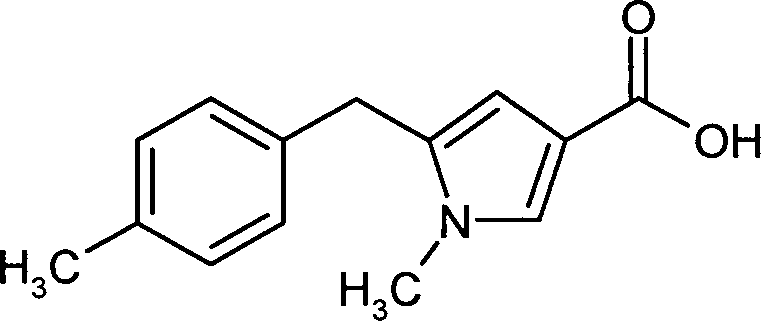

Eine Lösung von 4.75 g (23.28 mmol) Methyl 5-brom-1H-pyrrol-3-carboxylat [
1H-NMR (400 MHz, CDCl3, δ/ppm): 7.31 (d, 1H), 6.60 (d, 1H), 3.79 (s, 3H), 3.62 (s, 3H). HPLC (Methode A): Rt = 3.85 min.
MS (ESIpos): m/z = 218/220 (79Br/81Br) [M+H]+.
LC/MS (Methode F, ESIpos): Rt = 1.02 min, m/z = 218/220 (79Br/81Br) [M+H]+. Schritt 2: Methyl 5-[hydroxy(4-methylphenyl)methyl]-1-methyl-1H-pyrrol-3-carboxylat 
1 H-NMR (400 MHz, CDCl 3, δ / ppm): 7.31 (d, 1H), 6.60 (d, 1H), 3.79 (s, 3H), 3.62 (s, 3H). HPLC (Method A): R t = 3.85 min.
MS (ESIpos): m / z = 218/220 ( 79 Br / 81 Br) [M + H] + .
LC / MS (Method F, ESIpos): R t = 1.02 min, m / z = 218/220 ( 79 Br / 81 Br) [M + H] + . Step 2: Methyl 5- [hydroxy (4-methylphenyl) methyl] -1-methyl-1H-pyrrole-3-carboxylate
Unter inerten Bedingungen und bei –30°C wurde eine Lösung von 500 mg (2.29 mmol) der Verbindung aus Beispiel 48A/Schritt 1 in 10 ml wasserfreiem THF tropfenweise mit 1.3 ml (2.52 mmol) einer 2 M Lösung von Isopropylmagnesiumchlorid in THF versetzt. Nach beendeter Zugabe wurde das Reaktionsgemisch ca. 45 min bei 0°C gerührt. Dann wurde bei dieser Temperatur mit 307 μl (2.6 mmol) 4-Methylbenzaldehyd versetzt. Nachdem das Reaktionsgemisch 15 h bei RT gerührt worden war, wurden ca. 40 ml Wasser zugesetzt, und es wurde dreimal mit je ca. 20 ml Ethylacetat extrahiert. Die vereinigten organischen Extrakte wurden nacheinander mit Wasser und gesättigter Kochsalz-Lösung gewaschen. Nach Trocknen über wasserfreiem Magnesiumsulfat wurde filtriert und das Filtrat am Rotationsverdampfer vom Lösungsmittel befreit. Der erhaltene Rückstand wurde mittels MPLC gereinigt (Kieselgel, Laufmittel: Dichlormethan → Dichlormethan/Methanol 20:1). Es wurden 328 mg (55% d. Th.) der Titelverbindung erhalten.
1H-NMR (400 MHz, CDCl3, δ/ppm): 7.27 (d, 2H), 7.23 (d, 1H), 7.18 (d, 2H), 6.26 (d, 1H), 5.80 (d, 1H), 3.75 (s, 3H), 3.60 (s, 3H), 2.37 (s, 3H), 2.19 (d, 1H).
HPLC (Methode A): Rt = 3.95 min.
MS (DCI, NH3): m/z = 260 [M+H]+.
LC/MS (Methode F, ESIpos): Rt = 1.06 min, m/z = 260 [M+H]+. Schritt 3: Methyl 1-methyl-5-(4-methylbenzyl)-1H-pyrrol-3-carboxylat 
1 H-NMR (400 MHz, CDCl 3, δ / ppm): 7.27 (d, 2H), 7.23 (d, 1H), 7.18 (d, 2H), 6.26 (d, 1H), 5.80 (d, 1H) , 3.75 (s, 3H), 3.60 (s, 3H), 2.37 (s, 3H), 2.19 (d, 1H).
HPLC (Method A): R t = 3.95 min.
MS (DCI, NH 3): m / z = 260 [M + H] +.
LC / MS (method F, ESIpos): R t = 1.06 min, m / z = 260 [M + H] + . Step 3: Methyl 1-methyl-5- (4-methylbenzyl) -1H-pyrrole-3-carboxylate
Eine Lösung von 321 mg (1.23 mmol) der Verbindung aus Beispiel 48A/Schritt 2 in 20 ml wasserfreiem Dichlormethan wurde bei 0°C nacheinander mit 217 μl (1.36 mmol) Triethylsilan und 2.5 ml (13.6 mmol) Trifluormethansulfonsäure-trimethylsilylester versetzt. Nachdem das Reaktionsgemisch 2 h bei RT gerührt worden war, wurde mit Dichlormethan verdünnt und mit gesättigter wässriger Natriumhydrogencarbonat-Lösung gewaschen. Das Lösungsmittel wurde am Rotationsverdampfer entfernt und der erhaltene Rückstand mittels MPLC gereinigt (Kieselgel, Laufmittel: Dichlormethan). Es wurden 159 mg (52% d. Th.) der Titelverbindung erhalten.
1H-NMR (400 MHz, CDCl3, δ/ppm): 7.21 (d, 1H), 7.10 (d, 2H), 7.13 (d, 2H), 6.33 (d, 1H), 3.87 (s, 2H), 3.77 (s, 3H), 3.42 (s, 3H), 2.32 (s, 3H).
HPLC (Methode A): Rt = 4.44 min.
MS (DCI, NH3): m/z = 244 [M+H]+.
LC/MS (Methode F, ESIpos): Rt = 1.28 min, m/z = 244 [M+H]+. Schritt 4: 1-Methyl-5-(4-methylbenzyl)-1H-pyrrol-3-carbonsäure 
1 H-NMR (400 MHz, CDCl 3, δ / ppm): 7.21 (d, 1H), 7.10 (d, 2H), 7.13 (d, 2H), 6:33 (d, 1H), 3.87 (s, 2H) , 3.77 (s, 3H), 3.42 (s, 3H), 2.32 (s, 3H).
HPLC (Method A): R t = 4.44 min.
MS (DCI, NH 3): m / z = 244 [M + H] +.
LC / MS (method F, ESIpos): R t = 1.28 min, m / z = 244 [M + H] + . Step 4: 1-Methyl-5- (4-methylbenzyl) -1H-pyrrole-3-carboxylic acid
Nach dem unter Beispiel 46A/Schritt 3 beschriebenen Verfahren wurden aus 155 mg (0.637 mmol) der Verbindung aus Beispiel 48A/Schritt 3 139 mg (98% d. Th.) der Titelverbindung erhalten.
1H-NMR (400 MHz, DMSO-d6, δ/ppm): 11.53 (s, 1H), 7.28 (d, 1H), 7.11 (d, 2H), 7.05 (d, 2H), 6.02 (d, 1H), 3.84 (s, 2H), 3.44 (s, 3H), 2.28 (s, 3H).
HPLC (Methode A): Rt = 4.05 min.
MS (DCI, NH3): m/z = 230 [M+H]+.
LC/MS (Methode F, ESIpos): Rt = 1.08 min, m/z = 230 [M+H]+.According to the procedure described under Example 46A / Step 3, 155 mg (0.637 mmol) of the compound from Example 48A / Step 3 gave 139 mg (98% of theory) of the title compound.
1 H-NMR (400 MHz, DMSO-d 6 , δ / ppm): 11.53 (s, 1H), 7.28 (d, 1H), 7.11 (d, 2H), 7.05 (d, 2H), 6.02 (d, 1H), 3.84 (s, 2H), 3.44 (s, 3H), 2.28 (s, 3H).
HPLC (Method A): R t = 4.05 min.
MS (DCI, NH 3): m / z = 230 [M + H] +.
LC / MS (Method F, ESIpos): R t = 1.08 min, m / z = 230 [M + H] + .
Beispiel 49AExample 49A
1-Methyl-5-(4-methylbenzyl)-1H-pyrazol-3-carbonsäure 

Aus 935 mg (23.4 mmol) einer 60%-igen Suspension von Natriumhydrid in Mineralöl und 30 ml wasserfreiem Ethanol wurde eine Natriumethanolat-Lösung hergestellt. Zu dieser Lösung wurden bei 0°C zunächst 2.76 ml (20.3 mmol) Oxalsäurediethylester und dann eine Lösung von 3.01 g (20.3 mmol) 1-(4-Methylphenyl)propan-2-on [
1H-NMR (400 MHz, CDCl3, δ/ppm): 14.30 (breit, 1H), 7.17-7.11 (m, 4H), 6.36 (s, 1H), 4.31 (quart, 2H), 3.73 (s, 2H), 2.33 (s, 3H), 1.34 (t, 3H).
MS (DCI, NH3): m/z = 249 [M+H]+, 266 [M+NH4]+. Schritt 2: Ethyl 1-methyl-5-(4-methylbenzyl)-1H-pyrazol-3-carboxylat 
1 H-NMR (400 MHz, CDCl 3 , δ / ppm): 14.30 (broad, 1H), 7.17-7.11 (m, 4H), 6.36 (s, 1H), 4.31 (quart, 2H), 3.73 (s, 2H), 2.33 (s, 3H), 1.34 (t, 3H).
MS (DCI, NH 3): m / z = 249 [M + H] +, 266 [M + NH 4] +. Step 2: Ethyl 1-methyl-5- (4-methylbenzyl) -1H-pyrazole-3-carboxylate
Eine Mischung von 330 mg (1.33 mmol) der Verbindung aus Beispiel 49A/Schritt 1 und 78 μl (1.46 mmol) Methylhydrazin in 3 ml Eisessig wurde 4 h bei 90°C gerührt. Anschließend wurde die Essigsäure am Rotationsverdampfer entfernt und der erhaltene Rückstand mittels MPLC gereinigt (Kieselgel, Laufmittel: Cyclohexan/Ethylacetat 1:1). Es wurden 270 mg (79% d. Th.) der Titelverbindung erhalten.
1H-NMR (400 MHz, CDCl3, δ/ppm): 7.12 (d, 2H), 7.02 (d, 2H), 6.58 (s, 1H), 4.38 (quart, 2H), 3.95 (s, 2H), 3.78 (s, 3H), 2.33 (s, 3H), 1.39 (t, 3H).
LC/MS (Methode C, ESIpos): Rt = 2.26 min, m/z = 259 [M+H]+. Schritt 3: 1-Methyl-5-(4-methylbenzyl)-1H-pyrazol-3-carbonsäure 
1 H-NMR (400 MHz, CDCl 3, δ / ppm): 7.12 (d, 2H), 7:02 (d, 2H), 6:58 (s, 1H), 4:38 (quart, 2H), 3.95 (s, 2H) , 3.78 (s, 3H), 2.33 (s, 3H), 1.39 (t, 3H).
LC / MS (Method C, ESIpos): R t = 2.26 min, m / z = 259 [M + H] + . Step 3: 1-Methyl-5- (4-methylbenzyl) -1H-pyrazole-3-carboxylic acid
Eine Lösung von 250 mg (0.968 mmol) der Verbindung aus Beispiel 49A/Schritt 2 in 5 ml Ethanol wurde mit 9.6 ml (4.84 mmol) einer 0.5 M Lithiumhydroxid-Lösung in Wasser versetzt. Nachdem das Reaktionsgemisch 1 h bei 40°C gerührt worden war, ließ man auf RT abkühlen und versetzte mit 2.9 ml (5.81 mmol) 2 M Salzsäure. Das dabei ausgefallene Produkt wurde abgesaugt, mit Wasser gewaschen und im Hochvakuum getrocknet. Es wurden 203 mg (91% d. Th.) der Titelverbindung erhalten.
1H-NMR (400 MHz, DMSO-d6, δ/ppm): 12.51 (breit, 1H), 7.13 (d, 2H), 7.10 (d, 2H), 6.37 (s, 1H), 3.99 (s, 2H), 3.73 (s, 3H), 2.28 (s, 3H).
LC/MS (Methode C, ESIpos): Rt = 1.92 min, m/z = 231 [M+H]+.To a solution of 250 mg (0.968 mmol) of the compound from Example 49A / Step 2 in 5 ml of ethanol was added 9.6 ml (4.84 mmol) of a 0.5 M lithium hydroxide solution in water. After the reaction mixture was stirred for 1 h at 40 ° C, allowed to cool to RT and treated with 2.9 ml (5.81 mmol) 2 M hydrochloric acid. The precipitated product was filtered off, washed with water and dried under high vacuum. 203 mg (91% of theory) of the title compound were obtained.
1 H-NMR (400 MHz, DMSO-d 6 , δ / ppm): 12.51 (broad, 1H), 7.13 (d, 2H), 7.10 (d, 2H), 6.37 (s, 1H), 3.99 (s, 2H), 3.73 (s, 3H), 2.28 (s, 3H).
LC / MS (Method C, ESIpos): R t = 1.92 min, m / z = 231 [M + H] + .
Beispiel 50AExample 50A
2-Methyl-1-(4-methylbenzyl)-1H-imidazol-4-carbonsäure 

Eine Lösung von 1.0 g (9.08 mmol) 2-Methyl-1H-imidazol-4-carbaldehyd in 20 ml wasserfreiem THF wurde nacheinander mit 2.52 g (13.6 mmol) 4-Methylbenzylbromid und 1.12 g (9.99 mmol) festem Kalium-tert.-butylat versetzt. Das Reaktionsgemisch wurde 15 h bei RT gerührt. Anschließend wurde mit ca. 100 ml Wasser versetzt und dreimal mit je ca. 100 ml Ethylacetat extrahiert. Die vereinigten organischen Extrakte wurden nacheinander mit Wasser und gesättigter Kochsalz-Lösung gewaschen. Nach Trocknen über wasserfreiem Magnesiumsulfat und Filtrieren wurde das Lösungsmittel am Rotationsverdampfer entfernt. Das verbleibende Rohprodukt wurde mittels MPLC gereinigt (Kieselgel, Laufmittel: Cyclohexan/Ethylacetat 10:1 → 1:2). Es wurden 1.24 g (64% d. Th.) der Titelverbindung erhalten, die ca. 9% des isomeren 2-Methyl-1-(4-methylbenzyl)-1H-imidazol-5-carbaldehyds enthielt.
1H-NMR (400 MHz, CDCl3, δ/ppm): 9.79 (s, 1H), 7.53 (s, 1H), 7.19 (d, 2H), 7.01 (d, 2H), 5.04 (s, 2H), 2.40 (s, 3H), 2.36 (s, 3H).
HPLC (Methode A): Rt = 3.39 min.
MS (DCI, NH3): m/z = 215 [M+H]+.
LC/MS (Methode C, ESIpos): Rt = 1.43 min, m/z = 215 [M+H]+. Schritt 2: 2-Methyl-1-(4-methylbenzyl)-1H-imidazol-4-carbonsäure 
1 H-NMR (400 MHz, CDCl 3, δ / ppm): 9.79 (s, 1H), 7:53 (s, 1H), 7.19 (d, 2H), 7:01 (d, 2H), 5:04 (s, 2H) , 2.40 (s, 3H), 2.36 (s, 3H).
HPLC (Method A): R t = 3.39 min.
MS (DCI, NH 3): m / z = 215 [M + H] +.
LC / MS (Method C, ESIpos): R t = 1.43 min, m / z = 215 [M + H] + . Step 2: 2-Methyl-1- (4-methylbenzyl) -1H-imidazole-4-carboxylic acid
Eine Lösung von 980 mg (4.57 mmol) der Verbindung aus Beispiel 50A/Schritt 1 in 90 ml Isobutanol wurde bei RT mit 25 ml (50.8 mmol) einer 2 M Lösung von 2-Methyl-2-buten in THF und einer Lösung von 5.48 g (48.5 mmol, 80%-ig) Natriumchlorit sowie 4.93 g (35.7 mmol) Natriumdihydrogenphosphat in 45 ml Wasser versetzt. Das Reaktionsgemisch wurde 2 h bei RT gerührt. Anschließend wurde dreimal mit je ca. 100 ml Ethylacetat extrahiert. Die vereinigten organischen Extrakte wurden über wasserfreiem Magnesiumsulfat getrocknet, filtriert und am Rotationsverdampfer vom Lösungsmittel befreit. Das verbliebene Rohprodukt wurde mittels MPLC gereinigt (Kieselgel, Laufmittel: Dichlormethan/Methanol 5:1). Es wurden 1.23 g (99% d. Th. bei 85% Reinheit) der Titelverbindung erhalten, die als Hauptverunreinigung ca. 8% der isomeren 2-Methyl-1-(4-methylbenzyl)-1H-imidazol-5-carbonsäure enthielt.
1H-NMR (400 MHz, DMSO-d6, δ/ppm): 7.80 (s, 1H), 7.18 (d, 2H), 7.10 (d, 2H), 5.13 (s, 2H), 3.46 (breit, 1H), 2.29 (s, 3H), 2.23 (s, 3H).
HPLC (Methode A): Rt = 3.43 min.
MS (ESIpos): m/z = 231 [M+H]+.
LC/MS (Methode F, ESIpos): Rt = 0.60 min, m/z = 231 [M+H]+.A solution of 980 mg (4.57 mmol) of the compound from Example 50A / Step 1 in 90 ml of isobutanol was added at RT with 25 ml (50.8 mmol) of a 2 M solution of 2-methyl-2-butene in THF and a solution of 5.48 g (48.5 mmol, 80% strength) sodium chlorite and 4.93 g (35.7 mmol) of sodium dihydrogen phosphate in 45 ml of water. The reaction mixture was stirred for 2 h at RT. Then it was extracted three times with approx. 100 ml of ethyl acetate each time. The combined organic extracts were dried over anhydrous magnesium sulfate, filtered and freed from the solvent on a rotary evaporator. The remaining crude product was purified by MPLC (silica gel, eluent: dichloromethane / methanol 5: 1). 1.23 g (99% of theory at 85% purity) of the title compound were obtained, which contained as main impurity about 8% of the isomeric 2-methyl-1- (4-methylbenzyl) -1H-imidazole-5-carboxylic acid.
1 H-NMR (400 MHz, DMSO-d 6 , δ / ppm): 7.80 (s, 1H), 7.18 (d, 2H), 7.10 (d, 2H), 5.13 (s, 2H), 3.46 (broad, 1H), 2.29 (s, 3H), 2.23 (s, 3H).
HPLC (Method A): R t = 3.43 min.
MS (ESIpos): m / z = 231 [M + H] + .
LC / MS (method F, ESIpos): R t = 0.60 min, m / z = 231 [M + H] + .
Beispiel 51AExample 51A
N'-Hydroxy-4-(1-hydroxycyclobutyl)benzolcarboximidamid 

Analog zu dem unter Beispiel 5A/Schritt 1 beschriebenen Verfahren wurden aus 15.0 g (65.5 mmol) 4-Iodbenzonitril, 34.4 ml (68.8 mmol) Isopropylmagnesiumchlorid-Lösung (2 M in Diethylether) sowie 7.4 ml (98.2 mmol) Cyclobutanon 9.47 g (83% d. Th.) der Titelverbindung erhalten. Die Aufreinigung des Produktes erfolgte mittels MPLC (Kieselgel; Laufmittel: Cyclohexan/Ethylacetat 10:1 → 4:1).
1H-NMR (400 MHz, CDCl3, δ/ppm): 7.67 (d, 2H), 7.62 (d, 2H), 2.58-2.51 (m, 2H), 2.44-2.37 (m, 2H), 2.23-2.04 (m, 2H), 1.83-1.72 (m, 1H).
HPLC (Methode A): Rt = 3.47 min.
MS (DCI, NH3): m/z = 191 [M+NH4]+. Schritt 2: N'-Hydroxy-4-(1-hydroxycyclobutyl)benzolcarboximidamid 
1 H-NMR (400 MHz, CDCl 3, δ / ppm): 7.67 (d, 2H), 7.62 (d, 2H), 2:58 to 2:51 (m, 2H), 2:44 to 2:37 (m, 2H), 2.23- 2.04 (m, 2H), 1.83-1.72 (m, 1H).
HPLC (Method A): R t = 3.47 min.
MS (DCI, NH 3): m / z = 191 [M + NH 4] +. Step 2: N'-hydroxy-4- (1-hydroxycyclobutyl) benzenecarboximidamide
Analog zu dem unter Beispiel 1A/Schritt 5 beschriebenen Verfahren wurden ausgehend von 1.0 g (5.77 mmol) der Verbindung aus Beispiel 51A/Schritt 1 1.1 g der Titelverbindung (92% d. Th.) erhalten. Anders als unter Beispiel 1A/Schritt 5 beschrieben, wurde jedoch nach dem Entfernen des Lösungsmittels der Rückstand mit ca. 50 ml Wasser versetzt und dreimal mit je ca. 50 ml Ethylacetat extrahiert. Die vereinigten organischen Extrakte wurden mit gesättigter Kochsalz-Lösung gewaschen und über wasserfreiem Magnesiumsulfat getrocknet. Nach Filtration wurde das Lösungsmittel am Rotationsverdampfer entfernt und der erhaltene Rückstand mittels MPLC gereinigt (Kieselgel; Laufmittel: Dichlormethan/Methanol 50:1 → 10:1).
1H-NMR (400 MHz, DMSO-d6, δ/ppm): 9.57 (s, 1H), 7.63 (d, 2H), 7.47 (d, 2H), 5.79 (s, breit, 2H), 5.50 (s, 1H), 2.42-2.33 (m, 2H), 2.30-2.22 (m, 2H), 1.97-1.60 (m, 1H), 1.70-1.59 (m, 1H).
HPLC (Methode A): Rt = 2.26 min.
MS (EIpos): m/z = 207 [M+H]+.
LC/MS (Methode I, ESIpos): Rt = 0.25 min, m/z = 207 [M+H]+.Analogously to the process described under Example 1A / step 5, starting from 1.0 g (5.77 mmol) of the compound from Example 51A / step 1, 1.1 g of the title compound (92% of theory) were obtained. In contrast to Example 1A / step 5 described, however, after removal of the solvent, the residue was mixed with about 50 ml of water and extracted three times with about 50 ml of ethyl acetate. The combined organic extracts were washed with saturated brine and dried over anhydrous magnesium sulfate. After filtration, the solvent was removed on a rotary evaporator and the residue obtained was purified by MPLC (silica gel, eluent: dichloromethane / methanol 50: 1 → 10: 1).
1 H-NMR (400 MHz, DMSO-d 6 , δ / ppm): 9.57 (s, 1H), 7.63 (d, 2H), 7.47 (d, 2H), 5.79 (s, broad, 2H), 5.50 ( s, 1H), 2.42-2.33 (m, 2H), 2.30-2.22 (m, 2H), 1.97-1.60 (m, 1H), 1.70-1.59 (m, 1H).
HPLC (Method A): R t = 2.26 min.
MS (EIpos): m / z = 207 [M + H] + .
LC / MS (Method I, ESIpos): R t = 0.25 min, m / z = 207 [M + H] + .
Beispiel 52AExample 52A
N'-Hydroxy-4-(1-methoxycyclobutyl)benzolcarboximidamid 
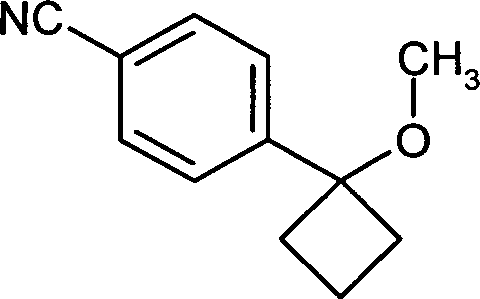
Analog zu dem unter Beispiel 6A/Schritt 1 beschriebenen Verfahren wurden aus 2.0 g (11.5 mmol) der Verbindung aus Beispiel 51A/Schritt 1, 508 mg (12.7 mmol) einer 60%-igen Dispersion von Natriumhydrid in Mineralöl sowie 863 μl (13.9 mmol) Methyliodid 1.27 g (59% d. Th.) der Titelverbindung erhalten. Die Aufreinigung des Produktes erfolgte mittels MPLC (Kieselgel; Laufmittel: Cyclohexan/Ethylacetat 20:1 → 4:1).
1H-NMR (400 MHz, CDCl3, δ/ppm): 7.68 (d, 2H), 7.54 (d, 2H), 2.95 (s, 3H), 2.46-2.32 (m, 4H), 2.03-1.93 (m, 1H), 1.76-1.63 (m, 1H).
MS (DCI, NH3): m/z = 205 [M+NH4]+. Schritt 2: N'-Hydroxy-4-(1-methoxycyclobutyl)benzolcarboximidamid 
1 H-NMR (400 MHz, CDCl 3 , δ / ppm): 7.68 (d, 2H), 7.54 (d, 2H), 2.95 (s, 3H), 2.46-2.32 (m, 4H), 2.03-1.93 ( m, 1H), 1.76-1.63 (m, 1H).
MS (DCI, NH 3): m / z = 205 [M + NH 4] +. Step 2: N'-hydroxy-4- (1-methoxycyclobutyl) benzenecarboximidamide
Analog zu dem unter Beispiel 1A/Schritt 5 beschriebenen Verfahren wurden ausgehend von 1.1 g (5.87 mmol) der Verbindung aus Beispiel 52A/Schritt 1 1.28 g der Titelverbindung (98% d. Th.) erhalten.
1H-NMR (400 MHz, DMSO-d6, δ/ppm): 9.62 (s, 1H), 7.68 (d, 2H), 7.40 (d, 2H), 5.80 (s, breit, 2H), 2.83 (s, 3H), 2.37-2.24 (m, 4H), 1.91-1.81 (m, 1H), 1.65-1.53 (m, 1H).
HPLC (Methode A): Rt = 3.02 min.
MS (DCI, NH3): m/z = 221 [M+H]+.Analogously to the process described under Example 1A / step 5, starting from 1.1 g (5.87 mmol) of the compound from Example 52A / step 1, 1.28 g of the title compound (98% of theory) were obtained.
1 H-NMR (400 MHz, DMSO-d 6 , δ / ppm): 9.62 (s, 1H), 7.68 (d, 2H), 7.40 (d, 2H), 5.80 (s, broad, 2H), 2.83 ( s, 3H), 2.37-2.24 (m, 4H), 1.91-1.81 (m, 1H), 1.65-1.53 (m, 1H).
HPLC (Method A): R t = 3.02 min.
MS (DCI, NH 3): m / z = 221 [M + H] +.
Beispiel 53AExample 53A
4-(1-Fluorcyclobutyl)-N'-hydroxybenzolcarboximidamid 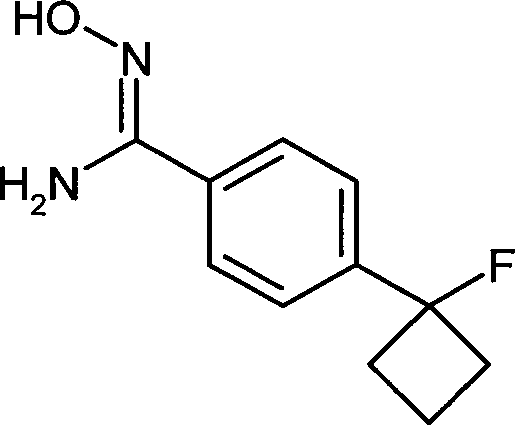

Analog zu dem unter Beispiel 5A/Schritt 2 beschriebenen Verfahren wurden aus 2.0 g (11.5 mmol) der Verbindung aus Beispiel 51A/Schritt 1 und 1.8 ml (13.9 mmol) Diethylaminoschwefeltrifluorid (DAST) 1.39 g (69% d. Th.) der Titelverbindung erhalten. Die Aufreinigung des Produktes erfolgte mittels MPLC (Kieselgel; Laufmittel: Cyclohexan/Ethylacetat 10:1 → 5:1).
1H-NMR (400 MHz, CDCl3, δ/ppm): 7.69 (d, 2H), 7.57 (d, 2H), 2.78-2.62 (m, 2H), 2.58-2.48 (m, 2H), 2.20-2.09 (m, 1H), 1.87-1.75 (m, 1H).
GC/MS (Methode K, EIpos): Rt = 4.71 min, m/z = 155 [M-HF]+. Schritt 2: 4-(1-Fluorcyclobutyl)-N'-hydroxybenzolcarboximidamid 
1 H-NMR (400 MHz, CDCl 3 , δ / ppm): 7.69 (d, 2H), 7.57 (d, 2H), 2.78-2.62 (m, 2H), 2.58-2.48 (m, 2H), 2.20- 2.09 (m, 1H), 1.87-1.75 (m, 1H).
GC / MS (method K, EIpos): R t = 4.71 min, m / z = 155 [M-HF] + . Step 2: 4- (1-Fluorocyclobutyl) -N'-hydroxybenzenecarboximidamide
Analog zu dem unter Beispiel 1A/Schritt 5 beschriebenen Verfahren wurden ausgehend von 1.25 g (7.13 mmol) der Verbindung aus Beispiel 53A/Schritt 1 1.16 g der Titelverbindung (78% d. Th.) erhalten.
1H-NMR (400 MHz, CDCl3, δ/ppm): 7.67 (d, 2H), 7.50 (d, 2H), 4.87 (s, breit, 2H), 2.72-2.52 (m, 5H), 2.16-2.05 (m, 1H), 1.82-1.71 (m, 1H).
HPLC (Methode A): Rt = 3.17 min.
MS (DCI, NH3): m/z = 209 [M+H]+.Analogously to the process described under Example 1A / Step 5, starting from 1.25 g (7.13 mmol) of the compound from Example 53A / Step 1, 1.16 g of the title compound (78% of theory) were obtained.
1 H-NMR (400 MHz, CDCl 3 , δ / ppm): 7.67 (d, 2H), 7.50 (d, 2H), 4.87 (s, broad, 2H), 2.72-2.52 (m, 5H), 2.16- 2.05 (m, 1H), 1.82-1.71 (m, 1H).
HPLC (Method A): R t = 3.17 min.
MS (DCI, NH 3): m / z = 209 [M + H] +.
Beispiel 54AExample 54A
N'-Hydroxy-4-(2,2,2-trifluorethoxy)benzolcarboximidamid 
Analog zu dem unter Beispiel 1A/Schritt 5 beschriebenen Verfahren wurden ausgehend von 7.0 g (34.8 mmol) 4-(2,2,2-Trifluorethoxy)benzolcarbonitril [
1H-NMR (400 MHz, DMSO-d6, δ/ppm): 9.51 (s, 1H), 7.64 (d, 2H), 7.06 (d, 2H), 5.77 (s, breit, 2H), 4.79 (quart, 2H).
HPLC (Methode A): Rt = 3.08 min.
MS (DCI, NH3): m/z = 235 [M+H]+.
LC/MS (Methode I, ESIpos): Rt = 0.51 min, m/z = 235 [M+H]+.Analogously to the process described under Example 1A / step 5, starting from 7.0 g (34.8 mmol) of 4- (2,2,2-trifluoroethoxy) benzenecarbonitrile [
1 H-NMR (400 MHz, DMSO-d 6 , δ / ppm): 9.51 (s, 1H), 7.64 (d, 2H), 7.06 (d, 2H), 5.77 (s, broad, 2H), 4.79 ( quart, 2H).
HPLC (Method A): R t = 3.08 min.
MS (DCI, NH 3): m / z = 235 [M + H] +.
LC / MS (Method I, ESIpos): R t = 0.51 min, m / z = 235 [M + H] + .
Beispiel 55AExample 55A
N'-Hydroxy-4-(1H-pyrrol-1-ylmethyl)benzolcarboximidamid 
Analog zu dem unter Beispiel 1A/Schritt 5 beschriebenen Verfahren wurden aus 670 mg (3.68 mmol) 4-(1H-Pyrrol-1-ylmethyl)benzolcarbonitril [
1H-NMR (400 MHz, CDCl3, δ/ppm): 7.76 (breit, 1H), 7.58 (d, 2H), 7.13 (d, 2H), 6.68 (dd, 2H), 6.20 (dd, 2H), 5.09 (s, 2H), 4.84 (s, breit, 2H).
LC/MS (Methode I, ESIpos): Rt = 0.54 min, m/z = 216 [M+H]+.Analogously to the process described under Example 1A / step 5, from 670 mg (3.68 mmol) of 4- (1H-pyrrol-1-ylmethyl) benzenecarbonitrile [
1 H-NMR (400 MHz, CDCl 3 , δ / ppm): 7.76 (broad, 1H), 7.58 (d, 2H), 7.13 (d, 2H), 6.68 (dd, 2H), 6.20 (dd, 2H) , 5.09 (s, 2H), 4.84 (s, wide, 2H).
LC / MS (Method I, ESIpos): R t = 0.54 min, m / z = 216 [M + H] + .
Beispiel 56AExample 56A
(2-Carbamoylpyridin-4-yl)methylmethansulfonat 
Analog zu dem unter Beispiel 43A beschriebenen Verfahren wurden aus 1.07 g (7.00 mmol) 4-(Hydroxymethyl)pyridin-2-carboxamid [
1H-NMR (400 MHz, CDCl3, δ/ppm): 8.62 (d, 1H), 8.21 (s, 1H), 7.83 (s, breit, 1H), 7.51 (d, 1H), 5.70 (s, breit, 1H), 5.31 (s, 2H), 3.10 (s, 3H).
LC/MS (Methode I, ESIpos): Rt = 0.43 min, m/z = 231 [M+H]+.Analogously to the process described under Example 43A, from 1.07 g (7.00 mmol) of 4- (hydroxymethyl) pyridine-2-carboxamide [
1 H-NMR (400 MHz, CDCl 3, δ / ppm): 8.62 (d, 1H), 8.21 (s, 1H), 7.83 (s, broad, 1H), 7:51 (d, 1H), 5.70 (s, wide, 1H), 5.31 (s, 2H), 3.10 (s, 3H).
LC / MS (method I, ESIpos): R t = 0.43 min, m / z = 231 [M + H] + .
Beispiel 57A Example 57A
tert.-Butyl-((1-[4-(N'-hydroxycarbamimidoyl)phenyl]cyclobutyl}oxy)acetat 

Eine Lösung von 2.0 g (11.5 mmol) der Verbindung aus Beispiel 51A/Schritt 1 in 40 ml wasserfreiem DMF wurde bei einer Temperatur von ca. 5°C mit 508 mg (12.7 mmol) Natriumhydrid (60%-ige Suspension in Mineralöl) versetzt. Nach 1 h Rühren bei dieser Temperatur wurden 2.0 ml (13.9 mmol) Bromessigsäure-tert.-butylester hinzugetropft. Man ließ das Reaktionsgemisch auf RT erwärmen und rührte über Nacht. Danach wurden weitere 1.5 ml (10.2 mmol) Bromessigsäure-tert.-butylester hinzugefügt und das Rühren für weitere 4 h fortgesetzt. Anschließend wurde das Reaktionsgemisch auf ca. 150 ml Wasser gegossen, und es wurde mit insgesamt ca. 300 ml Diethylether extrahiert. Die vereinigten organischen Extrakte wurden nacheinander mit Wasser und gesättigter Kochsalz-Lösung gewaschen. Nach Trocknen über wasserfreiem Magnesiumsulfat wurde filtriert und das Lösungsmittel am Rotationsverdampfer entfernt. Das erhaltene Rohprodukt wurde mittels Saugfiltration über Kieselgel mit Cyclohexan/Ethylacetat 100:0 → 80:20 als Laufmittel gereinigt. Es wurden 767 mg der Titelverbindung erhalten (33% d. Th. bezogen auf den Umsatz) und 581 mg des Ausgangsmaterials (Verbindung aus Beispiel 51A/Schritt 1) zurückgewonnen.
1H-NMR (400 MHz, CDCl3, δ/ppm): 7.68 (d, 2H), 7.59 (d, 2H), 3.58 (s, 2H), 2.56-2.49 (m, 2H), 2.40-2.33 (m, 2H), 2.08-1.98 (m, 1H), 1.75-1.63 (m, 1H), 1.43 (s, 9H).
LC/MS (Methode F, ESIpos): Rt = 1.35 min, m/z = 288 [M+H]+.A solution of 2.0 g (11.5 mmol) of the compound from Example 51A / step 1 in 40 ml of anhydrous DMF was treated at a temperature of about 5 ° C with 508 mg (12.7 mmol) of sodium hydride (60% suspension in mineral oil) , After stirring at this temperature for 1 h, 2.0 ml (13.9 mmol) of bromoacetic acid tert-butyl ester were added dropwise. The reaction mixture was allowed to warm to rt and stirred overnight. Thereafter, another 1.5 ml (10.2 mmol) of tert-butyl bromoacetate was added and stirring continued for a further 4 h. Then the reaction mixture was poured onto about 150 ml of water, and it was extracted with a total of about 300 ml of diethyl ether. The combined organic extracts were washed successively with water and saturated brine. After drying over anhydrous magnesium sulfate, it was filtered and the solvent removed on a rotary evaporator. The crude product obtained was purified by suction filtration through silica gel with cyclohexane / ethyl acetate 100: 0 → 80:20 as the eluent. There were obtained 767 mg of the title compound (33% of theory based on the conversion) and 581 mg of the starting material (compound from Example 51A / step 1) recovered.
1 H-NMR (400 MHz, CDCl 3, δ / ppm): 7.68 (d, 2H), 7:59 (d, 2H), 3:58 (s, 2H), 2:56 to 2:49 (m, 2H), 2:40 to 2:33 ( m, 2H), 2.08-1.98 (m, 1H), 1.75-1.63 (m, 1H), 1.43 (s, 9H).
LC / MS (Method F, ESIpos): R t = 1.35 min, m / z = 288 [M + H] + .
Schritt 2: tert.-Butyl-({1-[4-(N'-hydroxycarbamimidoyl)phenyl]cyclobutyl}oxy)acetat 
Analog zu dem unter Beispiel 1A/Schritt 5 beschriebenen Verfahren wurden 720 mg (2.51 mmol) der Verbindung aus Beispiel 57A/Schritt 1 zu 584 mg (73% d. Th.) der Titelverbindung umgesetzt.
1H-NMR (400 MHz, CDCl3, δ/ppm): 9.63 (s, 1H), 7.69 (d, 2H), 7.43 (d, 2H), 5.81 (s, breit, 2H), 3.57 (s, 2H), 2.39-2.32 (m, 4H), 1.94-1.85 (m, 1H), 1.63-1.52 (m, 1H), 1.34 (s, 9H).
LC/MS (Methode I, ESIpos): Rt = 0.78 min, m/z = 321 [M+H]+.Analogously to the process described under Example 1A / Step 5, 720 mg (2.51 mmol) of the compound from Example 57A / Step 1 were converted to 584 mg (73% of theory) of the title compound.
1 H-NMR (400 MHz, CDCl 3 , δ / ppm): 9.63 (s, 1H), 7.69 (d, 2H), 7.43 (d, 2H), 5.81 (s, broad, 2H), 3.57 (s, 2H), 2.39-2.32 (m, 4H), 1.94-1.85 (m, 1H), 1.63-1.52 (m, 1H), 1.34 (s, 9H).
LC / MS (method I, ESIpos): R t = 0.78 min, m / z = 321 [M + H] + .
Beispiel 58A Example 58A
N'-Hydroxy-4-(tetrahydro-2H-pyran-4-yl)benzolcarboximidamid 

Eine Lösung von 2.91 g (19.8 mmol) 4-Cyanophenylboronsäure [
1H-NMR (400 MHz, CDCl3, δ/ppm): 7.60 (d, 2H), 7.32 (d, 2H), 4.12-4.07 (m, 2H), 3.56-3.50 (m, 2H), 2.87-2.79 (m, 1H), 1.86-1.73 (m, 4H).
GC/MS (Methode K, EIpos): Rt = 5.97 min, m/z = 187 [M]+. Schritt 2: N'-Hydroxy-4-(tetrahydro-2H-pyran-4-yl)benzolcarboximidamid 
1 H-NMR (400 MHz, CDCl 3 , δ / ppm): 7.60 (d, 2H), 7.32 (d, 2H), 4.12-4.07 (m, 2H), 3.56-3.50 (m, 2H), 2.87- 2.79 (m, 1H), 1.86-1.73 (m, 4H).
GC / MS (method K, EIpos): R t = 5.97 min, m / z = 187 [M] + . Step 2: N'-hydroxy-4- (tetrahydro-2H-pyran-4-yl) benzenecarboximidamide
Analog zu dem unter Beispiel 1A/Schritt 5 beschriebenen Verfahren wurden 480 mg (2.56 mmol) der Verbindung aus Beispiel 58A/Schritt 1 zu 525 mg (93% d. Th.) der Titelverbindung umgesetzt.
1H-NMR (400 MHz, CDCl3, δ/ppm): 7.58 (d, 2H), 7.26 (d, 2H), 6.79 (breit, 1H), 4.82 (s, breit, 2H), 4.11-4.05 (m, 2H), 3.57-3.50 (m, 2H), 2.83-2.74 (m, 1H), 1.87-1.73 (m, 4H).
LC/MS (Methode D, ESIpos): Rt = 0.92 min, m/z = 221 [M+H]+.Analogously to the process described under Example 1A / Step 5, 480 mg (2.56 mmol) of the compound from Example 58A / Step 1 were converted to 525 mg (93% of theory) of the title compound.
1 H-NMR (400 MHz, CDCl 3 , δ / ppm): 7.58 (d, 2H), 7.26 (d, 2H), 6.79 (broad, 1H), 4.82 (s, broad, 2H), 4.11-4.05 ( m, 2H), 3.57-3.50 (m, 2H), 2.83-2.74 (m, 1H), 1.87-1.73 (m, 4H).
LC / MS (method D, ESIpos): R t = 0.92 min, m / z = 221 [M + H] + .
Beispiel 59AExample 59A
N'-Hydroxy-4-isobutylbenzolcarboximidamid 

Unter inerten, sauerstofffreien Bedingungen wurde eine Mischung aus 5.0 g (23.5 mmol) 1-Brom-4-isobutylbenzol, 3.14 g (26.7 mmol) Zinkcyanid, 963 mg (2.35 mmol) Dicyclohexyl-(2',6'-dimethoxybiphenyl-2-yl)phosphan und 1.08 g (1.17 mmol) Tris(dibenzylidenaceton)dipalladium in 230 ml DMF/Wasser (99:1) 1 h lang auf 120°C erhitzt. Nach dem Abkühlen auf RT wurde mit ca. 1000 ml Wasser verdünnt und dreimal mit je ca. 150 ml Ethylacetat extrahiert. Die vereinigten organischen Extrakte wurden nacheinander mit Wasser und gesättigter Kochsalz-Lösung gewaschen. Nach Trocknen über wasserfreiem Magnesiumsulfat wurde filtriert und das Filtrat am Rotationsverdampfer vom Lösungsmittel befreit. Der erhaltene Rückstand wurde mittels Saugfiltration über Kieselgel mit Cyclohexan/Ethylacetat 10:1 als Laufmittel gereinigt. Es wurden 3.04 g (81% d. Th.) der Titelverbindung erhalten.
1H-NMR (400 MHz, CDCl3, δ/ppm): 7.56 (d, 2H), 7.23 (d, 2H), 2.53 (d, 2H), 1.94-1.83 (m, 1H), 0.90 (d, 6H).
GC/MS (Methode K, EIpos): Rt = 4.05 min, m/z = 159 [M]+. Schritt 2: N'-Hydroxy-4-isobutylbenzolcarboximidamid 
1 H-NMR (400 MHz, CDCl 3, δ / ppm) 7.56 (d, 2H), 7.23 (d, 2H), 2:53 (d, 2H), 1.94-1.83 (m, 1H), 0.90 (d, 6H).
GC / MS (method K, EIpos): R t = 4.05 min, m / z = 159 [M] + . Step 2: N'-hydroxy-4-isobutylbenzenecarboximidamide
Analog zu dem unter Beispiel 1A/Schritt 5 beschriebenen Verfahren wurden 3.03 g (19.0 mmol) der Verbindung aus Beispiel 59A/Schritt 1 zu 3.39 g (93% d. Th.) der Titelverbindung umgesetzt.
1H-NMR (400 MHz, DMSO-d6, δ/ppm): 9.53 (s, 1H), 7.57 (d, 2H), 7.14 (d, 2H), 5.74 (breit, 2H), 2.46 (d, 2H), 1.89-1.79 (m, 1H), 0.87 (d, 6H).
LC/MS (Methode I, ESIpos): Rt = 0.68 min, m/z = 193 [M+H]+.Analogously to the process described under Example 1A / Step 5, 3.03 g (19.0 mmol) of the compound from Example 59A / Step 1 were converted to 3.39 g (93% of theory) of the title compound.
1 H-NMR (400 MHz, DMSO-d 6 , δ / ppm): 9.53 (s, 1H), 7.57 (d, 2H), 7.14 (d, 2H), 5.74 (broad, 2H), 2.46 (d, 2H), 1.89-1.79 (m, 1H), 0.87 (d, 6H).
LC / MS (method I, ESIpos): R t = 0.68 min, m / z = 193 [M + H] + .
Beispiel 60AExample 60A
N'-Hydroxy-4-isopropylbenzolcarboximidamid 
Analog zu dem unter Beispiel 1A/Schritt 5 beschriebenen Verfahren wurden aus 5.0 g (34.4 mmol) 4-Isopropylbenzonitril 4.65 g (71% d. Th., 94% Reinheit) der Titelverbindung erhalten.
1H-NMR (400 MHz, DMSO-d6, δ/ppm): 9.53 (s, 1H), 7.58 (d, 2H), 7.23 (d, 2H), 5.74 (s, breit, 2H), 2.89 (sept, 1H), 1.20 (d, 6H).
LC/MS (Methode F, ESIpos): Rt = 0.64 min, m/z = 179 [M+H]+.Analogously to the process described under Example 1A / step 5, 5.0 g (34.4 mmol) of 4-isopropylbenzonitrile gave 4.65 g (71% of theory, 94% purity) of the title compound.
1 H-NMR (400 MHz, DMSO-d 6 , δ / ppm): 9.53 (s, 1H), 7.58 (d, 2H), 7.23 (d, 2H), 5.74 (s, broad, 2H), 2.89 ( sept, 1H), 1.20 (d, 6H).
LC / MS (method F, ESIpos): R t = 0.64 min, m / z = 179 [M + H] + .
Beispiel 61AExample 61A
N'-Hydroxy-4-[1-(methoxymethyl)cyclobutyl]benzolcarboximidamid 

Eine Lösung von 10.0 g (41.1 mmol) 4-Bromphenylessigsäureethylester in 250 ml wasserfreiem THF wurde bei 0°C mit 45 ml (45.2 mmol) einer 1 M Lösung von Lithiumhexamethyldisilazid in THF versetzt. Nach 15 min wurden 5.4 ml (53.5 mmol) 1,3-Dibrompropan hinzugefügt. Man ließ das Reaktionsgemisch auf RT erwärmen und 1 h bei dieser Temperatur nachrühren. Dann wurde erneut auf 0°C gekühlt und mit weiteren 45 ml (45.2 mmol) Lithiumhexamethyldisilazid-Lösung (1 M in THF) versetzt. Danach wurde wieder auf RT erwärmt. Nach 1 h wurde die Reaktion durch Zugabe von ca. 10 ml gesättigter wässriger Ammoniumchlorid-Lösung beendet. Das THF wurde am Rotationsverdampfer weitgehend entfernt. Es wurde mit Wasser verdünnt und mit Ethylacetat extrahiert. Der organische Extrakt wurde nacheinander mit Wasser und gesättigter Kochsalz-Lösung gewaschen. Nach Trocknen über wasserfreiem Magnesiumsulfat wurde filtriert und das Filtrat am Rotationsverdampfer vom Lösungsmittel befreit. Das so erhaltene Rohprodukt wurde mittels Saugfiltration über ca. 300 g Kieselgel mit Cyclohexan/Ethylacetat 3:1 als Laufmittel grob gereinigt. Es wurden 7.1 g (44% d. Th., 73% Reinheit) der Titelverbindung erhalten, welche in dieser Form weiter umgesetzt wurde.
1H-NMR (400 MHz, CDCl3, δ/ppm): 7.44 (d, 2H), 7.17 (d, 2H), 4.10 (quart, 2H), 2.85-2.79 (m, 2H), 2.49-2.41 (m, 2H), 2.10-1.98 (m, 1H), 1.91-1.81 (m, 1H), 1.18 (t, 3H).
MS (DCI, NH3): m/z = 300/302 [M+NH4]+.
LC/MS (Methode D, ESIpos): Rt = 2.70 min, m/z = 283/285 [M+H]+. Schritt 2: [1-(4-Bromphenyl)cyclobutyl]methanol 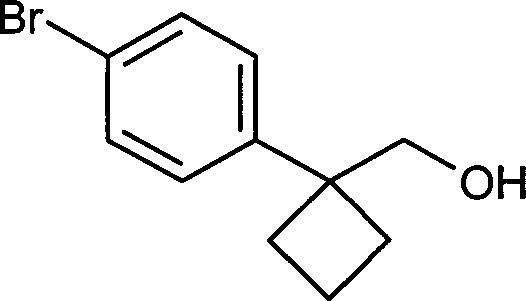
1 H-NMR (400 MHz, CDCl 3 , δ / ppm): 7.44 (d, 2H), 7.17 (d, 2H), 4.10 (quart, 2H), 2.85-2.79 (m, 2H), 2.49-2.41 ( m, 2H), 2.10-1.98 (m, 1H), 1.91-1.81 (m, 1H), 1.18 (t, 3H).
MS (DCI, NH 3): m / z = 300/302 [M + NH 4] +.
LC / MS (method D, ESIpos): R t = 2.70 min, m / z = 283/285 [M + H] + . Step 2: [1- (4-Bromophenyl) cyclobutyl] methanol
7.20 g (25.4 mmol) der Verbindung aus Beispiel 61A/Schritt 1 wurden in 150 ml wasserfreiem THF gelöst und bei 0°C tropfenweise mit 25 ml (25 mmol) einer 1 M Lösung von Lithiumaluminiumhydrid in THF versetzt. Nach beendeter Zugabe wurde das Eis/Wasser-Bad entfernt und das Rühren bei RT fortgesetzt. Nach 1 h wurde die Reaktion durch – anfangs vorsichtiges – Hinzufügen von ca. 450 ml gesättigter wässriger Ammoniumchlorid-Lösung beendet. Es wurde dann mit Ethylacetat extrahiert. Nach Trocknen des organischen Extrakts über wasserfreiem Magnesiumsulfat und anschließender Filtration wurde das Lösungsmittel am Rotationsverdampfer entfernt. Es wurden 6.04 g (88% d. Th., 90% Reinheit) der Titelverbindung erhalten.
1H-NMR (400 MHz, CDCl3, δ/ppm): 7.43 (d, 2H), 7.02 (d, 2H), 3.72 (d, 2H), 2.33-2.20 (m, 4H), 2.13-2.01 (m, 1H), 1.93-1.83 (m, 1H).
MS (DCI, NH3): m/z = 258/260 [M+NH4]+.
GC/MS (Methode K, ESIpos): Rt = 5.77 min, m/z = 240/242 [M]+. Schritt 3: 1-Brom-4-[1-(methoxymethyl)cyclobutyl]benzol 
1 H-NMR (400 MHz, CDCl 3 , δ / ppm): 7.43 (d, 2H), 7.02 (d, 2H), 3.72 (d, 2H), 2.33-2.20 (m, 4H), 2.13-2.01 ( m, 1H), 1.93-1.83 (m, 1H).
MS (DCI, NH 3): m / z = 258/260 [M + NH 4] +.
GC / MS (method K, ESIpos): R t = 5.77 min, m / z = 240/242 [M] + . Step 3: 1-Bromo-4- [1- (methoxymethyl) cyclobutyl] benzene
Eine Lösung von 7.0 g (29.0 mmol) der Verbindung aus Beispiel 61A/Schritt 2 in 120 ml wasserfreiem DMF wurde bei ca. 5°C mit 1.28 g (31.9 mmol) einer 60%-igen Suspension von Natriumhydrid in Mineralöl versetzt. Nachdem 1 h bei dieser Temperatur gerührt worden war, wurden 2.2 ml (34.8 mmol) Methyliodid zugefügt. Man ließ das Reaktionsgemisch auf RT erwärmen und setzte das Rühren 15 h lang fort. Anschließend wurde das Reaktionsgemisch am Rotationsverdampfer auf ein Volumen von ca. 20 ml eingeengt. Es wurden ca. 500 ml Wasser zugefügt und das Gemisch dreimal mit je ca. 200 ml Diethylether extrahiert. Die vereinigten organischen Extrakte wurden mit gesättigter Kochsalz-Lösung gewaschen und über wasserfreiem Magnesiumsulfat getrocknet. Nach Filtration und Entfernen des Lösungsmittels am Rotationsverdampfer wurde das erhaltene Rohprodukt mittels Saugfiltration über ca. 200 g Kieselgel mit Cyclohexan/Ethylacetat 50:1 als Laufmittel gereinigt. Es wurden 4.92 g (66% d. Th.) der Titelverbindung erhalten.
1H-NMR (400 MHz, CDCl3, δ/ppm): 7.41 (d, 2H), 7.04 (d, 2H), 3.48 (s, 2H), 3.27 (s, 3H), 2.32-2.22 (m, 4H), 2.12-2.00 (m, 1H), 1.90-1.80 (m, 1H).
MS (DCI, NH3): m/z = 272/274 [M+NH4]+.
GC/MS (Methode K, ESIpos): Rt = 5.25 min, m/z = 254/256 [M]+. Schritt 4: 4-[1-(Methoxymethyl)cyclobutyl]benzonitril 
1 H-NMR (400 MHz, CDCl 3, δ / ppm): 7:41 (d, 2H), 7:04 (d, 2H), 3:48 (s, 2H), 3.27 (s, 3H), 2:32 to 2:22 (m, 4H), 2.12-2.00 (m, 1H), 1.90-1.80 (m, 1H).
MS (DCI, NH 3): m / z = 272/274 [M + NH 4] +.
GC / MS (method K, ESIpos): R t = 5.25 min, m / z = 254/256 [M] + . Step 4: 4- [1- (Methoxymethyl) cyclobutyl] benzonitrile
Analog zu dem unter Beispiel 59A/Schritt 1 beschriebenen Verfahren wurden aus 4.80 g (18.8 mmol) der Verbindung aus Beispiel 61A/Schritt 3 1.82 g (48% d. Th.) der Titelverbindung erhalten.
1H-NMR (400 MHz, CDCl3, δ/ppm): 7.58 (d, 2H), 7.24 (d, 2H), 3.52 (s, 2H), 3.26 (s, 3H), 2.34-2.24 (m, 4H), 2.16-2.03 (m, 1H), 1.92-1.83 (m, 1H).
LC/MS (Methode F, ESIpos): Rt = 1.22 min, m/z = 202 [M+H]+. Schritt 5: N'-Hydroxy-4-[1-(methoxymethyl)cyclobutyl]benzolcarboximidamid 
1 H-NMR (400 MHz, CDCl 3, δ / ppm): 7:58 (d, 2H), 7.24 (d, 2H), 3:52 (s, 2H), 3.26 (s, 3H), 2:34 to 2:24 (m, 4H), 2.16-2.03 (m, 1H), 1.92-1.83 (m, 1H).
LC / MS (method F, ESIpos): R t = 1.22 min, m / z = 202 [M + H] + . Step 5: N'-hydroxy-4- [1- (methoxymethyl) cyclobutyl] benzenecarboximidamide
Analog zu dem unter Beispiel 1A/Schritt 5 beschriebenen Verfahren wurden aus 1.82 g (9.04 mmol) der Verbindung aus Beispiel 61A/Schritt 4 2.04 g (96% d. Th.) der Titelverbindung erhalten.
1H-NMR (400 MHz, CDCl3, δ/ppm): 7.55 (d, 2H), 7.20 (d, 2H), 7.10 (breit, 1H), 4.83 (breit, 2H), 3.51 (s, 2H), 3.27 (s, 3H), 2.36-2.25 (m, 4H), 2.12-2.01 (m, 1H), 1.90-1.81 (m, 1H).
LC/MS (Methode I, ESIpos): Rt = 0.61 min, m/z = 235 [M+H]+.Analogously to the process described under Example 1A / Step 5, 2.04 g (96% of theory) of the title compound were obtained from 1.82 g (9.04 mmol) of the compound from Example 61A / Step 4.
1 H-NMR (400 MHz, CDCl 3 , δ / ppm): 7.55 (d, 2H), 7.20 (d, 2H), 7.10 (broad, 1H), 4.83 (broad, 2H), 3.51 (s, 2H) , 3.27 (s, 3H), 2.36-2.25 (m, 4H), 2.12-2.01 (m, 1H), 1.90-1.81 (m, 1H).
LC / MS (Method I, ESIpos): R t = 0.61 min, m / z = 235 [M + H] + .
Beispiel 62AExample 62A
N'-Hydroxy-4-(methoxymethyl)benzolcarboximidamid 
Analog zu dem unter Beispiel 1A/Schritt 5 beschriebenen Verfahren wurden aus 2.80 g (19.0 mmol) 4-(Methoxymethyl)benzonitril [
LC/MS (Methode D, ESIpos): Rt = 0.77 min, m/z = 181 [M+H]+.Analogously to the process described under Example 1A / step 5, from 2.80 g (19.0 mmol) of 4- (methoxymethyl) benzonitrile [
LC / MS (Method D, ESIpos): R t = 0.77 min, m / z = 181 [M + H] + .
Beispiel 63AExample 63A
3-Fluor-N'-hydroxy-4-methoxybenzolcarboximidamid 
Analog zu dem unter Beispiel 1A/Schritt 5 beschriebenen Verfahren wurden aus 4.0 g (26.5 mmol) 3-Fluor-4-methoxybenzonitril 3.8 g (78% d. Th.) der Titelverbindung erhalten.
1H-NMR (400 MHz, DMSO-d6, δ/ppm): 9.60 (s, breit, 1H), 7.48 (d, 2H), 7.17 (t, 1H), 5.84 (s, breit, 2H), 3.86 (s, 3H).
LC/MS (Methode D, ESIpos): Rt = 0.69 min, m/z = 185 [M+H]+.Analogously to the process described under Example 1A / step 5, 3.8 g (78% of theory) of the title compound were obtained from 4.0 g (26.5 mmol) of 3-fluoro-4-methoxybenzonitrile.
1 H-NMR (400 MHz, DMSO-d 6 , δ / ppm): 9.60 (s, broad, 1H), 7.48 (d, 2H), 7.17 (t, 1H), 5.84 (s, broad, 2H), 3.86 (s, 3H).
LC / MS (method D, ESIpos): R t = 0.69 min, m / z = 185 [M + H] + .
Beispiel 64AExample 64A
N'-Hydroxy-3-methyl-4-(tetrahydro-2H-pyran-4-yl)benzolcarboximidamid 

Analog zu dem unter Beispiel 58A/Schritt 1 beschriebenen Verfahren wurden aus 4.17 g (25.9 mmol) 4-Cyano-2-methylphenylboronsäure [
1H-NMR (400 MHz, CDCl3, δ/ppm): 7.49 (dd, 1H), 7.43 (d, 1H), 7.31 (d, 1H), 4.12-4.09 (m, 2H), 3.59-3.52 (m, 2H), 3.05-2.97 (m, 1H), 2.39 (s, 3H), 1.86-1.75 (m, 2H), 1.69-1.64 (m, 2H).
GC/MS (Methode K, EIpos): Rt = 6.31 min, m/z = 201 [M]+. Schritt 2: N'-Hydroxy-3-methyl-4-(tetrahydro-2H-pyran-4-yl)benzolcarboximidamid 
1 H-NMR (400 MHz, CDCl 3, δ / ppm): 7.49 (dd, 1H), 7:43 (d, 1H), 7.31 (d, 1H), 4:12 to 4:09 (m, 2H), 3:59 to 3:52 ( m, 2H), 3.05-2.97 (m, 1H), 2.39 (s, 3H), 1.86-1.75 (m, 2H), 1.69-1.64 (m, 2H).
GC / MS (method K, EIpos): R t = 6.31 min, m / z = 201 [M] + . Step 2: N'-hydroxy-3-methyl-4- (tetrahydro-2H-pyran-4-yl) benzenecarboximidamide
Analog zu dem unter Beispiel 1A/Schritt 5 beschriebenen Verfahren wurden aus 500 mg (2.48 mmol) der Verbindung aus Beispiel 64A/Schritt 1 492 mg (84% d. Th.) der Titelverbindung erhalten.
1H-NMR (400 MHz, DMSO-d6, δ/ppm): 9.49 (s, 1H), 7.45 (d, 1H), 7.44 (s, 1H), 7.21 (d, 1H), 5.69 (s, breit, 2H), 3.97-3.93 (m, 2H), 3.50-3.43 (m, 2H), 3.00-2.92 (m, 1H), 2.33 (s, 3H), 1.72-1.57 (m, 4H).
LC/MS (Methode I, ESIpos): Rt = 0.49 min, m/z = 235 [M+H]+.Analogously to the process described under Example 1A / Step 5, from 500 mg (2.48 mmol) of the compound from Example 64A / Step 1, 492 mg (84% of theory) of the title compound were obtained.
1 H-NMR (400 MHz, DMSO-d 6 , δ / ppm): 9.49 (s, 1H), 7.45 (d, 1H), 7.44 (s, 1H), 7.21 (d, 1H), 5.69 (s, broad, 2H), 3.97-3.93 (m, 2H), 3.50-3.43 (m, 2H), 3.00-2.92 (m, 1H), 2.33 (s, 3H), 1.72-1.57 (m, 4H).
LC / MS (Method I, ESIpos): R t = 0.49 min, m / z = 235 [M + H] + .
Beispiel 65AExample 65A
4-[(Diisopropylamino)methyl]-N'-hydroxybenzolcarboximidamid 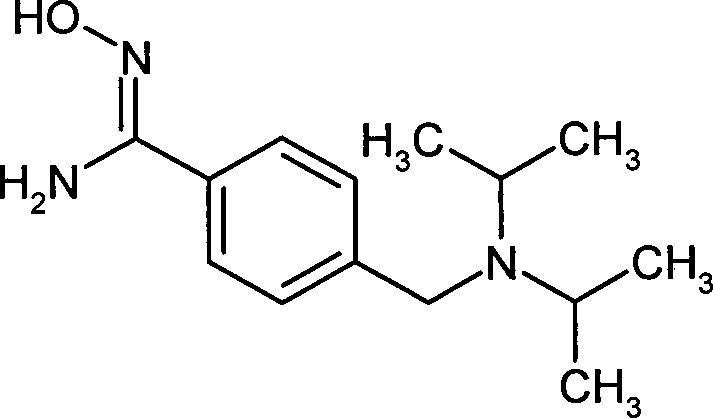

Man erhitzte ein Gemisch aus 4.00 g (20.4 mmol) 4-(Brommethyl)benzonitril und 6.19 g (61.2 mmol) Diisopropylamin in 40 ml Toluol in zwei Portionen in einem Mikrowellengerät (CEM Discover, initiale Einstrahlleistung 250 W) für jeweils 3 h auf 150°C. Nach dem Abkühlen auf RT filtrierte man vom gebildeten Feststoff ab, engte das Filtrat ein und erhielt so 4.52 g (92% d. Th., 90% Reinheit) der Titelverbindung.
LC/MS (Methode F, ESIpos): Rt = 0.30 min, m/z = 217 [M+H]+. Schritt 2: 4-[(Diisopropylamino)methyl]-N'-hydroxybenzolcarboximidamid 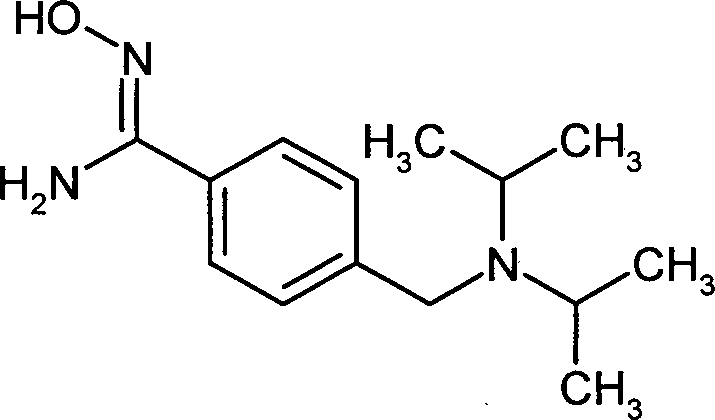
LC / MS (Method F, ESIpos): R t = 0.30 min, m / z = 217 [M + H] + . Step 2: 4 - [(Diisopropylamino) methyl] -N'-hydroxybenzenecarboximidamide
Analog zu dem unter Beispiel 1A/Schritt 5 beschriebenen Verfahren wurden aus 6.80 g (28.3 mmol, Reinheit 90%) der Verbindung aus Beispiel 65A/Schritt 1 4.93 g (70% d. Th.) der Titelverbindung erhalten.
1H-NMR (400 MHz, CDCl3, δ/ppm): 7.52 (d, 2H), 7.41 (d, 2H), 4.84 (s, breit, 2H), 3.64 (s, 2H), 3.05-2.95 (m, 2H), 1.01 (d, 12H).
LC/MS (Methode I, ESIpos): Rt = 0.18 min, m/z = 250 [M+H]+.Analogously to the process described under Example 1A / step 5, from 4.80 g (28.3 mmol, purity 90%) of the compound from Example 65A / Step 1, 4.93 g (70% of theory) of the title compound were obtained.
1 H-NMR (400 MHz, CDCl 3 , δ / ppm): 7.52 (d, 2H), 7.41 (d, 2H), 4.84 (s, broad, 2H), 3.64 (s, 2H), 3.05-2.95 ( m, 2H), 1.01 (d, 12H).
LC / MS (Method I, ESIpos): R t = 0.18 min, m / z = 250 [M + H] + .
Beispiel 66AExample 66A
3-Chlor-N'-hydroxy-4-(trifluormethoxy)benzolcarboximidamid 
Analog zu dem unter Beispiel 1A/Schritt 5 beschriebenen Verfahren wurden aus 1.00 g (4.51 mmol) 3-Chlor-4-(trifluormethoxy)benzonitril 842 mg (73% d. Th.) der Titelverbindung erhalten.
1H-NMR (400 MHz, CDCl3, δ/ppm): 7.77 (d, 1H), 7.58-7.55 (dd, 1H), 7.37-7.33 (m, 1H), 4.82 (s, breit, 1H).
LC/MS (Methode D, ESIpos): Rt = 1.64 min, m/z = 255/257 [M+H]+.Analogously to the process described under Example 1A / step 5, from 1.00 g (4.51 mmol) of 3-chloro-4- (trifluoromethoxy) benzonitrile 842 mg (73% of theory) of the title compound were obtained.
1 H-NMR (400 MHz, CDCl 3, δ / ppm): 7.77 (d, 1H), 7:58 to 7:55 (dd, 1H), 7:37 to 7:33 (m, 1H), 4.82 (s, broad, 1H).
LC / MS (Method D, ESIpos): R t = 1.64 min, m / z = 255/257 [M + H] + .
Beispiel 67AExample 67A
N'-Hydroxy-4-[1-(trifluormethyl)cyclopropyl]benzolcarboximidamid 
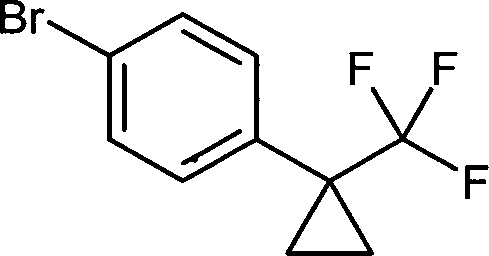
Zunächst wurde aktiviertes Zinkbromid auf Montmorillonit wie folgt dargestellt: Man legte 1.40 g (6.22 mmol) Zinkbromid in 56 ml Methanol vor, versetzte mit 5.64 g Montmorillonit K10 und rührte das Gemisch 1 h bei RT. Nach Entfernen des Methanols wurde das verbleibende Pulver 1 h bei 200°C Bad-Temperatur im Sandbad erhitzt und dann unter Argon erkalten gelassen. Activated zinc bromide on montmorillonite was first prepared as follows: 1.40 g (6.22 mmol) of zinc bromide in 56 ml of methanol were added, 5.6 g of montmorillonite K10 were added, and the mixture was stirred at RT for 1 h. After removing the methanol, the remaining powder was heated for 1 h at 200 ° C bath temperature in a sand bath and then allowed to cool under argon.
Die Titelverbindung wurde anschließend wie folgt dargestellt: 10.0 g (53.7 mmol) 1-Phenyl-1-(trifluormethyl)cyclopropan wurden in 50 ml Pentan vorgelegt. Man fügte 6.1 g (5.37 mmol) des oben erhaltenen aktivierten Zinkbromids auf Montmorillonit hinzu und tropfte anschließend langsam unter Rühren in der Dunkelheit 27.7 ml (537 mmol) Brom hinzu. Das Gemisch wurde dann über Nacht bei RT in der Dunkelheit weiter gerührt. Man tropfte danach langsam 150 ml einer gesättigten wässrigen Natriumsulfat-Lösung unter Eiskühlung hinzu und rührte weitere ca. 30 min bei RT bis zur Entfärbung des Gemisches. Der Feststoff wurde abfiltriert und zweimal mit Pentan nachgewaschen. Nach Trennung der Filtrat-Phasen wurde die wässrige Phase zweimal mit je 200 ml Pentan extrahiert. Die vereinigten organischen Phasen wurden über Natriumsulfat getrocknet, filtriert und schonend eingeengt (signifikante Flüchtigkeit der Zielverbindung). Man erhielt auf diese Weise 17.1 g (> 100% d. Th.) der Titelverbindung, welche laut 1H-NMR noch Pentan enthielt.
1H-NMR (400 MHz, CDCl3, δ/ppm): 7.47 (d, 2H), 7.32 (s, 2H), 1.39-1.30 (m, 2H), 1.04-0.95 (m, 2H).
GC/MS (Methode K, ESIpos): Rt = 3.45 min, m/z = 264/266 [M+H]+. Schritt 2: 4-[1-(Trifluormethyl)cyclopropyl]benzonitril 
1 H-NMR (400 MHz, CDCl 3, δ / ppm): 7:47 (d, 2H), 7:32 (s, 2H), 1:39 to 1:30 (m, 2H), 1.04-0.95 (m, 2H).
GC / MS (Method K, ESIpos): R t = 3.45 min, m / z = 264/266 [M + H] + . Step 2: 4- [1- (Trifluoromethyl) cyclopropyl] benzonitrile
Man legte 6.00 g (22.6 mmol) der Verbindung aus Beispiel 67A/Schritt 1 in 30 ml DMF unter Argon vor, gab 1.86 g (15.8 mmol) Zinkcyanid sowie 1.57 g (1.36 mmol) Tetrakis(triphenylphosphin)palladium(0) hinzu und rührte das Gemisch über Nacht bei 80°C. Nach Abkühlen auf RT gab man weitere 4.0 g (34.1 mmol) Zinkcyanid sowie 3.0 g (2.56 mmol) Tetrakis(triphenylphosphin)palladium(0) hinzu und erhitzte erneut unter Rühren für 5 h auf 120°C. Nach Abkühlen auf RT wurde der vorhandene Feststoff abfiltriert und einmal mit DMF gewaschen. Das mit der Waschlösung vereinigte Filtrat wurde eingeengt. Der Rückstand wurde in 200 ml Ethylacetat aufgenommen und die erhaltene Lösung zweimal mit 2 M wässriger Ammoniak-Lösung und einmal mit gesättigter wässriger Natriumchlorid-Lösung gewaschen. Nach Trocknen über Natriumsulfat, Filtrieren und Einengen wurde der erhaltene Rückstand durch Flash-Chromatographie (Kieselgel, Laufmittel: Cyclohexan/Ethylacetat 40:1) gereinigt. Nach kurzem Trocknen im Vakuum wurden 3.46 g (72% d. Th.) der Titelverbindung erhalten.
1H-NMR (400 MHz, CDCl3, δ/ppm): 7.66 (d, 2H), 7.58 (d, 2H), 1.47-1.41 (m, 2H), 1.09-1.03 (m, 2H).
GC/MS (Methode K, ESIpos): Rt = 3.81 min, m/z = 212 [M+H]+. Schritt 3: N'-Hydroxy-4-[1-(trifluormethyl)cyclopropyl]benzolcarboximidamid 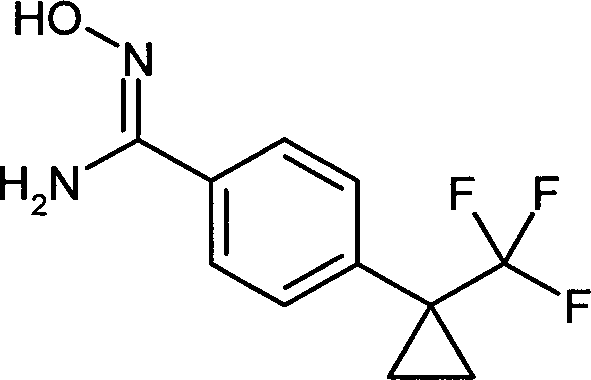
1 H-NMR (400 MHz, CDCl 3, δ / ppm): 7.66 (d, 2H), 7:58 (d, 2H), 1:47 to 1:41 (m, 2H), 1:09 to 1:03 (m, 2H).
GC / MS (method K, ESIpos): R t = 3.81 min, m / z = 212 [M + H] + . Step 3: N'-hydroxy-4- [1- (trifluoromethyl) cyclopropyl] benzenecarboximidamide
Analog zu dem unter Beispiel 1A/Schritt 5 beschriebenen Verfahren wurden aus 3.40 g (16.1 mmol) der Verbindung aus Beispiel 67A/Schritt 2 3.82 g (98% d. Th.) der Titelverbindung erhalten.
1H-NMR (400 MHz, CDCl3, δ/ppm): 7.62 (d, 2H), 7.50 (d, 2H), 4.88 (s, breit, 2H), 1.42-1.36 (m, 2H), 1.06-1.00 (m, 2H).
LC/MS (Methode F, ESIpos): Rt = 0.81 min, m/z = 245 [M+H]+.Analogously to the process described under Example 1A / step 5, 3.40 g (16.1 mmol) of the compound from Example 67A / Step 2 gave 3.82 g (98% of theory) of the title compound.
1 H-NMR (400 MHz, CDCl 3 , δ / ppm): 7.62 (d, 2H), 7.50 (d, 2H), 4.88 (s, broad, 2H), 1.42-1.36 (m, 2H), 1.06- 1.00 (m, 2H).
LC / MS (method F, ESIpos): R t = 0.81 min, m / z = 245 [M + H] + .
Beispiel 68AExample 68A
N'-Hydroxy-4-[N-methyl-S-(trifluormethyl)sulfonimidoyl]benzolcarboximidamid (Racemat) 

150 mg (0.66 mmol) 1-Fluor-4-[S-(trifluormethyl)sulfonimidoyl]benzol [
400 mg (1.60 mmol) der Verbindung aus Beispiel 68A/Schritt 1 wurden in 8 ml THF unter Argon gelöst und mit 224 mg (2.0 mmol) Kalium-tert.-butylat versetzt. Man rührte das Gemisch zunächst 1 h bei RT, gab dann 283 mg (2.0 mmol) Iodmethan hinzu und rührte das Gemisch weiter über Nacht bei RT. Anschließend wurde der Ansatz mit Wasser versetzt und mit Ethylacetat extrahiert. Der organische Extrakt wurde mit gesättigter wässriger Natriumchlorid-Lösung gewaschen, über Magnesiumsulfat getrocknet und eingeengt. Der Rückstand wurde mittels Flash-Chromatographie an Kieselgel gereinigt. Man erhielt 298 mg (70% d. Th.) der Titelverbindung.
1H-NMR (400 MHz, CDCl3, δ/ppm): 8.22 (d, 2H), 7.90 (d, 2H), 3.10 (s, 3H).
LC/MS (Methode D, ESIpos): Rt = 2.17 min, m/z = 249 [M+H]+. (Racemat) Schritt 3: N'-Hydroxy-4-[N-methyl-S-(trifluormethyl)sulfonimidoyl]benzolcarboximidamid 
1 H-NMR (400 MHz, CDCl 3, δ / ppm): 8.22 (d, 2H), 7.90 (d, 2H), 3.10 (s, 3H).
LC / MS (Method D, ESIpos): R t = 2.17 min, m / z = 249 [M + H] + . (Racemate) Step 3: N'-hydroxy-4- [N-methyl-S- (trifluoromethyl) sulfonimidoyl] benzenecarboximidamide
1.00 g (4.03 mmol) der Verbindung aus Beispiel 68A/Schritt 2 wurden in 20 ml Ethanol vorgelegt. Man gab 616 mg (8.86 mmol) Hydroxylamin-Hydrochlorid sowie 1.2 ml (8.86 mmol) Triethylamin hinzu und erhitzte das Gemisch 1 h unter Rückfluss. Anschließend engte man ein und nahm den Rückstand in einem Gemisch aus Ethylacetat und Wasser auf. Die Phasen wurden getrennt, und die wässrige Phase wurde einmal mit Ethylacetat extrahiert. Man wusch die vereinigten Ethylacetat-Phasen einmal mit gesättigter wässriger Natriumchlorid-Lösung, trocknete über Magnesiumsulfat, filtrierte und engte ein. Der Rückstand wurde mittels Säulenchromatographie (Kieselgel, Laufmittel: Cyclohexan/Ethylacetat 7:3) gereinigt. Die vereinigten Produktfraktionen wurden eingeengt und der Rückstand mit Pentan verrührt. Der resultierende Feststoff wurde abfiltriert und im Vakuum getrocknet. Man erhielt 775 mg (66% d. Th.) der Titelverbindung.
1H-NMR (400 MHz, CDCl3, δ/ppm): 8.12 (d, 2H), 8.04 (s, breit, 1H), 7.87 (d, 2H), 4.93 (s, 2H), 3.10 (s, 3H).
LC/MS (Methode I, ESIpos): Rt = 0.76 min, m/z = 282 [M+H]+. 1.00 g (4.03 mmol) of the compound from Example 68A / Step 2 were initially charged in 20 ml of ethanol. 616 mg (8.86 mmol) of hydroxylamine hydrochloride and 1.2 ml (8.86 mmol) of triethylamine were added and the mixture was heated under reflux for 1 h. It was then concentrated and the residue was taken up in a mixture of ethyl acetate and water. The phases were separated and the aqueous phase was extracted once with ethyl acetate. The combined ethyl acetate phases were washed once with saturated aqueous sodium chloride solution, dried over magnesium sulfate, filtered and concentrated. The residue was purified by column chromatography (silica gel, eluent: cyclohexane / ethyl acetate 7: 3). The combined product fractions were concentrated and the residue was stirred with pentane. The resulting solid was filtered off and dried in vacuo. 775 mg (66% of theory) of the title compound were obtained.
1 H-NMR (400 MHz, CDCl 3 , δ / ppm): 8.12 (d, 2H), 8.04 (s, broad, 1H), 7.87 (d, 2H), 4.93 (s, 2H), 3.10 (s, 3H).
LC / MS (Method I, ESIpos): R t = 0.76 min, m / z = 282 [M + H] + .
Beispiel 69AExample 69A
N'-Hydroxy-4-[S-(trifluormethyl)sulfonimidoyl]benzolcarboximidamid (Racemat) 
Analog zu dem unter Beispiel 68A/Schritt 3 beschriebenen Verfahren wurden aus 2.60 g (11.1 mmol) der Verbindung aus Beispiel 68A/Schritt 1 2.21 g (67% d. Th., Reinheit 90%) der Titelverbindung erhalten.
1H-NMR (400 MHz, CDCl3, δ/ppm): 8.19 (d, 2H), 7.90 (d, 2H), 4.92 (s, breit, 2H), 3.69 (s, breit, 1H).
LC/MS (Methode I, ESIpos): Rt = 0.51 min, m/z = 268 [M+H]+.Analogously to the process described under Example 68A / Step 3, from 2.60 g (11.1 mmol) of the compound from Example 68A / Step 1, 2.21 g (67% of theory, purity 90%) of the title compound were obtained.
1 H-NMR (400 MHz, CDCl 3, δ / ppm): 8.19 (d, 2H), 7.90 (d, 2H), 4.92 (s, broad, 2H), 3.69 (s, broad, 1H).
LC / MS (Method I, ESIpos): R t = 0.51 min, m / z = 268 [M + H] + .
Beispiel 70AExample 70A
3-Fluor-N'-hydroxy-4-(trifluormethoxy)benzolcarboximidamid 
Analog zu dem unter Beispiel 1A/Schritt 5 beschriebenen Verfahren wurden aus 5.0 g (23.9 mmol) 3-Fluor-4-(trifluormethoxy)benzonitril 5.7 g (99% d. Th.) der Titelverbindung erhalten.
1H-NMR (400 MHz, CDCl3, δ/ppm): 7.53-7.49 (dd, 1H), 7.45-7.41 (m, 1H), 7.37-7.31 (t, 1H), 4.87 (s, breit, 2H).
LC/MS (Methode I, ESIpos): Rt = 0.74 min, m/z = 239 [M+H]+.Analogously to the process described under Example 1A / step 5, 5.7 g (99% of theory) of the title compound were obtained from 5.0 g (23.9 mmol) of 3-fluoro-4- (trifluoromethoxy) benzonitrile.
1 H-NMR (400 MHz, CDCl 3, δ / ppm): 7:53 to 7:49 (dd, 1H), 7:45 to 7:41 (m, 1H), 7:37 to 7:31 (t, 1H), 4.87 (s, broad, 2H ).
LC / MS (Method I, ESIpos): R t = 0.74 min, m / z = 239 [M + H] + .
Beispiel 71AExample 71A
Ethyl-4-[4-(N'-hydroxycarbamimidoyl)phenyl]tetrahydro-2H-pyran-4-carboxylat 

6.0 g (24.7 mmol) Ethyl-4-bromphenylacetat wurden in 120 ml abs. DMF unter Argon gelöst, unter Eisbadkühlung mit 1.48 g (37.0 mmol, 60%-ig) Natriumhydrid versetzt und 30 min gerührt. Anschließend gab man unter stetiger Eisbadkühlung 5.72 g (24.7 mmol) Bis(2-bromethyl)ether hinzu und rührte das Gemisch 1 h bei ca. 0°C. Nach erneuter Zugabe von 1.48 g 60%-igem Natriumhydrid wurde nochmals 1 h unter Eisbadkühlung gerührt. Anschließend wurde mit gesättigter wässriger Ammoniumchlorid-Lösung versetzt und mit Ethylacetat extrahiert. Die organische Phase wurde mit Wasser und mit gesättigter wässriger Natriumchlorid-Lösung gewaschen, über Magnesiumsulfat getrocknet, filtriert und am Rotationsverdampfer eingeengt. Der Rückstand wurde säulenchromatographisch an Kieselgel gereinigt (Laufmittel: Cyclohexan/Ethylacetat 10:1). Es wurden 2.62 g (33% d. Th.) der Titelverbindung erhalten.
1H-NMR (400 MHz, CDCl3, δ/ppm): 7.47 (d, 2H), 7.25 (d, 2H), 4.14 (q, 2H), 3.93 (dt, 2H), 3.56 (td, 2H), 2.59 (dd, 2H), 1.93 (m, 2H), 1.19 (t, 3H).
MS (DCI, NH3): m/z = 329/331 [M+NH4]+.
LC/MS (Methode F, ESIpos): Rt = 1.33 min, keine Ionisierung. Schritt 2: Ethyl-4-(4-cyanophenyl)tetrahydro-2H-pyran-4-carboxylat 
1 H-NMR (400 MHz, CDCl 3, δ / ppm): 7:47 (d, 2H), 7.25 (d, 2H), 4.14 (q, 2H), 3.93 (dt, 2H), 3:56 (td, 2H) , 2.59 (dd, 2H), 1.93 (m, 2H), 1.19 (t, 3H).
MS (DCI, NH 3): m / z = 329/331 [M + NH 4] +.
LC / MS (method F, ESIpos): R t = 1.33 min, no ionization. Step 2: Ethyl 4- (4-cyanophenyl) tetrahydro-2H-pyran-4-carboxylate
Man legte 0.50 g (1.60 mmol) der Verbindung aus Beispiel 71A/Schritt 1 in 2.5 ml entgastem DMF unter Argon vor, gab 112 mg (0.96 mmol) Zinkcyanid sowie 110 mg (0.09 mmol) Tetrakis(triphenylphosphin)palladium(0) hinzu und rührte 1 h in der Mikrowelle bei 100°C. Nach Abkühlen auf RT wurde vom Feststoff abfiltriert und das Filtrat direkt mittels präparativer HPLC gereinigt (Methode P). Es wurden 250 mg (60% d. Th.) der Titelverbindung erhalten.
1H-NMR (400 MHz, DMSO-d6, δ/ppm): 7.84 (d, 2H), 7.58 (d, 2H), 4.10 (q, 2H), 3.81 (m, 2H), 3.44 (t, 2H), 2.39 (d, 2H), 1.90 (m, 2H), 1.11 (t, 3H).
GC/MS (Methode K, EIpos): Rt = 7.00 min, m/z = 215 [M-OCH2CH3]+ Schritt 3: Ethyl-4-[4-(N'-hydroxycarbamimidoyl)phenyl]tetrahydro-2H-pyran-4-carboxylat 
1 H-NMR (400 MHz, DMSO-d 6 , δ / ppm): 7.84 (d, 2H), 7.58 (d, 2H), 4.10 (q, 2H), 3.81 (m, 2H), 3.44 (t, 2H), 2.39 (d, 2H), 1.90 (m, 2H), 1.11 (t, 3H).
GC / MS (method K, EIpos): R t = 7.00 min, m / z = 215 [M-OCH 2 CH 3 ] + Step 3: Ethyl 4- [4- (N'-hydroxycarbamimidoyl) phenyl] tetrahydro-2H-pyran-4-carboxylate
Ein Gemisch aus 240 mg (0.93 mmol) der Verbindung aus Beispiel 71A/Schritt 2, 141 mg (2.04 mmol) Hydroxylamin-Hydrochlorid und 0.28 ml (2.04 mmol) Triethylamin in 4.5 ml Ethanol wurde 2 h lang bei 60°C gerührt. Nach dem Abkühlen auf RT wurde das Lösungsmittel am Rotationsverdampfer nahezu vollständig entfernt. Der Rückstand wurde anschließend in 20 ml Wasser unter Ultraschallbestrahlung aufgeschlämmt Der weiße Festkörper wurde abfiltriert, mit etwas Wasser gewaschen und im Hochvakuum getrocknet. Man erhielt so 245 mg (91% d. Th.) der Titelverbindung.
LC/MS (Methode I, ESIpos): Rt = 0.56 min, m/z = 293 [M+H]+.A mixture of 240 mg (0.93 mmol) of the compound from Example 71A / Step 2, 141 mg (2.04 mmol) of hydroxylamine hydrochloride and 0.28 ml (2.04 mmol) of triethylamine in 4.5 ml of ethanol was stirred at 60 ° C. for 2 h. After cooling to RT, the solvent was almost completely removed on a rotary evaporator. The residue was then slurried in 20 ml of water under ultrasound irradiation. The white solid was filtered off, washed with a little water and dried under high vacuum. This gave 245 mg (91% of theory) of the title compound.
LC / MS (Method I, ESIpos): R t = 0.56 min, m / z = 293 [M + H] + .
Beispiel 72AExample 72A
4-[4-(N'-Hydroxycarbamimidoyl)phenyl]-N,N-dimethyl-tetrahydro-2H-pyran-4-carboxamid 

1.3 g (4.15 mmol) der Verbindung aus Beispiel 71A/Schritt 1 wurden in 45 ml Dioxan gelöst, mit 9.1 ml 1 N Natronlauge versetzt und unter Rückfluss gerührt. Nach 18 h gab man nochmals 8.3 ml 1 N Natronlauge hinzu und rührte weitere 24 h unter Rückfluss. Nach dem Abkühlen wurde mit ca. 19 ml 1 N Salzsäure versetzt und 15 min bei RT gerührt. Der entstandene Niederschlag wurde abfiltriert, mit Wasser gewaschen und im Vakuum getrocknet. Man erhielt 1.22 g (99% d. Th.) der Titelverbindung.
1H-NMR (400 MHz, DMSO-d6, δ/ppm): 7.55 (d, 2H), 7.34 (d, 2H), 3.79 (m, 2H), 3.45 (t, 2H), 2.34 (d, 2H), 1.79 (m, 2H). Schritt 2: 4-(4-Bromphenyl)tetrahydro-2H-pyran-4-carbonsäurechlorid 
1 H-NMR (400 MHz, DMSO-d 6 , δ / ppm): 7.55 (d, 2H), 7.34 (d, 2H), 3.79 (m, 2H), 3.45 (t, 2H), 2.34 (d, 2H), 1.79 (m, 2H). Step 2: 4- (4-Bromophenyl) tetrahydro-2H-pyran-4-carboxylic acid chloride
1.34 g (4.70 mmol) der Verbindung aus Beispiel 72A/Schritt 1 wurden in 6.5 ml Thionylchlorid 2 h lang unter Rückfluss gerührt. Der Ansatz wurde anschließend am Rotationsverdampfer eingeengt, der Rückstand in Toluol aufgenommen und das Gemisch erneut eingeengt. Der resultierende Rückstand wurde dann in einer Mischung aus Dichlormethan und Pentan (1:2) verrührt, der verbliebene Feststoff abfiltriert und das Filtrat vom Lösungsmittel befreit. Der erhaltene Filtrat-Rückstand wurde im Vakuum getrocknet. Es wurden 1.49 g (> 100% d. Th.) der Zielverbindung isoliert, welche ohne weitere Reinigung in Folgestufen eingesetzt wurde. Schritt 3: 4-(4-Bromphenyl)-N,N-dimethyl-tetrahydro-2H-pyran-4-carboxamid 
Zu einer Lösung von 1.0 g (3.29 mmol) der Verbindung aus Beispiel 72A/Schritt 2 in 33 ml Dichlormethan tropfte man unter Eisbadkühlung 3.29 ml (6.59 mmol) Dimethylamin und rührte 1 h bei RT nach. Das Gemisch wurde anschließend am Rotationsverdampfer vom Lösungsmittel befreit. Der Rückstand wurde unter Ultraschallbehandlung in 50 ml 1 N Natronlauge suspendiert und dann filtriert. Der Filterkuchen wurde mit Wasser gewaschen und im Vakuum getrocknet. Man erhielt 820 mg (90% d. Th.) der Titelverbindung.
1H-NMR (400 MHz, DMSO-d6, δ/ppm): 7.56 (d, 2H), 7.19 (d, 2H), 3.74 (dt, 2H), 3.58 (t, 2H), 2.52 (s, 6H, unter DMSO-Signal verborgen), 2.16 (d, 2H), 1.87 (m, 2H).
LC/MS (Methode F, ESIpos): Rt = 1.07 min, m/z = 312/314 [M+H]+. Schritt 4: 4-(4-Cyanophenyl)-N,N-dimethyl-tetrahydro-2H-pyran-4-carboxamid 
1 H-NMR (400 MHz, DMSO-d 6 , δ / ppm): 7.56 (d, 2H), 7.19 (d, 2H), 3.74 (dt, 2H), 3.58 (t, 2H), 2.52 (s, 6H, hidden under DMSO signal), 2.16 (d, 2H), 1.87 (m, 2H).
LC / MS (method F, ESIpos): R t = 1.07 min, m / z = 312/314 [M + H] + . Step 4: 4- (4-Cyanophenyl) -N, N-dimethyl-tetrahydro-2H-pyran-4-carboxamide
Man legte 0.40 g (1.28 mmol) der in Beispiel 72A/Schritt 3 erhaltenen Verbindung in 2.0 ml entgastem DMF unter Argon vor, gab 90 mg (0.77 mmol) Zinkcyanid sowie 89 mg (0.08 mmol) Tetrakis(triphenylphosphin)palladium(0) hinzu und rührte 1 h in der Mikrowelle bei 110°C. Nach dem Abkühlen auf RT wurde vom Feststoff abfiltriert und das Filtrat direkt mittels präparativer HPLC gereinigt (Methode P). Es wurden 230 mg (68% d. Th.) der Titelverbindung erhalten.
1H-NMR (400 MHz, DMSO-d6, δ/ppm): 7.85 (d, 2H), 7.44 (d, 2H), 3.76 (dt, 2H), 3.59 (t, 2H), 2.52 (s, 6H, unter DMSO-Signal verborgen), 2.17 (d, 2H), 1.91 (m, 2H).
LC/MS (Methode I, ESIpos): Rt = 0.75 min, m/z = 259 [M+H]+. carboxamid Schritt 5: 4-[4-(N'-Hydroxycarbamimidoyl)phenyl]-N,N-dimethyl-tetrahydro-2H-pyran-4- 
1 H-NMR (400 MHz, DMSO-d 6 , δ / ppm): 7.85 (d, 2H), 7.44 (d, 2H), 3.76 (dt, 2H), 3.59 (t, 2H), 2.52 (s, 6H, hidden under DMSO signal), 2.17 (d, 2H), 1.91 (m, 2H).
LC / MS (Method I, ESIpos): R t = 0.75 min, m / z = 259 [M + H] + . carboxamide Step 5: 4- [4- (N'-hydroxycarbamimidoyl) phenyl] -N, N-dimethyl-tetrahydro-2H-pyran-4
Ein Gemisch aus 333 mg (1.28 mmol) der Verbindung aus Beispiel 72A/Schritt 4, 186 mg (2.68 mmol) Hydroxylamin-Hydrochlorid und 0.37 ml (2.68 mmol) Triethylamin in 6.2 ml Ethanol wurde 2 h lang bei 80°C gerührt. Nach dem Abkühlen wurde der entstandene Niederschlag abfiltriert, mit etwas Ethanol gewaschen und im Hochvakuum getrocknet. Man erhielt 180 mg (47% d. Th.) der Titelverbindung.
LC/MS (Methode F, ESIpos): Rt = 0.27 min, m/z = 291 [M+H]+.A mixture of 333 mg (1.28 mmol) of the compound of Example 72A / Step 4, 186 mg (2.68 mmol) of hydroxylamine hydrochloride and 0.37 ml (2.68 mmol) of triethylamine in 6.2 ml of ethanol was stirred for 2 h at 80 ° C. After cooling, the resulting precipitate was filtered off, washed with a little ethanol and dried under high vacuum. 180 mg (47% of theory) of the title compound were obtained.
LC / MS (Method F, ESIpos): R t = 0.27 min, m / z = 291 [M + H] + .
Beispiel 73AExample 73A
4-[4-(N'-Hydroxycarbamimidoyl)phenyl]-N-methyl-tetrahydro-2H-pyran-4-carboxamid 
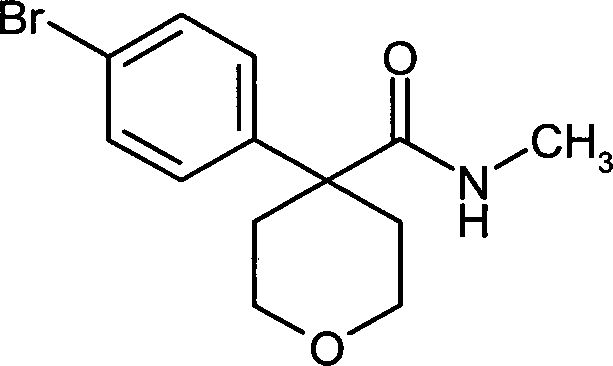
Analog zu dem unter Beispiel 72A/Schritt 3 beschriebenen Verfahren wurden 1.0 g (3.29 mmol) der Verbindung aus Beispiel 72A/Schritt 2 und 3.29 ml (6.58 mmol) einer 2 M Lösung von Methylamin in THF zu 680 mg (69% d. Th.) der Titelverbindung umgesetzt.
1H-NMR (400 MHz, DMSO-d6, δ/ppm): 7.62 (q, 1H), 7.52 (d, 1H), 7.28 (d, 2H), 3.71 (m, 2H), 3.43 (t, 2H), 2.54 (d, 3H), 2.39 (d, 2H), 1.81 (m, 2H).
LC/MS (Methode I, ESIpos): Rt = 0.82 min, m/z = 297/299 [M+H]+. Schritt 2: 4-(4-Cyanophenyl)-N-methyl-tetrahydro-2H-pyran-4-carboxamid 
1 H-NMR (400 MHz, DMSO-d 6 , δ / ppm): 7.62 (q, 1H), 7.52 (d, 1H), 7.28 (d, 2H), 3.71 (m, 2H), 3.43 (t, 2H), 2.54 (d, 3H), 2.39 (d, 2H), 1.81 (m, 2H).
LC / MS (method I, ESIpos): R t = 0.82 min, m / z = 297/299 [M + H] + . Step 2: 4- (4-cyanophenyl) -N-methyl-tetrahydro-2H-pyran-4-carboxamide
Analog zu dem unter Beispiel 72A/Schritt 4 beschriebenen Verfahren wurden 660 mg (2.21 mmol) der Verbindung aus Beispiel 73A/Schritt 1 zu 390 mg (72% d. Th.) der Titelverbindung umgesetzt.
1H-NMR (400 MHz, DMSO-d6, δ/ppm): 7.80 (d, 2H), 7.66 (d, 1H), 7.53 (d, 2H), 3.73 (d, 2H), 3.45 (t, 2H), 2.55 (d, 3H), 2.41 (d, 2H), 1.85 (m, 2H).
LC/MS (Methode I, ESIpos): Rt = 0.63 min, m/z = 245 [M+H]+. Schritt 3: 4-[4-(N-Hydroxycarbamimidoyl)phenyl]N-methyl-tetrahydro-2H-pyran-4-carboxamid 
1 H-NMR (400 MHz, DMSO-d 6 , δ / ppm): 7.80 (d, 2H), 7.66 (d, 1H), 7.53 (d, 2H), 3.73 (d, 2H), 3.45 (t, 2H), 2.55 (d, 3H), 2.41 (d, 2H), 1.85 (m, 2H).
LC / MS (method I, ESIpos): R t = 0.63 min, m / z = 245 [M + H] + . Step 3: 4- [4- (N-Hydroxycarbamimidoyl) phenyl] N -methyl-tetrahydro-2H-pyran-4-carboxamide
Analog zu dem unter Beispiel 72A/Schritt 5 beschriebenen Verfahren wurden 380 mg (0.16 mmol) der Verbindung aus Beispiel 73A/Schritt 2 zu 360 mg (83% d. Th.) der Titelverbindung umgesetzt.
1H-NMR (400 MHz, DMSO-d6, δ/ppm): 9.57 (s, 1H), 7.62 (d, 2H), 7.59 (m, 1H), 7.33 (d, 2H), 5.76 (s, 2H), 3.71 (m, 2H), 3.45 (t, 2H), 2.54 (d, 3H), 2.41 (d, 2H), 1.84 (m, 2H).
LC/MS (Methode I, ESIpos): Rt = 0.53 min, m/z = 253 [M+H]+.Analogously to the process described under Example 72A / Step 5, 380 mg (0.16 mmol) of the compound from Example 73A / Step 2 were converted to 360 mg (83% of theory) of the title compound.
1 H-NMR (400 MHz, DMSO-d 6 , δ / ppm): 9.57 (s, 1H), 7.62 (d, 2H), 7.59 (m, 1H), 7.33 (d, 2H), 5.76 (s, 2H), 3.71 (m, 2H), 3.45 (t, 2H), 2.54 (d, 3H), 2.41 (d, 2H), 1.84 (m, 2H).
LC / MS (Method I, ESIpos): R t = 0.53 min, m / z = 253 [M + H] + .
Beispiel 74AExample 74A
5-(5-Methyl-1H-pyrazol-3-yl)-3-[4-(tetrahydro-2H-pyran-4-yl)phenyl]-1,2,4-oxadiazol 
Analog zu dem unter Beispiel 23A beschriebenen Verfahren wurden aus 469 mg (3.72 mmol) 5-Methyl-1H-pyrazol-3-carbonsäure und 820 mg (3.72 mmol) der Verbindung aus Beispiel 58A 450 mg der Titelverbindung nach Ausrühren des Rohprodukts in Acetonitril und weitere 97 mg der Titelverbindung nach Aufreinigung der Mutterlauge durch präparative HPLC (Methode M) erhalten (Ausbeute insgesamt 47% d. Th.).
1H-NMR (400 MHz, DMSO-d6, δ/ppm): 13.52 (s, 1H), 8.01 (d, 2H), 7.49 (d, 2H), 6.79 (s, 1H), 3.99-3.95 (m, 2H), 3.49-3.42 (m, 2H), 2.92-2.84 (m, 1H), 2.34 (s, 3H), 1.77-1.65 (m, 4H).
LC/MS (Methode I, ESIpos): Rt = 0.98 min, m/z = 311 [M+H]+.Analogously to the procedure described under Example 23A, from 469 mg (3.72 mmol) of 5-methyl-1H-pyrazole-3-carboxylic acid and 820 mg (3.72 mmol) of the compound from Example 58A, 450 mg of the title compound were stirred up after stirring the crude product in acetonitrile and a further 97 mg of the title compound were obtained after purification of the mother liquor by preparative HPLC (Method M) (overall yield 47% of theory).
1 H-NMR (400 MHz, DMSO-d 6 , δ / ppm): 13.52 (s, 1H), 8.01 (d, 2H), 7.49 (d, 2H), 6.79 (s, 1H), 3.99-3.95 ( m, 2H), 3.49-3.42 (m, 2H), 2.92-2.84 (m, 1H), 2.34 (s, 3H), 1.77-1.65 (m, 4H).
LC / MS (Method I, ESIpos): R t = 0.98 min, m / z = 311 [M + H] + .
Beispiel 75A Example 75A
5-(5-Methyl-1H-pyrazol-3-yl)-3-[3-methyl-4-(tetrahydro-2H-pyran-4-yl)phenyl]-1,2,4-oxadiazol 
Analog zu dem unter Beispiel 23A beschriebenen Verfahren wurden 180 mg (1.43 mmol) 5-Methyl-1H-pyrazol-3-carbonsäure und 335 mg (1.43 mmol) der Verbindung aus Beispiel 64A zu 189 mg (39% d. Th.) der Titelverbindung umgesetzt. Das Reaktionsgemisch wurde hier zunächst 16 h bei RT und anschließend 30 min bei 140°C gerührt. Die Reinigung des Produktes erfolgte mittels präparativer HPLC (Methode M).
1H-NMR (400 MHz, CDCl3, δ/ppm): 10.63 (breit, 1H), 8.00 (d, 1H), 7.99 (s, 1H), 7.36 (d, 1H), 6.80 (s, 1H), 4.13-4.10 (m, 2H), 3.61-3.54 (m, 2H), 3.07-3.00 (m, 1H), 2.45 (s, 3H), 2.43 (s, 3H), 1.92-1.80 (m, 2H), 1.73-1.68 (m, 2H).
LC/MS (Methode I, ESIpos): Rt = 1.02 min, m/z = 325 [M+H]+.Analogously to the process described under Example 23A, 180 mg (1.43 mmol) of 5-methyl-1H-pyrazole-3-carboxylic acid and 335 mg (1.43 mmol) of the compound from Example 64A were added to 189 mg (39% of theory) of Title compound implemented. The reaction mixture was stirred initially at RT for 16 h and then at 140 ° C. for 30 min. The product was purified by preparative HPLC (Method M).
1 H-NMR (400 MHz, CDCl 3 , δ / ppm): 10.63 (broad, 1H), 8.00 (d, 1H), 7.99 (s, 1H), 7.36 (d, 1H), 6.80 (s, 1H) , 4.13-4.10 (m, 2H), 3.61-3.54 (m, 2H), 3.07-3.00 (m, 1H), 2.45 (s, 3H), 2.43 (s, 3H), 1.92-1.80 (m, 2H) , 1.73-1.68 (m, 2H).
LC / MS (Method I, ESIpos): R t = 1.02 min, m / z = 325 [M + H] + .
Beispiel 76AExample 76A
3-(4-Isobutylphenyl)-5-(5-methyl-1H-pyrazol-3-yl)-1,2,4-oxadiazol 
Eine Lösung von 2.0 g (15.9 mmol) 5-Methyl-1H-pyrazol-3-carbonsäure in 80 ml wasserfreiem DMF wurde nacheinander mit 3.19 g (16.7 mmol) EDC, 2.55 g (16.7 mmol) HOBt und 3.35 g (17.4 mmol) der Verbindung aus Beispiel 59A versetzt. Es wurde 1 h bei RT gerührt, bevor für 30 min auf 140°C erhitzt wurde. Nach dem Abkühlen auf RT wurde das Lösungsmittel weitestgehend am Rotationsverdampfer entfernt. Der Rückstand wurde mit ca. 500 ml Wasser versetzt, und es wurde dreimal mit je ca. 200 ml Diethylether extrahiert. Die vereinigten organischen Extrakte wurden nacheinander mit Wasser und gesättigter Kochsalz-Lösung gewaschen. Nach Trocknen über wasserfreiem Magnesiumsulfat wurde filtriert und das Filtrat am Rotationsverdampfer eingedampft. Der erhaltene Rückstand wurde mittels MPLC gereinigt (Kieselgel, Laufmittel: Cyclohexan/Ethylacetat 2:1). Nach abschließendem Verrühren mit ca. 50 ml Pentan wurden 1.7 g (38% d. Th.) der Titelverbindung erhalten.
1H-NMR (400 MHz, CDCl3, δ/ppm): 10.84 (breit, 1H), 8.08 (d, 2H), 7.27 (d, 2H), 6.81 (s, 1H), 2.54 (d, 2H), 2.44 (s, 3H), 1.97-1.87 (m, 1H), 0.93 (d, 6H).
LC/MS (Methode Q, ESIpos): Rt = 2.59 min, m/z = 283 [M+H]+.A solution of 2.0 g (15.9 mmol) of 5-methyl-1H-pyrazole-3-carboxylic acid in 80 ml of anhydrous DMF was added sequentially with 3.19 g (16.7 mmol) EDC, 2.55 g (16.7 mmol) HOBt and 3.35 g (17.4 mmol). the compound of Example 59A added. It was stirred for 1 h at RT, before being heated to 140 ° C for 30 min. After cooling to RT, the solvent was largely removed on a rotary evaporator. The residue was treated with about 500 ml of water, and it was extracted three times with about 200 ml of diethyl ether. The combined organic extracts were washed successively with water and saturated brine. After drying over anhydrous magnesium sulfate, it was filtered and the filtrate was evaporated on a rotary evaporator. The resulting residue was purified by MPLC (silica gel, eluent: cyclohexane / ethyl acetate 2: 1). After concluding stirring with about 50 ml of pentane, 1.7 g (38% of theory) of the title compound were obtained.
1 H-NMR (400 MHz, CDCl 3 , δ / ppm): 10.84 (broad, 1H), 8.08 (d, 2H), 7.27 (d, 2H), 6.81 (s, 1H), 2.54 (d, 2H) , 2.44 (s, 3H), 1.97-1.87 (m, 1H), 0.93 (d, 6H).
LC / MS (method Q, ESIpos): R t = 2.59 min, m / z = 283 [M + H] + .
Beispiel 77AExample 77A
3-{4-[1-(Methoxymethyl)cyclobutyl]phenyl}-5-(5-methyl-1H-pyrazol-3-yl)-1,2,4-oxadiazol 
Analog zu dem unter Beispiel 76A beschriebenen Verfahren wurden 1.08 g (8.52 mmol) 5-Methyl-1H-pyrazol-3-carbonsäure und 2.0 g (8.52 mmol) der Verbindung aus Beispiel 61A zu 1.87 g (46% d. Th.) der Titelverbindung umgesetzt. Bei der MPLC-Reinigung des Rohprodukts wurde ein Laufmittel-Gradient von Cyclohexan/Ethylacetat (5:1 → 1:1) verwendet.
1H-NMR (400 MHz, CDCl3, δ/ppm): 11.57 (breit, 1H), 8.10 (d, 2H), 7.30 (d, 2H), 6.81 (s, 1H), 3.57 (s, 2H), 3.29 (s, 3H), 2.45 (s, 3H), 2.41-2.28 (m, 4H), 2.15-2.03 (m, 1H), 1.93-1.84 (m, 1H).
LC/MS (Methode F, ESIpos): Rt = 1.28 min, m/z = 325 [M+H]+.Analogously to the process described under Example 76A, 1.08 g (8.52 mmol) of 5-methyl-1H-pyrazole-3-carboxylic acid and 2.0 g (8.52 mmol) of the compound from Example 61A were added to 1.87 g (46% of th Title compound implemented. For MPLC purification of the crude product, a mobile phase gradient of cyclohexane / ethyl acetate (5: 1 → 1: 1) was used.
1 H-NMR (400 MHz, CDCl 3 , δ / ppm): 11.57 (broad, 1H), 8.10 (d, 2H), 7.30 (d, 2H), 6.81 (s, 1H), 3.57 (s, 2H) , 3.29 (s, 3H), 2.45 (s, 3H), 2.41-2.28 (m, 4H), 2.15-2.03 (m, 1H), 1.93-1.84 (m, 1H).
LC / MS (method F, ESIpos): R t = 1.28 min, m / z = 325 [M + H] + .
Beispiel 78AExample 78A
3-[4-(Methoxymethyl)phenyl]-5-(5-methyl-1H-pyrazol-3-yl)-1,2,4-oxadiazol 
Analog zu dem unter Beispiel 76A beschriebenen Verfahren wurden 1.50 g (11.9 mmol) 5-Methyl-1H-pyrazol-3-carbonsäure und 2.36 g (13.1 mmol) der Verbindung aus Beispiel 62A zu 346 mg (11% d. Th.) der Titelverbindung umgesetzt. Bei der MPLC-Reinigung des Rohprodukts wurde Cyclohexan/Ethylacetat 2:1 als Laufmittel verwendet.
LC/MS (Methode I, ESIpos): Rt = 0.95 min, m/z = 271 [M+H]+.Analogously to the process described under Example 76A, 1.50 g (11.9 mmol) of 5-methyl-1H-pyrazole-3-carboxylic acid and 2.36 g (13.1 mmol) of the compound from Example 62A were added to 346 mg (11% of theory) of Title compound implemented. For MPLC purification of the crude product, cyclohexane / ethyl acetate 2: 1 was used as the eluent.
LC / MS (Method I, ESIpos): R t = 0.95 min, m / z = 271 [M + H] + .
Beispiel 79AExample 79A
3-(3-Fluor-4-methoxyphenyl)-5-(5-methyl-1H-pyrazol-3-yl)-1,2,4-oxadiazol 
Analog zu dem unter Beispiel 76A beschriebenen Verfahren wurden 1.0 g (7.93 mmol) 5-Methyl-1H-pyrazol-3-carbonsäure und 1.61 g (8.72 mmol) der Verbindung aus Beispiel 63A zu 559 mg (26% d. Th.) der Titelverbindung umgesetzt.
1H-NMR (400 MHz, CDCl3, δ/ppm): 10.81 (breit, 1H), 7.96-7.89 (m, 2H), 7.06 (t, 1H), 6.80 (s, 1H), 3.97 (s, 3H), 2.47 (s, 3H).
LC/MS (Methode I, ESIpos): Rt = 0.96 min, m/z = 275 [M+H]+.Analogously to the process described under Example 76A, 1.0 g (7.93 mmol) of 5-methyl-1H-pyrazole-3-carboxylic acid and 1.61 g (8.72 mmol) of the compound from Example 63A were added to 559 mg (26% of theory) of Title compound implemented.
1 H-NMR (400 MHz, CDCl 3 , δ / ppm): 10.81 (broad, 1H), 7.96-7.89 (m, 2H), 7.06 (t, 1H), 6.80 (s, 1H), 3.97 (s, 3H), 2.47 (s, 3H).
LC / MS (Method I, ESIpos): R t = 0.96 min, m / z = 275 [M + H] + .
Beispiel 80A Example 80A
3-(4-Methoxyphenyl)-5-(5-methyl-1H-pyrazol-3-yl)-1,2,4-oxadiazol 
Analog zu dem unter Beispiel 76A beschriebenen Verfahren wurden 1.50 g (11.9 mmol) 5-Methyl-1H-pyrazol-3-carbonsäure und 2.17 g (13.1 mmol) N'-Hydroxy-4-methoxybenzolcarboximidamid [
1H-NMR (400 MHz, CDCl3, δ/ppm): 8.11 (d, 2H), 7.00 (d, 2H), 6.80 (s, 1H), 3.88 (s, 3H), 2.47 (s, 3H).
LC/MS (Methode I, ESIpos): Rt = 0.94 min, m/z = 257 [M+H]+.Analogously to the process described under Example 76A, 1.50 g (11.9 mmol) of 5-methyl-1H-pyrazole-3-carboxylic acid and 2.17 g (13.1 mmol) of N'-hydroxy-4-methoxybenzenecarboximidamide
1 H-NMR (400 MHz, CDCl 3, δ / ppm): 8.11 (d, 2H) 7.00 (d, 2H), 6.80 (s, 1H), 3.88 (s, 3H), 2:47 (s, 3H) ,
LC / MS (Method I, ESIpos): R t = 0.94 min, m / z = 257 [M + H] + .
Beispiel 81AExample 81A
3-(4-Isopropylphenyl)-5-(5-methyl-1H-pyrazol-3-yl)-1,2,4-oxadiazol 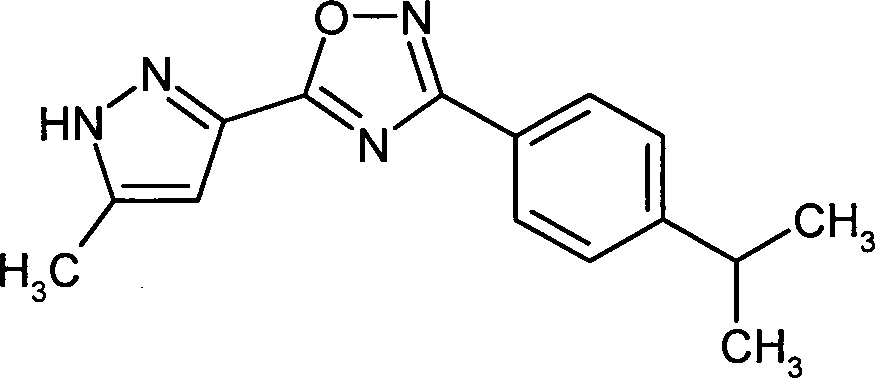
Analog zu dem unter Beispiel 76A beschriebenen Verfahren wurden 2.0 g (15.9 mmol) 5-Methyl-1H-pyrazol-3-carbonsäure und 3.11 g (17.4 mmol) der Verbindung aus Beispiel 60A zu 2.20 g (52% d. Th.) der Titelverbindung umgesetzt.
1H-NMR (400 MHz, CDCl3, δ/ppm): 8.10 (d, 2H), 7.36 (d, 2H), 6.81 (s, 1H), 2.97 (sept, 1H), 2.43 (s, 3H), 1.29 (d, 6H).
LC/MS (Methode Q, ESIpos): Rt = 2.42 min, m/z = 269 [M+H]+.2.0 g (15.9 mmol) of 5-methyl-1H-pyrazole-3-carboxylic acid and 3.11 g (17.4 mmol) of the compound from Example 60A were added to 2.20 g (52% of th Title compound implemented.
1 H-NMR (400 MHz, CDCl 3, δ / ppm): 8.10 (d, 2H), 7:36 (d, 2H), 6.81 (s, 1H), 2.97 (sept, 1H), 2:43 (s, 3H) , 1.29 (d, 6H).
LC / MS (Method Q, ESIpos): R t = 2.42 min, m / z = 269 [M + H] + .
Beispiel 82AExample 82A
3-(4-tert.-Butylphenyl)-5-(5-methyl-1H-pyrazol-3-yl)-1,2,4-oxadiazol 
Analog zu dem unter Beispiel 76A beschriebenen Verfahren wurden 2.50 g (19.8 mmol) 5-Methyl-1H-pyrazol-3-carbonsäure und 4.19 g (21.8 mmol) 4-tert.-Butyl-N'-hydroxy-benzolcarboximidamid zu 2.60 g (46% d. Th.) der Titelverbindung umgesetzt.
1H-NMR (400 MHz, CDCl3, δ/ppm): 11.08 (s, breit, 1H), 8.10 (d, 2H), 7.51 (d, 2H), 6.81 (s, 1H), 2.46 (s, 3H), 1.37 (s, 9H).
LC/MS (Methode I, ESIpos): Rt = 1.21 min, m/z = 283 [M+H]+.Analogously to the process described under Example 76A, 2.50 g (19.8 mmol) of 5-methyl-1H-pyrazole-3-carboxylic acid and 4.19 g (21.8 mmol) of 4-tert-butyl-N'-hydroxybenzenecarboximidamide were added to 2.60 g ( 46% of theory) of the title compound.
1 H-NMR (400 MHz, CDCl 3 , δ / ppm): 11.08 (s, broad, 1H), 8.10 (d, 2H), 7.51 (d, 2H), 6.81 (s, 1H), 2.46 (s, 3H), 1.37 (s, 9H).
LC / MS (Method I, ESIpos): R t = 1.21 min, m / z = 283 [M + H] + .
Beispiel 83AExample 83A
N-Isopropyl-N-{4-{5-(5-methyl-1H-pyrazol-3-yl)-1,2,4-oxadiazol-3-yl]benzyl}propan-2-amin 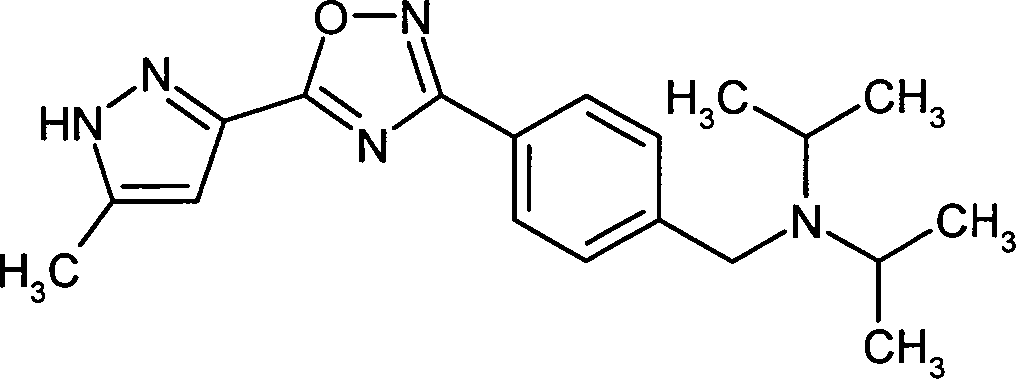
Analog zu dem unter Beispiel 23A beschriebenen Verfahren wurden 2.00 g (15.9 mmol) 5-Methyl-1H-pyrazol-3-carbonsäure und 3.95 g (15.9 mmol) der Verbindung aus Beispiel 65A zu 1.49 g (26% d. Th., Reinheit 93%) der Titelverbindung umgesetzt.
1H-NMR (400 MHz, CDCl3, δ/ppm): 11.50 (s, breit, 1H), 8.08 (d, 2H), 7.51 (d, 2H), 6.81 (s, 1H), 3.70 (s, 2H), 3.10-2.98 (m, 2H), 2.42 (s, 3H), 1.02 (d, 12H).
LC/MS (Methode F, ESIpos): Rt = 0.73 min, m/z = 340 [M+H]+.Analogously to the process described under Example 23A, 2.00 g (15.9 mmol) of 5-methyl-1H-pyrazole-3-carboxylic acid and 3.95 g (15.9 mmol) of the compound from Example 65A were added to 1.49 g (26% of theory, purity 93%) of the title compound.
1 H-NMR (400 MHz, CDCl 3 , δ / ppm): 11.50 (s, broad, 1H), 8.08 (d, 2H), 7.51 (d, 2H), 6.81 (s, 1H), 3.70 (s, 2H), 3.10-2.98 (m, 2H), 2.42 (s, 3H), 1.02 (d, 12H).
LC / MS (Method F, ESIpos): R t = 0.73 min, m / z = 340 [M + H] + .
Beispiel 84AExample 84A
3-[3-Chlor-4-(trifluormethoxy)phenyl]-5-(5-methyl-1H-pyrazol-3-yl)-1,2,4-oxadiazol 
Analog zu dem unter Beispiel 23A beschriebenen Verfahren wurden 631 mg (5.00 mmol) 5-Methyl-1H-pyrazol-3-carbonsäure und 1.27 g (5.00 mmol) der Verbindung aus Beispiel 66A zu 1.08 g (60% d. Th., Reinheit 95%) der Titelverbindung umgesetzt. Die Reaktionszeiten betrugen hier ca. 30 min bei RT und ca. 1 h bei 150°C. Das Produkt wurde erhalten, indem man nach beendeter Reaktion den nach Zugabe von Wasser ausgefallenen Feststoff abfiltrierte, mit Wasser wusch und im Vakuum trocknete.
LC/MS (Methode I, ESIpos): Rt = 1.20 min, m/z = 345/347 [M+H]+.Analogously to the process described under Example 23A, 631 mg (5.00 mmol) of 5-methyl-1H-pyrazole-3-carboxylic acid and 1.27 g (5.00 mmol) of the compound from Example 66A were added to 1.08 g (60% of theory, purity 95%) of the title compound. The reaction times were about 30 min at RT and about 1 h at 150 ° C. The product was obtained by filtering off after completion of the reaction precipitated by the addition of water solid, washed with water and dried in vacuo.
LC / MS (Method I, ESIpos): R t = 1.20 min, m / z = 345/347 [M + H] + .
Beispiel 85AExample 85A
3-[3-Fluor-4-(trifluormethoxy)phenyl]-5-(5-methyl-1H-pyrazol-3-yl)-1,2,4-oxadiazol 
Analog zu dem unter Beispiel 23A beschriebenen Verfahren wurden 2.0 g (15.9 mmol) 5-Methyl-1H-pyrazol-3-carbonsäure und 3.78 g (15.9 mmol) der Verbindung aus Beispiel 70A zu 3.15 g (56% d. Th., Reinheit 92%) der Titelverbindung umgesetzt. Das Produkt wurde in diesem Fall nicht über eine chromatographische Reinigung, sondern durch Waschen des Rohprodukts mit Wasser und Pentan und anschließendes Trocknen im Vakuum erhalten.
1H-NMR (400 MHz, CDCl3, δ/ppm): 12.0-9.5 (s, breit, 1H), 8.10-7.97 (m, 2H), 7.46-7.41 (t, 1H), 6.81 (s, 1H), 2.47 (s, 3H).
LC/MS (Methode I, ESIpos): Rt = 1.16 min, m/z = 329 [M+H]+. Analogously to the procedure described under Example 23A, 2.0 g (15.9 mmol) of 5-methyl-1H-pyrazole-3-carboxylic acid and 3.78 g (15.9 mmol) of the compound from Example 70A were added to 3.15 g (56% of theory, purity 92%) of the title compound. The product in this case was not obtained via a chromatographic purification but by washing the crude product with water and pentane and then drying in vacuo.
1 H-NMR (400 MHz, CDCl 3, δ / ppm): 12.0-9.5 (s, broad, 1H), 8.10-7.97 (m, 2H), 7:46 to 7:41 (t, 1H), 6.81 (s, 1H ), 2.47 (s, 3H).
LC / MS (Method I, ESIpos): R t = 1.16 min, m / z = 329 [M + H] + .
Beispiel 86AExample 86A
5-(5-Methyl-1H-pyrazol-3-yl)-3-{4-[1-(trifluormethyl)cyclopropyl]phenyl}-1,2,4-oxadiazol 
Analog zu dem unter Beispiel 23A beschriebenen Verfahren wurden 1.19 g (9.42 mmol) 5-Methyl-1H-pyrazol-3-carbonsäure und 2.30 g (9.42 mmol) der Verbindung aus Beispiel 67A zu 1.05 g (62% d. Th.) der Titelverbindung umgesetzt. Die Reinigung des Rohprodukts erfolgte über präparative HPLC (Methode N).
1H-NMR (400 MHz, CDCl3, δ/ppm): 11.0-10.5 (s, breit, 1H), 8.16 (d, 2H), 7.60 (d, 2H), 6.82 (s, 1H), 1.43-1.39 (m, 2H), 1.12-1.08 (m, 2H).
LC/MS (Methode I, ESIpos): Rt = 1.17 min, m/z = 335 [M+H]+.Analogously to the process described under Example 23A, 1.19 g (9.42 mmol) of 5-methyl-1H-pyrazole-3-carboxylic acid and 2.30 g (9.42 mmol) of the compound from Example 67A were added to 1.05 g (62% of theory) of Title compound implemented. The crude product was purified by preparative HPLC (Method N).
1 H-NMR (400 MHz, CDCl 3 , δ / ppm): 11.0-10.5 (s, broad, 1H), 8.16 (d, 2H), 7.60 (d, 2H), 6.82 (s, 1H), 1.43- 1.39 (m, 2H), 1.12-1.08 (m, 2H).
LC / MS (Method I, ESIpos): R t = 1.17 min, m / z = 335 [M + H] + .
Beispiel 87AExample 87A
2-Brom-4-(brommethyl)pyridin 
Analog zu dem unter Beispiel 42A/Schritt 3 beschriebenen Verfahren wurden aus 1.50 g (7.66 mmol) 2-Brom-4-(hydroxymethyl)pyridin 1.83 g (95% d. Th.) der Titelverbindung hergestellt.
1H-NMR (400 MHz, CDCl3, δ/ppm): 8.36 (d, 1H), 7.52 (s, 1H), 7.27 (d, 1H), 4.32 (s, 2H).
HPLC (Methode A): Rt = 3.47 min.
MS (DCI, NH3): m/z = 250/252/254 [M+H]+.Analogously to the process described under Example 42A / Step 3, 1.83 g (95% of theory) of the title compound were prepared from 1.50 g (7.66 mmol) of 2-bromo-4- (hydroxymethyl) pyridine.
1 H-NMR (400 MHz, CDCl 3, δ / ppm): 8:36 (d, 1H), 7:52 (s, 1H), 7.27 (d, 1H), 4:32 (s, 2H).
HPLC (Method A): R t = 3.47 min.
MS (DCI, NH 3): m / z = 250/252/254 [M + H] +.
Beispiel 88AExample 88A
[2-(4-Hydroxytetrahydro-2H-pyran-4-yl)pyridin-4-yl]methylmethansulfonat 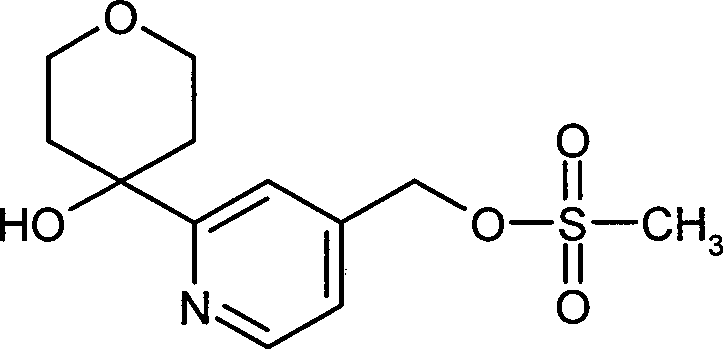

4.65 g (24.7 mmol) 2-Brom-4-(hydroxymethyl)pyridin und 3.91 g (26.0 mmol) tert.-Butyldimethylsilylchlorid wurden in 46 ml Dichlormethan vorgelegt, unter Eisbadkühlung mit 2.02 g (29.7 mmol) Imidazol versetzt und 2 h bei RT gerührt. Vom entstandenen Niederschlag wurde danach abfiltriert, und das Filtrat wurde nacheinander mit Wasser, 1 N Natronlauge, erneut Wasser und gesättigter Natriumchlorid-Lösung gewaschen. Die organische Phase wurde über Magnesiumsulfat getrocknet, filtriert und das Lösungsmittel am Rotationsverdampfer entfernt. Nach Trocknen des Rückstands im Vakuum wurden 6.92 g (93% d. Th.) der Titelverbindung erhalten.
1H-NMR (400 MHz, DMSO-d6, δ/ppm): 8.34 (d, 1H), 7.53 (s, 1H), 7.36 (d, 1H), 4.77 (s, 2H), 0.92 (s, 9H), 0.10 (s, 6H).
LC/MS (Methode I, ESIpos): Rt = 1.40 min, m/z = 302/304 [M+H]+. Schritt 2: 4-[4-({[tert.-Butyl(dimethyl)silyl]oxy}methyl)pyridin-2-yl]tetrahydro-2H-pyran-4-ol 
1 H-NMR (400 MHz, DMSO-d 6 , δ / ppm): 8.34 (d, 1H), 7.53 (s, 1H), 7.36 (d, 1H), 4.77 (s, 2H), 0.92 (s, 9H), 0.10 (s, 6H).
LC / MS (method I, ESIpos): R t = 1.40 min, m / z = 302/304 [M + H] + . Step 2: 4- [4 - ({[tert-Butyl (dimethyl) silyl] oxy} methyl) pyridin-2-yl] -tetrahydro-2H-pyran-4-ol
500 mg (1.65 mmol) der Verbindung aus Beispiel 88A/Schritt 1 wurden unter Argon in 16 ml absolutem THF gelöst und bei –78°C tropfenweise mit 1.14 ml (1.82 mmol) einer 1.6 M Lösung von n-Butyllithium in THF versetzt. Das Gemisch wurde 20 min unter Trockeneiskühlung gerührt. Anschließend wurde bei –78°C mit einer Lösung von 182 mg (1.82 mmol) Tetrahydro-4H-pyran-4-on in 2.0 ml THF versetzt und 30 min bei dieser Temperatur nachgerührt. Danach wurde mit gesättigter wässriger Ammoniumchlorid-Lösung versetzt und mit Ethylacetat extrahiert. Die organische Phase wurde mit Wasser und gesättigter Natriumchlorid-Lösung gewaschen, über Magnesiumsulfat getrocknet und filtriert. Nach Entfernen des Lösungsmittels am Rotationsverdampfer wurde der Rückstand mittels präparativer HPLC gereinigt (Methode P). Es wurden 110 mg (17% d. Th.) der Titelverbindung erhalten.
LC/MS (Methode I, ESIpos): Rt = 1.00 min, m/z = 324 [M+H]+. Schritt 3: 4-[4-(Hydroxymethyl)pyridin-2-yl]tetrahydro-2H-pyran-4-ol 
LC / MS (Method I, ESIpos): R t = 1.00 min, m / z = 324 [M + H] + . Step 3: 4- [4- (Hydroxymethyl) pyridin-2-yl] tetrahydro-2H-pyran-4-ol
Zu einer Lösung von 105 mg (0.33 mmol) der Verbindung aus Beispiel 88A/Schritt 2 in 6.5 ml THF gab man 0.65 ml (0.65 mmol) einer 1 M Lösung von Tetra-n-butylammoniumfluorid in THF und rührte das Gemisch 30 min bei RT. Der Ansatz wurde danach am Rotationsverdampfer eingeengt, der Rückstand in Ethylacetat aufgenommen und nacheinander mit 1 N Natronlauge, Wasser und gesättigter Natriumchlorid-Lösung gewaschen. Die organische Phase wurde über Natriumsulfat getrocknet, filtriert und das Lösungsmittel am Rotationsverdampfer entfernt. Nach Trocknen des Rückstands im Vakuum wurden 45 mg (33% d. Th., Reinheit ca. 50%) der Titelverbindung erhalten, welche in dieser Form in der Folgestufe eingesetzt wurde.
LC/MS (Methode F, ESIpos): Rt = 0.21 min, m/z = 210 [M+H]+. Schritt 4: [2-(4-Hydroxytetrahydro-2H-pyran-4-yl)pyridin-4-yl]methylmethansulfonat 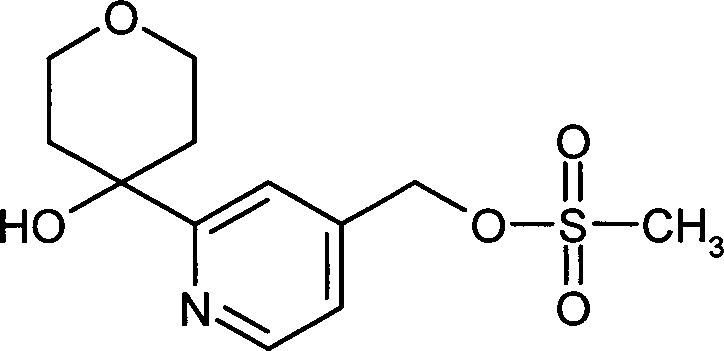
LC / MS (Method F, ESIpos): R t = 0.21 min, m / z = 210 [M + H] + . Step 4: [2- (4-Hydroxytetrahydro-2H-pyran-4-yl) pyridin-4-yl] methyl methanesulfonate
40 mg (ca. 0.1 mmol) der Verbindung aus Beispiel 88A/Schritt 3 wurden in 1.9 ml Dichlormethan gelöst, mit 16 μl (0.21 mmol) Methansulfonsäurechlorid sowie 29 μl (0.21 mmol) Triethylamin versetzt und 1 h bei RT gerührt. Danach wurde mit Ethylacetat verdünnt und die Lösung nacheinander mit Wasser und gesättigter Natriumchlorid-Lösung gewaschen. Die organische Phase wurde über Magnesiumsulfat getrocknet, filtriert und das Lösungsmittel am Rotationsverdampfer entfernt. Nach Trocknen des Rückstands im Vakuum wurden 44 mg der Titelverbindung in noch verunreinigter Form erhalten; dieses Produkt wurde ohne weitere Reinigung weiterverwendet.
MS (DCI, NH3): m/z = 288 [M+H]+.0.1 mmol) of the compound from Example 88A / Step 3 were dissolved in 1.9 ml of dichloromethane, admixed with 16 μl (0.21 mmol) of methanesulfonyl chloride and 29 μl (0.21 mmol) of triethylamine and stirred at RT for 1 h. Thereafter, it was diluted with ethyl acetate and the solution was washed successively with water and saturated sodium chloride solution. The organic phase was dried over magnesium sulfate, filtered and the solvent removed on a rotary evaporator. After drying the residue in vacuo, 44 mg of the title compound were obtained in still contaminated form; this product was used without further purification.
MS (DCI, NH 3): m / z = 288 [M + H] +.
Beispiel 89AExample 89A
[2-(2-Hydroxypropan-2-yl)pyridin-4-yl]methylmethansulfonat 

Analog zu dem unter Beispiel 88A/Schritt 2 beschriebenen Verfahren wurden 1.0 g (3.3 mmol) der Verbindung aus Beispiel 88A/Schritt 1 und 0.29 ml (3.97 mmol) Aceton zu 0.95 g (88% d. Th., Reinheit 87%) der Titelverbindung umgesetzt. Das Aceton wurde hierbei in reiner Form, ohne Zusatz von THF als Lösungsmittel, eingesetzt. Das erhaltene Produkt wurde als solches, ohne weitere HPLC-Reinigung, in der Folgestufe weiterverarbeitet.
LC/MS (Methode D, ESIpos): Rt = 1.82 min, m/z = 281 [M+H]+. Schritt 2: 2-[4-(Hydroxymethyl)pyridin-2-yl]propan-2-ol 
LC / MS (method D, ESIpos): R t = 1.82 min, m / z = 281 [M + H] + . Step 2: 2- [4- (Hydroxymethyl) pyridin-2-yl] propan-2-ol
Zu einer Lösung von 0.95 g (3.37 mmol) der Verbindung aus Beispiel 89A/Schritt 1 in 68 ml THF gab man 6.75 ml (6.75 mmol) einer 1 M Lösung von Tetra-n-butylammoniumfluorid in THF und rührte das Gemisch 1 h bei RT. Der Ansatz wurde dann mit 4.2 g Ionenaustauscher Dowex 50WX8-400 sowie 1.4 g (14.0 mmol) Calciumcarbonat versetzt und 1 h bei RT gerührt. Vom Festkörper wurde abfiltriert und das Filtrat eingeengt. Man erhielt einen zweiphasigen Rückstand, dessen obere Phase abgetrennt und verworfen wurde. Die untere Phase wurde mit Ethylacetat verdünnt und mit Wasser extrahiert. Die wässrige Phase wurde eingeengt und der Rückstand mittels präparativer HPLC gereinigt (Methode P). Es wurden 166 mg (29% d. Th.) der Titelverbindung erhalten.
1H-NMR (400 MHz, DMSO-d6, δ/ppm): 8.39 (d, 1H), 7.62 (s, 1H), 7.14 (d, 1H), 5.38 (t, 1H), 5.17 (s, 1H), 4.53 (d, 2H), 1.42 (s, 6H).
MS (DCI, NH3): m/z = 168 [M+H]+. Schritt 3: [2-(2-Hydroxypropan-2-yl)pyridin-4-yl]methylmethansulfonat 
1 H-NMR (400 MHz, DMSO-d 6 , δ / ppm): 8.39 (d, 1H), 7.62 (s, 1H), 7.14 (d, 1H), 5.38 (t, 1H), 5.17 (s, 1H), 4.53 (d, 2H), 1.42 (s, 6H).
MS (DCI, NH 3): m / z = 168 [M + H] +. Step 3: [2- (2-Hydroxypropan-2-yl) pyridin-4-yl] methyl methanesulfonate
Analog zu dem unter Beispiel 88A/Schritt 4 beschriebenen Verfahren wurden 160 mg (0.96 mmol) der Verbindung aus Beispiel 89A/Schritt 2 zu 177 mg (75% d. Th.) der Titelverbindung umgesetzt.
MS (DCI, NH3): m/z = 246 [M+H]+.Analogously to the process described under Example 88A / Step 4, 160 mg (0.96 mmol) of the compound from Example 89A / Step 2 were converted to 177 mg (75% of theory) of the title compound.
MS (DCI, NH 3): m / z = 246 [M + H] +.
Beispiel 90AExample 90A
5-(Chlormethyl)-N-(3,4-dimethoxybenzyl)-N-methylpyridin-2-amin–Dihydrochlorid 

Ein Gemisch aus 5.0 g (31.7 mmol) 6-Chlornicotinsäure und 15.1 ml (79.4 mmol) 3,4-Dimethoxy-N-methylbenzylamin wurde über Nacht unter Rühren auf 150°C erhitzt. Nach Abkühlen auf RT wurden 300 ml Ethylacetat und 600 ml Wasser hinzugegeben. Der entstandene Feststoff wurde im Zuge der Phasentrennung abfiltriert und im Vakuum getrocknet. Man erhielt 7.38 g (77% d. Th.) der Titelverbindung.
1H-NMR (400 MHz, CDCl3, δ/ppm): 8.91 (d, 1H), 8.07-8.02 (dd, 1H), 6.81 (d, 1H), 6.78-6.73 (m, 2H), 6.52 (d, 1H), 4.82 (d, 2H), 3.86 (s, 3H), 3.82 (s, 3H), 3.12 (s, 3H).
LC/MS (Methode I, ESIpos): Rt = 0.74 min, m/z = 303 [M+H]+. Schritt 2: {6-[(3,4-Dimethoxybenzyl)(methyl)amino]pyridin-3-yl}methanol 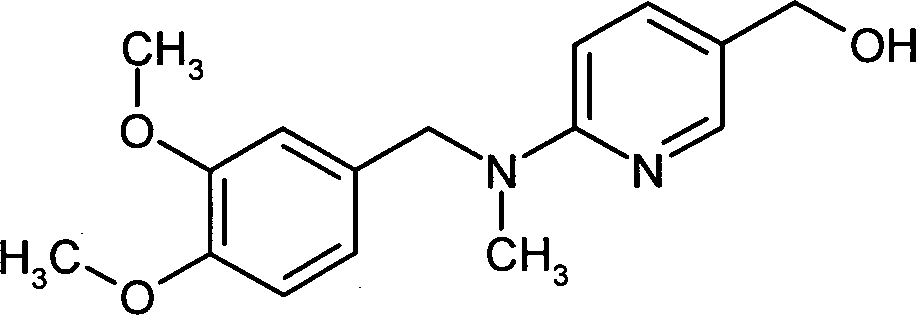
1 H-NMR (400 MHz, CDCl 3, δ / ppm): 8.91 (d, 1H), 8:07 to 8:02 (dd, 1H), 6.81 (d, 1H), 6.78-6.73 (m, 2H), 6:52 ( d, 1H), 4.82 (d, 2H), 3.86 (s, 3H), 3.82 (s, 3H), 3.12 (s, 3H).
LC / MS (Method I, ESIpos): R t = 0.74 min, m / z = 303 [M + H] + . Step 2: {6 - [(3,4-Dimethoxybenzyl) (methyl) amino] pyridin-3-yl} methanol
Man legte 7.38 g (24.4 mmol) der Verbindung aus Beispiel 90A/Schritt 1 in 225 ml THF bei 0°C unter Argon vor, tropfte langsam 20.3 ml (48.8 mmol) einer 2.4 M Lösung von Lithiumaluminiumhydrid in THF hinzu und rührte das Gemisch anschließend 2 h bei RT. Danach gab man langsam unter Eiskühlung 2 ml Wasser und 2 ml 15%-ige Natronlauge hinzu. Man verdünnte mit 200 ml tert.-Butylmethylether, filtrierte den vorhandenen Feststoff ab und wusch ihn dreimal mit je 100 ml tert.-Butylmethylether. Filtrat und Waschlösungen wurden vereinigt und eingeengt, und der resultierende Rückstand wurde im Vakuum getrocknet. Es wurden 6.20 g (87% d. Th.) der Titelverbindung erhalten.
1H-NMR (400 MHz, CDCl3, δ/ppm): 8.15 (d, 1H), 7.51-7.48 (dd, 1H), 6.81-6.72 (m, 3H), 6.52 (d, 1H), 4.72 (s, 2H), 4.54 (d, 2H), 3.85 (s, 3H), 3.82 (s, 3H), 3.05 (s, 3H), 1.65-1.60 (m, 1H).
LC/MS (Methode I, ESIpos): Rt = 0.48 min, m/z = 289 [M+H]+. Schritt 3: 5-(Chlormethyl)N-(3,4-dimethoxybenzyl)-N-methylpyridin-2-amin–Dihydrochlorid 
1 H-NMR (400 MHz, CDCl 3, δ / ppm): 8.15 (d, 1H), 7:51 to 7:48 (dd, 1H), 6.81-6.72 (m, 3H), 6:52 (d, 1H), 4.72 ( s, 2H), 4.54 (d, 2H), 3.85 (s, 3H), 3.82 (s, 3H), 3.05 (s, 3H), 1.65-1.60 (m, 1H).
LC / MS (Method I, ESIpos): R t = 0.48 min, m / z = 289 [M + H] + . Step 3: 5- (Chloromethyl) N - (3,4-dimethoxybenzyl) -N-methylpyridin-2-amine dihydrochloride
Zu einer Lösung von 3.54 g (12.3 mmol) der Verbindung aus Beispiel 90A/Schritt 2 in 22 ml Dichlormethan gab man 1.8 ml (24.5 mmol) Thionylchlorid bei RT hinzu und rührte das Gemisch 2 h bei dieser Temperatur. Anschließend wurde der Ansatz eingeengt und der Rückstand im Vakuum getrocknet. Man erhielt 4.64 g (99% d. Th.) der Titelverbindung.
1H-NMR (400 MHz, CDCl3, δ/ppm): 15.7 (s, breit, 1H), 8.31 (s, 1H), 7.85 (d, 1H), 6.90 (d, 1H), 6.84 (d, 1H), 6.80-6.72 (m, 2H), 4.84 (s, 2H), 4.49 (s, 2H), 3.88 (s, 6H), 3.55 (s, 3H).
LC/MS (Methode D, ESIpos): Rt = 1.05 min, m/z = 289/291 [M+H]+.To a solution of 3.54 g (12.3 mmol) of the compound of Example 90A / Step 2 in 22 ml of dichloromethane was added 1.8 ml (24.5 mmol) of thionyl chloride at RT and the mixture was stirred for 2 h at this temperature. The mixture was then concentrated and the residue dried in vacuo. 4.64 g (99% of theory) of the title compound were obtained.
1 H-NMR (400 MHz, CDCl 3 , δ / ppm): 15.7 (s, broad, 1H), 8.31 (s, 1H), 7.85 (d, 1H), 6.90 (d, 1H), 6.84 (d, 1H), 6.80-6.72 (m, 2H), 4.84 (s, 2H), 4.49 (s, 2H), 3.88 (s, 6H), 3.55 (s, 3H).
LC / MS (Method D, ESIpos): R t = 1.05 min, m / z = 289/291 [M + H] + .
Beispiel 91AExample 91A
1-[(6-Chlorpyridin-3-yl)methyl]-N'-hydroxy-5-methyl-1H-pyrazol-3-carboximidamid 

Man legte 500 mg (1.99 mmol) der Verbindung aus Beispiel 45A in 15 ml Dichlormethan unter Argon vor und gab 867 μl (9.93 mmol) Oxalylchlorid langsam hinzu, gefolgt von einem Tropfen DMF. Man rührte das Gemisch 1 h bei RT und engte anschließend ein. Der Rückstand wurde in 4 ml Dioxan aufgenommen und die erhaltene Lösung langsam bei 0°C zu 5.8 ml (99.3 mmol) 33%-iger wässriger Ammoniak-Lösung hinzugetropft. Man rührte das Gemisch 30 min bei RT, filtrierte dann den entstandenen Feststoff ab und wusch ihn zweimal mit je 3 ml Wasser. Nach Trocknen im Vakuum erhielt man 423 mg (85% d. Th.) der Titelverbindung.
1H-NMR (400 MHz, CDCl3, δ/ppm): 8.28 (d, 1H), 7.40-7.36 (dd, 1H), 7.31 (d, 1H), 6.68 (s, breit, 1H), 6.63 (s, 1H), 5.38 (s, breit, 1H), 5.26 (s, 2H), 2.26 (s, 3H).
LC/MS (Methode I, ESIpos): Rt = 0.64 min, m/z = 251/253 [M+H]+. Schritt 2: 1-[(6-Chlorpyridin-3-yl)methyl]-5-methyl-1H-pyrazol-3-carbonitril 
1 H-NMR (400 MHz, CDCl 3, δ / ppm): 8.28 (d, 1H), 7:40 to 7:36 (dd, 1H), 7.31 (d, 1H), 6.68 (s, broad, 1H), 6.63 ( s, 1H), 5.38 (s, broad, 1H), 5.26 (s, 2H), 2.26 (s, 3H).
LC / MS (Method I, ESIpos): R t = 0.64 min, m / z = 251/253 [M + H] + . Step 2: 1 - [(6-Chloropyridin-3-yl) methyl] -5-methyl-1H-pyrazole-3-carbonitrile
Zu einer Lösung von 400 mg (1.60 mmol) der Verbindung aus Beispiel 91A/Schritt 1 und 1.4 ml (7.98 mmol) N,N-Diisopropylethylamin in 15 ml Dichlormethan unter Argon wurden unter Eiskühlung 486 μl (2.87 mmol) Trifluormethansulfonsäureanhydrid langsam hinzugetropft. Man rührte das Gemisch zunächst 16 h bei 0°C, gab dann weitere 486 μl (2.87 mmol) Trifluormethansulfonsäureanhydrid und 1.4 ml (7.98 mmol) N,N-Diisopropylethylamin hinzu und rührte erneut für 72 h bei RT. Anschließend wurde das Gemisch eingeengt und der Rückstand säulenchromatographisch vorgereinigt (Kieselgel, Laufmittel: Dichlormethan → Dichlormethan/Methanol 95:5). Man nahm das erhaltene Produkt in 50 ml Dichlormethan auf, wusch die Lösung einmal mit 50 ml Wasser, trocknete über Magnesiumsulfat, filtrierte und engte wieder ein. Der Rückstand wurde nochmals säulenchromatographisch gereinigt (Kieselgel, Laufmittel: Cyclohexan/Ethylacetat 1:1). Es wurden so 302 mg (81% d. Th.) der Titelverbindung erhalten.
1H-NMR (400 MHz, CDCl3, δ/ppm): 8.28 (d, 1H), 7.49-7.46 (dd, 1H), 7.33 (d, 1H), 6.47 (s, 1H), 5.30 (s, 2H), 2.28 (s, 3H).
LC/MS (Methode I, ESIpos): Rt = 0.87 min, m/z = 233/235 [M+H]+. Schritt 3: 1-[(6-Chlorpyridin-3-yl)methyl]-N'-hydroxy-S-methyl-1H-pyrazol-3-carboximidamid 
1 H-NMR (400 MHz, CDCl 3, δ / ppm): 8.28 (d, 1H), 7:49 to 7:46 (dd, 1H), 7:33 (d, 1H), 6:47 (s, 1H), 5.30 (s, 2H), 2.28 (s, 3H).
LC / MS (Method I, ESIpos): R t = 0.87 min, m / z = 233/235 [M + H] + . Step 3: 1 - [(6-Chloropyridin-3-yl) methyl] -N'-hydroxy-S-methyl-1H-pyrazole-3-carboximidamide
Analog zu dem unter Beispiel 1A/Schritt 5 beschriebenen Verfahren wurden aus 300 mg (1.29 mmol) der Verbindung aus Beispiel 91A/Schritt 2 222 mg (63% d. Th., Reinheit 97%) der Titelverbindung erhalten.
1H-NMR (400 MHz, CDCl3, δ/ppm): 8.26 (d, 1H), 7.38-7.36 (dd, 1H), 7.27 (d, 1H), 6.36 (s, 1H), 5.25 (s, 2H), 5.12 (s, 2H), 2.25 (s, 3H).
LC/MS (Methode C, ESIpos): Rt = 0.52 min, m/z = 266/288 [M+H]+.Analogously to the process described under Example 1A / Step 5, from 300 mg (1.29 mmol) of the compound from Example 91A / Step 2, 222 mg (63% of theory, purity 97%) of the title compound were obtained.
1 H-NMR (400 MHz, CDCl 3 , δ / ppm): 8.26 (d, 1H), 7.38-7.36 (dd, 1H), 7.27 (d, 1H), 6.36 (s, 1H), 5.25 (s, 2H), 5.12 (s, 2H), 2.25 (s, 3H).
LC / MS (Method C, ESIpos): R t = 0.52 min, m / z = 266/288 [M + H] + .
Beispiel 92A Example 92A
1-({6-[(3,4-Dimethoxybenzyl)(methyl)amino]pyridin-3-yl}methyl)-5-methyl-1H-pyrazol-3-carbonsäure 
Ein Gemisch aus 1.0 g (3.97 mmol) der Verbindung aus Beispiel 45A und 3.8 ml (19.9 mmol) 3,4-Dimethoxy-N-methylbenzylamin wurde unter Argon über Nacht unter Rühren auf 150°C erhitzt. Nach dem Abkühlen auf RT fügte man Ethylacetat und Wasser hinzu, trennte die Phasen und extrahierte die wässrige Phase dreimal mit Ethylacetat. Diese Ethylacetat-Extrakte wurden verworfen. Die wässrige Phase wurde anschließend zunächst mit 1 M Salzsäure auf einen pH-Wert von 3 eingestellt, viermal mit Ethylacetat extrahiert, sodann mit Natriumhydrogencarbonat-Lösung auf einen pH-Wert von 7 eingestellt und erneut dreimal mit Ethylacetat extrahiert. Die vereinigten Ethylacetat-Phasen wurden über Magnesiumsulfat getrocknet, filtriert und eingeengt. Nach Trocknen des Rückstands im Vakuum wurden 839 mg (49% d. Th., Reinheit 92%) der Titelverbindung erhalten.
1H-NMR (400 MHz, CDCl3, δ/ppm): 8.10 (s, 1H), 7.32 (d, 1H), 6.81-6.70 (m, 3H), 6.61 (s, 1H), 6.46 (d, 1H), 5.21 (s, 2H), 4.70 (s, 2H), 3.84 (s, 3H), 3.81 (s, 3H), 3.04 (s, 3H), 2.25 (s, 3H).
LC/MS (Methode I, ESIpos): Rt = 0.66 min, m/z = 397 [M+H]+.A mixture of 1.0 g (3.97 mmol) of the compound from Example 45A and 3.8 ml (19.9 mmol) of 3,4-dimethoxy-N-methylbenzylamine was heated at 150 ° C. under argon overnight with stirring. After cooling to RT, ethyl acetate and water were added, the phases were separated and the aqueous phase extracted three times with ethyl acetate. These ethyl acetate extracts were discarded. The aqueous phase was then first adjusted to a pH of 3 with 1 M hydrochloric acid, extracted four times with ethyl acetate, then adjusted to a pH of 7 with sodium bicarbonate solution and extracted again three times with ethyl acetate. The combined ethyl acetate layers were dried over magnesium sulfate, filtered and concentrated. Drying of the residue in vacuo gave 839 mg (49% of theory, purity 92%) of the title compound.
1 H-NMR (400 MHz, CDCl 3, δ / ppm): 8.10 (s, 1H), 7:32 (d, 1H), 6.81-6.70 (m, 3H), 6.61 (s, 1H), 6:46 (d, 1H), 5.21 (s, 2H), 4.70 (s, 2H), 3.84 (s, 3H), 3.81 (s, 3H), 3.04 (s, 3H), 2.25 (s, 3H).
LC / MS (Method I, ESIpos): R t = 0.66 min, m / z = 397 [M + H] + .
Ausführungsbeispiele:EXAMPLES
Beispiel 1example 1
5-[(5-Methyl-3-{3-[4-(trifluormethoxy)phenyl]-1,2,4-oxadiazol-5-yl}-1H-pyrazol-1-yl)methyl]pyridin-2-carbonitril 
Unter inerten Bedingungen wurde bei 0°C eine Lösung von 2.42 g (7.81 mmol) der Verbindung aus Beispiel 23A und 2.16 g (10.2 mmol) der Verbindung aus Beispiel 41A in 80 ml wasserfreiem THF mit 1.05 g (9.73 mmol) festem Kalium-tert.-butylat versetzt. Anschließend wurde das Reaktionsgemisch 3 h bei RT gerührt. Dann wurde mit ca. 350 ml Wasser versetzt und dreimal mit je ca. 250 ml Ethylacetat extrahiert. Die vereinigten organischen Extrakte wurden nacheinander mit Wasser und gesättigter Kochsalz-Lösung gewaschen. Nach Trocknen über wasserfreiem Magnesiumsulfat und Filtrieren wurde das Lösungsmittel am Rotationsverdampfer entfernt. Das Rohprodukt wurde mittels MPLC gereinigt (Kieselgel, Laufmittel: Cyclohexan/Ethylacetat 5:1 → 1:1). Es wurden 2.1 g (63% d. Th.) der Titelverbindung erhalten.
1H-NMR (400 MHz, CDCl3, δ/ppm): 8.62 (d, 1H), 8.24 (d, 2H), 7.70 (d, 1H), 7.63 (dd, 1H), 7.34 (d, 2H), 6.87 (s, 1H), 5.53 (s, 2H), 2.34 (s, 3H).
HPLC (Methode A): Rt = 4.96 min.
MS (DCI, NH3): m/z = 427 [M+H]+.
LC/MS (Methode C, ESIpos): Rt = 2.70 min, m/z = 427 [M+H]+.Under inert conditions, a solution of 2.42 g (7.81 mmol) of the compound from Example 23A and 2.16 g (10.2 mmol) of the compound from Example 41A in 80 ml of anhydrous THF with 1.05 g (9.73 mmol) of solid potassium tert butoxide added. Subsequently, the reaction mixture was stirred at RT for 3 h. Then, it was mixed with about 350 ml of water and extracted three times with about 250 ml of ethyl acetate. The combined organic extracts were washed successively with water and saturated brine. After drying over anhydrous magnesium sulfate and filtering, the solvent was removed on a rotary evaporator. The crude product was purified by MPLC (silica gel, eluent: cyclohexane / ethyl acetate 5: 1 → 1: 1). 2.1 g (63% of theory) of the title compound were obtained.
1 H-NMR (400 MHz, CDCl 3, δ / ppm): 8.62 (d, 1H), 8.24 (d, 2H), 7.70 (d, 1H), 7.63 (dd, 1H), 7:34 (d, 2H) , 6.87 (s, 1H), 5.53 (s, 2H), 2.34 (s, 3H).
HPLC (Method A): R t = 4.96 min.
MS (DCI, NH 3): m / z = 427 [M + H] +.
LC / MS (Method C, ESIpos): R t = 2.70 min, m / z = 427 [M + H] + .
Beispiel 2 Example 2
2-Chlor-5-[(5-methyl-3-{3-[4-(trifluormethoxy)phenyl]-1,2,4-oxadiazol-5-yl}-1H-pyrazol-1-yl)methyl]pyridin 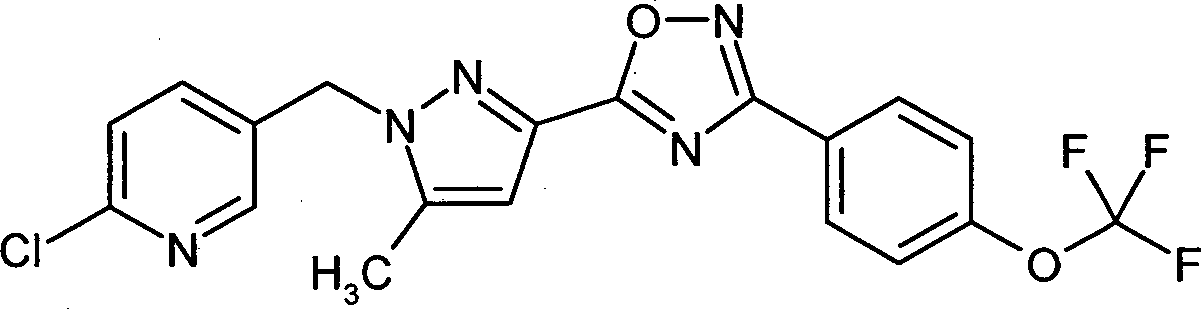
Zu einer auf 0°C gekühlten Lösung von 5.0 g (16.1 mmol) der Verbindung aus Beispiel 23A und 3.54 g (20.9 mmol) 2-Chlor-5-(chlormethyl)pyridin in 150 ml THF gab man 1.99 g (17.7 mmol) Kalium-tert.-butylat und ließ das Gemisch dann auf RT kommen. Man rührte über Nacht bei RT und danach noch 4.5 h bei 45°C. Anschließend verdünnte man das Gemisch mit Wasser und extrahierte zweimal mit Ethylacetat. Die vereinigten Ethylacetat-Phasen wurden einmal mit gesättigter wässriger Natriumchlorid-Lösung gewaschen, über Magnesiumsulfat getrocknet, filtriert und eingeengt. Der Rückstand wurde säulenchromatographisch an Kieselgel gereinigt (Laufmittel: Cyclohexan/Ethylacetat 3:2). Nach Trocknen im Vakuum erhielt man 4.65 g (66% d. Th.) der Titelverbindung.
1H-NMR (400 MHz, CDCl3, δ/ppm): 8.31 (d, 1H), 8.25 (d, 2H), 7.51 (dd, 1H), 7.36-7.30 (m, 3H), 6.82 (s, 1H), 5.43 (s, 2H), 2.32 (s, 3H).
HPLC (Methode A): Rt = 4.91 min.
MS (DCI, NH3): m/z = 436 [M+H]+.
LC/MS (Methode C, ESIpos): Rt = 2.83 min, m/z = 436 [M+H]+.To a cooled to 0 ° C solution of 5.0 g (16.1 mmol) of the compound from Example 23A and 3.54 g (20.9 mmol) of 2-chloro-5- (chloromethyl) pyridine in 150 ml of THF was added 1.99 g (17.7 mmol) of potassium tert.-butylate and then allowed to come to RT. The mixture was stirred at RT overnight and then at 45 ° C. for 4.5 h. Then, the mixture was diluted with water and extracted twice with ethyl acetate. The combined ethyl acetate phases were washed once with saturated aqueous sodium chloride solution, dried over magnesium sulfate, filtered and concentrated. The residue was purified by column chromatography on silica gel (mobile phase: cyclohexane / ethyl acetate 3: 2). After drying in vacuo, 4.65 g (66% of theory) of the title compound were obtained.
1 H-NMR (400 MHz, CDCl 3, δ / ppm): 8.31 (d, 1H), 8.25 (d, 2H), 7:51 (dd, 1H), 7:36 to 7:30 (m, 3H), 6.82 (s, 1H), 5.43 (s, 2H), 2.32 (s, 3H).
HPLC (method A): R t = 4.91 min.
MS (DCI, NH 3): m / z = 436 [M + H] +.
LC / MS (method C, ESIpos): R t = 2.83 min, m / z = 436 [M + H] + .
Beispiel 3Example 3
2-Chlor-4-[(5-methyl-3-{3-[4-(trifluormethoxy)phenyl]-1,2,4-oxadiazol-5-yl}-1H-pyrazol-1-yl)methyl]pyridin 
Zu einer auf 0°C gekühlten Lösung von 11.88 g (38.3 mmol) der Verbindung aus Beispiel 23A und 8.4 g (49.8 mmol) der Verbindung aus Beispiel 38A in 350 ml THF gab man 4.73 g (42.1 mmol) Kalium-tert.-butylat und ließ das Gemisch dann auf RT kommen. Man rührte über Nacht bei RT und dann noch 4 h unter Rückfluss. Anschließend verdünnte man das Gemisch mit Wasser und extrahierte zweimal mit Ethylacetat. Die vereinigten Ethylacetat-Phasen wurden einmal mit gesättigter wässriger Natriumchlorid-Lösung gewaschen, über Magnesiumsulfat getrocknet, filtriert und eingeengt. Der Rückstand wurde säulenchromatographisch an Kieselgel gereinigt (Laufmittel: Cyclohexan/Ethylacetat 3:2). Die vereinigten Produktfraktionen wurden eingeengt und der Rückstand in Hexan verrührt, abfiltriert und im Vakuum getrocknet. Man erhielt 8.2 g (49% d. Th.) der Titelverbindung.
1H-NMR (400 MHz, CDCl3, δ/ppm): 8.37 (d, 1H), 8.28-8.22 (m, 2H), 7.34 (d, 2H), 7.05 (s, 1H), 6.97 (d, 1H), 6.88 (s, 1H), 5.43 (s, 2H), 2.32 (s, 3H).
LC/MS (Methode F, ESIpos): Rt = 1.47 min, m/z = 436 [M+H]+.To a cooled to 0 ° C solution of 11.88 g (38.3 mmol) of the compound from Example 23A and 8.4 g (49.8 mmol) of the compound from Example 38A in 350 ml of THF was added 4.73 g (42.1 mmol) of potassium tert-butoxide and then allowed the mixture to come to RT. The mixture was stirred at RT overnight and then under reflux for a further 4 h. Then, the mixture was diluted with water and extracted twice with ethyl acetate. The combined ethyl acetate phases were washed once with saturated aqueous sodium chloride solution, dried over magnesium sulfate, filtered and concentrated. The residue was purified by column chromatography on silica gel (mobile phase: cyclohexane / ethyl acetate 3: 2). The combined product fractions were concentrated and the residue was stirred in hexane, filtered off and dried in vacuo. This gave 8.2 g (49% of theory) of the title compound.
1 H-NMR (400 MHz, CDCl 3 , δ / ppm): 8.37 (d, 1H), 8.28-8.22 (m, 2H), 7.34 (d, 2H), 7.05 (s, 1H), 6.97 (d, 1H), 6.88 (s, 1H), 5.43 (s, 2H), 2.32 (s, 3H).
LC / MS (Method F, ESIpos): R t = 1.47 min, m / z = 436 [M + H] + .
Die Verbindungen in der folgenden Tabelle wurden analog zu den in den Beispielen 1 bis 3 beschriebenen Verfahren aus den entsprechenden Edukten hergestellt. In Abhängigkeit von der Polarität der Verbindungen wurden diese entweder durch Ausrühren des Rohproduktes in Dichlormethan, Ethylacetat, Acetonitril oder Diethylether isoliert, oder mittels präparativer HPLC oder mittels MPLC über Kieselgel mit Cyclohexan/Ethylacetat-Gemischen als Laufmittel erhalten. Die als Edukte verwendeten Arylmethylchloride, -bromide oder -methansulfonate waren entweder kommerziell erhältlich oder ihre Herstellung ist in der Literatur beschrieben oder sie wurden, wie weiter oben beschrieben, hergestellt.The compounds in the following table were prepared from the corresponding starting materials analogously to the processes described in Examples 1 to 3. Depending on the polarity of the compounds, these were isolated either by stirring the crude product in dichloromethane, ethyl acetate, acetonitrile or diethyl ether, or by means of preparative HPLC or by MPLC on silica gel with cyclohexane / ethyl acetate mixtures as the eluent. The arylmethyl chlorides, bromides or educts used as starting materials Methanesulfonates were either commercially available or their preparation is described in the literature or they were prepared as described above.


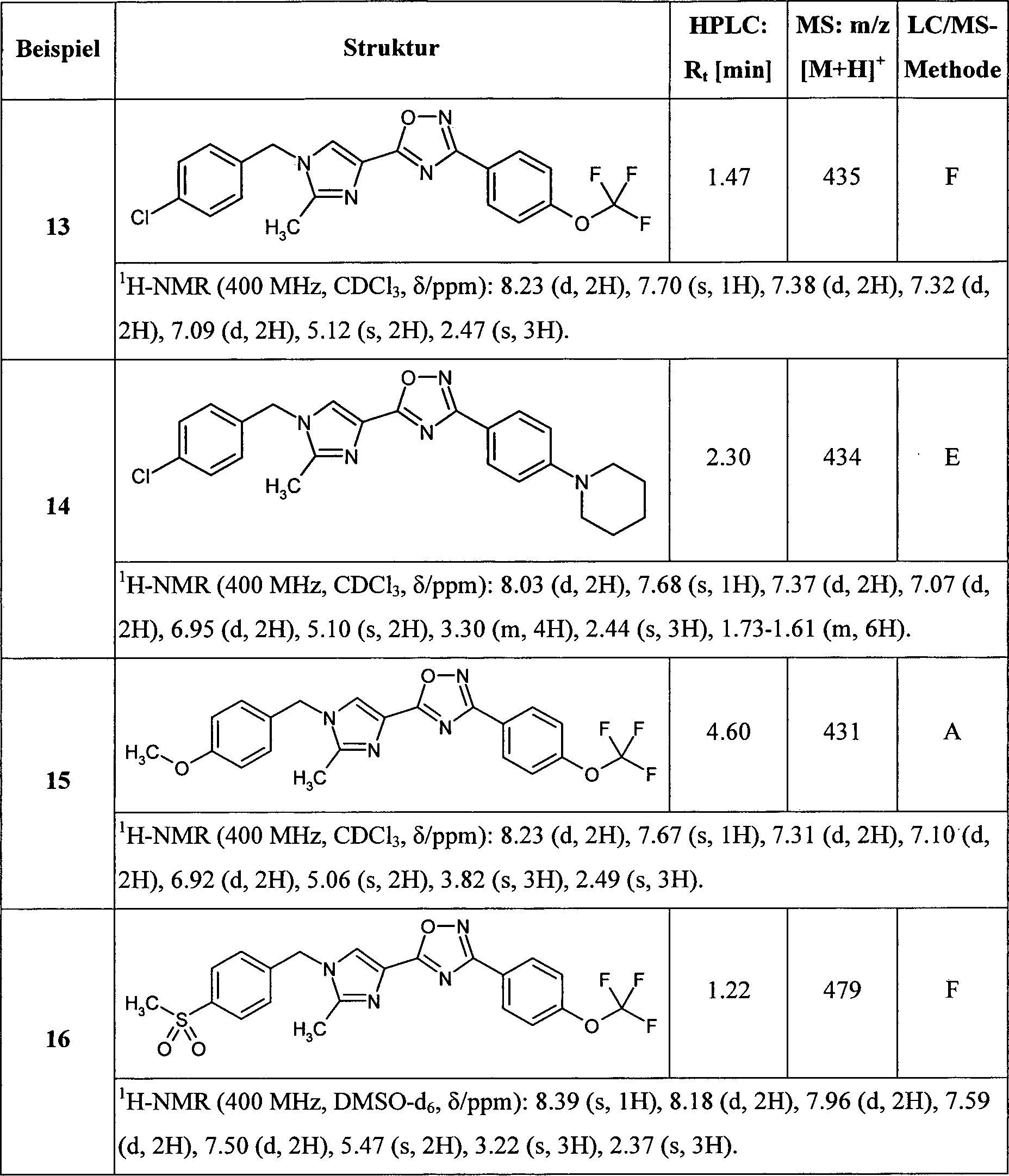
Beispiel 17Example 17
2-Brom-5-[(5-methyl-3-{3-[4-(trifluormethoxy)phenyl]-1,2,4-oxadiazol-5-yl}-1H-pyrazol-1-yl)methyl]pyridin 
Man erhitzte ein Gemisch von 1.95 g (4.47 mmol) der Verbindung aus Beispiel 2 und 1.37 g (8.95 mmol) Brom(trimethyl)silan in 0.5 ml Propionitril unter Rühren 70 min lang in einem Mikrowellengerät (CEM Discover, initiale Einstrahlleistung 250 W) auf 120°C. Dabei war in den ersten 10 min ein relativ starker Druck- und Temperaturanstieg zu beobachten. Nach Abkühlen auf RT gab man weitere 350 mg (2.29 mmol) Brom(trimethyl)silan hinzu und erhitzte das Gemisch erneut für 60 min in der Mikrowelle auf 120°C. Dabei war abermals in den ersten 10 min ein relativ starker Druck- und Temperaturanstieg festzustellen. Nach Abkühlen auf RT verdünnte man das Gemisch mit 100 ml Wasser und 100 ml Ethylacetat und trennte die Phasen. Die organische Phase wurde einmal mit 100 ml Wasser gewaschen, über Natriumsulfat getrocknet, filtriert und am Rotationsverdampfer eingeengt. Der Rückstand wurde säulenchromatographisch an Kieselgel gereinigt (Laufmittel: Cyclohexan/Ethylacetat 3:2). Es wurden 1.45 g (65% d. Th., 86% Reinheit nach LC-MS) der Titelverbindung erhalten.
1H-NMR (400 MHz, CDCl3, δ/ppm): 8.31 (d, 1H), 8.23 (d, 2H), 7.47 (d, 1H), 7.40 (dd, 1H), 7.33 (d, 2H), 6.82 (s, 1H), 5.41 (s, 2H), 2.32 (s, 3H).
LC/MS (Methode E, ESIpos): Rt = 2.54 min, m/z = 480 [M+H]+.A mixture of 1.95 g (4.47 mmol) of the compound from Example 2 and 1.37 g (8.95 mmol) of bromine (trimethyl) silane in 0.5 ml of propionitrile was heated with stirring for 70 minutes in a microwave oven (CEM Discover, initial irradiation power 250 W) to 120 ° C. In the first 10 minutes, a relatively strong rise in pressure and temperature was observed. After cooling to RT, an additional 350 mg (2.29 mmol) of bromine (trimethyl) silane were added, and the mixture was again heated in the microwave to 120 ° C. for 60 min. Again, a relatively strong pressure and temperature increase was observed in the first 10 minutes. After cooling to RT, the mixture was diluted with 100 ml of water and 100 ml of ethyl acetate and the phases were separated. The organic phase was washed once with 100 ml of water, dried over sodium sulfate, filtered and concentrated on a rotary evaporator. The residue was purified by column chromatography on silica gel (mobile phase: cyclohexane / ethyl acetate 3: 2). 1.45 g (65% of theory, 86% purity according to LC-MS) of the title compound were obtained.
1 H-NMR (400 MHz, CDCl 3, δ / ppm): 8.31 (d, 1H), 8.23 (d, 2H), 7:47 (d, 1H), 7:40 (dd, 1H), 7:33 (d, 2H) , 6.82 (s, 1H), 5.41 (s, 2H), 2.32 (s, 3H).
LC / MS (method E, ESIpos): R t = 2.54 min, m / z = 480 [M + H] + .
Beispiel 18Example 18
3-{5-[(5-Methyl-3-{3-[4-(trifluormethoxy)phenyl]-1,2,4-oxadiazol-5-yl}-1H-pyrazol-1-yl)methyl]pyridin-2-yl}prop-2-in-1-o1 
Zu einer Lösung von 1.10 g (2.29 mmol) der Verbindung aus Beispiel 17 in 23 ml entgastem THF gab man unter Argon bei RT 11.4 ml Triethylamin, 385 mg (6.87 mmol) Prop-2-in-1-ol, 132 mg (0.115 mmol) Tetrakis(triphenylphosphin)palladium(0) sowie 44 mg (0.229 mmol) Kupfer(I)iodid hinzu und rührte die Mischung 16 h bei RT. Anschließend engte man das Gemisch am Rotationsverdampfer ein, löste den Rückstand in 8 ml Acetonitril und versetzte mit 20 ml Wasser. Der gebildete Feststoff wurde nach 30 min Rühren bei RT abfiltriert und jeweils zweimal mit Wasser und mit Ethylacetat gewaschen. Die Waschphasen wurden vereinigt, eingeengt und der Rückstand sowie der zuvor erhaltene Feststoff jeweils über präparative HPLC (Methode N) gereinigt. Man vereinigte jeweils die produkthaltigen Fraktionen, versetzte mit gesättigter wässriger Natriumhydrogencarbonat-Lösung, engte bis auf ein kleines Restvolumen an Lösungsmittel ein und extrahierte dreimal mit Ethylacetat. Die vereinigten organischen Phasen wurden jeweils über Natriumsulfat getrocknet und eingeengt. Man erhielt aus beiden Reinigungsoperationen zusammen 634 mg (59% d. Th.) der Titelverbindung.
1H-NMR (400 MHz, CDCl3, δ/ppm): 8.25 (d, 2H), 7.48-7.45 (dd, 1H), 7.40 (d, 1H), 7.33 (d, 2H), 6.82 (s, 1H), 5.46 (s, 2H), 4.51 (d, 2H), 2.31 (s, 3H), 1.96-1.91 (t, 1H).
LC/MS (Methode E, ESIpos): Rt = 2.08 min, m/z = 456 [M+H]+.To a solution of 1.10 g (2.29 mmol) of the compound from Example 17 in 23 ml of degassed THF was added under argon at RT 11.4 ml of triethylamine, 385 mg (6.87 mmol) of prop-2-yn-1-ol, 132 mg (0.115 mmol) of tetrakis (triphenylphosphine) palladium (0) and 44 mg (0.229 mmol) of copper (I) iodide and the mixture was stirred at RT for 16 h. The mixture was then concentrated on a rotary evaporator, the residue was dissolved in 8 ml of acetonitrile and treated with 20 ml of water. The solid formed was filtered off after stirring for 30 min at RT and washed twice each with water and with ethyl acetate. The wash phases were combined, concentrated and the residue and the previously obtained solid were each purified by preparative HPLC (Method N). Each of the product-containing fractions was combined, treated with saturated aqueous sodium bicarbonate solution, concentrated to a small residual volume of solvent and extracted three times with ethyl acetate. The combined organic phases were each dried over sodium sulfate and concentrated. 634 mg (59% of theory) of the title compound were obtained from both purification operations.
1 H-NMR (400 MHz, CDCl 3, δ / ppm): 8.25 (d, 2H), 7:48 to 7:45 (dd, 1H), 7:40 (d, 1H), 7:33 (d, 2H), 6.82 (s, 1H), 5.46 (s, 2H), 4.51 (d, 2H), 2.31 (s, 3H), 1.96-1.91 (t, 1H).
LC / MS (method E, ESIpos): R t = 2.08 min, m / z = 456 [M + H] + .
Beispiel 19Example 19
3-{5-[(5-Methyl-3-{3-[4-(trifluormethoxy)phenyl]-1,2,4-oxadiazol-5-yl}-1H-pyrazol-1-yl)methyl]pyridin-2-yl}propan-1-ol 
Man löste 633 mg (1.39 mmol) der Verbindung aus Beispiel 18 in einem Gemisch aus 7.5 ml Ethanol und 7.5 ml THF, gab 358 μl (2.57 mmol) Triethylamin sowie 32 mg (0.139 mmol) Platin(IV)oxid hinzu und hydrierte 4 h bei RT und Normaldruck. Anschließend wurde das Reaktionsgemisch filtriert und das Filtrat am Rotationsverdampfer eingeengt. Der Rückstand wurde mittels präparativer HPLC (Methode N) gereinigt. Die produkthaltigen Fraktionen wurden vereinigt und mit gesättigter wässriger Natriumhydrogencarbonat-Lösung versetzt. Nach Entfernen eines Teils des Lösungsmittels am Rotationsverdampfer extrahierte man den verbliebenen Teil dreimal mit je 40 ml Ethylacetat. Die vereinigten organischen Phasen trocknete man über Natriumsulfat, filtrierte und entfernte das Lösungsmittel. Man erhielt 390 mg (61% d. Th.) der Titelverbindung.
1H-NMR (400 MHz, CDCl3, δ/ppm): 8.41 (s, 1H), 8.24 (d, 2H), 7.48 (dd, 1H), 7.32 (d, 2H), 7.18 (d, 1H), 6.82 (s, 1H), 5.42 (s, 2H), 3.70 (t, 2H), 2.96 (t, 2H), 2.31 (s, 3H), 2.01-1.93 (m, 2H).
LC/MS (Methode D, ESIpos): Rt = 2.04 min, m/z = 460 [M+H]+.633 mg (1.39 mmol) of the compound from Example 18 were dissolved in a mixture of 7.5 ml of ethanol and 7.5 ml of THF, 358 μl (2.57 mmol) of triethylamine and 32 mg (0.139 mmol) of platinum (IV) oxide were added and the mixture was hydrogenated for 4 h at RT and normal pressure. Subsequently, the reaction mixture was filtered and the filtrate was concentrated on a rotary evaporator. The residue was purified by preparative HPLC (Method N). The product-containing fractions were combined and treated with saturated aqueous sodium bicarbonate solution. After removing a portion of the solvent on a rotary evaporator, the remaining portion was extracted three times with 40 ml of ethyl acetate. The combined organic phases were dried over sodium sulfate, filtered and the solvent removed. 390 mg (61% of theory) of the title compound were obtained.
1 H-NMR (400 MHz, CDCl 3, δ / ppm): 8:41 (s, 1H), 8.24 (d, 2H), 7:48 (dd, 1H), 7:32 (d, 2H), 7.18 (d, 1H) , 6.82 (s, 1H), 5.42 (s, 2H), 3.70 (t, 2H), 2.96 (t, 2H), 2.31 (s, 3H), 2.01-1.93 (m, 2H).
LC / MS (method D, ESIpos): R t = 2.04 min, m / z = 460 [M + H] + .
Beispiel 20Example 20
2-Ethinyl-5-[(5-methyl-3-{3-[4-(trifluormethoxy)phenyl]-1,2,4-oxadiazol-5-yl}-1H-pyrazol-1-yl)methyl]pyridin 
Man löste 22 mg (0.117 mmol) Kupfer(I)iodid in 1.6 ml Triethylamin unter Argon bei 40°C, kühlte die Lösung auf RT ab, gab dann 26 μl (0.185 mmol) Ethinyl(trimethyl)silan hinzu und rührte 10 min bei RT. Anschließend gab man 45 mg (0.065 mmol) Bis(triphenylphosphin)palladium(II)chlorid hinzu und rührte weitere 10 min bei RT. Schließlich gab man 622 mg (1.30 mmol) der Verbindung aus Beispiel 17, gefolgt von 14.4 ml Triethylamin und 235 μl (1.67 mmol) Ethinyl(trimethyl)silan, hinzu. Das Gemisch wurde danach 16 h lang auf 100°C erhitzt. Nach Abkühlen auf RT nahm man das Gemisch in 50 ml Dichlormethan und 70 ml Wasser auf, trennte die Phasen und extrahierte die wässrige Phase noch zweimal mit je 30 ml Ethylacetat. Man trocknete die vereinigten organischen Phasen über Natriumsulfat, filtrierte und engte am Rotationsverdampfer ein. Der Rückstand wurde in 16 ml THF gelöst, bei RT mit 16 ml einer 0.1 M Natronlauge versetzt und 4 h bei RT gerührt. Anschließend versetzte man das Reaktionsgemisch mit 100 ml Ethylacetat und 150 ml Wasser, trennte die Phasen und extrahierte die wässrige Phase noch zweimal mit je 100 ml Ethylacetat. Man vereinigte die organischen Phasen, trocknete über Natriumsulfat, filtrierte und entfernte das Lösungsmittel. Der Rückstand wurde mittels präparativer HPLC (Methode N) gereinigt. Man vereinigte die produkthaltigen Fraktionen, versetzte mit 20 ml einer gesättigten wässrigen Natriumhydrogencarbonat-Lösung, entfernte einen Teil des Lösungsmittels, versetzte mit 30 ml Wasser und extrahierte dreimal mit je 50 ml Ethylacetat. Man trocknete die vereinigten organischen Phasen über Natriumsulfat, filtrierte und entfernte das Lösungsmittel. Man erhielt auf diese Weise 119 mg (22% d. Th.) der Titelverbindung.
1H-NMR (400 MHz, CDCl3, δ/ppm): 8.51 (s, 1H), 8.25 (d, 2H), 7.50-7.44 (m, 2H), 7.34 (d, 2H), 6.83 (s, 1H), 5.48 (s, 2H), 3.19 (s, 1H), 2.32 (s, 3H).
LC/MS (Methode C, ESIpos): Rt = 2.71 min, m/z = 426 [M+H]+.22 mg (0.117 mmol) of copper (I) iodide were dissolved in 1.6 ml of triethylamine under argon at 40 ° C., the solution was cooled to RT, then 26 μl (0.185 mmol) of ethynyl (trimethyl) silane were added and the mixture was stirred for 10 minutes RT. Subsequently, 45 mg (0.065 mmol) of bis (triphenylphosphine) palladium (II) chloride were added and the mixture was stirred at RT for a further 10 min. Finally, 622 mg (1.30 mmol) of the compound from Example 17, followed by 14.4 ml of triethylamine and 235 μl (1.67 mmol) of ethynyl (trimethyl) silane, were added. The mixture was then heated at 100 ° C for 16 hours. After cooling to RT, the mixture was taken up in 50 ml of dichloromethane and 70 ml of water, the phases were separated and the aqueous phase was extracted twice more with 30 ml of ethyl acetate each time. The combined organic phases were dried over sodium sulfate, filtered and concentrated on a rotary evaporator. The residue was dissolved in 16 ml of THF, treated at RT with 16 ml of a 0.1 M sodium hydroxide solution and stirred at RT for 4 h. Subsequently, the reaction mixture was mixed with 100 ml of ethyl acetate and 150 ml of water, the phases were separated and the aqueous phase was extracted twice more with 100 ml of ethyl acetate. The organic phases were combined, dried over sodium sulfate, filtered and the solvent removed. The residue was purified by preparative HPLC (Method N). The product-containing fractions were combined, added with 20 ml of a saturated aqueous sodium bicarbonate solution, a portion of the solvent was removed, mixed with 30 ml of water and extracted three times with 50 ml of ethyl acetate. The combined organic phases were dried over sodium sulfate, filtered and the solvent removed. 119 mg (22% of theory) of the title compound were obtained in this manner.
1 H-NMR (400 MHz, CDCl 3 , δ / ppm): 8.51 (s, 1H), 8.25 (d, 2H), 7.50-7.44 (m, 2H), 7.34 (d, 2H), 6.83 (s, 1H), 5.48 (s, 2H), 3.19 (s, 1H), 2.32 (s, 3H).
LC / MS (Method C, ESIpos): R t = 2.71 min, m / z = 426 [M + H] + .
Beispiel 21Example 21
5-[(5-Methyl-3-{3-[4-(trifluormethoxy)phenyl]-1,2,4-oxadiazol-5-yl}-1H-pyrazol-1-yl)methyl]-2-[(trimethylsilyl)ethinyl]pyridin 
Man löste 3.4 mg (0.018 mmol) Kupfer(I)iodid in 0.3 ml Triethylamin unter Argon bei 40°C, kühlte die Lösung auf RT ab, gab dann 4 μl (0.029 mmol) Ethinyl(trimethyl)silan hinzu und rührte 10 min bei RT. Anschließend gab man 7.0 mg (0.010 mmol) Bis(triphenylphosphin)palladium(II)chlorid hinzu und rührte weitere 10 min bei RT. Schließlich gab man 96 mg (0.20 mmol) der Verbindung aus Beispiel 17, gefolgt von 2.7 ml Triethylamin und 36 μl (0.257 mmol) Ethinyl(trimethyl)silan, hinzu. Das Gemisch wurde danach 16 h lang auf 100°C erhitzt. Nach Abkühlen auf RT nahm man das Gemisch in 300 ml Ethylacetat und 50 ml Wasser auf, trennte die Phasen und extrahierte die wässrige Phase noch dreimal mit je 30 ml Ethylacetat. Man trocknete die vereinigten organischen Phasen über Natriumsulfat, filtrierte und engte am Rotationsverdampfer ein. Der Rückstand wurde mittels präparativer HPLC (Methode N) gereinigt. Man erhielt 53 mg (51% d. Th.) der Titelverbindung.
1H-NMR (400 MHz, CDCl3, δ/ppm): 8.51 (s, 1H), 8.49 (s, 2H), 8.25 (d, 2H), 7.48-7.40 (m, 2H), 7.34 (d, 2H), 6.83 (s, 1H), 5.46 (s, 2H), 2.30 (s, 3H), 0.26 (s, 9H).
LC/MS (Methode F, ESIpos): Rt = 1.68 min, m/z = 498 [M+H]+. 3.4 mg (0.018 mmol) of copper (I) iodide were dissolved in 0.3 ml of triethylamine under argon at 40 ° C., the solution was cooled to RT, then 4 μl (0.029 mmol) of ethynyl (trimethyl) silane were added and the mixture was stirred for 10 minutes RT. Subsequently, 7.0 mg (0.010 mmol) of bis (triphenylphosphine) palladium (II) chloride were added and the mixture was stirred at RT for a further 10 min. Finally, 96 mg (0.20 mmol) of the compound of Example 17, followed by 2.7 ml of triethylamine and 36 μl (0.257 mmol) of ethynyl (trimethyl) silane were added. The mixture was then heated at 100 ° C for 16 hours. After cooling to RT, the mixture was taken up in 300 ml of ethyl acetate and 50 ml of water, the phases were separated and the aqueous phase was extracted three times with 30 ml of ethyl acetate each time. The combined organic phases were dried over sodium sulfate, filtered and concentrated on a rotary evaporator. The residue was purified by preparative HPLC (Method N). 53 mg (51% of theory) of the title compound were obtained.
1 H-NMR (400 MHz, CDCl 3, δ / ppm): 8:51 (s, 1H), 8:49 (s, 2H), 8.25 (d, 2H), 7:48 to 7:40 (m, 2H), 7:34 (d, 2H), 6.83 (s, 1H), 5.46 (s, 2H), 2.30 (s, 3H), 0.26 (s, 9H).
LC / MS (method F, ESIpos): R t = 1.68 min, m / z = 498 [M + H] + .
Beispiel 22Example 22
2-Iod-5-[(5-methyl-3-{3-[4-(trifluormethoxy)phenyl]-1,2,4-oxadiazol-5-yl}-1H-pyrazol-1-yl)methyl]pyridin 
In einem Mikrowellen-Reaktionsgefäß wurden zu einer Lösung von 100 mg (0.229 mmol) der Verbindung aus Beispiel 2 in 0.5 ml Propionitril 103 mg (0.688 mmol) Natriumiodid und 27 mg (0.252 mmol) Chlor(trimethyl)silan bei RT hinzugegeben, wonach das Reaktionsgemisch rasch eine feste Konsistenz annahm. Das Gemisch wurde anschließend in einem Mikrowellengerät 1 h lang auf 120°C erhitzt (CEM Discover, initiale Einstrahlleistung 250 W). Nach Abkühlen auf RT wurde das Reaktionsgemisch mit 2 ml Acetonitril und 1 ml Wasser verdünnt. Es bildeten sich zwei Phasen, welche voneinander getrennt wurden. Die organische Phase wurde ohne weitere Behandlung mittels präparativer HPLC (Methode N) aufgereinigt. Man erhielt 61 mg (50% d. Th.) der Titelverbindung.
1H-NMR (400 MHz, CDCl3, δ/ppm): 8.29 (d, 1H), 8.24 (d, 2H), 7.71 (d, 1H), 7.32 (d, 2H), 7.18 (dd, 1H), 6.82 (s, 1H), 5.39 (s, 2H), 2.31 (s, 3H).
LC/MS (Methode F, ESIpos): Rt = 1.52 min, m/z = 528 [M+H]+.In a microwave reaction vessel were added to a solution of 100 mg (0.229 mmol) of the compound of Example 2 in 0.5 ml of propionitrile 103 mg (0.688 mmol) of sodium iodide and 27 mg (0.252 mmol) of chloro (trimethyl) silane at RT, after which Reaction rapidly took a solid consistency. The mixture was then heated in a microwave oven for 1 h at 120 ° C (CEM Discover, initial irradiation 250 W). After cooling to RT, the reaction mixture was diluted with 2 ml of acetonitrile and 1 ml of water. Two phases formed, which were separated from each other. The organic phase was purified without further treatment by preparative HPLC (method N). 61 mg (50% of theory) of the title compound were obtained.
1 H-NMR (400 MHz, CDCl 3 , δ / ppm): 8.29 (d, 1H), 8.24 (d, 2H), 7.71 (d, 1H), 7.32 (d, 2H), 7.18 (dd, 1H) , 6.82 (s, 1H), 5.39 (s, 2H), 2.31 (s, 3H).
LC / MS (Method F, ESIpos): R t = 1.52 min, m / z = 528 [M + H] + .
Beispiel 23Example 23
4-[(5-Methyl-3-{3-[4-(trifluormethoxy)phenyl]-1,2,4-oxadiazol-5-yl}-1H-pyrazol-1-yl)methyl]pyridin-2-carbonitril 
Man legte 200 mg (0.459 mmol) der Verbindung aus Beispiel 3 in 3.4 ml Dimethylacetamid vor, gab nacheinander 31 mg (0.266 mmol) Zinkcyanid, 6.7 mg (0.020 mmol) Palladium(II)trifluoracetat, 16 mg (0.040 mmol) racemisches 2-(Di-tert.-butylphosphino)-1,1'-binaphthyl sowie 6 mg (0.092 mmol) Zink-Pulver (97.5%, 325 mesh) bei RT hinzu und rührte die Mischung über Nacht bei 90°C. Nach Abkühlen auf RT gab man weitere 6.7 mg (0.020 mmol) Palladium(II)trifluoracetat hinzu und rührte erneut für 24 h bei 90°C. Nach Abkühlen auf RT gab man nochmals 6.7 mg (0.020 mmol) Palladium(II)trifluoracetat, 16 mg (0.040 mmol) racemisches 2-(Di-tert.-butylphosphino)-1,1'-binaphthyl sowie 6 mg (0.092 mmol) Zink-Pulver (97.5%, 325 mesh) hinzu und rührte abermals über Nacht bei 90°C. Nach Abkühlen auf RT wurden dann die festen Bestandteile abfiltriert und das verbleibende Gemisch mittels präparativer HPLC (Methode N) gereinigt. Die vereinigten produkthaltigen Fraktionen wurden bis auf ein kleines Restvolumen am Rotationsverdampfer eingeengt und anschließend mit Natriumhydrogencarbonat versetzt, worauf ein Feststoff ausfiel. Man filtrierte den Feststoff ab, trocknete im Vakuum und erhielt so 21 mg (11% d. Th.) der Titelverbindung.
1H-NMR (400 MHz, CDCl3, δ/ppm): 8.71 (d, 1H), 8.24 (d, 2H), 7.41 (s, 1H), 7.34 (d, 2H), 7.24 (s, 1H), 6.90 (s, 1H), 5.51 (s, 2H), 2.32 (s, 3H).
LC/MS (Methode D, ESIpos): Rt = 2.52 min, m/z = 427 [M+H]+.200 mg (0.459 mmol) of the compound from Example 3 were introduced into 3.4 ml of dimethylacetamide, 31 mg (0.266 mmol) of zinc cyanide, 6.7 mg (0.020 mmol) of palladium (II) trifluoroacetate, 16 mg (0.040 mmol) of racemic acid were added in succession. (Di-tert-butylphosphino) -1,1'-binaphthyl and 6 mg (0.092 mmol) zinc powder (97.5%, 325 mesh) at RT and the mixture was stirred at 90 ° C overnight. After cooling to RT, a further 6.7 mg (0.020 mmol) of palladium (II) trifluoroacetate were added and the mixture was stirred again at 90 ° C. for 24 h. After cooling to RT, another 6.7 mg (0.020 mmol) of palladium (II) trifluoroacetate, 16 mg (0.040 mmol) of racemic 2- (di-tert-butylphosphino) -1,1'-binaphthyl and 6 mg (0.092 mmol) were added. Zinc powder (97.5%, 325 mesh) was added and stirred again overnight at 90 ° C. After cooling to RT, the solid constituents were filtered off and the remaining mixture was purified by preparative HPLC (Method N). The united product-containing Fractions were concentrated to a small residual volume on a rotary evaporator and then treated with sodium bicarbonate, whereupon a solid precipitated. The solid was filtered off, dried in vacuo to give 21 mg (11% of theory) of the title compound.
1 H-NMR (400 MHz, CDCl 3, δ / ppm): 8.71 (d, 1H), 8.24 (d, 2H), 7:41 (s, 1H), 7:34 (d, 2H), 7.24 (s, 1H) , 6.90 (s, 1H), 5.51 (s, 2H), 2.32 (s, 3H).
LC / MS (Method D, ESIpos): R t = 2.52 min, m / z = 427 [M + H] + .
Beispiel 24Example 24
N-Methyl-5-[(5-methyl-3-{3-[4-(trifluormethoxy)phenyl]-1,2,4-oxadiazol-5-yl}-1H-pyrazol-1-yl)methyl]pyridin-2-amin 
Ein Gemisch aus 200 mg (0.459 mmol) der Verbindung aus Beispiel 2 und 285 mg (9.179 mmol) Methylamin wurde unter Rühren in einem Mikrowellengerät (CEM Discover, initiale Einstrahlleistung 250 W) zunächst 3 h lang auf 160°C und dann 6 h lang auf 170°C erhitzt. Nach Abkühlen auf RT wurde das Gemisch direkt mittels präparativer HPLC (Methode N) gereinigt. Man engte die vereinigten produkthaltigen Fraktionen am Rotationsverdampfer bis auf ein Restvolumen ein, versetzte mit gesättigter wässriger Natriumhydrogencarbonat-Lösung und extrahierte zweimal mit Ethylacetat. Die vereinigten organischen Phasen wurden über Magnesiumsulftat getrocknet, filtriert und eingeengt. Nach Trocknen im Vakuum wurden 99 mg (50% d. Th.) der Titelverbindung erhalten.
1H-NMR (400 MHz, CDCl3, δ/ppm): 8.25 (d, 2H), 8.02 (d, 1H), 7.37 (dd, 1H), 7.32 (d, 2H), 6.77 (s, 1H), 6.35 (d, 1H), 5.29 (s, 2H), 4.65-4.58 (m, breit, 1H), 2.90 (d, 3H), 2.31 (s, 3H).
LC/MS (Methode F, ESIpos): Rt = 1.08 min, m/z = 431 [M+H]+.A mixture of 200 mg (0.459 mmol) of the compound from Example 2 and 285 mg (9.179 mmol) of methylamine was stirred in a microwave oven (CEM Discover, initial irradiation power 250 W) for 3 h at 160 ° C and then for 6 h heated to 170 ° C. After cooling to RT, the mixture was purified directly by preparative HPLC (Method N). The combined product-containing fractions were concentrated on a rotary evaporator to a residual volume, treated with saturated aqueous sodium bicarbonate solution and extracted twice with ethyl acetate. The combined organic phases were dried over magnesium sulphate, filtered and concentrated. After drying in vacuo, 99 mg (50% of theory) of the title compound were obtained.
1 H-NMR (400 MHz, CDCl 3, δ / ppm): 8.25 (d, 2H) 8.02 (d, 1H), 7:37 (dd, 1H), 7:32 (d, 2H), 6.77 (s, 1H) , 6.35 (d, 1H), 5.29 (s, 2H), 4.65-4.58 (m, broad, 1H), 2.90 (d, 3H), 2.31 (s, 3H).
LC / MS (method F, ESIpos): R t = 1.08 min, m / z = 431 [M + H] + .
Die Beispiele in der folgenden Tabelle wurden analog zu dem unter Beispiel 24 beschriebenen Verfahren unter Verwendung des jeweils korrespondierenden Amins und der entsprechenden 2-Chlorpyridin-Verbindung aus Beispiel 2 bzw. 3 hergestellt. Anders als in Beispiel 24 beschrieben, wurden diese Reaktionen zumeist in DMSO als Lösungsmittel durchgeführt (ca. 0.5 ml DMSO auf 0.10 mmol des 2-Chlorpyridin-Edukts). Zur Herstellung einiger Beispiele war es erforderlich, die Reaktionsdauer um bis zu weitere 10 Stunden zu verlängern und/oder die Menge an eingesetztem Edukt-Amin um weitere bis zu 10 Äquivalente, bezogen auf das eingesetzte 2-Chlorpyridin-Derivat, zu erhöhen. Bei einigen Beispielen war es zudem erforderlich, eine zweimalige Reinigung mittels präparativer HPLC durchzuführen. Die meisten der eingesetzten Amin-Komponenten waren kommerziell erhältlich; einige wurden nach literaturbeschriebenen Verfahren hergestellt.The examples in the following table were prepared analogously to the method described under Example 24 using the respective corresponding amine and the corresponding 2-chloropyridine compound from Examples 2 and 3, respectively. Unlike in Example 24, these reactions were usually carried out in DMSO as a solvent (about 0.5 ml of DMSO to 0.10 mmol of 2-chloropyridine starting material). To prepare some examples, it was necessary to extend the reaction time for up to another 10 hours and / or to increase the amount of starting amine used by a further up to 10 equivalents, based on the 2-chloropyridine derivative used. In some examples, it was also necessary to perform a two-fold purification by preparative HPLC. Most of the amine components used were commercially available; Some were prepared by literature methods.


Beispiel 65Example 65
2-Chlor-5-[(3-{3-[4-(2-fluorpropan-2-yl)phenyl]-1,2,4-oxadiazol-5-yl}-5-methyl-1H-pyrazol-1-yl)methyl]pyridin 
Eine Lösung von 667 mg (2.65 mmol) der Verbindung aus Beispiel 45A in 10 ml wasserfreiem DMF wurde bei RT mit 508 mg (2.65 mmol) EDC und 358 mg (2.65 mmol) HOBt versetzt. Nach 30 min wurden 520 mg (2.65 mmol) der Verbindung aus Beispiel 2A, gelöst in 5 ml DMF, hinzugefügt. Das Gemisch wurde zunächst 1 h bei RT und anschließend 1 h bei 140°C gerührt. Nach dem Abkühlen wurde der Großteil des Lösungsmittels am Rotationsverdampfer entfernt. Es wurden je 50 ml Wasser und Ethylacetat zugesetzt. Nach Phasentrennung wurde die organische Phase nacheinander mit je 50 ml 10%-iger wässriger Zitronensäure, gesättigter Natriumhydrogencarbonat-Lösung und gesättigter Kochsalz-Lösung gewaschen. Nach dem Trocknen über wasserfreiem Natriumsulfat wurde filtriert und das Lösungsmittel am Rotationsverdampfer entfernt. Das erhaltene Rohprodukt wurde mittels MPLC gereinigt (Kieselgel, Laufmittel: Cyclohexan/Ethylacetat 2:1). Es wurden 418 mg (36% d. Th., 93% Reinheit) der Titelverbindung erhalten, welche ohne weitere Reinigung eingesetzt wurde.
1H-NMR (400 MHz, DMSO-d6, δ/ppm): 8.39 (d, 1H), 8.08 (d, 2H), 7.68 (dd, 1H), 7.62 (d, 2H), 7.52 (d, 1H), 6.93 (s, 1H), 5.56 (s, 2H), 2.39 (s, 3H), 1.72 (s, 3H), 1.86 (s, 3H).
LC/MS (Methode F, ESIpos): Rt = 1.43 min, m/z = 412 [M+H]+.A solution of 667 mg (2.65 mmol) of the compound from Example 45A in 10 ml of anhydrous DMF was treated at RT with 508 mg (2.65 mmol) EDC and 358 mg (2.65 mmol) HOBt. After 30 minutes, 520 mg (2.65 mmol) of the compound from Example 2A dissolved in 5 ml of DMF was added. The mixture was first stirred at RT for 1 h and then at 140 ° C. for 1 h. After cooling, most of the solvent was removed on a rotary evaporator. In each case 50 ml of water and ethyl acetate were added. After phase separation, the organic phase was washed successively with 50 ml of 10% aqueous citric acid, saturated sodium bicarbonate solution and saturated sodium chloride solution. After drying over anhydrous sodium sulfate, it was filtered and the solvent removed on a rotary evaporator. The resulting crude product was purified by MPLC (silica gel, eluent: cyclohexane / ethyl acetate 2: 1). There were obtained 418 mg (36% of theory, 93% purity) of the title compound, which was used without further purification.
1 H-NMR (400 MHz, DMSO-d 6 , δ / ppm): 8.39 (d, 1H), 8.08 (d, 2H), 7.68 (dd, 1H), 7.62 (d, 2H), 7.52 (d, 1H), 6.93 (s, 1H), 5.56 (s, 2H), 2.39 (s, 3H), 1.72 (s, 3H), 1.86 (s, 3H).
LC / MS (Method F, ESIpos): R t = 1.43 min, m / z = 412 [M + H] + .
Beispiel 66Example 66
2-Chlor-5-[(3-{3-[4-(3-fluoroxetan-3-yl)phenyl]-1,2,4-oxadiazol-5-yl}-5-methyl-1H-pyrazol-1-yl)methyl]pyridin 
Unter inerten Bedingungen wurde bei 0°C eine Lösung von 80 mg (0.318 mmol) der Verbindung aus Beispiel 45A in 3 ml wasserfreiem Dichlormethan mit 83 μl (0.954 mmol) Oxalylchlorid versetzt. Das Reaktionsgemisch wurde 2 h bei RT gerührt. Anschließend wurden alle flüchtigen Bestandteile am Rotationsverdampfer entfernt und der so erhaltene Rückstand 20 min im Hochvakuum getrocknet, bevor erneut in 2 ml Dichlormethan gelöst wurde. Diese Lösung wurde bei 0°C zu einer Lösung von 80 mg (0.381 mmol) der Verbindung aus Beispiel 5A und 89 μl (0.636 mmol) Triethylamin in 1 ml Dichlormethan getropft. Nachdem das Reaktionsgemisch 1 h bei RT gerührt worden war, wurde wiederum alles Flüchtige am Rotationsverdampfer entfernt und der Rückstand in 4 ml DMSO gelöst. Diese Lösung wurde in einem Mikrowellenofen 30 min lang auf 80°C und dann weitere 30 min auf 100°C erhitzt (CEM Discover, initiale Einstrahlleistung 250 W). Nach dem Abkühlen auf RT wurde das Reaktionsgemisch direkt mittels präparativer HPLC (Methode M) aufgereinigt. Es wurden 78 mg (58% d. Th.) der Titelverbindung erhalten.
1H-NMR (400 MHz, CDCl3, δ/ppm): 8.32 (d, 1H), 8.28 (d, 2H), 7.72 (d, 2H), 7.52 (dd, 1H), 7.33 (d, 1H), 6.84 (s, 1H), 5.45 (s, 2H), 5.05 (dd, 2H), 5.00 (dd, 2H), 2.33 (s, 3H).
HPLC (Methode A): Rt = 4.45 min.
MS (DCI, NH3): m/z = 426 [M+H]+.
LC/MS (Methode I, ESIpos): Rt = 1.14 min, m/z = 426 [M+H]+.Under inert conditions, a solution of 80 mg (0.318 mmol) of the compound from Example 45A in 3 ml of anhydrous dichloromethane was admixed at 0 ° C. with 83 μl (0.954 mmol) of oxalyl chloride. The reaction mixture was stirred for 2 h at RT. Subsequently, all volatiles were removed on a rotary evaporator and the resulting residue was dried under high vacuum for 20 min, before being redissolved in 2 ml of dichloromethane. This solution was added dropwise at 0 ° C. to a solution of 80 mg (0.381 mmol) of the compound from Example 5A and 89 μl (0.636 mmol) of triethylamine in 1 ml of dichloromethane. After the reaction mixture had been stirred for 1 h at RT, again all volatile was removed on a rotary evaporator and the residue was dissolved in 4 ml of DMSO. This solution was heated in a microwave oven at 80 ° C. for 30 minutes and then at 100 ° C. for a further 30 minutes (CEM Discover, initial irradiation power 250 W). After cooling to RT, the reaction mixture was purified directly by preparative HPLC (method M). There were obtained 78 mg (58% of theory) of the title compound.
1 H-NMR (400 MHz, CDCl 3, δ / ppm): 8:32 (d, 1H), 8.28 (d, 2H), 7.72 (d, 2H), 7:52 (dd, 1H), 7:33 (d, 1H) , 6.84 (s, 1H), 5.45 (s, 2H), 5.05 (dd, 2H), 5.00 (dd, 2H), 2.33 (s, 3H).
HPLC (Method A): R t = 4.45 min.
MS (DCI, NH 3): m / z = 426 [M + H] +.
LC / MS (Method I, ESIpos): R t = 1.14 min, m / z = 426 [M + H] + .
Die Verbindungen in der folgenden Tabelle wurden analog zu einem der unter Beispiel 65 und Beispiel 66 beschriebenen Verfahren aus den entsprechenden Vorstufen hergestellt. Die Herstellung der meisten der eingesetzten N'-Hydroxycarboximidamide (Hydroxyamidine) wurde weiter oben beschrieben; einige wenige waren kommerziell erhältlich oder sind in der Literatur beschrieben.The compounds in the following table were prepared analogously to one of the processes described under Example 65 and Example 66 from the corresponding precursors. The production of most of the used N'-hydroxycarboximidamides (hydroxyamidines) has been described above; a few were commercially available or described in the literature.


Beispiel 72Example 72
5-({4-[3-(4-tert.-Butylphenyl}-1,2,4-oxadiazol-5-yl]-2-methyl-1H-pyrrol-1-yl}methyl}2-chlorpyridin 
Unter inerten Bedingungen wurde bei 0°C eine Lösung von 100 mg (0.399 mmol) der Verbindung aus Beispiel 46A in 3 ml wasserfreiem Dichlormethan mit 104 μl (1.20 mmol) Oxalylchlorid versetzt. Das Reaktionsgemisch wurde 2 h bei RT gerührt. Anschließend wurden alle flüchtigen Bestandteile am Rotationsverdampfer entfernt und der so erhaltene Rückstand 20 min im Hochvakuum getrocknet, bevor erneut in 2 ml Dichlormethan gelöst wurde. Diese Lösung wurde bei 0°C zu einer Lösung von 92 mg (0.479 mmol) 4-tert.-Butyl-N'-hydroxybenzolcarboximidamid und 111 μl (0.798 mmol) Triethylamin in 1 ml Dichlormethan getropft. Nachdem das Reaktionsgemisch 1 h bei RT gerührt worden war, wurde wiederum alles Flüchtige am Rotationsverdampfer entfernt und der Rückstand in 4 ml DMSO gelöst. Diese Lösung wurde in einem Mikrowellenofen 30 min lang auf 120°C erhitzt (CEM Discover, initiale Einstrahlleistung 250 W). Nach dem Abkühlen auf RT wurde das Reaktionsgemisch direkt mittels präparativer HPLC (Methode M) aufgereinigt. Es wurden 71 mg (44% d. Th.) der Titelverbindung erhalten.
1H-NMR (400 MHz, CDCl3, δ/ppm): 8.25 (d, 1H), 8.03 (d, 2H), 7.50 (d, 2H), 7.47 (d, 1H), 7.33 (d, 1H), 7.30 (dd, 1H), 6.60 (d, 1H), 5.10 (s, 2H), 2.20 (s, 3H), 1.37 (s, 9H).
HPLC (Methode A): Rt = 5.20 min.
MS (DCI, NH3): m/z = 407 [M+H]+.Under inert conditions, a solution of 100 mg (0.399 mmol) of the compound from Example 46A in 3 ml of anhydrous dichloromethane was mixed at 0 ° C. with 104 μl (1.20 mmol) of oxalyl chloride. The reaction mixture was stirred for 2 h at RT. Subsequently, all volatiles were removed on a rotary evaporator and the resulting residue was dried under high vacuum for 20 min, before being redissolved in 2 ml of dichloromethane. This solution was added dropwise at 0 ° C. to a solution of 92 mg (0.479 mmol) of 4-tert-butyl-N'-hydroxybenzenecarboximidamide and 111 μl (0.798 mmol) of triethylamine in 1 ml of dichloromethane. After the reaction mixture had been stirred for 1 h at RT, again all volatile was removed on a rotary evaporator and the residue was dissolved in 4 ml of DMSO. This solution was heated in a microwave oven at 120 ° C for 30 minutes (CEM Discover, initial irradiation power 250 W). After cooling to RT, the reaction mixture was purified directly by preparative HPLC (method M). There were obtained 71 mg (44% of theory) of the title compound.
1 H-NMR (400 MHz, CDCl 3, δ / ppm): 8.25 (d, 1H), 8:03 (d, 2H), 7.50 (d, 2H), 7:47 (d, 1H), 7:33 (d, 1H) , 7.30 (dd, 1H), 6.60 (d, 1H), 5.10 (s, 2H), 2.20 (s, 3H), 1.37 (s, 9H).
HPLC (Method A): R t = 5.20 min.
MS (DCI, NH 3): m / z = 407 [M + H] +.
Beispiel 73Example 73
3-(4-tert.-Butylphenyl)-5-[5-methyl-1-(4-methylbenzyl)-1H-pyrrol-3-yl]-1,2,4-oxadiazol 
Ein Gemisch aus 300 mg (1.31 mmol) der Verbindung aus Beispiel 47A, 177 mg (1.31 mmol) HOBt und 251 mg (1.31 mmol) EDC in 12 ml wasserfreiem DMF wurde zunächst 30 min bei RT gerührt und dann mit 252 mg (1.31 mmol) 4-tert.-Butyl-N'-hydroxybenzolcarboximidamid versetzt.A mixture of 300 mg (1.31 mmol) of the compound from Example 47A, 177 mg (1.31 mmol) HOBt and 251 mg (1.31 mmol) EDC in 12 ml anhydrous DMF was stirred for 30 min at RT and then with 252 mg (1.31 mmol ) 4-tert-butyl-N'-hydroxybenzenecarboximidamid added.
Nachdem das Reaktionsgemisch 2 h bei RT gerührt worden war, wurde es in einem Mikrowellenofen für 2 min auf 170°C erhitzt (CEM Discover, initiale Einstrahlleistung 250 W). Nach dem Abkühlen auf RT wurde das Reaktionsgemisch direkt mittels präparativer HPLC (Methode M) aufgereinigt. Es wurden 34 mg (7% d. Th.) der Titelverbindung erhalten.
1H-NMR (500 MHz, CDCl3, δ/ppm): 8.04 (d, 2H), 7.49 (d, 2H), 7.47 (d, 1H), 7.15 (d, 2H), 6.98 (d, 2H), 6.55 (d, 1H), 5.03 (s, 2H), 2.34 (s, 3H), 2.20 (s, 3H), 1.36 (s, 9H).
LC/MS (Methode F, ESIpos): Rt = 1.78 min, m/z = 386 [M+H]+.After the reaction mixture was stirred for 2 h at RT, it was heated in a microwave oven for 2 min at 170 ° C (CEM Discover, initial irradiation 250 W). After cooling to RT, the reaction mixture was purified directly by preparative HPLC (method M). There were obtained 34 mg (7% of theory) of the title compound.
1 H-NMR (500 MHz, CDCl 3, δ / ppm): 8:04 (d, 2H), 7:49 (d, 2H), 7:47 (d, 1H), 7.15 (d, 2H), 6.98 (d, 2H) , 6.55 (d, 1H), 5.03 (s, 2H), 2.34 (s, 3H), 2.20 (s, 3H), 1.36 (s, 9H).
LC / MS (Method F, ESIpos): R t = 1.78 min, m / z = 386 [M + H] + .
Die Verbindungen in der folgenden Tabelle wurden analog zu einem der unter Beispiel 72 und Beispiel 73 beschriebenen Verfahren aus den entsprechenden Vorstufen hergestellt. Die Herstellung der meisten der eingesetzten N'-Hydroxycarboximidamide (Hydroxyamidine) wurde weiter oben beschrieben; einige wenige waren kommerziell erhältlich oder sind in der Literatur beschrieben.The compounds in the following table were prepared analogously to one of the processes described under Example 72 and Example 73 from the corresponding precursors. The preparation of most of the N'-hydroxycarboximidamides (hydroxyamidines) used has been described above; a few were commercially available or described in the literature.


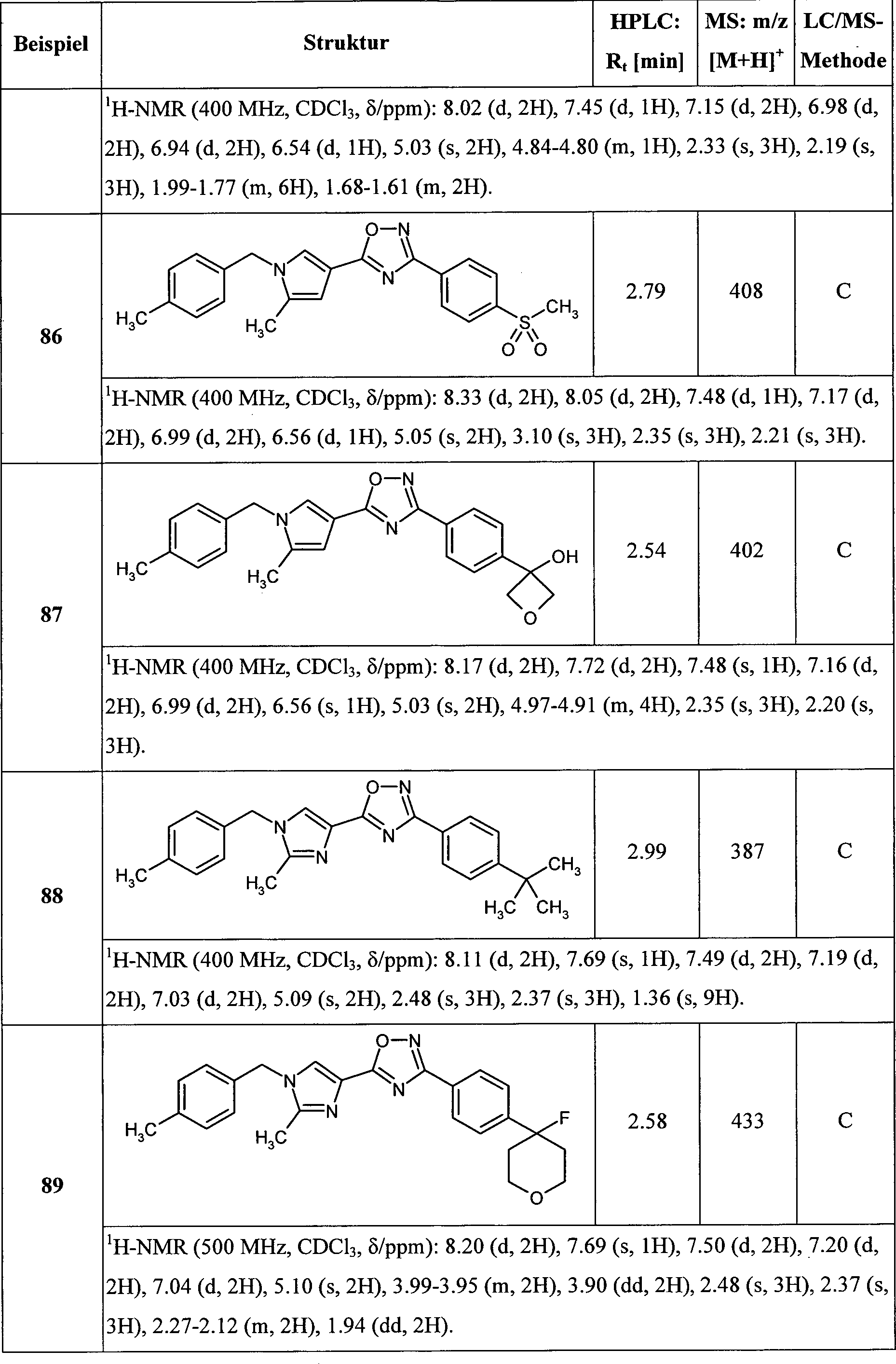


Beispiel 100Example 100
2-({5-[(2-Methyl-4-{3-[4-(trifluormethoxy)phenyl]-1,2,4-oxadiazol-5-yl}-1H-pyrrol-1-yl)methyl]pyridin-2-yl}amino)ethanol 
Eine Lösung von 120 mg (0.276 mmol) der Verbindung aus Beispiel 74 und 968 mg (5.52 mmol) 2-{[tert.-Butyl(dimethyl)silyl]oxy}ethanamin in 1 ml Diethylenglykoldimethylether wurde 8 h lang in einem Mikrowellenofen auf 180°C erhitzt (CEM Discover, initiale Einstrahlleistung 250 W). Nach dem Abkühlen auf RT wurde das Reaktionsgemisch bei 0°C mit 6.1 ml (6.07 mmol) einer 1 M Lösung von Tetra-n-butylammoniumfluorid in THF versetzt und 30 min bei dieser Temperatur gerührt. Anschließend wurde das komplette Reaktionsgemisch direkt mittels präparativer HPLC (Methode M) aufgereinigt. Die Produktfraktionen wurden vereinigt, eingeengt, in Methanol wieder aufgenommen und über eine Hydrogencarbonat-Kartusche (Fa. Polymerlabs, Stratospheres SPE, PL-HCO3 MP SPE, Kapazität 0.9 mmol) von der Ameisensäure aus der HPLC-Chromatographie befreit. Nach Entfernen des Lösungsmittels am Rotationsverdampfer wurden 45 mg (36% d. Th.) der Titelverbindung erhalten.
1H-NMR (400 MHz, CDCl3, δ/ppm): 8.17 (d, 2H), 7.92 (d, 1H), 7.42 (d, 1H), 7.31 (d, 2H), 7.17 (dd, 1H), 6.53 (d, 1H), 6.46 (d, 1H), 4.91 (s, 2H), 4.90 (breit, 1H), 4.13 (breit, 1H), 3.81 (dd, 2H), 3.55-3.51 (m, 2H), 2.24 (s, 3H).
LC/MS (Methode D, ESIpos): Rt = 1.96 min, m/z = 460 [M+H]+.A solution of 120 mg (0.276 mmol) of the compound of Example 74 and 968 mg (5.52 mmol) of 2 - {[tert-butyl (dimethyl) silyl] oxy} ethanamine in 1 ml of diethylene glycol dimethyl ether was heated to 180 in a microwave oven for 8 hours ° C heated (CEM Discover, initial irradiation power 250 W). After cooling to RT, the reaction mixture at 0 ° C with 6.1 ml (6.07 mmol) of a 1 M solution of tetra-n-butylammonium fluoride in THF and stirred for 30 min at this temperature. Subsequently, the complete reaction mixture was purified directly by preparative HPLC (method M). The product fractions were combined, concentrated, taken up in methanol and freed of formic acid from HPLC chromatography over a bicarbonate cartridge (Polymerlabs, Stratospheres SPE, PL-HCO 3 MP SPE, capacity 0.9 mmol). After removal of the solvent on a rotary evaporator, 45 mg (36% of theory) of the title compound were obtained.
1 H-NMR (400 MHz, CDCl 3, δ / ppm): 8.17 (d, 2H), 7.92 (d, 1H), 7:42 (d, 1H), 7.31 (d, 2H), 7.17 (dd, 1H) , 6.53 (d, 1H), 6.46 (d, 1H), 4.91 (s, 2H), 4.90 (broad, 1H), 4.13 (broad, 1H), 3.81 (dd, 2H), 3.55-3.51 (m, 2H ), 2.24 (s, 3H).
LC / MS (Method D, ESIpos): R t = 1.96 min, m / z = 460 [M + H] + .
Analog zu dem unter Beispiel 100 beschriebenen Verfahren (jedoch ohne Einsatz von Tetra-n-butylammoniumfluorid) wurden die Verbindungen in der folgenden Tabelle aus den entsprechenden Edukten erhalten. Die eingesetzten Amin-Komponenten waren kommerziell erhältlich.Analogously to the process described under Example 100 (but without the use of tetra-n-butylammonium fluoride), the compounds in the following table were obtained from the corresponding starting materials. The amine components used were commercially available.

Beispiel 103Example 103
2-[1-Methyl-5-(4-methylbenzyl)-1H-pyrazol-3-yl]-4-[4-(trifluormethoxy)phenyl]-1,3-oxazol 

Eine Lösung von 350 mg (1.52 mmol) der Verbindung aus Beispiel 49A in 7 ml wasserfreiem DMF wurde mit 867 mg (2.28 mmol) HATU versetzt und 30 min bei RT gerührt. Dann wurde eine Lösung von 504 mg (2.28 mmol) der Verbindung aus Beispiel 22A und 1.7 ml (12.2 mmol) Triethylamin in weiteren 7 ml wasserfreiem DMF hinzugefügt und das Gemisch 16 h bei RT gerührt. Anschließend wurde mit ca. 300 ml Wasser versetzt und dreimal mit je ca. 200 ml Ethylacetat extrahiert. Der organische Extrakt wurde nacheinander mit Wasser und gesättigter Kochsalz-Lösung gewaschen. Nach Trocknen über wasserfreiem Magnesiumsulfat wurde filtriert und das Lösungsmittel am Rotationsverdampfer entfernt. Der erhaltene Rückstand wurde zunächst mittels MPLC vorgereinigt (Kieselgel, Laufmittel: Cyclohexan/Ethylacetat 1:1). Anschließend wurde die saubere Titelverbindung mittels präparativer HPLC (Methode M) erhalten (516 mg, 78% d. Th.).
1H-NMR (400 MHz, CDCl3, δ/ppm): 7.45 (d, 1H), 7.42 (d, 2H), 7.20 (d, 2H), 7.10 (d, 2H), 7.01 (d, 2H), 6.57 (s, 1H), 5.24-5.20 (m, 1H), 3.98 (dd, 2H), 3.94 (s, 2H), 3.70 (s, 3H), 2.32 (s, 3H).
HPLC (Methode B): Rt = 4.58 min.
MS (DCI, NH3): m/z = 434 [M+H]+.
LC/MS (Methode E, ESIpos): Rt = 2.12 min, m/z = 434 [M+H]+. Schritt 2: 2-[1-Methyl-5-(4-methylbenzyl)-1H-pyrazol-3-yl]-4-[4-(trifluormethoxy)phenyl]-4,5-dihydro-1,3-oxazol 
1 H-NMR (400 MHz, CDCl 3, δ / ppm): 7.45 (d, 1H), 7:42 (d, 2H), 7.20 (d, 2H), 7.10 (d, 2H), 7:01 (d, 2H) , 6.57 (s, 1H), 5.24-5.20 (m, 1H), 3.98 (dd, 2H), 3.94 (s, 2H), 3.70 (s, 3H), 2.32 (s, 3H).
HPLC (Method B): R t = 4.58 min.
MS (DCI, NH 3): m / z = 434 [M + H] +.
LC / MS (method E, ESIpos): R t = 2.12 min, m / z = 434 [M + H] + . Step 2: 2- [1-Methyl-5- (4-methylbenzyl) -1H-pyrazol-3-yl] -4- [4- (trifluoromethoxy) phenyl] -4,5-dihydro-1,3-oxazole
Eine Lösung von 485 mg (1.12 mmol) der Verbindung aus Beispiel 103/Schritt 1 und 320 mg (1.34 mmol) Burgess-Reagens [Methoxycarbonylsulfamoyl-triethylammonium-N-betain] in 10 ml wasserfreiem THF wurde 1 h auf 70°C erhitzt. Nach dem Abkühlen auf RT wurde mit ca. 40 ml Wasser versetzt und dreimal mit je ca. 20 ml Ethylacetat extrahiert. Der vereinigte organische Extrakt wurde nacheinander mit Wasser und gesättigter Kochsalz-Lösung gewaschen. Nach Trocknen über wasserfreiem Magnesiumsulfat und Filtration wurde das Lösungsmittel am Rotationsverdampfer entfernt. Der erhaltene Rückstand wurde mittels MPLC gereinigt (Kieselgel, Laufmittel: Cyclohexan/Ethylacetat 2:1). Es wurden 398 mg (86% d. Th.) der Titelverbindung erhalten.
1H-NMR (400 MHz, CDCl3, δ/ppm): 7.33 (d, 2H), 7.19 (d, 2H), 7.11 (d, 2H), 7.03 (d, 2H), 6.57 (s, 1H), 5.35 (dd, 1H), 4.79 (dd, 1H), 4.24 (dd, 1H), 3.96 (s, 2H), 3.79 (s, 3H), 2.33 (s, 3H).
MS (DCI, NH3): m/z = 416 [M+H]+.
LC/MS (Methode F, ESIpos): Rt = 2.12 min, m/z = 416 [M+H]+. Schritt 3: 2-[1-Methyl-5-(4-methylbenzyl}-1H-pyrazol-3-yl]-4-[4-(trifluormethoxy)phenyl]-1,3-oxazol 
1 H-NMR (400 MHz, CDCl 3, δ / ppm): 7:33 (d, 2H), 7.19 (d, 2H), 7.11 (d, 2H), 7:03 (d, 2H), 6:57 (s, 1H) , 5.35 (dd, 1H), 4.79 (dd, 1H), 4.24 (dd, 1H), 3.96 (s, 2H), 3.79 (s, 3H), 2.33 (s, 3H).
MS (DCI, NH 3): m / z = 416 [M + H] +.
LC / MS (Method F, ESIpos): R t = 2.12 min, m / z = 416 [M + H] + . Step 3: 2- [1-Methyl-5- (4-methylbenzyl) -1H-pyrazol-3-yl] -4- [4- (trifluoromethoxy) phenyl] -1,3-oxazole
250 mg (0.602 mmol) der Verbindung aus Beispiel 103/Schritt 2 wurden in 6 ml THF gelöst und mit 209 mg (2.41 mmol) Mangandioxid (”gefällt, aktiv”-Qualität) versetzt. Nachdem das Reaktionsgemisch 2.5 h unter Rückfluss erhitzt worden war, wurde nochmals die gleiche Menge an Mangandioxid zugesetzt und das Gemisch weitere 2.5 h unter Rückfluss erhitzt. Nach dem Abkühlen auf RT wurde mit THF verdünnt und über Kieselgur filtriert. Das Filtrat wurde am Rotationsverdampfer vom Lösungsmittel befreit. Der Rückstand wurde in Dichlormethan gelöst und jeweils einmal mit 1 M Salzsäure und Wasser gewaschen. Nach Trocknen über wasserfreiem Magnesiumsulfat und Filtration wurde das Lösungsmittel am Rotationsverdampfer entfernt. Das Rohprodukt wurde mittels präparativer HPLC gereinigt (Methode M). Es wurden 107 mg (43% d. Th.) der Titelverbindung erhalten.
1H-NMR (400 MHz, CDCl3, δ/ppm): 7.92 (s, 1H), 7.84 (d, 2H), 7.25 (d, 2H), 7.13 (d, 2H), 7.07 (d, 2H), 6.62 (s, 1H), 4.00 (s, 2H), 3.82 (s, 3H), 2.34 (s, 3H).
HPLC (Methode B): Rt = 5.32 min.
MS (ESIpos): m/z = 414 [M+H]+.
LC/MS (Methode D, ESIpos): Rt = 2.81 min, m/z = 414 [M+H]+.250 mg (0.602 mmol) of the compound from Example 103 / Step 2 were dissolved in 6 ml of THF and admixed with 209 mg (2.41 mmol) of manganese dioxide ("precipitated, active" grade). After the reaction mixture had been heated under reflux for 2.5 h, the same amount of manganese dioxide was added again and the mixture heated under reflux for a further 2.5 h. After cooling to RT, it was diluted with THF and filtered through kieselguhr. The filtrate was freed from the solvent on a rotary evaporator. The residue was dissolved in dichloromethane and washed once each with 1 M hydrochloric acid and water. After drying over anhydrous magnesium sulfate and filtration, the solvent was removed on a rotary evaporator. The crude product was purified by preparative HPLC (method M). 107 mg (43% of theory) of the title compound were obtained.
1 H-NMR (400 MHz, CDCl 3, δ / ppm): 7.92 (s, 1H), 7.84 (d, 2H), 7.25 (d, 2H), 7.13 (d, 2H), 7:07 (d, 2H) , 6.62 (s, 1H), 4.00 (s, 2H), 3.82 (s, 3H), 2.34 (s, 3H).
HPLC (Method B): R t = 5.32 min.
MS (ESIpos): m / z = 414 [M + H] + .
LC / MS (Method D, ESIpos): R t = 2.81 min, m / z = 414 [M + H] + .
Die Verbindungen in der folgenden Tabelle wurden analog zu den in den Beispielen 1 bis 3 beschriebenen Verfahren aus den entsprechenden Edukten hergestellt. In Abhängigkeit von der Polarität der Verbindungen wurden diese entweder durch Ausrühren in Dichlormethan, Ethylacetat, Acetonitril oder Diethylether isoliert, oder sie wurden mittels präparativer HPLC oder mittels MPLC über Kieselgel mit Cyclohexan/Ethylacetat-Gemischen als Laufmittel gereinigt. Die als Edukte verwendeten Arylmethylchloride, -bromide oder -methansulfonate waren entweder kommerziell erhältlich oder wurden wie weiter oben beschrieben hergestellt, oder ihre Herstellung ist in der Literatur beschrieben.The compounds in the following table were prepared from the corresponding starting materials analogously to the processes described in Examples 1 to 3. Depending on the polarity of the compounds, these were either isolated by stirring in dichloromethane, ethyl acetate, acetonitrile or diethyl ether, or they were purified by preparative HPLC or by MPLC over silica gel with cyclohexane / ethyl acetate mixtures as eluent. The arylmethyl chlorides, bromides or methanesulfonates used as starting materials were either commercially available or were prepared as described above, or their preparation is described in the literature.

Die Verbindungen in der folgenden Tabelle wurden analog zu einem der unter Beispiel 65, 66, 72 und 73 beschriebenen Verfahren aus den entsprechenden Vorstufen hergestellt. Die Herstellung der meisten der verwendeten N'-Hydroxycarboximidamide (Hydroxyamidine) wurde weiter oben beschrieben; einige wenige waren kommerziell erhältlich oder sind in der Literatur beschrieben.The compounds in the following table were prepared analogously to one of the processes described under Examples 65, 66, 72 and 73 from the corresponding precursors. The preparation of most of the N'-hydroxycarboximidamides (hydroxyamidines) used has been described above; a few were commercially available or described in the literature.


Die Beispiele in der folgenden Tabelle wurden analog zu dem unter Beispiel 24 oder Beispiel 100 beschriebenen Verfahren unter Verwendung des jeweils korrespondierenden Amins und der entsprechenden 2-Chlorpyridin-Verbindung aus den Beispielen 2, 3 112 bzw. 113 hergestellt. Anders als in Beispiel 24 beschrieben, wurden diese Reaktionen zumeist in DMSO als Lösungsmittel durchgeführt (ca. 0.5 ml DMSO auf 0.10 mmol des 2-Chlorpyridin-Edukts). Zur Herstellung einiger Beispiele war es erforderlich, die Reaktionsdauer um bis zu weitere 10 Stunden zu verlängern und/oder die Menge an eingesetztem Edukt-Amin um weitere bis zu 10 Äquivalente, bezogen auf das eingesetzte 2-Chlorpyridin-Derivat, zu erhöhen. Bei einigen Beispielen war es zudem erforderlich, eine zweimalige Reinigung mittels präparativer HPLC durchzuführen. Die meisten der eingesetzten Amin-Komponenten waren kommerziell erhältlich; einige wurden nach literaturbeschriebenen Verfahren hergestellt.The examples in the following table were prepared analogously to the process described under Example 24 or Example 100 using the respective corresponding amine and the corresponding 2-chloropyridine compound from Examples 2, 3,112 and 113, respectively. Unlike in Example 24, these reactions were usually carried out in DMSO as a solvent (about 0.5 ml of DMSO to 0.10 mmol of 2-chloropyridine starting material). To prepare some examples, it was necessary to extend the reaction time for up to another 10 hours and / or to increase the amount of starting amine used by a further up to 10 equivalents, based on the 2-chloropyridine derivative used. In some examples, it was also necessary to perform a two-fold purification by preparative HPLC. Most the amine components used were commercially available; Some were prepared by literature methods.


Beispiel 135Example 135
5-[(5-Methyl-3-{3-[4-(trifluormethoxy)phenyl]-1,2,4-oxadiazol-5-yl}-1H-pyrazol-1-yl)methyl]pyridin-2-amin 

1.0 g (2.29 mmol) der Verbindung aus Beispiel 2 wurde unter Argon bei RT mit 5.0 ml (103 mmol) Hydrazinhydrat versetzt. Man erhitzte das Gemisch 16 h lang unter Rühren zum Rückfluss, gab dann weitere 5.0 ml Hydrazinhydrat hinzu und ließ das Gemisch erneut 16 h unter Rückfluss rühren. Der entstandene Feststoff wurde durch Zugabe von 10 ml Ethanol in Lösung gebracht und das Gemisch anschließend weitere 24 h unter Rühren zum Rückfluss erhitzt. Nach Abkühlen auf RT wurde der beim Abkühlen ausgefallene Feststoff abgesaugt, einmal mit einem 1:1-Gemisch von Wasser und Ethanol gewaschen und im Vakuum getrocknet. Man erhielt 788 mg (80% d. Th.) der Titelverbindung.
1H-NMR (400 MHz, CDCl3, δ/ppm): 8.25 (d, 2H), 8.06 (d, 1H), 7.41 (dd, 1H), 7.32 (d, 2H), 6.78 (s, 1H), 6.69 (d, 1H), 5.88 (s, 1H), 5.31 (s, 2H), 3.80 (s, breit, 2H), 2.31 (s, 3H).
LC/MS (Methode I, ESIpos): Rt = 0.90 min, m/z = 432 [M+H]+. Schritt 2: 2-Azido-5-[(5-methyl-3-{3-[4-(trifluormethoxy)phenyl]-1,2,4-oxadiazol-5-yl}-1H-pyrazol-1-yl)methyl]pyridin 
1 H-NMR (400 MHz, CDCl 3, δ / ppm): 8.25 (d, 2H), 8:06 (d, 1H), 7:41 (dd, 1H), 7:32 (d, 2H), 6.78 (s, 1H) , 6.69 (d, 1H), 5.88 (s, 1H), 5.31 (s, 2H), 3.80 (s, broad, 2H), 2.31 (s, 3H).
LC / MS (Method I, ESIpos): R t = 0.90 min, m / z = 432 [M + H] + . Step 2: 2-azido-5 - [(5-methyl-3- {3- [4- (trifluoromethoxy) phenyl] -1,2,4-oxadiazol-5-yl} -1H-pyrazol-1-yl) methyl] pyridine
450 mg (1.04 mmol) der Verbindung aus Beispiel 135/Schritt 1 wurden in 10 ml konzentrierter Salzsäure vorgelegt und mit einem Eisbad gekühlt. Man tropfte langsam unter Rühren eine Lösung von 576 mg (8.35 mmol) Natriumnitrit in 20 ml Wasser hinzu, ließ das Gemisch anschließend auf RT kommen und rührte weitere 5 h bei RT. Das Gemisch wurde dann durch Zugabe von 10%-iger Natronlauge alkalisch gestellt. Der gebildete Feststoff wurde abfiltriert, zweimal mit Wasser gewaschen und im Vakuum getrocknet. Man erhielt 459 mg (99% d. Th.) der Titelverbindung.
1H-NMR (400 MHz, CD3OD, δ/ppm): 9.10 (s, 1H), 8.22 (d, 2H), 8.09 (d, 1H), 7.79 (d, 1H), 7.46 (d, 2H), 6.92 (s, 1H), 5.65 (s, 2H), 2.49 (s, 3H).
LC/MS (Methode I, ESIpos): Rt = 1.17 min, m/z = 443 [M+H]+. Schritt 3: 5-[(5-Methyl-3-{3-[4-(trifluormethoxy)phenyl]-1,2,4-oxadiazol-5-yl}-1H-pyrazol-1-yl)methyl]pyridin-2-amin 
1 H-NMR (400 MHz, CD 3 OD, δ / ppm): 9.10 (s, 1H), 8.22 (d, 2H), 8.09 (d, 1H), 7.79 (d, 1H), 7.46 (d, 2H ), 6.92 (s, 1H), 5.65 (s, 2H), 2.49 (s, 3H).
LC / MS (Method I, ESIpos): R t = 1.17 min, m / z = 443 [M + H] + . Step 3: 5 - [(5-Methyl-3- {3- [4- (trifluoromethoxy) phenyl] -1,2,4-oxadiazol-5-yl} -1H-pyrazol-1-yl) methyl] pyridine 2-amine
450 mg (1.02 mmol) der Verbindung aus Beispiel 135/Schritt 2 wurden unter Argon in 20 ml eines 7:3-Gemisches von Methanol und Wasser vorgelegt. Man gab 1.03 g (5.99 mmol) Tributylphosphan hinzu und erhitzte das Gemisch 2 h unter Rühren zum Rückfluss. Nach Abkühlen auf RT wurde das Gemisch filtriert und das Filtrat eingeengt. Der erhaltene Rückstand wurde in Acetonitril gelöst und mittels präparativer HPLC (Methode N) gereinigt. Die vereinigten produkthaltigen Fraktionen wurden bis auf ein geringes Restvolumen an Lösungsmittel eingeengt. Man setzte etwas Natriumhydrogencarbonat hinzu, woraufhin ein Feststoff ausfiel. Dieser wurde abfiltriert, zweimal mit Wasser gewaschen und im Vakuum getrocknet. Man erhielt 339 mg (80% d. Th.) der Titelverbindung.
1H-NMR (400 MHz, CDCl3, δ/ppm): 8.24 (d, 2H), 8.01 (d, 1H), 7.38-7.31 (m, 3H), 6.79 (s, 1H), 6.48 (d, 1H), 5.30 (s, 2H), 4.50 (s, 2H), 2.32 (s, 3H).
LC/MS (Methode F, ESIpos): Rt = 1.05 min, m/z = 417 [M+H]+.450 mg (1.02 mmol) of the compound from Example 135 / Step 2 were initially charged under argon in 20 ml of a 7: 3 mixture of methanol and water. 1.03 g (5.99 mmol) of tributylphosphine were added and the mixture was heated to reflux for 2 h with stirring. After cooling to RT, the mixture was filtered and the filtrate was concentrated. The resulting residue was dissolved in acetonitrile and purified by preparative HPLC (Method N). The combined product-containing fractions were concentrated to a small residual volume of solvent. Some sodium bicarbonate was added, whereupon a solid precipitated. This was filtered off, washed twice with water and dried in vacuo. 339 mg (80% of theory) of the title compound were obtained.
1 H-NMR (400 MHz, CDCl 3, δ / ppm): 8.24 (d, 2H), 8:01 (d, 1H), 7:38 to 7:31 (m, 3H), 6.79 (s, 1H), 6:48 (d, 1H), 5.30 (s, 2H), 4.50 (s, 2H), 2.32 (s, 3H).
LC / MS (Method F, ESIpos): R t = 1.05 min, m / z = 417 [M + H] + .
Beispiel 136Example 136
3-[(5-Methyl-3-{3-[4-(trifluormethoxy)phenyl]-1,2,4-oxadiazol-5-yl}-1H-pyrazol-1-yl)methyl]pyridin-1-oxid 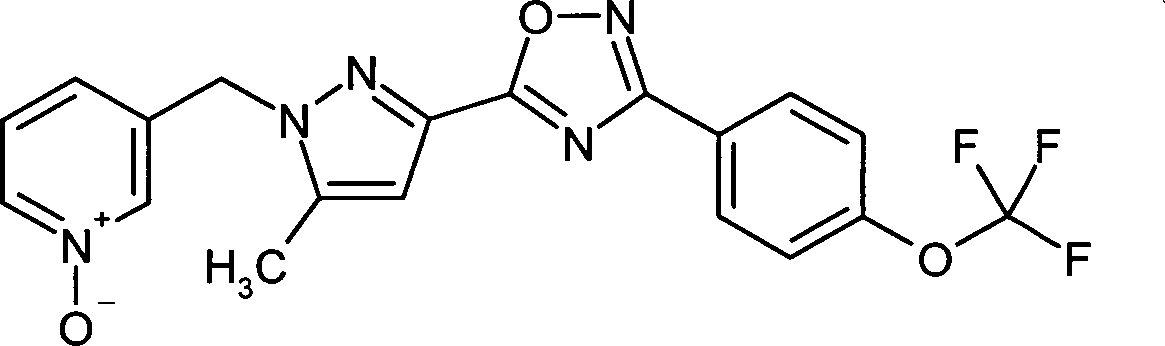
Eine Lösung von 50 mg (0.125 mmol) der Verbindung aus Beispiel 6 in 2 ml THF wurde mit 70 mg (0.262 mmol) Wasserstoffperoxid-Harnstoff-Komplex versetzt und auf 0°C abgekühlt. Das Gemisch wurde unter Rühren langsam mit 39 μl (0.274 mmol) Trifluoressigsäureanhydrid versetzt und 30 min bei 0°C gerührt. Dann wurde auf RT erwärmt und mit ca. 2 ml gesättigter wässriger Natriumthiosulfat-Lösung und ca. 1 ml 0.5 M Salzsäure versetzt. Anschließend wurde mit Dichlormethan extrahiert. Nach Trocknen der organischen Phase über wasserfreiem Magnesiumsulfat und Filtration wurde das Lösungsmittel am Rotationsverdampfer entfernt. Das so erhaltene Rohprodukt wurde durch Verrühren mit Diethylether gereinigt. Es wurden 30 mg (59% d. Th.) der Titelverbindung erhalten.
1H-NMR (400 MHz, CDCl3, δ/ppm): 8.24 (d, 2H), 8.15 (d, 1H), 8.04 (s, 1H), 7.33 (d, 2H), 7.28 (t, 1H), 7.10 (d, 1H), 6.87 (s, 1H), 5.41 (s, 2H), 2.37 (s, 3H).
HPLC (Methode A): Rt = 4.39 min.
MS (DCI, NH3): m/z = 418 [M+H]+, 435 [M+NH4]+.
LC/MS (Methode F, ESIpos): Rt = 1.18 min, m/z = 418 [M+H]+, 835 [2M+H]+.A solution of 50 mg (0.125 mmol) of the compound from Example 6 in 2 ml of THF was admixed with 70 mg (0.262 mmol) of hydrogen peroxide-urea complex and cooled to 0 ° C. The mixture was added slowly while stirring with 39 .mu.l (0.274 mmol) of trifluoroacetic anhydride and stirred at 0 ° C for 30 min. It was then warmed to RT and treated with about 2 ml of saturated aqueous sodium thiosulfate solution and about 1 ml of 0.5 M hydrochloric acid. It was then extracted with dichloromethane. After drying the organic phase over anhydrous magnesium sulfate and filtration, the solvent was removed on a rotary evaporator. The crude product thus obtained was purified by stirring with diethyl ether. Thirty mg (59% of theory) of the title compound were obtained.
1 H-NMR (400 MHz, CDCl 3, δ / ppm): 8.24 (d, 2H), 8.15 (d, 1H), 8:04 (s, 1H), 7:33 (d, 2H), 7.28 (t, 1H) , 7.10 (d, 1H), 6.87 (s, 1H), 5.41 (s, 2H), 2.37 (s, 3H).
HPLC (Method A): R t = 4.39 min.
MS (DCI, NH 3): m / z = 418 [M + H] +, 435 [M + NH 4] +.
LC / MS (method F, ESIpos): R t = 1.18 min, m / z = 418 [M + H] + , 835 [2M + H] + .
Beispiel 137Example 137
2-Methyl-5-[(5-methyl-3-{3-[4-(trifluormethoxy)phenyl]-1,2,4-oxadiazol-5-yl}-1H-pyrazol-1-yl)methyl]pyridin-1-oxid 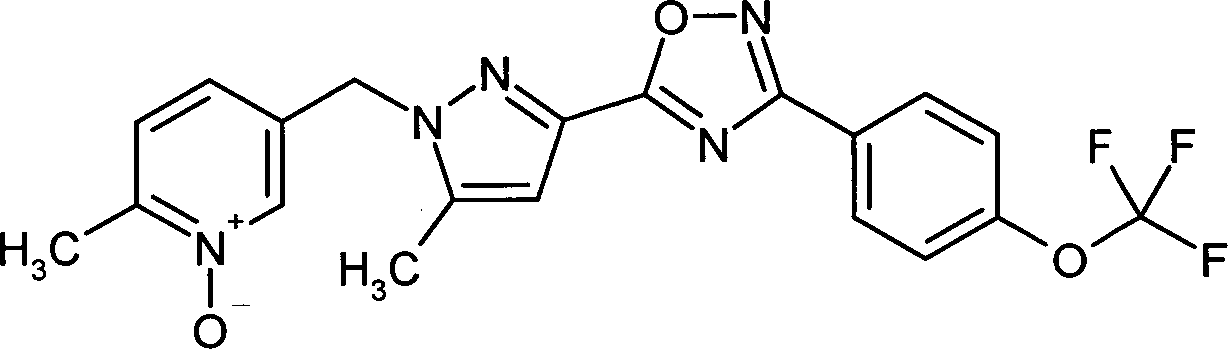
Analog zu dem unter Beispiel 136 beschriebenen Verfahren wurden aus 60 mg (0.144 mmol) der Verbindung aus Beispiel 7 24 mg (39% d. Th.) der Titelverbindung erhalten.
1H-NMR (400 MHz, CDCl3, δ/ppm): 8.25 (d, 2H), 8.12 (s, 1H), 7.34 (d, 2H), 7.23 (d, 1H), 7.02 (d, 114), 6.83 (s, 114), 5.38 (s, 2H), 2.50 (s, 3H), 2.33 (s, 3H).
MS (DCI, NH3): m/z = 432 [M+H]+.Analogously to the process described under Example 136, 24 mg (39% of theory) of the title compound were obtained from 60 mg (0.144 mmol) of the compound from Example 7.
1 H-NMR (400 MHz, CDCl 3, δ / ppm): 8.25 (d, 2H), 8.12 (s, 1H), 7:34 (d, 2H), 7.23 (d, 1H), 7:02 (d, 114) , 6.83 (s, 114), 5.38 (s, 2H), 2.50 (s, 3H), 2.33 (s, 3H).
MS (DCI, NH 3): m / z = 432 [M + H] +.
Beispiel 138Example 138
2-Chlor-5-[(5-methyl-3-{3-[4-(trifluormethoxy)phenyl]-1,2,4-oxadiazol-5-yl}-1H-pyrazol-1-yl)-methyl]pyridin-1-oxid 
Eine Lösung von 500 mg (1.15 mmol) der Verbindung aus Beispiel 2 und 1.06 g (4.59 mmol, Gehalt ca. 75%) meta-Chlorperbenzoesäure (MCPBA) in 10 ml Dichlormethan wurde 3 Tage bei RT gerührt. Anschließend wurde mit 50 ml Dichlormethan verdünnt und nacheinander jeweils einmal mit 50 ml 1 N Natronlauge, Wasser und gesättigter Natriumchlorid-Lösung gewaschen. Man trocknete die organische Phase über Magnesiumsulfat, filtrierte und entfernte das Lösungsmittel. Nach Trocknen des Rückstands im Vakuum wurden 482 mg (93% d. Th.) der Titelverbindung erhalten.
1H-NMR (400 MHz, CDCl3, δ/ppm): 8.24 (d, 2H), 8.19 (d, 1H), 7.48 (d, 114), 7.33 (d, 2H), 7.09-7.05 (dd, 1H), 6.85 (s, 1H), 5.39 (s, 2H), 2.35 (s, 3H).
LC/MS (Methode F, ESIpos): Rt = 1.26 min, m/z = 452/454 [M+H]+.A solution of 500 mg (1.15 mmol) of the compound from Example 2 and 1.06 g (4.59 mmol, content about 75%) of meta-chloroperbenzoic acid (MCPBA) in 10 ml of dichloromethane was stirred at RT for 3 days. It was then diluted with 50 ml of dichloromethane and washed successively each time with 50 ml of 1 N sodium hydroxide solution, water and saturated sodium chloride solution. The organic phase was dried over magnesium sulfate, filtered and the solvent removed. After drying the residue in vacuo, 482 mg (93% of theory) of the title compound were obtained.
1 H-NMR (400 MHz, CDCl 3, δ / ppm): 8.24 (d, 2H), 8.19 (d, 1H), 7:48 (d, 114), 7:33 (d, 2H), 7:09 to 7:05 (dd, 1H), 6.85 (s, 1H), 5.39 (s, 2H), 2.35 (s, 3H).
LC / MS (Method F, ESIpos): R t = 1.26 min, m / z = 452/454 [M + H] + .
Beispiel 139Example 139
N-Methyl-5-[(5-methyl-3-{3-[4-(1,1,1-trifluor-2-methylpropan-2-yl)phenyl]-1,2,4-oxadiazol-5-yl}-1H-pyrazol-1-yl)methyl]pyridin-2-amin-1-oxid 
Ein Gemisch aus 100 mg (0.219 mmol) der Verbindung aus Beispiel 121 und 151 mg (0.676 mmol, Gehalt ca. 75%) meta-Chlorperbenzoesäure (MCPBA) in 4 ml Dichlormethan wurde 30 min bei RT gerührt. Man verdünnte dann mit 20 ml Dichlormethan, wusch zweimal mit 20 ml gesättigter wässriger Natriumhydrogencarbonat-Lösung, trocknete die organische Phase über Magnesiumsulfat, filtrierte und engte ein. Der Rückstand wurde mittels präparativer HPLC (Methode N) gereinigt. Die vereinigten Produktfraktionen wurden bis auf ein Restvolumen an wässriger Phase eingeengt. Man versetzte mit gesättigter Natriumhydrogencarbonat Lösung und extrahierte zweimal mit Dichlormethan. Die vereinigten Dichlormethan-Phasen wurden über Magnesiumsulfat getrocknet, filtriert und eingeengt. Der Rückstand wurde mit 0.5 ml Diethylether verrieben, und das Lösungsmittel wurde am Rotationsverdampfer wieder entfernt. Nach Trocknen im Vakuum erhielt man 50 mg (47% d. Th., Reinheit 98%) der Titelverbindung.
1H-NMR (400 MHz, CDCl3, δ/ppm): 8.19 (d, 2H), 8.05 (s, breit, 1H), 7.63 (d, 2H), 7.15 (d, 1H), 6.80 (s, 1H), 6.80-6.70 (m, 1H), 6.56 (d, 1H), 5.29 (s, 2H), 3.08-2.95 (d, 3H), 2.33 (s, 3H), 1.63 (s, 6H).
LC/MS (Methode I, ESIpos): Rt = 1.12 min, m/z = 473 [M+H]+.A mixture of 100 mg (0.219 mmol) of the compound from Example 121 and 151 mg (0.676 mmol, content about 75%) of meta-chloroperbenzoic acid (MCPBA) in 4 ml of dichloromethane was stirred at RT for 30 min. It was then diluted with 20 ml of dichloromethane, washed twice with 20 ml of saturated aqueous sodium bicarbonate solution, the organic phase was dried over magnesium sulfate, filtered and concentrated. The residue was purified by preparative HPLC (Method N). The combined product fractions were concentrated to a residual volume of aqueous phase. It was mixed with saturated sodium bicarbonate solution and extracted twice with dichloromethane. The combined dichloromethane phases were dried over magnesium sulfate, filtered and concentrated. The residue was triturated with 0.5 ml of diethyl ether and the solvent was removed again on a rotary evaporator. After drying in vacuo, 50 mg (47% of theory, purity 98%) of the title compound were obtained.
1 H-NMR (400 MHz, CDCl 3, δ / ppm): 8.19 (d, 2H), 8:05 (s, broad, 1H), 7.63 (d, 2H), 7.15 (d, 1H), 6.80 (s, 1H), 6.80-6.70 (m, 1H), 6.56 (d, 1H), 5.29 (s, 2H), 3.08-2.95 (d, 3H), 2.33 (s, 3H), 1.63 (s, 6H).
LC / MS (Method I, ESIpos): R t = 1.12 min, m / z = 473 [M + H] + .
Beispiel 140Example 140
tert.-Butyl-({1-[4-(5-{1-[(6-chlorpyridin-3-yl)methyl]-5-methyl-1H-pyrazol-3-yl}-1,2,4-oxadiazol-3-yl)phenyl]cyclobutyl}oxy)acetat 
Analog zu dem unter Beispiel 66 beschriebenen Verfahren wurden aus 150 mg (0.596 mmol) der Verbindung aus Beispiel 45A und 210 mg (0.656 mmol) der Verbindung aus Beispiel 57A 192 mg (60% d. Th.) der Titelverbindung hergestellt.
1H-NMR (400 MHz, CDCl3, δ/ppm): 8.32 (d, 1H), 8.20 (d, 2H), 7.60 (d, 2H), 7.52 (dd, 1H), 7.32 (d, 1H), 6.83 (s, 1H), 5.43 (s, 2H), 3.60 (s, 2H), 2.56-2.41 (m, 4H), 2.33 (s, 3H), 2.08-1.99 (m, 1H), 1.78-1.66 (m, 1H), 1.43 (s, 9H).
HPLC (Methode A): Rt = 4.95 min.
MS (DCI, NH3): m/z = 536 [M+H]+, 553 [M+NH4]+.
LC/MS (Methode F, ESIpos): Rt = 1.56 min, m/z = 536/538 [M+H]+.Analogously to the process described under Example 66, from 150 mg (0.596 mmol) of the compound from Example 45A and 210 mg (0.656 mmol) of the compound from Example 57A, 192 mg (60% of theory) of the title compound were prepared.
1 H-NMR (400 MHz, CDCl 3, δ / ppm): 8:32 (d, 1H), 8.20 (d, 2H), 7.60 (d, 2H), 7:52 (dd, 1H), 7:32 (d, 1H) , 6.83 (s, 1H), 5.43 (s, 2H), 3.60 (s, 2H), 2.56-2.41 (m, 4H), 2.33 (s, 3H), 2.08-1.99 (m, 1H), 1.78-1.66 (m, 1H), 1.43 (s, 9H).
HPLC (Method A): R t = 4.95 min.
MS (DCI, NH 3): m / z = 536 [M + H] +, 553 [M + NH 4] +.
LC / MS (method F, ESIpos): R t = 1.56 min, m / z = 536/538 [M + H] + .
Beispiel 141Example 141
2-Chlor-5-[(5-methyl-3-{3-[4-(piperidin-1-yl)phenyl]-1,2,4-oxadiazol-5-yl}-1H-pyrazol-1-yl)methyl]pyridin 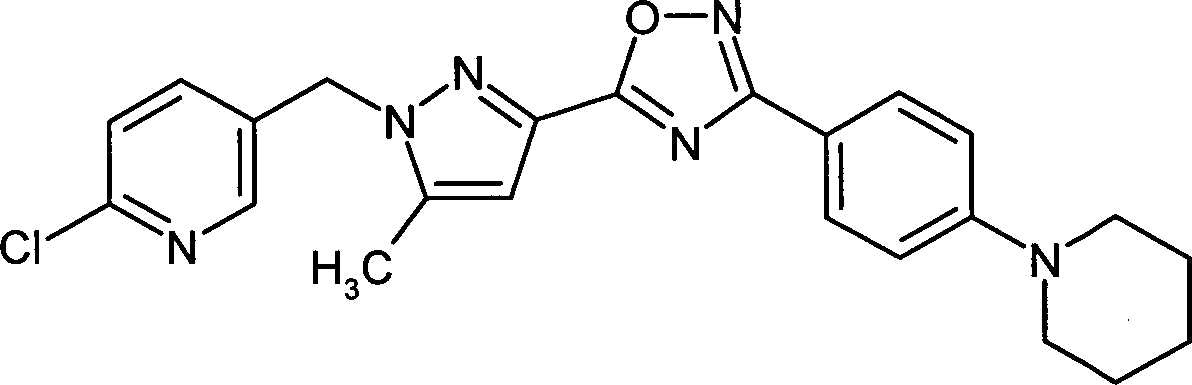
Analog zu dem unter Beispiel 66 beschriebenen Verfahren wurden aus 125 mg (0.497 mmol) der Verbindung aus Beispiel 45A und 184 mg (0.546 mmol) der Verbindung aus Beispiel 10A 33 mg (14% d. Th., 94% Reinheit) der Titelverbindung hergestellt.
1H-NMR (400 MHz, CDCl3, δ/ppm): 8.31 (d, 1H), 8.04 (d, 2H), 7.50 (dd, 1H), 7.31 (d, 1H), 6.96 (d, 2H), 6.80 (s, 1H), 5.42 (s, 2H), 3.32-3.28 (m, 4H), 2.30 (s, 3H), 1.73-1.67 (m, 4H), 1.65-1.61 (m, 2H).
LC/MS (Methode I, ESIpos): Rt = 1.33 min, m/z = 435/437 [M+H]+.Analogously to the process described under Example 66, from 125 mg (0.497 mmol) of the compound from Example 45A and 184 mg (0.546 mmol) of the compound from Example 10A, 33 mg (14% of theory, 94% purity) of the title compound were prepared ,
1 H-NMR (400 MHz, CDCl 3, δ / ppm): 8.31 (d, 1H), 8:04 (d, 2H), 7.50 (dd, 1H), 7.31 (d, 1H), 6.96 (d, 2H) , 6.80 (s, 1H), 5.42 (s, 2H), 3.32-3.28 (m, 4H), 2.30 (s, 3H), 1.73-1.67 (m, 4H), 1.65-1.61 (m, 2H).
LC / MS (Method I, ESIpos): R t = 1.33 min, m / z = 435/437 [M + H] + .
Beispiel 142Example 142
2-Chlor-5-[(5-methyl-3-{3-[4-(tetrahydro-2H-pyran-4-yl)phenyl]-1,2,4-oxadiazol-5-yl}-1H-pyrazol-1-yl)methyl]pyridin 
Analog zu dem unter Beispiel 2 beschriebenen Verfahren wurden 106 mg (0.628 mmol) 2-Chlor-5-(chlormethyl)pyridin und 150 mg (0.483 mmol) der Verbindung aus Beispiel 74A zu 74 mg (34% d. Th., 95% Reinheit) der Titelverbindung umgesetzt. Das Produkt wurde mittels präparativer HPLC isoliert (Methode M).
1H-NMR (400 MHz, CDCl3, δ/ppm): 8.32 (d, 1H), 8.14 (d, 2H), 7.50 (dd, 1H), 7.35 (d, 2H), 7.31 (d, 1H), 6.82 (s, 1H), 5.42 (s, 2H), 4.12-4.07 (m, 2H), 3.58-3.51 (m, 2H), 2.87-2.80 (m, 1H), 2.32 (s, 3H), 1.91-1.79 (m, 4H).
LC/MS (Methode I, ESIpos): Rt = 1.18 min, m/z = 436/438 [M+H]+.Analogously to the process described under Example 2, 106 mg (0.628 mmol) of 2-chloro-5- (chloromethyl) pyridine and 150 mg (0.483 mmol) of the compound from Example 74A were added to 74 mg (34% of theory, 95%). Purity) of the title compound. The product was isolated by preparative HPLC (method M).
1 H-NMR (400 MHz, CDCl 3, δ / ppm): 8:32 (d, 1H), 8.14 (d, 2H), 7.50 (dd, 1H), 7:35 (d, 2H), 7.31 (d, 1H) , 6.82 (s, 1H), 5.42 (s, 2H), 4.12-4.07 (m, 2H), 3.58-3.51 (m, 2H), 2.87-2.80 (m, 1H), 2.32 (s, 3H), 1.91 -1.79 (m, 4H).
LC / MS (Method I, ESIpos): R t = 1.18 min, m / z = 436/438 [M + H] + .
Beispiel 143Example 143
1-[4-(5-{1-[(6-Chlorpyridin-3-yl)methyl]-5-methyl-1H-pyrazol-3-yl}-1,2,4-oxadiazol-3-yl)phenyl]cyclobutanol 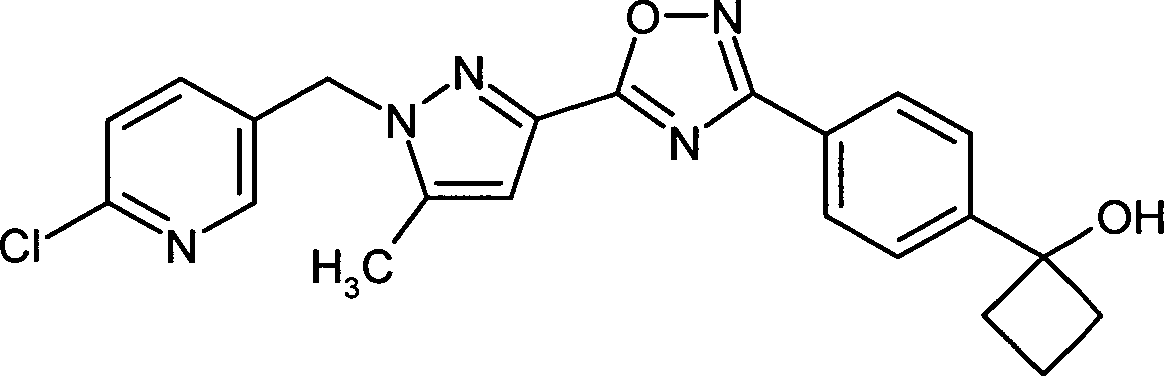
Analog zu dem unter Beispiel 65 beschriebenen Verfahren wurden aus 250 mg (0.993 mmol) der Verbindung aus Beispiel 45A und 225 mg (1.09 mmol) der Verbindung aus Beispiel 51A 135 mg (32% d. Th.) der Titelverbindung hergestellt. Das Produkt wurde mittels präparativer HPLC isoliert (Methode M).
1H-NMR (400 MHz, CDCl3, δ/ppm): 8.32 (d, 1H), 8.20 (d, 2H), 7.63 (d, 2H), 7.51 (dd, 1H), 7.32 (d, 1H), 6.83 (s, 1H), 5.43 (s, 2H), 2.64-2.58 (m, 2H), 2.45-2.38 (m, 2H), 2.33 (s, 3H), 2.14-2.03 (m, 2H), 1.82-1.71 (m, 1H).
LC/MS (Methode I, ESIpos): Rt = 1.11 min, m/z = 422/424 [M+H]+.Analogously to the process described under Example 65, from 250 mg (0.993 mmol) of the compound from Example 45A and 225 mg (1.09 mmol) of the compound from Example 51A, 135 mg (32% of theory) of the title compound were prepared. The product was isolated by preparative HPLC (method M).
1 H-NMR (400 MHz, CDCl 3, δ / ppm): 8:32 (d, 1H), 8.20 (d, 2H), 7.63 (d, 2H), 7:51 (dd, 1H), 7:32 (d, 1H) , 6.83 (s, 1H), 5.43 (s, 2H), 2.64-2.58 (m, 2H), 2.45-2.38 (m, 2H), 2.33 (s, 3H), 2.14-2.03 (m, 2H), 1.82 -1.71 (m, 1H).
LC / MS (Method I, ESIpos): R t = 1.11 min, m / z = 422/424 [M + H] + .
Beispiel 144Example 144
2-Chlor-5-[(5-methyl-3-{3-[4-(methylsulfonyl)phenyl]-1,2,4-oxadiazol-5-yl}-1H-pyrazol-1-yl)methyl]pyridin 
Analog zu dem unter Beispiel 66 beschriebenen Verfahren wurden aus 125 mg (0.497 mmol) der Verbindung aus Beispiel 45A und 117 mg (0.546 mmol) der Verbindung aus Beispiel 14A 140 mg (66% d. Th.) der Titelverbindung hergestellt.
1H-NMR (400 MHz, CDCl3, δ/ppm): 8.42 (d, 2H), 8.32 (d, 1H), 8.09 (d, 2H), 7.52 (dd, 1H), 7.33 (d, 1H), 7.31 (d, 1H), 6.85 (s, 1H), 5.45 (s, 2H), 3.11 (s, 3H), 2.34 (s, 3H).
LC/MS (Methode F, ESIpos): Rt = 1.13 min, m/z = 430/432 [M+H]+.Analogously to the process described under Example 66, from 125 mg (0.497 mmol) of the compound from Example 45A and 117 mg (0.546 mmol) of the compound from Example 14A, 140 mg (66% of theory) of the title compound were prepared.
1 H-NMR (400 MHz, CDCl 3, δ / ppm): 8:42 (d, 2H), 8:32 (d, 1H), 8:09 (d, 2H), 7:52 (dd, 1H), 7:33 (d, 1H) , 7.31 (d, 1H), 6.85 (s, 1H), 5.45 (s, 2H), 3.11 (s, 3H), 2.34 (s, 3H).
LC / MS (Method F, ESIpos): R t = 1.13 min, m / z = 430/432 [M + H] + .
Beispiel 145Example 145
2-Chlor-5-({3-[3-(4-isobutylphenyl)-1,2,4-oxadiazol-5-yl]-5-methyl-1H-pyrazol-1-yl}methyl)pyridin 
Analog zu dem unter Beispiel 3 beschriebenen Verfahren wurden 689 mg (4.25 mmol) 2-Chlor-5-(chlormethyl)pyridin und 600 mg (2.13 mmol) der Verbindung aus Beispiel 76A zu 585 mg (67% d. Th.) der Titelverbindung umgesetzt.
1H-NMR (400 MHz, CDCl3, δ/ppm): 8.33 (d, 1H), 8.10 (d, 2H), 7.51 (dd, 1H), 7.31 (d, 1H), 7.27 (d, 2H), 6.82 (s, 1H), 5.43 (s, 2H), 2.54 (d, 2H), 2.32 (s, 3H), 1.97-1.87 (m, 1H), 0.93 (d, 6H).
LC/MS (Methode I, ESIpos): Rt = 1.41 min, m/z = 408/410 [M+H]+.Analogously to the process described under Example 3, 689 mg (4.25 mmol) of 2-chloro-5- (chloromethyl) pyridine and 600 mg (2.13 mmol) of the compound from Example 76A were added to 585 mg (67% of theory) of the title compound implemented.
1 H-NMR (400 MHz, CDCl 3, δ / ppm): 8:33 (d, 1H), 8.10 (d, 2H), 7:51 (dd, 1H), 7.31 (d, 1H), 7.27 (d, 2H) , 6.82 (s, 1H), 5.43 (s, 2H), 2.54 (d, 2H), 2.32 (s, 3H), 1.97-1.87 (m, 1H), 0.93 (d, 6H).
LC / MS (Method I, ESIpos): R t = 1.41 min, m / z = 408/410 [M + H] + .
Beispiel 146Example 146
2-Chlor-5-{[3-(3-{4-[1-(methoxymethyl)cyclobutyl]phenyl}-1,2,4-oxadiazol-5-yl)-5-methyl-1H-pyrazol-1-yl]methyl}pyridin 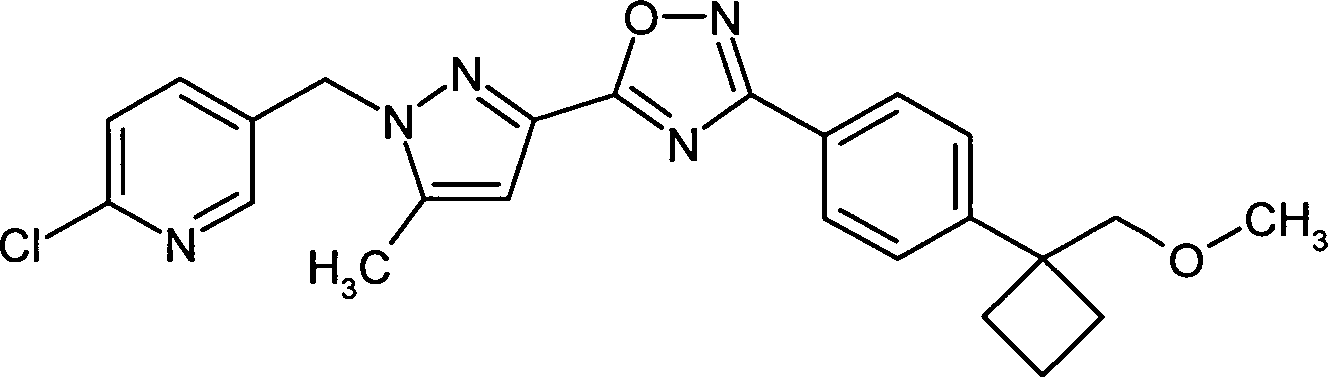
Analog zu dem unter Beispiel 3 beschriebenen Verfahren wurden 500 mg (3.08 mmol) 2-Chlor-5-(chlormethyl)pyridin und 500 mg (1.54 mmol) der Verbindung aus Beispiel 77A zu 341 mg (49% d. Th.) der Titelverbindung umgesetzt.
1H-NMR (400 MHz, CDCl3, δ/ppm): 8.32 (d, 1H), 8.13 (d, 2H), 7.51 (dd, 1H), 7.32 (d, 1H), 7.30 (d, 2H), 6.82 (s, 1H), 5.43 (s, 2H), 3.55 (s, 2H), 3.28 (s, 3H), 2.43-2.28 (m, 4H), 2.31 (s, 3H), 2.15-2.03 (m, 1H), 1.93-1.83 (m, 1H).
LC/MS (Methode I, ESIpos): Rt = 1.33 min, m/z = 450/452 [M+H]+. Analogously to the process described under Example 3, 500 mg (3.08 mmol) of 2-chloro-5- (chloromethyl) pyridine and 500 mg (1.54 mmol) of the compound from Example 77A were added to 341 mg (49% of theory) of the title compound implemented.
1 H-NMR (400 MHz, CDCl 3, δ / ppm): 8:32 (d, 1H), 8.13 (d, 2H), 7:51 (dd, 1H), 7:32 (d, 1H), 7.30 (d, 2H) , 6.82 (s, 1H), 5.43 (s, 2H), 3.55 (s, 2H), 3.28 (s, 3H), 2.43-2.28 (m, 4H), 2.31 (s, 3H), 2.15-2.03 (m , 1H), 1.93-1.83 (m, 1H).
LC / MS (Method I, ESIpos): R t = 1.33 min, m / z = 450/452 [M + H] + .
Beispiel 147Example 147
2-Chlor-5-[(3-{3-[4-(methoxymethyl)phenyl]-1,2,4-oxadiazol-5-yl}-5-methyl-1H-pyrazol-1-yl)methyl]pyridin 
Analog zu dem unter Beispiel 3 beschriebenen Verfahren wurden 300 mg (1.85 mmol) 2-Chlor-5-(chlormethyl)pyridin und 250 mg (0.925 mmol) der Verbindung aus Beispiel 78A zu 121 mg (33% d. Th.) der Titelverbindung umgesetzt.
1H-NMR (400 MHz, CDCl3, δ/ppm): 8.32 (d, 1H), 8.19 (d, 2H), 7.51 (dd, 1H), 7.47 (d, 2H), 7.31 (d, 1H), 6.83 (s, 1H), 5.43 (s, 2H), 3.53 (s, 2H), 3.43 (s, 3H), 2.33 (s, 3H).
LC/MS (Methode I, ESIpos): Rt = 1.14 min, m/z = 396/398 [M+H]+.Analogously to the process described under Example 3, 300 mg (1.85 mmol) of 2-chloro-5- (chloromethyl) pyridine and 250 mg (0.925 mmol) of the compound from Example 78A were added to 121 mg (33% of theory) of the title compound implemented.
1 H-NMR (400 MHz, CDCl 3, δ / ppm): 8:32 (d, 1H), 8.19 (d, 2H), 7:51 (dd, 1H), 7:47 (d, 2H), 7.31 (d, 1H) , 6.83 (s, 1H), 5.43 (s, 2H), 3.53 (s, 2H), 3.43 (s, 3H), 2.33 (s, 3H).
LC / MS (Method I, ESIpos): R t = 1.14 min, m / z = 396/398 [M + H] + .
Beispiel 148Example 148
2-Chlor-5-({3-[3-(3-fluor-4-methoxyphenyl)-1,2,4-oxadiazol-5-yl]-5-methyl-1H-pyrazol-1-yl}methyl)pyridin 
Analog zu dem unter Beispiel 3 beschriebenen Verfahren wurden 354 mg (2.19 mmol) 2-Chlor-5-(chlormethyl)pyridin und 300 mg (1.09 mmol) der Verbindung aus Beispiel 79A zu 150 mg (34% d. Th.) der Titelverbindung umgesetzt.
1H-NMR (400 MHz, CDCl3, δ/ppm): 8.31 (d, 1H), 7.97-7.91 (m, 2H), 7.51 (dd, 1H), 7.32 (d, 1H), 7.06 (t, 1H), 6.82 (s, 1H), 5.43 (s, 2H), 3.97 (s, 3H), 2.33 (s, 3H).
LC/MS (Methode I, ESIpos): Rt = 1.19 min, m/z = 400/402 [M+H]+.Analogously to the process described under Example 3, 354 mg (2.19 mmol) of 2-chloro-5- (chloromethyl) pyridine and 300 mg (1.09 mmol) of the compound from Example 79A were added to 150 mg (34% of theory) of the title compound implemented.
1 H-NMR (400 MHz, CDCl 3, δ / ppm): 8.31 (d, 1H), 7.97-7.91 (m, 2H), 7:51 (dd, 1H), 7:32 (d, 1H), 7:06 (t, 1H), 6.82 (s, 1H), 5.43 (s, 2H), 3.97 (s, 3H), 2.33 (s, 3H).
LC / MS (Method I, ESIpos): R t = 1.19 min, m / z = 400/402 [M + H] + .
Beispiel 149Example 149
2-Chlor-5-({3-[3-(4-methoxyphenyl)-1,2,4-oxadiazol-5-yl]-5-methyl-1H-pyrazol-1-yl}methyl}pyridin 
Analog zu dem unter Beispiel 3 beschriebenen Verfahren wurden 474 mg (2.93 mmol) 2-Chlor-5-(chlormethyl)pyridin und 500 mg (1.95 mmol) der Verbindung aus Beispiel 80A zu 203 mg (27% d. Th.) der Titelverbindung umgesetzt.
1H-NMR (400 MHz, CDCl3, δ/ppm): 8.31 (d, 1H), 8.13 (d, 2H), 7.51 (dd, 1H), 7.31 (d, 1H), 7.00 (d, 2H), 6.81 (s, 1H), 5.43 (s, 2H), 3.88 (s, 3H), 2.32 (s, 3H).
LC/MS (Methode F, ESIpos): Rt = 1.27 min, m/z = 382/384 [M+H]+.Analogously to the process described under Example 3, 474 mg (2.93 mmol) of 2-chloro-5- (chloromethyl) pyridine and 500 mg (1.95 mmol) of the compound from Example 80A were added to 203 mg (27% of theory) of the title compound implemented.
1 H-NMR (400 MHz, CDCl 3, δ / ppm): 8.31 (d, 1H), 8.13 (d, 2H), 7:51 (dd, 1H), 7.31 (d, 1H) 7.00 (d, 2H) , 6.81 (s, 1H), 5.43 (s, 2H), 3.88 (s, 3H), 2.32 (s, 3H).
LC / MS (Method F, ESIpos): R t = 1.27 min, m / z = 382/384 [M + H] + .
Beispiel 150Example 150
2-Chlor-5-({3-[3-(4-isopropylphenyl)-1,2,4-oxadiazol-5-yl]-5-methyl-1H-pyrazol-1-yl}methyl)pyridin 
Analog zu dem unter Beispiel 3 beschriebenen Verfahren wurden 1.21 g (7.45 mmol) 2-Chlor-5-(chlormethyl)pyridin und 1.0 g (3.73 mmol) der Verbindung aus Beispiel 81A zu 300 mg (20% d. Th., 96% Reinheit) der Titelverbindung umgesetzt.
1H-NMR (400 MHz, CDCl3, δ/ppm): 8.32 (d, 1H), 8.11 (d, 2H), 7.51 (dd, 1H), 7.34 (d, 2H), 7.32 (d, 1H), 6.82 (s, 1H), 5.44 (s, 2H), 2.98 (sept, 1H), 2.31 (s, 3H), 1.30 (d, 6H).
LC/MS (Methode I, ESIpos): Rt = 1.34 min, m/z = 394/396 [M+H]+.Analogously to the process described under Example 3, 1.21 g (7.45 mmol) of 2-chloro-5- (chloromethyl) pyridine and 1.0 g (3.73 mmol) of the compound from Example 81A were added to 300 mg (20% of theory, 96%). Purity) of the title compound.
1 H-NMR (400 MHz, CDCl 3, δ / ppm): 8:32 (d, 1H), 8.11 (d, 2H), 7:51 (dd, 1H), 7:34 (d, 2H), 7:32 (d, 1H) , 6.82 (s, 1H), 5.44 (s, 2H), 2.98 (sept, 1H), 2.31 (s, 3H), 1.30 (d, 6H).
LC / MS (Method I, ESIpos): R t = 1.34 min, m / z = 394/396 [M + H] + .
Beispiel 151Example 151
2-Chlor-5-{[5-methyl-3-(3-{4-[1-(trifluormethyl)cyclopropyl]phenyl}-1,2,4-oxadiazol-5-yl)-1H-pyrazol-1-yl]methyl}pyridin 
Zu einem Gemisch aus 450 mg (1.35 mmol) der Verbindung aus Beispiel 86A und 328 mg (1.48 mmol) (6-Chlorpyridin-3-yl)methylmethansulfonat [
1H-NMR (400 MHz, CDCl3, δ/ppm): 8.31 (s, 1H), 8.18 (d, 2H), 7.59 (d, 2H), 7.51 (d, 1H), 7.31 (d, 1H), 6.82 (s, 1H), 5.42 (s, 2H), 2.31 (s, 3H), 1.42-1.38 (m, 2H), 1.10 (s, breit, 2H).
LC/MS (Methode F, ESIpos): Rt = 1.50 min, m/z = 460/462 [M+H]+.To a mixture of 450 mg (1.35 mmol) of the compound from Example 86A and 328 mg (1.48 mmol) of (6-chloropyridin-3-yl) methyl methanesulfonate [
1 H-NMR (400 MHz, CDCl 3, δ / ppm): 8.31 (s, 1H), 8.18 (d, 2H), 7:59 (d, 2H), 7:51 (d, 1H), 7.31 (d, 1H) , 6.82 (s, 1H), 5.42 (s, 2H), 2.31 (s, 3H), 1.42-1.38 (m, 2H), 1.10 (s, broad, 2H).
LC / MS (method F, ESIpos): R t = 1.50 min, m / z = 460/462 [M + H] + .
Beispiel 152Example 152
N-[4-(5-{1-[(6-Chlorpyridin-3-yl)methyl]-5-methyl-1H-pyrazol-3-yl}-1,2,4-oxadiazol-3-yl)benzyl]-N-isopropylpropan-2-amin 
Ein Gemisch aus 679 mg (2.0 mmol) der Verbindung aus Beispiel 83A, 421 mg (2.60 mmol) 2-Chlor-5-(chlormethyl)pyridin und 292 mg (2.60 mmol) Kalium-tert.-butylat in 20 ml THF wurde über Nacht unter Rühren zum Rückfluss erhitzt. Nach Abkühlen auf RT wurde erneut mit 100 mg (0.891 mmol) Kalium-tert.-butylat versetzt und dann weitere 5 h unter Rühren zum Rückfluss erhitzt. Nach Abkühlen auf RT wurde das Gemisch mit Ethylacetat und Wasser versetzt. Man trennte die Phasen und extrahierte die wässrige Phase einmal mit Ethylacetat. Die vereinigten organischen Phasen wurden einmal mit gesättigter Natriumchlorid-Lösung gewaschen, über Magnesiumsulfat getrocknet, filtriert und eingeengt. Der Rückstand wurde mittels Säulenchromatographie gereinigt (Kieselgel, Laufmittel: Cyclohexan/Ethylacetat 6:4). Nach Trocknen im Vakuum wurden 387 mg (40% d. Th.) der Titelverbindung erhalten.
1H-NMR (400 MHz, CDCl3, δ/ppm): 8.31 (d, 1H), 8.23 (d, 2H), 7.76 (d, 2H), 7.53-7.49 (dd, 1H), 7.31 (d, 1H), 6.82 (s, 1H), 5.42 (s, 2H), 4.30 (s, 2H), 3.85-3.76 (m, 2H), 2.32 (s, 3H), 1.44 (d, 12H).
LC/MS (Methode F, ESIpos): Rt = 0.93 min, m/z = 465/467 [M+H]+.A mixture of 679 mg (2.0 mmol) of the compound of Example 83A, 421 mg (2.60 mmol) of 2-chloro-5- (chloromethyl) pyridine and 292 mg (2.60 mmol) of potassium tert-butoxide in 20 ml of THF was over Heated to reflux with stirring overnight. After cooling to RT, 100 mg (0.891 mmol) of potassium tert-butoxide was added again and then heated to reflux for a further 5 h with stirring. After cooling to RT, the mixture was treated with ethyl acetate and water. The phases were separated and the aqueous phase extracted once with ethyl acetate. The combined organic phases were washed once with saturated sodium chloride solution, dried over magnesium sulfate, filtered and concentrated. The residue was purified by column chromatography (silica gel, eluent: cyclohexane / ethyl acetate 6: 4). After drying in vacuo, 387 mg (40% of theory) of the title compound were obtained.
1 H-NMR (400 MHz, CDCl 3 , δ / ppm): 8.31 (d, 1H), 8.23 (d, 2H), 7.76 (d, 2H), 7.53-7.49 (dd, 1H), 7.31 (d, 1H), 6.82 (s, 1H), 5.42 (s, 2H), 4.30 (s, 2H), 3.85-3.76 (m, 2H), 2.32 (s, 3H), 1.44 (d, 12H).
LC / MS (method F, ESIpos): R t = 0.93 min, m / z = 465/467 [M + H] + .
Beispiel 153Example 153
Ethyl-4-[4-(5-{1-[(6-chlorpyridin-3-yl)methyl]-5-methyl-1H-pyrazol-3-yl}-1,2,4-oxadiazol-3-yl)phenyl]tetrahydro-2H-pyran-4-carboxylat 
Analog zu dem unter Beispiel 65 beschriebenen Verfahren wurden 344 mg (1.37 mmol) der Verbindung aus Beispiel 45A und 400 mg (1.37 mmol) der Verbindung aus Beispiel 71A zu 190 mg (26% d. Th.) der Titelverbindung umgesetzt. Die Isolierung des Produkts erfolgte direkt aus dem Reaktionsgemisch mittels präparativer HPLC (Methode P).
1H-NMR (400 MHz, DMSO-d6, δ/ppm): 8.38 (d, 1H), 8.06 (d, 2H), 7.69 (dd, 1H), 7.60 (d, 2H), 7.54 (d, 1H), 6.94 (s, 1H), 5.56 (s, 2H), 4.12 (q, 2H), 3.84 (m, 2H), 3.46 (t, 2H), 2.42 (m, 2H), 2.39 (s, 3H), 1.94 (m, 2H), 1.12 (t, 3H).
LC/MS (Methode I, ESIpos): Rt = 1.21 min, m/z = 508/510 [M+H]+.Analogously to the process described under Example 65, 344 mg (1.37 mmol) of the compound from Example 45A and 400 mg (1.37 mmol) of the compound from Example 71A were converted to 190 mg (26% of theory) of the title compound. The product was isolated directly from the reaction mixture by preparative HPLC (method P).
1 H-NMR (400 MHz, DMSO-d 6 , δ / ppm): 8.38 (d, 1H), 8.06 (d, 2H), 7.69 (dd, 1H), 7.60 (d, 2H), 7.54 (d, 1H), 6.94 (s, 1H), 5.56 (s, 2H), 4.12 (q, 2H), 3.84 (m, 2H), 3.46 (t, 2H), 2.42 (m, 2H), 2.39 (s, 3H ), 1.94 (m, 2H), 1.12 (t, 3H).
LC / MS (Method I, ESIpos): R t = 1.21 min, m / z = 508/510 [M + H] + .
Beispiel 154 Example 154
2-Chlor-5-[(3-{3-[3-chlor-4-(trifluormethoxy)phenyl]-1,2,4-oxadiazol-5-yl}-5-methyl-1H-pyrazol-1-yl)methyl]pyridin 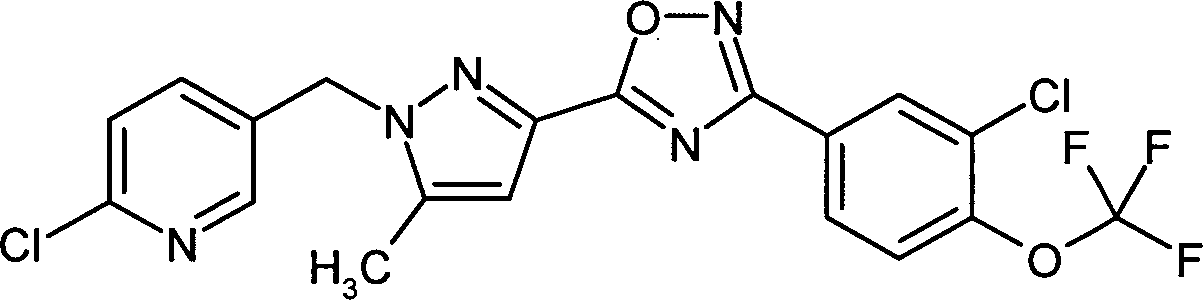
Zu einem Gemisch aus 500 mg (1.38 mmol, Reinheit 95%) der Verbindung aus Beispiel 84A und 336 mg (1.52 mmol) (6-Chlorpyridin-3-yl)methylmethansulfonat [
LC/MS (Methode I, ESIpos): Rt = 1.40 min, m/z = 470/472 [M+H]+.To a mixture of 500 mg (1.38 mmol, purity 95%) of the compound from Example 84A and 336 mg (1.52 mmol) of (6-chloropyridin-3-yl) methyl methanesulfonate [
LC / MS (Method I, ESIpos): R t = 1.40 min, m / z = 470/472 [M + H] + .
Beispiel 155Example 155
{4-[4-(5-{1-[(6-Chlorpyridin-3-yl)methyl]-5-methyl-1H-pyrazol-3-yl}-1,2,4-oxadiazol-3-yl)phenyl]tetrahydro-2H-pyran-4-yl}methanol 
90 mg (0.18 mmol) der Verbindung aus Beispiel 153 wurden in 1.8 ml THF gelöst, bei 0°C mit 0.18 ml (0.18 mmol) einer 1 M Lösung von Lithiumaluminiumhydrid in THF versetzt und 1 h unter Eisbadkühlung gerührt. Anschließend wurde gesättigte wässrige Ammoniumchlorid-Lösung zugetropft und mit Ethylacetat verdünnt. Die organische Phase wurde nacheinander mit 1 N Natronlauge, Wasser und gesättigter Natriumchlorid-Lösung gewaschen, über Magnesiumsulfat getrocknet, filtriert und am Rotationsverdampfer eingeengt. Nach Trocknen des Rückstands im Vakuum wurden 59 mg (68% d. Th.) der Titelverbindung erhalten.
1H-NMR (400 MHz, DMSO-d6, δ/ppm): 8.38 (d, 1H), 8.02 (d, 2H), 7.69 (dd, 1H), 7.57 (d, 2H), 7.54 (d, 1H), 6.94 (s, 1H), 5.58 (s, 2H), 4.70 (t, 1H), 3.71 (m, 2H), 3.44 (d, 2H), 3.38 (t, 2H), 2.39 (s, 3H), 2.02 (m, 2H), 1.94 (m, 2H).
LC/MS (Methode I, ESIpos): Rt = 0.98 min, m/z = 466/468 [M+H]+.90 mg (0.18 mmol) of the compound from Example 153 were dissolved in 1.8 ml of THF, mixed at 0 ° C. with 0.18 ml (0.18 mmol) of a 1 M solution of lithium aluminum hydride in THF and stirred for 1 h while cooling with an ice bath. Then saturated aqueous ammonium chloride solution was added dropwise and diluted with ethyl acetate. The organic phase was washed successively with 1 N sodium hydroxide solution, water and saturated sodium chloride solution, dried over magnesium sulfate, filtered and concentrated on a rotary evaporator. Drying of the residue in vacuo gave 59 mg (68% of theory) of the title compound.
1 H-NMR (400 MHz, DMSO-d 6 , δ / ppm): 8.38 (d, 1H), 8.02 (d, 2H), 7.69 (dd, 1H), 7.57 (d, 2H), 7.54 (d, 1H), 6.94 (s, 1H), 5.58 (s, 2H), 4.70 (t, 1H), 3.71 (m, 2H), 3.44 (d, 2H), 3.38 (t, 2H), 2.39 (s, 3H ), 2.02 (m, 2H), 1.94 (m, 2H).
LC / MS (Method I, ESIpos): R t = 0.98 min, m / z = 466/468 [M + H] + .
Beispiel 156Example 156
4-[4-(5-{1-[(6-Chlorpyridin-3-yl)methyl]-5-methyl-1H-pyrazol-3-yl}-1,2,4-oxadiazol-3-yl)phenyl]-N,N-dimethyl-tetrahydro-2H-pyran-4-carboxamid 
Analog zu dem unter Beispiel 65 beschriebenen Verfahren wurden 155 mg (0.62 mmol) der Verbindung aus Beispiel 45A und 180 mg (0.62 mmol) der Verbindung aus Beispiel 72A zu 126 mg (40% d. Th.) der Titelverbindung umgesetzt. Die Isolierung des Produkts erfolgte direkt aus dem Reaktionsgemisch mittels präparativer HPLC (Methode P).
1H-NMR (400 MHz, DMSO-d6, δ/ppm): 8.38 (d, 1H), 8.07 (d, 2H), 7.69 (dd, 1H), 7.60 (d, 2H), 7.53 (d, 1H), 7.46 (d, 2H), 6.93 (s, 1H), 5.56 (s, 2H), 3.78 (d, 2H), 3.61 (t, 2H), 2.38 (s, 3H), 2.21 (d, 2H), 1.95 (m, 2H).
LC/MS (Methode I, ESIpos): Rt = 1.06 min, m/z = 507/509 [M+H]+.Analogously to the process described under Example 65, 155 mg (0.62 mmol) of the compound from Example 45A and 180 mg (0.62 mmol) of the compound from Example 72A were reacted to give 126 mg (40% of theory) of the title compound. The product was isolated directly from the reaction mixture by preparative HPLC (method P).
1 H-NMR (400 MHz, DMSO-d 6 , δ / ppm): 8.38 (d, 1H), 8.07 (d, 2H), 7.69 (dd, 1H), 7.60 (d, 2H), 7.53 (d, 1H), 7.46 (d, 2H), 6.93 (s, 1H), 5.56 (s, 2H), 3.78 (d, 2H), 3.61 (t, 2H), 2.38 (s, 3H), 2.21 (d, 2H ), 1.95 (m, 2H).
LC / MS (method I, ESIpos): R t = 1.06 min, m / z = 507/509 [M + H] + .
Beispiel 157Example 157
4-[4-(5-{1-[(6-Chlorpyridin-3-yl)methyl]-5-methyl-1H-pyrazol-3-yl}-1,2,4-oxadiazol-3-yl)phenyl]-N-methyl-tetrahydro-2H-pyran-4-carboxamid 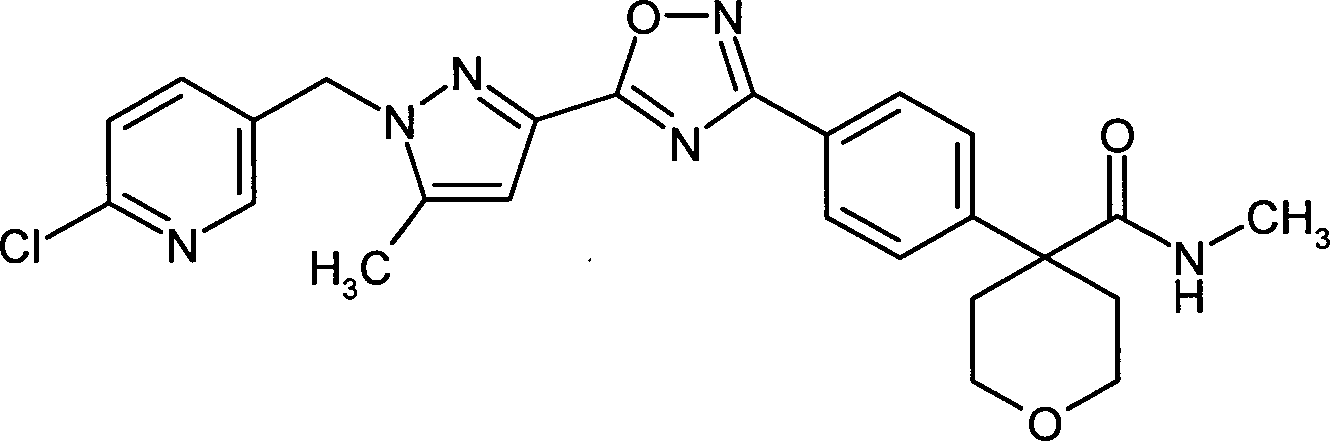
Analog zu dem unter Beispiel 65 beschriebenen Verfahren wurden 163 mg (0.65 mmol) der Verbindung aus Beispiel 45A und 180 mg (0.65 mmol) der Verbindung aus Beispiel 73A zu 120 mg (35% d. Th.) der Titelverbindung umgesetzt. Die Isolierung des Produkts erfolgte direkt aus dem Reaktionsgemisch mittels präparativer HPLC (Methode P).
1H-NMR (400 MHz, DMSO-d6, δ/ppm): 8.38 (d, 1H), 8.02 (d, 2H), 7.68 (m, 2H), 7.54 (m, 3H), 6.93 (s, 1H), 5.56 (s, 2H), 3.74 (m, 2H), 3.48 (t, 2H), 2.56 (d, 3H), 2.46 (d, 2H), 2.38 (s, 3H), 1.89 (m, 2H).
LC/MS (Methode I, ESIpos): Rt = 0.96 min, m/z = 493/495 [M+H]+.Analogously to the process described under Example 65, 163 mg (0.65 mmol) of the compound from Example 45A and 180 mg (0.65 mmol) of the compound from Example 73A were reacted to 120 mg (35% of theory) of the title compound. The product was isolated directly from the reaction mixture by preparative HPLC (method P).
1 H-NMR (400 MHz, DMSO-d 6 , δ / ppm): 8.38 (d, 1H), 8.02 (d, 2H), 7.68 (m, 2H), 7.54 (m, 3H), 6.93 (s, 1H), 5.56 (s, 2H), 3.74 (m, 2H), 3.48 (t, 2H), 2.56 (d, 3H), 2.46 (d, 2H), 2.38 (s, 3H), 1.89 (m, 2H ).
LC / MS (Method I, ESIpos): R t = 0.96 min, m / z = 493/495 [M + H] + .
Beispiel 158Example 158
2-Iod-S-[(5-methyl-3-{3-[4-(trifluormethoxy)phenyl]-1,2,4-oxadiazol-5-yl}-1H-pyrazol-1-yl)methyl]pyridin 
Zu einer Lösung von 100 mg (0.229 mmol) der Verbindung aus Beispiel 2 in 0.5 ml Propionitril gab man bei RT 103 mg (0.688 mmol) Natriumiodid sowie 32 μl (0.252 mmol) Chlor(trimethyl)silan hinzu und erhitzte das Gemisch anschließend in einem Mikrowellengerät (CEM Discover, initiale Einstrahlleistung 250 W) 1 h lang auf 120°C. Nach Abkühlen auf RT wurde das Gemisch mit 2 ml Acetonitril und 1 ml Wasser verdünnt. Es bildeten sich zwei Flüssigkeitsphasen, welche voneinander getrennt wurden. Die organische Phase wurde direkt mittels präparativer HPLC aufgereinigt (Methode N). Man erhielt 61 mg (50% d. Th.) der Titelverbindung.
1H-NMR (400 MHz, CDCl3, δ/ppm): 8.29 (d, 1H), 8.24 (d, 2H), 7.71 (d, 1H), 7.32 (d, 2H), 7.20-7.16 (dd, 1H), 6.82 (s, 1H), 5.39 (s, 2H), 2.31 (s, 3H).
LC/MS (Methode F, ESIpos): Rt = 1.52 min, m/z = 528 [M+H]+. To a solution of 100 mg (0.229 mmol) of the compound from Example 2 in 0.5 ml of propionitrile was added at RT 103 mg (0.688 mmol) of sodium iodide and 32 .mu.l (0.252 mmol) of chloro (trimethyl) silane and then heated the mixture in a Microwave oven (CEM Discover, initial irradiation power 250 W) for 1 h at 120 ° C. After cooling to RT, the mixture was diluted with 2 ml of acetonitrile and 1 ml of water. Two liquid phases formed, which were separated from each other. The organic phase was purified directly by preparative HPLC (Method N). 61 mg (50% of theory) of the title compound were obtained.
1 H-NMR (400 MHz, CDCl 3 , δ / ppm): 8.29 (d, 1H), 8.24 (d, 2H), 7.71 (d, 1H), 7.32 (d, 2H), 7.20-7.16 (dd, 1H), 6.82 (s, 1H), 5.39 (s, 2H), 2.31 (s, 3H).
LC / MS (Method F, ESIpos): R t = 1.52 min, m / z = 528 [M + H] + .
Beispiel 159Example 159
2-Chlor-5-[(5-methyl-3-{5-[4-(trifluormethoxy)phenyl]-1,2,4-oxadiazol-3-yl}-1H-pyrazol-1-yl)methyl]pyridin 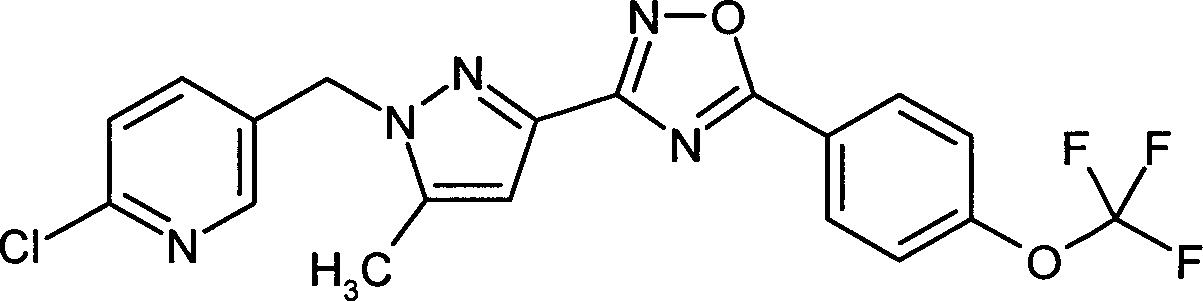
Man legte 215 mg (0.809 mmol) der Verbindung aus Beispiel 91A und 169 μl (1.21 mmol) Triethylamin in 8 ml Dichlormethan vor, gab dann bei 0°C 182 mg (0.809 mmol) 4-(Trifluormethoxy)benzoylchlorid hinzu und ließ das Gemisch 1 h bei RT rühren. Anschließend engte man ein, nahm den Rückstand in 5 ml DMSO auf und erhitzte das Gemisch 30 min lang in einem Mikrowellengerät (CEM Discover, initiale Einstrahlleistung 250 W) auf 120°C. Nach Abkühlen auf RT gab man 5 ml Wasser hinzu, filtrierte den gebildeten Feststoff ab, wusch diesen zweimal mit 2 ml Wasser und trocknete im Vakuum. Man erhielt 220 mg (62% d. Th.) der Titelverbindung.
1H-NMR (400 MHz, CDCl3, δ/ppm): 8.33-8.28 (m, 3H), 7.50-7.46 (dd, 1H), 7.38 (d, 2H), 7.29 (d, 1H), 6.74 (s, 1H), 5.42 (s, 2H), 2.30 (s, 3H).
LC/MS (Methode I, ESIpos): Rt = 1.27 min, m/z = 436/438 [M+H]+.215 mg (0.809 mmol) of the compound of Example 91A and 169 μl (1.21 mmol) of triethylamine in 8 ml of dichloromethane were added, then at 0 ° C 182 mg (0.809 mmol) of 4- (trifluoromethoxy) benzoyl chloride were added and the mixture was left Stir for 1 h at RT. It was then concentrated, the residue was taken up in 5 ml of DMSO and the mixture was heated to 120 ° C. in a microwave oven (CEM Discover, initial irradiation power 250 W) for 30 minutes. After cooling to RT, 5 ml of water were added, the solid formed was filtered off, washed twice with 2 ml of water and dried in vacuo. 220 mg (62% of theory) of the title compound were obtained.
1 H-NMR (400 MHz, CDCl 3, δ / ppm): 8:33 to 8:28 (m, 3H), 7:50 to 7:46 (dd, 1H), 7:38 (d, 2H), 7.29 (d, 1H), 6.74 ( s, 1H), 5.42 (s, 2H), 2.30 (s, 3H).
LC / MS (Method I, ESIpos): R t = 1.27 min, m / z = 436/438 [M + H] + .
Beispiel 160Example 160
2-Chlor-5-[(4-{3-[4-(2-fluorpropan-2-yl)phenyl]-1,2,4-oxadiazol-5-yl}-2-methyl-1H-pyrrol-1-yl)methyl]pyridin 
Analog zu dem unter Beispiel 72 beschriebenen Verfahren wurden 200 mg (0.798 mmol) der Verbindung aus Beispiel 46A und 157 mg (0.798 mmol) der Verbindung aus Beispiel 2A zu 78 mg (24% d. Th.) der Titelverbindung umgesetzt. Nach der Reinigung des Rohprodukts durch präparative HPLC (Methode N) wurden die vereinigten Produktfraktionen bis auf ein Restvolumen an wässriger Phase eingeengt, der Rückstand mit gesättigter wässriger Natriumhydrogencarbonat-Lösung versetzt und zweimal mit Ethylacetat extrahiert. Die vereinigten Ethylacetat-Phasen wurden anschließend über Magnesiumsulfat getrocknet, filtriert, eingeengt und der resultierende Rückstand im Vakuum getrocknet.
1H-NMR (400 MHz, CDCl3, δ/ppm): 8.25 (d, 1H), 8.11 (d, 2H), 7.52-7.47 (m, 3H), 7.33-7.28 (m, 2H), 6.60 (s, 1H), 5.11 (s, 214), 2.20 (s, 3H), 1.72 (s, 3H), 1.70 (s, 314).
LC/MS (Methode F, ESIpos): Rt = 1.50 min, m/z = 411/413 [M+H]+.Analogously to the process described under Example 72, 200 mg (0.798 mmol) of the compound from Example 46A and 157 mg (0.798 mmol) of the compound from Example 2A were reacted to give 78 mg (24% of theory) of the title compound. After purification of the crude product by preparative HPLC (Method N), the combined product fractions were concentrated to a residual volume of aqueous phase, the residue was combined with saturated aqueous sodium bicarbonate solution and extracted twice with ethyl acetate. The combined ethyl acetate phases were then dried over magnesium sulfate, filtered, concentrated and the resulting residue was dried in vacuo.
1 H-NMR (400 MHz, CDCl 3, δ / ppm): 8.25 (d, 1H), 8.11 (d, 2H), 7:52 to 7:47 (m, 3H), 7:33 to 7:28 (m, 2H), 6.60 ( s, 1H), 5.11 (s, 214), 2.20 (s, 3H), 1.72 (s, 3H), 1.70 (s, 314).
LC / MS (Method F, ESIpos): R t = 1.50 min, m / z = 411/413 [M + H] + .
Beispiel 161 Example 161
2-Chlor-5-[(2-methyl-4-{3-[4-(trifluormethyl)phenyl]-1,2,4-oxadiazol-5-yl}-1H-pyrrol-1-yl)methyl]pyridin 
Analog zu dem unter Beispiel 72 beschriebenen Verfahren wurden 200 mg (0.798 mmol) der Verbindung aus Beispiel 46A und 162 mg (0.798 mmol) N'-Hydroxy-4-(trifluormethyl)benzolcarboximidamid zu 102 mg (30% d. Th.) der Titelverbindung umgesetzt. Nach der Reinigung des Rohprodukts durch präparative HPLC (Methode N) wurden die vereinigten Produktfraktionen bis auf ein Restvolumen an wässriger Phase eingeengt, der Rückstand mit gesättigter wässriger Natriumhydrogencarbonat-Lösung versetzt und zweimal mit Ethylacetat extrahiert. Die vereinigten Ethylacetat-Phasen wurden anschließend über Magnesiumsulfat getrocknet, filtriert, eingeengt und der resultierende Rückstand im Vakuum getrocknet.
1H-NMR (400 MHz, CDCl3, δ/ppm): 8.28-8.23 (m, 3H), 7.75 (d, 2H), 7.49 (s, 1H), 7.33-7.28 (m, 2H), 6.61 (s, 1H), 5.11 (s, 2H), 2.21 (s, 3H).
LC/MS (Methode F, ESIpos): Rt = 1.55 min, m/z = 419/421 [M+H]+.Analogously to the process described under Example 72, 200 mg (0.798 mmol) of the compound from Example 46A and 162 mg (0.798 mmol) of N'-hydroxy-4- (trifluoromethyl) benzenecarboximidamide were added to 102 mg (30% of theory) of Title compound implemented. After purification of the crude product by preparative HPLC (Method N), the combined product fractions were concentrated to a residual volume of aqueous phase, the residue was combined with saturated aqueous sodium bicarbonate solution and extracted twice with ethyl acetate. The combined ethyl acetate phases were then dried over magnesium sulfate, filtered, concentrated and the resulting residue was dried in vacuo.
1 H-NMR (400 MHz, CDCl 3, δ / ppm): 8:28 to 8:23 (m, 3H), 7.75 (d, 2H), 7:49 (s, 1H), 7:33 to 7:28 (m, 2H), 6.61 ( s, 1H), 5.11 (s, 2H), 2.21 (s, 3H).
LC / MS (method F, ESIpos): R t = 1.55 min, m / z = 419/421 [M + H] + .
Beispiel 162Example 162
2-Chlor-5-[(2-methyl-4-{3-[4-(trimethylsilyl)phenyl]-1,2,4-oxadiazol-5-yl}-1H-pyrrol-1-yl)methyl]pyridin 
Analog zu dem unter Beispiel 72 beschriebenen Verfahren wurden 200 mg (0.798 mmol) der Verbindung aus Beispiel 46A und 166 mg (0.798 mmol) der Verbindung aus Beispiel 17A zu 83 mg (25% d. Th.) der Titelverbindung umgesetzt. Nach der Reinigung des Rohprodukts durch präparative HPLC (Methode N) wurden die vereinigten Produktfraktionen bis auf ein Restvolumen an wässriger Phase eingeengt, der Rückstand mit gesättigter wässriger Natriumhydrogencarbonat-Lösung versetzt und zweimal mit Ethylacetat extrahiert. Die vereinigten Ethylacetat-Phasen wurden anschließend über Magnesiumsulfat getrocknet, filtriert, eingeengt und der resultierende Rückstand im Vakuum getrocknet.
1H-NMR (400 MHz, CDCl3, δ/ppm): 8.25 (s, 1H), 8.08 (d, 2H), 7.63 (d, 2H), 7.48 (d, 1H), 7.35-7.27 (m, 2H), 6.60 (s, 1H), 5.11 (s, 2H), 2.20 (s, 3H), 0.30 (s, 9H).
LC/MS (Methode F, ESIpos): Rt = 1.71 min, m/z = 423/425 [M+H]+.Analogously to the process described under Example 72, 200 mg (0.798 mmol) of the compound from Example 46A and 166 mg (0.798 mmol) of the compound from Example 17A were reacted to give 83 mg (25% of theory) of the title compound. After purification of the crude product by preparative HPLC (Method N), the combined product fractions were concentrated to a residual volume of aqueous phase, the residue was combined with saturated aqueous sodium bicarbonate solution and extracted twice with ethyl acetate. The combined ethyl acetate phases were then dried over magnesium sulfate, filtered, concentrated and the resulting residue was dried in vacuo.
1 H-NMR (400 MHz, CDCl 3 , δ / ppm): 8.25 (s, 1H), 8.08 (d, 2H), 7.63 (d, 2H), 7.48 (d, 1H), 7.35-7.27 (m, 2H), 6.60 (s, 1H), 5.11 (s, 2H), 2.20 (s, 3H), 0.30 (s, 9H).
LC / MS (Method F, ESIpos): R t = 1.71 min, m / z = 423/425 [M + H] + .
Beispiel 163Example 163
N-[4-(5-{1-[(6-Chlorpyridin-3-yl)methyl]-5-methyl-1H-pyrrol-3-yl}-1,2,4-oxadiazol-3-yl)benzyl]-N-isopropylpropan-2-amin 
Analog zu dem unter Beispiel 72 beschriebenen Verfahren wurden 200 mg (0.798 mmol) der Verbindung aus Beispiel 46A und 172 mg (0.798 mmol) der Verbindung aus Beispiel 65A zu 80 mg (22% d. Th.) der Titelverbindung umgesetzt. Nach der Reinigung des Rohprodukts durch präparative HPLC (Methode N) wurden die vereinigten Produktfraktionen bis auf ein Restvolumen an wässriger Phase eingeengt, der Rückstand mit gesättigter wässriger Natriumhydrogencarbonat-Lösung versetzt und zweimal mit Ethylacetat extrahiert. Die vereinigten Ethylacetat-Phasen wurden anschließend über Magnesiumsulfat getrocknet, filtriert, eingeengt und der resultierende Rückstand im Vakuum getrocknet.
1H-NMR (400 MHz, CDCl3, δ/ppm): 8.25 (d, 1H), 8.02 (d, 2H), 7.52-7.47 (m, 3H), 7.33-7.27 (m, 2H), 6.60 (s, 1H), 5.10 (s, 2H), 3.70 (s, 2H), 3.08-2.98 (m, 2H), 2.20 (s, 3H), 1.02 (d, 12H).
LC/MS (Methode F, ESIpos): Rt = 1.03 min, m/z = 464/466 [M+H]+.Analogously to the process described under Example 72, 200 mg (0.798 mmol) of the compound from Example 46A and 172 mg (0.798 mmol) of the compound from Example 65A were converted to 80 mg (22% of theory) of the title compound. After purification of the crude product by preparative HPLC (Method N), the combined product fractions were concentrated to a residual volume of aqueous phase, the residue was combined with saturated aqueous sodium bicarbonate solution and extracted twice with ethyl acetate. The combined ethyl acetate phases were then dried over magnesium sulfate, filtered, concentrated and the resulting residue was dried in vacuo.
1 H-NMR (400 MHz, CDCl 3, δ / ppm): 8.25 (d, 1H) 8.02 (d, 2H), 7:52 to 7:47 (m, 3H), 7:33 to 7:27 (m, 2H), 6.60 ( s, 1H), 5.10 (s, 2H), 3.70 (s, 2H), 3.08-2.98 (m, 2H), 2.20 (s, 3H), 1.02 (d, 12H).
LC / MS (method F, ESIpos): R t = 1.03 min, m / z = 464/466 [M + H] + .
Beispiel 164Example 164
2-Chlor-5-[(2-methyl-4-{3-[4-(1H-pyrrol-1-ylmethyl)phenyl]-1,2,4-oxadiazol-5-yl}-1H-pyrrol-1-yl)methyl]pyridin 
Analog zu dem unter Beispiel 72 beschriebenen Verfahren wurden 200 mg (0.798 mmol) der Verbindung aus Beispiel 46A und 199 mg (0.798 mmol) der Verbindung aus Beispiel 55A zu 57 mg (16% d. Th.) der Titelverbindung umgesetzt. Nach der Reinigung des Rohprodukts durch präparative HPLC (Methode N) wurden die vereinigten Produktfraktionen bis auf ein Restvolumen an wässriger Phase eingeengt, der Rückstand mit gesättigter wässriger Natriumhydrogencarbonat-Lösung versetzt und zweimal mit Ethylacetat extrahiert. Die vereinigten Ethylacetat-Phasen wurden anschließend über Magnesiumsulfat getrocknet, filtriert, eingeengt und der resultierende Rückstand im Vakuum getrocknet.
1H-NMR (400 MHz, CDCl3, δ/ppm): 8.25 (d, 1H), 8.08 (d, 2H), 7.46 (s, 1H), 7.32-7.24 (m, 2H), 7.21 (d, 2H), 6.72-6.70 (t, 2H), 6.59 (s, 1H), 6.22-6.20 (t, 2H), 5.13 (s, 2H), 5.11 (s, 2H), 2.20 (s, 3H).
LC/MS (Methode D, ESIpos): Rt = 2.70 min, m/z = 430/432 [M+H]+.Analogously to the process described under Example 72, 200 mg (0.798 mmol) of the compound from Example 46A and 199 mg (0.798 mmol) of the compound from Example 55A were reacted to give 57 mg (16% of theory) of the title compound. After purification of the crude product by preparative HPLC (Method N), the combined product fractions were concentrated to a residual volume of aqueous phase, the residue was combined with saturated aqueous sodium bicarbonate solution and extracted twice with ethyl acetate. The combined ethyl acetate phases were then dried over magnesium sulfate, filtered, concentrated and the resulting residue was dried in vacuo.
1 H-NMR (400 MHz, CDCl 3, δ / ppm): 8.25 (d, 1H), 8:08 (d, 2H), 7:46 (s, 1H), 7:32 to 7:24 (m, 2H), 7.21 (d, 2H), 6.72-6.70 (t, 2H), 6.59 (s, 1H), 6.22-6.20 (t, 2H), 5.13 (s, 2H), 5.11 (s, 2H), 2.20 (s, 3H).
LC / MS (method D, ESIpos): R t = 2.70 min, m / z = 430/432 [M + H] + .
Beispiel 165Example 165
tert.-Butyl-[(1-{4-[5-(5-methyl-1-{[6-(methylamino)pyridin-3-yl]methyl}-1H-pyrazol-3-yl)-1,2,4-oxadiazol-3-yl]phenyl}cyclobutyl)oxy]acetat 
110 mg (0.205 mmol) der Verbindung aus Beispiel 140 wurden in 3 ml einer 33%-igen Lösung von Methylamin in Ethanol gelöst und in einem Mikrowellenofen (CEM Discover, initiale Einstrahlleistung 250 W) 5 h lang bei 150°C gerührt. Nach dem Abkühlen auf RT wurde das Reaktionsgemisch am Rotationsverdampfer von allen flüchtigen Komponenten befreit. Der erhaltene Rückstand wurde mittels präparativer HPLC (Methode M) in seine Komponenten aufgetrennt. Es wurden 11 mg (10% d. Th.) der Titelverbindung als Nebenprodukt der Reaktion erhalten (vgl. Beispiel 169).
1H-NMR (400 MHz, CDCl3, δ/ppm): 8.21 (d, 2H), 8.01 (d, 1H), 7.59 (d, 2H), 7.41 (dd, 1H), 6.78 (s, 1H), 6.37 (d, 1H), 5.30 (s, 2H), 4.91 (breit, 1H), 3.60 (s, 1H), 2.91 (s, 3H), 2.55-2.41 (m, 4H), 2.31 (s, 3H), 2.07-1.98 (m, 1H), 1.77-1.67 (m, 1H), 1.41 (s, 9H).
LC/MS (Methode I, ESIpos): Rt = 1.04 min, m/z = 531 [M+H]+.110 mg (0.205 mmol) of the compound from Example 140 were dissolved in 3 ml of a 33% solution of methylamine in ethanol and stirred in a microwave oven (CEM Discover, initial irradiation power 250 W) at 150 ° C. for 5 hours. After cooling to RT, the reaction mixture was freed of all volatile components on a rotary evaporator. The resulting residue was separated into its components by preparative HPLC (Method M). 11 mg (10% of theory) of the title compound were obtained as a by-product of the reaction (see Example 169).
1 H-NMR (400 MHz, CDCl 3, δ / ppm): 8.21 (d, 2H), 8:01 (d, 1H), 7:59 (d, 2H), 7:41 (dd, 1H), 6.78 (s, 1H) , 6.37 (d, 1H), 5.30 (s, 2H), 4.91 (broad, 1H), 3.60 (s, 1H), 2.91 (s, 3H), 2.55-2.41 (m, 4H), 2.31 (s, 3H ), 2.07-1.98 (m, 1H), 1.77-1.67 (m, 1H), 1.41 (s, 9H).
LC / MS (Method I, ESIpos): R t = 1.04 min, m / z = 531 [M + H] + .
Beispiel 166Example 166
N-Methyl-5-[(5-methyl-3-{3-[4-(tetrahydro-2H-pyran-4-yl)phenyl]-1,2,4-oxadiazol-5-yl}-1H-pyrazol-1-yl)methyl]pyridin-2-amin 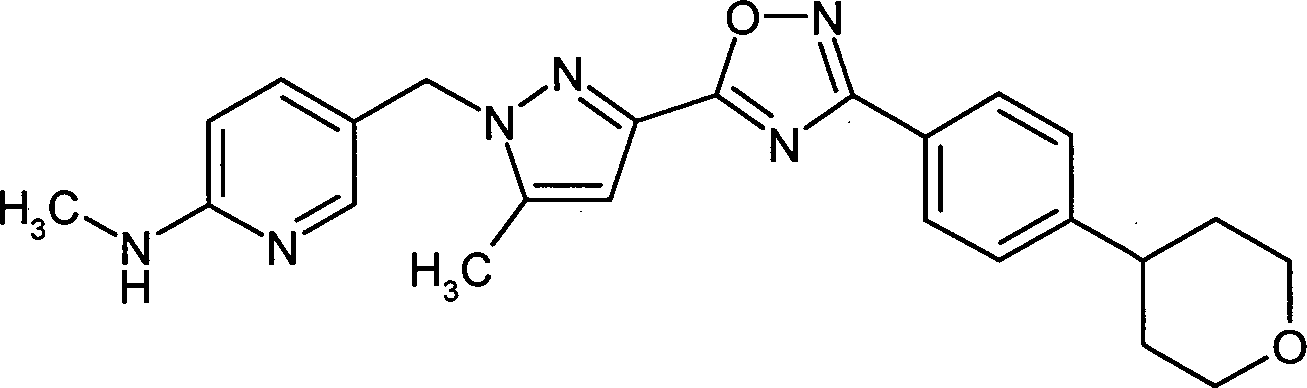
66 mg (0.151 mmol) der Verbindung aus Beispiel 142 wurden in 4 ml einer 33%-igen Lösung von Methylamin in Ethanol gelöst und in einem Mikrowellenofen (CEM Discover, initiale Einstrahlleistung 250 W) 5 h lang bei 150°C gerührt. Nach dem Abkühlen auf RT wurde das Reaktionsgemisch am Rotationsverdampfer von allen flüchtigen Komponenten befreit. Der erhaltene Rückstand wurde mit Acetonitril verrührt. Es wurden 34 mg (53% d. Th.) der Titelverbindung erhalten.
1H-NMR (400 MHz, CDCl3, δ/ppm): 8.14 (d, 2H), 8.03 (d, 1H), 7.38 (dd, 1H), 7.34 (d, 2H), 6.77 (s, 1H), 6.35 (d, 1H), 5.29 (s, 2H), 4.59-4.53 (m, breit, 1H), 4.12-4.08 (m, 2H), 3.59-3.52 (m, 2H), 2.91 (d, 3H), 2.87-2.79 (m, 1H), 2.31 (s, 3H), 1.92-1.79 (m, 4H).
LC/MS (Methode F, ESIpos): Rt = 0.93 min, m/z = 431 [M+H]+.66 mg (0.151 mmol) of the compound from Example 142 were dissolved in 4 ml of a 33% solution of methylamine in ethanol and stirred in a microwave oven (CEM Discover, initial irradiation power 250 W) at 150 ° C. for 5 hours. After cooling to RT, the reaction mixture was freed of all volatile components on a rotary evaporator. The resulting residue was triturated with acetonitrile. There were obtained 34 mg (53% of theory) of the title compound.
1 H-NMR (400 MHz, CDCl 3, δ / ppm): 8.14 (d, 2H), 8:03 (d, 1H), 7:38 (dd, 1H), 7:34 (d, 2H), 6.77 (s, 1H) , 6.35 (d, 1H), 5.29 (s, 2H), 4.59-4.53 (m, broad, 1H), 4.12-4.08 (m, 2H), 3.59-3.52 (m, 2H), 2.91 (d, 3H) , 2.87-2.79 (m, 1H), 2.31 (s, 3H), 1.92-1.79 (m, 4H).
LC / MS (Method F, ESIpos): R t = 0.93 min, m / z = 431 [M + H] + .
Beispiel 167Example 167
1-{4-[5-(5-Methyl-1-{[6-(methylamino)pyridin-3-yl]methyl}-1H-pyrazol-3-yl)-1,2,4-oxadiazol-3-yl]phenyl}cyclobutanol 
Analog zu dem unter Beispiel 165 beschriebenen Verfahren wurden aus 60 mg (0.142 mmol) der Verbindung aus Beispiel 143 50 mg (84% d. Th.) der Titelverbindung erhalten.
1H-NMR (400 MHz, CDCl3, δ/ppm): 8.20 (d, 2H), 7.91 (d, 1H), 7.63 (d, 2H), 7.49 (dd, 114), 6.79 (s, 1H), 6.43 (d, 1H), 5.29 (s, 2H), 2.90 (s, 3H), 2.63-2.57 (m, 214), 2.44-2.38 (m, 2H), 2.32 (s, 3H), 2.13-2.03 (m, 1H), 1.82-1.71 (m, 1H).
LC/MS (Methode D, ESIpos): Rt = 1.56 min, m/z = 417 [M+H]+.Analogously to the process described under Example 165, from 60 mg (0.142 mmol) of the compound from Example 143, 50 mg (84% of theory) of the title compound were obtained.
1 H-NMR (400 MHz, CDCl 3, δ / ppm): 8.20 (d, 2H), 7.91 (d, 1H), 7.63 (d, 2H), 7:49 (dd, 114), 6.79 (s, 1H) , 6.43 (d, 1H), 5.29 (s, 2H), 2.90 (s, 3H), 2.63-2.57 (m, 214), 2.44-2.38 (m, 2H), 2.32 (s, 3H), 2.13-2.03 (m, 1H), 1.82-1.71 (m, 1H).
LC / MS (Method D, ESIpos): R t = 1.56 min, m / z = 417 [M + H] + .
Beispiel 168Example 168
N-Methyl-5-[(5-methyl-3-{3-[4-(methylsulfonyl)phenyl]-1,2,4-oxadiazol-5-yl}-1H-pyrazol-1-yl)methyl]pyridin-2-amin 
Analog zu dem unter Beispiel 165 beschriebenen Verfahren wurden aus 54 mg (0.126 mmol) der Verbindung aus Beispiel 144 15 mg (28% d. Th.) der Titelverbindung erhalten.
1H-NMR (400 MHz, CDCl3, δ/ppm): 8.42 (d, 2H), 8.08 (d, 2H), 7.98 (d, 114), 7.43 (dd, 1H), 6.80 (s, 1H), 6.40 (d, 1H), 5.31 (breit, 1H), 5.30 (s, 2H), 3.10 (s, 3H), 2.90 (s, 3H), 2.33 (s, 3H).
LC/MS (Methode I, ESIpos): Rt = 0.70 min, m/z = 425 [M+H]+.Analogously to the process described under Example 165, from 54 mg (0.126 mmol) of the compound from Example 144, 15 mg (28% of theory) of the title compound were obtained.
1 H-NMR (400 MHz, CDCl 3 , δ / ppm): 8.42 (d, 2H), 8.08 (d, 2H), 7.98 (d, 114), 7.43 (dd, 1H), 6.80 (s, 1H) , 6.40 (d, 1H), 5.31 (broad, 1H), 5.30 (s, 2H), 3.10 (s, 3H), 2.90 (s, 3H), 2.33 (s, 3H).
LC / MS (Method I, ESIpos): R t = 0.70 min, m / z = 425 [M + H] + .
Beispiel 169Example 169
N-Methyl-2-[(1-{4-[5-(5-methyl-1-{[6-(methylamino)pyridin-3-yl]methyl}-1H-pyrazol-3-yl)-1,2,4-oxadiazol-3-yl]phenyl}cyclobutyl)oxy]acetamid 
110 mg (0.205 mmol) der Verbindung aus Beispiel 140 wurden in 3 ml einer 33%-igen Lösung von Methylamin in Ethanol gelöst und in einem Mikrowellenofen (CEM Discover, initiale Einstrahlleistung 250 W) 5 h lang bei 150°C gerührt. Nach dem Abkühlen auf RT wurde das Reaktionsgemisch am Rotationsverdampfer von allen flüchtigen Komponenten befreit. Der erhaltene Rückstand wurde mittels präparativer HPLC (Methode M) in seine Komponenten aufgetrennt. Es wurden 87 mg (87% d. Th.) der Titelverbindung erhalten.
1H-NMR (400 MHz, CDCl3, δ/ppm): 8.21 (d, 2H), 8.00 (d, 1H), 7.51 (d, 2H), 7.42 (dd, 1H), 6.79 (s, 1H), 6.67-6.62 (m, 1H), 6.39 (d, 1H), 5.30 (s, 2H), 5.20 (breit, 1H), 3.61 (s, 2H), 2.91 (s, 3H), 2.85 (d, 3H), 2.53-2.40 (m, 4H), 2.32 (s, 3H), 2.08-1.97 (m, 1H), 1.80-1.70 (m, 1H).
LC/MS (Methode I, ESIpos): Rt = 0.80 min, m/z = 488 [M+H]+.110 mg (0.205 mmol) of the compound from Example 140 were dissolved in 3 ml of a 33% solution of methylamine in ethanol and stirred in a microwave oven (CEM Discover, initial irradiation power 250 W) at 150 ° C. for 5 hours. After cooling to RT, the reaction mixture was rotary evaporated freed of all volatile components. The resulting residue was separated into its components by preparative HPLC (Method M). 87 mg (87% of theory) of the title compound were obtained.
1 H-NMR (400 MHz, CDCl 3, δ / ppm): 8.21 (d, 2H), 8:00 (d, 1H), 7:51 (d, 2H), 7:42 (dd, 1H), 6.79 (s, 1H) , 6.67-6.62 (m, 1H), 6.39 (d, 1H), 5.30 (s, 2H), 5.20 (broad, 1H), 3.61 (s, 2H), 2.91 (s, 3H), 2.85 (d, 3H ), 2.53-2.40 (m, 4H), 2.32 (s, 3H), 2.08-1.97 (m, 1H), 1.80-1.70 (m, 1H).
LC / MS (Method I, ESIpos): R t = 0.80 min, m / z = 488 [M + H] + .
Beispiel 170Example 170
5-({3-[3-(4-tert.-Butylphenyl)-1,2,4-oxadiazol-5-yl]-5-methyl-1H-pyrazol-1-yl}methyl)-N-methylpyridin-2-amin 
125 mg (0.306 mmol) der Verbindung aus Beispiel 70 wurden in 2.3 ml (18.4 mmol) einer 8 M Lösung von Methylamin in Ethanol gelöst. Das Reaktionsgemisch wurde in einem Mikrowellenofen (Biotage Initiator 2.5, automatische Steuerung der Einstrahlleistung) automatisch gesteuert auf 140°C erhitzt. Nach Erreichen von 140°C wurde die Temperatur manuell gesteuert über einen Zeitraum von 3 min auf 160°C gesteigert. Nachdem das Reaktionsgemisch 4 h lang bei 160°C gehalten worden war, ließ man es auf RT abkühlen. Alle flüchtigen Bestandteile wurden am Rotationsverdampfer entfernt. Der erhaltene Rückstand wurde mittels MPLC gereinigt (15 g Kieselgel, Laufmittel: Cyclohexan/Ethylacetat 1:1). Es wurden 120 mg (97% d. Th.) der Titelverbindung erhalten.
1H-NMR (400 MHz, CDCl3, δ/ppm): 8.13 (d, 2H), 8.03 (d, 1H), 7.51 (d, 2H), 7.38 (dd, 1H), 6.77 (s, 1H), 6.36 (d, 1H), 5.29 (s, 2H), 4.58 (breit, 1H), 2.91 (d, 3H), 2.31 (s, 3H), 1.37 (s, 9H).
LC/MS (Methode I, ESIpos): Rt = 0.99 min, m/z = 403 [M+H]+.125 mg (0.306 mmol) of the compound from Example 70 were dissolved in 2.3 ml (18.4 mmol) of an 8 M solution of methylamine in ethanol. The reaction mixture was automatically heated to 140 ° C. in a microwave oven (Biotage Initiator 2.5, automatic control of the irradiation power). After reaching 140 ° C, the temperature was manually controlled over a period of 3 min increased to 160 ° C. After keeping the reaction mixture at 160 ° C for 4 hours, it was allowed to cool to rt. All volatiles were removed on a rotary evaporator. The resulting residue was purified by MPLC (15 g silica gel, eluent: cyclohexane / ethyl acetate 1: 1). 120 mg (97% of theory) of the title compound were obtained.
1 H-NMR (400 MHz, CDCl 3, δ / ppm): 8.13 (d, 2H), 8:03 (d, 1H), 7:51 (d, 2H), 7:38 (dd, 1H), 6.77 (s, 1H) , 6.36 (d, 1H), 5.29 (s, 2H), 4.58 (broad, 1H), 2.91 (d, 3H), 2.31 (s, 3H), 1.37 (s, 9H).
LC / MS (method I, ESIpos): R t = 0.99 min, m / z = 403 [M + H] + .
Beispiel 171Example 171
5-{[3-(3-{4-[1-(Methoxymethyl)cyclobutyl]phenyl}-1,2,4-oxadiazol-5-yl)-5-methyl-1H-pyrazol-1-yl]methyl}-N-methylpyridin-2-amin 
Analog zu dem unter Beispiel 170 beschriebenen Verfahren wurden 125 mg (0.278 mmol) der Verbindung aus Beispiel 146 zu 100 mg (81% d. Th.) der Titelverbindung umgesetzt.
1H-NMR (400 MHz, CDCl3, δ/ppm): 8.13 (d, 2H), 8.03 (d, 1H), 7.38 (dd, 1H), 7.29 (d, 2H), 6.77 (s, 1H), 6.35 (d, 1H), 5.29 (s, 2H), 4.57 (breit, 1H), 3.55 (s, 2H), 3.28 (s, 3H), 2.91 (d, 3H), 2.41-2.29 (m, 4H), 2.31 (s, 3H), 2.15-2.03 (m, 1H), 1.93-1.83 (m, 1H).
LC/MS (Methode I, ESIpos): Rt = 0.94 min, m/z = 445 [M+H]+.Analogously to the process described under Example 170, 125 mg (0.278 mmol) of the compound from Example 146 were converted to 100 mg (81% of theory) of the title compound.
1 H-NMR (400 MHz, CDCl 3, δ / ppm): 8.13 (d, 2H), 8:03 (d, 1H), 7:38 (dd, 1H), 7.29 (d, 2H), 6.77 (s, 1H) , 6.35 (d, 1H), 5.29 (s, 2H), 4.57 (broad, 1H), 3.55 (s, 2H), 3.28 (s, 3H), 2.91 (d, 3H), 2.41-2.29 (m, 4H ), 2.31 (s, 3H), 2.15-2.03 (m, 1H), 1.93-1.83 (m, 1H).
LC / MS (Method I, ESIpos): R t = 0.94 min, m / z = 445 [M + H] + .
Beispiel 172Example 172
5-[(3-{3-[4-(Methoxymethyl)phenyl]-1,2,4-oxadiazol-5-yl}-5-methyl-1H-pyrazol-1-yl)methyl]-N-methylpyridin-2-amin 
Analog zu dem unter Beispiel 170 beschriebenen Verfahren wurden 100 mg (0.253 mmol) der Verbindung aus Beispiel 147 zu 71 mg (72% d. Th.) der Titelverbindung umgesetzt.
1H-NMR (400 MHz, CDCl3, δ/ppm): 8.20 (d, 2H), 8.04 (d, 1H), 7.47 (d, 2H), 7.38 (dd, 1H), 6.78 (s, 1H), 6.36 (d, 1H), 5.30 (s, 2H), 4.59 (breit, 1H), 3.52 (s, 2H), 3.43 (s, 3H), 2.91 (d, 3H), 2.31 (s, 3H).
LC/MS (Methode I, ESIpos): Rt = 0.79 min, m/z = 391 [M+H]+.Analogously to the process described under Example 170, 100 mg (0.253 mmol) of the compound from Example 147 were converted to 71 mg (72% of theory) of the title compound.
1 H-NMR (400 MHz, CDCl 3, δ / ppm): 8.20 (d, 2H), 8:04 (d, 1H), 7:47 (d, 2H), 7:38 (dd, 1H), 6.78 (s, 1H) , 6.36 (d, 1H), 5.30 (s, 2H), 4.59 (broad, 1H), 3.52 (s, 2H), 3.43 (s, 3H), 2.91 (d, 3H), 2.31 (s, 3H).
LC / MS (Method I, ESIpos): R t = 0.79 min, m / z = 391 [M + H] + .
Beispiel 173Example 173
5-({3-[3-(4-Methoxyphenyl)-1,2,4-oxadiazol-5-yl]-5-methyl-1H-pyrazol-1-yl}methyl)-N-methylpyridin-2-amin 
Analog zu dem unter Beispiel 170 beschriebenen Verfahren wurden 100 mg (0.262 mmol) der Verbindung aus Beispiel 149 zu 80 mg (81% d. Th.) der Titelverbindung umgesetzt.
1H-NMR (400 MHz, CDCl3, δ/ppm): 8.14 (d, 2H), 8.03 (d, 1H), 7.38 (dd, 1H), 7.00 (d, 2H), 6.76 (s, 1H), 6.35 (d, 1H), 5.29 (s, 2H), 4.60 (breit, 1H), 3.88 (s, 3H), 2.90 (d, 3H), 2.31 (s, 3H).
LC/MS (Methode I, ESIpos): Rt = 0.81 min, m/z = 377 [M+H]+.Analogously to the process described under Example 170, 100 mg (0.262 mmol) of the compound from Example 149 were reacted to give 80 mg (81% of theory) of the title compound.
1 H-NMR (400 MHz, CDCl 3, δ / ppm): 8.14 (d, 2H), 8:03 (d, 1H), 7:38 (dd, 1H) 7.00 (d, 2H), 6.76 (s, 1H) , 6.35 (d, 1H), 5.29 (s, 2H), 4.60 (broad, 1H), 3.88 (s, 3H), 2.90 (d, 3H), 2.31 (s, 3H).
LC / MS (method I, ESIpos): R t = 0.81 min, m / z = 377 [M + H] + .
Beispiel 174Example 174
5-({3-[3-(3-Fluor-4-methoxyphenyl)-1,2,4-oxadiazol-5-yl]-5-methyl-1H-pyrazol-1-yl}methyl)-N-methylpyridin-2-amin 
Analog zu dem unter Beispiel 170 beschriebenen Verfahren wurden 100 mg (0.250 mmol) der Verbindung aus Beispiel 148 zu 42 mg (41% d. Th.) der Titelverbindung umgesetzt.
1H-NMR (400 MHz, CDCl3, δ/ppm): 8.03 (d, 1H), 7.99-7.91 (m, 2H), 7.38 (dd, 1H), 7.05 (t, 1H), 6.77 (s, 1H), 6.37 (d, 1H), 5.29 (s, 2H), 4.61 (breit, 1H), 3.97 (s, 3H), 2.91 (d, 3H), 2.32 (s, 3H).
LC/MS (Methode I, ESIpos): Rt = 0.83 min, m/z = 395 [M+H]+.Analogously to the process described under Example 170, 100 mg (0.250 mmol) of the compound from Example 148 were converted to 42 mg (41% of theory) of the title compound.
1 H-NMR (400 MHz, CDCl 3, δ / ppm): 8:03 (d, 1H), 7.99-7.91 (m, 2H), 7:38 (dd, 1H), 7:05 (t, 1H), 6.77 (s, 1H), 6.37 (d, 1H), 5.29 (s, 2H), 4.61 (broad, 1H), 3.97 (s, 3H), 2.91 (d, 3H), 2.32 (s, 3H).
LC / MS (Method I, ESIpos): R t = 0.83 min, m / z = 395 [M + H] + .
Beispiel 175Example 175
5-({3-[3-(4-Isobutylphenyl)-1,2,4-oxadiazol-5-yl]-5-methyl-1H-pyrazol-1-yl}methyl)-N-methylpyridin-2-amin 
Analog zu dem unter Beispiel 170 beschriebenen Verfahren wurden 125 mg (0.306 mmol) der Verbindung aus Beispiel 145 zu 102 mg (83% d. Th.) der Titelverbindung umgesetzt.
1H-NMR (400 MHz, CDCl3, δ/ppm): 8.10 (d, 2H), 8.03 (d, 1H), 7.39 (dd, 1H), 7.27 (d, 2H), 6.77 (s, 1H), 6.36 (d, 1H), 5.30 (s, 2H), 4.58 (breit, 1H), 2.91 (d, 3H), 2.53 (d, 2H), 2.31 (s, 3H), 1.92 (m, 1H), 0.92 (d, 6H).
LC/MS (Methode I, ESIpos): Rt = 1.01 min, m/z = 403 [M+H]+.Analogously to the process described under Example 170, 125 mg (0.306 mmol) of the compound from Example 145 were converted to 102 mg (83% of theory) of the title compound.
1 H-NMR (400 MHz, CDCl 3, δ / ppm): 8.10 (d, 2H), 8:03 (d, 1H), 7:39 (dd, 1H), 7.27 (d, 2H), 6.77 (s, 1H) , 6.36 (d, 1H), 5.30 (s, 2H), 4.58 (broad, 1H), 2.91 (d, 3H), 2.53 (d, 2H), 2.31 (s, 3H), 1.92 (m, 1H), 0.92 (d, 6H).
LC / MS (Method I, ESIpos): R t = 1.01 min, m / z = 403 [M + H] + .
Beispiel 176Example 176
5-({3-[3-(4-Isopropylphenyl}-1,2,4-oxadiazol-5-yl]-5-methyl-1H-pyrazol-1-yl}methyl)-N-methylpyridin-2-amin 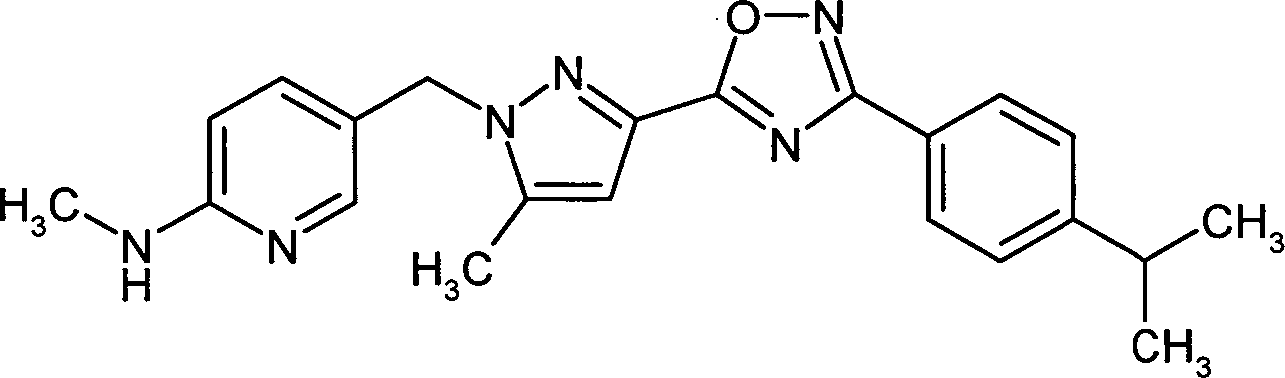
Analog zu dem unter Beispiel 170 beschriebenen Verfahren wurden 125 mg (0.317 mmol) der Verbindung aus Beispiel 150 zu 96 mg (76% d. Th.) der Titelverbindung umgesetzt.
1H-NMR (400 MHz, CDCl3, δ/ppm): 8.12 (d, 2H), 8.03 (d, 1H), 7.38 (dd, 1H), 7.34 (d, 2H), 6.77 (s, 1H), 6.36 (d, 1H), 5.30 (s, 2H), 4.59 (breit, 1H), 2.98 (sept, 1H), 2.91 (d, 3H), 2.31 (s, 3H), 1.30 (d, 6H).
LC/MS (Methode Q, ESIpos): Rt = 1.89 min, m/z = 389 [M+H]+.Analogously to the process described under Example 170, 125 mg (0.317 mmol) of the compound from Example 150 were converted to 96 mg (76% of theory) of the title compound.
1 H-NMR (400 MHz, CDCl 3, δ / ppm): 8.12 (d, 2H), 8:03 (d, 1H), 7:38 (dd, 1H), 7:34 (d, 2H), 6.77 (s, 1H) , 6.36 (d, 1H), 5.30 (s, 2H), 4.59 (broad, 1H), 2.98 (sept, 1H), 2.91 (d, 3H), 2.31 (s, 3H), 1.30 (d, 6H).
LC / MS (Method Q, ESIpos): R t = 1.89 min, m / z = 389 [M + H] + .
Beispiel 177Example 177
N-Ethyl-5-[(5-methyl-3-{3-[4-(trifluormethoxy)phenyl]-1,2,4-oxadiazol-5-yl}-1H-pyrazol-1-yl)methyl]pyridin-2-amin 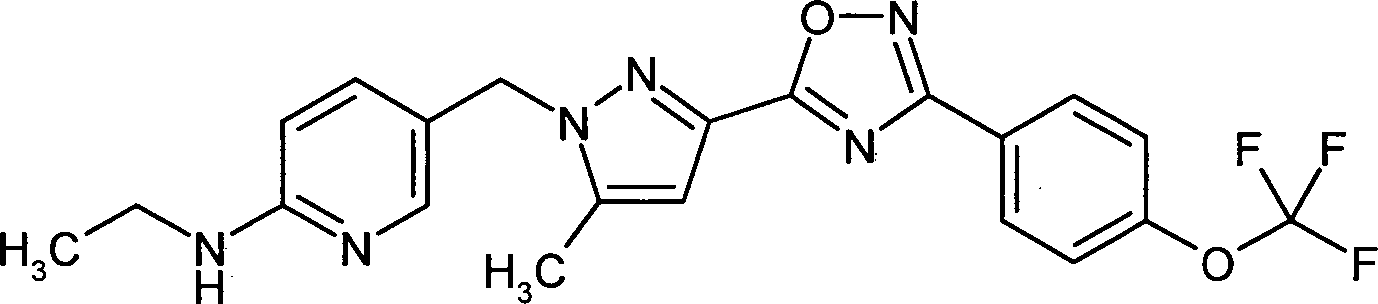
Ein Gemisch aus 200 mg (0.459 mmol) der Verbindung aus Beispiel 2 und 4.6 ml (9.2 mmol) einer 2 M Lösung von Ethylamin in THF wurde in einem Mikrowellengerät (CEM Discover, initiale Einstrahlleistung 250 W) 6 h lang auf 170°C erhitzt. Nach Abkühlen auf RT gab man 1 ml (12.0 mmol) einer 70%-igen Ethylamin-Lösung in Wasser hinzu und erhitzte erneut in dem Mikrowellengerät für 8 h auf 170°C. Nach Abkühlen auf RT wurde das Gemisch eingeengt und der Rückstand mittels präparativer HPLC gereinigt (Methode N). Die vereinigten Produktfraktionen wurden bis auf ein Restvolumen an wässriger Phase eingeengt und der Rückstand mit gesättigter wässriger Natriumhydrogencarbonat-Lösung versetzt. Man filtrierte den gebildeten Feststoff ab, wusch ihn zweimal mit Wasser und trocknete im Vakuum. Man erhielt 110 mg (54% d. Th.) der Titelverbindung.
1H-NMR (400 MHz, CDCl3, δ/ppm): 8.25 (d, 2H), 8.02 (s, 1H), 7.38-7.31 (m, 3H), 6.77 (s, 1H), 6.33 (d, 1H), 5.30 (s, 2H), 4.51 (t, 1H), 3.32-3.25 (m, 2H), 2.31 (s, 3H), 1.26-1.22 (t, 3H).
LC/MS (Methode I, ESIpos): Rt = 0.99 min, m/z = 445 [M+H]+.A mixture of 200 mg (0.459 mmol) of the compound from Example 2 and 4.6 ml (9.2 mmol) of a 2 M solution of ethylamine in THF was heated to 170 ° C. in a microwave oven (CEM Discover, initial irradiation power 250 W) for 6 hours , After cooling to RT, 1 ml (12.0 mmol) of a 70% ethylamine solution in water was added and the mixture was reheated to 170 ° C. in the microwave oven for 8 h. After cooling to RT, the mixture was concentrated and the residue was purified by preparative HPLC (Method N). The combined product fractions were concentrated to a residual volume of aqueous phase and the residue was treated with saturated aqueous sodium bicarbonate solution. The solid formed was filtered off, washed twice with water and dried in vacuo. 110 mg (54% of theory) of the title compound were obtained.
1 H-NMR (400 MHz, CDCl 3 , δ / ppm): 8.25 (d, 2H), 8.02 (s, 1H), 7.38-7.31 (m, 3H), 6.77 (s, 1H), 6.33 (d, 1H), 5.30 (s, 2H), 4.51 (t, 1H), 3.32-3.25 (m, 2H), 2.31 (s, 3H), 1.26-1.22 (t, 3H).
LC / MS (Method I, ESIpos): R t = 0.99 min, m / z = 445 [M + H] + .
Beispiel 178Example 178
N-Methyl-5-[(5-methyl-3-{3-[4-(trimethylsilyl)phenyl]-1,2,4-oxadiazol-5-yl}-1H-pyrazol-1-yl)methyl]pyridin-2-amin 
Ein Gemisch aus 120 mg (0.283 mmol) der Verbindung aus Beispiel 9 und 3.5 ml (28.3 mmol) einer 33%-igen Methylamin-Lösung in Ethanol wurde 5 h lang in einem Mikrowellengerät (CEM Discover, initiale Einstrahlleistung 100 W) auf 140°C erhitzt. Nach dem Abkühlen auf RT wurde das Gemisch direkt mittels präparativer HPLC gereinigt (Methode N). Die vereinigten Produktfraktionen wurden bis auf ein Restvolumen an wässriger Phase eingeengt und der Rückstand mit gesättigter wässriger Natriumhydrogencarbonat-Lösung versetzt und zweimal mit Ethylacetat extrahiert. Die vereinigten Ethylacetat-Phasen wurden anschließend über Magnesiumsulfat getrocknet, filtriert und eingeengt. Nach Trocknen des Rückstands im Vakuum wurden 99 mg (83% d. Th.) der Titelverbindung erhalten.
1H-NMR (400 MHz, CDCl3, δ/ppm): 8.17 (d, 2H), 8.04 (d, 1H), 7.64 (d, 2H), 7.40-7.36 (dd, 1H), 6.78 (s, 1H), 6.36 (d, 1H), 5.30 (s, 2H), 4.63 (s, breit, 1H), 2.91 (d, 3H), 2.31 (s, 3H), 0.31 (s, 9H).
LC/MS (Methode I, ESIpos): Rt = 1.01 min, m/z = 419 [M+H]+.A mixture of 120 mg (0.283 mmol) of the compound from Example 9 and 3.5 ml (28.3 mmol) of a 33% methylamine solution in ethanol was heated for 5 h in a microwave oven (CEM Discover, initial irradiation power 100 W) to 140 ° C heated. After cooling to RT, the mixture was purified directly by preparative HPLC (Method N). The combined product fractions were concentrated to a residual volume of aqueous phase and the residue treated with saturated aqueous sodium bicarbonate solution and extracted twice with ethyl acetate. The combined ethyl acetate phases were then dried over magnesium sulfate, filtered and concentrated. After drying the residue in vacuo, 99 mg (83% of theory) of the title compound were obtained.
1 H-NMR (400 MHz, CDCl 3 , δ / ppm): 8.17 (d, 2H), 8.04 (d, 1H), 7.64 (d, 2H), 7.40-7.36 (dd, 1H), 6.78 (s, 1H), 6.36 (d, 1H), 5.30 (s, 2H), 4.63 (s, broad, 1H), 2.91 (d, 3H), 2.31 (s, 3H), 0.31 (s, 9H).
LC / MS (method I, ESIpos): R t = 1.01 min, m / z = 419 [M + H] + .
Beispiel 179Example 179
N-Ethyl-5-[(5-methyl-3-{3-[4-(1,1,1-trifluor-2-methylpropan-2-yl)phenyl]-1,2,4-oxadiazol-5-yl}-1H-pyrazol-1-yl)methyl]pyridin-2-amin 
Ein Gemisch aus 200 mg (0.433 mmol) der Verbindung aus Beispiel 68, 4.3 ml (8.66 mmol) einer 2 M Lösung von Ethylamin in THF sowie 1.0 ml (12.4 mmol) einer 70%-igen Ethylamin-Lösung in Wasser wurde 6 h lang in einem Mikrowellengerät (CEM Discover, initiale Einstrahlleistung 250 W) auf 170°C erhitzt. Nach Abkühlen auf RT wurden weitere 2.0 ml (24.8 mmol) einer 70%-igen Ethylamin-Lösung in Wasser hinzugegeben, und das Gemisch wurde erneut in dem Mikrowellengerät für 18 h auf 170°C erhitzt. Nach Abkühlen auf RT wurde das Gemisch eingeengt und der Rückstand mittels präparativer HPLC gereinigt (Methode N). Die vereinigten Produktfraktionen wurden bis auf ein Restvolumen an wässriger Phase eingeengt. Man versetzte mit gesättigter Natriumhydrogencarbonat-Lösung und extrahierte zweimal mit Ethylacetat. Die Ethylacetat-Phasen wurden vereinigt, über Magnesiumsulfat getrocknet, filtriert und eingeengt. Nach Trocknen des Rückstands im Vakuum erhielt man 161 mg (79% d. Th.) der Titelverbindung.
1H-NMR (400 MHz, CDCl3, δ/ppm): 8.19 (d, 2H), 8.02 (s, 1H), 7.62 (d, 2H), 7.40-7.35 (dd, 1H), 6.77 (s, 1H), 6.34 (d, 1H), 5.29 (s, 2H), 4.55 (s, breit, 1H), 3.32-3.25 (m, 2H), 2.31 (s, 3H), 1.62 (s, 6H), 1.28-1.21 (t, 3H).
LC/MS (Methode I, ESIpos): Rt = 1.01 min, m/z = 471 [M+H]+.A mixture of 200 mg (0.433 mmol) of the compound of Example 68, 4.3 mL (8.66 mmol) of a 2 M solution of ethylamine in THF and 1.0 mL (12.4 mmol) of a 70% ethylamine solution in water became 6 h heated to 170 ° C in a microwave oven (CEM Discover, initial irradiation power 250 W). After cooling to RT, an additional 2.0 ml (24.8 mmol) of a 70% ethylamine solution in water was added and the mixture was again heated in the microwave oven to 170 ° C for 18 hours. After cooling to RT, the mixture was concentrated and the residue was purified by preparative HPLC (Method N). The combined product fractions were concentrated to a residual volume of aqueous phase. It was mixed with saturated sodium bicarbonate solution and extracted twice with ethyl acetate. The ethyl acetate layers were combined, dried over magnesium sulfate, filtered and concentrated. Drying of the residue in vacuo gave 161 mg (79% of theory) of the title compound.
1 H-NMR (400 MHz, CDCl 3 , δ / ppm): 8.19 (d, 2H), 8.02 (s, 1H), 7.62 (d, 2H), 7.40-7.35 (dd, 1H), 6.77 (s, 1H), 6.34 (d, 1H), 5.29 (s, 2H), 4.55 (s, broad, 1H), 3.32-3.25 (m, 2H), 2.31 (s, 3H), 1.62 (s, 6H), 1.28 -1.21 (t, 3H).
LC / MS (method I, ESIpos): R t = 1.01 min, m / z = 471 [M + H] + .
Beispiel 180 Example 180
N-Ethyl-5-[(5-methyl-3-{3-[4-(trimethylsilyl)phenyl]-1,2,4-oxadiazol-5-yl}-1H-pyrazol-1-yl)methyl]pyridin-2-amin 
Ein Gemisch aus 212 mg (0.50 mmol) der Verbindung aus Beispiel 9, 5.0 ml (10.0 mmol) einer 2 M Lösung von Ethylamin in THF sowie 1.0 ml (12.4 mmol) einer 70%-igen Ethylamin-Lösung in Wasser wurde 6 h lang in einem Mikrowellengerät (CEM Discover, initiale Einstrahlleistung 250 W) auf 170°C erhitzt. Nach Abkühlen auf RT wurden weitere 1.0 ml (12.4 mmol) einer 70%-igen Ethylamin-Lösung in Wasser hinzugegeben, und das Gemisch wurde erneut in dem Mikrowellengerät für 10 h auf 170°C erhitzt. Nach Abkühlen auf RT wurde das Gemisch eingeengt und der Rückstand mittels präparativer HPLC gereinigt (Methode N). Die vereinigten Produktfraktionen wurden bis auf ein Restvolumen an wässriger Phase eingeengt. Man versetzte mit gesättigter Natriumhydrogencarbonat-Lösung und extrahierte zweimal mit Ethylacetat. Die Ethylacetat-Phasen wurden vereinigt, über Magnesiumsulfat getrocknet, filtriert und eingeengt. Nach Trocken des Rückstands im Vakuum erhielt man 76 mg (35% d. Th.) der Titelverbindung.
1H-NMR (400 MHz, CDCl3, δ/ppm): 8.17 (d, 2H), 8.02 (s, 1H), 7.64 (d, 2H), 7.40-7.35 (dd, 1H), 6.78 (s, 1H), 6.35 (d, 1H), 5.29 (s, 2H), 4.62 (s, breit, 1H), 3.35-3.22 (m, 2H), 2.31 (s, 3H), 1.27-1.21 (t, 3H), 0.31 (s, 9H).
LC/MS (Methode F, ESIpos): Rt = 1.23 min, m/z = 433 [M+H]+.A mixture of 212 mg (0.50 mmol) of the compound of Example 9, 5.0 mL (10.0 mmol) of a 2 M solution of ethylamine in THF and 1.0 mL (12.4 mmol) of a 70% ethylamine solution in water became 6 h heated to 170 ° C in a microwave oven (CEM Discover, initial irradiation power 250 W). After cooling to RT, another 1.0 mL (12.4 mmol) of a 70% ethylamine solution in water was added and the mixture was again heated in the microwave oven to 170 ° C for 10 h. After cooling to RT, the mixture was concentrated and the residue was purified by preparative HPLC (Method N). The combined product fractions were concentrated to a residual volume of aqueous phase. It was mixed with saturated sodium bicarbonate solution and extracted twice with ethyl acetate. The ethyl acetate layers were combined, dried over magnesium sulfate, filtered and concentrated. Drying of the residue in vacuo gave 76 mg (35% of theory) of the title compound.
1 H-NMR (400 MHz, CDCl 3 , δ / ppm): 8.17 (d, 2H), 8.02 (s, 1H), 7.64 (d, 2H), 7.40-7.35 (dd, 1H), 6.78 (s, 1H), 6.35 (d, 1H), 5.29 (s, 2H), 4.62 (s, broad, 1H), 3.35-3.22 (m, 2H), 2.31 (s, 3H), 1.27-1.21 (t, 3H) , 0.31 (s, 9H).
LC / MS (Method F, ESIpos): R t = 1.23 min, m / z = 433 [M + H] + .
Beispiel 181Example 181
5-[(3-{3-[3-Chlor-4-(trifluormethoxy)phenyl]-1,2,4-oxadiazol-5-yl}-5-methyl-1H-pyrazol-1-yl)methyl]-N-methylpyridin-2-amin 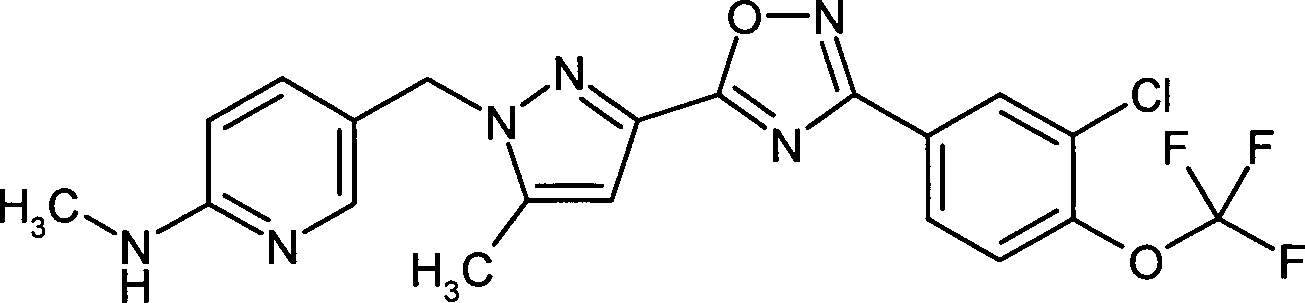
Ein Gemisch aus 224 mg (0.410 mmol, Reinheit 86%) der Verbindung aus Beispiel 154 und 5.1 ml (41.0 mmol) einer 33%-igen Methylamin-Lösung in Ethanol wurde 3 h lang in einem Mikrowellengerät (CEM Discover, initiale Einstrahlleistung 100 W) auf 150°C erhitzt. Nach Abkühlen auf RT wurde das Gemisch mit Wasser versetzt. Der entstandene Feststoff wurde abfiltriert, mit Wasser gewaschen und in DMSO aufgenommen. Diese DMSO-Lösung wurde anschließend mittels präparativer HPLC aufgereinigt (Methode N). Die vereinigten Produktfraktionen wurden bis auf ein Restvolumen an wässriger Phase eingeengt, mit gesättigter wässriger Natriumhydrogencarbonat-Lösung versetzt und zweimal mit Ethylacetat extrahiert. Die vereinigten Ethylacetat-Phasen wurden über Magnesiumsulfat getrocknet, filtriert und eingeengt. Nach Trocknen des Rückstands im Vakuum wurden 118 mg (62% d. Th.) der Titelverbindung erhalten.
1H-NMR (400 MHz, CDCl3, δ/ppm): 9.96 (s, breit, 1H), 8.36 (s, 1H), 8.13 (d, 1H), 7.82 (d, 1H), 7.63 (s, 1H), 7.45 (d, 1H), 6.83 (s, 1H), 6.72 (d, 1H), 5.29 (s, 2H), 2.98 (s, 3H), 2.36 (s, 3H).
LC/MS (Methode I, ESIpos): Rt = 1.04 min, m/z = 465/467 [M+H]+.A mixture of 224 mg (0.410 mmol, purity 86%) of the compound from Example 154 and 5.1 ml (41.0 mmol) of a 33% methylamine solution in ethanol was placed in a microwave oven for 3 h (CEM Discover, initial irradiation power 100 W) ) heated to 150 ° C. After cooling to RT, the mixture was treated with water. The resulting solid was filtered off, washed with water and taken up in DMSO. This DMSO solution was then purified by preparative HPLC (Method N). The combined product fractions were concentrated to a residual volume of aqueous phase, treated with saturated aqueous sodium bicarbonate solution and extracted twice with ethyl acetate. The combined ethyl acetate layers were dried over magnesium sulfate, filtered and concentrated. After drying the residue in vacuo, 118 mg (62% of theory) of the title compound were obtained.
1 H-NMR (400 MHz, CDCl 3 , δ / ppm): 9.96 (s, broad, 1H), 8.36 (s, 1H), 8.13 (d, 1H), 7.82 (d, 1H), 7.63 (s, 1H), 7.45 (d, 1H), 6.83 (s, 1H), 6.72 (d, 1H), 5.29 (s, 2H), 2.98 (s, 3H), 2.36 (s, 3H).
LC / MS (Method I, ESIpos): R t = 1.04 min, m / z = 465/467 [M + H] + .
Beispiel 182Example 182
5-[(3-{3-[3-Fluor-4-(trifluormethoxy)phenyl]-1,2,4-oxadiazol-5-yl}-5-methyl-1H-pyrazol-1-yl)methyl]-N-methylpyridin-2-amin 

Analog zu dem unter Beispiel 76A beschriebenen Verfahren wurden 328 mg (1.00 mmol) der Verbindung aus Beispiel 85A und 418 mg (1.10 mmol) der Verbindung aus Beispiel 90A zu 154 mg (26% d. Th.) der Titelverbindung umgesetzt.
1H-NMR (400 MHz, CDCl3, δ/ppm): 8.25 (d, 1H), 8.02-7.97 (m, 2H), 7.52-7.43 (m, 2H), 6.89 (s, 1H), 6.80-6.69 (m, 3H), 6.43 (d, 1H), 5.78 (s, 2H), 4.68 (s, 2H), 3.82 (s, 3H), 3.79 (s, 3H), 3.00 (s, 3H), 2.32 (s, 3H).
LC/MS (Methode F, ESIpos): Rt = 1.41 min, m/z = 599 [M+H]+. Schritt 2: 5-[(3-{3-[3-Fluor-4-(trifluormethoxy)phenyl]-1,2,4-oxadiazol-5-yl}-5-methyl-1H-pyrazol-1-yl)methyl]-N-methylpyridin-2-amin 
1 H-NMR (400 MHz, CDCl 3 , δ / ppm): 8.25 (d, 1H), 8.02-7.97 (m, 2H), 7.52-7.43 (m, 2H), 6.89 (s, 1H), 6.80- 6.69 (m, 3H), 6.43 (d, 1H), 5.78 (s, 2H), 4.68 (s, 2H), 3.82 (s, 3H), 3.79 (s, 3H), 3.00 (s, 3H), 2.32 (s, 3H).
LC / MS (Method F, ESIpos): R t = 1.41 min, m / z = 599 [M + H] + . Step 2: 5 - [(3- {3- [3-Fluoro-4- (trifluoromethoxy) phenyl] -1,2,4-oxadiazol-5-yl} -5-methyl-1H-pyrazol-1-yl) methyl] -N-methylpyridin-2-amine
Man löste 137 mg (0.228 mmol) der Verbindung aus Beispiel 182/Schritt 1 in 1 ml Dichlormethan, gab 1 ml (12.98 mmol) TFA hinzu und rührte das Gemisch 48 h lang bei RT. Anschließend wurde das Gemisch eingeengt und der Rückstand mittels präparativer HPLC gereinigt (Methode N). Die vereinigten Produktfraktionen wurden bis auf ein Restvolumen an Wasser eingeengt und der Rückstand mit gesättigter wässriger Natriumhydrogencarbonat-Lösung versetzt. Der entstandene Feststoff wurde abfiltriert, zweimal mit Wasser gewaschen und im Vakuum getrocknet. Man erhielt 78 mg (76% d. Th.) der Titelverbindung.
1H-NMR (400 MHz, CDCl3, δ/ppm): 8.10-8.00 (m, 2H), 7.89 (s, 1H), 7.52 (d, 1H), 7.48-7.40 (t, 1H), 6.80 (s, 1H), 6.60 (s, breit, 1H), 6.50 (d, 1H), 5.30 (s, 2H), 2.92 (s, 3H), 2.32 (s, 3H).
LC/MS (Methode I, ESIpos): Rt = 0.95 min, m/z = 449 [M+H]+.137 mg (0.228 mmol) of the compound from Example 182 / Step 1 were dissolved in 1 ml of dichloromethane, 1 ml (12.98 mmol) of TFA was added and the mixture was stirred at RT for 48 h. The mixture was then concentrated and the residue was purified by preparative HPLC (Method N). The combined product fractions were concentrated to a residual volume of water and the residue was treated with saturated aqueous sodium bicarbonate solution. The resulting solid was filtered off, washed twice with water and dried in vacuo. 78 mg (76% of theory) of the title compound were obtained.
1 H-NMR (400 MHz, CDCl 3, δ / ppm): 8:10 to 8:00 (m, 2H), 7.89 (s, 1H), 7:52 (d, 1H), 7:48 to 7:40 (t, 1H), 6.80 ( s, 1H), 6.60 (s, broad, 1H), 6.50 (d, 1H), 5.30 (s, 2H), 2.92 (s, 3H), 2.32 (s, 3H).
LC / MS (Method I, ESIpos): R t = 0.95 min, m / z = 449 [M + H] + .
Beispiel 183Example 183
N-Methyl-5-{[5-methyl-3-(3-{4-[1-(trifluormethyl)cyclopropyl]phenyl}-1,2,4-oxadiazol-5-yl)-1H-pyrazol-1-yl]methyl}pyridin-2-amin 
Ein Gemisch aus 150 mg (0.294 mmol, Reinheit 90%) der Verbindung aus Beispiel 151 und 3.64 ml (29.4 mmol) einer 33%-igen Methylamin-Lösung in Ethanol wurde 3 h lang in einem Mikrowellengerät (CEM Discover, initiale Einstrahlleistung 100 W) auf 150°C erhitzt. Nach Abkühlen auf RT wurde das Gemisch eingeengt und der Rückstand mittels präparativer HPLC gereinigt (Methode N). Die vereinigten Produktfraktionen wurden bis auf ein Restvolumen an wässriger Phase eingeengt. Man versetzte mit gesättigter wässriger Natriumhydrogencarbonat-Lösung. Der gebildete Feststoff wurde abfiltriert und zweimal mit Wasser gewaschen. Nach Trocknen im Vakuum erhielt man 64 mg (46% d. Th.) der Titelverbindung.
1H-NMR (400 MHz, CDCl3, δ/ppm): 8.18 (d, 2H), 8.04 (d, 1H), 7.58 (d, 2H), 7.40-7.36 (dd, 1H), 6.77 (s, 1H), 6.36 (d, 1H), 5.30 (s, 2H), 4.65-4.57 (m, breit, 1H), 2.91 (d, 3H), 2.32 (s, 3H), 1.42-1.38 (m, 2H), 1.12-1.05 (m, 2H).
LC/MS (Methode F, ESIpos): Rt = 1.10 min, m/z = 455 [M+H]+.A mixture of 150 mg (0.294 mmol, purity 90%) of the compound from Example 151 and 3.64 ml (29.4 mmol) of a 33% methylamine solution in ethanol was in a microwave oven for 3 h (CEM Discover, initial irradiation power 100 W ) heated to 150 ° C. After cooling to RT, the mixture was concentrated and the residue was purified by preparative HPLC (Method N). The combined product fractions were concentrated to a residual volume of aqueous phase. Man mixed with saturated aqueous sodium bicarbonate solution. The resulting solid was filtered off and washed twice with water. After drying in vacuo, 64 mg (46% of theory) of the title compound were obtained.
1 H-NMR (400 MHz, CDCl 3 , δ / ppm): 8.18 (d, 2H), 8.04 (d, 1H), 7.58 (d, 2H), 7.40-7.36 (dd, 1H), 6.77 (s, 1H), 6.36 (d, 1H), 5.30 (s, 2H), 4.65-4.57 (m, broad, 1H), 2.91 (d, 3H), 2.32 (s, 3H), 1.42-1.38 (m, 2H) , 1.12-1.05 (m, 2H).
LC / MS (Method F, ESIpos): R t = 1.10 min, m / z = 455 [M + H] + .
Beispiel 184Example 184
5-{[3-(3-{4-[(Diisopropylamino)methyl]phenyl}-1,2,4-oxadiazol-5-yl)-5-methyl-1H-pyrazol-1-yl]methyl}-N-methylpyridin-2-amin 
Ein Gemisch aus 280 mg (0.542 mmol, Reinheit 90%) der Verbindung aus Beispiel 152 und 6.72 ml (54.193 mmol) einer 33%-igen Methylamin-Lösung in Ethanol wurde 3 h lang in einem Mikrowellengerät (CEM Discover, initiale Einstrahlleistung 100 W) auf 150°C erhitzt. Nach Abkühlen auf RT wurde das Gemisch eingeengt und der Rückstand mittels präparativer HPLC gereinigt (Methode N). Die vereinigten Produktfraktionen wurden bis auf ein Restvolumen an wässriger Phase eingeengt. Man versetzte mit gesättigter wässriger Natriumhydrogencarbonat-Lösung und extrahierte zweimal mit Ethylacetat. Die vereinigten Ethylacetat-Phasen wurden über Magnesiumsulfat getrocknet, filtriert und eingeengt. Nach Trocknen des Rückstands im Vakuum wurden 136 mg (66% d. Th.) der Titelverbindung erhalten.
1H-NMR (400 MHz, CDCl3, δ/ppm): 8.10 (d, 2H), 8.02 (d, 1H), 7.50 (d, 2H), 7.40-7.38 (dd, 1H), 6.76 (s, 1H), 6.35 (d, 1H), 5.30 (s, 2H), 4.65-4.49 (m, 1H), 3.70 (s, 2H), 3.10-3.00 (m, 2H), 2.90 (d, 3H), 2.30 (s, 3H), 1.02 (d, 12H).
LC/MS (Methode F, ESIpos): Rt = 0.65 min, m/z = 460 [M+H]+.A mixture of 280 mg (0.542 mmol, purity 90%) of the compound from Example 152 and 6.72 ml (54.193 mmol) of a 33% methylamine solution in ethanol was placed in a microwave oven for 3 h (CEM Discover, initial irradiation power 100 W) ) heated to 150 ° C. After cooling to RT, the mixture was concentrated and the residue was purified by preparative HPLC (Method N). The combined product fractions were concentrated to a residual volume of aqueous phase. It was mixed with saturated aqueous sodium bicarbonate solution and extracted twice with ethyl acetate. The combined ethyl acetate layers were dried over magnesium sulfate, filtered and concentrated. After drying the residue in vacuo, 136 mg (66% of theory) of the title compound were obtained.
1 H-NMR (400 MHz, CDCl 3 , δ / ppm): 8.10 (d, 2H), 8.02 (d, 1H), 7.50 (d, 2H), 7.40-7.38 (dd, 1H), 6.76 (s, 1H), 6.35 (d, 1H), 5.30 (s, 2H), 4.65-4.49 (m, 1H), 3.70 (s, 2H), 3.10-3.00 (m, 2H), 2.90 (d, 3H), 2.30 (s, 3H), 1.02 (d, 12H).
LC / MS (method F, ESIpos): R t = 0.65 min, m / z = 460 [M + H] + .
Beispiel 185Example 185
N-Methyl-5-[(5-methyl-3-{3-[4-(pentafluor-λ6-sulfanyl)phenyl]-1,2,4-oxadiazol-5-yl}-1H-pyrazol-1-yl)methyl]pyridin-2-amin 
Schritt 1: N-(3,4-Dimethoxybenzyl)-N-methyl-5-[(5-methyl-3-{3-[4-(pentafluor-λ6-sulfanyl)phenyl]-1,2,4-oxadiazol-5-yl}-1H-pyrazol-1-yl)methyl]pyridin-2-amin 
Analog zu dem unter Beispiel 66 beschriebenen Verfahren wurden 400 mg (0.923 mmol, Reinheit 92%) der Verbindung aus Beispiel 92A und 242 mg (0.923 mmol) der Verbindung aus Beispiel 11A zu 222 mg (37% d. Th., Reinheit 95%) der Titelverbindung umgesetzt. Das Rohprodukt wurde mittels präparativer HPLC gereinigt (Methode N).
1H-NMR (400 MHz, CDCl3, δ/ppm): 8.31 (d, 2H), 8.12 (d, 1H), 7.88 (d, 2H), 7.42-7.38 (dd, 1H), 6.82-6.70 (m, 4H), 6.49 (d, 1H), 5.31 (s, 2H), 4.71 (s, 2H), 3.84 (s, 3H), 3.81 (s, 3H), 3.04 (s, 3H), 2.34 (s, 3H).
LC/MS (Methode I, ESIpos): Rt = 1.25 min, m/z = 623 [M+H]+. Schritt 2: N-Methyl-5-[(5-methyl-3-{3-[4-(pentafluor-λ6-sulfanyl)phenyl]-1,2,4-oxadiazol-5-yl}-1H-pyrazol-1-yl)methyl]pyridin-2-amin 
1 H-NMR (400 MHz, CDCl 3, δ / ppm): 8.31 (d, 2H), 8.12 (d, 1H), 7.88 (d, 2H), 7:42 to 7:38 (dd, 1H), 6.82-6.70 ( m, 4H), 6.49 (d, 1H), 5.31 (s, 2H), 4.71 (s, 2H), 3.84 (s, 3H), 3.81 (s, 3H), 3.04 (s, 3H), 2.34 (s , 3H).
LC / MS (Method I, ESIpos): R t = 1.25 min, m / z = 623 [M + H] + . Step 2: N-Methyl-5 - [(5-methyl-3- {3- [4- (pentafluoro-λ 6 -sulfanyl) phenyl] -1,2,4-oxadiazol-5-yl} -1H-pyrazole -1-yl pyridin-2-amine) methyl]
Zu einer Lösung von 180 mg (0.289 mmol) der Verbindung aus Beispiel 185/Schritt 1 in 1 ml Dichlormethan gab man 1 ml Trifluoressigsäure hinzu und rührte das Gemisch 3 Tage bei RT. Man engte das Gemisch anschließend ein und reinigte den Rückstand mittels präparativer HPLC (Methode N). Die vereinigten Produktfraktionen wurden bis auf ein Restvolumen an wässriger Phase eingeengt und mit gesättigter wässriger Natriumhydrogencarbonat-Lösung versetzt. Der gebildete Feststoff wurde abfiltriert, zweimal mit Wasser gewaschen und im Vakuum getrocknet. Man erhielt 109 mg (80% d. Th.) der Titelverbindung.
1H-NMR (400 MHz, CDCl3, δ/ppm): 8.31 (d, 2H), 8.03 (d, 1H), 7.89 (d, 2H), 7.40-7.37 (dd, 1H), 6.78 (s, 1H), 6.36 (d, 1H), 5.30 (s, 2H), 4.65-4.57 (m, breit, 1H), 2.91 (d, 3H), 2.33 (s, 3H).
LC/MS (Methode D, ESIpos): Rt = 1.90 min, m/z = 473 [M+H]+.To a solution of 180 mg (0.289 mmol) of the compound from Example 185 / Step 1 in 1 ml of dichloromethane was added 1 ml of trifluoroacetic acid and the mixture was stirred at RT for 3 days. The mixture was then concentrated by evaporation and the residue was purified by preparative HPLC (Method N). The combined product fractions were concentrated to a residual volume of aqueous phase and treated with saturated aqueous sodium bicarbonate solution. The resulting solid was filtered off, washed twice with water and dried in vacuo. 109 mg (80% of theory) of the title compound were obtained.
1 H-NMR (400 MHz, CDCl 3, δ / ppm): 8.31 (d, 2H), 8:03 (d, 1H), 7.89 (d, 2H), 7:40 to 7:37 (dd, 1H), 6.78 (s, 1H), 6.36 (d, 1H), 5.30 (s, 2H), 4.65-4.57 (m, broad, 1H), 2.91 (d, 3H), 2.33 (s, 3H).
LC / MS (Method D, ESIpos): R t = 1.90 min, m / z = 473 [M + H] + .
Beispiel 186Example 186
N-Methyl-5-{[5-methyl-3-(3-{4-[(trifluormethyl)sulfonyl]phenyl}-1,2,4-oxadiazol-5-yl)-1H-pyrazol-1-yl]methyl}pyridin-2-amin 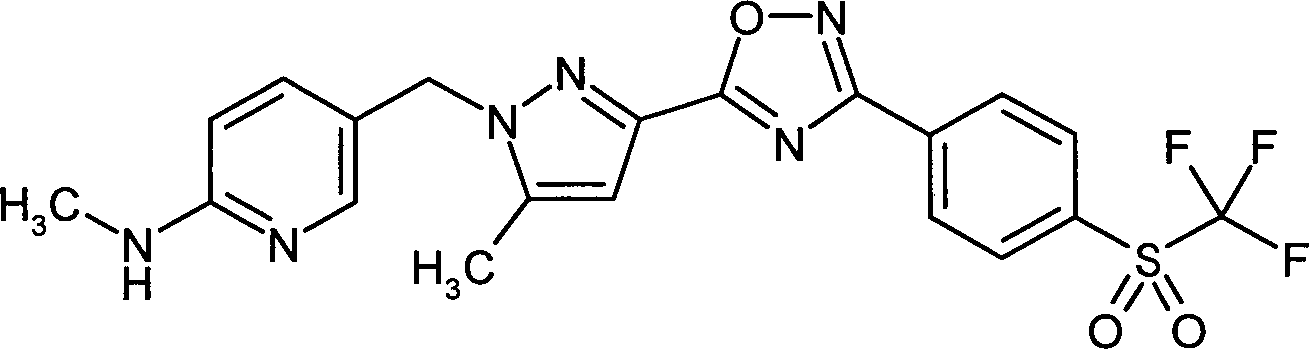

Analog zu dem unter Beispiel 3 beschriebenen Verfahren wurden 200 mg (0.558 mmol) der Verbindung aus Beispiel 26A und 171 mg (0.558 mmol) der Verbindung aus Beispiel 90A zu 127 mg (36% d. Th.) der Titelverbindung umgesetzt. Abweichend von der genannten Vorschrift wurden hier nach 18 h Reaktionszeit bei RT weitere 16 mg (0.140 mmol) Kalium-tert.-butylat hinzugefügt und das Gemisch erneut für 4 h bei RT gerührt. Das Rohprodukt wurde mittels präparativer HPLC gereinigt (Methode N).
1H-NMR (400 MHz, CDCl3, δ/ppm): 8.46 (d, 2H), 8.26 (d, 1H), 8.21 (d, 2H), 7.52-7.49 (dd, 1H), 6.92 (s, 1H), 6.79-6.70 (m, 2H), 6.45 (d, 1H), 5.79 (s, 2H), 4.67 (s, 2H), 3.82 (s, 3H), 3.79 (s, 3H), 3.01 (s, 3H), 2.36 (s, 3H).
LC/MS (Methode D, ESIpos): Rt = 2.39 min, m/z = 629 [M+H]+. Schritt 2: N-Methyl-5-{[5-methyl-3-(3-{4-[(trifluormethyl)sulfonyl]phenyl}-1,2,4-oxadiazol-5-yl)-1H-pyrazol-1-yl]methyl}pyridin-2-amin 
1 H-NMR (400 MHz, CDCl 3, δ / ppm): 8:46 (d, 2H), 8.26 (d, 1H), 8.21 (d, 2H), 7:52 to 7:49 (dd, 1H), 6.92 (s, 1H), 6.79-6.70 (m, 2H), 6.45 (d, 1H), 5.79 (s, 2H), 4.67 (s, 2H), 3.82 (s, 3H), 3.79 (s, 3H), 3.01 (s , 3H), 2.36 (s, 3H).
LC / MS (Method D, ESIpos): R t = 2.39 min, m / z = 629 [M + H] + . Step 2: N-Methyl-5 - {[5-methyl-3- (3- {4 - [(trifluoromethyl) sulfonyl] phenyl} -1,2,4-oxadiazol-5-yl) -1H-pyrazole-1 -yl] methyl} pyridin-2-amine
Analog zu dem unter Beispiel 185/Schritt 2 beschriebenen Verfahren wurden 100 mg (0.159 mmol) der Verbindung aus Beispiel 186/Schritt 1 zu 76 mg (79% d. Th., Reinheit 95%) der Titelverbindung umgesetzt. Abweichend von der genannten Vorschrift wurde hier nach Zusatz der Natriumhydrogencarbonat-Lösung dreimal mit Ethylacetat extrahiert. Die vereinigten Ethylacetat-Extrakte wurden über Magnesiumsulfat getrocknet, filtriert und eingeengt und der Rückstand unter Erhalt der Titelverbindung im Vakuum getrocknet.
1H-NMR (400 MHz, CDCl3, δ/ppm): 8.46 (d, 2H), 8.22-8.18 (m, 3H), 7.52-7.49 (dd, 1H), 6.92 (s, 1H), 6.32 (d, 1H), 5.76 (s, 2H), 4.60 (s, breit, 1H), 2.88 (d, 3H), 2.35 (s, 3H).
LC/MS (Methode F, ESIpos): Rt = 1.09 min, m/z = 479 [M+H]+.Analogously to the process described under Example 185 / Step 2, 100 mg (0.159 mmol) of the compound from Example 186 / Step 1 were reacted to give 76 mg (79% of theory, purity 95%) of the title compound. Notwithstanding the above provision was extracted here after addition of the sodium bicarbonate solution three times with ethyl acetate. The combined ethyl acetate extracts were dried over magnesium sulfate, filtered and concentrated and the residue dried in vacuo to give the title compound.
1 H-NMR (400 MHz, CDCl 3, δ / ppm): 8:46 (d, 2H), 8:22 to 8:18 (m, 3H), 7:52 to 7:49 (dd, 1H), 6.92 (s, 1H), 6:32 ( d, 1H), 5.76 (s, 2H), 4.60 (s, broad, 1H), 2.88 (d, 3H), 2.35 (s, 3H).
LC / MS (Method F, ESIpos): R t = 1.09 min, m / z = 479 [M + H] + .
Beispiel 187Example 187
N-Methyl-5-{[5-methyl-3-(3-{4-[N-methyl-S-(trifluormethyl)sulfonimidoyl]phenyl}-1,2,4-oxadiazol-5-yl)-1H-pyrazol-1-yl]methyl}pyridin-2-amin (Racemat) 

Zu einer Lösung von 282 mg (0.650 mmol, Reinheit 92%) der Verbindung aus Beispiel 92A und einem Tropfen DMF in 6.5 ml Dichlormethan gab man bei 0°C 170 μl (1.95 mmol) Oxalylchlorid hinzu und rührte das Gemisch 1 h bei RT. Man engte das Gemisch anschließend ein, trocknete den Rückstand im Vakuum und nahm ihn danach in 4 ml Dichlormethan auf. Dieses Gemisch gab man dann bei 0°C zu einer Lösung von 188 mg (0.650 mmol, Reinheit 97%) der Verbindung aus Beispiel 68A und 181 μl (1.30 mmol) Triethylamin in 2.5 ml Dichlormethan hinzu und rührte 1 h bei RT. Man engte das Gemisch anschließend ein, trocknete den Rückstand im Vakuum und nahm ihn danach in 6.5 ml DMSO auf. Dieses Gemisch wurde anschließend in einem Mikrowellengerät (CEM Discover, initiale Einstrahlleistung 100 W) 30 min lang auf 120°C erhitzt. Nach dem Abkühlen auf RT wurde das Gemisch direkt mittels präparativer HPLC gereinigt (Methode N). Man erhielt so 89 mg (21% d. Th., Reinheit 96%) der Titelverbindung.
LC/MS (Methode D, ESIpos): Rt = 2.36 min, m/z = 642 [M+H]+. Schritt 2: N-Methyl-5-{[5-methyl-3-(3-{4-[N-methyl-S-(trifluormethyl)sulfonimidoyl]phenyl}-1,2,4-oxadiazol-5-yl)-1H-pyrazol-1-yl]methyl}pyridin-2-amin (Racemat) 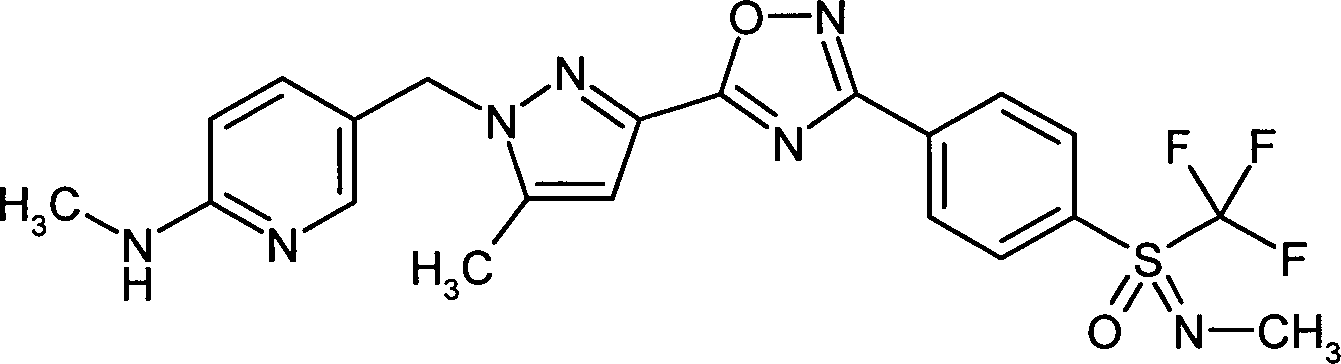
LC / MS (Method D, ESIpos): R t = 2.36 min, m / z = 642 [M + H] + . Step 2: N-Methyl-5 - {[5-methyl-3- (3- {4- [N-methyl-S- (trifluoromethyl) sulfonimidoyl] phenyl} -1,2,4-oxadiazol-5-yl) -1H-pyrazol-1-yl] methyl} pyridin-2-amine (racemate)
Zu einer Lösung von 89 mg (0.133 mmol, Reinheit 96%) der Verbindung aus Beispiel 187/Schritt 1 in 0.5 ml Dichlormethan gab man 0.5 ml (6.49 mmol) Trifluoressigsäure hinzu und rührte das Gemisch über Nacht bei RT. Man engte danach ein und reinigte den Rückstand mittels präparativer HPLC (Methode N). Die vereinigten Produktfraktionen wurden bis auf ein Restvolumen an wässriger Phase eingeengt, mit gesättigter wässriger Natriumhydrogencarbonat-Lösung versetzt und zweimal mit Ethylacetat extrahiert. Die vereinigten Ethylacetat-Phasen wurden über Magnesiumsulfat getrocknet, filtriert und eingeengt. Der Rückstand wurde im Vakuum getrocknet und anschließend nochmals mittels präparativer HPLC gereinigt (Methode N). Die vereinigten Produktfraktionen wurden wiederum bis auf ein Restvolumen an wässriger Phase eingeengt, mit gesättigter wässriger Natriumhydrogencarbonat-Lösung versetzt und zweimal mit Ethylacetat extrahiert. Die vereinigten Ethylacetat-Phasen wurden über Magnesiumsulfat getrocknet, filtriert und eingeengt. Nach Trocknen des Rückstands im Vakuum erhielt man 38 mg (54% d. Th.) der Titelverbindung.
1H-NMR (400 MHz, CDCl3, δ/ppm): 8.44 (d, 2H), 8.21 (d, 2H), 8.02 (d, 1H), 7.42-7.39 (dd, 1H), 6.79 (s, 1H), 6.38 (d, 1H), 5.30 (s, 2H), 4.92 (s, breit, 1H), 3.12 (d, 3H), 2.92 (d, 3H), 2.33 (s, 3H).
LC/MS (Methode I, ESIpos): Rt = 0.96 min, m/z = 492 [M+H]+.To a solution of 89 mg (0.133 mmol, purity 96%) of the compound from Example 187 / Step 1 in 0.5 ml of dichloromethane was added 0.5 ml (6.49 mmol) of trifluoroacetic acid and the mixture was stirred at RT overnight. It was then concentrated and the residue was purified by preparative HPLC (Method N). The combined product fractions were concentrated to a residual volume of aqueous phase, treated with saturated aqueous sodium bicarbonate solution and extracted twice with ethyl acetate. The combined ethyl acetate layers were dried over magnesium sulfate, filtered and concentrated. The residue was dried in vacuo and then purified again by preparative HPLC (Method N). The combined product fractions were again concentrated to a residual volume of aqueous phase, treated with saturated aqueous sodium bicarbonate solution and extracted twice with ethyl acetate. The combined ethyl acetate layers were dried over magnesium sulfate, filtered and concentrated. Drying of the residue in vacuo gave 38 mg (54% of theory) of the title compound.
1 H-NMR (400 MHz, CDCl 3, δ / ppm): 8:44 (d, 2H), 8.21 (d, 2H) 8.02 (d, 1H), 7:42 to 7:39 (dd, 1H), 6.79 (s, 1H), 6.38 (d, 1H), 5.30 (s, 2H), 4.92 (s, broad, 1H), 3.12 (d, 3H), 2.92 (d, 3H), 2.33 (s, 3H).
LC / MS (Method I, ESIpos): R t = 0.96 min, m / z = 492 [M + H] + .
Beispiel 188Example 188
N-Methyl-5-{[5-methyl-3-(3-{4-[S-(trifluormethyl)sulfonimidoyl]phenyl}-1,2,4-oxadiazol-5-yl)-1H-pyrazol-1-yl]methyl}pyridin-2-amin (Racemat) 
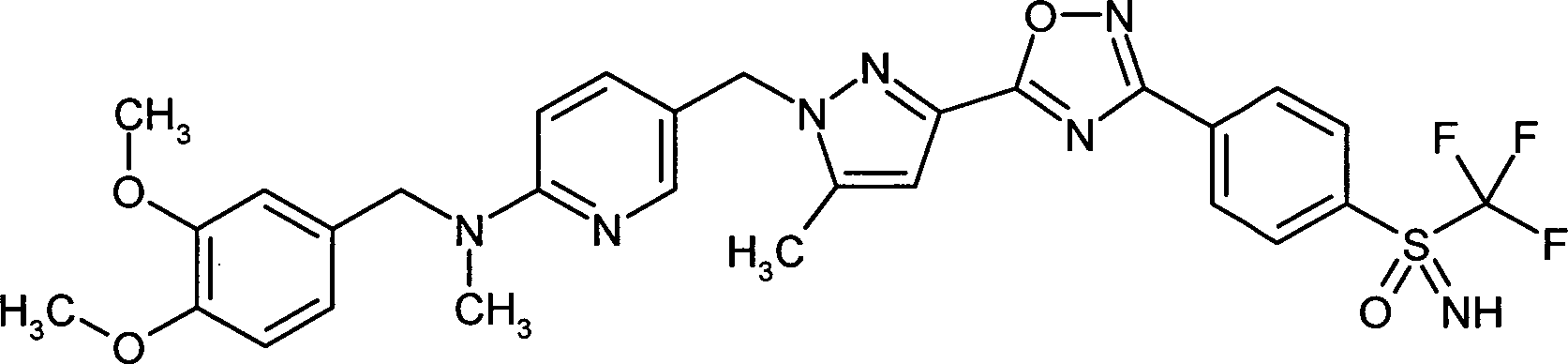
Zu einer Lösung von 700 mg (1.68 mmol, Reinheit 95%) der Verbindung aus Beispiel 92A in 8 ml DMF gab man 322 mg (1.677 mmol) EDC sowie 227 mg (1.677 mmol) HOBt hinzu, rührte das Gemisch 30 min bei RT und fügte anschließend 498 mg (1.68 mmol, Reinheit 90%) der Verbindung aus Beispiel 69A hinzu. Man rührte weitere 30 min bei RT und erhitzte das Gemisch anschließend für 30 min unter Rühren auf 150°C. Nach dem Abkühlen auf RT engte man das Gemisch ein und nahm den Rückstand in Ethylacetat und Wasser auf. Nach Trennung der Phasen wurde die wässrige Phase einmal mit Ethylacetat extrahiert. Die vereinigten Ethylacetat-Phasen wurden einmal mit gesättigter Natriumchlorid-Lösung gewaschen, über Magnesiumsulfat getrocknet, filtriert und eingeengt. Der Rückstand wurde mittels präparativer HPLC gereinigt (Methode N). Nach Trocknen des Produkts im Vakuum wurden 87 mg (8% d. Th., Reinheit 98%) der Titelverbindung erhalten.
LC/MS (Methode I, ESIpos): Rt = 1.08 min, m/z = 628 [M+H]+. Schritt 2: N-Methyl-5-{[5-methyl-3-(3-{4-[S-(trifluormethyl)sulfonimidoyl]phenyl}-1,2,4-oxadiazol-5-yl)-1H-pyrazol-1-yl]methyl}pyridin-2-am in (Racemat) 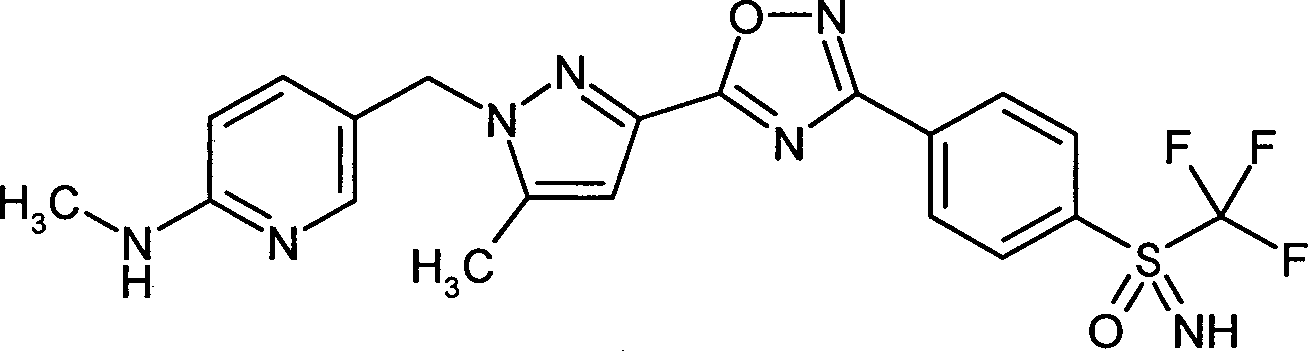
LC / MS (Method I, ESIpos): R t = 1.08 min, m / z = 628 [M + H] + . Step 2: N -methyl-5 - {[5-methyl-3- (3- {4- [S- (trifluoromethyl) sulfonimidoyl] phenyl} -1,2,4-oxadiazol-5-yl) -1H-pyrazole -1-yl] methyl} pyridin-2-am in (racemate)
Zu einer Lösung von 85 mg (0.135 mmol, Reinheit 96%) der Verbindung aus Beispiel 188/Schritt 1 in 0.7 ml Dichlormethan gab man 0.7 ml (9.086 mmol) Trifluoressigsäure hinzu und rührte das Gemisch 28 h bei RT. Man engte danach ein und reinigte den Rückstand mittels präparativer HPLC (Methode N). Die vereinigten Produktfraktionen wurden bis auf ein Restvolumen an wässriger Phase eingeengt und mit gesättigter wässriger Natriumhydrogencarbonat-Lösung versetzt. Der entstandene Feststoff wurde abfiltriert, zweimal mit Wasser gewaschen und im Vakuum getrocknet. Man erhielt 39 mg (60% d. Th.) der Titelverbindung.
1H-NMR (400 MHz, CDCl3, δ/ppm): 8.49 (d, 2H), 8.28 (d, 2H), 8.03 (s, 1H), 7.40 (d, 1H), 6.80 (s, 1H), 6.36 (d, 1H), 5.30 (s, 2H), 4.61 (s, breit, 1H), 3.72 (s, 1H), 2.92 (d, 3H), 2.32 (s, 3H).
LC/MS (Methode F, ESIpos): Rt = 0.94 min, m/z = 478 [M+H]+.To a solution of 85 mg (0.135 mmol, purity 96%) of the compound from Example 188 / Step 1 in 0.7 ml of dichloromethane was added 0.7 ml (9,086 mmol) of trifluoroacetic acid and the mixture was stirred at RT for 28 h. It was then concentrated and the residue was purified by preparative HPLC (Method N). The combined product fractions were concentrated to a residual volume of aqueous phase and treated with saturated aqueous sodium bicarbonate solution. The resulting solid was filtered off, washed twice with water and dried in vacuo. 39 mg (60% of theory) of the title compound were obtained.
1 H-NMR (400 MHz, CDCl 3 , δ / ppm): 8.49 (d, 2H), 8.28 (d, 2H), 8.03 (s, 1H), 7.40 (d, 1H), 6.80 (s, 1H) , 6.36 (d, 1H), 5.30 (s, 2H), 4.61 (s, broad, 1H), 3.72 (s, 1H), 2.92 (d, 3H), 2.32 (s, 3H).
LC / MS (Method F, ESIpos): R t = 0.94 min, m / z = 478 [M + H] + .
Beispiel 189 Example 189
Ethyl-4-{4-[5-(5-methyl-1-{[6-(methylamino)pyridin-3-yl]methyl}-1H-pyrazol-3-yl)-1,2,4-oxadiazol-3-yl]phenyl}tetrahydro-2H-pyran-4-carboxylat 
80 mg (0.16 mmol) der Verbindung aus Beispiel 153 wurden in 0.97 ml (7.87 mmol) einer 33%-igen Lösung von Methylamin in Ethanol in der Mikrowelle für 9 h auf 160°C erhitzt. Nach dem Abkühlen auf RT wurde das Gemisch direkt mittels präparativer HPLC gereinigt (Methode P). Man engte die vereinigten Produktfraktionen am Rotationsverdampfer ein. Nach Trocknen des Rückstands im Vakuum wurden 36 mg (40% d. Th.) der Titelverbindung erhalten.
1H-NMR (400 MHz, DMSO-d6, δ/ppm): 8.06 (d, 2H), 7.99 (d, 1H), 7.59 (d, 2H), 7.30 (dd, 1H), 6.87 (s, 1H), 6.54 (m, 1H), 6.42 (d, 1H), 5.27 (s, 2H), 4.12 (q, 2H), 3.84 (m, 2H), 3.46 (t, 2H), 2.74 (d, 3H), 2.42 (m, 2H), 2.38 (s, 3H), 1.94 (m, 2H), 1.12 (t, 3H).
LC/MS (Methode D, ESIpos): Rt = 1.74 min, m/z = 503 [M+H]+.80 mg (0.16 mmol) of the compound from Example 153 were heated to 160 ° C. in 0.97 ml (7.87 mmol) of a 33% solution of methylamine in ethanol in the microwave for 9 h. After cooling to RT, the mixture was purified directly by preparative HPLC (Method P). The combined product fractions were concentrated on a rotary evaporator. Drying of the residue in vacuo gave 36 mg (40% of theory) of the title compound.
1 H-NMR (400 MHz, DMSO-d 6 , δ / ppm): 8.06 (d, 2H), 7.99 (d, 1H), 7.59 (d, 2H), 7.30 (dd, 1H), 6.87 (s, 1H), 6.54 (m, 1H), 6.42 (d, 1H), 5.27 (s, 2H), 4.12 (q, 2H), 3.84 (m, 2H), 3.46 (t, 2H), 2.74 (d, 3H ), 2.42 (m, 2H), 2.38 (s, 3H), 1.94 (m, 2H), 1.12 (t, 3H).
LC / MS (Method D, ESIpos): R t = 1.74 min, m / z = 503 [M + H] + .
Beispiel 190Example 190
(4-{4-[5-(5-Methyl-1-{[6-(methylamino)pyridin-3-yl]methyl}-1H-pyrazol-3-yl)-1,2,4-oxadiazol-3-yl]phenyl}tetrahydro-2H-pyran-4-yl)methanol 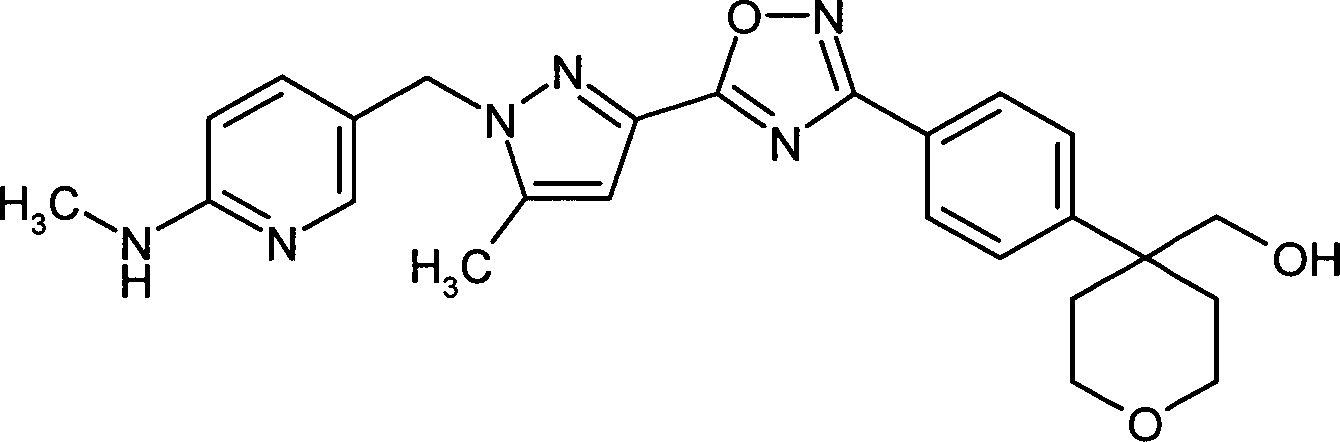
50 mg (0.11 mmol) der Verbindung aus Beispiel 155 wurden in 505 mg (5.36 mmol) einer 33%-igen Lösung von Methylamin in Ethanol für 9 h in der Mikrowelle bei 150°C gerührt. Nach dem Abkühlen auf RT wurde das Gemisch direkt mittels präparativer HPLC gereinigt (Methode P). Man engte die vereinigten Produktfraktionen am Rotationsverdampfer ein. Nach Trocknen des Rückstands im Vakuum wurden 15 mg (29% d. Th.) der Titelverbindung erhalten.
1H-NMR (400 MHz, DMSO-d6, δ/ppm): 8.02 (d, 2H), 7.99 (d, 1H), 7.57 (d, 2H), 7.30 (dd, 1H), 6.87 (s, 1H), 6.56 (q, 1H), 6.42 (d, 1H), 5.27 (s, 2H), 4.70 (t, 1H), 3.71 (m, 2H), 3.43 (d, 2H), 3.38 (m, 2H), 2.74 (d, 3H), 2.38 (s, 3H), 2.03 (m, 2H), 1.89 (m, 2H).
LC/MS (Methode D, ESIpos): Rt = 1.43 min, m/z = 461 [M+H]+.50 mg (0.11 mmol) of the compound from Example 155 were stirred in 505 mg (5.36 mmol) of a 33% solution of methylamine in ethanol for 9 h in the microwave at 150 ° C. After cooling to RT, the mixture was purified directly by preparative HPLC (Method P). The combined product fractions were concentrated on a rotary evaporator. After drying the residue in vacuo, 15 mg (29% of theory) of the title compound were obtained.
1 H-NMR (400 MHz, DMSO-d 6 , δ / ppm): 8.02 (d, 2H), 7.99 (d, 1H), 7.57 (d, 2H), 7.30 (dd, 1H), 6.87 (s, 1H), 6.56 (q, 1H), 6.42 (d, 1H), 5.27 (s, 2H), 4.70 (t, 1H), 3.71 (m, 2H), 3.43 (d, 2H), 3.38 (m, 2H ), 2.74 (d, 3H), 2.38 (s, 3H), 2.03 (m, 2H), 1.89 (m, 2H).
LC / MS (Method D, ESIpos): R t = 1.43 min, m / z = 461 [M + H] + .
Beispiel 191Example 191
N,N-Dimethyl-4-{4-[5-(5-methyl-1-{[6-(methylamino)pyridin-3-yl]methyl}-1H-pyrazol-3-yl)-1,2,4-oxadiazol-3-yl]phenyl}tetrahydro-2H-pyran-4-carboxamid 
60 mg (0.12 mmol) der Verbindung aus Beispiel 156 wurden in 1.2 ml Ethanol und 1.2 ml einer 8 M Lösung von Methylamin in Ethanol für 10 h in der Mikrowelle bei 160°C gerührt. Nach dem Abkühlen auf RT wurde das Gemisch direkt mittels präparativer HPLC gereinigt (Methode P). Man engte die vereinigten Produktfraktionen am Rotationsverdampfer ein. Nach Trocknen des Rückstands im Vakuum wurden 25 mg (42% d. Th.) der Titelverbindung erhalten.
1H-NMR (400 MHz, DMSO-d6, δ/ppm): 8.07 (d, 2H), 7.99 (d, 1H), 7.46 (d, 2H), 7.30 (dd, 1H), 6.86 (s, 1H), 6.56 (q, 1H), 6.41 (d, 1H), 5.27 (s, 2H), 3.78 (m, 2H), 3.61 (t, 2H), 2.73 (d, 3H), 2.38 (s, 3H), 2.21 (d, 2H), 1.95 (m, 2H).
LC/MS (Methode I, ESIpos): Rt = 0.76 min, m/z = 502 [M+H]+.60 mg (0.12 mmol) of the compound from Example 156 were stirred in 1.2 ml of ethanol and 1.2 ml of an 8 M solution of methylamine in ethanol for 10 h in the microwave at 160 ° C. After cooling to RT, the mixture was purified directly by preparative HPLC (Method P). The combined product fractions were concentrated on a rotary evaporator. After drying the residue in vacuo, 25 mg (42% of theory) of the title compound were obtained.
1 H-NMR (400 MHz, DMSO-d 6 , δ / ppm): 8.07 (d, 2H), 7.99 (d, 1H), 7.46 (d, 2H), 7.30 (dd, 1H), 6.86 (s, 1H), 6.56 (q, 1H), 6.41 (d, 1H), 5.27 (s, 2H), 3.78 (m, 2H), 3.61 (t, 2H), 2.73 (d, 3H), 2.38 (s, 3H ), 2.21 (d, 2H), 1.95 (m, 2H).
LC / MS (method I, ESIpos): R t = 0.76 min, m / z = 502 [M + H] + .
Beispiel 192Example 192
N-Methyl-4-{4-[5-(5-methyl-1-{[6-(methylamino)pyridin-3-yl]methyl}-1H-pyrazol-3-yl)-1,2,4-oxadiazol-3-yl]phenyl}tetrahydro-2H-pyran-4-carboxamid 
Analog zu dem unter Beispiel 191 beschriebenen Verfahren erhielt man aus 100 mg (0.20 mmol) der Verbindung aus Beispiel 157 34 mg (34% d. Th.) der Titelverbindung.
1H-NMR (400 MHz, DMSO-d6, δ/ppm): 8.03 (d, 2H), 7.99 (d, 1H), 7.67 (q, 1H), 7.55 (d, 2H), 7.29 (dd, 1H), 6.86 (s, 1H), 6.54 (q, 1H), 6.41 (d, 1H), 5.27 (s, 2H), 3.75 (m, 2H), 3.47 (t, 2H), 2.73 (d, 3H), 2.56 (d, 3H), 2.46 (d, 2H), 2.38 (s, 3H), 1.89 (m, 2H).
LC/MS (Methode I, ESIpos): Rt = 0.70 min, m/z = 488 [M+H]+.Analogously to the process described under Example 191, from 100 mg (0.20 mmol) of the compound from Example 157, 34 mg (34% of theory) of the title compound were obtained.
1 H-NMR (400 MHz, DMSO-d 6 , δ / ppm): 8.03 (d, 2H), 7.99 (d, 1H), 7.67 (q, 1H), 7.55 (d, 2H), 7.29 (dd, 1H), 6.86 (s, 1H), 6.54 (q, 1H), 6.41 (d, 1H), 5.27 (s, 2H), 3.75 (m, 2H), 3.47 (t, 2H), 2.73 (d, 3H ), 2.56 (d, 3H), 2.46 (d, 2H), 2.38 (s, 3H), 1.89 (m, 2H).
LC / MS (Method I, ESIpos): R t = 0.70 min, m / z = 488 [M + H] + .
Beispiel 193Example 193
2,2-Dimethyl-3-({5-[(5-methyl-3-{3-[4-(1,1,1-trifluor-2-methylpropan-2-yl)phenyl]-1,2,4-oxadiazol-5-yl}-1H-pyrazol-1-yl)methyl]pyridin-2-yl}amino)propan-1-o1 
100 mg (0.22 mmol) der Verbindung aus Beispiel 68 und 111 mg (1.08 mmol) 3-Amino-2,2-dimethylpropan-1-ol wurden in 1 ml DMSO gelöst und über Nacht auf 160°C erhitzt. Nach dem Abkühlen auf RT wurde das Gemisch direkt mittels präparativer HPLC gereinigt (Methode P). Man engte die vereinigten Produktfraktionen am Rotationsverdampfer ein. Nach Trocknen des Rückstands im Vakuum wurden 18 mg (15% d. Th.) der Titelverbindung erhalten.
1H-NMR (400 MHz, DMSO-d6, δ/ppm): 8.09 (d, 2H), 7.92 (d, 1H), 7.77 (d, 2H), 7.29 (dd, 1H), 6.88 (s, 1H), 6.67 (breit, 1H), 6.54 (d, 1H), 5.26 (s, 2H), 4.97 (breit, 1H), 3.10 (d, 2H), 3.06 (d, 2H), 2.38 (s, 3H), 1.61 (s, 6H), 0.81 (s, 6H).
LC/MS (Methode C, ESIpos): Rt = 2.00 min, m/z = 529 [M+H]+.100 mg (0.22 mmol) of the compound from Example 68 and 111 mg (1.08 mmol) of 3-amino-2,2-dimethylpropan-1-ol were dissolved in 1 ml of DMSO and heated at 160 ° C. overnight. After cooling to RT, the mixture was purified directly by preparative HPLC (Method P). The combined product fractions were concentrated on a rotary evaporator. After drying the residue in vacuo, 18 mg (15% of theory) of the title compound were obtained.
1 H-NMR (400 MHz, DMSO-d 6 , δ / ppm): 8.09 (d, 2H), 7.92 (d, 1H), 7.77 (d, 2H), 7.29 (dd, 1H), 6.88 (s, 1H), 6.67 (broad, 1H), 6.54 (d, 1H), 5.26 (s, 2H), 4.97 (broad, 1H), 3.10 (d, 2H), 3.06 (d, 2H), 2.38 (s, 3H ), 1.61 (s, 6H), 0.81 (s, 6H).
LC / MS (Method C, ESIpos): R t = 2.00 min, m / z = 529 [M + H] + .
Beispiel 194Example 194
3-(Methyl{5-[(5-methyl-3-{3-[4-(1,1,1-trifluor-2-methylpropan-2-yl)phenyl]-1,2,4-oxadiazol-5-yl}-1H-pyrazol-1-yl)methyl]pyridin-2-yl}amino)propan-1-ol 
90 mg (0.19 mmol) der Verbindung aus Beispiel 68 und 87 mg (0.97 mmol) 3-(Methylamino)-propan-1-o1 wurden in 1 ml N-Methylpyrrolidin-2-on gelöst und in der Mikrowelle 8 h lang auf 160°C erhitzt. Nach dem Abkühlen auf RT wurde das Gemisch direkt mittels präparativer HPLC gereinigt (Methode P). Man engte die vereinigten Produktfraktionen am Rotationsverdampfer ein. Nach Trocknen des Rückstands im Vakuum wurden 48 mg (48% d. Th.) der Titelverbindung erhalten.
1H-NMR (400 MHz, DMSO-d6, δ/ppm): 8.09 (d, 2H), 8.07 (d, 1H), 7.77 (d, 2H), 7.41 (dd, 1H), 6.88 (s, 1H), 6.60 (d, 1H), 5.30 (s, 2H), 4.51 (t, 1H), 3.51 (d, 2H), 3.40 (q, 2H), 2.97 (s, 3H), 2.39 (s, 3H), 1.64 (m, 2H), 1.61 (s, 6H).
LC/MS (Methode I, ESIpos): Rt = 1.03 min, m/z = 515 [M+H]+.90 mg (0.19 mmol) of the compound from Example 68 and 87 mg (0.97 mmol) of 3- (methylamino) -propane-1-o1 were dissolved in 1 ml of N-methylpyrrolidin-2-one and heated to 160 in the microwave for 8 hours ° C heated. After cooling to RT, the mixture was purified directly by preparative HPLC (Method P). The combined product fractions were concentrated on a rotary evaporator. After drying the residue in vacuo, 48 mg (48% of theory) of the title compound were obtained.
1 H-NMR (400 MHz, DMSO-d 6 , δ / ppm): 8.09 (d, 2H), 8.07 (d, 1H), 7.77 (d, 2H), 7.41 (dd, 1H), 6.88 (s, 1H), 6.60 (d, 1H), 5.30 (s, 2H), 4.51 (t, 1H), 3.51 (d, 2H), 3.40 (q, 2H), 2.97 (s, 3H), 2.39 (s, 3H ), 1.64 (m, 2H), 1.61 (s, 6H).
LC / MS (Method I, ESIpos): R t = 1.03 min, m / z = 515 [M + H] + .
Beispiel 195Example 195
2-Hydrazino-5-[(5-methyl-3-{3-[4-(trifluormethoxy)phenyl]-1,2,4-oxadiazol-5-yl}-1H-pyrazol-1-yl)methyl]pyridin 
1.00 g (2.29 mmol) der Verbindung aus Beispiel 2 wurden unter Argon bei RT mit 5.0 ml (103 mmol) Hydrazinhydrat versetzt. Man erhitzte das Gemisch 16 h lang unter Rühren zum Rückfluss, gab dann weitere 5.0 ml Hydrazinhydrat hinzu und ließ das Gemisch erneut für 16 h unter Rückfluss rühren. Der dabei gebildete Feststoff wurde durch Zugabe von 10 ml Ethanol wieder in Lösung gebracht, und das Gemisch wurde anschließend weitere 24 h unter Rühren zum Rückfluss erhitzt. Nach dem Abkühlen auf RT wurde der gebildete Feststoff abfiltriert, einmal mit einem 1:1-Gemisch von Wasser und Ethanol gewaschen und im Vakuum getrocknet. Man erhielt 788 mg (80% d. Th.) der Titelverbindung.
1H-NMR (400 MHz, CDCl3, δ/ppm): 8.25 (d, 2H), 8.06 (d, 1H), 7.43-7.39 (dd, 1H), 7.32 (d, 2H), 6.79 (s, 1H), 6.69 (d, 1H), 5.88 (s, 1H), 5.31 (s, 2H), 3.80 (s, breit, 2H), 2.31 (s, 3H).
LC/MS (Methode I, ESIpos): Rt = 0.90 min, m/z = 432 [M+H]+. 1.00 g (2.29 mmol) of the compound from Example 2 were admixed under argon at RT with 5.0 ml (103 mmol) of hydrazine hydrate. The mixture was heated to reflux with stirring for 16 h, then an additional 5.0 mL of hydrazine hydrate was added and the mixture was allowed to reflux again for 16 h. The solid formed was redissolved by addition of 10 ml of ethanol, and the mixture was then refluxed for a further 24 hours with stirring. After cooling to RT, the solid formed was filtered off, washed once with a 1: 1 mixture of water and ethanol and dried in vacuo. 788 mg (80% of theory) of the title compound were obtained.
1 H-NMR (400 MHz, CDCl 3, δ / ppm): 8.25 (d, 2H), 8:06 (d, 1H), 7:43 to 7:39 (dd, 1H), 7:32 (d, 2H), 6.79 (s, 1H), 6.69 (d, 1H), 5.88 (s, 1H), 5.31 (s, 2H), 3.80 (s, broad, 2H), 2.31 (s, 3H).
LC / MS (Method I, ESIpos): R t = 0.90 min, m / z = 432 [M + H] + .
Beispiel 196Example 196
N-Methyl-5-[(2-methyl-4-{3-[4-(1,1,1-trifluor-2-methylpropan-2-yl)phenyl]-1,2,4-oxadiazol-5-yl}-1H-pyrrol-1-yl)methyl]pyridin-2-amin 
Ein Gemisch aus 200 mg (0.434 mmol) der Verbindung aus Beispiel 75 und 5.4 ml (43.4 mmol) einer 33%-igen Methylamin-Lösung in Ethanol wurde 5 h lang in einem Mikrowellengerät (CEM Discover, initiale Einstrahlleistung 100 W) auf 160°C erhitzt. Nach dem Abkühlen auf RT wurde das Gemisch durch zweimalige präparative HPLC gereinigt (Methode N). Die vereinigten Produktfraktionen wurden bis auf ein Restvolumen an wässriger Phase eingeengt, mit gesättigter wässriger Natriumhydrogencarbonat-Lösung versetzt und zweimal mit Ethylacetat extrahiert. Die vereinigten Ethylacetat-Phasen wurden anschließend über Magnesiumsulfat getrocknet, filtriert und eingeengt. Nach Trocknen des Rückstands im Vakuum erhielt man 62 mg (31% d. Th.) der Titelverbindung.
1H-NMR (400 MHz, CDCl3, δ/ppm): 8.10 (d, 2H), 7.99 (d, 1H), 7.60 (d, 2H), 7.42 (d, 1H), 7.21-7.18 (dd, 1H), 6.53 (s, 1H), 6.38 (d, 1H), 4.92 (s, 2H), 4.63-4.55 (m, breit, 1H), 2.93 (d, 3H), 2.24 (s, 3H), 1.61 (s, 6H).
LC/MS (Methode F, ESIpos): Rt = 1.14 min, m/z = 456 [M+H]+.A mixture of 200 mg (0.434 mmol) of the compound from Example 75 and 5.4 ml (43.4 mmol) of a 33% methylamine solution in ethanol was heated for 5 h in a microwave oven (CEM Discover, initial irradiation power 100 W) to 160 ° C heated. After cooling to RT, the mixture was purified by preparative HPLC twice (Method N). The combined product fractions were concentrated to a residual volume of aqueous phase, treated with saturated aqueous sodium bicarbonate solution and extracted twice with ethyl acetate. The combined ethyl acetate phases were then dried over magnesium sulfate, filtered and concentrated. Drying of the residue in vacuo gave 62 mg (31% of theory) of the title compound.
1 H-NMR (400 MHz, CDCl 3, δ / ppm): 8.10 (d, 2H), 7.99 (d, 1H), 7.60 (d, 2H), 7:42 (d, 1H), 7:21 to 7:18 (dd, 1H), 6.53 (s, 1H), 6.38 (d, 1H), 4.92 (s, 2H), 4.63-4.55 (m, broad, 1H), 2.93 (d, 3H), 2.24 (s, 3H), 1.61 (s, 6H).
LC / MS (Method F, ESIpos): R t = 1.14 min, m / z = 456 [M + H] + .
Beispiel 197Example 197
N-Ethyl-5-[(2-methyl-4-{3-[4-(1,1,1-trifluor-2-methylpropan-2-yl)phenyl]-1,2,4-oxadiazol-5-yl}-1H-pyrrol-1-yl)methyl]pyridin-2-amin 
Ein Gemisch aus 200 mg (0.434 mmol) der Verbindung aus Beispiel 75, 4.3 ml (8.68 mmol) einer 2 M Lösung von Ethylamin in THF sowie 2.0 ml (24.8 mmol) einer 70%-igen Ethylamin-Lösung in Wasser wurde 6 h lang in einem Mikrowellengerät (CEM Discover, initiale Einstrahlleistung 250 W) auf 170°C erhitzt. Nach Abkühlen auf RT wurden weitere 1.0 ml (12.4 mmol) einer 70%-igen Ethylamin-Lösung in Wasser hinzugegeben, und das Gemisch wurde erneut für 6 h in dem Mikrowellengerät auf 170°C erhitzt. Nach Abkühlen auf RT wurde das Gemisch eingeengt und der Rückstand mittels präparativer HPLC gereinigt (Methode N). Die vereinigten Produktfraktionen wurden bis auf ein Restvolumen an wässriger Phase eingeengt. Man versetzte mit gesättigter wässriger Natriumhydrogencarbonat-Lösung und extrahierte zweimal mit Ethylacetat. Die Ethylacetat-Phasen wurden vereinigt, über Magnesiumsulfat getrocknet, filtriert und eingeengt. Nach Trocknen des Rückstands im Vakuum erhielt man 83 mg (40% d. Th.) der Titelverbindung.
1H-NMR (400 MHz, CDCl3, δ/ppm): 8.10 (d, 2H), 7.96 (s, 1H), 7.61 (s, 2H), 7.43 (s, 1H), 7.21-7.17 (dd, 1H), 6.54 (s, 1H), 6.37 (d, 1H), 4.92 (s, 2H), 4.65 (s, breit, 1H), 3.35-3.28 (m, 2H), 2.24 (s, 3H), 1.61 (s, 6H), 1.29-1.22 (t, 3H).
LC/MS (Methode F, ESIpos): Rt = 1.20 min, m/z = 470 [M+H]+.A mixture of 200 mg (0.434 mmol) of the compound from Example 75, 4.3 mL (8.68 mmol) of a 2 M solution of ethylamine in THF and 2.0 mL (24.8 mmol) of a 70% ethylamine solution in water became 6 h heated to 170 ° C in a microwave oven (CEM Discover, initial irradiation power 250 W). After cooling to RT, another 1.0 ml (12.4 mmol) of a 70% ethylamine solution in water was added and the mixture was again heated to 170 ° C for 6 h in the microwave oven. After cooling to RT, the mixture was concentrated and the residue was purified by preparative HPLC (Method N). The combined product fractions were concentrated to a residual volume of aqueous phase. It was mixed with saturated aqueous sodium bicarbonate solution and extracted twice with ethyl acetate. The ethyl acetate layers were combined, dried over magnesium sulfate, filtered and concentrated. Drying of the residue in vacuo gave 83 mg (40% of theory) of the title compound.
1 H-NMR (400 MHz, CDCl 3 , δ / ppm): 8.10 (d, 2H), 7.96 (s, 1H), 7.61 (s, 2H), 7.43 (s, 1H), 7.21-7.17 (dd, 1H), 6.54 (s, 1H), 6.37 (d, 1H), 4.92 (s, 2H), 4.65 (s, broad, 1H), 3.35-3.28 (m, 2H), 2.24 (s, 3H), 1.61 (s, 6H), 1.29-1.22 (t, 3H).
LC / MS (Method F, ESIpos): R t = 1.20 min, m / z = 470 [M + H] + .
Beispiel 198Example 198
2-(Methylsulfanyl)-5-[(5-methyl-3-{3-[4-(1,1,1-trifluor-2-methylpropan-2-yl)phenyl]-1,2,4-oxadiazol-5-yl}-1H-pyrazol-1-yl)methyl]pyridin 
Ein Gemisch aus 100 mg (0.217 mmol) der Verbindung aus Beispiel 68 und 46 mg (0.650 mmol) Natriummethanthiolat in 1 ml Dioxan wurde 5 h lang unter Rühren zum Rückfluss erhitzt. Nach Abkühlen auf RT versetzte man das Gemisch mit 20 ml Wasser und 20 ml Ethylacetat, trennte die Phasen und extrahierte die wässrige Phase noch zweimal mit 20 ml Ethylacetat. Die vereinigten Ethylacetat-Phasen wurden über Natriumsulfat getrocknet, filtriert und eingeengt. Der Rückstand wurde mittels Flash-Chromatographie gereinigt (Kieselgel, Laufmittel: Cyclohexan/Ethylacetat 3:2). Nach Trocknen im Vakuum erhielt man 64 mg (62% d. Th.) der Titelverbindung.
1H-NMR (400 MHz, CDCl3, δ/ppm): 8.35 (s, 1H), 8.19 (d, 2H), 7.62 (d, 2H), 7.37 (d, 1H), 7.15 (d, 1H), 6.81 (s, 1H), 5.39 (s, 2H), 2.55 (s, 3H), 2.32 (s, 3H), 1.63 (s, 6H).
LC/MS (Methode F, ESIpos): Rt = 1.55 min, m/z = 474 [M+H]+.A mixture of 100 mg (0.217 mmol) of the compound of Example 68 and 46 mg (0.650 mmol) of sodium methanethiolate in 1 ml of dioxane was heated to reflux for 5 hours with stirring. After cooling to RT, the mixture was combined with 20 ml of water and 20 ml of ethyl acetate, the phases were separated and the aqueous phase was extracted twice more with 20 ml of ethyl acetate. The combined ethyl acetate phases were dried over sodium sulfate, filtered and concentrated. The residue was purified by flash chromatography (silica gel, eluent: cyclohexane / ethyl acetate 3: 2). After drying in vacuo, 64 mg (62% of theory) of the title compound were obtained.
1 H-NMR (400 MHz, CDCl 3, δ / ppm): 8.35 (s, 1H), 8.19 (d, 2H), 7.62 (d, 2H), 7:37 (d, 1H), 7.15 (d, 1H) , 6.81 (s, 1H), 5.39 (s, 2H), 2.55 (s, 3H), 2.32 (s, 3H), 1.63 (s, 6H).
LC / MS (method F, ESIpos): R t = 1.55 min, m / z = 474 [M + H] + .
Beispiel 199Example 199
2-Methoxy-5-[(5-methyl-3-{3-[4-(trifluormethoxy)phenyl]-1,2,4-oxadiazol-5-yl}-1H-pyrazol-1-yl)methyl]pyridin 
Analog zu dem unter Beispiel 2 beschriebenen Verfahren wurden 155 mg (0.50 mmol) der Verbindung aus Beispiel 23A und 118 mg (0.750 mmol) 5-(Chlormethyl)-2-methoxypyridin [
1H-NMR (400 MHz, CDCl3, δ/ppm): 8.25 (d, 2H), 8.09 (d, 1H), 7.51-7.48 (dd, 1H), 7.33 (d, 2H), 6.80 (s, 1H), 6.72 (d, 1H), 5.38 (s, 2H), 3.92 (s, 3H), 2.32 (s, 3H).
LC/MS (Methode F, ESIpos): Rt = 1.47 min, m/z = 432 [M+H]+.Analogously to the process described under Example 2, 155 mg (0.50 mmol) of the compound from Example 23A and 118 mg (0.750 mmol) of 5- (chloromethyl) -2-methoxypyridine [
1 H-NMR (400 MHz, CDCl 3, δ / ppm): 8.25 (d, 2H), 8:09 (d, 1H), 7:51 to 7:48 (dd, 1H), 7:33 (d, 2H), 6.80 (s, 1H), 6.72 (d, 1H), 5.38 (s, 2H), 3.92 (s, 3H), 2.32 (s, 3H).
LC / MS (Method F, ESIpos): R t = 1.47 min, m / z = 432 [M + H] + .
Beispiel 200Example 200
2-Methoxy-5-[(5-methyl-3-{3-[4-(1,1,1-trifluor-2-methylpropan-2-yl)phenyl]-1,2,4-oxadiazol-5-yl}-1H-pyrazol-1-yl)methyl]pyridin 
Analog zu dem unter Beispiel 2 beschriebenen Verfahren wurden 168 mg (0.50 mmol) der Verbindung aus Beispiel 24A und 118 mg (0.750 mmol) 5-(Chlormethyl)-2-methoxypyridin [
1H-NMR (400 MHz, CDCl3, δ/ppm): 8.19 (d, 2 H), 8.08 (d, 1H), 7.62 (d, 2H), 7.51-7.48 (dd, 1H), 6.80 (d, 1H), 6.72 (d, 1H), 5.38 (s, 2H), 3.92 (s, 3H), 2.32 (d, 3H), 1.62 (s, 6H).
LC/MS (Methode F, ESIpos): Rt = 1.50 min, m/z = 458 [M+H]+.Analogously to the process described under Example 2, 168 mg (0.50 mmol) of the compound from Example 24A and 118 mg (0.750 mmol) of 5- (chloromethyl) -2-methoxypyridine [
1 H-NMR (400 MHz, CDCl 3, δ / ppm): 8.19 (d, 2 H), 8:08 (d, 1H), 7.62 (d, 2H), 7:51 to 7:48 (dd, 1H), 6.80 (d , 1H), 6.72 (d, 1H), 5.38 (s, 2H), 3.92 (s, 3H), 2.32 (d, 3H), 1.62 (s, 6H).
LC / MS (method F, ESIpos): R t = 1.50 min, m / z = 458 [M + H] + .
Beispiel 201Example 201
2-Cyclopropyl-5-[(5-methyl-3-{3-[4-(trifluormethoxy)phenyl]-1,2,4-oxadiazol-5-yl}-1H-pyrazol-1-yl)methyl]pyridin 
Zu einer Lösung von 150 mg (0.284 mmol) der Verbindung aus Beispiel 158 in 1.5 ml DMF gab man unter Argon bei RT 16 mg (0.014 mmol) Tetrakis(triphenylphosphin)palladium(0) sowie 1.14 ml (0.569 mmol) einer 0.5 M Lösung von Brom(cyclopropyl)zink in THF hinzu und rührte das Gemisch über Nacht bei RT. Man versetzte danach mit 20 ml Wasser, filtrierte den entstandenen Feststoff ab, wusch diesen zweimal mit Wasser und trocknete ihn im Vakuum. Anschließend wurde der Feststoff in einem Gemisch aus Wasser, Acetonitril und DMSO in der Wärme verrührt. Der verbliebene Niederschlag wurde abfiltriert, zweimal mit 2 ml Wasser gewaschen und im Vakuum getrocknet. Man erhielt 92 mg (73% d. Th.) der Titelverbindung.
1H-NMR (400 MHz, CDCl3, δ/ppm): 8.35 (s, 1H), 8.25 (d, 2H), 7.42-7.31 (m, 4H), 7.10 (d, 1H), 6.80 (s, 1H), 5.40 (s, 2H), 2.31 (s, 3H), 2.06-1.99 (m, 1H), 1.03-0.99 (m, 4H).
LC/MS (Methode I, ESIpos): Rt = 1.28 min, m/z = 442 [M+H]+.To a solution of 150 mg (0.284 mmol) of the compound from Example 158 in 1.5 ml of DMF was added under argon at RT 16 mg (0.014 mmol) of tetrakis (triphenylphosphine) palladium (0) and 1.14 ml (0.569 mmol) of a 0.5 M solution of bromo (cyclopropyl) zinc in THF and the mixture was stirred at RT overnight. It was then mixed with 20 ml of water, the resulting solid was filtered off, washed twice with water and dried in vacuo. Subsequently, the solid was stirred in a mixture of water, acetonitrile and DMSO in the heat. The remaining precipitate was filtered off, washed twice with 2 ml of water and dried in vacuo. 92 mg (73% of theory) of the title compound were obtained.
1 H-NMR (400 MHz, CDCl 3 , δ / ppm): 8.35 (s, 1H), 8.25 (d, 2H), 7.42-7.31 (m, 4H), 7.10 (d, 1H), 6.80 (s, 1H), 5.40 (s, 2H), 2.31 (s, 3H), 2.06-1.99 (m, 1H), 1.03-0.99 (m, 4H).
LC / MS (Method I, ESIpos): R t = 1.28 min, m / z = 442 [M + H] + .
Beispiel 202 Example 202
2-Chlor-4-[(5-methyl-3-{3-[4-(tetrahydro-2H-pyran-4-yl)phenyl]-1,2,4-oxadiazol-5-yl}-1H-pyrazol-1-yl)methyl]pyridin 
Analog zu dem unter Beispiel 3 beschriebenen Verfahren wurden 204 mg (1.26 mmol) der Verbindung aus Beispiel 38A und 300 mg (0.967 mmol) der Verbindung aus Beispiel 74A zu 220 mg (52% d. Th.) der Titelverbindung umgesetzt. Die Isolierung des Produkts erfolgte mittels präparativer HPLC (Methode M).
1H-NMR (400 MHz, CDCl3, δ/ppm): 8.37 (d, 1H), 8.14 (d, 2H), 7.35 (d, 2H), 7.05 (d, 1H), 6.96 (dd, 1H), 6.88 (s, 1H), 5.43 (s, 2H), 4.12-4.08 (m, 2H), 3.58-3.52 (m, 2H), 2.88-2.79 (m, 1H), 2.31 (s, 3H), 1.92-1.79 (m, 4H).
LC/MS (Methode I, ESIpos): Rt = 1.16 min, m/z = 436/438 [M+H]+.204 mg (1.26 mmol) of the compound from Example 38A and 300 mg (0.967 mmol) of the compound from Example 74A were converted into 220 mg (52% of theory) of the title compound analogously to the process described in Example 3. The product was isolated by preparative HPLC (Method M).
1 H-NMR (400 MHz, CDCl 3, δ / ppm): 8:37 (d, 1H), 8.14 (d, 2H), 7:35 (d, 2H), 7:05 (d, 1H), 6.96 (dd, 1H) , 6.88 (s, 1H), 5.43 (s, 2H), 4.12-4.08 (m, 2H), 3.58-3.52 (m, 2H), 2.88-2.79 (m, 1H), 2.31 (s, 3H), 1.92 -1.79 (m, 4H).
LC / MS (Method I, ESIpos): R t = 1.16 min, m / z = 436/438 [M + H] + .
Beispiel 203Example 203
2-Chlor-4-[(5-methyl-3-{3-[3-methyl-4-(tetrahydro-2H-pyran-4-yl)phenyl]-1,2,4-oxadiazol-5-yl}-1H-pyrazol-1-yl)methyl]pyridin 
Analog zu dem unter Beispiel 3 beschriebenen Verfahren wurden 121 mg (0.749 mmol) der Verbindung aus Beispiel 38A und 187 mg (0.576 mmol) der Verbindung aus Beispiel 75A zu 150 mg (58% d. Th.) der Titelverbindung umgesetzt. Das Reaktionsgemisch wurde in diesem Fall 8 h unter Rückfluss erhitzt. Die Isolierung des Produkts erfolgte mittels präparativer HPLC (Methode M).
1H-NMR (400 MHz, CDCl3, δ/ppm): 8.37 (d, 1H), 8.02 (d, 1H), 8.01 (dd, 1H), 7.34 (d, 1H), 7.05 (d, 1H), 6.96 (dd, 1H), 6.88 (s, 1H), 5.43 (s, 2H), 4.13-4.09 (m, 2H), 3.61-3.53 (m, 2H), 3.07-2.99 (m, 1H), 2.43 (s, 3H), 2.31 (s, 3H), 1.92-1.81 (m, 2H), 1.74-1.69 (m, 2H).
LC/MS (Methode F, ESIpos): Rt = 1.34 min, m/z = 448/450 [M+H]+.Analogously to the process described under Example 3, 121 mg (0.749 mmol) of the compound from Example 38A and 187 mg (0.576 mmol) of the compound from Example 75A were converted to 150 mg (58% of theory) of the title compound. The reaction mixture was refluxed for 8 hours in this case. The product was isolated by preparative HPLC (Method M).
1 H-NMR (400 MHz, CDCl 3, δ / ppm): 8:37 (d, 1H) 8.02 (d, 1H), 8:01 (dd, 1H), 7:34 (d, 1H), 7:05 (d, 1H) , 6.96 (dd, 1H), 6.88 (s, 1H), 5.43 (s, 2H), 4.13-4.09 (m, 2H), 3.61-3.53 (m, 2H), 3.07-2.99 (m, 1H), 2.43 (s, 3H), 2.31 (s, 3H), 1.92-1.81 (m, 2H), 1.74-1.69 (m, 2H).
LC / MS (Method F, ESIpos): R t = 1.34 min, m / z = 448/450 [M + H] + .
Beispiel 204Example 204
4-({3-[3-(4-tert.-Butylphenyl)-1,2,4-oxadiazol-5-yl]-5-methyl-1H-pyrazol-1-yl}methyl)-2-chlorpyridin 
Analog zu dem unter Beispiel 3 beschriebenen Verfahren wurden 1.15 g (7.08 mmol) der Verbindung aus Beispiel 38A und 1.0 g (3.54 mmol) der Verbindung aus Beispiel 82A zu 578 mg (40% d. Th.) der Titelverbindung umgesetzt.
1H-NMR (400 MHz, CDCl3, δ/ppm): 8.37 (d, 1H), 8.13 (d, 2H), 7.51 (d, 2H), 7.06 (s, 1H), 6.97 (d, 1H), 6.89 (s, 1H), 5.44 (s, 2H), 2.30 (s, 3H), 1.36 (s, 9H).
LC/MS (Methode F, ESIpos): Rt = 1.55 min, m/z = 408/410 [M+H]+.Analogously to the process described under Example 3, 1.15 g (7.08 mmol) of the compound from Example 38A and 1.0 g (3.54 mmol) of the compound from Example 82A were reacted to give 578 mg (40% of theory) of the title compound.
1 H-NMR (400 MHz, CDCl 3, δ / ppm): 8:37 (d, 1H), 8.13 (d, 2H), 7:51 (d, 2H), 7:06 (s, 1H), 6.97 (d, 1H) , 6.89 (s, 1H), 5.44 (s, 2H), 2.30 (s, 3H), 1.36 (s, 9H).
LC / MS (method F, ESIpos): R t = 1.55 min, m / z = 408/410 [M + H] + .
Beispiel 205Example 205
2-Chlor-4-{[3-(3-{4-[1-(methoxymethyl)cyclobutyl]phenyl}-1,2,4-oxadiazol-5-yl)-5-methyl-1H-pyrazol-1-yl]methyl}pyridin 
Analog zu dem unter Beispiel 3 beschriebenen Verfahren wurden 749 mg (4.62 mmol) der Verbindung aus Beispiel 38A und 750 mg (2.31 mmol) der Verbindung aus Beispiel 77A zu 447 mg (43% d. Th.) der Titelverbindung umgesetzt.
1H-NMR (400 MHz, CDCl3, δ/ppm): 8.37 (d, 1H), 8.13 (d, 2H), 7.30 (d, 2H), 7.06 (s, 1H), 6.97 (d, 1H), 6.88 (s, 1H), 5.43 (s, 2H), 3.56 (s, 2H), 3.29 (s, 3H), 2.41-2.29 (m, 4H), 2.31 (s, 3H), 2.16-2.04 (m, 1H), 1.93-1.83 (m, 1H).
LC/MS (Methode I, ESIpos): Rt = 1.34 min, m/z = 450/452 [M+H]+.Analogously to the process described in Example 3, 749 mg (4.62 mmol) of the compound from Example 38A and 750 mg (2.31 mmol) of the compound from Example 77A were converted to 447 mg (43% of theory) of the title compound.
1 H-NMR (400 MHz, CDCl 3 , δ / ppm): 8.37 (d, 1H), 8.13 (d, 2H), 7.30 (d, 2H), 7.06 (s, 1H), 6.97 (d, 1H) , 6.88 (s, 1H), 5.43 (s, 2H), 3.56 (s, 2H), 3.29 (s, 3H), 2.41-2.29 (m, 4H), 2.31 (s, 3H), 2.16-2.04 (m , 1H), 1.93-1.83 (m, 1H).
LC / MS (Method I, ESIpos): R t = 1.34 min, m / z = 450/452 [M + H] + .
Beispiel 206Example 206
2-Chlor-4-[(3-{3-[3-chlor-4-(trifluormethoxy)phenyl]-1,2,4-oxadiazol-5-yl}-5-methyl-1H-pyrazol-1-yl)methyl]pyridin 
Analog zu dem unter Beispiel 2 beschriebenen Verfahren wurden 500 mg (1.38 mmol, Reinheit 95%) der Verbindung aus Beispiel 84A und 290 mg (1.79 mmol) der Verbindung aus Beispiel 38A zu 386 mg (57% d. Th., Reinheit 96%) der Titelverbindung umgesetzt. Das Reaktionsgemisch wurde in diesem Fall 14 h unter Rückfluss erhitzt.
1H-NMR (400 MHz, CDCl3, δ/ppm): 8.40-8.37 (m, 2H), 8.12 (d, 1H), 7.44 (d, 1H), 7.05 (s, 1H), 6.96 (d, 1H), 6.89 (s, 1H), 5.45 (s, 2H), 2.31 (s, 3H).
LC/MS (Methode I, ESIpos): Rt = 1.36 min, m/z = 469/471 [M+H]+.Analogously to the process described under Example 2, 500 mg (1.38 mmol, purity 95%) of the compound from Example 84A and 290 mg (1.79 mmol) of the compound from Example 38A were added to 386 mg (57% of theory, purity 96%). ) of the title compound. The reaction mixture was refluxed for 14 h in this case.
1 H-NMR (400 MHz, CDCl 3 , δ / ppm): 8.40-8.37 (m, 2H), 8.12 (d, 1H), 7.44 (d, 1H), 7.05 (s, 1H), 6.96 (d, 1H), 6.89 (s, 1H), 5.45 (s, 2H), 2.31 (s, 3H).
LC / MS (Method I, ESIpos): R t = 1.36 min, m / z = 469/471 [M + H] + .
Beispiel 207Example 207
2-Chlor-4-{[5-methyl-3-(3-{4-[1-(trifluormethyl)cyclopropyl]phenyl}-1,2,4-oxadiazol-5-yl)-1H-pyrazol-1-yl]methyl}pyridin 
Ein Gemisch aus 450 mg (1.35 mmol) der Verbindung aus Beispiel 86A, 284 mg (1.75 mmol) 2-Chlor-4-(chlormethyl)pyridin und 166 mg (1.48 mmol) Kalium-tert.-butylat in 12 ml THF wurde über Nacht unter Rühren zum Rückfluss erhitzt. Nach Abkühlen auf RT wurde das Gemisch mit Ethylacetat und Wasser versetzt. Man trennte die Phasen und extrahierte die wässrige Phase noch zweimal mit Ethylacetat. Die vereinigten Ethylacetat-Phasen wurden einmal mit gesättigter Natriumchlorid-Lösung gewaschen, über Magnesiumsulfat getrocknet, filtriert und eingeengt. Der Rückstand wurde mittels Säulenchromatographie gereinigt (Kieselgel, Laufmittel: Cyclohexan/Ethylacetat 7:3). Nach Trocknen im Vakuum erhielt man 352 mg (57% d. Th.) der Titelverbindung.
1H-NMR (400 MHz, CDCl3, δ/ppm): 8.37 (d, 1H), 8.19 (d, 2H), 7.60 (d, 2H), 7.05 (s, 1H), 6.96 (d, 1H), 6.88 (s, 1H), 5.44 (s, 2H), 2.30 (s, 3H), 1.42-1.39 (m, 2H), 1.09 (s, breit, 2H).
LC/MS (Methode F, ESIpos): Rt = 1.48 min, m/z = 460/462 [M+H]+.A mixture of 450 mg (1.35 mmol) of the compound of Example 86A, 284 mg (1.75 mmol) of 2-chloro-4- (chloromethyl) pyridine and 166 mg (1.48 mmol) of potassium tert-butoxide in 12 ml of THF was transferred Heated to reflux with stirring overnight. After cooling to RT, the mixture was treated with ethyl acetate and water. The phases were separated and the aqueous phase was extracted twice more with ethyl acetate. The combined ethyl acetate phases were washed once with saturated sodium chloride solution, dried over magnesium sulfate, filtered and concentrated. The residue was purified by column chromatography (silica gel, eluent: cyclohexane / ethyl acetate 7: 3). After drying in vacuo, 352 mg (57% of theory) of the title compound were obtained.
1 H-NMR (400 MHz, CDCl 3, δ / ppm): 8:37 (d, 1H), 8.19 (d, 2H), 7.60 (d, 2H), 7:05 (s, 1H), 6.96 (d, 1H) , 6.88 (s, 1H), 5.44 (s, 2H), 2.30 (s, 3H), 1.42-1.39 (m, 2H), 1.09 (s, wide, 2H).
LC / MS (Method F, ESIpos): R t = 1.48 min, m / z = 460/462 [M + H] + .
Beispiel 208Example 208
2-Brom-4-[(5-methyl-3-{3-[4-(trifluormethoxy)phenyl]-1,2,4-oxadiazol-5-yl}-1H-pyrazol-1-yl)methyl]pyridin 
Analog zu dem unter Beispiel 1 beschriebenen Verfahren wurden 1.05 g (4.19 mmol) der Verbindung aus Beispiel 87A mit 1.0 g (3.22 mmol) der Verbindung aus Beispiel 23A zu 0.71 g (45% d. Th.) der Titelverbindung umgesetzt. Die Reaktionsdauer betrug in diesem Fall 16 h.
1H-NMR (400 MHz, CDCl3, δ/ppm): 8.35 (d, 1H), 8.24 (d, 2H), 7.33 (d, 2H), 7.22 (d, 1H), 6.99 (dd, 1H), 6.89 (s, 1H), 5.42 (s, 2H), 2.31 (s, 3H).
LC/MS (Methode I, ESIpos): Rt = 1.32 min, m/z = 480/482 [M+H]+.Analogously to the process described under Example 1, 1.05 g (4.19 mmol) of the compound from Example 87A were reacted with 1.0 g (3.22 mmol) of the compound from Example 23A to give 0.71 g (45% of theory) of the title compound. The reaction time was 16 h in this case.
1 H-NMR (400 MHz, CDCl 3, δ / ppm): 8.35 (d, 1H), 8.24 (d, 2H), 7:33 (d, 2H), 7.22 (d, 1H), 6.99 (dd, 1H) , 6.89 (s, 1H), 5.42 (s, 2H), 2.31 (s, 3H).
LC / MS (Method I, ESIpos): R t = 1.32 min, m / z = 480/482 [M + H] + .
Beispiel 209Example 209
N-Methyl-4-[(5-methyl-3-{3-[4-(trifluormethoxy)phenyl]-1,2,4-oxadiazol-5-yl}-1H-pyrazol-1-yl)methyl]pyridin-2-amin 
Analog zu dem unter Beispiel 24 beschriebenen Verfahren wurden 150 mg (0.344 mmol) der Verbindung aus Beispiel 3 und 4.3 ml (34.4 mmol) einer 33%-igen Methylamin-Lösung in Ethanol zu 97 mg (66% d. Th.) der Titelverbindung umgesetzt. Die Reaktionsdauer betrug in diesem Fall 3 h bei 140°C in einem Mikrowellengerät (initiale Einstrahlleistung 100 W).
1H-NMR (400 MHz, CDCl3, δ/ppm): 8.31-8.20 (m, 2H), 8.05 (d, 1H), 7.34 (d, 2H), 6.84 (s, 1H), 6.33 (d, 1H), 6.03 (s, 1H), 5.34 (s, 2H), 4.54 (d, 1H), 2.88 (d, 3H), 2.29 (s, 3H).
LC/MS (Methode I, ESIpos): Rt = 0.94 min, m/z = 431 [M+H]+.Analogously to the process described under Example 24, 150 mg (0.344 mmol) of the compound from Example 3 and 4.3 ml (34.4 mmol) of a 33% methylamine solution in ethanol were added to 97 mg (66% of theory) of the title compound implemented. The reaction time was in this case 3 h at 140 ° C in a microwave oven (initial irradiation power 100 W).
1 H-NMR (400 MHz, CDCl 3, δ / ppm): 8:31 to 8:20 (m, 2H), 8:05 (d, 1H), 7:34 (d, 2H), 6.84 (s, 1H), 6:33 (d, 1H), 6.03 (s, 1H), 5.34 (s, 2H), 4.54 (d, 1H), 2.88 (d, 3H), 2.29 (s, 3H).
LC / MS (Method I, ESIpos): R t = 0.94 min, m / z = 431 [M + H] + .
Beispiel 210Example 210
2-Cyclopropyl-4-[(5-methyl-3-{3-[4-(trifluormethoxy)phenyl]-1,2,4-oxadiazol-5-yl}-1H-pyrazol-1-yl)methyl]pyridin 
Unter inerten Bedingungen wurde eine Lösung von 100 mg (0.208 mmol) der Verbindung aus Beispiel 208 und 12 mg (0.010 mmol) Tetrakis(triphenylphosphin)palladium(0) in 2 ml wasserfreiem DMF mit 833 μl (0.416 mmol) einer 0.5 M Lösung von Cyclopropylzinkbromid in THF versetzt. Nachdem das Reaktionsgemisch 16 h bei RT gerührt worden war, wurde mit 3 Tropfen Wasser hydrolysiert und mit ca. 2 ml Ethanol verdünnt. Die so erhaltene Lösung wurde direkt mittels präparativer HPLC (Methode M) in ihre Komponenten aufgetrennt. Es wurden 68 mg (73% d. Th.) der Titelverbindung erhalten.
1H-NMR (400 MHz, CDCl3, δ/ppm): 8.39 (d, 1H), 8.25 (d, 2H), 7.33 (d, 2H), 6.86 (dd, 1H und s, 1H), 6.75 (dd, 1H), 5.40 (s, 2H), 2.29 (s, 3H), 2.00-1.93 (m, 1H), 1.03-0.94 (m, 4H).
LC/MS (Methode I, ESIpos): Rt = 1.22 min, m/z = 442 [M+H]+.Under inert conditions, a solution of 100 mg (0.208 mmol) of the compound from Example 208 and 12 mg (0.010 mmol) of tetrakis (triphenylphosphine) palladium (0) in 2 mL of anhydrous DMF with 833 μL (0.416 mmol) of a 0.5 M solution of Cyclopropylzinc bromide in THF added. After the reaction mixture had been stirred for 16 h at RT, was hydrolyzed with 3 drops of water and diluted with about 2 ml of ethanol. The resulting solution was separated directly into its components by preparative HPLC (Method M). There were obtained 68 mg (73% of theory) of the title compound.
1 H-NMR (400 MHz, CDCl 3, δ / ppm) 8.39 (d, 1H), 8.25 (d, 2H), 7:33 (d, 2H), 6.86 (dd, 1H and s, 1H), 6.75 ( dd, 1H), 5.40 (s, 2H), 2.29 (s, 3H), 2.00-1.93 (m, 1H), 1.03-0.94 (m, 4H).
LC / MS (Method I, ESIpos): R t = 1.22 min, m / z = 442 [M + H] + .
Beispiel 211Example 211
4-{4-[(5-Methyl-3-{3-[4-(trifluormethoxy)phenyl]-1,2,4-oxadiazol-5-yl}-1H-pyrazol-1-yl)methyl]pyridin-2-yl}tetrahydro-2H-pyran-4-ol 
Zu 39 mg (0.13 mmol) der Verbindung aus Beispiel 23A in 1.3 ml THF gab man bei 0°C 17 mg (0.15 mmol) Kalium-tert.-butylat hinzu, versetzte anschließend mit einer Lösung von 40 mg (max. 0.14 mmol) der Verbindung aus Beispiel 88A in 1 ml THF und rührte das Gemisch über Nacht bei RT. Der Ansatz wurde danach am Rotationsverdampfer eingeengt und der Rückstand mittels präparativer HPLC aufgereinigt (Methode P). Das so erhaltene Produkt wurde durch nochmalige präparative HPLC (Methode R) nachgereinigt. Es wurden 13 mg (20% d. Th.) der Titelverbindung erhalten.
1H-NMR (400 MHz, DMSO-d6, δ/ppm): 8.53 (d, 1H), 8.20 (d, 2H), 7.60 (d, 2H), 7.54 (s, 1H), 7.04 (d, 1H), 7.00 (s, 1H), 5.63 (s, 2H), 3.72 (d, 4H), 2.34 (s, 3H), 2.15 (m, 2H), 1.43 (d, 2H).
LC/MS (Methode D, ESIpos): Rt = 2.25 min, m/z = 502 [M+H]+. To 39 mg (0.13 mmol) of the compound from Example 23A in 1.3 ml of THF was added at 0 ° C 17 mg (0.15 mmol) of potassium tert-butoxide, then added with a solution of 40 mg (0.14 mmol max) of the compound from Example 88A in 1 ml of THF and the mixture was stirred at RT overnight. The batch was then concentrated on a rotary evaporator and the residue was purified by preparative HPLC (Method P). The product thus obtained was further purified by repeated preparative HPLC (method R). Thirteen mg (20% of theory) of the title compound were obtained.
1 H-NMR (400 MHz, DMSO-d 6 , δ / ppm): 8.53 (d, 1H), 8.20 (d, 2H), 7.60 (d, 2H), 7.54 (s, 1H), 7.04 (d, 1H), 7.00 (s, 1H), 5.63 (s, 2H), 3.72 (d, 4H), 2.34 (s, 3H), 2.15 (m, 2H), 1.43 (d, 2H).
LC / MS (method D, ESIpos): R t = 2.25 min, m / z = 502 [M + H] + .
Beispiel 212Example 212
2-{4-[(5-Methyl-3-{3-[4-(trifluormethoxy)phenyl]-1,2,4-oxadiazol-5-yl}-1H-pyrazol-1-yl)methyl]pyridin-2-yl}propan-2-ol 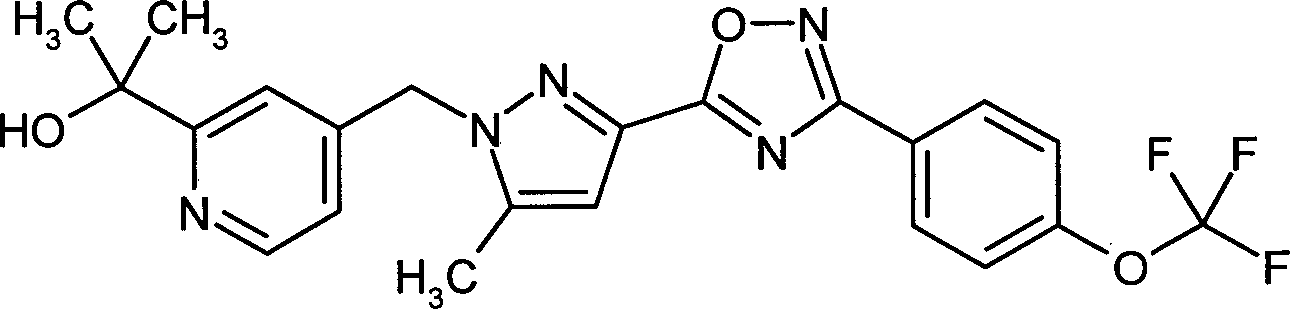
Analog zu dem unter Beispiel 211 beschriebenen Verfahren wurden 103 mg (0.33 mmol) der Verbindung aus Beispiel 23A und 113 mg (0.37 mmol) der Verbindung aus Beispiel 89A zu 50 mg (33% d. Th.) der Titelverbindung umgesetzt.
1H-NMR (400 MHz, DMSO-d6, δ/ppm): 8.45 (d, 1H), 8.20 (d, 2H), 7.59 (d, 2H), 7.46 (s, 1H), 6.98 (s, 1H), 6.92 (d, 2H), 5.58 (s, 2H), 5.20 (s, 1H), 2.34 (s, 3H), 1.41 (s, 6H).
LC/MS (Methode D, ESIpos): Rt = 2.18 min, m/z = 459 [M+H]+.Analogously to the process described under Example 211, 103 mg (0.33 mmol) of the compound from Example 23A and 113 mg (0.37 mmol) of the compound from Example 89A were converted to 50 mg (33% of theory) of the title compound.
1 H-NMR (400 MHz, DMSO-d 6 , δ / ppm): 8.45 (d, 1H), 8.20 (d, 2H), 7.59 (d, 2H), 7.46 (s, 1H), 6.98 (s, 1H), 6.92 (d, 2H), 5.58 (s, 2H), 5.20 (s, 1H), 2.34 (s, 3H), 1.41 (s, 6H).
LC / MS (Method D, ESIpos): R t = 2.18 min, m / z = 459 [M + H] + .
B. Bewertung der pharmakologischen WirksamkeitB. Evaluation of Pharmacological Activity
Die pharmakologische Aktivität der erfindungsgemäßen Verbindungen kann durch in vitro- und in vivo-Untersuchungen, wie sie dem Fachmann bekannt sind, nachgewiesen werden. Die Nützlichkeit der erfindungsgemäßen Substanzen kann beispielhaft illustriert werden durch in vitro-(Tumor-)Zellversuche und in vivo-Tumormodelle, wie sie weiter unten aufgeführt sind. Der Zusammenhang zwischen einer Hemmung der HIF-Transkriptionsaktivität und der Hemmung von Tumorwachstum ist durch zahlreiche in der Literatur beschriebene Untersuchungen belegt (vgl. z. B. Warburg, 1956; Semenza, 2007).The pharmacological activity of the compounds of the invention can be demonstrated by in vitro and in vivo assays as known to those skilled in the art. The usefulness of the substances of the invention can be exemplified by in vitro (tumor) cell assays and in vivo tumor models as listed below. The relationship between inhibition of HIF transcriptional activity and inhibition of tumor growth has been demonstrated by numerous studies described in the literature (see, eg, Warburg, 1956, Semenza, 2007).
B-1. HIF-Luciferase-Assay:B-1. HIF-luciferase assay:
HCT 116-Zellen wurden mit einem Plasmid stabil transfiziert, das einen Luciferase-Reporter unter der Kontrolle einer HIF-responsiven Sequenz enthielt. Diese Zellen wurden in Mikrotiterplatten ausgesät [20.000 Zellen/Kavität in RPMI 1640-Medium mit 10% fötalem Kälberserum (FKS) und 100 μg/ml Hygromycin]. Es wurde über Nacht unter Standardbedingungen inkubiert (5% CO2, 21% O2, 37°C, befeuchtet). Am anderen Morgen wurden die Zellen mit unterschiedlichen Konzentrationen der Testsubstanzen (0–10 μmol/L) in einer Hypoxiekammer (1% O2) inkubiert. Nach 24 h wurde Bright Glo-Reagenz (Fa. Promega, Wisconsin, USA) entsprechend den Vorschriften des Herstellers zugefügt, und nach 5 min wurde die Lumineszenz gemessen. Zellen, die unter Normoxie inkubiert wurden, dienten als Hintergrundkontrollen.HCT 116 cells were stably transfected with a plasmid containing a luciferase reporter under the control of an HIF-responsive sequence. These cells were seeded in microtiter plates [20,000 cells / well in RPMI 1640 medium with 10% fetal calf serum (FCS) and 100 μg / ml hygromycin]. It was incubated overnight under standard conditions (5% CO 2 , 21% O 2 , 37 ° C, humidified). The next morning, the cells were incubated with different concentrations of the test substances (0-10 μmol / L) in a hypoxia chamber (1% O 2 ). After 24 hours Bright Glo reagent (Promega, Wisconsin, USA) was added according to the manufacturer's instructions and after 5 minutes luminescence was measured. Cells incubated under normoxia served as background controls.
In der folgenden Tabelle sind für repräsentative Ausführungsbeispiele die IC50-Werte aus diesem Assay aufgeführt:
B-2. Suppression von HIF-Target-Genen in vitro:B-2. Suppression of HIF target genes in vitro:
Humane Bronchialkarzinom-Zellen (H460 und A549) wurden unter normoxischen Bedingungen sowie unter 1% Sauerstoffpartialdruck (siehe HIF-Luciferase-Assay) für 16 h mit variablen Konzentrationen der Testsubstanzen inkubiert (1 nM bis 10 μM). Aus den Zellen wurde die Gesamt-RNA isoliert, in cDNA umgeschrieben und in der Echtzeit-PCR die mRNA-Expression von HIF-Target-Genen analysiert. Bereits unter normoxischen Bedingungen, vor allem aber unter hypoxischen Bedingungen, erniedrigen aktive Testsubstanzen die mRNA-Expression der HIF-Target-Gene verglichen mit unbehandelten Zellen.Human bronchial carcinoma cells (H460 and A549) were incubated for 16 h with variable concentrations of the test substances (1 nM to 10 μM) under normoxic conditions and under 1% oxygen partial pressure (see HIF luciferase assay). From the cells, the total RNA was isolated, transcribed into cDNA and analyzed in real-time PCR mRNA expression of HIF target genes. Already under normoxic conditions, but especially under hypoxic conditions, active test substances lower the mRNA expression of the HIF target genes compared to untreated cells.
B-3. Humane Xenograft- und syngene Tumormodelle:B-3. Human Xenograft and syngeneic tumor models:
Humane Tumor-Xenograftmodelle in immundefizienten Mäusen und syngene Tumor-Mausmodelle wurden zur Substanzbewertung herangezogen. Dazu wurden Tumorzellen in vitro kultiviert und subkutan implantiert, oder es wurden Tumor-Xenotransplantatstückchen subkutan weitertransplantiert. Die Behandlung der Tiere erfolgte durch orale, subkutane oder intraperitoneale Therapie nach der Etablierung des Tumors. Die Wirksamkeit von Testsubstanzen wurde in Monotherapie und in Kombinationstherapie mit anderen pharmakologischen Wirksubstanzen analysiert. Außerdem wurde die tumorinhibitorische Potenz von Testsubstanzen an Tumoren fortgeschrittener Größe (ca. 100 mm2) charakterisiert. Der Gesundheitszustand der Tiere wurde täglich überprüft, und die Behandlungen erfolgten entsprechend den Tierschutzbestimmungen. Die Tumorfläche wurde mit Schublehren gemessen (Länge L, Breite B = kleinere Ausdehnung). Das Tumorvolumen wurde nach der Formel (L × B2)/2 berechnet. Die Hemmung des Tumorwachstums wurde am Ende des Versuches als T/C-Verhältnis der Tumorflächen bzw. Tumorgewichte und als TGI-Wert (tumor growth inhibition, berechnet nach der Formel [1 – (T/C)] × 100) bestimmt (T = Tumorgröße der behandelten Gruppe; C = Tumorgröße der unbehandelten Kontrollgruppe).Human tumor xenograft models in immunodeficient mice and syngeneic tumor mouse models were used for substance evaluation. For this purpose, tumor cells were cultured in vitro and implanted subcutaneously, or tumor xenograft fragments were subcutaneously transplanted. The treatment of the animals was carried out by oral, subcutaneous or intraperitoneal therapy after the establishment of the tumor. The efficacy of test substances was analyzed in monotherapy and in combination therapy with other pharmacological agents. In addition, the tumor-inhibitory potency of test substances on tumors of advanced size (about 100 mm 2 ) was characterized. The state of health of the animals was checked daily and the treatments were carried out according to animal welfare regulations. The tumor area was measured with calipers (length L, width B = smaller extent). The tumor volume was calculated according to the formula (L × B 2 ) / 2. The inhibition of tumor growth was determined at the end of the experiment as T / C ratio of the tumor areas or tumor weights and as TGI value (tumor growth inhibition, calculated according to the formula [1- (T / C)] × 100) (T = Tumor size of the treated group; C = tumor size of the untreated control group).
Der Einfluss von Testsubstanzen auf die Tumor-Gefäßarchitektur und den Blutfluss innerhalb des Tumors wurde mit Hilfe von Mikro-Computertomographie- und Mikro-Ultraschall-Untersuchungen anhand von behandelten und unbehandelten tumortragenden Mäusen identifiziert. The influence of test substances on tumor vasculature and blood flow within the tumor was identified by means of micro computed tomography and micro-ultrasound examinations on treated and untreated tumor-bearing mice.
B-4. Bestimmung pharmakokinetischer Kenngrößen nach intravenöser und peroraler Gabe:B-4. Determination of pharmacokinetic parameters after intravenous and peroral administration:
Die zu untersuchende Substanz wurde Tieren (z. B. Mäusen oder Ratten) intravenös als Lösung appliziert (z. B. in entsprechendem Plasma mit geringem DMSO-Zusatz oder in einem PEG/Ethanol/Wasser-Gemisch), die perorale Applikation erfolgte als Lösung (z. B. in Solutol/Ethanol/Wasser- oder PEG/Ethanol/Wasser-Gemischen) oder als Suspension (z. B. in Tylose) jeweils über eine Schlundsonde. Nach Substanzgabe wurde den Tieren zu festgelegten Zeitpunkten Blut entnommen. Dieses wurde heparinisiert, anschließend wurde daraus durch Zentrifugation Plasma gewonnen. Die Substanz wurde im Plasma über LC-MS/MS analytisch quantifiziert. Aus den so ermittelten Plasmakonzentration-Zeit-Verläufen wurden unter Verwendung eines internen Standards und mit Hilfe eines validierten Rechenprogramms die pharmakokinetischen Kenngrößen berechnet, wie AUC (Fläche unter der Konzentration-Zeit-Kurve), Cmax (maximale Plasmakonzentration), T1/2 (Halbwertszeit), Vss (Verteilungsvolumen) und CL (Clearance) sowie die absolute und die relative Bioverfügbarkeit (i. v./p. o.-Vergleich bzw. Vergleich von Suspension zu Lösung nach p. o.-Gabe).The substance to be investigated was administered to animals (eg mice or rats) intravenously as a solution (for example in appropriate plasma with a small amount of DMSO or in a PEG / ethanol / water mixture), the oral administration being carried out as a solution (eg in Solutol / ethanol / water or PEG / ethanol / water mixtures) or as a suspension (eg in Tylose) in each case via a gavage. After substance administration, the animals were bled at fixed times. This was heparinized, then plasma was recovered therefrom by centrifugation. The substance was analytically quantified in plasma via LC-MS / MS. The pharmacokinetic parameters, such as AUC (area under the concentration-time curve), C max (maximum plasma concentration), T 1/2, were calculated from the plasma concentration-time curves thus determined using an internal standard and a validated computer program (Half-life), Vss (distribution volume) and CL (clearance) and the absolute and the relative bioavailability (iv / po comparison or comparison of suspension to solution after po administration).
C. Ausführungsbeispiele für pharmazeutische ZusammensetzungenC. Embodiments of Pharmaceutical Compositions
Die erfindungsgemäßen Verbindungen können folgendermaßen in pharmazeutische Zubereitungen überführt werden:The compounds according to the invention can be converted into pharmaceutical preparations as follows:
Tablette:Tablet:
Zusammensetzung:Composition:
100 mg der erfindungsgemäßen Verbindung, 50 mg Lactose (Monohydrat), 50 mg Maisstärke (nativ), 10 mg Polyvinylpyrrolidon (PVP 25) (Fa. BASF, Ludwigshafen, Deutschland) und 2 mg Magnesiumstearat.100 mg of the compound according to the invention, 50 mg of lactose (monohydrate), 50 mg of corn starch (native), 10 mg of polyvinylpyrrolidone (PVP 25) (BASF, Ludwigshafen, Germany) and 2 mg of magnesium stearate.
Tablettengewicht 212 mg. Durchmesser 8 mm, Wölbungsradius 12 mm.Tablet weight 212 mg. Diameter 8 mm, radius of curvature 12 mm.
Herstellung:production:
Die Mischung aus erfindungsgemäßer Verbindung, Lactose und Stärke wird mit einer 5%-igen Lösung (m/m) des PVPs in Wasser granuliert. Das Granulat wird nach dem Trocknen mit dem Magnesiumstearat 5 Minuten gemischt. Diese Mischung wird mit einer üblichen Tablettenpresse verpresst (Format der Tablette siehe oben). Als Richtwert für die Verpressung wird eine Presskraft von 15 kN verwendet.The mixture of compound of the invention, lactose and starch is granulated with a 5% solution (m / m) of the PVP in water. The granules are mixed after drying with the magnesium stearate for 5 minutes. This mixture is compressed with a conventional tablet press (for the tablet format see above). As a guideline for the compression, a pressing force of 15 kN is used.
Oral applizierbare Suspension:Orally administrable suspension:
Zusammensetzung:Composition:
1000 mg der erfindungsgemäßen Verbindung, 1000 mg Ethanol (96%), 400 mg Rhodigel® (Xanthan gum der Firma FMC, Pennsylvania, USA) und 99 g Wasser.1000 mg of the compound of the invention, 1000 mg of ethanol (96%), 400 mg of Rhodigel ® (xanthan gum of the firm FMC, Pennsylvania, USA) and 99 g of water.
Einer Einzeldosis von 100 mg der erfindungsgemäßen Verbindung entsprechen 10 ml orale Suspension.A single dose of 100 mg of the compound of the invention corresponds to 10 ml of oral suspension.
Herstellung:production:
Das Rhodigel wird in Ethanol suspendiert, die erfindungsgemäße Verbindung wird der Suspension zugefügt. Unter Rühren erfolgt die Zugabe des Wassers. Bis zum Abschluß der Quellung des Rhodigels wird ca. 6 h gerührt.The rhodigel is suspended in ethanol, the compound according to the invention is added to the suspension. While stirring, the addition of water. Until the completion of the swelling of Rhodigels is stirred for about 6 h.
Oral applizierbare Lösung: Orally administrable solution:
Zusammensetzung:Composition:
500 mg der erfindungsgemäßen Verbindung, 2.5 g Polysorbat und 97 g Polyethylenglycol 400. Einer Einzeldosis von 100 mg der erfindungsgemäßen Verbindung entsprechen 20 g orale Lösung.500 mg of the compound according to the invention, 2.5 g of polysorbate and 97 g of polyethylene glycol 400. A single dose of 100 mg of the compound according to the invention correspond to 20 g of oral solution.
Herstellung:production:
Die erfindungsgemäße Verbindung wird in der Mischung aus Polyethylenglycol und Polysorbat unter Rühren suspendiert. Der Rührvorgang wird bis zur vollständigen Auflösung der erfindungsgemäßen Verbindung fortgesetzt.The compound of the invention is suspended in the mixture of polyethylene glycol and polysorbate with stirring. The stirring is continued until complete dissolution of the compound according to the invention.
i. v.-Lösung:i. v. solution:
Die erfindungsgemäße Verbindung wird in einer Konzentration unterhalb der Sättigungslöslichkeit in einem physiologisch verträglichen Lösungsmittel (z. B. isotonische Kochsalzlösung, Glucoselösung 5% und/oder PEG 400-Lösung 30%) gelöst. Die Lösung wird steril filtriert und in sterile und pyrogenfreie Injektionsbehältnisse abgefüllt.The compound according to the invention is dissolved in a concentration below the saturation solubility in a physiologically tolerated solvent (for example isotonic saline solution, glucose solution 5% and / or PEG 400 solution 30%). The solution is sterile filtered and filled into sterile and pyrogen-free injection containers.
ZITATE ENTHALTEN IN DER BESCHREIBUNG QUOTES INCLUDE IN THE DESCRIPTION
Diese Liste der vom Anmelder aufgeführten Dokumente wurde automatisiert erzeugt und ist ausschließlich zur besseren Information des Lesers aufgenommen. Die Liste ist nicht Bestandteil der deutschen Patent- bzw. Gebrauchsmusteranmeldung. Das DPMA übernimmt keinerlei Haftung für etwaige Fehler oder Auslassungen.This list of the documents listed by the applicant has been generated automatically and is included solely for the better information of the reader. The list is not part of the German patent or utility model application. The DPMA assumes no liability for any errors or omissions.
Zitierte PatentliteraturCited patent literature
- EP 0908456 A1 [0010] EP 0908456 A1 [0010]
- WO 97/36881 A1 [0010] WO 97/36881 A1 [0010]
- WO 01/12627 A1 [0010] WO 01/12627 A1 [0010]
- WO 01/85723 A1 [0010] WO 01/85723 Al [0010]
- WO 02/100826 A2 [0010] WO 02/100826 A2 [0010]
- WO 2004/014370 A2 [0010] WO 2004/014370 A2 [0010]
- WO 2004/014881 A2 [0010] WO 2004/014881 A2 [0010]
- WO 2004/014902 A2 [0010] WO 2004/014902 A2 [0010]
- WO 2004/035566 A1 [0010] WO 2004/035566 A1 [0010]
- WO 2004/058176 A2 [0010] WO 2004/058176 A2 [0010]
- WO 2004/089303 A2 [0010] WO 2004/089303 A2 [0010]
- WO 2004/089308 A2 [0010] WO 2004/089308 A2 [0010]
- WO 2005/070925 A1 [0010] WO 2005/070925 A1 [0010]
- WO 2006/114313 A1 [0010] WO 2006/114313 A1 [0010]
- WO 2007/002559 A1 [0010] WO 2007/002559 A1 [0010]
- WO 2007/034279 A2 [0010] WO 2007/034279 A2 [0010]
- WO 2008/004096 A1 [0010] WO 2008/004096 A1 [0010]
- WO 2008/024390 A2 [0010] WO 2008/024390 A2 [0010]
- WO 2008/114157 A1 [0010] WO 2008/114157 A1 [0010]
- WO 2005/030121 A2 [0010] WO 2005/030121 A2 [0010]
- WO 2007/065010 A2 [0010] WO 2007/065010 A2 [0010]
- WO 2008/141731 A2 [0010] WO 2008/141731 A2 [0010]
- US 2008/0255211 A1 [0010] US 2008/0255211 A1 [0010]
- WO 2009/029632 A1 [0010] WO 2009/029632 A1 [0010]
- WO 2006/101081 [0518, 0520] WO 2006/101081 [0518, 0520]
Zitierte Nicht-PatentliteraturCited non-patent literature
- Globocan 2002 Report [0003] Globocan 2002 Report [0003]
- American Cancer Society, Cancer Facts and Figures 2005 [0003] American Cancer Society, Cancer Facts and Figures 2005 [0003]
- Maxwell, Wiesener et al., 1999 [0007] Maxwell, Wiesener et al., 1999 [0007]
- Makino, Cao et al., 2001 [0008] Makino, Cao et al., 2001 [0008]
- Jiang, Rue et al., 1996 [0008] Jiang, Rue et al., 1996 [0008]
- Chen, Zhao et al., 2003 [0009] Chen, Zhao et al., 2003 [0009]
- Stoeltzing, McCarty et al., 2004 [0009] Stoeltzing, McCarty et al., 2004 [0009]
- Li, Lin et al., 2005 [0009] Li, Lin et al., 2005 [0009]
- Mizukami, Jo et al., 2005 [0009] Mizukami, Jo et al., 2005 [0009]
- Li, Shi et al., 2006 [0009] Li, Shi et al., 2006 [0009]
- Aiello et al., 1994 [0090] Aiello et al., 1994 [0090]
- Peer et al., 1995 [0090] Peer et al., 1995 [0090]
- Lopez et al., 1996 [0090] Lopez et al., 1996 [0090]
- J. L. Tucker et al., Synth. Comm. 2006, 36 (15), 2145–2155 [0142] JL Tucker et al., Synth. Comm. 2006, 36 (15), 2145-2155 [0142]
- W. Su, Tetrahedron. Lett. 1994, 35 (28), 4955–4958 [0145] W. Su, Tetrahedron. Lett. 1994, 35 (28), 4955-4958 [0145]
- T. Saitoh et al., J. Am. Chem. Soc. 2005, 127 (27), 9696–9697 [0147] T. Saitoh et al., J. Am. Chem. Soc. 2005, 127 (27), 9696-9697 [0147]
- G. Wuitschik et al., Angew. Chem. Int. Ed. Engl. 2006, 45 (46), 7736–7739 [0148] G. Wuitschik et al., Angew. Chem. Int. Ed. Engl. 2006, 45 (46), 7736-7739 [0148]
- G. Wuitschik et al., Angew. Chem. Int. Ed. Engl. 2006, 45 (46), 7736–7739 [0156] G. Wuitschik et al., Angew. Chem. Int. Ed. Engl. 2006, 45 (46), 7736-7739 [0156]
- E. Riguet et al., J. Organomet. Chem. 2001, 624 (1–2), 376–379 [0169] E. Riguet et al., J. Organomet. Chem. 2001, 624 (1-2), 376-379 [0169]
- A.-H. Kuthier et al., J. Org. Chem. 1987, 52 (9), 1710–1713 [0169] AH. Kuthier et al., J. Org. Chem. 1987, 52 (9), 1710-1713 [0169]
- P. J. Crowley et al., Chimia 2004, 58 (3), 138–142 [0169] PJ Crowley et al., Chimia 2004, 58 (3), 138-142 [0169]
- P. di Raddo et al., J. Chem. Soc. Chem. Commun. 1984 (3), 159–160 [0169] P. di Raddo et al., J. Chem. Soc. Chem. Commun. 1984 (3), 159-160 [0169]
- J. L. Tucker et al., Synth. Comm. 2006, 36 (15), 2145–2155 [0169] JL Tucker et al., Synth. Comm. 2006, 36 (15), 2145-2155 [0169]
- A. Ashimori et al., Chem. Pharm. Bull. 1990, 38 (9), 2446–2458 [0183] A. Ashimori et al., Chem. Pharm. Bull. 1990, 38 (9), 2446-2458 [0183]
- A. Ashimori et al., Chem. Pharm. Bull. 1990, 38 (9), 2446–2458 [0185] Chem. Pharm. Bull. 1990, 38 (9), 2446-2458 [0185]
- G. Biagi et al., Farmaco Ed. Sci. 1988, 43 (7/8), 597–612 [0191] G. Biagi et al., Farmaco Ed. Sci. 1988, 43 (7/8), 597-612 [0191]
- K. Tanaka et al., Org. Lett. 2007, 9 (7), 1215–1218 [0193] K. Tanaka et al., Org. Lett. 2007, 9 (7), 1215-1218 [0193]
- C. Meister et al., Liebigs Ann. Chem. 1983 (6), 913–921 [0198] C. Meister et al., Liebigs Ann. Chem. 1983 (6), 913-921 [0198]
- H. J. Anderson et al., Can. J. Chem. 1967 (45), 897–902 [0205] HJ Anderson et al., Can. J. Chem. 1967 (45), 897-902 [0205]
- S. Sugai et al., Chem. Lett. 1982, 597–600 [0210] Sugai, S. et al., Chem. Lett. 1982, 597-600 [0210]
- J. T. Gupton et al., Synth. Commun. 1982, 12 (9), 695–700 [0226] JT Gupton et al., Synth. Commun. 1982, 12 (9), 695-700 [0226]
- M. Artico et al., Eur.. J. Med. Chem. 1992, 27 (3), 219–228 [0228] M. Artico et al., Eur. J. Med. Chem. 1992, 27 (3), 219-228 [0228]
- I. Martin et al., Acta Chem. Scand. 1995, 49 (3), 230–232 [0230] Martin, et al., Acta. Chem. Scand. 1995, 49 (3), 230-232 [0230]
- M. Nishimura et al., Tetrahedron 2002, 58 (29), 5779–5788 [0236] M. Nishimura et al., Tetrahedron 2002, 58 (29), 5779-5788 [0236]
- Heuberger et al., J. Chem. Soc. 1952, 910 [0236] Heuberger et al., J. Chem. Soc. 1952, 910 [0236]
- H. Nakata et al., Org. Mass Spec. 1990, 25 (12), 649–654 [0250] H. Nakata et al., Org. Mass Spec. 1990, 25 (12), 649-654 [0250]
- D. Stones et al., Chem. Eur. J. 2004, 10 (1), 92–100 [0254] Stones, et al., Chem. Eur. J. 2004, 10 (1), 92-100 [0254]
- Heuberger et al., J. Chem. Soc. 1952, 910 [0254] Heuberger et al., J. Chem. Soc. 1952, 910 [0254]
- N. V. Kondratenko, Zhurnal Organicheskoi Khimii 1986, 22 (8), 1716–1721 [0267] NV Kondratenko, Zhurnal Organicheskoi Khimii 1986, 22 (8), 1716-1721 [0267]
- ibid. 1984, 20 (10), 2250–2252 [0267] ibid. 1984, 20 (10), 2250-2252 [0267]
- A. Renndon-Corniere et al., J. Med. Chem. 2002, 45 (4), 944–954 [0301] Renndon-Corniere et al., J. Med. Chem. 2002, 45 (4), 944-954 [0301]
- K. C. Lee et al., J. Org. Chem. 1999, 64 (23), 8576–8581 [0416] KC Lee et al., J. Org. Chem. 1999, 64 (23), 8576-8581 [0416]
- K. C. Lee et al., J. Org. Chem. 1999, 64 (23), 8576–8581 [0422] KC Lee et al., J. Org. Chem. 1999, 64 (23), 8576-8581 [0422]
- H. Harada et al. [0518] H. Harada et al. [0518]
- H. Harada et al. [0520] H. Harada et al. [0520]
Claims (19)


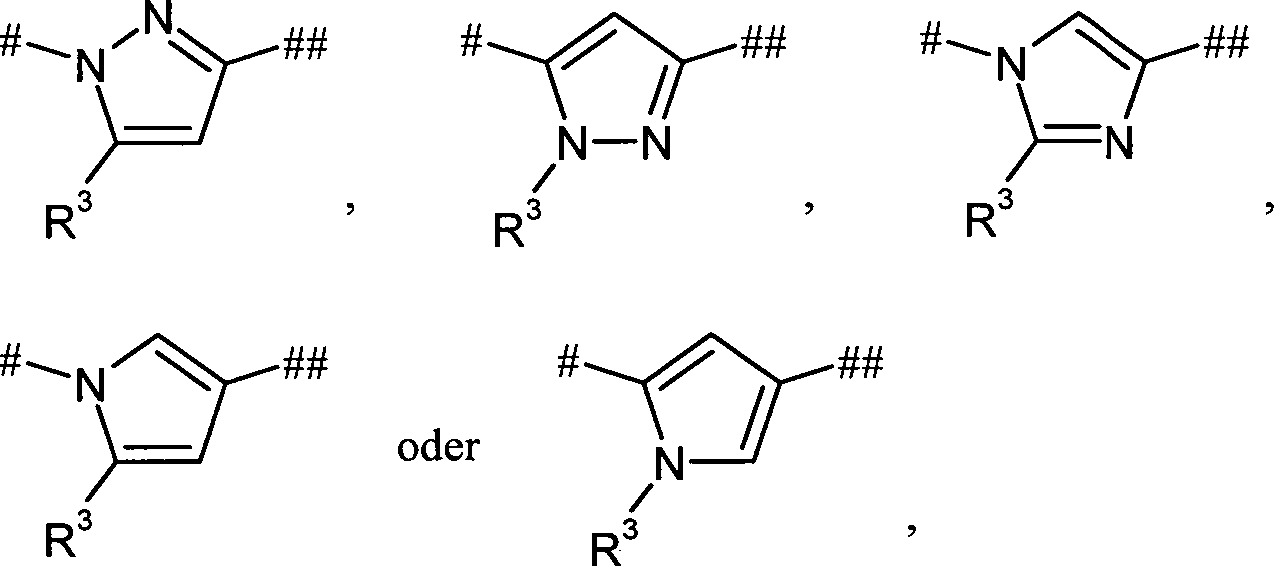


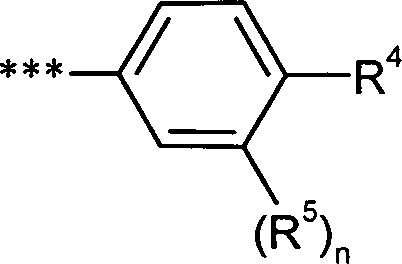


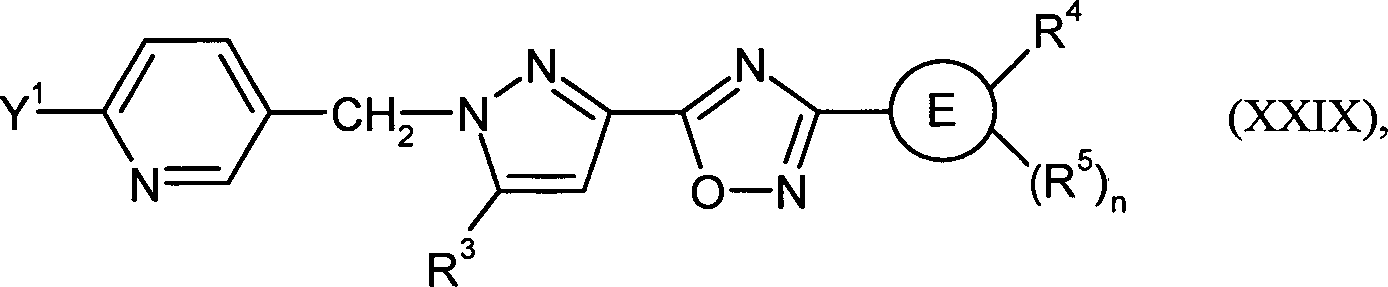

Priority Applications (15)
| Application Number | Priority Date | Filing Date | Title |
|---|---|---|---|
| DE102009041241A DE102009041241A1 (en) | 2009-09-11 | 2009-09-11 | New heteroaromatic compounds are hypoxia-inducible factor inhibitors useful to treat and/or prevent e.g. cancer or tumor diseases, heart attack, arrhythmia, stroke, psoriasis, diabetic retinopathy, rheumatoid arthritis and polycythemia |
| PCT/EP2009/007807 WO2010054764A1 (en) | 2008-11-14 | 2009-10-31 | Heteroaromatic compounds for use as hif inhibitors |
| CN2009801545900A CN102282142A (en) | 2008-11-14 | 2009-10-31 | Substituted aryl compounds and their use |
| KR1020117010976A KR20110082570A (en) | 2008-11-14 | 2009-10-31 | Heteroaromatic Compounds for Use as HIF Inhibitors |
| RU2011123672/04A RU2011123672A (en) | 2008-11-14 | 2009-10-31 | HETEROAROMATIC COMPOUNDS FOR USE AS HIF INHIBITORS |
| CA2743424A CA2743424A1 (en) | 2008-11-14 | 2009-10-31 | Heteroaromatic compounds for use as hif inhibitors |
| AU2009315930A AU2009315930A1 (en) | 2008-11-14 | 2009-10-31 | Heteroaromatic compounds for use as HIF inhibitors |
| EP09744089A EP2356112A1 (en) | 2008-11-14 | 2009-10-31 | Heteroaromatic compounds for use as hif inhibitors |
| US13/129,409 US20110301122A1 (en) | 2008-11-14 | 2009-10-31 | Heteroaromatic compounds for use as hif inhibitors |
| MX2011004779A MX2011004779A (en) | 2008-11-14 | 2009-10-31 | Heteroaromatic compounds for use as hif inhibitors. |
| ARP090104357A AR074337A1 (en) | 2008-11-14 | 2009-11-11 | HETEROCICLIC DERIVATIVES OF OXAZOL AND OXADIAZOL, MEDICINES CONTAINING THEM, METHOD OF PREPARATION AND USE OF THE SAME TO TREAT AND / OR PREVENT HYPERPROLIFERATIVE AND ANGIOGENIC DISEASES, AMONG OTHERS. |
| UY0001032236A UY32236A (en) | 2008-11-14 | 2009-11-11 | SUBSTITUTED ARILO COMPOUNDS AND THEIR USE |
| TW098138332A TW201029998A (en) | 2008-11-14 | 2009-11-12 | Substituted aryl compounds and their use |
| IL212174A IL212174A0 (en) | 2008-11-14 | 2011-04-06 | Substituted aryl compounds and their use |
| ZA2011/03444A ZA201103444B (en) | 2008-11-14 | 2011-05-11 | Heteroaromatic compounds for use as hif inhibitors |
Applications Claiming Priority (1)
| Application Number | Priority Date | Filing Date | Title |
|---|---|---|---|
| DE102009041241A DE102009041241A1 (en) | 2009-09-11 | 2009-09-11 | New heteroaromatic compounds are hypoxia-inducible factor inhibitors useful to treat and/or prevent e.g. cancer or tumor diseases, heart attack, arrhythmia, stroke, psoriasis, diabetic retinopathy, rheumatoid arthritis and polycythemia |
Publications (1)
| Publication Number | Publication Date |
|---|---|
| DE102009041241A1 true DE102009041241A1 (en) | 2011-08-04 |
Family
ID=44315785
Family Applications (1)
| Application Number | Title | Priority Date | Filing Date |
|---|---|---|---|
| DE102009041241A Withdrawn DE102009041241A1 (en) | 2008-11-14 | 2009-09-11 | New heteroaromatic compounds are hypoxia-inducible factor inhibitors useful to treat and/or prevent e.g. cancer or tumor diseases, heart attack, arrhythmia, stroke, psoriasis, diabetic retinopathy, rheumatoid arthritis and polycythemia |
Country Status (1)
| Country | Link |
|---|---|
| DE (1) | DE102009041241A1 (en) |
Citations (25)
| Publication number | Priority date | Publication date | Assignee | Title |
|---|---|---|---|---|
| WO1997036881A1 (en) | 1996-04-03 | 1997-10-09 | Merck & Co., Inc. | Inhibitors of farnesyl-protein transferase |
| EP0908456A1 (en) | 1997-10-06 | 1999-04-14 | Hoechst Marion Roussel Deutschland GmbH | Pyrazole derivatives, their preparation and their use in drugs |
| WO2001012627A1 (en) | 1999-08-19 | 2001-02-22 | Nps Pharmaceuticals, Inc. | Heteropolycyclic compounds and their use as metabotropic glutamate receptor antagonists |
| WO2001085723A1 (en) | 2000-05-08 | 2001-11-15 | James Black Foundation Limited | Gastrin and cholecystokinin receptor ligands (ii) |
| WO2002100826A2 (en) | 2001-06-08 | 2002-12-19 | Cytovia, Inc. | Substituted 3-aryl-5-aryl-[1,2,4]-oxadiazoles and analogs |
| WO2004014370A2 (en) | 2002-08-09 | 2004-02-19 | Astrazeneca Ab | Oxadiazoles as modulators of metabotropic glutamate receptor-5 |
| WO2004014902A2 (en) | 2002-08-09 | 2004-02-19 | Astrazeneca Ab | Compounds having an activity at metabotropic glutamate receptors |
| WO2004014881A2 (en) | 2002-08-09 | 2004-02-19 | Astra Zeneca Ab | '1,2,4'oxadiazoles as modulators of metabotropic glutamate receptor-5 |
| WO2004035566A1 (en) | 2002-10-18 | 2004-04-29 | Pfizer Products Inc. | Cannabinoid receptor ligands and uses thereof |
| WO2004058176A2 (en) | 2002-12-20 | 2004-07-15 | Pharmacia Corporation | Acyclic pyrazole compounds |
| WO2004089308A2 (en) | 2003-04-04 | 2004-10-21 | Merck & Co., Inc. | Di-aryl substituted pyrrole modulators of metabotropic glutamate receptor-5 |
| WO2004089303A2 (en) | 2003-04-03 | 2004-10-21 | Merck & Co., Inc. | Di-aryl substituted pyrazole modulators of metabotropic glutamate receptor-5 |
| WO2005030121A2 (en) | 2003-06-30 | 2005-04-07 | Hif Bio, Inc. | Compounds, compositions and methods |
| WO2005070925A1 (en) | 2004-01-25 | 2005-08-04 | Sanofi-Aventis Deutschland Gmbh | Aryl substituted heterocycles, method for production and use thereof as medicaments |
| WO2006101081A1 (en) | 2005-03-21 | 2006-09-28 | Eisai R & D Management Co., Ltd. | Crystal of 5-[2-amino-4-(2-furyl)pyrimidin-5-yl]-1- methylpyridin-2(1h)-one and process for producing the same |
| WO2006114313A1 (en) | 2005-04-26 | 2006-11-02 | Glaxo Group Limited | Pyrazole compounds as prostaglandin receptors ligands |
| WO2007002559A1 (en) | 2005-06-27 | 2007-01-04 | Exelixis, Inc. | Pyrazole based lxr modulators |
| WO2007034279A2 (en) | 2005-09-19 | 2007-03-29 | Pfizer Products Inc. | C3a antagonists and pharmaceutical compositions thereof |
| WO2007065010A2 (en) | 2005-12-02 | 2007-06-07 | Hif Bio, Inc. | Anti-angiogenesis compounds |
| WO2008004096A1 (en) | 2006-07-05 | 2008-01-10 | Pfizer Products Inc. | Pyrazole derivatives as cytochrome p450 inhibitors |
| WO2008024390A2 (en) | 2006-08-24 | 2008-02-28 | Novartis Ag | 2- (pyrazin-2-yl) -thiazole and 2- (1h-pyraz0l-3-yl) -thiazole derivatives as well as related compounds as stearoyl-coa desaturase (scd) inhibitors for the treatment of metabolic, cardiovascular and other disorders |
| WO2008114157A1 (en) | 2007-03-16 | 2008-09-25 | Actelion Pharmaceuticals Ltd | Amino- pyridine derivatives as s1p1 /edg1 receptor agonists |
| US20080255211A1 (en) | 2007-04-12 | 2008-10-16 | National Health Research Institutes | Oxadiazole Compounds |
| WO2008141731A2 (en) | 2007-05-18 | 2008-11-27 | Bayer Healthcare Ag | Inhibitors of hypoxia inducible factor (hif) useful for treating hyper-proliferative disorders and diseases associated with angiogenesis |
| WO2009029632A1 (en) | 2007-08-27 | 2009-03-05 | Helicon Therapeutics, Inc. | Therapeutic isoxazole compounds |
-
2009
- 2009-09-11 DE DE102009041241A patent/DE102009041241A1/en not_active Withdrawn
Patent Citations (25)
| Publication number | Priority date | Publication date | Assignee | Title |
|---|---|---|---|---|
| WO1997036881A1 (en) | 1996-04-03 | 1997-10-09 | Merck & Co., Inc. | Inhibitors of farnesyl-protein transferase |
| EP0908456A1 (en) | 1997-10-06 | 1999-04-14 | Hoechst Marion Roussel Deutschland GmbH | Pyrazole derivatives, their preparation and their use in drugs |
| WO2001012627A1 (en) | 1999-08-19 | 2001-02-22 | Nps Pharmaceuticals, Inc. | Heteropolycyclic compounds and their use as metabotropic glutamate receptor antagonists |
| WO2001085723A1 (en) | 2000-05-08 | 2001-11-15 | James Black Foundation Limited | Gastrin and cholecystokinin receptor ligands (ii) |
| WO2002100826A2 (en) | 2001-06-08 | 2002-12-19 | Cytovia, Inc. | Substituted 3-aryl-5-aryl-[1,2,4]-oxadiazoles and analogs |
| WO2004014370A2 (en) | 2002-08-09 | 2004-02-19 | Astrazeneca Ab | Oxadiazoles as modulators of metabotropic glutamate receptor-5 |
| WO2004014902A2 (en) | 2002-08-09 | 2004-02-19 | Astrazeneca Ab | Compounds having an activity at metabotropic glutamate receptors |
| WO2004014881A2 (en) | 2002-08-09 | 2004-02-19 | Astra Zeneca Ab | '1,2,4'oxadiazoles as modulators of metabotropic glutamate receptor-5 |
| WO2004035566A1 (en) | 2002-10-18 | 2004-04-29 | Pfizer Products Inc. | Cannabinoid receptor ligands and uses thereof |
| WO2004058176A2 (en) | 2002-12-20 | 2004-07-15 | Pharmacia Corporation | Acyclic pyrazole compounds |
| WO2004089303A2 (en) | 2003-04-03 | 2004-10-21 | Merck & Co., Inc. | Di-aryl substituted pyrazole modulators of metabotropic glutamate receptor-5 |
| WO2004089308A2 (en) | 2003-04-04 | 2004-10-21 | Merck & Co., Inc. | Di-aryl substituted pyrrole modulators of metabotropic glutamate receptor-5 |
| WO2005030121A2 (en) | 2003-06-30 | 2005-04-07 | Hif Bio, Inc. | Compounds, compositions and methods |
| WO2005070925A1 (en) | 2004-01-25 | 2005-08-04 | Sanofi-Aventis Deutschland Gmbh | Aryl substituted heterocycles, method for production and use thereof as medicaments |
| WO2006101081A1 (en) | 2005-03-21 | 2006-09-28 | Eisai R & D Management Co., Ltd. | Crystal of 5-[2-amino-4-(2-furyl)pyrimidin-5-yl]-1- methylpyridin-2(1h)-one and process for producing the same |
| WO2006114313A1 (en) | 2005-04-26 | 2006-11-02 | Glaxo Group Limited | Pyrazole compounds as prostaglandin receptors ligands |
| WO2007002559A1 (en) | 2005-06-27 | 2007-01-04 | Exelixis, Inc. | Pyrazole based lxr modulators |
| WO2007034279A2 (en) | 2005-09-19 | 2007-03-29 | Pfizer Products Inc. | C3a antagonists and pharmaceutical compositions thereof |
| WO2007065010A2 (en) | 2005-12-02 | 2007-06-07 | Hif Bio, Inc. | Anti-angiogenesis compounds |
| WO2008004096A1 (en) | 2006-07-05 | 2008-01-10 | Pfizer Products Inc. | Pyrazole derivatives as cytochrome p450 inhibitors |
| WO2008024390A2 (en) | 2006-08-24 | 2008-02-28 | Novartis Ag | 2- (pyrazin-2-yl) -thiazole and 2- (1h-pyraz0l-3-yl) -thiazole derivatives as well as related compounds as stearoyl-coa desaturase (scd) inhibitors for the treatment of metabolic, cardiovascular and other disorders |
| WO2008114157A1 (en) | 2007-03-16 | 2008-09-25 | Actelion Pharmaceuticals Ltd | Amino- pyridine derivatives as s1p1 /edg1 receptor agonists |
| US20080255211A1 (en) | 2007-04-12 | 2008-10-16 | National Health Research Institutes | Oxadiazole Compounds |
| WO2008141731A2 (en) | 2007-05-18 | 2008-11-27 | Bayer Healthcare Ag | Inhibitors of hypoxia inducible factor (hif) useful for treating hyper-proliferative disorders and diseases associated with angiogenesis |
| WO2009029632A1 (en) | 2007-08-27 | 2009-03-05 | Helicon Therapeutics, Inc. | Therapeutic isoxazole compounds |
Non-Patent Citations (39)
| Title |
|---|
| A. Ashimori et al., Chem. Pharm. Bull. 1990, 38 (9), 2446-2458 |
| A. Renndon-Corniere et al., J. Med. Chem. 2002, 45 (4), 944-954 |
| A.-H. Kuthier et al., J. Org. Chem. 1987, 52 (9), 1710-1713 |
| Aiello et al., 1994 |
| American Cancer Society, Cancer Facts and Figures 2005 |
| C. Meister et al., Liebigs Ann. Chem. 1983 (6), 913-921 |
| Chen, Zhao et al., 2003 |
| D. Stones et al., Chem. Eur. J. 2004, 10 (1), 92-100 |
| E. Riguet et al., J. Organomet. Chem. 2001, 624 (1-2), 376-379 |
| G. Biagi et al., Farmaco Ed. Sci. 1988, 43 (7/8), 597-612 |
| G. Wuitschik et al., Angew. Chem. Int. Ed. Engl. 2006, 45 (46), 7736-7739 |
| Globocan 2002 Report |
| H. Harada et al. |
| H. J. Anderson et al., Can. J. Chem. 1967 (45), 897-902 |
| H. Nakata et al., Org. Mass Spec. 1990, 25 (12), 649-654 |
| Heuberger et al., J. Chem. Soc. 1952, 910 |
| I. Martin et al., Acta Chem. Scand. 1995, 49 (3), 230-232 |
| ibid. 1984, 20 (10), 2250-2252 |
| J. L. Tucker et al., Synth. Comm. 2006, 36 (15), 2145-2155 |
| J. T. Gupton et al., Synth. Commun. 1982, 12 (9), 695-700 |
| Jiang, Rue et al., 1996 |
| K. C. Lee et al., J. Org. Chem. 1999, 64 (23), 8576-8581 |
| K. Tanaka et al., Org. Lett. 2007, 9 (7), 1215-1218 |
| Li, Lin et al., 2005 |
| Li, Shi et al., 2006 |
| Lopez et al., 1996 |
| M. Artico et al., Eur.. J. Med. Chem. 1992, 27 (3), 219-228 |
| M. Nishimura et al., Tetrahedron 2002, 58 (29), 5779-5788 |
| Makino, Cao et al., 2001 |
| Maxwell, Wiesener et al., 1999 |
| Mizukami, Jo et al., 2005 |
| N. V. Kondratenko, Zhurnal Organicheskoi Khimii 1986, 22 (8), 1716-1721 |
| P. di Raddo et al., J. Chem. Soc. Chem. Commun. 1984 (3), 159-160 |
| P. J. Crowley et al., Chimia 2004, 58 (3), 138-142 |
| Peer et al., 1995 |
| S. Sugai et al., Chem. Lett. 1982, 597-600 |
| Stoeltzing, McCarty et al., 2004 |
| T. Saitoh et al., J. Am. Chem. Soc. 2005, 127 (27), 9696-9697 |
| W. Su, Tetrahedron. Lett. 1994, 35 (28), 4955-4958 |
Similar Documents
| Publication | Publication Date | Title |
|---|---|---|
| EP2356113B1 (en) | Heterocyclically substituted aryl compounds as hif inhibitors | |
| EP2569312B1 (en) | Substituted heterocyclyl benzyl pyrazoles, and use thereof | |
| EP2356112A1 (en) | Heteroaromatic compounds for use as hif inhibitors | |
| EP2734505A1 (en) | 3-(fluorvinyl)pyrazoles and the use thereof | |
| EP2768826A1 (en) | Substituted oxadiazolyl pyridinones and oxadiazolyl pyridazinones as hif inhibitors | |
| DE102008057344A1 (en) | Aminoalkyl-substituted aryl compounds and their use | |
| EP2569309A1 (en) | Hydroxyalkyl benzyl pyrazoles, and use thereof for the treatment of hyperproliferative and angiogenic diseases | |
| DE102008057364A1 (en) | New pyridyl or phenyl ring containing compounds are hypoxia-inducible factor regulation pathway modulators, useful to treat and/or prevent e.g. cancer or tumor diseases, heart attack, arrhythmia, stroke, psoriasis and diabetic retinopathy | |
| DE102009041241A1 (en) | New heteroaromatic compounds are hypoxia-inducible factor inhibitors useful to treat and/or prevent e.g. cancer or tumor diseases, heart attack, arrhythmia, stroke, psoriasis, diabetic retinopathy, rheumatoid arthritis and polycythemia | |
| DE102009041242A1 (en) | New heterocyclically substituted aryl compounds are hypoxia-inducible factor inhibitors useful to treat and/or prevent e.g. cancer or tumor diseases, ischemic cardiovascular diseases, heart attack, arrhythmia, stroke, and psoriasis | |
| DE102008057343A1 (en) | New phenyl or pyridyl ring containing compounds are hypoxia-inducible factor regulation pathway modulators, useful to treat and/or prevent e.g. cancer or tumor diseases, heart attack, arrhythmia, stroke, psoriasis and diabetic retinopathy | |
| HK1164851A (en) | Heteroaromatic compounds for use as hif inhibitors | |
| HK1164858A (en) | Heterocyclically substituted aryl compounds as hif inhibitors | |
| TW201311646A (en) | 3-(fluorovinyl)pyrazoles and their use |
Legal Events
| Date | Code | Title | Description |
|---|---|---|---|
| R119 | Application deemed withdrawn, or ip right lapsed, due to non-payment of renewal fee |
Effective date: 20120403 |