DE102008051694A1 - Process for the separation of carbon monoxide from a crude HCI gas - Google Patents
Process for the separation of carbon monoxide from a crude HCI gas Download PDFInfo
- Publication number
- DE102008051694A1 DE102008051694A1 DE102008051694A DE102008051694A DE102008051694A1 DE 102008051694 A1 DE102008051694 A1 DE 102008051694A1 DE 102008051694 A DE102008051694 A DE 102008051694A DE 102008051694 A DE102008051694 A DE 102008051694A DE 102008051694 A1 DE102008051694 A1 DE 102008051694A1
- Authority
- DE
- Germany
- Prior art keywords
- hcl
- gas
- carbon monoxide
- hydrogen chloride
- separation
- Prior art date
- Legal status (The legal status is an assumption and is not a legal conclusion. Google has not performed a legal analysis and makes no representation as to the accuracy of the status listed.)
- Withdrawn
Links
Classifications
-
- C—CHEMISTRY; METALLURGY
- C01—INORGANIC CHEMISTRY
- C01B—NON-METALLIC ELEMENTS; COMPOUNDS THEREOF; METALLOIDS OR COMPOUNDS THEREOF NOT COVERED BY SUBCLASS C01C
- C01B7/00—Halogens; Halogen acids
- C01B7/01—Chlorine; Hydrogen chloride
- C01B7/07—Purification ; Separation
-
- C—CHEMISTRY; METALLURGY
- C01—INORGANIC CHEMISTRY
- C01B—NON-METALLIC ELEMENTS; COMPOUNDS THEREOF; METALLOIDS OR COMPOUNDS THEREOF NOT COVERED BY SUBCLASS C01C
- C01B7/00—Halogens; Halogen acids
- C01B7/01—Chlorine; Hydrogen chloride
- C01B7/03—Preparation from chlorides
- C01B7/04—Preparation of chlorine from hydrogen chloride
-
- C—CHEMISTRY; METALLURGY
- C01—INORGANIC CHEMISTRY
- C01B—NON-METALLIC ELEMENTS; COMPOUNDS THEREOF; METALLOIDS OR COMPOUNDS THEREOF NOT COVERED BY SUBCLASS C01C
- C01B7/00—Halogens; Halogen acids
- C01B7/01—Chlorine; Hydrogen chloride
- C01B7/07—Purification ; Separation
- C01B7/0706—Purification ; Separation of hydrogen chloride
Landscapes
- Chemical & Material Sciences (AREA)
- Organic Chemistry (AREA)
- Inorganic Chemistry (AREA)
- Catalysts (AREA)
- Separation By Low-Temperature Treatments (AREA)
Abstract
Die vorliegende Erfindung betrifft ein Verfahren zur Abtrennung von Kohlenmonoxid enthaltenden Gasen aus einem mindestens Kohlenmonoxid und gegebenenfalls Stickstoff enthaltenden HCl-Rohgas, bestehend mindestens aus den Prozessschritten:
a) Kompression des HCl-Rohgases in einer Kompressionsstufe auf einen erhöhten Druck;
b) Abkühlung des komprimierten HCl-Rohgases so, dass Chlorwasserstoff verflüssigt und das Kohlenmonoxid enthaltende Gas zurückbleibt;
c) Abtrennung dieses Kohlenmonoxid enthaltenden Gases von dem verflüssigten Chlorwasserstoff;
d) Verdampfung des flüssigen Chlorwasserstoffs und Bereitstellung als gereinigtes HCl-Gas für den HCl-Oxidationsprozess,
sowie einen mit diesem Verfahren gekoppelten HCl-Oxidationsprozess.The present invention relates to a process for the separation of gases containing carbon monoxide from a crude HCl gas containing at least carbon monoxide and optionally nitrogen, comprising at least the process steps:
a) compression of the HCl raw gas in a compression stage to an elevated pressure;
b) cooling the compressed HCl raw gas so that hydrogen chloride liquefies and the carbon monoxide-containing gas remains;
c) separating this carbon monoxide-containing gas from the liquefied hydrogen chloride;
d) evaporating the liquid hydrogen chloride and providing it as purified HCl gas for the HCl oxidation process,
and a coupled with this method HCl oxidation process.
Description
Die Erfindung geht aus von bekannten Verfahren zur Oxidation von Chlorwasserstoff mittels Sauerstoff unter thermisch katalytischen Bedingungen und der dazu notwendigen Reinigung der Eduktgase vor dem Kontakt mit dem Oxidationskatalysator.The The invention is based on known methods for the oxidation of hydrogen chloride by means of oxygen under thermal catalytic conditions and the necessary cleaning of the educt gases before contact with the oxidation catalyst.
Eine
Vielzahl von chemischen Verfahren zur Umsetzung mit Chlor oder Phosgen,
wie die Herstellung von Isocyanaten oder Chlorierungen von Aromaten,
führen zu einem Zwangsanfall an Chlorwasserstoff. In der
Regel wird dieser Chlorwasserstoff durch Elektrolyse wieder in Chlor
umgewandelt Gegenüber dieser sehr energieaufwändigen
Methode bietet die direkte Oxidation von Chlorwasserstoff mit reinem
Sauerstoff oder einem sauerstoffhaltigen Gas an heterogenen Katalysatoren
(der sogenannte Deacon-Prozess) gemäß
Bei
Prozessschritten zur Herstellung von Isocyanaten wie der Phosgenierung,
kann eine größere Menge Kohlenmonoxid (CO) als
Verunreinigung im HCl-Abgas enthalten sein. Typischerweise enthält Chlorwasserstoffgas,
das z. B. aus einer Phosgenierungsreaktion herrührt, Kohlenmonoxid.
So wird in
Bei
der konventionellen katalytischen HCl Oxidation mit Sauerstoff bedient
man sich verschiedenster Katalysatoren z. B. auf Basis von Ruthenium, Chrom,
Kupfer, etc. Solche Katalysatoren sind beispielsweise in
Weiterhin ist die Adsorption von Kohlenmonoxid an der Oberfläche des Katalysators nicht auszuschließen. Die Bildung von Metallcarbonylen kann reversibel oder irreversibel erfolgen und somit in direkter Konkurrenz zur HCl-Oxidation stehen. In der Tat kann Kohlenmonoxid mit einigen Elementen auch bei hohen Temperaturen sehr stabile Bindungen eingehen und somit eine Inhibierung der gewünschten Zielreaktion verursachen. Ein weiterer Nachteil könnte durch die Flüchtigkeit dieser Metallcarbonyle entstehen, wodurch nicht unerhebliche Mengen an Katalysator verloren gehen und zusätzlich je nach Anwendung einen aufwändigen Aufreinigungsschritt benötigen.Farther is the adsorption of carbon monoxide on the surface of the catalyst can not be excluded. The formation of Metal carbonyls can be reversible or irreversible and thus in direct competition with HCl oxidation. In fact, can Carbon monoxide with some elements even at high temperatures very stable bonds and thus an inhibition of the desired target reaction cause. Another disadvantage could be the volatility These metal carbonyls arise, resulting in significant amounts lost on catalyst and additionally depending on the application need a complex purification step.
Auch beim Deacon Verfahren kann eine Katalysatordeaktivierung sowohl durch Zerstörung des Katalysators als auch durch Einschränkung der Stabilität verursacht werden. Eine Konkurrenz zwischen Chlorwasserstoff und Kohlenmonoxid kann auch zu einer Inhibierung der gewünschten HCl-Oxidationsreaktion führen.Also In the Deacon process, catalyst deactivation can occur both by destruction of the catalyst as well as by restriction of stability. A competition between hydrogen chloride and carbon monoxide may also inhibit the desired HCl oxidation reaction lead.
Die Oxidation von Chlorwasserstoffgas mit Sauerstoff ist exotherm, so dass ohne Kühlung die Temperatur während der Reaktion ansteigt. Dies kann z. B. im Falle einer katalysatorgestützten Oxidationsreaktion zur Schädigung des Katalysators durch thermische Beanspruchung führen. Der Temperaturanstieg kann aber auch die eingesetzten Reaktorwerkstoffe schädigen. Um dies zu verhindern, kann der Reaktionsraum gekühlt oder der Temperaturanstieg durch Regelung der zugeführten Chlorwasserstoff-Menge begrenzt werden.The Oxidation of hydrogen chloride gas with oxygen is exothermic, so that without cooling the temperature during the reaction increases. This can be z. B. in the case of a catalyst Oxidation reaction to damage the catalyst by thermal Lead stress. The temperature increase can also damage the reactor materials used. To this, too prevent the reaction space can be cooled or the temperature rise limited by controlling the amount of hydrogen chloride supplied become.
In beiden Fällen ist eine parallel ablaufende exotherme Reaktion wie die Oxidation von Kohlenmonoxid zu Kohlendioxid unerwünscht, da sie entweder die benötigte Kühlleistung erhöht oder die Menge an zu oxidierendem Chlorwasserstoff reduziert werden muss. Bei Einsatz eines Ruthenium-basierten Katalysators muss auch damit gerechnet werden, dass das Kohlenmonoxid mit Ruthenium flüchtige Carbonylverbindungen bildet und so die katalytisch aktive Komponente ausgetragen wird.In both cases is a parallel exothermic reaction like the oxidation of carbon monoxide to carbon dioxide undesirable, because it either increases the required cooling capacity or the amount of hydrogen chloride to be oxidized can be reduced got to. When using a ruthenium-based catalyst must also it can be expected that the carbon monoxide with ruthenium volatile carbonyl compounds forms and so the catalytically active component is discharged.
Für ein optimales Betreiben des Deacon-Verfahrens ist demnach ein möglichst geringer Gehalt an Kohlenmonoxid im HCl-Gas notwendig, um eine lange Lebensdauer des eingesetzten Katalysators zu gewährleisten.For optimal operation of the Deacon process, therefore, the lowest possible content of carbon monoxide in the HCl gas is necessary in order to ensure a long service life of the kata used to ensure lysators.
Das
Problem der parallel ablaufenden Oxidation von Kohlenmonoxid bei
der Chlorwasserstoff-Oxidation ist schon in
In
der Anmeldungsschrift
Die Aufgabe dieser Erfindung ist es somit, ein effektives und einfacheres Verfahren zur Reinigung eines Chlorwasserstoffrohgasstromes bereitzustellen.The The object of this invention is thus to provide an effective and simpler To provide a method for purifying a hydrogen chloride crude gas stream.
Gegenstand der Erfindung ist ein Verfahren zur Abtrennung von Kohlenmonoxid enthaltenden Gasen, insbesondere Kohlenmonoxid enthaltendem Stickstoffgas aus einem mindestens Kohlenmonoxid und gegebenenfalls Stickstoff enthaltenden HCl-Rohgas, das in einem HCl-Oxidationsprozess einsetzbar ist, bestehend mindestens aus den Prozessschritten:
- a) Kompression des HCl-Rohgases in einer Kompressionsstufe auf einen erhöhten Druck;
- b) Abkühlung des komprimierten HCl-Rohgases, sodass Chlorwasserstoff verflüssigt und das Kohlenmonoxid enthaltende Gas zurückbleibt;
- c) Abtrennung dieses Kohlenmonoxid enthaltenden Gases von dem verflüssigten Chlorwasserstoff;
- d) Verdampfung und gegebenenfalls Überhitzung des flüssigen Chlorwasserstoffs und Bereitstellung als gereinigtes HCl-Gas für den HCl-Oxidationsprozess.
- a) compression of the HCl raw gas in a compression stage to an elevated pressure;
- b) cooling the compressed HCl raw gas so that hydrogen chloride liquefies and the carbon monoxide-containing gas remains;
- c) separating this carbon monoxide-containing gas from the liquefied hydrogen chloride;
- d) Evaporation and optionally overheating of the liquid hydrogen chloride and provision as a purified HCl gas for the HCl oxidation process.
Im Gegensatz zu den aus dem Stand der Technik bekannten Verfahren wird das Kohlenmonoxid im erfindungsgemäßen Verfahren nicht durch eine Oxidationsreaktion aus dem Chlorwasserstoffgas entfernt. Die Abtrennung von Kohlenmonoxid erfolgt vielmehr schon im HCl-Rohgas, bevor es in den Deacon-Prozess geleitet wird. Dazu wird das Gas zunächst komprimiert und abgekühlt. Dabei verflüssigt die HCl, das Kohlenmonoxid bleibt jedoch gasförmig. Nach Abzug des gasförmigen Kohlenmonoxids bleibt flüssige, gereinigte HCl zurück. Die flüssige, gereinigte HCl wird anschließend verdampft und in den Deacon-Prozess geführt.in the Contrary to the methods known from the prior art the carbon monoxide in the process according to the invention not by an oxidation reaction from the hydrogen chloride gas away. The separation of carbon monoxide is rather already in the HCl raw gas before it is passed into the Deacon process. To the gas is first compressed and cooled. The HCl liquefies, but the carbon monoxide remains gaseous. After deduction of the gaseous carbon monoxide remains liquid, purified HCl back. The liquid, Purified HCl is then evaporated and into the Deacon process guided.
Die Verflüssigung des HCl-Rohgases wird in einer bevorzugten Ausführung des Verfahrens durch die Verdampfung des flüssigen, gereinigten Chlorwasserstoffs bewerkstelligt, indem beide Ströme auf die beiden Seiten eines als Rekuperator betriebenen Wärmeübertragers geleitet werden. Die flüssige, gereinigte HCl wird entspannt und verdampft dann auf der einen Seite des Rekuperators bei einer Temperatur, die niedriger als die Kondensationstemperatur des HCl-Rohgases auf der anderen Seite des Rekuperators ist.The Liquefaction of the HCl raw gas is in a preferred Execution of the process by the evaporation of the liquid, Purified hydrogen chloride accomplished by both streams on the two sides of a heat exchanger operated as a recuperator be directed. The liquid, purified HCl is released and then evaporates on one side of the recuperator at a Temperature, which is lower than the condensation temperature of the HCl raw gas on the other side of the recuperator.
Bevorzugt ist eine Ausführung des neuen Verfahrens, bei der die Abkühlung gemäß Schritt b) in zwei oder mehr Stufen, bevorzugt in zwei, drei oder vier Stufen, besonders bevorzugt in drei Stufen erfolgtPrefers is an implementation of the new process, in which the cooling according to step b) in two or more stages, preferred in two, three or four stages, more preferably in three stages he follows
Eine andere bevorzugte Ausführung des neuen Verfahrens ist dadurch gekennzeichnet, dass die nach Schritt d) zur Verdampfung und anschließenden Überhitzung der flüssigen HCl benötigte Wärme durch die bei der Abkühlung und zumindest teilweise Verflüssigung des komprimierten HCl-Rohgases gemäß Schritt b) erhaltene Wärme bereitgestellt wird.A Another preferred embodiment of the new method is characterized characterized in that after step d) for evaporation and subsequent overheating the liquid HCl required heat the cooling and at least partial liquefaction of the compressed HCl raw gas according to step b) obtained heat is provided.
Besonders bevorzugt wird die gemäß Schritt b) erhaltbare Wärmeenergie aus der ersten und/oder der zweiten Stufe der Abkühlung gemäß Schritt b) entnommen. Die Kompression a) wird insbesondere bei einem Druck von bis zu 30 bar (30000 hPa), bevorzugt von bis zu 20 bar (20000 hPa), besonders bevorzugt von bis zu 15 bar (15000 hPa) durchgeführt.Especially Preferably, the one obtainable according to step b) is obtainable Heat energy from the first and / or the second stage the cooling taken in step b). The compression a) is especially at a pressure of up to 30 bar (30,000 hPa), preferably up to 20 bar (20,000 hPa), more preferably up to 15 bar (15000 hPa).
Die Abkühlung gemäß Schritt b) wird insbesondere bis zu einer Temperatur von –80°C und höher, bevorzugt von –70°C und höher, besonders bevorzugt von –60°C und höher durchgeführt.The Cooling according to step b) is in particular up to a temperature of -80 ° C and higher, preferably from -70 ° C and higher, especially preferably carried out from -60 ° C and higher.
Die Verdampfung gemäß Schritt d) wird insbesondere bei einer Temperatur von –10°C und höher, bevorzugt von –20°C und höher, besonders bevorzugt von –45°C und höher durchgeführt.The Evaporation according to step d) is in particular at a temperature of -10 ° C and higher, preferably from -20 ° C and higher, especially preferably carried out from -45 ° C and higher.
In einer bevorzugten Variante des neuen Verfahrens enthält der HCl-Rohgasstrom in Schritt a) Stickstoff und/oder andere Inertgase, z. B. Edelgase und/oder andere unter den Verfahrensbedingungen nicht kondensierbare Gase, und diese Gase werden mit der Abtrennung dieses Kohlenmonoxid enthaltenden Gases von dem verflüssigten Chlorwasserstoff in Schritt c) abgetrennt.In a preferred variant of the new method the HCl crude gas stream in step a) nitrogen and / or other inert gases, z. B. noble gases and / or others under the process conditions not condensable gases, and these gases are separated by this Carbon monoxide-containing gas from the liquefied Hydrogen chloride in step c) separated.
Eine andere bevorzugte Ausführung des neuen Verfahrens ist dadurch gekennzeichnet, dass die Abkühlung gemäß Schritt b) in zwei oder mehr Stufen erfolgt und vor der Verflüssigung des Chlorwasserstoffs kondensierbare organische Nebenbestandteile, insbesondere Ortho-Dichlorbenzol oder Monochlorbenzol auskondensiert bzw. ausgefroren und vom HCl-Rohgasstrom abgetrennt werden.Another preferred embodiment of the new method is characterized in that the cooling according to step b) takes place in two or more stages and before the liquefaction of the hydrogen chloride condensable organic secondary constituents, in particular ortho-dichlorobenzene or monochlorobenzene condensed or frozen and separated from the HCl crude gas stream.
Bevorzugt erfolgt die Wärmeübertragung in Schritt b) in einem Rekuperator.Prefers the heat transfer takes place in step b) in a recuperator.
Eine besonders bevorzugte Variante des neuen Verfahrens ist dadurch gekennzeichnet, dass die Wärmeübertragung in Schritt b) in einem ersten Rekuperator erfolgt, in dem gleichzeitig das gereinigte HCl-Gas überhitzt wird und sich daran ein zweiter Rekuperator anschließt, in dem die Verflüssigung des HCl-Rohgases gleichzeitig mit der Verdampfung des gereinigten HCl-Gases geschieht, gefolgt von einem Nachkondensator, in dem das nach Verflüssigung des HCl-Rohgases verbleibende Restgas weiter von HCl durch Kondensation befreit wird.A particularly preferred variant of the new method is characterized in that that the heat transfer in step b) in a first recuperator takes place in which simultaneously overheats the purified HCl gas and it is followed by a second recuperator, in which the liquefaction of the HCl raw gas at the same time with the evaporation of the purified HCl gas happens, followed from a post-condenser, in which after liquefaction HCl gas remaining residual gas further from HCl by condensation is released.
Gegenstand der Erfindung ist auch ein Verfahren zur Herstellung von Chlor aus einem Chlorwasserstoff und Kohlenmonoxid enthaltenden Rohgas, das die Schritte umfasst:
- A) Abtrennung von Kohlenmonoxid enthaltenden Gasen, insbesondere Kohlenmonoxid enthaltendem Stickstoffgas aus einem mindestens Kohlenmonoxid und gegebenenfalls Stickstoff enthaltenden HCl-Rohgas nach dem oben beschriebenen erfindungsgemäßen Trennverfahren, und
- B) Katalytische Oxidation des Chlorwasserstoffs in dem aus Schritt a) resultierenden Chlorwasserstoff enthaltenden Gas mit Sauerstoff unter Bildung von Chlor.
- A) separation of carbon monoxide-containing gases, in particular carbon monoxide-containing nitrogen gas from an at least carbon monoxide and optionally nitrogen-containing HCl crude gas by the separation process according to the invention described above, and
- B) Catalytic oxidation of the hydrogen chloride in the resulting from step a) hydrogen chloride gas containing oxygen to form chlorine.
Bevorzugt wird die Oxidation in Schritt B) mit reinem Sauerstoff, sauerstoffangereicherter Luft oder Luft betrieben.Prefers the oxidation in step B) is with pure oxygen, oxygen-enriched Air or air operated.
Der Gehalt an Chlorwasserstoff in dem in den Schritt a) der Abtrennung A) eintretenden Chlorwasserstoff und Kohlenmonoxid enthaltenden HCl-Rohgas liegt bevorzugt im Bereich von 20 bis 99,5 Vol.-%.Of the Content of hydrogen chloride in the step a) of the separation A) incoming hydrogen chloride and carbon monoxide containing HCl crude gas is preferably in the range of 20 to 99.5% by volume.
Der Gehalt an Kohlenmonoxid in dem in Schritt a) der Abtrennung A) eintretenden Chlorwasserstoff und Kohlenmonoxid enthaltenden HCl-Rohgas liegt bevorzugt im Bereich von 0,5 bis 15 Vol.-%.Of the Content of carbon monoxide in the entering in step a) of the separation A) Hydrogen chloride and carbon monoxide containing HCl raw gas is preferably in the range of 0.5 to 15% by volume.
Der Gehalt an Kohlenmonoxid wird in einer bevorzugten Ausführung des Verfahrens in der Abtrennung A) auf 1 Vol.-% und weniger, vorzugsweise auf weniger als 0,5 Vol.-%, noch bevorzugter auf weniger als 0,1 Vol.-% verringert.Of the Carbon monoxide content is in a preferred embodiment of the process in the separation A) to 1% by volume and less, preferably up to less than 0.5% by volume, more preferably less than 0.1% by volume reduced.
Bevorzugt ist weiterhin ein Herstellungsverfahren für Chlor, worin in Schritt B) mindestens ein gegebenenfalls geträgerter Katalysator verwendet wird, der mindestens ein Element aus der Gruppe enthält, die besteht aus: Ruthenium (beispielsweise als Rutheniumoxid, Rutheniumchlorid oder andere Rutheniumverbindungen), Gold, Palladium, Platin, Osmium, Iridium, Silber, Kupfer, Kalium, Rhenium, Chrom.Prefers is also a production process for chlorine, wherein in step B) at least one optionally supported Catalyst is used which contains at least one element from the group, which consists of: ruthenium (for example as ruthenium oxide, ruthenium chloride or other ruthenium compounds), gold, palladium, platinum, osmium, Iridium, silver, copper, potassium, rhenium, chromium.
Der Träger des Katalysators in Schritt B) wird in einer bevorzugten Form aus der Gruppe ausgewählt, die besteht aus: Zinndioxid, Titandioxid, Aluminiumoxid, Siliziumoxid, Aluminium-Silizium Mischoxide, Zeolithe, Oxide und Mischoxide (z. B. von Titan, Zirkon, Vanadium, Aluminium, Silizium, etc.), Metallsulfate, Ton etc., bevorzugt Zinndioxid.Of the Carrier of the catalyst in step B) is in a preferred Form selected from the group consisting of: tin dioxide, Titanium dioxide, aluminum oxide, silicon oxide, aluminum-silicon mixed oxides, Zeolites, oxides and mixed oxides (eg of titanium, zirconium, vanadium, Aluminum, silicon, etc.), metal sulfates, clay, etc., preferably tin dioxide.
Bevorzugt wird das neue Verfahren mit dem als Deacon-Prozess bekannten katalytischen Gasphasenoxidationsverfahren kombiniert. Hierbei wird Chlorwasserstoff mit Sauerstoff in einer exothermen Gleichgewichtsreaktion zu Chlor oxidiert, wobei Wasserdampf anfällt. Die Reaktionstemperatur beträgt üblicherweise 150 bis 500°C, der übliche Reaktionsdruck beträgt 1 bis 25 bar. Da es sich um eine Gleichgewichtsreaktion handelt, ist es zweckmäßig, bei möglichst niedrigen Temperaturen zu arbeiten, bei denen der Katalysator noch eine ausreichende Aktivität aufweist. Ferner ist es zweckmäßig, Sauerstoff in überstöchiometrischen Mengen zum Chlorwasserstoff einzusetzen. Üblich ist beispielsweise ein zwei- bis vierfacher Sauerstoff-Überschuss. Da keine Selektivitätsverluste zu befürchten sind, kann es wirtschaftlich vorteilhaft sein, bei relativ hohem Druck und dementsprechend bei gegenüber Normaldruck längerer Verweilzeit zu arbeiten.Prefers becomes the new process with the catalytic known as Deacon process Combined gas phase oxidation process. This is hydrogen chloride with oxygen in an exothermic equilibrium reaction to chlorine oxidized, whereby water vapor is obtained. The reaction temperature is usually 150 to 500 ° C, the usual reaction pressure is 1 to 25 bar. Since it is an equilibrium reaction, it is expedient to work at the lowest possible temperatures at which the catalyst still has sufficient activity. Furthermore, it is expedient to oxygen in superstoichiometric Use quantities of hydrogen chloride. For example, it is usual a two- to fourfold oxygen excess. There no Selective loss can be feared It may be economically advantageous at relatively high pressure and accordingly longer at normal pressure Dwell time to work.
Geeignete bevorzugte Katalysatoren für das Deacon-Verfahren enthalten Rutheniumoxid, Rutheniumchlorid, Rutheniumoxidchlorid oder andere Rutheniumverbindungen auf Siliziumdioxid, Aluminiumoxid, Titandioxid, Zinndioxid oder Zirkondioxid als Träger. Geeignete Katalysatoren können beispielsweise durch Aufbringen von Rutheniumchlorid auf den Träger und anschließendes Trocknen oder Trocknen und Calcinieren erhalten werden. Geeignete Katalysatoren können ergänzend zu oder an Stelle einer Rutheniumverbindung auch Verbindungen anderer Edelmetalle, beispielsweise Gold, Palladium, Platin, Osmium, Iridium, Silber, Kupfer oder Rhenium enthalten. Geeignete Katalysatoren können ferner Chrom(III)oxid enthalten.suitable contain preferred catalysts for the Deacon process Ruthenium oxide, ruthenium chloride, ruthenium oxychloride or others Ruthenium compounds on silica, alumina, titania, Tin dioxide or zirconium dioxide as carrier. Suitable catalysts For example, by applying ruthenium chloride on the support followed by drying or drying and calcining. Suitable catalysts can in addition to or instead of a ruthenium compound also Compounds of other precious metals, such as gold, palladium, platinum, Osmium, iridium, silver, copper or rhenium. suitable Catalysts may also contain chromium (III) oxide.
Die katalytische Chlorwasserstoff-Oxidation kann adiabatisch oder isotherm oder annähernd isotherm, bevorzugt aber adiabatisch, diskontinuierlich oder kontinuierlich, bevorzugt aber kontinuierlich als Fließ- oder Festbettverfahren, bevorzugt als Festbettverfahren in Rohrbündelreaktoren oder Schüttbetten, besonders bevorzugt in Schüttbetten, an Heterogenkatalysatoren bei einer Reaktortemperatur von 180 bis 500°C, bevorzugt 200 bis 400°C, besonders bevorzugt 220 bis 350°C und einem Druck von 1 bis 25 bar (1000 bis 25000 hPa), bevorzugt 1,2 bis 20 bar, besonders bevorzugt 1,5 bis 17 bar und insbesondere 2,0 bis 15 bar durchgeführt werden.The catalytic hydrogen chloride oxidation may be adiabatic or isothermal or approximately isothermal, but preferably adiabatic, discontinuous or continuous, but preferably continuously or as a fixed bed process, preferably as a fixed bed process in tube bundle reactors or bulk beds, more preferably in packed beds, at heterogeneous catalysts at a reactor temperature from 180 to 500 ° C, preferably 200 to 400 ° C, more preferably 220 to 350 ° C and a pressure of 1 to 25 bar (1000 to 25000 hPa), preferably 1.2 to 20 bar, particularly preferably 1.5 to 17 bar and in particular 2.0 to 15 bar are performed.
Übliche Reaktionsapparate, in denen die katalytische Chlorwasserstoff-Oxidation durchgeführt wird, sind Festbett- oder Wirbelbettreaktoren. Die katalytische Chlorwasserstoff-Oxidation kann bevorzugt auch mehrstufig durchgeführt werden.usual Reaction apparatus in which the catalytic hydrogen chloride oxidation are carried out, are fixed bed or fluidized bed reactors. The catalytic hydrogen chloride oxidation may also be preferred be carried out in several stages.
Der Umsatz an Chlorwasserstoff im einfachen Durchgang kann bevorzugt auf 15 bis 90%, bevorzugt 40 bis 90%, besonders bevorzugt 50 bis 90% begrenzt werden. Nicht umgesetzter Chlorwasserstoff kann nach Abtrennung teilweise oder vollständig in die katalytische Chlorwasserstoff-Oxidation zurückgeführt werden. Das Volumenverhältnis von Chlorwasserstoff zu Sauerstoff am Reaktoreintritt beträgt bevorzugt 1:2 bis 20:1, bevorzugt 1:2 bis 8:1, besonders bevorzugt 1:2 bis 5:1.Of the Hydrogen chloride conversion in single pass may be preferred to 15 to 90%, preferably 40 to 90%, particularly preferably 50 to 90% limited. Unreacted hydrogen chloride can after Partial or complete separation into the catalytic Hydrogen chloride oxidation can be attributed. The volume ratio of hydrogen chloride to oxygen at the reactor inlet is preferably 1: 2 to 20: 1, preferably 1: 2 to 8: 1, more preferably 1: 2 to 5: 1.
Bei der adiabatischen oder annähernd adiabatischen Fahrweise können auch mehrere, insbesondere 2 bis 10, bevorzugt 4 bis 8, besonders bevorzugt 5 bis 7 in Reihe geschaltete Reaktoren mit Zwischenkühlung eingesetzt werden. Bei der isothermen oder annähernd isothermen Fahrweise können auch mehrere, also 2 bis 10, bevorzugt 2 bis 6, besonders bevorzugt 2 bis 5, insbesondere 2 bis 3, in Reihe geschaltete Reaktoren mit zusätzlicher Zwischenkühlung eingesetzt werden. Der Chlorwasserstoff kann entweder vollständig zusammen mit dem Sauerstoff vor dem ersten Reaktor oder über die verschiedenen Reaktoren verteilt zugegeben werden. Diese Reihenschaltung einzelner Reaktoren kann auch in einem Apparat zusammengeführt werden.at the adiabatic or almost adiabatic driving style can also several, in particular 2 to 10, preferably 4 to 8, more preferably 5 to 7 connected in series reactors be used with intermediate cooling. At the isothermal or nearly isothermal driving can also several, ie 2 to 10, preferably 2 to 6, particularly preferably 2 to 5, in particular 2 to 3, in series reactors with additional intermediate cooling can be used. The hydrogen chloride can either be completely together with the oxygen in front of the first reactor or over the be added distributed to different reactors. This series connection individual reactors can also be combined in one apparatus become.
Eine weitere bevorzugte Ausführungsform einer für das Deacon-Verfahren geeigneten Vorrichtung besteht darin, dass man eine strukturierte Katalysatorschüttung einsetzt, bei der die Katalysatoraktivität in Strömungsrichtung ansteigt. Eine solche Strukturierung der Katalysatorschüttung kann durch unterschiedliche Tränkung der Katalysatorträger mit Aktivmasse oder durch unterschiedliche Verdünnung des Katalysators mit einem Inertmaterial erfolgen. Als Inertmaterial können beispielsweise Ringe, Zylinder oder Kugeln aus Titandioxid, Zinndioxid, Zirkondioxid oder deren Gemischen, Aluminiumoxid, Steatit, Keramik, Glas, Graphit, Edelstahl oder Nickelbasislegierungen eingesetzt werden. Beim bevorzugten Einsatz von Katalysatorformkörpern sollte das Inertmaterial bevorzugt ähnliche äußere Abmessungen haben.A Another preferred embodiment of the one for Deacon method suitable device is that one uses a structured catalyst bed, in the the catalyst activity in the flow direction increases. Such structuring of the catalyst bed can by different impregnation of the catalyst support with active material or by different dilution of the Catalyst carried out with an inert material. As inert material For example, rings, cylinders or balls of titanium dioxide, Tin dioxide, zirconium dioxide or mixtures thereof, alumina, steatite, ceramics, Glass, graphite, stainless steel or nickel-based alloys used become. In the preferred use of shaped catalyst bodies the inert material should preferably have similar outer Have dimensions.
Geeignete bevorzugte Katalysatoren für das Deacon-Verfahren enthalten Rutheniumoxide, Rutheniumchloride oder andere Rutheniumverbindungen. Als Trägermaterialen eignen sich beispielsweise Siliziumdioxid, Graphit, Titandioxid mit Rutil- oder Anatas-Struktur, Zinndioxid, Zirkondioxid, Aluminiumoxid oder deren Gemische, bevorzugt Titandioxid, Zinndioxid, Zirkondioxid, Aluminiumoxid oder deren Gemische, besonders bevorzugt Zinndioxid, γ- oder δ-Aluminiumoxid oder deren Gemische.suitable contain preferred catalysts for the Deacon process Ruthenium oxides, ruthenium chlorides or other ruthenium compounds. Suitable carrier materials are, for example, silicon dioxide, Graphite, titanium dioxide with rutile or anatase structure, tin dioxide, Zirconium dioxide, aluminum oxide or mixtures thereof, preferably titanium dioxide, tin dioxide, Zirconia, alumina or mixtures thereof, more preferred Zinndioxid, γ- or δ-alumina or their Mixtures.
Geeignete Katalysatoren können beispielsweise durch Aufbringen von Ruthenium(III)chlorid auf den Träger und anschließendes Trocknen oder Trocknen und Calcinieren erhalten werden. Die Formgebung des Katalysators kann nach oder bevorzugt vor der Tränkung des Trägermaterials erfolgen. Geeignete Katalysatoren können ergänzend zu einer Rutheniumverbindung auch Verbindungen anderer Edelmetalle, beispielsweise Gold, Palladium, Platin, Osmium, Iridium, Silber, Kupfer, Chrom oder Rhenium enthalten.suitable Catalysts, for example, by applying Ruthenium (III) chloride on the support and subsequent Drying or drying and calcining are obtained. The shape the catalyst may be after or preferably before impregnation carried the carrier material. Suitable catalysts can in addition to a ruthenium compound also compounds other precious metals, such as gold, palladium, platinum, osmium, Iridium, silver, copper, chromium or rhenium.
Zur Dotierung der Katalysatoren eignen sich als Promotoren Metalle oder Metallverbindungen der Metalle: Alkalimetalle wie Lithium, Natrium, Kalium, Rubidium und Cäsium, bevorzugt Lithium, Natrium und Kalium, besonders bevorzugt Kalium, Erdalkalimetalle wie Magnesium, Calcium, Strontium und Barium, bevorzugt Magnesium und Calcium, besonders bevorzugt Magnesium, Seltenerdmetalle wie Scandium, Yttrium, Lanthan, Cer, Praseodym und Neodym, bevorzugt Scandium, Yttrium, Lanthan und Cer, besonders bevorzugt Lanthan und Cer, oder deren Gemische.to Doping the catalysts are suitable as promoters metals or Metal compounds of metals: alkali metals such as lithium, sodium, Potassium, rubidium and cesium, preferably lithium, sodium and Potassium, more preferably potassium, alkaline earth metals such as magnesium, Calcium, strontium and barium, preferably magnesium and calcium, particularly preferred magnesium, rare earth metals such as scandium, yttrium, Lanthanum, cerium, praseodymium and neodymium, preferably scandium, yttrium, Lanthanum and cerium, particularly preferably lanthanum and cerium, or their Mixtures.
Als Katalysatorformkörper eignen sich Formkörper mit beliebigen Formen, bevorzugt sind Tabletten, Ringe, Zylinder, Sterne, Wagenräder oder Kugeln, besonders bevorzugt sind Ringe, Zylinder oder Sternstränge als Form. Die Formkörper können anschließend bei einer Temperatur von 100 bis 400°C, bevorzugt 100 bis 300°C beispielsweise unter einer Stickstoff-, Argon- oder Luftatmosphäre getrocknet und gegebenenfalls calciniert werden. Bevorzugt werden die Formkörper zunächst bei 100 bis 150°C getrocknet und anschließend bei 200 bis 400°C calciniert.When Catalyst moldings are suitable moldings with any shapes, preferably tablets, rings, cylinders, stars, Cartwheels or balls, particularly preferred are rings, Cylinder or star strands as a shape. The moldings can then be at a temperature of 100 to 400 ° C, preferably 100 to 300 ° C, for example dried under a nitrogen, argon or air atmosphere and optionally calcined. The shaped bodies are preferred first dried at 100 to 150 ° C and then calcined at 200 to 400 ° C.
Die Reaktionswärme der katalytischen Chlorwasserstoff-Oxidation kann in vorteilhafter Weise zur Erzeugung von Hochdruck-Wasserdampf genutzt werden. Dieser kann zum Betrieb eines Phosgenierungsreaktors und oder von Destillationskolonnen, insbesondere von Isocyanat-Destillationskolonnen genutzt werden.The Reaction heat of catalytic hydrogen chloride oxidation can advantageously for the production of high pressure water vapor be used. This can be used to operate a phosgenation reactor and or of distillation columns, especially of isocyanate distillation columns be used.
In weiteren Schritten des Deacon-Verfahrens erfolgt eine ein- oder mehrstufige Abkühlung des nach der Oxidation erhaltenen Produktgases und die Abtrennung von nicht umgesetztem Chlorwasserstoff und Reaktionswasser aus dem Produktgas. Die Abtrennung des nicht umgesetzten Chlorwasserstoffs und des Reaktionswassers kann durch Auskondensieren von wässriger Salzsäure aus dem Produktgasstrom der Chlorwasserstoffoxidation durch Abkühlung erfolgen. Chlorwasserstoff kann auch in verdünnter Salzsäure oder Wasser absorbiert werden. Dies kann in einer oder mehreren Stufen erfolgen. Um den Chlorwasserstoff nahezu quantitativ aus dem Produktgas zu entfernen, ist es besonders vorteilhaft, Wasser in der letzten Stufe zuzugeben, um eine Gegenstromführung von Wasser und Produktgas zu erreichen. Gegebenenfalls kann nicht umgesetzter Chlorwasserstoff in die katalytische Chlorwasserstoff-Oxidation zurückgeführt werden. Anschließend erfolgt eine Trocknung des dann noch im Wesentlichen Chlor und Sauerstoff enthaltenden Produktgases, Abtrennung von Chlor aus dem Produktgas und Rückführung des danach verbleibenden, nicht umgesetzten Sauerstoffs in die Chlorwasserstoff-Oxidation.In further steps of the Deacon process, a one- or multi-stage cooling of the product gas obtained after the oxidation and the separation of unreacted hydrogen chloride and water of reaction from the product gas. The separation of the unreacted hydrogen chloride and the water of reaction can be carried out by condensation of aqueous hydrochloric acid from the product gas stream of hydrogen chloride oxidation by cooling. Hydrogen chloride can also be absorbed in dilute hydrochloric acid or water. This can be done in one or more stages. To remove the hydrogen chloride almost quantitatively from the product gas, it is particularly advantageous to add water in the last stage to achieve a countercurrent flow of water and product gas. Optionally, unreacted hydrogen chloride can be recycled to the catalytic hydrogen chloride oxidation. This is followed by drying of the then still substantially chlorine and oxygen-containing product gas, separation of chlorine from the product gas and recycling of the remaining thereafter, unreacted oxygen in the hydrogen chloride oxidation.
Die folgenden Beispiele veranschaulichen die vorliegende Erfindung: The The following examples illustrate the present invention:
BeispieleExamples
Beispiel 1example 1
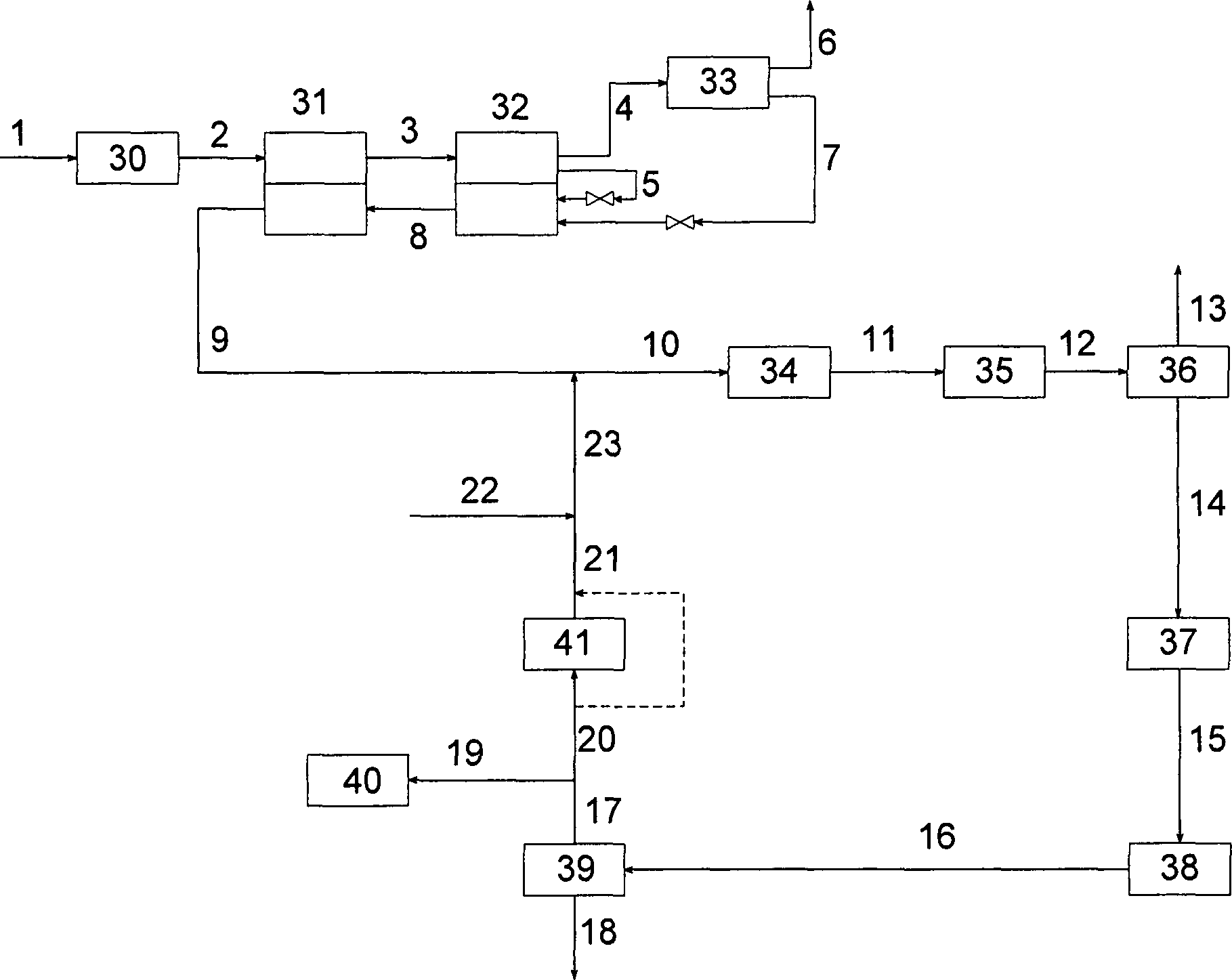
In
diesem Beispiel wird der vorteilhafte Betrieb des erfindungsgemäßen
Prozesses unter Verwendung der
Ein
HCl-Rohgasstrom
Anschließend
wird der komprimierte Rohgasstrom
Enthält der HCl-Rohgasstrom weitere Komponenten, die unter den genannten Bedingungen nicht kondensieren, werden auch diese abgetrennt. Eine typische solche Komponente ist z. B. Stickstoff.contains the HCl crude gas stream further components, among the mentioned Conditions do not condense, these are also separated. A typical such component is z. Nitrogen.
In
den gereinigten, verflüssigten HCl-Strömen Strom
Danach
wird der gereinigte, weiter verdampfte HCl-Strom
Der
erhitzte Eduktstrom
Nicht
umgesetzte HCl und der größte Teil des erzeugten
Wassers werden in einem Abscheideprozess
Der
verbleibende Gasstrom
In
einem Chlorkompressor
In
einer sich anschließenden Destillationskolonne
Hinter
der Destillationskolonne
Da
das nach der Ausschleusung verbleibende Gas
Hinter
der Gaswäsche
Beispiel 2 (Vergleichsbeispiel)Example 2 (comparative example)
Im
Vergleichsbeispiel wird anhand von
Ein
HCl-Rohgasstrom
Anschließend
wird der komprimierte Rohgasstrom
Der
erhitzte Eduktstrom
Nicht
umgesetzte HCl und der größte Teil des erzeugten
Wassers werden in einem Abscheideprozess
Der
verbleibende Gasstrom
In
einem Chlorkompressor
In
einer sich anschließenden Destillationskolonne
Hinter
der Destillationskolonne
Da
das nach der Ausschleusung verbleibende Gas
Hinter
der Gaswäsche
ZITATE ENTHALTEN IN DER BESCHREIBUNGQUOTES INCLUDE IN THE DESCRIPTION
Diese Liste der vom Anmelder aufgeführten Dokumente wurde automatisiert erzeugt und ist ausschließlich zur besseren Information des Lesers aufgenommen. Die Liste ist nicht Bestandteil der deutschen Patent- bzw. Gebrauchsmusteranmeldung. Das DPMA übernimmt keinerlei Haftung für etwaige Fehler oder Auslassungen.This list The documents listed by the applicant have been automated generated and is solely for better information recorded by the reader. The list is not part of the German Patent or utility model application. The DPMA takes over no liability for any errors or omissions.
Zitierte PatentliteraturCited patent literature
- - EP 0233773 [0003] EP 0233773 [0003]
- - DE 4217019 A1 [0003] - DE 4217019 A1 [0003]
- - DE 10307141 A1 [0003] - DE 10307141 A1 [0003]
- - DE 1567788 A1 [0004] - DE 1567788 A1 [0004]
- - EP 251731 A2 [0004] - EP 251731 A2 [0004]
- - EP 936184 A2 [0004] - EP 936184 A2 [0004]
- - EP 761593 A1 [0004] - EP 761593 A1 [0004]
- - EP 711599 A1 [0004] - EP 711599 A1 [0004]
- - DE 10250131 A1 [0004] DE 10250131 A1 [0004]
- - EP 0233773 A1 [0010] EP 0233773 A1 [0010]
- - JP 62-270404 A [0010] JP 62-270404 A [0010]
- - JP 2003-171103 A [0011] JP 2003-171103 A [0011]
Claims (18)
Priority Applications (10)
| Application Number | Priority Date | Filing Date | Title |
|---|---|---|---|
| DE102008051694A DE102008051694A1 (en) | 2008-10-15 | 2008-10-15 | Process for the separation of carbon monoxide from a crude HCI gas |
| PT90124983T PT2177476E (en) | 2008-10-15 | 2009-10-02 | Method for separating carbon monoxide from a hcl raw gas |
| ES09012498T ES2401406T3 (en) | 2008-10-15 | 2009-10-02 | Procedure for the separation of carbon monoxide from a crude HCI gas |
| PL09012498T PL2177476T3 (en) | 2008-10-15 | 2009-10-02 | Method for separating carbon monoxide from a HCl raw gas |
| EP09012498A EP2177476B1 (en) | 2008-10-15 | 2009-10-02 | Method for separating carbon monoxide from a HCl raw gas |
| KR1020090097513A KR20100042229A (en) | 2008-10-15 | 2009-10-14 | Processes for removing carbon monoxide from a crude hcl gas, and hcl oxidation processes using purified hcl gas obtained thereby |
| TW098134704A TW201031595A (en) | 2008-10-15 | 2009-10-14 | Processes for removing carbon monoxide from a crude HC1 gas, and HC1 oxidation processes using purified HC1 gas obtained thereby |
| JP2009237245A JP5323639B2 (en) | 2008-10-15 | 2009-10-14 | Method for removing carbon monoxide from crude HCl gas, and HCl oxidation method using purified HCl gas obtained thereby |
| US12/579,445 US20100092373A1 (en) | 2008-10-15 | 2009-10-15 | Processes for Removing Carbon Monoxide from a Crude HCl Gas, and HCl Oxidation Processes Using Purified HCl Gas Obtained Thereby |
| CN200910206390.7A CN101927980B (en) | 2008-10-15 | 2009-10-15 | Process for removing CO from crude HCl gas and HCl oxidation process using the resulting purified gas |
Applications Claiming Priority (1)
| Application Number | Priority Date | Filing Date | Title |
|---|---|---|---|
| DE102008051694A DE102008051694A1 (en) | 2008-10-15 | 2008-10-15 | Process for the separation of carbon monoxide from a crude HCI gas |
Publications (1)
| Publication Number | Publication Date |
|---|---|
| DE102008051694A1 true DE102008051694A1 (en) | 2010-04-22 |
Family
ID=41360286
Family Applications (1)
| Application Number | Title | Priority Date | Filing Date |
|---|---|---|---|
| DE102008051694A Withdrawn DE102008051694A1 (en) | 2008-10-15 | 2008-10-15 | Process for the separation of carbon monoxide from a crude HCI gas |
Country Status (10)
| Country | Link |
|---|---|
| US (1) | US20100092373A1 (en) |
| EP (1) | EP2177476B1 (en) |
| JP (1) | JP5323639B2 (en) |
| KR (1) | KR20100042229A (en) |
| CN (1) | CN101927980B (en) |
| DE (1) | DE102008051694A1 (en) |
| ES (1) | ES2401406T3 (en) |
| PL (1) | PL2177476T3 (en) |
| PT (1) | PT2177476E (en) |
| TW (1) | TW201031595A (en) |
Families Citing this family (7)
| Publication number | Priority date | Publication date | Assignee | Title |
|---|---|---|---|---|
| JP2012200700A (en) * | 2011-03-28 | 2012-10-22 | Sumitomo Chemical Co Ltd | Method for producing bromine |
| US9352270B2 (en) | 2011-04-11 | 2016-05-31 | ADA-ES, Inc. | Fluidized bed and method and system for gas component capture |
| WO2014047354A1 (en) | 2012-09-20 | 2014-03-27 | ADA-ES, Inc. | Method and system to reclaim functional sites on a sorbent contaminated by heat stable salts |
| CN103920507A (en) * | 2013-01-15 | 2014-07-16 | 南京工业大学 | Catalyst for preparing chlorine by oxidizing hydrogen chloride and application thereof |
| CN106145039B (en) * | 2015-04-01 | 2020-09-11 | 上海氯碱化工股份有限公司 | Method for pretreating raw materials in process of preparing chlorine from hydrogen chloride |
| CN105480947A (en) * | 2015-12-07 | 2016-04-13 | 南通山剑石墨设备有限公司 | Alcohol-containing waste hydrochloric acid treatment apparatus and treatment technology thereof |
| CN113277473B (en) * | 2021-05-13 | 2022-07-12 | 万华化学(宁波)有限公司 | Process for decomposing residual chlorine in hydrochloric acid |
Citations (11)
| Publication number | Priority date | Publication date | Assignee | Title |
|---|---|---|---|---|
| DE1567788A1 (en) | 1964-04-23 | 1970-05-27 | Shell Internationale Research Maatschappij N.V., Den Haag | Process for the production of chlorine, bromine or iodine |
| EP0233773A1 (en) | 1986-02-19 | 1987-08-26 | MITSUI TOATSU CHEMICALS, Inc. | Production of chlorine |
| JPS62270404A (en) | 1986-05-16 | 1987-11-24 | Mitsui Toatsu Chem Inc | Production of chlorine |
| EP0251731A2 (en) | 1986-06-30 | 1988-01-07 | MITSUI TOATSU CHEMICALS, Inc. | Production of chlorine |
| DE4217019A1 (en) | 1992-05-22 | 1993-11-25 | Bayer Ag | Process for the preparation of aromatic diisocyanates |
| EP0711599A1 (en) | 1994-11-14 | 1996-05-15 | Mitsui Toatsu Chemicals, Incorporated | Catalyst for preparing chlorine from hydrogen chloride |
| EP0761593A1 (en) | 1995-09-12 | 1997-03-12 | Basf Aktiengesellschaft | Process for the production of chlorine |
| EP0936184A2 (en) | 1998-02-16 | 1999-08-18 | Sumitomo Chemical Company, Limited | Process for producing chlorine |
| JP2003171103A (en) | 2001-12-04 | 2003-06-17 | Sumitomo Chem Co Ltd | Catalytic oxidation method |
| DE10250131A1 (en) | 2002-10-28 | 2004-05-06 | Basf Ag | Process for the production of chlorine from hydrochloric acid |
| DE10307141A1 (en) | 2003-02-20 | 2004-09-02 | Bayer Ag | Process for the preparation of (poly) isocyanates in the gas phase |
Family Cites Families (12)
| Publication number | Priority date | Publication date | Assignee | Title |
|---|---|---|---|---|
| JPS5085575A (en) * | 1973-12-03 | 1975-07-10 | ||
| DE3816783A1 (en) * | 1988-05-17 | 1989-11-30 | Wacker Chemie Gmbh | METHOD FOR PURIFYING RAW, GASEOUS CHLORINE |
| AU657842B2 (en) * | 1992-03-13 | 1995-03-23 | Eka Chemicals Oy | Method for producing alkaline metal hydroxide |
| DE4442743A1 (en) * | 1994-12-01 | 1996-06-05 | Hoechst Ag | Process for the separation of hydrogen chloride |
| DE19535716A1 (en) * | 1995-09-26 | 1997-03-27 | Bayer Ag | Process for working up the reaction gases in the oxidation of HCl to chlorine |
| DE19724965A1 (en) * | 1997-06-12 | 1998-12-24 | Wacker Chemie Gmbh | Electronic grade hydrogen chloride used to produce semiconductor material |
| JP2003056980A (en) * | 2001-08-15 | 2003-02-26 | Nippon Sanso Corp | Gas separation and purification method and apparatus |
| US7820132B2 (en) * | 2001-12-14 | 2010-10-26 | Alliance For Sustainable Energy, Llc | Hot wire production of single-wall and multi-wall carbon nanotubes |
| US6719957B2 (en) * | 2002-04-17 | 2004-04-13 | Bayer Corporation | Process for purification of anhydrous hydrogen chloride gas |
| DE10260084A1 (en) * | 2002-12-19 | 2004-07-01 | Basf Ag | Separation of a mixture of hydrogen chloride and phosgene |
| DE102006022447A1 (en) * | 2006-05-13 | 2007-11-15 | Bayer Materialscience Ag | Process for the coupled production of chlorine and isocyanates |
| DE102006023581A1 (en) * | 2006-05-19 | 2007-11-22 | Bayer Materialscience Ag | Process for separating chlorine from the product gas of an HCl oxidation process |
-
2008
- 2008-10-15 DE DE102008051694A patent/DE102008051694A1/en not_active Withdrawn
-
2009
- 2009-10-02 EP EP09012498A patent/EP2177476B1/en not_active Not-in-force
- 2009-10-02 PL PL09012498T patent/PL2177476T3/en unknown
- 2009-10-02 PT PT90124983T patent/PT2177476E/en unknown
- 2009-10-02 ES ES09012498T patent/ES2401406T3/en active Active
- 2009-10-14 KR KR1020090097513A patent/KR20100042229A/en not_active Ceased
- 2009-10-14 TW TW098134704A patent/TW201031595A/en unknown
- 2009-10-14 JP JP2009237245A patent/JP5323639B2/en not_active Expired - Fee Related
- 2009-10-15 CN CN200910206390.7A patent/CN101927980B/en not_active Expired - Fee Related
- 2009-10-15 US US12/579,445 patent/US20100092373A1/en not_active Abandoned
Patent Citations (11)
| Publication number | Priority date | Publication date | Assignee | Title |
|---|---|---|---|---|
| DE1567788A1 (en) | 1964-04-23 | 1970-05-27 | Shell Internationale Research Maatschappij N.V., Den Haag | Process for the production of chlorine, bromine or iodine |
| EP0233773A1 (en) | 1986-02-19 | 1987-08-26 | MITSUI TOATSU CHEMICALS, Inc. | Production of chlorine |
| JPS62270404A (en) | 1986-05-16 | 1987-11-24 | Mitsui Toatsu Chem Inc | Production of chlorine |
| EP0251731A2 (en) | 1986-06-30 | 1988-01-07 | MITSUI TOATSU CHEMICALS, Inc. | Production of chlorine |
| DE4217019A1 (en) | 1992-05-22 | 1993-11-25 | Bayer Ag | Process for the preparation of aromatic diisocyanates |
| EP0711599A1 (en) | 1994-11-14 | 1996-05-15 | Mitsui Toatsu Chemicals, Incorporated | Catalyst for preparing chlorine from hydrogen chloride |
| EP0761593A1 (en) | 1995-09-12 | 1997-03-12 | Basf Aktiengesellschaft | Process for the production of chlorine |
| EP0936184A2 (en) | 1998-02-16 | 1999-08-18 | Sumitomo Chemical Company, Limited | Process for producing chlorine |
| JP2003171103A (en) | 2001-12-04 | 2003-06-17 | Sumitomo Chem Co Ltd | Catalytic oxidation method |
| DE10250131A1 (en) | 2002-10-28 | 2004-05-06 | Basf Ag | Process for the production of chlorine from hydrochloric acid |
| DE10307141A1 (en) | 2003-02-20 | 2004-09-02 | Bayer Ag | Process for the preparation of (poly) isocyanates in the gas phase |
Also Published As
| Publication number | Publication date |
|---|---|
| EP2177476A1 (en) | 2010-04-21 |
| ES2401406T3 (en) | 2013-04-19 |
| CN101927980A (en) | 2010-12-29 |
| US20100092373A1 (en) | 2010-04-15 |
| KR20100042229A (en) | 2010-04-23 |
| JP5323639B2 (en) | 2013-10-23 |
| PT2177476E (en) | 2013-03-22 |
| PL2177476T3 (en) | 2013-06-28 |
| TW201031595A (en) | 2010-09-01 |
| CN101927980B (en) | 2015-08-26 |
| JP2010117123A (en) | 2010-05-27 |
| EP2177476B1 (en) | 2013-01-23 |
Similar Documents
| Publication | Publication Date | Title |
|---|---|---|
| EP1981806B1 (en) | Method for the production of chlorine | |
| EP2177476B1 (en) | Method for separating carbon monoxide from a HCl raw gas | |
| EP1981619B1 (en) | Process for extracting (chlorinated) hydrocarbon-free hydrogen chloride and phosgene-free (chlorinated) hydrocarbons from a hydrogen chloride stream containing (chlorinated) hydrocarbons and phosgene | |
| EP2142470B1 (en) | Condensation-adsorption process for removing organic components from a gaseous stream containing hydrogen chloride | |
| EP1542923B1 (en) | Fixed-bed method for production of chlorine by catalytic gas-phase oxidation of hydrogen chloride | |
| WO2009118095A2 (en) | Method for regenerating a ruthenium- or ruthenium compound-containing catalyst which is contaminated with sulfur in the form of sulfur compounds | |
| WO2008116558A2 (en) | Process for removing and recirculating condensable components from gaseous streams containing chlorine | |
| WO2008125235A1 (en) | Adsorption process for removing inorganic components from a hydrochloric acid gas flow | |
| WO2006089877A1 (en) | Method for producing chlorine | |
| WO2008131870A1 (en) | METHOD FOR THE OXIDATION OF CARBON MONOXIDE IN A GAS STREAM CONTAINING HCl | |
| EP2146927A2 (en) | Heat integration in a deacon process | |
| WO2007134861A1 (en) | Method for producing chlorine from hydrogen chloride and oxygen | |
| DE10252859A1 (en) | Production of vinyl chloride comprises direct chlorination of ethylene and pyrolysis with catalytic oxidation of hydrogen chloride and recycle to the direct chlorination zone | |
| DE102007016973A1 (en) | Regenerative adsorption process for removal of organic components from a gas stream | |
| EP1546032A1 (en) | Catalyst for the catalytic oxidation of hydrogen chloride | |
| DE102006024548A1 (en) | Process for the oxidation of a hydrogen chloride-containing gas | |
| WO2018210770A1 (en) | Method for regenerating a toxified catalyst containing ruthenium or ruthenium compounds | |
| EP2675751A1 (en) | Use of liquid hydrogen chloride as a refrigerant in methods for producing chlorine | |
| WO2008131869A1 (en) | Method for the cleaning up and oxidation of a gas containing hydrogen chloride | |
| EP2675752A1 (en) | Distillation method for removing chlorine from gas flows that contain oxygen and chlorine | |
| EP1506133B1 (en) | Method for producing chlorine from hydrogen chloride | |
| DE102011005897A1 (en) | Providing chlorine for chemical reaction comprises producing chlorine by gas-phase oxidation of hydrogen chloride with oxygen in catalyst containing reaction zone, followed by cooling product and separating e.g. unreacted hydrogen chloride | |
| DE10234908B4 (en) | Process for the production of chlorine from a (chlorine) hydrocarbons containing hydrogen chloride stream | |
| EP2142469A1 (en) | PROCESS FOR PRODUCING CHLORINE FROM HCl |
Legal Events
| Date | Code | Title | Description |
|---|---|---|---|
| 8130 | Withdrawal | ||
| R120 | Application withdrawn or ip right abandoned |
Effective date: 20110308 |