DE102007015707A1 - Cycloolefin copolymers, process for their preparation, their use and catalysts - Google Patents
Cycloolefin copolymers, process for their preparation, their use and catalysts Download PDFInfo
- Publication number
- DE102007015707A1 DE102007015707A1 DE102007015707A DE102007015707A DE102007015707A1 DE 102007015707 A1 DE102007015707 A1 DE 102007015707A1 DE 102007015707 A DE102007015707 A DE 102007015707A DE 102007015707 A DE102007015707 A DE 102007015707A DE 102007015707 A1 DE102007015707 A1 DE 102007015707A1
- Authority
- DE
- Germany
- Prior art keywords
- group
- groups
- hydrogen
- alkyl
- aryl
- Prior art date
- Legal status (The legal status is an assumption and is not a legal conclusion. Google has not performed a legal analysis and makes no representation as to the accuracy of the status listed.)
- Withdrawn
Links
- 229920001577 copolymer Polymers 0.000 title claims abstract description 35
- 239000003054 catalyst Substances 0.000 title claims description 29
- 238000000034 method Methods 0.000 title claims description 28
- 238000002360 preparation method Methods 0.000 title claims description 8
- -1 polycyclic olefins Chemical class 0.000 claims abstract description 14
- 125000003367 polycyclic group Chemical group 0.000 claims abstract description 10
- 238000004519 manufacturing process Methods 0.000 claims abstract description 6
- 238000000465 moulding Methods 0.000 claims abstract description 3
- 239000001257 hydrogen Substances 0.000 claims description 43
- 229910052739 hydrogen Inorganic materials 0.000 claims description 43
- 150000002431 hydrogen Chemical class 0.000 claims description 23
- 125000003118 aryl group Chemical group 0.000 claims description 22
- 150000001875 compounds Chemical class 0.000 claims description 22
- UFHFLCQGNIYNRP-UHFFFAOYSA-N Hydrogen Chemical compound [H][H] UFHFLCQGNIYNRP-UHFFFAOYSA-N 0.000 claims description 20
- VGGSQFUCUMXWEO-UHFFFAOYSA-N Ethene Chemical compound C=C VGGSQFUCUMXWEO-UHFFFAOYSA-N 0.000 claims description 18
- 125000000217 alkyl group Chemical group 0.000 claims description 15
- 238000001460 carbon-13 nuclear magnetic resonance spectrum Methods 0.000 claims description 14
- 229910052751 metal Inorganic materials 0.000 claims description 14
- 239000002184 metal Substances 0.000 claims description 14
- 125000001931 aliphatic group Chemical group 0.000 claims description 12
- 125000002496 methyl group Chemical group [H]C([H])([H])* 0.000 claims description 11
- JFNLZVQOOSMTJK-KNVOCYPGSA-N norbornene Chemical compound C1[C@@H]2CC[C@H]1C=C2 JFNLZVQOOSMTJK-KNVOCYPGSA-N 0.000 claims description 11
- 125000000058 cyclopentadienyl group Chemical group C1(=CC=CC1)* 0.000 claims description 10
- 229920006395 saturated elastomer Polymers 0.000 claims description 10
- 125000005843 halogen group Chemical group 0.000 claims description 9
- 239000003446 ligand Substances 0.000 claims description 9
- 125000003545 alkoxy group Chemical group 0.000 claims description 8
- 125000002877 alkyl aryl group Chemical group 0.000 claims description 8
- 125000004122 cyclic group Chemical group 0.000 claims description 8
- 150000001925 cycloalkenes Chemical class 0.000 claims description 8
- 229910052736 halogen Inorganic materials 0.000 claims description 8
- 150000002367 halogens Chemical class 0.000 claims description 8
- 230000000737 periodic effect Effects 0.000 claims description 7
- 125000001997 phenyl group Chemical group [H]C1=C([H])C([H])=C(*)C([H])=C1[H] 0.000 claims description 7
- 125000001424 substituent group Chemical group 0.000 claims description 6
- QCWXUUIWCKQGHC-UHFFFAOYSA-N Zirconium Chemical compound [Zr] QCWXUUIWCKQGHC-UHFFFAOYSA-N 0.000 claims description 5
- 125000004104 aryloxy group Chemical group 0.000 claims description 5
- 229910052726 zirconium Inorganic materials 0.000 claims description 5
- 125000003710 aryl alkyl group Chemical group 0.000 claims description 4
- 125000002029 aromatic hydrocarbon group Chemical group 0.000 claims description 3
- 125000001797 benzyl group Chemical group [H]C1=C([H])C([H])=C(C([H])=C1[H])C([H])([H])* 0.000 claims description 3
- 125000004169 (C1-C6) alkyl group Chemical group 0.000 claims description 2
- 239000005977 Ethylene Substances 0.000 claims description 2
- 125000000484 butyl group Chemical group [H]C([*])([H])C([H])([H])C([H])([H])C([H])([H])[H] 0.000 claims description 2
- 125000001495 ethyl group Chemical group [H]C([H])([H])C([H])([H])* 0.000 claims description 2
- 239000000178 monomer Substances 0.000 claims description 2
- 125000000999 tert-butyl group Chemical group [H]C([H])([H])C(*)(C([H])([H])[H])C([H])([H])[H] 0.000 claims description 2
- 125000003837 (C1-C20) alkyl group Chemical group 0.000 claims 2
- 125000002947 alkylene group Chemical group 0.000 claims 1
- 239000011888 foil Substances 0.000 claims 1
- 150000002739 metals Chemical class 0.000 claims 1
- 230000000379 polymerizing effect Effects 0.000 claims 1
- 238000007151 ring opening polymerisation reaction Methods 0.000 claims 1
- 150000001336 alkenes Chemical class 0.000 abstract description 11
- 239000012968 metallocene catalyst Substances 0.000 abstract description 7
- 238000007334 copolymerization reaction Methods 0.000 abstract description 5
- YXFVVABEGXRONW-UHFFFAOYSA-N Toluene Chemical compound CC1=CC=CC=C1 YXFVVABEGXRONW-UHFFFAOYSA-N 0.000 description 48
- 239000000243 solution Substances 0.000 description 28
- 238000006116 polymerization reaction Methods 0.000 description 26
- QQONPFPTGQHPMA-UHFFFAOYSA-N propylene Natural products CC=C QQONPFPTGQHPMA-UHFFFAOYSA-N 0.000 description 16
- 229910007926 ZrCl Inorganic materials 0.000 description 11
- 229920000642 polymer Polymers 0.000 description 10
- RTZKZFJDLAIYFH-UHFFFAOYSA-N Diethyl ether Chemical compound CCOCC RTZKZFJDLAIYFH-UHFFFAOYSA-N 0.000 description 9
- 239000002904 solvent Substances 0.000 description 9
- LRTOHSLOFCWHRF-UHFFFAOYSA-N 1-methyl-1h-indene Chemical compound C1=CC=C2C(C)C=CC2=C1 LRTOHSLOFCWHRF-UHFFFAOYSA-N 0.000 description 8
- 238000003786 synthesis reaction Methods 0.000 description 8
- 230000015572 biosynthetic process Effects 0.000 description 7
- ZSWFCLXCOIISFI-UHFFFAOYSA-N endo-cyclopentadiene Natural products C1C=CC=C1 ZSWFCLXCOIISFI-UHFFFAOYSA-N 0.000 description 7
- YBYIRNPNPLQARY-UHFFFAOYSA-N 1H-indene Natural products C1=CC=C2CC=CC2=C1 YBYIRNPNPLQARY-UHFFFAOYSA-N 0.000 description 6
- COOKKJGOGWACMY-UHFFFAOYSA-N 3-methyl-1h-indene Chemical compound C1=CC=C2C(C)=CCC2=C1 COOKKJGOGWACMY-UHFFFAOYSA-N 0.000 description 6
- 229920000089 Cyclic olefin copolymer Polymers 0.000 description 6
- MZRVEZGGRBJDDB-UHFFFAOYSA-N N-Butyllithium Chemical compound [Li]CCCC MZRVEZGGRBJDDB-UHFFFAOYSA-N 0.000 description 6
- OFBQJSOFQDEBGM-UHFFFAOYSA-N Pentane Chemical compound CCCCC OFBQJSOFQDEBGM-UHFFFAOYSA-N 0.000 description 6
- NNBZCPXTIHJBJL-UHFFFAOYSA-N decalin Chemical compound C1CCCC2CCCCC21 NNBZCPXTIHJBJL-UHFFFAOYSA-N 0.000 description 6
- 230000000694 effects Effects 0.000 description 6
- 125000004805 propylene group Chemical group [H]C([H])([H])C([H])([*:1])C([H])([H])[*:2] 0.000 description 6
- 239000000725 suspension Substances 0.000 description 6
- XLYOFNOQVPJJNP-UHFFFAOYSA-N water Substances O XLYOFNOQVPJJNP-UHFFFAOYSA-N 0.000 description 6
- 238000005481 NMR spectroscopy Methods 0.000 description 5
- VYPSYNLAJGMNEJ-UHFFFAOYSA-N Silicium dioxide Chemical compound O=[Si]=O VYPSYNLAJGMNEJ-UHFFFAOYSA-N 0.000 description 5
- 239000000203 mixture Substances 0.000 description 5
- 150000003254 radicals Chemical class 0.000 description 5
- 238000005160 1H NMR spectroscopy Methods 0.000 description 4
- CSCPPACGZOOCGX-UHFFFAOYSA-N Acetone Chemical compound CC(C)=O CSCPPACGZOOCGX-UHFFFAOYSA-N 0.000 description 4
- XKRFYHLGVUSROY-UHFFFAOYSA-N Argon Chemical compound [Ar] XKRFYHLGVUSROY-UHFFFAOYSA-N 0.000 description 4
- 229910052782 aluminium Inorganic materials 0.000 description 4
- 238000006243 chemical reaction Methods 0.000 description 4
- 239000000460 chlorine Substances 0.000 description 4
- 238000000113 differential scanning calorimetry Methods 0.000 description 4
- 238000001035 drying Methods 0.000 description 4
- 238000002474 experimental method Methods 0.000 description 4
- 150000002430 hydrocarbons Chemical group 0.000 description 4
- 229920002521 macromolecule Polymers 0.000 description 4
- 239000007787 solid Substances 0.000 description 4
- 238000003756 stirring Methods 0.000 description 4
- 238000010792 warming Methods 0.000 description 4
- QTXRSKSQJLLAEC-UHFFFAOYSA-N 1-[cyclopenta-1,3-dien-1-yl(diphenyl)methyl]-3-methyl-1h-indene Chemical compound C12=CC=CC=C2C(C)=CC1C(C=1C=CC=CC=1)(C=1C=CC=CC=1)C1=CC=CC1 QTXRSKSQJLLAEC-UHFFFAOYSA-N 0.000 description 3
- 239000004743 Polypropylene Substances 0.000 description 3
- 229910007928 ZrCl2 Inorganic materials 0.000 description 3
- BULLHRADHZGONG-UHFFFAOYSA-N [cyclopenta-2,4-dien-1-ylidene(phenyl)methyl]benzene Chemical compound C1=CC=CC1=C(C=1C=CC=CC=1)C1=CC=CC=C1 BULLHRADHZGONG-UHFFFAOYSA-N 0.000 description 3
- 239000010408 film Substances 0.000 description 3
- 238000001914 filtration Methods 0.000 description 3
- 229930195733 hydrocarbon Natural products 0.000 description 3
- 239000011261 inert gas Substances 0.000 description 3
- 125000000959 isobutyl group Chemical group [H]C([H])([H])C([H])(C([H])([H])[H])C([H])([H])* 0.000 description 3
- 238000005259 measurement Methods 0.000 description 3
- CPOFMOWDMVWCLF-UHFFFAOYSA-N methyl(oxo)alumane Chemical compound C[Al]=O CPOFMOWDMVWCLF-UHFFFAOYSA-N 0.000 description 3
- 229920001155 polypropylene Polymers 0.000 description 3
- 239000000126 substance Substances 0.000 description 3
- PXXNTAGJWPJAGM-UHFFFAOYSA-N vertaline Natural products C1C2C=3C=C(OC)C(OC)=CC=3OC(C=C3)=CC=C3CCC(=O)OC1CC1N2CCCC1 PXXNTAGJWPJAGM-UHFFFAOYSA-N 0.000 description 3
- QPFMBZIOSGYJDE-UHFFFAOYSA-N 1,1,2,2-tetrachloroethane Chemical compound ClC(Cl)C(Cl)Cl QPFMBZIOSGYJDE-UHFFFAOYSA-N 0.000 description 2
- QTBSBXVTEAMEQO-UHFFFAOYSA-N Acetic acid Chemical compound CC(O)=O QTBSBXVTEAMEQO-UHFFFAOYSA-N 0.000 description 2
- 241000283690 Bos taurus Species 0.000 description 2
- 239000004215 Carbon black (E152) Substances 0.000 description 2
- ZAMOUSCENKQFHK-UHFFFAOYSA-N Chlorine atom Chemical compound [Cl] ZAMOUSCENKQFHK-UHFFFAOYSA-N 0.000 description 2
- LFQSCWFLJHTTHZ-UHFFFAOYSA-N Ethanol Chemical compound CCO LFQSCWFLJHTTHZ-UHFFFAOYSA-N 0.000 description 2
- VEXZGXHMUGYJMC-UHFFFAOYSA-N Hydrochloric acid Chemical compound Cl VEXZGXHMUGYJMC-UHFFFAOYSA-N 0.000 description 2
- CSNNHWWHGAXBCP-UHFFFAOYSA-L Magnesium sulfate Chemical compound [Mg+2].[O-][S+2]([O-])([O-])[O-] CSNNHWWHGAXBCP-UHFFFAOYSA-L 0.000 description 2
- XAGFODPZIPBFFR-UHFFFAOYSA-N aluminium Chemical compound [Al] XAGFODPZIPBFFR-UHFFFAOYSA-N 0.000 description 2
- 229910052786 argon Inorganic materials 0.000 description 2
- 239000012876 carrier material Substances 0.000 description 2
- 230000003197 catalytic effect Effects 0.000 description 2
- 229910052801 chlorine Inorganic materials 0.000 description 2
- 238000001816 cooling Methods 0.000 description 2
- ZMMRKRFMSDTOLV-UHFFFAOYSA-N cyclopenta-1,3-diene zirconium Chemical compound [Zr].C1C=CC=C1.C1C=CC=C1 ZMMRKRFMSDTOLV-UHFFFAOYSA-N 0.000 description 2
- 230000009477 glass transition Effects 0.000 description 2
- 238000010438 heat treatment Methods 0.000 description 2
- 125000003454 indenyl group Chemical group C1(C=CC2=CC=CC=C12)* 0.000 description 2
- 239000012442 inert solvent Substances 0.000 description 2
- 239000011777 magnesium Substances 0.000 description 2
- SYSQUGFVNFXIIT-UHFFFAOYSA-N n-[4-(1,3-benzoxazol-2-yl)phenyl]-4-nitrobenzenesulfonamide Chemical class C1=CC([N+](=O)[O-])=CC=C1S(=O)(=O)NC1=CC=C(C=2OC3=CC=CC=C3N=2)C=C1 SYSQUGFVNFXIIT-UHFFFAOYSA-N 0.000 description 2
- 230000003287 optical effect Effects 0.000 description 2
- 239000000843 powder Substances 0.000 description 2
- 239000002243 precursor Substances 0.000 description 2
- 238000000425 proton nuclear magnetic resonance spectrum Methods 0.000 description 2
- 230000035484 reaction time Effects 0.000 description 2
- 238000001228 spectrum Methods 0.000 description 2
- 229910052723 transition metal Inorganic materials 0.000 description 2
- 150000003624 transition metals Chemical class 0.000 description 2
- BUHVIAUBTBOHAG-FOYDDCNASA-N (2r,3r,4s,5r)-2-[6-[[2-(3,5-dimethoxyphenyl)-2-(2-methylphenyl)ethyl]amino]purin-9-yl]-5-(hydroxymethyl)oxolane-3,4-diol Chemical compound COC1=CC(OC)=CC(C(CNC=2C=3N=CN(C=3N=CN=2)[C@H]2[C@@H]([C@H](O)[C@@H](CO)O2)O)C=2C(=CC=CC=2)C)=C1 BUHVIAUBTBOHAG-FOYDDCNASA-N 0.000 description 1
- 125000004209 (C1-C8) alkyl group Chemical group 0.000 description 1
- QPFMBZIOSGYJDE-QDNHWIQGSA-N 1,1,2,2-tetrachlorethane-d2 Chemical compound [2H]C(Cl)(Cl)C([2H])(Cl)Cl QPFMBZIOSGYJDE-QDNHWIQGSA-N 0.000 description 1
- DSXAPMOJZLIWQW-UHFFFAOYSA-N 1-[cyclopenta-1,4-dien-1-yl(diphenyl)methyl]-3-methyl-1h-indene Chemical compound C12=CC=CC=C2C(C)=CC1C(C=1C=CC=CC=1)(C=1C=CC=CC=1)C1=CCC=C1 DSXAPMOJZLIWQW-UHFFFAOYSA-N 0.000 description 1
- 238000001644 13C nuclear magnetic resonance spectroscopy Methods 0.000 description 1
- PNEYBMLMFCGWSK-UHFFFAOYSA-N Alumina Chemical class [O-2].[O-2].[O-2].[Al+3].[Al+3] PNEYBMLMFCGWSK-UHFFFAOYSA-N 0.000 description 1
- KPWMGUMUJVLSHH-UHFFFAOYSA-L CC(C)=[Zr](Cl)(Cl)(C1C=CC=C1)C1C=CC2=CC=CC=C12 Chemical compound CC(C)=[Zr](Cl)(Cl)(C1C=CC=C1)C1C=CC2=CC=CC=C12 KPWMGUMUJVLSHH-UHFFFAOYSA-L 0.000 description 1
- 239000004698 Polyethylene Substances 0.000 description 1
- FAPWRFPIFSIZLT-UHFFFAOYSA-M Sodium chloride Chemical class [Na+].[Cl-] FAPWRFPIFSIZLT-UHFFFAOYSA-M 0.000 description 1
- 229910000831 Steel Inorganic materials 0.000 description 1
- OKJPEAGHQZHRQV-UHFFFAOYSA-N Triiodomethane Natural products IC(I)I OKJPEAGHQZHRQV-UHFFFAOYSA-N 0.000 description 1
- BGYHLZZASRKEJE-UHFFFAOYSA-N [3-[3-(3,5-ditert-butyl-4-hydroxyphenyl)propanoyloxy]-2,2-bis[3-(3,5-ditert-butyl-4-hydroxyphenyl)propanoyloxymethyl]propyl] 3-(3,5-ditert-butyl-4-hydroxyphenyl)propanoate Chemical compound CC(C)(C)C1=C(O)C(C(C)(C)C)=CC(CCC(=O)OCC(COC(=O)CCC=2C=C(C(O)=C(C=2)C(C)(C)C)C(C)(C)C)(COC(=O)CCC=2C=C(C(O)=C(C=2)C(C)(C)C)C(C)(C)C)COC(=O)CCC=2C=C(C(O)=C(C=2)C(C)(C)C)C(C)(C)C)=C1 BGYHLZZASRKEJE-UHFFFAOYSA-N 0.000 description 1
- 229960000583 acetic acid Drugs 0.000 description 1
- 230000004913 activation Effects 0.000 description 1
- 150000001338 aliphatic hydrocarbons Chemical class 0.000 description 1
- 229920005603 alternating copolymer Polymers 0.000 description 1
- 239000008346 aqueous phase Substances 0.000 description 1
- 150000004945 aromatic hydrocarbons Chemical class 0.000 description 1
- 125000004429 atom Chemical group 0.000 description 1
- RWCCWEUUXYIKHB-UHFFFAOYSA-N benzophenone Chemical compound C=1C=CC=CC=1C(=O)C1=CC=CC=C1 RWCCWEUUXYIKHB-UHFFFAOYSA-N 0.000 description 1
- 239000012965 benzophenone Substances 0.000 description 1
- SFFFIHNOEGSAIH-UHFFFAOYSA-N bicyclo[2.2.1]hept-2-ene;ethene Chemical group C=C.C1C2CCC1C=C2 SFFFIHNOEGSAIH-UHFFFAOYSA-N 0.000 description 1
- 230000033228 biological regulation Effects 0.000 description 1
- 239000000969 carrier Substances 0.000 description 1
- 239000007795 chemical reaction product Substances 0.000 description 1
- 239000003638 chemical reducing agent Substances 0.000 description 1
- 238000010668 complexation reaction Methods 0.000 description 1
- 238000012937 correction Methods 0.000 description 1
- 230000008878 coupling Effects 0.000 description 1
- 238000010168 coupling process Methods 0.000 description 1
- 238000005859 coupling reaction Methods 0.000 description 1
- 239000012043 crude product Substances 0.000 description 1
- 239000013078 crystal Substances 0.000 description 1
- 238000002425 crystallisation Methods 0.000 description 1
- 230000008025 crystallization Effects 0.000 description 1
- 239000002283 diesel fuel Substances 0.000 description 1
- 238000004090 dissolution Methods 0.000 description 1
- 238000005516 engineering process Methods 0.000 description 1
- 238000011156 evaluation Methods 0.000 description 1
- 238000001125 extrusion Methods 0.000 description 1
- 239000000706 filtrate Substances 0.000 description 1
- 125000003983 fluorenyl group Chemical group C1(=CC=CC=2C3=CC=CC=C3CC12)* 0.000 description 1
- 239000007789 gas Substances 0.000 description 1
- 239000000499 gel Substances 0.000 description 1
- 239000012362 glacial acetic acid Substances 0.000 description 1
- 239000005457 ice water Substances 0.000 description 1
- 238000010102 injection blow moulding Methods 0.000 description 1
- 238000001746 injection moulding Methods 0.000 description 1
- INQOMBQAUSQDDS-UHFFFAOYSA-N iodomethane Chemical compound IC INQOMBQAUSQDDS-UHFFFAOYSA-N 0.000 description 1
- 125000000654 isopropylidene group Chemical group C(C)(C)=* 0.000 description 1
- 239000007788 liquid Substances 0.000 description 1
- 229910052943 magnesium sulfate Inorganic materials 0.000 description 1
- 235000019341 magnesium sulphate Nutrition 0.000 description 1
- 239000012528 membrane Substances 0.000 description 1
- 125000001434 methanylylidene group Chemical group [H]C#[*] 0.000 description 1
- 125000000325 methylidene group Chemical group [H]C([H])=* 0.000 description 1
- 238000002156 mixing Methods 0.000 description 1
- 238000010899 nucleation Methods 0.000 description 1
- JRZJOMJEPLMPRA-UHFFFAOYSA-N olefin Natural products CCCCCCCC=C JRZJOMJEPLMPRA-UHFFFAOYSA-N 0.000 description 1
- 239000012788 optical film Substances 0.000 description 1
- 239000012074 organic phase Substances 0.000 description 1
- 150000002902 organometallic compounds Chemical class 0.000 description 1
- 229920006280 packaging film Polymers 0.000 description 1
- 239000012785 packaging film Substances 0.000 description 1
- 239000012071 phase Substances 0.000 description 1
- 229920000573 polyethylene Polymers 0.000 description 1
- 230000037048 polymerization activity Effects 0.000 description 1
- 229920000098 polyolefin Polymers 0.000 description 1
- 239000000047 product Substances 0.000 description 1
- 239000011541 reaction mixture Substances 0.000 description 1
- 230000035945 sensitivity Effects 0.000 description 1
- 238000007493 shaping process Methods 0.000 description 1
- 239000000741 silica gel Substances 0.000 description 1
- 229910002027 silica gel Inorganic materials 0.000 description 1
- 239000000377 silicon dioxide Substances 0.000 description 1
- QDRKDTQENPPHOJ-UHFFFAOYSA-N sodium ethoxide Chemical compound [Na+].CC[O-] QDRKDTQENPPHOJ-UHFFFAOYSA-N 0.000 description 1
- 230000006641 stabilisation Effects 0.000 description 1
- 238000011105 stabilization Methods 0.000 description 1
- 239000010959 steel Substances 0.000 description 1
- 238000010189 synthetic method Methods 0.000 description 1
- 150000003623 transition metal compounds Chemical class 0.000 description 1
- DUNKXUFBGCUVQW-UHFFFAOYSA-J zirconium tetrachloride Chemical compound Cl[Zr](Cl)(Cl)Cl DUNKXUFBGCUVQW-UHFFFAOYSA-J 0.000 description 1
- VPGLGRNSAYHXPY-UHFFFAOYSA-L zirconium(2+);dichloride Chemical class Cl[Zr]Cl VPGLGRNSAYHXPY-UHFFFAOYSA-L 0.000 description 1
Classifications
-
- C—CHEMISTRY; METALLURGY
- C08—ORGANIC MACROMOLECULAR COMPOUNDS; THEIR PREPARATION OR CHEMICAL WORKING-UP; COMPOSITIONS BASED THEREON
- C08F—MACROMOLECULAR COMPOUNDS OBTAINED BY REACTIONS ONLY INVOLVING CARBON-TO-CARBON UNSATURATED BONDS
- C08F210/00—Copolymers of unsaturated aliphatic hydrocarbons having only one carbon-to-carbon double bond
-
- C—CHEMISTRY; METALLURGY
- C08—ORGANIC MACROMOLECULAR COMPOUNDS; THEIR PREPARATION OR CHEMICAL WORKING-UP; COMPOSITIONS BASED THEREON
- C08F—MACROMOLECULAR COMPOUNDS OBTAINED BY REACTIONS ONLY INVOLVING CARBON-TO-CARBON UNSATURATED BONDS
- C08F232/00—Copolymers of cyclic compounds containing no unsaturated aliphatic radicals in a side chain, and having one or more carbon-to-carbon double bonds in a carbocyclic ring system
- C08F232/02—Copolymers of cyclic compounds containing no unsaturated aliphatic radicals in a side chain, and having one or more carbon-to-carbon double bonds in a carbocyclic ring system having no condensed rings
-
- C—CHEMISTRY; METALLURGY
- C08—ORGANIC MACROMOLECULAR COMPOUNDS; THEIR PREPARATION OR CHEMICAL WORKING-UP; COMPOSITIONS BASED THEREON
- C08F—MACROMOLECULAR COMPOUNDS OBTAINED BY REACTIONS ONLY INVOLVING CARBON-TO-CARBON UNSATURATED BONDS
- C08F4/00—Polymerisation catalysts
- C08F4/42—Metals; Metal hydrides; Metallo-organic compounds; Use thereof as catalyst precursors
- C08F4/44—Metals; Metal hydrides; Metallo-organic compounds; Use thereof as catalyst precursors selected from light metals, zinc, cadmium, mercury, copper, silver, gold, boron, gallium, indium, thallium, rare earths or actinides
- C08F4/60—Metals; Metal hydrides; Metallo-organic compounds; Use thereof as catalyst precursors selected from light metals, zinc, cadmium, mercury, copper, silver, gold, boron, gallium, indium, thallium, rare earths or actinides together with refractory metals, iron group metals, platinum group metals, manganese, rhenium technetium or compounds thereof
- C08F4/62—Refractory metals or compounds thereof
- C08F4/64—Titanium, zirconium, hafnium or compounds thereof
-
- C—CHEMISTRY; METALLURGY
- C08—ORGANIC MACROMOLECULAR COMPOUNDS; THEIR PREPARATION OR CHEMICAL WORKING-UP; COMPOSITIONS BASED THEREON
- C08F—MACROMOLECULAR COMPOUNDS OBTAINED BY REACTIONS ONLY INVOLVING CARBON-TO-CARBON UNSATURATED BONDS
- C08F4/00—Polymerisation catalysts
- C08F4/42—Metals; Metal hydrides; Metallo-organic compounds; Use thereof as catalyst precursors
- C08F4/44—Metals; Metal hydrides; Metallo-organic compounds; Use thereof as catalyst precursors selected from light metals, zinc, cadmium, mercury, copper, silver, gold, boron, gallium, indium, thallium, rare earths or actinides
- C08F4/60—Metals; Metal hydrides; Metallo-organic compounds; Use thereof as catalyst precursors selected from light metals, zinc, cadmium, mercury, copper, silver, gold, boron, gallium, indium, thallium, rare earths or actinides together with refractory metals, iron group metals, platinum group metals, manganese, rhenium technetium or compounds thereof
- C08F4/62—Refractory metals or compounds thereof
- C08F4/64—Titanium, zirconium, hafnium or compounds thereof
- C08F4/659—Component covered by group C08F4/64 containing a transition metal-carbon bond
- C08F4/65912—Component covered by group C08F4/64 containing a transition metal-carbon bond in combination with an organoaluminium compound
-
- C—CHEMISTRY; METALLURGY
- C08—ORGANIC MACROMOLECULAR COMPOUNDS; THEIR PREPARATION OR CHEMICAL WORKING-UP; COMPOSITIONS BASED THEREON
- C08F—MACROMOLECULAR COMPOUNDS OBTAINED BY REACTIONS ONLY INVOLVING CARBON-TO-CARBON UNSATURATED BONDS
- C08F4/00—Polymerisation catalysts
- C08F4/42—Metals; Metal hydrides; Metallo-organic compounds; Use thereof as catalyst precursors
- C08F4/44—Metals; Metal hydrides; Metallo-organic compounds; Use thereof as catalyst precursors selected from light metals, zinc, cadmium, mercury, copper, silver, gold, boron, gallium, indium, thallium, rare earths or actinides
- C08F4/60—Metals; Metal hydrides; Metallo-organic compounds; Use thereof as catalyst precursors selected from light metals, zinc, cadmium, mercury, copper, silver, gold, boron, gallium, indium, thallium, rare earths or actinides together with refractory metals, iron group metals, platinum group metals, manganese, rhenium technetium or compounds thereof
- C08F4/62—Refractory metals or compounds thereof
- C08F4/64—Titanium, zirconium, hafnium or compounds thereof
- C08F4/659—Component covered by group C08F4/64 containing a transition metal-carbon bond
- C08F4/6592—Component covered by group C08F4/64 containing a transition metal-carbon bond containing at least one cyclopentadienyl ring, condensed or not, e.g. an indenyl or a fluorenyl ring
Landscapes
- Chemical & Material Sciences (AREA)
- Health & Medical Sciences (AREA)
- Chemical Kinetics & Catalysis (AREA)
- Medicinal Chemistry (AREA)
- Polymers & Plastics (AREA)
- Organic Chemistry (AREA)
- Engineering & Computer Science (AREA)
- Materials Engineering (AREA)
- Transition And Organic Metals Composition Catalysts For Addition Polymerization (AREA)
- Addition Polymer Or Copolymer, Post-Treatments, Or Chemical Modifications (AREA)
Abstract
Beschrieben werden Cycloolefin-Copolymere, die sich durch Anwesenheit von racemischen Diaden von wiederkehrenden polycyclischen Einheiten und zusätzlich von racemischen Triaden von wiederkehrenden polycyclischen Einheiten auszeichnen. Diese Copolymere können durch Copolymerisation von polycyclischen Olefinen mit linearen Olefinen in Gegenwart von Metallocenkatalysatoren hergestellt werden, die keine C<SUB>s</SUB>-Symmetrie bezüglich der Ebene Zentroid-M-Zentroid aufweisen. Die neuen Copolymere können zur Herstellung von Formkörpern, insbesondere von Folien, eingesetzt werden.Disclosed are cycloolefin copolymers characterized by the presence of racemic diads of recurring polycyclic moieties and, in addition, racemic triads of recurring polycyclic moieties. These copolymers can be made by copolymerization of polycyclic olefins with linear olefins in the presence of metallocene catalysts that do not have C <SUB> s </ SUB> symmetry with respect to the centroid M-centroid plane. The novel copolymers can be used for the production of moldings, in particular of films.
Description
Die vorliegende Erfindung betrifft racemisch verknüpfte Cycloolefin-Copolymere mit einer besonderen Mikrostruktur, ein Verfahren zur Herstellung dieser Copolymeren, ausgewählte in diesen Verfahren einsetzbare Katalysatoren und die Verwendung der Cycloolefin-Copolymeren.The The present invention relates to racemically linked cycloolefin copolymers with a special microstructure, a method of manufacture of these copolymers, selected catalysts which can be used in these processes and the use of the cycloolefin copolymers.
Die makroskopischen Eigenschaften von Cycloolefin-Copolymeren hängen von der Mikrostruktur der Polymerkette ab. Die Mikrostruktur der Polymerkette wird durch die Art des verwendeten Katalysators beeinflußt.The macroscopic properties of cycloolefin copolymers hang from the microstructure of the polymer chain. The microstructure of Polymer chain is influenced by the type of catalyst used.
In
Aufgabe der vorliegenden Erfindung ist daher die Bereitstellung von Cycloolefin-Copolymeren mit neuer Mikrostruktur, welche racemisch verknüpfte Diaden der polycyclischen Einheiten und Triaden der polycyclischen Einheiten, die für das Norbornen-Ethylensystem im 13C-NMR-Spektrum zusätzlich Signale zwischen 34,5 und 40,5 ppm enthalten, Verfahren zu ihrer Herstellung und ausgewählte in diesen Verfahren einsetzbare Katalysatoren.The object of the present invention is therefore to provide cycloolefin copolymers of novel microstructure, which racemically linked diads of the polycyclic units and triads of the polycyclic units, the signals for the norbornene ethylene system in the 13 C-NMR spectrum in addition signals between 34.5 and 40 , 5 ppm, processes for their preparation and selected catalysts which can be used in these processes.
Diese Aufgabe wird durch die Merkmale der unabhängigen Ansprüche 1 und 13 gelöst.These The object is achieved by the features of the independent claims 1 and 13 solved.
Spezielle Ausführungsformen der Erfindung sind durch die Unteransprüche definiert.Specific Embodiments of the invention are defined by the subclaims Are defined.
Überraschend hat sich herausgestellt, daß spezielle Metallocen-Katalysatoren, die keine Cs-Symmetrie zur Ebene Zentroid-Metall-Zentroid zeigen, für die Copolymerisation von Cycloolefinen mit 1-Olefinen geeignet sind, mit deren Hilfe Copolymere mit spezieller Mikrostruktur bereitgestellt werden können.Surprisingly, it has been found that particular metallocene catalysts which do not exhibit C s symmetry to the centroid-metal centroid level are suitable for the copolymerization of cycloolefins with 1-olefins, with the aid of which copolymers with a specific microstructure can be provided.
Diese Mikrostruktur ist gekennzeichnet durch die Präsenz von racemischen Diaden von wiederkehrenden polycyclischen Einheiten und zusätzlich durch weitere wiederkehrende polycyclische Einheiten. Racemisch verknüpfte Norbornen-Diaden in Ethylen-Norbornen-Copolymeren weisen charakteristische Signale im 13C-NMR-Spektrum auf. Diese Signale zeigen eine chemische Verschiebung von 29,44 ppm und 31,24 ppm, wobei als Lösungsmittel C2D2Cl4 eingesetzt wird und das mittlere Lösungsmittelsignal eine chemische Verschiebung von 74,00 ppm hat. Bei den zusätzlichen wiederkehrenden polycyclischen Einheiten wird angenommen, dass es sich um racemische Cycloolefintriaden handelt, welche im Fall von Ethylen-Norbornen- Copolymeren im 13C-NMR-Spektrum zusätzliche Signale zwischen 34,5 und 40,5 ppm bewirken. Diaden sind definiert als zwei direkt miteinander verknüpfte polycyclische Olefineinheiten und Triaden sind definiert als drei direkt miteinander verknüpfte polycyclische Olefineinheiten.This microstructure is characterized by the presence of racemic diads of recurring polycyclic units and additionally by further repeating polycyclic units. Racemically linked norbornene diads in ethylene-norbornene copolymers exhibit characteristic signals in the 13 C-NMR spectrum. These signals show a chemical shift of 29.44 ppm and 31.24 ppm using as solvent C 2 D 2 Cl 4 and the average solvent signal has a chemical shift of 74.00 ppm. The additional repeating polycyclic units are believed to be racemic cycloolefin triads which, in the case of ethylene-norbornene copolymers, produce additional signals between 34.5 and 40.5 ppm in the 13 C NMR spectrum. Diads are defined as two directly linked polycyclic olefin units and triads are defined as three directly linked polycyclic olefin units.
Unter Zentroid ist im Rahmen der vorliegenden Beschreibung das Zentrum des mit dem Metall durch Komplexbildung verbundenen Cyclopentadienylringes zu verstehen. Dabei kann es sich um einen Cyclopentadienylliganden handeln oder um einen substituierten Cyclopentadienylliganden oder um einen höher kondensierten Liganden, der einen Cyclopentadienylring aufweist und der gegebenenfalls substituiert sein kann.Under Zentroid is the center in the present description of the cyclopentadienyl ring linked to the metal by complexation to understand. It may be a cyclopentadienyl ligand or a substituted cyclopentadienyl ligand or a higher-condensed ligand containing a cyclopentadienyl ring and which may optionally be substituted.
Durch die Zentren des Metallatoms und der beiden Zentroide wird eine Ebene definiert, welche eine Symmetrieebene darstellt. Im erfindungsgemäßen Verfahren eingesetzte Katalysatoren weisen keine Cs-Symmetrie in Bezug auf diese Ebene auf.By the centers of the metal atom and the two centroids become one plane defined, which represents a plane of symmetry. In the invention Catalysts used in the process do not have Cs symmetry Reference to this level.
Einige dieser Metallocen-Katalysatoren sind bereits für die Polymerisation von 1-Olefinen eingesetzt worden.Some These metallocene catalysts are already for the polymerization of 1-olefins has been used.
In
dem
In
der
In
dem
In
der
Der
Erfindungsgemäß wird
nun ein Verfahren zur Copolymerisation von 1-Olefinen mit Cycloolefinen
bereitgestellt. Dieses Verfahren beinhaltet die Polymerisation mindestens
eines Cycloolefins der folgenden Formel (I) 
n
für 0 oder 1 steht,
m für 0, oder eine positive
ganze Zahl steht, vorzugsweise für 0, 1 oder 2,
R1, R2, R3,
R4, R5, R6 unabhängig voneinander aus der
Gruppe ausgewählt sind, die aus Wasserstoff, Halogen, aliphatischen
Kohlenwasserstoffgruppen, aromatischen Kohlenwasserstoffgruppen
und C1-40-Alkoxygruppen besteht,
R7, R8, R9,
R10, R11, R12, R13, R14, R15, R16 unabhängig voneinander aus der
Gruppe ausgewählt sind, die aus Wasserstoff und aliphatischen
Kohlenwasserstoffgruppen besteht,
R17,
R18, R19, R20 unabhängig voneinander aus der
Gruppe ausgewählt sind, die aus Wasserstoff, Halogenen und
aliphatischen Kohlenwasserstoffgruppen besteht, wobei R17 und
R19 auch derart aneinander gebunden sein
können, daß sie einen einfachen Ring oder ein
Ringsystem mit mehreren Ringen bilden, wobei der Ring oder die Ringe
gesättigt oder ungesättigt sein können,
mit
mindestens einem 1-Olefin der Formel 
n is 0 or 1,
m is 0, or a positive integer, preferably 0, 1 or 2,
R 1 , R 2 , R 3 , R 4 , R 5 , R 6 are independently selected from the group consisting of hydrogen, halogen, aliphatic hydrocarbon groups, aromatic hydrocarbon groups and C 1-40 alkoxy groups,
R 7 , R 8 , R 9 , R 10 , R 11 , R 12 , R 13 , R 14 , R 15 , R 16 are independently selected from the group consisting of hydrogen and aliphatic hydrocarbon groups,
R 17 , R 18 , R 19 , R 20 are independently selected from the group consisting of hydrogen, halogens and aliphatic hydrocarbon groups, wherein R 17 and R 19 also bonded together in such a way may be that they form a simple ring or ring system with multiple rings, which ring or rings may be saturated or unsaturated,
with at least one 1-olefin of the formula
Bevorzugt werden Cycloolefine der Formel (I) eingesetzt, wobei n für 0 und m für 0 oder 1 stehen, R7, R8, R15, R16, R17 und R19 für Wasserstoff stehen und R1, R2, R5, R6, R18 und R20 unabhängig voneinander aus der Gruppe ausgewählt sind, die aus Wasserstoff und C6-10-Arylgruppen und C1-8-Alkylgruppen besteht.Cycloolefins of the formula (I) are preferably used, where n is 0 and m is 0 or 1, R 7 , R 8 , R 15 , R 16 , R 17 and R 19 are hydrogen and R 1 , R 2 , R 5 , R 6 , R 18 and R 20 are independently selected from the group consisting of hydrogen and C 6-10 aryl groups and C 1-8 alkyl groups.
Bevorzugt werden ferner 1-Olefine der Formel (II) eingesetzt, wobei R21 und R22 unabhängig voneinander aus der Gruppe ausgewählt sind, die aus Wasserstoff, C6-10-Arylresten und C1-20-Alkylresten besteht. Beispiele für ganz besonders bevorzugte 1-Olefine der Formel (II) sind Ethen und Propen.Preference is furthermore given to using 1-olefins of the formula (II) in which R 21 and R 22 are selected, independently of one another, from the group consisting of hydrogen, C 6-10 -aryl radicals and C 1-20 -alkyl radicals. Examples of very particularly preferred 1-olefins of the formula (II) are ethene and propene.
Besonders bevorzugt ist die Copolymerisation von Ethen und Norbornen.Especially preferred is the copolymerization of ethene and norbornene.
Die Herstellung der erfindungsgemäßen Copolymerisate erfolgt unter ringerhaltender Polymerisation, d. h. die bi- oder polycyclische Struktur der eingesetzten Monomereinheiten bleiben bei der Polymerisation erhalten.The Preparation of the novel copolymers occurs under ring-holding polymerization, d. H. the bi- or remain polycyclic structure of the monomer units used obtained during the polymerization.
Erfindungsgemäß wird
ein Katalysatorsystem eingesetzt, das Metallocen-Verbindungen der
folgenden Formel (III) enthält 
M für
ein Metall der Gruppe IIIb, IVb, Vb und VIb des Periodensystems
der Elemente steht, bevorzugt für ein Metall der Gruppe
IV und ganz besonders bevorzugt für Zirkonium,
R31 und R32 gleich
oder verschieden sind und aus der Gruppe ausgewählt werden,
die aus Wasserstoff, Halogenatomen, C1-40-Alkylgruppen,
C1-40-Alkoxygruppen, C6-10-Arylgruppen,
C6-10-Aryloxygruppen, C7-40-Arylalkylgruppen,
C7-40-Alkylarylgruppen besteht, wobei sämtliche
Alkylgruppen gesättigt oder ungesättigt sein können, bevorzugt
stehen R31 und R32 für
Halogen und ganz besonders bevorzugt für Chlor, und
L1 und L2 stehen unabhängig
voneinander für Liganden, die jeweils mindestens einen
Cyclopentadienylring enthalten, wobei die Reste R31,
R32, L1 und L2 so ausgewählt sind, daß die
Metallocen-Verbindung keine Cs-Symmetrie
bezüglich der Ebene Zentroid-M-Zentroid besitzt.According to the invention, a catalyst system is used which contains metallocene compounds of the following formula (III)
M is a metal of group IIIb, IVb, Vb and VIb of the Periodic Table of the Elements, preferably a metal of group IV and most preferably zirconium,
R 31 and R 32 are the same or different and are selected from the group consisting of hydrogen, halogen atoms, C 1-40 -alkyl groups, C 1-40 -alkoxy groups, C 6-10 -aryl groups, C 6-10 -aryloxy groups, C 7-40 -arylalkyl groups, C 7-40 -alkylaryl groups, where all alkyl groups may be saturated or unsaturated, preferably R 31 and R 32 are halogen and very particularly preferably chlorine, and
L 1 and L 2 independently represent ligands each containing at least one cyclopentadienyl ring, wherein R 31 , R 32 , L 1 and L 2 are selected such that the metallocene compound does not have a C s symmetry with respect to the centroid plane -M-centroid possesses.
Bespiele für Liganden L1 und L2 sind unsubstituierte und substituierte Cyclopentadienylliganden oder unsubstituierte und substituierte Indenylliganden.Examples of Ligands L 1 and L 2 are unsubstituted and substituted cyclopentadienyl ligands or unsubstituted and substituted indenyl ligands.
Erfindungsgemäß wird
bevorzugt ein Katalysatorsystem eingesetzt, das Metallocen-Verbindungen
der folgenden Formel (IIIa) enthält 
R31 und R32 sind gleich oder verschieden und aus der Gruppe ausgewählt, die aus Wasserstoff, Halogenatomen, C1-40-Alkylgruppen, C1-40-Alkoxygruppen, C6-10-Arylgruppen, C6-10-Aryloxygruppen, C7-40-Arylalkylgruppen, C7-40-Alkylarylgruppen besteht, wobei sämtliche Alkylgruppen gesättigt oder ungesättigt sein können. Bevorzugt stehen beide für Halogen und ganz besonders bevorzugt für Chlor.R 31 and R 32 are the same or different and selected from the group consisting of hydrogen, halogen atoms, C 1-40 alkyl groups , C 1-40 alkoxy groups, C 6-10 aryl groups, C 6-10 aryloxy groups, C 7-40 -Arylalkylgruppen, C 7-40 alkylaryl groups, all of which alkyl groups may be saturated or unsaturated. Both are preferably halogen and most preferably chlorine.
R33, R34, R35, R36, R37, R38, R39, R310, R311 und R312 können gleich oder verschieden sein und sind aus der Gruppe ausgewählt, die aus Wasserstoff, Halogenatomen, C1-40-Alkylgruppen, C1-40-Alkoxygruppen, C6-10-Arylgruppen, C6-10-Aryloxygruppen, C7-40-Arylalkylgruppen, C7-40-Alkylarylgruppen besteht, wobei sämtliche Alkylgruppen gesättigt oder ungesättigt sein können. Dabei können ein oder mehrere α-substituierte Paare aus der Gruppe R33, R34, R35, R36 und R37 und aus der Gruppe R38, R39, R310, R311 und R312 auch gemeinsam eine Alkylkette bilden, derart, daß ein oder mehrere Ringe gebildet werden. Bevorzugt bilden R37 und R38 eine C1-20-Alkylenbrücke, ganz besonders bevorzugt eine Methylenbrücke, und insbesondere eine alkylsubstituierte oder arylsubstituierte Methylenbrücke, die insbesondere mit zwei Phenylresten oder zwei Methylresten substituiert ist.R 33 , R 34 , R 35 , R 36 , R 37 , R 38 , R 39 , R 310 , R 311 and R 312 may be the same or different and are selected from the group consisting of hydrogen, halogen atoms, C 1-6. 40 alkyl groups, C 1-40 alkoxy groups, C 6-10 aryl groups, C 6-10 aryloxy groups, C 7-40 arylalkyl groups, C 7-40 alkylaryl groups, all of which alkyl groups may be saturated or unsaturated. In this case, one or more α-substituted pairs from the group R 33 , R 34 , R 35 , R 36 and R 37 and from the group R 38 , R 39 , R 310 , R 311 and R 312 may together form an alkyl chain, such that one or more rings are formed. R 37 and R 38 preferably form a C 1-20 -alkylene bridge, very particularly preferably a methylene bridge, and in particular an alkyl-substituted or aryl-substituted methylene bridge, which is substituted in particular by two phenyl radicals or two methyl radicals.
Entscheidend ist für die Verbindungen der Formel IIIa, daß die Substituenten R33, R34, R35, R36, R37, R38, R39, R310, R311 und R312 so ausgewählt sind, daß die Metallocen-Verbindung keine Cs-Symmetrie bezüglich der Ebene Zentroid-M-Zentroid besitzt.It is crucial for the compounds of formula IIIa that the substituents R 33 , R 34 , R 35 , R 36 , R 37 , R 38 , R 39 , R 310 , R 311 and R 312 are selected so that the metallocene compound has no C s symmetry with respect to the centroid M-centroid plane.
Besonders
bevorzugt werden Katalysatoren der Formel IIIa eingesetzt, worin
R37 und R38 gemeinsam eine
C1-C20-Alkylenbrücke
bilden, insbesondere eine alkylsubstituierte oder phenylsubstituierte
Methylenbrücke, R33, R34,
R35 und R36 für
Wasserstoff stehen
R39 und R312 unabhängig voneinander aus der
Gruppe ausgewählt sind, die aus Wasserstoff, Halogenatomen, C1-40-Alkylgruppen, C1-40-Alkoxygruppen,
C6-10-Arylgruppen, C6-10-Aryloxygruppen,
C7-40-Arylalkylgruppen, C7-40-Alkylarylgruppen
besteht, und
R310 und R311 verschieden
sind und aus der Gruppe ausgewählt sind, die aus Halogenatomen,
C1-40-Alkylgruppen, C1-40-Alkoxygruppen,
C6-10-Arylgruppen, C6-10-Aryloxygruppen,
C7-40-Arylalkylgruppen, C7-40-Alkylarylgruppen
besteht, wobei sämtliche Alkylgruppen gesättigt
oder ungesättigt sein können.Particular preference is given to using catalysts of the formula IIIa in which R 37 and R 38 together form a C 1 -C 20 -alkylene bridge, in particular an alkyl-substituted or phenyl-substituted methylene bridge, R 33 , R 34 , R 35 and R 36 represent hydrogen
R 39 and R 312 are independently selected from the group consisting of hydrogen, halogen atoms, C 1-40 -alkyl groups, C 1-40 -alkoxy groups, C 6-10 -aryl groups, C 6-10 -aryloxy groups, C 7- 40 arylalkyl groups, C 7-40 alkylaryl groups, and
R 310 and R 311 are different and are selected from the group consisting of halogen atoms, C 1-40 alkyl groups, C 1-40 alkoxy groups, C 6-10 aryl groups, C 6-10 aryloxy groups, C 7-40 -Arylalkylgruppen, C 7-40 alkylaryl groups, all of which alkyl groups may be saturated or unsaturated.
Ganz
besonders bevorzugt eingesetzte Metallocen-Verbindungen entsprechen
der Formel (IV): 
M für
ein Metall der Gruppe IIIb, IVb, Vb und VIb des Periodensystems
der Elemente steht, bevorzugt für ein Metall der Gruppe
IV und ganz besonders bevorzugt für Zirkonium,
R313 und R313a unabhängig
voneinander aus der Gruppe ausgewählt werden, die aus Wasserstoff,
C1-C4-Alkyl oder
Aryl, insbesondere aus Wasserstoff, Methyl und Phenyl besteht, wobei
vorzugsweise mindestens einer der Reste R313 oder
R313a nicht Wasserstoff ist,
R31 aus der Gruppe ausgewählt wird,
die aus Wasserstoff, C1-C4Alkyl
und Aryl, vorzugsweise aus Methyl, Ethyl, Isopropanyl, tert.-Butyl
und Phenyl, besteht und
R312 aus der
Gruppe ausgewählt wird, die aus Wasserstoff und C1-C4Alkyl, vorzugsweise
aus Wasserstoff und Methyl, besteht.Very particularly preferably used metallocene compounds correspond to the formula (IV):
M is a metal of group IIIb, IVb, Vb and VIb of the Periodic Table of the Elements, preferably a metal of group IV and most preferably zirconium,
R 313 and R 313a are independently selected from the group consisting of hydrogen, C 1 -C 4 alkyl or aryl, in particular hydrogen, methyl and phenyl, wherein preferably at least one of R 313 or R 313a is not hydrogen .
R 31 is selected from the group consisting of hydrogen, C 1 -C 4 alkyl and aryl, preferably methyl, ethyl, isopropanyl, t-butyl and phenyl, and
R 312 is selected from the group consisting of hydrogen and C 1 -C 4 alkyl, preferably hydrogen and methyl.
Verbindungen der Formel IV, worin mindestens einer der Reste R311, R312, R313 oder R313a Aryl, vorzugsweise Phenyl bedeutet, oder worin R311 oder R312 tert. Butyl bedeuten, sind neu und sind ebenfalls Gegenstand der vorliegenden Erfindung. Die Arylsubstituenten enthaltenden Verbindungen zeichnen sich durch eine hohe Stabilität der Komplexe aus, welche eine lange Aktivität während der Copolymerisation gewährleisten.Compounds of the formula IV in which at least one of the radicals R 311 , R 312 , R 313 or R 313a is aryl, preferably phenyl, or in which R 311 or R 312 is tert. Butyl, are new and are also the subject of the present invention. The aryl substituent-containing compounds are characterized by a high stability of the complexes, which ensure a long activity during the copolymerization.
Beispiele
für ebenfalls besonders bevorzugt eingesetzte Metallocen-Katalysatoren
sind die im Folgenden aufgeführten Verbindungen der Formeln
(1) bis (7): 

In
den erfindungsgemäßen Verfahren wird als Cokatalysator
bevorzugt ein Aluminoxan eingesetzt, welches vorzugsweise die Formel
VIa für den linearen Typ und/oder die Formel VIb für
den cyclischen Typ aufweist, 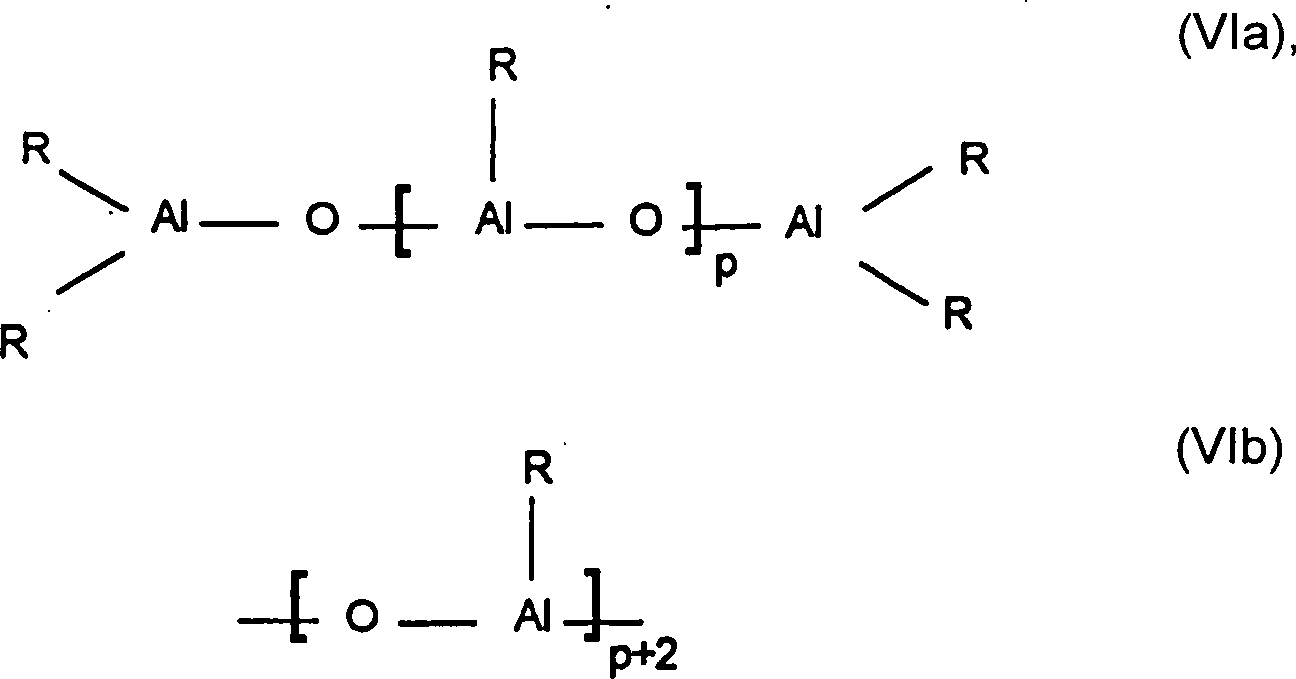
Sind die Reste R verschieden, so sind sie bevorzugt Methyl und Wasserstoff oder alternativ Methyl und Isobutyl, wobei Wasserstoff oder Isobutyl bevorzugt mit einen zahlenmäßigen Anteil von 0,01 bis 40% (der Reste R) enthalten sind.are the radicals R are different, they are preferably methyl and hydrogen or alternatively methyl and isobutyl, wherein hydrogen or isobutyl preferably with a numerical proportion of 0.01 to 40% (of the radicals R) are included.
Das
Aluminoxan kann auf verschiedene Arten nach bekannten Verfahren
hergestellt werden. Eine der Methoden ist beispielsweise, daß eine
Aluminiumkohlenwasserstoffverbindung und/oder eine Hydridoaluminiumkohlenwasserstoffverbindung
mit Wasser (gasförmig, fest, flüssig oder gebunden,
beispielsweise als Kristallwasser) in einem inerten Lösungsmittel
(wie Toluol) umgesetzt wird. Zur Herstellung eines Aluminoxans mit verschiedenen
Alkylgruppen R werden entsprechend der gewünschten Zusammensetzung
zwei verschiedene Aluminiumtrialkyle (AlR'3 +
AlR''3) mit Wasser umgesetzt (
Unabhängig
von der Art der Herstellung ist allen Aluminoxanlösungen
ein wechselnder Gehalt an nicht umgesetzter Aluminiumausgangsverbindung,
die in freier Form oder als Addukt vorliegt gemeinsam. Es ist auch
möglich, das Aluminoxan auf einen Träger aufzubringen
und es dann als Suspension in geträgerter Form einzusetzen.
Es sind mehrere Trägerungsverfahren bekannt, z. B. aus
Es ist möglich, das für das erfindungsgemäße Verfahren zu verwendende Metallocen vor dem Einsatz in der Polymerisationsreaktion mit einem Cokatalysator, insbesondere einem Aluminoxan vorzuaktivieren. Dadurch wird die Polymerisationsaktivität deutlich erhöht.It is possible, that for the invention Method to be used metallocene before use in the polymerization reaction preactivated with a cocatalyst, especially an aluminoxane. As a result, the polymerization activity is significantly increased.
Die Voraktivierung der Übergangsmetallverbindung wird in Lösung vorgenommen. Bevorzugt wird dabei das Metallocen in einer Lösung des Aluminoxans in einem inerten Kohlenwasserstoff aufgelöst. Als inerter Kohlenwasserstoff eignet sich ein aliphatischer oder aromatischer Kohlenwasserstoff. Bevorzugt wird Toluol verwendet.The Pre-activation of the transition metal compound is in solution performed. Preference is given to the metallocene in a solution of the aluminoxane dissolved in an inert hydrocarbon. As an inert hydrocarbon is an aliphatic or aromatic hydrocarbon. Preferably, toluene is used.
Die Konzentration des Aluminoxans in der Lösung liegt im Bereich von ca. 1 Gew.-% bis zur Sättigungsgrenze, vorzugsweise von 5 bis 30 Gew.-%, jeweils bezogen auf die Gesamtlösung. Das Metallocen kann in der gleichen Konzentration eingesetzt werden, vorzugsweise wird es jedoch in einer Menge von 10–4 bis 1 mol pro mol Aluminoxan eingesetzt. Die Voraktivierungszeit beträgt 5 Minuten bis 60 Stunden, vorzugsweise 5 bis 60 Minuten. Man arbeitet bei einer Temperatur von –78 bis 100°C, vorzugsweise 0 bis 70°C.The concentration of the aluminoxane in the solution is in the range of about 1 wt .-% to the saturation limit, preferably from 5 to 30 wt .-%, each based on the total solution. The metallocene can be used in the same concentration, but it is preferably used in an amount of 10 -4 to 1 mol per mol of aluminoxane. The pre-activation time is 5 minutes to 60 hours, preferably 5 to 60 minutes. It operates at a temperature of -78 to 100 ° C, preferably 0 to 70 ° C.
Mit Hilfe des Metallocens kann eine Vorpolymerisation erfolgen. Zur Vorpolymerisation wird bevorzugt das (oder eines der) in der Polymerisation eingesetzte(n) Olefin(e) verwendet.With Help of the metallocene can be a pre-polymerization. to Prepolymerization is preferably (or one of) the polymerization used olefin (s) used.
Das Metallocen kann auch auf einen Träger aufgebracht werden. Geeignete Träger sind beispielsweise Silikagele, Aluminiumoxide, festes Aluminoxan oder andere anorganische Trägermaterialien. Ein geeignetes Trägermaterial ist auch ein Polyolefinpulver in feinverteilter Form.The Metallocene can also be applied to a support. Suitable carriers are, for example, silica gels, aluminum oxides, solid aluminoxane or other inorganic carrier materials. A suitable carrier material is also a polyolefin powder in finely divided form.
Eine
weitere mögliche Ausgestaltung des erfindungsgemäßen
Verfahrens besteht darin, daß man an Stelle oder neben
einem Aluminoxan eine salzartige Verbindung der Formel R3' xNH4-xBR4' 4 oder der Formel R3' 3PHBR4' 4 als Cokatalysator verwendet. Dabei sind
x = 1, 2 oder 3, R3' = Alkyl oder Aryl,
gleich oder verschieden, und R4' = Aryl,
das auch fluoriert oder teilfluoriert sein kann. In diesem Fall
besteht der Katalysator aus dem Reaktionsprodukt eines Metallocens
mit einer der genannten Verbindungen (
Falls dem Reaktionsgemisch Lösemittel zugesetzt wird, dann können gebräuchliche inerte Lösemittel, wie aliphatische oder cycloaliphatische Kohlenwasserstoffe, Benzin- bzw. hydrierte Dieselölfraktionen oder Toluol, dazu verwendet werden.If solvent is added to the reaction mixture, then can common inert solvents, such as aliphatic or cycloaliphatic hydrocarbons, gasoline or hydrogenated Diesel oil fractions or toluene, to be used.
Das Metallocen wird bevorzugt in einer Konzentration, bezogen auf das Übergangsmetall, von 10–1 bis 10–8 mol, vorzugsweise 10–2 bis 10–7 mol, besonders bevorzugt von 10–3 bis 10–7 mol Übergangsmetall pro dm3 Reaktorvolumen angewendet. Das Aluminoxan wird in einer Konzentration von 10–4 bis 10–1, vorzugsweise 10–4 bis 2·10–2 mol pro dm3 Reaktorvolumen verwendet, bezogen auf den Gehalt an Aluminium. Prinzipiell sind aber auch höhere Konzentrationen möglich.The metallocene is preferably used in a concentration, based on the transition metal, of 10 -1 to 10 -8 mol, preferably 10 -2 to 10 -7 mol, particularly preferably 10 -3 to 10 -7 mol of transition metal per dm 3 reactor volume , The aluminoxane is used in a concentration of 10 -4 to 10 -1 , preferably 10 -4 to 2 x 10 -2 mol per dm 3 reactor volume, based on the content of aluminum. In principle, however, higher concentrations are possible.
Die erfindungsgemäß hergestellten Copolymerisate zeichnen sich durch eine neue Mikrostruktur aus. Diese Copolymerisate können zur Herstellung von Formkörpern beliebiger Art eingesetzt werden. Beliebige Formgebungsverfahren können dabei zur Anwendung kommen, beispielsweise Spritzguss, Spritzblasen oder Extrusion.The Draw copolymers prepared according to the invention characterized by a new microstructure. These copolymers can used for the production of moldings of any kind become. Any shaping methods can be used for Application come, for example, injection molding, injection blow molding or extrusion.
Insbesondere werden die erfindungsgemäßen Copolymerisate zur Herstellung von Folien, optischen Bauteilen oder von transparenten Behältern eingesetzt. Die Folien kommen vorzugsweise als optische Folien, als Blisterfolien, oder als anderweitige Verpackungsfolien zum Einsatz. Im Bereich der optischen Bauteile sind vorzugsweise Linsen, Prismen und Lichtleiterplatten, oder in der Diagnostik zu verwendende Mikrotiterplatten zu nennen. Die transparenten Behälter kommen vorzugsweise in der Medizintechnik zum Einsatz, beispielsweise als Spritzenkörper.Especially are the copolymers of the invention to Production of films, optical components or transparent ones Used containers. The films are preferably as optical films, as blister films, or as other packaging films for use. In the field of optical components are preferably Lenses, prisms and light guide plates, or in diagnostics too to call using microtiter plates. The transparent containers are preferably used in medical technology, for example as a syringe body.
Die folgenden Beispiele erläutern die Erfindung. Eine Begrenzung ist dadurch nicht beabsichtigt.The The following examples illustrate the invention. A limit this is not intended.
Die in Polymerisationsexperimenten eingesetzten Metallocene wurden nach allgemeinen in der Literatur beschriebenen Synthesemethoden hergestellt. Aufgrund der Luft- und Feuchtigkeitsempfindlichkeit metallorganischer Verbindungen wurden alle Arbeiten unter Argon-Schutzgasatmosphäre mittels Schlenktechnik in abgeschlossenen Apparaturen mit Überdruckventilen durchgeführt. Die Glasgeräte wurden vor Gebrauch evakuiert und mit Schutzgas gespült. Filtrationen erfolgten über geschlossene G3-Fritten mittels Schutzgasüberdruck. Bei den Filtrationen der Katalysatorsynthesen wurde zusätzlich eine Celite®-Schicht (ca. 3 cm) aufgebracht, um eine ungehinderte Filtration zu gewährleisten. Als Inertgas wurde Argon der Firma Messer mit einem Reinheitsgrad von 99,998% verwendet.The metallocenes used in polymerization experiments were prepared according to general synthetic methods described in the literature. Due to the air and moisture sensitivity of organometallic compounds, all work was carried out under argon-protective gas atmosphere by means Schlenktechnik in closed equipment with pressure relief valves. The glassware was evacuated before use and purged with inert gas. Filtrations were made via closed G3 frits by inert gas pressure. In the filtration of the catalyst syntheses additional Celite ® layer (ca 3 cm) was applied in order to ensure an unhindered filtration. The inert gas used was argon from Messer with a purity of 99.998%.
Als typisches Beispiel für die Herstellung der verwendeten Metallocene soll die Synthese der Verbindung (5) ([Ph2C(Cp)(3-MeInd)]ZrCl2) beschrieben werden.A typical example of the preparation of the metallocenes used is the synthesis of compound (5) ([Ph 2 C (Cp) (3-MeInd)] ZrCl 2 ).
Synthese von 1-Methylinden/3-Methylinden:Synthesis of 1-methylindene / 3-methylindene:
In
einem 500-ml-Vierhalskolben mit Tropftrichter wurden zu einer Lösung
von 45,0 g Inden (0,35 mol) in 200 ml THF bei 0°C innerhalb
von 30 min 140 ml (0,35 mol) einer 2,5 M Lösung von n-Butyllithium
in Toluol zugetropft. Diese Lösung wurde nach Erwärmen
auf Raumtemperatur für eine weitere Stunde gerührt.
Anschließend wurde erneut auf 0°C abgekühlt
und 99,4 g (0,70 mol) Iodmethan innerhalb von 2 h zugetropft. Nach
Erwärmen auf Raumtemperatur wurde für weitere
24 h gerührt. Die Lösungsmittel wurden am Rotationsverdampfer
bei 40°C Radtemperatur und 100 mbar abdestilliert. Der
schwarze Rückstand wurde dreimal mit je 200 ml Pentan ausgeschüttelt.
Nach Einengen der vereinigten Pentanfraktionen am Rotationsverdampfer wurde
das Rohprodukt über eine 25 cm Vigreuxkolonne fraktioniert.
Es wurden im Membranpumpenvakuum bei 19 mbar und einer Kopftemperatur
von 71–73°C 28,6 g (0,22 mol; 63% Ausbeute) farbloses
Methylinden erhalten. Das 1H-NMR-Spektrum
zeigt ein Isomerengemisch des 1- und 3-Methylindens im Verhältnis
von ungefähr 1:1.
1H-NMR (CDCl3, TMS, δ(ppm)): 7,44-7,16 (4H,
m, aromatische Protonen); 6,76 (1H, dd, olefinisches Proton am C5-Ring; 1-Methylinden); 6,46 (1H, dd, olefinisches
Proton am C5-Ring; 1-Methylinden); 6,18
(1H, m, olefinisches Proton am C5-Ring;
3-Methylinden); 3,47 (1H, m, aliphatisches Proton am C5-Ring;
1-Methylinden); 3,29 (2H, m, aliphatische Protonen am C5-Ring;
3-Methylinden); 2,16 (3H, m, -CH 3; 3-Methylinden); 1,30 (3H, d, -CH 3; 1-Methylinden).In a 500 ml four-necked flask with dropping funnel, to a solution of 45.0 g of indene (0.35 mol) in 200 ml of THF at 0 ° C within 30 min 140 ml (0.35 mol) of a 2.5 M Dropped solution of n-butyllithium in toluene. This solution was stirred after warming to room temperature for an additional hour. It was then cooled again to 0 ° C and 99.4 g (0.70 mol) of iodomethane was added dropwise within 2 h. After warming to room temperature, stirring was continued for a further 24 h. The solvents were distilled off on a rotary evaporator at 40 ° C. and 100 mbar. The black residue was shaken out three times with 200 ml of pentane each time. After concentration of the combined pentane fractions on a rotary evaporator, the crude product was fractionated through a 25 cm Vigreux column. 28.6 g (0.22 mol, 63% yield) of colorless methylindene were obtained in a membrane pump vacuum at 19 mbar and a head temperature of 71-73 ° C. The 1 H-NMR spectrum shows a mixture of isomers of 1- and 3-methylindene in a ratio of approximately 1: 1.
1 H-NMR (CDCl 3, TMS, δ (ppm)): 7.44 to 7.16 (4H, m, aromatic protons); 6.76 (1H, dd, olefinic proton at C 5 ring; 1-methylindene); 6,46 (1H, dd, olefinic proton at C 5 ring; 1-methylindene); 6.18 (1H, m, olefinic proton at C 5 ring; 3-methylindene); 3.47 (1H, m, aliphatic proton at C 5 ring; 1-methyl indene); 3.29 (2H, m, aliphatic protons at C 5 ring; 3-methylindene); 2.16 (3H, m, -C H 3, 3-methyl indene); 1.30 (3H, d, -C H 3; 1-methyl indene).
Synthese von 6,6-Diphenylfulven:Synthesis of 6,6-diphenylfulvene:
In
einem 500-ml-Vierhalskolben wurden bei 50°C 78,0 g (0,24
mol) Natriumethylat-Lösung vorgelegt und anschließend
45,6 g (0,25 mol) Benzophenon zugegeben. Nach vollständiger
Lösung wurden 20 g (0,30 mol) frisch destilliertes Cyclopentadien
innerhalb von 30 min bei 45–50°C zugetropft. Nach
Beendigung der Zugabe wurde noch 2 h bei Raumtemperatur gerührt,
wobei eine dunkelrote Suspension entstand. Diese wurde über
eine G3-Fritte filtriert und der Feststoff viermal mit je 25 ml
Ethanol gewaschen. Nach Trocknen im Ölpumpenvakuum wurden
47,1 g (0,20 mol; 82% Ausbeute) rotes 6,6-Diphenylfulven erhalten.
1H-NMR (CDCl3, TMS, δ(ppm)):
7,42-7,32 (10H, m, aromatische Protonen); 6,62 (2H, m, olefinische
Protonen); 6,32 (2H, m, olefinische Protonen).78.0 g (0.24 mol) of sodium ethylate solution were introduced into a 500 ml four-necked flask at 50 ° C. and then 45.6 g (0.25 mol) of benzophenone were added. After complete dissolution, 20 g (0.30 mol) of freshly distilled cyclopentadiene were added dropwise at 45-50 ° C within 30 min. After the end of the addition, the mixture was stirred for a further 2 hours at room temperature, giving a dark red suspension. This was filtered through a G3 frit and the solid washed four times with 25 ml of ethanol. After drying in an oil pump vacuum, 47.1 g (0.20 mol, 82% yield) of red 6,6-diphenylfulvene were obtained.
1 H-NMR (CDCl 3, TMS, δ (ppm)): 7.42-7.32 (10H, m, aromatic protons); 6.62 (2H, m, olefinic protons); 6.32 (2H, m, olefinic protons).
Synthese von 1-(Cyclopenta-1,3-dienyl-diphenyl-methyl)-3-methyl-1H-inden:Synthesis of 1- (cyclopenta-1,3-dienyl-diphenyl-methyl) -3-methyl-1H-indene:
In
einem 250-ml-Vierhalskolben mit Tropftrichter wurden zu einer Lösung
von 10,2 g (78,3 mmol) 1-Methylinden/3-Methylinden in 100 ml Diethylether
bei 0°C innerhalb von 5 min 31,4 ml (78,3 mmol) einer 2,5 M
Lösung von n-Butyllithium in Toluol zugetropft. Diese Lösung
wurde nach Erwärmen auf Raumtemperatur für eine
weitere Stunde gerührt. Anschließend wurde erneut
auf 0°C abgekühlt und eine Lösung von
18,0 g (78,3 mmol) 6,6-Diphenylfulven in 10 ml Diethylether innerhalb
von 10 min zugetropft. Es wurde 3 h bei Raumtemperatur nachgerührt.
Die beige Suspension wurde auf Eiswasser/5,9 g (1 eq) Eisessig gegossen.
Die Phasen wurden getrennt und die wässrige Phase dreimal
mit je 30 ml Diethylether extrahiert. Die vereinigten organischen
Phasen wurden dreimal mit je 30 ml Wasser und einmal mit 30 ml gesättigter
Natriumchloridlösung gewaschen und über Magnesiumsulfat
getrocknet. Nach Entfernen der Lösungsmittel am Rotationsverdampfer
wurde das gelbe Öl über Nacht bei –20°C
gelagert. Nach Animpfen kristallisierten weiße Kristalle
aus, die in 10 ml Pentan von ca. 0°C suspendiert und über
eine Fritte abgesaugt wurden. Nach Trocknen im Ölpumpenvakuum
wurden 15,5 g (43,0 mmol; 55% Ausbeute) weißes Pulver (Ligandverbindung)
erhalten. Das 1H-NMR-Spektrum zeigt ein
Isomerengemisch des 1-(Cyclopenta-1,3-dienyl-diphenyl-methyl)-3-methyl-1H-inden
und des 1-(Cyclopenta-1,4-dienyl-diphenyl-methyl)-3-methyl-1H-inden.
1H-NMR (CDCl3, TMS, δ(ppm)):
7,45-6,89 (14H, m, aromatische Protonen, breit); 6,43-6,16 (4H,
m, olefinische Protonen an den C5-Ringen,
breit); 4,87 (1H, m, Methinproton am Inden); 3,04 (2H, s, Methylenprotonen
am Cp); 1,86 (3H, m, -CH 3).In a 250 ml four-necked flask with dropping funnel, to a solution of 10.2 g (78.3 mmol) of 1-methylindene / 3-methylindene in 100 ml of diethyl ether at 0 ° C., was added 31.4 ml (78. 3 mmol) of a 2.5 M solution of n-butyllithium in toluene was added dropwise. This solution was stirred after warming to room temperature for an additional hour. It was then cooled again to 0 ° C and added dropwise a solution of 18.0 g (78.3 mmol) of 6,6-Diphenylfulven in 10 ml of diethyl ether within 10 min. It was stirred for 3 h at room temperature. The beige suspension was poured onto ice water / 5.9 g (1 eq) of glacial acetic acid. The phases were separated and the aqueous phase extracted three times with 30 ml of diethyl ether. The combined organic phases were washed three times with 30 ml of water and once with 30 ml of saturated sodium chloride solution and dried over magnesium sulfate. After removing the solvents on a rotary evaporator, the yellow oil was stored overnight at -20 ° C. After seeding crystallized white crystals, which were suspended in 10 ml of pentane of about 0 ° C and filtered with suction through a frit. After drying in an oil pump vacuum, 15.5 g (43.0 mmol, 55% yield) of white powder (ligand compound) were obtained. The 1 H-NMR spectrum shows a mixture of isomers of 1- (cyclopenta-1,3-dienyl-diphenyl-methyl) -3-methyl-1H-indene and of 1- (cyclopenta-1,4-dienyl-diphenyl-methyl ) -3-methyl-1H-indene.
1 H-NMR (CDCl 3, TMS, δ (ppm)): 7.45 to 6.89 (14H, m, aromatic protons, broad); 6,43-6,16 (4H, m, olefinic protons at the C 5 rings, broad); 4.87 (1H, m, methine proton on indene); 3.04 (2H, s, methylene protons at Cp); 1.86 (3H, m, -C H 3).
Synthese der Verbindung (5) ([Ph2C(Cp)(3-MeInd)]ZrCl2)Synthesis of compound (5) ([Ph 2 C (Cp) (3-MeInd)] ZrCl 2 )
In
einem 100-ml-Dreihalskolben wurden zu einer Lösung von
3,6 g (10 mmol) von 1-(Cyclopenta-1,3-dienyl-diphenyl-methyl)-3-methyl-1H-inden
in 50 ml Toluol/3,2 ml (40 mmol) THF innerhalb von 2 min 8,4 ml
(21 mmol) einer 2,5 M Lösung von n-Butyllithium in Toluol
bei 0°C zugetropft. Die orangene Lösung wurde
2 h bei 50°C gerührt. Nach Abkühlen auf
0°C wurden 2,3 g (10 mmol) Zirkoniumtetrachlorid in einer
Portion zugegeben. Nach Erwärmen auf Raumtemperatur wurde
die rote Suspension für weitere 3 h nachgerührt.
Diese Suspension wurde in 200 ml 80°C warmes Toluol gegossen.
Es wurde 5 min gerührt, die Suspension über eine
G3-Fritte mit Celiteschicht filtriert und der Filterrückstand
dreimal mit je 20 ml 80°C warmem Toluol gewaschen. Die
vereinigten Filtrate wurden im Vakuum auf ca. 150 ml eingeengt und über
Nacht bei –20°C stehen gelassen. Der auskristallisierte
Feststoff wurde über eine G3-Fritte abfiltriert und mit
wenig kaltem Toluol gewaschen. Nach Trocknen im Ölpumpenvakuum
wurden 4,1 g (6,33 mmol, 63% Ausbeute, berechnet ohne Toluol) orangenes
[Ph2C(Cp)(3-MeInd)]ZrCl2 erhalten.
Das Metallocen enthielt noch 58 mol-% Toluol.
1H-NMR
(CDCl3, δ(ppm)): 7,83-6,66; 6,23
(14H, m, Protonen am C6-Ring); 6,56-6,50;
5,52-5,47 (5H, m, Protonen an den C5-Ringen);
2,39 (3H, s, -CH 3).In a 100 ml three-necked flask, to a solution of 3.6 g (10 mmol) of 1- (cyclopenta-1,3-dienyl-diphenyl-methyl) -3-methyl-1H-indene in 50 ml toluene / 3 , 2 ml (40 mmol) of THF within 2 min 8.4 ml (21 mmol) of a 2.5 M solution of n-butyllithium in toluene at 0 ° C was added dropwise. The orange solution was stirred at 50 ° C for 2 h. After cooling to 0 ° C, 2.3 g (10 mmol) of zirconium tetrachloride were added in one portion. After warming to room temperature, the red suspension was stirred for a further 3 h. This suspension was poured into 200 ml of 80 ° C toluene warm. The mixture was stirred for 5 min, the suspension was filtered through a G3 frit with celite layer and the filter residue washed three times with 20 ml of 80 ° C warm toluene. The combined filtrates were concentrated in vacuo to about 150 ml and allowed to stand overnight at -20 ° C. The crystallized solid was filtered through a G3 frit and washed with a little cold toluene. After drying in an oil pump vacuum, 4.1 g (6.33 mmol, 63% yield, calculated without toluene) of orange [Ph 2 C (Cp) (3-MeInd)] ZrCl 2 were obtained. The metallocene still contained 58 mol% toluene.
1 H-NMR (CDCl 3, δ (ppm)): 7.83 to 6.66; 6.23 (14H, m, protons at the C 6 ring); 6.56 to 6.50; 5.52-5.47 (5H, m, protons at the C 5 rings); 2.39 (3H, s, -C H 3).
Beispiele 1–51Examples 1-51
Alle Polymerisationsexperimente wurden nach der im folgenden beschriebenen Vorschrift in einem 1,5 L Stahlautoklaven durchgeführt. Der maximal zulässige Betriebsinnendruck betrug 25 bar. Die Thermostatisierung erfolgte mit einer Umlaufpumpe mittels Heißdampf und Brauchwasser. Zur Durchmischung diente ein über eine Magnetkupplung indirekt angetriebener Kreuzbalkenrührer. Polymerisiert wurde bei 70°C in Toluol als Lösungsmittel. Die Rührgeschwindigkeit betrug 850 U/min.All Polymerization experiments were carried out as described below Regulation carried out in a 1.5 L steel autoclave. The maximum permissible internal operating pressure was 25 bar. The thermostating was carried out with a circulation pump by means of superheated steam and service water. For mixing one served over a Magnetic coupling indirectly driven crossbar agitator. It was polymerized at 70 ° C in toluene as solvent. The stirring speed was 850 rpm.
Die zur Polymerisation nötige Metallocenmenge wurde so berechnet, dass 20 bis 30 g Polymer zu erwarten waren. Zur Herstellung der Katalysatorlösung wurden in der Regel ungefähr 10 mg Metallocen genau eingewogen und in der betragsmäßig gleichen Millilitermenge an Methylaluminoxan (=MAO) (10 Gew.% MAO in Toluol) gelöst. Mit einer Spritze wurde die benötigte Menge Katalysatorlösung entnommen und mit MAO-Lösung auf 5 ml aufgefüllt. Bei sehr schwach aktiven Katalysatorsystemen wurde das Metallocen direkt eingewogen und in 5 ml MAO gelöst. Damit betrug die insgesamt eingesetzte Menge an Methylaluminoxan in jedem Beispiel 1,34 g MAO (21,4 mmol Al).The amount of metallocene necessary for the polymerization was calculated so that 20 to 30 g of polymer could be expected. For the preparation of the catalyst solution, approximately 10 mg of metallocene were weighed in exactly as a rule and dissolved in the same amount of milliliters of methylaluminoxane (= MAO) (10% by weight of MAO in toluene). With a syringe, the required amount of catalyst solution was removed and made up to 5 ml with MAO solution. In very weakly active catalyst systems, the metallocene was incorporated directly and dissolved in 5 ml of MAO. Thus, the total amount of methylaluminoxane used in each example was 1.34 g of MAO (21.4 mmol of Al).
Vor jeder Polymerisation wurde der Autoklav mit 1 L Exxsol® und 10 ml MAO-Lösung bei 90°C ausgekocht. Das Norbornen wurde im Argongegenstrom in den Autoklaven gefüllt und mit 10 ml MAO-Lösung versetzt. Nach dem Thermostatisieren des Comonomers auf die gewünschte Reaktionstemperatur wurde die Katalysatorlösung mittels einer Spritze zugegeben. Unter Rühren wurde der benötigte Ethendruck aufgepresst und über einen Druckminderer während der gesamten Reaktionszeit konstant gehalten. Der Verbrauch an Ethen wurde über einem Durchflussmesser verfolgt. Das Reaktionsvolumen betrug 600 ml und die Reaktionszeit 15 min.Prior to each polymerization, the autoclave with 1 L Exxsol ® and 10 ml of MAO solution was boiled at 90 ° C. The norbornene was filled in the argon countercurrent in the autoclave and mixed with 10 ml of MAO solution. After thermostating the comonomer to the desired reaction temperature, the catalyst solution was added via syringe. With stirring, the required ethylene pressure was pressed and kept constant over a pressure reducer during the entire reaction time. The consumption of ethene was monitored by a flow meter. The reaction volume was 600 ml and the reaction time 15 min.
Nach der Polymerisation wurde die Ethenzufuhr unterbrochen und der Überdruck abgelassen. Die Reaktionslösung wurde in eine Schraubdeckelflasche überführt und mit ungefähr 300 ml Toluol verdünnt. Zur Ausfällung des Copolymers wurde sie langsam unter heftigem Rühren (Ultra-Turrax®) in ca. 1 L Aceton eingerührt und mit 3 ml Salzsäure 37% versetzt. Das ausgefallene Copolymer wurde über einen Büchnertrichter abfiltriert und erneut mit Aceton und Wasser gewaschen. Die Trocknung erfolgte über Nacht bei 60°C im Vakuumtrockenschrank.After polymerization, the Ethenzufuhr was interrupted and the pressure released. The reaction solution was transferred to a screw-cap bottle and diluted with about 300 ml of toluene. To precipitate the copolymer was slowly added under vigorous stirring (Ultra-Turrax ®) is stirred into about 1 L of acetone, and 3 ml of hydrochloric acid 37%. The precipitated copolymer was filtered off through a Buchner funnel and washed again with acetone and water. The drying took place overnight at 60 ° C in a vacuum oven.
In
den Polymerisationsexperimenten wurden die folgenden Metallocene
als Katalysatoren eingesetzt: 
Nach
diesen Beispielen erhaltene Polymere wurden 13C-NMR-spektroskopisch
vermessen. Die Messungen erfolgten an einem DMX 500 NMR-Spektrometer
der Firma Bruker bei 353 K. Dazu wurden 200 bis 300 mg Polymer in
3 ml 1,1,2,2-Tetrachlorethan-d2 bei erhöhter
Temperatur in einem 10-mm-NMR-Röhrchen gelöst.
Um integrierbare 13C-NMR-Spektren zu erhalten
wurde mit dem Inverse Gated Decoupling-Verfahren gemessen. Spin-Gitter-Relaxation und
Kern-Overhauser-Effekt (NOE) haben dann keinen Einfluß mehr
auf die Signalintensitäten. Die chemische Verschiebung
wurde auf 1,1,2,2-Tetrachlorethan bei 74,24 ppm bezogen. Die Auswertung
der Spektren erfolgte mit dem WIN-NMR-Programm der Firma Bruker.
Die wichtigsten Parameter sind wie folgt zusammengefasst:
Die Glasübergangstemperaturen wurden mittels Differential Scanning Calorimetry (DSC) mit einem Gerät der Firma Perkin-Elmer (Typ DSC 7) bestimmt. Dazu wurden 4–6 mg des Polymers in einem Aluminiumpfännchen eingewogen und in einem Temperaturintervall von –10°C und wahlweise 200–300°C aufgeschmolzen. Die Glastemperaturen wurden aus den Messungen der zweiten Aufheizkurve bestimmt. Die Aufheiz- und Abkühlrate betrug 20 K/min.The glass transition temperatures were determined by Differential Scanning Calorimetry (DSC) with a Device of the company Perkin-Elmer (type DSC 7) determined. For this purpose, 4-6 mg of the polymer were weighed in an aluminum pan and melted in a temperature range of -10 ° C and optionally 200-300 ° C. The glass transition temperatures were determined from the measurements of the second heating curve. The heating and cooling rate was 20 K / min.
Die reduzierten Viskositäten (Viskositätszahlen) der Polymere wurden mit einem Ubbelohde-Viskosimeter (Kapillare 0a) bestimmt. Hierzu wurde die dynamische Viskosität des Lösungsmittels sowie der Polymerlösung bestimmt.The reduced viscosities (viscosity numbers) of Polymers were measured with an Ubbelohde viscometer (capillary 0a) certainly. For this purpose, the dynamic viscosity of the solvent and the polymer solution.
Die Konzentration der Polymerlösung betrug 500 mg Polymer in 100 ml Decalin (bei 135°C), der Korrekturfaktor für die Umrechnung auf das Volumen des Decalins bei Raumtemperatur beträgt 0,9. Dem Decalin wurden zur Thermostabilisierung 1 g/L Irganox 1010® zugesetzt. Die Messung erfolgte mit dem Prozessor-Viskositätsmeßsystem PVS 1 (Version 2.45) der Firma Lauda bei 135°C.The concentration of the polymer solution was 500 mg of polymer in 100 ml of decalin (at 135 ° C), the correction factor for the conversion to the volume of decalin at room temperature is 0.9. The decalin g / L of Irganox 1010 ® were added for heat stabilization. 1 The measurement was carried out with the processor viscosity measuring system PVS 1 (Version 2.45) from Lauda at 135 ° C.

Hierin bedeuten:
- ηred
- reduzierte Viskosität (Viskositätszahl) in ml/g
- η
- dynamische Viskosität der Lösung in mPa·s
- η0
- dynamische Viskosität des Lösungsmittels in mPa·s
- c
- Konzentration in g/ml
- η red
- reduced viscosity (viscosity number) in ml / g
- η
- dynamic viscosity of the solution in mPa · s
- η 0
- dynamic viscosity of the solvent in mPa · s
- c
- Concentration in g / ml
Die ergänzenden Versuchsbedingungen sowie Ergebnisse der Polymerisationsexperimente sind in den nachfolgenden Tabellen aufgeführt. Für einzelne Beispiele sind Spektren in den beiliegenden Figuren gezeigt.The supplementary experimental conditions and results of the polymerisation experiments are listed in the tables below. For individual examples are shown in spectra in the accompanying figures.
Es zeigen:It demonstrate:
ZITATE ENTHALTEN IN DER BESCHREIBUNGQUOTES INCLUDE IN THE DESCRIPTION
Diese Liste der vom Anmelder aufgeführten Dokumente wurde automatisiert erzeugt und ist ausschließlich zur besseren Information des Lesers aufgenommen. Die Liste ist nicht Bestandteil der deutschen Patent- bzw. Gebrauchsmusteranmeldung. Das DPMA übernimmt keinerlei Haftung für etwaige Fehler oder Auslassungen.This list The documents listed by the applicant have been automated generated and is solely for better information recorded by the reader. The list is not part of the German Patent or utility model application. The DPMA takes over no liability for any errors or omissions.
Zitierte PatentliteraturCited patent literature
- - JP 05/043619 A [0013] - JP 05/043619 A [0013]
- - JP 52/02124 A [0015] - JP 52/02124 A [0015]
- - EP 302424 A [0035] EP 302424A [0035]
- - EP 578838 A [0036] EP 578838A [0036]
- - EP 277004 A [0042] EP 277004A [0042]
Zitierte Nicht-PatentliteraturCited non-patent literature
- - R. A. Wendt, G. Fink, Macromol. Chem. Phys. 2001, 202, 3490 [0003] - RA Wendt, G. Fink, Macromol. Chem. Phys. 2001, 202, 3490 [0003]
- - Artikel „Asymmetric Zirconocene Precursors for Catalysts of Propylene Polymerisation", Fierro, Ricardo et al., J. Polym. Sci., Part A: Polym. Chem. (1994), 32(15), 2817–24 [0012] - Article "Asymmetric Zirconocene Precursors for Catalysts of Propylene Polymerization", Fierro, Ricardo et al., J. Polym. Sci., Part A: Polym. Chem. (1994), 32 (15), 2817-24 [0012]
- - Artikel „Syndiospecific Propylene Polymerization with C1 Symmetric Group 4 ansa-Metallocene Catalysts", Leino, Reko, et al., Macromolecules (2001), 34(7), 2072–2082 [0014] Article "Syndiospecific Propylene Polymerization with C1 Symmetric Group 4 ansa Metallocenes Catalysts", Leino, Reko, et al., Macromolecules (2001), 34 (7), 2072-2082 [0014]
- - „Synthesis, structure, and catalytic properties of ansa-zirconocenes, Me2X(Cp)(RInd)ZrCl2 (X = C, Si, R = 2-p or 3-p-tolyl), Yoon, Sung Cheol et al., J. Organomet. Chem. (1997), 534(1–2), 81–87 [0016] "Synthesis, structure, and catalytic properties of ansa-zirconocene, Me2X (Cp) (RInd) ZrCl2 (X = C, Si, R = 2-p or 3-p-tolyl), Yoon, Sung Cheol et al. J. Organomet. Chem. (1997), 534 (1-2), 81-87 [0016]
- - Artikel „Syndiospecific Propylene Polymerization Using C1-Symmetric ansa-Metallocene Catalysts: Substituent and Bridge Effects", Gomez, Fernando J., et al., Macromolecules (2002), 35(9), 3358–3368 [0017] - Article "Syndiospecific Propylene Polymerization Using C1-Symmetric ansa Metallocenes Catalysts: Substituent and Bridge Effects", Gomez, Fernando J., et al., Macromolecules (2002), 35 (9), 3358-3368 [0017]
- - S. Pasynkiewicz, Polyhedron 9 (1990) 429 [0035] S. Pasynkiewicz, Polyhedron 9 (1990) 429 [0035]
Claims (18)


Priority Applications (8)
| Application Number | Priority Date | Filing Date | Title |
|---|---|---|---|
| DE102007015707A DE102007015707A1 (en) | 2007-04-02 | 2007-04-02 | Cycloolefin copolymers, process for their preparation, their use and catalysts |
| EP08002988A EP1978041A1 (en) | 2007-04-02 | 2008-02-19 | Cycloolefin copolymers, method for their manufacture, their application and catalysts |
| TW097106373A TW200904840A (en) | 2007-04-02 | 2008-02-22 | Cycloolefin copolymers, a process for their preparation and the use thereof and catalysts |
| CA002623800A CA2623800A1 (en) | 2007-04-02 | 2008-03-10 | Cycloolefin copolymers, a process for their preparation and the use thereof and catalysts |
| US12/077,433 US8236910B2 (en) | 2007-04-02 | 2008-03-19 | Cycloolefin copolymers, a process for their preparation and the use thereof and catalysts |
| JP2008085887A JP2008285656A (en) | 2007-04-02 | 2008-03-28 | Cycloolefin copolymer, method for producing the same, its use, and catalyst |
| CN2008100907973A CN101280043B (en) | 2007-04-02 | 2008-04-02 | Cycloolefin copolymers, method for their manufacture, their application and catalysts |
| KR1020080030937A KR20080090331A (en) | 2007-04-02 | 2008-04-02 | Cycloolefin copolymer, preparation method thereof, use thereof and catalyst |
Applications Claiming Priority (1)
| Application Number | Priority Date | Filing Date | Title |
|---|---|---|---|
| DE102007015707A DE102007015707A1 (en) | 2007-04-02 | 2007-04-02 | Cycloolefin copolymers, process for their preparation, their use and catalysts |
Publications (1)
| Publication Number | Publication Date |
|---|---|
| DE102007015707A1 true DE102007015707A1 (en) | 2008-10-09 |
Family
ID=39564678
Family Applications (1)
| Application Number | Title | Priority Date | Filing Date |
|---|---|---|---|
| DE102007015707A Withdrawn DE102007015707A1 (en) | 2007-04-02 | 2007-04-02 | Cycloolefin copolymers, process for their preparation, their use and catalysts |
Country Status (8)
| Country | Link |
|---|---|
| US (1) | US8236910B2 (en) |
| EP (1) | EP1978041A1 (en) |
| JP (1) | JP2008285656A (en) |
| KR (1) | KR20080090331A (en) |
| CN (1) | CN101280043B (en) |
| CA (1) | CA2623800A1 (en) |
| DE (1) | DE102007015707A1 (en) |
| TW (1) | TW200904840A (en) |
Families Citing this family (11)
| Publication number | Priority date | Publication date | Assignee | Title |
|---|---|---|---|---|
| RU2510404C2 (en) | 2009-06-16 | 2014-03-27 | Шеврон Филлипс Кемикал Компани Лп | Oligomerisation of alpha-olefins using metallocene-tsk catalyst systems and use of obtained poly-alpha-olefins to produce lubricating mixtures |
| US8309747B2 (en) | 2010-07-06 | 2012-11-13 | Chevron Phillips Chemical Company Lp | Process for synthesizing bridged cyclopentadienyl-indenyl metallocenes |
| EP2935297B1 (en) * | 2012-12-21 | 2019-03-20 | ExxonMobil Chemical Patents Inc. | Bridged metallocene compounds, catalyst systems and processes for polymerization therewith |
| EP3063184B1 (en) * | 2013-10-29 | 2017-11-29 | ExxonMobil Chemical Patents Inc. | Asymmetric catalysts for olefin polymerisation |
| US9266910B2 (en) | 2013-10-29 | 2016-02-23 | Exxonmobil Chemical Patents Inc. | Asymmetric polypropylene catalysts |
| EP3414272A1 (en) * | 2016-02-12 | 2018-12-19 | ExxonMobil Chemical Patents Inc. | Cyclic olefin copolymers and methods of making them |
| JP7150428B2 (en) * | 2016-12-26 | 2022-10-11 | ポリプラスチックス株式会社 | Method for producing catalyst composition for cyclic olefin polymerization and method for producing cyclic olefin resin composition |
| US11409028B2 (en) * | 2017-07-25 | 2022-08-09 | Zeon Corporation | Laminate |
| CN111417657B (en) * | 2017-11-29 | 2022-11-25 | 埃克森美孚化学专利公司 | Asymmetric ansa-metallocene catalyst compounds for the preparation of polyolefins having broad molecular weight distribution |
| CN118475627B (en) * | 2021-12-23 | 2025-09-16 | 宝理塑料株式会社 | Cycloolefin copolymer, resin composition and molded article in film or sheet form |
| CN116789879A (en) * | 2022-03-14 | 2023-09-22 | 中国石油化工股份有限公司 | System for copolymerization of ethylene and norbornene, application thereof, ethylene-norbornene copolymer and preparation method thereof |
Citations (9)
| Publication number | Priority date | Publication date | Assignee | Title |
|---|---|---|---|---|
| EP0277004A1 (en) | 1987-01-30 | 1988-08-03 | Exxon Chemical Patents Inc. | Catalysts, method of preparing these catalysts and method of using said catalysts |
| EP0302424A1 (en) | 1987-08-06 | 1989-02-08 | Hoechst Aktiengesellschaft | Process for preparing 1-olefinpolymers |
| JPH0543619A (en) | 1991-08-16 | 1993-02-23 | Showa Denko Kk | Production of branched polyethylene and catalyst component |
| JPH05202124A (en) | 1992-01-24 | 1993-08-10 | Chisso Corp | Production of olefin polymer |
| EP0578838A1 (en) | 1992-04-29 | 1994-01-19 | Hoechst Aktiengesellschaft | Olefin polymerization catalyst, process for its preparation, and its use |
| EP0610852A1 (en) * | 1993-02-12 | 1994-08-17 | Hoechst Aktiengesellschaft | Process for preparing cyclo-olefin polymers |
| EP0610851A1 (en) * | 1993-02-12 | 1994-08-17 | Hoechst Aktiengesellschaft | Process for preparing cyclo-olefin copolymers |
| DE19540356A1 (en) * | 1995-10-30 | 1997-05-07 | Hoechst Ag | Cyclo:olefin copolymer foam with high heat distortion temperature and chemical resistance |
| DE19652340A1 (en) * | 1996-12-17 | 1998-06-18 | Hoechst Ag | Process for the preparation of cycloolefin copolymers |
Family Cites Families (14)
| Publication number | Priority date | Publication date | Assignee | Title |
|---|---|---|---|---|
| JPS522124A (en) | 1975-06-23 | 1977-01-08 | Toyo Commun Equip Co Ltd | Method of designating color in ort color display unit |
| JP3205384B2 (en) * | 1991-12-03 | 2001-09-04 | 昭和電工株式会社 | Method for producing polyolefin |
| DE69307472T2 (en) * | 1992-11-10 | 1997-05-15 | Mitsubishi Chem Corp | Process for the preparation of alpha-olefin polymers |
| EP0610850A1 (en) * | 1993-02-12 | 1994-08-17 | Hoechst Aktiengesellschaft | Process for preparing cyclo-olefin polymers |
| TW312696B (en) * | 1994-04-22 | 1997-08-11 | Mitsui Petroleum Chemicals Ind | |
| DE19619813A1 (en) | 1995-10-30 | 1997-11-20 | Hoechst Ag | Polymer foams |
| DE19719103A1 (en) * | 1997-05-06 | 1998-11-12 | Targor Gmbh | Stereorigid metallocene compound |
| JPH11171918A (en) * | 1997-12-11 | 1999-06-29 | Mitsui Chem Inc | Production of norbornene-based random copolymer |
| US6380341B1 (en) * | 1998-01-09 | 2002-04-30 | The Board Of Trustees Of Leland Stanford Jr. University | Ethylene copolymers with narrow composition distribution and high melting temperatures, and methods of production thereof |
| US6696527B1 (en) * | 1999-10-25 | 2004-02-24 | Idemitsu Petrochemical Co. Ltd. | Olefin copolymers and films and sheets |
| DE10236502B4 (en) * | 2002-08-09 | 2004-10-14 | Nordenia Deutschland Gronau Gmbh | Sealable film for tear-open packaging |
| US20080069973A1 (en) * | 2004-09-15 | 2008-03-20 | Teijin Limited | Retardation Film |
| TW200624447A (en) * | 2004-11-25 | 2006-07-16 | Sekisui Chemical Co Ltd | Retardation film |
| US7026494B1 (en) * | 2005-01-10 | 2006-04-11 | Chevron Phillips Chemical Company, Lp | Polymerization catalysts for producing high melt index polymers without the use of hydrogen |
-
2007
- 2007-04-02 DE DE102007015707A patent/DE102007015707A1/en not_active Withdrawn
-
2008
- 2008-02-19 EP EP08002988A patent/EP1978041A1/en not_active Withdrawn
- 2008-02-22 TW TW097106373A patent/TW200904840A/en unknown
- 2008-03-10 CA CA002623800A patent/CA2623800A1/en not_active Abandoned
- 2008-03-19 US US12/077,433 patent/US8236910B2/en not_active Expired - Fee Related
- 2008-03-28 JP JP2008085887A patent/JP2008285656A/en active Pending
- 2008-04-02 CN CN2008100907973A patent/CN101280043B/en not_active Expired - Fee Related
- 2008-04-02 KR KR1020080030937A patent/KR20080090331A/en not_active Withdrawn
Patent Citations (9)
| Publication number | Priority date | Publication date | Assignee | Title |
|---|---|---|---|---|
| EP0277004A1 (en) | 1987-01-30 | 1988-08-03 | Exxon Chemical Patents Inc. | Catalysts, method of preparing these catalysts and method of using said catalysts |
| EP0302424A1 (en) | 1987-08-06 | 1989-02-08 | Hoechst Aktiengesellschaft | Process for preparing 1-olefinpolymers |
| JPH0543619A (en) | 1991-08-16 | 1993-02-23 | Showa Denko Kk | Production of branched polyethylene and catalyst component |
| JPH05202124A (en) | 1992-01-24 | 1993-08-10 | Chisso Corp | Production of olefin polymer |
| EP0578838A1 (en) | 1992-04-29 | 1994-01-19 | Hoechst Aktiengesellschaft | Olefin polymerization catalyst, process for its preparation, and its use |
| EP0610852A1 (en) * | 1993-02-12 | 1994-08-17 | Hoechst Aktiengesellschaft | Process for preparing cyclo-olefin polymers |
| EP0610851A1 (en) * | 1993-02-12 | 1994-08-17 | Hoechst Aktiengesellschaft | Process for preparing cyclo-olefin copolymers |
| DE19540356A1 (en) * | 1995-10-30 | 1997-05-07 | Hoechst Ag | Cyclo:olefin copolymer foam with high heat distortion temperature and chemical resistance |
| DE19652340A1 (en) * | 1996-12-17 | 1998-06-18 | Hoechst Ag | Process for the preparation of cycloolefin copolymers |
Non-Patent Citations (8)
| Title |
|---|
| "Synthesis, structure, and catalytic properties of ansa-zirconocenes, Me2X(Cp)(RInd)ZrCl2 (X = C, Si, R = 2-p or 3-p-tolyl), Yoon, Sung Cheol et al., J. Organomet. Chem. (1997), 534(1-2), 81-87 |
| Artikel "Asymmetric Zirconocene Precursors for Catalysts of Propylene Polymerisation", Fierro, Ricardo et al., J. Polym. Sci., Part A: Polym. Chem. (1994), 32(15), 2817-24 |
| Artikel "Syndiospecific Propylene Polymerization Using C1-Symmetric ansa-Metallocene Catalysts: Substituent and Bridge Effects", Gomez, Fernando J., et al., Macromolecules (2002), 35(9), 3358-3368 |
| Artikel "Syndiospecific Propylene Polymerization with C1 Symmetric Group 4 ansa-Metallocene Catalysts", Leino, Reko, et al., Macromolecules (2001), 34(7), 2072-2082 |
| M.L.H. Green, N. Ishihara, J. Chem. Soc. Dalton Trans. 1994, 657-665 * |
| R. A. Wendt, G. Fink, Macromol. Chem. Phys. 2001, 202, 3490 |
| S. Pasynkiewicz, Polyhedron 9 (1990) 429 |
| S.C. Yoon et al., J. Organomet. Chem. 1997, 534,81 -87., K. Mönkkönen, T.T. Pakakanen Macromol. Chem. Phys. 1999, 200, 2623-2628. * |
Also Published As
| Publication number | Publication date |
|---|---|
| JP2008285656A (en) | 2008-11-27 |
| CN101280043B (en) | 2012-05-16 |
| KR20080090331A (en) | 2008-10-08 |
| CA2623800A1 (en) | 2008-10-02 |
| CN101280043A (en) | 2008-10-08 |
| US8236910B2 (en) | 2012-08-07 |
| TW200904840A (en) | 2009-02-01 |
| EP1978041A1 (en) | 2008-10-08 |
| US20080242812A1 (en) | 2008-10-02 |
Similar Documents
| Publication | Publication Date | Title |
|---|---|---|
| DE102007015707A1 (en) | Cycloolefin copolymers, process for their preparation, their use and catalysts | |
| EP0537686B1 (en) | Process for preparing an olefinpolymer by using metallocenes having specially substituted indenylligands | |
| EP0661300B1 (en) | Process for the production of polyolefins | |
| EP0791611B1 (en) | Process for the preparation of cycloolefin polymers | |
| EP0659758B1 (en) | Metallocenes and their use as catalysts | |
| EP0416566B1 (en) | Process for preparing a polyolefine wax | |
| EP0516019B1 (en) | Process for preparing syndiotactic polyolefins with large molecular weight distribution | |
| DE3751694T2 (en) | Metallocene catalyst systems for the polymerization of olefins, with a silicon-hydrocarbyl bridge. | |
| EP0610843B1 (en) | Process for preparing cyclo-olefin polymers | |
| DE69631902T2 (en) | METALOCENE WITH OPEN PENTODY YL, THE PRECURSOR AND POLYMERIZATION CATALYSIS THEREOF | |
| EP0485821B1 (en) | Metallocenes with 2-substituted indenyl-derivates as ligands, process for their preparation and their use as catalysts | |
| EP0485820B1 (en) | Process for preparing olefin polymers | |
| DE69331752T2 (en) | Process for controlling the melting point and molecular weight of syndiotactic olefin polymers using a metallocene catalyst system | |
| DE68929293T3 (en) | Process and catalyst for the preparation of syndiotactic polyolefins | |
| EP0776913B1 (en) | High molecular weight copolymers | |
| EP0700937B1 (en) | Process for preparing ethylene polymers | |
| EP0633897B1 (en) | Catalyst systems for polymerising c 2- to c 10- alk-1-enes | |
| EP0688801B1 (en) | Process for preparing cycloolefin copolymers | |
| DE69629227T2 (en) | Process for the preparation of atactic copolymers from propylene with ethylene | |
| DD285607A5 (en) | METHOD OF GENERATING A NEW SYNDIOTACTIC POLYPROPYLENE | |
| EP0584609A2 (en) | Process for preparing polyolefins | |
| EP0485822A2 (en) | Process for preparing high molecular weight polyolefines | |
| EP0659756A1 (en) | Metallocenes | |
| EP0490256A1 (en) | Metallocenes with bicyclic cyclopentadiene derivatives as ligands, process for their preparation and their use as catalysts | |
| DE69721465T2 (en) | Metallocenes, their production and their use in the production of alpha olefins |
Legal Events
| Date | Code | Title | Description |
|---|---|---|---|
| OP8 | Request for examination as to paragraph 44 patent law | ||
| R119 | Application deemed withdrawn, or ip right lapsed, due to non-payment of renewal fee |
Effective date: 20131101 |