DE102006061057A1 - Organofunctional silicone resin layers on metal oxides - Google Patents
Organofunctional silicone resin layers on metal oxides Download PDFInfo
- Publication number
- DE102006061057A1 DE102006061057A1 DE200610061057 DE102006061057A DE102006061057A1 DE 102006061057 A1 DE102006061057 A1 DE 102006061057A1 DE 200610061057 DE200610061057 DE 200610061057 DE 102006061057 A DE102006061057 A DE 102006061057A DE 102006061057 A1 DE102006061057 A1 DE 102006061057A1
- Authority
- DE
- Germany
- Prior art keywords
- groups
- metal oxide
- sub
- reaction
- silicone resin
- Prior art date
- Legal status (The legal status is an assumption and is not a legal conclusion. Google has not performed a legal analysis and makes no representation as to the accuracy of the status listed.)
- Ceased
Links
- 150000004706 metal oxides Chemical class 0.000 title claims abstract description 107
- 229910044991 metal oxide Inorganic materials 0.000 title claims abstract description 96
- 229920002050 silicone resin Polymers 0.000 title claims abstract description 29
- 239000004215 Carbon black (E152) Substances 0.000 claims abstract description 19
- 229930195733 hydrocarbon Natural products 0.000 claims abstract description 14
- 229910052799 carbon Inorganic materials 0.000 claims abstract description 9
- 125000000524 functional group Chemical group 0.000 claims abstract description 6
- 229910018540 Si C Inorganic materials 0.000 claims abstract description 4
- 229910052739 hydrogen Inorganic materials 0.000 claims abstract description 4
- 125000004435 hydrogen atom Chemical group [H]* 0.000 claims abstract description 4
- 229910010271 silicon carbide Inorganic materials 0.000 claims abstract description 4
- 238000006243 chemical reaction Methods 0.000 claims description 80
- VYPSYNLAJGMNEJ-UHFFFAOYSA-N Silicium dioxide Chemical group O=[Si]=O VYPSYNLAJGMNEJ-UHFFFAOYSA-N 0.000 claims description 40
- 239000010410 layer Substances 0.000 claims description 32
- 238000000034 method Methods 0.000 claims description 30
- XLYOFNOQVPJJNP-UHFFFAOYSA-N water Substances O XLYOFNOQVPJJNP-UHFFFAOYSA-N 0.000 claims description 18
- 239000000377 silicon dioxide Substances 0.000 claims description 16
- 238000000576 coating method Methods 0.000 claims description 14
- 238000012986 modification Methods 0.000 claims description 14
- 230000004048 modification Effects 0.000 claims description 14
- 238000004519 manufacturing process Methods 0.000 claims description 10
- 239000011248 coating agent Substances 0.000 claims description 8
- 229910021485 fumed silica Inorganic materials 0.000 claims description 8
- OKTJSMMVPCPJKN-UHFFFAOYSA-N Carbon Chemical compound [C] OKTJSMMVPCPJKN-UHFFFAOYSA-N 0.000 claims description 4
- 238000002360 preparation method Methods 0.000 claims description 4
- 239000002344 surface layer Substances 0.000 claims description 3
- 230000001698 pyrogenic effect Effects 0.000 claims description 2
- 239000000853 adhesive Substances 0.000 claims 1
- 230000001070 adhesive effect Effects 0.000 claims 1
- 239000000565 sealant Substances 0.000 claims 1
- -1 hydrocarbon radical Chemical class 0.000 description 50
- 239000002245 particle Substances 0.000 description 30
- 150000004756 silanes Chemical class 0.000 description 25
- 239000000203 mixture Substances 0.000 description 20
- 239000007788 liquid Substances 0.000 description 15
- OKKJLVBELUTLKV-UHFFFAOYSA-N Methanol Chemical compound OC OKKJLVBELUTLKV-UHFFFAOYSA-N 0.000 description 13
- 239000002904 solvent Substances 0.000 description 13
- 239000007789 gas Substances 0.000 description 12
- 238000010438 heat treatment Methods 0.000 description 12
- 238000001035 drying Methods 0.000 description 11
- 239000000047 product Substances 0.000 description 11
- 239000007787 solid Substances 0.000 description 11
- QTBSBXVTEAMEQO-UHFFFAOYSA-N Acetic acid Chemical compound CC(O)=O QTBSBXVTEAMEQO-UHFFFAOYSA-N 0.000 description 10
- XKRFYHLGVUSROY-UHFFFAOYSA-N Argon Chemical compound [Ar] XKRFYHLGVUSROY-UHFFFAOYSA-N 0.000 description 8
- 238000004438 BET method Methods 0.000 description 8
- 239000013466 adhesive and sealant Substances 0.000 description 8
- 239000003795 chemical substances by application Substances 0.000 description 8
- 238000004140 cleaning Methods 0.000 description 8
- 239000006185 dispersion Substances 0.000 description 8
- 238000005243 fluidization Methods 0.000 description 8
- 229910052757 nitrogen Inorganic materials 0.000 description 8
- 150000003254 radicals Chemical class 0.000 description 8
- LFQSCWFLJHTTHZ-UHFFFAOYSA-N Ethanol Chemical compound CCO LFQSCWFLJHTTHZ-UHFFFAOYSA-N 0.000 description 7
- 229920004482 WACKER® Polymers 0.000 description 7
- 238000000227 grinding Methods 0.000 description 7
- 238000002156 mixing Methods 0.000 description 7
- FBEHFRAORPEGFH-UHFFFAOYSA-N Allyxycarb Chemical compound CNC(=O)OC1=CC(C)=C(N(CC=C)CC=C)C(C)=C1 FBEHFRAORPEGFH-UHFFFAOYSA-N 0.000 description 6
- RTZKZFJDLAIYFH-UHFFFAOYSA-N Diethyl ether Chemical compound CCOCC RTZKZFJDLAIYFH-UHFFFAOYSA-N 0.000 description 6
- 229910004298 SiO 2 Inorganic materials 0.000 description 6
- YXFVVABEGXRONW-UHFFFAOYSA-N Toluene Chemical compound CC1=CC=CC=C1 YXFVVABEGXRONW-UHFFFAOYSA-N 0.000 description 6
- 230000000694 effects Effects 0.000 description 6
- 239000011261 inert gas Substances 0.000 description 6
- 239000001301 oxygen Substances 0.000 description 6
- 229910052760 oxygen Inorganic materials 0.000 description 6
- 229910020175 SiOH Inorganic materials 0.000 description 5
- WYURNTSHIVDZCO-UHFFFAOYSA-N Tetrahydrofuran Chemical compound C1CCOC1 WYURNTSHIVDZCO-UHFFFAOYSA-N 0.000 description 5
- 238000005056 compaction Methods 0.000 description 5
- 238000010924 continuous production Methods 0.000 description 5
- 238000001816 cooling Methods 0.000 description 5
- UQEAIHBTYFGYIE-UHFFFAOYSA-N hexamethyldisiloxane Chemical compound C[Si](C)(C)O[Si](C)(C)C UQEAIHBTYFGYIE-UHFFFAOYSA-N 0.000 description 5
- 125000002496 methyl group Chemical group [H]C([H])([H])* 0.000 description 5
- 150000003961 organosilicon compounds Chemical class 0.000 description 5
- 230000035484 reaction time Effects 0.000 description 5
- 229920005989 resin Polymers 0.000 description 5
- 239000011347 resin Substances 0.000 description 5
- 239000000126 substance Substances 0.000 description 5
- QGZKDVFQNNGYKY-UHFFFAOYSA-N Ammonia Chemical compound N QGZKDVFQNNGYKY-UHFFFAOYSA-N 0.000 description 4
- KFZMGEQAYNKOFK-UHFFFAOYSA-N Isopropanol Chemical compound CC(C)O KFZMGEQAYNKOFK-UHFFFAOYSA-N 0.000 description 4
- BLRPTPMANUNPDV-UHFFFAOYSA-N Silane Chemical compound [SiH4] BLRPTPMANUNPDV-UHFFFAOYSA-N 0.000 description 4
- GWEVSGVZZGPLCZ-UHFFFAOYSA-N Titan oxide Chemical compound O=[Ti]=O GWEVSGVZZGPLCZ-UHFFFAOYSA-N 0.000 description 4
- ZMANZCXQSJIPKH-UHFFFAOYSA-N Triethylamine Chemical compound CCN(CC)CC ZMANZCXQSJIPKH-UHFFFAOYSA-N 0.000 description 4
- 229960000583 acetic acid Drugs 0.000 description 4
- 150000001298 alcohols Chemical class 0.000 description 4
- 229910052786 argon Inorganic materials 0.000 description 4
- QVGXLLKOCUKJST-UHFFFAOYSA-N atomic oxygen Chemical compound [O] QVGXLLKOCUKJST-UHFFFAOYSA-N 0.000 description 4
- 150000001875 compounds Chemical class 0.000 description 4
- 230000006835 compression Effects 0.000 description 4
- 238000007906 compression Methods 0.000 description 4
- 238000013461 design Methods 0.000 description 4
- 239000012530 fluid Substances 0.000 description 4
- 125000005843 halogen group Chemical group 0.000 description 4
- 125000002887 hydroxy group Chemical group [H]O* 0.000 description 4
- 239000000463 material Substances 0.000 description 4
- VLKZOEOYAKHREP-UHFFFAOYSA-N n-Hexane Chemical class CCCCCC VLKZOEOYAKHREP-UHFFFAOYSA-N 0.000 description 4
- 125000005375 organosiloxane group Chemical group 0.000 description 4
- 239000011164 primary particle Substances 0.000 description 4
- 230000001681 protective effect Effects 0.000 description 4
- 238000003756 stirring Methods 0.000 description 4
- 239000000725 suspension Substances 0.000 description 4
- 235000010215 titanium dioxide Nutrition 0.000 description 4
- ZWEHNKRNPOVVGH-UHFFFAOYSA-N 2-Butanone Chemical compound CCC(C)=O ZWEHNKRNPOVVGH-UHFFFAOYSA-N 0.000 description 3
- 229910004283 SiO 4 Inorganic materials 0.000 description 3
- HEMHJVSKTPXQMS-UHFFFAOYSA-M Sodium hydroxide Chemical compound [OH-].[Na+] HEMHJVSKTPXQMS-UHFFFAOYSA-M 0.000 description 3
- 150000001412 amines Chemical class 0.000 description 3
- 239000002585 base Substances 0.000 description 3
- 239000011230 binding agent Substances 0.000 description 3
- UAOMVDZJSHZZME-UHFFFAOYSA-N diisopropylamine Chemical compound CC(C)NC(C)C UAOMVDZJSHZZME-UHFFFAOYSA-N 0.000 description 3
- 125000001495 ethyl group Chemical group [H]C([H])([H])C([H])([H])* 0.000 description 3
- 150000002430 hydrocarbons Chemical class 0.000 description 3
- 125000001261 isocyanato group Chemical group *N=C=O 0.000 description 3
- 238000011068 loading method Methods 0.000 description 3
- WCYWZMWISLQXQU-UHFFFAOYSA-N methyl Chemical compound [CH3] WCYWZMWISLQXQU-UHFFFAOYSA-N 0.000 description 3
- 238000000655 nuclear magnetic resonance spectrum Methods 0.000 description 3
- 125000001997 phenyl group Chemical group [H]C1=C([H])C([H])=C(*)C([H])=C1[H] 0.000 description 3
- 229910000077 silane Inorganic materials 0.000 description 3
- 235000012239 silicon dioxide Nutrition 0.000 description 3
- 238000005133 29Si NMR spectroscopy Methods 0.000 description 2
- 238000004400 29Si cross polarisation magic angle spinning Methods 0.000 description 2
- CSCPPACGZOOCGX-UHFFFAOYSA-N Acetone Chemical compound CC(C)=O CSCPPACGZOOCGX-UHFFFAOYSA-N 0.000 description 2
- HNUALPPJLMYHDK-UHFFFAOYSA-N C[CH]C Chemical compound C[CH]C HNUALPPJLMYHDK-UHFFFAOYSA-N 0.000 description 2
- 239000004593 Epoxy Substances 0.000 description 2
- VEXZGXHMUGYJMC-UHFFFAOYSA-N Hydrochloric acid Chemical compound Cl VEXZGXHMUGYJMC-UHFFFAOYSA-N 0.000 description 2
- XEEYBQQBJWHFJM-UHFFFAOYSA-N Iron Chemical compound [Fe] XEEYBQQBJWHFJM-UHFFFAOYSA-N 0.000 description 2
- PXHVJJICTQNCMI-UHFFFAOYSA-N Nickel Chemical compound [Ni] PXHVJJICTQNCMI-UHFFFAOYSA-N 0.000 description 2
- OFBQJSOFQDEBGM-UHFFFAOYSA-N Pentane Chemical compound CCCCC OFBQJSOFQDEBGM-UHFFFAOYSA-N 0.000 description 2
- NBIIXXVUZAFLBC-UHFFFAOYSA-N Phosphoric acid Chemical compound OP(O)(O)=O NBIIXXVUZAFLBC-UHFFFAOYSA-N 0.000 description 2
- 229910020447 SiO2/2 Inorganic materials 0.000 description 2
- 229910020485 SiO4/2 Inorganic materials 0.000 description 2
- QAOWNCQODCNURD-UHFFFAOYSA-N Sulfuric acid Chemical compound OS(O)(=O)=O QAOWNCQODCNURD-UHFFFAOYSA-N 0.000 description 2
- OCBFFGCSTGGPSQ-UHFFFAOYSA-N [CH2]CC Chemical compound [CH2]CC OCBFFGCSTGGPSQ-UHFFFAOYSA-N 0.000 description 2
- 239000003377 acid catalyst Substances 0.000 description 2
- 239000000443 aerosol Substances 0.000 description 2
- 125000003545 alkoxy group Chemical group 0.000 description 2
- 229910052782 aluminium Inorganic materials 0.000 description 2
- XAGFODPZIPBFFR-UHFFFAOYSA-N aluminium Chemical compound [Al] XAGFODPZIPBFFR-UHFFFAOYSA-N 0.000 description 2
- 229910021529 ammonia Inorganic materials 0.000 description 2
- 150000005840 aryl radicals Chemical class 0.000 description 2
- 239000012298 atmosphere Substances 0.000 description 2
- 239000011324 bead Substances 0.000 description 2
- 239000006227 byproduct Substances 0.000 description 2
- 239000003054 catalyst Substances 0.000 description 2
- 238000010382 chemical cross-linking Methods 0.000 description 2
- 238000005384 cross polarization magic-angle spinning Methods 0.000 description 2
- 238000001514 detection method Methods 0.000 description 2
- 238000007865 diluting Methods 0.000 description 2
- ZUOUZKKEUPVFJK-UHFFFAOYSA-N diphenyl Chemical compound C1=CC=CC=C1C1=CC=CC=C1 ZUOUZKKEUPVFJK-UHFFFAOYSA-N 0.000 description 2
- 238000004821 distillation Methods 0.000 description 2
- 238000009826 distribution Methods 0.000 description 2
- 150000002118 epoxides Chemical class 0.000 description 2
- JBKVHLHDHHXQEQ-UHFFFAOYSA-N epsilon-caprolactam Chemical compound O=C1CCCCCN1 JBKVHLHDHHXQEQ-UHFFFAOYSA-N 0.000 description 2
- 150000002170 ethers Chemical class 0.000 description 2
- 239000000706 filtrate Substances 0.000 description 2
- YBMRDBCBODYGJE-UHFFFAOYSA-N germanium dioxide Chemical compound O=[Ge]=O YBMRDBCBODYGJE-UHFFFAOYSA-N 0.000 description 2
- 239000012362 glacial acetic acid Substances 0.000 description 2
- 229910052736 halogen Inorganic materials 0.000 description 2
- IXCSERBJSXMMFS-UHFFFAOYSA-N hydrogen chloride Substances Cl.Cl IXCSERBJSXMMFS-UHFFFAOYSA-N 0.000 description 2
- 229910000041 hydrogen chloride Inorganic materials 0.000 description 2
- 229910002011 hydrophilic fumed silica Inorganic materials 0.000 description 2
- YADSGOSSYOOKMP-UHFFFAOYSA-N lead dioxide Inorganic materials O=[Pb]=O YADSGOSSYOOKMP-UHFFFAOYSA-N 0.000 description 2
- 239000002609 medium Substances 0.000 description 2
- 229910052756 noble gas Inorganic materials 0.000 description 2
- 150000002835 noble gases Chemical class 0.000 description 2
- SOQBVABWOPYFQZ-UHFFFAOYSA-N oxygen(2-);titanium(4+) Chemical class [O-2].[O-2].[Ti+4] SOQBVABWOPYFQZ-UHFFFAOYSA-N 0.000 description 2
- 125000000394 phosphonato group Chemical group [O-]P([O-])(*)=O 0.000 description 2
- 239000004848 polyfunctional curative Substances 0.000 description 2
- 229920000642 polymer Polymers 0.000 description 2
- 239000012255 powdered metal Substances 0.000 description 2
- 125000006239 protecting group Chemical group 0.000 description 2
- 238000000746 purification Methods 0.000 description 2
- UBQKCCHYAOITMY-UHFFFAOYSA-N pyridin-2-ol Chemical compound OC1=CC=CC=N1 UBQKCCHYAOITMY-UHFFFAOYSA-N 0.000 description 2
- 239000011541 reaction mixture Substances 0.000 description 2
- 238000010992 reflux Methods 0.000 description 2
- 125000005624 silicic acid group Chemical class 0.000 description 2
- 229910052710 silicon Inorganic materials 0.000 description 2
- 238000010996 solid-state NMR spectroscopy Methods 0.000 description 2
- 238000001228 spectrum Methods 0.000 description 2
- 238000005507 spraying Methods 0.000 description 2
- 230000008646 thermal stress Effects 0.000 description 2
- 230000008719 thickening Effects 0.000 description 2
- BPSIOYPQMFLKFR-UHFFFAOYSA-N trimethoxy-[3-(oxiran-2-ylmethoxy)propyl]silane Chemical compound CO[Si](OC)(OC)CCCOCC1CO1 BPSIOYPQMFLKFR-UHFFFAOYSA-N 0.000 description 2
- 125000000391 vinyl group Chemical group [H]C([*])=C([H])[H] 0.000 description 2
- 229920002554 vinyl polymer Polymers 0.000 description 2
- WCRAKJMHCWUABB-UHFFFAOYSA-N 1,2,4-triazol-1-ylmethanol Chemical compound OCN1C=NC=N1 WCRAKJMHCWUABB-UHFFFAOYSA-N 0.000 description 1
- RYHBNJHYFVUHQT-UHFFFAOYSA-N 1,4-Dioxane Chemical compound C1COCCO1 RYHBNJHYFVUHQT-UHFFFAOYSA-N 0.000 description 1
- FALRKNHUBBKYCC-UHFFFAOYSA-N 2-(chloromethyl)pyridine-3-carbonitrile Chemical compound ClCC1=NC=CC=C1C#N FALRKNHUBBKYCC-UHFFFAOYSA-N 0.000 description 1
- ZWXQPERWRDHCMZ-UHFFFAOYSA-N 2-methyl-n-propan-2-ylpropan-2-amine Chemical compound CC(C)NC(C)(C)C ZWXQPERWRDHCMZ-UHFFFAOYSA-N 0.000 description 1
- FUOZJYASZOSONT-UHFFFAOYSA-N 2-propan-2-yl-1h-imidazole Chemical compound CC(C)C1=NC=CN1 FUOZJYASZOSONT-UHFFFAOYSA-N 0.000 description 1
- SDXAWLJRERMRKF-UHFFFAOYSA-N 3,5-dimethyl-1h-pyrazole Chemical compound CC=1C=C(C)NN=1 SDXAWLJRERMRKF-UHFFFAOYSA-N 0.000 description 1
- VXEGSRKPIUDPQT-UHFFFAOYSA-N 4-[4-(4-methoxyphenyl)piperazin-1-yl]aniline Chemical compound C1=CC(OC)=CC=C1N1CCN(C=2C=CC(N)=CC=2)CC1 VXEGSRKPIUDPQT-UHFFFAOYSA-N 0.000 description 1
- FIHBHSQYSYVZQE-UHFFFAOYSA-N 6-prop-2-enoyloxyhexyl prop-2-enoate Chemical compound C=CC(=O)OCCCCCCOC(=O)C=C FIHBHSQYSYVZQE-UHFFFAOYSA-N 0.000 description 1
- NIXOWILDQLNWCW-UHFFFAOYSA-M Acrylate Chemical compound [O-]C(=O)C=C NIXOWILDQLNWCW-UHFFFAOYSA-M 0.000 description 1
- ZOXJGFHDIHLPTG-UHFFFAOYSA-N Boron Chemical compound [B] ZOXJGFHDIHLPTG-UHFFFAOYSA-N 0.000 description 1
- 239000007848 Bronsted acid Substances 0.000 description 1
- 239000003341 Bronsted base Substances 0.000 description 1
- VYZAMTAEIAYCRO-UHFFFAOYSA-N Chromium Chemical compound [Cr] VYZAMTAEIAYCRO-UHFFFAOYSA-N 0.000 description 1
- 229920001174 Diethylhydroxylamine Polymers 0.000 description 1
- SNRUBQQJIBEYMU-UHFFFAOYSA-N Dodecane Natural products CCCCCCCCCCCC SNRUBQQJIBEYMU-UHFFFAOYSA-N 0.000 description 1
- 241001212789 Dynamis Species 0.000 description 1
- GYHNNYVSQQEPJS-UHFFFAOYSA-N Gallium Chemical compound [Ga] GYHNNYVSQQEPJS-UHFFFAOYSA-N 0.000 description 1
- 239000002841 Lewis acid Substances 0.000 description 1
- 239000002879 Lewis base Substances 0.000 description 1
- CERQOIWHTDAKMF-UHFFFAOYSA-M Methacrylate Chemical compound CC(=C)C([O-])=O CERQOIWHTDAKMF-UHFFFAOYSA-M 0.000 description 1
- XUIMIQQOPSSXEZ-UHFFFAOYSA-N Silicon Chemical compound [Si] XUIMIQQOPSSXEZ-UHFFFAOYSA-N 0.000 description 1
- BOTDANWDWHJENH-UHFFFAOYSA-N Tetraethyl orthosilicate Chemical compound CCO[Si](OCC)(OCC)OCC BOTDANWDWHJENH-UHFFFAOYSA-N 0.000 description 1
- LCKIEQZJEYYRIY-UHFFFAOYSA-N Titanium ion Chemical compound [Ti+4] LCKIEQZJEYYRIY-UHFFFAOYSA-N 0.000 description 1
- XHCLAFWTIXFWPH-UHFFFAOYSA-N [O-2].[O-2].[O-2].[O-2].[O-2].[V+5].[V+5] Chemical class [O-2].[O-2].[O-2].[O-2].[O-2].[V+5].[V+5] XHCLAFWTIXFWPH-UHFFFAOYSA-N 0.000 description 1
- JISVROCKRBFEIQ-UHFFFAOYSA-N [O].O=[C] Chemical compound [O].O=[C] JISVROCKRBFEIQ-UHFFFAOYSA-N 0.000 description 1
- 238000005299 abrasion Methods 0.000 description 1
- 125000003668 acetyloxy group Chemical group [H]C([H])([H])C(=O)O[*] 0.000 description 1
- 239000002253 acid Substances 0.000 description 1
- 150000008065 acid anhydrides Chemical class 0.000 description 1
- 230000002378 acidificating effect Effects 0.000 description 1
- 230000002411 adverse Effects 0.000 description 1
- 150000004645 aluminates Chemical class 0.000 description 1
- 229910000147 aluminium phosphate Inorganic materials 0.000 description 1
- REDXJYDRNCIFBQ-UHFFFAOYSA-N aluminium(3+) Chemical compound [Al+3] REDXJYDRNCIFBQ-UHFFFAOYSA-N 0.000 description 1
- 238000004458 analytical method Methods 0.000 description 1
- 150000008064 anhydrides Chemical class 0.000 description 1
- HSMPSHPWCOOUJH-UHFFFAOYSA-N anilinyl Chemical compound [NH]C1=CC=CC=C1 HSMPSHPWCOOUJH-UHFFFAOYSA-N 0.000 description 1
- 239000007900 aqueous suspension Substances 0.000 description 1
- 125000004429 atom Chemical group 0.000 description 1
- 238000001479 atomic absorption spectroscopy Methods 0.000 description 1
- 238000000889 atomisation Methods 0.000 description 1
- 235000012216 bentonite Nutrition 0.000 description 1
- 125000001797 benzyl group Chemical group [H]C1=C([H])C([H])=C(C([H])=C1[H])C([H])([H])* 0.000 description 1
- 239000004305 biphenyl Substances 0.000 description 1
- 235000010290 biphenyl Nutrition 0.000 description 1
- 238000009529 body temperature measurement Methods 0.000 description 1
- 229910052796 boron Inorganic materials 0.000 description 1
- 150000001805 chlorine compounds Chemical group 0.000 description 1
- YGZSVWMBUCGDCV-UHFFFAOYSA-N chloro(methyl)silane Chemical class C[SiH2]Cl YGZSVWMBUCGDCV-UHFFFAOYSA-N 0.000 description 1
- 229910052804 chromium Inorganic materials 0.000 description 1
- 239000011651 chromium Substances 0.000 description 1
- 238000003776 cleavage reaction Methods 0.000 description 1
- 229910017052 cobalt Inorganic materials 0.000 description 1
- 239000010941 cobalt Substances 0.000 description 1
- GUTLYIVDDKVIGB-UHFFFAOYSA-N cobalt atom Chemical compound [Co] GUTLYIVDDKVIGB-UHFFFAOYSA-N 0.000 description 1
- 229910052681 coesite Inorganic materials 0.000 description 1
- 238000001246 colloidal dispersion Methods 0.000 description 1
- 239000002131 composite material Substances 0.000 description 1
- 229910052906 cristobalite Inorganic materials 0.000 description 1
- 125000004122 cyclic group Chemical group 0.000 description 1
- 230000007547 defect Effects 0.000 description 1
- 238000000280 densification Methods 0.000 description 1
- 230000001627 detrimental effect Effects 0.000 description 1
- KTQYJQFGNYHXMB-UHFFFAOYSA-N dichloro(methyl)silicon Chemical compound C[Si](Cl)Cl KTQYJQFGNYHXMB-UHFFFAOYSA-N 0.000 description 1
- FVCOIAYSJZGECG-UHFFFAOYSA-N diethylhydroxylamine Chemical compound CCN(O)CC FVCOIAYSJZGECG-UHFFFAOYSA-N 0.000 description 1
- 229940043279 diisopropylamine Drugs 0.000 description 1
- JJQZDUKDJDQPMQ-UHFFFAOYSA-N dimethoxy(dimethyl)silane Chemical compound CO[Si](C)(C)OC JJQZDUKDJDQPMQ-UHFFFAOYSA-N 0.000 description 1
- 235000013870 dimethyl polysiloxane Nutrition 0.000 description 1
- 239000002612 dispersion medium Substances 0.000 description 1
- 238000002296 dynamic light scattering Methods 0.000 description 1
- 238000000921 elemental analysis Methods 0.000 description 1
- 125000001301 ethoxy group Chemical group [H]C([H])([H])C([H])([H])O* 0.000 description 1
- QUPDWYMUPZLYJZ-UHFFFAOYSA-N ethyl Chemical compound C[CH2] QUPDWYMUPZLYJZ-UHFFFAOYSA-N 0.000 description 1
- XYIBRDXRRQCHLP-UHFFFAOYSA-N ethyl acetoacetate Chemical compound CCOC(=O)CC(C)=O XYIBRDXRRQCHLP-UHFFFAOYSA-N 0.000 description 1
- 238000011156 evaluation Methods 0.000 description 1
- 239000004744 fabric Substances 0.000 description 1
- 238000011049 filling Methods 0.000 description 1
- 229910001195 gallium oxide Inorganic materials 0.000 description 1
- 239000000499 gel Substances 0.000 description 1
- 229940119177 germanium dioxide Drugs 0.000 description 1
- 230000005484 gravity Effects 0.000 description 1
- 229910000449 hafnium oxide Inorganic materials 0.000 description 1
- WIHZLLGSGQNAGK-UHFFFAOYSA-N hafnium(4+);oxygen(2-) Chemical compound [O-2].[O-2].[Hf+4] WIHZLLGSGQNAGK-UHFFFAOYSA-N 0.000 description 1
- 125000004051 hexyl group Chemical group [H]C([H])([H])C([H])([H])C([H])([H])C([H])([H])C([H])([H])C([H])([H])* 0.000 description 1
- 238000011065 in-situ storage Methods 0.000 description 1
- 229910003437 indium oxide Inorganic materials 0.000 description 1
- PJXISJQVUVHSOJ-UHFFFAOYSA-N indium(iii) oxide Chemical compound [O-2].[O-2].[O-2].[In+3].[In+3] PJXISJQVUVHSOJ-UHFFFAOYSA-N 0.000 description 1
- 125000001041 indolyl group Chemical group 0.000 description 1
- 238000009434 installation Methods 0.000 description 1
- 229910052742 iron Inorganic materials 0.000 description 1
- 239000012948 isocyanate Substances 0.000 description 1
- 150000002513 isocyanates Chemical class 0.000 description 1
- 238000002955 isolation Methods 0.000 description 1
- 150000002576 ketones Chemical class 0.000 description 1
- 229910000464 lead oxide Inorganic materials 0.000 description 1
- 150000007517 lewis acids Chemical class 0.000 description 1
- 150000007527 lewis bases Chemical class 0.000 description 1
- 239000007791 liquid phase Substances 0.000 description 1
- WPBNNNQJVZRUHP-UHFFFAOYSA-L manganese(2+);methyl n-[[2-(methoxycarbonylcarbamothioylamino)phenyl]carbamothioyl]carbamate;n-[2-(sulfidocarbothioylamino)ethyl]carbamodithioate Chemical compound [Mn+2].[S-]C(=S)NCCNC([S-])=S.COC(=O)NC(=S)NC1=CC=CC=C1NC(=S)NC(=O)OC WPBNNNQJVZRUHP-UHFFFAOYSA-L 0.000 description 1
- 239000011159 matrix material Substances 0.000 description 1
- 238000005259 measurement Methods 0.000 description 1
- 238000010907 mechanical stirring Methods 0.000 description 1
- 125000001434 methanylylidene group Chemical group [H]C#[*] 0.000 description 1
- 125000000956 methoxy group Chemical group [H]C([H])([H])O* 0.000 description 1
- MBABOKRGFJTBAE-UHFFFAOYSA-N methyl methanesulfonate Chemical compound COS(C)(=O)=O MBABOKRGFJTBAE-UHFFFAOYSA-N 0.000 description 1
- 239000005048 methyldichlorosilane Substances 0.000 description 1
- WHIVNJATOVLWBW-SNAWJCMRSA-N methylethyl ketone oxime Chemical compound CC\C(C)=N\O WHIVNJATOVLWBW-SNAWJCMRSA-N 0.000 description 1
- 125000000325 methylidene group Chemical group [H]C([H])=* 0.000 description 1
- 229910003455 mixed metal oxide Inorganic materials 0.000 description 1
- 239000000178 monomer Substances 0.000 description 1
- 229910052901 montmorillonite Inorganic materials 0.000 description 1
- ZQGJEUVBUVKZKS-UHFFFAOYSA-N n,2-dimethylpropan-2-amine Chemical compound CNC(C)(C)C ZQGJEUVBUVKZKS-UHFFFAOYSA-N 0.000 description 1
- DLSOILHAKCBARI-UHFFFAOYSA-N n-benzyl-2-methylpropan-2-amine Chemical compound CC(C)(C)NCC1=CC=CC=C1 DLSOILHAKCBARI-UHFFFAOYSA-N 0.000 description 1
- 125000004108 n-butyl group Chemical group [H]C([H])([H])C([H])([H])C([H])([H])C([H])([H])* 0.000 description 1
- 125000003136 n-heptyl group Chemical group [H]C([H])([H])C([H])([H])C([H])([H])C([H])([H])C([H])([H])C([H])([H])C([H])([H])* 0.000 description 1
- 125000001280 n-hexyl group Chemical group C(CCCCC)* 0.000 description 1
- 229910052759 nickel Inorganic materials 0.000 description 1
- QJGQUHMNIGDVPM-UHFFFAOYSA-N nitrogen(.) Chemical group [N] QJGQUHMNIGDVPM-UHFFFAOYSA-N 0.000 description 1
- 125000002347 octyl group Chemical group [H]C([*])([H])C([H])([H])C([H])([H])C([H])([H])C([H])([H])C([H])([H])C([H])([H])C([H])([H])[H] 0.000 description 1
- ZDHCZVWCTKTBRY-UHFFFAOYSA-N omega-Hydroxydodecanoic acid Natural products OCCCCCCCCCCCC(O)=O ZDHCZVWCTKTBRY-UHFFFAOYSA-N 0.000 description 1
- 239000003960 organic solvent Substances 0.000 description 1
- YEXPOXQUZXUXJW-UHFFFAOYSA-N oxolead Chemical compound [Pb]=O YEXPOXQUZXUXJW-UHFFFAOYSA-N 0.000 description 1
- RVTZCBVAJQQJTK-UHFFFAOYSA-N oxygen(2-);zirconium(4+) Chemical compound [O-2].[O-2].[Zr+4] RVTZCBVAJQQJTK-UHFFFAOYSA-N 0.000 description 1
- 239000003973 paint Substances 0.000 description 1
- 125000000913 palmityl group Chemical group [H]C([*])([H])C([H])([H])C([H])([H])C([H])([H])C([H])([H])C([H])([H])C([H])([H])C([H])([H])C([H])([H])C([H])([H])C([H])([H])C([H])([H])C([H])([H])C([H])([H])C([H])([H])C([H])([H])[H] 0.000 description 1
- 150000002978 peroxides Chemical class 0.000 description 1
- 229910052615 phyllosilicate Inorganic materials 0.000 description 1
- 125000005936 piperidyl group Chemical group 0.000 description 1
- 229920000435 poly(dimethylsiloxane) Polymers 0.000 description 1
- 229920005862 polyol Polymers 0.000 description 1
- 150000003077 polyols Chemical class 0.000 description 1
- 229920002635 polyurethane Polymers 0.000 description 1
- 239000004814 polyurethane Substances 0.000 description 1
- 238000011085 pressure filtration Methods 0.000 description 1
- 238000012545 processing Methods 0.000 description 1
- 125000001436 propyl group Chemical group [H]C([*])([H])C([H])([H])C([H])([H])[H] 0.000 description 1
- 125000003226 pyrazolyl group Chemical group 0.000 description 1
- 125000000168 pyrrolyl group Chemical group 0.000 description 1
- 238000011002 quantification Methods 0.000 description 1
- YGSDEFSMJLZEOE-UHFFFAOYSA-M salicylate Chemical compound OC1=CC=CC=C1C([O-])=O YGSDEFSMJLZEOE-UHFFFAOYSA-M 0.000 description 1
- 230000007017 scission Effects 0.000 description 1
- 239000006120 scratch resistant coating Substances 0.000 description 1
- 125000005372 silanol group Chemical group 0.000 description 1
- 150000004760 silicates Chemical class 0.000 description 1
- 239000010703 silicon Substances 0.000 description 1
- 239000005049 silicon tetrachloride Substances 0.000 description 1
- 229920002379 silicone rubber Polymers 0.000 description 1
- 238000006884 silylation reaction Methods 0.000 description 1
- 230000003068 static effect Effects 0.000 description 1
- 125000004079 stearyl group Chemical group [H]C([*])([H])C([H])([H])C([H])([H])C([H])([H])C([H])([H])C([H])([H])C([H])([H])C([H])([H])C([H])([H])C([H])([H])C([H])([H])C([H])([H])C([H])([H])C([H])([H])C([H])([H])C([H])([H])C([H])([H])C([H])([H])[H] 0.000 description 1
- 229910052682 stishovite Inorganic materials 0.000 description 1
- 230000035882 stress Effects 0.000 description 1
- 238000006467 substitution reaction Methods 0.000 description 1
- 229940014800 succinic anhydride Drugs 0.000 description 1
- 238000004381 surface treatment Methods 0.000 description 1
- 238000005496 tempering Methods 0.000 description 1
- 125000000999 tert-butyl group Chemical group [H]C([H])([H])C(*)(C([H])([H])[H])C([H])([H])[H] 0.000 description 1
- 238000012360 testing method Methods 0.000 description 1
- XOLBLPGZBRYERU-UHFFFAOYSA-N tin dioxide Chemical compound O=[Sn]=O XOLBLPGZBRYERU-UHFFFAOYSA-N 0.000 description 1
- 229910001887 tin oxide Inorganic materials 0.000 description 1
- 239000004408 titanium dioxide Substances 0.000 description 1
- 125000005425 toluyl group Chemical group 0.000 description 1
- 229910052905 tridymite Inorganic materials 0.000 description 1
- GETQZCLCWQTVFV-UHFFFAOYSA-N trimethylamine Chemical compound CN(C)C GETQZCLCWQTVFV-UHFFFAOYSA-N 0.000 description 1
- YFTHZRPMJXBUME-UHFFFAOYSA-N tripropylamine Chemical compound CCCN(CCC)CCC YFTHZRPMJXBUME-UHFFFAOYSA-N 0.000 description 1
- 125000005387 trisiloxy group Chemical group 0.000 description 1
- 238000002604 ultrasonography Methods 0.000 description 1
- 229920006305 unsaturated polyester Polymers 0.000 description 1
- 229910001935 vanadium oxide Inorganic materials 0.000 description 1
- 239000002966 varnish Substances 0.000 description 1
- 229910052727 yttrium Inorganic materials 0.000 description 1
- 229910001928 zirconium oxide Inorganic materials 0.000 description 1
Classifications
-
- C—CHEMISTRY; METALLURGY
- C09—DYES; PAINTS; POLISHES; NATURAL RESINS; ADHESIVES; COMPOSITIONS NOT OTHERWISE PROVIDED FOR; APPLICATIONS OF MATERIALS NOT OTHERWISE PROVIDED FOR
- C09J—ADHESIVES; NON-MECHANICAL ASPECTS OF ADHESIVE PROCESSES IN GENERAL; ADHESIVE PROCESSES NOT PROVIDED FOR ELSEWHERE; USE OF MATERIALS AS ADHESIVES
- C09J11/00—Features of adhesives not provided for in group C09J9/00, e.g. additives
- C09J11/02—Non-macromolecular additives
- C09J11/04—Non-macromolecular additives inorganic
-
- C—CHEMISTRY; METALLURGY
- C01—INORGANIC CHEMISTRY
- C01B—NON-METALLIC ELEMENTS; COMPOUNDS THEREOF; METALLOIDS OR COMPOUNDS THEREOF NOT COVERED BY SUBCLASS C01C
- C01B13/00—Oxygen; Ozone; Oxides or hydroxides in general
- C01B13/14—Methods for preparing oxides or hydroxides in general
-
- B—PERFORMING OPERATIONS; TRANSPORTING
- B82—NANOTECHNOLOGY
- B82Y—SPECIFIC USES OR APPLICATIONS OF NANOSTRUCTURES; MEASUREMENT OR ANALYSIS OF NANOSTRUCTURES; MANUFACTURE OR TREATMENT OF NANOSTRUCTURES
- B82Y30/00—Nanotechnology for materials or surface science, e.g. nanocomposites
-
- C—CHEMISTRY; METALLURGY
- C07—ORGANIC CHEMISTRY
- C07F—ACYCLIC, CARBOCYCLIC OR HETEROCYCLIC COMPOUNDS CONTAINING ELEMENTS OTHER THAN CARBON, HYDROGEN, HALOGEN, OXYGEN, NITROGEN, SULFUR, SELENIUM OR TELLURIUM
- C07F7/00—Compounds containing elements of Groups 4 or 14 of the Periodic Table
- C07F7/02—Silicon compounds
- C07F7/08—Compounds having one or more C—Si linkages
- C07F7/18—Compounds having one or more C—Si linkages as well as one or more C—O—Si linkages
-
- C—CHEMISTRY; METALLURGY
- C09—DYES; PAINTS; POLISHES; NATURAL RESINS; ADHESIVES; COMPOSITIONS NOT OTHERWISE PROVIDED FOR; APPLICATIONS OF MATERIALS NOT OTHERWISE PROVIDED FOR
- C09C—TREATMENT OF INORGANIC MATERIALS, OTHER THAN FIBROUS FILLERS, TO ENHANCE THEIR PIGMENTING OR FILLING PROPERTIES ; PREPARATION OF CARBON BLACK ; PREPARATION OF INORGANIC MATERIALS WHICH ARE NO SINGLE CHEMICAL COMPOUNDS AND WHICH ARE MAINLY USED AS PIGMENTS OR FILLERS
- C09C1/00—Treatment of specific inorganic materials other than fibrous fillers; Preparation of carbon black
- C09C1/28—Compounds of silicon
- C09C1/30—Silicic acid
- C09C1/3081—Treatment with organo-silicon compounds
-
- C—CHEMISTRY; METALLURGY
- C09—DYES; PAINTS; POLISHES; NATURAL RESINS; ADHESIVES; COMPOSITIONS NOT OTHERWISE PROVIDED FOR; APPLICATIONS OF MATERIALS NOT OTHERWISE PROVIDED FOR
- C09C—TREATMENT OF INORGANIC MATERIALS, OTHER THAN FIBROUS FILLERS, TO ENHANCE THEIR PIGMENTING OR FILLING PROPERTIES ; PREPARATION OF CARBON BLACK ; PREPARATION OF INORGANIC MATERIALS WHICH ARE NO SINGLE CHEMICAL COMPOUNDS AND WHICH ARE MAINLY USED AS PIGMENTS OR FILLERS
- C09C3/00—Treatment in general of inorganic materials, other than fibrous fillers, to enhance their pigmenting or filling properties
- C09C3/12—Treatment with organosilicon compounds
-
- C—CHEMISTRY; METALLURGY
- C09—DYES; PAINTS; POLISHES; NATURAL RESINS; ADHESIVES; COMPOSITIONS NOT OTHERWISE PROVIDED FOR; APPLICATIONS OF MATERIALS NOT OTHERWISE PROVIDED FOR
- C09D—COATING COMPOSITIONS, e.g. PAINTS, VARNISHES OR LACQUERS; FILLING PASTES; CHEMICAL PAINT OR INK REMOVERS; INKS; CORRECTING FLUIDS; WOODSTAINS; PASTES OR SOLIDS FOR COLOURING OR PRINTING; USE OF MATERIALS THEREFOR
- C09D1/00—Coating compositions, e.g. paints, varnishes or lacquers, based on inorganic substances
-
- C—CHEMISTRY; METALLURGY
- C09—DYES; PAINTS; POLISHES; NATURAL RESINS; ADHESIVES; COMPOSITIONS NOT OTHERWISE PROVIDED FOR; APPLICATIONS OF MATERIALS NOT OTHERWISE PROVIDED FOR
- C09D—COATING COMPOSITIONS, e.g. PAINTS, VARNISHES OR LACQUERS; FILLING PASTES; CHEMICAL PAINT OR INK REMOVERS; INKS; CORRECTING FLUIDS; WOODSTAINS; PASTES OR SOLIDS FOR COLOURING OR PRINTING; USE OF MATERIALS THEREFOR
- C09D7/00—Features of coating compositions, not provided for in group C09D5/00; Processes for incorporating ingredients in coating compositions
- C09D7/40—Additives
- C09D7/60—Additives non-macromolecular
- C09D7/61—Additives non-macromolecular inorganic
- C09D7/62—Additives non-macromolecular inorganic modified by treatment with other compounds
-
- C—CHEMISTRY; METALLURGY
- C23—COATING METALLIC MATERIAL; COATING MATERIAL WITH METALLIC MATERIAL; CHEMICAL SURFACE TREATMENT; DIFFUSION TREATMENT OF METALLIC MATERIAL; COATING BY VACUUM EVAPORATION, BY SPUTTERING, BY ION IMPLANTATION OR BY CHEMICAL VAPOUR DEPOSITION, IN GENERAL; INHIBITING CORROSION OF METALLIC MATERIAL OR INCRUSTATION IN GENERAL
- C23C—COATING METALLIC MATERIAL; COATING MATERIAL WITH METALLIC MATERIAL; SURFACE TREATMENT OF METALLIC MATERIAL BY DIFFUSION INTO THE SURFACE, BY CHEMICAL CONVERSION OR SUBSTITUTION; COATING BY VACUUM EVAPORATION, BY SPUTTERING, BY ION IMPLANTATION OR BY CHEMICAL VAPOUR DEPOSITION, IN GENERAL
- C23C4/00—Coating by spraying the coating material in the molten state, e.g. by flame, plasma or electric discharge
- C23C4/04—Coating by spraying the coating material in the molten state, e.g. by flame, plasma or electric discharge characterised by the coating material
- C23C4/10—Oxides, borides, carbides, nitrides or silicides; Mixtures thereof
-
- C—CHEMISTRY; METALLURGY
- C01—INORGANIC CHEMISTRY
- C01P—INDEXING SCHEME RELATING TO STRUCTURAL AND PHYSICAL ASPECTS OF SOLID INORGANIC COMPOUNDS
- C01P2002/00—Crystal-structural characteristics
- C01P2002/80—Crystal-structural characteristics defined by measured data other than those specified in group C01P2002/70
- C01P2002/86—Crystal-structural characteristics defined by measured data other than those specified in group C01P2002/70 by NMR- or ESR-data
-
- C—CHEMISTRY; METALLURGY
- C01—INORGANIC CHEMISTRY
- C01P—INDEXING SCHEME RELATING TO STRUCTURAL AND PHYSICAL ASPECTS OF SOLID INORGANIC COMPOUNDS
- C01P2004/00—Particle morphology
- C01P2004/60—Particles characterised by their size
- C01P2004/61—Micrometer sized, i.e. from 1-100 micrometer
-
- C—CHEMISTRY; METALLURGY
- C01—INORGANIC CHEMISTRY
- C01P—INDEXING SCHEME RELATING TO STRUCTURAL AND PHYSICAL ASPECTS OF SOLID INORGANIC COMPOUNDS
- C01P2004/00—Particle morphology
- C01P2004/60—Particles characterised by their size
- C01P2004/62—Submicrometer sized, i.e. from 0.1-1 micrometer
-
- C—CHEMISTRY; METALLURGY
- C01—INORGANIC CHEMISTRY
- C01P—INDEXING SCHEME RELATING TO STRUCTURAL AND PHYSICAL ASPECTS OF SOLID INORGANIC COMPOUNDS
- C01P2004/00—Particle morphology
- C01P2004/60—Particles characterised by their size
- C01P2004/64—Nanometer sized, i.e. from 1-100 nanometer
-
- C—CHEMISTRY; METALLURGY
- C01—INORGANIC CHEMISTRY
- C01P—INDEXING SCHEME RELATING TO STRUCTURAL AND PHYSICAL ASPECTS OF SOLID INORGANIC COMPOUNDS
- C01P2004/00—Particle morphology
- C01P2004/80—Particles consisting of a mixture of two or more inorganic phases
- C01P2004/82—Particles consisting of a mixture of two or more inorganic phases two phases having the same anion, e.g. both oxidic phases
- C01P2004/84—Particles consisting of a mixture of two or more inorganic phases two phases having the same anion, e.g. both oxidic phases one phase coated with the other
-
- C—CHEMISTRY; METALLURGY
- C01—INORGANIC CHEMISTRY
- C01P—INDEXING SCHEME RELATING TO STRUCTURAL AND PHYSICAL ASPECTS OF SOLID INORGANIC COMPOUNDS
- C01P2006/00—Physical properties of inorganic compounds
- C01P2006/12—Surface area
-
- C—CHEMISTRY; METALLURGY
- C01—INORGANIC CHEMISTRY
- C01P—INDEXING SCHEME RELATING TO STRUCTURAL AND PHYSICAL ASPECTS OF SOLID INORGANIC COMPOUNDS
- C01P2006/00—Physical properties of inorganic compounds
- C01P2006/22—Rheological behaviour as dispersion, e.g. viscosity, sedimentation stability
-
- C—CHEMISTRY; METALLURGY
- C08—ORGANIC MACROMOLECULAR COMPOUNDS; THEIR PREPARATION OR CHEMICAL WORKING-UP; COMPOSITIONS BASED THEREON
- C08K—Use of inorganic or non-macromolecular organic substances as compounding ingredients
- C08K3/00—Use of inorganic substances as compounding ingredients
- C08K3/18—Oxygen-containing compounds, e.g. metal carbonyls
- C08K3/20—Oxides; Hydroxides
- C08K3/22—Oxides; Hydroxides of metals
-
- C—CHEMISTRY; METALLURGY
- C08—ORGANIC MACROMOLECULAR COMPOUNDS; THEIR PREPARATION OR CHEMICAL WORKING-UP; COMPOSITIONS BASED THEREON
- C08K—Use of inorganic or non-macromolecular organic substances as compounding ingredients
- C08K9/00—Use of pretreated ingredients
- C08K9/04—Ingredients treated with organic substances
- C08K9/06—Ingredients treated with organic substances with silicon-containing compounds
-
- Y—GENERAL TAGGING OF NEW TECHNOLOGICAL DEVELOPMENTS; GENERAL TAGGING OF CROSS-SECTIONAL TECHNOLOGIES SPANNING OVER SEVERAL SECTIONS OF THE IPC; TECHNICAL SUBJECTS COVERED BY FORMER USPC CROSS-REFERENCE ART COLLECTIONS [XRACs] AND DIGESTS
- Y10—TECHNICAL SUBJECTS COVERED BY FORMER USPC
- Y10T—TECHNICAL SUBJECTS COVERED BY FORMER US CLASSIFICATION
- Y10T428/00—Stock material or miscellaneous articles
- Y10T428/26—Web or sheet containing structurally defined element or component, the element or component having a specified physical dimension
- Y10T428/263—Coating layer not in excess of 5 mils thick or equivalent
- Y10T428/264—Up to 3 mils
- Y10T428/265—1 mil or less
-
- Y—GENERAL TAGGING OF NEW TECHNOLOGICAL DEVELOPMENTS; GENERAL TAGGING OF CROSS-SECTIONAL TECHNOLOGIES SPANNING OVER SEVERAL SECTIONS OF THE IPC; TECHNICAL SUBJECTS COVERED BY FORMER USPC CROSS-REFERENCE ART COLLECTIONS [XRACs] AND DIGESTS
- Y10—TECHNICAL SUBJECTS COVERED BY FORMER USPC
- Y10T—TECHNICAL SUBJECTS COVERED BY FORMER US CLASSIFICATION
- Y10T428/00—Stock material or miscellaneous articles
- Y10T428/31504—Composite [nonstructural laminate]
- Y10T428/31652—Of asbestos
- Y10T428/31663—As siloxane, silicone or silane
Landscapes
- Chemical & Material Sciences (AREA)
- Organic Chemistry (AREA)
- Engineering & Computer Science (AREA)
- Inorganic Chemistry (AREA)
- Materials Engineering (AREA)
- Nanotechnology (AREA)
- Life Sciences & Earth Sciences (AREA)
- Wood Science & Technology (AREA)
- Physics & Mathematics (AREA)
- General Physics & Mathematics (AREA)
- Condensed Matter Physics & Semiconductors (AREA)
- Crystallography & Structural Chemistry (AREA)
- Composite Materials (AREA)
- Metallurgy (AREA)
- Chemical Kinetics & Catalysis (AREA)
- Mechanical Engineering (AREA)
- Plasma & Fusion (AREA)
- Pigments, Carbon Blacks, Or Wood Stains (AREA)
- Compositions Of Macromolecular Compounds (AREA)
- Silicon Polymers (AREA)
- Paints Or Removers (AREA)
- Adhesives Or Adhesive Processes (AREA)
- Laminated Bodies (AREA)
Abstract
Modifiziertes partikuläres Metalloxid, das mit einer organofunktionellen Silikonharzschicht der allgemeinen Formel I, (Y-(CH<SUB>2</SUB>)<SUB>v</SUB>)<SUB>w</SUB>Si(R<SUP>1</SUP>)<SUB>x</SUB>(OR<SUP>2</SUP>)<SUB>y</SUB>O<SUB>z/2</SUB> oberflächlich modifiziert ist, wobei R<SUP>1</SUP> einen gegebenenfalls substituierten Si-C gebundenen C<SUB>1</SUB>-C<SUB>20</SUB>-Kohlenwasserstoffrest, R<SUP>2</SUP> ein Wasserstoffatom oder ein Kohlenwasserstoffrest mit der gleichen Bedeutung wie R<SUP>1</SUP>, Y eine funktionelle Gruppe -NR<SUP>2</SUP><SUB>2</SUB>, -OC(O)C(R)=CH<SUB>2</SUB> (R = H, C<SUB>1</SUB>-C<SUB>15</SUB>-Kohlenwasserstoff-Rest, v = 1, 2 oder 3 ist, w + x + y + z = 4 ist, wobei w, x, y und z jede beliebige, auch nicht-ganze Zahl kleiner 4 sein kann.Modified particulate metal oxide containing an organofunctional silicone resin layer of general formula I, (Y- (CH <SUB> 2 </ SUB>) <SUB> v </ SUB>) <SUB> w </ SUB> Si (R <SUP > 1 </ SUP>) <SUB> x </ SUB> (OR <SUP> 2 </ SUP>) <SUB> y </ SUB> O <SUB> z / 2 </ SUB> is superficially modified, where R <SUP> 1 </ SUP> an optionally substituted Si-C bonded C <SUB> 1 </ SUB> -C <SUB> 20 </ SUB> hydrocarbon radical, R <SUP> 2 </ SUP> a hydrogen atom or a hydrocarbon radical having the same meaning as R <SUP> 1 </ SUP>, Y is a functional group -NR <SUP> 2 </ SUP> <SUB> 2 </ SUB>, -OC (O) C (R) = CH <SUB> 2 </ SUB> (R = H, C <SUB> 1 </ SUB> -C <SUB> 15 </ SUB> hydrocarbon radical, v = 1, 2 or 3, w + x + y + z = 4, where w, x, y and z can be any, even non-integer smaller than 4.
Description
Die Erfindung betrifft die Erzeugung organofunktioneller Harzschichten auf partikulären Metalloxiden mit großer spezifischer Oberfläche, die modifizierten partikulären Metalloxide und deren Verwendung.The The invention relates to the production of organofunctional resin layers on particulate Metal oxides with big ones specific surface, the modified particulate Metal oxides and their use.
Der Einsatz organofunktionalisierter partikulärer Feststoffe, d. h. Feststoffe, die mit organischen funktionellen Gruppen oberflächlich modifiziert sind, zur Verbesserung der mechanischen Eigenschaften von Beschichtungen wie Farben oder Lacken oder von Kleb- und Dichtstoffen ist bekannt. Ziel der Organofunktionalisierung von partikulären Feststoffen ist die chemische Einvernetzung besagter Partikel in die Polymermatrix von Beschichtung oder Kleb- und Dichtstoffen. Durch die chemische Einvernetzung in Kombination mit einem hohen Gehalt an Partikeln lassen sich die mechanischen Eigenschaften von Beschichtung oder Kleb- und Dichtstoffen wie Kratzfestigkeit, Zugfestigkeit, Biegefestigkeit, Druckfestigkeit, E-Modul oder Schlagzähigkeit verbessern.Of the Use of Organofunctionalized Particulate Solids, d. H. Solids, which are superficially modified with organic functional groups, for Improve the mechanical properties of coatings such as Paints or varnishes or adhesives and sealants are known. The aim of the organofunctionalization of particulate solids is the chemical Crosslinking of said particles in the polymer matrix of coating or adhesives and sealants. Due to the chemical crosslinking in Combination with a high content of particles can be the mechanical properties of coating or adhesives and sealants such as scratch resistance, tensile strength, flexural strength, compressive strength, Improve modulus of elasticity or impact resistance.
Infolge
der hohen Partikelgehalte weisen jedoch die unvernetzten Beschichtungs-,
Kleb- und Dichtstoffmassen hohe Viskositäten oder sogar viskoelastische
Festkörpereigenschaften
auf. Dies kann sich nachteilig auf die Anwendungseigenschaften der
Massen auswirken, oder diese sogar vollständig unbrauchbar machen. Durch
Oberflächenmodifizierung
der Partikel lassen sich das Ausmaß der nachteiligen Effekte
wie hohe Viskosität
oder viskoelastische Festkörpereigenschaften
verringern, wie z. B. beschrieben in
In
der Offenlegungsschrift
Aufgabe der Erfindung war es, die Nachteile des Stands der Technik zu überwinden, insbesondere partikuläre Metalloxide, die nur einen geringen Einfluss auf die Viskosität und viskoelastischen Eigenschaften eines flüssigen Mediums aufweisen, zur Verfügung zu stellen.task The invention was to overcome the disadvantages of the prior art, especially particulate Metal oxides that have little effect on viscosity and viscoelastic Properties of a liquid Mediums available to deliver.
Die Aufgabe wird durch die Erfindung gelöst.The Task is solved by the invention.
Gegenstand
der Erfindung sind Modifiziertes partikuläres Metalloxid, dadurch gekennzeichnet,
dass es mit einer organofunktionellen Silikonharzschicht der allgemeinen
Formel I,
R1 einen gegebenenfalls
substituierten Si-C gebundenen C1-C20-Kohlenwasserstoffrest,
R2 ein Wasserstoffatom oder ein Kohlenwasserstoffrest
mit der gleichen Bedeutung wie R1,
Y
eine funktionelle Gruppe -NR2 2,
-OC(O)C(R)=CH2 (R = H, C1-C15-Kohlenwasserstoff-Rest,
v
= 1, 2 oder 3 ist,
w + x + y + z = 4 ist, wobei w, x, y, und
z jede beliebe, auch nicht-ganze Zahl < 4 sein kann.The invention relates to modified particulate metal oxide, characterized in that it contains an organofunctional silicone resin layer of the general formula I,
R 1 is an optionally substituted Si-C bonded C 1 -C 20 hydrocarbon radical,
R 2 is a hydrogen atom or a hydrocarbon radical having the same meaning as R 1 ,
Y is a functional group -NR 2 2 , -OC (O) C (R) = CH 2 (R = H, C 1 -C 15 -hydrocarbon radical,
v = 1, 2 or 3,
w + x + y + z = 4, where w, x, y, and z any arbitrary, even non-integer <4 may be.
Dabei war erstaunlich und für den Fachmann in keiner Weise vorherzusehen, dass sich durch eine hinreichend permanente Fixierung einer organofunktionellen Silikonharzschicht mit definierter Zusammensetzung auf der Partikeloberfläche, einhergehend mit einer ausreichenden Dicke der Silikonharzschicht, Partikel erhalten lassen, die nur einen geringen Einfluss auf die Viskosität und viskoelastischen Eigenschaften von Flüssigkeiten haben.there was amazing and for the expert in any way foresee that by a sufficiently permanent fixation of an organofunctional silicone resin layer with defined composition on the particle surface, accompanying with a sufficient thickness of the silicone resin layer, particles obtained let that have little effect on viscosity and viscoelastic Properties of liquids to have.
Die
erfindungsgemäßen Metalloxide
sind mit einer organofunktionellen Silikonharzschicht der allgemeinen
Formel I,
Q = (Si(OR2)uOt/2): (Si(OR2)3O1/2)g(Si(OR2)2O2/2)f(Si(OR2)O3/2)e(SiO4/2)d
T = ((Y-(CH2)v)Si(OR2)rOq/2):
((Y-(CH2)v)Si(OR2)2O1/2)c((Y-(CH2)v)Si(OR2)O2/2)b((Y-(CH2)v)SiO3/2)a
D = ((Y-(CH2)v)oSi(R1)n(OR2)mOl/2): ((Y-(CH2)v)oSi(R1)n(OR2)O1/2)z'((Y-(CH2)v)oSi(R1)nO2/2)y'
M = ((Y-(CH2)v)jSi(R1)iO1/2):
((Y-(CH2)v)jSi(R1)iO1/2)
wobei
R1 einen
gegebenenfalls mit -CN, -NCO, -NR2 2, -OOOH, -COOR2,
-Halogen, -Acryl, -Epoxy, -SH, -OH oder -CONR2 2 substituierten Si-C gebundenen C1-C20-Kohlenwasserstoffrest,
bevorzugt ein C1-C8-Kohlenwasserstoff-Rest,
besonders bevorzugt ein C1-C3-Kohlenwasserstoff-Rest,
oder ein Arylrest, oder C1-C15-Kohlenwasserstoffoxyrest,
bevorzugt ein C1-C8-Kohlenwasserstoffoxy-Rest,
besonders bevorzugt ein C1-C4-Kohlenwasserstoffoxy-Rest,
in denen jeweils eine oder mehrere, einander nicht benachbarte Methyleneinheiten
durch Gruppen -O-, -CO-, -COO-, -OCO-, oder -OCOO-, -S-, oder -NR2- ersetzt sein können und in denen eine oder mehrere,
einander nicht benachbarte Methineinheiten durch Gruppen, -N=, -N=N,
oder -P= ersetzt sein können,
R2 ein Wasserstoffatom oder ein Kohlenwasserstoffrest
mit der gleichen Bedeutung wie R1,
Y
eine funktionelle Gruppe -NR2 2,
-OC(O)C(R)=CH2 (R = H, C1-C15-Kohlenwasserstoff-Rest,
bevorzugt ein C1-C8-Kohlenwasserstoff-Rest,
besonders bevorzugt ein C1-C3-Kohlenwasserstoff-Rest),
-Vinyl, -Hydroxyl, -Halogen, Phosphonato, -NCO, -NH-C(O)-OR (R =
C1-C15-Kohlenwasserstoff-Rest,
bevorzugt ein C1-C8-Kohlenwasserstoff-Rest,
besonders bevorzugt ein Cl-C3-Kohlenwasserstoff-Rest),
geschützte
Isocyanatogruppe -N(H)C(O)-G, dadurch gekennzeichnet, dass die Schutzgruppe
G bei thermischer Belastung als Verbindung H-G abgespalten wird,
-Glycidoxy, -SH, Säureanhydride
wie Bernsteinsäureanhydrid
bedeutet,
mit der Maßgabe,
dass v = 1, 2 oder 3 ist, bevorzugt 1 oder 3,
w + x + y + z
= 4 ist, wobei w, x, y, und z jede beliebe, auch nicht-ganze Zahl < 4 sein kann, u
+ t = 4 ist, wobei u und t jede beliebige, auch nicht-ganze Zahl < 4 sein kann, und
u = 3g + 2f + e und t = g + 2f + 3e + 4d ist, ferner gilt r + q
= 3, wobei r und q jede beliebige, auch nicht-ganze Zahl < 3 sein kann, und r = 2c + b und q
= c + 2b + 3a ist, und ferner gilt o + n + m + l = 4, wobei o, n,
m, l jede beliebige, auch nicht-ganze Zahl < 4 sein können und o + n = 2, wobei o
und n jede beliebige, auch nicht-ganze Zahl ≤ 2 sein können, bevorzugt ist o = 0 für R1 gleich Methyl, m = z' und l = z' + 2y', ferner gilt i + j = 3, wobei i und
j jede beliebige, auch nicht-ganze Zahl ≤ 3 sein können, bevorzugt sind j = 0
für R1 gleich Methyl.The metal oxides of the invention are with an organofunctional silicone resin layer of the general formula I,
Q = (Si (OR 2 ) u O t / 2 ): (Si (OR 2 ) 3 O 1/2 ) g (Si (OR 2 ) 2 O 2/2 ) f (Si (OR 2 ) O 3 / 2 ) e (Si O4 / 2 ) d
T = ((Y- (CH 2 ) v ) Si (OR 2 ) r O q / 2 ): ((Y- (CH 2 ) v ) Si (OR 2 ) 2 O 1/2 ) c ((Y) (CH 2 ) v ) Si (OR 2 ) O 2/2 ) b ((Y- (CH 2 ) v ) SiO 3/2 ) a
D = ((Y- (CH 2 ) v ) o Si (R 1 ) n (OR 2 ) m O l / 2 ): ((Y- (CH 2 ) v ) o Si (R 1 ) n (OR 2 ) O 1/2 ) z ' ((Y- (CH 2 ) v ) o Si (R 1 ) n O 2/2 ) y'
M = ((Y- (CH 2 ) v ) j Si (R 1 ) i O 1/2 ): ((Y- (CH 2 ) v ) j Si (R 1 ) i O 1/2 )
in which
R 1 is an optionally C-CN, -NCO, -NR 2 2 , -OOOH, -COOR 2 , -Halogen, -Acryl, -Epoxy, -SH, -OH or -CONR 2 2 substituted Si-C bonded C 1 - C 20 -hydrocarbon radical, preferably a C 1 -C 8 -hydrocarbon radical, more preferably a C 1 -C 3 -hydrocarbon radical, or an aryl radical, or C 1 -C 15 -hydrocarbonoxy radical, preferably a C 1 -C 8 -Kohlenwasserstoffoxy radical, particularly preferably a C 1 -C 4 -Kohlenwasserstoffoxy radical, in each of which one or more, non-adjacent methylene units represented by groups -O-, -CO-, -COO-, -OCO-, or -OCOO -, -S-, or -NR 2 - may be replaced and in which one or more mutually non-adjacent methine units may be replaced by groups, -N =, -N = N, or -P =
R 2 is a hydrogen atom or a hydrocarbon radical having the same meaning as R 1 ,
Y is a functional group -NR 2 2 , -OC (O) C (R) = CH 2 (R =H, C 1 -C 15 -hydrocarbon radical, preferably a C 1 -C 8 -hydrocarbon radical, more preferably a C 1 -C 3 hydrocarbon radical), vinyl, hydroxyl, halo, phosphonato, -NCO, -NH-C (O) -OR (R = C 1 -C 15 hydrocarbon radical, preferably C 1 -C 8 -hydrocarbon radical, particularly preferably a C 1 -C 3 -hydrocarbon radical), protected isocyanato group -N (H) C (O) -G, characterized in that the protective group G under thermal stress as a compound HG is cleaved, glycidoxy, -SH, acid anhydrides such as succinic anhydride
with the proviso that v = 1, 2 or 3, preferably 1 or 3,
w + x + y + z = 4, where w, x, y, and z are any arbitrary, even non-integer <4, u + t = 4, where u and t are any, not even integer <4, and u = 3g + 2f + e and t = g + 2f + 3e + 4d, and r + q = 3, where r and q are any even non-integer <3 , and r = 2c + b and q = c + 2b + 3a, and further o + n + m + l = 4, where o, n, m, l are any even non-integer <4 can and o + n = 2, where o and n can be any, even non-integer ≤ 2, preferably o = 0 for R 1 is methyl, m = z 'and l = z' + 2y ', further i + j = 3, where i and j can be any even non-integer ≦ 3, preferably j = 0 for R 1 is methyl.
Die Koeffizienten s, p, k und h sind beispielsweise erhältlich aus den Integralintensitäten der Q-, T-, D- bzw. M-Gruppen eines 29Si-NMR-Spektrums des Extraktes der erfindungsgemäßen Metalloxide oder aus den Integralintensitäten der T-, D- bzw. M-Gruppen eines 29Si-CPMAS-NMR-Spektrums der festen Metalloxide. Die Koeffizienten g (= Q1), f (= Q2), k (= Q3), h (= Q4), c (= T1), b (= T2), a (= T3), z' (= D1) und y' (= D2) sind beispielsweise erhältlich aus den Integralintensitäten der Q1- bis Q4-, T1- bis T3-, D1- bis D2- bzw. M-Gruppen eines 29Si-NMR-Spektrums des Extraktes der erfindungsgemäßen Metalloxide oder aus den Flächeninhalten der oben genannten Gruppen nach Peak-Dekonvolution mittels Gauß- oder Lorentz-Fit eines 29Si-CPMAS-NMR-Spektrums der festen erfindungsgemäßen Metalloxide.The coefficients s, p, k and h are obtainable for example from the integral intensities of the Q, T, D or M groups of a 29 Si NMR spectrum of the extract of the metal oxides according to the invention or from the integral intensities of T, D or M groups of a 29 Si CPMAS NMR spectrum of the solid metal oxides. The coefficients g (= Q 1 ), f (= Q 2 ), k (= Q 3 ), h (= Q 4 ), c (= T 1 ), b (= T 2 ), a (= T 3 ) , z '(= D 1 ) and y' (= D 2 ) are obtainable for example from the integral intensities of Q 1 - to Q 4 -, T 1 - to T 3 -, D 1 - to D 2 - or M- Groups of a 29 Si NMR spectrum of the extract of the metal oxides according to the invention or from the surface areas of the above groups after peak deconvolution by Gauss or Lorentz fit a 29 Si CPMAS NMR spectrum of the solid metal oxides according to the invention.
Gemäß allgemein üblicher
Konvention haben dabei die Abkürzungen
folgende Bedeutung:
Q = Tetrasiloxygruppen mit:
Q1 = (Si(OR)3O1/2) Q2 = (Si(OR)2O2/2)
Q3 = (Si(OR)O3/2)
Q4 = (SiO4/2)
T
= Trisiloxygruppen mit:
T1 = RSi(OR)2O1/2)
T2 = RSi(OR)O2/2)
T3 = RSiO3/2)
D
= Disiloxygruppen mit:
D1 = R2Si(OR2)O1/2) bzw.
D2 =
R2SiO2/2),
wobei
der Rest R in den oben genannten Formeln allgemein für, gegebenenfalls
auch substituierte, Alkylreste steht, um den Substitutionsgrad des
Si-Atoms darzustellen und keine Einschränkung im Sinne des Patentes darstellt.According to generally conventional convention, the abbreviations have the following meaning:
Q = tetrasiloxy groups with:
Q 1 = (Si (OR) 3 O 1/2 ) Q 2 = (Si (OR) 2 O 2/2 )
Q 3 = (Si (OR) O 3/2 )
Q 4 = (SiO 4/2 )
T = trisiloxy groups with:
T 1 = RSi (OR) 2 O 1/2 )
T 2 = RSi (OR) O 2/2 )
T 3 = RSiO 3/2 )
D = disiloxy groups with:
D 1 = R 2 Si (OR 2 ) O 1/2 ) or
D 2 = R 2 SiO 2/2 ),
wherein the radical R in the above-mentioned formulas is generally, and also optionally substituted, alkyl radicals in order to represent the degree of substitution of the Si atom and is not a restriction in the sense of the patent.
Beispiele
für D-Gruppen
im Sinne dieses Patentes sind z. B.
D1 =
((Y-(CH2)v)Si(R1)(OR2)O1/2)
oder (R1)2Si(OR2)O1/2)
D2 = ((Y-(CH2)v)Si(R1)O2/2) oder (R1)2SiO2/2)Examples of D groups within the meaning of this patent are, for. B.
D 1 = ((Y- (CH 2 ) v ) Si (R 1 ) (OR 2 ) O 1/2 ) or (R 1 ) 2 Si (OR 2 ) O 1/2 )
D 2 = ((Y- (CH 2 ) v ) Si (R 1 ) O 2/2 ) or (R 1 ) 2 SiO 2/2 )
Beispiele
für T-Gruppen
im Sinne dieses Patentes sind z. B.
T1 =
((Y-(CH2)v)Si(OR2)2O1/2)
T2 = ((Y-(CH2)v)Si(OR2)O2/2)
T3 = ((Y-(CH2)v)SiO3/2)Examples of T groups within the meaning of this patent are, for. B.
T 1 = ((Y- (CH 2 ) v ) Si (OR 2 ) 2 O 1/2 )
T 2 = ((Y- (CH 2 ) v ) Si (OR 2 ) O 2/2 )
T 3 = ((Y- (CH 2 ) v ) SiO 3/2 )
Beispiele
für M-Gruppen
im Sinne dieses Patentes sind z. B.
M = ((Y-(CH2)v)Si(R1)2O1/2) oder (R1 3SiO1/2)
wobei
Y, R1, R2, v die
oben genannte Bedeutung haben.Examples of M groups within the meaning of this patent are, for. B.
M = ((Y- (CH 2 ) v ) Si (R 1 ) 2 O 1/2 ) or (R 1 3 SiO 1/2 )
where Y, R 1 , R 2 , v have the abovementioned meaning.
Zur
Modifizierung der Metalloxide können
Silane der allgemeinen Formel (III)
x Halogen,
Stickstoffrest, OR2, OCOR2,
O(CH2)hOR2 bedeutet, R1, R2, Y, v die oben genannte Bedeutung haben
und x' = 1 oder
2 bedeutet.For modifying the metal oxides, silanes of the general formula (III)
x is halogen, nitrogen radical, OR 2 , OCOR 2 , O (CH 2 ) h OR 2 , R 1 , R 2 , Y, v have the abovementioned meaning and x '= 1 or 2.
Bevorzugt eingesetzte Silane der Formel III sind Silane mit dem Rest Y gleich Vinyl, Acrylat, Methacrylat, Glycidoxy, -SH, -OH, primärer Aminrest -NH2, sekundäre Aminreste -NHR wie N-Monomethyl-, N-Monoethyl-, N-Monopropyl-, N-Monobutyl-, N-Cyclohexyl- oder der Anilinorest, tertiäre Aminreste -NR2 wie der N,N-Dimethyl-, N,N-Diethyl-, N,N-Dipropyl-, N,N-Dibutyl-, N,N-Methylethyl-, N,N-Methylpropyl-, N,N-Ethylpropyl- oder N,N-Methylphenylrest oder der Morpholinorest, der Pyrrolylrest, der Indolylrest, der Pyrazoyl-, Imidazoyl- oder Piperidylrest, quartäre Aminreste wie der N,N,N-Trimethylammonium-, N,N,N-Triethylammonium- oder N,N,N-Tripropylammoniumrest, mit Y gleich Phosphonato, -P(O)(OR)2 (R = Methyl, Ethyl, Phenyl), Isocyanato und geschützte Isocyanato-Gruppe -N(H)C(O)G, wobei die Schutzgruppe G bei thermischer Belastung abgespalten wird als H-G (H-G = 2-Hydroxybenzoesäuremethylester, 2-Hydroxypyridin, 1-Hydroxymethyl-1,2,4-Triazol, N,N-Diethylhydroxylamin, 2-Butanonoxim, Malonsäuredimethylester, Acetessigsäureethylester, Diisopropylamin, Benzyl-tert.-butylamin, Tert.-butylmethylamin, Tert.-Butylisopropylamin, 2-Isopropylimidazol, 3,5-Dimethylpyrazol und ε-Caprolactam), oder mit Y gleich Dihydro-3-yl-2,5-furandion.Preferably used silanes of the formula III are silanes with the radical Y being vinyl, acrylate, methacrylate, glycidoxy, -SH, -OH, primary amine radical -NH 2 , secondary amine radicals -NHR such as N-monomethyl, N-monoethyl, N- Monopropyl, N-monobutyl, N-cyclohexyl or anilino radical, tertiary amine radicals -NR 2 such as N, N-dimethyl, N, N-diethyl, N, N-dipropyl, N, N-dibutyl , N, N-methylethyl, N, N-methylpropyl, N, N-ethylpropyl or N, N-methylphenyl or Morpholinorest, the pyrrolyl, the indolyl, the pyrazolyl, imidazoyl or piperidyl, quaternary amine radicals such as N, N, N-trimethylammonium, N, N, N-triethylammonium or N, N, N-tripropylammonium, with Y being phosphonato, -P (O) (OR) 2 (R = methyl, ethyl, phenyl), Isocyanato and protected isocyanato group -N (H) C (O) G, wherein the protective group G is cleaved upon thermal stress as HG (HG = 2-hydroxybenzoate, 2-hydroxypyridine, 1-hydroxymethyl-1,2,4-triazole , N, N-diethylhydroxylamine, 2-butanone oxime, mal dimethylsulfonate, ethyl acetoacetate, diisopropylamine, benzyl-tert-butylamine, tert-butylmethylamine, tert-butylisopropylamine, 2-isopropylimidazole, 3,5-dimethylpyrazole and ε-caprolactam), or where Y is dihydro-3-yl-2, 5-furandione.
Beispiel für R1 sind vorzugsweise: Alkylreste wie der Methylrest, Ethylrest, Propylreste wie der iso- oder n-Propylrest, Butylreste wie der t- oder n-Butylrest, Pentylreste wie der neo, die i- oder n-Pentylreste, Hexylreste wie der n-Hexylrest, n-Heptylrest, Octylreste wie der 2-Etyl-hexyl- oder n-Octylrest, Decylreste wie der n-Decyl, Dodecylreste wie der n-Dodecylrest, Hexadecylreste wie der n-Hexadecylrest, Octadecylreste wie der n-Octadecylrest, Arylreste wie der Phenyl-, Biphenyl- oder Naphthenylrest, Alkylarylreste wie der Benzyl-, Ethylphenyl-, Toluyl-, oder die Xylylreste bevorzugt Methylrest, Ethylrest oder Propylreste wie der iso- oder n-Propylrest und besonders bevorzugt der Methylrest.Examples of R 1 are preferably: alkyl radicals such as the methyl radical, ethyl radical, propyl radicals such as the iso- or n-propyl radical, butyl radicals such as the t- or n-butyl radical, pentyl radicals such as neo, the i- or n-pentyl radicals, hexyl radicals such as n-hexyl radical, n-heptyl radical, octyl radicals such as the 2-ethyl-hexyl or n-octyl radical, decyl radicals such as n-decyl, dodecyl radicals such as the n-dodecyl radical, hexadecyl radicals such as the n-hexadecyl radical, octadecyl radicals such as the n-octadecyl radical, Aryl radicals such as the phenyl, biphenyl or naphthenyl radical, alkylaryl radicals such as the benzyl, ethylphenyl, toluyl, or the xylyl radicals preferably methyl, ethyl or propyl radicals such as the iso- or n-propyl radical and particularly preferably the methyl radical.
Zur
Oberflächenmodifizierung
können
die Silane der allgemeinen Formel III allein oder in beliebigen Gemischen
mit Organosiloxanen aufgebaut aus Einheiten der Formel
(R1 3SiO1/2),
und/oder
(R1 2SiO2/2), und/oder
(R1SiO3/2)
eingesetzt werden, wobei die Anzahl
von diesen Einheiten in einem Organosiloxan mindestens 2 ist, und
R1 die oben genannte Bedeutung hat, und
die Reste R1 dabei gleich oder verschieden
sein können.
Die Organosiloxane sind bevorzugt bei Belegungstemperatur flüssig.For surface modification, the silanes of the general formula III can be synthesized, alone or in any mixtures with organosiloxanes, from units of the formula
(R 1 3 SiO 1/2 ), and / or
(R 1 2 SiO 2/2 ), and / or
(R 1 SiO 3/2 )
be used, wherein the number of these units in an organosiloxane is at least 2, and R 1 has the abovementioned meaning, and the radicals R 1 may be the same or different. The organosiloxanes are preferably liquid at the temperature of use.
Beispiele für Organosiloxane sind lineare oder cyclische Dialkylsiloxane mit einer mittleren Anzahl an Dialkylsiloxyeinheiten von größer 2, bevorzugt größer 10.Examples for organosiloxanes are linear or cyclic dialkylsiloxanes having a middle Number of dialkylsiloxy units greater than 2, preferably greater than 10.
Die Dialkylsiloxane sind bevorzugt Dimethylsiloxane.The Dialkylsiloxanes are preferably dimethylsiloxanes.
Beispiele für lineare Polydimethylsiloxane sind solche mit den Endgruppen: Trimethylsiloxy, Dimethylhydroxysiloxy, Dimethylchlorsiloxy, Methyldichlorsiloxy, Dimethylmethoxysiloxy, Methyldimethoxysiloxy, Dimethylethoxysiloxy, Methyldiethoxysiloxy, Dimethylacethoxysiloxy, Methyldiacethoxysiloxy; besonders bevorzugt sind Trimethylsiloxy und Dimethylhydroxysiloxy.Examples for linear Polydimethylsiloxanes are those having the end groups: trimethylsiloxy, Dimethylhydroxysiloxy, dimethylchlorosiloxy, methyldichlorosiloxy, Dimethylmethoxysiloxy, methyldimethoxysiloxy, dimethylethoxysiloxy, Methyldiethoxysiloxy, dimethylacethoxysiloxy, methyldiacethoxysiloxy; particularly preferred are trimethylsiloxy and dimethylhydroxysiloxy.
Die Endgruppen können gleich oder unterschiedlich sein.The End groups can be the same or different.
Besonders
bevorzugt können
zur Oberflächenmodifizierung
die Silane der allgemeinen Formel III allein oder in beliebigen
Gemischen mit Silanen der allgemeinen Formel IV
Bei dem erfindungsgemäßen Verfahren wird ein Metalloxid eingesetzt, das an der Oberfläche OH-Gruppen trägt und oberflächenmodifiziert werden soll.at the method according to the invention a metal oxide is used which has OH groups on the surface wears and surface modified shall be.
Als Basis-(Ausgangs-)-Produkt der Oberflächenmodifizierung wird bevorzugt ein Metalloxid mit einer mittleren Partikelgröße kleiner 1000 μm, insbesondere mit einer mittleren Primärteilchen-Partikelgröße von 5 bis 100 nm eingesetzt. Dabei können diese Primärteilchen nicht isoliert existieren, sondern Bestandteile größerer Aggregate und Agglomerate sein.When Base (output) product of surface modification is preferred a metal oxide with an average particle size less than 1000 microns, in particular with an average primary particle size of 5 to 100 nm used. It can these primary particles do not exist in isolation, but components of larger aggregates and agglomerates.
Vorzugsweise weist das Metalloxid eine spezifische Oberfläche von vorzugsweise 0,1 bis 1000 m2/g (gemessen nach der BET Methode nach DIN 66131 und 66132) auf, besonders bevorzugt von 10 bis 500 nm2/g.The metal oxide preferably has a specific surface area of preferably 0.1 to 1000 m 2 / g (measured by the BET method according to DIN 66131 and 66132), more preferably from 10 to 500 nm 2 / g.
Das Metalloxid kann Aggregate (Definition nach DIN 53206) im Bereich von vorzugsweise Durchmessern 100 bis 1000 nm aufweisen, wobei das Metalloxid aus Aggregaten aufgebaute Agglomerate (Definition nach DIN 53206) aufweist, die in Abhängigkeit von der äußeren Scherbelastung (z. B. bedingt durch die Meßbedingungen) Größen von 1 bis 1000 μm aufweisen kann.The Metal oxide can aggregates (definition according to DIN 53206) in the range preferably have diameters of 100 to 1000 nm, wherein the Metal oxide composed of aggregates agglomerates (definition according to DIN 53206), depending on from the external shear load (eg due to the measuring conditions) Sizes of 1 to 1000 μm can have.
Vorzugsweise weist das Metalloxid eine Partikelgröße von kleiner 1000 nm, bevorzugt 10 bis 750 nm, besonders bevorzugt 50 bis 650 nm und in einer speziellen Ausführung 75 bis 500 nm auf, gemessen mittels Photonenkorrelationsspektroskopie bei 173° Rückstreuung in wässriger Suspension mit einem Partikelanteil kleiner 1 Gew.% und einem pH-Wert, der nach dem Stand der Technik zu stabiler kolloidaler Dispersion der Partikel führt, d. h. dass das Zetapotential mindestens +/–30 mV betragen muss.Preferably the metal oxide has a particle size of less than 1000 nm, preferably 10 to 750 nm, more preferably 50 to 650 nm and in a special execution 75 to 500 nm, measured by photon correlation spectroscopy at 173 ° backscatter in water Suspension with a particle content of less than 1% by weight and a pH, the prior art to stable colloidal dispersion the particle leads, d. H. that the zeta potential must be at least +/- 30 mV.
Das Metalloxid ist aus Gründen der technischen Handhabbarkeit vorzugsweise ein Oxid mit kovalentem Eindungs-Anteil in der Metall-Sauerstoff-Bindung, vorzugsweise ein Oxid im Aggregatszustand Feststoff der Haupt- und Nebengruppenelemente, wie der 3. Hauptgruppe, wie Bor-, Aluminium-, Gallium- oder Indiumoxid, oder der 4. Hauptgruppe wie Siliciumdioxid, Germaniumdioxid, oder Zinnoxid oder -dioxid, Bleioxid oder -dioxid, oder ein Oxid der 4. Nebengruppe, wie Titandioxid, Zirkonoxid, oder Hafniumoxid. Andere Beispiele sind stabile Nickel-, Cobalt-, Eisen-, Mangan-, Chrom- oder Vanadiumoxide.The Metal oxide is for reasons the technical handling preferably an oxide with covalent Eindungs share in the metal-oxygen bond, preferably a Oxide in the aggregate state solid of the main and subgroup elements, like the 3rd main group, such as boron, aluminum, gallium or indium oxide, or the 4th main group such as silica, germanium dioxide, or Tin oxide or dioxide, lead oxide or dioxide, or an oxide of 4. subgroup, such as titanium dioxide, zirconium oxide, or hafnium oxide. Other Examples are stable nickel, cobalt, iron, manganese, chromium or vanadium oxides.
Besonders bevorzugt sind Aluminium(III)-, Titan(IV)- und Silicium(IV)oxide, wie nasschemisch hergestellte, beispielsweise gefällte Kieselsäuren, Kieselsole oder Kieselgele, oder in Prozessen bei erhöhter Temperatur hergestellte Aluminiumoxide, Titandioxide oder Siliciumdioxide, wie zum Beispiel bevorzugt pyrogen hergestellte Aluminiumoxide, Titandioxide oder Siliciumdioxide oder Kieselsäure.Especially preferred are aluminum (III), titanium (IV) and silicon (IV) oxides, as wet-chemically prepared, for example precipitated silicas, silica sols or silica gels, or produced in processes at elevated temperature Aluminas, titanium dioxides or silicas such as preferably pyrogenic aluminas, titanium dioxides or Silica or silica.
Andere Feststoffe sind Silikate, Aluminate oder Titanate, oder Aluminiumschichtsilikate, wie Bentonite, wie Montmorillonite, oder Smektite oder Hektorite.Other Solids are silicates, aluminates or titanates, or aluminum phyllosilicates, such as bentonites, such as montmorillonites, or smectites or hectorites.
Besonders bevorzugt ist pyrogene Kieselsäure, die in einer Flammenreaktion aus Organosiliciumverbindungen hergestellt wird, z. B. aus Siliciumtetrachlorid oder Methyldichlorsilan, oder Hydrogentrichlorsilan oder Hydrogenmethyldichlorsilan, oder anderen Methylchlorsilanen oder Alkylchlorsilanen, auch in Gemisch mit Kohlenwasserstoffen, oder beliebigen verflüchtigba ren oder versprühbaren Gemischen aus Organosiliciumverbindungen, wie genannt, und Kohlenwasserstoffen, z. B. in einer Wasserstoff-Sauerstoff-Flamme, oder auch einer Kohlenmonoxid-Sauerstoffflamme, hergestellt wird. Die Herstellung der Kieselsäure kann dabei wahlweise mit und ohne zusätzlichem Zusatz von Wasser erfolgen, zum Beispiel im Schritt der Reinigung; bevorzugt ist kein Zusatz von Wasser.Particularly preferred is fumed silica, which in a flame reaction of Organosiliciumver bonds is produced, for. As silicon tetrachloride or methyldichlorosilane, or hydrogentrichlorosilane or Hydrogenmethyldichlorsilan, or other Methylchlorosilanes or Alkylchlorosilanes, even in mixture with hydrocarbons, or any verflüchtigba ren or sprayable mixtures of organosilicon compounds, as mentioned, and hydrocarbons, eg. B. in a hydrogen-oxygen flame, or even a carbon monoxide oxygen flame, is produced. The preparation of the silica can be carried out optionally with and without additional addition of water, for example in the step of purification; preferred is no addition of water.
Es können beliebige Gemische aus den genannten Metalloxiden zur Oberflächenmodifizierung eingesetzt werden.It can any mixtures of said metal oxides for surface modification be used.
Vorzugsweise
weist die pyrogene Kieselsäure
eine fraktale Dimension der Oberfläche von vorzugsweise kleiner
oder gleich 2,3 auf, besonders bevorzugt von kleiner oder gleich
2,1, im besonderen bevorzugt von 1,95 bis 2,05, wobei die fraktale
Dimension der Oberfläche
Ds hierbei definiert ist als:
Partikel-Oberfläche A ist
proportional zum Partikel-Radius R hoch Ds.Preferably, the fumed silica has a fractal surface dimension of preferably less than or equal to 2.3, more preferably less than or equal to 2.1, most preferably from 1.95 to 2.05, the fractal dimension of the surface being D s here defined as:
Particle surface A is proportional to the particle radius R high D s .
Vorzugsweise
weist die Kieselsäure
eine fraktalen Dimension der Masse Dm von vorzugsweise kleiner oder
gleich als 2,8, bevorzugt gleich oder größer 2,7, besonders bevorzugt
von 2,4 bis 2,6 auf. Die fraktale Dimension der Masse Dm ist hierbei
definiert als:
Partikel-Masse M ist proportional zum Partikel-Radius
R hoch Dm.Preferably, the silica has a fractal dimension of the mass Dm of preferably less than or equal to 2.8, preferably equal to or greater than 2.7, more preferably from 2.4 to 2.6. The fractal dimension of the mass Dm is defined as:
Particle mass M is proportional to the particle radius R high D m .
Vorzugsweise weist die Kieselsäure eine Dichte an zugänglichen, d. h. einer chemischen Reaktion zugänglichen Oberflächen-Silanolgruppen SiOH von kleiner als 2,5 SiOH/nm2, vorzugsweise kleiner 2,1 SiOH/nm2, bevorzugt von kleiner als 2 SiOH/nm2, besonders bevorzugt von 1,7 bis 1,9 SiOH/nm2 auf.Preferably, the silica has a density of accessible, ie a chemical reaction accessible surface silanol groups SiOH of less than 2.5 SiOH / nm 2 , preferably less than 2.1 SiOH / nm 2 , preferably less than 2 SiOH / nm 2 , especially preferably from 1.7 to 1.9 SiOH / nm 2 .
Es können auf nasschemisch hergestelltem Weg oder bei hoher Temperatur (größer 1000°C) hergestellte Kieselsäuren einge setzt werden. Besonders bevorzugt sind pyrogen hergestellte Kieselsäuren. Es können auch hydrophile Metalloxide eingesetzt werden, die frisch hergestellt direkt aus dem Brenner kommen, zwischengelagert oder bereits handelsüblich verpackt sind. Es können auch hydrophobierte Metalloxide oder Kieselsäuren, z. B. handelsübliche Kieselsäuren, eingesetzt werden.It can produced by wet-chemical route or at high temperature (greater than 1000 ° C) silicas be set. Particularly preferred are pyrogenically prepared Silicas. It can Also, hydrophilic metal oxides are used, which are freshly prepared come directly from the burner, stored temporarily or already packaged commercially are. It can also hydrophobicized metal oxides or silicic acids, eg. For example, commercially available silicas used become.
Es können unverdichtete, mit Schüttdichten vorzugsweise kleiner 60 g/l, aber auch verdichtete, mit Schüttdichten vorzugsweise größer 60 g/l, Metalloxide oder Kieselsäuren eingesetzt werden.It can uncompacted, with bulk densities preferably less than 60 g / l, but also compacted, with bulk densities preferably greater than 60 g / l, Metal oxides or silicic acids be used.
Es können Gemische aus verschiedenen Metalloxiden oder Kieselsäuren eingesetzt werden, so z. B. Mischungen aus Metalloxiden oder Kieselsäuren unterschiedlicher BET-Oberfläche, oder Mischungen aus Metalloxiden mit unterschiedlichem Hydrophobier- oder Silyliergrad.It can Mixtures of different metal oxides or silicas used become, so z. B. mixtures of metal oxides or silicas different BET surface area, or mixtures of metal oxides having different degrees of hydrophobization or silylation.
In einem bevorzugten Verfahren wird das trockene pulverförmige Metalloxid direkt mit den feinstverteilten Silanen der allgemeinen Formel II – gegebenenfalls in Mischungen mit anderen Silanen bzw. Siloxanen der allgemeinen Formel II, III, IV oder V-a–V-c – umgesetzt.In a preferred method is the dry powdered metal oxide directly with the finely divided silanes of the general formula II - optionally in mixtures with other silanes or siloxanes of the general Formula II, III, IV or V-a-V-c - implemented.
Das Verfahren kann kontinuierlich oder diskontinuierlich durchgeführt werden und aus einem oder mehreren Schritten aufgebaut sein. Bevorzugt wird das modifizierte Metalloxid mittels eines Verfahrens hergestellt, bei dem der Herstellungsprozess in getrennten Schritten erfolgt: (A) zunächst Herstellung des hydrophilen Metalloxids, (B) Modifizierung des hydrophilen Metalloxids mit (1) Beladung des hydrophilen Metalloxids mit dem Silan, (2) Reaktion des Metalloxids mit den aufgebrachten Verbindungen und (3) Reinigung des Metalloxid von überschüssig aufgebrachten Verbindungen und Abspaltungsprodukten.The Process can be carried out continuously or discontinuously and be composed of one or more steps. Prefers the modified metal oxide is prepared by a process where the manufacturing process takes place in separate steps: (A) first Preparation of the hydrophilic metal oxide, (B) modification of the hydrophilic Metal oxide with (1) loading of the hydrophilic metal oxide with the Silane, (2) reaction of the metal oxide with the applied compounds and (3) purification of the metal oxide from excessively applied compounds and cleavage products.
Die Oberflächenbehandlung wird bevorzugt durchgeführt in einer Atmosphäre mit weniger als 10 Vol.-% Sauerstoff, besonders bevorzugt weniger als 2,5 Vol.-%; beste Ergebnisse werden erzielt bei weniger als 1 Vol.% Sauerstoff.The surface treatment is preferably carried out in an atmosphere with less than 10% by volume of oxygen, more preferably less as 2.5% by volume; best results are achieved with less than 1 vol.% Oxygen.
Belegung, Reaktion und Reinigung können als diskontinuierlicher oder kontinuierlicher Prozess durchgeführt werden, bevorzugt ist der kontinuierliche Prozess.occupation, Reaction and cleaning can be carried out as a discontinuous or continuous process, preferred is the continuous process.
Die Belegung (Schritt B1) erfolgt bei Temperaturen von –30°C bis 250°C, bevorzugt bei Temperaturen von 20°C bis 150°C, besonders bevorzugt bei Temperaturen von 20°C bis 100°C; in einer speziellen Ausführungsform erfolgt der Belegungsschritt bei 30°C bis 50°C.The Occupancy (step B1) takes place at temperatures of -30 ° C to 250 ° C, preferably at temperatures of 20 ° C up to 150 ° C, particularly preferably at temperatures of 20 ° C to 100 ° C; in a special embodiment the occupation step takes place at 30 ° C to 50 ° C.
Die Verweilzeit beträgt 1 Min bis 24 h, bevorzugt 15 Min bis 240 Min, aus Gründen der Raumzeitausbeute besonders bevorzugt 15 Min bis 90 Min.The Residence time is 1 min to 24 h, preferably 15 min to 240 min, for the sake of Space-time yield particularly preferred 15 min to 90 min.
Der Druck in der Belegung reicht von schwachem Unterdruck bis 0,2 bar und bis zum Überdruck von 100 bar, wobei aus technischen Gründen Normaldruck, das heißt druckfreies Arbeiten gegenüber Außen-/Atmosphären-Druck bevorzugt ist.Of the Pressure in the assignment ranges from low vacuum to 0.2 bar and up to overpressure of 100 bar, for technical reasons normal pressure, that is pressure-free Working opposite External / atmospheric pressure is preferred.
Die Silane bzw. deren Mischungen werden bevorzugt in flüssiger Form zugefügt, und insbesondere dem pulverförmigen Metalloxid zugemischt. Die Verbindungen können dabei in reiner Form oder als Lösungen in bekannten technisch eingesetzten Lösungsmitteln wie z. B. Alkoholen wie z. B. Methanol, Ethanol, oder i-Propanol, Ethern wie z. B. Diethylether, THF, oder Dioxan, oder Kohlenwasserstoffez wie z. B. Hexanen oder Toluol zugemischt werden. Die Konzentration in der Lösung beträgt dabei 5–95 Gew.-%, bevorzugt 30–95 Gew.-%, besonders bevorzugt 50–95 Gew.-%.The Silanes or mixtures thereof are preferably in liquid form added and especially the powdery one Mixed metal oxide. The compounds can be in pure form or as solutions in known technically used solvents such. B. alcohols such as As methanol, ethanol, or i-propanol, ethers such. B. diethyl ether, THF, or dioxane, or Kohlenwasserstoffez such. As hexanes or toluene be mixed. The concentration in the solution is 5-95 wt .-%, preferably 30-95 wt .-%, more preferably 50-95 Wt .-%.
Das Zumischen geschieht vorzugsweise durch Düsentechniken oder vergleichbare Techniken, wie effektive Verdüsungstechniken, wie Verdösen in 1-Stoffdüsen unter Druck (vorzugsweise bei 5 bis 20 bar), Versprühen in 2-Stoffdüsen unter Druck (vorzugsweise Gas und Flüssigkeit 2–20 bar), Feinstverteilen mit Atomizern oder Gas-Feststoff-Austauschaggregaten mit beweglichen, rotierenden oder statischen Einbauten, die eine homogene Verteilung der Silane oder deren Mischungen mit dem pulverförmigen Metalloxid erlauben.The Zumischen preferably done by nozzle techniques or similar Techniques, such as effective atomization techniques, like dying in 1-cloth nozzles under pressure (preferably at 5 to 20 bar), spraying in 2-fluid nozzles under Pressure (preferably gas and liquid 2-20 bar), Very fine distribution with atomizers or gas-solid exchange units with movable, rotating or static installations, the one homogeneous distribution of the silanes or mixtures thereof with the powdered metal oxide allow.
Bevorzugt werden die Silane oder deren Mischungen als feinstverteiltes Aerosol zugefügt, wobei das Aerosol eine Sinkgeschwindigkeit von 0,1–20 cm/s aufweist.Prefers become the silanes or their mixtures as a finely divided aerosol added the aerosol has a sink rate of 0.1-20 cm / s having.
Bevorzugt erfolgt die Beladung des Metalloxids und die Reaktion mit den Silanen unter mechanischer oder gasgetragener Fluidisierung. Besonders bevorzugt ist die mechanische Fluidisierung. Eine Gas-getragene Fluidisierung kann durch alle inerten Gase erfolgen wie vorzugsweise N2, Ar, andere Edelgase, CO2, etc.Preferably, the loading of the metal oxide and the reaction with the silanes takes place under mechanical or gas-borne fluidization. Particularly preferred is the mechanical fluidization. Gas-borne fluidization may be by any inert gas, such as preferably N 2 , Ar, other noble gases, CO 2 , etc.
Die Zuführung der Gase zur Fluidisierung erfolgt bevorzugt im Bereich von Leerrohrgasgeschwindigkeiten von 0,05 bis 5 cm/s, besonders bevorzugt von 0,5 bis 2,5 cm/s.The feed the gases for fluidization is preferably in the range of Leerrohrgasgeschwindigkeiten from 0.05 to 5 cm / s, more preferably from 0.5 to 2.5 cm / s.
Besonders bevorzugt ist die mechanische Fluidisierung, die ohne zusätzlichen über die Inertisierung hinausgehenden Gaseinsatz, durch Flügelrührer, Ankerrührer, und sonstige geeignete Rührorgane erfolgt.Especially preferred is the mechanical fluidization without additional over the Inertization beyond gas use, by paddle stirrer, anchor stirrer, and other suitable stirring elements he follows.
Die Reaktion erfolgt bevorzugt bei Temperaturen von 20–300°C, bevorzugt 20–200°C und besonders bevorzugt bei 40–180°CThe Reaction is preferably carried out at temperatures of 20-300 ° C, preferably 20-200 ° C and particularly preferred at 40-180 ° C
Bevorzugt erfolgte die Reaktion in einem Temperaturgradienten d. h., dass die Reaktionstemperatur im Laufe der Reaktionszeit ansteigt.Prefers the reaction was carried out in a temperature gradient d. h. that the reaction temperature increases over the course of the reaction time.
Dies bedeutet, dass zu Beginn der Reaktion die Wandtemperatur des Reaktionsbehälters in einem Bereich von 20–180°C, bevorzugt in einem Bereich von 40–120°C liegt und gegen Ende der Reaktion die Wandtemperatur des Reaktionsbehälters in einem Bereich von 120–300°C, bevorzugt in einem Bereich von 120–200°C liegt, mit der Maßgabe, die Wandtemperatur des Reaktionsbehälters zu Beginn der Reaktion niedriger als gegen Ende der Reaktion ist. Vorzugsweise liegt also die Wandtemperatur des Reaktionsbehälters zu Beginn der Reaktion in einem Bereich von 20–180°C und gegen Ende der Reaktion in einem Bereich von 120–300°C, mit der Maßgabe, die Wandtemperatur des Reaktionsbehälters zu Beginn der Reaktion niedriger als gegen Ende der Reaktion ist, bevorzugt liegt die Wandtemperatur des Reaktionsbehälters zu Beginn der Reaktion in einem Bereich von 40–120°C und gegen Ende der Reaktion in einem Bereich von 120–200°C.This means that at the beginning of the reaction, the wall temperature of the reaction vessel in a range of 20-180 ° C, preferred is in a range of 40-120 ° C and towards the end of the reaction, the wall temperature of the reaction vessel in a range of 120-300 ° C, preferred in a range of 120-200 ° C, with the proviso the wall temperature of the reaction vessel at the beginning of the reaction is lower than towards the end of the reaction. Preferably, therefore the wall temperature of the reaction vessel at the beginning of the reaction in a range of 20-180 ° C and against End of the reaction in a range of 120-300 ° C, with the proviso that Wall temperature of the reaction vessel at the beginning of the reaction is lower than towards the end of the reaction, Preferably, the wall temperature of the reaction vessel is too Start of the reaction in a range of 40-120 ° C and towards the end of the reaction in a range of 120-200 ° C.
Dies bedeutet ferner, dass die Produkttemperatur zu Beginn der Reaktion in einem Bereich von 20–180°C, bevorzugt in einem Bereich von 40–120°C liegt und gegen Ende der Reaktion die Produkttemperatur in einem Bereich von 120–300°C, bevorzugt in einem Bereich von 120–200°C liegt, mit der Maßgabe, die Produkttemperatur zu Beginn der Reaktion niedriger als gegen Ende der Reaktion ist. Vorzugsweise liegt also die Produkttemperatur zu Beginn der Reaktion in einem Bereich von 20–180°C und gegen Ende der Reaktion in einem Bereich von 120–300°C, mit der Maßgabe, die Produkttemperatur zu Beginn der Reaktion niedriger als gegen Ende der Reaktion ist, bevorzugt liegt die Produkttemperatur zu Beginn der Reaktion in einem Bereich von 40–120°C und gegen Ende der Reaktion in einem Bereich von 120–200°C.This also means that the product temperature at the beginning of the reaction in a range of 20-180 ° C, preferred is in a range of 40-120 ° C and towards the end of the reaction, the product temperature is in a range of 120-300 ° C, preferred in a range of 120-200 ° C, with the proviso the product temperature at the beginning of the reaction lower than against End of the reaction is. Preferably, therefore, the product temperature at the beginning of the reaction in a range of 20-180 ° C and towards the end of the reaction in a range of 120-300 ° C, with the proviso the product temperature at the beginning of the reaction lower than against End of the reaction is, preferably the product temperature is too Start of the reaction in a range of 40-120 ° C and towards the end of the reaction in a range of 120-200 ° C.
Dies bedeutet, dass je nach Prozessdurchführung, d. h. kontinuierlicher oder diskontinuierlicher Prozessdurchführung, der Temperaturgradient abhängig vom Ort dT/dx (kontinuierlich) oder abhängig von der Zeit dT/dt (diskontinuierlich) sein kann, bevorzugt ist die kontinuierliche Prozessführung.This means that, depending on the process execution, ie continuous or discontinuous process implementation, the temperature gradient depends on the location dT / dx (continuous) or depending on the time dT / dt (discontinuous), preference is given to continuous process control.
Die Reaktionstemperatur, d. h. die Wand- bzw. Produkttemperatur und deren Gradient kann dabei gemäß folgender Verfahren erreicht werden.The Reaction temperature, d. H. the wall or product temperature and Their gradient can be determined according to the following Procedure can be achieved.
1. Kontinuierlicher Prozessverlauf (d. h. dT/dx):1. Continuous process history (i. H. dT / dx):
- – Das Metalloxid wird mittels Gas-getragener oder mechanischer Fluidisierung/Förderung durch eine Heizzone mit ansteigender Wandtemperatur gefördert. Die Wandtemperatur kann dabei kontinuierlich oder in Stufen ansteigen. Im Fall eines stufenweisen Anstiegs kann die Reaktionszone aus bis zu 10 separaten Heizzonen unterschiedlicher Temperatur, bevorzugt 5 separaten Heizzonen unterschiedlicher Temperatur, besonders bevorzugt 3 separaten Heizzonen unterschiedlicher Temperatur, in einer speziellen Ausführung aus 2 separaten Heizzonen unterschiedlicher Temperatur, d. h. von Heizzone zu Heizzone ansteigender Temperatur, bestehen. Gegebenenfalls können die einzelnen Heizzonen durch Klappen von einander getrennt sein. Der Reaktionsbehälter kann senkrecht oder waagerecht stehen. Bevorzugt ist die senkrechte Ausführung. Bei senkrechter Ausführung kann das Metalloxid von unten nach oben oder von oben nach unten die Reaktionszone durchlaufen. Bevorzugt ist von oben nach unten. Oder:- The Metal oxide is produced by gas-borne or mechanical fluidization / promotion promoted by a heating zone with increasing wall temperature. The Wall temperature can increase continuously or in stages. In the case of a stepwise increase, the reaction zone may be up to to 10 separate heating zones of different temperature, preferably 5 separate heating zones of different temperature, particularly preferred 3 separate heating zones of different temperature, in a special Execution off 2 separate heating zones of different temperature, d. H. from heating zone to heating zone increasing temperature exist. If necessary, the individual heating zones by flaps separated from each other. Of the reaction vessel can be vertical or horizontal. The vertical design is preferred. at vertical version The metal oxide can be from bottom to top or from top to bottom go through the reaction zone. Preferred is from top to bottom. Or:
- – Das Metalloxid wird mittels Gas-getragener oder mechanischer Fluidisierung/Förderung durch separate Reaktionsbehälter mit unterschiedlicher, d. h. ansteigender Wandtemperatur gefördert. Die Reaktionskaskade kann dabei aus bis zu 10 Reaktionsbehältern unterschiedlicher Wandtemperatur, bevorzugt bis zu 5 Reaktionsbehältern unterschiedlicher Wandtemperatur, besonders bevorzugt bis zu 3 Reaktionsbehältern unterschiedlicher Wandtemperatur, und in einer speziellen Ausführung aus 2 Reaktionsbehältern unterschiedlicher Wandtemperatur bestehen, mit der Maßgabe, dass die Wandtemperatur von Reaktionsbehälter zu Reaktionsbehälter ansteigt. Die Reaktionsbehälter können senkrecht oder waagerecht stehen. Bevorzugt ist die senkrechte Ausführung. Bei senkrechter Ausführung kann das Metalloxid von unten nach oben oder von oben nach unten die Reaktionszone durchlaufen. Bevorzugt ist von oben nach unten. Oder:- The Metal oxide is produced by gas-borne or mechanical fluidization / promotion through separate reaction vessels with different, d. H. promoted increasing wall temperature. The Reaction cascade can be up to 10 reaction vessels of different Wall temperature, preferably up to 5 reaction vessels of different wall temperature, more preferably up to 3 reaction vessels of different wall temperature, and in a special design from 2 reaction vessels different wall temperature exist, with the proviso that the wall temperature increases from reaction vessel to reaction vessel. The reaction vessels can stand vertically or horizontally. The vertical design is preferred. at vertical version The metal oxide can be from bottom to top or from top to bottom go through the reaction zone. Preferred is from top to bottom. Or:
- – Das Metalloxid wird mittels mechanischer Fluidisierung/Förderung durch einen senkrecht stehenden Reaktionsbehälter gefördert. Der Reaktionsbehälter wird im unteren Teil auf die maximale Reaktionstemperatur beheizt. Im Reaktionsbehälter stellt sich dann ein Temperaturgefälle zwischen dem oberen Teil des Reaktionsbehälters (niedrigste Temperatur) und dem unteren Teil des Reaktionsbehälters (höchste Temperatur) ein. Der Temperaturgradient der Produkttemperatur kann beispielsweise durch geeignete Rührtechnik mit Pfropfenströhmung gesteuert werden. Vorzugsweise kann dies durch eine Kombination verschiedener Rührerelemente erzielt werden, die in Segmenten angeordnet sein können. So können beispielsweise Segmente mit horizontaler Durchmischung gefolgt von Segmenten mit vertikaler Mischcharkteristik eingesetzt werden.- The Metal oxide is produced by mechanical fluidization / promotion promoted by a vertical reaction vessel. The reaction vessel is heated in the lower part to the maximum reaction temperature. in the reaction vessel Then there is a temperature gradient between the upper part of the reaction vessel (lowest temperature) and the lower part of the reaction vessel (highest temperature) one. The temperature gradient of the product temperature can be, for example by suitable stirring with Pfropfenströhmung to be controlled. Preferably, this can be done by a combination various stirrer elements can be achieved, which can be arranged in segments. So can for example, segments with horizontal mixing followed by Segments with vertical mixing characteristics are used.
2. Diskontinuierlicher Produktionsverlauf (Batchbetrieb)2. Discontinuous production process (Batch operation)
- – Das Metalloxid wird mittels Inertgas oder mechanisches Rühren im Reaktionsbehälter fluidisiert. Im Laufe der Reaktionsdauer wird die Reaktionstemperatur im Reaktionsbehälter sukzessive, d. h. in Form einer Rampe oder stufenweise erhöht.- The Metal oxide is by inert gas or mechanical stirring in reaction vessel fluidized. In the course of the reaction time, the reaction temperature in the reaction vessel successively, d. H. in the form of a ramp or gradually increased.
Die Verweilzeit pro Reaktionstemperatur liegt zwischen 5 min und 240 min, bevorzugt zwischen 10 min und 180 min und besonders bevorzugt zwischen 15 min und 120 min.The Residence time per reaction temperature is between 5 min and 240 min, preferably between 10 min and 180 min, and more preferably between 15 minutes and 120 minutes.
Die Beheizung der Reaktionszone kann z. B. über die Behälterwand z. B. mittels elektrischer Beheizung oder mittels Temperierflüssigkeit oder Dampf erfolgen. Gegebenenfalls können im Reaktionsgefäß z. B. Heizschlangen eingesetzt werden.The Heating the reaction zone can, for. B. on the container wall z. B. by means of electrical Heating or by means of tempering liquid or steam. If necessary, you can in the reaction vessel z. B. heating coils be used.
Gegebenenfalls kann die Beheizung von außen über Infrarotstrahler erfolgen.Possibly Can the heating from the outside via infrared heaters respectively.
Die Temperaturmessung von Wand- und Produkttemperatur kann mittels üblicherweise eingesetzten Messinstrumenten wie Thermoele menten, Widerstandsthermometern, Bimetallthermometern, IR-Sensoren oder anderen erfolgen.The Temperature measurement of wall and product temperature can by means of usually measuring instruments used, such as thermocouples, resistance thermometers, Bimetallic thermometers, IR sensors or other.
Die Gesamtreaktionszeit beträgt 10 Min bis 48 h, bevorzugt 15 Min bis 5 h, besonders bevorzugt 20 min bis 4 h.The Total reaction time is 10 minutes to 48 hours, preferably 15 minutes to 5 hours, particularly preferably 20 minutes until 4 h.
Vorzugsweise wird zur Oberflächenmodifizierung neben oben genannten Silanen Wasser zugesetzt. Die mindestens zuzusetzende Wassermenge ist dabei n(H20) = n(hydrol)/2 – n(MOH), wobei n(hydrol) die Menge der hydrolysierbaren Gruppen, wie Alkoxygruppen oder Halogenogruppen, die mit den oben genannten Silanen zugeführt wird, ist und n(MOH) die Gesamtstoffmenge an OH-Gruppen des eingesetzten hydrophilen Ausgangsmetalloxids. Die maximal zuzusetzende Wassermenge ist gegeben durch n(H20) = f·n(hydrol), wobei der Faktor f maximal 10, bevorzugt 1 bis 5, besonders bevorzugt 1 bis 2,5 und in einer speziellen Ausführung 1 bis 1,5 ist. Vorzugsweise wird das Wasser getrennt von den oben genannten Silanen zugegeben, vorzugsweise zugedüst, d. h. es werden separate Düsen für Wasser und Silan verwendet.Preferably, water is added for surface modification in addition to the silanes mentioned above. The amount of water to be added in this case is n (H 2 O) = n (hydrol) / 2-n (MOH), where n (hydrol) is the amount of hydrolyzable groups, such as alkoxy groups or halogeno groups, which is fed with the abovementioned silanes. and n (MOH) is the total amount of OH group of the hydrophilic starting metal oxide used. The maximum amount of water to be added is given by n (H 2 O) = f · n (hydrol), where the factor f is at most 10, preferably 1 to 5, particularly preferably 1 to 2.5 and in a specific embodiment 1 to 1.5 is. Preferably, the water is added separately from the above-mentioned silanes, preferably zugedüst, ie there are separate nozzles for water and silane used.
Gegebenenfalls können weitere erotische Lösungsmittel hinzugefügt werden, wie flüssige oder verdampfbare Alkohole; typische Alkohole sind iso-Propanol, Ethanol und Methanol. Es können auch Gemische der oben genannten erotischen Lösungsmittel zugefügt werden.Possibly can more erotic solvents added be like liquid or vaporizable alcohols; typical alcohols are isopropanol, Ethanol and methanol. It can also mixtures of the above-mentioned erotic solvents are added.
Wahlweise können saure Katalysatoren, von saurem Charakter im Sinne einer Lewis-Säure oder einer Brönsted-Säure, wie Chlorwasserstoff oder Essigsäure oder basische Katalysatoren, von basischem Charakter im Sinne einer Lewis-Base oder einer Brönsted-Base, wie Ammoniak oder Amine wie Triethylamin, zugesetzt werden. Bevorzugt werden diese in Spuren zugesetzt, d. h. kleiner als 1%.Optional can Acid catalysts, of an acidic character in the sense of a Lewis acid or a Brönsted acid, like Hydrogen chloride or acetic acid or basic catalysts of basic character in the sense of a Lewis base or a Bronsted base, such as ammonia or amines such as triethylamine. Prefers these are added in traces, d. H. less than 1%.
Die Abreinigung erfolgt vorzugsweise bei einer Reinigungstemperatur von 20°C bis 200°C, bevorzugt bei 50°C bis 180°C, be sonders bevorzugt bei 50°C bis 150°C.The Cleaning is preferably carried out at a cleaning temperature from 20 ° C up to 200 ° C, preferably at 50 ° C up to 180 ° C, be particularly preferably at 50 ° C. up to 150 ° C.
Der Reinigungsschritt ist vorzugsweise durch Bewegung gekennzeichnet, wobei langsame Bewegung und geringes Durchmischen besonders bevorzugt ist. Die Rührorgane werden dabei vorteilhafterweise so eingestellt und bewegt, dass bevorzugt ein Mischen und ein Fluidisieren, jedoch nicht völlige Verwirbelung, eintritt.Of the Cleaning step is preferably characterized by movement, with slow movement and low mixing being particularly preferred is. The stirring elements are thereby advantageously set and moved so that preferably mixing and fluidizing, but not complete turbulence, entry.
Der Reinigungsschritt kann weiterhin durch erhöhten Gaseintrag gekennzeichnet sein, entsprechend einer Leerrohrgasgeschwindigkeit von vorzugsweise 0,001 bis 10 cm/s, bevorzugt 0,01 bis 1 cm/s. Dies kann durch alle inerten Gase erfolgen, wie vorzugsweise N2, Ar, andere Edelgase, CO2, etc.The cleaning step may further be characterized by increased gas input, corresponding to an empty tube gas velocity of preferably 0.001 to 10 cm / s, preferably 0.01 to 1 cm / s. This can be done by all inert gases, such as preferably N 2 , Ar, other noble gases, CO 2 , etc.
Zusätzlich können während der Modifizierung oder im Anschluss an die Reinigung Verfahren zur mechanischen Verdichtung des Metalloxids eingesetzt werden, wie zum Beispiel Presswalzen, Mahlaggregate, wie Kollergänge und wie Kugelmühlen, kontinuierlich oder diskontinuierlich, Verdichtung durch Schnecken oder Schraubenmischer, Schraubenverdichter, Brikettierer, oder Verdichten durch Absaugen des Luft- oder Gasinhaltes durch geeignete Vakuummethoden.In addition, during the Modification or subsequent to the cleaning procedure for mechanical Compression of the metal oxide can be used, such as Press rolls, grinding units, such as edge mills and ball mills, continuous or discontinuous, compaction by screws or screw mixers, Screw compressors, briquetting, or compacting by suction the air or gas content by suitable vacuum methods.
Besonders bevorzugt ist die mechanische Verdichtung während der Modifizierung, im Schritt B2 der Reaktion durch Presswalzen, oben genannte Mahlaggregate wie Kugelmühlen oder Verdichtung durch Schnecken, Schraubenmischer, Schraubenverdichter, Brikettierer.Especially mechanical compaction during the modification is preferred Step B2 of the reaction by press rolls, the above-mentioned grinding units like ball mills or compaction by screws, screw mixers, screw compressors, Briquetting machines.
In einer weiteren besonders bevorzugten Verfahrensweise werden im Anschluss an die Reinigung Verfahren zur mechanischen Verdichtung des Metalloxids eingesetzt, wie Verdichten durch Absaugen des Luft- oder Gasinhaltes durch geeignete Vakuummethoden oder Presswalzen oder Kombination von beiden Verfahren.In Another particularly preferred procedure will follow to the cleaning process for the mechanical densification of the metal oxide used, such as compression by suction of the air or gas content by suitable vacuum methods or press rolls or combination of both procedures.
Zusätzlich können in einer besonders bevorzugten Verfahrenswei se im Anschluss an die Reinigung Verfahren zur Desagglomerierung des Metalloxids eingesetzt werden, wie Stiftmühlen, Hammermühlen, Gegenstrommühlen, Prallmühlen oder Vorrichtungen zur Mahlsichtung.In addition, in a particularly preferred Verfahrenswei se following the Cleaning process used for deagglomerating the metal oxide be like pin mills, Hammer mills, Countercurrent mills, impact mills or devices for grinding sifting.
In einem weiteren bevorzugten Verfahren werden Dispersionen des hydrophilen Metalloxids in Wasser oder typischen industriell eingesetzten Lösungsmitteln wie Alkoholen wie Methanol, Ethanol, i-Propanol, wie Ketonen wie Aceton, Methyl-Ethyl-Keton, wie Ethern wie Diethylether, THF, Kohlenwasserstoffen wie Pentan, Hexanen, Aromaten wie Toluol oder anderen flüchtigen Lösungsmitteln wie Hexamethyldisiloxan oder deren Mischungen mit den Silanen der allgemeinen Formel II umgesetzt.In In a further preferred method, dispersions of the hydrophilic Metal oxides in water or typical industrially used solvents such as alcohols such as methanol, ethanol, i-propanol, such as ketones Acetone, methyl ethyl ketone such as ethers such as diethyl ether, THF, hydrocarbons such as pentane, hexanes, aromatics such as toluene or other volatile solvents such as hexamethyldisiloxane or mixtures thereof with the silanes of implemented general formula II.
Das Verfahren kann kontinuierlich oder diskontinuierlich durchgeführt werden und aus einem oder mehreren Schritten aufgebaut sein. Bevorzugt ist ein kontinuierliches Verfahren. Bevorzugt wird das modifizierte Metalloxid mittels eines Verfahrens hergestellt, bei dem das Metalloxid (1) in einem der oben genannten Lösungsmittel eingemischt wird, (2) mit den Silanen zur Reaktion gebracht wird, und (3) von Lösungsmitteln, überschüssigen Silanen und Nebenprodukten befreit wird.The Process can be carried out continuously or discontinuously and be composed of one or more steps. Prefers is a continuous process. Preferably, the modified Metal oxide prepared by a method in which the metal oxide (1) is mixed in one of the abovementioned solvents, (2) reacting with the silanes; and (3) solvents, excess silanes and by-products is released.
Die Dispergierung (1), Reaktion (2), Trocknung (3) und gegebenenfalls Nachreaktion (4) werden bevorzugt durchgeführt in einer Atmosphäre mit weniger als 10 Vol.-% Sauerstoff, besonders bevorzugt weniger als 2,5 Vol.-% beste Ergebnisse werden erzielt bei weniger als 1 Vol.-% Sauerstoff.The Dispersion (1), reaction (2), drying (3) and optionally Post-reaction (4) is preferably carried out in an atmosphere with less as 10% by volume of oxygen, more preferably less than 2.5% by volume best results are achieved with less than 1 vol.% oxygen.
Das Einmischen (1) kann mittels üblicher Mischaggregate wie Ankerrührer oder Balkenrührer erfolgen. Gegebenenfalls kann das Einmischen unter hoher Scherung mittels Dissolvern, Rotor-Stator-Aggregaten, gegebenenfalls unter direkter Zudosierung in den Scherspalt, mittels Ultraschallgebern oder mittels Mahlaggregaten wie Kugelmühlen erfolgen. Gegebenenfalls können verschiedene der oben genannten Aggregate parallel oder nacheinan der eingesetzt werden.The Mixing (1) can by means of conventional Mixing units such as anchor stirrers or bar stirrer respectively. Optionally, the mixing under high shear by means of dissolvers, rotor-stator-units, optionally with direct metering into the shear gap, by means of Ultrasonic transmitters or by means of grinding units such as ball mills. If necessary, you can various of the above aggregates in parallel or nacheinan the be used.
Zur Reaktion (2) der Silane mit der allgemeinen Formel II mit dem Metalloxid werden die Silane in reiner Form oder als Lösung in geeigneten Lösungsmitteln der Metalloxiddispersion zugegeben und homogen vermischt. Die Zugabe der Silane kann dabei in dem Behälter, der zur Herstellung der Dispersion eingesetzt wird oder in einem separaten Reaktionsbehälter erfolgen. Werden die Silane im Dispergierbehälter zugefügt, kann dies parallel zur oder nach Abschluß der Dispergierung erfolgen. Gegebenenfalls können die Silane gelöst im Dispergiermedium direkt im Dispergierschritt zugefügt werden.to Reaction (2) of the silanes of the general formula II with the metal oxide The silanes are in pure form or as a solution in suitable solvents added to the metal oxide dispersion and mixed homogeneously. The addition the silane can be in the container, which is used for the preparation of the dispersion or in a separate reaction vessel respectively. If the silanes are added in the dispersing container, this can be parallel to or after completion of the Dispersing done. Optionally, the silanes dissolved in the dispersing medium be added directly in the dispersing step.
Vorzugsweise wird der Reaktionsmischung neben oben genannten Silanen Wasser zugesetzt. Die mindestens zuzusetzende Wassermenge ist dabei n(H20) = n(hydrol)/2 – n(MOH), wobei n(hydrol) die Menge der hydrolysierbaren Gruppen, wie Alkoxygruppen oder Halogenogruppen, die mit den oben genannten Silanen zugeführt wird, ist und n(MOH) die Gesamtstoffmenge an OH-Gruppen des eingesetzten hydrophilen Ausgangsmetalloxids. Die maximal zuzusetzende Wassermenge ist gegeben durch n(H20) = f·n(hydrol), wobei der Faktor f maximal 10, bevorzugt 1 bis 5, besonders bevorzugt 1 bis 2,5 und in einer speziellen Ausführung 1 bis 1,5 ist.Preferably, water is added to the reaction mixture in addition to the silanes mentioned above. The amount of water to be added in this case is n (H 2 O) = n (hydrol) / 2-n (MOH), where n (hydrol) is the amount of hydrolyzable groups, such as alkoxy groups or halogeno groups, which is fed with the abovementioned silanes. and n (MOH) is the total amount of OH group of the hydrophilic starting metal oxide used. The maximum amount of water to be added is given by n (H 2 O) = f · n (hydrol), where the factor f is at most 10, preferably 1 to 5, particularly preferably 1 to 2.5 and in a specific embodiment 1 to 1.5 is.
Gegebenenfalls werden der Reaktionsmischung saure Katalysatoren wie Brönsted-Säuren wie flüssige oder gasförmige HCl, Schwefelsäure, Phosphorsäure oder Essigsäure, oder basische Katalysatoren wie Brönsted-Basen wie flüssiger oder gasförmiger Ammoniak, Amine wie NEt3 oder NaOH zugefügt.Optionally, the reaction mixture acid catalysts such as Bronsted acids such as liquid or gaseous HCl, sulfuric acid, phosphoric acid or acetic acid, or basic catalysts such as Brönsted bases such as liquid or gaseous ammonia, amines such as NEt 3 or NaOH are added.
Der Reaktionsschritt wird bei einer Temperatur von 0°C bis 200°C, bevorzugt bei 10°C bis 180°C und besonders bevorzugt von 20°C bis 150°C durchgeführt.Of the Reaction step is at a temperature of 0 ° C to 200 ° C, preferably at 10 ° C to 180 ° C and especially preferably from 20 ° C up to 150 ° C carried out.
Das Entfernen von Lösungsmitteln, überschüssigen Silanen und Nebenprodukten (3) kann mittels Trocknern oder durch Sprüh trocknen erfolgen.The Remove solvents, excess silanes and by-products (3) can dry by means of dryers or by spraying respectively.
Gegebenenfalls kann an den Trocknungsschritt noch ein Nachreaktionsschritt (4) zur Vervollständigung der Reaktion angeschlossen sein.Possibly can be added to the drying step, a post-reaction step (4) to completion be connected to the reaction.
Die Nachreaktion erfolgt bevorzugt bei Temperaturen von 20–300°C, bevorzugt 20–200°C und besonders bevorzugt bei 40–180°C.The Post-reaction is preferably carried out at temperatures of 20-300 ° C, preferably 20-200 ° C and especially preferably at 40-180 ° C.
Bevorzugt erfolgte die Nachreaktion in einem Temperaturgradienten d. h., dass die Reaktionstemperatur im Laufe der Reaktionszeit ansteigt, wie bereits oben für den Fall der Modifizierung des Metalloxids als Feststoff beschrieben.Prefers the postreaction took place in a temperature gradient d. h. that the reaction temperature increases over the course of the reaction time, as already above for described the case of modification of the metal oxide as a solid.
Die Gesamtnachreaktionsreaktionszeit beträgt 10 Min bis 48 h, bevorzugt 15 Min bis 5 h, besonders bevorzugt 20 min bis 4 h.The Total post-reaction reaction time is 10 minutes to 48 hours, preferably 15 minutes to 5 hours, more preferably 20 minutes to 4 hours.
Zusätzlich können im Anschluss an die Trocknung bzw. Nachreaktion Verfahren zur mechanischen Verdichtung des Metalloxids eingesetzt werden, wie zum Beispiel Presswalzen, Mahlaggregate, wie Kollergänge und wie Kugelmühlen, kontinuierlich oder diskontinuierlich, Verdichtung durch Schnecken oder Schraubenmischer, Schraubenverdichter, Brikettierer, oder Verdichten durch Absaugen des Luft- oder Gasinhaltes durch geeignete Vakuummethoden.In addition, in the Connection to drying or post-reaction Mechanical compaction method the metal oxide are used, such as press rolls, Grinding units, such as edge mills and like ball mills, continuous or discontinuous, compaction by screws or screw mixers, screw compressors, briquetting, or compacting by suction of the air or gas content by suitable vacuum methods.
In einer weiteren besonders bevorzugten Verfahrensweise werden im Anschluss an die Trocknung bzw. Nachreaktion Verfahren zur mechanischen Verdichtung des Metalloxids eingesetzt, wie Verdichten durch Absaugen des Luft- oder Gasinhaltes durch geeignete Vakuummethoden oder Presswalzen oder Kombination von beiden Verfahren.In Another particularly preferred procedure will follow to the drying or post-reaction method for mechanical compression of the metal oxide, such as compression by suction of the air or Gasinhaltes by suitable vacuum methods or press rolls or combination of both procedures.
Zusätzlich können in einer besonders bevorzugten Verfahrensweise im Anschluss an die Trocknung bzw. Nachreaktion Verfahren zur Desagglomerierung des Metalloxids eingesetzt werden, wie Stiftmühlen, Hammermühlen, Gegenstrommühlen, Prallmühlen oder Vorrichtungen zur Mahlsichtung.In addition, in a particularly preferred procedure following drying or Nachreaktion process for deagglomerating the metal oxide are used, such as pin mills, hammer mills, countercurrent mills, impact mills or devices for grinding sifting.
Die
erfindungsgemäß modifizierten
Metalloxidpartikel üben
einen besonders niedrigen Einfluss auf die Viskosität und viskoelastischen
Eigenschaften einer Flüssigkeit
aus, wenn die Oberflächenmodifizierungsschicht
die Struktur eine Organosiliciumharzes gemäß der allgemeine Gleichung
I,
Die
relative Zusammensetzung der organofunktionellen Silikonharzschicht,
d. h. das Verhältnis
der Q-:T-:D-:M-Gruppen, d. h. das Verhältnis der Koeffizienten s:p:k:h
in Gleichung II, lässt
sich beispielsweise mittels 29Si-NMR-Spektroskopie aus dem extrahierbaren
Anteil der Silikonharzschicht bestimmen. Dabei wird der Flächenanteil
F der einzelnen Peaks aus den Integralintensitäten der Einzelsignale für die Q,
T-, D- und M-Gruppen relativ zur Summe der Intensitäten bestimmt,
d. h.
Im
Fall Q-Gruppenfreier Silikonharzschichten, d. h. s = 0, lässt sich
das Verhältnis
der T-:D-:M-Gruppen, d. h. das Verhältnis der Koeffizienten p:k:h
in Gleichung II, leichter durch Festkörper-NMR-Spektroskopie im 29Si-CPMAS-Modus bestimmen. Dabei wird der
Flächenanteil
F der einzelnen Peaks aus den Integralintensitäten der Einzelsignale für die T-,
D- und M-Gruppen relativ zur Summe der Intensitäten bestimmt, d. h.
Die
Koeffizienten g, f, e und d, d. h. der relative Anteil der Q1-,
Q2-, Q3- und Q4-Gruppen, die Koeffizienten c, b und a, d. h. der
relative Anteil der T1-, T2- und T3-Gruppen und die Koeffizienten
z' und y', d. h. der relative
Anteil der D1- und D2-Gruppen sowie der relative Anteil der M-Gruppen
kann beispielsweise mittels 29Si-NMR-Spektroskopie aus dem extrahierbaren
Anteil der Silikonharzschicht bestimmen. Dabei wird der relative
Flächenanteil
F der einzelnen Peaks aus den Integralintensitäten der entsprechenden Einzelsignale für die Q1-, Q2-, Q3-, Q4-Gruppen bzw.
T1-, T2-, T3-Gruppen bzw. D1-
und D2-Gruppen und M-Gruppen relativ zur
Summe der Intensitäten
der Q-Gruppen, bzw. T-Gruppen, bzw. D-Gruppen, bzw. M-Gruppen bestimmt,
d. h.
Für die anderen oben genannten Gruppen wird analog vorgegangen.For the others The above-mentioned groups proceed analogously.
Im
Fall Q-Gruppenfreier Silikonharzschichten, d. h. s = 0, lässt sich
das Verhältnis
der Koeffizienten c, b und a, d. h. der relative Anteil der T1-, T2- und T3-Gruppen und die Koeffizienten z' und y', d. h. der relative Anteil
der D1- und D2-Gruppen
sowie der relative Anteil der M-Gruppen leichter durch Festkörper-NMR-Spektroskopie
im 29Si-CPMAS-Modus bestimmen. Dabei wird
der relative Flächenanteil
F der einzelnen Peaks aus den Einzelpeakflächen (PF) der entsprechenden
Einzelsignale für
die Q1-, Q2-, Q3-, Q4-Gruppen bzw.
T1-, T2-, T3-Gruppen bzw. D1-
und D2-Gruppen
und M-Gruppen relativ zur Gesamtpeakfläche der Q-Gruppen, bzw. T-Gruppen, bzw. D-Gruppen,
bzw. M-Gruppen bestimmt, d. h.
Für die anderen oben genannten Gruppen wird analog vorgegangen.For the others The above-mentioned groups proceed analogously.
Die
chemische Verschiebung der einzelnen siliciumorganischen Gruppen
im 29Si-NMR-Spektrum ist z. B. gegeben in
Die erfindungsgemäßen Metalloxide zeichnen sich durch eine definierte organofunktionelle Silikonharzstruktur aus, d. h. ein definiertes Verhältnis von Q-, T-, D- und M-Gruppen. Für die erfindungsgemäßen Metalloxide beträgt das Verhältnis der Q-Gruppen:T-Gruppen:D-Gruppen:M-Gruppen gleich 0 bis 0,50:0 bis 1,0:0 bis 1,0:0 bis 0,25, bevorzugt 0 bis 0,30:0 bis 1,0:0 bis 1,0:0 bis 0,15. Vorzugsweise ist dabei das Verhältnis der D1- zu D2-Gruppen untereinander 0 bis 0,9:0,1 bis 1,0, bevorzugt 0 bis 0,8:0,20 bis 1,0 und das Verhältnis der T1-:T2-:T3-Gruppen untereinander dadurch gekennzeichnet, daß die Summe der Intensitäten der T2- und T3-Gruppen mindestens um den Faktor 3, bevorzugt mindestens um den Faktor 4 größer ist als die Intensität der T1-Gruppen. Vorzugsweise ist das Verhältnis der T1-:T2-:T3-Gruppen untereinander 0,01 bis 0,20:0,05 bis 0,9:0,05 bis 0,9, bevorzugt 0,025 bis 0,2:0,10 bis 0,85:0,10 bis 0,85, besonders bevorzugt 0,025 bis 0,15:0,2 bis 0,75:0,2 bis 0,75, vorzugsweise mit der Maßgabe, dass von jeder Art der T-Gruppen nachweisbare Mengen in der organofunktionellen Silikonharzschicht der erfindungsgemäßen Metalloxide vorhanden sind.The metal oxides according to the invention are distinguished by a defined organofunctional silicone resin structure, ie a defined ratio of Q, T, D and M groups. For the metal oxides according to the invention, the ratio of the Q groups is: T groups: D groups: M groups are 0 to 0.50: 0 to 1.0: 0 to 1.0: 0 to 0.25, preferably 0 to 0.30: 0 to 1.0: 0 to 1.0: 0 to 0.15. In this case, the ratio of the D 1 groups to D 2 groups is preferably 0 to 0.9: 0.1 to 1.0, preferably 0 to 0.8: 0.20 to 1.0, and the ratio of the T 1 - : T 2 -: T 3 groups with each other characterized in that the sum of the intensities of the T 2 and T 3 groups at least by a factor of 3, preferably at least by a factor of 4 is greater than the intensity of the T 1 groups. The ratio of the T 1 -: T 2 -: T 3 groups with one another is preferably 0.01 to 0.20: 0.05 to 0.9: 0.05 to 0.9, preferably 0.025 to 0.2: 0 , 10 to 0.85: 0.10 to 0.85, more preferably 0.025 to 0.15: 0.2 to 0.75: 0.2 to 0.75, preferably with the proviso that of each type of T Groups detectable amounts in the organofunctional silicone resin layer of the metal oxides according to the invention are present.
In einer bevorzugten Ausführung besteht die organofunktionelle Silikonharzstruktur aus Q-Gruppen und D-Gruppen. Das Verhältnis von Q-Gruppen zu D-Gruppen beträgt dabei 0,05 bis 0,5:0,5 bis 0,95, bevorzugt 0,1 bis 0,3:0,7 bis 0,9 und besonders bevorzugt 0,15 bis 0,25:0,75 bis 0,85, wobei das Verhältnis der D1- zu D2-Gruppen untereinander vorzugsweise 0 bis 0,9:0,1 bis 1,0, bevorzugt 0 bis 0,8:0,20 bis 1,0 ist.In a preferred embodiment, the organofunctional silicone resin structure consists of Q groups and D groups. The ratio of Q groups to D groups is 0.05 to 0.5: 0.5 to 0.95, preferably 0.1 to 0.3: 0.7 to 0.9 and particularly preferably 0.15 to 0.25: 0.75 to 0.85, wherein the ratio of the D 1 to D 2 groups with one another is preferably 0 to 0.9: 0.1 to 1.0, preferably 0 to 0.8: 0, 20 to 1.0.
In einer weiteren bevorzugten Ausführung besteht die organofunktionelle Silikonharzstruktur aus T-Gruppen und D-Gruppen. Das Verhältnis von T-Gruppen zu D-Gruppen beträgt dabei 0,05 bis 0,95:0,05 bis 0,95, bevorzugt 0,5 bis 0,95:0,05 bis 0,5, wobei das Verhältnis der D1- zu D2-Gruppen untereinander vorzugsweise 0 bis 0,9:0,1 bis 1,0, bevorzugt 0 bis 0,8:0,20 bis 1,0 ist und das Verhältnis der T1-:T2-:T3-Gruppen untereinander dadurch gekennzeichnet ist, dass die Summe der Intensitäten der T2- und T3-Gruppen mindestens um den Faktor 3, bevorzugt mindestens um den Faktor 4 größer ist als die Intensität der T1-Gruppen. Vorzugsweise ist das Verhältnis der T1-:T2-:T3-Gruppen untereinander 0,01 bis 0,20:0,05 bis 0,9:0,05 bis 0,9, bevorzugt 0,025 bis 0,2:0,10 bis 0,85:0,10 bis 0,85, besonders bevorzugt 0,025 bis 0,15:0,2 bis 0,75:0,2 bis 0,75, vorzugsweise mit der Maßgabe, dass von jeder Art der T-Gruppen nachweisbare Mengen in der organofunktionellen Silikonharzschicht der erfindungsgemäßen Metalloxide vorhanden sind.In a further preferred embodiment, the organofunctional silicone resin structure consists of T groups and D groups. The ratio of T groups to D groups is 0.05 to 0.95: 0.05 to 0.95, preferably 0.5 to 0.95: 0.05 to 0.5, wherein the ratio of the D 1 to D 2 groups are preferably 0 to 0.9: 0.1 to 1.0, preferably 0 to 0.8: 0.20 to 1.0 and the ratio of T 1 -: T 2 -: T 3 groups with each other characterized in that the sum of the intensities of the T 2 - and T 3 groups at least by a factor of 3, preferably at least by a factor of 4 is greater than the intensity of the T 1 groups. The ratio of the T 1 -: T 2 -: T 3 groups with one another is preferably 0.01 to 0.20: 0.05 to 0.9: 0.05 to 0.9, preferably 0.025 to 0.2: 0 , 10 to 0.85: 0.10 to 0.85, more preferably 0.025 to 0.15: 0.2 to 0.75: 0.2 to 0.75, preferably with the proviso that of each type of T Groups detectable amounts in the organofunctional silicone resin layer of the metal oxides according to the invention are present.
In einer weiteren bevorzugten Ausführung besteht die organofunktionelle Silikonharzstruktur aus T-Gruppen, wobei das Verhältnis der T1-:T2-:T3-Gruppen untereinander dadurch gekennzeichnet, dass die Summe der Intensitäten der T2- und T3-Gruppen mindestens um den Faktor 3, bevorzugt mindestens um den Faktor 4 größer ist als die Intensität der T1-Gruppen. Vorzugsweise ist das Verhältnis der T1-:T2-:T3-Gruppen untereinander 0,01 bis 0,20:0,05 bis 0,9:0,05 bis 0,9, bevorzugt 0,025 bis 0,2:0,10 bis 0,85:0,10 bis 0,85, besonders bevorzugt 0,025 bis 0,15:0,2 bis 0,75:0,2 bis 0,75, vorzugsweise mit der Maßgabe, dass von jeder Art der T-Gruppen nachweisbare Mengen in der organofunktionellen Silikonharzschicht der erfindungsgemäßen Metalloxide vorhanden sind.In a further preferred embodiment, the organofunctional silicone resin structure consists of T groups, the ratio of the T 1 -: T 2 -: T 3 groups being characterized by the fact that the sum of the intensities of the T 2 and T 3 groups is at least about the factor 3, preferably at least by a factor of 4 is greater than the intensity of the T 1 groups. The ratio of the T 1 -: T 2 -: T 3 groups with one another is preferably 0.01 to 0.20: 0.05 to 0.9: 0.05 to 0.9, preferably 0.025 to 0.2: 0 , 10 to 0.85: 0.10 to 0.85, more preferably 0.025 to 0.15: 0.2 to 0.75: 0.2 to 0.75, preferably with the proviso that of each type of T Groups detectable amounts in the organofunctional silicone resin layer of the metal oxides according to the invention are present.
Die erfindungsgemäßen Metalloxide weisen ferner eine mittlere Oberflächenschichtdicke L der organofunktionellen Silikonharzschicht von größer 0,9 nm, bevorzugt 0,8 bis 20 nm, besonders bevorzugt von 1 bis 10 nm und in einer speziellen Ausführung von 1 bis 5 nm auf.The Metal oxides according to the invention also have an average surface layer thickness L of the organofunctional Silicone resin layer of greater than 0.9 nm, preferably 0.8 to 20 nm, more preferably from 1 to 10 nm and in a special design from 1 to 5 nm.
Die
mittlere Oberflächenschichtdicke
L der organofunktionellen Silikonharzschicht lässt sich gemäß folgender
Formel bestimmen: 
Dabei bedeutet:
- – mlayer: Masse der Harzschicht pro 1 kg Metalloxid;
erhältlich
gemäßwobei
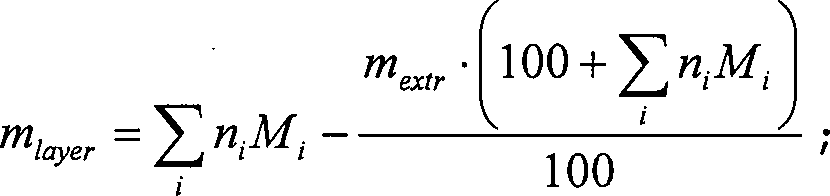
- – ni: molare Stoffmenge der i-ten Komponente
- – Mi: molare Masse der i-ten Komponente unter Annahme folgender allgemeiner Formeln: Q-Einheiten als SiO4/2 D-Einheiten als R2SiO2/2 T-Einheiten als RSiO3/2
- – mextr: Masse der extrahierbaren Anteile der
Silikonharzschicht gemäß eines
Verfahrens wie gegeben in
DE 4419234 - – moxid: Masse eines Metalloxid-Primärpartikels;
erhältlich
gemäßwobei

- – rBET: Primärpartikelradius bestimmbar aus der spezifischen BET-Oberfläche SBET nach SBET = 3/(rBET·ρoxid)
- – ρoxid: Dichte des Metalloxids, z. B. 2200 kg/m3 für SiO2
- – ρlayer:
spezifische Dichte der Silikonharzschicht; erhältlich gemäßwobei
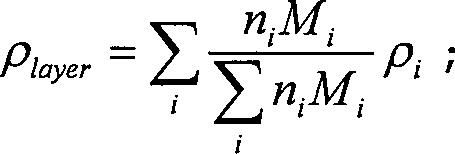
- – ρi: spezifische Dichte der i-ten Komponente mit: 1000 kg/m3 für R2SiO2/2 1300 kg/m3 für RSiO3/2 2200 kg/m3 für SiO4/2
- – und Soxide die pezifische BET-Oberfläche des hydrophilen Ausgangsmetalloxids.
- Layer : mass of the resin layer per 1 kg of metal oxide; available according to in which
- - n i : molar amount of the i-th component
- - M i : molar mass of the ith component assuming the following general formulas: Q units as SiO 4/2 D units as R 2 SiO 2/2 T units as RSiO 3/2
- M extr : mass of extractable portions of the silicone resin layer according to a method as given in
DE 4419234 - - oxide : mass of a metal oxide primary particle; available according to in which
- - r BET : primary particle radius determinable from the specific BET surface area SBET to SBET = 3 / (r BET · ρ oxide )
- - ρ oxide : density of the metal oxide, z. B. 2200 kg / m 3 for SiO 2
- - ρ layer : specific density of the silicone resin layer ; available according to in which
- - ρ i : specific gravity of the i-th component with: 1000 kg / m 3 for R 2 SiO 2/2 1300 kg / m 3 for RSiO 3/2 2200 kg / m 3 for SiO 4/2
- And S oxides the specific BET surface of the hydrophilic starting metal oxide .
Die erfindungsgemäßen Metalloxide weisen ferner einen Kohlenstoffgehalt von größer 1,0 Gew.%, bevorzugt von 1,5 bis 8 Gew.% und besonders bevorzugt von 2 bis 6,5 Gew.% auf, jeweils bezogen auf 100 m2/g spezifische Oberfläche, d. h. bei niedriger bzw. höhere spezifischer Oberfläche werden entsprechend linear niedrigere bzw. höhere Werte erhalten.The metal oxides according to the invention furthermore have a carbon content of greater than 1.0% by weight, preferably from 1.5 to 8% by weight and particularly preferably from 2 to 6.5% by weight, in each case based on 100 m 2 / g of specific surface area , ie lower or higher specific surface area correspondingly linear lower or higher values are obtained.
Die erfindungsgemäßen Metalloxide weisen einen Gehalt an extrahierbaren Komponenten von kleiner 20 Gew.%, bevorzugt kleiner 18 Gew.% und besonders bevorzugt kleiner 15 Gew.% auf.The Metal oxides according to the invention have a content of extractable components of less than 20 % By weight, preferably less than 18% by weight and particularly preferably less 15% by weight.
Die erfindungsgemäßen Metalloxide zeichnen sich insbesondere dadurch aus, dass sie eine besonders geringe Verdickungswirkung auf flüssige Medien aufweisen. Dies bedeutet im Einzelnen, dass Dispersionen enthaltend 15 Massen% der erfindungsgemäßen Metalloxide eine relative Viskosität ηr von kleiner 100, bevorzugt kleiner 50, besonders bevorzugt kleiner 25 und in einer speziellen Ausführung kleiner 15 aufweisen, wobei die relative Viskosität definiert ist als der Quotient ηr = η/η0 aus der Scherviskosität der partikelhaltigen Dispersion η dividiert durch die Scherviskosität der partikelfreien flüssigen Phase η0 bei gleicher Scherrate, wobei die Scherviskosität jeweils gemessen wird bei 25°C mittels Kegel-Platte-System.The metal oxides of the invention are characterized in particular by the fact that they have a particularly low thickening effect on liquid media. This means in detail that dispersions containing 15% by mass of the metal oxides according to the invention have a relative viscosity η r of less than 100, preferably less than 50, more preferably less than 25 and in a specific embodiment less than 15, the relative viscosity being defined as the quotient η r = η / η 0 from the shear viscosity of the particle-containing dispersion η divided by the shear viscosity of the particle-free liquid phase η 0 at the same shear rate, the shear viscosity is measured in each case at 25 ° C by means of a cone-plate system.
Zur Bewertung der Verdickungswirkung der erfindungsgemäßen Metalloxide können beispielsweise flüssige, polare oder semipolare, vernetzbare Monomere, Oligomere oder Polymere oder deren Lösungen in geeigneten organischen Lösungsmitteln mit näherungsweise Newton'schem Fließverhalten eingesetzt werden. Vorzugsweise enthält die Testflüssigkeit die gleichen funktionellen Gruppen in nennenswerten Mengen wie die organofunktionelle Silikonharzschicht der Metalloxidpartikel.to Evaluation of the thickening effect of the metal oxides according to the invention can for example, liquid, polar or semipolar, crosslinkable monomers, oligomers or polymers or their solutions in suitable organic solvents with approximate Newtonian flow behavior be used. Preferably, the test fluid contains the same functional groups in appreciable quantities as the organofunctional silicone resin layer of the metal oxide particles.
Ferner zeichnen sich die erfindungsgemäßen Metalloxidpartikel dadurch aus, dass sie in oben genannten flüssigen Medien kein viskoelastisches Festkörperverhalten induzieren, d. h. dass in einem dynamischen Deformationsexperiment im Schubspannungsbereich von 0,5 bis 1000 Pa bei einer konstanten Winkelgeschwindigkeit von 10 rad/s der Verlustfaktor tan δ = G''/G' größer 1, bevorzugt größer 5 und ganz besonders bevorzugt größer 10 ist, gemessen bei 25°C mittels Kegel-Platte-System.Furthermore, the metal oxide particles according to the invention are distinguished by the fact that they do not induce any viscoelastic solid-state behavior in the abovementioned liquid media, ie that they have a dynami The deformation factor in the shear stress range of 0.5 to 1000 Pa at a constant angular velocity of 10 rad / s is the loss factor tan δ = G "/ G 'greater than 1, preferably greater than 5 and very particularly preferably greater than 10, measured at 25 ° C. using a cone-plate system.
Die erfindungsgemäßen Metalloxidpartikel können zur Herstellung von Beschichtungsstoffen, bevorzugt für kratzfeste Beschichtungsstoffe und solche Beschichtungsstoffe mit verbesserter Oberflächenmechanik, zur Herstellung von Klebstoffen und Dicht stoffen, bevorzugt für hochfeste und schlagzähe Klebstoffe und Dichtstoffe, eingesetzt werden.The Metal oxide particles of the invention can for the production of coating materials, preferably for scratch-resistant Coating materials and coating materials with improved Surface Mechanics, for the production of adhesives and sealants, preferably for high-strength and impact resistant Adhesives and sealants are used.
Die erfindungsgemäßen Metalloxidpartikel können eingesetzt werden zur Verbesserung der Mechanik von Compositen auf Basis z. B. von Epoxiden, ungesättigten Polyestern oder anderen.The Metal oxide particles of the invention can are used to improve the mechanics of composites Base z. As epoxides, unsaturated Polyesters or others.
Die erfindungsgemäßen Metalloxidpartikel können zur Herstellung von Beschichtungsstoffe, Klebstoffen und Dichtstoffen, mit hoher Beladung an partikulärem Metalloxidpartikeln bei gleichzeitig niedere Viskosität und damit exzellenter Verarbeitbarkeit eingesetzt werden.The Metal oxide particles of the invention can for the production of coating materials, adhesives and sealants, with high loading of particulate Metal oxide particles at the same time low viscosity and thus excellent processability can be used.
Die erfindungsgemäßen Metalloxidpartikel können eingesetzt werden, zur Herstellung von peroxidisch vernetzten oder additionsvernetzten Silikonkautschuken von hohem Füllgrad und ausgezeichneter Verarbeitungseigenschaften wie Fließfähigkeit der unvernetzten Massen.The Metal oxide particles of the invention can be used for the production of peroxide crosslinked or addition-crosslinked silicone rubbers of high degree of filling and excellent processing properties such as flowability the uncrosslinked masses.
Die erfindungsgemäßen Metalloxidpartikel können eingesetzt werden, zur Herstellung von hochfesten und elastischen Beschichtungen, Kleb- und Dichtstoffen auf Epoxidbasis, unter Einsatz von Epoxiden als Bindemitteln und Einsatz von Härtern wie z. B. Aminen, Jeffaminen, Säureanhydriden oder anderen.The Metal oxide particles of the invention can be used for the production of high-strength and elastic Coatings, adhesives and sealants based on epoxy, used of epoxides as binders and use of hardeners such. Amines, Jeffamines, anhydrides or others.
Die erfindungsgemäßen Metalloxidpartikel können eingesetzt werden zur Herstellung von hochharten und elastischen Oberflächenbeschichtungen aus 2-Komponenten POLYURETHANEN, unter Einsatz von Polyolen als Bindemittel und Isocyanaten als Härter, wobei Oberflächenbeschichtungen mit hohem Glanz, geringem Oberflächenabrieb und hoher Transparenz erzielt werden bei gleichzeitiger ausgezeichneter Kratzfestigkeit mit Glanzverlusten kleiner 50% und hoher chemischer Widerstandstandsfähigkeit.The Metal oxide particles of the invention can be used for the production of high-hardness and elastic surface coatings from 2-component POLYURETHANES, using polyols as Binders and isocyanates as hardeners, with surface coatings with high gloss, low surface abrasion and high transparency are achieved while excellent Scratch resistance with gloss losses less than 50% and high chemical Resistance resistance ability.
BeispieleExamples
Beispiel 1:Example 1:
Bei einer Temperatur von 25°C unter Inertgas N2 werden zu 100 g an hydrophiler, pyrogener Kieselsäure mit einer spezifischen Oberfläche von 300 m2/g (gemessen nach der BET Methode nach DIN 66131 und 66132) (erhältlich unter dem Namen HDK® T30 bei Wacker Chemie AG, München, D), durch Verdösen über eine Zweistoffdüse (Druck 5 bar), eine Lösung aus 15,0 g Wasser und 0,5 g NEt3 und anschließend 66 g Methacrylatopropyltrimethoxysilan zugefügt. Die so beladene Kieselsäure wird bei einer Gesamtverweilzeit von 3 Stunden 1 h bei 100°C und anschließend 2 h bei 150°C in einem 100 l Trockenschrank unter N2 zur Reaktion gebracht.At a temperature of 25 ° C under inert gas N 2 are added to 100 g of hydrophilic fumed silica having a specific surface area of 300 m 2 / g (measured by the BET method according to DIN 66131 and 66132) (available under the name HDK ® T30 at Wacker Chemie AG, Munich, D), by diluting over a two-fluid nozzle (pressure 5 bar), a solution of 15.0 g of water and 0.5 g of NEt 3 and then added 66 g methacrylatopropyltrimethoxysilane. The so charged silica is reacted for a total residence time of 3 hours for 1 h at 100 ° C and then for 2 h at 150 ° C in a 100 L drying cabinet under N 2 for reaction.
Die Analysendaten sind in Tabelle 1 aufgeführt.The Analytical data is listed in Table 1.
Beispiel 2:Example 2:
In einer kontinuierlichen Apparatur werden bei einer Temperatur von 30°C unter Inertgas N2 zu einem Massestrom von 1000 g/h an hydrophiler, pyrogener Kieselsäure, mit einer spezifischen Oberfläche von 150 m2/g (gemessen nach der BET Methode nach DIN 66131 und 66132) (erhältlich unter dem Namen HDK® V15 bei Wacker Chemie AG, München, D), über Zweistoffdüsen (Druck 5 bar) 80 g/h einer Lösung aus 75 Teilen Wasser und 5 Teilen NEt3 und 330 g/h Methacrylatopropyltrimethoxysilan in flüssiger, feinstverteilter Form zugefügt. Die so beladene Kieselsäure wird bei einer Gesamtverweilzeit von 3 Stunden 1 h in einem Reaktionsbehälter bei 100°C und anschließend in einem weitern Reaktionsbehälter 2 h bei einer Temperatur von 150°C zur Reaktion gebracht und dabei mittels Rühren fluidisiert, und anschließend in einem Trockner bei 150°C und 1 Stunde Verweilzeit gereinigt.In a continuous apparatus at a temperature of 30 ° C under inert gas N 2 to a mass flow of 1000 g / h of hydrophilic pyrogenic silica, with a specific surface area of 150 m 2 / g (measured by the BET method according to DIN 66131 and 66132) (available (under the name of HDK ® V15 from Wacker Chemie AG, Munich, Germany), via two-component nozzles pressure 5 bar) 80 g / h of a solution of 75 parts water and 5 parts of NEt 3 and 330 g / h methacrylatopropyltrimethoxysilane in liquid , finely divided form added. The so charged silica is reacted at a total residence time of 3 hours for 1 h in a reaction vessel at 100 ° C and then in a further reaction vessel for 2 h at a temperature of 150 ° C and thereby fluidized by stirring, and then in a dryer at 150 ° C and 1 hour residence time.
Die Analysedaten sind in Tabelle 1 aufgeführt.The Analytical data is listed in Table 1.
Beispiel 3:Example 3:
In einem 2 l-Dreihalskolben unter Argon als Schutzgas werden 800 ml Hexamethyldisiloxan vorgelegt und anschließend 50 g einer hydrophilen, pyrogenen Kieselsäure mit einer spezifischen Oberfläche von 300 m2/g (gemessen nach der BET Methode nach DIN 66131 und 66132) (erhältlich unter dem Namen HDK® T30 bei Wacker Chemie AG, München, D), 34 g Methacrylatopropyltrimethoxysilan, 7,5 g Wasser und 1,0 g Eisessig zugegeben. Die Suspension wird 2 h unter Rückfluss erhitzt und nach dem Abkühlen auf Raumtemperatur das Lösungsmittel destillativ bei vermindertem Druck entfernt. Anschließend wird der pulverförmige Rückstand bei einer Gesamtverweilzeit von 3 Stunden 1 h bei 100°C und anschließend 2 h bei 150°C in einem 100 l Trockenschrank unter N2 zur Reaktion gebracht.800 ml of hexamethyldisiloxane are placed in a 2 l three-necked flask under argon as the protective gas, and then 50 g of a hydrophilic, fumed silica having a specific surface area of 300 m 2 / g (measured by the BET method according to DIN 66131 and 66132) (available under US Pat Name HDK® T30 from Wacker Chemie AG, Munich, D), 34 g methacrylatopropyltrimethoxysilane, 7.5 g water and 1.0 g glacial acetic acid. The suspension is refluxed for 2 h and, after cooling to room temperature, the solvent is removed by distillation under reduced pressure. Subsequently, the powdery residue is reacted at 100 ° C. for a total residence time of 3 hours at 100 ° C. for 1 h and then at 150 ° C. for 2 h in a 100 l drying cabinet under N 2 .
Die Analysendaten sind in Tabelle 1 aufgeführt.The Analytical data is listed in Table 1.
Beispiel 4:Example 4:
In einem 2 l-Dreihalskolben unter Argon als Schutzgas werden 800 ml Hexamethyldisiloxan vorgelegt und anschließend 50 g einer hydrophilen, pyrogenen Kieselsäure mit einer spezifischen Oberfläche von 300 m2/g (gemessen nach der BET Methode nach DIN 66131 und 66132) (erhältlich unter dem Namen HDK® T30 bei Wacker Chemie AG, München, D), 34 g Methacrylatopropyltrimethoxysilan, 11 g Dimethyldimethoxysilan, 9,4 g Tetraethoxysilan, 15 g Wasser und 1,0 g Eisessig zugegeben. Die Suspension wird 2 h unter Rückfluss erhitzt und nach dem Abkühlen auf Raumtemperatur das Lösungsmittel destillativ bei vermindertem Druck entfernt. Anschließend wird der pulverförmige Rückstand bei einer Gesamtverweilzeit von 3 Stunden 1 h bei 100°C und anschließend 2 h bei 150°C in einem 100 l Trockenschrank unter N2 zur Reaktion gebracht.800 ml of hexamethyldisiloxane are placed in a 2 l three-necked flask under argon as the protective gas, and then 50 g of a hydrophilic, fumed silica having a specific surface area of 300 m 2 / g (measured by the BET method according to DIN 66131 and 66132) (available under US Pat Name HDK® T30 from Wacker Chemie AG, Munich, D), 34 g methacrylatopropyltrimethoxysilane, 11 g dimethyldimethoxysilane, 9.4 g tetraethoxysilane, 15 g water and 1.0 g glacial acetic acid. The suspension is refluxed for 2 h and, after cooling to room temperature, the solvent is removed by distillation under reduced pressure. Subsequently, the powdery residue is reacted at 100 ° C. for a total residence time of 3 hours at 100 ° C. for 1 h and then at 150 ° C. for 2 h in a 100 l drying cabinet under N 2 .
Die Analysendaten sind in Tabelle 1 aufgeführt.The Analytical data is listed in Table 1.
Beispiel 5:Example 5:
In einem 2 l-Dreihalskolben unter Argon als Schutzgas werden 800 ml Hexamethyldisiloxan vorgelegt und anschließend 50 g einer hydrophilen, pyrogenen Kieselsäure mit einer spezifischen Oberfläche von 300 m2/g (gemessen nach der BET Methode nach DIN 66131 und 66132) (erhältlich unter dem Namen HDK® T30 bei Wacker Chemie AG, München, D), 32 g Glycidoxypropyltrimethoxysilan, 7,5 g Wasser und 0,5 g NEt3 zugegeben. Die Suspension wird 2 h unter Rückfluss erhitzt und nach dem Abkühlen auf Raumtemperatur das Lösungsmittel bei vermindertem Druck entfernt. Anschließend wird der pulverförmige Rückstand bei einer Gesamtverweilzeit von 3 Stunden 1 h bei 100°C und anschließend 2 h bei 150°C in einem 100 l Trockenschrank unter N2 zur Reaktion gebracht.800 ml of hexamethyldisiloxane are placed in a 2 l three-necked flask under argon as the protective gas, and then 50 g of a hydrophilic, fumed silica having a specific surface area of 300 m 2 / g (measured by the BET method according to DIN 66131 and 66132) (available under US Pat Name HDK® T30 from Wacker Chemie AG, Munich, D), 32 g glycidoxypropyltrimethoxysilane, 7.5 g water and 0.5 g NEt 3 were added. The suspension is heated under reflux for 2 h and after cooling to room temperature, the solvent is removed under reduced pressure. Subsequently, the powdery residue is reacted at 100 ° C. for a total residence time of 3 hours at 100 ° C. for 1 h and then at 150 ° C. for 2 h in a 100 l drying cabinet under N 2 .
Die Analysendaten sind in Tabelle 1 aufgeführt.The Analytical data is listed in Table 1.
Beispiel 6:Example 6:
Bei einer Temperatur von 25°C unter Inertgas N2 werden zu 100 g an hydrophiler, pyrogener Kieselsäure mit einer spezifischen Oberfläche von 300 m2/g (gemessen nach der BET Methode nach DIN 66131 und 66132) (erhältlich unter dem Namen HDK® T30 bei Wacker Chemie AG, München, D), durch Verdösen über eine Zweistoffdüse (Druck 5 bar), eine Mischung von 0,5 g NEt3 und 66 g Methacrylatopropyltrimethoxysilan zugefügt. Die so beladene Kieselsäure wird anschließend 3 h bei 150°C in einem 100 l Trockenschrank unter N2 zur Reaktion gebracht.At a temperature of 25 ° C under inert gas N 2 are added to 100 g of hydrophilic fumed silica having a specific surface area of 300 m 2 / g (measured by the BET method according to DIN 66131 and 66132) (available under the name HDK ® T30 at Wacker Chemie AG, Munich, D), by diluting over a two-fluid nozzle (pressure 5 bar), a mixture of 0.5 g NEt 3 and 66 g Methacrylatopropyltrimethoxysilan added. The so charged silica is then reacted for 3 h at 150 ° C in a 100 L drying oven under N 2 for reaction.
Die Analysendaten sind in Tabelle 1 aufgeführt.The Analytical data is listed in Table 1.
Beispiel 7:Example 7:
In einem 2 l-Dreihalskolben unter Argon als Schutzgas werden 800 ml Hexamethyldisiloxan vorgelegt und anschließend 50 g einer hydrophilen, pyrogenen Kieselsäure mit einer spezifischen Oberfläche von 300 m2/g (gemessen nach der BET Methode nach DIN 66131 und 66132) (erhältlich unter dem Namen HDK® T30 bei Wacker Chemie AG, München, D), 32 g Glycidoxypropyltrimethoxysilan und 0,5 g NEt3 zugegeben. Die Suspension wird 2 h unter Rückfluss erhitzt und nach dem Abkühlen auf Raumtemperatur das Lösungsmittel bei vermindertem Druck entfernt. Anschließend wird der pulverförmige Rückstand 3 Stunden bei 150°C in einem 100 l Trockenschrank unter N2 zur Reaktion gebracht.800 ml of hexamethyldisiloxane are placed in a 2 l three-necked flask under argon as the protective gas, and then 50 g of a hydrophilic, fumed silica having a specific surface area of 300 m 2 / g (measured by the BET method according to DIN 66131 and 66132) (available under US Pat Name HDK® T30 from Wacker Chemie AG, Munich, D), 32 g glycidoxypropyltrimethoxysilane and 0.5 g NEt 3 were added. The suspension is heated under reflux for 2 h and after cooling to room temperature, the solvent is removed under reduced pressure. Subsequently, the powdery residue is reacted for 3 hours at 150 ° C in a 100 L drying cabinet under N 2 for reaction.
Die Analysendaten sind in Tabelle 1 aufgeführt.The Analytical data is listed in Table 1.
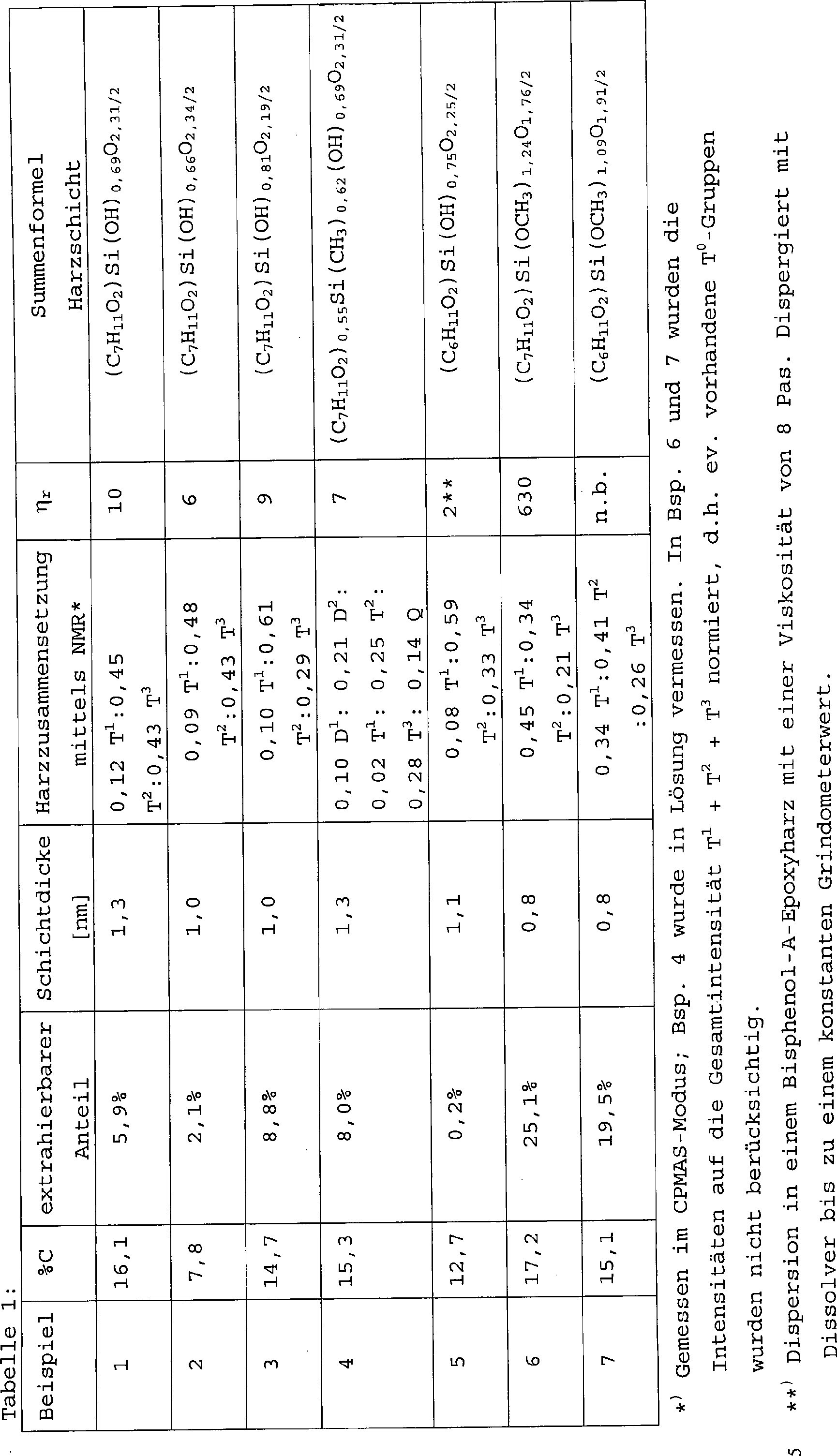
Beschreibung der AnalysenmethodenDescription of the analysis methods
1. Kohlenstoffgehalt (%C)1. Carbon content (% C)
Elementaranalyse auf Kohlenstoff; Verbrennen der Probe bei über 1000°C im O2-Strom, Detektion und Quantifizierung des entstehenden CO2 mit IR; Gerät LECO 244Elemental analysis on carbon; Burning the sample at over 1000 ° C in the O 2 stream, detection and quantification of the resulting CO 2 with IR; Device LECO 244
2. Extrahierbares Silylierungsmittel2. Extractable silylating agent
25 g Kieselsäure werden mit einem Spatel in 100 g THF eingearbeitet und anschließend unter Eiskühlung mit dem Dissolver Dispermat CA-40-C (Fa. Getzmann) mit Zahnscheibe 40 mm zu flüssiger Konsistenz verrührt, anschließend 60 s bei 8400 UpM geschert, dann 60 min mit Ultraschall equilibriert und nach 2 Tagen wird über eine Druckfiltration klares Filtrat abgetrennt. Das Filtrat wird mittels Atomabsorptionsspektroskopie (AAS) auf Siliciumgehalt untersucht. Nachweisgrenze < 100 ppm Organosiliciumverbindungen bezogen auf Kieselsäure.25 g silica are incorporated with a spatula in 100 g of THF and then under ice cooling with the dissolver Dispermat CA-40-C (Getzmann) with toothed disk 40 mm too liquid Consistency stirred subsequently Sheared for 60 seconds at 8400 rpm, then equilibrated for 60 minutes with ultrasound and after 2 days will be over a pressure filtration separated clear filtrate. The filtrate will investigated for silicon content by atomic absorption spectroscopy (AAS). Detection limit <100 ppm organosilicon compounds based on silica.
3. Relative Viskosität3. Relative viscosity
15 g Kieselsäure werden portionsweise mittels Perlmühle (Getzmann APS 250 und Dispermat CA-40-C mit ZrO2-Mahlperlen 2 mm) in 85 g HDDA eingerührt und anschließend auf einen Grindometerwert von 0 μm (25 μm Grindometer) dispergiert. Die Viskosität des Dispersionsmediums und der Dispersion werden mittels luftgelagertem Rheometer mit Kegel-Platte-Sensorsystem bei 25°C bei einer Scherrate von 10 s–1 bestimmt. Die Dispersion wurde vor der Messung 24 h bei Raumtemperatur gelagert.15 g of silica are stirred in portions by means of a bead mill (Getzmann APS 250 and Dispermat CA-40-C with ZrO 2 grinding beads 2 mm) in 85 g of HDDA and then dispersed to a grindometer value of 0 μm (25 μm grindometer). The viscosity of the dispersion medium and the dispersion are determined by means of an air-bearing cone-plate sensor system rheometer at 25 ° C. at a shear rate of 10 s -1. The dispersion was stored for 24 h at room temperature before the measurement.
Claims (12)
Priority Applications (7)
| Application Number | Priority Date | Filing Date | Title |
|---|---|---|---|
| DE200610061057 DE102006061057A1 (en) | 2006-12-22 | 2006-12-22 | Organofunctional silicone resin layers on metal oxides |
| EP07857568A EP2102291A2 (en) | 2006-12-22 | 2007-12-14 | Organofunctional silicone resin layers on metal oxides |
| JP2009542008A JP2010513637A (en) | 2006-12-22 | 2007-12-14 | Metal oxide coated with organofunctional silicone resin layer |
| CN2007800473075A CN101568603B (en) | 2006-12-22 | 2007-12-14 | Organofunctional silicone resin layers on metal oxides |
| PCT/EP2007/063921 WO2008077814A2 (en) | 2006-12-22 | 2007-12-14 | Organofunctional silicone resin layers on metal oxides |
| KR1020097015446A KR101190923B1 (en) | 2006-12-22 | 2007-12-14 | Organofunctional silicone resin layers on metal oxides |
| US12/520,251 US20100021725A1 (en) | 2006-12-22 | 2007-12-14 | Organofunctional silicone resin layers on metal oxides |
Applications Claiming Priority (1)
| Application Number | Priority Date | Filing Date | Title |
|---|---|---|---|
| DE200610061057 DE102006061057A1 (en) | 2006-12-22 | 2006-12-22 | Organofunctional silicone resin layers on metal oxides |
Publications (1)
| Publication Number | Publication Date |
|---|---|
| DE102006061057A1 true DE102006061057A1 (en) | 2008-06-26 |
Family
ID=39431653
Family Applications (1)
| Application Number | Title | Priority Date | Filing Date |
|---|---|---|---|
| DE200610061057 Ceased DE102006061057A1 (en) | 2006-12-22 | 2006-12-22 | Organofunctional silicone resin layers on metal oxides |
Country Status (7)
| Country | Link |
|---|---|
| US (1) | US20100021725A1 (en) |
| EP (1) | EP2102291A2 (en) |
| JP (1) | JP2010513637A (en) |
| KR (1) | KR101190923B1 (en) |
| CN (1) | CN101568603B (en) |
| DE (1) | DE102006061057A1 (en) |
| WO (1) | WO2008077814A2 (en) |
Cited By (3)
| Publication number | Priority date | Publication date | Assignee | Title |
|---|---|---|---|---|
| DE102009040637A1 (en) * | 2009-09-09 | 2011-03-10 | Winkelmann, Felix, Dr. | Intermediates for polymeric materials, useful as thermoplastic semi-finished goods in conventional thermoplastic molding process, comprises optionally surface modified components, radical former, matrix polymer, and other admixtures |
| WO2013156337A1 (en) | 2012-04-20 | 2013-10-24 | Evonik Degussa Gmbh | Reinforced epoxy resin adhesive |
| US9458326B2 (en) | 2009-09-09 | 2016-10-04 | Felix Winkelmann | Polymer materials comprising coupled components |
Families Citing this family (10)
| Publication number | Priority date | Publication date | Assignee | Title |
|---|---|---|---|---|
| DE102007055879A1 (en) | 2007-12-19 | 2009-06-25 | Wacker Chemie Ag | Hydrophobization of silicas and oxidizing conditions |
| US9228785B2 (en) | 2010-05-04 | 2016-01-05 | Alexander Poltorak | Fractal heat transfer device |
| DE102013224206A1 (en) | 2013-11-27 | 2015-05-28 | Wacker Chemie Ag | Surface-modified particulate metal oxides |
| DE102013226494A1 (en) * | 2013-12-18 | 2015-06-18 | Wacker Chemie Ag | Modification of the surfaces of metal oxides by means of chain-like structures |
| US10353558B2 (en) * | 2016-01-13 | 2019-07-16 | Electrolux Home Products, Inc. | Drag-and-set user interface for appliances |
| WO2018013668A1 (en) | 2016-07-12 | 2018-01-18 | Alexander Poltorak | System and method for maintaining efficiency of a heat sink |
| US10590278B2 (en) * | 2017-04-10 | 2020-03-17 | Nanophase Technologies Corporation | Coated powders having high photostability |
| TW202323189A (en) * | 2021-08-31 | 2023-06-16 | 日商日產化學股份有限公司 | Surface-treated inorganic oxide particle dispersion containing silicon oxide and its production method |
| KR20250026864A (en) | 2022-06-29 | 2025-02-25 | 와커 헤미 아게 | Method for modifying silica in liquid form |
| WO2025242315A1 (en) | 2024-05-24 | 2025-11-27 | Wacker Chemie Ag | Method for modifying silicic acid in the liquid phase |
Citations (12)
| Publication number | Priority date | Publication date | Assignee | Title |
|---|---|---|---|---|
| US2891923A (en) * | 1954-03-01 | 1959-06-23 | Calvin White H | Silicone supplemented fillers and rubbers, and methods for their manufacture |
| DE2107082A1 (en) * | 1970-02-16 | 1971-08-26 | Ici Ltd | Surface treated powdered silica and process for the manufacture thereof |
| US5112885A (en) * | 1989-04-28 | 1992-05-12 | Shin-Etsu Chemical Co., Ltd. | Room temperature vulcanizable silicon rubber composition |
| WO2001012732A1 (en) * | 1999-08-19 | 2001-02-22 | Ppg Industries Ohio, Inc. | Chemically treated fillers and polymeric compositions containing same |
| DE69711571T2 (en) * | 1996-12-18 | 2002-11-28 | Dsm Copolymer, Inc. | Process for mixing silica in polymer latices |
| DE10145162A1 (en) * | 2001-09-13 | 2003-04-10 | Wacker Chemie Gmbh | Silylated silica with low levels of silicon-bonded hydroxy groups useful in toners, developers, charge control agents and flow improvers for powder systems and in crosslinkable polymer and resin compositions |
| DE10160323A1 (en) * | 2001-12-08 | 2003-06-18 | Wolf-Dietrich Zander | Roll comprises coiled sheet material which is adhesive on one or both sides and incorporates a separation/carrier layer extending on one or both edge zones beyond the adhesive material |
| DE10319937A1 (en) * | 2003-05-02 | 2004-12-02 | Wacker-Chemie Gmbh | Organofunctional surface modified metal oxides |
| EP1215252B1 (en) * | 2000-12-15 | 2005-06-08 | Dow Corning Toray Silicone Company, Ltd. | Water repellent silicone coating agent composition |
| WO2006010764A1 (en) * | 2004-07-28 | 2006-02-02 | Ge Bayer Silicones Gmbh & Co. Kg | Method for production of a surface-treated oxidic filler |
| US20060084723A1 (en) * | 2002-09-07 | 2006-04-20 | Fraunhofer Gesellschaft Zur Foederung Der Angewandten Forschung E.V. | Nanocomposites, method of production, and method of use |
| WO2006105600A1 (en) * | 2005-04-06 | 2006-10-12 | Advanced Nanotechnology Limited | Silicone coated metal oxide particles |
Family Cites Families (18)
| Publication number | Priority date | Publication date | Assignee | Title |
|---|---|---|---|---|
| US5277813A (en) * | 1988-06-17 | 1994-01-11 | S.A.C. Corporation | Shielded stationary phases |
| DE4419234A1 (en) * | 1994-06-01 | 1995-12-07 | Wacker Chemie Gmbh | Process for the silylation of inorganic oxides |
| JPH0953021A (en) * | 1995-08-10 | 1997-02-25 | Pola Chem Ind Inc | Silicone-treated powder and composition containing the same |
| AU715859B2 (en) * | 1996-04-04 | 2000-02-10 | Nanophase Technologies Corporation | Siloxane star-graft polymers, ceramic powders coated therewith and method of preparing coated ceramic powders |
| US5993967A (en) * | 1997-03-28 | 1999-11-30 | Nanophase Technologies Corporation | Siloxane star-graft polymers, ceramic powders coated therewith and method of preparing coated ceramic powders |
| ES2359228T3 (en) * | 2000-10-21 | 2011-05-19 | Evonik Degussa Gmbh | SYSTEMS OF CURABLE VARNISHES BY RADIATION. |
| EP1249470A3 (en) * | 2001-03-30 | 2005-12-28 | Degussa AG | Highly filled pasty siliconorganic nano and/or microhybridcapsules containing composition for scratch and/or abrasion resistant coatings |
| JP4348891B2 (en) * | 2001-06-15 | 2009-10-21 | トヨタ自動車株式会社 | Power output apparatus having fuel cell and method thereof |
| DE10151264A1 (en) * | 2001-10-17 | 2003-04-30 | Degussa | Aminoalkylalkoxysiloxane-containing mixtures, their preparation and their use |
| DE10151478C1 (en) * | 2001-10-18 | 2003-03-13 | Wacker Chemie Gmbh | Production of aminoalkylsilyl-modified solid, used in powder system, as thickener or in toner, developer or charge transfer ancillary, involves reacting surface hydroxyl groups with cyclic silazane |
| US6613139B1 (en) * | 2002-07-18 | 2003-09-02 | Dow Corning Corporation | Chlorosilane blends for treating silica |
| JP3920746B2 (en) * | 2002-09-02 | 2007-05-30 | 信越化学工業株式会社 | Thermally conductive composite sheet and method for producing the same |
| JP2004099351A (en) * | 2002-09-06 | 2004-04-02 | Wacker Asahikasei Silicone Co Ltd | Surface treating agent for artificial marble filler |
| DE10250712A1 (en) * | 2002-10-31 | 2004-05-19 | Degussa Ag | Powdery substances |
| JP4539824B2 (en) * | 2004-06-23 | 2010-09-08 | 信越化学工業株式会社 | Coated hexaboride particles and method for producing the same |
| JP5241242B2 (en) * | 2005-02-16 | 2013-07-17 | ダウ・コーニング・コーポレイション | Reinforced silicone resin film and method for producing the same |
| JP4862992B2 (en) * | 2006-04-14 | 2012-01-25 | 信越化学工業株式会社 | Antifouling agent, antifouling coating agent composition, antifouling film and coated article thereof |
| US8435474B2 (en) * | 2006-09-15 | 2013-05-07 | Cabot Corporation | Surface-treated metal oxide particles |
-
2006
- 2006-12-22 DE DE200610061057 patent/DE102006061057A1/en not_active Ceased
-
2007
- 2007-12-14 US US12/520,251 patent/US20100021725A1/en not_active Abandoned
- 2007-12-14 CN CN2007800473075A patent/CN101568603B/en not_active Expired - Fee Related
- 2007-12-14 KR KR1020097015446A patent/KR101190923B1/en not_active Expired - Fee Related
- 2007-12-14 JP JP2009542008A patent/JP2010513637A/en active Pending
- 2007-12-14 WO PCT/EP2007/063921 patent/WO2008077814A2/en not_active Ceased
- 2007-12-14 EP EP07857568A patent/EP2102291A2/en not_active Withdrawn
Patent Citations (12)
| Publication number | Priority date | Publication date | Assignee | Title |
|---|---|---|---|---|
| US2891923A (en) * | 1954-03-01 | 1959-06-23 | Calvin White H | Silicone supplemented fillers and rubbers, and methods for their manufacture |
| DE2107082A1 (en) * | 1970-02-16 | 1971-08-26 | Ici Ltd | Surface treated powdered silica and process for the manufacture thereof |
| US5112885A (en) * | 1989-04-28 | 1992-05-12 | Shin-Etsu Chemical Co., Ltd. | Room temperature vulcanizable silicon rubber composition |
| DE69711571T2 (en) * | 1996-12-18 | 2002-11-28 | Dsm Copolymer, Inc. | Process for mixing silica in polymer latices |
| WO2001012732A1 (en) * | 1999-08-19 | 2001-02-22 | Ppg Industries Ohio, Inc. | Chemically treated fillers and polymeric compositions containing same |
| EP1215252B1 (en) * | 2000-12-15 | 2005-06-08 | Dow Corning Toray Silicone Company, Ltd. | Water repellent silicone coating agent composition |
| DE10145162A1 (en) * | 2001-09-13 | 2003-04-10 | Wacker Chemie Gmbh | Silylated silica with low levels of silicon-bonded hydroxy groups useful in toners, developers, charge control agents and flow improvers for powder systems and in crosslinkable polymer and resin compositions |
| DE10160323A1 (en) * | 2001-12-08 | 2003-06-18 | Wolf-Dietrich Zander | Roll comprises coiled sheet material which is adhesive on one or both sides and incorporates a separation/carrier layer extending on one or both edge zones beyond the adhesive material |
| US20060084723A1 (en) * | 2002-09-07 | 2006-04-20 | Fraunhofer Gesellschaft Zur Foederung Der Angewandten Forschung E.V. | Nanocomposites, method of production, and method of use |
| DE10319937A1 (en) * | 2003-05-02 | 2004-12-02 | Wacker-Chemie Gmbh | Organofunctional surface modified metal oxides |
| WO2006010764A1 (en) * | 2004-07-28 | 2006-02-02 | Ge Bayer Silicones Gmbh & Co. Kg | Method for production of a surface-treated oxidic filler |
| WO2006105600A1 (en) * | 2005-04-06 | 2006-10-12 | Advanced Nanotechnology Limited | Silicone coated metal oxide particles |
Cited By (3)
| Publication number | Priority date | Publication date | Assignee | Title |
|---|---|---|---|---|
| DE102009040637A1 (en) * | 2009-09-09 | 2011-03-10 | Winkelmann, Felix, Dr. | Intermediates for polymeric materials, useful as thermoplastic semi-finished goods in conventional thermoplastic molding process, comprises optionally surface modified components, radical former, matrix polymer, and other admixtures |
| US9458326B2 (en) | 2009-09-09 | 2016-10-04 | Felix Winkelmann | Polymer materials comprising coupled components |
| WO2013156337A1 (en) | 2012-04-20 | 2013-10-24 | Evonik Degussa Gmbh | Reinforced epoxy resin adhesive |
Also Published As
| Publication number | Publication date |
|---|---|
| KR101190923B1 (en) | 2012-10-12 |
| WO2008077814A3 (en) | 2009-06-04 |
| KR20090094160A (en) | 2009-09-03 |
| CN101568603A (en) | 2009-10-28 |
| US20100021725A1 (en) | 2010-01-28 |
| EP2102291A2 (en) | 2009-09-23 |
| JP2010513637A (en) | 2010-04-30 |
| CN101568603B (en) | 2013-03-20 |
| WO2008077814A2 (en) | 2008-07-03 |
Similar Documents
| Publication | Publication Date | Title |
|---|---|---|
| EP2102291A2 (en) | Organofunctional silicone resin layers on metal oxides | |
| EP2167588B1 (en) | Process for preparing highly disperse pyrogenic silica having a high positive surface charge | |
| EP2279226B1 (en) | Surface modified silicon dioxide particles | |
| EP0686676B1 (en) | Process for silylating inorganic oxides and silylated silica | |
| EP1304361B1 (en) | Method for Producing Silica with homogenous silylating agent coating | |
| EP1473296B1 (en) | Organofunctional surface modified metal oxides | |
| DE102013224206A1 (en) | Surface-modified particulate metal oxides | |
| EP2144968A1 (en) | Dispersible nanoparticles | |
| EP3083841A1 (en) | Modifying the surfaces of metal oxides by means of chain-like structures | |
| EP2781558B1 (en) | Modified compound containing silicic acid and silicone rubber containing the said composition | |
| DE102005005046A1 (en) | Hydroxyalkyl-functionalized fillers | |
| DE102005034350A1 (en) | Paints containing particles | |
| EP1845136B1 (en) | Rheology control of strongly basic liquids | |
| EP2825600B1 (en) | Process for surface modification of particulate solids | |
| DE102013224210A1 (en) | Silanized highly hydrophobic silicas | |
| EP1431338A1 (en) | Texture-coated silica |
Legal Events
| Date | Code | Title | Description |
|---|---|---|---|
| OP8 | Request for examination as to paragraph 44 patent law | ||
| R002 | Refusal decision in examination/registration proceedings | ||
| R003 | Refusal decision now final |
Effective date: 20140603 |