DE102006016639A1 - Process for the production of polyurethane foams - Google Patents
Process for the production of polyurethane foams Download PDFInfo
- Publication number
- DE102006016639A1 DE102006016639A1 DE102006016639A DE102006016639A DE102006016639A1 DE 102006016639 A1 DE102006016639 A1 DE 102006016639A1 DE 102006016639 A DE102006016639 A DE 102006016639A DE 102006016639 A DE102006016639 A DE 102006016639A DE 102006016639 A1 DE102006016639 A1 DE 102006016639A1
- Authority
- DE
- Germany
- Prior art keywords
- anionic
- polyurethane
- dispersions
- groups
- mol
- Prior art date
- Legal status (The legal status is an assumption and is not a legal conclusion. Google has not performed a legal analysis and makes no representation as to the accuracy of the status listed.)
- Withdrawn
Links
Classifications
-
- C—CHEMISTRY; METALLURGY
- C08—ORGANIC MACROMOLECULAR COMPOUNDS; THEIR PREPARATION OR CHEMICAL WORKING-UP; COMPOSITIONS BASED THEREON
- C08G—MACROMOLECULAR COMPOUNDS OBTAINED OTHERWISE THAN BY REACTIONS ONLY INVOLVING UNSATURATED CARBON-TO-CARBON BONDS
- C08G18/00—Polymeric products of isocyanates or isothiocyanates
- C08G18/06—Polymeric products of isocyanates or isothiocyanates with compounds having active hydrogen
- C08G18/28—Polymeric products of isocyanates or isothiocyanates with compounds having active hydrogen characterised by the compounds used containing active hydrogen
- C08G18/40—High-molecular-weight compounds
- C08G18/48—Polyethers
- C08G18/4854—Polyethers containing oxyalkylene groups having four carbon atoms in the alkylene group
-
- A—HUMAN NECESSITIES
- A61—MEDICAL OR VETERINARY SCIENCE; HYGIENE
- A61L—METHODS OR APPARATUS FOR STERILISING MATERIALS OR OBJECTS IN GENERAL; DISINFECTION, STERILISATION OR DEODORISATION OF AIR; CHEMICAL ASPECTS OF BANDAGES, DRESSINGS, ABSORBENT PADS OR SURGICAL ARTICLES; MATERIALS FOR BANDAGES, DRESSINGS, ABSORBENT PADS OR SURGICAL ARTICLES
- A61L15/00—Chemical aspects of, or use of materials for, bandages, dressings or absorbent pads
- A61L15/16—Bandages, dressings or absorbent pads for physiological fluids such as urine or blood, e.g. sanitary towels, tampons
- A61L15/22—Bandages, dressings or absorbent pads for physiological fluids such as urine or blood, e.g. sanitary towels, tampons containing macromolecular materials
- A61L15/26—Macromolecular compounds obtained otherwise than by reactions only involving carbon-to-carbon unsaturated bonds; Derivatives thereof
-
- A—HUMAN NECESSITIES
- A61—MEDICAL OR VETERINARY SCIENCE; HYGIENE
- A61L—METHODS OR APPARATUS FOR STERILISING MATERIALS OR OBJECTS IN GENERAL; DISINFECTION, STERILISATION OR DEODORISATION OF AIR; CHEMICAL ASPECTS OF BANDAGES, DRESSINGS, ABSORBENT PADS OR SURGICAL ARTICLES; MATERIALS FOR BANDAGES, DRESSINGS, ABSORBENT PADS OR SURGICAL ARTICLES
- A61L15/00—Chemical aspects of, or use of materials for, bandages, dressings or absorbent pads
- A61L15/16—Bandages, dressings or absorbent pads for physiological fluids such as urine or blood, e.g. sanitary towels, tampons
- A61L15/42—Use of materials characterised by their function or physical properties
- A61L15/425—Porous materials, e.g. foams or sponges
-
- A—HUMAN NECESSITIES
- A61—MEDICAL OR VETERINARY SCIENCE; HYGIENE
- A61L—METHODS OR APPARATUS FOR STERILISING MATERIALS OR OBJECTS IN GENERAL; DISINFECTION, STERILISATION OR DEODORISATION OF AIR; CHEMICAL ASPECTS OF BANDAGES, DRESSINGS, ABSORBENT PADS OR SURGICAL ARTICLES; MATERIALS FOR BANDAGES, DRESSINGS, ABSORBENT PADS OR SURGICAL ARTICLES
- A61L15/00—Chemical aspects of, or use of materials for, bandages, dressings or absorbent pads
- A61L15/16—Bandages, dressings or absorbent pads for physiological fluids such as urine or blood, e.g. sanitary towels, tampons
- A61L15/42—Use of materials characterised by their function or physical properties
- A61L15/44—Medicaments
-
- C—CHEMISTRY; METALLURGY
- C08—ORGANIC MACROMOLECULAR COMPOUNDS; THEIR PREPARATION OR CHEMICAL WORKING-UP; COMPOSITIONS BASED THEREON
- C08G—MACROMOLECULAR COMPOUNDS OBTAINED OTHERWISE THAN BY REACTIONS ONLY INVOLVING UNSATURATED CARBON-TO-CARBON BONDS
- C08G18/00—Polymeric products of isocyanates or isothiocyanates
- C08G18/06—Polymeric products of isocyanates or isothiocyanates with compounds having active hydrogen
- C08G18/08—Processes
-
- C—CHEMISTRY; METALLURGY
- C08—ORGANIC MACROMOLECULAR COMPOUNDS; THEIR PREPARATION OR CHEMICAL WORKING-UP; COMPOSITIONS BASED THEREON
- C08G—MACROMOLECULAR COMPOUNDS OBTAINED OTHERWISE THAN BY REACTIONS ONLY INVOLVING UNSATURATED CARBON-TO-CARBON BONDS
- C08G18/00—Polymeric products of isocyanates or isothiocyanates
- C08G18/06—Polymeric products of isocyanates or isothiocyanates with compounds having active hydrogen
- C08G18/08—Processes
- C08G18/0804—Manufacture of polymers containing ionic or ionogenic groups
- C08G18/0819—Manufacture of polymers containing ionic or ionogenic groups containing anionic or anionogenic groups
- C08G18/0828—Manufacture of polymers containing ionic or ionogenic groups containing anionic or anionogenic groups containing sulfonate groups or groups forming them
-
- C—CHEMISTRY; METALLURGY
- C08—ORGANIC MACROMOLECULAR COMPOUNDS; THEIR PREPARATION OR CHEMICAL WORKING-UP; COMPOSITIONS BASED THEREON
- C08G—MACROMOLECULAR COMPOUNDS OBTAINED OTHERWISE THAN BY REACTIONS ONLY INVOLVING UNSATURATED CARBON-TO-CARBON BONDS
- C08G18/00—Polymeric products of isocyanates or isothiocyanates
- C08G18/06—Polymeric products of isocyanates or isothiocyanates with compounds having active hydrogen
- C08G18/08—Processes
- C08G18/0838—Manufacture of polymers in the presence of non-reactive compounds
- C08G18/0842—Manufacture of polymers in the presence of non-reactive compounds in the presence of liquid diluents
- C08G18/0861—Manufacture of polymers in the presence of non-reactive compounds in the presence of liquid diluents in the presence of a dispersing phase for the polymers or a phase dispersed in the polymers
- C08G18/0866—Manufacture of polymers in the presence of non-reactive compounds in the presence of liquid diluents in the presence of a dispersing phase for the polymers or a phase dispersed in the polymers the dispersing or dispersed phase being an aqueous medium
-
- C—CHEMISTRY; METALLURGY
- C08—ORGANIC MACROMOLECULAR COMPOUNDS; THEIR PREPARATION OR CHEMICAL WORKING-UP; COMPOSITIONS BASED THEREON
- C08G—MACROMOLECULAR COMPOUNDS OBTAINED OTHERWISE THAN BY REACTIONS ONLY INVOLVING UNSATURATED CARBON-TO-CARBON BONDS
- C08G18/00—Polymeric products of isocyanates or isothiocyanates
- C08G18/06—Polymeric products of isocyanates or isothiocyanates with compounds having active hydrogen
- C08G18/08—Processes
- C08G18/10—Prepolymer processes involving reaction of isocyanates or isothiocyanates with compounds having active hydrogen in a first reaction step
- C08G18/12—Prepolymer processes involving reaction of isocyanates or isothiocyanates with compounds having active hydrogen in a first reaction step using two or more compounds having active hydrogen in the first polymerisation step
-
- C—CHEMISTRY; METALLURGY
- C08—ORGANIC MACROMOLECULAR COMPOUNDS; THEIR PREPARATION OR CHEMICAL WORKING-UP; COMPOSITIONS BASED THEREON
- C08G—MACROMOLECULAR COMPOUNDS OBTAINED OTHERWISE THAN BY REACTIONS ONLY INVOLVING UNSATURATED CARBON-TO-CARBON BONDS
- C08G18/00—Polymeric products of isocyanates or isothiocyanates
- C08G18/06—Polymeric products of isocyanates or isothiocyanates with compounds having active hydrogen
- C08G18/28—Polymeric products of isocyanates or isothiocyanates with compounds having active hydrogen characterised by the compounds used containing active hydrogen
-
- C—CHEMISTRY; METALLURGY
- C08—ORGANIC MACROMOLECULAR COMPOUNDS; THEIR PREPARATION OR CHEMICAL WORKING-UP; COMPOSITIONS BASED THEREON
- C08G—MACROMOLECULAR COMPOUNDS OBTAINED OTHERWISE THAN BY REACTIONS ONLY INVOLVING UNSATURATED CARBON-TO-CARBON BONDS
- C08G18/00—Polymeric products of isocyanates or isothiocyanates
- C08G18/06—Polymeric products of isocyanates or isothiocyanates with compounds having active hydrogen
- C08G18/28—Polymeric products of isocyanates or isothiocyanates with compounds having active hydrogen characterised by the compounds used containing active hydrogen
- C08G18/2805—Compounds having only one group containing active hydrogen
- C08G18/2815—Monohydroxy compounds
- C08G18/283—Compounds containing ether groups, e.g. oxyalkylated monohydroxy compounds
-
- C—CHEMISTRY; METALLURGY
- C08—ORGANIC MACROMOLECULAR COMPOUNDS; THEIR PREPARATION OR CHEMICAL WORKING-UP; COMPOSITIONS BASED THEREON
- C08G—MACROMOLECULAR COMPOUNDS OBTAINED OTHERWISE THAN BY REACTIONS ONLY INVOLVING UNSATURATED CARBON-TO-CARBON BONDS
- C08G18/00—Polymeric products of isocyanates or isothiocyanates
- C08G18/06—Polymeric products of isocyanates or isothiocyanates with compounds having active hydrogen
- C08G18/28—Polymeric products of isocyanates or isothiocyanates with compounds having active hydrogen characterised by the compounds used containing active hydrogen
- C08G18/40—High-molecular-weight compounds
- C08G18/4009—Two or more macromolecular compounds not provided for in one single group of groups C08G18/42 - C08G18/64
- C08G18/4018—Mixtures of compounds of group C08G18/42 with compounds of group C08G18/48
-
- C—CHEMISTRY; METALLURGY
- C08—ORGANIC MACROMOLECULAR COMPOUNDS; THEIR PREPARATION OR CHEMICAL WORKING-UP; COMPOSITIONS BASED THEREON
- C08G—MACROMOLECULAR COMPOUNDS OBTAINED OTHERWISE THAN BY REACTIONS ONLY INVOLVING UNSATURATED CARBON-TO-CARBON BONDS
- C08G18/00—Polymeric products of isocyanates or isothiocyanates
- C08G18/06—Polymeric products of isocyanates or isothiocyanates with compounds having active hydrogen
- C08G18/28—Polymeric products of isocyanates or isothiocyanates with compounds having active hydrogen characterised by the compounds used containing active hydrogen
- C08G18/40—High-molecular-weight compounds
- C08G18/42—Polycondensates having carboxylic or carbonic ester groups in the main chain
- C08G18/44—Polycarbonates
-
- C—CHEMISTRY; METALLURGY
- C08—ORGANIC MACROMOLECULAR COMPOUNDS; THEIR PREPARATION OR CHEMICAL WORKING-UP; COMPOSITIONS BASED THEREON
- C08G—MACROMOLECULAR COMPOUNDS OBTAINED OTHERWISE THAN BY REACTIONS ONLY INVOLVING UNSATURATED CARBON-TO-CARBON BONDS
- C08G18/00—Polymeric products of isocyanates or isothiocyanates
- C08G18/06—Polymeric products of isocyanates or isothiocyanates with compounds having active hydrogen
- C08G18/28—Polymeric products of isocyanates or isothiocyanates with compounds having active hydrogen characterised by the compounds used containing active hydrogen
- C08G18/40—High-molecular-weight compounds
- C08G18/48—Polyethers
- C08G18/4804—Two or more polyethers of different physical or chemical nature
- C08G18/4808—Mixtures of two or more polyetherdiols
-
- C—CHEMISTRY; METALLURGY
- C08—ORGANIC MACROMOLECULAR COMPOUNDS; THEIR PREPARATION OR CHEMICAL WORKING-UP; COMPOSITIONS BASED THEREON
- C08G—MACROMOLECULAR COMPOUNDS OBTAINED OTHERWISE THAN BY REACTIONS ONLY INVOLVING UNSATURATED CARBON-TO-CARBON BONDS
- C08G18/00—Polymeric products of isocyanates or isothiocyanates
- C08G18/06—Polymeric products of isocyanates or isothiocyanates with compounds having active hydrogen
- C08G18/70—Polymeric products of isocyanates or isothiocyanates with compounds having active hydrogen characterised by the isocyanates or isothiocyanates used
- C08G18/72—Polyisocyanates or polyisothiocyanates
- C08G18/721—Two or more polyisocyanates not provided for in one single group C08G18/73 - C08G18/80
- C08G18/722—Combination of two or more aliphatic and/or cycloaliphatic polyisocyanates
-
- A—HUMAN NECESSITIES
- A61—MEDICAL OR VETERINARY SCIENCE; HYGIENE
- A61L—METHODS OR APPARATUS FOR STERILISING MATERIALS OR OBJECTS IN GENERAL; DISINFECTION, STERILISATION OR DEODORISATION OF AIR; CHEMICAL ASPECTS OF BANDAGES, DRESSINGS, ABSORBENT PADS OR SURGICAL ARTICLES; MATERIALS FOR BANDAGES, DRESSINGS, ABSORBENT PADS OR SURGICAL ARTICLES
- A61L2300/00—Biologically active materials used in bandages, wound dressings, absorbent pads or medical devices
- A61L2300/60—Biologically active materials used in bandages, wound dressings, absorbent pads or medical devices characterised by a special physical form
- A61L2300/602—Type of release, e.g. controlled, sustained, slow
Landscapes
- Chemical & Material Sciences (AREA)
- Health & Medical Sciences (AREA)
- Chemical Kinetics & Catalysis (AREA)
- Medicinal Chemistry (AREA)
- Polymers & Plastics (AREA)
- Organic Chemistry (AREA)
- Engineering & Computer Science (AREA)
- Materials Engineering (AREA)
- General Health & Medical Sciences (AREA)
- Hematology (AREA)
- Veterinary Medicine (AREA)
- Epidemiology (AREA)
- Life Sciences & Earth Sciences (AREA)
- Animal Behavior & Ethology (AREA)
- Public Health (AREA)
- Dispersion Chemistry (AREA)
- Manufacturing & Machinery (AREA)
- Polyurethanes Or Polyureas (AREA)
- Manufacture Of Porous Articles, And Recovery And Treatment Of Waste Products (AREA)
- Materials For Medical Uses (AREA)
- Medicinal Preparation (AREA)
Abstract
Die Erfindung betrifft ein Verfahren zur Herstellung von Polyurethan-Schäumen, durch Aufschäumen und Trocknen spezieller Polyurethan-Dispersionen.The invention relates to a process for producing polyurethane foams by foaming and drying special polyurethane dispersions.
Description
Die Erfindung betrifft ein Verfahrung zur Herstellung von Polyurethan-Schäumen, durch Aufschäumen und Trocknen spezieller Polyurethan-Dispersionen.The The invention relates to a process for the production of polyurethane foams, by Frothing and Drying of special polyurethane dispersions.
In
der Wundbehandlung ist die Verwendung von Polyurethan-Schäumen als
Wundauflage seit langem bekannt. Um eine gute Absorption von Wundflüssigkeit
zu gewährleisten,
werden dazu in der Regel hydrophile Polyurethan-Schäume eingesetzt.
Diese werden erhalten durch Umsetzung von Mischungen aus Diisocyanaten
und Polyolen bzw. NCO-funktionellen Polyurethan-Prepolymeren mit
Wasser in Gegenwart bestimmter Katalysatoren sowie (Schaum-) Additiven.
In der Regel werden hierbei aromatische Diisocyanate eingesetzt,
da sich diese am besten verschäumen
lassen. Zahlreiche Ausführungsformen
dieser Verfahren sind bekannt, beispielsweise beschrieben in
Es
ist darüber
hinaus bekannt, Schäume
aus Polyurethan-Dispersionen herzustellen, indem man in Gegenwart
geeigneter (Schaum-) Additive durch kräftiges Rühren Luft einträgt. Nach
dem Trocknen und Aushärten
werden so genannte mechanische Polyurethan-Schäume erhalten. Solche Schäume sind
im Zusammenhang mit Wundauflagen in EP-A 0 235 949 und EP-A 0 246
723 beschrieben, wobei dem Schaum entweder ein selbst-haftendes
Polymer zugesetzt oder der Schaum auf einen Film eines selbst-haftenden
Polymers aufgebracht wird. Die Verwendung der Schäume als
solche, d.h. ohne selbst-haftende Polymere wird nicht beschrieben.
Die in
Die
EP-A 0 235 949, EP-A 0 246 723 und
EP-A 0 760 743 beschreibt darüber hinaus solche mechanischen Schäume auf Basis von Latex-Dispersionen, die jedoch nicht aus Polyurethanen bestehen und schlechtere mechanische Eigenschaften aufweisen.EP-A 0 760 743 describes it In addition, such mechanical foams based on latex dispersions, but not made of polyurethanes exist and have poorer mechanical properties.
Aufgabe der vorliegenden Erfindung war daher die Bereitstellung von neuen Wundauflagen auf Basis von Polyurethanen, welche auf möglichst einfache Weise und ohne die Verwendung gesundheitsschädlicher Aufbaukomponenten oder Additive zugänglich sind. Weitere Voraussetzung ist, dass diese Wundauflagen eine gute mechanische Eigenschaften, eine hohe Aufnahmekapazität von physiologischer Salzlösung sowie eine hohe Wasserdampfdurchlässigkeit aufweisen.task The present invention was therefore the provision of new Wound dressings based on polyurethanes, which are as possible easy way and without the use of harmful building components or additives accessible are. Another requirement is that these dressings have a good mechanical properties, a high absorption capacity of physiological saline solution and have a high water vapor permeability.
Es wurde nun gefunden, dass solche Wundauflagen auf Polyurethanbasis zugänglich sind, in dem Zusammensetzungen, die spezielle wässrige Polyurethan-Dispersionen enthalten, aufgeschäumt und anschließend physikalisch getrocknet werden.It It has now been found that such polyurethane-based wound dressings accessible in which compositions are the specific aqueous polyurethane dispersions contained, foamed and subsequently be physically dried.
Gegenstand der vorliegenden Erfindung ist daher ein Verfahren zur Herstellung von Wundauflagen, bei dem Zusammensetzungen enthaltend anionisch hydrophilierte, wässrige Polyurethan-Dispersionen (I) aufgeschäumt und physikalisch ohne chemische Vernetzung getrocknet werden.object The present invention is therefore a process for the preparation of dressings containing compositions containing anionic Hydrophilized, aqueous Polyurethane dispersions (I) foamed and physically without chemical Crosslink dried.
Unter Vernetzung wird im Sinne der vorliegenden Erfindung die Bildung kovalenter Bindungen verstanden.Under Crosslinking is the formation in the context of the present invention understood covalent bonds.
Bevorzugt sind diese Dispersionen anionisch mittels Sulfonatgruppen hydrophiliert. Besonders bevorzugt sind zur anionischen Hydrophilierung ausschließlich Sulfonatgruppen enthalten.Prefers these dispersions are anionically hydrophilated by means of sulfonate groups. Especially preferred for anionic hydrophilization are exclusively sulfonate groups contain.
Bevorzugt weisen die speziellen Polyurethan-Dispersionen (I) einen niedrigen Grad an hydrophilen anionischen Gruppen, bevorzugt von 0,1 bis 15 Milliequivalenten pro 100 g Polyurethan (Festharz) auf.Prefers the special polyurethane dispersions (I) have a low Degree of hydrophilic anionic groups, preferably from 0.1 to 15 Milliequivalents per 100 g of polyurethane (solid resin) on.
Um eine gute Sedimentationsstabilität zu erreichen, liegt die zahlenmittlere Teilchengröße der speziellen Polyurethan-Dispersionen bevorzugt bei weniger als 750 nm, besonders bevorzugt bei weniger als 500 nm, bestimmt mittels Laserkorrelations-Spektroskopie.Around a good sedimentation stability to reach is the number average particle size of the special Polyurethane dispersions preferably at less than 750 nm, especially preferably at less than 500 nm, determined by means of laser correlation spectroscopy.
Bevorzugt besitzen die Polyurethan-Dispersionen (I) Feststoffgehalte von 30 bis 70 Gew.-%, besonders bevorzugt 50 bis 70 Gew.-%, ganz besonders bevorzugt 55 bis 65 Gew.-%, bezogen auf das darin enthaltene Polyurethan.Prefers the polyurethane dispersions (I) have solids contents of 30 to 70% by weight, particularly preferably 50 to 70% by weight, very particularly preferably 55 to 65 wt .-%, based on the polyurethane contained therein.
Bevorzugt weisen diese Polyurethan-Dispersionen weniger als 0,5 Gew.-%, besonders bevorzugt weniger als 0,2 Gew.-%, bezogen auf die gesamte Dispersionen, an ungebundenen organischen Aminen auf.Prefers these polyurethane dispersions have less than 0.5 wt .-%, especially preferably less than 0.2% by weight, based on the total dispersions, on unbound organic amines.
Solche bevorzugt einzusetzenden Polyurethan-Dispersionen (I) sind erhältlich, in dem
- A) isocyanatfunktionelle Prepolymere aus A1) organischen Polyisocyanaten A2) polymeren Polyolen mit zahlenmittleren Molekulargewichten von 400 bis 8000 g/mol, vorzugsweise 400 bis 6000 g/mol und besonders bevorzugt von 600 bis 3000 g/mol, und OH-Funktionalitäten von 1,5 bis 6, bevorzugt 1,8 bis 3, besonders bevorzugt von 1,9 bis 2,1, und A3) gegebenenfalls hydroxyfunktionellen Verbindungen mit Molekulargewichten von 62 bis 399 g/mol sowie A4) gegebenenfalls isocyanatreaktiven, anionischen oder potentiell anionischen und/oder gegebenenfalls nichtionischen Hydrophilierungsmitteln, hergestellt, und
- B) dessen freie NCO-Gruppen dann ganz oder teilweise B1) gegebenenfalls mit aminofunktionellen Verbindungen mit Molekulargewichten von 32 bis 400 g/mol und/oder B2) aminofunktionellen, anionischen oder potentiell anionischen Hydrophilierungsmitteln
- A) isocyanate-functional prepolymers of A1) organic polyisocyanates A2) polymeric polyols having number average molecular weights of 400 to 8000 g / mol, preferably 400 to 6000 g / mol and more preferably from 600 to 3000 g / mol, and OH functionalities of 1.5 to 6, preferably 1.8 to 3, more preferably from 1.9 to 2.1, and A3) optionally hydroxy-functional compounds having molecular weights of 62 to 399 g / mol and A4) optionally isocyanate-reactive, anionic or potentially anionic and / or optionally nonionic hydrophilicizing agents, and,
- B) whose free NCO groups are then wholly or partially B1) optionally with amino-functional compounds having molecular weights of 32 to 400 g / mol and / or B2) amino-functional, anionic or potentially anionic hydrophilicizing agents
Falls gewünscht, kann das Prepolymer vor während oder nach der Dispergierung durch Beimischung einer Base ganz oder teilweise in die anionische Form überführt werden.If desired can the prepolymer before during or after dispersion by admixing a base completely or partially converted to the anionic form.
Um eine anionische Hydrophilierung zu erreichen müssen in A4) und/oder B2) Hydrophilierungsmittel eingesetzt werden, die wenigstens eine gegenüber NCO-Gruppen reaktive Gruppe wie Amino-, Hydroxy- oder Thiolgruppen aufweisen und darüber hinaus -COO– oder -SO3 – oder -PO3 2– als anionische bzw. deren ganz oder teilweise protonierte Säureformen als potentiell anionische Gruppen aufweisen.In order to achieve an anionic hydrophilization, hydrophilicizing agents must be used in A4) and / or B2) which have at least one group which is reactive toward NCO groups, such as amino, hydroxyl or thiol groups and moreover -COO - or -SO 3 - or - PO 3 2- as anionic or their fully or partially protonated acid forms as potentially anionic groups.
Bevorzugt werden in A4) und/oder B2) solche Verbindungen zur anionischen oder potentiell anionischen Hydrophilierung eingesetzt, die als anionische oder potentiell anionische Funktionalität ausschließlich Sulfonsäure- bzw. Sulfonatgruppen (-SO3H bzw. -SO3M, mit M = Alkali- oder Erdalkalimetall) aufweisen.In A4) and / or B2), preference is given to using those compounds for anionic or potentially anionic hydrophilization which have as anionic or potentially anionic functionality exclusively sulfonic acid or sulfonate groups (-SO 3 H or -SO 3 M, where M = alkali metal). or alkaline earth metal).
Geeignete Polyisocyanate der Komponente A1) sind die dem Fachmann an sich bekannten aliphatischen oder cycloaliphatischen Polyisocyanate einer NCO-Funktionalität von größer oder gleich 2.suitable Polyisocyanates of component A1) are those skilled in the per se known aliphatic or cycloaliphatic polyisocyanates a NCO functionality from bigger or equal to 2.
Beispiele solcher geeigneten Polyisocyanate sind 1,4-Butylendiisocyanat, 1,6-Hexamethylendiisocyanat (HDI), Isophorondiisocyanat (IPDI), 2,2,4 und/oder 2,4,4-Trimethylhexamethylendiisocyanat, die isomeren Bis-(4,4'-isocyanatocyclohexyl)methane oder deren Mischungen beliebigen Isomerengehalts, 1,4-Cyclohexylendiisocyanat, 4-Isocyanatomethyl-1,8-octandiisocyanat (Nonantriisocyanat), sowie Alkyl-2,6-diisocyanatohexanoate (Lysindiisocyanate) mit C1-C8-Alkylgruppen.Examples such suitable polyisocyanates are 1,4-butylene diisocyanate, 1,6-hexamethylene diisocyanate (HDI), isophorone diisocyanate (IPDI), 2,2,4 and / or 2,4,4-trimethylhexamethylene diisocyanate, the isomeric bis (4,4'-isocyanatocyclohexyl) methanes or mixtures thereof of any isomer content, 1,4-cyclohexylene diisocyanate, 4-isocyanatomethyl-1,8-octane diisocyanate (Nonantriisocyanate), as well as alkyl-2,6-diisocyanatohexanoate (lysine diisocyanate) with C1-C8-alkyl groups.
Neben den vorstehend genannten Polyisocyanaten können auch modifizierte Diisocyanate die eine Funktionalität ≥2 aufweisen, mit Uretdion-, Isocyanurat-, Urethan-, Allophanat-, Biuret-, Iminooxadiazindion- oder Oxadiazintrionstruktur sowie Mischungen aus diesen anteilig eingesetzt werden.Next The above-mentioned polyisocyanates may also contain modified diisocyanates which have a functionality ≥2, with uretdione, isocyanurate, urethane, allophanate, biuret, iminooxadiazinedione or Oxadiazintrione structure and mixtures of these proportionally used become.
Bevorzugt handelt es sich um Polyisocyanate oder Polyisocyanatgemische der vorstehend genannten Art mit ausschließlich aliphatisch oder cycloaliphatisch gebundenen Isocyanatgruppen oder Mischungen aus diesen und einer mittleren NCO-Funktionalität der Mischung von 2 bis 4, bevorzugt 2 bis 2,6 und besonders bevorzugt 2 bis 2,4.Prefers are polyisocyanates or polyisocyanate mixtures of aforementioned type with exclusively aliphatic or cycloaliphatic bound isocyanate groups or mixtures of these and one average NCO functionality the mixture of 2 to 4, preferably 2 to 2.6 and more preferably 2 to 2.4.
Besonders bevorzugt werden in A1) Hexamethylendiisocyanat, Isophorondiisocyanat oder die isomeren Bis-(4,4'-isocyanatocyclohexyl)methane sowie Mischungen der vorgenannten Diisocyanate eingesetzt.Especially in A1) hexamethylene diisocyanate, isophorone diisocyanate are preferred or the isomeric bis (4,4'-isocyanatocyclohexyl) methanes and mixtures of the aforementioned diisocyanates used.
In A2) werden polymere Polyole mit einem zahlenmittleren Molekulargewicht Mn von 400 bis 8000 g/mol, bevorzugt von 400 bis 6000 g/mol und besonders bevorzugt von 600 bis 3000 g/mol eingesetzt. Diese weisen bevorzugt eine OH-Funktionalität von 1,5 bis 6, besonders bevorzugt von 1,8 bis 3, ganz besonders bevorzugt von 1,9 bis 2,1 auf.In A2) are used polymeric polyols having a number average molecular weight M n of 400 to 8000 g / mol, preferably from 400 to 6000 g / mol and particularly preferably from 600 to 3000 g / mol. These preferably have an OH functionality of from 1.5 to 6, particularly preferably from 1.8 to 3, very particularly preferably from 1.9 to 2.1.
Solche polymeren Polyole sind die in der Polyurethanlacktechnologie an sich bekannten Polyesterpolyole, Polyacrylatpolyole, Polyurethanpolyole, Polycarbonatpolyole, Polyetherpolyole, Polyesterpolyacrylatpolyole, Polyurethanpolyacrylatpolyole, Polyurethanpolyesterpolyole, Polyurethanpolyetherpolyole, Polyurethanpolycarbonatpolyole und Polyesterpolycarbonatpolyole. Diese können in A2) einzeln oder in beliebigen Mischungen untereinander eingesetzt werden.Such polymeric polyols are those in polyurethane lacquer technology known polyester polyols, polyacrylate polyols, polyurethane polyols, Polycarbonate polyols, polyether polyols, polyester polyacrylate polyols, Polyurethane polyacrylate polyols, polyurethane polyester polyols, polyurethane polyether polyols, Polyurethane polycarbonate polyols and polyester polycarbonate polyols. these can in A2) individually or in any mixtures with one another become.
Solche Polyesterpolyole sind die an sich bekannten Polykondensate aus Di- sowie gegebenenfalls Tri- und Tetraolen und Di- sowie gegebenenfalls Tri- und Tetracarbonsäuren oder Hydroxycarbonsäuren oder Lactonen. Anstelle der freien Polycarbonsäuren können auch die entsprechenden Polycarbonsäureanhydride oder entsprechende Polycarbonsäureester von niederen Alkoholen zur Herstellung der Polyester verwendet werden.Such Polyester polyols are the polycondensates known from and optionally tri- and tetraols and di- and optionally Tri- and tetracarboxylic acids or hydroxycarboxylic acids or lactones. Instead of the free polycarboxylic acids and the corresponding Polycarboxylic anhydrides or corresponding polycarboxylic acid esters of lower alcohols used to make the polyesters.
Beispiele für geeignete Diole sind Ethylenglykol, Butylenglykol, Diethylenglykol, Triethylenglykol, Polyalkylenglykole wie Polyethylenglykol, weiterhin 1,2-Propandiol, 1,3-Propandiol, Butandiol(1,3), Butandiol(1,4), Hexandiol(1,6) und Isomere, Neopentylglykol oder Hydroxypivalinsäureneopentylglykolester, wobei Hexandiol(1,6) und Isomere, Butandiol(1,4), Neopentylglykol und Hydroxypivalinsäureneopenthylglykolester bevorzugt sind. Daneben können auch Polyole wie Trimethylolpropan, Glycerin, Erythrit, Pentaerythrit, Triemthylolbenzol oder Trishydroxyethylisocyanurat eingesetzt werden.Examples for suitable Diols are ethylene glycol, butylene glycol, diethylene glycol, triethylene glycol, Polyalkylene glycols such as polyethylene glycol, furthermore 1,2-propanediol, 1,3-propanediol, butanediol (1,3), butanediol (1,4), hexanediol (1,6) and Isomers, neopentyl glycol or hydroxypivalic acid neopentyl glycol esters, with hexanediol (1,6) and isomers, butanediol (1,4), neopentyl glycol and hydroxypivalic acid neopentyl glycol ester are preferred are. In addition, you can also polyols such as trimethylolpropane, glycerol, erythritol, pentaerythritol, trimethylolbenzene or Trishydroxyethylisocyanurat be used.
Als Dicarbonsäuren können Phthalsäure, Isophthalsäure, Terephthalsäure, Tetrahydrophthalsäure, Hexahydrophthalsäure, Cyclohexandicarbonsäure, Adipinsäure, Azelainsäure, Sebacinsäure, Glutarsäure, Tetrachlorphthalsäure, Maleinsäure, Fumarsäure, Itaconsäure, Malonsäure, Korksäure, 2-Methylbernsteinsäure, 3,3-Diethylglutarsäure und/oder 2,2-Dimethylbernsteinsäure eingesetzt werden. Als Säurequelle können auch die entsprechenden Anhydride verwendet werden.When dicarboxylic acids can phthalic acid, isophthalic acid, terephthalic acid, Tetrahydrophthalic, hexahydrophthalic, cyclohexanedicarboxylic, adipic, azelaic, sebacic, glutaric, tetrachlorophthalic, maleic, fumaric, itaconic, malonic, suberic, 2-methylsuccinic, 3,3-diethylglutaric and / or 2,2-dimethyl succinate be used. As an acid source can also the corresponding anhydrides can be used.
Sofern die mittlere Funktionalität des zu veresternden Polyols > als 2 ist, können zusätzlich auch Monocarbonsäuren, wie Benzoesäure und Hexancarbonsäure mit verwendet werden.Provided the middle functionality of the polyol to be esterified> as 2 is, can additionally also monocarboxylic acids, like benzoic acid and hexanecarboxylic acid to be used with.
Bevorzugte Säuren sind aliphatische oder aromatische Säuren der vorstehend genannten Art. Besonders bevorzugt sind Adipinsäure, Isophthalsäure und Phthalsäure.preferred acids are aliphatic or aromatic acids of the aforementioned Art. Particularly preferred are adipic acid, isophthalic acid and Phthalic acid.
Hydroxycarbonsäuren, die als Reaktionsteilnehmer bei der Herstellung eines Polyesterpolyols mit endständigen Hydroxylgruppen mitverwendet werden können, sind beispielsweise Hydroxycapronsäure, Hydroxybuttersäure, Hydroxydecansäure, Hydroxystearinsäure und dergleichen. Geeignete Lactone sind Caprolacton, Butyrolacton und Homologe. Bevorzugt ist Caprolacton.Hydroxycarboxylic acids, the as a reactant in the preparation of a polyester polyol with terminal Hydroxyl groups can be used, for example, hydroxycaproic acid, hydroxybutyric acid, hydroxydecanoic acid, hydroxystearic acid and like. Suitable lactones are caprolactone, butyrolactone and Homologues. Preference is given to caprolactone.
Ebenfalls können in A2) hydroxylgruppenaufweisende Polycarbonate, bevorzugt Polycarbonatdiole, mit zahlenmittleren Molekulargewichten Mn von 400 bis 8000 g/mol, bevorzugt 600 bis 3000 g/mol eingesetzt werden. Diese sind durch Reaktion von Kohlensäurederivaten, wie Diphenylcarbonat, Dimethylcarbonat oder Phosgen, mit Polyolen, bevorzugt Diolen, erhältlich.It is likewise possible in A2) to use hydroxyl-containing polycarbonates, preferably polycarbonatediols, having number-average molecular weights M n of from 400 to 8000 g / mol, preferably from 600 to 3000 g / mol. These are obtainable by reaction of carbonic acid derivatives, such as diphenyl carbonate, dimethyl carbonate or phosgene, with polyols, preferably diols.
Beispiele derartiger Diole sind Ethylenglykol, 1,2- und 1,3-Propandiol, 1,3- und 1,4-Butandiol, 1,6-Hexandiol, 1,8-Octandiol, Neopentylglykol, 1,4-Bishydroxymethylcyclohexan, 2-Methyl-1,3-propandiol, 2,2,4-Trimethylpentandiol-1,3, Dipropylenglykol, Polypropylenglykole, Dibutylenglykol, Polybutylenglykole, Bisphenol A und lactonmodifizierte Diole der vorstehend genannten Art in Frage.Examples of such diols are ethylene glycol, 1,2- and 1,3-propanediol, 1,3- and 1,4-butanediol, 1,6-hexanediol, 1,8-octanediol, neopentyl glycol, 1,4-bis-hydroxymethylcyclohexane, 2-methyl-1,3-propanediol, 2,2,4-trimethyl-pentanediol-1,3, Dipropylene glycol, polypropylene glycols, dibutylene glycol, polybutylene glycols, Bisphenol A and lactone-modified diols of the above Kind in question.
Bevorzugt enthält die Diolkomponente 40 bis 100 Gew.-% Hexandiol, bevorzugt sind 1,6-Hexandiol und/oder Hexandiolderivate. Solche Hexandiolderivate basieren auf Hexandiol und weisen neben endständigen OH-Gruppen Ester- oder Ethergruppen auf. Solche Derivate sind durch Reaktion von Hexandiol mit überschüssigem Caprolacton oder durch Veretherung von Hexandiol mit sich selbst zum Di- oder Trihexylenglykol erhältlich.Preferably, the diol component contains 40 to 100 wt .-% of hexanediol, preferably 1,6-hexanediol and / or hexanediol derivatives. Such hexanediol derivatives are based on hexanediol and have ester or ether groups in addition to terminal OH groups. Such derivatives are obtainable by reaction of hexanediol with excess caprolactone or by etherification of hexanediol with itself to di- or trihexylenglykol.
Statt oder zusätzlich zu reinen Polycarbonatdiolen können auch Polyether-Polycarbonatdiole in A2) eingesetzt werden.Instead of or additionally to pure polycarbonate diols can also polyether-polycarbonate diols in A2) can be used.
Hydroxylgruppen aufweisende Polycarbonate sind bevorzugt linear gebaut.hydroxyl having polycarbonates are preferably constructed linearly.
Ebenfalls können in A2) Polyetherpolyole eingesetzt werden.Also can in A2) polyether polyols are used.
Geeignet sind beispielsweise die in der Polyurethanchemie an sich bekannten Polytetramethylenglykolpolyether wie sie durch Polymerisation von Tetrahydrofuran mittels kationischer Ringöffnung erhältlich sind.Suitable For example, those known in polyurethane chemistry are known per se Polytetramethylene glycol polyethers as obtained by polymerization of Tetrahydrofuran are available by cationic ring opening.
Ebenfalls geeignete Polyetherpolyole sind die an sich bekannten Additionsprodukte von Styroloxid, Ethylenoxid, Propylenoxid, Butylenoxide und/oder Epichlorhydrins an di- oder polyfunktionelle Startermoleküle. Polyetherpolyole, basierend auf der zumindest anteiligen Addition von Ethylenoxid an di- oder polyfunktionelle Startermoleküle, können auch als Komponente A4) eingesetzt werden (nichtionische Hydrophilierungsmittel).Also suitable polyether polyols are the per se known addition products of styrene oxide, ethylene oxide, propylene oxide, butylene oxides and / or Epichlorohydrin to di- or polyfunctional starter molecules. polyether polyols, based on the at least partial addition of ethylene oxide to di- or polyfunctional starter molecules, can also be used as component A4) be used (nonionic hydrophilicizing agent).
Als geeignete Startermoleküle können alle dem Stand der Technik nach bekannten Verbindungen eingesetzt werden, wie zum Beispiel Wasser, Butyldiglykol, Glycerin, Diethylenglkol, Trimethyolpropan, Propylenglykol, Sorbit, Ethylendiamin, Triethanolamin, 1,4-Butandiol.When suitable starter molecules can all used in the prior art according to known compounds such as water, butyl diglycol, glycerol, diethylene glycol, Trimethyolpropane, propylene glycol, sorbitol, ethylenediamine, triethanolamine, 1,4-butanediol.
In A3) können Polyole des genannten Molekulargewichtsbereichs mit bis zu 20 Kohlenstoffatomen, wie Ethylenglykol, Diethylenglykol, Triethylenglykol, 1,2-Propandiol, 1,3-Propandiol, 1,4-Butandiol, 1,3-Butylenglykol, Cyclohexandiol, 1,4-Cyclohexandimethanol, 1,6-Hexandiol, Neopentylglykol, Hydrochinondihydroxyethylether, Bisphenol A (2,2-Bis(4-hydroxyphenyl)propan), hydriertes Bisphenol A, (2,2-Bis(4-hydroxycyclohexyl)propan), Trimethylolpropan, Glycerin, Pentaerythrit sowie deren beliebige Mischungen untereinander eingesetzt werden.In A3) Polyols of said molecular weight range having up to 20 carbon atoms, such as Ethylene glycol, diethylene glycol, triethylene glycol, 1,2-propanediol, 1,3-propanediol, 1,4-butanediol, 1,3-butylene glycol, cyclohexanediol, 1,4-cyclohexanedimethanol, 1,6-hexanediol, neopentyl glycol, hydroquinone dihydroxyethyl ether, Bisphenol A (2,2-bis (4-hydroxyphenyl) propane), hydrogenated bisphenol A, (2,2-bis (4-hydroxycyclohexyl) propane), trimethylolpropane, Glycerol, pentaerythritol and any mixtures thereof used become.
Geeignet sind auch Esterdiole des genannten Molekulargewichtsbereichs wie α-Hydroxybutyl-ε-hydroxy-capronsäureester, ω-Hydroxyhexyl-γ-hydroxybuttersäure-ester, Adipinsäure-(β-hydroxyethyl)ester oder Terephthalsäurebis(β-hydroxyethyl)-ester.Suitable are also ester diols of the stated molecular weight range, such as α-hydroxybutyl-ε-hydroxy-caproic acid ester, ω-hydroxyhexyl-γ-hydroxybutyric acid ester, Adipic acid (β-hydroxyethyl) ester or terephthalic acid bis (β-hydroxyethyl) ester.
Ferner können in A3) auch monofunktionelle isocyanatreaktive Hydroxyl-gruppenhaltige Verbindungen eingesetzt werden. Beispiele solcher monofunktionellen Verbindungen sind Ethanol, n-Butanol, Ethylenglykol-monobutylether, Diethylenglykolmonomethylether, Ethylenglykolmonobutylether, Diethylenglykolmonobutylether, Propylenglykolmonomethylether, Dipropylenglykol-monomethylether, Tripropylenglykolmonomethylether, Dipropylenglykolmono-propylether, Propylenglykolmonobutylether, Dipropylenglykolmonobutylether, Tripropylenglykolmonobutylether, 2-Ethylhexanol, 1-Octanol, 1-Dodecanol, 1-Hexadecanol.Further can in A3) also monofunctional isocyanate-reactive hydroxyl group-containing Connections are used. Examples of such monofunctional Compounds are ethanol, n-butanol, ethylene glycol monobutyl ether, Diethylene glycol monomethyl ether, ethylene glycol monobutyl ether, diethylene glycol monobutyl ether, Propylene glycol monomethyl ether, dipropylene glycol monomethyl ether, Tripropylene glycol monomethyl ether, dipropylene glycol mono-propyl ether, Propylene glycol monobutyl ether, dipropylene glycol monobutyl ether, tripropylene glycol monobutyl ether, 2-ethylhexanol, 1-octanol, 1-dodecanol, 1-hexadecanol.
Geeignete anionisch hydrophilierende Verbindungen der Komponente A4) sind Salze der Mono- und Dihydroxysulfonsäuren. Beispiele solcher anionischen Hydrophilierungsmittel sind das Addukt von Natriumbisulfit an Buten-2-diol-1,4, wie es in DE-A 2 446 440, Seite 5–9, Formel I–III beschrieben ist.suitable anionic hydrophilic compounds of component A4) Salts of mono- and Dihydroxysulfonsäuren. Examples of such anionic Hydrophilizing agents are the adduct of sodium bisulfite with butene-2-diol-1,4, as described in DE-A 2 446 440, pages 5-9, formula I-III is.
Geeignete nichtionisch hydrophilierende Verbindungen der Komponente A4) sind z.B. Polyoxyalkylenether, die mindestens eine Hydroxy-, Amino- oder Thiolgruppe enthalten. Beispiele sind die monohydroxyfunktionellen, im statistischen Mittel 5 bis 70, bevorzugt 7 bis 55 Ethylenoxideinheiten pro Molekül aufweisenden Polyalkylenoxidpolyetheralkohole, wie sie in an sich bekannter Weise durch Alkoxylierung geeigneter Startermoleküle zugänglich sind (z.B. in Ullmanns Encyclopädie der technischen Chemie, 4. Auflage, Band 19, Verlag Chemie, Weinheim S. 31–38). Diese sind entweder reine Polyethylenoxidether oder gemischte Polyalkylenoxidether, wobei sie mindestens 30 mol-%, bevorzugt mindestens 40 mol-% bezogen auf alle enthaltenen Alkylenoxideinheiten an Ethylenoxideinheiten enthalten.suitable nonionic hydrophilic compounds of component A4) are e.g. Polyoxyalkylenether, the at least one hydroxy, amino or Thiol group included. Examples are the monohydroxy-functional, on average 5 to 70, preferably 7 to 55 ethylene oxide units per molecule having Polyalkylenoxidpolyetheralkohole, as in itself known manner by alkoxylation of suitable starter molecules are accessible (e.g., in Ullmanns Encyclopaedia the technical chemistry, 4th edition, volume 19, publishing house chemistry, Weinheim Pp. 31-38). These are either pure polyethylene oxide ethers or mixed polyalkylene oxide ethers, wherein they are at least 30 mol%, preferably at least 40 mol% based to all contained alkylene oxide units of ethylene oxide units contain.
Besonders bevorzugte nichtionische Verbindungen sind monofunktionelle gemischte Polyalkylenoxidpolyether, die 40 bis 100 mol-% Ethylenoxid- und 0 bis 60 mol-% Propylenoxideinheiten aufweisen.Especially preferred nonionic compounds are monofunctional mixed Polyalkylenoxidpolyether, the 40 to 100 mol% of ethylene oxide and 0 to 60 mol% of propylene oxide units.
Geeignete Startermoleküle für solche nichtionischen Hydrophilierungsmittel sind gesättigte Monoalkohole wie Methanol, Ethanol, n-Propanol, Isopropanol, n-Butanol, Isobutanol, sec-Butanol, die Isomeren Pentanole, Hexanole, Octanole und Nonanole, n-Decanol, n-Dodecanol, n-Tetradecanol, n-Hexadecanol, n-Octadecanol, Cyclohexanol, die isomeren Methylcyclohexanole oder Hydroxymethylcyclohexan, 3-Ethyl-3-hydroxymethyloxetan oder Tetrahydrofurfurylalkohol, Diethylenglykol-monoalkylether, wie beispielsweise Diethylenglykolmonobutylether, ungesättigte Alkohole wie Allylalkohol, 1,1-Dimethylallylalkohol oder Oleinalkohol, aromatische Alkohole wie Phenol, die isomeren Kresole oder Methoxyphenole, araliphatische Alkohole wie Benzylalkohol, Anisalkohol oder Zimtalkohol, sekundäre Monoamine wie Dimethylamin, Diethylamin, Dipropylamin, Diisopropylamin, Dibutylamin, Bis-(2-ethylhexyl)-amin, N-Methyl- und N-Ethylcyclohexylamin oder Dicyclohexylamin sowie heterocyclische sekundäre Amine wie Morpholin, Pyrrolidin, Piperidin oder 1H-Pyrazol. Bevorzugte Startermoleküle sind gesättigte Monoalkohole der vorstehend genannten Art. Besonders bevorzugt werden Diethylenglykolmonobutylether oder n-Butanol als Startermoleküle verwendet.Suitable starter molecules for such nonionic hydrophilicizing agents are saturated monoalcohol such as methanol, ethanol, n-propanol, isopropanol, n-butanol, isobutanol, sec-butanol, the isomers pentanols, hexanols, octanols and nonanols, n-decanol, n-dodecanol, n-tetradecanol, n-hexadecanol, n- Octadecanol, cyclohexanol, the isomeric methylcyclohexanols or hydroxymethylcyclohexane, 3-ethyl-3-hydroxymethyloxetane or tetrahydrofurfuryl alcohol, diethylene glycol monoalkyl ethers such as diethylene glycol monobutyl ether, unsaturated alcohols such as allyl alcohol, 1,1-dimethylallyl alcohol or oleic alcohol, aromatic alcohols such as phenol, the isomeric cresols or Methoxyphenols, araliphatic alcohols such as benzyl alcohol, anisalcohol or cinnamyl alcohol, secondary monoamines such as dimethylamine, diethylamine, dipropylamine, diisopropylamine, dibutylamine, bis (2-ethylhexyl) amine, N-methyl- and N-ethylcyclohexylamine or dicyclohexylamine and heterocyclic secondary amines such as morpholine , Pyrrolidine, piperidine or 1H-pyrazole. Preferred starter molecules are saturated monoalcohols of the abovementioned type. Particular preference is given to using diethylene glycol monobutyl ether or n-butanol as starter molecules.
Für die Alkoxylierungsreaktion geeignete Alkylenoxide sind insbesondere Ethylenoxid und Propylenoxid, die in beliebiger Reihenfolge oder auch im Gemisch bei der Alkoxylierungsreaktion eingesetzt werden können.For the alkoxylation reaction suitable alkylene oxides are in particular ethylene oxide and propylene oxide, in any order or even as a mixture in the alkoxylation reaction can be used.
Als Komponente B1) können organische Di- oder Polyamine wie beispielsweise 1,2-Ethylendiamin, 1,2- und 1,3-Diaminopropan, 1,4-Diaminobutan, 1,6-Diaminohexan, Isophorondiamin, Isomerengemisch von 2,2,4- und 2,4,4-Trimethylhexamethylendiamin, 2-Methylpentamethylendiamin, Diethylentriamin, 4,4-Diaminodicyclohexylmethan und/oder Dimethylethylendiamin eingesetzt werden.When Component B1) can organic di- or polyamines such as 1,2-ethylenediamine, 1,2- and 1,3-diaminopropane, 1,4-diaminobutane, 1,6-diaminohexane, isophoronediamine, Isomer mixture of 2,2,4- and 2,4,4-trimethylhexamethylenediamine, 2-methylpentamethylenediamine, diethylenetriamine, 4,4-diaminodicyclohexylmethane and / or dimethylethylenediamine.
Darüber hinaus können als Komponente B1) auch Verbindungen, die neben einer primären Aminogruppe auch sekundäre Aminogruppen oder neben einer Aminogruppe (primär oder sekundär) auch OH-Gruppen aufweisen, eingesetzt werden. Beispiele hierfür sind primäre/sekundäre Amine, wie Diethanolamin, 3-Amino-1-Methylaminopropan, 3-Amino-1- Ethylaminopropan, 3-Amino-1-cyclohexylaminopropan, 3-Amino-1-Methylaminobutan, Alkanolamine wie N-Aminoethylethanolamin, Ethanolamin, 3-Aminopropanol, Neopentanolamin.Furthermore can as component B1) also compounds which in addition to a primary amino group also secondary Amino groups or in addition to an amino group (primary or secondary) also OH groups are used. Examples are primary / secondary amines, such as diethanolamine, 3-amino-1-methylaminopropane, 3-amino-1-ethylaminopropane, 3-amino-1-cyclohexylaminopropane, 3-amino-1-methylaminobutane, alkanolamines such as N-aminoethylethanolamine, ethanolamine, 3-aminopropanol, neopentanolamine.
Ferner können als Komponente B1) auch monofunktionelle isocyanatreaktive Aminverbindungen eingesetzt werden, wie beispielsweise Methylamin, Ethylamin, Propylamin, Butylamin, Octylamin, Laurylamin, Stearylamin, Isononyloxypropylamin, Dimethylamin, Diethylamin, Dipropylamin, Dibutylamin, N-Methylaminopropylamin, Diethyl(methyl)aminopropylamin, Morpholin, Piperidin, bzw. geeignete substituierte Derivate davon, Amidamine aus diprimären Aminen und Monocarbonsäuren, Monoketime von diprimären Aminen, primär/tertiäre Amine, wie N,N-Dimethylaminopropylamin.Further can as component B1) also monofunctional isocyanate-reactive amine compounds be used, such as methylamine, ethylamine, propylamine, Butylamine, octylamine, laurylamine, stearylamine, isononyloxypropylamine, Dimethylamine, diethylamine, dipropylamine, dibutylamine, N-methylaminopropylamine, Diethyl (methyl) aminopropylamine, morpholine, piperidine, or suitable substituted derivatives thereof, amide amines from diprimary amines and monocarboxylic acids, Monoketime of diprimaries Amines, primary / tertiary amines, such as N, N-dimethylaminopropylamine.
Geeignete anionisch hydrophilierende Verbindungen der Komponente B2) sind Alkalimetallsalze der Mono- und Diaminosulfonsäuren. Beispiele solcher anionischen Hydrophilierungsmittel sind Salze der 2-(2-Aminoethylamino)ethansulfonsäure, Ethylendiaminpropyl- oder -butylsulfonsäure, 1,2- oder 1,3-Propylendiamin-β-ethylsulfonsäure oder Taurin,. Weiterhin kann das Salz der Cyclohexylaminopropansulfonsäure (CAPS) aus WO-A 01/88006 als anionisches Hydrophilierungsmittel verwendet werden.suitable anionic hydrophilic compounds of component B2) Alkali metal salts of mono- and diaminosulfonic acids. Examples of such anionic Hydrophilizing agents are salts of 2- (2-aminoethylamino) ethanesulfonic acid, ethylenediaminepropyl or butylsulfonic acid, 1,2- or 1,3-propylenediamine-β-ethylsulfonic acid or Taurine ,. Furthermore, the salt of cyclohexylaminopropanesulfonic acid (CAPS) from WO-A 01/88006 be used as an anionic hydrophilicizing agent.
Besonders bevorzugte anionische Hydrophilierungsmittel B2) sind solche, die Sulfonatgruppen als ionische Gruppen und zwei Aminogruppen enthalten, wie die Salze der 2-(2-Aminoethylamino)ethylsulfonsäure und 1,3-Propylendiamin-β-ethylsulfonsäure.Especially preferred anionic hydrophilicizing agents B2) are those which Contain sulfonate groups as ionic groups and two amino groups, such as the salts of 2- (2-aminoethylamino) ethylsulfonic acid and 1,3-propylenediamine-β-ethylsulfonic acid.
Zur Hydrophilierung können auch Mischungen aus anionischen und nichtionischen Hydrophilierungsmitteln verwendet werden.to Hydrophilization can also mixtures of anionic and nonionic hydrophilicizing agents be used.
In
einer bevorzugten Ausführungsform
zur Herstellung der speziellen Polyurethan-Dispersionen werden die
Komponenten A1) bis A4) und B1) bis B2) in den folgenden Mengen
eingesetzt, wobei sich die Einzelmengen stets zu 100 Gew.-% addieren:
5
bis 40 Gew.-% Komponente A1),
55 bis 90 Gew.-% A2),
0,5
bis 20 Gew.-% Summe der Komponenten A3) und B1)
0,1 bis 25
Gew.-% Summe der Komponenten Komponente A4) und B2), wobei bezogen
auf die Gesamtmengen der Komponenten A1) bis A4) und B1) bis B2)
0,1 bis 5 Gew.-% an anionischen bzw. potentiell anionischen Hydrophilierungsmitteln
aus A4) und/oder B2) verwendet werden.In a preferred embodiment for the preparation of the special polyurethane dispersions, components A1) to A4) and B1) to B2) are used in the following amounts, the individual amounts always adding up to 100% by weight:
From 5 to 40% by weight of component A1),
55 to 90% by weight A2),
0.5 to 20% by weight of the sum of components A3) and B1)
0.1 to 25 wt .-% sum of components component A4) and B2), wherein based on the total amounts of components A1) to A4) and B1) to B2) 0.1 to 5 wt .-% of anionic or potentially anionic hydrophilicizing agents from A4) and / or B2) can be used.
In
einer besonders bevorzugten Ausführungsform
zur Herstellung der speziellen Polyurethan-Dispersionen werden die
Komponenten A1) bis A4) und B1) bis B2) in den folgenden Mengen
eingesetzt, wobei sich die Einzelmengen stets zu 100 Gew.-% aufaddieren:
5
bis 35 Gew.-% Komponente A1),
60 bis 90 Gew.-% A2),
0,5
bis 15 Gew.-% Summe der Komponenten A3) und B1)
0,1 bis 15
Gew.-% Summe der Komponenten Komponente A4) und B2), wobei bezogen
auf die Gesamtmengen der Komponenten A1) bis A4) und B1) bis B2)
0,2 bis 4 Gew.-% an anionischen bzw. potentiell anionischen Hydrophilierungsmitteln
aus A4) und/oder B2) verwendet werden.In a particularly preferred embodiment for the preparation of the specific polyurethane dispersions, the components A1) to A4) and B1) to B2) are used in the following amounts, wherein always add up the individual amounts to 100% by weight:
From 5 to 35% by weight of component A1),
60 to 90% by weight A2),
0.5 to 15% by weight of the sum of components A3) and B1)
0.1 to 15 wt .-% sum of the components component A4) and B2), wherein based on the total amounts of the components A1) to A4) and B1) to B2) 0.2 to 4 wt .-% of anionic or potentially anionic hydrophilicizing agents from A4) and / or B2) can be used.
In
einer ganz besonders bevorzugten Ausführungsform zur Herstellung
der speziellen Polyurethan-Dispersionen werden die Komponenten A1)
bis A4) und B1) bis B2) in den folgenden Mengen eingesetzt, wobei
sich die Einzelmengen stets zu 100 Gew.-% aufaddieren:
10 bis
30 Gew.-% Komponente A1),
65 bis 85 Gew.-% A2),
0,5 bis
14 Gew.-% Summe der Komponenten A3) und B1)
0,1 bis 13,5 Gew.-%
Summe der Komponenten A4) und B2), wobei bezogen auf die Gesamtmengen
der Komponenten A1) bis A4) und B1) bis B2) 0,5 bis 3,0 Gew.-% an
anionischen bzw. potentiell anionischen Hydrophilierungsmitteln
aus A4) und/oder B2) verwendet werden.In a very particularly preferred embodiment for the preparation of the specific polyurethane dispersions, the components A1) to A4) and B1) to B2) are used in the following amounts, the individual amounts always adding up to 100% by weight:
From 10 to 30% by weight of component A1),
65 to 85% by weight A2),
0.5 to 14% by weight of the sum of the components A3) and B1)
0.1 to 13.5 wt .-% sum of components A4) and B2), wherein based on the total amounts of components A1) to A4) and B1) to B2) 0.5 to 3.0 wt .-% of anionic or potentially anionic hydrophilicizing agents from A4) and / or B2) can be used.
Die Herstellung der speziellen Polyurethan-Dispersionen kann in einer oder mehreren Stufe/-n in homogener oder bei mehrstufiger Umsetzung, teilweise in disperser Phase durchgeführt werden. Nach vollständig oder teilweise durchgeführter Polyaddition aus A1) bis A4) erfolgt ein Dispergier-, Emulgier- oder Lösungsschritt. Im Anschluss erfolgt gegebenenfalls eine weitere Polyaddition oder Modifikation in disperser Phase.The Production of special polyurethane dispersions can be done in one or several stages / n in homogeneous or multi-stage implementation, partially carried out in disperse phase. After complete or partially performed Polyaddition from A1) to A4), a dispersing, emulsifying or dissolution step. Subsequently, if necessary, another polyaddition or Modification in disperse phase.
Dabei können alle aus dem Stand der Technik bekannten Verfahren wie z. B. Prepolymer-Mischverfahren, Acetonverfahren oder Schmelzdispergierverfahren verwendet werden. Bevorzugt wird nach dem Aceton-Verfahren verfahren.there can all known from the prior art methods such. B. prepolymer mixing process, acetone process or melt dispersing method. It is preferred proceed by the acetone method.
Für die Herstellung nach dem Aceton-Verfahren werden üblicherweise die Bestandteile A2) bis A4) und die Polyisocyanatkomponente A1) zur Herstellung eines isocyanatfunktionellen Polyurethan-Prepolymers ganz oder teilweise vorgelegt und gegebenenfalls mit einem mit Wasser mischbaren aber gegenüber Isocyanatgruppen inerten Lösungsmittel verdünnt und auf Temperaturen im Bereich von 50 bis 120 °C aufgeheizt. Zur Beschleunigung der Isocyanatadditionsreaktion können die in der Polyurethan-Chemie bekannten Katalysatoren eingesetzt werden.For the production after the acetone process are usually the constituents A2) to A4) and the polyisocyanate component A1) for the preparation an isocyanate-functional polyurethane prepolymer wholly or partially submitted and optionally with a water-miscible but across from Isocyanate groups inert solvent dilute and heated to temperatures in the range of 50 to 120 ° C. For acceleration the isocyanate addition reaction can the catalysts known in polyurethane chemistry used become.
Geeignete Lösungsmittel sind die üblichen aliphatischen, ketofunktionellen Lösemittel wie Aceton, 2-Butanon, die nicht nur zu Beginn der Herstellung, sondern gegebenenfalls in Teilen auch später zugegeben werden können. Bevorzugt sind Aceton und 2-Butanon, besonders bevorzugt ist Aceton.suitable solvent are the usual ones aliphatic, ketofunctional solvents such as acetone, 2-butanone, not just at the beginning of production, but if necessary in parts later can be added. Preference is given to acetone and 2-butanone, particular preference to acetone.
Anschließend werden die gegebenenfalls zu Beginn der Reaktion noch nicht zugegebenen Bestandteile von A1) bis A4) zudosiert.Then be optionally not added at the beginning of the reaction Ingredients of A1) to A4) added.
Bei der Herstellung des Polyurethan-Prepolymeren aus A1) bis A4) beträgt das Stoffmengenverhältnis von Isocyanat-Gruppen zu mit isocyanatreaktiven Gruppen 1,05 bis 3,5, bevorzugt 1,1 bis 3,0, besonders bevorzugt 1,1 bis 2,5.at the preparation of the polyurethane prepolymer from A1) to A4) is the molar ratio of Isocyanate groups to isocyanate-reactive groups 1.05 to 3.5, preferably 1.1 to 3.0, more preferably 1.1 to 2.5.
Die Umsetzung der Komponenten A1) bis A4) zum Prepolymer erfolgt teilweise oder vollständig, bevorzugt aber vollständig. Es werden so Polyurethan-Prepolymere, die freie Isocyanatgruppen enthalten, in Substanz oder in Lösung erhalten.The Reaction of the components A1) to A4) to the prepolymer takes place partially or completely, but preferably completely. There are thus polyurethane prepolymers, the free isocyanate groups contained, in substance or in solution receive.
Im Anschluss wird in einem weiteren Verfahrensschritt, falls noch nicht oder nur teilweise geschehen, das erhaltene Prepolymer mit Hilfe von aliphatischen Ketonen wie Aceton oder 2-Butanon gelöst.in the Connection is in a further process step, if not yet or only partially done, the resulting prepolymer with the help of aliphatic ketones such as acetone or 2-butanone.
Bei der Kettenverlängerung in Stufe B) werden NH2- und/oder NH-funktionelle Komponenten mit den noch verbliebenen Isocyanatgruppen des Prepolymers umgesetzt. Bevorzugt wird die Kettenverlängerung/-terminierung vor der Dispergierung in Wasser durchgeführt.In the chain extension in step B) NH 2 - and / or NH-functional components are reacted with the remaining isocyanate groups of the prepolymer. Preferably, chain extension / termination is performed prior to dispersion in water.
Geeignete Komponenten zur Kettenverlängerung sind organische Di- oder Polyamine B1) wie beispielsweise Ethylendiamin, 1,2- und 1,3-Diaminopropan, 1,4-Diaminobutan, 1,6-Diaminohexan, Isophorondiamin, Isomerengemisch von 2,2,4- und 2,4,4-Trimethylhexamethylendiamin, 2-Methylpentamethylendiamin, Diethylentriamin, Diaminodicyclohexylmethan und/oder Dimethylethylendiamin.suitable Chain extension components are organic di- or polyamines B1) such as, for example, ethylenediamine, 1,2- and 1,3-diaminopropane, 1,4-diaminobutane, 1,6-diaminohexane, isophoronediamine, Isomer mixture of 2,2,4- and 2,4,4-trimethylhexamethylenediamine, 2-methylpentamethylenediamine, diethylenetriamine, diaminodicyclohexylmethane and / or dimethylethylenediamine.
Darüber hinaus können auch Verbindungen B1), die neben einer primären Aminogruppe auch sekundäre Aminogruppen oder neben einer Aminogruppe (primär oder sekundär) auch OH-Gruppen aufweisen, eingesetzt werden. Beispiele hierfür sind primäre/sekundäre Amine, wie Diethanolamin, 3-Amino-1-Methylaminopropan, 3-Amino-1-Ethylaminopropan, 3-Amino-1-cyclohexylaminopropan, 3-Amino-1-Methylaminobutan, Alkanolamine wie N-Aminoethylethanolamin, Ethanolamin, 3-Aminopropanol, Neopentanolamin zur Kettenverlängerung bzw. -terminierung eingesetzt werden.Furthermore can also compounds B1), which in addition to a primary amino group and secondary amino groups or besides an amino group (primary or secondary) as well OH groups are used. Examples are primary / secondary amines, such as diethanolamine, 3-amino-1-methylaminopropane, 3-amino-1-ethylaminopropane, 3-amino-1-cyclohexylaminopropane, 3-amino-1-methylaminobutane, alkanolamines such as N-aminoethylethanolamine, ethanolamine, 3-aminopropanol, neopentanolamine for chain extension or termination be used.
Zur Kettenterminierung werden üblicherweise Amine B1) mit einer gegenüber Isocyanaten reaktiven Gruppe wie Methylamin, Ethylamin, Propylamin, Butylamin, Octylamin, Laurylamin, Stearylamin, Isononyloxypropylamin, Dimethylamin, Diethylamin, Dipropylamin, Dibutylamin, N-Methylaminopropylamin, Diethyl(methyl)aminopropylamin, Morpholin, Piperidin, bzw. geeignete substituierte Derivate davon, Amidamine aus diprimären Aminen und Monocarbonsäuren, Monoketime von diprimären Aminen, primär/tertiäre Amine, wie N,N-Dimethylaminopropylamin verwendet.to Chain termination usually becomes Amine B1) with one opposite Isocyanate-reactive group such as methylamine, ethylamine, propylamine, Butylamine, octylamine, laurylamine, stearylamine, isononyloxypropylamine, Dimethylamine, diethylamine, dipropylamine, dibutylamine, N-methylaminopropylamine, Diethyl (methyl) aminopropylamine, morpholine, piperidine, or suitable substituted derivatives thereof, amide amines from diprimary amines and monocarboxylic acids, Monoketime of diprimaries Amines, primary / tertiary amines, such as N, N-dimethylaminopropylamine used.
Werden zur Kettenverlängerung anionische Hydrophilierungsmittel entsprechend der Definition B2) mit NH2- oder NH-Gruppen eingesetzt, erfolgt die Kettenverlängerung der Prepolymere bevorzugt vor der Dispergierung.If anionic hydrophilizing agents corresponding to the definition B2) with NH 2 or NH groups are used for chain extension, the chain extension of the prepolymers preferably takes place before the dispersion.
Der Kettenverlängerungsgrad, also das Äquivalentverhältnis von NCO-reaktiven Gruppen der zur Kettenverlängerung und Kettenterminierung eingesetzten Verbindungen zu freien NCO-Gruppen des Prepolymers liegt zwischen 40 bis 150 %, bevorzugt zwischen 50 bis 120 %, besonders bevorzugt zwischen 60 bis 120 %.Of the Degree of chain extension, ie the equivalent ratio of NCO-reactive groups for chain extension and chain termination used compounds to free NCO groups of the prepolymer is between 40 to 150%, preferably between 50 to 120%, especially preferably between 60 to 120%.
Die aminischen Komponenten B1) und B2), können gegebenenfalls in wasser- oder lösemittelverdünnter Form im erfindungsgemäßen Verfahren einzeln oder in Mischungen eingesetzt werden, wobei grundsätzlich jede Reihenfolge der Zugabe möglich ist.The amine components B1) and B2), may optionally be present in aqueous or solvent-diluted form in the process according to the invention used singly or in mixtures, where basically each Order of addition possible is.
Wenn Wasser oder organische Lösemittel als Verdünnungsmittel mit verwendet werden, so beträgt der Verdünnungsmittelgehalt in der in B) eingesetzten Komponente zur Kettenverlängerung bevorzugt 70 bis 95 Gew.-%.If Water or organic solvents as a diluent to be used with, that is the diluent content in the used in B) component for chain extension preferably 70 to 95 wt .-%.
Die Dispergierung erfolgt bevorzugt im Anschluss an die Kettenverlängerung. Dazu wird das gelöste und kettenverlängerte Polyurethanpolymer gegebenenfalls unter starker Scherung, wie z.B. starkem Rühren, entweder in das Dispergierwasser eingetragen oder es wird umgekehrt das Dispergierwasser zu den kettenverlängerte Polyurethanpolymerlösungen gerührt. Bevorzugt wird das Wasser in das gelöste kettenverlängerte Polyurethanpolymer gegeben.The Dispersion preferably takes place after the chain extension. This is the solved and extended chain Polyurethane polymer optionally under high shear, e.g. strong stirring, either entered in the dispersing water or it is conversely the dispersing water to the chain extended Polyurethane polymer solutions touched. Preferably, the water is in the dissolved chain-extended polyurethane polymer given.
Das in den Dispersionen nach dem Dispergierschritt noch enthaltene Lösemittel wird üblicherweise anschließend destillativ entfernt. Eine Entfernung bereits während der Dispergierung ist ebenfalls möglich.The in the dispersions after the dispersing still contained solvents is usually subsequently distilled away. A distance already during the dispersion is also possible.
Der Restgehalt an organischen Lösemitteln in den erfindungswesentlichen Dispersionen beträgt typischerweise weniger als 1 Gew.-%, bevorzugt weniger als 0,5 Gew.-% bezogen auf die gesamte Dispersion.Of the Residual content of organic solvents in the dispersions essential to the invention is typically less than 1 wt .-%, preferably less than 0.5 wt .-% based on the total Dispersion.
Der pH-Wert der erfindungswesentlichen Dispersionen beträgt typischerweise weniger als 8,0, bevorzugt weniger als 7,5 und liegt besonders bevorzugt zwischen 5,5 und 7,5.Of the The pH of the dispersions essential to the invention is typically less than 8.0, preferably less than 7.5 and is particularly preferred between 5.5 and 7.5.
Neben den Dispersionen (I) können die aufzuschäumenden Zusammensetzungen auch Hilfs- und Zusatzstoffe (II) enthalten.Next the dispersions (I) can the frothing up Compositions also auxiliary and Additives (II).
Beispiele für solche Hilfs- und Zusatzstoffe (II) sind Schaumhilfsmittel wie Schaumbildner und -stabilisatoren, Verdicker bzw. Thixotropiermittel, Antioxidantien, Lichtschutzmittel, Emulgatoren, Weichmacher, Pigmente, Füllstoffe und Verlaufshilfsmittel.Examples for such Auxiliaries and additives (II) are foam auxiliaries such as foaming agents and stabilizers, thickeners or thixotropic agents, antioxidants, Light stabilizers, emulsifiers, plasticizers, pigments, fillers and flow aids.
Bevorzugt sind als Hilfs- und Zusatzstoffe (II) Schaumhilfsmittel wie Schaumbildner und -stabilisatoren enthalten. Geeignet sind handelsübliche Verbindungen wie Fettsäureamide, Kohlenwasserstoffsulfonate, -sulfate oder Fettsäuresalze, wobei der lipophile Rest bevorzugt 12 bis 24 Kohlenstoffatome enthält.Prefers are as auxiliaries and additives (II) foam aids such as foaming agents and stabilizers. Suitable are commercially available compounds like fatty acid amides, Hydrocarbon sulfonates, sulfates or fatty acid salts, wherein the lipophilic Rest preferably contains 12 to 24 carbon atoms.
Bevorzugte Schaumhilfsmittel sind Sulfosuccinamide, Alkansulfonate oder -sulfate mit 12 bis 22 Kohlenstoffatomen im Kohlenwasserstoffrest, Alkylbenzosulfonate oder -sulfate mit 14 bis 24 Kohlenstoffatomen im Kohlenwasserstoffrest oder Fettsäureamide oder Fettsäuresalze mit 12 bis 24 Kohlenstoffatomen.preferred Foaming aids are sulfosuccinamides, alkanesulfonates or sulfates with 12 to 22 carbon atoms in the hydrocarbon radical, alkyl benzene sulfonates or sulfates having 14 to 24 carbon atoms in the hydrocarbon radical or fatty acid amides or fatty acid salts with 12 to 24 carbon atoms.
Solche Fettsäureamide sind vorzugsweise solche auf Basis von Mono- oder Di-(C2-3-alkanol)aminen. Die Fettsäuresalze können beispielsweise Alkalimetallsalze, Aminsalze oder unsubstituierte Ammoniumsalze sein.Such fatty acid amides are preferably those based on mono- or di- (C2-3-alkanol) amines. The fatty acid salts can For example, alkali metal salts, amine salts or unsubstituted Be ammonium salts.
Solche Fettsäurederivate basieren typischerweise auf Fettsäuren wie Laurinsäure, Myristinsäure, Palmitinsäure, Ölsäure, Stearinsäure, Ricinolsäure, Behensäure oder Arachidinsäure, Kokosfettsäure, Talgfettsäure, Sojafettsäure und deren Hydrierungsprodukten.Such fatty acid derivatives are typically based on fatty acids such as lauric acid, myristic acid, palmitic acid, oleic acid, stearic acid, ricinoleic acid, behenic acid or arachidic, Coconut fatty acid, tallow fatty acid, soybean fatty acid and their hydrogenation products.
Besonders bevorzugte Schaumhilfsmittel sind Mischungen aus Sulfosuccinamiden und Ammoniumstearaten, wobei diese bevorzugt 20 bis 60 Gew.-% besonders bevorzugt 30 bis 50 Gew.-% an Ammoniumstearaten und bevorzugt 80 bis 40 Gew.-%, besonders bevorzugt 70 bis 50 Gew.-% an Sulfosuccinamiden enthalten.Especially preferred foam auxiliaries are mixtures of sulfosuccinamides and ammonium stearates, these being preferably from 20 to 60% by weight in particular preferably 30 to 50% by weight of ammonium stearates and preferably 80 to 40 wt .-%, particularly preferably 70 to 50 wt .-% of sulfosuccinamides contain.
Als Verdicker können handelsübliche Verdicker eingesetzt werden, wie Dextrin-, Stärke- oder Cellulosederivate, z.B. Celluloseether oder Hydroxyethylcellulose, organische vollsynthetische Verdicker auf Basis von Polyacrylsäuren, Polyvinylpyrrolidonen, Poly (meth)acrylverbindungen oder Polyurethanen (assoziative Verdicker) sowie anorganische Verdicker, wie Betonite oder Kieselsäuren.When Thickeners can commercial Thickeners, such as dextrin, starch or cellulose derivatives, e.g. cellulose ethers or hydroxyethyl cellulose, organic fully synthetic thickener based on polyacrylic acids, Polyvinylpyrrolidones, poly (meth) acrylic compounds or polyurethanes (associative thickeners) and inorganic thickeners, such as Betonite or silicic acids.
Das Aufschäumen im erfindungsgemäßen Verfahren geschieht durch mechanisches Rühren der Zusammensetzung bei hohen Drehzahlen oder durch Entspannung eines Treibgases.The foam in the process according to the invention happens by mechanical stirring the composition at high speeds or by relaxation a propellant.
Das mechanische Aufschäumen kann mit beliebigen mechanischen Rühr-, Misch- und Dispergiertechniken erfolgen. In der Regel wird hierbei Luft eingetragen, aber auch Stickstoff und andere Gase können hierfür benutzt werden.The mechanical foaming can be used with any mechanical stirring, mixing and dispersing techniques respectively. As a rule, this air is entered, but also Nitrogen and other gases can used for this become.
Der so erhaltene Schaum wird beim Aufschäumen oder unmittelbar danach auf ein Substrat aufgetragen oder in eine Form gegeben und getrocknet.Of the thus obtained foam when foaming or immediately afterwards applied to a substrate or placed in a mold and dried.
Der Auftrag kann beispielsweise durch Gießen oder Rakeln erfolgen, aber auch andere an sich bekannte Techniken sind möglich. Ein mehrschichtiger Auftrag mit zwischengeschalteten Trocknungsschritten ist grundsätzlich auch möglich.Of the Order can be done, for example, by casting or knife coating, but Other known techniques are possible. A multi-layered Order with intermediate drying steps is basically also possible.
Eine befriedigende Trocknungsgeschwindigkeit der Schäume wird bereits bei 20 °C beobachtet, so dass eine Trocknung auf verletztem menschlichen oder tierischen Gewebe problemlos möglich ist. Für eine schnellere Trocknung und Fixierung der Schäume werden jedoch bevorzugt Temperaturen oberhalb von 30 °C benutzt. Bei der Trocknung sollten jedoch Temperaturen von 200 °C bevorzugt 150 °C, besonders bevorzugt 130 °C nicht überschritten werden, da es anderenfalls u.a. zu unerwünschter Vergilbung der Schäume kommen kann. Möglich ist auch eine zwei oder mehrstufige Trocknung.A satisfactory drying rate of the foams is already observed at 20 ° C, allowing a drying on injured human or animal Fabric easily possible is. For however, faster drying and fixation of the foams are preferred Temperatures above 30 ° C used. When drying, however, temperatures of 200 ° C should be preferred 150 ° C, more preferably 130 ° C not exceeded otherwise it may be u.a. come to undesirable yellowing of the foams can. Possible is also a two or more stages drying.
Die Trocknung erfolgt in der Regel unter Verwendung von an sich bekannten Heiz- und Trockenapparaten, wie (Umluft-) Trockenschränken, Heißluft oder IR-Strahlern.The Drying is usually carried out using known per se Heating and drying apparatus, such as (convection) drying cabinets, hot air or IR radiators.
Der Auftrag sowie die Trocknung können jeweils diskontinuierlich oder kontinuierlich durchgeführt werden, bevorzugt ist jedoch gänzlich kontinuierliches VerfahrenOf the Order as well as drying can each carried out batchwise or continuously, however, preferred is entirely continuous process
Als Substrate geeignet sind Papiere oder Folien, die ein einfaches Ablösen der Wundauflage vor ihrem Einsatz zur Abdeckung einer verletzten Stelle ermöglichen. Ebenso kann als Substrat menschliches oder tierisches Gewebe wie Haut dienen, so dass eine direkte Verschließung einer verletzten Stelle durch eine in-situ hergestellte Wundauflage möglich ist.When Suitable substrates are papers or films that allow easy peeling Wound dressing before use to cover an injured area enable. Likewise, as a substrate, human or animal tissue such as Serve skin, allowing a direct closure of an injured area is possible by an in situ produced wound dressing.
Ein weiterer Gegenstand sind die nach dem erfindungsgemäßen Verfahren erhältlichen Wundauflagen.One Another object are those according to the inventive method available Wound dressings.
Die Wundauflagen haben vor ihrer Trocknung typischerweise Schaumdichten von 50 bis 800 g/Liter, bevorzugt 100 bis 500 g/Liter, besonders bevorzugt 100 bis 250 g/Liter (Masse aller Einsatzstoffe [in g] bezogen auf das Schaumvolumen von einem Liter).The Dressings typically have foam densities prior to drying from 50 to 800 g / liter, preferably 100 to 500 g / liter, especially preferably 100 to 250 g / liter (mass of all starting materials [in g] based on the foam volume of one liter).
Die Wundauflagen besitzen nach ihrer Trocknung eine mikroporöse, offenporige Struktur mit miteinander kommunizierenden Zellen. Die Dichte der getrockneten Schäume liegt dabei typischerweise unterhalb von 0,4 g/cm3, bevorzugt ist sie geringer als 0,35 g/cm3 und liegt ganz besonders bevorzugt bei 0,15 bis 0,3 g/cm3.After being dried, the wound dressings have a microporous, open-pore structure with cells which communicate with one another. The density of the dried foams is typically below 0.4 g / cm 3 , preferably less than 0.35 g / cm 3, and very particularly preferably 0.15 to 0.3 g / cm 3 .
Das Absorptionsvermögen gegenüber physiologischer Salzlösung beträgt bei den Polyurethan-Schäumen typischerweise 100 und 1500 %, bevorzugt 300 bis 800 % (Masse der aufgenommen Flüssigkeit bezogen auf die Masse des trockenen Schaums; Bestimmung nach DIN EN 13726-1, Teil 3.2). Die Durchlässigkeit gegenüber Wasserdampf beträgt typischerweise 2000 bis 8000 g/24 h·m2, bevorzugt 3000 bis 8000 g/24 h·m2 (Bestimmung nach DIN EN 13726-2, Teil 3.2).The absorption capacity with respect to physiological saline solution in the polyurethane foams is typically 100 and 1500%, preferably 300 to 800% (mass of liquid absorbed, based on the mass of the dry foam, determined according to DIN EN 13726-1, part 3.2). The permeability to water vapor is typically 2000 to 8000 g / 24 h · m 2, preferably 3,000 to 8,000 g / 24 hr · m 2 (determined according to DIN EN 13726-2, Part 3.2).
Die Polyurethan-Schäume weisen eine gute mechanische Festigkeit und hohe Elastizität auf. Typischerweise sind die Werte für die maximale Spannung größer als 0,2 N/mm2 und die maximale Dehnung ist größer als 250 %. Bevorzugt ist die maximale Spannung größer als 0,4 N/mm2 und die Dehnung größer als 350 % (Bestimmung nach DIN 53504).The polyurethane foams have good mechanical strength and high elasticity. Typically, the values for the maximum stress are greater than 0.2 N / mm 2 and the maximum elongation is greater than 250%. Preferably, the maximum stress is greater than 0.4 N / mm 2 and the elongation greater than 350% (determined according to DIN 53504).
Die Wundauflagen haben nach dem Trocknen typischerweise eine Dicke von 0,1 mm bis 50 mm, bevorzugt 0,5 mm bis 20 mm, besonders bevorzugt 1 bis 10 mm, ganz besonders bevorzugt 1 bis 5 mm.The Dressings typically have a thickness of after drying 0.1 mm to 50 mm, preferably 0.5 mm to 20 mm, particularly preferably 1 to 10 mm, most preferably 1 to 5 mm.
Die Wundauflagen können überdies mit weiteren Materialien verklebt, laminiert oder beschichtet werden, beispielsweise auf Basis von Hydrogelen, (semi-) permeablen Folien, Beschichtungen, Hydrokolloiden oder anderen Schäumen.The In addition, wound dressings can glued, laminated or coated with other materials, for example based on hydrogels, (semi-) permeable films, Coatings, hydrocolloids or other foams.
Sofern es zweckdienlich ist, kann im erfindungsgemäßen Verfahren ein Schritt zur Sterilisation erfolgen. Ebenso ist es grundsätzlich möglich nach dem erfindungsgemäßen Verfahren erhältlichen Wundauflagen nach deren Herstellung zu Sterilisieren. Zur Sterilisation kommen die dem Fachmann an sich bekannten Verfahren zum Einsatz, bei denen eine Sterilisation durch thermische Behandlung oder Bestrahlung beispielsweise durch Gammabestrahlung erfolgt.Provided it is expedient, in the process according to the invention, a step to Sterilization done. Likewise, it is basically possible by the method according to the invention available To sterilize wound dressings after their preparation. For sterilization the methods known to the person skilled in the art are used, where sterilization by thermal treatment or irradiation for example, by gamma irradiation.
Ebenfalls möglich ist die Zugabe, Einarbeitung oder Beschichtung von bzw. mit antimikrobiellen oder biologischen Wirkstoffen, welche sich beispielsweise in Bezug auf die Wundheilung und die Vermeidung von Keimbelastungen positiv auswirken.Also possible is the addition, incorporation or coating of or with antimicrobial or biologically active substances which relate, for example, in relation to on the wound healing and the avoidance of bacterial load positive impact.
Aufgrund der breiten Einsetzbarkeit des erfindungsgemäßen Verfahrens und der darüber zugänglichen Wundauflagen ist es grundsätzlich möglich dieses in der industriellen Herstellung von Wundauflagen einzusetzen. Ebenso ist es aber auch möglich dieses zur Herstellung z.B. von Sprühpflastern einzusetzen, wobei die Wundauflage durch direkten Auftrag der Zusammensetzung auf eine Wunde und gleichzeitiges Aufschäumen und anschließendes Trocknen gebildet wird.by virtue of the broad applicability of the method according to the invention and the accessible over it It is basically dressings possible to use this in the industrial production of wound dressings. But it is also possible this for making e.g. use of spray patches, wherein the Wound dressing by direct application of the composition to one Wound and simultaneous foaming and subsequent Drying is formed.
Zur industriellen Herstellung von Wundauflagen wird die Polyurethan-Dispersion (I) mit Schaumhilfsmitteln der vorstehend genannten Art vermischt, danach mechanisch durch Eintrag eines Gases wie Luft aufgeschäumt. Dieser Schaum wird auf eine Unterlage aufgetragen und physikalisch getrocknet. Aufgrund höherer Produktivität erfolgt die Trocknung typischerweise bei erhöhten Temperaturen von 30 bis 200 °C, bevorzugt 50 bis 150 °C, besonders bevorzugt 60 bis 130 °C. Bevorzugt ist überdies eine mindestens zweistufige Trocknung beginnend bei Temperaturen von 40 bis 80 °C und mit anschließender weiterer Trocknung bei erhöhten Temperaturen von 80 bis 140 °C. Die Trocknung erfolgt in der Regel unter Verwendung von an sich bekannten Heiz- und Trockenapparaten, z.B. (Umluft-) Trockenschränken. Der Auftrag sowie die Trocknung können jeweils diskontinuierlich oder kontinuierlich durchgeführt werden, bevorzugt ist jedoch gänzlich kontinuierliches Verfahren. Zur Sterilisation kann während oder nach dem Verfahren ein Sterilisationsschritt durch Bestrahlung oder Zugabe von geeigneten Substanzen erreicht werden.to industrial production of wound dressings is the polyurethane dispersion (I) mixed with foam auxiliaries of the abovementioned type, then foamed mechanically by introducing a gas such as air. This Foam is applied to a substrate and physically dried. Due to higher productivity The drying is typically carried out at elevated temperatures of 30 to 200 ° C, preferably 50 to 150 ° C, more preferably 60 to 130 ° C. Moreover, it is preferred at least two-stage drying starting at temperatures from 40 to 80 ° C and with subsequent further drying at elevated temperatures from 80 to 140 ° C. The drying is usually done using by itself known heating and drying apparatus, e.g. (Convection) drying cabinets. Of the Order as well as drying can each carried out batchwise or continuously, however, preferred is entirely continuous process. For sterilization can during or after the process, a sterilization step by irradiation or Addition of suitable substances can be achieved.
Bei der Verwendung der erfindungswesentlichen Zusammensetzung bei der Herstellung eines Sprühpflasters wird die Polyurethan-Dispersion (I) mit einem Schaumhilfsmittel und einem Treibmittel formuliert, so dass beim Aufsprühen gleichzeitig eine Aufschäumung einsetzt. Zur Verfestigung wird der gebildete Schaum anschließend getrocknet, wobei Temperaturen von 20 bis 40 °C bereits ausreichen. Unter Zuhilfenahme zusätzlicher Wärmequellen wie Fön oder IR-Rotlichtlampe ist allerdings auch eine forcierte Wärmetrocknung bis maximal 80 °C möglich.at the use of the invention essential composition in the Preparation of a spray plaster is the polyurethane dispersion (I) with a foam aid and formulated a propellant, so that when spraying simultaneously a foaming starts. For solidification, the foam formed is then dried, being temperatures of 20 to 40 ° C already sufficient. With the help of additional heat sources such as hair dryer or IR red light bulb However, a forced heat drying up to 80 ° C is possible.
Die dabei eingesetzten Treibmitteln sind an sich aus der Polyurethanchemie bekannt. Die Bereitstellung der Sprühpflaster erfolgt bevorzugt in Sprühdosen. Neben dem Sprühen ist auch Gießen der Zusammensetzung möglich.The used propellants are in itself from polyurethane chemistry known. The provision of the spray plaster is preferred in spray cans. In addition to spraying is also casting the composition possible.
Beispiele:Examples:
Sofern nicht abweichend gekennzeichnet, beziehen sich alle Prozentangaben auf das Gewicht.Provided not indicated otherwise, all percentages are by weight on the weight.
Sofern nicht abweichend vermerkt, beziehen alle analytischen Messungen auf Temperaturen von 23 °C.Provided not indicated otherwise, refer all analytical measurements to temperatures of 23 ° C.
Die Bestimmung der Festkörpergehalte erfolgte nach DIN-EN ISO 3251.The Determination of solids content carried out according to DIN-EN ISO 3251.
NCO-Gehalte wurden, wenn nicht ausdrücklich anders erwähnt, volumetrisch gemäß DIN-EN ISO 11909 bestimmt.NCO contents were, if not explicitly differently mentioned, determined volumetrically according to DIN-EN ISO 11909.
Die Kontrolle auf freie NCO-Gruppen wurde mittels IR-Spektroskopie (Bande bei 2260 cm–1) durchgeführt.Control for free NCO groups was performed by IR spectroscopy (band at 2260 cm -1 ).
Die angegebenen Viskositäten wurden mittels Rotationsviskosimetrie nach DIN 53019 bei 23 °C mit einem Rotationsviskosimeter der Firma Anton Paar Germany GmbH, Ostfildern, DE bestimmt.The indicated viscosities were by rotational viscometry according to DIN 53019 at 23 ° C with a Rotational Viscometer of the company Anton Paar Germany GmbH, Ostfildern, DE determined.
Verwendete Substanzen und Abkürzungen:Used substances and abbreviations:
-
- Diaminosulfonat:diaminosulphonate:
- NH2-CH2CH2-NH-CH2CH2-SO3Na (45 %ig in Wasser)NH 2 -CH 2 CH 2 -NH-CH 2 CH 2 -SO 3 Na (45% strength in water)
- Desmophen® 2020/C2200:Desmophen ® 2020 / C2200:
- Polycarbonatpolyol, OH-Zahl 56 mg KOH/g, zahlenmittleres Molekulargewicht 2000 g/mol (Bayer MaterialScience AG, Leverkusen, DE)polycarbonate, OH number 56 mg KOH / g, number average molecular weight 2000 g / mol (Bayer MaterialScience AG, Leverkusen, DE)
- PolyTHF® 2000:PolyTHF ® 2000:
- Polytetramethylenglykolpolyol, OH-Zahl 56 mg KOH/g, zahlenmittleres Molekulargewicht 2000 g/mol (BASF AG, Ludwigshafen, DE)Polytetramethylenglykolpolyol, OH number 56 mg KOH / g, number average molecular weight 2000 g / mol (BASF AG, Ludwigshafen, DE)
- PolyTHF® 1000:PolyTHF ® 1000:
- Polytetramethylenglykolpolyol, OH-Zahl 112 mg KOH/g, zahlenmittleres zahlenmittleres Molekulargewicht 1000 g/mol (BASF AG, Ludwigshafen, DE)Polytetramethylenglykolpolyol, OH number 112 mg KOH / g, number average number average molecular weight 1000 g / mol (BASF AG, Ludwigshafen, DE)
- Polyether LB 25:Polyether LB 25:
- monofunktioneller Polyether auf Ethylenoxid-/Propylenoxidbasis zahlenmittleres Molekulargewicht 2250 g/mol, OH-Zahl 25 mg KOH/g (Bayer MaterialScience AG, Leverkusen, DE) monofunctional Ethylene oxide / propylene oxide based polyethers are number average molecular weight 2250 g / mol, OH number 25 mg KOH / g (Bayer MaterialScience AG, Leverkusen, DE)
- Stokal® STA:Stokal ® STA:
- Schaumhilfsmittel auf Ammoniumstearat-Basis, Wirkstoffgehalt: 30 % (Bozzetto GmbH, Krefeld, DE)foaming aid based on ammonium stearate, content of active ingredient: 30% (Bozzetto GmbH, Krefeld, DE)
- Stokal® SR:Stokal ® SR:
- Schaumhilfsmittel auf Succinamat-Basis, Wirkstoffgehalt: ca. 34 % (Bozzetto GmbH, Krefeld, DE)foaming aid succinamate-based, content of active substance: approx. 34% (Bozzetto GmbH, Krefeld, DE)
Die Bestimmung der mittleren Teilchengrößen (angegeben ist das Zahlenmittel) der Polyurethan-Dispersionen erfolgte mittels Laserkorrelations-Spektroskopie (Gerät: Malvern Zetasizer 1000, Malver Inst. Limited).The Determination of mean particle sizes (indicated is the number average) The polyurethane dispersions were carried out by means of laser correlation spectroscopy (Device: Malvern Zetasizer 1000, Malver Inst. Limited).
Beispiel 1: Polyurethan-Dispersion 1Example 1: Polyurethane dispersion 1
987,0 g PolyTHF® 2000, 375,4 g PolyTHF® 1000, 761,3 g Desmophen® C2200 und 44,3 g Polyether LB 25 wurden in einer Standard-Rührapparatur auf 70 °C aufgeheizt. Anschließend wurde bei 70 °C innerhalb von 5 min ein Gemisch aus 237,0 g Hexamethylendiisocyanat und 313,2 g Isophorondiisocyanat zugegeben und bei 120 °C gerührt, bis der theoretische NCO-Wert erreicht war. Das fertige Prepolymer wurde mit 4830 g Aceton gelöst und dabei auf 50 °C abgekühlt und anschließend wurde eine Lösung aus 25,1 g Ethylendiamin, 116,5 g Isophorondiamin, 61,7 g Diaminosulfonat und 1030 g Wasser innerhalb von 10 min zudosiert. Die Nachrührzeit betrug 10 min. Dann wurde durch Zugabe von 1250 g Wasser dispergiert. Es folgte die Entfernung des Lösemittels durch Destillation im Vakuum.987.0 g of PolyTHF ® 2000, 375.4 g of PolyTHF ® 1000, 761.3 g Desmophen ® C2200 and 44.3 g of polyether LB 25 were heated in a standard stirred apparatus at 70 ° C. Subsequently, a mixture of 237.0 g of hexamethylene diisocyanate and 313.2 g of isophorone diisocyanate was added at 70 ° C within 5 min and stirred at 120 ° C until the theoretical NCO value was reached. The finished prepolymer was dissolved with 4830 g of acetone while cooled to 50 ° C and then a solution of 25.1 g of ethylenediamine, 116.5 g of isophoronediamine, 61.7 g of diaminosulfonate and 1030 g of water was added within 10 min. The stirring time was 10 min. Then was dispersed by adding 1250 g of water. This was followed by removal of the solvent by distillation in vacuo.
Die
erhaltene weiße
Dispersion hatte nachfolgenden Eigenschaften:
Beispiel 2: Polyurethan-Dispersion 2Example 2: Polyurethane dispersion 2
34,18 g PolyTHF® 2000, 85,1 g PolyTHF® 1000, 172,6 g Desmophen® C2200 und 10,0 g Polyether LB 25 wurden in einer Standard-Rührapparatur auf 70 °C aufgeheizt. Anschließend wurde bei 70 °C innerhalb von 5 min ein Gemisch aus 53,7 g Hexamethylendiisocyanat und 71,0 g Isophorondiisocyanat zugegeben und bei 120 °C gerührt, bis der theoretische NCO-Wert erreicht war. Das fertige Prepolymer wurde mit 1005 g Aceton gelöst und dabei auf 50 °C abgekühlt und anschließend wurde eine Lösung aus 5,70 Ethylendiamin, 26,4 g Isophorondiamin, 9,18 g Diaminosulfonat und 249,2 g Wasser innerhalb von 10 min zudo siert. Die Nachrührzeit betrug 10 min. Dann wurde durch Zugabe von 216 g Wasser dispergiert. Es folgte die Entfernung des Lösemittels durch Destillation im Vakuum.34.18 g PolyTHF ® 2000, 85.1 g PolyTHF ® 1000, 172.6 g Desmophen ® C2200 and 10.0 g of polyether LB 25 were heated in a standard stirred apparatus at 70 ° C. Subsequently, a mixture of 53.7 g of hexamethylene diisocyanate and 71.0 g of isophorone diisocyanate was added at 70 ° C within 5 min and stirred at 120 ° C until the theoretical NCO value was reached. The finished prepolymer was dissolved with 1005 g of acetone while cooling to 50 ° C and then a solution of 5.70 ethylene diamine, 26.4 g Isophorondiamin, 9.18 g Diaminosulfonat and 249.2 g of water within 10 min zudo Siert. The stirring time was 10 min. It was then dispersed by adding 216 g of water. This was followed by removal of the solvent by distillation in vacuo.
Die
erhaltene weiße
Dispersion hatte nachfolgenden Eigenschaften:
Beispiel 3: Polyurethan-Dispersion 3Example 3: Polyurethane dispersion 3
987,0 g PolyTHF® 2000, 375,4 g PolyTHF® 1000, 761,3 g Desmophen® C2200 und 44,3 g Polyether LB 25 wurden in einer Standard-Rührapparatur auf 70 °C aufgeheizt. Anschließend wurde bei 70 °C innerhalb von 5 min ein Gemisch aus 237,0 g Hexamethylendiisocyanat und 313,2 g Isophorondiisocyanat zugegeben und bei 120 °C gerührt, bis der theoretische NCO-Wert erreicht war. Das fertige Prepolymer wurde mit 4830 g Aceton gelöst und dabei auf 50 °C abgekühlt und anschließend wurde eine Lösung aus 36,9 g 1,4-Diaminobutan, 116,5 g Isophorondiamin, 61,7 g Diaminosulfonat und 1076 g Wasser innerhalb von 10 min zudosiert. Die Nachrührzeit betrug 10 min. Dann wurde durch Zugabe von 1210 g Wasser dispergiert. Es folgte die Entfernung des Lösemittels durch Destillation im Vakuum.987.0 g of PolyTHF ® 2000, 375.4 g of PolyTHF ® 1000, 761.3 g Desmophen ® C2200 and 44.3 g of polyether LB 25 were heated in a standard stirred apparatus at 70 ° C. Subsequently, a mixture of 237.0 g of hexamethylene diisocyanate and 313.2 g of isophorone diisocyanate was added at 70 ° C within 5 min and stirred at 120 ° C until the theoretical NCO value was reached. The finished prepolymer was dissolved with 4830 g of acetone while cooled to 50 ° C and then a solution of 36.9 g of 1,4-diaminobutane, 116.5 g of isophoronediamine, 61.7 g of diaminosulfonate and 1076 g of water within 10 min. The stirring time was 10 min. It was then dispersed by adding 1210 g of water. This was followed by removal of the solvent by distillation in vacuo.
Die
erhaltene weiße
Dispersion hatte nachfolgenden Eigenschaften:
Beispiel 4: Polyurethan-Dispersion 4Example 4: Polyurethane dispersion 4
201,3 g PolyTHF® 2000, 76,6 g PolyTHF® 1000, 155,3 g Desmophen® C2200, 2,50 g 1,4-Butandiol und 10,0 g Polyether LB 25 wurden in einer Standard-Rührapparatur auf 70 °C aufgeheizt. Anschließend wurde bei 70 °C innerhalb von 5 min ein Gemisch aus 53,7 g Hexamethylendiisocyanat und 71,0 g Isophorondiisocyanat zugegeben und bei 120 °C gerührt, bis der theoretische NCO-Wert erreicht war. Das fertige Prepolymer wurde mit 1010 g Aceton gelöst und dabei auf 50 °C abgekühlt und anschließend wurde eine Lösung aus 5,70 Ethylendiamin, 26,4 g Isophorondiamin, 14,0 g Diaminosulfonat und 250 g Wasser innerhalb von 10 min zudosiert. Die Nachrührzeit betrug 10 min. Dann wurde durch Zugabe von 243 g Wasser dispergiert. Es folgte die Entfernung des Lösemittels durch Destillation im Vakuum.201.3 g of PolyTHF ® 2000, 76.6 g PolyTHF ® 1000, 155.3 g Desmophen ® C2200, 2.50 g of 1,4-butanediol and 10.0 g of polyether LB 25 were in a standard stirred apparatus at 70 ° C heated up. Subsequently, a mixture of 53.7 g of hexamethylene diisocyanate and 71.0 g of isophorone diisocyanate was added at 70 ° C within 5 min and stirred at 120 ° C until the theoretical NCO value was reached. The finished prepolymer was dissolved with 1010 g of acetone while cooled to 50 ° C and then a solution of 5.70 ethylenediamine, 26.4 g of isophoronediamine, 14.0 g of diaminosulfonate and 250 g of water was added within 10 min. The stirring time was 10 min. It was then dispersed by adding 243 g of water. This was followed by removal of the solvent by distillation in vacuo.
Die
erhaltene weiße
Dispersion hatte nachfolgenden Eigenschaften:
Beispiel 5: Polyurethan-Dispersion 5Example 5: Polyurethane dispersion 5
201,3 g PolyTHF® 2000, 76,6 g PolyTHF® 1000, 155,3 g Desmophen® C2200, 2,50 g Trimethylolpropan und 10,0 g Polyether LB 25 wurden in einer Standard-Rührapparatur auf 70 °C aufgeheizt. Anschließend wurde bei 70 °C innerhalb von 5 min ein Gemisch aus 53,7 g Hexamethylendiisocyanat und 71,0 g Isophorondiisocyanat zugegeben und bei 120 °C gerührt, bis der theoretische NCO-Wert erreicht war. Das fertige Prepolymer wurde mit 1010 g Aceton gelöst und dabei auf 50 °C abgekühlt und anschließend wurde eine Lösung aus 5,70 Ethylendiamin, 26,4 g Isophorondiamin, 14,0 g Diaminosulfonat und 250 g Wasser innerhalb von 10 min zudosiert. Die Nachrührzeit betrug 10 min. Dann wurde durch Zugabe von 293 g Wasser dispergiert. Es folgte die Entfernung des Lösemittels durch Destillation im Vakuum.201.3 g of PolyTHF ® 2000, 76.6 g PolyTHF ® 1000, 155.3 g Desmophen ® C2200, 2.50 g of trimethylolpropane and 10.0 g of polyether LB 25 were heated in a standard stirred apparatus at 70 ° C. Subsequently, a mixture of 53.7 g of hexamethylene diisocyanate and 71.0 g of isophorone diisocyanate was added at 70 ° C within 5 min and stirred at 120 ° C until the theoretical NCO value was reached. The finished prepolymer was dissolved with 1010 g of acetone while cooled to 50 ° C and then a solution of 5.70 ethylenediamine, 26.4 g of isophoronediamine, 14.0 g of diaminosulfonate and 250 g of water was added within 10 min. The stirring time was 10 min. It was then dispersed by adding 293 g of water. This was followed by removal of the solvent by distillation in vacuo.
Die
erhaltene weiße
Dispersion hatte nachfolgenden Eigenschaften:
Beispiel 6: Polyurethan-Dispersion 6Example 6: Polyurethane dispersion 6
1072 g PolyTHF® 2000, 407,6 g PolyTHF® 1000, 827 g Desmophen® C2200 und 48,1 g Polyether LB 25 wurden in einer Standard-Rührapparatur auf 70 °C aufgeheizt. Anschließend wurde bei 70 °C innerhalb von 5 min ein Gemisch aus 257,4 g Hexamethylendiisocyanat und 340 g Isophorondiisocyanat zugegeben und bei 120 °C gerührt, bis der theoretische NCO-Wert erreicht war. Das fertige Prepolymer wurde mit 4820 g Aceton gelöst und dabei auf 50 °C abgekühlt und anschließend wurde eine Lösung aus 27,3 g Ethylendiamin, 126,5 g Isophorondiamin, 67,0 g Diaminosulfonat und 1090 g Wasser innerhalb von 10 min zudo siert. Die Nachrührzeit betrug 10 min. Dann wurde durch Zugabe von 1180 g Wasser dispergiert. Es folgte die Entfernung des Lösemittels durch Destillation im Vakuum.1072 g PolyTHF ® 2000, 407.6 g of PolyTHF ® 1000, 827 g Desmophen ® C2200 and 48.1 g of polyether LB 25 were heated in a standard stirred apparatus at 70 ° C. Subsequently, a mixture of 257.4 g of hexamethylene diisocyanate and 340 g of isophorone diisocyanate was added at 70 ° C within 5 min and stirred at 120 ° C until the theoretical NCO value was reached. The finished prepolymer was dissolved with 4820 g of acetone while cooled to 50 ° C and then a solution of 27.3 g of ethylenediamine, 126.5 g of isophoronediamine, 67.0 g of diaminosulfonate and 1090 g of water within 10 min zudo Siert. The stirring time was 10 min. It was then dispersed by adding 1180 g of water. This was followed by removal of the solvent by distillation in vacuo.
Die
erhaltene weiße
Dispersion hatte nachfolgenden Eigenschaften:
Beispiel 7:Example 7:
- Polyurethan-Dispersion, nicht erfindungsgemäß (keine Sulfonat-Gruppen, sondern nur Hydrophilierung durch nicht-ionische Gruppen und Carboxylat-Gruppen)Polyurethane dispersion, not according to the invention (none Sulfonate groups, but only hydrophilization by non-ionic Groups and carboxylate groups)
Es
wurde vorgegangen analog Beispiel 1, jedoch wurde das Diaminosulfonat äquimolar
ersetzt durch eine carboxylatgruppenhaltige Komponente:
206,8
g PolyTHF® 2000,
78,7 g PolyTHF® 1000,
159,5 g Desmophen® C2200 und 9,3 g Polyether
LB 25 wurden in einer Standard-Rührapparatur
auf 70 °C
aufgeheizt. Anschließend
wurde bei 70 °C
innerhalb von 5 min ein Gemisch aus 49,7 g Hexamethylendiisocyanat
und 65,6 g Isophorondiisocyanat zugegeben und bei 120 °C gerührt, bis
der theoretische NCO-Wert erreicht war. Das fertige Prepolymer wurde
mit 1010 g Aceton gelöst und
dabei auf 50 °C
abgekühlt
und anschließend
wurde eine Lösung
aus 5,3 g Ethylendiamin, 24,4 g Isophorondiamin, 11,9 g KV 1386
(40 %ige wässrige
Lösung
des Natriumsalzes von N-(2-Aminoethyl)-β-alanin,
BASF AG, Ludwigshafen, DE) und 204 g Wasser innerhalb von 10 min
zudosiert. Die Nachrührzeit
betrug 10 min. Dann wurde durch Zugabe von 235 g Wasser dispergiert.
Es folgte die Entfernung des Lösemittels
durch Destillation im Vakuum. Dabei mussten aufgrund der hohen Viskosität noch insgesamt
250 g Wasser zugesetzt werdenThe procedure was analogous to Example 1, but the diaminosulfonate was replaced equimolar by a carboxylate-containing component:
206.8 g of PolyTHF ® 2000, 78.7 g PolyTHF ® 1000, 159.5 g Desmophen ® C2200 and 9.3 g of polyether LB 25 were heated in a standard stirred apparatus at 70 ° C. Subsequently, a mixture of 49.7 g of hexamethylene diisocyanate and 65.6 g of isophorone diisocyanate was added at 70 ° C within 5 min and stirred at 120 ° C until the theoretical NCO value was reached. The finished prepolymer was dissolved with 1010 g of acetone and cooled to 50 ° C and then a solution of 5.3 g of ethylenediamine, 24.4 g of isophoronediamine, 11.9 g KV 1386 (40% aqueous solution of the sodium salt of N - (2-aminoethyl) -β-alanine, BASF AG, Ludwigshafen, DE) and 204 g of water added within 10 min. The stirring time was 10 min. Then it was dispersed by adding 235 g of water. This was followed by removal of the solvent by distillation in vacuo. Due to the high viscosity, a total of 250 g of water had to be added
Die
erhaltene weiße
Dispersion hatte nachfolgenden Eigenschaften:
Aufgrund der vergleichsweise hohen mittleren Teilchengröße von > 900 nm war im Gegensatz zu den rein sulfonathydrophilierten Dispersionen eine innerhalb weniger Tage einsetzende Sedimentation zu beobachten, nach welcher eine Weiterverarbeitung zu Wundauflagen erschwert war.by virtue of the comparatively high average particle size of> 900 nm was in contrast to the purely sulfonate-hydrophilized Dispersions settle within a few days of sedimentation to observe, after which a further processing to wound dressings was difficult.
Beispiel 8:Example 8:
- Polyurethan-Dispersion, nicht erfindungsgemäß (keine Sulfonat-Gruppen, sondern nur Hydrophilierung durch nicht-ionische Gruppen und Carboxylat-Gruppen)Polyurethane dispersion, not according to the invention (none Sulfonate groups, but only hydrophilization by non-ionic Groups and carboxylate groups)
Es wurde vorgegangen analog Vergleichsbeispiel 1, jedoch wurde die Menge der carboxylatgruppenhaltigen Hydrophilierungskomponente um 50 % erhöht (bei gleichem Grad der Kettenverlängerung).It The procedure was analogous to Comparative Example 1, but the Amount of hydrophilizing component containing carboxylate groups 50% increased (at the same degree of chain extension).
206,8 g PolyTHF® 2000, 78,7 g PolyTHF® 1000, 159,5 g Desmophen® C2200 und 9,3 g Polyether LB 25 wurden in einer Standard-Rührapparatur auf 70 °C aufgeheizt. Anschließend wurde bei 70 °C innerhalb von 5 min ein Gemisch aus 49,7 g Hexamethylendiisocyanat und 65,6 g Isophorondiisocyanat zugegeben und bei 120 °C gerührt, bis der theoretische NCO-Wert erreicht war. Das fertige Prepolymer wurde mit 1010 g Aceton gelöst und dabei auf 50 °C abgekühlt und anschließend wurde eine Lösung aus 5,3 g Ethylendiamin, 21,8 g Isophorondiamin, 17,9 g KV 1386 (40 %ige wässrige Lösung des Natriumsalzes von N-(2-Aminoethyl)-β-alanin, BASF AG, Ludwigshafen, DE) und 204 g Wasser innerhalb von 10 min zudosiert. Die Nachrührzeit betrug 10 min. Dann wurde durch Zugabe von 235 g Wasser dispergiert. Es folgte die Entfernung des Lösemittels durch Destillation im Vakuum.206.8 g of PolyTHF ® 2000, 78.7 g PolyTHF ® 1000, 159.5 g Desmophen ® C2200 and 9.3 g of polyether LB 25 were heated in a standard stirred apparatus at 70 ° C. Subsequently, a mixture of 49.7 g of hexamethylene diisocyanate and 65.6 g of isophorone diisocyanate was added at 70 ° C within 5 min and stirred at 120 ° C until the theoretical NCO value was reached. The finished prepolymer was dissolved with 1010 g of acetone while cooled to 50 ° C and then a solution of 5.3 g of ethylenediamine, 21.8 g of isophoronediamine, 17.9 g KV 1386 (40% aqueous solution of the sodium salt of N - (2-aminoethyl) -β-alanine, BASF AG, Ludwigshafen, DE) and 204 g of water added within 10 min. The stirring time was 10 min. Then it was dispersed by adding 235 g of water. This was followed by removal of the solvent by distillation in vacuo.
Die
erhaltene weiße
Dispersion hatte nachfolgenden Eigenschaften:
Diese Polyurethan-Dispersion zeigt jetzt zwar im Unterschied zum Beispiel 7 eine geringere mittlere Teilchengröße, jedoch einen etwas höheren pH-Wert. Eine Weiterverarbeitung zu Wundauflagen war im vergleich zu rein sulfonathydrophilierten Dispersionen deutlich schwieriger.These Polyurethane dispersion now shows, unlike the example 7 has a smaller mean particle size, but a slightly higher pH. A further processing to wound dressings was in comparison to pure Sulfonate-hydrophilized dispersions significantly more difficult.
Beispiele 9 bis 14: Schäume, hergestellt aus den Polyurethan-Dispersionen der Beispiele 1 bis 6Examples 9 to 14: foams made from the polyurethane dispersions of Examples 1 to 6
Die
in der Tabelle 1 angegebenen Mengen der Polyurethan-Dispersionen,
hergestellt wie in den Beispielen 1 bis 6 beschrieben, wurden mit
den Schaumhilfsmitteln wie dort ebenso angegeben vermischt und unter
Verwendung eines handelsüblichen
Handrührgerätes (Rührer aus
gebogenem Draht) auf 1 Liter Schaumvolumen aufgeschlagen. Danach
wurden die Polyurethan-Schäume
mittels eines Filmziehgerätes (Rakel)
mit einer Spalthöhe
von 4 mm auf siliconbeschichtetes Papier aufgezogen. In der Tabelle
1 sind ebenso die Trocknungsbedingungen der wie angegeben hergestellten
Polyurethan-Schäume
aufgeführt.
Es wurden durchweg reinweiße
Polyurethan-Schäume
mit guten mechanischen Eigenschaften und einer feinen Porenstruktur
erhalten. Tabelle
1 
Wie
der Tabelle 2 zu entnehmen ist, zeigten allen Polyurethan-Schäume eine
sehr schnelle Aufnahme von Wasser, eine hohe Absorption von physiologischer
Salzlösung
(„Saugleistung
bei freier Quellmöglichkeit"), eine sehr gute
Wasserdampfdurchlässigkeit
(„MVTR") und darüber hinaus
eine gute mechanische Festigkeit, insbesondere auch nach Feuchtelagerung. Tabelle
2 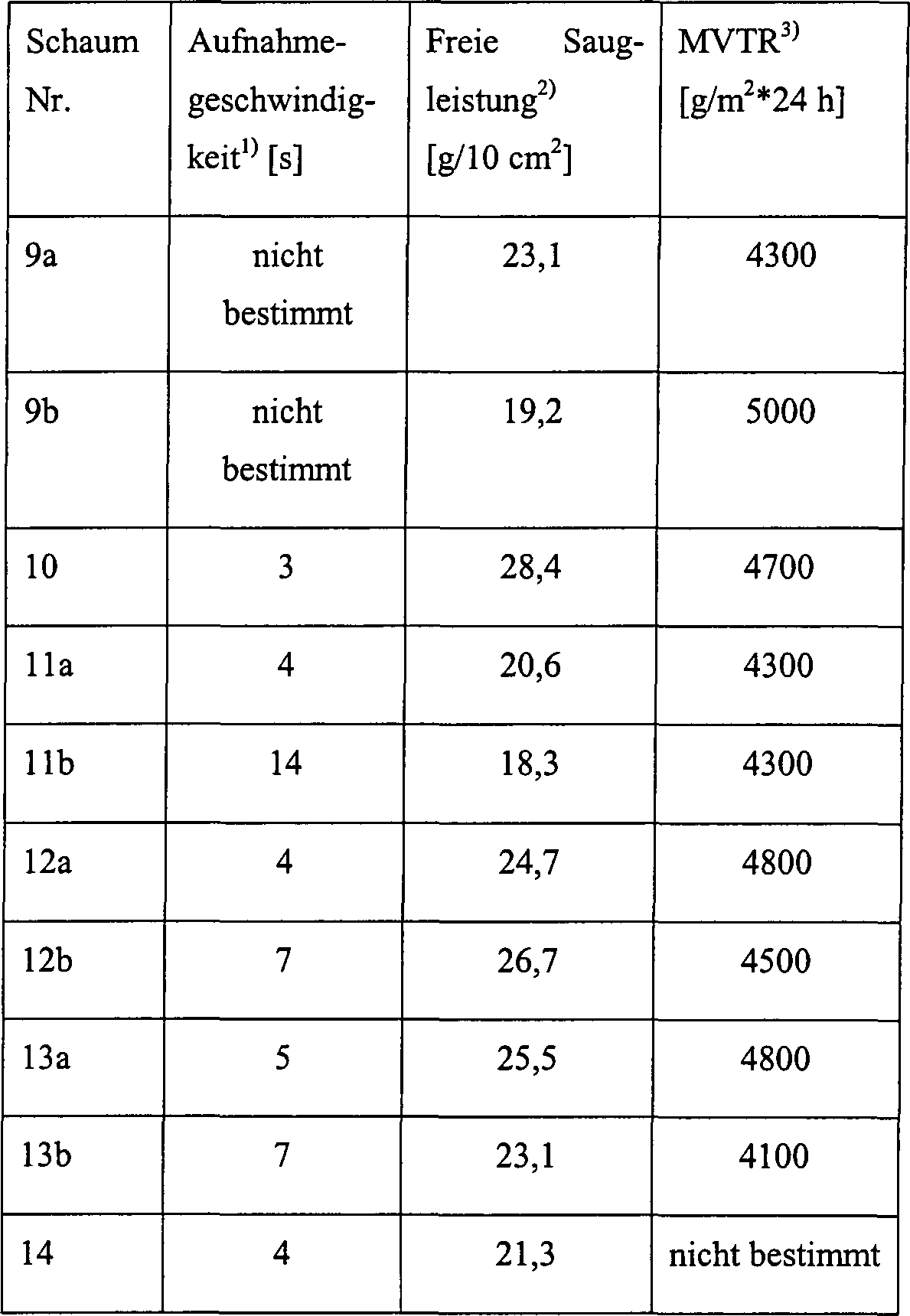
- 1) Zeit bis zum vollständigen Eindringen eines Tropfens (destilliertes Wasser) in den Schaum; 2) Absorption physiologischer Salzlösung bestimmt nach DIN EN 13726-1, Teil 3.2 (5 anstelle von 9 Prüfmustern); 3) „moisture vapour transition rate" (Wasserdampfdurchlässigkeit) bestimmt nach DIN EN 13726-2, Teil 3.2
- 1) time to complete penetration of a drop (distilled water) into the foam; 2) Absorption of physiological saline determined according to DIN EN 13726-1, part 3.2 (5 instead of 9 test samples); 3) "moisture vapor transition rate" determined according to DIN EN 13726-2, part 3.2
Claims (12)
Priority Applications (14)
| Application Number | Priority Date | Filing Date | Title |
|---|---|---|---|
| DE102006016639A DE102006016639A1 (en) | 2006-04-08 | 2006-04-08 | Process for the production of polyurethane foams |
| AU2007236253A AU2007236253A1 (en) | 2006-04-08 | 2007-03-29 | Method for production of polyurethane foams |
| JP2009504604A JP2009534478A (en) | 2006-04-08 | 2007-03-29 | Method for producing polyurethane foam |
| CN2007800212484A CN101466413B (en) | 2006-04-08 | 2007-03-29 | Process for producing polyurethane foam |
| BRPI0709826-0A BRPI0709826A2 (en) | 2006-04-08 | 2007-03-29 | Process for the production of polyurethane foams |
| MX2008012955A MX2008012955A (en) | 2006-04-08 | 2007-03-29 | Method for production of polyurethane foams. |
| RU2008143907/15A RU2008143907A (en) | 2006-04-08 | 2007-03-29 | METHOD FOR PRODUCING POLYURETHANE FOAM |
| KR1020087027370A KR20090026131A (en) | 2006-04-08 | 2007-03-29 | Method of Making Polyurethane Foam |
| EP07723745.1A EP2010235B1 (en) | 2006-04-08 | 2007-03-29 | Method for production of polyurethane foams |
| PCT/EP2007/002801 WO2007115697A1 (en) | 2006-04-08 | 2007-03-29 | Method for production of polyurethane foams |
| CA002648362A CA2648362A1 (en) | 2006-04-08 | 2007-03-29 | Method for production of polyurethane foams |
| US11/732,574 US20070254974A1 (en) | 2006-04-08 | 2007-04-04 | Production of polyurethane wound dressing foams |
| TW096111928A TW200808884A (en) | 2006-04-08 | 2007-04-04 | Production of polyurethane wound dressing foams |
| IL194551A IL194551A0 (en) | 2006-04-08 | 2008-10-06 | Method for production of polyurethane foams |
Applications Claiming Priority (1)
| Application Number | Priority Date | Filing Date | Title |
|---|---|---|---|
| DE102006016639A DE102006016639A1 (en) | 2006-04-08 | 2006-04-08 | Process for the production of polyurethane foams |
Publications (1)
| Publication Number | Publication Date |
|---|---|
| DE102006016639A1 true DE102006016639A1 (en) | 2007-10-11 |
Family
ID=38109482
Family Applications (1)
| Application Number | Title | Priority Date | Filing Date |
|---|---|---|---|
| DE102006016639A Withdrawn DE102006016639A1 (en) | 2006-04-08 | 2006-04-08 | Process for the production of polyurethane foams |
Country Status (14)
| Country | Link |
|---|---|
| US (1) | US20070254974A1 (en) |
| EP (1) | EP2010235B1 (en) |
| JP (1) | JP2009534478A (en) |
| KR (1) | KR20090026131A (en) |
| CN (1) | CN101466413B (en) |
| AU (1) | AU2007236253A1 (en) |
| BR (1) | BRPI0709826A2 (en) |
| CA (1) | CA2648362A1 (en) |
| DE (1) | DE102006016639A1 (en) |
| IL (1) | IL194551A0 (en) |
| MX (1) | MX2008012955A (en) |
| RU (1) | RU2008143907A (en) |
| TW (1) | TW200808884A (en) |
| WO (1) | WO2007115697A1 (en) |
Cited By (2)
| Publication number | Priority date | Publication date | Assignee | Title |
|---|---|---|---|---|
| WO2009143977A1 (en) * | 2008-05-28 | 2009-12-03 | Bayer Materialscience Ag | Hydrophilic polyurethane coatings |
| WO2010083953A1 (en) * | 2009-01-24 | 2010-07-29 | Bayer Materialscience Ag | Dispersed two-component polyurethane foams |
Families Citing this family (34)
| Publication number | Priority date | Publication date | Assignee | Title |
|---|---|---|---|---|
| EP2045278A1 (en) * | 2007-10-05 | 2009-04-08 | Bayer MaterialScience AG | Method for manufacturing polyurethane foams |
| US8629195B2 (en) | 2006-04-08 | 2014-01-14 | Bayer Materialscience Ag | Production of polyurethane foams |
| DE102006043589A1 (en) * | 2006-09-16 | 2008-03-27 | Bayer Materialscience Ag | Alkyl polyglycosides as stabilizers for polyurethane foams |
| US20080102157A1 (en) * | 2006-10-25 | 2008-05-01 | Steffen Hofacker | Flavored chewable foams and a process for their production |
| EP2028223A1 (en) * | 2007-08-23 | 2009-02-25 | Bayer MaterialScience AG | EO/PO block copolymers as stabilisers for PUR foams |
| DE102007048079A1 (en) * | 2007-10-05 | 2009-04-09 | Bayer Materialscience Ag | Process for the production of polyurethane foams |
| RU2010119633A (en) * | 2007-10-19 | 2011-11-27 | Байер МатириальСайенс АГ (DE) | METHOD FOR PRODUCING AROMATED CHEWING FOAM AS COSMETIC PRODUCTS |
| US20090118387A1 (en) * | 2007-11-07 | 2009-05-07 | Inoac Corporation | Method for Producing Water-Absorbing Polyurethane Foam |
| DE102007059858A1 (en) * | 2007-12-12 | 2009-06-18 | Bayer Materialscience Ag | Energy converters produced from film-forming aqueous polymer dispersions, in particular polyurethane dispersions |
| EP2103316A1 (en) * | 2008-03-20 | 2009-09-23 | Bayer MaterialScience AG | Hydrophilic polyurethane dispersions |
| EP2105124A1 (en) * | 2008-03-26 | 2009-09-30 | Bayer MaterialScience AG | Sunscreen compositions |
| EP2105127A1 (en) * | 2008-03-26 | 2009-09-30 | Bayer MaterialScience AG | Hair fixing composition |
| US20110027211A1 (en) * | 2008-03-26 | 2011-02-03 | Bayer Materialscience Ag | Hair styling composition |
| EP2105125A1 (en) * | 2008-03-26 | 2009-09-30 | Bayer MaterialScience AG | Skin care composition |
| EP2105120A1 (en) * | 2008-03-26 | 2009-09-30 | Bayer MaterialScience AG | Cosmetic compositions for skin application |
| EP2105126A1 (en) * | 2008-03-26 | 2009-09-30 | Bayer MaterialScience AG | Decorative cosmetic compounds |
| DE102008025614A1 (en) * | 2008-05-28 | 2009-12-03 | Bayer Materialscience Ag | Hydrophilic polyurethane coatings |
| GB0813040D0 (en) * | 2008-07-16 | 2008-08-20 | First Water Ltd | Compositions for use as or in wound dressings |
| US8454990B2 (en) * | 2008-08-01 | 2013-06-04 | Milliken & Company | Composite article suitable for use as a wound dressing |
| CN102143769A (en) | 2008-09-04 | 2011-08-03 | 拜尔材料科学股份公司 | Hydrophilic Polyurethane Dispersion Based on TCD |
| JP5788323B2 (en) | 2008-10-02 | 2015-09-30 | エル.アール. アールアンドディー リミテッド | Interfacial layer wound dressing |
| EP2182559A1 (en) * | 2008-10-30 | 2010-05-05 | Bayer MaterialScience AG | Energy converter based on polyurethane solutions |
| AR075000A1 (en) * | 2009-01-24 | 2011-03-02 | Bayer Materialscience Ag | POLYURETHANE FOAMS STABILIZED WITH POLYURETHANE TENSIOACTIVE |
| PT2440592E (en) * | 2009-06-10 | 2014-10-10 | Bayer Ip Gmbh | Poly(thf)-based polyurethane dispersions |
| WO2011107462A2 (en) * | 2010-03-05 | 2011-09-09 | Bayer Materialscience Ag | Sun protection compositions |
| US20140010776A1 (en) * | 2011-03-25 | 2014-01-09 | Bayer Intellectual Property Gmbh | Polyurethane urea mixture for hair cosmetics |
| KR102308495B1 (en) * | 2013-12-02 | 2021-10-06 | 바스프 에스이 | Polyurethanes with reduced aldehyde emission |
| WO2015187950A2 (en) * | 2014-06-04 | 2015-12-10 | Pwe, Llc | Mechanically frothed gel elastomers and methods of making and using them |
| TW201627366A (en) * | 2014-09-17 | 2016-08-01 | 3M新設資產公司 | Hydrophilic open cell foams |
| CN105251240B (en) * | 2015-11-17 | 2017-06-30 | 中国科学院兰州化学物理研究所 | The solvent-free method for preparing new super hydrophobic polyurethane water-oil separating material |
| CN106916273B (en) | 2015-12-28 | 2021-06-15 | 科思创德国股份有限公司 | Polyurethane urea aqueous dispersion |
| CN111363186B (en) * | 2018-12-25 | 2023-01-13 | 万华化学集团股份有限公司 | Polyurethane foam material, preparation method thereof and application thereof in wound dressing |
| CN110183609B (en) * | 2019-04-23 | 2021-12-24 | 合肥科天水性科技有限责任公司 | Solvent-free polyurethane resin and application thereof |
| KR102775536B1 (en) * | 2019-10-28 | 2025-03-06 | 디아이씨 가부시끼가이샤 | Foam sheets, and synthetic leather |
Citations (2)
| Publication number | Priority date | Publication date | Assignee | Title |
|---|---|---|---|---|
| DE19836476A1 (en) * | 1998-08-12 | 2000-02-17 | Basf Ag | Hydrophilic, flexible polyurethane foam used as household sponge or hygiene article is foamed in presence of sodium 2-((2-aminoethyl)amino)ethanesulfonate and/or ethoxylated methyldiglycol |
| DE19930526A1 (en) * | 1999-07-01 | 2001-01-04 | Basf Ag | Hydrophilic soft polyurethane foam useful for household sponges and baby diapers, prepared by reaction of polyisocyanate with a compound having two isocyanate reactive linkages in the presence of sulfonic acid |
Family Cites Families (27)
| Publication number | Priority date | Publication date | Assignee | Title |
|---|---|---|---|---|
| US4108814A (en) * | 1974-09-28 | 1978-08-22 | Bayer Aktiengesellschaft | Aqueous polyurethane dispersions from solvent-free prepolymers using sulfonate diols |
| US5445604A (en) * | 1980-05-22 | 1995-08-29 | Smith & Nephew Associated Companies, Ltd. | Wound dressing with conformable elastomeric wound contact layer |
| NZ199684A (en) * | 1981-02-13 | 1985-03-20 | Smith & Nephew Ass | Wound dressing;wound facing layer a conformable elastomeric integral net |
| US4995382A (en) * | 1981-02-13 | 1991-02-26 | Smith And Nephew Associated Companies Limited | Wound dressing, manufacture and use |
| US4860737A (en) * | 1981-02-13 | 1989-08-29 | Smith And Nephew Associated Companies P.L.C. | Wound dressing, manufacture and use |
| US4753231A (en) * | 1981-02-13 | 1988-06-28 | Smith & Nephew Associated Companies P.L.C. | Adhesive wound dressing |
| DE3231062A1 (en) * | 1982-08-20 | 1984-02-23 | Bayer Ag, 5090 Leverkusen | METHOD FOR THE PRODUCTION OF COATING MEASURES, AQUEOUS DISPERSIONS OF PU REACTIVE SYSTEMS AND THEIR USE FOR COATING |
| US5252657A (en) * | 1984-12-20 | 1993-10-12 | Rohm And Haas Company | Modified latex polymer composition |
| GB8524579D0 (en) * | 1985-10-04 | 1985-11-06 | Polyvinyl Chemicals Inc | Coating compositions |
| JP2710306B2 (en) * | 1985-10-31 | 1998-02-10 | 東レ株式会社 | High moisture permeable waterproof fabric and method for producing the same |
| US4655210A (en) * | 1986-01-17 | 1987-04-07 | Seton Company | Foam bandage |
| US4675232A (en) * | 1986-05-19 | 1987-06-23 | Seton Company | Self-release foam laminate |
| GB9102660D0 (en) * | 1991-02-07 | 1991-03-27 | Ultra Lab Ltd | Wound dressing materials |
| US5110843A (en) * | 1991-05-01 | 1992-05-05 | Minnesota Mining And Manufacturing Company | Absorbent, non-skinned foam and the method of preparation |
| US5266323A (en) * | 1991-05-24 | 1993-11-30 | Hampshire Chemical Corp. | Degradable articles and methods of using such articles as degradable bait |
| DE4418319C3 (en) * | 1994-05-26 | 2001-08-09 | Stockhausen Chem Fab Gmbh | Layered body for the absorption of liquids and its manufacture and use |
| AU7917298A (en) * | 1997-07-09 | 1999-02-08 | Huntsman Ici Chemicals Llc | Compressed hydrophilic polyurethane foams |
| DE19804665B4 (en) * | 1998-02-06 | 2004-09-23 | Beiersdorf Ag | Opaque eye patch |
| US5997969A (en) * | 1998-08-27 | 1999-12-07 | Gardon; John L. | Non-allergenic medical and health care devices made from crosslinked synthetic elastomers |
| EP1159325B1 (en) * | 1998-12-29 | 2003-04-09 | Dow Global Technologies Inc. | Polyurethane foams prepared from mechanically frothed polyurethane dispersions |
| DE19925972A1 (en) * | 1999-06-08 | 2000-12-14 | Beiersdorf Ag | Film plasters, in particular for covering wounds and preventing or treating blisters, using polyurethane carrier films with improved sliding properties, improved water repellency and reduced tendency to soiling |
| DE10122444A1 (en) * | 2001-05-09 | 2002-11-14 | Bayer Ag | Polyurethane-polyurea dispersions as coating agents |
| KR100550807B1 (en) * | 2002-10-29 | 2006-02-09 | 주식회사 바이오폴 | Filled Polyurethane Foam Dressing Material and Manufacturing Method Thereof |
| US20040116594A1 (en) * | 2002-12-11 | 2004-06-17 | Debkumar Bhattacharjee | Polyurethane prepolymer, stable aqueous dispersions with high solids containing the same and method of using and preparing the aqueous dispersions |
| US7179845B2 (en) * | 2003-01-10 | 2007-02-20 | Fomo Products, Inc. | Elastomeric latex foams |
| WO2004103415A2 (en) * | 2003-05-20 | 2004-12-02 | Avery Dennison Corporation | Multi-dressing system for managing skin wounds |
| US7118761B2 (en) * | 2003-08-14 | 2006-10-10 | Canada T Andrew | Method for producing a silver-containing wound care device |
-
2006
- 2006-04-08 DE DE102006016639A patent/DE102006016639A1/en not_active Withdrawn
-
2007
- 2007-03-29 WO PCT/EP2007/002801 patent/WO2007115697A1/en not_active Ceased
- 2007-03-29 BR BRPI0709826-0A patent/BRPI0709826A2/en not_active IP Right Cessation
- 2007-03-29 RU RU2008143907/15A patent/RU2008143907A/en not_active Application Discontinuation
- 2007-03-29 CN CN2007800212484A patent/CN101466413B/en active Active
- 2007-03-29 CA CA002648362A patent/CA2648362A1/en not_active Abandoned
- 2007-03-29 JP JP2009504604A patent/JP2009534478A/en active Pending
- 2007-03-29 EP EP07723745.1A patent/EP2010235B1/en active Active
- 2007-03-29 AU AU2007236253A patent/AU2007236253A1/en not_active Abandoned
- 2007-03-29 MX MX2008012955A patent/MX2008012955A/en not_active Application Discontinuation
- 2007-03-29 KR KR1020087027370A patent/KR20090026131A/en not_active Withdrawn
- 2007-04-04 US US11/732,574 patent/US20070254974A1/en not_active Abandoned
- 2007-04-04 TW TW096111928A patent/TW200808884A/en unknown
-
2008
- 2008-10-06 IL IL194551A patent/IL194551A0/en unknown
Patent Citations (2)
| Publication number | Priority date | Publication date | Assignee | Title |
|---|---|---|---|---|
| DE19836476A1 (en) * | 1998-08-12 | 2000-02-17 | Basf Ag | Hydrophilic, flexible polyurethane foam used as household sponge or hygiene article is foamed in presence of sodium 2-((2-aminoethyl)amino)ethanesulfonate and/or ethoxylated methyldiglycol |
| DE19930526A1 (en) * | 1999-07-01 | 2001-01-04 | Basf Ag | Hydrophilic soft polyurethane foam useful for household sponges and baby diapers, prepared by reaction of polyisocyanate with a compound having two isocyanate reactive linkages in the presence of sulfonic acid |
Cited By (2)
| Publication number | Priority date | Publication date | Assignee | Title |
|---|---|---|---|---|
| WO2009143977A1 (en) * | 2008-05-28 | 2009-12-03 | Bayer Materialscience Ag | Hydrophilic polyurethane coatings |
| WO2010083953A1 (en) * | 2009-01-24 | 2010-07-29 | Bayer Materialscience Ag | Dispersed two-component polyurethane foams |
Also Published As
| Publication number | Publication date |
|---|---|
| WO2007115697A1 (en) | 2007-10-18 |
| MX2008012955A (en) | 2008-10-17 |
| EP2010235B1 (en) | 2014-01-15 |
| US20070254974A1 (en) | 2007-11-01 |
| KR20090026131A (en) | 2009-03-11 |
| CA2648362A1 (en) | 2007-10-18 |
| IL194551A0 (en) | 2009-08-03 |
| CN101466413A (en) | 2009-06-24 |
| RU2008143907A (en) | 2010-05-20 |
| EP2010235A1 (en) | 2009-01-07 |
| CN101466413B (en) | 2013-03-13 |
| BRPI0709826A2 (en) | 2011-07-26 |
| JP2009534478A (en) | 2009-09-24 |
| AU2007236253A1 (en) | 2007-10-18 |
| TW200808884A (en) | 2008-02-16 |
Similar Documents
| Publication | Publication Date | Title |
|---|---|---|
| EP2010235B1 (en) | Method for production of polyurethane foams | |
| EP2197930B1 (en) | Method for producing polyurethane foams | |
| EP2007444B1 (en) | Polyurethane foams for treating wounds | |
| DE102007048079A1 (en) | Process for the production of polyurethane foams | |
| EP2183309B1 (en) | Eo/po block polymers as stabilizers for pur foams | |
| EP2389400B1 (en) | USE OF DISPERSED TWO-COMPONENT POLYURETHANE FOAMS AS wound dressing | |
| EP2045279A1 (en) | Polyurethane foams for treating wounds | |
| EP2066711B1 (en) | Alkylpolyglycosides as stabilizers for pu foams | |
| DE102007048080A1 (en) | Biomedical foam products | |
| DE102007048078A1 (en) | Polyurethane foams for wound treatment | |
| EP2389402B1 (en) | Polyurethane-tenside stabilised polyurethane foams | |
| EP2016145A1 (en) | Microporous coating based on polyurethane-polyurea | |
| EP2165718A1 (en) | Wound dressing with a polyurethane foam layer and a covering layer made from thermoplastic polymer | |
| EP2328959A1 (en) | Method for producing shaped polyurethane foam wound dressings | |
| EP2318056B1 (en) | Method for producing shaped polyurethane foam wound dressings | |
| WO2012032032A1 (en) | Method for producing hydrophilic polyurethane foams |
Legal Events
| Date | Code | Title | Description |
|---|---|---|---|
| OM8 | Search report available as to paragraph 43 lit. 1 sentence 1 patent law | ||
| 8130 | Withdrawal |