DE102005045034A1 - Method for passivating the surface of coated metal strips and device for applying the passive layer to a metal-coated steel strip - Google Patents
Method for passivating the surface of coated metal strips and device for applying the passive layer to a metal-coated steel strip Download PDFInfo
- Publication number
- DE102005045034A1 DE102005045034A1 DE102005045034A DE102005045034A DE102005045034A1 DE 102005045034 A1 DE102005045034 A1 DE 102005045034A1 DE 102005045034 A DE102005045034 A DE 102005045034A DE 102005045034 A DE102005045034 A DE 102005045034A DE 102005045034 A1 DE102005045034 A1 DE 102005045034A1
- Authority
- DE
- Germany
- Prior art keywords
- strip
- metal strip
- coated
- aqueous solution
- tube
- Prior art date
- Legal status (The legal status is an assumption and is not a legal conclusion. Google has not performed a legal analysis and makes no representation as to the accuracy of the status listed.)
- Ceased
Links
Classifications
-
- C—CHEMISTRY; METALLURGY
- C23—COATING METALLIC MATERIAL; COATING MATERIAL WITH METALLIC MATERIAL; CHEMICAL SURFACE TREATMENT; DIFFUSION TREATMENT OF METALLIC MATERIAL; COATING BY VACUUM EVAPORATION, BY SPUTTERING, BY ION IMPLANTATION OR BY CHEMICAL VAPOUR DEPOSITION, IN GENERAL; INHIBITING CORROSION OF METALLIC MATERIAL OR INCRUSTATION IN GENERAL
- C23F—NON-MECHANICAL REMOVAL OF METALLIC MATERIAL FROM SURFACE; INHIBITING CORROSION OF METALLIC MATERIAL OR INCRUSTATION IN GENERAL; MULTI-STEP PROCESSES FOR SURFACE TREATMENT OF METALLIC MATERIAL INVOLVING AT LEAST ONE PROCESS PROVIDED FOR IN CLASS C23 AND AT LEAST ONE PROCESS COVERED BY SUBCLASS C21D OR C22F OR CLASS C25
- C23F11/00—Inhibiting corrosion of metallic material by applying inhibitors to the surface in danger of corrosion or adding them to the corrosive agent
-
- C—CHEMISTRY; METALLURGY
- C25—ELECTROLYTIC OR ELECTROPHORETIC PROCESSES; APPARATUS THEREFOR
- C25D—PROCESSES FOR THE ELECTROLYTIC OR ELECTROPHORETIC PRODUCTION OF COATINGS; ELECTROFORMING; APPARATUS THEREFOR
- C25D5/00—Electroplating characterised by the process; Pretreatment or after-treatment of workpieces
- C25D5/48—After-treatment of electroplated surfaces
-
- C—CHEMISTRY; METALLURGY
- C23—COATING METALLIC MATERIAL; COATING MATERIAL WITH METALLIC MATERIAL; CHEMICAL SURFACE TREATMENT; DIFFUSION TREATMENT OF METALLIC MATERIAL; COATING BY VACUUM EVAPORATION, BY SPUTTERING, BY ION IMPLANTATION OR BY CHEMICAL VAPOUR DEPOSITION, IN GENERAL; INHIBITING CORROSION OF METALLIC MATERIAL OR INCRUSTATION IN GENERAL
- C23C—COATING METALLIC MATERIAL; COATING MATERIAL WITH METALLIC MATERIAL; SURFACE TREATMENT OF METALLIC MATERIAL BY DIFFUSION INTO THE SURFACE, BY CHEMICAL CONVERSION OR SUBSTITUTION; COATING BY VACUUM EVAPORATION, BY SPUTTERING, BY ION IMPLANTATION OR BY CHEMICAL VAPOUR DEPOSITION, IN GENERAL
- C23C22/00—Chemical surface treatment of metallic material by reaction of the surface with a reactive liquid, leaving reaction products of surface material in the coating, e.g. conversion coatings, passivation of metals
-
- C—CHEMISTRY; METALLURGY
- C23—COATING METALLIC MATERIAL; COATING MATERIAL WITH METALLIC MATERIAL; CHEMICAL SURFACE TREATMENT; DIFFUSION TREATMENT OF METALLIC MATERIAL; COATING BY VACUUM EVAPORATION, BY SPUTTERING, BY ION IMPLANTATION OR BY CHEMICAL VAPOUR DEPOSITION, IN GENERAL; INHIBITING CORROSION OF METALLIC MATERIAL OR INCRUSTATION IN GENERAL
- C23C—COATING METALLIC MATERIAL; COATING MATERIAL WITH METALLIC MATERIAL; SURFACE TREATMENT OF METALLIC MATERIAL BY DIFFUSION INTO THE SURFACE, BY CHEMICAL CONVERSION OR SUBSTITUTION; COATING BY VACUUM EVAPORATION, BY SPUTTERING, BY ION IMPLANTATION OR BY CHEMICAL VAPOUR DEPOSITION, IN GENERAL
- C23C22/00—Chemical surface treatment of metallic material by reaction of the surface with a reactive liquid, leaving reaction products of surface material in the coating, e.g. conversion coatings, passivation of metals
- C23C22/73—Chemical surface treatment of metallic material by reaction of the surface with a reactive liquid, leaving reaction products of surface material in the coating, e.g. conversion coatings, passivation of metals characterised by the process
- C23C22/76—Applying the liquid by spraying
Landscapes
- Chemical & Material Sciences (AREA)
- Engineering & Computer Science (AREA)
- Materials Engineering (AREA)
- Metallurgy (AREA)
- Organic Chemistry (AREA)
- Chemical Kinetics & Catalysis (AREA)
- Mechanical Engineering (AREA)
- General Chemical & Material Sciences (AREA)
- Electrochemistry (AREA)
- Chemical Treatment Of Metals (AREA)
- Application Of Or Painting With Fluid Materials (AREA)
- Other Surface Treatments For Metallic Materials (AREA)
- Electroplating Methods And Accessories (AREA)
- Coating With Molten Metal (AREA)
Abstract
Die Erfindung betrifft ein Verfahren zur Passivierung der Oberfläche von mit einer Beschichtung überzogenen Metallbändern, insbesondere von verzinnten Stahlbändern (S), welche mit einer Bandgeschwindigkeit (v) durch eine Beschichtungsanlage bewegt werden. Um eine effiziente Passivierung der Metallbandoberfläche auch bei hohen Bandgeschwindigkeiten zu ermöglichen und gleichzeitig eine Befettung der beschichteten Metallbandoberfläche zu erreichen, wird nach dem Beschichtungsvorgang auf das beschichtete und mit der Bandgeschwindigkeit (v) bewegte Metallband eine wässrige Lösung einer oberflächenaktiven Substanz aufgespritzt. Die Erfindung zeigt ferner eine Vorrichtung für das Aufbringen einer metallischen Beschichtung auf ein Stahlband, insbesondere in einer Bandverzinnungsanlage, auf sowie die Verwendung von Substanzen zur Befettung und/oder zur Passivierung bei der Herstellung von verzinnten Stahlbändern, welche als wässrige Lösung auf das verzinnte Stahlband aufgespritzt werden können.The invention relates to a method for passivating the surface of metal strips coated with a coating, in particular of tin-plated steel strips (S), which are moved through a coating installation at a strip speed (v). In order to enable efficient passivation of the metal strip surface even at high strip speeds and at the same time to achieve greasing of the coated metal strip surface, an aqueous solution of a surface-active substance is sprayed onto the coated metal strip moving at the strip speed (v) after the coating process. The invention also shows a device for applying a metallic coating to a steel strip, in particular in a strip tinning plant, and the use of substances for greasing and / or passivation in the production of tinned steel strips, which are sprayed onto the tinned steel strip as an aqueous solution can be.
Description
Die Erfindung betrifft ein Verfahren zur Passivierung der Oberfläche von mit einer Beschichtung überzogenen Metallbändern, insbesondere von verzinnten Stahlbändern, welche mit einer Bandgeschwindigkeit durch eine Beschichtungsanlage bewegt werden, sowie eine Vorrichtung für das Aufbringen der Passivschicht auf ein metallisch beschichtetes Stahlband, insbesondere in einer Bandverzinnungsanlage nach dem Oberbegriff des Anspruchs 18. Die Erfindung betrifft ferner die Verwendung einer Substanz als Befettungs- und/oder Passivierungsmittel bei der Herstellung von verzinnten Stahlbändern.The The invention relates to a method for passivating the surface of coated with a coating Metal strips, in particular of tinned steel strips, which at a belt speed through a coating system are moved, and a device for applying the passive layer on a metallically coated steel strip, in particular in a strip tinning plant according to the preamble of the claim 18. The invention further relates to the use of a substance as greasing and / or passivating agent in the production of tinned steel bands.
Bei der Herstellung von Weißblech, insbesondere in elektrolytisch arbeitenden Bandverzinnungsanlagen wird das beschichtete Stahlblech (Weißblech mit Zinnmetall und Chrom-Metall + Chrom-III-Hydroxid) chemisch oder elektrochemisch passiviert und anschließend befettet, um das beschichtete Stahlblech oxidationsbeständig zu machen und um den Reibwert zu erniedrigen, um das beschichtete Stahlblech bei der nachfolgenden Verarbeitung besser verarbeitbar zu machen. Die Passivierung erfolgt üblicherweise unter Verwendung von Cr6+-haltigen Lösungen. Im Stand der Technik wurden weiterhin Cr6+-freie Passivierungslösungen vorgeschlagen, beispielsweise in der DE 42 05 819-A, der DE 44 03 876-A, der EP 0 932 453-A, der EP 01 002 143-A, der EP 01 015 662-A, der WO 99/67444-A, der WO 00/46312-A und der EP 01 270 764-A. Diese Veröffentlichungen betreffen zum größten Teil insbesondere die Passivierung von aluminium- und zinkhaltigen Oberflächen von feuerverzinktem Feinblech und anderen feuerverzinkten Stahlteilen für den Einsatz in der Automobilindustrie und zum kleineren Teil die chromatfreie Passivierung von Weißblech.In the production of tinplate, especially in electrolytically working strip dipping systems, the coated steel plate (tinplate with tin metal and chromium metal + chromium III hydroxide) is passivated chemically or electrochemically and then greased to make the coated steel sheet resistant to oxidation and to the coefficient of friction to make the coated steel sheet more processable during subsequent processing. The passivation is usually carried out using Cr 6+ -containing solutions. In the prior art, further Cr 6+ -free passivation solutions have been proposed, for example in DE 42 05 819-A, DE 44 03 876-A, EP 0 932 453-A, EP 01 002 143-A, EP 01 015 662-A, WO 99/67444-A, WO 00/46312-A and EP 01 270 764-A. These publications mainly relate in particular to the passivation of aluminum- and zinc-containing surfaces of hot-dip galvanized sheet and other hot-dip galvanized steel parts for use in the automotive industry and, to a lesser extent, the chromate-free passivation of tinplate.
Bei der Verwendung von beschichteten Metallen zur Herstellung von Lebensmittelbehältern werden jedoch gegenüber den Anforderungen an die genannten Materialien, die zum Einsatz in der Automobilindustrie vorgesehen sind, andere Anforderungen an die Oxidationsbeständigkeit und damit an die Passivierung der Metalloberfläche gestellt. Insbesondere muss die Passivierung hier ein zu starkes Anwachsen der Zinnoxidschicht bei der Lagerung der Lebensmittelbehälter bis zur Lackierung bzw. bis zum Verbrauch der Konserve verhindern. Weiterhin kann die beschichtete Metalloberfläche durch matte Verfärbung oder Goldfärbung unschön verfärbt werden, was beim Verbraucher den Eindruck erwecken kann, dass das Füllgut verdorben ist. Die Passivierung muss außerdem die Beständigkeit des lackierten Metallbehälters nach der Befüllung mit Lebensmitteln gegen in den Lebensmitteln enthaltenen Säuren gewährleisten, wie z. B. Mercapto-Amino-Karbonsäure-Anionen wie Cystein und Methionin. Derartige Säureanionen im Füllgut können bei nicht ausreichender Passivierung eine Delamination des Innenlacks des Behälters verursachen.at However, the use of coated metals for the production of food containers are across from the requirements for the materials mentioned, which are used are provided in the automotive industry, other requirements to the oxidation resistance and thus to the passivation of the metal surface. Especially the passivation here must be a too strong growth of the tin oxide layer in the storage of food containers to painting or to prevent consumption of canned food. Furthermore, the coated metal surface by dull discoloration or gold staining ugly discolored which may give consumers the impression that the filling is spoiled. The passivation must also be the resistance of the lacquered metal container after filling to ensure with food against acids contained in the food, such as As mercapto-amino-carboxylic acid anions like cysteine and methionine. Such acid anions in the medium can at insufficient passivation delamination of the interior paint of the container cause.
Bei der herkömmlichen Herstellung von Weißblech in Bandverzinnungsanlagen wird das Feinstblech nach dem Verzinnen und Aufschmelzen in einem Wasserbad abgeschreckt, anschließend in einer Chromat-Lösung passiviert und schließlich mit vollentsalztem Wasser gespült und thermisch getrocknet. Anschließend erfolgt eine elektrostatische Befettung mit Dioctylsebacat (DOS) oder Acetyltributylcitrat (ATBC). Das auf der Weißblechoberfläche adsorbierte Chromat wird durch Reaktion mit den =Sn=O und =Sn-OH-Gruppen der Zinnoberfläche zu Cr3+ und bei elektrochemischer kathodischer Passivierung außerdem zum Teil zu Chrom-Metall reduziert. Das Cr3+ fällt als Cr3+-Hydroxid aus. Die Passivschicht enthält nach dem Spülen und Trocknen der Weißblechoberfläche keine Cr6+-Ionen mehr.In the conventional production of tinplate in strip-tinning systems, the fines are quenched after tinning and melting in a water bath, then passivated in a chromate solution and finally rinsed with demineralized water and thermally dried. This is followed by electrostatic lubrication with dioctyl sebacate (DOS) or acetyltributyl citrate (ATBC). The chromate adsorbed on the tinplate surface is also reduced to Cr3 + by reaction with the = Sn = O and = Sn-OH groups of the tin surface, and also partly to chromium metal in electrochemical cathodic passivation. The Cr 3+ precipitates as Cr 3+ hydroxide. The passivating layer no longer contains Cr 6+ ions after rinsing and drying the tinplate surface .
Hiervon ausgehend liegt der Erfindung die Aufgabe zugrunde, ein Verfahren und eine Vorrichtung zur Passivierung der Oberfläche von mit einer Beschichtung überzogenen Metallbändern, insbesondere von verzinnten Stahlbändern, welche mit einer Bandgeschwindigkeit durch eine Beschichtungsanlage bewegt werden, bereit zu stellen, mit denen eine effiziente Passivierung der Metallbandoberfläche auch bei hohen Bandgeschwindigkeiten ermöglicht wird. Darüber hinaus soll gleichzeitig mit der Passivierung der Metallbandoberfläche eine Befettung erfolgen, so dass ein zusätzlicher Nachbehandlungsschritt zur Erniedrigung des Reibwerts der beschichteten Metallbandoberfläche überflüssig wird. Aufgabe der Erfindung ist es ferner, Produkte zur Passivierung und/oder zur Befettung der Oberfläche von beschichteten Metallbändern bereitzustellen, welche in dem erfindungsgemäßen Verfahren zur Anwendung kommen können.Of these, The invention is based on the object, a method and a device for passivating the surface of a coating coated Metal strips, in particular of tinned steel strips, which at a belt speed be moved through a coating plant, ready to put, with which an efficient passivation of the metal strip surface also is made possible at high belt speeds. Furthermore should simultaneously with the passivation of the metal strip surface a Befettung done, leaving an additional post-treatment step to reduce the coefficient of friction of the coated metal strip surface is unnecessary. The object of the invention is further, products for passivation and / or for lubrication of the surface of coated metal bands to be used in the method according to the invention for use can come.
Gelöst werden diese Aufgaben mit einem Verfahren mit den Merkmalen des Anspruchs 1, einer Vorrichtung mit den Merkmalen des Anspruchs 18 sowie den im Anspruch 23 aufgezeigten Substanzen zur Verwendung als Befettungs- und/oder Passivierungsmittel bei der Herstellung von verzinnten Stahlbändern.Be solved These objects with a method with the features of the claim 1, a device with the features of claim 18 and the characterized in claim 23 substances for use as greasing and / or passivating agent in the manufacture of tinned Steel strips.
Nach dem erfindungsgemäßen Verfahren zur Passivierung der Oberfläche von mit einer Metallschicht überzogenen Metallbändern ist vorgesehen, dass nach der Zinnabscheidung auf das durch die Beschichtungsanlage bewegte Metallband eine wässrige Lösung einer oberflächenaktiven Substanz aufgespritzt wird. Bevorzugt wird die wässrige Lösung der oberflächenaktiven Substanz danach mittels Quetschrollen abgequetscht und getrocknet. Nach dem Abquetschen und Trocknen verbleibt lediglich noch ein dünner Film der oberflächenaktiven Substanz auf der Oberfläche des beschichteten Metallbands, wobei die Auflage dieses dünnen Films in der Regel zwischen 2 und 15 mg/m2 beträgt. Bei den oberflächenaktiven Substanzen kann es sich um ein Siloxan, insbesondere ein Polymethylsiloxan oder ein polyethylenoxidhaltiges Siloxan handeln. Alternativ kann es sich auch um ein Copolymer, insbesondere ein Acrylatcopolymer, handeln. Die oberflächenaktive Substanz wird bevorzugt über Rohre aufgesprüht, welche im Abstand zur beschichteten Metallbandoberfläche angeordnet sind und Bohrungen aufweisen, durch welche die wässrige Lösung auf die beschichtete Metallbandoberfläche gelangt. Bevorzugt ist auf jeder Seite des Metallbandes mindestens ein Rohr mit solchen Bohrungen angeordnet, um beide Seiten des Metallbandes mit der oberflächenaktiven Substanz zu bespritzen.According to the method according to the invention for passivating the surface of metal strips coated with a metal layer, it is provided that, after tin deposition, an aqueous solution of a surface-active substance is sprayed onto the metal strip moved through the coating system. Preferably, the aqueous solution of the surface-active substance is then squeezed off by means of squeezing rollers and dried. After squeezing and drying, only a thin film of the surface-active substance remains on the surface of the coated metal strip, the support of this thin film generally being between 2 and 15 mg / m 2 . The surface-active substances may be a siloxane, in particular a polymethylsiloxane or a polyethylene oxide-containing siloxane. Alternatively, it can also be a copolymer, in particular an acrylate copolymer. The surface-active substance is preferably sprayed on pipes which are arranged at a distance from the coated metal strip surface and have bores through which the aqueous solution reaches the coated metal strip surface. Preferably, at least one tube with such bores is arranged on each side of the metal strip in order to spray both sides of the metal strip with the surface-active substance.
Zur Verwendung als oberflächenaktive Substanzen in dem vorgenannten Verfahren haben sich die im Anspruch 23 angegebenen Substanzen als besonders geeignet erwiesen. Mit diesen Substanzen kann das Zinnoxid-Wachstum auf der beschichteten Metallbandoberfläche stark reduziert werden. Gleichzeitig erfolgt bei der erfindungsgemäßen Behandlung der Metallbandoberfläche mit diesen Substanzen eine Erniedrigung des Reibwerts der so behandelten Metallbandoberfläche auf derart niedrige Werte, dass auf eine nachfolgende Befettung mit DOS verzichtet werden kann. Die erfindungsgemäß behandelten Metallbandoberflächen haben sich als sehr gut lackierbar erwiesen. Die im Anspruch 23 genannten Substanzen sind für die Verwendung in dem erfindungsgemäßen Verfahren besonders geeignet, weil sie eine ausreichende Löslichkeit in Wasser ohne Zusatz eines organischen Lösevermittlers aufweisen und deshalb als wässrige Lösung auf die Metallbandoberfläche aufgespritzt werden können. Weiterhin können diese Substanzen aufgrund ihrer oberflächenaktiven Eigenschaften auch bei sehr hohen Bandgeschwindigkeiten von mehr als 500 m/min als gleichmäßig dünner Film auf die Metallbandoberfläche abgeschieden werden.to Use as surface-active Substances in the aforementioned method are in the claim 23 specified substances proved to be particularly suitable. With these Substances can greatly increase the tin oxide growth on the coated metal strip surface be reduced. At the same time takes place in the treatment according to the invention the metal band surface With these substances, a reduction in the coefficient of friction of the thus treated Metal band surface at such low levels that subsequent fumigation can be dispensed with DOS. The invention treated Metal strip surfaces have proven to be very paintable. The in claim 23 mentioned substances are for the use in the method according to the invention is particularly suitable because they have sufficient solubility have in water without the addition of an organic solubilizer and therefore as watery solution on the metal strip surface can be sprayed on. Furthermore you can these substances also because of their surface-active properties at very high belt speeds of more than 500 m / min as evenly thin film on the metal strip surface be deposited.
Nachfolgend wird die Erfindung anhand eines Ausführungsbeispiels und anhand von Vergleichsversuchen näher erläutert, wobei Bezug genommen wird auf die begleitenden Zeichnungen. Diese zeigen:following the invention with reference to an embodiment and with reference from comparative experiments closer explains wherein reference is made to the accompanying drawings. These demonstrate:
Der
in
Danach
wird das verzinnte Stahlband S über
eine Umlenkrolle U durch einen Abschrecktank
Die
Passivierungseinrichtung
In
Bandlaufrichtung v hinter den Rohren
Die
Rohre
Mit
den in Bandlaufrichtung etwa 20 bis 100 cm hinter den Rohren
Die überschüssige und
insbesondere die von den Quetschrollen
Nach
Durchlauf der Passivierungseinrichtung
In
der vorbeschriebenen Passivierungseinrichtung
Die zur Anwendung im erfindungsgemäßen Verfahren zur Passivierung der Oberfläche von Weißblech geeigneten Substanzen müssen oberflächenaktive Eigenschaften haben, damit diese mit der hydrophoben Gruppe auf der Zinnoberfläche haften können und gleichzeitig mit ihrer hydrophilen Gruppe die Benetzung der beim anschließenden Lackieren der Zinnoberfläche aufzubringenden Lackschicht zu verbessern. Die Bindung zwischen der funktionellen Gruppe an der Zinnoberfläche und den funktionellen Gruppen der Lackoberfläche mit ihren Haftvermittlermolekülen muss nach dem Trocknen des Lackfilms so stark sein, dass sie beim Cystein-Test (Sterilisation des lackierten Weißblechs 90 min bei 121° C in einer Lösung von 3,65 g/l KH2PO4 mit 7,22 g/l Na2HPO4·2H2O und 1g/l Cystein) nicht zerstört werden. Weiterhin sollten die verwendeten Substanzen ohne Zugabe von organischen Lösemitteln in destilliertem Wasser bis zu einer Konzentration von 2 g/l löslich sein, da der Einsatz von Lösevermittlern zu hohe Konzentrationen der Lösemittel in der Abluft verursachen und damit kostspielige Reinigungsanlagen für die Beseitigung der Lösemittel erforderlich machen würde. Als besonders geeignete Substanzen haben sich solche Substanzen erwiesen, die in der Praxis vorzugsweise als Additive für die bessere Dispergierung von Pigmenten in Lacken bzw. zur Verbesserung der Benetzung und/oder der Haftung von Lacken auf Metalloberflächen eingesetzt werden.The substances suitable for use in the method according to the invention for passivating the surface of tinplate must have surface-active properties so that they can adhere to the tin surface with the hydrophobic group and at the same time improve the wetting of the lacquer layer to be applied during the subsequent coating of the tin surface with its hydrophilic group. The bond between the functional group on the tin surface and the functional groups of the lacquer surface with their adhesion promoter molecules must be so strong after drying the lacquer film that they can be subjected to cysteine testing (sterilization of the lacquered tinplate at 121 ° C. for 90 minutes in a solution of 3 , 65 g / l KH 2 PO 4 with 7.22 g / l Na 2 HPO 4 .2H 2 O and 1 g / l cysteine) are not destroyed. Furthermore, the substances used should be soluble in distilled water up to a concentration of 2 g / l without the addition of organic solvents, since the use of solubilizers cause too high concentrations of the solvents in the exhaust air and thus make costly cleaning systems for the removal of solvents necessary would. Particularly suitable substances have proven to be those substances which are preferred in practice as additives for the better dispersion of pigments in paints or for improving the wetting and / or the adhesion of paints on metal surfaces.
Als besonders geeignet haben sich folgende Substanzen erwiesen:
- a) ein Polymer mit einer chemischen Zusammensetzung von Polymethylsiloxan mit Polyetherseitenketten mit einem Brechungsindex von 1,456 bis 1,466 und einer Dichte bei 20°C von 1,09-1,13 g/cm3,
- b) ein Polymer mit einer chemischen Zusammensetzung von einem sauren Polyether mit einer Dichte von 1,20-1,30 g/cm3 und einem Säurewert von 270-310 mg KOH/g, und
- c) ein Polymer das enthält:
i)
0-80 Mol % von einem oder mehreren Monomeren der Formel wobei R1, R2, R3 und R4 gleich oder verschieden sein können und H oder Alkyl darstellen, ii) 0-70 Mol % von einem oder mehreren Monomeren der Formel
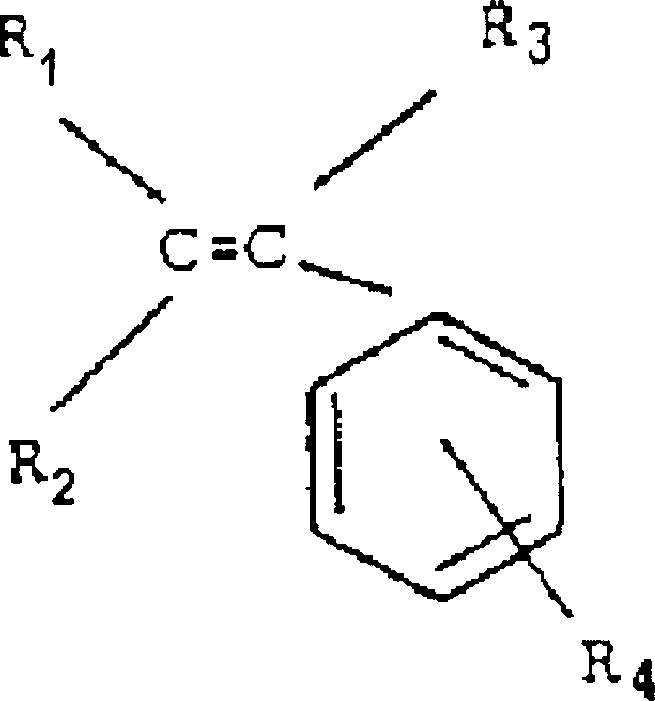 worin R5, R6 and R7 gleich oder verschieden sein können und H oder Alkyl darstellen, and R8 Alkyl oder substituiertes Alkyl darstellt, und die Alkylgruppe R8 durch -O-Gruppen unterbrochen sein kann, iii) 5-50 Mol % von einem oder mehreren Monomeren, enthaltend eine heterocyclische Gruppe mit mindestens einem basischen Ringstickstoffatom, oder an das bzw. an die eine derartige heterocyclische Gruppe sich nach einer Polymerisation befindet, iv) 0-10 Mol % von einem oder mehreren Monomeren, enthaltend eine oder mehrere Gruppen, die für Vernetzung oder Kupplung reaktiv sind, und v) 0-20 Mol % von einem oder mehreren Monomeren, die nicht in die Gruppen i)-iv) fallen, wobei die Menge der Monomere von Gruppe i) zusammen mit Monomeren, die eine Acrylatgruppe enthalten, mindestens 20 Mol % beträgt, sowie organische Salze davon.
- a) a polymer having a chemical composition of polymethylsiloxane having polyether side chains with a refractive index of 1.456 to 1.466 and a density at 20 ° C of 1.09-1.13 g / cm 3 ,
- b) a polymer having a chemical composition of an acidic polyether having a density of 1.20-1.30 g / cm 3 and an acid value of 270-310 mg KOH / g, and
- c) a polymer which contains: i) 0-80 mol% of one or more monomers of the formula wherein R 1 , R 2 , R 3 and R 4 may be the same or different and represent H or alkyl, ii) 0-70 mol% of one or more monomers of the formulawherein R 5 , R 6 and R 7 may be the same or different and represent H or alkyl, and R 8 is alkyl or substituted alkyl, and the alkyl group R 8 may be interrupted by -O-groups, iii) 5-50 mol% of one or more monomers containing a heterocyclic group having at least one basic ring nitrogen atom or to which such heterocyclic group is located after polymerization, iv) 0-10 mole% of one or more monomers containing one or more Groups which are reactive for crosslinking or coupling and v) 0-20 mol% of one or more monomers which do not fall into the groups i) -iv), the amount of the monomers of group i) together with monomers which contain an acrylate group, at least 20 mol%, and organic salts thereof.
Diese Substanzen werden gemäß dem Verfahren nach der Erfindung als wässrige Lösung auf das verzinnte Stahlband aufgespritzt und ggf. anschließend abgequetscht und getrocknet.These Substances are processed according to the procedure according to the invention as an aqueous solution sprayed onto the tinned steel strip and then optionally squeezed and dried.
In Tabelle 1 sind mehrere grundsätzlich geeignete Substanzen aufgelistet, welche im Rahmen von Labortests in dem erfindungsgemäßen Verfahren zum Einsatz gekommen sind. In den Labortests wurden Feinstblechtafeln verzinnt, mit entsalztem Wasser gespült und der Wasserfilm mit einer Lackschleuder abgeschleudert, wonach sich lediglich noch ein Wasserfilm mit einer Auflage von 5 g/m2 auf der Weißblechoberfläche befand. Wässrige Lösungen der in Tabelle 1 angegebenen Substanzen wurden mit einer Konzentration von 1 g/l auf die Weißblechprobegegossen, abgequetscht und anschließend mit Warmluft getrocknet. An den so behandelten Weißblechproben wurden anschließend folgende Untersuchungen durchgeführt:
- • Erfassung der Zinn- und Zinnoxid-Auflage mittels coulombmetrischer Zinnoxid-Bestimmung (wobei der Stromverbrauch für die Reduktion des Zinnoxids pro m2 in Coulomb/m2 angegeben wird),
- • Erfassung der Gleitreibung mit dem Drei-Kugelspurtest,
- • Bestimmung des Kohlenstoffgehalts der aufgespritzten, abgequetschten und getrockneten Auflage der wässrigen Lösung auf der Weißblechoberfläche mit einem CV-Gerät (Firma Leco),
- • Lagerung der behandelten Weißblechproben über 6 Wochen bei 40°C und 80 % rel. Luftfeuchte und Erfassung der Zinnoxidbildung nach dieser Lagerung.
- • Detection of tin and tin oxide coating by coulombmetric tin oxide determination (the Power consumption for the reduction of the tin oxide per m 2 in Coulomb / m 2 is given),
- • detection of sliding friction with the three-ball track test,
- Determination of the carbon content of the sprayed, squeezed and dried coating of the aqueous solution on the tinplate surface with a CV apparatus (Leco),
- • Storage of the treated tinplate samples for 6 weeks at 40 ° C and 80% rel. Humidity and detection of tin oxide formation after storage.
Die Ergebnisse dieser Versuchsreihe sind in Tabelle 1 angegeben.The Results of this series of experiments are given in Table 1.
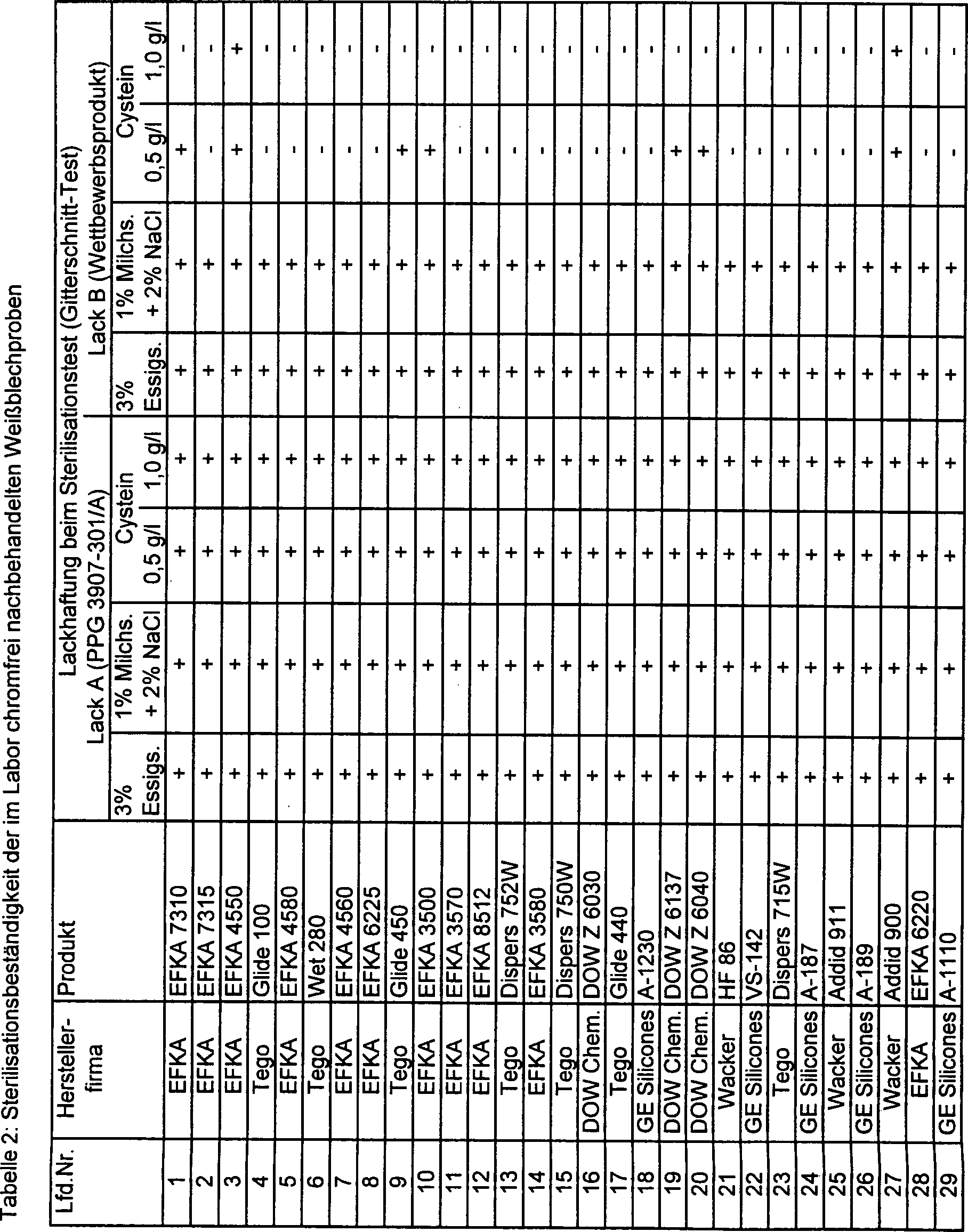
Tafeln des erfindungsgemäß hergestellten und nachbehandelten Weißblechs wurden mit 5 g/m2 Konservendosenlack PPG 3907-301/A (Lack A) oder einem Epoxidharz-Lack (Lack B) lackiert. An diesen lackierten Weißblechtafeln wurden Untersuchungen zur Sterilisationsbeständigkeit durchgeführt, wobei die Sterilisationsbeständigkeit gegenüber folgenden Substanzen erfasst wurde:
- • 3 % Essigsäure (100°C/30 Minuten)
- • 1 % Milchsäure + 2 % NaCl (121°C/30 Minuten)
- • Phosphatpuffer + 0,5l/Cystein (121°C/90 Minuten)
- • Phosphatpuffer + 1,0l/Cystein (121°C/90 Minuten)
- • 3% acetic acid (100 ° C / 30 minutes)
- • 1% lactic acid + 2% NaCl (121 ° C / 30 minutes)
- • phosphate buffer + 0.5l / cysteine (121 ° C / 90 minutes)
- • phosphate buffer + 1.0l / cysteine (121 ° C / 90 minutes)
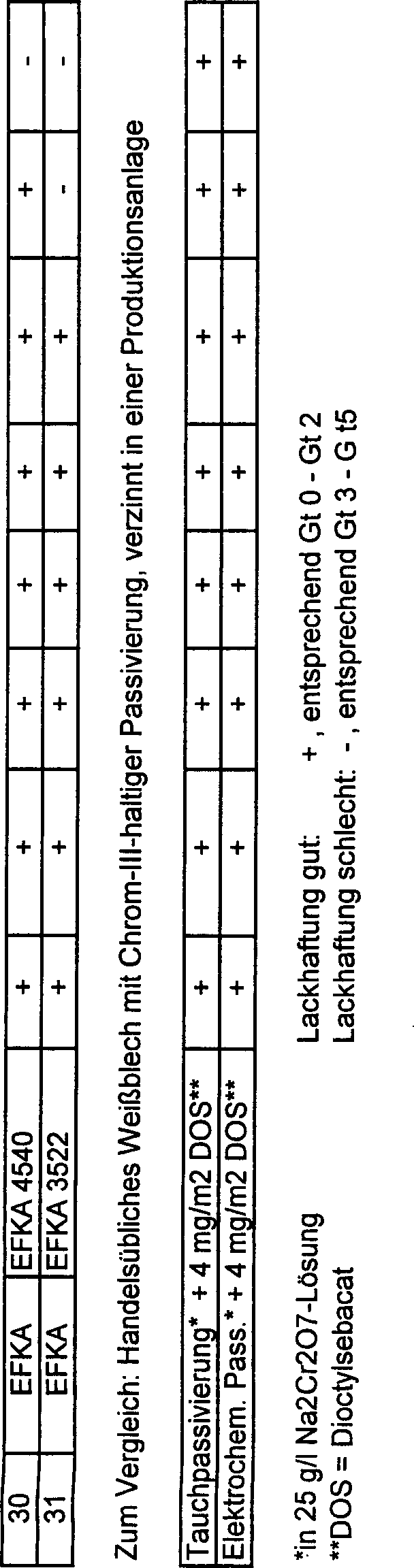
Die Ergebnisse dieser Versuche zur Sterilisationsbeständigkeit der mit den beiden Lacken (A und B) lackierten Weißblechtafeln sind in Tabelle 2 angegeben.The Results of these tests for sterilization resistance the painted with the two paints (A and B) tinplate panels are given in Table 2.
Die
in den Vergleichsversuchen untersuchten Weißblechproben wurden schließlich hinsichtlich
ihres Gleitreibwerts vor und nach der erfindungsgemäßen Behandlung
mit einem Drei-Kugelspurtest untersucht. Hierbei wurden folgende
Gleitreibwerte für
elektrochemisch passiviertes Weißblech mit 2,8 g/m2 Zinnauflage ermittelt:
Die Gleitreibwerte der erfindungsgemäß mit den in Tabelle 1 angegebenen Substanzen behandelten Weißblechproben sind jeweils in Tabelle 1 angegeben und betragen zwischen 0,17 und 0,46.The Gleitreibwerte the invention with the in Table 1 substances treated tinplate samples are each given in Table 1 and are between 0.17 and 0.46.
Die erfindungsgemäß behandelten Weißblechproben weisen zum Teil eine gegenüber unbehandeltem Weißblech wesentlich verringerte Gleitreibung auf, wobei bei einzelnen Substanzen sogar geringere Gleitreibwerte ermittelt werden konnten als bei herkömmlicher Behandlung des Weißblechs mit DOS.The treated according to the invention Tinplate samples partly facing one another untreated tinplate significantly reduced sliding friction, with individual substances even lower sliding friction values could be determined than at conventional Treatment of tinplate with DOS.
Im Gegensatz zur herkömmlichen elektrostatischen Befettung der Weißblechoberflächen mit Esthern, wie DOS, wurde jedoch darüber hinaus bei den erfindungsgemäß behandelten Weißblechproben kein produktionsbedingter Zinnstaub beobachtet. Insbesondere bei nach herkömmlichen Verfahren mit DOS-befettetem Weißblech ist dagegen produktionsbedingt oft ein Staubbelag zu beobachten, der problematisch ist, weil er nur durch geeignete, aufwendige Pflegemaßnahmen an den Anlagen beseitigt werden kann. Die Ursache der Staubfreiheit des erfindungsgemäßen Verfahrens kann möglicherweise auf die Spülwirkung der wässrigen Lösung bei der Applikation zur Passivierung zurückgeführt werden, sowie auf die bessere Haftung des Weißblechs auf den Oberflächen der nicht angetriebenen Umlenkrollen im zweiten Schlaufenturm der Bandverzinnungsanlagen. Durch den geringeren Schlupf des Weißblechs mit den Umlenkrollen im Schlaufenturm wird im Gegensatz zur Befettung mit herkömmlichen Substanzen, wie DOS, offensichtlich kein Zinnabrieb gebildet.in the Contrary to conventional electrostatic lubrication of tinplate surfaces with However, esters such as DOS were also included in the invention Tinplate samples No production-related tin dust observed. Especially at according to conventional On the other hand, processes using DOS-greased tinplate are production-related often to observe a dusty surface, which is problematic because he only eliminated by appropriate, complex care measures on the systems can be. The cause of the absence of dust of the method according to the invention may possibly on the rinsing effect the aqueous solution be returned to the passivation application, as well as the better Adhesion of the tinplate on the surfaces the non-driven pulleys in the second loop tower the Bandverzinnungsanlagen. Due to the lower slippage of the tinplate with the pulleys in the loop tower is in contrast to the lubrication with conventional Substances, such as DOS, apparently no tin abrasion formed.
Die
erfindungsgemäße Behandlung
von Weißblech
reduziert ferner das Zinnoxid-Wachstum, beispielsweise während der
Lagerung des Weißblechs
und vor dessen Lackierung. Handelsübliches Weißblech, das nach herkömmlichen
Verfahren hergestellt und nachbehandelt wurde, hat nach 6 Wochen
Lagerung unter feucht-warm-Bedingungen (40°C und 80 % relativer Luftfeuchte)
folgende Zinnoxid-Auflagen:
Die erfindungsgemäß nachbehandelten Weißblechproben hatten dagegen nach entsprechender Lagerung die in Tabelle 1 angegebenen Werte.The post-treated according to the invention Tinplate samples on the other hand, after appropriate storage, those indicated in Table 1 Values.
Aus einer Gesamtschau der Ergebnisse der Vergleichsversuche lässt sich erschließen, dass die im Anspruch 23 angegebnen Substanzen bzw. Substanzklassen bei der Verwendung in dem erfindungsgemäßen Verfahren zur Passivierung der Oberfläche von Weißblech die besten Ergebnisse hinsichtlich der Oxidationsbeständigkeit und der Gleitreibung des beschichteten und erfindungsgemäß nachbehandelten WeißOblechs ergeben. Die Substanzen „EFKA 3580" (Siloxantensid mit Polyethylenoxid-Ketten), „EFKA 4560" (modifiziertes Acrylat mit Polyethylenoxid-Ketten) „EFKA 8512" und „EFKA 3570" (teilfluoriertes Acrylat mit Polyethylenoxid-Ketten) ergeben hinsichtlich beider Eigenschaften (niedrige Gleitreibwerte und niedriges Zinnoxid-Wachstum) die besten Resultate.Out an overall view of the results of the comparative experiments can be open, that indicated in claim 23 substances or substance classes when used in the process according to the invention for passivation the surface of tinplate the best results in terms of oxidation resistance and the sliding friction of the coated and after-treated according to the invention White oblechs result. The substances "EFKA 3580 "(siloxane surfactant with polyethylene oxide chains), "EFKA 4560 "(modified Acrylate with polyethylene oxide chains) "EFKA 8512" and "EFKA 3570" (partially fluorinated acrylate with polyethylene oxide chains) result in respect of both properties (low sliding friction values and low tin oxide growth) the best results.


Claims (23)


Priority Applications (9)
| Application Number | Priority Date | Filing Date | Title |
|---|---|---|---|
| DE102005045034A DE102005045034A1 (en) | 2005-09-21 | 2005-09-21 | Method for passivating the surface of coated metal strips and device for applying the passive layer to a metal-coated steel strip |
| EP06016796A EP1767665A3 (en) | 2005-09-21 | 2006-08-11 | Method for passivation of coated metal sheets and apparatus thereof |
| CA2558562A CA2558562C (en) | 2005-09-21 | 2006-09-01 | Method for the passivation of the surface of coated metal bands and device for the application of the passive layer on a metal coated steel band |
| AU2006206063A AU2006206063A1 (en) | 2005-09-21 | 2006-09-04 | Method for the passivation of the surface of coated metal bands and device for the application of the passive layer on a metal coated steel band |
| KR1020060088709A KR101216697B1 (en) | 2005-09-21 | 2006-09-13 | Method for the passivation of the surface of coated metal bands and device for the application of the passive layer on a metal coated steel band |
| US11/532,138 US20070065589A1 (en) | 2005-09-21 | 2006-09-15 | Method for the passivation of the surface of coated metal bands and device for the application of the passive layer on a metal coated steel band |
| CN2006101542830A CN1935392B (en) | 2005-09-21 | 2006-09-19 | Method for the passivation of the surface of coated metal bands and device for the application of the passive layer on a metal coated steel band |
| JP2006254545A JP5362951B2 (en) | 2005-09-21 | 2006-09-20 | Passivation method for plated metal strip and apparatus for applying a passivation layer to plated strip steel |
| BRPI0603941A BRPI0603941B1 (en) | 2005-09-21 | 2006-09-21 | Method for surface passivation of tin-coated metal strips and device for surface passivation of metal strips |
Applications Claiming Priority (1)
| Application Number | Priority Date | Filing Date | Title |
|---|---|---|---|
| DE102005045034A DE102005045034A1 (en) | 2005-09-21 | 2005-09-21 | Method for passivating the surface of coated metal strips and device for applying the passive layer to a metal-coated steel strip |
Publications (1)
| Publication Number | Publication Date |
|---|---|
| DE102005045034A1 true DE102005045034A1 (en) | 2007-03-29 |
Family
ID=37496410
Family Applications (1)
| Application Number | Title | Priority Date | Filing Date |
|---|---|---|---|
| DE102005045034A Ceased DE102005045034A1 (en) | 2005-09-21 | 2005-09-21 | Method for passivating the surface of coated metal strips and device for applying the passive layer to a metal-coated steel strip |
Country Status (9)
| Country | Link |
|---|---|
| US (1) | US20070065589A1 (en) |
| EP (1) | EP1767665A3 (en) |
| JP (1) | JP5362951B2 (en) |
| KR (1) | KR101216697B1 (en) |
| CN (1) | CN1935392B (en) |
| AU (1) | AU2006206063A1 (en) |
| BR (1) | BRPI0603941B1 (en) |
| CA (1) | CA2558562C (en) |
| DE (1) | DE102005045034A1 (en) |
Cited By (2)
| Publication number | Priority date | Publication date | Assignee | Title |
|---|---|---|---|---|
| EP2826887A1 (en) | 2013-07-16 | 2015-01-21 | ThyssenKrupp Rasselstein GmbH | Method for applying an aqueous treatment solution to the surface of a moving steel strip |
| EP3075878A1 (en) | 2015-03-31 | 2016-10-05 | ThyssenKrupp AG | Method and application device for applying an aqueous treating solution to the surface of a moving web |
Families Citing this family (20)
| Publication number | Priority date | Publication date | Assignee | Title |
|---|---|---|---|---|
| JP4795466B2 (en) | 2007-06-29 | 2011-10-19 | 古河電気工業株式会社 | Metal material, manufacturing method thereof, and electric / electronic component using the same |
| BR112012026240B1 (en) | 2010-04-16 | 2021-08-03 | Swimc Llc | ARTICLE, METHOD, AND, COATING COMPOSITION |
| EP3878912B1 (en) | 2011-02-07 | 2023-04-05 | Swimc Llc | Coating compositions for containers and other articles and methods of coating |
| DE102012000414B4 (en) * | 2012-01-12 | 2014-03-20 | Thyssenkrupp Rasselstein Gmbh | Process for passivating tinplate and tinned steel strip or sheet |
| CN102555412B (en) * | 2012-02-09 | 2015-02-18 | 浙江仙通橡塑股份有限公司 | Mirror surface stainless steel band surface gluing tool and production process thereof |
| EP2867390B1 (en) * | 2012-07-02 | 2017-09-06 | Tata Steel IJmuiden BV | Method for producing tinplate and product produced therewith |
| JP2015527455A (en) | 2012-08-09 | 2015-09-17 | ヴァルスパー・ソーシング・インコーポレーテッド | Compositions for containers and other articles and methods of use thereof |
| EP2882658B1 (en) | 2012-08-09 | 2021-09-08 | Swimc Llc | Container coating system |
| CN103840106B (en) * | 2014-02-26 | 2016-01-13 | 江苏安博瑞新材料有限公司 | The manufacture method of the wetting method of aluminium foil and saturation tank thereof, battery packaging film |
| JP6746501B2 (en) | 2014-04-14 | 2020-08-26 | ヴァルスパー・ソーシング・インコーポレーテッド | Method of preparing compositions for containers and other articles and methods of use thereof |
| TWI614275B (en) | 2015-11-03 | 2018-02-11 | Valspar Sourcing Inc | Liquid epoxy resin composition for preparing a polymer |
| CN105349977B (en) * | 2015-12-03 | 2018-03-30 | 四川省星光钢结构有限公司 | A kind of steel strip surface processing equipment |
| CN108116041B (en) * | 2018-01-02 | 2024-08-13 | 浙江雅琪诺装饰材料有限公司 | A wide-format circular-concave integrated embossing vertical printing device |
| CN108660446B (en) * | 2018-07-20 | 2024-07-09 | 江苏诚益通智能装备有限责任公司 | Passivation device for machine-building |
| CN113275154A (en) * | 2020-03-19 | 2021-08-20 | 安泰科技股份有限公司 | Coating device |
| CN111889294B (en) * | 2020-07-27 | 2021-12-31 | 吉林省华奥汽车部件有限公司 | Steel band oiling station for machining |
| CN115505917A (en) * | 2021-06-23 | 2022-12-23 | 上海梅山钢铁股份有限公司 | Tin plate chromium-free passivation device and process |
| CN115094426B (en) * | 2022-08-01 | 2023-11-10 | 哈尔滨工程大学 | A preparation method of composite corrosion inhibitor based on synergistic mechanism |
| CN115449785B (en) * | 2022-08-26 | 2024-06-25 | 河南科技大学 | Tantalum metal surface passivation device |
| CN119020768B (en) * | 2024-10-29 | 2025-02-11 | 广东斗原精密技术有限公司 | Protective type coating passivation device for galvanized steel sheet processing |
Citations (10)
| Publication number | Priority date | Publication date | Assignee | Title |
|---|---|---|---|---|
| DE4205819A1 (en) * | 1992-02-26 | 1993-09-02 | Henkel Kgaa | Stable water free compsn. for anticorrosion layer on metal esp. aluminium@ or alloy - prepd. by reacting titanium alkoxide or zirconium alkoxide, silane contg. epoxy gps. and silane contg. amino gps. |
| US5292549A (en) * | 1992-10-23 | 1994-03-08 | Armco Inc. | Metallic coated steel having a siloxane film providing temporary corrosion protection and method therefor |
| DE4403876A1 (en) * | 1993-02-19 | 1994-08-25 | Daimler Benz Ag | Passivation layer containing polysiloxane for metallic surfaces and process for its production |
| WO1999067444A1 (en) * | 1998-06-24 | 1999-12-29 | University Of Cincinnati | Corrosion prevention of metals using bis-functional polysulfur silanes |
| WO2000046312A1 (en) * | 1999-02-05 | 2000-08-10 | Chemetall Plc | Method of treating metals using vinyl silanes and multi-silyl-functional silanes in admixture |
| EP1002143B1 (en) * | 1997-08-06 | 2002-04-03 | Henkel Kommanditgesellschaft auf Aktien | Alkaline strip passivation |
| EP0959990B1 (en) * | 1996-11-05 | 2002-07-17 | The University Of Cincinnati | Method of preventing corrosion of metal sheet using vinyl silanes |
| EP1270764A1 (en) * | 2000-11-08 | 2003-01-02 | Kawasaki Steel Corporation | Surface treated tin-plated steel sheet and chemical treatment solution |
| EP0932453B1 (en) * | 1996-10-16 | 2003-01-22 | GE Betz, Inc. | Chromium-free conversion coating and methods of use |
| EP1015662B1 (en) * | 1997-01-09 | 2004-05-12 | University Of Cincinnati | Method of preventing corrosion of metals using silanes |
Family Cites Families (21)
| Publication number | Priority date | Publication date | Assignee | Title |
|---|---|---|---|---|
| US2579778A (en) * | 1949-04-06 | 1951-12-25 | United States Steel Corp | Method of surface lubrication of metal products |
| NL246336A (en) * | 1958-12-11 | |||
| DE1696652A1 (en) * | 1968-03-15 | 1971-12-09 | Rasselstein Ag | Method for applying an organic protective layer to metallic strips or wires, in particular steel strips or wires |
| US4329401A (en) * | 1978-02-17 | 1982-05-11 | The Standard Oil Company | Metal coatings from nitrile copolymer latexes |
| DE2823958C2 (en) * | 1978-06-01 | 1984-03-08 | Fritz Schäfer GmbH, 5908 Neunkirchen | Method and device for spray treatment, in particular for spray painting objects |
| CA1162504A (en) * | 1980-11-25 | 1984-02-21 | Mobuyuki Oda | Treating tin plated steel sheet with composition containing titanium or zirconium compounds |
| US4863060A (en) * | 1986-04-29 | 1989-09-05 | Weirton Steel Corporation | Flat-rolled steel can stock product |
| SK86594A3 (en) * | 1992-11-16 | 1995-01-12 | Winterhalter Gastronom Gmbh | Dish-washing machine |
| US5555756A (en) * | 1995-01-24 | 1996-09-17 | Inland Steel Company | Method of lubricating steel strip for cold rolling, particularly temper rolling |
| DE19516765A1 (en) * | 1995-05-06 | 1996-11-07 | Henkel Kgaa | Chromium and fluoride free treatment of metal surfaces |
| US6280596B1 (en) * | 1995-05-23 | 2001-08-28 | Weirton Steel Corporation | Electrolytic tinplating of steel substrate and apparatus |
| JPH09256166A (en) * | 1996-03-18 | 1997-09-30 | Sumitomo Metal Ind Ltd | Method of controlling the amount of deposits in coating type chemical conversion equipment |
| TW460632B (en) * | 1997-11-14 | 2001-10-21 | Toyo Kohan Co Ltd | Surface treated steel sheet with low contact resistance and connection terminal material produced thereof |
| US6174426B1 (en) * | 1999-08-12 | 2001-01-16 | Usx Corporation | Tin-plated steel with adhesion promoter |
| DE19961411A1 (en) * | 1999-12-17 | 2001-06-21 | Chemetall Gmbh | Process for the production of coated metal surfaces and their use |
| JP4786014B2 (en) * | 2000-06-29 | 2011-10-05 | アネスト岩田株式会社 | Electrostatic coating equipment |
| WO2002031064A1 (en) * | 2000-10-11 | 2002-04-18 | Chemetall Gmbh | Method for pretreating and/or coating metallic surfaces with a paint-like coating prior to forming and use of substrates coated in this way |
| US20040235680A1 (en) * | 2002-09-18 | 2004-11-25 | Ecolab Inc. | Conveyor lubricant with corrosion inhibition |
| JP2005139518A (en) * | 2003-11-07 | 2005-06-02 | Jfe Steel Kk | Manufacturing equipment and manufacturing method for chemical conversion metal strip |
| DE102004062454A1 (en) * | 2004-12-20 | 2006-06-29 | Basf Ag | Process for coating metals |
| DE102005038608A1 (en) * | 2005-08-16 | 2007-02-22 | Basf Ag | Polymer composition for corrosion protection |
-
2005
- 2005-09-21 DE DE102005045034A patent/DE102005045034A1/en not_active Ceased
-
2006
- 2006-08-11 EP EP06016796A patent/EP1767665A3/en not_active Withdrawn
- 2006-09-01 CA CA2558562A patent/CA2558562C/en not_active Expired - Fee Related
- 2006-09-04 AU AU2006206063A patent/AU2006206063A1/en not_active Abandoned
- 2006-09-13 KR KR1020060088709A patent/KR101216697B1/en not_active Expired - Fee Related
- 2006-09-15 US US11/532,138 patent/US20070065589A1/en not_active Abandoned
- 2006-09-19 CN CN2006101542830A patent/CN1935392B/en not_active Expired - Fee Related
- 2006-09-20 JP JP2006254545A patent/JP5362951B2/en not_active Expired - Fee Related
- 2006-09-21 BR BRPI0603941A patent/BRPI0603941B1/en not_active IP Right Cessation
Patent Citations (10)
| Publication number | Priority date | Publication date | Assignee | Title |
|---|---|---|---|---|
| DE4205819A1 (en) * | 1992-02-26 | 1993-09-02 | Henkel Kgaa | Stable water free compsn. for anticorrosion layer on metal esp. aluminium@ or alloy - prepd. by reacting titanium alkoxide or zirconium alkoxide, silane contg. epoxy gps. and silane contg. amino gps. |
| US5292549A (en) * | 1992-10-23 | 1994-03-08 | Armco Inc. | Metallic coated steel having a siloxane film providing temporary corrosion protection and method therefor |
| DE4403876A1 (en) * | 1993-02-19 | 1994-08-25 | Daimler Benz Ag | Passivation layer containing polysiloxane for metallic surfaces and process for its production |
| EP0932453B1 (en) * | 1996-10-16 | 2003-01-22 | GE Betz, Inc. | Chromium-free conversion coating and methods of use |
| EP0959990B1 (en) * | 1996-11-05 | 2002-07-17 | The University Of Cincinnati | Method of preventing corrosion of metal sheet using vinyl silanes |
| EP1015662B1 (en) * | 1997-01-09 | 2004-05-12 | University Of Cincinnati | Method of preventing corrosion of metals using silanes |
| EP1002143B1 (en) * | 1997-08-06 | 2002-04-03 | Henkel Kommanditgesellschaft auf Aktien | Alkaline strip passivation |
| WO1999067444A1 (en) * | 1998-06-24 | 1999-12-29 | University Of Cincinnati | Corrosion prevention of metals using bis-functional polysulfur silanes |
| WO2000046312A1 (en) * | 1999-02-05 | 2000-08-10 | Chemetall Plc | Method of treating metals using vinyl silanes and multi-silyl-functional silanes in admixture |
| EP1270764A1 (en) * | 2000-11-08 | 2003-01-02 | Kawasaki Steel Corporation | Surface treated tin-plated steel sheet and chemical treatment solution |
Cited By (3)
| Publication number | Priority date | Publication date | Assignee | Title |
|---|---|---|---|---|
| EP2826887A1 (en) | 2013-07-16 | 2015-01-21 | ThyssenKrupp Rasselstein GmbH | Method for applying an aqueous treatment solution to the surface of a moving steel strip |
| DE102013107505A1 (en) | 2013-07-16 | 2015-01-22 | Thyssenkrupp Rasselstein Gmbh | Process for applying an aqueous treatment solution to the surface of a moving steel belt |
| EP3075878A1 (en) | 2015-03-31 | 2016-10-05 | ThyssenKrupp AG | Method and application device for applying an aqueous treating solution to the surface of a moving web |
Also Published As
| Publication number | Publication date |
|---|---|
| CN1935392A (en) | 2007-03-28 |
| JP2007084934A (en) | 2007-04-05 |
| KR20070033256A (en) | 2007-03-26 |
| CA2558562A1 (en) | 2007-03-21 |
| BRPI0603941A (en) | 2007-08-14 |
| AU2006206063A1 (en) | 2007-04-05 |
| CA2558562C (en) | 2014-11-04 |
| EP1767665A2 (en) | 2007-03-28 |
| BRPI0603941B1 (en) | 2017-04-11 |
| KR101216697B1 (en) | 2013-01-09 |
| EP1767665A3 (en) | 2008-07-16 |
| JP5362951B2 (en) | 2013-12-11 |
| US20070065589A1 (en) | 2007-03-22 |
| CN1935392B (en) | 2012-07-04 |
Similar Documents
| Publication | Publication Date | Title |
|---|---|---|
| DE102005045034A1 (en) | Method for passivating the surface of coated metal strips and device for applying the passive layer to a metal-coated steel strip | |
| EP0948666B2 (en) | Method for treating metallic surfaces | |
| DE102012000414B4 (en) | Process for passivating tinplate and tinned steel strip or sheet | |
| EP2826887B1 (en) | Method for applying an aqueous treatment solution to the surface of a moving steel strip | |
| DE69601323T2 (en) | Process for improving the deformation and welding properties of galvanized sheet steel | |
| DE102005045033B3 (en) | Method for reducing coefficient of friction of tin- or chromium plated steel strip comprises spraying coated strip with surfactant solution while it is moving at same speed as that used during electroplating | |
| EP2826569B1 (en) | Method for passivating strip black iron plate | |
| DE69906555T2 (en) | GALVANIZED STEEL SHEETS COATED WITH A HYDROXYSULFATE LUBRICATING LAYER AND METHOD FOR THE PRODUCTION THEREOF | |
| DE3400339A1 (en) | METHOD FOR REPASSIVATING PHOSPHATED METAL SURFACES USING SOLUTIONS CONTAINING NICKEL AND / OR COPPER CATIONS | |
| EP2215285A1 (en) | Zirconium phosphating of metal components, in particular iron | |
| DE19781959B4 (en) | Process for the electrochemical phosphating of metal surfaces, in particular of stainless steel | |
| DE3833119C2 (en) | ||
| DE102015113878B4 (en) | Process for the thermal treatment of a black plate coated with a conversion layer | |
| EP3872230A1 (en) | Method for producing hardened steel components with a conditioned zinc alloy corrosion protection layer | |
| DE69433414T2 (en) | Process for producing a hot-dip galvanized steel sheet with excellent press formability | |
| DE1965586C3 (en) | Steel sheets which, following shaping, are provided with a coating, in particular an enamel layer, method for their production and use of the steel sheets | |
| EP1294834B1 (en) | Method for treating or pretreating containers | |
| EP2807280B1 (en) | Method for refining a metal coating on a steel strip | |
| DE2046449A1 (en) | Process for applying protective coatings to metal objects | |
| EP3434807A1 (en) | Steel sheet having a conversion layer, method for producing a conversion coated steel sheet and treating agent for applying a conversion layer on a steel sheet | |
| DE68909756T2 (en) | Composition and method for coating metal surfaces. | |
| DE2114333A1 (en) | Coated metal and process for coating metal surfaces | |
| DE69218916T2 (en) | ALUMINUM ALLOY SHEET WITH IMPROVED COMPRESSIBILITY AND METHOD FOR PRODUCING IT | |
| EP3872229A1 (en) | Method for producing hardened steel components with a conditioned zinc alloy corrosion protection layer | |
| DE102023110138A1 (en) | steel sheet with double-layer temporary corrosion protection |
Legal Events
| Date | Code | Title | Description |
|---|---|---|---|
| OP8 | Request for examination as to paragraph 44 patent law | ||
| R082 | Change of representative |
Representative=s name: PATENTANWAELTE CHARRIER RAPP & LIEBAU, DE |
|
| R081 | Change of applicant/patentee |
Owner name: THYSSENKRUPP RASSELSTEIN GMBH, DE Free format text: FORMER OWNER: RASSELSTEIN GMBH, 56626 ANDERNACH, DE Effective date: 20120919 |
|
| R082 | Change of representative |
Representative=s name: PATENTANWAELTE CHARRIER RAPP & LIEBAU, DE Effective date: 20120919 Representative=s name: CHARRIER RAPP & LIEBAU PATENTANWAELTE PARTG MB, DE Effective date: 20120919 |
|
| R002 | Refusal decision in examination/registration proceedings | ||
| R119 | Application deemed withdrawn, or ip right lapsed, due to non-payment of renewal fee | ||
| R003 | Refusal decision now final |