DE102005044307B4 - Ionization of desorbed molecules - Google Patents
Ionization of desorbed molecules Download PDFInfo
- Publication number
- DE102005044307B4 DE102005044307B4 DE102005044307A DE102005044307A DE102005044307B4 DE 102005044307 B4 DE102005044307 B4 DE 102005044307B4 DE 102005044307 A DE102005044307 A DE 102005044307A DE 102005044307 A DE102005044307 A DE 102005044307A DE 102005044307 B4 DE102005044307 B4 DE 102005044307B4
- Authority
- DE
- Germany
- Prior art keywords
- ions
- desorption
- analyte molecules
- analyte
- reactant
- Prior art date
- Legal status (The legal status is an assumption and is not a legal conclusion. Google has not performed a legal analysis and makes no representation as to the accuracy of the status listed.)
- Expired - Lifetime
Links
Classifications
-
- H—ELECTRICITY
- H01—ELECTRIC ELEMENTS
- H01J—ELECTRIC DISCHARGE TUBES OR DISCHARGE LAMPS
- H01J49/00—Particle spectrometers or separator tubes
- H01J49/02—Details
- H01J49/04—Arrangements for introducing or extracting samples to be analysed, e.g. vacuum locks; Arrangements for external adjustment of electron- or ion-optical components
- H01J49/0459—Arrangements for introducing or extracting samples to be analysed, e.g. vacuum locks; Arrangements for external adjustment of electron- or ion-optical components for solid samples
- H01J49/0463—Desorption by laser or particle beam, followed by ionisation as a separate step
-
- G—PHYSICS
- G01—MEASURING; TESTING
- G01N—INVESTIGATING OR ANALYSING MATERIALS BY DETERMINING THEIR CHEMICAL OR PHYSICAL PROPERTIES
- G01N27/00—Investigating or analysing materials by the use of electric, electrochemical, or magnetic means
- G01N27/62—Investigating or analysing materials by the use of electric, electrochemical, or magnetic means by investigating the ionisation of gases, e.g. aerosols; by investigating electric discharges, e.g. emission of cathode
- G01N27/622—Ion mobility spectrometry
- G01N27/623—Ion mobility spectrometry combined with mass spectrometry
-
- H—ELECTRICITY
- H01—ELECTRIC ELEMENTS
- H01J—ELECTRIC DISCHARGE TUBES OR DISCHARGE LAMPS
- H01J49/00—Particle spectrometers or separator tubes
- H01J49/02—Details
- H01J49/04—Arrangements for introducing or extracting samples to be analysed, e.g. vacuum locks; Arrangements for external adjustment of electron- or ion-optical components
- H01J49/0468—Arrangements for introducing or extracting samples to be analysed, e.g. vacuum locks; Arrangements for external adjustment of electron- or ion-optical components with means for heating or cooling the sample
- H01J49/0481—Arrangements for introducing or extracting samples to be analysed, e.g. vacuum locks; Arrangements for external adjustment of electron- or ion-optical components with means for heating or cooling the sample with means for collisional cooling
-
- H—ELECTRICITY
- H01—ELECTRIC ELEMENTS
- H01J—ELECTRIC DISCHARGE TUBES OR DISCHARGE LAMPS
- H01J49/00—Particle spectrometers or separator tubes
- H01J49/02—Details
- H01J49/10—Ion sources; Ion guns
-
- H—ELECTRICITY
- H01—ELECTRIC ELEMENTS
- H01J—ELECTRIC DISCHARGE TUBES OR DISCHARGE LAMPS
- H01J49/00—Particle spectrometers or separator tubes
- H01J49/02—Details
- H01J49/10—Ion sources; Ion guns
- H01J49/14—Ion sources; Ion guns using particle bombardment, e.g. ionisation chambers
- H01J49/145—Ion sources; Ion guns using particle bombardment, e.g. ionisation chambers using chemical ionisation
Landscapes
- Physics & Mathematics (AREA)
- Chemical & Material Sciences (AREA)
- Analytical Chemistry (AREA)
- Spectroscopy & Molecular Physics (AREA)
- Health & Medical Sciences (AREA)
- Life Sciences & Earth Sciences (AREA)
- Plasma & Fusion (AREA)
- Engineering & Computer Science (AREA)
- General Health & Medical Sciences (AREA)
- Biochemistry (AREA)
- Molecular Biology (AREA)
- General Physics & Mathematics (AREA)
- Immunology (AREA)
- Pathology (AREA)
- Electrochemistry (AREA)
- Chemical Kinetics & Catalysis (AREA)
- Optics & Photonics (AREA)
- Other Investigation Or Analysis Of Materials By Electrical Means (AREA)
- Electron Tubes For Measurement (AREA)
Abstract
Verfahren
für die
Erzeugung von Analyt-Ionen aus Analytmolekülen für eine Analyse in einem Spektrometer,
wobei sich die Analytmoleküle
in Proben auf einem festen Probenträger befinden, dadurch gekennzeichnet,
– dass die
Analytmoleküle
in einem Umgebungsgas bei einem Druck zwischen 10 und 1000 Pascal
desorbiert werden,
– dass
in einer Reaktant-Ionenquelle Reaktant-Ionen erzeugt werden,
– dass die
Reaktant-Ionen durch ein Ionenleitsystem der Desorptionsstelle zugeführt werden,
und
– dass
die desorbierten Analytmoleküle
durch die Reaktant-Ionen ionisiert werden.Method for the production of analyte ions from analyte molecules for analysis in a spectrometer, wherein the analyte molecules are located in samples on a solid sample carrier, characterized
That the analyte molecules are desorbed in an ambient gas at a pressure between 10 and 1000 Pascal,
That reactant ions are generated in a reactant ion source,
- That the reactant ions are supplied by an ion guide to the desorption, and
- That the desorbed analyte molecules are ionized by the reactant ions.
Description
Die Erfindung bezieht sich auf die Erzeugung von Ionen von Analytmolekülen, die von Oberflächen geeigneter Probenträger herunter desorbiert werden.The This invention relates to the generation of ions of analyte molecules which suitable for surfaces sample carrier be desorbed down.
Die Erfindung desorbiert die Analytmoleküle in einem Druckbereich von etwa 30 bis 300 Pascal und ionisiert sie durch zugeführte Reaktant-Ionen. Die Reaktant-Ionen werden in einer eigenen Ionenquelle erzeugt und durch Ionenleitsysteme an die Stelle vor der Probe geleitet. Die Analytmoleküle können sich in Matrixmaterial befinden, aber auch ohne Zusätze auf einer Oberfläche adsorbiert sein. Die Desorption kann kontinuierlich oder gepulst erfolgen, beispielsweise durch Licht aus Lasern oder Dioden.The Invention desorbs the analyte molecules in a pressure range of about 30 to 300 pascals and ionizes them by supplied reactant ions. The Reactant ions are generated in a separate ion source and through Guided ion guide to the place in front of the sample. The analyte molecules can become in matrix material, but also adsorbed on a surface without additives be. The desorption can be continuous or pulsed, for example by light from lasers or diodes.
Stand der TechnikState of the art
Eine bedeutende Ionisierungsart für Biomoleküle ist die Ionisierung durch matrixunterstützte Laserdesorption (MALDI). Diese ionisiert die Biomoleküle aus Proben, die sich in einer Mischung mit den Molekülen einer Matrixsubstanz auf Probenträgern befinden. Das Verhältnis von Analytmolekülen zu Matrixmolekülen beträgt etwa eins zu zehntausend. Auf einem Probenträger können Hunderte von Proben aufgebracht werden. Dafür stehen Pipettierroboter zur Verfügung. Der Transport der Proben auf dem Probenträger in den Fokus eines UV-Pulslasers dauert nur Bruchteile von Sekunden, für die Analyse dieser Probe steht so viel Zeit wie immer nötig zur Verfügung (bis zum vollständigen Verbrauch der Probe). Das unterscheidet MALDI sehr vorteilhaft von der Elektrosprüh-Ionisierung, die nur einen sehr langsamen Probenwechsel bietet, oder, bei Kopplung mit der Chromatographie, eine Beschränkung der Analysenzeit auf die Dauer des chromatographischen Peaks erzwingt. Für die Identifizierung von tryptisch verdauten Proteinen, die durch 2D-Gelelektrophorese getrennt wurden, ist MALDI ideal. Auch die MALDI-Untersuchung von Peptiden, die durch Flüssigkeitschromatographie getrennt und auf MALDI-Probenträger aufgebracht wurden, ist im Vormarsch („HPLC-MALDI").A significant type of ionization for biomolecules is the ionization by matrix-assisted laser desorption (MALDI). This ionizes the biomolecules from samples that are in a mixture with the molecules of a Matrix substance are on sample carriers. The relationship of analyte molecules to matrix molecules is about one in ten thousand. Hundreds of samples can be applied to one sample carrier become. Therefore Pipetting robots are available. The transport of the samples on the sample carrier into the focus of a UV pulse laser only takes fractions of seconds for the analysis of this sample takes as much time as needed to disposal (until the complete Consumption of the sample). This distinguishes MALDI very favorably from electrospray ionization, which offers only a very slow sample change, or, with coupling with the chromatography, a limitation of the analysis time up forces the duration of the chromatographic peak. For identification of tryptically digested proteins by 2D gel electrophoresis MALDI is ideal. Also, the MALDI study of Peptides by liquid chromatography separated and on MALDI sample carriers are applied, is on the rise ("HPLC-MALDI").
Es ist jedoch ein Nachteil von MALDI, nur etwa ein Zehntausendstel der Analytmoleküle zu ionisieren. Aus einem Attomol einer Analytsubstanz, also aus etwa 600 000 Molekülen, werden nur etwa 60 Analyt-Ionen gewonnen. Der Rest wird nicht ionisiert, wobei ein Teil der restlichen Moleküle in Spritzern geschmolzener Matrixsubstanz enthalten sein mag und sich einer Ionisierung völlig entzieht, während ein großer Teil der Analytmoleküle im Prozess der Laserdesorption einfach nicht ionisiert wird.It however, is a disadvantage of MALDI, only about one ten-thousandth the analyte molecules to ionize. From an attomol of an analyte substance, ie from about 600,000 molecules, only about 60 analyte ions are recovered. The rest is not ionized, with some of the remaining molecules being melted in splashes Matrix substance may be contained and completely evades ionization, while a large Part of the analyte molecules simply not ionized in the process of laser desorption.
Die matrix-unterstützte Laserdesorption wird bisher überwiegend im Hochvakuum vorgenommen. Sie geht von einer festen Probenpräparation auf einem Probenträger aus. Die Probenpräparation besteht im Wesentlichen aus kleinen Kriställchen der Matrixsubstanz, der in geringen Anteilen (nur etwa ein hundertstel Prozent oder weniger) Moleküle der Analytsubstanz beigemischt sind. Diese Analytmoleküle sind einzeln in das Kristallgitter der Mat rixkristalle eingebaut oder befinden sich in Kristallgrenzflächen. Die so präparierten Proben werden mit kurzen Pulsen von UV-Laserlicht bestrahlt. Die Dauer der Pulse beträgt etwa zwei bis zehn Nanosekunden. Dabei entstehen Verdampfungswolken, die sowohl Ionen der Matrixsubstanz wie auch einige Analyt-Ionen enthalten. Die Analyt-Ionen sind zum Teil bereits in der Probe ionisiert enthalten, entstehen zu einem weiteren Teil direkt bei dem explosionsartigen Verdampfungsprozess im heißen Plasma, und werden zu einem dritten Teil in der sich ausdehnenden Wolke durch Protonenübertragung in Reaktionen mit den Matrix-Ionen gebildet.The matrix-assisted Laser desorption has been prevalent so far made in a high vacuum. It starts with a solid sample preparation on a sample carrier out. The sample preparation consists essentially of small crystals of the matrix substance, in small proportions (only about a hundredth of a percent or less) molecules the analyte substance are admixed. These analyte molecules are individually incorporated in the crystal lattice of the matrix crystals or are in crystal interfaces. The so prepared Samples are irradiated with short pulses of UV laser light. The Duration of the pulses is about two to ten nanoseconds. This creates evaporation clouds, containing both ions of the matrix substance as well as some analyte ions. Some of the analyte ions are already ionized in the sample, arise to another part directly at the explosive Evaporation process in hot Plasma, and become a third part in the expanding Cloud by proton transfer formed in reactions with the matrix ions.
Die früher nur im Hochvakuum verwendete Laserdesorption wird seit Neuestem auch an Atmosphärendruck benutzt, was die Probenzuführung einfacher macht, aber bisher nicht die Nachweisstärke erhöht. Dieses Verfahren wird mit der Abkürzung AP-MALDI bezeichnet.The earlier Laser desorption, used only in high vacuum, is now being used also at atmospheric pressure used what the sample delivery makes it easier, but so far not increased the detection strength. This Procedure is abbreviated AP-MALDI designated.
Diese Laserdesorption an Atmosphärendruck ist durch die Bildung einer Dampfwolke charakterisiert, die durch den Laserlichtschuss aus pulsförmig verdampftem Probenpräparationsmaterial entsteht, und die sich mit dem Umgebungsgas bewegen lässt. Die Dampfwolke besteht zunächst nur aus Matrixdampf mit ebenfalls in die Gasphase gepusteten Analytmolekülen. Ein nur sehr kleiner Teil in der Größenordnung von einem hundertstel Prozent der Analytmoleküle oder weniger ist ionisiert. Die Matrixsubstanz ist ähnlich schwach ionisiert; in absoluten Zahlen sind aber die Matrix-Ionen um ein vielfaches zahlreicher. Diese Dampfwolke vermischt sich in einer dünnen Grenzschicht mit Umgebungsgas, bleibt aber für längere Zeit beieinander. In der Dampfwolke können daher die Matrix-Ionen weiter durch Stöße mit Analytmolekülen unter Bildung von Analyt-Ionen reagieren. Es mögen auf diese Weise bei Atmosphärendruck mehr Analyt-Ionen gebildet werden als bei MALDI im Hochvakuum, doch steht diesem Vorteil der Nachteil gegenüber, dass die Ionen aus dieser mehr oder weniger ausgedehnten Dampfwolke an Atmosphärendruck herausgeführt und in das Vakuumsystem des Massenspektrometers überführt werden müssen. Die dabei auftretenden Verluste an Analyt-Ionen sind bislang größer als der Gewinn an zusätzlichen Analyt-Ionen – wenn dieser denn überhaupt auftritt.These Laser desorption at atmospheric pressure is characterized by the formation of a vapor cloud passing through the laser light shot from pulsed vaporized sample preparation material arises, and which can be moved with the ambient gas. The Steam cloud exists first only from matrix vapor with analyte molecules also puffed into the gas phase. One only very small part in the order of magnitude one hundredth of a percent of the analyte molecules or less is ionized. The matrix substance is similar weakly ionized; in absolute numbers, however, are the matrix ions many more. This cloud of steam mixes in a thin one Boundary layer with ambient gas, but stays together for a long time. In the cloud of steam can therefore, the matrix ions continue to collapse by collisions with analyte molecules Formation of analyte ions react. It like in this way at atmospheric pressure more analyte ions are formed than in MALDI in a high vacuum, but this advantage is offset by the disadvantage that the ions from this more or less expanded cloud of vapor led out to atmospheric pressure and must be transferred to the vacuum system of the mass spectrometer. The occurring losses of analyte ions are so far greater than the gain in additional Analyte ions - if this one at all occurs.
Es
ist auch ein Verfahren der matrix-unterstützten Laserdesorption an Atmosphärendruck
bekannt geworden, in dem nicht die Laserdesorption selbst die Ionisierung
der Analytmoleküle
bewirkt, sondern in dem anschließende Ionen-Molekül-Reaktionen
die Ionisierung übernehmen.
Die Matrixsubstanz braucht damit nicht mehr die Aufgabe der Ionisierung
der Analytmoleküle
zu übernehmen.
Für die Desorption
kann dabei im Besonderen als Matrix eine Substanz verwendet werden,
die sich unter Laserbeschuss zu kleinen Gasmolekülen zersetzt und somit lediglich
die drei Aufgaben hat, (1) die Analytsubstanzen fest auf der Oberfläche des
Probenträgers
zu binden, (2) die Laserstrahlung zu absorbieren, und (3) sich zersetzend
zu verdampfen und dabei die eingesperrten Analytmoleküle intakt
und voneinander isoliert in die Gasphase zu überführen. Anschließend wird
die chemische Ionisierung vorge nommen, beispielsweise mit einer
Bildung von primären
Ionen durch die Elektronen einer Corona-Entladung (J. Franzen und
C. Köster,
Die Desorption von Analytmolekülen braucht nicht unbedingt durch Laserlicht zu erfolgen. Es ist möglich, adsorbierte Moleküle auch durch Schockwellen, durch Temperaturschocks und insbesondere durch Vakuumüberschläge (Funken) zu desorbieren, wenn auch die Desorption durch Laserlicht weitaus am bequemsten ist.The Desorption of analyte molecules does not necessarily have to be done by laser light. It is possible adsorbed molecules also by shock waves, by temperature shocks and especially by Vacuum flashovers (sparks) desorb, although the desorption by laser light far on is most comfortable.
Es
wurde auch bereits über
MALDI in einem Umgebungsgas bei einem Druck von etwa 10 Pascal (A.
N. Krutchinski et al., Rapid Comm. Mass Spectrom. 12, 1998, 508-518)
und in einem Druckbereich zwischen 10 Pascal und 1000 Pascal (
Wenn hier von „Masse der Ionen" oder auch nur einfach von „Masse" in Verbindung mit Ionen die Rede ist, so ist stets die „ladungsbezogene Masse" m/z gemeint, also die physikalische Masse m der Ionen geteilt durch die dimensionslose und absolut genommene Anzahl z der positiven oder negativen Elementarladungen, die dieses Ion trägt.If here from "mass the ions "or even just from "mass" in conjunction with Ions, it is always the "charge-related mass" m / z meant, so the physical mass m of the ions divided by the dimensionless one and absolute number z of positive or negative elementary charges, which carries this ion.
Unter „Desorption" sollen hier, wie schon beim Begriff MALDI (matrix-unterstützte Laserdesorption und Ionisierung) üblich, alle Arten der Freisetzung von Molekülen aus der festen Phase in die Gasphase verstanden werden. Dabei soll es keine Rolle spielen, ob die zu desorbierenden Moleküle nackt auf einer Oberfläche adsorbiert sind, oder ob sie sich in oder an anderem Material, gleich welcher Art, eingeschlossen oder angelagert befinden.Under "Desorption" should here, as already common in the term MALDI (matrix-assisted laser desorption and ionization), all Types of release of molecules from the solid phase to the gas phase. It should It does not matter if the molecules to be desorbed naked on a surface are adsorbed, or whether they are in or on other material, the same of which kind, enclosed or attached.
Unter „Ionenleitsystem" soll hier eine Einrichtung verstanden werden, mit der Ionen gezielt von einem Ort zu einem anderen transportiert werden können. Das kann aerodynamisch oder durch elektrische und magnetische Elektroden- oder Jochsysteme geschehen, insbesondere aber durch Stabsysteme oder Lochblendensysteme, die mit den Phasen einer Hochfrequenzspannung beaufschlagt werden.Under "ion guide" is here a device be understood, with the ions targeted from one place to one can be transported to others. This can be done aerodynamically or by electrical and magnetic electrode or yoke systems happen, but in particular by rod systems or Perforated diaphragm systems, which are connected to the phases of a high-frequency voltage be charged.
Aufgabe der ErfindungObject of the invention
Es ist die Aufgabe der Erfindung, Verfahren und Gerät bereitzustellen, mit denen in Proben auf Probenträgern befindliche Analytmoleküle mit hoher Ausbeute ionisiert werden können.It The object of the invention is to provide methods and apparatus with which in samples on sample carriers located analyte molecules can be ionized in high yield.
Kurze Beschreibung der ErfindungBrief description of the invention
Die Aufgabe wird durch die nebengeordneten Ansprüche 1, 14 und 17 gelöst. Die Erfindung beruht auf einer Desorption der Analytmoleküle in einem Umgebungsgas in einem Druckbereich von vorzugsweise 30 bis 300 Pascal und auf einer Ionisierung der desorbierten Analytmoleküle durch geeignete Reaktant-Ionen, wobei die Reaktant-Ionen in einer eigenen Reaktant-Ionenquelle hergestellt und dem Ort vor der desorbierenden Probe durch ein Ionenleitsystem kontinuierlich oder getaktet zugeleitet werden. In diesem Druckbereich werden die desorbierten Analytmoleküle einerseits effizient durch das Umgebungsgas gekühlt und so vor Zersetzung bewahrt, und andererseits schnell mit den Reaktant-Ionen gemischt. Die Desorption kann kontinuierlich, aber auch gepulst erfolgen. Sie kann insbesondere durch Licht aus Laser oder Dioden erfolgen.The The object is achieved by the independent claims 1, 14 and 17. The The invention is based on a desorption of the analyte molecules in one Ambient gas in a pressure range of preferably 30 to 300 pascals and on an ionization of the desorbed analyte molecules suitable reactant ions, wherein the reactant ions in a separate Reactant ion source produced and the place before the desorbing Sample fed through an ion guide system continuously or clocked become. In this pressure range, the desorbed analyte molecules on the one hand cooled efficiently by the ambient gas and thus preserved from decomposition, and on the other hand mixed rapidly with the reactant ions. The desorption can be continuous, but also pulsed. She can in particular done by light from lasers or diodes.
Die Erfindung desorbiert zunächst die Analytmoleküle aus den Proben auf der Oberfläche eines Probenträgers bei einem Druck eines Umgebungsgases zwischen etwa 30 und 300 Pascal vorzugsweise durch Licht aus einem Laser oder einer Laserdiode. Je nach Umgebungsgas und Probenpräparation kann der optimale Druck auch zwischen 10 und 1000 Pascal liegen. Als Umgebungsgas kann insbesondere Reinststickstoff, aber auch Helium, Argon oder ein anderes leichtes Gas verwendet werden. Vorzugsweise soll das Umgebungsgas inert sein. Sind die Analytmoleküle auf der Oberfläche des Probenträgers in Matrixmaterial eingeschlossen, so befinden sie sich nun in einer Wolke aus desorbierendem Probenmaterial, sonst befinden sie sich allein im Umgebungsgas. Es kann die Desorption im Prinzip statt durch Licht auch durch andere Desorptionsprozesse vorgenommen werden, doch ist die Desorption durch Licht geeigneter Wellenlänge eine eingeführte, vielfach bewährte und leicht handhabbare Methode. Durch das Umgebungsgas wird die Desorptionswolke in ihrer schnellen Ausdehnung genügend gehemmt und es werden die Analytmoleküle so schnell gekühlt, dass sie sich ganz überwiegend nicht zersetzen können. Die Analytmoleküle befinden sich also nach der Desorption ungebunden und stabil in der Gasphase.The invention first desorbs the analyte molecules from the samples on the surface of a sample carrier at a pressure of ambient gas between about 30 and 300 pascals, preferably by light from a laser or a laser diode. Depending on the ambient gas and sample preparation, the optimum pressure can also be between 10 and 1000 Pascal lie. As ambient gas in particular pure nitrogen, but also helium, argon or another light gas can be used. Preferably, the ambient gas should be inert. If the analyte molecules on the surface of the sample carrier are enclosed in matrix material, they are now in a cloud of desorbing sample material, otherwise they are alone in the ambient gas. The desorption can in principle be carried out by other desorption processes instead of by light, but the desorption by light of suitable wavelength is an established, proven and easy to handle method. As a result of the ambient gas, the rapid expansion of the desorption cloud inhibits it sufficiently and the analyte molecules are cooled so rapidly that they are predominantly unable to decompose. The analyte molecules are thus unbound after the desorption and stable in the gas phase.
Die Erfindung ionisiert nun die freigesetzten Analytmoleküle vorzugsweise durch Protonenübertragung in Reaktionen mit Reaktant-Ionen, wie von chemischer Ionisierung her bekannt. Die Reaktant-Ionen befinden sich bei gepulster Desorption bereits in einer dichten Ansammlung vor der Probe, oder sie werden, insbesondere bei kontinuierlicher Desorption, der desorbierenden Wolke mit Analytmolekülen zusammen mit etwas Umgebungsgas kontinuierlich oder getaktet zugeblasen. Im genannten Druckbereich mischen sich die Desorptionswolke und das zugeführte Umgebungsgas mit den Reaktant-Ionen wegen der freien Weglängen von einigen Hundertsteln bis zu einigen Zehnteln Millimeter zu großen Teilen praktisch sofort. Die beiden aufeinander treffenden Gasströmungen haben eine sehr breite Zone sofortiger Mischung, ganz anders, als das bei Atmosphärendruck zu finden ist.The Invention now ionizes the liberated analyte molecules preferably by proton transfer in reactions with reactant ions, such as chemical ionization known here. The reactant ions are in pulsed desorption already in a dense collection before the rehearsal, or they will, especially with continuous desorption, the desorbing Cloud with analyte molecules blown together with some ambient gas continuously or clocked. In the mentioned pressure range, the desorption cloud and. Mix the supplied Ambient gas with the reactant ions because of the free path lengths of a few hundredths to a few tenths of a millimeter in large parts practically immediately. The two meeting gas flows have a very wide zone of immediate mixing, quite different than that at atmospheric pressure can be found.
Die Reaktant-Ionen werden in einer eigenen Reaktant-Ionenquelle vorzugsweise bei etwa dem gleichen Druck erzeugt, bei dem auch desorbiert wird, und durch Ionenleitsysteme vor oder während der Desorption in großen Mengen an die Stelle vor der Probe geleitet. Die Reaktant-Ionen können besonders vorteilhaft in einer Ionenquelle hergestellt werden, wie sie für chemische Ionisierungen verwendet wird. In einer klassischen CI-Ionenquelle werden aber die intern gebildeten Reaktant-Ionen noch in der Ionenquelle selbst mit Analytmolekülen zusammen gebracht, mit denen sie unter Ionisierung reagieren, während die Reaktant-Ionen hier aus der Ionenquelle extrahiert werden. Eine solche Reaktant-Ionenquelle arbeitet besonders gut bei einem Druck von etwa 100 bis 200 Pascal.The Reactant ions are preferably in a separate reactant ion source produced at about the same pressure at which desorbs, and by ionic guidance systems before or during desorption in large quantities passed to the spot before the rehearsal. The reactant ions can be especially be advantageously prepared in an ion source, as they are for chemical Ionization is used. In a classic CI ion source but the internally formed reactant ions are still in the ion source even with analyte molecules brought together with which they react under ionization, while the Reactant ions are extracted here from the ion source. A such reactant ion source works particularly well at a pressure from about 100 to 200 pascal.
Wird die Desorption gepulst vorgenommen, so ist die sich adiabatisch ausdehnende Desorptionswolke mit den Analytmolekülen in etwa 10 bis 50 Mikrosekunden etwa 10 bis 20 Millimeter weit in das Umgebungsgas mit den Reaktant-Ionen penetriert; die Ionisierung der Analytmoleküle ist jetzt weitgehend abgeschlossen. Es kann jetzt die Wolke der Analyt-Ionen durch eine Schaltung von elektrischen Gleich- und Hochfrequenzfeldern in einen Ionentrichter getrieben werden, der die Analyt-Ionen über weitere Zwischenstationen zu einem Massenanalysator oder zu einem anderen Spektrometer führt. Der Ionentrichter kann an seinem Ende einen Blendenstapel enthalten, der durch besondere Formgebung ein Quadrupolfeld aufbaut, wodurch eine gute Fokussierung der Analyt-Ionen für die Extraktion durch einen als Linse ausgebildeten Lochblendenstapel erreicht wird. In dieser Phase der Weiterleitung der Analyt-Ionen kann auch die Hochfrequenzspannung an den Blenden des Ionentrichters so hoch gesetzt werden, dass die restlichen Reaktant-Ionen, die in der Regel ein relativ niedriges Molekulargewicht haben, aus dem System ausscheiden. Durch die Zeitdauern der benötigten Schritte für Ausdehnung der Desorptionswolke mit Reaktion der Analytmoleküle, Austreiben der Analytmoleküle aus dem Reaktionsraum und neues Befüllen des Reaktionsraumes mit Reaktant-Ionen ist die Pulsfrequenz auf etwa fünf bis maximal zehn Kilohertz beschränkt.Becomes The desorption is pulsed, so it is adiabatic expanding desorption cloud with the analyte molecules in about 10 to 50 microseconds about 10 to 20 millimeters far into the surrounding gas with the reactant ions penetrated; the ionization of the analyte molecules is now largely complete. It can now control the cloud of analyte ions through a circuit of electrical DC and RF fields in an ion funnel be driven, the analyte ions via other intermediate stations leads to a mass analyzer or to another spectrometer. Of the Ion funnels may contain a diaphragm stack at its end, which builds a quadrupole field by special shaping, whereby a good focus of the analyte ions for extraction by a Lens trained pinhole stack is achieved. In this phase the forwarding of the analyte ions can also be the high frequency voltage at the aperture of the ion funnel be set so high that the remaining reactant ions, the usually have a relatively low molecular weight, from the Exit the system. By the durations of the required steps for expansion the desorption cloud with reaction of the analyte molecules, expelling the analyte from the reaction space and refilling the reaction space with Reactant ions is the pulse rate at about five to a maximum of ten kilohertz limited.
Bei kontinuierlicher Desorption, beispielsweise durch kontinuierliche Zersetzung einer Dünnschicht aus Sprengstoff im Fokus einer Laserdiode, werden auch die Reaktant-Ionen kontinuierlich oder auch schnell getaktet zugeführt. Die schnelle Taktung ist förderlich für eine schnelle Vermischung. Die entstehenden Analyt-Ionen können auch hier durch einen Ionentrichter aufgenommen und weitergeleitet werden. Es ist hier kein schnelles Schalten von Spannungen für den Abtransport der Analyt-Ionen notwendig. Für die kontinuierliche Desorption ist es günstig, eine hohe Wanderungsgeschwindigkeit des Lichtfokus auf dem Probenträger zu erzeugen. Eine Desorption, die durch eine hochfrequent modulierte Laserdiode mit einer Frequenz größer als 20 Kilohertz erzeugt wird, soll hier ebenfalls unter den Begriff „kontinuierliche Desorption" fallen, da in diesem Fall die einzelnen Desorptionswolken praktisch kontinuierlich ineinander laufen.at continuous desorption, for example by continuous Decomposition of a thin film explosive in the focus of a laser diode, also the reactant ions supplied continuously or quickly clocked. The fast clocking is conducive for one fast mixing. The resulting analyte ions can also recorded and forwarded here by an ion funnel. There is no fast switching of voltages for the removal here the analyte ions necessary. For the continuous desorption is favorable, a high migration speed the light focus on the sample carrier to create. A desorption, which is modulated by a high-frequency Laser diode with a frequency greater than 20 kilohertz is generated here is also under the term "continuous Desorption ", since in this case, the individual desorption clouds practically continuously into each other to run.
Kurze Beschreibung der AbbildungenBrief description of the illustrations
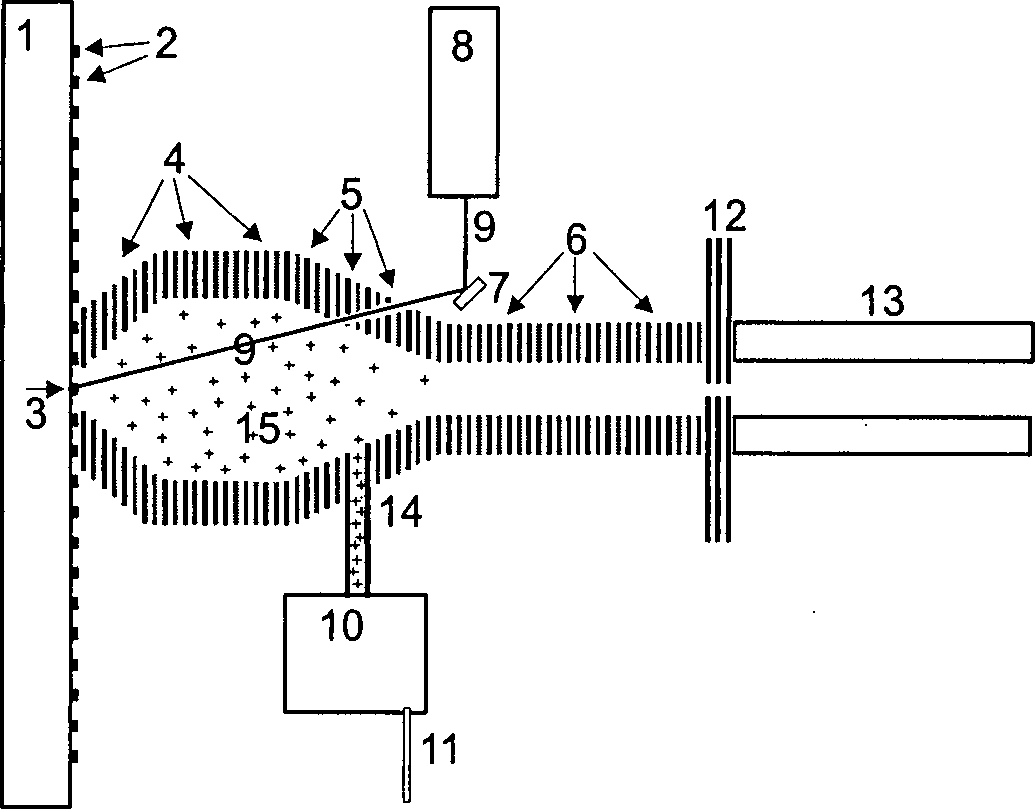
Die
Die
bewegliche Probenträgerplatte
(
Bevorzugte AusführungsformenPreferred embodiments
Einige Ausführungsformen von Verfahren, Ionenquellen zur Erzeugung von Analyt-Ionen aus desorbierten Analytmolekülen und zugehörigen Spektrometern werden in den Ansprüchen 1 bis 19 dargelegt.Some embodiments of processes, ion sources for the production of analyte ions from desorbed analyte and associated spectrometers be in the claims 1 to 19 set forth.
Eine
erste günstige
Ausführungsform
von Verfahren und Gerät,
die mit gepulstem Laserlicht arbeitet, wird hier an Hand der
Eine
Probenträgerplatte
(
MALDI-Proben
bestehen bei normalem UHV-MALDI aus einer Matrixsubstanz mit einem
geringen Anteil von nur etwa einem Hundertstel Prozent an Analytmolekülen. Die
Verdünnung
bewirkt, dass die Analytmoleküle
nicht in Form von Dimeren oder Trimeren desorbiert werden; denn
einmal gebildete Dimere und Trimere werden sich in der Gasphase nicht
mehr trennen. Die Proben (
Ein
kleiner Teil der Probe (
Die
Probe (
Diese Reaktionskammer und ihre Umgebung sind mit einem Umgebungsgas, vorzugsweise Reinststickstoff, gefüllt. Dieses Umgebungsgas kann auf einen günstigen Druck im Bereich von etwa 30 bis 300 Pascal eingestellt werden, wobei sich der optimale Druck durch eine optimale Ionisierung der Analytmoleküle auszeichnet und so auch eingestellt werden kann. Unter Umständen kann sich dieser optimale Druck auch etwas außerhalb dieses angegebenen Druckbereichs liegen und sich im Bereich zwischen etwa 10 bis 1000 Pascal befinden.These Reaction chamber and its environment are with an ambient gas, preferably pure nitrogen, filled. This ambient gas can be at a favorable pressure in the range of be set about 30 to 300 pascals, with the optimum Pressure characterized by an optimal ionization of the analyte molecules and so can be adjusted. Under certain circumstances, this can be optimal Print also something outside this specified pressure range and are in the range between about 10 to 1000 pascals.
Abhängig von
der Größe der Reaktionskammer
(
In
der Reaktant-Ionenquelle (
Es sind jedoch auch ganz andere Arten von Reaktant-Ionen herstellbar, beispielsweise solche, die Molekulargewichte von einigen Hundert atomaren Masseneinheiten besitzen und trotzdem Peptide und Proteine gut ionisieren. Dazu eignen sich beispielsweise teilfluorierte Alkane; es gibt jedoch viele Substanzgruppen, die hier eingesetzt werden können. Die unverbrauchten Reaktant-Ionen dieser schweren Art können nach der Ionisierung der Analyt-Ionen mit diesen zusammen weitergeleitet werden, beispielsweise für eine spätere Nachionisierung der Analyt-Ionen mit einem oder mehreren weiteren Protonen.It However, quite different types of reactant ions can be produced, for example, those having molecular weights of a few hundred have atomic mass units and still have peptides and proteins ionize well. For this purpose, for example, partially fluorinated alkanes; However, there are many groups of substances that are used here can. The unreacted reactant ions of this heavy type can after the ionization of the analyte ions forwarded together with these be, for example a later one Post-ionization of the analyte ions with one or more other protons.
Trotz
relativ schneller Vermischung wird das Umgebungsgas zum Teil einschließlich der
Reaktant-Ionen von der Verdampfungswolke (
Bei einer geschlossenen Reaktionskammer verlaufen die Prozesse im Wesentlichen ähnlich. Zwar kann hier die Desorptionswolke nicht durch die Zwischenräume der Ringblenden entweichen, die nicht ionisierten Analytmoleküle können aber, wenn sie bis zu den Wänden diffundieren, an den Wänden der Reaktionskammer kondensieren, wodurch ebenfalls ein Entzug der Analytmoleküle erzeugt wird.at In a closed reaction chamber, the processes are essentially similar. Though Here, the desorption cloud can not pass through the interstices of the Ring diaphragms escape, but the non-ionized analyte molecules can, when she reaches the walls diffuse, on the walls of the Condense reaction chamber, which also produces a withdrawal of the analyte molecules becomes.
Die Ausbeute an Analyt-Ionen kann bei guter Formung der Reaktionskammer und bei optimalem Druck des Umgebungsgases durchaus 10 Prozent der freien Analytmoleküle und mehr betragen. Bei Verwendung einer Matrixsubstanz, die keine geschmolzenen Spritzer oder Absprengsel bildet, kann so eine sehr hohe Ausbeute an Analyt-Ionen erhalten werden. Geschmolzene Spritzer oder auch feste, abgesprengte Explosionsbrocken können beträchtliche Mengen an Analytmolekülen einsperren und aus der Probe entfernen, so dass diese Analytmoleküle einer Ionisierung entzogen werden.The Yield of analyte ions can, with good formation of the reaction chamber and at optimum pressure of the ambient gas quite 10 percent of free analyte molecules and more. When using a matrix substance that no Forms molten splash or blast off, so can a lot high yield of analyte ions can be obtained. Molten splashes or solid, blasted explosive lumps can be considerable amounts at analyte molecules lock in and remove from the sample so that these analyte molecules ionize be withdrawn.
Dieses
Ausfiltern der leichten Reaktant-Ionen kann besonders erfolgreich
im quadrupolaren Teil (
Ein
solcher quadrupolarer Blendenstapel ist in
Aus den Zeitdauern für die einzelnen Phasen innerhalb eines Pulszyklus ergibt sich auch die maximale Pulsfrequenz für diesen gepulsten Desorptionsbetrieb. Da die Ausdehnung der Desorptionswolke mit der Reaktion der Analytmoleküle mit den Reaktant-Ionen etwa 50 Mikrosekunden dauert, und das Austreiben der gebildeten Analyt-Ionen ebenfalls etwa 50 Mikrosekunden in Anspruch nimmt, beträgt die maximale Pulsfrequenz etwa 10 Kilohertz. Hier wurde noch nicht berücksichtigt, dass die Reaktionskammer wieder mit Reaktant-Ionen befüllt werden muss. Dieser Befüllungsvorgang kann bei sehr guter Reaktant-Ionenquelle und geringer Befüllung sehr kurz sein. Für eine gute Ausbeute an Analyt-Ionen ist es jedoch günstiger, sehr viele Reaktant-Ionen einzufüllen, was dann eher 100 Mikrosekunden und mehr in Anspruch nehmen wird. Die maximale Pulsfrequenz beträgt dann etwa 5 Kilohertz. Für UHV-MALDI werden Frequenzen zwischen 20 Hertz und etwa 2 Kilohertz angewandt.Out the durations for The individual phases within a pulse cycle also arise the maximum pulse rate for this pulsed desorption operation. Since the expansion of the desorption cloud with the reaction of the analyte molecules with the reactant ions takes about 50 microseconds, and the expulsion The analyte ions formed also take about 50 microseconds takes, is the maximum pulse rate about 10 kilohertz. Here was not considered, that the reaction chamber must be refilled with reactant ions. This filling process can be very short with very good reactant ion source and low filling be. For a good yield of analyte ions, however, is more favorable fill in a lot of reactant ions which will take more than 100 microseconds and more. The maximum pulse rate is then about 5 kilohertz. For UHV-MALDI Frequencies between 20 hertz and about 2 kilohertz applied.
Das
Ionenleitsystem (
Eine
andere günstige
Ausführungsform,
die aber ebenfalls mit gepulstem Laserlicht arbeitet, besitzt eine
Reaktionskammer, die nicht allseits von einem Pseudopotential umgeben
ist, wie in
Für die Präparation
der Proben (
Da
es in dieser Erfindung kaum eine Rolle spielt, ob die Laserdesorption
bereits Analyt-Ionen liefert oder nicht, können hier für die Laserdesorption auch
Matrixsubstanzen verwendet werden, die nicht protonieren. Besonders
günstig
können
solche Matrixsubstanzen sein, die sich bei der Desorption zersetzen
und gasförmige
Moleküle
der Art CO2, H2O und
N2 bilden, wie das bereits in
Eine
zweite günstige
Ausführungsform
des Verfahrens und Geräts
geht nicht von einer gepulsten Desorption der Analytmoleküle aus,
sondern von einer kontinuierlichen, wie in
Diese
Dioden sind geeignet, in ihrem Fokus, der dabei vorzugsweise sehr
schnell über
den Probenträger
(
Da es nicht unbedingt auf die Wellenlänge des desorbierenden Lichtes ankommt, kann auch eine Licht emittierende Diode (LED) verwendet werden. Diese können Licht verschiedener einzelner Wellenlängen, aber auch gemischter Wellenlängen aussenden. Das Licht kann mit Linsen kurzer Brennweiten ebenfalls gut gebündelt werden.There it does not necessarily reflect the wavelength of the desorbing light arrives, a light-emitting diode (LED) can also be used become. these can Light of different single wavelengths, but also mixed Send out wavelengths. The light can also be bundled well with short focal length lenses.
Unter kontinuierlicher Desorption soll hier auch verstanden werden, wenn eine Laserdiode moduliert mit sehr hoher Modulationsfrequenz eingesetzt wird. Die Modulation kann sinusförmig, aber beispielsweise auch rechteckförmig mit einstellbarem Verhältnis der Emissionsintervalle zu den Ruheintervallen sein. Eine Modulationsfrequenz von 20 Kilohertz erzeugt deshalb einen kontinuierlichen Strom an desorbierten Analytmolekülen, weil die einzelnen Verdampfungswolken kontinuierlich ineinander laufen. Außerdem weiß man von Untersuchungen an UHV-MALDI, dass nach dem Laserschuss eine Zeit lang (durchaus viele Mikrosekunden lang) noch eine Verdampfung stattfindet, allerdings dann praktisch ohne Ionen bildung. Besonders günstig sind hier Modulationsfrequenzen der Laserdioden von hundert Kilohertz bis zehn Megahertz, zumal wenn eine zersetzliche Matrix verwendet wird.Under continuous desorption should also be understood here if a laser diode modulated used with very high modulation frequency becomes. The modulation can be sinusoidal, but for example also rectangular with adjustable ratio of Emission intervals to the rest intervals. A modulation frequency of 20 kilohertz therefore generates a continuous stream desorbed analyte molecules, because the individual evaporation clouds continuously into each other to run. Furthermore you know from investigations on UHV-MALDI that after the laser shot a For a long time (quite a few microseconds long) another evaporation takes place, but then virtually without ion formation. Especially Cheap here are modulation frequencies of the laser diodes of one hundred kilohertz to ten megahertz, especially when using a decomposable matrix becomes.
Die Desorption der Analytmoleküle durch diesen rasch wandernden Laserdiodenfokus gelingt besonders gut, wenn die Analytmoleküle nackt auf einem geeigneten Probenträger adsorbiert sind. Sie brauchen daher nicht unbedingt einen Einschluss in eine Matrixsubstanz.The Desorption of the analyte molecules This fast-moving laser diode focus is particularly successful good if the analyte molecules are adsorbed naked on a suitable sample carrier. You need therefore not necessarily an inclusion in a matrix substance.
Eine mit Matrixsubstanz besonders günstige Aufbereitung der Proben für diese kontinuierliche Desorption besteht darin, die Analytmoleküle auf einer sehr dünnen Schicht von Sprengstoff oder anders zersetzlichem Material zu adsorbieren. Sehr geeignet ist beispielsweise eine nur einen Mikrometer dünne Schicht aus Cellulosedinitrat, die auf den Probe-Orten für die spätere Aufnahme der Analytmoleküle als dünner Lackfilm aufgebracht wird. Cellulosedinitrat bildet in Azeton gelöst einen sehr gut verarbeitbaren Lack. Ein solcher Lack mit relativ niedrig nitrierter Cellulose ist als „Bootslack" im Handel, allerdings nicht in hoher Reinheit. Diese Dünnschicht kann sehr gut mit Peptiden oder Proteinen beladen werden, da die Lackschicht diesen Substanzen gegenüber außerordentlich affin ist. Ein Quadratmillimeter Lack kann etwa ein Femtomol an Analytsubstanzen aufnehmen. Die für die Proben vorgesehenen Lackflecken können etwa ein Quadratmillimeter, aber durchaus auch 10 oder 50 Quadratmillimeter groß sein. Bei 7 × 7 Millimeter großen Flecken lassen sich durchaus 96 Proben auf einer Probenträgerplatte in der Größe einer Mikrotiterplatte unterbringen; bei 3 × 3 Millimeter großen Flecken können 384 Proben untergebracht werden.A especially favorable preparation with matrix substance the samples for This continuous desorption consists of placing the analyte molecules on a very thin Layer of explosive or other decomposable material to adsorb. For example, a layer only one micron thick is very suitable from cellulose nitrate, on the sample sites for later inclusion of the analyte molecules as a thin paint film is applied. Cellulose dinitrate forms dissolved in acetone very good workable paint. Such a paint with relatively low nitrated cellulose is commercially available as a "boat paint", however not in high purity. This thin film can be very well loaded with peptides or proteins, as the paint layer towards these substances extraordinarily is affine. A square millimeter of paint may be about a femtomol Absorb analyte substances. The paint stains intended for the samples can about one square millimeter, but also be 10 or 50 square millimeters in size. At 7 × 7 Millimeters in size Stains can be quite 96 samples on a sample plate in size one Accommodate microtiter plate; at 3 × 3 millimeter spots can 384 samples are housed.
Die
Dünnschicht
aus Sprengstoff zersetzt sich kontinuierlich im Fokus der Laserdiode,
wobei auch die adsorbierten Analytmoleküle in das Umgebungsgas geblasen
werden. Hier werden sie durch die kontinuierlich oder getaktet zugeführten Reaktant-Ionen
protoniert. Der Sprengstoffzersetzt sich zu Wasser, Kohlendioxid
und Stickstoff, bildet also keine mittelschwere Moleküle, wie
das herkömmliche
Matrixmaterialien tun. Es bilden sich daher keine störenden Untergrund-Ionen,
einer der Nachteile von UHV-MALDI. Die Analyt-Ionen werden dann
vorzugsweise kontinuierlich durch elektrische Gleichspannungspotentiale
in den Ionentrichter (
Statt einer Dünnschicht aus Sprengstoff kann auch hier wieder eine dünne Schicht aus offenporigen Sprengstoff-Schaum verwendet werden, um eine größere Oberfläche für die Adsorption der Analytmoleküle zu erhalten. Der offenporige Schaum kann beispielsweise durch rasches Vakuum-Trocknen von wässrig aufgequollenen Lackflecken erhalten werden.Instead of a thin film From explosives can again open a thin layer of porous Explosive foam can be used to obtain a larger surface for the adsorption of the analyte molecules. The open-cell foam, for example, by rapid vacuum drying from watery swollen paint stains are obtained.
Für dieses
Verfahren der kontinuierlichen Desorption können die Reaktant-Ionen aus
der Reaktant-Ionenquelle durch ein schlankes Ionenleitsystem (
Es wurde bei dieser Schilderung des erfindungsgemäßen Verfahren manchmal von einer Protonierung der Analytmoleküle angesprochen, die naturgemäß zu positiven Analyt-Ionen führt. In ähnlicher Weise können die Analytmoleküle aber auch durch Reaktionen mit entsprechenden negativen Reaktant-Ionen zu negativ geladenen Analyt-Ionen verwandelt werden. Dazu sind Deprotonierungs-Reaktionen oder auch Elektronenübertragungs-Reaktionen notwendig. Es soll also keinesfalls die Reaktion zu negativ geladenen Analyt-Ionen ausgeschlossen werden; sie sollen vielmehr bei der Erfindung ausdrücklich eingeschlossen sein.It was in this description of the method of the invention sometimes from a protonation of the analyte molecules addressed, which are naturally too positive Analyte ions leads. In similar Way you can the analyte molecules but also by reactions with corresponding negative reactant ions be transformed into negatively charged analyte ions. These are deprotonation reactions or else electron transfer reactions necessary. It should not be the reaction to negatively charged analyte ions be excluded; Rather, they are expressly included in the invention be.
Die Erfindung findet ihre Anwendung für Ionenquellen in Massenspektrometern verschiedener Art, aber auch für andere Arten von Spektrometern, beispielsweise Ionenmobilitätsspektrometer. Besonders interessant ist beispielsweise eine Anwendung als höchstempfindliche Ionenquelle in einem Tandem-Massenspektrometer, das als Analysator einen Flugzeitmassenanalysator mit orthogonalem Ioneneinschuss (OTOF) enthält. Diese Art von Massenanalysator hat höchste Empfindlichkeit, großen dynamischen Messbereich, und eine hervorragende Massengenauigkeit. Als Fragmentierungs-Einheit kann sowohl eine Stoßzelle wie auch eine beliebige andere Fragmentierungsstufe verwendet werden. Da aber die Fragmentierung von Biopolymeren am besten arbeitet, wenn man von doppelt geladenen Ionen ausgeht, kann eine Einrichtung zur Protonierung der hier erzeugten einfach geladenen Ionen zwischengeschaltet werden.The The invention finds application for ion sources in mass spectrometers different kind, but also for other types of spectrometers, for example ion mobility spectrometers. For example, an application as highly sensitive is particularly interesting Ion source in a tandem mass spectrometer as an analyzer a time-of-flight mass analyzer with orthogonal ion injection (OTOF) contains. This type of mass analyzer has highest sensitivity, great dynamic Measuring range, and excellent mass accuracy. As a fragmentation unit can both a collision cell as well as any other fragmentation level. But because the fragmentation of biopolymers works best, if one starts from doubly charged ions, a device can be used for protonation of the simply charged ions generated here interposed become.
Dieses Beispiel ist aber nur eines von vielen. Es ließen sich hier weitere spektrometrische Verwendungen aufzählen. Dem Fachmann ist es mit Kenntnis dieser Erfindung möglich, weitere nahe liegende Ausführungsformen und Anwendungen zu schaffen, die aber immer dem prinzipiellen Erfindungsgedanken und damit dem Schutzumfang unterliegen sollen.This But example is only one of many. It could be here more spectrometric List uses. It is possible for a person skilled in the art with knowledge of this invention to further obvious embodiments and to create applications, but always the fundamental idea of the invention and should therefore be subject to the scope of protection.
Claims (18)
Priority Applications (4)
| Application Number | Priority Date | Filing Date | Title |
|---|---|---|---|
| DE102005044307A DE102005044307B4 (en) | 2005-09-16 | 2005-09-16 | Ionization of desorbed molecules |
| GB0618124A GB2434911B (en) | 2005-09-16 | 2006-09-14 | Ionization of desorbed molecules |
| GB1100920A GB2474172B (en) | 2005-09-16 | 2006-09-14 | Ionization of desorbed molecules |
| US11/522,112 US7504640B2 (en) | 2005-09-16 | 2006-09-15 | Ionization of desorbed molecules |
Applications Claiming Priority (1)
| Application Number | Priority Date | Filing Date | Title |
|---|---|---|---|
| DE102005044307A DE102005044307B4 (en) | 2005-09-16 | 2005-09-16 | Ionization of desorbed molecules |
Publications (2)
| Publication Number | Publication Date |
|---|---|
| DE102005044307A1 DE102005044307A1 (en) | 2007-03-22 |
| DE102005044307B4 true DE102005044307B4 (en) | 2008-04-17 |
Family
ID=37309935
Family Applications (1)
| Application Number | Title | Priority Date | Filing Date |
|---|---|---|---|
| DE102005044307A Expired - Lifetime DE102005044307B4 (en) | 2005-09-16 | 2005-09-16 | Ionization of desorbed molecules |
Country Status (3)
| Country | Link |
|---|---|
| US (1) | US7504640B2 (en) |
| DE (1) | DE102005044307B4 (en) |
| GB (2) | GB2474172B (en) |
Cited By (2)
| Publication number | Priority date | Publication date | Assignee | Title |
|---|---|---|---|---|
| EP2801825A1 (en) | 2013-05-08 | 2014-11-12 | Bruker Daltonik GmbH | Mass spectrometric determination of the resistances of microbes |
| EP2806275A1 (en) | 2013-05-23 | 2014-11-26 | Bruker Daltonik GmbH | Determination of resistance by means of growth measurement using mass spectrometry |
Families Citing this family (19)
| Publication number | Priority date | Publication date | Assignee | Title |
|---|---|---|---|---|
| GB0705730D0 (en) * | 2007-03-26 | 2007-05-02 | Micromass Ltd | Mass spectrometer |
| EP2467868A1 (en) * | 2009-08-17 | 2012-06-27 | Temple University Of The Commonwealth System Of Higher Education | Vaporization device and method for imaging mass spectrometry |
| DE102009037887B4 (en) * | 2009-08-18 | 2012-08-02 | Bruker Daltonik Gmbh | Substance identification by series of ion mobility spectra |
| GB2475742B (en) * | 2009-11-30 | 2014-02-12 | Microsaic Systems Plc | Sample collection and detection system |
| JP5234019B2 (en) * | 2010-01-29 | 2013-07-10 | 株式会社島津製作所 | Mass spectrometer |
| GB2483314B (en) * | 2010-12-07 | 2013-03-06 | Microsaic Systems Plc | Miniature mass spectrometer system |
| US8525106B2 (en) * | 2011-05-09 | 2013-09-03 | Bruker Daltonics, Inc. | Method and apparatus for transmitting ions in a mass spectrometer maintained in a sub-atmospheric pressure regime |
| US8698075B2 (en) * | 2011-05-24 | 2014-04-15 | Battelle Memorial Institute | Orthogonal ion injection apparatus and process |
| GB201111568D0 (en) * | 2011-07-06 | 2011-08-24 | Micromass Ltd | Apparatus and method of mass spectrometry |
| DE102011112649B4 (en) * | 2011-09-06 | 2014-02-27 | Bruker Daltonik Gmbh | Laser spot control in MALDI mass spectrometers |
| US10078068B2 (en) * | 2013-05-18 | 2018-09-18 | Brechtel Manufacturing | Aerosol ionizer |
| WO2015108969A1 (en) * | 2014-01-14 | 2015-07-23 | 908 Devices Inc. | Sample collection in compact mass spectrometry systems |
| DE102014112649A1 (en) * | 2014-09-03 | 2016-03-03 | Up Umweltanalytische Produkte Gmbh | Device of a laser ion mobility spectrometer for the rapid detection of residues on samples |
| CA3035743A1 (en) | 2016-09-02 | 2018-03-08 | Board Of Regents, The University Of Texas System | Collection probe and methods for the use thereof |
| US20180076014A1 (en) * | 2016-09-09 | 2018-03-15 | Science And Engineering Services, Llc | Sub-atmospheric pressure laser ionization source using an ion funnel |
| WO2019104328A1 (en) | 2017-11-27 | 2019-05-31 | Board Of Regents, The University Of Texas System | Minimally invasive collection probe and methods for the use thereof |
| GB201721700D0 (en) | 2017-12-22 | 2018-02-07 | Micromass Ltd | Ion source |
| JP7158642B2 (en) * | 2018-01-16 | 2022-10-24 | 国立大学法人山梨大学 | Mass spectrometer and mass spectrometry system |
| BR112021014553A2 (en) | 2019-01-25 | 2021-10-05 | Board Of Regents, The University Of Texas System | EQUIPMENT AND METHODS FOR CLEANING AND/OR CHANGING MEDICAL DEVICES |
Citations (7)
| Publication number | Priority date | Publication date | Assignee | Title |
|---|---|---|---|---|
| DE19608963A1 (en) * | 1995-03-28 | 1996-10-02 | Bruker Franzen Analytik Gmbh | Ionisation of non-vaporisable analyte molecules at atmospheric pressure by chemical ionisation |
| WO2000077822A2 (en) * | 1999-06-11 | 2000-12-21 | Perseptive Biosystems, Inc. | Method and apparatus for determining molecular weight of labile molecules |
| DE19911801C1 (en) * | 1999-03-17 | 2001-01-11 | Bruker Daltonik Gmbh | Method and device for matrix-assisted laser desorption ionization of substances |
| EP1367632A2 (en) * | 2002-05-30 | 2003-12-03 | Micromass Limited | Mass spectrometer |
| US20050092918A1 (en) * | 2003-10-30 | 2005-05-05 | Battelle Memorial Institute | High performance ion mobility spectrometry using hourglass electrodynamic funnel and internal ion funnel |
| EP1536452A1 (en) * | 2003-10-27 | 2005-06-01 | Rigaku Corporation | Temperature-programmed desorbed gas analyzing apparatus |
| US6903334B1 (en) * | 2003-03-19 | 2005-06-07 | Thermo Finnigan Llc | High throughput ion source for MALDI mass spectrometry |
Family Cites Families (24)
| Publication number | Priority date | Publication date | Assignee | Title |
|---|---|---|---|---|
| US3555272A (en) * | 1968-03-14 | 1971-01-12 | Exxon Research Engineering Co | Process for chemical ionization for intended use in mass spectrometry and the like |
| US4156814A (en) * | 1977-06-24 | 1979-05-29 | University Of Virginia | Apparatus for producing ions of thermally labile or nonvolatile solids |
| US4175234A (en) * | 1977-08-05 | 1979-11-20 | University Of Virginia | Apparatus for producing ions of thermally labile or nonvolatile solids |
| US5015862A (en) * | 1990-01-22 | 1991-05-14 | Oregon Graduate Institute Of Science & Technology | Laser modulation of LMI sources |
| NZ267842A (en) * | 1993-05-28 | 1997-09-22 | Baylor College Medicine | Apparatus for measuring molecular mass (by mass spectrometry) in which the sample is ionised on the sample holder and desorbed therefrom by laser pulses |
| GB2310950A (en) * | 1996-03-08 | 1997-09-10 | Bruker Franzen Analytik Gmbh | Method for the ionization of heavy molecules at atmospheric pressure |
| US6331702B1 (en) * | 1999-01-25 | 2001-12-18 | University Of Manitoba | Spectrometer provided with pulsed ion source and transmission device to damp ion motion and method of use |
| US6707031B1 (en) * | 1999-05-13 | 2004-03-16 | Ciphergen Biosystems, Inc. | Laser optical bench for laser desorption ion sources and method of use thereof |
| AU2002245345A1 (en) * | 2001-01-30 | 2002-08-12 | Board Of Trustees Operating Michigan State University | Control system and apparatus for use with laser excitation or ionization |
| US6777671B2 (en) * | 2001-04-10 | 2004-08-17 | Science & Engineering Services, Inc. | Time-of-flight/ion trap mass spectrometer, a method, and a computer program product to use the same |
| US6946653B2 (en) * | 2001-11-27 | 2005-09-20 | Ciphergen Biosystems, Inc. | Methods and apparatus for improved laser desorption ionization tandem mass spectrometry |
| WO2003052399A2 (en) * | 2001-12-14 | 2003-06-26 | Mds Inc., D.B.A. Mds Sciex | Method of chemical of ionization at reduced pressures |
| AU2003277069A1 (en) * | 2002-09-30 | 2004-04-23 | Ciphergen Biosystems, Inc. | Apparatus and method for expression and capture of biomolecules and complexes on adsorbent surfaces |
| JP3787549B2 (en) * | 2002-10-25 | 2006-06-21 | 株式会社日立ハイテクノロジーズ | Mass spectrometer and mass spectrometry method |
| US6900431B2 (en) * | 2003-03-21 | 2005-05-31 | Predicant Biosciences, Inc. | Multiplexed orthogonal time-of-flight mass spectrometer |
| EP1648595B1 (en) * | 2003-06-06 | 2016-05-04 | Ionwerks | Gold implantation/deposition on biological samples for laser desorption three dimensional depth profiling of tissues |
| US20050112650A1 (en) * | 2003-10-20 | 2005-05-26 | Ciphergen Biosystems, Inc. | Reactive polyurethane-based polymers |
| DE102004002729B4 (en) * | 2004-01-20 | 2008-11-27 | Bruker Daltonik Gmbh | Ionization of desorbed analyte molecules at atmospheric pressure |
| AT500618B1 (en) * | 2004-04-02 | 2006-02-15 | Physikalisches Buero Steinmuel | TARGET FOR MALDI / SELDI-MS |
| DE102004028419B4 (en) * | 2004-06-11 | 2011-06-22 | Bruker Daltonik GmbH, 28359 | Mass spectrometer and reaction cell for ion-ion reactions |
| DE102004051785B4 (en) * | 2004-10-25 | 2008-04-24 | Bruker Daltonik Gmbh | Protein profiles with air MALDI |
| US7385192B2 (en) * | 2005-02-10 | 2008-06-10 | Bruker Daltonik, Gmbh | Laser system for the ionization of a sample by matrix-assisted laser desorption in mass spectrometric analysis |
| US20060183242A1 (en) * | 2005-02-14 | 2006-08-17 | Ciphergen Biosystems, Inc. | Phthalate polymers |
| US20060261267A1 (en) * | 2005-05-20 | 2006-11-23 | Agency For Science, Technology And Research | Composite MALDI matrix material and methods of using it and kits thereof in MALDI |
-
2005
- 2005-09-16 DE DE102005044307A patent/DE102005044307B4/en not_active Expired - Lifetime
-
2006
- 2006-09-14 GB GB1100920A patent/GB2474172B/en active Active
- 2006-09-14 GB GB0618124A patent/GB2434911B/en active Active
- 2006-09-15 US US11/522,112 patent/US7504640B2/en active Active
Patent Citations (7)
| Publication number | Priority date | Publication date | Assignee | Title |
|---|---|---|---|---|
| DE19608963A1 (en) * | 1995-03-28 | 1996-10-02 | Bruker Franzen Analytik Gmbh | Ionisation of non-vaporisable analyte molecules at atmospheric pressure by chemical ionisation |
| DE19911801C1 (en) * | 1999-03-17 | 2001-01-11 | Bruker Daltonik Gmbh | Method and device for matrix-assisted laser desorption ionization of substances |
| WO2000077822A2 (en) * | 1999-06-11 | 2000-12-21 | Perseptive Biosystems, Inc. | Method and apparatus for determining molecular weight of labile molecules |
| EP1367632A2 (en) * | 2002-05-30 | 2003-12-03 | Micromass Limited | Mass spectrometer |
| US6903334B1 (en) * | 2003-03-19 | 2005-06-07 | Thermo Finnigan Llc | High throughput ion source for MALDI mass spectrometry |
| EP1536452A1 (en) * | 2003-10-27 | 2005-06-01 | Rigaku Corporation | Temperature-programmed desorbed gas analyzing apparatus |
| US20050092918A1 (en) * | 2003-10-30 | 2005-05-05 | Battelle Memorial Institute | High performance ion mobility spectrometry using hourglass electrodynamic funnel and internal ion funnel |
Non-Patent Citations (2)
| Title |
|---|
| Krutchinsky, A.N. u.a.: Orthogonal Injection of Matrixassisted Laser Desorption/Ionization Ions into a Time-of-flight Spectrometer Through a Colllisional Damping Interface. In: Rapid Communi- cations in Mass Spectrometry 1998, 12, S. 508-518 |
| Krutchinsky, A.N. u.a.: Orthogonal Injection of Matrixassisted Laser Desorption/Ionization Ions into a Time-of-flight Spectrometer Through a Colllisional Damping Interface. In: Rapid Communications in Mass Spectrometry 1998, 12, S. 508-518 * |
Cited By (2)
| Publication number | Priority date | Publication date | Assignee | Title |
|---|---|---|---|---|
| EP2801825A1 (en) | 2013-05-08 | 2014-11-12 | Bruker Daltonik GmbH | Mass spectrometric determination of the resistances of microbes |
| EP2806275A1 (en) | 2013-05-23 | 2014-11-26 | Bruker Daltonik GmbH | Determination of resistance by means of growth measurement using mass spectrometry |
Also Published As
| Publication number | Publication date |
|---|---|
| US7504640B2 (en) | 2009-03-17 |
| US20090039283A1 (en) | 2009-02-12 |
| DE102005044307A1 (en) | 2007-03-22 |
| GB2474172A (en) | 2011-04-06 |
| GB2434911A (en) | 2007-08-08 |
| GB2434911B (en) | 2011-03-09 |
| GB2474172B (en) | 2011-06-08 |
| GB0618124D0 (en) | 2006-10-25 |
| GB201100920D0 (en) | 2011-03-02 |
Similar Documents
| Publication | Publication Date | Title |
|---|---|---|
| DE102005044307B4 (en) | Ionization of desorbed molecules | |
| DE102007043456B4 (en) | Matrix-assisted laser desorption with high ionization efficiency | |
| DE102018009115B4 (en) | mass spectrometry | |
| EP1200984B1 (en) | Method and device for cluster fragmentation | |
| DE112008003939B4 (en) | Quasi-planar multiply reflecting time-of-flight mass spectrometer | |
| DE10236344B4 (en) | Ionize to atmospheric pressure for mass spectrometric analysis | |
| DE69729176T2 (en) | Process for reducing selected ion currents in spatially limited ion beams | |
| DE19608963C2 (en) | Process for ionizing heavy molecules at atmospheric pressure | |
| DE69718438T2 (en) | METHOD AND DEVICE FOR MALDI ANALYSIS | |
| DE112010003411B4 (en) | ELECTRON BARRIER DISSOCIATION DEVICE AND RELATED METHODS | |
| DE102004039643B4 (en) | Fragmentation of ions by electron-ion reactions in multipolar radiofrequency fields | |
| DE102016124889B4 (en) | Mass spectrometer with laser system for generating photons of different energy | |
| EP0669638A1 (en) | Method and apparatus for generating ions, especially for a mass spectrometer such as a time-of-flight mass spectrometer, from thermally unstable, non-volatile, large molecules | |
| DE102021105327B3 (en) | Desorption ion source with post-desorption ionization in transmission geometry | |
| DE102018009119B4 (en) | mass spectrometer | |
| DE19515271A1 (en) | Methods and devices for the gas-guided transport of ions through pipes | |
| DE19911801C1 (en) | Method and device for matrix-assisted laser desorption ionization of substances | |
| DE102004025841B4 (en) | Method and apparatus for mass spectroscopic analysis of analytes | |
| DE102008023693A1 (en) | 3D ion trap as a fragmentation cell | |
| DE102005041655B4 (en) | Generation of multiply charged ions for tandem mass spectrometry | |
| DE19834070A1 (en) | Ionisation of analytes, particularly biopolymers, by matrix assisted pulsed laser desorption uses ether polyol derivative as liquid matrix substance on carrier plate | |
| DE102009011653B4 (en) | Laser system for MALDI mass spectrometry | |
| EP0738000B1 (en) | Intermediary storage of ions for spectrometric investigations | |
| DE112022003505T5 (en) | ELECTRON IMPACT IONIZATION WITHIN HIGH FREQUENCY CONFINEMENT FIELDS | |
| DE19628093A1 (en) | Method of identifying sample molecules |
Legal Events
| Date | Code | Title | Description |
|---|---|---|---|
| OP8 | Request for examination as to paragraph 44 patent law | ||
| 8364 | No opposition during term of opposition | ||
| R081 | Change of applicant/patentee |
Owner name: BRUKER DALTONICS GMBH & CO. KG, DE Free format text: FORMER OWNER: BRUKER DALTONIK GMBH, 28359 BREMEN, DE |