DE102005016460A1 - Spriocyclic cyclohexane derivatives for the treatment of substance dependence - Google Patents
Spriocyclic cyclohexane derivatives for the treatment of substance dependence Download PDFInfo
- Publication number
- DE102005016460A1 DE102005016460A1 DE102005016460A DE102005016460A DE102005016460A1 DE 102005016460 A1 DE102005016460 A1 DE 102005016460A1 DE 102005016460 A DE102005016460 A DE 102005016460A DE 102005016460 A DE102005016460 A DE 102005016460A DE 102005016460 A1 DE102005016460 A1 DE 102005016460A1
- Authority
- DE
- Germany
- Prior art keywords
- compounds
- alkyl
- compounds according
- group
- unsubstituted
- Prior art date
- Legal status (The legal status is an assumption and is not a legal conclusion. Google has not performed a legal analysis and makes no representation as to the accuracy of the status listed.)
- Ceased
Links
- 0 *C(*C1(CC2)CCC2(*)N(*)*)C(*)c2c1[n]c1c(*)c(*)c(*)c(*)c21 Chemical compound *C(*C1(CC2)CCC2(*)N(*)*)C(*)c2c1[n]c1c(*)c(*)c(*)c(*)c21 0.000 description 1
Classifications
-
- A—HUMAN NECESSITIES
- A61—MEDICAL OR VETERINARY SCIENCE; HYGIENE
- A61K—PREPARATIONS FOR MEDICAL, DENTAL OR TOILETRY PURPOSES
- A61K31/00—Medicinal preparations containing organic active ingredients
- A61K31/33—Heterocyclic compounds
- A61K31/395—Heterocyclic compounds having nitrogen as a ring hetero atom, e.g. guanethidine or rifamycins
- A61K31/40—Heterocyclic compounds having nitrogen as a ring hetero atom, e.g. guanethidine or rifamycins having five-membered rings with one nitrogen as the only ring hetero atom, e.g. sulpiride, succinimide, tolmetin, buflomedil
- A61K31/407—Heterocyclic compounds having nitrogen as a ring hetero atom, e.g. guanethidine or rifamycins having five-membered rings with one nitrogen as the only ring hetero atom, e.g. sulpiride, succinimide, tolmetin, buflomedil condensed with other heterocyclic ring systems, e.g. ketorolac, physostigmine
-
- A—HUMAN NECESSITIES
- A61—MEDICAL OR VETERINARY SCIENCE; HYGIENE
- A61K—PREPARATIONS FOR MEDICAL, DENTAL OR TOILETRY PURPOSES
- A61K31/00—Medicinal preparations containing organic active ingredients
- A61K31/13—Amines
- A61K31/135—Amines having aromatic rings, e.g. ketamine, nortriptyline
- A61K31/137—Arylalkylamines, e.g. amphetamine, epinephrine, salbutamol, ephedrine or methadone
-
- A—HUMAN NECESSITIES
- A61—MEDICAL OR VETERINARY SCIENCE; HYGIENE
- A61K—PREPARATIONS FOR MEDICAL, DENTAL OR TOILETRY PURPOSES
- A61K31/00—Medicinal preparations containing organic active ingredients
- A61K31/33—Heterocyclic compounds
- A61K31/395—Heterocyclic compounds having nitrogen as a ring hetero atom, e.g. guanethidine or rifamycins
- A61K31/435—Heterocyclic compounds having nitrogen as a ring hetero atom, e.g. guanethidine or rifamycins having six-membered rings with one nitrogen as the only ring hetero atom
- A61K31/438—The ring being spiro-condensed with carbocyclic or heterocyclic ring systems
-
- A—HUMAN NECESSITIES
- A61—MEDICAL OR VETERINARY SCIENCE; HYGIENE
- A61K—PREPARATIONS FOR MEDICAL, DENTAL OR TOILETRY PURPOSES
- A61K31/00—Medicinal preparations containing organic active ingredients
- A61K31/33—Heterocyclic compounds
- A61K31/395—Heterocyclic compounds having nitrogen as a ring hetero atom, e.g. guanethidine or rifamycins
- A61K31/435—Heterocyclic compounds having nitrogen as a ring hetero atom, e.g. guanethidine or rifamycins having six-membered rings with one nitrogen as the only ring hetero atom
- A61K31/47—Quinolines; Isoquinolines
- A61K31/485—Morphinan derivatives, e.g. morphine, codeine
-
- A—HUMAN NECESSITIES
- A61—MEDICAL OR VETERINARY SCIENCE; HYGIENE
- A61K—PREPARATIONS FOR MEDICAL, DENTAL OR TOILETRY PURPOSES
- A61K45/00—Medicinal preparations containing active ingredients not provided for in groups A61K31/00 - A61K41/00
- A61K45/06—Mixtures of active ingredients without chemical characterisation, e.g. antiphlogistics and cardiaca
-
- A—HUMAN NECESSITIES
- A61—MEDICAL OR VETERINARY SCIENCE; HYGIENE
- A61P—SPECIFIC THERAPEUTIC ACTIVITY OF CHEMICAL COMPOUNDS OR MEDICINAL PREPARATIONS
- A61P25/00—Drugs for disorders of the nervous system
-
- A—HUMAN NECESSITIES
- A61—MEDICAL OR VETERINARY SCIENCE; HYGIENE
- A61P—SPECIFIC THERAPEUTIC ACTIVITY OF CHEMICAL COMPOUNDS OR MEDICINAL PREPARATIONS
- A61P25/00—Drugs for disorders of the nervous system
- A61P25/30—Drugs for disorders of the nervous system for treating abuse or dependence
-
- A—HUMAN NECESSITIES
- A61—MEDICAL OR VETERINARY SCIENCE; HYGIENE
- A61P—SPECIFIC THERAPEUTIC ACTIVITY OF CHEMICAL COMPOUNDS OR MEDICINAL PREPARATIONS
- A61P25/00—Drugs for disorders of the nervous system
- A61P25/30—Drugs for disorders of the nervous system for treating abuse or dependence
- A61P25/36—Opioid-abuse
Landscapes
- Health & Medical Sciences (AREA)
- Medicinal Chemistry (AREA)
- Veterinary Medicine (AREA)
- Public Health (AREA)
- General Health & Medical Sciences (AREA)
- Animal Behavior & Ethology (AREA)
- Chemical & Material Sciences (AREA)
- Life Sciences & Earth Sciences (AREA)
- Pharmacology & Pharmacy (AREA)
- Epidemiology (AREA)
- Emergency Medicine (AREA)
- Neurology (AREA)
- Nuclear Medicine, Radiotherapy & Molecular Imaging (AREA)
- Organic Chemistry (AREA)
- General Chemical & Material Sciences (AREA)
- Chemical Kinetics & Catalysis (AREA)
- Neurosurgery (AREA)
- Biomedical Technology (AREA)
- Bioinformatics & Cheminformatics (AREA)
- Engineering & Computer Science (AREA)
- Addiction (AREA)
- Psychiatry (AREA)
- Pharmaceuticals Containing Other Organic And Inorganic Compounds (AREA)
- Nitrogen Condensed Heterocyclic Rings (AREA)
Abstract
Die Erfindung betrifft die Verwendung spirocyclischer Cyclohexanderivate zur Herstellung eines Arzneimittels zur Behandlung von Substanzabhängigkeit.The invention relates to the use of spirocyclic cyclohexane derivatives for the preparation of a medicament for the treatment of substance dependence.
Description
Die Opiatabhängigkeit stellt ein großes medizinisches und soziales Problem dar, das einer intensiven medizinischen Betreuung bedarf. Als Standardtherapie gilt die Substitution mit einem speziell geeigneten μ-Opioid.The opiate addiction makes a big one medical and social problem, that of an intensive medical Care needs. The standard therapy is substitution with a specially adapted μ-opioid.
Klinisch etablierte Substanzen für die Substitutionstherapie der Opiatabhängigkeit sind:
- – Methadon (Razemat, seltener Levomethadon)
- – LAAM (α-Acetylmethadol)
- – Buprenorphin
- - methadone (racemate, more rarely levomethadone)
- - LAAM (α-Acetylmethadol)
- - buprenorphine
Alle drei Substanzen werden mit der gleichen Zielsetzung angewendet:
- – Befriedigung des Opiat"hungers" jedoch ohne "Kick" und bei deutlich verringerter Euphorie
- – Vermeidung von körperlichen Entzugssymptomen
- – Resozialisierung der Patienten (geregelte Lebensführung, Arbeitsfähigkeit, Ausstieg aus dem Fixermilieu)
- – Langfristige Reduktion der Opiatdosis bis zur vollständigen Abstinenz
- - Satisfaction of the opiate "hunger" but without "kick" and with significantly reduced euphoria
- - Avoidance of physical withdrawal symptoms
- - Resocialisation of patients (regular lifestyle, ability to work, exit from the fixer milieu)
- - Long-term reduction of opiate dose until complete abstinence
Damit diese Wirkungen erreicht werden können sind folgende Eigenschaften bei den Substitutions-Therapeutika erforderlich:
- – Orale (ev. auch cutane) Wirkverfügbarkeit
- – Lange Wirkdauer (1–3 Tage, ev. auch länger)
- – Hohe Wirkstärke (Potency)
- – Geringe Euphorisierung
- – Wenig "Kick"
- – Geringe Entzugssymptomatik
- – Gute Langzeitverträglichkeit (wenig Obstipation, cardiovasculäre Verträglichkeit)
- - Oral (possibly also cutaneous) efficacy
- - Long duration of action (1-3 days, possibly longer)
- - High potency (Potency)
- - Low euphoria
- - Little "kick"
- - Low withdrawal symptoms
- - Good long-term tolerance (little constipation, cardiovascular compatibility)
Diese Eigenschaften sind bei den bisherigen Standardtherapeutika nur teilweise gegeben, so dass es zu Unzulänglichkeiten beim therapeutischen Einsatz kommt.These Properties are only partial in the previous standard therapeutics given, causing it to shortcomings comes in therapeutic use.
Die wesentlichen Probleme liegen bei den derzeitigen Standardtherapeutika im folgenden: Methadon besitzt ein hohes Missbrauchspotential. Aufgrund der mäßigen Wirkdauer ist eine tägliche Gabe erforderlich. Darüber hinaus tritt als Nebenwirkung Obstipation auf.The Significant problems lie with the current standard therapeutics in the following: Methadone has a high abuse potential. by virtue of the moderate duration of action is a daily one Gift required. About that In addition, constipation occurs as a side effect.
LAAM besitzt den Nachteil einer hohen Kardiotoxizität und kann Torsade de Pointes-Arrhythmien auslösen.LAAM has the disadvantage of high cardiotoxicity and can trigger Torsade de Pointes arrhythmias.
Buprenorphin weist eine hohe Toxizität in Kombination mit Benzodiazepinen auf.buprenorphine has a high toxicity in combination with benzodiazepines.
In WO 0443967 und PCT/EP2004/014539 werden Verbindungen beschrieben, die insbesondere zur Behandlung von Schmerz, aber auch unter anderem zur Behandlung von Entzugserscheinungen sowie zur Reduzierung des Suchtpotentials von Opioiden geeignet sind. Es konnte gezeigt werden, dass ausgewählte Verbindungen aus dieser Patentanmeldung in besonderer Weise als Substitutionstherapeutika geeignet sind.In WO 0443967 and PCT / EP2004 / 014539 describe compounds which especially for the treatment of pain, but also among others for the treatment of withdrawal symptoms as well as for the reduction of the Addictive potential of opioids are suitable. It could be shown, that selected connections from this patent application in a special way as Substitutionstherapeutika are suitable.
Aufgabe der vorliegenden Erfindung war es, Verbindungen zur Verfügung zu stellen, die als Substitutionstherapeutika bei Opiat-Abhängigkeit eingesetzt werden können und Vorteile gegenüber der Standardtherapie aufweisen.task The present invention was to provide compounds pose as substitution therapies for opiate dependence can be used and advantages over have the standard therapy.
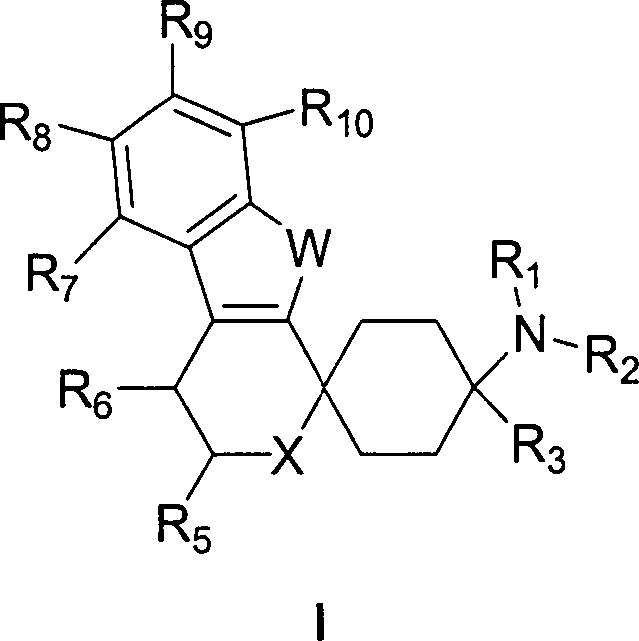
Gegenstand
der Erfindung sind daher Verbindungen aus der Gruppe der spirocyclischen
Cyclohexan-Derivate der allgemeinen Formel I 
R1 und
R2 unabhängig
voneinander für
H oder CH3 stehen oder zusammen mit (CH2)4 oder (CH2)5 einen Ring bilden;
wobei R1 und R2 nicht
gleichzeitig H bedeuten;
R3 für Phenyl,
Benzyl oder Heteroaryl jeweils unsubstituiert oder einfach oder
mehrfach mit F, Cl, OH, CN oder OCH3 substituiert,
steht;
W für
NR4, O oder S steht
und
R4 für
H; C1-5-Alkyl, Phenyl; über eine C1-3-Alkyl-Gruppe
gebundenes Phenyl, COR12; SO2R12 steht,
wobei R12 H;
C1-7-Alkyl, verzweigt oder unverzweigt,
gesättigt
oder ungesättigt,
unsubstituiert oder einfach oder mehrfach mit OH, F oder COOC1-4-Alkyl substituiert; C4-6-Cycloalkyl;
Aryl-, oder Heteroaryl, unsubstituiert oder einfach oder mehrfach
mit F, Cl, Br, CF3, OCH3,
C1-4-Alkyl, verzweigt oder unverzweigt,
substituiert; oder über gesättigtes
oder ungesättigtes
C1-3-Alkyl gebundenes Phenyl oder Heteroaryl,
unsubstituiert oder einfach oder mehrfach mit F, Cl, Br, CF3, OCH3, C1-4-Alkyl, verzweigt oder unverzweigt, substituiert;
oder über
gesättigtes oder
ungesättigtes
C1-3-Alkyl gebundenes C5-6-Cycloalkyl; OR13; NR14R15 bedeutet;
R5 für H; COOR13, CONR13, OR13; C1-5-Alkyl, gesättigt oder
ungesättigt,
verzweigt oder unverzweigt, unsubstituiert oder einfach oder mehrfach
mit OH, F, CF3 oder CN substituiert, steht;
R6 für
H steht;
oder R5 und R6 gemeinsam
(CH2)n mit n = 2,
3, 4, 5 oder 6 bedeuten, wobei einzelne Wasserstoffatome auch durch
F, Cl, NO2, CF3,
OR13, CN oder C1-5-Alkyl ersetzt sein
können;
R7, R8, R9 und
R10 unabhängig voneinander für H, F,
Cl, Br, NO2, CF3,
OH, OCH3, CN, COOR13, NR14R15; C1-5-Alkyl, Heteroaryl,
unsubstituiert oder einfach oder mehrfach mit Benzyl, CH3, Cl, F, OCH3 oder
OH substituiert, stehen;
wobei R13 H
oder C1-5-Alkyl bedeutet;
R14 und R15 unabhängig voneinander
H oder C1-5-Alkyl bedeuten;
X für O, S,
SO, SO2 oder NR17 steht;
R17 für
H; C1-5-Alkyl, gesättigt oder ungesättigt, verzweigt
oder unverzweigt; COR12 oder SO2R12 steht,
in Form ihrer reinen Diastereomeren,
ihrer Racemate, ihrer reinen Enantiomeren, oder in Form von Mischungen
der Stereoisomeren in einem beliebigen Mischungsverhältnis;
als
Basen oder in Form ihrer Salze, insbesondere der physiologisch verträglichen
Salze oder Salze physiologisch verträglicher Säuren oder Kationen; oder in
Form ihrer Solvate,
wobei das Verhältnis der ORL1-Rezeptor-Affinität zur μ-Opioidrezeptor-Affnität 0,3 oder
größer ist,
zur Herstellung eines Arzneimittels zur Behandlung von Substanzabhängigkeit.The invention therefore relates to compounds from the group of the spirocyclic cyclohexane derivatives of the general formula I.
R 1 and R 2 independently represent H or CH 3 or form a ring together with (CH 2 ) 4 or (CH 2 ) 5 ; wherein R 1 and R 2 are not H at the same time;
R 3 represents phenyl, benzyl or heteroaryl in each case unsubstituted or monosubstituted or polysubstituted by F, Cl, OH, CN or OCH 3 ;
W stands for NR 4 , O or S.
and
R 4 for H; C 1-5 alkyl, phenyl; phenyl bound via a C 1-3 -alkyl group, COR 12 ; SO 2 R 12 is
where R 12 is H; C 1-7 -alkyl, branched or unbranched, saturated or unsaturated, unsubstituted or mono- or poly-substituted by OH, F or COOC 1-4 -alkyl; C 4-6 cycloalkyl; Aryl or heteroaryl, unsubstituted or mono- or polysubstituted by F, Cl, Br, CF 3 , OCH 3 , C 1-4 -alkyl, branched or unbranched, substituted; or phenyl or heteroaryl bonded via saturated or unsaturated C 1-3 -alkyl, unsubstituted or monosubstituted or polysubstituted by F, Cl, Br, CF 3 , OCH 3 , C 1-4 -alkyl, branched or unbranched; or C 5-6 -cycloalkyl bonded via saturated or unsaturated C 1-3 -alkyl; OR 13 ; NR 14 R 15 means;
R 5 is H; COOR 13 , CONR 13 , OR 13 ; C 1-5 alkyl, saturated or unsaturated, branched or unbranched, unsubstituted or monosubstituted or polysubstituted by OH, F, CF 3 or CN;
R 6 is H;
or R 5 and R 6 together are (CH 2 ) n with n = 2, 3, 4, 5 or 6, wherein individual hydrogen atoms are also represented by F, Cl, NO 2 , CF 3 , OR 13 , CN or C 1-5 Alkyl may be replaced;
R 7 , R 8 , R 9 and R 10 are independently H, F, Cl, Br, NO 2 , CF 3 , OH, OCH 3, CN, COOR 13 , NR 14 R 15 ; C 1-5 alkyl, heteroaryl, unsubstituted or substituted singly or multiply with benzyl, CH 3 , Cl, F, OCH 3 or OH;
wherein R 13 is H or C 1-5 alkyl;
R 14 and R 15 are independently H or C 1-5 alkyl;
X is O, S, SO, SO 2 or NR 17 ;
R 17 is H; C 1-5 alkyl, saturated or unsaturated, branched or unbranched; COR 12 or SO 2 R 12 ,
in the form of their pure diastereomers, their racemates, their pure enantiomers, or in the form of mixtures of the stereoisomers in any mixing ratio;
as bases or in the form of their salts, in particular the physiologically acceptable salts or salts of physiologically acceptable acids or cations; or in the form of their solvates,
wherein the ratio of ORL1 receptor affinity to μ-opioid receptor affinity is 0.3 or greater for the preparation of a medicament for the treatment of substance dependence.
Unter dem Begriff Salz ist jegliche Form des erfindungsgemäßen Wirkstoffes zu verstehen, in dem dieser eine ionische Form annimmt bzw. geladen ist und mit einem Gegenion (einem Kation oder Anion) gekoppelt ist bzw. sich in Lösung befindet. Darunter sind auch Komplexe des Wirkstoffes mit anderen Molekülen und Ionen zu verstehen, insbesondere Komplexe, die über ionische Wechselwirkungen komplexiert sind. Insbesondere versteht man darunter (und dies ist auch eine bevorzugte Ausführungsform dieser Erfindung) physiologisch verträgliche Salze, insbesondere physiologisch verträgliche Salze mit Kationen oder Basen und physiologisch verträgliche Salze mit Anionen oder Säuren oder auch ein mit einer physiologisch verträglichen Säure oder einem physiologisch verträglichen Kation gebildetes Salz.Under The term salt is any form of the active ingredient according to the invention to understand in which this assumes an ionic form or charged is and is coupled to a counterion (a cation or anion) or in solution located. These include complexes of the active substance with others molecules and to understand ions, especially complexes that are ionic Interactions are complexed. In particular one understands under it (and this is also a preferred embodiment of this invention) physiologically compatible Salts, in particular physiologically acceptable salts with cations or Bases and physiologically tolerable Salts with anions or acids or else one with a physiologically acceptable acid or a physiological one acceptable Cation formed salt.
Unter dem Begriff des mit einer physiologisch verträglichen Säure gebildeten Salzes versteht man im Sinne dieser Erfindung Salze des jeweiligen Wirkstoffes mit anorganischen bzw. organischen Säuren, die physiologisch – insbesondere bei Anwendung im Menschen und/oder Säugetier – verträglich sind. Besonders bevorzugt ist das Hydrochlorid und das Citrat. Beispiele für physiologisch verträgliche Säuren sind: Salzsäure, Bromwasserstoffsäure, Schwefelsäure, Methansulfonsäure, Ameisensäure, Essigsäure, Oxasäure, Bernsteinsäure, Weinsäure, Mandelsäure, Fumarsäure, Milchsäure, Zitronensäure, Glutaminsäure, 1,1-Dioxo-1,2-dihydro1λ6-benzo[d]isothiazol-3-on (Saccharinsäure), Monomethylsebacinsäure, 5-Oxo-prolin, Hexan-1-sulfonsäure, Nicotinsäure, 2-, 3- oder 4-Aminobenzoesäure, 2,4,6-Trimethyl-benzoesäure, α-Liponsäure, Acetylglycin, Hippursäure und/oder Asparaginsäure.For the purposes of the present invention, the term salt formed with a physiologically acceptable acid means salts of the respective active ingredient with inorganic or organic acids which are physiologically compatible, in particular when used in humans and / or mammals. Particularly preferred is the hydrochloride and the citrate. Examples of physiologically compatible acids are: hydrochloric acid, hydrobromic acid, sulfuric acid, methanesulfonic acid, formic acid, acetic acid, oxalic acid, amber acid, tartaric acid, mandelic acid, fumaric acid, lactic acid, citric acid, glutamic acid, 1,1-dioxo-1,2-dihydro1λ 6 -benzo [d] isothiazol-3-one (saccharic acid), monomethyl sebacic acid, 5-oxo-proline, hexane 1-sulfonic acid, nicotinic acid, 2-, 3- or 4-aminobenzoic acid, 2,4,6-trimethylbenzoic acid, α-lipoic acid, acetylglycine, hippuric acid and / or aspartic acid.
Die Ausdrücke „C1-3-Alkyl" „C1-5-Alkyl", „C1-7-Alkyl" und „C1-4-Alkyl" umfassen im Sinne dieser Erfindung acyclische gesättigte oder ungesättigte Kohlenwasserstoffreste, die verzweigt- oder geradkettig sein können, mit 1, 2 oder 3 C-Atomen bzw. 1, 2, 3, 4 oder 5 C-Atomen bzw 1, 2, 3, 4, 5, 6 oder 7 C-Atomen bzw. 1, 2, 3 oder 4 C-Atomen. Ungesättigte Verbindungen weisen mindestens eine C-C-Doppelbindung oder mindestens eine C-C-Dreifachbindung auf. Vorteilhaft ist Alkyl aus der Gruppe ausgewählt, die Methyl, Ethyl, n-Propyl, 2-Propyl, n-Butyl, iso-Butyl, sec.-Butyl, tert.-Butyl, n-Pentyl, iso-Pentyl, neo-Pentyl, n-Hexyl, 2-Hexyl; Ethylenyl (Vinyl), Ethinyl, Propenyl (-CH2CH=CH2, -CH=CH-CH3, -C(=CH2)-CH3), Propinyl (-CH-C=CH, -C≡C-CH3), 1,1-Dimethylethyl, 1,1-Dimethylpropyl, Butenyl, Butinyl, Pentenyl und Pentinyl umfasst.The terms "C 1-3 -alkyl", "C 1-5 -alkyl", "C 1-7 -alkyl" and "C 1-4 -alkyl" in the context of this invention include acyclic saturated or unsaturated hydrocarbon radicals which are branched or straight-chain, with 1, 2 or 3 C atoms or 1, 2, 3, 4 or 5 C atoms or 1, 2, 3, 4, 5, 6 or 7 C atoms or 1, 2 , 3 or 4 carbon atoms. Unsaturated compounds have at least one CC double bond or at least one CC triple bond. Advantageously, alkyl is selected from the group consisting of methyl, ethyl, n-propyl, 2-propyl, n-butyl, iso-butyl, sec-butyl, tert-butyl, n-pentyl, iso-pentyl, neo-pentyl , n-hexyl, 2-hexyl; Ethyleneyl (vinyl), ethynyl, propenyl (-CH 2 CH = CH 2 , -CH = CH-CH 3 , -C (= CH 2 ) -CH 3 ), propynyl (-CH-C = CH, -C≡C -CH 3 ), 1,1-dimethylethyl, 1,1-dimethylpropyl, butenyl, butynyl, pentenyl and pentynyl.
Der Ausdruck "C5-6-Cycloalkyl" bedeutet für die Zwecke dieser Erfindung cyclische Kohlenwasserstoffe mit 5 oder 6 Kohlenstoffatomen, wobei die Kohlenwasserstoffe gesättigt oder ungesättigt (aber nicht aromatisch) sein können. Vorteilhaft ist C5-6-Cycloalkyl aus der Gruppe ausgewählt, die Cyclopentyl und Cyclohexyl umfasst.The term "C 5-6 cycloalkyl" for the purposes of this invention means cyclic hydrocarbons having 5 or 6 carbon atoms, which hydrocarbons may be saturated or unsaturated (but not aromatic). Advantageously, C 5-6 cycloalkyl is selected from the group comprising cyclopentyl and cyclohexyl.
Der Ausdruck "Heteroaryl" steht für einen 5-, 6- oder 7-gliedrigen cyclischen aromatischen Rest, der mindestens 1, ggf. auch 2, 3, 4 oder 5 Heteroatome, enthält, wobei die Heteroatome gleich oder verschieden sind und der Heterocyclus unsubstituiert oder ein- oder mehrfach substituiert sein kann; im Falle der Substitution am Heterocyclus können die Substituenten gleich oder verschieden sein und in jeder beliebigen und möglichen Position des Heteroaryls sein. Bevorzugte Heteroatome sind Stickstoff, Sauerstoff und Schwefel. Es ist bevorzugt, daß der Heteroaryl-Rest ausgewählt ist aus der Gruppe, die Pyrrolyl, Furyl (Furanyl), Benzofuranyl, Thienyl, Pyrazolyl, Imidazolyl, Thiazolyl, Oxazolyl, Isoxazolyl, Pyridinyl, oder Carbazolyl enthält, wobei die Bindung an die Verbindungen der allgemeinen Struktur I über jedes beliebige und mögliche Ringglied des Heteroaryl-Restes erfolgen kann. Besonders bevorzugt sind Pyridyl und Thienyl. Ebenfalls besonders bevorzugt sind Pyrazolyl und Furyl.Of the Expression "heteroaryl" stands for one 5-, 6- or 7-membered cyclic aromatic radical which is at least 1, optionally also 2, 3, 4 or 5 heteroatoms, wherein the heteroatoms are the same or are different and the heterocycle is unsubstituted or or may be substituted several times; in the case of substitution at the heterocycle the substituents are the same or different and in any and possible Be position of the heteroaryl. Preferred heteroatoms are nitrogen, Oxygen and sulfur. It is preferred that the heteroaryl moiety is selected from the group comprising pyrrolyl, furyl (furanyl), benzofuranyl, thienyl, Pyrazolyl, imidazolyl, thiazolyl, oxazolyl, isoxazolyl, pyridinyl, or carbazolyl, the linkage to the compounds of general structure I over each any and possible Ring member of the heteroaryl radical can take place. Especially preferred are pyridyl and thienyl. Also particularly preferred are pyrazolyl and furyl.
Überaschenderweise haben tierexperimentelle Untersuchungen mit Substanzen aus WO 0443967 und PCT/EP2004/014539 ergeben, dass die Substanzen mit einer besonders hohen ORL-1-Affinität, die nicht mehr als eine Größenordnung niedriger ist als die μ-Opioid-Rezeptor-Affinität, in besonderem Maße für eine Opiatsubstitution geeignet sind und damit das Potential für eine wesentliche Verbesserung der Substitutionstherapie besitzen.Surprisingly, have animal studies with substances from WO 0443967 and PCT / EP2004 / 014539 show that the substances with a particular high ORL-1 affinity, which is not more than an order of magnitude is lower than the μ-opioid receptor affinity, in particular Measures for an opiate substitution are suitable and thus the potential for a significant improvement possess the substitution therapy.
Innerhalb der in WO 0443967 und PCT/EP2004/014539 beschriebenen Spiroverbindungen gibt es Verbindungen mit höherer und niedrigerer ORL-1-Komponente. Im Naloxon-induzierten Entzugsspringen in der Maus konnte gezeigt werden, dass spirocyclische Verbindungen mit einer ORL-1-Komponente, die nicht mehr als einen Faktor 10 schwächer ist als die μ-Komponente, Entzugsspringen unterdrücken. Verbindungen mit einer schwächeren ORL1-Komponente lösen dagegen Entzugsspringen aus. Im Test „Entzugsspringen" werden Mäuse über einen definierten Zeitraum hinweg mehrfach mit der Testsubstanz behandelt. Bei einem μ-Opioid wird innerhalb dieses Zeitraumes eine körperliche Abhängigkeit erreicht. Am Ende der Behandlung wird durch Gabe von Naloxon, einem μ-Antagonisten, die Wirkung des Opioids mit einem Mal aufgehoben. Bei Ausprägung einer körperlichen Abhängigkeit zeigen die Mäuse charakteristische Entzugssymptome, die sich in Form von Sprungbewegungen äußern (Saelens JK, Arch Int Pharmacodyn 190: 213–218, 1971).Within the spiro compounds described in WO 0443967 and PCT / EP2004 / 014539 there are connections with higher ones and lower ORL-1 component. In naloxone-induced withdrawal in the mouse was shown are spiro-cyclic compounds with an ORL-1 component, which is not more than a factor 10 weaker than the μ-component, Suppress withdrawal skipping. Compounds with a weaker Release ORL1 component against withdrawal skipping. In the test "withdrawal jumping" mice are over a treated with the test substance several times over a period of time. When a μ-opioid is within This period is a physical one dependence reached. At the end of treatment, administration of naloxone, a μ-antagonist, the effect of the opioid suddenly abolished. When pronounced physical dependence show the mice characteristic withdrawal symptoms that manifest themselves as jumping movements (Saelens JK, Arch Int Pharmacodyn 190: 213-218, 1971).
Die erfindungsgemäßen Verbindungen besitzen auf Grund der ORL1-Wirkkomponente zusätzliche Eigenschaften, die die Standardsubstanzen wie Methadon, LAAM oder Buprenorphin nicht besitzen und die zur Therapieverbesserung führen. Im Entzugsspringen an der Maus wurde gezeigt, dass bei Tieren, die mit kombinierten μ-/ORL1-Agonisten wie Beispiel 1, Beispiel 3 oder Beispiel 4 behandelt wurden, durch Naloxon kein oder ein nur minimales Entzugsverhalten ausgelöst wird. Dies belegt, dass durch die ORL1-Komponente die Entzugssymptomatik unterdrückt wird. Daraus ergibt sich ein wesentlicher Vorteil, wenn diese Substanzen in der Entzugsbehandlung eingesetzt werden, da das Auftreten von Entzugsymptomen eine der wichtigsten Nebenwirkungen dieser Therapie darstellt und häufig zum Therapieabbruch führt. Das Verhältnis ORL1/μ-Affinität sollte 0,3 oder größer sein. Es ist bevorzugt, dass das Verhältnis der ORL1/μ-Affinität ≥ 1 ist, besonders bevorzugt ≥ 1,7.The Compounds of the invention possess due to the ORL1-active component additional Properties that are the standard substances such as methadone, LAAM or Do not possess buprenorphine and lead to the therapy improvement. in the Withdrawal on the mouse has been shown to occur in animals that with combined μ- / ORL1 agonists as Example 1, Example 3 or Example 4 were treated by Naloxone no or only a minimal withdrawal behavior is triggered. This proves that the withdrawal symptomatology is due to the ORL1 component repressed becomes. This results in a significant advantage when these substances be used in the withdrawal treatment, since the occurrence of Withdrawal symptoms one of the major side effects of this therapy represents and often leads to therapy discontinuation. The relationship ORL1 / μ affinity should be 0.3 or greater. It is preferred that the ratio the ORL1 / μ affinity is ≥ 1, especially preferably ≥ 1.7.
Das Ergebnis, dass die erfindungsgemäßen Verbindungen mit einer stärkeren ORL-1-Komponente das Entzugsspringen unterdrücken, das durch die μ-Komponente ausgelöst werden sollte, zeigt die Wirksamkeit dieser Verbindungen für die Verwendung in der Substitutionstherapie. Es ist daher bevorzugt, dass es sich bei der Substanzabhängigkeit um Opiatabhängigkeit handelt, beispielsweise von Alfentanil, Buprenorphin, Butorphanol, Codein, Dextromoramid, Dextropropoxyphen, Dezocin, Dihydrocodein, Diphenoxylat, Ethylmorphin, Hydrocodon, Hydromorphon, Ketobemidon, LAAM, Levorphanol, Meptazinol, Oxycodon, Oxymorphone, Fentanyl, Morphin, Heroin, Pethidin, Sufentanil oder Tilidin, vorzugsweise von Morphin, Methadon oder Heroin.The result that the compounds according to the invention with a stronger ORL-1 component suppress the withdrawal jump that should be triggered by the μ-component, shows the effective of these compounds for use in replacement therapy. It is therefore preferred that the substance dependence is opiate dependence, for example, alfentanil, buprenorphine, butorphanol, codeine, dextromoramide, dextropropoxyphene, decocin, dihydrocodeine, diphenoxylate, ethylmorphine, hydrocodone, hydromorphone, ketobemidone, LAAM, levorphanol, meptazinol, oxycodone , Oxymorphone, fentanyl, morphine, heroin, pethidine, sufentanil or tilidine, preferably of morphine, methadone or heroin.
Die erfindungsgemäßen spirocyclischen Cyclohexanderivate können auch in Kombination mit einem Opioid-Rezeptor-Antagonisten eingesetzt werden, vorzugsweise mit Naloxon.The spirocyclic according to the invention Cyclohexane derivatives can also used in combination with an opioid receptor antagonist be, preferably with naloxone.
Bei der Synthese der erfindungsgemäßen Verbindungen, wie sie in WO 0443967 und PCT/EP2004/014539 beschrieben ist, können zwei oder mehr Diastereomere anfallen. In den meisten Fällen weisen die unpolareren Diastereomeren im Vergleich zu den polareren Diastereomeren eine höhere Affinität zu den beiden untersuchten Opiatrezeptoren auf. Daher ist es bevorzugt, dass die erfindungsgemäßen Substanzen in der Form des unpolareren Diastereomer vorliegen.at the synthesis of the compounds according to the invention, as described in WO 0443967 and PCT / EP2004 / 014539, two or more diastereomers. Show in most cases the less polar diastereomers compared to the more polar diastereomers a higher one Affinity to the two examined opiate receptors. Therefore, it is preferable that the substances according to the invention in the form of the non-polar diastereomer.
Bevorzugt im Sinne dieser Erfindung sind spirocyclische Cyclohexanderivate, worin R3 für Heteroaryl steht.For the purposes of this invention, preference is given to spirocyclic cyclohexane derivatives in which R 3 is heteroaryl.
Ebenfalls bevorzugt im Sinne dieser Erfindung sind spirocyclische Cyclohexanderivate, worin R3 für Phenyl, unsubstituiert oder mit F, OH, Cl oder OCH3 einfach oder mehrfach substituiert, oder Benzyl steht.Likewise preferred for the purposes of this invention are spirocyclic cyclohexane derivatives in which R 3 represents phenyl, unsubstituted or monosubstituted or polysubstituted by F, OH, Cl or OCH 3 , or benzyl.
Weiterhin bevorzugt sind spirocyclische Cyclohexanderivate, worin R1 und R2 für CH3 oder H stehen, wobei R1 und R2 nicht gleichzeitig H bedeuten.Preference is furthermore given to spirocyclic cyclohexane derivatives in which R 1 and R 2 are CH 3 or H, where R 1 and R 2 are not simultaneously H.
Bevorzugt ist die Verwendung von spirocyclischen Cyclohexanderivaten aus der GruppePrefers is the use of spirocyclic cyclohexane derivatives from the group


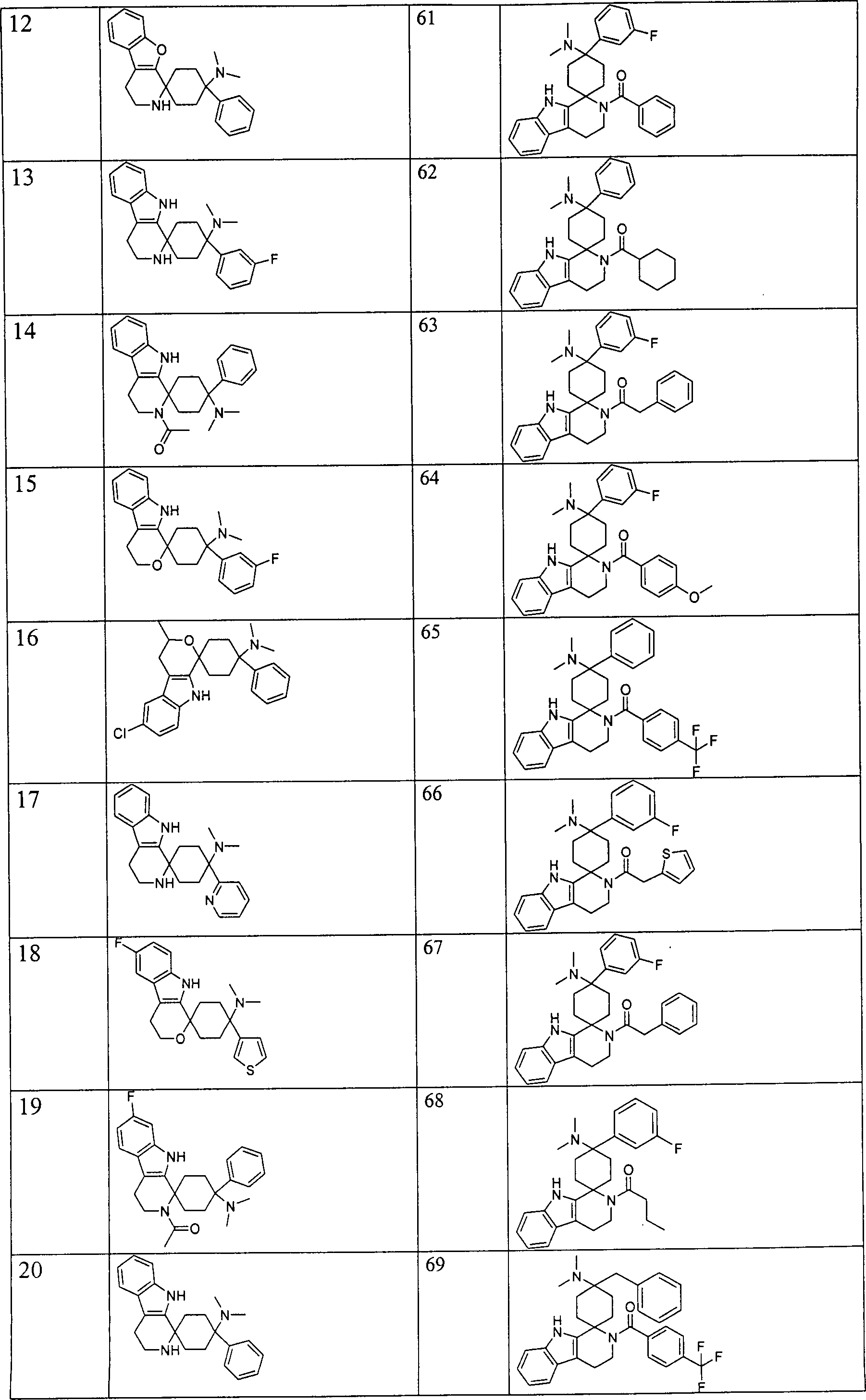
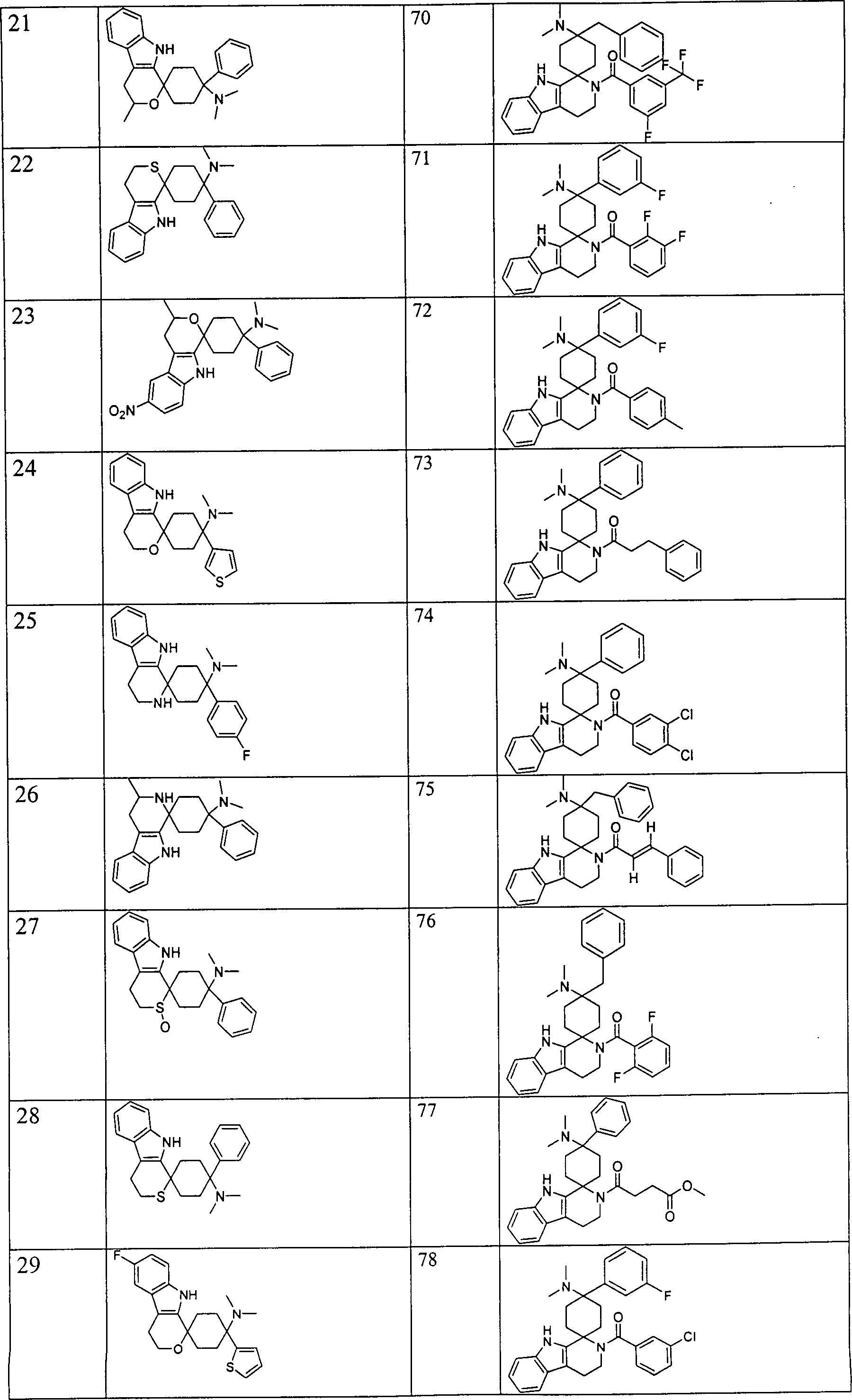


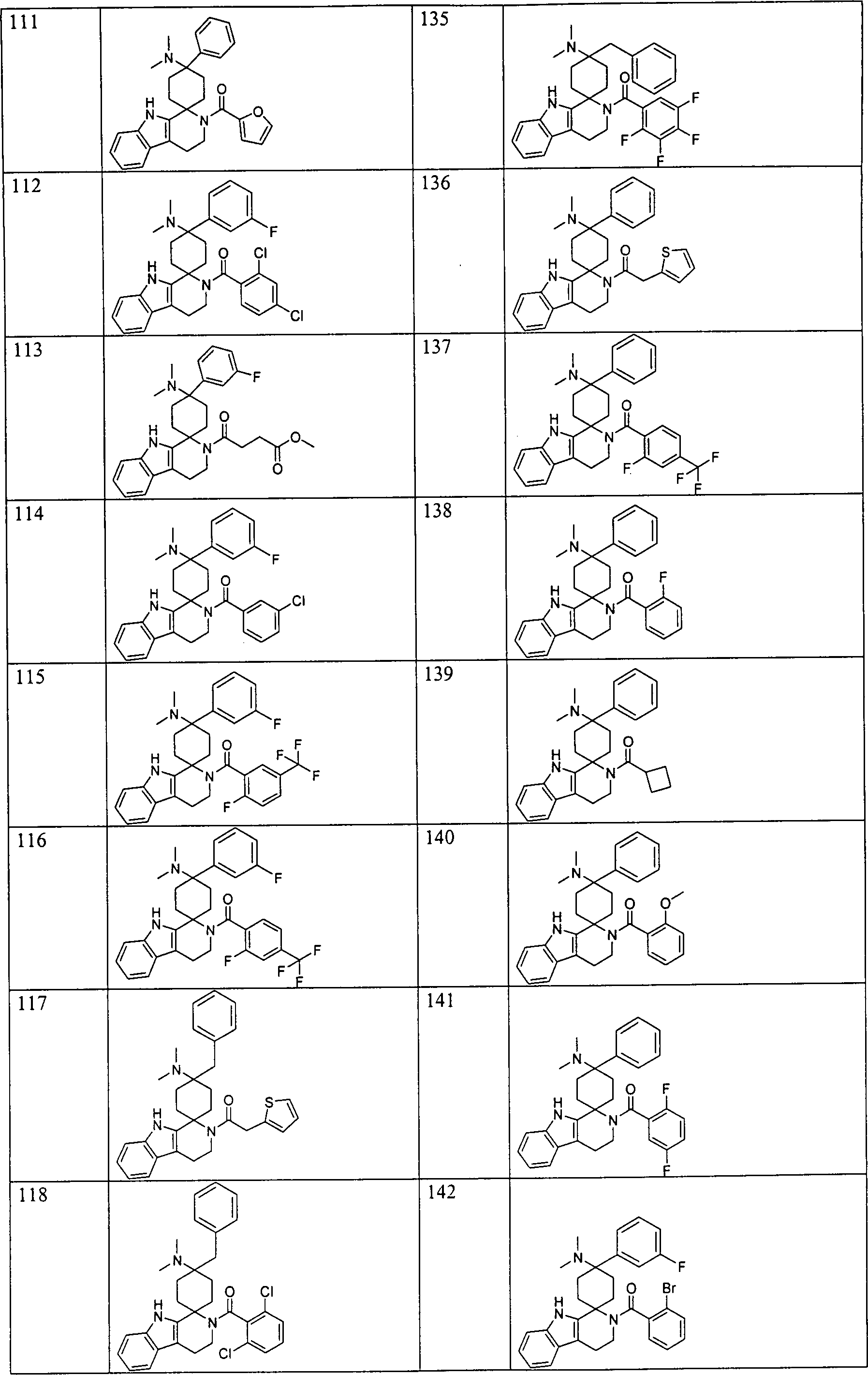

Es
hat sich gezeigt, dass spirocyclische Cyclohexanderivate, worin
W für NR4 und X für
NR17 stehen, besonders vorteilhaft sind.
Daher ist die Verwendung von Verbindungen bevorzugt, worin W für NR4 und X für NR17 stehen. Besonders bevorzugt ist die Verwendung
von Verbindungen aus der Gruppe 


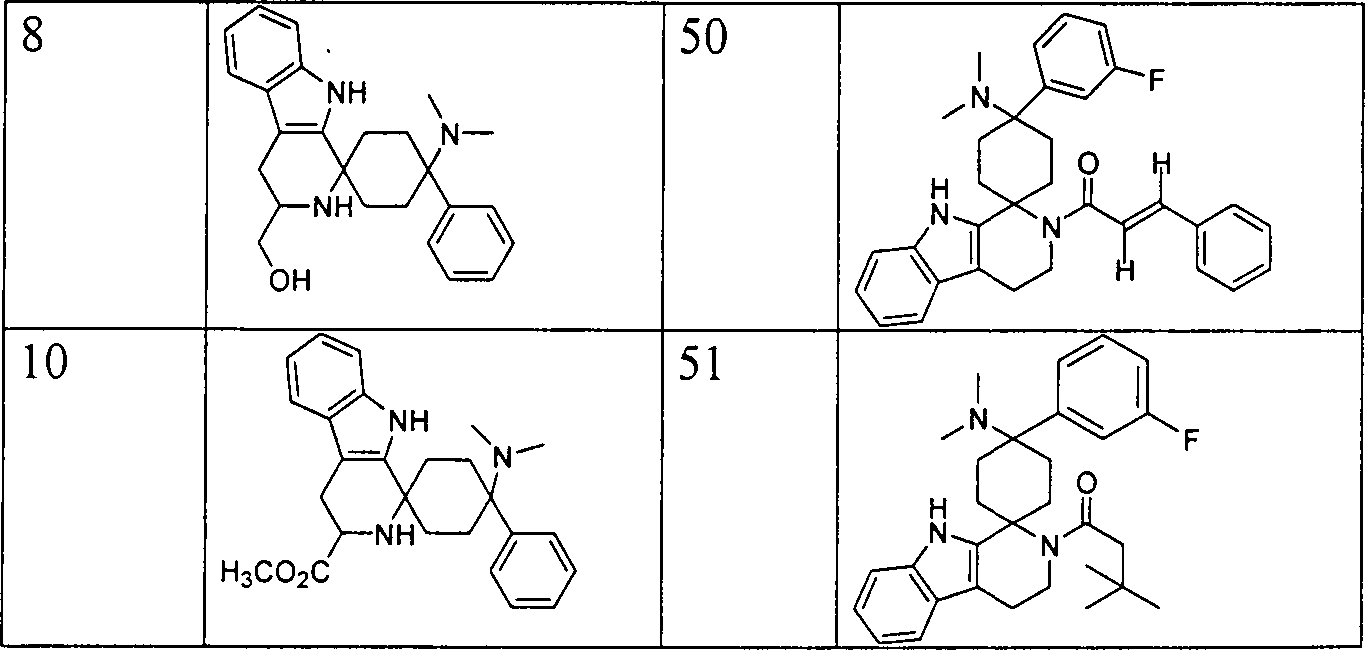


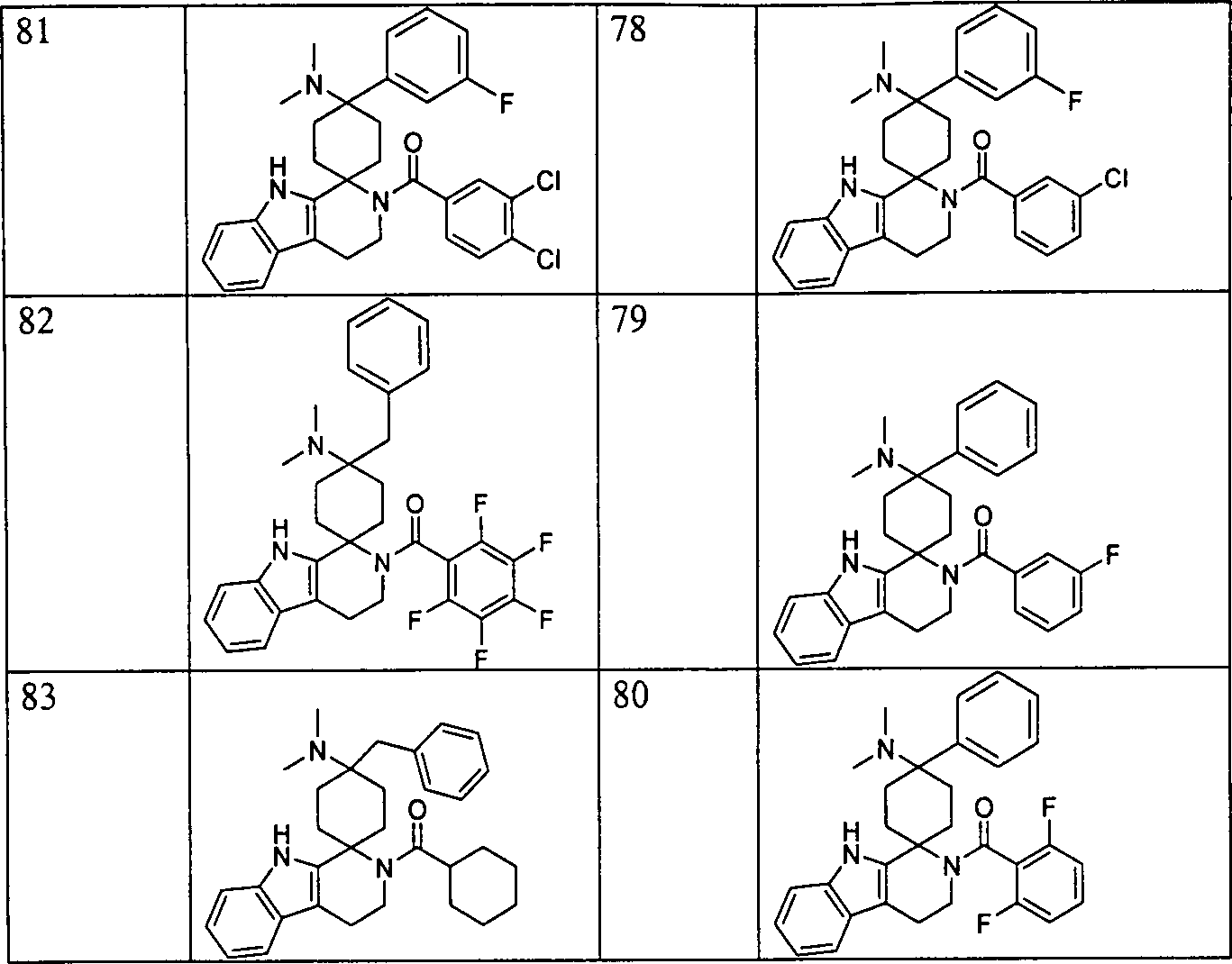
Ganz besonders bevorzugt sind Verbindungen aus der GruppeAll particularly preferred are compounds from the group


Darüber hinaus hat sich gezeigt, dass spirocyclische Cyclohexanderivate, worin W für NR4 und X für O stehen, ebenfalls besonders vorteilhaft sind. Daher sind im Sinne dieser Erfindung spirocyclische Cyclohexanderivate, worin W für NR4 und X für O steht, bevorzugt.In addition, it has been found that spirocyclic cyclohexane derivatives wherein W is NR 4 and X is O are also particularly advantageous. Therefore, for the purposes of this invention, spirocyclic cyclohexane derivatives wherein W is NR 4 and X is O are preferred.
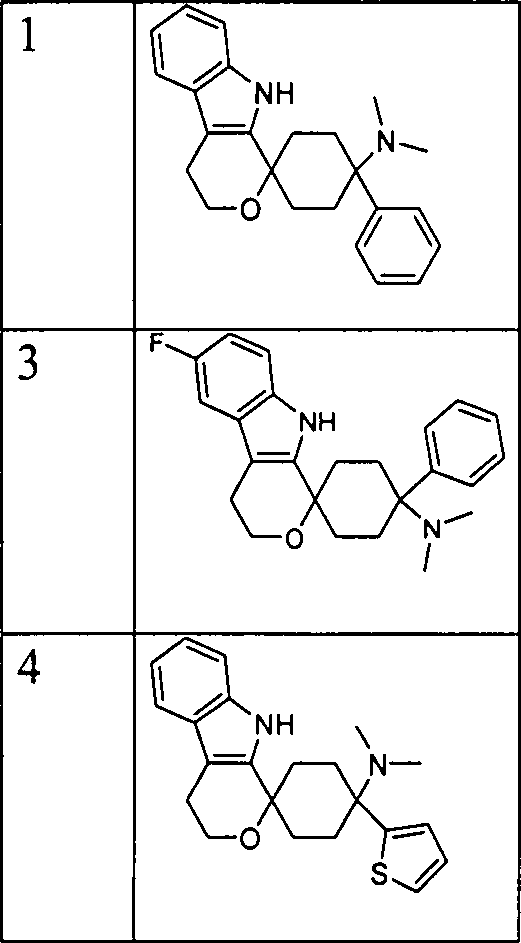
Besonders
bevorzugt ist die Verwendung von Verbindungen aus der Gruppe 


Ganz besonders bevorzugt ist die Verwendung von Verbindungen aus der GruppeAll particularly preferred is the use of compounds from the group
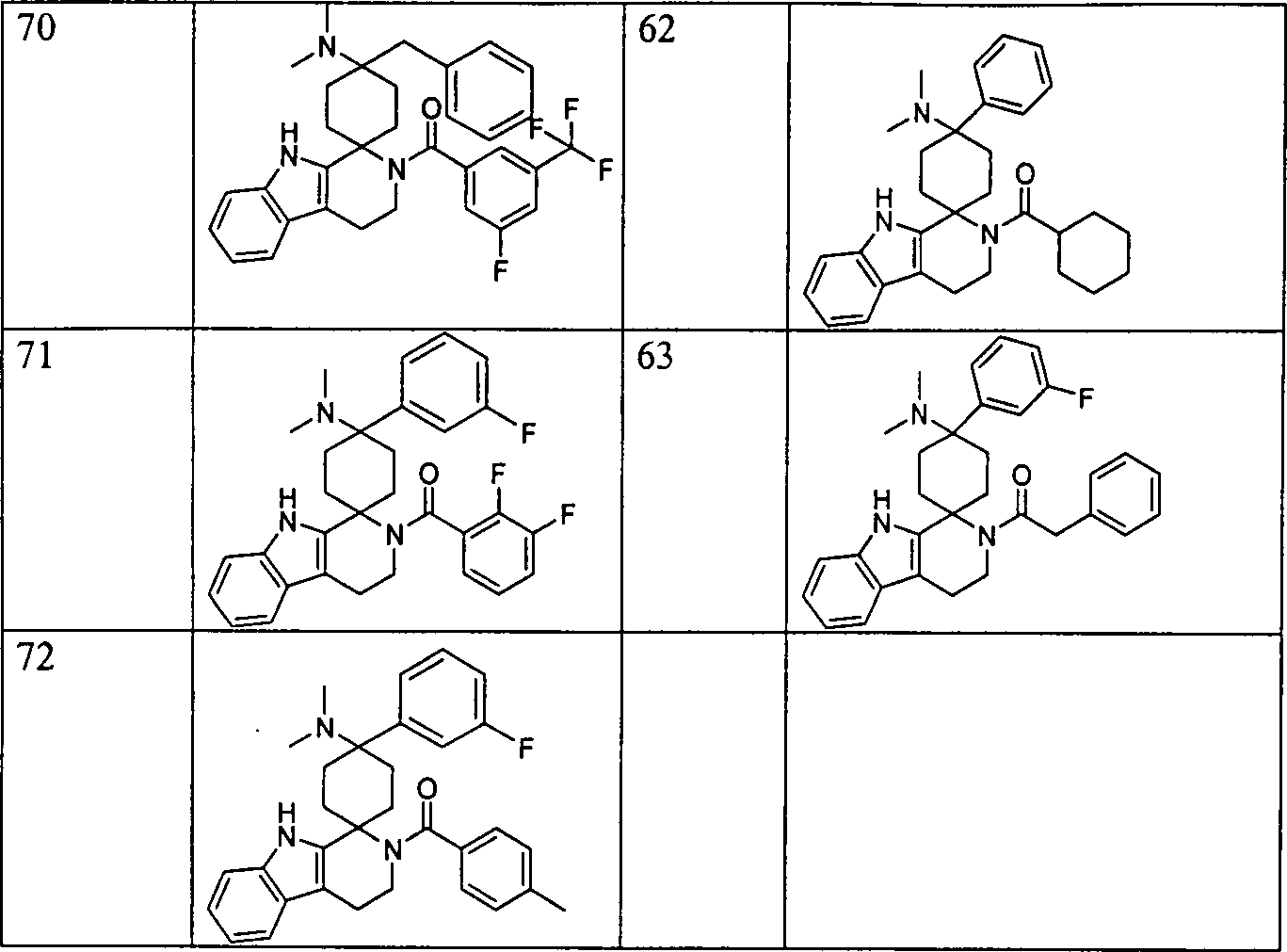
Bevorzugt sind außerdem Verbindungen aus der GruppePrefers are as well Compounds from the group

Die Synthese der Verbindungen ist in WO 0443967 und PCT/EP2004/014539 beschrieben. Die Isolierung der erfindungsgemäßen Verbindungen durch Säulenchromatographie mit Kieselgel als stationärer Phase führt zu einer Auftrennung der unterschiedlich polaren Diastereomeren. Diese wurden aufgrund ihrer Laufzeit als „unpolareres" Diastereomer (kürzere Laufzeit) und „polareres" Diastereomer (längere Laufzeit) charakterisiert. Es wurde Kieselgel 60 (0,040–0,063 mm) der Firma E. Merck, Darmstadt, eingesetzt. Die dünnschicht- chromatographischen Untersuchungen wurden mit HPTLC-Fertigplatten der Firma E. Merck, Darmstadt, durchgeführt. Als Laufmittel wurde beispielsweise Methanol/Ethylacetat in einem Verhältnis von 1:1, 2:1, 3:1 oder 4:1, vorzugsweise 3:1, Methanol/konz. Ammoniaklösung 99,5:0,5 oder Methanol/Ethylacetat/konz. Ammoniaklösung in einem Verhältnis von 66:33:0,5 eingesetzt.The Synthesis of the compounds is described in WO 0443967 and PCT / EP2004 / 014539 described. The isolation of the compounds according to the invention by column chromatography with silica gel as stationary Phase leads to a separation of the differently polar diastereomers. These became due to their term as "non-polar" diastereomers (shorter term) and "more polar" diastereomer (longer term) characterized. It was silica gel 60 (0.040-0.063 mm) from E. Merck, Darmstadt, used. The thin-layer chromatographic Investigations were carried out with HPTLC ready-made panels from E. Merck, Darmstadt, performed. As the eluent, for example, methanol / ethyl acetate in a relationship of 1: 1, 2: 1, 3: 1 or 4: 1, preferably 3: 1, methanol / conc. Ammonia solution 99.5: 0.5 or methanol / ethyl acetate / conc. Ammonia solution in a ratio of 66: 33: 0.5 used.
Die erfindungsgemäßen Arzneimittel enthalten neben mindestens einer erfindungsgemäßen Verbindung gegebenenfalls geeignete Zusatz- und/oder Hilfsstoffe, so auch Trägermaterialien, Füllstoffe, Lösungsmittel, Verdünnungsmittel, Farbstoffe und/oder Bindemittel und können als flüssige Arzneiformen in Form von Injektionslösungen, Tropfen oder Säfte, als halbfeste Arzneiformen in Form von Granulaten, Tabletten, Pellets, Patches, Kapseln, Pflaster/Sprühpflaster oder Aerosolen verabreicht werden. Die Auswahl der Hilfsstoffe etc. sowie die einzusetzenden Mengen derselben hängen davon ab, ob das Arzneimittel oral, peroral, parenteral, intravenös, intraperitoneal, intradermal, intramuskulär, intranasal, buccal, rektal oder örtlich, zum Beispiel auf die Haut, die Schleimhäute oder in die Augen, appliziert werden soll. Für die orale Applikation eignen sich Zubereitungen in Form von Tabletten, Dragees, Kapseln, Granulaten, Tropfen, Säften und Sirupen, für die parenterale, topische und inhalative Applikation Lösungen, Suspensionen, leicht rekonstituierbare Trockenzubereitungen sowie Sprays. Erfindungsgemäße spirocyclische Cyclohexan-Derivate in einem Depot, in gelöster Form oder in einem Pflaster, gegebenenfalls unter Zusatz von die Hautpenetration fördernden Mitteln, sind geeignete perkutane Applikationszubereitungen. Oral oder perkutan anwendbare Zubereitungsformen können die erfindungsgemäßen Verbindungen verzögert freisetzen. Die erfindungsgemäßen Verbindungen können auch in parenteralen Langzeitdepotformen wie z. B. Implantaten oder implantierten Pumpen angewendet werden. Prinzipiell können den erfindungsgemäßen Arzneimitteln andere dem Fachmann bekannte weitere Wirkstoffe zugesetzt werden.The medicaments according to the invention contain, in addition to at least one inventive compound If appropriate, suitable additives and / or auxiliaries, including carrier materials, fillers, solvents, diluents, dyes and / or binders and can as liquid dosage forms in the form of injection solutions, drops or juices, as semi-solid dosage forms in the form of granules, tablets, pellets , Patches, capsules, patches / spray patches or aerosols. The choice of excipients etc. as well as the amounts to be used depend on whether the drug is oral, peroral, parenteral, intravenous, intraperitoneal, intradermal, intramuscular, intranasal, buccal, rectal or topical, for example on the skin, mucous membranes or in the eyes, to be applied. For oral administration, preparations in the form of tablets, dragees, capsules, granules, drops, juices and syrups are suitable, for parenteral, topical and inhalative administration solutions, suspensions, readily reconstitutable dry preparations and sprays. Spirocyclic cyclohexane derivatives according to the invention in a depot, in dissolved form or in a plaster, optionally with the addition of skin penetration promoting agents, are suitable percutaneous administration preparations. Orally or percutaneously applicable preparation forms can release the compounds according to the invention with a delay. The compounds of the invention can also be used in parenteral long-term depot forms such. As implants or implanted pumps are applied. In principle, other active compounds known to the person skilled in the art may be added to the medicaments according to the invention.
Die an den Patienten zu verabreichende Wirkstoffmenge variiert in Abhängigkeit vom Gewicht des Patienten, von der Applikationsart, der Indikation und dem Schweregrad der Erkrankung. Üblicherweise werden 0,00005 bis 1 mg/kg, bevorzugt 0,0001 bis 0,05 mg/kg wenigstens eines erfindungsgemäßen spirocyclischen Cyclohexan-Derivats appliziert.The the amount of active substance to be administered to the patient varies depending on the weight of the patient, the type of application, the indication and the severity of the disease. Usually 0.00005 applied to 1 mg / kg, preferably 0.0001 to 0.05 mg / kg of at least one inventive spirocyclic cyclohexane derivative.
Alle vorstehenden Formen der erfindungsgemäßen Arzneimittel können neben wenigstens einer erfindungsgemäßen Verbindung noch einen weiteren Wirkstoff, insbesondere einen Opioid-Antagonisten, vorzugsweise Naloxon, enthalten.All The above forms of the medicaments of the present invention may be mentioned next at least one compound of the invention another active ingredient, especially an opioid antagonist, preferably naloxone.
Vergleichsuntersuchungencomparative studies
Zum Vergleich wurde die Standardmedikation Levomethadon, die keine nennenswerte ORL-1-Komponente besitzt, im Entzugsspringen getestet. Levomethadon, das zu den Standardtherapeutika in der Substitutionstherapie gehört, induzierte ebenfalls Entzugsspringen.To the Comparison was the standard medication Levomethadone, which is not worth mentioning ORL-1 component has been tested in withdrawal skipping. Methadone, that is one of the standard therapies in substitution therapy also withdrawal.
Unter den in WO 0443967 und PCT/EP2004/014539 beschriebenen Verbindungen findet sich eine ganze Reihe von Substanzen mit einer geringen ORL-1-Komponente. Zwei typische Vertreter mit einer geringen ORL-1-Komponente (Verbindungen m und n) wurden ebenfalls im Entzugsspringen getestet und induzierten Entzugsspringen. Dies zeigt die Wichtigkeit der ORL-1-Komponente für die Eignung einer Substanz für die Substitutionstherapie innerhalb der Gruppe der in WO 0443967 und PCT/EP2004/014539 beschriebenen Verbindungen.Under the compounds described in WO 0443967 and PCT / EP2004 / 014539 There are a number of substances with a low ORL-1 component. Two typical representatives with a low ORL-1 component (compounds m and n) were also tested and induced in withdrawal skipping Withdrawal jumping. This shows the importance of the ORL-1 component for the Suitability of a substance for the replacement therapy within the group of WO 0443967 and PCT / EP2004 / 014539.
Zu den bei den Standardtherapeutika angestrebten und teilweise verwirklichten Eigenschaften gehören:
- 1. Hohe opioide Potenz
- 2. Volle intrinsische Aktivität
- 3. Lange Wirkdauer (aktive Metabolite wie beispielsweise bei LAAM sind in dieser Indikation sogar erwünscht!)
- 4. Langsamer Wirkeintritt bes. bei oraler Gabe (geringer Kick)
- 5. Geringe Kardiotoxizität
- 1. High opioid potency
- 2. Full intrinsic activity
- 3. Long duration of action (active metabolites such as LAAM are even desirable in this indication!)
- 4. Slow onset, especially if given orally (low kick)
- 5. Low cardiotoxicity
Während bei den bekanten Standardsubstanzen einige dieser Eigenschaften fehlen oder nur unzureichend ausgebildet sind, konnten für die erfindungsgemäßen Verbindungen alle geforderten Eigenschaften nachgewiesen werden.While at the known standard substances lack some of these properties or are insufficiently formed, could for the compounds of the invention all required properties are proven.
Die erfindungsgemäßen Verbindungen zeigen deutlich verminderte cadiovaskuläre Nebenwirkungen im Vergleich zu Methadon und LAAM. Die cardiovaskulären Nebenwirkungen werden zurückgeführt auf eine Verzögerung der kardialen Repolarisation (manifestiert sich als QTc-Verlängerung im Oberflächen-EKG), die durch die Blockade eines speziellen Kaliumkanals (HERG) hervorgerufen wird (Kornick et al. Pain 2003, 105, 499–506). Sowohl Methadon als auch LAAM zeigen Wechselwirkungen mit dem HERG-Kanal (Jiesheng et al., Eur. J. Pharmacol. 2003, 458, 25–29; Katchman et al., J. Pharmacol. Exp. Ther. 2002, 303, 688–694). Im Zusammenhang mit der Verordnung von Orlaam (LAAM) wurde 2001 von der FDA vor den cardiovaskulären Effekte gewarnt (JAMA 2001, 285, 2705). Für die erfindungsgemäßen Verbindungen wurde beispielhaft gezeigt, dass die cardiovaskulären Nebenwirkungen im Vergleich zu Methadon und LAAM deutlich verbessert sind.The compounds of the invention show markedly reduced cadiovascular side effects compared to methadone and LAAM. The cardiovascular side effects are attributed to a delay in cardiac repolarization (manifested as QTc prolongation in the surface ECG) caused by the blockade of a special potassium channel (HERG) (Kornick et al., Pain 2003, 105, 499-506). , Both methadone and LAAM show interactions with the HERG channel (Jiesheng et al., Eur. J. Pharmacol., 2003, 458, 25-29; Katchman et al., J. Pharmacol., Exp. Ther., 2002, 303, 688 -694). In the context of the Orlaam (LAAM) Regulation, the FDA warned against cardiovascular effects in 2001 (JAMA 2001, 285, 2705). For the compounds according to the invention, it has been shown by way of example that the cardiovascular side effects are significantly improved compared to methadone and LAAM.
Innerhalb der Gruppe der in WO 0443967 und PCT/EP2004/014539 beschriebenen Spiroverbindungen gibt es Verbindungen mit höherer und niedrigerer ORL-1-Komponente.Within the group described in WO 0443967 and PCT / EP2004 / 014539 Spiro compounds have compounds with higher and lower ORL-1 components.
Messung der ORL1-BindungMeasurement of ORL1 binding
Die Cyclohexan-Derivate der allgemeinen Formel I wurden in einem Rezeptorbindungsassay mit 3H-Nociceptin/Orphanin FQ mit Membranen von rekombinanten CHO-ORL1 Zellen untersucht. Dieses Testsystem wurde gemäß der von Ardati et al. (Mol. Pharmacol., 51, 1997, S. 816–824) vorgestellten Methode durchgeführt. Die Konzentration von 3H-Nociceptin/Orphanin FQ betrug bei diesen Versuchen 0.5 nM. Die Bindungsassays wurden mit je 20 μg Membranprotein je 200 μl Ansatz in 50 mM Hepes, pH 7,4, 10 mM MgCl2 und 1 mM EDTA durchgeführt. Die Bindung an den ORL1-Rezeptor wurde unter Verwendung von je 1 mg WGA-SPA Beads (Amersham-Pharmacia, Freiburg), durch einstündige Inkubation des Ansatzes bei RT und anschliessende Messung im Szintillationscounter Trilux (Wallac, Finnland), bestimmt. Die Affinität wird in Tabelle 1 als nanomolarer Ki-Wert in oder % Inhibition bei c = 1 μM angegeben.The cyclohexane derivatives of the general formula I were investigated in a receptor binding assay with 3 H-nociceptin / orphanin FQ with membranes from recombinant CHO-ORL1 cells. This test system was tested according to the method described by Ardati et al. (Mol. Pharmacol., 51, 1997, pp. 816-824). The concentration of 3 H-nociceptin / orphanin FQ was 0.5 nM in these experiments. The binding assays were carried out with 20 μg of membrane protein per 200 μl batch in 50 mM Hepes, pH 7.4, 10 mM MgCl 2 and 1 mM EDTA. The binding to the ORL1 receptor was determined using 1 mg WGA-SPA beads (Amersham-Pharmacia, Freiburg), by incubation of the mixture at RT for one hour and subsequent measurement in the scintillation counter Trilux (Wallac, Finland). The affinity is given in Table 1 as nanomolar K i value in or% inhibition at c = 1 μM.
Messung der μ-BindungMeasurement of μ binding
Die Rezeptoraffinität zum humanen μ-Opiatrezeptor wurde in einem homogenen Ansatz in Mikrotiterplatten bestimmt. Hierzu wurden Verdünnungsreihen des jeweils zu prüfenden substituierten substituierten Cyclohexyl-1,4-diamin -Derivates mit einer Rezeptormembranpräparation (15–40 μg Protein pro 250 μl Inkubationsansatz) von CHO-K1-Zellen, welche den humanen μ-Opiatrezeptor exprimieren (RB-HOM-Rezeptormembran-Präparation der Firma NEN, Zaventem, Belgien) in Gegenwart von 1 nmol/l des radioaktiven Liganden [3H]-Naloxon (NET719, Firma NEN, Zaventem, Belgien) sowie von 1 mg WGA-SPA-Beads (Wheat germ agglutinin SPA Beads der Firma Amersham/Pharmacia, Freiburg, Deutschland) in einem Gesamtvolumen von 250 μl für 90 Minuten bei Raumtemperatur inkubiert. Als Inkubationspuffer wurde 50 mmol/l Tris-HCl supplementiert mit 0,05 Gew.-% Natriumazid und mit 0,06 Gew.-% bovinem Serumalbumin verwendet. Zur Bestimmung der unspezifischen Bindung wurde zusätzlich 25 μmol/l Naloxon zugegeben. Nach Beendigung der neunzigminütigen Inkubationszeit wurden die Mikrotiterplatten für 20 Minuten bei 1000 g abzentrifugiert und die Radioaktivität in einem β-Counter (Microbeta-Trilux, Firma PerkinElmer Wallac, Freiburg, Deutschland) vermessen. Es wurde die prozentuale Verdrängung des radioaktiven Liganden aus seiner Bindung zum humanen μ-Opiatrezeptor bei einer Konzentration der Prüfsubstanzen von 1 μmol/l bestimmt und als prozentuale Hemmung (%Hemmung) der spezifischen Bindung angegeben. Teilweise wurden ausgehend von der prozentualen Verdrängung durch unterschiedliche Konzentrationen der zu prüfenden Verbindungen der allgemeinen Formel I IC50 Hemmkonzentrationen berechnet, die eine 50-prozentige Verdrängung des radioaktiven Liganden bewirken. Durch Umrechnung mittels der Cheng-Prusoff-Beziehung wurden Ki-Werte für die Prüfsubstanzen erhalten.The receptor affinity for the human μ-opiate receptor was determined in a homogeneous batch in microtiter plates. For this dilution series of each substituted substituted cyclohexyl-1,4-diamine derivative to be tested with a receptor membrane preparation (15-40 micrograms of protein per 250 ul incubation mixture) of CHO-K1 cells expressing the human μ-opiate receptor (RB-HOM Receptor membrane preparation from NEN, Zaventem, Belgium) in the presence of 1 nmol / l of the radioactive ligand [ 3 H] -naloxone (NET719, NEN, Zaventem, Belgium) and 1 mg WGA-SPA beads (Wheat germ agglutinin SPA beads from Amersham / Pharmacia, Freiburg, Germany) in a total volume of 250 μl for 90 minutes at room temperature. The incubation buffer used was 50 mmol / l Tris-HCl supplemented with 0.05% by weight sodium azide and with 0.06% by weight bovine serum albumin. To determine the unspecific binding an additional 25 .mu.mol / l naloxone was added. After the ninety-minute incubation period, the microtiter plates were centrifuged for 20 minutes at 1000 g and the radioactivity in a β-counter (Microbeta-Trilux, PerkinElmer Wallac, Freiburg, Germany) measured. The percentage displacement of the radioactive ligand from its binding to the human μ-opiate receptor at a concentration of the test substances of 1 .mu.mol / l was determined and expressed as a percentage inhibition (% inhibition) of the specific binding. In part, starting from the percentage displacement by different concentrations of the compounds of the general formula I to be tested, IC 50 inhibitory concentrations were calculated, which cause a 50% displacement of the radioactive ligand. By conversion using the Cheng-Prusoff relationship, Ki values were obtained for the test substances.
In der folgenden Tabelle sind beispielhaft einige Verbindungen aufgeführt, die zwar sehr gut an den μ-Opiat-Rezeptor binden, jedoch eine niedrigere ORL1-Komponente besitzen:In The following table gives an example of some compounds that Although very good at the μ-opiate receptor but have a lower ORL1 component:


Wie beispielhaft an den Verbindungen m und n gezeigt, unterdrücken diese Verbindungen das Entzugsspringen nicht.As exemplified by the compounds m and n, suppress them Do not join the withdrawal jump.
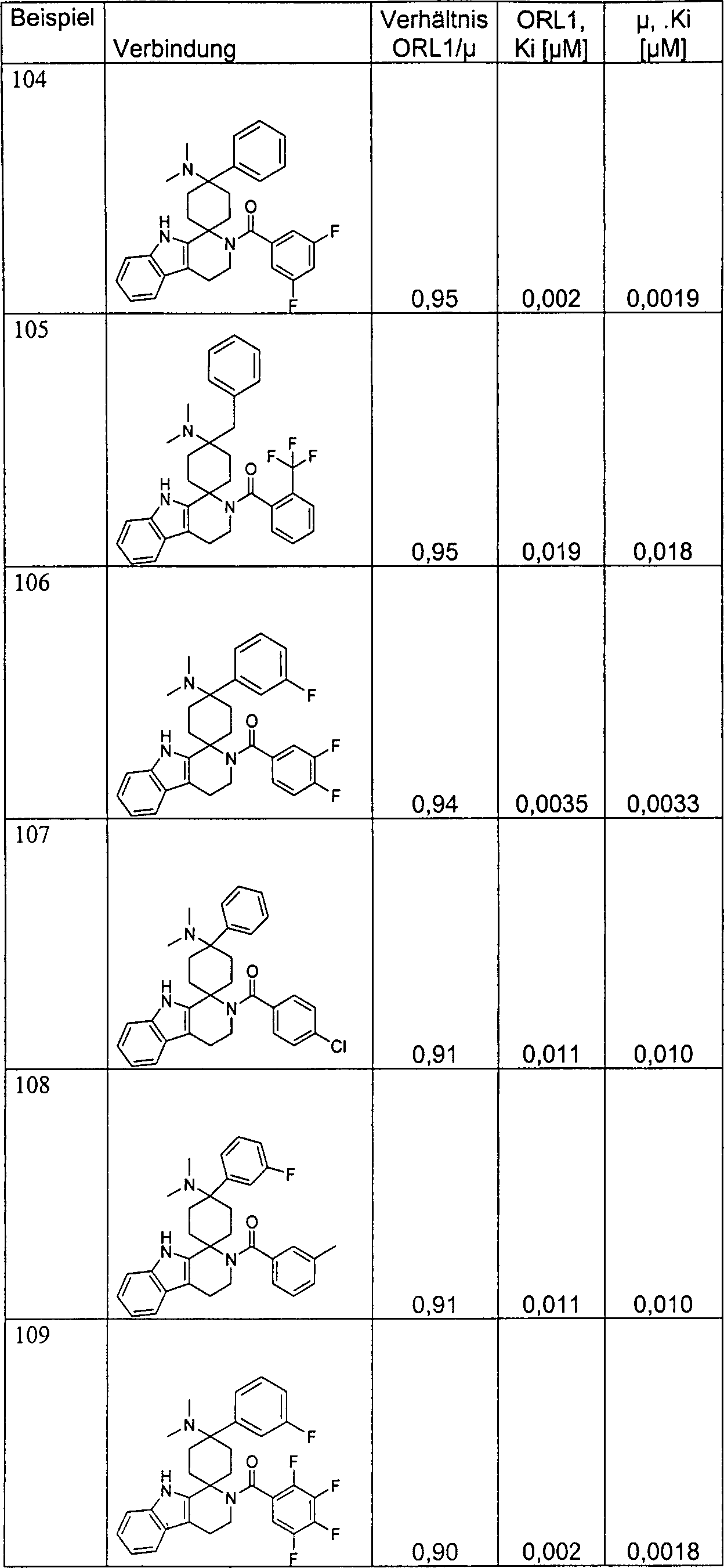
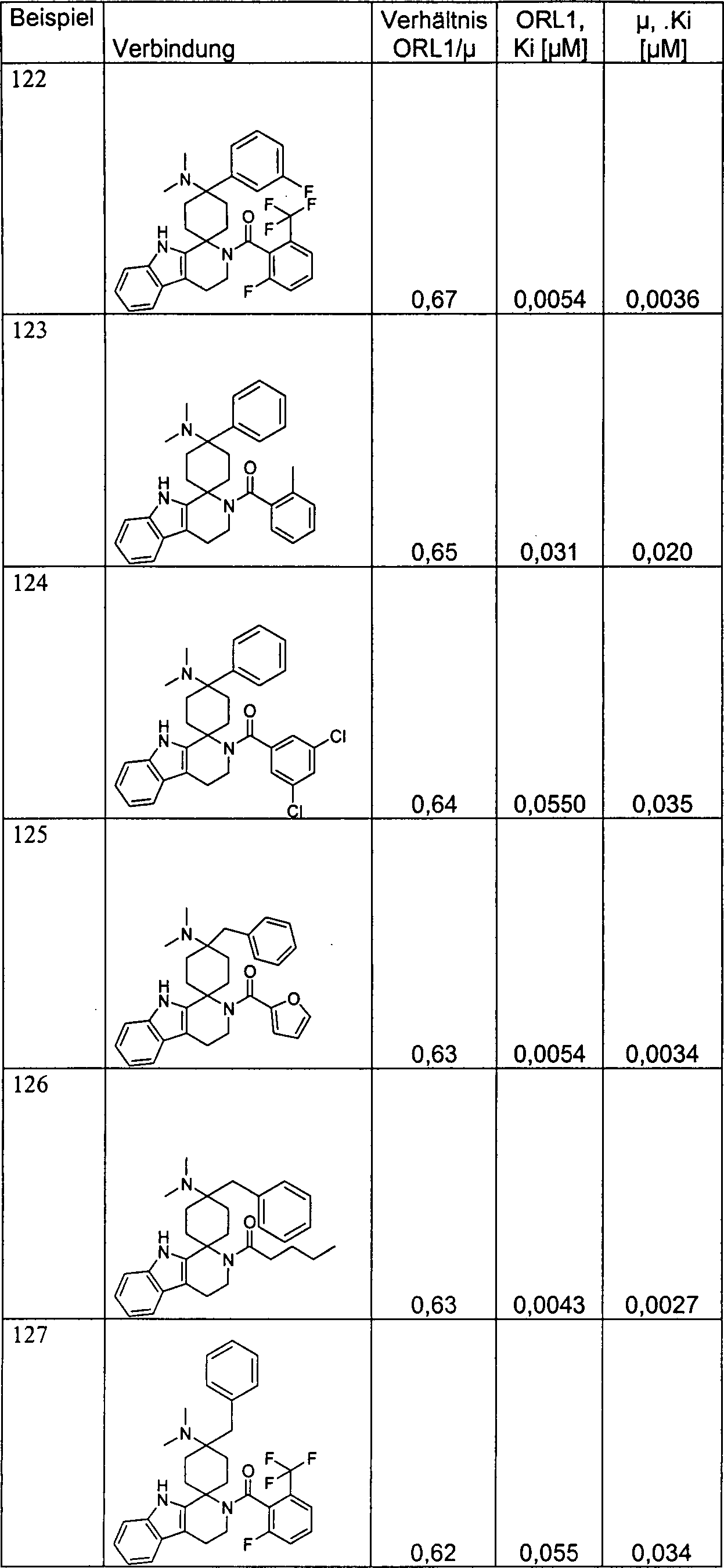
Im Vergleich dazu weisen die folgenden Verbindungen ein nahezu ausgeglichenes ORL1/μ-Verhältnis auf. Idealerweise besitzen sie eine stärker ausgeprägte ORL1-Komponente. Das Verhältnis ORL1:μ beträgt jedoch mindestens 1:3:in the In comparison, the following compounds are nearly balanced ORL1 / μ ratio on. Ideally, they have a more pronounced ORL1 component. However, the ratio ORL1: μ is at least 1: 3:






Jumping-test an der Maus: Versuch zur Bestimmung der körperlichen Abhängigkeit (Saelens JK, Arch Int Pharmacodyn 190: 213–218, 1971)Jumping test on the mouse: Attempt to determine the physical dependence (Saelens JK, Arch Int Pharmacody 190: 213-218, 1971)
Die Testsubstanzen werden insgesamt 7× über zwei Tage intraperitoneal appliziert. 5 Applikationen erfolgen am ersten Tag um 9:00, 10:00, 11:00, 13:00 und 15:00 Uhr und am zweiten Tag um 9:00 und 11:00 Uhr. Die ersten 3 Applikationen werden in aufsteigenden Dosierungen (Dosierungsschema) gegeben und dann weiter in der Dosierung der dritten. Der Entzug wird 2 Stunden nach der letzten Substanzaplikation mit Naloxon 30 mg/kg (i.p.) präzipititert. Unmittelbar danach werden die Tiere einzeln in durchsichtige Beobachtungsboxen (Höhe 40 cm, Durchmesser 15 cm) gesetzt und die Sprungreaktionen über 15 Minuten in jeweils 5-Minuten- Perioden gezählt. Morphin wird in einer Dosierung als Vergleich/Standard mitgeführt.The test substances are administered intraperitoneally for a total of 7 × for two days. 5 applications will take place on the first day at 9:00, 10:00, 11:00, 13:00 and 15:00 and on the second day at 9:00 and 11:00. The first 3 applications are given in ascending doses (dosing scheme) and then white ter in the dosage of the third. The withdrawal is precipitated 2 hours after the last administration of naloxone 30 mg / kg (ip). Immediately thereafter, the animals are placed individually in transparent observation boxes (height 40 cm, diameter 15 cm) and the jump reactions are counted over 15 minutes in 5-minute periods. Morphine is included in one dose as a comparison / standard.
Die Quantifizierung des Entzugs erfolgt über die Anzahl der Sprünge 0 bis 10 min. nach Naloxonapplikation. Die Anzahl der Tiere pro Gruppe mit mehr als 10 Sprüngen/10 min wird bestimmt und als "% positive Tiere" dokumentiert. Außerdem wird die durchschnittliche Sprung-Frequenz in der Gruppe errechnet. Pro Gruppe werden 12 Tiere eingesetzt.The Quantification of withdrawal is via the number of jumps 0 to 10 min. after naloxone application. The number of animals per group with more than 10 jumps / 10 min is determined and expressed as "% positive animals ". Furthermore the average jump frequency in the group is calculated. 12 animals are used per group.
Levomethadon 


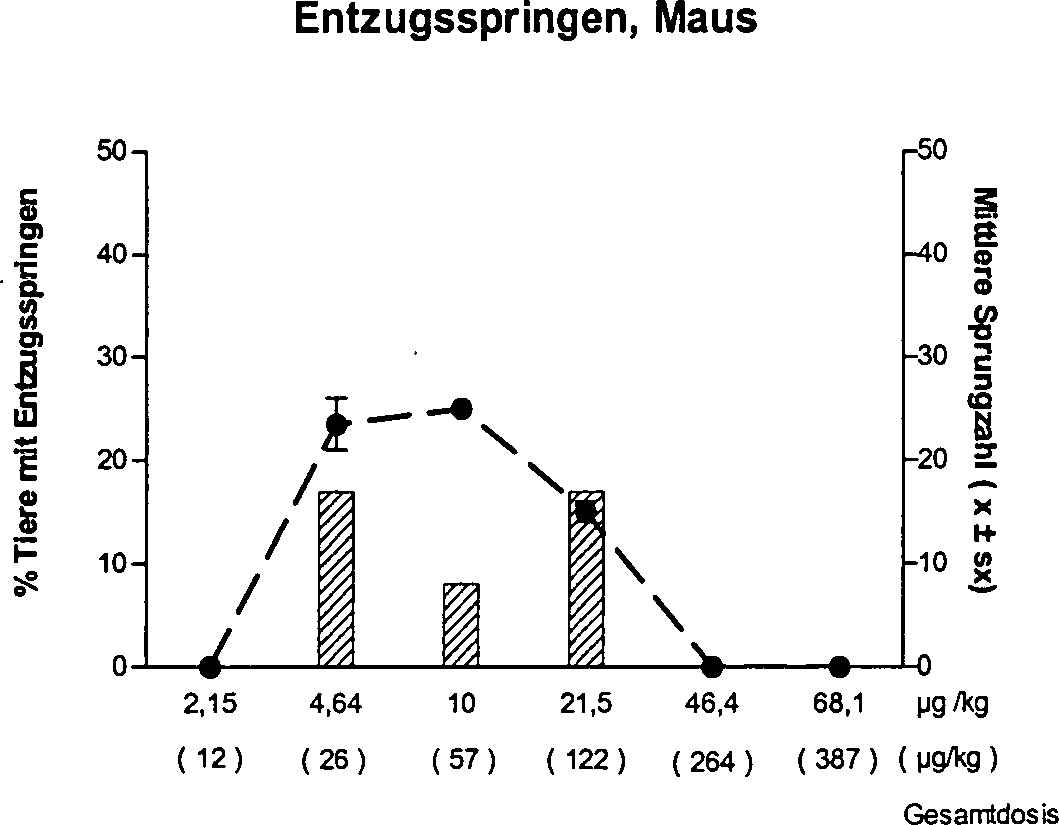


Untersuchungen zu cardiovaskulären EffektenStudies on cardiovascular effects
Methodenbeschreibung EKG, wacher Hund:Method description ECG, awake dog:
Substanzeffekte auf Herzfrequenz und elektrokardiographische Parameter wurden am wachen Beagle-Hund untersucht.substance effects on heart rate and electrocardiographic parameters were recorded on awake beagle dog being examined.
Die Messung des Elektrokardiogramms (EKG) erfolgte als bipolare Extremitätenableitung nach Einthoven (Ableitung II). Dazu wurden die Beagle-Hunde in einer speziellen hängemattenartigen Halterung (Animal sling, Havard Instruments, ZAK, Marktheidenfeld, Deutschland) gesetzt und leicht fixiert. An der linken und rechten Vorderextremität wurde jeweils eine Messelektrode, sowie an der linken Hinterextremität eine Referenzelektrode angebracht. Alle Elektroden waren Plattenelektrode, die auf der rasierten Haut mittels Gummimanschetten fixiert wurden. Die Plattenelektroden wurden an einen EKG-Vorverstärker angeschlossen und die Signale kontinuierlich mit Hilfe eines computergestützten Datenaufnahme und -archivierungssystems (PO-NE-MAH, Gould-Instrument Systems, USA) digitalisiert (Digitalisierungsfrequenz: 2 kHz). Pro Messzeitpunkt wurden aus 10 aufeinander folgenden EKG-Intervallen die Mittelwerte folgender Parameter bestimmt: RR-Intervall, PR-Intervall, QRS-Intervall und QT-Intervall. Die Frequenzkorrektur des QT-Intervalls erfolgte nach der Korrekturformel von Van de Water et al. (1989).The Electrocardiogram (ECG) was measured as a bipolar limb lead according to Einthoven (derivation II). These were the Beagle dogs in one special hammock-like Bracket (Animal sling, Havard Instruments, ZAK, Marktheidenfeld, Germany) set and easily fixed. At the left and right forelimb each became a measuring electrode and a reference electrode at the left rear extremity appropriate. All electrodes were plate electrode mounted on the shaved skin were fixed by means of rubber cuffs. The plate electrodes were connected to an ECG preamp connected and the signals continuously using a computerized data recording and archiving system (PO-NE-MAH, Gould-Instrument Systems, USA) digitized (digitizing frequency: 2 kHz). Per measurement time the average values were obtained from 10 consecutive ECG intervals The following parameters are determined: RR interval, PR interval, QRS interval and QT interval. The frequency correction of the QT interval was performed after the correction formula of Van de Water et al. (1989).
Die Testsubstanzen wurden jeweils als i.v. Kurzzeitinfusion (15 min) über die V. cephalica antibrachii appliziert. Zur Quantifizierung von Substanzeffekten wurden über einen Zeitraum von 60 min nach Substanzapplikation die Änderungen der EKG-Parameter relativ zum Basiswert vor Substanzapplikation registriert. Die statistische Auswertung erfolgte mittels Varianzanalyse (ANOVA) im Vergleich zu zeitgleich verlaufenden Vehikelkontrollmessungen. (Van de Water A, Verheyen J, Xhonneux R, Reneman RS. An improved method to correct the QT interval of the electrocardiogram for changes in heart rate. J Pharmacol Methods. 1989 Nov;22(3):207–17).The Test substances were each reported as i.v. Short-term infusion (15 min) over the V. cephalica antibrachii applied. For the quantification of substance effects were over a period of 60 minutes after substance administration the changes the ECG parameter registered relative to the underlying asset before substance application. The statistical Evaluation was carried out by analysis of variance (ANOVA) in comparison at the same time as vehicle control measurements. (Van de Water A, Verheyen J, Xhonneux R, Reneman RS. An improved method to correct the QT interval of the electrocardiogram for changes in heart rate. J Pharmacol Methods. 1989 Nov; 22 (3): 207-17).
Patch-clamp, hERG-StromPatch-clamp, hERG-current
- Methodenbeschreibung in: Bischoff U, Schmidt C, Netzer R, Pongs O. Effects of fluoroquinolones on HERG currents. Eur J Pharmacol. 2000;406(3):341–3.Method description in: Bischoff U, Schmidt C, Netzer R, Pongs O. Effects of fluoroquinolones on HERG currents. Eur J Pharmacol. 2000; 406 (3): 341-3.
Blutdruck, wache RatteBlood pressure, awake rat
-
Methodenbeschreibung in: Weeks JR, Compton LD. The cardiovascular
pharmacology of prostacyclin (PGI2) in the rat. Prostaglandins 1979;17(4):501–13. Tab.
A: Zusammenfassung der cardiovasculären Effekte von Beispiel 1: Method description in: Weeks JR, Compton LD. The cardiovascular pharmacology of prostacyclin (PGI2) in the rat. Prostaglandins 1979; 17 (4): 501-13. Tab. A: Summary of cardiovascular effects of Example 1:
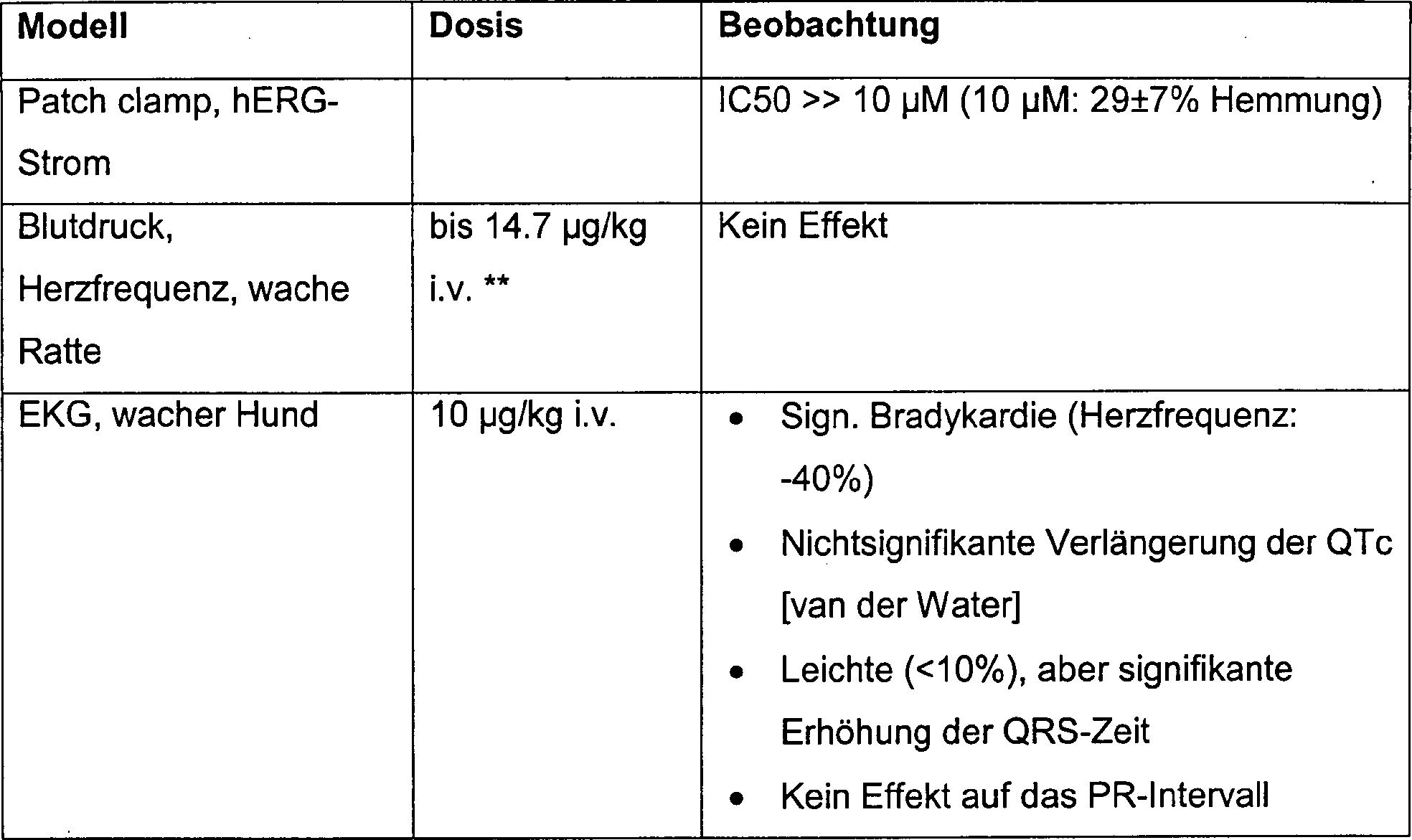
- ** Tail-flick, rat: EC50 = 1.44 μg/kg i.v.** tail-flick, rat: EC 50 = 1.44 μg / kg iv
Zum Vergleich: Der IC50-Wert für LAAM liegt bei 2 μM (Wechselwirkungen von LAAM/HERG-Kanal s. Jiesheng et al., Eur. J. Pharmacol. 2003, 458, 25–29), der IC50-Wert von Methadon bei 9,8 μM (s. Katchman et al., J. Pharmacol. Exp. Ther. 2002, 303, 688–694).For comparison: the IC50 value for LAAM is 2 uM (interactions of LAAM / HERG channel s Jiesheng et al, Eur J. Pharmacol 2003, 458, 25-29....), The IC50 value of methadone at 9.8 μM (see Katchman et al., J. Pharmacol. Exp. Ther. 2002, 303, 688-694).
An der wachen Ratte werden bei einer Gabe von bis zu einer Größenordnung höher als der EC50-Wert im Tail-flick an der Ratte von Beispiel 1 keine cardiovaskulären Effekte beobachtet.In the awake rat, no cardiovascular effects are observed when administered up to an order of magnitude higher than the EC 50 value in the tail-flick in the rat of Example 1.
Claims (20)




Priority Applications (13)
| Application Number | Priority Date | Filing Date | Title |
|---|---|---|---|
| DE102005016460A DE102005016460A1 (en) | 2005-04-11 | 2005-04-11 | Spriocyclic cyclohexane derivatives for the treatment of substance dependence |
| DK06724117.4T DK1868600T3 (en) | 2005-04-11 | 2006-04-07 | Spirocyclic cyclohexane derivative for the treatment of drug dependence |
| PT06724117T PT1868600E (en) | 2005-04-11 | 2006-04-07 | Spirocyclic cyclohexane derivatives for use in the treatment of substance dependency |
| EP06724117A EP1868600B1 (en) | 2005-04-11 | 2006-04-07 | Spirocyclic cyclohexane derivatives for use in the treatment of substance dependency |
| ES06724117T ES2390468T3 (en) | 2005-04-11 | 2006-04-07 | Spirocyclic cyclohexane derivatives for the treatment of substance dependence |
| SI200631368T SI1868600T1 (en) | 2005-04-11 | 2006-04-07 | Spirocyclic cyclohexane derivatives for use in the treatment of substance dependency |
| PL06724117T PL1868600T3 (en) | 2005-04-11 | 2006-04-07 | Spirocyclic cyclohexane derivatives for use in the treatment of substance dependency |
| PCT/EP2006/003176 WO2006108565A1 (en) | 2005-04-11 | 2006-04-07 | Spirocyclic cyclohexane derivatives for use in the treatment of substance dependency |
| US11/870,051 US20080221141A1 (en) | 2005-04-11 | 2007-10-10 | Spirocyclic Cyclohexane Compounds Useful To Treat Substance Dependency |
| US12/939,274 US8034936B2 (en) | 2005-04-11 | 2010-11-04 | Spirocyclic cyclohexane compounds useful to treat substance dependency |
| CY20121100720T CY1113024T1 (en) | 2005-04-11 | 2012-08-13 | CYCLOXEXANE SPIRACYCLIC PRODUCTS FOR TREATMENT OF SUBSTANCE ADDICTION |
| US14/310,690 US20140303125A1 (en) | 2005-04-11 | 2014-06-20 | Spirocyclic Cyclohexane Compounds Useful To Treat Substance Dependency |
| US15/168,906 US20160271107A1 (en) | 2005-04-11 | 2016-05-31 | Spirocyclic Cyclohexane Compounds Useful To Treat Substance Dependency |
Applications Claiming Priority (1)
| Application Number | Priority Date | Filing Date | Title |
|---|---|---|---|
| DE102005016460A DE102005016460A1 (en) | 2005-04-11 | 2005-04-11 | Spriocyclic cyclohexane derivatives for the treatment of substance dependence |
Publications (1)
| Publication Number | Publication Date |
|---|---|
| DE102005016460A1 true DE102005016460A1 (en) | 2006-10-19 |
Family
ID=36691523
Family Applications (1)
| Application Number | Title | Priority Date | Filing Date |
|---|---|---|---|
| DE102005016460A Ceased DE102005016460A1 (en) | 2005-04-11 | 2005-04-11 | Spriocyclic cyclohexane derivatives for the treatment of substance dependence |
Country Status (10)
| Country | Link |
|---|---|
| US (4) | US20080221141A1 (en) |
| EP (1) | EP1868600B1 (en) |
| CY (1) | CY1113024T1 (en) |
| DE (1) | DE102005016460A1 (en) |
| DK (1) | DK1868600T3 (en) |
| ES (1) | ES2390468T3 (en) |
| PL (1) | PL1868600T3 (en) |
| PT (1) | PT1868600E (en) |
| SI (1) | SI1868600T1 (en) |
| WO (1) | WO2006108565A1 (en) |
Cited By (2)
| Publication number | Priority date | Publication date | Assignee | Title |
|---|---|---|---|---|
| DE102007009319A1 (en) * | 2007-02-22 | 2008-08-28 | Grünenthal GmbH | Spirocyclic cyclohexane derivatives |
| DE102007009235A1 (en) * | 2007-02-22 | 2008-09-18 | Grünenthal GmbH | Spirocyclic cyclohexane derivatives |
Families Citing this family (24)
| Publication number | Priority date | Publication date | Assignee | Title |
|---|---|---|---|---|
| DE10252667A1 (en) | 2002-11-11 | 2004-05-27 | Grünenthal GmbH | New spiro-((cyclohexane)-tetrahydropyrano-(3,4-b)-indole) derivatives, are ORL1 receptor ligands useful e.g. for treating anxiety, depression, epilepsy, senile dementia, withdrawal symptoms or especially pain |
| DE102006019597A1 (en) * | 2006-04-27 | 2007-10-31 | Grünenthal GmbH | Spirocyclic cyclohexane derivatives |
| DE102006033114A1 (en) * | 2006-07-18 | 2008-01-24 | Grünenthal GmbH | Spirocyclic azaindole derivatives |
| EP2476680B1 (en) | 2008-01-11 | 2014-08-27 | Albany Molecular Research, Inc. | (1-Azinone)-Substituted Pyridoindoles |
| AR071067A1 (en) | 2008-03-27 | 2010-05-26 | Gruenenthal Chemie | SUBSTITUTED CYCLHEXILDIAMINS |
| DK2257526T3 (en) | 2008-03-27 | 2012-02-06 | Gruenenthal Gmbh | Spiro (5.5) undecane derivatives |
| CN103214376A (en) | 2008-03-27 | 2013-07-24 | 格吕伦塔尔有限公司 | Substituted 4-aminocyclohexane derivatives |
| CL2009000733A1 (en) | 2008-03-27 | 2009-05-15 | Gruenenthal Chemie | Compounds derived from (hetero) aryl-substituted cyclohexane, pharmaceutical composition containing said compound and its use as modulators of the µ-opioid receptor and the orl-1 receptor to treat pain, anxiety, depression, epilepsy, Alzheimer's, senile dementia, withdrawal symptoms, alcohol abuse. |
| PT2260042E (en) * | 2008-03-27 | 2011-12-06 | Gruenenthal Gmbh | Substituted spirocyclic cyclohexane derivatives |
| CA2719739A1 (en) | 2008-03-27 | 2009-10-01 | Sven Frormann | Hydroxymethylcyclohexylamines |
| WO2011003007A1 (en) * | 2009-07-01 | 2011-01-06 | Albany Molecular Research, Inc. | Azabicycloalkane-indole and azabicycloalkane-pyrrolo-pyridine mch-1 antagonists, methods of making, and use thereof |
| US8618299B2 (en) * | 2009-07-01 | 2013-12-31 | Albany Molecular Research, Inc. | Azinone-substituted azapolycycle MCH-1 antagonists, methods of making, and use thereof |
| WO2011003021A1 (en) * | 2009-07-01 | 2011-01-06 | Albany Molecular Research, Inc. | Azinone-substituted azabicycloalkane-indole and azabicycloalkane-pyrrolo-pyridine mch-1 antagonists, methods of making, and use thereof |
| JP2012532144A (en) * | 2009-07-01 | 2012-12-13 | アルバニー モレキュラー リサーチ, インコーポレイテッド | Azinone-substituted azepino [B] indoles and pyrido-pyrrolo-azepine MCH-1 antagonists and methods for making and using the same |
| TWI582092B (en) * | 2010-07-28 | 2017-05-11 | 歌林達股份有限公司 | Cis-tetrahydro-spiro(cyclohexane-1,1'-pyrido[3,4-b]indole)-4-amine derivatives |
| WO2012088124A2 (en) | 2010-12-21 | 2012-06-28 | Albany Molecular Research, Inc. | Tetrahydro-azacarboline mch-1 antagonists, methods of making, and uses thereof |
| WO2012088038A2 (en) | 2010-12-21 | 2012-06-28 | Albany Molecular Research, Inc. | Piperazinone-substituted tetrahydro-carboline mch-1 antagonists, methods of making, and uses thereof |
| US8614245B2 (en) | 2011-07-08 | 2013-12-24 | Gruenenthal Gmbh | Crystalline (1r,4r)-6′-fluoro-N,N-dimethyl-4-phenyl-4′,9′-dihydro-3′H-spiro[cyclohexane-1,1′-pyrano[3,4,b]indol]-4-amine |
| SI2729470T1 (en) * | 2011-07-08 | 2017-10-30 | Gruenenthal Gmbh | Crystalline (1r,4r)-6'-fluoro-n,n-dimethyl-4-phenyl-4',9'-dihydro-3'h-spiro(cyclohexane-1,1'-pyrano(3,4,b)indol)-4-amine |
| US9296749B2 (en) | 2013-03-15 | 2016-03-29 | Gruenenthal Gmbh | Crystalline cis-(E)-4-(3-fluorophenyl)-2′,3′,4′,9′-tetrahydro-N,N-dimethyl-2′-(1-oxo-3-phenyl-2-propenyl)-spiro[cyclohexane-1,1′[1H] |
| HUE040133T2 (en) | 2014-07-15 | 2019-02-28 | Gruenenthal Gmbh | Substituted azaspiro(4.5)decane derivatives |
| TW201607923A (en) | 2014-07-15 | 2016-03-01 | 歌林達有限公司 | Substituted azaspiro (4.5) decane derivatives |
| JP6673924B2 (en) | 2015-01-23 | 2020-03-25 | グリュネンタール・ゲゼルシャフト・ミト・ベシュレンクテル・ハフツング | Cevranopadol for treating pain in a subject having hepatic and / or renal dysfunction |
| IT201700057899A1 (en) | 2017-05-29 | 2018-11-29 | Univ Degli Studi Di Camerino | Co-activators of MOP and NOP receptors in the treatment of drug addiction and / or psychostimulants |
Citations (1)
| Publication number | Priority date | Publication date | Assignee | Title |
|---|---|---|---|---|
| WO2004043967A1 (en) * | 2002-11-11 | 2004-05-27 | Grünenthal GmbH | Spirocyclic cyclohexane derivatives |
Family Cites Families (19)
| Publication number | Priority date | Publication date | Assignee | Title |
|---|---|---|---|---|
| GB1055203A (en) * | 1964-09-16 | 1967-01-18 | Ici Ltd | -ß-carboline derivatives, a process for their manufacture, and compositions containing them |
| US4291039A (en) * | 1980-08-08 | 1981-09-22 | Miles Laboratories, Inc. | Tetrahydro β-carbolines having anti-hypertensive activity |
| DE3309596A1 (en) * | 1982-08-05 | 1984-04-05 | Basf Ag, 6700 Ludwigshafen | 2-SUBSTITUTED 1- (3'-AMINOALKYL) -1,2,3,4-TETRAHYDRO-SS-CARBOLINE, THEIR PRODUCTION AND USE AS MEDICINAL PRODUCT |
| US5328905A (en) * | 1987-07-20 | 1994-07-12 | Duphar International Research B.V. | 8,9-anellated-1,2,3,4-tetrahydro-β-carboline derivatives |
| US5369691A (en) * | 1993-03-04 | 1994-11-29 | Utilex, Inc. | Telephonic information communication method and apparatus |
| EP0620222A3 (en) * | 1993-04-14 | 1995-04-12 | Lilly Co Eli | Tetrahydro-beta-carbolines. |
| US5631265A (en) * | 1994-03-11 | 1997-05-20 | Eli Lilly And Company | 8-substituted tetrahydro-beta-carbolines |
| MY126268A (en) * | 2001-11-07 | 2006-09-29 | Schering Corp | Heteroaryl derivatives as superior ligands for nociceptin receptor orl-1 |
| US7595311B2 (en) * | 2002-05-24 | 2009-09-29 | Exelixis, Inc. | Azepinoindole derivatives as pharmaceutical agents |
| TWI329111B (en) * | 2002-05-24 | 2010-08-21 | X Ceptor Therapeutics Inc | Azepinoindole and pyridoindole derivatives as pharmaceutical agents |
| US20060235012A1 (en) * | 2003-06-16 | 2006-10-19 | Chroma Therapeutics Limited | Carboline and betacarboline derivatives for use as hdac enzyme inhibitors |
| DE10360793A1 (en) * | 2003-12-23 | 2005-07-28 | Grünenthal GmbH | Spirocyclic cyclohexane derivatives |
| DE10360792A1 (en) * | 2003-12-23 | 2005-07-28 | Grünenthal GmbH | Spirocyclic cyclohexane derivatives |
| JP2008520742A (en) * | 2004-11-23 | 2008-06-19 | ピーティーシー セラピューティクス, インコーポレイテッド | Carbazole derivatives, carboline derivatives and indole derivatives useful for inhibition of VEGF production |
| US20060192333A1 (en) * | 2005-02-25 | 2006-08-31 | Aaron Dejuan Young, Trustee Of The Kenneth Brian Young Trust | Method and apparatus for playing a board and computer game |
| EP1747779A1 (en) * | 2005-07-28 | 2007-01-31 | Laboratorios Del Dr. Esteve, S.A. | Tetrahydro-b-carbolin-sulfonamide derivatives as 5-HT6 ligands |
| WO2007062175A2 (en) * | 2005-11-21 | 2007-05-31 | Amgen Inc. | Spiro-substituted tricyclic heterocycles cxcr3 antagonists |
| DE102006019597A1 (en) * | 2006-04-27 | 2007-10-31 | Grünenthal GmbH | Spirocyclic cyclohexane derivatives |
| DE102006033114A1 (en) * | 2006-07-18 | 2008-01-24 | Grünenthal GmbH | Spirocyclic azaindole derivatives |
-
2005
- 2005-04-11 DE DE102005016460A patent/DE102005016460A1/en not_active Ceased
-
2006
- 2006-04-07 PL PL06724117T patent/PL1868600T3/en unknown
- 2006-04-07 WO PCT/EP2006/003176 patent/WO2006108565A1/en not_active Ceased
- 2006-04-07 ES ES06724117T patent/ES2390468T3/en active Active
- 2006-04-07 DK DK06724117.4T patent/DK1868600T3/en active
- 2006-04-07 EP EP06724117A patent/EP1868600B1/en not_active Not-in-force
- 2006-04-07 PT PT06724117T patent/PT1868600E/en unknown
- 2006-04-07 SI SI200631368T patent/SI1868600T1/en unknown
-
2007
- 2007-10-10 US US11/870,051 patent/US20080221141A1/en not_active Abandoned
-
2010
- 2010-11-04 US US12/939,274 patent/US8034936B2/en not_active Expired - Fee Related
-
2012
- 2012-08-13 CY CY20121100720T patent/CY1113024T1/en unknown
-
2014
- 2014-06-20 US US14/310,690 patent/US20140303125A1/en not_active Abandoned
-
2016
- 2016-05-31 US US15/168,906 patent/US20160271107A1/en not_active Abandoned
Patent Citations (1)
| Publication number | Priority date | Publication date | Assignee | Title |
|---|---|---|---|---|
| WO2004043967A1 (en) * | 2002-11-11 | 2004-05-27 | Grünenthal GmbH | Spirocyclic cyclohexane derivatives |
Non-Patent Citations (2)
| Title |
|---|
| ZARATIN,P.F.,et.al.:Modification of Nociception and Morphine Tolerance by the Selective Opiate Receptor-Like Orphan Receptor Antagonist (-)cis-1-Methyl-7-[[4-(2,6-dichlorophenyl)piperidi 6,7,8,9-tetrahydro-5H-benzocyclohepten-5-ol (SB-612111).In:J.Pharm. |
| ZARATIN,P.F.,et.al.:Modification of Nociception and Morphine Tolerance by the Selective Opiate Receptor-Like Orphan Receptor Antagonist (-)cis-1-Methyl-7-[[4-(2,6-dichlorophenyl)piperidi6,7,8,9-tetrahydro-5H-benzocyclohepten-5-ol (SB-612111).In:J.Pharm. * |
Cited By (4)
| Publication number | Priority date | Publication date | Assignee | Title |
|---|---|---|---|---|
| DE102007009319A1 (en) * | 2007-02-22 | 2008-08-28 | Grünenthal GmbH | Spirocyclic cyclohexane derivatives |
| DE102007009235A1 (en) * | 2007-02-22 | 2008-09-18 | Grünenthal GmbH | Spirocyclic cyclohexane derivatives |
| US7960404B2 (en) | 2007-02-22 | 2011-06-14 | Gruenenthal Gmbh | Spirocyclic cyclohexane compounds |
| US8404740B2 (en) | 2007-02-22 | 2013-03-26 | Gruenenthal Gmbh | Spirocyclic cyclohexane compounds |
Also Published As
| Publication number | Publication date |
|---|---|
| US20110053970A1 (en) | 2011-03-03 |
| ES2390468T3 (en) | 2012-11-13 |
| PT1868600E (en) | 2012-08-28 |
| EP1868600A1 (en) | 2007-12-26 |
| US20160271107A1 (en) | 2016-09-22 |
| EP1868600B1 (en) | 2012-06-27 |
| US20140303125A1 (en) | 2014-10-09 |
| PL1868600T3 (en) | 2012-11-30 |
| SI1868600T1 (en) | 2012-08-31 |
| CY1113024T1 (en) | 2016-04-13 |
| WO2006108565A1 (en) | 2006-10-19 |
| US20080221141A1 (en) | 2008-09-11 |
| US8034936B2 (en) | 2011-10-11 |
| DK1868600T3 (en) | 2012-08-27 |
Similar Documents
| Publication | Publication Date | Title |
|---|---|---|
| DE102005016460A1 (en) | Spriocyclic cyclohexane derivatives for the treatment of substance dependence | |
| DE69214230T2 (en) | Codeinone derivatives and their pharmaceutical use | |
| EP2206498B1 (en) | Mixed ORL1/[mu] agonists for treating pain | |
| DE69737592T2 (en) | MEDIUM AGAINST JUCKREIZ | |
| DE69226624T2 (en) | COMPOSITION CONTAINING A TRAMADOL COMPOUND AND ACETAMINOPHENE, AND THEIR USE | |
| EP0861081B1 (en) | Use of epinastine in the treatment of pain | |
| RS58894B1 (en) | Morphinan derivatives for the treatment of drug overdose | |
| DE69830654T2 (en) | REMEDIES FOR DRUG DEPENDENCE | |
| EP1397138B1 (en) | ACTIVE INGREDIENT COMBINATION (e.g. galanthamine or desoxypeganine with acamprosate or Memantine) FOR TREATING A DEPENDENCE ON ADDICTIVE SUBSTANCES OR NARCOTICS | |
| WO2005007146A1 (en) | Ambroxol for treating chronic nociceptive pains | |
| DE60225943T2 (en) | Topoisomerase GIFT FUNDS | |
| JPWO2001014383A1 (en) | Neuropathic pain treatment and animal model for neuropathic pain | |
| DE102007018150A1 (en) | Treating pain, using dual action compound or combination of compounds with affinity for both mu-opioid and vanilloid VR1-receptors, also effective e.g. against coughs or asthma | |
| DE69530205T2 (en) | HETEROCYCLIC CONDENSED MORPHINOID DERIVATIVES | |
| DE19939044A1 (en) | Use of morphine derivatives as drugs | |
| KR101492029B1 (en) | Treatment or Prevention of Integrated Ataxia | |
| US20230165852A1 (en) | Method for treating central nervous system disorders using dopamine d3 partial agonists | |
| EP1970060B1 (en) | Use of C-(2-Phenyl-cyclohexyl)-methylamine compounds for fibromyalgia therapy | |
| EP3169665A1 (en) | Substituted aza-spiro(4.5)decan-derivatives | |
| EP1420789A1 (en) | USE OF ACTIVE INGREDIENTS HAVING A $g(m)-OPIOID RECEPTOR AGONIST ACTION AND AN OPIOID RECEPTOR ANTAGONIST ACTION, AS COMBINATION DRUGS FOR THE TREATMENT OF CANCER | |
| WO1993002707A1 (en) | New anti-diarrheic agents | |
| EP1085866A1 (en) | Use of benzomorphan derivatives as an analgesic | |
| EP2083922A1 (en) | VR1 RECEPTOR LIGANDS AND µ OPIOID RECEPTOR LIGANDS FOR THE TREATMENT OF PAIN |
Legal Events
| Date | Code | Title | Description |
|---|---|---|---|
| OM8 | Search report available as to paragraph 43 lit. 1 sentence 1 patent law | ||
| R012 | Request for examination validly filed |
Effective date: 20120302 |
|
| R002 | Refusal decision in examination/registration proceedings | ||
| R003 | Refusal decision now final |