DE102004058306A1 - Process for the preparation of carboxy-terminally amidated peptides - Google Patents
Process for the preparation of carboxy-terminally amidated peptides Download PDFInfo
- Publication number
- DE102004058306A1 DE102004058306A1 DE102004058306A DE102004058306A DE102004058306A1 DE 102004058306 A1 DE102004058306 A1 DE 102004058306A1 DE 102004058306 A DE102004058306 A DE 102004058306A DE 102004058306 A DE102004058306 A DE 102004058306A DE 102004058306 A1 DE102004058306 A1 DE 102004058306A1
- Authority
- DE
- Germany
- Prior art keywords
- expression
- nucleic acid
- seq
- acid molecule
- peptide
- Prior art date
- Legal status (The legal status is an assumption and is not a legal conclusion. Google has not performed a legal analysis and makes no representation as to the accuracy of the status listed.)
- Withdrawn
Links
Classifications
-
- C—CHEMISTRY; METALLURGY
- C07—ORGANIC CHEMISTRY
- C07K—PEPTIDES
- C07K14/00—Peptides having more than 20 amino acids; Gastrins; Somatostatins; Melanotropins; Derivatives thereof
- C07K14/435—Peptides having more than 20 amino acids; Gastrins; Somatostatins; Melanotropins; Derivatives thereof from animals; from humans
- C07K14/575—Hormones
-
- C—CHEMISTRY; METALLURGY
- C07—ORGANIC CHEMISTRY
- C07K—PEPTIDES
- C07K14/00—Peptides having more than 20 amino acids; Gastrins; Somatostatins; Melanotropins; Derivatives thereof
- C07K14/435—Peptides having more than 20 amino acids; Gastrins; Somatostatins; Melanotropins; Derivatives thereof from animals; from humans
- C07K14/575—Hormones
- C07K14/605—Glucagons
-
- A—HUMAN NECESSITIES
- A61—MEDICAL OR VETERINARY SCIENCE; HYGIENE
- A61P—SPECIFIC THERAPEUTIC ACTIVITY OF CHEMICAL COMPOUNDS OR MEDICINAL PREPARATIONS
- A61P3/00—Drugs for disorders of the metabolism
- A61P3/08—Drugs for disorders of the metabolism for glucose homeostasis
-
- A—HUMAN NECESSITIES
- A61—MEDICAL OR VETERINARY SCIENCE; HYGIENE
- A61P—SPECIFIC THERAPEUTIC ACTIVITY OF CHEMICAL COMPOUNDS OR MEDICINAL PREPARATIONS
- A61P3/00—Drugs for disorders of the metabolism
- A61P3/08—Drugs for disorders of the metabolism for glucose homeostasis
- A61P3/10—Drugs for disorders of the metabolism for glucose homeostasis for hyperglycaemia, e.g. antidiabetics
-
- C—CHEMISTRY; METALLURGY
- C07—ORGANIC CHEMISTRY
- C07K—PEPTIDES
- C07K14/00—Peptides having more than 20 amino acids; Gastrins; Somatostatins; Melanotropins; Derivatives thereof
- C07K14/435—Peptides having more than 20 amino acids; Gastrins; Somatostatins; Melanotropins; Derivatives thereof from animals; from humans
- C07K14/575—Hormones
- C07K14/57563—Vasoactive intestinal peptide [VIP]; Related peptides
-
- C—CHEMISTRY; METALLURGY
- C12—BIOCHEMISTRY; BEER; SPIRITS; WINE; VINEGAR; MICROBIOLOGY; ENZYMOLOGY; MUTATION OR GENETIC ENGINEERING
- C12N—MICROORGANISMS OR ENZYMES; COMPOSITIONS THEREOF; PROPAGATING, PRESERVING, OR MAINTAINING MICROORGANISMS; MUTATION OR GENETIC ENGINEERING; CULTURE MEDIA
- C12N15/00—Mutation or genetic engineering; DNA or RNA concerning genetic engineering, vectors, e.g. plasmids, or their isolation, preparation or purification; Use of hosts therefor
- C12N15/09—Recombinant DNA-technology
-
- C—CHEMISTRY; METALLURGY
- C12—BIOCHEMISTRY; BEER; SPIRITS; WINE; VINEGAR; MICROBIOLOGY; ENZYMOLOGY; MUTATION OR GENETIC ENGINEERING
- C12N—MICROORGANISMS OR ENZYMES; COMPOSITIONS THEREOF; PROPAGATING, PRESERVING, OR MAINTAINING MICROORGANISMS; MUTATION OR GENETIC ENGINEERING; CULTURE MEDIA
- C12N15/00—Mutation or genetic engineering; DNA or RNA concerning genetic engineering, vectors, e.g. plasmids, or their isolation, preparation or purification; Use of hosts therefor
- C12N15/09—Recombinant DNA-technology
- C12N15/11—DNA or RNA fragments; Modified forms thereof; Non-coding nucleic acids having a biological activity
-
- A—HUMAN NECESSITIES
- A61—MEDICAL OR VETERINARY SCIENCE; HYGIENE
- A61K—PREPARATIONS FOR MEDICAL, DENTAL OR TOILETRY PURPOSES
- A61K38/00—Medicinal preparations containing peptides
Landscapes
- Health & Medical Sciences (AREA)
- Chemical & Material Sciences (AREA)
- Life Sciences & Earth Sciences (AREA)
- Organic Chemistry (AREA)
- Genetics & Genomics (AREA)
- Zoology (AREA)
- General Health & Medical Sciences (AREA)
- Engineering & Computer Science (AREA)
- Molecular Biology (AREA)
- Biophysics (AREA)
- Biochemistry (AREA)
- Medicinal Chemistry (AREA)
- Endocrinology (AREA)
- Gastroenterology & Hepatology (AREA)
- Bioinformatics & Cheminformatics (AREA)
- Proteomics, Peptides & Aminoacids (AREA)
- Toxicology (AREA)
- Biomedical Technology (AREA)
- Diabetes (AREA)
- Wood Science & Technology (AREA)
- General Engineering & Computer Science (AREA)
- Biotechnology (AREA)
- Vascular Medicine (AREA)
- Pharmacology & Pharmacy (AREA)
- Chemical Kinetics & Catalysis (AREA)
- Obesity (AREA)
- Hematology (AREA)
- Emergency Medicine (AREA)
- Public Health (AREA)
- Physics & Mathematics (AREA)
- Nuclear Medicine, Radiotherapy & Molecular Imaging (AREA)
- General Chemical & Material Sciences (AREA)
- Animal Behavior & Ethology (AREA)
- Plant Pathology (AREA)
- Microbiology (AREA)
- Veterinary Medicine (AREA)
- Peptides Or Proteins (AREA)
- Preparation Of Compounds By Using Micro-Organisms (AREA)
- Medicines That Contain Protein Lipid Enzymes And Other Medicines (AREA)
- Micro-Organisms Or Cultivation Processes Thereof (AREA)
Abstract
Die vorliegende Erfindung betrifft die Herstellung von Carboxy-terminal (C-terminal) amidierten Peptiden, mit C-terminal amidiertem Lysin, insbesondere mit der biologischen Aktivität von GLP-1, deren chemische bzw. biotechnologische Vorstufen und Zwischenprodukte, Verfahren zu deren Herstellung sowie deren Verwendungen zur Herstellung pharmazeutischer Produkte.The present invention relates to the preparation of carboxy-terminal (C-terminal) amidated peptides, with C-terminal amidated lysine, in particular with the biological activity of GLP-1, their chemical or biotechnological precursors and intermediates, processes for their preparation and their Uses for the production of pharmaceutical products.
Description
Die vorliegende Erfindung betrifft die Herstellung von Carboxy-terminal (C-terminal) amidierten Peptiden, mit C-terminal amidiertem Lysin, insbesondere mit der biologischen Aktivität von GLP-1, deren chemische bzw. biotechnologische Vorstufen und Zwischenprodukte, Verfahren zu deren Herstellung sowie deren Verwendungen zur Herstellung pharmazeutischer Produkte.The The present invention relates to the preparation of carboxy-terminal (C-terminal) amidated peptides, with C-terminally amidated lysine, especially with the biological activity of GLP-1, whose chemical or biotechnological precursors and intermediates, process for their Production and its uses for the production of pharmaceutical Products.
Die Zahl der an Diabetes oder Obesitas erkrankten Menschen steigt weltweit mit hohen Zuwachsraten an. Es ist daher zu erwarten, dass Medikamente, die im Feld dieser Erkrankung hohen therapeutischen Nutzen zeigen, in steigender Qualität und Menge zugänglich gemacht werden müssen.The Number of people suffering from diabetes or obesity is increasing worldwide with high growth rates. It is therefore to be expected that medicines, show high therapeutic benefits in the field of this disease, in increasing quality and quantity accessible must be made.
Patentanmeldung US 2004/0106547 A1 beschreibt von Exendin abgeleitete Peptide, die aufgrund ihrer Blutzucker-senkenden Wirkung in der Behandlung von Diabetes oder anderen Stoffwechselstörungen, die z.B. zur Fettleibigkeit führen können, als mögliche Medikamente eine wichtige Rolle spielen. Aufgrund ihres physiologischen Wirkungsmechanismus vermutet man derzeit insbesondere, dass sich diabetische Spätfolgen weniger ausgeprägt bzw. stark verzögert einstellen.Patent application US 2004/0106547 A1 describes exendin-derived peptides which due to their blood sugar lowering effect in the treatment of Diabetes or other metabolic disorders, e.g. to obesity to lead can, as possible Medications play an important role. Because of her physiological Mechanism of action is currently believed in particular that diabetic sequelae less pronounced or greatly delayed to adjust.
Die in US 2004/0106547 A1 beschriebenen Peptide erweisen sich aufgrund der Einführung von einem oder mehreren C-terminalen Lysinresten, von denen das endständige C-terminal amidiert ist, als besonders wirksam.The in US 2004/0106547 A1 described peptides prove to be due the introduction of one or more C-terminal lysine residues, of which the terminal C-terminal amidated, as particularly effective.
Für die Herstellung dieser Peptide werden in US 2004/0106547 A1 verschiedene Herstellverfahren genannt. Eines betrifft ein biotechnologisches Verfahren, worin nach intrazellulärer Expression in Hefen die Isolation des Zielproteins aus dem Zellaufschluss erfolgt. Peptide, die C-terminal amidiert sind, werden von Mikroorganismen aber nur in Spuren gebildet, so dass eine biotechnologische Herstellung, wie sie US 2004/0106547 A1 vorschlägt, nur mit großem Aufwand bzw. kostenintensiv erfolgen kann.For the production These peptides are described in US 2004/0106547 A1 various preparation methods called. One relates to a biotechnological process in which after intracellular Expression in yeasts the isolation of the target protein from cell disruption he follows. Peptides that are C-terminally amidated are derived from microorganisms but formed only in traces, so that a biotechnological production, as proposed US 2004/0106547 A1, only with great effort or can be costly.
Alternativ beschreibt die Anmeldung die chemische Vollsynthese der jeweiligen Peptide. Dabei wird eine modifizierte Merryfield-Synthese vorgeschlagen, welche aber immer noch sehr aufwendig und mit hohen Kosten verbunden ist. Die Gründe hierfür liegen u.a. darin, dass die zur Synthese verwendeten Aminosäuren zunächst hergestellt und gereinigt werden müssen, um anschließend nach chemischer Modifikation in der Peptidsynthese als Reaktanden spezifisch eingesetzt zu werden. Am Ende der Synthese müssen die Schutzgruppen entfernt werden und das Zielpeptid bzw. Produkt gereinigt werden, bevor es als Pharmazeutikum formuliert werden kann. Die chemische Vollsynthese ist also mit hohem und im ökologischen Sinn wenig vorteilhaftem Aufwand durchführbar.alternative the application describes the chemical full synthesis of the respective Peptides. It proposes a modified Merryfield synthesis, which are still very expensive and associated with high costs is. The reasons therefor lie u.a. in that the amino acids used for synthesis are first prepared and need to be cleaned afterwards after chemical modification in peptide synthesis as reactants to be used specifically. At the end of the synthesis, the Protecting groups are removed and the target peptide or product purified before it can be formulated as a pharmaceutical. The Full chemical synthesis is therefore high and ecological Sense little advantageous effort feasible.
Es
sind bereits seit langem Enzyme bekannt, die in der Lage sind, Peptide
C-terminal zu amidieren. Diese
Enzyme tragen den Namen (Eipper et al. Mol. Endocrinol. 1987 Nov;
1 (11): 1987) Peptidylglycine alpha-amidating Enzym (PAM). Die Herstellung
und Reinigung solcher PAM-Enzyme ist dem Fachmann geläufig und
im Detail beschrieben: Solche Enzympräparationen sind darüber hinaus
vielfach kommerziell erhältlich (z.B.
K.Ohsuye et al., Cytotechnology 31,1999: 85-94,
Bradbury et al. (Biochem. Biophys Res. Commun. (1983) 112(2): 372-377 zeigten "in vitro", dass PAM als Substrat vorzugsweise Peptide erkennt, deren C-Terminus durch die Aminosäure Glycin gebildet wird. Sie beschreiben ferner, dass basische Aminosäuren in N-terminaler Position zu Glycin die Reaktionsgeschwindigkeit des PAM stark verlangsamen.Bradbury et al. (Biochem Biophys Res. Commun. (1983) 112 (2): 372-377 showed "in vitro" that PAM acts as a substrate preferably recognizes peptides whose C-terminus is linked by the amino acid glycine is formed. They further describe that basic amino acids in N-terminal position to glycine the reaction rate of Slow down PAM severely.
Es wurde nun gefunden, dass Exendin-Derivate mit einer C-terminalen Sequenz basischer Aminosäuren, insbesondere einer oligo- bzw. poly-Lysin-Sequenz, die ferner einen C-terminalen Glycin-Rest tragen, überraschend gut von PAM als Substrat erkannt werden.It has now been found that exendin derivatives with a C-terminal Sequence of basic amino acids, in particular an oligo- or poly-lysine sequence, which also has a Carry C-terminal glycine residue, surprisingly well from PAM Substrate to be detected.
Somit wird erfindungsgemäß überraschenderweise eine wesentlich kostengünstigere biotechnologische Herstellung von amidierten Peptiden ermöglicht, insbesondere solcher amidierter Peptide, wie sie in US 2004/0106547 A1 beschrieben sind, wobei das gewünschte Produkt aus seinem C-terminal um Glycin verlängerten Vorläuferpeptid/protein mittels eines einzigen enzymatischen Schrittes darstellbar ist.Consequently is surprisingly according to the invention a much cheaper biotechnological production of amidated peptides, in particular those amidated peptides, as described in US 2004/0106547 A1, wherein the desired product from its C-terminal extended to glycine Precursor peptide / protein can be represented by a single enzymatic step.
In dem erfindungsgemäßen Verfahren werden biologisch aktive Peptide dargestellt, die ein oder mehrere basische Aminosäuren, vorzugsweise Lysin-, Histidin- und/oder Arginin-Reste, insbesondere Lysin-Reste mit einem C-terminale Lysinreste enthalten, wobei der letzte C-terminale Lysinrest C-terminal amidiert ist. Vorzugsweise weisen die nach dem erfindungsgemäßen Verfahren hergestellten Peptide die biologische Aktivität von GLP-1, Exendin-4, oder deren biologisch aktiver Analoga oder Derivate auf.In the method according to the invention biologically active peptides are presented which contain one or more basic amino acids, preferably lysine, histidine and / or arginine residues, in particular lysine residues with a C-terminal lysine residues, wherein the last C-terminal lysine residue C -terminally amidated. In front Preferably, the peptides produced by the process of the invention have the biological activity of GLP-1, exendin-4, or their biologically active analogs or derivatives.
Die
vorliegende Erfindung erlaubt somit insbesondere die biotechnologische
Darstellung der Verbindung Nr. 2 aus US 2004/0106547. Die besagte
Verbindung Nr. 2 hat die Sequenz (Seq ID No 1):
NH2-HGEGTFTSDL
SKQMEEEAVR LFIEWLKNGG PSSGAPPSKK KKKK-NH2 The present invention thus allows in particular the biotechnological representation of compound no. 2 from US 2004/0106547. Said Compound No. 2 has the sequence (Seq ID No 1):
NH 2 -HGEGTFTSDL SKQMEEEAVR LFIEWLKNGG PSSGAPPSKK KKKK-NH 2
Gegenstand
der vorliegenden Erfindung sind daher Peptide der allgemeinen Formel
I
AS
eine oder mehrere genetisch codierbare Aminosäure bedeutet;
n 5-2000
ist, vorzugsweise 10-1000, insbesondere 15-500, ganz besonders bevorzugt
20-400;
X ein oder mehrere basische Aminosäure oder deren Derivate, vorzugsweise
Lysin, Histidin und/oder Arginin, insbesondere Lysin bedeutet;
m
1-15 ist, vorzugsweise 3-10, insbesondere 6-8;
Y eine oder
mehrere ladungsneutrale Aminosäure
bedeutet, vorzugsweise Glycin;
p 1-10 ist, vorzugsweise 1-5,
insbesondere 1;
wobei n, m und p ganze Zahlen bedeuten und
(AS)n und/oder (AS)nXm vorzugsweise ein biologisch aktives Peptid
bzw. Protein bedeuten.The present invention therefore relates to peptides of the general formula I.
AS means one or more genetically encodable amino acid;
n is 5-2000, preferably 10-1000, especially 15-500, most preferably 20-400;
X is one or more basic amino acid or its derivatives, preferably lysine, histidine and / or arginine, in particular lysine;
m is 1-15, preferably 3-10, especially 6-8;
Y is one or more charge-neutral amino acid, preferably glycine;
p is 1-10, preferably 1-5, especially 1;
where n, m and p are integers and (AS) n and / or (AS) nXm are preferably a biologically active peptide or protein.
Ganz
besonders bevorzugt sind die Verbindungen der Formel I nach Seq
ID No 2:
NH2-HGEGTFTSDL SKQMEEEAVR
LFIEWLKNGG PSSGAPPSKK KKKKG (Seq ID No 2) sowie deren biologisch
aktive Derivate mit einer Homologie von mindestens 60%, vorzugsweise
80%, insbesondere 90%.Very particular preference is given to the compounds of the formula I according to Seq. ID No. 2:
NH 2 -HGEGTFTSDL SKQMEEEAVR LFIEWLKNGG PSSGAPPSKK KKKKG (Seq ID No 2) and their biologically active derivatives having a homology of at least 60%, preferably 80%, in particular 90%.
Weitere Erfindungsgegenstände vorliegender Erfindung sind auch:
- a) Nukleinsäuremoleküle, codierend für ein erfindungsgemäßes Peptid, vorzugsweise DNS-, cDNS oder RNS-Moleküle;
- b) die erfindungsgemäßen Nukleinsäuremoleküle enthaltenden Expressionskassetten;
- c) Vektoren, enthaltend die erfindungsgemäßen Nukleinsäuremoleküle oder Expressionskassetten, vorzugsweise Expressionsvektoren, insbesondere Expressionsvektoren für die Expression in Hefe- und/oder Bakterienzellen;
- d) Wirtszellen, enthaltend die erfindungsgemäßen Nukleinsäuremoleküle, Expressionskassetten, oder Vektoren, vorzugsweise Bakterien- oder Hefezellen, gegebenenfalls zusätzlich das Enzym PAM co-exprimierend;
- e) In vitro Expressionssysteme, die die Translation von RNS-Molekülen in Protein erlauben.
- a) nucleic acid molecules encoding a peptide according to the invention, preferably DNA, cDNA or RNA molecules;
- b) the expression cassettes containing nucleic acid molecules according to the invention;
- c) vectors containing the nucleic acid molecules of the invention or expression cassettes, preferably expression vectors, in particular expression vectors for expression in yeast and / or bacterial cells;
- d) host cells containing the nucleic acid molecules according to the invention, expression cassettes, or vectors, preferably bacterial or yeast cells, optionally additionally co-expressing the enzyme PAM;
- e) In vitro expression systems that allow the translation of RNA molecules into protein.
Noch
ein weiterer Erfindungsgegenstand sind auch Verfahren zur Herstellung
von C-terminal amidierten
Peptiden der allgemeinen Formel II
AS eine oder mehrere
genetisch codierbare Aminosäure
bedeutet;
n 5-2000 ist, vorzugsweise 10-1000, insbesondere
15-500, ganz besonders bevorzugt 20-400;
und
(AS)n und/oder
(AS)n-Xm ein biologisch aktives Peptid bzw. Protein bedeutet,
X
ein oder mehrere basische Aminosäure
oder deren Derivate, vorzugsweise Lysin, Histidin und/oder Arginin, insbesondere
Lysin bedeutet;
m 1-15 ist, vorzugsweise 3-10, insbesondere
6-8; und
n und m ganze Zahlen bedeuten, und
worin man
- a) die erfindungsgemäßen Wirtszellen in einem geeigneten Nährmedium kultiviert,
- b) die erfindungsgemäßen Peptide exprimiert,
- c) gegebenenfalls die erfindungsgemäßen Peptide aus einem geeigneten Vorläuferpeptid mittels enzymatischer Spaltung freisetzt;
- d) die Expressionsprodukte aus Schritt b) bzw. die Zwischenprodukte aus Schritt c), gegebenenfalls nach erfolgter Aufreinigung mit einem alpha-amidierenden Enzym zu Verbindungen der allgemeinen Formel II umsetzt; und
- e) die Verbindungen der allgemeinen Formel II in geeigneter Weise aufreinigt, vorzugsweise durch präparative chromatographische Verfahren.
AS means one or more genetically encodable amino acid;
n is 5-2000, preferably 10-1000, especially 15-500, most preferably 20-400;
and
(AS) n and / or (AS) n-Xm signifies a biologically active peptide or protein,
X is one or more basic amino acid or its derivatives, preferably lysine, histidine and / or arginine, in particular lysine;
m is 1-15, preferably 3-10, especially 6-8; and
n and m mean integers, and
in which one
- a) the host cells according to the invention are cultured in a suitable nutrient medium,
- b) the peptides according to the invention are expressed,
- c) optionally releasing the peptides of the invention from a suitable precursor peptide by enzymatic cleavage;
- d) the expression products from step b) or the intermediates from step c), optionally after purification with an alpha-amidating enzyme to give compounds of general formula II; and
- e) the compounds of the general formula II are purified in a suitable manner, preferably by preparative chromatographic methods.
Dabei ist dem Fachmann bewußt, dass auch die Kombinationen bekannter biochemischer bzw. biophysikalischer Trennmethoden zu dem gewünschten Reinigungserfolg führen können.there is the expert aware that the combinations of known biochemical or biophysical Separation methods to the desired Lead to cleaning success can.
Vorzugsweise dient das erfindungsgemäße Verfahren zur Herstellung von C-terminal amidierten Peptiden der Herstellung von Verbindungen gemäß Seq ID No 1.Preferably serves the inventive method for the preparation of C-terminal amidated peptides of the preparation of compounds according to Seq ID No 1.
Zunächst wird im Rahmen des erfindungsgemäßen Verfahrens die Fähigkeit von Mikroorganismen ausgenutzt, heterologe Peptide/Proteine herzustellen. Dazu übersetzt man die gewünschte Peptid/Proteinsequenz in die entsprechende DNA-Sequenz, die an eine wirtsspezifische Promotorsequenz gekoppelt wird. Je nach Expressionsstrategie kann man dabei das Zielpeptid so exprimieren, dass es von den Zellen intrazellulär verbleibend direkt oder indirekt als Fusionsprotein gebildet wird. Das Fusionsprotein kann entweder direkt mit PAM umgesetzt werden, bevor es chemisch oder enzymatisch zu dem gewünschten Zielprotein prozessiert wird, oder es wird – in umgekehrter Abfolge – zuerst in die Fusionsteile gespalten, bevor die Amidierung durch Umsetzung mit PAM erfolgt. Wählt man eine Fusionsstrategie, dann ist dem Fachmann klar, dass die Fusionspartner über ein Brückenglied miteinander verbunden sein müssen, dass die Aufspaltung der Partner so erlaubt, dass der N-Terminus des um Lys-Xm-Gly verlängerten Zielpeptides korrekt nach der Prozessierung vorliegt. Für die Ausgestaltung des Brückengliedes gibt es eine Vielzahl von Möglichkeiten. Wählt man z.B. die Aminosäure Methionin, so wird eine chemische Spaltung mit Halogencyan möglich. Wählt man z.B. als Brückenglied ein Pentapeptid der Sequenz DDDDK so ist eine Spaltung mit Enterokinase möglich. Wählt man z.B. die Tetrapeptidsequenz IEGR, so kann die Abspaltung über Faktor Xa erfolgen. Bei entsprechender Ausgestaltung kann man für Proteine, deren N-Terminus mit Histidin beginnen, Genenase® als Prozessierungsenzym verwenden. Im Beispielteil wird nachfolgend die Abspaltung mittels Enterokinase beschrieben.First, the ability of microorganisms to produce heterologous peptides / proteins is exploited within the scope of the method according to the invention. For this purpose, the desired peptide / protein sequence is translated into the corresponding DNA sequence, which is coupled to a host-specific promoter sequence. Depending on the expression strategy, the target peptide can be expressed in such a way that it is formed by the cells remaining intracellularly, directly or indirectly, as a fusion protein. The fusion protein can either be reacted directly with PAM before it is chemically or enzymatically processed to the desired target protein or, in reverse order, first cleaved into the fusion moieties before undergoing amidation by reaction with PAM. If one selects a fusion strategy, then it is clear to the person skilled in the art that the fusion partners have to be connected via a bridge member such that the splitting of the partners allows the N-terminus of the target peptide extended by Lys-Xm-Gly to be present correctly after the processing. For the design of the bridge member, there are a variety of ways. If one chooses, for example, the amino acid methionine, then a chemical cleavage with cyanogen halide is possible. If, for example, a pentapeptide of the sequence DDDDK is selected as the bridge member, cleavage with enterokinase is possible. If, for example, one selects the tetrapeptide sequence IEGR, the cleavage can take place via factor Xa. With appropriate design can be for proteins whose N terminus start with histidine, using genes nose ® as processing enzyme. In the example section, the cleavage by enterokinase is described below.
Alternativ kann man aber auch das Zielpeptid, wenn es exportkompatibel ist, in das Medium entweder in Form eines Fusionsproteins oder direkt in nativer Form ausschleusen. Dafür kann man gentechnisch modifizierte Zellen, insbesondere von Mikroorganismen, vorzugsweise Bakterien oder Hefen, verwenden. Wählt man Bakterienzellen als Expressionssystem hat man ferner die Option, direkt das Zielprotein oder ein entsprechendes Fusionsprotein, welches das Zielprotein umfasst, in das Periplasma oder in das Kulturmedium auszuschleusen.alternative but you can also target the peptide, if it is export compatible, into the medium either in the form of a fusion protein or directly discharge in native form. This can be genetically modified Cells, especially of microorganisms, preferably bacteria or yeasts. You choose Bacterial cells as an expression system also have the option directly the target protein or a corresponding fusion protein, which the target protein, into the periplasm or into the culture medium auszuschleusen.
Dem Fachmann sind die hierfür grundsätzlich zur Verfügung stehenden Wirtsorganismen und Methoden bekannt. Diese sind zum großen Teil auch kommerziell von einer Vielzahl von Anbietern erhältlich. Stellvertretend seien die Firmen New England Biolabs, Invitrogen und Roche genannt. In den Katalogbeschreibungen solcher Firmen finden sich Literaturzitate, die einen Überblick über die Technologie liefern.the Professional are the ones for this in principle to disposal standing host organisms and methods known. These are for the most part Also commercially available from a variety of vendors. Representative are the companies New England Biolabs, Invitrogen and called Roche. Find in the catalog descriptions of such companies Literature citations that provide an overview of the Deliver technology.
Dem Fachmann ist dabei auch klar, dass sich das Spektrum der zur Verwendung kommenden Mikroorganismen ständig erweitert, ebenso wie das biotechnologische Methodenrepertoire. Auch die in dieser Hinsicht spezialisierten Ausführungsformen werden vom Gegenstand der vorliegenden Erfindung umfasst.the It is also clear to a person skilled in the art that the spectrum of use is the same coming microorganisms constantly expanded, as well as the biotechnological method repertoire. Also, the specialized in this respect embodiments are the subject of the present invention.
Stellvertretend werden beispielhaft folgende Wirts/Vektorsystemen genannt: Bakterien des Typs E.coli, S.carnosus, Salmonella, Bacillus subtilis oder Pseudomonas sowie Hefen vom Typ K. lactis, P. pastoris, Schizosaccharomyces pombe und S. cerevisiae.vicarious are exemplified by the following host / vector systems: bacteria of the type E. coli, S. carnosus, Salmonella, Bacillus subtilis or Pseudomonas and yeasts of the type K. lactis, P. pastoris, Schizosaccharomyces pombe and S. cerevisiae.
Nachfolgend ist beispielhaft die Verwendung von Systemen basierend auf E.coli K12 bzw. E. coli B beschrieben. Dem Fachmann ist jedoch bewusst, dass diese beispiel haft genannten Systeme eine Vielzahl von Variationsmöglichkeiten bieten, die sich z.B. aus der Wahl geeigneter Promotoren oder anderer regulatorischer Nukleinsäuresequenzen, den genetischen Eigenschaften der Wirtszelle und der verwendeten Vektoren ergeben (z.B. Kopienzahl der DNA, Selektionsmittel etc.). Es ist dem Fachmann zudem klar, dass die im Text beschriebenen Ausführungsbeispiele nur eine sehr kleine Auswahl in Bezug auf die tatsächlich realisierbaren Möglichkeiten darstellen.following is exemplary of the use of systems based on E. coli K12 or E. coli B described. However, the person skilled in the art is aware That these exemplary systems offer a variety of possible variations offer, e.g. from the choice of suitable promoters or others regulatory nucleic acid sequences, the genetic characteristics of the host cell and the used Yield vectors (e.g., copy number of DNA, selection agents, etc.). It is also clear to the person skilled in the art that the exemplary embodiments described in the text only a very small selection in terms of the actually realizable possibilities represent.
Eine Alternative zu der "in vitro"-Amidierung mittels PAM ergibt sich, wenn man das Enzym mit dem zu amidierenden Vorläuferprotein in ein und derselben Wirtszelle co-exprimiert. Dies erreicht man, indem man eine Gensequenz, die für eine PAM-Aktivität kodiert unter Kontrolle einer wirtsspezifischen Regulationssequenz in die Wirtszelle einbringt. Diese Expressionssequenz kann entweder stabil in die jeweilige chromosomale DNA Sequenz eingebaut sein, oder auf einem zweiten Plasmid parallel zu dem Expressionsplasmid für das Zielprotein vorliegen, oder als zweite Expressionskassette auf ein und demselben Vektor integriert sein, oder sogar in einem polycistronischen Expressionsansatz in Phase mit der Gensequenz, die das Zielprotein kodiert unter Kontrolle der gleichen Promotor Sequenz kloniert sein.An alternative to "in vitro" amidation using PAM is obtained by coexpressing the enzyme with the precursor protein to be amidated in one and the same host cell. This is achieved by introducing into the host cell a gene sequence encoding a PAM activity under the control of a host-specific regulatory sequence. This expression sequence can either be stably incorporated into the respective chromosomal DNA sequence, or be present on a second plasmid parallel to the expression plasmid for the target protein, or integrated as a second expression cassette on one and the same vector, or even in a polycistronic expression batch in phase with the gene sequence encoding the target protein to be cloned under control of the same promoter sequence.
Die vorliegende Erfindung umfasst somit biotechnologische Verfahren zur Herstellung von Peptiden der Formel I oder deren Derivate, die mindestens 60%, vorzugsweise mindestens 80%, insbesondere mindestens 90% Homologie zur Formel I aufweisen.The The present invention thus encompasses biotechnological methods for the preparation of peptides of the formula I or their derivatives which at least 60%, preferably at least 80%, in particular at least 90% homology to formula I.
Die erfindungsgemäßen Verfahren sind dadurch gekennzeichnet, dass rekombinante Organismen hergestellt werden, die einen Peptidvorläufer synthetisieren, der anschließend in Gegenwart eines Enzyms direkt oder durch Verknüpfung mit einer oder mehreren basischen Aminosäure oder deren Derivaten in Reihe, vorzugsweise Lysin-, Histidin- und/oder Arginin-Resten in Reihe, insbesondere Lysin, wobei die Sequenz C-terminal amidiert ist, in ein Peptid entsprechend der Formel I umgewandelt werden kann.The inventive method are characterized by producing recombinant organisms which are a peptide precursor synthesize, which subsequently in the presence of an enzyme directly or by linkage with one or more basic amino acids or their derivatives in Row, preferably lysine, histidine and / or arginine residues in Series, in particular lysine, wherein the sequence is C-terminal amidated is converted into a peptide corresponding to the formula I. can.
Weitere Erfindungsgegenstände sind auch die Verwendungen der erfindungsgemäßen Verbindungen der allgemeinen Formel I oder der C-terminal amidierten Peptide der allgemeinen Formel II, die nach dem erfindungsgemäßen Verfahren hergestellt wurden, insbesondere der Verbindungen gemäß Seq ID No 1 oder 2, zur Herstellung eines pharmazeutischen Produktes oder einer pharmazeutischen Formulierung, vorzugsweise zur Behandlung von Kohlenhydratstoffwechsel-Störungen, besonders bevorzugt zur Behandlung von Diabetes mellitus.Further Invention objects Also, the uses of the compounds of the invention are the general Formula I or the C-terminally amidated peptides of the general Formula II, which were prepared by the process according to the invention, in particular the compounds according to Seq ID No 1 or 2, for the preparation a pharmaceutical product or a pharmaceutical formulation, preferably for the treatment of carbohydrate metabolism disorders, especially preferred for the treatment of diabetes mellitus.
BeispieleExamples
Beispiel 1. Synthese einer E.coli spezifischen DNA Sequenz kodierend für AVE1-44-GlyExample 1. Synthesis of an E. coli Specific DNA Sequence Coding for AVE 1-44 Gly
Zunächst wurde
die Gensequenz Seq ID No. 3 kodierend für das Peptid AVE1-44-Gly
(Seq ID No. 2) hergestellt:
Seq ID No. 3
TTTTTTAAGCTTG
CACGGTGAAG GTACCTTCAC CTCCGACCTG TCCAAACAGA TGGAAGAAGA AGCTGTTCGT
CTGTTCATCG AATGGCTGAA AAACGGTGGT CCGTCCTCCG GTGCTCCGCC TTCGAAAAAG
AAGAAAAAGA AAGGT TGATA ATAGCATGCA CGTGCGGCCG CACCTGGTCGA CGAATTCAAA AAAAFirst, the gene sequence Seq ID no. 3 coding for the peptide AVE 1-44 Gly (Seq ID No. 2):
Seq ID no. 3
TTTTTTAAGCTTG CACGGTGAAG GTACCTTCAC CTCCGACCTG TCCAAACAGA TGGAAGAAGA AGCTGTTCGT CTGTTCATCG AATGGCTGAA AAACGGTGGT CCGTCCTCCG GTGCTCCGCC TTCGAAAAAG AAGAAAAAGA AAGGT TGATA ATAGCATGCA CGTGCGGCCG CACCTGGTCGA CGAATTCAAA AAAA
Die Synthese der Gensequenz erfolgte mittels PCR-Technologie. Dazu wurden die folgenden 5 Primer mittels chemischer DNA-Synthese hergestellt. Diese Synthese erfolgte mittels des ExpediteTm DNA-Synthese-Systems.
- a) Primer zp5u hat die Sequenz (Seq ID No 4): 5'-TTTTTTAAGC TTGCACGGTG AAG-3' Seq ID No 4 umfasst den Bereich 1-23 des Sinn-Stranges ("sense").
- b) Primer zp3a hat die Sequenz (Seq ID No 5): 5'-CTTCCATCTG TTTGGACAGG TCGGAGGTGA AGGTACCTTC ACCGTGCAAG CTTAAAAAA-3' Seq ID No 5 umfasst den Bereich 1-59 des Gegenstranges ("antisense")
- c) Primer zp3b hat die Sequenz (Seq ID No 6): 5'-GGACGGACCA CCGTTTTTCA GCCATTCGAT GAACAGACGA ACAGCTTCTT CTTCCATCTG TTTGGACAG-3' Seq ID No 6 umfasst den Bereich 40-108 des Gegenstranges ("antisense").
- d) Primer zp3c hat die Sequenz (Seq ID No 7): 5-GTGCATGCTA TTATCAACCT TTCTTTTTCT TCTTTTTCGA AGGCGGAGCACCGGAGGACG GACCACCGTT TTTC-3' Seq ID No 7 umfasst den Bereich 91-164 des Gegenstranges ("antisense").
- e) Primer zp3d hat die Sequenz (Seq ID No 8): 5'-TTTTTTGAAT TCGTCGACCA GGTGCGGCCG CACGTGCATG CTATTATCAA CCTT-3' Seq ID No 8 umfasst den Bereich 144-197 des Gegenstranges ("antisense").
- a) primer zp5u has the sequence (Seq ID No 4): 5'-TTTTTTAAGC TTGCACGGTG AAG-3 'Seq ID No 4 covers the range 1-23 of the sense strand.
- b) primer zp3a has the sequence (Seq ID No 5): 5'-CTTCCATCTG TTTGGACAGG TCGGAGGTGA AGGTACCTTC ACCGTGCAAG CTTAAAAAA-3 'Seq ID No 5 covers the range 1-59 of the antisense
- c) primer zp3b has the sequence (Seq ID No 6): 5'-GGACGGACCA CCGTTTTCA GCCATTCGAT GAACAGACGA ACAGCTTCTT CTTCCATCTG TTTGGACAG-3 'Seq ID No 6 covers the range 40-108 of the antisense.
- d) primer zp3c has the sequence (SEQ ID No 7): 5-GTGCATGCTA TTATCAACCT TTCTTTTTCT TCTTTTTCGA AGGCGGAGCACCGGAGGACG GACCACCGTT TTTC-3 'Seq ID No 7 covers the range 91-164 of the antisense.
- e) Primer zp3d has the sequence (SEQ ID NO 8): 5'-TTTTTTGAAT TCGTCGACCA GGTGCGGCCG CACGTGCATG CTATTATCAA CCTT-3 'Seq ID No 8 covers the range 144-197 of the antisense.
Mit den Primern wurden in Folge 4 PCR-Reaktionen unter Standard-Bedingungen bei 54°C durchgeführt. In Reaktion 1 wurden je 100ng der Primer zp3a und zp5u eingesetzt. Die PCR-Zyklenzahl war 5. In der zweiten Reaktion wurde 1/40 der Reaktion mit je 100ng der Primer zp5u und zp3b in 10 Zyklen umgesetzt. In Reaktion 3 wurden in weiteren 10 Zyklen 1/40 des Produktes der Reaktion 2 mit je 100ng der Primer zp5u und zp3c umgesetzt. Schließlich wurde in 25 PCR Zyklen mit 1/40 der Ausbeute aus Reaktion 3 und den Primern zp5u und zp3d das gewünschte DNA-Fragment synthetisiert, dessen Länge gelelektrophoretisch kontrolliert wurde. Das gewünschte DNA-Fragment wurde gereinigt und mit den Restriktionsenzymen EcoR1 und anschließend mit Hind3 nach Angaben des Herstellers (New England Biolabs) umgesetzt.The primers were used to carry out 4 PCR reactions under standard conditions at 54 ° C. In reaction 1, the primers zp3a and zp5u were used per 100ng. The PCR cycle number was 5. In the second reaction, 1/40 of the reaction was reacted with 100ng of the primers zp5u and zp3b in 10 cycles. In reaction 3, 1/40 of the product of reaction 2 was reacted with 100ng of the primers zp5u and zp3c in a further 10 cycles. Finally, in 25 PCR cycles with 1/40 of the yield from reaction 3 and the primers zp5u and zp3d, the desired DNA fragment was synthesized whose length was gel electrophoretically controlled. The desired DNA fragment was purified and digested with the restriction enzymes EcoR1 and closing reacted with Hind3 according to the manufacturer (New England Biolabs).
Parallel wurde DNA des Plasmides pUC19 (New England Biolabs) mit den Enzymen EcoR1 und Hind3 umgesetzt. Die Fragmente der Spaltansätze wurden über ein 1,2%-iges Agarosegel separiert und anschließend das Restvektorfragment aus pUC19 und das gewünschte Produkt aus Reaktion 4 isoliert. Die gereinigten Fragmente wurden in einer T4-Ligase-Reaktion miteinander über Nacht bei 16°C ligiert. Anschließend wurden kompetente E.coli Zellen (Stratagene, Stamm E. coli XL10 Gold), mit dem Ligationsansatz transformiert und auf Agarplatten enthaltend 25mg/l Ampicillin ausplattiert. Aus den Einzelklonen wurde Plasmid-DNA isoliert und mittels DNA Sequenzanalyse charakterisiert.Parallel was DNA of plasmid pUC19 (New England Biolabs) with the enzymes EcoR1 and Hind3 reacted. The fragments of the cleavage approaches were over 1.2% agarose gel separated and then the residual vector fragment from pUC19 and the desired one Product isolated from reaction 4. The purified fragments were ligated in a T4 ligase reaction with each other overnight at 16 ° C. Subsequently were competent E. coli cells (Stratagene, strain E. coli XL10 Gold), transformed with the ligation batch and on agar plates containing 25mg / l ampicillin plated. From the individual clones Plasmid DNA was isolated and characterized by DNA sequence analysis.
Die Plasmid-DNA des gewünschten Fragmentes erhielt die Bezeichnung pSCHPUCZP10. Sie diente als Ausgangsmaterial zur Herstellung von Expressionsvektoren zur Synthese der erfindungsgemäßen Vorläuferpeptide in E.coli K12 Zellen.The Plasmid DNA of the desired Fragment was named pSCHPUCZP10. It served as a source material for the production of expression vectors for the synthesis of the precursor peptides according to the invention in E. coli K12 cells.
Beispiel 2: Konstruktion von Expressionsvektoren, die das Vorläuferpeptid AVE1-44-Gly kodierenExample 2: Construction of expression vectors encoding the precursor peptide AVE 1-44 -Gly
Zur Herstellung des Peptides AVE1-44-Gly wurde die kodierende Sequenz in den Vektor pThioHisA der Firma Invitrogen (Catalog No. K360-01) eingeführt.To prepare the peptide AVE 1-44 Gly, the coding sequence was introduced into the vector pThioHisA from Invitrogen (Catalog No. K360-01).
Es entstand ein Fusionsprotein aus Thioredoxin, das über die Enterokinase-Erkennungssequenz DDDDK mit dem Vorläuferpeptid AVE1-44-Gly verbunden ist. Durch Umsetzung mittels Enterokinase (Invitrogen) wurde AVE1-44-Gly freigesetzt und kann anschließend gemäß Beispiel 7 (unten) in Gegenwart von PAM (Wako Pure Chemicals Ind., Ltd) in das Zielprotein AVE1-44-NH2 umgewandelt werden.The result was a fusion protein of thioredoxin, which is connected via the enterokinase recognition sequence DDDDK with the precursor peptide AVE 1-44 -Gly. By means of enterokinase (Invitrogen), AVE 1-44 -Gly was released and can then be converted into the target protein AVE 1-44 -NH 2 according to Example 7 (below) in the presence of PAM (Wako Pure Chemicals Ind., Ltd.).
Zwei
Primer mit folgender Sequenz werden synthetisiert:
Primer Zp_thiohisf
mit einer BamH1-Schnittstelle (Seq ID No 9):
5'-TTTTTTGGAT CCGGTGATGA
CGATGACAAG CACGGTGAAG GTACCTTC-3'
Primer
ZP_thiohisrev mit einer EcoR1-Schnittstelle (Seq ID No 10):
5'-TTTTTTGAAT TCGTCGACCA
GGTGC-3'Two primers with the following sequence are synthesized:
Primer Zp_thiohisf with a BamH1 site (Seq ID No 9):
5'-TTTTTTGGAT CCGGTGATGA CGATGACAAG CACGGTGAAG GTACCTTC-3 '
Primer ZP_thiohisrev with an EcoR1 interface (Seq ID No 10):
5'-TTTTTTGAAT TCGTCGACCA GGTGC-3 '
In
einer PCR-Reaktion mit pSCHPUCZP10 DNA als "Template" wurden die Primer Zp_thiohisf und ZP_thiohisrev
unter Standardkonditionen eingesetzt. Es entstand ein PCR-Fragment,
das nach Spaltung mit den Enzymen BamH1 und EcoR1 direkt in den – entsprechend
mit BamH1 und EcoR1 geöffneten – pTHIOHisA-Vektor
in einer T4-Ligasereaktion eingesetzt wird. Kompetente E. coli BL21
Zellen wurden mit dem Ligationsgemisch transformiert und auf selektivem
Agar ausplattiert, der 25mg/l Ampicillin enthielt. Von einigen Klonen
wurde die Plasmid-DNA re-isoliert und mittels PCR und anschließender DNA-Sequenzanalyse
analysiert. Die gewünschten
positiven Klone, die pTHIOHisAZP10-Gly genannt wurden, wurden in
analoger Weise gemäß Beispiel
14 des Patents

MAPTSSSTKK TQLQLEHLLL DLQMILNGIN NYKNPKLTRI DDDDKHGEGT
FTSDLSKQME EEAVRLFIEW LKNGGPSSGA PPSKKKKKKG
DPSKLKHG DQGSKLQJ DQLQLEHLLL DLQMILNGIN NYKNPKLTRI DDDDKHGEGT FTSDLSKQME EEAVRLFIEW LKNGGPSSGA PPSKKKKKKG
Die Herstellung der kodierenden Gensequenz erfolgte mittels PCR-Technologie. Dazu wurden folgende Primer synthetisiert:
- 1) Primer psw3_zpcolf (Seq ID No 13): 5'-CGTATCGACG ATGACGATAA ACACGGTGAA GGTACCTTC-3'
- 1) Primer psw3_zpcolf (Seq ID No 13): 5'-CGTATCGACG ATGACGATAA ACACGGTGAA GGTACCTTC-3 '
Die Sequenz des Primers überdeckt dabei die Enterokinaseerkennungstelle und den Anfang der AVE1-44-Gly kodierenden Sequenz.
- 2) Primer psw3_zpcolrev (Seq ID No 14): 5'-GTGTTTATCG TCATCGTCGA TACGCGTCAG TTTCGG-3'
- 2) Primer psw3_zpcolrev (Seq ID No. 14): 5'-GTGTTTATCG TCATCGTCGA TACGCGTCAG TTTCGG-3 '
Die
Sequenz entspricht dabei der synthetischen Interleukin2-Sequenz,
die entsprechend Tabelle I von
- 3) pBprimef1 (Seq ID No 15): 5'-TGAGCGGATA ACAATTTCAC AC-3'
- 3) pBprimef1 (SEQ ID No 15): 5'-TGAGCGGATA ACAATTTCAC AC-3 '
Der
Primer hybridisiert stromaufwärts
mit der EcoRI-Schnittstelle, die in Plasmid pK50 (
- 4) psw3_zp10colrev mit Hind3 Schnittstelle (Seq ID No 16): 5'-TTTTTTAAGC TTGCGGCCGC ACGTGCATGC TATTATCAAC CTTC-3'
- 4) psw3_zp10colrev with Hind3 site (Seq ID No 16): 5'-TTTTTTAAGC TTGCGGCCGC ACGTGCATGC TATTATCAAC CTTC-3 '
Zwei PCR's wurden parallel durchgeführt. Die eine wurde auf DNA des Plasmides pK50 mit dem Primerpaar pBprimef1 und psw3_zpcolrev bei 50°C und die andere Reaktion mit dem Primerpaar psw3_zpcolf und psw3_zp10colrev bei 54°C auf DNA des Plasmides pTHIOHisAZP10-Gly durchgeführt. Die PCR Ausbeuten wurden nach gelelektrophoretischer Auftrennung gereingt, je ein Aliquot im Verhältnis 1:1 gemischt und anschließend in einer dritten PCR mit dem Primerpaar pBprimef1 und psw3_zp10colrev umgesetzt. Die PCR Ausbeute wurde mit den Enzymen EcoR1 und Hind3 umgesetzt und in das parallel mit diesen Enzymen geöffnete Plasmid pK50 in einer T4-Ligasereaktion eingesetzt. Kompetente E.coli BL21 Zellen werden mit dem Ligationsgemisch transformiert und auf selektivem Agar, der 25mg/l Ampicillin enthielt, ausplattiert. Von einigen Klonen wurde Plasmid DNA re-isoliert und mittels PCR und anschließender DNA-Sequenzanalyse analysiert. Positive Klone wurden pBZP100 genannt, und auf Expression des Fusionsproteins überprüft.Two PCR's were parallel carried out. One was based on DNA of the plasmid pK50 with the primer pair pBprimef1 and psw3_zpcolrev at 50 ° C and the other reaction with the primer pair psw3_zpcolf and psw3_zp10colrev at 54 ° C carried out on DNA of the plasmid pTHIOHisAZP10-Gly. The PCR yields were purified after gel electrophoresis separation, one aliquot each in relation to Mixed 1: 1 and then in a third PCR with the primer pair pBprimef1 and psw3_zp10colrev implemented. The PCR yield was measured with the enzymes EcoR1 and Hind3 and into the plasmid opened in parallel with these enzymes pK50 used in a T4 ligase reaction. Competent E. coli BL21 Cells are transformed with the ligation mixture and selective Agar containing 25mg / l ampicillin plated. From some clones Plasmid DNA was re-isolated by PCR and subsequent DNA sequence analysis analyzed. Positive clones were named pBZP100, and expression of the fusion protein.
Die Expressionsprodukte wurden massenspektrometrisch und mittels SDS-PAGE analysiert und der N-Terminus mittels Proteinsequenzanalyse bestimmt. Ein geeigneter Klon zur Fermentierung größerer Materialmengen wurde ausgewählt.The Expression products were mass spectrometrically and by SDS-PAGE analyzed and the N-terminus determined by protein sequence analysis. A suitable clone for the fermentation of larger amounts of material was selected.
Beispiel 3: Fermentation der in Beispiel 2 konstruierten StämmeExample 3: Fermentation the strains constructed in Example 2
E. coli BL21-Zellen, transformiert mit verschiedenen, für Zielpeptid-Derivate(Fusionsprotein) kodierenden Plasmid-Vektoren, wurden in Mineralsalzmedium oder Komplexmedium (siehe Beispiel 1) bei 30°C oder 37°C und einem pH-Wert von 7,0 in einem Fermenter kultiviert. Die pH-Einstellung erfolgte mit einer NH4 +-Lösung (26% in Wasser). Die Belüftung der Kultur wurde durch eine Regelungsstrategie, die den Gelöstsauerstoff in der Kulturbrühe konstant bei 30% hielt, sichergestellt. Für Fed Batch Prozesse in Mineralsalzmedium wurde nach Beendigung der Batch-Phase eine Glucoselösung (60% w/v) zugefüttert (8 g/L/h bis 26 g/L/h). Die Induktion der Proteinexpression erfolgte durch Zugabe von IPTG (1-4 mM Endkonz. (f.c.)). Die Zeitdauer der Induktion betrug 6-8 h. Die Expression der Zielproteine wurde durch SDS-Polyacrylamid-Gelelektrophorese (SDS-PAGE) nachgewiesen.E. coli BL21 cells transformed with various plasmid vectors encoding target peptide derivatives (fusion protein) were incubated in mineral salt medium or complex medium (see Example 1) at 30 ° C or 37 ° C and a pH of 7.0 cultivated in a fermenter. The pH was adjusted with a NH 4 + solution (26% in water). The aeration of the culture was ensured by a control strategy which kept the dissolved oxygen in the culture broth constant at 30%. For fed batch processes in mineral salt medium, a glucose solution (60% w / v) was added after completion of the batch phase (8 g / L / h to 26 g / L / h). Induction of protein expression was by addition of IPTG (1-4 mM final conc. (Fc)). The duration of the induction was 6-8 h. Expression of the target proteins was detected by SDS-polyacrylamide gel electrophoresis (SDS-PAGE).
Die
Expression von AVE1-44-Gly(-Fusionsprotein)
in E. coli BL21/pBZP100 wurde wie nachfolgend beschrieben durchgeführt:
Aus
einer bei –80°C gelagerten
Dauerkultur von E. coli BL21-Zellen wurden 100 μL Zellsuspension entnommen und
in 0,5 L Vorkulturmedium bei 37°C
schüttelnd
für 10-16
h inkubiert. Die Hauptkultur im Fermenter wurde auf eine Animpfdichte
von 0,01 bis 0,05 OD600 mit der entsprechenden
Menge Vorkultur inokuliert.The expression of AVE 1-44 -Gly (fusion protein) in E. coli BL21 / pBZP100 was performed as follows:
From a permanent culture of E. coli BL21 cells stored at -80 ° C., 100 μl of cell suspension were removed and incubated in 0.5 l of preculture medium at 37 ° C. for 10-16 h. The main culture in the fermenter was inoculated to an inoculation density of 0.01 to 0.05 OD 600 with the appropriate amount of preculture.
Vorkulturmedium:pre-culture medium:
- 5 g/L Bacto trypton5 g / L Bacto Tryptone
- 10 g/L Hefeextrakt10 g / L yeast extract
- 5 g/L NaCl5 g / L NaCl
Hauptkulturmedium:Main culture medium:
Definiertes Mineralsalzmedium (Minimalmedium) basierend auf Glukose als Kohlenstoffquelle (Jeffrey H. Miller: Experiments in Molecular Genetics, Cold Spring Harbor Laborator (1972)).defined Mineral salt medium (minimal medium) based on glucose as carbon source (Jeffrey H. Miller: Experiments in Molecular Genetics, Cold Spring Harbor Laborator (1972)).
Nach Aufbrauchen der initial im Hauptkulturmedium vorhandenen Glucose wurde eine Glucoselösung zugefüttert. Die Proteinexpression durch Zugabe von IPTG (1 mM f.c.) induziert und die maximale Expression des Fusionsproteins nach der Induktion beobachtet.To Exploitation of the glucose initially present in the main culture medium a glucose solution was added. The Protein expression induced by addition of IPTG (1 mM f.c.) and observed the maximum expression of the fusion protein after induction.
Unter Verwendung z.B. des SDS-PAGE Analysensystems der Firma Novex (NuPage® Novex 12% Gelsystem, InvitrogenTM) wurden entsprechend der Angaben des Herstellers in der Fermentation je 0,02 OD600nm Zellsuspension, die zu unterschiedlichen Kultivierungszeitpunkten dem Fermenter entnommen wurden, analysiert.Using, for example, the Novex SDS-PAGE analysis system (NuPage® Novex 12% gel system, Invitrogen ™ ), 0.02 OD 600 nm cell suspension, which was taken from the fermenter at different cultivation times , was analyzed in the fermentation according to the manufacturer's instructions .
Beispiel 4: Reinigung des FusionsproteinsExample 4: Cleaning of the fusion protein
Isolierung des BZP-AVE1-44-Gly-Fusionsproteins:Isolation of the BZP-AVE 1-44 Gly fusion protein:
200 g Biomasse eines rekombinanten E. coli-Stammes wurden in 300 ml Tris-Puffer (50 mM Tris/HCl, pH 7,4; 1 mM EDTA) resuspendiert. Der Zellaufschluss erfolgte durch zweimalige Hochdruckhomogenisation (Rannie-Hochdruckhomogenisator, 1000 bar). Unlösliche Bestandteile im Homogenisat wurden durch Zentrifugation abgetrennt. Der Überstand wurde druckfiltriert (Sartorius 0,22 um Filter, Typ111) und auf eine zuvor mit Puffer (50 mM Tris/HCl pH 7,3; 1 mM EDTA) äquilibrierte Chromatographiesäule (Source S, Amersham Biosciences) aufgetragen. Nach dem Probenauftrag erfolgte ein Waschschritt mit Äqulibrierungspuffer (2 Säulenvolumen), gefolgt von einem weiteren Waschschritt mit 10% Hochsalzpuffer (50 mM Tris/HCl pH 7,3; 1 M NaCl, 1 mM EDTA). Die Fraktionierung erfolgte durch Anlegen eines Salzgradienten mittels Hochsalzpuffer über 5 Säulenvolumen. Die Überprüfung des Fusionsproteingehalts der einzelnen Fraktionen erfolgte über SDS-Gelelektrophorese (NuPage® Novex 12% Gelsystem, Invitrogen). Fusionsproteinhaltige Fraktionen wurden vereinigt und zwischen 5- und 10-fach ankonzentriert (Millipore Ultrafiltrationszelle, 10 kDa cut-off Membran). Das Konzentrat wurde nach Puffertausch in Enterokinasepuffer (50 mM Tris/HCl pH 7,4; 50 mM NaCl, 2mM CaCl2) direkt zur Proteasespaltungsreaktion eingesetzt, oder vor der Spaltreaktion über Gelfiltration (Superdex 75, Amersham Biosciences) zusätzlich gereinigt.200 g of biomass of a recombinant E. coli strain were resuspended in 300 ml of Tris buffer (50 mM Tris / HCl, pH 7.4, 1 mM EDTA). The cell disruption was carried out by two high pressure homogenization (Rannie high pressure homogenizer, 1000 bar). Insolubles in the homogenate were separated by centrifugation. The supernatant was pressure-filtered (Sartorius 0.22 μm filter, type 111) and applied to a chromatography column (Source S, Amersham Biosciences) previously equilibrated with buffer (50 mM Tris / HCl pH 7.3; 1 mM EDTA). After sample application, a wash step with equilibration buffer (2 column volumes) followed by another 10% high salt buffer wash (50 mM Tris / HCl pH 7.3, 1 M NaCl, 1 mM EDTA). The fractionation was carried out by applying a salt gradient using high salt buffer over 5 column volumes. The fusion protein content of the individual fractions was tested by SDS gel electrophoresis (NuPage ® Novex 12% gel system, Invitrogen). Fusion protein containing fractions were pooled and concentrated between 5 and 10 fold (Millipore ultrafiltration cell, 10 kDa cut-off membrane). The concentrate was used after buffer exchange in enterokinase buffer (50 mM Tris / HCl pH 7.4, 50 mM NaCl, 2 mM CaCl 2 ) directly for the protease cleavage reaction, or additionally purified before the cleavage reaction via gel filtration (Superdex 75, Amersham Biosciences).
Die Spaltung der Fusionsproteine erfolgte mittels Enterokinase (Invitrogen) in Enterokinase-Puffer (20 mM Tris/HCl, 50 mM NaCl, 2 mM CaCl2 pH 7,4) nach Angaben des Herstellers.The cleavage of the fusion proteins was carried out by enterokinase (Invitrogen) in enterokinase buffer (20 mM Tris / HCl, 50 mM NaCl, 2 mM CaCl 2 pH 7.4) according to the manufacturer.
Beispiel 5: Aufreinigung eines Thioredoxin-Fusionsproteins enthaltend Seq ID No. 3Example 5: Purification a thioredoxin fusion protein containing Seq ID no. 3
200 g Biomasse eines rekombinanten E. coli-Stammes wurden in 50 mM Tris-Puffer (pH 7,4; 1 mM EDTA) resuspendiert. Der Zellaufschluss erfolgte durch zweimalige Hochdruckhomogenisation (Rannie-Hochdruckhomogenisator, 1000 bar). Unlösliche Bestandteile im Homogenisat wurden durch Zentrifugation abgetrennt. Der Überstand wurde druckfiltriert (Sartorius 0,22 μm Filter, Typ111) und auf eine zuvor mit Puffer (50 mM Tris/HCl pH 7,4; 1 mM EDTA) äquilibrierte Chromatographiesäule (Source Q, Amersham Biosciences) aufgetragen. Nachdem Probenauftrag erfolgte ein Waschschritt mit Äquilibrierungspuffer (2 Säulenvolumen) und die Fraktionierung erfolgte durch Anlegen eines Salzgradienten mittels Hochsalzpuffer (50 mM Tris/HCl pH 7,4; 0,3 M NaCl, 1 mM EDTA) über 6 Säulenvolumen. Die Überprüfung des Fusionsproteingehalts der einzelnen Fraktionen erfolgte über SDS-Gelelektrophorese ((NuPage® Novex 12% Gelsystem, InvitrogenTM). Fusionsproteinhaltige Fraktionen wurden vereinigt und 5-10-fach ankonzentriert (Millipore Ultrafiltrationszelle, 10 kDa cut-off Membran). Das Konzentrat wurde durch Gelfiltrationschromatographie (Superdex 75, Amersham Biosciences) weiter fraktioniert. Eine zuvor äquilibrierte Säule (50 mM Tris/HCl pH 7,4; 200 mM NaCl) wurde mit bis zu 5% des Säulenvolumes mit ankonzentrierter Fusionsproteinlösung beladen. Die Elution erfolgt durch Spülen mit Äquilibrierungspuffer. Die Überprüfung des Fusionsproteingehalts der einzelnen Fraktionen erfolgte erneut über SDS-Gelelektrophorese ((NuPage® Novex 12% Gelsystem, InvitrogenTM. Die entsprechenden Fraktionen wurden vereinigt, auf ca. 5 mg/ml ankonzentriert (Vivaspin-Konzentratoren mit 10 kD cut-off; Vivascience) und mittels Diafiltrationseinsätzen (Vivascience) erfolgte der Puffertausch in Enterokinasepuffer (20 mM Tris/HCl pH 7,4; 50 mM NaCl).200 g of biomass of a recombinant E. coli strain were resuspended in 50 mM Tris buffer (pH 7.4, 1 mM EDTA). The cell disruption was carried out by two high pressure homogenization (Rannie high pressure homogenizer, 1000 bar). Insolubles in the homogenate were separated by centrifugation. The supernatant was pressure filtered (Sartorius 0.22 μm filter, type 111) and applied to a chromatography column (Source Q, Amersham Biosciences) previously equilibrated with buffer (50 mM Tris / HCl pH 7.4; 1 mM EDTA). After sample application, an equilibration buffer wash (2 column volumes) was performed and fractionation was carried out by applying a salt gradient using high salt buffer (50 mM Tris / HCl pH 7.4, 0.3 M NaCl, 1 mM EDTA) over 6 column volumes. The fusion protein content of the individual fractions was tested by SDS gel electrophoresis ((NuPage ® Novex 12% gel system, Invitrogen ™). Fusion protein-containing fractions were combined and 5-10 fold partially concentrated (Millipore ultrafiltration cell, 10 kDa cut-off membrane). The concentrate was further fractionated by gel filtration chromatography (Superdex 75, Amersham Biosciences) A pre-equilibrated column (50mM Tris / HCl pH 7.4, 200mM NaCl) was loaded with concentrated fusion protein solution up to 5% of the column volume Elution was by rinsing with equilibration buffer. was the fusion protein content of the individual fractions again via SDS-gel electrophoresis ((NuPage ® Novex 12% gel system, Invitrogen ™. the appropriate fractions were combined, to about 5 mg / ml partially concentrated (Vivaspin concentrators with 10 kD cut Vivascience) and by means of diafiltration inserts (Vivascience) was the buffer Ausch in enterokinase buffer (20 mM Tris / HCl pH 7.4; 50 mM NaCl).
Die Prozessierung der AVE1-44-Gly-Vorstufe erfolgte anschließend mittels Enterokinase analog zu Beispiel 4.The processing of the AVE 1-44 -Gly precursor was then carried out by enterokinase analogous to Bei game 4.
Beispiel 6: Trennung der Spaltprodukte aus der Enterokinase-SpaltreaktionExample 6: Separation of Cleavage products from the enterokinase cleavage reaction
Nach der Spaltung der Fusionsproteine mittels Enterokinase wurden die Spaltprodukte voneinander durch Ionenaustauschchromatographie (Source 30S, Amersham Biosciences) getrennt. Die Ionenstärke der Lösung wurde auf ca. 10 mS/cm durch Zugabe von Natriumchlorid gebracht. Nach Aufgabe der Proteinlösung auf die zuvor äquilibrierte Säule (20 mM Tris/HCl, pH 7.4; mit NaCl auf eine Leitfähigkeit von ca. 10 mS/cm eingestellt) wurde nicht gebundenes Material mit Puffer (20 mM Tris/HCl, pH 7.4; mit NaCl auf eine Leitfähigkeit von ca. 10 mS/cm eingestellt) herausgewaschen. Die Elution des Ave1-44-Gly Peptids erfolgte durch Anlegen eines Gradienten über 10 Säulenvolumen auf 500 mM NaCl.After cleavage of the fusion proteins by enterokinase, the cleavage products were separated from each other by ion exchange chromatography (Source 30S, Amersham Biosciences). The ionic strength of the solution was brought to about 10 mS / cm by adding sodium chloride. After loading the protein solution onto the previously equilibrated column (20 mM Tris / HCl, pH 7.4, adjusted to a conductivity of about 10 mS / cm with NaCl), unbound material with buffer (20 mM Tris / HCl, pH 7.4; NaCl to a conductivity of about 10 mS / cm set) washed out. Elution of the Ave 1-44 Gly peptide was accomplished by applying a gradient of 10 column volumes to 500 mM NaCl.
Die Identifizierung AVE1-44-haltiger Fraktionen oder Vorstufen zu AVE1-44 erfolgte durch SDS-Gelelektrophorese , HPLC und massenspektrometrisch. Die entsprechenden Fraktionen wurden vereinigt und nach Entfernen von organischem Lösungsmittel lyophilisiert.The identification of AVE 1-44 -containing fractions or precursors to AVE 1-44 was carried out by SDS gel electrophoresis, HPLC and mass spectrometry. The appropriate fractions were pooled and lyophilized after removal of organic solvent.
Das isolierte AVE1-44-Gly wurde zur Absicherung der Aminosäuresequenz abschließend via Edman vollständig sequenziert.Finally, the isolated AVE 1-44 Gly was completely sequenced via Edman to confirm the amino acid sequence.
Beispiel 7: Umwandlung von AVE1-44-Gly zu AVE1-44-NH2 Example 7: Conversion of AVE 1-44 Gly to AVE 1-44 -NH 2
Die Reaktion wurde mit Hilfe des Enzyms PAM (Peptidiylglycine-amidating enzyme Wako Pure Chemicals Ind., Ltd. ( Best. Nr. 161-16971)) nach Angaben zu den Reaktionsbedingungen des Herstellers durchgeführt.The Reaction was with the help of the enzyme PAM (Peptidiylglycine amidating enzymes Wako Pure Chemicals Ind., Ltd. (Order No. 161-16971)) Information on the reaction conditions of the manufacturer carried out.
Folgende
Lösung
wurde angesetzt:
1 μM
CuSO4
5 mM Kl
3 mM Na-Ascorbat
230
U/ml Katalase (Rind, Fluka)
600 U/ml PAM (Wako Chemicals)
0.1
M Tris/HCl pH 7.0 mit 0.001 % Triton X-100 The following solution was applied:
1 μM CuSO 4
5 mM Cl
3 mM Na ascorbate
230 U / ml catalase (bovine, fluka)
600 U / ml PAM (Wako Chemicals)
0.1 M Tris / HCl pH 7.0 with 0.001% Triton X-100
Die Lösung wurde bei 37°C 1 h vorinkubiert und dann die Proteinlösung AVE1-44Gly (Tris/HCl pH 7.0, 80 μg/ml Endkonzentration) zugegeben. Die Reaktionsmischung wurde dann bei 37° C weiter inkubiert. Der Reaktionsverlauf wird durch Probennahme zu verschiedenen Zeiten verfolgt. Bei maximaler Umsetzung wurde die Reaktion durch Zugabe einer 50mM EDTA-Lösung gestoppt.The solution was preincubated at 37 ° C for 1 h and then the protein solution AVE 1-44 Gly (Tris / HCl pH 7.0, 80 μg / ml final concentration) was added. The reaction mixture was then further incubated at 37 ° C. The course of the reaction is monitored by sampling at different times. At maximum conversion, the reaction was stopped by addition of a 50 mM EDTA solution.
Das
Reaktionsgemisch wurde anschließend über Ionentauscherchromatographie
(Fa. Shodex, Säule Typ
IEC CM-825 (8 × 75
mm)) aufgetrennt. An diese Säule
wurde folgender Gradient angelegt:
Eluent A – 40 mMol
Phosphatpuffer pH 7 + 20% Acetonitril
Eluent B – 50 mMol
Phosphatpuffer pH 7 + 1 M NaCLThe reaction mixture was subsequently separated by means of ion exchange chromatography (Shodex, column type IEC CM-825 (8 × 75 mm)). The following gradient was applied to this column:
Eluent A - 40 mM phosphate buffer pH 7 + 20% acetonitrile
Eluent B - 50 mM phosphate buffer pH 7 + 1 M NaCl
Die Säule wurde bei Raumtemperatur mit einer Durchflussrate von 2ml/min oder 1 ml/min betrieben.The Pillar became at room temperature with a flow rate of 2 ml / min or 1 ml / min operated.
Die eluierten Fraktionen (Detektion bei 280nm) wurden aufgefangen und die Masse des jeweiligen Peptides über MALDI-MS bestimmt. Die massenspektrometrischen Analysen wurden mit einem Gerät des Typs BRUKER Reflex IV durchgeführt. Die Proben wurden direkt für die MALDI-MS-Analytik eingesetzt, bzw. auf eine Konzentration von ca. 50 pmol/μL mit 50% TAaq ([1 + 1] 0,1 % TFA + 50% Acetonitril) verdünnt.The eluted fractions (detection at 280nm) were collected and determines the mass of the respective peptide via MALDI-MS. The Mass spectrometric analyzes were carried out with a device of the type BRUKER Reflex IV performed. The samples were taken directly for the MALDI-MS analysis used, or to a concentration of about 50 pmol / μL diluted with 50% TAaq ([1 + 1] 0.1% TFA + 50% acetonitrile).
Die erwartete Masse für das AVE1-44-NH2 wurde bestätigt. Das erhaltene Produkt kann der weiteren pharmazeutischen Verwendung zugeführt werden.The expected mass for the AVE 1-44 -NH 2 was confirmed. The product obtained can be supplied for further pharmaceutical use.
Pharmazeutische Formulierungen können im weiteren durch Beigabe geeigneter pharmazeutischer Formulierungshilfsstoffe zu dem biologisch aktiven Peptid bzw. Peptid-Derivat in einer dem Fachmann bekannten Weise hergestellt werden.pharmaceutical Formulations can in addition by adding suitable pharmaceutical formulation auxiliaries to the biologically active peptide or peptide derivative in a the Skilled in the art known manner.
SEQUENZPROTOKOLL 


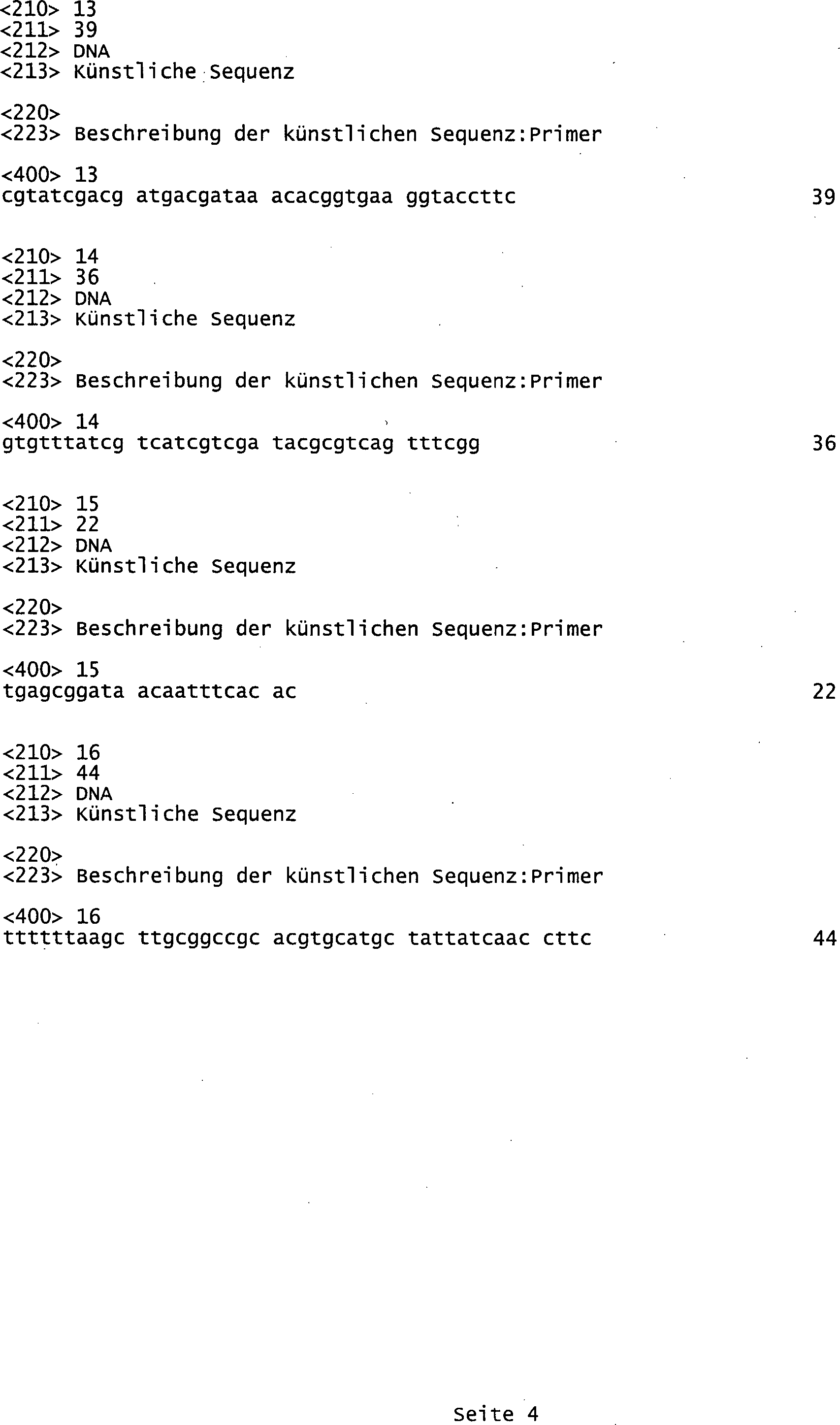
Claims (22)
Priority Applications (21)
| Application Number | Priority Date | Filing Date | Title |
|---|---|---|---|
| DE102004058306A DE102004058306A1 (en) | 2004-12-01 | 2004-12-01 | Process for the preparation of carboxy-terminally amidated peptides |
| BRPI0518759-1A BRPI0518759A2 (en) | 2004-12-01 | 2005-11-18 | process for the production of carboxy terminal amide peptides |
| DE502005007161T DE502005007161D1 (en) | 2004-12-01 | 2005-11-18 | PROCESS FOR PREPARING CARBOXY TERMINAL AMIDIZED PEPTIDES |
| SI200530733T SI1819729T1 (en) | 2004-12-01 | 2005-11-18 | Method for producing carboxy-terminal amidified peptides |
| US11/720,006 US7939293B2 (en) | 2004-12-01 | 2005-11-18 | Method for producing carboxy-terminal-amidified peptides |
| DK05850211T DK1819729T3 (en) | 2004-12-01 | 2005-11-18 | Process for the preparation of carboxy-terminally amidated peptides |
| KR1020077012501A KR101299417B1 (en) | 2004-12-01 | 2005-11-18 | Method for producing carboxy-terminal amidified peptides |
| EP05850211A EP1819729B8 (en) | 2004-12-01 | 2005-11-18 | Method for producing carboxy-terminal amidified peptides |
| PT05850211T PT1819729E (en) | 2004-12-01 | 2005-11-18 | Method for producing carboxy-terminal amidified peptides |
| CA2589951A CA2589951C (en) | 2004-12-01 | 2005-11-18 | Method for producing carboxy-terminal amidated peptides |
| ES05850211T ES2324951T3 (en) | 2004-12-01 | 2005-11-18 | PROCEDURE FOR THE PREPARATION OF CARBOXI-TERMINAL AMBED PEPTIDES. |
| PCT/EP2005/012365 WO2006058620A2 (en) | 2004-12-01 | 2005-11-18 | Method for producing carboxy-terminal amidified peptides |
| AU2005312165A AU2005312165B2 (en) | 2004-12-01 | 2005-11-18 | Method for producing carboxy-terminal amidified peptides |
| JP2007543728A JP4857279B2 (en) | 2004-12-01 | 2005-11-18 | Method for producing peptide having amidated carboxy terminus |
| MX2007005840A MX2007005840A (en) | 2004-12-01 | 2005-11-18 | Method for producing carboxy-terminal amidified peptides. |
| PL05850211T PL1819729T3 (en) | 2004-12-01 | 2005-11-18 | Method for producing carboxy-terminal amidified peptides |
| HK08101877.8A HK1111426B (en) | 2004-12-01 | 2005-11-18 | Method for producing carboxy-terminal amidified peptides |
| AT05850211T ATE429445T1 (en) | 2004-12-01 | 2005-11-18 | METHOD FOR PRODUCING CARBOXY-TERMINAL AMIDATED PEPTIDES |
| CN2005800412833A CN101068833B (en) | 2004-12-01 | 2005-11-18 | Method for producing carboxy-terminal amidified peptides |
| IL183467A IL183467A0 (en) | 2004-12-01 | 2007-05-28 | Method for producing carboxy-terminal amidified peptides |
| CY20091100691T CY1110488T1 (en) | 2004-12-01 | 2009-06-30 | METHOD FOR PREPARATION OF CARBOXY-END TERMINAL Peptides |
Applications Claiming Priority (1)
| Application Number | Priority Date | Filing Date | Title |
|---|---|---|---|
| DE102004058306A DE102004058306A1 (en) | 2004-12-01 | 2004-12-01 | Process for the preparation of carboxy-terminally amidated peptides |
Publications (1)
| Publication Number | Publication Date |
|---|---|
| DE102004058306A1 true DE102004058306A1 (en) | 2006-07-27 |
Family
ID=36001270
Family Applications (2)
| Application Number | Title | Priority Date | Filing Date |
|---|---|---|---|
| DE102004058306A Withdrawn DE102004058306A1 (en) | 2004-12-01 | 2004-12-01 | Process for the preparation of carboxy-terminally amidated peptides |
| DE502005007161T Expired - Lifetime DE502005007161D1 (en) | 2004-12-01 | 2005-11-18 | PROCESS FOR PREPARING CARBOXY TERMINAL AMIDIZED PEPTIDES |
Family Applications After (1)
| Application Number | Title | Priority Date | Filing Date |
|---|---|---|---|
| DE502005007161T Expired - Lifetime DE502005007161D1 (en) | 2004-12-01 | 2005-11-18 | PROCESS FOR PREPARING CARBOXY TERMINAL AMIDIZED PEPTIDES |
Country Status (19)
| Country | Link |
|---|---|
| US (1) | US7939293B2 (en) |
| EP (1) | EP1819729B8 (en) |
| JP (1) | JP4857279B2 (en) |
| KR (1) | KR101299417B1 (en) |
| CN (1) | CN101068833B (en) |
| AT (1) | ATE429445T1 (en) |
| AU (1) | AU2005312165B2 (en) |
| BR (1) | BRPI0518759A2 (en) |
| CA (1) | CA2589951C (en) |
| CY (1) | CY1110488T1 (en) |
| DE (2) | DE102004058306A1 (en) |
| DK (1) | DK1819729T3 (en) |
| ES (1) | ES2324951T3 (en) |
| IL (1) | IL183467A0 (en) |
| MX (1) | MX2007005840A (en) |
| PL (1) | PL1819729T3 (en) |
| PT (1) | PT1819729E (en) |
| SI (1) | SI1819729T1 (en) |
| WO (1) | WO2006058620A2 (en) |
Cited By (1)
| Publication number | Priority date | Publication date | Assignee | Title |
|---|---|---|---|---|
| DE102007002580A1 (en) * | 2007-01-11 | 2008-07-17 | C-Lecta Gmbh | Proteolytic cleavage of protein tags in recombinant protein production |
Families Citing this family (26)
| Publication number | Priority date | Publication date | Assignee | Title |
|---|---|---|---|---|
| DE102005046113A1 (en) * | 2005-09-27 | 2007-03-29 | Sanofi-Aventis Deutschland Gmbh | Preparation of C-amidated peptides, useful as pharmaceuticals, by reaction between precursor peptides in presence of enzyme with activity of trypsin, also new reaction products |
| DE102006031962A1 (en) | 2006-07-11 | 2008-01-17 | Sanofi-Aventis Deutschland Gmbh | Amidated insulin glargine |
| DE102006031955A1 (en) | 2006-07-11 | 2008-01-17 | Sanofi-Aventis Deutschland Gmbh | Process for the preparation of dibasic B chain end insulin analogs |
| DE102008003568A1 (en) | 2008-01-09 | 2009-07-16 | Sanofi-Aventis Deutschland Gmbh | New insulin analogs useful for treating diabetes |
| DE102008025008A1 (en) | 2008-05-24 | 2009-11-26 | Sanofi-Aventis Deutschland Gmbh | Insulin analogs which comprise A chain and B chain with disulfide bonds for use in treatment of diabetes |
| EP2229406B1 (en) | 2008-01-09 | 2015-04-22 | Sanofi-Aventis Deutschland GmbH | Novel insulin derivatives having an extremely delayed time-action profile |
| EP2229407B1 (en) | 2008-01-09 | 2016-11-16 | Sanofi-Aventis Deutschland GmbH | Novel insulin derivatives having an extremely delayed time-action profile |
| DE102008003566A1 (en) | 2008-01-09 | 2009-07-16 | Sanofi-Aventis Deutschland Gmbh | New insulin analogs useful for treating diabetes |
| DE102008025007A1 (en) | 2008-05-24 | 2009-11-26 | Sanofi-Aventis Deutschland Gmbh | Insulin analogs which comprise A chain and B chain with disulfide bonds for use in treatment of diabetes and for cartilage regeneration |
| PT2349324T (en) | 2008-10-17 | 2017-12-06 | Sanofi Aventis Deutschland | Combination of an insulin and a glp-1 agonist |
| WO2011058083A1 (en) | 2009-11-13 | 2011-05-19 | Sanofi-Aventis Deutschland Gmbh | Pharmaceutical composition comprising a glp-1 agonist, an insulin, and methionine |
| SG10201500871TA (en) | 2009-11-13 | 2015-04-29 | Sanofi Aventis Deutschland | Pharmaceutical composition comprising a glp-1 agonist and methionine |
| JP5198427B2 (en) * | 2009-12-29 | 2013-05-15 | ザインエレクトロニクス株式会社 | Sigma delta modulator |
| RS55378B1 (en) | 2010-08-30 | 2017-03-31 | Sanofi Aventis Deutschland | USE OF AVE0010 FOR MANUFACTURE OF TREATMENT OF DIABETES MELLITUS TYPE 2 |
| US9821032B2 (en) | 2011-05-13 | 2017-11-21 | Sanofi-Aventis Deutschland Gmbh | Pharmaceutical combination for improving glycemic control as add-on therapy to basal insulin |
| HRP20151068T1 (en) | 2011-08-29 | 2016-01-01 | Sanofi-Aventis Deutschland Gmbh | Pharmaceutical combination for use in glycemic control in diabetes type 2 patients |
| AR087744A1 (en) | 2011-09-01 | 2014-04-16 | Sanofi Aventis Deutschland | PHARMACEUTICAL COMPOSITION FOR USE IN THE TREATMENT OF A NEURODEGENERATIVE DISEASE |
| TWI641381B (en) | 2013-02-04 | 2018-11-21 | 法商賽諾菲公司 | Stabilized pharmaceutical formulations of insulin analogs and/or insulin derivatives |
| RU2016132340A (en) | 2014-01-09 | 2018-02-14 | Санофи | STABILIZED PHARMACEUTICAL COMPOSITIONS BASED ON INSULIN ASPART |
| SG11201604710XA (en) | 2014-01-09 | 2016-07-28 | Sanofi Sa | Stabilized pharmaceutical formulations of insulin analogues and/or insulin derivatives |
| SG11201604708VA (en) | 2014-01-09 | 2016-07-28 | Sanofi Sa | Stabilized glycerol free pharmaceutical formulations of insulin analogues and/or insulin derivatives |
| TWI758239B (en) | 2014-12-12 | 2022-03-21 | 德商賽諾菲阿凡提斯德意志有限公司 | Insulin glargine/lixisenatide fixed ratio formulation |
| TWI748945B (en) | 2015-03-13 | 2021-12-11 | 德商賽諾菲阿凡提斯德意志有限公司 | Treatment type 2 diabetes mellitus patients |
| TW201705975A (en) | 2015-03-18 | 2017-02-16 | 賽諾菲阿凡提斯德意志有限公司 | Treatment of type 2 diabetes mellitus patients |
| CN115786426B (en) * | 2022-10-31 | 2023-09-08 | 杭州先为达生物科技有限公司 | High-specificity enterokinase enzyme digestion method and application of ethanol in improving enterokinase enzyme digestion specificity |
| WO2025133045A1 (en) * | 2023-12-22 | 2025-06-26 | Novo Nordisk A/S | Fermentation process |
Citations (4)
| Publication number | Priority date | Publication date | Assignee | Title |
|---|---|---|---|---|
| DE10123348A1 (en) * | 2001-05-14 | 2002-11-21 | Fresenius Kabi De Gmbh | New DNA construct encoding polypeptide that includes cleavage sites, useful for preparation of pharmaceutical peptides or their mixtures |
| US6528486B1 (en) * | 1999-07-12 | 2003-03-04 | Zealand Pharma A/S | Peptide agonists of GLP-1 activity |
| US6723530B1 (en) * | 1997-02-05 | 2004-04-20 | Amylin Pharmaceuticals, Inc. | Polynucleotides encoding proexendin, and methods and uses thereof |
| WO2004035623A2 (en) * | 2002-10-02 | 2004-04-29 | Zealand Pharma A/S | Stabilized exendin-4 compounds |
Family Cites Families (14)
| Publication number | Priority date | Publication date | Assignee | Title |
|---|---|---|---|---|
| US4708934A (en) | 1984-09-27 | 1987-11-24 | Unigene Laboratories, Inc. | α-amidation enzyme |
| US5496924A (en) | 1985-11-27 | 1996-03-05 | Hoechst Aktiengesellschaft | Fusion protein comprising an interleukin-2 fragment ballast portion |
| JP2598050B2 (en) | 1987-07-17 | 1997-04-09 | サントリー株式会社 | C-terminal α-amidating enzyme |
| US5789234A (en) | 1987-08-14 | 1998-08-04 | Unigene Laboratories, Inc. | Expression systems for amidating enzyme |
| US6255067B1 (en) | 1987-09-15 | 2001-07-03 | The Johns Hopkins University | cDNA encoding peptidyl-glycine alpha-amidating monooxygenase (PAM) |
| US6319695B1 (en) | 1991-10-15 | 2001-11-20 | The Scripps Research Insitute | Production of fucosylated carbohydrates by enzymatic fucosylation synthesis of sugar nucleotides; and in situ regeneration of GDP-fucose |
| US5338833A (en) * | 1992-07-23 | 1994-08-16 | The University Of North Carolina At Chapel Hill | Carboxy terminal IL-6 muteins |
| US5589364A (en) * | 1994-07-29 | 1996-12-31 | Magainin Pharmaceuticals Inc. | Recombinant production of biologically active peptides and proteins |
| JP3291172B2 (en) | 1994-10-04 | 2002-06-10 | キヤノン株式会社 | Manufacturing method of metal mirror |
| WO1996017941A2 (en) | 1994-12-07 | 1996-06-13 | Bionebraska, Inc. | Production of c-terminal amidated peptides from recombinant protein constructs |
| US6461834B1 (en) | 1998-11-06 | 2002-10-08 | Bionebraska, Inc. | Clostripain catalyzed amidation of peptides |
| US6924264B1 (en) * | 1999-04-30 | 2005-08-02 | Amylin Pharmaceuticals, Inc. | Modified exendins and exendin agonists |
| EP1076066A1 (en) * | 1999-07-12 | 2001-02-14 | Zealand Pharmaceuticals A/S | Peptides for lowering blood glucose levels |
| US6992172B1 (en) * | 1999-11-12 | 2006-01-31 | Fibrogen, Inc. | Recombinant gelatins |
-
2004
- 2004-12-01 DE DE102004058306A patent/DE102004058306A1/en not_active Withdrawn
-
2005
- 2005-11-18 CN CN2005800412833A patent/CN101068833B/en not_active Expired - Fee Related
- 2005-11-18 ES ES05850211T patent/ES2324951T3/en not_active Expired - Lifetime
- 2005-11-18 PL PL05850211T patent/PL1819729T3/en unknown
- 2005-11-18 WO PCT/EP2005/012365 patent/WO2006058620A2/en not_active Ceased
- 2005-11-18 AT AT05850211T patent/ATE429445T1/en active
- 2005-11-18 BR BRPI0518759-1A patent/BRPI0518759A2/en active Search and Examination
- 2005-11-18 MX MX2007005840A patent/MX2007005840A/en active IP Right Grant
- 2005-11-18 PT PT05850211T patent/PT1819729E/en unknown
- 2005-11-18 KR KR1020077012501A patent/KR101299417B1/en not_active Expired - Fee Related
- 2005-11-18 JP JP2007543728A patent/JP4857279B2/en not_active Expired - Fee Related
- 2005-11-18 DK DK05850211T patent/DK1819729T3/en active
- 2005-11-18 EP EP05850211A patent/EP1819729B8/en not_active Expired - Lifetime
- 2005-11-18 US US11/720,006 patent/US7939293B2/en not_active Expired - Fee Related
- 2005-11-18 CA CA2589951A patent/CA2589951C/en not_active Expired - Fee Related
- 2005-11-18 DE DE502005007161T patent/DE502005007161D1/en not_active Expired - Lifetime
- 2005-11-18 SI SI200530733T patent/SI1819729T1/en unknown
- 2005-11-18 AU AU2005312165A patent/AU2005312165B2/en not_active Ceased
-
2007
- 2007-05-28 IL IL183467A patent/IL183467A0/en not_active IP Right Cessation
-
2009
- 2009-06-30 CY CY20091100691T patent/CY1110488T1/en unknown
Patent Citations (5)
| Publication number | Priority date | Publication date | Assignee | Title |
|---|---|---|---|---|
| US6723530B1 (en) * | 1997-02-05 | 2004-04-20 | Amylin Pharmaceuticals, Inc. | Polynucleotides encoding proexendin, and methods and uses thereof |
| US6528486B1 (en) * | 1999-07-12 | 2003-03-04 | Zealand Pharma A/S | Peptide agonists of GLP-1 activity |
| US20040106547A1 (en) * | 1999-07-12 | 2004-06-03 | Zealand Pharma A/S | Novel peptide agonists of GLP-1 activity |
| DE10123348A1 (en) * | 2001-05-14 | 2002-11-21 | Fresenius Kabi De Gmbh | New DNA construct encoding polypeptide that includes cleavage sites, useful for preparation of pharmaceutical peptides or their mixtures |
| WO2004035623A2 (en) * | 2002-10-02 | 2004-04-29 | Zealand Pharma A/S | Stabilized exendin-4 compounds |
Cited By (1)
| Publication number | Priority date | Publication date | Assignee | Title |
|---|---|---|---|---|
| DE102007002580A1 (en) * | 2007-01-11 | 2008-07-17 | C-Lecta Gmbh | Proteolytic cleavage of protein tags in recombinant protein production |
Also Published As
| Publication number | Publication date |
|---|---|
| AU2005312165A1 (en) | 2006-06-08 |
| AU2005312165B2 (en) | 2011-08-04 |
| EP1819729B1 (en) | 2009-04-22 |
| WO2006058620A3 (en) | 2006-08-03 |
| KR20070091131A (en) | 2007-09-07 |
| JP4857279B2 (en) | 2012-01-18 |
| JP2008521415A (en) | 2008-06-26 |
| IL183467A0 (en) | 2007-09-20 |
| CA2589951C (en) | 2013-10-15 |
| PL1819729T3 (en) | 2009-09-30 |
| CY1110488T1 (en) | 2015-04-29 |
| MX2007005840A (en) | 2007-07-04 |
| EP1819729A2 (en) | 2007-08-22 |
| ATE429445T1 (en) | 2009-05-15 |
| CN101068833A (en) | 2007-11-07 |
| CA2589951A1 (en) | 2006-06-08 |
| KR101299417B1 (en) | 2013-08-28 |
| US20090005299A1 (en) | 2009-01-01 |
| BRPI0518759A2 (en) | 2008-12-09 |
| DE502005007161D1 (en) | 2009-06-04 |
| HK1111426A1 (en) | 2008-08-08 |
| US7939293B2 (en) | 2011-05-10 |
| ES2324951T3 (en) | 2009-08-20 |
| WO2006058620A2 (en) | 2006-06-08 |
| SI1819729T1 (en) | 2009-10-31 |
| DK1819729T3 (en) | 2009-08-17 |
| PT1819729E (en) | 2009-06-12 |
| CN101068833B (en) | 2011-04-20 |
| EP1819729B8 (en) | 2009-08-12 |
Similar Documents
| Publication | Publication Date | Title |
|---|---|---|
| EP1819729B1 (en) | Method for producing carboxy-terminal amidified peptides | |
| DE19605657B4 (en) | Human proinsulin derivative, coding DNA, DNA-containing expression vector, with this transformed microorganism and use of this human Proinsulinderivats | |
| FI102843B (en) | A process for the preparation of substantially purified insulin derivatives | |
| EP1931705B1 (en) | Method for amidating polypeptides with basic aminoacid c- terminals by means of specific endoproteases | |
| DE69937272T2 (en) | PROCESS FOR THE PREPARATION OF A PEPTIDE BY A HEPPEPEPTIDE | |
| CN101186940B (en) | Process for obtaining insulin or insulin derivatives with properly bonded cystine bonds | |
| DE3882593T2 (en) | Polypeptide and its production. | |
| EP0764172A1 (en) | Synthetic peptide analogs of lung surfactant protein sp-c | |
| SK171492A3 (en) | Polypeptide, method of its preparation its use and pharmaceutical agent | |
| EP2041170B1 (en) | Method for producing insulin analogs having a dibasic b chain terminus | |
| DE60209883T2 (en) | OVERVERSED PEPTIDES, THEIR PREPARATION, AND SIMULTANEOUS IMPROVEMENT OF THE SECRETED FORM OF ONE OR MORE OTHER POLYPEPTIDES | |
| DE69732583T2 (en) | A method of cleaving a chimeric protein by means of a 'processing' enzyme | |
| DE3751081T2 (en) | [Leu 13] Motilin, its coding DNA molecules and process for its production. | |
| CN111363048B (en) | Soluble recombinant tartary buckwheat metallothionein FtMT with membrane penetrating activity and preparation method thereof | |
| KR100368073B1 (en) | Preparation of Peptides by Use of Human Glucagon Sequence as a Fusion Expression Partner | |
| US5459049A (en) | Motilin-like polypeptide and use thereof | |
| AU768443B2 (en) | Method for stabilising proteins in complex mixtures during their storage in aqueous solvents | |
| JPH0380096A (en) | Production of motilin-like polypeptide and recombinant dna and manifestation plasmid therefor | |
| DE19535445A1 (en) | Process for the production of natriuretic peptides via streptavidin fusion proteins | |
| DE69123242T2 (en) | Physiologically active peptides, their use and a method for producing said peptides | |
| HK1111426B (en) | Method for producing carboxy-terminal amidified peptides | |
| DE19649233A1 (en) | Nucleic acid encoding interleukin-16 polypeptide | |
| DD290426A5 (en) | HUMAN INSULIN ANALOG |
Legal Events
| Date | Code | Title | Description |
|---|---|---|---|
| OM8 | Search report available as to paragraph 43 lit. 1 sentence 1 patent law | ||
| R005 | Application deemed withdrawn due to failure to request examination |
Effective date: 20111202 |