DE102004041531A1 - Process for the preparation of biphenylamines - Google Patents
Process for the preparation of biphenylamines Download PDFInfo
- Publication number
- DE102004041531A1 DE102004041531A1 DE102004041531A DE102004041531A DE102004041531A1 DE 102004041531 A1 DE102004041531 A1 DE 102004041531A1 DE 102004041531 A DE102004041531 A DE 102004041531A DE 102004041531 A DE102004041531 A DE 102004041531A DE 102004041531 A1 DE102004041531 A1 DE 102004041531A1
- Authority
- DE
- Germany
- Prior art keywords
- formula
- meanings given
- chlorine
- fluorine
- anilides
- Prior art date
- Legal status (The legal status is an assumption and is not a legal conclusion. Google has not performed a legal analysis and makes no representation as to the accuracy of the status listed.)
- Withdrawn
Links
- 0 CC(C)(c1cc(C=CC(C)(*)C=C2)c2[n]1C(*)=O)O Chemical compound CC(C)(c1cc(C=CC(C)(*)C=C2)c2[n]1C(*)=O)O 0.000 description 2
- AXJVTIXMCNXNFH-UHFFFAOYSA-N CC(Nc(c(-c(cc1Cl)ccc1Cl)c1)ccc1F)=O Chemical compound CC(Nc(c(-c(cc1Cl)ccc1Cl)c1)ccc1F)=O AXJVTIXMCNXNFH-UHFFFAOYSA-N 0.000 description 1
- LDLMOOXUCMHBMZ-UHFFFAOYSA-N C[n]1nc(C(F)F)c(C(Nc(ccc(F)c2)c2-c(cc2)cc(Cl)c2Cl)=O)c1 Chemical compound C[n]1nc(C(F)F)c(C(Nc(ccc(F)c2)c2-c(cc2)cc(Cl)c2Cl)=O)c1 LDLMOOXUCMHBMZ-UHFFFAOYSA-N 0.000 description 1
Classifications
-
- C—CHEMISTRY; METALLURGY
- C07—ORGANIC CHEMISTRY
- C07C—ACYCLIC OR CARBOCYCLIC COMPOUNDS
- C07C233/00—Carboxylic acid amides
- C07C233/01—Carboxylic acid amides having carbon atoms of carboxamide groups bound to hydrogen atoms or to acyclic carbon atoms
- C07C233/12—Carboxylic acid amides having carbon atoms of carboxamide groups bound to hydrogen atoms or to acyclic carbon atoms having the nitrogen atom of at least one of the carboxamide groups bound to a carbon atom of a hydrocarbon radical substituted by halogen atoms or by nitro or nitroso groups
- C07C233/15—Carboxylic acid amides having carbon atoms of carboxamide groups bound to hydrogen atoms or to acyclic carbon atoms having the nitrogen atom of at least one of the carboxamide groups bound to a carbon atom of a hydrocarbon radical substituted by halogen atoms or by nitro or nitroso groups with the substituted hydrocarbon radical bound to the nitrogen atom of the carboxamide group by a carbon atom of a six-membered aromatic ring
-
- C—CHEMISTRY; METALLURGY
- C07—ORGANIC CHEMISTRY
- C07C—ACYCLIC OR CARBOCYCLIC COMPOUNDS
- C07C209/00—Preparation of compounds containing amino groups bound to a carbon skeleton
- C07C209/62—Preparation of compounds containing amino groups bound to a carbon skeleton by cleaving carbon-to-nitrogen, sulfur-to-nitrogen, or phosphorus-to-nitrogen bonds, e.g. hydrolysis of amides, N-dealkylation of amines or quaternary ammonium compounds
-
- C—CHEMISTRY; METALLURGY
- C07—ORGANIC CHEMISTRY
- C07C—ACYCLIC OR CARBOCYCLIC COMPOUNDS
- C07C211/00—Compounds containing amino groups bound to a carbon skeleton
- C07C211/43—Compounds containing amino groups bound to a carbon skeleton having amino groups bound to carbon atoms of six-membered aromatic rings of the carbon skeleton
- C07C211/44—Compounds containing amino groups bound to a carbon skeleton having amino groups bound to carbon atoms of six-membered aromatic rings of the carbon skeleton having amino groups bound to only one six-membered aromatic ring
- C07C211/52—Compounds containing amino groups bound to a carbon skeleton having amino groups bound to carbon atoms of six-membered aromatic rings of the carbon skeleton having amino groups bound to only one six-membered aromatic ring the carbon skeleton being further substituted by halogen atoms or by nitro or nitroso groups
-
- C—CHEMISTRY; METALLURGY
- C07—ORGANIC CHEMISTRY
- C07C—ACYCLIC OR CARBOCYCLIC COMPOUNDS
- C07C231/00—Preparation of carboxylic acid amides
- C07C231/12—Preparation of carboxylic acid amides by reactions not involving the formation of carboxamide groups
-
- C—CHEMISTRY; METALLURGY
- C07—ORGANIC CHEMISTRY
- C07C—ACYCLIC OR CARBOCYCLIC COMPOUNDS
- C07C233/00—Carboxylic acid amides
- C07C233/01—Carboxylic acid amides having carbon atoms of carboxamide groups bound to hydrogen atoms or to acyclic carbon atoms
- C07C233/16—Carboxylic acid amides having carbon atoms of carboxamide groups bound to hydrogen atoms or to acyclic carbon atoms having the nitrogen atom of at least one of the carboxamide groups bound to a carbon atom of a hydrocarbon radical substituted by singly-bound oxygen atoms
- C07C233/24—Carboxylic acid amides having carbon atoms of carboxamide groups bound to hydrogen atoms or to acyclic carbon atoms having the nitrogen atom of at least one of the carboxamide groups bound to a carbon atom of a hydrocarbon radical substituted by singly-bound oxygen atoms with the substituted hydrocarbon radical bound to the nitrogen atom of the carboxamide group by a carbon atom of a six-membered aromatic ring
- C07C233/25—Carboxylic acid amides having carbon atoms of carboxamide groups bound to hydrogen atoms or to acyclic carbon atoms having the nitrogen atom of at least one of the carboxamide groups bound to a carbon atom of a hydrocarbon radical substituted by singly-bound oxygen atoms with the substituted hydrocarbon radical bound to the nitrogen atom of the carboxamide group by a carbon atom of a six-membered aromatic ring having the carbon atom of the carboxamide group bound to a hydrogen atom or to a carbon atom of an acyclic saturated carbon skeleton
-
- C—CHEMISTRY; METALLURGY
- C07—ORGANIC CHEMISTRY
- C07D—HETEROCYCLIC COMPOUNDS
- C07D231/00—Heterocyclic compounds containing 1,2-diazole or hydrogenated 1,2-diazole rings
- C07D231/02—Heterocyclic compounds containing 1,2-diazole or hydrogenated 1,2-diazole rings not condensed with other rings
- C07D231/10—Heterocyclic compounds containing 1,2-diazole or hydrogenated 1,2-diazole rings not condensed with other rings having two or three double bonds between ring members or between ring members and non-ring members
- C07D231/14—Heterocyclic compounds containing 1,2-diazole or hydrogenated 1,2-diazole rings not condensed with other rings having two or three double bonds between ring members or between ring members and non-ring members with hetero atoms or with carbon atoms having three bonds to hetero atoms with at the most one bond to halogen, e.g. ester or nitrile radicals, directly attached to ring carbon atoms
Landscapes
- Chemical & Material Sciences (AREA)
- Organic Chemistry (AREA)
- Chemical Kinetics & Catalysis (AREA)
- Organic Low-Molecular-Weight Compounds And Preparation Thereof (AREA)
- Low-Molecular Organic Synthesis Reactions Using Catalysts (AREA)
Abstract
Die vorliegende Erfindung betrifft ein neues Verfahren zum Herstellen von substituierten Biphenylaminen, neue Zwischenprodukte und deren Herstellung sowie ein Verfahren zum Herstellen fungizid wirksamer Carboxamide.The present invention relates to a novel process for preparing substituted biphenylamines, novel intermediates and their preparation, and to a process for preparing fungicidally active carboxamides.
Description
Die vorliegende Erfindung betrifft ein neues Verfahren zum Herstellen von substituierten Biphenylaminen, neue Zwischenprodukte und deren Herstellung, sowie ein Verfahren zum Herstellen fungizid wirksamer Carboxamide.The The present invention relates to a new method of manufacturing of substituted biphenylamines, new intermediates and their Production, and a method for producing fungicidally active carboxamides.
Es ist bereits bekannt, dass sich Biphenyl-Derivate aus Phenylboronsäuren und Phenylhalogeniden durch eine Suzuki- oder Stille-Kupplung herstellen lassen (vgl. z.B. WO 01/42223, WO 02/064562, WO 03/070705, Robertson und Hansen (eds.) PCBs, The University Press of Kentucky 2001, 57-60).It It is already known that biphenyl derivatives of phenylboronic acids and Produce phenyl halides through a Suzuki or Stille coupling See, for example, WO 01/42223, WO 02/064562, WO 03/070705, Robertson and Hansen (eds.) PCBs, The University Press of Kentucky 2001, 57-60).
Weiterhin ist bekannt, dass man Biphenyl-Derivate erhält, indem man Aryl-Zink-Halogenide mit Arylhalogeniden umsetzt (Bull. Korean Chem. Soc. 2000, 21, 165-166).Farther It is known to obtain biphenyl derivatives by using aryl zinc halides with aryl halides (Bull. Korean Chem. Soc. 2000, 21, 165-166).
Nachteilig bei diesen Verfahren sind die hohen Herstellkosten. Die Herstellung einer Boronsäure erfordert eine Grignard-Reaktion, und die Übergangsmetall katalysierte Kreuzkupplung (z.B. nach Suzuki) erfordert relativ hohe Mengen an Palladiumkatalysatoren oder aber (Bull. Korean Chem. Soc. 2000, 21, 165-166) die Verwendung von nahezu äquivalenten Mengen Zink, das als Abfall entsorgt werden muss und zur Aktivierung des Zinks das cancerogene Dibrommethan benötigt.adversely in these methods, the high production costs. The production a boronic acid requires a Grignard reaction, and the transition metal catalyzes Cross coupling (e.g., Suzuki) requires relatively high amounts Palladium catalysts or (Bull. Korean Chem. Soc. 2000, 21, 165-166) the use of nearly equivalent amounts of zinc, the must be disposed of as waste and to activate the zinc Carcinogenic dibromomethane is needed.
Von besonderem Nachteil ist, dass eine Selbstkupplung der Boronsäuren nicht vermieden werden kann (Robertson und Hansen (eds.) PCBs, The University Press of Kentucky 2001, 57-60) und die Gefahr besteht, dass Polychlorbiphenyle (PCB's) gebildet werden können (vgl. das folgende Schema).From particular disadvantage is that a self-coupling of boronic acids not can be avoided (Robertson and Hansen (eds.) PCBs, The University Press of Kentucky 2001, 57-60) and there is a risk that polychlorobiphenyls (PCB's) formed can be (see the following scheme).

Dagegen wird beim erfindungsgemäßen Verfahren der zweite Phenylring gezielt durch eine Diels-Alder-Reaktion aufgebaut.On the other hand becomes in the procedure according to invention the second phenyl ring was built up by a Diels-Alder reaction.
Die Aufgabe der vorliegenden Erfindung bestand also in der Bereitstellung eines neuen, wirtschaftlichen Verfahrens, durch das Biphenylamine mit hoher Gesamtausbeute und hoher Reinheit erhalten werden können.The Object of the present invention was therefore in the provision a new, economical process by which biphenylamines can be obtained with high overall yield and high purity.
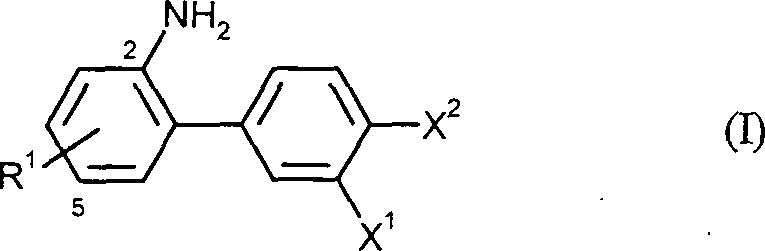
Gegenstand
der vorliegenden Erfindung ist also ein Verfahren zum Herstellen
von Biphenylaminen der allgemeinen Formel (I) 
R1 für
Wasserstoff, Fluor, Chlor, C1-C4-Alkyl,
C1-C4-Alkoxy, C1-C4-Alkylthio oder
C1-C4-Halogenalkyl steht,
X1 für
Fluor, Chlor oder Brom steht,
X2 für Fluor,
Chlor oder Brom steht,
dadurch gekennzeichnet, dass man (Verfahren
A)
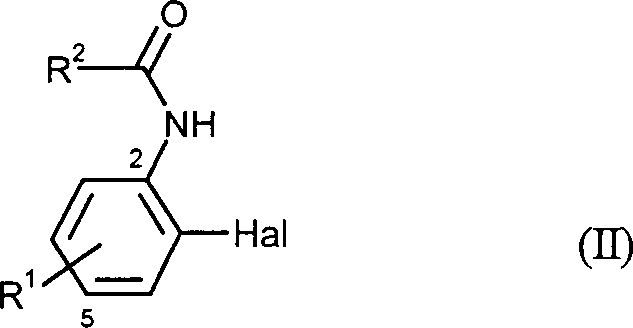
- (1) in einer ersten Stufe Anilide der Formel
(II) in welcher Hal für Chlor, Brom oder Iod steht, R2 für Wasserstoff, C1-C4-Alkyl oder C1-C4-Alkoxy steht, und R1 die oben angegebenen Bedeutungen hat, mit 2-Methylbut-3-in-2-ol der Formel (III)
 umsetzt,
- (2) in einer zweiten Stufe aus den so erhaltenen Alkinyl-Aniliden
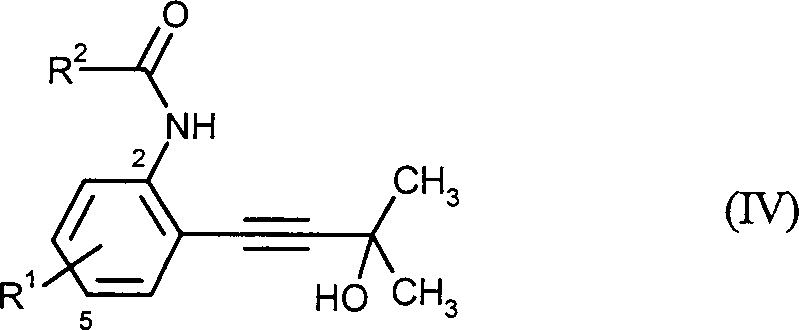
der Formel (IV) in welcher R1 und R2 die oben angegebenen Bedeutungen haben, in Gegenwart von Basen Aceton abspaltet,

- (3) in einer dritten Stufe die so erhaltenen Ethinyl-Anilide
der Formel (V) in welcher R1 und R2 die oben angegebenen Bedeutungen haben, mit Thiophendioxiden der Formel (VI)
 in welcher X1 und X2 die oben angegebenen Bedeutungen haben, umsetzt, und
- (4) in einer vierten Stufe aus den so erhaltenen Biphenylamiden
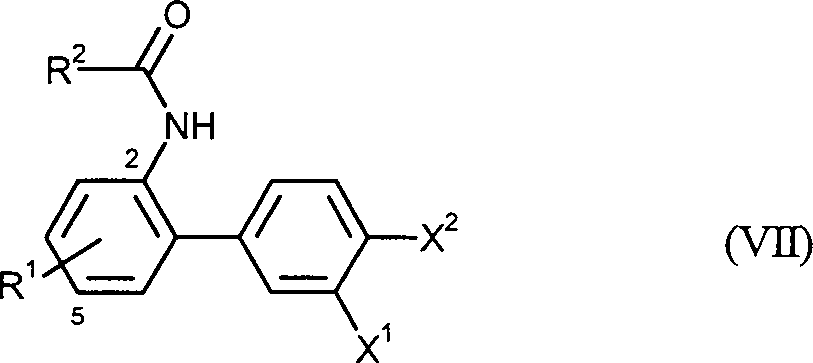
der Formel (VII) in welcher R1, R2, X1 und X2 die oben angegebenen Bedeutungen haben, die Schutzgruppe [-C(=O)R2] am Stickstoff unter sauren oder basischen Bedingungen abspaltet.

R 1 is hydrogen, fluorine, chlorine, C 1 -C 4 -alkyl, C 1 -C 4 -alkoxy, C 1 -C 4 -alkylthio or C 1 -C 4 -haloalkyl,
X 1 is fluorine, chlorine or bromine,
X 2 is fluorine, chlorine or bromine,
characterized in that (method A)
- (1) in a first stage anilides of the formula (II) in which Hal is chlorine, bromine or iodine, R 2 is hydrogen, C 1 -C 4 -alkyl or C 1 -C 4 -alkoxy, and R 1 has the meanings given above, with 2-methylbut-3-yn -2-ol of the formula (III)implements,
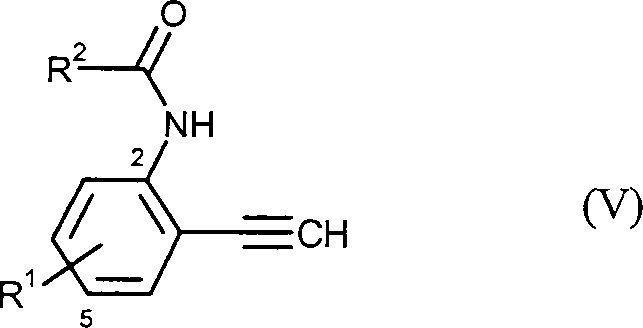
- (2) in a second step from the alkynyl anilides of the formula (IV) thus obtained in which R 1 and R 2 have the abovementioned meanings, acetone is split off in the presence of bases,
- (3) in a third step, the ethinyl anilides of the formula (V) thus obtained in which R 1 and R 2 have the meanings given above, with thiophene dioxides of the formula (VI)in which X 1 and X 2 have the meanings given above, and,
- (4) in a fourth step from the thus obtained biphenylamides of the formula (VII) in which R 1 , R 2 , X 1 and X 2 have the meanings given above, the protective group [-C (= O) R 2 ] cleaved on the nitrogen under acidic or basic conditions.
Überraschenderweise lassen sich durch diese Reaktionssequenz die Biphenylamine der Formel (I) in guten Ausbeuten aus preiswerten Ausgangsstoffen ohne eine Grignard-Reaktion herstellen. Die Übergangsmetall katalysierte Kupplung mit dem Butinol erfordert nur sehr geringe Katalysatormengen, die unter den bei einer Suzuki-Kupplung notwendigen Mengen liegen.Surprisingly can be by this reaction sequence, the biphenylamines of the formula (I) in good yields from inexpensive starting materials without a Grignard reaction produce. The transition metal catalyzed Coupling with the butynol requires only very small amounts of catalyst, which are below the levels necessary for a Suzuki coupling.
Verwendet man N-(2-Brom-4-fluorphenyl)acetamid, 2-Methylbut-3-in-2-ol sowie 3,4-Dichlorthiophen-1,1-dioxid als Ausgangsstoffe, so kann des erfindungsgemäße Verfahren A über alle 4 Stufen durch das folgende Formelschema veranschaulicht werden.If N- (2-bromo-4-fluorophenyl) acetamide, 2-methylbut-3-yn-2-ol and 3,4-dichlorothiophene-1,1-dioxide are used as starting materials, process A according to the invention can be used over all 4 Steps through that the following formula schema are shown.

Bevorzugt
ist die Durchführung
des erfindungsgemäßen Verfahrens
A unter Verwendung von Ausgangsstoffen, in denen die angegeben Reste
jeweils folgende Bedeutungen haben. Die bevorzugten, besonders bevorzugten
und ganz besonders bevorzugten Bedeutungen gelten für alle Verbindungen,
in denen die jeweiligen Reste vorkommen.
Hal steht bevorzugt
für Chlor.
Hal
steht außerdem
bevorzugt für
Brom.
Hal steht außerdem
bevorzugt für
Iod.
Hal steht besonders bevorzugt für Brom.
R1 steht
bevorzugt für
Wasserstoff.
R1 steht außerdem bevorzu
für Fluor,
wobei Fluor besonders bevorzugt in 3-, 4- oder 5- Position, ganz
besonders bevorzugt in 3- oder 5-Position, insbesondere in 5-Position
der jeweiligen Verbindung steht [vgl. z.B. Formel (I)].
R1 steht außerdem bevorzu für Chlor,
wobei Chlor besonders bevorzugt in 3- oder 5-Position der jeweiligen Verbindung
steht.
R1 steht außerdem bevorzu für Methyl
oder iso-Propyl, wobei Methyl oder iso-Propyl besonders bevorzugt
in 6-Position der jeweiligen Verbindung stehen.
R1 steht
außerdem
bevorzu für
Trifluormethyl, wobei Trifluormethyl besonders bevorzugt in 4- oder
5-Position der jeweiligen Verbindung steht.
R1 steht
außerdem
bevorzu für
Methoxy oder Methylthio, wobei Methoxy oder Methylthio besonders
bevorzugt in 4-, 5- oder 6-Position der jeweiligen Verbindung stehen.
R2 steht bevorzugt für Wasserstoff, Methyl, Ethyl,
iso-Propyl, tert-Butyl, Methoxy, Ethoxy, iso-Propoxy oder tert-Butoxy.
R2 steht besonders bevorzugt für Methyl,
tert-Butyl, Methoxy oder tert-Butoxy.
R2 steht
ganz besonders bevorzugt für
Methyl.
X1 steht bevorzu für Fluor.
X1 steht außerdem bevorzu für Chlor.
X1 steht außerdem bevorzu für Brom.
X2 steht bevorzugt für Fluor.
X2 steht
außerdem
bevorzu für
Chlor.
X2 steht außerdem bevorzu für Brom.Preference is given to carrying out process A according to the invention using starting materials in which the radicals indicated in each case have the following meanings. The preferred, particularly preferred and very particularly preferred meanings apply to all compounds in which the respective radicals occur.
Hal is preferably chlorine.
Hal is also preferred for bromine.
Hal is also preferred for iodine.
Hal is more preferably bromine.
R 1 is preferably hydrogen.
R 1 is also preferably fluorine, with fluorine being particularly preferably in the 3-, 4- or 5-position, very particularly preferably in the 3- or 5-position, in particular in the 5-position of the respective compound [cf. eg formula (I)].
R 1 is also preferably chlorine, with chlorine being more preferably in the 3- or 5-position of the respective compound.
R 1 is also preferably methyl or iso-propyl, with methyl or iso-propyl particularly preferably being in the 6-position of the respective compound.
R 1 is furthermore preferably trifluoromethyl, trifluoromethyl being particularly preferably in the 4- or 5-position of the respective compound.
R 1 is furthermore preferably methoxy or methylthio, with methoxy or methylthio being particularly preferably in the 4-, 5- or 6-position of the respective compound.
R 2 is preferably hydrogen, methyl, ethyl, iso-propyl, tert-butyl, methoxy, ethoxy, iso-propoxy or tert-butoxy.
R 2 particularly preferably represents methyl, tert-butyl, methoxy or tert-butoxy.
R 2 is very particularly preferably methyl.
X 1 is preferable for fluorine.
X 1 is also preferred for chlorine.
X 1 is also preferable to bromine.
X 2 is preferably fluorine.
X 2 is also preferred for chlorine.
X 2 is also preferable to bromine.
Bevorzugt
werden durch das erfindungsgemäße Verfahren
A Biphenylamine der Formel (I-a) 
Dazu
werden als Ausgangsstoffe Anilide der Formel (II-a) 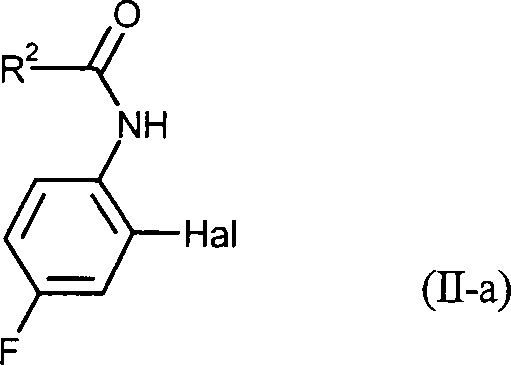
Die bei der Durchführung des erfindungsgemäßen Verfahrens A in der ersten Stufe als Ausgangsstoffe zu verwendenden Anilide der Formel (II) sind teilweise bekannt oder können nach bekannten Verfahren erhalten werden [vgl. z.B. Synlett, 2003, (14), 2231; Recl. Trav. Chim. Pay-Bas. 1964, 83, 1142;. J. Het. Chem. 1969, 6, 243].The during execution the method according to the invention A in the first stage as starting materials to be used anilides of the formula (II) are partly known or can be prepared by known methods to be obtained [cf. e.g. Synlett, 2003, (14), 2231; Recl. Trav. Chim. Pay-Bas. 1964, 83, 1142 ;. J. Het. Chem. 1969, 6, 243].
Das bei der Durchführung des erfindungsgemäßen Verfahrens A in der ersten Stufe außerdem als Ausgangsstoff zu verwendende 2-Methylbut-3-in-2-ol der Formel (III) ist bekannt und kommerziell erhältlich.The during execution the method according to the invention A in the first stage as well 2-methylbut-3-yn-2-ol of the formula to be used as starting material (III) is known and commercially available.
Die bei der Durchführung des erfindungsgemäßen Verfahrens A in der zweiten Stufe als Ausgangsstoffe zu verwendenden Alkinyl-Anilide der Formel (IV) sind neu und ebenfalls Gegenstand dieser Anmeldung. Alkinyl-Anilide der Formel (IV) werden durch die erste Stufe des erfindungsgemäßen Verfahrens A erhalten.The during execution the method according to the invention A in the second stage as starting materials to be used alkynyl anilides of the formula (IV) are new and also the subject of this application. Alkynyl anilides of the formula (IV) are replaced by the first step of the process according to the invention A received.
Die bei der Durchführung des erfindungsgemäßen Verfahrens A in der dritten Stufe als Ausgangsstoffe zu verwendenden Ethinyl-Anilide der Formel (V) sind teilweise neu (für den Fall, dass R1 für Fluor steht) und ebenfalls Gegenstand dieser Anmeldung. Ethinyl-Anilide der Formel (V) werden durch die zweite Stufe des erfindungsgemäßen Verfahrens A erhalten.The ethinyl anilides of the formula (V) to be used as starting materials in carrying out the process A according to the invention in the third stage are partly novel (in the case where R 1 is fluorine) and are likewise the subject of this application. Ethynyl anilides of the formula (V) are obtained by the second step of the process A according to the invention.
Die bei der Durchführung des erfindungsgemäßen Verfahrens A in der dritten Stufe als Ausgangsstoffe zu verwendenden Thiophendioxide der Formel (VI) sind bekannt (vgl. z.B. J. Org. Chem. 1961, 26, 346-351; J. Fluorine Chem. 1998, 88, 143-151; J. Amer. Chem. Soc. 2000, 122, 2440-2445).The during execution the method according to the invention A in the third stage as starting materials to be used thiophene dioxides of the formula (VI) are known (see, for example, J. Org. Chem. 1961, 26, 346-351; J. Fluorine Chem. 1998, 88, 143-151; J. Amer. Chem. Soc. 2000, 122, 2440-2445).
Anmerkungen zu den einzelnen Reaktionsstufen:Comments on the individual Reaction steps:
Erste StufeFirst stage
Die Kupplung von Arylhalogeniden mit Acetylen ist prinzipiell bekannt. Im vorliegenden Falle ist es allerdings problematisch, die Verbindungen in guten Ausbeuten zu erhalten, da verschiedene Nebenreaktionen stattfinden können. Zum einen können Alkinyl-Anilide der Formel (IV) dehydratisieren, wonach eine Abspaltung von Aceton zu Ethinyl-Aniliden der Formel (V) nicht mehr möglich ist (vgl. das folgende Schema).The Coupling of aryl halides with acetylene is known in principle. In the present case, however, it is problematic, the compounds to obtain in good yields, since various side reactions take place can. For one thing Alkynyl anilides of the formula (IV) dehydrate, after which a cleavage of acetone to ethynyl anilides of the formula (V) is no longer possible (see the following scheme).

Tatsächlich ist bekannt, dass Butinole aus diesem Grund mit Arylhalogeniden nur in äußerst mäßigen Ausbeuten reagieren (vgl. z.B. Tetrahedron Lett. 2004, 45, 1603-1606).Actually For this reason, butynols are known with aryl halides only in extremely moderate yields react (see, e.g., Tetrahedron Lett., 2004, 45, 1603-1606).
Die
zweite Nebenreaktion ist die Bildung von Indolen gemäß dem folgenden
Schema: 
Diese Cyclisierungsreaktion aus 2-Halogenaniliden und substituierten Acetylenen ist ebenfalls aus der Literatur bekannt (vgl. z.B. Tetrahedron Lett. 2004, 45, 693-697).These Cyclization reaction of 2-haloanilides and substituted acetylenes is also known from the literature (see, for example, Tetrahedron Lett. 2004, 45, 693-697).
Die erste Stufe des erfindungsgemäßen Verfahrens A wird in Gegenwart eines Übergangsmetallkatalysators durchgeführt, vorzugsweise in Gegenwart von Dichlorbis(triphenylphosphin)palladium(II). Es können aber auch andere Katalysatoren verwendet werden, wie z.B. Tetrakis(triphenylphosphan) palladium(0).The first stage of the process according to the invention A is in the presence of a transition metal catalyst carried out, preferably in the presence of dichlorobis (triphenylphosphine) palladium (II). But it can other catalysts may also be used, e.g. Tetrakis (triphenylphosphane) palladium (0).
Die erste Stufe des erfindungsgemäßen Verfahrens A wird vorzugsweise in Gegenwart von Kupferhalogeniden und Triphenylphosphin als Co-Katalysator durchgeführt, besonders bevorzugt ist Kupferiodid.The first stage of the process according to the invention A is preferably in the presence of copper halides and triphenylphosphine carried out as co-catalyst, particularly preferred is copper iodide.
Die erste Stufe des erfindungsgemäßen Verfahrens A kann prinzipiell auch ohne Kupfersalze durchgeführt werden, wodurch sich die Menge an Pd-Katalysator signifikant erhöht.The first stage of the process according to the invention A can in principle also be carried out without copper salts, whereby the amount of Pd catalyst increases significantly.
Bei der Durchführung der ersten Stufe des erfindungsgemäßen Verfahrens A wird in Gegenwart einer Base gearbeitet, bevorzugt in Gegenwart von sekundären oder tertiären Aminen. Vorzugsweise verwendbar sind Diethylamin, Dipropylamin, Dibutylamin, Piperidin, Triethylamin, Tripropylamin, Tributylamin, besonders bevorzugt Triethylamin.at the implementation the first stage of process A according to the invention is in the presence a base worked, preferably in the presence of secondary or tertiary Amines. Preferably usable are diethylamine, dipropylamine, Dibutylamine, piperidine, triethylamine, tripropylamine, tributylamine, most preferably triethylamine.
Bei der Durchführung der ersten Stufe des erfindungsgemäßen Verfahrens A ist die Verwendung eines Verdünnungsmittels ist nicht erforderlich. Es können aber auch Alkalicarbonate als Base in z.B. Nitrilen als Lösungsmittel verwendet werden.at the implementation the first step of the method A according to the invention is the use a diluent not necessary. It can but also alkali carbonates as base in e.g. Nitriles as a solvent be used.
Bei der Durchführung der ersten Stufe des erfindungsgemäßen Verfahrens A arbeitet man im Allgemeinen bei Temperaturen im Bereich von 20°C bis 120°C, vorzugsweise im Bereich von 50°C bis 100°C.at the implementation the first stage of the process A according to the invention is carried out generally at temperatures in the range of 20 ° C to 120 ° C, preferably in the range of 50 ° C up to 100 ° C.
Bei der Durchführung der ersten Stufe des erfindungsgemäßen Verfahrens A setzt man auf 1 Mol an Anilid der Formel (In im Allgemeinen zwischen 1 Mol und 1,5 Mol, vorzugsweise zwischen 1 Mol und 1,1 Mol 2-Methylbut-3-in-2-ol der Formel (III) sowie zwischen 0,01 und 1 Mol % Übergangsmetallkatalysator und 1 bis 10 Mol einer Base ein.at the implementation the first stage of the process A of the invention is set to 1 mole of anilide of the formula (In generally between 1 mol and 1.5 moles, preferably between 1 mole and 1.1 moles of 2-methylbut-3-yn-2-ol of formula (III) and between 0.01 and 1 mol% transition metal catalyst and 1 to 10 moles of a base.
Überraschenderweise wurde gefunden, dass im Gegensatz zu den üblichen Mengen an Übergangsmetallkatalysator, die erfindungsgemäße Reaktion schon mit sehr niedrigen Katalysatormengen in sehr hohen Ausbeuten abläuft.Surprisingly it was found that, in contrast to the usual amounts of transition metal catalyst, the reaction according to the invention even with very low amounts of catalyst in very high yields expires.
Zweite StufeSecond step
Die zweite Stufe des erfindungsgemäßen Verfahrens A wird bevorzugt in einem Verdünnungsmittels durchgeführt, das höher siedet als Aceton, damit dieses laufend aus dem Reaktionsgemisch entfernt werden kann, gegebenenfalls unter vermindertem Druck.The second stage of the process according to the invention A is preferably carried out in a diluent which boils higher as acetone, so that it is constantly removed from the reaction mixture may be, optionally under reduced pressure.
In Frage kommen alle gegen Basen inerte Lösungsmittel, wie Kohlenwasserstoffe, Chlorkohlenwasserstoffe, Ether oder Amide. Vorzugsweise verwendbar sind Cyclohexan, Toluol, Xylol, Chlorbenzol, 1,2-Dimethoxyethan, Dioxan, Dimethylformamid, Dimethylacetamid, N-Methylpyrrolidinon, besonders bevorzugt Toluol und Xylol.In Question come all inert to bases inert solvents, such as hydrocarbons, Chlorinated hydrocarbons, ethers or amides. Preferably usable are cyclohexane, toluene, xylene, chlorobenzene, 1,2-dimethoxyethane, Dioxane, dimethylformamide, dimethylacetamide, N-methylpyrrolidinone, particularly preferably toluene and xylene.
Die zweite Stufe des erfindungsgemäßen Verfahrens A wird in Gegenwart von Basen durchgeführt. Als Basen kommen infrage Alkalimetallhydroxide, wie z.B. Natriumhydroxid, Kaliumhydroxid; Alkoholate, wie z.B. Natriummethylat, Natriumethylat, Natriumbutylat; Carbonate, wie Natriumcarbonat, Kaliumcarbonat.The second stage of the process according to the invention A is carried out in the presence of bases. As bases come into question Alkali metal hydroxides, e.g. Sodium hydroxide, potassium hydroxide; Alcoholates, such as e.g. Sodium methylate, sodium ethylate, sodium butylate; Carbonates, such as sodium carbonate, potassium carbonate.
Ein Indol-Ringschluss lässt sich nicht völlig vermeiden, da dieser ebenfalls Basen-katalysiert abläuft (vgl. z.B. Tetrahedron 2003, 59, 1571; J. Chem. Soc. Perkin Trans. 1, 2000, 1045-1075). Durch schnelles Abkühlen nach beendeter Reaktion kann die Indol-Bildung trotzdem weitgehend unterdrückt werden.An indole ring closure can not be completely avoided since it also proceeds in a base-catalyzed manner (cf., for example, Tetrahedron 2003, 59, 1571, J. Chem. Soc., Perkin Trans., 1, 2000, 1045-1075). By fast off Cooling after completion of the reaction indole formation can still be largely suppressed.
Bei der Durchführung der zweiten Stufe des erfindungsgemäßen Verfahrens A arbeitet man im Allgemeinen bei Temperaturen zwischen 40°C und 150°C. Die Temperatur wird möglichst niedrig gewählt, aber hoch genug, damit die Reaktion noch schnell genug abläuft.at the implementation the second stage of the process A according to the invention is carried out generally at temperatures between 40 ° C and 150 ° C. The temperature is as possible chosen low, but high enough for the reaction to be fast enough.
Bei der Durchführung der zweiten Stufe des erfindungsgemäßen Verfahrens A setzt man auf 1 Mol an Alkinyl-Anilid der Formel (IV) im Allgemeinen zwischen 0,05 Mol und 1,0 Mol an Base ein.at the implementation the second stage of the process A according to the invention is set to 1 mole of alkynyl anilide of the formula (IV) in general between 0.05 mole and 1.0 mole of base.
Dritte StufeThird step
Die dritte Stufe des erfindungsgemäßen Verfahrens A erfolgt vorzugsweise in Gegenwart eines Lösungsmittels bei erhöhten Temperaturen.The third stage of the process according to the invention A is preferably carried out in the presence of a solvent at elevated temperatures.
Als Lösungsmttel kommen bei der Durchführung der dritten Stufe des erfindungsgemäßen Verfahrens A infrage: Kohlenwasserstoffe, Chlorkohlenwasserstoffe, Nitrile, Alkohole, Ketone, Ether, Amide oder Ester. Im Einzelnen seien genannt: Toluol, Xylol, Mesitylen, Dekalin, Chlorbenzol, Dichlorbenzol, Butyronitril, Valeronitril, Propionitril, Cyclohexanon, Ethylenglykolmonoetylether, Anisol, Dimethylformamid, Essigsäurebutylester. Bevorzugt verwendet werden Xylol, Butyronitril oder Valeronitril.When Lösungsmttel come in the implementation the third stage of process A according to the invention: hydrocarbons, Chlorinated hydrocarbons, nitriles, alcohols, ketones, ethers, amides or ester. In detail may be mentioned: toluene, xylene, mesitylene, Decalin, chlorobenzene, dichlorobenzene, butyronitrile, valeronitrile, propionitrile, Cyclohexanone, ethylene glycol monoethyl ether, anisole, dimethylformamide, Butyl acetate. Preferably used are xylene, butyronitrile or valeronitrile.
Bei der Durchführung der dritten Stufe des erfindungsgemäßen Verfahrens A arbeitet man im Allgemeinen bei Temperaturen zwischen 80°C und 200°C.at the implementation the third stage of the process A according to the invention is carried out generally at temperatures between 80 ° C and 200 ° C.
Um die Dimerisierung von Thiophendioxiden der Formel (VI) zu minimieren, wird bevorzugt ein Ethinyl-Anilid der Formel (V) in einem Lösungsmittel vorgelegt und ein Thiophendioxid der Formel (VI) bei erhöhter Temperatur zudosiert.Around to minimize dimerization of thiophene dioxides of formula (VI), is preferably an ethynyl anilide of the formula (V) in a solvent and a thiophene dioxide of the formula (VI) at elevated temperature added.
Um vollständigen Umsatz zu erreichen, wird das Thiophendioxid der Formel (VI) im Überschuss eingesetzt. Es kann jedoch auch ein Unterschuss eingesetzt werden. Üblicherweise werden pro Mol an Ethinyl-Anilid der Formel (V) 0,9 Mol bis 1,5 Mol, bevorzugt 1,05 Mol bis 1,25 Mol, an Thiophendioxid der Formel (VI) eingesetzt. Die Reinigung erfolgt durch Kristallisation.Around complete To achieve conversion, the thiophene dioxide of the formula (VI) is in excess used. However, a deficit can also be used. Usually are per mole of ethynyl anilide of the formula (V) 0.9 mol to 1.5 Mol, preferably 1.05 mol to 1.25 mol, of thiophene dioxide of the formula (VI) used. The purification is carried out by crystallization.
Vierte StufeFourth stage
Die Abspaltung der Schutzgruppe [-C(=O)R2] am Stickstoff kann entweder basisch oder sauer nach bekannten Methoden erfolgen (vgl, z.B. T.W. Greene, P.G.M. Wuts, Protective Groups in Organic Synthesis, Ed. 3, New York, Wiley & Sons, 1999).The cleavage of the protective group [-C (= O) R 2 ] on the nitrogen can be either basic or acidic according to known methods (cf., for example, TW Greene, PGM Wuts, Protective Groups in Organic Synthesis, Ed. 3, New York, Wiley & Sons, 1999).
Alle Stufen des erfindungsgemäßen Verfahrens A werden, wenn nicht anders angegeben, im Allgemeinen unter Normaldruck durchgeführt. Es ist jedoch auch möglich, unter erhöhtem oder unter vermindertem Druck zu arbeiten.All Steps of the method according to the invention A are, unless stated otherwise, generally under atmospheric pressure carried out. However, it is also possible under increased or to work under reduced pressure.
Die Biphenylamine der Formel (I) sind wertvolle Zwischenprodukte zur Herstellung fungizider Wirkstoffe.The Biphenylamines of the formula (I) are valuable intermediates for Production of fungicidal agents.
So
lassen sich fungizid wirksame Carboxamide (vgl. WO 03/070705) der
Formel (VIII) 
R1 für
Wasserstoff, Fluor, Chlor, C1-C4-Alkyl,
C1-C4-Alkoxy, C1-C4-Alkylthio oder
C1-C4-Halogenalkyl
steht, X1 für Fluor, Chlor oder Brom steht,
X2 für
Fluor, Chlor oder Brom steht,
A für einen der folgenden Reste
A1 bis A7 steht: 
R4 für
Wasserstoff, Halogen, C1-C3-Alkyl
oder C1-C3-Halogenalkyl
mit 1 bis 7 Fluor-, Chlor- und/oder
Bromatomen steht,
R5 für Wasserstoff,
Halogen oder C1-C3-Alkyl
steht,
R6 für Wasserstoff, Halogen, C1-C3-Alkyl, Amino,
Mono- oder Di(C1-C3-alkyl)amino
steht,
R7 für Wasserstoff, Halogen, C1-C3-Alkyl oder C1-C3-Halogenalkyl
mit 1 bis 7 Fluor-, Chlor- und/oder
Bromatomen steht,
R8 für Halogen,
C1-C3-Alkyl oder
C1-C3-Halogenalkyl
mit 1 bis 7 Fluor-, Chlor- und/oder Bromatomen steht,
R9 für
Halogen, C1-C3-Alkyl
oder C1-C3-Halogenalkyl
mit 1 bis 7 Fluor-, Chlor- und/oder Bromatomen steht,
R10 für
Wasserstoff, Halogen, C1-C3-Alkyl
oder C1-C3-Halogenalkyl
mit 1 bis 7 Fluor-, Chlor- und/oder
Bromatomen steht,
herstellen, indem man (Verfahren B)
- (1) in einer ersten Stufe Anilide der Formel
(II) in welcher, Hal, R2 und R1 die oben angegebenen Bedeutungen haben, mit 2-Methylbut-3-in-2-ol der Formel (III)
 umsetzt,
- (2) in einer zweiten Stufe aus den so erhaltenen Alkinyl-Aniliden
der Formel (IV) in welcher R1 und R2 die oben angegebenen Bedeutungen haben, in Gegenwart von Basen Aceton abspaltet,

- (3) in einer dritten Stufe die so erhaltenen Ethinyl-Anilide
der Formel (V) in welcher R1 und R2 die oben angegebenen Bedeutungen haben, mit Thiophendioxiden der Formel (VI)
 in welcher X1 und X2 die oben angegebenen Bedeutungen haben, umsetzt,
- (4) in einer vierten Stufe aus den so erhaltenen Biphenylamiden
der Formel (VII) in welcher R1, R2, X1 und X2 die oben angegebenen Bedeutungen haben, die Schutzgruppe [-C(=O)R2] am Stickstoff unter sauren oder basischen Bedingungen abspaltet, und

- (5) in einer fünften
Stufe die so erhaltenen Biphenylamine der Formel (I) in welcher R1, X1 und X2 die oben angegebenen Bedeutungen haben, mit Carbonsäure-Derivaten der Formel (IX)
 in welcher A die oben angegebenen Bedeutungen hat und Y für Halogen oder Hydroxy steht, gegebenenfalls in Gegenwart eines Katalysators, gegebenenfalls in Gegenwart eines Kondensationsmittels, gegebenenfalls in Gegenwart eines Säurebindemittels und gegebenenfalls in Gegenwart eines Verdünnungsmittels umsetzt.
R 1 is hydrogen, fluorine, chlorine, C 1 -C 4 -alkyl, C 1 -C 4 -alkoxy, C 1 -C 4 -alkylthio or C 1 -C 4 -haloalkyl, X 1 is fluorine, chlorine or bromine stands,
X 2 is fluorine, chlorine or bromine,
A is one of the following radicals A1 to A7:
R 4 is hydrogen, halogen, C 1 -C 3 -alkyl or C 1 -C 3 -haloalkyl having 1 to 7 fluorine, chlorine and / or bromine atoms,
R 5 is hydrogen, halogen or C 1 -C 3 -alkyl,
R 6 represents hydrogen, halogen, C 1 -C 3 -alkyl, amino, mono- or di (C 1 -C 3 -alkyl) -amino,
R 7 is hydrogen, halogen, C 1 -C 3 -alkyl or C 1 -C 3 -haloalkyl having 1 to 7 fluorine, chlorine and / or bromine atoms,
R 8 is halogen, C 1 -C 3 -alkyl or C 1 -C 3 -haloalkyl having 1 to 7 fluorine, chlorine and / or bromine atoms,
R 9 is halogen, C 1 -C 3 -alkyl or C 1 -C 3 -haloalkyl having 1 to 7 fluorine, chlorine and / or bromine atoms,
R 10 is hydrogen, halogen, C 1 -C 3 -alkyl or C 1 -C 3 -haloalkyl having 1 to 7 fluorine, chlorine and / or bromine atoms,
by making (method B)
- (1) in a first stage anilides of the formula (II) in which Hal, R 2 and R 1 have the meanings given above, with 2-methylbut-3-yn-2-ol of the formula (III)implements,
- (2) in a second step from the alkynyl anilides of the formula (IV) thus obtained in which R 1 and R 2 have the abovementioned meanings, acetone is split off in the presence of bases,
- (3) in a third step, the ethinyl anilides of the formula (V) thus obtained in which R 1 and R 2 have the meanings given above, with thiophene dioxides of the formula (VI)in which X 1 and X 2 have the meanings given above,
- (4) in a fourth step from the thus obtained biphenylamides of the formula (VII) in which R 1 , R 2 , X 1 and X 2 have the meanings given above, the protective group [-C (= O) R 2 ] on the nitrogen cleaves under acidic or basic conditions, and
- (5) in a fifth step, the biphenylamines of the formula (I) thus obtained in which R 1 , X 1 and X 2 have the meanings given above, with carboxylic acid derivatives of the formula (IX)in which A has the abovementioned meanings and Y is halogen or hydroxyl, if appropriate in the presence of a catalyst, if appropriate in the presence of a condensing agent, if appropriate in the presence of an acid binder and if appropriate in the presence of a diluent.
Bevorzugt ist die Durchführung des erfindungsgemäßen Verfahrens B unter Verwendung von Ausgangsstoffen, in denen die angegeben Reste jeweils folgende Bedeutungen haben. Die bevorzugten, besonders bevorzugten und ganz besonders bevorzugten Bedeutungen gelten für alle Verbindungen, in denen die jeweiligen Reste vorkommen.Prefers is the implementation the method according to the invention B using starting materials in which the radicals indicated each have the following meanings. The preferred, most preferred and especially preferred meanings apply to all compounds, in which the respective residues occur.
Hal,
R1, R2, X1 und X2 haben die
oben angegebenen bevorzugten, besonders bevorzugten und ganz besonders
bevorzugten Bedeutungen
A steht bevorzugt für A1, A2, A3, A4 oder A5.
A
steht besonders bevorzugt für
A1 oder A2.
R3 steht bevorzugt für Methyl.
R4 steht bevorzugt für Iod, Methyl, Difluormethyl
oder Trifluormethyl.
R4 steht besonders
bevorzugt für
Methyl, Difluormethyl oder Trifluormethyl.
R5 steht
bevorzugt für
Wasserstoff, Fluor, Chlor oder Methyl.
R5 steht
besonders bevorzugt für
Wasserstoff oder Fluor.
R6 steht bevorzugt
für Wasserstoff,
Chlor, Methyl, Amino oder Dimethylamino.
R6 steht
besonders bevorzugt für
Methyl.
R7 steht bevorzugt für Methyl,
Difluormethyl oder Trifluormethyl.
R8 steht
bevorzugt für
Chlor, Brom, Iod, Methyl, Difluormethyl oder Trifluormethyl.
R8 steht besonders bevorzugt für Iod, Difluormethyl
oder Trifluormethyl.
R9 steht bevorzugt
für Brom
oder Methyl.
R9 steht besonders bevorzugt
für Methyl.
R10 steht bevorzugt für Methyl oder Trifluormethyl.
R10 steht besonders bevorzugt für Methyl
oder Trifluormethyl.
Y steht bevorzugt für Chlor oder Hydroxy.Hal, R 1 , R 2 , X 1 and X 2 have the preferred, particularly preferred and very particularly preferred meanings given above
A is preferably A1, A2, A3, A4 or A5.
A particularly preferably represents A1 or A2.
R 3 is preferably methyl.
R 4 is preferably iodine, methyl, difluoromethyl or trifluoromethyl.
R 4 particularly preferably represents methyl, difluoromethyl or trifluoromethyl.
R 5 is preferably hydrogen, fluorine, chlorine or methyl.
R 5 particularly preferably represents hydrogen or fluorine.
R 6 is preferably hydrogen, chlorine, methyl, amino or dimethylamino.
R 6 particularly preferably represents methyl.
R 7 is preferably methyl, difluoromethyl or trifluoromethyl.
R 8 is preferably chlorine, bromine, iodine, methyl, difluoromethyl or trifluoromethyl.
R 8 particularly preferably represents iodine, difluoromethyl or trifluoromethyl.
R 9 is preferably bromine or methyl.
R 9 particularly preferably represents methyl.
R 10 is preferably methyl or trifluoromethyl.
R 10 particularly preferably represents methyl or trifluoromethyl.
Y is preferably chlorine or hydroxy.
Die erste bis vierte Stufe von Verfahren B entsprechen der ersten bis vierten Stufe des erfindungsgemäßen Verfahrens A und werden entsprechend der obigen Beschreibung durchgeführt.The first to fourth stages of method B correspond to the first to fourth stage of the process according to the invention A and are performed according to the above description.
Die
bei der Durchführung
des erfindungsgemäßen Verfahrens
A in der fünften
Stufe als Ausgangsstoffe zu verwendenden Carbonsäure-Derivate der Formel (IX)
sind bekannt und/oder lassen sich nach bekannten Verfahren herstellen
(vgl. WO 03/066609, WO 03/066610, EP-A 0 545 099, EP-A 0 589 301,
EP-A 0 589 313 und
Als Verdünnungsmittel zur Durchführung der fünften Stufe des erfindungsgemäßen Verfahren B kommen alle inerten organischen Lösungsmittel in Betracht. Hierzu gehören vorzugsweise aliphatische, alicyclische oder aromatische Kohlenwasserstoffe, wie beispielsweise Petrolether, Hexan, Heptan, Cyclohexan, Methylcyclohexan, Benzol, Toluol, Xylol oder Decalin; halogenierte Kohlenwasserstoffe, wie beispielsweise Chlorbenzol, Dichlorbenzol, Dichlormethan, Chloroform, Tetrachlormethan, Dichlorethan oder Trichlorethan; Ether, wie Diethylether, Diisopropylether, Methyl-t-butylether, Methyl-t-Amylether, Dioxan, Tetrahydrofuran, 1,2-Dimethoxyethan, 1,2-Diethoxyethan oder Anisol; Ketone, wie Aceton, Butanon, Methyl-isobutylketon oder Cyclohexanon; Nitrite, wie Acetonitril, Propionitril, n- oder i-Butyronitril oder Benzonitril; Amide, wie N,N-Dimethylformamid, N,N-Dimethylacetamid, N-Methylformanilid, N-Methylpyrrolidon oder Hexamethylphosphorsäuretriamid; deren Gemische mit Wasser oder reines Wasser.When thinner to carry out the fifth Stage of the process according to the invention B are all inert organic solvents into consideration. For this belong preferably aliphatic, alicyclic or aromatic hydrocarbons, such as petroleum ether, hexane, heptane, cyclohexane, methylcyclohexane, Benzene, toluene, xylene or decalin; halogenated hydrocarbons, such as chlorobenzene, dichlorobenzene, dichloromethane, chloroform, Carbon tetrachloride, dichloroethane or trichloroethane; Ethers, such as diethyl ether, Diisopropyl ether, methyl t-butyl ether, Methyl t-amyl ether, dioxane, tetrahydrofuran, 1,2-dimethoxyethane, 1,2-diethoxyethane or anisole; Ketones, such as acetone, butanone, methyl isobutyl ketone or cyclohexanone; Nitrites, such as acetonitrile, propionitrile, n- or i-butyronitrile or benzonitrile; Amides, such as N, N-dimethylformamide, N, N-dimethylacetamide, N-methylformanilide, N-methylpyrrolidone or hexamethylphosphoramide; their Mixtures with water or pure water.
Die fünfte Stufe des erfindungsgemäßen Verfahren B wird gegebenenfalls in Gegenwart eines geeigneten Säureakzeptors durchgeführt. Als solche kommen alle üblichen anorganischen oder organischen Basen infrage. Hierzu gehören vorzugsweise Erdalkalimetall- oder Alkalimetallhydride, -hydroxide, -amide, -alkoholate, -acetate, -carbonate oder -hydrogencarbonate, wie beispielsweise Natriumhydrid, Natriumamid, Lithiumdiisopropylamid, Natrium-methylat, Natrium-ethylat, Kalium-tert.-butylat, Natriumhydroxid, Kaliumhydroxid, Natriumacetat, Natriumcarbonat, Kaliumcarbonat, Kaliumhydrogencarbonat, Natriumhydrogencarbonat oder Ammoniumcarbonat, sowie tertiäre Amine, wie Trimethylamin, Triethylamin, Tributylamin, N,N-Dimethylanilin, N,N-Dimethyl-benzylamin, Pyridin, N-Methylpiperidin, N-Methylmorpholin, N,N-Dimethylaminopyridin, Diazabicyclooctan (DABCO), Diazabicyclononen (DBN) oder Diazabicycloundecen (DBU).The fifth Stage of the process according to the invention B is optionally in the presence of a suitable acid acceptor carried out. As such, all the usual inorganic or organic bases in question. These are preferably Alkaline earth metal or alkali metal hydrides, hydroxides, amides, alkoxides, acetates, carbonates or bicarbonates, such as Sodium hydride, sodium amide, lithium diisopropylamide, sodium methoxide, Sodium ethoxide, potassium tert-butoxide, Sodium hydroxide, potassium hydroxide, sodium acetate, sodium carbonate, Potassium carbonate, potassium bicarbonate, sodium bicarbonate or ammonium carbonate, and tertiary amines, such as trimethylamine, Triethylamine, tributylamine, N, N-dimethylaniline, N, N-dimethylbenzylamine, Pyridine, N-methylpiperidine, N-methylmorpholine, N, N-dimethylaminopyridine, Diazabicyclooctane (DABCO), diazabicyclononene (DBN) or diazabicycloundecene (DBU).
Die fünfte Stufe des erfindungsgemäßen Verfahren B wird gegebenenfalls in Gegenwart eines geeigneten Kondensationsmittels durchgeführt. Als solche kommen alle üblicherweise für derartige Amidierungsreaktionen verwendbaren Kondensationsmittel infrage. Beispielhaft genannt seien Säurehalogenidbildner wie Phosgen, Phosphortribromid, Phosphortrichlorid, Phosphorpentachlorid, Phosphoroxychlorid oder Thionylchlorid; Anhydridbildner wie Chlorameisensäureethylester, Chlorameisensäuremethylester, Chlorameisensäureisopropylester, Chlorameisensäureisobutylester oder Methansulfonylchlorid; Carbodiimide, wie N,N'-Dicyclohexylcarbodiimid (DCC) oder andere übliche Kondensationsmittel, wie Phosphorpentoxid, Polyphosphorsäure, N,N'-Carbonyldiimidazol, 2-Ethoxy-N-ethoxycarbonyl-1,2-dihydrochinolin (EEDQ), Triphenylphosphin/Tetrachlorkohlenstoff oder Bromtcipyrrolidinophosphonium-hexafluorophosphat.The fifth Stage of the process according to the invention B is optionally in the presence of a suitable condensing agent carried out. As such, everyone usually comes for such Amidation reactions usable condensing agent in question. Examples which may be mentioned are acid halide formers such as phosgene, phosphorus tribromide, phosphorus trichloride, phosphorus pentachloride, Phosphorus oxychloride or thionyl chloride; Anhydride formers such as ethyl chloroformate, methyl chloroformate, chloroformate, isobutylchloroformate or methanesulfonyl chloride; Carbodiimides, such as N, N'-dicyclohexylcarbodiimide (DCC) or other common Condensing agents, such as phosphorus pentoxide, polyphosphoric acid, N, N'-carbonyldiimidazole, 2-ethoxy-N-ethoxycarbonyl-1,2-dihydroquinoline (EEDQ), triphenylphosphine / carbon tetrachloride or bromotipyrrolidinophosphonium hexafluorophosphate.
Die fünfte Stufe des erfindungsgemäßen Verfahren B wird gegebenenfalls in Gegenwart eines Katalysators durchgeführt. Beispielsweise genannt seien 4-Dimethylaminopyridin, 1-Hydroxy-benzotriazol oder Dimethylformamid.The fifth Stage of the process according to the invention B is optionally carried out in the presence of a catalyst. For example may be mentioned 4-dimethylaminopyridine, 1-hydroxy-benzotriazole or Dimethylformamide.
Die Reaktionstemperaturen können bei der Durchführung der fünften Stufe des erfindungsgemäßen Verfahren B in einem größeren Bereich variiert werden. Im Allgemeinen arbeitet man bei Temperaturen von 0°C bis 150°C, vorzugsweise bei Temperaturen von 0°C bis 80°C.The Reaction temperatures can during execution the fifth Stage of the process according to the invention B in a larger area be varied. In general, one works at temperatures of 0 ° C to 150 ° C, preferably at temperatures of 0 ° C up to 80 ° C.
Zur Durchführung der fünften Stufe des erfindungsgemäßen Verfahrens B zur Herstellung der Verbindungen der Formel (VIII) setzt man pro Mol des Carbonsäure-Derivates der Formel (IX) im Allgemeinen 0,8 bis 15 Mol, vorzugsweise 0,8 bis 8 Mol an Biphenylamin der Formel (I) ein.to execution the fifth Stage of the method according to the invention B for the preparation of the compounds of formula (VIII) is set pro Mol of the carboxylic acid derivative of the formula (IX) is generally 0.8 to 15 mol, preferably 0.8 to 8 moles of biphenylamine of the formula (I).
Das erfindungsgemäße Verfahren zum Herstellen von Biphenylaminen sowie zum Herstellen von fungizid wirksamen Carboxamiden wird in den nachstehenden Beispielen beschrieben, welche die obige Beschreibung weiter illustrieren. Die Beispiele sind jedoch nicht in einschränkender Weise zu interpretieren.The inventive method for producing biphenylamines and for producing fun gicidally active carboxamides are described in the following examples, which further illustrate the above description. However, the examples are not to be interpreted in a limiting sense.
HerstellungsbeispielePreparation Examples
Beispiel 1example 1
Stufe
1: N-[4-Fluor-2-(3-hydro-3-methylbut-1-in-1-yl)phenyl]acetamid 
Zu einem Gemisch aus 56,8g (0,24 mol, Reinheit 98 %) N-(2-Brom-4-fluorphenyl)acetamid, 30,9 g (0,264 mol, Reinheit 98 %) 2-Methylbut-3-in-2-ol und 121,4 g (1,2 mol) Triethylamin gibt man 0,32 g (1,2 mmol, Reinheit 99 %) Triphenylphosphin, 0,085 g (0,12 mmol, Reinheit 99 %) Bistriphenylphosphin-palladiumdichlond, 0,14 g (0,72 mmol, Reinheit 98 %) Kupfer(I)iodid und erhitzt unter Rühren 6 Stunden auf 85°C. Man destilliert das überschüssige Triethylamin im Vakuum ab, versetzt mit etwa 170 ml Toluol, gibt die gleiche Menge Wasser dazu und trennt die Phasen bei ~70°C.To a mixture of 56.8 g (0.24 mol, purity 98%) of N- (2-bromo-4-fluorophenyl) acetamide, 30.9 g (0.264 mol, purity 98%) of 2-methyl-but-3-yn-2-ol and 121.4 g (1.2 mol) of triethylamine are added 0.32 g (1.2 mmol, purity 99 %) Triphenylphosphine, 0.085 g (0.12 mmol, purity 99%) bistriphenylphosphine palladium dichloride, 0.14 g (0.72 mmol, purity 98%) of copper (I) iodide and heated under stir 6 hours at 85 ° C. The excess triethylamine is distilled off in vacuo, mixed with about 170 ml of toluene, gives the same Add water and separate the phases at ~ 70 ° C.
Aus
der Toluolphase kristallisieren 34,4 g des gewünschten N-[4-Fluor-2-(3-hydroxy-3-methylbut-1-in-1-yl)phenyl]acetamid
nach Abkühlen
auf Raumtemperatur als weißer
Feststoff mit einer Reinheit von 97 % (Ausbeute: 91 % der Theorie).
Festpunkt
120°C.From the toluene phase crystallize 34.4 g of the desired N- [4-fluoro-2- (3-hydroxy-3-methylbut-1-yn-1-yl) phenyl] acetamide after cooling to room temperature as a white solid with a purity of 97% (yield: 91% of theory).
Fixed point 120 ° C.
Stufe
2: N-(2-Ethinyl-4-fluorphenyl)acetamid 
Zu einer Suspension aus 21,7 g (0,09 mol, Reinheit 97,7 %) N-[4-Fluor-2-(3-hydroxy-3-methylbut-1-in-1-yl)phenyl]acetamid und 180 ml trockenem Toluol gibt man 3,2 g (0,018 mol) einer 30%igen methanolischen Natriummethylat-Lösung. Man erhitzt auf Rückfluss und nimmt innerhalb von 1 Stunde etwa 60 ml Destillat ab. Hierbei wird die thermische Belastung der Reaktionsmischung so kurz wie möglich gehalten (rasches Aufheizen, schnelles Abkühlen nach Ende der Reaktion), um unerwünschte Indol-Bildung zu unterdrücken. Man verdünnt mit Toluol, wäscht 3 mal mit Wasser, trocknet und destilliert das Lösungsmittel im Vakuum ab.To a suspension of 21.7 g (0.09 mol, purity 97.7%) of N- [4-fluoro-2- (3-hydroxy-3-methylbut-1-yn-1-yl) phenyl] acetamide and 180 ml of dry toluene are added 3.2 g (0.018 mol) of a 30% methanolic sodium methylate solution. It is heated to reflux and removes about 60 ml of distillate within 1 hour. in this connection the thermal load of the reaction mixture is as short as possible held (rapid heating, rapid cooling after the end of the reaction), around unwanted Suppress indole formation. You dilute with toluene, washes 3 times with water, the solvent is dried and distilled off in vacuo.
Man
erhält
15,2 g (Ausbeute: 76,2 % der Theorie) hellbeige Kristalle von N-(2-Ethinyl-4-fluorphenyl)acetamid,
die aus Xylol umkristallisiert werden.
Schmelzpunkt: 103°C.This gives 15.2 g (yield: 76.2% of theory) of pale beige crystals of N- (2-ethynyl-4-fluorophenyl) acetamide, which are recrystallized from xylene.
Melting point: 103 ° C.
Stufe
3: N-(3',4'-Dichlor-5-fluorbiphenyl-2-yl)acetamid 
Zu 5,3 g (0,03 mol) N-(2-Ethinyl-4-fluorphenyl)acetamid gelöst in 30 ml trockenem Xylol, tropft man innerhalb von 4 Stunden unter Rühren bei 130°C eine Lösung aus 6,7 g (0,036 mol) 3,4-Dichlorthiophen-1,1-dioxid in 50 ml trockenem Toluol. Gleichzeitig wird Toluol so abdestilliert, dass man eine Innentemperatur von 130°C behält. Man rührt 2 Stunden bei 130°C nach und destilliert das Lösungsmittel im Vakuum ab. Die Rohausbeute beträgt 10,4 g.To 5.3 g (0.03 mol) of N- (2-ethynyl-4-fluorophenyl) acetamide dissolved in 30 ml of dry xylene, is added dropwise within 4 hours with stirring 130 ° C one solution from 6.7 g (0.036 mol) of 3,4-dichlorothiophene-1,1-dioxide in 50 ml of dry Toluene. At the same time toluene is distilled off so that one Internal temperature of 130 ° C reserves. Man stirs 2 hours at 130 ° C after and the solvent is distilled in a vacuum. The crude yield is 10.4 g.
Nach
Umkristallisation aus Xylol erhält
man 6,5 g an N-(3',4'-Dichlor-5-fluorbiphenyl-2-yl)acetamid
(Ausbeute:
72,7 % der Theorie).
Schmelzpunkt: 138°-140°C.After recrystallization from xylene, 6.5 g of N- (3 ', 4'-dichloro-5-fluorobiphenyl-2-yl) acetamide are obtained
(Yield: 72.7% of theory).
Melting point: 138 ° -140 ° C.
Alternative:Alternative:
Zu 5,8 g (0,033 mol) N-(2-Ethinyl-4-fluorphenyl)acetamid gelöst in 30 ml trockenem n-Butyronitril, tropft man innerhalb von 8 Stunden unter Rühren bei Rückfluss eine Lösung aus 7,3 g (0,0396 mol) 3,4-Dichlorthiophen-1,1-dioxid in 30 ml trockenem n-Butyronitril. Man rührt 6 Stunden bei Rückfluss nach und destilliert das Lösungsmittel im Vakuum ab. Die Rohausbeute beträgt 12,7 g.To 5.8 g (0.033 mol) of N- (2-ethynyl-4-fluorophenyl) acetamide dissolved in 30 ml of dry n-butyronitrile, is added dropwise within 8 hours with stirring at reflux a solution from 7.3 g (0.0396 mol) of 3,4-dichlorothiophene-1,1-dioxide in 30 ml of dry n-butyronitrile. Man stirs 6 hours at reflux after and the solvent is distilled in a vacuum. The crude yield is 12.7 g.
Nach
Umkristallisation aus Xylol erhält
man 7,6 g an N-(3',4'-Dichlor-5-fluorbiphenyl-2-yl)acetamid
(Ausbeute:
77,5 % der Theorie).
Schmelzpunkt von 138°-140°C.Recrystallization from xylene gives 7.6 g of N- (3 ', 4'-dichloro-5-fluorobiphenyl-2-yl) acetamide
(Yield: 77.5% of theory).
Melting point of 138 ° -140 ° C.
Stufe
4: 3',4'-Dichlor-5-fluorbiphenyl-2-amin 
Zu einer Suspension aus 6,3 g (0,02 mol, Reinheit: 95 %) N-(3',4'-Dichlor-5-fluorbiphenyl-2-yl)acetamid und 12 ml 2-Methoxyethanol gibt man 0,08 mol einer etwa 45%igen wässrigen Kaliumhydroxid-Lösung. Es wird auf 100°C erhitzt, 4 Stunden gerührt, abgekühlt und das Lösungsmittel im Vakuum abdestilliert. Der Rückstand wird mit Eiswasser verrührt und mehrmals mit Toluol extrahiert.To a suspension of 6.3 g (0.02 mol, purity: 95%) of N- (3 ', 4'-dichloro-5-fluorobiphenyl-2-yl) acetamide and 12 ml of 2-methoxyethanol are added 0.08 mol of an approximately 45% aqueous Potassium hydroxide solution. It is at 100 ° C heated, stirred for 4 hours, chilled and the solvent distilled off in vacuo. The residue is stirred with ice-water and extracted several times with toluene.
Nach
Trocknen und Abdestillieren des Toluols erhält man 4,8 g (Ausbeute: 92
% der Theorie) an 3',4'-Dichlor-5-fluorbiphenyl-2-amin
als braunen Feststoff.
Schmelzpunkt: 58°C.After drying and distilling off the toluene, 4.8 g (yield: 92% of theory) of 3 ', 4'-dichloro-5-fluorobiphenyl-2-amine as a brown solid.
Melting point: 58 ° C.
Beispiel 2Example 2
Stufe
1: N-[4-Fluor-2-(3-hydroxy-3-methylbut-1-in-1-yl)phenyl]-2,2-dimethyl]propanamid 
Zu einem Gemisch aus 25,0 g (0,09 mol, Reinheit 99 %) N-(2-Brom-4-fluorphenyl)-2,2-dimethylpropanamid, 11,6 g (0,135 mol, Reinheit 98 %) 2-Methylbut-3-in-2-ol und 45,5 g (0,45 mol) Triethylamin gibt man 0,12 g (0,45 mmol, Reinheit 99 %) Triphenylphosphin, 0,032 g (0,045 mmol, Reinheit 99 %) Bis-triphenylphosphin-palladiumdichlorid, 0,052 g (0,27 mmol, Reinheit 98 %) Kupfer(I)iodid und erhitzt unter Rühren 6 Stunden auf 85°C. Man destilliert das überschüssige Triethylamin im Vakuum ab, löst den Rückstand in etwa 70 ml Toluol, wäscht 3 mal mit je 30 ml Wasser, trocknet und destilliert das Lösungsmittel im Vakuum ab. Der Rückstand wird in Essigsäureethylester gelöst und über Kieselgel filtriert.To a mixture of 25.0 g (0.09 mol, purity 99%) of N- (2-bromo-4-fluorophenyl) -2,2-dimethylpropanamide, 11.6 g (0.135 mol, purity 98%) of 2-methylbut-3-yn-2-ol and 45.5 g (0.45 mol) of triethylamine are added 0.12 g (0.45 mmol, purity 99 %) Triphenylphosphine, 0.032 g (0.045 mmol, purity 99%) bis-triphenylphosphine palladium dichloride, 0.052 g (0.27 mmol, purity 98%) of copper (I) iodide and heated under stir 6 hours at 85 ° C. The excess triethylamine is distilled off in a vacuum, dissolves the residue in about 70 ml of toluene, washed 3 times with 30 ml of water, the solvent is dried and distilled in a vacuum. The residue will be in ethyl acetate solved and over Silica gel filtered.
Nach Einengen am Rotationsverdampfer erhält man 12,8 g rotes Öl mit einem Gehalt von 82,8 % an N-[4-Fluor-2-(3-hydroxy-3-methylbut-1-in-1-yl)phenyl]-2,2-dimethylpropanamid.To Concentration on a rotary evaporator gives 12.8 g of red oil with a Content of 82.8% of N- [4-fluoro-2- (3-hydroxy-3-methylbut-1-yn-1-yl) phenyl] -2,2-dimethylpropanamide.
Stufe
2: N-(2-Ethinyl-4-fluorphenyl)-2,2-dimethylpropanamid 
Zu einer Lösung aus 5,0 g (0,015 mol, Reinheit 82,8 %) N-[4-Fluor-2-(3-hydroxy-3-methylbut-1-in-1-yl)phenyl]-2,2-dimethylpropanamid in 30 ml trockenem Toluol gibt man 0,54 g (0,003 mol) einer 30%igen methanolischen Natriummethylat-Lösung. Man erhitzt auf Rückfluss und nimmt innerhalb von 1 Stunde etwa 10 ml Destillat ab. Hierbei wird die thermische Belastung der Reaktionsmischung so kurz wie möglich gehalten (rasches Aufheizen, schnelles Abkühlen nach Ende der Reaktion), um unerwünschte Indol-Bildung zu unterdrücken. Man verdünnt mit 15 ml Toluol, wäscht 2 mal mit je 20 ml Wasser, trocknet und destilliert das Lösungsmittel im Vakuum ab.To a solution from 5.0 g (0.015 mol, purity 82.8%) of N- [4-fluoro-2- (3-hydroxy-3-methylbut-1-yn-1-yl) phenyl] -2,2-dimethylpropanamide In 30 ml of dry toluene are added 0.54 g (0.003 mol) of a 30% methanolic sodium methylate solution. It is heated to reflux and remove about 10 ml of distillate within 1 hour. in this connection the thermal load of the reaction mixture is as short as kept possible (rapid heating, rapid cooling after the end of the reaction), around unwanted Suppress indole formation. You dilute with 15 ml of toluene, wash 2 times with 20 ml of water, the solvent is dried and distilled in a vacuum.
Man erhält 3,3 g rotes Öl (Ausbeute: 77,5 % der Theorie) mit einem Gehalt von 77,3% N-(2-Ethinyl-4-fluorphenyl)-2,2-dimethylpropanamidyou receives 3.3 g of red oil (Yield: 77.5% of theory) containing 77.3% of N- (2-ethynyl-4-fluorophenyl) -2,2-dimethylpropanamide
Stufe
3: N-(3',4'-Dichlor-5-fluorbiphenyl-2-yl)-2,2-dimethylpropanamid 
Zu einer Lösung aus 2,6 g (0,009 mol) N-(2-Ethinyl-4-fluorphenyl)-2,2-dimethylpropanamid (Gehalt 77,3 %) in 15 ml trockenem 2-Methoxyethanol, tropft man innerhalb von 4 Stunden unter Rühren bei Rückfluss eine Lösung aus 2,0 g (0,011 mol) 3,4-Dichlorthiophen-1,1-dioxid in 15 ml trockenem 2-Methoxyethanol. Man rührt 3 Stunden bei Siedetemperatur nach und destilliert das Lösungsmittel im Vakuum ab.To a solution from 2.6 g (0.009 mol) of N- (2-ethynyl-4-fluorophenyl) -2,2-dimethylpropanamide (Content 77.3%) in 15 ml of dry 2-methoxyethanol, dripping within 4 hours with stirring at reflux one solution from 2.0 g (0.011 mol) of 3,4-dichlorothiophene-1,1-dioxide in 15 ml of dry 2-methoxyethanol. Man stirs After 3 hours at boiling temperature and distilled the solvent in a vacuum.
Nach
der Reinigung durch Säulenchromatographie
erhält
man 2,3g N-(3',4'-Dichlor-5-fluorbiphenyl-2-yl)-2,2-dimethylpropanamid
(Ausbeute: 74,2 % der Theorie).
Schmelzpunkt: 130°-131 °C After purification by column chromatography, there are obtained 2.3 g of N- (3 ', 4'-dichloro-5-fluorobiphenyl-2-yl) -2,2-dimethylpropanamide (yield: 74.2% of theory).
Melting point: 130 ° -131 ° C
Stufe
4: 3',4'-Dichlor-5-fluorbiphenyl-2-amin 
Zu einer Suspension aus 2,1 g (0,006 mol) N-(3',4'-Dichlor-5-fluorbiphenyl-2-yl)-2,2-dimethylpropanamid und 4 ml 2-Methoxyethanol gibt man 0,024 mol einer etwa 45%igen wässrigen Kaliumhydroxid-Lösung. Es wird auf 100°C erhitzt, 4 Stunden gerührt, abgekühlt und das Lösungsmittel im Vakuum abdestilliert. Der Rückstand wird mit Eiswasser verrührt und mehrmals mit Toluol extrahiert.To a suspension of 2.1 g (0.006 mol) of N- (3 ', 4'-dichloro-5-fluorobiphenyl-2-yl) -2,2-dimethylpropanamide and 4 ml of 2-methoxyethanol are added 0.024 moles of about 45% aqueous Potassium hydroxide solution. It is at 100 ° C heated, stirred for 4 hours, chilled and the solvent distilled off in vacuo. The residue is stirred with ice-water and extracted several times with toluene.
Nach
Trocknen und Abdestillieren des Toluols erhält man 1,4 g (Ausbeute: 91
% der Theorie) an 3',4'-Dichlor-5-fluorbiphenyl-2-amin
als braunen Feststoff.
Schmelzpunkt: 58°C.After drying and distilling off the toluene, 1.4 g (yield: 91% of theory) of 3 ', 4'-dichloro-5-fluorobiphenyl-2-amine as a brown solid.
Melting point: 58 ° C.
Beispiel
3 
0,333 g (1,3 mmol) 3',4'-Dichlor-5-fluorbiphenyl-2-amin und 0,304 g (1,56 mmol) 3-(Difluormethyl)-1-methyl-1H-pyrazol-4-carbonylchlorid werden in 6 ml Tetrahydrofuran gelöst und mit 0,36 ml (2,6 mmol) Triethylamin versetzt. Die Reaktionslösung wird 16 Stunden bei 60°C gerührt. Zur Aufarbeitung wird aufkonzentriert und mit Cyclohexan/Essigsäureethylester an Kieselgel chromatographiert.0.333 g (1.3 mmol) of 3 ', 4'-dichloro-5-fluorobiphenyl-2-amine and 0.304 g (1.56 mmol) of 3- (difluoromethyl) -1-methyl-1H-pyrazole-4-carbonyl chloride are dissolved in 6 ml of tetrahydrofuran and with 0.36 ml (2.6 mmol) of triethylamine added. The reaction solution will last 16 hours at 60 ° C touched. For work-up, it is concentrated and treated with cyclohexane / ethyl acetate chromatographed on silica gel.
Man erhält 0,39 g (72 % d. Th.) N-(3',4'-Dichlor-5-fluorbiphenyl-2-yl)-3-(difluormethyl)-1-methyl-1H-pyrazol-4-carboxamid mit dem logP (pH 2,3) = 3,33.you receives 0.39 g (72% of theory) of N- (3 ', 4'-dichloro-5-fluorobiphenyl-2-yl) -3- (difluoromethyl) -1-methyl-1H-pyrazole-4-carboxamide with the logP (pH 2.3) = 3.33.
Claims (10)







Priority Applications (6)
| Application Number | Priority Date | Filing Date | Title |
|---|---|---|---|
| DE102004041531A DE102004041531A1 (en) | 2004-08-27 | 2004-08-27 | Process for the preparation of biphenylamines |
| JP2007528685A JP2008510745A (en) | 2004-08-27 | 2005-08-13 | Method for producing biphenylamines |
| EP05790368A EP1784383A1 (en) | 2004-08-27 | 2005-08-13 | Method for the production of biphenylamines |
| US11/574,088 US7750186B2 (en) | 2004-08-27 | 2005-08-13 | Methods for the manufacture of biphenyl amines |
| PCT/EP2005/008838 WO2006024388A1 (en) | 2004-08-27 | 2005-08-13 | Method for the production of biphenylamines |
| TW094129161A TW200621684A (en) | 2004-08-27 | 2005-08-26 | Methods for the manufacture of biphenyl amines |
Applications Claiming Priority (1)
| Application Number | Priority Date | Filing Date | Title |
|---|---|---|---|
| DE102004041531A DE102004041531A1 (en) | 2004-08-27 | 2004-08-27 | Process for the preparation of biphenylamines |
Publications (1)
| Publication Number | Publication Date |
|---|---|
| DE102004041531A1 true DE102004041531A1 (en) | 2006-03-02 |
Family
ID=35615542
Family Applications (1)
| Application Number | Title | Priority Date | Filing Date |
|---|---|---|---|
| DE102004041531A Withdrawn DE102004041531A1 (en) | 2004-08-27 | 2004-08-27 | Process for the preparation of biphenylamines |
Country Status (6)
| Country | Link |
|---|---|
| US (1) | US7750186B2 (en) |
| EP (1) | EP1784383A1 (en) |
| JP (1) | JP2008510745A (en) |
| DE (1) | DE102004041531A1 (en) |
| TW (1) | TW200621684A (en) |
| WO (1) | WO2006024388A1 (en) |
Cited By (3)
| Publication number | Priority date | Publication date | Assignee | Title |
|---|---|---|---|---|
| WO2008014905A3 (en) * | 2006-08-03 | 2008-04-17 | Bayer Cropscience Ag | 3-difluoromethylpyrazolylcarboxanilides |
| US8455689B2 (en) | 2008-05-09 | 2013-06-04 | Bayer Cropscience Ag | Process for preparing substituted biphenylanilides |
| US9375004B2 (en) | 2010-11-15 | 2016-06-28 | Bayer Intellectual Property Gmbh | 5-halogenopyrazolecarboxamides |
Families Citing this family (12)
| Publication number | Priority date | Publication date | Assignee | Title |
|---|---|---|---|---|
| DE102006014722A1 (en) * | 2006-03-30 | 2007-10-04 | Bayer Cropscience Ag | Preparation of 2-ethynylphenylacetamide derivative, useful as intermediates for plant protection agent such as fungicide, comprises reacting alkynyl-anilide compound in the presence of barium hydroxide in non-polar acetone diluent |
| DE102006016462A1 (en) * | 2006-04-07 | 2007-10-11 | Bayer Cropscience Ag | Process for the preparation of biphenylamines via vinylanilines |
| DE102007016971A1 (en) | 2007-04-10 | 2008-10-16 | Saltigo Gmbh | 2-nitro-5-fluoro-3 ', 4'-dichlorobiphenyl and a process for its preparation |
| EP2008991A1 (en) * | 2007-06-29 | 2008-12-31 | Bayer CropScience AG | Method for manufacturing biaryls |
| BR112012004258A2 (en) * | 2009-08-31 | 2016-02-16 | Bayer Cropscicence Ag | "tetraarylborate method for the manufacture of substituent biphenyls" |
| BR112013022613A2 (en) | 2011-03-07 | 2016-12-06 | Basf Se | process for the preparation of a compound |
| EP2546229A1 (en) | 2011-07-15 | 2013-01-16 | Friedrich-Alexander-Universität Erlangen-Nürnberg | Method for synthesising aminobiphenyls |
| US20140128617A1 (en) | 2011-06-21 | 2014-05-08 | Wahed Ahmed Moradi | Method for producing pyrazolylcarboxanilides |
| WO2013132006A1 (en) | 2012-03-07 | 2013-09-12 | Friedrich-Alexander-Universität Erlangen-Nürnberg | Method for synthesising aminobiphenyls using aryl hydrazines |
| JP6588924B2 (en) * | 2014-04-25 | 2019-10-09 | バイエル・クロップサイエンス・アクチェンゲゼルシャフト | Process for producing biphenylamines from anilides by ruthenium catalysis |
| EP3015452A1 (en) * | 2014-11-03 | 2016-05-04 | Bayer CropScience AG | Method for the production of biphenylamines from azobenzenes using ruthenium catalysis |
| US20200181091A1 (en) | 2017-08-28 | 2020-06-11 | Japan Finechem Company, Inc. | Production method for pyrazole-4-carboxamide derivative |
Family Cites Families (10)
| Publication number | Priority date | Publication date | Assignee | Title |
|---|---|---|---|---|
| US3547917A (en) | 1966-12-07 | 1970-12-15 | Uniroyal Inc | 2-amino-4-methylthiazole-5-carboxamides |
| IL103614A (en) | 1991-11-22 | 1998-09-24 | Basf Ag | Carboxamides for controlling botrytis and certain novel such compounds |
| DE4231519A1 (en) | 1992-09-21 | 1994-03-24 | Basf Ag | Cyclohex (en) ylcarboxamides, process for their preparation and compositions containing them for controlling harmful fungi |
| DE4231517A1 (en) | 1992-09-21 | 1994-03-24 | Basf Ag | Carboxylic acid anilides, process for their preparation and compositions containing them for controlling harmful fungi |
| DE60020598T2 (en) | 1999-12-09 | 2006-03-16 | Syngenta Participations Ag | PYRAZOL CARBOXAMIDE AND PYRAZOLTHIOAMIDE AS FUNGICIDES |
| GB0103258D0 (en) | 2001-02-09 | 2001-03-28 | Syngenta Participations Ag | Organic compounds |
| DE10204391A1 (en) | 2002-02-04 | 2003-08-14 | Bayer Cropscience Ag | Difluormethylthiazolylcarboxanilide |
| DE10204390A1 (en) | 2002-02-04 | 2003-08-14 | Bayer Cropscience Ag | Disubstituted thiazolylcarboxanilides |
| DE10215292A1 (en) * | 2002-02-19 | 2003-08-28 | Bayer Cropscience Ag | New N-biphenylyl-1-methyl-3-(di- or trifluoromethyl)-1H-pyrazole-4-carboxamides, useful as microbicides, especially fungicides and bactericides for protection of plants or materials such as wood |
| US7186862B2 (en) | 2002-02-23 | 2007-03-06 | Bayer Cropscience Ag | Microbicidal agents on the basis of biphenylbenzamide derivatives |
-
2004
- 2004-08-27 DE DE102004041531A patent/DE102004041531A1/en not_active Withdrawn
-
2005
- 2005-08-13 EP EP05790368A patent/EP1784383A1/en not_active Withdrawn
- 2005-08-13 JP JP2007528685A patent/JP2008510745A/en not_active Withdrawn
- 2005-08-13 US US11/574,088 patent/US7750186B2/en not_active Expired - Fee Related
- 2005-08-13 WO PCT/EP2005/008838 patent/WO2006024388A1/en not_active Ceased
- 2005-08-26 TW TW094129161A patent/TW200621684A/en unknown
Cited By (4)
| Publication number | Priority date | Publication date | Assignee | Title |
|---|---|---|---|---|
| WO2008014905A3 (en) * | 2006-08-03 | 2008-04-17 | Bayer Cropscience Ag | 3-difluoromethylpyrazolylcarboxanilides |
| US8455689B2 (en) | 2008-05-09 | 2013-06-04 | Bayer Cropscience Ag | Process for preparing substituted biphenylanilides |
| EP2280932B1 (en) * | 2008-05-09 | 2017-10-18 | Bayer Intellectual Property GmbH | Process for preparing substituted biphenylanilides |
| US9375004B2 (en) | 2010-11-15 | 2016-06-28 | Bayer Intellectual Property Gmbh | 5-halogenopyrazolecarboxamides |
Also Published As
| Publication number | Publication date |
|---|---|
| JP2008510745A (en) | 2008-04-10 |
| WO2006024388A1 (en) | 2006-03-09 |
| US20080194835A1 (en) | 2008-08-14 |
| TW200621684A (en) | 2006-07-01 |
| EP1784383A1 (en) | 2007-05-16 |
| US7750186B2 (en) | 2010-07-06 |
Similar Documents
| Publication | Publication Date | Title |
|---|---|---|
| DE102004041531A1 (en) | Process for the preparation of biphenylamines | |
| DD280320A5 (en) | PREPARATION OF INTERMEDIATE PRODUCTS OF OXOPHTHALAZINYL VINEGAR ACIDS WITH BENZOTHIAZOLE OR OTHER HETEROCYCLIC SIDE CHAINS | |
| EP2850066B1 (en) | Method for producing 1-alkyl-3-fluoralkyl-1h-pyrazol-carboxylic acid chlorides | |
| WO2007115685A1 (en) | Method for producing biphenylamines from vinyl anilines | |
| DE102005009457A1 (en) | Process for the preparation of alkylanilides | |
| EP1272480B1 (en) | Method for the production of spirocyclic tetronic acid derivatives | |
| DE69518192T2 (en) | Process for the preparation of N-alkyl-N-pyridinyl-1H-indole-1-amines | |
| EP0846691B1 (en) | Process for preparation of 3-(1-hydroxyphenyl-1-alkoximinomethyl)dioxazines | |
| EP3774719B1 (en) | Method for the preparation of 2.6-dialkylphenyl acetic acids | |
| EP0505742A2 (en) | Process for the production of 4-cyanopyrrole compounds substituted at the 3-position | |
| DE602004005175T2 (en) | NEW METHOD FOR THE PRODUCTION OF 2-AMINOMETHYLPYRIDINE DERIVATIVES | |
| EP2039678A1 (en) | Method for manufacturing 4-aminobut-2-enolids | |
| EP0748798B1 (en) | N-substituted cis-N-propenyl-acetamides and process for their preparation | |
| DE69922363T2 (en) | PROCESS FOR PREPARING PESTICIDE INTERCONNECTIONS | |
| DD285349A5 (en) | METHOD FOR PRODUCING SUBSTITUTED PYRIDYL ALKYL KETONES | |
| US5623076A (en) | Process for the preparation of chloromethylpyridines | |
| EP1232151B1 (en) | Method for production of benzofuranone oximes | |
| EP0665212A1 (en) | Process for the preparation of substituted phenylacetic acid derivates and intermediates | |
| DE69018619T2 (en) | ALPHA, BETA-UNSATURATED KETONES AND KETOXIME DERIVATIVE. | |
| EP0662474B1 (en) | Process for the preparation of chloropyridines | |
| WO2001072690A2 (en) | Method for producing n-butyryl-4-amino-3-methyl-methyl benzoate and the novel compound n-(4-bromine-2-methylphenyl)-butanamide | |
| DE102005028293A1 (en) | Process for producing carboxamides | |
| DD201587A5 (en) | PROCESS FOR PREPARING 3,6-DISUBSTITUTED 4-AMINO-1,2,4-TRIAZIN-5-ONEN | |
| DE3715704A1 (en) | SS-FLUORACYL-SS-HALOGENVINYLALKYLETHER | |
| EP1244615B1 (en) | Method for producing n-substituted 2,4-diamino-5-fluoro benzonitriles and novel intermediates |
Legal Events
| Date | Code | Title | Description |
|---|---|---|---|
| R119 | Application deemed withdrawn, or ip right lapsed, due to non-payment of renewal fee |
Effective date: 20110301 |