DE102004039305A1 - Device for evaluating the attention of a driver in a collision avoidance system in motor vehicles - Google Patents
Device for evaluating the attention of a driver in a collision avoidance system in motor vehicles Download PDFInfo
- Publication number
- DE102004039305A1 DE102004039305A1 DE102004039305A DE102004039305A DE102004039305A1 DE 102004039305 A1 DE102004039305 A1 DE 102004039305A1 DE 102004039305 A DE102004039305 A DE 102004039305A DE 102004039305 A DE102004039305 A DE 102004039305A DE 102004039305 A1 DE102004039305 A1 DE 102004039305A1
- Authority
- DE
- Germany
- Prior art keywords
- attention
- situation
- driver
- control unit
- degree
- Prior art date
- Legal status (The legal status is an assumption and is not a legal conclusion. Google has not performed a legal analysis and makes no representation as to the accuracy of the status listed.)
- Withdrawn
Links
Classifications
-
- B—PERFORMING OPERATIONS; TRANSPORTING
- B60—VEHICLES IN GENERAL
- B60W—CONJOINT CONTROL OF VEHICLE SUB-UNITS OF DIFFERENT TYPE OR DIFFERENT FUNCTION; CONTROL SYSTEMS SPECIALLY ADAPTED FOR HYBRID VEHICLES; ROAD VEHICLE DRIVE CONTROL SYSTEMS FOR PURPOSES NOT RELATED TO THE CONTROL OF A PARTICULAR SUB-UNIT
- B60W40/00—Estimation or calculation of non-directly measurable driving parameters for road vehicle drive control systems not related to the control of a particular sub unit, e.g. by using mathematical models
- B60W40/08—Estimation or calculation of non-directly measurable driving parameters for road vehicle drive control systems not related to the control of a particular sub unit, e.g. by using mathematical models related to drivers or passengers
- B60W40/09—Driving style or behaviour
-
- B—PERFORMING OPERATIONS; TRANSPORTING
- B60—VEHICLES IN GENERAL
- B60Q—ARRANGEMENT OF SIGNALLING OR LIGHTING DEVICES, THE MOUNTING OR SUPPORTING THEREOF OR CIRCUITS THEREFOR, FOR VEHICLES IN GENERAL
- B60Q9/00—Arrangement or adaptation of signal devices not provided for in one of main groups B60Q1/00 - B60Q7/00, e.g. haptic signalling
- B60Q9/008—Arrangement or adaptation of signal devices not provided for in one of main groups B60Q1/00 - B60Q7/00, e.g. haptic signalling for anti-collision purposes
-
- G—PHYSICS
- G08—SIGNALLING
- G08G—TRAFFIC CONTROL SYSTEMS
- G08G1/00—Traffic control systems for road vehicles
- G08G1/16—Anti-collision systems
- G08G1/167—Driving aids for lane monitoring, lane changing, e.g. blind spot detection
-
- B—PERFORMING OPERATIONS; TRANSPORTING
- B60—VEHICLES IN GENERAL
- B60K—ARRANGEMENT OR MOUNTING OF PROPULSION UNITS OR OF TRANSMISSIONS IN VEHICLES; ARRANGEMENT OR MOUNTING OF PLURAL DIVERSE PRIME-MOVERS IN VEHICLES; AUXILIARY DRIVES FOR VEHICLES; INSTRUMENTATION OR DASHBOARDS FOR VEHICLES; ARRANGEMENTS IN CONNECTION WITH COOLING, AIR INTAKE, GAS EXHAUST OR FUEL SUPPLY OF PROPULSION UNITS IN VEHICLES
- B60K28/00—Safety devices for propulsion-unit control, specially adapted for, or arranged in, vehicles, e.g. preventing fuel supply or ignition in the event of potentially dangerous conditions
- B60K28/02—Safety devices for propulsion-unit control, specially adapted for, or arranged in, vehicles, e.g. preventing fuel supply or ignition in the event of potentially dangerous conditions responsive to conditions relating to the driver
- B60K28/06—Safety devices for propulsion-unit control, specially adapted for, or arranged in, vehicles, e.g. preventing fuel supply or ignition in the event of potentially dangerous conditions responsive to conditions relating to the driver responsive to incapacity of driver
-
- B—PERFORMING OPERATIONS; TRANSPORTING
- B60—VEHICLES IN GENERAL
- B60W—CONJOINT CONTROL OF VEHICLE SUB-UNITS OF DIFFERENT TYPE OR DIFFERENT FUNCTION; CONTROL SYSTEMS SPECIALLY ADAPTED FOR HYBRID VEHICLES; ROAD VEHICLE DRIVE CONTROL SYSTEMS FOR PURPOSES NOT RELATED TO THE CONTROL OF A PARTICULAR SUB-UNIT
- B60W2540/00—Input parameters relating to occupants
- B60W2540/22—Psychological state; Stress level or workload
-
- B—PERFORMING OPERATIONS; TRANSPORTING
- B60—VEHICLES IN GENERAL
- B60W—CONJOINT CONTROL OF VEHICLE SUB-UNITS OF DIFFERENT TYPE OR DIFFERENT FUNCTION; CONTROL SYSTEMS SPECIALLY ADAPTED FOR HYBRID VEHICLES; ROAD VEHICLE DRIVE CONTROL SYSTEMS FOR PURPOSES NOT RELATED TO THE CONTROL OF A PARTICULAR SUB-UNIT
- B60W2540/00—Input parameters relating to occupants
- B60W2540/221—Physiology, e.g. weight, heartbeat, health or special needs
-
- B—PERFORMING OPERATIONS; TRANSPORTING
- B60—VEHICLES IN GENERAL
- B60W—CONJOINT CONTROL OF VEHICLE SUB-UNITS OF DIFFERENT TYPE OR DIFFERENT FUNCTION; CONTROL SYSTEMS SPECIALLY ADAPTED FOR HYBRID VEHICLES; ROAD VEHICLE DRIVE CONTROL SYSTEMS FOR PURPOSES NOT RELATED TO THE CONTROL OF A PARTICULAR SUB-UNIT
- B60W2540/00—Input parameters relating to occupants
- B60W2540/229—Attention level, e.g. attentive to driving, reading or sleeping
Landscapes
- Engineering & Computer Science (AREA)
- Physics & Mathematics (AREA)
- Mechanical Engineering (AREA)
- Automation & Control Theory (AREA)
- Mathematical Physics (AREA)
- Transportation (AREA)
- Human Computer Interaction (AREA)
- General Physics & Mathematics (AREA)
- Traffic Control Systems (AREA)
- Auxiliary Drives, Propulsion Controls, And Safety Devices (AREA)
Abstract
Bei der erfindungsgemäßen Vorrichtung zur Auswertung der Aufmerksamkeit eines Fahrers bei einem Kollisionsvermeidungssystem in Kraftfahrzeugen mit einem elektronischen Steuergerät enthält das elektronische Steuergerät eine Zuordnungseinheit, die vorgegebene erste Eingangsdaten des Steuergeräts hinsichtlich der Erkennung einer bestimmten Fahrsituation aus mehreren vorgegebenen Fahrsituationen auswertet. Weiterhin enthält das elektronische Steuergerät eine mit der Zuordnungseinheit verbundene Fahrerbeobachtungseinheit, die vorgegebene zweite Eingangsdaten, basierend auf der erkannten Fahrsituation, hinsichtlich der Abschätzung des Grades einer situationsangepassten Aufmerksamkeit auswertet. Schließlich ist das Steuergerät derart ausgestaltet, dass mindestens eine Funktionseinheit des Kollisionsvermeidungssystems abhängig vom erkannten Grad der situationsangepassten Aufmerksamkeit angesteuert wird.at the device according to the invention for evaluating a driver's attention in a collision avoidance system in motor vehicles with an electronic control unit contains the electronic control unit an allocation unit, the predetermined first input data of ECU with regard to the recognition of a particular driving situation from several evaluates given driving situations. Furthermore, the electronic contains control unit a driver observation unit connected to the allocation unit, the predetermined second input data based on the detected Driving situation, with regard to the estimation of the degree of a situation-adapted Evaluating attention. Finally, the control unit is designed in such a way that at least one functional unit of the collision avoidance system dependent driven by the recognized degree of attention adapted to the situation becomes.
Description
Die Erfindung bezieht sich auf eine Vorrichtung zur Auswertung der Aufmerksamkeit eines Fahrers bei einem Kollisionsvermeidungssystem in Kraftfahrzeugen nach dem Oberbegriff des Patentanspruchs 1.The The invention relates to a device for evaluating attention a driver in a collision avoidance system in automobiles according to the preamble of claim 1.
Es
ist bereits allgemein bekannt, Kollisionswarnsysteme abhängig von
der Wachheit eines Fahrers anzusteuern. Weiterhin sind eine Vielzahl
von Systemen zur Erkennung der Wachheit eines Fahrers und eine Vielzahl
von Kollisionsvermeidungssystemen, z. B. mit Notbremseingriff, bekannt.
Beispielsweise geht ein Kollisionsvermeidungssystem mit Bremseingriff
abhängig
von der Wachheit des Fahrers aus der
Grundsätzlich besteht bei den bekannten Kollisionsvermeidungssystemen das Problem, dass gegebenenfalls Warnungen abgegeben oder Eingriffe vorgenommen werden, wenn der Fahrer sie nicht für notwendig hält, da er die Gefahrensituation schon selbst erkannt hat.Basically exists in the known Kollisionvermeidungssystemen the problem that, if necessary Warnings are made or interventions made when the Do not drive her for necessary, since he has already recognized the danger situation himself.
Es ist daher Aufgabe der Erfindung, Kollisionsvermeidungssysteme hinsichtlich der Akzeptanz bei den Fahrern zu verbessern Diese Aufgabe wird erfindungsgemäß durch eine Vorrichtung nach Patentanspruch 1 gelöst. Vorteilhafte Weiterbildungen sind die Gegenstände der abhängigen Ansprüche.It It is therefore an object of the invention to provide collision avoidance systems To improve the acceptance of the drivers This object is achieved by a device according to claim 1 solved. Advantageous developments are things the dependent Claims.
Bei der erfindungsgemäßen Vorrichtung zur Auswertung der Aufmerksamkeit eines Fahrers bei einem Kollisionsvermeidungssystem in Kraftfahrzeugen mit einem elektronischen Steuergerät, enthält das elektronische Steuergerät eine Zuordnungseinheit, die vorgegebene erste Eingangsdaten des Steuergeräts hinsichtlich der Erkennung einer bestimmten Fahrsituation aus mehreren vorgegebenen Fahrsituationen auswertet. Weiterhin enthält das elektronische Steuergerät eine mit der Zuordnungseinheit verbundene Fahrerbeobachtungseinheit, die vorgegebene zweite Eingangsdaten basierend auf der erkannten Fahrsituation hinsichtlich der Abschätzung des Grades einer situationsangepassten Aufmerksamkeit auswertet. Schließlich ist das Steuergerät derart ausgestaltet, dass mindestens eine Funktionseinheit des Kollisionsvermeidungssystems abhängig vom erkannten Grad der situationsangepassten Aufmerksamkeit angesteuert bzw. umparametrisiert wird.at the device according to the invention for evaluating a driver's attention in a collision avoidance system in motor vehicles with an electronic control unit that contains the electronic control unit an allocation unit, the predetermined first input data of ECU with regard to the recognition of a particular driving situation from several evaluates given driving situations. Furthermore, the electronic contains control unit a driver observation unit connected to the allocation unit, the predetermined second input data based on the detected Driving situation regarding the estimation of the degree of a situation-adapted Evaluating attention. Finally, the controller is such configured such that at least one functional unit of the collision avoidance system depending on recognized degree of attention adapted to the situation or is reparameterized.
Mögliche vorgegebene Fahrsituationen sind beispielsweise eine Auffahrsituation, eine Folgefahrtsituation, eine Spurwechselsituation, eine Bremssituation und/oder gegebenenfalls auch Kombinationen derartiger Situationen. Die vorgegebenen ersten Eingangsdaten sind beispielsweise Umwelt- und/oder Fahrzeugdaten, wie z. B. Abstand zum vorausfahrenden Fahrzeug, Fahrzeuggeschwindigkeit, Beschleunigung, Verzögerung, Lenkwinkel usw.). Die vorgegebenen zweiten Eingangsdaten, die teilweise auch dieselben Daten wie die vorgegebenen ersten Eingangsdaten sein können, sind insbesondere Fahrerverhaltensdaten, wie z. B. Lenkradbetätigung über Lenkwinkelerfassung, Gaspedal- und/oder Bremspedalbetätigung über hierzu bereits bekannte Sensoren, Blickbewegungen oder Gesten über Kamerasensoren, Blinkerbetätigung, Radiobedienung usw.). Insbesondere können hierbei also Eingangsdaten ausgewertet werden, durch die auf Bedientätigkeiten des Fahrers geschlossen werden können. Alternativ oder zusätzlich kann der Grad der situationsangepassten Aufmerksamkeit auch durch andere Verhaltensmuster des Fahrers, wie z. B. die Frequenz des Lidschlages oder die Körperaktivitäten, ermittelt werden. Derartige Auswertungen werden in bekannter Weise beispielsweise mittels im Fahrgastraum angeordneter Kamerasysteme durchgeführt. Auch kann der Puls des Fahrers durch im Lenkrad angeordnete geeignete Sensoren in bekannter Weise zusätzlich ermittelt werden.Possible given Driving situations are for example a Auffahrsituation, a Follow-up situation, a lane change situation, a braking situation and / or possibly also combinations of such situations. The predefined first input data are, for example, environmental and / or vehicle data, such. B. distance to the vehicle in front, Vehicle speed, acceleration, deceleration, steering angle, etc.). The given second input data, some of them the same Data as the predetermined first input data may be in particular driver behavior data, such. B. steering wheel operation via steering angle detection, Accelerator pedal and / or brake pedal over this already known sensors, eye movements or gestures via camera sensors, Turn signal operation, radio operation etc.). In particular, you can In this case, input data are evaluated by means of the operating activities of the Driver can be closed. Alternatively or in addition The level of situation-adjusted attention can also be through other behavior patterns of the driver, such as B. the frequency of the eyelid or the body activities, determined become. Such evaluations are in a known manner, for example carried out by means arranged in the passenger compartment camera systems. Also can the driver's pulse by arranged in the steering wheel appropriate Sensors additionally determined in a known manner become.
Vorzugsweise wird der Grad der situationsangepassten Aufmerksamkeit basierend auf unterschiedlichen Aufmerksamkeitskategorien (z. B. Ablenkungskriterien, Absichtskriterien, modellbasierte Fahrerverhaltenskriterien, Wachheitskriterien) erkannt. Auswertungen über Radio-, Telefon oder Klimaanlagenbedienungen können beispielsweise in die Kategorie Ablenkungskriterien zur Auswertung der Aufmerksamkeit eingeordnet werden. Auswertungen über Lenkbetätigung, Blinkerbetätigung oder Blickänderung können beispielsweise in die Kategorie Absichtskriterien zur Auswertung der Aufmerksamkeit eingeordnet werden. Diese Auswertungen können jedoch auch für die Erkennung einer Fahrsituation verwendet werden. Auswertungen über den Zeitpunkt und die Stärke von Gas- oder Bremspedalbetätigungen oder über Gangwählhebelbetätigungen (Rückschaltungen) im Zusammenhang mit situationsspezifischen Reaktionszeitfenstern können beispielsweise in die Kategorie modellbasierte Fahrerverhaltenskriterien zur Auswertung der Aufmerksamkeit eingeordnet werden. Auswertungen über Lidschlag, Körperaktivitäten oder Puls können beispielsweise in die Kategorie Wachheitskriterien zur Auswertung der Aufmerksamkeit eingeordnet werden.Preferably is based on the degree of attention adapted to the situation on different categories of attention (eg distraction criteria, Intention criteria, model-based driver behavior criteria, alertness criteria) recognized. Evaluations about Radio, telephone or air conditioning controls can be used in the Category distraction criteria for the evaluation of attention be classified. Evaluations via steering operation, turn signal operation or change of view can For example, in the Intention criteria category for evaluation of attention. However, these evaluations can also for the detection of a driving situation can be used. Evaluations about the time and the strength of gas or brake pedal operations or over Gear selector operations (downshifts) in connection with situation-specific reaction time windows can For example, in the category model-based driver behavior criteria be classified for the evaluation of attention. Evaluations about blinking, Body activities or Pulse can For example, in the category of alertness criteria for evaluation of attention.
In einer weiteren vorteilhaften Weiterbildung der Erfindung wird der Grad der situationsangepassten Aufmerksamkeit in drei Bewertungsstufen eingeteilt. Beispielsweise können folgende Bewertungsstufen definiert werden:
- I (nicht in Ordnung): der Fahrer reagiert falsch.
- II (unbestimmt, Entscheidung kann nicht getroffen werden): die Reaktion des Fahrers ist nicht absehbar oder es liegt eine Fahrsituation vor, in der keine bestimmte Reaktion des Fahrers zu erwarten ist
- III (in Ordnung): Fahrer reagiert richtig
- I (not okay): the driver reacts wrong.
- II (indefinite, decision can not be made): the driver's reaction is not foreseeable or there is a driving situation in which no particular driver reaction is expected
- III (alright): driver reacts properly
Insbesondere kann der Grad der Aufmerksamkeit auch in Form einer Wahrscheinlichkeit ausgedrückt werden, mit der der Fahrer falsch (I), unbestimmt (II) oder richtig reagiert (III).Especially The degree of attention can also be in the form of a probability expressed with which the driver is wrong (I), indefinite (II) or correct reacts (III).
Der
Erfindung liegen folgende Erkenntnisse zugrunde:
Unter Kollisionsvermeidungssystemen
sollen sowohl Kollisionswarnsysteme (mit optischen, akustischen oder
haptischen Warnfunktionen) als auch aktiv eingreifende Kollisionsverhinderungssysteme
(mit automatischem Brems- oder
Lenkeingriff) verstanden werden. Ein grundlegendes Problem bei allen
Kollisionsvermeidungssystemen ist die Tatsache, dass der aufmerksame
Fahrer eine Warnung oder einen Eingriff entweder gar nicht oder
später
benötigt
als ein unaufmerksamer Fahrer. Bekommt der aufmerksame Fahrer häufig eine
Warnung oder einen Eingriff bei oder vor einer Gefahr, die er bereits
selbst erkannt hat, kann die Akzeptanz und damit auch die Beachtung
des Kollisionsvermeidungssystems stark abnehmen.The invention is based on the following findings:
Collision avoidance systems are to be understood as both collision warning systems (with visual, acoustic or haptic warning functions) and actively intervening collision prevention systems (with automatic braking or steering intervention). A fundamental problem with all collision avoidance systems is the fact that the attentive driver either does not need a warning or intervention at all or later than an inattentive driver. If the attentive driver frequently receives a warning or an intervention in or against a danger which he has already recognized himself, the acceptance and thus also the observance of the collision avoidance system can be greatly reduced.
Es ist bereits allgemein bekannt, Kollisionswarnsysteme abhängig von der Wachheit eines Fahrers anzusteuern. Weiterhin sind eine Vielzahl von Systemen zur Erkennung der Wachheit eines Fahrers bekannt. Die bekannten Systeme berücksichtigen jedoch nicht, dass erstens in unterschiedlichen Fahrsituationen jeweils ein unterschiedlicher Grad der Aufmerksamkeit des Fahrers zum richtigen Reagieren erforderlich ist und dass zweitens in unterschiedlichen Fahrsituationen die Wahl unterschiedlicher Eingangsdaten zur Ermittlung der Aufmerksamkeit des Fahrers sinnvoll ist. Die Ermittlung der Aufmerksamkeit ist daher erfindungsgemäß fahrsituationsbezogen und ist insbesondere auf die Entscheidung ausgerichtet, ob der Fahrer bei gegebener Fahrsituation (mit hoher Wahrscheinlichkeit) richtig oder falsch reagiert bzw. reagieren wird. In der einschlägigen psychologischen Literatur wird dafür oft vom "richtigen Situationsbewusstsein" gesprochen.It is already well known, collision warning systems dependent on to wake up to the driver's alertness. Furthermore, a variety known by systems for detecting the wakefulness of a driver. The take into account known systems However, not that, first, in different driving situations each a different degree of driver's attention is necessary for correct reaction and that secondly in different Driving situations, the choice of different input data for the determination the driver's attention makes sense. The determination of Attention is therefore driving situation related and according to the invention is particularly geared to the decision whether the driver in a given driving situation (with high probability) correct or reacts or reacts incorrectly. In the relevant psychological Literature becomes for it often of the "right one Situational awareness "spoken.
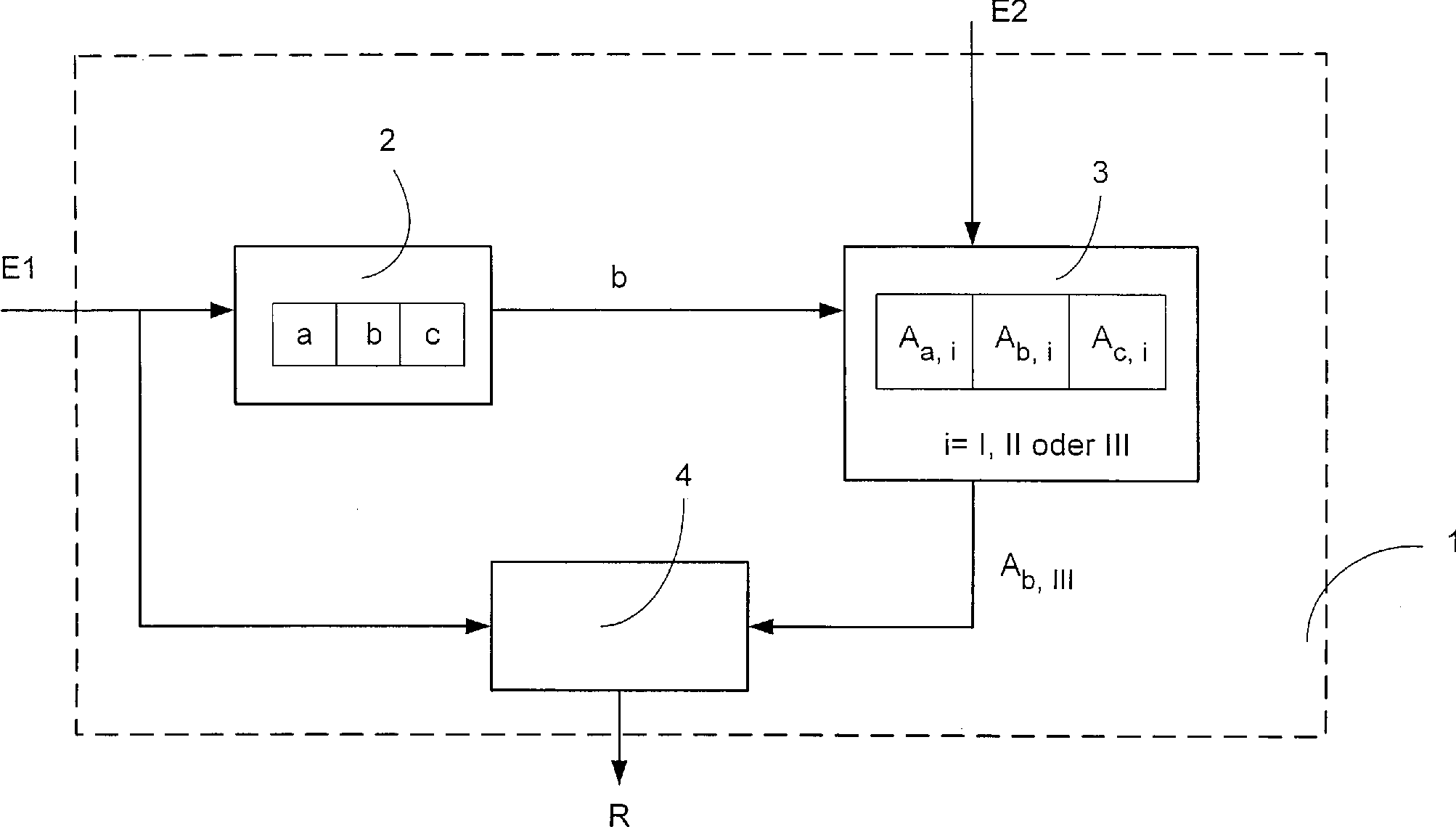
In der Zeichnung ist ein Ausführungsbeispiel der Erfindung dargestellt. Die einzige Figur zeigt eine schematische Darstellung der für die Erfindung erforderlichen Komponenten und Informationsflüsse.In the drawing is an embodiment of Invention shown. The single figure shows a schematic Presentation of for the invention required components and information flows.
Ein
elektronisches Steuergerät
Bei
einer Folgefahrt ist vom Fahrer hinsichtlich einer richtigen Reaktion
beispielsweise zu erwarten, dass er durch entsprechende Betätigung von Gaspedal
und Bremspedal entweder eine Geschwindigkeit einhält, durch
die der Abstand zum vorausfahrenden Fahrzeug nicht unter eine kritische Schwelle fällt, oder
dass er durch entsprechende Betätigung von
Blinker, Gaspedal und Lenkrad ein Überholmanöver einleitet. Diese erwarteten
Reaktionen werden in der mit der Zuordnungseinheit
Der Grad der situationsangepassten Aufmerksamkeit Ab,i wird mittels der Eingangsdaten E2 erkannt. Dabei werden die Bedientätigkeiten des Fahrers überwacht, die für die erkannte Fahrsituation b relevant sind. Zusätzlich kann der Grad der situationsangepassten Aufmerksamkeit Ab,i auch durch andere Verhaltensmuster des Fahrers, wie oben bereits ausgeführt, ermittelt werden.The degree of attention A b, i adapted to the situation is detected by means of the input data E2. In this case, the driver's control activities are monitored, which are relevant for the detected driving situation b. In addition, the degree of the situation-adapted attention A b, i can also be determined by other behavior patterns of the driver, as already explained above.
Beispielweise
kann hier der Grad der situationsangepassten Aufmerksamkeit Ab,i basierend auf folgenden Aufmerksamkeitskategorien
erkannt werden:
Ablenkungskriterien: hinsichtlich der Bedienung
von Geräten,
die nicht für
die erwartete richtige Reaktion nötig sind, wie Radio- oder Telefonbedienung;
modellbasierte
Fahrerverhaltenskriterien: wie Loslassen des Gaspedals und/oder
Betätigung
des Bremspedals zum situationsspezifisch richtigen Zeitpunkt;
Wachkeitskriterien:
Geschwindigkeit des Loslassens des Gaspedals und/oder Ausmaß der Betätigung des Bremspedals.For example, here the degree of the situation-adapted attention A b, i can be recognized based on the following attention categories:
Distraction criteria: regarding the operation of equipment that is not required for the expected correct response, such as radio or telephone operation;
model-based driver behavior criteria such as releasing the accelerator pedal and / or depressing the brake pedal at the right time for the situation;
Wake-up criteria: Speed of release of the accelerator pedal and / or degree of depression of the brake pedal.
Abhängig von dieser Auswertung der zweiten Eingangsdaten E2 wird der Grad der situationsangepassten Aufmerksamkeit Ab,i ( mit i = I, II oder III) einer der oben bereits näher beschriebenen Bewertungsstufen I (falsche Reaktion), II (unbestimmte Reaktion) oder III (richtige Reaktion) zugeordnet.Depending on this evaluation of the second input data E2, the degree of the situation-adapted attention A b, i (with i = I, II or III) of one of the above-described evaluation levels I (false reaction), II (indefinite Re action) or III (correct reaction).
Hierzu sind im Steuergerät in bekannter Weise Algorithmen, mathematische Schätzmodelle, Tabellen oder Kennfelder und datenbezogene Schwellen gespeichert.For this are in the control unit algorithms, mathematical estimation models, Tables or maps and data-related thresholds are stored.
Im
vorliegenden Beispiel sei die situationsangepassten Aufmerksamkeit
Ab,III ermittelt worden, die Ausgangssignal
der Fahrerbeobachtungseinheit
Vorzugsweise
liegt nicht nur eine Funktionseinheit
Beispielsweise können grundsätzlich abhängig von der Bewertungsstufe I, II, III unterschiedliche akustische Warnsignale (z. B. unterschiedlich hinsichtlich Lautstärke, Frequenz oder Einschaltzeitpunkt) oder unterschiedlich starke Eingriffbefehle abgegeben werden. Die Ansteuerung der Funktionseinheiten hängt aber vorzugsweise nicht nur von der Bewertungsstufe, sondern auch von der erkannten Situation ab. Beispielsweise können bei Vorliegen der der Folgefahrtsituation (Fahrsituation b) zugeordneten Aufmerksamkeit Ab,I mit Bewertungsstufe I (falsche Reaktion) die Funktionseinheiten anders angesteuert werden als bei Vorliegen der der Spurwechselsituation (Fahrsituation c) zugeordneten Aufmerksamkeit Ac,I mit Bewertungsstufe I.For example, depending on the evaluation level I, II, III, different acoustic warning signals (eg different with regard to volume, frequency or switch-on time) or different engagement commands can be issued. However, the activation of the functional units preferably depends not only on the evaluation level, but also on the recognized situation. For example, in the presence of the following driving situation (driving situation b) associated attention A b, I with evaluation level I (wrong reaction), the functional units can be controlled differently than in the presence of the lane change situation (driving situation c) associated attention A c, I with rating level I.
Beispielsweise kann in einer ersten Fahrsituation bei Vorliegen einer situationsangepassten Aufmerksamkeit mit Bewertungsstufe I eine erste Funktionseinheit und eine zweite Funktionseinheit aktiviert werden und in einer ersten Fahrsituation bei Vorliegen einer situationsangepassten Aufmerksamkeit mit Bewertungsstufe II nur eine erste Funktionseinheit aktiviert werden. Die Funktionseinheiten können jedoch auch alternativ oder zusätzlich abhängig von der Bewertungsstufe hinsichtlich ihres Reaktionsausmaßes unterschiedlich angesteuert werden (z. B. in Fahrzustand b bei Bewertungsstufe I starker Bremseingriff und in Fahrzustand b bei Bewertungsstufe II geringer Bremseingriff).For example can in a first driving situation in the presence of a situation-adapted Attention with rating level I is a first functional unit and a second functional unit are activated and in a first Driving situation in the presence of a situation-adapted attention With evaluation level II, only a first functional unit is activated become. The functional units can but also alternatively or additionally dependent different from the evaluation level in terms of their reaction rate (eg in driving state b at evaluation level I) strong braking intervention and in driving condition b at rating level II lower Brake intervention).
Durch die Erfindung können Kollisionsvermeidungssysteme hinsichtlich der Kundenakzeptanzkriterien verbessert werden.By the invention can Collision avoidance systems in terms of customer acceptance criteria be improved.
Claims (4)
Priority Applications (6)
| Application Number | Priority Date | Filing Date | Title |
|---|---|---|---|
| DE102004039305A DE102004039305A1 (en) | 2004-08-12 | 2004-08-12 | Device for evaluating the attention of a driver in a collision avoidance system in motor vehicles |
| DE502005009683T DE502005009683D1 (en) | 2004-08-12 | 2005-08-09 | DEVICE FOR EVALUATING THE ATTENTION OF A DRIVER IN A COLLISION PREVENTION SYSTEM IN MOTOR VEHICLES |
| AT05781686T ATE470208T1 (en) | 2004-08-12 | 2005-08-09 | DEVICE FOR EVALUATION OF A DRIVER'S ATTENTION IN A COLLISION AVOIDANCE SYSTEM IN MOTOR VEHICLES |
| EP05781686A EP1779355B1 (en) | 2004-08-12 | 2005-08-09 | Device for evaluating driver attentiveness in a collision prevention system in motor vehicles |
| PCT/EP2005/008655 WO2006018195A1 (en) | 2004-08-12 | 2005-08-09 | Device for evaluating driver attentiveness in a collision prevention system in motor vehicles |
| US11/704,261 US7592920B2 (en) | 2004-08-12 | 2007-02-09 | Systems and methods for evaluating driver attentiveness for collision avoidance |
Applications Claiming Priority (1)
| Application Number | Priority Date | Filing Date | Title |
|---|---|---|---|
| DE102004039305A DE102004039305A1 (en) | 2004-08-12 | 2004-08-12 | Device for evaluating the attention of a driver in a collision avoidance system in motor vehicles |
Publications (1)
| Publication Number | Publication Date |
|---|---|
| DE102004039305A1 true DE102004039305A1 (en) | 2006-03-09 |
Family
ID=35106669
Family Applications (2)
| Application Number | Title | Priority Date | Filing Date |
|---|---|---|---|
| DE102004039305A Withdrawn DE102004039305A1 (en) | 2004-08-12 | 2004-08-12 | Device for evaluating the attention of a driver in a collision avoidance system in motor vehicles |
| DE502005009683T Expired - Lifetime DE502005009683D1 (en) | 2004-08-12 | 2005-08-09 | DEVICE FOR EVALUATING THE ATTENTION OF A DRIVER IN A COLLISION PREVENTION SYSTEM IN MOTOR VEHICLES |
Family Applications After (1)
| Application Number | Title | Priority Date | Filing Date |
|---|---|---|---|
| DE502005009683T Expired - Lifetime DE502005009683D1 (en) | 2004-08-12 | 2005-08-09 | DEVICE FOR EVALUATING THE ATTENTION OF A DRIVER IN A COLLISION PREVENTION SYSTEM IN MOTOR VEHICLES |
Country Status (5)
| Country | Link |
|---|---|
| US (1) | US7592920B2 (en) |
| EP (1) | EP1779355B1 (en) |
| AT (1) | ATE470208T1 (en) |
| DE (2) | DE102004039305A1 (en) |
| WO (1) | WO2006018195A1 (en) |
Cited By (5)
| Publication number | Priority date | Publication date | Assignee | Title |
|---|---|---|---|---|
| DE102008038816A1 (en) * | 2008-08-13 | 2010-02-18 | Volkswagen Ag | Method for backup of operation of vehicle, involves detecting condition of driver of vehicle with respect to condition of vehicle |
| DE102011101708A1 (en) * | 2011-05-17 | 2012-11-22 | GM Global Technology Operations LLC (n. d. Gesetzen des Staates Delaware) | Method for automatic controlling of motor vehicle, particularly passenger car, involves monitoring traffic awareness of vehicle driver based on input of vehicle driver in mode for automatic controlling |
| DE102012105285A1 (en) * | 2012-06-18 | 2013-12-19 | Dr. Ing. H.C. F. Porsche Aktiengesellschaft | Method for assisting rider of motor car, involves defining a warning strategy based on the derived rider intention of current rider, and adjusting motor car rider assistance system if necessary |
| DE102016211021A1 (en) | 2016-06-21 | 2017-12-21 | Robert Bosch Gmbh | Method and device for securing a fully automatic movement of a vehicle |
| DE102016223343A1 (en) * | 2016-11-24 | 2018-05-24 | Bayerische Motoren Werke Aktiengesellschaft | Hazard management for vehicles |
Families Citing this family (42)
| Publication number | Priority date | Publication date | Assignee | Title |
|---|---|---|---|---|
| US7650509B1 (en) | 2004-01-28 | 2010-01-19 | Gordon & Howard Associates, Inc. | Encoding data in a password |
| US20070194881A1 (en) | 2006-02-07 | 2007-08-23 | Schwarz Stanley G | Enforcing payment schedules |
| US9026267B2 (en) | 2007-03-09 | 2015-05-05 | Gordon*Howard Associates, Inc. | Methods and systems of selectively enabling a vehicle by way of a portable wireless device |
| US20100066529A1 (en) * | 2007-10-09 | 2010-03-18 | Haines Walton P | Highly intelligent vehicle with brake light repeater |
| DE602008004435D1 (en) * | 2008-04-02 | 2011-02-24 | Gm Global Tech Operations Inc | Adaptive steering control for a motor vehicle |
| US20100295707A1 (en) * | 2009-05-19 | 2010-11-25 | Brian Bennie | System and method for lane departure warning |
| US9014915B2 (en) * | 2011-07-25 | 2015-04-21 | GM Global Technology Operations LLC | Active safety control for vehicles |
| US20130204457A1 (en) * | 2012-02-06 | 2013-08-08 | Ford Global Technologies, Llc | Interacting with vehicle controls through gesture recognition |
| CN104246848B (en) * | 2012-04-02 | 2017-04-12 | 丰田自动车株式会社 | Driving assistance device |
| US9007198B2 (en) | 2012-11-02 | 2015-04-14 | Toyota Motor Engineering & Manufacturing North America, Inc. | Adaptive Actuator interface for active driver warning |
| US9047780B2 (en) * | 2012-11-16 | 2015-06-02 | Robert Bosch Gmbh | Collision mitigation systems and methods using driver attentiveness |
| EP2746137B1 (en) * | 2012-12-19 | 2019-02-20 | Volvo Car Corporation | Method and system for assisting a driver |
| EP2752348A1 (en) * | 2013-01-04 | 2014-07-09 | Continental Automotive Systems, Inc. | Adaptive emergency brake and steer assist system based on driver focus |
| US9665997B2 (en) * | 2013-01-08 | 2017-05-30 | Gordon*Howard Associates, Inc. | Method and system for providing feedback based on driving behavior |
| US8928471B2 (en) | 2013-03-14 | 2015-01-06 | Gordon*Howard Associates, Inc. | Methods and systems related to remote tamper detection |
| US9378480B2 (en) | 2013-03-14 | 2016-06-28 | Gordon*Howard Associates, Inc. | Methods and systems related to asset identification triggered geofencing |
| US9035756B2 (en) | 2013-03-14 | 2015-05-19 | Gordon*Howard Associates, Inc. | Methods and systems related to remote tamper detection |
| US9840229B2 (en) | 2013-03-14 | 2017-12-12 | Gordon*Howard Associates, Inc. | Methods and systems related to a remote tamper detection |
| US9751534B2 (en) | 2013-03-15 | 2017-09-05 | Honda Motor Co., Ltd. | System and method for responding to driver state |
| US10445758B1 (en) | 2013-03-15 | 2019-10-15 | Allstate Insurance Company | Providing rewards based on driving behaviors detected by a mobile computing device |
| DE102013206212A1 (en) * | 2013-04-09 | 2014-10-09 | Ford Global Technologies, Llc | Method for controlling a vehicle with temporarily autonomous vehicle guidance and control device |
| US9013333B2 (en) | 2013-06-24 | 2015-04-21 | Gordon*Howard Associates, Inc. | Methods and systems related to time triggered geofencing |
| DE102013213236A1 (en) * | 2013-07-05 | 2015-01-08 | Robert Bosch Gmbh | Method for determining an attention level of a driver |
| EP2862741B1 (en) * | 2013-10-15 | 2017-06-28 | Volvo Car Corporation | Vehicle driver assist arrangement |
| KR20150066739A (en) * | 2013-12-09 | 2015-06-17 | 경북대학교 산학협력단 | system for providing warning message and methods thereof |
| US10065562B2 (en) * | 2013-12-31 | 2018-09-04 | International Business Mahcines Corporation | Vehicle collision avoidance |
| US10532659B2 (en) | 2014-12-30 | 2020-01-14 | Joyson Safety Systems Acquisition Llc | Occupant monitoring systems and methods |
| US10614328B2 (en) | 2014-12-30 | 2020-04-07 | Joyson Safety Acquisition LLC | Occupant monitoring systems and methods |
| US9533687B2 (en) | 2014-12-30 | 2017-01-03 | Tk Holdings Inc. | Occupant monitoring systems and methods |
| USD751437S1 (en) | 2014-12-30 | 2016-03-15 | Tk Holdings Inc. | Vehicle occupant monitor |
| US9701279B1 (en) | 2016-01-12 | 2017-07-11 | Gordon*Howard Associates, Inc. | On board monitoring device |
| DE102016201939B4 (en) | 2016-02-09 | 2025-09-04 | Volkswagen Aktiengesellschaft | Method and system for improving perception in collision avoidance systems |
| US10274338B2 (en) | 2016-12-11 | 2019-04-30 | International Business Machines Corporation | Risk situations for vehicle occupants based on data provided by vehicle sensors and contextual information |
| US10279793B2 (en) | 2017-05-11 | 2019-05-07 | Honda Motor Co., Ltd. | Understanding driver awareness through brake behavior analysis |
| JP7056308B2 (en) * | 2018-03-28 | 2022-04-19 | マツダ株式会社 | Vehicle alarm device |
| US20210269045A1 (en) * | 2018-06-26 | 2021-09-02 | Tamir Anavi | Contextual driver monitoring system |
| US11358605B2 (en) * | 2018-09-10 | 2022-06-14 | Here Global B.V. | Method and apparatus for generating a passenger-based driving profile |
| US11535262B2 (en) | 2018-09-10 | 2022-12-27 | Here Global B.V. | Method and apparatus for using a passenger-based driving profile |
| FR3118444B1 (en) * | 2020-12-31 | 2023-01-06 | Valeo Comfort & Driving Assistance | Device for analyzing the perception of a danger by a vehicle driver and associated method |
| DE102022204113A1 (en) | 2022-04-28 | 2023-11-02 | Zf Friedrichshafen Ag | Method, system and computer program for safely testing an automated vehicle by increasing the attention of a safety driver |
| JP2025059425A (en) * | 2023-09-29 | 2025-04-10 | 本田技研工業株式会社 | Vehicle control device, vehicle control method, and program |
| CN118948276B (en) * | 2024-07-11 | 2025-07-11 | 广州迪卡德营养科技有限公司 | Child intelligence and concentration test evaluation method and system based on man-machine interaction |
Citations (3)
| Publication number | Priority date | Publication date | Assignee | Title |
|---|---|---|---|---|
| JPH03224858A (en) * | 1990-01-29 | 1991-10-03 | Nissan Motor Co Ltd | Automatic brake device |
| DE4309606A1 (en) * | 1993-03-24 | 1994-09-29 | Bayerische Motoren Werke Ag | Method for avoiding collisions between motor vehicles |
| DE10039795C2 (en) * | 2000-08-16 | 2003-03-27 | Bosch Gmbh Robert | Method for warning a driver of a vehicle |
Family Cites Families (13)
| Publication number | Priority date | Publication date | Assignee | Title |
|---|---|---|---|---|
| JPH05155291A (en) * | 1991-12-03 | 1993-06-22 | Mitsubishi Electric Corp | Vehicle alarm system |
| US5465079A (en) * | 1992-08-14 | 1995-11-07 | Vorad Safety Systems, Inc. | Method and apparatus for determining driver fitness in real time |
| DE19801009C1 (en) | 1998-01-14 | 1999-04-22 | Daimler Chrysler Ag | Method of braking motor vehicle |
| DE19919675C2 (en) * | 1999-04-30 | 2003-04-10 | Daimler Chrysler Ag | Control system for a vehicle |
| EP1257202B1 (en) * | 2000-02-15 | 2005-03-30 | Cesium Ab | Method and means for monitoring driver alertness |
| US6925425B2 (en) * | 2000-10-14 | 2005-08-02 | Motorola, Inc. | Method and apparatus for vehicle operator performance assessment and improvement |
| US6879969B2 (en) * | 2001-01-21 | 2005-04-12 | Volvo Technological Development Corporation | System and method for real-time recognition of driving patterns |
| DE10132386A1 (en) * | 2001-07-06 | 2003-01-16 | Volkswagen Ag | Driver assistance system |
| JP2003256998A (en) * | 2002-03-01 | 2003-09-12 | Hitachi Ltd | Vehicle control device |
| DE10311518A1 (en) * | 2002-04-30 | 2003-11-13 | Bosch Gmbh Robert | Method and device for driver information or for reaction when leaving the traffic lane |
| JP3606276B2 (en) * | 2002-11-26 | 2005-01-05 | 日産自動車株式会社 | Lane departure prevention device |
| DE10355221A1 (en) * | 2003-11-26 | 2005-06-23 | Daimlerchrysler Ag | A method and computer program for detecting inattentiveness of the driver of a vehicle |
| US7253724B2 (en) * | 2004-11-05 | 2007-08-07 | Ford Global Technologies, Inc. | Vehicle pre-impact sensing and control system with driver response feedback |
-
2004
- 2004-08-12 DE DE102004039305A patent/DE102004039305A1/en not_active Withdrawn
-
2005
- 2005-08-09 DE DE502005009683T patent/DE502005009683D1/en not_active Expired - Lifetime
- 2005-08-09 WO PCT/EP2005/008655 patent/WO2006018195A1/en not_active Ceased
- 2005-08-09 AT AT05781686T patent/ATE470208T1/en not_active IP Right Cessation
- 2005-08-09 EP EP05781686A patent/EP1779355B1/en not_active Expired - Lifetime
-
2007
- 2007-02-09 US US11/704,261 patent/US7592920B2/en not_active Expired - Lifetime
Patent Citations (3)
| Publication number | Priority date | Publication date | Assignee | Title |
|---|---|---|---|---|
| JPH03224858A (en) * | 1990-01-29 | 1991-10-03 | Nissan Motor Co Ltd | Automatic brake device |
| DE4309606A1 (en) * | 1993-03-24 | 1994-09-29 | Bayerische Motoren Werke Ag | Method for avoiding collisions between motor vehicles |
| DE10039795C2 (en) * | 2000-08-16 | 2003-03-27 | Bosch Gmbh Robert | Method for warning a driver of a vehicle |
Cited By (7)
| Publication number | Priority date | Publication date | Assignee | Title |
|---|---|---|---|---|
| DE102008038816A1 (en) * | 2008-08-13 | 2010-02-18 | Volkswagen Ag | Method for backup of operation of vehicle, involves detecting condition of driver of vehicle with respect to condition of vehicle |
| DE102011101708A1 (en) * | 2011-05-17 | 2012-11-22 | GM Global Technology Operations LLC (n. d. Gesetzen des Staates Delaware) | Method for automatic controlling of motor vehicle, particularly passenger car, involves monitoring traffic awareness of vehicle driver based on input of vehicle driver in mode for automatic controlling |
| DE102012105285A1 (en) * | 2012-06-18 | 2013-12-19 | Dr. Ing. H.C. F. Porsche Aktiengesellschaft | Method for assisting rider of motor car, involves defining a warning strategy based on the derived rider intention of current rider, and adjusting motor car rider assistance system if necessary |
| DE102016211021A1 (en) | 2016-06-21 | 2017-12-21 | Robert Bosch Gmbh | Method and device for securing a fully automatic movement of a vehicle |
| WO2017220300A1 (en) | 2016-06-21 | 2017-12-28 | Robert Bosch Gmbh | Method and apparatus for protecting a fully automatic movement of a vehicle |
| DE102016211021B4 (en) | 2016-06-21 | 2024-04-18 | Robert Bosch Gmbh | Method and device for securing a fully automatic movement of a vehicle |
| DE102016223343A1 (en) * | 2016-11-24 | 2018-05-24 | Bayerische Motoren Werke Aktiengesellschaft | Hazard management for vehicles |
Also Published As
| Publication number | Publication date |
|---|---|
| US7592920B2 (en) | 2009-09-22 |
| ATE470208T1 (en) | 2010-06-15 |
| EP1779355A1 (en) | 2007-05-02 |
| EP1779355B1 (en) | 2010-06-02 |
| WO2006018195A1 (en) | 2006-02-23 |
| DE502005009683D1 (en) | 2010-07-15 |
| US20070146146A1 (en) | 2007-06-28 |
Similar Documents
| Publication | Publication Date | Title |
|---|---|---|
| DE102004039305A1 (en) | Device for evaluating the attention of a driver in a collision avoidance system in motor vehicles | |
| EP1353824B1 (en) | Hazard prevention system for a vehicle | |
| EP2087477B1 (en) | Method for producing a localized warning of dangerous situations for vehicles | |
| EP2763879B1 (en) | Method for activating a driver assistance system | |
| EP1660354B1 (en) | Device for warning the driver of a vehicle | |
| DE102010009133B4 (en) | A method of assisting a driver in driving a motor vehicle having a driver assistance system and motor vehicle with system selector | |
| DE102010049081A1 (en) | Method for operating a motor vehicle and motor vehicle | |
| DE10163967A1 (en) | Driver assistance system taking into account driver attentiveness state detects driver's state of attention from operation or non-operation of existing vehicle control elements | |
| EP1585083A2 (en) | Method and apparatus for warning a vehicle driver | |
| DE102021004191A1 (en) | Method for recognizing an intention to overtake and / or predicting vehicle maneuvers in front of an ego vehicle | |
| EP1924476B1 (en) | Method for warning the driver of a motor vehicle which is equipped with a cruise control system | |
| DE102019219263A1 (en) | Method and system for improving driving stability | |
| DE102011016777A1 (en) | Method for operating safety device of vehicle, involves obtaining physical health of driver based on detected driving state data, environmental data and driver activity | |
| DE102023001905B3 (en) | Method for operating an automated vehicle | |
| DE102023002194A1 (en) | Method for determining a driving behavior of a driver of a vehicle and use | |
| DE102008046695A1 (en) | Critical driving condition identifying method for motor vehicle, involves comparing actual driving conditions after diversion situation of driver with future driving conditions, and forming measure for criticality of actual conditions | |
| WO2005049363A1 (en) | Distance regulation method and device | |
| DE102016210768A1 (en) | Method for operating a driver assistance system | |
| EP3747720A1 (en) | Vehicle guidance system and method for operating a vehicle with a plurality of predetermined manual steering semiautonomous modes and non-manual steering semiautonomous modes | |
| DE10353504B4 (en) | Driver assistance system | |
| DE102005043496A1 (en) | Person guided vehicle`s safety improving method for e.g. track assistant, involves calculating distance between points of driver request and driving behavior as stimulation parameter, where driver is differently stimulated based on behavior | |
| DE102018203679A1 (en) | Brake control system | |
| DE102020124277A1 (en) | Method for operating a motor vehicle | |
| DE102017010386A1 (en) | Method for operating a driver assistance system | |
| DE102023207176A1 (en) | Method and device for operating a driver assistance system |
Legal Events
| Date | Code | Title | Description |
|---|---|---|---|
| OP8 | Request for examination as to paragraph 44 patent law | ||
| R120 | Application withdrawn or ip right abandoned |
Effective date: 20111214 |