DE102004009931A1 - Use of specific 2-substituted benzamides for treating and preventing cardiac insufficiency, especially where caused by diastolic dysfunction, act by inhibition of the Kv1.5 potassium channel - Google Patents
Use of specific 2-substituted benzamides for treating and preventing cardiac insufficiency, especially where caused by diastolic dysfunction, act by inhibition of the Kv1.5 potassium channel Download PDFInfo
- Publication number
- DE102004009931A1 DE102004009931A1 DE102004009931A DE102004009931A DE102004009931A1 DE 102004009931 A1 DE102004009931 A1 DE 102004009931A1 DE 102004009931 A DE102004009931 A DE 102004009931A DE 102004009931 A DE102004009931 A DE 102004009931A DE 102004009931 A1 DE102004009931 A1 DE 102004009931A1
- Authority
- DE
- Germany
- Prior art keywords
- phenyl
- atoms
- atrial
- alkyl
- methyl
- Prior art date
- Legal status (The legal status is an assumption and is not a legal conclusion. Google has not performed a legal analysis and makes no representation as to the accuracy of the status listed.)
- Withdrawn
Links
Classifications
-
- A—HUMAN NECESSITIES
- A61—MEDICAL OR VETERINARY SCIENCE; HYGIENE
- A61K—PREPARATIONS FOR MEDICAL, DENTAL OR TOILETRY PURPOSES
- A61K31/00—Medicinal preparations containing organic active ingredients
- A61K31/33—Heterocyclic compounds
- A61K31/395—Heterocyclic compounds having nitrogen as a ring hetero atom, e.g. guanethidine or rifamycins
- A61K31/435—Heterocyclic compounds having nitrogen as a ring hetero atom, e.g. guanethidine or rifamycins having six-membered rings with one nitrogen as the only ring hetero atom
- A61K31/44—Non condensed pyridines; Hydrogenated derivatives thereof
- A61K31/4406—Non condensed pyridines; Hydrogenated derivatives thereof only substituted in position 3, e.g. zimeldine
-
- A—HUMAN NECESSITIES
- A61—MEDICAL OR VETERINARY SCIENCE; HYGIENE
- A61K—PREPARATIONS FOR MEDICAL, DENTAL OR TOILETRY PURPOSES
- A61K31/00—Medicinal preparations containing organic active ingredients
- A61K31/16—Amides, e.g. hydroxamic acids
- A61K31/165—Amides, e.g. hydroxamic acids having aromatic rings, e.g. colchicine, atenolol, progabide
- A61K31/166—Amides, e.g. hydroxamic acids having aromatic rings, e.g. colchicine, atenolol, progabide having the carbon of a carboxamide group directly attached to the aromatic ring, e.g. procainamide, procarbazine, metoclopramide, labetalol
-
- A—HUMAN NECESSITIES
- A61—MEDICAL OR VETERINARY SCIENCE; HYGIENE
- A61K—PREPARATIONS FOR MEDICAL, DENTAL OR TOILETRY PURPOSES
- A61K31/00—Medicinal preparations containing organic active ingredients
- A61K31/33—Heterocyclic compounds
- A61K31/395—Heterocyclic compounds having nitrogen as a ring hetero atom, e.g. guanethidine or rifamycins
- A61K31/435—Heterocyclic compounds having nitrogen as a ring hetero atom, e.g. guanethidine or rifamycins having six-membered rings with one nitrogen as the only ring hetero atom
- A61K31/44—Non condensed pyridines; Hydrogenated derivatives thereof
-
- A—HUMAN NECESSITIES
- A61—MEDICAL OR VETERINARY SCIENCE; HYGIENE
- A61P—SPECIFIC THERAPEUTIC ACTIVITY OF CHEMICAL COMPOUNDS OR MEDICINAL PREPARATIONS
- A61P9/00—Drugs for disorders of the cardiovascular system
-
- A—HUMAN NECESSITIES
- A61—MEDICAL OR VETERINARY SCIENCE; HYGIENE
- A61P—SPECIFIC THERAPEUTIC ACTIVITY OF CHEMICAL COMPOUNDS OR MEDICINAL PREPARATIONS
- A61P9/00—Drugs for disorders of the cardiovascular system
- A61P9/04—Inotropic agents, i.e. stimulants of cardiac contraction; Drugs for heart failure
-
- A—HUMAN NECESSITIES
- A61—MEDICAL OR VETERINARY SCIENCE; HYGIENE
- A61P—SPECIFIC THERAPEUTIC ACTIVITY OF CHEMICAL COMPOUNDS OR MEDICINAL PREPARATIONS
- A61P9/00—Drugs for disorders of the cardiovascular system
- A61P9/06—Antiarrhythmics
Landscapes
- Health & Medical Sciences (AREA)
- Public Health (AREA)
- Animal Behavior & Ethology (AREA)
- Veterinary Medicine (AREA)
- Chemical & Material Sciences (AREA)
- General Health & Medical Sciences (AREA)
- Pharmacology & Pharmacy (AREA)
- Medicinal Chemistry (AREA)
- Life Sciences & Earth Sciences (AREA)
- Epidemiology (AREA)
- Bioinformatics & Cheminformatics (AREA)
- Engineering & Computer Science (AREA)
- Cardiology (AREA)
- Nuclear Medicine, Radiotherapy & Molecular Imaging (AREA)
- Organic Chemistry (AREA)
- General Chemical & Material Sciences (AREA)
- Chemical Kinetics & Catalysis (AREA)
- Heart & Thoracic Surgery (AREA)
- Hospice & Palliative Care (AREA)
- Pharmaceuticals Containing Other Organic And Inorganic Compounds (AREA)
- Acyclic And Carbocyclic Compounds In Medicinal Compositions (AREA)
Abstract
Die Erfindung betrifft die Vorhof-kontraktilitätssteigernde Wirkung von Kv1.5-Blockern, insbesondere Phenylcarbonsäureamiden der Formeln Ia und/oder Ib DOLLAR F1 und/oder pharmazeutisch verträglichen Salzen davon, zur Behandlung der verminderten atrialen Kontraktilität und der Herzinsuffizienz, insbesondere der durch diastolische Dysfunktion verursachten Herzinsuffizienz.The invention relates to the atrial contractility-enhancing effect of Kv1.5 blockers, in particular phenylcarboxamides of the formulas Ia and / or Ib DOLLAR F1 and / or pharmaceutically acceptable salts thereof, for the treatment of diminished atrial contractility and cardiac insufficiency, in particular those caused by diastolic dysfunction heart failure.
Description
Die
Erfindung betrifft die Vorhofkontraktilitäts-steigernde Wirkung von Kv1.5-Blockern, insbesondere Phenylcarbonsäureamiden
der Formeln Ia und/oder Ib 
Vorhof-Flimmern (AF) und Vorhof-Flattern sind die häufigsten anhaltenden Herzarrhythmien. Das Auftreten erhöht sich mit zunehmenden Alter und führt häufig zu fatalen Folgeerscheinungen, wie zum Beispiel Gehirnschlag. AF betrifft ca. 1 Million Amerikaner jährlich und führt zu mehr als 80.000 Schlaganfällen jedes Jahr in den USA. Im Alter und als Folge des Vorhofflimmerns tritt eine atriale Kontraktionsstörung auf, welche als atrial stunning bezeichnet wird. Dabei ist die aktive Vorhofkontration abgeschwächt, die Vorhöfe sind vergrößert, die Füllung der Ventrikel vermindert. Die reduzierte Ventrikelfüllung führt zu einem verminderten Auswurf des Herzens und damit zu einer verminderten körperlichen Belastbarkeit.Atrial fibrillation (AF) and atrial flutter are the most common persistent cardiac arrhythmias. The occurrence increases with increasing age and leads often to fatal consequences, such as brain stroke. AF affects about 1 million Americans annually and leads to more as 80,000 strokes every year in the US. In old age and as a result of atrial fibrillation Atrial contraction disorder occurs as atrial stunning is called. This is the active atrial filtration attenuated the atria are enlarged, the filling the ventricle diminished. The reduced ventricular filling leads to a Decreased expectoration of the heart and thus to a diminished physical Resilience.
Die verschlechterte Vorhoffunktion hat insgesamt hämodynamische, prothrombotische und arrhythmogene Auswirkungen. Sie beinträchtigt die Herzleistung, insbesondere bei körperlicher Belastung. Die mangelnde Vorhof-Kontraktionsfähigkeit kann zu Blutstase im Vorhof führen, die Ursache ist für Thrombenbildung und nachfolgende Embolien (Schlaganfall). Atrial stunning führt zur Dilatation des Vorhofs, welche die Arrhythmieneigung des Vorhofs erheblich steigert. Eine Verminderung der Vorhofgröße durch Steigerung seiner Kontraktilität reduziert deshalb die Arrhythmie-Anfälligkeit und bietet damit einen Schutz gegenüber einer Neuauslösung von Vorhofflimmern.The impaired atrial function has overall hemodynamic, prothrombotic and arrhythmogenic effects. It affects cardiac output, in particular in physical Burden. The lack of atrial contraction ability can lead to blood stasis in the atrium, the cause is for Thrombosis and subsequent embolism (stroke). atrial stunning leads dilatation of the atrium showing the arrhythmia tendency of the atrium significantly increases. A reduction in atrial size by Increase his contractility therefore reduces the arrhythmia susceptibility and thus provides one Protection against a new trigger of atrial fibrillation.
Abgesehen vom Nutzen einer atrialen Kontraktilitätssteigerung für den Vorhof selbst ist eine selektive atriale Kontraktilitätssteigerung von therapeutischem Nutzen bei der Behandlung der Herzinsuffizienz, insbesondere dann, wenn sie auf einer diastolischen Dysfunktion beruht. Dort liegt nämlich eine Störung der Füllung des linken Ventrikels vor, die auf einer verminderten Dehnbarkeit und Elastizität des Ventrikels beruht. Eine solche Störung tritt häufig im Rahmen von Herzhypertrophie oder Kardiomyopathien auf, wobei die Herzwände verdickt oder fibrosiert sein können. Die gestörte Dehnbarkeit wird auch als verminderte ventrikuläre Compliance bezeichnet. Dieser Begriff impliziert, dass die Dehnbarkeit des Ventrikels grundsätzlich erhalten ist, aber eine ausreichende Dehnung und damit Füllung der Ventrikel nur mit einem größeren Kraftaufwand (höherem Füllungsdruck) erreicht werden kann. Die aktive Vorhofkontraktion erzeugt den notwendigen Füllungsdruck des Ventrikels. Durch Steigerung der Vorhofkontraktilität über das Normale hinaus kann die gestörte Ventrikelfunktion verbessert werden. Positiv inotrope Substanzen wie Herzglykoside sind dafür nicht geeignet, weil sie insbesondere die Ventrikelkontraktion direkt steigern und damit die Ventrikelgröße reduzieren, so dass die Füllung des Ventrikel trotz möglicher gleichzeitiger kontraktilitätssteigernder Wirkung auf die Vorhöfe nun wieder verschlechtert ist. Eine selektiv atriale Kontraktilitätssteigerung ist dafür notwendig.apart the benefit of an atrial contractility enhancement for the atrium itself is a selective atrial contractility enhancement of therapeutic Useful in the treatment of heart failure, especially then if it is based on diastolic dysfunction. There is namely a disorder the filling of the left ventricle on a reduced extensibility and elasticity of the ventricle. Such a disorder often occurs in Cardiac hypertrophy or cardiomyopathy, in which the Heart walls thickened or fibrosed. The disturbed Extensibility is also referred to as decreased ventricular compliance. This Term implies that the extensibility of the ventricle is basically preserved is, but sufficient stretching and thus filling the ventricle only with a greater effort (higher filling pressure) can be achieved. The active atrial contraction generates the necessary Filling pressure of Ventricle. By increasing the atrial contractility over the Normal addition, the disturbed Ventricular function can be improved. Positive inotropic substances like cardiac glycosides are for it not suitable, because in particular the ventricular contraction directly increase and thus reduce the ventricular size, so that the filling of the ventricle despite possible simultaneous contractility-increasing Effect on the atria is now deteriorating again. A selective atrial contractility increase is for that necessary.
In Experimenten an narkotisierten Schweinen wurde gefunden, dass Kv1.5-Blocker die Vorhofkontraktilität selektiv steigern, ohne dass sie die ventrikuläre Kontraktilität auf direktem Wege beeinflussen würden. Es konnte ebenfalls an Schweinen gezeigt werden, dass die Vorhofkontraktilitäts-steigernde Wirkung zu einer verbesserten Kreislaufsituation führt, wenn die Füllung des Ventrikels experimentell behindert wird (Modell für diastolische Dysfunktion). Das reduzierte Herzminutenvolumen, der entscheidendene Parameter der Herzleistung, konnte durch Kv1.5-Blocker signifikant verbessert werden. Diese Versuche belegen die selektiv atriale Steigerung der Kontraktilität durch Kv1.5-Blocker und deren günstige Auswirkung bei Herzinsuffizienz, insbesondere diastolischer Herzinsuffizienz.In Experiments on anesthetized pigs were found to be Kv1.5 blockers the atrial contractility increase ventricular contractility on a direct basis Would affect ways. It has also been demonstrated in pigs that the atrial contractility enhancing Effect leads to an improved circulatory situation, if the filling of the ventricle is impeded experimentally (model for diastolic Dysfunction). The reduced cardiac output, the crucial Parameters of cardiac output could be significantly reduced by Kv1.5 blockers be improved. These experiments demonstrate selective atrial enhancement contractility by Kv1.5 blockers and their cheap Effect in heart failure, especially diastolic heart failure.
Die
Erfindung betrifft die Verwendung von Verbindungen der Formeln Ia
und/oder Ib und/oder physiologisch verträglicher Salze davon zur Herstellung
eines Medikamentes zur Therapie oder Prophylaxe von Herzinsuffizienz,
worin bedeuten
R(1) Alkyl mit 3, 4 oder 5 C-Atomen oder Chinolinyl,
R(2)
Alkyl mit 1, 2, 3 oder 4 C-Atomen oder Cyclopropyl;
R(3) Phenyl
oder Pyridyl,
wobei Phenyl und Pyridyl unsubstituiert sind
oder substituiert mit 1 oder 2 Substituenten ausgewählt aus
der Gruppe bestehend aus F, Cl, CF3, OCF3, Alkyl mit 1, 2 oder 3 C-Atomen und Alkoxy
mit 1, 2 oder 3 C-Atomen;
A -CnH2n-;
n 0, 1 oder 2;
R(4), R(5),
R(6) und R(7) unabhängig
voneinander Wasserstoff, F, Cl, CF3, OCF3, CN, Alkyl mit 1, 2 oder 3 C-Atomen, Alkoxy
mit 1, 2 oder 3 C-Atomen;
B -CmH2m-;
m 1 oder 2;
R(8) Alkyl mit
2 oder 3 C-Atomen, Phenyl oder Pyridyl,
wobei Phenyl und Pyridyl
unsubstituiert sind oder substituiert mit 1 oder 2 Substituenten
ausgewählt
aus der Gruppe bestehend aus F, Cl, CF3,
OCF3, Alkyl mit 1, 2 oder 3 C-Atomen und
Alkoxy mit 1, 2 oder 3 C-Atomen;
R(9) C(O)OR(10) oder COR(10);
R(10)
-CxN2x-R(11);
x
0, 1 oder 2;
R(11) Phenyl,
wobei Phenyl unsubstituiert
ist oder substituiert mit 1 oder 2 Substituenten ausgewählt aus
der Gruppe bestehend aus F, Cl, CF3, OCF3, Alkyl mit 1, 2 oder 3 C-Atomen und Alkoxy
mit 1, 2 oder 3 C-Atomen.The invention relates to the use of compounds of the formulas Ia and / or Ib and / or physiologically acceptable salts thereof for the manufacture of a medicament for the therapy or prophylaxis of cardiac insufficiency, in which
R (1) alkyl having 3, 4 or 5 C atoms or quinolinyl,
R (2) is alkyl having 1, 2, 3 or 4 C atoms or cyclopropyl;
R (3) phenyl or pyridyl,
where phenyl and pyridyl are unsubstituted or substituted by 1 or 2 substituents selected from the group consisting of F, Cl, CF 3 , OCF 3 , alkyl having 1, 2 or 3 C atoms and alkoxy having 1, 2 or 3 C atoms ;
A -C n H 2n -;
n is 0, 1 or 2;
R (4), R (5), R (6) and R (7) independently of one another are hydrogen, F, Cl, CF 3 , OCF 3 , CN, alkyl having 1, 2 or 3 C atoms, alkoxy having 1, 2 or 3 carbon atoms;
B -C m H 2m -;
m is 1 or 2;
R (8) alkyl having 2 or 3 C atoms, phenyl or pyridyl,
where phenyl and pyridyl are unsubstituted or substituted by 1 or 2 substituents selected from the group consisting of F, Cl, CF 3 , OCF 3 , alkyl having 1, 2 or 3 C atoms and alkoxy having 1, 2 or 3 C atoms ;
R (9) C (O) OR (10) or COR (10);
R (10) -C x N 2x -R (11);
x 0, 1 or 2;
R (11) phenyl,
wherein phenyl is unsubstituted or substituted by 1 or 2 substituents selected from the group consisting of F, Cl, CF 3 , OCF 3 , alkyl having 1, 2 or 3 C atoms and alkoxy having 1, 2 or 3 C atoms.
Bevorzugt
ist die Verwendung von Verbindungen der Formeln Ia und/oder Ib und/oder
eines physiologisch verträglichen
Salzes davon zur Herstellung eines Medikamentes zur Therapie oder
Prophylaxe von Herzinsuffizienz, wobei die Verbindungen der Formeln
Ia und/oder Ib ausgewählt
sind aus der Gruppe
2'-{[2-(4-Methoxy-phenyl)-acetylamino]-methyl}-biphenyl-2-carbonsäure-(2-pyridin-3-yl-ethyl)-amid,
2'-(Benzyloxycarbonylamino-methyl)-biphenyl-2-carbonsäure-2-(2-pyridyl)-ethylamid,
2'-{[2-(4-Methoxy-phenyl)-acetylamino]-methyl}-biphenyl-2-carbonsäure-2,4-difluorbenzylamid,
(S)-2'-(α-Methyl-benzyloxycarbonyl-aminomethyl)-biphenyl-2-carbonsäure-2-(2-pyridyl)-ethylamid,
2-(Butyl-l-sulfonylamino)-N-[1(R)-(6-methoxy-pyridin-3-yl)-propyl]-benzamid,
2-(Butyl-1-sulfonylamino)-N-(cyclopropyl-pyridin-3-yl-methyl)-5-methyl-benzamid,
(S)-5-Fluor-2-(chinolin-8-sulfonylamino)-N-(1-phenyl-propyl)-benzamid
und/oder deren physiologisch verträglichen Salze.Preferred is the use of compounds of formulas Ia and / or Ib and / or a physiologically acceptable salt thereof for the manufacture of a medicament for the therapy or prophylaxis of cardiac insufficiency, wherein the compounds of formulas Ia and / or Ib are selected from the group
2 '- {[2- (4-methoxy-phenyl) -acetylamino] methyl} biphenyl-2-carboxylic acid (2-pyridin-3-yl-ethyl) -amide,
2 '- (Benzyloxycarbonylamino-methyl) biphenyl-2-carboxylic acid 2- (2-pyridyl) ethylamide,
2 '- {[2- (4-methoxy-phenyl) -acetylamino] methyl} biphenyl-2-carboxylic acid-2,4-difluorbenzylamid,
(S) -2 '- (α-methyl-benzyloxycarbonyl-aminomethyl) biphenyl-2-carboxylic acid 2- (2-pyridyl) ethylamide,
2- (butyl-l-sulfonylamino) -N- [1 (R) - (6-methoxy-pyridin-3-yl) propyl] benzamide,
2- (butyl-1-sulfonylamino) -N- (cyclopropyl-pyridin-3-yl-methyl) -5-methyl-benzamide,
(S) -5-Fluoro-2- (quinoline-8-sulfonylamino) -N- (1-phenyl-propyl) -benzamide and / or their physiologically acceptable salts.
Besonders bevorzugt ist die Verwendung von Verbindungen der Formeln Ia und/oder Ib und/oder eines physiologisch verträglichen Salzes davon zur Herstellung eines Medikamentes zur Therapie oder Prophylaxe von diastolischer Herzinsuffizienz.Especially the use of compounds of the formulas Ia and / or is preferred Ib and / or a physiologically acceptable salt thereof for the preparation a drug for the treatment or prophylaxis of diastolic Heart failure.
Alkylreste und Alkylenreste können geradkettig oder verzweigt sein. Dies gilt auch für die Alkylenreste der Formeln CnH2n, CmH2m und CxH2x. Alkylreste und Alkylenreste können auch geradkettig oder verzweigt sein, wenn sie substituiert sind oder in anderen Resten enthalten sind, zum Beispiel in einem Alkoxyrest. Beispiele für Alkylreste sind Methyl, Ethyl, n-Propyl, Isopropyl, n-Butyl, Isobutyl, sec-Butyl, tert-Butyl oder n-Pentyl. Die von diesen Resten abgeleiteten zweiwertigen Reste, zum Beispiel Methylen, 1,1-Ethylen, 1,2-Ethylen, 1,1-Propylen, 1,2-Propylen, usw. sind Beispiele für Alkylenreste.Alkyl radicals and alkylene radicals can be straight-chain or branched. This also applies to the alkylene radicals of the formulas C n H 2n , C m H 2m and C x H 2x . Alkyl radicals and alkylene radicals can also be straight-chain or branched if they are substituted or are contained in other radicals, for example in an alkoxy radical. Examples of alkyl radicals are methyl, ethyl, n-propyl, isopropyl, n-butyl, isobutyl, sec-butyl, tert-butyl or n-pentyl. The divalent radicals derived from these radicals, for example methylene, 1,1-ethylene, 1,2-ethylene, 1,1-propylene, 1,2-propylene, etc. are examples of alkylene radicals.
Pyridyl steht sowohl für 2-, 3- oder 4-Pyridyl.pyridyl stands for both 2-, 3- or 4-pyridyl.
Chinolinyl umfaßt 2-, 3-, 4-, 5-, 6-, 7- oder 8-Chinolyl, wobei der 8-Chinolylrest bevorzugt ist.quinolinyl comprises 2-, 3-, 4-, 5-, 6-, 7- or 8-quinolyl, wherein the 8-quinolyl radical is preferred.
Monosubstituierte Phenylreste können in der 2-, der 3- oder der 4-Position substituiert sein, disubstituierte in der 2,3-, 2,4-, 2,5-, 2,6-, 3,4- oder 3,5-Position. Entsprechendes gilt analog auch für die Pyridylreste.monosubstituted Phenyl radicals can be substituted in the 2-, 3- or 4-position, disubstituted in the 2,3, 2,4, 2,5, 2,6, 3,4 or 3,5 position. The same applies analogously for the pyridyl radicals.
Bei Disubstitution eines Restes können die Substituenten gleich oder verschieden sein.at Disubstitution of a remainder can the substituents are the same or different.
Enthalten die Verbindungen der Formel Ia oder Ib eine oder mehrere saure oder basische Gruppen bzw. einen oder mehrere basische Heterocyclen, so gehören auch die entsprechenden physiologisch oder toxikologisch verträglichen Salze zur Erfindung, insbesondere die pharmazeutisch verwendbaren Salze. So können die Verbindungen der Formel Ia an der Sulfonamidgruppe deprotoniert werden und beispielsweise als Alkalimetallsalze, vorzugsweise Natrium- oder Kaliumsalze, oder als Ammoniumsalze, zum Beispiel als Salze mit Ammoniak oder organischen Aminen oder Aminosäuren, verwendet werden. Verbindungen der Formel Ia oder Ib, die einen Pyridin- oder Chinolinsubstituent enthalten, können auch in Form ihrer physiologisch verträglichen Säureadditionssalze mit anorganischen oder organischen Säuren verwendet werden, beispielsweise als Hydrochloride, Phosphate, Sulfate, Methansulfonate, Acetate, Lactate, Maleinate, Fumarate, Malate, Gluconate usw.If the compounds of the formula Ia or Ib contain one or more acidic or basic groups or one or more basic heterocycles, the corresponding physiologically or toxicologically acceptable salts are also part of the invention, in particular the pharmaceutically acceptable salts. Thus, the compounds of the formula Ia can be deprotonated on the sulfonamide group and, for example, as Al kalimetallsalze, preferably sodium or potassium salts, or as ammonium salts, for example as salts with ammonia or organic amines or amino acids. Compounds of the formula Ia or Ib which contain a pyridine or quinoline substituent can also be used in the form of their physiologically acceptable acid addition salts with inorganic or organic acids, for example as hydrochlorides, phosphates, sulfates, methanesulfonates, acetates, lactates, maleinates, fumarates, malates , Gluconates, etc.
Die Verbindungen der Formel Ia oder Ib können bei entsprechender Substitution in stereoisomeren Formen vorliegen. Enthalten die Verbindungen der Formel Ia oder Ib ein oder mehrere Asymmetriezentren, so können diese unabhängig voneinander die S-Konfiguration oder die R-Konfiguration aufweisen. Zur Erfindung gehören alle möglichen Stereoisomeren, zum Beispiel Enantiomere oder Diastereomere, und Mischungen von zwei oder mehr stereoisomeren Formen, zum Beispiel Enantiomeren und/oder Diastereomeren, in beliebigen Verhältnissen. Enantiomere zum Beispiel gehören also in enantiomerenreiner Form, sowohl als links- als auch als rechtsdrehende Antipoden, und auch in Form von Mischungen der beiden Enantiomeren in unterschiedlichen Verhältnissen oder in Form von Racematen zu der Erfindung. Die Herstellung von einzelnen Stereoisomeren kann gewünschtenfalls durch Auftrennung eines Gemisches nach üblichen Methoden oder zum Beispiel durch Verwendung isomerenreiner Synthesebausteine erfolgen.The Compounds of the formula Ia or Ib can, with appropriate substitution exist in stereoisomeric forms. Contain the connections of the Formula Ia or Ib one or more asymmetric centers, so they can independently have the S configuration or the R configuration from each other. To the invention belong all possible Stereoisomers, for example enantiomers or diastereomers, and Mixtures of two or more stereoisomeric forms, for example Enantiomers and / or diastereomers, in any ratios. Enantiomers include, for example in enantiomerically pure form, both as left and as dextrorotatory antipodes, and also in the form of mixtures of the two Enantiomers in different ratios or in the form of racemates to the invention. The preparation of individual stereoisomers can if desired by separating a mixture by conventional methods or for example by using isomerically pure synthesis building blocks.
Die Herstellung der Verbindungen der Formeln Ia oder Ib kann entsprechend der Herstellungsmethoden erfolgen, die in WO 0125189, WO 02088073 oder WO 02100825 beschrieben sind.The Preparation of the compounds of the formulas Ia or Ib can be carried out accordingly the preparation methods described in WO 0125189, WO 02088073 or WO 02100825 are described.
Die Verbindungen der Formeln Ia oder Ib können für sich allein, im Gemisch miteinander oder in Form von pharmazeutischen Zubereitungen am Mensch oder Tier erfindungsgemäß zur Behandlung von Herzinsuffizienz eingesetzt werden.The Compounds of formulas Ia or Ib may be used alone, in admixture with each other or in the form of pharmaceutical preparations on humans or animals according to the invention for treatment used by heart failure.
Pharmazeutische Zubereitungen enthalten als aktiven Bestandteil eine wirksame Dosis mindestens einer Verbindung der Formel Ia und/oder Ib und/oder eines physiologisch verträgliches Salzes davon neben üblichen, pharmazeutisch einwandfreien Träger- und Hilfsstoffen und gegebenenfalls noch einem oder mehreren anderen pharmakologischen Wirkstoffen. Die pharmazeutischen Zubereitungen enthalten normalerweise 0,1 bis 90 Gewichtsprozent der Verbindungen der Formeln Ia und/oder Ib und/oder ihrer physiologisch verträglichen Salze.pharmaceutical Preparations contain as active ingredient an effective dose at least one compound of the formula Ia and / or Ib and / or a physiologically compatible Salt of it beside usual, pharmaceutically acceptable carrier and excipients and optionally one or more others pharmacological agents. The pharmaceutical preparations usually contain from 0.1 to 90 percent by weight of the compounds of the formulas Ia and / or Ib and / or their physiologically tolerable Salts.
Die Herstellung der pharmazeutischen Zubereitungen kann in an sich bekannter Weise erfolgen. Dazu werden die Wirkstoffe und/oder ihre physiologisch verträglichen Salze zusammen mit einem oder mehreren festen oder flüssigen galenischen Trägerstoffen und/oder Hilfsstoffen in eine geeignete Darreichungsform bzw. Dosierungsform gebracht, die dann als Arzneimittel in der Humanmedizin oder Veterinärmedizin verwendet werden kann.The Preparation of the pharmaceutical preparations can be known per se Done way. These are the active ingredients and / or their physiological acceptable Salts together with one or more solid or liquid galenic excipients and / or excipients in a suitable dosage form or dosage form then brought as medicines in human medicine or veterinary medicine can be used.
Arzneimittel, die erfindungsgemäße Verbindungen der Formeln Ia und/oder Ib und/oder ihre physiologisch verträglichen Salze enthalten, können zum Beispiel oral, parenteral, intravenös, rektal, durch Inhalation oder topisch appliziert werden, wobei die bevorzugte Applikation vom Einzelfall abhängig ist.Drug, the compounds of the invention of the formulas Ia and / or Ib and / or their physiologically tolerable Salts may contain for example, orally, parenterally, intravenously, rectally, by inhalation or topically applied, the preferred application of Individual case dependent is.
Welche Hilfsstoffe für die gewünschte Arzneimittelformulierung geeignet sind, ist dem Fachmann auf Grund seines Fachwissens geläufig. Neben Lösemitteln, Gelbildnern, Suppositoriengrundlagen, Tablettenhilfsstoffen und anderen Wirkstoffträgern können beispielsweise Antioxidantien, Dispergiermittel, Emulgatoren, Entschäumer, Geschmackskorrigentien, Konservierungsmittel, Lösungsvermittler, Mittel zur Erzielung eines Depoteffekts, Puffersubstanzen oder Farbstoffe verwendet werden.Which Excipients for the desired Medicament formulation are suitable to those skilled in the reason his expertise. In addition to solvents, Gelling agents, suppository bases, tablet excipients and other drug carriers can for example, antioxidants, dispersants, emulsifiers, defoamers, flavoring agents, Preservatives, solubilizers, Means for obtaining a depot effect, buffers or dyes be used.
Für eine orale Anwendungsform werden die aktiven Verbindungen mit den dafür geeigneten Zusatzstoffen, wie Trägerstoffen, Stabilisatoren oder inerten Verdünnungsmittel, vermischt und durch die üblichen Methoden in die geeigneten Darreichungsformen gebracht, wie Tabletten, Dragees, Steckkapseln, wässrige, alkoholische oder ölige Lösungen. Als inerte Träger können zum Beispiel Gummi arabicum, Magnesia, Magnesiumcarbonat, Kaliumphosphat, Milchzucker, Glucose oder Stärke, insbesondere Maisstärke, verwendet werden. Dabei kann die Zubereitung sowohl als Trocken- als auch als Feuchtgranulat erfolgen. Als ölige Trägerstoffe oder als Lösemittel kommen beispielsweise pflanzliche oder tierische Öle in Betracht, wie Sonnenblumenöl oder Lebertran. Als Lösungsmittel für wässrige oder alkoholische Lösungen kommen zum Beispiel Wasser, Ethanol oder Zuckerlösungen oder Gemische davon, in Betracht. Weitere Hilfsstoffe, auch für andere Applikationsformen, sind zum Beispiel Polyethylenglykole und Polypropylenglykole.For an oral The active compounds are suitable for use with the appropriate ones Additives, such as carriers, Stabilizers or inert diluents, mixed and by the usual methods into suitable dosage forms, such as tablets, dragees, Plug capsules, watery, alcoholic or oily Solutions. As inert carrier can for example gum arabic, magnesia, magnesium carbonate, potassium phosphate, Lactose, glucose or starch, especially corn starch, be used. The preparation may be used both as dry as well as wet granules. As oily carriers or as a solvent For example, vegetable or animal oils may be considered like sunflower oil or cod liver oil. As a solvent for watery or alcoholic solutions for example, water, ethanol or sugar solutions or mixtures thereof, into consideration. Other excipients, also for other application forms, are, for example, polyethylene glycols and polypropylene glycols.
Zur subkutanen, intramuskulären oder intravenösen Applikation werden die aktiven Verbindungen, gewünschtenfalls mit den dafür üblichen Substanzen wie Lösungsvermittlern, Emulgatoren oder weiteren Hilfsstoffen, in Lösung, Suspension oder Emulsion gebracht. Als Lösungsmittel kommen zum Beispiel Wasser, physiologische Kochsalzlösung oder Alkohole, zum Beispiel Ethanol, Propanol, Glycerin, in Betracht, daneben auch Zuckerlösungen wie Glucose- oder Mannitlösungen, oder auch Mischungen aus den verschiedenen genannten Lösungsmitteln.For subcutaneous, intramuscular or intravenous administration, the active compounds, ge if desired, with the customary substances such as solubilizers, emulsifiers or other auxiliaries, brought in solution, suspension or emulsion. Suitable solvents include, for example, water, physiological saline solution or alcohols, for example ethanol, propanol, glycerol, in addition to sugar solutions such as glucose or mannitol solutions, or mixtures of the various solvents mentioned.
Als pharmazeutische Formulierung für die Verabreichung in Form von Aerosolen oder Sprays sind geeignet zum Beispiel Lösungen, Suspensionen oder Emulsionen der Wirkstoffe oder ihrer physiologisch verträglichen Salze in einem pharmazeutisch unbedenklichen Lösungsmittel, wie insbesondere Ethanol oder Wasser, oder einem Gemisch solcher Lösungsmittel. Die Formulierung kann nach Bedarf auch noch andere pharmazeutische Hilfsstoffe wie Tenside, Emulgatoren und Stabilisatoren sowie ein Treibgas enthalten. Eine solche Zubereitung enthält den Wirkstoff üblicherweise in einer Konzentration von etwa 0,1 bis 10, insbesondere von etwa 0,3 bis 3 Gewichtsprozent.When pharmaceutical formulation for administration in the form of aerosols or sprays are suitable for example solutions, Suspensions or emulsions of the active substances or their physiological acceptable Salts in a pharmaceutically acceptable solvent, in particular Ethanol or water, or a mixture of such solvents. The formulation may also contain other pharmaceuticals as needed Auxiliaries such as surfactants, emulsifiers and stabilizers as well as a Propellant gas included. Such a preparation usually contains the active substance in a concentration of about 0.1 to 10, especially about 0.3 to 3 weight percent.
Die Dosierung der erfindungsgemäß zu verabreichenden aktiven Verbindungen bzw. der physiologisch verträglichen Salze davon hängt vom Einzelfall ab und ist wie üblich für eine optimale Wirkung den Gegebenheiten des Einzelfalls anzupassen. So hängt sie natürlich ab von der Häufigkeit der Verabreichung und von der Wirkstärke und Wirkdauer der jeweils zur Therapie oder Prophylaxe eingesetzten Verbindungen, aber auch von Art und Stärke der zu behandelnden Krankheit sowie von Geschlecht, Alter, Gewicht und individueller Ansprechbarkeit des zu behandelnden Menschen oder Tieres und davon, ob akut oder chronisch therapiert wird oder Prophylaxe betrieben wird.The Dosage of the invention to be administered active compounds or the physiologically acceptable Salts of it depends from the individual case and is as usual for one optimal effect to adapt to the circumstances of the case. So she hangs Naturally from the frequency the administration and the potency and duration of action of each but also for use in therapy or prophylaxis of style and strength the disease to be treated as well as sex, age, weight and individual responsiveness of the person to be treated or Animal and whether acute or chronic therapy or prophylaxis is operated.
Die Dosierung des Kv1.5-Blockers der Formeln Ia und/oder Ib kann üblicherweise im Bereich von 1 mg bis 1 g pro Tag und pro Mensch (bei etwa 75 kg Körpergewicht) variieren, bevorzugt von 5 bis 750 mg pro Tag und Mensch. Es können aber auch höhere Dosen angebracht sein. Die Tagesdosis des Wirkstoffs kann auf einmal verabreicht werden oder sie kann auf mehrere, zum Beispiel zwei, drei oder vier Verabreichungen aufgeteilt werden.The Dosage of the Kv1.5 blocker of the formulas Ia and / or Ib can usually in the range of 1 mg to 1 g per day and per human (at about 75 kg body weight) vary, preferably from 5 to 750 mg per day and human. But it can also higher Cans be attached. The daily dose of the drug can be at once be administered or it can be applied to several, for example two, divided into three or four administrations.
Experimenteller TeilExperimental part
Liste der AbkürzungenList of abbreviations
- DMAP 4-DimethylaminopyridinDMAP 4-dimethylaminopyridine
- EDAC N-Ethyl-N'-(3-dimethylaminopropyl)-carbodiimid HydrochloridEDAC N-ethyl-N '- (3-dimethylaminopropyl) carbodiimide hydrochloride
- HOBT 1-Hydroxy-1H-benzotriazolHOBT 1-hydroxy-1H-benzotriazole
- RT RaumtemperaturRT room temperature
- THF TetrahydrofuranTHF tetrahydrofuran
Beispiel 1: 2'-{[2-(4-Methoxy-phenyl)-acetylamino]-methyl}-biphenyl-2-carbonsäure-(2-pyridin-3-yl-ethyl)-amidExample 1: 2 '- {[2- (4-Methoxy-phenyl) -acetylamino] -methyl} -biphenyl-2-carboxylic acid (2-pyridin-3-yl-ethyl) -amide
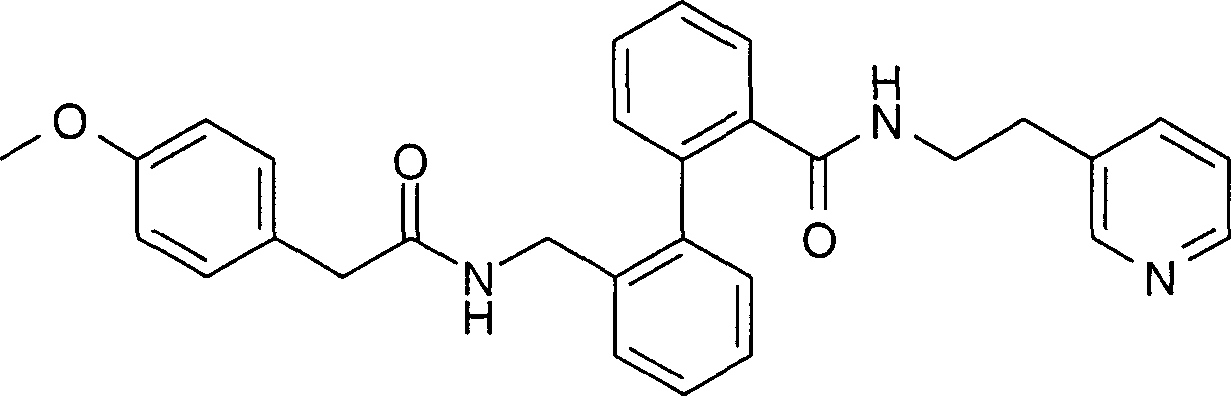
Zu einer Lösung von 37,8 g (0,11 mol) 2'-(tert-Butoxycarbonylamino-methyl)-biphenyl-2-carbonsäure (Brandmeier, V.; Sauer, W.H.B.; Feigel, M.; Helv. Chim. Acta 1994, 77(1), 70–85) in 550 ml THF wurden 15,5 g (0,115 mol) HOBT und 21,9 g (0,115 mol) EDAC zugegeben und die Reaktionsmischung wurde 45 min bei Raumtemperatur gerührt. Anschließend wurden 14,0 g (0,115 mol) 3-(2-Aminoethyl)-pyridin zugegeben und es wurde über Nacht bei RT gerührt. Nach Zugabe von 400 ml Wasser und 500 ml Essigester und intensivem Rühren, wurden die Phasen getrennt. Die organische Phase wurde 1 mal mit 400 ml gesättigter Natriumchloridlösung und 2mal mit je 400 ml gesättigter Natriumhydrogencarbonatlösung gewaschen. Nach Trocknen über Magnesiumsulfat in Gegenwart von Aktivkohle wurde filtriert und am Rotationsverdampfer eingeengt. Das erhaltene Zwischenprodukt (40,7 g) wurde in 600 ml Methylenchlorid gelöst und dann wurden 100 ml Trifluoressigsäure langsam zugetropft. Nach Rühren über Nacht wurde die Reaktionsmischung in Vakuum eingeengt. Der Rückstand wurde mit 250 ml Essigester versetzt und erneut eingeengt, um überschüssige Trifluoressigsäure herauszudestillieren. Zu dem erhaltenen Rohprodukt gelöst in 170 ml Methylenchlorid wurden 72,8 ml (530 mmol) Triethylamin zugetropft und 1 g DMAP hinzugefügt. Anschließend wurden bei 5–10°C 18,7 g (100 mmol) 4-Methoxyphenylessigsäurechlorid innerhalb von 30 min zugetropft, und der Ansatz wurde über Nacht bei Raumtemperatur gerührt. Nach Zugabe von 150 ml Wasser und intensivem Rühren wurden die Phasen getrennt und die organische Phase wurde 1 mal mit 100 ml Natriumchlorid-Lösung, 1 mal mit 25 ml 1 M Salzsäure und 2mal mit je 100 ml gesättigter Natriumhydrogencarbonatlösung gewaschen. Nach Trocknen über Magnesiumsulfat und Aktivkohle, wurde im Vakuum eingeengt. Das erhaltene Öl wurde in Acetonitril heiß gelöst und langsam auskristallisieren gelassen.To a solution of 37.8 g (0.11 mol) of 2 '- (tert-butoxycarbonylamino-methyl) -biphenyl-2-carboxylic acid (Brandmeier, V .; Sauer, WHB, Feigel, M., Helv. Chim. Acta 1994, 77 (1), 70-85) in 550 ml of THF were added 15.5 g (0.115 mol) of HOBT and 21.9 g (0.115 mol) of EDAC, and the reaction mixture was stirred at room temperature for 45 min. Subsequently, 14.0 g (0.115 mol) of 3- (2-aminoethyl) pyridine were added and it was stirred overnight at RT. After addition of 400 ml of water and 500 ml of ethyl acetate and intensive stirring, the phases were separated. The organic phase was washed once with 400 ml of saturated sodium chloride solution and twice with 400 ml of saturated sodium bicarbonate solution. After drying over magnesium sulfate in the presence of activated carbon, the mixture was filtered and concentrated on a rotary evaporator. The resulting intermediate (40.7 g) was dissolved in 600 ml of methylene chloride and then 100 ml of trifluoroacetic acid was slowly added dropwise. After stirring overnight, the reaction mixture was concentrated in vacuo. The residue was treated with 250 ml of ethyl acetate and concentrated again to excess trifluoroacetic acid to distill off acid. To the resulting crude product dissolved in 170 ml of methylene chloride, 72.8 ml (530 mmol) of triethylamine were added dropwise and 1 g of DMAP was added. Subsequently, at 5-10 ° C 18.7 g (100 mmol) of 4-Methoxyphenylessigsäurechlorid were added dropwise within 30 min, and the mixture was stirred overnight at room temperature. After addition of 150 ml of water and intensive stirring, the phases were separated and the organic phase was washed once with 100 ml of sodium chloride solution, once with 25 ml of 1 M hydrochloric acid and twice with 100 ml of saturated sodium bicarbonate solution. After drying over magnesium sulfate and charcoal, it was concentrated in vacuo. The resulting oil was dissolved in acetonitrile while hot and allowed to crystallize out slowly.
Es wurden 21,5 g 2'-{[2-(4-Methoxy-phenyl)-acetylamino]-methyl}-biphenyl-2-carbonsäure-(2-pyridin-3-yl-ethyl)-amid, Schmelzpunkt 116°C, erhalten.It were 21.5 g of 2 '- {[2- (4-methoxy-phenyl) -acetylamino] -methyl} -biphenyl-2-carboxylic acid (2-pyridin-3-yl-ethyl) -amide, Melting point 116 ° C, receive.
Beispiel 2: 2'-(Benzyloxycarbonylamino-methyl)-biphenyl-2-carbonsäure-2-(2-pyridyl)-ethylamidExample 2: 2 '- (Benzyloxycarbonylamino-methyl) -biphenyl-2-carboxylic acid 2- (2-pyridyl) -ethylamide

Die Verbindung wurde erhalten gemäß der in WO 0125189 angegebenen Synthesevorschrift.The Compound was obtained according to the in WO 0125189 specified synthesis instructions.
Beispiel 3: 2'-{[2-(4-Methoxy-phenyl)-acetylamino]-methyl}-biphenyl-2-carbonsäure-2,4-difluor-benzylamidExample 3: 2 '- {[2- (4-Methoxy-phenyl) -acetylamino] -methyl} -biphenyl-2-carboxylic acid 2,4-difluoro-benzylamide
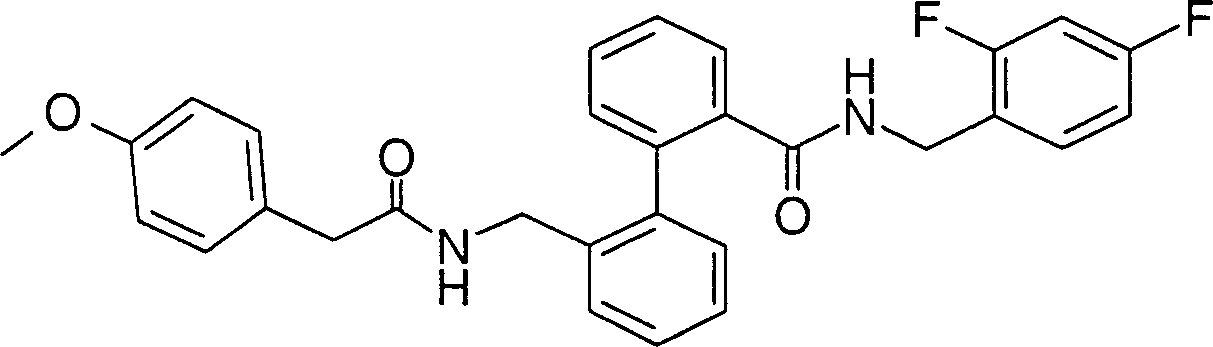
Die Verbindung wurde erhalten gemäß der in WO 0125189 angegebenen Synthesevorschrift.The Compound was obtained according to the in WO 0125189 specified synthesis instructions.
Beispiel 4: (S)-2'-(α-Methyl-benzyloxycarbonyl-aminomethyl)-biphenyl-2-carbonsäure-2-(2-pyridyl)-ethylamidExample 4: (S) -2 '- (α-Methyl-benzyloxycarbonylaminomethyl) -biphenyl-2-carboxylic acid 2- (2-pyridyl) -ethylamide
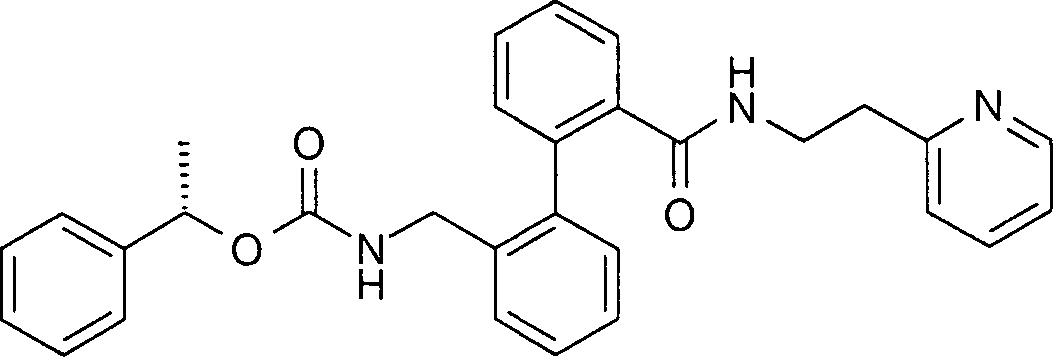
Die Verbindung wurde erhalten gemäß der in WO 0125189 angegebenen Synthesevorschrift.The Compound was obtained according to the in WO 0125189 specified synthesis instructions.
Beispiel 5: 2-(Butyl-l-sulfonylamino)-N-[1(R)-(6-methoxy-pyridin-3-yl)-propyl]-benzamidExample 5: 2- (Butyl-1-sulfonylamino) -N- [1 (R) - (6-methoxy-pyridin-3-yl) -propyl] -benzamide

a) 2-(Butyl-1-sulfonylamino)-benzoesäurea) 2- (Butyl-1-sulfonylamino) benzoic acid
Zu einer Suspension von 20 g (146 mmol) 2-Aminobenzoesäure in 250 ml Wasser wurden 20 g (188 mmol) Natriumcarbonat zugefügt. Anschließend wurden 11,4 g (72,8 mmol) Butylsulfonylchlorid zugetropft und die Reaktionsmischung wurde 2 Tage bei Raumtemperatur gerührt. Es wurde mit konzentrierter Salzsäure angesäuert, 3 Stunden bei Raumtemperatur gerührt und das ausgefallene Produkt abgesaugt. Nach Trocknen im Vakuum erhielt man 9,6 g 2-(Butyl-l-sulfonylamino)-benzoesäure.To a suspension of 20 g (146 mmol) 2-aminobenzoic acid in 250 ml ml of water was added 20 g (188 mmol) of sodium carbonate. Subsequently were Added dropwise 11.4 g (72.8 mmol) of butylsulfonyl chloride and the reaction mixture was stirred for 2 days at room temperature. It became more concentrated hydrochloric acid acidified Stirred for 3 hours at room temperature and sucked the failed product. After drying in vacuo 9.6 g of 2- (butyl-1-sulfonylamino) benzoic acid were obtained.
b) 1-(6-Methoxy-pyridin-3-yl)-propylaminb) 1- (6-methoxy-pyridin-3-yl) -propylamine
Zu einer Lösung von 10,2 ml Butyllithium (2,5 M Lösung in Hexan; 25,5 mmol) in 50 ml Diethylether wurden bei –70°C 3 ml (23,2 mmol) 5-Brom-2-methoxypyridin zugegeben. Nach 10 min wurden 1,4 ml (19.5 mmol) Propionitril zugegeben. Nach 2 Stunden bei –70°C wurde die Reaktionsmischung langsam auf Raumtemperatur kommen gelassen. Dann wurden 2,2 g Natriumsulfat Dekahydrat zugesetzt und 1 Stunde Rühren gelassen. Nach anschließender Zugabe von 5 g Magnesiumsulfat wurde nach kurzem Rühren von den Salzen abfiltriert und das Filtrat wurde eingeengt. Der Rückstand wurde in 70 ml Methanol gelöst und bei 0°C wurden 1,1 g (28 mmol) Natriumborhydrid zugegeben. Nach Rühren über Nacht, wurde die Reaktionsmischung mit konzentrierter Salzsäure auf pH 2 gestellt und am Rotationsverdampfer eingeengt. Der Rückstand wurde mit 10 ml Wasser versetzt, und einmal mit Diethylether extrahiert. Anschließend wurde die wäßrige Phase mit Natriumhydrogencarbonat gesättigt, im Vakuum eingeengt und der Rückstand mit Essigsäureethylester extrahiert. Nach Trocknen und Einengen der Essigesterextrakte wurden 1,4 g razemisches 1-(6-Methoxy-pyridin-3-yl)-propylamin erhalten.To a solution of 10.2 ml of butyllithium (2.5 M solution in hexane; 25.5 mmol) in 50 ml of diethyl ether were added at -70 ° C 3 ml (23.2 mmol) of 5-bromo-2-methoxypyridine. After 10 minutes, 1.4 ml (19.5 mmol) of propionitrile. After 2 hours at -70 ° C was the Reaction mixture allowed to come slowly to room temperature. Then 2.2 g of sodium sulfate decahydrate was added and left stirring for 1 hour. After subsequent Addition of 5 g of magnesium sulfate was after brief stirring the salts were filtered off and the filtrate was concentrated. The residue was dissolved in 70 ml of methanol and at 0 ° C 1.1 g (28 mmol) of sodium borohydride was added. After stirring overnight, The reaction mixture was concentrated with concentrated hydrochloric acid pH 2 and concentrated on a rotary evaporator. The residue was added 10 ml of water and extracted once with diethyl ether. Subsequently became the aqueous phase saturated with sodium bicarbonate, concentrated in vacuo and the residue with ethyl acetate extracted. After drying and concentration of the ethyl acetate extracts were 1.4 g racemic 1- (6-methoxy-pyridin-3-yl) -propylamine obtained.
c) 2-(Butyl-1-sulfonylamino)-N-[1(R)-(6-methoxy-pyridin-3-yl)-propyl]-benzamidc) 2- (Butyl-1-sulfonylamino) -N- [1 (R) - (6-methoxy-pyridin-3-yl) -propyl] -benzamide
Zu einer Lösung von 8,0 g (31,1 mmol) 2-(Butyl-l-sulfonylamino)-benzoesäure in 250 ml Tetrahydrofuran wurden 4,4 g (32, 7 mmol) 1-Hydroxy-1H-benzotriazol und 6,3 g (32,7 mmol) N-Ethyl-N'-(3-dimethylaminopropyl)-carbodiimid Hydrochlorid zugefügt und die Reaktionsmischung wurde 90 min gerührt. Dann wurde eine Lösung von 5,4 g (32,7 mmol) razemischem 1-(6-Methoxy-pyridin-3-yl)-propylamin in 20 ml Tetrahydrofuran zugetropft und über Nacht gerührt. Die Reaktionsmischung wurde mit 250 ml Wasser versetzt und mit 300 ml Essigsäureethylester extrahiert. Die organische Phase wurde 5 mal mit je 100 ml gesättigter Natriumhydrogencarbonatlösung extrahiert und dann über Magnesiumsulfat getrocknet. Man erhielt 9,0 g 2-(Butyl-1-sulfonylamino)-N-[1-(6-methoxy-pyridin-3-yl)-propyl]-benzamid. Die Trennung der Enantiomere erfolgte durch präparative HPLC auf einer Chiralpak ADH Säule (250 × 4,6 mm); Eluent: Heptan/Ethanol/Methanol 10:1:1; Temperatur: 30°C; Flußrate: 1 ml/min. Als erstes wurden bei einer Retentionszeit von 5,9 min 4,0 g 2-(Butyl-l-sulfonylamino)-N-[1(R)-(6-methoxy-pyridin-3-yl)-propyl]-benzamid eluiert. Nach einer Mischfraktion wurden bei einer Retentionszeit von 7,2 min 3,0 g 2-(Butyl-l-sulfonylamino)-N-[1(S)-(6-methoxy-pyridin-3-yl)-propyl]-benzamid erhalten.To a solution of 8.0 g (31.1 mmol) of 2- (butyl-1-sulfonylamino) benzoic acid in 250 ml of tetrahydrofuran were 4.4 g (32.7 mmol) of 1-hydroxy-1H-benzotriazole and 6.3 g (32.7 mmol) of N-ethyl-N '- (3-dimethylaminopropyl) carbodiimide Hydrochloride added and the reaction mixture was stirred for 90 minutes. Then a solution of 5.4 g (32.7 mmol) of racemic 1- (6-methoxy-pyridin-3-yl) -propylamine added dropwise in 20 ml of tetrahydrofuran and stirred overnight. The The reaction mixture was admixed with 250 ml of water and with 300 ml of ethyl acetate extracted. The organic phase was saturated 5 times with 100 ml sodium bicarbonate extracted and then over Dried magnesium sulfate. 9.0 g of 2- (butyl-1-sulfonylamino) -N- [1- (6-methoxypyridin-3-yl) -propyl] -benzamide were obtained. The enantiomers were separated by preparative HPLC on a Chiralpak ADH column (250 × 4.6 mm); Eluent: heptane / ethanol / methanol 10: 1: 1; Temperature: 30 ° C; Flow rate: 1 ml / min. First, at a retention time of 5.9 min, 4.0 g 2- (Butyl-1-sulfonylamino) -N- [1 (R) - (6-methoxypyridin-3-yl) -propyl] -benzamide eluted. After a mixed fraction were at a retention time of 7.2 minutes, 3.0 g of 2- (butyl-1-sulfonylamino) -N- [1 (S) - (6-methoxypyridin-3-yl) -propyl] -benzamide.
2 g des 2-(Butyl-1-sulfonylamino)-N-(1(R)-(6-methoxy-pyridin-3-yl)-propyl]-benzamids wurden in 9 ml Isopropanol in der Hitze gelöst, dann wurden 8 ml warmes Wasser zugegeben und die Reaktionsmischung wurde über Nacht langsam abkühlen gelassen. Nach Absaugen bei 0°C wurden 1,5 g 2-(Butyl-1-sulfonylamino)-N-[1(R)-(6-methoxy-pyridin-3-yl)-propyl]-benzamid als farblose nadelförmige Kristalle erhalten; Schmelzpunkt 97°C.2 g of 2- (butyl-1-sulfonylamino) -N- (1 (R) - (6-methoxy-pyridin-3-yl) -propyl] -benzamide dissolved in 9 ml of isopropanol in the heat, then 8 ml of warm Water was added and the reaction mixture became overnight cool slowly calmly. After suction at 0 ° C were 1.5 g of 2- (butyl-1-sulfonylamino) -N- [1 (R) - (6-methoxypyridin-3-yl) -propyl] -benzamide as colorless needle-shaped Received crystals; Melting point 97 ° C.
Beispiel 6: 2-(Butyl-1-sulfonylamino)-N-(cyclopropyl-pyridin-3-yl-methyl)-5-methylbenzamidExample 6: 2- (Butyl-1-sulfonylamino) -N- (cyclopropylpyridin-3-ylmethyl) -5-methylbenzamide

Die Verbindung wurde erhalten gemäß der in WO 02088073 angegebenen Synthesevorschrift.The Compound was obtained according to the in WO 02088073 specified synthesis instructions.
Beispiel 7: (S)-5-Fluor-2-(chinolin-8-sulfonylamino)-N-(1-phenyl-propyl)-benzamidExample 7: (S) -5-Fluoro-2- (quinoline-8-sulfonylamino) -N- (1-phenyl-propyl) -benzamide

a) 5-Fluor-2-(chinolin-8-sulfonylamino)-benzoesäurea) 5-Fluoro-2- (quinoline-8-sulfonylamino) benzoic acid
Eine Reaktionsmischung aus 10,0 g (64 mmol) 5-Fluor-2-amino-benzoesäure, 16,3 g (193 mmol) Natriumhydrogencarbonat und 16,3 g 8-Chinolinsulfonylchlorid in 325 ml Wasser und 325 ml Essigester wurde über Nacht bei RT gerührt. Die wässerige Phase wurde abgetrennt und 1-mal mit 50 ml Essigester extrahiert. Anschließend wurde die wässerige Phase mit konz. Salzsäure sauer gestellt und 2 h gerührt. Der ausgefallene Niederschlag wurde abgesaugt, im Vakuum getrocknet und man erhielt 19,5 g 5-Fluor-2-(chinolin-8-sulfonyiamino)-benzoesäure.A Reaction mixture of 10.0 g (64 mmol) of 5-fluoro-2-amino-benzoic acid, 16.3 g (193 mmol) of sodium bicarbonate and 16.3 g of 8-quinolinesulfonyl chloride in 325 ml of water and 325 ml of ethyl acetate was stirred at RT overnight. The aqueous Phase was separated and extracted once with 50 ml of ethyl acetate. Subsequently was the watery Phase with conc. hydrochloric acid acidified and stirred for 2 h. The precipitate was filtered off, dried in vacuo to give 19.5 g of 5-fluoro-2- (quinoline-8-sulfonyiamino) benzoic acid.
b) 5-Fluor-2-(chinolin-8-sulfonylamino)-N-(1-phenyl-propyl)-benzamidb) 5-Fluoro-2- (quinoline-8-sulfonylamino) -N- (1-phenyl-propyl) -benzamide
Aus
5,5 g (15,9 mmol) 5-Fluor-2-(chinolin-8-sulfonylamino)-benzoesäure und
2,3 g (16,7 mmol) (S)-Phenylpropylamin wurden gemäß der Vorschrift
in WO 02100825 5,7 g der Titelverbindung erhalten.
Fp.: 163°CFrom 5.5 g (15.9 mmol) of 5-fluoro-2- (quinoline-8-sulfonylamino) benzoic acid and 2.3 g (16.7 mmol) of (S) -phenylpropylamine were prepared according to the procedure in WO 02100825 5 , 7 g of the title compound.
Mp .: 163 ° C
Beispiel 8: (S)-5-Fluor-2-(chinolin-8-sulfonylamino)-N-(1-phenyl-propyl)-benzamid-NatriumsalzExample 8: (S) -5-Fluoro-2- (quinoline-8-sulfonylamino) -N- (1-phenyl-propyl) -benzamide sodium salt
Zu einer Lösung von 5 g der Verbindung des Beispiels 7 in 120 ml Essigester wurden 2 ml einer 30-prozentigen Natriummethanolatlösung gegeben. Das ausgefallene Natriumsalz wurde abgesaugt und aus 25 ml Ethanol umkristallisiert und man erhielt 3,3 g der Titelverbindung.To a solution of 5 g of the compound of Example 7 in 120 ml of ethyl acetate 2 ml of a 30 percent sodium methoxide solution. The failed one Sodium salt was filtered off and recrystallized from 25 ml of ethanol and 3.3 g of the title compound were obtained.
Pharmakologische UntersuchungenPharmacological investigations
Bestimmung der Aktivität auf den Kv1.5-KanalDetermination of activity on the Kv1.5 channel
Kv1.5-Kanäle aus dem Menschen wurden in Xenopus Oozyten expremiert. Hierfür wurden zuerst Oozyten aus Xenopus laevis isoliert und defollikuliert. Anschließend wurde in diese Oozyten in vitro synthetisierte Kv1.5 kodierende RNA injiziert. Nach 1–7 Tagen Kv1.5-Proteinexpression wurden an den Oozyten mit der Zwei-Mikroelektroden Voltage-Clamp Technik Kv1.5-Ströme gemessen. Die Kv1.5-Kanäle wurden hierbei in der Regel mit 500 ms dauernden Spannungssprüngen auf 0 mV und 40 mV aktiviert. Das Bad wurde mit einer Lösung der nachfolgenden Zusammensetzung durchspült: NaCl 96 mM, KCl 2 mM, CaCl2 1,8 mM, MgCl2 1 mM, HEPES 5 mM (titriert mit NaOH auf pH 7,4). Diese Experimente wurden bei Raumtemperatur durchgeführt. Zur Datenerhebung und Analyse wurden eingesetzt: Geneclamp Verstärker (Axon Instruments, Foster City, USA) und MacLab D/A-Umwandler und Software (ADInstruments, Castle Hill, Australia). Die erfindungsgemäßen Substanzen wurden getestet, indem sie in unterschiedlichen Konzentrationen der Badlösung zugefügt wurden. Die Effekte der Substanzen wurden als prozentuale Inhibition des Kv1.5-Kontrollstromes berechnet, der erhalten wurde, wenn der Lösung keine Substanz zugesetzt wurde. Die Daten wurden anschließend mit der Hill-Gleichung extrapoliert, um die Hemmkonzentrationen IC50 für die jeweiligen Substanzen zu bestimmen.Human Kv1.5 channels were expressed in Xenopus oocytes. For this purpose, oocytes from Xenopus laevis were first isolated and defolliculated. Subsequently, in these oocytes in vitro synthesized Kv1.5 coding RNA was injected. After 1-7 days of Kv1.5 protein expression, Kv1.5 currents were measured on the oocytes using the two-microelectrode voltage-clamp technique. The Kv1.5 channels were here in usually with 500 ms lasting voltage jumps to 0 mV and 40 mV activated. The bath was rinsed with a solution of the following composition: NaCl 96 mM, KCl 2 mM, CaCl 2 1.8 mM, MgCl 2 1 mM, HEPES 5 mM (titrated to pH 7.4 with NaOH). These experiments were carried out at room temperature. For data collection and analysis, Geneclamp amplifiers (Axon Instruments, Foster City, USA) and MacLab D / A converters and software (ADInstruments, Castle Hill, Australia) were used. The substances according to the invention were tested by adding them to the bath solution in different concentrations. The effects of the substances were calculated as percent inhibition of the Kv1.5 control current obtained when no substance was added to the solution. The data were then extrapolated with the Hill equation to determine the inhibitory concentrations IC 50 for the respective substances.
Auf
diese Weise wurden für
die nachfolgend aufgeführten
Verbindungen folgende IC50-Werte bestimmt: 
Im Folgenden wird die direkte Wirkung von Kv1.5-Blockers auf die Kontraktionskraft des linken Schweinevorhofs gezeigt (A). Im zweiten Versuchsansatz (B) wird die Auswirkung der verbesserten Vorhofkontraktilität auf eine behinderte Kammerfüllung (diastolische Dysfunktion) nachgewiesen.in the Following is the direct effect of Kv1.5 blockers on the contraction force of the left porcine atrium (A). In the second attempt (B) the effect of improved atrial contractility on one disabled chamber filling (diastolic dysfunction) detected.
A) Prüfung des Einflusses von Kv1.5-Blockern auf die Vorhofkontraktiliät am narkotisierten SchweinA) Examination of the influence of Kv1.5 blockers on the atrial contractility on the anesthetized pig
Material und Methoden: Schweine der deutschen Landrasse wurden durch eine intramuskuläre Injektion von jeweils 2,5–3,5 mg/kg Xylazin, Tiletamin und Zolazepam in einer Mischspritze prämediziert. Die Narkose wurde mit Pentobarbital (ca. 30 mg/kg i.v.) eingeleitet und durch Dauerinfusion von Pentobarbital (12–17 mg/kg/h) aufrechterhalten.material and methods: Pigs of the German Landrace were replaced by a intramuscular Injection of 2.5-3.5 each mg / kg xylazine, tiletamine and zolazepam premedicated in a mixed syringe. The anesthesia was initiated with pentobarbital (about 30 mg / kg i.v.) and maintained by continuous infusion of pentobarbital (12-17 mg / kg / h).
Nach Narkoseeinleitung wurden die Tiere nach einer Tracheotomie intubiert und mit einem Gemisch aus Raumluft mit 40% Sauerstoff beatmet. Frequenz und Volumen der Beatmung richteten sich nach regelmäßig gemessenen Blutgas- und pH-Werten. Die Körpertemperatur wurde kontinuierlich registriert und mittels Regelung durch eine beheizte Unterlage und/oder Rotlichtlampe und/oder Atemlufterwärmung konstant gehalten (zirka 37–38°C).To Anesthesia induction, the animals were intubated after a tracheostomy and ventilated with a mixture of room air with 40% oxygen. frequency and volume of ventilation were measured according to regularly measured Blood gas and pH values. The body temperature was registered continuously and by regulation by a heated pad and / or red light lamp and / or breathing air heating constant held (about 37-38 ° C).
Folgende Blutgefäße wurden bei den Schweinen freipräpariert und kanüliert: V. jugularis ext. (Narkoseinfusion), A. carotis (Einführung eines Tip-Manometer Katheters in die linke Herzkammer zur Registierung des dortigen Druckes), V. saphena lat. (Prüfsubstanzgabe), V. epigastrica cran. superficialis (Flüssigkeitsinfusion), A. femoralis (periphere Blutdruckregistierung) und V. femoralis (Einführung MAP-Katheter rechter Vorhof).The following Blood vessels were prepared for the pigs and cannulated: V. jugularis ext. (Narcosis infusion), A. carotis (introduction of a Tip manometer catheter into the left ventricle to register the local pressure), V. saphena lat. (test substance administration), V. epigastrica cran. superficialis (fluid infusion), Femoral artery (peripheral blood pressure registration) and femoral vein (Introduction MAP catheter right atrium).
Zur Bestimmung der für die Kontraktilität verantwortlichen Parameter am linken Vorhof werden zwei Ultraschall-Messwertgeber verwendet (P/N JP 5-2, Triton Technology®) [Referenzen 1 und 2]. Diese beiden Piezo-elektrischen Messwertgeber werden durch punktförmige Einschnitte am äußersten Rand des Vorhofs in kranio-kaudaler Richtung implantiert. Die Einschnitte wurden jeweils mit einem U-Heft (2-0 Vicryl®) verschlossen. Die beiden Ultraschall-Messwertgeber wurden dann mit der Auswertungs-Einheit verbunden. Zusätzlich wurde am ventralen Rand des Vorhofs ein Druckmesskatheter implantiert, um den linken Vorhofdruck zu erfassen.To determine the parameters responsible for the contractility in the left atrial two ultrasonic transducers are used (P / N JP 5-2, Triton Technology ®) [References 1 and 2]. These two piezoelectric transducers are implanted in the cranio-caudal direction by point-shaped incisions at the outermost edge of the atrium. The incisions were closed in each case with a U-Heft (2-0 Vicryl ®). The two ultrasonic transducers were then connected to the evaluation unit. In addition, a pressure measuring catheter was implanted at the ventral edge of the atrium to detect left atrial pressure.
Die linksatriale, systolische Verkürzung wurde bestimmt durch den Vorhofdurchmesser zu Beginn der aktiven Vorhofdruckkurve und dem minimalen Durchmesser (engt. LASS = Left Atrial Systolic Shortening). Da die Vorhofkontraktilität von der Vordehnung abhängt, wurde die linksatriale, systolische Verkürzung durch den Wert zu Beginn den aktiven Vorhofkontraktion dividiert (LASSindex). Zur Bestimmung der maximalen Steilheit der Kontraktionskurve wurden die Rohdatenpunkte in Microsoft Excel importiert und die maximale Steilheit der Kurve berechnet. Um atmungsbedingte Schwankungen auszuschließen, wurden mindestens 10 Herzzyklen analysiert.The left atrial systolic shortening was determined by the atrial diameter at the beginning of the active atrial pressure curve and the minimum diameter (narrow LASS = Left Atrial Systolic Shortening). Since atrial contractility is dependent on pre-stretching, the left atrial systolic shortening was divided by the initial value of the active atrial contraction (LASS index ). To determine the maximum slope of the contraction curve, the raw data points were imported into Microsoft Excel and the maximum slope of the curve was calculated. To exclude respiratory fluctuations, at least 10 cardiac cycles were analyzed.
Nach Erfassung der Vorwerte, erfolgte eine 10-minütige Infusion des später verwendeten Vehikels aus 0,5 ml DMSO, 2,5 ml PEG und 2,0 ml Glukose G20. Anschließend erfolgte im Sinusrhythmus die intravenöse (i.v.) Applikation von 1 mg/kg der Testsubstanz gelöst im oben aufgeführten Vehikel.To Recording the preliminary values, followed by a 10-minute infusion of the later used Vehicle of 0.5 ml DMSO, 2.5 ml PEG and 2.0 ml Glucose G20. Then took place in sinus rhythm the intravenous (i.v.) Application of 1 mg / kg of the test substance dissolved in the vehicle listed above.
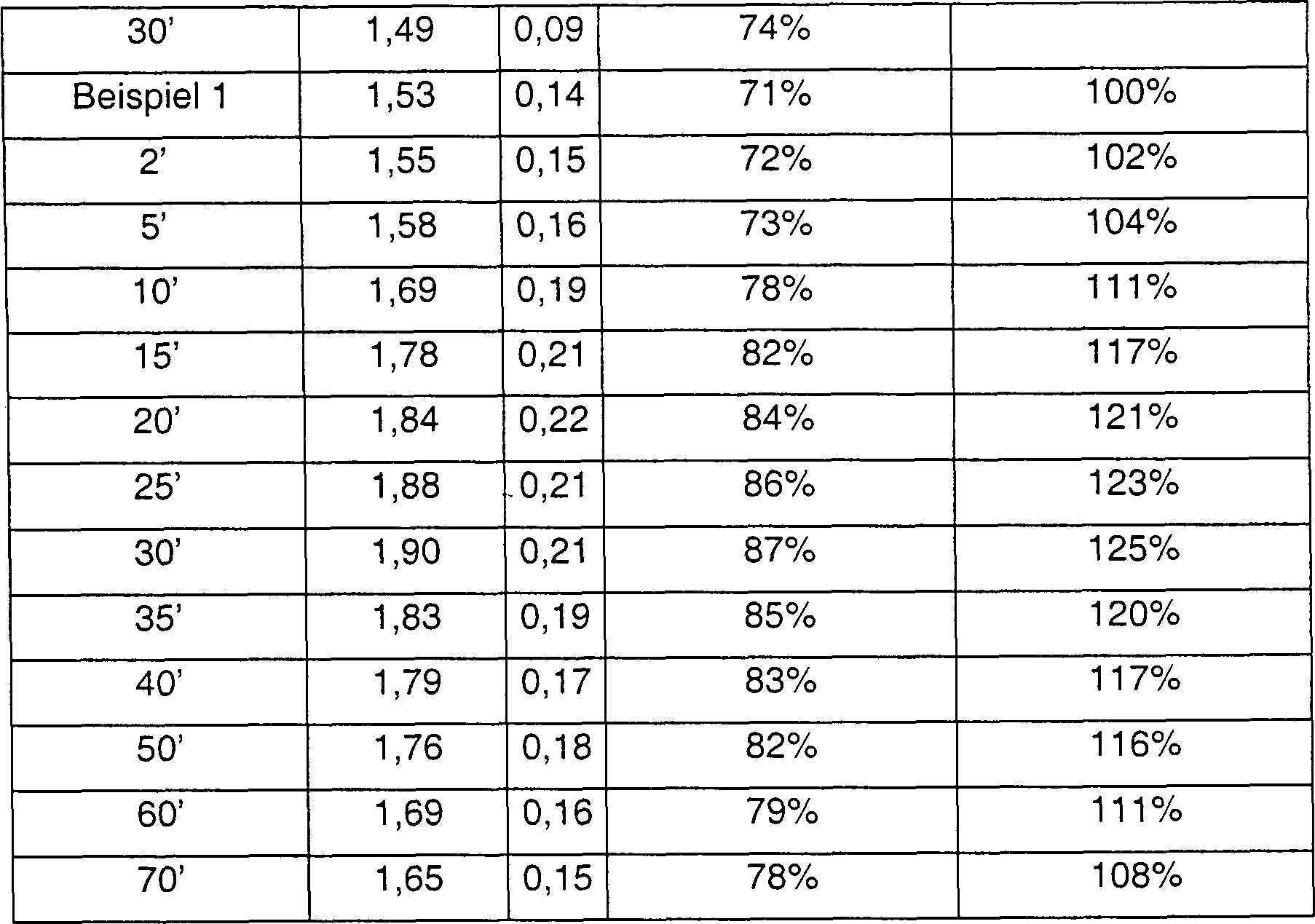
In einer weiteren Versuchreihe erfolgte die Applikation der Testsubstanz erst nach einer Stunde Vorhofflimmern, ausgelöst durch andauernde Hoch-Frequenz-Stimulation (1200 Schläge/min) des rechten Vorhofs. Hier wurden die Parameter für Vorhofkontraktilität vor/nach der Flimmerperiode und nach Applikation der Testsubstanz erfasst und mit denen nach Vehikelkontrolle verglichen. Die Verbindung des Beispiels 1 führt sowohl an Schweinen im normalen Sinusrhythmus (Tabelle 1) als auch nach einer Stunde Vorhofflimmern (Tabelle 2) zu einer statistisch signifikanten Verbesserung der Vorhoffunktion. Die verbesserte Vorhoffunktion ließ sich an beiden Parametern gleichermaßen ablesen, dem LASS index und der LACC steepness. Besonders hervorgehoben werden muss die Wirkung von Verbindung des Beispiels 1 nach einer Stunde Vorhofflimmern, weil dort die Kontraktilität auf ein Niveau von 57–69% des Ausgangswertes gesunken ist. Verbindung des Beispiels 1 konnte in dieser Situation die Kontraktilität über das basale Niveau (vor dem Vorhofflimmern) hinaus verbessern.In In another series of experiments, the application of the test substance was carried out only after one hour of atrial fibrillation, triggered by persistent high-frequency stimulation (1200 Beats / min) of the right atrium. Here, the parameters for atrial contractility before / after the flicker period and after application of the test substance and compared with those after vehicle control. The connection of the Example 1 leads in pigs in normal sinus rhythm (Table 1) as well after one hour of atrial fibrillation (Table 2) to a statistical Significant improvement in foreward function. The improved preview function let himself go equally on both parameters read off, the LASS index and the LACC steepness. Especially highlighted must be the effect of compound of Example 1 after a Hour of atrial fibrillation, because there contractility on a Level of 57-69% of the initial value has dropped. Compound of Example 1 could in this situation, the contractility above the basal level (before improve the atrial fibrillation).
Die Verbindung des Beispiels 1 verbessert die atriale Kontraktilität beträchtlich sowohl im Sinusrhythmus als auch nach Vorhofflimmern, wo die atriale Kontraktilität durch den Prozess des sog. elektrischen Remodellings pathophysiologisch bedeutsam vermindert ist.The Compound of Example 1 significantly improves atrial contractility both in the sinus rhythm and after atrial fibrillation, where the atrial contractility through the process of so-called electrical remodeling pathophysiological is significantly reduced.


B) Verbesserte Auswurfleistung der linken Herzkammer nach Kv1.5-Blockern in einem Modell der diastolischen DysfunktionB) Improved ejection performance the left ventricle after Kv1.5 blockers in a model of diastolic dysfunction
Methode: Schweine wurden wie in A) beschrieben narkotisiert und thorakotomiert. Ein Flussmesskopf wurde zur Messung des Herzminutenvolumens über der Aorta angebracht. In stabiler hämodynamischer Situation wurde mit Hilfe einer Kanüle Luft (ca 30 ml) in das Pericard instilliert. Der Sinn der perikardialen Luftinstillation ist eine Behinderung der ventrikulären Füllung, die letzlich zu einem vermindertem Herzminutenvolumen führt (diastolische Herzinsuffizienz). Ziel des Versuches war es nachzuweisen, dass das reduzierte Herzminutenvolumen durch eine verstärkte Vorhofkontraktilität erhöht werden kann, indem die durch Kv1.5-Blockade erhöhte Vorhofkontraktilität eine Verbesserung der behinderten Ventrikelfüllung bewirkt.Method: Pigs were anesthetized and thoracotomized as described in A). A flow meter was used to measure the cardiac output over the Aorta attached. In stable hemodynamic Situation was made using a cannula air (about 30 ml) in the pericardium instilled. The purpose of pericardial air instillation is one Disability of the ventricular Filling, which ultimately leads to a reduced cardiac output (diastolic Heart failure). The aim of the experiment was to prove that the reduced cardiac output is increased by an increased atrial contractility By improving the atrial contractility enhanced by Kv1.5 blockade, an improvement can be made the disabled ventricular filling causes.
Die pericardiale Luftinstillation führt zu einer deutlichen Verminderung des Herzminutenvolumens (Tabelle 3). Dieses konnte durch die Gabe der Verbindung des Beispiels 1 (3 mg/kg) infundiert in 30 min, beträchtlich gesteigert werden (n = 11). Im Maximum steigerte die Verbindung des Beispiels 1 das reduzierte Herzminutenvolumen um 25%.The pericardial air instillation leads to a significant decrease in cardiac output (Table 3). This could by the gift of the connection of the example 1 (3 mg / kg) infused in 30 min, considerably increased (aft = 11). At the maximum, the compound of Example 1 increased the reduced one Cardiac output by 25%.
Die Kv1.5-Blockade mit der Verbindung des Beispiels 1 erhöht das Herzminutenvolumen bei behinderter Ventrikelfüllung. Die Ergebnisse zeigen, dass Kv1.5-Blockade besonders bei diastolischer Herzinsuffizienz wirksam ist.The Kv1.5 blockade with the compound of Example 1 increases cardiac output with impaired ventricular filling. The results show that Kv1.5 blockade is particularly prevalent in diastolic Heart failure is effective.

Literatur:Literature:
- Leistad E, Aksnes G, Verburg E, Christensen G. Atrial contractile dysfunction after short-term atrial fibrillation is reduced by verapamil but increased by BAY K8644. Circulation 1996; 93: 1747–1754.Leistad E, Aksnes G, Verburg E, Christensen G. Atrial contractile dysfunction after short-term atrial fibrillation is reduced by verapamil but increased by BAY K8644. Circulation 1996; 93: 1747-1754.
- Recordati G, Lombardi F, Malliani A, Brown AM. Instantaneous dimensional changes of the right atrium of the cat. J Appl Physiol 1974; 36: 686–692.Recordati G, Lombardi F, Malliani A, Brown AM. Instantaneous dimensional changes of the right atrium of the cat. J Appl Physiol 1974; 36: 686-692.
Claims (3)

Priority Applications (15)
| Application Number | Priority Date | Filing Date | Title |
|---|---|---|---|
| DE102004009931A DE102004009931A1 (en) | 2004-02-26 | 2004-02-26 | Use of specific 2-substituted benzamides for treating and preventing cardiac insufficiency, especially where caused by diastolic dysfunction, act by inhibition of the Kv1.5 potassium channel |
| CA002557263A CA2557263A1 (en) | 2004-02-26 | 2005-02-12 | Kv1.5-blocker for the selective increase of atrial contractility and treatment of cardiac insufficiency |
| AU2005218731A AU2005218731A1 (en) | 2004-02-26 | 2005-02-12 | Kv1.5-blocker for the selective increase of atrial contractility and treatment of cardiac insufficiency |
| CNA2005800054867A CN1921855A (en) | 2004-02-26 | 2005-02-12 | KV1.5-blocker for the selective increase of atrial contractility and treatment of cardiac insufficiency |
| PCT/EP2005/001422 WO2005084675A1 (en) | 2004-02-26 | 2005-02-12 | Kv1.5-blocker for the selective increase of atrial contractility and treatment of cardiac insufficiency |
| BRPI0508054-1A BRPI0508054A (en) | 2004-02-26 | 2005-02-12 | kv1.5 blockers for selective increase in atrial contractility and treatment of heart failure |
| EP05707351A EP1720549A1 (en) | 2004-02-26 | 2005-02-12 | Kv1.5-blocker for the selective increase of atrial contractility and treatment of cardiac insufficiency |
| KR1020067017127A KR20060125862A (en) | 2004-02-26 | 2005-02-12 | Kv1.5-blockers for the selective increase of atrial contractility and treatment of heart failure |
| JP2007500093A JP2007523926A (en) | 2004-02-26 | 2005-02-12 | Kv1.5 blocker for selective increase in atrial contractility and treatment of heart failure |
| PE2005000178A PE20051138A1 (en) | 2004-02-26 | 2005-02-15 | Kv1.5 BLOCKERS REFERRED TO SELECTIVE INCREASE OF CONTRACTILITY |
| TW094105508A TW200536522A (en) | 2004-02-26 | 2005-02-24 | Kv1.5 blockers for selectively increasing atrial contractility and treating heart failure |
| ARP050100675A AR047975A1 (en) | 2004-02-26 | 2005-02-24 | KV1.5 BLOCKERS TO SELECTIVELY INCREASE HEADPHONE CONTRACTILITY AND TREAT CARDIAC INSUFFICIENCY |
| UY28777A UY28777A1 (en) | 2004-02-26 | 2005-02-25 | KV BLOCKERS 1.5 TO SELECTIVELY INCREASE HEADPHONE CONTRACTILITY AND TREAT HEART FAILURE |
| IL177255A IL177255A0 (en) | 2004-02-26 | 2006-08-02 | Kvi.5 blocker for the selective increase of atrial contractility and treatment of cardiac insufficiency |
| US11/466,791 US20070043091A1 (en) | 2004-02-26 | 2006-08-24 | Kv1.5-BLOCKER FOR THE SELECTIVE INCREASE OF ATRIAL CONTRACTILITY AND TREATMENT OF CARDIAC INSUFFICIENCY |
Applications Claiming Priority (1)
| Application Number | Priority Date | Filing Date | Title |
|---|---|---|---|
| DE102004009931A DE102004009931A1 (en) | 2004-02-26 | 2004-02-26 | Use of specific 2-substituted benzamides for treating and preventing cardiac insufficiency, especially where caused by diastolic dysfunction, act by inhibition of the Kv1.5 potassium channel |
Publications (1)
| Publication Number | Publication Date |
|---|---|
| DE102004009931A1 true DE102004009931A1 (en) | 2005-09-15 |
Family
ID=34853866
Family Applications (1)
| Application Number | Title | Priority Date | Filing Date |
|---|---|---|---|
| DE102004009931A Withdrawn DE102004009931A1 (en) | 2004-02-26 | 2004-02-26 | Use of specific 2-substituted benzamides for treating and preventing cardiac insufficiency, especially where caused by diastolic dysfunction, act by inhibition of the Kv1.5 potassium channel |
Country Status (15)
| Country | Link |
|---|---|
| US (1) | US20070043091A1 (en) |
| EP (1) | EP1720549A1 (en) |
| JP (1) | JP2007523926A (en) |
| KR (1) | KR20060125862A (en) |
| CN (1) | CN1921855A (en) |
| AR (1) | AR047975A1 (en) |
| AU (1) | AU2005218731A1 (en) |
| BR (1) | BRPI0508054A (en) |
| CA (1) | CA2557263A1 (en) |
| DE (1) | DE102004009931A1 (en) |
| IL (1) | IL177255A0 (en) |
| PE (1) | PE20051138A1 (en) |
| TW (1) | TW200536522A (en) |
| UY (1) | UY28777A1 (en) |
| WO (1) | WO2005084675A1 (en) |
Cited By (1)
| Publication number | Priority date | Publication date | Assignee | Title |
|---|---|---|---|---|
| WO2006092660A1 (en) * | 2004-11-22 | 2006-09-08 | Integragen | Human obesity susceptibility gene encoding potassium ion channels and uses thereof |
Families Citing this family (4)
| Publication number | Priority date | Publication date | Assignee | Title |
|---|---|---|---|---|
| NZ572231A (en) * | 2006-04-27 | 2010-12-24 | Sanofi Aventis Deutschland | Inhibitors of the task-1 and task-3 ion channel |
| CA2761639C (en) * | 2009-05-29 | 2016-06-07 | Raqualia Pharma Inc. | Aryl substituted carboxamide derivatives as calcium or sodium channel blockers |
| CN102459181B (en) * | 2009-06-03 | 2014-05-07 | 赛诺菲-安万特德国有限公司 | Crystal of 2'-{[2-(4-methoxy-phenyl)-acetylamino]-methyl}-biphenyl-2-carboxylic acid (2-pyridin-3-yl-ethyl)-amide Mutually |
| CN107033064B (en) * | 2017-04-28 | 2019-07-09 | 西安医学院 | A kind of 3- (morpholine replaces fragrant imido grpup) Benzazole compounds and its preparation method and application |
Citations (7)
| Publication number | Priority date | Publication date | Assignee | Title |
|---|---|---|---|---|
| EP0686625A1 (en) * | 1993-12-27 | 1995-12-13 | Eisai Co., Ltd. | Anthranilic acid derivative |
| WO2000002851A1 (en) * | 1998-07-08 | 2000-01-20 | Aventis Pharma Deutschland Gmbh | Sulfur substituted sulfonylaminocarboxylic acid n-arylamides, their preparation, their use and pharmaceutical preparations comprising them |
| WO2000028511A1 (en) | 1998-11-05 | 2000-05-18 | Stephen Key Design, Llc | Rotatable label system and method of constructing same |
| WO2001025189A1 (en) * | 1999-10-02 | 2001-04-12 | Aventis Pharma Deutschland Gmbh | 2'-substituted 1,1'-biphenyl-2-carbonamides, method for the production thereof, use thereof as a medicament and pharmaceutical preparations containing said compounds |
| WO2002046148A1 (en) * | 2000-12-07 | 2002-06-13 | Aventis Pharma Deutschland Gmbh | Substituted anthranilic acids |
| WO2002087568A1 (en) * | 2001-04-28 | 2002-11-07 | Aventis Pharma Deutschland Gmbh | Utilization of anthranilic acid amides as a medicament for treating arrhythmias and pharmaceutical preparations that contain said compounds |
| WO2002100825A2 (en) * | 2001-06-12 | 2002-12-19 | Aventis Pharma Deutschland Gmbh | Anthranilic acid amides with a heteroarylsulfonyl side chain, and use thereof as antiarrhythmic active substances |
Family Cites Families (4)
| Publication number | Priority date | Publication date | Assignee | Title |
|---|---|---|---|---|
| US5935945A (en) * | 1996-10-31 | 1999-08-10 | Merck & Co., Inc. | Methods of treating or preventing cardiac arrhythmia |
| US6531495B1 (en) * | 1999-10-02 | 2003-03-11 | Aventis Pharma Deutschland Gmbh | 2′-Substituted 1,1′-biphenyl-2-carboxamides, processes for their preparation, their use as medicaments, and pharmaceutical preparations comprising them |
| DE10121003A1 (en) * | 2001-04-28 | 2002-12-19 | Aventis Pharma Gmbh | Anthranilic acid amides, processes for their preparation, their use as medicaments and pharmaceutical preparations containing them |
| DE10312073A1 (en) * | 2003-03-18 | 2004-09-30 | Aventis Pharma Deutschland Gmbh | 2- (Butyl-1-sulfonylamino) -N- [1 (R) - (6-methoxypyridin-3yl) -propyl] -benzamide, its use as a medicament and pharmaceutical compositions containing the same |
-
2004
- 2004-02-26 DE DE102004009931A patent/DE102004009931A1/en not_active Withdrawn
-
2005
- 2005-02-12 JP JP2007500093A patent/JP2007523926A/en not_active Abandoned
- 2005-02-12 KR KR1020067017127A patent/KR20060125862A/en not_active Withdrawn
- 2005-02-12 AU AU2005218731A patent/AU2005218731A1/en not_active Abandoned
- 2005-02-12 CA CA002557263A patent/CA2557263A1/en not_active Abandoned
- 2005-02-12 CN CNA2005800054867A patent/CN1921855A/en active Pending
- 2005-02-12 BR BRPI0508054-1A patent/BRPI0508054A/en not_active IP Right Cessation
- 2005-02-12 EP EP05707351A patent/EP1720549A1/en not_active Withdrawn
- 2005-02-12 WO PCT/EP2005/001422 patent/WO2005084675A1/en not_active Ceased
- 2005-02-15 PE PE2005000178A patent/PE20051138A1/en not_active Application Discontinuation
- 2005-02-24 AR ARP050100675A patent/AR047975A1/en unknown
- 2005-02-24 TW TW094105508A patent/TW200536522A/en unknown
- 2005-02-25 UY UY28777A patent/UY28777A1/en unknown
-
2006
- 2006-08-02 IL IL177255A patent/IL177255A0/en unknown
- 2006-08-24 US US11/466,791 patent/US20070043091A1/en not_active Abandoned
Patent Citations (7)
| Publication number | Priority date | Publication date | Assignee | Title |
|---|---|---|---|---|
| EP0686625A1 (en) * | 1993-12-27 | 1995-12-13 | Eisai Co., Ltd. | Anthranilic acid derivative |
| WO2000002851A1 (en) * | 1998-07-08 | 2000-01-20 | Aventis Pharma Deutschland Gmbh | Sulfur substituted sulfonylaminocarboxylic acid n-arylamides, their preparation, their use and pharmaceutical preparations comprising them |
| WO2000028511A1 (en) | 1998-11-05 | 2000-05-18 | Stephen Key Design, Llc | Rotatable label system and method of constructing same |
| WO2001025189A1 (en) * | 1999-10-02 | 2001-04-12 | Aventis Pharma Deutschland Gmbh | 2'-substituted 1,1'-biphenyl-2-carbonamides, method for the production thereof, use thereof as a medicament and pharmaceutical preparations containing said compounds |
| WO2002046148A1 (en) * | 2000-12-07 | 2002-06-13 | Aventis Pharma Deutschland Gmbh | Substituted anthranilic acids |
| WO2002087568A1 (en) * | 2001-04-28 | 2002-11-07 | Aventis Pharma Deutschland Gmbh | Utilization of anthranilic acid amides as a medicament for treating arrhythmias and pharmaceutical preparations that contain said compounds |
| WO2002100825A2 (en) * | 2001-06-12 | 2002-12-19 | Aventis Pharma Deutschland Gmbh | Anthranilic acid amides with a heteroarylsulfonyl side chain, and use thereof as antiarrhythmic active substances |
Non-Patent Citations (2)
| Title |
|---|
| THEWS,Gerhard: Anatomie Physiologie Pathophysiologie des Menschen, WVGmbH, Stuttgart, 1980, S.218,219 * |
| THEWS,Gerhard: Anatomie Physiologie Pathophysiologie des Menschen, WVGmbH, Stuttgart, 1980, S.218,219; |
Cited By (1)
| Publication number | Priority date | Publication date | Assignee | Title |
|---|---|---|---|---|
| WO2006092660A1 (en) * | 2004-11-22 | 2006-09-08 | Integragen | Human obesity susceptibility gene encoding potassium ion channels and uses thereof |
Also Published As
| Publication number | Publication date |
|---|---|
| US20070043091A1 (en) | 2007-02-22 |
| AU2005218731A1 (en) | 2005-09-15 |
| PE20051138A1 (en) | 2006-02-06 |
| CN1921855A (en) | 2007-02-28 |
| UY28777A1 (en) | 2005-09-30 |
| WO2005084675A1 (en) | 2005-09-15 |
| KR20060125862A (en) | 2006-12-06 |
| CA2557263A1 (en) | 2005-09-15 |
| EP1720549A1 (en) | 2006-11-15 |
| IL177255A0 (en) | 2006-12-10 |
| JP2007523926A (en) | 2007-08-23 |
| TW200536522A (en) | 2005-11-16 |
| BRPI0508054A (en) | 2007-07-17 |
| AR047975A1 (en) | 2006-03-15 |
Similar Documents
| Publication | Publication Date | Title |
|---|---|---|
| EP1349846B1 (en) | Arylated furane and thiophene carboxylic acid amides with potassium channel blocking effect | |
| EP1339675B1 (en) | Ortho-substituted and meta-substituted bis-aryl compounds, method for the production thereof, their use as a medicament, and pharmaceutical preparations containing these compounds | |
| EP1341764B1 (en) | Ortho-substituted nitrogen-containing bisaryl compounds used as potassium channel inhibitors | |
| EP1385820B1 (en) | Anthranilic acid amides, method for the production thereof, their use as antiarrhythmia agents, and pharmaceutical preparations thereof | |
| EP1399423A2 (en) | Anthranilic acid amides with a heteroarylsulfonyl side chain, method for the production thereof, use thereof as a medicament or diagnostic agent and pharmaceutical preparations containing said compounds | |
| DE10060292A1 (en) | Use of substituted benzimidazoles for the manufacture of a medicament for the treatment of diseases which can be influenced by inhibition of the Na + / H + exchanger and medicament containing them | |
| DE10121002A1 (en) | Use of anthranilic acid amides as a medicament for the treatment of arrhythmias and pharmaceutical preparations containing them | |
| DE69736130T2 (en) | PHARMACEUTICAL PRODUCTS FOR THE HEALING AND PREVENTION OF DISEASES ARISING FROM THE DAMAGE TO THE VASCULAR ENDOTHELIAL CELLS | |
| EP1605976B1 (en) | PHENYLCARBOXYL ACID AMIDES AND IK r CHANNEL INHIBITORS COMBINATION AND THE USE THEREOF FOR TREATING ATRIAL ARRHYTHMIA | |
| DE102004009931A1 (en) | Use of specific 2-substituted benzamides for treating and preventing cardiac insufficiency, especially where caused by diastolic dysfunction, act by inhibition of the Kv1.5 potassium channel | |
| EP1227811B1 (en) | Use of 2-imidazolyl substituted carbinols for production of a medicament for treatment or prophylaxis of disease states as a result of ischaemic conditions | |
| DE2460756A1 (en) | MEDICINAL PRODUCTS FOR IMPROVING ENDOGENIC PROSTAGONIC FORMATION, AS WELL AS NEW N- (PYRIDYLALKYL) -BENZAMIDES SUITABLE AS ACTIVE INGREDIENTS FOR MEDICINAL PRODUCTS AND METHOD FOR PRODUCING THEREOF | |
| DE10341233A1 (en) | Composition, useful to treat e.g. atrial fibrillation, atrial flutter and atrial arrhythmia, comprises at least one beta-blocker and at least one compound of a phenylcarboxylic acid amide derivative | |
| EP1606237A1 (en) | 2-(butyl-1-sulfonylamino)-n- 1(r)-(6-methoxy-pyridin-3-yl)-propyl]-benzamid, the use thereof in the form of drug an pharmaceutical preparations containing said compound | |
| DE4422517A1 (en) | New (2- (3,4-dimethoxy-phenyl) -ethyl) - (2-phenoxy-ethyl) -amines, processes for their preparation and their use as medicines | |
| DE10163239A1 (en) | Substituted imidazolidines, process for their preparation, their use as medicaments or diagnostic agents, and medicaments containing them | |
| DE19705133A1 (en) | Sulfonamide-substituted compounds, processes for their preparation, their use as medicaments or diagnostic agents and medicaments containing them | |
| DE1929330C3 (en) | l-Cinnamyl-4- (di-p-fluorobenzhydryl) piperazine, its therapeutically effective acid addition salts, processes for their preparation and pharmaceuticals containing them | |
| AT338781B (en) | PROCESS FOR THE PREPARATION OF NEW 1,3-BENZODIOXOL DERIVATIVES AND THEIR SALTS |
Legal Events
| Date | Code | Title | Description |
|---|---|---|---|
| OM8 | Search report available as to paragraph 43 lit. 1 sentence 1 patent law | ||
| 8127 | New person/name/address of the applicant |
Owner name: SANOFI-AVENTIS DEUTSCHLAND GMBH, 65929 FRANKFURT, |
|
| 8130 | Withdrawal |