DE10010182B4 - Use of viscous plastic compositions, in particular for the production of shoe sols - Google Patents
Use of viscous plastic compositions, in particular for the production of shoe sols Download PDFInfo
- Publication number
- DE10010182B4 DE10010182B4 DE10010182A DE10010182A DE10010182B4 DE 10010182 B4 DE10010182 B4 DE 10010182B4 DE 10010182 A DE10010182 A DE 10010182A DE 10010182 A DE10010182 A DE 10010182A DE 10010182 B4 DE10010182 B4 DE 10010182B4
- Authority
- DE
- Germany
- Prior art keywords
- plastic composition
- viscous plastic
- shoe
- orthopedic
- bis
- Prior art date
- Legal status (The legal status is an assumption and is not a legal conclusion. Google has not performed a legal analysis and makes no representation as to the accuracy of the status listed.)
- Expired - Lifetime
Links
- 239000000203 mixture Substances 0.000 title claims abstract description 67
- 229920003023 plastic Polymers 0.000 title claims abstract description 57
- 239000004033 plastic Substances 0.000 title claims abstract description 57
- 238000004519 manufacturing process Methods 0.000 title claims description 18
- 230000000399 orthopedic effect Effects 0.000 claims abstract description 38
- 230000001012 protector Effects 0.000 claims abstract description 25
- 229920001577 copolymer Polymers 0.000 claims abstract description 7
- 229920000468 styrene butadiene styrene block copolymer Polymers 0.000 claims abstract description 5
- 229920000642 polymer Polymers 0.000 claims description 39
- 239000013013 elastic material Substances 0.000 claims description 28
- 239000000178 monomer Substances 0.000 claims description 19
- 239000002131 composite material Substances 0.000 claims description 15
- 239000000945 filler Substances 0.000 claims description 12
- JRZJOMJEPLMPRA-UHFFFAOYSA-N olefin Natural products CCCCCCCC=C JRZJOMJEPLMPRA-UHFFFAOYSA-N 0.000 claims description 5
- 229920002554 vinyl polymer Polymers 0.000 claims description 4
- 150000001336 alkenes Chemical class 0.000 claims description 3
- 230000015572 biosynthetic process Effects 0.000 claims description 3
- 238000005755 formation reaction Methods 0.000 claims description 3
- 230000005484 gravity Effects 0.000 claims description 3
- OBNDGIHQAIXEAO-UHFFFAOYSA-N [O].[Si] Chemical compound [O].[Si] OBNDGIHQAIXEAO-UHFFFAOYSA-N 0.000 claims 1
- 239000000463 material Substances 0.000 description 32
- 206010052904 Musculoskeletal stiffness Diseases 0.000 description 28
- 210000004744 fore-foot Anatomy 0.000 description 21
- 210000002683 foot Anatomy 0.000 description 16
- 239000010410 layer Substances 0.000 description 12
- 239000003795 chemical substances by application Substances 0.000 description 9
- 239000011345 viscous material Substances 0.000 description 9
- 239000002346 layers by function Substances 0.000 description 8
- 229920001200 poly(ethylene-vinyl acetate) Polymers 0.000 description 8
- 238000010586 diagram Methods 0.000 description 7
- 239000005038 ethylene vinyl acetate Substances 0.000 description 7
- PPBRXRYQALVLMV-UHFFFAOYSA-N Styrene Chemical compound C=CC1=CC=CC=C1 PPBRXRYQALVLMV-UHFFFAOYSA-N 0.000 description 6
- 238000000418 atomic force spectrum Methods 0.000 description 6
- DQXBYHZEEUGOBF-UHFFFAOYSA-N but-3-enoic acid;ethene Chemical compound C=C.OC(=O)CC=C DQXBYHZEEUGOBF-UHFFFAOYSA-N 0.000 description 6
- VYPSYNLAJGMNEJ-UHFFFAOYSA-N Silicium dioxide Chemical compound O=[Si]=O VYPSYNLAJGMNEJ-UHFFFAOYSA-N 0.000 description 5
- 239000012190 activator Substances 0.000 description 5
- XLOMVQKBTHCTTD-UHFFFAOYSA-N Zinc monoxide Chemical compound [Zn]=O XLOMVQKBTHCTTD-UHFFFAOYSA-N 0.000 description 4
- 210000000548 hind-foot Anatomy 0.000 description 4
- 239000000049 pigment Substances 0.000 description 4
- 239000004014 plasticizer Substances 0.000 description 4
- XTXRWKRVRITETP-UHFFFAOYSA-N Vinyl acetate Chemical compound CC(=O)OC=C XTXRWKRVRITETP-UHFFFAOYSA-N 0.000 description 3
- 229920001400 block copolymer Polymers 0.000 description 3
- 238000006243 chemical reaction Methods 0.000 description 3
- 230000006378 damage Effects 0.000 description 3
- 238000013016 damping Methods 0.000 description 3
- 238000000034 method Methods 0.000 description 3
- 229920003048 styrene butadiene rubber Polymers 0.000 description 3
- 238000012360 testing method Methods 0.000 description 3
- ZGEGCLOFRBLKSE-UHFFFAOYSA-N 1-Heptene Chemical compound CCCCCC=C ZGEGCLOFRBLKSE-UHFFFAOYSA-N 0.000 description 2
- LIKMAJRDDDTEIG-UHFFFAOYSA-N 1-hexene Chemical compound CCCCC=C LIKMAJRDDDTEIG-UHFFFAOYSA-N 0.000 description 2
- KWKAKUADMBZCLK-UHFFFAOYSA-N 1-octene Chemical compound CCCCCCC=C KWKAKUADMBZCLK-UHFFFAOYSA-N 0.000 description 2
- ALKYHXVLJMQRLQ-UHFFFAOYSA-N 3-Hydroxy-2-naphthoate Chemical compound C1=CC=C2C=C(O)C(C(=O)O)=CC2=C1 ALKYHXVLJMQRLQ-UHFFFAOYSA-N 0.000 description 2
- 239000004604 Blowing Agent Substances 0.000 description 2
- KAKZBPTYRLMSJV-UHFFFAOYSA-N Butadiene Chemical compound C=CC=C KAKZBPTYRLMSJV-UHFFFAOYSA-N 0.000 description 2
- IMROMDMJAWUWLK-UHFFFAOYSA-N Ethenol Chemical compound OC=C IMROMDMJAWUWLK-UHFFFAOYSA-N 0.000 description 2
- UQSXHKLRYXJYBZ-UHFFFAOYSA-N Iron oxide Chemical compound [Fe]=O UQSXHKLRYXJYBZ-UHFFFAOYSA-N 0.000 description 2
- RRHGJUQNOFWUDK-UHFFFAOYSA-N Isoprene Chemical compound CC(=C)C=C RRHGJUQNOFWUDK-UHFFFAOYSA-N 0.000 description 2
- UFWIBTONFRDIAS-UHFFFAOYSA-N Naphthalene Chemical compound C1=CC=CC2=CC=CC=C21 UFWIBTONFRDIAS-UHFFFAOYSA-N 0.000 description 2
- 239000005062 Polybutadiene Substances 0.000 description 2
- GWEVSGVZZGPLCZ-UHFFFAOYSA-N Titan oxide Chemical compound O=[Ti]=O GWEVSGVZZGPLCZ-UHFFFAOYSA-N 0.000 description 2
- 208000027418 Wounds and injury Diseases 0.000 description 2
- 230000037396 body weight Effects 0.000 description 2
- 150000001732 carboxylic acid derivatives Chemical class 0.000 description 2
- 238000010276 construction Methods 0.000 description 2
- 230000007423 decrease Effects 0.000 description 2
- 235000014113 dietary fatty acids Nutrition 0.000 description 2
- 230000000694 effects Effects 0.000 description 2
- 229920001971 elastomer Polymers 0.000 description 2
- -1 ethylene, propylene, 1-butene Chemical class 0.000 description 2
- 239000000194 fatty acid Substances 0.000 description 2
- 229930195729 fatty acid Natural products 0.000 description 2
- 150000004665 fatty acids Chemical class 0.000 description 2
- 230000036541 health Effects 0.000 description 2
- 208000014674 injury Diseases 0.000 description 2
- 239000011256 inorganic filler Substances 0.000 description 2
- 230000009191 jumping Effects 0.000 description 2
- 239000007788 liquid Substances 0.000 description 2
- 238000005259 measurement Methods 0.000 description 2
- 210000002346 musculoskeletal system Anatomy 0.000 description 2
- YWAKXRMUMFPDSH-UHFFFAOYSA-N pentene Chemical compound CCCC=C YWAKXRMUMFPDSH-UHFFFAOYSA-N 0.000 description 2
- 125000005498 phthalate group Chemical class 0.000 description 2
- 229920002857 polybutadiene Polymers 0.000 description 2
- 230000008569 process Effects 0.000 description 2
- 239000003380 propellant Substances 0.000 description 2
- 239000005060 rubber Substances 0.000 description 2
- 230000035939 shock Effects 0.000 description 2
- 239000000377 silicon dioxide Substances 0.000 description 2
- 229920002725 thermoplastic elastomer Polymers 0.000 description 2
- 210000002303 tibia Anatomy 0.000 description 2
- 229910052723 transition metal Inorganic materials 0.000 description 2
- 150000003624 transition metals Chemical class 0.000 description 2
- 239000011787 zinc oxide Substances 0.000 description 2
- PCTMTFRHKVHKIS-BMFZQQSSSA-N (1s,3r,4e,6e,8e,10e,12e,14e,16e,18s,19r,20r,21s,25r,27r,30r,31r,33s,35r,37s,38r)-3-[(2r,3s,4s,5s,6r)-4-amino-3,5-dihydroxy-6-methyloxan-2-yl]oxy-19,25,27,30,31,33,35,37-octahydroxy-18,20,21-trimethyl-23-oxo-22,39-dioxabicyclo[33.3.1]nonatriaconta-4,6,8,10 Chemical compound C1C=C2C[C@@H](OS(O)(=O)=O)CC[C@]2(C)[C@@H]2[C@@H]1[C@@H]1CC[C@H]([C@H](C)CCCC(C)C)[C@@]1(C)CC2.O[C@H]1[C@@H](N)[C@H](O)[C@@H](C)O[C@H]1O[C@H]1/C=C/C=C/C=C/C=C/C=C/C=C/C=C/[C@H](C)[C@@H](O)[C@@H](C)[C@H](C)OC(=O)C[C@H](O)C[C@H](O)CC[C@@H](O)[C@H](O)C[C@H](O)C[C@](O)(C[C@H](O)[C@H]2C(O)=O)O[C@H]2C1 PCTMTFRHKVHKIS-BMFZQQSSSA-N 0.000 description 1
- NLHHRLWOUZZQLW-UHFFFAOYSA-N Acrylonitrile Chemical compound C=CC#N NLHHRLWOUZZQLW-UHFFFAOYSA-N 0.000 description 1
- OYPRJOBELJOOCE-UHFFFAOYSA-N Calcium Chemical compound [Ca] OYPRJOBELJOOCE-UHFFFAOYSA-N 0.000 description 1
- 239000004971 Cross linker Substances 0.000 description 1
- MQIUGAXCHLFZKX-UHFFFAOYSA-N Di-n-octyl phthalate Chemical compound CCCCCCCCOC(=O)C1=CC=CC=C1C(=O)OCCCCCCCC MQIUGAXCHLFZKX-UHFFFAOYSA-N 0.000 description 1
- 229920003345 Elvax® Polymers 0.000 description 1
- VGGSQFUCUMXWEO-UHFFFAOYSA-N Ethene Chemical compound C=C VGGSQFUCUMXWEO-UHFFFAOYSA-N 0.000 description 1
- 239000005977 Ethylene Substances 0.000 description 1
- 244000043261 Hevea brasiliensis Species 0.000 description 1
- VQTUBCCKSQIDNK-UHFFFAOYSA-N Isobutene Chemical group CC(C)=C VQTUBCCKSQIDNK-UHFFFAOYSA-N 0.000 description 1
- 239000004793 Polystyrene Substances 0.000 description 1
- NRCMAYZCPIVABH-UHFFFAOYSA-N Quinacridone Chemical compound N1C2=CC=CC=C2C(=O)C2=C1C=C1C(=O)C3=CC=CC=C3NC1=C2 NRCMAYZCPIVABH-UHFFFAOYSA-N 0.000 description 1
- 229920000297 Rayon Polymers 0.000 description 1
- WGLPBDUCMAPZCE-UHFFFAOYSA-N Trioxochromium Chemical compound O=[Cr](=O)=O WGLPBDUCMAPZCE-UHFFFAOYSA-N 0.000 description 1
- BZHJMEDXRYGGRV-UHFFFAOYSA-N Vinyl chloride Chemical compound ClC=C BZHJMEDXRYGGRV-UHFFFAOYSA-N 0.000 description 1
- 239000005083 Zinc sulfide Substances 0.000 description 1
- 230000002745 absorbent Effects 0.000 description 1
- 239000002250 absorbent Substances 0.000 description 1
- 239000006096 absorbing agent Substances 0.000 description 1
- 239000000654 additive Substances 0.000 description 1
- 150000001278 adipic acid derivatives Chemical class 0.000 description 1
- 229910052782 aluminium Inorganic materials 0.000 description 1
- PNEYBMLMFCGWSK-UHFFFAOYSA-N aluminium oxide Inorganic materials [O-2].[O-2].[O-2].[Al+3].[Al+3] PNEYBMLMFCGWSK-UHFFFAOYSA-N 0.000 description 1
- 235000012211 aluminium silicate Nutrition 0.000 description 1
- 210000003484 anatomy Anatomy 0.000 description 1
- 125000003118 aryl group Chemical group 0.000 description 1
- 230000000386 athletic effect Effects 0.000 description 1
- 238000005452 bending Methods 0.000 description 1
- 210000000988 bone and bone Anatomy 0.000 description 1
- 239000012267 brine Substances 0.000 description 1
- 229910052793 cadmium Inorganic materials 0.000 description 1
- BDOSMKKIYDKNTQ-UHFFFAOYSA-N cadmium atom Chemical compound [Cd] BDOSMKKIYDKNTQ-UHFFFAOYSA-N 0.000 description 1
- 239000011575 calcium Substances 0.000 description 1
- 229910052791 calcium Inorganic materials 0.000 description 1
- 125000004432 carbon atom Chemical group C* 0.000 description 1
- 239000006229 carbon black Substances 0.000 description 1
- 125000005521 carbonamide group Chemical group 0.000 description 1
- 150000004649 carbonic acid derivatives Chemical class 0.000 description 1
- 238000012512 characterization method Methods 0.000 description 1
- ZCDOYSPFYFSLEW-UHFFFAOYSA-N chromate(2-) Chemical compound [O-][Cr]([O-])(=O)=O ZCDOYSPFYFSLEW-UHFFFAOYSA-N 0.000 description 1
- 229910000423 chromium oxide Inorganic materials 0.000 description 1
- 230000001684 chronic effect Effects 0.000 description 1
- 150000001875 compounds Chemical class 0.000 description 1
- 230000005494 condensation Effects 0.000 description 1
- 238000009833 condensation Methods 0.000 description 1
- 238000007334 copolymerization reaction Methods 0.000 description 1
- 238000005336 cracking Methods 0.000 description 1
- 230000003247 decreasing effect Effects 0.000 description 1
- 230000003412 degenerative effect Effects 0.000 description 1
- 238000013461 design Methods 0.000 description 1
- 125000000664 diazo group Chemical group [N-]=[N+]=[*] 0.000 description 1
- 150000001993 dienes Chemical class 0.000 description 1
- PPSZHCXTGRHULJ-UHFFFAOYSA-N dioxazine Chemical compound O1ON=CC=C1 PPSZHCXTGRHULJ-UHFFFAOYSA-N 0.000 description 1
- 238000002474 experimental method Methods 0.000 description 1
- 239000000835 fiber Substances 0.000 description 1
- 239000006260 foam Substances 0.000 description 1
- 239000000499 gel Substances 0.000 description 1
- 230000009477 glass transition Effects 0.000 description 1
- 229920001519 homopolymer Polymers 0.000 description 1
- 239000003112 inhibitor Substances 0.000 description 1
- 238000001746 injection moulding Methods 0.000 description 1
- 150000002484 inorganic compounds Chemical class 0.000 description 1
- 229910003475 inorganic filler Inorganic materials 0.000 description 1
- 239000001023 inorganic pigment Substances 0.000 description 1
- 230000003993 interaction Effects 0.000 description 1
- 230000005923 long-lasting effect Effects 0.000 description 1
- 239000011159 matrix material Substances 0.000 description 1
- 239000000155 melt Substances 0.000 description 1
- 229910052751 metal Inorganic materials 0.000 description 1
- 239000002184 metal Substances 0.000 description 1
- 229910044991 metal oxide Inorganic materials 0.000 description 1
- 150000004706 metal oxides Chemical class 0.000 description 1
- 210000003205 muscle Anatomy 0.000 description 1
- TVMXDCGIABBOFY-UHFFFAOYSA-N n-Octanol Natural products CCCCCCCC TVMXDCGIABBOFY-UHFFFAOYSA-N 0.000 description 1
- 229920003052 natural elastomer Polymers 0.000 description 1
- 229920001194 natural rubber Polymers 0.000 description 1
- 150000002894 organic compounds Chemical class 0.000 description 1
- 239000012766 organic filler Substances 0.000 description 1
- 239000012860 organic pigment Substances 0.000 description 1
- 230000021715 photosynthesis, light harvesting Effects 0.000 description 1
- 229920000058 polyacrylate Polymers 0.000 description 1
- 229920000728 polyester Polymers 0.000 description 1
- 238000006116 polymerization reaction Methods 0.000 description 1
- 229920001296 polysiloxane Polymers 0.000 description 1
- 229920002223 polystyrene Polymers 0.000 description 1
- 238000012545 processing Methods 0.000 description 1
- 238000011002 quantification Methods 0.000 description 1
- 230000002040 relaxant effect Effects 0.000 description 1
- 230000004044 response Effects 0.000 description 1
- 150000003839 salts Chemical class 0.000 description 1
- 239000011359 shock absorbing material Substances 0.000 description 1
- 229910002027 silica gel Inorganic materials 0.000 description 1
- 239000000741 silica gel Substances 0.000 description 1
- 229910052710 silicon Inorganic materials 0.000 description 1
- 239000010703 silicon Substances 0.000 description 1
- LIVNPJMFVYWSIS-UHFFFAOYSA-N silicon monoxide Chemical class [Si-]#[O+] LIVNPJMFVYWSIS-UHFFFAOYSA-N 0.000 description 1
- 229910052814 silicon oxide Inorganic materials 0.000 description 1
- 239000002356 single layer Substances 0.000 description 1
- HPALAKNZSZLMCH-UHFFFAOYSA-M sodium;chloride;hydrate Chemical compound O.[Na+].[Cl-] HPALAKNZSZLMCH-UHFFFAOYSA-M 0.000 description 1
- 239000002689 soil Substances 0.000 description 1
- 239000000243 solution Substances 0.000 description 1
- 239000000126 substance Substances 0.000 description 1
- 239000000454 talc Substances 0.000 description 1
- 229910052623 talc Inorganic materials 0.000 description 1
- 229920001169 thermoplastic Polymers 0.000 description 1
- 239000004408 titanium dioxide Substances 0.000 description 1
- 230000007704 transition Effects 0.000 description 1
- XOOUIPVCVHRTMJ-UHFFFAOYSA-L zinc stearate Chemical compound [Zn+2].CCCCCCCCCCCCCCCCCC([O-])=O.CCCCCCCCCCCCCCCCCC([O-])=O XOOUIPVCVHRTMJ-UHFFFAOYSA-L 0.000 description 1
- 229910052984 zinc sulfide Inorganic materials 0.000 description 1
- DRDVZXDWVBGGMH-UHFFFAOYSA-N zinc;sulfide Chemical compound [S-2].[Zn+2] DRDVZXDWVBGGMH-UHFFFAOYSA-N 0.000 description 1
- 239000004711 α-olefin Substances 0.000 description 1
Classifications
-
- C—CHEMISTRY; METALLURGY
- C08—ORGANIC MACROMOLECULAR COMPOUNDS; THEIR PREPARATION OR CHEMICAL WORKING-UP; COMPOSITIONS BASED THEREON
- C08L—COMPOSITIONS OF MACROMOLECULAR COMPOUNDS
- C08L25/00—Compositions of, homopolymers or copolymers of compounds having one or more unsaturated aliphatic radicals, each having only one carbon-to-carbon double bond, and at least one being terminated by an aromatic carbocyclic ring; Compositions of derivatives of such polymers
- C08L25/02—Homopolymers or copolymers of hydrocarbons
- C08L25/04—Homopolymers or copolymers of styrene
- C08L25/06—Polystyrene
-
- A—HUMAN NECESSITIES
- A43—FOOTWEAR
- A43B—CHARACTERISTIC FEATURES OF FOOTWEAR; PARTS OF FOOTWEAR
- A43B13/00—Soles; Sole-and-heel integral units
- A43B13/02—Soles; Sole-and-heel integral units characterised by the material
- A43B13/04—Plastics, rubber or vulcanised fibre
-
- A—HUMAN NECESSITIES
- A43—FOOTWEAR
- A43B—CHARACTERISTIC FEATURES OF FOOTWEAR; PARTS OF FOOTWEAR
- A43B13/00—Soles; Sole-and-heel integral units
- A43B13/14—Soles; Sole-and-heel integral units characterised by the constructive form
- A43B13/18—Resilient soles
- A43B13/187—Resiliency achieved by the features of the material, e.g. foam, non liquid materials
-
- C—CHEMISTRY; METALLURGY
- C08—ORGANIC MACROMOLECULAR COMPOUNDS; THEIR PREPARATION OR CHEMICAL WORKING-UP; COMPOSITIONS BASED THEREON
- C08L—COMPOSITIONS OF MACROMOLECULAR COMPOUNDS
- C08L53/00—Compositions of block copolymers containing at least one sequence of a polymer obtained by reactions only involving carbon-to-carbon unsaturated bonds; Compositions of derivatives of such polymers
- C08L53/02—Compositions of block copolymers containing at least one sequence of a polymer obtained by reactions only involving carbon-to-carbon unsaturated bonds; Compositions of derivatives of such polymers of vinyl-aromatic monomers and conjugated dienes
Landscapes
- Chemical & Material Sciences (AREA)
- Health & Medical Sciences (AREA)
- Chemical Kinetics & Catalysis (AREA)
- Medicinal Chemistry (AREA)
- Polymers & Plastics (AREA)
- Organic Chemistry (AREA)
- Engineering & Computer Science (AREA)
- Materials Engineering (AREA)
- Compositions Of Macromolecular Compounds (AREA)
- Footwear And Its Accessory, Manufacturing Method And Apparatuses (AREA)
- Addition Polymer Or Copolymer, Post-Treatments, Or Chemical Modifications (AREA)
- Polyoxymethylene Polymers And Polymers With Carbon-To-Carbon Bonds (AREA)
Abstract
Verwendung einer viskosen Kunststoffzusammensetzung, enthaltend als Komponente
A) ein Poly(styrol-butadien-styrol)blockcopolymer
und
D) ein bromiertes Isobuten-Isopren-Copolymerisat
zur Herstellung von Gebilden, gewählt unter Schuhsolen, Komponenten von Schuhsohlen, Einlegesohlen, Protektoren, Schienbein- und Ellenbogenschonern, Schulterpolstern, orthopädische Einlagen und orthopädische Ellenbogenpads.Use of a viscous plastic composition containing as a component
A) a poly (styrene-butadiene-styrene) block copolymer
and
D) a brominated isobutene-isoprene copolymer
for making structures selected from shoe soles, shoe soles components, insoles, protectors, tibial and elbow protectors, shoulder pads, orthopedic insoles and orthopedic elbow pads.
Description
1. Technisches Gebiet der Erfindung1. Technical field of invention
Die Erfindung betrifft die Verwendung einer viskosen Kunststoffzusammensetzung bzw. eines Verbundes für die Herstellung von Gebilden, insbesondere Schuhsohlen, sowie Komponenten von Schuhsohlen, die diese Zusammensetzung beinhalten.The The invention relates to the use of a viscous plastic composition or a group for the production of structures, in particular shoe soles, and components of shoe soles containing this composition.
2. Hintergrund der Erfindung2. Background of the invention
Während jedes Bodenkontakts beim Gehen, Laufen oder Springen wirken zwischen dem Boden und dem Fuß Kräfte. Diese Kräfte werden üblicherweise als Bodenreaktionskräfte (ground reaction forces, GRF) bezeichnet. Sie können mit geeigneten Meßgeräten quantifiziert werden. Die Größenordnung der GRF beträgt beim Gehen 1–1,5 mal das Gewicht des Körpers des Athleten (body weight, BW). Beim Laufen entsprechen die Kräfte 2–3 BW und beim Springen wurden Kräfte zwischen 5 und 10 BW gemessen.During each Ground contact while walking, running or jumping act between the Ground and the foot forces. These personnel become common as ground reaction forces (ground reaction forces, GRF). They can be quantified with suitable measuring instruments become. The order of magnitude the GRF is when walking 1-1.5 times the weight of the body of the athlete (body weight, BW). When running the forces correspond to 2-3 BW and when jumping were forces measured between 5 and 10 BW.
Das
Kraft-Zeit-Muster zeigt bei jeder Art von Fuß-Boden-Wechselwirkung typischerweise
zwei unterschiedliche Phasen. Eine Auftreffphase a), wenn der Fuß auf dem
Boden auftrifft, gefolgt von einer Abstoßphase b), in der sich der
Athlet nach vorne und nach oben abstößt.
Diese
zwei Arten von Kräften
haben verschiedene Konsequenzen im Hinblick auf das Knochen- und
Muskelsystem:
Impact-Kräfte
tragen zur Leistung des Athleten nichts bei. Impact-Kräfte wurden
jedoch in einer Vielzahl von Studien mit chronischen und degenerativen
Verletzungen bei zahlreichen Sportarten in Verbindung gebracht,
insbesondere, wenn die Ferse betroffen ist. Es ist daher das Ziel,
die auftretenden Impact-Kräfte durch
die Verwendung geeigneter Konstruktionen für die Schuhsolen zu reduzieren.
Angestrebt sind dabei Systeme, die sich unter Belastung leicht deformieren und
dabei Energie dissipieren.These two types of forces have different consequences with respect to the bone and muscle system:
Impact forces do nothing to contribute to the athlete's performance. Impact forces, however, have been implicated in a variety of studies involving chronic and degenerative injuries in numerous sports, especially when the heel is affected. It is therefore the goal to reduce the impact forces occurring by using suitable constructions for the shoe soles. The aim is to have systems that deform slightly under load and thereby dissipate energy.
Die Größe und die Dauer der aktiven Kräfte bestimmen die Leistung des Athleten, d. h. seine Laufgeschwindigkeit und die Sprunghöhe. Das bedeutet, daß ein bestimmtes Niveau von aktiven Kräften aufrecht erhalten werden muß, wenn der Athlet mit einer bestimmte Geschwindigkeit laufen möchte. Es ist daher die Absicht, diese Kräfte zu unterstützen. Eine Schuhsole, die die Energiedissipation so stark wie möglich minimiert und gleichzeitig die notwendige Dämpfung erzeugt, kann dies beeinflussen.The Size and the Determine the duration of the active forces the performance of the athlete, d. H. his running speed and the Jump height. This means that a certain Level of active forces must be maintained, if the athlete wants to run at a certain speed. It is therefore the intention, these forces to support. A Shoe brine that minimizes energy dissipation as much as possible and at the same time producing the necessary damping can influence this.
Studien
haben belegt, daß je
nach Sportart, Laufgeschwindigkeit, anatomischer Ausbildung der Füße, etc.
die relativen Höhen
der passiven und aktiven Spitzenwerte zueinander variieren können. So kann
je nach Einzelfall die in
Im
Hinblick auf Dämpfungssysteme
in der Sportindustrie, wurden im Stand der Technik folgende Wege
beschritten:
Aus der
From the
Aus
der Druckschrift
Auf ähnliche
Weise beschreibt auch die
Die
Weiterhin
ist in
Alle oben beschriebenen bekannten Lösungskonzepte weisen jedoch den Nachteil auf, daß die darin vorgeschlagenen Viskosematerialien nicht für den Fersenbereich auf den Zeitlauf des vorstehend erörterten passiven und aktiven Kraftspitzenwertes abgestimmt bzw. optimiert sind. Dieses hat zur Folge, daß der gewünschte Effekt nur unvollkommen erreicht wird und sich beim Laufen ein „schwammiges” oder „federndes” Gefühl einstellt. Dadurch ist eine erhebliche Beeinträchtigung der Effizienz und der Sicherheit der Vorwärtsbewegung des den Schuh benutzenden Läufers bedingt.All above-described known solution concepts However, they have the disadvantage that the proposed therein Viscose materials not for the heel area on the time course of the previously discussed passive and active force peak value tuned and optimized are. This has the consequence that the desired Effect is achieved only imperfectly and when running a "spongy" or "springy" feeling sets. This is a significant impact on efficiency and the Safety of the forward movement of the runner using the shoe conditionally.
3. Zusammenfassung der Erfindung3. Summary of the invention
Der vorliegenden Erfindung liegt demgemäß die Aufgabe zugrunde, ein viskoses Material zur Herstellung von Gebilden, gewählt unter Schuhsolen, Komponenten von Schuhsohlen, Einlegesohlen, Protektoren, Schienbein- und Ellenbogenschonern, Schulterpolstern, orthopädische Einlagen und orthopädische Ellenbogenpads, insbesondere zur Herstellung von Schuhsolen, zur Verfügung zu stellen, das geeignet ist, den bei natürlichem Bewegungsablauf auftretenden passiven und aktiven Kraftspitzenwerten optimal Rechnung zu tragen und die natürliche Bewegungsdynamik optimal nutzt und damit eine sichere und effiziente Vorwärtsbewegung des Läufers zu ermöglichen.Of the The present invention is therefore an object of the invention viscous material for making structures, chosen from Shoe soles, shoe soles, insoles, protectors, Shin and elbow pads, shoulder pads, orthopedic insoles and orthopedic Elbow pads, in particular for the production of shoe soles, for disposal to provide, which is suitable, occurring during natural movement optimally take into account passive and active force peaks and the natural dynamics of movement optimally utilizes and thus a safe and efficient forward movement to the runner enable.
Darüber hinaus ist es erwünscht, daß das viskose Material sich ohne oder nur mit geringfügigen Anpassungen auf bestehenden Herstellungsanlagen für Schuhsolen preiswert verarbeiten läßt.Furthermore is it desirable that the viscous Material is existing without or only minor adjustments Manufacturing plants for Shoe soles can be processed inexpensively.
Diese an ein viskoses Material gestellten Aufgaben werden gelöst durch die Verwendung folgender viskoser Kunststoffzusammensetzung zur Herstellung von Gebilden, gewählt unter Schuhsolen, Komponenten von Schuhsohlen, Einlegesohlen, Protektoren, Schienbein- und Ellenbogenschonern, Schulterpolstern, orthopädische Einlagen und orthopädische Ellenbogenpads, beinhaltend eine Komponente:
- A) Ein Poly(styrol-butadien-styrol)blockcoploymer und
- D) ein bromiertes Isobuten-Isopren-Copolymerisat.
- A) A poly (styrene-butadiene-styrene) block copolymer and
- D) a brominated isobutene-isoprene copolymer.
In weiteren bevorzugten Ausführungsformen enthält die viskose Kunststoffzusammensetzung noch mindestens eine der Komponenten B, C oder E:
- B) ein Polymer B, erhältlich aus mindestens B1) einem C2- bis C20-Olefin als Monomer B1, B2) einem Monomer aus einem C2- bis C10-Vinylalkohol und einer C2- bis C10-Carbonsäure als Monomer B2;
- C) ein Polymer C, erhältlich aus mindestens einem vinylaromatischen Monomer;
- E) einen Füllstoff.
- B) a polymer B, obtainable from at least B1) a C 2 to C 20 olefin as monomer B1, B2) a monomer of a C 2 to C 10 vinyl alcohol and a C 2 to C 10 carboxylic acid as monomer B2;
- C) a polymer C obtainable from at least one vinyl aromatic monomer;
- E) a filler.
Ferner kann die Kunststoffzusammensetzung zur Herstellung von Gebilden, gewählt unter Schuhsolen, Komponenten von Schuhsohlen, Einlegesohlen, Protektoren, Schienbein- und Ellenbogenschonern, Schulterpolstern, orthopädische Einlagen und orthopädische Ellenbogenpads, übliche Zusatz- und Hilfsstoffe, wie z. B. Entformer, als Komponente F enthalten.Furthermore, the plastic composition for the production of structures, chosen from Shoe soles, shoe soles, insoles, protectors, tibial and elbow protectors, shoulder pads, orthopedic insoles and orthopedic elbow pads, common ancillary and adjunctive materials, such as: B. demoulder, as component F included.
4. Detaillierte Beschreibung der Erfindung4. Detailed description the invention
Alle denkbaren Kombinationen der Komponente A und D mit den Komponenten B, C und E sind bevorzugt. Besonders bevorzugte Kombinationen der Kom ponenten ergeben sich aus folgenden Buchstabenkombinationen: AD, ABCD, ABCDE und ABCDEF.All conceivable combinations of component A and D with the components B, C and E are preferred. Particularly preferred combinations of Components result from the following letter combinations: AD, ABCD, ABCDE and ABCDEF.
Weiterhin ist eine viskose Kunststoffzusammensetzung zur Herstellung von Gebilden, gewählt unter Schuhsolen, Komponenten von Schuhsohlen, Einlegesohlen, Protektoren, Schienbein- und Ellenbogenschonern, Schulterpolstern, orthopädische Einlagen und orthopädische Ellenbogenpads, bevorzugt, die als Komponenten:
- A) im Bereich von 5 bis 60 Gew.-% Polymer A,
- B) im Bereich von 0 bis 99,9, bevorzugt von 5 bis 60 Gew.-% Polymer B,
- C) im Bereich von 0 bis 99,9, bevorzugt von 5 bis 60 Gew.-% Polymer C,
- D) im Bereich von 5 bis 50 Gew.-% Polymer D,
- E) im Bereich von 0 bis 40, bevorzugt von 1 bis 20 Gew.-% Füllstoffe als Komponente E,
- A) in the range of 5 to 60% by weight of polymer A,
- B) in the range from 0 to 99.9, preferably from 5 to 60,% by weight of polymer B,
- C) in the range from 0 to 99.9, preferably from 5 to 60,% by weight of polymer C,
- D) in the range from 5 to 50% by weight of polymer D,
- E) in the range from 0 to 40, preferably from 1 to 20,% by weight of fillers as component E,
Der Gehalt der Komponente F, falls vorhanden, beträgt bis zu 15 Gew.-%, vorzugsweise 0,5 bis 5 Gew.-%, jeweils bezogen auf die restliche Kunststoffzusammensetzung.Of the Content of component F, if present, is up to 15% by weight, preferably 0.5 to 5 wt .-%, each based on the remaining plastic composition.
Als Polymer A wird ein Dreierblockcopolymer mit einem Block aus Styrol gefolgt von einem Block aus Butadien an dem sich wiederum ein Block aus Styrol anschließt eingesetzt. Poly-(styrol-butadien-styrol)-blockcopolymere sind beispielsweise unter dem Handelsnamen Styroflex® von BASF AG erhältlich. As polymer A is a Dreierblockcopolymer with a block of styrene followed by a block of butadiene, which in turn is followed by a block of styrene used. Poly (styrene-butadiene-styrene) block copolymers are available for example under the trade name Styroflex® ® from BASF AG.
Derartige Poly-(styrol-butadien-styrol)-blockcopolymere bestehen aus ”Inseln” von Polystyrol als Hartfaser, die in einer Matrix von kautschukartigem statistischem Styrol-butadien-copolymer, das dem Material seine Flexibilität gibt, eingebettet sind. Typischerweise weisen diese Materialien eine Shore A-Härte (3 s) 15 s, gemessen nach DIN 53505 im Bereich von (85 bis 90) bzw. 80 bis 85 auf. Die Shore D-Härte (3 s) 15 s, ebenfalls gemessen nach DIN 53505 liegt im Bereich von (30 bis 35) bzw. 27 bis 32. Darüber hinaus zeichnen sich derartige Materialien durch eine sehr niedrige Glasübergangstemperatur im Bereich von –40°C und einer Bruchtemperatur (gemessen nach DIN 53372) im Bereich von ungefähr –35°C aus. Weitere Informationen bezüglich dieses Materials sind den entsprechenden Datenblättern betreffend Styroflex®, erhältlich bei der BASF AG, Ludwigshafen, zu entnehmen.Such poly (styrene-butadiene-styrene) block copolymers consist of "islands" of polystyrene as a hard fiber embedded in a matrix of rubbery random styrene-butadiene copolymer which gives the material its flexibility. Typically, these materials have a Shore A hardness (3 s) 15 s, measured according to DIN 53505 in the range of (85 to 90) or 80 to 85. The Shore D hardness (3 s) 15 s, also measured to DIN 53505, is in the range of (30 to 35) or 27 to 32. In addition, such materials are characterized by a very low glass transition temperature in the range of -40 ° C. and a fracture temperature (measured according to DIN 53372) in the range of approximately -35 ° C. Further information regarding this material are the data sheets concerning Styroflex® ® to extract available from BASF AG, Ludwigshafen.
Bei dem Polymer B handelt es sich um ein Copolymer mindestens aus den Monomeren B1 und B2.at the polymer B is a copolymer of at least the Monomers B1 and B2.
Das Monomer B1 ist vorzugsweise ein C2- bis C20-, bevorzugt C2- bis C15- und besonders bevorzugt ein C2- bis C10-Olefin. Besonders bevorzugt ist das Monomer B1 ein α-Olefin. Im einzelnen sind Ethylen, Propylen, 1-Buten, 1-Penten, 1- Hexen, 1-Hepten, 1-Okten und 1-Nonen bevorzugt und Ethylen besonders bevorzugt.The monomer B1 is preferably a C 2 to C 20 , preferably C 2 to C 15 , and particularly preferably a C 2 to C 10 olefin. More preferably, the monomer B1 is an α-olefin. Specifically, ethylene, propylene, 1-butene, 1-pentene, 1-hexene, 1-heptene, 1-octene and 1-nonene are preferred, and ethylene is particularly preferred.
Das weiterhin im Polymer B eingesetzte Monomer B2 ist ein Produkt, das beispielsweise aus einem Vinylalkohol, vorzugsweise mit 2 bis 8 und besonders bevorzugt 2 bis 5 und darüber hinaus bevorzugt 2 Kohlenstoffen und einer Carbonsäure mit vorzugsweise 2 bis 8 und besonders bevorzugt 2 bis 5 sowie darüber hinaus bevorzugt 2 Kohlenstoffatomen, erhältlich ist.The Furthermore, monomer B2 used in polymer B is a product which for example, from a vinyl alcohol, preferably with 2 to 8 and more preferably 2 to 5 and more preferably 2 carbons and a carboxylic acid with preferably 2 to 8 and more preferably 2 to 5 and beyond preferably 2 carbon atoms, is available.
Das Monomer B2 ist in dem Polymer B vorzugsweise in einem Bereich von 5 bis 25 und besonders bevorzugt von 15 bis 23 Gew.-% enthalten.The Monomer B2 in polymer B is preferably in the range of 5 to 25 and more preferably from 15 to 23 wt .-%.
Besonders bevorzugt wird als Polymer B ein EVA(Ethylen-Vinylacetat)-Polymer mit einem Vinylacetatgehalt von 18 bis 21 Gew.-%, bezogen auf das gesamte Polymer B in der viskosen Kunststoffzusammensetzung eingesetzt. Dieses EVA-Polymer kann beispielsweise von Leuna Polymer GmbH, Du Pont oder Exxon bezogen werden.Especially preferred as polymer B is an EVA (ethylene-vinyl acetate) polymer with a vinyl acetate content of 18 to 21 wt .-%, based on the total Polymer B is used in the viscous plastic composition. This EVA polymer can for example be obtained from Leuna Polymer GmbH, DuPont or Exxon become.
Innerhalb dieser Gruppe von Polymeren bestimmen der Gehalt an Vinylacetat sowie der bei der Copolymerisation eingestellte Schmelzindex u. a. die mechanischen und thermischen Eigenschaften der Polymere. Mit steigendem Vinylacetat-Gehalt nehmen dabei Dehnung, Spannungsrißbeständigkeit, Flexibilität, Kältebeständigkeit, Rückprall-Elastizität, Verträglichkeit und Klebeverhalten zu, während sich Härte, Steifigkeit, Elastizitätsmodul, Vica-Temperatur, Biegespannung und Chemiekalienbeständigkeit zurückgehen.Within This group of polymers determine the content of vinyl acetate as well as the melt index set in the copolymerization u. a. the mechanical and thermal properties of the polymers. With increasing vinyl acetate content take strain, stress cracking resistance, flexibility, cold resistance, Rebound elasticity, compatibility and sticking to, while hardness, Stiffness, modulus of elasticity, Vica temperature, bending stress and chemical resistance decline.
Weitere Details bezüglich der Eigenschaften und Zusammensetzungen von kommerziell erhältlichen Polymeren B, insbesondere von EVA-Polymeren sind den entsprechenden Datenblättern der vorstehend genannten Firmen zu entnehmen, wie zum Beispiel die Datenblätter betreffend die Produktserie Miravithen® der Firma Leuna Polymer GmbH und Elvax® der Firma Du Pont.Further details regarding the properties and compositions of commercially available polymers B, in particular of EVA polymers, can be found in the corresponding data sheets of the abovementioned companies, for example the data sheets relating to the product series Miravithen ® Leuna Polymer GmbH and Elvax ® from Du Pont.
Bei Polymer C handelt es sich um ein Polymer, das erhältlich ist aus mindestens einem vinylaromatischen Monomer, wie zum Beispiel Styrol. Im allgemeinen sind derartige Polymere im Bereich von –10 bis 100°C flüssig. Vorzugsweise ist Polymer C in einem Bereich von 0 bis 70 und besonders bevorzugt von 10 bis 50°C flüssig. Bzgl. des C4- bis C10-Dien wird auf die Ausführungen zu Monomer A1 Bezug genommen.Polymer C is a polymer obtainable from at least one vinyl aromatic monomer, such as styrene. In general, such polymers are liquid in the range of -10 to 100 ° C. Preferably, polymer C is liquid in a range of 0 to 70, and more preferably 10 to 50 ° C. Concerning. of the C 4 - to C 10 -diene is referred to the comments on monomer A1 reference.
Für als Polymer D verwendbares Material sind die bromierten Copolymerisate aus Isobuten und Isopren zu nennen, wie sie zum Beispiel unter dem Namen Polysar® von der Firma Bayer AG vertrieben werden. Weitere Details bezüglich derartiger als Polymer D verwendbare Polymere sind ebenfalls dem entsprechenden Datenblatt der Firma Bayer AG zu entnehmen.The brominated copolymers of isobutylene and isoprene are calling for usable as polymer D material, as sold for example under the name Polysar ® from Bayer AG. Further details regarding such polymers which can be used as polymer D can also be found in the corresponding data sheet of Bayer AG.
Als Füllstoff E kommen alle dem Fachmann geläufigen Füllstoffe in Betracht. Allgemein lassen sich die Füllstoffe in anorganische und organische Füllstoffe unterteilen. Anorganische Füllstoffe sind bevorzugt. Derartige Füllstoffe basieren vorzugsweise auf Silizium, wobei Siliziumoxide besonders bevorzugt sind. Von diesen ist wiederum Silika besonders bevorzugt. Der Einsatz von Füllstoffen trägt neben der Stabilität vor allen Dingen zur Stabilität der viskosen Kunststoffzusammensetzung bei.When filler E come all familiar to the expert fillers into consideration. In general, the fillers in inorganic and organic fillers divide. Inorganic fillers are preferred. Such fillers are preferably based on silicon, with silicon oxides being especially are preferred. Of these, in turn, silica is particularly preferred. The use of fillers carries next stability above all, stability the viscous plastic composition.
Unter diesen Füllstoffen sind weiterhin Ruße, Calcium- und Aluminiumsilikate, Tonerdegel, Kaoline, Kieselerde, Talkum, Kreide und Metalloxide, wie zum Beispiel Zinkoxid und Metallcarbonate zu nennen.Under these fillers are still carbon black, calcium and aluminum silicates, alumina gels, kaolins, silica, talc, Chalk and metal oxides, such as zinc oxide and metal carbonates to call.
Darüber hinaus können selbstverständlich als Füllstoffe auch die allgemein bekannten anorganischen und organischen Pigmente eingebracht werden, wobei hier insbesondere Titandioxid-, Zinksulfid-, Eisenoxid-, Chromoxid-, Cadmium- und Chromat-Pigmente als anorganische und Diarylid- und Pyrazolon-Disazopigmente, Pigmente aus der Reihe β-Oxynaphthoesäure bzw. β-Oxynaphthoesäure-Arylit, Derivate der Naphthalin- bzw. der Perylintetracarbonsäure, des Dioxazins sowie Pigmente aus der Chinacridon-, Thioindigo-isoindolinon- und Disazo-Kondensationsreihe zu nennen.Furthermore can of course as fillers also the generally known inorganic and organic pigments in particular titanium dioxide, zinc sulfide, Iron oxide, chromium oxide, cadmium and chromate pigments as inorganic and diarylide and pyrazolone disazo pigments, β-oxynaphthoic acid or β-oxynaphthoic acid arylite pigments, derivatives of naphthalene or Perylintetracarbonsäure, dioxazine and pigments from the quinacridone, thioindigoisoindolinone and disazo condensation series to call.
Als Komponente F werden übliche Zusatz- und Hilfsstoffe, die dem Fachmann allgemein bekannt sind, eingesetzt. Hierzu gehören insbesondere Aktivatoren, Inhibitoren, Plastifiziermittel, Vernetzer, Trennmittel, Weichmacher und für den Fall, daß die viskose Kunststoffzusammensetzung zur Herstellung von Gebilden, gewählt unter Schuhsolen, Komponenten von Schuhsohlen, Einlegesohlen, Protektoren, Schienbein- und Ellenbogenschonern, Schulterpolstern, orthopädische Einlagen und orthopädische Ellenbogenpads, als Schaum vorliegt, Treibmittel.When Component F become common Additives and auxiliaries which are generally known to the person skilled in the art, used. These include in particular activators, inhibitors, plasticizers, crosslinkers, release agents, Plasticizer and for the case that the viscous Plastic composition for the production of structures, chosen from Shoe soles, shoe soles, insoles, protectors, Shin and elbow pads, shoulder pads, orthopedic insoles and orthopedic elbow pads, as a foam, blowing agent.
Als Aktivatoren kommen sowohl anorganische als auch organische Verbindungen in Betracht. Es ist bevorzugt, daß in der viskosen Kunststoffzusammensetzung sowohl ein organischer als auch ein anorganischer Aktivator vorliegt. Als organische Aktivatoren haben sich Fettsäuren bewährt, wobei Stearinsäure besonders bevorzugt ist. Als anorganische Aktivatoren haben sich insbesondere Oxide der Übergangsmetalle als geeignet herausgestellt. Unter diesen ist wiederum Zinkoxid besonders bevorzugt.When Activators come both inorganic and organic compounds into consideration. It is preferred that in the viscous plastic composition both an organic and an inorganic activator is present. As organic activators fatty acids have been proven, with stearic especially is preferred. As inorganic activators are in particular Oxides of transition metals proved to be suitable. Among these is again zinc oxide particularly preferred.
Weiterhin ist es bevorzugt in der Kunststoffzusammensetzung zur Herstellung von Gebilden, gewählt unter Schuhsolen, Komponenten von Schuhsohlen, Einlegesohlen, Protektoren, Schienbein- und Ellenbogenschonern, Schulterpolstern, orthopädische Einlagen und orthopädische Ellenbogenpads, Trennmittel zuzufügen. Hierbei kommen die dem Fachmann allgemein bekannten Trennmittel in Betracht. Besonders bewährt haben sich jedoch Trennmittel, die aus einem Salz eines Übergangsmetalls und einer Fettsäure bestehen. Unter diesen ist Zinkstearat besonders bevorzugt.Farther it is preferred in the plastic composition for production of formations, chosen under shoe soles, shoe soles, insoles, protectors, Shin and elbow pads, shoulder pads, orthopedic insoles and orthopedic Elbow pads to add release agents. Here are the specialist generally known release agent into consideration. Have proven especially However, release agents consisting of a salt of a transition metal and a fatty acid consist. Among them, zinc stearate is particularly preferable.
Zudem ist es vorteilhaft, daß die viskose Kunststoffzusammensetzung zur Herstellung von Gebilden, gewählt unter Schuhsolen, Komponenten von Schuhsohlen, Einlegesohlen, Protektoren, Schienbein- und Ellenbogenschonern, Schulterpolstern, orthopädische Einlagen und orthopädische Ellenbogenpads, Weichmacher enthält. Als geeignete Weichmacher kommen alle dem Fachmann bekannten, insbesondere Phthalate, Adipinsäureester und Polyester mit relativ niedrigem Polymerisationsgrad in Betracht. Unter diesen sind die Phthalate besonders bevorzugt, wobei sich Di-octylphthalat in der viskosen Kunststoffzusammensetzung am besten bewährt hat.moreover it is advantageous that the viscous plastic composition for the production of structures, chosen under shoe soles, shoe sole components, insoles, protectors, tibia and elbow pads, shoulder pads, orthopedic insoles and orthopedic elbow pads, Contains plasticizer. Suitable plasticizers are all known to those skilled in the art, in particular Phthalates, adipic acid esters and relatively low degree of polymerization polyesters. Among them, the phthalates are particularly preferred, wherein Di-octyl phthalate in the viscous plastic composition best proven Has.
Für den Fall, daß die viskose Kunststoffzusammensetzung zur Herstellung von Gebilden, gewählt unter Schuhsolen, Komponenten von Schuhsohlen, Einlegesohlen, Protektoren, Schienbein- und Ellenbogenschonern, Schulterpolstern, orthopädische Einlagen und orthopädische Ellenbogenpads, in aufgeschäumter Form vorliegen soll, können alle dem Fachmann bekannten Treibmittel eingesetzt werden. Auch hier sind wieder alle dem Fachmann bekannten Treibmittel einsetzbar. Unter den Treibmitteln besonders bevorzugt sind halogenfreie Carbonamide, wie zum Beispiel das Verkaufsprodukt ADC/K der Firma Bayer AG oder AC3000H.In the case, that the viscous plastic composition for the production of structures, chosen under shoe soles, shoe soles, insoles, protectors, Shin and elbow pads, shoulder pads, orthopedic insoles and orthopedic Elbow pads, in foamed Form should be able to all propellants known to those skilled in the art are used. Also Again, all the propellants known to those skilled in the art can be used. Particularly preferred blowing agents are halogen-free carbonamides, such as the sales product ADC / K from Bayer AG or AC3000H.
Die viskose Kunststoffzusammensetzung zur Herstellung von Gebilden, gewählt unter Schuhsolen, Komponenten von Schuhsohlen, Einlegesohlen, Protektoren, Schienbein- und Ellenbogenschonern, Schulterpolstern, orthopädische Einlagen und orthopädische Ellenbogenpads, wird durch ein Verfahren hergestellt, wobei die vorgenannten Komponenten miteinander in Kontakt gebracht werden. Dabei sind ”Injection-Moulding”-Verfahren zur Verarbeitung besonders bevorzugt.The viscous plastic composition for the production of structures chosen from shoe sols, components of shoe soles, Einlegesoh len, protectors, tibial and elbow protectors, shoulder pads, orthopedic insoles and orthopedic elbow pads, is made by a method wherein the aforementioned components are brought into contact with each other. Injection molding processes are particularly preferred for processing.
Weiterhin ist die viskose Kunststoffzusammensetzung zur Herstellung von Gebilden, gewählt unter Schuhsolen, Komponenten von Schuhsohlen, Einlegesohlen, Protektoren, Schienbein- und Ellenbogenschonern, Schulterpolstern, orthopädische Einlagen und orthopädische Ellenbogenpads, erhältlich durch das in Kontakt bringen der zuvor definierten Komponenten.Farther is the viscous plastic composition for the production of structures, chosen under Shoe soles, shoe soles, insoles, protectors, Shin and elbow pads, shoulder pads, orthopedic insoles and orthopedic Elbow pads, available by bringing the previously defined components into contact.
Die viskose Kunststoffzusammensetzung zur Herstellung von Gebilden, gewählt unter Schuhsolen, Komponenten von Schuhsohlen, Einlegesohlen, Protektoren, Schienbein- und Ellenbogenschonern, Schulterpolstern, orthopädische Einlagen und orthopädische Ellenbogenpads, weist mindestens eine der folgenden Eigenschaften auf:
- a) Einen Energieverlust im Bereich von 50 bis 80, bevorzugt von 55 bis 75 und besonders bevorzugt von 60 bis 70%,
- b) eine dynamische Steifheit bei 200 N bis 400 N im Bereich von 80 bis 150, bevorzugt von 100 bis 140 und besonders bevorzugt von 110 bis 130 N/mm,
- c) eine dynamische Steifheit bei 1000 N bis 1500 N im Bereich von 100 bis 400, bevorzugt von 150 bis 300 und besonders bevorzugt von 170 bis 270 N/mm,
- d) ein spezifisches Gewicht im Bereich von 0,3 bis 0,8, bevorzugt von 0,35 bis 0,7 und besonders bevorzugt von 0,4 bis 0,45 g/cm3,
- e) eine Elastizität im Bereich von 1 bis 30, bevorzugt von 5 bis 20 und besonders bevorzugt von 7,5 bis 15%.
- a) an energy loss in the range from 50 to 80, preferably from 55 to 75 and particularly preferably from 60 to 70%,
- b) a dynamic stiffness at 200 N to 400 N in the range from 80 to 150, preferably from 100 to 140 and particularly preferably from 110 to 130 N / mm,
- c) a dynamic stiffness at 1000 N to 1500 N in the range from 100 to 400, preferably from 150 to 300 and particularly preferably from 170 to 270 N / mm,
- d) a specific gravity in the range from 0.3 to 0.8, preferably from 0.35 to 0.7 and particularly preferably from 0.4 to 0.45 g / cm 3 ,
- e) an elasticity in the range of 1 to 30, preferably from 5 to 20 and particularly preferably from 7.5 to 15%.
Die viskose Kunststoffzusammensetzung zur Herstellung von Gebilden, gewählt unter Schuhsolen, Komponenten von Schuhsohlen, Einlegesohlen, Protektoren, Schienbein- und Ellenbogenschonern, Schulterpolstern, orthopädische Einlagen und orthopädische Ellenbogenpads, kann alle denkbaren Kombinationen der Einzeleigenschaften a) bis e) besitzen. Bevorzugte Eigenschaftskombinationen der viskosen Kunststoffzusammensetzung ergeben sich aus folgenden Buchstabenkombinationen: ab, abc, abcd, abcde, bc, de, ac, ad, ae, ace, bd, be und ce. Besonders bevorzugt ist eine viskose Kunststoffzusammensetzung, die die Eigenschaften a) bis e) besitzt.The viscous plastic composition for the production of structures, chosen under shoe soles, shoe soles, insoles, protectors, Shin and elbow pads, shoulder pads, orthopedic insoles and orthopedic Elbow pads, can all conceivable combinations of individual properties a) to e) possess. Preferred property combinations of the viscous Plastic composition result from the following letter combinations: ab, abc, abcd, abcde, bc, de, ac, ad, ae, ace, bd, be and ce. Especially preferred is a viscous plastic composition having the properties a) to e).
Weiterhin betrifft die Erfindung die Verwendung eines Verbunds zur Herstellung von Gebilden, gewählt unter Schuhsolen, Komponenten von Schuhsohlen, Einlegesohlen, Protektoren, Schienbein- und Ellenbogenschonern, Schulterpolstern, orthopädische Einlagen und orthopädische Ellenbogenpads, der eine viskose Kunststoffzusammensetzung und ein elastisches Material beinhaltet oder vorzugsweise daraus besteht.Farther The invention relates to the use of a composite for the production of formations, chosen under shoe soles, shoe soles, insoles, protectors, Shin and elbow pads, shoulder pads, orthopedic insoles and orthopedic Elbow pads containing a viscous plastic composition and a includes or preferably consists of elastic material.
Das elastische Material des Verbundes weist mindestens eine der folgenden Eigenschaften auf:
- α) Einen Energieverlust von < 50, bevorzugt < 30 und besonders bevorzugt < 25%,
- β) eine dynamische Steifheit bei 200 N bis 400 N im Bereich von > 150 bis 300, bevorzugt von 170 bis 290 und besonders bevorzugt von 190 bis 280 N/mm,
- χ) eine dynamische Steifheit bei 1000 N bis 1500 N im Bereich von > 400 bis 700, bevorzugt von 410 bis 650 und besonders bevorzugt von 430 bis 600 N/mm,
- δ) ein spezifisches Gewicht im Bereich von 0,1 bis 0,3, bevorzugt von 0,15 bis 0,28 und besonders bevorzugt von 0,22 bis 0,27 g/m3,
- ε) eine Elastizität im Bereich von > 30 bis 75, bevorzugt von 40 bis 70 und besonders bevorzugt von 45 bis 65%.
- α) an energy loss of <50, preferably <30 and particularly preferably <25%,
- β) a dynamic stiffness at 200 N to 400 N in the range of> 150 to 300, preferably from 170 to 290 and particularly preferably from 190 to 280 N / mm,
- χ) a dynamic stiffness at 1000 N to 1500 N in the range of> 400 to 700, preferably from 410 to 650 and particularly preferably from 430 to 600 N / mm,
- δ) has a specific gravity in the range from 0.1 to 0.3, preferably from 0.15 to 0.28 and particularly preferably from 0.22 to 0.27 g / m 3 ,
- ε) an elasticity in the range of> 30 to 75, preferably from 40 to 70 and particularly preferably from 45 to 65%.
Vorzugsweise weist das elastische Material des Verbunds die vorstehenden Eigenschaften α) bis ε) in allen denkbaren Kombinationen auf. Jede der nachfolgenden Kombinationen ist besonders bevorzugt: αβ, αβχ, αβχδ, αβχδεϕ, αχ, αδ, αε, βχ, βδ, βε, βχβχδε, χδ, χε, χδε, δε.Preferably For example, the elastic material of the composite has the above properties α) to ε) in all conceivable combinations. Each of the following combinations is particularly preferred: αβ, αβχ, αβχδ, αβχδεφ, αχ, αδ, αε, βχ, βδ, βε, βχβχδε, χδ, χε, χδε, δε.
Besonders bevorzugt ist ein in dem Verbund enthaltenes elastisches Material, das alle Eigenschaften α) bis ε) aufweist.Especially preferred is an elastic material contained in the composite, all the properties α) to ε).
In einer Ausführungsform eines Verbundes zur Herstellung von Gebilden, gewählt unter Schuhsolen, Komponenten von Schuhsohlen, Einlegesohlen, Protektoren, Schienbein- und Ellenbogenschonern, Schulterpolstern, orthopädische Einlagen und orthopädische Ellenbogenpads, grenzen die viskose Kunststoffzusammensetzung V1 und das elastische Material V2 unmittelbar aneinander an. Dieses ist insbesondere bevorzugt, wenn der Verbund nur aus der viskosen Kunststoffzusammensetzung und dem elastischen Material besteht.In an embodiment of a composite for the production of structures, chosen from Shoe soles, shoe soles, insoles, protectors, Shin and elbow pads, shoulder pads, orthopedic insoles and orthopedic Elbow pads border the viscous plastic composition V1 and the elastic material V2 directly against each other. This is particularly preferred if the composite only from the viscous Plastic composition and the elastic material.
In einer anderen Ausführungsform des Verbundes zur Herstellung von Gebilden, gewählt unter Schuhsolen, Komponenten von Schuhsohlen, Einlegesohlen, Protektoren, Schienbein- und Ellenbogenschonern, Schulterpolstern, orthopädische Einlagen und orthopädische Ellenbogenpads, liegen die viskose Kunststoffzusammensetzung V1 und das elastische Material V2 durch mindestens ein weiteres Material V3 zumindest abschnittsweise getrennt voneinander vor. Ein derartiger Verbund besteht vorzugsweise aus der viskosen Kunststoffzusammensetzung V1, dem elastischen Material V2 und einem weiteren Material V3.In another embodiment of the composite for making structures chosen from among shoe soles, shoe sole components, insoles, protectors, tibial and elbow protectors, shoulder pads, orthopedic inserts and orthopedic elbow pads, the viscous plastic composition V1 and elastic material V2 are at least one other Material V3 at least partially separated from each other before. Such a composite preferably consists of the viscous plastic composition V1, the elastic material V2 and another material V3.
Das elastische Material V2 kann aus allen dem Fachmann bekannten elastischen Materialien, insbesondere aus elastischen Kunststoffen, bestehen. Das weitere Material V3 unterscheidet sich von der viskosen Kunststoffzusammensetzung V1 und dem elastischen Material V2 zumindest in einer Materialeigenschaft, wobei das weitere Material V3 sich vorzugsweise auch in seiner stofflichen Zusammensetzung von der viskosen Kunststoffzusammensetzung V1 und dem elastischen Material V2 unterscheidet.The elastic material V2 can be made of all known in the art elastic Materials, in particular made of elastic plastics exist. The other material V3 differs from the viscous plastic composition V1 and the elastic material V2 at least in one material property, wherein the further material V3 preferably also in its material Composition of the viscous plastic composition V1 and the elastic material V2 differs.
Ferner betrifft die Erfindung Komponenten von Schuhsohlen, die eine erfindungsgemäß verwendete viskose Kunststoffzusammensetzung oder einen Verbund beinhaltet oder vorzugsweise enthält.Further The invention relates to components of shoe soles, which used according to the invention viscous plastic composition or a composite or preferably contains.
Weiterhin betrifft die Erfindung die Verwendung einer viskosen Kunststoffzusammensetzung oder eines Verbunds zur Herstellung der oben genannten Gebilde und bevorzugt Schuhsohlen. Darüber hinaus kann die erfindungsgemäße viskose Kunststoffzusammensetzung auch zur Herstellung von Gebilden im gesamten Bereich der Gesundheits- und medizinischen Anwendungen, wie z. B. Gesundheitsschuhe, orthopädische Schuhe, orthopädische Einlagen und Ellenbogenpads eingesetzt werden.Farther the invention relates to the use of a viscous plastic composition or a composite for producing the above-mentioned structures and preferred Shoe soles. About that In addition, the inventive viscous plastic composition also for the production of structures in the entire field of health and fitness medical applications, such. B. health shoes, orthopedic shoes, orthopedic insoles and elbow pads are used.
5. Kurze Beschreibung der Zeichnung5. Short description of drawing
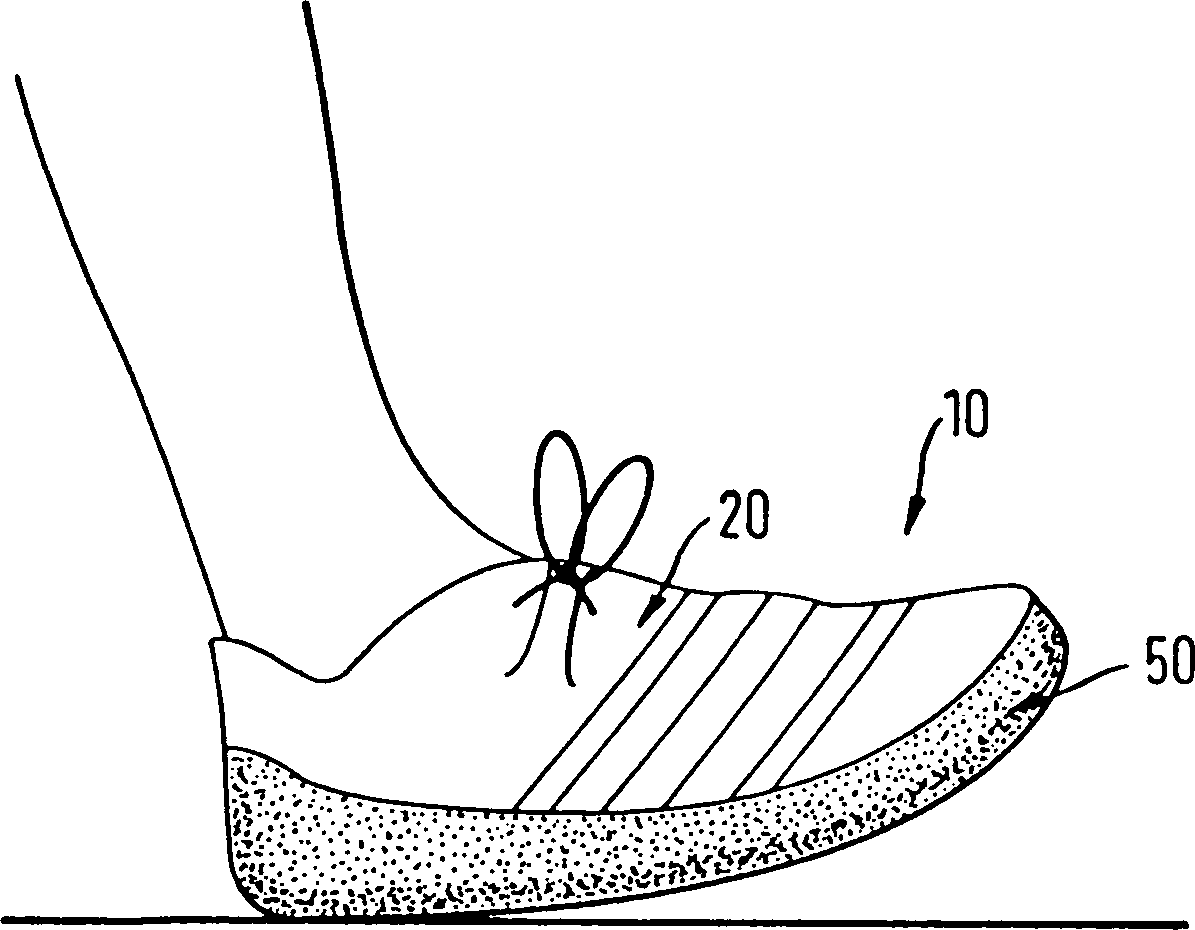
Bevorzugte Ausführungsformen der vorliegenden Erfindung werden nun unter Bezugnahme auf die Zeichnung erläutert, in der zeigt:preferred embodiments The present invention will now be described with reference to the drawings explains in the shows:
6. Detaillierte Beschreibung der bevorzugten Ausführungsformen6. Detailed description of the preferred embodiments
Im folgenden werden unter Bezugnahme auf die den Schutzumfang nicht limitierenden Zeichnungen die gegenwärtig bevorzugten Ausführungsformen der vorliegenden Erfindung zur Herstellung von Gebilden, gewählt unter Schuhsolen, Komponenten von Schuhsohlen, Einlegesohlen, Protektoren, Schienbein- und Ellenbogenschonern, Schulterpolstern, orthopädische Einlagen und orthopädische Ellenbogenpads, beschrieben.in the The following are not referring to the scope of protection limiting drawings, the presently preferred embodiments the present invention for the production of structures, chosen from Shoe soles, shoe soles, insoles, protectors, shinbones and elbow pads, shoulder pads, orthopedic insoles and orthopedic elbow pads, described.
In
Um
die Prinzipien zu erläutern,
wird zunächst unter
Bezugnahme auf
Wie
in
Läßt man zur
Bestätigung
der obigen Überlegung
eine Testperson den etwa beim Laufen typischen Bewegungsvorgang
auf einer Kraft-Zeit-Meßplattform
durchführen,
ergibt sich demnach das in
Wie
man der
An
die passive Phase des Bewegungsvorgangs schließt sich die sogenannte aktive
Phase im GRF-Diagramm an. Der erneute Kraftanstieg in der aktiven
Phase beruht auf dem Abstoßvorgang
des Fußes
von dem Boden (vergl.
Da der Kraftanstieg in der passiven Phase erheblich schneller erfolgt als in der aktiven Phase, führt er auch zu einer höheren Belastung der Ferse, da der einwirkende Impuls (Kraftstoß) entsprechend größer ist. Darüber hinaus wird beim Auftreffen auf eine harte Oberfläche der Impuls vom Boden ”reflektiert”, so daß er von der Anatomie absorbiert werden muß. Dies führt insbesondere bei lang anhaltenden Belastungen (wie Marathonläufen) zu erheblichen Verletzungs- bzw. Verschleißerscheinungen.There The increase in power in the passive phase takes place much faster than in the active phase, leads he too to a higher one Load on the heel, as the applied impulse (force impulse) is correspondingly larger. About that In addition, when hitting a hard surface of the Impulse from the ground "reflects", so that it from the anatomy must be absorbed. This leads in particular to long-lasting stress (like marathons) Significant injury or wear.
Im Vergleich hierzu ist schon wegen des geringeren Kraftstoßes (längere Kraftaufbauzeit) die Belastung des Vorderfußbereichs entsprechend geringer. Darüber hinaus verfügt er über die größere Fläche und eine anatomische Ausgestaltung, die eine bessere körperinterne Dämpfung erlaubt.in the Comparison is already because of the lower power surge (longer force build-up time) the load on the forefoot area correspondingly lower. About that also has he over the larger area and an anatomical design that better internal body damping allowed.
Aus diesem Grund wurde gefolgert, daß der Fersenbereich im Vergleich zum Vorderfußbereich eines besseren Schutzes bedarf, um anatomische Schäden zu vermeiden. Da sich die Kräfte im Vorderfußbereich entsprechend langsamer aufbauen, ist der Fuß hier besser in der Lage, sich auf den Belastungsanstieg (der hier geringer ist) einzustellen.Out For this reason it was concluded that the heel area in comparison to the forefoot area of a better protection is needed to avoid anatomical damage. Since the personnel in the forefoot area building up slower, the foot is better able to to adjust to the increase in load (which is lower here).
Vorteilhaft
ist für
den Vorderfußbereich
allerdings eine Sohleneigenschaft, die dazu führt, insbesondere die in Laufrichtung
bzw. nach oben zeigende Komponente der einwirkenden kinetischen
Bewegungsenergie möglichst
wieder als kinetische Energie in Laufrichtung und/oder vom Boden
fort abzugeben. Zur Illustration wird nochmals auf die
Der vorliegenden Erfindung liegt somit die Erkenntnis zugrunde, im Fersenbereich und im Vorderfußbereich einer Sohleneinheit Materialien mit unterschiedlichen Eigenschaften vorzusehen: Im Vorderfußbereich wird bevorzugt ein elastisches Material verwendet, während im Fersenbereich bevorzugt ein Material aus einer viskosen Kunststoffzusammensetzung verwendet wird.Of the The present invention is therefore based on knowledge, in the heel area and in the forefoot area a sole unit materials with different properties to provide: in the forefoot area it is preferred to use an elastic material while in the Heel region prefers a material of a viscous plastic composition is used.
Aus den obigen Überlegungen wird deutlich, daß sich für die Charakterisierung bzw. Quantifizierung von viskosen Kunststoffzusammensetzungen und elastischen Materialien insbesondere der bei der Deformation auftretende Energieverlust eignet. Diese Größe (gemessen in %) beschreibt das Verhältnis der über das auftretende Kraftfeld in das Material eingespeisten Energie zu der bei der Entspannung zurück gewonnenen Energie.Out the above considerations it becomes clear that for the Characterization or quantification of viscous plastic compositions and elastic materials, in particular those occurring during deformation Energy loss is suitable. This size (measured in%) describes the relationship of the over the occurring force field in the material fed energy to the back when relaxing gained energy.
Um
in der vorliegenden Erfindung den Energieverlust von geeigneten
Materialien bestimmen zu können,
wird eine Vorrichtung verwendet, die in
Das
mit Hilfe der Stempelanordnung
Im
folgenden werden unter Bezugnahme auf die
In
Dem
Graphen aus
Der
Wert für
die dynamische Steifheit zwischen 200 N und 400 N ergibt sich entsprechend;
er ist in
Die dynamische Steifheit ist bei Sohleneinheiten von Interesse, die aus einem Schichtenensemble (d. h. aus einer Vielzahl von Schichten aus unterschiedlichen Materialien) bestehen. Hierbei handelt es sich um eine bevorzugte Form des Verbundes. Bei derartigen Anordnungen (die beispielsweise eine Innenschicht, eine Mittelschicht, die erfindungsgemäße Funktionsschicht und eine Außensohle umfassen können) tritt der oben beschriebene Effekt nur auf, wenn die Steifheit der Funktionsschicht nicht höher ist als die der Materialien, aus denen die weiteren Schichten bestehen.The Dynamic stiffness is of interest in sole units that from a layer ensemble (i.e., from a plurality of layers made of different materials). This is it is a preferred form of the composite. In such arrangements (For example, an inner layer, a middle layer, the functional layer according to the invention and an outsole can include) the effect described above only occurs when the stiffness of the Functional layer not higher is than the materials that make up the other layers.
In
Es zeigte sich, daß bei Feldsportarten (Basketball, Volleyball, Fußball) die dynamische Steifheit zwischen 1000 N und 1500 N weniger als 600 N/mm für das elastische Material betragen sollte, und weniger als 250 N/mm für die viskose Kunststoffzusammensetzung.It was found that in field sports (basketball, volleyball, football) the dynamic stiffness between 1000 N and 1500 N should be less than 600 N / mm for the elastic material, and less than 250 N / mm for the viscous plastic composition.
Bei Laufschuhen hingegen sollte die dynamische Steifheit des elastischen Materials zwischen 1000 N und 1500 N weniger als 450 N/mm betragen, und die dynamische Steifheit der viskosen Kunststoffzusammensetzung weniger als 200 N/mm.at Running shoes, on the other hand, should have the dynamic stiffness of the elastic Material between 1000 N and 1500 N less than 450 N / mm, and the dynamic stiffness of the viscous plastic composition less than 200 N / mm.
Für einen Universalschuh stellt folgendes einen guten Kompromiß dar: Die dynamische Steifheit des elastischen Materials sollte zwischen 1000 N und 1500 N weniger als 600 N/mm und zwischen 200 N und 400 N weniger als 300 N/mm betragen; die der viskosen Kunststoffzusammensetzung zwischen 1000 N und 1500 N weniger als 250 N/mm und zwischen 200 N und 400 N weniger als 130 N/mm.For one Universal shoe represents the following a good compromise: The dynamic stiffness of the elastic material should be between 1000 N and 1500 N less than 600 N / mm and between 200 N and 400 N less than 300 N / mm; that of the viscous plastic composition between 1000 N and 1500 N less than 250 N / mm and between 200 N and 400 N less than 130 N / mm.
Unter
Berücksichtigung
der oben im einzelnen diskutierten erfindungsgemäß verwendeten Materialien sind
in den
Zwischen
der Außensohle
Gemäß einer
alternativen Ausführungsform der
vorliegenden Erfindung (nicht dargestellt) können auch zwei Funktionsschichten
Wie
man den
Claims (5)
Priority Applications (7)
| Application Number | Priority Date | Filing Date | Title |
|---|---|---|---|
| DE10010182A DE10010182B4 (en) | 2000-03-02 | 2000-03-02 | Use of viscous plastic compositions, in particular for the production of shoe sols |
| DE60122302T DE60122302T2 (en) | 2000-03-02 | 2001-03-02 | POLYMER MASS |
| US10/204,800 US20050065270A1 (en) | 2000-03-02 | 2001-03-02 | Polymer composition |
| AT01911724T ATE336549T1 (en) | 2000-03-02 | 2001-03-02 | POLYMER MASS |
| JP2001564278A JP2003525334A (en) | 2000-03-02 | 2001-03-02 | Polymer composition |
| PCT/EP2001/002403 WO2001064787A1 (en) | 2000-03-02 | 2001-03-02 | Polymer composition |
| EP01911724A EP1268663B1 (en) | 2000-03-02 | 2001-03-02 | Polymer composition |
Applications Claiming Priority (1)
| Application Number | Priority Date | Filing Date | Title |
|---|---|---|---|
| DE10010182A DE10010182B4 (en) | 2000-03-02 | 2000-03-02 | Use of viscous plastic compositions, in particular for the production of shoe sols |
Publications (2)
| Publication Number | Publication Date |
|---|---|
| DE10010182A1 DE10010182A1 (en) | 2001-09-13 |
| DE10010182B4 true DE10010182B4 (en) | 2010-01-14 |
Family
ID=7633243
Family Applications (2)
| Application Number | Title | Priority Date | Filing Date |
|---|---|---|---|
| DE10010182A Expired - Lifetime DE10010182B4 (en) | 2000-03-02 | 2000-03-02 | Use of viscous plastic compositions, in particular for the production of shoe sols |
| DE60122302T Expired - Lifetime DE60122302T2 (en) | 2000-03-02 | 2001-03-02 | POLYMER MASS |
Family Applications After (1)
| Application Number | Title | Priority Date | Filing Date |
|---|---|---|---|
| DE60122302T Expired - Lifetime DE60122302T2 (en) | 2000-03-02 | 2001-03-02 | POLYMER MASS |
Country Status (6)
| Country | Link |
|---|---|
| US (1) | US20050065270A1 (en) |
| EP (1) | EP1268663B1 (en) |
| JP (1) | JP2003525334A (en) |
| AT (1) | ATE336549T1 (en) |
| DE (2) | DE10010182B4 (en) |
| WO (1) | WO2001064787A1 (en) |
Cited By (4)
| Publication number | Priority date | Publication date | Assignee | Title |
|---|---|---|---|---|
| USD709680S1 (en) | 2013-04-12 | 2014-07-29 | Adidas Ag | Shoe |
| USD776410S1 (en) | 2013-04-12 | 2017-01-17 | Adidas Ag | Shoe |
| USD783264S1 (en) | 2015-09-15 | 2017-04-11 | Adidas Ag | Shoe |
| US9968157B2 (en) | 2013-02-13 | 2018-05-15 | Adidas Ag | Sole for a shoe |
Families Citing this family (19)
| Publication number | Priority date | Publication date | Assignee | Title |
|---|---|---|---|---|
| DE102012206094B4 (en) | 2012-04-13 | 2019-12-05 | Adidas Ag | Soles for sports footwear, shoes and method of making a shoe sole |
| DE102012013335A1 (en) | 2012-07-06 | 2014-01-23 | Swissies AG | Shoe has sole, upper shoe and heel that are provided in heel area for three-dimensional freedom of movement, and heel is manufactured from reactive polyurethane (PUR), prepolymer, polyol mixture, curing agent and catalyst |
| US9610746B2 (en) | 2013-02-13 | 2017-04-04 | Adidas Ag | Methods for manufacturing cushioning elements for sports apparel |
| US9930928B2 (en) | 2013-02-13 | 2018-04-03 | Adidas Ag | Sole for a shoe |
| DE102013002519B4 (en) | 2013-02-13 | 2016-08-18 | Adidas Ag | Production method for damping elements for sportswear |
| DE102013202291C5 (en) | 2013-02-13 | 2026-01-15 | Adidas Ag | Cushioning element for sportswear and shoes with such a cushioning element |
| DE102014215897B4 (en) | 2014-08-11 | 2016-12-22 | Adidas Ag | adistar boost |
| DE102014216115B4 (en) | 2014-08-13 | 2022-03-31 | Adidas Ag | 3D elements cast together |
| DE102015206486B4 (en) | 2015-04-10 | 2023-06-01 | Adidas Ag | Shoe, in particular sports shoe, and method for manufacturing the same |
| DE102015206900B4 (en) | 2015-04-16 | 2023-07-27 | Adidas Ag | sports shoe |
| DE102015209795B4 (en) | 2015-05-28 | 2024-03-21 | Adidas Ag | Ball and process for its production |
| US10206453B2 (en) | 2016-02-12 | 2019-02-19 | Wolverine Outdoors, Inc. | Footwear including a support cage |
| USD840136S1 (en) | 2016-08-03 | 2019-02-12 | Adidas Ag | Shoe midsole |
| USD840137S1 (en) | 2016-08-03 | 2019-02-12 | Adidas Ag | Shoe midsole |
| USD852475S1 (en) | 2016-08-17 | 2019-07-02 | Adidas Ag | Shoe |
| JP1582717S (en) | 2016-09-02 | 2017-07-31 | ||
| USD899061S1 (en) | 2017-10-05 | 2020-10-20 | Adidas Ag | Shoe |
| US10834998B2 (en) | 2018-04-13 | 2020-11-17 | Wolverine Outdoors, Inc. | Footwear including a holding cage |
| DE102019204579B4 (en) | 2019-04-01 | 2022-10-06 | Adidas Ag | Recycling a shoe |
Citations (5)
| Publication number | Priority date | Publication date | Assignee | Title |
|---|---|---|---|---|
| US4208315A (en) * | 1979-02-01 | 1980-06-17 | Shell Oil Company | Footwear composition of a blend of ethylene-vinyl acetate copolymer, poly(vinyl chloride) and a block copolymer |
| US4238383A (en) * | 1978-10-05 | 1980-12-09 | The Goodyear Tire & Rubber Company | Vulcanizable shoe soling composition |
| US4882378A (en) * | 1984-11-30 | 1989-11-21 | Shell Oil Company | High performance rubber compositions |
| US5055519A (en) * | 1986-06-27 | 1991-10-08 | Shell Internationale Research Maatschappij B.V. | Thermoplastic elastomer compositions and process for the preparation thereof |
| DE4446896A1 (en) * | 1994-12-27 | 1996-07-04 | Basf Ag | Impact teeth, thermoplastically processable mixture of elastomers and thermoplastics |
Family Cites Families (36)
| Publication number | Priority date | Publication date | Assignee | Title |
|---|---|---|---|---|
| US3576911A (en) * | 1969-03-27 | 1971-04-27 | Goodyear Tire & Rubber | Shoe sole compound |
| JPS53137242A (en) * | 1977-05-09 | 1978-11-30 | Denki Kagaku Kogyo Kk | Sealing film |
| US4316335A (en) * | 1979-04-05 | 1982-02-23 | Comfort Products, Inc. | Athletic shoe construction |
| US4216131A (en) * | 1979-05-04 | 1980-08-05 | Shell Oil Company | Smooth-look footwear composition |
| US4316334A (en) * | 1980-03-27 | 1982-02-23 | Hunt Helen M | Athletic shoe including stiffening means for supporting the rear portion of the first metatarsal bone |
| JPS57119942A (en) * | 1981-01-17 | 1982-07-26 | Idemitsu Kosan Co Ltd | Resilient polymer composition |
| US4418483A (en) * | 1981-03-31 | 1983-12-06 | Rinzai Co., Ltd. | Method of manufacturing shoe sole material and shoes products made by the same |
| JPS57212249A (en) * | 1981-06-23 | 1982-12-27 | Japan Synthetic Rubber Co Ltd | Thermoplastic elastomeric composition |
| US4546127A (en) * | 1982-04-13 | 1985-10-08 | Bridgestone Tire Co., Ltd. | Low-resilience rubber compositions and foams |
| US4506462A (en) * | 1982-06-11 | 1985-03-26 | Puma-Sportschuhfabriken Rudolf Dassler Kg | Running shoe sole with pronation limiting heel |
| US4476180A (en) * | 1983-02-01 | 1984-10-09 | The Procter & Gamble Company | Nonblocking elastomeric polymer blends of ABA block copolymer and ethylene-vinyl acetate copolymer |
| US4910886B1 (en) * | 1983-02-28 | 1995-05-09 | Atlantic Thermoplastics Co Inc | Shock-absorbing innersole |
| US4551930A (en) * | 1983-09-23 | 1985-11-12 | New Balance Athletic Shoe, Inc. | Sole construction for footwear |
| JPS60150701A (en) * | 1984-01-17 | 1985-08-08 | 株式会社アシックス | Mid sole for athletic shoes |
| CA1232446A (en) * | 1984-04-04 | 1988-02-09 | Terry Mackness | Running shoes |
| US4597195A (en) * | 1984-04-11 | 1986-07-01 | Dananberg Howard J | Human shoe sole |
| US4642911A (en) * | 1985-02-28 | 1987-02-17 | Talarico Ii Louis C | Dual-compression forefoot compensated footwear |
| US4694591A (en) * | 1985-04-15 | 1987-09-22 | Wolverine World Wide, Inc. | Toe off athletic shoe |
| US4616065A (en) * | 1985-04-15 | 1986-10-07 | Gencorp Inc. | High trans butadiene based elastomeric block copolymers and blends |
| US4731939A (en) * | 1985-04-24 | 1988-03-22 | Converse Inc. | Athletic shoe with external counter and cushion assembly |
| US4640797A (en) * | 1985-06-11 | 1987-02-03 | Jones And Vining, Incorporated | Phosphorescent polymer-containing compositions and articles made therefrom |
| JPH072889B2 (en) * | 1986-06-20 | 1995-01-18 | 日本エラストマ−株式会社 | Thermoplastic elastic composition |
| US4759136A (en) * | 1987-02-06 | 1988-07-26 | Reebok International Ltd. | Athletic shoe with dynamic cradle |
| US5053438A (en) * | 1987-05-15 | 1991-10-01 | Packaging Industries Group, Inc. | Foam material |
| DE69033683T2 (en) * | 1989-10-03 | 2001-11-29 | Anatomic Research, Inc. | CORRECTIVE FOOTWEAR STRUCTURES USING A PROFILE BEYOND THE THEORETICAL IDEAL STABILITY LEVEL |
| US5467536A (en) * | 1991-05-24 | 1995-11-21 | Ramer; John | Shoe construction |
| US5276094A (en) * | 1992-11-12 | 1994-01-04 | Polysar Rubber Corp. | Compositions of butyl elastomers and block copolymers of polyisobutylene |
| US5695850A (en) * | 1993-01-29 | 1997-12-09 | Crow; William R. | Performance enhancing athletic shoe components and methods |
| KR100394129B1 (en) * | 1995-03-17 | 2003-10-22 | 제온 코포레이션 | Rubber composition |
| EP0818478B1 (en) * | 1995-03-30 | 2004-08-11 | Zeon Corporation | Styrene-isoprene-butadiene copolymer rubber and process for the production thereof |
| JP3622803B2 (en) * | 1995-11-28 | 2005-02-23 | 日本ゼオン株式会社 | Rubber composition |
| GB2318757B (en) * | 1996-11-01 | 2000-07-12 | Univ Brunel | Moulding process and article produced by the process |
| JP3567661B2 (en) * | 1996-12-27 | 2004-09-22 | Jsr株式会社 | Dynamic cross-linking composition and thermoplastic elastomer composition |
| CA2249054C (en) * | 1997-09-29 | 2001-09-25 | William Crow | Performance enhancing shoe components and methods |
| ES2172267T3 (en) * | 1998-04-03 | 2002-09-16 | Adidas Int Bv | SOLE FOR FOOTWEAR WITH IMPROVED DOUBLE ENERGY MANAGEMENT SYSTEM. |
| JP4382935B2 (en) * | 1999-11-02 | 2009-12-16 | アキレス株式会社 | Composition for injection molded foam soles |
-
2000
- 2000-03-02 DE DE10010182A patent/DE10010182B4/en not_active Expired - Lifetime
-
2001
- 2001-03-02 DE DE60122302T patent/DE60122302T2/en not_active Expired - Lifetime
- 2001-03-02 AT AT01911724T patent/ATE336549T1/en not_active IP Right Cessation
- 2001-03-02 JP JP2001564278A patent/JP2003525334A/en active Pending
- 2001-03-02 US US10/204,800 patent/US20050065270A1/en not_active Abandoned
- 2001-03-02 EP EP01911724A patent/EP1268663B1/en not_active Expired - Lifetime
- 2001-03-02 WO PCT/EP2001/002403 patent/WO2001064787A1/en not_active Ceased
Patent Citations (5)
| Publication number | Priority date | Publication date | Assignee | Title |
|---|---|---|---|---|
| US4238383A (en) * | 1978-10-05 | 1980-12-09 | The Goodyear Tire & Rubber Company | Vulcanizable shoe soling composition |
| US4208315A (en) * | 1979-02-01 | 1980-06-17 | Shell Oil Company | Footwear composition of a blend of ethylene-vinyl acetate copolymer, poly(vinyl chloride) and a block copolymer |
| US4882378A (en) * | 1984-11-30 | 1989-11-21 | Shell Oil Company | High performance rubber compositions |
| US5055519A (en) * | 1986-06-27 | 1991-10-08 | Shell Internationale Research Maatschappij B.V. | Thermoplastic elastomer compositions and process for the preparation thereof |
| DE4446896A1 (en) * | 1994-12-27 | 1996-07-04 | Basf Ag | Impact teeth, thermoplastically processable mixture of elastomers and thermoplastics |
Cited By (9)
| Publication number | Priority date | Publication date | Assignee | Title |
|---|---|---|---|---|
| US9968157B2 (en) | 2013-02-13 | 2018-05-15 | Adidas Ag | Sole for a shoe |
| USD709680S1 (en) | 2013-04-12 | 2014-07-29 | Adidas Ag | Shoe |
| USD740004S1 (en) | 2013-04-12 | 2015-10-06 | Adidas Ag | Shoe |
| USD740003S1 (en) | 2013-04-12 | 2015-10-06 | Adidas Ag | Shoe |
| USD758056S1 (en) | 2013-04-12 | 2016-06-07 | Adidas Ag | Shoe |
| USD776410S1 (en) | 2013-04-12 | 2017-01-17 | Adidas Ag | Shoe |
| USD828991S1 (en) | 2013-04-12 | 2018-09-25 | Adidas Ag | Shoe |
| USD783264S1 (en) | 2015-09-15 | 2017-04-11 | Adidas Ag | Shoe |
| USD828686S1 (en) | 2015-09-15 | 2018-09-18 | Adidas Ag | Shoe |
Also Published As
| Publication number | Publication date |
|---|---|
| EP1268663B1 (en) | 2006-08-16 |
| JP2003525334A (en) | 2003-08-26 |
| US20050065270A1 (en) | 2005-03-24 |
| WO2001064787A1 (en) | 2001-09-07 |
| DE60122302T2 (en) | 2007-08-30 |
| ATE336549T1 (en) | 2006-09-15 |
| EP1268663A1 (en) | 2003-01-02 |
| DE10010182A1 (en) | 2001-09-13 |
| DE60122302D1 (en) | 2006-09-28 |
Similar Documents
| Publication | Publication Date | Title |
|---|---|---|
| DE10010182B4 (en) | Use of viscous plastic compositions, in particular for the production of shoe sols | |
| DE60034569T2 (en) | Feathered shoe | |
| DE69302191T2 (en) | Shoe insoles | |
| DE60303166T2 (en) | Sliding element and shoe sole | |
| DE4122086C2 (en) | Sports shoe with heel suspension and stabilization | |
| DE60102225T2 (en) | FOOTBALL BOOT | |
| DE69717483T2 (en) | GROUND CONTACT SYSTEM WITH 3D-DEFORMABLE ELEMENTS FOR USE IN FOOTWEAR | |
| DE102014206419B4 (en) | Support element for shoes and sole and shoe with such a support element | |
| DE102020108911A1 (en) | MIDSOLE STRUCTURE FOR A SPORT SHOE | |
| DE102008064493A1 (en) | sole | |
| EP3367835B1 (en) | Sole for a safety shoe, and safety shoe | |
| DE10244435A1 (en) | Sliding element and shoe sole | |
| EP0947145B1 (en) | Shoe sole with improved dual energy management system | |
| AT277807B (en) | Material for part of a shoe | |
| DE69727335T2 (en) | Resin composition and molding compositions therefrom | |
| DE19914472C2 (en) | Sole unit with dual energy management system | |
| DE102011008664B4 (en) | Shoe with convex sole | |
| DE102019219742B4 (en) | Layered upper for a shoe | |
| DE10310526A1 (en) | football boot | |
| DE112005003719B4 (en) | Shoe sole with midsole | |
| EP0922400B1 (en) | Footsupport | |
| DE202016101153U1 (en) | Shoe with BSW cushioning element | |
| DE102007024427A1 (en) | Sole construction for shoe has stabilizing layer in region near heel arranged above rear shock-absorbing layer and front stabilizing layer under front elastic layer in region near forefoot | |
| DE102023210927A1 (en) | Sole comprising a reinforcing frame | |
| DE102014019786B3 (en) | sole |
Legal Events
| Date | Code | Title | Description |
|---|---|---|---|
| OP8 | Request for examination as to paragraph 44 patent law | ||
| 8127 | New person/name/address of the applicant |
Owner name: ADIDAS INTERNATIONAL MARKETING B.V., AMSTERDAM, NL |
|
| 8364 | No opposition during term of opposition | ||
| R071 | Expiry of right |