CN202637111U - Controllable electrode catheter for cold saline water radio frequency ablation of renal artery - Google Patents
Controllable electrode catheter for cold saline water radio frequency ablation of renal artery Download PDFInfo
- Publication number
- CN202637111U CN202637111U CN 201220291197 CN201220291197U CN202637111U CN 202637111 U CN202637111 U CN 202637111U CN 201220291197 CN201220291197 CN 201220291197 CN 201220291197 U CN201220291197 U CN 201220291197U CN 202637111 U CN202637111 U CN 202637111U
- Authority
- CN
- China
- Prior art keywords
- far
- renal artery
- radio
- frequency
- catheter tube
- Prior art date
- Legal status (The legal status is an assumption and is not a legal conclusion. Google has not performed a legal analysis and makes no representation as to the accuracy of the status listed.)
- Withdrawn - After Issue
Links
- 210000002254 renal artery Anatomy 0.000 title claims abstract description 52
- FAPWRFPIFSIZLT-UHFFFAOYSA-M Sodium chloride Chemical compound [Na+].[Cl-] FAPWRFPIFSIZLT-UHFFFAOYSA-M 0.000 title abstract description 12
- XLYOFNOQVPJJNP-UHFFFAOYSA-N water Substances O XLYOFNOQVPJJNP-UHFFFAOYSA-N 0.000 title abstract description 9
- 239000011780 sodium chloride Substances 0.000 title abstract description 8
- 238000007674 radiofrequency ablation Methods 0.000 title abstract description 5
- 238000002679 ablation Methods 0.000 claims abstract description 49
- 229910001080 W alloy Inorganic materials 0.000 claims abstract description 6
- ZONODCCBXBRQEZ-UHFFFAOYSA-N platinum tungsten Chemical compound [W].[Pt] ZONODCCBXBRQEZ-UHFFFAOYSA-N 0.000 claims abstract description 6
- 229910000831 Steel Inorganic materials 0.000 claims description 66
- 239000010959 steel Substances 0.000 claims description 66
- 239000012267 brine Substances 0.000 claims description 58
- HPALAKNZSZLMCH-UHFFFAOYSA-M sodium;chloride;hydrate Chemical compound O.[Na+].[Cl-] HPALAKNZSZLMCH-UHFFFAOYSA-M 0.000 claims description 58
- 229920002614 Polyether block amide Polymers 0.000 claims description 23
- BASFCYQUMIYNBI-UHFFFAOYSA-N platinum Chemical compound [Pt] BASFCYQUMIYNBI-UHFFFAOYSA-N 0.000 claims description 15
- 239000010935 stainless steel Substances 0.000 claims description 13
- 229910001220 stainless steel Inorganic materials 0.000 claims description 13
- 239000000463 material Substances 0.000 claims description 11
- 239000004744 fabric Substances 0.000 claims description 9
- 229920002635 polyurethane Polymers 0.000 claims description 9
- 239000004814 polyurethane Substances 0.000 claims description 9
- 238000012546 transfer Methods 0.000 claims description 8
- 238000005452 bending Methods 0.000 claims description 7
- 239000000523 sample Substances 0.000 claims description 5
- 238000003780 insertion Methods 0.000 claims description 3
- 230000037431 insertion Effects 0.000 claims description 3
- HLXZNVUGXRDIFK-UHFFFAOYSA-N nickel titanium Chemical compound [Ti].[Ti].[Ti].[Ti].[Ti].[Ti].[Ti].[Ti].[Ti].[Ti].[Ti].[Ni].[Ni].[Ni].[Ni].[Ni].[Ni].[Ni].[Ni].[Ni].[Ni].[Ni].[Ni].[Ni].[Ni] HLXZNVUGXRDIFK-UHFFFAOYSA-N 0.000 claims description 3
- 229910001000 nickel titanium Inorganic materials 0.000 claims description 3
- 210000005036 nerve Anatomy 0.000 abstract description 17
- 230000002889 sympathetic effect Effects 0.000 abstract description 15
- 206010020772 Hypertension Diseases 0.000 abstract description 11
- 230000006378 damage Effects 0.000 abstract description 10
- 210000003734 kidney Anatomy 0.000 abstract description 6
- 210000004204 blood vessel Anatomy 0.000 abstract description 4
- 230000000694 effects Effects 0.000 abstract description 3
- 238000004804 winding Methods 0.000 abstract description 3
- 208000027418 Wounds and injury Diseases 0.000 abstract description 2
- 208000014674 injury Diseases 0.000 abstract description 2
- 229910000566 Platinum-iridium alloy Inorganic materials 0.000 abstract 2
- HWLDNSXPUQTBOD-UHFFFAOYSA-N platinum-iridium alloy Chemical class [Ir].[Pt] HWLDNSXPUQTBOD-UHFFFAOYSA-N 0.000 abstract 2
- 239000004033 plastic Substances 0.000 description 24
- 229920003023 plastic Polymers 0.000 description 24
- 238000000034 method Methods 0.000 description 15
- 229920001343 polytetrafluoroethylene Polymers 0.000 description 9
- 239000004810 polytetrafluoroethylene Substances 0.000 description 9
- 230000002572 peristaltic effect Effects 0.000 description 8
- 235000015278 beef Nutrition 0.000 description 7
- 239000012530 fluid Substances 0.000 description 7
- 229910052697 platinum Inorganic materials 0.000 description 6
- 238000002474 experimental method Methods 0.000 description 5
- 239000003292 glue Substances 0.000 description 5
- 239000000155 melt Substances 0.000 description 5
- 238000012360 testing method Methods 0.000 description 5
- 238000002560 therapeutic procedure Methods 0.000 description 4
- DHKHKXVYLBGOIT-UHFFFAOYSA-N 1,1-Diethoxyethane Chemical compound CCOC(C)OCC DHKHKXVYLBGOIT-UHFFFAOYSA-N 0.000 description 3
- 239000011354 acetal resin Substances 0.000 description 3
- 230000036772 blood pressure Effects 0.000 description 3
- 239000003814 drug Substances 0.000 description 3
- 229920006324 polyoxymethylene Polymers 0.000 description 3
- 230000028327 secretion Effects 0.000 description 3
- 102000015427 Angiotensins Human genes 0.000 description 2
- 108010064733 Angiotensins Proteins 0.000 description 2
- XKRFYHLGVUSROY-UHFFFAOYSA-N Argon Chemical compound [Ar] XKRFYHLGVUSROY-UHFFFAOYSA-N 0.000 description 2
- ATJFFYVFTNAWJD-UHFFFAOYSA-N Tin Chemical compound [Sn] ATJFFYVFTNAWJD-UHFFFAOYSA-N 0.000 description 2
- 210000004369 blood Anatomy 0.000 description 2
- 239000008280 blood Substances 0.000 description 2
- 238000013153 catheter ablation Methods 0.000 description 2
- 230000003902 lesion Effects 0.000 description 2
- 229920002521 macromolecule Polymers 0.000 description 2
- -1 polytetrafluoroethylene Polymers 0.000 description 2
- 238000007789 sealing Methods 0.000 description 2
- 230000006641 stabilisation Effects 0.000 description 2
- 238000011105 stabilization Methods 0.000 description 2
- 238000003466 welding Methods 0.000 description 2
- PQSUYGKTWSAVDQ-ZVIOFETBSA-N Aldosterone Chemical compound C([C@@]1([C@@H](C(=O)CO)CC[C@H]1[C@@H]1CC2)C=O)[C@H](O)[C@@H]1[C@]1(C)C2=CC(=O)CC1 PQSUYGKTWSAVDQ-ZVIOFETBSA-N 0.000 description 1
- PQSUYGKTWSAVDQ-UHFFFAOYSA-N Aldosterone Natural products C1CC2C3CCC(C(=O)CO)C3(C=O)CC(O)C2C2(C)C1=CC(=O)CC2 PQSUYGKTWSAVDQ-UHFFFAOYSA-N 0.000 description 1
- RYGMFSIKBFXOCR-UHFFFAOYSA-N Copper Chemical compound [Cu] RYGMFSIKBFXOCR-UHFFFAOYSA-N 0.000 description 1
- 208000029422 Hypernatremia Diseases 0.000 description 1
- 239000004721 Polyphenylene oxide Substances 0.000 description 1
- 102100028255 Renin Human genes 0.000 description 1
- 108090000783 Renin Proteins 0.000 description 1
- 125000002252 acyl group Chemical group 0.000 description 1
- 229960002478 aldosterone Drugs 0.000 description 1
- 229910052786 argon Inorganic materials 0.000 description 1
- 230000005540 biological transmission Effects 0.000 description 1
- 230000015572 biosynthetic process Effects 0.000 description 1
- 238000001816 cooling Methods 0.000 description 1
- 229910052802 copper Inorganic materials 0.000 description 1
- 239000010949 copper Substances 0.000 description 1
- 238000010586 diagram Methods 0.000 description 1
- 229940079593 drug Drugs 0.000 description 1
- 238000005516 engineering process Methods 0.000 description 1
- 230000029142 excretion Effects 0.000 description 1
- 210000001105 femoral artery Anatomy 0.000 description 1
- 238000010438 heat treatment Methods 0.000 description 1
- 230000001631 hypertensive effect Effects 0.000 description 1
- 238000000338 in vitro Methods 0.000 description 1
- 238000001727 in vivo Methods 0.000 description 1
- 238000001802 infusion Methods 0.000 description 1
- 238000009434 installation Methods 0.000 description 1
- 229910052741 iridium Inorganic materials 0.000 description 1
- GKOZUEZYRPOHIO-UHFFFAOYSA-N iridium atom Chemical compound [Ir] GKOZUEZYRPOHIO-UHFFFAOYSA-N 0.000 description 1
- 238000005259 measurement Methods 0.000 description 1
- 238000012544 monitoring process Methods 0.000 description 1
- 238000000465 moulding Methods 0.000 description 1
- 230000001053 orthosympathetic effect Effects 0.000 description 1
- 230000003204 osmotic effect Effects 0.000 description 1
- 230000008506 pathogenesis Effects 0.000 description 1
- 210000002381 plasma Anatomy 0.000 description 1
- 229950000845 politef Drugs 0.000 description 1
- 229920000570 polyether Polymers 0.000 description 1
- 230000001105 regulatory effect Effects 0.000 description 1
- 150000003839 salts Chemical class 0.000 description 1
- 229910001415 sodium ion Inorganic materials 0.000 description 1
- 238000005476 soldering Methods 0.000 description 1
- 239000000243 solution Substances 0.000 description 1
- 230000008700 sympathetic activation Effects 0.000 description 1
- 210000001519 tissue Anatomy 0.000 description 1
Images


Landscapes
- Surgical Instruments (AREA)
Abstract
The utility model discloses a controllable electrode catheter for cold saline water radio-frequency ablation of the renal artery, and aims to achieve the technical effect of reducing the damage to the blood vessel inner wall during radio-frequency ablation of sympathetic nerves on the wall of the renal artery. An electrode head is connected with the distal end of a catheter main body; the electrode head is a closely-coiled spring with an outside diameter of 0.80 mm to 2.00 mm and a length of 1.5 mm to 4 mm, which is made by winding a platinum iridium alloy wire or platinum tungsten alloy wire; and the part of the distal end is semi-spherical. Compared with the prior art, the electrode head which is the closely-coiled spring made by winding the platinum iridium alloy wire or platinum tungsten alloy wire of 0.005 mm to 0.3 mm in diameter can make the ablation spot narrow and deep. Accordingly, the electrode head generates radio-frequency energy to damage the sympathetic nerves of the kidney to treat hypertension, which can cause the injury to the sympathetic nerves on the outer wall of the renal artery but cause less damage to the inner wall of the renal artery.
Description
Technical field
This utility model relates to a kind of medical apparatus and instruments of interventional therapy, particularly a kind of frequency ablation electrode catheter that is used for the treatment of intractable hypertension.
Background technology
Intractable hypertension is more common clinically, and paathogenic factor is numerous, and pathogenesis is indefinite, and medication effect is very poor.Medical circle thinks that always sympathetic activation and the hypertension of kidney are in close relations.When the sympathetic nerve of kidney was overexcited, renal blood vessels was shunk, and reduced the excretion of kidney, make moisture and salt retention in vivo, promote simultaneously the renal secretion feritin, caused the increase of blood Angiotensin-Converting II and aldosterone, then two kinds of materials, the just factor of hypertension.
This shows that blood pressure is mainly regulated by kidney.Nowadays the thinking of hypertension therapy is to reduce angiotensin by medicine, yet the sympathetic nerve that spreads all on the renal artery also is to cause hypertensive arch-criminal.If these nerves are too active, the secretion feritin is too much too fast, just be enough to the effect that " counteracting " falls the medicine blood pressure lowering.Renal artery inner membrance radio-frequency ablation procedure will be eliminated this overwrought sympathetic nerve exactly.Easy and the safety of this therapy.During treatment, the doctor carries out radio-frequency (RF) ablation by conduit to the sympathetic nerve that spreads all on the renal artery tube wall image-guided lower, cut away partial nerve, thereby reduce the function of sympathetic nerve conducts information, renin secretion is reduced, angiotensin reduces, and finally reduces blood pressure.
When the renal artery ablation catheter of one of prior art carries out radiofrequency ablation therapy, doctor's control crank makes it the far-end stretch bending of ablation catheter fit with the renal artery blood vessel wall, turn-knob on the turning handle is controlled the rotation of ablation catheter far-end simultaneously, mobile ablation locations, reach at different parts and melt, usually when the sympathetic nerve on the renal artery is melted, must set the sympathetic nerve that higher power and high impedance just can interrupt the renal artery blood vessel, therefore impedance damages very large to blood vessel up to 300 Ω during radio-frequency (RF) ablation.Two of prior art is that the ARR ablation catheter of employing treatment melts the sympathetic nerve on the renal artery, reach the treatment intractable hypertension, this kind conduit diameter is thicker, handles inconvenient in the renal artery blood vessel, and it is larger to melt area, also renal artery is caused larger damage.
Summary of the invention
The purpose of this utility model provides a kind of renal artery cool brine radio-frequency (RF) ablation controllable electrodes conduit, and the technical problem that solve is when the sympathetic nerve on the renal artery tube wall is carried out radio-frequency (RF) ablation, to reduce the damage to blood vessel.
This utility model is by the following technical solutions: a kind of renal artery cool brine radio-frequency (RF) ablation controllable electrodes conduit, be provided with catheter tube, the near-end of catheter tube is connected with control handle, the far-end of described catheter tube is connected with electrode tip, electrode tip is platinumiridio silk or the platinum-tungsten alloys silk of 0.005mm-0.3mm by diameter, turn to external diameter 0.80mm-2.00mm, long 1.5mm-4mm's is close around helical spring, and distal end is that semicircle is spherical.
Catheter tube near-end of the present utility model connects the far-end of Brine Pipe, and the near-end of Brine Pipe is connected with the Brine Pipe joint, and catheter tube, Brine Pipe and Brine Pipe joint sealing are connected and are interconnected.
Control handle near-end of the present utility model connects the cool brine joint.
The body of catheter tube of the present utility model is soft by firmly tapering to from near-end to far-end hardness, when the body distal length is the distal portions of 50mm-100mm and the bending of body main part, body distal portions axis is parallel with body main part axis, the distance of two axial lines is 10mm-40mm, and embedding on the body main part inwall of catheter tube has stainless steel cloth.
Far-end is provided with becket in the body main part of catheter tube of the present utility model, and far-end and the becket of controlled backguy steel wire are welded to connect, and the near-end of controlled backguy steel wire connects control handle.
The handle case near-end of control handle of the present utility model has the first radial hole, be inserted with backguy fixation with steel wire post in it, the bottom of backguy fixation with steel wire post has first through hole vertical with its axis, in the handle case, be provided with column handle inner core in position corresponding to described the first radial hole, have the second radial hole on the handle inner core, the handle inner core has the second through hole along axis, backguy fixation with steel wire post bottom enters in the second radial hole, so that the first through hole and the second through hole UNICOM, described controlled backguy steel wire passes the second through hole, the first through hole hole, with controlled backguy steel wire around controlled fixation with steel wire post rotation 1 to 4 circle, with controlled backguy steel wire from end-to-end nearly tension far away.
The near-end of the push rod of control handle of the present utility model inserts in the axial hole of handle case from the far-end of handle case, form vertically sliding-contact with handle case, radially have screw on the handle case, the corresponding screwhole position of push rod has elongated slot vertically, the push rod stop screw screws in described screw, one section of the end of stop screw puts in the elongated slot, and the elongated slot two ends on the push rod have along circumferential cannelure, and cannelure has been embedded in damped ring.
Control handle near-end of the present utility model is connected with adapter, and radio-frequency (RF) energy transfer wire far-end is connected to the helical spring near-end platinum wire end of electrode tip, and near-end is connected to radiofrequency generator through catheter tube, control handle and adapter.
The measuring probe of critesistor or thermocouple is set in the electrode tip far-end helical spring of the present utility model, and the holding wire near-end of critesistor or thermocouple is connected to temperature measurer through catheter tube, control handle and adapter.
Be connected with safety line in the electrode tip distal end of the present utility model, the near-end of safety line is fastened on the catheter tube near-end; Described safety line adopts stainless steel round wire or flat filament, long 850mm-1100mm, and circle silk external diameter is 0.01mm, the flat filament area of section is 0.0000785 mm
2, in its far-end electrode insertion head; Described safety line far-end joint steel pipe; the steel pipe far-end stretches out the electrode tip far-end; the material of steel pipe is Nitinol, platinumiridio or rustless steel; external diameter is 0.46mm-0.71mm; internal diameter is 0.36mm-0.61mm; stretch out the long 2mm-10mm that is; the distal end of steel pipe is welded with little ball; external diameter is 0.50mm-0.80mm; the steel pipe that stretches out the electrode tip far-end is equipped with protecting film outward; the material of protecting film is block polyetheramides or polyurethane, and block polyetheramides PEBAX 2533 or PEBAX 3533, polyurethane are PU80AE or PU70AE.
This utility model compared with prior art, electrode tip is platinumiridio silk or the platinum-tungsten alloys silk of 0.005mm-0.3mm by diameter, turning to external diameter is the close around helical spring of 0.80mm-2mm, the catheter tube of radio-frequency (RF) ablation connects Brine Pipe, the cool brine that passes into during operation cools off the renal artery blood vessel, so that it is very narrow to melt speckle, the degree of depth is large, therefore, the radio-frequency (RF) energy that electrode tip sends is destroyed the sympathetic nerve of domination kidney and is treated hypertension, in the orthosympathetic while of interrupting the renal artery vessel outer wall, minimum to the damage that the renal artery blood vessel causes.
Description of drawings
Fig. 1 is the structural representation of this utility model renal artery cool brine radio-frequency (RF) ablation controllable electrodes conduit.
Fig. 2 is the sketch map of this utility model renal artery cool brine radio-frequency (RF) ablation controllable electrodes distal end of catheter case of bending.
Fig. 3 is pipe structure sketch map of the present utility model.
Fig. 4 is the left view of Fig. 3.
Fig. 5 is the distal portions structural representation () of renal artery cool brine radio-frequency (RF) ablation controllable electrodes conduit of the present utility model.
Fig. 6 is the A partial enlarged drawing among Fig. 5.
Fig. 7 is the B partial enlarged drawing among Fig. 5.
Fig. 8 is the structural representation of control crank.
Fig. 9 is the cutaway view of handle case.
Figure 10 is that Fig. 9 is left view.
Figure 11 is the cutaway view of push rod.
Figure 12 is the left view of Figure 11.
Figure 13 is the A-A profile of Figure 11.
Figure 14 is the B-B profile of Figure 11.
Figure 15 is the front view of stop screw.
Figure 16 is the left view of Figure 15.
Figure 17 is the front view of backguy fixation with steel wire post.
Figure 18 is the left view of Figure 17.
Figure 19 is the top view of Figure 17.
Figure 20 is the front view of handle inner core.
Figure 21 is the left view of Figure 20.
Figure 22 is the top view of Figure 20.
Figure 23 is the installation diagram of body of the present utility model and control handle.
Figure 24 is the distal portions structural representation (two) of renal artery cool brine radio-frequency (RF) ablation controllable electrodes conduit of the present utility model.
The specific embodiment
Below in conjunction with drawings and Examples structure of the present utility model is described in further detail.
As shown in Figure 1, renal artery cool brine radio-frequency (RF) ablation controllable electrodes conduit 10 of the present utility model from far-end to near-end, is linked in sequence by electrode tip 11, catheter tube 12, control handle 13, and control handle 13 near-ends are connected with adapter 14 and cool brine joint 19.
As shown in Figure 3 and Figure 4, catheter tube 12 long 850mm-1 100mm, external diameter 1.67mm-2.33mm, internal diameter 1.50mm-2.10mm, by the first plastic tube 121, the second plastic tube 122, the 3rd plastic tube 123 and the 4th plastic tube 124 connect and compose body from the near-end to the far-end, the first plastic tube 121, the second plastic tube 122, the 3rd plastic tube 123 and the 4th plastic tube 124 adopt respectively macromolecule tubing polyurethane or block polyetheramides PEBAX plastic tube, it is 72D that the detailed trade mark of material is respectively PEBAX 7233(hardness), PEBAX 6333(hardness is 63D), PEBAX 6333(hardness is 63D) and PEBAX 5533(hardness be 55D), caliber is 2.00mm-2.33mm, and the body of formation is soft by firmly tapering to from near-end to far-end hardness.As shown in Figures 2 and 3, the body distal length is that distal portions and the body main part of 50mm-150mm can bend, and during bending, body distal portions axis is parallel with body main part axis, and the distance of two axial lines is 5mm-40mm.
Embedding on the body main part inwall has stainless steel cloth 127, and it is the stainless steel silk of 0.01mm-0.05mm that stainless steel cloth 127 adopts string diameter, is woven into every square millimeter of node 10-100 stainless steel cloth.Because the body employing by firmly tapering to soft macromolecule tubing and stainless steel cloth 127, make body have good propelling movement and moment of torsion transmission performance, and the protection distal vessels avoids injured from near-end to far-end hardness.
In the body main part, be provided with polytetrafluoroethylene PTFE backguy steel wire sheath 126, backguy steel wire sheath 126 long 850mm-1 100mm, external diameter 0.30mm-0.50mm, internal diameter 0.25mm-0.45mm.In backguy steel wire sheath 126, be provided with controlled backguy steel wire 125, controlled backguy steel wire 125 long 850mm-1100mm, string diameter 0.25mm-0.45mm.Far-end is provided with becket 128 in the body main part, and becket 128 adopts platinumiridio (platinum 90%, iridium 10%), external diameter 2.00mm-2.33mm, internal diameter 1.90mm-2.13mm, thick 0.1mm-0.2mm.As shown in Figure 6, the far-end of controlled backguy steel wire 125 and becket 128 are welded to connect.
When making catheter tube 12, adopt polytetrafluoroethylene PTFE rod 129 as plug, PTFE rod 129 long 1000mm-1500mm, external diameter is 1.50mm-2.10mm.At first controlled backguy steel wire 125 is passed the hole of backguy steel wire sheath 126, far-end is solder-connected on the becket 128 with the method for silver-colored stannum soldering, then stainless steel cloth 127 is enclosed within on backguy steel wire sheath 126 and the PTFE tube 129, again by near-end to far-end with the first plastic tube 121, the second plastic tube 122, the 3rd plastic tube 123 and the 4th plastic tube 124 are enclosed within on the stainless steel cloth 127 successively, adopt hot rheological molding (hot-fluid change) method with the first plastic tube 121, the second plastic tube 122, the 3rd plastic tube 123 and the 4th plastic tube 124 become one with stainless steel cloth 127 hot-fluids, be made into body, technological parameter is heating-up temperature 350F-450F, and speed is 0.5cm/s-1.0cm/s.There are backguy steel wire sheath 126 and PTFE tube 129 in the body after hot-fluid becomes, because the thermostability of polyurethane or block polyetheramides PEBAX and politef is different, so that backguy steel wire sheath 126 and PTFE tube 129 and the first plastic tube 121, the second plastic tube 122, the 3rd plastic tube 123 and the 4th plastic tube 124 can adhesions.After extracting PTFE tube 129 from near-end, as shown in Figure 4, stay a manhole 12-1 at body, this through hole is as the passage of radio-frequency (RF) energy transfer wire 16, critesistor or thermocouple 17, safety line 18 and Brine Pipe 191.After body completed, becket 128 was enclosed among the plastic material of body, formed one with plastic material.
Such as Fig. 5, Fig. 6 and shown in Figure 7, radio-frequency (RF) energy transfer wire 16, critesistor or thermocouple 17, safety line 18 are arranged in the catheter tube 12.The far-end connection electrode of catheter tube 12 11, electrode tip 11 is connected with the safe medical grade glue of pleasure of happy safe (China) the company limited medical grade of catheter tube 12 usefulness.Electrode tip 11 is platinumiridio silk or the platinum-tungsten alloys silk of 0.005mm-0.3mm by diameter, turn to external diameter 0.80mm-2.00mm, long 1.5mm-4mm's is close around helical spring, the distal end of electrode tip 11 is the platinum piece of semicircle sphere, has the blind hole (inclined hole) of inclination on the plane in the semicircle sphere.
Radio-frequency (RF) energy transfer wire 16 adopts the copper enamel-covered wires, external diameter 0.005mm-0.008mm, and its far-end is connected to the helical spring near-end platinum wire end of electrode tip 11 by silver-colored stannum method for welding, and near-end stretches out from catheter tube 12 near-ends.
The measuring probe of critesistor or thermocouple 17 is arranged in the electrode tip 11 far-end helical springs, during making, the probe of critesistor or thermocouple 17 is packed in the inclined hole of electrode tip 11, and fill the inclined hole space with happy safe medical grade glue, probe is bonded on the electrode tip 11 distal end inwalls by glue, and the holding wire near-end of critesistor or thermocouple 17 stretches out from catheter tube 12 near-ends.
After making catheter tube 12, the near-end of radio-frequency (RF) energy transfer wire 16, critesistor or thermocouple 17, safety line 18 is inserted the through hole 12-1 of catheter tube 12 from the far-end of catheter tube 12, pass from the near-end of catheter tube 12.The near-end of electrode tip 11 is connected with the method that hot-fluid becomes with the far-end of catheter tube 12, and the equipment of employing is the hot bulb-tubulating machine of BS-50 of the prosperous pair of Industrial Co., Ltd. of section in Shenzhen, and technological parameter is heating-up temperature 350F-450F, and be 5S-10S heat time heating time.The 4th plastic tube 124 covers the platinum helical spring of proximal length 2-3mm, and electrode tip 11 is firmly connected together with catheter tube 12.
As shown in Figure 7, the near-end of security thread 18 is wrapped in the near-end of catheter tube 12 after, the method that becomes with hot-fluid connects as one it securely with catheter tube 12, can prevent that electrode tip 11 from falling in the human vas from catheter tube 12 far-end accidental.Technological parameter is heating-up temperature 350F-450F, and speed is 0.5cm/s-1.0cm/s.
As shown in Figure 8, the near-end of the push rod 131 of control handle 13 inserts in the axial hole of handle case 132 from the far-end of handle case 132, and is coaxial with handle case 132, and forms vertically sliding-contact with handle case 132.Radially have screw 1321 on the handle case 132, push rod 131 corresponding screws 1321 positions have elongated slot 1311 vertically, after push rod stop screw 133 screws in described screw 1321, one section of the end of stop screw 133 puts in the elongated slot 1311, the axial location in the time of can limiting push rod 131 and slide along handle case 132.Elongated slot 1311 two ends on the push rod 131 have along circumferential cannelure 1312, and cannelure 1312 has been embedded in damped ring 136, and push rod 131 is fixed in handle case 132.Handle case 132 near-ends have the first radial hole 1322, are used for radially inserting outside to inside backguy fixation with steel wire post 134 from handle case 132 along handle case 132.The bottom of backguy fixation with steel wire post 134 has first through hole 1342 vertical with its axis.In the handle case 132, be provided with handle inner core 135 in the position of described the first radial hole 1322 correspondences, handle inner core 135 is column, with handle case 132 coaxial settings, have the second radial hole 1352 on the handle inner core 135, handle inner core 135 has the second through hole 1353 along axis.Handle inner core 135 from near-end pack into handle case 132 interior after, backguy fixation with steel wire post 134 is packed into from the first radial hole 1322, its underpart enters in the second radial hole 1352 so that the first through hole 1342 and the second through hole 1353 UNICOMs, both axis coaxles are in line.
As shown in Figure 9 and Figure 10, handle case 132 adopts acetal resin, for cylindric, has four through holes coaxial, that diameter is different along axis, and the aperture in the hole of each near-end one side is greater than the aperture in the adjacent hole of its far-end.
Such as Figure 11, Figure 12, Figure 13 and shown in Figure 14, push rod 131 is cylindric, adopts acetal resin, has two through holes coaxial, that diameter is different along cylindric axis, and the aperture of proximal end is less than the aperture in the hole of far-end.It is trapezoidal annular protrusion 1313 that one week of outer rim of near-end one side is extended with the cross section, makes things convenient for the doctor to operate and promotes directly to hold trapezoidal protruding 1313 parts with hands in push rod 131 processes, just can promote push rod 131 and move axially.The middle part outer rim of push rod 131 has elongated slot 1311 vertically, and the two ends of elongated slot 1311 have along circumferential cannelure 1312.
Such as Figure 15 and shown in Figure 16, stop screw 133 adopts rustless steel, and screw thread is M3, long 3.5mm-4.0mm, hexagonal in adopting.
Such as Figure 17, Figure 18 and shown in Figure 19, backguy fixation with steel wire post 134 adopts rustless steel, be shaped as column, backguy fixation with steel wire post 134 1 end end accessories have first through hole 1342 vertical with its axis, backguy fixation with steel wire post 134 other end end faces have the one one word groove 1341, make things convenient for tool using when being used for assembling.
Such as Figure 20, Figure 21 and shown in Figure 22, handle inner core 135 adopts acetal resin, be shaped as column, handle inner core 135 has the second through hole 1353 along its axis, handle inner core 135 1 end end faces have the 21 word groove, make things convenient for tool using when being used for assembling, the handle inner core has the second radial hole 1352 near 135 other end ends, has groove 1351 along axis on the post edge relative with the second radial hole 1352.
As shown in figure 23, the near-end of catheter tube 12 puts in the through hole of push rod 131 far-ends of control handle 13, and is bonding with happy safe medical grade glue in the junction of push rod 131 distal portion and catheter tube 12 outer rims, and catheter tube 12 and push rod 131 are fixed as one.Cannelure 1321 is embedded in damped ring 136.Catheter tube 12 near-ends are connected with happy safe medical grade glue sealing with the far-end of a Brine Pipe 191, and Brine Pipe 191 adopts polyurethane or block polyether acyl PEBAX, external diameter 2.00mm-2.33mm, internal diameter 1.50mm-1.8mm, long 10mm-25mm.From near-end was packed handle case 132 into, backguy fixation with steel wire post 134 inserted the second radial hole 1352 of handle inner core 135 from the first radial hole 1322 of handle case 132 with handle inner core 135.The near-end of push rod 131 is inserted in the through hole of handle case 132 far-ends, radio-frequency (RF) energy transfer wire 16, critesistor or thermocouple 17, Brine Pipe 191 groove 1351 by handle inner core 135 passes from the hole of handle case 132 far-ends, stretches out outside the control handle 13.Controlled backguy steel wire 125 is passed the second through hole 1353 of handle inner core 135, and pass by the first through hole 1342 holes of controlled fixation with steel wire post 134.Insert with screwdriver in the one one word groove 1341 of controlled fixation with steel wire post 134, rotate controlled fixation with steel wire post 134 with controlled backguy steel wire 125 around controlled fixation with steel wire post 134 rotations 1 to 4 circle, thereby with controlled backguy steel wire 125 from end-to-end nearly tension far away.Screw 1321 in handle case 132 screws in stop screw 133, puts in the elongated slot 1311 of push rod 131, makes push rod 131 can only carry out moving axially of limited travel in handle case 132.
The near-end of radio-frequency (RF) energy transfer wire 16, critesistor or thermocouple 17 is connected adapter 14, be connected via wires to radiofrequency generator, temperature measurer by adapter 14 again.Near-end at Brine Pipe 191 is connected with Brine Pipe joint 19, catheter tube 12, Brine Pipe 191 and Brine Pipe joint 19 are tightly connected and are interconnected, so that the cool brine that enters through Brine Pipe joint 19, Brine Pipe 191, catheter tube 12 can arrive electrode tip 11, flow out the slit between helical spring two turns of the platinum of electrode tip 11.
As shown in figure 24; another frame mode of electrode tip 11; safety line far-end joint steel pipe 8; steel pipe 8 far-ends stretch out electrode tip 11 far-ends; the material of steel pipe 8 is Nitinol; platinumiridio or rustless steel; the external diameter of steel pipe 8 is 0.46mm-0.71mm; internal diameter is 0.36mm-0.61mm; stretch out the long 2mm-10mm that is; the distal end Laser Welding of steel pipe 8 is connected to a little ball; the external diameter of little ball is 0.50mm-0.80mm; stretch out the steel pipe 8 outer protecting film 9 that are equipped with of electrode tip 11 far-ends; the material of protecting film 9 is polyurethane or block polyetheramides PEBAX, and block polyetheramides PEBAX is that PEBAX 2533(hardness is 25D) or PEBAX 3533(hardness be 35D), polyurethane is PU80AE or PU70AE.The close winding spring far-end is bonding is connected for the near-end of protecting film 9 and electrode tip 11.
As shown in Figure 2, when the doctor performs the operation, grasp handle case 132, promote push rod 131 to far-end, because the length of controlled backguy steel wire 125 is fixed, so push rod 131 carries out moving axially of limited travel in handle case 132, thereby the far-end of catheter tube 12 will be occured bending and deformation.Retract push rod 131 to near-end, the far-end of catheter tube 12 is returned to original state, and the far-end of catheter tube 12 recovers to stretch.
During operation technique, the femoral artery of the guiding catheter of renal artery cool brine radio-frequency (RF) ablation controllable electrodes conduit 10 of the present utility model by prior art from operator is inserted in the renal artery blood vessel, adapter 14 is connected upper radiofrequency generator, and cool brine joint 19 connects brine pump.Hold handle case 132, push push rod 131 to far-end, the far-end of renal artery cool brine radio-frequency (RF) ablation controllable electrodes conduit 10 produces case of bending as shown in Figure 2, and platinum helical spring electrode tip 11 is close to the renal artery wall.Start this moment radiofrequency generator and brine pump to the renal artery blood vessel wall discharge melt.This point melt complete after, melt to near-end pulling catheter tube 12 certain distances and the discharge that rotates to an angle again to the renal artery blood vessel wall, after repeating above process three to four times, the sympathetic nerve along the renal artery blood vessel wall can be interrupted, thereby reach the purpose for the treatment of intractable hypertension.
Saline is the sodium chloride normal saline of health check-up concentration 0.9%, the osmotic pressure value of normal saline and normal person's blood plasma, tissue fluid all are much the same, can not reduce and increase Na ion concentration in the normal human, so can pass into normal saline as fluid infusion during operation, as cooling electric cartridge 11 with by ablation points.
Experiment in vitro
(1), experiment material
Smart beef, Sal about one jin of weight.
(2), experimental facilities
The IBI(Irvine Biomedical Inc. of U.S. Ai Er gulf Biomedicines, Inc.) T5000 type radiofrequency generator is one, one of the HH-2 type constant temperature water bath of Shanghai Mei Xiang Instr Ltd., one of the BT100-2J type peristaltic pump of Baoding LanGe constant flow pump Co., Ltd, one in renal artery cool brine radio-frequency (RF) ablation controllable electrodes conduit of the present utility model, the diameter 2.00mm of electrode tip.
(3), experimental technique
1, add entry in constant temperature water bath, add Sal in the water, making saline health check-up concentration is 0.9%, simulate blood.Start the constant temperature water bath power supply, water is heated to 37 ℃.
2, beef is put into constant temperature water bath, the adapter of renal artery cool brine radio-frequency (RF) ablation controllable electrodes conduit of the present utility model is connected radiofrequency generator, the salt water swivel connects cool brine, start peristaltic pump to pouring into cool brine in the conductive pipe, saline flows out from the helical spring slit of the platinum of electrode tip.
3, the electrode tip 11 of conduit is close to the beef surface, starts the radiofrequency generator discharge and melt.
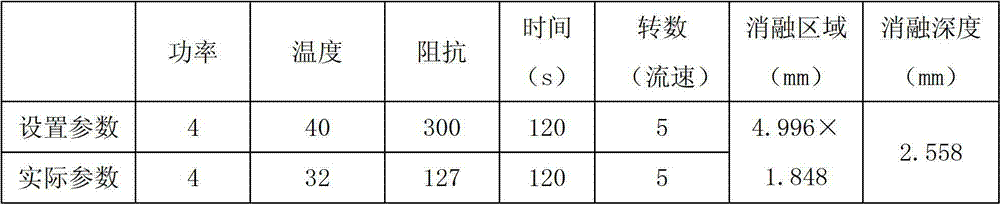
Set radiofrequency generator power 4W, 40 ℃ of temperature, impedance 300 Ω, 10 ablation points, every melts 120 seconds time, and 5 rev/mins of peristaltic pump rotating speeds utilize brine-cooled, practical impedance 127 Ω, depth of ablation reaches 2.558mm, and beef is melted, and experiment parameter sees Table 1.
(4), experimental result
Default 40 ℃, melt time 120s, reach preset temperature, be 15s average time, average actual power is 4W, on average melts area and is: 7.3mm * 5mm=36.5mm
2, mean depth: 4.5mm.Programming rate is fast in the ablation procedure, and actual power changes in the 2-3W scope.Evidence: renal artery cool brine radio-frequency (RF) ablation controllable electrodes catheter ablation process stabilization of the present utility model can produce effective ablation lesions.Brine Pipe and peristaltic pump are linked, start peristaltic pump, take rotating speed in 10 rev/mins of speed irrigating catheter bodys; Respectively peristaltic pump is arranged on 5 rev/mins of rotating speeds, 1 rev/min, in being close to test beef, observing the radiofrequency generator displays temperature is 36 ℃, closes peristaltic pump with electrode tip again, and the radiofrequency generator displays temperature is 37 ℃, confirms that critesistor or thermocouple monitoring temperature are normal.Start radiofrequency generator, peristaltic pump is arranged on 5 rev/mins of rotating speeds, begins to melt test, the record ablation parameter.The traveling electrode head changes the radiofrequency generator parameter setting, and the startup radiofrequency generator carries out second point and melts test.Repeat above process, until finish Total Test.Test complete face width and length in microscopically measurement and record zone of ablation, then cut open along the centrage that melts speckle, measure also record depth of ablation.The actual power that passes into the frequency ablation electrode catheter behind the saline is compared and is wanted high about 2.5 times with not passing into saline, and depth of ablation is wanted dark about 2 times.Programming rate is fast in the ablation procedure, and actual power changes in the 1-2W scope.Evidence: renal artery cool brine radio-frequency (RF) ablation controllable electrodes catheter ablation process stabilization of the present utility model, radio frequency is even, can produce effective ablation lesions, and the surface of beef has no obvious damage.
Use renal artery cool brine radio-frequency (RF) ablation controllable electrodes conduit of the present utility model and carry out renal artery and melt, can interrupt the sympathetic nerve that is attached on the renal artery vessel outer wall, reach the purpose for the treatment of intractable hypertension.Simultaneously, the injury that the renal artery blood vessel is caused is less.
Table 1 beef surface radio-frequency (RF) ablation experiment parameter.
Claims (10)
1. renal artery cool brine radio-frequency (RF) ablation controllable electrodes conduit, be provided with catheter tube (12), the near-end of catheter tube (12) is connected with control handle (13), it is characterized in that: the far-end of described catheter tube (12) is connected with electrode tip (11), electrode tip (11) is platinumiridio silk or the platinum-tungsten alloys silk of 0.005mm-0.3mm by diameter, turn to external diameter 0.80mm-2.00mm, long 1.5mm-4mm's is close around helical spring, and distal end is that semicircle is spherical.
2. renal artery cool brine radio-frequency (RF) ablation controllable electrodes conduit according to claim 1, it is characterized in that: described catheter tube (12) near-end connects the far-end of Brine Pipe (191), the near-end of Brine Pipe (191) is connected with Brine Pipe joint (19), and catheter tube (12), Brine Pipe (191) and Brine Pipe joint (19) are tightly connected and are interconnected.
3. renal artery cool brine radio-frequency (RF) ablation controllable electrodes conduit according to claim 2 is characterized in that: described control handle (13) near-end connection cool brine joint (19).
4. renal artery cool brine radio-frequency (RF) ablation controllable electrodes conduit according to claim 1, it is characterized in that: the body of described catheter tube (12) is soft by firmly tapering to from near-end to far-end hardness, when the body distal length is the distal portions of 50mm-100mm and the bending of body main part, body distal portions axis is parallel with body main part axis, the distance of two axial lines is 10mm-40mm, and embedding on the body main part inwall of catheter tube (12) has stainless steel cloth (127).
5. renal artery cool brine radio-frequency (RF) ablation controllable electrodes conduit according to claim 4, it is characterized in that: far-end is provided with becket (128) in the body main part of described catheter tube (12), the far-end of controlled backguy steel wire (125) and becket (128) are welded to connect, and the near-end of controlled backguy steel (125) connects control handle (13).
6. renal artery cool brine radio-frequency (RF) ablation controllable electrodes conduit according to claim 5, it is characterized in that: handle case (132) near-end of described control handle (1 3) has the first radial hole (1322), be inserted with backguy fixation with steel wire post (134) in it, the bottom of backguy fixation with steel wire post (134) has first through hole (1342) vertical with its axis, in the handle case (132), the position corresponding at described the first radial hole (1322) is provided with column handle inner core (1 35), have the second radial hole (1352) on the handle inner core (135), handle inner core (135) has the second through hole (1353) along axis, backguy fixation with steel wire post (134) bottom enters in the second radial hole (1352), so that the first through hole (1342) and the second through hole (1353) UNICOM, described controlled backguy steel wire (125) passes the second through hole (1353), the first through hole (1342) hole, with controlled backguy steel wire (125) around controlled fixation with steel wire post (134) rotation 1 to 4 circle, with controlled backguy steel (125) from end-to-end nearly tension far away.
7. renal artery cool brine radio-frequency (RF) ablation controllable electrodes conduit according to claim 5, it is characterized in that: the near-end of the push rod (131) of described control handle (13) inserts in the axial hole of handle case (132) from the far-end of handle case (132), form vertically sliding-contact with handle case (132), radially have screw (1321) on the handle case (132), the corresponding screw of push rod (131) (1321) position has elongated slot (1311) vertically, push rod stop screw (133) screws in described screw (1321), one section of the end of stop screw (133) puts in the elongated slot (1311), elongated slot (1311) two ends on the push rod (131) have along circumferential cannelure (1312), and cannelure (1312) has been embedded in damped ring (136).
8. renal artery cool brine radio-frequency (RF) ablation controllable electrodes conduit according to claim 1, it is characterized in that: described control handle (13) near-end is connected with adapter (14), radio-frequency (RF) energy transfer wire (16) far-end is connected to the helical spring near-end platinum wire end of electrode tip (11), and near-end is connected to radiofrequency generator through catheter tube (12), control handle (1 3) and adapter (14).
9. renal artery cool brine radio-frequency (RF) ablation controllable electrodes conduit according to claim 8, it is characterized in that: the measuring probe of critesistor or thermocouple (17) is set in described electrode tip (11) the far-end helical spring, and the holding wire near-end of critesistor or thermocouple (17) is connected to temperature measurer through catheter tube (12), control handle (13) and adapter (14).
10. renal artery cool brine radio-frequency (RF) ablation controllable electrodes conduit according to claim 1, it is characterized in that: be connected with safety line (18) in described electrode tip (11) distal end, the near-end of safety line (18) is fastened on catheter tube (12) near-end; Described safety line (18) adopts stainless steel round wire or flat filament, long 850mm-1100mm, and circle silk external diameter is 0.01mm, the flat filament area of section is 0.0000785 mm
2, in its far-end electrode insertion head (11); Described safety line (1 8) safety line far-end joint steel pipe (8); steel pipe (8) far-end stretches out electrode tip (11) far-end; the material of steel pipe (8) is Nitinol; platinumiridio or rustless steel; external diameter is 0.46mm-0.71mm; internal diameter is 0.36mm-0.61mm; stretch out the long 2mm-10mm that is; the distal end of steel pipe (8) is welded with little ball; external diameter is 0.50mm-0.80mm; stretch out the outer protecting film (9) that is equipped with of steel pipe (8) of electrode tip (11) far-end; the material of protecting film (9) is block polyetheramides or polyurethane, and block polyetheramides PEBAX 2533 or PEBAX 3533, polyurethane are PU80AE or PU70AE.
Priority Applications (1)
| Application Number | Priority Date | Filing Date | Title |
|---|---|---|---|
| CN 201220291197 CN202637111U (en) | 2012-06-20 | 2012-06-20 | Controllable electrode catheter for cold saline water radio frequency ablation of renal artery |
Applications Claiming Priority (1)
| Application Number | Priority Date | Filing Date | Title |
|---|---|---|---|
| CN 201220291197 CN202637111U (en) | 2012-06-20 | 2012-06-20 | Controllable electrode catheter for cold saline water radio frequency ablation of renal artery |
Publications (1)
| Publication Number | Publication Date |
|---|---|
| CN202637111U true CN202637111U (en) | 2013-01-02 |
Family
ID=47406302
Family Applications (1)
| Application Number | Title | Priority Date | Filing Date |
|---|---|---|---|
| CN 201220291197 Withdrawn - After Issue CN202637111U (en) | 2012-06-20 | 2012-06-20 | Controllable electrode catheter for cold saline water radio frequency ablation of renal artery |
Country Status (1)
| Country | Link |
|---|---|
| CN (1) | CN202637111U (en) |
Cited By (6)
| Publication number | Priority date | Publication date | Assignee | Title |
|---|---|---|---|---|
| CN102688093A (en) * | 2012-06-20 | 2012-09-26 | 深圳市惠泰医疗器械有限公司 | Renal artery cold saline water radio frequency ablation controllable electrode catheter |
| CN103519887A (en) * | 2013-10-25 | 2014-01-22 | 乐普(北京)医疗器械股份有限公司 | System for percutaneous radiofrequency ablation renal sympathetic denervation |
| CN106333743A (en) * | 2016-08-16 | 2017-01-18 | 深圳市惠泰医疗器械有限公司 | Magnetic-positioning cold saline radio frequency ablation electrode catheter |
| US10842559B2 (en) | 2011-08-26 | 2020-11-24 | Symap Medical (Suzhou), Limited | System and method for locating and identifying the functional nerves innervating the wall of arteries and catheters for same |
| US11324408B2 (en) | 2011-08-26 | 2022-05-10 | Symap Medical (Suzhou), Ltd | Mapping sympathetic nerve distribution for renal ablation and catheters for same |
| US11576721B2 (en) | 2011-08-26 | 2023-02-14 | Symap Medical (Suzhou), Limited | System and method for mapping the functional nerves innervating the wall of arteries, 3-D mapping and catheters for same |
-
2012
- 2012-06-20 CN CN 201220291197 patent/CN202637111U/en not_active Withdrawn - After Issue
Cited By (9)
| Publication number | Priority date | Publication date | Assignee | Title |
|---|---|---|---|---|
| US10842559B2 (en) | 2011-08-26 | 2020-11-24 | Symap Medical (Suzhou), Limited | System and method for locating and identifying the functional nerves innervating the wall of arteries and catheters for same |
| US11324408B2 (en) | 2011-08-26 | 2022-05-10 | Symap Medical (Suzhou), Ltd | Mapping sympathetic nerve distribution for renal ablation and catheters for same |
| US11576721B2 (en) | 2011-08-26 | 2023-02-14 | Symap Medical (Suzhou), Limited | System and method for mapping the functional nerves innervating the wall of arteries, 3-D mapping and catheters for same |
| CN102688093A (en) * | 2012-06-20 | 2012-09-26 | 深圳市惠泰医疗器械有限公司 | Renal artery cold saline water radio frequency ablation controllable electrode catheter |
| CN102688093B (en) * | 2012-06-20 | 2014-08-27 | 深圳市惠泰医疗器械有限公司 | Renal artery cold saline water radio frequency ablation controllable electrode catheter |
| CN103519887A (en) * | 2013-10-25 | 2014-01-22 | 乐普(北京)医疗器械股份有限公司 | System for percutaneous radiofrequency ablation renal sympathetic denervation |
| CN103519887B (en) * | 2013-10-25 | 2016-04-20 | 乐普(北京)医疗器械股份有限公司 | A kind of Percutaneous radiofrequency ablation melts renal sympathetic nerve art system |
| CN106333743A (en) * | 2016-08-16 | 2017-01-18 | 深圳市惠泰医疗器械有限公司 | Magnetic-positioning cold saline radio frequency ablation electrode catheter |
| CN106333743B (en) * | 2016-08-16 | 2019-08-06 | 深圳市惠泰医疗器械有限公司 | Magnetic orientation cool brine frequency ablation electrode catheter |
Similar Documents
| Publication | Publication Date | Title |
|---|---|---|
| CN102688093B (en) | Renal artery cold saline water radio frequency ablation controllable electrode catheter | |
| CN202637111U (en) | Controllable electrode catheter for cold saline water radio frequency ablation of renal artery | |
| US12089890B2 (en) | Multi-rate fluid flow and variable power delivery for ablation electrode assemblies used in catheter ablation procedures | |
| JP7529834B2 (en) | Radio Frequency Drilling Device | |
| CN203539434U (en) | Multi-electrode ablation catheter | |
| CA2760082C (en) | Ablation catheter with balloon and ablation catheter system with balloon | |
| CN105555218B (en) | With radio frequency (RF) foley's tube rinsed with cooling capacity | |
| CN103142304B (en) | The synchronous pulmonary artery radio frequency ablation catheter of multipole | |
| US6640120B1 (en) | Probe assembly for mapping and ablating pulmonary vein tissue and method of using same | |
| CN203122582U (en) | Cold saline pouring type radio frequency ablation catheter | |
| ES2380627T3 (en) | Bipolar Electrosurgical System | |
| EP2415415B1 (en) | Ablation catheter system with balloon | |
| CN104095679A (en) | Multiple-electrode ablation catheter | |
| JP2007181690A (en) | Injection molded perfusion tip electrode and catheter with injection molded perfusion tip electrode | |
| CN102488552A (en) | Manageable spiral electrophysiology catheter | |
| TW201043189A (en) | Shaft for ablation catheter with balloon | |
| CN208756152U (en) | transcatheter septostomy device | |
| CN102860868A (en) | Water injection system of double-pole operation electrode and method | |
| KR20210033443A (en) | Inferred maximum temperature monitoring for irrigation ablation therapy | |
| CN114343833A (en) | Ablation catheter | |
| CN104287827A (en) | Renal sympathetic nerve removing radiofrequency ablation electrode and system | |
| CN211934176U (en) | Improve left auricle of heart and melt plugging device of security | |
| CN203122593U (en) | Water injection system of bipolar operation electrode | |
| CN212346714U (en) | Double-water-path ablation electrode needle | |
| CN202589653U (en) | Double-direction controllable saline infusion type renal artery radiofrequency ablation catheter |
Legal Events
| Date | Code | Title | Description |
|---|---|---|---|
| C14 | Grant of patent or utility model | ||
| GR01 | Patent grant | ||
| AV01 | Patent right actively abandoned |
Granted publication date: 20130102 Effective date of abandoning: 20140827 |
|
| AV01 | Patent right actively abandoned |
Granted publication date: 20130102 Effective date of abandoning: 20140827 |
|
| RGAV | Abandon patent right to avoid regrant |