CN1983707A - Battery - Google Patents
Battery Download PDFInfo
- Publication number
- CN1983707A CN1983707A CNA2005101314030A CN200510131403A CN1983707A CN 1983707 A CN1983707 A CN 1983707A CN A2005101314030 A CNA2005101314030 A CN A2005101314030A CN 200510131403 A CN200510131403 A CN 200510131403A CN 1983707 A CN1983707 A CN 1983707A
- Authority
- CN
- China
- Prior art keywords
- chemical formula
- group
- lithium
- represent
- battery
- Prior art date
- Legal status (The legal status is an assumption and is not a legal conclusion. Google has not performed a legal analysis and makes no representation as to the accuracy of the status listed.)
- Granted
Links
Images


Classifications
-
- Y02E60/122—
Landscapes
- Secondary Cells (AREA)
Abstract
Description
相关申请的交叉引用Cross References to Related Applications
本发明包含涉及于2004年12月10日向日本专利局提交的日本专利申请JP2004-357815,和2005年5月13日向日本专利局提交的日本专利申请JP2005-141552的主题,其全部内容在此引入作为参考。The present invention contains subject matter related to Japanese Patent Application JP2004-357815 filed in Japan Patent Office on December 10, 2004, and Japanese Patent Application JP2005-141552 filed in Japan Patent Office on May 13, 2005, the entire contents of which are hereby incorporated by reference Reference.
技术领域technical field
本发明涉及包括正极、负极、和电解质的电池,特别是涉及包括正极、负极、和电解质且使用锂(Li)等作为电极反应物的电池。The present invention relates to a battery including a positive electrode, a negative electrode, and an electrolyte, and particularly to a battery including a positive electrode, a negative electrode, and an electrolyte and using lithium (Li) or the like as an electrode reactant.
背景技术Background technique
近年来,已积极促进了由移动电话、PDA(个人数字助理)、和笔记本个人电脑代表的便携式电子设备的小型化和轻型化。作为其一部分,已强烈需要改善电池(这种电子设备的驱动电源)的能量密度,特别是二次电池的能量密度。作为能够提供高能量密度的二次电池,使用能够插入和脱出锂的材料如碳材料用于负极的锂离子二次电池已商业化,且其市场在扩大。In recent years, miniaturization and weight reduction of portable electronic devices typified by mobile phones, PDAs (Personal Digital Assistants), and notebook personal computers have been actively promoted. As part of this, there has been a strong need to improve the energy density of batteries (drive power sources for such electronic equipment), particularly secondary batteries. As a secondary battery capable of providing high energy density, a lithium ion secondary battery using a material capable of inserting and extracting lithium such as a carbon material for a negative electrode has been commercialized, and its market is expanding.
此外,作为能够提供高能量密度的二次电池,有锂金属二次电池,其使用锂金属用于负极且仅利用锂金属的沉积和溶解反应用于负极反应。在锂金属二次电池中,锂金属的理论电化当量大,为2054mAh/cm3,这相当于用于锂离子二次电池的石墨的2.5倍。因此,期望锂金属二次电池成为能够提供比锂离子二次电池更高的能量密度的电池。至今为止,许多研究者已对锂金属二次电池的实际应用进行了研究和开发(例如,参考由Jean-PaulGabano编辑的“Lithium Batteries”,London,New York,Academic Press,1993)。In addition, as a secondary battery capable of providing high energy density, there is a lithium metal secondary battery that uses lithium metal for the negative electrode and utilizes only deposition and dissolution reactions of lithium metal for the negative electrode reaction. In lithium metal secondary batteries, the theoretical electrochemical equivalent of lithium metal is as large as 2054 mAh/cm 3 , which is equivalent to 2.5 times that of graphite used in lithium ion secondary batteries. Therefore, lithium metal secondary batteries are expected to be batteries capable of providing higher energy density than lithium ion secondary batteries. So far, many researchers have conducted research and development on practical applications of lithium metal secondary batteries (for example, refer to "Lithium Batteries" edited by Jean-Paul Gabano, London, New York, Academic Press, 1993).
此外,最近已开发一种二次电池,其中负极容量包括由于锂的插入和脱出的容量部分和由于锂的沉积和溶解的容量部分,且由其总和表示(例如,参考国际公开号No.01/22519)。在该二次电池中,能够插入和脱出锂的碳材料用于负极,且在充电中锂在碳材料表面沉积。根据该二次电池,期望获得如锂金属二次电池一样的高能量密度。In addition, a secondary battery has recently been developed in which the negative electrode capacity includes a capacity part due to insertion and extraction of lithium and a capacity part due to deposition and dissolution of lithium, and is expressed by the sum thereof (for example, refer to International Publication No. 01 /22519). In this secondary battery, a carbon material capable of inserting and extracting lithium is used for the negative electrode, and lithium is deposited on the surface of the carbon material during charging. According to this secondary battery, it is expected to obtain high energy density like a lithium metal secondary battery.
在上述锂二次电池中,传统上,已考虑使用两种或多种溶剂的混合物或使用卤化的化合物等用于电解质以改善电池特性如循环特性(例如,参考日本未审专利申请公开号No.S62-290071和S62-217567)。In the above-mentioned lithium secondary battery, conventionally, it has been considered to use a mixture of two or more solvents or use a halogenated compound or the like for the electrolyte to improve battery characteristics such as cycle characteristics (for example, refer to Japanese Unexamined Patent Application Publication No. .S62-290071 and S62-217567).
发明内容Contents of the invention
然而,使用上述方式,效果不是完全足够的。特别地,在锂金属二次电池中,在其中负极容量包括由于锂的插入和脱出的容量部分和由于锂的沉积和溶解的容量部分并由其总和表示的的二次电池中,或在其中负极包含能够插入和脱出电极反应物的负极材料且该负极材料包含金属元素和准金属元素的至少一种作为元素的锂离子二次电池中,还未获得足够的循环特性。However, using the above-mentioned manner, the effect is not completely sufficient. In particular, in a lithium metal secondary battery, in a secondary battery in which the negative electrode capacity includes a capacity part due to insertion and extraction of lithium and a capacity part due to deposition and dissolution of lithium and is expressed by the sum thereof, or in which In a lithium ion secondary battery in which the negative electrode includes a negative electrode material capable of inserting and extracting electrode reactants and the negative electrode material contains at least one of a metal element and a metalloid element as an element, sufficient cycle characteristics have not been obtained.
考虑到以上所述,在本发明中,期望提供能够改善循环特性的电池。In view of the above, in the present invention, it is desirable to provide a battery capable of improving cycle characteristics.
根据本发明的实施方式,提供包括正极、负极、和电解质的第一电池,其中锂金属用作负极活性材料,且该电解质包含具有卤原子的环状碳酸酯衍生物和至少一种选自由化学式1或化学式2表示的轻金属盐。According to an embodiment of the present invention, there is provided a first battery including a positive electrode, a negative electrode, and an electrolyte, wherein lithium metal is used as the negative electrode active material, and the electrolyte contains a cyclic carbonate derivative having a halogen atom and at least one selected from the group consisting of 1 or the light metal salt represented by chemical formula 2.
[化学式1][chemical formula 1]

在式中,R11表示-C(=O)-R21-C(=O)-基团(R21表示亚烷基、卤代亚烷基、亚芳基、或卤代亚芳基)、-C(=O)-C(R23)(R24)-基团(R23和R24表示烷基、卤代烷基、芳基、或卤代芳基)、或-C(=O)-C(=O)-基团。R12表示卤素基团、烷基、卤代烷基、芳基、或卤代芳基。X11和X12分别表示氧(O)或硫(S)。M11表示过渡金属元素、或短周期元素周期表中的3B族元素、4B族元素、或5B族元素。M21表示短周期元素周期表中的1A族元素或2A族元素或铝(Al)。a表示1-4的整数。b表示0-8的整数。c、d、e和f分别表示1-3的整数。In the formula, R11 represents -C(=O)-R21-C(=O)-group (R21 represents alkylene, halogenated alkylene, arylene, or halogenated arylene), -C (=O)-C(R23)(R24)-group (R23 and R24 represent alkyl, haloalkyl, aryl, or haloaryl), or -C(=O)-C(=O)- group. R12 represents a halogen group, an alkyl group, a halogenated alkyl group, an aryl group, or a halogenated aryl group. X11 and X12 respectively represent oxygen (O) or sulfur (S). M11 represents a transition metal element, or a group 3B element, a group 4B element, or a group 5B element in the short-period periodic table. M21 represents a group 1A element or a group 2A element or aluminum (Al) in the short-period periodic table. a represents an integer of 1-4. b represents an integer of 0-8. c, d, e, and f represent an integer of 1-3, respectively.
[化学式2][chemical formula 2]

在式中,R31、R32、R33和R34表示通过用卤素取代烷基的至少部分氢获得的基团。In the formula, R31, R32, R33 and R34 represent groups obtained by substituting at least part of hydrogen of an alkyl group with a halogen.
根据本发明的实施方式,提供包括正极、负极、和电解质的第二电池,其中负极包含能够插入和脱出电极反应物的负极材料且该负极材料包含金属元素和准金属元素的至少一种作为元素,和电解质包含具有卤原子的环状碳酸酯衍生物和至少一种选自由化学式1或化学式2表示的轻金属盐。According to an embodiment of the present invention, there is provided a second battery including a positive electrode, a negative electrode, and an electrolyte, wherein the negative electrode includes a negative electrode material capable of inserting and extracting an electrode reactant and the negative electrode material contains at least one of a metal element and a metalloid element as an element , and the electrolyte includes a cyclic carbonate derivative having a halogen atom and at least one light metal salt selected from Chemical Formula 1 or Chemical Formula 2.
[化学式1][chemical formula 1]

在式中,R11表示-C(=O)-R21-C(=O)-基团(R21表示亚烷基、卤代亚烷基、亚芳基、或卤代亚芳基)、-C(=O)-C(R23)(R24)-基团(R23和R24表示烷基、卤代烷基、芳基、或卤代芳基)、或-C(=O)-C(=O)-基团。R12表示卤素基团、烷基、卤代烷基、芳基、或卤代芳基。X11和X12分别表示氧或硫。M11表示过渡金属元素、或短周期元素周期表中的3B族元素、4B族元素、或5B族元素。M21表示短周期元素周期表中的1A族元素或2A族元素或铝。a表示1-4的整数。b表示0-8的整数。c、d、e和f分别表示1-3的整数。In the formula, R11 represents -C(=O)-R21-C(=O)-group (R21 represents alkylene, halogenated alkylene, arylene, or halogenated arylene), -C (=O)-C(R23)(R24)-group (R23 and R24 represent alkyl, haloalkyl, aryl, or haloaryl), or -C(=O)-C(=O)- group. R12 represents a halogen group, an alkyl group, a halogenated alkyl group, an aryl group, or a halogenated aryl group. X11 and X12 represent oxygen or sulfur, respectively. M11 represents a transition metal element, or a group 3B element, a group 4B element, or a group 5B element in the short-period periodic table. M21 represents a group 1A element or a group 2A element or aluminum in the short-period periodic table. a represents an integer of 1-4. b represents an integer of 0-8. c, d, e, and f represent an integer of 1-3, respectively.
[化学式2][chemical formula 2]

在式中,R31、R32、R33和R34表示通过用卤素取代烷基的至少部分氢获得的基团。In the formula, R31, R32, R33 and R34 represent groups obtained by substituting at least part of hydrogen of an alkyl group with a halogen.
根据本发明的实施方式,提供包括正极、负极、和电解质的第三电池,其中负极的容量包括由于轻金属的插入和脱出的容量部分和由于轻金属的沉积和溶解的容量部分,并由其总和表示,且电解质包含具有卤原子的环状碳酸酯衍生物和至少一种选自由化学式1或化学式2表示的轻金属盐。According to an embodiment of the present invention, there is provided a third battery comprising a positive electrode, a negative electrode, and an electrolyte, wherein the capacity of the negative electrode includes a capacity portion due to insertion and extraction of light metals and a capacity portion due to deposition and dissolution of light metals, and is represented by the sum thereof , and the electrolyte includes a cyclic carbonate derivative having a halogen atom and at least one light metal salt selected from Chemical Formula 1 or Chemical Formula 2.
[化学式1][chemical formula 1]

在式中,R11表示-C(=O)-R21-C(=O)-基团(R21表示亚烷基、卤代亚烷基、亚芳基、或卤代亚芳基)、-C(=O)-C(R23)(R24)-基团(R23和R24表示烷基、卤代烷基、芳基、或卤代芳基)、或-C(=O)-C(=O)-基团。R12表示卤素基团、烷基、卤代烷基、芳基、或卤代芳基。X11和X12分别表示氧或硫。M11表示过渡金属元素、或短周期元素周期表中的3B族元素、4B族元素、或5B族元素。M21表示短周期元素周期表中的1A族元素或2A族元素或铝。a表示1-4的整数。b表示0-8的整数。c、d、e和f分别表示1-3的整数。In the formula, R11 represents -C(=O)-R21-C(=O)-group (R21 represents alkylene, halogenated alkylene, arylene, or halogenated arylene), -C (=O)-C(R23)(R24)-group (R23 and R24 represent alkyl, haloalkyl, aryl, or haloaryl), or -C(=O)-C(=O)- group. R12 represents a halogen group, an alkyl group, a halogenated alkyl group, an aryl group, or a halogenated aryl group. X11 and X12 represent oxygen or sulfur, respectively. M11 represents a transition metal element, or a group 3B element, a group 4B element, or a group 5B element in the short-period periodic table. M21 represents a group 1A element or a group 2A element or aluminum in the short-period periodic table. a represents an integer of 1-4. b represents an integer of 0-8. c, d, e, and f represent an integer of 1-3, respectively.
[化学式2][chemical formula 2]
在式中,R31、R32、R33和R34表示通过用卤素取代烷基的至少部分氢获得的基团。In the formula, R31, R32, R33 and R34 represent groups obtained by substituting at least part of hydrogen of an alkyl group with a halogen.
根据本发明实施方式的第一至第三电池,在电解质中,包含具有卤原子的环状碳酸酯衍生物和由化学式1或化学式2表示的轻金属盐。因此,可抑制在负极中溶剂的分解反应。从而,可改善在负极中的充电和放电效率,且可改善循环特性。According to the first to third batteries of the embodiment of the present invention, a cyclic carbonate derivative having a halogen atom and a light metal salt represented by Chemical Formula 1 or Chemical Formula 2 are contained in the electrolyte. Therefore, the decomposition reaction of the solvent in the negative electrode can be suppressed. Thus, charge and discharge efficiency in the negative electrode can be improved, and cycle characteristics can be improved.
此外,当除由化学式1或化学式2表示的轻金属盐之外还使用其他金属盐时,可更加改善循环特性。In addition, when other metal salts are used in addition to the light metal salt represented by Chemical Formula 1 or Chemical Formula 2, cycle characteristics may be more improved.
本发明的其他和进一步目的、特征和优点将从以下描述中更加充分的体现。Other and further objects, features and advantages of the invention will appear more fully from the following description.
附图说明Description of drawings
图1为展示根据本发明实施方式的二次电池的结构的横截面;1 is a cross section showing the structure of a secondary battery according to an embodiment of the present invention;
图2为展示图1所示二次电池的螺旋卷绕电极体的放大部分的横截面;2 is a cross-section showing an enlarged portion of a spirally wound electrode body of the secondary battery shown in FIG. 1;
图3为展示根据本发明其他实施方式的二次电池的结构的分解透视图;3 is an exploded perspective view showing the structure of a secondary battery according to other embodiments of the present invention;
图4为沿图3所示的螺旋卷绕电极体的线I-I的横截面;及Figure 4 is a cross-section along line I-I of the spirally wound electrode body shown in Figure 3; and
图5展示了根据实施例中形成的含CoSnC材料,通过X射线光电子能谱法获得的峰的例子。FIG. 5 shows examples of peaks obtained by X-ray photoelectron spectroscopy according to the CoSnC-containing material formed in Examples.
具体实施方式Detailed ways
下面将参照附图详细描述本发明的实施方式。Embodiments of the present invention will be described in detail below with reference to the accompanying drawings.
(第一实施方式)(first embodiment)
图1展示了根据第一实施方式的二次电池的横截面结构。该二次电池是锂金属二次电池,其中负极容量由通过作为电极反应物的锂的沉积和溶解的容量部分表示。该二次电池是所谓的圆柱型电池,且具有螺旋卷绕的电极体20,其中条状正极21和条状负极22与在其间的隔膜23在接近中空圆柱状的电池壳11的内部卷绕。电池壳11由例如镀镍(Ni)的铁(Fe)制成。封闭电池壳11的一端,且其另一端敞开。在电池壳11内部,垂直于卷绕的边缘表面分别排列一对绝缘板12和13,以便螺旋卷绕的电极体20夹在绝缘板12和13之间。FIG. 1 shows a cross-sectional structure of a secondary battery according to a first embodiment. The secondary battery is a lithium metal secondary battery in which the negative electrode capacity is represented by the capacity part by deposition and dissolution of lithium as an electrode reactant. This secondary battery is a so-called cylindrical battery, and has a spirally
在电池壳11的敞开端,通过衬垫17填隙,附着电池盖14和在电池盖14内部提供的安全阀机构15以及PTC(正温度系数)器件16。由此密封电池壳11的内部。电池盖14例如由类似于电池壳11的材料制成。安全阀机构15通过PTC器件16电连接到电池盖14上。当电池的内压因内部短路、外部加热等达到某一水平或者更高时,圆板15A回挠(flip),切断电池盖14和螺旋卷绕的电极体20之间的电连接。当温度升高时,PTC器件16通过增加电阻值来限制电流,以防止因大的电流导致的异常热的产生。衬垫17例如由绝缘材料制成,且其表面用沥青涂布。At the open end of the
例如,螺旋卷绕的电极体20以中心销24为中心卷绕。由铝等制成的正极引线25连接到螺旋卷绕的电极体20的正极21上。由镍等制成的负极引线26连接到负极22上。正极引线25通过焊接到安全阀机构15上电连接到电池盖14。将负极引线26焊接并电连接到电池壳11上。For example, the spirally
图2展示了图1所示的螺旋卷绕的电极体20的放大部分。正极21例如具有下述结构:其中在具有一对相对表面的正极集电体21A的两个表面上提供正极活性材料层21B。虽然未示出,但正极活性材料层21B可提供在正极集电体21A的仅一个表面上。正极集电体21A例如约为5μm-50μm厚,且由金属箔如铝箔、镍箔和不锈钢箔制成。正极活性材料层21B含有例如一种或多种能插入并脱出作为电极反应物的锂的正极活性材料作为正极活性材料。如果必要的话,正极活性材料层21B可含有电导体和粘合剂。正极活性材料层21B的厚度为例如60μm-250μm。当正极活性材料层21B提供在正极集电体21A的两面上时,正极活性材料层21B的厚度为提供在正极集电体21A的两面上的正极活性材料层21B的总和。FIG. 2 shows an enlarged portion of the spirally
作为能插入和脱出锂的正极材料,例如,为了改善能量密度,包含锂、过渡金属和氧的含锂化合物是优选的。具体地说,更优选包含选自钴(Co)、镍、锰(Mn)、和铁的至少一种作为过渡金属元素的含锂化合物。作为这种含锂化合物,例如,可列举LiCoO2、LiNi1-xCoxO2(0<x<1)、LiMn2O4、或LiFePO4。As a positive electrode material capable of inserting and extracting lithium, for example, a lithium-containing compound containing lithium, a transition metal, and oxygen is preferable in order to improve energy density. Specifically, a lithium-containing compound containing at least one selected from cobalt (Co), nickel, manganese (Mn), and iron as a transition metal element is more preferable. Examples of such lithium-containing compounds include LiCoO 2 , LiNi 1-x Co x O 2 (0<x<1), LiMn 2 O 4 , or LiFePO 4 .
这种正极材料通过例如将锂的碳酸盐、硝酸盐、氧化物、或氢氧化物和过渡金属的碳酸盐、硝酸盐、氧化物、或氢氧化物以所需的组成混合,粉化该混合物,然后在氧气气氛中在600℃-1000℃的温度下焙烧生成物来制备。Such a positive electrode material is powdered by, for example, mixing carbonate, nitrate, oxide, or hydroxide of lithium and carbonate, nitrate, oxide, or hydroxide of a transition metal in a desired composition. The mixture is then prepared by firing the resultant at a temperature of 600°C to 1000°C in an oxygen atmosphere.
作为电导体,例如,可列举碳材料如石墨、炭黑、和Ketjen黑。可单独使用其一种,或通过混合使用其两种或多种。此外,除了碳材料以外,还可使用金属材料、导电高分子量化合物材料等,只要该材料具有导电性。作为粘合剂,例如,可列举合成橡胶如丁苯橡胶、氟化橡胶、和三元乙丙橡胶或高分子量材料如聚偏二氟乙烯。可单独使用其一种,或通过混合使用其两种或多种。例如,当如图1卷绕正极21和负极22时,具有柔韧性的丁苯橡胶、氟化橡胶等优选用作粘合剂。As the electric conductor, for example, carbon materials such as graphite, carbon black, and Ketjen black can be cited. One kind thereof may be used alone, or two or more kinds thereof may be used by mixing. Furthermore, in addition to the carbon material, a metal material, a conductive high molecular weight compound material, or the like may be used as long as the material has conductivity. As the binder, for example, synthetic rubbers such as styrene-butadiene rubber, fluorinated rubber, and ethylene-propylene-diene rubber or high-molecular-weight materials such as polyvinylidene fluoride can be cited. One kind thereof may be used alone, or two or more kinds thereof may be used by mixing. For example, when the
负极22具有这样的结构:其中在具有一对相对表面的负极集电体22A的两个表面上提供负极活性材料层22B。虽然未示出,但负极活性材料层22B可提供在负极集电体22A的仅一个表面上。负极集电体22A例如由金属箔如具有有利的电化学稳定性、电导率、和机械强度的铜箔、镍箔、不锈钢箔制成。特别地,铜箔是最优选的,因为铜箔具有高电导率。负极集电体22A的厚度优选为例如约5μm-40μm。当其厚度比5μm薄时,机械强度降低,负极集电体22A容易在制造步骤中破裂,并降低生产效率。当其厚度比40μm厚时,电池中负极集电体22A的体积比变得大于所必须的体积比,且变得难以改善能量密度。The
负极活性材料层22B由例如作为负极活性材料的锂金属形成,且由此可获得高的能量密度。负极活性材料层22B可在装配中已存在,或负极活性材料层22B在装配中可不存在,而是由在充电中沉积的锂金属组成的。此外,负极活性材料层22B还可用作集电体且然后负极集电体22A可省去。The anode active material layer 22B is formed of, for example, lithium metal as an anode active material, and thus high energy density can be obtained. The negative electrode active material layer 22B may already exist in the assembly, or the negative electrode active material layer 22B may not exist in the assembly but consist of lithium metal deposited in charging. In addition, the anode active material layer 22B may also serve as a current collector and then the anode current collector 22A may be omitted.
隔膜23例如由合成树脂多孔膜或陶瓷多孔膜制成,所述合成树脂多孔膜由聚四氟乙烯、聚丙烯、聚乙烯等制成。隔膜23可具有其中两个或多个前述多孔膜层压的结构。具体地说,由聚烯烃制成的多孔膜是优选的,因为由聚烯烃制成的多孔膜具有优越的防短路效果并通过关闭效应提供电池的改善的安全性。特别地,作为构成隔膜23的材料,优选聚乙烯,因为聚乙烯在100℃-160℃的范围内提供关闭效应并具有优越的电化学稳定性。此外,聚丙烯也是优选的。另外,只要树脂具有化学稳定性,就可通过与聚乙烯或聚丙烯共聚,或通过与聚乙烯或聚丙烯共混使用这种树脂。The
作为液体电解质的电解溶液浸渍在隔膜23中。电解溶液包含例如,溶剂和溶解在该溶剂中的电解质盐。An electrolytic solution as a liquid electrolyte is impregnated in the
溶剂优选包含具有卤原子的环状碳酸酯衍生物。具体地说,溶剂期望地包含由化学式3表示的环状碳酸酯衍生物。因此,可抑制在负极22中溶剂的分解反应。可单独使用溶剂,或通过混合使用两种或多种溶剂。The solvent preferably contains a cyclic carbonate derivative having a halogen atom. Specifically, the solvent desirably contains a cyclic carbonate derivative represented by Chemical Formula 3. Therefore, the decomposition reaction of the solvent in the
[化学式3][chemical formula 3]
在式中,R41、R42、R43和R44表示氢基团、氟基团、氯基团、溴基团、甲基、乙基或通过用氟基团、氯基团、或溴基团取代甲基或乙基的部分氢获得的基团。其至少一个为具有卤素的基团。R41、R42、R43和R44可相同或不同。In the formula, R41, R42, R43 and R44 represent a hydrogen group, a fluorine group, a chlorine group, a bromine group, a methyl group, an ethyl group or by substituting a methyl group with a fluorine group, a chlorine group, or a bromine group A group obtained by partial hydrogen of a group or an ethyl group. At least one of them is a group having a halogen. R41, R42, R43 and R44 may be the same or different.
由化学式3表示的环状碳酸酯衍生物的具体实例包括由化学式4的(1-1)至(1-14)表示的化合物和由化学式5的(1-15)至(1-22)表示的化合物等。Specific examples of the cyclic carbonate derivative represented by Chemical Formula 3 include compounds represented by (1-1) to (1-14) of Chemical Formula 4 and compounds represented by (1-15) to (1-22) of Chemical Formula 5 compounds, etc.
[化学式4][chemical formula 4]
[化学式5][chemical formula 5]
此外,可通过与传统使用的各种溶剂混合使用具有卤原子的环状碳酸酯衍生物。这种溶剂的具体实例包括碳酸亚乙酯、碳酸亚丙酯、碳酸亚丁酯、碳酸亚乙烯酯、γ-丁内酯、γ-戊内酯、1,2-二甲氧基乙烷、四氢呋喃、2-甲基四氢呋喃、1,3-二氧戊环(dioxolan)、4-甲基-1,3-二氧戊环、乙酸甲酯、丙酸甲酯、丙酸乙酯、碳酸二甲酯、碳酸甲乙酯、碳酸二乙酯、乙腈、戊二腈、己二腈、甲氧基乙腈、3-甲氧基丙腈、N,N-二甲基甲酰胺、N-甲基吡咯啉酮(pyrolizinone)、N-甲基唑啉酮(oxazolizinone)、N,N’-二甲基咪唑啉酮(imidazolizinone)、硝基甲烷、硝基乙烷、环丁砜、二甲基亚砜、和磷酸三甲酯。具体地说,为了实现优越的充电和放电容量特性及充电和放电循环特性,优选使用选自碳酸亚乙酯、碳酸亚丙酯、碳酸亚乙烯酯、碳酸二甲酯、和碳酸甲乙酯的至少一种。这些溶剂可单独使用,或通过混合使用其几种。In addition, cyclic carbonate derivatives having a halogen atom can be used by mixing with conventionally used various solvents. Specific examples of such solvents include ethylene carbonate, propylene carbonate, butylene carbonate, vinylene carbonate, γ-butyrolactone, γ-valerolactone, 1,2-dimethoxyethane, tetrahydrofuran , 2-methyltetrahydrofuran, 1,3-dioxolane (dioxolan), 4-methyl-1,3-dioxolane, methyl acetate, methyl propionate, ethyl propionate, dimethyl carbonate Ester, ethyl methyl carbonate, diethyl carbonate, acetonitrile, glutaronitrile, adiponitrile, methoxyacetonitrile, 3-methoxypropionitrile, N,N-dimethylformamide, N-methylpyrrole Pyrolizinone, N-methyloxazolizinone, N,N'-dimethylimidazolizinone, nitromethane, nitroethane, sulfolane, dimethyl sulfoxide, and trimethyl phosphate. Specifically, in order to realize superior charge and discharge capacity characteristics and charge and discharge cycle characteristics, it is preferable to use a compound selected from ethylene carbonate, propylene carbonate, vinylene carbonate, dimethyl carbonate, and ethyl methyl carbonate. at least one. These solvents may be used alone, or several kinds thereof may be used by mixing.
作为电解质盐,优选包含由化学式1表示的轻金属盐。该轻金属盐可在负极22的表面上形成稳定的涂层,并抑制溶剂的分解反应。由化学式1表示的轻金属盐可单独使用,或通过混合使用其几种。As the electrolyte salt, a light metal salt represented by Chemical Formula 1 is preferably contained. The light metal salt can form a stable coating on the surface of the
[化学式1][chemical formula 1]

在式中,R11表示由化学式6、化学式7、或化学式8表示的基团。R12表示卤素基团、烷基、卤代烷基、芳基、或卤代芳基。X11和X12分别表示氧或硫。M11表示过渡金属元素、或短周期元素周期表中的3B族元素、4B族元素、或5B族元素。M21表示短周期元素周期表中的1A族元素或2A族元素或铝。a表示1-4的整数。b表示0-8的整数。c、d、e和f分别表示1-3的整数。In the formula, R11 represents a group represented by Chemical Formula 6, Chemical Formula 7, or Chemical Formula 8. R12 represents a halogen group, an alkyl group, a halogenated alkyl group, an aryl group, or a halogenated aryl group. X11 and X12 represent oxygen or sulfur, respectively. M11 represents a transition metal element, or a group 3B element, a group 4B element, or a group 5B element in the short-period periodic table. M21 represents a group 1A element or a group 2A element or aluminum in the short-period periodic table. a represents an integer of 1-4. b represents an integer of 0-8. c, d, e, and f represent an integer of 1-3, respectively.
[化学式6][chemical formula 6]

在式中,R21表示亚烷基、卤代亚烷基、亚芳基、或卤代亚芳基。In the formula, R21 represents an alkylene group, a halogenated alkylene group, an arylene group, or a halogenated arylene group.
[化学式7][chemical formula 7]

在式中,R22和R23表示烷基、卤代烷基、芳基、或卤代芳基。R22和R23可相同或不同。In the formula, R22 and R23 represent an alkyl group, a halogenated alkyl group, an aryl group, or a halogenated aryl group. R22 and R23 may be the same or different.
[化学式8][chemical formula 8]
作为由化学式1表示的轻金属盐,例如,由化学式9表示的化合物是优选的。As the light metal salt represented by Chemical Formula 1, for example, a compound represented by Chemical Formula 9 is preferable.
[化学式9][chemical formula 9]
在式中,R11表示由化学式6、化学式7、或化学式8表示的基团。R13表示卤素基团。M12表示磷(P)或硼(B)。M21表示短周期元素周期表中的1A族元素或2A族元素或铝。a1表示1-3的整数。b1表示0、2或4。c、d、e和f分别表示1-3的整数。In the formula, R11 represents a group represented by Chemical Formula 6, Chemical Formula 7, or Chemical Formula 8. R13 represents a halogen group. M12 represents phosphorus (P) or boron (B). M21 represents a group 1A element or a group 2A element or aluminum in the short-period periodic table. a1 represents an integer of 1-3. b1 represents 0, 2 or 4. c, d, e, and f represent an integer of 1-3, respectively.
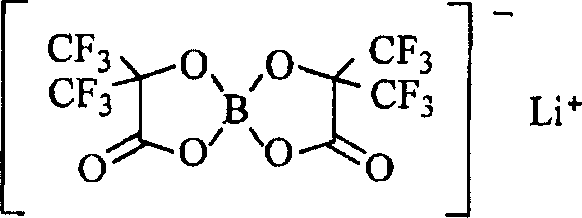
具体地说,可更优选列举由化学式10表示的二氟[草酸根合-O,O’]硼酸锂、由化学式11表示的四氟[草酸根合-O,O’]磷酸锂、由化学式12表示的二氟双[草酸根合-O,O’]磷酸锂、由化学式13表示的二氟[3,3,3-三氟-2-氧化物-2-三氟甲基丙酸酯(2-)-O,O’]硼酸锂、或由化学式14表示的双[3,3,3-三氟-2-氧化物-2-三氟甲基丙酸酯(2-)-O,O’]硼酸锂。当包括B-O键或P-O键,可获得更高的效果。特别地,当包括O-B-O键或O-P-O键时,还可获得更高的效果。此外,当使用具有由化学式7表示的结构的轻金属盐如由化学式13表示的二氟[3,3,3-三氟-2-氧化物-2-三氟甲基丙酸酯(propionate)(2-)-O,O’]硼酸锂和由化学式14表示的双[3,3,3-三氟-2-氧化物-2-三氟甲基丙酸酯(2-)-O,O’]硼酸锂时,具有氟的环状碳酸酯衍生物优选用于溶剂。而且,当使用由化学式10表示的二氟[草酸根合-O,O’]硼酸锂或由化学式13表示的二氟[3,3,3-三氟-2-氧化物-2-三氟甲基丙酸酯(2-)-O,O’]硼酸锂时,具有氯的环状碳酸酯衍生物优选用于溶剂。由此,可获得更高的效果。Specifically, difluoro[oxalato-O, O'] lithium borate represented by Chemical Formula 10, tetrafluoro[oxalato-O, O'] lithium phosphate represented by
[化学式10][chemical formula 10]
[化学式11][chemical formula 11]
[化学式12][chemical formula 12]
[化学式13][chemical formula 13]
[化学式14][chemical formula 14]
作为电解质盐,还优选列举由化学式2表示的轻金属盐。这种轻金属盐页可在负极22的表面上形成稳定涂层,且可抑制溶剂的分解反应。由化学式2表示的轻金属盐可单独使用,或通过混合使用其几种。此外,由化学式2表示的轻金属盐可通过与由化学式1表示的轻金属盐混合而使用。As the electrolyte salt, light metal salts represented by Chemical Formula 2 are also preferably cited. Such a light metal salt sheet can form a stable coating on the surface of the
[化学式2][chemical formula 2]
在式中,R31、R32、R33和R34表示通过用卤素取代烷基的至少部分氢获得的基团。R31、R32、R33和R34可相同或不同。In the formula, R31, R32, R33 and R34 represent groups obtained by substituting at least part of hydrogen of an alkyl group with a halogen. R31, R32, R33 and R34 may be the same or different.
具体地说,优选列举由化学式15表示的四(三氟乙酸酯)硼酸锂、由化学式16表示的四(五氟丙酸酯(propanoate))硼酸锂、或由化学式17表示的四(三氯乙酸酯)硼酸锂。当包括B-O键或P-O键,可获得更高的效果。特别地,当包括O-B-O键或O-P-O键时,还可获得更高的效果。此外,优选通过与具有氟的环状碳酸酯衍生物混合来使用这些轻金属盐。而且,当使用由化学式15表示的四(三氟乙酸酯)硼酸锂时,具有氯的环状碳酸酯衍生物优选用于溶剂,因为由此可获得更高的效果。Specifically, tetrakis(trifluoroacetate)lithium borate represented by
[化学式15][chemical formula 15]
LiB(OCOCF3)4 LiB(OCOCF 3 ) 4
[化学式16][chemical formula 16]
LiB(OCOC2F5)4 LiB(OCOC 2 F 5 ) 4
[化学式17][chemical formula 17]
LiB(OCOCCl3)4 LiB(OCOCCl 3 ) 4
此外,对于电解质盐,除了这些轻金属盐以外,优选与其混合一种或多种其他轻金属盐。由此,可改善电池特性如储存特性,且可降低内阻。作为其他轻金属盐,例如,可列举由化学式18表示的锂盐如LiB(C6H5)4、LiCH3SO3、LiCF3SO3、LiAlCl4、LiSiF6、LiCl、LiBr、LiPF6、LiBF4、LiClO4、LiAsF6、LiN(CF3SO2)2、LiN(C2F5SO2)2、和LiN(C4F9SO2)(CF3SO2),,或由化学式19表示的锂盐如LiC(CF3SO2)3。Furthermore, as for the electrolyte salt, in addition to these light metal salts, one or more other light metal salts are preferably mixed therewith. Thereby, battery characteristics such as storage characteristics can be improved, and internal resistance can be reduced. As other light metal salts, for example, lithium salts represented by Chemical Formula 18 such as LiB(C 6 H 5 ) 4 , LiCH 3 SO 3 , LiCF 3 SO 3 , LiAlCl 4 , LiSiF 6 , LiCl, LiBr, LiPF 6 , LiBF 4 , LiClO 4 , LiAsF 6 , LiN(CF 3 SO 2 ) 2 , LiN(C 2 F 5 SO 2 ) 2 , and LiN(C 4 F 9 SO 2 )(CF 3 SO 2 ), or by chemical formula 19 Represented lithium salts such as LiC(CF 3 SO 2 ) 3 .
[化学式18][chemical formula 18]
LiN(CmF2m+1SO2)(CnF2n+1SO2)LiN(C m F 2m+1 SO 2 )(C n F 2n+1 SO 2 )
在式中,m和n为1或更大的整数。In the formula, m and n are integers of 1 or more.
[化学式19][chemical formula 19]
LiC(CpF2p+1SO2)(CqF2q+1SO2)(CrF2r+1SO2)LiC(C p F 2p+1 SO 2 )(C q F 2q+1 SO 2 )(C r F 2r+1 SO 2 )
在式中,p、q、和r为1或更大的整数。In the formula, p, q, and r are integers of 1 or more.
具体地说,优选包含至少一种选自LiPF6、LiBF4、LiClO4、LiAsF6、由化学式18表示的锂盐、和由化学式19表示的锂盐,因为由此可获得更高的效果且可获得更高的电导率。更优选通过混合使用LiPF6和选自LiBF4、LiClO4、LiAsF6、由化学式18表示的锂盐、由化学式19表示的锂盐的至少一种。Specifically, it is preferable to contain at least one selected from LiPF 6 , LiBF 4 , LiClO 4 , LiAsF 6 , the lithium salt represented by Chemical Formula 18, and the lithium salt represented by Chemical Formula 19, because thereby a higher effect can be obtained and Higher conductivity can be obtained. It is more preferable to use LiPF 6 and at least one selected from LiBF 4 , LiClO 4 , LiAsF 6 , lithium salt represented by Chemical Formula 18, lithium salt represented by Chemical Formula 19 by mixing.
电解质盐的含量(浓度)相对于溶剂优选为0.3mol/kg-3.0mol/kg。如果在该范围之外,由于离子电导率的显著降低不能获得充分的电池特性。在上述中,由化学式1或化学式2表示的轻金属盐的含量相对于溶剂优选为0.01mol/kg-2.0mol/kg。在这种范围内,可获得更高的效果。The content (concentration) of the electrolyte salt is preferably 0.3 mol/kg to 3.0 mol/kg relative to the solvent. If outside this range, sufficient battery characteristics cannot be obtained due to a significant decrease in ion conductivity. Among the above, the content of the light metal salt represented by Chemical Formula 1 or Chemical Formula 2 is preferably 0.01 mol/kg-2.0 mol/kg relative to the solvent. Within this range, higher effects can be obtained.
例如,可如下制造二次电池。For example, a secondary battery can be manufactured as follows.
首先,例如,将能够插入和脱出锂的正极材料、电导体和粘合剂混合制备正极混合物,将其分散在溶剂如N-甲基-2-吡咯烷酮中以获得正极混合物浆料。接着,用该正极混合物浆料涂覆正极集电体21A,将其干燥并通过辊压机等压缩模塑以形成正极活性材料层21B并形成正极21。First, for example, a cathode material capable of intercalating and extracting lithium, an electrical conductor, and a binder are mixed to prepare a cathode mixture, which is dispersed in a solvent such as N-methyl-2-pyrrolidone to obtain a cathode mixture slurry. Next, the positive electrode current collector 21A is coated with this positive electrode mixture slurry, dried and compression molded by a roll press or the like to form the positive electrode active material layer 21B and form the
此外,例如,作为负极22,制备负极集电体22A。对于负极22,可按照原状使用锂金属,或可使用通过附上锂金属在负极集电体22A上形成负极活性材料层22B获得的负极。In addition, for example, as the
随后,通过焊接等将正极引线25连接到正极集电体21A上,和通过焊接等将负极引线26连接到负极集电体22A上。随后,正极21和负极22与在其间的隔膜23一起卷绕。正极引线25一端焊接到安全阀机构15上,和负极引线26的一端焊接到电池壳11上。卷绕的正极21和卷绕的负极22夹在一对绝缘板12和13之间,并容纳在电池壳11内部。在正极21和负极22容纳在电池壳11内部之后,将电解溶液注入到电池壳11中并浸渍在隔膜23内。之后,在电池外壳11的开口端,通过衬垫17填隙,固定电池盖14、安全阀机构15和PTC器件16。由此完成图1所示的二次电池。Subsequently, the
在该二次电池中,当充电时,例如锂离子从正极21中脱出,并通过电解溶液以锂金属沉积到负极集电体22A的表面上,并形成如图2所示的的负极活性材料层22B。当放电时,例如锂金属以锂离子从负极活性材料层22B洗提出,并通过电解溶液插入到正极21内。这里,电解溶液包含具有卤原子的环状碳酸酯衍生物和由化学式1或化学式2表示的轻金属盐,因此抑制负极22中溶剂的分解反应。从而,改善负极22中锂的充电和放电效率。In this secondary battery, when charging, for example, lithium ions are extracted from the
如上,在该上述方式中,由于电解溶液包含具有卤原子的环状碳酸酯衍生物和由化学式1或化学式2表示的轻金属盐,因此可抑制负极22中溶剂的分解反应。从而,改善负极22中锂的充电和放电效率,并可改善循环特性。As above, in this above mode, since the electrolytic solution contains the cyclic carbonate derivative having a halogen atom and the light metal salt represented by Chemical Formula 1 or Chemical Formula 2, the decomposition reaction of the solvent in the
此外,当除由化学式1或化学式2表示的轻金属盐之外还使用其他轻金属盐时,可更加改善循环特性。In addition, when other light metal salts are used in addition to the light metal salt represented by Chemical Formula 1 or Chemical Formula 2, cycle characteristics may be more improved.
(第二实施方式)(second embodiment)
根据本发明第二实施方式的二次电池是所谓的锂离子二次电池,其中负极容量通过由于作为电极反应物的锂的插入和脱出的容量部分表示。The secondary battery according to the second embodiment of the present invention is a so-called lithium ion secondary battery in which the capacity of the negative electrode is expressed by a part of the capacity due to insertion and extraction of lithium as an electrode reactant.
该二次电池具有与根据本发明第一实施方式的二次电池类似的结构和效果,除了负极活性材料层具有不同的结构以外,并可类似地制造。因此,这里,通过参照图1和图2使用相同的符号给出描述。相同部分的详细描述将省略。The secondary battery has a similar structure and effect to the secondary battery according to the first embodiment of the present invention, and can be similarly manufactured except that the negative electrode active material layer has a different structure. Therefore, here, description is given by using the same symbols with reference to FIG. 1 and FIG. 2 . Detailed descriptions of the same parts will be omitted.
负极活性材料层22B包含,例如,能够插入和脱出作为电极反应物的锂的负极材料作为负极活性材料。The anode active material layer 22B contains, for example, an anode material capable of inserting and extracting lithium as an electrode reactant as an anode active material.
在该二次电池中,能够插入和脱出锂在负极材料的充电容量大于正极21的充电容量。即,在该二次电池中,锂金属在充电中不沉积在负极22上。In this secondary battery, the charge capacity capable of inserting and extracting lithium in the negative electrode material is greater than that of the
作为能够插入和脱出锂的负极材料,例如,可列举包含锡或硅作为元素的材料。锡和硅具有高的插入和脱出锂的能力,并提供高能量密度。As the negative electrode material capable of inserting and extracting lithium, for example, a material containing tin or silicon as an element can be cited. Tin and silicon have a high ability to insert and extract lithium and provide high energy density.
作为这种负极材料,可特别列举锡的单质、合金、或化合物;硅的单质、合金、或化合物;或至少部分具有其一种或多种相的材料。在本发明中,除包括两种或多种金属元素的合金以外,合金还包括含一种或多种金属元素和一种或多种准金属元素的合金。此外,合金可包含非金属元素。其结构包括固溶体、低共熔晶体(低共熔混合物)、金属间化合物、及其中其两种或多种共存的结构。As such a negative electrode material, a simple substance, an alloy, or a compound of tin; a simple substance, an alloy, or a compound of silicon; or a material at least partially having one or more phases thereof can be exemplified. In the present invention, alloys include alloys containing one or more metal elements and one or more metalloid elements, in addition to alloys including two or more metal elements. In addition, alloys may contain non-metallic elements. Its structure includes solid solution, eutectic crystal (eutectic mixture), intermetallic compound, and a structure in which two or more thereof coexist.
作为锡的合金,例如,可列举含硅、镍、铜、铁、钴(Co)、锰(Mn)、锌(Zn)、铟(In)、银(Ag)、钛(Ti)、锗(Ge)、铋(Bi)、锑(Sb)和铬(Cr)中的至少一种作为除锡外的第二元素的合金。作为硅的合金,例如,可列举含有锡、镍、铜、铁、钴、锰、锌、铟、银、钛、锗、铋、锑和铬的至少一种作为除硅外的第二元素的合金。As an alloy of tin, for example, silicon, nickel, copper, iron, cobalt (Co), manganese (Mn), zinc (Zn), indium (In), silver (Ag), titanium (Ti), germanium ( An alloy of at least one of Ge), bismuth (Bi), antimony (Sb) and chromium (Cr) as a second element other than tin. As an alloy of silicon, for example, one containing at least one of tin, nickel, copper, iron, cobalt, manganese, zinc, indium, silver, titanium, germanium, bismuth, antimony, and chromium as a second element other than silicon can be cited. alloy.
作为锡化合物或硅化合物,可列举例如含氧(O)或碳(C)的化合物。除了锡或硅以外,该化合物还可含有前述第二种元素。Examples of tin compounds or silicon compounds include compounds containing oxygen (O) or carbon (C). The compound may contain the aforementioned second element in addition to tin or silicon.
具体地说,作为这种负极材料,优选含有锡、钴和碳作为元素的含CoSnC材料,其中碳含量为9.9重量%-29.7重量%,且钴对锡与钴的总量之比(Co/(Sn+Co))为30重量%-70重量%。在该组成范围内,可获得高能量密度,和可获得优异的循环特性。Specifically, as such a negative electrode material, a CoSnC-containing material containing tin, cobalt, and carbon as elements is preferable, wherein the carbon content is 9.9% by weight to 29.7% by weight, and the ratio of cobalt to the total amount of tin and cobalt (Co/ (Sn+Co)) is 30% by weight to 70% by weight. Within this composition range, high energy density can be obtained, and excellent cycle characteristics can be obtained.
如果必要的话,含CoSnC的材料可进一步含有其它元素。作为其它元素,优选例如硅、铁、镍、铬、铟、铌(Nb)、锗、钛、钼(Mo)、铝、磷、镓(Ga)或铋。可包含其中的两种或多种,因为可因此进一步改进容量或循环特性。The CoSnC-containing material may further contain other elements, if necessary. As other elements, for example, silicon, iron, nickel, chromium, indium, niobium (Nb), germanium, titanium, molybdenum (Mo), aluminum, phosphorus, gallium (Ga), or bismuth are preferable. Two or more of them may be contained, since capacity or cycle characteristics can thereby be further improved.
含CoSnC的材料具有含锡、钴和碳的相。该相优选具有低结晶度的结构或无定形结构。此外,优选在含CoSnC的材料中,作为元素的至少一部分碳与作为其它元素的金属元素或准金属元素结合。据信由于锡等的凝聚(cohesion)或结晶引起降低的循环特性。可通过使碳与其它元素结合来抑制这种凝聚或结晶。CoSnC-containing materials have phases containing tin, cobalt, and carbon. This phase preferably has a structure with low crystallinity or an amorphous structure. Furthermore, it is preferable that in the CoSnC-containing material, at least a part of carbon as an element is combined with a metal element or a metalloid element as another element. It is believed that the reduced cycle characteristics are caused by cohesion or crystallization of tin or the like. Such aggregation or crystallization can be suppressed by combining carbon with other elements.
作为检验元素结合状态的方法,可列举例如X-射线光电子能谱法(XPS)。在XPS中,在石墨的情况下,在该装置中在284.5eV处观察到碳的1s轨道(C1s)的峰,在该装置中进行能量校正,以便在84.0eV下观察到金原子的4f轨道(Au4f)的峰。在表面污染的碳的情况下,在284.8eV下观察到峰。同时,在碳元素的较高电荷密度的情况下,例如当碳与金属元素或准金属元素结合时,在低于284.5eV的区域内观察到C1s峰。也就是说,当在低于284.5eV的区域内观察到含CoSnC的材料所获得的C1s的复合波的峰时,包含在含CoSnC的材料内的至少一部分碳与作为其它元素的金属元素或准金属元素结合。As a method for examining the binding state of elements, for example, X-ray photoelectron spectroscopy (XPS) can be cited. In XPS, in the case of graphite, the peak of the 1s orbital (C1s) of carbon is observed at 284.5eV in this setup, which is energy corrected so that the 4f orbital of the gold atom is observed at 84.0eV (Au4f) peak. In the case of surface-contaminated carbon, a peak was observed at 284.8 eV. Meanwhile, in the case of higher charge density of carbon elements, such as when carbon is combined with metal elements or metalloid elements, a C1s peak is observed in the region below 284.5 eV. That is, when the peak of the composite wave of C1s obtained by the CoSnC-containing material is observed in a region lower than 284.5 eV, at least a part of the carbon contained in the CoSnC-containing material is mixed with the metal element or quasi-metal element as other elements. Metal elements combine.
在XPS测量中,例如C1s峰用于校正光谱的能量轴。由于表面污染的碳通常存在于表面上,因此设定表面污染的碳的C1s峰为284.8eV(其用作能量基准值)。在XPS测量中,得到C1s的峰的波形作为包括表面污染的碳的峰和在含CoSnC的材料内的碳的峰的形状。因此,通过使用市购的软件等分析,分离表面污染的碳的峰和在含CoSnC的材料内的碳的峰。在波形分析中,存在于最低结合能侧上的主峰位置设定为能量基准值(284.8eV)。In XPS measurement, for example the C1s peak is used to correct the energy axis of the spectrum. Since surface-contaminated carbon usually exists on the surface, the C1s peak of surface-contaminated carbon was set at 284.8 eV (which was used as an energy reference value). In the XPS measurement, the waveform of the peak of C1s was obtained as the peak shape including the peak of surface-contaminated carbon and the peak of carbon within the CoSnC-containing material. Therefore, by analysis using commercially available software or the like, the peak of surface-contaminated carbon and the peak of carbon within the CoSnC-containing material are separated. In the waveform analysis, the position of the main peak existing on the lowest binding energy side was set as the energy reference value (284.8 eV).
作为能插入和脱出锂的负极材料,可列举例如含有能与锂形成合金的其它金属元素或其它准金属元素作为元素的材料。作为这种金属元素或准金属元素,可列举镁(Mg)、硼、铝、镓、铟、锗、铅(Pb)、铋、镉(Cd)、银、锌、铪(Hf)、锆(Zr)、钇(Y)、钯(Pd)或铂(Pt)。As the negative electrode material capable of intercalating and deintercalating lithium, for example, materials containing other metal elements or other metalloid elements capable of forming an alloy with lithium as elements are exemplified. Examples of such metal elements or metalloid elements include magnesium (Mg), boron, aluminum, gallium, indium, germanium, lead (Pb), bismuth, cadmium (Cd), silver, zinc, hafnium (Hf), zirconium ( Zr), yttrium (Y), palladium (Pd) or platinum (Pt).
除了上述负极材料外,负极活性材料层22B可进一步包含其他负极材料和其他材料如粘合剂例如聚偏二氟乙烯和电导体。作为其他负极材料,可列举能够插入和脱出锂的碳材料。优选碳材料,因为在使用碳材料的情况下,在充电和放电时发生的晶体结构的变化非常小,且例如,当将碳材料与上述负极材料一起使用时,可获得更高的能量密度,可获得优越的循环特性,且还可由此获得作为电导体的功能。In addition to the anode material described above, the anode active material layer 22B may further contain other anode materials and other materials such as binders such as polyvinylidene fluoride and electrical conductors. Examples of other negative electrode materials include carbon materials capable of inserting and extracting lithium. A carbon material is preferable because, in the case of using a carbon material, the change in crystal structure that occurs at the time of charge and discharge is very small, and for example, when a carbon material is used together with the above-mentioned negative electrode material, higher energy density can be obtained, Excellent cycle characteristics can be obtained, and a function as an electric conductor can also be obtained thereby.
作为这种碳材料,例如,可列举石墨、不-可石墨化碳、和可石墨化碳。特别地,优选石墨,因为石墨具有大的电化当量并提供高能量密度。As such a carbon material, for example, graphite, non-graphitizable carbon, and graphitizable carbon can be cited. In particular, graphite is preferable because graphite has a large electrochemical equivalent and provides high energy density.
作为石墨,例如,优选真密度为2.10g/cm3或更大的石墨,且更优选真密度为2.18g/cm3或更大的石墨。为了获得这种真密度,必要的是在(002)面上的C轴微晶(crystallite)厚度为14.0nm或更大。此外(002)面的面间距优选在0.340nm以下,且更优选为0.335nm-0.337nm。As graphite, for example, graphite having a true density of 2.10 g/cm 3 or more is preferable, and graphite having a true density of 2.18 g/cm 3 or more is more preferable. In order to obtain such a true density, it is necessary that the thickness of the C-axis crystallite on the (002) plane is 14.0 nm or more. In addition, the interplanar spacing of the (002) planes is preferably 0.340 nm or less, and more preferably 0.335 nm to 0.337 nm.
作为不-可石墨化碳,优选(002)面的面间距为0.37nm或更大且真密度在1.70g/cm3以下的不-可石墨化碳,其在空气中在差热分析(DTA)中在700℃或更高不显示放热峰。As the non-graphitizable carbon, the non-graphitizable carbon whose interplanar spacing of (002) plane is 0.37nm or more and true density below 1.70g/ cm3 is preferred, which can be analyzed in differential thermal analysis (DTA) in air. ) does not show an exothermic peak at 700°C or higher.
负极22可如下形成。例如,将能够插入或脱出锂的负极材料、电导体、和粘合剂混合制备负极混合物,将其分散在溶剂如N-甲基-2-吡咯烷酮中以获得负极混合物浆料。之后,用该负极混合物浆料涂覆负极集电体22A,将溶剂干燥并通过辊压机等压缩模塑以形成负极活性材料层22B并形成负极22。The
在该二次电池中,当充电时,例如锂离子从正极21中脱出,并通过电解溶液插入到负极22内。当放电时,例如锂离子从负极22中脱出,并通过电解溶液插入到正极21内。这里,电解溶液包含具有卤原子的环状碳酸酯衍生物和由化学式1或化学式2表示的轻金属盐,因此抑制负极22中溶剂的分解反应。从而,改善负极22中锂的充电和放电效率。In this secondary battery, when charged, for example, lithium ions are extracted from the
(第三实施方式)(third embodiment)
根据本发明第三实施方式的二次电池具有与根据本发明第二实施方式的二次电池类似的结构和工作,除了负极具有不同的结构以外,并可类似地制造。因此,参照图1和图2用相同的符号表示相应的部分,且相同部分的描述将省略。The secondary battery according to the third embodiment of the present invention has a structure and operation similar to that of the secondary battery according to the second embodiment of the present invention, except that the negative electrode has a different structure, and can be similarly manufactured. Therefore, corresponding parts are denoted by the same symbols with reference to FIGS. 1 and 2 , and descriptions of the same parts will be omitted.
如根据第二实施方式的二次电池一样,负极22具有这样的结构:其中在负极集电体22A的两面或一面上提供负极活性材料层22B。该负极活性材料层22B包含,例如,含锡或硅作为元素的负极材料。具体地说,例如,可包含锡的单质、合金、或化合物,硅的单质、合金、或化合物,或其两种或多种。Like the secondary battery according to the second embodiment, the
此外,负极活性材料层22B通过例如气相沉积法、液相沉积法、热喷涂方法或焙烧方法,或者这些方法的两种或多种来形成。优选在至少一部分界面上使负极活性材料层22B和负极集电体22A合金化。具体地说,优选在界面处,负极集电体22A的元素扩散到负极活性材料层22B内,或者负极活性材料中的元素扩散到负极集电体22A内,或者两者元素在彼此内扩散。由此,可抑制由充电和放电引起的负极活性材料层22B的膨胀和收缩导致的破坏,和可改进在负极活性材料层22B与负极集电体22A之间的导电率。In addition, the anode active material layer 22B is formed by, for example, a vapor phase deposition method, a liquid phase deposition method, a thermal spray method, or a firing method, or two or more of these methods. The anode active material layer 22B and the anode current collector 22A are preferably alloyed on at least a part of the interface. Specifically, preferably at the interface, elements of the negative electrode current collector 22A diffuse into the negative electrode active material layer 22B, or elements in the negative electrode active material diffuse into the negative electrode current collector 22A, or both elements diffuse into each other. Thereby, damage caused by expansion and contraction of the anode active material layer 22B caused by charge and discharge can be suppressed, and electrical conductivity between the anode active material layer 22B and the anode current collector 22A can be improved.
焙烧方法是例如其中粒状负极材料、粘合剂等混合,将该混合物分散在溶剂内,用生成物涂布负极集电体,然后在比粘合剂等的熔点高的的温度下对其进行热处理的方法。作为气相沉积法,例如,可使用物理沉积法或化学沉积法。具体地说,可利用真空气相沉积法、溅射法、离子电镀法、激光烧蚀法、热CVD(化学气相沉积)法、等离子体CVD法等。作为液相沉积法,可利用已知技术如电解电镀和化学镀(electroless plating)。The firing method is, for example, in which a granular negative electrode material, a binder, etc. are mixed, the mixture is dispersed in a solvent, a negative electrode current collector is coated with the resultant, and then it is subjected to a temperature higher than the melting point of the binder, etc. The method of heat treatment. As the vapor deposition method, for example, a physical deposition method or a chemical deposition method can be used. Specifically, a vacuum vapor deposition method, a sputtering method, an ion plating method, a laser ablation method, a thermal CVD (Chemical Vapor Deposition) method, a plasma CVD method, and the like can be utilized. As the liquid phase deposition method, known techniques such as electrolytic plating and electroless plating can be utilized.
(第四实施方式)(fourth embodiment)
根据本发明第四实施方式的二次电池是其中负极容量包括由于作为电极反应物的锂的插入和脱出的容量部分和由于锂的沉积和溶解的容量部分,并由其总和表示的二次电池。The secondary battery according to the fourth embodiment of the present invention is a secondary battery in which the capacity of the negative electrode includes a capacity part due to insertion and extraction of lithium as an electrode reactant and a capacity part due to deposition and dissolution of lithium, and is represented by the sum thereof .
该二次电池具有与根据第一至第三实施方式的二次电池类似的结构和效果,除了负极活性材料层的结构不同以外,且可类似地制造。因此,这里,通过参照图1和图2使用相同的符号给出描述。相同部分的详细描述将省略。The secondary battery has similar structures and effects to those of the secondary batteries according to the first to third embodiments, except that the structure of the negative electrode active material layer is different, and can be similarly manufactured. Therefore, here, description is given by using the same symbols with reference to FIG. 1 and FIG. 2 . Detailed descriptions of the same parts will be omitted.
在负极活性材料层22B中,例如,通过设置能够插入和脱出锂的负极材料的充电容量小于正极21的充电容量,当在充电过程开路电压(即,电池电压)低于过充电压时,锂金属开始在负极22上沉积。因此,在该二次电池中,能够插入和脱出锂的负极材料和锂金属都起到负极活性材料的作用,且当锂金属沉积时,能够插入和脱出锂的负极材料为基体材料。作为能够插入和脱出锂的负极材料,可列举与第二实施方式类似的材料。具体地说,优选能够插入和脱出锂的碳材料。In the negative electrode active material layer 22B, for example, by setting the charging capacity of the negative electrode material capable of intercalating and extracting lithium smaller than that of the
过充电压是指当电池过充时的开路电压。例如,过充电压是指比在“Guidelines for Safety Assessment of lithium secondary batteries”(SBA G1101)中描述和定义的“完全充电”的电池的开路电压高的电压,其为日本蓄电池工业公司(Japan Storage Battery Industries Incorporated)(日本电池协会)指定的准则之一。换句话说,过充电压是指比在通过使用用于获得每个电池的额定容量的充电方法、标准充电方法、或推荐充电方法充电后的开路电压高的电压。The overcharge voltage refers to the open circuit voltage when the battery is overcharged. For example, overcharge voltage refers to a voltage higher than the open circuit voltage of a "fully charged" battery described and defined in "Guidelines for Safety Assessment of lithium secondary batteries" (SBA G1101), which is Japan Storage Battery Industry Corporation (Japan Storage One of the guidelines specified by Battery Industries Incorporated) (Battery Association of Japan). In other words, the overcharge voltage refers to a voltage higher than the open circuit voltage after charging by using the charging method for obtaining the rated capacity of each battery, the standard charging method, or the recommended charging method.
因此,在该二次电池中,可获得高能量密度,且可改善循环特性和快速充电特性。在使用能够插入和脱出锂的负极材料用于负极22的方面,该二次电池与传统的锂离子二次电池类似。此外,在锂金属沉积在负极22上的方面,该锂二次电池与传统的锂金属二次电池类似。Therefore, in the secondary battery, high energy density can be obtained, and cycle characteristics and quick charge characteristics can be improved. This secondary battery is similar to a conventional lithium ion secondary battery in that an anode material capable of inserting and extracting lithium is used for the
为了更有效地获得这些特性,例如,优选在开路电压变为过充电压前的最大电压时在负极22上沉积的锂金属的最大沉积容量为能够插入和脱出锂的负极材料的充电容量能力的0.05倍-3倍。当锂金属的沉积量太大时,导致与传统锂金属二次电池类似的缺点。同时,当锂金属沉积量太小时,充电和放电容量不是足够大。此外,例如,能够插入和脱出锂的负极材料的放电容量能力优选为150mAh/g或更大。能够插入和脱出锂的能力越高,锂金属的沉积量变得相对越小。例如,由当对具有由这种负极材料构成的负极活性材料的负极通过使用锂金属作为对电极通过恒流和恒压法进行充电直到0V时的电荷得到负极材料的充电容量能力。例如,由当随后通过恒流法进行放电10小时或更多直到2.5V时的电荷得到负极材料的放电容量能力。In order to obtain these characteristics more effectively, for example, it is preferable that the maximum deposition capacity of the lithium metal deposited on the
在该二次电池中,当充电时,锂离子从正极21脱出,并通过电解溶液首先插入包含在负极22中的能够插入和脱出锂的负极材料中。当进一步充电时,在开路电压低于过充电压的状态下,锂金属开始沉积在能够插入和脱出锂的负极材料的表面上。之后,锂金属继续沉积在负极22上直到充电完成。接着,当放电时,首先,沉积在负极22上的锂金属以离子洗提出,该离子通过电解溶液插入正极21中。当进一步放电时,插入在负极22中的能够插入和脱出锂的负极材料中的锂离子脱出,并通过电解溶液插入正极21中。这里,电解溶液包含具有卤原子的环状碳酸酯衍生物和由化学式1或化学式2表示的轻金属盐,因此抑制负极22中溶剂的分解反应。从而,改善负极22中锂的充电和放电效率。In this secondary battery, when charged, lithium ions are extracted from the
(第五实施方式)(fifth embodiment)
图3展示了根据本发明第五实施方式的结构。在该二次电池中,其上附着有正极引线31和负极引线32的螺旋卷绕电极体30包含在膜包装元件40内部。因此,可降低其尺寸、重量、和厚度。Fig. 3 shows a structure according to a fifth embodiment of the present invention. In this secondary battery, a spirally
例如,正极引线31和负极引线32分别以相同的方向从包装元件40的内部引向外部。正极引线31和负极引线32分别由例如金属材料如铝、铜、镍、和不锈钢制成,且为薄板状或网状。For example, the
膜包装元件40是由矩形铝层压膜制成,例如在该膜中尼龙膜、铝箔和聚乙烯膜以该顺序结合在一起。例如,包装元件40如此布置以使得聚乙烯膜侧与螺旋卷绕电极体30相对,并通过熔焊或粘附剂使各自的外缘相互接触。用来防止外部空气侵入的粘附膜41插入到包装元件40和正极引线31、负极引线32之间。粘附膜41是由对正极引线31和负极引线32具有接触特性的材料制成,例如聚乙烯、聚丙烯、改性聚乙烯和改性聚丙烯的聚烯烃树脂。The
包装元件40可由具有不同结构的层压膜、高分子量膜如聚丙烯、或金属膜来代替上述铝层压膜制成。The
图4显示了沿图3所示的螺旋卷绕电极体30的线I-I的横截面结构。在螺旋卷绕电极体30中,正极33和负极34与在其中间的隔膜35和电解质层36一起成层堆积并卷绕。其最外围由保护带37保护。FIG. 4 shows a cross-sectional structure along line I-I of the spirally
正极33具有其中正极活性材料层33B提供在正极集电体33A的一面或两面上的结构。负极34具有其中负极活性材料层34B提供在负极集电体34A的一面或两面上的结构。进行布置使得负极活性材料层34B侧与正极活性材料层33B相对。正极集电体33A、正极活性材料层33B、负极集电体34A、负极活性材料层34B和隔膜35的结构分别与第一至第四实施方式中所述的正极集电体21A、正极活性材料层21B、负极集电体22A、负极活性材料层22B和隔膜23的结构类似。The cathode 33 has a structure in which a cathode active material layer 33B is provided on one or both surfaces of a cathode current collector 33A. The anode 34 has a structure in which an anode active material layer 34B is provided on one or both surfaces of an anode current collector 34A. Arrangement is made such that the negative electrode active material layer 34B side is opposed to the positive electrode active material layer 33B. The structures of the positive electrode current collector 33A, the positive electrode active material layer 33B, the negative electrode current collector 34A, the negative electrode active material layer 34B, and the separator 35 are the same as those of the positive electrode current collector 21A, positive electrode active material described in the first to fourth embodiments, respectively. The structures of the layer 21B, the negative electrode collector 22A, the negative electrode active material layer 22B, and the
电解质层36是所谓的凝胶状态,其包含电解溶液和可成为保持电解溶液的支撑体的高分子量化合物。优选凝胶状电解质层36,因为由此并可防止电池泄漏。凝胶状电解质的结构和高分子量化合物的结构不特别限定,只要该凝胶状电解质在室温下具有1mS/cm或更大的离子电导率。电解溶液的结构(即,溶剂、电解质盐等)与第一至第三实施方式的相似。作为高分子量材料,例如,可列举聚丙烯腈、聚偏二氟乙烯、聚偏二氟乙烯和六氟丙烯的共聚物、聚四氟乙烯、聚六氟丙烯、聚环氧乙烷、聚环氧丙烷、聚磷腈(polyphosphazen)、聚硅氧烷、聚乙酸乙烯酯、聚乙烯醇、聚甲基丙烯酸甲基(polymethacrylic acid methyl)、聚丙烯酸、聚甲基丙烯酸、丁苯橡胶、丁腈橡胶、聚苯乙烯、或聚碳酸酯。特别地,考虑到电化学稳定性,期望使用具有聚丙烯腈、聚偏二氟乙烯、聚六氟丙烯、或聚环氧乙烷结构的高分子量化合物。虽然加入到电解溶液的高分子量化合物的量取决于两者的相容性,但通常优选加入的高分子量化合物的量相当于电解溶液的5重量%-50重量%。The electrolyte layer 36 is in a so-called gel state, which contains an electrolytic solution and a high molecular weight compound that can become a support for holding the electrolytic solution. The gel-like electrolyte layer 36 is preferable because thereby battery leakage can also be prevented. The structure of the gel-like electrolyte and the structure of the high-molecular-weight compound are not particularly limited as long as the gel-like electrolyte has an ion conductivity of 1 mS/cm or more at room temperature. The structure of the electrolytic solution (ie, solvent, electrolyte salt, etc.) is similar to that of the first to third embodiments. Examples of high molecular weight materials include polyacrylonitrile, polyvinylidene fluoride, copolymers of polyvinylidene fluoride and hexafluoropropylene, polytetrafluoroethylene, polyhexafluoropropylene, polyethylene oxide, polycyclic Propylene oxide, polyphosphazene, polysiloxane, polyvinyl acetate, polyvinyl alcohol, polymethacrylic acid methyl, polyacrylic acid, polymethacrylic acid, styrene-butadiene rubber, nitrile Rubber, polystyrene, or polycarbonate. In particular, in consideration of electrochemical stability, it is desirable to use a high molecular weight compound having a structure of polyacrylonitrile, polyvinylidene fluoride, polyhexafluoropropylene, or polyethylene oxide. Although the amount of the high molecular weight compound added to the electrolytic solution depends on the compatibility of the two, it is generally preferred to add the high molecular weight compound in an amount corresponding to 5% by weight to 50% by weight of the electrolytic solution.
例如,可如下制造二次电池。For example, a secondary battery can be manufactured as follows.
首先,用包含电解溶液、高分子量化合物和混合溶剂的前体溶液分别涂覆正极33和负极34。挥发混合溶剂以形成电解质层36。然后,通过焊接将正极引线31连接到正极集电体33A的一端,和通过焊接将负极引线32连接到负极集电体34A的一端。接着,将形成的具有电解质层36的正极33和负极34与在其中间的隔膜35成层堆积得到叠层物。之后,在纵向上卷绕该叠层物,将保护带37粘合到其最外围形成螺旋卷绕的电极体30。最后,例如,将螺旋卷绕电极体30夹在包装元件40之间,且通过热熔焊等使包装元件40的外缘接触,以密封螺旋卷绕电极体30。然后,将粘附膜41插入到正极引线31、负极引线32和包装元件40之间。从而完成了图3和图4所示的二次电池。First, the positive electrode 33 and the negative electrode 34 are respectively coated with a precursor solution including an electrolytic solution, a high molecular weight compound, and a mixed solvent. The mixed solvent is volatilized to form the electrolyte layer 36 . Then, the
此外,可如下来制备二次电池。首先,将正极引线31和负极引线32连接到正极33和负极34上。之后,将正极33和负极34与在其中间的隔膜35成层堆积并卷绕。将保护带37粘合到其最外围,并形成作为螺旋卷绕电极体30的前体的卷绕体。然后,将卷绕体夹于包装元件40之间,对其最外围除一侧之外进行热熔焊以得到袋状,并将卷绕体包含在包装元件40的内部。随后,制备包含电解溶液、作为用于高分子量化合物的原料的单体、聚合引发剂、和如果必要的其他的材料如聚合抑制剂的电解质用物质组合物,将该组合物注入到包装元件40中。In addition, a secondary battery may be produced as follows. First, the
在注入电解质用物质组合物后,将包装元件40的开口端在真空环境中进行热熔焊并密封。然后,加热所得物以使单体聚合,得到高分子量化合物。由此,形成凝胶状电解质层36,从而完成图3所示的二次电池。After injecting the substance composition for the electrolyte, the opening end of the
该二次电池提供与第一至第四实施方式类似的工作和效果。This secondary battery provides operations and effects similar to those of the first to fourth embodiments.
可使用作为液体电解质的电解溶液代替凝胶状电解质。电解溶液的结构如上所述。例如,可如下制造二次电池。An electrolytic solution as a liquid electrolyte may be used instead of the gel electrolyte. The structure of the electrolytic solution is as described above. For example, a secondary battery can be manufactured as follows.
首先,如上所述,在将正极引线31和负极引线32连接到正极33和负极34上后,将正极33和负极34与在其中间的隔膜35成层堆积并卷绕。将保护带37粘合到其最外围,以形成作为螺旋卷绕电极体30的前体的卷绕体。接着,将卷绕体夹于包装元件40之间,对其最外围除一侧之外进行热熔焊以得到袋状,以将卷绕体包含在包装元件40的内部。随后,将电解溶液注入到包装元件40中。之后,将包装元件40的开口通过在真空环境中进行热熔焊而密封。从而,完成图3所示二次电池。First, as described above, after connecting the
[实施例][Example]
进一步,将详细描述本发明的具体实施例。Further, specific examples of the present invention will be described in detail.
(实施例1-1至1-16)(Examples 1-1 to 1-16)
制造其中负极22的容量通过由于锂的沉积和溶解的容量部分表示的电池,所谓的锂金属二次电池。然后,使用图1所示电池。A battery in which the capacity of the
首先,将碳酸锂(Li2CO3)和碳酸钴(CoCO3)以Li2CO3∶CoCO3=0.5∶1(摩尔比)的比例混合。将该混合物在空气中在900℃下焙烧5小时以获得锂钴复合氧化物(Li2CoO2)作为正极材料。接着,将91重量份锂钴复合氧化物、6重量份作为电导体的石墨、和3重量份作为粘合剂的聚偏二氟乙烯混合以制备正极混合物。随后,将正极混合物分散在作为溶剂的N-甲基-2-吡咯烷酮中以获得正极混合物浆料。用该正极混合物浆料均匀地涂覆由20μm厚条形铝箔制成的正极集电体21A的两面,其被干燥并通过辊压机压缩模塑以形成正极活性材料层21B且形成正极21。之后,将由铝制成的正极引线25连接到正极集电体21A的一端。First, lithium carbonate (Li 2 CO 3 ) and cobalt carbonate (CoCO 3 ) were mixed at a ratio of Li 2 CO 3 :CoCO 3 =0.5:1 (molar ratio). The mixture was fired in air at 900° C. for 5 hours to obtain lithium cobalt composite oxide (Li 2 CoO 2 ) as a positive electrode material. Next, 91 parts by weight of lithium-cobalt composite oxide, 6 parts by weight of graphite as an electrical conductor, and 3 parts by weight of polyvinylidene fluoride as a binder were mixed to prepare a positive electrode mixture. Subsequently, the cathode mixture was dispersed in N-methyl-2-pyrrolidone as a solvent to obtain a cathode mixture slurry. Both sides of a positive electrode collector 21A made of 20 μm thick strip-shaped aluminum foil were uniformly coated with this positive electrode mixture slurry, which was dried and compression molded by a roll press to form a positive electrode active material layer 21B and form a
此外,在由15μm厚条形铜箔制成的负极集电体22A上通过附着锂金属形成负极活性材料层22B以形成负极22。Further, the negative electrode active material layer 22B was formed by attaching lithium metal on the negative electrode current collector 22A made of 15 μm thick strip-shaped copper foil to form the
在分别形成正极21和负极22后,制备由25μm厚多微孔聚丙烯膜制成的隔膜23。然后,将负极22、隔膜23、正极21、和隔膜23以此顺序成层堆积,并将生成的叠层物螺旋卷绕许多次。从而,形成螺旋卷绕电极体20。After forming the
在形成螺旋卷绕电极体20之后,将螺旋卷绕电极体20夹在一对绝缘板12和13之间。将负极引线26焊接至电池壳11,正极引线25焊接至安全阀机构15,且将螺旋卷绕电极体20包含在由镀镍的铁制成的电池壳11内部。之后,通过减压法将电解溶液注入电池壳11内部。After the spirally
对于电解溶液,使用这样得到的电解溶液:通过将由化学式1或化学式2表示的轻金属盐作为电解质盐溶解在体积比为1∶1的具有卤原子的环状碳酸酯和碳酸二甲酯的混合溶剂中,使得轻金属盐成为1.0mol/kg。然后,具有卤原子的环状碳酸酯为4-氟-1,3-二氧戊环-2-酮(FEC)、4-氯-1,3-二氧戊环-2-酮(CIEC)、或4-溴-1,3-二氧戊环-2-酮(BrEC)。电解质盐为由化学式10表示的二氟[草酸根合-O,O’]硼酸锂、由化学式11表示的四氟[草酸根合-O,O’]磷酸锂、由化学式12表示的二氟双[草酸根合-O,O’]磷酸锂、由化学式13表示的二氟[3,3,3-三氟-2-氧化物-2-三氟甲基丙酸酯(2-)-O,O’]硼酸锂、或由化学式14表示的双[3,3,3-三氟-2-氧化物-2-三氟甲基丙酸酯(2-)-O,O’]硼酸锂、化学式15表示的四(三氟乙酸酯)硼酸锂、或由化学式16表示的四(五氟丙酸酯)硼酸锂。For the electrolytic solution, an electrolytic solution obtained by dissolving a light metal salt represented by Chemical Formula 1 or Chemical Formula 2 as an electrolytic salt in a mixed solvent of a cyclic carbonate having a halogen atom and dimethyl carbonate at a volume ratio of 1:1 is used. , the light metal salt was adjusted to 1.0 mol/kg. Then, cyclic carbonates with halogen atoms are 4-fluoro-1,3-dioxolan-2-one (FEC), 4-chloro-1,3-dioxolan-2-one (CIEC) , or 4-bromo-1,3-dioxolan-2-one (BrEC). The electrolyte salt is difluoro[oxalato-O, O'] lithium borate represented by Chemical formula 10, tetrafluoro[oxalato-O, O'] lithium phosphate represented by
在将电解溶液注入到电池壳11中后,通过用涂覆由沥青的衬垫17对带有电池盖14的电池壳11进行填隙,获得用于实施例1-1至1-16的直径为14mm且高65mm的圆柱型二次电池。After injecting the electrolytic solution into the
作为相对于实施例1-1至1-16的比较例1-1,同实施例1-1至1-16一样制造锂金属二次电池,除了使用这样得到的电解溶液:通过将LiPF6作为电解质盐溶于体积比为1∶1的作为具有卤原子的环状碳酸酯的4-氟-1,3-二氧戊环-2-酮和碳酸二甲酯的混合溶剂以使LiPF6成为1.0mol/kg以外。作为比较例1-2,同实施例1-1至1-16一样制造锂金属二次电池,除了使用这样得到的电解溶液:通过将由化学式10表示的二氟[草酸根合-O,O’]硼酸锂作为电解质盐溶于体积比为1∶1的碳酸亚乙酯和碳酸二甲酯的混合溶液以使二氟[草酸根合-O,O’]硼酸锂成为1.0mol/kg以外。As Comparative Example 1-1 with respect to Examples 1-1 to 1-16, a lithium metal secondary battery was produced in the same manner as in Examples 1-1 to 1-16, except that the electrolytic solution obtained by using LiPF 6 as The electrolyte salt is dissolved in a mixed solvent of 4-fluoro-1,3-dioxolan-2-one, which is a cyclic carbonate having a halogen atom, and dimethyl carbonate at a volume ratio of 1:1 to make LiPF 6 Other than 1.0mol/kg. As Comparative Example 1-2, a lithium metal secondary battery was produced in the same manner as in Examples 1-1 to 1-16, except that the electrolytic solution obtained by adding difluoro[oxalato-O, O' ]Lithium borate was dissolved as an electrolyte salt in a mixed solution of ethylene carbonate and dimethyl carbonate at a volume ratio of 1:1 so that difluoro[oxalato-O,O']lithium borate was 1.0 mol/kg or less.
此外,作为比较例1-3至1-5,同实施例1-1至1-16一样制造锂金属二次电池,除了使用这样得到的电解溶液:通过将由化学式10表示的二氟[草酸根合-O,O’]硼酸锂作为电解质盐溶于体积比为1∶1的作为具有卤原子的环状碳酸酯的4-氟-1,3-二氧戊环-2-酮和碳酸二乙酯的混合溶剂以使二氟[草酸根合-O,O’]硼酸锂成为1.0mol/kg,或使用这样得到的电解溶液:通过将由化学式10表示的二氟[草酸根合-O,O’]硼酸锂作为电解质盐溶于体积比为1∶1的碳酸亚乙酯和碳酸二甲酯的混合溶液以使二氟[草酸根合-O,O’]硼酸锂成为1.0mol/kg,或使用这样得到的电解溶液:通过将LiPF6作为电解质盐溶于体积比为1∶1的作为具有卤原子的环状碳酸酯的4-氟-1,3-二氧戊环-2-酮和碳酸二甲酯的混合溶剂以使LiPF6成为1.0mol/kg以外。然后,对于负极22,使用人造石墨作为负极材料。将90重量份的人造石墨和10重量份的作为粘合剂的聚偏二氟乙烯混合。向混合物中加入作为溶剂的N-甲基-2-吡咯烷酮。用该生成物涂覆由15μm厚条形铜箔制成的负极集电体22A的两面,其被干燥,并通过辊压机压缩模塑以形成负极活性材料层22B。从而,形成负极22。设计正极21和负极22之间的面密度比以使负极22的容量通过由于锂的插入和脱出的容量部分表示。In addition, as Comparative Examples 1-3 to 1-5, lithium metal secondary batteries were produced in the same manner as in Examples 1-1 to 1-16, except that the electrolytic solution obtained by adding difluoro[oxalate He-O, O']lithium borate is dissolved as an electrolyte salt in 4-fluoro-1,3-dioxolane-2-one and dicarbonate as a cyclic carbonate with a halogen atom in a volume ratio of 1:1. A mixed solvent of ethyl ester so that difluoro[oxalato-O, O']lithium borate becomes 1.0 mol/kg, or use an electrolytic solution obtained by adding difluoro[oxalato-O, O']lithium borate was dissolved as an electrolyte salt in a mixed solution of ethylene carbonate and dimethyl carbonate at a volume ratio of 1:1 so that difluoro[oxalato-O, O']lithium borate became 1.0 mol/kg , or use an electrolytic solution obtained by dissolving LiPF 6 as an electrolyte salt in 4-fluoro-1,3-dioxolane-2- A mixed solvent of ketone and dimethyl carbonate is used so that LiPF 6 is not 1.0 mol/kg. Then, for the
对于实施例1-1至1-16和比较例1-1至1-5获得的二次电池,如下测量循环特性。For the secondary batteries obtained in Examples 1-1 to 1-16 and Comparative Examples 1-1 to 1-5, cycle characteristics were measured as follows.
首先,在以100mA的恒定电流进行恒流充电直到电池电压达到4.2V之后,以4.2V的恒定电压进行恒压充电直到电流达到1mA。随后,以300mA的恒定电流进行恒流放电直到电池电压达到3.0V。重复这种充电和放电。以第100次循环对初始放电容量(第一次循环的放电容量)的放电容量保持率,即,(第100次循环的放电容量/初始放电容量)×100(%),获得循环特性。所得结果示于表1中。First, after performing constant-current charging at a constant current of 100 mA until the battery voltage reaches 4.2 V, constant-voltage charging is performed at a constant voltage of 4.2 V until the current reaches 1 mA. Subsequently, constant current discharge was performed at a constant current of 300 mA until the battery voltage reached 3.0V. This charging and discharging is repeated. The cycle characteristics were obtained as the discharge capacity retention ratio of the 100th cycle to the initial discharge capacity (discharge capacity of the first cycle), that is, (discharge capacity of the 100th cycle/initial discharge capacity)×100(%). The results obtained are shown in Table 1.
表1Table 1
FEC:4-氟-1,3-二氧戊环-2-酮FEC: 4-fluoro-1,3-dioxolan-2-one
CIEC:4-氯-1,3-二氧戊环-2-酮CIEC: 4-Chloro-1,3-dioxolan-2-one
BrEC:4-溴-1,3-二氧戊环-2-酮BrEC: 4-bromo-1,3-dioxolan-2-one
化学式10:二氟[草酸根合-O,O’]硼酸锂Chemical formula 10: Lithium difluoro[oxalato-O,O']borate
化学式11:四氟[草酸根合-O,O’]磷酸锂Chemical formula 11: Lithium tetrafluoro[oxalato-O, O']phosphate
化学式12:二氟双[草酸根合-O,O’]磷酸锂Chemical formula 12: lithium difluorobis[oxalato-O, O']phosphate
化学式13:二氟[3,3,3-三氟-2-氧化物-2-三氟甲基丙酸酯(2-)-O,O’]硼酸锂Chemical formula 13: Difluoro[3,3,3-trifluoro-2-oxide-2-trifluoromethylpropionate (2-)-O, O']lithium borate
化学式14:双[3,3,3-三氟-2-氧化物-2-三氟甲基丙酸酯(2-)-O,O’]硼酸锂Chemical formula 14: Bis[3,3,3-trifluoro-2-oxide-2-trifluoromethylpropionate (2-)-O, O']lithium borate
化学式15:四(三氟乙酸酯)硼酸锂Chemical formula 15: tetrakis (trifluoroacetate) lithium borate
化学式16:四(五氟丙酸酯)硼酸锂Chemical formula 16: tetrakis (pentafluoropropionate) lithium borate
如表1所证明的,与不使用由化学式1或化学式2表示的轻金属盐的比较例1或不使用具有卤原子的环状碳酸酯衍生物的比较例1-2相比,根据使用具有卤原子的环状碳酸酯和由化学式1或化学式2表示的轻金属盐的实施例1-1至1-16,放电容量保持率更加改善。此外,根据使用人造石墨用于负极的比较例1-3至1-5,即使将具有卤原子的环状碳酸酯和由化学式1或化学式2表示的轻金属盐混合,也几乎不改善放电容量保持率。As demonstrated in Table 1, compared with Comparative Example 1 which does not use the light metal salt represented by Chemical Formula 1 or Chemical Formula 2 or Comparative Example 1-2 which does not use a cyclic carbonate derivative having a halogen atom, according to the use of In Examples 1-1 to 1-16 of the cyclic carbonate ester of the atomic cyclic carbonate and the light metal salt represented by Chemical Formula 1 or Chemical Formula 2, the discharge capacity retention rate was further improved. Furthermore, according to Comparative Examples 1-3 to 1-5 using artificial graphite for the negative electrode, even if a cyclic carbonate having a halogen atom and a light metal salt represented by Chemical Formula 1 or Chemical Formula 2 were mixed, the discharge capacity retention was hardly improved Rate.
即,发现当具有卤原子的环状碳酸酯衍生物和由化学式1或化学式2表示的轻金属盐用于使用锂金属作为负极活性材料的锂金属二次电池时,可改善循环特性。That is, it was found that cycle characteristics can be improved when a cyclic carbonate derivative having a halogen atom and a light metal salt represented by Chemical Formula 1 or Chemical Formula 2 are used in a lithium metal secondary battery using lithium metal as an anode active material.
(实施例2-1至2-4)(Example 2-1 to 2-4)
同实施例1-1、1-6、1-8、和1-13一样制造锂金属二次电池,除了进一步加入LiPF6作为电解质盐,在电解溶液中由化学式10表示的二氟[草酸根合-O,O’]硼酸锂的浓度或由化学式15表示的四(三氟乙酸酯)硼酸锂的浓度为0.5mol/kg,且LiPF6的浓度为0.5mol/kg以外。作为具有卤原子的环状碳酸酯衍生物,使用4-氟-1,3-二氧戊环-2-酮或4-氯-1,3-二氧戊环-2-酮。Lithium metal secondary batteries are manufactured the same as in Examples 1-1, 1-6, 1-8, and 1-13, except that LiPF is further added as electrolyte salt, and the difluoro[oxalate group represented by Chemical Formula 10 in the electrolytic solution The concentration of Li-O,O']lithium borate or lithium tetrakis(trifluoroacetate)borate represented by
对于实施例2-1至2-4获得的二次电池,同实施例1-1至1-16一样测量循环特性。结果示于表2中。For the secondary batteries obtained in Examples 2-1 to 2-4, cycle characteristics were measured as in Examples 1-1 to 1-16. The results are shown in Table 2.
表2Table 2
FEC:4-氟-1,3-二氧戊环-2-酮FEC: 4-fluoro-1,3-dioxolan-2-one
CIEC:4-氯-1,3-二氧戊环-2-酮CIEC: 4-Chloro-1,3-dioxolan-2-one
化学式10:二氟[草酸根合-O,O’]硼酸锂Chemical formula 10: Lithium difluoro[oxalato-O,O']borate
化学式15:四(三氟乙酸酯)硼酸锂Chemical formula 15: tetrakis (trifluoroacetate) lithium borate
如表2所证明的,与不使用LiPF6的实施例1-1、1-6、1-8、和1-13相比,根据除了由化学式10表示的二氟[草酸根合-O,O’]硼酸锂或由化学式15表示的四(三氟乙酸酯)硼酸锂以外还使用LiPF6的实施例2-1至2-4,放电容量保持率更加改善。As demonstrated in Table 2, compared with Examples 1-1, 1-6, 1-8, and 1-13 that do not use LiPF 6 , according to the addition of difluoro[oxalato-O represented by Chemical Formula 10, In Examples 2-1 to 2-4 in which LiPF 6 was used in addition to lithium borate or lithium tetrakis(trifluoroacetate)borate represented by
即,发现当除了由化学式1或化学式2表示的轻金属盐以外,与其混合其他轻金属盐时,可更加改善循环特性。That is, it was found that when other light metal salts other than the light metal salt represented by Chemical Formula 1 or Chemical Formula 2 were mixed therewith, cycle characteristics could be more improved.
(实施例3-1至3-5)(Example 3-1 to 3-5)
形成其中负极22的容量通过由于锂的插入和脱出的容量部分表示的所谓的锂离子二次电池。然后,同实施例1-1至1-16一样,制造二次电池,除了通过气相沉积在由15μm厚铜箔制成的负极集电体22A上形成由5μm厚硅形成的负极活性材料层22B来形成负极22以外。对于电解溶液,使用这样获得的电解溶液:通过将由化学式15表示的四(三氟乙酸酯)硼酸锂作为电解质盐溶于体积比为1∶1的作为具有卤原子的环状碳酸酯衍生物的4-氟-1,3-二氧戊环-2-酮和碳酸二甲酯的混合溶剂以使四(三氟乙酸酯)硼酸锂成为1.0mol/kg;或使用这样获得的电解溶液:通过将作为电解质盐的由化学式15表示的四(三氟乙酸酯)硼酸锂或由化学式10表示的二氟[草酸根合-O,O’]硼酸锂与LiPF6溶于体积比为1∶1的作为具有卤原子的环状碳酸酯衍生物的4-氟-1,3-二氧戊环-2-酮和碳酸二甲酯的混合溶剂以使二氟[草酸根合-O,O’]硼酸锂或四(三氟乙酸酯)硼酸锂成为0.5mol/kg且LiPF6成为0.5mol/kg;或使用这样获得的电解溶液:通过将作为电解质盐的由化学式10表示的二氟[草酸根合-O,O’]硼酸锂或将由化学式15表示的四(三氟乙酸酯)硼酸锂与LiPF6溶于体积比为1∶1的作为具有卤原子的环状碳酸酯衍生物的4-氯-1,3-二氧戊环-2-酮和碳酸二甲酯的混合溶剂以使四(三氟乙酸酯)硼酸锂或二氟[草酸根合-O,O’]硼酸锂成为0.5mol/kg且LiPF6成为0.5mol/kg。设计正极21和负极22之间的面密度比使得负极22的容量通过由于锂的插入和脱出的容量部分表示。A so-called lithium ion secondary battery is formed in which the capacity of the
作为相对于实施例3-1至3-5的比较例3-1和3-2,同实施例3-1至3-5一样制造锂离子二次电池,除了使用这样获得的电解溶液:通过将LiPF6作为电解质盐溶于体积比为1∶1的作为具有卤原子的环状碳酸酯衍生物的4-氟-1,3-二氧戊环-2-酮和碳酸二甲酯的混合溶剂以使LiPF6成为1.0mol/kg;或使用这样获得的电解溶液:通过将由化学式15表示的四(三氟乙酸酯)硼酸锂作为电解质盐溶于体积比为1∶1的碳酸亚乙酯和碳酸二甲酯的混合溶剂以使四(三氟乙酸酯)硼酸锂成为1.0mol/kg以外。As Comparative Examples 3-1 and 3-2 with respect to Examples 3-1 to 3-5, lithium ion secondary batteries were produced in the same manner as in Examples 3-1 to 3-5, except that the electrolytic solution obtained by Dissolve LiPF6 as an electrolyte salt in a mixture of 4-fluoro-1,3-dioxolan-2-one and dimethyl carbonate as a cyclic carbonate derivative with a halogen atom in a volume ratio of 1:1 solvent so that LiPF 6 becomes 1.0 mol/kg; or use an electrolytic solution obtained by dissolving lithium tetrakis(trifluoroacetate)borate represented by
对于实施例3-1至3-5和比较例3-1和3-2获得的锂离子二次电池,同实施例1-1至1-16一样测量循环特性。结果示于表3中。For the lithium ion secondary batteries obtained in Examples 3-1 to 3-5 and Comparative Examples 3-1 and 3-2, cycle characteristics were measured as in Examples 1-1 to 1-16. The results are shown in Table 3.
表3table 3
FEC:4-氟-1,3-二氧戊环-2-酮FEC: 4-fluoro-1,3-dioxolan-2-one
CIEC:4-氯-1,3-二氧戊环-2-酮CIEC: 4-Chloro-1,3-dioxolan-2-one
化学式10:二氟[草酸根合-O,O’]硼酸锂Chemical formula 10: Lithium difluoro[oxalato-O,O']borate
化学式15:四(三氟乙酸酯)硼酸锂Chemical formula 15: tetrakis (trifluoroacetate) lithium borate
如表3所证明的,同实施例1-1至1-16一样,与不使用由化学式10表示的二氟[草酸根合-O,O’]硼酸锂或将由化学式15表示的四(三氟乙酸酯)硼酸锂的比较例3-1,或不使用具有卤原子的环状碳酸酯衍生物的比较例3-2相比,根据使用具有卤原子的环状碳酸酯衍生物和由化学式10表示的二氟[草酸根合-O,O’]硼酸锂或将由化学式15表示的四(三氟乙酸酯)硼酸锂的实施例3-1至3-5,放电容量保持率更加改善。此外,同实施例2-1至2-4一样,与不使用LiPF6的实施例3-1相比,根据除由化学式15表示的四(三氟乙酸酯)硼酸锂还使用LiPF6的实施例3-2,放电容量保持率更加改善。As demonstrated in Table 3, as in Examples 1-1 to 1-16, difluoro[oxalato-O, O']lithium borate represented by Chemical Formula 10 or tetrakis(tri Fluoroacetate) lithium borate Comparative Example 3-1, or Comparative Example 3-2 without using a cyclic carbonate derivative with a halogen atom, according to the use of a cyclic carbonate derivative with a halogen atom and by Examples 3-1 to 3-5 of the difluoro[oxalato-O, O']lithium borate represented by the chemical formula 10 or the tetrakis(trifluoroacetate) lithium borate represented by the
即,发现在包含能够插入和脱出电极反应物的负极材料且该负极材料包含金属元素和准金属元素的至少一种作为元素的锂离子二次电池的情况下,可改善循环特性,只要使用具有卤原子的环状碳酸酯衍生物和由化学式1或化学式2表示的轻金属盐,且当除由化学式1或化学式2表示的轻金属盐之外进一步混合其他轻金属盐时,可更加改善循环特性。That is, it was found that in the case of a lithium ion secondary battery comprising a negative electrode material capable of inserting and extracting an electrode reactant and containing at least one of a metal element and a metalloid element as an element, the cycle characteristics can be improved as long as the use has A cyclic carbonate derivative of a halogen atom and a light metal salt represented by Chemical Formula 1 or Chemical Formula 2, and when other light metal salts are further mixed in addition to the light metal salt represented by Chemical Formula 1 or Chemical Formula 2, cycle characteristics can be more improved.
(实施例4-1至4-16)(Example 4-1 to 4-16)
同实施例3-1至3-5一样制造其中负极22的容量通过由于锂的插入和脱出的容量部分表示的所谓的锂离子二次电池,除了使用含CoSnC材料作为负极材料,将含CoSnC材料粉末、作为电导体的石墨、和作为粘合剂的聚偏二氟乙烯分散在作为溶剂的N-甲基-2-吡咯烷酮中,然后用该生成物均匀地涂覆由15μm厚铜箔制成的负极集电体22A,其被干燥以形成负极活性材料层22B并形成负极22以外。In the same manner as in Examples 3-1 to 3-5, a so-called lithium ion secondary battery in which the capacity of the
在实施例4-1至4-14中,对于含CoSnC材料粉末,将锡-钴-铟-钛合金粉末与碳粉末混合,通过利用机械化学反应从该混合物合成含锡-钴-铟-钛-碳材料。对于获得的含CoSnC材料,分析组成。锡含量为48.0重量%,钴含量为23.0重量%,铟含量为5.0重量%,钛含量为2.0重量%,碳含量为20.0重量%,且钴对锡和钴的总量的比(Co/(Co+Sn))为32重量%。通过碳硫分析仪测量碳含量。通过ICP(感应耦合等离子体)光发射光谱测量锡、钴、铟、和钛的含量。此外,对于获得的含CoSnC材料,进行X射线衍射。结果,在衍射角2θ=20-50度范围内观察到具有衍射角2θ为1度或更大的宽的半值宽度的衍射峰。此外,当对含CoSnC材料进行XPS时,获得如图5所示的峰P1。当分析峰P1时,获得表面污染碳的峰P2和在低于峰P2的能量侧上的含CoSnC材料中C1s的峰P3。在低于284.5eV的区域内获得这种峰P3。即,证实在含CoSnC材料中的碳与其他元素结合。In Examples 4-1 to 4-14, for CoSnC-containing material powder, tin-cobalt-indium-titanium alloy powder was mixed with carbon powder, and tin-cobalt-indium-containing Titanium-carbon material. For the obtained CoSnC-containing material, the composition was analyzed. The tin content is 48.0% by weight, the cobalt content is 23.0% by weight, the indium content is 5.0% by weight, the titanium content is 2.0% by weight, and the carbon content is 20.0% by weight, and the ratio of cobalt to the total amount of tin and cobalt (Co/( Co+Sn)) is 32% by weight. Carbon content was measured by a carbon sulfur analyzer. The contents of tin, cobalt, indium, and titanium were measured by ICP (inductively coupled plasma) optical emission spectroscopy. Furthermore, for the obtained CoSnC-containing material, X-ray diffraction was performed. As a result, a diffraction peak having a wide half-value width at a diffraction angle 2θ of 1 degree or more was observed within the range of the diffraction angle 2θ=20 to 50 degrees. Furthermore, when XPS was performed on the CoSnC-containing material, peak P1 as shown in FIG. 5 was obtained. When peak P1 is analyzed, peak P2 of surface contamination carbon and peak P3 of C1s in the CoSnC-containing material on the energy side lower than peak P2 are obtained. This peak P3 is obtained in the region below 284.5 eV. That is, it was confirmed that carbon in the CoSnC-containing material was combined with other elements.
此外,在实施例4-15中,对于含CoSnC材料粉末,将锡-钴合金粉末、硅粉末、和碳粉末混合,通过利用机械化学反应从该混合物合成含锡-钴-硅-碳材料。对于获得的含CoSnC材料,同样分析组成。锡含量为45.0重量%,硅含量为4.0重量%,钴含量为29.0重量%,碳含量为20.0重量%,且钴对锡和钴的总量的比(Co/(Co+Sn))为39重量%。通过ICP光发射光谱测量硅含量。此外,对于获得的含CoSnC材料,进行X射线衍射。结果,在衍射角2θ=20-50度范围内观察到具有衍射角2θ为1度或更大的宽的半值宽度的衍射峰。此外,当对含CoSnC材料进行XPS时,同实施例4-1至4-14一样获得图5所示的峰P1。当分析峰P1时,获得表面污染碳的峰P2和在低于峰P2的能量侧上的含CoSnC材料中C1s的峰P3。在低于284.5eV的区域内获得这种峰P3。即,证实在含CoSnC材料中的碳与其他元素结合。Furthermore, in Examples 4-15, for the CoSnC-containing material powder, tin-cobalt alloy powder, silicon powder, and carbon powder were mixed, and a tin-cobalt-silicon-carbon material containing tin-cobalt-silicon-carbon was synthesized from the mixture by utilizing a mechanochemical reaction . For the obtained CoSnC-containing material, the composition was also analyzed. The tin content is 45.0 wt%, the silicon content is 4.0 wt%, the cobalt content is 29.0 wt%, the carbon content is 20.0 wt%, and the ratio of cobalt to the total amount of tin and cobalt (Co/(Co+Sn)) is 39 weight%. Silicon content was measured by ICP optical emission spectroscopy. Furthermore, for the obtained CoSnC-containing material, X-ray diffraction was performed. As a result, a diffraction peak having a wide half-value width at a diffraction angle 2θ of 1 degree or more was observed within the range of the diffraction angle 2θ=20 to 50 degrees. Furthermore, when XPS was performed on the CoSnC-containing material, the peak P1 shown in FIG. 5 was obtained as in Examples 4-1 to 4-14. When peak P1 is analyzed, peak P2 of surface contamination carbon and peak P3 of C1s in the CoSnC-containing material on the energy side lower than peak P2 are obtained. This peak P3 is obtained in the region below 284.5 eV. That is, it was confirmed that carbon in the CoSnC-containing material was combined with other elements.
此外,在实施例4-16中,对于含CoSnC材料粉末,将锡-钴合金粉末、和碳粉末混合,通过利用机械化学反应从该混合物合成含CoSnC材料。对于获得的含CoSnC材料,同样分析组成。锡含量为53.5重量%,钴含量为25.7重量%,碳含量为19.8重量%,且钴对锡和钴的总量的比(Co/(Co+Sn))为32重量%。此外,对于获得的含CoSnC材料,进行X射线衍射。结果,在衍射角2θ=20-50度范围内观察到具有衍射角2θ为1度或更大的宽的半值宽度的衍射峰。此外,当对含CoSnC材料进行XPS时,同实施例4-1至4-14一样获得图5所示的峰P1。当分析峰P1时,获得表面污染碳的峰P2和在低于峰P2的能量侧上的含CoSnC材料中C1s的峰P3。在低于284.5eV的区域内获得这种峰P3。即,证实在含CoSnC材料中的碳与其他元素结合。Furthermore, in Examples 4-16, for the CoSnC-containing material powder, tin-cobalt alloy powder, and carbon powder were mixed, and a CoSnC-containing material was synthesized from the mixture by utilizing a mechanochemical reaction. For the obtained CoSnC-containing material, the composition was also analyzed. The tin content was 53.5% by weight, the cobalt content was 25.7% by weight, the carbon content was 19.8% by weight, and the ratio of cobalt to the total of tin and cobalt (Co/(Co+Sn)) was 32% by weight. Furthermore, for the obtained CoSnC-containing material, X-ray diffraction was performed. As a result, a diffraction peak having a wide half-value width at a diffraction angle 2θ of 1 degree or more was observed within the range of the diffraction angle 2θ=20 to 50 degrees. Furthermore, when XPS was performed on the CoSnC-containing material, the peak P1 shown in FIG. 5 was obtained as in Examples 4-1 to 4-14. When peak P1 is analyzed, peak P2 of surface contamination carbon and peak P3 of C1s in the CoSnC-containing material on the energy side lower than peak P2 are obtained. This peak P3 is obtained in the region below 284.5 eV. That is, it was confirmed that carbon in the CoSnC-containing material was combined with other elements.
另外,如下形成电解溶液。将作为电解质盐的由化学式10表示的二氟[草酸根合-O,O’]硼酸锂或由化学式15表示的四(三氟乙酸酯)硼酸锂和LiPF6、或由化学式10表示的二氟[草酸根合-O,O’]硼酸锂溶于体积比如表4所示的作为具有卤原子的环状碳酸酯衍生物的4-氟-1,3-二氧戊环-2-酮、碳酸亚乙酯(EC)、碳酸二甲酯(DMC)、和如果必要的碳酸亚乙烯酯(VC)的混合溶剂中。在电解溶液中每种电解质盐的含量如表4所示。设计正极21和负极22之间的面密度比使得负极22的容量通过由于锂的插入和脱出的容量部分表示。In addition, the electrolytic solution was formed as follows. Difluoro[oxalato-O, O']lithium borate represented by Chemical Formula 10 or lithium tetrakis(trifluoroacetate) borate represented by
作为相对于实施例4-1至4-16的比较例4-1至4-3,同实施例4-1至4-16一样制造二次电池,除了使用这样得到的电解溶液:通过将作为电解质盐的LiPF6、或LiPF6和由化学式10表示的二氟[草酸根合-O,O’]硼酸锂溶于体积比如表4所示的碳酸亚乙酯、碳酸二甲酯、和如果必要的碳酸亚乙烯酯的混合溶剂中以外。此外,作为比较例4-4,同实施例4-1至4-16一样制造二次电池,除了使用这样得到的电解溶液:通过将作为电解质盐的LiPF6溶于体积比如表4所示的作为具有卤原子的环状碳酸酯衍生物的4-氟-1,3-二氧戊环-2-酮、碳酸亚乙酯、和碳酸二甲酯的混合溶剂中以外。在电解溶液中每种电解质盐的含量如表4所示。作为含CoSnC材料粉末,同实施例4-1至4-14一样,使用含锡-钴-铟-钛-碳材料。As Comparative Examples 4-1 to 4-3 with respect to Examples 4-1 to 4-16, secondary batteries were produced in the same manner as in Examples 4-1 to 4-16, except that the electrolytic solution thus obtained was used: LiPF 6 of electrolyte salt, or LiPF 6 and difluoro[oxalato-O, O']lithium borate represented by chemical formula 10 are dissolved in ethylene carbonate, dimethyl carbonate, and if Necessary except in the mixed solvent of vinylene carbonate. In addition, as Comparative Example 4-4, a secondary battery was produced in the same manner as in Examples 4-1 to 4-16, except that the electrolytic solution obtained by dissolving LiPF 6 as an electrolyte salt in the volume ratio shown in Table 4 was used. Except for a mixed solvent of 4-fluoro-1,3-dioxolan-2-one, ethylene carbonate, and dimethyl carbonate, which is a cyclic carbonate derivative having a halogen atom. The content of each electrolyte salt in the electrolytic solution is shown in Table 4. As the CoSnC-containing material powder, as in Examples 4-1 to 4-14, a tin-cobalt-indium-titanium-carbon material was used.
对于实施例4-1至4-16和比较例4-1至4-4获得的锂离子二次电池,同实施例1-1至1-16一样测量循环特性。结果示于表4中。For the lithium ion secondary batteries obtained in Examples 4-1 to 4-16 and Comparative Examples 4-1 to 4-4, cycle characteristics were measured as in Examples 1-1 to 1-16. The results are shown in Table 4.
表4Table 4
FEC:4-氟-1,3-二氧戊环-2-酮FEC: 4-fluoro-1,3-dioxolan-2-one
EC:碳酸亚乙酯EC: ethylene carbonate
DMC:碳酸二甲酯DMC: Dimethyl Carbonate
VC:碳酸亚乙烯酯VC: vinylene carbonate
化学式10:二氟[草酸根合-O,O’]硼酸锂Chemical formula 10: Lithium difluoro[oxalato-O,O']borate
化学式15:四(三氟乙酸酯)硼酸锂Chemical formula 15: tetrakis (trifluoroacetate) lithium borate
如表4所证明的,根据使用具有卤原子的环状碳酸酯和由化学式10或化学式15表示的轻金属盐的实施例4-7至4-14,与不使用两者的比较例4-1、不使用具有卤原子的环状碳酸酯衍生物的比较例4-2和4-3、或不使用由化学式10或化学式15表示的轻金属盐的比较例4-4相比,放电容量保持率更加改善。此外,在其中改变溶剂组成的实施例4-1至4-3、4-11至4-13中,或在使用其他含CoSnC材料的的实施例4-15和4-16中,同样地获得高的放电容量保持率。此外在其中改变由化学式10表示的电解质盐的含量的实施例4-4至4-6和4-8至4-10中,同样地获得高的放电容量保持率。然而,在使用由化学式10表示的电解质盐和LiPF6的混合物实施例4-4至4-9中,获得比仅使用由化学式10表示的电解质盐的实施例4-10更高的值。As demonstrated in Table 4, according to Examples 4-7 to 4-14 using a cyclic carbonate having a halogen atom and a light metal salt represented by Chemical Formula 10 or
即,发现在含能够插入和脱出电极反应物的负极材料且该负极材料包含金属元素和准金属元素的至少一种作为元素的另一锂离子二次电池的情况下,可改善循环特性,只要使用具有卤原子的环状碳酸酯衍生物和由化学式1或化学式2表示的轻金属盐,且当除由化学式1或化学式2表示的轻金属盐外含混合其他轻金属盐时,可更加改善循环特性。That is, it was found that in the case of another lithium ion secondary battery containing a negative electrode material capable of inserting and extracting an electrode reactant and containing at least one of a metal element and a metalloid element as an element, cycle characteristics can be improved as long as When a cyclic carbonate derivative having a halogen atom and a light metal salt represented by Chemical Formula 1 or Chemical Formula 2 are used, and other light metal salts are mixed in addition to the light metal salt represented by Chemical Formula 1 or Chemical Formula 2, cycle characteristics can be further improved.
(实施例5-1)(Example 5-1)
制造包括由于锂的插入和脱出的容量部分和由于锂的沉积和溶解的容量部分,并由其总和表示的二次电池。然后,同实施例1-1至1-16一样制造二次电池,除了使用人造石墨用于负极材料,且同比较例1-3至1-5一样形成负极22以外。对于电解溶液,使用这样获得的电解溶液:通过将由化学式15表示的四(三氟乙酸酯)硼酸锂作为电解质盐溶于体积比为1∶1的作为具有卤原子的环状碳酸酯衍生物的4-氟-1,3-二氧戊环-2-酮和碳酸二甲酯的混合溶剂使得四(三氟乙酸酯)硼酸锂成为1.0mol/kg。设计正极材料和负极材料的填充比使得负极22的容量包括由于锂的插入和脱出的容量部分和由于锂的沉积和溶解的容量部分,并由其总和表示。A secondary battery including a capacity part due to insertion and extraction of lithium and a capacity part due to deposition and dissolution of lithium and represented by the sum is manufactured. Then, a secondary battery was fabricated as in Examples 1-1 to 1-16, except that artificial graphite was used for the negative electrode material, and the
作为相对于实施例5-1的比较例5-1和5-2,同实施例5-1一样制造二次电池,除了使用这样得到的电解溶液:通过将LiPF6作为电解质盐溶于体积比为1∶1的作为具有卤原子的环状碳酸酯衍生物的4-氟-1,3-二氧戊环-2-酮和碳酸二甲酯的混合溶剂以使LiPF6成为1.0mol/kg,或使用这样得到的电解溶液:通过将由化学式15表示的四(三氟乙酸酯)硼酸锂作为电解质盐溶于体积比为1∶1的碳酸亚乙酯和碳酸二甲酯的混合溶液以使四(三氟乙酸酯)硼酸锂成为1.0mol/kg以外。As Comparative Examples 5-1 and 5-2 with respect to Example 5-1, a secondary battery was manufactured in the same manner as in Example 5-1, except that the electrolytic solution obtained by dissolving LiPF 6 as an electrolyte salt in a volume ratio A 1:1 mixed solvent of 4-fluoro-1,3-dioxolan-2-one, which is a cyclic carbonate derivative having a halogen atom, and dimethyl carbonate so that LiPF 6 becomes 1.0 mol/kg , or use an electrolytic solution obtained by dissolving lithium tetrakis(trifluoroacetate)borate represented by
对于实施例5-1和比较例5-1和5-2获得的二次电池,同实施例1-1至1-16一样测量循环特性。其结果示于表5中。For the secondary batteries obtained in Example 5-1 and Comparative Examples 5-1 and 5-2, cycle characteristics were measured as in Examples 1-1 to 1-16. The results are shown in Table 5.
表5table 5
FEC:4-氟-1,3-二氧戊环-2-酮FEC: 4-fluoro-1,3-dioxolan-2-one
化学式15:四(三氟乙酸酯)硼酸锂Chemical formula 15: tetrakis (trifluoroacetate) lithium borate
此外,对于实施例5-1和比较例5-1和5-2的二次电池,通过目测和7Li核磁共振谱法检测在负极22中锂金属和锂离子的存在。In addition, for the secondary batteries of Example 5-1 and Comparative Examples 5-1 and 5-2, the presence of lithium metal and lithium ions in the
作为7Li核磁共振谱法的结果,在实施例5-1和比较例5-1和5-2的二次电池中,确定在完全充电的状态下锂离子所属的峰在265ppm附近,且确定锂离子所属的峰在44ppm附近。这些峰位置为相对于外部标准氯化锂的数值。同时,在完全放电的状态下,未确定锂金属所属的峰。此外,通过目测也仅在完全充电的状态下确定锂金属。即,证实负极22的容量包括由于锂的插入和脱出的容量部分和由于锂的沉积和溶解的容量部分,并由其总和表示。As a result of 7 Li nuclear magnetic resonance spectroscopy, in the secondary batteries of Example 5-1 and Comparative Examples 5-1 and 5-2, it was confirmed that the peak to which lithium ions belonged was around 265 ppm in a fully charged state, and it was determined that The peak to which lithium ions belong is around 44 ppm. These peak positions are values relative to the external standard lithium chloride. Meanwhile, in the fully discharged state, the peak to which lithium metal belongs was not identified. Furthermore, lithium metal was also identified by visual inspection only in the fully charged state. That is, it was confirmed that the capacity of the
如表5所证明的,同实施例1-1至1-16一样,与不使用由化学式15表示的四(三氟乙酸酯)硼酸锂的比较例5-1或不使用具有卤原子的环状碳酸酯衍生物比较例5-2相比,根据使用具有卤原子的环状碳酸酯衍生物和由化学式15表示的四(三氟乙酸酯)硼酸锂,放电容量保持率更加改善。As demonstrated in Table 5, as in Examples 1-1 to 1-16, Comparative Example 5-1 which does not use lithium tetrakis(trifluoroacetate)borate represented by
即,发现在其中负极22的容量包括由于锂金属的插入和脱出的容量部分和由于锂金属的沉积和溶解的容量部分,并由其总和表示的二次电池的情况下,可改善循环特性,只要使用具有卤原子的环状碳酸酯衍生物和由化学式1或化学式2表示的轻金属盐。That is, it was found that in the case of a secondary battery in which the capacity of the
(实施例6-1至6-10)(Example 6-1 to 6-10)
制造其中负极22的容量通过由于锂的插入和脱出的容量部分表示的电池,即所谓的锂金属二次电池。然后,使用图3所示电池,且将液体电解溶液用于电解质。A battery in which the capacity of the
首先,同实施例1-1至1-16一样,形成正极33和负极34,并附着正极引线31和负极引线32。然后,正极集电体33A为12μm厚的条形铝箔。First, as in Examples 1-1 to 1-16, the positive electrode 33 and the negative electrode 34 were formed, and the
之后,将正极33和负极34与在中间的隔膜35成层堆积并卷绕,以使正极活性材料层33B和负极活性材料层34B相对。将叠层物卷绕形成作为用于螺旋卷绕电极体30的前体的卷绕体。After that, the positive electrode 33 and the negative electrode 34 are stacked in layers with the separator 35 in between and wound so that the positive electrode active material layer 33B and the negative electrode active material layer 34B are opposed. The laminate was wound to form a jelly roll as a precursor for the spirally
将获得的卷绕体夹在由层压膜制成的包装元件40之间,并将包装元件40的外缘除一侧外热熔焊成为袋状以将卷绕体包含在包装元件40内部。将电解溶液注入包装元件40中。然后,对于电解溶液,使用这样获得的电解溶液:通过将作为电解质盐的由化学式10表示的二氟[草酸根合-O,O’]硼酸锂或将由化学式15表示的四(三氟乙酸酯)硼酸锂溶于体积比为1∶1的具有卤原子的环状碳酸酯衍生物和碳酸二甲酯的混合溶剂以使二氟[草酸根合-O,O,]硼酸锂或四(三氟乙酸酯)硼酸锂成为1.0mol/kg;或使用这样获得的电解溶液:通过将作为电解质盐的由化学式10表示的二氟[草酸根合-O,O’]硼酸锂或将由化学式15表示的四(三氟乙酸酯)硼酸锂和LiPF6溶于体积比为1∶1的具有卤原子的环状碳酸酯衍生物和碳酸二甲酯的混合溶剂以使二氟[草酸根合-O,O’]硼酸锂或四(三氟乙酸酯)硼酸锂成为0.5mol/kg且LiPF6成为0.5mol/kg。作为具有卤原子的环状碳酸酯衍生物,使用4-氟-1,3-二氧戊环-2-酮、4-氯-1,3-二氧戊环-2-酮、或4-溴-1,3-二氧戊环-2-酮。作为层压膜,使用从外侧为尼龙、铝、和无-拉伸聚丙烯制成的层压膜。其厚度分别为30μm、40μm、30μm,总共为100μm。The obtained jelly roll is sandwiched between
在注入电解溶液之后,将包装元件40的开口在真空环境下热熔焊并密封,且从而得到实施例6-1至6-10的二次电池。After injecting the electrolytic solution, the opening of the
作为相对于实施例6-1至6-10的比较例6-1,同实施例6-1至6-10一样制造锂金属二次电池,除了使用这样得到的电解溶液:通过将由化学式15表示的四(三氟乙酸酯)硼酸锂作为电解质盐溶于体积比为1∶1的碳酸亚乙酯和碳酸二甲酯的混合溶剂使得四(三氟乙酸酯)硼酸锂成为1.0mol/kg以外。此外,作为比较例6-2,同实施例6-1至6-10一样制造锂金属二次电池,除了使用这样得到的电解溶液:通过将LiPF6作为电解质盐溶于体积比为1∶1的作为具有卤原子的环状碳酸酯衍生物的4-氟-1,3-二氧戊环-2-酮和碳酸二甲酯的混合溶剂使得LiPF6成为1.0mol/kg以外。As Comparative Example 6-1 with respect to Examples 6-1 to 6-10, a lithium metal secondary battery was produced in the same manner as in Examples 6-1 to 6-10, except that the electrolytic solution thus obtained was used: represented by
对于实施例6-1至6-10和比较例6-1和6-2获得的二次电池,同实施例1-1至1-16一样测量循环特性。其结果示于表6中。For the secondary batteries obtained in Examples 6-1 to 6-10 and Comparative Examples 6-1 and 6-2, cycle characteristics were measured as in Examples 1-1 to 1-16. The results are shown in Table 6.
表6Table 6
FEC:4-氟-1,3-二氧戊环-2-酮FEC: 4-fluoro-1,3-dioxolan-2-one
CIEC:4-氯-1,3-二氧戊环-2-酮CIEC: 4-Chloro-1,3-dioxolan-2-one
BrEC:4-溴-1,3-二氧戊环-2-酮BrEC: 4-bromo-1,3-dioxolan-2-one
化学式10:二氟[草酸根合-O,O’]硼酸锂Chemical formula 10: Lithium difluoro[oxalato-O,O']borate
化学式15:四(三氟乙酸酯)硼酸锂Chemical formula 15: tetrakis (trifluoroacetate) lithium borate
如表6所证明的,同实施例1-1至1-16一样,与不使用具有卤原子的环状碳酸酯衍生物的比较例6-1,或不使用由化学式10表示的二氟[草酸根合-O,O’]硼酸锂或由化学式15表示的四(三氟乙酸酯)硼酸锂的比较例6-2相比,根据使用具有卤原子的环状碳酸酯和由化学式10表示的二氟[草酸根合-O,O’]硼酸锂或由化学式15表示的四(三氟乙酸酯)硼酸锂的实施例6-1至6-10,放电容量保持率更加改善。此外,同实施例2-1至2-4一样,与不使用LiPF6的实施例6-1至6-4相比,根据除由化学式10表示的二氟[草酸根合-O,O’]硼酸锂或由化学式15表示的四(三氟乙酸酯)硼酸锂还使用LiPF6的实施例6-7至6-10,放电容量保持率更加分别改善。As demonstrated in Table 6, like Examples 1-1 to 1-16, with Comparative Example 6-1 which does not use a cyclic carbonate derivative having a halogen atom, or does not use the difluoro[ Compared with Comparative Example 6-2 of oxalato-O, O']lithium borate or lithium tetrakis(trifluoroacetate)borate represented by
即,发现在使用由层压膜制成的包装元件40的情况下,可改善循环特性,只要使用具有卤原子的环状碳酸酯衍生物和由化学式1或化学式2表示的轻金属盐,且当除由化学式1或化学式2表示的轻金属盐之外还使用其他轻金属盐时,可更加改善循环特性。That is, it was found that in the case of using the
已参照实施方式和实施例描述了本发明。然而,本发明不限于实施方式和实施例,并可进行各种改进。例如,在上述实施方式和实施例中,已给出使用锂作为电解反应物的情况的描述。然而,本发明还可应用于使用1A族其他元素如钠(Na)和钾(K)、2A族元素如镁和钙(Ca)、其他轻金属如铝、或锂或上述的合金的情况,且可由此获得类似的效果。然后,对于负极活性材料,可类似地使用上述负极材料。The present invention has been described with reference to the embodiments and examples. However, the present invention is not limited to the embodiments and examples, and various modifications can be made. For example, in the above-mentioned embodiments and examples, description has been given of the case of using lithium as the electrolysis reactant. However, the present invention is also applicable to the case of using other elements of group 1A such as sodium (Na) and potassium (K), group 2A elements such as magnesium and calcium (Ca), other light metals such as aluminum, or lithium or alloys of the above, and A similar effect can thus be obtained. Then, for the negative electrode active material, the above-mentioned negative electrode materials can be similarly used.
此外,在上述实施方式和实施例中,已给出了使用电解溶液或作为固体电解质之一的凝胶状电解质的情况的描述。然而,可使用其他电解质。作为其他电解质,例如,可列举由离子导电陶瓷、离子导电玻璃、离子晶体等形成的离子导电无机化合物与电解溶液的混合物;或上述离子导电无机化合物与凝胶状电解质的混合物。Furthermore, in the above-described embodiment and examples, description has been given of the case of using the electrolytic solution or the gel-like electrolyte as one of the solid electrolytes. However, other electrolytes may be used. As another electrolyte, for example, a mixture of an ion-conducting inorganic compound formed of ion-conducting ceramics, ion-conducting glass, ionic crystal, etc., and an electrolytic solution; or a mixture of the above-mentioned ion-conducting inorganic compound and a gel-like electrolyte can be cited.
此外,在上述实施方式和实施例中,已给出了具有卷绕结构的二次电池的描述。然而,本发明可同样应用于具有其中正极和负极折叠的结构的二次电池或具有其中正极和负极成层堆积的结构的二次电池。另外,本发明可应用于二次电池如所谓的硬币型电池、钮扣型电池、和方型电池。此外,本发明不仅可应用于二次电池,还可应用于一次电池。Furthermore, in the above-described embodiments and examples, the description has been given of the secondary battery having the wound structure. However, the present invention is equally applicable to a secondary battery having a structure in which a positive electrode and a negative electrode are folded or a secondary battery having a structure in which a positive electrode and a negative electrode are stacked in layers. In addition, the present invention can be applied to secondary batteries such as so-called coin-type batteries, button-type batteries, and square-type batteries. Furthermore, the present invention is applicable not only to secondary batteries but also to primary batteries.
本领域技术人员应当理解,只要在所附权利要求或其等价物的范围内,取决于设计要求和其他因素,可以进行各种改进、组合、再组合和改变。It should be understood by those skilled in the art that various modifications, combinations, recombinations and changes may be made depending on design requirements and other factors within the scope of the appended claims or the equivalents thereof.
Claims (19)


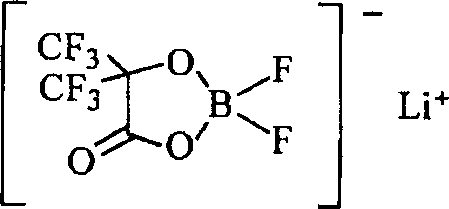


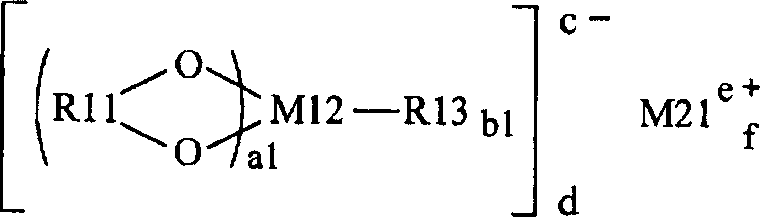


Applications Claiming Priority (3)
| Application Number | Priority Date | Filing Date | Title |
|---|---|---|---|
| JP2004357815 | 2004-12-10 | ||
| JP357815/04 | 2004-12-10 | ||
| JP141552/05 | 2005-05-13 |
Publications (2)
| Publication Number | Publication Date |
|---|---|
| CN1983707A true CN1983707A (en) | 2007-06-20 |
| CN100527518C CN100527518C (en) | 2009-08-12 |
Family
ID=38166046
Family Applications (1)
| Application Number | Title | Priority Date | Filing Date |
|---|---|---|---|
| CNB2005101314030A Expired - Lifetime CN100527518C (en) | 2004-12-10 | 2005-12-12 | Battery |
Country Status (1)
| Country | Link |
|---|---|
| CN (1) | CN100527518C (en) |
Cited By (6)
| Publication number | Priority date | Publication date | Assignee | Title |
|---|---|---|---|---|
| CN101908642A (en) * | 2007-08-23 | 2010-12-08 | 索尼株式会社 | Electrolyte solution and battery |
| CN102439776A (en) * | 2009-07-09 | 2012-05-02 | 株式会社Lg化学 | Non-aqueous electrolytic solution for lithium secondary battery and lithium secondary battery containing same |
| CN102834962A (en) * | 2010-04-06 | 2012-12-19 | 中央硝子株式会社 | Electrolyte for non-aqueous electrolyte batteries and non-aqueous electrolyte battery using the same |
| CN103151561A (en) * | 2013-03-05 | 2013-06-12 | 华南师范大学 | Electrolytic lithium salt and preparation method and applications of electrolyte solution containing lithium salt |
| CN113725430A (en) * | 2020-05-26 | 2021-11-30 | 恒大新能源技术(深圳)有限公司 | Preparation method of lithium tetrafluoro oxalate phosphate and derivative thereof, electrolyte and secondary battery |
| WO2024183543A1 (en) * | 2023-03-07 | 2024-09-12 | 宁德新能源科技有限公司 | Electrochemical device and electronic device |
-
2005
- 2005-12-12 CN CNB2005101314030A patent/CN100527518C/en not_active Expired - Lifetime
Cited By (10)
| Publication number | Priority date | Publication date | Assignee | Title |
|---|---|---|---|---|
| CN101908642A (en) * | 2007-08-23 | 2010-12-08 | 索尼株式会社 | Electrolyte solution and battery |
| US9153836B2 (en) | 2007-08-23 | 2015-10-06 | Sony Corporation | Electrolytic solutions and battery |
| CN102439776A (en) * | 2009-07-09 | 2012-05-02 | 株式会社Lg化学 | Non-aqueous electrolytic solution for lithium secondary battery and lithium secondary battery containing same |
| CN102439776B (en) * | 2009-07-09 | 2014-04-30 | 株式会社Lg化学 | Non-aqueous electrolytic solution for lithium secondary battery and lithium secondary battery containing same |
| CN102834962A (en) * | 2010-04-06 | 2012-12-19 | 中央硝子株式会社 | Electrolyte for non-aqueous electrolyte batteries and non-aqueous electrolyte battery using the same |
| CN102834962B (en) * | 2010-04-06 | 2015-04-08 | 中央硝子株式会社 | Electrolyte for non-aqueous electrolyte batteries and non-aqueous electrolyte battery using the same |
| CN103151561A (en) * | 2013-03-05 | 2013-06-12 | 华南师范大学 | Electrolytic lithium salt and preparation method and applications of electrolyte solution containing lithium salt |
| CN103151561B (en) * | 2013-03-05 | 2015-07-01 | 华南师范大学 | Electrolytic lithium salt and preparation method and applications of electrolyte solution containing lithium salt |
| CN113725430A (en) * | 2020-05-26 | 2021-11-30 | 恒大新能源技术(深圳)有限公司 | Preparation method of lithium tetrafluoro oxalate phosphate and derivative thereof, electrolyte and secondary battery |
| WO2024183543A1 (en) * | 2023-03-07 | 2024-09-12 | 宁德新能源科技有限公司 | Electrochemical device and electronic device |
Also Published As
| Publication number | Publication date |
|---|---|
| CN100527518C (en) | 2009-08-12 |
Similar Documents
| Publication | Publication Date | Title |
|---|---|---|
| JP4349321B2 (en) | battery | |
| CN101202364B (en) | Electrolyte solution and battery | |
| US9196927B2 (en) | Battery including an electrolytic solution containing a sulfone compound | |
| US8197964B2 (en) | Battery | |
| CN101047271B (en) | Electrolyte solution and battery | |
| US20110027647A1 (en) | Anode, battery, and methods of manufacturing them | |
| US9509015B2 (en) | Battery | |
| CN100481606C (en) | Electrolytic solution and battery | |
| US8148006B2 (en) | Electrolytic solution and battery | |
| US8377598B2 (en) | Battery having an electrolytic solution containing difluoroethylene carbonate | |
| US8916291B2 (en) | Electrolytic solution and battery | |
| CN101630759B (en) | Electrolyte solution and battery | |
| JP2007273396A (en) | Electrolyte and battery | |
| JP4993159B2 (en) | Secondary battery | |
| JP2007242545A (en) | Electrolyte and battery | |
| CN100527518C (en) | Battery | |
| CN100486030C (en) | Electrolyte solution and battery | |
| JP2012033502A (en) | Electrolytic solution and secondary battery | |
| JP5168593B2 (en) | Lithium ion secondary battery | |
| JP5035288B2 (en) | battery | |
| JP4784133B2 (en) | Secondary battery and battery | |
| JP4415974B2 (en) | battery | |
| JP2006164866A (en) | battery | |
| JP2012009460A (en) | Electrolytic solution and secondary battery |
Legal Events
| Date | Code | Title | Description |
|---|---|---|---|
| C06 | Publication | ||
| PB01 | Publication | ||
| C10 | Entry into substantive examination | ||
| SE01 | Entry into force of request for substantive examination | ||
| C14 | Grant of patent or utility model | ||
| GR01 | Patent grant | ||
| TR01 | Transfer of patent right |
Effective date of registration: 20180410 Address after: Kyoto Japan Patentee after: Murata Manufacturing Co.,Ltd. Address before: Fukushima Patentee before: Murata, Northeast China Effective date of registration: 20180410 Address after: Fukushima Patentee after: Murata, Northeast China Address before: Tokyo, Japan Patentee before: Sony Corp. |
|
| TR01 | Transfer of patent right | ||
| CX01 | Expiry of patent term |
Granted publication date: 20090812 |
|
| CX01 | Expiry of patent term |