CN1956718A - Compositions and methods of use containing immunomodulatory compounds for the treatment and management of skin diseases and conditions - Google Patents
Compositions and methods of use containing immunomodulatory compounds for the treatment and management of skin diseases and conditions Download PDFInfo
- Publication number
- CN1956718A CN1956718A CNA2005800163440A CN200580016344A CN1956718A CN 1956718 A CN1956718 A CN 1956718A CN A2005800163440 A CNA2005800163440 A CN A2005800163440A CN 200580016344 A CN200580016344 A CN 200580016344A CN 1956718 A CN1956718 A CN 1956718A
- Authority
- CN
- China
- Prior art keywords
- alkyl
- immunomodulatory compound
- keratosis
- amino
- acne
- Prior art date
- Legal status (The legal status is an assumption and is not a legal conclusion. Google has not performed a legal analysis and makes no representation as to the accuracy of the status listed.)
- Pending
Links
Images

Classifications
-
- A—HUMAN NECESSITIES
- A61—MEDICAL OR VETERINARY SCIENCE; HYGIENE
- A61K—PREPARATIONS FOR MEDICAL, DENTAL OR TOILETRY PURPOSES
- A61K31/00—Medicinal preparations containing organic active ingredients
- A61K31/33—Heterocyclic compounds
- A61K31/395—Heterocyclic compounds having nitrogen as a ring hetero atom, e.g. guanethidine or rifamycins
- A61K31/435—Heterocyclic compounds having nitrogen as a ring hetero atom, e.g. guanethidine or rifamycins having six-membered rings with one nitrogen as the only ring hetero atom
- A61K31/44—Non condensed pyridines; Hydrogenated derivatives thereof
- A61K31/445—Non condensed piperidines, e.g. piperocaine
-
- A—HUMAN NECESSITIES
- A61—MEDICAL OR VETERINARY SCIENCE; HYGIENE
- A61K—PREPARATIONS FOR MEDICAL, DENTAL OR TOILETRY PURPOSES
- A61K31/00—Medicinal preparations containing organic active ingredients
- A61K31/185—Acids; Anhydrides, halides or salts thereof, e.g. sulfur acids, imidic, hydrazonic or hydroximic acids
- A61K31/19—Carboxylic acids, e.g. valproic acid
-
- A—HUMAN NECESSITIES
- A61—MEDICAL OR VETERINARY SCIENCE; HYGIENE
- A61K—PREPARATIONS FOR MEDICAL, DENTAL OR TOILETRY PURPOSES
- A61K31/00—Medicinal preparations containing organic active ingredients
- A61K31/59—Compounds containing 9, 10- seco- cyclopenta[a]hydrophenanthrene ring systems
-
- A—HUMAN NECESSITIES
- A61—MEDICAL OR VETERINARY SCIENCE; HYGIENE
- A61K—PREPARATIONS FOR MEDICAL, DENTAL OR TOILETRY PURPOSES
- A61K36/00—Medicinal preparations of undetermined constitution containing material from algae, lichens, fungi or plants, or derivatives thereof, e.g. traditional herbal medicines
- A61K36/18—Magnoliophyta (angiosperms)
- A61K36/185—Magnoliopsida (dicotyledons)
- A61K36/28—Asteraceae or Compositae (Aster or Sunflower family), e.g. chamomile, feverfew, yarrow or echinacea
-
- A—HUMAN NECESSITIES
- A61—MEDICAL OR VETERINARY SCIENCE; HYGIENE
- A61K—PREPARATIONS FOR MEDICAL, DENTAL OR TOILETRY PURPOSES
- A61K36/00—Medicinal preparations of undetermined constitution containing material from algae, lichens, fungi or plants, or derivatives thereof, e.g. traditional herbal medicines
- A61K36/18—Magnoliophyta (angiosperms)
- A61K36/185—Magnoliopsida (dicotyledons)
- A61K36/57—Magnoliaceae (Magnolia family)
- A61K36/575—Magnolia
-
- A—HUMAN NECESSITIES
- A61—MEDICAL OR VETERINARY SCIENCE; HYGIENE
- A61K—PREPARATIONS FOR MEDICAL, DENTAL OR TOILETRY PURPOSES
- A61K38/00—Medicinal preparations containing peptides
- A61K38/16—Peptides having more than 20 amino acids; Gastrins; Somatostatins; Melanotropins; Derivatives thereof
- A61K38/17—Peptides having more than 20 amino acids; Gastrins; Somatostatins; Melanotropins; Derivatives thereof from animals; from humans
- A61K38/19—Cytokines; Lymphokines; Interferons
- A61K38/21—Interferons [IFN]
-
- A—HUMAN NECESSITIES
- A61—MEDICAL OR VETERINARY SCIENCE; HYGIENE
- A61P—SPECIFIC THERAPEUTIC ACTIVITY OF CHEMICAL COMPOUNDS OR MEDICINAL PREPARATIONS
- A61P17/00—Drugs for dermatological disorders
-
- A—HUMAN NECESSITIES
- A61—MEDICAL OR VETERINARY SCIENCE; HYGIENE
- A61Q—SPECIFIC USE OF COSMETICS OR SIMILAR TOILETRY PREPARATIONS
- A61Q19/00—Preparations for care of the skin
-
- C—CHEMISTRY; METALLURGY
- C07—ORGANIC CHEMISTRY
- C07D—HETEROCYCLIC COMPOUNDS
- C07D401/00—Heterocyclic compounds containing two or more hetero rings, having nitrogen atoms as the only ring hetero atoms, at least one ring being a six-membered ring with only one nitrogen atom
- C07D401/02—Heterocyclic compounds containing two or more hetero rings, having nitrogen atoms as the only ring hetero atoms, at least one ring being a six-membered ring with only one nitrogen atom containing two hetero rings
- C07D401/04—Heterocyclic compounds containing two or more hetero rings, having nitrogen atoms as the only ring hetero atoms, at least one ring being a six-membered ring with only one nitrogen atom containing two hetero rings directly linked by a ring-member-to-ring-member bond
Landscapes
- Health & Medical Sciences (AREA)
- Life Sciences & Earth Sciences (AREA)
- Natural Medicines & Medicinal Plants (AREA)
- Chemical & Material Sciences (AREA)
- Veterinary Medicine (AREA)
- Public Health (AREA)
- General Health & Medical Sciences (AREA)
- Animal Behavior & Ethology (AREA)
- Pharmacology & Pharmacy (AREA)
- Medicinal Chemistry (AREA)
- Epidemiology (AREA)
- Engineering & Computer Science (AREA)
- Botany (AREA)
- Mycology (AREA)
- Microbiology (AREA)
- Medical Informatics (AREA)
- Biotechnology (AREA)
- Alternative & Traditional Medicine (AREA)
- Organic Chemistry (AREA)
- Bioinformatics & Cheminformatics (AREA)
- Dermatology (AREA)
- General Chemical & Material Sciences (AREA)
- Nuclear Medicine, Radiotherapy & Molecular Imaging (AREA)
- Chemical Kinetics & Catalysis (AREA)
- Zoology (AREA)
- Gastroenterology & Hepatology (AREA)
- Immunology (AREA)
- Proteomics, Peptides & Aminoacids (AREA)
- Pharmaceuticals Containing Other Organic And Inorganic Compounds (AREA)
- Medicines That Contain Protein Lipid Enzymes And Other Medicines (AREA)
- Acyclic And Carbocyclic Compounds In Medicinal Compositions (AREA)
Abstract
Methods of treating, preventing, correcting and/or managing skin diseases or disorders characterized by overgrowths of the epidermis, keratoses, scleroderma, cutaneous vasculitis, acne or wrinkles are disclosed. Specific embodiments encompass the administration of an immunomodulatory compound, or a pharmaceutically acceptable salt, solvate, hydrate, stereoisomer, clathrate, or prodrug thereof, alone or in combination with a second active agent. Specific second active ingredients are capable of affecting or inhibiting cell growth or proliferation, removing or improving acne scars, or reducing or correcting wrinkle lines. Pharmaceutical compositions, single unit dosage forms, and kits suitable for use in methods of the invention are also disclosed.
Description
1. Field of the invention
The present invention relates to methods of treating, preventing and managing keratosis, scleroderma, cutaneous vasculitis, and skin diseases or disorders characterized by epidermal hyperplasia, acne or wrinkles. The methods include administering an immunomodulatory compound alone or in combination with known therapies. The invention also relates to pharmaceutical compositions and dosage regimens.
2. Background of the invention
2.1 types of skin diseases
2.1.1 keratosis
Keratosis involves various types of skin diseases or conditions characterized by epidermal lesions, manifested by localized hyperplasia of the stratum corneum of the skin. Specific types of keratoses include, but are not limited to, actinic keratosis, seborrheic keratosis, keratoacanthoma, follicular keratosis (darriella), inverted follicular keratosis, palmoplantar keratosis (PPK, also known as palmoplantar keratosis), hair keratosis, and stucco keratosis. Stedman, Medical Dictionary, 1990, 25 th edition, 823.
Actinic keratosis is also known as senile keratosis, senile warts, senile flat warts, solar keratosis, or keratoderma. Stedman, Medical Dictionary, 1990, 25 th edition, 823; and Clay j.cockerell, j.am.acad.dermaltol.2000, 42: s11-7. Actinic keratosis is characterized by a scaly red skin lesion that can develop into malignant non-melanoma skin cancers. Steven r. feldman et al, j.am. acad. dermaltol.1999, 40: 43-7. Lesions typically have a basal erythema (hyperkeratosis) covered by scales. Steven r. feldman et al, j.am. acad. dermaltol.1999, 40: 43-7. Actinic keratosis is characterized by a disturbance in epidermal differentiation. The epidermis with actinic keratosis may atrophy or be normal in thickness, or may increase in thickness due to the stretching of abnormally differentiated epidermal cells into a papillary epidermis. Over time, actinic keratosis can progress to aggressive cutaneous or skin cancers. Richard g.glogau, j.am.acad.dermaltol.2000, 42: s23-4.
Actinic keratosis can be caused by carcinogens and ultraviolet radiation, and occurs primarily in the sun-exposed areas of the face, ears, forearms, and backs of the hands. Lynn a. drake et al, j.am.acad.dermaltol.1995, 32: 95-8. However, actinic keratosis may also occur in areas that are exposed to sunlight for long periods or frequently, such as the back, chest and legs. The specific effect of uv irradiation on the tumor suppressor gene p53 suggests a causal relationship between uv irradiation and the earliest mutations observed in actinic keratosis. David j.leffell, j.am.acad.dermaltol.2000, 42: s18-22. Moreover, fair, red-headed and vernal patients are reported to have a genetic predisposition to actinic keratosis, and such patients are often burned and severely tanned. Stuart j.salasche, j.am.acad.dermotol.2000, 42: s4-7. In addition to receiving more sunlight as men perform more outdoor activities, actinic keratosis does not find gender preference. Age is one of the most important factors in determining the development of actinic keratosis. Epidemiological studies have shown that the incidence of actinic keratosis increases with age. The export is as above: and S5. Age of onset is related to skin type and amount of solar damage. Thus, when actinic keratosis occurs in patients between 20 and 30 years of age, the onset is more common in patients between 30 and 60 years of age.
Seborrheic keratosis, also known as seborrheic warts or senile warts, is a benign tumor that is common in the elderly and middle-aged population. Merck Index, 1999 (17 th edition), 841. The family causes are apparently autosomal inheritance. Seborrheic keratosis may also be the result of inflammatory skin diseases or malignancies. It is typically characterized by a raised papular lesion that changes color from cyan to dark brown. Seborrheic keratosis may be smooth or visible wart-like lesions. Common sites of attack include the face, body and limbs (supra). One variation known as black papulodermopathy occurs on the forehead and cheeks of young individuals with black skin and is smaller and smoother than in fair-skinned patients. Seborrheic keratosis is a subtype. Characterised by a preponderance of basal cells with flattened cells presenting a scalloped surface. All seborrheic keratoses are characterized by basal cells exhibiting varying degrees of acanthosis, papillomatosis, hyperkeratosis and hyperpigmentation (supra).
Another type of keratosis is an inverted follicular keratosis, which is considered an inflammatory variant of seborrheic keratosis. It usually occurs on the face and in the sun of elderly patients. Typically, this injury is located on the upper eyelid. The lesions tend to be simple in shape such as a pimple or a nodule. The lesions are characterized by the presence of a large number of scaly vortices. The appearance of papillomas and acanthosis is visible, with the margins separated and lacking the inflammatory component found in keratoacanthoma (eMedicine Website, benign skin lesions).
Another type of keratosis is keratoacanthoma, characterized by small, rounded, firm, usually flesh-colored nodules with sharply sloped edges, characterized by an ulcer niche containing keratin materials. Merck Index, 1999 (17 th edition), 842. The rapid growth rate of keratoacanthoma is generally sufficient for clinicians to distinguish it from a malignancy because it grows much faster than a malignancy (ibid). The incidence rate of keratoacanthoma is higher for men than for women, and the ratio of men to women is 3-4: 1. Keratoacanthoma appears to be a product of the follicular arterial cone. When the disease occurs, various infections, including viral sources, can occur in concert. Moreover, mineral oils and tars appear to be involved in the development of the disease, although the most common cause appears to be solar exposure (supra).
Follicular keratosis, also known as Darrieus Disease (DD) or darby-whitish disease, is a dominantly inherited genetic skin disease characterized by hyperkeratosis of the papules in the abundant sebum region and various nail abnormalities. BurgeSM, J.Am.Acad.Dermatol, 1992, 27 (1): 40-50. Abnormal intercellular adhesion and abnormal skin keratinization are its primary features. Most darrieus patients have a clear family history of disease. The genetic pattern is consistent with an autosomal dominant state. The first skin lesions typically occur in the teens and are often accompanied by pruritus. Heat, moisture, stress, light and uv B radiation are believed to exacerbate the symptoms. While the severity of darrieus disease fluctuates over time, darrieus disease is a chronic, continuous disease.
Another type of keratosis is palmoplantar keratosis (PPK, also known as palmoplantar keratosis), which forms a heterogeneous group of disorders characterized by thickening of the palms and soles of the affected individuals. Lucker GP et al, Br.J.Dermatol, 1994, 131 (1): 1-14. The disorder can be subdivided into hereditary, acquired and combined symptoms characterized by PPK. The genotype may be confined to the hands and feet, or occur in conjunction with other more common skin disorders. Ratnavel RC et al, br.j.dermatol.1997, 137 (4): 485-90. The diffuse pattern of PPK appears to be evenly distributed over the entire palmoplantar surface, whereas focal keratoses are localized to the hyperkeratotic region, mainly at the pressure point, and the intervening stratum corneum of the skin is characterized by small hyperkeratotic papules, spikelets or nodules in the palms and soles. Acquired PPK can be divided into PPK that manifests as reactive/inflammatory, infectious, drug-related, systemic disease, menopausal keratoderma, and in vivo malignancy-associated PPK.
Hair keratosis is a common benign keratinizing follicular disorder. Merck Index, 1999 (17 th edition), 833. The disease is characterized by clustered, keratinized follicular papules, located primarily on the lateral sides of the buttocks, upper arms and thighs. There are usually no other symptoms (as above) except for affecting the cosmetic appearance. Some studies have shown that hair keratosis affects 50-80% of adolescents. The disease has a family relationship and is autosomal dominant inheritance (see above).
Another type of keratosis is stucco keratosis, characterized by keratotic papules commonly found on the extremities of men. Willoughby c. et al, arch.dermaltol.1972, 105 (6): 859-61. This injury is commonly found in elderly patients. This lesion is asymptomatic and its name, "stucco keratosis," derives from its "adherent" appearance of the lesion. Stucco keratosis is caused by thickening of the epidermis, typically characterized by hyperplasia of the skin, usually by extrinsic growth without abnormal development.
2.1.2 skin diseases characterised by epidermal hyperplasia
2.1.2.1 papillomavirus-associated infections
Infections caused by papillomaviruses are common skin diseases characterized by epidermal hyperplasia. Wyngarden, James b. et al, Cecil Textbook of Medicine, 18th edition, volume two, part 24: skin disease, page 2300-. Manifestations include, but are not limited to verruca vulgaris (verrucae vulgaris), palmoplantar warts, verruca plana (verrucae plana), oral warts, epidermal hyperplastic lesions, epidermodysplasia verruciformis (EDV), genital warts (condyloma acuminatum), bowenoid papulosis, bowen's disease, mucosal surface papillomas, and intraepidermal neoplasias. The virus infects epidermal basal keratinocytes, possibly by damaging the skin or mucosal surfaces. At this position, the virus is latent in the form of a circular episome. When epidermal cells differentiate and move to the surface, the virus is activated for replication and maturation. The replication process of the virus destroys epidermal features, resulting in the production of epidermal or mucosal nodules called warts.
Human Papillomaviruses (HPV) are broadly classified into an epidermoid type and a mucosal type according to the site of a lesion that is clinically produced. Although somewhat overlapping, most papillomaviruses have a clear anatomical preference to infect only certain epidermal sites, such as the skin and genital mucosa. Viruses of many genotypes have the potential to transform cells and are associated with epidermal malignancies. The mechanism of transformation is not clear, but it is clear that the viral DNA integrates into the genome of the host cell. Histology of condyloma acuminata generally shows epidermal destruction, excessive keratinization of the granular layer, coarse granules containing corneal hyalin, and hollow cells. The epidermis or mucosa with flat warts shows acanthosis. The typical cytological features of HPV infection are hollow cells, which are keratinocytes containing a deep blue pycnotic nucleus surrounded by an annular ring and clear cytoplasm containing a small number of keratohyalin granules. Histology of bowenoid papulosis indicates psoriasiform hyperplasia and hyperkeratinization of the epidermis. More and more mitotic images can be found at all epidermal levels. Keratinocytes contain enlarged polymorphous dark nuclei. Histology of the common epidermis showed marked hyperkeratinization, acanthosis, peripheral keratosis and papillomatosis. There are three features that can be used to distinguish warts from other papillomas, including the presence of hollow cells, vertical columns of parakeratosis, and foci of clustered corneal hyalin particles.
2.1.2.2 arsenic keratosis
Arsenical keratosis exhibits thick, dense hyperkeratosis and parakeratosis, similar to hypertrophic actinic keratosis. Wyngaarden, James B. et al, Cecil Textbook of Medicine, 18th edition, volume II, part 24: skin disease, page 2300-. Some epidermal keratinocytes may exhibit atypical histological features. The existence of many vacuolated keratinocytes and the absence of solar elastosis, although not completely identified as arsenical keratosis, is of some reference.
2.1.2.3 Lei-Tech syndrome
The symptoms of raynaud-terse can be more precisely defined as multiple seborrheic keratoses with rapidly increasing numbers and sizes, sudden appearance, caused by the associated cancer. Wyngaarden, James B. et al, CecilTexbok of Medicine, 18th edition, volume II, part 24: skin disease, page 2300-. This definition is similar to that of malignant acanthosis nigricans, both of which are obligatory extratumoral syndromes. Paradoxically, however, multiple seborrheic keratoses and acanthosis nigricans are both generally rarely associated with cancer. The symptoms of raynaud-te's disease should be attributed to the range of in vivo malignancies usually associated with acanthosis nigricans. The malignant tumors associated with them are usually malignant and have a severe poor prognosis. However, neither malignant acanthosis nigricans nor multiple seborrheic keratosis caused by malignant tumors is cancerous. This syndrome includes epidermal hyperkeratosis, papillomatosis, and acanthosis (e.g., keratopseudocyst) in which the follicle contains keratinous material.
2.1.2.4 wart keratosis
Wart keratosis (WD) is a single, benign, keratinized epidermal hyperplasia that often manifests as an umbilical lesion, usually localized to the head, neck, or face. This damage is sometimes associated with the follicular unit. Wyngaarden, James B. et al, Cecil Textbook of Medicine, 18th edition. Second roll, part 24: skin disease, page 2300-. Mucosal (oral and genital surfaces) morbidity and multiple lesions have also been reported.
2.1.2.5 Multi-vellus keratosteosis of hair follicles
In the case of follicular multi-vellus keratothrombosis (TS), clusters of vellus hairs are embedded in the follicles, forming raised, dark papules on the face or trunk. Wyngaarden, James B. et al, Cecil Textbook of Medicine, 18th edition. Second roll, part 24: skin disease, page 2300-. TS is occasionally discovered and is often confused with keratosis pilaris or blackheads.
Treatment with potassium hydroxide dissolves the keratinous plugs, leaving numerous tufted hairs. Microscopic examination of the resulting biopsy specimen reveals follicular follicles with excessive keratinization of follicular epidermis and swelling of acanthosis. Inflammation is not a characteristic of TS.
2.1.2.6 variant keratoderma erythropolis
Erythrokeratoderma variabilis (EKV) is a keratinization disorder with non-inflammatory erythema. Wyngaarden, James B. et al, Cecil Textbook of Medicine, 18th edition. Second roll, part 24: skin disease, page 2300-. There is significant hyperkeratinization, probably because keratinocyte proliferation is accelerated and differentiation is disturbed.
2.1.2.7. Ichthyosis of fetus
Ugly-like ichthyosis is the most severe form of congenital ichthyophthiriasis, characterized by a rather hypertrophic stratum corneum of the fetal skin. Wyngaarden, James B. et al, Cecil Textbook of Medicine, 18th edition. Second roll, part 24: skin disease, page 2300-. The affected neonate inherently has large, high-density, dish-like, scaly horny shells and abnormally contracting eyes, ears, mouth and limbs. This layer of armor limits movement, weakens the protective barrier of the skin, and makes the newborn prone to metabolic abnormalities and infections. The term "ugly corners" stems from the facial expressions and hyperkeratotic patterns of triangles and diamonds of the newborn. The mouth of the neonate is pulled and expanded to resemble a smile simulating a clown. The underlying biochemical and genetic abnormalities are not known.
The skin was examined by immunohistochemical examination for abnormalities in the expression of lamellar structures and epidermal keratin. The stratum corneum is thick and dense. Perifollicular keratinization may be more pronounced than the interfollicular epidermis. Parakeratosis and orthokeratosis may be present, particularly in the fingers and toes. Cells in the stratum corneum are abnormally keratinized. The granular, spiny basal cell layer does not appear to be significant. Inflammatory cells may infiltrate into the papillary dermis.
Electron microscopy generally reveals the absence or abnormality of granulocytes in the granular layer keratinocytes. The intercellular space between the granular cell layer and the keratinocyte layer lacks a thin layer. Dense lipid droplets and vacuoles are seen among the cells of the abnormal keratinocytes of the stratum corneum. These lipid inclusions spread over the entire skin surface, but are more pronounced in the palms and soles of the feet. The keratolucent protein particles may be absent, small, normal or abnormal, and appear spherical. The density of keratin intermediate filaments in granulosa cells may decrease.
2.1.2.8. Finger rest pad
Histological analysis showed changes in both the epidermis and dermis of the footpad. Epidermal abnormalities include hyperkeratosis and mild acanthosis. Wyngaarden, James B. et al, Cecil Textbook of Medicine, 18th edition. Second roll, part 24: skin disease, page 2300-. Dermal changes include slight hyperplasia of fibroblasts and capillaries in the papillary dermis. Thickened, irregularly organized collagen bundles appear, but with little accompanying inflammation. These changes are similar to those observed in palmar aponeurosis.
2.1.2.9. Epidermal acanthoma nigricans
The epidermal acanthoma nigricans is observed by a microscope, and the keratinocyte and the melanocyte positioned on the epidermis are proliferated. Wyngaarden, James B. et al, Cecil Textbook of Medicine, 18th edition. Second roll, part 24: skin disease, page 2300-. Acanthosis, hyperkeratosis, papillomatosis, and small horny pearls are observed. Giant dendritic melanocytes containing a large amount of melanin granules are interspersed in the epidermis. In addition, small basal-like and/or spiny keratinocytes are evident in the malpighian cortex.
2.1.2.10. Keratosis of sweat pore
The highly clonal proliferation of atypical keratinocytes leads to the formation of a horn template that expands circumferentially forming a raised boundary between abnormal and normal keratinocytes. Wyngaarden, James B. et al, Cecil Textbook of Medicine, 18th edition. Second roll, part 24: skin disease, page 2300-. In genetically preferred individuals, local or systemic immunosuppression may result in atypical keratinocyte clones. Heterozygote loss has been proposed as the pathogenesis of linear hyperkeratosis with a personal or family history of diffuse superficial actinic hyperkeratosis (DSAP).
2.1.2.11. Squamous cell carcinoma
Squamous cell carcinoma may be newly generated or derived from precancerous lesions, such as actinic keratosis or intraepidermal carcinoma (carcinoma in situ). Wyngaarden, James B. et al, Cecil Textbook of Medicine, 18th edition. Second roll, part 24: skin disease, page 2300-. Squamous cell carcinomas are characterized by full-thickness epidermal dysplasias (cellular dysplasias, polar disappearance, pleomorphism and/or nuclear stainings, mitotic imaging, and parakeratosis).
2.1.2.12. Fusional reticular papilloma
In fusional reticulomas (CRPs), the epidermis shows dense hyperkeratinization, often accompanied by the presence of Pityrosporum yeast (pityrisporum yeast). Wyngaarden, James B. et al, CecilTextbook of Medicine, 18th edition. Second roll, part 24: skin disease, page 2300-. Other features are less consistent, including a reduction or absence of the granular cell layer, papillomatosis, and acanthosis that varies from acanthosis to atrophy. The dermis may include a lymphocytic infiltration around the blood vessels. Under electron microscopy, some of the lesions manifest as altered keratinocyte arrangement and structure, increased transition cell layers, increased number of lamellar bodies in the granular lamellae, and increased number of melanosomes in the stratum corneum.
2.1.2.13. Acrochordon
Acrochordons are characterized by an acanthosis-like, flat or leafy epidermis. The hyperplastic epidermis is manifested by papillomatosis, hyperkeratosis, and acanthosis on loosely structured collagen fibers and many capillaries. Wyngaarden, James B. et al, Cecil Textbook of Medicine, 18th edition. Second roll, part 24: skin disease, page 2300-. Papillary dermis consists of loosely structured collagen fibers and dilated capillaries and lymphatic vessels. No adjuncts are generally present. Although a study of the elastic tissue of a fibroepidermal polyp did not reveal a lack of elastic fibers, it is believed that acrochordons are characterized by a significant reduction in elastic fibers. Fibroepidermal polyps of the oral mucosa often have a somewhat flattened epidermis and firm collagen, but are deficient in abundant fibroblasts.
2.1.2.14. Leather corner
Cutaneous horns include dense hyperkeratinization and parakeratosis. Wyngaarden, James B. et al, Cecil Textbook of Medicine, 18th edition, volume two, fourth part: skin disease, page 2300-. Damage to the substrate has the pathological feature of forming a skin angle.
2.1.2.15. Koutongbing disease (multiple hamartoma syndrome)
Mucosal and cutaneous features of Cowden Disease (CD) include pilomas, papillomas of the oral mucosa, acro-keratosis and palmoplantar keratosis. Wyngarden, James b. et al, Cecil Textbook of Medicine, 18th edition, volume two, part 24: skin disease, page 2300-. CD is often associated with certain types of malignancies and therefore accurate diagnosis of patients with this syndrome is important. The incidence of breast cancer in women and thyroid cancer in men and women in particular is significantly increased. It has been reported that patients with CD may also be associated with several other malignancies.
2.1.2.16. Black papular dermatosis
Black papulodermopathy (DPN) is a benign skin disorder that is common in black people. Wyngaarden, James B. et al, Cecil Textbook of Medicine, 18th edition. Second roll, twenty-fourth section: skin disease, page 2300-. It is characterized by the presence of numerous small, hyperpigmented, asymptomatic papules on the face of an adult, black person. Histologically, DPN is similar to seborrheic keratosis. This disease is cosmetically undesirable for the patient.
Lesions in DPN are histologically characteristic of seborrheic keratosis; they exhibit hyperkeratosis, irregular acanthosis, keratin-containing invaginations of the epidermis (keratocysts) and marked pigmentation of the basal layer. Although most lesions are echinoderma-like and the epidermal cells present interwoven bundles, they have a reticular pattern in which the bundles consist of double rows of basal cell-like cells.
2.1.2.17. Epidermal nevus syndrome
Epidermal Nevus Syndrome (ENS) is divided into four types according to clinical, histopathological and genetic criteria: linear sebaceous gland nevus (LSN), linear acne Nevus (NC), Linear Epidermal Nevus (LEN), and Inflammatory Linear Verrucous Epidermal Nevus (ILVEN). Wyngaarden, James B. et al, Cecil Textbook of Medicine, 18th edition. Second roll, part 24: skin disease, page 2300-. Each type can be considered part of the systemic syndrome.
Typical histological examination showed LEN to have marked acanthosis with hyperkeratosis, papillomatosis and psoriatic epitoma elongation. Lesions of epidermolytic hyperkeratosis, acantholytic keratosis, and verruca vulgaris and acne are also observed.
Histological examination of ILVEN revealed similar psoriatic hyperplasia of the epidermis, alternating parakeratosis without the stratum granulosum, and orthokeratosis with a thickened stratum granulosum. Lesions of epidermolytic hyperkeratosis, acantholytic keratosis, and verruca vulgaris and acne are occasionally observed.
In NC, primordial hair follicles are enlarged to form epidermal invaginations, which are filled with keratin in concentric lamellae. The capsule wall is composed of several layers of keratinocytes and is sometimes manifested as epidermolytic hyperkeratosis. Scattered petioles and minor lobes were observed in the early samples, and petioles and lobes and pilus muscles were absent in the late samples. The follicular epidermis often presents as a papillomatosis and hyperkeratosis, with ossification observed in the dermis.
LSNs contain epidermal, cystic, sebaceous and apocrine gland abnormalities. It reflects normal cortical elements seen in infancy, childhood and adolescence. Thus, this damage develops well early in life due to the expression of the parent hormone. These lesions are limited in development and reduced in size and number during childhood. At this stage, incomplete and undifferentiated hair structure with pronounced keratin-filled funnels and malformed hair matrix can serve as a diagnostic key.
2.1.2.18. Common ichthyosis
The histological appearance of hereditary ichthyosis and acquired ichthyosis is virtually identical. Wyngaarden, James B. et al, Cecil Textbook of Medicine, 18th edition. Second roll, part 24: skin disease, page 2300-. The stratum corneum exhibits dense hyperkeratinization, although some areas may be lamellar. Patchy parakeratosis and occasional follicular plugs can be seen. The particle layer is usually thick or non-existent. The epidermis is usually intact, but has a pattern of narrowed lattice papillary. Exocrine glands and sebaceous glands, if present, are very small and atrophic, and decrease in number. Sweat glands and hair follicles were evident. In most cases, the upper dermis presents a slight, perivascular, infiltration of lymphoid tissue cells. Ichthyosiform sarcoid, the manifestation of acquired ichthyosis in sarcoid patients, has numerous other non-caseating granulomas in the dermis.
Ultrastructural studies show a reduction or absence of keratolucin granules present in the stratum granulosum. It looks like a sponge or crumbly, most likely due to lack of keratohyalin synthesis. The hyperkeratinized portion of the stratum corneum has a standard keratin model.
2.1.2.19. Molluscum contagiosum
Molluscum contagiosum lesions have specific histopathological characteristics. Wyngaarden, James B. et al, Cecil Textbook of Medicine, 18th edition. Second roll, part 24: skin disease, page 2300-. In a fully developed lesion, the ulcer niche is near the surface and then extends into the lobules containing the molluscum body (i.e., Henderson-Paterson body) approximately 35mm in diameter. Molluscum bodies are membrane-associated vesicles containing large amounts of MC virus. The connective tissue-coated epidermal processes proliferate downward to form the ulcer niche. Enlarged dark purple keratinocytes develop in the basal cell layer of the epidermis. These enlarged keratinocytes contain viral particles that grow as the cells advance upward. Eventually a large number of virus particles press the nucleus to one side of the cell, forming a crescent-shaped nucleus. Intact lesions have little or no inflammatory lesions.
Lesions with intradermal rupture of molluscum bodies exhibit a strong infiltration of skin inflammation, including lymphocytes, macrophages, and occasional multinucleated foreign body giant cells.
2.1.2.20. Prurigo nodularis
Histologically, prurigo nodularis exhibits hyperkeratosis of the skin with acanthosis and parakeratosis. Wyngaarden, James B. et al, Cecil Textbook of Medicine, 18th edition. Second roll, part 24: skin disease, page 2300-. The processes are elongated and irregular with strong skin infiltration including neutrophils, eosinophils, macrophages and monocytes. Also visible are thickening of nerve fibers in the dermis and fibrosis with thickened collagen bundles.
Thickened nerve fiber swelling was visible under an electron microscope. Schwann cells vacuolate and degenerate, no longer containing visible mitochondria. Both axons and schwann cells are highly proliferative.
2.1.2.21. Acanthosis nigricans
Acanthosis Nigricans (AN) is likely to be caused mainly by factors that stimulate proliferation of epidermal keratinocytes and dermal fibroblasts. Wyngaarden, James B. et al, Cecil Textbook of Medicine, 18th edition. Second roll, part 24: skin disease, page 2300-. In benign AN, this factor may be insulin or AN insulin-like growth factor that stimulates epidermal cell proliferation. In malignant AN, this stimulatory factor is presumably a substance secreted by or in response to the tumor. Transforming growth factor is similar in structure to epidermal growth factor and is a possible candidate for stimulating factor. Exogenous drugs may also be pathogenic agents.
2.1.3 scleroderma
Scleroderma is a systemic disease that affects many organs. Most notably in the skin area. However, diseases also frequently occur in the gastrointestinal tract, respiratory organs, kidneys, cardiovascular and urogenital systems, and in numerous vascular structures. The symptoms result from the accumulation of tissue fibrosis and from the blockage of the vasculature due to the excess production and deposition of type I type III collagen. As the disease progresses, the skin becomes taut, shiny and hyperpigmented. The face is changed into a mask shape; telangiectasia occurs in the fingers, chest, face, lips, and tongue. Subcutaneous calcification occurs in the ridges of the fingertips and bones. The Merck Manual, 17 th edition, page 431.
Proximal scleroderma is characterized by a symmetrically thickened, tense and hardened skin of the fingers and adjacent to the metacarpophalangeal or metatarsophalangeal joints. These lesions may affect the entire limb, face, neck and torso (chest and abdomen). Finger tip hardening includes the important feature criteria described above, but is limited to only the finger portion.
2.1.4 cutaneous vasculitis
Cutaneous vasculitis is an inflammation of the skin blood vessels. Vasculitis may be caused by a variety of pathogenic mechanisms, but is limited to histological abnormalities. This inflammation is often local, with scattered severe inflammatory foci. Often, different degrees of cellular infiltration and necrosis or scarring with one or more layers of the vessel wall occur at the affected site. The Merck Manual, 17 th edition, page 437.
Vessels of any type and size may develop. However, most pathophysiological features can be attributed to arterial inflammation with the potential for partial or total vessel occlusion and tissue necrosis. The frequent response of intimal and periadventitial fibers to intense vessel wall inflammation allows the vessel to expand back and forth relative to the initial state. Histologically, intimal hypertrophy and fibrosis or perivasculitis indicate a nearby area of inflammation.
2.1.5 acne
Acne is a red irritant rash that affects primarily teenagers and adolescents. However, it is likely to occur in people of any age. American college of skin diseases & roche laboratory: acnenet.2000. Typical acne occurs in the body in areas where oil is produced, such as the face, chest and back. Acne may also occur in the neck and upper arm. Several factors can contribute to the formation of acne. The main problem is abnormal exfoliation of cells inside the hair follicle leading to plug formation. The plug may enlarge or even rupture the follicle. The oily components and debris of the ruptured hair follicle spill over to the skin, causing swelling of the site and causing inflammation and redness. In the context of the present invention, acne may comprise one or both of the two most familiar acne: rosacea and acne vulgaris. In yet another embodiment of the present invention, the acne does not include rosacea.
Acne also includes acne conglobata. The disease is the most severe form of acne vulgaris and is more prevalent in men. It is characterized by a number of large, sometimes co-occurring lesions, sometimes complicated by generalized blackheads. The disease can cause severe, unrecoverable skin damage, as well as scar that destroys the face. The affected parts include face, chest, back, buttocks, upper arm and thigh. The age of onset of acne conglobata is between 18 and 30 years of age, and the condition can be active for many years. Like all forms of acne, the etiology of acne conglobata is not well defined. Treatments for this disease include isotretinoin, which can be controlled by invasive treatment over time, although sometimes the acne conglobata is resistant to treatment.
Acne also includes fulminant acne. This is a sudden burst of acne conglomerates that often afflicts young people. The onset symptom is acne with severe nodular swelling, usually ulcerations. Similar to acne conglomerates, in extreme cases, scars that ruin the face are common. Fever and joint pain at onset are unique features of fulminant acne. Fulminant acne is less sensitive to antibiotics. Isotretinoin and oral steroids are commonly used in the treatment of this disease.
Acne also includes gram-negative bacillary folliculitis. This condition is a bacterial infection characterized by pustules and cysts, and may be a complication from chronic use of antibiotics to treat acne vulgaris. Isotretinoin is useful in the treatment of gram-negative folliculitis.
Acne also includes pyoderma faciale. This severe form of acne affects women mainly between the ages of 20 and 40, and is characterized by painful large tumors, pustules, and sores that can leave scars. The disease is sudden, and women who never grow acne may also have sudden skin diseases. The disease is only limited to the face, the disease does not occur for more than one year, but the disease causes great damage in a short time.
Acne has short-term but long-term latent psychological effects. Self-esteem and decreased confidence lead to social withdrawal and even depression. The remaining untreated severe acne can result in scarring that destroys the face, a condition that is difficult to treat by itself.
2.2. Conventional treatment
Known treatments for skin diseases or conditions broadly range from simple procedures such as saline soaks and desquamation, to topical keratolytics, systemic retinoids and methods of excising keratotic skin by plastic surgery.
Drug therapy is the primary treatment for acne. Self-purchased and over-the-counter medications are effective for mild acne, including soaps, cleansers and cleansers. Moderate or severe acne, or acne that cannot be effectively controlled by self-purchased medications, requires treatment with prescription medications. Prescription drugs such as topical retinoids and antibiotics are effective in treating acne either alone or in combination with other prescription and over-the-counter drugs.
Typical medical control of keratosis involves first educating the patient to reduce sun exposure. With the aggravation of the lesion, local keratolysis, such as 5-fluorouracil, salicylic acid, lactic acid, and urea, can be used. Merck Index, 1999 (17 th edition), 827, 833 and 842; and Habib A. Kurwa et al, J.Am.Acad.Dermatol.1999, 41 (3): 414-418. However, this treatment causes temporary facial destruction with erythematous ulcers and formation of hard skin, and inflammatory reactions with occlusive dressings and hard skin may also occur. Topical keratolytic treatment applied to the mucosa also causes inflammation and ulceration to exacerbate, with solar exposure exacerbating the condition. During periods of immunosuppression, such as intense sun exposure or chemotherapy, especially systemic 5-fluorouracil, the symptoms of injury may be more pronounced. However, a major drawback of this therapy is poor patient compliance (ibid).
Oral retinoids are used in the treatment of many keratinization disorders due to their effect on epidermal proliferation and differentiation. Merck Index, 1999 (17 th edition), 827 and 833. Topical retinoids such as tretinoin (0.01% gel and 0.1% cream) are effective, but treatment is often limited by irritation of the skin (ibid). Topical corticosteroids, such as triamcinolone acetonide, can be used to reduce inflammation by inhibiting polymorphonuclear leukocyte migration and reversing capillary permeability.
For patients with contact hypersensitivity to 5-fluorouracil, photodynamic therapy (PDT) is considered, Habib a. kurwa et al, j.am. acad. dermatol.1999, 41 (3): 415. however, this treatment also has a pain sensation.
Keratosis can be treated by surgery. Lynn a. drake et al, j.am.acad.dermaltol.1995, 32: 95-98. Cryotherapy and electrosurgery destroy the abnormal tissue of the epidermis. Cryotherapy is the most common form of surgical treatment for these injuries. Supra and j.am.acad.dermatol.1994, 31: 648-53. Unfortunately, patients require periodic revisits to treat small relapses or new lesions. Curettage and cryoablation are the main options for seborrheic keratosis. Lynn a. drake et al, j.am. acaddermatol.1995, 32: 96. surgical resection, curettage, and electro-dewatering have been the traditional method of treating keratoacanthoma. Dermabrasion can remove lesions from patients with keratosis capitis. Same as before and in George b. winton et al, j.am. acad. dermatol.1986, 14: 661-668. Laser surgery is suitable for the treatment of actinic keratosis of the lips. Lynn a. drake et al, j.am.acad.dermaltol.1995, 32: 97.
most known treatment regimens target only the symptoms of the skin disease and condition, resulting in only short term improvement. In addition, they are associated with side effects. Thus, safe and effective methods for treating and controlling diseases and conditions remain to be developed.
3. Summary of the invention
The invention encompasses methods of treating, preventing and managing keratosis, scleroderma, cutaneous vasculitis, a skin disease or disorder characterized by epidermal hyperplasia, acne or wrinkles, which comprise administering to a patient in need thereof a therapeutically or prophylactically effective amount of an immunomodulatory compound, or a pharmaceutically acceptable salt, solvate, stereoisomer, hydrate, clathrate, or prodrug thereof. In a particular embodiment of the invention, the acne does not include rosacea.
One embodiment of the invention encompasses the use of an immunomodulatory compound, or a pharmaceutically acceptable salt, solvate, hydrate, stereoisomer, clathrate, or prodrug thereof, in combination with conventional therapy currently used to treat, prevent and manage keratosis, scleroderma, cutaneous vasculitis, a skin disease or disorder characterized by epidermal hyperplasia, acne, or wrinkles. In one embodiment of the invention, the acne does not include rosacea. Conventional treatments include, but are not limited to, topical keratolytic agents, topical or systemic retinoids, antibiotics, anti-inflammatory agents, immunomodulators, immunosuppressants, herbal products, collagen and botulinum toxin, photodynamic therapy and surgery.
The invention also encompasses pharmaceutical compositions, single unit dosage forms, and kits suitable for treating, preventing, and/or managing keratosis, a skin disease or disorder characterized by epidermal hyperplasia, scleroderma, cutaneous vasculitis, acne, or wrinkles, comprising an immunomodulatory compound of the invention, or a pharmaceutically acceptable salt, solvate, hydrate, stereoisomer, clathrate, or prodrug thereof, and one or more additional active agents. In a particular embodiment of the invention, the acne does not include rosacea.
4. Description of the drawings
FIG. 1 is a graph comparing baseline levels in patients with actinic keratosis with responses eight weeks after treatment with 3- (4-amino-1-oxo-1, 3-dihydro-isoindol-2-yl) -piperidine-2, 6-dione.
5. Detailed description of the invention
A first embodiment of the present invention encompasses methods of treating, preventing and managing keratosis, which comprise administering to a patient in need of such treatment, prevention or management a therapeutically or prophylactically effective amount of an immunomodulatory compound, or a pharmaceutically acceptable salt, solvate, hydrate, stereoisomer, inclusion or prodrug thereof.
The term "keratosis" as used herein refers to any epidermal lesion characterized by a localized hyperproliferation of the stratum corneum, including, but not limited to, actinic keratosis, seborrheic keratosis, keratoacanthoma, follicular keratosis (darrieus), invertebral follicular keratosis, palmoplantar keratosis (PPK), hair keratosis, and stucco keratosis. The term "actinic keratosis" also refers to senile keratosis, senile warts, senile flat warts, solar keratosis, keratoderma or keratoma. The term "seborrheic keratosis" also refers to seborrheic warts, senile warts, or basal cell papillomas. Keratosis has one or more of the following symptoms: exposed surfaces (like face, hands, ears, neck, legs and chest) are rough, scaly, erythematopapular, subseoplasia, spikelet or nodules, keratotic nodules, hyperkeratosis, telangiectasia, elastosis, pigmented lentigo, acanthosis, parakeratosis, dyskeratosis, papillomatosis, basal cytochrome hyperpigmentation, allotypes, mitotic figures, abnormal intercellular adhesion, dense inflammatory infiltrates and mild spread of squamous cell carcinoma.
Another embodiment of the present invention encompasses methods of treating, preventing and managing a skin disease or condition characterized by epidermal hyperplasia, comprising administering to a patient in need thereof a therapeutically or prophylactically effective amount of an immunomodulatory compound, or a pharmaceutically acceptable salt, solvate, hydrate, stereoisomer, inclusion or prodrug thereof.
The term "skin disease characterized by epidermal hyperplasia" as used herein refers to any condition, disease or disorder in which epidermal hyperplasia is present, including, but not limited to, infections associated with papilloma virus, arsenical keratosis, rectote-terse, wart keratodysplasia (WD), follicular multi-vellus keratosis (TS), variant Erythrokeratoderma (EKV), fetal ichthyosis (uginose ichthyosis), digitalis pad, epidermal acanthoma, porokeratosis, squamous epidermal carcinoma, fusional reticular papilloma (CRP), acrochordon, canthus, cowden disease (multiple hamartoma syndrome), black papuloderm Disease (DPN), Epidermal Nevus Syndrome (ENS), ichthyosis vulgaris, molluscum contagiosum, nodular prurigo, and Acanthosis Nigricans (AN).
Another embodiment of the invention encompasses methods of treating, preventing and managing scleroderma comprising administering to a patient in need of such treatment, prevention and management a therapeutically or prophylactically effective amount of an immunomodulatory compound, or a pharmaceutically acceptable salt, solvate, hydrate, stereoisomer, inclusion or prodrug thereof.
Another embodiment of the present invention encompasses methods of treating, preventing and managing cutaneous vasculitis, which comprise administering to a patient in need of such treatment, prevention and management a therapeutically or prophylactically effective amount of an immunomodulatory compound, or a pharmaceutically acceptable salt, solvate, hydrate, stereoisomer, inclusion, or prodrug thereof.
Another embodiment of the present invention encompasses methods of treating, preventing and managing acne, comprising administering to a patient in need thereof a therapeutically or prophylactically effective amount of an immunomodulatory compound, or a pharmaceutically acceptable salt, solvate, hydrate, stereoisomer, inclusion or prodrug thereof. In a particular embodiment of the invention, the acne does not comprise rosacea.
Yet another embodiment of the present invention encompasses methods of reducing, repairing and controlling wrinkles comprising administering to a patient in need thereof a therapeutically or prophylactically effective amount of an immunomodulatory compound, or a pharmaceutically acceptable salt, solvate, hydrate, stereoisomer, inclusion, or prodrug thereof.
Yet another embodiment of the present invention encompasses methods of treating, preventing, repairing and/or managing keratosis, a skin disease or disorder characterized by epidermal hyperplasia, scleroderma, cutaneous vasculitis, acne or wrinkles, comprising administering to a patient in need of such treatment, prevention, repair and/or management a therapeutically or prophylactically effective amount of an immunomodulatory compound, or a pharmaceutically acceptable salt, solvate, hydrate, stereoisomer, inclusion compound or prodrug thereof, and a therapeutically or prophylactically effective amount of a second active agent. In a particular embodiment of the invention, the acne does not comprise rosacea.
Specific second active agents include keratolytic agents, retinoids, antibiotics, collagen, botulinum toxin, anti-inflammatory agents, immunomodulators, immunosuppressants, herbal products and other chemotherapeutic agents such as those described in the Physician's Desk Reference, 2003.
Without being bound by theory, it is believed that immunomodulatory compounds may act in a complementary or synergistic manner with certain second active agents in the treatment, prevention, repair, and/or management of keratoses, skin diseases or disorders characterized by epidermal hyperplasia, scleroderma, cutaneous vasculitis, acne, or wrinkles. In a particular embodiment of the invention, the acne does not comprise rosacea. It is also believed that immunomodulatory compounds may alleviate or eliminate side effects associated with certain conventional therapies, thereby allowing for administration of larger amounts of conventional agents to patients and/or improving patient compliance.
Another embodiment of the invention encompasses methods of reversing, reducing or avoiding side effects associated with chemotherapy and treatment for the treatment of keratosis, a skin disease or disorder characterized by epidermal hyperplasia, scleroderma, cutaneous vasculitis, acne or wrinkles, comprising administering to a patient in need thereof a therapeutically or prophylactically effective amount of an immunomodulatory compound, or a pharmaceutically acceptable salt, solvate, hydrate, stereoisomer, inclusion compound or prodrug thereof. In a particular embodiment of the invention, the acne does not comprise rosacea.
In another embodiment, the invention encompasses methods of treating and/or managing keratosis comprising administering an immunomodulatory compound, or a pharmaceutically acceptable salt, solvate, hydrate, stereoisomer, inclusion, or prodrug thereof, in combination with (e.g., before, during, or after) photodynamic therapy or surgical therapy.
Another embodiment of the present invention encompasses a pharmaceutical composition for treating, preventing, repairing and/or managing keratosis, a skin disease or disorder characterized by epidermal hyperplasia, scleroderma, cutaneous vasculitis, acne or wrinkles, the composition comprising an immunomodulatory compound, or a pharmaceutically acceptable salt, solvate, hydrate, stereoisomer, inclusion or prodrug thereof. In a particular embodiment of the invention, the acne does not comprise rosacea.
The invention also includes a single unit dosage form for treating, preventing, repairing and/or managing keratosis, a skin disease or disorder characterized by epidermal hyperplasia, scleroderma, cutaneous vasculitis, acne or wrinkles, comprising an immunomodulatory compound, or a pharmaceutically acceptable salt, solvate, hydrate, stereoisomer, inclusion, or prodrug thereof. In a particular embodiment of the invention, the acne does not comprise rosacea.
Another embodiment of the invention encompasses kits for treating, preventing, repairing and/or managing keratosis, a skin disease or disorder characterized by epidermal hyperplasia, scleroderma, cutaneous vasculitis, acne or wrinkles, comprising a pharmaceutical composition consisting of an immunomodulatory compound, or a pharmaceutically acceptable salt, solvate, hydrate, stereoisomer, inclusion or prodrug thereof, and a second active agent. The invention also includes kits comprising single unit dosage forms. In a particular embodiment of the invention, the acne does not comprise rosacea.
5.1. Immunomodulatory compounds
The compounds of the present invention may be purchased commercially or prepared according to the methods described in this patent or in the patent publications disclosed herein. In addition, optically pure compounds can be asymmetrically synthesized or resolved using known resolving agents or chiral columns, as well as other standard organic chemical synthesis techniques. The compounds for use in the present invention may include immunomodulatory compounds, which may be racemic, stereomerically enriched or stereomerically pure, or pharmaceutically acceptable salts, solvates, stereoisomers, inclusions and prodrugs thereof.
Preferred compounds for use in the present invention are small organic molecules having a molecular weight of less than 1,000g/mol and are not proteins, oligopeptides, oligonucleotides, oligosaccharides or other macromolecules.
As used herein, unless otherwise indicated, the terms "immunomodulatory compounds" and "IMiDsTM"(Celgene Corp.) includes small organic molecules that significantly inhibit TNF- α, LPS-induced monocyte IL1 β and IL12 and partially inhibit IL6 production. Specific immunomodulatory compounds are described below.
TNF- α is an inflammatory cytokine produced by macrophages and monocytes during acute inflammation. TNF- α causes a diverse range of signaling events within the cell. Without being limited by theory, one biological effect of the immunomodulatory compounds of the invention is to decrease synthesis of TNF- α. Immunomodulatory compounds of the invention can enhance the degradation of TNF- α mRNA.
Furthermore, without being limited by theory, immunomodulatory compounds used herein may also be potent co-stimulators of T cells and can significantly increase cell proliferation in a dose-dependent manner. Immunomodulatory compounds of the invention have greater co-stimulatory effects on the CD8+ T cell subpopulation as compared to the CD4+ T cell subpopulation. In addition, the compounds of the present invention preferably have anti-inflammatory properties and are effective in co-stimulating T cells. Furthermore, without being limited by theory, immunomodulatory compounds used herein may act directly by activating cytokines and directly on natural killer ("NK") cells and increase the ability of NK cells to produce beneficial cytokines, such as, but not limited to, IFN- γ.
Specific examples of immunomodulatory compounds include, but are not limited to: cyano and carboxyl derivatives of substituted styrenes, such as those disclosed in U.S. Pat. No. 5,929,117; 1-oxo-2- (2, 6-dioxo-3-fluoropiperidin-3-yl) isoindoline and 1, 3-dioxo-2- (2, 6-dioxo-3-fluoropiperidin-3-yl) isoindoline, such as those described in U.S. Pat. nos. 5,874,448 and 5,955,476; tetrasubstituted 2- (2, 6-dioxopiperidin-3-yl) -1-oxoisoindolines, which are described in U.S. patent No. 5,798,368; 1-oxo and 1, 3-dioxo-2- (2, 6-dioxopiperidin-3-yl) isoindolines (e.g., 4-methyl derivatives of thalidomide), including, but not limited to, those disclosed in U.S. Pat. nos. 5,635,517, 6,476,052, 6,555,554, and 6,403,613; 1-oxo and 1, 3-dioxoisoindolines substituted at the 4-or 5-position of the indoline ring (e.g., 4- (4-amino-1, 3-dioxoisoindolin-2-yl) -4-carbamoylbutyric acid), described in U.S. Pat. No. 6,380,239; isoindolin-1-ones and isoindoline-1, 3-diones substituted at the 2-position with a 2, 6-dioxo-3-hydroxypiperidin-5-yl group (e.g., 2- (2, 6-dioxo-3-hydroxy-5-fluoropiperidin-5-yl) -4-aminoisoindolin-1-one), which are described in U.S. Pat. No. 6,458,810; a class of non-polypeptide cyclic amides disclosed in U.S. Pat. nos. 5,698,579 and 5,877,200; amino thalidomide and analogs, hydrolysates, metabolites, derivatives and precursors of amino thalidomide, as well as substituted 2- (2, 6-dioxopiperidin-3-yl) phthalimides and substituted 2- (2, 6-dioxopiperidin-3-yl) -1-oxoisoindoles, such as those described in U.S. Pat. Nos. 6,281,230 and 6,316,471; and isoindole-imide compounds such as those described in U.S. patent application No. 09/972,487 (filed 5/10/2001), U.S. patent application No. 10/032,286 (filed 21/11/2001), and international application No. PCT/US01/50401 (international publication No. WO 02/059106). Each of the patents and patent applications listed herein is incorporated by reference in its entirety. Immunomodulatory compounds do not include thalidomide.
Other specific immunomodulatory compounds of the invention include, but are not limited to, 1-oxo-and 1, 3 dioxo-2- (2, 6 dioxopiperidin-3-yl) isoindolines substituted with amino in the benzo ring, as described in U.S. Pat. No. 5,635,517, which is incorporated herein by reference. These compounds have structure I:

wherein one of X and Y is C ═ O, and the other of X and Y is C ═ O or CH2,R2Is hydrogen or lower alkyl, especially methyl. Specific immunomodulatory compounds include, but are not limited to:
1-oxo-2- (2, 6-dioxopiperidin-3-yl) -4-aminoisoindoline;
1-oxo-2- (2, 6-dioxopiperidin-3-yl) -5-aminoisoindoline;
1-oxo-2- (2, 6-dioxopiperidin-3-yl) -6-aminoisoindoline;
1-oxo-2- (2, 6-dioxopiperidin-3-yl) -7-aminoisoindoline;
1, 3-dioxo-2- (2, 6-dioxopiperidin-3-yl) -4-aminoisoindoline; and
1, 3-dioxo-2- (2, 6-dioxopiperidin-3-yl) -5-aminoisoindoline.
Other specific immunomodulatory compounds of the invention belong to a class of substituted 2- (2, 6-dioxopiperidin-3-yl) phthalimides and substituted 2- (2, 6-dioxopiperidin-3-yl) -1-oxoisoindoles, such as those described in U.S. Pat. Nos. 6,281,230, 6,316,471, 6,335,349, and 6,476,052, and International patent application No. PCT/US97/13375 (International publication No. WO 98/03502), each of which is incorporated herein by reference. Representative compounds have the formula:

wherein:
one of X and Y is C ═ O, and the other of X and Y is C ═ O or CH2;
(i)R1、R2、R3And R4Each independently of the other, halogen, alkyl having 1 to 4 carbon atoms or alkoxy having 1 to 4 carbon atoms, or (ii) R1、R2、R3And R4One is-NHR5And R is1、R2、R3And R4The remainder of (A) is hydrogen;
R5is hydrogen or alkyl having 1 to 8 carbon atoms;
R6is hydrogen, alkyl containing 1 to 8 carbon atoms, benzyl or halogen;
provided that if X and Y are C ═ O and (i) R1、R2、R3And R4Are both fluorine or (ii) R1、R2、R3Or R4One is amino, then R6Is not hydrogen.
Representative of this class of compounds have the formula:
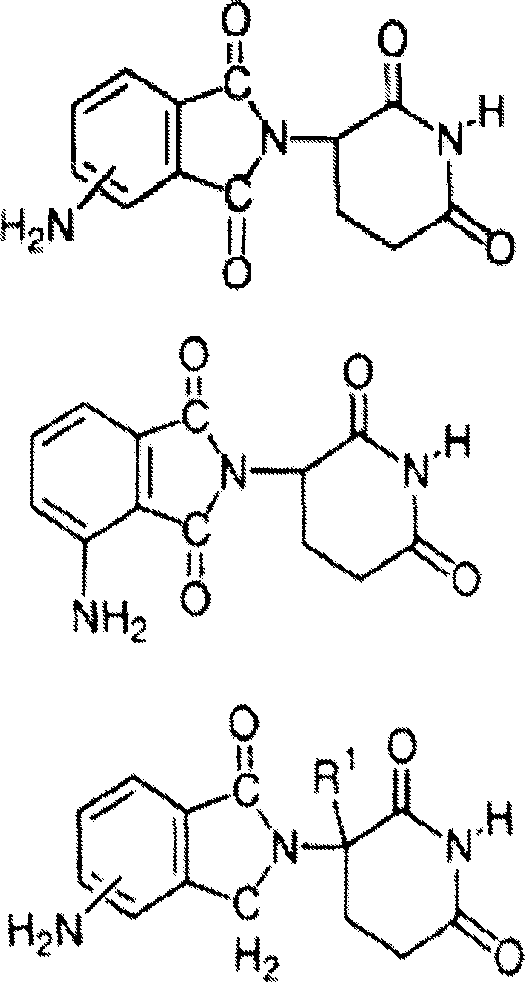

wherein R is1Is hydrogen or methyl. In a separate embodiment, the invention encompasses the use of enantiomerically pure forms of these compounds (e.g., the optically pure (R) or (S) enantiomer).
Other specific immunomodulatory compounds of the invention belong to the class of isoindole-imides and are disclosed in U.S. patent application publication Nos. 2003/0096841 and 2003/0045552 and International patent application No. PCT/US01/50401 (International publication No. WO02/059106), each of which is incorporated herein by reference. Representative compounds have formula II:

and pharmaceutically acceptable salts, hydrates, solvates, inclusions, enantiomers, diastereomers, racemates, and mixtures of stereoisomers thereof, wherein:
one of X and Y is C ═ O, and the other is CH2Or C ═ O;
R1is H, (C)1-C8) Alkyl, (C)3-C7) Cycloalkyl group, (C)2-C8) Alkenyl, (C)2-C8) Alkynyl, benzyl, aryl, (C)0-C4) Alkyl radical- (C)1-C6) Heterocycloalkyl group, (C)0-C4) Alkyl radical- (C)2-C5) Heteroaryl, C (O) R3、C(S)R3、C(O)OR4、(C1-C8) alkyl-N (R)6)2、(C1-C8) alkyl-OR5、(C1-C8) alkyl-C (O) OR5、C(O)NHR3、C(S)NHR3、C(O)NR3R3′、C(S)NR3R3′Or (C)1-C8) alkyl-O (CO) R5;
R2Is H, F, benzyl, (C)1-C8) Alkyl, (C)2-C8) Alkenyl or (C)2-C8) An alkynyl group;
R3and R3′Independently is (C)1-C8) Alkyl, (C)3-C7) Cycloalkyl group, (C)2-C8) Alkenyl, (C)2-C8) Alkynyl, benzyl, aryl, (C)0-C4) Alkyl radical- (C)1-C6) Heterocycloalkyl group, (C)0-C4) Alkyl radical- (C)2-C5) Heteroaryl, (C)0-C8) alkyl-N (R)6)2、(C1-C8) alkyl-OR5、(C1-C8) alkyl-C (O) OR5、(C1-C8) alkyl-O (CO) R5OR C (O) OR5;
R4Is (C)1-C8) Alkyl, (C)2-C8) Alkenyl, (C)2-C8) Alkynyl, (C)1-C4) alkyl-OR5Benzyl, aryl, (C)0-C4) Alkyl radical- (C)1-C6) Heterocycloalkyl or (C)0-C4) Alkyl radical- (C)2-C5) A heteroaryl group;
R5is (C)1-C8) Alkyl, (C)2-C8) Alkenyl, (C)2-C8) Alkynyl, benzyl, aryl or (C)2-C5) A heteroaryl group;
R6independently at each occurrence, H, (C)1-C8) Alkyl, (C)2-C8) Alkenyl, (C)2-C8) Alkynyl, benzylAryl, (C)2-C5) Heteroaryl or (C)0-C8) alkyl-C (O) O-R5Or R is6Groups may be joined together to form a heterocycloalkyl group;
n is 0 or 1; and
*represents a chiral carbon center.
In specific compounds of formula II, R is when n is 01Is (C)3-C7) Cycloalkyl group, (C)2-C8) Alkenyl, (C)2-C8) Alkynyl, benzyl, aryl, (C)0-C4) Alkyl radical- (C)1-C6) Heterocycloalkyl group, (C)0-C4) Alkyl radical- (C)2-C5) Heteroaryl, C (O) R3、C(O)OR4、(C1-C8) alkyl-N (R)6)2、(C1-C8) alkyl-OR5、(C1-C8) alkyl-C (O) OR5、C(S)NHR3Or (C)1-C8) alkyl-O (CO) R5;
R2Is H or (C)1-C8) An alkyl group; and
R3is (C)1-C8) Alkyl, (C)3-C7) Cycloalkyl group, (C)2-C8) Alkenyl, (C)2-C8) Alkynyl, benzyl, aryl, (C)0-C4) Alkyl radical- (C)1-C6) Heterocycloalkyl group, (C)0-C4) Alkyl radical- (C)2-C5) Heteroaryl, (C)5-C8) alkyl-N (R)6)2;(C0-C8) alkyl-NH-C (O) O-R5;(C1-C8) alkyl-OR5、(C1-C8) alkyl-C (O) OR5、(C1-C8) alkyl-O (CO) R5OR C (O) OR5(ii) a And other variations having the same definition.
In other specific compounds of formula II, R2Is H or(C1-C4) An alkyl group.
In other specific compounds of formula II, R1Is (C)1-C8) Alkyl or benzyl.
In other specific compounds of formula II, R1Is H, (C)1-C8) Alkyl, benzyl, CH2OCH3、CH2CH2OCH3Or is or
In another embodiment of the compounds of formula II, R1Is that

Wherein Q is O or S, R7Each occurrence is independently H, (C)1-C8) Alkyl, (C)3-C7) Cycloalkyl group, (C)2-C8) Alkenyl, (C)2-C8) Alkynyl, benzyl, aryl, halogen, (C)0-C4) Alkyl radical- (C)1-C6) Heterocycloalkyl group, (C)0-C4) Alkyl radical- (C)2-C5) Heteroaryl, (C)0-C8) alkyl-N (R)6)2、(C1-C8) alkyl-OR5、(C1-C8) alkyl-C (O) OR5、(C1-C8) alkyl-O (CO) R5OR C (O) OR5Or adjacent R7May together form an alkyl or aryl bicyclic ring.
In other specific compounds of formula II, R1Is C (O) R3。
In other specific compounds of formula II, R3Is (C)0-C4) Alkyl radical- (C)2-C5) Heteroaryl, (C)1-C8) Alkyl, aryl or (C)0-C4) alkyl-OR5。
In other specific compounds of formula II, heteroaryl is pyridyl, furyl, or thienyl.
In other specific compounds of formula II, R1Is C (O) OR4。
In other specific compounds of formula II, H of C (O) NHC (O) may be replaced by (C)1-C4) Alkyl, aryl or benzyl.
Other examples of such compounds include, but are not limited to: [2- (2, 6-dioxo-piperidin-3-yl) -1, 3-dioxo-2, 3-dihydro-1H-isoindol-4-ylmethyl ] -amide; (2- (2, 6-dioxo-piperidin-3-yl) -1, 3-dioxo-2, 3-dihydro-1H-isoindol-4-ylmethyl) -carbamic acid tert-butyl ester; 4- (aminomethyl) -2- (2, 6-dioxo (3-piperidyl)) -isoindoline-1, 3-dione; n- (2- (2, 6-dioxo-piperidin-3-yl) -1, 3-dioxo-2, 3-dihydro-1H-isoindol-4-ylmethyl) -acetamide; n- { (2- (2, 6-dioxo (3-piperidinyl) -1, 3-dioxoisoindolin-4-yl) methyl) cyclopropyl-carboxamide; 2-chloro-N- { (2- (2, 6-dioxo (3-piperidyl)) -1, 3-dioxoisoindolin-4-yl) methyl } acetamide; n- (2- (2, 6-dioxo (3-piperidyl)) -1, 3-dioxoisoindolin-4-yl) -3-pyridylcarboxamide; 3- { 1-oxo-4- (benzylamino) isoindolin-2-yl } piperidine-2, 6-dione; 2- (2, 6-dioxo (3-piperidyl)) -4- (benzylamino) isoindoline-1, 3-dione; n- { (2- (2, 6-dioxo (3-piperidyl)) -1, 3-dioxoisoindolin-4-yl) methyl } propionamide; n- { (2- (2, 6-dioxo (3-piperidyl)) -1, 3-dioxoisoindolin-4-yl) methyl } -3-pyridylcarboxamide; n- { (2- (2, 6-dioxo (3-piperidyl)) -1, 3-dioxoisoindolin-4-yl) methyl } heptanamide; n- { (2- (2, 6-dioxo (3-piperidyl)) -1, 3-dioxoisoindolin-4-yl) methyl } -2-furanyl carboxamide; methyl { N- (2- (2, 6-dioxo (3-piperidyl)) -1, 3-dioxoisoindolin-4-yl) carbamoyl } acetate; n- (2- (2, 6-dioxo (3-piperidyl)) -1, 3-dioxoisoindolin-4-yl) pentanamide; n- (2- (2, 6-dioxo (3-piperidyl)) -1, 3-dioxoisoindolin-4-yl) -2-thienylcarboxamide; n- { [2- (2, 6-dioxo (3-piperidyl)) -1, 3-dioxoisoindolin-4-yl ] methyl } (butylamino) carboxamide; n- { [2- (2, 6-dioxo (3-piperidyl)) -1, 3-dioxoisoindolin-4-yl ] methyl } (octylamino) carboxamide; and N- { [2- (2, 6-dioxo (3-piperidyl)) -1, 3-dioxoisoindolin-4-yl ] methyl } (benzylamino) carboxamide.
Other specific immunomodulatory compounds of the invention belong to the isoindole-imides and are disclosed in U.S. patent application No. 2002/0045643, international publication No. WO 98/54170, and U.S. patent No. 6,395,754, which are incorporated herein by reference. Representative compounds have formula III:
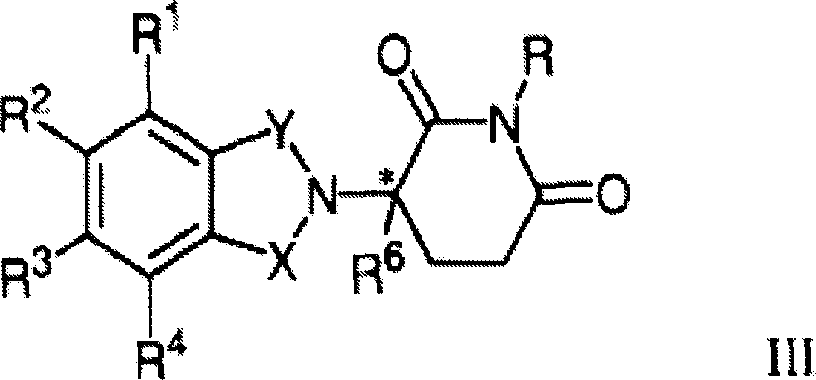
and pharmaceutically acceptable salts, hydrates, solvates, inclusions, enantiomers, diastereomers, racemates, and mixtures of stereoisomers thereof, wherein:
one of X and Y is C ═ O, and the other is CH2Or C ═ O;
r is H or CH2OCOR′;
(i)R1、R2、R3Or R4Each independently of the other, halogen, alkyl having 1 to 4 carbon atoms or alkoxy having 1 to 4 carbon atoms, or (ii) R1、R2、R3Or R4One of which is nitro or-NHR5And R is1、R2、R3And R4The remainder of (A) is hydrogen;
R5is hydrogen or alkyl having 1 to 8 carbon atoms;
R6is hydrogen, alkyl having 1 to 8 carbon atoms, benzo, chloro or fluoro;
r' isR7-CHR10-N(R8R9);
R7Is m-or p-phenylene or- (C)nH2n) -, where n is 0 to 4;
R8and R9Independently of one another, hydrogen or alkyl having 1 to 8 carbon atoms, or R8And R9Together being tetramethylene, pentamethylene, hexamethylene or-CH2CH2X1CH2CH2-, wherein X1is-O-, -S-or-NH-;
R10is hydrogen, alkyl of 8 carbon atoms or phenyl; and
*represents a chiral carbon center.
Other representative compounds have the formula:
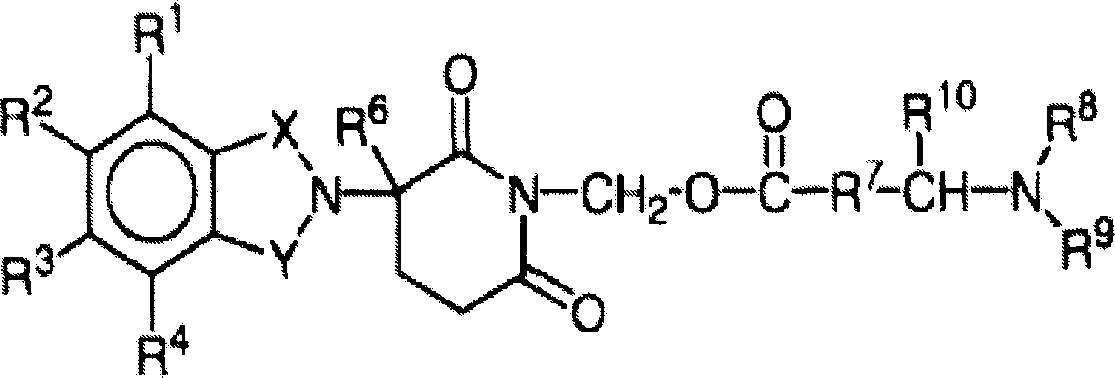
wherein:
one of X and Y is C ═ O, and the other of X and Y is C ═ O or CH2;
(i)R1、R2、R3Or R4Each independently of the other, halogen, alkyl having 1 to 4 carbon atoms or alkoxy having 1 to 4 carbon atoms, or (ii) R1、R2、R3Or R4One is-NHR5And R is1、R2、R3And R4The remainder of (A) is hydrogen;
R5is hydrogen or alkyl having 1 to 8 carbon atoms;
R6is hydrogen, alkyl having 1 to 8 carbon atoms, benzo, chloro or fluoro;
R7is m-or p-phenylene or- (C)nH2n) -, where n is 0 to 4;
R8and R9Independently of one another, hydrogen or alkyl having 1 to 8 carbon atoms, or R8And R9Together being tetramethylene, pentamethylene, hexamethylene or-CH2CH2X1CH2CH2-, wherein X1is-O-, -S-or-NH-;
R10is hydrogen, alkyl of up to 8 carbon atoms or phenyl.
Other representative compounds have the formula:

wherein,
one of X and Y is C ═ O, and the other of X and Y is C ═ O or CH2;
R1、R2、R3And R4Each independently of the other, halogen, alkyl having 1 to 4 carbon atoms or alkoxy having 1 to 4 carbon atoms, or (ii) R1、R2、R3And R4One is nitro or protected amino, and R1、R2、R3And R4The remainder of (A) is hydrogen; and
R6is hydrogen, alkyl having 1 to 8 carbon atoms, benzo, chloro or fluoro;
other representative compounds have the formula:

wherein:
one of X and Y is C ═ O, and the other of X and Y is C ═ O or CH2;
(i)R1、R2、R3Or R4Each independently of the other, halogen, alkyl having 1 to 4 carbon atoms or alkoxy having 1 to 4 carbon atoms, or (ii) R1、R2、R3Or R4One is-NHR5And R is1、R2、R3And R4The remainder of (A) is hydrogen;
R5is hydrogen, alkyl having 1 to 8 carbon atoms or CO-R7-CH(R10)NR8R9Wherein R is7、R8、R9And R10Each as defined above; and
R6is alkyl containing 1-8 carbon atoms, benzo, chloro or fluoro;
specific examples of the compounds have the following formula:

wherein:
one of X and Y is C ═ O, and the other of X and Y is C ═ O or CH2;
R6Is hydrogen, alkyl having 1 to 8 carbon atoms, benzyl, chlorine or fluorine;
R7is m-or p-phenylene or- (C)nH2n) -, where n is 0 to 4;
R8and R9Independently of one another, hydrogen or alkyl having 1 to 8 carbon atoms, or R8And R9Together being tetramethylene, pentamethylene, hexamethylene or-CH2CH2X1CH2CH2-, wherein X1is-O-, -S-or-NH-; and
R10is hydrogen, alkyl of 1 to 8 carbon atoms or phenyl.
The most preferred immunomodulatory compounds of the invention are 4- (amino) -2- (2, 6-dioxo (3-piperidyl)) -isoindoline-1, 3-dione and 3- (4-amino-1-oxo-1, 3-dihydro-isoindol-2-yl) -piperidine-2, 6-dione. Such compounds can be obtained by standard synthetic methods (see, e.g., U.S. patent No. 5,635,517, which is incorporated herein by reference). This compound is available from Celgene corporation (warrenn, NJ). 4- (amino) -2- (2, 6-dioxo (3-piperidyl)) -isoindoline-1, 3-dione has the following chemical structure:
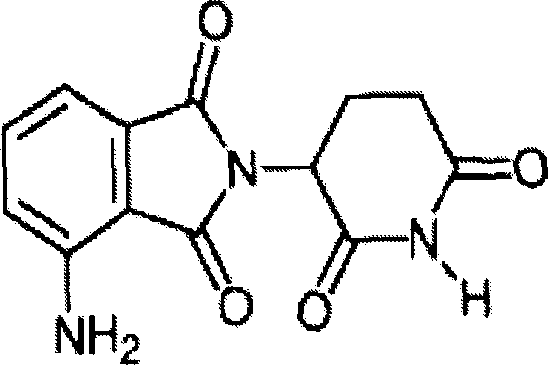
the compound 3- (4-amino-1-oxo-1, 3-dihydro-isoindol-2-yl) -piperidine-2, 6-dione has the following chemical structure:
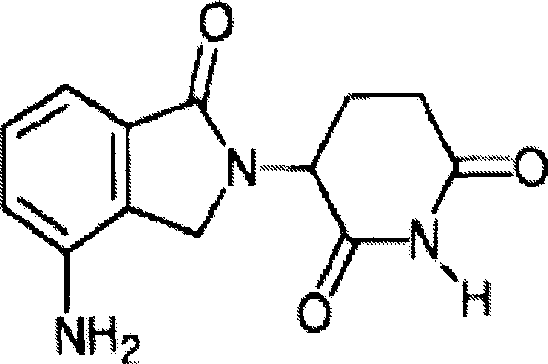
in another embodiment, specific immunomodulatory compounds of the invention include polymorphic forms of 3- (4-amino-1-oxo-1, 3-dihydro-isoindol-2-yl) -piperidine-2, 6-dione, such as forms A, B, C, D, E, F, G and H disclosed in U.S. provisional application 60/499,723, filed on 9/4/2003 and U.S. non-provisional application 10/934,863, filed on 9/3/2004, both of which are incorporated herein by reference. For example, form a of 3- (4-amino-1-oxo-1, 3-dihydro-isoindol-2-yl) -piperidine-2, 6-dione is a non-solvated crystalline, which can be obtained from a non-aqueous solvent system. The X-ray powder diffraction pattern of form a comprises distinct peaks at about 8, 14.5, 16, 17.5, 20.5, 24, and 26 degrees 2 Θ, with a differential scanning calorimetry maximum melting temperature of about 27 Θ ℃. Form a is weakly or non-hygroscopic and is the thermodynamically most stable anhydrous polymorph of 3- (4-amino-1-oxo-1, 3-dihydro-isoindol-2-yl) -piperidine-2, 6-dione to date.
Form B of 3- (4-amino-1-oxo-1, 3-dihydro-isoindol-2-yl) -piperidine-2, 6-dione is a hemihydrate crystalline, which can be obtained from a variety of solvent systems, including but not limited to hexane, toluene, and water. The X-ray powder diffraction pattern for form B contained distinct peaks at about 16, 18, 22, and 27 degrees 2 theta, with the DSC curve showing endotherms at about 146 and 268 ℃, and dehydration and melting as confirmed by hot-stage microscopy experiments. Interconversion studies have shown that form B converts to form E in aqueous solvent systems and to other forms in acetone and other anhydrous systems.
Form C of 3- (4-amino-1-oxo-1, 3-dihydro-isoindol-2-yl) -piperidine-2, 6-dione is a semi-solvated crystalline, which can be obtained from a solvent such as, but not limited to, acetone. Form C has an X-ray powder diffraction pattern comprising distinct peaks at about 15.5 and 25 degrees 2-theta with a differential scanning calorimetry maximum melting temperature of about 269 ℃. Form C is not hygroscopic below about 85% RH, but can be converted to form B at high relative humidity.
Form D of 3- (4-amino-1-oxo-1, 3-dihydro-isoindol-2-yl) -piperidine-2, 6-dione is a crystalline solvated polymorph prepared from a mixture of acetonitrile and water. Form D has an X-ray powder diffraction pattern comprising distinct peaks at about 27 and 28 degrees 2 Θ and a differential scanning calorimetry maximum melting temperature of about 270 ℃. Form D is weakly or non-hygroscopic, but generally converts to form B when under pressure at high relative humidity.
Form E of 3- (4-amino-1-oxo-1, 3-dihydro-isoindol-2-yl) -piperidine-2, 6-dione is a dihydrate crystal, which can be obtained by slurrying 3- (4-amino-1-oxo-1, 3-dihydro-isoindol-2-yl) -piperidine-2, 6-dione in water, and slowly evaporating 3- (4-amino-1-oxo-1, 3-dihydro-isoindol-2-yl) -piperidine-2, 6-dione in a solvent system of acetone: water of about 9: 1. Form E has an X-ray powder diffraction pattern comprising distinct peaks at about 20, 24.5, and 29 degrees 2 Θ and a differential scanning calorimetry maximum melting temperature of about 269 ℃. Form E can be converted to form C in an acetone solvent system and form G in a THF solvent system. Form E is the most stable form in aqueous solvent systems. The anti-dissolution experiment for form E showed that form E was converted to form B when heated at about 125 ℃ for about 5 minutes. Form B converts to form F upon heating at 175 ℃ for about 5 minutes.
Form F of 3- (4-amino-1-oxo-1, 3-dihydro-isoindol-2-yl) -piperidine-2, 6-dione is a non-solvated crystalline material, which can be obtained by dehydrating form E. The X-ray powder diffraction pattern for form F contains significant peaks at about 19, 19.5, and 25 degrees 2 Θ, with a differential scanning calorimetry maximum melting temperature of about 269 ℃.
Form G of 3- (4-amino-1-oxo-1, 3-dihydro-isoindol-2-yl) -piperidine-2, 6-dione is a non-solvated crystalline material that can be obtained from a slurry of forms B and E in a solvent such as, but not limited to, Tetrahydrofuran (THF). The X-ray powder diffraction pattern of form G contains significant peaks at about 21, 23, and 24.5 degrees 2 Θ, with a differential scanning calorimetry maximum melting temperature of about 267 ℃.
Form H of 3- (4-amino-1-oxo-1, 3-dihydro-isoindol-2-yl) -piperidine-2, 6-dione is a partially hydrated (about 0.25mol) crystal, which can be obtained by exposing form E to 0% relative humidity. The X-ray powder diffraction pattern of form H contains significant peaks at about 15, 26, and 31 degrees 2 Θ, with a differential scanning calorimetry maximum melting temperature of about 269 ℃.
Other specific immunomodulatory compounds of the invention include, but are not limited to, 1-oxo-2- (2, 6-dioxo-3-fluoropiperidin-3-yl) isoindoline and 1, 3-dioxo-2- (2, 6-dioxo-3-fluoropiperidin-3-yl) isoindoline, such as those described in U.S. Pat. Nos. 5,874,448 and 5,955,476, which are incorporated herein by reference. Representative compounds have the formula:
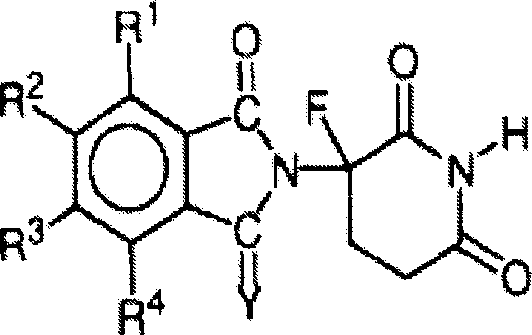
wherein Y is oxygen or H2And are and
R1、R2、R3and R4Each independently hydrogen, halogen, alkyl having 1 to 4 carbon atoms, alkoxy having 1 to 4 carbon atoms, or amino.
Other specific immunomodulatory compounds of the invention include, but are not limited to: tetrasubstituted 2- (2, 6-dioxopiperidin-3-yl) -1-oxoisoindolines, which are described in U.S. Pat. No. 5,798,368, which is incorporated herein by reference. Representative compounds have the formula:
wherein R is1、R2、R3And R4Each independently a halogen, an alkyl group having 1 to 4 carbon atoms, or an alkoxy group having 1 to 4 carbon atoms.
Other specific immunomodulatory compounds of the invention include, but are not limited to, 1-oxo and 1, 3 dioxo-2- (2, 6 dioxopiperidin-3-yl) isoindolines, which are disclosed in U.S. Pat. No. 6,403,613, which is incorporated herein by reference. Representative compounds have the formula:
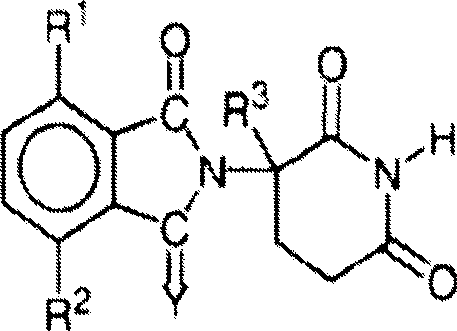
wherein
Y is oxygen or H2,
R1And R2One of which is halogen, alkyl, alkoxy, alkylamino, dialkylamino, cyano or carbamoyl, R1And R2Wherein the other is independently hydrogen, halogen, alkyl, alkoxy, alkylamino, dialkylamino, cyano or carbamoyl, and
R3is hydrogen, alkyl or benzyl.
Specific examples of such compounds have the formula:
wherein R is1And R2One of halogen, alkyl having 1 to 4 carbon atoms, alkoxy having 1 to 4 carbon atoms, dialkylamino (wherein each alkyl has 1 to 4 carbon atoms), cyano or carbamoyl,
R1and R2One is independently hydrogen, halogen, alkyl having 1 to 4 carbon atoms, alkoxy having 1 to 4 carbon atoms, alkylamino (wherein the alkyl has 1 to 4 carbon atoms), dialkylamino (wherein each alkyl has 1 to 4 carbon atoms), cyano or carbamoyl, and
R3is hydrogen, alkyl having 1 to 4 carbon atoms or benzyl. Specific examples include, but are not limited to, 1-oxo-2 (2, 6-dioxopiperidin-3-yl) -4-methylisoindoline.
Other representative compounds have the formula:
wherein R is1And R2One of halogen, alkyl having 1 to 4 carbon atoms, alkoxy having 1 to 4 carbon atoms, dialkylamino (wherein each alkyl has 1 to 4 carbon atoms), cyano or carbamoyl,
R1and R2One is independently hydrogen, halogen, alkyl having 1 to 4 carbon atoms, alkoxy having 1 to 4 carbon atoms, alkylamino (wherein the alkyl has 1 to 4 carbon atoms), dialkylamino (wherein each alkyl has 1 to 4 carbon atoms), cyano or carbamoyl, and
R3is hydrogen, alkyl having 1 to 4 carbon atoms or benzyl.
Specific compounds include, but are not limited to, 1-oxo-2- (2, 6-dioxopiperidin-3-yl) -4-methylisoindoline.
Other specific immunomodulatory compounds of the invention include, but are not limited to, 1-oxo and 1, 3-dioxoisoindolines substituted at the 4-or 5-position of the indoline ring, described in U.S. patent No. 6,380,239 and co-pending U.S. application No. 10/900,270 filed on 7/28 of 2004, which are incorporated herein by reference. Representative compounds have the formula:
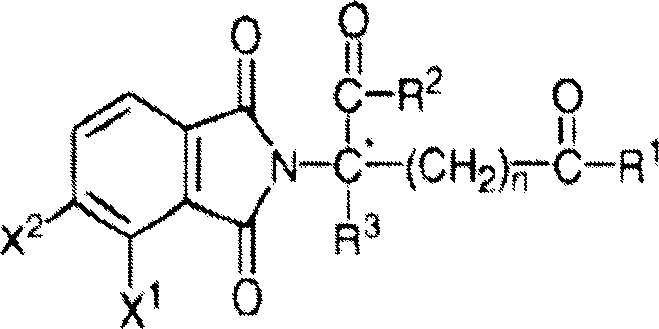
wherein, is represented as C*Form a chiral centre (when n is different from 0 and R1And R2When not identical); x1And X2One of which is amino, nitro, alkyl having 1 to 6 carbon atoms or NH-Z, and X1Or X2The other is hydrogen; r1And R2Each independently is hydroxy or NH-Z; r3Is hydrogen, alkyl containing 1 to 6 carbon atoms, halogen or haloalkyl; z is hydrogen, aryl, alkyl containing 1 to 6 carbon atoms, formyl or acyl containing 1 to 6 carbon atoms; and n has a value of 0, 1 or 2; provided that if X is1Is amino and n is 1 or 2, then R1And R2Are not hydroxyl; and salts thereof.
Other representative compounds have the formula:

wherein when n is not 0 and R1And R2When not identical, is represented as C*The carbon atom of (a) constitutes a chiral center; x1And X2One of which is amino, nitro, alkyl having 1 to 6 carbon atoms or NH-Z, and X1Or X2The other is hydrogen; r1And R2Each independently is hydroxy or NH-Z; r3Is alkyl containing 1-6 carbon atoms, halogen or hydrogen; z is hydrogen, aryl or alkyl or acyl containing 1 to 6 carbon atoms; and n has a value of 0, 1 or 2.
Specific examples include, but are not limited to, 2- (4-amino-1-oxo-1, 3-dihydro-isoindol-2-yl) -4-carbamoyl-butyric acid and 4- (4-amino-1-oxo-1, 3-dihydro-isoindol-2-yl) -4-carbamoyl-butyric acid, respectively, having the following structures, and pharmaceutically acceptable salts, solvates, prodrugs, and stereoisomers thereof:

representative other compounds have the formula:

wherein, is represented as C*Form a chiral centre (when n is different from 0 and R1And R2When not identical); x1And X2One of which is amino, nitro, alkyl of 1 to 6 carbon atoms or NH-Z, X1Or X2Is hydrogen; r1And R2Each independently is hydroxy or NH-Z; r3Is alkyl of 1 to 6 carbon atoms, halogen or hydrogen; z is hydrogen, aryl or alkyl or acyl of 1-6 carbon atoms; and n has a value of 0, 1 or 2; and salts thereof.
Specific examples include, but are not limited to, 4-carbamoyl-4- {4- [ (furan-2-yl-methyl) -amino ] -1, 3-dioxo-1, 3-dihydro-isoindol-2-yl } -butyric acid, 4-carbamoyl-2- {4- [ (furan-2-yl-methyl) -amino ] -1, 3-dioxo-1, 3-dihydro-isoindol-2-yl } -butyric acid, 2- {4- [ (furan-2-yl-methyl) -amino ] -1, 3-dioxo-1, 3-dihydro-isoindol-2-yl } -4-phenylcarbamoyl-butyric acid having the following structure, and 2- {4- [ (furan-2-yl-methyl) -amino ] -1, 3-dioxo-1, 3-dihydro-isoindol-2-yl } -glutaric acid, and pharmaceutically acceptable salts, solvates, prodrugs, and stereoisomers thereof:
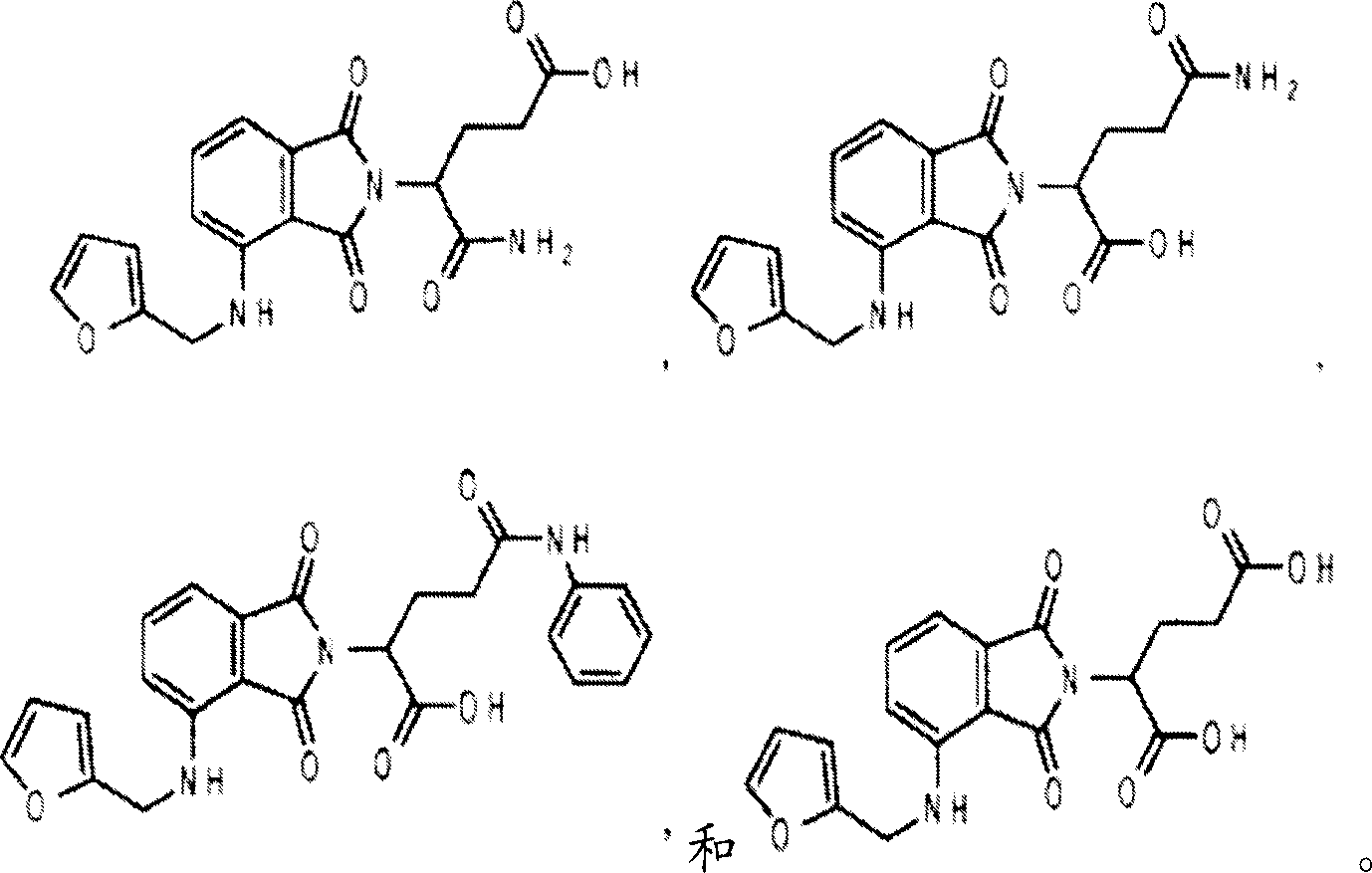
other specific examples of the compound have the following formula:
wherein, X1And X2One is nitro or NH-Z, and X1Or X2The other of (a) is hydrogen;
R1and R2Each independently is hydroxy or NH-Z;
R3is alkyl containing 1-6 carbon atoms, halogen or hydrogen;
z is hydrogen, phenyl, acyl containing 1 to 6 carbon atoms or alkyl containing 1 to 6 carbon atoms; and
n has a value of 0, 1 or 2;
provided that if X is1And X2One is nitro and n is 1 or 2, then R1And R2Is not a hydroxyl group; and
if-COR1And- (CH)2)nCOR2Is different, then is represented as C*The carbon atom(s) constituting the chiral center. Other representative compounds have the formula:
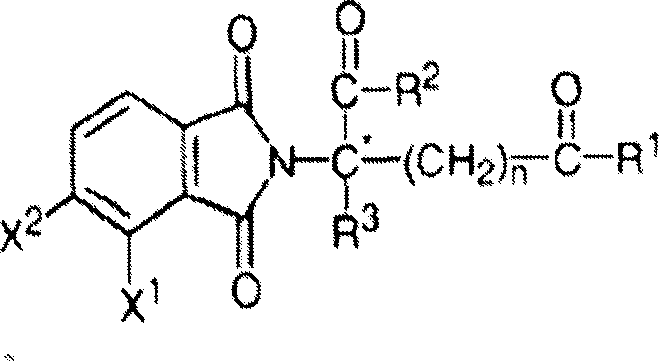
wherein, X1And X2One is an alkyl group containing 1 to 6 carbon atoms;
R1and R2Each independently is hydroxy or NH-Z;
R3is alkyl containing 1-6 carbon atoms, halogen or hydrogen;
z is hydrogen, phenyl, acyl containing 1 to 6 carbon atoms or alkyl containing 1 to 6 carbon atoms; and
n has a value of 0, 1 or 2; and
if-COR2And- (CH)2)nCOR1Is different, then is represented as C*The carbon atom(s) constituting the chiral center.
Other specific immunomodulatory compounds of the invention include, but are not limited to: isoindolin-1-ones and isoindolin-1, 3-diones substituted at the 2-position with a 2, 6-dioxo-3-hydroxypiperidin-5-yl group, which are described in U.S. Pat. No. 6,458,810, which is incorporated herein by reference. Representative compounds have the formula:

wherein:
by using*The carbon atoms represented constitute the chiral center;
x is-C (O) -or-CH2-;
R1Is alkyl having 1 to 8 carbon atoms or-NHR3;
R2Is hydrogen, alkyl having 1 to 8 carbon atoms or halogen; and
R3is hydrogen;
alkyl having 1 to 8 carbon atoms, unsubstituted or substituted with alkoxy having 1 to 8 carbon atoms, halogen, amino or alkylamino having 1 to 4 carbon atoms;
cycloalkyl groups containing 3 to 18 carbon atoms;
phenyl, unsubstituted or substituted by alkyl having 1 to 8 carbon atoms, alkoxy having 1 to 8 carbon atoms, halogen, amino or alkylamino having 1 to 4 carbon atoms;
benzyl, unsubstituted or substituted by alkyl having 1 to 8 carbon atoms, alkoxy having 1 to 8 carbon atoms, halogen, amino or alkylamino having 1 to 4 carbon atoms, or-COR4Wherein
R4Is a hydrogen atom, and is,
alkyl having 1 to 8 carbon atoms, unsubstituted or substituted by alkoxy having 1 to 8 carbon atoms, halogen, amino or alkylamino having 1 to 4 carbon atoms,
cycloalkyl groups having 3 to 18 carbon atoms,
phenyl, unsubstituted or substituted by alkyl having 1 to 8 carbon atoms, alkoxy having 1 to 8 carbon atoms, halogen, amino or alkylamino having 1 to 4 carbon atoms, or
Benzyl, unsubstituted or substituted by alkyl having 1 to 8 carbon atoms, alkoxy having 1 to 8 carbon atoms, halogen, amino or alkylamino having 1 to 4 carbon atoms.
The compounds of the present invention may be commercially available or prepared according to the methods described in the patents or patent applications disclosed in this specification. In addition, optically pure compounds can be asymmetrically synthesized or resolved using known resolving agents or chiral columns, as well as other standard organic chemical synthesis techniques.
The term "pharmaceutically acceptable salts" as used herein, unless otherwise indicated, includes non-toxic acid and base addition salts of the compounds to which the term refers. Acceptable non-toxic acid addition salts include those derived from organic and inorganic acids or bases known in the art, including, for example, hydrochloric, hydrobromic, phosphoric, sulfuric, methanesulfonic, acetic, tartaric, lactic, succinic, citric, malic, maleic, sorbic, aconitic, salicylic, phthalic, embolic (embonic acid), heptanoic, and the like.
Naturally occurring acidic compounds are capable of forming salts with various pharmaceutically acceptable bases. The bases which can be used for the preparation of pharmaceutically acceptable base addition salts of such acidic compounds are those which form non-toxic base addition salts, that is, salts containing pharmacologically acceptable cations, such as, but not limited to, alkali metal or alkaline earth metal salts, especially calcium, magnesium, sodium, potassium salts. Suitable organic bases include, but are not limited to, N-dibenzylethylenediamine, chloroprocaine, choline, diethanolamine, ethylenediamine, meglumine (N-methylglucamine), lysine, and procaine.
The term "solvate" as used herein, unless otherwise specified, refers to a compound of the invention or a salt thereof, and also includes stoichiometric or non-stoichiometric amounts of solvents bound by non-covalent intermolecular forces. If the solvent is water, then the solvate is a hydrate.
As used herein, and unless otherwise indicated, the term "prodrug" refers to a derivative of a compound that hydrolyzes, oxidizes, or otherwise reacts under biological conditions (in vitro or in vivo) to provide the compound. Examples of prodrugs include, but are not limited to, derivatives of immunomodulatory compounds of the invention comprising biohydrolyzable moieties such as biohydrolyzable amides, biohydrolyzable esters, biohydrolyzable carbamates, biohydrolyzable carbonates, biohydrolyzable ureides, and biohydrolyzable phosphate analogs. Other examples of prodrugs include those containing-NO, -NO2-ONO or-ONO2Derivatives of some of the immunomodulatory compounds of the invention. Prodrugs can generally be prepared by well-known methods, such as those described in Burger's Medicinal Chemistry and Drug Discovery, 172-178, 949-982 (edited by Man. Wolff, 5 th edition 1995) and Design of Prodrugs (edited by H. Bundgaand, Elselvier, New York 1985).
As used herein, unless otherwise indicated, the terms "biohydrolyzable amide", "biohydrolyzable ester", "biohydrolyzable carbamate", "biohydrolyzable carbonate", "biohydrolyzable ureide", "biohydrolyzable phosphate" refer to an amide, ester, carbamate, carbonate, ureide, or phosphate, respectively, of a compound having the following properties: 1) does not interfere with the biological activity of the compound, but may confer advantageous properties to the compound in vivo, such as absorption, duration of action or onset of action; or 2) is biologically inactive, but is converted in vivo to a biologically active compound. Examples of biohydrolyzable esters include, but are not limited to, lower alkyl esters, lower acyloxyalkyl esters (e.g., acetoxymethyl, acetoxyethyl, aminocarbonyloxymethyl, pivaloyloxymethyl, and pivaloyloxyethyl esters), lactonyl esters (e.g., phthalidyl and thiophthalidyl esters), lower alkoxyacyloxyalkyl esters (e.g., methoxycarbonyloxymethyl, ethoxycarbonyloxyethyl, and isopropoxycarbonyloxyethyl esters), alkoxyalkyl esters, choline esters, and acylaminoalkyl esters (e.g., acetamidomethyl esters). Examples of biohydrolyzable amides include, but are not limited to, lower alkyl amides, alpha-amino acid amides, alkoxyacyl amides, and alkylaminoalkylcarbonyl amides. Examples of biohydrolyzable carbamates include, but are not limited to, lower alkylamines, substituted ethylenediamines, amino acids, hydroxyalkylamines, heterocyclic and heteroaromatic amines, and polyether amines.
The term "stereoisomer" as used herein, unless otherwise indicated, includes all enantiomerically/stereomerically pure and enantiomerically/stereomerically enriched compounds of the present invention.
As used herein, unless otherwise indicated, the term "stereomerically pure" or "enantiomerically pure" means that a compound includes one stereoisomer and is substantially free of the opposite stereoisomer or enantiomer of the compound. For example, a compound is stereoisomerically or enantiomerically pure when it contains 80%, 90%, or 95% or more of one stereoisomer and 20%, 10%, or 5% or less of the opposite stereoisomer. In certain instances, when a compound of the invention is about 80% ee (enantiomeric excess) or greater, preferably equal to or greater than 90% ee, more preferably 95% ee relative to a particular chiral center, then the compound is considered optically active or stereoisomerically/enantiomerically pure (i.e., substantially R-form or substantially S-form) relative to the chiral center.
As used herein, unless otherwise indicated, the term "stereomerically enriched" or "enantiomerically enriched" includes racemic as well as other mixtures of stereoisomers of the compounds of the invention (e.g., R/S ═ 30/70, 35/65, 40/60, 45/55, 55/45, 60/40, 65/35, and 70/30). Various immunomodulatory compounds of the invention contain one or more chiral centers and may exist as racemic or diastereomeric mixtures of enantiomers. The invention includes the use of stereomerically pure forms of such compounds as well as the use of mixtures of those forms. For example, mixtures containing equal or unequal amounts of enantiomers of particular immunomodulatory compounds of the invention may be used in methods and compositions of the invention. These isomers can be asymmetrically synthesized or resolved using standard techniques such as chiral columns or chiral resolving agents. See, for example: jacques, j. et al, enerimors, racemases and solutions (Wiley-Interscience, New York, 1981); wilen, s.h. et al, Tetrahedron 33: 2725 (1977); eliel, E.L., Stereochemistry of Carboncompounds (McGraw-Hill, NY, 1962); and Wilen, s.h., Tables of solving Agents and Optical solutions, p.268 (e.l. eliel, univ. of note dam Press, note dam, IN, 1972).
It should be noted that if there is a difference between the structure shown and the name of the structure, the structure shown should be the subject of the difference. Furthermore, if the stereochemistry of a structure or a portion of a structure is not indicated with, for example, bold or dashed lines, the structure or portion of the structure is to be understood as encompassing all stereoisomers of it.
5.2 second active agent
One or more second active ingredients may be used in the methods and compositions of the present invention with an immunomodulatory compound of the invention, or a pharmaceutically acceptable salt, solvate, hydrate, stereoisomer, clathrate, or prodrug thereof. In particular embodiments, the second active agent is capable of affecting or inhibiting cell growth or proliferation, eliminating or ameliorating acne scars, or reducing or repairing wrinkles.
The second active agent can be a macromolecule (e.g., a protein) or a small molecule (e.g., a synthetic inorganic, organometallic, or organic molecule). The second active agent includes, but is not limited to, keratolytic agents, retinoids, alpha-hydroxy acids, antibiotics, collagen, botulinum toxin, interferons, immunomodulators, immunosuppressants, anti-inflammatory agents, herbal products, and other therapeutic agents discussed herein. Specific second active agents include, but are not limited to, Xanthium Relieve Surface (e.g., any composition containing one or more Xanthium fruit and magnolia), 5-fluorouracil, maleocol, trichloroacetic acid, salicylic acid, lactic acid, ammonium lactate, urea, isotretinoin, antibiotics, collagen, botulinum toxin, interferon, and trans-retinoic acid.
In one embodiment of the invention, an immunomodulatory compound, or a pharmaceutically acceptable salt, solvate, hydrate, stereoisomer, clathrate, or prodrug thereof can be used in combination with a keratolytic agent. Examples of keratolytic agents include, but are not limited to, 5-fluorouracil, maleicol, trichloroacetic acid, salicylic acid, lactic acid, ammonium lactate, and urea.
In another embodiment of the invention, an immunomodulatory compound, or a pharmaceutically acceptable salt, solvate, hydrate, stereoisomer, clathrate, or prodrug thereof, can be used in combination with an oral or topical retinoid, such as tretinoin and isotretinoin.
In another embodiment of the invention, an immunomodulatory compound, or a pharmaceutically acceptable salt, solvate, hydrate, stereoisomer, clathrate, or prodrug thereof, can be used in combination with herbal products including, but not limited to, Xanthium Relieve Surface (e.g., any composition containing one or more of Xanthium fruit and magnolia), evening primrose oil, burdock (Arctium lappa), dandelion (Taraxacum officinale), coleus forskohlii, glycyrrhiza uralensis, rumex crispus, red clover, sassafras, salsa, and forsythia.
In another embodiment of the invention, an immunomodulatory compound, or a pharmaceutically acceptable salt, solvate, hydrate, stereoisomer, clathrate, or prodrug thereof can be used in combination with an antibiotic, anti-inflammatory agent, immunomodulatory agent, immunosuppressive agent, steroid, and interferon.
In another embodiment of the invention, an immunomodulatory compound, or a pharmaceutically acceptable salt, solvate, hydrate, stereoisomer, clathrate, or prodrug thereof, can be used in combination with collagen from a human, animal, or cadaver skin, including, but not limited to, human placental collagen, animal placental collagen, Dermalogen, AlloDerm, Fascia, Cymetra, Autologen, Zyderm, Zyplast, Resoplast, and Isolagen.
In another embodiment of the invention, an immunomodulatory compound, or a pharmaceutically acceptable salt, solvate, hydrate, stereoisomer, clathrate, or prodrug thereof can be used in combination with a botulinum toxin commonly referred to as Botox.
5.3 methods of treatment and control
The invention includes methods of treating, preventing, ameliorating and/or managing keratoses, and skin diseases or disorders characterized by epidermal hyperplasia, scleroderma, cutaneous vasculitis, acne or wrinkles. In one embodiment of the invention, the acne does not comprise rosacea. The term "preventing" as used herein, unless otherwise specified, includes, but is not limited to, inhibiting or preventing symptoms associated with a skin disease, condition, or disorder. Symptoms associated with a skin disease, condition, or disorder include, but are not limited to, rough epidermis, scales, erythematopapules, coleopterans, spikelets, or nodules, keratodermous keratin nodules, hyperkeratosis, telangiectasia, elastosis, pigmented nevi, acanthosis, parakeratosis, dyskeratosis, papillomatosis, hyperpigmentation of basal cytochromes, allotypes, mitotic patterns, abnormal intercellular adhesions, dense inflammatory infiltrates, and mild spread of squamous cell carcinoma on exposed surfaces (like the face, hands, ears, neck, legs, and chest). As used herein, unless otherwise specified, the term "treating" refers to administering the composition after the onset of symptoms of the skin disease, condition, or disorder, while "preventing" refers to administering before the onset of symptoms, particularly in a patient at risk for the skin disease, condition, or disorder. As used herein, unless otherwise indicated, the term "controlling" includes preventing recurrence of a skin disease, condition, or disorder in a patient who has suffered from the skin disease, condition, or disorder, extending the time a patient who has suffered from the skin disease, condition, or disorder is in remission, and/or preventing the onset of a patient at risk of developing an apparent skin disease, condition, or disorder.
The methods encompassed by the present invention comprise administering to a patient (e.g., a human) having or at risk of having keratosis, and a skin disease or disorder characterized by epidermal hyperplasia, scleroderma, cutaneous vasculitis, acne, or wrinkles an immunomodulatory compound, or a pharmaceutically acceptable salt, solvate, hydrate, stereoisomer, clathrate, or prodrug thereof. In one embodiment of the invention, the acne does not comprise rosacea. Individuals with a family history of the disease and a large number of individuals participating in outdoor sports or work are susceptible to the disease.
In one embodiment of the invention, 3- (4-amino-1-oxo-1, 3-dihydro-isoindol-2-yl) -piperidine-2, 6-dione or 4- (amino) -2- (2, 6-dioxo- (3-piperidyl)) -isoindoline-1, 3-dione is administered orally in a single daily dose or in divided daily doses of about 0.10 to about 150 mg/day. In particular embodiments, 3- (4-amino-1-oxo-1, 3-dihydro-isoindol-2-yl) -piperidine-2, 6-dione is administered in an amount of about 5-25mg per day, or about 25-50mg every other day. In another embodiment, 4- (amino) -2- (2, 6-dioxo- (3-piperidyl)) -isoindoline-1, 3-dione is administered in an amount of about 0.10-1mg per day, or about 5mg every other day.
In one embodiment of the invention, 3- (4-amino-1-oxo-1, 3-dihydro-isoindol-2-yl) -piperidine-2, 6-dione is administered orally in a single daily dose or in divided daily doses of about 0.10-150 mg/day to alleviate or repair wrinkles. In particular embodiments, 3- (4-amino-1-oxo-1, 3-dihydro-isoindol-2-yl) -piperidine-2, 6-dione is administered in an amount of about 1,2, 3, 4,5, 6, 7, 8, 9, 10, 1-10, 3-7, or 4-6 mg/day.
5.3.1. In combination with a second active agent
Particular methods of the invention comprise administering 1) an immunomodulatory compound, or a pharmaceutically acceptable salt, solvate, hydrate, stereoisomer, clathrate, or prodrug, and 2) a second active agent or active ingredient. Examples of second active agents are disclosed herein (see, e.g., section 5.2).
Administration of the selective cytokine inhibitory drug, or a pharmaceutically acceptable salt, solvate, hydrate, stereoisomer, clathrate, or prodrug thereof, and the second active agent can be simultaneous or sequential via the same or different routes of administration. The suitability of a particular route of administration for a particular active agent will depend on the active agent itself (e.g., whether it can be administered orally without breaking down before entering the blood stream) and the disease being treated. One preferred route of administration of an immunomodulatory compound, or a pharmaceutically acceptable salt, solvate, hydrate, stereoisomer, clathrate, or prodrug thereof, is oral. Preferred routes of administration for the second active agents or ingredients of the invention are known to those skilled in the art, see, for example, the Physicians' Desk Reference, 2003.
In one embodiment, the second active agent is administered topically, intravenously, intralesionally, or subcutaneously in an amount of about 1-1,000mg, about 5-500mg, about 10-350mg, or about 50-200mg, once or twice daily. The specific amount of the second active agent will depend upon the specific agent used, the type of disease or condition being treated or controlled, the severity and stage of the disease or condition, and the amount of immunomodulatory compound or pharmaceutically acceptable salt, solvate, hydrate, stereoisomer, clathrate, or prodrug and any optional other active agent concurrently administered to a patient.
In one embodiment, 5-fluorouracil, maleocol, trichloroacetic acid, salicylic acid, lactic acid, urea or triamcinolone acetonide is administered to the affected site locally or intralesionally in the form of a cream, ointment or solution, one to three times daily for about 2-12 weeks. In a particular embodiment of the invention, 3- (4-amino-1-oxo-1, 3-dihydro-isoindol-2-yl) -piperidine-2, 6-dione or 4- (amino) -2- (2, 6-dioxo- (3-piperidyl)) -isoindoline-1, 3-dione can be administered in combination with an oral retinoid. An oral retinoid such as isotretinoin (Accutane ®) may be administered at an initial dose of 30-35 mg/day (0.5-1 mg/kg/day) and a maintenance dose of 25 mg/day (1.8 mg/kg/day) for 16 weeks followed by a rest period of at least 8 weeks. The retinoid may be administered topically in the form of a 0.01% gel and a 0.1% cream. In one embodiment topical corticosteroids, such as triamcinolone acetonide 0.1% cream (aristoport ® or Kenalog ®) may be administered continuously until the onset of inflammation subsides.
In another embodiment, over-the-counter medications such as soaps, cleansers and cleansers may be used in combination with an immunomodulatory compound to treat acne. Over-the-counter acne treatments include, but are not limited to, benzoyl peroxide, salicylic acid (STRI-DEX ®), and Lactobacillus Acidophilus (DDS-Acidophilus ®).
In particular embodiments, the immunomodulatory compound is administered in combination with collagen, such as human placental collagen, animal placental collagen, Dermalogen, AlloDerm, Fascia, Cymetra, Autologen, Zyderm, Zyplast, Resoplast, and Isologen. In another embodiment, the selective cytokine inhibitory drug is administered in combination with Botox and botulinum toxin. These non-surgical, cosmetic methods alleviate or repair wrinkles. Small amounts of collagen or Botox are injected into the contracting muscles that cause wrinkles, forcing these muscles to relax, soften or in some cases even eliminate wrinkles.
5.3.2. For use with photodynamic therapy
The present invention encompasses methods of treating and/or managing keratosis comprising administering an immunomodulatory compound, or a pharmaceutically acceptable salt, solvate, hydrate, stereoisomer, clathrate, or prodrug thereof, in combination with photodynamic therapy (PDT). PDT uses light to kill the cells. It is believed that immunomodulatory compounds, or pharmaceutically acceptable salts, solvates, hydrates, stereoisomers, clathrates or prodrugs thereof, exhibit immunomodulatory activity that may increase the therapeutic efficacy and reduce complications in patients such as pain and redness of the affected area when administered in combination with PDT.
The invention encompasses methods of treating, preventing or managing senile keratosis, which comprise administering to a patient (e.g., a human) an immunomodulatory compound, or a pharmaceutically acceptable salt, solvate, hydrate, stereoisomer, clathrate, or prodrug thereof, before, during, or after PDT. Prior to PDT, 5-aminolevulinic acid can be administered locally, with the drug preferentially accumulating in abnormal cells. PDT can be performed using PDT1200 lamps that emit light in the 580-. HabibA.Kurwa et al, J.Am.Acad.Dermatol.1999, 41 (3): 414-418.
5.3.3. For use with surgical treatments
The invention encompasses methods of treating and/or managing keratosis comprising administering an immunomodulatory compound, or a pharmaceutically acceptable salt, solvate, hydrate, stereoisomer, clathrate, or prodrug thereof in combination with (e.g., before, during, or after) surgical treatment. Examples of surgical treatments include, but are not limited to, chemical disruption using topical 5-fluorouracil, maprinol cream, trichloroacetic acid or other corrosive agents, cryosurgery, electrosurgery, curettage, resection, dermabrasion, and laser treatment. Lynn a. drake et al, j.am.acad.dermaltol.1995, 32: 95-8.
5.3.4. Periodic treatment
In a certain embodiment, the prophylactic or therapeutic agent of the invention is administered to the patient periodically. Periodic treatment includes administration of a first agent for a period of time, followed by administration of the agent and/or a second agent for a period of time, and repeating the order of administration. Periodic treatment can reduce the development of resistance to one or more therapeutic agents, avoid or reduce the side effects of a treatment, and/or enhance the effectiveness of the treatment.
In particular embodiments, the prophylactic or therapeutic agent is administered at a period of about 16 weeks, about once or twice daily. One cycle may include administration of a prophylactic or therapeutic agent, and a rest period of at least one (1) week or three (3) weeks. The number of cycles administered is about 1-12 cycles, more specifically about 2-10 cycles, more specifically about 2-8 cycles.
In one embodiment of the invention, 3- (4-amino-1-oxo-1, 3-dihydro-isoindol-2-yl) -piperidine-2, 6-dione or 4- (amino) -2- (2, 6-dioxo- (3-piperidyl)) -isoindoline-1, 3-dione is administered in an amount of about 0.1 to 25 mg/day in combination with an oral retinoid for 16 weeks, followed by discontinuation for at least 8 weeks at an initial dose of about 30 to 35 mg/day (0.5 to 1 mg/kg/day) and a maintenance dose of about 25 mg/day (1.8 mg/kg/day).
5.4. Pharmaceutical compositions and single unit dosage forms
The pharmaceutical compositions may be used to prepare individual single unit dosage forms. Pharmaceutical compositions and dosage forms of the invention comprise an immunomodulatory compound, or a pharmaceutically acceptable salt, solvate, hydrate, stereoisomer, clathrate, or prodrug thereof. The pharmaceutical compositions and dosage forms of the present invention may also comprise one or more excipients.
The pharmaceutical compositions and dosage forms of the present invention may also contain one or more additional active ingredients. Optional additional active ingredients are disclosed (see, e.g., section 5.2).
The single unit dosage forms of the invention are suitable for administration to a patient orally, mucosally (e.g., nasally, sublingually, vaginally, buccally or rectally), or parenterally (e.g., subcutaneously, intravenously, by bolus injection, intramuscularly or intraarterially), transdermally or transdermally. Examples of dosage forms include, but are not limited to: a tablet; a caplet; capsules, such as elastic soft gelatin capsules; a cachet; keeping in mouth; a lozenge; a dispersant; suppositories; a powder agent; aerosols (e.g., nasal sprays or inhalants); gelling agent; liquid dosage forms suitable for oral or transmucosal administration to a patient, including suspensions (e.g., aqueous or non-aqueous liquid suspensions, oil-in-water emulsions, or water-in-oil liquid emulsions), solutions, and elixirs; liquid dosage forms suitable for parenteral administration to a patient; and sterile solids (e.g., crystalline or amorphous solids) that can be reconstituted to provide liquid dosage forms suitable for parenteral administration to a patient.
The composition, shape and type of dosage forms of the present invention generally vary depending on their application. For example, a dosage form for the acute treatment of a disease may contain a greater amount of one or more active ingredients than a dosage form for the chronic treatment of the same disease. Similarly, parenteral dosage forms may contain smaller amounts of one or more active ingredients than oral dosage forms used to treat the same disease. These and other ways of changing a particular dosage form of the present invention from one to another will be apparent to those skilled in the art. See, e.g., Remington's Pharmaceutical Sciences, 18th ed., MackPublishing, Easton PA (1990).
Typical pharmaceutical compositions and dosage forms contain one or more excipients. Suitable excipients are well known to those of ordinary skill in the pharmaceutical arts, and non-limiting examples of suitable excipients are provided in the present specification. Whether a particular excipient is suitable for incorporation into a pharmaceutical composition or dosage form depends on a variety of factors well known in the art, including, but not limited to, the manner in which the dosage form is administered to a patient. For example, oral dosage forms (e.g., tablets) may contain excipients that are not suitable for use in parenteral dosage forms. The suitability of a particular excipient may depend on the particular active ingredient in the dosage form. For example, some excipients (e.g., lactose), or when exposed to water, may accelerate the decomposition of some active ingredients. Active ingredients containing primary or secondary amines are particularly sensitive to this accelerated decomposition. Thus, the invention includes pharmaceutical compositions and dosage forms that contain little, if any, lactose or other mono-or disaccharides. In the present invention, the term "lactose-free" is used to indicate that the amount of lactose, if any, is insufficient to substantially accelerate the rate of degradation of the active ingredient.
Lactose-free compositions of the invention may contain excipients well known in the art, such as those listed in, for example, the United States Pharmacopeia (USP)25-NF20 (2002). Typically, lactose-free compositions contain pharmaceutically compatible and pharmaceutically acceptable amounts of active ingredient, binder/filler and lubricant. Preferably, the lactose-free dosage form contains the active ingredient, microcrystalline cellulose, pregelatinized starch, and magnesium stearate.
The present invention also includes anhydrous pharmaceutical compositions and dosage forms containing the active ingredient, as water may promote the degradation of certain compounds. As water promotes the degradation of certain compounds. For example, the addition of water (e.g., 5%) is widely accepted in the pharmaceutical arts as a means of simulating long-term storage in order to determine properties of the formulation over time, such as shelf life or stability. See, e.g., jenst. carstensen, "drug stability: principles and practices (Drug Stability: Principles & Practice), second edition, Marcel Dekker, NY, NY, 1995, pages 379-80. In fact, water and heat will accelerate the decomposition of some compounds. Thus, the effect of water on the formulation is very significant, as moisture and/or humidity is often encountered during manufacture, handling, packaging, storage, shipment, and use of the formulation.
The anhydrous pharmaceutical compositions and dosage forms of the invention can be manufactured with anhydrous or low moisture content ingredients and under low humidity conditions. Pharmaceutical compositions and dosage forms comprising lactose and at least one active ingredient comprising a primary or secondary amine are preferably anhydrous if substantial contact with moisture and/or humidity is expected during manufacture, packaging and/or storage.
Anhydrous pharmaceutical compositions should be prepared and stored in a manner that maintains their anhydrous nature. Accordingly, anhydrous compositions are preferably packaged with materials known to prevent exposure to water, so that they can be packaged in suitable formulation boxes. Examples of suitable packaging include, but are not limited to, sealed films, plastics, unit dose containers (e.g., vials), blister packs, and strip packs.
The invention also includes pharmaceutical compositions and dosage forms comprising one or more compounds that reduce the rate of decomposition of the active ingredient. Such compounds are referred to herein as "stabilizers" and include, but are not limited to, antioxidants (such as ascorbic acid), pH buffers, or salt buffers.
As with the amount and type of excipient, the type and amount of a particular active ingredient in a dosage form may vary depending on a variety of factors including, but not limited to, the route of administration to the patient. However, typical dosage forms of the invention contain about 0.1, 1,2, 5, 7.5, 10, 12.5, 15, 17.5, 20, 25, 50, 100, 150, or 200mg of 3- (4-amino-1-oxo-1, 3-dihydro-isoindol-2-yl) -piperidine-2, 6-dione or 4- (amino) -2- (2, 6-dioxo (3-piperidyl)) -isoindoline-1, 3-dione, or a pharmaceutically acceptable salt, solvate, hydrate, stereoisomer, clathrate, or prodrug thereof. In particular embodiments, preferred dosage forms contain about 5, 10, 25 or 50mg of 3- (4-amino-1-oxo-1, 3-dihydro-isoindol-2-yl) -piperidine-2, 6-dione. In particular embodiments, preferred dosage forms contain about 1,2, 5, 10, 25, or 50mg of 4- (amino) -2- (2, 6-dioxo (3-piperidyl)) -isoindoline-1, 3-dione. Typical dosage forms contain from about 1 to about 1,000mg, from about 5mg to about 500mg, from about 10mg to about 350mg, or from about 50mg to about 200mg of the second active ingredient. The specific amount of the second active ingredient will, of course, depend on the specific agent used, the type of disease or disorder being treated or controlled, and the amounts of 3- (4-amino-1-oxo-1, 3-dihydro-isoindol-2-yl) -piperidine-2, 6-dione, 4- (amino) -2- (2, 6-dioxo (3-piperidyl)) -isoindoline-1, 3-dione, and any optional additional active agents concurrently administered to the patient.
5.4.1. Oral dosage form
Pharmaceutical compositions of the invention suitable for oral administration may be formulated in discrete dosage forms such as, but not limited to, tablets (e.g., chewable tablets), caplets, capsules, and liquids (e.g., flavored syrups). Such dosage forms contain predetermined amounts of the active ingredient and may be prepared by pharmaceutical methods well known to those of ordinary skill in the art. See generally, Remington's pharmaceutical sciences, 18th edition, Mack Publishing, Easton PA (1990).
Typical oral dosage forms are prepared by intimately mixing the active ingredient with at least one excipient according to conventional pharmaceutical compounding techniques. Excipients may take a wide variety of forms depending on the form of preparation desired for administration. For example, excipients suitable for use in oral liquid or aerosol dosage forms include, but are not limited to, water, glycols, oils, alcohols, flavoring agents, preservatives, and coloring agents. Examples of excipients suitable for use in solid oral dosage forms (e.g., powders, tablets, capsules, and caplets) include, but are not limited to, starches, sugars, microcrystalline cellulose, diluents, granulating agents, lubricants, binders, and disintegrating agents.
Because of their ease of administration, tablets and capsules using solid excipients represent the most advantageous oral unit dosage form. If desired, the tablets may be coated by standard aqueous or non-hydrated techniques. Such dosage forms may be prepared by any pharmaceutical method. Pharmaceutical compositions and dosage forms are generally prepared by: the active ingredient is intimately mixed with a liquid carrier, a well-dispersed solid carrier, or both, and the product is then, if necessary, brought into the desired shape.
For example, tablets may be made by compression or compression molding. Compressed tablets may be prepared by compressing in a suitable machine the active ingredient in a free-flowing form, such as a powder or granules, optionally mixed with excipients. Compression molded tablets may be prepared by compression molding in a suitable machine a mixture of the powdered compound moistened with an inert liquid diluent.
Examples of excipients that may be used in the oral dosage forms of the present invention include, but are not limited to, binders, fillers, disintegrants, and lubricants. Binders suitable for use in pharmaceutical compositions and dosage forms include, but are not limited to, corn starch, potato starch or other starches, gelatin, natural and synthetic gums such as acacia, sodium alginate, alginic acid, other alginates, powdered tragacanth, guar gum, cellulose and its derivatives (e.g., ethyl cellulose, cellulose acetate, carboxymethylcellulose calcium, carboxymethylcellulose sodium), polyvinylpyrrolidone, methyl cellulose, pregelatinized starch, hydroxypropyl methylcellulose (e.g., nos. 2208, 2906, 2910), microcrystalline cellulose, and mixtures thereof.
Suitable forms of microcrystalline cellulose include, but are not limited to, the materials sold as AVICEL-PH-101, AVICEL-PH-102, AVICEL-PH-103, AVICEL RC-581, AVICEL-PH-105 (available from FMC Corporation, American Viscose Division, Avicel Sales, Marcus Hook, Pa.), and mixtures thereof. One specific binder is a mixture of microcrystalline cellulose and sodium carboxymethylcellulose sold as AVICELRC-581. Suitable anhydrous or low moisture excipients or additives include AVICEL-PH-103TMAnd Starch 1500 LM.
Examples of fillers suitable for use in the pharmaceutical compositions and dosage forms of the present invention include, but are not limited to, talc, calcium carbonate (e.g., granules or powder), microcrystalline cellulose, cellulose powder, dextrates (dextrates), kaolin, mannitol, silicic acid, sorbitol, starch, pregelatinized starch, and mixtures thereof. The binder or filler in the pharmaceutical compositions of the present invention is present in an amount of about 50% to about 99% by weight of the pharmaceutical composition or dosage form.
Disintegrants are used in the compositions of the invention to provide tablets that disintegrate upon exposure to an aqueous environment. Tablets containing too much disintegrant may disintegrate in storage, while tablets containing too little may not disintegrate at the desired rate or under the desired conditions. Thus, a sufficient amount of disintegrant that does not significantly alter the release of the active ingredient, either too much or too little, should be used to form the solid oral dosage form of the present invention. The amount of disintegrant used varies with the type of formulation and is readily determined by one skilled in the art. Typical pharmaceutical compositions contain from about 0.5% to about 15% by weight of disintegrant, preferably from about 1% to about 5% by weight of disintegrant.
Disintegrants that can be used in pharmaceutical compositions and dosage forms of the invention include, but are not limited to, agar-agar, alginic acid, calcium carbonate, microcrystalline cellulose, croscarmellose sodium, crospovidone, polacrilin potassium, sodium starch glycolate, potato or sweet potato starch, other starches, pregelatinized starch, clays, other alginates, other celluloses, gums, and mixtures thereof.
Lubricants useful in the pharmaceutical compositions and dosage forms of the present invention include, but are not limited to, calcium stearate, magnesium stearate, mineral oil, light mineral oil, glycerol, sorbitol, mannitol, polyethylene glycol, other glycols, stearic acid, sodium lauryl sulfate, talc, hydrogenated vegetable oils (e.g., peanut oil, cottonseed oil, sunflower oil, sesame oil, olive oil, corn oil, and soybean oil), zinc stearate, ethyl oleate, ethyl laurate, agar, and mixtures thereof. Other lubricants include, for example, syloid silica gel (AEROSIL200, manufactured by W.R. Grace Co. of Baltimore, MD), solidified aerosol of synthetic silica (sold by Degussa Co. of Plano, TX), CAB-O-SIL (a sintered silica product sold by Cabot Co. of Boston, MA), and mixtures thereof. Lubricants, if used at all, are generally used in amounts less than about 1% by weight of the pharmaceutical composition or dosage form into which they are incorporated.
Preferred solid oral dosage forms of the invention comprise 3- (4-amino-1-oxo-1, 3-dihydro-isoindol-2-yl) -piperidine-2, 6-dione or 4- (amino) -2- (2, 6-dioxo (3-piperidyl)) -isoindoline-1, 3-dione, anhydrous lactose, avicel-PH-102, croscarmellose sodium, magnesium stearate, and gelatin.
5.4.2. Sustained release dosage form
The active ingredients of the present invention may be administered by controlled release devices or delivery devices known to those skilled in the art. Examples include, but are not limited to, those described in the following patents: U.S. Pat. nos. 3,845,770, 3,916,899, 3,536,809, 3,598,123, 4,008,719, 5,674,533, 5,059,595, 5,591,767, 5,120,548, 5,073,543, 5,639,476, 5,354,556, and 5,733,566, each of which is incorporated herein by reference. Such dosage forms may be used to provide sustained or controlled release of one or more active ingredients by using, for example, hydroxypropylmethyl cellulose, other polymer matrices, gels, permeable membranes, isotonic systems, multilayer coatings, microparticles, liposomes, microspheres or combinations thereof to produce the desired release profile in varying proportions. Suitable controlled release formulations include those described herein, which are well known to those skilled in the art and are readily selected for use with the active ingredients of the present invention. Thus, the present invention encompasses single unit dosage forms suitable for controlled release and for oral administration, including but not limited to tablets, capsules, gelcaps, and caplets.
All controlled release drug products share the following common objectives: the curative effect of the medicine is improved to exceed the curative effect of the non-released product. Ideally, the use of optimally designed controlled release formulations in medical treatment is characterized by: the disease is cured or controlled in the shortest time with the least amount of medicine. Advantages of controlled release formulations include prolonged drug activity, reduced dosing frequency and improved patient compliance. In addition, controlled release formulations may be used to affect the time at which the effect begins or other characteristics, such as blood levels of the drug, and thereby affect the incidence of side effects (e.g., adverse side effects).
Most controlled release formulations are designed to initially release an amount of drug (active ingredient) that immediately produces the desired therapeutic effect, and gradually and continuously release amounts of other drugs to maintain that level of therapeutic or prophylactic effect over an extended period of time. In order to maintain a constant level of drug in the body, the drug must be released from the dosage form at a rate that will compensate for the amount of drug that is metabolized and excreted from the body. Controlled release of the active ingredient can be stimulated by a variety of conditions, including but not limited to pH, temperature, enzymes, water, or other physiological conditions or compounds.
5.4.3. Parenteral dosage forms
Parenteral dosage forms can be administered to a patient by a variety of routes including, but not limited to, subcutaneous, intravenous (including bolus injection), intramuscular, and intraarterial routes. Since their administration typically bypasses patients' natural defenses against contaminants, parenteral dosage forms are preferably sterile or capable of being sterilized prior to administration to a patient. Examples of parenteral dosage forms include, but are not limited to, injectable solutions, dry products that can be dissolved or suspended in a pharmaceutically acceptable carrier for injection, injectable suspensions, and emulsions.
Suitable carriers that can be used to provide the parenteral dosage forms of the invention are well known to those skilled in the art. Examples include, but are not limited to: USP water for injection; aqueous carriers such as, but not limited to, sodium chloride injection, ringer's injection, dextrose and sodium chloride injection, and lactated ringer's injection; water-miscible carriers such as, but not limited to, ethanol, polyethylene glycol, and polypropylene glycol; and non-aqueous vehicles such as, but not limited to, corn oil, cottonseed oil, peanut oil, sesame oil, ethyl oleate, isopropyl myristate, and benzyl benzoate.
Compounds that increase the solubility of one or more of the active ingredients disclosed herein may also be incorporated into the parenteral dosage forms of the invention. For example, cyclodextrins and derivatives thereof can be used to increase the solubility of 3- (4-amino-1-oxo-1, 3-dihydro-isoindol-2-yl) -piperidine-2, 6-dione or 4- (amino) -2- (2, 6-dioxo- (3-piperidyl)) -isoindoline-1, 3-dione and derivatives thereof. See, for example, U.S. Pat. No. 5,134,127, which is incorporated herein by reference.
5.4.4. Topical and adhesive forms
Topical and transmucosal dosage forms of the present invention include, but are not limited to, sprays, aerosols, solutions, emulsions, suspensions, lotions, creams, ointments or other dosage forms known to those of skill in the art. See, e.g., Remington's Pharmaceutical Sciences, 16 th and 18th editions, Mack Publishing, Easton PA (1980 & 1990); and Introduction to Pharmaceutical Dosage Forms, 4 th edition, Lea & Febiger, Philadelphia (1985).
In embodiments of the invention, the immunomodulatory compound, or a pharmaceutically acceptable salt, solvate, hydrate, stereoisomer, clathrate, or prodrug thereof, may be formulated for topical application as a cream, lotion, or ointment.
Suitable excipients (e.g., carriers and diluents) and other materials that may be used in the preparation of the topical and transmucosal dosage forms of the present invention are well known to those skilled in the art of pharmacy and depend on the particular tissue to which a given pharmaceutical composition or dosage form is to be administered. In fact, typical excipients include, but are not limited to, water, acetone, ethanol, ethylene glycol, propylene glycol, butane-1, 3-diol, isopropyl myristate, isopropyl palmitate, mineral oil, and mixtures thereof to form a non-toxic and pharmaceutically acceptable solution, emulsion, or gel. Moisturizers or humectants can also be added to pharmaceutical compositions and dosage forms, if desired. Examples of such other ingredients are well known in the art. See, for example, Remington's pharmaceutical Sciences, 16 th and 18th edition, Mack Publishing, Easton PA (1980 & 1990).
The pH of the pharmaceutical composition or dosage form may also be adjusted to enhance delivery of one or more active ingredients. Similarly, the polarity of the solvent vehicle, its ionic strength, or tonicity can be adjusted to enhance delivery. Compounds such as stearates can also be added to pharmaceutical compositions or dosage forms to advantageously alter the hydrophilicity or lipophilicity of one or more active ingredients to enhance delivery. In this regard, stearates can be used as lipid carriers, emulsifiers or surface active ingredients of the formulation as well as delivery or penetration enhancers. Different salts, hydrates or solvates of the active ingredient may also be used to adjust the properties of the resulting composition.
5.4.5. Reagent kit
It is generally preferred that the active ingredients of the invention are not administered at the same time or by the same route of administration. Thus, the present invention includes kits that, when used by medical personnel, can simplify the administration of an appropriate amount of an active agent to a patient.
Exemplary kits of the invention include dosage forms of an immunomodulatory compound, or a pharmaceutically acceptable salt, solvate, hydrate, stereoisomer, clathrate, or prodrug thereof. Kits encompassed by the invention can also contain a second active agent such as an antibiotic, collagen, Botox, 5-fluorouracil, maprinol, trichloroacetic acid, salicylic acid, lactic acid, urea, isotretinoin, interferon, or combinations thereof. Examples of second active agents include, but are not limited to, those disclosed herein. (see, e.g., section 5.2).
The kit of the invention may also comprise a device for administering the active ingredient. Examples of such devices include, but are not limited to, syringes, drip bags, patches, and inhalers.
The kits of the invention may also comprise a pharmaceutically acceptable carrier that can be used to administer one or more active ingredients. For example, if the active ingredient is in solid form and must be formulated for parenteral administration, the kit may comprise a sealed container containing a suitable carrier in which the active ingredient can be dissolved to form a sterile, particle-free solution suitable for parenteral administration. Examples of pharmaceutically acceptable carriers include, but are not limited to: USP water for injection; aqueous carriers such as, but not limited to, sodium chloride injection, ringer's injection, dextrose and sodium chloride injection, and lactated ringer's injection; water-miscible carriers such as, but not limited to, ethanol, polyethylene glycol, and polypropylene glycol; and non-hydrated vehicles such as, but not limited to, corn oil, cottonseed oil, peanut oil, sesame oil, ethyl oleate, isopropyl myristate, and benzyl benzoate.
6. Examples of the embodiments
The following examples are intended to illustrate the invention. And not to limit the scope of the invention.
6.1 pharmacological and toxicological Studies
A series of non-clinical pharmacological and toxicological studies were performed to support the clinical evaluation of immunomodulatory compounds of the invention, such as 3- (4-amino-1-oxo-1, 3-dihydro-isoindol-2-yl) -piperidine-2, 6-dione or 4-amino-2- (2, 6-dioxo (3-piperidyl)) -isoindoline-1, 3-dione, in humans. Unless otherwise indicated, these studies were performed according to the requirements of the internationally recognized guidelines for study design and met good laboratory quality management practice (GLP).
The pharmacological profile of 3- (4-amino-1-oxo-1, 3-dihydro-isoindol-2-yl) -piperidine-2, 6-dione or 4-amino-2- (2, 6-dioxo (3-piperidyl)) -isoindoline-1, 3-dione was characterized in vitro studies, including comparison with the activity of thalidomide. Studies were conducted to determine the effect of 3- (4-amino-1-oxo-1, 3-dihydro-isoindol-2-yl) -piperidine-2, 6-dione, 4-amino-2- (2, 6-dioxo (3-piperidyl)) -isoindoline-1, 3-dione, or thalidomide on the production of various cytokines. 3- (4-amino-1-oxo-1, 3-dihydro-isoindol-2-yl) -piperidine-2, 6-dione or 4-amino-2- (2, 6-dioxo (3-piperidyl)) -isoindoline-1, 3-dione significantly inhibited the secretion of the pro-inflammatory cytokines TNF- α, IL-1 β and IL-6. The compounds of the invention enhance the degradation of TNF- α mRNA. The compound increases the secretion of anti-inflammatory cytokine IL-10, induces T-cell proliferation, IL-2 and IFN-gamma production. In all studies, 3- (4-amino-1-oxo-1, 3-dihydro-isoindol-2-yl) -piperidine-2, 6-dione or 4-amino-2- (2, 6-dioxo (3-piperidyl)) -isoindoline-1, 3-dione was at least 50-2000 times more effective than thalidomide.
In addition, a safe pharmacological study of 3- (4-amino-1-oxo-1, 3-dihydro-isoindol-2-yl) -piperidine-2, 6-dione or 4-amino-2- (2, 6-dioxo (3-piperidyl)) -isoindoline-1, 3-dione was performed in dogs. The effect of the compound on cardiovascular and respiratory function in anesthetized dogs was determined. One group of Beagle dogs (2/sex/group) received only three doses of vehicle, and the other group received three ascending doses of the compound (2, 10 and 20 mg/kg). No animals died in this study. Cardiovascular and respiratory changes induced by this compound were minimal at all dose levels compared to vehicle controls. This compound caused a small temporary increase in arterial blood pressure after administration of a 2mg/kg dose, but this was not observed at higher doses. Deviations in thigh blood flow, respiratory parameters and QTc interval are prevalent in the control and treated groups and are not considered treatment-related.
6.2 modulation of cytokine production
The inhibition of TNF- α production by immunomodulatory compounds, such as 3- (4-amino-1-oxo-1, 3-dihydro-isoindol-2-yl) -piperidine-2, 6-dione, 4-amino-2- (2, 6-dioxo (3-piperidyl)) -isoindoline-1, 3-dione, or thalidomide, by human PBMC and human whole blood following LPS-stimulation was studied in vitro. IC inhibition of TNF-alpha production by 4-amino-2- (2, 6-dioxo (3-piperidyl)) -isoindoline-1, 3-dione from LPS-stimulated PBMC and human whole blood50Inhibition of TNF- α production by PBMC after LPS-stimulation and human whole blood IC of 3- (4-amino-1-oxo-1, 3-dihydro-isoindol-2-yl) -piperidine-2, 6-dione at 24nM (6.55ng/mL) and 25nM (6.83ng/mL), respectively50100nM (25.9ng/mL) and 480nM (103.6ng/mL), respectively, correspond to the inhibition IC of TNF- α production by thalidomide on LPS-stimulated PBMC50194 μ M (50.1 μ g/mL).
In vitro studies have shown that 3- (4-amino-1-oxo-1, 3-dihydro-isoindol-2-yl) -piperidine-2, 6-dione, 4-amino-2- (2, 6-dioxo (3-piperidyl)) -isoindoline-1, 3-dione have similar pharmacological activity profiles to thalidomide, but are 50-to 2,000-fold stronger. The pharmacological effects of 3- (4-amino-1-oxo-1, 3-dihydro-isoindol-2-yl) -piperidine-2, 6-dione or 4-amino-2- (2, 6-dioxo (3-piperidyl)) -isoindoline-1, 3-dione derive from its action as an inhibitor of the cellular response to receptor-induced nutritional signals (e.g. IGF-1, VEGF, cyclooxygenase-2) and other activities. Thus, 3- (4-amino-1-oxo-1, 3-dihydro-isoindol-2-yl) -piperidine-2, 6-dione or 4-amino-2- (2, 6-dioxo (3-piperidyl)) -isoindoline-1, 3-dione inhibits the production of inflammatory cytokines, down-regulates adhesion molecules and apoptosis-inhibiting proteins (e.g., cFLIP, cIAP), increases sensitivity to death receptor-induced programmed cell death and inhibits angiogenic responses.
Furthermore, this study shows that 3- (4-amino-1-oxo-1, 3-dihydro-isoindol-2-yl) -piperidine-2, 6-dione or 4-amino-2- (2, 6-dioxo (3-piperidyl)) -isoindoline-1, 3-dione is about 50-100 times stronger than thalidomide in stimulating proliferation of T-cells following primary induction of activation of the T-cell receptor (TCR). These compounds are about 50-100 fold more potent than thalidomide in increasing IL-2 and IFN- γ production following TCR activation of PBMC (IL-2) or T-cells (IFN- γ). In addition, these compounds show dose-dependent inhibition of PBMCLPS-stimulated pro-inflammatory cytokines TNF- α, IL-1 β and IL-6, while increasing the production of the anti-inflammatory cytokine IL-10.
6.3 clinical study
6.3.1 clinical Studies of patients with keratosis
Patients with keratosis were administered 3- (4-amino-1-oxo-1, 3-dihydro-isoindol-2-yl) -piperidine-2, 6-dione or 4-amino-2- (2, 6-dioxo (3-piperidyl)) -isoindoline-1, 3-dione at a dose of 1-25mg per day for 8 weeks, after which the patients were evaluated for response. For example, clinical studies of 3- (4-amino-1-oxo-1, 3-dihydro-isoindol-2-yl) -piperidine-2, 6-dione are performed in patients with actinic or senile keratosis. Patients received continuous treatment with oral administration of 25mg of the compound per day and were evaluated for baseline levels and patient response after 8 weeks of treatment, and the results are shown in figure 1. The results show that the compound has significant clinical effects on patients with actinic or senile keratosis.
6.3.2 clinical Studies of patients with keratosis
3- (4-amino-1-oxo-1, 3-dihydro-isoindol-2-yl) -piperidine-2, 6-dione or 4-amino-2- (2, 6-dioxo (3-piperidyl)) -isoindoline-1, 3-dione is administered at a dose of 1-25mg per day to reduce or repair wrinkles in the patient. For example, a clinical study of 3- (4-amino-1-oxo-1, 3-dihydro-isoindol-2-yl) -piperidine-2, 6-dione was performed in patients with wrinkles. The patient received continuous treatment with oral administration of 5mg of the compound per day, which showed significant clinical effect of the compound in patients with wrinkles.
6.3.3 clinical Studies of patients with keratosis
3- (4-amino-1-oxo-1, 3-dihydro-isoindol-2-yl) -piperidine-2, 6-dione or 4-amino-2- (2, 6-dioxo (3-piperidyl)) -isoindoline-1, 3-dione is administered at a dose of 1-25mg per day to treat acne. The patient received a continuous treatment with 5mg of the compound orally per day, which showed a marked improvement in the acne pathology, such as a reduction in the acne shape and a visible epidermal infection and/or a reduction in the number of pimples.
The embodiments of the invention described herein are merely illustrative of the invention. The full scope of the invention can be better understood with reference to the appended claims.
Claims (24)
1. A method of treating, preventing or managing a skin disease or disorder characterized by epidermal hyperplasia, keratosis, acne, excluding rosacea, or wrinkles, comprising administering to a patient in need of such treatment, prevention or management a therapeutically or prophylactically effective amount of an immunomodulatory compound, or a pharmaceutically acceptable salt, solvate, stereoisomer thereof.
2. A method of treating, preventing or managing senile keratosis, which comprises administering to a patient in need of such treatment, prevention or management a therapeutically or prophylactically effective amount of an immunomodulatory compound, or a pharmaceutically acceptable salt, solvate, stereoisomer thereof.
3. The method according to claim 1, further comprising administering to the patient a therapeutically or prophylactically effective amount of a second active ingredient.
4. A method according to claim 3 wherein said second active ingredient is capable of affecting or inhibiting cell growth or proliferation, eliminating or ameliorating acne scars, or reducing or repairing wrinkles.
5. The method according to claim 3, wherein the second active ingredient is a keratolytic agent, a retinoid, an anti-inflammatory agent, an immunosuppressive agent, an herbal product, an antibiotic, collagen, a botulinum toxin, an interferon, or an immunomodulator.
6. The method according to claim 3, wherein the second active ingredient is xanthium fruit, magnolia, 5-fluorouracil, maprinol, trichloroacetic acid, salicylic acid, lactic acid, ammonium lactate, urea, isotretinoin, alpha-hydroxy acids, triamcinolone acetonide, collagen, botulinum toxin, or interferon.
7. A method of treating or managing keratosis, which comprises administering to a patient in need of such treatment or management a therapeutically or prophylactically effective amount of an immunomodulatory compound, or a pharmaceutically acceptable salt, solvate, stereoisomer thereof, before, during or after photodynamic therapy or surgery in said patient.
8. The method of claim 1, wherein the immunomodulatory compound is 4-amino-2- (2, 6-dioxo (3-piperidyl)) -isoindoline-1, 3-dione.
9. The method according to claim 8, wherein the immunomodulatory compound is enantiomerically pure.
10. The method according to claim 1, wherein the immunomodulatory compound is 3- (4-amino-1-oxo-1, 3-dihydro-isoindol-2-yl) -piperidine-2, 6-dione.
11. The method according to claim 10, wherein the immunomodulatory compound is enantiomerically pure.
12. The method according to claim 1, wherein the immunomodulatory compound is of formula (I):
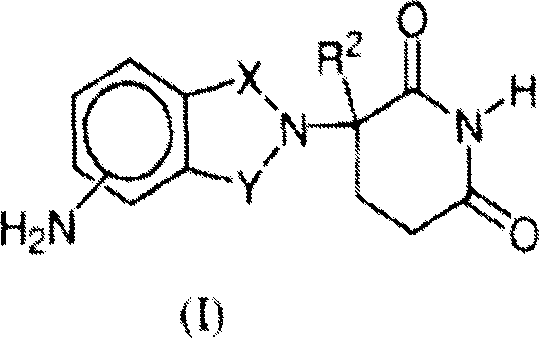
wherein one of X and Y is C ═ O, and the other of X and Y is C ═ O or CH2And R2Is hydrogen or lower alkyl.
13. The method according to claim 12, wherein the immunomodulatory compound is enantiomerically pure.
14. The method according to claim 1, wherein the immunomodulatory compound is of formula (II):
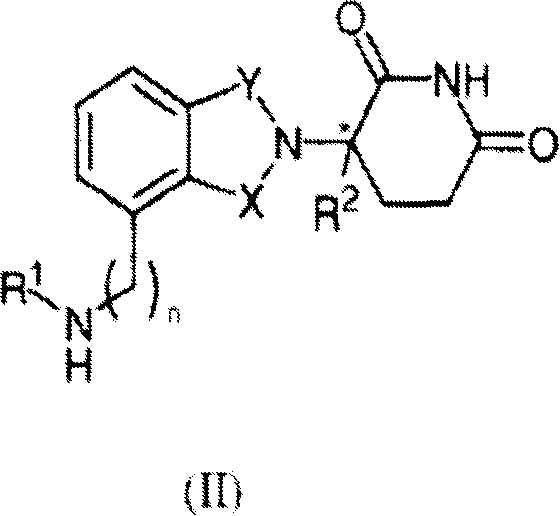
wherein:
one of X and Y is C ═ O, and the other is CH2Or C ═ O;
R1is H, (C)1-C8) Alkyl, (C)3-C7) Cycloalkyl group, (C)2-C8) Alkenyl, (C)2-C8) Alkynyl, benzyl, aryl, (C)0-C4) Alkyl radical- (C)1-C6) Heterocycloalkyl group, (C)0-C4) Alkyl radical- (C)2-C5) Heteroaryl, C (O) R3、C(S)R3、C(O)OR4、(C1-C8) alkyl-N (R)6)2、(C1-C8) alkyl-OR5、(C1-C8) alkyl-C (O) OR5、C(O)NHR3、C(S)NHR3、C(O)NR3R3′、C(S)NR3R3′Or (C)1-C8) alkyl-O (CO) R5;
R2Is H, F, benzyl, (C)1-C8) Alkyl, (C)2-C8) Alkenyl or (C)2-C8) An alkynyl group;
R3and R3′Independently is (C)1-C8) Alkyl, (C)3-C7) Cycloalkyl group, (C)2-C8) Alkenyl, (C)2-C8) Alkynyl, benzyl, aryl, (C)0-C4) Alkyl radical- (C)1-C6) Heterocycloalkyl group, (C)0-C4) Alkyl radical- (C)2-C8) Heteroaryl, (C)0-C8) alkyl-N (R)6)2、(C1-C8) alkyl-OR5、(C1-C8) alkyl-C (O) OR5、(C1-C8) alkyl-O (CO) R5OR C (O) OR5;
R4Is (C)1-C8) Alkyl, (C)2-C8) Alkenyl, (C)2-C8) Alkynyl, (C)1-C4) alkyl-OR5Benzyl, aryl, (C)0-C4) Alkyl radical- (C)1-C6) Heterocycloalkyl or (C)0-C4) Alkyl radical- (C)2-C5) A heteroaryl group;
R5is (C)1-C8) Alkyl, (C)2-C8) Alkenyl, (C)2-C8) Alkynyl, benzyl, aryl or (C)2-C5) A heteroaryl group;
R6independently at each occurrence, H, (C)1-C8) Alkyl, (C)2-C8) Alkenyl, (C)2-C8) Alkynyl, benzyl, aryl, (C)2-C5) Heteroaryl or (C)0-C8) alkyl-C (O) O-R5Or R is6Groups may be joined together to form a heterocycloalkyl group;
n is 0 or 1; and
*represents a chiral carbon center.
15. The method according to claim 14, wherein the immunomodulatory compound is enantiomerically pure.
16. The method of claim 1, wherein the immunomodulatory compound is a cyano or carboxy derivative of substituted styrene, 1-oxo-2- (2, 6-dioxo-3-fluoropiperidin-3-yl) isoindoline, 1, 3-dioxo-2- (2, 6-dioxo-3-fluoropiperidin-3-yl) isoindoline, or tetrasubstituted 2- (2, 6-dioxopiperidin-3-yl) -1-oxoisoindoline.
17. The method according to claim 16, wherein the immunomodulatory compound is enantiomerically pure.
18. A pharmaceutical composition comprising an immunomodulatory compound, or a pharmaceutically acceptable salt, solvate, stereoisomer thereof, and a second active ingredient capable of affecting or inhibiting cell growth or proliferation, eliminating or ameliorating acne scars, or reducing or repairing wrinkles.
19. The pharmaceutical composition according to claim 18, wherein the second active ingredient is a keratolytic agent, a retinoid, an anti-inflammatory agent, an antibiotic, collagen, a botulinum toxin, an interferon, an herbal product, an immunosuppressive agent, or an immunomodulatory agent.
20. The pharmaceutical composition according to claim 19, wherein the second active ingredient is xanthium fruit, magnolia, 5-fluorouracil, maleocol, trichloroacetic acid, salicylic acid, lactic acid, ammonium lactate, urea, isotretinoin, alpha-hydroxy acids, triamcinolone acetonide, collagen, botulinum toxin, or interferon.
21. A single unit dosage form containing the pharmaceutical composition of claim 19.
22. A kit, comprising:
pharmaceutical compositions comprising an immunomodulatory compound, or a pharmaceutically acceptable salt, solvate, stereoisomer thereof; and
a pharmaceutical composition comprising a keratolytic agent, a retinoid, an anti-inflammatory agent, an antibiotic, collagen, a botulinum toxin, an interferon, an herbal product, an immunosuppressive agent or an immunomodulatory agent.
23. A kit according to claim 22, comprising:
a pharmaceutical composition comprising a compound of 3- (4-amino-1-oxo-1, 3-dihydro-isoindol-2-yl) -piperidine-2, 6-dione, or a pharmaceutically acceptable salt, solvate thereof; and placental collagen or botulinum toxin.
24. The method according to claim 1, wherein said acne does not include rosacea.
Applications Claiming Priority (2)
| Application Number | Priority Date | Filing Date | Title |
|---|---|---|---|
| US55492304P | 2004-03-22 | 2004-03-22 | |
| US60/554,923 | 2004-03-22 |
Publications (1)
| Publication Number | Publication Date |
|---|---|
| CN1956718A true CN1956718A (en) | 2007-05-02 |
Family
ID=35056719
Family Applications (1)
| Application Number | Title | Priority Date | Filing Date |
|---|---|---|---|
| CNA2005800163440A Pending CN1956718A (en) | 2004-03-22 | 2005-03-18 | Compositions and methods of use containing immunomodulatory compounds for the treatment and management of skin diseases and conditions |
Country Status (13)
| Country | Link |
|---|---|
| US (2) | US20050214328A1 (en) |
| EP (2) | EP2505200A1 (en) |
| JP (1) | JP2007530544A (en) |
| KR (1) | KR101224262B1 (en) |
| CN (1) | CN1956718A (en) |
| AU (1) | AU2005226649B2 (en) |
| BR (1) | BRPI0509019A (en) |
| CA (1) | CA2560221C (en) |
| IL (1) | IL178142A0 (en) |
| MX (1) | MXPA06010699A (en) |
| NZ (1) | NZ550026A (en) |
| WO (1) | WO2005091991A2 (en) |
| ZA (1) | ZA200607799B (en) |
Cited By (2)
| Publication number | Priority date | Publication date | Assignee | Title |
|---|---|---|---|---|
| US9101620B2 (en) | 2009-11-02 | 2015-08-11 | Nanjing Cavendish Bio-Engineering Technology Co., Ltd. | Polymorph of 3-(substituteddihydroisoindolinone-2-yl)-2,6-dioxopiperidine, and pharmaceutical compositions thereof |
| CN110840894A (en) * | 2019-12-19 | 2020-02-28 | 温州医科大学附属第一医院 | A kind of composite anti-scar silicone spray and preparation method thereof |
Families Citing this family (52)
| Publication number | Priority date | Publication date | Assignee | Title |
|---|---|---|---|---|
| HU228769B1 (en) | 1996-07-24 | 2013-05-28 | Celgene Corp | Substituted 2(2,6-dioxopiperidin-3-yl)phthalimides and -1-oxoisoindolines and their use for production of pharmaceutical compositions for mammals to reduce the level of tnf-alpha |
| US7629360B2 (en) * | 1999-05-07 | 2009-12-08 | Celgene Corporation | Methods for the treatment of cachexia and graft v. host disease |
| US6458810B1 (en) | 2000-11-14 | 2002-10-01 | George Muller | Pharmaceutically active isoindoline derivatives |
| US20050100529A1 (en) * | 2003-11-06 | 2005-05-12 | Zeldis Jerome B. | Methods of using and compositions comprising immunomodulatory compounds for the treatment and management of asbestos-related diseases and disorders |
| US8871224B2 (en) * | 2003-12-09 | 2014-10-28 | Allergan, Inc. | Botulinum toxin therapy for skin disorders |
| MXPA06010699A (en) * | 2004-03-22 | 2006-12-15 | Celgene Corp | Methods of using and compositions comprising immunomodulatory compounds for the treatment and management of skin diseases or disorders. |
| US20050222209A1 (en) * | 2004-04-01 | 2005-10-06 | Zeldis Jerome B | Methods and compositions for the treatment, prevention or management of dysfunctional sleep and dysfunctional sleep associated with disease |
| US20050220734A1 (en) * | 2004-04-02 | 2005-10-06 | Allergan, Inc. | Therapy for melanin related afflictions |
| EP1755600A2 (en) * | 2004-04-23 | 2007-02-28 | Celgene Corporation | Methods of using and compositions comprising immunomodulatory compounds for the treatment and management of pulmonary hypertension |
| US20060073208A1 (en) * | 2004-10-01 | 2006-04-06 | Allergan, Inc. | Cosmetic neurotoxin compositions and methods |
| AU2005309733A1 (en) * | 2004-11-23 | 2006-06-01 | Celgene Corporation | Methods and compositions using immunomodulatory compounds for treatment and management of central nervous system injury |
| US8394832B2 (en) | 2004-12-01 | 2013-03-12 | Celgene Corporation | Methods and compositions using immunomodulatory compounds for the treatment of immunodeficiency disorders |
| BRPI0612803A2 (en) * | 2005-06-30 | 2012-10-02 | Celgene Corp | process for preparing a compound |
| US9486408B2 (en) | 2005-12-01 | 2016-11-08 | University Of Massachusetts Lowell | Botulinum nanoemulsions |
| CN101074935B (en) * | 2006-05-19 | 2011-03-23 | 清华大学 | Detector array and its apparatus |
| US8877780B2 (en) | 2006-08-30 | 2014-11-04 | Celgene Corporation | 5-substituted isoindoline compounds |
| HUE035389T2 (en) | 2006-09-26 | 2018-05-02 | Celgene Corp | 5-substituted quinazolinone derivatives as anti-cancer agents |
| AU2007329579A1 (en) | 2006-12-01 | 2008-06-12 | Anterios, Inc. | Amphiphilic entity nanoparticles |
| EP2144673A2 (en) | 2007-04-19 | 2010-01-20 | Mary Kay, Inc. | Magnolia extract containing compositions |
| NZ584425A (en) | 2007-09-26 | 2012-03-30 | Celgene Corp | 6-, 7-, or 8-substituted quinazolinone derivatives and compositions comprising and methods of using the same |
| US20090298882A1 (en) * | 2008-05-13 | 2009-12-03 | Muller George W | Thioxoisoindoline compounds and compositions comprising and methods of using the same |
| BRPI0914630A2 (en) * | 2008-06-26 | 2019-09-24 | Anterios Inc | dermal release |
| US8110578B2 (en) | 2008-10-27 | 2012-02-07 | Signal Pharmaceuticals, Llc | Pyrazino[2,3-b]pyrazine mTOR kinase inhibitors for oncology indications and diseases associated with the mTOR/PI3K/Akt pathway |
| SI2358697T1 (en) | 2008-10-29 | 2016-02-29 | Celgene Corporation | Isoindoline compounds for use in the treatment of cancer. |
| WO2010093434A1 (en) | 2009-02-11 | 2010-08-19 | Celgene Corporation | Isotopologues of lenalidomide |
| HUE043862T2 (en) | 2009-05-19 | 2021-12-28 | Celgene Corp | Preparations containing 4-amino-2- (2,6-dioxopiperidin-3-yl) isoindoline-1,3-dione |
| BR112012015129A2 (en) | 2009-12-22 | 2019-09-24 | Celgene Corp | "compound, pharmaceutical composition and method for treating, controlling or preventing a disease or disorder" |
| SG10202012179RA (en) | 2010-02-11 | 2021-01-28 | Celgene Corp | Arylmethoxy isoindoline derivatives and compositions comprising and methods of using the same |
| US8853175B2 (en) | 2011-01-10 | 2014-10-07 | Celgene Corporation | Phenethylsulfone isoindoline derivatives and their use |
| PL2683708T3 (en) | 2011-03-11 | 2018-03-30 | Celgene Corporation | Solid forms of 3-(5-amino-2-methyl-4-oxo-4h-quinazolin-3-yl)-piperidine-2,6-dione, and their pharmaceutical compositions and uses |
| WO2012135299A1 (en) | 2011-03-28 | 2012-10-04 | Deuteria Pharmaceuticals Inc | 2',6'-dioxo-3'-deutero-piperdin-3-yl-isoindoline compounds |
| WO2012177678A2 (en) | 2011-06-22 | 2012-12-27 | Celgene Corporation | Isotopologues of pomalidomide |
| US9050337B2 (en) | 2011-06-27 | 2015-06-09 | Sang Duck Kim | Method for treating atrophic skin scars using a mixture of botulinum toxin and air |
| CN105142615A (en) | 2011-09-14 | 2015-12-09 | 细胞基因公司 | Cyclopropanecarboxylic acid {2-[(1S)-1-(3-ethoxy-4-methoxy-phenyl)-2-methanesulfonyl-ethyl]-3-oxo-2,3- Preparations of Dihydro-1H-isoindol-4-yl}-amides Cell Genomics, Inc. State of Incorporation: Delaware |
| SMT202000339T1 (en) | 2011-12-27 | 2020-07-08 | Amgen Europe Gmbh | Formulations of (+)-2-[1-(3-ethoxy-4-methoxy-phenyl)-2-methanesulfonyl-ethyl]-4-acetyl aminoisoindoline-1,3-dione |
| WO2013115759A1 (en) * | 2012-02-01 | 2013-08-08 | Horvat Branimir L | Topical medications for controlling epidermal symptoms |
| WO2013119607A2 (en) | 2012-02-08 | 2013-08-15 | Celgene Corporation | Modified release formulations of (+)-2-[1-(3-ethoxy-4-methoxy-phenyl)-2-methanesulfonyl-ethyl]-4-acetyl aminoisoindoline-1,3-dione |
| CN104582841A (en) * | 2012-06-29 | 2015-04-29 | 巴斯夫欧洲公司 | Catalyst coating and method for converting oxygenates to olefins |
| HRP20190398T1 (en) | 2012-08-09 | 2019-05-17 | Celgene Corporation | SOLID FORM (S) -3- (4 - ((4-MORPHOLINOMETHYL BENZYL) OXY) -1-OXOISOINDOLIN-2-IL) PIPERIDINE-2,6-DION HYDROCHLORIDE |
| JP6359563B2 (en) | 2013-01-14 | 2018-07-18 | デュートルクス・リミテッド・ライアビリティ・カンパニーDeuteRx, LLC | 3- (5-substituted-4-oxoquinazolin-3 (4H) -yl) -3-deuteropiperidine-2,6-dione derivatives |
| WO2014116573A1 (en) | 2013-01-22 | 2014-07-31 | Celgene Corporation | Processes for the preparation of isotopologues of 3-(4-((4-(morpholinomethyl)benzyl)oxy)-1-oxoisoindolin-2-yl)piperidine-2,6-dione and pharmaceutically acceptable salts thereof |
| EP2764866A1 (en) | 2013-02-07 | 2014-08-13 | IP Gesellschaft für Management mbH | Inhibitors of nedd8-activating enzyme |
| JP6469077B2 (en) | 2013-04-02 | 2019-02-13 | セルジーン コーポレイション | Methods and compositions for the treatment and management of cancer of the central nervous system using 4-amino-2- (2,6-dioxo-piperidin-3-yl) -isoindoline-1,3-dione |
| EP2815749A1 (en) | 2013-06-20 | 2014-12-24 | IP Gesellschaft für Management mbH | Solid form of 4-amino-2-(2,6-dioxopiperidine-3-yl)isoindoline-1,3-dione having specified X-ray diffraction pattern |
| UA117141C2 (en) | 2013-10-08 | 2018-06-25 | Селджин Корпорейшн | COMPOSITIONS (S) -3- (4 - ((4- (MORPHOLINOMETHYL) BENZYL) OXY) -1-OXOISOINDOLIN-2-IL) PIPERIDINE-2,6-DIONE |
| WO2015108889A1 (en) | 2014-01-15 | 2015-07-23 | Celgene Corporation | Formulations of 3-(5-amino-2-methyl-4-oxo-4h-quinazolin-3-yl)-piperidine-2,6-dione |
| JP2016021216A (en) * | 2014-06-19 | 2016-02-04 | レイシスソフトウェアーサービス株式会社 | Remark input support system, device, method and program |
| BR112017004893A2 (en) | 2014-09-10 | 2017-12-12 | Univ Washington | compositions and methods for the treatment of precancerous skin lesions |
| WO2017004421A1 (en) * | 2015-06-30 | 2017-01-05 | The Trustees Of The University Of Pennsylvania | Resiquimod topical and injectable compositions for the treatment of neoplastic skin conditions |
| MX390018B (en) | 2015-10-30 | 2025-03-20 | Leo Pharma As | ISOTRETINOIN FORMULATIONS AND THEIR USES AND METHODS. |
| CN117731591A (en) | 2016-11-21 | 2024-03-22 | 艾里奥治疗公司 | Transdermal delivery of large agents |
| US10844039B2 (en) | 2018-11-13 | 2020-11-24 | Biotheryx, Inc. | Substituted isoindolinones |
Family Cites Families (65)
| Publication number | Priority date | Publication date | Assignee | Title |
|---|---|---|---|---|
| US3228601A (en) | 1964-02-20 | 1966-01-11 | Monarch Marking Systems Inc | Controls for marking machine |
| US3536809A (en) | 1969-02-17 | 1970-10-27 | Alza Corp | Medication method |
| US3598123A (en) | 1969-04-01 | 1971-08-10 | Alza Corp | Bandage for administering drugs |
| US3845770A (en) | 1972-06-05 | 1974-11-05 | Alza Corp | Osmatic dispensing device for releasing beneficial agent |
| US3916899A (en) | 1973-04-25 | 1975-11-04 | Alza Corp | Osmotic dispensing device with maximum and minimum sizes for the passageway |
| US4008719A (en) | 1976-02-02 | 1977-02-22 | Alza Corporation | Osmotic system having laminar arrangement for programming delivery of active agent |
| IE58110B1 (en) | 1984-10-30 | 1993-07-14 | Elan Corp Plc | Controlled release powder and process for its preparation |
| US5073543A (en) | 1988-07-21 | 1991-12-17 | G. D. Searle & Co. | Controlled release formulations of trophic factors in ganglioside-lipsome vehicle |
| IT1229203B (en) | 1989-03-22 | 1991-07-25 | Bioresearch Spa | USE OF 5 METHYLTHETRAHYDROPHOLIC ACID, 5 FORMYLTHETRAHYDROPHOLIC ACID AND THEIR PHARMACEUTICALLY ACCEPTABLE SALTS FOR THE PREPARATION OF PHARMACEUTICAL COMPOSITIONS IN THE FORM OF CONTROLLED RELEASE ACTIVE IN THE THERAPY OF MENTAL AND ORGANIC DISORDERS. |
| US5120548A (en) | 1989-11-07 | 1992-06-09 | Merck & Co., Inc. | Swelling modulated polymeric drug delivery device |
| KR0166088B1 (en) | 1990-01-23 | 1999-01-15 | . | Cyclodextrin derivatives with increased water solubility and uses thereof |
| US5733566A (en) | 1990-05-15 | 1998-03-31 | Alkermes Controlled Therapeutics Inc. Ii | Controlled release of antiparasitic agents in animals |
| AU1531492A (en) * | 1991-02-14 | 1992-09-15 | Rockefeller University, The | Method for controlling abnormal concentration tnf alpha in human tissues |
| US5580578A (en) | 1992-01-27 | 1996-12-03 | Euro-Celtique, S.A. | Controlled release formulations coated with aqueous dispersions of acrylic polymers |
| US5591767A (en) | 1993-01-25 | 1997-01-07 | Pharmetrix Corporation | Liquid reservoir transdermal patch for the administration of ketorolac |
| US6228879B1 (en) * | 1997-10-16 | 2001-05-08 | The Children's Medical Center | Methods and compositions for inhibition of angiogenesis |
| US5629327A (en) * | 1993-03-01 | 1997-05-13 | Childrens Hospital Medical Center Corp. | Methods and compositions for inhibition of angiogenesis |
| US20010056114A1 (en) * | 2000-11-01 | 2001-12-27 | D'amato Robert | Methods for the inhibition of angiogenesis with 3-amino thalidomide |
| US5698579A (en) | 1993-07-02 | 1997-12-16 | Celgene Corporation | Cyclic amides |
| IT1270594B (en) | 1994-07-07 | 1997-05-07 | Recordati Chem Pharm | CONTROLLED RELEASE PHARMACEUTICAL COMPOSITION OF LIQUID SUSPENSION MOGUISTEIN |
| US5731325A (en) * | 1995-06-06 | 1998-03-24 | Andrulis Pharmaceuticals Corp. | Treatment of melanomas with thalidomide alone or in combination with other anti-melanoma agents |
| US5654312A (en) * | 1995-06-07 | 1997-08-05 | Andrulis Pharmaceuticals | Treatment of inflammatory and/or autoimmune dermatoses with thalidomide alone or in combination with other agents |
| HU228769B1 (en) | 1996-07-24 | 2013-05-28 | Celgene Corp | Substituted 2(2,6-dioxopiperidin-3-yl)phthalimides and -1-oxoisoindolines and their use for production of pharmaceutical compositions for mammals to reduce the level of tnf-alpha |
| US6281230B1 (en) * | 1996-07-24 | 2001-08-28 | Celgene Corporation | Isoindolines, method of use, and pharmaceutical compositions |
| EP1285916B1 (en) | 1996-07-24 | 2010-03-10 | Celgene Corporation | Substituted 2-(2,6-dioxopiperidin-3-yl)-phthalimides and -1-oxoisoindolines and method of reducing TNF alpha levels |
| US5635517B1 (en) * | 1996-07-24 | 1999-06-29 | Celgene Corp | Method of reducing TNFalpha levels with amino substituted 2-(2,6-dioxopiperidin-3-YL)-1-oxo-and 1,3-dioxoisoindolines |
| US5798368A (en) | 1996-08-22 | 1998-08-25 | Celgene Corporation | Tetrasubstituted 2-(2,6-dioxopiperidin-3-yl)-1-oxoisoindolines and method of reducing TNFα levels |
| EP0918746B1 (en) | 1996-08-12 | 2003-04-09 | Celgene Corporation | Immunotherapeutic agents and their use in the reduction of cytokine levels |
| ES2253787T3 (en) * | 1996-11-05 | 2006-06-01 | The Children's Medical Center Corporation | COMPOSITIONS FOR INHIBITION OF ANGIOGENESIS THAT INCLUDE TALIDOMIDE AND AN NSAID. |
| DE19914621C2 (en) * | 1997-10-06 | 2002-12-05 | Gruenenthal Gmbh | Stable aqueous solution from EM 12 |
| US5874448A (en) | 1997-11-18 | 1999-02-23 | Celgene Corporation | Substituted 2-(2,6 dioxo-3-fluoropiperidin-3-yl)-isoindolines and method of reducing TNFα levels |
| US5955476A (en) | 1997-11-18 | 1999-09-21 | Celgene Corporation | Substituted 2-(2,6-dioxo-3-fluoropiperidin-3-yl)-isoindolines and method of reducing inflammatory cytokine levels |
| BR9908811A (en) | 1998-03-16 | 2000-12-05 | Celgene Corp | Compound, pharmaceutical composition and its use in the treatment of mammals |
| US6673828B1 (en) * | 1998-05-11 | 2004-01-06 | Children's Medical Center Corporation | Analogs of 2-Phthalimidinoglutaric acid |
| WO2000041547A2 (en) * | 1999-01-13 | 2000-07-20 | The Rockefeller University | Methods of promoting or enhancing interleukin-12 production through administration of thalidomide |
| ES2250121T3 (en) | 1999-03-18 | 2006-04-16 | Celgene Corporation | 1-OXO- AND 1,3-DIOXOISOINDOLINAS AND ITS EMPLOYMENT IN PHARMACEUTICAL COMPOSITIONS FOR THE REDUCTION OF LEVELS OF INFLAMMATORY CITOCINES. |
| US20010021380A1 (en) * | 1999-04-19 | 2001-09-13 | Pluenneke John D. | Soluble tumor necrosis factor receptor treatment of medical disorders |
| US6673843B2 (en) * | 1999-06-30 | 2004-01-06 | Emory University | Curcumin and curcuminoid inhibition of angiogenesis |
| DE19957342A1 (en) * | 1999-11-29 | 2001-05-31 | Gruenenthal Gmbh | Treatment of interleukin (IL)-12 mediated illnesses comprises simultaneous administration of thalidomide or analogue and antiinflammatory cytokine |
| DE19957341A1 (en) * | 1999-11-29 | 2001-07-12 | Gruenenthal Gmbh | Synergistic compositions containing thalidomide compound and phosphodiesterase IV inhibitor useful for treatment of inflammation, autoimmune diseases, chronic infection and tumors |
| US7182953B2 (en) * | 1999-12-15 | 2007-02-27 | Celgene Corporation | Methods and compositions for the prevention and treatment of atherosclerosis restenosis and related disorders |
| KR20030003708A (en) * | 2000-03-31 | 2003-01-10 | 셀진 코포레이션 | Inhibition of cyclooxygenase-2 activity |
| US6458810B1 (en) * | 2000-11-14 | 2002-10-01 | George Muller | Pharmaceutically active isoindoline derivatives |
| CA2430669C (en) * | 2000-11-30 | 2011-06-14 | The Children's Medical Center Corporation | Synthesis of 3-amino-thalidomide and its enantiomers |
| US20030045552A1 (en) | 2000-12-27 | 2003-03-06 | Robarge Michael J. | Isoindole-imide compounds, compositions, and uses thereof |
| US7091353B2 (en) | 2000-12-27 | 2006-08-15 | Celgene Corporation | Isoindole-imide compounds, compositions, and uses thereof |
| JP4361273B2 (en) * | 2001-02-27 | 2009-11-11 | アメリカ合衆国 | Thalidomide analogs as potential angiogenesis inhibitors |
| AU2002323063B2 (en) * | 2001-08-06 | 2007-11-08 | Entremed, Inc. | Synthesis and anti-tumor activity of nitrogen substituted thalidomide analogs |
| ZA200408369B (en) * | 2002-04-12 | 2006-11-29 | Celgene Corp | Methods for identification of modulators of angiogenesis, compounds discovered thereby, and methods of treatment using the compounds |
| US7498171B2 (en) * | 2002-04-12 | 2009-03-03 | Anthrogenesis Corporation | Modulation of stem and progenitor cell differentiation, assays, and uses thereof |
| CN1668296A (en) * | 2002-05-17 | 2005-09-14 | 细胞基因公司 | Methods and compositions using selective cytokine inhibitory drugs for treatment and management of cancers and other diseases |
| EP2272513A1 (en) * | 2002-05-17 | 2011-01-12 | Celgene Corporation | Pharmaceutical compositions for treating cancer |
| US7323479B2 (en) * | 2002-05-17 | 2008-01-29 | Celgene Corporation | Methods for treatment and management of brain cancer using 1-oxo-2-(2,6-dioxopiperidin-3-yl)-4-methylisoindoline |
| US7968569B2 (en) * | 2002-05-17 | 2011-06-28 | Celgene Corporation | Methods for treatment of multiple myeloma using 3-(4-amino-1-oxo-1,3-dihydro-isoindol-2-yl)-piperidine-2,6-dione |
| US7189740B2 (en) * | 2002-10-15 | 2007-03-13 | Celgene Corporation | Methods of using 3-(4-amino-oxo-1,3-dihydro-isoindol-2-yl)-piperidine-2,6-dione for the treatment and management of myelodysplastic syndromes |
| US20050203142A1 (en) * | 2002-10-24 | 2005-09-15 | Zeldis Jerome B. | Methods of using and compositions comprising immunomodulatory compounds for treatment, modification and management of pain |
| US20040091455A1 (en) * | 2002-10-31 | 2004-05-13 | Zeldis Jerome B. | Methods of using and compositions comprising immunomodulatory compounds for treatment and management of macular degeneration |
| KR20090048520A (en) * | 2002-11-06 | 2009-05-13 | 셀진 코포레이션 | Method of using and selective composition of selective cytokine inhibitory drugs for the treatment and management of cancer and other diseases |
| US7563810B2 (en) * | 2002-11-06 | 2009-07-21 | Celgene Corporation | Methods of using 3-(4-amino-1-oxo-1,3-dihydroisoindol-2-yl)-piperidine-2,6-dione for the treatment and management of myeloproliferative diseases |
| US20050100529A1 (en) * | 2003-11-06 | 2005-05-12 | Zeldis Jerome B. | Methods of using and compositions comprising immunomodulatory compounds for the treatment and management of asbestos-related diseases and disorders |
| CN101966183A (en) * | 2003-12-02 | 2011-02-09 | 细胞基因公司 | Methods and compositions for the treatment and management of hemoglobinopathy and anemia |
| US20050143344A1 (en) * | 2003-12-30 | 2005-06-30 | Zeldis Jerome B. | Methods and compositions using immunomodulatory compounds for the treatment and management of central nervous system disorders or diseases |
| MXPA06010699A (en) * | 2004-03-22 | 2006-12-15 | Celgene Corp | Methods of using and compositions comprising immunomodulatory compounds for the treatment and management of skin diseases or disorders. |
| US20050222209A1 (en) * | 2004-04-01 | 2005-10-06 | Zeldis Jerome B | Methods and compositions for the treatment, prevention or management of dysfunctional sleep and dysfunctional sleep associated with disease |
| US20080199422A1 (en) * | 2004-04-14 | 2008-08-21 | Celgene Corporation | Method for the Treatment of Myelodysplastic Syndromes Using 1-Oxo-2-(2,6-Dioxopiperidin-3-Yl-)-4-Methylisoindoline |
-
2005
- 2005-03-18 MX MXPA06010699A patent/MXPA06010699A/en active IP Right Grant
- 2005-03-18 EP EP12174490A patent/EP2505200A1/en not_active Withdrawn
- 2005-03-18 KR KR1020067021776A patent/KR101224262B1/en not_active Expired - Fee Related
- 2005-03-18 NZ NZ550026A patent/NZ550026A/en not_active IP Right Cessation
- 2005-03-18 JP JP2007505022A patent/JP2007530544A/en active Pending
- 2005-03-18 WO PCT/US2005/008999 patent/WO2005091991A2/en not_active Ceased
- 2005-03-18 AU AU2005226649A patent/AU2005226649B2/en not_active Ceased
- 2005-03-18 CN CNA2005800163440A patent/CN1956718A/en active Pending
- 2005-03-18 ZA ZA200607799A patent/ZA200607799B/en unknown
- 2005-03-18 CA CA2560221A patent/CA2560221C/en not_active Expired - Fee Related
- 2005-03-18 EP EP05732239A patent/EP1737453A4/en not_active Withdrawn
- 2005-03-18 BR BRPI0509019-9A patent/BRPI0509019A/en not_active IP Right Cessation
- 2005-03-22 US US11/085,905 patent/US20050214328A1/en not_active Abandoned
-
2006
- 2006-09-17 IL IL178142A patent/IL178142A0/en unknown
-
2008
- 2008-10-10 US US12/249,350 patent/US20090087407A1/en not_active Abandoned
Cited By (3)
| Publication number | Priority date | Publication date | Assignee | Title |
|---|---|---|---|---|
| US9101620B2 (en) | 2009-11-02 | 2015-08-11 | Nanjing Cavendish Bio-Engineering Technology Co., Ltd. | Polymorph of 3-(substituteddihydroisoindolinone-2-yl)-2,6-dioxopiperidine, and pharmaceutical compositions thereof |
| CN110840894A (en) * | 2019-12-19 | 2020-02-28 | 温州医科大学附属第一医院 | A kind of composite anti-scar silicone spray and preparation method thereof |
| CN110840894B (en) * | 2019-12-19 | 2020-06-02 | 温州医科大学附属第一医院 | A kind of composite anti-scar silicone spray and preparation method thereof |
Also Published As
| Publication number | Publication date |
|---|---|
| MXPA06010699A (en) | 2006-12-15 |
| ZA200607799B (en) | 2008-06-25 |
| WO2005091991A2 (en) | 2005-10-06 |
| EP1737453A4 (en) | 2008-11-26 |
| CA2560221A1 (en) | 2005-10-06 |
| EP2505200A1 (en) | 2012-10-03 |
| BRPI0509019A (en) | 2007-08-07 |
| CA2560221C (en) | 2010-12-07 |
| US20090087407A1 (en) | 2009-04-02 |
| IL178142A0 (en) | 2006-12-31 |
| KR101224262B1 (en) | 2013-01-21 |
| KR20060133042A (en) | 2006-12-22 |
| AU2005226649B2 (en) | 2010-04-29 |
| NZ550026A (en) | 2009-10-30 |
| AU2005226649A1 (en) | 2005-10-06 |
| WO2005091991A3 (en) | 2006-03-16 |
| JP2007530544A (en) | 2007-11-01 |
| EP1737453A2 (en) | 2007-01-03 |
| US20050214328A1 (en) | 2005-09-29 |
Similar Documents
| Publication | Publication Date | Title |
|---|---|---|
| CN1956718A (en) | Compositions and methods of use containing immunomodulatory compounds for the treatment and management of skin diseases and conditions | |
| CN1713917A (en) | Compositions and methods of use containing immunomodulatory compounds for the treatment and management of myelodysplastic syndromes | |
| CN1913896A (en) | Methods and compositions for the treatment and management of hemoglobinopathy and anemia | |
| EP2701701A1 (en) | Methods and compositions using pde4 inhibitors for the treatment and management of autoimmune and inflammatory diseases | |
| EP2555769B1 (en) | Methods for treating respiratory viral infection | |
| CN1187045C (en) | Substances for use in treating psoriasis | |
| CN1968695A (en) | Compositions comprising immunomodulatory compounds for the treatment and control of myelodysplastic syndromes and using methods | |
| JP2008523102A (en) | Compositions containing PDE4 modulators and their use for the treatment or prevention of airway inflammation | |
| CN1713905A (en) | Selective cytokine inhibitory drugs for treating myelodysplastic syndrome | |
| CN1732001A (en) | Compositions for the treatment of macular degeneration | |
| US20060106085A1 (en) | Methods and compositions using PDE4 modulators for treatment and management of central nervous system injury | |
| HK1102773A (en) | Methods of using and compositions comprising immunomodulatory compounds for the treatment and management of skin diseases or disorders | |
| CA2563207A1 (en) | Use of selective cytokine inhibitory drugs in myelodysplastic syndromes | |
| KR20060130716A (en) | Method for using selective cytokine inhibitory drug for treating and managing central nervous system diseases and compositions comprising same | |
| CN1901909A (en) | Methods of using and compositions comprising selective cytokine inhibitory drugs for treatment and management of macular degeneration | |
| CN1731997A (en) | Methods of treating and managing macular degeneration using compositions comprising selective cytokine inhibitory drugs | |
| CN1901899A (en) | Methods of using and compositions comprising pde4 modulators for the treatment and management of asbestos-related diseases and disorders | |
| HK1176307A (en) | Methods of using and compositions comprising immunomodulatory compounds for the treatment and management of scleroderma | |
| HK1097771A (en) | Methods of using and compositions comprising immunomodulatory compounds for treatment, modification and management of pain | |
| HK1098706A (en) | Cytokine inhibitory drugs for treatment of macular degeneration | |
| HK1100742A (en) | Immunomodulatory compounds for the treatment of central nervous system disorders | |
| HK1087024A (en) | Selective cytokine inhibitory drugs for treating myelodysplastic syndrome | |
| HK1103656A (en) | Methods of using and compositions comprising immunomodulatory compounds for the treatment and management of myelodysplastic syndromes | |
| MXPA06010091A (en) | Methods of using and compositions comprising selective cytokine inhibitory drugs for the treatment and management of disorders of the central nervous system | |
| HK1112197A (en) | Compositions comprising pde4 modulators and their use for the treatment or prevention of airway inflammation |
Legal Events
| Date | Code | Title | Description |
|---|---|---|---|
| C06 | Publication | ||
| PB01 | Publication | ||
| C10 | Entry into substantive examination | ||
| SE01 | Entry into force of request for substantive examination | ||
| REG | Reference to a national code |
Ref country code: HK Ref legal event code: DE Ref document number: 1102773 Country of ref document: HK |
|
| C12 | Rejection of a patent application after its publication | ||
| RJ01 | Rejection of invention patent application after publication |
Application publication date: 20070502 |
|
| REG | Reference to a national code |
Ref country code: HK Ref legal event code: WD Ref document number: 1102773 Country of ref document: HK |