CN1921457A - Network equipment and message transferring method based on multiple-core processor - Google Patents
Network equipment and message transferring method based on multiple-core processor Download PDFInfo
- Publication number
- CN1921457A CN1921457A CNA2006101542008A CN200610154200A CN1921457A CN 1921457 A CN1921457 A CN 1921457A CN A2006101542008 A CNA2006101542008 A CN A2006101542008A CN 200610154200 A CN200610154200 A CN 200610154200A CN 1921457 A CN1921457 A CN 1921457A
- Authority
- CN
- China
- Prior art keywords
- unit
- message
- core
- session
- network device
- Prior art date
- Legal status (The legal status is an assumption and is not a legal conclusion. Google has not performed a legal analysis and makes no representation as to the accuracy of the status listed.)
- Granted
Links
Images


Classifications
-
- H—ELECTRICITY
- H04—ELECTRIC COMMUNICATION TECHNIQUE
- H04J—MULTIPLEX COMMUNICATION
- H04J13/00—Code division multiplex systems
- H04J13/10—Code generation
- H04J13/12—Generation of orthogonal codes
-
- G—PHYSICS
- G06—COMPUTING OR CALCULATING; COUNTING
- G06F—ELECTRIC DIGITAL DATA PROCESSING
- G06F11/00—Error detection; Error correction; Monitoring
- G06F11/07—Responding to the occurrence of a fault, e.g. fault tolerance
- G06F11/16—Error detection or correction of the data by redundancy in hardware
- G06F11/20—Error detection or correction of the data by redundancy in hardware using active fault-masking, e.g. by switching out faulty elements or by switching in spare elements
- G06F11/2002—Error detection or correction of the data by redundancy in hardware using active fault-masking, e.g. by switching out faulty elements or by switching in spare elements where interconnections or communication control functionality are redundant
- G06F11/2005—Error detection or correction of the data by redundancy in hardware using active fault-masking, e.g. by switching out faulty elements or by switching in spare elements where interconnections or communication control functionality are redundant using redundant communication controllers
-
- G—PHYSICS
- G06—COMPUTING OR CALCULATING; COUNTING
- G06F—ELECTRIC DIGITAL DATA PROCESSING
- G06F11/00—Error detection; Error correction; Monitoring
- G06F11/07—Responding to the occurrence of a fault, e.g. fault tolerance
- G06F11/16—Error detection or correction of the data by redundancy in hardware
- G06F11/20—Error detection or correction of the data by redundancy in hardware using active fault-masking, e.g. by switching out faulty elements or by switching in spare elements
- G06F11/2002—Error detection or correction of the data by redundancy in hardware using active fault-masking, e.g. by switching out faulty elements or by switching in spare elements where interconnections or communication control functionality are redundant
- G06F11/2007—Error detection or correction of the data by redundancy in hardware using active fault-masking, e.g. by switching out faulty elements or by switching in spare elements where interconnections or communication control functionality are redundant using redundant communication media
-
- G—PHYSICS
- G06—COMPUTING OR CALCULATING; COUNTING
- G06F—ELECTRIC DIGITAL DATA PROCESSING
- G06F21/00—Security arrangements for protecting computers, components thereof, programs or data against unauthorised activity
- G06F21/60—Protecting data
- G06F21/62—Protecting access to data via a platform, e.g. using keys or access control rules
- G06F21/6218—Protecting access to data via a platform, e.g. using keys or access control rules to a system of files or objects, e.g. local or distributed file system or database
-
- G—PHYSICS
- G06—COMPUTING OR CALCULATING; COUNTING
- G06F—ELECTRIC DIGITAL DATA PROCESSING
- G06F21/00—Security arrangements for protecting computers, components thereof, programs or data against unauthorised activity
- G06F21/60—Protecting data
- G06F21/62—Protecting access to data via a platform, e.g. using keys or access control rules
- G06F21/6218—Protecting access to data via a platform, e.g. using keys or access control rules to a system of files or objects, e.g. local or distributed file system or database
- G06F21/6245—Protecting personal data, e.g. for financial or medical purposes
-
- G—PHYSICS
- G06—COMPUTING OR CALCULATING; COUNTING
- G06Q—INFORMATION AND COMMUNICATION TECHNOLOGY [ICT] SPECIALLY ADAPTED FOR ADMINISTRATIVE, COMMERCIAL, FINANCIAL, MANAGERIAL OR SUPERVISORY PURPOSES; SYSTEMS OR METHODS SPECIALLY ADAPTED FOR ADMINISTRATIVE, COMMERCIAL, FINANCIAL, MANAGERIAL OR SUPERVISORY PURPOSES, NOT OTHERWISE PROVIDED FOR
- G06Q20/00—Payment architectures, schemes or protocols
- G06Q20/08—Payment architectures
- G06Q20/10—Payment architectures specially adapted for electronic funds transfer [EFT] systems; specially adapted for home banking systems
-
- G—PHYSICS
- G06—COMPUTING OR CALCULATING; COUNTING
- G06Q—INFORMATION AND COMMUNICATION TECHNOLOGY [ICT] SPECIALLY ADAPTED FOR ADMINISTRATIVE, COMMERCIAL, FINANCIAL, MANAGERIAL OR SUPERVISORY PURPOSES; SYSTEMS OR METHODS SPECIALLY ADAPTED FOR ADMINISTRATIVE, COMMERCIAL, FINANCIAL, MANAGERIAL OR SUPERVISORY PURPOSES, NOT OTHERWISE PROVIDED FOR
- G06Q20/00—Payment architectures, schemes or protocols
- G06Q20/08—Payment architectures
- G06Q20/12—Payment architectures specially adapted for electronic shopping systems
- G06Q20/123—Shopping for digital content
- G06Q20/1235—Shopping for digital content with control of digital rights management [DRM]
-
- G—PHYSICS
- G06—COMPUTING OR CALCULATING; COUNTING
- G06Q—INFORMATION AND COMMUNICATION TECHNOLOGY [ICT] SPECIALLY ADAPTED FOR ADMINISTRATIVE, COMMERCIAL, FINANCIAL, MANAGERIAL OR SUPERVISORY PURPOSES; SYSTEMS OR METHODS SPECIALLY ADAPTED FOR ADMINISTRATIVE, COMMERCIAL, FINANCIAL, MANAGERIAL OR SUPERVISORY PURPOSES, NOT OTHERWISE PROVIDED FOR
- G06Q20/00—Payment architectures, schemes or protocols
- G06Q20/38—Payment protocols; Details thereof
- G06Q20/385—Payment protocols; Details thereof using an alias or single-use codes
-
- G—PHYSICS
- G06—COMPUTING OR CALCULATING; COUNTING
- G06Q—INFORMATION AND COMMUNICATION TECHNOLOGY [ICT] SPECIALLY ADAPTED FOR ADMINISTRATIVE, COMMERCIAL, FINANCIAL, MANAGERIAL OR SUPERVISORY PURPOSES; SYSTEMS OR METHODS SPECIALLY ADAPTED FOR ADMINISTRATIVE, COMMERCIAL, FINANCIAL, MANAGERIAL OR SUPERVISORY PURPOSES, NOT OTHERWISE PROVIDED FOR
- G06Q20/00—Payment architectures, schemes or protocols
- G06Q20/38—Payment protocols; Details thereof
- G06Q20/42—Confirmation, e.g. check or permission by the legal debtor of payment
- G06Q20/425—Confirmation, e.g. check or permission by the legal debtor of payment using two different networks, one for transaction and one for security confirmation
-
- G—PHYSICS
- G06—COMPUTING OR CALCULATING; COUNTING
- G06Q—INFORMATION AND COMMUNICATION TECHNOLOGY [ICT] SPECIALLY ADAPTED FOR ADMINISTRATIVE, COMMERCIAL, FINANCIAL, MANAGERIAL OR SUPERVISORY PURPOSES; SYSTEMS OR METHODS SPECIALLY ADAPTED FOR ADMINISTRATIVE, COMMERCIAL, FINANCIAL, MANAGERIAL OR SUPERVISORY PURPOSES, NOT OTHERWISE PROVIDED FOR
- G06Q30/00—Commerce
- G06Q30/02—Marketing; Price estimation or determination; Fundraising
- G06Q30/0241—Advertisements
- G06Q30/0277—Online advertisement
-
- G—PHYSICS
- G06—COMPUTING OR CALCULATING; COUNTING
- G06Q—INFORMATION AND COMMUNICATION TECHNOLOGY [ICT] SPECIALLY ADAPTED FOR ADMINISTRATIVE, COMMERCIAL, FINANCIAL, MANAGERIAL OR SUPERVISORY PURPOSES; SYSTEMS OR METHODS SPECIALLY ADAPTED FOR ADMINISTRATIVE, COMMERCIAL, FINANCIAL, MANAGERIAL OR SUPERVISORY PURPOSES, NOT OTHERWISE PROVIDED FOR
- G06Q30/00—Commerce
- G06Q30/06—Buying, selling or leasing transactions
- G06Q30/0601—Electronic shopping [e-shopping]
- G06Q30/0609—Qualifying participants for shopping transactions
-
- G—PHYSICS
- G06—COMPUTING OR CALCULATING; COUNTING
- G06Q—INFORMATION AND COMMUNICATION TECHNOLOGY [ICT] SPECIALLY ADAPTED FOR ADMINISTRATIVE, COMMERCIAL, FINANCIAL, MANAGERIAL OR SUPERVISORY PURPOSES; SYSTEMS OR METHODS SPECIALLY ADAPTED FOR ADMINISTRATIVE, COMMERCIAL, FINANCIAL, MANAGERIAL OR SUPERVISORY PURPOSES, NOT OTHERWISE PROVIDED FOR
- G06Q50/00—Information and communication technology [ICT] specially adapted for implementation of business processes of specific business sectors, e.g. utilities or tourism
- G06Q50/10—Services
- G06Q50/18—Legal services
- G06Q50/188—Electronic negotiation
-
- G—PHYSICS
- G07—CHECKING-DEVICES
- G07F—COIN-FREED OR LIKE APPARATUS
- G07F17/00—Coin-freed apparatus for hiring articles; Coin-freed facilities or services
- G07F17/16—Coin-freed apparatus for hiring articles; Coin-freed facilities or services for devices exhibiting advertisements, announcements, pictures or the like
-
- H—ELECTRICITY
- H04—ELECTRIC COMMUNICATION TECHNIQUE
- H04B—TRANSMISSION
- H04B1/00—Details of transmission systems, not covered by a single one of groups H04B3/00 - H04B13/00; Details of transmission systems not characterised by the medium used for transmission
- H04B1/02—Transmitters
- H04B1/04—Circuits
- H04B1/0483—Transmitters with multiple parallel paths
-
- H—ELECTRICITY
- H04—ELECTRIC COMMUNICATION TECHNIQUE
- H04B—TRANSMISSION
- H04B1/00—Details of transmission systems, not covered by a single one of groups H04B3/00 - H04B13/00; Details of transmission systems not characterised by the medium used for transmission
- H04B1/38—Transceivers, i.e. devices in which transmitter and receiver form a structural unit and in which at least one part is used for functions of transmitting and receiving
- H04B1/40—Circuits
-
- H—ELECTRICITY
- H04—ELECTRIC COMMUNICATION TECHNIQUE
- H04B—TRANSMISSION
- H04B7/00—Radio transmission systems, i.e. using radiation field
- H04B7/02—Diversity systems; Multi-antenna system, i.e. transmission or reception using multiple antennas
- H04B7/04—Diversity systems; Multi-antenna system, i.e. transmission or reception using multiple antennas using two or more spaced independent antennas
- H04B7/06—Diversity systems; Multi-antenna system, i.e. transmission or reception using multiple antennas using two or more spaced independent antennas at the transmitting station
- H04B7/0602—Diversity systems; Multi-antenna system, i.e. transmission or reception using multiple antennas using two or more spaced independent antennas at the transmitting station using antenna switching
- H04B7/0604—Diversity systems; Multi-antenna system, i.e. transmission or reception using multiple antennas using two or more spaced independent antennas at the transmitting station using antenna switching with predefined switching scheme
-
- H—ELECTRICITY
- H04—ELECTRIC COMMUNICATION TECHNIQUE
- H04B—TRANSMISSION
- H04B7/00—Radio transmission systems, i.e. using radiation field
- H04B7/02—Diversity systems; Multi-antenna system, i.e. transmission or reception using multiple antennas
- H04B7/04—Diversity systems; Multi-antenna system, i.e. transmission or reception using multiple antennas using two or more spaced independent antennas
- H04B7/08—Diversity systems; Multi-antenna system, i.e. transmission or reception using multiple antennas using two or more spaced independent antennas at the receiving station
- H04B7/0837—Diversity systems; Multi-antenna system, i.e. transmission or reception using multiple antennas using two or more spaced independent antennas at the receiving station using pre-detection combining
- H04B7/084—Equal gain combining, only phase adjustments
-
- H—ELECTRICITY
- H04—ELECTRIC COMMUNICATION TECHNIQUE
- H04B—TRANSMISSION
- H04B7/00—Radio transmission systems, i.e. using radiation field
- H04B7/14—Relay systems
- H04B7/15—Active relay systems
- H04B7/155—Ground-based stations
- H04B7/15528—Control of operation parameters of a relay station to exploit the physical medium
- H04B7/15535—Control of relay amplifier gain
-
- H—ELECTRICITY
- H04—ELECTRIC COMMUNICATION TECHNIQUE
- H04L—TRANSMISSION OF DIGITAL INFORMATION, e.g. TELEGRAPHIC COMMUNICATION
- H04L1/00—Arrangements for detecting or preventing errors in the information received
- H04L1/004—Arrangements for detecting or preventing errors in the information received by using forward error control
- H04L1/0041—Arrangements at the transmitter end
-
- H—ELECTRICITY
- H04—ELECTRIC COMMUNICATION TECHNIQUE
- H04L—TRANSMISSION OF DIGITAL INFORMATION, e.g. TELEGRAPHIC COMMUNICATION
- H04L1/00—Arrangements for detecting or preventing errors in the information received
- H04L1/004—Arrangements for detecting or preventing errors in the information received by using forward error control
- H04L1/0045—Arrangements at the receiver end
-
- H—ELECTRICITY
- H04—ELECTRIC COMMUNICATION TECHNIQUE
- H04L—TRANSMISSION OF DIGITAL INFORMATION, e.g. TELEGRAPHIC COMMUNICATION
- H04L1/00—Arrangements for detecting or preventing errors in the information received
- H04L1/004—Arrangements for detecting or preventing errors in the information received by using forward error control
- H04L1/0056—Systems characterized by the type of code used
- H04L1/0064—Concatenated codes
- H04L1/0066—Parallel concatenated codes
-
- H—ELECTRICITY
- H04—ELECTRIC COMMUNICATION TECHNIQUE
- H04L—TRANSMISSION OF DIGITAL INFORMATION, e.g. TELEGRAPHIC COMMUNICATION
- H04L1/00—Arrangements for detecting or preventing errors in the information received
- H04L1/004—Arrangements for detecting or preventing errors in the information received by using forward error control
- H04L1/0056—Systems characterized by the type of code used
- H04L1/0067—Rate matching
- H04L1/0068—Rate matching by puncturing
- H04L1/0069—Puncturing patterns
-
- H—ELECTRICITY
- H04—ELECTRIC COMMUNICATION TECHNIQUE
- H04L—TRANSMISSION OF DIGITAL INFORMATION, e.g. TELEGRAPHIC COMMUNICATION
- H04L1/00—Arrangements for detecting or preventing errors in the information received
- H04L1/004—Arrangements for detecting or preventing errors in the information received by using forward error control
- H04L1/0056—Systems characterized by the type of code used
- H04L1/0071—Use of interleaving
-
- H—ELECTRICITY
- H04—ELECTRIC COMMUNICATION TECHNIQUE
- H04L—TRANSMISSION OF DIGITAL INFORMATION, e.g. TELEGRAPHIC COMMUNICATION
- H04L1/00—Arrangements for detecting or preventing errors in the information received
- H04L1/02—Arrangements for detecting or preventing errors in the information received by diversity reception
- H04L1/06—Arrangements for detecting or preventing errors in the information received by diversity reception using space diversity
-
- H—ELECTRICITY
- H04—ELECTRIC COMMUNICATION TECHNIQUE
- H04L—TRANSMISSION OF DIGITAL INFORMATION, e.g. TELEGRAPHIC COMMUNICATION
- H04L1/00—Arrangements for detecting or preventing errors in the information received
- H04L1/08—Arrangements for detecting or preventing errors in the information received by repeating transmission, e.g. Verdan system
-
- H—ELECTRICITY
- H04—ELECTRIC COMMUNICATION TECHNIQUE
- H04L—TRANSMISSION OF DIGITAL INFORMATION, e.g. TELEGRAPHIC COMMUNICATION
- H04L1/00—Arrangements for detecting or preventing errors in the information received
- H04L1/12—Arrangements for detecting or preventing errors in the information received by using return channel
- H04L1/16—Arrangements for detecting or preventing errors in the information received by using return channel in which the return channel carries supervisory signals, e.g. repetition request signals
- H04L1/18—Automatic repetition systems, e.g. Van Duuren systems
- H04L1/1812—Hybrid protocols; Hybrid automatic repeat request [HARQ]
- H04L1/1819—Hybrid protocols; Hybrid automatic repeat request [HARQ] with retransmission of additional or different redundancy
-
- H—ELECTRICITY
- H04—ELECTRIC COMMUNICATION TECHNIQUE
- H04L—TRANSMISSION OF DIGITAL INFORMATION, e.g. TELEGRAPHIC COMMUNICATION
- H04L1/00—Arrangements for detecting or preventing errors in the information received
- H04L1/12—Arrangements for detecting or preventing errors in the information received by using return channel
- H04L1/16—Arrangements for detecting or preventing errors in the information received by using return channel in which the return channel carries supervisory signals, e.g. repetition request signals
- H04L1/18—Automatic repetition systems, e.g. Van Duuren systems
- H04L1/1829—Arrangements specially adapted for the receiver end
- H04L1/1835—Buffer management
- H04L1/1841—Resequencing
-
- H—ELECTRICITY
- H04—ELECTRIC COMMUNICATION TECHNIQUE
- H04L—TRANSMISSION OF DIGITAL INFORMATION, e.g. TELEGRAPHIC COMMUNICATION
- H04L1/00—Arrangements for detecting or preventing errors in the information received
- H04L1/12—Arrangements for detecting or preventing errors in the information received by using return channel
- H04L1/16—Arrangements for detecting or preventing errors in the information received by using return channel in which the return channel carries supervisory signals, e.g. repetition request signals
- H04L1/18—Automatic repetition systems, e.g. Van Duuren systems
- H04L1/1829—Arrangements specially adapted for the receiver end
- H04L1/1848—Time-out mechanisms
-
- H—ELECTRICITY
- H04—ELECTRIC COMMUNICATION TECHNIQUE
- H04L—TRANSMISSION OF DIGITAL INFORMATION, e.g. TELEGRAPHIC COMMUNICATION
- H04L12/00—Data switching networks
- H04L12/02—Details
- H04L12/12—Arrangements for remote connection or disconnection of substations or of equipment thereof
-
- H—ELECTRICITY
- H04—ELECTRIC COMMUNICATION TECHNIQUE
- H04L—TRANSMISSION OF DIGITAL INFORMATION, e.g. TELEGRAPHIC COMMUNICATION
- H04L12/00—Data switching networks
- H04L12/28—Data switching networks characterised by path configuration, e.g. LAN [Local Area Networks] or WAN [Wide Area Networks]
- H04L12/2803—Home automation networks
-
- H—ELECTRICITY
- H04—ELECTRIC COMMUNICATION TECHNIQUE
- H04L—TRANSMISSION OF DIGITAL INFORMATION, e.g. TELEGRAPHIC COMMUNICATION
- H04L12/00—Data switching networks
- H04L12/28—Data switching networks characterised by path configuration, e.g. LAN [Local Area Networks] or WAN [Wide Area Networks]
- H04L12/2803—Home automation networks
- H04L12/2807—Exchanging configuration information on appliance services in a home automation network
- H04L12/2809—Exchanging configuration information on appliance services in a home automation network indicating that an appliance service is present in a home automation network
-
- H—ELECTRICITY
- H04—ELECTRIC COMMUNICATION TECHNIQUE
- H04L—TRANSMISSION OF DIGITAL INFORMATION, e.g. TELEGRAPHIC COMMUNICATION
- H04L12/00—Data switching networks
- H04L12/28—Data switching networks characterised by path configuration, e.g. LAN [Local Area Networks] or WAN [Wide Area Networks]
- H04L12/2854—Wide area networks, e.g. public data networks
- H04L12/2856—Access arrangements, e.g. Internet access
-
- H—ELECTRICITY
- H04—ELECTRIC COMMUNICATION TECHNIQUE
- H04L—TRANSMISSION OF DIGITAL INFORMATION, e.g. TELEGRAPHIC COMMUNICATION
- H04L12/00—Data switching networks
- H04L12/28—Data switching networks characterised by path configuration, e.g. LAN [Local Area Networks] or WAN [Wide Area Networks]
- H04L12/2854—Wide area networks, e.g. public data networks
- H04L12/2856—Access arrangements, e.g. Internet access
- H04L12/2869—Operational details of access network equipments
- H04L12/287—Remote access server, e.g. BRAS
- H04L12/2874—Processing of data for distribution to the subscribers
-
- H—ELECTRICITY
- H04—ELECTRIC COMMUNICATION TECHNIQUE
- H04L—TRANSMISSION OF DIGITAL INFORMATION, e.g. TELEGRAPHIC COMMUNICATION
- H04L12/00—Data switching networks
- H04L12/28—Data switching networks characterised by path configuration, e.g. LAN [Local Area Networks] or WAN [Wide Area Networks]
- H04L12/40—Bus networks
- H04L12/40052—High-speed IEEE 1394 serial bus
- H04L12/40078—Bus configuration
-
- H—ELECTRICITY
- H04—ELECTRIC COMMUNICATION TECHNIQUE
- H04L—TRANSMISSION OF DIGITAL INFORMATION, e.g. TELEGRAPHIC COMMUNICATION
- H04L12/00—Data switching networks
- H04L12/28—Data switching networks characterised by path configuration, e.g. LAN [Local Area Networks] or WAN [Wide Area Networks]
- H04L12/40—Bus networks
- H04L12/40169—Flexible bus arrangements
- H04L12/40176—Flexible bus arrangements involving redundancy
- H04L12/40195—Flexible bus arrangements involving redundancy by using a plurality of nodes
-
- H—ELECTRICITY
- H04—ELECTRIC COMMUNICATION TECHNIQUE
- H04L—TRANSMISSION OF DIGITAL INFORMATION, e.g. TELEGRAPHIC COMMUNICATION
- H04L12/00—Data switching networks
- H04L12/28—Data switching networks characterised by path configuration, e.g. LAN [Local Area Networks] or WAN [Wide Area Networks]
- H04L12/44—Star or tree networks
-
- H—ELECTRICITY
- H04—ELECTRIC COMMUNICATION TECHNIQUE
- H04L—TRANSMISSION OF DIGITAL INFORMATION, e.g. TELEGRAPHIC COMMUNICATION
- H04L12/00—Data switching networks
- H04L12/54—Store-and-forward switching systems
- H04L12/56—Packet switching systems
-
- H—ELECTRICITY
- H04—ELECTRIC COMMUNICATION TECHNIQUE
- H04L—TRANSMISSION OF DIGITAL INFORMATION, e.g. TELEGRAPHIC COMMUNICATION
- H04L12/00—Data switching networks
- H04L12/64—Hybrid switching systems
- H04L12/6418—Hybrid transport
-
- H—ELECTRICITY
- H04—ELECTRIC COMMUNICATION TECHNIQUE
- H04L—TRANSMISSION OF DIGITAL INFORMATION, e.g. TELEGRAPHIC COMMUNICATION
- H04L47/00—Traffic control in data switching networks
- H04L47/10—Flow control; Congestion control
-
- H—ELECTRICITY
- H04—ELECTRIC COMMUNICATION TECHNIQUE
- H04L—TRANSMISSION OF DIGITAL INFORMATION, e.g. TELEGRAPHIC COMMUNICATION
- H04L47/00—Traffic control in data switching networks
- H04L47/10—Flow control; Congestion control
- H04L47/22—Traffic shaping
-
- H—ELECTRICITY
- H04—ELECTRIC COMMUNICATION TECHNIQUE
- H04L—TRANSMISSION OF DIGITAL INFORMATION, e.g. TELEGRAPHIC COMMUNICATION
- H04L47/00—Traffic control in data switching networks
- H04L47/10—Flow control; Congestion control
- H04L47/24—Traffic characterised by specific attributes, e.g. priority or QoS
- H04L47/2441—Traffic characterised by specific attributes, e.g. priority or QoS relying on flow classification, e.g. using integrated services [IntServ]
-
- H—ELECTRICITY
- H04—ELECTRIC COMMUNICATION TECHNIQUE
- H04L—TRANSMISSION OF DIGITAL INFORMATION, e.g. TELEGRAPHIC COMMUNICATION
- H04L47/00—Traffic control in data switching networks
- H04L47/10—Flow control; Congestion control
- H04L47/28—Flow control; Congestion control in relation to timing considerations
-
- H—ELECTRICITY
- H04—ELECTRIC COMMUNICATION TECHNIQUE
- H04L—TRANSMISSION OF DIGITAL INFORMATION, e.g. TELEGRAPHIC COMMUNICATION
- H04L47/00—Traffic control in data switching networks
- H04L47/10—Flow control; Congestion control
- H04L47/34—Flow control; Congestion control ensuring sequence integrity, e.g. using sequence numbers
-
- H—ELECTRICITY
- H04—ELECTRIC COMMUNICATION TECHNIQUE
- H04L—TRANSMISSION OF DIGITAL INFORMATION, e.g. TELEGRAPHIC COMMUNICATION
- H04L47/00—Traffic control in data switching networks
- H04L47/50—Queue scheduling
-
- H—ELECTRICITY
- H04—ELECTRIC COMMUNICATION TECHNIQUE
- H04L—TRANSMISSION OF DIGITAL INFORMATION, e.g. TELEGRAPHIC COMMUNICATION
- H04L47/00—Traffic control in data switching networks
- H04L47/50—Queue scheduling
- H04L47/62—Queue scheduling characterised by scheduling criteria
- H04L47/621—Individual queue per connection or flow, e.g. per VC
-
- H—ELECTRICITY
- H04—ELECTRIC COMMUNICATION TECHNIQUE
- H04L—TRANSMISSION OF DIGITAL INFORMATION, e.g. TELEGRAPHIC COMMUNICATION
- H04L5/00—Arrangements affording multiple use of the transmission path
- H04L5/0001—Arrangements for dividing the transmission path
- H04L5/0014—Three-dimensional division
- H04L5/0023—Time-frequency-space
-
- H—ELECTRICITY
- H04—ELECTRIC COMMUNICATION TECHNIQUE
- H04L—TRANSMISSION OF DIGITAL INFORMATION, e.g. TELEGRAPHIC COMMUNICATION
- H04L5/00—Arrangements affording multiple use of the transmission path
- H04L5/003—Arrangements for allocating sub-channels of the transmission path
- H04L5/0042—Intra-user or intra-terminal allocation
-
- H—ELECTRICITY
- H04—ELECTRIC COMMUNICATION TECHNIQUE
- H04L—TRANSMISSION OF DIGITAL INFORMATION, e.g. TELEGRAPHIC COMMUNICATION
- H04L5/00—Arrangements affording multiple use of the transmission path
- H04L5/003—Arrangements for allocating sub-channels of the transmission path
- H04L5/0044—Allocation of payload; Allocation of data channels, e.g. PDSCH or PUSCH
-
- H—ELECTRICITY
- H04—ELECTRIC COMMUNICATION TECHNIQUE
- H04L—TRANSMISSION OF DIGITAL INFORMATION, e.g. TELEGRAPHIC COMMUNICATION
- H04L5/00—Arrangements affording multiple use of the transmission path
- H04L5/003—Arrangements for allocating sub-channels of the transmission path
- H04L5/0078—Timing of allocation
- H04L5/0082—Timing of allocation at predetermined intervals
- H04L5/0083—Timing of allocation at predetermined intervals symbol-by-symbol
-
- H—ELECTRICITY
- H04—ELECTRIC COMMUNICATION TECHNIQUE
- H04L—TRANSMISSION OF DIGITAL INFORMATION, e.g. TELEGRAPHIC COMMUNICATION
- H04L61/00—Network arrangements, protocols or services for addressing or naming
- H04L61/45—Network directories; Name-to-address mapping
- H04L61/4541—Directories for service discovery
-
- H—ELECTRICITY
- H04—ELECTRIC COMMUNICATION TECHNIQUE
- H04L—TRANSMISSION OF DIGITAL INFORMATION, e.g. TELEGRAPHIC COMMUNICATION
- H04L63/00—Network architectures or network communication protocols for network security
- H04L63/04—Network architectures or network communication protocols for network security for providing a confidential data exchange among entities communicating through data packet networks
- H04L63/0428—Network architectures or network communication protocols for network security for providing a confidential data exchange among entities communicating through data packet networks wherein the data content is protected, e.g. by encrypting or encapsulating the payload
-
- H—ELECTRICITY
- H04—ELECTRIC COMMUNICATION TECHNIQUE
- H04L—TRANSMISSION OF DIGITAL INFORMATION, e.g. TELEGRAPHIC COMMUNICATION
- H04L63/00—Network architectures or network communication protocols for network security
- H04L63/06—Network architectures or network communication protocols for network security for supporting key management in a packet data network
- H04L63/065—Network architectures or network communication protocols for network security for supporting key management in a packet data network for group communications
-
- H—ELECTRICITY
- H04—ELECTRIC COMMUNICATION TECHNIQUE
- H04L—TRANSMISSION OF DIGITAL INFORMATION, e.g. TELEGRAPHIC COMMUNICATION
- H04L63/00—Network architectures or network communication protocols for network security
- H04L63/08—Network architectures or network communication protocols for network security for authentication of entities
-
- H—ELECTRICITY
- H04—ELECTRIC COMMUNICATION TECHNIQUE
- H04L—TRANSMISSION OF DIGITAL INFORMATION, e.g. TELEGRAPHIC COMMUNICATION
- H04L63/00—Network architectures or network communication protocols for network security
- H04L63/08—Network architectures or network communication protocols for network security for authentication of entities
- H04L63/0807—Network architectures or network communication protocols for network security for authentication of entities using tickets, e.g. Kerberos
-
- H—ELECTRICITY
- H04—ELECTRIC COMMUNICATION TECHNIQUE
- H04L—TRANSMISSION OF DIGITAL INFORMATION, e.g. TELEGRAPHIC COMMUNICATION
- H04L63/00—Network architectures or network communication protocols for network security
- H04L63/10—Network architectures or network communication protocols for network security for controlling access to devices or network resources
- H04L63/102—Entity profiles
-
- H—ELECTRICITY
- H04—ELECTRIC COMMUNICATION TECHNIQUE
- H04L—TRANSMISSION OF DIGITAL INFORMATION, e.g. TELEGRAPHIC COMMUNICATION
- H04L63/00—Network architectures or network communication protocols for network security
- H04L63/14—Network architectures or network communication protocols for network security for detecting or protecting against malicious traffic
- H04L63/1441—Countermeasures against malicious traffic
-
- H—ELECTRICITY
- H04—ELECTRIC COMMUNICATION TECHNIQUE
- H04L—TRANSMISSION OF DIGITAL INFORMATION, e.g. TELEGRAPHIC COMMUNICATION
- H04L65/00—Network arrangements, protocols or services for supporting real-time applications in data packet communication
- H04L65/10—Architectures or entities
- H04L65/102—Gateways
- H04L65/1023—Media gateways
- H04L65/103—Media gateways in the network
-
- H—ELECTRICITY
- H04—ELECTRIC COMMUNICATION TECHNIQUE
- H04L—TRANSMISSION OF DIGITAL INFORMATION, e.g. TELEGRAPHIC COMMUNICATION
- H04L65/00—Network arrangements, protocols or services for supporting real-time applications in data packet communication
- H04L65/10—Architectures or entities
- H04L65/102—Gateways
- H04L65/1033—Signalling gateways
- H04L65/104—Signalling gateways in the network
-
- H—ELECTRICITY
- H04—ELECTRIC COMMUNICATION TECHNIQUE
- H04L—TRANSMISSION OF DIGITAL INFORMATION, e.g. TELEGRAPHIC COMMUNICATION
- H04L67/00—Network arrangements or protocols for supporting network services or applications
- H04L67/01—Protocols
- H04L67/12—Protocols specially adapted for proprietary or special-purpose networking environments, e.g. medical networks, sensor networks, networks in vehicles or remote metering networks
-
- H—ELECTRICITY
- H04—ELECTRIC COMMUNICATION TECHNIQUE
- H04L—TRANSMISSION OF DIGITAL INFORMATION, e.g. TELEGRAPHIC COMMUNICATION
- H04L67/00—Network arrangements or protocols for supporting network services or applications
- H04L67/14—Session management
-
- H—ELECTRICITY
- H04—ELECTRIC COMMUNICATION TECHNIQUE
- H04L—TRANSMISSION OF DIGITAL INFORMATION, e.g. TELEGRAPHIC COMMUNICATION
- H04L67/00—Network arrangements or protocols for supporting network services or applications
- H04L67/2866—Architectures; Arrangements
- H04L67/30—Profiles
- H04L67/306—User profiles
-
- H—ELECTRICITY
- H04—ELECTRIC COMMUNICATION TECHNIQUE
- H04L—TRANSMISSION OF DIGITAL INFORMATION, e.g. TELEGRAPHIC COMMUNICATION
- H04L67/00—Network arrangements or protocols for supporting network services or applications
- H04L67/50—Network services
- H04L67/51—Discovery or management thereof, e.g. service location protocol [SLP] or web services
-
- H—ELECTRICITY
- H04—ELECTRIC COMMUNICATION TECHNIQUE
- H04L—TRANSMISSION OF DIGITAL INFORMATION, e.g. TELEGRAPHIC COMMUNICATION
- H04L69/00—Network arrangements, protocols or services independent of the application payload and not provided for in the other groups of this subclass
- H04L69/16—Implementation or adaptation of Internet protocol [IP], of transmission control protocol [TCP] or of user datagram protocol [UDP]
-
- H—ELECTRICITY
- H04—ELECTRIC COMMUNICATION TECHNIQUE
- H04L—TRANSMISSION OF DIGITAL INFORMATION, e.g. TELEGRAPHIC COMMUNICATION
- H04L69/00—Network arrangements, protocols or services independent of the application payload and not provided for in the other groups of this subclass
- H04L69/16—Implementation or adaptation of Internet protocol [IP], of transmission control protocol [TCP] or of user datagram protocol [UDP]
- H04L69/168—Implementation or adaptation of Internet protocol [IP], of transmission control protocol [TCP] or of user datagram protocol [UDP] specially adapted for link layer protocols, e.g. asynchronous transfer mode [ATM], synchronous optical network [SONET] or point-to-point protocol [PPP]
-
- H—ELECTRICITY
- H04—ELECTRIC COMMUNICATION TECHNIQUE
- H04L—TRANSMISSION OF DIGITAL INFORMATION, e.g. TELEGRAPHIC COMMUNICATION
- H04L69/00—Network arrangements, protocols or services independent of the application payload and not provided for in the other groups of this subclass
- H04L69/30—Definitions, standards or architectural aspects of layered protocol stacks
- H04L69/32—Architecture of open systems interconnection [OSI] 7-layer type protocol stacks, e.g. the interfaces between the data link level and the physical level
- H04L69/322—Intralayer communication protocols among peer entities or protocol data unit [PDU] definitions
- H04L69/329—Intralayer communication protocols among peer entities or protocol data unit [PDU] definitions in the application layer [OSI layer 7]
-
- H—ELECTRICITY
- H04—ELECTRIC COMMUNICATION TECHNIQUE
- H04L—TRANSMISSION OF DIGITAL INFORMATION, e.g. TELEGRAPHIC COMMUNICATION
- H04L9/00—Cryptographic mechanisms or cryptographic arrangements for secret or secure communications; Network security protocols
- H04L9/32—Cryptographic mechanisms or cryptographic arrangements for secret or secure communications; Network security protocols including means for verifying the identity or authority of a user of the system or for message authentication, e.g. authorization, entity authentication, data integrity or data verification, non-repudiation, key authentication or verification of credentials
-
- H—ELECTRICITY
- H04—ELECTRIC COMMUNICATION TECHNIQUE
- H04M—TELEPHONIC COMMUNICATION
- H04M1/00—Substation equipment, e.g. for use by subscribers
- H04M1/253—Telephone sets using digital voice transmission
- H04M1/2535—Telephone sets using digital voice transmission adapted for voice communication over an Internet Protocol [IP] network
-
- H—ELECTRICITY
- H04—ELECTRIC COMMUNICATION TECHNIQUE
- H04M—TELEPHONIC COMMUNICATION
- H04M3/00—Automatic or semi-automatic exchanges
- H04M3/22—Arrangements for supervision, monitoring or testing
-
- H—ELECTRICITY
- H04—ELECTRIC COMMUNICATION TECHNIQUE
- H04M—TELEPHONIC COMMUNICATION
- H04M3/00—Automatic or semi-automatic exchanges
- H04M3/42—Systems providing special services or facilities to subscribers
-
- H—ELECTRICITY
- H04—ELECTRIC COMMUNICATION TECHNIQUE
- H04M—TELEPHONIC COMMUNICATION
- H04M7/00—Arrangements for interconnection between switching centres
- H04M7/0024—Services and arrangements where telephone services are combined with data services
- H04M7/0057—Services where the data services network provides a telephone service in addition or as an alternative, e.g. for backup purposes, to the telephone service provided by the telephone services network
-
- H—ELECTRICITY
- H04—ELECTRIC COMMUNICATION TECHNIQUE
- H04M—TELEPHONIC COMMUNICATION
- H04M7/00—Arrangements for interconnection between switching centres
- H04M7/006—Networks other than PSTN/ISDN providing telephone service, e.g. Voice over Internet Protocol (VoIP), including next generation networks with a packet-switched transport layer
- H04M7/0066—Details of access arrangements to the networks
- H04M7/0069—Details of access arrangements to the networks comprising a residential gateway, e.g. those which provide an adapter for POTS or ISDN terminals
-
- H—ELECTRICITY
- H04—ELECTRIC COMMUNICATION TECHNIQUE
- H04N—PICTORIAL COMMUNICATION, e.g. TELEVISION
- H04N21/00—Selective content distribution, e.g. interactive television or video on demand [VOD]
- H04N21/60—Network structure or processes for video distribution between server and client or between remote clients; Control signalling between clients, server and network components; Transmission of management data between server and client, e.g. sending from server to client commands for recording incoming content stream; Communication details between server and client
- H04N21/61—Network physical structure; Signal processing
- H04N21/6106—Network physical structure; Signal processing specially adapted to the downstream path of the transmission network
- H04N21/6125—Network physical structure; Signal processing specially adapted to the downstream path of the transmission network involving transmission via Internet
-
- H—ELECTRICITY
- H04—ELECTRIC COMMUNICATION TECHNIQUE
- H04N—PICTORIAL COMMUNICATION, e.g. TELEVISION
- H04N21/00—Selective content distribution, e.g. interactive television or video on demand [VOD]
- H04N21/60—Network structure or processes for video distribution between server and client or between remote clients; Control signalling between clients, server and network components; Transmission of management data between server and client, e.g. sending from server to client commands for recording incoming content stream; Communication details between server and client
- H04N21/63—Control signaling related to video distribution between client, server and network components; Network processes for video distribution between server and clients or between remote clients, e.g. transmitting basic layer and enhancement layers over different transmission paths, setting up a peer-to-peer communication via Internet between remote STB's; Communication protocols; Addressing
- H04N21/647—Control signaling between network components and server or clients; Network processes for video distribution between server and clients, e.g. controlling the quality of the video stream, by dropping packets, protecting content from unauthorised alteration within the network, monitoring of network load, bridging between two different networks, e.g. between IP and wireless
- H04N21/64723—Monitoring of network processes or resources, e.g. monitoring of network load
- H04N21/64738—Monitoring network characteristics, e.g. bandwidth, congestion level
-
- H—ELECTRICITY
- H04—ELECTRIC COMMUNICATION TECHNIQUE
- H04N—PICTORIAL COMMUNICATION, e.g. TELEVISION
- H04N21/00—Selective content distribution, e.g. interactive television or video on demand [VOD]
- H04N21/60—Network structure or processes for video distribution between server and client or between remote clients; Control signalling between clients, server and network components; Transmission of management data between server and client, e.g. sending from server to client commands for recording incoming content stream; Communication details between server and client
- H04N21/63—Control signaling related to video distribution between client, server and network components; Network processes for video distribution between server and clients or between remote clients, e.g. transmitting basic layer and enhancement layers over different transmission paths, setting up a peer-to-peer communication via Internet between remote STB's; Communication protocols; Addressing
- H04N21/647—Control signaling between network components and server or clients; Network processes for video distribution between server and clients, e.g. controlling the quality of the video stream, by dropping packets, protecting content from unauthorised alteration within the network, monitoring of network load, bridging between two different networks, e.g. between IP and wireless
- H04N21/64784—Data processing by the network
-
- H—ELECTRICITY
- H04—ELECTRIC COMMUNICATION TECHNIQUE
- H04N—PICTORIAL COMMUNICATION, e.g. TELEVISION
- H04N7/00—Television systems
- H04N7/14—Systems for two-way working
- H04N7/141—Systems for two-way working between two video terminals, e.g. videophone
- H04N7/148—Interfacing a video terminal to a particular transmission medium, e.g. ISDN
-
- H—ELECTRICITY
- H04—ELECTRIC COMMUNICATION TECHNIQUE
- H04W—WIRELESS COMMUNICATION NETWORKS
- H04W24/00—Supervisory, monitoring or testing arrangements
-
- H—ELECTRICITY
- H04—ELECTRIC COMMUNICATION TECHNIQUE
- H04W—WIRELESS COMMUNICATION NETWORKS
- H04W28/00—Network traffic management; Network resource management
- H04W28/02—Traffic management, e.g. flow control or congestion control
- H04W28/10—Flow control between communication endpoints
- H04W28/14—Flow control between communication endpoints using intermediate storage
-
- H—ELECTRICITY
- H04—ELECTRIC COMMUNICATION TECHNIQUE
- H04W—WIRELESS COMMUNICATION NETWORKS
- H04W52/00—Power management, e.g. Transmission Power Control [TPC] or power classes
- H04W52/04—Transmission power control [TPC]
- H04W52/06—TPC algorithms
- H04W52/14—Separate analysis of uplink or downlink
- H04W52/143—Downlink power control
-
- H—ELECTRICITY
- H04—ELECTRIC COMMUNICATION TECHNIQUE
- H04W—WIRELESS COMMUNICATION NETWORKS
- H04W52/00—Power management, e.g. Transmission Power Control [TPC] or power classes
- H04W52/04—Transmission power control [TPC]
- H04W52/18—TPC being performed according to specific parameters
- H04W52/24—TPC being performed according to specific parameters using SIR [Signal to Interference Ratio] or other wireless path parameters
-
- H—ELECTRICITY
- H04—ELECTRIC COMMUNICATION TECHNIQUE
- H04W—WIRELESS COMMUNICATION NETWORKS
- H04W52/00—Power management, e.g. Transmission Power Control [TPC] or power classes
- H04W52/04—Transmission power control [TPC]
- H04W52/18—TPC being performed according to specific parameters
- H04W52/24—TPC being performed according to specific parameters using SIR [Signal to Interference Ratio] or other wireless path parameters
- H04W52/245—TPC being performed according to specific parameters using SIR [Signal to Interference Ratio] or other wireless path parameters taking into account received signal strength
-
- H—ELECTRICITY
- H04—ELECTRIC COMMUNICATION TECHNIQUE
- H04W—WIRELESS COMMUNICATION NETWORKS
- H04W52/00—Power management, e.g. Transmission Power Control [TPC] or power classes
- H04W52/04—Transmission power control [TPC]
- H04W52/38—TPC being performed in particular situations
- H04W52/46—TPC being performed in particular situations in multi-hop networks, e.g. wireless relay networks
-
- H—ELECTRICITY
- H04—ELECTRIC COMMUNICATION TECHNIQUE
- H04W—WIRELESS COMMUNICATION NETWORKS
- H04W52/00—Power management, e.g. Transmission Power Control [TPC] or power classes
- H04W52/04—Transmission power control [TPC]
- H04W52/38—TPC being performed in particular situations
- H04W52/48—TPC being performed in particular situations during retransmission after error or non-acknowledgment
-
- H—ELECTRICITY
- H04—ELECTRIC COMMUNICATION TECHNIQUE
- H04W—WIRELESS COMMUNICATION NETWORKS
- H04W74/00—Wireless channel access
- H04W74/02—Hybrid access
-
- H—ELECTRICITY
- H04—ELECTRIC COMMUNICATION TECHNIQUE
- H04W—WIRELESS COMMUNICATION NETWORKS
- H04W76/00—Connection management
- H04W76/10—Connection setup
-
- G—PHYSICS
- G06—COMPUTING OR CALCULATING; COUNTING
- G06F—ELECTRIC DIGITAL DATA PROCESSING
- G06F11/00—Error detection; Error correction; Monitoring
- G06F11/07—Responding to the occurrence of a fault, e.g. fault tolerance
- G06F11/16—Error detection or correction of the data by redundancy in hardware
- G06F11/1608—Error detection by comparing the output signals of redundant hardware
- G06F11/1625—Error detection by comparing the output signals of redundant hardware in communications, e.g. transmission, interfaces
-
- G—PHYSICS
- G06—COMPUTING OR CALCULATING; COUNTING
- G06F—ELECTRIC DIGITAL DATA PROCESSING
- G06F2221/00—Indexing scheme relating to security arrangements for protecting computers, components thereof, programs or data against unauthorised activity
- G06F2221/21—Indexing scheme relating to G06F21/00 and subgroups addressing additional information or applications relating to security arrangements for protecting computers, components thereof, programs or data against unauthorised activity
- G06F2221/2101—Auditing as a secondary aspect
-
- G—PHYSICS
- G06—COMPUTING OR CALCULATING; COUNTING
- G06F—ELECTRIC DIGITAL DATA PROCESSING
- G06F2221/00—Indexing scheme relating to security arrangements for protecting computers, components thereof, programs or data against unauthorised activity
- G06F2221/21—Indexing scheme relating to G06F21/00 and subgroups addressing additional information or applications relating to security arrangements for protecting computers, components thereof, programs or data against unauthorised activity
- G06F2221/2141—Access rights, e.g. capability lists, access control lists, access tables, access matrices
-
- G—PHYSICS
- G06—COMPUTING OR CALCULATING; COUNTING
- G06F—ELECTRIC DIGITAL DATA PROCESSING
- G06F2221/00—Indexing scheme relating to security arrangements for protecting computers, components thereof, programs or data against unauthorised activity
- G06F2221/21—Indexing scheme relating to G06F21/00 and subgroups addressing additional information or applications relating to security arrangements for protecting computers, components thereof, programs or data against unauthorised activity
- G06F2221/2149—Restricted operating environment
-
- H—ELECTRICITY
- H04—ELECTRIC COMMUNICATION TECHNIQUE
- H04B—TRANSMISSION
- H04B7/00—Radio transmission systems, i.e. using radiation field
- H04B7/02—Diversity systems; Multi-antenna system, i.e. transmission or reception using multiple antennas
- H04B7/04—Diversity systems; Multi-antenna system, i.e. transmission or reception using multiple antennas using two or more spaced independent antennas
- H04B7/08—Diversity systems; Multi-antenna system, i.e. transmission or reception using multiple antennas using two or more spaced independent antennas at the receiving station
- H04B7/0891—Space-time diversity
- H04B7/0894—Space-time diversity using different delays between antennas
-
- H—ELECTRICITY
- H04—ELECTRIC COMMUNICATION TECHNIQUE
- H04B—TRANSMISSION
- H04B7/00—Radio transmission systems, i.e. using radiation field
- H04B7/14—Relay systems
- H04B7/15—Active relay systems
- H04B7/155—Ground-based stations
- H04B7/15507—Relay station based processing for cell extension or control of coverage area
-
- H—ELECTRICITY
- H04—ELECTRIC COMMUNICATION TECHNIQUE
- H04L—TRANSMISSION OF DIGITAL INFORMATION, e.g. TELEGRAPHIC COMMUNICATION
- H04L1/00—Arrangements for detecting or preventing errors in the information received
- H04L1/12—Arrangements for detecting or preventing errors in the information received by using return channel
- H04L1/16—Arrangements for detecting or preventing errors in the information received by using return channel in which the return channel carries supervisory signals, e.g. repetition request signals
- H04L1/18—Automatic repetition systems, e.g. Van Duuren systems
- H04L1/1829—Arrangements specially adapted for the receiver end
- H04L1/1835—Buffer management
- H04L1/1845—Combining techniques, e.g. code combining
-
- H—ELECTRICITY
- H04—ELECTRIC COMMUNICATION TECHNIQUE
- H04L—TRANSMISSION OF DIGITAL INFORMATION, e.g. TELEGRAPHIC COMMUNICATION
- H04L1/00—Arrangements for detecting or preventing errors in the information received
- H04L2001/0092—Error control systems characterised by the topology of the transmission link
- H04L2001/0096—Channel splitting in point-to-point links
-
- H—ELECTRICITY
- H04—ELECTRIC COMMUNICATION TECHNIQUE
- H04L—TRANSMISSION OF DIGITAL INFORMATION, e.g. TELEGRAPHIC COMMUNICATION
- H04L12/00—Data switching networks
- H04L12/28—Data switching networks characterised by path configuration, e.g. LAN [Local Area Networks] or WAN [Wide Area Networks]
- H04L12/40—Bus networks
- H04L2012/40208—Bus networks characterized by the use of a particular bus standard
- H04L2012/40241—Flexray
-
- H—ELECTRICITY
- H04—ELECTRIC COMMUNICATION TECHNIQUE
- H04L—TRANSMISSION OF DIGITAL INFORMATION, e.g. TELEGRAPHIC COMMUNICATION
- H04L12/00—Data switching networks
- H04L12/28—Data switching networks characterised by path configuration, e.g. LAN [Local Area Networks] or WAN [Wide Area Networks]
- H04L12/40—Bus networks
- H04L2012/40267—Bus for use in transportation systems
- H04L2012/40273—Bus for use in transportation systems the transportation system being a vehicle
-
- H—ELECTRICITY
- H04—ELECTRIC COMMUNICATION TECHNIQUE
- H04L—TRANSMISSION OF DIGITAL INFORMATION, e.g. TELEGRAPHIC COMMUNICATION
- H04L12/00—Data switching networks
- H04L12/64—Hybrid switching systems
- H04L12/6418—Hybrid transport
- H04L2012/6445—Admission control
- H04L2012/6462—Movable boundaries in packets or frames
-
- H—ELECTRICITY
- H04—ELECTRIC COMMUNICATION TECHNIQUE
- H04L—TRANSMISSION OF DIGITAL INFORMATION, e.g. TELEGRAPHIC COMMUNICATION
- H04L2209/00—Additional information or applications relating to cryptographic mechanisms or cryptographic arrangements for secret or secure communication H04L9/00
- H04L2209/12—Details relating to cryptographic hardware or logic circuitry
- H04L2209/127—Trusted platform modules [TPM]
-
- H—ELECTRICITY
- H04—ELECTRIC COMMUNICATION TECHNIQUE
- H04L—TRANSMISSION OF DIGITAL INFORMATION, e.g. TELEGRAPHIC COMMUNICATION
- H04L65/00—Network arrangements, protocols or services for supporting real-time applications in data packet communication
- H04L65/80—Responding to QoS
-
- H—ELECTRICITY
- H04—ELECTRIC COMMUNICATION TECHNIQUE
- H04L—TRANSMISSION OF DIGITAL INFORMATION, e.g. TELEGRAPHIC COMMUNICATION
- H04L69/00—Network arrangements, protocols or services independent of the application payload and not provided for in the other groups of this subclass
- H04L69/30—Definitions, standards or architectural aspects of layered protocol stacks
- H04L69/32—Architecture of open systems interconnection [OSI] 7-layer type protocol stacks, e.g. the interfaces between the data link level and the physical level
- H04L69/322—Intralayer communication protocols among peer entities or protocol data unit [PDU] definitions
- H04L69/324—Intralayer communication protocols among peer entities or protocol data unit [PDU] definitions in the data link layer [OSI layer 2], e.g. HDLC
-
- H—ELECTRICITY
- H04—ELECTRIC COMMUNICATION TECHNIQUE
- H04L—TRANSMISSION OF DIGITAL INFORMATION, e.g. TELEGRAPHIC COMMUNICATION
- H04L69/00—Network arrangements, protocols or services independent of the application payload and not provided for in the other groups of this subclass
- H04L69/30—Definitions, standards or architectural aspects of layered protocol stacks
- H04L69/32—Architecture of open systems interconnection [OSI] 7-layer type protocol stacks, e.g. the interfaces between the data link level and the physical level
- H04L69/322—Intralayer communication protocols among peer entities or protocol data unit [PDU] definitions
- H04L69/326—Intralayer communication protocols among peer entities or protocol data unit [PDU] definitions in the transport layer [OSI layer 4]
-
- H—ELECTRICITY
- H04—ELECTRIC COMMUNICATION TECHNIQUE
- H04M—TELEPHONIC COMMUNICATION
- H04M3/00—Automatic or semi-automatic exchanges
- H04M3/42—Systems providing special services or facilities to subscribers
- H04M3/42025—Calling or Called party identification service
- H04M3/42085—Called party identification service
- H04M3/42102—Making use of the called party identifier
-
- H—ELECTRICITY
- H04—ELECTRIC COMMUNICATION TECHNIQUE
- H04W—WIRELESS COMMUNICATION NETWORKS
- H04W48/00—Access restriction; Network selection; Access point selection
- H04W48/16—Discovering, processing access restriction or access information
-
- H—ELECTRICITY
- H04—ELECTRIC COMMUNICATION TECHNIQUE
- H04W—WIRELESS COMMUNICATION NETWORKS
- H04W52/00—Power management, e.g. Transmission Power Control [TPC] or power classes
- H04W52/04—Transmission power control [TPC]
- H04W52/18—TPC being performed according to specific parameters
- H04W52/22—TPC being performed according to specific parameters taking into account previous information or commands
- H04W52/225—Calculation of statistics, e.g. average or variance
-
- H—ELECTRICITY
- H04—ELECTRIC COMMUNICATION TECHNIQUE
- H04W—WIRELESS COMMUNICATION NETWORKS
- H04W52/00—Power management, e.g. Transmission Power Control [TPC] or power classes
- H04W52/04—Transmission power control [TPC]
- H04W52/18—TPC being performed according to specific parameters
- H04W52/24—TPC being performed according to specific parameters using SIR [Signal to Interference Ratio] or other wireless path parameters
- H04W52/241—TPC being performed according to specific parameters using SIR [Signal to Interference Ratio] or other wireless path parameters taking into account channel quality metrics, e.g. SIR, SNR, CIR or Eb/lo
-
- H—ELECTRICITY
- H04—ELECTRIC COMMUNICATION TECHNIQUE
- H04W—WIRELESS COMMUNICATION NETWORKS
- H04W52/00—Power management, e.g. Transmission Power Control [TPC] or power classes
- H04W52/04—Transmission power control [TPC]
- H04W52/18—TPC being performed according to specific parameters
- H04W52/24—TPC being performed according to specific parameters using SIR [Signal to Interference Ratio] or other wireless path parameters
- H04W52/242—TPC being performed according to specific parameters using SIR [Signal to Interference Ratio] or other wireless path parameters taking into account path loss
-
- H—ELECTRICITY
- H04—ELECTRIC COMMUNICATION TECHNIQUE
- H04W—WIRELESS COMMUNICATION NETWORKS
- H04W72/00—Local resource management
- H04W72/50—Allocation or scheduling criteria for wireless resources
- H04W72/54—Allocation or scheduling criteria for wireless resources based on quality criteria
-
- H—ELECTRICITY
- H04—ELECTRIC COMMUNICATION TECHNIQUE
- H04W—WIRELESS COMMUNICATION NETWORKS
- H04W8/00—Network data management
- H04W8/005—Discovery of network devices, e.g. terminals
-
- H—ELECTRICITY
- H04—ELECTRIC COMMUNICATION TECHNIQUE
- H04W—WIRELESS COMMUNICATION NETWORKS
- H04W8/00—Network data management
- H04W8/02—Processing of mobility data, e.g. registration information at HLR [Home Location Register] or VLR [Visitor Location Register]; Transfer of mobility data, e.g. between HLR, VLR or external networks
- H04W8/04—Registration at HLR or HSS [Home Subscriber Server]
-
- H—ELECTRICITY
- H04—ELECTRIC COMMUNICATION TECHNIQUE
- H04W—WIRELESS COMMUNICATION NETWORKS
- H04W84/00—Network topologies
- H04W84/02—Hierarchically pre-organised networks, e.g. paging networks, cellular networks, WLAN [Wireless Local Area Network] or WLL [Wireless Local Loop]
- H04W84/10—Small scale networks; Flat hierarchical networks
- H04W84/12—WLAN [Wireless Local Area Networks]
-
- H—ELECTRICITY
- H04—ELECTRIC COMMUNICATION TECHNIQUE
- H04W—WIRELESS COMMUNICATION NETWORKS
- H04W88/00—Devices specially adapted for wireless communication networks, e.g. terminals, base stations or access point devices
- H04W88/16—Gateway arrangements
Landscapes
- Engineering & Computer Science (AREA)
- Signal Processing (AREA)
- Computer Networks & Wireless Communication (AREA)
- Business, Economics & Management (AREA)
- Computer Security & Cryptography (AREA)
- Theoretical Computer Science (AREA)
- Accounting & Taxation (AREA)
- Physics & Mathematics (AREA)
- General Physics & Mathematics (AREA)
- General Engineering & Computer Science (AREA)
- Finance (AREA)
- Computer Hardware Design (AREA)
- Strategic Management (AREA)
- Computing Systems (AREA)
- General Business, Economics & Management (AREA)
- Health & Medical Sciences (AREA)
- Multimedia (AREA)
- General Health & Medical Sciences (AREA)
- Development Economics (AREA)
- Automation & Control Theory (AREA)
- Economics (AREA)
- Bioethics (AREA)
- Marketing (AREA)
- Medical Informatics (AREA)
- Quality & Reliability (AREA)
- Software Systems (AREA)
- Tourism & Hospitality (AREA)
- Databases & Information Systems (AREA)
- Technology Law (AREA)
- Human Resources & Organizations (AREA)
- Primary Health Care (AREA)
- Entrepreneurship & Innovation (AREA)
- Game Theory and Decision Science (AREA)
- Data Exchanges In Wide-Area Networks (AREA)
Abstract
本发明公开了一种网络设备和基于多核处理器的报文转发方法。该网络设备中包括:分类单元和包括多个核(Core)单元的转发处理单元。分类单元在网络设备的任意一个端口接收到报文时,从转发处理单元中选择Core单元,将接收到的报文发送至所选的Core单元;转发处理单元中的任意一个Core单元,在接收到报文时进行报文转发处理。本发明可以通过分类单元选择Core单元的做法来实现各个Core单元之间的负载均衡,使得各个Core单元能够并发地执行报文转发处理,从而有效地提高了网络设备的报文转发处理能力,从根本上保证了网络设备的报文转发处理。
The invention discloses a network device and a message forwarding method based on a multi-core processor. The network device includes: a classification unit and a forwarding processing unit including multiple core (Core) units. When the classification unit receives a message at any port of the network device, it selects the Core unit from the forwarding processing unit, and sends the received message to the selected Core unit; any Core unit in the forwarding processing unit, when receiving When a message arrives, the message is forwarded. The present invention can realize the load balance between each Core unit by selecting the Core unit by the classification unit, so that each Core unit can execute message forwarding processing concurrently, thereby effectively improving the message forwarding processing capability of the network device, from Fundamentally guarantee the message forwarding processing of network equipment.
Description
技术领域technical field
本发明涉及网络通信技术,特别是涉及一种网络设备和基于多核处理器的报文转发方法。The invention relates to network communication technology, in particular to a network device and a message forwarding method based on a multi-core processor.
背景技术Background technique
在网络通信过程中,具有路由器功能的网络设备(为便于描述,以下将具有路由器功能的网络设备简称为网络设备)在接收到报文时,根据报文头中的地址信息对报文进行一系列的转发处理,比如转发入处理、表项查找处理和转发出处理等。During network communication, when a network device with a router function (for convenience of description, the network device with a router function is referred to as a network device for short below) receives a message, it performs a process on the message according to the address information in the message header. A series of forwarding processing, such as forwarding-in processing, table entry lookup processing, and forwarding-out processing.
随着通信业务的不断发展,网络设备往往需要同时对大量的报文进行转发处理。这样,则要求网络设备必须具有较高的处理能力。With the continuous development of communication services, network devices often need to forward and process a large number of packets at the same time. In this way, it is required that the network equipment must have a relatively high processing capability.
图1是在现有技术中网络设备内部的结构示意图。参见图1,为了提高网络设备的处理能力,保证网络设备在接收到大量报文时,能够完成转发处理,现有技术的处理方式为:将网络设备的不同物理端口分布在不同的接口板上,并在每一个接口板上设置一个CPU;当网络设备在各个物理端口上分别接收到报文后,由各个物理端口所在接口板上的CPU分别对报文进行转发处理。FIG. 1 is a schematic diagram of the internal structure of a network device in the prior art. Referring to Fig. 1, in order to improve the processing capability of the network device and ensure that the network device can complete the forwarding process when receiving a large number of messages, the processing method in the prior art is: distributing different physical ports of the network device on different interface boards , and set a CPU on each interface board; when the network device receives packets on each physical port, the CPU on the interface board where each physical port is located will forward and process the packets respectively.
由以上描述可以看出,在现有技术中,保证网络设备在同时接收到大量报文时可完成转发处理的方式为:由网络设备中的不同CPU同时进行不同端口上的报文转发处理。但是,此种方式存在以下缺点:当网络设备在自身的一个或几个物理端口上接收到大量报文,而在其他物理端口上却未接收到报文或接收到少量报文时,则会出现网络设备中的一个或几个CPU需要进行大量的报文转发处理,处理速度无法满足报文的转发处理要求,而其他CPU则处于空闲状态,因此,导致了CPU之间的负载不均衡,无法有效地提高网络设备的报文转发处理能力,从而无法从根本上保证网络设备的报文转发处理。It can be seen from the above description that in the prior art, the way to ensure that the network device can complete the forwarding process when receiving a large number of messages at the same time is: different CPUs in the network device simultaneously perform message forwarding processing on different ports. However, this method has the following disadvantages: when a network device receives a large number of packets on one or several physical ports of itself, but does not receive packets or receives a small amount of packets on other physical ports, it will One or several CPUs in the network device need to perform a large amount of message forwarding processing, and the processing speed cannot meet the message forwarding processing requirements, while other CPUs are in an idle state. Therefore, the load among the CPUs is unbalanced. The message forwarding and processing capability of the network device cannot be effectively improved, so that the message forwarding and processing of the network device cannot be fundamentally guaranteed.
发明内容Contents of the invention
有鉴于此,本发明的主要目的在于提供一种网络设备,本发明的另一目的在于提供一种基于多核处理器的报文转发方法,从而有效地提高网络设备的报文转发处理能力。In view of this, the main purpose of the present invention is to provide a network device, and another purpose of the present invention is to provide a message forwarding method based on a multi-core processor, thereby effectively improving the message forwarding processing capability of the network device.
为了达到上述目的,本发明的技术方案是这样实现的:In order to achieve the above object, the technical solution of the present invention is achieved in that:
一种网络设备,该网络设备中包括:分类单元和包括多个核Core单元的转发处理单元,其中,A network device, comprising: a classification unit and a forwarding processing unit including a plurality of core Core units, wherein,
分类单元,用于在网络设备的任意一个端口接收到报文时,从转发处理单元中选择Core单元,将接收到的报文发送至所选的Core单元;The classification unit is used to select the Core unit from the forwarding processing unit when any port of the network device receives the message, and send the received message to the selected Core unit;
转发处理单元中的任意一个Core单元,在接收到报文时进行报文转发处理。Any Core unit in the forwarding processing unit performs message forwarding processing when receiving a message.
所述分类单元,在网络设备接收到报文时,确定报文所属的会话,从转发处理单元中选择与所确定报文所属会话对应的Core单元。The classification unit determines the session to which the message belongs when the network device receives the message, and selects the Core unit corresponding to the session to which the determined message belongs from the forwarding processing unit.
所述转发处理单元中的任意一个Core单元,进一步用于在初始接收到一个会话的报文后,确定该报文所属会话是否需要保序,在确定不需要保序后,将携带该报文所属会话信息的非保序通知发送至分类单元;Any one of the Core units in the forwarding processing unit is further used to determine whether the session to which the message belongs requires order preservation after initially receiving a message of a session, and will carry the message after it is determined that order preservation is not required The non-sequence-preserving notification of the session information to which it belongs is sent to the taxon;
所述分类单元,判断所确定的报文所属会话与非保序通知中携带的会话信息是否相同,在判断出不相同后,从转发处理单元中选择与报文所属会话对应的Core单元。The classification unit judges whether the determined session to which the message belongs is the same as the session information carried in the non-order-preserving notification, and selects the Core unit corresponding to the session to which the message belongs from the forwarding processing unit after judging that they are different.
所述分类单元中包括第一级分类单元和多个第二级分类单元,其中,The taxonomic unit includes a first-level taxonomic unit and a plurality of second-level taxonomic units, wherein,
第一级分类单元,用于在网络设备的一个端口接收到报文时,从多个第二级分类单元中选择一个第二级分类单元,将报文发送至所选的第二级分类单元;The first-level classification unit is used to select a second-level classification unit from multiple second-level classification units when a port of the network device receives a message, and send the message to the selected second-level classification unit ;
任意一个第二级分类单元,用于在接收到报文时,从转发处理单元中选择Core单元。Any one of the second-level classification units is used to select the Core unit from the forwarding processing units when receiving the message.
所述任意一个Core单元中包括多个串联的Core,该多个串联的Core用于对接收到的报文分别进行各级报文转发处理。Any one of the Core units includes a plurality of series-connected Cores, and the plurality of series-connected Cores are used to respectively perform message forwarding processing at various levels for received messages.
该网络设备进一步包括:发送调度单元,The network device further includes: a sending scheduling unit,
转发处理单元中的任意一个Core单元,进一步用于将报文转发处理后的报文发送至发送调度单元;Any Core unit in the forwarding processing unit is further used to send the message after the message forwarding processing to the sending scheduling unit;
发送调度单元,用于对转发处理单元中Core单元发来的报文进行发送调度。The sending scheduling unit is configured to send and schedule the messages sent by the Core unit in the forwarding processing unit.
所述发送调度单元包括:第一级发送调度单元和多个第二级发送调度单元,其中,The sending scheduling unit includes: a first-level sending scheduling unit and a plurality of second-level sending scheduling units, wherein,
第一级发送调度单元,用于在接收到转发处理单元中Core单元发来的报文后,从多个第二级发送调度单元中选择一个第二级发送调度单元,将Core单元发来的报文发送至所选的第二级发送调度单元;The first-level sending scheduling unit is used to select a second-level sending scheduling unit from multiple second-level sending scheduling units after receiving the message sent by the Core unit in the forwarding processing unit, and send the message sent by the Core unit The message is sent to the selected second-level sending scheduling unit;
任意一个第二级发送调度单元,用于在接收到Core单元发来的报文时,对报文进行发送调度。Any one of the second-level sending scheduling units is used to schedule the sending of the messages when receiving the messages from the Core unit.
该网络设备进一步包括:控制Core,用于生成指导报文转发处理的控制信息,将该控制信息发送至转发处理单元中的各个Core单元;The network device further includes: a control Core, configured to generate control information for guiding message forwarding processing, and send the control information to each Core unit in the forwarding processing unit;
转发处理单元中的任意一个Core单元,用于根据接收到的控制信息,对接收到的报文进行报文转发处理。Any one of the Core units in the forwarding processing unit is configured to perform message forwarding processing on the received message according to the received control information.
所述分类单元为Core、FPGA或ASIC。The classification unit is Core, FPGA or ASIC.
所述发送调度单元为Core、FPGA或ASIC。The sending scheduling unit is Core, FPGA or ASIC.
一种基于多核处理器的报文转发方法,在网络设备中设置分类单元和包括多个核Core单元的转发处理单元,该方法还包括:A method for forwarding messages based on a multi-core processor, wherein a classification unit and a forwarding processing unit including a plurality of core Core units are set in a network device, the method also includes:
A、分类单元接收发送给网络设备的报文,从转发处理单元中选择Core单元,将接收到的报文发送至所选的Core单元;A, the classification unit receives the message sent to the network device, selects the Core unit from the forwarding processing unit, and sends the received message to the selected Core unit;
B、所选的Core单元对接收到的报文进行报文转发处理。B. The selected Core unit performs message forwarding processing on the received message.
该方法进一步包括:设置经过所述网络设备的不同会话与不同Core单元之间的对应关系;The method further includes: setting correspondence between different sessions passing through the network device and different Core units;
在步骤A中,所述选择Core单元的步骤包括:分类单元确定报文所属的会话,根据所设置的对应关系,从转发处理单元中选择与报文所属会话对应的Core单元。In step A, the step of selecting a Core unit includes: the classification unit determines the session to which the message belongs, and selects the Core unit corresponding to the session to which the message belongs from the forwarding processing unit according to the set correspondence.
在分类单元确定报文所属的会话之后,并在选择Core单元之前,进一步包括:分类单元判断是否需要对所确定的报文所属会话进行保序,如果是,则继续执行所述的根据所设置的对应关系从转发处理单元中选择与所确定会话对应的Core单元的步骤。After the classification unit determines the session to which the message belongs, and before selecting the Core unit, it further includes: the classification unit judges whether it is necessary to preserve the order of the session to which the determined message belongs, and if so, continue to execute the described according to the set The step of selecting the Core unit corresponding to the determined session from the forwarding processing unit.
所述分类单元判断是否需要对所确定的报文所属会话进行保序的步骤包括:所述分类单元判断所述网络设备需要对所述报文进行的处理是否存在保序要求,如果是,则确定需要对所确定的报文所属会话进行保序。The step of the classifying unit judging whether it is necessary to preserve the order of the session to which the determined message belongs includes: the classifying unit judging whether there is an order preserving requirement for the network device to process the message, and if so, then It is determined that the order of the session to which the determined message belongs needs to be preserved.
该方法进一步包括:设置不需要保序的会话信息;The method further includes: setting session information that does not need to be sequenced;
所述分类单元判断是否需要对所确定的报文所属会话进行保序的步骤包括:分类单元判断在所设置的不需要保序的会话信息中是否可查找到所确定的报文所属的会话信息,如果不可查找到,则确定需要对所确定的报文所属会话进行保序。The step of the classifying unit judging whether it is necessary to preserve the order of the session to which the determined message belongs includes: the classifying unit judges whether the session information to which the determined message belongs can be found in the set session information that does not require order preservation , if it cannot be found, it is determined that the session to which the determined message belongs needs to be sequence-guaranteed.
所述设置不需要保序的会话信息的步骤包括:任意一个Core单元在初始接收到一个会话的报文后,根据报文中携带的特征信息,判断该会话的报文是否顺序到达,如果没有顺序到达,则将该会话的信息携带在非保序通知中发送至分类单元;分类单元根据接收到的非保序通知设置不需要保序的会话信息。The step of setting session information that does not require order preservation includes: after any Core unit initially receives a message of a session, according to the characteristic information carried in the message, it is judged whether the message of the session arrives sequentially, if not If it arrives in order, the session information will be carried in the non-order-preserving notification and sent to the classification unit; the classification unit will set the session information that does not require order-preserving according to the received non-order-preserving notification.
在步骤A中,所述选择Core单元的步骤包括:分类单元监测各个Core单元的业务负荷量,从转发处理单元中选择当前业务负荷量最小的Core单元;或者,分类单元从转发处理单元中任意选择一个Core单元。In step A, the step of selecting the Core unit includes: the classification unit monitors the business load of each Core unit, and selects the Core unit with the smallest current business load from the forwarding processing unit; Choose a Core unit.
该方法进一步包括:设置调度策略;The method further includes: setting a scheduling policy;
在步骤B之后,进一步包括:根据所设置的调度策略对报文转发处理后的报文进行调度。After step B, it further includes: scheduling the message after message forwarding and processing according to the set scheduling policy.
由此可见,本发明具有以下优点:This shows that the present invention has the following advantages:
1、在本发明中,分类单元可以根据特定的策略选择Core单元,从而将网络设备不同端口上的报文分发到转发处理单元中的不同Core单元,这样,则可以通过分类单元选择Core单元的做法来实现各个Core单元之间的负载均衡,使得各个Core单元能够并发地执行报文转发处理,从而有效地提高了网络设备的报文转发处理能力,从根本上保证了网络设备的报文转发处理。1. In the present invention, the classification unit can select the Core unit according to a specific strategy, thereby distributing messages on different ports of the network device to different Core units in the forwarding processing unit, so that the classification unit can select the Core unit. This method is used to achieve load balancing between each Core unit, so that each Core unit can perform message forwarding processing concurrently, thereby effectively improving the message forwarding processing capability of the network device, and fundamentally ensuring the message forwarding of the network device deal with.
2、在本发明中,分类单元通过选择Core单元,可以实现同一个会话的所有报文在同一个Core单元上进行报文转发处理,这样,对于存在保序要求的会话则避免了报文乱序问题,提高了业务服务质量。2. In the present invention, by selecting the Core unit, the classification unit can realize that all messages of the same session are processed on the same Core unit for message forwarding. In this way, the message disorder is avoided for the session with the order preservation requirement. order problems and improved the quality of business services.
3、在本发明中,对于不存在保序要求的会话,分类单元可以将该会话的不同报文分发到不同的Core单元上进行报文转发处理,进一步保证了Core单元上的负载均衡,使系统达到最佳的总体性能。3. In the present invention, for a session that does not have an order preservation requirement, the classification unit can distribute different messages of the session to different Core units for message forwarding processing, further ensuring load balancing on the Core unit, so that The system achieves the best overall performance.
附图说明Description of drawings
图1是在现有技术中网络设备内部的结构示意图。FIG. 1 is a schematic diagram of the internal structure of a network device in the prior art.
图2是在本发明中网络设备内部的基本结构示意图。Fig. 2 is a schematic diagram of the basic internal structure of the network device in the present invention.
图3是在本发明中包括两级分类单元的网络设备的基本结构示意图。FIG. 3 is a schematic diagram of the basic structure of a network device including two-level classification units in the present invention.
图4是在本发明中Core单元中包括多个Core的网络设备的基本结构示意图。FIG. 4 is a schematic diagram of a basic structure of a network device including multiple Cores in a Core unit in the present invention.
图5是在本发明中网络设备内部的第一种优化结构示意图。Fig. 5 is a schematic diagram of the first optimized structure inside the network device in the present invention.
图6是在本发明中包括两级发送调度单元的网络设备的第一种优化结构示意图。FIG. 6 is a schematic diagram of a first optimized structure of a network device including a two-stage transmission scheduling unit in the present invention.
图7是在本发明中网络设备内部的第二种优化结构示意图。Fig. 7 is a schematic diagram of the second optimized structure inside the network device in the present invention.
图8是在本发明中包括两级分类单元的网络设备的优化结构示意图。FIG. 8 is a schematic diagram of an optimized structure of a network device including two-level classification units in the present invention.
图9是在本发明中Core单元中包括多个Core的网络设备的优化结构示意图。FIG. 9 is a schematic diagram of an optimized structure of a network device including multiple Cores in a Core unit in the present invention.
图10是在本发明中同时包括控制Core和发送调度单元的优化结构示意图。Fig. 10 is a schematic diagram of an optimized structure including both a control Core and a transmission scheduling unit in the present invention.
图11是在本发明实施例中基于多核处理器实现报文转发处理的流程图。Fig. 11 is a flow chart of implementing packet forwarding processing based on a multi-core processor in an embodiment of the present invention.
具体实施方式Detailed ways
目前,多核处理器是一种内部集成了多个执行核心以及专用加速处理单元的通用处理器,多核处理器中的多个执行核心可以完全并发的执行指令,在不提升处理器工作频率的情况下使处理器的处理能力得到很大的提升。At present, a multi-core processor is a general-purpose processor that integrates multiple execution cores and dedicated accelerated processing units. The multiple execution cores in a multi-core processor can execute instructions completely concurrently, without increasing the operating frequency of the processor. The processing power of the processor is greatly improved.
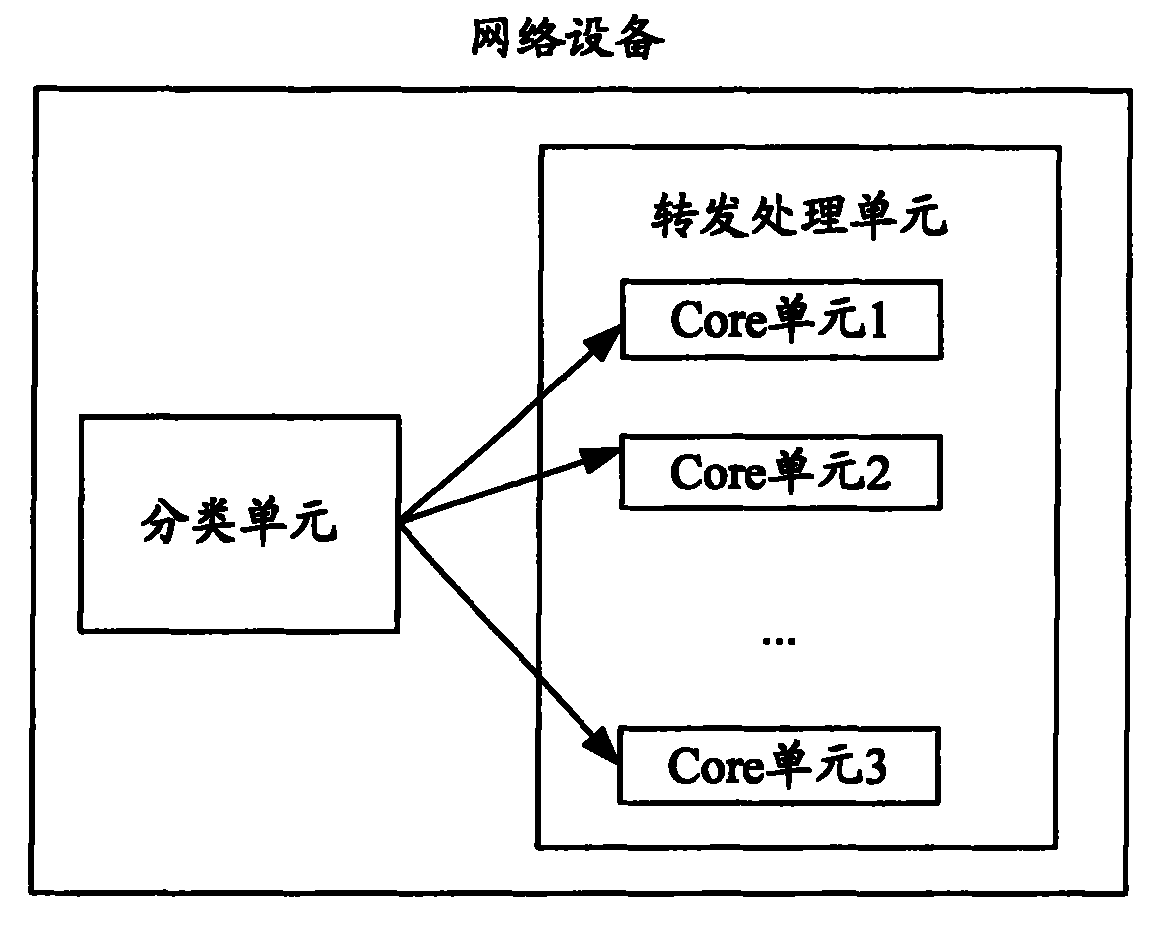
基于多核处理器的上述优点,为了更加有效地提高网络设备的报文转发处理能力,本发明提出了一种具有多核处理器的网络设备。图2是在本发明中网络设备内部的基本结构示意图。参见图2,在本发明中,具有多核处理器的网络设备内部包括:分类单元和包括多个核(Core)单元的转发处理单元,其中,Based on the above advantages of the multi-core processor, in order to more effectively improve the packet forwarding and processing capability of the network device, the present invention proposes a network device with a multi-core processor. Fig. 2 is a schematic diagram of the basic internal structure of the network device in the present invention. Referring to Fig. 2, in the present invention, the network device with multi-core processor includes: a classification unit and a forwarding processing unit including a plurality of core (Core) units, wherein,
分类单元,用于在网络设备的任意一个端口接收到报文时,从转发处理单元中选择Core单元,将接收到的报文发送至所选的Core单元;The classification unit is used to select the Core unit from the forwarding processing unit when any port of the network device receives the message, and send the received message to the selected Core unit;
转发处理单元中的任意一个Core单元,在接收到报文时进行报文转发处理。Any Core unit in the forwarding processing unit performs message forwarding processing when receiving a message.
图3是在本发明中包括两级分类单元的网络设备的基本结构示意图。参见图2和图3,为了提升分类处理效率,使分类单元不会成为系统处理的瓶颈,在本发明中,网络设备内部的分类单元具体可以包括两级分类单元,即第一级分类单元和多个第二级分类单元,其中,FIG. 3 is a schematic diagram of the basic structure of a network device including two-level classification units in the present invention. Referring to Figure 2 and Figure 3, in order to improve the classification processing efficiency, so that the classification unit will not become the bottleneck of the system processing, in the present invention, the classification unit inside the network device may specifically include two-level classification units, that is, the first-level classification unit and Multiple second-order taxa, of which,
第一级分类单元,用于在网络设备的一个端口接收到报文时,从多个第二级分类单元中选择一个第二级分类单元,将报文发送至所选的第二级分类单元;The first-level classification unit is used to select a second-level classification unit from multiple second-level classification units when a port of the network device receives a message, and send the message to the selected second-level classification unit ;
任意一个第二级分类单元,用于在接收到报文时,从转发处理单元中选择Core单元,将接收到的报文发送至所选的Core单元。Any one of the second-level classification units is used to select a Core unit from the forwarding processing units when receiving a message, and send the received message to the selected Core unit.
图4是在本发明中Core单元中包括多个Core的网络设备的基本结构示意图。参见图2和图4,在本发明中,转发处理单元的每一个Core单元可以由多个串联的Core组成,该多个串联的Core用于对接收到的报文分别进行各级报文转发处理,即由该多个串联的Core共同完成对报文的报文转发处理。FIG. 4 is a schematic diagram of a basic structure of a network device including multiple Cores in a Core unit in the present invention. Referring to Fig. 2 and Fig. 4, in the present invention, each Core unit of the forwarding processing unit can be made up of a plurality of series-connected Cores, and the plurality of series-connected Cores are used to forward messages of various levels to received messages respectively processing, that is, the multiple series-connected Cores jointly complete the message forwarding process for the message.
图5是在本发明中网络设备内部的第一种优化结构示意图。参见图2和图5,在本发明中,较佳地,具有多核处理器的网络设备内部还可以进一步包括:发送调度单元,Fig. 5 is a schematic diagram of the first optimized structure inside the network device in the present invention. Referring to FIG. 2 and FIG. 5, in the present invention, preferably, the network device with a multi-core processor may further include: a sending scheduling unit,
转发处理单元中的任意一个Core单元,进一步用于将转发处理后的报文发送至发送调度单元;Any Core unit in the forwarding processing unit is further used to send the forwarded and processed message to the sending scheduling unit;
发送调度单元,用于对转发处理单元中各个Core单元发来的报文进行发送调度。The sending scheduling unit is configured to send and schedule the messages sent by each Core unit in the forwarding processing unit.
图6是在本发明中包括两级发送调度单元的网络设备的第一种优化结构示意图。参见图5和图6,在本发明中,网络设备内部的发送调度单元具体可以包括:第一级发送调度单元和多个第二发送调度单元,其中,FIG. 6 is a schematic diagram of a first optimized structure of a network device including a two-stage transmission scheduling unit in the present invention. Referring to FIG. 5 and FIG. 6, in the present invention, the transmission scheduling unit inside the network device may specifically include: a first-level transmission scheduling unit and multiple second transmission scheduling units, wherein,
第一级发送调度单元,用于在接收到转发处理单元中各个Core单元发来的报文后,从多个第二级发送调度单元中选择一个第二级发送调度单元,将各个Core单元发来的报文发送至所选的第二级发送调度单元;The first-level sending scheduling unit is used to select a second-level sending scheduling unit from multiple second-level sending scheduling units after receiving the message sent by each Core unit in the forwarding processing unit, and send each Core unit The incoming message is sent to the selected second-level sending scheduling unit;
任意一个第二级发送调度单元,用于在接收到各个Core单元发来的报文时,对报文进行发送调度。Any one of the second-level sending scheduling units is used to schedule the sending of the messages when receiving the messages from each Core unit.
图7是在本发明中网络设备内部的第二种优化结构示意图。参见图2和图7,在本发明中,较佳地,具有多核处理器的网络设备内部还可以进一步包括:控制Core,用于生成指导报文转发处理的控制信息,将该控制信息发送至转发处理单元中的Core单元;Fig. 7 is a schematic diagram of the second optimized structure inside the network device in the present invention. Referring to Fig. 2 and Fig. 7, in the present invention, preferably, the network device with the multi-core processor may further include: a control core, which is used to generate control information for guiding message forwarding processing, and send the control information to Forwarding the Core unit in the processing unit;
转发处理单元中的Core单元,用于根据接收到的控制信息,对报文进行转发处理。The Core unit in the forwarding processing unit is configured to forward the message according to the received control information.
需要说明的是,上述图3至图7只是针对网络设备内部的基本结构和优化结构列举了几种可能的组成情况。在具体的业务实现中,上述图3至图7的中的组成结构也可以进行任意组合。比如,参见图8所示,网络设备中可以同时包括图3中所示的两级分类单元和图5中所示的发送调度单元;再如,参见图9所示,网络设备中可以同时包括图4中所示的Core单元中的多个Core以及图5中所示的发送调度单元;又如,参见图10所示,网络设备中可以同时包括图7中所示的控制Core和图5中所述的发送调度单元。It should be noted that the above-mentioned FIG. 3 to FIG. 7 only enumerate several possible composition situations for the basic structure and optimized structure inside the network device. In a specific service realization, the composition structures in the above-mentioned Fig. 3 to Fig. 7 may also be combined arbitrarily. For example, as shown in FIG. 8, the network device may include the two-level classification unit shown in FIG. 3 and the sending scheduling unit shown in FIG. 5; for another example, as shown in FIG. 9, the network device may include Multiple Cores in the Core unit shown in Figure 4 and the sending scheduling unit shown in Figure 5; for another example, referring to Figure 10, the network device can include the control Core shown in Figure 7 and Figure 5 at the same time The sending scheduling unit described in .
相应的,本发明还提出了一种基于多核处理器的报文转发方法,其核心思想是:在网络设备中设置分类单元和包括多个核Core单元的转发处理单元;分类单元接收发送给网络设备的报文,从转发处理单元中选择Core单元,将接收到的报文发送至所选的Core单元;所选的Core单元对接收到的报文进行报文转发处理。Correspondingly, the present invention also proposes a message forwarding method based on a multi-core processor, the core idea of which is: a classification unit and a forwarding processing unit including a plurality of core Core units are set in the network device; the classification unit receives and sends to the network For the message of the device, select the Core unit from the forwarding processing unit, and send the received message to the selected Core unit; the selected Core unit performs message forwarding processing on the received message.
为使本发明的目的、技术方案和优点更加清楚,下面结合附图及具体实施例对本发明作进一步地详细描述。In order to make the purpose, technical solution and advantages of the present invention clearer, the present invention will be further described in detail below in conjunction with the accompanying drawings and specific embodiments.
图11是在本发明实施例中基于多核处理器实现报文转发处理的流程图。参见图2至图11,在本发明中,基于多核处理器实现报文转发处理的过程包括以下步骤:Fig. 11 is a flow chart of implementing packet forwarding processing based on a multi-core processor in an embodiment of the present invention. Referring to Fig. 2 to Fig. 11, in the present invention, the process of realizing message forwarding processing based on multi-core processor includes the following steps:
步骤1101:预先在网络设备中设置分类单元和包括多个核Core单元的转发处理单元。Step 1101: Pre-set a classification unit and a forwarding processing unit including multiple core units in the network device.
这里,转发处理单元中的各个Core单元是由多核处理器的各个Core组成的。Here, each Core unit in the forwarding processing unit is composed of each Core of the multi-core processor.
参见图3,较佳地,在本步骤中,所设置的分类单元中可以包括第一级分类单元和多个第二级分类单元。参见图4,较佳地,在本步骤中,所设置的每一个Core单元可以由多个串联的Core组成。Referring to FIG. 3 , preferably, in this step, the set classification units may include first-level classification units and multiple second-level classification units. Referring to FIG. 4 , preferably, in this step, each Core unit configured may be composed of multiple Cores connected in series.
步骤1102:预先在网络设备中设置发送调度单元。Step 1102: Set a sending scheduling unit in the network device in advance.
在本步骤中,设置发送调度单元是为了在后续过程中通过发送调度单元的发送调度,保证网络设备发送出去的报文符合特定的服务质量要求,比如对于报文延迟、抖动和丢包率等的要求。In this step, the purpose of setting the sending scheduling unit is to ensure that the packets sent by the network device meet specific service quality requirements, such as packet delay, jitter, and packet loss rate, through the sending scheduling of the sending scheduling unit in the subsequent process. requirements.
参见图6,较佳地,在本步骤中,所设置的发送调度单元中可以包括第一级发送调度单元和多个第二级发送调度单元。Referring to FIG. 6 , preferably, in this step, the set sending scheduling unit may include a first-level sending scheduling unit and multiple second-level sending scheduling units.
步骤1103:预先在网络设备中设置控制Core。Step 1103: Set the control core in the network device in advance.
步骤1104:在网络设备运行过程中,控制Core生成指导报文转发处理的控制信息,将该控制信息发送至转发处理单元中的各个Core单元。Step 1104: During the running process of the network device, control the Core to generate control information guiding message forwarding processing, and send the control information to each Core unit in the forwarding processing unit.
这里,所述的控制信息可以包括指导报文转发处理的任意一种信息,比如路由表等。Here, the control information may include any kind of information that guides packet forwarding processing, such as a routing table.
步骤1105:当网络设备在一个端口上接收到报文时,分类单元接收该报文,并从转发处理单元中选择Core单元,将接收到的报文发送至所选的Core单元。Step 1105: When the network device receives a packet on a port, the classification unit receives the packet, selects a Core unit from the forwarding processing units, and sends the received packet to the selected Core unit.
这里,参见图3,在本发明中,当网络设备内部包括第一级分类单元和多个第二级分类单元时,本步骤1105的过程具体包括:由第一级分类单元接收网络设备端口上的报文,然后该第一级分类单元从多个第二级分类单元中选择一个第二级分类单元,将报文发送至所选的第二级分类单元;该所选的第二级分类单元在接收到报文时,执行从转发处理单元中选择Core单元的过程。其中,Here, referring to FIG. 3 , in the present invention, when the network device includes a first-level classification unit and multiple second-level classification units, the process of
第一级分类单元从多个第二级分类单元中选择一个第二级分类单元的具体实现过程可以包括但不限于以下两种方式:The specific implementation process for a first-level taxon to select a second-level taxon from multiple second-level taxa may include but not limited to the following two methods:
方式A、第一级分类单元实时监测各个第二级分类单元的业务负荷情况,并从中选择一个当前业务负荷量最小的第二级分类单元;Method A. The first-level classification unit monitors the business load of each second-level classification unit in real time, and selects a second-level classification unit with the smallest current business load;
方式B、第一级分类单元根据报文中携带的部分会话信息,选择一个第二级分类单元。比如,对于携带特定源地址的报文,第一级分类单元选择第二级分类单元1,对于携带特定目的地址的报文,第一级分类单元选择第二级分类单元2等。Mode B. The first-level classification unit selects a second-level classification unit according to part of the session information carried in the message. For example, for a message carrying a specific source address, the first-level classification unit selects the second-level classification unit 1, and for a message carrying a specific destination address, the first-level classification unit selects the second-level classification unit 2, and so on.
在本步骤1105中,分类单元(当分类单元中包括第一级分类单元和多个第二分类单元时,此处所述的分类单元为第一级分类单元所选择的第二级分类单元)从转发处理单元中选择Core单元的具体实现过程包括但不限于以下方式:In this
方式一、根据报文所属会话进行选择。Mode 1: Select according to the session to which the message belongs.
在该方式一中,预先设置经过所述网络设备的不同会话与不同Core单元之间的对应关系;分类单元接收到报文时,确定报文所属的会话,根据所设置的对应关系,从转发处理单元中选择与报文所属会话对应的Core单元。In this way one, the corresponding relationship between different sessions passing through the network device and different Core units is preset; when the classification unit receives the message, it determines the session to which the message belongs, and forwards the In the processing unit, the Core unit corresponding to the session to which the message belongs is selected.
较佳地,为了进一步提高报文转发处理效率,在本发明中,对于需要保序的会话,可以采用方式一,选择同一个Core单元对该会话的所有报文进行转发处理;对于不需要保序的会话,可以不采用方式一,利用不同的Core单元对该会话的所有报文进行转发处理。因此,在该方式一中,当分类单元确定报文所属会话后,分类单元可以首先判断是否需要对所确定的报文所属会话进行保序,如果是,则继续执行方式一中所述的根据所设置的对应关系从转发处理单元中选择与所确定会话对应的Core单元的步骤,否则,不采用方式一,而采用其他方式选择Core单元。Preferably, in order to further improve the message forwarding processing efficiency, in the present invention, for a session that requires order preservation, mode 1 can be adopted, and the same Core unit is selected to forward all messages of the session; For a session with a different sequence, instead of using the first method, different Core units are used to forward and process all the packets of the session. Therefore, in the first method, after the classification unit determines the session to which the message belongs, the classification unit can first judge whether it is necessary to maintain the order of the determined session to which the message belongs, and if so, continue to implement the method described in the first method. The step of selecting the Core unit corresponding to the determined session from the forwarding processing unit according to the set corresponding relationship; otherwise, instead of using the first method, other methods are used to select the Core unit.
其中,所述分类单元判断是否需要对所确定的报文所属会话进行保序的实现过程包括:Wherein, the implementation process of the classification unit judging whether it is necessary to preserve the order of the session to which the determined message belongs includes:
所述分类单元判断所述网络设备后续需要对所述报文进行的处理是否存在保序要求,如果是,则认定需要对所确定的报文所属会话进行保序,否则,认定不需要对所确定的报文所属会话进行保序;The classification unit judges whether there is an order preservation requirement for the subsequent processing of the message by the network device, and if so, determines that the order of the session to which the determined message belongs needs to be performed; otherwise, determines that it is not necessary to The sequence of the session to which the determined message belongs is guaranteed;
或者,预先设置不需要保序的会话信息,分类单元判断在所设置的不需要保序的会话信息中是否可查找到所确定的报文所属的会话信息,如果不可查找到,则确定需要对所确定的报文所属会话进行保序,如果可查找到,则确定不需要对所确定的报文所属会话进行保序。其中,所述设置不需要保序的会话信息的实现过程可以为:预先根据实际业务需要,直接在分类单元中设置不需要保序的会话信息;或,任意一个Core单元在初始接收到一个会话的前一个或几个报文后,根据报文中携带的特征信息,判断该会话的报文是否顺序到达,如果没有顺序到达,则确定该会话的报文不需要保序,将该会话的信息携带在非保序通知中发送至分类单元;分类单元根据接收到的非保序通知设置不需要保序的会话信息。Alternatively, the session information that does not need to be kept in order is set in advance, and the classification unit judges whether the session information to which the determined message belongs can be found in the set session information that does not need to be kept in order. The sequence of the determined session to which the message belongs is performed, and if it can be found, it is determined that the sequence of the determined session to which the message belongs does not need to be maintained. Wherein, the implementation process of setting the session information that does not need to be kept in order can be: according to the actual business needs, directly set the session information that does not need to be kept in the classification unit in advance; or, any Core unit initially receives a session After the previous one or several packets, according to the characteristic information carried in the packets, it is judged whether the packets of the session arrive in sequence. If not, it is determined that the packets of the session do not need to The information is carried in the non-order-preserving notification and sent to the classification unit; the classification unit sets session information that does not require order-preserving according to the received non-order-preserving notification.
在该方式一中,分类单元确定报文所属会话的过程包括:当接收到的报文为IPv4报文时,分类单元根据报文中携带的五元组(源IP地址、目的IP地址、协议类型、源端口号和目的端口号)以及私网索引信息确定报文所属的会话;当接收到的报文为IPv6报文时,分类单元根据报文中携带的源IP地址以及流标记信息确定报文所属的会话;当接收到的报文为多协议标签交换(MPLS)报文时,分类单元根据报文中携带的最外层标签信息确定报文所属的会话;当接收到的报文为以太网二层交换报文时,分类单元根据报文中携带的源媒质接入控制(MAC)地址和目的MAC地址信息确定报文所属的会话。In this way one, the process of the classifying unit determining the session to which the message belongs includes: when the received message is an IPv4 message, the classifying unit carries the five-tuple (source IP address, destination IP address, protocol type, source port number, and destination port number) and private network index information to determine the session to which the message belongs; when the received message is an IPv6 message, the classification unit determines according to the source IP address and flow label information carried in the message The session to which the message belongs; when the received message was a multi-protocol label switching (MPLS) message, the classification unit determined the session to which the message belonged according to the outermost label information carried in the message; when the received message When exchanging packets for the Ethernet Layer 2, the classification unit determines the session to which the packet belongs according to the source MAC address and destination MAC address information carried in the packet.
方式二、根据转发处理单元中各个Core单元的业务负荷情况进行选择。Mode 2: Select according to the service load of each Core unit in the forwarding processing unit.
在该方式二中,分类单元实时监测各个Core单元的业务负荷量;在本步骤中,分类单元从转发处理单元中选择当前业务负荷量最小的Core单元。In the second method, the classification unit monitors the service load of each Core unit in real time; in this step, the classification unit selects the Core unit with the smallest current service load from the forwarding processing units.
方式三、分类单元从转发处理单元中任意选择Core单元。Mode 3: The classification unit randomly selects a Core unit from the forwarding processing units.
步骤1106:所选的Core单元根据控制Core发来的控制信息,对接收到的报文进行报文转发处理。Step 1106: The selected Core unit forwards the received message according to the control information sent by the control Core.
这里,所述的报文转发处理为现有技术,但可以举例为:第一次外层转发处理、内层转发处理和第二次外层转发处理。Here, the packet forwarding process described is the prior art, but it can be exemplified as: the first outer layer forwarding process, the inner layer forwarding process and the second outer layer forwarding process.
参见图4,在本发明中,当所设置的每一个Core单元由多个串联的Core组成时,在本步骤1106中,是由所选Core单元中各个串联的Core共同完成各级报文转发处理,比如,所选的Core单元中包括3个串联的Core,那么,在本步骤中,可以由串联的第一个Core完成第一次外层转发处理,由串联的第二个Core完成内层转发处理,并由串联的第三个Core完成第二次外层转发处理。Referring to Fig. 4, in the present invention, when each set Core unit is composed of a plurality of series-connected Cores, in this
步骤1107:发送调度单元根据预先设置的调度策略对报文转发处理后的报文进行发送调度。Step 1107: The sending scheduling unit performs sending scheduling on the message after the message forwarding process according to the preset scheduling policy.
这里,参见图6,在本发明中,当网络设备内部包括第一级发送调度单元和多个发送调度单元时,本步骤的具体实现过程可以包括:第一级发送调度单元接收转发处理单元中Core单元发来的报文,从多个第二级发送调度单元中选择一个第二级发送调度单元,将Core单元发来的报文发送至所选的第二级发送调度单元;第二级发送调度单元在接收到Core单元发来的报文时,根据预先设置的调度策略对报文进行发送调度。Here, referring to FIG. 6, in the present invention, when the network device includes a first-level transmission scheduling unit and multiple transmission scheduling units, the specific implementation process of this step may include: the first-level transmission scheduling unit receives and forwards the processing unit For the message sent by the Core unit, select a second-level sending scheduling unit from multiple second-level sending scheduling units, and send the message sent by the Core unit to the selected second-level sending scheduling unit; the second level When the sending scheduling unit receives the message sent by the Core unit, it schedules the sending of the message according to the preset scheduling policy.
其中,所述第一级发送调度单元选择第二级发送调度单元的方式可以包括:随机选择,或根据业务符合情况选择,或根据不同Core单元与不同第二级发送调度单元间的对应关系进行选择等。Wherein, the manner in which the first-level transmission scheduling unit selects the second-level transmission scheduling unit may include: random selection, or selection according to service compliance, or according to the corresponding relationship between different Core units and different second-level transmission scheduling units select etc.
至此,则实现了对报文进行报文转发处理的过程。So far, the process of forwarding the message is realized.
需要说明的是,在本发明中,所述的分类单元可以是多核处理器中的Core,也可以是其他可完成分类单元功能的硬件单元,比如可编程逻辑阵列(FPGA)或专用集成电路(ASIC)等。It should be noted that, in the present invention, the classification unit can be the Core in the multi-core processor, and can also be other hardware units that can complete the function of the classification unit, such as a programmable logic array (FPGA) or an application-specific integrated circuit ( ASIC), etc.
并且,在本发明中,所述的发送调度单元可以是多核处理器中的Core,也可以是其他可完成发送调度单元功能的硬件单元,比如FPGA或ASIC等。Moreover, in the present invention, the sending scheduling unit may be a Core in a multi-core processor, or other hardware units that can complete the function of the sending scheduling unit, such as FPGA or ASIC.
总之,以上所述仅为本发明的较佳实施例而已,并非用于限定本发明的保护范围。凡在本发明的精神和原则之内,所作的任何修改、等同替换、改进等,均应包含在本发明的保护范围之内。In a word, the above descriptions are only preferred embodiments of the present invention, and are not intended to limit the protection scope of the present invention. Any modifications, equivalent replacements, improvements, etc. made within the spirit and principles of the present invention shall be included within the protection scope of the present invention.
Claims (18)
Priority Applications (1)
| Application Number | Priority Date | Filing Date | Title |
|---|---|---|---|
| CNB2006101542008A CN100466629C (en) | 2006-09-18 | 2006-09-18 | Network equipment and message transferring method based on multiple-core processor |
Applications Claiming Priority (1)
| Application Number | Priority Date | Filing Date | Title |
|---|---|---|---|
| CNB2006101542008A CN100466629C (en) | 2006-09-18 | 2006-09-18 | Network equipment and message transferring method based on multiple-core processor |
Publications (2)
| Publication Number | Publication Date |
|---|---|
| CN1921457A true CN1921457A (en) | 2007-02-28 |
| CN100466629C CN100466629C (en) | 2009-03-04 |
Family
ID=37779033
Family Applications (1)
| Application Number | Title | Priority Date | Filing Date |
|---|---|---|---|
| CNB2006101542008A Expired - Fee Related CN100466629C (en) | 2006-09-18 | 2006-09-18 | Network equipment and message transferring method based on multiple-core processor |
Country Status (1)
| Country | Link |
|---|---|
| CN (1) | CN100466629C (en) |
Cited By (40)
| Publication number | Priority date | Publication date | Assignee | Title |
|---|---|---|---|---|
| WO2008106879A1 (en) * | 2007-03-08 | 2008-09-12 | Huawei Technologies Co., Ltd. | Data transfer process device and method |
| WO2009065313A1 (en) * | 2007-11-20 | 2009-05-28 | Hangzhou H3C Technologies Co., Ltd. | Method and multi-core processor equipment for realizing multiple service process functions |
| CN101106526B (en) * | 2007-07-27 | 2010-06-02 | 杭州华三通信技术有限公司 | A packet processing method |
| CN101197782B (en) * | 2007-12-26 | 2010-06-09 | 中兴通讯股份有限公司 | Method and system for controlling network equipment based on multi-core processor |
| CN101166099B (en) * | 2007-09-21 | 2010-06-23 | 杭州华三通信技术有限公司 | Distributed multi-core network device and cable card board |
| CN101304322B (en) * | 2008-06-30 | 2010-07-28 | 杭州华三通信技术有限公司 | A network device and message forwarding method |
| CN101866116A (en) * | 2009-04-15 | 2010-10-20 | Asml荷兰有限公司 | Lithographic apparatus, control system, multi-core processor, and a method to start tasks on a multi-core processor |
| CN101217467B (en) * | 2007-12-28 | 2010-10-27 | 杭州华三通信技术有限公司 | Inter-core load distribution device and method |
| CN101878663A (en) * | 2007-11-29 | 2010-11-03 | 瑞科网信科技有限公司 | Systems and methods for distributed multiprocessing security gateways |
| CN101945407A (en) * | 2010-10-22 | 2011-01-12 | 东南大学 | Load balancing method for content monitoring of mobile service |
| CN101976208A (en) * | 2010-10-25 | 2011-02-16 | 中兴通讯股份有限公司 | Method and device for delivering information |
| CN102201936A (en) * | 2011-05-30 | 2011-09-28 | 中兴通讯股份有限公司 | Control method and system for network device entrance message and network device |
| CN101442513B (en) * | 2007-11-20 | 2012-05-23 | 杭州华三通信技术有限公司 | Method for realizing multiple service processing functions and multi-core processor equipment |
| CN103345432A (en) * | 2013-06-07 | 2013-10-09 | 深圳中兴网信科技有限公司 | Multi-core CPU overload detection device and multi-core CPU overload detection method |
| US8559423B2 (en) | 2007-07-27 | 2013-10-15 | Hangzhou H3C Technologies Co., Ltd. | Method and apparatus for packet processing |
| CN103647708A (en) * | 2013-11-29 | 2014-03-19 | 曙光信息产业(北京)有限公司 | ATCA-based data message processing board |
| CN103702366A (en) * | 2013-12-25 | 2014-04-02 | 上海寰创通信科技股份有限公司 | System and method for processing message information |
| CN103973553A (en) * | 2013-01-24 | 2014-08-06 | 华为技术有限公司 | Data packet processing method and network device |
| CN104506331A (en) * | 2014-12-22 | 2015-04-08 | 迈普通信技术股份有限公司 | Multicast message transmission method and multi-core network equipment |
| CN104539408A (en) * | 2014-12-30 | 2015-04-22 | 国电南瑞科技股份有限公司 | Redundant industry Ethernet system with message multistage filtering function and service classification control function |
| US9032502B1 (en) | 2006-08-08 | 2015-05-12 | A10 Networks, Inc. | System and method for distributed multi-processing security gateway |
| US9118620B1 (en) | 2012-03-29 | 2015-08-25 | A10 Networks, Inc. | Hardware-based packet editor |
| CN105656809A (en) * | 2016-02-04 | 2016-06-08 | 上海信昊信息科技有限公司 | Order-preserving method for network communication data packet |
| US9385886B2 (en) | 2011-07-06 | 2016-07-05 | Huawei Technologies Co., Ltd. | Method for processing a packet and related device |
| CN105991633A (en) * | 2015-04-28 | 2016-10-05 | 杭州迪普科技有限公司 | Session log processing method and device |
| CN106254134A (en) * | 2016-08-29 | 2016-12-21 | 上海斐讯数据通信技术有限公司 | A kind of network equipment and the method that data are flow to line pipe control thereof |
| CN102833035B (en) * | 2011-06-16 | 2017-02-01 | 中兴通讯股份有限公司 | Uplink control channel information processing method based on multi-core processor and device |
| US9596286B2 (en) | 2012-05-25 | 2017-03-14 | A10 Networks, Inc. | Method to process HTTP header with hardware assistance |
| CN106534345A (en) * | 2016-12-07 | 2017-03-22 | 东软集团股份有限公司 | Message forwarding method and device |
| CN106549815A (en) * | 2015-09-17 | 2017-03-29 | 武汉邮电科学研究院 | For the apparatus and method of real-time deep application identification in network |
| CN106788975A (en) * | 2016-12-28 | 2017-05-31 | 北京天融信网络安全技术有限公司 | Ciphering and deciphering device based on SM4 cryptographic algorithms |
| US9806943B2 (en) | 2014-04-24 | 2017-10-31 | A10 Networks, Inc. | Enabling planned upgrade/downgrade of network devices without impacting network sessions |
| CN107707649A (en) * | 2017-09-28 | 2018-02-16 | 新华三技术有限公司 | Turn the backup method and device of Forwarding plane in control separation |
| US10021174B2 (en) | 2012-09-25 | 2018-07-10 | A10 Networks, Inc. | Distributing service sessions |
| US10020979B1 (en) | 2014-03-25 | 2018-07-10 | A10 Networks, Inc. | Allocating resources in multi-core computing environments |
| US10027761B2 (en) | 2013-05-03 | 2018-07-17 | A10 Networks, Inc. | Facilitating a secure 3 party network session by a network device |
| CN108366024A (en) * | 2018-02-07 | 2018-08-03 | 迈普通信技术股份有限公司 | Message forwarding method and device |
| CN108595370A (en) * | 2018-03-30 | 2018-09-28 | 新华三信息安全技术有限公司 | A kind of multi-core processor and message processing method |
| US10491523B2 (en) | 2012-09-25 | 2019-11-26 | A10 Networks, Inc. | Load distribution in data networks |
| CN111163018A (en) * | 2019-12-02 | 2020-05-15 | 华为技术有限公司 | Network equipment and method for reducing transmission delay thereof |
Families Citing this family (1)
| Publication number | Priority date | Publication date | Assignee | Title |
|---|---|---|---|---|
| CN102375761A (en) * | 2010-08-06 | 2012-03-14 | 中兴通讯股份有限公司 | Business management method, device and equipment |
Family Cites Families (3)
| Publication number | Priority date | Publication date | Assignee | Title |
|---|---|---|---|---|
| CN100495974C (en) * | 2003-04-07 | 2009-06-03 | 华为技术有限公司 | Flow shaping method in data transmission process |
| JP4555592B2 (en) * | 2004-03-31 | 2010-10-06 | 富士通株式会社 | Packet processing system |
| US20060171369A1 (en) * | 2005-02-03 | 2006-08-03 | Telefonaktiebolaget L M Ericsson (Publ) | Resource utilization for multimedia broadcast multicast services (MBMS) |
-
2006
- 2006-09-18 CN CNB2006101542008A patent/CN100466629C/en not_active Expired - Fee Related
Cited By (72)
| Publication number | Priority date | Publication date | Assignee | Title |
|---|---|---|---|---|
| US9032502B1 (en) | 2006-08-08 | 2015-05-12 | A10 Networks, Inc. | System and method for distributed multi-processing security gateway |
| US9344456B2 (en) | 2006-08-08 | 2016-05-17 | A10 Networks, Inc. | Distributed multi-processing security gateway |
| US8464333B1 (en) | 2006-08-08 | 2013-06-11 | A10 Networks, Inc. | System and method for distributed multi-processing security gateway |
| US8918857B1 (en) | 2006-08-08 | 2014-12-23 | A10 Networks, Inc. | Distributed multi-processing security gateway |
| US9124550B1 (en) | 2006-08-08 | 2015-09-01 | A10 Networks, Inc. | Distributed multi-processing security gateway |
| US8943577B1 (en) | 2006-08-08 | 2015-01-27 | A10 Networks, Inc. | Distributed multi-processing security gateway |
| US9258332B2 (en) | 2006-08-08 | 2016-02-09 | A10 Networks, Inc. | Distributed multi-processing security gateway |
| US8914871B1 (en) | 2006-08-08 | 2014-12-16 | A10 Networks, Inc. | Distributed multi-processing security gateway |
| US8904512B1 (en) | 2006-08-08 | 2014-12-02 | A10 Networks, Inc. | Distributed multi-processing security gateway |
| US8387128B1 (en) | 2006-08-08 | 2013-02-26 | A10 Networks, Inc. | System and method for distributed multi-processing security gateway |
| WO2008106879A1 (en) * | 2007-03-08 | 2008-09-12 | Huawei Technologies Co., Ltd. | Data transfer process device and method |
| US8559423B2 (en) | 2007-07-27 | 2013-10-15 | Hangzhou H3C Technologies Co., Ltd. | Method and apparatus for packet processing |
| CN101106526B (en) * | 2007-07-27 | 2010-06-02 | 杭州华三通信技术有限公司 | A packet processing method |
| CN101166099B (en) * | 2007-09-21 | 2010-06-23 | 杭州华三通信技术有限公司 | Distributed multi-core network device and cable card board |
| CN101442513B (en) * | 2007-11-20 | 2012-05-23 | 杭州华三通信技术有限公司 | Method for realizing multiple service processing functions and multi-core processor equipment |
| US8417848B2 (en) | 2007-11-20 | 2013-04-09 | Hangzhou H3C Technologies Co., Ltd. | Method and apparatus for implementing multiple service processing functions |
| WO2009065313A1 (en) * | 2007-11-20 | 2009-05-28 | Hangzhou H3C Technologies Co., Ltd. | Method and multi-core processor equipment for realizing multiple service process functions |
| CN101878663A (en) * | 2007-11-29 | 2010-11-03 | 瑞科网信科技有限公司 | Systems and methods for distributed multiprocessing security gateways |
| CN101878663B (en) * | 2007-11-29 | 2014-06-11 | 瑞科网信科技有限公司 | System and method for distributed multi-processing security gateway |
| CN101197782B (en) * | 2007-12-26 | 2010-06-09 | 中兴通讯股份有限公司 | Method and system for controlling network equipment based on multi-core processor |
| CN101217467B (en) * | 2007-12-28 | 2010-10-27 | 杭州华三通信技术有限公司 | Inter-core load distribution device and method |
| CN101304322B (en) * | 2008-06-30 | 2010-07-28 | 杭州华三通信技术有限公司 | A network device and message forwarding method |
| CN101866116B (en) * | 2009-04-15 | 2012-06-13 | Asml荷兰有限公司 | Lithographic apparatus, control system, multi-core processor, and a method to start tasks on a multi-core processor |
| CN101866116A (en) * | 2009-04-15 | 2010-10-20 | Asml荷兰有限公司 | Lithographic apparatus, control system, multi-core processor, and a method to start tasks on a multi-core processor |
| CN101945407B (en) * | 2010-10-22 | 2012-11-28 | 东南大学 | Load balancing method for content monitoring of mobile service |
| CN101945407A (en) * | 2010-10-22 | 2011-01-12 | 东南大学 | Load balancing method for content monitoring of mobile service |
| RU2566953C2 (en) * | 2010-10-25 | 2015-10-27 | ЗетТиИ Корпорейшн | Information delivery method and device |
| US9207974B2 (en) | 2010-10-25 | 2015-12-08 | Zte Corporation | Information delivery method and device |
| CN101976208B (en) * | 2010-10-25 | 2014-08-13 | 中兴通讯股份有限公司 | Method and device for delivering information |
| CN101976208A (en) * | 2010-10-25 | 2011-02-16 | 中兴通讯股份有限公司 | Method and device for delivering information |
| CN102201936A (en) * | 2011-05-30 | 2011-09-28 | 中兴通讯股份有限公司 | Control method and system for network device entrance message and network device |
| CN102833035B (en) * | 2011-06-16 | 2017-02-01 | 中兴通讯股份有限公司 | Uplink control channel information processing method based on multi-core processor and device |
| US9385886B2 (en) | 2011-07-06 | 2016-07-05 | Huawei Technologies Co., Ltd. | Method for processing a packet and related device |
| US10069946B2 (en) | 2012-03-29 | 2018-09-04 | A10 Networks, Inc. | Hardware-based packet editor |
| US9118618B2 (en) | 2012-03-29 | 2015-08-25 | A10 Networks, Inc. | Hardware-based packet editor |
| US9118620B1 (en) | 2012-03-29 | 2015-08-25 | A10 Networks, Inc. | Hardware-based packet editor |
| US9742879B2 (en) | 2012-03-29 | 2017-08-22 | A10 Networks, Inc. | Hardware-based packet editor |
| US9596286B2 (en) | 2012-05-25 | 2017-03-14 | A10 Networks, Inc. | Method to process HTTP header with hardware assistance |
| US9843521B2 (en) | 2012-05-25 | 2017-12-12 | A10 Networks, Inc. | Processing packet header with hardware assistance |
| US10348631B2 (en) | 2012-05-25 | 2019-07-09 | A10 Networks, Inc. | Processing packet header with hardware assistance |
| US10491523B2 (en) | 2012-09-25 | 2019-11-26 | A10 Networks, Inc. | Load distribution in data networks |
| US10862955B2 (en) | 2012-09-25 | 2020-12-08 | A10 Networks, Inc. | Distributing service sessions |
| US10021174B2 (en) | 2012-09-25 | 2018-07-10 | A10 Networks, Inc. | Distributing service sessions |
| CN103973553A (en) * | 2013-01-24 | 2014-08-06 | 华为技术有限公司 | Data packet processing method and network device |
| US10027761B2 (en) | 2013-05-03 | 2018-07-17 | A10 Networks, Inc. | Facilitating a secure 3 party network session by a network device |
| CN103345432B (en) * | 2013-06-07 | 2016-12-28 | 深圳中兴网信科技有限公司 | Multi-core CPU overload detector and multi-core CPU overload detection method |
| CN103345432A (en) * | 2013-06-07 | 2013-10-09 | 深圳中兴网信科技有限公司 | Multi-core CPU overload detection device and multi-core CPU overload detection method |
| CN103647708A (en) * | 2013-11-29 | 2014-03-19 | 曙光信息产业(北京)有限公司 | ATCA-based data message processing board |
| CN103702366A (en) * | 2013-12-25 | 2014-04-02 | 上海寰创通信科技股份有限公司 | System and method for processing message information |
| CN103702366B (en) * | 2013-12-25 | 2018-03-13 | 上海寰创通信科技股份有限公司 | A kind of system and method for handling message information |
| US10020979B1 (en) | 2014-03-25 | 2018-07-10 | A10 Networks, Inc. | Allocating resources in multi-core computing environments |
| US10411956B2 (en) | 2014-04-24 | 2019-09-10 | A10 Networks, Inc. | Enabling planned upgrade/downgrade of network devices without impacting network sessions |
| US10110429B2 (en) | 2014-04-24 | 2018-10-23 | A10 Networks, Inc. | Enabling planned upgrade/downgrade of network devices without impacting network sessions |
| US9806943B2 (en) | 2014-04-24 | 2017-10-31 | A10 Networks, Inc. | Enabling planned upgrade/downgrade of network devices without impacting network sessions |
| CN104506331A (en) * | 2014-12-22 | 2015-04-08 | 迈普通信技术股份有限公司 | Multicast message transmission method and multi-core network equipment |
| CN104506331B (en) * | 2014-12-22 | 2017-09-29 | 迈普通信技术股份有限公司 | A kind of multicast message transmission method and multi-core network device |
| WO2016107210A1 (en) * | 2014-12-30 | 2016-07-07 | 国电南瑞科技股份有限公司 | Redundant industrial ethernet system with multistage packet filtering and service classification control |
| CN104539408A (en) * | 2014-12-30 | 2015-04-22 | 国电南瑞科技股份有限公司 | Redundant industry Ethernet system with message multistage filtering function and service classification control function |
| CN105991633A (en) * | 2015-04-28 | 2016-10-05 | 杭州迪普科技有限公司 | Session log processing method and device |
| CN105991633B (en) * | 2015-04-28 | 2019-02-19 | 杭州迪普科技股份有限公司 | Session log processing method and processing device |
| CN106549815B (en) * | 2015-09-17 | 2020-05-05 | 武汉邮电科学研究院 | Apparatus and method for real-time deep application recognition in a network |
| CN106549815A (en) * | 2015-09-17 | 2017-03-29 | 武汉邮电科学研究院 | For the apparatus and method of real-time deep application identification in network |
| CN105656809B (en) * | 2016-02-04 | 2019-07-19 | 上海信昊信息科技有限公司 | A kind of network communication data packet order-preserving method |
| CN105656809A (en) * | 2016-02-04 | 2016-06-08 | 上海信昊信息科技有限公司 | Order-preserving method for network communication data packet |
| CN106254134A (en) * | 2016-08-29 | 2016-12-21 | 上海斐讯数据通信技术有限公司 | A kind of network equipment and the method that data are flow to line pipe control thereof |
| CN106534345B (en) * | 2016-12-07 | 2019-02-05 | 东软集团股份有限公司 | A kind of message forwarding method and device |
| CN106534345A (en) * | 2016-12-07 | 2017-03-22 | 东软集团股份有限公司 | Message forwarding method and device |
| CN106788975A (en) * | 2016-12-28 | 2017-05-31 | 北京天融信网络安全技术有限公司 | Ciphering and deciphering device based on SM4 cryptographic algorithms |
| CN107707649A (en) * | 2017-09-28 | 2018-02-16 | 新华三技术有限公司 | Turn the backup method and device of Forwarding plane in control separation |
| CN108366024A (en) * | 2018-02-07 | 2018-08-03 | 迈普通信技术股份有限公司 | Message forwarding method and device |
| CN108595370A (en) * | 2018-03-30 | 2018-09-28 | 新华三信息安全技术有限公司 | A kind of multi-core processor and message processing method |
| CN111163018A (en) * | 2019-12-02 | 2020-05-15 | 华为技术有限公司 | Network equipment and method for reducing transmission delay thereof |
Also Published As
| Publication number | Publication date |
|---|---|
| CN100466629C (en) | 2009-03-04 |
Similar Documents
| Publication | Publication Date | Title |
|---|---|---|
| CN1921457A (en) | Network equipment and message transferring method based on multiple-core processor | |
| CN1725761A (en) | Method of implementing link aggregation of network equipment | |
| CN101030943A (en) | Method for transmitting message and route | |
| CN1943206A (en) | System and method for maximizing connectivity during network failures in a cluster system | |
| CN1567839A (en) | Port based network access control method | |
| CN1620010A (en) | VLAN server | |
| CN1909503A (en) | Method for detecting maximal transmission unit of path | |
| CN1750512A (en) | Single broadcast reverse path repeating method | |
| CN101030947A (en) | Method and apparatus for transmitting message | |
| CN101060494A (en) | A route selection method, system and router | |
| CN101079807A (en) | A mesh relaying method and IP communication system for controlling media transmission path | |
| CN1921477A (en) | Method and system for complicated flow classification of arrange cutted piece message | |
| CN1960313A (en) | Periphery devices of service provider of combining network address conversion, and method of application | |
| CN101047633A (en) | Method, device and system for implementing multi-route transmission | |
| CN1798098A (en) | Method of differentiating multiple services for anti IP data stream in multicast to impact communication system | |
| CN1728684A (en) | Packet transfer apparatus | |
| CN1878118A (en) | System for realizing data communication and its method | |
| CN1863144A (en) | Method for providing differential service | |
| CN1946054A (en) | Transmission method and device for high speed data flow and data exchange device | |
| CN1647454A (en) | Method for changing pmtu on dynamic ip network and apparatus using the method | |
| CN1925452A (en) | Data transferring system, method and network transferring apparatus | |
| CN1744574A (en) | Method for multicasting message to traverse non multicasting network and its applied network system | |
| CN1976343A (en) | Method and system for raising transmission control protocol data handling capacity | |
| CN101064637A (en) | Method for guaranteeing quality of service of operation maintenance data stream | |
| CN101060489A (en) | Message forwarding method and device |
Legal Events
| Date | Code | Title | Description |
|---|---|---|---|
| C06 | Publication | ||
| PB01 | Publication | ||
| C10 | Entry into substantive examination | ||
| SE01 | Entry into force of request for substantive examination | ||
| ASS | Succession or assignment of patent right |
Owner name: HANGZHOU HUASAN COMMUNICATION TECHNOLOGY CO., LTD Free format text: FORMER OWNER: HANGZHOU HUAWEI 3COM TECHNOLOGY CO., LTD. Effective date: 20070706 |
|
| C41 | Transfer of patent application or patent right or utility model | ||
| TA01 | Transfer of patent application right |
Effective date of registration: 20070706 Address after: 310053, Hangzhou hi tech Industrial Development Zone, Zhejiang hi tech Industrial Park, No. six and No. 310 HUAWEI Hangzhou production base Applicant after: HANGZHOU H3C TECHNOLOGIES Co.,Ltd. Address before: 310053, Jiang hi tech Industrial Development Zone, Zhejiang, Hangzhou hi tech Industrial Park six and Lu Donghua as the 3Com headquarters Applicant before: New H3C Technologies Co.,Ltd. |
|
| C14 | Grant of patent or utility model | ||
| GR01 | Patent grant | ||
| CP03 | Change of name, title or address |
Address after: 310052 Binjiang District Changhe Road, Zhejiang, China, No. 466, No. Patentee after: NEW H3C TECHNOLOGIES Co.,Ltd. Address before: 310053 Hangzhou hi tech Industrial Development Zone, Zhejiang province science and Technology Industrial Park, No. 310 and No. six road, HUAWEI, Hangzhou production base Patentee before: HANGZHOU H3C TECHNOLOGIES Co.,Ltd. |
|
| CP03 | Change of name, title or address | ||
| CF01 | Termination of patent right due to non-payment of annual fee | ||
| CF01 | Termination of patent right due to non-payment of annual fee |
Granted publication date: 20090304 |