CN1896066B - Process for preparing pesticides - Google Patents
Process for preparing pesticides Download PDFInfo
- Publication number
- CN1896066B CN1896066B CN2004101300014A CN200410130001A CN1896066B CN 1896066 B CN1896066 B CN 1896066B CN 2004101300014 A CN2004101300014 A CN 2004101300014A CN 200410130001 A CN200410130001 A CN 200410130001A CN 1896066 B CN1896066 B CN 1896066B
- Authority
- CN
- China
- Prior art keywords
- amino
- trifluoromethyl
- formula
- mixture
- dichlor
- Prior art date
- Legal status (The legal status is an assumption and is not a legal conclusion. Google has not performed a legal analysis and makes no representation as to the accuracy of the status listed.)
- Expired - Lifetime
Links
- 238000004519 manufacturing process Methods 0.000 title abstract 2
- 239000000575 pesticide Substances 0.000 title description 7
- 238000000034 method Methods 0.000 claims abstract description 62
- 239000000203 mixture Substances 0.000 claims abstract description 30
- RJCQBQGAPKAMLL-UHFFFAOYSA-N bromotrifluoromethane Chemical compound FC(F)(F)Br RJCQBQGAPKAMLL-UHFFFAOYSA-N 0.000 claims abstract description 11
- 239000002798 polar solvent Substances 0.000 claims abstract description 5
- 238000002360 preparation method Methods 0.000 claims description 22
- 239000002904 solvent Substances 0.000 claims description 9
- BDAGIHXWWSANSR-UHFFFAOYSA-M Formate Chemical compound [O-]C=O BDAGIHXWWSANSR-UHFFFAOYSA-M 0.000 claims description 7
- 229910052801 chlorine Inorganic materials 0.000 claims description 6
- 238000005304 joining Methods 0.000 claims description 2
- 125000006414 CCl Chemical group ClC* 0.000 claims 1
- 150000001875 compounds Chemical class 0.000 abstract description 28
- 229910052736 halogen Inorganic materials 0.000 abstract description 7
- 150000002367 halogens Chemical class 0.000 abstract description 7
- 125000001188 haloalkyl group Chemical group 0.000 abstract description 5
- 125000004435 hydrogen atom Chemical group [H]* 0.000 abstract description 2
- RAHZWNYVWXNFOC-UHFFFAOYSA-N Sulphur dioxide Chemical compound O=S=O RAHZWNYVWXNFOC-UHFFFAOYSA-N 0.000 abstract 2
- BWGNESOTFCXPMA-UHFFFAOYSA-N Dihydrogen disulfide Chemical compound SS BWGNESOTFCXPMA-UHFFFAOYSA-N 0.000 abstract 1
- 150000004675 formic acid derivatives Chemical class 0.000 abstract 1
- 125000004438 haloalkoxy group Chemical group 0.000 abstract 1
- DTQVDTLACAAQTR-UHFFFAOYSA-N Trifluoroacetic acid Chemical compound OC(=O)C(F)(F)F DTQVDTLACAAQTR-UHFFFAOYSA-N 0.000 description 38
- LFQSCWFLJHTTHZ-UHFFFAOYSA-N Ethanol Chemical compound CCO LFQSCWFLJHTTHZ-UHFFFAOYSA-N 0.000 description 29
- 238000006243 chemical reaction Methods 0.000 description 29
- WEVYAHXRMPXWCK-UHFFFAOYSA-N Acetonitrile Chemical compound CC#N WEVYAHXRMPXWCK-UHFFFAOYSA-N 0.000 description 27
- MVPPADPHJFYWMZ-UHFFFAOYSA-N chlorobenzene Chemical compound ClC1=CC=CC=C1 MVPPADPHJFYWMZ-UHFFFAOYSA-N 0.000 description 26
- MHAJPDPJQMAIIY-UHFFFAOYSA-N Hydrogen peroxide Chemical compound OO MHAJPDPJQMAIIY-UHFFFAOYSA-N 0.000 description 22
- OKKJLVBELUTLKV-UHFFFAOYSA-N Methanol Chemical compound OC OKKJLVBELUTLKV-UHFFFAOYSA-N 0.000 description 18
- 239000000047 product Substances 0.000 description 18
- YXFVVABEGXRONW-UHFFFAOYSA-N Toluene Chemical compound CC1=CC=CC=C1 YXFVVABEGXRONW-UHFFFAOYSA-N 0.000 description 15
- 239000007789 gas Substances 0.000 description 15
- 235000019441 ethanol Nutrition 0.000 description 12
- RWSOTUBLDIXVET-UHFFFAOYSA-M hydrosulfide Chemical compound [SH-] RWSOTUBLDIXVET-UHFFFAOYSA-M 0.000 description 12
- PXJJSXABGXMUSU-UHFFFAOYSA-N disulfur dichloride Chemical compound ClSSCl PXJJSXABGXMUSU-UHFFFAOYSA-N 0.000 description 11
- 239000000543 intermediate Substances 0.000 description 10
- 239000000243 solution Substances 0.000 description 10
- 230000007797 corrosion Effects 0.000 description 7
- 238000005260 corrosion Methods 0.000 description 7
- 230000003647 oxidation Effects 0.000 description 7
- 238000007254 oxidation reaction Methods 0.000 description 7
- XLYOFNOQVPJJNP-UHFFFAOYSA-N water Substances O XLYOFNOQVPJJNP-UHFFFAOYSA-N 0.000 description 7
- QGZKDVFQNNGYKY-UHFFFAOYSA-N Ammonia Chemical compound N QGZKDVFQNNGYKY-UHFFFAOYSA-N 0.000 description 6
- YMWUJEATGCHHMB-UHFFFAOYSA-N Dichloromethane Chemical compound ClCCl YMWUJEATGCHHMB-UHFFFAOYSA-N 0.000 description 6
- VYPSYNLAJGMNEJ-UHFFFAOYSA-N Silicium dioxide Chemical compound O=[Si]=O VYPSYNLAJGMNEJ-UHFFFAOYSA-N 0.000 description 6
- HEMHJVSKTPXQMS-UHFFFAOYSA-M Sodium hydroxide Chemical compound [OH-].[Na+] HEMHJVSKTPXQMS-UHFFFAOYSA-M 0.000 description 6
- 239000006227 byproduct Substances 0.000 description 6
- 239000000460 chlorine Substances 0.000 description 6
- 238000002425 crystallisation Methods 0.000 description 6
- 230000008025 crystallization Effects 0.000 description 6
- 238000004821 distillation Methods 0.000 description 6
- 238000006365 thiocyanation reaction Methods 0.000 description 6
- WKBOTKDWSSQWDR-UHFFFAOYSA-N Bromine atom Chemical compound [Br] WKBOTKDWSSQWDR-UHFFFAOYSA-N 0.000 description 5
- GDTBXPJZTBHREO-UHFFFAOYSA-N bromine Substances BrBr GDTBXPJZTBHREO-UHFFFAOYSA-N 0.000 description 5
- 229910052794 bromium Inorganic materials 0.000 description 5
- HLBBKKJFGFRGMU-UHFFFAOYSA-M sodium formate Chemical compound [Na+].[O-]C=O HLBBKKJFGFRGMU-UHFFFAOYSA-M 0.000 description 5
- CSCPPACGZOOCGX-UHFFFAOYSA-N Acetone Chemical compound CC(C)=O CSCPPACGZOOCGX-UHFFFAOYSA-N 0.000 description 4
- ZAMOUSCENKQFHK-UHFFFAOYSA-N Chlorine atom Chemical compound [Cl] ZAMOUSCENKQFHK-UHFFFAOYSA-N 0.000 description 4
- WYURNTSHIVDZCO-UHFFFAOYSA-N Tetrahydrofuran Chemical compound C1CCOC1 WYURNTSHIVDZCO-UHFFFAOYSA-N 0.000 description 4
- 125000003545 alkoxy group Chemical group 0.000 description 4
- 125000000217 alkyl group Chemical group 0.000 description 4
- KGBXLFKZBHKPEV-UHFFFAOYSA-N boric acid Chemical compound OB(O)O KGBXLFKZBHKPEV-UHFFFAOYSA-N 0.000 description 4
- 239000004327 boric acid Substances 0.000 description 4
- 230000006837 decompression Effects 0.000 description 4
- 238000010438 heat treatment Methods 0.000 description 4
- 239000011541 reaction mixture Substances 0.000 description 4
- 238000001291 vacuum drying Methods 0.000 description 4
- 238000005406 washing Methods 0.000 description 4
- XYPISWUKQGWYGX-UHFFFAOYSA-N 2,2,2-trifluoroethaneperoxoic acid Chemical group OOC(=O)C(F)(F)F XYPISWUKQGWYGX-UHFFFAOYSA-N 0.000 description 3
- WSFSSNUMVMOOMR-UHFFFAOYSA-N Formaldehyde Chemical compound O=C WSFSSNUMVMOOMR-UHFFFAOYSA-N 0.000 description 3
- VEXZGXHMUGYJMC-UHFFFAOYSA-N Hydrochloric acid Chemical compound Cl VEXZGXHMUGYJMC-UHFFFAOYSA-N 0.000 description 3
- UCKMPCXJQFINFW-UHFFFAOYSA-N Sulphide Chemical compound [S-2] UCKMPCXJQFINFW-UHFFFAOYSA-N 0.000 description 3
- 239000002253 acid Substances 0.000 description 3
- 229910021529 ammonia Inorganic materials 0.000 description 3
- JFDZBHWFFUWGJE-UHFFFAOYSA-N benzonitrile Chemical compound N#CC1=CC=CC=C1 JFDZBHWFFUWGJE-UHFFFAOYSA-N 0.000 description 3
- 239000003153 chemical reaction reagent Substances 0.000 description 3
- 238000001914 filtration Methods 0.000 description 3
- 239000011521 glass Substances 0.000 description 3
- 238000011084 recovery Methods 0.000 description 3
- 239000000377 silicon dioxide Substances 0.000 description 3
- 238000003756 stirring Methods 0.000 description 3
- -1 thiocyanic acid basic metal Chemical class 0.000 description 3
- XLLIQLLCWZCATF-UHFFFAOYSA-N 2-methoxyethyl acetate Chemical compound COCCOC(C)=O XLLIQLLCWZCATF-UHFFFAOYSA-N 0.000 description 2
- ZOCSXAVNDGMNBV-UHFFFAOYSA-N 5-amino-1-[2,6-dichloro-4-(trifluoromethyl)phenyl]-4-[(trifluoromethyl)sulfinyl]-1H-pyrazole-3-carbonitrile Chemical compound NC1=C(S(=O)C(F)(F)F)C(C#N)=NN1C1=C(Cl)C=C(C(F)(F)F)C=C1Cl ZOCSXAVNDGMNBV-UHFFFAOYSA-N 0.000 description 2
- IJGRMHOSHXDMSA-UHFFFAOYSA-N Atomic nitrogen Chemical compound N#N IJGRMHOSHXDMSA-UHFFFAOYSA-N 0.000 description 2
- HEDRZPFGACZZDS-UHFFFAOYSA-N Chloroform Chemical compound ClC(Cl)Cl HEDRZPFGACZZDS-UHFFFAOYSA-N 0.000 description 2
- RTZKZFJDLAIYFH-UHFFFAOYSA-N Diethyl ether Chemical compound CCOCC RTZKZFJDLAIYFH-UHFFFAOYSA-N 0.000 description 2
- IAZDPXIOMUYVGZ-UHFFFAOYSA-N Dimethylsulphoxide Chemical compound CS(C)=O IAZDPXIOMUYVGZ-UHFFFAOYSA-N 0.000 description 2
- 239000005899 Fipronil Substances 0.000 description 2
- FXHOOIRPVKKKFG-UHFFFAOYSA-N N,N-Dimethylacetamide Chemical compound CN(C)C(C)=O FXHOOIRPVKKKFG-UHFFFAOYSA-N 0.000 description 2
- SECXISVLQFMRJM-UHFFFAOYSA-N N-Methylpyrrolidone Chemical compound CN1CCCC1=O SECXISVLQFMRJM-UHFFFAOYSA-N 0.000 description 2
- KFSLWBXXFJQRDL-UHFFFAOYSA-N Peracetic acid Chemical compound CC(=O)OO KFSLWBXXFJQRDL-UHFFFAOYSA-N 0.000 description 2
- UIIMBOGNXHQVGW-UHFFFAOYSA-M Sodium bicarbonate Chemical compound [Na+].OC([O-])=O UIIMBOGNXHQVGW-UHFFFAOYSA-M 0.000 description 2
- STSCVKRWJPWALQ-UHFFFAOYSA-N TRIFLUOROACETIC ACID ETHYL ESTER Chemical compound CCOC(=O)C(F)(F)F STSCVKRWJPWALQ-UHFFFAOYSA-N 0.000 description 2
- 239000003513 alkali Substances 0.000 description 2
- 229910052783 alkali metal Inorganic materials 0.000 description 2
- SOIFLUNRINLCBN-UHFFFAOYSA-N ammonium thiocyanate Chemical compound [NH4+].[S-]C#N SOIFLUNRINLCBN-UHFFFAOYSA-N 0.000 description 2
- 239000007864 aqueous solution Substances 0.000 description 2
- 229910052728 basic metal Inorganic materials 0.000 description 2
- HTZCNXWZYVXIMZ-UHFFFAOYSA-M benzyl(triethyl)azanium;chloride Chemical compound [Cl-].CC[N+](CC)(CC)CC1=CC=CC=C1 HTZCNXWZYVXIMZ-UHFFFAOYSA-M 0.000 description 2
- 230000015572 biosynthetic process Effects 0.000 description 2
- 238000009835 boiling Methods 0.000 description 2
- 229910052799 carbon Inorganic materials 0.000 description 2
- 125000004432 carbon atom Chemical group C* 0.000 description 2
- 239000003795 chemical substances by application Substances 0.000 description 2
- 238000001816 cooling Methods 0.000 description 2
- 238000007872 degassing Methods 0.000 description 2
- 230000000694 effects Effects 0.000 description 2
- 239000002360 explosive Substances 0.000 description 2
- 229940013764 fipronil Drugs 0.000 description 2
- 238000006460 hydrolysis reaction Methods 0.000 description 2
- 239000012535 impurity Substances 0.000 description 2
- 238000009776 industrial production Methods 0.000 description 2
- 230000000749 insecticidal effect Effects 0.000 description 2
- 239000002917 insecticide Substances 0.000 description 2
- 239000007788 liquid Substances 0.000 description 2
- 238000012423 maintenance Methods 0.000 description 2
- 229910052757 nitrogen Inorganic materials 0.000 description 2
- 239000000126 substance Substances 0.000 description 2
- HXJUTPCZVOIRIF-UHFFFAOYSA-N sulfolane Chemical compound O=S1(=O)CCCC1 HXJUTPCZVOIRIF-UHFFFAOYSA-N 0.000 description 2
- 150000003457 sulfones Chemical class 0.000 description 2
- 150000003462 sulfoxides Chemical class 0.000 description 2
- YLQBMQCUIZJEEH-UHFFFAOYSA-N tetrahydrofuran Natural products C=1C=COC=1 YLQBMQCUIZJEEH-UHFFFAOYSA-N 0.000 description 2
- 125000000876 trifluoromethoxy group Chemical group FC(F)(F)O* 0.000 description 2
- 125000002023 trifluoromethyl group Chemical group FC(F)(F)* 0.000 description 2
- 0 *c1cc(*)c(N(C(C2)N)NC*=C2C#N)nc1 Chemical compound *c1cc(*)c(N(C(C2)N)NC*=C2C#N)nc1 0.000 description 1
- WSLDOOZREJYCGB-UHFFFAOYSA-N 1,2-Dichloroethane Chemical compound ClCCCl WSLDOOZREJYCGB-UHFFFAOYSA-N 0.000 description 1
- YMJLEPMVGQBLHL-UHFFFAOYSA-N 1h-pyrazole-5-carbonitrile Chemical compound N#CC1=CC=NN1 YMJLEPMVGQBLHL-UHFFFAOYSA-N 0.000 description 1
- XTHFKEDIFFGKHM-UHFFFAOYSA-N Dimethoxyethane Chemical compound COCCOC XTHFKEDIFFGKHM-UHFFFAOYSA-N 0.000 description 1
- WZCTXSUTPWUZHE-UHFFFAOYSA-N FC(C(=O)OO)(F)F.OO Chemical compound FC(C(=O)OO)(F)F.OO WZCTXSUTPWUZHE-UHFFFAOYSA-N 0.000 description 1
- KRHYYFGTRYWZRS-UHFFFAOYSA-N Fluorane Chemical compound F KRHYYFGTRYWZRS-UHFFFAOYSA-N 0.000 description 1
- PXGOKWXKJXAPGV-UHFFFAOYSA-N Fluorine Chemical compound FF PXGOKWXKJXAPGV-UHFFFAOYSA-N 0.000 description 1
- DGAQECJNVWCQMB-PUAWFVPOSA-M Ilexoside XXIX Chemical compound C[C@@H]1CC[C@@]2(CC[C@@]3(C(=CC[C@H]4[C@]3(CC[C@@H]5[C@@]4(CC[C@@H](C5(C)C)OS(=O)(=O)[O-])C)C)[C@@H]2[C@]1(C)O)C)C(=O)O[C@H]6[C@@H]([C@H]([C@@H]([C@H](O6)CO)O)O)O.[Na+] DGAQECJNVWCQMB-PUAWFVPOSA-M 0.000 description 1
- KFZMGEQAYNKOFK-UHFFFAOYSA-N Isopropanol Chemical compound CC(C)O KFZMGEQAYNKOFK-UHFFFAOYSA-N 0.000 description 1
- SCKXCAADGDQQCS-UHFFFAOYSA-N Performic acid Chemical compound OOC=O SCKXCAADGDQQCS-UHFFFAOYSA-N 0.000 description 1
- PMZURENOXWZQFD-UHFFFAOYSA-L Sodium Sulfate Chemical compound [Na+].[Na+].[O-]S([O-])(=O)=O PMZURENOXWZQFD-UHFFFAOYSA-L 0.000 description 1
- 208000027418 Wounds and injury Diseases 0.000 description 1
- 230000001476 alcoholic effect Effects 0.000 description 1
- 150000001335 aliphatic alkanes Chemical class 0.000 description 1
- 125000001931 aliphatic group Chemical group 0.000 description 1
- 150000008044 alkali metal hydroxides Chemical class 0.000 description 1
- 150000003863 ammonium salts Chemical class 0.000 description 1
- 239000002585 base Substances 0.000 description 1
- 150000003818 basic metals Chemical class 0.000 description 1
- 229910021538 borax Inorganic materials 0.000 description 1
- 239000007795 chemical reaction product Substances 0.000 description 1
- 238000002288 cocrystallisation Methods 0.000 description 1
- 125000004093 cyano group Chemical group *C#N 0.000 description 1
- 230000006378 damage Effects 0.000 description 1
- 230000007812 deficiency Effects 0.000 description 1
- UQGFMSUEHSUPRD-UHFFFAOYSA-N disodium;3,7-dioxido-2,4,6,8,9-pentaoxa-1,3,5,7-tetraborabicyclo[3.3.1]nonane Chemical compound [Na+].[Na+].O1B([O-])OB2OB([O-])OB1O2 UQGFMSUEHSUPRD-UHFFFAOYSA-N 0.000 description 1
- 238000005516 engineering process Methods 0.000 description 1
- DZGCGKFAPXFTNM-UHFFFAOYSA-N ethanol;hydron;chloride Chemical compound Cl.CCO DZGCGKFAPXFTNM-UHFFFAOYSA-N 0.000 description 1
- 229910052731 fluorine Inorganic materials 0.000 description 1
- 239000011737 fluorine Substances 0.000 description 1
- 125000005843 halogen group Chemical group 0.000 description 1
- GNOIPBMMFNIUFM-UHFFFAOYSA-N hexamethylphosphoric triamide Chemical compound CN(C)P(=O)(N(C)C)N(C)C GNOIPBMMFNIUFM-UHFFFAOYSA-N 0.000 description 1
- 238000004128 high performance liquid chromatography Methods 0.000 description 1
- IXCSERBJSXMMFS-UHFFFAOYSA-N hydrogen chloride Substances Cl.Cl IXCSERBJSXMMFS-UHFFFAOYSA-N 0.000 description 1
- 229910000041 hydrogen chloride Inorganic materials 0.000 description 1
- 229910000040 hydrogen fluoride Inorganic materials 0.000 description 1
- ZMZDMBWJUHKJPS-UHFFFAOYSA-N hydrogen thiocyanate Natural products SC#N ZMZDMBWJUHKJPS-UHFFFAOYSA-N 0.000 description 1
- 230000007062 hydrolysis Effects 0.000 description 1
- 230000003301 hydrolyzing effect Effects 0.000 description 1
- 239000004434 industrial solvent Substances 0.000 description 1
- 230000005764 inhibitory process Effects 0.000 description 1
- 208000014674 injury Diseases 0.000 description 1
- 239000000463 material Substances 0.000 description 1
- 150000002825 nitriles Chemical class 0.000 description 1
- 125000004433 nitrogen atom Chemical group N* 0.000 description 1
- 239000003960 organic solvent Substances 0.000 description 1
- 230000001590 oxidative effect Effects 0.000 description 1
- XCRBXWCUXJNEFX-UHFFFAOYSA-N peroxybenzoic acid Chemical compound OOC(=O)C1=CC=CC=C1 XCRBXWCUXJNEFX-UHFFFAOYSA-N 0.000 description 1
- 238000012805 post-processing Methods 0.000 description 1
- FVSKHRXBFJPNKK-UHFFFAOYSA-N propionitrile Chemical compound CCC#N FVSKHRXBFJPNKK-UHFFFAOYSA-N 0.000 description 1
- 238000010926 purge Methods 0.000 description 1
- 238000000746 purification Methods 0.000 description 1
- 150000003217 pyrazoles Chemical class 0.000 description 1
- 238000007789 sealing Methods 0.000 description 1
- 238000000926 separation method Methods 0.000 description 1
- 238000007086 side reaction Methods 0.000 description 1
- 229960001866 silicon dioxide Drugs 0.000 description 1
- 235000012239 silicon dioxide Nutrition 0.000 description 1
- 229910052708 sodium Inorganic materials 0.000 description 1
- 239000011734 sodium Substances 0.000 description 1
- 229910000030 sodium bicarbonate Inorganic materials 0.000 description 1
- 235000017557 sodium bicarbonate Nutrition 0.000 description 1
- 229910000033 sodium borohydride Inorganic materials 0.000 description 1
- 239000012279 sodium borohydride Substances 0.000 description 1
- 229910052938 sodium sulfate Inorganic materials 0.000 description 1
- 235000011152 sodium sulphate Nutrition 0.000 description 1
- 239000004328 sodium tetraborate Substances 0.000 description 1
- 235000010339 sodium tetraborate Nutrition 0.000 description 1
- XMVONEAAOPAGAO-UHFFFAOYSA-N sodium tungstate Chemical compound [Na+].[Na+].[O-][W]([O-])(=O)=O XMVONEAAOPAGAO-UHFFFAOYSA-N 0.000 description 1
- 238000000935 solvent evaporation Methods 0.000 description 1
- 239000011877 solvent mixture Substances 0.000 description 1
- 238000010025 steaming Methods 0.000 description 1
- 125000001174 sulfone group Chemical group 0.000 description 1
- 230000009466 transformation Effects 0.000 description 1
- 230000007704 transition Effects 0.000 description 1
- OFHCXWMZXQBQMH-UHFFFAOYSA-N trifluoro(trifluoromethylsulfanyl)methane Chemical compound FC(F)(F)SC(F)(F)F OFHCXWMZXQBQMH-UHFFFAOYSA-N 0.000 description 1
- WQEVDHBJGNOKKO-UHFFFAOYSA-K vanadic acid Chemical compound O[V](O)(O)=O WQEVDHBJGNOKKO-UHFFFAOYSA-K 0.000 description 1
- 238000010792 warming Methods 0.000 description 1
- 239000002699 waste material Substances 0.000 description 1
Classifications
-
- C—CHEMISTRY; METALLURGY
- C07—ORGANIC CHEMISTRY
- C07D—HETEROCYCLIC COMPOUNDS
- C07D401/00—Heterocyclic compounds containing two or more hetero rings, having nitrogen atoms as the only ring hetero atoms, at least one ring being a six-membered ring with only one nitrogen atom
- C07D401/02—Heterocyclic compounds containing two or more hetero rings, having nitrogen atoms as the only ring hetero atoms, at least one ring being a six-membered ring with only one nitrogen atom containing two hetero rings
- C07D401/04—Heterocyclic compounds containing two or more hetero rings, having nitrogen atoms as the only ring hetero atoms, at least one ring being a six-membered ring with only one nitrogen atom containing two hetero rings directly linked by a ring-member-to-ring-member bond
-
- C—CHEMISTRY; METALLURGY
- C07—ORGANIC CHEMISTRY
- C07D—HETEROCYCLIC COMPOUNDS
- C07D231/00—Heterocyclic compounds containing 1,2-diazole or hydrogenated 1,2-diazole rings
- C07D231/02—Heterocyclic compounds containing 1,2-diazole or hydrogenated 1,2-diazole rings not condensed with other rings
- C07D231/10—Heterocyclic compounds containing 1,2-diazole or hydrogenated 1,2-diazole rings not condensed with other rings having two or three double bonds between ring members or between ring members and non-ring members
- C07D231/14—Heterocyclic compounds containing 1,2-diazole or hydrogenated 1,2-diazole rings not condensed with other rings having two or three double bonds between ring members or between ring members and non-ring members with hetero atoms or with carbon atoms having three bonds to hetero atoms with at the most one bond to halogen, e.g. ester or nitrile radicals, directly attached to ring carbon atoms
- C07D231/44—Oxygen and nitrogen or sulfur and nitrogen atoms
Landscapes
- Chemical & Material Sciences (AREA)
- Organic Chemistry (AREA)
- Organic Low-Molecular-Weight Compounds And Preparation Thereof (AREA)
- Plural Heterocyclic Compounds (AREA)
- Pharmaceuticals Containing Other Organic And Inorganic Compounds (AREA)
- Low-Molecular Organic Synthesis Reactions Using Catalysts (AREA)
- Preparation Of Compounds By Using Micro-Organisms (AREA)
- Agricultural Chemicals And Associated Chemicals (AREA)
Abstract
A process for preparing a compound of formula (II):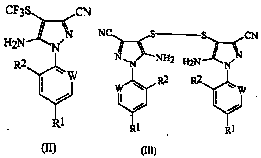 wherein W represents-CR3;R1Represents halogen, haloalkyl or haloalkoxy; r2Represents a hydrogen atom or a halogen; r3Represents halogen; the process comprises adding sulfur dioxide to a mixture comprising a disulfide of formula (III), a formate salt, trifluoromethyl bromide and a polar solvent at 35-55 ℃.
Description
The application is that international application no is PCT/EP 99/08687, and domestic application number are dividing an application of 99806082.8 patent application.
Technical field
The present invention relates to prepare used intermediates preparation in 1-Arylpyrozole insecticides and the preparation thereof; described sterilant such as 5-amino-1-(2; 6-dichlor-4-trifluoromethyl phenyl)-3-cyano group-4-trifluoromethyl sulfinyl pyrazoles; commodity are called Fipronil (Pesticide Manual; the 11st edition); its intermediate is 5-amino-1-(2; 6-dichlor-4-trifluoromethyl phenyl)-3-cyano group-4-trifluoromethylthio pyrazoles and 5-amino-1-(2,6-dichlor-4-trifluoromethyl phenyl)-3-cyano pyrazole-4-based bisulfide.
Background technology
European patent communique No.295117 has described with 3-chlorine peroxybenzoic acid oxidation 5-amino-1-(2; 6-dichlor-4-trifluoromethyl phenyl)-3-cyano group-4-trifluoromethylthio pyrazoles prepares the method for 5-amino-1-(2,6-dichlor-4-trifluoromethyl phenyl)-3-cyano group-4-trifluoromethyl sulfinyl pyrazoles.It is known using trifluoroacetic acid with hydrogen peroxide (forming trifluoroperacetic acid in position) sulfide oxidation to be become sulfoxide and/or sulfone, is usually used in the oxidation of (as trifluoromethyl sulfide, it is difficult for oxidation than other sulfide) of electron deficiency sulfide.These methods have report in the literature, as in the preparation of some 1-Arylpyrozole insecticides.
At 5-amino-1-(2; 6-dichlor-4-trifluoromethyl phenyl)-3-cyano group-4-trifluoromethylthio pyrazoles oxidation prepares 5-amino-1-(2; 6-dichlor-4-trifluoromethyl phenyl)-problem that run on 3-cyano group-4-trifluoromethyl sulfinyl pyrazoles is to form corresponding sulphones 5-amino-1-(2 simultaneously; 6-dichlor-4-trifluoromethyl phenyl)-and 3-cyano group-4-trifluoromethyl sulfonyl pyrazoles, it is difficult to remove from sulfoxide.In the effort that obtains effective and regioselectivity oxidation; used multiple oxygenant (comprising vanadic acid sodium, sodium wolframate, peracetic acid, peroxyformic acid and mistake trichoroacetic acid(TCA)); this regioselectivity oxidation can provide pure 5-amino-1-(2; 6-dichlor-4-trifluoromethyl phenyl)-3-cyano group-4-trifluoromethyl sulfinyl pyrazoles, and can be used for mass preparation.All aforesaid methods are found in one aspect or the another one aspect is unsafty.
Have found that the mixture of trifluoroacetic acid and hydrogen peroxide (trifluoroperacetic acid) all has fabulous effect on selectivity and yield.
Yet, use the mixture of trifluoroacetic acid and hydrogen peroxide that a problem is arranged when scale operation, promptly cause the corrosion of the glass liner of industrial reactor, its speed is fast, even at room temperature also reach 300 μ m/, and in the time of 80 ℃, corrosion speed increases to 1430 μ m/.It is to form hydrofluoric result that this corrosive occurs, and has therefore hindered the use of this reagent mixture in this container.
Have now found that, add anticorrosive agent (as boric acid) in the reaction mixture and can suppress corrosion process, reduce corrosion speed to the level that typically is lower than 5 μ m/.
The article J.Chem.Soc.Perkin I of European patent publication No.0374061 and J-L.Clavel etc., (1992), 3371-3375 has described 5-amino-1-(2,6-dichlor-4-trifluoromethyl phenyl)-preparation of 3-cyano pyrazole-4-based bisulfide, and (be typically 1.3 * 10 in low pressure at 60 ℃
6Pa (13 crust)) is being dissolved in N in the autoclave, the sodium formiate of dinethylformamide and sulfurous gas exist down this disulphide and trifluoromethyl bromine reaction further are converted into insecticidal activity 5-amino-1-(2,6-dichlor-4-trifluoromethyl phenyl)-3-cyano group-4-trifluoromethylthio pyrazoles.
But it is a lot of that this is reflected on the bigger scale heat release, cause pressure in the container to heighten and the operator that follows injured.
In addition, must add trifluoromethyl bromine (generally in 0.5 hour) soon, because find disulphide, sodium formiate, sulfurous gas and N, the mixture instability of dinethylformamide (50 ℃ time in 2 hours 55% be degraded to undesirable by product).Exothermicity for this requirement of quick adding trifluoromethyl bromine and reaction is incompatible.
In order to overcome the method that these problems and exploitation can be used on a large scale, in the condition of seeking other.
In aforesaid method,, the trifluoromethyl bromine reacts by being added in other composition.Now developed a kind of new method, wherein the addition sequence difference.
European patent publication No.0374061 has described by 5-amino-1-(2,6-dichlor-4-trifluoromethyl phenyl)-the prepared in reaction 5-amino-1-(2 of 3-cyano group-4-thiocyanato pyrazoles and alkali, 6-dichlor-4-trifluoromethyl phenyl)-3-cyano pyrazole-4-based bisulfide, and this disulphide further is converted into 5-amino-1-(2,6-dichlor-4-trifluoromethyl the phenyl)-3-cyano group-4-trifluoromethylthio pyrazoles of insecticidal activity.
European patent publication No.295117 has described with the corresponding 4-thiocyanato of hydrochloride ethanol liquid hydrolysis pyrazole derivatives, or reduce with sodium borohydride ethanol liquid, or in the presence of chloroform and benzyltriethylammonium chloride, under condition of phase transition, handle with aqueous sodium hydroxide solution, prepare 1-aryl-3, the method for 5-disubstituted pyrazole-4-based bisulfide.
The preparation of above-mentioned 5-amino-1-aryl-3-cyano group-4-thiocyanato pyrazoles intermediate also has description in European patent No.0374061 and 295117, they obtain corresponding 5-amino-1-aryl-3-cyano pyrazole thiocyanation with basic metal or ammonium thiocyanate in the presence of bromine and methyl alcohol at low temperatures.
Some problems appear in above-mentioned two one step process that prepare 5-amino-1-aryl-3-cyano pyrazole-4-based bisulfide intermediate from 5-amino-1-aryl-3-cyano pyrazole, limit the availability of its large-scale application:
I) the thiocyanation reactions steps is generally carried out under very low temperature,
The bromine and the methanol mixture that ii) are used for the thiocyanation reaction can form explosive mixture,
Iii) above-mentioned reaction relates to multiphase mixture,
Iv) the equal difficulty of each stage in reaction is converted into product fully.
In order to overcome these problems, existing other condition of just seeking.Mixture replacing methyl alcohol with methylene dichloride and water can be avoided explosive injury in the thiocyanation reaction, still, it is insufficient that this method is renderd a service in scale operation.
Perhaps, in the presence of hydrogen peroxide and ore deposit acid (example hydrochloric acid), in kind solvent, can successfully carry out the thiocyanation reaction with thiocyanic acid basic metal or ammonium thiocyanate such as alcohol (as methyl alcohol).Have found that to the improving one's methods of the hydrolysing step followed relate to and use alkali such as alkali metal hydroxide (as sodium hydroxide) in the presence of formaldehyde and solvent (as methanol aqueous solution), still, the disulphide that obtains like this is powdery too, is difficult to filter.And, in order to obtain the satisfied above-mentioned disulphide of quality, must make the repurity before being used for thiocyanation reaction and hydrolysis reaction of initial substance 5-amino-1-aryl-3-cyano pyrazole.
Therefore, can recognize that above-mentioned two step method is inefficient for industrial production, the single stage method of obviously not having these shortcomings may be preferable.
Summary of the invention
The present invention seeks to provide improved or more economical method for the sterilant preparation.
First purpose of the present invention provides the method easily of preparation 5-amino-1-aryl-3-cyano group-4-trifluoromethyl sulfinyl pyrazoles sterilant, obtains sterilant with high yield and high purity.
Another object of the present invention provides the method easily of preparation 5-amino-1-aryl-3-cyano group-4-trifluoromethyl sulfinyl pyrazoles sterilant, and the enforcement of this method is simple, safety, and the container corrosion is minimum.
Another object of the present invention provides the effective recovery method of preparation 5-amino-1-aryl-3-cyano group-4-trifluoromethyl sulfinyl pyrazoles sterilant, and this method comprises the efficient recovery process of trifluoroacetic acid.
Another object of the present invention provides the method easily of preparation 5-amino-1-aryl-3-cyano group-4-trifluoromethylthio pyrazoles sterilant and pesticide intermediate, they obtain with high yield and high purity, and the conversion of 5-amino-1-aryl-3-cyano pyrazole-4-based bisulfide improves.
Another object of the present invention provides the method easily of preparation 5-amino-1-aryl-3-cyano group-4-trifluoromethylthio pyrazoles sterilant and pesticide intermediate, the enforcement of this method is simple, safety, operate under low pressure and low temperature, side reaction is reduced to a minimum.
Another object of the present invention provides the facilitated method of preparation 5-amino-1-aryl-3-cyano pyrazole-4-based bisulfide pesticide intermediate, and they obtain with high yield and high purity.
Another object of the present invention provides from the one step process of 5-amino-1-aryl-3-cyano pyrazole intermediate preparation 5-amino-1-aryl-3-cyano pyrazole-4-based bisulfide pesticide intermediate.
Another object of the present invention provides the method for preparing 5-amino-1-aryl-3-cyano pyrazole-4-based bisulfide pesticide intermediate, the enforcement of this method is simple, safety, utilize the material that obtains easily, product is effectively separated, need not other purifying 5-amino-1-aryl-3-cyano pyrazole initial substance.
Another object of the present invention provides the method that makes things convenient for that begins to prepare 5-amino-1-aryl-3-cyano group-4-trifluoromethyl sulfinyl pyrazoles sterilant with three-step approach from 5-amino-1-aryl-3-cyano pyrazole.
These and other objects of the present invention from the following description can be more than you know, and reach by the present invention is all or part of.
According to feature of the present invention, provide the improved method (A) of preparation formula (I) compound:
Wherein W represent nitrogen-atoms or-CR
3
R
1Represent halogen, haloalkyl (being preferably trifluoromethyl), halogenated alkoxy (being preferably trifluoromethoxy), R
4S (O)
n-or-SF
5
R
2Represent hydrogen atom or halogen (as chlorine or bromine);
R
3Represent halogen (as chlorine or bromine);
R
4Represent alkyl or haloalkyl;
N represents 0,1 or 2;
Described method is included in and suppresses the existence of corrosive compound down with trifluoroperacetic acid oxidation-type (II) compound:
Wherein, R
1, R
2Define as above with W.
In a preferred embodiment of the invention, by trifluoroacetic acid and hydroperoxidation generation trifluoroperacetic acid on the throne.Therefore, this embodiment comprises usefulness trifluoroacetic acid and hydrogen peroxide treatment formula (II) compound as defined above.
Unless refer in addition in the specification sheets, " alkyl " expression has the straight or branched alkyl of 1-6 carbon atom (being preferably 1-3).Unless refer in addition, " haloalkyl " and " halogenated alkoxy " is respectively straight or branched alkyl and the alkoxyl group with 1-6 carbon atom (being preferably 1-3) that one or more halogen atoms that are selected from fluorine, chlorine and bromine replace.
Work as R
1Represent R
4S (O)
n-, n is 0 or 1 o'clock, this method can cause that being oxidized to n is respectively 1 or 2 respective compound.
Suppress the corrosive compound and be generally boric acid or alkali metal borate, as Sodium Tetraborate; Or the hydrogen fluoride trapping agent, as silica (silicon-dioxide), randomly be silica oil.Preferable inhibition corrosion compound is a boric acid.
The consumption that suppresses the corrosion compound is generally the 0.08-0.22 molar equivalent, the preferable 0.08-0.1 equivalent that is about.
The consumption of trifluoroacetic acid is generally the 14-15 molar equivalent.
The amount influence reaction of hydrogen peroxide because excessive meeting causes the formation of the corresponding sulfone of formula (I) compound, lacks and then can cause incomplete conversion, and both of these case all obtains impure end product.Like this, the amount of used hydrogen peroxide (being generally 35% aqueous solution) is generally the 1.3-1.5 equivalent in the reaction, is preferably about 1.31-1.35 equivalent, is more preferred from about 1.33 equivalents.
Reaction generally 10-15 ℃, preferablely carry out in about 12 ℃ temperature.
Use trifluoroacetic acid and hydrogen peroxide with another problem relate to the recovery and the recirculation of expensive trifluoroacetic acid, this is necessary in the operation of economical and effective method.It is with sulfurous gas cancellation reaction mixture that a method is arranged in the effort that addresses this problem, and boils off the part trifluoroacetic acid.Add excess ethyl alcohol then and form Trifluoroacetic Acid Ethyl Ester in residue, redistillation is removed.Then product crystallization from ethanol/water mixture is separated out.This method has been found two shortcomings:
(1) ethanol/water mixture can not provide enough pure 5-amino-1-(2,6-dichlor-4-trifluoromethyl phenyl)-3-cyano group-4-trifluoromethyl sulfinyl pyrazoles;
(2) be a complicated process through the Trifluoroacetic Acid Ethyl Ester acidolysis in scale operation with trifluoroacetic acid recirculation, produce a large amount of undesirable sodium sulfate, thereby produce the waste problem.
Have now found that a kind of new method; can solve this two problems; be high yield, prepared in high purity 5-amino-1-(2; 6-dichlor-4-trifluoromethyl phenyl)-3-cyano group-4-trifluoromethyl sulfinyl pyrazoles a simple and efficient method is provided, the method that reclaims trifluoroacetic acid effectively also is provided.In this method, after judging reacting completely in trifluoroacetic acid and hydrogen peroxide, use sulfurous gas (or reagent of equal value) usually with the excess hydrogen peroxide cancellation, add chlorobenzene, boil off trifluoroacetic acid.Be typically under reduced pressure and remove trifluoroacetic acid by component distillation.In residue, add a kind of alcohol then; as methyl alcohol, ethanol or Virahol (being preferably ethanol), be warming up to about 80 ℃ until forming solution, be cooled to about 40 ℃ then; at this moment 5-amino-1-(2,6-dichlor-4-trifluoromethyl phenyl)-3-cyano group-4-trifluoromethyl sulfinyl pyrazoles crystallization is separated out.40 ℃ of pressure reducing and steaming alcohol.Mixture is cooled to about 0 ℃, filters washed product, vacuum-drying.Found that chlorobenzene is the unique industrial solvent suitable with mixture, its boiling point makes 5-amino-1-(2,6-dichlor-4-trifluoromethyl phenyl)-3 cyano group-4-trifluoromethyl sulfinyl pyrazoles high yield, high-quality ground crystallization apparently higher than the boiling point of trifluoroacetic acid.
As mentioned above, the preferred aspect of the inventive method also is included in oxidizing reaction and chlorobenzene is added in the reaction mixture when finishing, and trifluoroacetic acid is reclaimed in distillation.
According to further feature of the present invention, provide the improved method (B) of preparation above-mentioned formula (II) compound; This method comprises sulfurous gas is added in the mixture that contains formula (III) disulphide, formate, trifluoromethyl bromine and polar solvent:
Wherein, R
1, R
2With W as previously mentioned.Polar solvent is selected from N usually, and dinethylformamide, N,N-dimethylacetamide, N-Methyl pyrrolidone, methyl-sulphoxide, tetramethylene sulfone, hexamethylphosphoramide, and ether are as two
Alkane, tetrahydrofuran (THF) and glycol dimethyl ether.That preferable is N, dinethylformamide, N,N-dimethylacetamide, N-Methyl pyrrolidone, methyl-sulphoxide or tetramethylene sulfone, and that better is N, dinethylformamide.
The advantage of carrying out the method that adds by this order is followed successively by:
Therefore (1) stabilized with mixture of formula (III) disulphide, sodium formiate, trifluoromethyl bromine and polar solvent (being preferably N, dinethylformamide) can add sulfurous gas more slowly and not have the danger of degraded, thereby more convenient and safe method is provided;
(2) novel method is efficiently, it is characterized in that efficiency of pcr product is good, disulphide transformation efficiency height; With
Therefore (3) the add-on may command of sulfurous gas so that the increase of temperature of reaction and/or pressure can maintain on the safe level, can be reacted on a large scale safely and (comprises and for example typically have about 15m
3The commercial reactors of volume).
Formate is alkali metal salts or ammonium salt normally, is preferably sodium formiate.
Temperature of reaction when adding sulfurous gas generally is about 35-55 ℃, preferablely is about 35-50 ℃, goodly is about 43-47 ℃, can control the heat that thermopositive reaction produces so effectively.Below 35 ℃, reaction trends towards too slow, can not be used as industrial production.When surpassing 55 ℃ of temperature, the yield of product and quality reduce.
The speed that adds sulfurous gas is generally with temperature maintenance degree of being in above-mentioned scope.During scale operation, carried out usually 0.5-2 hour, be preferably about 1-1.5 hour.Proved already, for by product being formed reach bottom line, the joining day for about 1-1.5 hour for the suitableeest.
The mol ratio of disulphide is preferably 3: 1 to 5: 1 shown in trifluoromethyl bromine and the formula (III).Be advisable to adopt about 3: 1 mol ratio.
The amount of used sulfurous gas is equivalent to the 1.2-1.5 molar equivalent of disulphide shown in the formula (III) usually, is preferably about 1.3 molar equivalents.During only with 1 equivalent, the yield of product is low, and the conversion of disulphide is incomplete, and the degraded of the sulfurous gas of surplus when causing solvent evaporation in the post-processing step.
The amount of used formate is equivalent to the 4-6 molar equivalent of disulphide shown in the formula (III) usually, is preferably about 4.5-5.5 molar equivalent.The amount of sulfurous gas and formate can reduce simultaneously, and until sulfurous gas: the ratio of disulphide is about 1.2: 1, formate: the ratio of disulphide is about 4.5: 1.
Use above-described method, the pressure in the container is easy to maintain 3 * 10 usually
5-6 * 10
5In the safety range of Pa (3-6 crust).
According to another feature of the present invention, provide the method (C) of disulphide shown in the above-mentioned formula of preparation (III); This method comprises sulfur monochloride (S
2Cl
2) be added in the solution of formula (IV) compound in organic solvent:
R wherein
1, R
2With W as previously mentioned.
Be reflected to be selected from the following solvent and be advisable: toluene, methylene dichloride or ethylene dichloride, or aliphatic series or aromatics nitrile, as acetonitrile, propionitrile, methyl cellosolve acetate glutaronitrile and benzonitrile; Or in their mixture, carry out, can randomly be and the mixture of chlorobenzene the chlorobenzene solution of formula (IV) compound that obtains when the reactions steps of using the front (time).Randomly the acetonitrile in the presence of chlorobenzene is the preferred solvents of reaction.The reaction pair solvent effect is very responsive, and with toluene possibility most convenient, because the toluene solution of formula (IV) can derive from the reactions steps of front, when these conditions of employing, forms the very important by product monosulphide (V) of its amount usually:

In addition, product filters very slowly when the toluene, may obtain acceptable filtration velocity although add a certain proportion of acetonitrile in toluene solution.Be reflected at when carrying out in the preferable solvent acetonitrile, the amount of monosulphide impurity (V) reduces, and the filtration velocity of product (III) is satisfactory.
Used sulfur monochloride purity is generally 99.4-99.9% (w/w) in this method.
The quality of solvent for use can influence reaction, because the existence of some impurity can influence the yield (forming by product (V) simultaneously) of product.Therefore, when using acetonitrile as solvent, that preferable is the content<1000ppm of water, alcoholic acid content<1500ppm, the content<100ppm of ammonia.Preferable also have, even in solvent mixture, avoid the acetone or the N of low amount, the existence of dinethylformamide because for example in the methylene dichloride existence of about 100ppm acetone the yield of product is also had negative influence.
The addition sequence of reagent is the key character of reaction.It is important sulfur monochloride is added to (rather than opposite) in the solution of formula (IV) compound.Adding sulfur monochloride fast is a preferable feature of present method.Therefore, if sulfur monochloride added in 1 minute, adding about 15 seconds of back disulphide (III) is that (all formula (IV) compounds all consume) separated out in crystallization.If added through 15 minutes, disulphide (III) crystallization in adition process is separated out, as a result disulphide (III) and remaining formula (IV) compound cocrystallization.The impure product that obtains like this with excessive acetonitrile washing can not reach the purpose of removing unreacted formula (IV) compound.The adding of sulfur monochloride is preferably 1-10 minute, is more preferred from about 1-5 minute.The temperature of reaction of mixture was preferably 5-25 ℃ when the adding sulfur monochloride began, and was more preferred from about 10-20 ℃.If begin to add fashionable temperature, output is reduced owing to forming trisulphide and tetrasulfide by product at 30 ℃.Because reaction is heat release, therefore temperature increases in reaction, is preferably and is maintained at about 20-35 ℃.
Used formula (IV) compound and the mol ratio of sulfur monochloride are 2: 1 to 2: 1.06 in the reaction, are preferably about 2: 1 to 2: 1.04.Cause by product monosulphide (V) formation amount to increase with excessive sulfur monochloride.If with lower sulfur monochloride ratio, reaction can not be carried out fully.
Another feature of the inventive method is the used method of product purification.The reaction mixture degassing earlier that contains curing shown in the formula (III) removes de-chlorine hydride, generally heating about 40 ℃ under reduced pressure, and normally under about 0.2 normal atmosphere, about 1 hour of under atmospheric pressure about then 80 ℃ of heating.After being cooled to 30 ℃, add weak base (generally using ammonia) the remaining hydrogenchloride that neutralizes, reach the about 6.5-7 of pH.Then mixture is cooled to about 5 ℃, the filtering separation product.This method makes by the easy steps that is suitable for large-scale operation that disulphide can obtain with high yield, high purity shown in the formula (I).
In formula (I), (II), (III) with (IV), the preferred values of symbol is as follows:
R
1Represent haloalkyl (being preferably trifluoromethyl), halogenated alkoxy (being preferably trifluoromethoxy) or-SF
5
W representative-CR
3
R
2And R
3Represent halogen (being preferably chlorine).
Good especially formula (I) compound is 5-amino-1-(2,6-dichlor-4-trifluoromethyl phenyl)-3-cyano group-4-trifluoromethyl sulfinyl pyrazoles.
Good especially formula (II) compound is 5-amino-1-(2,6-dichlor-4-trifluoromethyl phenyl)-3-cyano group-4-trifluoromethylthio pyrazoles.
Good especially formula (III) compound is 5-amino-1-(2,6-dichlor-4-trifluoromethyl phenyl)-3-cyano pyrazole-4-based bisulfide.
Formula (II), formula (III) and formula (IV) compound are known.
According to another feature of the present invention, method (A), (B) and (C) can merge are from formula (IV) compound formula (I) compound.
Aforesaid method (A), (B) and (C) when combining form the useful and effective ways of preparation Fipronil.
Following non-limiting example is used to set forth the present invention.
Embodiment
Embodiment 1
The preparation of 5-amino-1-(2,6-dichlor-4-trifluoromethyl phenyl)-3-cyano group-4-trifluoromethyl sulfinyl pyrazoles
In glass reactor, with 5-amino-1-(2,6-dichlor-4-trifluoromethyl phenyl)-3-cyano group-4-trifluoromethylthio pyrazoles (436g, 1.03mol) and boric acid (5g, solution 0.08mol) be in 12 ℃ of stirrings, add trifluoroacetic acid (1660g, 14.5mol).(1.35mol), simultaneous temperature is maintained at 12 ℃, and compound was maintained at this temperature 4-5 hour again for 131.5g, 35%w/w to add hydrogen peroxide through 2 hours.When conversion reaches 97-98%; or undesirable 5-amino-1-(2; 6-dichlor-4-trifluoromethyl phenyl)-when 3-cyano group-4-trifluoromethyl sulfonyl pyrazoles reaches 2% (analyzing judgement with HPLC); add the remaining hydrogen peroxide of sulfurous gas cancellation, mixture was kept 0.5 hour in 10-18 ℃.Add chlorobenzene (370g), (0.17-0.04 normal atmosphere) was heated to 47-50 ℃ under mixture placed and reduces pressure, and carried out component distillation.Obtain containing the even fraction that reclaims trifluoroacetic acid.In distillation, continue to add chlorobenzene (1625g), to keep constant volume.When component distillation finishes, under reduced pressure reactor content is maintained at 47-50 ℃ (0.04 normal atmosphere), the even fraction of distillation chlorobenzene.After removing vacuum, reactor is heated to 40 ℃, adds ethanol (207g) and chlorobenzene (235g), mixture is heated with stirring to 80 ℃, get a solution.Be cooled to 40 ℃, the product crystallization is separated out.Reactor is placed decompression gradually (from the 0.13-0.03 normal atmosphere) down, boil off ethanol in 40 ℃.Remove vacuum, mixture is cooled to 5 ℃, again through 0.5 hour through 3.5 hours.Leach product, with the washing of cold chlorobenzene, then with cold aqueous ethanol, wash with water, 135 ℃ of vacuum-dryings obtain title compound (407.5g) again, and representative yield is 89%, and purity is 95.5%.
Embodiment 2
The preparation of 5-amino-1-(2,6-dichlor-4-trifluoromethyl phenyl)-3-cyano group-4-trifluoromethylthio pyrazoles
With sodium formiate (76g, 1.11mol) be added to 5-amino-1-(2,6-dichlor-4-trifluoromethyl phenyl)-3-cyano pyrazole-4-based bisulfide in the glass reactor (157.5g, 0.223mol) and N, in the mixture of dinethylformamide (643g).With 2 * 10
5Behind Pa (2 crust) nitrogen purging, with the reactor sealing, adding trifluoromethyl bromine (101g, 0.682mol).Reactor is heated to 45 ℃, and (19.5g, 0.304mol), temperature maintenance was kept 0.75 hour between 43 ℃-47 ℃ again in the reaction process to add sulfurous gas through 1.5 hours.Relief pressure carries out the degassing in 1.5 hours, and 1 hour reactor cooling is to 25-30 ℃ after the pressure release.When initial pressure reaches normal atmosphere, evaporate N with sodium bicarbonate treating mixture and part, dinethylformamide is heated to 50-70 ℃ at that time under decompression.Residue is cooled to 40 ℃, under 20-25 ℃ of stirring, slowly is added in the water.Product is filtered, washing (hot water), 100 ℃ of vacuum-dryings reach title compound (182.3g), and representative yield is 95%, and purity is 96.6%.
Embodiment 3
The preparation of 5-amino-1-(2,6-dichlor-4-trifluoromethyl phenyl)-3-cyano pyrazole-4-based bisulfide
Acetonitrile (837g) is added to contains that 5-amino-1-(2,6-dichlor-4-trifluoromethyl phenyl)-(366.6g is in chlorobenzene solution 1.14mol) (627.8g) for the 3-cyano pyrazole.Mixture is heated to 50-64 ℃ under decompression (0.5 normal atmosphere), boils off about 45ml acetonitrile and reach dry.After being cooled to 18 ℃, and the quick adding sulfur monochloride through 1 minute (77g, 0.57mol).The temperature of mixture is increased to 35 ℃, is maintained at 35 ℃ by cooling, stops until heat release, keeps 0.3 hour again.Then mixture is outgased (removing de-chlorine hydride) in the following 40 ℃ of heating of decompression, again in the following 80 ℃ of heating of normal atmosphere 1 hour.After being cooled to 30 ℃, add ammonia, make pH reach 6.5-7, be cooled to 5 ℃, leach product, with chlorobenzene/acetonitrile washing, 95 ℃ of vacuum-dryings obtain title compound (365.2g), and representative yield is 89.4%, and purity is 98.4%.
Claims (5)
1.5-the preparation method (B) of amino-1-(2,6-dichlor-4-trifluoromethyl phenyl)-3-cyano group-4-trifluoromethylthio pyrazoles,
This method is included under 43-47 ℃ sulfurous gas is added in the mixture that contains formula (III) disulphide, formate, trifluoromethyl bromine and polar solvent:
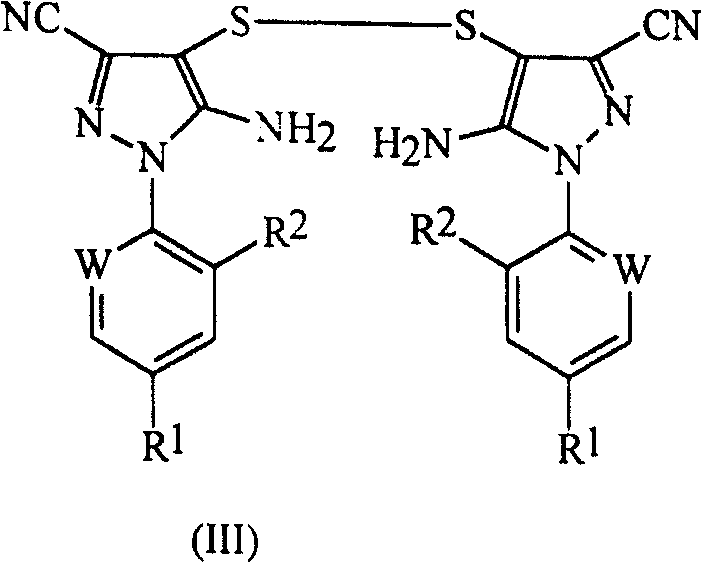
Wherein, R
1Be CF
3, R
2Be Cl, W is C-Cl, and the mol ratio shown in used sulfurous gas and the formula (III) between the disulphide is 1.2-1.5.
2. the method for claim 1, wherein said solvent is N, dinethylformamide.
3. method as claimed in claim 1 or 2, wherein the joining day of sulfurous gas is 0.5-2 hour.
4. method as claimed in claim 1 or 2, wherein the mol ratio of trifluoromethyl bromine and formula (III) disulphide is 3: 1 to 5: 1.
5. method as claimed in claim 1 or 2, the mol ratio between wherein used formate and formula (III) disulphide is 4-6.
Priority Applications (1)
| Application Number | Priority Date | Filing Date | Title |
|---|---|---|---|
| CN2004101300014A CN1896066B (en) | 1999-10-22 | 1999-10-22 | Process for preparing pesticides |
Applications Claiming Priority (2)
| Application Number | Priority Date | Filing Date | Title |
|---|---|---|---|
| CN2004101300014A CN1896066B (en) | 1999-10-22 | 1999-10-22 | Process for preparing pesticides |
| PCT/EP1999/008687 WO2001030760A1 (en) | 1999-10-22 | 1999-10-22 | Process for preparing 4-trifluoromethylsulphinylpyrazole derivative |
Related Parent Applications (1)
| Application Number | Title | Priority Date | Filing Date |
|---|---|---|---|
| CNB998060828A Division CN1163488C (en) | 1999-10-22 | 1999-10-22 | Novel process for preparing pesticides |
Publications (2)
| Publication Number | Publication Date |
|---|---|
| CN1896066A CN1896066A (en) | 2007-01-17 |
| CN1896066B true CN1896066B (en) | 2011-06-15 |
Family
ID=8167491
Family Applications (3)
| Application Number | Title | Priority Date | Filing Date |
|---|---|---|---|
| CNB998060828A Expired - Lifetime CN1163488C (en) | 1999-10-22 | 1999-10-22 | Novel process for preparing pesticides |
| CN2008101863366A Expired - Lifetime CN101445483B (en) | 1999-10-22 | 1999-10-22 | Process for preparing pesticides |
| CN2004101300014A Expired - Lifetime CN1896066B (en) | 1999-10-22 | 1999-10-22 | Process for preparing pesticides |
Family Applications Before (2)
| Application Number | Title | Priority Date | Filing Date |
|---|---|---|---|
| CNB998060828A Expired - Lifetime CN1163488C (en) | 1999-10-22 | 1999-10-22 | Novel process for preparing pesticides |
| CN2008101863366A Expired - Lifetime CN101445483B (en) | 1999-10-22 | 1999-10-22 | Process for preparing pesticides |
Country Status (30)
| Country | Link |
|---|---|
| US (2) | US6620943B1 (en) |
| EP (1) | EP1222173B1 (en) |
| JP (1) | JP4666863B2 (en) |
| KR (2) | KR100665598B1 (en) |
| CN (3) | CN1163488C (en) |
| AT (1) | ATE273961T1 (en) |
| AU (1) | AU783139B2 (en) |
| BG (1) | BG65483B1 (en) |
| BR (1) | BR9917518B1 (en) |
| CA (1) | CA2384283C (en) |
| CZ (1) | CZ299822B6 (en) |
| DE (1) | DE69919599T2 (en) |
| DK (1) | DK1222173T3 (en) |
| EA (1) | EA005077B1 (en) |
| ES (1) | ES2222743T3 (en) |
| HR (1) | HRP20020438B1 (en) |
| HU (1) | HU229393B1 (en) |
| IL (2) | IL149152A0 (en) |
| IN (2) | IN2005MU00818A (en) |
| ME (1) | MEP7808A (en) |
| MX (1) | MX229662B (en) |
| NZ (2) | NZ527896A (en) |
| PL (1) | PL206482B1 (en) |
| PT (1) | PT1222173E (en) |
| RO (1) | RO121209B1 (en) |
| TR (2) | TR200202806T2 (en) |
| TW (1) | TW553936B (en) |
| UA (1) | UA73752C2 (en) |
| WO (1) | WO2001030760A1 (en) |
| ZA (1) | ZA200201961B (en) |
Families Citing this family (35)
| Publication number | Priority date | Publication date | Assignee | Title |
|---|---|---|---|---|
| EP1197492B1 (en) | 1999-06-29 | 2007-09-05 | Nihon Nohyaku Co., Ltd. | Pyrazole derivatives and process for producing the same, and pesticides containing the same as the active ingredient |
| WO2005023774A1 (en) * | 2003-09-11 | 2005-03-17 | Cheminova A/S | Process for the preparation of a trifluoromethylthioether |
| CN100586934C (en) * | 2003-11-07 | 2010-02-03 | 凯米诺瓦有限公司 | Process for preparing trifluoromethyl thioethers |
| DE102004020069C5 (en) | 2004-04-24 | 2013-12-05 | Voith Patent Gmbh | Method for satinizing a paper web |
| CA2630849C (en) | 2005-12-14 | 2013-05-14 | Makhteshim Chemical Works Ltd. | Polymorphs and amorphous forms of 5-amino-1-[2,6-dichloro-4-(trifluoromethyl)phenyl]-4-[(trifluoromethyl)sulfinyl]-1h-pyrazole-3-carbonitrile |
| AU2013203228B2 (en) * | 2005-12-14 | 2015-08-27 | Makhteshim Chemical Works Ltd | Polymorphs and amorphous forms of 5-amino-1-[2,6- dichloro-4-(trifluoromethyl)phenyl]-4- [(trifluoromethyl)sulfinyl]-1H-pyrazole-3-carbonitrile |
| BRPI0621611B1 (en) | 2006-04-25 | 2015-08-18 | Gharda Chemicals Ltd | Process for the preparation of fipronil, insecticide and related pyrazoles |
| CN101168529B (en) * | 2006-10-24 | 2011-03-23 | 温州大学 | Fipronil, ethiprole and synthesizing method for derivative thereof |
| US8063092B2 (en) * | 2006-11-10 | 2011-11-22 | Basf Se | Crystalline modification of fipronil |
| PL2081908T3 (en) | 2006-11-10 | 2013-09-30 | Basf Agro B V Arnhem Nl Zuerich Branch | Process for the sulfinylation of a pyrazole derivative |
| UA110598C2 (en) | 2006-11-10 | 2016-01-25 | Басф Се | METHOD OF OBTAINING CRYSTAL MODIFICATION OF FIPRONIL |
| ES2368521T5 (en) * | 2006-11-10 | 2015-02-18 | Basf Se | Fipronil Crystal Modification |
| KR101540122B1 (en) * | 2006-11-10 | 2015-07-28 | 바스프 에스이 | Crystalline variants of fipronil |
| CA2667562A1 (en) | 2006-11-10 | 2008-05-15 | Basf Se | Process for the sulfinylation of a pyrazole derivative |
| BRPI0919577A2 (en) | 2008-10-02 | 2015-12-08 | Basf Se | processes for purifying and preparing trifluoromethanesulfinic acid and for preparing fipronyl. |
| WO2010049746A1 (en) * | 2008-10-27 | 2010-05-06 | Dynamit Nobel Gmbh Explosivstoff-Und Systemtechnic | Process for the synthesis of fipronil |
| AU2010311536A1 (en) | 2009-10-30 | 2012-05-31 | Basf Se | Process for the preparation of 4-sulfinyl-pyrazole derivatives |
| AU2010100462A4 (en) | 2010-03-03 | 2010-06-17 | Keki Hormusji Gharda | A process for the synthesis of Fipronil |
| IT1400666B1 (en) * | 2010-07-07 | 2013-06-28 | Finchimica Srl | PROCEDURE FOR THE SYNTHESIS OF 5-AMINO, 1-FENYL, 3-CYAN, 4-TRIFLUOROMETIL SULFINIL PIRAZOLI. |
| EP2593436A1 (en) | 2010-07-12 | 2013-05-22 | Irvita Plant Protection, A Branch of Celsius Property B.V. | Fipronil production process |
| AU2012100035A4 (en) * | 2011-01-14 | 2012-02-09 | Keki Hormusji Gharda | Polymorphism in 5-amino-1-(2,6-dichloro-4-trifluoromethylphenyl)-3-cyano-4-trifluoro methyl sulfinyl pyrazole |
| CN103547572B (en) | 2011-05-30 | 2016-03-30 | K·H·伽达 | A kind of technique of synthesizing fipronil |
| CN102633722B (en) * | 2012-03-20 | 2015-05-06 | 金坛市凌云动物保健品有限公司 | Fipronil preparation method |
| TWI579274B (en) | 2012-04-20 | 2017-04-21 | 龍馬躍公司 | Improved processes for the preparation of 1-aryl-5-alkyl pyrazole compounds |
| CN102690232A (en) * | 2012-05-30 | 2012-09-26 | 河南中医学院 | Synthesizing method for fipronil intermediates |
| US8993613B2 (en) | 2013-04-17 | 2015-03-31 | The Hartz Mountain Corporation | Ectoparasiticidal formulations |
| CN105254565A (en) * | 2015-09-30 | 2016-01-20 | 乐平市康鑫医药化工有限公司 | Technique for synthesizing thioether by means of cyanopyrazole one-pot method |
| CN106977460A (en) * | 2017-04-19 | 2017-07-25 | 江苏托球农化股份有限公司 | The synthesis of the amino-pyrazol of 14 second sulfydryl of (2,6 dichloro-4,4 trifluoromethyl) 3 cyano group of phenyl 5 |
| EP3412658A1 (en) | 2017-06-09 | 2018-12-12 | Solvay Sa | Processes for the manufacture of sulfur-substitued pyrazole derivatives |
| EP3412659A1 (en) | 2017-06-09 | 2018-12-12 | Solvay Sa | Processes for the manufacture of sulfur-substituted pyrazole derivatives |
| CN112430213A (en) * | 2020-12-03 | 2021-03-02 | 江苏优普生物化学科技股份有限公司 | Synthesis process of trifluoromethylthio pyrazole |
| CN113149909B (en) * | 2021-03-24 | 2022-04-19 | 台州达辰药业有限公司 | Preparation method of 5-amino-3-cyano-1- (2, 6-dichloro-4-trifluoromethyl-phenyl) pyrazole disulfide |
| CN113480482B (en) * | 2021-07-05 | 2022-11-18 | 海正药业南通有限公司 | Synthetic method of fipronil intermediate |
| CN114213330A (en) * | 2021-12-29 | 2022-03-22 | 天和药业股份有限公司 | Method for treating fipronil refining mother liquor |
| CN121293157A (en) * | 2025-12-11 | 2026-01-09 | 长青(湖北)生物科技有限公司 | Process for preparing fipronil and intermediate thereof |
Family Cites Families (6)
| Publication number | Priority date | Publication date | Assignee | Title |
|---|---|---|---|---|
| FR2716453B1 (en) | 1994-02-22 | 1996-03-29 | Rhone Poulenc Agrochimie | Sulfinylation process of heterocyclic compounds. |
| DE3602728A1 (en) * | 1985-05-17 | 1986-11-20 | Bayer Ag, 51373 Leverkusen | PEST CONTROL AGAINST PYRAZOLE DERIVATIVES |
| GB8713768D0 (en) * | 1987-06-12 | 1987-07-15 | May & Baker Ltd | Compositions of matter |
| US5547974A (en) * | 1985-12-20 | 1996-08-20 | Rhone-Poulenc Agriculture Ltd. | Derivatives of N-phenylpyrazoles |
| US5232940A (en) | 1985-12-20 | 1993-08-03 | Hatton Leslie R | Derivatives of N-phenylpyrazoles |
| CA2004776C (en) * | 1988-12-13 | 2000-04-25 | Claude Wakselman | Process for the preparation of perfluoroalkylthioethers |
-
1999
- 1999-10-22 TR TR2002/02806T patent/TR200202806T2/en unknown
- 1999-10-22 RO ROA200200317A patent/RO121209B1/en unknown
- 1999-10-22 IN IN818MU2005 patent/IN2005MU00818A/en unknown
- 1999-10-22 AT AT99955978T patent/ATE273961T1/en active
- 1999-10-22 JP JP2001533114A patent/JP4666863B2/en not_active Expired - Fee Related
- 1999-10-22 KR KR1020027005011A patent/KR100665598B1/en not_active Expired - Fee Related
- 1999-10-22 CN CNB998060828A patent/CN1163488C/en not_active Expired - Lifetime
- 1999-10-22 ES ES99955978T patent/ES2222743T3/en not_active Expired - Lifetime
- 1999-10-22 ME MEP-78/08A patent/MEP7808A/en unknown
- 1999-10-22 HU HU0203206A patent/HU229393B1/en unknown
- 1999-10-22 CN CN2008101863366A patent/CN101445483B/en not_active Expired - Lifetime
- 1999-10-22 DK DK99955978T patent/DK1222173T3/en active
- 1999-10-22 CA CA002384283A patent/CA2384283C/en not_active Expired - Fee Related
- 1999-10-22 DE DE69919599T patent/DE69919599T2/en not_active Expired - Lifetime
- 1999-10-22 PT PT99955978T patent/PT1222173E/en unknown
- 1999-10-22 KR KR1020067017067A patent/KR100665599B1/en not_active Expired - Fee Related
- 1999-10-22 CZ CZ20021384A patent/CZ299822B6/en not_active IP Right Cessation
- 1999-10-22 UA UA2002054165A patent/UA73752C2/en unknown
- 1999-10-22 TR TR2002/01072T patent/TR200201072T2/en unknown
- 1999-10-22 MX MXPA02003944 patent/MX229662B/en active IP Right Grant
- 1999-10-22 BR BRPI9917518-5A patent/BR9917518B1/en not_active IP Right Cessation
- 1999-10-22 CN CN2004101300014A patent/CN1896066B/en not_active Expired - Lifetime
- 1999-10-22 EP EP99955978A patent/EP1222173B1/en not_active Expired - Lifetime
- 1999-10-22 WO PCT/EP1999/008687 patent/WO2001030760A1/en not_active Ceased
- 1999-10-22 EA EA200200481A patent/EA005077B1/en not_active IP Right Cessation
- 1999-10-22 NZ NZ527896A patent/NZ527896A/en not_active IP Right Cessation
- 1999-10-22 US US10/111,000 patent/US6620943B1/en not_active Expired - Lifetime
- 1999-10-22 PL PL354611A patent/PL206482B1/en not_active IP Right Cessation
- 1999-10-22 NZ NZ517770A patent/NZ517770A/en not_active IP Right Cessation
- 1999-10-22 IL IL14915299A patent/IL149152A0/en active IP Right Grant
- 1999-10-22 HR HR20020438A patent/HRP20020438B1/en not_active IP Right Cessation
- 1999-10-22 AU AU12707/00A patent/AU783139B2/en not_active Expired
-
2000
- 2000-10-11 TW TW089121214A patent/TW553936B/en not_active IP Right Cessation
-
2002
- 2002-03-08 ZA ZA200201961A patent/ZA200201961B/en unknown
- 2002-04-01 IN IN312MU2002 patent/IN2002MU00312A/en unknown
- 2002-04-15 IL IL149152A patent/IL149152A/en not_active IP Right Cessation
- 2002-04-17 BG BG106622A patent/BG65483B1/en unknown
-
2003
- 2003-07-03 US US10/611,979 patent/US6881848B2/en not_active Expired - Fee Related
Also Published As
Similar Documents
| Publication | Publication Date | Title |
|---|---|---|
| CN1896066B (en) | Process for preparing pesticides | |
| CN103588730A (en) | Synthetic method for preparing triazole fungicide type (III) compound | |
| KR20020000167A (en) | Process for the Preparation of Substituted Pyrimidines | |
| US5936096A (en) | Process to chloroketones using oxazolines | |
| CN107721834B (en) | Preparation method of 1- (4-chlorphenyl) -2-cyclopropyl-1-acetone | |
| BG65600B1 (en) | Method for preparing 4-trifluoromethylsulphinylpyrazole derivatives | |
| KR19990083379A (en) | Metal salt catalyzed process to oxazolines and subsequent formation of chloroketones | |
| BG109983A (en) | Method for preparing 4-trifluoromethylsulphinylpyrazole derivatives | |
| RS51050B (en) | PROCEDURE FOR THE PREPARATION OF 4-TRIFLUOROMETHYLSULPHINYL PIRAZOL DERIVATIVES | |
| RS20100109A (en) | Process for preparing 4-trifluoromethzlsulphinylpyrazole derivative | |
| RS20100110A (en) | Process for preparing 4- trifluoromethylsulphinylpyrazole derivative | |
| Cairo | Department of Chemistry, Faculty of Science, Ain Shams University, Cairo, AR Egypt. | |
| HK1079197A1 (en) | Synthesis of diaryl pyrazoles | |
| WO2013050873A1 (en) | Process for the preparation of lersivirine |
Legal Events
| Date | Code | Title | Description |
|---|---|---|---|
| C06 | Publication | ||
| PB01 | Publication | ||
| C10 | Entry into substantive examination | ||
| SE01 | Entry into force of request for substantive examination | ||
| C14 | Grant of patent or utility model | ||
| GR01 | Patent grant | ||
| C56 | Change in the name or address of the patentee |
Owner name: BAYER CO., LTD. Free format text: FORMER NAME: BAYER CROPSCIENCE S.A. |
|
| CP01 | Change in the name or title of a patent holder |
Address after: lyon Patentee after: Bayer LLC Address before: lyon Patentee before: Bayer Cropscience S. A. |
|
| CX01 | Expiry of patent term |
Granted publication date: 20110615 |
|
| CX01 | Expiry of patent term |