CN1839178A - Particulate inorganic solids treated with organophosphinic compounds - Google Patents
Particulate inorganic solids treated with organophosphinic compounds Download PDFInfo
- Publication number
- CN1839178A CN1839178A CNA2004800240851A CN200480024085A CN1839178A CN 1839178 A CN1839178 A CN 1839178A CN A2004800240851 A CNA2004800240851 A CN A2004800240851A CN 200480024085 A CN200480024085 A CN 200480024085A CN 1839178 A CN1839178 A CN 1839178A
- Authority
- CN
- China
- Prior art keywords
- inorganic solid
- treated
- solid particles
- organic
- inorganic
- Prior art date
- Legal status (The legal status is an assumption and is not a legal conclusion. Google has not performed a legal analysis and makes no representation as to the accuracy of the status listed.)
- Granted
Links
Classifications
-
- C—CHEMISTRY; METALLURGY
- C08—ORGANIC MACROMOLECULAR COMPOUNDS; THEIR PREPARATION OR CHEMICAL WORKING-UP; COMPOSITIONS BASED THEREON
- C08K—Use of inorganic or non-macromolecular organic substances as compounding ingredients
- C08K9/00—Use of pretreated ingredients
- C08K9/04—Ingredients treated with organic substances
Landscapes
- Chemical & Material Sciences (AREA)
- Health & Medical Sciences (AREA)
- Chemical Kinetics & Catalysis (AREA)
- Medicinal Chemistry (AREA)
- Polymers & Plastics (AREA)
- Organic Chemistry (AREA)
- Pigments, Carbon Blacks, Or Wood Stains (AREA)
- Compositions Of Macromolecular Compounds (AREA)
- Polymers With Sulfur, Phosphorus Or Metals In The Main Chain (AREA)
- Inorganic Compounds Of Heavy Metals (AREA)
- Silicates, Zeolites, And Molecular Sieves (AREA)
Abstract
Description
发明领域field of invention
本发明涉及无机固体颗粒,特别是用某些有机膦化合物例如有机膦酸及其盐处理的无机固体颗粒。This invention relates to inorganic solid particles, particularly inorganic solid particles treated with certain organic phosphine compounds such as organic phosphonic acids and salts thereof.
发明背景Background of the invention
将无机固体颗粒结合到聚合物材料中已进行了多年,这些年来,由于许多原因,一直在将无机固体颗粒加入聚合物材料中并将继续这样做。例如,它们可用作填充料。它们也可为聚合物材料提供更好的物理性能和化学性能,其中包括降低化学活性和提高热稳定性,特别是在挤塑聚合物膜应用中抗lacing。为了得到各种不同的好处,可用不同的方法处理无机固体颗粒,其中包括加入表面处理剂。The incorporation of inorganic solid particles into polymeric materials has been done for many years and has been and will continue to be incorporated into polymeric materials over the years for a number of reasons. For example, they can be used as fillers. They can also provide polymeric materials with better physical and chemical properties, including reduced chemical reactivity and improved thermal stability, especially resistance to lacing in extruded polymer film applications. Inorganic solid particles can be treated in various ways, including the addition of surface treating agents, in order to obtain various benefits.
常用于结合到聚合物材料的无机固体颗粒包括二氧化钛和高岭土。已知用于这些固体的表面处理剂包括硅烷、链烷醇胺、多元醇、有机磷酸、有机磺酸和磷酰基化的多烯。最佳的处理剂部分取决于在处理的固体中希望的特性,而部分取决于应用。常常希望得到一种稳定的、易制备的、低成本的和能在聚合物中高度分散的以及在其它添加剂例如立德粉存在下不反应的憎水固体颗粒。但是,由于包括成本和希望的性质在内的各种原因,尽管有许多已知的表面处理剂,没有一种已知的表面处理剂对所有的应用都是理想的。因此,总是需要开发新的更好的固体颗粒处理剂。Inorganic solid particles commonly used for bonding to polymeric materials include titanium dioxide and kaolin. Surface treating agents known for these solids include silanes, alkanolamines, polyols, organophosphoric acids, organosulfonic acids, and phosphorylated polyenes. The optimum treating agent depends partly on the desired properties in the solids being treated and partly on the application. It is often desirable to have hydrophobic solid particles which are stable, easy to prepare, low cost and highly dispersible in the polymer and which do not react in the presence of other additives such as lithopone. However, while there are many known surface treatments, no one known surface treatment is ideal for all applications for a variety of reasons including cost and desired properties. Therefore, there is always a need to develop new and better solid particle treating agents.
令人吃惊的是,已发现通过用有机膦化合物处理无机固体颗粒,可生产在聚合物材料中有良好分散性的组合物。本发明涉及这些经处理的无机固体颗粒、制备它们的方法以及它们的应用。Surprisingly, it has been found that by treating inorganic solid particles with an organic phosphine compound, compositions having good dispersibility in polymeric materials can be produced. The present invention relates to these treated inorganic solid particles, processes for their preparation and their use.
发明概述Summary of the invention
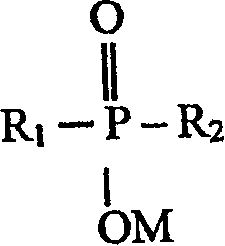
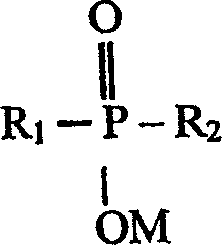
本发明提供在聚合物材料中用作颜料、填充剂、增量剂、紫外吸收剂等的经处理的无机固体颗粒,以及制备这些经处理的无机固体颗粒的方法。本发明的经处理的无机固体颗粒包含用一种或多种有机膦化合物处理的无机固体颗粒。任选的是,经处理的无机固体颗粒还包含金属氧化物。本发明经处理的无机固体颗粒可通过用有机膦酸化合物或有机膦化合物的盐处理无机固体颗粒来制成,所述的有机膦酸化合物或有机膦化合物的盐可用下式表示:The present invention provides treated inorganic solid particles for use as pigments, fillers, extenders, UV absorbers, etc. in polymeric materials, and methods of making these treated inorganic solid particles. The treated inorganic solid particles of the present invention comprise inorganic solid particles treated with one or more organophosphine compounds. Optionally, the treated inorganic solid particles also comprise metal oxides. The treated inorganic solid particles of the present invention can be prepared by treating the inorganic solid particles with an organic phosphonic acid compound or a salt of an organic phosphine compound, and the organic phosphonic acid compound or a salt of an organic phosphine compound can be represented by the following formula:
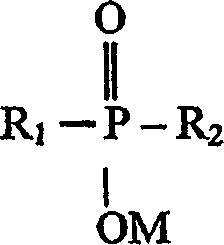
式中R1为C2-C22有机基团,In the formula, R 1 is a C 2 -C 22 organic group,
R2为氢或C2-C22有机基团,以及R 2 is hydrogen or a C 2 -C 22 organic group, and
M为氢、铵、有机铵或金属离子。M is hydrogen, ammonium, organic ammonium or metal ion.
根据第一个实施方案,本发明提供一种经处理的无机固体颗粒,所述的无机固体颗粒包含:According to a first embodiment, the present invention provides a treated inorganic solid particle comprising:
(a)无机固体颗粒;以及(a) inorganic solid particles; and
(b)有下式的有机膦化合物:(b) Organic phosphine compounds having the formula:
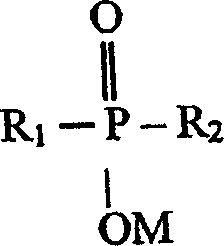
式中In the formula
R1为C2-C22有机基团,R 1 is a C 2 -C 22 organic group,
R2为氢或C2-C22有机基团,以及R 2 is hydrogen or a C 2 -C 22 organic group, and
M为氢、铵、有机铵或金属离子。M is hydrogen, ammonium, organic ammonium or metal ion.
根据第二个实施方案,本发明提供一种制备经处理的无机固体颗粒组合物的方法。所述的方法包括过滤含有无机固体颗粒的浆液,以及将过滤的无机固体颗粒与第一实施方案的有机膦化合物组合。According to a second embodiment, the present invention provides a method of preparing a composition of treated inorganic solid particles. The method includes filtering a slurry containing inorganic solid particles, and combining the filtered inorganic solid particles with the organophosphine compound of the first embodiment.
根据第三个实施方案,本发明提供另一种制备经处理的无机固体颗粒组合物的方法。所述的方法包括过将干燥的无机固体颗粒与第一实施方案的有机膦化合物组合。According to a third embodiment, the present invention provides another method of preparing a treated particulate inorganic solids composition. The method comprises combining dried inorganic solid particles with the organophosphine compound of the first embodiment.
无机固体颗粒用有机膦化合物处理以后,本发明经处理的无机固体颗粒可结合以及很容易分散在聚合物中,形成聚合物材料。本发明的无机固体颗粒当结合在聚合物制品和薄膜中时,具有极好的分散性、抗lacing性和其它物理性能。After the inorganic solid particles have been treated with an organophosphine compound, the treated inorganic solid particles of the present invention can be combined and readily dispersed in a polymer to form a polymeric material. The inorganic solid particles of the present invention have excellent dispersibility, lacing resistance and other physical properties when incorporated into polymeric articles and films.
本发明经处理的无机固体颗粒还可用于制备高负载聚合物母料。经处理的无机固体颗粒当高达约85%经处理的无机固体颗粒结合到母料中时具有特别好的分散质量。这些高负载母料适用于分散性和热稳定性特别是抗lacing性很重要的各种应用。The treated inorganic solid particles of the present invention can also be used to prepare high-loaded polymer masterbatches. The treated inorganic solids have particularly good dispersion qualities when up to about 85% of the treated inorganic solids are incorporated into the masterbatch. These high loading masterbatches are suitable for a variety of applications where dispersibility and thermal stability especially lacing resistance are important.
发明详述Detailed description of the invention
本发明涉及与聚合物有关应用的无机固体颗粒以及制备这些无机固体颗粒的方法。根据本发明,无机固体颗粒用有机膦化合物处理。然后,可将生成的经处理的无机固体颗粒与聚合物组合,制成聚合物基质。The present invention relates to inorganic solid particles for use in connection with polymers and to a process for the preparation of these inorganic solid particles. According to the invention, inorganic solid particles are treated with an organic phosphine compound. The resulting treated inorganic solid particles can then be combined with a polymer to form a polymer matrix.
本公开内容不打算作为有关无机固体颗粒或聚合物材料生产的专题论文,读者涉及到有关本发明主题及其背景方面的可得到的适合文本和其它材料。This disclosure is not intended to be a monograph on the production of inorganic solid particles or polymeric materials and the reader is referred to appropriate texts and other material available pertaining to the subject matter of the invention and its background.
本发明生产的经处理的无机固体颗粒包含有机膦化合物处理的无机固体颗粒。优选的是,无机固体颗粒还包含金属氧化物例如氧化铝。适合用于本发明的无机固体颗粒包括但不限于二氧化钛、高岭土、滑石、碳酸钙、氧化锌和云母。在这里使用的术语“无机固体颗粒”指未用有机膦化合物处理的无机固体颗粒。优选的是,二氧化钛为选择的无机固体颗粒。当无机固体颗粒为二氧化钛时,二氧化钛可为硫酸盐法或氯化物法生产的金红石或硫酸盐法生产的锐钛矿。对于熟悉本专业的技术人员来说,生产金红石和锐钛矿无机固体颗粒的方法是大家熟悉的。The treated inorganic solid particles produced by the present invention comprise organophosphine compound-treated inorganic solid particles. Preferably, the inorganic solid particles also contain metal oxides such as alumina. Inorganic solid particles suitable for use in the present invention include, but are not limited to, titanium dioxide, kaolin, talc, calcium carbonate, zinc oxide, and mica. The term "inorganic solid particles" as used herein refers to inorganic solid particles that have not been treated with an organic phosphine compound. Preferably, titanium dioxide is the selected inorganic solid particle. When the inorganic solid particles are titanium dioxide, the titanium dioxide may be rutile produced by a sulfate process or a chloride process, or anatase produced by a sulfate process. Methods for producing rutile and anatase inorganic solid particles are well known to those skilled in the art.
本发明中包含其中无机固体颗粒为以适合提供白度和不透明性的形式存在的二氧化钛的各种组合物。这种二氧化钛形式常称为颜料二氧化钛。本发明中还包含其中无机固体颗粒为以常常称为“透明”二氧化钛的形式存在的二氧化钛的各种组合物。透明二氧化钛具有很小的散射或吸收可见光的倾向,但具有良好的吸收紫外线的能力。所以,正如熟悉本专业的技术人员意识到的,将透明二氧化钛加到塑料和其它组合物中可提供对紫外线的防护。Compositions in which the inorganic solid particle is titanium dioxide in a form suitable to provide whiteness and opacity are included in the present invention. This form of titanium dioxide is often referred to as pigmentary titanium dioxide. Also included in the invention are compositions wherein the inorganic solid particle is titanium dioxide in a form often referred to as "transparent" titanium dioxide. Transparent titanium dioxide has little tendency to scatter or absorb visible light, but has good ability to absorb ultraviolet light. Therefore, the incorporation of transparent titanium dioxide into plastics and other compositions can provide protection from ultraviolet light, as will be appreciated by those skilled in the art.
无机固体颗粒的正常粒度为约0.10至约20微米。当无机固体颗粒作为填充剂或增量剂时,例如高岭土、碳酸钙、滑石和云母,粒度范围通常为约0.5至约20微米。对于通常作为颜料的无机固体颗粒来说,平均粒度为约0.1至约0.5微米。通常,当无机固体颗粒为颜料形式的二氧化钛时,平均粒度为0.2-0.35微米。当无机固体颗粒为透明二氧化钛时,平均粒度为约0.01至0.15微米。当无机固体颗粒的形状大致为圆形时,这些测量值表示直径。当无机固体颗粒的形状为针状的或非圆形时,那么这些测量值表示最长尺寸的测量值。Normal particle sizes for inorganic solid particles are from about 0.10 to about 20 microns. When inorganic solid particles are used as fillers or extenders, such as kaolin, calcium carbonate, talc and mica, the particle size range is generally from about 0.5 to about 20 microns. For inorganic solid particles typically used as pigments, the average particle size is from about 0.1 to about 0.5 microns. Typically, when the inorganic solid particles are titanium dioxide in pigment form, the average particle size is 0.2-0.35 microns. When the inorganic solid particles are transparent titanium dioxide, the average particle size is about 0.01 to 0.15 microns. When the inorganic solid particles are approximately circular in shape, these measurements represent diameters. When the inorganic solid particles are acicular or non-circular in shape, then these measurements represent measurements of the longest dimension.
优选的是,本发明的有机膦化合物含有至少一个约2至约22个碳原子的有机基团。除非另加说明,这些有机基团可为取代的或未取代的、直链的、支链的或环状的以及饱和的或不饱和的。适用于本发明的有机基团的例子包括但不限于乙基-、丙基-、丁基-、异丁基-、叔丁基-、戊基-、己基-、庚基-、辛基-、异辛基-、2-乙基己基-、癸基-、十二烷基-等。优选的是,有机基团为直链己基-、直链辛基-、异辛基-或2-乙基己基-。此外优选的是,有机基团为未取代的。此外优选的是,R1和R2不为芳基化合物。Preferably, the organophosphine compounds of the present invention contain at least one organic group of about 2 to about 22 carbon atoms. Unless otherwise specified, these organic groups may be substituted or unsubstituted, linear, branched or cyclic, and saturated or unsaturated. Examples of organic groups suitable for use in the present invention include, but are not limited to, ethyl-, propyl-, butyl-, isobutyl-, tert-butyl-, pentyl-, hexyl-, heptyl-, octyl- , Isooctyl-, 2-Ethylhexyl-, Decyl-, Dodecyl-, etc. Preferably, the organic group is linear hexyl-, linear octyl-, isooctyl- or 2-ethylhexyl-. Furthermore it is preferred that the organic groups are unsubstituted. Furthermore it is preferred that R1 and R2 are not aryl compounds.
为了制备本发明经处理的无机固体颗粒,用通常可用分子式I表示的有机膦化合物处理无机固体颗粒,后者不仅包括有机膦酸,而且还包括它们的盐。术语“有机膦化合物”指有机膦酸和有机膦酸的盐。这些分子式I的有机膦化合物可从头合成或从商业源例如FlukaChemical得到。对于可用分子式I表示的化合物,优选R1和R2为己基-、辛基-、异辛基-或2-乙基己基-。分子式I为:To prepare the treated inorganic solid particles of the present invention, the inorganic solid particles are treated with an organic phosphine compound generally represented by formula I, which includes not only organic phosphonic acids but also their salts. The term "organophosphine compound" refers to organic phosphonic acids and salts of organic phosphonic acids. These organophosphine compounds of formula I can be synthesized de novo or obtained from commercial sources such as Fluka Chemical. For compounds that may be represented by formula I, R1 and R2 are preferably hexyl-, octyl-, isooctyl- or 2-ethylhexyl-. Molecular formula I is:
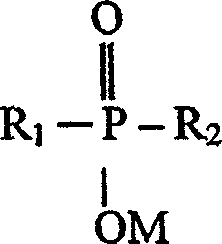
式中In the formula
R1为C2-C22有机基团,R 1 is a C 2 -C 22 organic group,
R2为氢或C2-C22有机基团,以及R 2 is hydrogen or a C 2 -C 22 organic group, and
M为氢、铵、有机铵或金属离子。M is hydrogen, ammonium, organic ammonium or metal ion.
上述可用于制成本发明表面处理剂的有机膦化合物可用于处理无机固体颗粒,以便制成经处理的无机固体颗粒。术语“经处理的无机固体颗粒”指任何已表面处理或改性的无机固体颗粒。术语“有机膦处理的无机固体颗粒”指已用任何可用上述分子式I表示的物质处理的无机固体颗粒。有机膦化合物的优选数量取决于其应用和无机固体颗粒的性质。通常,按无机固体颗粒的重量计,有约0.1至约30重量%有机膦化合物。按无机固体颗粒的重量计,用于处理颜料尺寸无机固体颗粒的有机膦化合物的数量优选为约0.1至约5重量%、更优选约0.3至约2.0重量%、最优选约0.7至约1.2重量%。对于较小粒度无机固体颗粒,有机膦化合物的数量通常较大。对于透明二氧化钛来说,按透明二氧化钛的重量计,使用的有机膦化合物的数量优选为约3至30重量%、更优选约5至约30重量%、最优选约10至20重量%。The above-mentioned organic phosphine compounds that can be used to prepare the surface treatment agent of the present invention can be used to treat inorganic solid particles to produce treated inorganic solid particles. The term "treated inorganic solid particle" refers to any inorganic solid particle that has been surface treated or modified. The term "organophosphine-treated inorganic solid particles" refers to inorganic solid particles that have been treated with any of the substances that may be represented by Formula I above. The preferred amount of organophosphine compound depends on its application and the nature of the inorganic solid particles. Typically, there is from about 0.1 to about 30 weight percent organophosphine compound, based on the weight of the inorganic solid particles. The amount of organophosphine compound used to treat pigment-sized inorganic solid particles is preferably from about 0.1 to about 5 weight percent, more preferably from about 0.3 to about 2.0 weight percent, most preferably from about 0.7 to about 1.2 weight percent, based on the weight of the inorganic solid particles %. For smaller sized inorganic solid particles, the amount of organic phosphine compound is generally greater. For transparent titanium dioxide, the organophosphine compound is preferably used in an amount of about 3 to 30 weight percent, more preferably about 5 to about 30 weight percent, most preferably about 10 to 20 weight percent, based on the weight of the transparent titanium dioxide.
有机膦化合物可在经处理的无机固体颗粒生产的任何阶段中与无机固体颗粒组合。当生产经处理的二氧化钛时,有机膦化合物可结合在氯化物法和/或硫酸盐法的任何一个生产步骤的原因之一是,没有有机膦化合物和无机固体颗粒表面相互作用的副产物,或者至多水或盐可为副产物,两者都易于除去。The organophosphine compound can be combined with the inorganic solid particles at any stage of the production of the treated inorganic solid particles. One of the reasons that organophosphine compounds can be incorporated in any production step of the chloride and/or sulfate process when producing treated titanium dioxide is that there are no by-products of the interaction of the organophosphine compound with the surface of the inorganic solid particles, or At most water or salts can be by-products, both are easily removed.
优选的是,无机固体颗粒和本发明的表面处理剂的组合可在约10至约270℃下进行。无机固体颗粒和表面处理剂组合的最佳温度取决于无机固体颗粒生产过程中表面处理剂加入的步骤。Preferably, the combination of the inorganic solid particles and the surface treatment agent of the present invention can be performed at a temperature of about 10 to about 270°C. The optimal temperature for combining the inorganic solid particles and the surface treatment agent depends on the step of adding the surface treatment agent during the production of the inorganic solid particles.
此外优选的是,存在的任何金属都可以氧化物的形式存在,更优选的是,在有机磷化合物加入时存在氧化铝。最优选的是,按无机固体颗粒的重量计,使用约0.2至1.2重量%氧化铝。对于熟悉本专业的技术人员来说,在无机固体颗粒生产中,氧化铝特别是二氧化钛的使用是大家熟悉的。It is also preferred that any metal present may be present in the form of an oxide, more preferably aluminum oxide is present when the organophosphorus compound is added. Most preferably, about 0.2 to 1.2 weight percent alumina is used, based on the weight of the inorganic solid particles. The use of alumina, especially titania, in the production of inorganic solid particles is familiar to those skilled in the art.
在这些条件下,无机固体颗粒可称为“未活化的无机固体颗粒”,以便与金属例如铝以离子形式存在并使无机固体颗粒活化的情况区分。在制备过程中例如在TiO2生产中,例如当滤饼已形成时或有机膦化合物已加到无机固体颗粒中以后,可找到存在“未活化的无机固体颗粒”的pH值。这些点加入是特别有利的,因为在标准处理过程中,不进行随后的过滤;因此,不用除去有机膦化合物,方法可经济地进行。Under these conditions, the inorganic solid particles may be referred to as "unactivated inorganic solid particles" to distinguish them from the case where a metal such as aluminum is present in ionic form and activates the inorganic solid particles. The pH at which "unactivated inorganic solids" are present can be found during preparation, eg in TiO2 production, eg when a filter cake has formed or after an organophosphine compound has been added to the inorganic solids. These point additions are particularly advantageous because, during standard processing, subsequent filtration is not performed; therefore, the process can be performed economically without removal of the organophosphine compound.
加入有机膦化合物的方法可类似于加入其他表面处理剂的方法,它们可灵活且容易结合在无机固体颗粒生产过程中。因此,在无机固体颗粒生产过程中,存在许多可加入有机膦化合物的地方,因此这里所述的加入点不意味着是唯一的。有机膦化合物加入过程中的最佳点部分取决于结合的方法。The method of adding organic phosphine compounds can be similar to the method of adding other surface treatment agents, which are flexible and easy to incorporate in the production process of inorganic solid particles. Thus, during the production of inorganic solid particles, there are many places where the organic phosphine compound can be added, and thus the points of addition described here are not meant to be the only ones. The optimum point during the addition of the organophosphine compound depends in part on the method of incorporation.
在最简单的方法中,有机膦化合物可通过喷雾或倾倒加入到无机固体颗粒已存在的体系中。为了使有机膦化合物的分散更加均匀,人们可能希望使有机磷化合物和无机固体颗粒混合或搅拌。对于熟悉本专业的技术人员来说,混合处理剂和无机固体颗粒的方法是大家熟悉的。可使用熟悉本专业的技术人员现在已知的或未知的各种设备例如用于将液体涂覆到粉末上的带强化棒的V型壳混合器或其它适合的混合设备。In the simplest method, the organic phosphine compound can be added by spraying or pouring into the system where the inorganic solid particles are already present. In order to achieve a more uniform dispersion of the organophosphorus compound, one may wish to mix or agitate the organophosphorus compound and the inorganic solid particles. Methods of mixing treatment agents and inorganic solid particles are familiar to those skilled in the art. Various equipment now known or unknown to those skilled in the art may be used such as a V-shell mixer with intensified rods or other suitable mixing equipment for applying liquids to powders.
另一方面,可将有机膦化合物与要研磨的无机固体颗粒一起计量加入微粉磨机和喷射粉磨机。空气或水蒸汽微粉化技术可在室温至250℃或更高下使用,正如熟悉本专业的技术人员已知的或易认识的。On the other hand, the organophosphine compounds can be metered into micronizers and jet mills together with the inorganic solid particles to be ground. Air or steam micronization techniques can be used at ambient temperatures to 250°C or higher, as known or readily appreciated by those skilled in the art.
作为另一个例子,在传统的生产方法中,在微粉化以前或同时,在喷雾干进料器下可将有机膦化合物加到高强度研磨设备中或微粉磨机进料中。正如上面讨论的,在过滤和洗涤以前,有机膦化合物加到无机固体颗粒浆液中不那么有效,因为一部分有机膦化合物将在无机固体颗粒洗涤时损失。相反,本发明的有机膦化合物加到滤饼或微粉磨机进料中使有机部分的损失减少,从而使生产效率提高。因此,将有机膦化合物加到带搅拌的流化的经洗涤的滤饼中是希望的,以便确保有机膦化合物在无机固体颗粒中均匀混合。此外,在一些实施方案中,在任何过滤和洗涤步骤以后但在任何干燥步骤以前,将有机膦化合物加入是希望的。As another example, in conventional production methods, the organophosphine compound may be added to the high-intensity grinding equipment or to the micronizer feed under a spray dry feeder prior to or simultaneously with micronization. As discussed above, the addition of the organophosphine compound to the slurry of inorganic solids prior to filtration and washing is less effective because a portion of the organophosphine compound will be lost during the washing of the inorganic solids. In contrast, the addition of the organophosphine compounds of the present invention to the filter cake or to the feed to the micronizer results in reduced loss of the organic fraction and thus increased production efficiency. It is therefore desirable to add the organophosphine compound to the fluidized washed filter cake with agitation in order to ensure uniform mixing of the organophosphine compound among the inorganic solid particles. Furthermore, in some embodiments it may be desirable to add the organophosphine compound after any filtration and washing steps but before any drying steps.
如果将有机膦化合物加到干燥的无机固体颗粒例如喷射干燥器产物或微粉磨机进料中,必需特别注意确保有机膦化合物与无机固体颗粒粉末的均匀混合。例如,使用带强化棒的V型壳混合器将有机化合物作为纯净液体或溶液涂覆或使用其它适合的混合设备来实现这一点。如果有机膦化合物为固体材料,那么将它溶于水、乙醇、四氢呋喃或任何适合溶剂中有助于有机膦化合物均匀涂覆到无机固体颗粒上。If the organophosphine compound is added to dried inorganic solid particles such as spray dryer product or micron mill feed, special care must be taken to ensure uniform mixing of the organophosphine compound with the inorganic solid particle powder. This is accomplished, for example, by applying the organic compound as a neat liquid or solution using a V-shell mixer with intensifying rods or using other suitable mixing equipment. If the organophosphine compound is a solid material, dissolving it in water, ethanol, tetrahydrofuran, or any suitable solvent helps to coat the organophosphine compound uniformly on the inorganic solid particles.
通过固体物质溶于溶剂中,更容易获得均匀混合。例如,当有机膦化合物溶于适合的溶剂中时,它可在无机固体颗粒干燥以后、进入微粉磨机以前或无机固体颗粒加到微粉磨机中同时加入。Uniform mixing is more easily obtained by dissolving the solid material in the solvent. For example, when the organic phosphine compound is dissolved in a suitable solvent, it can be added after the inorganic solid particles are dried, before entering the micronizer or at the same time as the inorganic solid particles are added to the micronizer.
有机膦化合物与无机固体颗粒组合以后,经处理的无机固体颗粒可能为用水蒸汽或空气流体能量研磨,以便生产仍保留高有机膦化合物含量的经处理精加工的无机固体颗粒。在所有过滤步骤以后加入处理剂时,仍然与无机固体颗粒有关的处理剂数量比加入表面处理剂以后进行过滤步骤的要大得多。这可使生产经处理的无机固体颗粒的总成本下降。After the organic phosphine compound is combined with the inorganic solid particles, the treated inorganic solid particles may be milled with water vapor or air fluid energy to produce treated and finished inorganic solid particles that still retain a high organophosphine compound content. When the treatment agent is added after all the filtration steps, the amount of treatment agent still associated with the inorganic solid particles is much greater than when the filtration step is performed after the addition of the surface treatment agent. This can reduce the overall cost of producing treated inorganic solid particles.
例如,当无机固体颗粒为二氧化钛时,可将有机膦化合物直接加到从一种生产方法例如氯化物法或硫酸盐法制得的未处理的二氧化钛中。另外,可在本发明的有机膦化合物处理以前,使用熟悉本专业的技术人员已知的任何方法,用金属氧化物例如氧化铝、二氧化硅、二氧化锆等进一步处理无机固体颗粒二氧化钛。处理剂的另外一些例子包括磷酸盐和锡。此外,在加入有机膦化合物以前或加入有机膦化合物以后,可用多元醇例如三羟甲基乙烷和三羟甲基丙烷或链烷醇胺例如三乙醇胺二次处理未处理的无机固体颗粒或经处理的无机固体颗粒。也可选择用无机磷酸盐或无机膦酸盐和金属氧化物的组合物进行处理。此外,还可选择用上述化合物的组合物或混合物进行处理。当无机固体颗粒为二氧化钛时,用有机磷化合物处理的无机固体颗粒例如可为使用水蒸汽或空气流体能量研磨,以便生产仍有高有机膦化合物含量的精加工的无机固体颗粒,从而使生产改性TiO2的总成本下降。For example, when the inorganic solid particles are titanium dioxide, the organic phosphine compound can be added directly to untreated titanium dioxide obtained from a production process such as the chloride process or the sulfate process. Additionally, the inorganic solid particulate titania may be further treated with metal oxides such as alumina, silica, zirconia, etc., prior to treatment with the organophosphine compound of the present invention, using any method known to those skilled in the art. Additional examples of treatments include phosphates and tin. In addition, the untreated inorganic solid particles may be treated secondarily with polyhydric alcohols such as trimethylolethane and trimethylolpropane or alkanolamines such as triethanolamine or after adding the organic phosphine compound or after adding the organic phosphine compound. Processed inorganic solid particles. Treatment with inorganic phosphates or combinations of inorganic phosphonates and metal oxides is also optional. In addition, the treatment with combinations or mixtures of the aforementioned compounds may also be selected. When the inorganic solid particle is titanium dioxide, the inorganic solid particle treated with the organophosphorus compound can be milled, for example, using steam or air fluid energy to produce a finished inorganic solid particle that still has a high organophosphine compound content, thereby enabling improved production. The total cost of TiO 2 drops.
一旦制成有机膦化合物处理的无机固体颗粒,那么就可将它与聚合物组合,制成聚合物基质。术语“聚合物基质”指含有聚合物和经处理的无机固体颗粒的物质。可用于本发明的聚合物包括但不限于用于热塑性塑料应用的聚合物,例如未取代的乙烯单体的聚合物,包括聚乙烯、聚丙烯、聚丁烯以及乙烯与C4-C12α-烯烃或醋酸乙烯基酯的共聚物;乙烯基均聚物、丙烯基均聚物和共聚物、聚酰胺、聚碳酸酯、聚苯乙烯、丙烯腈-丁二烯-苯乙烯共聚物和聚醚。其它适合的聚合物类型还包括聚氯乙烯、聚氨酯、聚砜、聚酰亚胺、聚酯和氯化聚酯、聚环氧乙烷、酚醛树脂、醇酸树脂、氨基树脂、环氧树脂、苯氧树脂和缩醛树脂。对于熟悉本专业的技术人员来说,经处理的无机固体颗粒与聚合物组合的方法是大家熟悉的。Once the organophosphine compound-treated inorganic solid particles are made, they can be combined with a polymer to make a polymer matrix. The term "polymer matrix" refers to a substance comprising a polymer and treated inorganic solid particles. Polymers useful in the present invention include, but are not limited to, polymers for thermoplastic applications, such as polymers of unsubstituted ethylene monomers, including polyethylene, polypropylene, polybutene, and ethylene with C4 - C12α - Copolymers of olefins or vinyl acetate; vinyl homopolymers, propylene homopolymers and copolymers, polyamides, polycarbonates, polystyrene, acrylonitrile-butadiene-styrene copolymers and poly ether. Other suitable polymer types include polyvinyl chloride, polyurethane, polysulfone, polyimide, polyester and chlorinated polyester, polyethylene oxide, phenolic resins, alkyd resins, amino resins, epoxy resins, Phenoxy resins and acetal resins. Methods of combining treated inorganic solid particles with polymers are well known to those skilled in the art.
经处理的无机固体颗粒可与聚合物组合,按聚合物基质的重量计,载量为直到约85重量%。优选的是,按所用的聚合物基质的重量计,经处理的无机固体颗粒的载量为约50至约85重量%。这一载量可用作母料。“母料”指两种或两种以上共混在一起然后再与一种或多种可能与前两种物质中任一种相同或不同的其它组分共混的物质的混合物。用经处理的无机固体颗粒得到母料的方法是熟悉本专业的技术人员已知的或易认识的。例如,可用BR Banbury混合器或双螺杆挤塑机将经处理的无机固体颗粒和聚合物组合来得到母料。The treated inorganic solid particles can be combined with the polymer at a loading of up to about 85% by weight of the polymer matrix. Preferably, the treated inorganic solid particles are present at a loading of from about 50 to about 85 weight percent, based on the weight of the polymer matrix employed. This loading can be used as a masterbatch. "Masterbatch" means a mixture of two or more substances that are blended together and then blended with one or more other components which may be the same or different from either of the first two substances. Methods of obtaining masterbatches from treated inorganic solid particles are known or readily appreciated by those skilled in the art. For example, a BR Banbury mixer or twin-screw extruder can be used to combine the treated inorganic solid particles and polymer to obtain a masterbatch.
已令人吃惊和意想不到地发现,本发明经处理的无机固体颗粒与含有硫化锌和硫酸钡组合物的聚合物填充剂立德粉组合时不会产生可能有害或有毒气体。相反,当使用磷酰基化的多烯与立德粉组合时,就释放出可能有害的气体。It has been surprisingly and unexpectedly found that the treated inorganic solid particles of the present invention do not emit potentially harmful or toxic gases when combined with a polymeric filler lithopone comprising a combination of zinc sulfide and barium sulfate. In contrast, when phosphorylated polyenes are used in combination with lithopone, potentially harmful gases are released.
还令人吃惊和意想不到地发现,本发明经处理的无机固体颗粒使加入它们的热塑性聚合物有良好的抗lacing性。lacing被认为是在特定无机固体颗粒载量重量百分数以及加工温度下挥发性的量度,lacing可在塑料薄膜中表现为空洞或孔洞。It has also been surprisingly and unexpectedly found that the treated inorganic solid particles of the present invention impart good lacing resistance to thermoplastic polymers to which they are incorporated. Lacing is considered to be a measure of volatility at a specific inorganic solid particle loading weight percentage and processing temperature. Lacing can appear as voids or holes in plastic films.
因为经处理的无机固体颗粒特别有利于用于热塑性塑料应用,优选这样处理它们,以致当它们与聚合物组合用于这些应用时,在与聚合物组合以前和与聚合物组合以后,它们基本上没有有机溶剂和水。Because treated inorganic solid particles are particularly advantageous for use in thermoplastics applications, they are preferably treated so that when they are combined with polymers for these applications, they are substantially Free of organic solvents and water.
此外,还令人吃惊和意想不到地发现,本发明的无机固体颗粒当结合在热塑性聚合物薄膜制品时有极好的分散性。正如熟悉本专业的技术人员已知的,薄膜通常含有直到约14%经处理的无机固体。Furthermore, it has also been surprisingly and unexpectedly discovered that the inorganic solid particles of the present invention have excellent dispersibility when incorporated into thermoplastic polymer film articles. As is known to those skilled in the art, films typically contain up to about 14% treated inorganic solids.
实施例Example
以下实施例示出本发明的优选实施方案。这些实施方案仅是说明性的,不打算也不应以任何方式作为对本发明的限制。The following examples illustrate preferred embodiments of the invention. These embodiments are illustrative only and are not intended and should not be construed as limiting the invention in any way.
按熟悉本专业的技术人员已知的一般方法制备实施例中的膦化合物,进行某些改性,例如在J.Med.Chem.,1988,32,204和ZhurnalObshcei Khimi,1979,50,1744中描述的。Prepare the phosphine compounds in the examples according to the general methods known to those skilled in the art, with some modifications, for example in J.Med.Chem., 1988,32,204 and ZhurnalObshcei Khimi, 1979,50,1744 describe.
实施例1Example 1
在这一实施例中,将0.90%二异辛基膦酸加到干燥的氯化物法金红石TiO2基料中,后者用0.20%氧化铝涂覆。In this example, 0.90% diisooctylphosphonic acid was added to a dry chloride-process rutile TiO2 base which was coated with 0.20% alumina.
在搅拌和70℃下,将26.8毫升386.4克Al2O3/升铝酸钠溶液加到350克/升浆液的5230克细颗粒氯化物法TiO2中。用50%氢氧化钠溶液将浆液pH值调节到7.0,在搅拌下将浆液老化30分钟。将老化的浆液过滤,用5000毫升一份80℃去离子水洗涤2次,然后在115℃炉中干燥过夜。制备中干燥的滤饼强制通过8目筛,以便用二异辛基磺酸处理。26.8 mL of 386.4 g Al2O3 /L sodium aluminate solution was added to 5230 g fine-grained chloride-process TiO2 of a 350 g/L slurry at 70°C with stirring. The pH of the slurry was adjusted to 7.0 with 50% sodium hydroxide solution, and the slurry was aged for 30 minutes with stirring. The aged slurry was filtered, washed twice with 5000 mL portions of 80°C deionized water, and dried overnight in a 115°C oven. The dried filter cake in preparation was forced through an 8 mesh screen for treatment with di-isooctane sulfonic acid.
将9.0克二异辛基膦酸(Fluka Chemical)以圆周运动滴加到1000克上述制备的干燥的8目氧化铝涂覆的TiO2中,它在聚乙烯膜上分散成1厘米厚。用大刮勺使颜料混合,然后转移到1加仑广口Nalgene瓶中。将装有颜料的瓶在滚压机上滚压10分钟。经滚压的颜料进行水蒸汽微粉化,得到精加工的颜料。9.0 g of diisooctylphosphonic acid (Fluka Chemical) was added dropwise in a circular motion to 1000 g of the dry 8-mesh alumina-coated TiO2 prepared above, which was dispersed to a thickness of 1 cm on a polyethylene film. The paint was mixed with a large spatula and transferred to a 1 gallon wide mouth Nalgene bottle. The bottle containing the paint was rolled on a roller press for 10 minutes. The rolled pigment is subjected to steam micronization to obtain refined pigment.
将精加工的颜料分别结合到含75%和50%TiO2的低密度聚乙烯母料中,以便分散和lacing评价。结果列入表1。The finished pigments were incorporated into LDPE masterbatches containing 75% and 50% TiO2 , respectively, for dispersion and lacing evaluation. The results are listed in Table 1.
实施例2Example 2
在这一实施例中,将1.10%二异辛基膦酸加到干燥的氯化物法金红石TiO2基料中,后者用0.20%氧化铝涂覆。In this example, 1.10% diisooctylphosphonic acid was added to a dry chloride-process rutile TiO2 base which was coated with 0.20% alumina.
将11.0克二异辛基膦酸(Fluka Chemical)以圆周运动滴加到1000克按实施例1描述制备的干燥的8目氧化铝涂覆的TiO2中,它在聚乙烯膜上分散成1厘米厚。用大刮勺使颜料混合,然后转移到1加仑广口Nalgene瓶中。将装有颜料的瓶在滚压机上滚压10分钟。经滚压的颜料进行水蒸汽微粉化,得到精加工的颜料。11.0 grams of diisooctylphosphonic acid (Fluka Chemical) was added dropwise in a circular motion to 1000 grams of dry 8 mesh alumina-coated TiO prepared as described in Example 1 , which was dispersed on a polyethylene film as 1 cm thick. The paint was mixed with a large spatula and transferred to a 1 gallon wide mouth Nalgene bottle. The bottle containing the paint was rolled on a roller press for 10 minutes. The rolled pigment is subjected to steam micronization to obtain refined pigment.
将精加工的颜料分别结合到含75%和50%TiO2的低密度聚乙烯母料中,以便分散和lacing评价。结果列入表1。The finished pigments were incorporated into LDPE masterbatches containing 75% and 50% TiO2 , respectively, for dispersion and lacing evaluation. The results are listed in Table 1.
实施例3Example 3
二正辛基膦酸的制备。将1-辛烯(58.6克,0.5218摩尔)加到搅拌的46.5克(0.261摩尔)正辛基膦酸在250毫升95%乙醇中的混合物中,随后加入9.042克(0.026摩尔)70%过氧化苯甲酰。将生成的混合物回流8小时,然后另外加入6.758克(0.0196摩尔)过氧化苯甲酰,继续回流8小时。再加入4.244克过氧化苯甲酰(0.01305摩尔),再回流8小时。将生成的混合物在冷冻器中冷却,然后用旋转蒸发器回收11.8克二正辛基膦酸。用100毫升冷却的95%乙醇洗涤固体,在旋转真空蒸发器上浓缩滤液,再置于冷冻器中。在冷却时得到另外24.9克二正辛基膦酸,总计得到36.7克(产率48.4%)。Preparation of di-n-octylphosphonic acid. 1-Octene (58.6 g, 0.5218 mol) was added to a stirred mixture of 46.5 g (0.261 mol) n-octylphosphonic acid in 250 mL of 95% ethanol, followed by 9.042 g (0.026 mol) of 70% peroxide Benzoyl. The resulting mixture was refluxed for 8 hours, then an additional 6.758 g (0.0196 moles) of benzoyl peroxide was added and reflux was continued for 8 hours. An additional 4.244 g of benzoyl peroxide (0.01305 moles) was added and refluxed for an additional 8 hours. The resulting mixture was cooled in a freezer, and then 11.8 g of di-n-octylphosphonic acid were recovered using a rotary evaporator. The solid was washed with 100 mL of cold 95% ethanol and the filtrate was concentrated on a rotary vacuum evaporator and placed in a freezer. A further 24.9 g of di-n-octylphosphonic acid were obtained on cooling, for a total of 36.7 g (48.4% yield).
实施例4Example 4
在这一实施例中,将0.90%二正辛基膦酸加到干燥的氯化物法金红石TiO2基料中,后者用0.20%氧化铝涂覆。In this example, 0.90% di-n-octylphosphonic acid was added to a dry chloride-process rutile TiO2 base which was coated with 0.20% alumina.
将9.0克按实施例3制备的二正辛基膦酸以圆周运动滴加到1000克按实施例1描述制备的干燥的8目氧化铝涂覆的TiO2中,它在聚乙烯膜上分散成1厘米厚。用大刮勺使颜料混合,然后转移到1加仑广口Nalgene瓶中。将装有颜料的瓶在滚压机上滚压10分钟。经滚压的颜料进行水蒸汽微粉化,得到精加工的颜料。9.0 g of di-n-octylphosphonic acid prepared as in Example 3 was added dropwise in a circular motion to 1000 g of dried 8 mesh alumina-coated TiO2 prepared as described in Example 1 , which was dispersed on a polyethylene film into 1 cm thick. The paint was mixed with a large spatula and transferred to a 1 gallon wide mouth Nalgene bottle. The bottle containing the paint was rolled on a roller press for 10 minutes. The rolled pigment is subjected to steam micronization to obtain refined pigment.
将精加工的颜料结合到含75%的TiO2的低密度聚乙烯母料中,以便分散评价。结果列入表1。The finished pigments were incorporated into a 75% TiO2- containing low-density polyethylene masterbatch for dispersion evaluation. The results are listed in Table 1.
实施例5Example 5
在这一实施例中,将1.10%二正辛基膦酸加到氯化物法金红石TiO2基料中,后者用0.20%氧化铝涂覆。In this example, 1.10% di-n-octylphosphonic acid was added to a chloride-process rutile TiO2 base which was coated with 0.20% alumina.
将11.0克按实施例3制备的二正辛基膦酸以圆周运动滴加到1000克按实施例1描述制备的干燥的8目氧化铝涂覆的TiO2中,它在聚乙烯膜上分散成1厘米厚。用大刮勺使颜料混合,然后转移到1加仑广口Nalgene瓶中。将装有颜料的瓶在滚压机上滚压10分钟。经滚压的颜料进行水蒸汽微粉化,得到精加工的颜料。11.0 g of di-n-octylphosphonic acid prepared as in Example 3 was added dropwise in a circular motion to 1000 g of dry 8 mesh alumina-coated TiO2 prepared as described in Example 1 , which was dispersed on a polyethylene film into 1 cm thick. The paint was mixed with a large spatula and transferred to a 1 gallon wide mouth Nalgene bottle. The bottle containing the paint was rolled on a roller press for 10 minutes. The rolled pigment is subjected to steam micronization to obtain refined pigment.
将精加工的颜料结合到含75%TiO2的低密度聚乙烯母料中,以便分散评价。结果列入表1。The finished pigments were incorporated into a 75% TiO2- containing low-density polyethylene masterbatch for dispersion evaluation. The results are listed in Table 1.
实施例6Example 6
正辛基膦酸的制备。将23.8毫升浓硫酸加到95.1克(0.897摩尔)水合次膦酸钠在600毫升95%乙醇的混合物中。将1-辛烯(33.6克,0.299摩尔)加到搅拌的混合物中,随后加入1.69克(0.0149摩尔)30%过氧化氢。将生成的混合物回流8小时,然后另外加入1.15克(0.010摩尔)过氧化氢,将生成的混合物继续回流8小时。将生成的混合物冷却,过滤,然后用旋转蒸发器除去乙醇。将200毫升水加入到生成的残留物中,然后加入50%氢氧化钠水溶液,一直到溶液变成碱性。用200毫升乙醚将混合物萃取2次,然后用浓硫酸酸化水相。用200毫升醋酸乙酯萃取水层,用饱和氯化钠溶液洗涤有机层,然后在无水硫酸镁上干燥。倾析有机层,用另外50毫升醋酸乙酯洗涤干燥剂。在旋转蒸发器上蒸发合并的有机层。得到45.2克正辛基膦酸(产率84.8%)。Preparation of n-octylphosphonic acid. 23.8 mL of concentrated sulfuric acid was added to a mixture of 95.1 g (0.897 moles) of sodium phosphinate hydrate in 600 mL of 95% ethanol. 1-Octene (33.6 grams, 0.299 moles) was added to the stirred mixture, followed by 1.69 grams (0.0149 moles) of 30% hydrogen peroxide. The resulting mixture was refluxed for 8 hours, then an additional 1.15 g (0.010 mol) of hydrogen peroxide was added and the resulting mixture was refluxed for an additional 8 hours. The resulting mixture was cooled, filtered, and the ethanol was removed on a rotary evaporator. 200 ml of water were added to the resulting residue, and then 50% aqueous sodium hydroxide was added until the solution became alkaline. The mixture was extracted twice with 200 ml of ether, and the aqueous phase was acidified with concentrated sulfuric acid. The aqueous layer was extracted with 200 ml of ethyl acetate, the organic layer was washed with saturated sodium chloride solution, and dried over anhydrous magnesium sulfate. The organic layer was decanted and the drying agent was washed with another 50 mL of ethyl acetate. The combined organic layers were evaporated on a rotary evaporator. 45.2 g of n-octylphosphonic acid were obtained (84.8% yield).
实施例7Example 7
在这一实施例中,将0.90%正辛基膦酸加到干燥的氯化物法金红石TiO2基料中,后者用0.20%氧化铝涂覆。In this example, 0.90% n-octylphosphonic acid was added to a dry chloride-process rutile TiO2 base which was coated with 0.20% alumina.
将11.9克按实施例6制备的正辛基膦酸以圆周运动滴加到1200克按实施例1描述制备的干燥的8目氧化铝涂覆的TiO2中,它在聚乙烯膜上分散成1厘米厚。用大刮勺使颜料混合,然后转移到1加仑广口Nalgene瓶中。将装有颜料的瓶在滚压机上滚压10分钟。经滚压的颜料进行水蒸汽微粉化,得到精加工的颜料。11.9 g of n-octylphosphonic acid prepared as in Example 6 were added dropwise in a circular motion to 1200 g of dried 8 mesh alumina-coated TiO2 prepared as described in Example 1 , which was dispersed on a polyethylene film as 1 cm thick. The paint was mixed with a large spatula and transferred to a 1 gallon wide mouth Nalgene bottle. The bottle containing the paint was rolled on a roller press for 10 minutes. The rolled pigment is subjected to steam micronization to obtain refined pigment.
将精加工的颜料分别结合到含75%和50%TiO2的低密度聚乙烯母料中,以便分散和lacing评价。结果列入表1。The finished pigments were incorporated into LDPE masterbatches containing 75% and 50% TiO2 , respectively, for dispersion and lacing evaluation. The results are listed in Table 1.
实施例8Example 8
在这一实施例中,将1.2%正辛基膦酸加到干燥的氯化物法金红石TiO2基料中,后者用0.20%氧化铝涂覆。In this example, 1.2% n-octylphosphonic acid was added to a dry chloride-process rutile TiO2 base which was coated with 0.20% alumina.
将14.6克按实施例6制备的正辛基膦酸以圆周运动滴加到1200克按实施例1描述制备的干燥的8目氧化铝涂覆的TiO2中,它在聚乙烯膜上分散成1厘米厚。用大刮勺使颜料混合,然后转移到1加仑广口Nalgene瓶中。将装有颜料的瓶在滚压机上滚压10分钟。经滚压的颜料进行水蒸汽微粉化,得到精加工的颜料。14.6 g of n-octylphosphonic acid prepared as in Example 6 was added dropwise in a circular motion to 1200 g of dry 8-mesh alumina-coated TiO2 prepared as described in Example 1 , which was dispersed on a polyethylene film as 1 cm thick. The paint was mixed with a large spatula and transferred to a 1 gallon wide mouth Nalgene bottle. The bottle containing the paint was rolled on a roller press for 10 minutes. The rolled pigment is subjected to steam micronization to obtain refined pigment.
将精加工的颜料分别结合到含75%和50%TiO2的低密度聚乙烯母料中,以便分散和lacing评价。结果列入表1。The finished pigments were incorporated into LDPE masterbatches containing 75% and 50% TiO2 , respectively, for dispersion and lacing evaluation. The results are listed in Table 1.
实施例9Example 9
正辛基膦酸的钠盐的制备。将按实施例6制备的35.0克正辛基膦酸溶于100毫升95%乙醇中, 然后用酚酞作为指示剂用5M(50/50%EtOH/H2O)氢氧化钠中和生成的溶液。蒸发溶剂,回收相应的钠盐。Preparation of the sodium salt of n-octylphosphonic acid. 35.0 grams of n-octylphosphonic acid prepared according to Example 6 were dissolved in 100 milliliters of 95% ethanol, and then the resulting solution was neutralized with 5M (50/50% EtOH/H 2 O) sodium hydroxide using phenolphthalein as an indicator . The solvent was evaporated and the corresponding sodium salt was recovered.
实施例10Example 10
在这一实施例中,将0.90%正辛基膦酸钠盐加到干燥的氯化物法金红石TiO2基料中,后者用0.20%氧化铝涂覆。In this example, 0.90% n-octylphosphonic acid sodium salt was added to a dry chloride-process rutile TiO2 base which was coated with 0.20% alumina.
将9.0克按实施例9制备的正辛基膦酸钠盐溶于80.0克去离子水中。将这一溶液以圆周运动滴加到1000克按实施例1描述制备的干燥的8目氧化铝涂覆的TiO2中,它在聚乙烯膜上分散成1厘米厚。用大刮勺使颜料混合,然后转移到1加仑广口Nalgene瓶中。将装有颜料的瓶在滚压机上滚压10分钟。经滚压的颜料进行水蒸汽微粉化,得到精加工的颜料。9.0 grams of n-octylphosphonic acid sodium salt prepared according to Example 9 were dissolved in 80.0 grams of deionized water. This solution was added dropwise in a circular motion to 1000 grams of dry 8 mesh alumina-coated TiO2 prepared as described in Example 1, which was dispersed to a thickness of 1 cm on a polyethylene film. The paint was mixed with a large spatula and transferred to a 1 gallon wide mouth Nalgene bottle. The bottle containing the paint was rolled on a roller press for 10 minutes. The rolled pigment is subjected to steam micronization to obtain refined pigment.
将精加工的颜料结合到含75%TiO2的低密度聚乙烯母料中,以便分散评价。结果列入表1。The finished pigments were incorporated into a 75% TiO2- containing low-density polyethylene masterbatch for dispersion evaluation. The results are listed in Table 1.
实施例11Example 11
在这一实施例中,将1.10%正辛基膦酸钠盐加到氯化物法金红石TiO2基料中,后者用0.20%氧化铝涂覆。In this example, 1.10% n-octylphosphonic acid sodium salt was added to a chloride-process rutile TiO2 base which was coated with 0.20% alumina.
将11.0克按实施例9制备的正辛基膦酸钠盐溶于84.1克去离子水中。将这一溶液以圆周运动滴加到1000克按实施例1描述制备的干燥的8目氧化铝涂覆的TiO2中,它在聚乙烯膜上分散成1厘米厚。用大刮勺使颜料混合,然后转移到1加仑广口Nalgene瓶中。将装有颜料的瓶在滚压机上滚压10分钟。经滚压的颜料进行水蒸汽微粉化,得到精加工的颜料。11.0 grams of n-octylphosphonic acid sodium salt prepared according to Example 9 were dissolved in 84.1 grams of deionized water. This solution was added dropwise in a circular motion to 1000 grams of dry 8 mesh alumina-coated TiO2 prepared as described in Example 1, which was dispersed to a thickness of 1 cm on a polyethylene film. The paint was mixed with a large spatula and transferred to a 1 gallon wide mouth Nalgene bottle. The bottle containing the paint was rolled on a roller press for 10 minutes. The rolled pigment is subjected to steam micronization to obtain refined pigment.
将精加工的颜料结合到含75%TiO2的低密度聚乙烯母料中,以便分散评价。结果列入表1。The finished pigments were incorporated into a 75% TiO2- containing low-density polyethylene masterbatch for dispersion evaluation. The results are listed in Table 1.
实施例12Example 12
正己基膦酸及其钠盐的制备。将23.8毫升浓硫酸加到95.2克(0.898摩尔)水合次磷酸钠在600毫升95%乙醇的混合物中。将1-己烯(25.2克,0.30摩尔)加到搅拌的混合物中,随后加入1.76克(0.0155摩尔)30%过氧化氢。将生成的混合物回流8小时,然后另外加入1.14克(0.0101摩尔)过氧化氢,将生成的混合物继续回流8小时。将生成的混合物冷却,过滤,然后用旋转蒸发器除去乙醇。将200毫升水加到生成的残留物中,然后加入50%氢氧化钠水溶液,一直到溶液变成碱性。用200毫升乙醚将混合物萃取2次,然后用浓硫酸酸化水相。用200毫升醋酸乙酯萃取水层,用饱和氯化钠溶液洗涤有机层,然后在无水硫酸镁上干燥。倾析有机层,用另外50毫升醋酸乙酯洗涤干燥剂。在旋转蒸发器上蒸发合并的有机层。得到37.0克正己基膦酸(产率82.4%)。Preparation of n-hexylphosphonic acid and its sodium salt. 23.8 mL of concentrated sulfuric acid was added to a mixture of 95.2 g (0.898 mol) of sodium hypophosphite hydrate in 600 mL of 95% ethanol. 1-Hexene (25.2 g, 0.30 mole) was added to the stirred mixture, followed by 1.76 g (0.0155 mole) of 30% hydrogen peroxide. The resulting mixture was refluxed for 8 hours, then an additional 1.14 g (0.0101 mol) of hydrogen peroxide was added and the resulting mixture was refluxed for an additional 8 hours. The resulting mixture was cooled, filtered, and the ethanol was removed on a rotary evaporator. 200 ml of water were added to the resulting residue, and then 50% aqueous sodium hydroxide was added until the solution became alkaline. The mixture was extracted twice with 200 ml of ether, and the aqueous phase was acidified with concentrated sulfuric acid. The aqueous layer was extracted with 200 ml of ethyl acetate, the organic layer was washed with saturated sodium chloride solution, and dried over anhydrous magnesium sulfate. The organic layer was decanted and the drying agent was washed with another 50 mL of ethyl acetate. The combined organic layers were evaporated on a rotary evaporator. 37.0 g of n-hexylphosphonic acid were obtained (yield 82.4%).
然后将35.0克正己基膦酸溶于100毫升9 5%乙醇,用酚酞作为指示剂用5M(50/50%EtOH/H2O)氢氧化钠中和生成的溶液。蒸发溶剂,回收相应的钠盐。Then 35.0 g of n-hexylphosphonic acid was dissolved in 100 ml of 95% ethanol, and the resulting solution was neutralized with 5M (50/50% EtOH/H 2 O) sodium hydroxide using phenolphthalein as an indicator. The solvent was evaporated and the corresponding sodium salt was recovered.
实施例13Example 13
在这一实施例中,将0.90%正己基膦酸钠盐加到干燥的氯化物法金红石TiO2基料中,后者用0.20%氧化铝涂覆。In this example, 0.90% n-hexylphosphonic acid sodium salt was added to a dry chloride-process rutile TiO2 base which was coated with 0.20% alumina.
将9.0克按实施例12制备的正己基膦酸钠盐溶于78.2克去离子水中。将这一溶液以圆周运动滴加到1000克按实施例1描述制备的干燥的8目氧化铝涂覆的TiO2中,它在聚乙烯膜上分散成1厘米厚。用大刮勺使颜料混合,然后转移到1加仑广口Nalgene瓶中。将装有颜料的瓶在滚压机上滚压10分钟。经滚压的颜料进行水蒸汽微粉化,得到精加工的颜料。9.0 grams of n-hexylphosphonic acid sodium salt prepared according to Example 12 were dissolved in 78.2 grams of deionized water. This solution was added dropwise in a circular motion to 1000 grams of dry 8 mesh alumina-coated TiO2 prepared as described in Example 1, which was dispersed to a thickness of 1 cm on a polyethylene film. The paint was mixed with a large spatula and transferred to a 1 gallon wide mouth Nalgene bottle. The bottle containing the paint was rolled on a roller press for 10 minutes. The rolled pigment is subjected to steam micronization to obtain refined pigment.
将精加工的颜料结合到含75%TiO2的低密度聚乙烯母料中,以便分散评价。结果列入表1。The finished pigments were incorporated into a 75% TiO2- containing low-density polyethylene masterbatch for dispersion evaluation. The results are listed in Table 1.
实施例14Example 14
在这一实施例中,将1.10%正己基膦酸钠盐加到干燥的氯化物法金红石TiO2基料中,后者用0.20%氧化铝涂覆。In this example, 1.10% sodium n-hexylphosphonate was added to a dry chloride-process rutile TiO2 base which was coated with 0.20% alumina.
将11.0克按实施例12制备的正己基膦酸钠盐溶于86.2克去离子水中。将这一溶液以圆周运动滴加到1000克按实施例1描述制备的干燥的8目氧化铝涂覆的TiO2中,它在聚乙烯膜上分散成1厘米厚。用大刮勺使颜料混合,然后转移到1加仑广口Nalgene瓶中。将装有颜料的瓶在滚压机上滚压10分钟。经滚压的颜料进行水蒸汽微粉化,得到精加工的颜料。11.0 grams of n-hexylphosphonic acid sodium salt prepared according to Example 12 were dissolved in 86.2 grams of deionized water. This solution was added dropwise in a circular motion to 1000 grams of dry 8 mesh alumina-coated TiO2 prepared as described in Example 1, which was dispersed to a thickness of 1 cm on a polyethylene film. The paint was mixed with a large spatula and transferred to a 1 gallon wide mouth Nalgene bottle. The bottle containing the paint was rolled on a roller press for 10 minutes. The rolled pigment is subjected to steam micronization to obtain refined pigment.
将精加工的颜料结合到含75%TiO2的低密度聚乙烯母料中,以便分散评价。结果列入表1。The finished pigments were incorporated into a 75% TiO2- containing low-density polyethylene masterbatch for dispersion evaluation. The results are listed in Table 1.
实施例15Example 15
在这一实施例中,将1.0%二异辛基膦酸加到干燥的硫酸盐法金红石TiO2基料中,后者用0.40%氧化铝涂覆。In this example, 1.0% diisooctylphosphonic acid was added to a dry sulfated rutile TiO2 base which was coated with 0.40% alumina.
在搅拌和70℃下,将52.4毫升381.6克Al2O3/升铝酸钠溶液加到350克/升浆液的5000克细颗粒硫酸盐法TiO2(由MillenniumChemicals提供的通常称为TiONARUF)中。用50%氢氧化钠溶液将浆液pH值调节到7.0,在搅拌下将浆液老化30分钟。将老化的浆液过滤,用5000毫升一份的80℃去离子水洗涤3次,然后在115℃炉中干燥过夜。制备中干燥的滤饼强制通过8目筛,以便用二异辛基膦酸处理。52.4 mL of 381.6 g Al2O3 /L sodium aluminate solution was added to a 350 g/L slurry of 5000 g fine particle sulfate process TiO2 (commonly known as TiONA(R) RUF )middle. The pH of the slurry was adjusted to 7.0 with 50% sodium hydroxide solution, and the slurry was aged for 30 minutes with stirring. The aged slurry was filtered, washed three times with 5000 mL portions of 80°C deionized water, and then dried overnight in a 115°C oven. The dried filter cake in preparation was forced through an 8 mesh screen for treatment with diisooctylphosphonic acid.
将10.0克二异辛基膦酸(Fluka Chemical)以圆周运动方式滴加到1000克上述制备的干燥的8目氧化铝涂覆的TiO2中,它在聚乙烯膜上分散成1厘米厚。用大刮勺使颜料混合,然后转移到1加仑广口Nalgene瓶中。将装有颜料的瓶在滚压机上滚压10分钟。经滚压的颜料进行水蒸汽微粉化,得到精加工的颜料。10.0 g of diisooctylphosphonic acid (Fluka Chemical) was added dropwise in a circular motion to 1000 g of the dry 8-mesh alumina-coated TiO2 prepared above, which was dispersed to a thickness of 1 cm on a polyethylene film. The paint was mixed with a large spatula and transferred to a 1 gallon wide mouth Nalgene bottle. The bottle containing the paint was rolled on a roller press for 10 minutes. The rolled pigment is subjected to steam micronization to obtain refined pigment.
将精加工的颜料分别结合到含75%和50%TiO2的低密度聚乙烯母料中,以便分散和lacing评价。结果列入表1。The finished pigments were incorporated into LDPE masterbatches containing 75% and 50% TiO2 , respectively, for dispersion and lacing evaluation. The results are listed in Table 1.
实施例16Example 16
在这一实施例中,将1.36%二异辛基膦酸加到硫酸盐法金红石TiO2基料中,后者用0.40%氧化铝涂覆。In this example, 1.36% diisooctylphosphonic acid was added to a sulfated rutile TiO2 base which was coated with 0.40% alumina.
将13.6克二异辛基膦酸(Fluka Chemical)以圆周运动滴加到1000克按实施例15描述制备的干燥的8目氧化铝涂覆的TiO2中,它在聚乙烯膜上分散成1厘米厚。用大刮勺使颜料混合,然后转移到1加仑广口Nalgene瓶中。将装有颜料的瓶在滚压机上滚压10分钟。经滚压的颜料进行水蒸汽微粉化,得到精加工的颜料。13.6 g of diisooctylphosphonic acid (Fluka Chemical) was added dropwise in a circular motion to 1000 g of dry 8 mesh alumina-coated TiO prepared as described in Example 15 , which was dispersed on polyethylene film as 1 cm thick. The paint was mixed with a large spatula and transferred to a 1 gallon wide mouth Nalgene bottle. The bottle containing the paint was rolled on a roller press for 10 minutes. The rolled pigment is subjected to steam micronization to obtain refined pigment.
将精加工的颜料分别结合到含75%和50%TiO2的低密度聚乙烯母料中,以便分散和lacing评价。结果列入表1。The finished pigments were incorporated into LDPE masterbatches containing 75% and 50% TiO2 , respectively, for dispersion and lacing evaluation. The results are listed in Table 1.
对比例1Comparative example 1
按干燥颜料的重量计,正如实施例1中公开的用水合氧化铝涂覆的氯化物法制备的金红石TiO2用0.60重量%三乙醇胺处理。Rutile TiO2 as prepared by the chloride method coated with hydrated alumina as disclosed in Example 1 was treated with 0.60% by weight of triethanolamine, based on the weight of the dry pigment.
将精加工的颜料分别结合到含75%和50%TiO2的低密度聚乙烯母料中,以便分散和lacing评价。结果列入表1。The finished pigments were incorporated into LDPE masterbatches containing 75% and 50% TiO2 , respectively, for dispersion and lacing evaluation. The results are listed in Table 1.
表1
分散和lacing性能的测定Determination of dispersion and lacing properties
lacing评价lacing evaluation
含无机固体颗粒的聚合物的高温稳定性是商业聚合物薄膜特别是聚乙烯薄膜应用的一个重要的性质。空洞或“lacing”伴随薄膜的损坏。据认为lacing是在特定重量百分数无机固体颗粒载量和加工温度下挥发性的量度。High temperature stability of polymers containing inorganic solid particles is an important property for commercial polymer film applications, especially polyethylene films. Voiding or "lacing" accompanies damage to the membrane. The lacing is considered to be a measure of volatility at a specific weight percent inorganic solids loading and processing temperature.
对于本发明来说,使用Haake Record 9000计算机控制的转矩流变仪对制备的50%TiO2浓缩样品进行lacing试验。例如,将125克TiO2和Dow Chemical Company制备的125克LDPE 722干共混,然后加到带50转/分转子的75℃预热室内。加入TiO2/LDPE混合物后1分钟,将预热室温度升至105℃。混合过程产生的摩擦热促使TiO2加入LDPE,一直到得到稳态的混合物。从混合室中取出浓缩物,并放入Cumberland压碎机,得到细颗粒的50%浓缩物样品。颗粒浓缩物在23℃和50%相对湿度下调制48小时。然后将这些浓缩物混合在DowChemical LDPE 722中,在最后的薄膜中有20%TiO2载量。For the present invention, lacing tests were performed on the prepared 50% TiO2 concentrated samples using a Haake Record 9000 computer-controlled torque rheometer. For example, 125 grams of TiO2 and 125 grams of LDPE 722 manufactured by Dow Chemical Company were dry blended and added to a 75°C preheat chamber with a 50 rpm rotor. One minute after the addition of the TiO2 /LDPE mixture, the temperature of the preheating chamber was raised to 105°C. The frictional heat generated during the mixing process promotes the addition of TiO2 to the LDPE until a steady state mixture is obtained. The concentrate was removed from the mixing chamber and placed into a Cumberland crusher to obtain a fine particle 50% concentrate sample. The granule concentrate was conditioned for 48 hours at 23°C and 50% relative humidity. These concentrates were then mixed in DowChemical LDPE 722 with 20% TiO2 loading in the final film.
在1英寸装有流延薄膜缝口模头的挤塑机上进行lacing评价。使用625模头、515夹圈、415区3、350区2和300区1的温度分布曲线。螺杆速度为约90转/分。与挤塑机连接的25.4厘米抛光铬骤冷辊用于保持75微米薄膜厚度,以及用于冷却和输送薄膜。骤冷辊离模唇的距离为约22毫米,温度为约27℃。The lacing evaluations were performed on a 1 inch extruder equipped with a cast film slot die. Temperature profiles for 625°F die, 515°F clamp, 415°F Zone 3, 350°F Zone 2, and 300°F Zone 1 were used. The screw speed was about 90 rpm. A 25.4 cm polished chrome chill roll attached to the extruder was used to maintain a 75 micron film thickness, as well as to cool and convey the film. The distance of the chill roll from the lip of the die was about 22 mm and the temperature was about 27°C.
TiO2/LDPE混合物放入料斗以后,将物料清洗,一直到首次看到薄膜中的白色色调为止。为了确保TiO2在薄膜中的浓度已稳定,在lacing观测值被纪录以前有两分钟的时间间隔,并得到薄膜样品。然后用LDPE清洗挤塑机,一直到薄膜变透明。通过计数摊在黑色表面上的薄膜样品中产生的空洞的相对尺寸和数目来确定lacing性能。使用1.0-3.0等级体系。没有lacing的薄膜为等级1,开始lacing的薄膜为等级2以及极lacing的薄膜为等级3。0.1的增加值用来标记样品之间的相对性能。After the TiO2 /LDPE mixture was placed in the hopper, the material was purged until a white tint in the film was first seen. To ensure that the TiO2 concentration in the film had stabilized, there was a two-minute interval before lacing observations were recorded and film samples were obtained. The extruder is then washed with LDPE until the film becomes transparent. The lacing performance was determined by counting the relative size and number of voids produced in a film sample spread over a black surface. Use a 1.0-3.0 rating system. A film with no lacing was rated 1, a film that started lacing was rated 2 and a film that was very laced was rated 3. Incremental values of 0.1 were used to indicate relative performance between samples.
分散测试scatter test
使用小型实验室挤塑设备,通过测量捕获在挤塑机筛网组件的筛网上的无机固体颗粒的相对数量来得到分散在有机聚合物中的无机固体颗粒的测量值。用Haake 3000流变混合器制备的75%TiO2在低密度聚乙烯浓缩物进行试验。用Haake 9000Rheocord转矩流变仪控制和监测混合器。将337.7克微粉化的TiO2和Equistar制备的112.6克NA209LDPE干共混,然后加到带50转/分转子的75℃混合室内。干共混物送入混合室以后1分钟,将混合器的温度程序升温到120℃。达到稳态混合物以后,将化合物再混合3分钟。从混合室取出化合物,然后用Cumberland压碎机磨碎。Measurements of inorganic solid particles dispersed in organic polymers were obtained by measuring the relative amount of inorganic solid particles trapped on the screens of the extruder screen assembly using small laboratory extrusion equipment. Experiments were carried out on 75% TiO2 in low-density polyethylene concentrates prepared with a Haake 3000 rheological mixer. The mixer was controlled and monitored with a Haake 9000 Rheocord Torque Rheometer. 337.7 grams of micronized TiO2 and 112.6 grams of NA209LDPE made by Equistar were dry blended and added to a 75°C mixing chamber with a 50 rpm rotor. One minute after the dry blend was introduced into the mixing chamber, the temperature of the mixer was programmed to 120°C. After reaching a steady state mixture, the compound was mixed for an additional 3 minutes. The compound was removed from the mixing chamber and ground with a Cumberland crusher.
用装有20∶1长径比螺杆的KL-100型Killion单螺杆挤塑机进行分散试验。从区1到模头挤塑机分别在330、350、390和380下预热,并在70转/分下操作。Equistar制备的1000克NA 952 LDPE的清洗通过体系进行,并安装新的筛网组。由40/500/200/100目筛网组成的筛网组从模头朝向挤塑机进料口。温度稳定以后,将133.33克粉碎的75%TiO2浓缩物送入挤塑机。当进料料斗空了时,随后加入1500克NA952清洗。LDPE清洗挤塑以后,取出筛网,分开,然后用相对计数技术从X射线荧光光谱仪的测量值测试。得到筛网组中100、200和500目筛网的每秒TiO2计数的数目,合计得到分散结果。每秒较低的TiO2计数是希望的。小于5000的计数结果被认为是极好的分散。Dispersion tests were carried out using a KL-100 Killion single-screw extruder equipped with a 20:1 length-to-diameter ratio screw. The extruders were preheated at 330, 350, 390 and 380 F from zone 1 to the die and operated at 70 rpm. 1000g of NA 952 LDPE made by Equistar was cleaned through the system and a new screen pack was installed. A screen pack consisting of 40/500/200/100 mesh screens runs from the die towards the feed opening of the extruder. After the temperature had stabilized, 133.33 grams of crushed 75% TiO2 concentrate was fed into the extruder. When the feed hopper was empty, 1500 grams of NA952 was then added to rinse. After the LDPE was cleaned and extruded, the screens were removed, separated, and then tested using relative counting techniques from X-ray fluorescence spectrometer measurements. The number of TiO2 counts per second for the 100, 200 and 500 mesh screens in the screen set was obtained and summed to obtain the dispersion result. A lower TiO2 count per second is desirable. A count result of less than 5000 is considered excellent dispersion.
硫化锌的反应性(立德粉中的反应性组分)Reactivity of zinc sulfide (reactive component in lithopone)
立德粉—一种含有硫化锌的组合物在各种聚合物组合物中用作填充剂和增量剂。当用磷酰基化的多烯处理的TiO2颜料例如ArizonaChemical Company提供的Sylfat K与硫化锌在大于约20至25℃下接触时,产生有毒的臭味。相反,当本发明的颜料在相同条件下与硫化锌接触时,不产生臭味。Lithopone - A composition containing zinc sulfide used as a filler and extender in various polymer compositions. A noxious odor is produced when a TiO2 pigment treated with a phosphorylated polyene, such as Sylfat K(R ) supplied by Arizona Chemical Company, is contacted with zinc sulfide at temperatures greater than about 20 to 25°C. In contrast, when the pigment of the present invention was brought into contact with zinc sulfide under the same conditions, no odor was produced.
硫化锌的反应性Reactivity of zinc sulfide
实施例17Example 17
将5克Millennium Chemicals RCL-4-一种含有二氧化钛和磷酰基化的多烯的颜料产品放入装有1克硫化锌的封闭小瓶。将小瓶在200℃加热10分钟,然后用联合气相色谱和质谱仪(GC/MS)分析气相部分。检测二甲基硫醚。当试验小瓶未封闭时,检测出有毒臭味。5 grams of Millennium Chemicals RCL-4, a pigment product containing titanium dioxide and phosphorylated polyenes, was placed in a closed vial containing 1 gram of zinc sulfide. The vial was heated at 200° C. for 10 minutes, then the gas phase fraction was analyzed by combined gas chromatography and mass spectrometry (GC/MS). Detection of dimethyl sulfide. A noxious odor was detected when the test vial was not closed.
实施例18Example 18
用正辛基次膦酸钠处理的实施例11的TiO2颜料重复实施例17中使用的GC/MS试验。未检测出有毒的臭味,通过GC/MS未检测出有机含硫化合物。The GC/MS experiment used in Example 17 was repeated with the TiO2 pigment of Example 11 treated with sodium n-octylphosphinate. No toxic odor was detected, and no organic sulfur compounds were detected by GC/MS.
实施例19Example 19
用二异辛基膦酸处理的实施例16的TiO2颜料重复实施例17中使用的GC/MS试验。未检测出有毒的臭味,通过GC-MS未检测出有机含硫化合物。The GC/MS experiment used in Example 17 was repeated with the TiO2 pigment of Example 16 treated with diisooctylphosphonic acid. No toxic odor was detected, and no organic sulfur compounds were detected by GC-MS.
虽然已用某种程度的特殊性描述和举例说明了本发明,但应当认识到以下的权利要求书不是对本发明的限制,而是提供了与每一权利要求的措词及其等效物同等的范围。While the invention has been described and illustrated with a certain degree of particularity, it should be recognized that the following claims do not limit the invention but provide the equivalents to the language of each claim and their equivalents. range.
Claims (21)
Applications Claiming Priority (2)
| Application Number | Priority Date | Filing Date | Title |
|---|---|---|---|
| US10/632,385 US7091262B2 (en) | 2003-08-01 | 2003-08-01 | Particulate inorganic solids treated with organophosphinic compounds |
| US10/632,385 | 2003-08-01 |
Publications (2)
| Publication Number | Publication Date |
|---|---|
| CN1839178A true CN1839178A (en) | 2006-09-27 |
| CN100564434C CN100564434C (en) | 2009-12-02 |
Family
ID=34104362
Family Applications (1)
| Application Number | Title | Priority Date | Filing Date |
|---|---|---|---|
| CNB2004800240851A Expired - Lifetime CN100564434C (en) | 2003-08-01 | 2004-07-06 | Inorganic solid particles treated with organophosphine compounds |
Country Status (11)
| Country | Link |
|---|---|
| US (1) | US7091262B2 (en) |
| EP (1) | EP1651333B1 (en) |
| JP (1) | JP5068532B2 (en) |
| CN (1) | CN100564434C (en) |
| AT (1) | ATE503564T1 (en) |
| AU (1) | AU2004260643B2 (en) |
| BR (1) | BRPI0413160B1 (en) |
| CA (1) | CA2533755A1 (en) |
| DE (1) | DE602004032029D1 (en) |
| ES (1) | ES2364050T3 (en) |
| WO (1) | WO2005011851A2 (en) |
Cited By (4)
| Publication number | Priority date | Publication date | Assignee | Title |
|---|---|---|---|---|
| CN104870371A (en) * | 2012-09-17 | 2015-08-26 | 麦格派聚合物公司 | Method for preparing phosphine-based metal binding particles |
| CN105073864A (en) * | 2013-02-22 | 2015-11-18 | Omya国际股份公司 | New surface treatment of white mineral materials for application in plastics |
| CN108603043A (en) * | 2015-10-02 | 2018-09-28 | 亨茨曼P&A英国有限公司 | Particle surface processing |
| TWI858620B (en) * | 2023-03-17 | 2024-10-11 | 美商東納斯公司 | Treated titanium dioxide pigment |
Families Citing this family (7)
| Publication number | Priority date | Publication date | Assignee | Title |
|---|---|---|---|---|
| US7091262B2 (en) * | 2003-08-01 | 2006-08-15 | Millennium Inorganic Chemicals, Inc. | Particulate inorganic solids treated with organophosphinic compounds |
| US7261770B2 (en) * | 2004-11-24 | 2007-08-28 | Millennium Inorganic Chemicals, Inc. | Compositions and methods comprising pigments and polyprotic dispersing agents |
| DE102005037612A1 (en) * | 2005-08-05 | 2007-02-08 | Eckart Gmbh & Co. Kg | Surface-applied pearlescent pigments, process for their preparation and their use |
| JP6569231B2 (en) * | 2015-02-10 | 2019-09-04 | 株式会社リコー | Active energy ray curable ink, ink container, and inkjet discharge apparatus |
| US20160292506A1 (en) * | 2015-04-06 | 2016-10-06 | Heptagon Micro Optics Pte. Ltd. | Cameras having an optical channel that includes spatially separated sensors for sensing different parts of the optical spectrum |
| CA3180254A1 (en) * | 2020-08-14 | 2022-02-17 | Quan SU | Anti-corrosion titanium dioxide pigments |
| CN111909545A (en) * | 2020-08-26 | 2020-11-10 | 攀钢集团重庆钒钛科技有限公司 | Titanium white chloride special for plastic color master batch and preparation method thereof |
Family Cites Families (18)
| Publication number | Priority date | Publication date | Assignee | Title |
|---|---|---|---|---|
| US3345432A (en) | 1963-08-19 | 1967-10-03 | American Cyanamid Co | Flame-retardant compositions containing organophosphonic acids |
| US3374288A (en) | 1965-09-03 | 1968-03-19 | Du Pont | Polycarbonamide filaments containing polyalkylene oxide, sodium phenyl phosphinate and sodium aminoalkylphosphinate |
| US3582510A (en) | 1968-11-05 | 1971-06-01 | American Cyanamid Co | Flame-retardant compositions for plastics |
| US3658753A (en) | 1970-07-01 | 1972-04-25 | Phillips Petroleum Co | Color stabilized poly(arylene sulfide) resins |
| GB1385781A (en) | 1972-05-01 | 1975-02-26 | Teijin Ltd | Polyamides |
| ZA738245B (en) * | 1972-10-25 | 1974-09-25 | Hoechst Ag | Flame resistant thermoplastic polyesters |
| US4357170A (en) * | 1981-07-30 | 1982-11-02 | The New Jersey Zinc Company | Titanium dioxide pigment treated to suppress yellowing in polymers |
| CA1211319A (en) * | 1982-11-24 | 1986-09-16 | Gerson M.F. Vas | Coated particulate fillers |
| JPS59170131A (en) * | 1983-03-17 | 1984-09-26 | Daihachi Kagaku Kogyosho:Kk | Surface-modified inorganic powder |
| US4781982A (en) * | 1987-11-27 | 1988-11-01 | Aluminum Company Of America | Surface treating mineral particles to reduce halide adsorption |
| GB8912388D0 (en) | 1989-05-30 | 1989-07-12 | Ici Plc | 3-hydroxybutyrate polymer composition |
| US5260353A (en) | 1992-10-16 | 1993-11-09 | Kerr-Mcgee Chemical Corporation | Hydrophobicity through metal ion activation |
| EP0707051B1 (en) | 1994-10-14 | 2001-05-16 | Tioxide Group Services Limited | Inorganic particles coated with an alkylphosphonic acid or an ester thereof, their preparation and their use |
| JPH09176392A (en) * | 1995-12-22 | 1997-07-08 | Sekisui Chem Co Ltd | Fire resistant resin composition |
| JP3796008B2 (en) * | 1996-11-05 | 2006-07-12 | 積水化学工業株式会社 | Flame retardant resin composition and method for producing the same |
| JP2001026666A (en) * | 1999-07-13 | 2001-01-30 | Faimatekku:Kk | Inorganic filler carrying thereon organic additive for synthetic resin and preparation thereof |
| US6765041B1 (en) * | 2000-11-27 | 2004-07-20 | Millenium Inorganic Chemicals, Inc. | Organo-acid phosphate treated pigments |
| US7091262B2 (en) * | 2003-08-01 | 2006-08-15 | Millennium Inorganic Chemicals, Inc. | Particulate inorganic solids treated with organophosphinic compounds |
-
2003
- 2003-08-01 US US10/632,385 patent/US7091262B2/en not_active Expired - Lifetime
-
2004
- 2004-07-06 CA CA002533755A patent/CA2533755A1/en not_active Abandoned
- 2004-07-06 BR BRPI0413160-6A patent/BRPI0413160B1/en not_active IP Right Cessation
- 2004-07-06 WO PCT/US2004/021636 patent/WO2005011851A2/en not_active Ceased
- 2004-07-06 JP JP2006522562A patent/JP5068532B2/en not_active Expired - Fee Related
- 2004-07-06 AU AU2004260643A patent/AU2004260643B2/en not_active Expired
- 2004-07-06 DE DE602004032029T patent/DE602004032029D1/en not_active Expired - Lifetime
- 2004-07-06 AT AT04786043T patent/ATE503564T1/en not_active IP Right Cessation
- 2004-07-06 ES ES04786043T patent/ES2364050T3/en not_active Expired - Lifetime
- 2004-07-06 EP EP04786043A patent/EP1651333B1/en not_active Expired - Lifetime
- 2004-07-06 CN CNB2004800240851A patent/CN100564434C/en not_active Expired - Lifetime
Cited By (8)
| Publication number | Priority date | Publication date | Assignee | Title |
|---|---|---|---|---|
| CN104870371A (en) * | 2012-09-17 | 2015-08-26 | 麦格派聚合物公司 | Method for preparing phosphine-based metal binding particles |
| CN104870371B (en) * | 2012-09-17 | 2017-10-27 | 麦格派聚合物公司 | Process for preparing phosphine-selective transition metal-bound particles |
| CN105073864A (en) * | 2013-02-22 | 2015-11-18 | Omya国际股份公司 | New surface treatment of white mineral materials for application in plastics |
| CN105073864B (en) * | 2013-02-22 | 2018-05-08 | Omya国际股份公司 | Novel surface processing for the white mineral material of plastic applications |
| CN108603043A (en) * | 2015-10-02 | 2018-09-28 | 亨茨曼P&A英国有限公司 | Particle surface processing |
| US11142648B2 (en) | 2015-10-02 | 2021-10-12 | Huntsman P&A Uk Limited | Particle surface treatment |
| CN108603043B (en) * | 2015-10-02 | 2023-09-12 | 维纳特材料英国有限公司 | Particle surface treatment |
| TWI858620B (en) * | 2023-03-17 | 2024-10-11 | 美商東納斯公司 | Treated titanium dioxide pigment |
Also Published As
| Publication number | Publication date |
|---|---|
| EP1651333A2 (en) | 2006-05-03 |
| CA2533755A1 (en) | 2005-02-10 |
| AU2004260643B2 (en) | 2009-10-29 |
| WO2005011851A2 (en) | 2005-02-10 |
| AU2004260643A1 (en) | 2005-02-10 |
| EP1651333A4 (en) | 2007-05-09 |
| JP5068532B2 (en) | 2012-11-07 |
| EP1651333B1 (en) | 2011-03-30 |
| US7091262B2 (en) | 2006-08-15 |
| BRPI0413160B1 (en) | 2015-06-23 |
| CN100564434C (en) | 2009-12-02 |
| US20050027038A1 (en) | 2005-02-03 |
| WO2005011851A3 (en) | 2006-03-09 |
| JP2007501309A (en) | 2007-01-25 |
| DE602004032029D1 (en) | 2011-05-12 |
| ATE503564T1 (en) | 2011-04-15 |
| BRPI0413160A (en) | 2006-10-03 |
| ES2364050T3 (en) | 2011-08-23 |
Similar Documents
| Publication | Publication Date | Title |
|---|---|---|
| US7863369B2 (en) | Pigments and polymer composites formed thereof | |
| JP3121246B2 (en) | Treated inorganic solid | |
| CN1839178A (en) | Particulate inorganic solids treated with organophosphinic compounds | |
| US6646037B1 (en) | Pigments treated with organosulfonic compounds | |
| JP7027309B2 (en) | Particle surface treatment | |
| CN1290936C (en) | Method for producing titanium dioxide pigment and resin composition containing the titanium dioxide pigment | |
| CN1197778C (en) | Titanium dioxide pigment and method for production thereof | |
| CN103649236B (en) | There is the mineral dye of the process of the photolytic activity of reduction and the antimicrobial property of improvement and their purposes in polymer composition | |
| CN105121533B (en) | Non- micronized pigment for plastic applications | |
| CN101039923A (en) | Melamine cyanurate in crystalline form | |
| JP2000313616A (en) | Aluminum borate whisker having modified surface, its production and resin composition using the same |
Legal Events
| Date | Code | Title | Description |
|---|---|---|---|
| C06 | Publication | ||
| PB01 | Publication | ||
| C10 | Entry into substantive examination | ||
| SE01 | Entry into force of request for substantive examination | ||
| C14 | Grant of patent or utility model | ||
| GR01 | Patent grant | ||
| C56 | Change in the name or address of the patentee |
Owner name: CRYSTAL US CO., LTD. Free format text: FORMER NAME: MILLENNIUM INORGANIC CHEMICALS S. A. |
|
| CP01 | Change in the name or title of a patent holder |
Address after: American Maryland Patentee after: CRISTAL USA Inc. Address before: American Maryland Patentee before: MILLENNIUM INORGANIC CHEMICALS, Inc. |
|
| TR01 | Transfer of patent right |
Effective date of registration: 20190709 Address after: Oklahoma Patentee after: Tonas Corp. Address before: American Maryland Patentee before: CRISTAL USA Inc. |
|
| TR01 | Transfer of patent right | ||
| CX01 | Expiry of patent term |
Granted publication date: 20091202 |
|
| CX01 | Expiry of patent term |