CN1823334A - search engine method and device - Google Patents
search engine method and device Download PDFInfo
- Publication number
- CN1823334A CN1823334A CNA2004800198572A CN200480019857A CN1823334A CN 1823334 A CN1823334 A CN 1823334A CN A2004800198572 A CNA2004800198572 A CN A2004800198572A CN 200480019857 A CN200480019857 A CN 200480019857A CN 1823334 A CN1823334 A CN 1823334A
- Authority
- CN
- China
- Prior art keywords
- user
- subclauses
- clauses
- term
- search
- Prior art date
- Legal status (The legal status is an assumption and is not a legal conclusion. Google has not performed a legal analysis and makes no representation as to the accuracy of the status listed.)
- Pending
Links
Images

Classifications
-
- G—PHYSICS
- G06—COMPUTING OR CALCULATING; COUNTING
- G06F—ELECTRIC DIGITAL DATA PROCESSING
- G06F16/00—Information retrieval; Database structures therefor; File system structures therefor
- G06F16/30—Information retrieval; Database structures therefor; File system structures therefor of unstructured textual data
- G06F16/33—Querying
- G06F16/332—Query formulation
- G06F16/3325—Reformulation based on results of preceding query
-
- G—PHYSICS
- G06—COMPUTING OR CALCULATING; COUNTING
- G06F—ELECTRIC DIGITAL DATA PROCESSING
- G06F16/00—Information retrieval; Database structures therefor; File system structures therefor
- G06F16/30—Information retrieval; Database structures therefor; File system structures therefor of unstructured textual data
- G06F16/33—Querying
- G06F16/332—Query formulation
- G06F16/3322—Query formulation using system suggestions
- G06F16/3323—Query formulation using system suggestions using document space presentation or visualization, e.g. category, hierarchy or range presentation and selection
-
- G—PHYSICS
- G06—COMPUTING OR CALCULATING; COUNTING
- G06F—ELECTRIC DIGITAL DATA PROCESSING
- G06F16/00—Information retrieval; Database structures therefor; File system structures therefor
- G06F16/90—Details of database functions independent of the retrieved data types
- G06F16/95—Retrieval from the web
- G06F16/951—Indexing; Web crawling techniques
-
- G—PHYSICS
- G06—COMPUTING OR CALCULATING; COUNTING
- G06N—COMPUTING ARRANGEMENTS BASED ON SPECIFIC COMPUTATIONAL MODELS
- G06N20/00—Machine learning
Landscapes
- Engineering & Computer Science (AREA)
- Theoretical Computer Science (AREA)
- Physics & Mathematics (AREA)
- Data Mining & Analysis (AREA)
- Databases & Information Systems (AREA)
- General Engineering & Computer Science (AREA)
- General Physics & Mathematics (AREA)
- Mathematical Physics (AREA)
- Computational Linguistics (AREA)
- Software Systems (AREA)
- Artificial Intelligence (AREA)
- Computer Vision & Pattern Recognition (AREA)
- Evolutionary Computation (AREA)
- Medical Informatics (AREA)
- Computing Systems (AREA)
- Information Retrieval, Db Structures And Fs Structures Therefor (AREA)
Abstract
An interactive method for searching a database (12) to produce a refined results space (34), the method comprising: -analyzing (22) search criteria, -searching the database (12) using the search criteria (22) to obtain an initial result space (34), and-obtaining user input (20) to define the initial result space (34) to obtain the refined result space (34). The refining includes formulating prompts (32) to a user employing the classification of the retrieved data items, querying the user for at least one of the formulated prompts (32) and receiving a response thereto; and employing the response in conjunction with the classification value to exclude a portion of the result, thereby providing the subset of the retrieved data items to the user as a query result (34).
Description
Invention field and background
The present invention relates to search engine, more specifically but not exclusively relate to and database that comprises the database that networks and search engine that information-storing device is used in combination.
Information retrieval (IR) system and the search engine (SE) related with it began one's study and develop from the initial stage in the sixties.But, along with the appearance in the Internet and the Intranet world and information and service by the available enormous quantity of these approach, their roles, they importance and they the material impact of the validity of Computerized information system is significantly increased.Search engine how the representative instance that uses on the Internet comprise following aspect:
-researcher adopts such as common SE search such as Google, AltaVista, Lycos in the obtainable information about very concrete theme, for example sun power or Britain's folk song of certain location estimation on the Internet.
-consumer wishes by the portal of the electronics dealer such as Yahoo or by the specific product of specific dealer website purchase such as shirt, digital camera or books.The consumer relies on portal or website SE accurately to search the product of being asked.
Employee in the-large enterprises seeks the particular data in the large enterprises text warehouse, relies on the specific search engine of enterprise, brings the content that he thought just for him at once.
-obviously, these diverse demands are owing to the user complexity of various degree mixes.User when on the other hand, seeking expected information adheres to and can only guess the reaction that receives imperfect or error result.; probably in above-mentioned example; because the current intrinsic deficiency of SE; the user often becomes very unlucky and finally the information retrieval ability is produced negative attitude; even may stop using information retrieval fully; what produce lacks decline or the atrophy that use may cause database indirectly thereupon, makes it no longer be worth safeguarding.
Support the key that above-mentioned success is operated as their, the available SE of current major part suffers from the sharp-pointed problem of degree of accuracy or accuracy, coverage rate and focus, and these problems seriously hinder their performance and design fully working of operation that their support.Search generally is used as Keyword List to input inquiry and is handled, and the optimum matching of search and Keyword List, and does not consider the relation between intended meaning or the meaning significantly.Therefore, well-known search engine will discern that the well-known word of such as " San Francisco " and " New York " some is corresponding to be considered as one of its most advanced function when the ability that handle as single term.
The form of in the database of IR system or data-carrier store or information bank (IS) assembly, representing, often take free text document as the clauses and subclauses of the possible object of search.Document may very short (having only delegation, as the name of product in the electronics dealer website), moderate-length (several row are in news flashes) or quite grow (several pages, in finance and economics report, scientific paper or encyclopaedical clauses and subclauses).What still will highlight is though text media is modal now beyond doubt, never to be unique suitable medium of data base entries.IS can be made up of the clauses and subclauses of transcribing music score as picture, video, sound clip, electronics or comprising other any resource of information.Inquiry then can comprise part or the feature of describing required picture (color, shape etc.) or sound, minor pleasure or rhythm pattern etc.
As the background of described specific embodiment, e-commerce field, below be called in the ecommerce context (ECC) some explanations be provided.In current context, IS is the huge thesaurus of name of product, picture and description, the inquiry request that to be the user submit to the text-string form of describing (may by halves) its demand.
Choose the contextual reason of EC and have three:
A) ecommerce is with exponential increase, and shows great potential,
B) can not buy the article that can't find according to the user, outstanding SE be successfully operate requisite.Particularly, if the user can only find the content of thinking near him, then at this moment he unlikely buy, and also unlikely attempt ecommerce for purchase in the future, and
C) available SE to fail to satisfy in order allowing to import according to unskilled typical user and accurately to search the needed function of required product.
Below above-mentioned observation is wherein also supported in citation:
A) about the potentiality in e-retail field:
-" to the end of the year 2002, the whole world has 600,000,000 people of surpassing will visit WWW, and they will spend the online shopping above 1,000,000,000,000 dollars " (13/2/2001, Newsfactor.com, " E-commerce to top $1 trillion shopping online ").
-" is e-retailing promising? our answer is loud "Yes" at Booz-Allen! The growth potential of this part is huge " (3/2001, ebusinessforum, Booz-Allen﹠amp; Hamilton).
B) about the importance of outstanding SE to this application:
-" it is good more that on-line purchase person over half utilizes search to search product-research tool; they buy many more ", ..., " whenever we increase new function to search; bid can be higher " ..., " sales volume is lost in the website of ignoring the importance of search unconsciously " (24/9/2001, Businessweek.com, " Desperately seeking searchtechnology ").
-" if function of search does not have operate as normal, then 80% online user will abandon the website " (28/11/2001, webmastrcase.com, " Secrets to site search success ").
C) about present circumstances:
-" the provable ecommerce main cause of not making a profit is to have ignored search capability ... outstanding search capability can help to reverse the sort of situation " (24/9/2001, Seybold Group, Businessweek.com, " Desperately seeking Search technology ").
-" the most common factor that stops the user to buy on the website is that they do not find the commodity of just seeking.In our research, this situation accounts for 27% of all loss sales volumes.And when they used the function of search of website to attempt searching commodity, crash rate even higher-foot had 36% user can't find that they are required " (02/2001, webtechniques.com, " Building web sites with depth ").
-" shopper just hopes these commodity of search sometimes, finds it and payment to leave rapidly.Yet effectively older search technique is adopted not necessarily in most of e-retail website, often hinders and uses " (28/3/2001, professionaljeweler.com).
-" last spring surpasses 2/3rds by the online retail website of Forrester Research test and can't list related content in the homepage of Search Results.No wonder the website suffers from impotentia and makes the viewer be converted into buyer's situation.Client is driven away by unable search technique simply exactly." (28/2/2001, nytimes.com, " the Revving-up the searchengines to keep the E-Aisles clear " of Lisa Guernsey).
Information retrieval system
In its general and the most basic form, the IR system is made up of two assemblies:
-a) thousands of information banks to millions of (sometimes or even tens million of) clauses and subclauses; And
-b) search engine, it can handle given inquiry-express with the free flow natural language or with certain predetermined formal language, perhaps even as the selection from menu, map or given catalogue-and judge the group of entries relevant with user inquiring from the IS retrieval system.Retrieving head can be used as unstructured set or presents as ordered list, by certain metadata standard such as date, author or price, perhaps the scoring (from preferably to the poorest) of more relevantly measuring the clauses and subclauses of the degree of closeness that it asks with the user by supposition is sorted.The pointer (or quoting) that the result then can be used as relevant clauses and subclauses presents, perhaps by showing that intactly these clauses and subclauses present, perhaps finally by only showing that the selected portion that is judged to be these clauses and subclauses that the user is most interested in by system presents.
Proposed some enhancings of this basic example, to a certain extent, also realized by offspring SE.Therefore, can be by adopting the useful data to strengthen inquiry/entries match success ratio, the clauses and subclauses note among the IS being come its pre-service as key word or descriptor.In addition, inquiry itself can be passed through clarifying process, and wherein misspelling is identified and corrects, and synonym is identified and appends to some part of inquiry.The user can carry out the search second time by the original query result according to him and refine its search.At last, the result can present by more relevant structure, and promptly as tree or hierarchy, perhaps in predefined mode, perhaps " immediately " cluster by top results presents.
In the retrieval context, such scheme still has a plurality of problems not to be resolved; Wherein several as follows.
1.IS in particular items may matching inquiry appointment demand and be not retrieved yet because the description of relevant entry does not comprise the accurate term of user's appointment in inquiry, and only comprise some other coordinate indexing speech; They may be synonym or near synonym (pants/trousers), initialism and abbreviation (tv/ TV), more generally term (rose/flower), term (shirt/T-shirt) etc. more specifically; Coverage rate thereby be affected.
2. the retrieval of this process possible errors ground comprises query and search speech (a part) but still does not satisfy the clauses and subclauses of querying condition.Therefore, may retrieve " TV " product, otherwise perhaps, may show " tablecloth folder " for " tablecloth " request, thereby influence the accuracy of system for " tv antenna ".
3. appear at the preposition in the inquiry, for example " for ", " from ", " by ", even may be interpreted as operational symbol such as " non-", " with ", " or " term, if sometimes or even concrete punctuate-do not have correct analysis and an explanation-may put upside down inquiry fully to explain.
4. in the clauses and subclauses of system banner for the suitably result of inquiry, must scrutiny and matching inquiry in the value of the suitable attribute clearly mentioned, for example be used for color " red " or " indigo plant " (perhaps " red and blue "), be used for material " silk " or " wool " etc.This may be quite complicated process because the corresponding property value in the clauses and subclauses in IS about in this particular items available information being hint implicitly.
5. need to solve the ambiguity inquiry, so that support not retrieve the reasonable search of complete unnecessary data.Are the product of recording that word in the inquiry " records " refers to music be the record of Guinness type? does word " glasses " refer to cup or glasses? eliminating polysemy may be complicated problems, particularly when polysemy is crossed over different range, for example may designated color, under the situation of " gold " of product (for example wrist-watch) attribute or material itself.Polysemy also may be grammer rather than vocabulary aspect, for example in " red shirt and pants ".
Is 6. what kind of situation when not having clauses and subclauses to satisfy just to satisfy aspect all of user request wherein a part? how does system determine which condition is more important than other condition? just part is by expression, when for example only providing the name of an article in inquiry, and what kind of is situation? can SE handle empty inquiry intelligently?
7.SE a FAQs be that the result that the information of a myriad of can be used as single inquiry is returned.It is reluctant that this quantity is only browsed several pages of results' in front human user often.Extremely Xiang Guan result often may be omitted, for no other reason than that they occur on the tenth page or the 50 page.For example, utilize Google that result more than 1,000,000 is returned in the search of " atomic energy ".Comparatively suitable but still reluctant be for the search of " shirt " in Yahoo! The product more than 70000 kinds is returned in shopping! How does the user expectation of reason dispose these results?
Therefore, extensively recognizing needs a kind of search engine that does not have above-mentioned limitation, and to have this search engine will be very favourable.
Summary of the invention
According to an aspect of the present invention, provide a kind of search database that is used for to produce the exchange method that refines result space, this method comprises:
For search criterion is analyzed,
Use search criterion to come search database, thereby obtain the initial results space, and
Obtain user's input with qualification initial results space, thereby obtain refining result space.
Search preferably comprises to be browsed.
Analyze preferably and before search, database is carried out, thereby optimize database for searching for.
As a supplement or substitute, analyze the search criterion of user's input is carried out.
Analyze and preferably comprise the use language analysis.
This method preferably comprises to be analyzed the initial ranging standard, so that obtain additional search criteria.
In one embodiment, invalid standard can be accepted as search criterion, and in this case, this method is proceeded, and its mode is to produce a series of problems, so that obtain search criterion from the user.
For the analysis that additional search criteria is carried out preferably adopts the language analysis of initial ranging standard to carry out.
Analyze preferably by selecting related notion to carry out.
Analyze and preferably to adopt the data that obtain from the past operation of method to carry out.
This method preferably comprises at least one prompting that has at least two answers by generation, produces the prompting that is used to obtain user's input, and described answer is selected to divide the initial results space.
Produce prompting and comprise that preferably producing at least one segmentation with the answer of a plurality of possibility points out, each answer is corresponding to the part of result space.
The proportional in fact share that the each several part of the defined result space of possible answer of prompting is preferably comprised result space.
This method comprises that preferably producing a plurality of segmentations points out, and from wherein selecting its answer to divide the prompting of result space the most equably.
The qualification result space preferably comprises gets rid of any result who does not correspond to the answer that provides in user's input from result space.
This method comprises that preferably the permission user inserts additional text, and text can be used as the part of user's input in the qualification.
This method preferably allows to have by generation at least one stage of further pointing out the duplicate customer input to obtain of at least two answers, and described answer is selected to divide and refines result space.
A preferred embodiment allows to limit to be proceeded, and is retracted to pre-sizing until refining result space.
As a supplement or substitute, this method can allow this continuation that limits, until not finding further prompting.
As a supplement or substitute, this method can allow to continue to limit, and until receiving user's input, thereby stops further to limit and submitting to existing result space.
This method can comprise: determine to have submitted to result space not comprise the expection clauses and subclauses; And after determining, can submit to by limiting the initial retrieval clauses and subclauses of getting rid of to the user.
This method comprises that preferably execution is with the next stage:
Obtain about submission to result space from the user and not comprise determining of expection clauses and subclauses, and
Limit the initial retrieval clauses and subclauses of eliminating for ratification to the user.
This method comprises that preferably receiving the initial ranging standard imports as the user.
Obtaining user input preferably is included as the user possibility of prompting not being selected answer is provided.
This method can be included in the user and not select to provide additional prompt after the answer.For example, identical problem may be inquired by different way, perhaps can be substituted by alternative question.
This method preferably comprises the renewal that the final selection of clauses and subclauses is come the inner search of executive system support information according to the user after inquiry.
Renewal can comprise the correlativity of revising between selected clauses and subclauses and the resulting user input.
According to a second aspect of the invention, provide a kind of search database alternatively of being used for, comprising to produce the device that refines result space:
The search criterion analyzer is used for analyzing with the acquisition search criterion,
The database search device, related with the search criterion analyzer, be used to adopt search criterion to come search database, thereby obtain the initial results space, and
Delimiter is used to obtain user input limiting result space, and adopts the user to import to limit result space, refine result space thereby work out.
The search criterion analyzer preferably comprises database data item analysis device, and it can produce the classification of data strip purpose, so that corresponding with the search criterion of being analyzed.
The search criterion analyzer preferably comprises database data item analysis device, and it can utilize the classification of data strip purpose, so that corresponding with the search criterion of being analyzed.
The search criterion analyzer preferably can also utilize the classification of data strip purpose, so that corresponding with the search criterion of being analyzed.
Database data item analysis device preferably is used in search at least a portion of analytical database before.
Database data item analysis device preferably is used at least a portion of searching period analytical database.
Analyze and preferably comprise language analysis.
Analyze and preferably comprise statistical study.
Statistical study preferably comprises the statistical language analysis.
The initial ranging standard that the search criterion analyzer preferably is configured to receive from the user supplies to analyze.
The preferably invalid standard of initial ranging standard.
Analyzer preferably is configured to carry out the language analysis of initial ranging standard.
Analyzer preferably is configured to come execution analysis according to the selection of related notion.
Analyzer preferably is configured to come execution analysis according to the historical knowledge that obtains in the prior searches.
Delimiter preferably can be used for producing the prompting that is used to obtain user's input, and this prompting comprises at least two optional responses, and response can be used for dividing the initial results space.
Prompting preferably comprises the segmentation prompting with the answer of a plurality of possibility, and each answer is corresponding to the part of result space, and each part comprises proportional in fact share of result space.
Producing prompting preferably comprises:
Produce and respectively to have a plurality of a plurality of segmentations promptings that may answers, each answer is corresponding to the part of result space, and each part comprises proportional in fact share of result space, and
Select its answer to divide one of prompting of result space the most equably.
This device can be configured to allow the user to insert additional text, and text can be by the part of delimiter as user's input.
Limit result space and preferably comprise any result who does not correspond to the answer that provides user's input from wherein getting rid of, thereby produce the revision result space.
Delimiter preferably can be used for producing at least one the further prompting with at least two answers, and answer is selected to divide the revision result space.
Delimiter preferably is configured to continue to limit, and is retracted to pre-sizing until refining result space.
As a supplement or substitute, delimiter is configured to continue to limit, until not finding further prompting.
As a supplement or substitute, delimiter is configured to continue to limit, and until receiving user's input, thereby stops further to limit and submitting to existing result space.
The user can be responded: the result space of submitting to does not comprise the expection clauses and subclauses, and this device is configured to when receiving this response, submits to by limiting the initial retrieval clauses and subclauses of getting rid of to the user.
Device can be configured to determine that the result space of submitting does not comprise the expection clauses and subclauses, and this device is in this initial retrieval clauses and subclauses that are configured to pass through to user's submission the qualification eliminating after determining when receiving this response.
Analyzer preferably is configured to receive the initial ranging standard and imports as the user.
Delimiter preferably is configured to provide the possibility of prompting not being selected answer for the user by prompting.
Delimiter preferably is used in the user and does not select to provide further prompting after the answer.
Device can be equipped with updating block, is used for coming the inner search of update system support information according to user's final selection to clauses and subclauses after inquiry.
Upgrade and preferably comprise the correlativity of revising between selected clauses and subclauses and the resulting user input.
As a supplement or substitute, upgrade and comprise the classification of revising selected clauses and subclauses and the resulting user correlativity between importing.
According to a third aspect of the invention we, provide a kind of database, wherein have and be used for it is carried out interactive search produce to refine the device of result space, this device comprises:
The search criterion analyzer is used to search criterion analysis,
The database search device, related with the search criterion analyzer, be used to adopt search criterion to come search database, thereby obtain the initial results space, and
Delimiter is used to obtain user input limiting result space, and adopts the user to import to limit result space, thereby the refinement result space is provided.
The search criterion analyzer preferably comprises database data item analysis device, and it can produce the classification of data strip purpose, so that corresponding with the search criterion of being analyzed.
The search criterion analyzer preferably comprises database data item analysis device, and it can utilize the classification of data strip purpose, so that corresponding with the search criterion of being analyzed.
Database data item analysis device preferably can also utilize the classification of data strip purpose, so that corresponding with the search criterion of being analyzed.
The search criterion analyzer preferably comprises the search criterion analyzer that can come the search criterion that analysis user provides according to the taxonomic structure of the clauses and subclauses in the database.
Database comprises the data clauses and subclauses, and each data clauses and subclauses preferably analyzed as being possible search criterion, thereby optimizes the coupling with user's inputted search standard.
Database data item analysis device preferably can be used for the effective language analysis.
Database data item analysis device preferably can be used for carrying out statistical study, and statistical study is the statistical language analysis.
The initial ranging standard that the search criterion analyzer preferably is configured to receive from the user supplies to analyze.
As mentioned above, initial ranging standard can be invalid standard.
Analyzer preferably is configured to carry out the language analysis of initial ranging standard.
Analyzer preferably is configured to come execution analysis according to the selection of related notion.
Analyzer preferably is configured to come execution analysis according to the historical knowledge that obtains in the prior searches.
Delimiter preferably can be used for producing the prompting that is used to obtain user's input, and this prompting comprises the prompting with at least two answers, and answer is selected to divide the initial results space.
Prompting preferably has the segmentation prompting of a plurality of possibility answer, and each answer is corresponding to the part of result space, and each part comprises proportional in fact share of result space.
Database and searcher can allow the user to insert additional text, and text can be by the part of delimiter as user's input.
Limit result space and preferably comprise from wherein getting rid of any result of one of answer of not corresponding to user's input, thereby produce the revision result space.
Delimiter preferably can be used for producing at least one the further prompting with at least two answers, and answer is selected to divide the revision result space.
Delimiter preferably is configured to continue to limit, and is retracted to pre-sizing until refining result space.
As a supplement or substitute, delimiter is configured to continue to limit, until not finding further prompting.
As a supplement or substitute, delimiter is configured to continue to limit, and until receiving user's input, thereby stops further to limit and submitting to existing result space.
The user can be responded: the result space of submitting to does not comprise the expection clauses and subclauses, and in this case, database and searcher are configured to submit to by limiting the initial retrieval clauses and subclauses of getting rid of to the user.
Database and searcher can be configured to determine that the result space of submitting does not comprise the expection clauses and subclauses, and database can be used for submitting the initial retrieval clauses and subclauses of having passed through the qualification eliminating to the user after determining this.
Analyzer preferably is configured to receive the initial ranging standard and imports as the user.
Delimiter preferably is configured to provide the possibility of prompting not being selected answer for the user by prompting.
Delimiter preferably also is configured to provide additional prompt after the user does not select answer.
Database and searcher can be equipped with updating block, are used for coming the inner search of update system support information according to user's final selection to clauses and subclauses after inquiry.
Upgrade and preferably comprise the correlativity of revising between selected clauses and subclauses and the resulting user input.
Upgrade and preferably to comprise the classification of revising selected clauses and subclauses and the resulting user correlativity between importing.
According to a forth aspect of the invention, provide a kind of search data strip purpose querying method of storing that is used for, this method comprises:
I) receive the inquiry that comprises at least the first search term,
Ii) expand inquiry by add the term relevant to inquiry with at least the first search term,
Iii) retrieval and at least one corresponding data clauses and subclauses in the term,
Iv) employing is applied to the prompting of the property value formulation of institute's retrieve data clauses and subclauses to the user,
V) at least one in the prompting that user's query is worked out, as the prompting that is used to focus on inquiry,
Vi) receive response to it, and
Vii) adopt institute to receive that response comes and the value of attribute compares, so that some in the eliminating institute retrieving head, thereby the subclass that institute's retrieve data clauses and subclauses are provided is as Query Result.
Inquiry preferably comprises a plurality of terms, and the expansion inquiry comprises that also these terms of analysis are to determine the phraseological mutual relationship between some in these terms.
Querying method can comprise that the phraseological mutual relationship of employing identifies the main term and the retrieval-assisted phrase of search inquiry.
Expand and preferably comprise respectively to three following phase process of inquiry interpolation:
A) with the closely-related clauses and subclauses of search term,
B) on less degree with search term relevant clauses and subclauses, and
C) the alternative explanation that obtains because of intrinsic polysemy in the search term.
Clauses and subclauses preferably comprise in the group of vocabulary term and representation of concept.
Querying method can comprise duplication stages iii) to vi) at least one additional focusing process, thereby the refinement subclass that institute's retrieve data clauses and subclauses are provided is as Query Result.
Querying method can comprise entropy weight the prompting ordering to work out of basis based on probable value, and inquires in the prompting with more extreme entropy weight some.
Querying method recomputates probable value after can being included in the response that receives for previous prompting, thereby recomputates the entropy weight.
Querying method can comprise the dynamic answer set that adopts each prompting, and dynamically answer set comprises the answer related with classification value, classification value for some institute's clauses and subclauses that receive for true and received clauses and subclauses for other and be vacation, thereby distinguish institute's retrieving head.
Querying method can comprise according to the respective capabilities of distinguishing institute's retrieving head each answer classification in the dynamic answer set.
Querying method can comprise according to the user search behavior revises probable value.
The user search behavior preferably comprises active user's passing behavior.
As a supplement or substitute, the user search behavior is included in one group of user and goes up the passing behavior of assembling.
Modification comprises that preferably adopting the user search behavior to obtain each data strip purpose priori selects probability, and revises weight with the reflection probability.
The entropy weight is preferably related with in the group of clauses and subclauses classification that comprises clauses and subclauses and corresponding classification value at least one.
Querying method carries out semantic analysis to storage data clauses and subclauses before can being included in and receiving inquiry.
Querying method carries out semantic analysis to storage data clauses and subclauses during can being included in search sessions.
Semantic analysis preferably comprises the data clauses and subclauses is divided into some classes.
Querying method can comprise attribute is divided into Attribute class.
Classification preferably is included among object class or the main classes and among Attribute class to be distinguished.
The a plurality of classification that provide the individual data clauses and subclauses preferably are provided in classification.
Preferably select the classification of each class to arrange in advance for the intrinsic meaning of the theme of associated databases.
Querying method can comprise the main classes in the classification class of permutation.
Querying method can comprise classification alignment attribute class.
Querying method can comprise the semantic meaning of arranging term the specified data clauses and subclauses from the classification of term.
Class preferably also is used for analysis and consult.
Preferably the theme according to associated databases assigns weight to property value.
Preferably in property value and the class at least one distributed role according to the theme of associated databases.For example, the role may be data strip purpose state or data strip purpose attribute.
The role preferably also is used for the analysis inquiry.
Querying method can comprise according to coming the assigns importance weight according to the role that theme distributed of database.
Querying method can comprise and adopts weights of importance to distinguish the inquiry that part satisfies.
Analyze and preferably comprise the analysis of noun phrase type.
Analyze and preferably comprise the language technology that adopts the knowledge base relevant to support with storage data strip purpose theme.
Analyze and preferably comprise the employing statistical discriminant technique.
Analyze and preferably comprise the combination of adopting the following:
I) the language technology supported of the knowledge base relevant with storage data strip purpose theme, and
Ii) statistical technique.
Statistical technique is preferably carried out the data clauses and subclauses after the language technology.
The language technology preferably comprises at least one in the following:
Cut apart,
Marking,
Morphology is sorted out,
Mark,
The part of speech mark, and
The data strip purpose is to the small part named entity recognition.
Querying method can comprise at least a Different Results of distinguishing from each technology in the probability that adopts probability and be arranged as weight.
Querying method can comprise according to the user search behavior revises weight.
The user search behavior preferably comprises active user's passing behavior.
As a supplement or substitute, the user search behavior is included in one group of user and goes up the passing behavior of assembling.
The output of language technology preferably is used as the input of at least one statistical technique.
At least one statistical technique preferably is used for the language technology.
Querying method can comprise two kinds of statistical techniques of employing.
Querying method can comprise distribute show with storage data clauses and subclauses at least one code of at least one related meaning, distribution is to store the term of data strip purpose in inquiring about to seeing probably at least one.
With at least one related meaning in the storage data clauses and subclauses at least one in the property value of the Attribute class of clauses and subclauses, clauses and subclauses and clauses and subclauses preferably.
Querying method can comprise by at least one code distributed in new term, expand the scope that sees the term in the inquiry probably.
Querying method can comprise the grouping that the class term is provided and the grouping of property value term.
Preferably, if analyze the sign polysemy, the stage of then carrying out test query for the semantic validity of each meaning in the polysemy, and provide the prompting that solves validity to the user in effective each meaning semantically for being considered to.
Preferably, if analyze the sign polysemy, then carry out the stage of test query, and for being considered to, then come the retrieve data clauses and subclauses and retrieve to distinguish these meanings according to the corresponding data clauses and subclauses according to it in effective each meaning semantically for the semantic validity of each meaning in the polysemy.
Preferably, if analyze the sign polysemy, then carry out the stage of test query, and for being considered to, adopts the knowledge base related to distinguish in effective meaning semantically with storage data strip purpose theme in effective each meaning semantically for the semantic validity of each meaning in the polysemy.
Querying method can comprise the pre-defined probability matrix of each data clauses and subclauses, and is related with property value set the data clauses and subclauses.
Querying method can comprise that the employing probability solves the polysemy in the inquiry.
Querying method can comprise the stage of handling the input text that comprises a plurality of terms relevant with the predetermined concepts collection, so that with regard to notion term is classified, this stage comprises:
The predetermined concepts collection is arranged as the notion hierarchy,
Term and corresponding concepts coupling, and
Other notion relevant with the classification of coupling notion is applied to corresponding term.
The notion hierarchy preferably comprises at least one in the following relation:
(a) hypernym-hyponym relation,
(b) part-whole relationship,
(c) property value dimension-property value relation,
(d) mutual relationship between the adjacent concept subhierarchy.
Term classification is preferably also comprised the application degree of confidence, so as according to the type of the judgement of carrying out for each notion of coupling to the classification of coupling notion.
Querying method can comprise:
Preposition in the sign text,
Utilize the relation of preposition and term that term is designated the focus term, and
Be set to the focus notion with the notion of focus term coupling.
Arranging notion preferably comprises the synonym concept grouping together.
The grouping of synonym notion preferably comprises as the grouping of the conceptual retrieval speech of morphologic variation mutually.
In the term at least one preferably has a plurality of meanings, and this method comprises that a plurality of meanings of difference are to select the elimination polysemy stage of most probable meaning.
Eliminate at least one in related of the related and model of trade mark between the corresponding concepts that the polysemy stage preferably comprises comparison property value, attribute dimension, input text and a plurality of meanings.
More preferably comprise definite statistical probability.
Eliminate the polysemy stage preferably comprise first meaning in a plurality of meanings be designated with text in term in another classification relevant, and select first meaning as the most probable meaning.
Querying method can comprise at least two that keep in a plurality of meanings.
Querying method can comprise probability classes of applications each in the reservation meaning, thereby determine most probable meaning.
Querying method can comprise at least one the alternative spelling of searching in the term, and each alternative spelling is used as alternative meaning.
Querying method can comprise and adopts corresponding concepts to concern to determine in the alternative spelling most probable one.
Input text preferably will add the clauses and subclauses in the database to.
Input text preferably is used for the inquiry of search database.
According to a fifth aspect of the invention, provide a kind of search data strip purpose querying method of storing that is used for, this method comprises:
Receive the inquiry that comprises at least the first search term from the user,
Expand inquiry by add the term relevant to inquiry with at least the first search term,
With regard to the polysemy analysis and consult,
Solve prompting for the user works out at least one polysemy, make the answer of pointing out is solved polysemy,
Consider that solution points out the answer that is received to revise inquiry to polysemy,
The data clauses and subclauses that retrieval is corresponding with revising inquiry,
For working out the result, the user limits prompting,
In the selection result qualification prompting at least one inquired the user, and receives its response,
Employing receives and responds some that get rid of in institute's retrieving head, thereby provides the subclass of institute's retrieve data clauses and subclauses as Query Result to the user.
Inquiry preferably comprises a plurality of terms, and the expansion inquiry comprises that also these terms of analysis are to determine the phraseological mutual relationship between some in these terms.
Expand and preferably comprise respectively to three following phase process of inquiry interpolation:
A) with the closely-related clauses and subclauses of search term,
B) on less degree with search term relevant clauses and subclauses, and
C) the alternative explanation that obtains because of intrinsic any polysemy in the search term.
Inquiry can comprise duplication stages iii) to vi) at least one additional focusing process, thereby the refinement subclass that institute's retrieve data clauses and subclauses are provided is as Query Result.
Querying method can comprise entropy weight the prompting ordering to work out of basis based on probable value, and inquires in the prompting with more extreme entropy weight some.
Querying method recomputates probable value after can being included in the response that receives for previous prompting, thereby recomputates the entropy weight.
Querying method can comprise the dynamic answer set that adopts each prompting, and dynamically answer set comprises the answer related with property value, and property value for true, is vacation for other institute's clauses and subclauses that receive for some clauses and subclauses that receive, thus difference institute retrieving head.
Querying method can comprise according to the respective capabilities of distinguishing institute's retrieving head each answer classification in the dynamic answer set.
Querying method can comprise according to the user search behavior revises probable value.
The user search behavior preferably comprises active user's past behavior.
As a supplement or substitute, the user search behavior is included in one group of user and goes up the past behavior of assembling.
Modification comprises that preferably adopting the user search behavior to obtain each data strip purpose priori selects probability, and revises weight with the reflection probability.
The entropy weight is preferably related with in the group of classification that comprises clauses and subclauses, respective attributes and classification value at least one.
Querying method carries out semantic parsing to storage data clauses and subclauses before can being included in and receiving inquiry.
Semantic analysis before the inquiry preferably comprises the data clauses and subclauses is arranged as class in advance, and each class has the property value that has distributed, arrange in advance to comprise the profile data clauses and subclauses so that from identification data clauses and subclauses class wherein, and when existing the property value of sign class.
Querying method can comprise property value is arranged as class.
Preferably select class in advance for the intrinsic meaning of the theme of associated databases.
The main classes in the classification class of permutation preferably.
Classification alignment attribute class preferably.
Querying method can comprise the semantic meaning of arranging the term the specified data clauses and subclauses from the classification of term.
Class preferably also is used for analysis and consult.
Preferably the theme according to associated databases assigns weight to property value.
Preferably in property value and the class at least one distributed role according to the theme of associated databases.
The role preferably also is used for the analysis inquiry.
Querying method can comprise according to coming the assigns importance weight according to the role that theme distributed.
Querying method can comprise and adopts weights of importance to distinguish the inquiry that part satisfies.
Analyze and preferably comprise the analysis of noun phrase type.
Analyze and preferably comprise the language technology that adopts the knowledge base relevant to support with storage data strip purpose theme.
Analyze and preferably comprise statistical discriminant technique.
Analyze and preferably comprise the combination of adopting the following:
I) the language technology supported of the knowledge base relevant with storage data strip purpose theme, and
Ii) statistical technique.
Statistical technique is preferably carried out the data clauses and subclauses after the language technology.
The language technology preferably comprises at least one in the following:
Cut apart,
Marking,
Morphology is sorted out,
Mark,
The part of speech mark, and
The data strip purpose is to the small part named entity recognition.
Querying method can comprise that in the probability that adopts probability and be arranged as weight at least one distinguish the Different Results from each technology.
Querying method can comprise according to the user search behavior revises weight.
The user search behavior preferably comprises active user's past behavior.
The user search behavior preferably is included in one group of user and goes up the past behavior of assembling.
The output of language technology preferably is used as the input of at least one statistical technique.
At least one statistical technique preferably is used for the language technology.
Querying method can comprise two kinds of statistical techniques of employing.
Querying method can comprise distribute show with storage data clauses and subclauses at least one code of at least one related meaning, distribution is to store the term of data strip purpose in inquiring about to seeing probably at least one.
With at least one related meaning in the storage data clauses and subclauses at least one in the classification value of the classification of clauses and subclauses, clauses and subclauses and clauses and subclauses preferably.
Querying method can comprise by at least one code distributed in new term, expand the scope that sees the term in the inquiry probably.
Querying method can comprise the grouping that the class term is provided and the grouping of property value term.
Preferably, if analyze the sign polysemy, the stage of then carrying out test query for the semantic validity of each meaning in the polysemy, and provide the prompting that solves validity to the user in effective each meaning semantically for being considered to.
Preferably, if analyze the sign polysemy, then carry out the stage of test query, and for being considered to, then come the retrieve data clauses and subclauses and retrieve to distinguish these meanings according to the corresponding data clauses and subclauses according to it in effective each meaning semantically for the semantic validity of each meaning in the polysemy.
Preferably, if analyze the sign polysemy, then carry out the stage of test query, and for being considered to, adopts the knowledge base related to distinguish in effective meaning semantically with storage data strip purpose theme in effective each meaning semantically for the semantic validity of each meaning in the polysemy.
Querying method can be included as the pre-defined probability matrix of each data clauses and subclauses, and is related with property value set the data clauses and subclauses.
Querying method can comprise that the employing probability solves the polysemy in the inquiry.
According to a sixth aspect of the invention, provide a kind of search data strip purpose querying method of storing that is used for, this method comprises:
Receive the inquiry that comprises at least two search terms from the user,
Come analysis and consult by the semantic relation between definite search term, thereby distinguish the term of definition entries and the term of its property value of definition,
At least one corresponding data clauses and subclauses in retrieval and the institute identification entry,
Employing is applied to the prompting of the property value formulation of institute's retrieve data clauses and subclauses to the user,
In the prompting that user's query is worked out at least one, and receive its response,
Adopt the response that receives to compare,, thereby provide the subclass of institute's retrieve data clauses and subclauses as Query Result to the user so that get rid of in institute's retrieving head some with the value of attribute.
Analysis and consult preferably comprises the application degree of confidence, so as according to the type that reaches the judgement that these terms carry out to the term classification.
According to a seventh aspect of the invention, provide a kind of search data strip purpose querying method of storing that is used for, this method comprises:
Receive the inquiry that comprises at least the first search term from the user,
Analysis is inquired about with the detection noun phrase,
Retrieval and the corresponding data clauses and subclauses of analyze inquiry,
For working out the result, the user limits prompting,
In the selection result qualification prompting at least one inquired the user, and receives its response,
Employing receives and responds some that get rid of in institute's retrieving head, thereby provides the subclass of institute's retrieve data clauses and subclauses as Query Result to the user.
Analysis preferably comprises sign:
I) the data strip purpose of storing in the inquiry is quoted, and
Ii) at least one quote in Attribute class and the related property value thereof.
Querying method can comprise distributes to the respective attributes value to weights of importance, weights of importance can be used for measuring with retrieve in the corresponding grade of data strip purpose.
Querying method can comprise the result is limited the prompting classification, and the only prompting of the highest level in the user's query prompting.
Classification is preferably carried out according to the ability of the corresponding prompting of the sum of revising institute's retrieving head.
Classification is preferably carried out according to the weight that is applied to the relevant property value of corresponding prompting.
Classification is preferably carried out according to the experience of collecting in the previous operation of this method.
Experience preferably comprises at least a the group of the experience of all users' experience, one group of selected user, the experience of collecting from the experience of the group of similar inquiry and from the active user.
Formulation preferably comprises according to the validity grade of the sum of institute's retrieving head formulates prompting.
Work out preferably comprise for the related property value weighting of data clauses and subclauses of inquiry, and the relevant prompting of mxm. in formulation and the weighting property value.
Work out preferably and formulate prompting according to the experience of in the previous operation of this method, collecting.
Work out and comprise that preferably the set that comprises at least two answers according to institute's result for retrieval, each answer are mapped at least one institute's result for retrieval.
According to an eighth aspect of the invention, provide a kind of automated process for the store data qualification relevant with the object set of data retrieval system, this method comprises:
Define at least two object class,
Each class is distributed at least one property value,
For each property value of distributing to each class, the assigns importance weight,
Object in the set is distributed at least one class, and
The property value that distributes at least one attribute of class for object.
Object is preferably represented by text data, and wherein, the distribution of object and the distribution of property value comprise adopts language algorithm and knowledge base.
Object is preferably represented by text data, and the distribution of the distribution of object and property value comprises the combination of adopting language algorithm, knowledge base and statistic algorithm.
Object is preferably represented by text data, and wherein, the distribution of object and the distribution of property value comprise adopts the clustering technique that is subjected to supervision.
The cluster that is subjected to supervision preferably comprises and at first adopts language algorithm and knowledge base to distribute, and then adds statistical technique.
The object basis that provides at least one class can be provided querying method.
Querying method can comprise provides the classification of the property value at least one attribute.
Querying method can comprise for the query and search speech that has similar meaning with regard to the object class under the single label and dividing into groups.
Querying method can comprise the property value grouping to form classification.
Classification is overall for a plurality of object class.
Object preferably represents that by the textual description that wherein comprises a plurality of terms relevant with the predetermined concepts collection this method comprises the stage of analyzing textual description, so that with regard to notion term is classified, this stage comprises:
The predetermined concepts collection is arranged as the notion hierarchy,
Term and corresponding concepts coupling, and
Other notion relevant with the classification of coupling notion is applied to corresponding term.
The notion hierarchy preferably comprises at least one in the following relation:
(a) hypernym-hyponym relation,
(b) part-whole relationship,
(c) attribute dimension-property value relation,
(d) mutual relationship between the adjacent concept subhierarchy.
Term classification is preferably also comprised the application degree of confidence, so that according to the notion classification of the type of the judgement of carrying out for each notion of coupling to coupling.
Querying method can comprise:
The sign preposition,
Adopt the relation of preposition and term that term is designated the focus term, and
Be set to the focus notion with the notion of focus term coupling.
Arranging notion preferably comprises the synonym concept grouping together.
The grouping of synonym notion preferably comprises as the grouping of the conceptual retrieval speech of morphologic variation mutually.
In the term at least one preferably has a plurality of meanings, and this method comprises that a plurality of meanings of difference are to select the elimination polysemy stage of most probable meaning.
Eliminate at least one in related of the related and model of trade mark between the corresponding concepts that the polysemy stage preferably comprises comparison property value, attribute dimension, term and a plurality of meanings.
More preferably comprise definite statistical probability.
Eliminating the polysemy stage preferably comprises and first meaning in a plurality of meanings is designated relevant with another classification in the term, and selects first meaning as the most probable meaning.
Querying method comprises at least two that keep in a plurality of meanings.
Querying method can comprise probability classes of applications each in the reservation meaning, thereby determine the most probable meaning.
Querying method can comprise at least one the alternative spelling of searching in the term, and each alternative spelling is used as alternative meaning.
Querying method can comprise and adopts corresponding concepts to concern to determine in the alternative spelling most probable one.
According to a ninth aspect of the invention, input text that a kind of processing comprises a plurality of terms relevant with the predetermined concepts collection is provided in case with regard to notion to the method for term classification, this method comprises:
The predetermined concepts collection is arranged as the notion hierarchy,
Term and corresponding concepts coupling, and
Other notion relevant with the classification of coupling notion is applied to corresponding term.
The notion hierarchy preferably comprises at least one in the following relation:
(a) hypernym-hyponym relation,
(b) part-whole relationship,
(c) attribute dimension-property value relation,
(d) mutual relationship between the adjacent concept subhierarchy.
Term classification is preferably also comprised the application degree of confidence, so as according to the type of the judgement of carrying out for each notion of coupling to the classification of coupling notion.
Querying method can comprise:
Preposition in the sign text,
Adopt the relation of preposition and term that term is designated the focus term, and
Be set to the focus notion with the notion of focus term coupling.
Arranging notion preferably comprises the synonym concept grouping together.
The grouping of synonym notion preferably comprises as the grouping of the conceptual retrieval speech of morphologic variation mutually.
In the term at least one preferably comprises a plurality of meanings, and this method comprises that a plurality of meanings of difference are to select the elimination polysemy stage of most probable meaning.
Eliminate at least one in related of the related and model of trade mark between the corresponding concepts that the polysemy stage preferably comprises comparison property value, attribute dimension, input text and a plurality of meanings.
More preferably comprise definite statistical probability.
Eliminate the polysemy stage preferably comprise first meaning in a plurality of meanings be designated with text in term in another classification relevant, and select first meaning as the most probable meaning.
Querying method can comprise at least two that keep in a plurality of meanings.
Querying method can comprise probability classes of applications each in the reservation meaning, thereby determine the most probable meaning.
Querying method can comprise at least one the alternative spelling of searching in the term, and each alternative spelling is used as alternative meaning.
Querying method can comprise and adopts corresponding concepts to concern to determine in the alternative spelling most probable one.
Input text preferably will add the clauses and subclauses in the database to, or is used for the inquiry of search database.That is to say that method of the present invention is applicable to the rear end and the front end of search engine, wherein, the rear end is the unit of handling for the database information of searching in the future, and front end is then handled current inquiry.
Except that other had definition, employed all scientific and technical terminologies of this paper had the same meaning of generally understanding with those skilled in the art in the invention.The data that this paper provided, method and example are illustrative, rather than are intended to restriction.
The realization of method and system of the present invention relate to manually, automatically or their combination carry out or finish selected task or step.In addition, the actual instrumentation of the preferred embodiment of the method according to this invention and system and device, some selected steps can realize by hardware or by software on any operating system of any firmware or their combination.For example, as hardware, selected step of the present invention can be embodied as chip or circuit.As software, selected step of the present invention can be embodied as a plurality of software instructions of being carried out by the computing machine of any proper handling of employing system.In arbitrary situation, the computing platform that the selected step of method and system of the present invention can be described as by data processor, for example be used to carry out a plurality of instructions is carried out.
Brief description
Herein with reference to accompanying drawing, only describe the present invention by way of example.Now specifically with reference to drawings in detail, be stressed that, shown in details as an example, only be used for the illustrative of the preferred embodiments of the present invention is discussed, and the purpose that proposes is the most useful and understandable description that is considered to principle of the present invention and notion aspect in order to provide.In this respect, be not intended to illustrate in greater detail the CONSTRUCTED SPECIFICATION outside the basic understanding content required for the present invention, description taken in conjunction with the accompanying drawings makes and it will be apparent to those skilled in that and how in fact implement some forms of the present invention.
In the accompanying drawing:
Fig. 1 is a simplified block diagram, illustrates according to the first embodiment of the present invention, the search engine related with data-carrier store to be searched;
Fig. 2 is a simplified block diagram, illustrates in greater detail the search engine of Fig. 1;
Fig. 3 is a simplified flow chart, and the process of according to a preferred embodiment of the present invention data being indexed is described; And
Fig. 4 is a rough schematic view, illustrates in greater detail the process of Fig. 3.
The description of preferred embodiment
Current embodiment is provided for handling the enhancement function search engine of the user inquiring relevant with memory of data.Search engine comprises: front end is used for processes user queries; The rear end is used for the data of processing memory, so that strengthen its search property; And unit, improve the mode of disposal search queries according to accumulating experience of user behavior.Note, although described embodiment focuses on the data clauses and subclauses that comprise language description, but the present invention never is so limited, and search engine can be used for that itself can be arranged according to hierarchy (comprising the plane hierarchy) or can be categorized as attribute or clauses and subclauses value, any kind of that can arrange according to hierarchy.Search for example can comprise music.
The front end of search engine adopts the general and specific knowledge of data to widen the scope of inquiry, and the execution matching operation is adopted the specific knowledge of data that coupling is sorted then and got rid of.The specific knowledge of data can be used for inquiring user's the focusing stage, so that searching for constriction to the general scope of paying close attention to of user.In addition, it can be putd question to the user, takes the form pointed out, and its answer can be used for mating further ordering and eliminating.Be appreciated that prompting may take to be different from the form of literal problem.
The data of the rear end part of search engine in can the deal with data storer, so that data object is grouped into class, and the attribute that attribute assignment is given class and value distributed to each object in the class.Then, weight can be distributed to attribute.After having organized data by this way, front end then can identify class, attribute and from the object and the property value of each user inquiring, and adopt weight inquire about and database between the object coupling and to its ordering.Then, can make institute's searching object collection can reduce (perhaps rearrangement) to the problem of user's proposition about object and attribute.The problem relevant with various attributes then can be resequenced according to attribute weight, makes only to propose sixty-four dollar question to the user.
Front end all can adopt language or statistics NLP technology or its combination in analysis and rear end during text query when the analysis textual data entries, so that analyze text and derive class and attribute information.A preferred embodiment adopts the shallow-layer analysis, adopts two statistical sorters and a sorter that promotes rule based on language then.Preferred embodiment adopts the statistical discriminant technique that is subjected to supervision.
Unit is preferably followed the inquiry behavior, and revises institute's weight of storing to reflect actual user's behavior.
With reference to accompanying drawing and appended explanation, can understand principle and operation better according to search engine of the present invention.
Before describing at least one embodiment of the present invention in detail, be appreciated that the invention is not restricted to it set forth in the following description or in the accompanying drawings shown in the structure of assembly and the application of the details of configuration.The present invention can be used in other embodiment or implements in every way or carry out.In addition, term and the term that is appreciated that this paper and is adopted is should be considered restriction for convenience of description and not.
Referring now to Fig. 1, it is a simplified block diagram, and search engine according to a preferred embodiment of the present invention is described.Search engine 10 is related with data-carrier store 12, data-carrier store 12 can be products catalogue, the company of local data base, company knowledge base, all data on the given Intranet or even be this class undefined data storehouse substantially, as WWW.In general, embodiment as herein described works best for certain defined data-carrier store, and in this data-carrier store, the data object of possible unlimited amount is mapped to the clauses and subclauses class of limited quantity.
By the assorting process of backend unit execution and the data of utilizing storage in the knowledge base 19 by the query analysis process that front end unit is carried out.
Referring now to Fig. 2, it is a rough schematic view, illustrates in greater detail the search engine 10 of Fig. 1.
The inquiry that query input unit 20 receives from the user.Inquiry may be arrived any degree in detail, depends on the degree of understanding of the content that the user is just inquiring about for him usually.Interpreter 22 is connected to input end, and receives inquiry for initial analysis.Interpreter analyzes, explains and strengthen request, and it is worked out again is formal request.Formal request is the request that meets the model description of data base entries.Formal request can provide measuring of degree of confidence for the possible variable reading of this request.In order to constitute formal request, and in order to stipulate variable, interpreter 22 utilizes on the one hand and comprises dictionary and encyclopedical general knowledge storehouse 24, the field certain semantic data 26 of utilizing the clauses and subclauses from data-carrier store to lay on the other hand.The field particular data can adopt machine learning unit 18 to be enhanced from the previous user's that submits similar inquiry to behavior, as mentioned above.In addition, interpreter is a series of nouns and adjectives to the request analysis, and attempts determining which term in the inquiry relates to which known class (in classification schemes), considers that some class value is counted as the attribute of other class value.Therefore, in inquiry " red long-sleeved shirt ", term " shirt " is interpreted as relating to class " shirt ", and " redness " is interpreted as the value to the Attribute class " color " of shirt definition, and " long sleeves " are interpreted as the value of the Attribute class " coat-sleeve length " to the class definition of shirt.Adopt above-mentioned explanation, search procedure thereby will concentrate on the class of shirt, and seek indivedual shirts for redness and belt length sleeve.
The task of adaptation 28 then is that search can comprise one or more data of database storeies that separate (may utilize various index), so that search the clauses and subclauses of the composition of the formal request of coupling.Clasfficiator 30 provides numerical value to describe the whole grade of mating between inquiry and each data clauses and subclauses, that is, and and the correlativity of its assessment of data clauses and subclauses and inquiry.This correlativity classification is subjected to the degree of confidence of variable reading of quality of match, inquiry of the composition of formal request and the influence of confidence measure that appends to the data qualification (if available) of clauses and subclauses by index.
Can compare numerical value with thresholding then, so that judge whether the data clauses and subclauses are added to result space.Institute's retrieve data clauses and subclauses in the result space also can sort with the descending correlativity according to the score that clasfficiator calculates.Therefore, in above-mentioned example, clauses and subclauses " the common red cotton underwear of belt length sleeve " will be added to result space with high confidence level, and " the common red nylon shirt of belt length sleeve " also is the same.Clauses and subclauses " belt length sleeve have decorative pattern cotton underwear " may be being added among the result than low confidence, and clauses and subclauses " have the neck general T to sympathize " to be added with low confidence more.
The score that clasfficiator carries out is supported by the prompting device 32 of clarifying dialogue with the user as required.That is to say that prompting device is specified the possibility can be used to revise with the additional information in compression result space for the user provides.
We think that the prompting of distinguishing two types is useful.One type is to eliminate the polysemy prompting, designated so that eliminate the polysemy of inquiring about in explaining when textual form is taked in inquiry usually.For example, if the inquiry interpretation process runs into the ambiguity term in the inquiry, then system can produce prompting, and request is about using the indication of what meaning of term.If another example-inquiry interpretation process is found the misspelling in the inquiry, then system can produce prompting, and request is about adopting the indication of which kind of spelling correction.The prompting of another kind of type is the reduction prompting, and it is directly specified obtaining to can be used to revise the information with the compression result space, and with inquiry in the polysemy that may occur irrelevant.As an example of reduction prompting, in above-mentioned situation, prompting device may inquire the user that he (she) prefers dapple or common shirt, does not still have preference, and he (she) still is that T-shirt is interesting to conventional shirt, sport shirt.
Adopting each prompting to point out can carry out before or after the database retrieval clauses and subclauses.Be appreciated that the prompting after clauses and subclauses retrievals preferably only carries out the degree of distinguishing clauses and subclauses effectively.Therefore, can not propose such as " you want conventional shirt or T-shirt? " and so on problem, unless the current results space comprises two types shirt.In general, the prompting that is intended to revise with the compression result space is carried out after the clauses and subclauses retrieval, because the composition of prompting depends on the result of retrieval.But, fixing prompting even before the clauses and subclauses retrieval, also can use, only the explanation by inquiry triggers.
Prompting device 32 produces possible prompting.Prompting can be taked the form of particular problem, perhaps selects the form of array, perhaps the alternate manner of their combination and initiation user response.Prompting device comprises and is used to assess the function of each particular hint for the applicability of refining result set, and selects the short tabulation of the most useful prompting so that present to the user.If sensation was fit in this stage, the representative part or the clauses and subclauses title/descriptor of grading list that then can be by clauses and subclauses are submitted prompting to.
Reduction common implicit expression of prompting or explicitly require the user to indicate certain classified information that can be used to revise and reduce the correlated results collection.Therefore, the set of possible reduction prompting is from available or can become Dynamic Extraction in the data strip purpose category set that can be used for the information warehouse (for example database) immediately.Explain and, dynamically produce prompting according to inquiry according to the composition of current correlated results collection.Therefore, if initial query at shirt, the prompting that then has for color, material, size, sleeve length and price etc. is significant, and relevant prompting can obtain from directly relevant with " shirt " class classification.Prompting device is assessed available prompting, so that it is the most influential to result set which is judged, and the searched engine user of which most probable regards important as.Therefore, if the user has asked red cotton underwear, and all red shirt of being retrieved all are long sleeves, and the inquiry user is then nonsensical about the situation of sleeve length.If in 100 kinds of shirts that received, having only a kind of is cotta, and inquiry long sleeves or cotta then have minimum influence to result set.Result set will reduce one, and perhaps on the other hand, the user does not select at all.On the other hand, if only about half of shirt is long sleeves in the relative set, half is a cotta, and the inquiry sleeve length is then meaningful greatly, unless because receive " arbitrarily " answer, otherwise result set can significantly reduce.
Available or can become immediately and can be used for data strip purpose category set by defining for the navigation policy of database setting.In general, policy preferably comprises the set that is used for the specific hierarchy concept classification method of browsing in field.The class that each node in the hierarchy expresses possibility, it can allow the query and search speech related with it, and can be linked to the field data sets of entries that can adopt the weighted value classification.Which class is additional navigation packets of information draw together about and be counted as the explanation of the attribute of which other class, the additional relationships between the notion, the correlativity of different attribute and possible property value, can illustrate in greater detail below.
When providing response to prompting for clasfficiator 30, response is through assessment, and formal request can be adopted and additionally limits explanation and upgrade.Clasfficiator is redistributed the correlativity rank to each clauses and subclauses, and may revise and compress the correlated results collection.Check the tabulation of new classification once more for possible prompting, and whole circulation repeats, judge do not have further refinement maybe should carry out up to realized satisfactory results collection or system of user's signaling.In any stage of this round-robin, obtained result set can be exported to the user via output terminal 34 according to any appropriate format (for example text, image, link etc.).
The responsibility of unit 18 is in use to adopt machine learning techniques to strengthen whole search engine performance.Between response by collecting the user and the tracking characteristics and the correlativity between object and the feature accumulate the data that are used for learning process.The output of learning process is embodied as the modification in the table that other assembly of system such as clasfficiator 30, interpreter 22 and prompting device 32 uses.
Two static relatively infrastructure supports that learning process is prepared by off line and the modification that relates to data wherein: specific knowledge storehouse 26, field and index 36, its operation is discussed below.
As mentioned above, current embodiment inquires about explanation in the two-stage mode.Phase one is explained each inquiry, and produces formal request, is used for term as far as possible widely from the data-carrier store retrieving head, so that guarantee good recall ratio and good covering.In subordinate phase, the mutual circulation of prompting and response is used for working set classification and the further refinement again to the result, so that guarantee good accuracy.
The process of data retrieval is triggered by the initial request from the user.This process first from above-mentioned two stages begins, that is, strengthen and extended requests to cover and the closely-related clauses and subclauses of inquiry and the relevant clauses and subclauses of competition explanation of inquiring about with ambiguity.Polysemy in the inquiry may have vocabulary, grammer, semantic cause, even causes because of alternative spelling correction.Polysemy also may since may with ask relevant but data-carrier store clauses and subclauses that degree of correlation is lower cause.
In one embodiment, all possible meaning in this phase one allowance ambiguity inquiry.In other embodiments, judge so that preferred some meaning.In other embodiment, send prompting to the user, require him to solve polysemy.In a particularly preferred embodiment, the Different Strategies in the above three kinds of strategies of application in different situations.For example, certain polysemy can solve to disclose spelling correction generation proper syntax structure by simple syntax check.The correction inquiry that preferably has the form of proper syntax structure then.Semantic processes can be used to determine can choose therein the context of preferred meaning.
After polysemy in inquiry solved, the formal request that is produced was used for search database.Classification results or its summary are returned to the user with other prompting of problem and/or suitable classification results current group and suitable user's intended response.The user to the response of these promptings then be used for to result set refine, classification and further refining again.Refinement is proceeded, and the result is satisfactory up to user's signaling.In an alternative, only send inquiry at first, and extractive process proceeds to the user, be sure of the result to be reduced to useful quantity or up to satisfying other certain standard that is used for determining at last the result up to search engine 10.
It will be apparent to those skilled in that, in many cases, can analyze initial query clearly so that only retrieve little sets of entries.In this case, can show little relevant entry collection, and need not to carry out foregoing dialog procedure.The use of the two-stage process of the expansion of the inquiry before the compression allows the liberal interpretation request, thereby increases recall ratio, and simultaneously, the compression by follow-up prompts and result space obtains accuracy.In initial request-so-called " being almost sky " processing of request excessively widely, two-stage process advantageous particularly, the prompting stage then can by with user's the accurate request that is transformed to reflection user thought alternately.In fact, a preferred embodiment comprises that suitable prompting collection comes to be blank or empty inquiry according to Data Processing in the related data storer even reality, thereby causes user's idea.In addition, can make amendment between two stages, so that support the inquiry that the language of used language carries out when being different from data on file.That is to say that the inquiry interpretation phase comprises the ability that the foreign language word of expression product and attribute thereof is handled in the mode identical with other any synonym of those words.The influence of the inherently ambiguity that the foreign language query translation is translated inevitably, still, the two-stage process preferably can be eliminated this polysemy by puing question to handle the identical mode of other any polysemy with it.
In general, request and/or inquiry can be taked formal or informal various ways, depend on user's professional standards and the data type that he is just seeking usually.When inquiry was worked out for text and with unofficial natural language, initially the expansion stage comprised the interpretive analysis stage.Analysis phase preferably is used for changing unofficial inquiry so that have formal request model or form.By means of the general knowledge storehouse 24 of the data that comprise general natural language processing, by the combined system ground analysis inquiry of syntax and semantics method.Conceptual knowledge (ontology and taxonomy) relevant with the subject fields of database (data-carrier store) and vocabulary knowledge (being used for expressing word, phrase and the wording of notion) are the examples of types of the data used in the knowledge base, and can be stored in the specific knowledge storehouse 26.In addition, certain database 26 comprises from the statistics of the entry stores of data-carrier store or data centralization.Discuss general below and the specific knowledge storehouse to 24 and 26.
Reception text query (perhaps from other any form, be the inquiry of text as speech conversion) is used analysis, so that (1) detect the existence of word, phrase and wording (below be referred to as ' vocabulary term '), they may represent key concept in the specific knowledge storehouse, thereby expression data strip purpose vital classification; (2) detect other any vocabulary term; (3) may adopt the syntax and semantics analysis determine detect semanteme/conceptual relation between the vocabulary term.The analysis of the important vocabulary term that is detected comprises judges their whether values of indicated object class (for example shirt, televisor etc.) or Attribute class (for example color, material, price etc.), whether they have alternative explanation, and the support of the explanation of any explanation of term other parts (if any) of being inquired about or weakened.Then to be used for query conversion be the form of the formal request of machine readable to ident value, so that carry out actual search in database.In addition, the interpretive analysis process is also put the letter grade to each assignment interpretation.
With the data set of ecommerce portal as an example, query analysis preferably detect to specify by this way at first commodity (shirt, footwear, books etc.)-refer to sometimes one group of possible rival commodities (for example ' pump '-a kind of footwear or pumping unit)-and refer to may appointment in inquiry various property values, for example color, material, pattern, Price Range etc.
For example, successful analysis to adopt syntactic structure to distinguish referent wherein be the inquiry " overcoat clothes hanger " of clothes hanger with wherein to as if overcoat and " waterproof " be " waterproof casings " of attribute.
The off line index is dispensable, under the situation that does not have the off line index, can illustrate in greater detail below in the online execution of matching stage at the item analysis of context, classification value and key word.
Except that other factors,, determine the coupling intensity between formal request and any data clauses and subclauses by distributing to the successfully importance of each composition of the inquiry of coupling.Some features be set to than other more important-for example, the feature (value) of expression commodity class is arranged to think that the property value more than product is important.Therefore, in search, than only appending to term " overcoat " as commodity for " green " bigger importance of attribute to green overcoat.Though blue overcoat is the suitable substitute of green overcoat, green shirt then is far from the suitable substitute of green overcoat.Also can use the intensity of relation.Synonym preferably provides than the better concept matching of hypernym, and the degree of confidence that system has in the various features of having extracted and having analyzed reflects this importance rate.The confidence level that inquiry is explained and the data clauses and subclauses are classified also is used for influencing result's classification.The degree of confidence of system in the particular explanation of inquiry is high more, and the rank of then corresponding matched data clauses and subclauses is high more.Similarly, the degree of confidence of system in data strip purpose specific classification is high more, and be then may rank during with relevant mode match search standard high more at that classification value.
At last, be meant that by learning which vocabulary term which class of clauses and subclauses and which response may be used for different expectation clauses and subclauses, adopt unit 18, machine learning techniques can be used to improve performance.Unit preferably adopts the Search Results that is just taking place to upgrade above-mentioned probability matrix.Learning data may be common or personalized, discusses in more detail below.In personalized situation, each user has personalized probability matrix.
The general introduction of process stream
Be general general introduction below to the whole process stream of handling input inquiry.As above at as described in Fig. 1, the process of preferred embodiment comprises the front end of data Combined Treatment and the operation of rear end, it is data qualification predetermined class that various sorting techniques are at first adopted in the rear end, but and to search index interpolation classified information, and the front-end processing inquiry, search for the data of having indexed then.But this process can only adopt front end unit or only adopt backend unit to realize, depends on that actual realization requires and context, will be described below.That is to say that front end unit 14 can independently use in some relevant application with backend unit 16.Referring now to Fig. 2, front end unit 14 comprises assemblies such as interpreter 22, adaptation 28, clasfficiator 30 and prompting device 32, and backend unit 16 comprises index 36.General knowledge 24 and field specific knowledge 26 are used by front end and rear end.
Aft-end assembly 16 is responsible for data base entries is classified in advance, so that be connected to possible inquiry composition (because estimating inquiry composition representation class).Assorting process has two main aspects: feature extraction and clauses and subclauses key word are strengthened, and they both all strengthen the ability that front end is carried out inquiry/entries match in possible future.Feature extraction is categorized as the ranking of features structure to clauses and subclauses, for example: along dimension of commodity, material, color etc.The feature of extracting in the general search environment that adopts key word and query phrase and be provided for adopting in the search environment that the predefine classification browses useful.Key word is strengthened all valuable in any search environment.
When the rear end was used in combination with front end, the characteristic of division that extract the rear end can be used to form dynamic reminding, and the applied reinforcement in rear end reduces the burden of front end matching process.
Rear end index process can be manual or automatic, perhaps their combination.Bring in the past and see, for the not influence of ability of operation, no matter database is through manually or automatic index.But, will appreciate that the grade of index may influence the result's of front-end operations quality.Even the data clauses and subclauses are not classified in advance by the rear end, front end also can be operated.The data base entries analysis of being carried out by the rear end can not carried out by front end when clauses and subclauses being mated with classification.
Be only to adopt front end and do not use two kinds of application of rear end simultaneously below:
1. e-retail-structured database.Front end unit 14 is used with online client computer, and the database of client computer comprises structurized merchandise news, and its structure comprises the characteristic of division of commodity.Article item can comprise trade name, classification, price, manufacturer, model, size, color, material etc.For example, this structured message is particularly useful in the retail electronics industry, and wherein, consumer electronics's commodity of similar description have the consistent characteristic of correspondence of comparison.Therefore, front end can mate institute's request feature and commodity feature quite like a cork, works out prompting then to dwindle the results list, shows the result of the most suitable user's request at last.When the initial appropriate configuration of information, can estimate that the rear end pre-service just increases search validity more or less.
2. index immediately-the unstructured data storehouse.As second example, front end unit 14 can be with complete unfiled database, promptly have feature but be not that the consistent database of items that provides is used.Front end begins with those clauses and subclauses that coupling strengthens inquiry, analyzes the correlated characteristic of institute's retrieving head then, adopts them to work out prompting to dwindle the results list.
Can also use backend unit 16 separately and need not front end unit.Have two kinds of situations subsequently, wherein, it may be useful using backend unit separately.
1. browse tree.Many information stations provide browse tree.Perhaps manually (common situation) or employing fixing search add clauses and subclauses to tree.The leaf of tree can be based on any combination (for example " Ms's high-heeled shoes ") of object and feature class.The use of the index 36 of backend unit 16 at first can be created this browse tree, and next makes indexing of new clauses and subclauses carry out automatically and be improved, and makes them be placed on appropriate location on the browse tree.
2. browsing based on feature.Many websites require user ID expection feature, provide those features for data base entries then.The index 36 of backend unit 16 can make clauses and subclauses index to carry out automatically and be improved, and makes retrieval more comprehensively and more accurate.
Though the front-end and back-end assembly is independently of one another, point out that their each performed processes are similar, and the work allocation between them is flexibly.Their both cooperations are used and are had remarkable advantage.The enhancing validity that an advantage of the cooperation of unit, front-end and back-end is a unit 18.Unit 18 wherein also responds study about the term of user's use its inquiry and the relation that finally exists between the retrieving head from the user.In order to adopt this relation information that for example can collect by the way to come note Relational database clauses and subclauses, unit realizes in holonomic system best.Yet unit can successfully be combined into the part of the system that only comprises front end unit, in this case, and in its record above-mentioned relation analysis for use in subsequent query.
Knowledge base
In order to carry out 1 smoothly) data strip purpose classification and 2) explanation of inquiry, use knowledge base (KB).Provide below and the general structure of this KB and the relevant details of mode of various assemblies that can support the search engine of current embodiment.Knowledge base is supported front end and rear end operation.
As mentioned above, KB is made up of two parts, promptly general vocabulary knowledge part 24 and field specific knowledge part 26.General vocabulary knowledge part 24 is general language parts, it comprise have form, the dictionary of syntax and semantics note, the encyclopedia of various word relationship and other source of similar general information.Field specific part 26 comprises vocabulary conception ontology opinion, and it is designed to support the information analysis in the context of search engine, and in a preferred embodiment, also can adopt the knowledge of the clauses and subclauses kind in the certain database to customize.
Focus on searching products in the e-commerce environment once more, commodity/attribute knowledge base (CAKB) is that vocabulary conception ontology opinion a kind of of scheme may realize, is customized to the help of the classification task that occurs in the analytic process for the text data in the product search context especially.In particular, for e-commerce field, most important classification task is:
A) correct recognition value term, for example shirt, CD player.
B) correct identification is as the property value term of character or feature, for example blueness.
C} discerns other various terms, and they may help or stop preceding two kinds of tasks.For example, word ' color ' relates to attribute dimension, but its appearance in text can help the explanation of property value term, for example in " color: blueness ".The identification of the term of expression measuring unit, geographic position, common first name and last name etc. can help the assorting process from textual description.As another example: any commodity or attribute do not represented in word ' imitation ', but critically the explanation of ' imitation diamond ' is expressed in influence.
In order to carry out above classification task, CAKB comprises that commodity unify network (UNC) and two primary clusterings of general property ontology (GAO) and navigation policy (NG) and two supporting assemblies of item property correlation matrix (CARMA), carries out brief description now.
Commodity are unified network
Commodity are unified vocabulary and the conceptual information that network (UNC) includes underlying commodity.Aspect vocabulary, UNC comprises that each for example adopts unique meaning identifier (USID) without limitation, comes its meaning of mark as GUID as the large list (word and multi-words expression) of the term of trade name (mainly being noun and noun phrase).Therefore, the term of the shared single commodity meaning such as " overcoat ", " overcoat ", " rainwear ", " windcheater ", " cape ", " raincoat ", " long raincoat " can be grouped in together, and gives single unique meaning identifier.
In UNC, support two kinds of main lexical relations: synonymy-synonym term, be marked as and have identical USID, and polysemy-ambiguity term, more than one meanings (promptly may represent dissimilar commodity) had, they adopt a plurality of USID to come mark, and each meaning is with one.With this style, UNC also comprises the data of eliminating ambiguity between the various meanings that can help the polysemy item retrieves speech that provides in context.Therefore, for the appearance in phrase of the term " coat " of previous example, as " a coat of paint ", can be given the second meaning identification number.Though word " coat " is the identical characters string of expression overcoat or coating, as long as the search context is related to, then two diverse products are related to, and therefore, two kinds of different meanings are identified, and occur the possibility of polysemy between them.The correct identification number that is applied to " coat " in any given situation can be determined from context.Therefore, japanning and overcoat have color attribute, but wherein have only a material properties with value that wool or cotton are arranged easily, wherein have only one and have " fast doing " attribute easily.In order to find out polysemy, Processing Algorithm requires enough detailed knowledge base.Then, can perhaps, solve polysemy by data available and knowledge base are compared the attribute of searching the solution polysemy by send suitable prompting to the user.
Conceptive, the UNC ontology is supported two kinds of relations: superordination and part-whole relationship.Commodity among the UNC are arranged as the classification method that constitutes via the ISA link, and for example T-shirt is a kind of shirt (shirt is the hypernym of T-shirt), otherwise and, a kind of shirt is a T-shirt.ISA link is the notion homologue of expressing ' ... be a kind of ... ', and is that the technician in fields such as AI, NLP, linguistics is well-known.In addition, UNC also comprises part-whole relationship, that is, the explanation of this object class is a part or the composition of other object class.Because the senior classification that any commodity may belong to more than one (for example, the hockey stick football pants be a kind of trousers be again a kind of sports equipment), technically, the UNC hierarchy of commodity is not a tree, but directed acyclic graph-it is a kind of figure, wherein any node as commodity may have a plurality of father nodes, but does not allow circular linkage.
The basic purpose of the vocabulary aspect of UNC is to allow recognition value term in the text analyzing process.The basic purpose of the notion of UNC (classification with part-whole relationship) part is to specify conceptual relation, the concept classification of their may and often help really (product or to the request of product) textual description, and help the elimination polysemy of ambiguity term.
The general property ontology
General property ontology (GAO) comprises information about item property in the mode that is similar to UNC.On vocabulary, GAO comprises the large list as the term of the title of item property, each by corresponding USID, be that aforesaid unique meaning identifier comes its meaning of mark.In UNC, the synonymy of attribute retrieval speech and polysemy reflect by USID mechanism in GAO.Therefore, from the vocabulary angle, UNC is very similar with GAO, and forms the ontological complementary portion of note.In addition, the situation when existing word to have commodity meaning and attribute meaning (for example, ' denim ' expression jeans or expression are as the denim of many coat attributes), this word thereby in UNC, have a kind of meaning and in GAO, have another meaning.
Conceptive, GAO is the set of hierarchy.For UNC, on technical meaning, each hierarchy is a directed acyclic graph.Each attribute dimension, be the self-contained classification hierarchy of property value as color, cloth etc.Be noted that hierarchy in some cases may suitable plane.This class classification method also constitutes (for example blueness is a kind of color, and dark blue is a kind of blueness, otherwise a kind of blueness is dark blue) via the ISA link.Attribute dimension can comprise property value, and can comprise that other Attribute domain is as subdomain-for example, the territory of physical material can comprise the territory of cloth.
The different meanings of word can be included in not in the same area-and for example, a kind of meaning of ' gold ' can be included in the territory of color, and expression is golden.Another kind of meaning can be included in the territory of material, is the gold as material.On the other hand, the same meaning of word can be included in the different territories-for example, and ' cotton ' can be included in the territory of cloth and in the territory of material, perhaps database can make material comprise cloth through structure.
UNC and GAO preferably are combined among the CAKB closely.For each commodity among the UNC, provide to describe the attribute relevant and/or the explanation of property value in detail with the sort of commodity.In addition, whether the information among the UNC-GAO preferably comprises about particular commodity only at the indication of the incompatible analysis of finite set of the value of association attributes.
In addition, the combination between the hierarchy can allow each attribute retrieval speech can trace back to its relevant commodity.Some attribute such as price, trade mark, luxurious state, relating subject/personage has utmost point extensive applicability, in many cases, may with any or all of commodity association.This situation is preferably in the combination between hierarchy and obtain reflection in hierarchy.This class taxonomic relation can for example be specified " Darth Vader " and " Star War " rather than relevant with " Harry Potter ", thus the explanation of influence inquiry and the retrieval of data strip purpose.
The purpose of the vocabulary aspect of GAO is to allow recognition property term in the text analyzing process.The purpose of the concept classification method aspect of GAO is to specify conceptual relation, and they may and often help the concept classification based on the textual description of product really.It may be the description of product itself that this class text is described, for backend unit, from wherein deriving attribute and property value, perhaps, in the situation of front end unit, textual description may be the inquiry itself that the user imports, promptly for the request of the product with given attribute.For example, known mazarine is that a kind of blueness can help for the request retrieval mazarine commodity for blue commodity.
It is to help assorting process, its mode to be that married purpose between commodity and the attribute is provided, and at first for each commodity provides restriction, can suitably estimate attribute according to it when specifying commodity, and next allows the elimination polysemy of polysemy commodity and attribute retrieval speech.For example, in the context of wrist-watch, ' gold ' may represent a kind of metal, and in the context of T-shirt, color may be represented in this speech.Similarly, in the context of back height, " pump " may represent a kind of footwear, and in hydraulic context, then express liquid circulation driver part probably.
Navigation policy (NG)
The navigation policy assembly of KB provide two kinds functional, therefore preferably forms: search navigation tree (SNT) and point out inventory (PR) by two parts.
SNT is a kind of assembly, and it allows the navigation scheme of the given database of definition, navigates in database (for example ecommerce catalogue) in the mode that is similar to the process of browsing directory tree so that allow.SNT adopts UNC as the hierarchy of commodity and the seed collecting GAO KB as attribute and property value, and make resulting structures can be used as unified navigation tree, usually as directed acyclic graph for search and navigation algorithm use.That is to say navigation when it allows based on commodity and attribute retrieval speech and mutual relationship between the two.In addition, SNT allows the dirigibility and the customization (passing through editting function) of these knowledge bases, and does not in fact change the data among UNC and the GAO.Dirigibility and customization need, because core vocabulary conception ontology opinion is fit to classification task, search and navigation task then may need ontological slightly different view.For example, SNT allows to introduce new class, for example represents the node of the theme grouping of extensive stock; Whole the folding of single node that be branched off into; And the establishment of node that particular commodity and particular attribute-value is combined into the entity of new kind, or the like.In particular, it allows the new theme node of definition, and they may not be actual commodity or property values, but reflect specific semantic classes, for example " sale ", " auction ", " gift in season " or similar term.The SNT node is built as the related category of the product of identification and matching user request.
The second portion of NG, promptly point out the required data and the definition of prompting device assembly of inventory (PR) tissue search engine front end.PR definition set " reduction prompting " can offer the user to these promptings to help refining relevant institute's retrieve data sets of entries during search sessions.In general, the classification peacekeeping value that can be used for (perhaps may become via indexing immediately and can be used for) given data of database clauses and subclauses is depended in the set of reduction prompting.NG allows the actual available reduction prompting collection of definition, so that adapt to data base administrator's concrete needs, preference and strategy.For example, which classification dimension of NG definable should be as prompting, and which prompting should have precedence over other which prompting, or the like.The given classification dimension of each prompting reflection, for example type of merchandise, color etc.The NG assembly allow to be specified for the restriction of the answer set of prompting-for example, specify prompting how many different answer choice can be provided, even specifies the answer choice of which particular value of permission (SNT node) as given prompting.Everybody notices that each answer choice for prompting in the inventory only is mapped to a SNT node, and preferably has the many nodes that are not included in the mapping scope.The node that does not comprise mainly reflects very concrete data, and they can be identified when the user clearly asks them, but does not have to provide as the routine of may selecting of that particular problem.For example, if initial query is " shirt " just, and search engine decision is to the user prompt preferred colors, then usually only to the user present the small set of basic colors, as redness, blueness, yellow etc., as answer choice (unless user interface is considered free text answer).But, if the user seeks " lavender shirt " at first, then importantly identifying that concrete color, it preferably has been defined as the node among the SNT, but is not mapped to color problem by any answer.
Another importance of prompting inventory is the ability that it determines the relative importance of the difference prompting in the context of any given inquiry.For example, when commodity that the user sought were T-shirt, the reduction prompting relevant with color may be considered to more even more important than the trade mark prompting.But when commodity were TV, the trade mark prompting can be considered to more even more important than color tips.The relative importance value can be used for prompting is sorted, and original or overall importance values can be refined the preference of the problem that will inquire its potential customer by considering user preference and/or e-shop oneself in answer to a question.
At last, for each prompting and possible answer choice, NG can store the actual call tag of presenting to the user.Label can take the text problem (for example " what color you prefer? "), the form of text mark (for example ' black ', ' white ' etc.), image etc.
Commodity-attribute correlation matrix
A preferred embodiment of ecommerce catalogue search engine adopts commodity-attribute correlation matrix (CARMA).CARMA is a kind of structure of knowledge of preferably taking form or matrix form, it comprises the probability correlation value, and each value is measured such as the attribute type/dimension of color, length, size etc. or such as the possibility of the association of blue, green, little etc. property value and given commodity or commodity class.In generalized case, for given database, can set up that similar matrix is measured among the class dimension, related between class dimension and the class value and among the class value.If the data-carrier store clauses and subclauses have adopted suitable commodity and attributive classification to come note, then the table entries of commodity c and attribute a comprises two numerals: have in all clauses and subclauses of commodity c and have the number percent that has the clauses and subclauses of these commodity and that attribute in all clauses and subclauses of attribute a.
Data from CARMA can be used by many modes; A preferred use of the word meaning elimination polysemy in the query analysis will be described here.
1. by the property value that occurs simultaneously polysemy eliminated in ambiguity item retrieves speech.For example, inquiry may comprise term " cotton bra ".In the retail context, term " bra " has two meanings, an expression women's underwear, and another then is auto parts machinery, i.e. vehicle front outer cover or extension.But cotton (cotton) is that respective attributes is the property value of cloth, and in CARMA, the value of cotton cloth only is only relevant for the meaning 1 of " bra ".The value that plastics or metal are got in the general expectation of auto parts.
2. by the item retrieves speech that occurs simultaneously polysemy eliminated in ambiguity attribute retrieval speech.For example, in " emerald necklace (emerald necklace) ", " emerald " is (jewel or the color) of ambiguity, and CARMA possibility designated color dimension is uncorrelated for necklace, the meaning of therefore preferred jewel.In the situation of " emerald t-shirt (emerald T-shirt) ", the preferred colors meaning.
3. the mutual elimination polysemy of item retrieves speech and attribute retrieval speech: for example, in " goldring (gold finger-ring) ", " gold " has commodity meaning (gold) and attribute (material) meaning, and " ring " has some commodity meanings.But " gold " in CARMA possibility specified attribute-material sense is extremely relevant for " ring " in the jewelry article meaning, therefore, and this combination of preferred meaning.
4. the prompting inventory also can be benefited from the CARMA matrix, is elaborated in prompting device is described below.
Index
Index 36 is the general sets of process that are subjected to the automatic note of the clauses and subclauses in the focused data storehouse, wherein for each clauses and subclauses, derives after a while the classified information that can consider by various system components, as adaptation assembly 28.As mentioned above, the data clauses and subclauses are followed the textual description that is called free text usually in database, and the purpose of index is the data strip purpose classification of deriving from free text on the required dimension; Classification is usually relevant with the characteristics/properties of the object type of clauses and subclauses and clauses and subclauses.The index algorithm directly extracts this information from free textual description, and extracts by those descriptions of the description of new clauses and subclauses and the previous clauses and subclauses of analyzing and checking are compared indirectly.The index process can comprise the conversion of free text to the machine readable note, and the machine readable note then can be added in the electronic form of entry record.From functional perspective, index 36 comprises limited range but still is the function of useful text understanding.
In the context of ecommerce, be included in the commodity that the clauses and subclauses in the database are normally represented by the product record.The product record is a textual entry, usually write by the sales and marketing personnel, and can comprise name of product (PN) that is written as title and the product description (PD) that presents as the text block of following title, take a series of records in sentence pattern or the conduct tabulation.Additional formats informational content such as one or more images, price, vendor name and catalog number (Cat.No.) also can present in free text.In this case, index preferably attempts extracting commodity classification (CC) and attribute, character and the feature of product from free text entry.First task realizes by automatic CC index (ACCI) assembly, and second is realized that by general property algorithm (GAA) both all are described following for they.
Automatic CC index (ACCI)
Current being used for product classification is that the ACCI process of commodity class comprises the dual mode that CC extracts or derives: text analyzing mode (TAA) and similarity mode (SA) preferably comprise some algorithms in its realization.Extract from text classification and IR vector space model, the ACCI process adopts language to promote natural language processing (NLP) method and the statistical classification method realizes its purpose.Each method has its advantage and limitation, and the combination of two kinds of methods is used for a preferred embodiment, the most widely may situation so that successfully cover.
These methods, promptly statistics and each of linguistic method begin to carry out and reach its conclusion, and irrelevant with employed other any method.Product is put to the vote or carry out its minute time-like when each algorithm, the arbitrated procedure that will describe manages conflict below, and each product dispensation is finally classified.
The text analyzing method
The starting point of text analyzing method is as described below.Though manufacturer and supplier tend to adopt fuzzy catalog number (Cat.No.) and come marked product with reference to ID, the people generally word or expression of the commodity class by adopting appointed product represent product.This class word and expression generally also see in the textual description of product, and they are write so that pass to possible buyer by the sales and marketing personnel.Briefly, word ' shirt ' may appear among the PN or PD of shirt product.
The text analyzing process is used for identifying healthy and strongly and extracting this class sign term, and uses them that the commodity classification of corresponding product is provided.The task that should be pointed out that is not so simple, because except the term as the CC title of product, text also can comprise a large amount of additional words, other CC title, the word with ambiguity meaning, synonymous expressions etc.Therefore, text analyzing feature request Language Processing ability, derivation function and abundant relevant knowledge storehouse, CAKB are so that healthy and strong and realize its target effectively.
The text analyzing process is preferably carried out the shallow-layer analysis to text at first, extract key word, and with the controlled vocabulary table of the term of its coupling among the CAKB, and then carry out some derivations and problem item (this process defines and detect problematic situation automatically) is arranged so that solve.It not only produces commodity classification, but also each product is produced the term list of the critical aspects of product retrieval speech tabulation (PTL)-expression product.In case produce, this tabulation can be used as the starting point of entry index subsequently.
Referring now to Fig. 3 and with reference to Fig. 4, they are the simplified flow charts that describe the key step of text analyzing feature in detail.This process is preferably supported the execution of following steps:
1. pre-service.The pre-service of text comprises marking, shallow-layer analysis and part of speech (POS) analysis of text.
2. header identification.In this stage, attempt from free text and from database other available data determine whether product is that content is carried entity (CBE-is books, audio frequency CD, film etc. for example).This series products is handled by different way, because the term of seeing in its free text may mislead for the classification purpose.For example, word " white shirt " may represent that usually the product commodity are white for ' shirt ' and color, if but this product is a title is the book of " tall white shirt ", then assorting process must be different.
3. data extract and classification.In the data extract stage of text analyzing, by PN and the PD extracting section text data (key word and phrase) from text, system produces the initial p TL of product, and the extraction text data be categorized as the relational language sorted group, as trade name or attribute.In general, the classification of term for example relate to by the CAKB look-up table search the general class under the term that extracts.When in fact the extraction term finds in CAKB, important information, class (its " role ")-whether be commodity (CC), brand name, Property Name/value etc.-from KB, be retrieved and add PTL to as term.In this stage, polysemy and contradiction are not solved, and they are only assembled.
4. data are derived.Derive the stage additional data that does not provide in the text of can deriving in data.Institute's derivation data then are added to PTL.A kind of method that data are derived is called trade mark model commodity [BMC] affiliation relation.BMC describes the known affiliation relation between trade mark, commodity and the model, and if trade mark and model name see in the text, then allow for example derivation of products C C (when not spelling out).
5. commodity classification.The commodity classification stage relates to one group of process, and they are attached to the various data of assembling among the PTL in data collection phase.Various process check inconsistencies solve polysemy, adopt the rating information from lexical knowledge bank (for example UNC), and judge that by using from the supporting evidence in various sources the final goods of product distributes, so that promote the most rational distribution.In addition, this process also calculate automatically successfully classification possibility put the letter grade.
6.PTL refinement and enhancing.The refinement stage provides the vocabulary that refines the PTL data to expand the final weighting of (adding synonym, hyponym etc.) and PTL clauses and subclauses.Weighting PTL clauses and subclauses then can be used for suitable note is added to the entry index record.
The advantage of the method for Fig. 3 is, even under harsh conditions, promptly understands when seldom and not having the stock of previous sort product about the certain database of institute's index, also can produce effective note.Those skilled in the art will appreciate that by reading above-mentioned explanation, in these class harsh conditions, adopt a shortcoming of this method to be, the degree that success is classified depends on big knowledge base, and it comprises and the possible subject area of the type of merchandize that may run into and the relevant bulk information in each zone of subdomain.
The B-similarity method
Similarity method is different fully with the text analyzing method.Similarity method is based on the textual description of new clauses and subclauses and the comparison of the description of previous class entry.Similarity method is based on following hypothesis: the real commodity class of clauses and subclauses is identical with the other products with previous classification of the most similar description.Can promptly,, come the similarity between the counting yield description by well-known method in IR and the statistical classification by the similarity of this class vector of one of so-called cosine measurement or its variant measurement by clauses and subclauses (product) are expressed as term vector.So-called cosine is measured based on cosine value, and it is that the total term quantity of two vectors is long-pending divided by two vector lengths for normalization.
The technician will appreciate that, directly realize similarity method may because of big handle to load increase the weight of system burden because require the cosine and all possible thousands of available and data strip purpose cosine of having classified of the given vector of system-computed.Therefore, in a preferred embodiment, between given vector and selected and typical data clauses and subclauses, compare from the lesser amt of database.
Calculate which vector and in fact can adopt in many standards any with the similar methods of current data clauses and subclauses.In a preferred embodiment, two algorithms are used for calculating and realize similarity method.These algorithms are called clustering algorithm and neighborhood algorithm.
In clustering algorithm, the database of previous sort product is used for producing the product cluster that belongs to identical CC (commodity class).For each CC, tabulated from the frequency of occurrences of the word of the text of all products that comprise among that CC, and representative vectors (barycenter of CC cluster) is configured.The classification of new product relates to the comparison of the barycenter of the term vector of that product and each this CC cluster among the IS.The CC of nearest vector then is assigned to new product.
The classification of adopting the clustering algorithm method is than very fast, because compare with barycenter rather than actual product vector.If each barycenter is represented ten products, realize that then the order of magnitude of computation complexity reduces.
The neighborhood algorithm is based on K nearest-neighbor (KNN) method of statistical classification.Substantially, the classification of new product at first requires the comparison of the term vector of the term vector of that product and each the previous sort product among the IS.Get K vector near the new product vector, algorithm distributes most of related CC with the individual like product of K to new product.As a variant, the various criterion except that great majority also can be used in this context.
A preferred embodiment is included in the senior difference processing of the term that occurs in the term vector.This class term that has a semantic dependency with candidate products or product class can receive the higher weight in the vector.Semantic dependency can obtain from knowledge base.In addition, a preferred embodiment comprises Several Methods, and they taper to associated vector to vector space, in order to avoid the computing cost that originally may cause.
Utilize the similarity method of aforesaid cluster and neighborhood algorithm to need one group of previous sort product so that work.Secondly, even adopt the product of one group of previous classification, handle with previous category set in still may get nowhere when different commodity or the type of merchandise.The 3rd, the similarity that does not have actual assurance to describe hints the similarity of commodity class.Yet under advantage, similarity method can produce useful consequence, particularly when suitably complicated use is made up of knowledge base information.
The technician will appreciate that, can specifically depend on and understand or understand the degree of database and the character or the type of available knowledge base best to the various combination of the above-mentioned the whole bag of tricks of different index task choosing.
Arbitrated procedure
As implied above, can adopt Several Methods to realize at least to the commodity class, be the product classification of CC grade.Each method can provide one or more CC, preferably follows the suitable letter grade of putting, and they are its final classification candidates.The effect of arbitrated procedure then is that the classification that solves between the sorting technique is inconsistent, and the single letter grade of finally putting that the final assignment classification also is provided.Even only provide in the situation of a kind of CC candidate and the agreement of all methods in each method, still need this process to come finally putting the classification that letter ranking score dispensing is adopted.
If E
M, CCFor sorting technique M appends to it the evidence/confidence value (in 0-1 scope) of given product to the distribution of certain CC; Obviously, M will be to make E for CC (or a plurality of CC) candidate that product proposes
M, CCBe those of maximum.In the situation of a plurality of candidates that M proposes, classification can be regarded probability distribution as, makes can suppose in this case
In current embodiment, allow each sorting technique that the best candidate of some is provided as required.Then, arbitrated procedure is selected the final classification of that product (data clauses and subclauses) in all candidates that employed the whole bag of tricks provides.
If W
M, CCThe average success ratio in the past of M when product classification is specific CC.Average success ratio in the past may be a precision ratio, and perhaps one might rather say is that well-known information theory F measures:
Wherein, β is the importance that gives precision ratio with respect to recall ratio.
Be used for product classification being put the letter grade by adjusting of commodity class CC and can be expressed as CR now by sorting technique M
M, CC=(E
M, CC* W
M, CC).
When selecting the final categorizing selection of given product, arbitrated procedure can be realized a plurality of decision table decision-makings slightly.A plurality of these class strategies are known to those skilled in the art, and comprise those strategy and property strategies consistent with each other that are called independent strategies.A plurality of mixing of above-mentioned strategy also are known to those skilled in the art.
Independent strategies supposes that the classification effect of each sorting technique and other strategy have nothing to do.The simple realization of independent strategies is to adopt majority voting: the final CC of product is that most methods is agreed.Preferred embodiment adopts weighted voting, makes each method be weighted any one group of parameter of voting through of carrying out of its final candidate, and these parameters reflections are owing to the importance of the sort of method and/or to the average success ratio in the past in the product classification.Therefore, final (winning) classification is to make by all candidates of all method M after the weighting of M importance parameter I to adjust of grade sum maximums, that is:
The value of I can reflect the total in the past success ratio of method M on all classes, for example, and I
M.=average W
M(merit attention, when the sum of class is very big, the W of any specific CC
M, CCOnly average W is caused insignificant influence).If all methods are considered to equal, for each M, I
M=1.
Will appreciate that the weight (I of aforesaid method
M) may be the additional or alternative (W of the weight of method selection
M, CC).
Person of skill in the art will appreciate that, can adopt the more complicated voting strategy of following above-mentioned route.In addition, can allow arbitrated procedure to select an above CC as final classification; For example, it can select TotalCR
CCAll CC that surpass certain threshold level, or the like.
Property consistent with each other (MC) is tactful in following observation: compare with the independent success ratio of only considering each method, the average success ratio in the past that the member of the part set of consideration method agrees provides the better estimation for the probability of success classification on the whole.
Consider strategy in more detail, suppose and use three kinds of sorting technique M based on MC
1, M
2, M
3Method M
1CC is proposed
IAnd CC
J, M
2CC is proposed
I, and M
3CC is proposed
JThe previous data of assembling of MC method employing check that working as this class is timed to class CC by method 1 and 2 merchants
ISuccessful classification probability and be timed to class CC as method 1 and 3 merchants
JThe probability of successful classification.Negotiation with better success ratio is preferably as final classification.
The past success ratio of the mutual negotiation between the member of the subclass of sorting technique can only be used as precision ratio as the front, perhaps measure as the F that considers precision ratio and recall ratio.Can calculate the value of this parameter for any specific CC, when having enough data, perhaps as the mean value on all CC classes, this back is a kind of for example when not having enough data for specific CC class usually.
In addition, the MC strategy also can be considered the graded properties (CC) of classification.For example not only when two kinds of sorting techniques all propose identical CC, and the CC that is proposed be at the same level, be they when in hierarchy, having same direct father, can consider two negotiations between the sorting technique.Same case is applicable to other hierarchically, as the father and son.
Can use independent and the combination of strategy mutually.Combination as the independence used in the preferred embodiment and property method consistent with each other is as described below:
For each CC candidate that the part that exists in the middle of the sorting technique is decided through consultation, that CC always puts letter grade TotalCR
CCBe calculated as:
W wherein
MABe the success ratio of consulting mutually, and W
MSuccess ratio for single method M.
Finally (winning) classification is to make of aforesaid accumulated ratings maximum.
Arbitrated procedure is judged at it that middle finger is tailor-made and is finally put letter grade (FCR) consider the to win TCR of CC for the measuring of degree of confidence (and being expressed as probability)
CCTCR with all other candidate
CCBetween difference, and be expressed from the next:
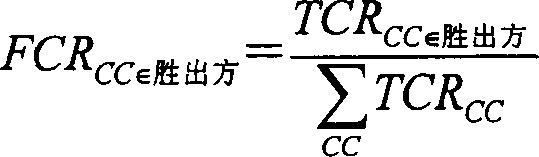
General property algorithm (GAA)
General property algorithm (GAA) is the general facility that is designed to provide the attributive classification of the clauses and subclauses in database (DB) or the information-storing device (IS).Different types of attribute needs the classification of achieving success of different types of data and algorithms of different.Classification can effectively utilize different types of information, but its quality still critically depends on the quality and the scope of basic semantic information.For example, if people only understand seven kinds in the tens of kinds of color designation, then to have low coverage rate be N/R to the color attribute index.In addition, sign is in advance mentioned but the misleading that do not identify color is expressed if do not have to attempt, and then property index may have low precision.For example, in fact the phrase as " green with envy (very jealous) " and so on does not indicate green." Snow white (snow-white) " may indicate the pure white form, but " pure as the driven snow " then do not relate to color at all.
Three kinds of compensation processes are used for from the product textual description property value of deriving by GAA: keyword extraction, derivation and similarity (cluster) are analyzed.
Each method may be advised certain property value potentially, and can allow that value to follow to put the letter grade.In the situation of conflict suggestion, can use the arbitrated procedure of mentioned kind.The simplest arbitrated procedure is only to keep the value with highest ranking, and abandon other the value that proposes to some extent.
Three kinds of compensation processes that GAA provides are as described below:
The A-keyword extraction
In keyword extraction method, adopt look-up table in the GAO knowledge base wherein preferably stored all these class key words and related context information thereof to identify and extract the key word of the probable value of given attribute dimension.For example,, and be stored among the GAO, then exist suitable evidence to come the color of this product of inference to be actually redness as color value if word " redness " appears in the product description.But should recognize the following fact: the appearance of certain words may be not enough to from the property value of that product of wherein deriving in the text of product.Must consider other text condition, for example occur the context of key word therein.If the color key word appears at phrase " available in colors: " afterwards, then in fact it represent that the probability of color value is very high, but in expressing " Levi ' sred label jeans ", the probability of key word " red " expression color " redness " is extremely low.Each property value key word among the GAO can have support and mislead contextual related explanation.Context for example can adopt conventional the expression to define.In general, during property value key word in running into data strip purpose text, GAA analysis context information is so that determine thereon the hereinafter credibility of that key word.
B-derives
About some judgement of property value can from other can obtain and believable classified information derive.Various derivation tables, be included in as above-mentioned CARMA and be used for that purpose among the CAKB.
The most general available among the GAA derivation rule has following form:
" as the satisfy condition given conjunction of Ci of fruit product; then possible values V1 ..., Vn each distribute to its classification type T ", wherein C be " type T have value V1 ..., among the Vn one " form, and type is a classification dimension (for example commodity, trade mark, model, color etc.).
Derivation rule also can be regulated by the value of putting the letter grade of given classification.When according to regular C from data B during derived value A, then A put the letter grade will for B put the letter grade multiply by C to put letter grade (regular C is the probability of correct rule) long-pending.Therefore, if sex " women " is derived from CC " skirt ", then the letter grade of putting of " women " will be the grade of " skirt " probability that multiply by skirt and in fact be used for the women (high but be not absolute, because may there be Scotland skirt that is used for the male sex).
Here be some examples of this rule-like:
1. attribute appropriateness: whether relevant with the CC that is considered from identifying certain attribute dimension of CC value inference even certain property value.Therefore, the attribute of length unlikely is suitable for computing machine.
2.IS-A derive: use all IS-A relations that occur among the CAKB, for example " mazarine is blue ".This derivation also may be carried out between dissimilar, for example " from CC ' women's dress ' derivation sex ' women ' ".Negate that derivation (" IS-NOT-A ") is also contained under this title.
3. eliminating polysemy derives: previous recorded data can be used for eliminating ambiguity between some conflict values of given key word or different the explanation.Therefore, must explain between (as color or as cloth) and select that we select to have maximum prefetch and write down one that puts the letter grade earlier in two differences of " denim ".
C-similarity (cluster) is analyzed
Similarity or cluster analysis be based on the statistical classification algorithm, for example support vector machine (SVM).Given attribute dimension, product represented by term vector, and term is the property value of the form of phrase in key word, the context or other structured data.Previous sort product (data clauses and subclauses) is come cluster according to the like attribute value, and calculates the cluster barycenter.Then, for example adopt " cosine " to measure or one of its variant compares the new product term vector with different barycenter, final to its distribution near the property value of barycenter.
Clustering method provides gratifying result to some attribute, but then not all right for other.When being applied to the clothes database, carry out index according to cluster and when being applied to the sex attribute, obtain precision ratio more than 90%, but for the cloth attribute, the result then can not being better than estimating at random.
The KNN method that is used for this comparison also is feasible, as last trifle for describing in detail in the commodity class index.
Interpreter
Given user request, from database to the retrieval of relevant entry by the information that from inquiry, derives with can be used in the database information of each clauses and subclauses and mate and realize.When some compositions of considering inquiry, as trade name during than other composition, as even more important true of property value, matching process is worked best.
A plurality of matching process are known to the skilled.Some matching process, can attempt by the derive relative importance of inquiry composition of statistical as term frequency/contrary document frequency-TF/IDF.But, for natural language querying, can adopt some field specific concept experiences simultaneously by the composition of inquiry being classified via the syntax and semantics clue, obtain better result.Therefore, one of main target of interpreter is which that detect inquiry partly carried the important information of what type.
Whether this notion is applied to the situation of ecommerce, and first target of interpreter is to detect the commodity (shirt, digital camera, fresh flower, chair ...) of user's request in its inquiry, clearly describe or hint just.Subsequently, interpreter should detect the term of the expection attribute of accurate appointment commodity, thereby limits the scope of the clauses and subclauses that can satisfy inquiry.Attribute may be color and cloth, the screen of TV set size etc. of coat.
It should be noted that, in this context, though many attributes can logically only be applied to the commodity class (for example screen size is not the association attributes of coat) of some, other many attributes, be applicable to the almost product of any commodity as price, luxurious state and trade mark.Similarly, inquiry can only be made up of popular personage/theme, no matter is novel, as Pokemon, HarryPotter or Jedi, or reality, as Chicago Bulls or The Beatles, and do not have description of commodity.When existing and not having description of commodity, interpreter should detect the attribute of these general classes.Aspect identical, should discern model name or catalog number, for example DCR-PC115 (Sony hand-held camera).
In order fully to handle these kinds of information, interpreter is preferably carried out following function:
Important term in the-sign query text,
Their concept status of-identification,
-processing misspelling,
Ubiquitous vocabulary (word meaning) or grammatical polysemy in-the processing natural language,
-synonym or closely related expression are identified as relevant with same concept,
-detect uncorrelated condition,
-can keep a plurality of proper interpretation of ambiguity inquiry, and
-under the unsuccessful situation of advanced analysis, provide the appropriateness of performance quality to reduce.
The part of method that is used to realize this class function is as described below.
A-inquires about marking, comprises the suitable processing of punctuation mark and special character
The B-morphology is sorted out, and promptly various query and search speech are simplified to the correct citation form of its standard language (" morphology "), so that the problem of the morphologic variation when overcoming consulting and comprising the various external source of CAKB.
The C-spelling error correction.Spelling error correction seems more complicated than it, because:
A) particularly in retail trade, many " misspelling " character string just in time is various entity titles.For example, Kwik-Fit is the title of auto repair chain store, rather than the misspelling of Quick-Fit;
B) misspelling also may appear in the database, therefore, proofreaies and correct some misspellings and may cause not matching of relevant entry;
C) often exist contention to estimate the many possible correction of spelling, and computerized system may the most suitably be had any problem as a result the time selecting;
D) the consulting spelling program obtains each character string, and the operation of institute's suggestion corrections of profiling error spelling simultaneously may be very heavy burden for system resource.
Extensively the complexity of knowledge base is used and generally can be overcome the problems referred to above, and provides the spelling correction of usefulness.
The identification of the concept status of D-term (" role ")-be mainly commodity and attribute-its mode are that consulting is at the conceptive CAKB composition of the knowledge base of classification in advance.Aid illustration, the related attribute kind of term for example, the subclass that can be used as the role provide-for example in attribute=color, cloth etc.
Important term is multi-words expression often, discerns them for correct, and algorithm should be attempted not only locating single word in CAKB, but also locatees many word sequences.This may increase the weight of the burden of system resource once more, because for the inquiry of n word, nearly any of the result of n word may be important term, thereby need search in CAKB.But many experiences can here be used for simplifying search, between them, for example according to punctuate, preposition and conjunction inquiry are divided into subsequence, and only search possible many word sequences in the inquiry section.
Focal characteristics and support or accidental quality that the E-difference is main.Such as " TV set rack " or " 50 " TV set rack " inquiry in, term " televisor " should not be identified as commodity.Term " televisor " is not the focus commodity of inquiry.But notion " televisor " is not again incoherent, and it is important for the type of specifying required shelf.Therefore, it has status of support.In general, interpreter can detection concept the identification term how relevant with the theme of inquiry.Syntax and semantics structure by considering text query-without limitation specifically, consider preposition and order of words in the inquiry realizes this detection.For example, appear at the focus commodity that preposition " for " or " by " item retrieves speech afterwards may not be inquiry.This class difference of encoding during query analysis is crucial for satisfactory entries match and classification.
F-discerns synonym.Synonym identification for example provides by above-mentioned USID mechanism, thereby effective for all synonym terms that exist among the CAKB.Any query and search speech of discerning in CAKB preferably returns suitable USID, and it is converted to the notion that can be used for all follow-up couplings and other treatment step to term, represents as the query and search speech.The query and search speech means to the conversion of notion, in fact according to notion rather than only come search data memory according to key word.
The identification of misleading or uncorrelated data in the G-inquiry.For example, if inquiry relates to the entity title such as the title (in general sense) of books, CD, film, picture, placard, printed matter etc. as a whole, the tangible commodity and the attribute retrieval speech that then appear in the inquiry may be uncorrelated.For example, be that " rings " should not be interpreted as trade name in the situation of " The Lord of the Rings " in inquiry.Therefore, interpreter should be equipped with the process that allows definition and examination criteria to analyze uncorrelated residing condition.Aspect identical, should be detected and suitably handle such as " Rolex-type ", " faux-fur " of wrist-watch, misleading property value " White Linen ".This class process is preferably based on suitable knowledge base.
The H-polysemy solves.Natural language is ambiguity inherently.It is preferred handling the polysemy in the natural language and forming some differences of inquiry and compete ability successful performance for search engine when facing natural language querying of explaining.In current embodiment, polysemy is handled in the following manner:
The ambiguity term has a plurality of clauses and subclauses in CAKB, respectively have suitable meaning identifier.When the ambiguity term appeared in the inquiry, its all CAKB listed the meaning identifier and are returned to interpreter.Interpreter then adopts the different meanings of query and search speech to make up a plurality of explanation versions of inquiry.Can use the word meaning to eliminate the whole bag of tricks of polysemy then, explain the degree that version is meaningless fully, which is significant and reach so which is determined.Obviously, only significant explanation version just keeps the final analysis as inquiry.
Have that all explain version, roles, the output of putting the interpreter of letter grade etc. is above-described formal request.
Adaptation
Clasfficiator
Clasfficiator is responsible for estimated probability according to match user needs (being correlativity) to the clauses and subclauses classification.The input of diversity module is comprised formal request and the user sequence to the response of previous prompting (if any), and database or IS clauses and subclauses and any note related with it.
The classification stage preferably comprised with the next stage:
1. from the classification of the clauses and subclauses of database retrieval.According to obvious unmatched selected thresholding, some clauses and subclauses can be got rid of from classification.
2. the structure of relative set.This relative set preferably comprises those clauses and subclauses that will consider among the IS when producing next prompting.
3. the structure of result set, those clauses and subclauses that may or should show to the user.Result set comprises usually from the clauses and subclauses that also surpass the classification of thresholding correlativity database retrieval, that keep the prompting process.
The correlativity classification can be considered the relative importance of the heterogeneity of formal request and previous user's response (if any).By the intensity of the coupling between measurement request and that particular items, grade should reflect that institute's classification terms can satisfy user's likelihood.Classification can be resolved into following composition:
-formal request reflects the likelihood that the user needs
The analysis of the feature of-clauses and subclauses and attribute (being extracted by index) is correct likelihood
In fact-additive keyword is applied to concrete clauses and subclauses (priori or study) probability
The role of each composition of-request is to (estimation or study) relative importance of user
-the feature of distributing to clauses and subclauses may satisfy user's the probability that request has the clauses and subclauses of that feature.Coupling fully between these features will be returned probability 1; Be lower than fully coupling, for example when the clauses and subclauses commodity by during the hypernym of request commodity, preferably correspondingly reduce probability, as mentioned above;
-concrete clauses and subclauses are with requested (priori or study) probability (being called popularity again measures);
-database (popularization, qualification etc.) deviation or restriction;
The cost of-clauses and subclauses retrieval.Cost may be for the user or for system.
The feature level of each product be from above detailed description tabulation, by identified addition on the query characteristics-the have combination of the suitable number that matching value calculated between suitable weight-clauses and subclauses feature and the query characteristics at all.Therefore, if the coupling of color is considered to not have gender matched important, then the gender matched weight will have the value bigger than color-match weight.The final classification of distributing to product preferably is made of the tlv triple of equal weight number: the branch level number of commodity classification, attribute (feature) classification and other term.Equal and fixed weight scheme purpose is that the matched well of guaranteeing many analytic attributes for example can not suppressed by bad commodity coupling.The user who searches for woolen blue overcoat may be acceptable for the Reply ruana of seeing non-blueness, and may also can accept for the blue overcoat of non-fleece material system, but for seeing that blue woollen sweater may be very surprised, and the use permission that the separately coupling of commodity and attribute is considered independently emphasizes irrespectively that with attribute commodity mate.
When some explanation versions some possible explanations of user view (expression) of inquiry when returning by interpreter, clauses and subclauses and all explain that the matching value between the version is calculated, and final classification is the weighted mean value (considering the weight of various version) on all versions.
Obtain for the prompting answer the time, the classification of clauses and subclauses is by corresponding renewal (posteriority).
The purpose of the relevant episode of clauses and subclauses is the clauses and subclauses that have the low probability that satisfies the user by ignoring, thereby reduces the content that the user is used as noise, improves the performance of prompting device.In a possible realization, having only fully, coupling is included in relevant set, expression interpreter identified, no matter be that each feature of commodity feature, attributive character or other term feature must provide effective matching value to the clauses and subclauses that are considered for retrieving, just can be included in relevant set.If do not find this coupling fully, then relevant episode is extended is lower than fully coupling to comprising, like this, for example has only and just understands the prompt system consideration in the time of can't finding red shirt fully and return orange shirt.
Result set is the sub-fraction of relevant episode, wherein comprises those clauses and subclauses with high associated ratings.They are will be to the clauses and subclauses of user's demonstration.In two kinds of situations by may being absolute, relative or its combination.
Prompting device
The task of prompting device is to provide one or more stimulations to the user, makes the user's response that stimulates be can be used for the clauses and subclauses in result set classification again (and filtration).Prompting device can be considered to be made up of two assemblies: prompting generator and prompting selector switch.Adopt the policy of navigating, the prompting generator is dynamically constructed the set of possible reduction prompting according to relevant classification terms and character thereof.(prompting-reduction prompting, purpose are to enrich the information about the specific product of being asked, so that dwindle possible relevant episode.)
Prompting may be visual or sounding, and can take many forms, generally includes prompting clarification data and a series of response option.
Prompting clarification data may be problem (for example " which trade mark? ") or command statement (for example " selection color "), perhaps show other any method of asking which kind of information to the user.The parameter and the details (for example definite wording of problem) of prompting clarification data are defined, and are stored in the above-mentioned navigation policy assembly.Prompting clarification data can be used for reduction prompting (as above illustrational) and eliminate the polysemy prompting (for example " which meaning you refer to? " or " selecting suitable spelling correction ").The use of prompting clarification data not necessarily because when response/answer choice when being intuitively tangible, it can be omitted.
Prompting can allow free text response, but little predefine response option set is provided usually.Response option can be expressed as:
-by for example " U.S.; Europe; The Asia ... " etc. classification, " color: redness for example; Blue; ... " etc. list of attribute values or such as " author; Date; The businessman ... " and so on the menu formed of the request etc. of value of aspect, perhaps prompting can be asked cost/Price Range etc.
-browse graph, for example navigation picture, semantic network etc.
Menu is selected to adopt picture explanation alternatively, particularly adopts from selecting the picture of relevant master's (high-grade) clauses and subclauses derivation with that.
In any given search situation, the prompting selector switch can be selected a large amount of promptings according to given institute's retrieve data collection.But, may not wish or even not need to provide all promptings to the user.In fact, information-theoretic approach can be used for estimating the practicality of different suggestion promptings by the prompting selector switch.As mentioned above, any answer that the is received prompting that can both obviously influence result set is better than the prompting that a few clauses and subclauses are only got rid of in most of answer.This method can with the cost function combination of the different promptings that can define in the policy in navigation.
In any given search situation, the main task of prompting maker is the most suitable prompting of Dynamic Selection/and the tabulation of answer choice.Whether prompting maker inspection inquiry exists any polysemy in explaining.Structure the difference that eliminating the polysemy prompting provides from interpreter is explained, and this process needn't quote the concrete clauses and subclauses of relevant set, but algorithm is also considered the solution of this class polysemy and whether is significantly reduced the relevant episode of institute's retrieve data clauses and subclauses.
As the main process of its action, the prompting maker considers which reduces prompting and is correlated with at the given state of search sessions.This is by considering which different classification peacekeeping value is what is realized by the data clauses and subclauses ' maintenance ' of relevant set and they in the frequency distribution of relevant set.If in fact chosen that answer, all answer choice of then presenting to the user must have at least one suitable clauses and subclauses that will present.Notice that each prompting of presenting to the user obviously must have at least two possibilities answer of problem, so that search procedure is had any auxiliary.Recall, classification dimension (for example color, price) definition prompting, and value or value scope are (for example red, blue; P $50-99, $99-200 etc.) definition answer choice.In any given search situation, possible prompting is only just effective when the different pieces of information clauses and subclauses of relevant set have at least two different values for the classification dimension of pointing out.Therefore, for example, if initial query at shirt, and all shirts of relevant set are same color, then prompting " what color? " obviously not effective.Should emphasize that the class value on any classification dimension can have complex organization's (for example hierarchy), the navigation policy can comprise the concrete constraint that is used to reduce prompting, thereby relevant reduction prompting of dynamic calculation and the normally quite complicated task of answer choice.
After making up the prompting collection that is fit to given search situation, the prompting in the set is through classification, so that present maximally related prompting to the user.The quantity of prompting can be according to changing such as the character of database and the environment such as strategy of looking into accuracy, user interface of initial query.The classification reflection of prompting may make data clauses and subclauses (for example product) that the more approaching user of comprising of relevant episode just seeking and the degree of having got rid of uncorrelated clauses and subclauses as much as possible to the answer of particular hint.For this reason, preferably each data clauses and subclauses is carried out some calculating.A kind of calculating is that entropy calculates, and it calculates the expectation quantity that identifies the required additional prompt of satisfactory clauses and subclauses after the response that receives this prompting.Entropy is provided by the rank value that preferably provides corresponding answer.Correct entropy assessment will offer less overlapping prompting between the clauses and subclauses with each answer of coupling to higher classification and low entropy.In addition, the prompting of the more clauses and subclauses of its answer covering preferably also obtains higher classification and low entropy.The final rank value that is applied to problem is then calculated by the importance values of entropy and problem is multiplied each other.
Learner
As mentioned above, machine learning techniques can be used as the option that strengthens the search engine performance.Machine learning can be applicable to one or more in some fields, particularly comprises the following:
1. select to upgrade the clauses and subclauses popularity by trackbar purpose user,
2. specifically ask the tracking of the ASSOCIATE STATISTICS between term pattern or composition and actual selected each clauses and subclauses,
3. the tracking of the ASSOCIATE STATISTICS between the attribute, and
4. the response frequency of each clauses and subclauses by following the tracks of final selection is improved prompting and is selected.
In order in this class environment, to realize machine learning, wherein preferably also collect following data:
1. clauses and subclauses popularity: the frequency that each clauses and subclauses is selected,
2. attribute frequency: each property value appears in the request or to the frequency in the response of prompting,
3. response: the frequency that each prompting is responded, never force users is answered each problem,
4. attribute-clauses and subclauses correlativity: for each clauses and subclauses, selector bar purpose frequency after attribute is requested,
5. response frequency: may respond for each of prompting, select the frequency of this response,
6. Response Distribution:, give the frequency that is selected after the provisioning response receiving for each clauses and subclauses
7. cross attribute statistics: the selected properties value between correlation matrix
Collected data are used for improving the table of the used suitable given data type of interpreter, clasfficiator and prompting device.The semantic information that interpreter has benefited from upgrading, for example attribute frequency and cross attribute statistics.The epidemic index that clasfficiator has benefited from upgrading, improved note, preferably based on the attributes entries correlativity, and the response of upgrading expectation.Prompting device also has benefited from the latter.
Conclusion
In sum, the aspect of current embodiment comprises the following:
1. whole
A. by interprets queries at first, expand inquiry then, carry out coupling to comprise coordinate indexing speech and clauses and subclauses, then according in said focusing circulation with user's dialogue compression result collection, preferred embodiment receives to inquire about to institute and operates.Expand the interpolation comprise synonym and classification and otherwise relevant term.Expansion is based on explaining (query analysis), and it also can comprise the grammer processing of carrying out inquiry, so that determine which term is that focus term (promptly describing required object) and which clauses and subclauses are descriptive or the attribute retrieval speech,
B. a preferred embodiment carries out aforesaid operations to inquiry after the index in advance at data set, so that organize the clauses and subclauses of data centralization and notion mark, synonym, attribute, association etc.
2. front end query processing
A. preferred embodiment is explained any given inquiry, particularly seeks noun phrase, with " key word " or " literary composition all over Britain " system, a kind of method arranged side by side as Ask Jeeves.
B. explain to comprise preferably that be noun or object and the attribute of being searched for, so that assist search and assign weight to the inquiry analysis.
3. head-end facility-focusing circulation.
A. front end can participate in the mutual circulation with the user, and purpose is to dwindle the quantity of possible related data clauses and subclauses.In this circulation, system presents the prompting of preferably dynamically working out to the problem that has at user option response option to the user.The selection of prompting comprises considers current ' talks ', overall experience of past and particular user preference.How the possible answer of main consideration cuts apart institute's retrieving head effectively.Therefore, have the problem of two answers, one of them answer get rid of data set 98% and another get rid of the other 2% of data set, be counted as problem than poor efficiency.Another problem that also has two answers, wherein each answer get rid of data set about 50% but institute's exclusive segment is overlapping, also will be counted as problem than poor efficiency.On the other hand, have a problem of two answers, about 50% and two answer that wherein each got rid of data set is exclusive mutually, can be counted as extremely effectively problem.
In a preferred embodiment, as mentioned above, system can produce some promptings and service efficiency and other consideration, should present to the user so that judge which prompting.
Also can so that obtain information, thereby solve polysemy, misspelling etc. focusing on the formation prompting of any stage of round-robin.
B. front end adopts classification technique, so that to the Search Results classification and be used for selecting prompting.In a preferred embodiment, the generation of reduction prompting is dynamically based on the data strip purpose classification (rather than having the fixation problem of programming in advance of given theme) that can be used in the information-storing device.
C. dynamically produce answer/response option for prompting.Only when being mapped at least one current data clauses and subclauses of relevant set, just provide possible answer.Preferably also for the user provides the option that does not respond any given prompting, in this case, another prompting can be selected to present by system.Once can be the user and present some promptings, perhaps system can wait for the answer that receives this before the inquiry next one.
D. focusing on any stage of round-robin, system allows the user to show that current results is undesirable.In one embodiment, can be the user present comprise initial retrieving but the result of those contents of in focusing on circulation, being excluded.
4. rear end-data qualification and index
A. the data clauses and subclauses that preferably relate in information-storing device of index provide the classification note.
B. for specific embodiment, the class of some kind can have privileged state.For example, for the ecommerce catalogue, distinguish the difference between commodity class and the Attribute class, the latter has certain dependency to the former.
C. the combination of the method for rule-based and statistics is preferably adopted in automatic classification, and both all use certain language analysis of data item text.If the use diverse ways, then arbitration can be used to select optimum.
d.
5. the use of unit
The machine learning unit can be used for collecting data from ' experience ', so that improve search procedure and/or assorting process.For the improvement of search procedure learn to relate to during (user as a whole or any subclass of user) search sessions from the user interactions of system collect data.
6. towards the processing of text.
No matter the new clauses and subclauses that database is added in initial data base or processing to are still handled in the processing inquiry, current embodiment utilization is towards the method for text, comprise the following: language pre-service-comprise is cut apart, marking and analysis,-processing synonymy and meaning sign, handle deformation form, statistical classification, derivation utilizes the semantic information of rule-based classification, based on the classification of language rule and the probabilistic confidence classification of statistical classification, in conjunction with a plurality of sorting algorithms, in conjunction with classification to different aspect or clauses and subclauses, or the like.Handle polysemy and comprise processing misspelling, vocabulary/semantic polysemy and grammatical polysemy.In general, polysemy is handled via the method that is called ' explanation version conversion '.In explaining version conversion, in any case available in the difference explanation, create a plurality of explanation versions.Each version is then submitted to all other stages of explanation/assorting process, and wherein, some stage relates to implicit or clearly eliminates polysemy.Constantly calculate degree of confidence and/or likelihood grade, so that monitoring difference is during the course explained the truthlikeness states of version.
Spelling correction itself is handled for inquiry and for the data clauses and subclauses in the context-sensitive mode.Specifically, spell correction suggestions adopts the contextual information of its solution to handle as polysemy.
Whole conclusion
As everybody knows, for the sake of clarity, some feature of the present invention is to describe in the context of the embodiment that separates, but they also can be combined among the single embodiment and provide.On the contrary, for the sake of brevity, many features of the present invention are to describe in the context of single embodiment, but they also can separate or provide in any suitable recombinant.
Though described the present invention in conjunction with some specific embodiments, obviously can be perfectly clear many alternativess, modifications and changes of those skilled in the art.Therefore, be intended to comprise the spirit that belongs to claims and all these class alternativess, the modifications and changes within the broad scope.All publications, patent and the patented claim of mentioning in this explanation is intactly incorporated herein by reference, and it is incorporated herein by reference clearly to be reached independent expression as each publication, patent or patented claim.In addition, any citation of quoting among the application or sign should not be considered as this quoting and can be used as prior art and be used for permission of the present invention.
Claims (260)
1. one kind is used for search database to produce the exchange method that refines result space, and described method comprises:
For search criterion is analyzed,
Use described search criterion to search for described database, thereby obtain the initial results space, and
Obtain user input limiting described initial results space, thereby obtain described refinement result space.
2. the method for claim 1 is characterized in that, described search comprises to be browsed.
3. the method for claim 1 is characterized in that, before search described database is carried out described analysis, thereby optimizes described database for described search.
4. the method for claim 1 is characterized in that, described analysis is carried out the search criterion of user's input.
5. the method for claim 1 is characterized in that, described analysis comprises the employing language analysis.
6. method as claimed in claim 4 is characterized in that, comprises the initial ranging standard is carried out described analysis, so that obtain additional search criteria.
7. method as claimed in claim 6 is characterized in that, described search criterion is invalid standard.
8. method as claimed in claim 6 is characterized in that, for the described analysis that additional search criteria is carried out adopts the language analysis of described initial ranging standard to carry out.
9. the method for claim 1 is characterized in that, described analysis is carried out by selecting related notion.
10. the method for claim 1 is characterized in that, described analysis employing was operated the data that obtain from the past of described method and carried out.
11. the method for claim 1 is characterized in that, comprises at least one prompting that has at least two answers by generation, produces the prompting that is used for the described user's of obtaining input, described answer is selected to divide described initial results space.
12. method as claimed in claim 11 is characterized in that, described generation prompting comprises that producing at least one segmentation with the answer of a plurality of possibility points out, and each answer is corresponding to the part of described result space.
13. method as claimed in claim 12 is characterized in that, the each several part of described result space comprises proportional in fact share of described result space.
14. method as claimed in claim 12 is characterized in that, comprises producing a plurality of segmentation promptings, and from wherein selecting its answer to divide the prompting of described result space the most equably.
15. method as claimed in claim 11 is characterized in that, the described result space of described qualification comprises gets rid of any result who does not correspond to the answer that provides in described user's input from described result space.
16. method as claimed in claim 15 is characterized in that, also comprises allowing the user to insert additional text, described text can be used as the part of the input of user described in the described qualification.
17. method as claimed in claim 11 is characterized in that, also comprises at least one the further prompting that has at least two answers by generation, repeats the described user's of obtaining input, described answer is selected to divide described refinement result space.
18. method as claimed in claim 17 is characterized in that, comprises continuing described qualification, is retracted to pre-sizing until described refinement result space.
19. method as claimed in claim 17 is characterized in that, comprises continuing described qualification, until not finding further prompting.
20. method as claimed in claim 17 is characterized in that, comprises continuing described qualification, imports until receiving the user, thereby stops further to limit and submitting to existing result space.
21. method as claimed in claim 17 is characterized in that, also comprise determining that the result space of submitting does not comprise the expection clauses and subclauses, and described determine after, the initial retrieval clauses and subclauses by described qualification eliminating to described user's submission.
22. method as claimed in claim 20 is characterized in that, also comprises:
Obtain the result space of submitting to from the user and do not comprise determining of expection clauses and subclauses, and
Initial retrieval clauses and subclauses to the described for ratification qualification eliminating of described user.
23. the method for claim 1 is characterized in that, comprises as the user importing the described initial ranging standard that receives.
24. method as claimed in claim 11 is characterized in that, describedly obtains described user input and is included as the user possibility of described prompting not being selected answer is provided.
25. method as claimed in claim 24 is characterized in that, also is included in described user and does not select to inquire additional prompt after the answer.
26. the method for claim 1 is characterized in that, also comprises according to user's final selection to clauses and subclauses after inquiry coming the inner search of update system support information.
27. method as claimed in claim 26 is characterized in that, described renewal comprises the correlativity between the clauses and subclauses of revising described selection and the described user's input of obtaining.
28. being used for alternatively, search database comprises to produce the device that refines result space:
The search criterion analyzer is used for analyzing with the acquisition search criterion,
The database search device, related with described search criterion analyzer, be used to utilize described search criterion to search for described database, thereby obtain the initial results space, and
Delimiter is used to obtain user input limiting described result space, and utilizes described user to import to limit described result space, refine result space thereby work out.
29. device as claimed in claim 28 is characterized in that, described search criterion analyzer comprises database data item analysis device, and it can produce the classification of data strip purpose, so that corresponding with the search criterion of being analyzed.
30. device as claimed in claim 28 is characterized in that, described search criterion analyzer comprises database data item analysis device, and it can utilize the classification of data strip purpose, so that corresponding with the search criterion of being analyzed.
31. device as claimed in claim 29 is characterized in that, described search criterion analyzer can also utilize the classification of data strip purpose, so that corresponding with the search criterion of being analyzed.
32. device as claimed in claim 29 is characterized in that, described database data item analysis device is used at least a portion that described database is analyzed in described search before.
33. device as claimed in claim 29 is characterized in that, described database data item analysis device is used at least a portion that described searching period is analyzed described database.
34. device as claimed in claim 28 is characterized in that, described analysis comprises language analysis.
35. device as claimed in claim 28 is characterized in that, described analysis comprises statistical study.
36. device as claimed in claim 34 is characterized in that, described analysis comprises the statistical language analysis.
37. device as claimed in claim 28 is characterized in that, the initial ranging standard that described search criterion analyzer is configured to receive from the user is used for described analysis.
38. device as claimed in claim 37 is characterized in that, described initial ranging standard is invalid standard.
39. device as claimed in claim 37 is characterized in that, described analyzer is configured to carry out the language analysis of described initial ranging standard.
40. device as claimed in claim 28 is characterized in that, described analyzer is configured to come execution analysis according to the selection of related notion.
41. device as claimed in claim 28 is characterized in that, described analyzer is configured to come execution analysis according to the historical knowledge that obtains in the prior searches.
42. device as claimed in claim 28 is characterized in that, described delimiter can be used for producing the prompting that is used for the described user's of obtaining input, and described prompting comprises at least two optional responses, and described response can be used for dividing described initial results space.
43. device as claimed in claim 42, it is characterized in that, described prompting comprises the segmentation prompting with the answer of a plurality of possibility, and each answer is corresponding to the part of described result space, and each part comprises proportional in fact share of described result space.
44. device as claimed in claim 42 is characterized in that, produces described prompting and comprises
Produce and respectively to have a plurality of a plurality of segmentations promptings that may answers, each answer is corresponding to the part of described result space, and each part comprises proportional in fact share of described result space, and
Select its answer to divide one of described prompting of described result space the most equably.
45. device as claimed in claim 42 is characterized in that, also comprises allowing the user to insert additional text, described text can be by the part of described delimiter as described user's input.
46. device as claimed in claim 42 is characterized in that, the described result space of described qualification comprises any result who does not correspond to the answer that provides described user's input from wherein getting rid of, thereby produces the revision result space.
47. device as claimed in claim 46 is characterized in that, described delimiter can be used for producing at least one the further prompting with at least two answers, and described answer is selected to divide described revision result space.
48. device as claimed in claim 47 is characterized in that, described delimiter is configured to continue described qualification, is retracted to pre-sizing until described refinement result space.
49. device as claimed in claim 47 is characterized in that, described delimiter is configured to continue described qualification, until not finding further prompting.
50. device as claimed in claim 47 is characterized in that, described delimiter is configured to continue described qualification, until receiving user's input, has result space now thereby stop further to limit and submit to.
51. device as claimed in claim 50, it is characterized in that, the user can be responded: the result space of submitting to does not comprise the expection clauses and subclauses, and described device is configured to submit the initial retrieval clauses and subclauses of having got rid of by described qualification to described user when receiving this response.
52. device as claimed in claim 47, it is characterized in that, comprise that determining that the result space of submitting does not comprise expect the operability of clauses and subclauses, described device is in this initial retrieval clauses and subclauses by described qualification eliminating that are configured to after determining when receiving this response to described user's submission.
53. device as claimed in claim 28 is characterized in that, described analyzer is configured to import the described initial ranging standard that receives as the user.
54. device as claimed in claim 42 is characterized in that, described delimiter is configured to provide the possibility of described prompting not being selected answer by the described user of prompting for.
55. device as claimed in claim 54 is characterized in that, described delimiter is used in described user and does not select to provide further prompting after the answer.
56. device as claimed in claim 28 is characterized in that, also comprises updating block, is used for coming the inner search of update system support information according to user's final selection to clauses and subclauses after inquiry.
57. device as claimed in claim 56 is characterized in that, described renewal comprises the correlativity between the clauses and subclauses of revising described selection and the described user's input of obtaining.
58. device as claimed in claim 56 is characterized in that, described renewal comprises the classification of the clauses and subclauses of revising described selection and the correlativity between described user's input of obtaining.
59. a database has and is used for the interactive search database produce to refine the device of result space, described device comprises:
The search criterion analyzer is used to search criterion and analyzes,
The database search device, related with described search criterion analyzer, be used to utilize search criterion to search for described database, thereby obtain the initial results space, and
Delimiter is used to obtain user input limiting described result space, and utilizes described user to import to limit described result space, thereby described refinement result space is provided.
60. device as claimed in claim 59 is characterized in that, described search criterion analyzer comprises database data item analysis device, and it can produce the classification of data strip purpose, so that corresponding with the search criterion of being analyzed.
61. database as claimed in claim 59 is characterized in that, described search criterion analyzer comprises database data item analysis device, and it can utilize the classification of data strip purpose, so that corresponding with the search criterion of being analyzed.
62. database as claimed in claim 60 is characterized in that, described database data item analysis device can also utilize the classification of data strip purpose, so that corresponding with the search criterion of being analyzed.
63. database as claimed in claim 59 is characterized in that, described search criterion analyzer comprises the search criterion analyzer that can come the search criterion that analysis user provides according to described database discal patch purpose taxonomic structure.
64. database as claimed in claim 59 is characterized in that, comprises the data clauses and subclauses, and wherein each data clauses and subclauses analyzed as being possible search criterion, thereby the coupling of optimization and user's inputted search standard.
65. database as claimed in claim 60 is characterized in that, described database data item analysis device can be used for the effective language analysis.
66. database as claimed in claim 60 is characterized in that, described database data item analysis device can be used for carrying out statistical study.
67., it is characterized in that described database data item analysis device can be used for carrying out statistical study as the described database of claim 65.
68. database as claimed in claim 59 is characterized in that, the initial ranging standard that described search criterion analyzer is configured to receive from the user is used for described analysis.
69., it is characterized in that described initial ranging standard is invalid standard as the described database of claim 68.
70., it is characterized in that described analyzer is configured to carry out the language analysis of described initial ranging standard as the described database of claim 68.
71. database as claimed in claim 59 is characterized in that, described analyzer is configured to come execution analysis according to the selection of related notion.
72. database as claimed in claim 59 is characterized in that, described analyzer is configured to come execution analysis according to the historical knowledge that obtains in the prior searches.
73. database as claimed in claim 59 is characterized in that, described delimiter can be used for producing the prompting that is used for the described user's of obtaining input, and described prompting comprises the prompting with at least two answers, and described answer is selected to divide described initial results space.
74. as the described database of claim 73, it is characterized in that, described prompting is the segmentation prompting with the answer of a plurality of possibility, and each answer is corresponding to the part of described result space, and each part comprises proportional in fact share of described result space.
75. database as claimed in claim 59 is characterized in that, also comprises allowing the user to insert additional text, described text can be by the part of described delimiter as described user's input.
76., it is characterized in that the described result space of described qualification comprises from wherein getting rid of any result of one of the described answer do not correspond to described user's input, thereby produces the revision result space as the described database of claim 73.
77., it is characterized in that described delimiter can be used for producing at least one the further prompting with at least two answers as the described database of claim 76, described answer is selected to divide described revision result space.
78., it is characterized in that described delimiter is configured to continue described qualification as the described database of claim 77, be retracted to pre-sizing until described refinement result space.
79., it is characterized in that described delimiter is configured to continue described qualification as the described database of claim 77, until not finding further prompting.
80., it is characterized in that described delimiter is configured to continue described qualification as the described database of claim 77,, have result space now thereby stop further to limit and submit to until receiving user's input.
81. as the described database of claim 80, it is characterized in that, described user can be responded: the result space of submitting to does not comprise the expection clauses and subclauses, and described database is used in when receiving this response and submits the initial retrieval clauses and subclauses of having got rid of by described qualification to described user.
82. as the described database of claim 77, it is characterized in that, can be used for also determining that the result space of submitting to does not comprise the expection clauses and subclauses, described database is used in this definite initial retrieval clauses and subclauses of having got rid of by described qualification to described user's submission afterwards.
83. database as claimed in claim 59 is characterized in that, described analyzer is configured to import the described initial ranging standard that receives as the user.
84., it is characterized in that described delimiter is configured to provide the possibility of described prompting not being selected answer by the described user of prompting for as the described database of claim 73.
85., it is characterized in that described delimiter also is configured to not provide additional prompt after described user does not select answer as the described database of claim 84.
86. database as claimed in claim 59 is characterized in that, also comprises updating block, is used for coming the inner search of update system support information according to user's final selection to clauses and subclauses after inquiry.
87., it is characterized in that described renewal comprises the correlativity between the clauses and subclauses of revising described selection and the described user's input of obtaining as the described database of claim 86.
88., it is characterized in that described renewal comprises the classification of the clauses and subclauses of revising described selection and the correlativity between described user's input of obtaining as the described database of claim 86.
89. one kind is used for the search data strip purpose querying method of storing, described method comprises:
I) receive the inquiry that comprises at least the first search term,
Ii) expand described inquiry by add the term relevant to described inquiry with the described at least the first search term,
Iii) retrieval and at least one corresponding data clauses and subclauses in the described term,
Iv) use the property value be applied to described institute retrieve data clauses and subclauses to work out prompting to described user,
V) at least one in the prompting of the described formulation of described user's query, as the prompting that is used to focus on described inquiry,
Vi) receive response to it, and
Vii) use the response of described reception and the value of described attribute to compare, so that get rid of in the described institute retrieving head some, thereby the subclass that described institute retrieve data clauses and subclauses are provided is as Query Result.
90., it is characterized in that described inquiry comprises a plurality of terms as the described method of claim 89, and the described inquiry of described expansion also comprises the described term of analysis so that the phraseological mutual relationship between some in definite described term.
91. as the described method of claim 90, it is characterized in that, also comprise and use described phraseological mutual relationship to identify the main term and the retrieval-assisted phrase of described search inquiry.
92., it is characterized in that described expansion comprises respectively adds three following phase process to described inquiry as the described method of claim 89:
A) with the closely-related clauses and subclauses of described search term,
B) on less degree with the relevant clauses and subclauses of described search term, and
C) the alternative explanation that obtains because of any polysemy intrinsic in the described search term.
93., it is characterized in that described clauses and subclauses are one that comprises in the group of vocabulary term and representation of concept as the described method of claim 92.
94., it is characterized in that, also comprise duplication stages iii) to vi) at least one additional focusing process, thereby the refinement subclass that described institute retrieve data clauses and subclauses are provided is as described Query Result as the described method of claim 89.
95., it is characterized in that, also comprise according to based on the prompting ordering of the entropy weight of probable value, and inquiry has in the described prompting of more extreme entropy weight some described formulation as the described method of claim 89.
96. as the described method of claim 95, it is characterized in that, also be included in the response that receives for previous prompting and recomputate described probable value afterwards, thereby recomputate described entropy weight.
97. as the described method of claim 95, it is characterized in that, also comprise the dynamic answer set that adopts each prompting, described dynamic answer set comprises the answer related with classification value, described classification value is true for some institute's clauses and subclauses that receive, be vacation for other institute's clauses and subclauses that receive, thereby distinguish described institute retrieving head.
98. as the described method of claim 97, it is characterized in that, also comprise according to the respective capabilities of distinguishing described institute retrieving head to each answer classification in the described dynamic answer set.
99. as the described method of claim 95, it is characterized in that, also comprise according to the user search behavior and revise described probable value.
100., it is characterized in that described user search behavior comprises active user's past behavior as the described method of claim 99.
101., it is characterized in that described user search behavior is included in one group of user and goes up the past behavior of assembling as the described method of claim 99.
102., it is characterized in that described modification comprises that adopting described user search behavior to obtain each data strip purpose priori selects probability, and revises described weight to reflect described probability as the described method of claim 99.
103., it is characterized in that at least one in the group of described entropy weight and described clauses and subclauses classification that comprises described clauses and subclauses and corresponding classification value is related as the described method of claim 95.
104. as the described method of claim 89, it is characterized in that, be included in described reception inquiry and before the described data clauses and subclauses of storing carried out semantic analysis.
105. as the described method of claim 89, it is characterized in that, the described data clauses and subclauses of storing carried out semantic analysis during being included in search sessions.
106., it is characterized in that described semantic analysis comprises described data clauses and subclauses are divided into some classes as the described method of claim 104.
107. as the described method of claim 106, it is characterized in that, also comprise attribute is divided into Attribute class.
108., it is characterized in that described classification is included among object class or the main classes and among Attribute class and all distinguishes as the described method of claim 106.
109., it is characterized in that a plurality of classification that provide the individual data clauses and subclauses are provided in described classification as the described method of claim 108.
110. as the described method of claim 106, it is characterized in that, select the classification of each class to arrange in advance for the intrinsic meaning of the theme of associated databases.
111. as the described method of claim 110, it is characterized in that, comprise that classification arranges the main classes in the described class.
112. as the described method of claim 107, it is characterized in that, comprise classification alignment attribute class.
113. as the described method of claim 112, it is characterized in that, also comprise from the classification of described term and arrange the semantic meaning of determining the term the described data clauses and subclauses.
114., it is characterized in that described class also is used to analyze described inquiry as the described method of claim 111.
115. as the described method of claim 110, it is characterized in that, property value assigned weight according to the theme of associated databases.
116. as the described method of claim 110, it is characterized in that, in described property value and the described class at least one distributed role according to the theme of associated databases.
117., it is characterized in that described role also is used to analyze described inquiry as the described method of claim 116.
118. as the described method of claim 117, it is characterized in that, also comprise according to the described role that described theme distributed and come the assigns importance weight according to described database.
119. as the described method of claim 118, it is characterized in that, comprise and adopt described weights of importance to distinguish the inquiry that part satisfies.
120., it is characterized in that described analysis comprises the analysis of noun phrase type as the described method of claim 106.
121., it is characterized in that described analysis comprises adopting with described stores the language technology that the relevant knowledge base of data strip purpose theme is supported as the described method of claim 106.
122., it is characterized in that described analysis comprises the employing statistical discriminant technique as the described method of claim 106.
123., it is characterized in that described analysis comprises the combination of adopting the following as the described method of claim 106:
I) store the language technology that the relevant knowledge base of data strip purpose theme is supported with described, and
Ii) statistical technique.
124., it is characterized in that described statistical technique is carried out the data clauses and subclauses as the described method of claim 123 after described language technology.
125., it is characterized in that described language technology comprises at least one in the following as the described method of claim 123:
Cut apart,
Marking,
Morphology is sorted out,
Mark,
The part of speech mark, and
Described data strip purpose is to the small part named entity recognition.
126. as the described method of claim 123, it is characterized in that, comprise that also in the probability that adopts probability and be arranged as weight at least one distinguish the Different Results from described each technology.
127. as the described method of claim 126, it is characterized in that, also comprise according to the user search behavior and revise described weight.
128., it is characterized in that described user search behavior comprises active user's past behavior as the described method of claim 127.
129., it is characterized in that described user search behavior is included in one group of user and goes up the past behavior of assembling as the described method of claim 127.
130., it is characterized in that the output of described language technology is as the input of described at least a statistical technique as the described method of claim 123.
131., it is characterized in that described at least a statistical technique is used for described language technology as the described method of claim 123.
132. as the described method of claim 123, it is characterized in that, comprise and adopt two kinds of statistical techniques.
133. as the described method of claim 89, it is characterized in that, also comprise distributing showing and described at least one code of storing at least one the related meaning in the data clauses and subclauses, described distribution be to see probably at described at least one store the term of data strip purpose in inquiring about.
134. as the described method of claim 133, it is characterized in that, with in the property value of described at least one related described meaning of storing in data clauses and subclauses Attribute class that is described clauses and subclauses, described clauses and subclauses and described clauses and subclauses at least one.
135., it is characterized in that as the described method of claim 133, also comprise by described at least one code distributed in new term, expand the scope that sees the described term in the inquiry probably.
136. as the described method of claim 133, it is characterized in that, comprise the grouping that the class term is provided and the grouping of property value term.
137. as the described method of claim 106, it is characterized in that, if described analysis sign polysemy, then carry out the stage of the described inquiry of test for the semantic validity of each meaning in the described polysemy, and provide the prompting that solves described validity to described user in effective each meaning semantically for being considered to.
138. as the described method of claim 106, it is characterized in that, if described analysis sign polysemy, then carry out the stage of the described inquiry of test for the semantic validity of each meaning in the described polysemy, and for being considered to, then come the retrieve data clauses and subclauses and retrieve to distinguish described meaning according to the corresponding data clauses and subclauses according to it in effective each meaning semantically.
139. as the described method of claim 106, it is characterized in that, if described analysis sign polysemy, then carry out the stage of the described inquiry of test for the semantic validity of each meaning in the described polysemy, and for being considered to, adopting and distinguish described in effective meaning semantically with the described related knowledge base of data strip purpose theme of storing in effective each meaning semantically.
140., it is characterized in that as the described method of claim 89, also comprise the pre-defined probability matrix of each data clauses and subclauses, related described data clauses and subclauses with property value set.
141. as the described method of claim 140, it is characterized in that, comprise that also the described probability of employing solves the polysemy in the described inquiry.
142., it is characterized in that also comprise the stage of handling the input text that comprises a plurality of terms relevant with the predetermined concepts collection, so that with regard to described notion described term is classified, the described stage comprises as the described method of claim 89:
Described predetermined concepts collection is arranged as the notion hierarchy,
Described term and corresponding concepts coupling, and
Other notion relevant with the classification of described coupling notion is applied to described corresponding term.
143., it is characterized in that described notion hierarchy comprises at least one in the following relation as the described method of claim 142:
(a) hypernym-hyponym relation,
(b) part-whole relationship,
(c) property value dimension-property value relation,
(d) mutual relationship between the adjacent concept subhierarchy.
144., it is characterized in that described classification also comprises the application degree of confidence to described term as the described method of claim 142, so as according to the type of the judgement of carrying out for each notion of coupling to the classification of described coupling notion.
145. as the described method of claim 142, it is characterized in that, also comprise:
Identify the preposition in the described text,
Utilize the relation of described preposition and described term that term is designated the focus term, and
Be set to the focus notion with the notion of described focus term coupling.
146., it is characterized in that the described notion of described arrangement comprises the synonym concept grouping together as the described method of claim 142.
147., it is characterized in that the grouping of described synonym notion comprises as the grouping of the conceptual retrieval speech of morphologic variation mutually as the described method of claim 146.
148., it is characterized in that at least one in the described term has a plurality of meanings as the described method of claim 142, described method comprises that the described a plurality of meanings of difference are to select the elimination polysemy stage of most probable meaning.
149., it is characterized in that the described elimination polysemy stage comprises at least one in related of the related and model of the trade mark between the corresponding concepts of comparison property value, attribute dimension, described input text and described a plurality of meanings as the described method of claim 148.
150. as the described method of claim 149, it is characterized in that, describedly relatively comprise definite statistical probability.
151. as the described method of claim 148, it is characterized in that, the described elimination polysemy stage comprise first meaning in described a plurality of meanings be designated with described text in described term in another classification relevant, and select described first meaning as described most probable meaning.
152. as the described method of claim 148, it is characterized in that, comprise at least two that keep in described a plurality of meanings.
153., it is characterized in that, also comprise probability classes of applications each in described reservation meaning, thereby determine most probable meaning as the described method of claim 152.
154., it is characterized in that, also comprise the alternative spelling of searching in the described term at least one, and each alternative spelling is used as alternative meaning as the described method of claim 148.
155. as the described method of claim 154, it is characterized in that, also comprise and adopt corresponding concepts to concern to determine in the described alternative spelling most probable one.
156., it is characterized in that described input text is the clauses and subclauses that will add in the database as the described method of claim 142.
157., it is characterized in that described input text is the inquiry that is used for search database as the described method of claim 142.
158. one kind is used for the search data strip purpose querying method of storing, described method comprises:
Receive the inquiry that comprises at least the first search term from the user,
Expand described inquiry by add the term relevant to described inquiry with the described at least the first search term,
Analyze described inquiry with regard to polysemy,
Solve prompting for described user works out at least one polysemy, feasible answer to described prompting solves described polysemy,
Consider and point out the answer that is received to revise described inquiry described polysemy solution,
Retrieval and the described corresponding data clauses and subclauses of inquiry of having revised,
For working out the result, described user limits prompting,
At least one that select described result to limit in the prompting inquired described user, and receives its response,
Adopt the response of described reception to get rid of in the described institute retrieving head some, thereby provide the subclass of described institute retrieve data clauses and subclauses as Query Result to described user.
159., it is characterized in that described inquiry comprises a plurality of terms as the described method of claim 158, and the described inquiry of described expansion comprises that also the described term of analysis is to determine the phraseological mutual relationship between some in the described term.
160., it is characterized in that described expansion comprises respectively adds three following phase process to described inquiry as the described method of claim 158:
A) with the closely-related clauses and subclauses of described search term,
B) on less degree with the relevant clauses and subclauses of described search term, and
C) the alternative explanation that obtains because of any polysemy intrinsic in the described search term.
161., it is characterized in that, also comprise duplication stages iii) to vi) at least one additional focusing process, thereby the refinement subclass that described institute retrieve data clauses and subclauses are provided is as described Query Result as the described method of claim 158.
162., it is characterized in that, comprise that also basis sorts to the prompting of described formulation based on the entropy weight of probable value, and inquire in the described prompting with more extreme entropy weight some as the described method of claim 158.
163. as the described method of claim 162, it is characterized in that, also be included in the response that receives for previous prompting and recomputate described probable value afterwards, thereby recomputate described entropy weight.
164. as the described method of claim 162, it is characterized in that, also comprise the dynamic answer set that adopts each prompting, described dynamic answer set comprises the answer related with property value, described property value is true for some institute's clauses and subclauses that receive, be vacation for other institute's clauses and subclauses that receive, thereby distinguish described institute retrieving head.
165. as the described method of claim 164, it is characterized in that, also comprise according to the respective capabilities of distinguishing described institute retrieving head to each answer classification in the described dynamic answer set.
166. as the described method of claim 162, it is characterized in that, also comprise according to the user search behavior and revise described probable value.
167., it is characterized in that described user search behavior comprises active user's past behavior as the described method of claim 166.
168., it is characterized in that described user search behavior is included in one group of user and goes up the past behavior of assembling as the described method of claim 166.
169., it is characterized in that described modification comprises that adopting described user search behavior to obtain each data strip purpose priori selects probability, and revises described weight to reflect described probability as the described method of claim 166.
170., it is characterized in that at least one in the group of described entropy weight and classification that comprises described clauses and subclauses, respective attributes and classification value is related as the described method of claim 162.
171. as the described method of claim 158, it is characterized in that, be included in described reception inquiry and before the described data clauses and subclauses of storing carried out semantic parsing.
172. as the described method of claim 171, it is characterized in that, described semantic analysis before the inquiry comprises described data clauses and subclauses is arranged as class in advance, each class has the property value that has distributed, the described arrangement in advance comprises and analyzes described data clauses and subclauses so that from identification data clauses and subclauses class wherein, and identify the property value of described class when existing.
173. as the described method of claim 172, it is characterized in that, comprise described property value is arranged as class.
174. as the described method of claim 172, it is characterized in that, select described class in advance for the intrinsic meaning of the theme of associated databases.
175., it is characterized in that the main classes in the described class is arranged in classification as the described method of claim 174.
176., it is characterized in that described Attribute class is arranged in classification as the described method of claim 173.
177. as the described method of claim 176, it is characterized in that, also comprise from the classification of described term and arrange the semantic meaning of determining the term the described data clauses and subclauses.
178., it is characterized in that described class also is used to analyze described inquiry as the described method of claim 175.
179. as the described method of claim 174, it is characterized in that, property value assigned weight according to the theme of associated databases.
180. as the described method of claim 174, it is characterized in that, in described property value and the described class at least one distributed role according to the theme of associated databases.
181., it is characterized in that described role also is used to analyze described inquiry as the described method of claim 180.
182. as the described method of claim 181, it is characterized in that, also comprise according to described and come the assigns importance weight according to the role that described theme distributed.
183. as the described method of claim 182, it is characterized in that, comprise and adopt described weights of importance to distinguish the inquiry that part satisfies.
184., it is characterized in that described analysis comprises the analysis of noun phrase type as the described method of claim 172.
185., it is characterized in that described analysis comprises adopting with described stores the language technology that the relevant knowledge base of data strip purpose theme is supported as the described method of claim 172.
186., it is characterized in that described analysis comprises statistical discriminant technique as the described method of claim 172.
187., it is characterized in that described analysis comprises the combination of adopting the following as the described method of claim 172:
I) store the language technology that the relevant knowledge base of data strip purpose theme is supported with described, and
Ii) statistical technique.
188., it is characterized in that described statistical technique is carried out the data clauses and subclauses as the described method of claim 187 after described language technology.
189., it is characterized in that described language technology comprises at least one in the following as the described method of claim 187:
Cut apart,
Marking,
Morphology is sorted out,
Mark,
The part of speech mark, and
Described data strip purpose is to the small part named entity recognition.
190. as the described method of claim 187, it is characterized in that, comprise that also in the probability that adopts probability and be arranged as weight at least one distinguish the Different Results from described each technology.
191. as the described method of claim 190, it is characterized in that, also comprise according to the user search behavior and revise described weight.
192., it is characterized in that described user search behavior comprises active user's past behavior as the described method of claim 191.
193., it is characterized in that described user search behavior is included in one group of user and goes up the past behavior of assembling as the described method of claim 191.
194., it is characterized in that the output of described language technology is as the input of described at least a statistical technique as the described method of claim 187.
195., it is characterized in that described at least a statistical technique is used for described language technology as the described method of claim 187.
196. as the described method of claim 187, it is characterized in that, comprise and adopt two kinds of statistical techniques.
197. as the described method of claim 158, it is characterized in that, also comprise distributing showing and described at least one code of storing at least one the related meaning in the data clauses and subclauses, described distribution be to see probably at described at least one store the term of data strip purpose in inquiring about.
198. as the described method of claim 197, it is characterized in that, with in the classification value of classification that is described clauses and subclauses, described clauses and subclauses of described at least one related described meaning of storing in the data clauses and subclauses and described clauses and subclauses at least one.
199., it is characterized in that as the described method of claim 197, also comprise by described at least one code distributed in new term, expand the scope that sees the described term in the inquiry probably.
200. as the described method of claim 197, it is characterized in that, comprise the grouping that the class term is provided and the grouping of property value term.
201. as the described method of claim 172, it is characterized in that, if described analysis sign polysemy, then carry out the stage of the described inquiry of test for the semantic validity of each meaning in the described polysemy, and provide the prompting that solves described validity to described user in effective each meaning semantically for being considered to.
202. as the described method of claim 172, it is characterized in that, if described analysis sign polysemy, then carry out the stage of the described inquiry of test for the semantic validity of each meaning in the described polysemy, and for being considered to, then come the retrieve data clauses and subclauses and retrieve to distinguish described meaning according to the corresponding data clauses and subclauses according to it in effective each meaning semantically.
203. as the described method of claim 172, it is characterized in that, if described analysis sign polysemy, then carry out the stage of the described inquiry of test for the semantic validity of each meaning in the described polysemy, and for being considered to, adopting and distinguish described in effective meaning semantically with the described related knowledge base of data strip purpose theme of storing in effective each meaning semantically.
204. as the described method of claim 158, it is characterized in that, also comprise the pre-defined probability matrix of each data clauses and subclauses with related with property value set described data clauses and subclauses.
205. as the described method of claim 204, it is characterized in that, comprise that also the described probability of employing solves the polysemy in the described inquiry.
206. one kind is used for the search data strip purpose querying method of storing, described method comprises:
Receive the inquiry that comprises at least two search terms from the user,
Come analysis and consult by the semantic relation between definite search term, thereby distinguish the term of definition entries and the term of its property value of definition,
At least one corresponding data clauses and subclauses in retrieval and the identification entry,
The property value that employing is applied to described institute retrieve data clauses and subclauses is worked out the prompting to described user,
In the prompting of the described formulation of described user's query at least one, and receive its response,
Adopt the response of described reception and the value of described attribute to compare,, thereby provide the subclass of described institute retrieve data clauses and subclauses as Query Result to described user so that get rid of in the described institute retrieving head some.
207., it is characterized in that described analysis and consult comprises the application degree of confidence as the described method of claim 206, so as according to for the type that reaches the judgement that described term carries out to described term classification.
208. one kind is used for the search data strip purpose querying method of storing, described method comprises:
Receive the inquiry that comprises at least the first search term from the user,
Analyze described inquiry with the detection noun phrase,
Retrieve the data clauses and subclauses corresponding with the inquiry of described analysis,
For working out the result, described user limits prompting,
At least one that select described result to limit in the prompting inquired the user, and receives its response,
Adopt the response of described reception to get rid of in the described institute retrieving head some, thereby provide the subclass of described institute retrieve data clauses and subclauses as Query Result to described user.
209., it is characterized in that described analysis comprises sign as the described querying method of claim 208:
I) in the described inquiry storage data strip purpose is quoted, and
Ii) at least one quote in Attribute class and the related property value thereof.
210., it is characterized in that as the described querying method of claim 209, also comprise weights of importance distributed to the respective attributes value, described weights of importance can be used for measuring with described retrieval in the corresponding grade of data strip purpose.
211., it is characterized in that as the described querying method of claim 208, also comprise described result is limited the prompting classification, and the only prompting of the highest level in the described prompting of described user's query.
212., it is characterized in that the ability that described classification is revised the sum of described institute retrieving head according to each prompting is carried out as the described querying method of claim 211.
213., it is characterized in that described classification is carried out according to the weight that is applied to the relevant property value of each prompting as the described querying method of claim 211.
214., it is characterized in that described classification is carried out according to the experience of collecting as the described querying method of claim 211 in the previous operation of described method.
215., it is characterized in that described experience is at least a the group of the experience of the experience that comprises all users, one group of selected user, the experience of collecting from the experience of the grouping of similar inquiry and from the active user as the described querying method of claim 214.
216., it is characterized in that described formulation comprises according to the validity grade of the sum of revising described institute retrieving head formulates prompting as the described querying method of claim 211.
217., it is characterized in that described formulation comprises for the property value weighting related with the data clauses and subclauses of described inquiry as the described querying method of claim 211, and the relevant prompting of mxm. in formulation and the described weighting property value.
218., it is characterized in that described formulation comprises according to the experience of collecting formulates prompting as the described querying method of claim 211 in the previous operation of described method.
219. as the described querying method of claim 218, it is characterized in that at least a the group of the experience that described experience is the experience that comprises all users, collect from the predetermined user group, the experience of collecting from the group of similar inquiry and the experience of collecting from the active user.
220., it is characterized in that described formulation comprises the set that comprises at least two answers according to described institute result for retrieval as the described querying method of claim 211, each answer is mapped at least one institute's result for retrieval.
221. the automated process for the store data qualification relevant with the object set of data retrieval system, described method comprises:
Define at least two object class,
Each class is distributed at least one property value,
For each property value of distributing to each class, the assigns importance weight,
Object in the described set is distributed at least one class, and
The property value that distributes at least one attribute of described class for described object.
222., it is characterized in that described object is represented by text data, and the distribution of the described distribution of object and described property value comprises employing language algorithm and knowledge base as the described method of claim 221.
223., it is characterized in that described object is represented by text data, and the distribution of the described distribution of object and described property value comprises the combination of adopting language algorithm, knowledge base and statistic algorithm as the described method of claim 221.
224., it is characterized in that described object is represented by text data, and the distribution of the described distribution of object and described property value comprises the clustering technique that employing is subjected to supervision as the described method of claim 221.
225., it is characterized in that the described cluster that is subjected to supervision comprises and at first adopts language algorithm and knowledge base to distribute, and then adds statistical technique as the described method of claim 224.
226. as the described method of claim 221, it is characterized in that, the object basis that provides at least one class also be provided.
227. as the described method of claim 221, it is characterized in that, also comprise the classification of the property value at least one attribute is provided.
228. as the described method of claim 221, it is characterized in that, comprise for the query and search speech that with regard to the described object class under the single label, has similar meaning and dividing into groups.
229. as the described method of claim 221, it is characterized in that, also comprise the property value grouping to form classification.
230., it is characterized in that described classification is overall for a plurality of object class as the described method of claim 229.
231. as the described method of claim 221, it is characterized in that, described object is represented by the textual description that wherein comprises a plurality of terms relevant with the predetermined concepts collection, described method comprises the stage of analyzing described textual description, so that to described term classification, the described stage comprises with regard to described notion:
Described predetermined concepts collection is arranged as the notion hierarchy,
Described term and corresponding concepts coupling, and
Other notion relevant with the classification of described coupling notion is applied to described corresponding term.
232., it is characterized in that described notion hierarchy comprises at least one in the following relation as the described method of claim 231:
(a) hypernym-hyponym relation,
(b) part-whole relationship,
(c) attribute dimension-property value relation,
(d) mutual relationship between the adjacent concept subhierarchy.
233., it is characterized in that described classification also comprises the application degree of confidence to described term as the described method of claim 231, so that according to the notion classification of the type of the judgement of carrying out for each notion of coupling to described coupling.
234. as the described method of claim 231, it is characterized in that, also comprise:
The sign preposition,
Adopt the relation of described preposition and described term that term is designated the focus term, and
Be set to the focus notion with the notion of described focus term coupling.
235., it is characterized in that the described notion of described arrangement comprises the synonym concept grouping together as the described method of claim 231.
236., it is characterized in that the grouping of described synonym notion comprises as the grouping of the conceptual retrieval speech of morphologic variation mutually as the described method of claim 235.
237., it is characterized in that at least one in the described term has a plurality of meanings as the described method of claim 231, described method comprises that the described a plurality of meanings of difference are to select the elimination polysemy stage of most probable meaning.
238., it is characterized in that the described elimination polysemy stage comprises at least one in related of the related and model of the trade mark between the corresponding concepts of comparison property value, attribute dimension, described term and described a plurality of meanings as the described method of claim 237.
239. as the described method of claim 238, it is characterized in that, describedly relatively comprise definite statistical probability.
240. as the described method of claim 237, it is characterized in that, the described elimination polysemy stage comprises and first meaning in described a plurality of meanings is designated relevant with another classification in the described term, and selects described first meaning as described most probable meaning.
241. as the described method of claim 237, it is characterized in that, comprise at least two that keep in described a plurality of meanings.
242., it is characterized in that, also comprise probability classes of applications each in described reservation meaning, thereby determine the most probable meaning as the described method of claim 241.
243., it is characterized in that, also comprise at least one the alternative spelling of searching in the described term, and each alternative spelling is used as alternative meaning as the described method of claim 237.
244. as the described method of claim 243, it is characterized in that, also comprise and adopt corresponding concepts to concern to determine in the described alternative spelling most probable one.
245. a processing comprise a plurality of terms relevant with the predetermined concepts collection input text in case with regard to described notion to the method for described term classification, described method comprises:
Described predetermined concepts collection is arranged as the notion hierarchy,
Described term and corresponding concepts coupling, and
Other notion relevant with the classification of described coupling notion is applied to described corresponding term.
246., it is characterized in that described notion hierarchy comprises at least one in the following relation as the described method of claim 245:
(a) hypernym-hyponym relation,
(b) part-whole relationship,
(c) attribute dimension-property value relation,
(d) mutual relationship between the adjacent concept subhierarchy.
247., it is characterized in that described classification also comprises the application degree of confidence to described term as the described method of claim 245, so as according to the type of the judgement of carrying out for each notion of coupling to the classification of described coupling notion.
248. as the described method of claim 245, it is characterized in that, also comprise:
Identify the preposition in the described text,
Adopt the relation of described preposition and described term that term is designated the focus term, and
Be set to the focus notion with the notion of described focus term coupling.
249., it is characterized in that the described notion of described arrangement comprises the synonym concept grouping together as the described method of claim 245.
250., it is characterized in that the grouping of described synonym notion comprises as the grouping of the conceptual retrieval speech of morphologic variation mutually as the described method of claim 249.
251., it is characterized in that at least one in the described term comprises a plurality of meanings as the described method of claim 245, described method comprises that the described a plurality of meanings of difference are to select the elimination polysemy stage of most probable meaning.
252., it is characterized in that the described elimination polysemy stage comprises at least one in related of the related and model of the trade mark between the corresponding concepts of comparison property value, attribute dimension, described input text and described a plurality of meanings as the described method of claim 251.
253. as the described method of claim 252, it is characterized in that, describedly relatively comprise definite statistical probability.
254. as the described method of claim 251, it is characterized in that, the described elimination polysemy stage comprise first meaning in described a plurality of meanings be designated with described text in described term in another classification relevant, and select described first meaning as described most probable meaning.
255. as the described method of claim 251, it is characterized in that, comprise at least two that keep in described a plurality of meanings.
256., it is characterized in that, also comprise probability classes of applications each in described reservation meaning, thereby determine the most probable meaning as the described method of claim 255.
257., it is characterized in that, also comprise at least one the alternative spelling of searching in the described term, and each alternative spelling is used as alternative meaning as the described method of claim 251.
258. as the described method of claim 257, it is characterized in that, also comprise and adopt corresponding concepts to concern to determine in the described alternative spelling most probable one.
259., it is characterized in that described input text is the clauses and subclauses that will add in the database as the described method of claim 245.
260., it is characterized in that described input text is the inquiry that is used for search database as the described method of claim 245.
Applications Claiming Priority (2)
| Application Number | Priority Date | Filing Date | Title |
|---|---|---|---|
| US10/436,996 | 2003-05-14 | ||
| US10/436,996 US20030217052A1 (en) | 2000-08-24 | 2003-05-14 | Search engine method and apparatus |
Publications (1)
| Publication Number | Publication Date |
|---|---|
| CN1823334A true CN1823334A (en) | 2006-08-23 |
Family
ID=33449721
Family Applications (1)
| Application Number | Title | Priority Date | Filing Date |
|---|---|---|---|
| CNA2004800198572A Pending CN1823334A (en) | 2003-05-14 | 2004-05-11 | search engine method and device |
Country Status (4)
| Country | Link |
|---|---|
| US (1) | US20030217052A1 (en) |
| EP (1) | EP1629402A4 (en) |
| CN (1) | CN1823334A (en) |
| WO (1) | WO2004102533A2 (en) |
Cited By (29)
| Publication number | Priority date | Publication date | Assignee | Title |
|---|---|---|---|---|
| CN102110135A (en) * | 2009-12-25 | 2011-06-29 | 索尼公司 | Information processing device, method of evaluating degree of association, and program |
| CN102246587A (en) * | 2008-12-16 | 2011-11-16 | 摩托罗拉移动公司 | Progressively refining a speech-based search |
| CN102419769A (en) * | 2010-11-18 | 2012-04-18 | 微软公司 | Generate contextual information for a search session |
| CN102509039A (en) * | 2010-09-30 | 2012-06-20 | 微软公司 | Realtime multiple engine selection and combining |
| CN102567336A (en) * | 2010-12-15 | 2012-07-11 | 深圳市硅格半导体有限公司 | Flash data searching method and device |
| CN102622399A (en) * | 2011-01-11 | 2012-08-01 | 索尼公司 | Search apparatus, search method and program |
| CN102722567A (en) * | 2012-05-30 | 2012-10-10 | 杭州遥指科技有限公司 | Method and device for screening in-station information |
| CN102955779A (en) * | 2011-08-18 | 2013-03-06 | 腾讯科技(深圳)有限公司 | Method and device for searching software |
| CN104866498A (en) * | 2014-02-24 | 2015-08-26 | 华为技术有限公司 | Information processing method and device |
| CN105058731A (en) * | 2014-05-09 | 2015-11-18 | 英格拉斯股份公司 | Management system for injection press molding problems |
| CN106250385A (en) * | 2015-06-10 | 2016-12-21 | 埃森哲环球服务有限公司 | The system and method for the abstract process of automated information for document |
| CN106959994A (en) * | 2006-10-25 | 2017-07-18 | 谷歌公司 | The matching of server side |
| CN107122980A (en) * | 2011-01-25 | 2017-09-01 | 阿里巴巴集团控股有限公司 | The method and apparatus for recognizing the affiliated classification of commodity |
| CN107636639A (en) * | 2015-09-24 | 2018-01-26 | 谷歌有限责任公司 | Quick rectangular projection |
| CN107832319A (en) * | 2017-06-20 | 2018-03-23 | 北京工业大学 | A kind of heuristic enquiry expanding method based on semantic relationship network |
| CN109564592A (en) * | 2016-08-16 | 2019-04-02 | 电子湾有限公司 | Next user's prompt is generated in more wheel dialogues |
| CN110770714A (en) * | 2017-06-15 | 2020-02-07 | 微软技术许可有限责任公司 | Information retrieval using natural language dialogs |
| CN111368084A (en) * | 2020-03-05 | 2020-07-03 | 百度在线网络技术(北京)有限公司 | Entity data processing method, device, server, electronic equipment and medium |
| CN111400464A (en) * | 2019-01-03 | 2020-07-10 | 百度在线网络技术(北京)有限公司 | Text generation method, text generation device, server and storage medium |
| CN111625570A (en) * | 2020-05-25 | 2020-09-04 | 山东浪潮通软信息科技有限公司 | List data resource retrieval method and device |
| CN111651560A (en) * | 2020-05-29 | 2020-09-11 | 北京百度网讯科技有限公司 | Method and apparatus for configuration problem, electronic device, computer readable medium |
| CN112131355A (en) * | 2019-06-25 | 2020-12-25 | 富士施乐株式会社 | Search device, search system, non-transitory computer-readable medium, and search method |
| CN112579874A (en) * | 2019-09-29 | 2021-03-30 | 腾讯科技(深圳)有限公司 | Keyword index determination method, device, equipment and storage medium |
| US11403368B2 (en) | 2016-04-01 | 2022-08-02 | Samsung Electronics Co., Ltd. | Diagnostic model generating method and diagnostic model generating apparatus therefor |
| US11748978B2 (en) | 2016-10-16 | 2023-09-05 | Ebay Inc. | Intelligent online personal assistant with offline visual search database |
| US11836777B2 (en) | 2016-10-16 | 2023-12-05 | Ebay Inc. | Intelligent online personal assistant with multi-turn dialog based on visual search |
| US11914636B2 (en) | 2016-10-16 | 2024-02-27 | Ebay Inc. | Image analysis and prediction based visual search |
| US12020174B2 (en) | 2016-08-16 | 2024-06-25 | Ebay Inc. | Selecting next user prompt types in an intelligent online personal assistant multi-turn dialog |
| US12223533B2 (en) | 2016-11-11 | 2025-02-11 | Ebay Inc. | Method, medium, and system for intelligent online personal assistant with image text localization |
Families Citing this family (416)
| Publication number | Priority date | Publication date | Assignee | Title |
|---|---|---|---|---|
| US20070294229A1 (en) * | 1998-05-28 | 2007-12-20 | Q-Phrase Llc | Chat conversation methods traversing a provisional scaffold of meanings |
| US7711672B2 (en) * | 1998-05-28 | 2010-05-04 | Lawrence Au | Semantic network methods to disambiguate natural language meaning |
| US8396824B2 (en) * | 1998-05-28 | 2013-03-12 | Qps Tech. Limited Liability Company | Automatic data categorization with optimally spaced semantic seed terms |
| US20050038819A1 (en) * | 2000-04-21 | 2005-02-17 | Hicken Wendell T. | Music Recommendation system and method |
| US6883135B1 (en) | 2000-01-28 | 2005-04-19 | Microsoft Corporation | Proxy server using a statistical model |
| US8706747B2 (en) * | 2000-07-06 | 2014-04-22 | Google Inc. | Systems and methods for searching using queries written in a different character-set and/or language from the target pages |
| IL140241A (en) * | 2000-12-11 | 2007-02-11 | Celebros Ltd | Interactive searching system and method |
| JP4254071B2 (en) * | 2001-03-22 | 2009-04-15 | コニカミノルタビジネステクノロジーズ株式会社 | Printer, server, monitoring device, printing system, and monitoring program |
| US6714929B1 (en) | 2001-04-13 | 2004-03-30 | Auguri Corporation | Weighted preference data search system and method |
| US20040138946A1 (en) * | 2001-05-04 | 2004-07-15 | Markus Stolze | Web page annotation systems |
| AU2002316581A1 (en) | 2001-07-03 | 2003-01-21 | University Of Southern California | A syntax-based statistical translation model |
| US6980983B2 (en) * | 2001-08-07 | 2005-12-27 | International Business Machines Corporation | Method for collective decision-making |
| US6804670B2 (en) * | 2001-08-22 | 2004-10-12 | International Business Machines Corporation | Method for automatically finding frequently asked questions in a helpdesk data set |
| US7836057B1 (en) | 2001-09-24 | 2010-11-16 | Auguri Corporation | Weighted preference inference system and method |
| US20030130994A1 (en) * | 2001-09-26 | 2003-07-10 | Contentscan, Inc. | Method, system, and software for retrieving information based on front and back matter data |
| WO2003030025A1 (en) * | 2001-09-28 | 2003-04-10 | British Telecommunications Public Limited Company | Database management system |
| WO2003034283A1 (en) * | 2001-10-16 | 2003-04-24 | Kimbrough Steven O | Process and system for matching products and markets |
| US7206778B2 (en) * | 2001-12-17 | 2007-04-17 | Knova Software Inc. | Text search ordered along one or more dimensions |
| CA2371731A1 (en) * | 2002-02-12 | 2003-08-12 | Cognos Incorporated | Database join disambiguation by grouping |
| AU2003269808A1 (en) | 2002-03-26 | 2004-01-06 | University Of Southern California | Constructing a translation lexicon from comparable, non-parallel corpora |
| EP1376394A1 (en) * | 2002-06-20 | 2004-01-02 | Sun Microsystems, Inc. | Methods and systems for processing text elements |
| US7136807B2 (en) * | 2002-08-26 | 2006-11-14 | International Business Machines Corporation | Inferencing using disambiguated natural language rules |
| US8819039B2 (en) | 2002-12-31 | 2014-08-26 | Ebay Inc. | Method and system to generate a listing in a network-based commerce system |
| JP2004220215A (en) * | 2003-01-14 | 2004-08-05 | Hitachi Ltd | Business guidance support system and business guidance support method using computer |
| JP4381012B2 (en) * | 2003-03-14 | 2009-12-09 | ヒューレット・パッカード・カンパニー | Data search system and data search method using universal identifier |
| US7739295B1 (en) * | 2003-06-20 | 2010-06-15 | Amazon Technologies, Inc. | Method and system for identifying information relevant to content |
| US8548794B2 (en) | 2003-07-02 | 2013-10-01 | University Of Southern California | Statistical noun phrase translation |
| US7908248B2 (en) * | 2003-07-22 | 2011-03-15 | Sap Ag | Dynamic meta data |
| WO2005020091A1 (en) * | 2003-08-21 | 2005-03-03 | Idilia Inc. | System and method for processing text utilizing a suite of disambiguation techniques |
| US20070136251A1 (en) * | 2003-08-21 | 2007-06-14 | Idilia Inc. | System and Method for Processing a Query |
| US8548995B1 (en) * | 2003-09-10 | 2013-10-01 | Google Inc. | Ranking of documents based on analysis of related documents |
| US8346770B2 (en) * | 2003-09-22 | 2013-01-01 | Google Inc. | Systems and methods for clustering search results |
| US8086690B1 (en) * | 2003-09-22 | 2011-12-27 | Google Inc. | Determining geographical relevance of web documents |
| US7617205B2 (en) | 2005-03-30 | 2009-11-10 | Google Inc. | Estimating confidence for query revision models |
| US7231399B1 (en) | 2003-11-14 | 2007-06-12 | Google Inc. | Ranking documents based on large data sets |
| US20050120011A1 (en) * | 2003-11-26 | 2005-06-02 | Word Data Corp. | Code, method, and system for manipulating texts |
| US20050131872A1 (en) * | 2003-12-16 | 2005-06-16 | Microsoft Corporation | Query recognizer |
| US7243099B2 (en) * | 2003-12-23 | 2007-07-10 | Proclarity Corporation | Computer-implemented method, system, apparatus for generating user's insight selection by showing an indication of popularity, displaying one or more materialized insight associated with specified item class within the database that potentially match the search |
| US20050149499A1 (en) * | 2003-12-30 | 2005-07-07 | Google Inc., A Delaware Corporation | Systems and methods for improving search quality |
| US7299110B2 (en) * | 2004-01-06 | 2007-11-20 | Honda Motor Co., Ltd. | Systems and methods for using statistical techniques to reason with noisy data |
| US7716158B2 (en) * | 2004-01-09 | 2010-05-11 | Microsoft Corporation | System and method for context sensitive searching |
| US20050187920A1 (en) * | 2004-01-23 | 2005-08-25 | Porto Ranelli, Sa | Contextual searching |
| US7499913B2 (en) | 2004-01-26 | 2009-03-03 | International Business Machines Corporation | Method for handling anchor text |
| US7424467B2 (en) | 2004-01-26 | 2008-09-09 | International Business Machines Corporation | Architecture for an indexer with fixed width sort and variable width sort |
| US8296304B2 (en) | 2004-01-26 | 2012-10-23 | International Business Machines Corporation | Method, system, and program for handling redirects in a search engine |
| US7293005B2 (en) | 2004-01-26 | 2007-11-06 | International Business Machines Corporation | Pipelined architecture for global analysis and index building |
| CA2556023A1 (en) * | 2004-02-20 | 2005-09-09 | Dow Jones Reuters Business Interactive, Llc | Intelligent search and retrieval system and method |
| US7584221B2 (en) | 2004-03-18 | 2009-09-01 | Microsoft Corporation | Field weighting in text searching |
| US8296127B2 (en) | 2004-03-23 | 2012-10-23 | University Of Southern California | Discovery of parallel text portions in comparable collections of corpora and training using comparable texts |
| US7890744B2 (en) * | 2004-04-07 | 2011-02-15 | Microsoft Corporation | Activating content based on state |
| US8082264B2 (en) | 2004-04-07 | 2011-12-20 | Inquira, Inc. | Automated scheme for identifying user intent in real-time |
| US7747601B2 (en) * | 2006-08-14 | 2010-06-29 | Inquira, Inc. | Method and apparatus for identifying and classifying query intent |
| US8612208B2 (en) * | 2004-04-07 | 2013-12-17 | Oracle Otc Subsidiary Llc | Ontology for use with a system, method, and computer readable medium for retrieving information and response to a query |
| US7822992B2 (en) * | 2004-04-07 | 2010-10-26 | Microsoft Corporation | In-place content substitution via code-invoking link |
| US20050234881A1 (en) * | 2004-04-16 | 2005-10-20 | Anna Burago | Search wizard |
| US8666725B2 (en) | 2004-04-16 | 2014-03-04 | University Of Southern California | Selection and use of nonstatistical translation components in a statistical machine translation framework |
| WO2006007194A1 (en) * | 2004-06-25 | 2006-01-19 | Personasearch, Inc. | Dynamic search processor |
| US9223868B2 (en) | 2004-06-28 | 2015-12-29 | Google Inc. | Deriving and using interaction profiles |
| US7720674B2 (en) * | 2004-06-29 | 2010-05-18 | Sap Ag | Systems and methods for processing natural language queries |
| US7698333B2 (en) | 2004-07-22 | 2010-04-13 | Factiva, Inc. | Intelligent query system and method using phrase-code frequency-inverse phrase-code document frequency module |
| US8244726B1 (en) | 2004-08-31 | 2012-08-14 | Bruce Matesso | Computer-aided extraction of semantics from keywords to confirm match of buyer offers to seller bids |
| US7461064B2 (en) | 2004-09-24 | 2008-12-02 | International Buiness Machines Corporation | Method for searching documents for ranges of numeric values |
| US7606793B2 (en) | 2004-09-27 | 2009-10-20 | Microsoft Corporation | System and method for scoping searches using index keys |
| US7739277B2 (en) | 2004-09-30 | 2010-06-15 | Microsoft Corporation | System and method for incorporating anchor text into ranking search results |
| US8051096B1 (en) * | 2004-09-30 | 2011-11-01 | Google Inc. | Methods and systems for augmenting a token lexicon |
| US7827181B2 (en) | 2004-09-30 | 2010-11-02 | Microsoft Corporation | Click distance determination |
| US7761448B2 (en) | 2004-09-30 | 2010-07-20 | Microsoft Corporation | System and method for ranking search results using click distance |
| JP5452868B2 (en) | 2004-10-12 | 2014-03-26 | ユニヴァーシティー オブ サザン カリフォルニア | Training for text-to-text applications that use string-to-tree conversion for training and decoding |
| US8620717B1 (en) | 2004-11-04 | 2013-12-31 | Auguri Corporation | Analytical tool |
| CA2500573A1 (en) * | 2005-03-14 | 2006-09-14 | Oculus Info Inc. | Advances in nspace - system and method for information analysis |
| US7620628B2 (en) * | 2004-12-06 | 2009-11-17 | Yahoo! Inc. | Search processing with automatic categorization of queries |
| US7428533B2 (en) * | 2004-12-06 | 2008-09-23 | Yahoo! Inc. | Automatic generation of taxonomies for categorizing queries and search query processing using taxonomies |
| US7716198B2 (en) * | 2004-12-21 | 2010-05-11 | Microsoft Corporation | Ranking search results using feature extraction |
| US20060149710A1 (en) | 2004-12-30 | 2006-07-06 | Ross Koningstein | Associating features with entities, such as categories of web page documents, and/or weighting such features |
| US7418410B2 (en) | 2005-01-07 | 2008-08-26 | Nicholas Caiafa | Methods and apparatus for anonymously requesting bids from a customer specified quantity of local vendors with automatic geographic expansion |
| US7779009B2 (en) * | 2005-01-28 | 2010-08-17 | Aol Inc. | Web query classification |
| US20060235843A1 (en) * | 2005-01-31 | 2006-10-19 | Textdigger, Inc. | Method and system for semantic search and retrieval of electronic documents |
| EP1851616A2 (en) * | 2005-01-31 | 2007-11-07 | Musgrove Technology Enterprises, LLC | System and method for generating an interlinked taxonomy structure |
| US20060200461A1 (en) * | 2005-03-01 | 2006-09-07 | Lucas Marshall D | Process for identifying weighted contextural relationships between unrelated documents |
| US7792833B2 (en) | 2005-03-03 | 2010-09-07 | Microsoft Corporation | Ranking search results using language types |
| US20060212287A1 (en) * | 2005-03-07 | 2006-09-21 | Sight'up | Method for data processing with a view to extracting the main attributes of a product |
| US7565345B2 (en) * | 2005-03-29 | 2009-07-21 | Google Inc. | Integration of multiple query revision models |
| US7870147B2 (en) * | 2005-03-29 | 2011-01-11 | Google Inc. | Query revision using known highly-ranked queries |
| US20060230005A1 (en) * | 2005-03-30 | 2006-10-12 | Bailey David R | Empirical validation of suggested alternative queries |
| US7882447B2 (en) | 2005-03-30 | 2011-02-01 | Ebay Inc. | Method and system to determine area on a user interface |
| US8239394B1 (en) | 2005-03-31 | 2012-08-07 | Google Inc. | Bloom filters for query simulation |
| US7636714B1 (en) | 2005-03-31 | 2009-12-22 | Google Inc. | Determining query term synonyms within query context |
| US7953720B1 (en) | 2005-03-31 | 2011-05-31 | Google Inc. | Selecting the best answer to a fact query from among a set of potential answers |
| US7587387B2 (en) | 2005-03-31 | 2009-09-08 | Google Inc. | User interface for facts query engine with snippets from information sources that include query terms and answer terms |
| US9400838B2 (en) * | 2005-04-11 | 2016-07-26 | Textdigger, Inc. | System and method for searching for a query |
| WO2006113597A2 (en) * | 2005-04-14 | 2006-10-26 | The Regents Of The University Of California | Method for information retrieval |
| US7644374B2 (en) * | 2005-04-14 | 2010-01-05 | Microsoft Corporation | Computer input control for specifying scope with explicit exclusions |
| US8280882B2 (en) * | 2005-04-21 | 2012-10-02 | Case Western Reserve University | Automatic expert identification, ranking and literature search based on authorship in large document collections |
| US7577651B2 (en) * | 2005-04-28 | 2009-08-18 | Yahoo! Inc. | System and method for providing temporal search results in response to a search query |
| US8438142B2 (en) | 2005-05-04 | 2013-05-07 | Google Inc. | Suggesting and refining user input based on original user input |
| US7765208B2 (en) | 2005-06-06 | 2010-07-27 | Microsoft Corporation | Keyword analysis and arrangement |
| US7444328B2 (en) * | 2005-06-06 | 2008-10-28 | Microsoft Corporation | Keyword-driven assistance |
| US8886517B2 (en) | 2005-06-17 | 2014-11-11 | Language Weaver, Inc. | Trust scoring for language translation systems |
| US8676563B2 (en) | 2009-10-01 | 2014-03-18 | Language Weaver, Inc. | Providing human-generated and machine-generated trusted translations |
| US20060294073A1 (en) * | 2005-06-28 | 2006-12-28 | Microsoft Corporation | Constrained exploration for search algorithms |
| US20070005593A1 (en) * | 2005-06-30 | 2007-01-04 | Microsoft Corporation | Attribute-based data retrieval and association |
| US8417693B2 (en) | 2005-07-14 | 2013-04-09 | International Business Machines Corporation | Enforcing native access control to indexed documents |
| US7599917B2 (en) | 2005-08-15 | 2009-10-06 | Microsoft Corporation | Ranking search results using biased click distance |
| US8254913B2 (en) * | 2005-08-18 | 2012-08-28 | Smartsky Networks LLC | Terrestrial based high speed data communications mesh network |
| KR100643309B1 (en) * | 2005-08-19 | 2006-11-10 | 삼성전자주식회사 | Apparatus and method for providing audio files using clustering |
| US7668825B2 (en) * | 2005-08-26 | 2010-02-23 | Convera Corporation | Search system and method |
| US20070055696A1 (en) * | 2005-09-02 | 2007-03-08 | Currie Anne-Marie P G | System and method of extracting and managing knowledge from medical documents |
| US8023739B2 (en) * | 2005-09-27 | 2011-09-20 | Battelle Memorial Institute | Processes, data structures, and apparatuses for representing knowledge |
| KR100724122B1 (en) * | 2005-09-28 | 2007-06-04 | 최진근 | Bundled database management system and its management method for storing data association structure |
| US7958124B2 (en) * | 2005-09-28 | 2011-06-07 | Choi Jin-Keun | System and method for managing bundle data database storing data association structure |
| US9886478B2 (en) * | 2005-10-07 | 2018-02-06 | Honeywell International Inc. | Aviation field service report natural language processing |
| US7548933B2 (en) * | 2005-10-14 | 2009-06-16 | International Business Machines Corporation | System and method for exploiting semantic annotations in executing keyword queries over a collection of text documents |
| US10319252B2 (en) | 2005-11-09 | 2019-06-11 | Sdl Inc. | Language capability assessment and training apparatus and techniques |
| US20070118441A1 (en) * | 2005-11-22 | 2007-05-24 | Robert Chatwani | Editable electronic catalogs |
| US8977603B2 (en) | 2005-11-22 | 2015-03-10 | Ebay Inc. | System and method for managing shared collections |
| US8095565B2 (en) * | 2005-12-05 | 2012-01-10 | Microsoft Corporation | Metadata driven user interface |
| US8099683B2 (en) * | 2005-12-08 | 2012-01-17 | International Business Machines Corporation | Movement-based dynamic filtering of search results in a graphical user interface |
| US8375020B1 (en) * | 2005-12-20 | 2013-02-12 | Emc Corporation | Methods and apparatus for classifying objects |
| US8706730B2 (en) * | 2005-12-29 | 2014-04-22 | International Business Machines Corporation | System and method for extraction of factoids from textual repositories |
| WO2007081681A2 (en) | 2006-01-03 | 2007-07-19 | Textdigger, Inc. | Search system with query refinement and search method |
| US7657522B1 (en) | 2006-01-12 | 2010-02-02 | Recommind, Inc. | System and method for providing information navigation and filtration |
| US7747631B1 (en) | 2006-01-12 | 2010-06-29 | Recommind, Inc. | System and method for establishing relevance of objects in an enterprise system |
| US8954426B2 (en) * | 2006-02-17 | 2015-02-10 | Google Inc. | Query language |
| JP4552147B2 (en) * | 2006-01-27 | 2010-09-29 | ソニー株式会社 | Information search apparatus, information search method, and information search program |
| US8055674B2 (en) | 2006-02-17 | 2011-11-08 | Google Inc. | Annotation framework |
| US7925676B2 (en) | 2006-01-27 | 2011-04-12 | Google Inc. | Data object visualization using maps |
| US20070185870A1 (en) | 2006-01-27 | 2007-08-09 | Hogue Andrew W | Data object visualization using graphs |
| US20070198514A1 (en) * | 2006-02-10 | 2007-08-23 | Schwenke Derek L | Method for presenting result sets for probabilistic queries |
| US20070198250A1 (en) * | 2006-02-21 | 2007-08-23 | Michael Mardini | Information retrieval and reporting method system |
| US8731954B2 (en) | 2006-03-27 | 2014-05-20 | A-Life Medical, Llc | Auditing the coding and abstracting of documents |
| WO2007114932A2 (en) | 2006-04-04 | 2007-10-11 | Textdigger, Inc. | Search system and method with text function tagging |
| US20070239682A1 (en) * | 2006-04-06 | 2007-10-11 | Arellanes Paul T | System and method for browser context based search disambiguation using a viewed content history |
| US8214360B2 (en) * | 2006-04-06 | 2012-07-03 | International Business Machines Corporation | Browser context based search disambiguation using existing category taxonomy |
| US8943080B2 (en) | 2006-04-07 | 2015-01-27 | University Of Southern California | Systems and methods for identifying parallel documents and sentence fragments in multilingual document collections |
| US8380488B1 (en) | 2006-04-19 | 2013-02-19 | Google Inc. | Identifying a property of a document |
| US8442965B2 (en) | 2006-04-19 | 2013-05-14 | Google Inc. | Query language identification |
| US7835903B2 (en) * | 2006-04-19 | 2010-11-16 | Google Inc. | Simplifying query terms with transliteration |
| US8762358B2 (en) * | 2006-04-19 | 2014-06-24 | Google Inc. | Query language determination using query terms and interface language |
| US8255376B2 (en) * | 2006-04-19 | 2012-08-28 | Google Inc. | Augmenting queries with synonyms from synonyms map |
| US8645379B2 (en) | 2006-04-27 | 2014-02-04 | Vertical Search Works, Inc. | Conceptual tagging with conceptual message matching system and method |
| US7921099B2 (en) | 2006-05-10 | 2011-04-05 | Inquira, Inc. | Guided navigation system |
| US8055597B2 (en) * | 2006-05-16 | 2011-11-08 | Sony Corporation | Method and system for subspace bounded recursive clustering of categorical data |
| US7640220B2 (en) | 2006-05-16 | 2009-12-29 | Sony Corporation | Optimal taxonomy layer selection method |
| US7664718B2 (en) * | 2006-05-16 | 2010-02-16 | Sony Corporation | Method and system for seed based clustering of categorical data using hierarchies |
| US7761394B2 (en) * | 2006-05-16 | 2010-07-20 | Sony Corporation | Augmented dataset representation using a taxonomy which accounts for similarity and dissimilarity between each record in the dataset and a user's similarity-biased intuition |
| US7630946B2 (en) * | 2006-05-16 | 2009-12-08 | Sony Corporation | System for folder classification based on folder content similarity and dissimilarity |
| US7844557B2 (en) | 2006-05-16 | 2010-11-30 | Sony Corporation | Method and system for order invariant clustering of categorical data |
| US7873616B2 (en) * | 2006-07-07 | 2011-01-18 | Ecole Polytechnique Federale De Lausanne | Methods of inferring user preferences using ontologies |
| US8856145B2 (en) * | 2006-08-04 | 2014-10-07 | Yahoo! Inc. | System and method for determining concepts in a content item using context |
| US9779441B1 (en) * | 2006-08-04 | 2017-10-03 | Facebook, Inc. | Method for relevancy ranking of products in online shopping |
| US8886518B1 (en) | 2006-08-07 | 2014-11-11 | Language Weaver, Inc. | System and method for capitalizing machine translated text |
| US8781813B2 (en) | 2006-08-14 | 2014-07-15 | Oracle Otc Subsidiary Llc | Intent management tool for identifying concepts associated with a plurality of users' queries |
| WO2008022156A2 (en) | 2006-08-14 | 2008-02-21 | Neural Id, Llc | Pattern recognition system |
| WO2008027503A2 (en) * | 2006-08-31 | 2008-03-06 | The Regents Of The University Of California | Semantic search engine |
| US7574489B2 (en) * | 2006-09-08 | 2009-08-11 | Ricoh Co., Ltd. | System, method, and computer program product for extracting information from remote devices through the HTTP protocol |
| JP2008084193A (en) * | 2006-09-28 | 2008-04-10 | Toshiba Corp | Instance selection device, instance selection method, and instance selection program |
| US8954412B1 (en) | 2006-09-28 | 2015-02-10 | Google Inc. | Corroborating facts in electronic documents |
| WO2008042974A2 (en) * | 2006-10-03 | 2008-04-10 | Qps Tech. Limited Liability Company | Mechanism for automatic matching of host to guest content via categorization |
| US7774198B2 (en) * | 2006-10-06 | 2010-08-10 | Xerox Corporation | Navigation system for text |
| US20160004766A1 (en) * | 2006-10-10 | 2016-01-07 | Abbyy Infopoisk Llc | Search technology using synonims and paraphrasing |
| US7681126B2 (en) * | 2006-10-24 | 2010-03-16 | Edgetech America, Inc. | Method for spell-checking location-bound words within a document |
| US8433556B2 (en) | 2006-11-02 | 2013-04-30 | University Of Southern California | Semi-supervised training for statistical word alignment |
| US8095476B2 (en) * | 2006-11-27 | 2012-01-10 | Inquira, Inc. | Automated support scheme for electronic forms |
| US7657513B2 (en) * | 2006-12-01 | 2010-02-02 | Microsoft Corporation | Adaptive help system and user interface |
| US9122674B1 (en) | 2006-12-15 | 2015-09-01 | Language Weaver, Inc. | Use of annotations in statistical machine translation |
| US8224816B2 (en) * | 2006-12-15 | 2012-07-17 | O'malley Matthew | System and method for segmenting information |
| US7856380B1 (en) * | 2006-12-29 | 2010-12-21 | Amazon Technologies, Inc. | Method, medium, and system for creating a filtered image set of a product |
| US8468149B1 (en) | 2007-01-26 | 2013-06-18 | Language Weaver, Inc. | Multi-lingual online community |
| US8347202B1 (en) | 2007-03-14 | 2013-01-01 | Google Inc. | Determining geographic locations for place names in a fact repository |
| US8615389B1 (en) | 2007-03-16 | 2013-12-24 | Language Weaver, Inc. | Generation and exploitation of an approximate language model |
| US20080243823A1 (en) * | 2007-03-28 | 2008-10-02 | Elumindata, Inc. | System and method for automatically generating information within an eletronic document |
| US8831928B2 (en) | 2007-04-04 | 2014-09-09 | Language Weaver, Inc. | Customizable machine translation service |
| US8682823B2 (en) | 2007-04-13 | 2014-03-25 | A-Life Medical, Llc | Multi-magnitudinal vectors with resolution based on source vector features |
| US7908552B2 (en) * | 2007-04-13 | 2011-03-15 | A-Life Medical Inc. | Mere-parsing with boundary and semantic driven scoping |
| US7899666B2 (en) | 2007-05-04 | 2011-03-01 | Expert System S.P.A. | Method and system for automatically extracting relations between concepts included in text |
| US7743047B2 (en) * | 2007-05-08 | 2010-06-22 | Microsoft Corporation | Accounting for behavioral variability in web search |
| US8239751B1 (en) | 2007-05-16 | 2012-08-07 | Google Inc. | Data from web documents in a spreadsheet |
| US20080301172A1 (en) * | 2007-05-31 | 2008-12-04 | Marc Demarest | Systems and methods in electronic evidence management for autonomic metadata scaling |
| US8190627B2 (en) * | 2007-06-28 | 2012-05-29 | Microsoft Corporation | Machine assisted query formulation |
| US9946846B2 (en) | 2007-08-03 | 2018-04-17 | A-Life Medical, Llc | Visualizing the documentation and coding of surgical procedures |
| US8046322B2 (en) * | 2007-08-07 | 2011-10-25 | The Boeing Company | Methods and framework for constraint-based activity mining (CMAP) |
| US20090094223A1 (en) * | 2007-10-05 | 2009-04-09 | Matthew Berk | System and method for classifying search queries |
| US9251279B2 (en) | 2007-10-10 | 2016-02-02 | Skyword Inc. | Methods and systems for using community defined facets or facet values in computer networks |
| US8370352B2 (en) * | 2007-10-18 | 2013-02-05 | Siemens Medical Solutions Usa, Inc. | Contextual searching of electronic records and visual rule construction |
| US7840569B2 (en) | 2007-10-18 | 2010-11-23 | Microsoft Corporation | Enterprise relevancy ranking using a neural network |
| US9348912B2 (en) | 2007-10-18 | 2016-05-24 | Microsoft Technology Licensing, Llc | Document length as a static relevance feature for ranking search results |
| US20090112859A1 (en) * | 2007-10-25 | 2009-04-30 | Dehlinger Peter J | Citation-based information retrieval system and method |
| US20090254540A1 (en) * | 2007-11-01 | 2009-10-08 | Textdigger, Inc. | Method and apparatus for automated tag generation for digital content |
| US8725756B1 (en) | 2007-11-12 | 2014-05-13 | Google Inc. | Session-based query suggestions |
| US8019748B1 (en) | 2007-11-14 | 2011-09-13 | Google Inc. | Web search refinement |
| US20090132643A1 (en) * | 2007-11-16 | 2009-05-21 | Iac Search & Media, Inc. | Persistent local search interface and method |
| US20090132505A1 (en) * | 2007-11-16 | 2009-05-21 | Iac Search & Media, Inc. | Transformation in a system and method for conducting a search |
| US20090132485A1 (en) * | 2007-11-16 | 2009-05-21 | Iac Search & Media, Inc. | User interface and method in a local search system that calculates driving directions without losing search results |
| US20090132484A1 (en) * | 2007-11-16 | 2009-05-21 | Iac Search & Media, Inc. | User interface and method in a local search system having vertical context |
| US8145703B2 (en) * | 2007-11-16 | 2012-03-27 | Iac Search & Media, Inc. | User interface and method in a local search system with related search results |
| US8090714B2 (en) * | 2007-11-16 | 2012-01-03 | Iac Search & Media, Inc. | User interface and method in a local search system with location identification in a request |
| US20090132514A1 (en) * | 2007-11-16 | 2009-05-21 | Iac Search & Media, Inc. | method and system for building text descriptions in a search database |
| US20090132512A1 (en) * | 2007-11-16 | 2009-05-21 | Iac Search & Media, Inc. | Search system and method for conducting a local search |
| US7921108B2 (en) * | 2007-11-16 | 2011-04-05 | Iac Search & Media, Inc. | User interface and method in a local search system with automatic expansion |
| US20090132646A1 (en) * | 2007-11-16 | 2009-05-21 | Iac Search & Media, Inc. | User interface and method in a local search system with static location markers |
| US8732155B2 (en) | 2007-11-16 | 2014-05-20 | Iac Search & Media, Inc. | Categorization in a system and method for conducting a search |
| US7809721B2 (en) * | 2007-11-16 | 2010-10-05 | Iac Search & Media, Inc. | Ranking of objects using semantic and nonsemantic features in a system and method for conducting a search |
| US20090132513A1 (en) * | 2007-11-16 | 2009-05-21 | Iac Search & Media, Inc. | Correlation of data in a system and method for conducting a search |
| US20090132953A1 (en) * | 2007-11-16 | 2009-05-21 | Iac Search & Media, Inc. | User interface and method in local search system with vertical search results and an interactive map |
| US20090132572A1 (en) * | 2007-11-16 | 2009-05-21 | Iac Search & Media, Inc. | User interface and method in a local search system with profile page |
| US20090132927A1 (en) * | 2007-11-16 | 2009-05-21 | Iac Search & Media, Inc. | User interface and method for making additions to a map |
| US20090132929A1 (en) * | 2007-11-16 | 2009-05-21 | Iac Search & Media, Inc. | User interface and method for a boundary display on a map |
| US20090132573A1 (en) * | 2007-11-16 | 2009-05-21 | Iac Search & Media, Inc. | User interface and method in a local search system with search results restricted by drawn figure elements |
| US20090132486A1 (en) * | 2007-11-16 | 2009-05-21 | Iac Search & Media, Inc. | User interface and method in local search system with results that can be reproduced |
| US8244721B2 (en) * | 2008-02-13 | 2012-08-14 | Microsoft Corporation | Using related users data to enhance web search |
| US9189478B2 (en) | 2008-04-03 | 2015-11-17 | Elumindata, Inc. | System and method for collecting data from an electronic document and storing the data in a dynamically organized data structure |
| US8812493B2 (en) | 2008-04-11 | 2014-08-19 | Microsoft Corporation | Search results ranking using editing distance and document information |
| US9361365B2 (en) * | 2008-05-01 | 2016-06-07 | Primal Fusion Inc. | Methods and apparatus for searching of content using semantic synthesis |
| US8176042B2 (en) | 2008-07-22 | 2012-05-08 | Elumindata, Inc. | System and method for automatically linking data sources for providing data related to a query |
| US8037062B2 (en) | 2008-07-22 | 2011-10-11 | Elumindata, Inc. | System and method for automatically selecting a data source for providing data related to a query |
| US20100023501A1 (en) * | 2008-07-22 | 2010-01-28 | Elumindata, Inc. | System and method for automatically selecting a data source for providing data related to a query |
| US8041712B2 (en) * | 2008-07-22 | 2011-10-18 | Elumindata Inc. | System and method for automatically selecting a data source for providing data related to a query |
| CN101650717B (en) * | 2008-08-13 | 2013-07-31 | 阿里巴巴集团控股有限公司 | Method and system for saving storage space of database |
| US20100049692A1 (en) * | 2008-08-21 | 2010-02-25 | Business Objects, S.A. | Apparatus and Method For Retrieving Information From An Application Functionality Table |
| US8214734B2 (en) * | 2008-10-09 | 2012-07-03 | International Business Machines Corporation | Credibility of text analysis engine performance evaluation by rating reference content |
| US20100106704A1 (en) * | 2008-10-29 | 2010-04-29 | Yahoo! Inc. | Cross-lingual query classification |
| KR100966606B1 (en) * | 2008-11-27 | 2010-06-29 | 엔에이치엔(주) | Methods for restricting input by interlocking databases, computing devices, and computer-readable recording media |
| US8805877B2 (en) * | 2009-02-11 | 2014-08-12 | International Business Machines Corporation | User-guided regular expression learning |
| US8145636B1 (en) * | 2009-03-13 | 2012-03-27 | Google Inc. | Classifying text into hierarchical categories |
| US8219539B2 (en) * | 2009-04-07 | 2012-07-10 | Microsoft Corporation | Search queries with shifting intent |
| US8478779B2 (en) * | 2009-05-19 | 2013-07-02 | Microsoft Corporation | Disambiguating a search query based on a difference between composite domain-confidence factors |
| US8856104B2 (en) * | 2009-06-16 | 2014-10-07 | Oracle International Corporation | Querying by concept classifications in an electronic data record system |
| US8645295B1 (en) * | 2009-07-27 | 2014-02-04 | Amazon Technologies, Inc. | Methods and system of associating reviewable attributes with items |
| US8990064B2 (en) | 2009-07-28 | 2015-03-24 | Language Weaver, Inc. | Translating documents based on content |
| US9135277B2 (en) | 2009-08-07 | 2015-09-15 | Google Inc. | Architecture for responding to a visual query |
| US9087059B2 (en) | 2009-08-07 | 2015-07-21 | Google Inc. | User interface for presenting search results for multiple regions of a visual query |
| EP2287751A1 (en) * | 2009-08-17 | 2011-02-23 | Deutsche Telekom AG | Electronic research system |
| US8250059B2 (en) * | 2009-09-14 | 2012-08-21 | International Business Machines Corporation | Crawling browser-accessible applications |
| US8380486B2 (en) | 2009-10-01 | 2013-02-19 | Language Weaver, Inc. | Providing machine-generated translations and corresponding trust levels |
| WO2011049612A1 (en) * | 2009-10-20 | 2011-04-28 | Lisa Morales | Method and system for online shopping and searching for groups of items |
| US8301512B2 (en) | 2009-10-23 | 2012-10-30 | Ebay Inc. | Product identification using multiple services |
| US8370386B1 (en) | 2009-11-03 | 2013-02-05 | The Boeing Company | Methods and systems for template driven data mining task editing |
| US20110125764A1 (en) * | 2009-11-26 | 2011-05-26 | International Business Machines Corporation | Method and system for improved query expansion in faceted search |
| US20110184972A1 (en) * | 2009-12-23 | 2011-07-28 | Cbs Interactive Inc. | System and method for navigating a product catalog |
| EP2354967A1 (en) * | 2010-01-29 | 2011-08-10 | British Telecommunications public limited company | Semantic textual analysis |
| CN102141990B (en) * | 2010-02-01 | 2014-02-26 | 阿里巴巴集团控股有限公司 | Searching method and device |
| US8150859B2 (en) * | 2010-02-05 | 2012-04-03 | Microsoft Corporation | Semantic table of contents for search results |
| US8260664B2 (en) * | 2010-02-05 | 2012-09-04 | Microsoft Corporation | Semantic advertising selection from lateral concepts and topics |
| US8983989B2 (en) * | 2010-02-05 | 2015-03-17 | Microsoft Technology Licensing, Llc | Contextual queries |
| US8489600B2 (en) * | 2010-02-23 | 2013-07-16 | Nokia Corporation | Method and apparatus for segmenting and summarizing media content |
| US8560466B2 (en) * | 2010-02-26 | 2013-10-15 | Trend Micro Incorporated | Method and arrangement for automatic charset detection |
| US10417646B2 (en) | 2010-03-09 | 2019-09-17 | Sdl Inc. | Predicting the cost associated with translating textual content |
| US20110231395A1 (en) * | 2010-03-19 | 2011-09-22 | Microsoft Corporation | Presenting answers |
| US9773056B1 (en) * | 2010-03-23 | 2017-09-26 | Intelligent Language, LLC | Object location and processing |
| US8429098B1 (en) | 2010-04-30 | 2013-04-23 | Global Eprocure | Classification confidence estimating tool |
| US9208435B2 (en) * | 2010-05-10 | 2015-12-08 | Oracle Otc Subsidiary Llc | Dynamic creation of topical keyword taxonomies |
| US8463772B1 (en) | 2010-05-13 | 2013-06-11 | Google Inc. | Varied-importance proximity values |
| US8738635B2 (en) | 2010-06-01 | 2014-05-27 | Microsoft Corporation | Detection of junk in search result ranking |
| CN103109288A (en) | 2010-07-23 | 2013-05-15 | 电子湾有限公司 | An instant messaging bot that provides product information |
| US9020922B2 (en) * | 2010-08-10 | 2015-04-28 | Brightedge Technologies, Inc. | Search engine optimization at scale |
| EP2616974A4 (en) * | 2010-09-24 | 2016-03-02 | Ibm | Lexical answer type confidence estimation and application |
| WO2012064893A2 (en) * | 2010-11-10 | 2012-05-18 | Google Inc. | Automated product attribute selection |
| US8819593B2 (en) * | 2010-11-12 | 2014-08-26 | Microsoft Corporation | File management user interface |
| US8478704B2 (en) * | 2010-11-22 | 2013-07-02 | Microsoft Corporation | Decomposable ranking for efficient precomputing that selects preliminary ranking features comprising static ranking features and dynamic atom-isolated components |
| US9529908B2 (en) | 2010-11-22 | 2016-12-27 | Microsoft Technology Licensing, Llc | Tiering of posting lists in search engine index |
| US9342582B2 (en) | 2010-11-22 | 2016-05-17 | Microsoft Technology Licensing, Llc | Selection of atoms for search engine retrieval |
| US9424351B2 (en) | 2010-11-22 | 2016-08-23 | Microsoft Technology Licensing, Llc | Hybrid-distribution model for search engine indexes |
| US9195745B2 (en) | 2010-11-22 | 2015-11-24 | Microsoft Technology Licensing, Llc | Dynamic query master agent for query execution |
| US8769037B2 (en) * | 2010-11-30 | 2014-07-01 | International Business Machines Corporation | Managing tag clouds |
| US8793706B2 (en) | 2010-12-16 | 2014-07-29 | Microsoft Corporation | Metadata-based eventing supporting operations on data |
| US9582609B2 (en) * | 2010-12-27 | 2017-02-28 | Infosys Limited | System and a method for generating challenges dynamically for assurance of human interaction |
| US8868406B2 (en) * | 2010-12-27 | 2014-10-21 | Avaya Inc. | System and method for classifying communications that have low lexical content and/or high contextual content into groups using topics |
| US8626681B1 (en) | 2011-01-04 | 2014-01-07 | Google Inc. | Training a probabilistic spelling checker from structured data |
| US9348978B2 (en) * | 2011-01-27 | 2016-05-24 | Novell, Inc. | Universal content traceability |
| US9733934B2 (en) * | 2011-03-08 | 2017-08-15 | Google Inc. | Detecting application similarity |
| US11763212B2 (en) | 2011-03-14 | 2023-09-19 | Amgine Technologies (Us), Inc. | Artificially intelligent computing engine for travel itinerary resolutions |
| CA2830229C (en) | 2011-03-14 | 2020-11-03 | Jonathan David MILLER | Managing an exchange that fulfills natural language travel requests |
| US9659099B2 (en) * | 2011-03-14 | 2017-05-23 | Amgine Technologies (Us), Inc. | Translation of user requests into itinerary solutions |
| US9104754B2 (en) * | 2011-03-15 | 2015-08-11 | International Business Machines Corporation | Object selection based on natural language queries |
| US11003838B2 (en) | 2011-04-18 | 2021-05-11 | Sdl Inc. | Systems and methods for monitoring post translation editing |
| US20120303570A1 (en) * | 2011-05-27 | 2012-11-29 | Verizon Patent And Licensing, Inc. | System for and method of parsing an electronic mail |
| US8538898B2 (en) | 2011-05-28 | 2013-09-17 | Microsoft Corporation | Interactive framework for name disambiguation |
| US8694303B2 (en) | 2011-06-15 | 2014-04-08 | Language Weaver, Inc. | Systems and methods for tuning parameters in statistical machine translation |
| US9336298B2 (en) * | 2011-06-16 | 2016-05-10 | Microsoft Technology Licensing, Llc | Dialog-enhanced contextual search query analysis |
| US8713037B2 (en) * | 2011-06-30 | 2014-04-29 | Xerox Corporation | Translation system adapted for query translation via a reranking framework |
| US8688688B1 (en) * | 2011-07-14 | 2014-04-01 | Google Inc. | Automatic derivation of synonym entity names |
| US9298816B2 (en) * | 2011-07-22 | 2016-03-29 | Open Text S.A. | Methods, systems, and computer-readable media for semantically enriching content and for semantic navigation |
| US8886515B2 (en) | 2011-10-19 | 2014-11-11 | Language Weaver, Inc. | Systems and methods for enhancing machine translation post edit review processes |
| US9201868B1 (en) * | 2011-12-09 | 2015-12-01 | Guangsheng Zhang | System, methods and user interface for identifying and presenting sentiment information |
| US8751424B1 (en) * | 2011-12-15 | 2014-06-10 | The Boeing Company | Secure information classification |
| US9495462B2 (en) | 2012-01-27 | 2016-11-15 | Microsoft Technology Licensing, Llc | Re-ranking search results |
| US8782051B2 (en) * | 2012-02-07 | 2014-07-15 | South Eastern Publishers Inc. | System and method for text categorization based on ontologies |
| CA2767676C (en) | 2012-02-08 | 2022-03-01 | Ibm Canada Limited - Ibm Canada Limitee | Attribution using semantic analysis |
| US8856130B2 (en) * | 2012-02-09 | 2014-10-07 | Kenshoo Ltd. | System, a method and a computer program product for performance assessment |
| US8942973B2 (en) | 2012-03-09 | 2015-01-27 | Language Weaver, Inc. | Content page URL translation |
| US9477670B2 (en) * | 2012-04-02 | 2016-10-25 | Hewlett Packard Enterprise Development Lp | Information management policy based on relative importance of a file |
| US9767144B2 (en) | 2012-04-20 | 2017-09-19 | Microsoft Technology Licensing, Llc | Search system with query refinement |
| US8543563B1 (en) | 2012-05-24 | 2013-09-24 | Xerox Corporation | Domain adaptation for query translation |
| US10261994B2 (en) | 2012-05-25 | 2019-04-16 | Sdl Inc. | Method and system for automatic management of reputation of translators |
| US20140067731A1 (en) * | 2012-09-06 | 2014-03-06 | Scott Adams | Multi-dimensional information entry prediction |
| US9563627B1 (en) * | 2012-09-12 | 2017-02-07 | Google Inc. | Contextual determination of related media content |
| US9152622B2 (en) | 2012-11-26 | 2015-10-06 | Language Weaver, Inc. | Personalized machine translation via online adaptation |
| US9305118B2 (en) * | 2012-12-28 | 2016-04-05 | Wal-Mart Stores, Inc. | Selecting search result images based on color |
| US9460157B2 (en) * | 2012-12-28 | 2016-10-04 | Wal-Mart Stores, Inc. | Ranking search results based on color |
| US9460214B2 (en) * | 2012-12-28 | 2016-10-04 | Wal-Mart Stores, Inc. | Ranking search results based on color |
| US20140188855A1 (en) * | 2012-12-28 | 2014-07-03 | Wal-Mart Stores, Inc. | Ranking search results based on color similarity |
| US20140188667A1 (en) * | 2012-12-28 | 2014-07-03 | Wal-Mart Stores, Inc. | Updating search result rankings based on color |
| US8983981B2 (en) * | 2013-01-02 | 2015-03-17 | International Business Machines Corporation | Conformed dimensional and context-based data gravity wells |
| US9201860B1 (en) | 2013-03-12 | 2015-12-01 | Guangsheng Zhang | System and methods for determining sentiment based on context |
| US9465856B2 (en) | 2013-03-14 | 2016-10-11 | Appsense Limited | Cloud-based document suggestion service |
| US9367646B2 (en) | 2013-03-14 | 2016-06-14 | Appsense Limited | Document and user metadata storage |
| US9208449B2 (en) | 2013-03-15 | 2015-12-08 | International Business Machines Corporation | Process model generated using biased process mining |
| US9063984B1 (en) | 2013-03-15 | 2015-06-23 | Google Inc. | Methods, systems, and media for providing a media search engine |
| US9373322B2 (en) * | 2013-04-10 | 2016-06-21 | Nuance Communications, Inc. | System and method for determining query intent |
| JP5357367B1 (en) * | 2013-04-26 | 2013-12-04 | 楽天株式会社 | Travel service information display system, travel service information display method, travel service information display program, and information recording medium |
| US10678878B2 (en) * | 2013-05-20 | 2020-06-09 | Tencent Technology (Shenzhen) Company Limited | Method, device and storing medium for searching |
| CN104216918B (en) * | 2013-06-04 | 2019-02-01 | 腾讯科技(深圳)有限公司 | Keyword search methodology and system |
| WO2015035193A1 (en) | 2013-09-05 | 2015-03-12 | A-Life Medical, Llc | Automated clinical indicator recognition with natural language processing |
| US9424345B1 (en) * | 2013-09-25 | 2016-08-23 | Google Inc. | Contextual content distribution |
| US10133727B2 (en) | 2013-10-01 | 2018-11-20 | A-Life Medical, Llc | Ontologically driven procedure coding |
| US9213694B2 (en) | 2013-10-10 | 2015-12-15 | Language Weaver, Inc. | Efficient online domain adaptation |
| JP5568194B1 (en) * | 2013-10-25 | 2014-08-06 | 楽天株式会社 | SEARCH SYSTEM, SEARCH CONDITION SETTING DEVICE, SEARCH CONDITION SETTING DEVICE CONTROL METHOD, PROGRAM, AND INFORMATION STORAGE MEDIUM |
| US10242080B1 (en) | 2013-11-20 | 2019-03-26 | Google Llc | Clustering applications using visual metadata |
| US11666267B2 (en) * | 2013-12-16 | 2023-06-06 | Ideal Innovations Inc. | Knowledge, interest and experience discovery by psychophysiologic response to external stimulation |
| US9588971B2 (en) * | 2014-02-03 | 2017-03-07 | Bluebeam Software, Inc. | Generating unique document page identifiers from content within a selected page region |
| WO2015153776A1 (en) | 2014-04-01 | 2015-10-08 | Amgine Technologies (Us), Inc. | Inference model for traveler classification |
| US9959364B2 (en) * | 2014-05-22 | 2018-05-01 | Oath Inc. | Content recommendations |
| US10642845B2 (en) | 2014-05-30 | 2020-05-05 | Apple Inc. | Multi-domain search on a computing device |
| US9690771B2 (en) * | 2014-05-30 | 2017-06-27 | Nuance Communications, Inc. | Automated quality assurance checks for improving the construction of natural language understanding systems |
| US10839441B2 (en) * | 2014-06-09 | 2020-11-17 | Ebay Inc. | Systems and methods to seed a search |
| US9703875B2 (en) | 2014-06-09 | 2017-07-11 | Ebay Inc. | Systems and methods to identify and present filters |
| CN104123351B (en) * | 2014-07-09 | 2017-08-25 | 百度在线网络技术(北京)有限公司 | Interactive method and device |
| US9798801B2 (en) | 2014-07-16 | 2017-10-24 | Microsoft Technology Licensing, Llc | Observation-based query interpretation model modification |
| US9087090B1 (en) | 2014-07-31 | 2015-07-21 | Splunk Inc. | Facilitating execution of conceptual queries containing qualitative search terms |
| US9129041B1 (en) | 2014-07-31 | 2015-09-08 | Splunk Inc. | Technique for updating a context that facilitates evaluating qualitative search terms |
| US10176228B2 (en) * | 2014-12-10 | 2019-01-08 | International Business Machines Corporation | Identification and evaluation of lexical answer type conditions in a question to generate correct answers |
| CN105786936A (en) | 2014-12-23 | 2016-07-20 | 阿里巴巴集团控股有限公司 | Search data processing method and device |
| US20160203178A1 (en) * | 2015-01-12 | 2016-07-14 | International Business Machines Corporation | Image search result navigation with ontology tree |
| US11049047B2 (en) | 2015-06-25 | 2021-06-29 | Amgine Technologies (Us), Inc. | Multiattribute travel booking platform |
| US10041803B2 (en) | 2015-06-18 | 2018-08-07 | Amgine Technologies (Us), Inc. | Scoring system for travel planning |
| US11941552B2 (en) | 2015-06-25 | 2024-03-26 | Amgine Technologies (Us), Inc. | Travel booking platform with multiattribute portfolio evaluation |
| US10191970B2 (en) * | 2015-08-19 | 2019-01-29 | International Business Machines Corporation | Systems and methods for customized data parsing and paraphrasing |
| US10956948B2 (en) * | 2015-11-09 | 2021-03-23 | Anupam Madiratta | System and method for hotel discovery and generating generalized reviews |
| US10762145B2 (en) | 2015-12-30 | 2020-09-01 | Target Brands, Inc. | Query classifier |
| US10699253B2 (en) | 2016-08-15 | 2020-06-30 | Hunter Engineering Company | Method for vehicle specification filtering in response to vehicle inspection results |
| US20180052842A1 (en) * | 2016-08-16 | 2018-02-22 | Ebay Inc. | Intelligent online personal assistant with natural language understanding |
| KR102017853B1 (en) * | 2016-09-06 | 2019-09-03 | 주식회사 카카오 | Method and apparatus for searching |
| US20180089316A1 (en) | 2016-09-26 | 2018-03-29 | Twiggle Ltd. | Seamless integration of modules for search enhancement |
| US11475290B2 (en) * | 2016-12-30 | 2022-10-18 | Google Llc | Structured machine learning for improved whole-structure relevance of informational displays |
| US11461318B2 (en) * | 2017-02-28 | 2022-10-04 | Microsoft Technology Licensing, Llc | Ontology-based graph query optimization |
| US10387515B2 (en) | 2017-06-08 | 2019-08-20 | International Business Machines Corporation | Network search query |
| US10380211B2 (en) | 2017-06-16 | 2019-08-13 | International Business Machines Corporation | Network search mapping and execution |
| US10652592B2 (en) | 2017-07-02 | 2020-05-12 | Comigo Ltd. | Named entity disambiguation for providing TV content enrichment |
| US11120344B2 (en) | 2017-07-29 | 2021-09-14 | Splunk Inc. | Suggesting follow-up queries based on a follow-up recommendation machine learning model |
| US10713269B2 (en) | 2017-07-29 | 2020-07-14 | Splunk Inc. | Determining a presentation format for search results based on a presentation recommendation machine learning model |
| US11170016B2 (en) | 2017-07-29 | 2021-11-09 | Splunk Inc. | Navigating hierarchical components based on an expansion recommendation machine learning model |
| US10565196B2 (en) * | 2017-07-29 | 2020-02-18 | Splunk Inc. | Determining a user-specific approach for disambiguation based on an interaction recommendation machine learning model |
| US10885026B2 (en) | 2017-07-29 | 2021-01-05 | Splunk Inc. | Translating a natural language request to a domain-specific language request using templates |
| US11494395B2 (en) | 2017-07-31 | 2022-11-08 | Splunk Inc. | Creating dashboards for viewing data in a data storage system based on natural language requests |
| US10901811B2 (en) | 2017-07-31 | 2021-01-26 | Splunk Inc. | Creating alerts associated with a data storage system based on natural language requests |
| US20190034555A1 (en) * | 2017-07-31 | 2019-01-31 | Splunk Inc. | Translating a natural language request to a domain specific language request based on multiple interpretation algorithms |
| GB201713728D0 (en) * | 2017-08-25 | 2017-10-11 | Just Eat Holding Ltd | System and method of language processing |
| CN107609152B (en) * | 2017-09-22 | 2021-03-09 | 百度在线网络技术(北京)有限公司 | Method and apparatus for expanding query expressions |
| US20190114358A1 (en) * | 2017-10-12 | 2019-04-18 | J. J. Keller & Associates, Inc. | Method and system for retrieving regulatory information |
| CN108491406B (en) * | 2018-01-23 | 2021-09-24 | 深圳市阿西莫夫科技有限公司 | Information classification method and device, computer equipment and storage medium |
| US11625630B2 (en) * | 2018-01-26 | 2023-04-11 | International Business Machines Corporation | Identifying intent in dialog data through variant assessment |
| US10846290B2 (en) * | 2018-01-30 | 2020-11-24 | Myntra Designs Private Limited | System and method for dynamic query substitution |
| CN111699469B (en) * | 2018-03-08 | 2024-05-10 | 三星电子株式会社 | Interactive response method based on intention and electronic equipment thereof |
| US10990601B1 (en) * | 2018-03-12 | 2021-04-27 | A9.Com, Inc. | Dynamic optimization of variant recommendations |
| CN108881945B (en) * | 2018-07-11 | 2020-09-22 | 深圳创维数字技术有限公司 | Method for eliminating keyword ambiguity, television and readable storage medium |
| US11392649B2 (en) * | 2018-07-18 | 2022-07-19 | Microsoft Technology Licensing, Llc | Binding query scope to directory attributes |
| US11010376B2 (en) | 2018-10-20 | 2021-05-18 | Verizon Patent And Licensing Inc. | Methods and systems for determining search parameters from a search query |
| US11334799B2 (en) * | 2018-12-26 | 2022-05-17 | C-B4 Context Based Forecasting Ltd | System and method for ordinal classification using a risk-based weighted information gain measure |
| US12468622B1 (en) * | 2018-12-31 | 2025-11-11 | Blue Yonder Group, Inc. | System and method of test case processing framework |
| US10867338B2 (en) | 2019-01-22 | 2020-12-15 | Capital One Services, Llc | Offering automobile recommendations from generic features learned from natural language inputs |
| US11610277B2 (en) | 2019-01-25 | 2023-03-21 | Open Text Holdings, Inc. | Seamless electronic discovery system with an enterprise data portal |
| US11443273B2 (en) * | 2020-01-10 | 2022-09-13 | Hearst Magazine Media, Inc. | Artificial intelligence for compliance simplification in cross-border logistics |
| US11544331B2 (en) * | 2019-02-19 | 2023-01-03 | Hearst Magazine Media, Inc. | Artificial intelligence for product data extraction |
| US11042594B2 (en) | 2019-02-19 | 2021-06-22 | Hearst Magazine Media, Inc. | Artificial intelligence for product data extraction |
| JP2020161076A (en) * | 2019-03-28 | 2020-10-01 | ソニー株式会社 | Information processing equipment, information processing methods and programs |
| US10489474B1 (en) * | 2019-04-30 | 2019-11-26 | Capital One Services, Llc | Techniques to leverage machine learning for search engine optimization |
| US10565639B1 (en) * | 2019-05-02 | 2020-02-18 | Capital One Services, Llc | Techniques to facilitate online commerce by leveraging user activity |
| US11232110B2 (en) | 2019-08-23 | 2022-01-25 | Capital One Services, Llc | Natural language keyword tag extraction |
| JP2021039498A (en) * | 2019-09-02 | 2021-03-11 | 東芝テック株式会社 | Travel plan proposal device, information processing program and travel plan proposal method |
| US11436235B2 (en) | 2019-09-23 | 2022-09-06 | Ntent | Pipeline for document scoring |
| US20210097074A1 (en) * | 2019-10-01 | 2021-04-01 | Here Global B.V. | Methods, apparatus, and computer program products for fuzzy term searching |
| US11100170B2 (en) * | 2019-11-15 | 2021-08-24 | Microsoft Technology Licensing, Llc | Domain-agnostic structured search query exploration |
| US10796355B1 (en) | 2019-12-27 | 2020-10-06 | Capital One Services, Llc | Personalized car recommendations based on customer web traffic |
| US11481722B2 (en) * | 2020-01-10 | 2022-10-25 | Hearst Magazine Media, Inc. | Automated extraction, inference and normalization of structured attributes for product data |
| US20210233130A1 (en) * | 2020-01-29 | 2021-07-29 | Walmart Apollo, Llc | Automatically determining the quality of attribute values for items in an item catalog |
| US10978053B1 (en) * | 2020-03-03 | 2021-04-13 | Sas Institute Inc. | System for determining user intent from text |
| US11410186B2 (en) * | 2020-05-14 | 2022-08-09 | Sap Se | Automated support for interpretation of terms |
| US11574128B2 (en) | 2020-06-09 | 2023-02-07 | Optum Services (Ireland) Limited | Method, apparatus and computer program product for generating multi-paradigm feature representations |
| US11704717B2 (en) * | 2020-09-24 | 2023-07-18 | Ncr Corporation | Item affinity processing |
| CN112395854B (en) * | 2020-12-02 | 2022-11-22 | 中国标准化研究院 | A Consistency Checking Method for Standard Elements |
| CN112861905B (en) * | 2020-12-31 | 2024-03-01 | 杭州普睿益思信息科技有限公司 | Tree species classification platform based on internet |
| US20220027424A1 (en) * | 2021-01-19 | 2022-01-27 | Fujifilm Business Innovation Corp. | Information processing apparatus |
| WO2022163126A1 (en) * | 2021-01-28 | 2022-08-04 | 日本電気株式会社 | Data classification device, data classification method, and program recording medium |
| US11604794B1 (en) | 2021-03-31 | 2023-03-14 | Amazon Technologies, Inc. | Interactive assistance for executing natural language queries to data sets |
| US11726994B1 (en) | 2021-03-31 | 2023-08-15 | Amazon Technologies, Inc. | Providing query restatements for explaining natural language query results |
| US11500865B1 (en) | 2021-03-31 | 2022-11-15 | Amazon Technologies, Inc. | Multiple stage filtering for natural language query processing pipelines |
| US11748342B2 (en) * | 2021-08-06 | 2023-09-05 | Cloud Software Group, Inc. | Natural language based processor and query constructor |
| US11698934B2 (en) | 2021-09-03 | 2023-07-11 | Optum, Inc. | Graph-embedding-based paragraph vector machine learning models |
| US12271698B1 (en) | 2021-11-29 | 2025-04-08 | Amazon Technologies, Inc. | Schema and cell value aware named entity recognition model for executing natural language queries |
| US12346315B1 (en) | 2023-03-21 | 2025-07-01 | Amazon Technologies, Inc. | Natural language query processing |
| US12265528B1 (en) | 2023-03-21 | 2025-04-01 | Amazon Technologies, Inc. | Natural language query processing |
| US12210535B1 (en) | 2023-07-11 | 2025-01-28 | Seekr Technologies Inc. | Search system and method having quality scoring |
| US11893981B1 (en) | 2023-07-11 | 2024-02-06 | Seekr Technologies Inc. | Search system and method having civility score |
| CN117033612B (en) * | 2023-08-18 | 2024-06-04 | 中航信移动科技有限公司 | Text matching method, electronic device and storage medium |
| US12026213B1 (en) * | 2023-09-15 | 2024-07-02 | Morgan Stanley Services Group Inc. | System and method for generating recommendations with cold starts |
| WO2025094082A1 (en) * | 2023-10-30 | 2025-05-08 | Patently Limited | Document generation system |
| US20250139149A1 (en) * | 2023-11-01 | 2025-05-01 | Aon Risk Services, Inc. Of Maryland | Intellectual-property landscaping platform |
| US12380120B2 (en) * | 2023-11-08 | 2025-08-05 | Adobe Inc. | In-context and semantic-aware ensemble model for document retrieval |
| US12124932B1 (en) | 2024-03-08 | 2024-10-22 | Seekr Technologies Inc. | Systems and methods for aligning large multimodal models (LMMs) or large language models (LLMs) with domain-specific principles |
| US12182678B1 (en) | 2024-03-08 | 2024-12-31 | Seekr Technologies Inc. | Systems and methods for aligning large multimodal models (LMMs) or large language models (LLMs) with domain-specific principles |
| US12293272B1 (en) | 2024-03-08 | 2025-05-06 | Seekr Technologies, Inc. | Agentic workflow system and method for generating synthetic data for training or post training artificial intelligence models to be aligned with domain-specific principles |
| US20250291863A1 (en) * | 2024-03-14 | 2025-09-18 | Perplexity Al, Inc. | Augmented search engine |
| USD1096797S1 (en) | 2024-04-23 | 2025-10-07 | Seekr Technologies Inc. | Display screen or portion thereof with a graphical user interface with a civility score |
| USD1094414S1 (en) | 2024-04-23 | 2025-09-23 | Seekr Technologies Inc. | Display screen or portion thereof with a graphical user interface with a civility score |
| CN118113854B (en) * | 2024-04-29 | 2024-07-12 | 天津中医药大学 | An online consultation method and system based on gynecological nursing knowledge base |
| US12511557B1 (en) | 2025-01-21 | 2025-12-30 | Seekr Technologies Inc. | System and method for explaining and contesting outcomes of generative AI models with desired explanation properties |
Family Cites Families (16)
| Publication number | Priority date | Publication date | Assignee | Title |
|---|---|---|---|---|
| US5680530A (en) * | 1994-09-19 | 1997-10-21 | Lucent Technologies Inc. | Graphical environment for interactively specifying a target system |
| US5642502A (en) * | 1994-12-06 | 1997-06-24 | University Of Central Florida | Method and system for searching for relevant documents from a text database collection, using statistical ranking, relevancy feedback and small pieces of text |
| US5867799A (en) * | 1996-04-04 | 1999-02-02 | Lang; Andrew K. | Information system and method for filtering a massive flow of information entities to meet user information classification needs |
| US5913215A (en) * | 1996-04-09 | 1999-06-15 | Seymour I. Rubinstein | Browse by prompted keyword phrases with an improved method for obtaining an initial document set |
| US5956709A (en) * | 1997-07-28 | 1999-09-21 | Xue; Yansheng | Dynamic data assembling on internet client side |
| US6442540B2 (en) * | 1997-09-29 | 2002-08-27 | Kabushiki Kaisha Toshiba | Information retrieval apparatus and information retrieval method |
| US6999959B1 (en) * | 1997-10-10 | 2006-02-14 | Nec Laboratories America, Inc. | Meta search engine |
| US5987457A (en) * | 1997-11-25 | 1999-11-16 | Acceleration Software International Corporation | Query refinement method for searching documents |
| US6363377B1 (en) * | 1998-07-30 | 2002-03-26 | Sarnoff Corporation | Search data processor |
| US6408316B1 (en) * | 1998-12-17 | 2002-06-18 | International Business Machines Corporation | Bookmark set creation according to user selection of selected pages satisfying a search condition |
| US6460029B1 (en) * | 1998-12-23 | 2002-10-01 | Microsoft Corporation | System for improving search text |
| US6651052B1 (en) * | 1999-11-05 | 2003-11-18 | W. W. Grainger, Inc. | System and method for data storage and retrieval |
| US6487553B1 (en) * | 2000-01-05 | 2002-11-26 | International Business Machines Corporation | Method for reducing search results by manually or automatically excluding previously presented search results |
| US6829603B1 (en) * | 2000-02-02 | 2004-12-07 | International Business Machines Corp. | System, method and program product for interactive natural dialog |
| US6578022B1 (en) * | 2000-04-18 | 2003-06-10 | Icplanet Corporation | Interactive intelligent searching with executable suggestions |
| US6625595B1 (en) * | 2000-07-05 | 2003-09-23 | Bellsouth Intellectual Property Corporation | Method and system for selectively presenting database results in an information retrieval system |
-
2003
- 2003-05-14 US US10/436,996 patent/US20030217052A1/en not_active Abandoned
-
2004
- 2004-05-11 EP EP04732163A patent/EP1629402A4/en not_active Withdrawn
- 2004-05-11 CN CNA2004800198572A patent/CN1823334A/en active Pending
- 2004-05-11 WO PCT/IL2004/000397 patent/WO2004102533A2/en not_active Ceased
Cited By (45)
| Publication number | Priority date | Publication date | Assignee | Title |
|---|---|---|---|---|
| CN106959994A (en) * | 2006-10-25 | 2017-07-18 | 谷歌公司 | The matching of server side |
| CN102246587A (en) * | 2008-12-16 | 2011-11-16 | 摩托罗拉移动公司 | Progressively refining a speech-based search |
| CN102110135B (en) * | 2009-12-25 | 2014-05-07 | 索尼公司 | System and method for estimating degree of association of information unit using information processing device |
| CN102110135A (en) * | 2009-12-25 | 2011-06-29 | 索尼公司 | Information processing device, method of evaluating degree of association, and program |
| CN102509039A (en) * | 2010-09-30 | 2012-06-20 | 微软公司 | Realtime multiple engine selection and combining |
| US8869277B2 (en) | 2010-09-30 | 2014-10-21 | Microsoft Corporation | Realtime multiple engine selection and combining |
| CN102509039B (en) * | 2010-09-30 | 2014-11-26 | 微软公司 | Realtime multiple engine selection and combining |
| CN102419769A (en) * | 2010-11-18 | 2012-04-18 | 微软公司 | Generate contextual information for a search session |
| CN102567336A (en) * | 2010-12-15 | 2012-07-11 | 深圳市硅格半导体有限公司 | Flash data searching method and device |
| CN102567336B (en) * | 2010-12-15 | 2014-04-30 | 深圳市硅格半导体有限公司 | Flash data searching method and device |
| CN102622399A (en) * | 2011-01-11 | 2012-08-01 | 索尼公司 | Search apparatus, search method and program |
| CN107122980A (en) * | 2011-01-25 | 2017-09-01 | 阿里巴巴集团控股有限公司 | The method and apparatus for recognizing the affiliated classification of commodity |
| CN102955779A (en) * | 2011-08-18 | 2013-03-06 | 腾讯科技(深圳)有限公司 | Method and device for searching software |
| CN102955779B (en) * | 2011-08-18 | 2017-11-07 | 深圳市世纪光速信息技术有限公司 | The method and apparatus of software search |
| CN102722567A (en) * | 2012-05-30 | 2012-10-10 | 杭州遥指科技有限公司 | Method and device for screening in-station information |
| CN102722567B (en) * | 2012-05-30 | 2016-08-03 | 杭州遥指科技有限公司 | Method and device for screening in-station information |
| WO2015123950A1 (en) * | 2014-02-24 | 2015-08-27 | 华为技术有限公司 | Information processing method and apparatus |
| CN104866498A (en) * | 2014-02-24 | 2015-08-26 | 华为技术有限公司 | Information processing method and device |
| CN105058731A (en) * | 2014-05-09 | 2015-11-18 | 英格拉斯股份公司 | Management system for injection press molding problems |
| CN106250385A (en) * | 2015-06-10 | 2016-12-21 | 埃森哲环球服务有限公司 | The system and method for the abstract process of automated information for document |
| CN106250385B (en) * | 2015-06-10 | 2021-12-31 | 埃森哲环球服务有限公司 | System and method for automated information abstraction processing of documents |
| CN107636639A (en) * | 2015-09-24 | 2018-01-26 | 谷歌有限责任公司 | Quick rectangular projection |
| CN107636639B (en) * | 2015-09-24 | 2021-01-08 | 谷歌有限责任公司 | fast orthographic projection |
| US11403368B2 (en) | 2016-04-01 | 2022-08-02 | Samsung Electronics Co., Ltd. | Diagnostic model generating method and diagnostic model generating apparatus therefor |
| CN109564592A (en) * | 2016-08-16 | 2019-04-02 | 电子湾有限公司 | Next user's prompt is generated in more wheel dialogues |
| US12020174B2 (en) | 2016-08-16 | 2024-06-25 | Ebay Inc. | Selecting next user prompt types in an intelligent online personal assistant multi-turn dialog |
| US12272130B2 (en) | 2016-10-16 | 2025-04-08 | Ebay Inc. | Intelligent online personal assistant with offline visual search database |
| US11836777B2 (en) | 2016-10-16 | 2023-12-05 | Ebay Inc. | Intelligent online personal assistant with multi-turn dialog based on visual search |
| US12050641B2 (en) | 2016-10-16 | 2024-07-30 | Ebay Inc. | Image analysis and prediction based visual search |
| US11804035B2 (en) | 2016-10-16 | 2023-10-31 | Ebay Inc. | Intelligent online personal assistant with offline visual search database |
| US11914636B2 (en) | 2016-10-16 | 2024-02-27 | Ebay Inc. | Image analysis and prediction based visual search |
| US11748978B2 (en) | 2016-10-16 | 2023-09-05 | Ebay Inc. | Intelligent online personal assistant with offline visual search database |
| US12223533B2 (en) | 2016-11-11 | 2025-02-11 | Ebay Inc. | Method, medium, and system for intelligent online personal assistant with image text localization |
| CN110770714A (en) * | 2017-06-15 | 2020-02-07 | 微软技术许可有限责任公司 | Information retrieval using natural language dialogs |
| CN107832319A (en) * | 2017-06-20 | 2018-03-23 | 北京工业大学 | A kind of heuristic enquiry expanding method based on semantic relationship network |
| CN111400464B (en) * | 2019-01-03 | 2023-05-26 | 百度在线网络技术(北京)有限公司 | Text generation method, device, server and storage medium |
| CN111400464A (en) * | 2019-01-03 | 2020-07-10 | 百度在线网络技术(北京)有限公司 | Text generation method, text generation device, server and storage medium |
| CN112131355A (en) * | 2019-06-25 | 2020-12-25 | 富士施乐株式会社 | Search device, search system, non-transitory computer-readable medium, and search method |
| CN112579874A (en) * | 2019-09-29 | 2021-03-30 | 腾讯科技(深圳)有限公司 | Keyword index determination method, device, equipment and storage medium |
| CN112579874B (en) * | 2019-09-29 | 2024-06-11 | 腾讯科技(深圳)有限公司 | Keyword index determination method, device, equipment and storage medium |
| CN111368084A (en) * | 2020-03-05 | 2020-07-03 | 百度在线网络技术(北京)有限公司 | Entity data processing method, device, server, electronic equipment and medium |
| CN111625570B (en) * | 2020-05-25 | 2024-04-02 | 浪潮通用软件有限公司 | List data resource retrieval method and device |
| CN111625570A (en) * | 2020-05-25 | 2020-09-04 | 山东浪潮通软信息科技有限公司 | List data resource retrieval method and device |
| CN111651560B (en) * | 2020-05-29 | 2023-08-29 | 北京百度网讯科技有限公司 | Method and apparatus for configuring problems, electronic device, computer readable medium |
| CN111651560A (en) * | 2020-05-29 | 2020-09-11 | 北京百度网讯科技有限公司 | Method and apparatus for configuration problem, electronic device, computer readable medium |
Also Published As
| Publication number | Publication date |
|---|---|
| WO2004102533A2 (en) | 2004-11-25 |
| WO2004102533A3 (en) | 2005-06-30 |
| EP1629402A4 (en) | 2008-09-24 |
| US20030217052A1 (en) | 2003-11-20 |
| EP1629402A2 (en) | 2006-03-01 |
Similar Documents
| Publication | Publication Date | Title |
|---|---|---|
| CN1823334A (en) | search engine method and device | |
| CN1143240C (en) | means for recognizing an input character string by reasoning | |
| KR102075833B1 (en) | Curation method and system for recommending of art contents | |
| US7613687B2 (en) | Systems and methods for enhancing web-based searching | |
| CN1324045A (en) | Information recommendation device and information recommendation system | |
| CN1299488A (en) | Improved search engine | |
| CN119046537B (en) | Personalized recommendation system and method for plastic-molded products combined with user portraits | |
| CN1478237A (en) | Online intelligent information comparison agent for multilingual electronic data sources over an interconnected computer network | |
| CN1433554A (en) | System and method for advertising with internet voice portal | |
| US20100153210A1 (en) | Apparatus and method for selecting online advertisement based on contents sentiment and intention analysis | |
| CN1315020A (en) | Method and apparatus for free-form data processing | |
| CN1310422A (en) | Data processing method, system, processing program and recording medium | |
| CN1808430A (en) | Internet and computer information retrieval and mining with intelligent conceptual filtering, visualization and automation | |
| CN1535433A (en) | An Extensible Interactive Document Retrieval System Based on Classification | |
| CN1487450A (en) | Use of Extensible Markup Language in Database Search Systems and Methods | |
| KR100898459B1 (en) | Query classification method and system | |
| CN1855103A (en) | System and methods for dedicated element and character string vector generation | |
| US20240265065A1 (en) | Automated Classification Pipeline | |
| Afoudi et al. | Impact of feature selection on content-based recommendation system | |
| CN113722443A (en) | Label recommendation method and system integrating text similarity and collaborative filtering | |
| US10956427B2 (en) | Continuous evaluation and adjustment of search engine results | |
| CN114611010A (en) | Commodity search recommendation method and system | |
| JP2007018285A (en) | Information providing system, information providing method, information providing apparatus, and information providing program | |
| CN1720524A (en) | Knowledge system method and device | |
| Lee et al. | Needs-centric searching and ranking based on customer reviews |
Legal Events
| Date | Code | Title | Description |
|---|---|---|---|
| C06 | Publication | ||
| PB01 | Publication | ||
| C10 | Entry into substantive examination | ||
| SE01 | Entry into force of request for substantive examination | ||
| C02 | Deemed withdrawal of patent application after publication (patent law 2001) | ||
| WD01 | Invention patent application deemed withdrawn after publication |