CN1768106A - Elastic blends of semicrystalline propylene polymers and high glass transition temperature materials - Google Patents
Elastic blends of semicrystalline propylene polymers and high glass transition temperature materials Download PDFInfo
- Publication number
- CN1768106A CN1768106A CN200480008575.2A CN200480008575A CN1768106A CN 1768106 A CN1768106 A CN 1768106A CN 200480008575 A CN200480008575 A CN 200480008575A CN 1768106 A CN1768106 A CN 1768106A
- Authority
- CN
- China
- Prior art keywords
- composition
- polymkeric substance
- hydrocarbon resin
- less
- propylene
- Prior art date
- Legal status (The legal status is an assumption and is not a legal conclusion. Google has not performed a legal analysis and makes no representation as to the accuracy of the status listed.)
- Granted
Links
Images


Classifications
-
- C—CHEMISTRY; METALLURGY
- C08—ORGANIC MACROMOLECULAR COMPOUNDS; THEIR PREPARATION OR CHEMICAL WORKING-UP; COMPOSITIONS BASED THEREON
- C08L—COMPOSITIONS OF MACROMOLECULAR COMPOUNDS
- C08L23/00—Compositions of homopolymers or copolymers of unsaturated aliphatic hydrocarbons having only one carbon-to-carbon double bond; Compositions of derivatives of such polymers
- C08L23/02—Compositions of homopolymers or copolymers of unsaturated aliphatic hydrocarbons having only one carbon-to-carbon double bond; Compositions of derivatives of such polymers not modified by chemical after-treatment
- C08L23/10—Homopolymers or copolymers of propene
- C08L23/14—Copolymers of propene
-
- C—CHEMISTRY; METALLURGY
- C08—ORGANIC MACROMOLECULAR COMPOUNDS; THEIR PREPARATION OR CHEMICAL WORKING-UP; COMPOSITIONS BASED THEREON
- C08L—COMPOSITIONS OF MACROMOLECULAR COMPOUNDS
- C08L23/00—Compositions of homopolymers or copolymers of unsaturated aliphatic hydrocarbons having only one carbon-to-carbon double bond; Compositions of derivatives of such polymers
- C08L23/02—Compositions of homopolymers or copolymers of unsaturated aliphatic hydrocarbons having only one carbon-to-carbon double bond; Compositions of derivatives of such polymers not modified by chemical after-treatment
- C08L23/10—Homopolymers or copolymers of propene
-
- C—CHEMISTRY; METALLURGY
- C08—ORGANIC MACROMOLECULAR COMPOUNDS; THEIR PREPARATION OR CHEMICAL WORKING-UP; COMPOSITIONS BASED THEREON
- C08L—COMPOSITIONS OF MACROMOLECULAR COMPOUNDS
- C08L23/00—Compositions of homopolymers or copolymers of unsaturated aliphatic hydrocarbons having only one carbon-to-carbon double bond; Compositions of derivatives of such polymers
- C08L23/02—Compositions of homopolymers or copolymers of unsaturated aliphatic hydrocarbons having only one carbon-to-carbon double bond; Compositions of derivatives of such polymers not modified by chemical after-treatment
- C08L23/10—Homopolymers or copolymers of propene
- C08L23/12—Polypropene
-
- C—CHEMISTRY; METALLURGY
- C08—ORGANIC MACROMOLECULAR COMPOUNDS; THEIR PREPARATION OR CHEMICAL WORKING-UP; COMPOSITIONS BASED THEREON
- C08L—COMPOSITIONS OF MACROMOLECULAR COMPOUNDS
- C08L23/00—Compositions of homopolymers or copolymers of unsaturated aliphatic hydrocarbons having only one carbon-to-carbon double bond; Compositions of derivatives of such polymers
- C08L23/02—Compositions of homopolymers or copolymers of unsaturated aliphatic hydrocarbons having only one carbon-to-carbon double bond; Compositions of derivatives of such polymers not modified by chemical after-treatment
- C08L23/10—Homopolymers or copolymers of propene
- C08L23/14—Copolymers of propene
- C08L23/142—Copolymers of propene at least partially crystalline copolymers of propene with other olefins
-
- C—CHEMISTRY; METALLURGY
- C08—ORGANIC MACROMOLECULAR COMPOUNDS; THEIR PREPARATION OR CHEMICAL WORKING-UP; COMPOSITIONS BASED THEREON
- C08L—COMPOSITIONS OF MACROMOLECULAR COMPOUNDS
- C08L2205/00—Polymer mixtures characterised by other features
- C08L2205/03—Polymer mixtures characterised by other features containing three or more polymers in a blend
-
- C—CHEMISTRY; METALLURGY
- C08—ORGANIC MACROMOLECULAR COMPOUNDS; THEIR PREPARATION OR CHEMICAL WORKING-UP; COMPOSITIONS BASED THEREON
- C08L—COMPOSITIONS OF MACROMOLECULAR COMPOUNDS
- C08L23/00—Compositions of homopolymers or copolymers of unsaturated aliphatic hydrocarbons having only one carbon-to-carbon double bond; Compositions of derivatives of such polymers
- C08L23/02—Compositions of homopolymers or copolymers of unsaturated aliphatic hydrocarbons having only one carbon-to-carbon double bond; Compositions of derivatives of such polymers not modified by chemical after-treatment
-
- C—CHEMISTRY; METALLURGY
- C08—ORGANIC MACROMOLECULAR COMPOUNDS; THEIR PREPARATION OR CHEMICAL WORKING-UP; COMPOSITIONS BASED THEREON
- C08L—COMPOSITIONS OF MACROMOLECULAR COMPOUNDS
- C08L23/00—Compositions of homopolymers or copolymers of unsaturated aliphatic hydrocarbons having only one carbon-to-carbon double bond; Compositions of derivatives of such polymers
- C08L23/02—Compositions of homopolymers or copolymers of unsaturated aliphatic hydrocarbons having only one carbon-to-carbon double bond; Compositions of derivatives of such polymers not modified by chemical after-treatment
- C08L23/04—Homopolymers or copolymers of ethene
- C08L23/08—Copolymers of ethene
- C08L23/0807—Copolymers of ethene with unsaturated hydrocarbons only containing four or more carbon atoms
- C08L23/0823—Copolymers of ethene with unsaturated hydrocarbons only containing four or more carbon atoms with aliphatic cyclic olefins
-
- C—CHEMISTRY; METALLURGY
- C08—ORGANIC MACROMOLECULAR COMPOUNDS; THEIR PREPARATION OR CHEMICAL WORKING-UP; COMPOSITIONS BASED THEREON
- C08L—COMPOSITIONS OF MACROMOLECULAR COMPOUNDS
- C08L25/00—Compositions of, homopolymers or copolymers of compounds having one or more unsaturated aliphatic radicals, each having only one carbon-to-carbon double bond, and at least one being terminated by an aromatic carbocyclic ring; Compositions of derivatives of such polymers
- C08L25/02—Homopolymers or copolymers of hydrocarbons
- C08L25/04—Homopolymers or copolymers of styrene
- C08L25/06—Polystyrene
-
- C—CHEMISTRY; METALLURGY
- C08—ORGANIC MACROMOLECULAR COMPOUNDS; THEIR PREPARATION OR CHEMICAL WORKING-UP; COMPOSITIONS BASED THEREON
- C08L—COMPOSITIONS OF MACROMOLECULAR COMPOUNDS
- C08L57/00—Compositions of unspecified polymers obtained by reactions only involving carbon-to-carbon unsaturated bonds
- C08L57/02—Copolymers of mineral oil hydrocarbons
-
- C—CHEMISTRY; METALLURGY
- C08—ORGANIC MACROMOLECULAR COMPOUNDS; THEIR PREPARATION OR CHEMICAL WORKING-UP; COMPOSITIONS BASED THEREON
- C08L—COMPOSITIONS OF MACROMOLECULAR COMPOUNDS
- C08L91/00—Compositions of oils, fats or waxes; Compositions of derivatives thereof
Landscapes
- Chemical & Material Sciences (AREA)
- Health & Medical Sciences (AREA)
- Chemical Kinetics & Catalysis (AREA)
- Medicinal Chemistry (AREA)
- Polymers & Plastics (AREA)
- Organic Chemistry (AREA)
- Crystallography & Structural Chemistry (AREA)
- Compositions Of Macromolecular Compounds (AREA)
- Addition Polymer Or Copolymer, Post-Treatments, Or Chemical Modifications (AREA)
- Processes Of Treating Macromolecular Substances (AREA)
- Nonwoven Fabrics (AREA)
- Absorbent Articles And Supports Therefor (AREA)
Abstract
提供了包括70wt%到95wt%由丙烯的均聚物和无规共聚物构成的聚合物和5wt%到30wt%玻璃化转变温度大于20℃的混容性烃类树脂的组合物。该聚合物具有小于50J/g的熔融热、小于20dg/min的熔融指数(MI)并具有有规立构丙烯结晶度。还提供了包括这些组合物的膜和制品,例如包括这些膜的尿布或失禁服。Compositions are provided comprising 70% to 95% by weight of a polymer consisting of homopolymers and random copolymers of propylene and 5% to 30% by weight of a miscible hydrocarbon resin having a glass transition temperature greater than 20°C. The polymer has a heat of fusion of less than 50 J/g, a melt index (MI) of less than 20 dg/min and has stereoregular propylene crystallinity. Also provided are films and articles comprising these compositions, such as diapers or incontinence garments comprising these films.
Description
技术领域technical field
本发明涉及半结晶的含丙烯聚合物和与该半结晶的含丙烯聚合物相混容的低分子量、高玻璃化转变温度材料的弹性共混物。This invention relates to elastomeric blends of semicrystalline propylene-containing polymers and low molecular weight, high glass transition temperature materials compatible with the semicrystalline propylene-containing polymers.
发明背景Background of the invention
美国专利申请公开No.2002/0019507公开了包括丙烯和至少一种共聚单体的半结晶共聚物的粘性共混物,该共聚单体选自乙烯和至少一种C4-C12的α-烯烃,其中该共聚物具有大约15,000到大约200,000的重均分子量(Mw)、大约7dg/min到大约3000dg/min的熔融指数(MI)和大约2的Mw/Mn。还描述了含有在230℃下的熔体流动速率(MFR)大于和等于250dg/min的聚合物或聚合物共混物的粘性组合物。U.S. Patent Application Publication No. 2002/0019507 discloses adhesive blends of semicrystalline copolymers comprising propylene and at least one comonomer selected from ethylene and at least one C 4 -C 12 alpha- An olefin, wherein the copolymer has a weight average molecular weight (Mw) of about 15,000 to about 200,000, a melt index (MI) of about 7 dg/min to about 3000 dg/min, and a Mw/Mn of about 2. Adhesive compositions comprising polymers or polymer blends having a melt flow rate (MFR) at 230°C greater than and equal to 250 dg/min are also described.
其它的背景参考资料包括U.S.专利Nos.6,080,818、6,165,599、6,388,013和6,500,563。Additional background references include U.S. Patent Nos. 6,080,818, 6,165,599, 6,388,013, and 6,500,563.
本发明实施方案与以前已知的材料相比具有一种或多种优点,例如具有改进的如下性能的平衡:弹性、滞后性能、拉伸模量和在伸展范围内的恒定拉伸模量。Embodiments of the present invention have one or more advantages over previously known materials, such as having an improved balance of properties: elasticity, hysteresis properties, tensile modulus, and constant tensile modulus over the extended range.
发明概述Summary of the invention
在一个实施方案中,本发明提供一种包括聚合物和混容性烃类树脂的组合物,其中混容性烃类树脂具有大于20℃的玻璃化转变温度。该聚合物选自丙烯的均聚物和无规共聚物,且具有由差示扫描量热法(DSC)测定的小于50J/g的熔融热、小于5dg/min的熔融指数(MI)、并具有有规立构丙烯结晶度。In one embodiment, the present invention provides a composition comprising a polymer and a miscible hydrocarbon resin, wherein the miscible hydrocarbon resin has a glass transition temperature greater than 20°C. The polymer is selected from homopolymers and random copolymers of propylene and has a heat of fusion of less than 50 J/g, a melt index (MI) of less than 5 dg/min, as determined by differential scanning calorimetry (DSC), and It has stereoregular propylene crystallinity.
在另一个实施方案中,本发明提供一种包括70wt%到95wt%(以组合物总重量为基准)的聚合物和5wt%到30wt%(以组合物总重量为基准)的玻璃化转变温度大于20℃的混容性烃类树脂的组合物。其中该聚合物选自丙烯的均聚物和无规共聚物,且具有小于50J/g(由DSC测定)的熔融热、小于20dg/min的熔融指数(MI)、并具有有规立构丙烯结晶度。In another embodiment, the present invention provides a polymer comprising 70 wt % to 95 wt % (based on the total weight of the composition) and a glass transition temperature of 5 wt % to 30 wt % (based on the total weight of the composition) Compositions of miscible hydrocarbon resins above 20°C. Wherein the polymer is selected from homopolymers and random copolymers of propylene, and has a heat of fusion of less than 50 J/g (measured by DSC), a melt index (MI) of less than 20 dg/min, and has stereoregular propylene crystallinity.
在此描述的任何实施方案的特定方面中,该组合物具有以下一个或多个特征,或其任何组合:In certain aspects of any of the embodiments described herein, the composition has one or more of the following features, or any combination thereof:
该组合物具有小于20%,或小于12%,或小于10%的永久变形;The composition has a permanent set of less than 20%, or less than 12%, or less than 10%;
该组合物的永久变形TS和500%模量M500%符合关系式:The permanent set TS and the 500% modulus M 500% of the composition comply with the relationship:
TS≤0.01*M500%+12.5,其中M的单位是psi;TS≤0.01*M 500% +12.5, where the unit of M is psi;
该组合物具有低于烃类树脂玻璃化转变温度至少1℃的单一玻璃化转变温度;The composition has a single glass transition temperature at least 1 °C lower than the glass transition temperature of the hydrocarbon resin;
该组合物的拉伸模量比聚合物的拉伸模量低至少10%;The tensile modulus of the composition is at least 10% lower than the tensile modulus of the polymer;
存在于该组合物中的聚合物具有70wt%、75wt%或80wt%的下限到90wt%、95wt%或99wt%的上限(以组合物的总重量为基准);The polymer present in the composition has a lower limit of 70 wt%, 75 wt% or 80 wt% to an upper limit of 90 wt%, 95 wt% or 99 wt% (based on the total weight of the composition);
该聚合物具有等规有规立构丙烯结晶度;The polymer has isotactic stereoregular propylene crystallinity;
该聚合物是丙烯和选自乙烯、C4-C12的α-烯烃共聚单体及其混合物的至少一种共聚单体的无规共聚物;The polymer is a random copolymer of propylene and at least one comonomer selected from the group consisting of ethylene, C4 - C12 alpha-olefin comonomers and mixtures thereof;
该聚合物包括2wt%到25wt%聚合的乙烯单元(以聚合物的总重量为基准);The polymer comprises 2 wt % to 25 wt % polymerized ethylene units (based on the total weight of the polymer);
该聚合物具有窄组成分布;The polymer has a narrow composition distribution;
该聚合物具有25℃到110℃或35℃到70℃的熔点(由DSC测定);The polymer has a melting point (determined by DSC) of 25°C to 110°C or 35°C to 70°C;
该聚合物具有上限为50J/g或10J/g和下限为1J/g或3J/g的熔融热(由DSC测定);The polymer has a heat of fusion (as determined by DSC) with an upper limit of 50 J/g or 10 J/g and a lower limit of 1 J/g or 3 J/g;
该聚合物的分子量分布Mw/Mn为2.0到4.5;The polymer has a molecular weight distribution Mw/Mn of 2.0 to 4.5;
该聚合物具有小于7dg/min或小于2dg/min的熔融指数(MI);The polymer has a melt index (MI) of less than 7 dg/min or less than 2 dg/min;
存在于该组合物中的烃类树脂具有1wt%、5wt%或10wt%的下限到15wt%、18wt%、20wt%、25wt%或30wt%的上限(以组合物的总重量为基准);The hydrocarbon resin present in the composition has a lower limit of 1 wt%, 5 wt% or 10 wt% and an upper limit of 15 wt%, 18 wt%, 20 wt%, 25 wt% or 30 wt% (based on the total weight of the composition);
该烃类树脂是氢化的脂环族树脂;The hydrocarbon resin is a hydrogenated cycloaliphatic resin;
该烃类树脂具有200到5000、或200到1000、或500到1000的分子量(Mn);和The hydrocarbon resin has a molecular weight (Mn) of 200 to 5000, or 200 to 1000, or 500 to 1000; and
该烃类树脂的软化点在上限是180℃、或150℃、或140℃和下限是80℃、或120℃、或125℃的范围内。The softening point of the hydrocarbon resin is within a range in which the upper limit is 180°C, or 150°C, or 140°C and the lower limit is 80°C, or 120°C, or 125°C.
在另一个实施方案中,本发明提供一种弹性膜,其包括至少一层任何在此描述的本发明的组合物层。在该实施方案的特定方面中,膜是单层膜。在该实施方案的另一特定方面中,膜是多层膜。In another embodiment, the present invention provides an elastic film comprising at least one layer of any inventive composition described herein. In a particular aspect of this embodiment, the membrane is a monolayer membrane. In another specific aspect of this embodiment, the film is a multilayer film.
在另一个实施方案中,本发明提供一种包括任何在此描述的本发明组合物的服装结构,例如尿布和失禁服(incontinence garment)。In another embodiment, the invention provides a garment construction, such as diapers and incontinence garments, comprising any of the compositions of the invention described herein.
附图简要说明Brief description of the drawings
图1为数个对比膜和本发明膜的能量损失与500%拉伸模量的关系图。Figure 1 is a graph of energy loss versus 500% tensile modulus for several comparative and inventive films.
图2和4为数个对比膜和本发明膜的永久变形与500%拉伸模量的关系图。Figures 2 and 4 are graphs of permanent set versus 500% tensile modulus for several comparative and inventive films.
图3和5为数个对比膜和本发明膜的(500%拉伸模量)/(100%拉伸模量)与添加剂(wt%)的关系图。Figures 3 and 5 are graphs of (500% tensile modulus)/(100% tensile modulus) versus additive (wt %) for several comparative and inventive films.
详细描述A detailed description
聚合物polymer
本发明聚合物是由于有规立构的丙烯序列而具有中等水平结晶度的弹性聚合物。该聚合物可以是:(A)其中立构规整性以例如局部反转的一些方式被中断的丙烯均聚物;(B)其中丙烯立构规整性被共聚单体至少部分中断的无规丙烯共聚物;或(C)(A)和(B)的混合物。The polymers of the present invention are elastomeric polymers with moderate levels of crystallinity due to stereoregular propylene sequences. The polymer may be: (A) a propylene homopolymer wherein the stereoregularity is interrupted in some manner, for example partially inverting; (B) an atactic propylene wherein the propylene stereoregularity is at least partially interrupted by the comonomer a copolymer; or (C) a mixture of (A) and (B).
在一个实施方案中,聚合物还包括非共轭二烯单体以助于共混物组合物的硫化及其它化学改性。存在于聚合物中的二烯的用量优选小于10wt%,更优选小于5wt%。二烯可以是任何常用于乙丙橡胶硫化的非共轭二烯,包括但不限于,乙叉基降冰片烯、乙烯基降冰片烯和双环戊二烯。In one embodiment, the polymer also includes a non-conjugated diene monomer to facilitate vulcanization and other chemical modifications of the blend composition. The amount of diene present in the polymer is preferably less than 10 wt%, more preferably less than 5 wt%. The diene can be any non-conjugated diene commonly used in the vulcanization of ethylene-propylene rubber, including, but not limited to, ethylidene norbornene, vinyl norbornene, and dicyclopentadiene.
在一个实施方案中,聚合物是丙烯和选自乙烯、C4-C12的α-烯烃及其混合物的至少一种共聚单体的无规共聚物。在该实施方案的一个特定方面,共聚物包括下限为2wt%、5wt%、6wt%、8wt%或10wt%到上限为20wt%、25wt%或28wt%的乙烯衍生单元。该实施方案也可包括下限为72wt%、75wt%或80wt%到上限为98wt%、95wt%、94wt%、92wt%或90wt%的存在于共聚物中的丙烯衍生单元。这些重量百分数是以丙烯和乙烯衍生单元的总重量为基准;即,丙烯衍生单元的重量百分数与乙烯衍生单元的重量百分数之和为100%。聚合物的乙烯组分可以如下测量。在大约150℃或更高的温度下挤压均匀薄膜,然后将其放置于Perkin Elmer PE 1760红外光谱仪上。记录样品从600cm-1到4000cm-1的完全光谱,则乙烯的单体重量百分数可以根据以下公式计算:乙烯wt%=82.585-111.987X+30.04529X2,其中X是1155cm-1的峰高与722cm-1或732cm-1的峰高(两者中较高者)的比率。在聚合物中其它单体的浓度也可以利用此方法测定。In one embodiment, the polymer is a random copolymer of propylene and at least one comonomer selected from the group consisting of ethylene, C4 - C12 alpha-olefins, and mixtures thereof. In a particular aspect of this embodiment, the copolymer comprises a lower limit of 2, 5, 6, 8, or 10 wt% to an upper limit of 20, 25, or 28 wt% ethylene-derived units. This embodiment may also include a lower limit of 72, 75, or 80 wt% to an upper limit of 98, 95, 94, 92, or 90 wt% of propylene derived units present in the copolymer. These weight percents are based on the combined weight of propylene and ethylene derived units; that is, the sum of the weight percent of propylene derived units and the weight percent of ethylene derived units is 100%. The ethylene component of a polymer can be measured as follows. A homogeneous film is extruded at a temperature of about 150°C or higher and then placed on a Perkin Elmer PE 1760 infrared spectrometer. Record the complete spectrum of the sample from 600cm -1 to 4000cm -1 , then the monomer weight percentage of ethylene can be calculated according to the following formula: ethylene wt%=82.585-111.987X+30.04529X 2 , where X is the peak height of 1155cm -1 and Ratio of peak heights of 722 cm −1 or 732 cm −1 , whichever is higher. The concentration of other monomers in the polymer can also be determined using this method.
离散分子量范围的共聚单体含量可以通过傅里叶变换红外光谱(FTIR)结合由GPC收集的样品测定。这样一种方法描述于Wheeler和Willis,Applied Spectroscopy,1993,第47卷,第1128-1130页中。对于这个目的而言,不同但类似的方法同样有效且这是本领域技术人员所熟知的。Comonomer content for discrete molecular weight ranges can be determined by Fourier Transform Infrared Spectroscopy (FTIR) in conjunction with samples collected by GPC. Such a method is described in Wheeler and Willis, Applied Spectroscopy, 1993, Vol. 47, pp. 1128-1130. For this purpose, different but similar methods are equally effective and are well known to those skilled in the art.
聚合物的共聚单体含量和序列分布可以通过13C核磁共振(13C NMR)测定,且这种方法是本领域技术人员熟知的。The comonomer content and sequence distribution of a polymer can be determined by 13 C nuclear magnetic resonance ( 13 C NMR), and such methods are well known to those skilled in the art.
在一个实施方案中,聚合物是具有窄组成分布的无规丙烯共聚物。在另一个实施方案中,聚合物是具有窄组成分布和25℃到110℃的熔点(由DSC测定)的无规丙烯共聚物。该共聚物被称作无规共聚物是因为对于包括丙烯、共聚单体、和任选地二烯的聚合物来说,共聚单体残基的数目和分布与单体的无规统计聚合一致。在立构嵌段结构中,彼此相邻的任何一种嵌段单体残基的数目大于具有类似组成的无规共聚物由统计分布而得到的预计值。具有立构嵌段结构的过去的乙烯-丙烯共聚物具有与这些嵌段结构一致的乙烯残基分布而不是在聚合物中单体残基的无规统计分布。共聚物分子内组成分布(即,无规度)可以通过13C NMR测定,其能查找出相对于相邻的丙烯残基而言的共聚单体残基的位置。共聚物的分子间组成分布通过在溶剂中的热分级法测定。常用的溶剂是饱和烃,例如己烷或庚烷。下面描述这种热分级工序。通常约75wt%,优选85wt%的共聚物被离析成一或二个相邻的、可溶级分,且其余共聚物在紧接其前或其后的级分中。这些级分中的每一个具有相对于共聚物的共聚单体的平均wt%而言,差值不大于20%(相对)、优选10%(相对)的组成(共聚单体,例如乙烯或其它α-烯烃的wt%)。如果共聚物满足如上所述的分级试验要求,那么它具有窄组成分布。为了制备具有所要求的无规度和窄组成的共聚物,有益的是,如果(1)使用仅仅允许第一和第二单体序列加成的单一统计模式的单位点茂金属催化剂;和(2)能使共聚物在为该共聚物的基本上所有聚合物链仅仅提供单一聚合环境的连续流动搅拌釜聚合反应器中充分地混合。In one embodiment the polymer is a random propylene copolymer with a narrow composition distribution. In another embodiment the polymer is a random propylene copolymer having a narrow composition distribution and a melting point (determined by DSC) of 25°C to 110°C. The copolymer is called a random copolymer because, for a polymer comprising propylene, comonomer, and optionally diene, the number and distribution of comonomer residues is consistent with random statistical polymerization of the monomers . In a stereoblock structure, the number of residues of any one of the block monomers adjacent to each other is greater than would be predicted from a statistical distribution for random copolymers of similar composition. Past ethylene-propylene copolymers with stereoblock structures had a distribution of ethylene residues consistent with these block structures rather than a random statistical distribution of monomer residues in the polymer. The intramolecular composition distribution (ie, degree of randomness) of the copolymer can be determined by13C NMR, which can look up the position of comonomer residues relative to adjacent propylene residues. The intermolecular composition distribution of the copolymers was determined by thermal fractionation in solvents. Commonly used solvents are saturated hydrocarbons such as hexane or heptane. This thermal classification process is described below. Usually about 75 wt%, preferably 85 wt%, of the copolymer is segregated into one or two adjacent, soluble fractions, with the remainder of the copolymer in the immediately preceding or following fraction. Each of these fractions has a composition (comonomers such as ethylene or other wt% of α-olefins). A copolymer has a narrow composition distribution if it meets the classification test requirements as described above. In order to prepare copolymers with the desired degree of randomness and narrow composition, it is beneficial if (1) a single-site metallocene catalyst is used that allows only a single statistical mode of sequential addition of the first and second monomers; and ( 2) Enables the copolymer to be thoroughly mixed in a continuous flow stirred tank polymerization reactor that provides only a single polymerization environment for substantially all of the polymer chains of the copolymer.
聚合物的结晶度可以用术语熔融热表示。本发明实施方案包括具有下限为1.0J/g或3.0J/g到上限为50J/g或10J/g的熔融热(由DSC测定)的聚合物。不希望受到理论的限制,认为本发明实施方案的聚合物通常具有等规可结晶的丙烯序列,并认为上述熔融热是这些结晶片段的熔融引起的。The degree of crystallinity of a polymer can be expressed in terms of heat of fusion. Embodiments of the present invention include polymers having a heat of fusion (as determined by DSC) ranging from a lower limit of 1.0 J/g or 3.0 J/g to an upper limit of 50 J/g or 10 J/g. Without wishing to be bound by theory, it is believed that the polymers of embodiments of the present invention generally have isotactic crystallizable propylene sequences, and that the aforementioned heat of fusion is believed to result from the melting of these crystalline segments.
聚合物的结晶度也可以用术语结晶度百分比表示。聚丙烯最高近似热能估算为189J/g即,100%结晶度等于189J/g。因此,根据上述熔融热,聚合物具有的聚丙烯结晶度的上限为65%、40%、30%、25%或20%,和下限为1%、3%、5%、7%或8%。The degree of crystallinity of a polymer can also be expressed in terms of percent crystallinity. The highest approximate thermal energy estimate for polypropylene is 189 J/g ie, 100% crystallinity equals 189 J/g. Accordingly, the polymer has a polypropylene crystallinity with an upper limit of 65%, 40%, 30%, 25% or 20%, and a lower limit of 1%, 3%, 5%, 7% or 8%, depending on the above heat of fusion .
结晶度水平也在熔点上得到反映。在此所用的术语“熔点”是上面讨论的主和次级熔融峰(由DSC测定)中的最高峰。在本发明的一个实施方案中,聚合物具有单一熔点。丙烯共聚物样品通常显示出邻近主峰的次级熔融峰,其被作为单一熔点一起考虑。这些峰中的最高峰被认为是熔点。优选聚合物通过DSC测定的熔点的上限为110℃、105℃ 90℃、80℃或70℃,和范围下限为0℃、20℃、25℃、30℃、35℃、40℃或45℃。The level of crystallinity is also reflected in the melting point. As used herein, the term "melting point" is the highest of the primary and secondary melting peaks (as determined by DSC) discussed above. In one embodiment of the invention, the polymer has a single melting point. Propylene copolymer samples usually show secondary melting peaks adjacent to the main peak, which are considered together as a single melting point. The highest of these peaks is considered to be the melting point. Preferably the polymer has a melting point by DSC at the upper end of 110°C, 105°C, 90°C, 80°C or 70°C and at the lower end of the range at 0°C, 20°C, 25°C, 30°C, 35°C, 40°C or 45°C.
用于本发明聚合物的重均分子量(Mw)的上限为5,000,000g/mol、1,000,000g/mol、或500,000g/mol和下限为10,000g/mol、20,000g/mol、或80,000g/mol,且分子量分布Mw/Mn(MWD),有时被称作“多分散指数”(PDI),的下限为1.5、1.8或2.0和上限为40、20、10、5或4.5。在此所用的Mw和MWD可以通过许多方法测定,包括美国专利No.4,540,753(Cozewith等),在此引用作为参考,或在Verstrate等,Macromolecules,第21卷,第3360页(1988)中发现的那些方法,其内容在此引入供美国专利实践目的参考。The upper limit of the weight average molecular weight (Mw) for the polymer of the present invention is 5,000,000 g/mol, 1,000,000 g/mol, or 500,000 g/mol and the lower limit is 10,000 g/mol, 20,000 g/mol, or 80,000 g/mol, And the molecular weight distribution Mw/Mn (MWD), sometimes called the "polydispersity index" (PDI), has a lower limit of 1.5, 1.8 or 2.0 and an upper limit of 40, 20, 10, 5 or 4.5. As used herein, Mw and MWD can be determined by a number of methods, including U.S. Patent No. 4,540,753 (Cozewith et al.), incorporated herein by reference, or as found in Verstrate et al., Macromolecules, Vol. 21, p. 3360 (1988). Those methods, the contents of which are incorporated herein by reference for purposes of US patent practice.
在一个实施方案中,聚合物具有100或更小、75或更小、60或更小、或30或更小的门尼粘度(ML(1+4)1@125℃)。除非另作说明,在此使用的门尼粘度是根据ASTM D1646方法测定并用ML(1+4)@125℃表示。In one embodiment, the polymer has a Mooney viscosity (ML(1+4)1@125°C) of 100 or less, 75 or less, 60 or less, or 30 or less. Mooney viscosity as used herein is measured according to ASTM D1646 method and expressed as ML(1+4)@125°C unless otherwise stated.
用于本发明实施方案的聚合物具有从4或6的下限到8、10或12的上限的立构规整度指数(m/r)。在此表示为“m/r”的立构规整度指数通过13C核磁共振(NMR)测定。立构规整度指数m/r的计算方法如H.N.Cheng,Macromolecules,17,1950(1984)所述。符号“m”或“r”描述了邻近丙烯基团对的立体化学性,“m”指内消旋而“r”指外消旋。1.0的m/r之比通常描述了间规聚合物,而2.0的m/r之比则通常描述了无规材料。理论上等规立构材料可具有接近无穷大的比率,并且许多无规聚合物副产品具有足够的等规立构含量,从而导致了大于50的比率。Polymers useful in embodiments of the present invention have a tacticity index (m/r) from a lower limit of 4 or 6 to an upper limit of 8, 10 or 12. The tacticity index, expressed herein as "m/r", is determined by13C nuclear magnetic resonance (NMR). The calculation method of the tacticity index m/r is as described in HNCheng, Macromolecules, 17, 1950 (1984). The symbols "m" or "r" describe the stereochemistry of pairs of adjacent propylene groups, "m" meaning meso and "r" meaning racemic. An m/r ratio of 1.0 generally describes a syndiotactic polymer, while an m/r ratio of 2.0 generally describes a random material. Isotactic materials can theoretically have ratios approaching infinity, and many atactic polymer by-products have sufficient isotactic content to result in ratios greater than 50.
在一个实施方案中,聚合物具有等规立构规整丙烯结晶度。在此使用的术语“立构规整”是指在聚丙烯或在共混物的聚丙烯连续相(例如除如乙烯的任何其它单体之外的抗冲共聚物)中主要数量(即大于80%)的丙烯残基具有相同的1,2插入并且侧挂的甲基的立体化学取向是相同的(内消旋或外消旋)。In one embodiment, the polymer has isotactic propylene crystallinity. The term "stereoregular" as used herein refers to a major amount (i.e., greater than 80 %) of the propylene residues have the same 1,2 insertion and the stereochemical orientation of the pendant methyl group is the same (meso or rac).
用于描述本发明实施方案丙烯单元立构规整度的辅助方法是三单元组立构规整度的使用。聚合物的三单元组立构规整度是三个相邻丙烯单元序列,由头尾键合组成的链,表示为m和r序列的二元组合的相对立构规整度。对于本发明共聚物而言,它通常表示为特定立构规整度的单元数目与共聚物中全部丙烯三单元组数目的比率。An ancillary method for describing the tacticity of the propylene units of embodiments of the present invention is the use of triad tacticity. The triad tacticity of a polymer is a chain of three adjacent sequences of propylene units, bonded head to tail, expressed as the relative tacticity of the binary combination of m and r sequences. For the copolymers of the present invention it is generally expressed as the ratio of the number of units of a particular tacticity to the number of total propylene triads in the copolymer.
丙烯共聚物的三单元立组构规整度(mm分数)可以通过丙烯共聚物的13C核磁共振光谱及以下公式确定:The triad tacticity (mm fraction) of the propylene copolymer can be determined by the 13 C NMR spectrum of the propylene copolymer and the following formula:

其中PPP(mm)、PPP(mr)和PPP(rr)表示以下由头-尾键合组成的三个丙烯单元链中由第二单元的甲基衍生的峰面积:where PPP(mm), PPP(mr) and PPP(rr) represent the peak areas derived from the methyl group of the second unit in the following three propylene unit chains consisting of head-to-tail bonds:


丙烯共聚物的13C核磁共振光谱测定方法描述在美国专利No.5,504,172中。与甲基碳区域(百万分之19-23(ppm))有关的光谱可以分成第一区域(21.2-21.9ppm),第二区域(20.3-21.0ppm)和第三区域(19.5-20.3ppm)。在光谱中的每一峰参照杂志Polymer,第30卷(1989),第1350页中的方式确定。在第一区域中,三个丙烯单元链中由PPP(mm)代表的第二单元的甲基共振。在第二区域中,三个丙烯单元链中由PPP(mr)代表的第二单元的甲基共振,以及相邻单元是丙烯单元和乙烯单元的丙烯单元的甲基(PPE-甲基)共振(在20.7ppm附近)。在第三区域中,三个丙烯单元链中由PPP(rr)代表的第二单元的甲基共振,以及相邻单元是乙烯单元的丙烯单元的甲基(EPE-甲基)共振(在19.8ppm附近)。 13 C NMR spectroscopy of propylene copolymers is described in US Patent No. 5,504,172. The spectrum related to the methyl carbon region (19-23 parts per million (ppm)) can be divided into the first region (21.2-21.9ppm), the second region (20.3-21.0ppm) and the third region (19.5-20.3ppm ). Each peak in the spectrum is determined with reference to the manner in Journal Polymer, Vol. 30 (1989), p. 1350 . In the first region, the methyl group of the second unit represented by PPP (mm) in the chain of three propylene units resonates. In the second region, the methyl group of the second unit represented by PPP(mr) among the three propylene unit chains resonates, and the methyl group (PPE-methyl) resonance of the propylene unit whose adjacent units are propylene units and ethylene units (around 20.7ppm). In the third region, the methyl group of the second unit represented by PPP(rr) among the three propylene unit chains resonates, and the methyl group (EPE-methyl) resonance of the propylene unit whose adjacent unit is an ethylene unit (at 19.8 around ppm).
三单元组立构规整度的计算方法概括在美国专利No.5,504,172所示的技术中。从第二区域和第三区域的总峰面积中扣除丙烯插入(2,1和1,3插入两种)误差峰面积,则获得以由头-尾键合构成的3丙烯单元-链(PPP(mr)和PPP(rr))为基准的峰面积。因此,可以估算PPP(mm)、PPP(mr)和PPP(rr)的峰面积,由此可测定由头-尾键合组成的丙烯单元链的三单元组立构规整度。The calculation method of triad tacticity is summarized in the technique shown in US Patent No. 5,504,172. Deduct propylene insertion (2,1 and 1,3 insert two kinds) error peak area from the total peak area of the second region and the third region, then obtain the 3 propylene units-chain (PPP(PPP( mr) and PPP(rr)) as the benchmark peak area. Accordingly, the peak areas of PPP(mm), PPP(mr) and PPP(rr) can be estimated, whereby the triad tacticity of the propylene unit chain composed of head-tail bonds can be determined.
本发明实施方案的聚合物具有的三个丙烯单元的三单元组立构规整度为75%或更大、80%或更大、82%或更大、85%或更大、或90%或更大(通过13C NMR测定)。Polymers of embodiments of the present invention have a triad tacticity of three propylene units of 75% or greater, 80% or greater, 82% or greater, 85% or greater, or 90% or Greater (determined by13C NMR).
在本发明的实施方案中,聚合物具有20dg/min或更小、7dg/min或更小、5dg/min或更小、2dg/min或更小、或小于2dg/min的熔融指数(MI)。聚合物的MI是根据ASTM D1238(190℃,2.16kg)测定的。在该方法的变型中,收集和称重在试验期间挤出的一部分样品。这通常称作实验工序的改进1。样品分析在190℃下进行,对样品预热1分钟以为实验持续期间提供稳定的温度。In an embodiment of the invention, the polymer has a melt index (MI) of 20 dg/min or less, 7 dg/min or less, 5 dg/min or less, 2 dg/min or less, or less than 2 dg/min . The MI of the polymer is determined according to ASTM D1238 (190°C, 2.16 kg). In a variation of this method, a portion of the sample extruded during the test is collected and weighed. This is often referred to as a modification of the experimental procedure1. Sample analysis was performed at 190°C, with samples preheated for 1 minute to provide a stable temperature for the duration of the experiment.
存在于本发明共混物组合物中的本发明聚合物用量(以组合物的总重量为基准)的下限为70wt%、75wt%、80wt%、82wt%或85wt%,上限为99wt%、95wt%或90wt%。The lower limit of the amount of polymer of the present invention present in the blend composition of the present invention (based on the total weight of the composition) is 70wt%, 75wt%, 80wt%, 82wt% or 85wt%, and the upper limit is 99wt%, 95wt% % or 90wt%.
聚合物可以通过能提供所需聚合物性能的任何方法,以在载体上的非均相聚合,例如淤浆或气相聚合,或以在均匀条件下在包括大量单体的介质或具有用于稀释单体的溶剂的溶液中的本体聚合而制备。对于工业应用,连续聚合工艺是优选的。通常均匀聚合物对于本发明是优选的。对于这些聚合物,优选聚合过程是在混合、连续进料的聚合反应器中进行的单一阶段(single stage)稳定状态的聚合。聚合可以在溶液中进行,虽然预料可使用例如气相或淤浆聚合的其它聚合工序,其满足单一阶段聚合和连续进料反应器要求。The polymer can be polymerized heterogeneously on a support, such as slurry or gas phase, or in a medium comprising a large amount of monomer under homogeneous conditions or with a Prepared by bulk polymerization in a solution of a monomer in a solvent. For industrial applications, continuous polymerization processes are preferred. Generally homogeneous polymers are preferred for the present invention. For these polymers, the preferred polymerization process is a single stage steady state polymerization in a mixed, continuously fed polymerization reactor. Polymerization can be carried out in solution, although it is contemplated that other polymerization procedures such as gas phase or slurry polymerizations can be used, which satisfy both single stage polymerization and continuous feed reactor requirements.
聚合物有利地通过描述在WO02/34795中的连续溶液聚合方法制备,有利地在单一反应器中和通过链烷溶剂由液相分离方法分离。The polymer is advantageously prepared by the continuous solution polymerization process described in WO 02/34795, advantageously in a single reactor and separated by a liquid phase separation process with an alkane solvent.
本发明的聚合物可以在有活化剂和可选的清除剂的手性茂金属催化剂存在下制备。优选利用单位点催化剂来增加聚合物的均匀性。因为仅仅需要有限的立构规整度,可以使用许多不同形式的单位点催化剂。可能的单位点催化剂是茂金属,例如描述在美国专利No.5,026,798中的那些,其具有单环戊二烯基环(有利地被取代和/或形成部分多环结构),和与第4族过渡金属、优选钛但也可能是锆或铪相连的杂原子(通常是氮原子,但也可能是磷原子或苯氧基)。另一个例子是用于制备Mn高达4百万的弹性聚丙烯的B(CF)3活化的Me5CpTiMe3。参见Sassmannshausen,Bochmann,Rosch,Lilge,J.Organomnet.Chem.(1997)548,23-28。The polymers of the invention can be prepared in the presence of a chiral metallocene catalyst with an activator and optionally a scavenger. The use of single site catalysts is preferred to increase the homogeneity of the polymer. Since only a limited degree of tacticity is required, many different forms of single site catalysts can be used. Possible single-site catalysts are metallocenes, such as those described in U.S. Pat. A transition metal, preferably titanium but possibly also zirconium or hafnium is attached to a heteroatom (usually a nitrogen atom, but also a phosphorus atom or a phenoxy group). Another example is B(CF) activated Me5CpTiMe3 for the preparation of elastomeric polypropylene with Mn up to 4 million. See Sassmannshausen, Bochmann, Rosch, Lilge, J. Organomnet. Chem. (1997) 548, 23-28.
其它可能的单位点催化剂是具有一族过渡金属,优选铪或锆的双环戊二烯基衍生物的茂金属催化剂。在美国专利No.4,522,982或美国专利No.5,747,621中的那些茂金属是未桥连的。茂金属可以用来制备主要是丙烯衍生单元的聚合物,正如美国专利No.5,969,070所述,其利用未桥连的二氯·双(2-苯基茚基)合锆生产熔点高于79℃的均匀聚合物。环戊二烯基环可以如上述美国专利描述的那样是取代和/或部分多环体系的。Other possible single-site catalysts are metallocene catalysts with biscyclopentadienyl derivatives of a group of transition metals, preferably hafnium or zirconium. Those metallocenes in US Patent No. 4,522,982 or US Patent No. 5,747,621 are unbridged. Metallocenes can be used to prepare polymers primarily of propylene-derived units, as described in U.S. Patent No. 5,969,070, which utilizes unbridged dichlorobis(2-phenylindenyl)zirconium to produce homogeneous polymer. The cyclopentadienyl rings may be substituted and/or partially polycyclic as described in the aforementioned US patents.
其它可能的茂金属包括两个环戊二烯基经由一个桥,通常是例如硅或碳原子的单原子桥,与选择的基团连接来占据二个剩余化合价的那些。这样的茂金属描述于公开了二氯·二(茚基)二(甲基甲硅烷基)合锆和MAO的美国专利No.6,048,950;公开了二甲基甲硅烷基桥连双(茚基)·二甲基合铪和非配位阴离子活化剂的WO98/27154;公开了具有两个环戊二烯基配位体间的元素不对称性以赋予聚合物弹性的桥连双环戊二烯基催化剂的EP1070087;和美国专利Nos.6,448,358和6,265,212中描述的茂金属。Other possible metallocenes include those in which two cyclopentadienyl groups are linked via a bridge, usually a single atom bridge such as a silicon or carbon atom, to a selected group to occupy the two remaining valences. Such metallocenes are described in US Patent No. 6,048,950 which discloses bis(indenyl)bis(methylsilyl)zirconium dichloride and MAO; discloses dimethylsilyl bridged bis(indenyl) · WO 98/27154 of dimethyl hafnium and non-coordinating anion activators; disclosing bridged dicyclopentadienyl groups with elemental asymmetry between two cyclopentadienyl ligands to impart elasticity to polymers EP1070087 of catalysts; and the metallocenes described in US Patent Nos. 6,448,358 and 6,265,212.
单位点催化剂的活化方式可以不同。可以使用铝氧烷和优选使用甲基铝氧烷。更高的分子量可以使用详细描述于公开的专利技术,例如EP277004,EP426637,和许多其它技术中的任何方法衍生和产生的非或弱配位阴离子活化剂(NCA)来获得。通常认为活化包括夺取阴离子基团,例如甲基,来形成茂金属阳离子,虽然根据一些文献可能产生两性离子。NCA前体可以是硼酸根或铝酸根的离子对,其中阳离子前体在活化的时候以一些方式被除去,例如四(五氟苯基)硼的三苯甲基或铵衍生物(参见EP277004)。NCA前体可以是中性化合物,例如硼烷,它通过从茂金属夺取和引入夺取的阴离子基团形成阳离子(参见EP426638)。The manner in which the single site catalysts are activated can vary. It is possible to use aluminoxane and preferably methylaluminoxane. Higher molecular weights can be obtained using non- or weakly coordinating anion activators (NCAs) derived and produced by any of the methods detailed in published patented techniques such as EP277004, EP426637, and many others. Activation is generally considered to involve abstraction of an anionic group, such as a methyl group, to form a metallocene cation, although zwitterions may be produced according to some literature. The NCA precursor can be an ion pair of borate or aluminate, where the cation precursor is removed in some way upon activation, such as the trityl or ammonium derivatives of tetrakis(pentafluorophenyl)boron (see EP277004) . NCA precursors can be neutral compounds such as boranes, which form cations by abstraction from metallocenes and introduction of abstracted anionic groups (see EP426638).
在一个实施方案中,用于本发明的聚合物以“Second PolymerComponent(SPC)”详细描述在WO 00/69963、WO 00/01766、WO 99/07788、WO 02/083753中,和以“Propylene Olefin Copolymer”专利实践目的进一步详细描述在WO 00/01745中,它们全部在此引入供美国专利实践目的参考。In one embodiment, polymers useful in the present invention are described in detail in WO 00/69963, WO 00/01766, WO 99/07788, WO 02/083753 as "Second Polymer Component (SPC)", and as "Propylene Olefin Copolymer" patent practice purposes are described in further detail in WO 00/01745, all of which are hereby incorporated by reference for U.S. patent practice purposes.
尽管聚合物本身具有良好的弹性,但混容性烃类树脂的加入有助于在可变距离上的伸展并具有从伸展部位回复的适中和基本上恒定的力。While the polymer itself has good elasticity, the incorporation of a miscible hydrocarbon resin facilitates stretch over variable distances with moderate and substantially constant force to return from the stretch.
烃类树脂hydrocarbon resin
选择本发明的树脂以与聚合物混容。如果树脂满足以下标准,则是混容性的。在差热扫描(DSC)实验中,包括聚合物和其它组分例如加工油(process oil)的聚合物组合物在20℃到-50℃之间显示出单一玻璃化转变温度(Tg1);包括添加了烃类树脂的聚合物组合物的相应聚合物共混物也显示出单一玻璃化转变温度(Tg2);且Tg2比Tg1至少高1℃。本发明树脂优选具有大于20℃的玻璃化转变温度(由DSC测定)。The resins of the invention are selected for compatibility with the polymers. Resins are miscible if they meet the following criteria. In differential calorimetry scanning (DSC) experiments, polymer compositions comprising polymers and other components such as process oils exhibit a single glass transition temperature (Tg1) between 20°C and -50°C; including The corresponding polymer blend of the polymer composition to which the hydrocarbon resin is added also exhibits a single glass transition temperature (Tg2); and Tg2 is at least 1 °C higher than Tg1. The resins of the invention preferably have a glass transition temperature (determined by DSC) of greater than 20°C.
用于本发明实施方案的树脂具有上限为180℃、150℃或140℃和下限为80℃、120℃或125℃的软化点。软化点(℃)根据ASTM E-28(1996修订版)以环球软化点测定。The resin used in the embodiment of the present invention has a softening point with an upper limit of 180°C, 150°C, or 140°C and a lower limit of 80°C, 120°C, or 125°C. Softening point (°C) is measured by ring and ball softening point according to ASTM E-28 (1996 revision).
存在于本发明共混物组合物中的树脂具有(以组合物的总重量为基准)1wt%、5wt%或10wt%的用量下限和30wt%、25wt%、20wt%、18wt%或15wt%的用量上限。The resin present in the blend composition of the present invention has (based on the total weight of the composition) a lower limit of 1 wt%, 5 wt% or 10 wt% and a lower limit of 30 wt%, 25 wt%, 20 wt%, 18 wt% or 15 wt%. Dosage limit.
各种类型的天然和合成树脂,单独或互相混合,可用于制备在此描述的组合物,只要它们满足在此描述的溶混性标准。合适的树脂包括但不限于,天然松香与松香酯、氢化松香与氢化松香酯、香豆酮-茚树脂、石油树脂、多萜树脂与萜烯-酚醛树脂。合适石油树脂的具体实例包括但不限于,脂族烃树脂、氢化脂族烃树脂、脂族与芳族烃混合树脂、氢化脂族与芳族烃混合树脂、脂环族烃树脂、氢化脂环族树脂、脂环族与芳族烃混合树脂、氢化脂环族与芳族烃混合树脂、芳族烃树脂、取代的芳族烃、以及氢化芳族烃树脂。在此所用的“氢化”包括完全,基本上和至少部分氢化的树脂。合适的芳族烃树脂包括芳族化合物改性的脂族树脂、芳族化合物改性的脂环族树脂和氢化的芳族烃树脂。上述任何树脂可以用不饱和酯或酐接枝以提供树脂增强的性能。接枝树脂和它们制备的实例描述在PCT申请PCT/EP02/10794、PCT/EP02/10795、PCT/EP02/10796和PCT/EP02/10686中,在此引入供美国专利实践参考。对于树脂的另外描述可以参考技术文献,例如Hydrocarbon Resins,Kirk-Othmer,Encyclopedia of ChemicalTechnology,第四版,第13卷,第717-743页(J.Wiley&Sons,1995)。Various types of natural and synthetic resins, alone or mixed with each other, can be used in preparing the compositions described herein provided they meet the miscibility criteria described herein. Suitable resins include, but are not limited to, natural rosin and rosin esters, hydrogenated rosin and hydrogenated rosin esters, coumarone-indene resins, petroleum resins, polyterpene resins, and terpene-phenolic resins. Specific examples of suitable petroleum resins include, but are not limited to, aliphatic hydrocarbon resins, hydrogenated aliphatic hydrocarbon resins, aliphatic and aromatic hydrocarbon mixed resins, hydrogenated aliphatic and aromatic hydrocarbon mixed resins, alicyclic hydrocarbon resins, hydrogenated alicyclic aromatic resins, cycloaliphatic and aromatic hydrocarbon mixed resins, hydrogenated cycloaliphatic and aromatic hydrocarbon mixed resins, aromatic hydrocarbon resins, substituted aromatic hydrocarbons, and hydrogenated aromatic hydrocarbon resins. "Hydrogenated" as used herein includes fully, substantially and at least partially hydrogenated resins. Suitable aromatic hydrocarbon resins include aromatic compound-modified aliphatic resins, aromatic compound-modified cycloaliphatic resins, and hydrogenated aromatic hydrocarbon resins. Any of the above resins may be grafted with unsaturated esters or anhydrides to provide resin enhanced properties. Examples of grafted resins and their preparation are described in PCT applications PCT/EP02/10794, PCT/EP02/10795, PCT/EP02/10796 and PCT/EP02/10686, incorporated herein by reference for US patent practice. Additional descriptions of resins can refer to technical literature, such as Hydrocarbon Resins, Kirk-Othmer, Encyclopedia of Chemical Technology, Fourth Edition, Volume 13, pages 717-743 (J. Wiley & Sons, 1995).
通常氢化石油树脂通过热聚合的蒸汽裂解石油馏出物馏分、尤其是沸点在20℃到280℃之间的馏分的催化加氢来制备。这些馏分通常为分子中具有一个或多个不饱和环的化合物,例如环二烯、环烯和茚。也可能是通过不饱和烃的催化聚合制备的氢化树脂。在氢化之前,聚合树脂通常溶于饱和烃溶剂(例如庚烷)中。可以利用的氢化催化剂包括镍,还原的镍或硫化钼。氢化可在200℃到330℃的温度、20.26到121.56巴(20到120大气压)的压力下于单一阶段中进行5到7个小时。在滤除催化剂之后,通过蒸馏除去溶剂并回流以循环利用。使高质量的氢化烃类树脂产率增大的改进氢化方法描述于EP0082726中。Hydrogenated petroleum resins are generally prepared by catalytic hydrogenation of thermally polymerized steam cracked petroleum distillate fractions, especially fractions boiling between 20°C and 280°C. These fractions are generally compounds having one or more unsaturated rings in the molecule, such as cyclodienes, cycloalkenes and indene. Also possible are hydrogenated resins prepared by catalytic polymerization of unsaturated hydrocarbons. Prior to hydrogenation, the polymeric resin is typically dissolved in a saturated hydrocarbon solvent such as heptane. Hydrogenation catalysts that may be utilized include nickel, reduced nickel or molybdenum sulfide. The hydrogenation can be carried out in a single stage at a temperature of 200°C to 330°C and a pressure of 20.26 to 121.56 bar (20 to 120 atmospheres) for 5 to 7 hours. After filtering off the catalyst, the solvent was removed by distillation and refluxed for recycling. An improved hydrogenation process which results in increased yields of high quality hydrogenated hydrocarbon resins is described in EP0082726.
在此描述的适用的树脂包括可从ExxonMobil Chemical Company购得的EMPR 100、101、102、103、104、105、106、107、108、109、110、116、117和118树脂、OPPERATM树脂和EMFR树脂;可从ArakawaChemical Company of Japan购得的ARKONTM P140、P125、P115、M115和M135以及SUPER ESTERTM松香酯;可从Arizona Chemical Company购得的SYLVARESTM多萜树脂、苯乙烯化萜烯树脂和萜烯酚醛树脂;可从Arizona Chemical Company购得的SYLVATACTM和SYLVALITETM松香酯;可从Cray Valley of France购得的NORSOLENETM脂族芳族树脂;可从DRT Chemical Company of France购得的DERTOPHENETM萜烯酚醛树脂和DERCOLYTETM多萜树脂;可从Eastman Chemical Company ofKingsport,TN购得的EASTOTACTM树脂、PICCOTACTM树脂、REGALITETM和REGALREZTM氢化脂环族/芳族树脂;可从Goodyear ChemicalCompany购得的WINGTACKTM树脂;可从Hercules(现在的EastmanChemical Company)购得的PICCOLYTETM和PERMALYNTM多萜树脂、松香和松香酯;可从Neville Chemical Company购得的香豆酮/茚树脂;从Nippon Zeon of Japan购得的QUINTONETM酸改性的C5树脂、C5/C9树脂和酸改性的C5/C9树脂;可从Yasuhara购得的CLEARONTM氢化萜烯树脂。上述实例仅仅是示例性的并不意味着限制。Suitable resins described herein include EMPR 100, 101, 102, 103, 104, 105, 106, 107, 108, 109, 110, 116, 117 and 118 resins, OPPERA ™ resins and EMFR resins; ARKON ™ P140, P125, P115, M115, and M135 and SUPER ESTER ™ rosin esters available from Arakawa Chemical Company of Japan; SYLVARES ™ polyterpene resins, styrenated terpene resins available from Arizona Chemical Company and terpene phenolic resins; SYLVATAC ™ and SYLVALITE ™ rosin esters available from Arizona Chemical Company; NORSOLENE ™ aliphatic aromatic resins available from Cray Valley of France; DERTOPHENE available from DRT Chemical Company of France TM Terpene Phenolic Resins and DERCOLYTE TM Polyterpene Resins; EASTOTAC TM Resins, PICCOTAC TM Resins, REGALITE TM and REGALREZ TM Hydrogenated Cycloaliphatic/Aromatic Resins available from Eastman Chemical Company of Kingsport, TN; available from Goodyear Chemical Company PICCOLYTE ™ and PERMALYN™ polyterpene resins, rosin and rosin esters available from Hercules (now Eastman Chemical Company); coumarone/indene resins available from Neville Chemical Company; from Nippon Zeon QUINTONE ™ acid-modified C5 resins, C5 / C9 resins and acid-modified C5 / C9 resins available from Japan; CLEARON ™ hydrogenated terpene resins available from Yasuhara. The above examples are illustrative only and not meant to be limiting.
在一个实施方案中,烃类树脂具有上限为5000、2000或1000和下限为200、400或500的数均分子量(Mn),500到5000的重均分子量(Mw),500到10,000的Z均分子量(Mz),和1.5到3.5的由Mw/Mn计算的多分散度(PD),其中Mn、Mw和Mz通过尺寸排阻色谱法(SEC)测定。在另一个实施方案中,烃类树脂比聚合物的分子量低。In one embodiment, the hydrocarbon resin has a number average molecular weight (Mn) with an upper limit of 5000, 2000 or 1000 and a lower limit of 200, 400 or 500, a weight average molecular weight (Mw) of 500 to 5000, a Z average of 500 to 10,000 Molecular weight (Mz), and polydispersity (PD) calculated from Mw/Mn from 1.5 to 3.5, where Mn, Mw and Mz are determined by size exclusion chromatography (SEC). In another embodiment, the hydrocarbon resin has a lower molecular weight than the polymer.
共混物组合物blend composition
本发明的组合物包括(以组合物的总重量为基准)下限为70wt%、75wt%或80wt%和上限为90wt%、95wt%或99wt%的上述聚合物,以及下限为1wt%、5wt%或10wt%和上限为15wt%、18wt%、20wt%、25wt%或30wt%的上述混容性烃类树脂。The composition of the present invention includes (based on the total weight of the composition) a lower limit of 70wt%, 75wt% or 80wt% and an upper limit of 90wt%, 95wt% or 99wt% of the above polymers, and a lower limit of 1wt%, 5wt% Or 10wt% and the upper limit is 15wt%, 18wt%, 20wt%, 25wt% or 30wt% of the above miscible hydrocarbon resin.
除了上面讨论的聚合物组分和烃类树脂之外,依照所需的物理性能,该组合物还可以包括少量其它聚合物。这些添加剂聚合物包括结晶聚丙烯,该结晶聚丙烯包括通常以等规聚丙烯、无规共聚物和抗冲共聚物的形式获得的那些。这些聚合物与上述聚合物的区别在于它们的最高熔点不低于100℃。加入各种其它聚烯烃聚合物,例如密度在0.84到0.96g/cm3范围内的低密度和超低密度的乙烯和C3-C20α-烯烃例如丙烯、丁烯、己烯和辛烯的共聚物也包括在本发明范围内。In addition to the polymer components and hydrocarbon resins discussed above, the composition may also include minor amounts of other polymers, depending on the desired physical properties. These additive polymers include crystalline polypropylenes including those commonly available as isotactic polypropylenes, random copolymers and impact copolymers. These polymers are distinguished from the above-mentioned polymers in that their highest melting point is not lower than 100°C. Incorporation of various other polyolefin polymers such as low and ultra-low density ethylene and C 3 -C 20 α-olefins such as propylene, butene, hexene and octene with densities in the range of 0.84 to 0.96 g/ cm3 Copolymers are also included within the scope of the present invention.
在一个实施方案中,组合物具有低于烃类树脂的玻璃化转变温度1℃的单一玻璃化转变温度。在另一个实施方案中,组合物具有在烃类树脂和上述聚合物的玻璃化转变温度之间的单一玻璃化转变温度。在另外一个实施方案中,组合物具有30℃或更低、20℃或更低、15℃或更低、10℃或更低、7℃或更低、5℃或更低、3℃或更低、1℃或更低的玻璃化转变温度(由DSC测定)。该共混物的实际玻璃化转变温度取决于组成(烃类树脂与聚合物的相对用量)和各组分的玻璃化转变温度。由共混物组分的数值所得的共混物玻璃化转变的收敛性(convergence)通过Fox Flory关系式描述。In one embodiment, the composition has a single
如对于本领域技术人员来说显而易见的,本发明组合物还包括能提高特定性能的常规添加剂,或那些由于工艺而需要的添加剂。可以加入的添加剂包括,例如阻燃剂、抗氧剂、增塑剂和颜料。可以利用的其它添加剂包括,例如防结块剂,着色剂,稳定剂、和氧、热和紫外光抑制剂。也可以使用润滑剂、脱模剂、成核剂、增强剂和填料(包括粒状的、纤维状或粉末状的)。成核剂和填料往往改进了制品的刚度。在此所列出的那些添加剂并不意味着包括了所有可以用于本发明的添加剂。可以用来提高组合物性能的其它添加剂对本领域技术人员是显而易见的。正如领域技术人员所了解的,可对本发明组合物进行希望的改性以调节该共混物的特性。As will be apparent to those skilled in the art, the compositions of the present invention may also include conventional additives that enhance particular properties, or those additives that are required due to the process. Additives that may be added include, for example, flame retardants, antioxidants, plasticizers and pigments. Other additives that may be utilized include, for example, antiblocking agents, colorants, stabilizers, and oxygen, heat, and ultraviolet light inhibitors. Lubricants, mold release agents, nucleating agents, reinforcing agents and fillers (including granular, fibrous or powdered) may also be used. Nucleating agents and fillers tend to improve the stiffness of the article. Those additives listed here are not meant to include all additives that can be used in the present invention. Other additives that can be used to enhance the properties of the compositions will be apparent to those skilled in the art. As will be appreciated by those skilled in the art, desired modifications can be made to the compositions of the present invention to adjust the properties of the blend.
本发明组合物可以通过任何提供各种组分的均匀混合物的工序制备。例如,组分可以通过以下步骤混合:在Carver压制机上于大约180℃的温度下熔融压制各组分到厚度为大约0.5mm(19.7mls),卷起所得到的板坯、把端部折叠到一起并重复压制、卷起和折叠操作大约10次。密炼机用于溶液或熔融共混。同样,发现在大约180℃到240℃的温度下在Brabender Plastograph中共混大约1到20分钟也是令人满意的。能用于组分混合的另一种方法包括在Banbury密炼机中、于高于所有组分的熔融温度,例如于180℃下共混聚合物大约5分钟。The compositions of the present invention may be prepared by any process which provides a homogeneous mixture of the various components. For example, the components may be mixed by melt pressing the components on a Carver press at a temperature of about 180° C. to a thickness of about 0.5 mm (19.7 mls), rolling the resulting slab, folding the ends into The pressing, rolling and folding operations are carried out together and repeated about 10 times. Internal mixers are used for solution or melt blending. Likewise, blending in the Brabender Plastograph at a temperature of about 180°C to 240°C for about 1 to 20 minutes has also been found to be satisfactory. Another method that can be used for mixing the components involves blending the polymers in a Banbury mixer above the melting temperature of all the components, for example at 180°C for about 5 minutes.
在工业上,分批混合方法通常被连续混合方法取代。这些方法是本领域技术人员熟知的且包括单和双螺杆混合挤出机、用于低粘度聚合物物流熔融混合的静态混合机、撞流混合机、以及其它用来以均匀接触方式分散聚合物和树脂的机器和方法。In industry, batch mixing methods are usually replaced by continuous mixing methods. These methods are well known to those skilled in the art and include single and twin screw mixing extruders, static mixers for melt mixing of low viscosity polymer streams, impingement mixers, and other methods for dispersing polymers in uniform contact. and resin machines and methods.
由本发明共混物制备的制品包括通过流延或吹塑获得的膜且包括通过后加工取向制备的那些。本发明的制品还包括纤维和由这些纤维制备的非织造或织造织物。本发明的共混物也可以通过模制来制造制品。这些模制方法包括但不限于滚塑、吹塑、搪模以及注模。本发明的共混物尤其适合制造弹性膜和模制品,其中低粘度和优良弹性的结合是有价值的。Articles prepared from the blends of the invention include films obtained by casting or blow molding and include those prepared by post-processing orientation. The articles of the present invention also include fibers and nonwoven or woven fabrics made from these fibers. The blends of the present invention can also be molded to make articles. These molding methods include, but are not limited to, rotational molding, blow molding, enamel molding, and injection molding. The blends of the invention are especially suitable for the production of elastic films and moldings in which the combination of low viscosity and good elasticity is valued.
伸长率和拉伸强度Elongation and Tensile Strength
伸长率和拉伸强度如下测定。本发明聚合物具有大于1000%、大于1200%或大于1500%的伸长率。Elongation and tensile strength were determined as follows. The inventive polymers have an elongation of greater than 1000%, greater than 1200%, or greater than 1500%.
拉伸和伸长性能以20in/min(51cm/min)根据描述在ASTM D790中的工序测定。数据以工程单位记录没有修正样品由于拉伸伸长而引起的横向收缩应力。利用哑铃形样品评估本发明实施方案的拉伸和伸长性能。在180℃到200℃以15吨(133kN)的压力压缩模制样品15分钟得到尺寸为6in×6in(15cm×15cm)的板材。取出冷却的板材并用冲模取出样品和在大约7天之后测试。样品的弹性评价在Instron4465(由Instron Corporation of Canton,MA制造)上进行。数字数据收集在从Material Testing Service of USA购得的Test Works程序建立的文档中。Tensile and elongation properties were determined at 20 in/min (51 cm/min) according to the procedure described in ASTM D790. Data are reported in engineering units without correction for transverse shrinkage stress on the sample due to tensile elongation. Tensile and elongation properties of embodiments of the present invention were evaluated using dumbbell shaped samples. The samples were compression molded at 180° C. to 200° C. for 15 minutes at a pressure of 15 tons (133 kN) to obtain panels with dimensions of 6 in x 6 in (15 cm x 15 cm). The cooled panels were removed and samples were punched and tested after approximately 7 days. Elasticity evaluation of the samples was performed on an Instron 4465 (manufactured by Instron Corporation of Canton, MA). Numerical data were collected in files created with the Test Works program purchased from the Material Testing Service of USA.
弹性elasticity
本发明实施方案在拉伸变形之后具有弹性。弹性,表现为样品长度增大的部分与样品变形之前的长度的百分比,根据ASTM D790的一般工序测定。在拉伸伸长期间,聚合物样品被拉伸,当除去拉伸力时聚合物试图恢复到它的原始尺寸。恢复是不完全的,松驰样品的最终长度比样品的原始长度略长。在测量周期中,弹性表示为样品长度的增大部分与未拉伸样品的原始长度的百分比。Embodiments of the present invention are elastic after tensile deformation. Elasticity, expressed as the percentage of the increased length of the sample to the length of the sample before deformation, determined according to the general procedure of ASTM D790. During tensile elongation, a polymer sample is stretched and the polymer attempts to return to its original dimensions when the stretching force is removed. Recovery is incomplete and the final length of the relaxed sample is slightly longer than the original length of the sample. Elasticity is expressed as the increase in sample length over the measurement cycle as a percentage of the original length of the unstretched sample.
测定样品弹性的规程由预拉伸哑铃变形区域即试样的狭窄部位组成,该试样根据上述用于伸长率和拉伸强度测量的工序制成。使哑铃的变形区域拉伸为其原始长度的200%以预拉伸样品。预拉伸在10英寸(25cm)/分钟的变形速度下进行。用in.lb.(或焦耳)表示的功称为能量载荷。样品以相同的速度松驰以形成分析试样,其为原始样品的预拉伸试样。在样品的收缩期间的能量恢复表示为能量卸荷,其单位是in.lb(或焦耳)。能量卸荷表现为负数说明从样品获得了能量。在表中变形和收缩的周期称为周期1(Cycle 1)。能量载荷和能量卸荷绝对值之间的差值是能量损失。有用的对比量度是能量损失与能量载荷的比率,表示为能量损失%。第二个对比量度是在周期中当回缩力是零时聚合物样品变形区域的长度扩张。变形区域的长度变化与原始长度的百分比表示为永久变形。这个周期1周期的目的不是为了分析而是预处理用于在周期2(Cycle 2)中进行真正分析的样品。在周期1之后样品的长度表示为d1。在周期2中,于周期1完成之后立即将样品拉伸到其长度的200%。这样的拉伸在10英寸(25cm)/分钟的变形速度下进行。样品以相同的速度松驰直到样品上的收缩力是零。在周期2期间,当在样品上的收缩力为零时样品的长度为d2,通常d2大于d1。在周期2中,表中显示的能量载荷、能量卸荷、能量损失和能量损失%数据以与周期1中同样的方法测定。以百分数表示的周期2中样品永久变形按100*(d2-d1)/d1计算。The procedure for determining the elasticity of a sample consists of pre-stretching the dumbbell deformation region, ie the constricted portion of the specimen, made according to the procedure described above for elongation and tensile strength measurements. Stretch the deformed region of the dumbbell to 200% of its original length to pre-stretch the sample. Pre-stretching was performed at a deformation speed of 10 inches (25 cm) per minute. The work expressed in in.lb. (or joules) is called the energy load. The sample relaxes at the same rate to form an analytical specimen, which is a pre-tensioned specimen of the original sample. Energy recovery during contraction of the sample is expressed as energy unload in units of in.lb (or joules). A negative energy unloading indicates that energy has been gained from the sample. The cycle of deformation and contraction in the table is called cycle 1 (Cycle 1). The difference between the absolute values of energy load and energy unload is the energy loss. A useful comparative measure is the ratio of energy loss to energy load, expressed as % energy loss. A second comparative measure is the length expansion of the deformed region of the polymer sample during the cycle when the retractive force is zero. The percentage change in length of the deformed region from the original length is expressed as permanent deformation. The purpose of this
在本发明的一个实施方案中,在此描述的组合物具有小于50%、或小于40%、或小于30%、或小于25%、或小于20%、或小于15%、或小于12%、或小于10%、或小于7%、或小于5%、或小于3%的永久变形(按上述工序测定)。In one embodiment of the invention, the compositions described herein have less than 50%, or less than 40%, or less than 30%, or less than 25%, or less than 20%, or less than 15%, or less than 12%, Or less than 10%, or less than 7%, or less than 5%, or less than 3% permanent deformation (measured according to the above procedure).
在另一个实施方案中,组合物的永久变形TS和500%模量M500%满足以下关系式:In another embodiment, the permanent set TS and the 500% modulus M 500% of the composition satisfy the following relationship:
TS≤0.01*M500%+12.5,TS≤0.01*M 500% +12.5,
其中M的单位是psi。The unit of M is psi.
由低的永久变形值显示出的本发明共混物的显著弹性也可通过显著的滞后性来说明。滞后性能用于描述弹性材料的行为,其中在由同轴变形紧接着同轴收缩(如上述对于永久变形的测定中所示)到基本上相同的原始尺寸组成的一个或多个周期性变形中,该材料在周期的膨胀和收缩部分中未显示出相同的动态性能。滞后性能利用永久变形、损失功和蠕变量化。对本发明目的来说,可接受的滞后性能通过低数值的全部三个描述符得到反映。The pronounced elasticity of the blends of the invention, shown by the low set values, is also explained by the pronounced hysteresis. Hysteresis property is used to describe the behavior of an elastic material in which during one or more periodic deformations consisting of coaxial deformation followed by coaxial contraction (as shown above in the determination of permanent deformation) to substantially the same original dimensions , the material does not show the same dynamic behavior during the expansion and contraction parts of the cycle. Hysteresis performance is varied using permanent set, work loss and creep. For the purposes of this invention, acceptable hysteresis performance is reflected by low values for all three descriptors.
本发明组合物优选同时具有好的弹性和低的拉伸模量。拉伸模量是弹性材料延伸阻力的量度。具有高拉伸模量的材料难以变形。例如用作弹性膜和模制或挤出组合物,希望材料容易延伸,因此优选拉伸模量较低。低拉伸模量尤其优选用于弹性材料,例如尿布,因为在高拉伸模量值下回缩力可能足够大以使穿用者不舒服。在一个实施方案中,组合物的拉伸模量比聚合物的拉伸模量低至少10%。在另一个实施方案中,组合物在500%伸长下具有上限为1000psi、800psi、600psi、500psi、400psi、300psi或200psi和下限为10psi、20psi、50psi、75psi、100psi或150psi的拉伸模量。The compositions of the invention preferably have both good elasticity and low tensile modulus. Tensile modulus is a measure of an elastic material's resistance to extension. Materials with high tensile modulus are difficult to deform. For use, for example, in elastic films and molding or extrusion compositions, it is desirable that the material be easily extensible, so a lower tensile modulus is preferred. Low tensile modulus is especially preferred for elastic materials, such as diapers, because at high tensile modulus values the retractive force may be sufficiently great to be uncomfortable for the wearer. In one embodiment, the tensile modulus of the composition is at least 10% lower than the tensile modulus of the polymer. In another embodiment, the composition has a tensile modulus at 500% elongation with an upper limit of 1000 psi, 800 psi, 600 psi, 500 psi, 400 psi, 300 psi or 200 psi and a lower limit of 10 psi, 20 psi, 50 psi, 75 psi, 100 psi or 150 psi .
本发明组合物优选在一定的延伸范围内具有基本不变的拉伸模量,尤其在100%到500%伸长范围内。在延伸范围内的恒定拉伸模量尤其适合用于弹性材料,如尿布及其相似应用,因为尿布和其它材料的使用者希望这种材料具有恒定的回缩力。The compositions of the present invention preferably have a substantially constant tensile modulus over a certain extension range, especially in the elongation range from 100% to 500%. A constant tensile modulus over an extended range is especially suitable for elastic materials such as diapers and similar applications, since users of diapers and other materials expect a constant retractive force from such materials.
膜membrane
本发明的一个实施方案提供了包括在此描述的任何本发明组合物的单层或多层膜。One embodiment of the invention provides a monolayer or multilayer film comprising any of the inventive compositions described herein.
本发明的膜可以用于许多应用中。例如,该膜适合用于尿布应用和相似吸收的服装例如失禁服。The films of the present invention can be used in many applications. For example, the film is suitable for use in diaper applications and similar absorbent garments such as incontinence garments.
本发明的一个实施方案包括由在此描述膜制造或包括该膜的服装结构。在该实施方案的具体方面中,服装结构是尿布或失禁服。服装,例如尿布,通过使该膜粘附到服装基材上而形成。One embodiment of the present invention includes garment structures made from or comprising the films described herein. In specific aspects of this embodiment, the garment structure is a diaper or an incontinence garment. Garments, such as diapers, are formed by adhering the film to a garment substrate.
实施例Example
在此所用的门尼粘度(ML(1+4)@125℃)根据ASTM D1646测定。Mooney viscosity (ML(1+4)@125°C) as used herein is determined according to ASTM D1646.
熔融热(表中的ΔH熔融)和玻璃化转变温度(表中的Tg)通过差示扫描量热法(DSC)利用ASTM E-794-95工序测定。利用从PerkinElmer Instruments,USA购得的相应软件在Pyris 1仪器上进行分析。对已经在200℃模制并在室温下退火大约7天的样品的所有测定在第一个加热周期(温度介于-100℃和+150℃之间)期间进行。第一个加热周期的温度等变率(ramp rate)为20℃/min。熔融热由在室温到105℃区域中的峰曲线下的总面积测定。玻璃化转变温度是DSC中轨迹中拐点的内推中点,其对应于样品热容量的最大变化。The heat of fusion ( ΔHmelt in the table) and glass transition temperature (Tg in the table) were determined by differential scanning calorimetry (DSC) using the ASTM E-794-95 procedure. Analysis was performed on a
拉伸和伸长性能以20in/min(51cm/min)根据描述在ASTM D790中的工序测定。数据以工程单位记录,没有修正试样由于拉伸伸长而引起的横向收缩应力。本发明实施方案的拉伸和伸长性能利用哑铃形样品评价。在180℃到200℃以15吨(133kN)的压力压缩模制样品15分钟成尺寸为6in×6in(15cm×15cm)的板材。取出冷却的板材并用冲模取出样品在大约7天之后测试。Tensile and elongation properties were determined at 20 in/min (51 cm/min) according to the procedure described in ASTM D790. Data are reported in engineering units, uncorrected for transverse shrinkage stress due to tensile elongation of the specimen. Tensile and elongation properties of embodiments of the present invention were evaluated using dumbbell shaped samples. The samples were compression molded at 180°C to 200°C for 15 minutes at a pressure of 15 tons (133kN) into panels measuring 6 in x 6 in (15 cm x 15 cm). The cooled panels were removed and samples were die removed for testing after approximately 7 days.
在以下的实施例中,在特定伸长率时的拉伸模量缩写为Mx%,其中X是伸长率。因此,M50%,M100%,M200%和M500%分别是50%,100%200%和500%时的拉伸模量。拉伸模量以单位psi和MPa表示。500%时的拉伸模量与100%时的拉伸模量的比表示为M500%/M100%,并且是无因次的。In the following examples, the tensile modulus at a specific elongation is abbreviated as Mx % where X is the elongation. Thus, M50% , M100 % , M200 % and M500 % are the tensile modulus at 50%, 100%, 200% and 500%, respectively. Tensile modulus is expressed in units psi and MPa. The ratio of the tensile modulus at 500% to the tensile modulus at 100% is expressed as M 500 % /M 100 % and is dimensionless.
根据ASTM D790的一般工序测定永久变形,并在InstronCorporation of Canton,MA制造的Instron 4465上进行。样品的弹性用原始未拉伸样品的长度的百分率表示。Permanent set was determined according to the general procedure of ASTM D790 and performed on an Instron 4465 manufactured by Instron Corporation of Canton, MA. The elasticity of the samples is expressed as a percentage of the length of the original unstretched sample.
弯曲模量利用IV型八字块在0.05in/min(1.3mm/min)的十字头速度下依照ASTM D790测定,The flexural modulus is determined according to ASTM D790 at a crosshead speed of 0.05in/min (1.3mm/min) using a Type IV block,
230℃时的MFR根据ASTM D1238工序A(230℃,2.16kg)中的步骤测定。The MFR at 230°C is determined according to the procedure in ASTM D1238 Procedure A (230°C, 2.16kg).
以下实施例中所用的聚合物组分描述在表1中。The polymer components used in the following examples are described in Table 1.
表1
*没有测量*not measured
聚合物A-H是由茂金属催化剂体系制备的乙烯-丙烯无规共聚物,其具有指定的乙烯衍生单元重量百分比和余量的丙烯衍生单元。Polymers A-H are ethylene-propylene random copolymers prepared by metallocene catalyst systems having the indicated weight percent of ethylene-derived units and the balance of propylene-derived units.
实施例1:样品1-7Example 1: Samples 1-7
在250cm3 Brabender密炼机中,于175℃-225℃下,通过以表2示出的比例熔融共混聚合物-A与烃类树脂EMPR 103制备了7个聚合物共混物。然后将该共混物制成压缩模制板并在大约7天之后测试。测定七个样品的机械和滞后性能,并各自列在表3和4中。Seven polymer blends were prepared by melt blending Polymer-A with hydrocarbon resin EMPR 103 in the ratios shown in Table 2 in a 250 cm 3 Brabender internal mixer at 175°C to 225°C. The blend was then made into compression molded panels and tested after approximately 7 days. The mechanical and hysteresis properties of seven samples were determined and are listed in Tables 3 and 4, respectively.
实施例1显示烃类树脂引入到聚合物-A中导致拉伸模量降低,而任何其它性能例如拉伸伸长和弹性回复没有显著变化。Example 1 shows that the incorporation of hydrocarbon resin into Polymer-A results in a decrease in tensile modulus without significant changes in any other properties such as tensile elongation and elastic recovery.
表2:组合物
表3:机械和热性能Table 3: Mechanical and Thermal Properties

表4:滞后性能
实施例2:样品8-12Example 2: Samples 8-12
在250cm3 Brabender密炼机中,于175℃-225℃下,通过以表5示出的比例熔融共混聚合物A与等规聚丙烯(“iPP”)制备了聚合物共混物。然后将该共混物制成压缩模制板并在大约7天之后测试。测定七个样品的机械和滞后性能,并各自列在表6和7中。Polymer blends were prepared by melt blending Polymer A with isotactic polypropylene ("iPP") in the proportions shown in Table 5 in a 250 cm 3 Brabender internal mixer at 175°C to 225°C. The blend was then made into compression molded panels and tested after approximately 7 days. The mechanical and hysteresis properties of seven samples were determined and are listed in Tables 6 and 7, respectively.
实施例2显示出iPP加到聚合物A中导致拉伸模量增加。Example 2 shows that the addition of iPP to Polymer A results in an increase in tensile modulus.
表5:组合物
表6:机械性能 Table 6: Mechanical properties
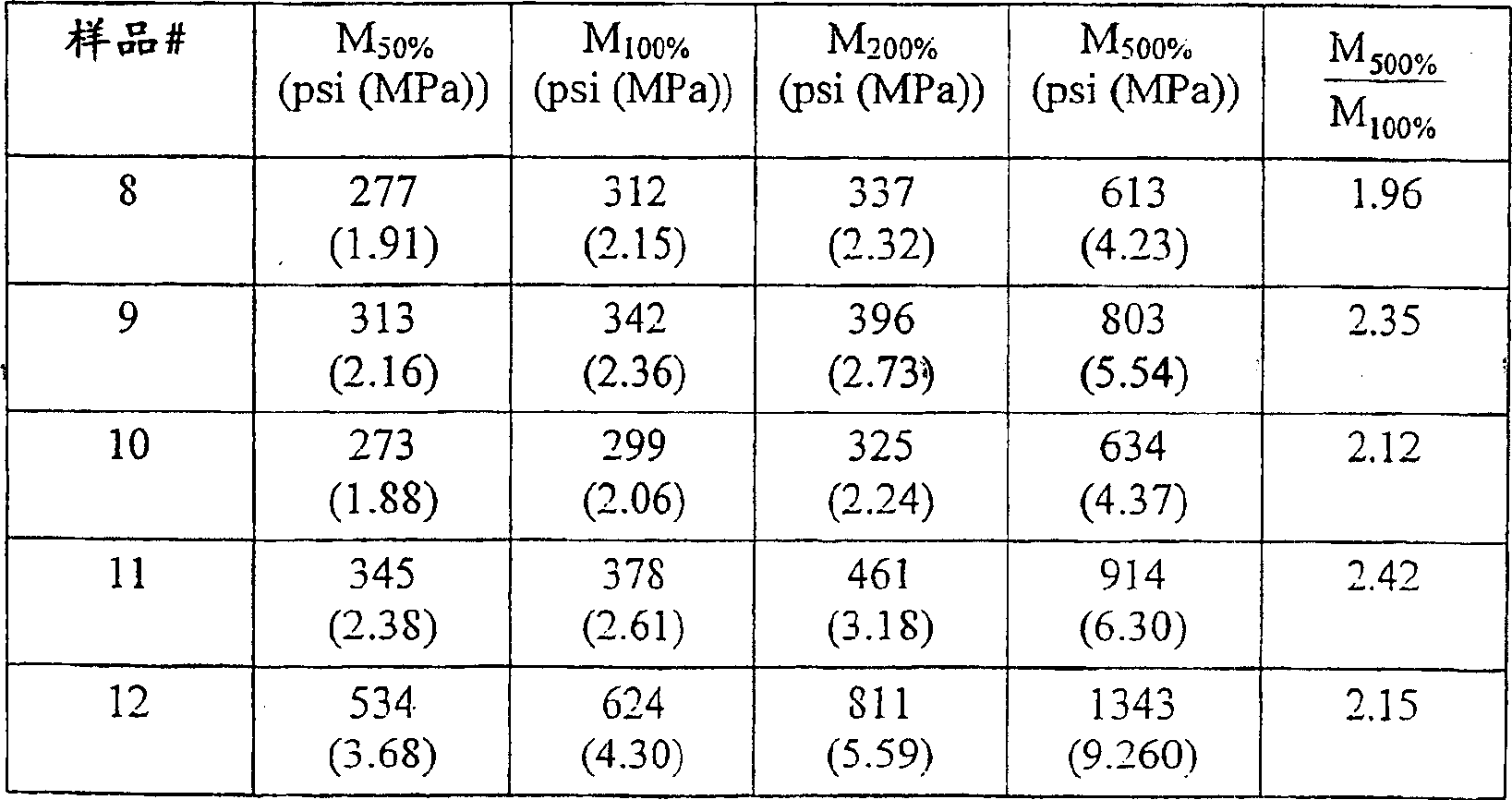
表7:滞后性能
图1、2和3说明加入EMPR 103与iPP对聚合物组合物的影响Figures 1, 2 and 3 illustrate the effect of adding EMPR 103 with iPP on the polymer composition
实施例3:样品13-16Example 3: Samples 13-16
在250cm3 Brabender密炼机中,于175℃-225℃下,通过以表8示出的比例熔融共混聚合物-B与烃类树脂EMPR 100A制备了聚合物共混物。然后将该共混物制成压缩模制板并在大约7天之后测试。测定七个样品的机械和滞后性能,并各自列在表9和10中。Polymer blends were prepared by melt blending Polymer-B with hydrocarbon resin EMPR 100A in the ratios shown in Table 8 in a 250 cm 3 Brabender internal mixer at 175°C-225°C. The blend was then made into compression molded panels and tested after approximately 7 days. The mechanical and hysteresis properties of seven samples were determined and are listed in Tables 9 and 10, respectively.
表8:组合物
表9:机械性能Table 9: Mechanical properties

表10:滞后性能
图4、5和6说明加入EMPR 100A与iPP对聚合物组合物的影响。Figures 4, 5 and 6 illustrate the effect of adding EMPR 100A with iPP on the polymer composition.
实施例4:样品17-25Example 4: Samples 17-25
在250cm3 Brabender密炼机中,于175℃-225℃下,通过以表11示出的比例熔融共混聚合物-A与烃类树脂EMPR 103和iPP制备了聚合物共混物。然后将该共混物制成压缩模制板并在大约7天之后测试。测定七个样品的力学和滞后性能,并各自列在表12和13中。Polymer blends were prepared by melt blending Polymer-A with hydrocarbon resins EMPR 103 and iPP in the ratios shown in Table 11 in a 250 cm 3 Brabender internal mixer at 175°C-225°C. The blend was then made into compression molded panels and tested after approximately 7 days. The mechanical and hysteresis properties of seven samples were determined and are listed in Tables 12 and 13, respectively.
表11:组合物
表12:机械性能Table 12: Mechanical properties
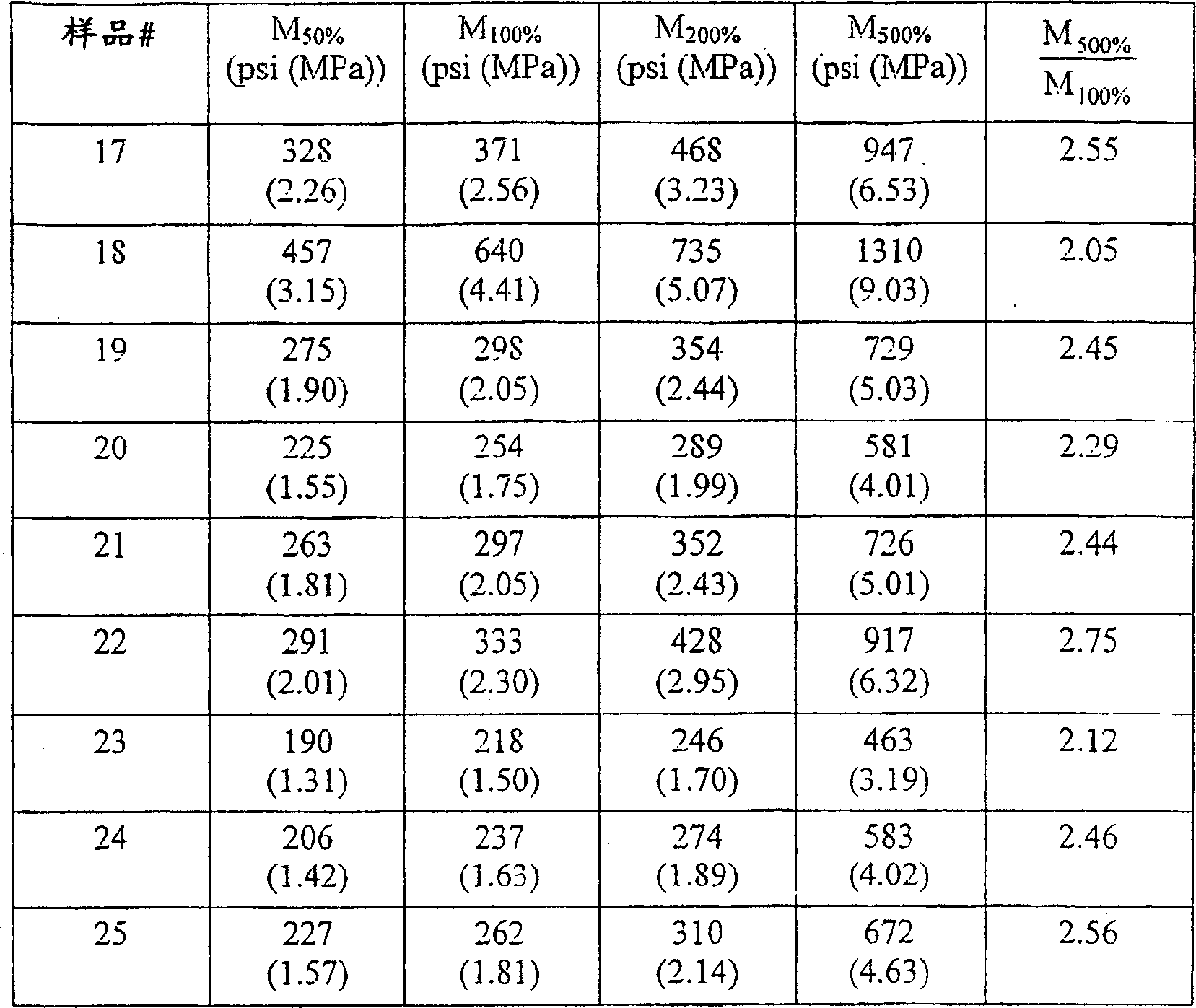
表13:滞后性能
实施例5:样品26-46Example 5: Samples 26-46
在250cm3 Brabender密炼机中,于175℃-225℃下,通过以表14示出的比例熔融共混具有不同组成和结晶度的各种聚合物组合物与烃类树脂EMPR 103制备了聚合物共混物。然后将该共混物制成压缩模制板并在大约7天之后测试。测定七个样品的机械和滞后性能,并各自列在表15和16中。表14所指的″聚合物类型″与表1的名称对应。Polymers were prepared by melt blending various polymer compositions with different compositions and degrees of crystallinity with the hydrocarbon resin EMPR 103 in the proportions shown in Table 14 in a 250 cm Brabender internal mixer at 175°C to 225°C. material blends. The blend was then made into compression molded panels and tested after approximately 7 days. The mechanical and hysteresis properties of seven samples were determined and are listed in Tables 15 and 16, respectively. The "polymer type" referred to in Table 14 corresponds to the designation in Table 1.
表14:组合物
表15:机械和热性能
表15:机械和热性能(续)
*没有测量*not measured
表16:滞后性能
表16:滞后性能(续)
实施例6:样品47-58Example 6: Samples 47-58
在250cm3 Brabender密炼机中,于175℃-225℃下,通过以表17示出的比例熔融共混具有不同组成和结晶度的各种聚合物组合物与烃类树脂EMPR 100制备了聚合物共混物。然后将该共混物制成压缩模制板并在大约7天之后测试。测定七个样品的机械和滞后性能,并各自列在表18和19中。表17所指的″聚合物类型″与表1的名称对应。Polymers were prepared by melt blending various polymer compositions with different compositions and degrees of crystallinity with the hydrocarbon resin EMPR 100 in the ratios shown in Table 17 in a 250 cm Brabender internal mixer at 175°C to 225°C. material blends. The blend was then made into compression molded panels and tested after approximately 7 days. The mechanical and hysteresis properties of seven samples were determined and are listed in Tables 18 and 19, respectively. The "polymer type" referred to in Table 17 corresponds to the designation in Table 1.
表17:组合物
表18:机械和热性能
表19:滞后性能
实施例7:样品59-70Example 7: Samples 59-70
在250cm3 Brabender密炼机中,于175℃-225℃下,通过以表20示出的比例熔融共混具有不同组成和结晶度的各种聚合物组合物与烃类树脂EMPR 104制备了聚合物共混物。然后将该共混物制成压缩模制板并在大约7天之后测试。测定七个样品的机械和滞后性,并各自列在表21和22中。表20所指的″聚合物类型″与表1的名称对应。Polymers were prepared by melt blending various polymer compositions with different compositions and degrees of crystallinity with the hydrocarbon resin EMPR 104 in the ratios shown in Table 20 in a 250 cm Brabender internal mixer at 175°C to 225°C. material blends. The blend was then made into compression molded panels and tested after approximately 7 days. The mechanical and hysteresis properties of seven samples were determined and are listed in Tables 21 and 22, respectively. The "polymer type" referred to in Table 20 corresponds to the designation in Table 1.
表20:组合物
表21:机械和热性能
表22:滞后性能
实施例8:样品71-82Example 8: Samples 71-82
在250cm3 Brabender密炼机中,于175℃-225℃下,通过以表23示出的比例熔融共混聚合物-H与各种树脂制备了聚合物共混物。然后将该共混物制成压缩模制板并在大约7天之后测试。测定七个样品的机械和滞后性能,并各自列在表24和25中。在表23中,TOPAS是用交替降冰片烯和乙烯制备的高Tg聚合物。在表24中,MFR是ASTM 1238工序A(230℃,2.16kg),Tg和ΔH熔融是第一熔融值,以及弯曲模量是1%正割值。Polymer blends were prepared by melt blending Polymer-H with various resins in the ratios shown in Table 23 in a 250 cm 3 Brabender internal mixer at 175°C to 225°C. The blend was then made into compression molded panels and tested after approximately 7 days. The mechanical and hysteresis properties of seven samples were determined and are listed in Tables 24 and 25, respectively. In Table 23, TOPAS is a high Tg polymer prepared with alternating norbornene and ethylene. In Table 24, MFR is ASTM 1238 Procedure A (230°C, 2.16 kg), Tg and ΔHmelt are first melt values, and flexural modulus are 1% secant values.
表23:组合物
表24:机械和热性能
*没有测量*not measured
表25:滞后性能
在此用TM标记示出的各种商品名称,表明这些名称是被特定商标权保护的。这些名称中的一些也可是不同管辖区中的注册商标。Various trade names shown herein with the TM mark indicate that these names are protected by certain trademark rights. Some of these names may also be registered trademarks in various jurisdictions.
在这里引用的所有专利、测试程序及其它文件(包括优先权文件)在此公开物与本发明一致并且针对允许这种引入的所有权限的程度上充分引入供参考。All patents, test procedures, and other documents (including priority documents) cited herein are fully incorporated by reference to the extent their disclosure is consistent with this invention and for all jurisdictions in which such incorporation was permitted.
尽管本发明已经特别描述了示例性的实施方案,但是应该清楚不脱离本发明精神和范围的各种其它改进对本领域技术人员来说是容易达到和显而易见的。因此,不希望在此所附的权利要求的范围限于在这里列出的实施例和说明书叙述部分,而是认为权利要求包括了在于本发明中存在的专利新颖性的所有特征,其中包括本发明所属技术领域中技术人员认为是其等同物的所有特征。While the invention has been particularly described with regard to exemplary embodiments, it should be apparent that various other modifications can be readily made and will be apparent to those skilled in the art without departing from the spirit and scope of the invention. Accordingly, it is not intended that the scope of the claims appended hereto be limited to the examples set forth herein and the recitation of the specification, but that the claims are construed to cover all the features of patented novelty which lie in the present invention, including the present invention All features which are considered to be equivalents by one skilled in the art.
当多个下限和多个上限在此列出时,从任一下限到任一上限的范围被考虑。When multiple lower limits and multiple upper limits are listed herein, ranges from any lower limit to any upper limit are contemplated.
Claims (79)
Applications Claiming Priority (2)
| Application Number | Priority Date | Filing Date | Title |
|---|---|---|---|
| US10/402,275 | 2003-03-28 | ||
| US10/402,275 US6984696B2 (en) | 2003-03-28 | 2003-03-28 | Elastic blends of semicrystalline propylene polymers and high glass transition temperature materials |
Publications (2)
| Publication Number | Publication Date |
|---|---|
| CN1768106A true CN1768106A (en) | 2006-05-03 |
| CN100528955C CN100528955C (en) | 2009-08-19 |
Family
ID=32989660
Family Applications (1)
| Application Number | Title | Priority Date | Filing Date |
|---|---|---|---|
| CNB2004800085752A Expired - Fee Related CN100528955C (en) | 2003-03-28 | 2004-03-23 | Elastic blends of semicrystalline propylene polymers and high glass transition temperature materials |
Country Status (9)
| Country | Link |
|---|---|
| US (2) | US6984696B2 (en) |
| EP (1) | EP1608702B1 (en) |
| JP (1) | JP2006521457A (en) |
| CN (1) | CN100528955C (en) |
| AT (1) | ATE395380T1 (en) |
| CA (1) | CA2519316A1 (en) |
| DE (1) | DE602004013750D1 (en) |
| ES (1) | ES2307038T3 (en) |
| WO (1) | WO2004087806A1 (en) |
Families Citing this family (40)
| Publication number | Priority date | Publication date | Assignee | Title |
|---|---|---|---|---|
| US7531594B2 (en) * | 2002-08-12 | 2009-05-12 | Exxonmobil Chemical Patents Inc. | Articles from plasticized polyolefin compositions |
| US7271209B2 (en) * | 2002-08-12 | 2007-09-18 | Exxonmobil Chemical Patents Inc. | Fibers and nonwovens from plasticized polyolefin compositions |
| US7998579B2 (en) * | 2002-08-12 | 2011-08-16 | Exxonmobil Chemical Patents Inc. | Polypropylene based fibers and nonwovens |
| KR101008786B1 (en) * | 2002-08-12 | 2011-01-14 | 엑손모빌 케미칼 패턴츠 인코포레이티드 | Plasticized Polyolefin Composition |
| US8003725B2 (en) * | 2002-08-12 | 2011-08-23 | Exxonmobil Chemical Patents Inc. | Plasticized hetero-phase polyolefin blends |
| EP1581390B2 (en) * | 2003-01-08 | 2016-08-31 | ExxonMobil Chemical Patents Inc. | Elastic articles and processes for their manufacture |
| US6984696B2 (en) * | 2003-03-28 | 2006-01-10 | Exxonmobil Chemical Patents Inc. | Elastic blends of semicrystalline propylene polymers and high glass transition temperature materials |
| US8192813B2 (en) | 2003-08-12 | 2012-06-05 | Exxonmobil Chemical Patents, Inc. | Crosslinked polyethylene articles and processes to produce same |
| JP2005089594A (en) * | 2003-09-17 | 2005-04-07 | Arakawa Chem Ind Co Ltd | Polyolefin-based resin composition, packaging film, and stretch-packaging film |
| CN100351304C (en) * | 2004-08-25 | 2007-11-28 | 三井化学株式会社 | Resin composition and film obtained therefrom |
| US7745526B2 (en) | 2004-11-05 | 2010-06-29 | Exxonmobil Chemical Patents Inc. | Transparent polyolefin compositions |
| WO2006065664A1 (en) * | 2004-12-17 | 2006-06-22 | Exxonmobil Chemical Patents Inc. | Films from polymer blends |
| US7619038B2 (en) * | 2004-12-17 | 2009-11-17 | Exxonmobil Chemical Patents Inc. | Homogeneous polymer blend and articles therefrom |
| US8389615B2 (en) | 2004-12-17 | 2013-03-05 | Exxonmobil Chemical Patents Inc. | Elastomeric compositions comprising vinylaromatic block copolymer, polypropylene, plastomer, and low molecular weight polyolefin |
| DE602005016304D1 (en) * | 2004-12-17 | 2009-10-08 | Exxonmobil Chem Patents Inc | POLYMER BLENDS AND NONWOVENS |
| DE602005016302D1 (en) * | 2004-12-17 | 2009-10-08 | Exxonmobil Chem Patents Inc | HETEROGENIC POLYMER BLENDS AND FORM BODY THEREOF |
| US7655317B2 (en) * | 2005-01-19 | 2010-02-02 | Exxonmobil Chemical Patents Inc. | Stretch-cling films |
| JP5590517B2 (en) | 2005-04-14 | 2014-09-17 | エクソンモービル・ケミカル・パテンツ・インク | Transparent polyolefin composition |
| ATE555166T1 (en) | 2005-07-15 | 2012-05-15 | Exxonmobil Chem Patents Inc | ELASTOMERIC COMPOSITIONS |
| US7550400B2 (en) * | 2005-08-02 | 2009-06-23 | Exxonmobil Chemical Patents Inc. | Multiple layer nonwoven fabric structures |
| US8696888B2 (en) | 2005-10-20 | 2014-04-15 | Exxonmobil Chemical Patents Inc. | Hydrocarbon resid processing |
| US7943701B2 (en) * | 2007-01-26 | 2011-05-17 | Exxonmobil Chemical Patents Inc. | Fibers and non-wovens prepared with propylene-based elastomers |
| US8354465B2 (en) | 2007-10-23 | 2013-01-15 | Exxonmobil Chemical Patents Inc. | Elastic film compositions with improved tear resistance |
| US8609772B2 (en) * | 2007-10-23 | 2013-12-17 | Exxonmobil Chemical Patents Inc. | Elastic films having improved mechanical and elastic properties and methods for making the same |
| US8188192B2 (en) * | 2007-12-21 | 2012-05-29 | Kraton Polymers U.S. Llc | Soft elastomeric films |
| US8383246B2 (en) * | 2008-05-22 | 2013-02-26 | Exxonmobil Oil Corporation | Polypropylene-based shrink films |
| US8202941B2 (en) * | 2008-06-27 | 2012-06-19 | Exxonmobil Chemical Patents Inc. | High shrinkage propylene-based films |
| US9017593B2 (en) * | 2009-06-16 | 2015-04-28 | Exxonmobil Chemical Patents Inc. | Composite materials comprising propylene-based polymer blend coatings |
| US20110059277A1 (en) * | 2009-09-04 | 2011-03-10 | Rainer Kolb | Elastomeric Surface Coatings for Plastic Articles |
| US20100316820A1 (en) * | 2009-06-16 | 2010-12-16 | Rainer Kolb | Composite Materials Comprising Propylene-Based Polymer Blend Coatings |
| US20100316808A1 (en) * | 2009-06-16 | 2010-12-16 | Gregory Keith Hall | Polyolefin Compositions for Coating Applications |
| JP5826035B2 (en) * | 2011-01-22 | 2015-12-02 | 三菱樹脂株式会社 | Film for stretch wrapping |
| WO2012149391A1 (en) | 2011-04-28 | 2012-11-01 | Adherent Laboratories, Inc. | Polyolefin based hot melt adhesive composition |
| US8946365B2 (en) | 2012-01-18 | 2015-02-03 | Eastman Chemical Company | Low molecular weight polystyrene resin and methods of making and using the same |
| US9428598B2 (en) | 2014-02-07 | 2016-08-30 | Eastman Chemical Company | Amorphous propylene-ethylene copolymers |
| US10696765B2 (en) | 2014-02-07 | 2020-06-30 | Eastman Chemical Company | Adhesive composition comprising amorphous propylene-ethylene copolymer and propylene polymer |
| US10723824B2 (en) | 2014-02-07 | 2020-07-28 | Eastman Chemical Company | Adhesives comprising amorphous propylene-ethylene copolymers |
| US10647795B2 (en) | 2014-02-07 | 2020-05-12 | Eastman Chemical Company | Adhesive composition comprising amorphous propylene-ethylene copolymer and polyolefins |
| US10308740B2 (en) | 2014-02-07 | 2019-06-04 | Eastman Chemical Company | Amorphous propylene-ethylene copolymers |
| US11267916B2 (en) | 2014-02-07 | 2022-03-08 | Eastman Chemical Company | Adhesive composition comprising amorphous propylene-ethylene copolymer and polyolefins |
Family Cites Families (25)
| Publication number | Priority date | Publication date | Assignee | Title |
|---|---|---|---|---|
| GB8613161D0 (en) | 1986-05-30 | 1986-07-02 | Exxon Chemical Patents Inc | Sealable films |
| US5213744A (en) * | 1987-04-21 | 1993-05-25 | Exxon Chemical Patents Inc. | Process for making polyolefin films |
| CA2012729C (en) | 1989-04-07 | 1997-05-20 | Takashi Kuroda | Dulled stretched molding and process for producing the same |
| US5171628A (en) * | 1989-05-25 | 1992-12-15 | Exxon Chemical Patents Inc. | Low creep polypropylene textiles |
| JP2841509B2 (en) * | 1989-07-31 | 1998-12-24 | 三井化学株式会社 | Peelable protective film and composition thereof |
| JP3015967B2 (en) | 1989-10-02 | 2000-03-06 | 旭化成工業株式会社 | Multilayer packaging film and method for producing the same |
| EP0629631B1 (en) | 1993-06-07 | 2002-08-28 | Mitsui Chemicals, Inc. | Novel transition metal compound, and polymerization catalyst containing it |
| JP3380043B2 (en) * | 1994-06-30 | 2003-02-24 | 三菱樹脂株式会社 | Stretch film for food packaging |
| US5552489A (en) | 1994-07-22 | 1996-09-03 | Exxon Chemical Patents Inc. | Tackifiers and a process to obtain tackifiers |
| JP3296532B2 (en) * | 1995-12-13 | 2002-07-02 | 三菱樹脂株式会社 | Stretch film for food packaging |
| US6080818A (en) * | 1997-03-24 | 2000-06-27 | Huntsman Polymers Corporation | Polyolefin blends used for non-woven applications |
| US6165599A (en) * | 1997-09-15 | 2000-12-26 | Applied Extrusion Technologies, Inc. | Biaxially oriented film prepared from metallocene catalyzed polypropylene |
| US6096420A (en) | 1998-01-30 | 2000-08-01 | Tredegar Corporation | Thin plastic film |
| KR20010041455A (en) * | 1998-03-02 | 2001-05-25 | 고다마 순이치로, 아마노 히로시 | Polypropylene resin compositions and packaging stretched film made thereof |
| US6833404B2 (en) | 1998-06-30 | 2004-12-21 | H.B. Fuller Licensing & Financing Inc. | Hot melts utilizing a high glass transition temperature substantially aliphatic tackifying resin |
| DE69935815T2 (en) | 1998-07-01 | 2007-12-27 | Exxonmobil Chemical Patents Inc., Baytown | Elastic mixture with crystal polymers and crystallizable polymers of propene |
| US6500563B1 (en) * | 1999-05-13 | 2002-12-31 | Exxonmobil Chemical Patents Inc. | Elastic films including crystalline polymer and crystallizable polymers of propylene |
| CA2310925C (en) * | 1999-06-11 | 2005-10-11 | Kuraray Co., Ltd. | Multilayered structure |
| US6627723B2 (en) | 1999-12-22 | 2003-09-30 | Exxonmobil Chemical Patents Inc. | Adhesive alpha-olefin inter-polymers |
| JP2002241549A (en) * | 2001-02-15 | 2002-08-28 | Japan Polychem Corp | Resin composition for heat-shrinkable polypropylene- based shrink label, film using the same and container stuck with the label |
| EP1179563B1 (en) | 2000-08-11 | 2004-05-19 | Japan Polychem Corporation | Resin composition for heat-shrinkable polypropylene shrink label and film comprising same |
| US6388013B1 (en) * | 2001-01-04 | 2002-05-14 | Equistar Chemicals, Lp | Polyolefin fiber compositions |
| US6531214B2 (en) | 2001-02-14 | 2003-03-11 | 3M Innovative Properties Company | Replacement for plasticized polyvinyl chloride |
| WO2002083753A1 (en) * | 2001-04-12 | 2002-10-24 | Exxonmobil Chemical Patents Inc. | Propylene ethylene copolymers |
| US6984696B2 (en) * | 2003-03-28 | 2006-01-10 | Exxonmobil Chemical Patents Inc. | Elastic blends of semicrystalline propylene polymers and high glass transition temperature materials |
-
2003
- 2003-03-28 US US10/402,275 patent/US6984696B2/en not_active Expired - Lifetime
-
2004
- 2004-03-23 EP EP04758316A patent/EP1608702B1/en not_active Expired - Lifetime
- 2004-03-23 CA CA002519316A patent/CA2519316A1/en not_active Abandoned
- 2004-03-23 ES ES04758316T patent/ES2307038T3/en not_active Expired - Lifetime
- 2004-03-23 CN CNB2004800085752A patent/CN100528955C/en not_active Expired - Fee Related
- 2004-03-23 WO PCT/US2004/009121 patent/WO2004087806A1/en not_active Ceased
- 2004-03-23 JP JP2006509278A patent/JP2006521457A/en active Pending
- 2004-03-23 AT AT04758316T patent/ATE395380T1/en not_active IP Right Cessation
- 2004-03-23 DE DE602004013750T patent/DE602004013750D1/en not_active Expired - Lifetime
-
2005
- 2005-10-07 US US11/245,636 patent/US7244787B2/en not_active Expired - Lifetime
Also Published As
| Publication number | Publication date |
|---|---|
| US6984696B2 (en) | 2006-01-10 |
| EP1608702A1 (en) | 2005-12-28 |
| ES2307038T3 (en) | 2008-11-16 |
| WO2004087806A1 (en) | 2004-10-14 |
| US20040192823A1 (en) | 2004-09-30 |
| US7244787B2 (en) | 2007-07-17 |
| CN100528955C (en) | 2009-08-19 |
| CA2519316A1 (en) | 2004-10-14 |
| DE602004013750D1 (en) | 2008-06-26 |
| EP1608702B1 (en) | 2008-05-14 |
| ATE395380T1 (en) | 2008-05-15 |
| US20060036042A1 (en) | 2006-02-16 |
| JP2006521457A (en) | 2006-09-21 |
Similar Documents
| Publication | Publication Date | Title |
|---|---|---|
| CN1768106A (en) | Elastic blends of semicrystalline propylene polymers and high glass transition temperature materials | |
| CN1290917C (en) | Propylene copolymer composition with good low temperature impact toughness and high transparency | |
| KR100581789B1 (en) | Elastomeric Blend Compositions Comprising a Crystalline Polymer and a Crystallizable Polymer of Propylene | |
| JP5503290B2 (en) | Filler-added polyolefin compositions | |
| JP5237964B2 (en) | Filler-added polyolefin compositions | |
| US8263707B2 (en) | Soft heterogeneous isotactic polypropylene compositions | |
| US7858701B2 (en) | Soft homogeneous isotactic polypropylene compositions | |
| US20040198912A1 (en) | Thermoplastic filled membranes of propylene copolymers | |
| CN1878799A (en) | Transparent and translucent crosslinked propylenebased elastomers, and their production and use | |
| WO2000069964A1 (en) | Thermoplastic filled membranes of propylene copolymers | |
| CN1372578A (en) | Plasticized polypropylene thermoplastics | |
| CN1290885C (en) | High transparency flexible propylene copolymer composition | |
| JP4644656B2 (en) | Elastic product and manufacturing method thereof | |
| JP2006503161A (en) | Heterophase polymer composition | |
| WO2004072177A1 (en) | Diene-modified propylene polymer nucleating agents | |
| US7906588B2 (en) | Soft heterogeneous isotactic polypropylene compositions | |
| CA2683693C (en) | Soft heterogeneous isotactic polypropylene compositions | |
| US20090111945A1 (en) | Soft Homogeneous Isotactic Polypropylene Compositions | |
| CN102245698B (en) | Thermoplastic olefin compositions | |
| CN1266212C (en) | Compositions based or random propylene copolymers, process for their manufacture, and heat sealable multilayer sheets comprising them | |
| CN101048458A (en) | Elastomeric reactor blend compositions | |
| JPH1160841A (en) | Polypropylene resin composition |
Legal Events
| Date | Code | Title | Description |
|---|---|---|---|
| C06 | Publication | ||
| PB01 | Publication | ||
| C10 | Entry into substantive examination | ||
| SE01 | Entry into force of request for substantive examination | ||
| C14 | Grant of patent or utility model | ||
| GR01 | Patent grant | ||
| CF01 | Termination of patent right due to non-payment of annual fee |
Granted publication date: 20090819 Termination date: 20210323 |
|
| CF01 | Termination of patent right due to non-payment of annual fee |