CN1633421A - Oxazole/thiazol-derivatives activators of the hppar-alpha receptor - Google Patents
Oxazole/thiazol-derivatives activators of the hppar-alpha receptor Download PDFInfo
- Publication number
- CN1633421A CN1633421A CNA028149424A CN02814942A CN1633421A CN 1633421 A CN1633421 A CN 1633421A CN A028149424 A CNA028149424 A CN A028149424A CN 02814942 A CN02814942 A CN 02814942A CN 1633421 A CN1633421 A CN 1633421A
- Authority
- CN
- China
- Prior art keywords
- compound
- methyl
- thiazol
- hppar
- amino
- Prior art date
- Legal status (The legal status is an assumption and is not a legal conclusion. Google has not performed a legal analysis and makes no representation as to the accuracy of the status listed.)
- Granted
Links
Classifications
-
- C—CHEMISTRY; METALLURGY
- C07—ORGANIC CHEMISTRY
- C07D—HETEROCYCLIC COMPOUNDS
- C07D277/00—Heterocyclic compounds containing 1,3-thiazole or hydrogenated 1,3-thiazole rings
- C07D277/02—Heterocyclic compounds containing 1,3-thiazole or hydrogenated 1,3-thiazole rings not condensed with other rings
- C07D277/20—Heterocyclic compounds containing 1,3-thiazole or hydrogenated 1,3-thiazole rings not condensed with other rings having two or three double bonds between ring members or between ring members and non-ring members
- C07D277/32—Heterocyclic compounds containing 1,3-thiazole or hydrogenated 1,3-thiazole rings not condensed with other rings having two or three double bonds between ring members or between ring members and non-ring members with hetero atoms or with carbon atoms having three bonds to hetero atoms with at the most one bond to halogen, e.g. ester or nitrile radicals, directly attached to ring carbon atoms
- C07D277/56—Carbon atoms having three bonds to hetero atoms with at the most one bond to halogen
-
- A—HUMAN NECESSITIES
- A61—MEDICAL OR VETERINARY SCIENCE; HYGIENE
- A61K—PREPARATIONS FOR MEDICAL, DENTAL OR TOILETRY PURPOSES
- A61K31/00—Medicinal preparations containing organic active ingredients
- A61K31/33—Heterocyclic compounds
- A61K31/395—Heterocyclic compounds having nitrogen as a ring hetero atom, e.g. guanethidine or rifamycins
- A61K31/41—Heterocyclic compounds having nitrogen as a ring hetero atom, e.g. guanethidine or rifamycins having five-membered rings with two or more ring hetero atoms, at least one of which being nitrogen, e.g. tetrazole
- A61K31/42—Oxazoles
-
- A—HUMAN NECESSITIES
- A61—MEDICAL OR VETERINARY SCIENCE; HYGIENE
- A61K—PREPARATIONS FOR MEDICAL, DENTAL OR TOILETRY PURPOSES
- A61K31/00—Medicinal preparations containing organic active ingredients
- A61K31/33—Heterocyclic compounds
- A61K31/395—Heterocyclic compounds having nitrogen as a ring hetero atom, e.g. guanethidine or rifamycins
- A61K31/41—Heterocyclic compounds having nitrogen as a ring hetero atom, e.g. guanethidine or rifamycins having five-membered rings with two or more ring hetero atoms, at least one of which being nitrogen, e.g. tetrazole
- A61K31/425—Thiazoles
-
- A—HUMAN NECESSITIES
- A61—MEDICAL OR VETERINARY SCIENCE; HYGIENE
- A61P—SPECIFIC THERAPEUTIC ACTIVITY OF CHEMICAL COMPOUNDS OR MEDICINAL PREPARATIONS
- A61P25/00—Drugs for disorders of the nervous system
- A61P25/18—Antipsychotics, i.e. neuroleptics; Drugs for mania or schizophrenia
-
- A—HUMAN NECESSITIES
- A61—MEDICAL OR VETERINARY SCIENCE; HYGIENE
- A61P—SPECIFIC THERAPEUTIC ACTIVITY OF CHEMICAL COMPOUNDS OR MEDICINAL PREPARATIONS
- A61P3/00—Drugs for disorders of the metabolism
-
- A—HUMAN NECESSITIES
- A61—MEDICAL OR VETERINARY SCIENCE; HYGIENE
- A61P—SPECIFIC THERAPEUTIC ACTIVITY OF CHEMICAL COMPOUNDS OR MEDICINAL PREPARATIONS
- A61P3/00—Drugs for disorders of the metabolism
- A61P3/04—Anorexiants; Antiobesity agents
-
- A—HUMAN NECESSITIES
- A61—MEDICAL OR VETERINARY SCIENCE; HYGIENE
- A61P—SPECIFIC THERAPEUTIC ACTIVITY OF CHEMICAL COMPOUNDS OR MEDICINAL PREPARATIONS
- A61P3/00—Drugs for disorders of the metabolism
- A61P3/06—Antihyperlipidemics
-
- A—HUMAN NECESSITIES
- A61—MEDICAL OR VETERINARY SCIENCE; HYGIENE
- A61P—SPECIFIC THERAPEUTIC ACTIVITY OF CHEMICAL COMPOUNDS OR MEDICINAL PREPARATIONS
- A61P3/00—Drugs for disorders of the metabolism
- A61P3/08—Drugs for disorders of the metabolism for glucose homeostasis
- A61P3/10—Drugs for disorders of the metabolism for glucose homeostasis for hyperglycaemia, e.g. antidiabetics
-
- A—HUMAN NECESSITIES
- A61—MEDICAL OR VETERINARY SCIENCE; HYGIENE
- A61P—SPECIFIC THERAPEUTIC ACTIVITY OF CHEMICAL COMPOUNDS OR MEDICINAL PREPARATIONS
- A61P5/00—Drugs for disorders of the endocrine system
- A61P5/48—Drugs for disorders of the endocrine system of the pancreatic hormones
-
- A—HUMAN NECESSITIES
- A61—MEDICAL OR VETERINARY SCIENCE; HYGIENE
- A61P—SPECIFIC THERAPEUTIC ACTIVITY OF CHEMICAL COMPOUNDS OR MEDICINAL PREPARATIONS
- A61P9/00—Drugs for disorders of the cardiovascular system
-
- A—HUMAN NECESSITIES
- A61—MEDICAL OR VETERINARY SCIENCE; HYGIENE
- A61P—SPECIFIC THERAPEUTIC ACTIVITY OF CHEMICAL COMPOUNDS OR MEDICINAL PREPARATIONS
- A61P9/00—Drugs for disorders of the cardiovascular system
- A61P9/02—Non-specific cardiovascular stimulants, e.g. drugs for syncope, antihypotensives
-
- A—HUMAN NECESSITIES
- A61—MEDICAL OR VETERINARY SCIENCE; HYGIENE
- A61P—SPECIFIC THERAPEUTIC ACTIVITY OF CHEMICAL COMPOUNDS OR MEDICINAL PREPARATIONS
- A61P9/00—Drugs for disorders of the cardiovascular system
- A61P9/04—Inotropic agents, i.e. stimulants of cardiac contraction; Drugs for heart failure
-
- A—HUMAN NECESSITIES
- A61—MEDICAL OR VETERINARY SCIENCE; HYGIENE
- A61P—SPECIFIC THERAPEUTIC ACTIVITY OF CHEMICAL COMPOUNDS OR MEDICINAL PREPARATIONS
- A61P9/00—Drugs for disorders of the cardiovascular system
- A61P9/10—Drugs for disorders of the cardiovascular system for treating ischaemic or atherosclerotic diseases, e.g. antianginal drugs, coronary vasodilators, drugs for myocardial infarction, retinopathy, cerebrovascula insufficiency, renal arteriosclerosis
Landscapes
- Health & Medical Sciences (AREA)
- Chemical & Material Sciences (AREA)
- Organic Chemistry (AREA)
- Engineering & Computer Science (AREA)
- Bioinformatics & Cheminformatics (AREA)
- Veterinary Medicine (AREA)
- Public Health (AREA)
- General Health & Medical Sciences (AREA)
- Animal Behavior & Ethology (AREA)
- Life Sciences & Earth Sciences (AREA)
- Medicinal Chemistry (AREA)
- Pharmacology & Pharmacy (AREA)
- Chemical Kinetics & Catalysis (AREA)
- General Chemical & Material Sciences (AREA)
- Nuclear Medicine, Radiotherapy & Molecular Imaging (AREA)
- Diabetes (AREA)
- Cardiology (AREA)
- Heart & Thoracic Surgery (AREA)
- Hematology (AREA)
- Obesity (AREA)
- Epidemiology (AREA)
- Endocrinology (AREA)
- Urology & Nephrology (AREA)
- Hospice & Palliative Care (AREA)
- Child & Adolescent Psychology (AREA)
- Psychiatry (AREA)
- Biomedical Technology (AREA)
- Neurology (AREA)
- Neurosurgery (AREA)
- Emergency Medicine (AREA)
- Vascular Medicine (AREA)
- Pharmaceuticals Containing Other Organic And Inorganic Compounds (AREA)
- Plural Heterocyclic Compounds (AREA)
- Pyridine Compounds (AREA)
- Thiazole And Isothizaole Compounds (AREA)
Abstract
Description
本发明涉及某种新化合物。具体来说,本发明涉及活化α亚型人过氧化物酶体增殖物活化受体(“hPPARα”)的化合物。本发明还涉及制备所述化合物的方法以及预防或治疗PPARα介导性疾病或病症的方法。The present invention relates to certain novel compounds. In particular, the present invention relates to compounds that activate the alpha subtype of the human peroxisome proliferator-activated receptor ("hPPAR alpha"). The present invention also relates to methods of preparing said compounds and methods of preventing or treating PPARα-mediated diseases or conditions.
几种相互独立的危险因素与心血管疾病有关。这样的危险因素包括高血压、纤维蛋白原水平升高、高甘油三酯、高LDL胆固醇、总胆固醇升高和低HDL胆固醇。HMG CoA还原酶抑制剂(“他汀类药物”)可用于治疗以高LDL-c水平为特征的病症。已经证实降低LDL-c在部分患者、尤其是HDL-c水平正常患者不足以降低心血管疾病风险。这种人群用低LDL-c独立危险因素鉴定。低HDL-c水平相关心血管疾病的高风险仍然没有药物疗法来成功解决(即目前市场上没有药物用于提高HDL-c至40%以上)。(Bisgaier,C.L.;Pape,M.E.Curr.Pharm.Des.1998,4,53-70)。Several independent risk factors are associated with cardiovascular disease. Such risk factors include high blood pressure, elevated fibrinogen levels, high triglycerides, high LDL cholesterol, elevated total cholesterol, and low HDL cholesterol. HMG CoA reductase inhibitors ("statins") are useful in the treatment of conditions characterized by high LDL-c levels. It has been proved that lowering LDL-c is not enough to reduce the risk of cardiovascular diseases in some patients, especially those with normal HDL-c levels. This population was identified with an independent risk factor for low LDL-c. The high risk of cardiovascular disease associated with low HDL-c levels remains successfully addressed without drug therapy (ie, there are currently no drugs on the market for raising HDL-c above 40%). (Bisgaier, C.L.; Pape, M.E. Curr. Pharm. Des. 1998, 4, 53-70).
X综合征(包括代谢综合征)不精确地定义为多种异常,包括高胰岛素血症、肥胖、高甘油三酯、尿酸、纤维蛋白原、低密度LDL-c颗粒、纤溶酶原激活剂抑制剂1(PAI-1)、HDL-c水平降低。Syndrome X (including metabolic syndrome) is imprecisely defined as a variety of abnormalities including hyperinsulinemia, obesity, hypertriglycerides, uric acid, fibrinogen, low density LDL-c particles, plasminogen activator Inhibitor 1 (PAI-1), HDL-c levels decreased.
NIDDM称为胰岛素抵抗,胰岛素抵抗再引起异常葡萄糖产生和葡萄糖在骨骼肌摄取降低。这些因素最终导致葡萄糖耐量降低(IGT)和高胰岛素血症。NIDDM is called insulin resistance, which in turn causes abnormal glucose production and decreased glucose uptake in skeletal muscle. These factors ultimately lead to impaired glucose tolerance (IGT) and hyperinsulinemia.
过氧化物酶体增殖物活化受体(PPAR)为孤儿受体,属于类固醇/类维生素A受体超家族的配体活化转录因子。参见例如Willson,T.M.和Wahli,W., Cuur.Opin.Chem.Biol.,(1997),Vol.1,pp 235-241。Peroxisome proliferator-activated receptors (PPARs) are orphan receptors, ligand-activated transcription factors belonging to the steroid/retinoid receptor superfamily. See eg Willson, TM and Wahli, W., Cuur. Opin. Chem. Biol. , (1997), Vol. 1, pp 235-241.
已经分离出3种哺乳动物过氧化物酶体增殖物活化受体,称为PPAR-α、PPAR-γ、PPAR-δ(也称为NUC1或PPAR-β)。这些PPAR通过结合称为PPAR效应元件(PPRE)的DNA序列元件调节目标基因的表达。迄今,已经在编码调节脂质代谢的蛋白的许多基因的增强子中鉴定了PPRE,提示PPAR在脂肪形成的信号转导级联和脂质动态平衡中起关键作用(H.Keller和W.Wahli,Trends Endocrin.Met 291-296,4(1993))。Three mammalian peroxisome proliferator-activated receptors have been isolated, termed PPAR-alpha, PPAR-gamma, PPAR-delta (also known as NUC1 or PPAR-beta). These PPARs regulate the expression of target genes by binding DNA sequence elements known as PPAR response elements (PPREs). To date, PPREs have been identified in enhancers of many genes encoding proteins that regulate lipid metabolism, suggesting that PPARs play a key role in the signal transduction cascade of adipogenesis and lipid homeostasis (H. Keller and W. Wahli , Trends Endocrin. Met 291-296, 4 (1993)).
某些激活或作用于一种或多种PPAR的化合物在动物模型中参与调节甘油三酯和胆固醇水平。参见例如美国专利号5,847,008(Doebber等)和5,859,051(Adams等)、PCT公布号WO 97/28149(Leibowitz等)和WO 99/04815(Shimokawa等)。Certain compounds that activate or act on one or more PPARs are involved in regulating triglyceride and cholesterol levels in animal models. See, eg, U.S. Patent Nos. 5,847,008 (Doebber et al.) and 5,859,051 (Adams et al.), PCT Publication Nos. WO 97/28149 (Leibowitz et al.) and WO 99/04815 (Shimokawa et al.).
贝特类为一类药物,它们可以降低血清甘油三酯20-50%、降低LDL-c 10-15%、使LDL颗粒大小由致动脉粥样化的低密度转化为正常密度的LDL-c以及升高HDL-c 10-15%。实验证据表明,贝特类对血清脂质的作用通过激活PPARα而介导。参见例如B.Staels等,Curr.Pharm.Des.,1-14,3(1),(1997)。激活PPARα导致增加脂肪酸代谢而降低肝脏脂肪酸从头合成减少的酶发生转录,使得降低甘油三酯合成和VLDL-c产生/分泌。此外,PPARα活化降低产生apoC-III。apoC-III为LPL作用抑制剂,apoC-III降低增加VLDL-c清除。参见例如J.Auwerx等,Atherosclerosis,(Shannon,Irel.),S29-S37,124(Suppl),(1996)。PPARα配体可以用于治疗异常脂血症和心血管疾病,参见Fruchart,J.C.,Duriez,P.和Staels,B., Curr.Opin.Lipidol.(1999),Vol 10,pp 245-257。Fibrates are a class of drugs that lower serum triglycerides by 20-50%, lower LDL-c by 10-15%, and convert LDL particle size from atherogenic low-density to normal-density LDL-c And raise HDL-c 10-15%. Experimental evidence suggests that the effects of fibrates on serum lipids are mediated through activation of PPARα. See eg B. Staels et al., Curr. Pharm. Des., 1-14, 3(1), (1997). Activation of PPARα results in increased fatty acid metabolism and decreased hepatic de novo fatty acid synthesis by reducing enzyme transcription, resulting in reduced triglyceride synthesis and VLDL-c production/secretion. Furthermore, PPARα activation reduces the production of apoC-III. ApoC-III is an inhibitor of LPL, and the reduction of apoC-III increases the clearance of VLDL-c. See eg J. Auwerx et al., Atherosclerosis, (Shannon, Irel.), S29-S37, 124 (Suppl), (1996). PPARα ligands can be used in the treatment of dyslipidemia and cardiovascular diseases, see Fruchart, JC, Duriez, P. and Staels, B., Curr. Opin. Lipidol. (1999), Vol 10, pp 245-257.
本发明的第一方面提供式(I)化合物和其药学上可接受的盐、溶剂化物和可水解酯:A first aspect of the present invention provides compounds of formula (I) and pharmaceutically acceptable salts, solvates and hydrolyzable esters thereof:
其中in
X1为O或S; X1 is O or S;
R1和R2独立为H或C1-3烷基,或者连接到同一碳原子的R1和R2可以与它们所连接的碳原子一起构成3-5元环烷基环;R 1 and R 2 are independently H or C 1-3 alkyl, or R 1 and R 2 connected to the same carbon atom can form a 3-5 membered cycloalkyl ring together with the carbon atom they are connected to;
R3和R4独立为H、卤素、-CH3和-OCH3;R 3 and R 4 are independently H, halogen, -CH 3 and -OCH 3 ;
R5为H或C1-6烷基;R 5 is H or C 1-6 alkyl;
X2为NH、NCH3或O;X 2 is NH, NCH 3 or O;
Y和Z其中之一为N,另一个则为O或S;One of Y and Z is N, and the other is O or S;
R6为苯基或吡啶基(其中N在2位或3位),并且任选被一个或多个卤素、CF3、C1-6直链或支链烷基(任选被卤素取代)取代,条件是R6为吡啶基时,则其N不被取代。R 6 is phenyl or pyridyl (where N is at the 2 or 3 position), and is optionally substituted by one or more halogen, CF 3 , C 1-6 straight chain or branched chain alkyl (optionally substituted by halogen) Substitution, with the proviso that when R6 is pyridyl, its N is not substituted.
另一方面,本发明公开了一种预防或治疗人PPARα、γ或δ(“hPPAR”)介导性疾病或病症的方法,包括给予治疗有效量的本发明化合物。hPPAR介导性疾病或病症包括异常脂血症(包括相关糖尿病性异常脂血症和混合型异常脂血症)、X综合征(见本申请定义,包括代谢综合征)、心力衰竭、高胆固醇血症、心血管疾病(包括动脉粥样硬化、动脉硬化和高甘油三酯)、II型糖尿病、I型糖尿病、胰岛素抵抗、高脂质血症、炎症、上皮高增殖性疾病(包括湿疹和银屑病)、肠道上皮以及肠道相关性疾病、以及调节肥胖、贪食症和神经性厌食症等病症患者的食欲和食物摄取。具体来说,本发明化合物可用于治疗或预防心血管疾病和病症,包括动脉粥样硬化、动脉硬化、高甘油三酯血症和混合型异常脂血症。In another aspect, the invention discloses a method of preventing or treating a human PPAR alpha, gamma or delta ("hPPAR") mediated disease or condition comprising administering a therapeutically effective amount of a compound of the invention. hPPAR-mediated diseases or conditions include dyslipidemia (including related diabetic dyslipidemia and mixed dyslipidemia), syndrome X (see definition herein, including metabolic syndrome), heart failure, hypercholesterolemia Hypertension, cardiovascular disease (including atherosclerosis, arteriosclerosis and high triglycerides), type II diabetes, type I diabetes, insulin resistance, hyperlipidemia, inflammation, epithelial hyperproliferative disease (including eczema and psoriasis), gut epithelial and gut-related diseases, and regulation of appetite and food intake in patients with conditions such as obesity, bulimia and anorexia nervosa. In particular, the compounds of the invention are useful in the treatment or prevention of cardiovascular diseases and disorders, including atherosclerosis, arteriosclerosis, hypertriglyceridemia and mixed dyslipidemia.
另一方面,本发明提供包含本发明化合物以及优选包含药学上可接受的稀释剂或载体的药用组合物。In another aspect, the present invention provides pharmaceutical compositions comprising a compound of the present invention and preferably a pharmaceutically acceptable diluent or carrier.
另一方面,本发明提供本发明化合物在治疗、尤其在人类医学中的用途。In another aspect, the present invention provides the use of a compound of the invention in therapy, especially in human medicine.
另一方面,本发明提供本发明化合物在制备用于治疗hPPAR介导性疾病或病症的药物中的用途。In another aspect, the present invention provides the use of a compound of the present invention in the manufacture of a medicament for the treatment of an hPPAR-mediated disease or condition.
另一方面,本发明提供一种治疗患有hPPAR介导性疾病或病症的患者的方法,该方法包括给予治疗有效量的本发明化合物。In another aspect, the present invention provides a method of treating a patient suffering from a hPPAR-mediated disease or condition comprising administering a therapeutically effective amount of a compound of the present invention.
本文使用的“本发明化合物”是指式(I)化合物或其药学上可接受的盐、溶剂化物或可水解酯。As used herein, "compound of the present invention" refers to a compound of formula (I) or a pharmaceutically acceptable salt, solvate or hydrolyzable ester thereof.
虽然可水解酯包括在本发明范围内,但是优选酸,因为实验数据显示虽然酯为有用的化合物,但实际上可能是其水解得到的酸为活性化合物。容易水解的酯能够在测试条件或体内产生羧酸。通常,在结合及瞬时转染分析中活性物质都为羧酸,而酯通常结合差,但是在瞬时转染分析中有活性,推测可能是由于水解的原因。优选的可水解酯为C1-6烷基酯,其中烷基可以为直链或支链。更优选甲基酯或乙基酯。While hydrolyzable esters are included within the scope of this invention, acids are preferred because experimental data have shown that while esters are useful compounds, it may actually be the acid resulting from their hydrolysis that is the active compound. Esters that are readily hydrolyzed are able to generate carboxylic acids under test conditions or in vivo. Usually, the active substances in both binding and transient transfection assays are carboxylic acids, while esters usually bind poorly, but are active in transient transfection assays, presumably due to hydrolysis. Preferred hydrolyzable esters are C 1-6 alkyl esters, where the alkyl group may be straight or branched. More preferred are methyl esters or ethyl esters.
X1优选O。X 1 is preferably O.
R1和R2优选甲基。 R1 and R2 are preferably methyl groups.
优选R3和R4之一为H,更优选R3和R4都为H。Preferably one of R3 and R4 is H, more preferably both R3 and R4 are H.
R5优选H。 R5 is preferably H.
X2优选NH。 X2 is preferably NH.
Z优选N。Z is preferably N.
Y优选S。Y is preferably S.
优选R6为任选取代的苯基。优选R6为单或双取代的。R6为吡啶基时,优选其N在2位。R6优选在对位单取代,更优选为苯基。优选的取代基为F、CF3、乙基或甲基。Preferably R6 is optionally substituted phenyl. Preferably R6 is mono- or disubstituted. When R 6 is pyridyl, preferably its N is at the 2-position. R6 is preferably monosubstituted in the para position, more preferably phenyl. Preferred substituents are F, CF3 , ethyl or methyl.
虽然每个变量的优选基团已经全部单独各自列出,但是优选的本发明化合物包括式(I)中几个或全部变量选自各变量的优选、更优选或最优选的基团的化合物。因此,本发明包括优选、更优选以及最优选基团的所有组合。Although the preferred groups for each variable have been individually listed in their entirety, preferred compounds of the invention include compounds in formula (I) in which several or all variables are selected from the preferred, more preferred or most preferred groups for each variable. Accordingly, the invention includes all combinations of preferred, more preferred and most preferred groups.
优选式(I)化合物为hPPAR激动剂。式(I)的hPPAR激动剂可以为仅一种类型的激动剂(“选择性激动剂”)、两种PPAR亚型的激动剂(“双重激动剂”)或所有三种亚型的激动剂(“全(pan)激动剂”)。本文使用的“激动剂”、“活化化合物”或“活化剂”等是指这样的化合物:在下述结合分析中对有关的PPAR(例如hPPARα)的pKi至少为6.0,优选至少7.0,并且在下述转染分析中,浓度为10-5M或10-5M以下时,相对于指定的适当阳性对照实现至少50%活化相关PPAR。更优选,在相关转染分析中,浓度为10-6M或10-6M以下时,本发明化合物实现50%活化至少一种人PPAR。更优选,在相关转染分析中,浓度为10-7M或10-7M以下时,本发明化合物实现50%活化至少一种人PPAR。Preferably the compound of formula (I) is a hPPAR agonist. The hPPAR agonist of formula (I) may be an agonist of only one type ("selective agonist"), an agonist of both PPAR subtypes ("dual agonist") or an agonist of all three subtypes ("pan agonists"). As used herein, "agonist", "activating compound" or "activator", etc. refers to a compound that has a pKi of at least 6.0, preferably at least 7.0, for the relevant PPAR (e.g. hPPARα) in the binding assay described below, and in the following binding assay In transfection assays, at least 50% activation-associated PPAR relative to the designated appropriate positive control is achieved at a concentration of 10-5M or less. More preferably, compounds of the invention effect 50% activation of at least one human PPAR in relevant transfection assays at a concentration of 10-6M or less. More preferably, compounds of the invention effect 50% activation of at least one human PPAR at a concentration of 10-7M or less in relevant transfection assays.
优选本发明化合物为hPPARα激动剂。Preferably, the compounds of the invention are hPPAR[alpha] agonists.
最优选式(I)化合物为选择性hPPARα激动剂。本文使用的“选择性hPPARα激动剂”是一种hPPARα激动剂,其对PPARα的EC50比对PPARγ和PPARδ的EC50低至少10倍。这样的化合物可以称为“10倍选择性”。EC50在以下介绍的转染分析中定义,是某种化合物达到其最大活性50%的浓度。最优选的化合物为100-倍以上的选择性hPPARα激动剂。Most preferably the compound of formula (I) is a selective hPPARα agonist. As used herein, a "selective hPPARα agonist" is an hPPARα agonist with an EC50 for PPARα that is at least 10-fold lower than the EC50 for PPARγ and PPARδ. Such compounds may be referred to as "10-fold selectivity". The EC50 is defined in the transfection assay presented below and is the concentration at which a compound achieves 50% of its maximal activity. Most preferred compounds are 100-fold more selective hPPAR[alpha] agonists.
本发明优选的化合物包括:Preferred compounds of the invention include:
2-甲基-2-[4-{[(4-甲基-5-[4-乙基苯基]噻唑-2-基羰基)氨基]甲基}苯氧基]丙酸乙酯。ethyl 2-methyl-2-[4-{[(4-methyl-5-[4-ethylphenyl]thiazol-2-ylcarbonyl)amino]methyl}phenoxy]propanoate.
2-甲基-2-[4-{[(4-甲基-5-[4-氟苯基]噻唑-2-基羰基)氨基]甲基}苯氧基]丙酸乙酯。ethyl 2-methyl-2-[4-{[(4-methyl-5-[4-fluorophenyl]thiazol-2-ylcarbonyl)amino]methyl}phenoxy]propanoate.
本发明的更优选化合物包括:2-甲基-2-[4-{[(4-甲基-4-[4-氟苯基]噻唑-2-基羰基)氨基]甲基}苯氧基]丙酸。More preferred compounds of the present invention include: 2-methyl-2-[4-{[(4-methyl-4-[4-fluorophenyl]thiazol-2-ylcarbonyl)amino]methyl}phenoxy ] Propionic acid.
本发明特别优选的化合物是2-甲基-2-[4-{[(4-甲基-5-[4-乙基苯基]噻唑-2-基羰基)氨基]甲基}苯氧基]丙酸。A particularly preferred compound of the present invention is 2-methyl-2-[4-{[(4-methyl-5-[4-ethylphenyl]thiazol-2-ylcarbonyl)amino]methyl}phenoxy ] Propionic acid.
本领域熟练技术人员可理解式(I)化合物存在立构中心。因此,本发明包括式(I)的所有可能立体异构体和几何异构体,并且不仅包括外消旋化合物,而且本发明同样包括这些异构体的每一种外消旋、富集或纯净形式。当需要式(I)化合物为单一的对映异构体时,可以通过以下方法获得:拆分最终产物;使用旋光性催化剂或旋光性配体的催化体系或纯净的异构初始原料或任何适当的中间体进行立体专一合成。拆分最终产物、中间体或初始原料可以通过本领域已知的任何合适方法完成。参见例如,Stereochemistry of CarbonCompounds,E.L.Eliel(Mcgraw Hill,1962)和Tables of ResolvingAgents,S.H.Wilen。另外,在式(I)化合物可能有互变异构体时,本发明包括化合物的所有互变异构体形式。具体地讲,在许多本发明优选化合物中,R1和R5连接的碳原子为手性的。在这些手性化合物中,部分化合物对不同的PPAR受体的活性在S和R异构体之间有差别。优选哪一种异构体取决于所需的化合物的具体用途。换句话说,甚至使用同一种化合物,也可以在某些用途中优选S异构体,而在某些用途中优选R异构体。Those skilled in the art will appreciate the presence of stereocenters in the compounds of formula (I). Therefore, the present invention includes all possible stereoisomers and geometric isomers of formula (I), and not only the racemic compound, but also every racemic, enriched or in pure form. When a single enantiomer of the compound of formula (I) is desired, it can be obtained by: resolution of the final product; catalytic system using an optically active catalyst or an optically active ligand or pure isomeric starting material or any suitable Stereospecific synthesis of intermediates. Resolution of final products, intermediates or starting materials can be accomplished by any suitable method known in the art. See, eg, Stereochemistry of Carbon Compounds, ELEliel (Mcgraw Hill, 1962) and Tables of Resolving Agents, SH Wilen. Additionally, where compounds of formula (I) may have tautomers, the present invention includes all tautomeric forms of the compounds. In particular, in many of the preferred compounds of the invention, the carbon atom to which R1 and R5 are attached is chiral. Among these chiral compounds, the activities of some compounds on different PPAR receptors are different between S and R isomers. Which isomer is preferred depends on the particular use of the desired compound. In other words, even with the same compound, the S isomer may be preferred for some uses and the R isomer may be preferred for some uses.
本领域熟练技术人员能够理解的是本发明化合物也可使用其药学上可接受的盐或溶剂化物的形式。式(I)化合物的生理上可接受的盐包括用药学上可接受的无机酸或有机酸或碱生成的常规盐以及季铵酸加成盐。合适的酸盐的具体实例包括盐酸盐、氢溴酸盐、硫酸盐、磷酸盐、硝酸盐、高氯酸盐、富马酸盐、乙酸盐、丙酸盐、琥珀酸盐、乙醇酸盐、甲酸盐、乳酸盐、马来酸盐、酒石酸盐、柠檬酸盐、扑酸盐(palmoic)、丙二酸盐、羟基马来酸盐、苯乙酸盐、谷氨酸盐、苯甲酸盐、水杨酸盐、富马酸盐、甲苯磺酸盐、甲磺酸盐、萘-2-磺酸盐、苯磺酸盐、羟基萘甲酸盐、氢碘酸盐、苹果酸盐、steroic、丹宁酸盐等。其它酸例如草酸,虽然本身不是药学上可接受的,但是可以用于制备用于获取本发明化合物及其药学上可接受的盐的中间体。合适的碱盐的具体实例包括钠盐、锂盐、钾盐、镁盐、铝盐、钙盐、锌盐、N,N′-二苄基乙二胺盐、氯代普鲁卡因盐、胆碱盐、二乙醇胺盐、乙二胺盐、N-甲基葡糖胺盐和普鲁卡因盐。在下文中提及本发明化合物时,包括式(I)化合物及其药学上可接受的盐和溶剂化物。Those skilled in the art will appreciate that the compounds of the present invention may also be used in the form of their pharmaceutically acceptable salts or solvates. Physiologically acceptable salts of compounds of formula (I) include conventional salts formed with pharmaceutically acceptable inorganic or organic acids or bases and quaternary ammonium acid addition salts. Specific examples of suitable acid salts include hydrochloride, hydrobromide, sulfate, phosphate, nitrate, perchlorate, fumarate, acetate, propionate, succinate, glycolic acid Salt, formate, lactate, maleate, tartrate, citrate, palmoic, malonate, hydroxymaleate, phenylacetate, glutamate, Benzoate, Salicylate, Fumarate, Tosylate, Methanesulfonate, Naphthalene-2-sulfonate, Benzenesulfonate, Hydroxynaphthoate, Hydroiodide, Apple salt, steroic, tannin, etc. Other acids such as oxalic acid, while not pharmaceutically acceptable per se, may be used in the preparation of intermediates useful in obtaining the compounds of the invention and their pharmaceutically acceptable salts. Specific examples of suitable base salts include sodium salts, lithium salts, potassium salts, magnesium salts, aluminum salts, calcium salts, zinc salts, N,N'-dibenzylethylenediamine salts, chloroprocaine salts, Choline salts, diethanolamine salts, ethylenediamine salts, N-methylglucamine salts, and procaine salts. When referring to the compounds of the present invention hereinafter, the compounds of formula (I) and pharmaceutically acceptable salts and solvates thereof are included.
本发明化合物及其药学上可接受的衍生物适合以药用组合物的形式给药。按照常规方法与一种或多种生理学上可接受的载体或赋型剂混合可以方便地制备这样的组合物。The compounds of the present invention and their pharmaceutically acceptable derivatives are suitable for administration in the form of pharmaceutical compositions. Such compositions may be conveniently prepared in admixture with one or more physiologically acceptable carriers or excipients according to conventional methods.
虽然可以治疗性给予本发明化合物的未加工化学品,但是优选本发明活性成分以药用制剂给予。载体必须为“可接受的”是指载体与制剂的其它成分相容并且不对其接受者产生有害作用。While the crude form of the compounds of the invention may be administered therapeutically, it is preferred that the active ingredients of the invention be administered in a pharmaceutically acceptable formulation. The carrier must be "acceptable" in the sense that the carrier is compatible with the other ingredients of the formulation and has no deleterious effect on the recipient thereof.
因此,本发明还提供药用制剂,该制剂包含式(I)化合物或其药学上可接受的盐或溶剂化物和一种或多种药学上可接受的载体,并任选包含其它治疗性和/或预防性成分。Therefore, the present invention also provides a pharmaceutical preparation, which comprises a compound of formula (I) or a pharmaceutically acceptable salt or solvate thereof and one or more pharmaceutically acceptable carriers, and optionally other therapeutic and / or preventive ingredients.
所述制剂包括适合口服、胃肠外(包括皮下(例如通过注射或贮库型片剂(depot tablet)、真皮内、鞘内、肌内(例如通过贮库)和静脉内)、直肠和局部(包括皮肤、含服和舌下)给药的制剂,但是最合适的途径可以根据例如患者的身体状况和疾病选择。所述制剂可以为单位剂型,并可以通过药学领域的任何众所周知的方法制备。所有方法包括使化合物(“活性成分”)与由一种或多种辅助成分构成的载体结合的步骤。一般来讲,制剂可以如下制备:使活性成分与液体载体或微细固体载体或以上两种载体均匀并紧密地结合,如果需要,再将产品成型为所需的制剂。Such formulations include those suitable for oral, parenteral (including subcutaneous (e.g., by injection or depot tablet), intradermal, intrathecal, intramuscular (e.g., by depot) and intravenous), rectal and topical (including skin, buccal and sublingual) administration preparations, but the most suitable route can be selected according to, for example, the patient's physical condition and disease. The preparations can be in unit dosage form and can be prepared by any well-known methods in the field of pharmacy .All methods include the step of bringing into association the compound ("active ingredient") with the carrier which constitutes one or more accessory ingredients. In general, formulations may be prepared by bringing the active ingredient into association with a liquid carrier or a finely divided solid carrier, or both. The two carriers are uniformly and tightly combined, and if necessary, the product is shaped into the desired preparation.
适合口服的制剂可以为分散单元例如胶囊剂、扁囊剂或片剂(例如特别用于儿科给药的可咀嚼片剂),每一单元包含预先确定数量的活性成分;散剂或颗粒剂;在水性液体或非水性液体中的溶液剂或混悬剂;或水包油的液体乳剂或油包水的液体乳剂。活性成分也可以制成大丸药、干药糖剂或糊剂。Formulations suitable for oral administration may be presented as discrete units such as capsules, cachets or tablets (eg, chewable tablets especially for pediatric administration), each unit containing a predetermined quantity of the active ingredient; powder or granules; Solutions or suspensions in aqueous or non-aqueous liquids; or oil-in-water liquid emulsions or water-in-oil liquid emulsions. The active ingredient may also be presented as a bolus, electuary or paste.
片剂可以通过任选与一种或多种辅助成分压制或模塑制备。压制片剂可以如下制备:在合适的机器上将自由流动形式(例如粉末或颗粒)的活性成分压制,活性成分任选与其它常规赋形剂混合,例如粘合剂(例如糖浆、阿拉伯胶、明胶、山梨糖醇、西黄蓍胶、淀粉粘浆或聚乙烯吡咯烷酮)、充填剂(例如乳糖、糖、微晶纤维素、玉米淀粉、磷酸钙或山梨糖醇)、润滑剂(例如硬脂酸镁、硬脂酸、滑石粉、聚乙二醇或二氧化硅)、崩解剂(例如马铃薯淀粉或淀粉乙醇酸钠)或润湿剂(例如十二烷基硫酸钠)。模塑片剂可以如下制备:在合适的机器上模塑用惰性液体稀释剂润湿的粉状化合物。片剂可以任选包衣或或刻痕,并可以配制为提供缓释或控释活性成分的制剂。片剂可以按照本领域众所周知的方法包衣。A tablet may be made by compression or molding, optionally with one or more accessory ingredients. Compressed tablets may be prepared by compressing in a suitable machine the active ingredient in a free-flowing form such as powder or granules, optionally mixed with other conventional excipients such as binders (for example syrup, acacia, gelatin, sorbitol, tragacanth, starch syrup, or polyvinylpyrrolidone), fillers (such as lactose, sugar, microcrystalline cellulose, cornstarch, calcium phosphate, or sorbitol), lubricants (such as stearin magnesium stearate, stearic acid, talc, polyethylene glycol, or silicon dioxide), disintegrants (such as potato starch or sodium starch glycolate), or wetting agents (such as sodium lauryl sulfate). Molded tablets may be made by molding in a suitable machine the powdered compound moistened with an inert liquid diluent. The tablets may optionally be coated or scored and may be formulated so as to provide slow or controlled release of the active ingredient. Tablets may be coated according to methods well known in the art.
或者,本发明化合物可以掺混到口服液体制剂中,例如水性或油性混悬剂、溶液剂、乳剂、糖浆剂或酏剂。此外,包含上述化合物的制剂可以为干燥产品,在临用前用水或其它合适的溶媒还原。这样的液体制剂可以包含常规添加剂例如悬浮剂,例如山梨糖醇糖浆、甲基纤维素、葡萄糖/糖的糖浆、明胶、羟乙基纤维素、羧甲基纤维素、硬脂酸铝凝胶或氢化可食用脂肪;乳化剂,例如卵磷脂、脱水山梨糖醇单油酸酯或阿拉伯胶;非水性溶媒(可包括可食用油),例如杏仁油、分馏的椰子油、油性酯、丙二醇或乙醇;防腐剂,例如对羟基苯甲酸甲酯、对羟基苯甲酸丙酯或山梨酸。这样的制剂还可以配制为栓剂,例如包含常规栓剂的基底例如椰子油或其它甘油酯。Alternatively, the compounds of the invention may be incorporated into oral liquid preparations such as aqueous or oily suspensions, solutions, emulsions, syrups or elixirs. In addition, preparations containing the above compounds may be presented as dry products to be reconstituted with water or other suitable vehicles before use. Such liquid preparations may contain conventional additives such as suspending agents, for example sorbitol syrup, methylcellulose, glucose/sugar syrup, gelatin, hydroxyethylcellulose, carboxymethylcellulose, aluminum stearate gel or Hydrogenated edible fats; emulsifiers such as lecithin, sorbitan monooleate, or acacia; nonaqueous vehicles (which may include edible oils) such as almond oil, fractionated coconut oil, oily esters, propylene glycol, or ethanol ; preservatives such as methylparaben, propylparaben or sorbic acid. Such preparations may also be formulated as suppositories, eg, containing conventional suppository bases such as coconut oil or other glycerides.
胃肠外给药制剂包括水性和非水性无菌注射溶液,所述溶液中可以包含抗氧剂、缓冲剂、制菌剂以及使制剂与预期接受者的血液等渗的溶质;水性和非水性无菌悬浮液,所述悬浮液可以包括悬浮剂和增稠剂。Formulations for parenteral administration include aqueous and nonaqueous sterile injectable solutions which may contain antioxidants, buffers, bacteriostats, and solutes to render the formulation isotonic with the blood of the intended recipient; aqueous and nonaqueous Sterile suspensions may contain suspending and thickening agents.
制剂可以置于单位剂量容器或多剂量容器中,例如密封的安瓿和小瓶,并且可以在冷冻干燥条件下贮存,只需要在临用前加入无菌液体载体,例如注射用水。临时注射溶液和悬浮液可以用无菌粉末、颗粒和前述类型的片剂制备。The formulations can be presented in unit-dose containers or multi-dose containers, such as sealed ampoules and vials, and can be stored in a freeze-dried condition requiring only the addition of a sterile liquid carrier, such as water for injection, just before use. Extemporaneous injection solutions and suspensions can be prepared from sterile powders, granules and tablets of the type previously described.
直肠给药制剂可以为含有常用载体(例如椰子油、固体脂肪或聚乙二醇)的栓剂。Formulations for rectal administration may be presented as suppositories with usual carriers such as coconut oil, solid fats or polyethylene glycols.
在口腔局部给药(例如含服或舌下)的制剂包括锭剂,其中包含活性成分和调味基例如蔗糖和阿拉伯胶或西黄蓍胶;软锭剂,其中包括活性成分和基底例如明胶和甘油或蔗糖和阿拉伯胶。Formulations for topical administration in the oral cavity (e.g. buccal or sublingual) include lozenges comprising the active ingredient and a flavoring base such as sucrose and acacia or tragacanth; pastilles comprising the active ingredient and a base such as gelatin and Glycerin or sucrose and gum arabic.
本发明化合物还可以配制为贮库制剂。这样的长效制剂可以通过埋入法(例如皮下或肌内)或肌内注射给药。由此举例来讲,化合物可以与适当的聚合材料或疏水材料(例如为在可接受的油中的乳剂)或离子交换树脂配制,或配制为低溶解性衍生物,例如低溶解性盐。The compounds of the invention may also be formulated as depot preparations. Such long-acting formulations may be administered by implantation (eg, subcutaneously or intramuscularly) or by intramuscular injection. Thus, by way of example, the compounds may be formulated with suitable polymeric or hydrophobic materials (eg, as emulsions in acceptable oils) or ion exchange resins, or as poorly soluble derivatives, eg, poorly soluble salts.
除了以上特别提到的成分外,制剂还可以包括本领域中配制所考虑类型的其它常规试剂,例如适合口服的制剂中可包含调味剂。In addition to the ingredients particularly mentioned above, the formulations may include other conventional agents of the type contemplated in the art of formulation, for example flavoring agents for formulations suitable for oral administration.
本领域熟练技术人员能够理解本文提到治疗时包括预防以及治疗确定的疾病或病症。此外,应当理解本发明化合物在治疗中的用量将根据所治疗疾病的性质、患者的年龄和身体状况变化,并且最终由主治医师或兽医决定。然而一般来讲,用于成人治疗的剂量通常为0.02-5000mg/天,优选1-1500mg/天。所需剂量可以方便地以单剂量或以合适间隔(例如每天2、3、4或更多次)的分剂量给药。本发明制剂可以含有0.1-99%的活性成分,片剂和胶囊剂适合含有30-95%,液体制剂适宜含有3-50%。Those skilled in the art will understand that references herein to treatment include prophylaxis as well as treatment of an established disease or condition. Furthermore, it is to be understood that the amount of a compound of the invention employed in therapy will vary according to the nature of the condition being treated, the age and physical condition of the patient and is ultimately at the discretion of the attending physician or veterinarian. In general, however, the dosage for adult treatment is usually 0.02-5000 mg/day, preferably 1-1500 mg/day. The desired dose may conveniently be administered in a single dose or in divided doses at appropriate intervals, for example 2, 3, 4 or more times per day. The preparation of the present invention may contain 0.1-99% of active ingredients, tablets and capsules suitably contain 30-95%, and liquid preparations suitably contain 3-50%.
本发明使用的式(I)化合物可以与其它治疗药物联合使用,例如他汀和/或其它降脂药例如MTP抑制剂和LDLR上调剂。本发明化合物还可与抗糖尿病药联合应用,例如甲福明、磺酰脲类和/或PPARγ激动剂(例如噻唑烷二酮如吡格列酮和罗西格列酮)。化合物还可以与抗高血压药联合应用,例如钙通道拮抗剂和ACE抑制剂。由此,本发明另一方面提供包含式(I)化合物和进一步的治疗药物的组合在治疗hPPARα介导性疾病中的用途。The compound of formula (I) used in the present invention can be used in combination with other therapeutic drugs, such as statins and/or other lipid-lowering drugs such as MTP inhibitors and LDLR up-regulators. The compounds of the invention may also be used in combination with antidiabetic agents such as metformin, sulfonylureas and/or PPAR gamma agonists (eg thiazolidinediones such as pioglitazone and rosiglitazone). The compounds may also be used in combination with antihypertensive agents, such as calcium channel antagonists and ACE inhibitors. Thus, another aspect of the present invention provides the use of a combination comprising a compound of formula (I) and a further therapeutic agent in the treatment of hPPARα-mediated diseases.
当式(I)化合物与其它治疗药物联合应用时,所述化合物可以通过任何常规途径序贯或同时给药。When the compound of formula (I) is used in combination with other therapeutic agents, the compounds can be administered sequentially or simultaneously by any conventional route.
以上提到的组合在使用中可以药用制剂形式出现,因此,包含以上定义的组合并最好包含药学上可接受的载体或赋形剂的药用制剂构成本发明的另一方面。这样的组合中各独立组分可以单独或混合的药用制剂形式序贯或同时给药。The above mentioned combinations may in use be presented in the form of pharmaceutical formulations, thus, pharmaceutical formulations comprising the above defined combinations, preferably comprising a pharmaceutically acceptable carrier or excipient, form a further aspect of the invention. The individual components of such combinations may be administered sequentially or simultaneously in separate or mixed pharmaceutical formulations.
当混合在同一制剂时,应当理解的是两种化合物必须稳定、相互兼容并与制剂中其它组分相容,并且可以配制用于给药。当单独配制时,它们可以以本领域所述各化合物已知的方式方便地提供为任何合适的制剂。When admixed in the same formulation, it is understood that the two compounds must be stable, compatible with each other and with the other ingredients of the formulation and can be formulated for administration. When formulated alone, they may conveniently be presented in any suitable formulation in a manner known to the individual compounds described in the art.
当式(I)化合物与第二种对相同hPPAR介导性疾病有活性的治疗药物联合应用时,每种化合物的剂量可能与单独使用各化合物时的剂量不同。本领域熟练技术人员很容易确定合适的剂量。When a compound of formula (I) is administered in combination with a second therapeutic agent active against the same hPPAR-mediated disease, the dosage of each compound may differ from the dosage when each compound is used alone. Appropriate dosages can be readily determined by those skilled in the art.
本发明化合物可以方便地通过常规步骤制备:其中采用肽偶合反应使如(A)的部分与酸(B)偶合,或者用酯(C)酰化(A)。式(C)中R优选C1-6烷基。注意此合成优选在A部分的酸基团被R保护下完成。因此虽然R可以为H,但是优选R为C1-6烷基,它可以通过水解脱去得到式(I)酸,或者如果容易水解,可以直接给予得到的酯。化合物(A)、(B)和(C)可以按照例如以下的实施例演示合成。此类型的中间体可以由市售获得,或者其制备对于本领域熟练技术人员是显而易见的,例如通过下述类似方法。The compounds of the present invention may be conveniently prepared by conventional procedures wherein a moiety such as (A) is coupled with an acid (B) using a peptide coupling reaction, or acylated (A) with an ester (C). R in formula (C) is preferably a C 1-6 alkyl group. Note that this synthesis is preferably done with the acid group in part A protected by R. Thus although R may be H, it is preferred that R is a C1-6 alkyl group which may be removed by hydrolysis to give the acid of formula (I) or, if readily hydrolyzed, may be given directly to the resulting ester. Compounds (A), (B) and (C) can be synthesized, for example, as demonstrated in the following examples. Intermediates of this type are either commercially available or their preparation will be apparent to those skilled in the art, for example by analogous methods described below.
当X1为O,X2为NH(R1、R2为甲基,R3、R4、R5为H)时,(A)的优选合成法为:When X 1 is O and X 2 is NH (R 1 and R 2 are methyl, R 3 , R 4 and R 5 are H), the preferred synthesis method of (A) is:

注意在此合成中可以使用羧酸B(方法A)或酯C(方法B)。例如,当X1为O,X2为NH,Y为S,Z为N,R1=R2=甲基,R3=R4=R5=H,R6为4-Et-苯基时:Note that either carboxylic acid B (Method A) or ester C (Method B) can be used in this synthesis. For example, when X1 is O, X2 is NH, Y is S, Z is N, R1 = R2 =methyl, R3 = R4 = R5 =H, R6 is 4-Et-phenyl hour:

当X1和X2为0时,式(1)化合物可以采用DIC/DMAP/NEt3使式(B)化合物与式(A)化合物反应。When X 1 and X 2 are 0, the compound of formula (1) can react the compound of formula (B) with the compound of formula (A) using DIC/DMAP/NEt 3 .
本发明进一步通过以下中间体和实施例进行说明,但不应解释为对本发明的限制。The invention is further illustrated by the following intermediates and examples, which should not be construed as limiting the invention.
中间体1:Intermediate 1:
在35min内,向冷却至15℃的212.8g(1.79mol)对羟基苯甲腈的1.7LDMF(8vol.)溶液中分批加入121g(3.04mol.,1.7eq.)分散于石蜡中的NaH(60%)。在返至室温后,将混合物搅拌30min,在1小时内缓慢加入393mL(2.68mol.,1.5eq.)溴代异丁酸乙酯。在加料期间,通过冷却使惰性温度保持在25℃以下,因为发生了轻微的放热反应。将混合物在室温下搅拌过夜,在80℃加热2h。在冷却至20℃以下后,加入600ml 1N氢氧化钠溶液破坏过量的氢化钠。水溶液用1L乙醚萃取3次。合并的有机层用200ml 1N氢氧化钠溶液(消除痕量对羟基苯甲腈)和500ml盐水洗涤两次。用硫酸镁干燥后,过滤并浓缩至干,倾析油状残余物,除去33.5g石蜡油(上层)。估计189.9g油状残余物与14.9g残余石蜡油混合。粗制中间体1直接使用无需再提纯。估计产率约为42%(约175g)。Within 35min, 121g (3.04mol., 1.7eq.) NaH ( 60%). After returning to room temperature, the mixture was stirred for 30 min, and 393 mL (2.68 mol., 1.5 eq.) of ethyl bromoisobutyrate was added slowly within 1 hour. During the addition, the inert temperature was kept below 25°C by cooling as a slightly exothermic reaction occurred. The mixture was stirred overnight at room temperature and heated at 80 °C for 2 h. After cooling to below 20°C, add 600ml of 1N sodium hydroxide solution to destroy excess sodium hydride. The aqueous solution was extracted 3 times with 1L ether. The combined organic layers were washed twice with 200 ml of 1N sodium hydroxide solution (to eliminate traces of p-hydroxybenzonitrile) and 500 ml of brine. After drying over magnesium sulfate, filtration and concentration to dryness, the oily residue is decanted and 33.5 g of paraffin oil (upper layer) are removed. An estimated 189.9 g of the oily residue was mixed with 14.9 g of residual paraffin oil. Crude intermediate 1 was used directly without further purification. The estimated yield was about 42% (about 175 g).

中间体2:Intermediate 2:
在1L氢化器中,59.3g中间体1(0.254mol(最多)、43.6ml(0.762mol.,3eq.)冰醋酸和6g(10%w/w)Pd/C 10%在250ml乙醇中的混合物在室温、2bar下氢化。在8h吸收8.7L氢(理论体积:11.4L)后反应停止。过滤出催化剂后,将溶液蒸发至干获得中间体2的醋酸盐(油状残余物)。将残余物倾入300ml水(pH=5)中,水层用200ml环己烷萃取两次。在此操作期间,出现树胶状固体,将其留在水层中(可能是部分醋酸盐)。加入400ml乙酸乙酯后,两相混合物冷却至15℃,用500ml 1N NaOH溶液处理(至pH=12)。在倾析后,水层用400ml乙酸乙酯萃取两次。合并的有机层用200ml盐水洗涤。有机层用硫酸镁干燥,过滤并真空蒸发获得35.5g粗制中间体2(黄色油状物,58.9%收率),将其直接用于下一步无需再提纯(LC-MS纯度=约90%)。In a 1 L hydrogenator, a mixture of 59.3 g of intermediate 1 (0.254 mol (max), 43.6 ml (0.762 mol., 3 eq.) of glacial acetic acid and 6 g (10% w/w) of Pd/C 10% in 250 ml of ethanol Hydrogenation at room temperature, 2 bar. The reaction stopped after absorbing 8.7 L of hydrogen (theoretical volume: 11.4 L) in 8 h. After filtering off the catalyst, the solution was evaporated to dryness to obtain the acetate salt of Intermediate 2 (oily residue). The thing is poured into 300ml water (pH=5), and the aqueous layer is extracted twice with 200ml cyclohexane. During this operation, a gum-like solid occurs, which is left in the aqueous layer (probably part acetate). Add After 400 ml of ethyl acetate, the biphasic mixture was cooled to 15° C. and treated with 500 ml of 1N NaOH solution (to pH=12). After decanting, the aqueous layer was extracted twice with 400 ml of ethyl acetate. The combined organic layers were washed with 200 ml of brine Washing. The organic layer was dried over magnesium sulfate, filtered and evaporated in vacuo to obtain 35.5 g of crude intermediate 2 (yellow oil, 58.9% yield), which was used directly in the next step without further purification (LC-MS purity = about 90 %).

中间体3:Intermediate 3:
在10-12℃,向200g(1.23mol,Avocado)4-乙基苯基丙酮的800ml乙酸溶液中滴加61.8ml(1eq.)溴的600ml乙酸溶液2h。在加入最后阶段,将混合物搅拌5min,然后用水(2L)处理。冷却后,加入100gNa2SO3,将所得混合物在室温下搅拌1h。倾析两相混合物,水层用1L CH2Cl2萃取两次。全部有机层用1L水洗涤,用硫酸钠干燥。在过滤并浓缩至干后,获得288g褐色油状物(97%收率)。At 10-12°C, 61.8ml (1eq.) of bromine in 600ml of acetic acid was added dropwise to 200g (1.23mol, Avocado) of 4-ethyl phenylacetone in 800ml of acetic acid for 2h. At the end of the addition, the mixture was stirred for 5 min, then treated with water (2 L). After cooling, 100 g of Na 2 SO 3 was added, and the resulting mixture was stirred at room temperature for 1 h. The biphasic mixture was decanted and the aqueous layer was extracted twice with 1 L CH2Cl2. All organic layers were washed with 1 L of water and dried over sodium sulfate. After filtration and concentration to dryness, 288 g of a brown oil were obtained (97% yield).
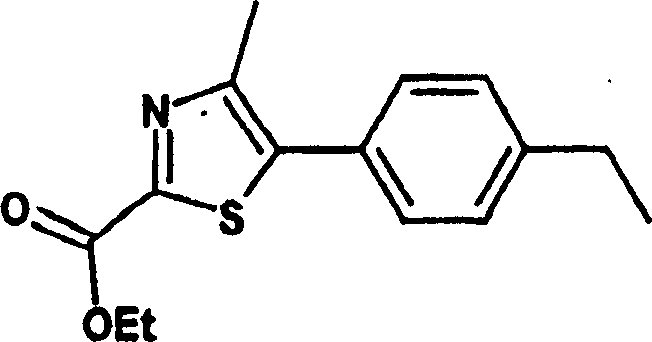
中间体4:Intermediate 4:
288g(1.19mol)中间体3的2.9L乙醇溶液中加入158.8g(1eq.,Acros)硫代草氨酸乙酯。将溶液在室温下搅拌1h,然后回流1h。在蒸发乙醇后,黑色残余物用1L水稀释,用3×500ml CH2Cl2萃取。有机层用500ml水洗涤两次。用硫酸钠干燥后,减压蒸发得到32.6g粗制油状物。用色谱法提纯(98∶2石油醚/乙酸乙酯)得到30.9g灰色油状中间体4(60.6%收率)。Add 158.8g (1eq., Acros) ethyl thiooxamate to 2.9L ethanol solution of 288g (1.19mol) intermediate 3. The solution was stirred at room temperature for 1 h, then refluxed for 1 h. After evaporation of ethanol, the black residue was diluted with 1 L of water and extracted with 3 x 500 ml CH2Cl2 . The organic layer was washed twice with 500 ml of water. After drying over sodium sulfate, evaporation under reduced pressure gave 32.6 g of a crude oil. Purification by chromatography (98:2 petroleum ether/ethyl acetate) afforded 30.9 g of intermediate 4 as a gray oil (60.6% yield).

中间体5:Intermediate 5:
0.6g中间体4(22mmol)的10ml乙醇溶液中加入6.5ml(13eq.)NaOH 1N。将混合物在回流下搅拌30min,然后减压浓缩。残余物用水稀释,用乙醚萃取。水层用HCl 1N酸化,用CH2Cl2萃取。有机层用硫酸钠干燥,过滤并真空蒸发获得0.4g黄色固体中间体5(73.6%收率)。To 0.6g of intermediate 4 (22mmol) in 10ml of ethanol was added 6.5ml (13eq.) of NaOH 1N. The mixture was stirred at reflux for 30 min, then concentrated under reduced pressure. The residue was diluted with water and extracted with ether. The aqueous layer was acidified with HCl 1N and extracted with CH2Cl2 . The organic layer was dried over sodium sulfate, filtered and evaporated in vacuo to afford 0.4 g of intermediate 5 as a yellow solid (73.6% yield).
MS m/z 248(M+1)MS m/z 248(M+1)
中间体6:Intermediate 6:
在10℃,向10g(65.8mmol,Aldrich)4-氟苯基丙酮的100ml苯溶液中滴加10.5g(1eq.)溴。将反应混合物在室温下搅拌1h。在反应末期,将氮通入反应混合物中。真空浓缩混合物,蒸馏所得油状物获得9g油状物(收率=59%)。Eb=130-135℃,20mm Hg。At 10° C., 10.5 g (1 eq.) of bromine was added dropwise to a solution of 10 g (65.8 mmol, Aldrich) of 4-fluorophenylacetone in 100 ml of benzene. The reaction mixture was stirred at room temperature for 1 h. At the end of the reaction, nitrogen was bubbled through the reaction mixture. The mixture was concentrated in vacuo and the resulting oil was distilled to obtain 9 g of oil (Yield = 59%). Eb=130-135°C, 20mm Hg.

中间体7:Intermediate 7:
1g(4.33mmol)中间体6的30ml乙醇溶液中加入0.54g(1eq.,Acros)硫代草氨酸乙酯。将溶液在回流下搅拌过夜。真空浓缩溶液,油状残余物用水稀释,用CH2Cl2萃取。有机层用盐水洗涤,用硫酸钠干燥,减压蒸发。所得粗制油状物用色谱法处理(99∶1二氯甲烷/甲醇)获得0.26g褐色固体中间体7(收率=22.6%)。m.p:69-70℃。0.54 g (1 eq., Acros) of ethyl thiooxamate was added to 1 g (4.33 mmol) of intermediate 6 in 30 ml of ethanol. The solution was stirred overnight at reflux. The solution was concentrated in vacuo and the oily residue was diluted with water and extracted with CH2Cl2 . The organic layer was washed with brine, dried over sodium sulfate and evaporated under reduced pressure. The resulting crude oil was chromatographed (99:1 dichloromethane/methanol) to afford 0.26 g of intermediate 7 as a brown solid (yield = 22.6%). mp: 69-70°C.
中间体8:Intermediate 8:
1.5中间体7(5.66mmol)的50ml乙醇溶液中加入20ml NaOH1N。将混合物在回流下搅拌30min,然后减压浓缩。残余物用水稀释,用乙醚萃取。水层用HCl 1N酸化,用CH2Cl2萃取。有机层用硫酸钠干燥,过滤并蒸发至干获得乳白色固体中间体7(0.81g,60%收率)。m.p:140℃。1.5 To a solution of Intermediate 7 (5.66mmol) in 50ml of ethanol was added 20ml of NaOH1N. The mixture was stirred at reflux for 30 min, then concentrated under reduced pressure. The residue was diluted with water and extracted with ether. The aqueous layer was acidified with HCl 1N and extracted with CH2Cl2 . The organic layer was dried over sodium sulfate, filtered and evaporated to dryness to obtain intermediate 7 as an off-white solid (0.81 g, 60% yield). mp: 140°C.
实施例1:Example 1:
2-甲基-2-[4-{[(4-甲基-5-[4-乙基苯基]噻唑-2-基羰基)氨基]甲基}苯氧2-Methyl-2-[4-{[(4-methyl-5-[4-ethylphenyl]thiazol-2-ylcarbonyl)amino]methyl}phenoxy 基]丙酸乙酯Ethyl] propionate
方法AMethod A
250mg中间体2(1mmol)的10ml二氯甲烷溶液中加入174mgHOBT(1.3eq.)、284mg EDC(1.3eq.)、260mg中间体5(1eq.)和130mg三乙胺(1.3eq.)。将反应混合物在室温下搅拌2天。将混合物用稀NaOH处理,用CH2Cl2萃取。有机层用稀HCl、水洗涤,用硫酸钠干燥。真空蒸发后,所得粗制油状物用色谱法提纯(99∶1二氯甲烷/甲醇)获得100mg油状实施例1(21.5%收率)。To a solution of 250 mg of Intermediate 2 (1 mmol) in 10 ml of dichloromethane was added 174 mg of HOBT (1.3 eq.), 284 mg of EDC (1.3 eq.), 260 mg of Intermediate 5 (1 eq.) and 130 mg of triethylamine (1.3 eq.). The reaction mixture was stirred at room temperature for 2 days. The mixture was treated with dilute NaOH and extracted with CH2Cl2 . The organic layer was washed with dilute HCl, water and dried over sodium sulfate. After evaporation in vacuo, the resulting crude oil was purified by chromatography (99:1 dichloromethane/methanol) to afford 100 mg of Example 1 as an oil (21.5% yield).
方法BMethod B
26.93g(97.9mmol)中间体4和46.5g(2eq.)中间体2的300ml乙醇溶液中加入85.3ml(5eq.)二异丙基乙胺。将反应混合物在回流下搅拌2天。为了完全反应,加入23.5g(1eq.)中间体2的50mol乙醇。将反应混合物在回流下搅拌7h,再加入1当量中间体2(23.5g)。将混合物保持回流24h。真空浓缩反应物,残余物用水稀释,用NaOH1N碱化。水层用乙酸乙酯(3×300ml)萃取,有机层用HCl 1N、NaHCO3饱和溶液和盐水洗涤。整个有机层用硫酸镁干燥,过滤,蒸发至干。所得粗制油状物用色谱法处理(80∶20石油醚/乙酸乙酯)获得无色油状实施例1(40.9g,收率=89.6%)。26.93g (97.9mmol) of intermediate 4 and 46.5g (2eq.) of intermediate 2 in 300ml of ethanol were added 85.3ml (5eq.) of diisopropylethylamine. The reaction mixture was stirred at reflux for 2 days. For complete reaction, 23.5 g (1 eq.) of intermediate 2 in 50 mol of ethanol were added. The reaction mixture was stirred at reflux for 7 h, and then 1 equivalent of Intermediate 2 (23.5 g) was added. The mixture was kept at reflux for 24h. The reaction was concentrated in vacuo and the residue was diluted with water and basified with NaOH 1N. The aqueous layer was extracted with ethyl acetate (3 x 300ml), and the organic layer was washed with HCl 1N, saturated NaHCO 3 solution and brine. The entire organic layer was dried over magnesium sulfate, filtered and evaporated to dryness. The resulting crude oil was chromatographed (80:20 petroleum ether/ethyl acetate) to obtain Example 1 (40.9 g, yield = 89.6%) as a colorless oil.
1H NMR(CDCl3):δ7.57(m,1H),7.29(d,2H),7.15-7.21(m,4H),6.75(d,2H),4.50(d,2H),4.16(q,2H),2.62(q,2H),2.40(s,3H),1.52(s,6H),1.20(s,3H),1.10(s,3H)。 1 H NMR (CDCl 3 ): δ7.57(m, 1H), 7.29(d, 2H), 7.15-7.21(m, 4H), 6.75(d, 2H), 4.50(d, 2H), 4.16(q , 2H), 2.62(q, 2H), 2.40(s, 3H), 1.52(s, 6H), 1.20(s, 3H), 1.10(s, 3H).
实施例2:Example 2:
2-甲基-2-[4-{[(4-甲基-5-[4-乙基苯基]噻唑-2-基羰基)氨基]甲基}苯氧2-Methyl-2-[4-{[(4-methyl-5-[4-ethylphenyl]thiazol-2-ylcarbonyl)amino]methyl}phenoxy 基]丙酸base] propionic acid
100mg(0.21mmol.)实施例1的5ml乙醇溶液中加入0.63ml(3eq.)NaOH(1N)。将溶液在回流下搅拌30min。减压除去溶剂后,残余物用水稀释,用HCl 1N酸化至PH=1。水层用CH2Cl2萃取,用硫酸钠干燥。在过滤并浓缩至干后,将油状残余物与CH2Cl2和戊烷的混合物合并。过滤固体,真空烘箱中干燥获得白色固体实施例2(50mg,收率=53.2%),mp=159-162℃。MS m/z 467(M+1)。0.63ml (3eq.) NaOH (1N) was added to the 5ml ethanol solution of 100mg (0.21mmol.) Example 1. The solution was stirred at reflux for 30 min. After removing the solvent under reduced pressure, the residue was diluted with water and acidified to pH=1 with HCl 1N. The aqueous layer was extracted with CH2Cl2 , dried over sodium sulfate. After filtration and concentration to dryness, the oily residue was combined with a mixture of CH2Cl2 and pentane . The solid was filtered and dried in a vacuum oven to obtain white solid Example 2 (50 mg, yield = 53.2%), mp = 159-162 °C. MS m/z 467 (M+1).
1H NMR(CDCl3):δ7.57(m,1H),7.18(d,2H),7.10(d,2H),6.74(d,2H),4.41(d,2H),2.52(q,2H),2.30(s,3H),1.43(s,6H),1.10(s,3H)。 1 H NMR (CDCl 3 ): δ7.57(m, 1H), 7.18(d, 2H), 7.10(d, 2H), 6.74(d, 2H), 4.41(d, 2H), 2.52(q, 2H ), 2.30(s, 3H), 1.43(s, 6H), 1.10(s, 3H).
实施例3:Example 3:
2-甲基-2-[4-{[(4-甲基-5-[4-氟苯基]噻唑-2-基羰基)氨基]甲基}苯氧基]2-methyl-2-[4-{[(4-methyl-5-[4-fluorophenyl]thiazol-2-ylcarbonyl)amino]methyl}phenoxy] 丙酸乙酯ethyl propionate
320mg中间体2(1.35mmol)的30ml二甲基甲酰胺溶液中加入240mg HOBT(1.3eq.)、340mg EDC(1.3eq.)、320mg中间体7(1eq.)和0.25ml三乙胺(1.3eq.)。将反应混合物在室温下搅拌过夜。减压蒸发混合物,用水稀释,用CH2Cl2萃取。有机层用水和盐水洗涤,用硫酸钠干燥,真空蒸发。所得粗制油状物用色谱法提纯(99∶1二氯甲烷/甲醇)获得330mg白色固体实施例1(收率=53.5%)。m.p:97℃。MSm/z 457(M+1)。Add 240mg HOBT (1.3eq.), 340mg EDC (1.3eq.), 320mg Intermediate 7 (1eq.) and 0.25ml triethylamine (1.3 eq.). The reaction mixture was stirred overnight at room temperature. The mixture was evaporated under reduced pressure, diluted with water and extracted with CH2Cl2 . The organic layer was washed with water and brine, dried over sodium sulfate and evaporated in vacuo. The resulting crude oil was purified by chromatography (99:1 dichloromethane/methanol) to obtain 330 mg of white solid Example 1 (Yield = 53.5%). mp: 97°C. MS m/z 457 (M+1).

实施例4:Example 4:
2-甲基-2-[4-{[(4-甲基-5-[4-氟苯基]噻唑-2-基羰基)氨基]甲基}苯氧基]2-methyl-2-[4-{[(4-methyl-5-[4-fluorophenyl]thiazol-2-ylcarbonyl)amino]methyl}phenoxy] 丙酸propionic acid
310mg(0.68mmol.)实施例3的25ml四氢呋喃溶液中加入2ml(5eq.)LiOH 1N。将溶液在50℃搅拌30min。为了完全反应,加入2mlNaOH 1N,将溶液在50℃搅拌1h。减压除去溶剂后,残余物用水稀释,水层用乙醚萃取。水层用5.4ml HCl N处理,用乙醚萃取。有机层用硫酸钠干燥,过滤并真空蒸发得到固体,将其用二异丙基醚重结晶获得230mg白色固体实施例4(72%收率),mp=122℃。MS m/z429(M+1)。2ml (5eq.) LiOH 1N was added in 25ml THF solution of 310mg (0.68mmol.) Example 3. The solution was stirred at 50 °C for 30 min. For complete reaction, 2 ml of NaOH 1N was added and the solution was stirred at 50 °C for 1 h. After the solvent was removed under reduced pressure, the residue was diluted with water, and the aqueous layer was extracted with ether. The aqueous layer was treated with 5.4 ml HCl N and extracted with ether. The organic layer was dried over sodium sulfate, filtered and evaporated in vacuo to give a solid, which was recrystallized from diisopropyl ether to give 230 mg of white solid Example 4 (72% yield), mp = 122°C. MS m/z 429 (M+1).
结合测定binding assay
使用闪烁近似测定(SPA)检测化合物结合hPPARγ、hPPARα或PPARδ的能力。PPAR配体结合结构域(LBD)在大肠杆菌表达polyHis标记的融合蛋白,对其进行纯化。然后用生物素标记LBD,将其固定在链霉抗生物素蛋白修饰的闪烁近似珠上。之后将珠与恒定量合适放射性配体(PPARγ为3H-BRL 49653,hPPARα为放射性标记的2-(4-(2-(2,3-二氚-1-庚基-3-(2,4-二氟苯基)脲基)乙基)苯氧基)-2-甲基丁酸(参见WO 00/08002),PPARδ为标记GW 2433(关于该配体的结构和合成参见Brown,P.J等,Chem.Biol.1997,4,909-918)和不同浓度的受试化合物温育,平衡后用闪烁计数仪检测结合在珠子上放射性。每个数据减去非特异性结合量,非特异性结合量为含有50μM相应未标记配体的对照孔的测定值。对于每种所测试的化合物,对配体浓度与结合的放射性配体CPM作图,假定为单纯竟争性结合的前提下,根据非线性最小二乘方拟合数据估算表观K1值。另见有关该测定细节的报道(参见Blanchard,S.G.等,Development of a ScintillationProximity Assay for Peroxisome Proliferator-Activated Receptor gammaLigand Binding Domain.Anal.Biochem.1998,257,112-119)。The ability of compounds to bind hPPARγ, hPPARα or PPARδ was tested using the scintillation proximity assay (SPA). The PPAR ligand-binding domain (LBD) was expressed in Escherichia coli as a polyHis-tagged fusion protein and purified. The LBD was then labeled with biotin and immobilized on streptavidin-modified scintillation approximation beads. The beads were then mixed with a constant amount of the appropriate radioligand ( 3H -BRL 49653 for PPARγ, radiolabeled 2-(4-(2-(2,3-ditritium-1-heptyl-3-(2, 4-difluorophenyl)ureido)ethyl)phenoxy)-2-methylbutanoic acid (see WO 00/08002), PPARδ is labeled GW 2433 (for the structure and synthesis of this ligand see Brown, PJ etc., Chem.Biol.1997, 4,909-918) and the test compound incubation of different concentrations, after equilibrating, detect with scintillation counter instrument to be combined on the bead radioactivity.Each data subtracts the amount of non-specific binding, non-specific binding Amounts are measured in control wells containing 50 μM of the corresponding unlabeled ligand. For each compound tested, the concentration of the ligand is plotted against the CPM of the bound radioligand, assuming purely competitive binding, according to Nonlinear least squares fits to the data estimated apparent K values. See also the report for details of this assay (see Blanchard, SG et al., Development of a Scintillation Proximity Assay for Peroxisome Proliferator-Activated Receptor gammaLigand Binding Domain. Anal. Biochem. 1998, 257, 112-119).
转染测定: Transfection Assay :
制备以下配体用于下述转染测定。The following ligands were prepared for use in the transfection assay described below.
(i)2-{2-甲基-4-[({4-甲基-2-[4-(三氟甲基)苯基]-1,3-噻唑-5-基}甲(i) 2-{2-methyl-4-[({4-methyl-2-[4-(trifluoromethyl)phenyl]-1,3-thiazol-5-yl}methyl 基)硫基]苯氧基}乙酸base)thio]phenoxy}acetic acid
该化合物用作下述转染测定中的PPARδ对照,根据WO200100603-A1报道的方法制备。This compound was used as a PPARδ control in the transfection assay described below and was prepared according to the method reported in WO200100603-A1.
(ii)2-甲基-2-[4-{[(4-甲基-2-[4-三氟甲基苯基]-噻唑5-基-羰基)氨(ii) 2-methyl-2-[4-{[(4-methyl-2-[4-trifluoromethylphenyl]-thiazol 5-yl-carbonyl)amine 基]甲基}-苯氧基]丙酸base]methyl}-phenoxy]propanoic acid
该化合物用作下述转染测定中的PPARα对照,根据WO200140207-A1报道的方法制备(如下所述重新制备)。This compound was used as a PPARα control in the transfection assay described below and was prepared according to the method reported in WO200140207-A1 (reproduced as described below).
中间体(a):Intermediate (a):
按照Stout,D.M.J.Med.Chem.1983,26(6),808-13的相同步骤制备。向4-甲氧基苄基胺(25g,0.18mol;Aldrich)加入46%HBr的H2O(106ml,0.9mol;Aldrich)溶液。将反应物回流过夜,然后将反应物冷却至0℃,用氢氧化钾缓慢中和至pH7。搅拌反应物~30min,然后滤出固体并干燥。将固体重新溶于热MeOH,过滤,将溶液冷却得到19g(85%)中间体1。1H NMR(DMSO-d6):δ8.0(bs,1H),7.2(d,2H),6.75(d,2H),3.85(s,2H),3.50(bs,2H)。It was prepared according to the same procedure of Stout, DMJMed. Chem. 1983, 26(6), 808-13. To 4-methoxybenzylamine (25 g, 0.18 mol; Aldrich) was added 46% HBr in H2O (106 ml, 0.9 mol; Aldrich). The reaction mass was refluxed overnight, then the reaction mass was cooled to 0°C and slowly neutralized to pH7 with potassium hydroxide. The reaction was stirred for ~30 min, then the solid was filtered off and dried. The solid was redissolved in hot MeOH, filtered and the solution was cooled to give 19 g (85%) of intermediate 1. 1 H NMR (DMSO-d 6 ): δ8.0 (bs, 1H), 7.2 (d, 2H), 6.75 (d, 2H), 3.85 (s, 2H), 3.50 (bs, 2H).
中间体(b):Intermediate (b):
将2-氯乙酰乙酸乙酯(35.3g,29.7mL,0.21mol)和4-(三氟甲基)硫代苯甲酰胺(44g,0.21mol)的EtOH(300mL)溶液回流过夜。冷却至室温后,真空除去溶剂。最终产物(中间体(b))用最少量MeOH重结晶得到40g(59%)白色固体终产物;1H NMR(CDCl3):δ8.10(d,2H),7.70(d,2H),4.40(q,2H),2.80(s,3H),1.4(t,3H)。A solution of ethyl 2-chloroacetoacetate (35.3 g, 29.7 mL, 0.21 mol) and 4-(trifluoromethyl)thiobenzamide (44 g, 0.21 mol) in EtOH (300 mL) was refluxed overnight. After cooling to room temperature, the solvent was removed in vacuo. The final product (intermediate (b)) was recrystallized from a minimum amount of MeOH to give 40 g (59%) of the final product as a white solid; 1 H NMR (CDCl 3 ): δ 8.10 (d, 2H), 7.70 (d, 2H), 4.40(q, 2H), 2.80(s, 3H), 1.4(t, 3H).

中间体(c):Intermediate (c):
中间体(b)(1.84g,5.8mmol)的THF溶液中加入1N LiOH(6mL,6mmol),将反应物在室温下搅拌。在~3h后,将反应物用1N HCl中和,用3×100mL EtOAc萃取,用硫酸钠干燥,过滤,真空除去溶剂后得到1.5g(89%)白色固体中间体(b)。1H NMR(DMSO-d6):δ13.55(bs,1H),8.25(d,2H),7.95(d,2H),2.75(s,3H)。1N LiOH (6 mL, 6 mmol) was added to a THF solution of intermediate (b) (1.84 g, 5.8 mmol), and the reaction was stirred at room temperature. After ~3h, the reaction was neutralized with 1N HCl, extracted with 3 x 100 mL EtOAc, dried over sodium sulfate, filtered and 1.5 g (89%) of intermediate (b) was obtained as a white solid after removal of the solvent in vacuo. 1 H NMR (DMSO-d 6 ): δ 13.55 (bs, 1H), 8.25 (d, 2H), 7.95 (d, 2H), 2.75 (s, 3H).
中间体(d):Intermediate (d):
中间体(c)(1g,7mmol)的CH2Cl2/DMF(1∶1)溶液中加入HOBT(565mg,4.2mmol;Aldrich)、EDC(800mg,4.2mmol;Aldrich)和中间体1(860mg,7mmol)。将反应物在室温下搅拌18h。真空除去溶剂,用H2O处理,用3×100ml CH2Cl2萃取。合并有机相,用1N HCl洗涤,用硫酸钠干燥,过滤,蒸发获得混合物(N-取代的和N,O-取代的)。将混合物溶于甲醇,用1N NaOH处理。将反应物在50℃搅拌18h。真空除去溶剂,溶于CH2Cl2,用H2O洗涤,用硫酸钠干燥。蒸发溶剂,残余物用色谱法处理(CH2Cl2/MeOH:99/1)得到610mg(47%)白色固体中间体6。1H NMR(DMSO-d6):9.30(s,1H),8.80(t,1H),8.20(d,2H),6.70(d,2H),4.35(d,2H),2.6(s,3H)。Intermediate (c) (1 g, 7 mmol) in CH 2 Cl 2 /DMF (1:1) was added with HOBT (565 mg, 4.2 mmol; Aldrich), EDC (800 mg, 4.2 mmol; Aldrich) and intermediate 1 (860 mg , 7 mmol). The reaction was stirred at room temperature for 18h. The solvent was removed in vacuo, treated with H2O and extracted with 3 x 100ml CH2Cl2 . The organic phases were combined, washed with 1N HCl, dried over sodium sulfate, filtered and evaporated to obtain mixtures (N-substituted and N,O-substituted). The mixture was dissolved in methanol and treated with 1N NaOH. The reaction was stirred at 50 °C for 18 h. The solvent was removed in vacuo, dissolved in CH2Cl2 , washed with H2O , dried over Na2SO4 . The solvent was evaporated and the residue was chromatographed ( CH2Cl2 / MeOH : 99/1) to give 610 mg (47%) of intermediate 6 as a white solid. 1 H NMR (DMSO-d 6 ): 9.30(s, 1H), 8.80(t, 1H), 8.20(d, 2H), 6.70(d, 2H), 4.35(d, 2H), 2.6(s, 3H ).

中间体(e):Intermediate (e):
2-甲基-2-[4-{[(4-甲基-2-[4-三氟甲基苯基]噻唑-5-基羰基)氨基]甲基}苯氧基]丙酸乙酯2-Methyl-2-[4-{[(4-methyl-2-[4-trifluoromethylphenyl]thiazol-5-ylcarbonyl)amino]methyl}phenoxy]propanoic acid ethyl ester
中间体(d)(710mg,1.81mmol)的DMF(50mL)溶液中加入K2CO3(275mg,1.99mmol),然后加入2-溴-2-甲基丙酸乙酯(280μL,1.91mmol;Aldrich),将反应物加热至80℃。在18h后,将反应物冷却至室温,真空除去溶剂。残余物用水(200mL)处理,用3×50mL CH2Cl2萃取,用硫酸钠干燥,过滤,真空除去溶剂。残余物用色谱法处理(CH2Cl2/MeOH:99/1)。得到680mg(77%)澄清油状实施例1。1H NMR(CDCl3):δ7.95(d,2H),7.60(d,2H),7.15(d,2H),6.75(d,2H),6.05(t,1H),4.45(d,2H),4.15(q,2H),2.65(s,3H),1.50(s,6H),1.20(t,3H)。To a solution of intermediate (d) (710 mg, 1.81 mmol) in DMF (50 mL) was added K 2 CO 3 (275 mg, 1.99 mmol), followed by ethyl 2-bromo-2-methylpropanoate (280 μL, 1.91 mmol; Aldrich), the reactants were heated to 80 °C. After 18 h, the reaction was cooled to room temperature and the solvent was removed in vacuo. The residue was treated with water (200 mL), extracted with 3 x 50 mL CH2Cl2 , dried over sodium sulfate, filtered and the solvent was removed in vacuo. The residue was chromatographed ( CH2Cl2 /MeOH: 99/1). 680 mg (77%) of Example 1 were obtained as a clear oil. 1 H NMR (CDCl 3 ): δ7.95(d, 2H), 7.60(d, 2H), 7.15(d, 2H), 6.75(d, 2H), 6.05(t, 1H), 4.45(d, 2H ), 4.15(q, 2H), 2.65(s, 3H), 1.50(s, 6H), 1.20(t, 3H).
2-甲基-2-[4-{[(4-甲基-2-[4-三氟甲基苯基]-噻唑-5-基羰基)氨基]甲基}苯氧基]丙酸2-Methyl-2-[4-{[(4-methyl-2-[4-trifluoromethylphenyl]-thiazol-5-ylcarbonyl)amino]methyl}phenoxy]propanoic acid
中间体(e)(680mg,1.39mmol)的MeOH溶液中加入1N NaOH(1.6mL,1.6mmol),将反应物在60℃搅拌。在18h后,将反应物冷却至室温,蒸发溶剂。残余物用1N HCl处理,用3×20mL THF萃取,真空除去溶剂。从最小量的二氯甲烷和戊烷中沉淀出500mg(75%)白色固体标题化合物。mp:在60-70℃改变形态;LC/MS(m/z):477.22(100%,AP-),479.12(100%,AP+);C23H21F3N2O4S计算值:C5.71(57.73),H4.56(4.42),N5.77(5.85),S6.15(6.70)。To a solution of intermediate (e) (680 mg, 1.39 mmol) in MeOH was added 1N NaOH (1.6 mL, 1.6 mmol), and the reaction was stirred at 60°C. After 18 h, the reaction was cooled to room temperature and the solvent was evaporated. The residue was treated with 1N HCl, extracted with 3 x 20 mL THF, and the solvent was removed in vacuo. 500 mg (75%) of the title compound were precipitated as a white solid from a minimal amount of dichloromethane and pentane. mp: Changes form at 60-70°C; LC/ MS ( m/z) : 477.22 (100%, AP- ) , 479.12 (100%, AP+); Calculated for C23H21F3N2O4S : C5.71 (57.73), H4.56 (4.42), N5.77 (5.85), S6.15 (6.70).
(iii)5-{4-[2-(甲基-吡啶-2-基-氨基)-乙氧基]-苄基}-噻唑烷-2,4-二(iii) 5-{4-[2-(Methyl-pyridin-2-yl-amino)-ethoxy]-benzyl}-thiazolidine-2,4-di 酮ketone
此化合物在下述转染测定中用作PPARγ对照,根据J.Med.Chem.1994,37(23),3977中介绍的方法制备。This compound was used as a PPARy control in the transfection assay described below and was prepared according to the method described in J. Med. Chem. 1994, 37(23), 3977.
用瞬时转染测定法筛选化合物的功能潜能,确定在CV-1细胞中激活PPAR亚型的能力。应用以前建立的嵌合受体系统比较多种受体亚型对相同靶基因的相对转录活性,防止内源性受体激活以免对结果的解释复杂化。参见例如Lehmann,J.M.;Moore,L.B.;Smith-Oliver,T.A.;Wilkison,W.O.;Willson,T.M.;Kliewer,S.A.,Anantidiabetic thiazolidinedione is a high affinity ligand for peroxisomeproliferator-activated receptor gamma(PPARgamma),J.Biol.Chem.,1995,270,12953-6。分别使小鼠和人PPARα、PPARγ和PPARδ的配体结合结构域与酵母转录因子GAL4 DNA结合结构域融合。用相应PPAR嵌合体和含5拷贝GAL4 DNA结合位点的报道构建物的表达载体瞬时转染CV-1细胞,其中GAL4 DNA结合位点驱动表达分泌型胎盘碱性磷酸酶(SPAP)和β-半乳糖苷酶。16小时后,培养基更换为加有10%去脂胎牛血清和适当浓度受试化合物的DME培养基。24小时后,制备细胞提取物,分析碱性磷酸酶和β-半乳糖苷酶活性。使用β-半乳糖苷酶活性作为内标校正碱性磷酸酶活性的转染效率(参见例如Kliewer,S.A.等,Cell 83,813-819(1995))。罗格列酮(BRL 49653)用作hPPARγ测定的阳性对照。hPPARα测定的阳性对照为2-(2-甲基-3-[3-{3-(4-环己基氨基)-[6-(4-氟苯基哌嗪-1-基)][1,3,5]三嗪-2-基氨基}丙基]苯硫基)-2-甲基丙酸。PPARδ测定的阳性对照为2-{2-甲基-4-[({4-甲基-2-{三氟甲基}苯基]-1,3-噻唑-5-基}甲基)硫基]苯氧基}乙酸。Compounds were screened for their functional potential using a transient transfection assay to determine their ability to activate PPAR isoforms in CV-1 cells. The relative transcriptional activity of multiple receptor subtypes towards the same target gene was compared using a previously established chimeric receptor system, preventing activation of endogenous receptors so as not to complicate interpretation of results. See, e.g., Lehmann, J.M.; Moore, L.B.; Smith-Oliver, T.A.; Wilkison, W.O.; Willson, T.M.; ., 1995, 270, 12953-6. The ligand-binding domains of mouse and human PPARα, PPARγ, and PPARδ were fused to the yeast transcription factor GAL4 DNA-binding domain, respectively. CV-1 cells were transiently transfected with expression vectors corresponding to PPAR chimeras and reporter constructs containing 5 copies of the GAL4 DNA-binding site driving expression of secreted placental alkaline phosphatase (SPAP) and β- Galactosidase. After 16 hours, the medium was replaced with DME medium supplemented with 10% defatted fetal calf serum and the appropriate concentration of the test compound. After 24 hours, cell extracts were prepared and analyzed for alkaline phosphatase and β-galactosidase activity. Transfection efficiency was corrected for alkaline phosphatase activity using β-galactosidase activity as an internal standard (see eg Kliewer, S.A. et al., Cell 83, 813-819 (1995)). Rosiglitazone (BRL 49653) was used as a positive control for the hPPARγ assay. The positive control for hPPARα assay is 2-(2-methyl-3-[3-{3-(4-cyclohexylamino)-[6-(4-fluorophenylpiperazin-1-yl)][1, 3,5] Triazin-2-ylamino}propyl]phenylthio)-2-methylpropanoic acid. The positive control for PPARδ assay is 2-{2-methyl-4-[({4-methyl-2-{trifluoromethyl}phenyl]-1,3-thiazol-5-yl}methyl)sulfur base]phenoxy}acetic acid.
下表报告了最优选化合物在3个hPPAR亚型测定中的活性,用纳摩尔表示。
Claims (23)

Applications Claiming Priority (2)
| Application Number | Priority Date | Filing Date | Title |
|---|---|---|---|
| GB0113231.5 | 2001-05-31 | ||
| GBGB0113231.5A GB0113231D0 (en) | 2001-05-31 | 2001-05-31 | Chemical compounds |
Publications (2)
| Publication Number | Publication Date |
|---|---|
| CN1633421A true CN1633421A (en) | 2005-06-29 |
| CN1307166C CN1307166C (en) | 2007-03-28 |
Family
ID=9915636
Family Applications (1)
| Application Number | Title | Priority Date | Filing Date |
|---|---|---|---|
| CNB028149424A Expired - Fee Related CN1307166C (en) | 2001-05-31 | 2002-05-29 | Oxazole/thiazole derivative activators of HPPAR-α receptors |
Country Status (28)
| Country | Link |
|---|---|
| US (1) | US7157479B2 (en) |
| EP (1) | EP1399430B1 (en) |
| JP (1) | JP2004532267A (en) |
| KR (1) | KR100859591B1 (en) |
| CN (1) | CN1307166C (en) |
| AR (1) | AR034051A1 (en) |
| AU (1) | AU2002317765B2 (en) |
| BR (1) | BR0209785A (en) |
| CA (1) | CA2448205A1 (en) |
| CO (1) | CO5540297A2 (en) |
| CY (1) | CY1107206T1 (en) |
| CZ (1) | CZ20033252A3 (en) |
| DE (1) | DE60223805T2 (en) |
| DK (1) | DK1399430T3 (en) |
| ES (1) | ES2296965T3 (en) |
| GB (1) | GB0113231D0 (en) |
| HU (1) | HUP0400043A3 (en) |
| IL (1) | IL158929A0 (en) |
| MX (1) | MXPA03011032A (en) |
| MY (1) | MY132656A (en) |
| NO (1) | NO20035209L (en) |
| NZ (1) | NZ529754A (en) |
| PL (1) | PL367248A1 (en) |
| PT (1) | PT1399430E (en) |
| SI (1) | SI1399430T1 (en) |
| TW (1) | TWI245760B (en) |
| WO (1) | WO2002096895A1 (en) |
| ZA (1) | ZA200309095B (en) |
Cited By (3)
| Publication number | Priority date | Publication date | Assignee | Title |
|---|---|---|---|---|
| WO2007085202A1 (en) * | 2006-01-27 | 2007-08-02 | Beijing Molecule Science And Technology Co., Ltd , | Oxamic acid derivatives,preparation methods and medical uses thereof |
| CN102300853A (en) * | 2008-12-01 | 2011-12-28 | 田边三菱制药株式会社 | Carboxylic acid derivatives containing thiazole ring and their pharmaceutical use |
| CN116511225A (en) * | 2023-03-30 | 2023-08-01 | 江南大学 | A kind of oleic acid-based DES liquid and its preparation method and its application in high-efficiency concentration of anaerobic fermentation liquid |
Families Citing this family (8)
| Publication number | Priority date | Publication date | Assignee | Title |
|---|---|---|---|---|
| MXPA04003398A (en) * | 2001-10-12 | 2004-11-22 | Nippon Chemiphar Co | Activator for peroxisome proliferator-activated receptor delta. |
| EP1535915A4 (en) | 2002-09-06 | 2005-10-05 | Takeda Pharmaceutical | FURANE OR THIOPHENE DERIVATIVE AND PHARMACEUTICAL USES THEREOF |
| GB0314370D0 (en) * | 2003-06-19 | 2003-07-23 | Glaxo Group Ltd | Chemical compounds |
| GB0323702D0 (en) * | 2003-10-09 | 2003-11-12 | Smithkline Beecham Corp | Chemical compound |
| AU2004291262C1 (en) | 2003-11-05 | 2011-08-11 | F. Hoffmann-La Roche Ag | Phenyl derivatives as PPAR agonists |
| FR2882359A1 (en) * | 2005-02-24 | 2006-08-25 | Negma Lerads Soc Par Actions S | PPAR ACTIVATOR DERIVATIVES, PREPARATION METHOD AND THERAPEUTIC APPLICATION |
| FR2901792A1 (en) * | 2006-06-06 | 2007-12-07 | Negma Lerads Soc Par Actions S | PPAR ACTIVATOR DERIVATIVES, PREPARATION METHOD AND THERAPEUTIC APPLICATION |
| CN110803996B (en) * | 2019-11-13 | 2022-01-11 | 台州市创源工业技术有限公司 | Synthesis method of hydroxybenzylamine |
Family Cites Families (7)
| Publication number | Priority date | Publication date | Assignee | Title |
|---|---|---|---|---|
| AU740444B2 (en) | 1996-08-19 | 2001-11-01 | Japan Tobacco Inc. | Propionic acid derivatives and use thereof |
| DE69941777D1 (en) | 1998-03-10 | 2010-01-21 | Ono Pharmaceutical Co | CARBOXYLENE DERIVATIVES AND MEDICAMENTS CONTAINING THESE AS ACTIVE ACTIVE SUBSTANCES |
| CZ20013834A3 (en) * | 1999-04-28 | 2002-04-17 | Aventis Pharma Deutschland Gmbh | Derivatives of acids with three aryl radicals as ligands of PPAR receptors and pharmaceutical preparations in which they are comprised |
| GB9914977D0 (en) | 1999-06-25 | 1999-08-25 | Glaxo Group Ltd | Chemical compounds |
| DK1206457T3 (en) * | 1999-08-27 | 2004-02-16 | Lilly Co Eli | Biaryl-oxa (thia) zole derivatives and their use as modulators PPAPs |
| PE20011010A1 (en) * | 1999-12-02 | 2001-10-18 | Glaxo Group Ltd | OXAZOLES AND THIAZOLES REPLACED AS AGONIST OF THE RECEPTOR ACTIVATED BY THE HUMAN PEROXISOMAS PROLIFERATOR |
| GB0113233D0 (en) * | 2001-05-31 | 2001-07-25 | Glaxo Group Ltd | Chemical compounds |
-
2001
- 2001-05-31 GB GBGB0113231.5A patent/GB0113231D0/en not_active Ceased
-
2002
- 2002-05-29 DE DE60223805T patent/DE60223805T2/en not_active Expired - Fee Related
- 2002-05-29 CZ CZ20033252A patent/CZ20033252A3/en unknown
- 2002-05-29 KR KR1020037015678A patent/KR100859591B1/en not_active Expired - Fee Related
- 2002-05-29 EP EP02747331A patent/EP1399430B1/en not_active Expired - Lifetime
- 2002-05-29 CA CA002448205A patent/CA2448205A1/en not_active Abandoned
- 2002-05-29 BR BR0209785-0A patent/BR0209785A/en not_active IP Right Cessation
- 2002-05-29 PT PT02747331T patent/PT1399430E/en unknown
- 2002-05-29 AR ARP020101999A patent/AR034051A1/en unknown
- 2002-05-29 MX MXPA03011032A patent/MXPA03011032A/en active IP Right Grant
- 2002-05-29 DK DK02747331T patent/DK1399430T3/en active
- 2002-05-29 US US10/478,936 patent/US7157479B2/en not_active Expired - Fee Related
- 2002-05-29 ES ES02747331T patent/ES2296965T3/en not_active Expired - Lifetime
- 2002-05-29 HU HU0400043A patent/HUP0400043A3/en unknown
- 2002-05-29 TW TW091111392A patent/TWI245760B/en not_active IP Right Cessation
- 2002-05-29 IL IL15892902A patent/IL158929A0/en unknown
- 2002-05-29 WO PCT/EP2002/005886 patent/WO2002096895A1/en not_active Ceased
- 2002-05-29 AU AU2002317765A patent/AU2002317765B2/en not_active Ceased
- 2002-05-29 SI SI200230654T patent/SI1399430T1/en unknown
- 2002-05-29 NZ NZ529754A patent/NZ529754A/en unknown
- 2002-05-29 CN CNB028149424A patent/CN1307166C/en not_active Expired - Fee Related
- 2002-05-29 JP JP2003500074A patent/JP2004532267A/en active Pending
- 2002-05-29 PL PL02367248A patent/PL367248A1/en not_active Application Discontinuation
- 2002-05-29 MY MYPI20021973A patent/MY132656A/en unknown
-
2003
- 2003-11-21 ZA ZA200309095A patent/ZA200309095B/en unknown
- 2003-11-24 NO NO20035209A patent/NO20035209L/en not_active Application Discontinuation
- 2003-12-03 CO CO03106490A patent/CO5540297A2/en not_active Application Discontinuation
-
2008
- 2008-02-19 CY CY20081100202T patent/CY1107206T1/en unknown
Cited By (5)
| Publication number | Priority date | Publication date | Assignee | Title |
|---|---|---|---|---|
| WO2007085202A1 (en) * | 2006-01-27 | 2007-08-02 | Beijing Molecule Science And Technology Co., Ltd , | Oxamic acid derivatives,preparation methods and medical uses thereof |
| CN101007790B (en) * | 2006-01-27 | 2011-03-30 | 北京摩力克科技有限公司 | Oxamic acid derivative, and its preparation method and medicinal uses |
| CN102300853A (en) * | 2008-12-01 | 2011-12-28 | 田边三菱制药株式会社 | Carboxylic acid derivatives containing thiazole ring and their pharmaceutical use |
| US8497382B2 (en) | 2008-12-01 | 2013-07-30 | Mitsubishi Tanabe Pharma Corporation | Carboxylic acid derivative containing thiazole ring and pharmaceutical use thereof |
| CN116511225A (en) * | 2023-03-30 | 2023-08-01 | 江南大学 | A kind of oleic acid-based DES liquid and its preparation method and its application in high-efficiency concentration of anaerobic fermentation liquid |
Also Published As
Similar Documents
| Publication | Publication Date | Title |
|---|---|---|
| EP1244642B1 (en) | Substituted oxazoles and thiazoles derivatives as hppar alpha activators | |
| CN1529698A (en) | Taiazole or oxazole derivatives which are useful in treatment of cardiovascular and related diseases | |
| AU2002312954A1 (en) | Thiazole or oxazole derivatives which are useful in the treatment of cardiovascular and related diseases | |
| JP2005529965A (en) | Phenyloxyalkanoic acid derivatives as hPPAR activators | |
| US20040147571A1 (en) | Substituted oxazoles and thiazoles as hppar alpha agonists | |
| CN1633421A (en) | Oxazole/thiazol-derivatives activators of the hppar-alpha receptor | |
| AU2002317765A1 (en) | Oxazol/ thiazol-derivatives activators of the hPPAR-alpha receptor | |
| JP2007508270A (en) | I. Thiazole-2-carboxamide derivatives for use as HPPAR agonists in the treatment of A. dyslipidemia | |
| HK1064367B (en) | Oxazol/thiazol-derivatives activators of the hppar-alpha receptor |
Legal Events
| Date | Code | Title | Description |
|---|---|---|---|
| C06 | Publication | ||
| PB01 | Publication | ||
| C10 | Entry into substantive examination | ||
| SE01 | Entry into force of request for substantive examination | ||
| C14 | Grant of patent or utility model | ||
| GR01 | Patent grant | ||
| C17 | Cessation of patent right | ||
| CF01 | Termination of patent right due to non-payment of annual fee |
Granted publication date: 20070328 |