CN1606555A - Imidazoquinoline derivatives - Google Patents
Imidazoquinoline derivatives Download PDFInfo
- Publication number
- CN1606555A CN1606555A CNA02825645XA CN02825645A CN1606555A CN 1606555 A CN1606555 A CN 1606555A CN A02825645X A CNA02825645X A CN A02825645XA CN 02825645 A CN02825645 A CN 02825645A CN 1606555 A CN1606555 A CN 1606555A
- Authority
- CN
- China
- Prior art keywords
- branched
- alkyl
- straight
- hydrogen atom
- represent hydrogen
- Prior art date
- Legal status (The legal status is an assumption and is not a legal conclusion. Google has not performed a legal analysis and makes no representation as to the accuracy of the status listed.)
- Granted
Links
Classifications
-
- C—CHEMISTRY; METALLURGY
- C07—ORGANIC CHEMISTRY
- C07D—HETEROCYCLIC COMPOUNDS
- C07D471/00—Heterocyclic compounds containing nitrogen atoms as the only ring hetero atoms in the condensed system, at least one ring being a six-membered ring with one nitrogen atom, not provided for by groups C07D451/00 - C07D463/00
- C07D471/02—Heterocyclic compounds containing nitrogen atoms as the only ring hetero atoms in the condensed system, at least one ring being a six-membered ring with one nitrogen atom, not provided for by groups C07D451/00 - C07D463/00 in which the condensed system contains two hetero rings
- C07D471/04—Ortho-condensed systems
-
- A—HUMAN NECESSITIES
- A61—MEDICAL OR VETERINARY SCIENCE; HYGIENE
- A61K—PREPARATIONS FOR MEDICAL, DENTAL OR TOILETRY PURPOSES
- A61K31/00—Medicinal preparations containing organic active ingredients
- A61K31/33—Heterocyclic compounds
- A61K31/395—Heterocyclic compounds having nitrogen as a ring hetero atom, e.g. guanethidine or rifamycins
- A61K31/435—Heterocyclic compounds having nitrogen as a ring hetero atom, e.g. guanethidine or rifamycins having six-membered rings with one nitrogen as the only ring hetero atom
- A61K31/47—Quinolines; Isoquinolines
- A61K31/4738—Quinolines; Isoquinolines ortho- or peri-condensed with heterocyclic ring systems
- A61K31/4745—Quinolines; Isoquinolines ortho- or peri-condensed with heterocyclic ring systems condensed with ring systems having nitrogen as a ring hetero atom, e.g. phenantrolines
-
- A—HUMAN NECESSITIES
- A61—MEDICAL OR VETERINARY SCIENCE; HYGIENE
- A61P—SPECIFIC THERAPEUTIC ACTIVITY OF CHEMICAL COMPOUNDS OR MEDICINAL PREPARATIONS
- A61P1/00—Drugs for disorders of the alimentary tract or the digestive system
- A61P1/04—Drugs for disorders of the alimentary tract or the digestive system for ulcers, gastritis or reflux esophagitis, e.g. antacids, inhibitors of acid secretion, mucosal protectants
-
- A—HUMAN NECESSITIES
- A61—MEDICAL OR VETERINARY SCIENCE; HYGIENE
- A61P—SPECIFIC THERAPEUTIC ACTIVITY OF CHEMICAL COMPOUNDS OR MEDICINAL PREPARATIONS
- A61P11/00—Drugs for disorders of the respiratory system
-
- A—HUMAN NECESSITIES
- A61—MEDICAL OR VETERINARY SCIENCE; HYGIENE
- A61P—SPECIFIC THERAPEUTIC ACTIVITY OF CHEMICAL COMPOUNDS OR MEDICINAL PREPARATIONS
- A61P11/00—Drugs for disorders of the respiratory system
- A61P11/06—Antiasthmatics
-
- A—HUMAN NECESSITIES
- A61—MEDICAL OR VETERINARY SCIENCE; HYGIENE
- A61P—SPECIFIC THERAPEUTIC ACTIVITY OF CHEMICAL COMPOUNDS OR MEDICINAL PREPARATIONS
- A61P13/00—Drugs for disorders of the urinary system
- A61P13/12—Drugs for disorders of the urinary system of the kidneys
-
- A—HUMAN NECESSITIES
- A61—MEDICAL OR VETERINARY SCIENCE; HYGIENE
- A61P—SPECIFIC THERAPEUTIC ACTIVITY OF CHEMICAL COMPOUNDS OR MEDICINAL PREPARATIONS
- A61P17/00—Drugs for dermatological disorders
-
- A—HUMAN NECESSITIES
- A61—MEDICAL OR VETERINARY SCIENCE; HYGIENE
- A61P—SPECIFIC THERAPEUTIC ACTIVITY OF CHEMICAL COMPOUNDS OR MEDICINAL PREPARATIONS
- A61P17/00—Drugs for dermatological disorders
- A61P17/04—Antipruritics
-
- A—HUMAN NECESSITIES
- A61—MEDICAL OR VETERINARY SCIENCE; HYGIENE
- A61P—SPECIFIC THERAPEUTIC ACTIVITY OF CHEMICAL COMPOUNDS OR MEDICINAL PREPARATIONS
- A61P17/00—Drugs for dermatological disorders
- A61P17/06—Antipsoriatics
-
- A—HUMAN NECESSITIES
- A61—MEDICAL OR VETERINARY SCIENCE; HYGIENE
- A61P—SPECIFIC THERAPEUTIC ACTIVITY OF CHEMICAL COMPOUNDS OR MEDICINAL PREPARATIONS
- A61P19/00—Drugs for skeletal disorders
- A61P19/02—Drugs for skeletal disorders for joint disorders, e.g. arthritis, arthrosis
-
- A—HUMAN NECESSITIES
- A61—MEDICAL OR VETERINARY SCIENCE; HYGIENE
- A61P—SPECIFIC THERAPEUTIC ACTIVITY OF CHEMICAL COMPOUNDS OR MEDICINAL PREPARATIONS
- A61P25/00—Drugs for disorders of the nervous system
-
- A—HUMAN NECESSITIES
- A61—MEDICAL OR VETERINARY SCIENCE; HYGIENE
- A61P—SPECIFIC THERAPEUTIC ACTIVITY OF CHEMICAL COMPOUNDS OR MEDICINAL PREPARATIONS
- A61P25/00—Drugs for disorders of the nervous system
- A61P25/14—Drugs for disorders of the nervous system for treating abnormal movements, e.g. chorea, dyskinesia
- A61P25/16—Anti-Parkinson drugs
-
- A—HUMAN NECESSITIES
- A61—MEDICAL OR VETERINARY SCIENCE; HYGIENE
- A61P—SPECIFIC THERAPEUTIC ACTIVITY OF CHEMICAL COMPOUNDS OR MEDICINAL PREPARATIONS
- A61P25/00—Drugs for disorders of the nervous system
- A61P25/24—Antidepressants
-
- A—HUMAN NECESSITIES
- A61—MEDICAL OR VETERINARY SCIENCE; HYGIENE
- A61P—SPECIFIC THERAPEUTIC ACTIVITY OF CHEMICAL COMPOUNDS OR MEDICINAL PREPARATIONS
- A61P25/00—Drugs for disorders of the nervous system
- A61P25/28—Drugs for disorders of the nervous system for treating neurodegenerative disorders of the central nervous system, e.g. nootropic agents, cognition enhancers, drugs for treating Alzheimer's disease or other forms of dementia
-
- A—HUMAN NECESSITIES
- A61—MEDICAL OR VETERINARY SCIENCE; HYGIENE
- A61P—SPECIFIC THERAPEUTIC ACTIVITY OF CHEMICAL COMPOUNDS OR MEDICINAL PREPARATIONS
- A61P27/00—Drugs for disorders of the senses
- A61P27/02—Ophthalmic agents
-
- A—HUMAN NECESSITIES
- A61—MEDICAL OR VETERINARY SCIENCE; HYGIENE
- A61P—SPECIFIC THERAPEUTIC ACTIVITY OF CHEMICAL COMPOUNDS OR MEDICINAL PREPARATIONS
- A61P27/00—Drugs for disorders of the senses
- A61P27/02—Ophthalmic agents
- A61P27/06—Antiglaucoma agents or miotics
-
- A—HUMAN NECESSITIES
- A61—MEDICAL OR VETERINARY SCIENCE; HYGIENE
- A61P—SPECIFIC THERAPEUTIC ACTIVITY OF CHEMICAL COMPOUNDS OR MEDICINAL PREPARATIONS
- A61P27/00—Drugs for disorders of the senses
- A61P27/16—Otologicals
-
- A—HUMAN NECESSITIES
- A61—MEDICAL OR VETERINARY SCIENCE; HYGIENE
- A61P—SPECIFIC THERAPEUTIC ACTIVITY OF CHEMICAL COMPOUNDS OR MEDICINAL PREPARATIONS
- A61P29/00—Non-central analgesic, antipyretic or antiinflammatory agents, e.g. antirheumatic agents; Non-steroidal antiinflammatory drugs [NSAID]
-
- A—HUMAN NECESSITIES
- A61—MEDICAL OR VETERINARY SCIENCE; HYGIENE
- A61P—SPECIFIC THERAPEUTIC ACTIVITY OF CHEMICAL COMPOUNDS OR MEDICINAL PREPARATIONS
- A61P3/00—Drugs for disorders of the metabolism
- A61P3/04—Anorexiants; Antiobesity agents
-
- A—HUMAN NECESSITIES
- A61—MEDICAL OR VETERINARY SCIENCE; HYGIENE
- A61P—SPECIFIC THERAPEUTIC ACTIVITY OF CHEMICAL COMPOUNDS OR MEDICINAL PREPARATIONS
- A61P3/00—Drugs for disorders of the metabolism
- A61P3/08—Drugs for disorders of the metabolism for glucose homeostasis
- A61P3/10—Drugs for disorders of the metabolism for glucose homeostasis for hyperglycaemia, e.g. antidiabetics
-
- A—HUMAN NECESSITIES
- A61—MEDICAL OR VETERINARY SCIENCE; HYGIENE
- A61P—SPECIFIC THERAPEUTIC ACTIVITY OF CHEMICAL COMPOUNDS OR MEDICINAL PREPARATIONS
- A61P35/00—Antineoplastic agents
-
- A—HUMAN NECESSITIES
- A61—MEDICAL OR VETERINARY SCIENCE; HYGIENE
- A61P—SPECIFIC THERAPEUTIC ACTIVITY OF CHEMICAL COMPOUNDS OR MEDICINAL PREPARATIONS
- A61P37/00—Drugs for immunological or allergic disorders
- A61P37/02—Immunomodulators
-
- A—HUMAN NECESSITIES
- A61—MEDICAL OR VETERINARY SCIENCE; HYGIENE
- A61P—SPECIFIC THERAPEUTIC ACTIVITY OF CHEMICAL COMPOUNDS OR MEDICINAL PREPARATIONS
- A61P37/00—Drugs for immunological or allergic disorders
- A61P37/08—Antiallergic agents
-
- A—HUMAN NECESSITIES
- A61—MEDICAL OR VETERINARY SCIENCE; HYGIENE
- A61P—SPECIFIC THERAPEUTIC ACTIVITY OF CHEMICAL COMPOUNDS OR MEDICINAL PREPARATIONS
- A61P43/00—Drugs for specific purposes, not provided for in groups A61P1/00-A61P41/00
-
- A—HUMAN NECESSITIES
- A61—MEDICAL OR VETERINARY SCIENCE; HYGIENE
- A61P—SPECIFIC THERAPEUTIC ACTIVITY OF CHEMICAL COMPOUNDS OR MEDICINAL PREPARATIONS
- A61P7/00—Drugs for disorders of the blood or the extracellular fluid
-
- A—HUMAN NECESSITIES
- A61—MEDICAL OR VETERINARY SCIENCE; HYGIENE
- A61P—SPECIFIC THERAPEUTIC ACTIVITY OF CHEMICAL COMPOUNDS OR MEDICINAL PREPARATIONS
- A61P9/00—Drugs for disorders of the cardiovascular system
-
- A—HUMAN NECESSITIES
- A61—MEDICAL OR VETERINARY SCIENCE; HYGIENE
- A61P—SPECIFIC THERAPEUTIC ACTIVITY OF CHEMICAL COMPOUNDS OR MEDICINAL PREPARATIONS
- A61P9/00—Drugs for disorders of the cardiovascular system
- A61P9/06—Antiarrhythmics
-
- A—HUMAN NECESSITIES
- A61—MEDICAL OR VETERINARY SCIENCE; HYGIENE
- A61P—SPECIFIC THERAPEUTIC ACTIVITY OF CHEMICAL COMPOUNDS OR MEDICINAL PREPARATIONS
- A61P9/00—Drugs for disorders of the cardiovascular system
- A61P9/08—Vasodilators for multiple indications
-
- A—HUMAN NECESSITIES
- A61—MEDICAL OR VETERINARY SCIENCE; HYGIENE
- A61P—SPECIFIC THERAPEUTIC ACTIVITY OF CHEMICAL COMPOUNDS OR MEDICINAL PREPARATIONS
- A61P9/00—Drugs for disorders of the cardiovascular system
- A61P9/10—Drugs for disorders of the cardiovascular system for treating ischaemic or atherosclerotic diseases, e.g. antianginal drugs, coronary vasodilators, drugs for myocardial infarction, retinopathy, cerebrovascula insufficiency, renal arteriosclerosis
-
- A—HUMAN NECESSITIES
- A61—MEDICAL OR VETERINARY SCIENCE; HYGIENE
- A61P—SPECIFIC THERAPEUTIC ACTIVITY OF CHEMICAL COMPOUNDS OR MEDICINAL PREPARATIONS
- A61P9/00—Drugs for disorders of the cardiovascular system
- A61P9/12—Antihypertensives
Landscapes
- Health & Medical Sciences (AREA)
- Chemical & Material Sciences (AREA)
- Organic Chemistry (AREA)
- Life Sciences & Earth Sciences (AREA)
- Pharmacology & Pharmacy (AREA)
- Medicinal Chemistry (AREA)
- Animal Behavior & Ethology (AREA)
- General Health & Medical Sciences (AREA)
- Public Health (AREA)
- Veterinary Medicine (AREA)
- Engineering & Computer Science (AREA)
- Bioinformatics & Cheminformatics (AREA)
- Nuclear Medicine, Radiotherapy & Molecular Imaging (AREA)
- Chemical Kinetics & Catalysis (AREA)
- General Chemical & Material Sciences (AREA)
- Neurology (AREA)
- Neurosurgery (AREA)
- Biomedical Technology (AREA)
- Diabetes (AREA)
- Cardiology (AREA)
- Heart & Thoracic Surgery (AREA)
- Pulmonology (AREA)
- Immunology (AREA)
- Hematology (AREA)
- Ophthalmology & Optometry (AREA)
- Dermatology (AREA)
- Rheumatology (AREA)
- Pain & Pain Management (AREA)
- Urology & Nephrology (AREA)
- Obesity (AREA)
- Psychiatry (AREA)
- Physical Education & Sports Medicine (AREA)
- Endocrinology (AREA)
- Epidemiology (AREA)
- Emergency Medicine (AREA)
- Psychology (AREA)
- Vascular Medicine (AREA)
- Child & Adolescent Psychology (AREA)
- Hospice & Palliative Care (AREA)
- Orthopedic Medicine & Surgery (AREA)
Abstract
Description
本发明涉及通式(I)的腺苷A3受体的配体,那些之中优选拮抗剂,以及它们的盐、溶剂化物和异构体,含有它们的药物组合物,通式(I)化合物以及它们的盐、溶剂化物和异构体的用途,通式(I)化合物以及它们的盐、溶剂化物和异构体的制备,还涉及新的通式(II)和(III)的中间体及其制备。The present invention relates to ligands of adenosine A3 receptors of general formula (I), preferred antagonists among those, and their salts, solvates and isomers, pharmaceutical compositions containing them, general formula (I) The use of compounds and their salts, solvates and isomers, the preparation of compounds of general formula (I) and their salts, solvates and isomers, and new intermediates of general formulas (II) and (III) body and its preparation.
腺苷是众所周知的一些内源性分子(ATP、NAD+、核酸)的成分。此外,它还在很多生理过程中起重要的调节作用。腺苷对心脏功能的作用早已于1929年发现。(Drury和Szentgyrgyi,J Physiol 68:213,1929)。对腺苷介导的生理功能数增加的证实和新的腺苷受体亚型的发现为特定配体的治疗性应用提供了可能性(Poulse,S.A.和Quinn,R.J.Bioorganic and Medicinal Chemistry 6:619,1998)。Adenosine is a well known constituent of some endogenous molecules (ATP, NAD + , nucleic acids). In addition, it also plays an important regulatory role in many physiological processes. The effect of adenosine on cardiac function was discovered as early as 1929. (Drury and Szentgyrgyi, J Physiol 68:213, 1929). The demonstration of an increase in the number of adenosine-mediated physiological functions and the discovery of new adenosine receptor subtypes offers the possibility of therapeutic applications of specific ligands (Poulse, SA and Quinn, RJ Bioorganic and Medicinal Chemistry 6:619, 1998).
迄今为止,腺苷受体分为3个主要的种类:A1、A2和A3。A1亚型通过与Gi膜蛋白偶联部分负责抑制腺苷酸环化酶,部分影响其它第二信使系统。A2受体亚型可再分为两个亚型-A2a和A2b-,该受体可刺激腺苷酸环化酶的活性。近来,已经从大鼠睾丸cDNA库中鉴定了腺苷A3受体的序列。随后,证实了它与新的、功能性腺苷受体相对应。A3受体的激活还与若干第二信使系统有关:例如抑制腺苷酸环化酶,并刺激磷脂酶C和D。To date, adenosine receptors have been classified into 3 main classes: A1 , A2 and A3 . The A1 isoform is partly responsible for the inhibition of adenylyl cyclase by coupling to the G i membrane protein and partly affects other second messenger systems. The A2 receptor subtype can be subdivided into two subtypes - A2a and A2b - and this receptor stimulates the activity of adenylyl cyclase. Recently, the sequence of the adenosine A3 receptor has been identified from a rat testis cDNA library. Subsequently, it was shown to correspond to a novel, functional adenosine receptor. Activation of the A3 receptor is also associated with several second messenger systems: eg inhibition of adenylyl cyclase, and stimulation of phospholipases C and D.
腺苷受体可在很多器官中找到,并调节它们的功能。A1和A2a受体在中枢神经系统和心血管系统中起着重要的作用。在CNS中,腺苷可抑制突触递质的释放,其作用是由A1受体介导的。在心脏中,A1受体还可介导腺苷的减弱肌收缩力效应、变时效应和变传导效应。腺苷A2a受体以相对较高的含量位于纹状体中,在调节突触传导方面,显示与多巴胺受体的功能性相互作用。内皮和平滑肌细胞上的A2a腺苷受体负责腺苷诱导的血管舒张。Adenosine receptors are found in many organs and regulate their function. A1 and A2a receptors play important roles in the central nervous system and cardiovascular system. In the CNS, adenosine can inhibit the release of synaptic transmitters, and its action is mediated by A1 receptors. In the heart, A1 receptors can also mediate the inotropic, chronotropic and conduction-inducing effects of adenosine. Adenosine A 2a receptors are located in the striatum in relatively high abundance and have been shown to functionally interact with dopamine receptors in the regulation of synaptic transmission. A2a adenosine receptors on endothelial and smooth muscle cells are responsible for adenosine-induced vasodilation.
以mRNA鉴定为基础,A2b腺苷受体广泛分布于不同的组织中。它们几乎已经在所有细胞类型中被鉴定,但它在肠和膀胱中的表达水平最高。这种亚型还很可能在血管紧张的调节方面具有重要的调节功能,并在肥大细胞的功能方面起作用。Based on mRNA identification, A2b adenosine receptors are widely distributed in different tissues. They have been identified in almost all cell types, but are expressed at the highest levels in the intestine and bladder. This isoform is also likely to have an important regulatory function in the regulation of vascular tone and has a role in mast cell function.
与在蛋白水平检测组织分布的A1和A2a受体相反,A2b和A3受体存在的检测是以它们的mRNA水平为基础的。与其它亚型相比,A3腺苷受体的表达水平较低,而且是高度物种依赖性的。A3腺苷受体主要在中枢神经系统、睾丸、免疫系统中表达,而且似乎涉及从肥大细胞释放的介质在即发型超敏反应中的调节。In contrast to A1 and A2a receptors whose tissue distribution is detected at the protein level, detection of the presence of A2b and A3 receptors is based on their mRNA levels. Compared with other subtypes, the expression level of A3 adenosine receptor is lower and highly species-dependent. A3 adenosine receptors are mainly expressed in the central nervous system, testis, immune system, and appear to be involved in the regulation of mediators released from mast cells in immediate-type hypersensitivity.
迄今为止在文献中公开的A3拮抗剂为类黄酮、1,4-二氢吡啶衍生物、三唑并喹唑啉、噻唑并萘啶和噻唑并嘧啶。本发明涉及一种新的有效的A3拮抗剂类型,它具有咪唑并喹啉结构。 A3 antagonists disclosed in the literature so far are flavonoids, 1,4-dihydropyridine derivatives, triazoloquinazolines, thiazonaphthyridines and thiazolopyrimidines. The present invention relates to a new class of potent A3 antagonists having an imidazoquinoline structure.
就治疗用途而言,它基本确保该分子不结合,或仅仅在非常高的浓度下结合腺苷受体的A1、A2a和A2b亚型。我们的发明涉及通式(I)的化合物和它们的盐、溶剂化物和异构体,它对腺苷受体的A3亚型具有较高选择性。For therapeutic use, it essentially ensures that the molecule does not bind, or only at very high concentrations, the A1 , A2a and A2b subtypes of the adenosine receptor. Our invention relates to compounds of general formula (I) and their salts, solvates and isomers, which have higher selectivity for the A3 subtype of adenosine receptors.
我们的目的首先是制备具有咪唑并喹啉结构的A3配体,且那些之内优选拮抗剂,它具有较强的拮抗作用,并对A3受体显示较高的选择性,即它们以明显低于抑制A1、A2a和A2b受体的浓度抑制A3受体。另一目的是了解稳定性、生物可利用率、治疗指数和毒性数据,从而将所述新化合物开发成药物,且由于它们良好的肠吸收,该化合物可用于口服。Our aim is first to prepare A3 ligands with imidazoquinoline structure, and antagonists are preferred among those, which have stronger antagonistic effect and show higher selectivity to A3 receptors, that is, they are based on A3 receptors were inhibited at concentrations significantly lower than those that inhibited A1 , A2a and A2b receptors. Another objective is to know the stability, bioavailability, therapeutic index and toxicity data so that the new compounds can be developed as drugs and due to their good intestinal absorption, the compounds can be used orally.
我们已经发现了满足上述条件的通式(I)的化合物和它们的盐、溶剂化物、及其旋光异构体和盐、溶剂化物—其中We have found compounds of general formula (I) satisfying the above conditions and their salts, solvates, and optical isomers and salts, solvates thereof—wherein
R1代表氢原子或直链或支链C1-4烷基;R 1 represents a hydrogen atom or a straight or branched C 1-4 alkyl group;
R2代表氢原子或直链或支链C1-4烷基;R 2 represents a hydrogen atom or a straight or branched C 1-4 alkyl group;
R3代表氢原子或直链或支链C1-4烷基,或C3-6环烷基,或苯基、噻吩基、或呋喃基,任选被一个或多个直链或支链C1-4烷基、直链或支链C1-4烷氧基、或卤素原子取代,或代表含有1个、2个或3个氮原子的5-或6-元杂芳环、或含有1个氮原子和1个氧原子或1个氮原子和1个硫原子的5元杂芳环,任选被一个或多个直链或支链C1-4烷基、直链或支链C1-4烷氧基、或卤素原子取代;R 3 represents a hydrogen atom or a linear or branched C 1-4 alkyl group, or a C 3-6 cycloalkyl group, or a phenyl, thienyl, or furyl group, optionally surrounded by one or more linear or branched C 1-4 alkyl, straight chain or branched C 1-4 alkoxy, or halogen atom substitution, or representing a 5- or 6-membered heteroaryl ring containing 1, 2 or 3 nitrogen atoms, or A 5-membered heteroaromatic ring containing 1 nitrogen atom and 1 oxygen atom or 1 nitrogen atom and 1 sulfur atom, optionally surrounded by one or more straight-chain or branched C 1-4 alkyl, straight-chain or branched Chain C 1-4 alkoxy, or halogen atom substitution;
R4、R5、R6和R7彼此独立地代表氢原子、直链或支链C1-4烷基、直链或支链C1-4烷氧基、羟基或卤素原子;或R4和R7代表氢原子且R5和R6共同形成亚甲二氧基;R 4 , R 5 , R 6 and R 7 independently represent a hydrogen atom, a straight or branched C 1-4 alkyl group, a straight or branched C 1-4 alkoxy group, a hydroxyl group or a halogen atom; or R 4 and R 7 represent a hydrogen atom and R 5 and R 6 jointly form a methylenedioxy group;
R8代表氢原子或氰基、氨羰基、C1-4烷氧羰基、或羧基;R 8 represents a hydrogen atom or a cyano group, an aminocarbonyl group, a C 1-4 alkoxycarbonyl group, or a carboxyl group;
R9和R10彼此独立地代表氢原子或直链或支链C1-4烷基,或C3-6环烷基,或苯基、苯基-(C1-4)烷基、噻吩基-(C1-4)烷基或呋喃基-(C1-4)烷基,任选被亚甲二氧基、或一个或多个直链或支链C1-4烷基、直链或支链C1-4烷氧基、羟基、三氟甲基、氰基或卤素原子取代,或代表含有1个、2个或3个氮原子的5或6元杂芳环、或含有1个氮原子和1个氧原子或1个氮原子和1个硫原子的5元杂芳环,任选被一个或多个直链或支链C1-4烷基、直链或支链C1-4烷氧基、或卤素原子取代;或代表-(CH2)m-OH或-(CH2)o-NR12R13,或R 9 and R 10 independently represent hydrogen atom or straight chain or branched C 1-4 alkyl, or C 3-6 cycloalkyl, or phenyl, phenyl-(C 1-4 ) alkyl, thiophene Base-(C 1-4 )alkyl or furyl-(C 1-4 )alkyl, optionally replaced by methylenedioxy, or one or more straight or branched C 1-4 alkyl, straight Chain or branched C 1-4 alkoxy, hydroxyl, trifluoromethyl, cyano or halogen atom substitution, or representing a 5 or 6-membered heteroaromatic ring containing 1, 2 or 3 nitrogen atoms, or containing A 5-membered heteroaromatic ring of 1 nitrogen atom and 1 oxygen atom or 1 nitrogen atom and 1 sulfur atom, optionally surrounded by one or more straight-chain or branched C 1-4 alkyl, straight-chain or branched chain C 1-4 alkoxy, or halogen atom substitution; or represents -(CH 2 )m-OH or -(CH 2 )o-NR 12 R 13 , or
R9和R10与氮原子共同形成3-7元杂环,任选被直链或支链C1-4烷基取代;R 9 and R 10 form a 3-7 membered heterocyclic ring together with a nitrogen atom, optionally substituted by a linear or branched C 1-4 alkyl group;
R12和R13彼此独立地代表氢原子或直链或支链C1-4烷基,或C3-6环烷基,或苯基、苯基-(C1-4)烷基、噻吩基-(C1-4)烷基或呋喃基-(C1-4)烷基,任选被亚甲二氧基、或一个或多个直链或支链C1-4烷基、直链或支链C1-4烷氧基、羟基、三氟甲基、氰基或卤素原子取代,或代表含有1个、2个或3个氮原子的5或6元杂芳环,或含有1个氮原子和1个氧原子或1个氮原子和1个硫原子的5元杂芳环,任选被一个或多个直链或支链C1-4烷基、直链或支链C1-4烷氧基、或卤素原子取代;或代表-(CH2)m-OH或-(CH2)o-NR12R13,或R 12 and R 13 independently represent hydrogen atom or straight chain or branched C 1-4 alkyl, or C 3-6 cycloalkyl, or phenyl, phenyl-(C 1-4 ) alkyl, thiophene Base-(C 1-4 )alkyl or furyl-(C 1-4 )alkyl, optionally replaced by methylenedioxy, or one or more straight or branched C 1-4 alkyl, straight Chain or branched C 1-4 alkoxy, hydroxyl, trifluoromethyl, cyano or halogen atom substitution, or representing a 5 or 6 membered heteroaromatic ring containing 1, 2 or 3 nitrogen atoms, or containing A 5-membered heteroaromatic ring of 1 nitrogen atom and 1 oxygen atom or 1 nitrogen atom and 1 sulfur atom, optionally surrounded by one or more straight-chain or branched C 1-4 alkyl, straight-chain or branched chain C 1-4 alkoxy, or halogen atom substitution; or represents -(CH 2 )m-OH or -(CH 2 )o-NR 12 R 13 , or
R12和R13与氮原子共同形成3-7元杂环,任选被直链或支链C1-4烷基取代;R 12 and R 13 form a 3-7 membered heterocyclic ring together with a nitrogen atom, optionally substituted by a linear or branched C 1-4 alkyl group;
X代表-CH2-、-NH-、-NR11-、或硫原子或氧原子或磺基或亚硫酰基—其中R11代表直链或支链C1-4烷基或C3-6环烷基;X represents -CH 2 -, -NH-, -NR 11 -, or sulfur atom or oxygen atom or sulfo group or sulfinyl group—wherein R 11 represents straight chain or branched C 1-4 alkyl or C 3-6 Cycloalkyl;
n代表0、1或2;n stands for 0, 1 or 2;
m代表1、2、3或4,且m represents 1, 2, 3 or 4, and
o代表0、1、2、3或4。o stands for 0, 1, 2, 3 or 4.
上面所列取代基的详细含义如下:The detailed meanings of the substituents listed above are as follows:
直链或支链C1-4烷基是指甲基-、乙基-、丙基-、异丙基-、丁基-、异丁基-、仲丁基-、叔丁基-,优选乙基-或甲基-。Straight chain or branched C 1-4 alkyl refers to methyl-, ethyl-, propyl-, isopropyl-, butyl-, isobutyl-, sec-butyl-, tert-butyl-, preferably Ethyl- or methyl-.
直链或支链C1-4烷氧基是指甲氧基-、乙氧基-、丙氧基-、异丙氧基-、丁氧基-、异丁氧基-、仲丁氧基-、叔丁氧基-,优选乙氧基-或甲氧基-。Straight chain or branched C 1-4 alkoxy is methoxy-, ethoxy-, propoxy-, isopropoxy-, butoxy-, isobutoxy-, sec-butoxy- , tert-butoxy-, preferably ethoxy- or methoxy-.
C3-6环烷基是指环丙基-、环丁基-、环戊基-、或环己基-。C 3-6 cycloalkyl means cyclopropyl-, cyclobutyl-, cyclopentyl-, or cyclohexyl-.
3-7元杂环是指二亚甲基亚胺(氮丙啶)、三亚甲基亚胺、四亚甲基亚胺(吡咯烷)、五亚甲基亚胺(pyperidine)或六亚甲基亚胺。The 3-7 membered heterocycle refers to dimethyleneimine (aziridine), trimethyleneimine, tetramethyleneimine (pyrrolidine), pentamethyleneimine (pyperidine) or hexamethylene base imine.
含有1个或2个或3个氮原子的杂芳环是指吡咯、咪唑、吡唑、1,2,3-三唑、1,2,4-三唑、吡啶、嘧啶、哒嗪、吡嗪和1,3,4-三嗪环。该环可任选被C1-4烷基,或烷氧基或卤素原子取代。Heteroaromatic rings containing 1 or 2 or 3 nitrogen atoms refer to pyrrole, imidazole, pyrazole, 1,2,3-triazole, 1,2,4-triazole, pyridine, pyrimidine, pyridazine, pyridine oxazine and 1,3,4-triazine rings. The ring may be optionally substituted by C 1-4 alkyl, or alkoxy or halogen atoms.
含有1个氮原子和1个氧原子或硫原子的杂芳环是指噁唑、异噁唑、噻唑、异噻唑环。该环可任选被C1-4烷基,或烷氧基或卤素原子取代。The heteroaromatic ring containing 1 nitrogen atom and 1 oxygen atom or sulfur atom refers to oxazole, isoxazole, thiazole, isothiazole rings. The ring may be optionally substituted by C 1-4 alkyl, or alkoxy or halogen atoms.
通式(I)化合物的盐是指用无机和有机酸和碱得到的盐。优选的盐是用药学上可接受的酸,如盐酸、硫酸、乙磺酸、酒石酸、琥珀酸、富马酸、苹果酸、柠檬酸,和碱,如氢氧化钠、氢氧化钾、乙醇胺得到的那些。Salts of compounds of general formula (I) refer to salts obtained with inorganic and organic acids and bases. Preferred salts are obtained with pharmaceutically acceptable acids such as hydrochloric acid, sulfuric acid, ethanesulfonic acid, tartaric acid, succinic acid, fumaric acid, malic acid, citric acid, and bases such as sodium hydroxide, potassium hydroxide, ethanolamine of those.
溶剂化物是指用各种溶剂,如用水或乙醇得到的溶剂化物。Solvates refer to solvates obtained with various solvents, such as water or ethanol.
通式(I)的化合物表现出立体异构和旋光异构现象,因此本发明还涉及立体异构体的混合物、涉及外消旋或旋光立体异构体,并涉及它们的盐和溶剂化物。The compounds of general formula (I) exhibit stereoisomerism and optical isomerism, and the invention therefore also relates to mixtures of stereoisomers, to racemic or optical stereoisomers, and to their salts and solvates.
通式(I)化合物的优选组是由通式(IA)的化合物和它们的盐、溶剂化物、及其旋光异构体和盐、溶剂化物形成的,其中A preferred group of compounds of general formula (I) is formed by compounds of general formula (IA) and their salts, solvates, and optical isomers and salts, solvates thereof, wherein
R1代表氢原子或直链或支链C1-4烷基;R 1 represents a hydrogen atom or a straight or branched C 1-4 alkyl group;
R2代表氢原子或直链或支链C1-4烷基;R 2 represents a hydrogen atom or a straight or branched C 1-4 alkyl group;
R3代表氢原子或直链或支链C1-4烷基,或C3-6环烷基,或苯基、噻吩基、或呋喃基,任选被一个或多个直链或支链C1-4烷基、直链或支链C1-4烷氧基、或卤素原子取代,或代表含有1个、2个或3个氮原子的5-或6-元杂芳环,或含有1个氮原子和1个氧原子或1个氮原子和1个硫原子的5元杂芳环,任选被一个或多个直链或支链C1-4烷基、直链或支链C1-4烷氧基、或卤素原子取代;R 3 represents a hydrogen atom or a linear or branched C 1-4 alkyl group, or a C 3-6 cycloalkyl group, or a phenyl, thienyl, or furyl group, optionally surrounded by one or more linear or branched C 1-4 alkyl, straight chain or branched C 1-4 alkoxy, or halogen atom substitution, or representing a 5- or 6-membered heteroaromatic ring containing 1, 2 or 3 nitrogen atoms, or A 5-membered heteroaromatic ring containing 1 nitrogen atom and 1 oxygen atom or 1 nitrogen atom and 1 sulfur atom, optionally surrounded by one or more straight-chain or branched C 1-4 alkyl, straight-chain or branched Chain C 1-4 alkoxy, or halogen atom substitution;
R4、R5、R6和R7彼此独立地代表氢原子或直链或支链C1-4烷基、或直链或支链C1-4烷氧基、或羟基或卤素原子;或R 4 , R 5 , R 6 and R 7 independently represent a hydrogen atom or a straight-chain or branched C 1-4 alkyl group, or a straight-chain or branched C 1-4 alkoxy group, or a hydroxyl group or a halogen atom; or
R4和R7代表氢原子且R5和R6共同形成亚甲二氧基;R 4 and R 7 represent a hydrogen atom and R 5 and R 6 together form a methylenedioxy group;
R8代表氢原子或氰基、氨羰基、C1-4烷氧羰基、或羧基;R 8 represents a hydrogen atom or a cyano group, an aminocarbonyl group, a C 1-4 alkoxycarbonyl group, or a carboxyl group;
R9和R10彼此独立地代表氢原子或直链或支链C1-4烷基,或C3-6环烷基,或苯基、苯基-(C1-4)烷基、噻吩基-(C1-4)烷基或呋喃基-(C1-4)烷基,任选被亚甲二氧基、或一个或多个直链或支链C1-4烷基、直链或支链C1-4烷氧基、羟基、三氟甲基、氰基或卤素原子取代,或代表-(CH2)m-OH或-(CH2)o-NR12R13,或R 9 and R 10 independently represent hydrogen atom or straight chain or branched C 1-4 alkyl, or C 3-6 cycloalkyl, or phenyl, phenyl-(C 1-4 ) alkyl, thiophene Base-(C 1-4 )alkyl or furyl-(C 1-4 )alkyl, optionally replaced by methylenedioxy, or one or more straight or branched C 1-4 alkyl, straight chain or branched C 1-4 alkoxy, hydroxyl, trifluoromethyl, cyano or halogen atom substitution, or representing -(CH 2 )m-OH or -(CH 2 )o-NR 12 R 13 , or
R9和R10与氮原子共同形成3-7元杂环,任选被直链或支链C1-4烷基取代;R 9 and R 10 form a 3-7 membered heterocyclic ring together with a nitrogen atom, optionally substituted by a linear or branched C 1-4 alkyl group;
R12和R13彼此独立地代表氢原子或直链或支链C1-4烷基,或C3-6环烷基,或苯基、苯基-(C1-4)烷基、噻吩基-(C1-4)烷基或呋喃基-(C1-4)烷基,任选被亚甲二氧基、或一个或多个直链或支链C1-4烷基、直链或支链C1-4烷氧基、羟基、三氟甲基、氰基或卤素原子取代,或代表-(CH2)m-OH或-(CH2)o-NR12R13,或R 12 and R 13 independently represent hydrogen atom or straight chain or branched C 1-4 alkyl, or C 3-6 cycloalkyl, or phenyl, phenyl-(C 1-4 ) alkyl, thiophene Base-(C 1-4 )alkyl or furyl-(C 1-4 )alkyl, optionally replaced by methylenedioxy, or one or more straight or branched C 1-4 alkyl, straight chain or branched C 1-4 alkoxy, hydroxyl, trifluoromethyl, cyano or halogen atom substitution, or representing -(CH 2 )m-OH or -(CH 2 )o-NR 12 R 13 , or
R12和R13与氮原子共同形成3-7元杂环,任选被直链或支链C1-4烷基取代;R 12 and R 13 form a 3-7 membered heterocyclic ring together with a nitrogen atom, optionally substituted by a linear or branched C 1-4 alkyl group;
X代表-CH2-、-NH-、-NR11-、或硫原子或氧原子或磺基或亚硫酰基—其中R11代表直链或支链C1-4烷基或C3-6环烷基;X represents -CH 2 -, -NH-, -NR 11 -, or sulfur atom or oxygen atom or sulfo group or sulfinyl group—wherein R 11 represents straight chain or branched C 1-4 alkyl or C 3-6 Cycloalkyl;
n代表0、1或2;n stands for 0, 1 or 2;
m代表1、2、3或4,且m represents 1, 2, 3 or 4, and
o代表0、1、2、3或4。o stands for 0, 1, 2, 3 or 4.
通式(IA)化合物的优选组是由下列化合物和它们的盐、溶剂化物、及其旋光异构体和盐、溶剂化物形成的,其中A preferred group of compounds of general formula (IA) is formed by the following compounds and their salts, solvates, and optical isomers and salts, solvates thereof, wherein
R1代表氢原子、或甲基;R 1 represents a hydrogen atom, or a methyl group;
R2代表氢原子、或甲基;R 2 represents a hydrogen atom or a methyl group;
R3代表苯基或噻吩基或呋喃基; R represents phenyl or thienyl or furyl;
R4、R5、R6和R7彼此独立地代表氢原子或直链或支链C1-4烷基、或直链或支链C1-4烷氧基、或羟基或卤素原子,或R 4 , R 5 , R 6 and R 7 independently represent a hydrogen atom or a straight-chain or branched C 1-4 alkyl group, or a straight-chain or branched C 1-4 alkoxy group, or a hydroxyl group or a halogen atom, or
R4和R7代表氢原子且R5和R6共同形成亚甲二氧基;R 4 and R 7 represent a hydrogen atom and R 5 and R 6 together form a methylenedioxy group;
R8代表氢原子、或氰基;R 8 represents a hydrogen atom, or a cyano group;
R9和R10代表甲基、乙基或环丙基或R9和R10与氮原子共同形成3-7元杂环,任选被直链或支链C1-4烷基取代,R 9 and R 10 represent methyl, ethyl or cyclopropyl or R 9 and R 10 form a 3-7 membered heterocyclic ring together with a nitrogen atom, optionally substituted by straight chain or branched C 1-4 alkyl,
X代表-NH-或氧原子;且X represents -NH- or an oxygen atom; and
n代表1。n stands for 1.
特别优选的是符合上述条件的下列化合物和它们的盐、溶剂化物、及其旋光异构体和盐、溶剂化物:Particularly preferred are the following compounds meeting the above conditions and their salts, solvates, and optical isomers and salts, solvates thereof:
1-(9-苄氨基-10-氰基-咪唑并[1,2-a]喹啉-2-羰基)吡咯烷;1-(9-Benzylamino-10-cyano-imidazo[1,2-a]quinoline-2-carbonyl)pyrrolidine;
N,N-二甲基-9-苄氨基-10-氰基-咪唑并[1,2-a]喹啉-2-酰胺-半水合物;N,N-Dimethyl-9-benzylamino-10-cyano-imidazo[1,2-a]quinoline-2-amide-hemihydrate;
N-乙基-9-苄氨基-10-氰基-咪唑并[1,2-a]喹啉-2-酰胺-半水合物;N-Ethyl-9-benzylamino-10-cyano-imidazo[1,2-a]quinoline-2-amide-hemihydrate;
1-(9-糠氨基-10-氰基-咪唑并[1,2-a]喹啉-2-羰基)-吡咯烷-半水合物;1-(9-furfurylamino-10-cyano-imidazo[1,2-a]quinoline-2-carbonyl)-pyrrolidine-hemihydrate;
1-(9-噻吩基氨基-10-氰基-咪唑并[1,2-a]喹啉-2-羰基)-吡咯烷-半水合物。1-(9-Thienylamino-10-cyano-imidazo[1,2-a]quinoline-2-carbonyl)-pyrrolidine-hemihydrate.
另一方面,本发明还涉及含有作为活性成分的通式(I)化合物或它们的异构体、盐和溶剂化物的药物组合物,优选口服的组合物,但可吸入的、肠胃外及透皮制剂也是本发明的主题。上述药物组合物可以是固体或液体,如片剂、颗粒剂、胶囊剂、贴剂、溶液、混悬液或乳状液。固体组合物,片剂和胶囊剂是首先优选的药物形式。In another aspect, the present invention also relates to pharmaceutical compositions, preferably oral compositions, but inhalable, parenteral and permeable Skin preparations are also a subject of the present invention. The above pharmaceutical composition may be solid or liquid, such as tablet, granule, capsule, patch, solution, suspension or emulsion. Solid compositions, tablets and capsules are the first preferred pharmaceutical forms.
上述药物组合物是利用标准方法通过使用常规的药物赋形剂制备的。The above pharmaceutical compositions are prepared by standard methods by using conventional pharmaceutical excipients.
通式(I)的化合物可用于治疗A3受体在其发展中起作用的病变。The compounds of general formula (I) are useful in the treatment of pathologies in the development of which the A3 receptor plays a role.
本发明的化合物对A3受体具有选择活性,可用于治疗和/或预防性治疗心脏、肾、呼吸系统、中枢神经系统的官能障碍。它们可抑制腺苷对生长癌细胞的保护作用、防止肥大细胞脱粒、抑制细胞因子产生、降低眼内压、抑制TNFα释放、抑制嗜酸性细胞、中性白细胞和其它免疫细胞迁移、抑制支气管收缩和血浆外渗。The compounds of the present invention have selective activity on A3 receptors, and can be used for the treatment and/or preventive treatment of dysfunctions in the heart, kidney, respiratory system and central nervous system. They can inhibit the protective effect of adenosine on growing cancer cells, prevent mast cell degranulation, inhibit cytokine production, reduce intraocular pressure, inhibit TNFα release, inhibit the migration of eosinophils, neutrophils and other immune cells, inhibit bronchoconstriction and Plasma extravasation.
以这些作用为基础,本发明的腺苷A3受体拮抗剂可治疗性用作抗炎、止喘、抗局部缺血、抗抑郁、抗心律失常、肾脏保护、抗肿瘤、抗帕金森氏病和提高认知的药物。它们还可用于治疗或预防心肌再灌注损伤、慢性梗阻性肺病(COPD)和成人呼吸窘迫综合征(ARDS)包括慢性支气管炎、肺气肿或呼吸困难、变态反应(例如,鼻炎、毒叶藤诱导的反应、荨麻疹、硬皮病、关节炎)、其它自身免疫疾病、炎性肠疾病、阿狄森氏病、克罗恩氏病、牛皮癣、风湿病、高血压、神经官能症、青光眼和糖尿病(K.N.Klotz,Naunyn-Schmiedberg′s Arch.Pharmacol.362:382,2000;P.G.Baraldi és P.A.Borea,TiPS 21:456,2000)。Based on these effects, the adenosine A3 receptor antagonist of the present invention can be used therapeutically as anti-inflammatory, anti-asthma, anti-ischemia, anti-depression, anti-arrhythmia, renal protection, anti-tumor, anti-Parkinson's disease and cognitive-enhancing drugs. They are also used to treat or prevent myocardial reperfusion injury, chronic obstructive pulmonary disease (COPD) and adult respiratory distress syndrome (ARDS) including chronic bronchitis, emphysema or dyspnea, allergies (e.g., rhinitis, poison ivy induced reactions, urticaria, scleroderma, arthritis), other autoimmune diseases, inflammatory bowel disease, Addison's disease, Crohn's disease, psoriasis, rheumatism, hypertension, neurosis, glaucoma and diabetes (KNKlotz, Naunyn-Schmiedberg's Arch. Pharmacol. 362:382, 2000; PGBraldi és PA Borea, TiPS 21:456, 2000).
本发明的化合物优选用于治疗疾病,如哮喘、COPD和ARDS、青光眼、肿瘤、变应性和炎性疾病、局部缺血、低氧症、心律失常和肾病。The compounds of the invention are preferably used in the treatment of diseases such as asthma, COPD and ARDS, glaucoma, tumors, allergic and inflammatory diseases, ischemia, hypoxia, cardiac arrhythmias and renal diseases.
另一方面,本发明涉及通式(I)的化合物在治疗上述病变中的用途。根据疾病的性质和严重程度以及患者的性别、体重等,建议每日剂量为0.1-1000mg活性成分。In another aspect, the present invention relates to the use of the compound of general formula (I) in the treatment of the above-mentioned diseases. According to the nature and severity of the disease and the sex, body weight, etc. of the patient, the recommended daily dose is 0.1-1000 mg of the active ingredient.
本发明的其它主题是通式(I)的化合物和通式(II)和(III)的中间体的制备。A further subject of the invention is the preparation of the compounds of the general formula (I) and the intermediates of the general formulas (II) and (III).
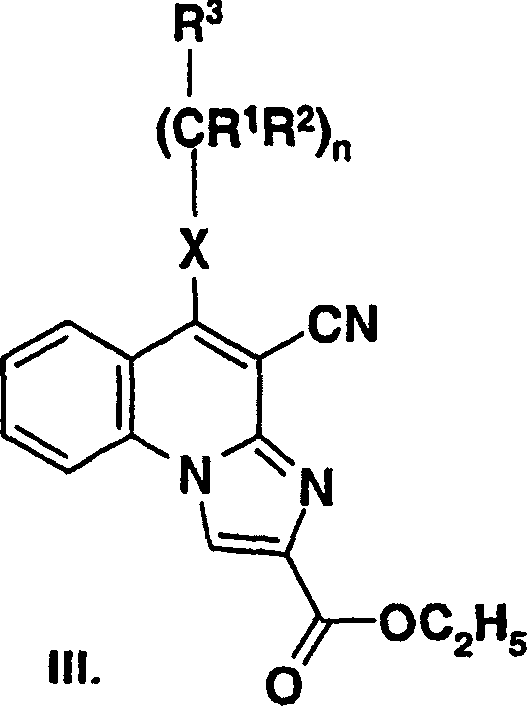
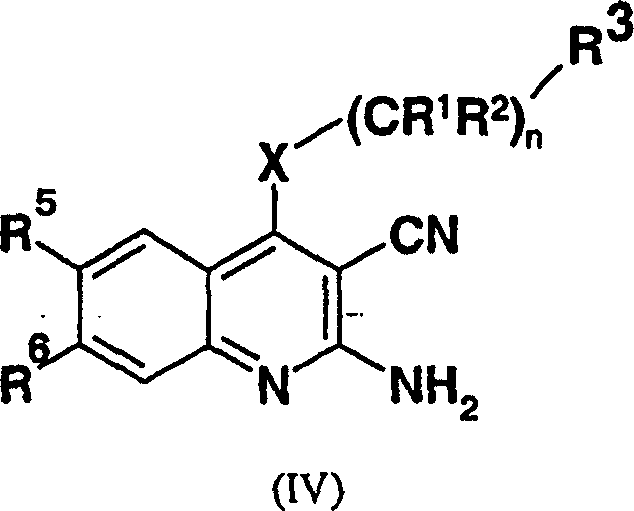
本发明制备过程中所用的通式(II)和(III)的中间体是新的。通式(II)、(III)、(IV)和(V)的取代基具有上面所限定的含义。The intermediates of general formula (II) and (III) used in the preparation of the present invention are novel. The substituents of the general formulas (II), (III), (IV) and (V) have the meanings defined above.
在本发明的方法中,按照有机化学已知的酰化反应,使用通式(II)的酸或其反应衍生物将通式(VIII)的化合物酰化。使用酰基卤或混合酸酐作为酰化剂,从而获得通式(I)的化合物,如果需要,还可转化成它的盐、溶剂化物,或从其盐、溶剂化物中释放出来,并分离成它的立体异构或旋光异构体。In the process of the invention, the compounds of general formula (VIII) are acylated with acids of general formula (II) or reactive derivatives thereof according to acylation reactions known in organic chemistry. Use acid halide or mixed acid anhydride as acylating agent, thereby obtain the compound of general formula (I), if necessary, also can convert into its salt, solvate, or release from its salt, solvate, and separate into its stereoisomers or optical isomers.
利用已知的方法,可将通式(I)化合物的取代基相互转换。The substituents of the compounds of general formula (I) can be converted into each other using known methods.
酰化反应所用混合酸酐的制备是用新戊酰氯进行的,优选存在有机碱,优选三乙胺的氯仿溶液,虽然也可使用有机化学的其它已知方法。酰化可在较宽的温度范围,优选0℃-100℃间进行。The preparation of the mixed anhydride for the acylation reaction is carried out with pivaloyl chloride, preferably in the presence of an organic base, preferably triethylamine in chloroform, although other known methods of organic chemistry can also be used. Acylation can be carried out at a wide temperature range, preferably between 0°C and 100°C.
通式(II)的化合物—其中R1、R2、R3、R4、R5、R6、R7、R8、X和n如上面所定义的—可通过若干已知方法获得,在这些方法的其中1个在流程1中表示,即利用有机化学已知的选择性水解方法对通式(III)化合物进行选择性水解。就水解剂而言,可使用碱的氢氧化物,但也可使用促进酯水解的其它试剂。Compounds of general formula (II) - wherein R 1 , R 2 , R 3 , R 4 , R 5 , R 6 , R 7 , R 8 , X and n are as defined above - can be obtained by several known methods, One of these methods is shown in Scheme 1, namely the selective hydrolysis of the compound of general formula (III) using known selective hydrolysis methods in organic chemistry. As hydrolyzing agents, alkali hydroxides can be used, but other agents which promote the hydrolysis of esters can also be used.
通式(III)的化合物—其中R1、R2、R3、R4、R5、R6、R7、R8、X和n如上面所定义的,且R14代表C1-4烷基—可通过本来已知的方法从通式(IV)的化合物制备(I.R.Ager和R.Westwood,J.Med.Chem.31,1098,(1988))。Compounds of general formula (III) - wherein R 1 , R 2 , R 3 , R 4 , R 5 , R 6 , R 7 , R 8 , X and n are as defined above, and R 14 represents C 1-4 Alkyl groups - can be prepared from compounds of general formula (IV) by methods known per se (IRAger and R. Westwood, J. Med. Chem. 31, 1098, (1988)).
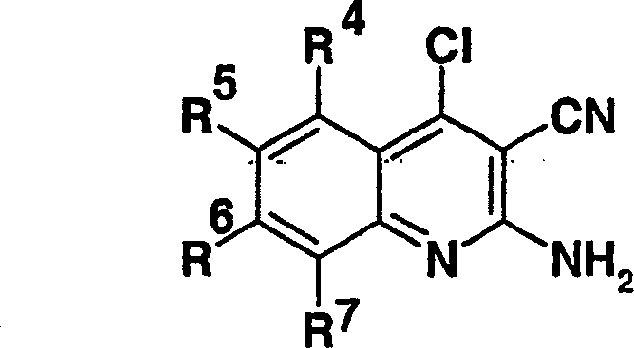
通式(IV)的化合物—其中R1、R2、R3、R4、R5、R6、R7、R8、X和n如上面所定义的—可通过本来已知的方法从通式(V)的化合物制备(NanZhang,Bioorg.和Med.Chem.Lett.,10,2825,(2000))。Compounds of general formula (IV) - wherein R 1 , R 2 , R 3 , R 4 , R 5 , R 6 , R 7 , R 8 , X and n are as defined above - can be obtained from Preparation of compounds of general formula (V) (Nan Zhang, Bioorg. and Med. Chem. Lett., 10, 2825, (2000)).
通式(V)的化合物—其中R4、R5、R6、R7和R8如上面所定义的—可通过本来已知的方法从通式(VI)的化合物制备(D.L.Leysen,J.Heterocyclic Chem.,24,1611,(1987))。Compounds of general formula (V) - wherein R 4 , R 5 , R 6 , R 7 and R 8 are as defined above - can be prepared from compounds of general formula (VI) by methods known per se (DLLeysen, J. Heterocyclic Chem., 24, 1611, (1987)).
通式(VI)的化合物—其中R4、R5、R6、R7和R8如上面所定义的—可通过本来已知的方法制备(Pfizer(Inc)USP 4,175,193)。Compounds of general formula (VI), wherein R 4 , R 5 , R 6 , R 7 and R 8 are as defined above, can be prepared by methods known per se (Pfizer (Inc) USP 4,175,193).
本发明通式(I)、(II)、(III)、(IV)和(V)的化合物,它们的制备和生物活性在下列实施例中给出,这些实施例不是对要求保护范围的限制。Compounds of general formula (I), (II), (III), (IV) and (V) of the present invention, their preparation and biological activity are given in the following examples, these examples are not the limitation to the scope of protection .
图1表示式(I)的化合物,Figure 1 represents the compound of formula (I),
图2表示式(II)的化合物,Figure 2 represents a compound of formula (II),
图3表示式(III)的化合物,Figure 3 represents the compound of formula (III),
图4表示式(IV)的化合物,Figure 4 represents a compound of formula (IV),
图5表示式(V)的化合物,Figure 5 represents compounds of formula (V),
图6表示式(VI)的化合物,Figure 6 represents a compound of formula (VI),
图7表示式(VII)的化合物,Figure 7 represents a compound of formula (VII),
图8表示式(VIII)的化合物。Figure 8 represents the compound of formula (VIII).
实施例Example
实施例1Example 1
1-(9-苄氨基-10-氰基-咪唑并[1,2-a]喹啉-2-羰基)-吡咯烷1-(9-Benzylamino-10-cyano-imidazo[1,2-a]quinoline-2-carbonyl)-pyrrolidine
在通式(I)中,R1和R2代表氢原子,R3代表苯基,R4、R5、R6和R7代表氢原子,R9和R10共同形成1,3-丁二烯基,R8代表氰基,X的含义是-NH,n是1。In the general formula (I), R 1 and R 2 represent a hydrogen atom, R 3 represents a phenyl group, R 4 , R 5 , R 6 and R 7 represent a hydrogen atom, and R 9 and R 10 together form 1,3-butane Dienyl , R represents cyano, the meaning of X is -NH, and n is 1.
a.) 2-氨基-3-氰基-4-氯喹啉 a.) 2-Amino-3-cyano-4-chloroquinoline
搅拌下,110℃加热10g 2-氨基-3-氰基-4-羟喹啉和15ml磷酰氯的混合物。将冷反应混合物却,倾注在100ml冰水上,并用60ml 10%氢氧化钠溶液中和。滤出所得黄色沉淀物,用50ml水洗涤。干燥后,获得7.5g标题化合物,mp.:210℃。Under stirring, a mixture of 10 g of 2-amino-3-cyano-4-hydroxyquinoline and 15 ml of phosphorus oxychloride was heated at 110°C. The cold reaction mixture was cooled, poured on 100 ml of ice water, and neutralized with 60 ml of 10% sodium hydroxide solution. The resulting yellow precipitate was filtered off and washed with 50 ml of water. After drying, 7.5 g of the title compound are obtained, mp.: 210°C.
NMR,δH(400MHz,DMSO-d6):7.21ppm,(s,2H,NH2),7.35-7.40ppm,(dd,1H,6-H),7.53-7.57ppm,(d,1H,5-H),7.70-7.75ppm,(dd,1H,7-H),7.93-7.98ppm,(d,1H,8-H)NMR, δ H (400MHz, DMSO-d 6 ): 7.21ppm, (s, 2H, NH 2 ), 7.35-7.40ppm, (dd, 1H, 6-H), 7.53-7.57ppm, (d, 1H, 5-H), 7.70-7.75ppm, (dd, 1H, 7-H), 7.93-7.98ppm, (d, 1H, 8-H)
b) 2-氨基-3-氰基-4-苄氨基喹啉 b) 2-amino-3-cyano-4-benzylaminoquinoline
搅拌下,130℃加热5g 2-氨基-3-氰基-4-氯喹啉和11ml苄胺的混合物。将反应混合物倾注在50ml水上,滤出所得沉淀物,用50ml水洗涤。将浅黄色沉淀物自二甲基甲酰胺中重结晶出来,获得5.2g的标题化合物,Mp.:206℃。Under stirring, a mixture of 5 g of 2-amino-3-cyano-4-chloroquinoline and 11 ml of benzylamine was heated at 130°C. The reaction mixture was poured on 50 ml of water and the resulting precipitate was filtered off and washed with 50 ml of water. The pale yellow precipitate was recrystallized from dimethylformamide to obtain 5.2 g of the title compound, Mp.: 206°C.
NMR,δH(400MHz,DMSO-d6):5.02-5.03ppm(d,2H,N-CH2),6.22ppm(s,2H,NH2),7.14-7.16ppm(dd,1H,6-H),7.24-7.26ppm(dd,1H,5-H),7.30ppm(s,5H,Ph),7.50-7.52ppm(dd,1H,7-H),8.16-8.19ppm(d,1H,8-H),8.30-8.33ppm(t,1H,NH)NMR, δ H (400MHz, DMSO-d 6 ): 5.02-5.03ppm (d, 2H, N-CH 2 ), 6.22ppm (s, 2H, NH 2 ), 7.14-7.16ppm (dd, 1H, 6- H), 7.24-7.26ppm (dd, 1H, 5-H), 7.30ppm (s, 5H, Ph), 7.50-7.52ppm (dd, 1H, 7-H), 8.16-8.19ppm (d, 1H, 8-H), 8.30-8.33ppm (t, 1H, NH)
使用2-氨甲基吡啶或3-氨甲基吡啶或4-氨甲基吡啶代替苄胺,可获得通式IV的适当化合物。Suitable compounds of general formula IV can be obtained using 2-aminomethylpyridine or 3-aminomethylpyridine or 4-aminomethylpyridine instead of benzylamine.
c.) 9-苄胺-10-氰基-咪唑并[1,2-a]喹啉-2-羧酸乙酯一水合物 c.) 9-Benzylamine-10-cyano-imidazo[1,2-a]quinoline-2-carboxylic acid ethyl ester monohydrate
70℃搅拌下,向2.74g 2-氨基-3-氰基-4-苄氨基喹啉溶于100ml无水乙醇的溶液加入2.14ml溴丙酮酸乙酯。将反应混合物沸腾2小时,滤出沉淀物。将所得白色晶体物质自150ml乙腈中重结晶出来,得到1.1g标题化合物,mp.:112-114℃Under stirring at 70°C, 2.14ml of ethyl bromopyruvate was added to a solution of 2.74g of 2-amino-3-cyano-4-benzylaminoquinoline dissolved in 100ml of absolute ethanol. The reaction mixture was boiled for 2 hours and the precipitate was filtered off. The resulting white crystalline material was recrystallized from 150 ml of acetonitrile to give 1.1 g of the title compound, mp.: 112-114°C
NMR,δH(400MHz,DMSO-d6):1.32ppm(t,3H,COOCH2CH3),4.30ppm(q,2H,COOCH2CH3),5.09ppm(d,2H,PhCH2),7.25-7.38ppm(m,5H),7.64-7.67ppm(m,1H),7.85-7.88ppm(m,1H),8.43-8.53ppm(m,3H),9.04ppm(s,1H,3-H)NMR, δ H (400MHz, DMSO-d 6 ): 1.32ppm (t, 3H, COOCH 2 CH 3 ), 4.30ppm (q, 2H, COOCH 2 CH 3 ), 5.09ppm (d, 2H, PhCH 2 ), 7.25-7.38ppm (m, 5H), 7.64-7.67ppm (m, 1H), 7.85-7.88ppm (m, 1H), 8.43-8.53ppm (m, 3H), 9.04ppm (s, 1H, 3-H )
d.) 9-苄氨基-10-氰基-咪唑并[1,2-a]喹啉-2-羧酸 d.) 9-Benzylamino-10-cyano-imidazo[1,2-a]quinoline-2-carboxylic acid
25℃下,搅拌2.71g 9-苄胺-10-氰基-咪唑并[1,2-a]喹啉-2-羧酸乙酯一水合物、42ml乙醇和40ml 10%氢氧化钠溶液的混合物6小时。向浓混悬液中加入100ml水,用96%乙酸溶液将混悬液酸化至pH3。滤出浅黄色的晶体物质,用3×25ml水洗涤,并干燥。因此获得2.3g标题化合物,Mp.:178-182℃。At 25°C, stir 2.71g of 9-benzylamine-10-cyano-imidazo[1,2-a]quinoline-2-carboxylic acid ethyl ester monohydrate, 42ml of ethanol and 40ml of 10% sodium hydroxide solution The mixture was left for 6 hours. 100 ml of water were added to the concentrated suspension and the suspension was acidified to pH 3 with 96% acetic acid solution. The light yellow crystalline material was filtered off, washed with 3 x 25 ml water and dried. 2.3 g of the title compound are thus obtained, Mp.: 178-182°C.
NMR,δH(200MHz,DMSO-d6):5.09ppm(d,2H,PhCH2),7.22-7.40ppm(m,5H),7.59-7.67ppm(m,1H),7.81-7.89ppm(m,1H),8.37-8.54ppm(m,3H),8.90ppm(s,1H,3-H)NMR, δ H (200MHz, DMSO-d 6 ): 5.09ppm (d, 2H, PhCH 2 ), 7.22-7.40ppm (m, 5H), 7.59-7.67ppm (m, 1H), 7.81-7.89ppm (m , 1H), 8.37-8.54ppm (m, 3H), 8.90ppm (s, 1H, 3-H)
e. 1-(9-苄氨基-10-氰基-咪唑并[1,2-a]喹啉-2-羰基)-吡咯烷 e. 1-(9-Benzylamino-10-cyano-imidazo[1,2-a]quinoline-2-carbonyl)-pyrrolidine
5℃搅拌下,15分钟内向1.71g 9-苄氨基-10-氰基-咪唑并[1,2-a]喹啉-2-羧酸、15ml氯仿和0.8g三乙胺的混合物中滴加0.6g新戊酰氯溶于10ml氯仿的溶液。5℃搅拌反应混合物1小时,之后向其中加入0.4g吡咯烷、10ml氯仿和0.8ml三乙胺的混合物。25℃搅拌混合物7小时,用100ml氯仿稀释,用50ml水、50ml 5%碳酸氢钠溶液和50ml水萃取,在硫酸钠上干燥,并于真空内蒸发。将浅黄色晶体物质自N,N-二甲基甲酰胺中重结晶出来,获得0.7g标题化合物,Mp.:206℃。Under stirring at 5°C, add dropwise to the mixture of 1.71g 9-benzylamino-10-cyano-imidazo[1,2-a]quinoline-2-carboxylic acid, 15ml chloroform and 0.8g triethylamine within 15 minutes A solution of 0.6g of pivaloyl chloride dissolved in 10ml of chloroform. The reaction mixture was stirred at 5°C for 1 hour, after which a mixture of 0.4 g of pyrrolidine, 10 ml of chloroform and 0.8 ml of triethylamine was added thereto. The mixture was stirred for 7 hours at 25°C, diluted with 100 ml of chloroform, extracted with 50 ml of water, 50 ml of 5% sodium bicarbonate solution and 50 ml of water, dried over sodium sulfate and evaporated in vacuo. The pale yellow crystalline substance was recrystallized from N,N-dimethylformamide to obtain 0.7 g of the title compound, Mp.: 206°C.
NMR,δH(400MHz,DMSO-d6):1.79-1.92ppm(m,4H),3.47-3.50ppm(m,2H),3.95-3.98ppm(m,2H),5.08ppm(d,2H,PhCH2),7.23-7.38ppm(m,5H),7.6 2-7.65ppm(m,1H),7.83-7.87ppm(m,1H),8.36-8.42ppm(m,2H),8.50-8.52ppm(m,1H),8.80ppm(s,1H,3-H)。NMR, δ H (400MHz, DMSO-d 6 ): 1.79-1.92ppm (m, 4H), 3.47-3.50ppm (m, 2H), 3.95-3.98ppm (m, 2H), 5.08ppm (d, 2H, PhCH 2 ), 7.23-7.38ppm (m, 5H), 7.6 2-7.65ppm (m, 1H), 7.83-7.87ppm (m, 1H), 8.36-8.42ppm (m, 2H), 8.50-8.52ppm ( m, 1H), 8.80 ppm (s, 1H, 3-H).
实施例2Example 2
N,N-二甲基-9-苄氨基-10-氰基-咪唑并[1,2-a]喹啉-2-酰胺半水合物N,N-Dimethyl-9-benzylamino-10-cyano-imidazo[1,2-a]quinoline-2-amide hemihydrate
通式(I)中,R1和R2是氢原子,R3是苯基,R4、R5、R6和R7代表氢,R8是氰基,R9和R10彼此独立为甲基,X是-NH-,n是1。In general formula (I), R 1 and R 2 are hydrogen atoms, R 3 is phenyl, R 4 , R 5 , R 6 and R 7 represent hydrogen, R 8 is cyano, R 9 and R 10 are independently methyl, X is -NH-, n is 1.
5℃搅拌下,15分钟内向1.71g 9-苄氨基-10-氰基-咪唑并[1,2-a]喹啉-2-羧酸(按照实施例1制备)、15ml氯仿和0.8g三乙胺的混合物中滴加0.6g新戊酰氯溶于10ml氯仿的溶液。9℃搅拌反应混合物1小时,之后向其中加入0.45g氯化二甲铵、10ml氯仿和1.6ml三乙胺的混合物。25℃搅拌混合物3小时,将按实施例1所述过程获得的浅黄色晶体物质自N,N-二甲基甲酰胺中重结晶出来,获得0.65g标题化合物,Mp.:262-264℃。Under stirring at 5°C, add 1.71g 9-benzylamino-10-cyano-imidazo[1,2-a]quinoline-2-carboxylic acid (prepared according to Example 1), 15ml chloroform and 0.8g tris within 15 minutes A solution of 0.6 g of pivaloyl chloride dissolved in 10 ml of chloroform was added dropwise to the mixture of ethylamine. The reaction mixture was stirred at 9°C for 1 hour, after which a mixture of 0.45 g of dimethylammonium chloride, 10 ml of chloroform and 1.6 ml of triethylamine was added thereto. The mixture was stirred at 25°C for 3 hours, and the pale yellow crystalline material obtained by the procedure described in Example 1 was recrystallized from N,N-dimethylformamide to obtain 0.65 g of the title compound, Mp.: 262-264°C.
NMR,δH(400MHz,DMSO-d6):2.98ppm(s,3H),3.45ppm(s,3H),5.08ppm(d,2H,PhCH2),7.23-7.38ppm(m,5H),7.62-7.65ppm(m,1H),7.84-7.87ppm(m,1H),8.37-8.39ppm(m,2H),8.50-8.53ppm(m,1H),8.75ppm(s,1H,3-H)NMR, δ H (400MHz, DMSO-d 6 ): 2.98ppm (s, 3H), 3.45ppm (s, 3H), 5.08ppm (d, 2H, PhCH 2 ), 7.23-7.38ppm (m, 5H), 7.62-7.65ppm (m, 1H), 7.84-7.87ppm (m, 1H), 8.37-8.39ppm (m, 2H), 8.50-8.53ppm (m, 1H), 8.75ppm (s, 1H, 3-H )
实施例3Example 3
N-乙基-9-苄氨基-10-氰基-咪唑并[1,2-a]喹啉-2-酰胺半水合物N-Ethyl-9-benzylamino-10-cyano-imidazo[1,2-a]quinoline-2-amide hemihydrate
在通式(I)中,R1和R2是氢原子,R3是苯基,R4、R5、R6、和R7代表氢,R8是氰基,R9是氢,R10是乙基,X是-NH-,n是1。In general formula (I), R 1 and R 2 are hydrogen atoms, R 3 is phenyl, R 4 , R 5 , R 6 , and R 7 represent hydrogen, R 8 is cyano, R 9 is hydrogen, R 10 is ethyl, X is -NH-, n is 1.
按照先前实施例所述,类似地用0.45g盐酸乙胺将按照实施例1所述制备的1.71g 9-苄氨基-10-氰基-咪唑并[1,2-a]喹啉-2-羧酸转换成标题化合物。将浅黄色物质自80ml乙醇中重结晶出来,获得0.62g标题化合物,Mp.:275-277℃。1.71 g of 9-benzylamino-10-cyano-imidazo[1,2-a]quinoline-2- The carboxylic acid was converted to the title compound. The light yellow material was recrystallized from 80 ml of ethanol to obtain 0.62 g of the title compound, Mp.: 275-277°C.
NMR,δH(200MHz,DMSO-d6):1.11ppm(t,3H,NHCH2CH3),3.30ppm(q,2H,NHCH2CH3),5.09ppm(d,2H,PhCH2),7.22-7.40ppm(m,5H),7.60-7.67ppm(m,1H),7.82-7.94ppm(m,2H),8.38-8.42ppm(m,2H),8.50-8.54ppm(m,1H),8.82ppm(s,1H,3-H)NMR, δ H (200MHz, DMSO-d 6 ): 1.11ppm (t, 3H, NHCH 2 CH 3 ), 3.30ppm (q, 2H, NHCH 2 CH 3 ), 5.09ppm (d, 2H, PhCH 2 ), 7.22-7.40ppm (m, 5H), 7.60-7.67ppm (m, 1H), 7.82-7.94ppm (m, 2H), 8.38-8.42ppm (m, 2H), 8.50-8.54ppm (m, 1H), 8.82ppm (s, 1H, 3-H)
实施例4Example 4
1-(9-糠氨基-10-氰基-咪唑并[1,2-a]喹啉-2-羰基)-吡咯烷半水1-(9-furfurylamino-10-cyano-imidazo[1,2-a]quinoline-2-carbonyl)-pyrrolidine hemihydrate 合物compound
在通式(I)中,R1和R2是氢原子,R3是2-呋喃基,R4、R5、R6和R7是氢,R9和R10共同形成1,4-丁二烯基,R8是氰基,X是-NH-,n是1。In general formula (I), R 1 and R 2 are hydrogen atoms, R 3 is 2-furyl, R 4 , R 5 , R 6 and R 7 are hydrogen, R 9 and R 10 together form 1,4- Butadienyl, R 8 is cyano, X is -NH-, n is 1.
a) 2-氨基-3-氰基-糠氨基喹啉 a) 2-amino-3-cyano-furfurylaminoquinoline
120℃搅拌下,加热10g 2-氨基-3-氰基-4-氯喹啉和19ml糠胺3小时。将反应混合物冷却至25℃,连续与50ml水混合6次,滤出所得沉淀物并干燥。将由此获得的物质自60ml二甲基甲酰胺中重结晶出来,获得5.8g标题化合物,Mp.:206℃。Under stirring at 120°C, 10 g of 2-amino-3-cyano-4-chloroquinoline and 19 ml of furfurylamine were heated for 3 hours. The reaction mixture was cooled to 25[deg.] C., mixed 6 times with 50 ml of water in succession, and the resulting precipitate was filtered off and dried. The material thus obtained was recrystallized from 60 ml of dimethylformamide to obtain 5.8 g of the title compound, Mp.: 206°C.
NMR,δH(200MHz,DMSO-d6):4.98ppm(d,2H,Furil-CH2),6.29ppm(s,2H),6.35-6.42ppm(m,2H),7.10-7.18ppm(m,1H),7.31-7.35ppm(m,1H),7.47-7.60ppm(m,2H),8.13-8.20ppm(m,2H)NMR, δ H (200MHz, DMSO-d 6 ): 4.98ppm (d, 2H, Furil-CH 2 ), 6.29ppm (s, 2H), 6.35-6.42ppm (m, 2H), 7.10-7.18ppm (m , 1H), 7.31-7.35ppm (m, 1H), 7.47-7.60ppm (m, 2H), 8.13-8.20ppm (m, 2H)
b) 9-糠氨基-10-氰基-咪唑并[1,2-a]喹啉-羧酸乙酯一水合物 b) 9-furfurylamino-10-cyano-imidazo[1,2-a]quinoline-carboxylate ethyl ester monohydrate
70℃搅拌下,向2.64g 2-氨基-3-氰基-4-糠氨基喹啉溶于100ml无水乙醇的溶液中加入2.14ml溴丙酮酸乙酯。将反应混合物沸腾2小时,然后滤出沉淀物。将物质重结晶出来,获得1.1g标题化合物,mp.:242-245℃。Under stirring at 70°C, 2.14ml of ethyl bromopyruvate was added to a solution of 2.64g of 2-amino-3-cyano-4-furfurylaminoquinoline dissolved in 100ml of absolute ethanol. The reaction mixture was boiled for 2 hours, then the precipitate was filtered off. The material was recrystallized to give 1.1 g of the title compound, mp.: 242-245°C.
NMR,δH(200MHz,DMSO-d6):1.33ppm(t,3H,COOCH2CH3),4.31ppm(q,2H,COOCH2CH3),5.05ppm(d,2H,Furil-CH2),6.40-6.43ppm(m,2H),7.58-7.66ppm(m,2H),7.80-7.88ppm(m,1H),8.31ppm(t,1H),8.41-8.45ppm(m,2H),9.04ppm(s,1H,3-H)NMR, δ H (200MHz, DMSO-d 6 ): 1.33ppm (t, 3H, COOCH 2 CH 3 ), 4.31ppm (q, 2H, COOCH 2 CH 3 ), 5.05ppm (d, 2H, Furil-CH 2 ), 6.40-6.43ppm (m, 2H), 7.58-7.66ppm (m, 2H), 7.80-7.88ppm (m, 1H), 8.31ppm (t, 1H), 8.41-8.45ppm (m, 2H), 9.04ppm (s, 1H, 3-H)
c)9-糠氨基-10-氰基-咪唑并[1,2-a]喹啉-2-羧酸c) 9-furfurylamino-10-cyano-imidazo[1,2-a]quinoline-2-carboxylic acid
25℃下,搅拌2.52g 9-糠氨基-10-氰基-咪唑并[1,2-a]喹啉-2-羧酸乙酯一水合物、40ml乙醇和33ml 10%氢氧化钠溶液的混合物3小时。向浓混悬液中加入80ml水,并用96%乙酸将混悬液酸化至pH3。滤出浅黄色晶体物质,用3×25ml水洗涤,并干燥。因此获得2.32g标题化合物,Mp.:180-185℃(分解)。At 25°C, stir 2.52g of 9-furfurylamino-10-cyano-imidazo[1,2-a]quinoline-2-carboxylic acid ethyl ester monohydrate, 40ml of ethanol and 33ml of 10% sodium hydroxide solution The mixture was left for 3 hours. 80 ml of water were added to the concentrated suspension and the suspension was acidified to pH 3 with 96% acetic acid. The pale yellow crystalline material was filtered off, washed with 3 x 25 ml water and dried. 2.32 g of the title compound are thus obtained, Mp.: 180-185° C. (dec.).
NMR,δH(200MHz,DMSO-d6):5.05ppm(d,2H,Furil-CH2),6.39-6.42ppm(m,2H),7.56-7.64ppm(m,2H),7.79-7.87ppm(m,1H),8.27ppm(t,1H),8.36-8.46ppm(m,2H),8.93ppm(s,1H,3-H)NMR, δH (200MHz, DMSO-d 6 ): 5.05ppm (d, 2H, Furil-CH 2 ), 6.39-6.42ppm (m, 2H), 7.56-7.64ppm (m, 2H), 7.79-7.87ppm ( m, 1H), 8.27ppm (t, 1H), 8.36-8.46ppm (m, 2H), 8.93ppm (s, 1H, 3-H)
d) 1-(9-糠氨基-10-氰基-咪唑并[1,2-a]喹啉-2-羰基)-吡咯烷半 水合物 d) 1-(9-furfurylamino-10-cyano-imidazo[1,2-a]quinoline-2-carbonyl)-pyrrolidine hemihydrate
5℃搅拌下,在15分钟内,向1.79g 9-糠氨基-10-氰基-咪唑并[1,2-a]喹啉-2-羧酸、15ml氯仿和0.8g三乙胺的混合物中滴加0.6g新戊酰氯溶于10ml氯仿的溶液。5℃搅拌反应化合物1小时,之后向其中加入0.36g吡咯烷、10ml氯仿和0.8ml三乙胺的混合物。25℃搅拌混合物3小时,用100ml氯仿稀释,用50ml水、50ml 5%碳酸氢钠溶液、和50ml水萃取,在硫酸钠上干燥,并于真空内蒸发。将黄色晶体物质自50ml乙醇中重结晶出来,获得0.15g标题化合物,Mp.:276-279℃。Under stirring at 5°C, within 15 minutes, to the mixture of 1.79g 9-furfurylamino-10-cyano-imidazo[1,2-a]quinoline-2-carboxylic acid, 15ml chloroform and 0.8g triethylamine A solution of 0.6 g of pivaloyl chloride dissolved in 10 ml of chloroform was added dropwise. The reaction mixture was stirred at 5°C for 1 hour, after which a mixture of 0.36 g of pyrrolidine, 10 ml of chloroform and 0.8 ml of triethylamine was added thereto. The mixture was stirred at 25°C for 3 hours, diluted with 100 ml of chloroform, extracted with 50 ml of water, 50 ml of 5% sodium bicarbonate solution, and 50 ml of water, dried over sodium sulfate, and evaporated in vacuo. The yellow crystalline material was recrystallized from 50 ml of ethanol to obtain 0.15 g of the title compound, Mp.: 276-279°C.
NMR,δH(200MHz,DMSO-d6):1.79-1.95ppm(m,4H),3.47-3.54ppm(m,2H),3.98-4.04ppm(m,2H),5.05ppm(d,2H,Furil-CH2),6.40-6.44ppm(m,2H),7.57-7.65ppm(m,2H),7.80-7.88ppm(m,1H),8.23ppm(t,1H),8.39-8.46ppm(m,2H),8.81ppm(s,1H,3-H)NMR, δ H (200MHz, DMSO-d 6 ): 1.79-1.95ppm (m, 4H), 3.47-3.54ppm (m, 2H), 3.98-4.04ppm (m, 2H), 5.05ppm (d, 2H, Furil-CH 2 ), 6.40-6.44ppm (m, 2H), 7.57-7.65ppm (m, 2H), 7.80-7.88ppm (m, 1H), 8.23ppm (t, 1H), 8.39-8.46ppm (m , 2H), 8.81ppm (s, 1H, 3-H)
实施例5Example 5
1-(9-噻吩氨基-10-氰基-咪唑并[1,2-a]喹啉-2-羰基)-吡咯烷半1-(9-Thienylamino-10-cyano-imidazo[1,2-a]quinoline-2-carbonyl)-pyrrolidine semi 水合物Hydrate
在通式(I)中,R1和R2是氢原子,R3是2-噻吩基,R4、R5、R6和R7是氢,R9和R10共同形成1,4-丁二基,R8是氰基,X是-NH-,n是1。In general formula (I), R 1 and R 2 are hydrogen atoms, R 3 is 2-thienyl, R 4 , R 5 , R 6 and R 7 are hydrogen, R 9 and R 10 together form 1,4- Butanediyl, R 8 is cyano, X is -NH-, n is 1.
a. 2-氨基-3-氰基-噻吩氨基喹啉 a. 2-amino-3-cyano-thienylaminoquinoline
115℃搅拌下,加热10g 2-氨基-3-氰基-4-氯喹啉和19ml噻吩胺4小时。将反应混合物冷却至25℃,连续与50ml水混合6次,滤出所得沉淀物,用50ml水洗涤2次并干燥。将由此获得的物质自60ml N,N-二甲基甲酰胺中重结晶出来,获得6.8g浅黄色标题化合物,Mp.:208-209℃。Under stirring at 115°C, 10 g of 2-amino-3-cyano-4-chloroquinoline and 19 ml of thienylamine were heated for 4 hours. The reaction mixture was cooled to 25[deg.] C., mixed 6 times with 50 ml of water in succession, the resulting precipitate was filtered off, washed 2 times with 50 ml of water and dried. The material thus obtained was recrystallized from 60 ml of N,N-dimethylformamide to obtain 6.8 g of the pale yellow title compound, Mp.: 208-209°C.
NMR,δH(200MHz,DMSO-d6):5.18ppm(d,2H,Tienil-CH2),6.28ppm(s,2H),6.96-7.00ppm(m,1H),7.07-7.19ppm(m,2H),7.31-7.42ppm(m,2H),7.48-7.56ppm(m,1H),8.09-8.13ppm(m,1H),8.30ppm(t,1H)NMR, δ H (200MHz, DMSO-d 6 ): 5.18ppm (d, 2H, Tienil-CH 2 ), 6.28ppm (s, 2H), 6.96-7.00ppm (m, 1H), 7.07-7.19ppm (m , 2H), 7.31-7.42ppm (m, 2H), 7.48-7.56ppm (m, 1H), 8.09-8.13ppm (m, 1H), 8.30ppm (t, 1H)
b. 9-噻吩氨基-10-氰基-咪唑并[1,2-a]喹啉-羧酸乙酯 b. 9-thienylamino-10-cyano-imidazo[1,2-a]quinoline-carboxylic acid ethyl ester
70℃搅拌下,向5.61g 2-氨基-3-氰基-4-噻吩氨基喹啉溶于200ml无水乙醇的溶液中加入4.29g溴丙酮酸乙酯。将反应混合物沸腾2小时,然后滤出沉淀物。获得2.54g浅棕色标题化合物,mp.:255-256℃。Under stirring at 70°C, add 4.29 g of ethyl bromopyruvate to a solution of 5.61 g of 2-amino-3-cyano-4-thienylaminoquinoline dissolved in 200 ml of absolute ethanol. The reaction mixture was boiled for 2 hours, then the precipitate was filtered off. 2.54 g of the light brown title compound are obtained, mp.: 255-256°C.
NMR,δH(200MHz,DMSO-d6):1.33ppm(t,3H,COOCH2CH3),4.31ppm(q,2H,COOCH2CH3),5.24ppm(d,2H,Tienil-CH2),6.96-7.00ppm(m,1H),7.14ppm(m,1H),7.40-7.43ppm(m,1H),7.61-7.68ppm(m,1H),7.82-7.90ppm(m,1H),8.42-8.46ppm(m,3H),9.05ppm(s,1H,3-H)NMR, δ H (200MHz, DMSO-d 6 ): 1.33ppm (t, 3H, COOCH 2 CH 3 ), 4.31ppm (q, 2H, COOCH 2 CH 3 ), 5.24ppm (d, 2H, Tienil-CH 2 ), 6.96-7.00ppm (m, 1H), 7.14ppm (m, 1H), 7.40-7.43ppm (m, 1H), 7.61-7.68ppm (m, 1H), 7.82-7.90ppm (m, 1H), 8.42-8.46ppm (m, 3H), 9.05ppm (s, 1H, 3-H)
c. 9-噻吩氨基-10-氰基-咪唑并[1,2-a]喹啉-2-羧酸 c. 9-thienylamino-10-cyano-imidazo[1,2-a]quinoline-2-carboxylic acid
25℃搅拌2.54g 9-噻吩氨基-10-氰基-咪唑并[1,2-a]喹啉-2-羧酸乙酯、40ml乙醇和33ml 10%氢氧化钠溶液的混合物6小时。向浓混悬液中加入80ml水,用96%乙酸溶液将混悬液酸化至pH3。滤出浅黄色晶体物质,用5×10ml水洗涤,并干燥。因此获得2.18g标题化合物,Mp.:209-217℃(分解)。A mixture of 2.54 g of ethyl 9-thienylamino-10-cyano-imidazo[1,2-a]quinoline-2-carboxylate, 40 ml of ethanol and 33 ml of 10% sodium hydroxide solution was stirred for 6 hours at 25°C. 80 ml of water were added to the concentrated suspension and the suspension was acidified to pH 3 with 96% acetic acid solution. The pale yellow crystalline material was filtered off, washed with 5 x 10 ml water and dried. 2.18 g of the title compound are thus obtained, Mp.: 209-217° C. (dec.).
NMR,δH(400MHz,DMSO-d6):5.24ppm(d,2H,Tienil-CH2),8.88ppm(s,1H,3-H)NMR, δ H (400MHz, DMSO-d 6 ): 5.24ppm (d, 2H, Tienil-CH 2 ), 8.88ppm (s, 1H, 3-H)
d.1-(9-噻吩氨基-10-氰基-咪唑并[1,2-a]喹啉-2-羰基)-吡咯烷d.1-(9-thienylamino-10-cyano-imidazo[1,2-a]quinoline-2-carbonyl)-pyrrolidine 半水合物Hemihydrate
5℃搅拌下,在15分钟内,向1.80g 9-噻吩氨基-10-氰基-咪唑并[1,2-a]喹啉-2-羧酸、10ml氯仿和1.1ml三乙胺的混合物中滴加0.87g新戊酰氯溶于10ml氯仿的溶液。5℃搅拌反应混合物1小时,之后向其中加入0.51g吡咯烷、10ml氯仿和1.1ml三乙胺的混合物。25℃搅拌混合物3小时,用100ml氯仿稀释,用50ml水、50ml 5%碳酸氢钠溶液、50ml水萃取,在硫酸钠上干燥,并于真空内蒸发。将黄色晶体物质自200ml乙醇中重结晶出来,获得0.29g标题化合物,Mp.:267-269℃。Under stirring at 5°C, within 15 minutes, to the mixture of 1.80g 9-thienylamino-10-cyano-imidazo[1,2-a]quinoline-2-carboxylic acid, 10ml chloroform and 1.1ml triethylamine A solution of 0.87 g of pivaloyl chloride dissolved in 10 ml of chloroform was added dropwise. The reaction mixture was stirred at 5°C for 1 hour, after which a mixture of 0.51 g of pyrrolidine, 10 ml of chloroform and 1.1 ml of triethylamine was added thereto. The mixture was stirred at 25°C for 3 hours, diluted with 100 ml of chloroform, extracted with 50 ml of water, 50 ml of 5% sodium bicarbonate solution, 50 ml of water, dried over sodium sulfate and evaporated in vacuo. The yellow crystalline material was recrystallized from 200 ml of ethanol to obtain 0.29 g of the title compound, Mp.: 267-269°C.
NMR,δH(400MHz,DMSO-d6):1.79-1.94ppm(m,4H),3.48-3.51ppm(m,2H),3.98-4.01ppm(m,2H),5.24ppm(d,2H,Tienil-CH2),6.97-7.00ppm(m,1H),7.14ppm(m,1H),7.41ppm(m,1H),7.61-7.65ppm(m,1H),7.83-7.87ppm(m,1H),8.37-8.45ppm(m,3H),8.82ppm(s,1H,3-H)NMR, δ H (400MHz, DMSO-d 6 ): 1.79-1.94ppm (m, 4H), 3.48-3.51ppm (m, 2H), 3.98-4.01ppm (m, 2H), 5.24ppm (d, 2H, Tienil-CH 2 ), 6.97-7.00ppm (m, 1H), 7.14ppm (m, 1H), 7.41ppm (m, 1H), 7.61-7.65ppm (m, 1H), 7.83-7.87ppm (m, 1H ), 8.37-8.45ppm (m, 3H), 8.82ppm (s, 1H, 3-H)
利用实施例1中描述的方法制备的通式(I)其它化合物的结构和物理性质在表I中给出。The structures and physical properties of other compounds of general formula (I) prepared using the method described in Example 1 are given in Table I.
表I.Table I.
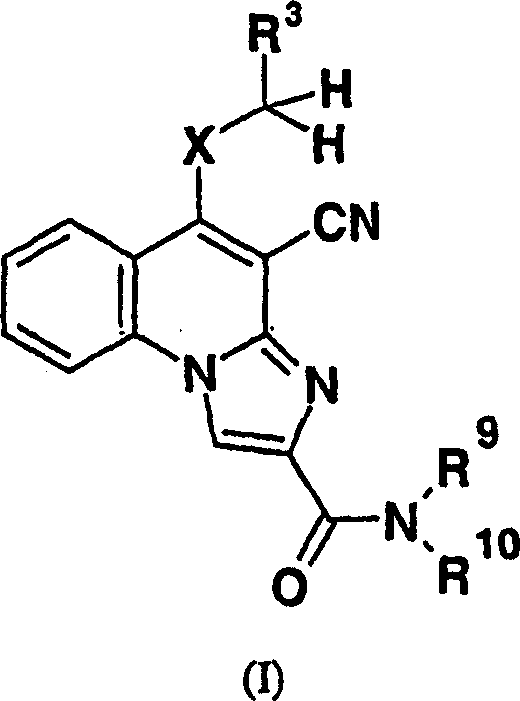


利用实施例1中描述的方法制备的通式(III)中间体的结构和物理性质在表(II)中给出。The structures and physical properties of intermediates of general formula (III) prepared using the method described in Example 1 are given in Table (II).
表IITable II
利用实施例1中描述的方法制备的通式(IV)中间体的结构和物理性质在表(III)中给出。The structures and physical properties of intermediates of general formula (IV) prepared using the method described in Example 1 are given in Table (III).
表IIITable III

利用实施例1中描述的方法制备的通式(V)中间体的结构和物理性质在表(IV)中给出。The structures and physical properties of intermediates of general formula (V) prepared using the method described in Example 1 are given in Table (IV).
表IVTable IV
实施例72Example 72
下列组成的片剂是通过制药工业所用的已知方法制备的。Tablets of the following composition are prepared by known methods used in the pharmaceutical industry.
活性成分 25mgActive ingredient 25mg
乳糖 50mgLactose 50mg
微晶纤维素 21mgMicrocrystalline Cellulose 21mg
聚乙烯吡咯烷酮 3mgPolyvinylpyrrolidone 3mg
硬脂酸镁 1mgMagnesium Stearate 1mg
生物学biology
方法method
人腺苷A3受体的结合Binding of human adenosine A 3 receptor
制备膜混悬液:通过用冰冷的PBS洗涤3次而收集表达hA3受体的CHO细胞,1000xg离心10分钟,在缓冲液(50mM Tris、10mM MgCl2、1mM EDTA,pH8.0)中匀化15秒,43,000xg离心10分钟(Sigma 3K30),将膜制品悬浮于上述缓冲液中,-80℃贮存等分试样。Preparation of membrane suspension: CHO cells expressing hA3 receptor were harvested by washing 3 times with ice-cold PBS, centrifuged at 1000xg for 10 min, homogenized in buffer (50 mM Tris, 10 mM MgCl 2 , 1 mM EDTA, pH 8.0) After centrifugation at 43,000 xg for 10 min (Sigma 3K30) for 15 sec, membrane preparations were suspended in the above buffer and aliquots were stored at -80°C.
结合方案:在有0.5nM[125I]AB-MECA(对-氨基-苯甲基-甲基酰氨基-腺苷)(100.000cpm)和100μM R-PIA(N6-[L-2-苯基异丙基]腺苷)存在的条件下,室温下在培养缓冲液(50mM Tris、10mM MgCl2、1mM EDTA、3U/mL腺苷脱氨酶,pH8.0)中培养CHO-hA3膜制品(2μg蛋白内容物)1小时,从而测定非-特异性结合或供试化合物,总体积50μL。在WhatmanGF/B玻璃纤维滤膜(在0.5%聚环乙亚胺中预浸泡3小时)上过滤,在96-孔Brandel细胞收集器上用1mL冰冷的50mM Tris、10mM MgCl2、1mMEDTA(pH8.0)洗涤4次。活性检测:在γ-计数器中(1470 Wizard,Wallac)。抑制[%]=100-((有供试化合物存在下的活性-非特异性活性)/(总活性-非特异性活性))*100Binding protocol: in the presence of 0.5nM [ 125 I]AB-MECA (p-amino-benzyl-methylamido-adenosine) (100.000cpm) and 100μM R-PIA (N 6 -[L-2-benzene CHO-hA 3 membranes were cultured in incubation buffer (50mM Tris, 10mM MgCl 2 , 1mM EDTA, 3U/mL adenosine deaminase, pH 8.0) at room temperature in the presence of (isopropyl]adenosine) Preparations (2 μg protein content) were prepared for 1 hour to determine non-specific binding or test compound in a total volume of 50 μL. Filter on WhatmanGF/B glass fiber filter membrane (pre-soaked in 0.5% polyethyleneimine for 3 hours), and use 1 mL of ice-cold 50 mM Tris, 10 mM MgCl 2 , 1 mM EDTA (pH 8. 0) Wash 4 times. Activity detection: in a gamma-counter (1470 Wizard, Wallac). Inhibition [%]=100-(((the activity in the presence of the test compound-non-specific activity)/(total activity-non-specific activity))*100
人腺苷A1受体的结合Binding of human adenosine A 1 receptor
制备膜混悬液:通过用冰冷的PBS洗涤3次而收集表达hA1受体的CHO细胞,1000xg离心10分钟,在缓冲液(50mM Tris,pH7.4)中匀化15秒,43,000xg离心10分钟(Sigma 3K30),将膜制品悬浮于上述缓冲液中,-80℃贮存等分试样。Preparation of membrane suspension: Harvest hA1 receptor expressing CHO cells by washing 3 times with ice-cold PBS, centrifuge at 1000xg for 10 min, homogenize in buffer (50 mM Tris, pH 7.4) for 15 sec, centrifuge at 43,000xg For 10 minutes (Sigma 3K30), membrane preparations were suspended in the above buffer and aliquots were stored at -80°C.
结合方案:室温下,在培养缓冲液(50mM Tris、3U/mL腺苷脱氨酶,pH7.4)、10nM[3H]CCPA(2-氯-N6-环戊基-腺苷)(80.000dpm)和10μMR-PIA(N6-[L-2-苯基异丙基]腺苷)中,培养CHO-hA1膜制品(50μg蛋白内容物)3小时,从而测定非-特异性结合或供试化合物,总体积100μL。在Whatman GF/B玻璃纤维滤膜(在0.5%聚氮丙啶中预浸泡3小时)上过滤,在96-孔Brandel细胞收集器上用1mL冰冷的50mM Tris(pH7.4)洗涤4次。活性检测:在β-计数器(1450 Microbeta,Wallac)中、有HiSafe-3 coctail存在的条件下、在96孔平板中。抑制[%]=100-((有供试化合物存在下的活性-非特异性活性)/(总活性-非特异性活性))*100Binding protocol: at room temperature, in incubation buffer (50mM Tris, 3U/mL adenosine deaminase, pH7.4), 10nM [ 3 H]CCPA (2-chloro-N 6 -cyclopentyl-adenosine) ( 80.000dpm) and 10μMR-PIA (N 6 -[L-2-phenylisopropyl]adenosine), CHO-hA 1 membrane preparations (50μg protein content) were incubated for 3 hours to determine non-specific binding Or the test compound, the total volume is 100 μL. Filter on Whatman GF/B glass fiber filters (presoaked in 0.5% polyethylenimine for 3 hours) and wash 4 times with 1 mL of ice-cold 50 mM Tris (pH 7.4) on a 96-well Brandel cell harvester. Activity assay: in a β-counter (1450 Microbeta, Wallac), in the presence of HiSafe-3 coctail, in 96-well plates. Inhibition [%]=100-(((the activity in the presence of the test compound-non-specific activity)/(total activity-non-specific activity))*100
人腺苷A2a受体的结合Binding of the human adenosine A 2a receptor
结合方案:室温下,培养缓冲液(50mM Tris-HCl,10mM MgCl2,1mMEDTA,2U/mL腺苷脱氨酶,pH7.4)、20nM[3H]CGS-21680(2-[对(2-羰乙基)苯基乙氨基]-5’-N-乙酰氨基-腺苷)(200.000dpm)和50μM NECA(5’-N-乙酰氨基-腺苷)中、7μg膜(转染到HEK-293细胞中的人A2a腺苷受体,来源:Receptor Biology,Inc.)90分钟,从而测定非-特异性结合或供试化合物,总体积100μl。在Whatman GF/B玻璃纤维滤膜(在0.5%聚氮丙啶中预浸泡)上过滤,在96-孔Brandel细胞收集器上用1mL冰冷的50mM Tris、10mM MgCl2、1mM EDTA、0.9%NaCl,pH7.4)洗涤4次。活性检测:在β-计数器(1450 Microbeta,Wallac)中、有HiSafe-3 coctail存在的条件下、在96孔平板中。抑制[%]=100-((有供试化合物存在下的活性-非特异性活性)/(总活性-非特异性活性))*100Binding protocol: at room temperature, incubation buffer (50mM Tris-HCl, 10mM MgCl 2 , 1mM EDTA, 2U/mL adenosine deaminase, pH7.4), 20nM [ 3 H]CGS-21680 (2-[Pair(2 -carboethyl)phenylethylamino]-5'-N-acetylamino-adenosine) (200.000dpm) and 50μM NECA (5'-N-acetylamino-adenosine), 7μg membrane (transfected into HEK - Human A2a adenosine receptor in 293 cells, source: Receptor Biology, Inc.) for 90 minutes to measure non-specific binding or test compound, total volume 100 μl. Filter on Whatman GF/B glass fiber filters (pre-soaked in 0.5% polyethylenimine) on a 96-well Brandel cell harvester with 1 mL of ice-cold 50 mM Tris, 10 mM MgCl 2 , 1 mM EDTA, 0.9% NaCl , pH7.4) and washed 4 times. Activity assay: in a β-counter (1450 Microbeta, Wallac), in the presence of HiSafe-3 coctail, in 96-well plates. Inhibition [%]=100-(((the activity in the presence of the test compound-non-specific activity)/(total activity-non-specific activity))*100
人腺苷A2b受体的结合Binding of the human adenosine A 2b receptor
结合方案:室温下,培养20.8μg膜(转染到HEK-293细胞中的人A2b腺苷受体,来源:Receptor Biology,Inc.)、缓冲液(50mM Tris-HCl、10mM MgCl2、1mM EDTA、0.1mM苄脒、2U/mL腺苷脱氨酶,pH6.5)、32.4nM[3H]DPCPX(8-环戊基-1,3-二丙基黄嘌呤)(800.000dpm)和100μM NECA(5’-N-乙酰氨基-腺苷)中30分钟,从而测定非-特异性结合或供试化合物,总体积100μl。在Whatman GF/C玻璃纤维滤膜(在0.5%聚氮丙啶中预浸泡)上过滤,在96-孔Brandel细胞收集器上用1mL冰冷的50mM Tris-HCl(pH6.5)洗涤4次。活性检测:在β-计数器(1450Microbeta,Wallac)中、有HiSafe-3 coctail存在的条件下、在96孔平板中。抑制[%]=100-((有供试化合物存在下的活性-非特异性活性)/(总活性-非特异性活性))*100Binding protocol: at room temperature, culture 20.8 μg membrane (human A2b adenosine receptor transfected into HEK-293 cells, source: Receptor Biology, Inc.), buffer (50 mM Tris-HCl, 10 mM MgCl 2 , 1 mM EDTA , 0.1mM benzamidine, 2U/mL adenosine deaminase, pH6.5), 32.4nM [ 3 H]DPCPX (8-cyclopentyl-1,3-dipropylxanthine) (800.000dpm) and 100μM NECA (5'-N-acetylamino-adenosine) for 30 minutes to measure non-specific binding or test compounds in a total volume of 100 μl. Filter on Whatman GF/C glass fiber filters (presoaked in 0.5% polyethylenimine) and wash 4 times with 1 mL of ice-cold 50 mM Tris-HCl (pH 6.5) on a 96-well Brandel cell harvester. Activity assay: in a β-counter (1450 Microbeta, Wallac), in the presence of HiSafe-3 coctail, in 96-well plates. Inhibition [%]=100-(((the activity in the presence of the test compound-non-specific activity)/(total activity-non-specific activity))*100
结果result
在我们的实验条件和1μM浓度下,如果化合物能够以高于80%的活性抑制放射性配体在人腺苷A3受体上的结合,则我们认为该化合物是生物活性的化合物。We considered a compound to be biologically active if it inhibited the binding of the radioligand on the human adenosine A3 receptor with an activity greater than 80% under our experimental conditions and at a concentration of 1 μM.
CHO-hA3膜制品上[125I]AB-MECA的解离常数(Kd)是在Scatchard分析的帮助下,利用同位素饱和研究测定的(G.Scatchard,Ann.N.Y.Acad.Sci.51:660,1949)。通过使用Cheng-Prusoff方程可将IC50值转化成亲和性常数(Ki)(Y.J.Cheng和W.H.Prusoff,Biochem.Pharmacol.22:3099,1973)。The dissociation constant (K d ) of [ 125 I]AB-MECA on CHO-hA 3 membrane preparations was determined using isotope saturation studies with the aid of Scatchard analysis (G. Scatchard, Ann.NYAcad.Sci. 51:660 , 1949). IC50 values can be converted to affinity constants ( K1 ) by using the Cheng-Prusoff equation (YJ Cheng and WH Rusoff, Biochem. Pharmacol. 22:3099, 1973).
通式(I)、(I1)、(III)和(IV)的若干化合物显示出显著的生物作用。权利要求2中限定的通式(IA)化合物作为权利要求1中限定的通式(I)副组,发挥了最重要的活性。除9种化合物外,它们的Ki值均不高于150nM。实施例给出的化合物是特别优选的。它们在人腺苷A3受体结合研究中的Ki值为1.6-0.38nM。最优选化合物的Ki值为0.52和0.38nM。Several compounds of the general formulas (I), (I1), (III) and (IV) show significant biological effects. The compound of the general formula (IA) defined in claim 2 exerts the most important activity as a subgroup of the general formula (I) defined in claim 1 . Except for 9 compounds, their K i values are not higher than 150nM. The compounds given in the examples are particularly preferred. Their K i values in human adenosine A 3 receptor binding studies range from 1.6 to 0.38 nM. The most preferred compounds have Ki values of 0.52 and 0.38 nM.
这些化合物具有适当的生物活力,并对人腺苷A1、A2a和A2b受体亚型具有至少1,000倍的选择性。These compounds have appropriate biological activity and are at least 1,000-fold selective for human adenosine A1 , A2a and A2b receptor subtypes.
此外,在静脉内和口服给药时,它们作用的持续时间足够长,它们的ED50值较低,它们的毒理学和副作用分布十分有利。Furthermore, their duration of action is sufficiently long, their ED50 values are low, and their toxicology and side-effect profile are favorable when administered intravenously and orally.
上述数据说明通式(I)的化合物可用于治疗用途。The above data demonstrate that compounds of general formula (I) are useful for therapeutic use.
Claims (18)
Applications Claiming Priority (2)
| Application Number | Priority Date | Filing Date | Title |
|---|---|---|---|
| HU0105406A HUP0105406A3 (en) | 2001-12-21 | 2001-12-21 | Imidazo[1,2-a]quinolin derivatives, process for their preparation, pharmaceutical compositions thereof and intermediates |
| HUP0105406 | 2001-12-21 |
Publications (2)
| Publication Number | Publication Date |
|---|---|
| CN1606555A true CN1606555A (en) | 2005-04-13 |
| CN1307174C CN1307174C (en) | 2007-03-28 |
Family
ID=47711504
Family Applications (1)
| Application Number | Title | Priority Date | Filing Date |
|---|---|---|---|
| CNB02825645XA Expired - Fee Related CN1307174C (en) | 2001-12-21 | 2002-12-17 | Imidazoquinoline derivatives |
Country Status (23)
| Country | Link |
|---|---|
| US (1) | US7176213B2 (en) |
| EP (1) | EP1456205A1 (en) |
| JP (1) | JP4530663B2 (en) |
| KR (2) | KR20070034136A (en) |
| CN (1) | CN1307174C (en) |
| AU (1) | AU2002353241B2 (en) |
| BR (1) | BR0215272A (en) |
| CA (1) | CA2470067C (en) |
| EA (1) | EA007226B1 (en) |
| HR (1) | HRP20040671A2 (en) |
| HU (1) | HUP0105406A3 (en) |
| IL (2) | IL162443A0 (en) |
| IS (1) | IS7317A (en) |
| MA (1) | MA27240A1 (en) |
| MX (1) | MXPA04006115A (en) |
| NO (1) | NO329743B1 (en) |
| NZ (1) | NZ534015A (en) |
| PL (1) | PL370761A1 (en) |
| RS (1) | RS56104A (en) |
| TN (1) | TNSN04105A1 (en) |
| UA (1) | UA78745C2 (en) |
| WO (1) | WO2003053969A1 (en) |
| ZA (1) | ZA200404807B (en) |
Families Citing this family (9)
| Publication number | Priority date | Publication date | Assignee | Title |
|---|---|---|---|---|
| US20060100196A1 (en) * | 2001-09-24 | 2006-05-11 | Andrea Gailunas | Substituted amines for the treatment of alzheimer's disease |
| HUP0203976A3 (en) * | 2002-11-15 | 2004-08-30 | Sanofi Aventis | Adenozine a3 receptors, process for their preparation and pharmaceutical compositions containing them |
| HUP0400812A2 (en) * | 2004-04-19 | 2006-02-28 | Sanofi Aventis | Crystalline forms of 2-amino-3-cyano-quinoline derivatives, process for their preparation and pharmaceutical compositions containing them |
| US7560436B2 (en) * | 2005-02-22 | 2009-07-14 | The Regents Of The University Of California | Methods of treating gastrointestinal inflammation |
| HUP0700395A2 (en) * | 2007-06-07 | 2009-03-02 | Sanofi Aventis | Substituted [1,2,4] triazolo [1,5-a] quinolines, process for their preparation, pharmaceutical compositions thereof, and intermediates |
| US8357132B1 (en) | 2009-10-21 | 2013-01-22 | Lekweuwa Agatha N | Urine capturing assembly |
| CN108250142B (en) | 2013-02-01 | 2021-01-26 | 维尔斯达医疗公司 | Amine compounds having anti-inflammatory, antifungal, antiparasitic and anticancer activity |
| ES2578363B1 (en) | 2015-01-22 | 2017-01-31 | Palobiofarma, S.L. | A3 adenosine receptor modulators |
| CA2994717A1 (en) | 2015-08-03 | 2017-02-09 | Bristol-Myers Squibb Company | Heterocyclic compounds useful as modulators of tnf alpha |
Family Cites Families (5)
| Publication number | Priority date | Publication date | Assignee | Title |
|---|---|---|---|---|
| US4075343A (en) * | 1976-09-13 | 1978-02-21 | Pfizer Inc. | Anti-allergenic 5-alkoxyimidazo[1,2-A]quinoline-2-carboxylic acids and derivatives thereof |
| GB1596652A (en) * | 1977-01-20 | 1981-08-26 | Roussel Lab Ltd | Imidazo (1,2-a) quinoline-2-carboxylic acid and derivatives |
| IL59104A (en) * | 1979-02-09 | 1984-02-29 | Roussel Uclaf | Heterotricyclic derivatives,process for their preparation and pharmaceutical compositions incorporating them |
| GR76063B (en) | 1981-04-03 | 1984-08-03 | Roussel Uclaf | |
| HUP0203976A3 (en) * | 2002-11-15 | 2004-08-30 | Sanofi Aventis | Adenozine a3 receptors, process for their preparation and pharmaceutical compositions containing them |
-
2001
- 2001-12-21 HU HU0105406A patent/HUP0105406A3/en unknown
-
2002
- 2002-12-17 MX MXPA04006115A patent/MXPA04006115A/en active IP Right Grant
- 2002-12-17 EP EP02788261A patent/EP1456205A1/en not_active Withdrawn
- 2002-12-17 EA EA200400847A patent/EA007226B1/en not_active IP Right Cessation
- 2002-12-17 IL IL16244302A patent/IL162443A0/en unknown
- 2002-12-17 UA UA20040706065A patent/UA78745C2/en unknown
- 2002-12-17 KR KR1020077004953A patent/KR20070034136A/en not_active Ceased
- 2002-12-17 WO PCT/HU2002/000144 patent/WO2003053969A1/en not_active Ceased
- 2002-12-17 CN CNB02825645XA patent/CN1307174C/en not_active Expired - Fee Related
- 2002-12-17 US US10/499,251 patent/US7176213B2/en not_active Expired - Fee Related
- 2002-12-17 PL PL02370761A patent/PL370761A1/en not_active Application Discontinuation
- 2002-12-17 RS YU56104A patent/RS56104A/en unknown
- 2002-12-17 NZ NZ534015A patent/NZ534015A/en not_active IP Right Cessation
- 2002-12-17 AU AU2002353241A patent/AU2002353241B2/en not_active Ceased
- 2002-12-17 HR HR20040671A patent/HRP20040671A2/en not_active Application Discontinuation
- 2002-12-17 KR KR1020047009788A patent/KR100725298B1/en not_active Expired - Fee Related
- 2002-12-17 BR BR0215272-0A patent/BR0215272A/en not_active IP Right Cessation
- 2002-12-17 JP JP2003554685A patent/JP4530663B2/en not_active Expired - Fee Related
- 2002-12-17 CA CA2470067A patent/CA2470067C/en not_active Expired - Fee Related
-
2004
- 2004-06-07 MA MA27725A patent/MA27240A1/en unknown
- 2004-06-08 TN TNP2004000105A patent/TNSN04105A1/en unknown
- 2004-06-10 IL IL162443A patent/IL162443A/en not_active IP Right Cessation
- 2004-06-16 IS IS7317A patent/IS7317A/en unknown
- 2004-06-17 ZA ZA200404807A patent/ZA200404807B/en unknown
- 2004-07-20 NO NO20043117A patent/NO329743B1/en not_active IP Right Cessation
Also Published As
| Publication number | Publication date |
|---|---|
| EP1456205A1 (en) | 2004-09-15 |
| EA007226B1 (en) | 2006-08-25 |
| IS7317A (en) | 2004-06-16 |
| NO20043117L (en) | 2004-07-20 |
| HRP20040671A2 (en) | 2005-08-31 |
| ZA200404807B (en) | 2005-08-29 |
| CA2470067A1 (en) | 2003-07-03 |
| PL370761A1 (en) | 2005-05-30 |
| KR20040072670A (en) | 2004-08-18 |
| EA200400847A1 (en) | 2004-12-30 |
| JP2005516956A (en) | 2005-06-09 |
| US7176213B2 (en) | 2007-02-13 |
| WO2003053969A1 (en) | 2003-07-03 |
| HUP0105406D0 (en) | 2002-03-28 |
| IL162443A (en) | 2010-05-17 |
| MXPA04006115A (en) | 2005-06-08 |
| MA27240A1 (en) | 2005-03-01 |
| AU2002353241A1 (en) | 2003-07-09 |
| NZ534015A (en) | 2005-04-29 |
| JP4530663B2 (en) | 2010-08-25 |
| IL162443A0 (en) | 2005-11-20 |
| CN1307174C (en) | 2007-03-28 |
| TNSN04105A1 (en) | 2006-06-01 |
| KR100725298B1 (en) | 2007-06-07 |
| HUP0105406A3 (en) | 2003-12-29 |
| US20050070566A1 (en) | 2005-03-31 |
| RS56104A (en) | 2006-10-27 |
| AU2002353241B2 (en) | 2008-07-10 |
| UA78745C2 (en) | 2007-04-25 |
| NO329743B1 (en) | 2010-12-13 |
| HUP0105406A2 (en) | 2003-10-28 |
| BR0215272A (en) | 2004-12-14 |
| KR20070034136A (en) | 2007-03-27 |
| CA2470067C (en) | 2011-02-15 |
Similar Documents
| Publication | Publication Date | Title |
|---|---|---|
| US7709489B2 (en) | Imidazoquinoline derivatives as adenosine A3 receptor ligands | |
| JP5425891B2 (en) | Quinolines and related analogs as sirtuin modulators | |
| CN1304365C (en) | Acylated arylcycloalkylamines and their use as pharmaceuticals | |
| CN1257160C (en) | Aminoquinoline derivatives and their use as adenosine A3 ligands | |
| EA021113B1 (en) | Quinazolines as potassium ion channel inhibitors | |
| BG108060A (en) | Acylated 6,7,8,9-tetrahydro-5h-benzocycloheptenyl amines and their use as pharmaceutical | |
| JPWO2005095419A1 (en) | Thiazolopyrimidine derivatives | |
| WO2014023083A1 (en) | PI3Kδ INHIBITOR | |
| EP2167470B1 (en) | Triazolo [1, 5-a]quinolines as adenosine a3 receptor ligands | |
| CN1606556A (en) | Triazoloquinoline derivatives as adenosine receptor ligands | |
| CN1606555A (en) | Imidazoquinoline derivatives | |
| WO2006034512A2 (en) | Phenyl-substituted quinoline and quinazoline compounds for the treatment of diabetes | |
| CN1805960A (en) | 7-azaindole compounds and their use as therapeutic agents | |
| CN112321571B (en) | 2-Furan-quinoline-4-carboxamide compounds and their applications | |
| HK1079186B (en) | Acylated arylcycloalkylamines and their use as pharmaceuticals | |
| HK1077819B (en) | Imidazoquinoline derivatives as adenosine a3 receptor ligands | |
| HK1138581B (en) | Triazolo [1,5-a] quinolines as adenosine a3 receptor ligands |
Legal Events
| Date | Code | Title | Description |
|---|---|---|---|
| C06 | Publication | ||
| PB01 | Publication | ||
| C10 | Entry into substantive examination | ||
| SE01 | Entry into force of request for substantive examination | ||
| C14 | Grant of patent or utility model | ||
| GR01 | Patent grant | ||
| C17 | Cessation of patent right | ||
| CF01 | Termination of patent right due to non-payment of annual fee |
Granted publication date: 20070328 Termination date: 20121217 |