CN1575177A - Cxcr3 antagonists - Google Patents
Cxcr3 antagonists Download PDFInfo
- Publication number
- CN1575177A CN1575177A CNA018225969A CN01822596A CN1575177A CN 1575177 A CN1575177 A CN 1575177A CN A018225969 A CNA018225969 A CN A018225969A CN 01822596 A CN01822596 A CN 01822596A CN 1575177 A CN1575177 A CN 1575177A
- Authority
- CN
- China
- Prior art keywords
- alkyl
- heteroaryl
- aryl
- chemical compound
- unsubstituted
- Prior art date
- Legal status (The legal status is an assumption and is not a legal conclusion. Google has not performed a legal analysis and makes no representation as to the accuracy of the status listed.)
- Pending
Links
Images


Classifications
-
- C—CHEMISTRY; METALLURGY
- C07—ORGANIC CHEMISTRY
- C07D—HETEROCYCLIC COMPOUNDS
- C07D401/00—Heterocyclic compounds containing two or more hetero rings, having nitrogen atoms as the only ring hetero atoms, at least one ring being a six-membered ring with only one nitrogen atom
- C07D401/02—Heterocyclic compounds containing two or more hetero rings, having nitrogen atoms as the only ring hetero atoms, at least one ring being a six-membered ring with only one nitrogen atom containing two hetero rings
- C07D401/04—Heterocyclic compounds containing two or more hetero rings, having nitrogen atoms as the only ring hetero atoms, at least one ring being a six-membered ring with only one nitrogen atom containing two hetero rings directly linked by a ring-member-to-ring-member bond
-
- A—HUMAN NECESSITIES
- A61—MEDICAL OR VETERINARY SCIENCE; HYGIENE
- A61P—SPECIFIC THERAPEUTIC ACTIVITY OF CHEMICAL COMPOUNDS OR MEDICINAL PREPARATIONS
- A61P1/00—Drugs for disorders of the alimentary tract or the digestive system
-
- A—HUMAN NECESSITIES
- A61—MEDICAL OR VETERINARY SCIENCE; HYGIENE
- A61P—SPECIFIC THERAPEUTIC ACTIVITY OF CHEMICAL COMPOUNDS OR MEDICINAL PREPARATIONS
- A61P1/00—Drugs for disorders of the alimentary tract or the digestive system
- A61P1/04—Drugs for disorders of the alimentary tract or the digestive system for ulcers, gastritis or reflux esophagitis, e.g. antacids, inhibitors of acid secretion, mucosal protectants
-
- A—HUMAN NECESSITIES
- A61—MEDICAL OR VETERINARY SCIENCE; HYGIENE
- A61P—SPECIFIC THERAPEUTIC ACTIVITY OF CHEMICAL COMPOUNDS OR MEDICINAL PREPARATIONS
- A61P1/00—Drugs for disorders of the alimentary tract or the digestive system
- A61P1/16—Drugs for disorders of the alimentary tract or the digestive system for liver or gallbladder disorders, e.g. hepatoprotective agents, cholagogues, litholytics
-
- A—HUMAN NECESSITIES
- A61—MEDICAL OR VETERINARY SCIENCE; HYGIENE
- A61P—SPECIFIC THERAPEUTIC ACTIVITY OF CHEMICAL COMPOUNDS OR MEDICINAL PREPARATIONS
- A61P11/00—Drugs for disorders of the respiratory system
-
- A—HUMAN NECESSITIES
- A61—MEDICAL OR VETERINARY SCIENCE; HYGIENE
- A61P—SPECIFIC THERAPEUTIC ACTIVITY OF CHEMICAL COMPOUNDS OR MEDICINAL PREPARATIONS
- A61P11/00—Drugs for disorders of the respiratory system
- A61P11/06—Antiasthmatics
-
- A—HUMAN NECESSITIES
- A61—MEDICAL OR VETERINARY SCIENCE; HYGIENE
- A61P—SPECIFIC THERAPEUTIC ACTIVITY OF CHEMICAL COMPOUNDS OR MEDICINAL PREPARATIONS
- A61P13/00—Drugs for disorders of the urinary system
- A61P13/12—Drugs for disorders of the urinary system of the kidneys
-
- A—HUMAN NECESSITIES
- A61—MEDICAL OR VETERINARY SCIENCE; HYGIENE
- A61P—SPECIFIC THERAPEUTIC ACTIVITY OF CHEMICAL COMPOUNDS OR MEDICINAL PREPARATIONS
- A61P17/00—Drugs for dermatological disorders
-
- A—HUMAN NECESSITIES
- A61—MEDICAL OR VETERINARY SCIENCE; HYGIENE
- A61P—SPECIFIC THERAPEUTIC ACTIVITY OF CHEMICAL COMPOUNDS OR MEDICINAL PREPARATIONS
- A61P17/00—Drugs for dermatological disorders
- A61P17/04—Antipruritics
-
- A—HUMAN NECESSITIES
- A61—MEDICAL OR VETERINARY SCIENCE; HYGIENE
- A61P—SPECIFIC THERAPEUTIC ACTIVITY OF CHEMICAL COMPOUNDS OR MEDICINAL PREPARATIONS
- A61P17/00—Drugs for dermatological disorders
- A61P17/06—Antipsoriatics
-
- A—HUMAN NECESSITIES
- A61—MEDICAL OR VETERINARY SCIENCE; HYGIENE
- A61P—SPECIFIC THERAPEUTIC ACTIVITY OF CHEMICAL COMPOUNDS OR MEDICINAL PREPARATIONS
- A61P19/00—Drugs for skeletal disorders
-
- A—HUMAN NECESSITIES
- A61—MEDICAL OR VETERINARY SCIENCE; HYGIENE
- A61P—SPECIFIC THERAPEUTIC ACTIVITY OF CHEMICAL COMPOUNDS OR MEDICINAL PREPARATIONS
- A61P19/00—Drugs for skeletal disorders
- A61P19/02—Drugs for skeletal disorders for joint disorders, e.g. arthritis, arthrosis
-
- A—HUMAN NECESSITIES
- A61—MEDICAL OR VETERINARY SCIENCE; HYGIENE
- A61P—SPECIFIC THERAPEUTIC ACTIVITY OF CHEMICAL COMPOUNDS OR MEDICINAL PREPARATIONS
- A61P19/00—Drugs for skeletal disorders
- A61P19/06—Antigout agents, e.g. antihyperuricemic or uricosuric agents
-
- A—HUMAN NECESSITIES
- A61—MEDICAL OR VETERINARY SCIENCE; HYGIENE
- A61P—SPECIFIC THERAPEUTIC ACTIVITY OF CHEMICAL COMPOUNDS OR MEDICINAL PREPARATIONS
- A61P25/00—Drugs for disorders of the nervous system
-
- A—HUMAN NECESSITIES
- A61—MEDICAL OR VETERINARY SCIENCE; HYGIENE
- A61P—SPECIFIC THERAPEUTIC ACTIVITY OF CHEMICAL COMPOUNDS OR MEDICINAL PREPARATIONS
- A61P27/00—Drugs for disorders of the senses
- A61P27/02—Ophthalmic agents
-
- A—HUMAN NECESSITIES
- A61—MEDICAL OR VETERINARY SCIENCE; HYGIENE
- A61P—SPECIFIC THERAPEUTIC ACTIVITY OF CHEMICAL COMPOUNDS OR MEDICINAL PREPARATIONS
- A61P27/00—Drugs for disorders of the senses
- A61P27/16—Otologicals
-
- A—HUMAN NECESSITIES
- A61—MEDICAL OR VETERINARY SCIENCE; HYGIENE
- A61P—SPECIFIC THERAPEUTIC ACTIVITY OF CHEMICAL COMPOUNDS OR MEDICINAL PREPARATIONS
- A61P29/00—Non-central analgesic, antipyretic or antiinflammatory agents, e.g. antirheumatic agents; Non-steroidal antiinflammatory drugs [NSAID]
-
- A—HUMAN NECESSITIES
- A61—MEDICAL OR VETERINARY SCIENCE; HYGIENE
- A61P—SPECIFIC THERAPEUTIC ACTIVITY OF CHEMICAL COMPOUNDS OR MEDICINAL PREPARATIONS
- A61P3/00—Drugs for disorders of the metabolism
- A61P3/08—Drugs for disorders of the metabolism for glucose homeostasis
- A61P3/10—Drugs for disorders of the metabolism for glucose homeostasis for hyperglycaemia, e.g. antidiabetics
-
- A—HUMAN NECESSITIES
- A61—MEDICAL OR VETERINARY SCIENCE; HYGIENE
- A61P—SPECIFIC THERAPEUTIC ACTIVITY OF CHEMICAL COMPOUNDS OR MEDICINAL PREPARATIONS
- A61P31/00—Antiinfectives, i.e. antibiotics, antiseptics, chemotherapeutics
- A61P31/04—Antibacterial agents
-
- A—HUMAN NECESSITIES
- A61—MEDICAL OR VETERINARY SCIENCE; HYGIENE
- A61P—SPECIFIC THERAPEUTIC ACTIVITY OF CHEMICAL COMPOUNDS OR MEDICINAL PREPARATIONS
- A61P31/00—Antiinfectives, i.e. antibiotics, antiseptics, chemotherapeutics
- A61P31/12—Antivirals
-
- A—HUMAN NECESSITIES
- A61—MEDICAL OR VETERINARY SCIENCE; HYGIENE
- A61P—SPECIFIC THERAPEUTIC ACTIVITY OF CHEMICAL COMPOUNDS OR MEDICINAL PREPARATIONS
- A61P35/00—Antineoplastic agents
-
- A—HUMAN NECESSITIES
- A61—MEDICAL OR VETERINARY SCIENCE; HYGIENE
- A61P—SPECIFIC THERAPEUTIC ACTIVITY OF CHEMICAL COMPOUNDS OR MEDICINAL PREPARATIONS
- A61P37/00—Drugs for immunological or allergic disorders
- A61P37/02—Immunomodulators
-
- A—HUMAN NECESSITIES
- A61—MEDICAL OR VETERINARY SCIENCE; HYGIENE
- A61P—SPECIFIC THERAPEUTIC ACTIVITY OF CHEMICAL COMPOUNDS OR MEDICINAL PREPARATIONS
- A61P37/00—Drugs for immunological or allergic disorders
- A61P37/08—Antiallergic agents
-
- A—HUMAN NECESSITIES
- A61—MEDICAL OR VETERINARY SCIENCE; HYGIENE
- A61P—SPECIFIC THERAPEUTIC ACTIVITY OF CHEMICAL COMPOUNDS OR MEDICINAL PREPARATIONS
- A61P43/00—Drugs for specific purposes, not provided for in groups A61P1/00-A61P41/00
-
- A—HUMAN NECESSITIES
- A61—MEDICAL OR VETERINARY SCIENCE; HYGIENE
- A61P—SPECIFIC THERAPEUTIC ACTIVITY OF CHEMICAL COMPOUNDS OR MEDICINAL PREPARATIONS
- A61P7/00—Drugs for disorders of the blood or the extracellular fluid
-
- A—HUMAN NECESSITIES
- A61—MEDICAL OR VETERINARY SCIENCE; HYGIENE
- A61P—SPECIFIC THERAPEUTIC ACTIVITY OF CHEMICAL COMPOUNDS OR MEDICINAL PREPARATIONS
- A61P9/00—Drugs for disorders of the cardiovascular system
- A61P9/10—Drugs for disorders of the cardiovascular system for treating ischaemic or atherosclerotic diseases, e.g. antianginal drugs, coronary vasodilators, drugs for myocardial infarction, retinopathy, cerebrovascula insufficiency, renal arteriosclerosis
-
- C—CHEMISTRY; METALLURGY
- C07—ORGANIC CHEMISTRY
- C07D—HETEROCYCLIC COMPOUNDS
- C07D213/00—Heterocyclic compounds containing six-membered rings, not condensed with other rings, with one nitrogen atom as the only ring hetero atom and three or more double bonds between ring members or between ring members and non-ring members
- C07D213/02—Heterocyclic compounds containing six-membered rings, not condensed with other rings, with one nitrogen atom as the only ring hetero atom and three or more double bonds between ring members or between ring members and non-ring members having three double bonds between ring members or between ring members and non-ring members
- C07D213/04—Heterocyclic compounds containing six-membered rings, not condensed with other rings, with one nitrogen atom as the only ring hetero atom and three or more double bonds between ring members or between ring members and non-ring members having three double bonds between ring members or between ring members and non-ring members having no bond between the ring nitrogen atom and a non-ring member or having only hydrogen or carbon atoms directly attached to the ring nitrogen atom
- C07D213/24—Heterocyclic compounds containing six-membered rings, not condensed with other rings, with one nitrogen atom as the only ring hetero atom and three or more double bonds between ring members or between ring members and non-ring members having three double bonds between ring members or between ring members and non-ring members having no bond between the ring nitrogen atom and a non-ring member or having only hydrogen or carbon atoms directly attached to the ring nitrogen atom with substituted hydrocarbon radicals attached to ring carbon atoms
- C07D213/36—Radicals substituted by singly-bound nitrogen atoms
- C07D213/40—Acylated substituent nitrogen atom
-
- C—CHEMISTRY; METALLURGY
- C07—ORGANIC CHEMISTRY
- C07D—HETEROCYCLIC COMPOUNDS
- C07D235/00—Heterocyclic compounds containing 1,3-diazole or hydrogenated 1,3-diazole rings, condensed with other rings
- C07D235/02—Heterocyclic compounds containing 1,3-diazole or hydrogenated 1,3-diazole rings, condensed with other rings condensed with carbocyclic rings or ring systems
- C07D235/04—Benzimidazoles; Hydrogenated benzimidazoles
- C07D235/06—Benzimidazoles; Hydrogenated benzimidazoles with only hydrogen atoms, hydrocarbon or substituted hydrocarbon radicals, directly attached in position 2
- C07D235/14—Radicals substituted by nitrogen atoms
-
- C—CHEMISTRY; METALLURGY
- C07—ORGANIC CHEMISTRY
- C07D—HETEROCYCLIC COMPOUNDS
- C07D239/00—Heterocyclic compounds containing 1,3-diazine or hydrogenated 1,3-diazine rings
- C07D239/70—Heterocyclic compounds containing 1,3-diazine or hydrogenated 1,3-diazine rings condensed with carbocyclic rings or ring systems
- C07D239/72—Quinazolines; Hydrogenated quinazolines
- C07D239/86—Quinazolines; Hydrogenated quinazolines with hetero atoms directly attached in position 4
- C07D239/88—Oxygen atoms
- C07D239/91—Oxygen atoms with aryl or aralkyl radicals attached in position 2 or 3
-
- C—CHEMISTRY; METALLURGY
- C07—ORGANIC CHEMISTRY
- C07D—HETEROCYCLIC COMPOUNDS
- C07D249/00—Heterocyclic compounds containing five-membered rings having three nitrogen atoms as the only ring hetero atoms
- C07D249/02—Heterocyclic compounds containing five-membered rings having three nitrogen atoms as the only ring hetero atoms not condensed with other rings
- C07D249/08—1,2,4-Triazoles; Hydrogenated 1,2,4-triazoles
- C07D249/10—1,2,4-Triazoles; Hydrogenated 1,2,4-triazoles with hetero atoms or with carbon atoms having three bonds to hetero atoms with at the most one bond to halogen, e.g. ester or nitrile radicals, directly attached to ring carbon atoms
- C07D249/12—Oxygen or sulfur atoms
-
- C—CHEMISTRY; METALLURGY
- C07—ORGANIC CHEMISTRY
- C07D—HETEROCYCLIC COMPOUNDS
- C07D401/00—Heterocyclic compounds containing two or more hetero rings, having nitrogen atoms as the only ring hetero atoms, at least one ring being a six-membered ring with only one nitrogen atom
- C07D401/02—Heterocyclic compounds containing two or more hetero rings, having nitrogen atoms as the only ring hetero atoms, at least one ring being a six-membered ring with only one nitrogen atom containing two hetero rings
- C07D401/12—Heterocyclic compounds containing two or more hetero rings, having nitrogen atoms as the only ring hetero atoms, at least one ring being a six-membered ring with only one nitrogen atom containing two hetero rings linked by a chain containing hetero atoms as chain links
-
- C—CHEMISTRY; METALLURGY
- C07—ORGANIC CHEMISTRY
- C07D—HETEROCYCLIC COMPOUNDS
- C07D401/00—Heterocyclic compounds containing two or more hetero rings, having nitrogen atoms as the only ring hetero atoms, at least one ring being a six-membered ring with only one nitrogen atom
- C07D401/14—Heterocyclic compounds containing two or more hetero rings, having nitrogen atoms as the only ring hetero atoms, at least one ring being a six-membered ring with only one nitrogen atom containing three or more hetero rings
-
- C—CHEMISTRY; METALLURGY
- C07—ORGANIC CHEMISTRY
- C07D—HETEROCYCLIC COMPOUNDS
- C07D403/00—Heterocyclic compounds containing two or more hetero rings, having nitrogen atoms as the only ring hetero atoms, not provided for by group C07D401/00
- C07D403/02—Heterocyclic compounds containing two or more hetero rings, having nitrogen atoms as the only ring hetero atoms, not provided for by group C07D401/00 containing two hetero rings
- C07D403/06—Heterocyclic compounds containing two or more hetero rings, having nitrogen atoms as the only ring hetero atoms, not provided for by group C07D401/00 containing two hetero rings linked by a carbon chain containing only aliphatic carbon atoms
-
- C—CHEMISTRY; METALLURGY
- C07—ORGANIC CHEMISTRY
- C07D—HETEROCYCLIC COMPOUNDS
- C07D403/00—Heterocyclic compounds containing two or more hetero rings, having nitrogen atoms as the only ring hetero atoms, not provided for by group C07D401/00
- C07D403/02—Heterocyclic compounds containing two or more hetero rings, having nitrogen atoms as the only ring hetero atoms, not provided for by group C07D401/00 containing two hetero rings
- C07D403/12—Heterocyclic compounds containing two or more hetero rings, having nitrogen atoms as the only ring hetero atoms, not provided for by group C07D401/00 containing two hetero rings linked by a chain containing hetero atoms as chain links
-
- C—CHEMISTRY; METALLURGY
- C07—ORGANIC CHEMISTRY
- C07D—HETEROCYCLIC COMPOUNDS
- C07D405/00—Heterocyclic compounds containing both one or more hetero rings having oxygen atoms as the only ring hetero atoms, and one or more rings having nitrogen as the only ring hetero atom
- C07D405/02—Heterocyclic compounds containing both one or more hetero rings having oxygen atoms as the only ring hetero atoms, and one or more rings having nitrogen as the only ring hetero atom containing two hetero rings
- C07D405/04—Heterocyclic compounds containing both one or more hetero rings having oxygen atoms as the only ring hetero atoms, and one or more rings having nitrogen as the only ring hetero atom containing two hetero rings directly linked by a ring-member-to-ring-member bond
-
- C—CHEMISTRY; METALLURGY
- C07—ORGANIC CHEMISTRY
- C07D—HETEROCYCLIC COMPOUNDS
- C07D413/00—Heterocyclic compounds containing two or more hetero rings, at least one ring having nitrogen and oxygen atoms as the only ring hetero atoms
- C07D413/14—Heterocyclic compounds containing two or more hetero rings, at least one ring having nitrogen and oxygen atoms as the only ring hetero atoms containing three or more hetero rings
-
- C—CHEMISTRY; METALLURGY
- C07—ORGANIC CHEMISTRY
- C07D—HETEROCYCLIC COMPOUNDS
- C07D417/00—Heterocyclic compounds containing two or more hetero rings, at least one ring having nitrogen and sulfur atoms as the only ring hetero atoms, not provided for by group C07D415/00
- C07D417/02—Heterocyclic compounds containing two or more hetero rings, at least one ring having nitrogen and sulfur atoms as the only ring hetero atoms, not provided for by group C07D415/00 containing two hetero rings
- C07D417/04—Heterocyclic compounds containing two or more hetero rings, at least one ring having nitrogen and sulfur atoms as the only ring hetero atoms, not provided for by group C07D415/00 containing two hetero rings directly linked by a ring-member-to-ring-member bond
-
- C—CHEMISTRY; METALLURGY
- C07—ORGANIC CHEMISTRY
- C07D—HETEROCYCLIC COMPOUNDS
- C07D471/00—Heterocyclic compounds containing nitrogen atoms as the only ring hetero atoms in the condensed system, at least one ring being a six-membered ring with one nitrogen atom, not provided for by groups C07D451/00 - C07D463/00
- C07D471/02—Heterocyclic compounds containing nitrogen atoms as the only ring hetero atoms in the condensed system, at least one ring being a six-membered ring with one nitrogen atom, not provided for by groups C07D451/00 - C07D463/00 in which the condensed system contains two hetero rings
- C07D471/04—Ortho-condensed systems
-
- C—CHEMISTRY; METALLURGY
- C07—ORGANIC CHEMISTRY
- C07D—HETEROCYCLIC COMPOUNDS
- C07D475/00—Heterocyclic compounds containing pteridine ring systems
- C07D475/02—Heterocyclic compounds containing pteridine ring systems with an oxygen atom directly attached in position 4
- C07D475/04—Heterocyclic compounds containing pteridine ring systems with an oxygen atom directly attached in position 4 with a nitrogen atom directly attached in position 2
Landscapes
- Organic Chemistry (AREA)
- Chemical & Material Sciences (AREA)
- Health & Medical Sciences (AREA)
- Life Sciences & Earth Sciences (AREA)
- General Health & Medical Sciences (AREA)
- Nuclear Medicine, Radiotherapy & Molecular Imaging (AREA)
- Medicinal Chemistry (AREA)
- Pharmacology & Pharmacy (AREA)
- General Chemical & Material Sciences (AREA)
- Animal Behavior & Ethology (AREA)
- Chemical Kinetics & Catalysis (AREA)
- Public Health (AREA)
- Veterinary Medicine (AREA)
- Engineering & Computer Science (AREA)
- Bioinformatics & Cheminformatics (AREA)
- Diabetes (AREA)
- Immunology (AREA)
- Pulmonology (AREA)
- Physical Education & Sports Medicine (AREA)
- Dermatology (AREA)
- Rheumatology (AREA)
- Pain & Pain Management (AREA)
- Urology & Nephrology (AREA)
- Hematology (AREA)
- Communicable Diseases (AREA)
- Oncology (AREA)
- Virology (AREA)
- Heart & Thoracic Surgery (AREA)
- Vascular Medicine (AREA)
- Biomedical Technology (AREA)
- Neurology (AREA)
- Neurosurgery (AREA)
- Ophthalmology & Optometry (AREA)
- Endocrinology (AREA)
- Emergency Medicine (AREA)
- Obesity (AREA)
- Orthopedic Medicine & Surgery (AREA)
- Cardiology (AREA)
- Gastroenterology & Hepatology (AREA)
- Pharmaceuticals Containing Other Organic And Inorganic Compounds (AREA)
Abstract
本发明提供用于治疗炎症和免疫症状和疾病的化合物、组合物和方法。特别是,本发明提供调节趋化因子受体表达和/或功能的化合物。所述方法用于治疗炎症以及免疫调节紊乱和疾病如多发性硬化、类风湿性类节炎和I型糖尿病。

This invention provides compounds, compositions, and methods for treating inflammatory and immune symptoms and diseases. In particular, this invention provides compounds that regulate the expression and/or function of chemokine receptors. The methods are used to treat inflammation and immune dysregulation and diseases such as multiple sclerosis, rheumatoid arthritis, and type 1 diabetes.
Description
相关申请的互相参考Cross-reference to related applications
本申请要求2000年12月11日提交的美国临时申请顺序号60/255,241和2001年6月6日提交的美国临时申请顺序号60/296,499的优先权,其公开的内容各自通过引用结合到本文中作为参考。This application claims priority to U.S. Provisional Application Serial No. 60/255,241, filed December 11, 2000, and U.S. Provisional Application Serial No. 60/296,499, filed June 6, 2001, the disclosures of which are each incorporated herein by reference in as a reference.
背景技术Background technique
趋化因子是由多种细胞释放并在炎症部位吸引巨噬细胞、T细胞、嗜酸性粒细胞、嗜碱性粒细胞和嗜中性粒细胞的趋化细胞因子(在Cytokine,3:165-183(1991),Schall等,Curr.Opin.Immunol.,6:865-873(1994)和Murphy,Rev.Immun.,12:593-633(1994))中评述)。除了刺激趋化性,通过在效应细胞中的趋化因子可以选择性地诱发其它改变,包括与白细胞激活有关的细胞形状的改变、胞内游离钙离子([Ca2 +])i浓度的瞬时增加、颗粒胞吐作用、整联蛋白增量上调、生物活性脂质(例如白三烯)的生成和呼吸爆发。因此,趋化因子是炎症应答的早期触发物,引起炎性介质的释放、趋化和外渗到感染或炎症部位。Chemokines are chemotactic cytokines released by a variety of cells that attract macrophages, T cells, eosinophils, basophils, and neutrophils at sites of inflammation (in Cytokine, 3:165- 183 (1991), reviewed in Schall et al., Curr. Opin. Immunol., 6:865-873 (1994) and Murphy, Rev. Immun., 12:593-633 (1994)). In addition to stimulating chemotaxis, other changes can be selectively induced by chemokines in effector cells, including changes in cell shape associated with leukocyte activation, transient intracellular free calcium ([Ca 2 + ]) i concentrations increase, granule exocytosis, upregulation of integrin upregulation, production of bioactive lipids (such as leukotrienes), and respiratory burst. Thus, chemokines are early triggers of inflammatory responses, causing the release, chemotaxis and extravasation of inflammatory mediators to sites of infection or inflammation.
根据前二个半胱氨酸是否被单个氨基酸分离(C-X-C)、是否相邻(C-C)、是否具有缺失的半胱氨酸对(C)或是否被三个氨基酸分离(CXC3),有四种类型的趋化因子:CXC(α)、CC(β)、C(γ)和CX3C(δ)。α-趋化因子如白细胞介素-8(IL-8)、黑素瘤生长刺激活性蛋白(MGSA)和基质细胞衍生因子1(SDF-1)主要对嗜酸性粒细胞和淋巴细胞趋化,而β-趋化因子如RANTES、MIP-1α、MIP-1β、单核细胞趋化蛋白-1(MCP-1)、MCP-2、MCP-3和eotaxin对巨噬细胞、T细胞、嗜酸性粒细胞、嗜碱性粒细胞趋化(Deng等,Nature,381:661-666(1996))。C趋化因子lymphotactin对淋巴细胞显示出特异性(Kelner等,Science,266:1395-1399(1994)),而CX3C趋化因子fractalkine对淋巴细胞和单核细胞显示出特异性(Bazan等,Nature,385:640-644(1997))。Depending on whether the first two cysteines are separated by a single amino acid (CXC), contiguous (CC), have a missing pair of cysteines (C), or are separated by three amino acids (CXC 3 ), there are four There are three types of chemokines: CXC (α), CC (β), C (γ) and CX 3 C (δ). α-chemokines such as interleukin-8 (IL-8), melanoma growth-stimulating active protein (MGSA) and stromal cell-derived factor 1 (SDF-1) mainly chemoattract eosinophils and lymphocytes, And β-chemokines such as RANTES, MIP-1α, MIP-1β, monocyte chemoattractant protein-1 (MCP-1), MCP-2, MCP-3 and eotaxin have effects on macrophages, T cells, eosinophils Chemotaxis of granulocytes, basophils (Deng et al., Nature, 381:661-666 (1996)). The C chemokine lymphotactin shows specificity for lymphocytes (Kelner et al., Science, 266:1395-1399 (1994)), while the CX 3 C chemokine fractalkine shows specificity for lymphocytes and monocytes (Bazan et al. , Nature, 385:640-644 (1997)).
趋化因子结合属于G-蛋白-偶联的七个跨膜结构域蛋白的特定的细胞表面受体(由Horuk,在Trends Pharm.Sci.,15:159-165(1994)中评述),该受体称为“趋化因子受体”。在结合它们的关连配体当中,趋化因子受体通过有关的异源三体G蛋白转导胞内信号,导致胞内钙浓度快速增加。有至少十二种人趋化因子受体,它们以以下特定的模式结合或应答β-趋化因子:CCR1(或“CKR-1”或“CC-CKR-1”)MIP-1α、MIP-1β、MCP-3、RANTES(Ben-Barruch等,J.Biol.Chem.,270:22123-22128(1995);Neote等,Cell,72:415-425(1993));CCR2A和CCR2B(或“CKR-2A”/“CKR-2A”或“CC-CKR-2A”/“CC-CKR2A)MCP-1、MCP-3、MCP-4;CCR3(或“CKR-3”或“CC-CKR-3”)eotaxin、RANTES、MCP;(Ponath等,J.Exp.Med.,183:2437-2448(1996));CCR4(或“CKR-4”或“CC-CKR-4”)TARC、MDC(Imai,等,J.Biol.Chem.,273:1764-1768(1998));CCR5(或“CKR-5”或“CC-CKR-5”)MIP-1α、RANTES、MIP-1β(Sanson等,Biochemistry,35:3362-3367(1996));CCR6MIP-3α(Greaves等,J.Exp.Med.,186:837-844(1997));CCR7MIP-3β和6Ckine(Campbell,等,J.Cell.Biol.,141:1053-1059(1998));CCR8I-309,HHV8 vMIP-I、HHV8 vMIP-II,MCV VMCC-I(Dairaghi等,J.Biol.Chem.,274:21569-21574(1999));CCR-9 TECK(Zaballos等,J.Immunol.,162:5671-5675(1999)),D6MIP-1β、RANTES和MCP-3(Nibbs等,J.Biol.Chem.,272:32078-32083(1997))和Duffy血型抗原RANTES、MCP-1(Chaudhun等,J.Biol.Chem.,269:7835-7838(1994))。Chemokines bind specific cell surface receptors belonging to G-protein-coupled seven transmembrane domain proteins (reviewed by Horuk, in Trends Pharm. Sci., 15:159-165 (1994)), which The receptors are referred to as "chemokine receptors". Amongst their cognate ligands, chemokine receptors transduce intracellular signals through the associated heterotrimeric G proteins, resulting in a rapid increase in intracellular calcium concentration. There are at least a dozen human chemokine receptors that bind or respond to β-chemokines in the following specific modes: CCR1 (or "CKR-1" or "CC-CKR-1") MIP-1α, MIP- 1β, MCP-3, RANTES (Ben-Barrich et al., J.Biol.Chem., 270:22123-22128 (1995); Neote et al., Cell, 72:415-425 (1993)); CCR2A and CCR2B (or " CKR-2A"/"CKR-2A" or "CC-CKR-2A"/"CC-CKR2A) MCP-1, MCP-3, MCP-4; CCR3 (or "CKR-3" or "CC-CKR- 3") eotaxin, RANTES, MCP; (Ponath et al., J. Exp. Med., 183:2437-2448 (1996)); CCR4 (or "CKR-4" or "CC-CKR-4") TARC, MDC (Imai, et al., J. Biol. Chem., 273:1764-1768 (1998)); CCR5 (or "CKR-5" or "CC-CKR-5") MIP-1α, RANTES, MIP-1β (Sanson CCR6MIP-3α (Greaves et al., J.Exp.Med., 186:837-844 (1997)); CCR7MIP-3β and 6Ckine (Campbell, etc., J. Cell.Biol., 141:1053-1059 (1998)); CCR8I-309, HHV8 vMIP-I, HHV8 vMIP-II, MCV VMCC-I (Dairaghi et al., J.Biol.Chem., 274:21569-21574 ( 1999)); CCR-9 TECK (Zaballos et al., J. Immunol., 162:5671-5675 (1999)), D6MIP-1β, RANTES and MCP-3 (Nibbs et al., J.Biol.Chem., 272:32078 -32083 (1997)) and the Duffy blood group antigen RANTES, MCP-1 (Chaudhun et al., J. Biol. Chem., 269:7835-7838 (1994)).
已推测趋化因子受体如CCR1、CCR2、CCR2A、CCR2B、CCR3、CCR4、CCR5、CCR6、CCR7、CCR8、CCR9、CXCR1、CXCR2、CXCR3、CXCR4、CXCR5、CX3CR1和XCR1是炎症以及免疫调节紊乱和疾病,包括哮喘和变应性疾病以及自身免疫性疾病如类风湿性关节炎和动脉粥样硬化的重要的介质。Chemokine receptors such as CCR1, CCR2, CCR2A, CCR2B, CCR3, CCR4, CCR5, CCR6, CCR7, CCR8, CCR9, CXCR1, CXCR2, CXCR3, CXCR4, CXCR5, CX3 CR1, and XCR1 have been postulated to be inflammatory as well as immunomodulatory An important mediator of disorders and diseases, including asthma and allergic diseases, as well as autoimmune diseases such as rheumatoid arthritis and atherosclerosis.
CXCR3趋化因子受体主要在T淋巴细胞中表达并且它的功能活性可以通过胞质钙上升或趋化性测定。该受体以前称为GPR9或CKR-L2。它的染色体定位在固定在Xq13中的趋化因子受体中是罕见的。已确定其选择性和高亲合力的配体是CXC趋化因子、IP10、MIG和ITAC。The CXCR3 chemokine receptor is predominantly expressed on T lymphocytes and its functional activity can be measured by cytosolic calcium rise or chemotaxis. This receptor was formerly known as GPR9 or CKR-L2. Its chromosomal localization is unusual among chemokine receptors anchored in Xq13. The ligands whose selectivity and high affinity have been determined are CXC chemokines, IP10, MIG and ITAC.
CXCR3的高度选择性表达使它成为用于涉及中止不适当的T细胞运输的理想的靶目标。对于这些干涉的临床适应症是其中T-细胞介导的自身免疫性疾病如多发性硬化、类风湿性关节炎和I型糖尿病。不适当的T细胞浸润也发生在银屑病和其它致病性皮肤炎症中,尽管这些病可能不是真正的自身免疫性疾病。关于这一点,角质细胞中IP-10表达上调是皮肤免疫病理学中常见的特征。CXCR3的抑制在降低器官移植中的排斥作用中是有利的。CXCR3在某些肿瘤中,特别是B细胞恶性肿瘤亚型的异位表达表明CXCR3的选择性抑制剂在肿瘤免疫疗法、特别是减少转移中是有价值的。The highly selective expression of CXCR3 makes it an ideal target for applications involving the arrest of inappropriate T cell trafficking. Clinical indications for these interventions are among T-cell mediated autoimmune diseases such as multiple sclerosis, rheumatoid arthritis and type I diabetes. Inappropriate T cell infiltration also occurs in psoriasis and other pathogenic skin inflammations, although these conditions may not be true autoimmune diseases. In this regard, upregulation of IP-10 expression in keratinocytes is a common feature in skin immunopathology. Inhibition of CXCR3 is beneficial in reducing rejection in organ transplantation. The ectopic expression of CXCR3 in certain tumors, especially subtypes of B-cell malignancies, suggests that selective inhibitors of CXCR3 are valuable in tumor immunotherapy, especially in reducing metastasis.
鉴于CXCR3的临床重要性,确定可以调节CXCR3功能的化合物为开发新的治疗药物提供了具有吸引力的方法。本文提供这些化合物。Given the clinical importance of CXCR3, identifying compounds that can modulate CXCR3 function provides an attractive approach for the development of new therapeutic agents. These compounds are provided herein.
发明概述Summary of the invention
本发明提供化合物,该化合物在治疗或预防某些炎症和免疫调节紊乱和疾病中有效,所述紊乱和疾病包括哮喘和变应性疾病以及自身免疫性疾病如类风湿性关节炎和动脉粥样硬化。本文所提供的化合物具有通式(I)的结构:The present invention provides compounds that are effective in the treatment or prevention of certain inflammatory and immunomodulatory disorders and diseases, including asthma and allergic diseases as well as autoimmune diseases such as rheumatoid arthritis and atherosclerosis hardening. The compounds provided herein have the structure of general formula (I):

其中X代表键、-C(O)-、-C(R5)(R6)-、-C(R5)=、-S(O)-、-S(O)2-或-N=;Z代表键、-N=、-O-、-S-、-N(R17)-或-C(R7)=,条件是X和Z不都是键;L代表键、-C(O)-(C1-C8)亚烷基、(C1-C8)亚烷基或(C2-C8)杂亚烷基;Q代表键、(C1-C8)亚烷基、(C2-C8)杂亚烷基、-C(O)-、-OC(O)-、-N(R8)C(O)-、-CH2CO-、-CH2SO-或-CH2SO2-并且任选L和Q可以连接在一起形成具有1-3个杂原子的5-或6-元杂环基团。符号R1和R2独立代表H、(C1-C8)烷基、(C2-C8)杂烷基、芳基或杂芳基,或任选结合形成具有0-2个杂原子作为环顶点的3-8元环,任选R2可以与L连接在一起形成具有1-4个杂原子的5-或6-元杂环基团。符号R3代表羟基、(C1-C8)烷氧基、氨基、(C1-C8)烷基氨基、二(C1-C8)烷基氨基、(C2-C8)杂烷基、(C3-C9)杂环基、(C1-C8)酰氨基、脒基、胍基、脲基、氰基、杂芳基、-CONR9R10或-CO2R11。符号R4代表(C1-C20)烷基、(C2-C20)杂烷基、杂芳基、芳基、杂芳基(C1-C6)烷基、杂芳基(C2-C6)杂烷基、芳基(C1-C6)烷基或芳基(C2-C6)杂烷基。符号R5和R6独立代表H、(C1-C8)烷基、(C2-C8)杂烷基、杂芳基或芳基,或任选R5和R6结合形成3-到7-元的环。符号R7和R8独立代表H、(C1-C8)烷基、(C2-C8)杂烷基、杂芳基或芳基。符号R9、R10和R11每一个独立代表H、(C1-C8)烷基、(C2-C8)杂烷基、杂芳基、芳基、杂芳基(C1-C6)烷基、杂芳基(C2-C8)杂烷基、芳基(C1-C8)烷基或芳基(C2-C8)杂烷基。Where X represents a bond, -C(O)-, -C(R 5 )(R 6 )-, -C(R 5 )=, -S(O)-, -S(O) 2 - or -N= ; Z represents a bond, -N=, -O-, -S-, -N(R 17 )- or -C(R 7 )=, provided that X and Z are not both bonds; L represents a bond, -C( O)-(C 1 -C 8 )alkylene, (C 1 -C 8 )alkylene or (C 2 -C 8 )heteroalkylene; Q represents a bond, (C 1 -C 8 )alkylene radical, (C 2 -C 8 ) heteroalkylene, -C(O)-, -OC(O)-, -N(R 8 )C(O)-, -CH 2 CO-, -CH 2 SO - or -CH 2 SO 2 - and optionally L and Q may be linked together to form a 5- or 6-membered heterocyclic group having 1-3 heteroatoms. The symbols R 1 and R 2 independently represent H, (C 1 -C 8 ) alkyl, (C 2 -C 8 ) heteroalkyl, aryl or heteroaryl, or are optionally combined to form As a 3-8 membered ring at the apex of the ring, optionally R2 can be linked together with L to form a 5- or 6-membered heterocyclic group with 1-4 heteroatoms. The symbol R 3 represents hydroxyl, (C 1 -C 8 ) alkoxy, amino, (C 1 -C 8 ) alkylamino, di(C 1 -C 8 ) alkylamino, (C 2 -C 8 ) hetero Alkyl, (C 3 -C 9 )heterocyclyl, (C 1 -C 8 )amido, amidino, guanidino, ureido, cyano, heteroaryl, -CONR 9 R 10 or -CO 2 R 11 . The symbol R 4 represents (C 1 -C 20 ) alkyl, (C 2 -C 20 ) heteroalkyl, heteroaryl, aryl, heteroaryl (C 1 -C 6 ) alkyl, heteroaryl (C 2 -C 6 )heteroalkyl, aryl(C 1 -C 6 )alkyl or aryl(C 2 -C 6 )heteroalkyl. The symbols R 5 and R 6 independently represent H, (C 1 -C 8 ) alkyl, (C 2 -C 8 ) heteroalkyl, heteroaryl or aryl, or optionally R 5 and R 6 are combined to form 3- to the 7-membered ring. The symbols R 7 and R 8 independently represent H, (C 1 -C 8 )alkyl, (C 2 -C 8 )heteroalkyl, heteroaryl or aryl. The symbols R 9 , R 10 and R 11 each independently represent H, (C 1 -C 8 ) alkyl, (C 2 -C 8 ) heteroalkyl, heteroaryl, aryl, heteroaryl (C 1 - C 6 )alkyl, heteroaryl(C 2 -C 8 )heteroalkyl, aryl(C 1 -C 8 )alkyl or aryl(C 2 -C 8 )heteroalkyl.
以下涉及环的顶点,Y1、Y2、Y3和Y4,符号Y1和Y2独立代表-C(R12)=、-N=、-O-、-S-或-N(R13)-。符号Y3代表N或C,其中碳原子与Z或Y4共用一个双键;Y4代表-N(R14)-、-C(R14)=、-N=或-N(R14)-C(R15)(R16)-。在以上基团中,符号R12代表H、卤素、羟基、氨基、烷基氨基、二烷基氨基、(C1-C8)烷基、(C2-C8)杂烷基、杂芳基和芳基,或任选当Y1和Y2都是-C(R12)=时,两个R12基团可以结合形成饱和或不饱和的5-到6-元环烷基、杂环烷基、芳基或杂芳基环;或任选当Y1是-C(R12)=和X是-C(R5)=或-C(R5)(R6)-时,R12和R5可以结合形成饱和或不饱和5-到6-元的环烷基、杂环烷基、芳基或杂芳基环。另外,符号R13代表H、(C1-C8)烷基、(C2-C8)杂烷基、杂芳基、芳基、杂芳基(C1-C6)烷基、杂芳基(C2-C8)杂烷基、芳基(C1-C8)烷基或芳基(C2-C8)杂烷基。符号R14代表(C1-C8)烷基、(C2-C8)杂烷基、芳基(C1-C8)烷基、芳基(C2-C8)杂烷基、杂芳基(C1-C8)烷基、杂芳基(C2-C8)杂烷基、杂芳基和芳基;R15和R16独立选自H、(C1-C8)烷基和(C2-C8)杂烷基;R17选自H、(C1-C8)烷基、(C2-C8)杂烷基、杂芳基、芳基、杂芳基(C1-C6)烷基、杂芳基(C2-C8)杂烷基、芳基(C1-C8)烷基和芳基(C2-C8)杂烷基,或者任选当Y2是-C(R12)=或-N(R13)-时,R17可以与R12或R13结合形成取代或未取代的5-到6-元环烷基、杂环烷基、芳基或杂芳基环;条件是当含有Y3的环系统是喹唑啉酮或喹啉酮环系统,并且R4-Q-是取代或未取代的(C5-C15)烷基时,则R3-L-不是连接到-NR’R”上的取代或未取代的(C2-C8)亚烷基或取代或未取代的(C2-C8)杂亚烷基,其中R’和R”独立选自羟基和(C1-C8)烷基,或者它们任选与其各自连接的氮原子结合,形成5-、6-或7-元环。The following refers to the vertices of the ring, Y 1 , Y 2 , Y 3 and Y 4 , the symbols Y 1 and Y 2 independently represent -C(R 12 )=, -N=, -O-, -S- or -N(R 13 )-. The symbol Y 3 represents N or C, wherein the carbon atom shares a double bond with Z or Y 4 ; Y 4 represents -N(R 14 )-, -C(R 14 )=, -N= or -N(R 14 ) -C(R 15 )(R 16 )-. Among the above groups, the symbol R 12 represents H, halogen, hydroxyl, amino, alkylamino, dialkylamino, (C 1 -C 8 ) alkyl, (C 2 -C 8 ) heteroalkyl, heteroaryl and aryl, or optionally when Y 1 and Y 2 are both -C(R 12 )=, two R 12 groups can combine to form a saturated or unsaturated 5- to 6-membered cycloalkyl, hetero cycloalkyl, aryl or heteroaryl ring; or optionally when Y 1 is -C(R 12 )= and X is -C(R 5 )= or -C(R 5 )(R 6 )-, R 12 and R 5 may combine to form a saturated or unsaturated 5- to 6-membered cycloalkyl, heterocycloalkyl, aryl or heteroaryl ring. In addition, the symbol R 13 represents H, (C 1 -C 8 )alkyl, (C 2 -C 8 )heteroalkyl, heteroaryl, aryl, heteroaryl(C 1 -C 6 )alkyl, heteroaryl Aryl(C 2 -C 8 )heteroalkyl, aryl(C 1 -C 8 )alkyl or aryl(C 2 -C 8 )heteroalkyl. The symbol R 14 represents (C 1 -C 8 ) alkyl, (C 2 -C 8 ) heteroalkyl, aryl (C 1 -C 8 ) alkyl, aryl (C 2 -C 8 ) heteroalkyl, Heteroaryl(C 1 -C 8 )alkyl, heteroaryl(C 2 -C 8 )heteroalkyl, heteroaryl and aryl; R 15 and R 16 are independently selected from H, (C 1 -C 8 ) alkyl and (C 2 -C 8 ) heteroalkyl; R 17 is selected from H, (C 1 -C 8 ) alkyl, (C 2 -C 8 ) heteroalkyl, heteroaryl, aryl, hetero Aryl(C 1 -C 6 )alkyl, Heteroaryl(C 2 -C 8 )heteroalkyl, Aryl(C 1 -C 8 )alkyl and Aryl(C 2 -C 8 )heteroalkyl , or optionally when Y 2 is -C(R 12 )= or -N(R 13 )-, R 17 can be combined with R 12 or R 13 to form a substituted or unsubstituted 5- to 6-membered cycloalkyl , heterocycloalkyl, aryl or heteroaryl ring; provided that when the ring system containing Y 3 is a quinazolinone or quinolinone ring system, and R 4 -Q- is substituted or unsubstituted (C 5 -C 15 ) alkyl, then R 3 -L- is not a substituted or unsubstituted (C 2 -C 8 ) alkylene or a substituted or unsubstituted (C 2 -C 8 ) Heteroalkylene, wherein R' and R" are independently selected from hydroxyl and (C 1 -C 8 ) alkyl, or they are optionally bonded to their respective nitrogen atoms to form 5-, 6- or 7-membered ring.
除了另外说明外,以上式中所提及的化合物包括其药学上可接受的盐和前体药物。Unless otherwise stated, compounds referred to in the above formulas include pharmaceutically acceptable salts and prodrugs thereof.
本发明也提供含有式I化合物及其药学上可接受的赋形剂或载体的药用组合物。The present invention also provides a pharmaceutical composition comprising a compound of formula I and a pharmaceutically acceptable excipient or carrier thereof.
本发明进一步提供治疗或预防炎症或免疫紊乱或疾病的方法,该方法包括给予需要这样的治疗或预防的受治疗者治疗有效量的式I的化合物。The invention further provides a method of treating or preventing an inflammatory or immune disorder or disease, the method comprising administering to a subject in need of such treatment or prevention a therapeutically effective amount of a compound of formula I.
本发明也提供治疗或预防由CXCR3趋化因子受体介导的紊乱或疾病的方法,该方法包括给予需要这样的治疗或预防的受治疗者治疗有效量的式I的化合物。The invention also provides a method of treating or preventing a disorder or disease mediated by a CXCR3 chemokine receptor, the method comprising administering to a subject in need of such treatment or prevention a therapeutically effective amount of a compound of formula I.
本发明也提供调节CXCR3的方法,该方法包括用式I的化合物接触细胞。The invention also provides a method of modulating CXCR3 comprising contacting a cell with a compound of formula I.
本发明进一步提供调节CXCR3的方法,该方法包括用式I的化合物接触CXCR3蛋白。The invention further provides a method of modulating CXCR3 comprising contacting a CXCR3 protein with a compound of formula I.
附图的简要说明Brief description of the drawings
附图1图解说明用于本发明外消旋的取代喹唑啉酮的通用合成方案。Figure 1 illustrates a general synthetic scheme for the racemic substituted quinazolinones of the present invention.
附图2图解说明本发明的取代喹啉的通用合成方案。Figure 2 illustrates a general synthetic scheme for substituted quinolines of the present invention.
附图3图解说明本发明的取代萘的通用合成方案。Figure 3 illustrates a general synthetic scheme for substituted naphthalenes of the invention.
附图4图解说明本发明的对映体过量的取代喹唑啉酮和8-氮杂-喹唑啉酮的通用合成方案。Figure 4 illustrates a general synthetic scheme for enantiomeric excess substituted quinazolinones and 8-aza-quinazolinones of the present invention.
附图5图解说明本发明的取代苯并咪唑的通用合成方案。Figure 5 illustrates a general synthetic scheme for substituted benzimidazoles of the present invention.
附图6图解说明本发明的两个区域异构的取代噻唑的通用合成方案。Figure 6 illustrates a general synthetic scheme for two regioisomeric substituted thiazoles of the present invention.
附图7图解说明本发明的取代苯并噻吩的通用合成方案。Figure 7 illustrates a general synthetic scheme for substituted benzothiophenes of the present invention.
附图8图解说明本发明的取代咪唑的通用合成方案。Figure 8 illustrates a general synthetic scheme for substituted imidazoles of the present invention.
附图9图解说明本发明的取代三唑啉酮的通用合成方案。Figure 9 illustrates a general synthetic scheme for substituted triazolinones of the present invention.
附图10图解说明本发明的取代嘌呤-6-酮的通用合成方案。Figure 10 illustrates a general synthetic scheme for substituted purin-6-ones of the invention.
附图11图解说明本发明的区域异构(参考附图1)的取代喹唑啉酮的通用合成方案。Figure 11 illustrates a general synthetic scheme for the regioisomeric (see Figure 1) substituted quinazolinones of the present invention.
附图12图解说明本发明某些化合物的典型结构。Figure 12 illustrates the typical structures of certain compounds of the invention.
附图13图解说明本发明的8-氮杂喹唑啉酮的代表性合成方案。Figure 13 illustrates a representative synthetic scheme for 8-azaquinazolinones of the present invention.
附图14-18图解说明用于本发明的示例化合物的合成途径。Figures 14-18 illustrate synthetic routes for exemplary compounds of the invention.
附图19提供显示本发明的示例化合物的CXCR3拮抗剂活性的表。Figure 19 provides a table showing the CXCR3 antagonist activity of exemplary compounds of the invention.
本发明详述Detailed description of the invention
定义definition
术语“烷基”,其本身或作为另一取代基的部分,除另外说明外指直链或支链或环状烃基,或其组合,它们可以完全饱和、单或多不饱和并且可以包括二-和多价基团,具有指定的碳原子数(例如C1-C10指1-10个碳)。饱和烃基的实例包括例如甲基、乙基、正-丙基、异丙基、正-丁基、叔-丁基、异丁基、仲-丁基、环己基、(环己基)甲基、环丙基甲基、例如正-戊基、正-己基、正-庚基、正-辛基等的同系物和异构体。不饱和的烷基是具有一个或更多个双键或三键的基团。不饱和烷基的实例包括乙烯基、2-丙烯基、丁烯基、2-异戊烯基、2-(丁间二烯基)、2,4-戊二烯基、3-(1,4-戊二烯基)、乙炔基、1-和3-丙炔基、3-丁炔基,高级同系物和异构体。The term "alkyl", by itself or as part of another substituent, means, unless otherwise stated, straight or branched or cyclic hydrocarbon radicals, or combinations thereof, which may be fully saturated, mono- or polyunsaturated and may include di - and polyvalent groups, having the indicated number of carbon atoms (eg C 1 -C 10 means 1-10 carbons). Examples of saturated hydrocarbon groups include, for example, methyl, ethyl, n-propyl, isopropyl, n-butyl, tert-butyl, isobutyl, sec-butyl, cyclohexyl, (cyclohexyl)methyl, Homologues and isomers of cyclopropylmethyl, eg n-pentyl, n-hexyl, n-heptyl, n-octyl and the like. An unsaturated alkyl group is a group having one or more double or triple bonds. Examples of unsaturated alkyl groups include vinyl, 2-propenyl, butenyl, 2-isopentenyl, 2-(butadienyl), 2,4-pentadienyl, 3-(1, 4-pentadienyl), ethynyl, 1- and 3-propynyl, 3-butynyl, higher homologues and isomers.
术语“亚烷基”,其本身或作为另一取代基的部分指由烷衍生的二价基,由-CH2CH2CH2CH2-代表,其它包括那些以下所述“异亚烷基”的基团。典型的烷基(或亚烷基)应具有1-24个碳原子,同时本发明优选在这些基团中具有10个或少于10个碳原子。“低级烷基”或“低级亚烷基”是短链烷基或亚烷基,一般具有八个或少于八个碳原子或多于八个碳原子。The term "alkylene", by itself or as part of another substituent, refers to a divalent radical derived from an alkane, represented by -CH2CH2CH2CH2- , others including those described below for "isoalkylene "group. Typical alkyl (or alkylene) groups will have from 1 to 24 carbon atoms, while the present invention preferably has 10 or fewer carbon atoms in these groups. "Lower alkyl" or "lower alkylene" is a short chain alkyl or alkylene group, generally having eight or fewer or more than eight carbon atoms.
术语“烷氧基”、“烷氨基”和“烷硫基”(或硫代烷氧基)使用它们常规的意义并指那些分别通过氧原子或硫原子连接到分子的残基上的烷基。同样,术语二烷基氨基指具有两个连接到烷基(可以相同或不相同)上的氨基。The terms "alkoxy", "alkylamino" and "alkylthio" (or thioalkoxy) are used in their conventional sense and refer to those alkyl groups attached to the residue of the molecule through an oxygen or sulfur atom, respectively. . Likewise, the term dialkylamino refers to having two amino groups attached to an alkyl group (which may or may not be the same).
术语“杂烷基”,其本身或与其它术语结合,除另外说明外指稳定的直链或支链或环炔基或其结合物,由规定数目的碳原子和1-3个选自O、N、Si和S的杂原子组成,其中氮原子和硫原子可以任选被氧化并且氮杂原子可以任选被季胺化。杂原子O、N和S可以位于杂烷基的任何内部位置。杂原子Si可以位于杂烷基的任何位置,包括所述烷基连接到所述分子的残基的位置。实例包括-CH2-CH2-O-CH3、-CH2-CH2-NH-CH3、-CH2-CH2-N(CH3)-CH3、-CH2-S-CH2-CH3、-CH2-CH2、-S(O)-CH3、-CH2-CH2-S(O)2-CH3、-CH=CH-O-CH3、-Si(CH3)3、-CH2-CH=N-OCH3和-CH=CH-N(CH3)-CH3。两个以上的杂原子可以连接如-CH2-NH-OCH3和-CH2-O-Si(CH3)3。当使用前缀如(C2-C8)时指杂烷基,碳原子数(在此例中指2-8)指也包括杂原子。例如C2-杂烷基指包括例如-CH2OH(一个碳原子和一个杂原子代表替碳原子)和-CH2SH。术语“杂亚烷基”,其本身或作为另一取代基的部分指由杂烷基衍生的二价基团,例如-CH2-CH2-S-CH2CH2-和-CH2-S-CH2-CH2-NH-CH2-。对于杂亚烷基,杂原子也可以位于链的任何一个或两个末端(例如亚烷氧基、亚烷二氧基、亚烷基氨基、亚烷基二氨基等)。更进一步说,对于亚烷基和杂亚烷基连接的基团是指无取向的连接基团。The term "heteroalkyl", by itself or in combination with other terms, means, unless otherwise stated, a stable straight or branched chain or cycloalkynyl group or combinations thereof, consisting of the specified number of carbon atoms and 1 to 3 carbon atoms selected from the group consisting of O , N, Si and S heteroatoms, wherein the nitrogen and sulfur atoms can be optionally oxidized and the nitrogen heteroatoms can be optionally quaternized. The heteroatoms O, N and S can be located at any internal position of the heteroalkyl. The heteroatom Si may be located anywhere on the heteroalkyl group, including the point at which the alkyl group is attached to the residue of the molecule. Examples include -CH2 - CH2 -O- CH3 , -CH2 - CH2 -NH- CH3 , -CH2- CH2- N( CH3 ) -CH3 , -CH2 - S- CH2 -CH 3 , -CH 2 -CH 2 , -S(O)-CH 3 , -CH 2 -CH 2 -S(O) 2 -CH 3 , -CH=CH-O-CH 3 , -Si(CH 3 ) 3 , -CH 2 -CH=N-OCH 3 and -CH=CH-N(CH 3 )-CH 3 . Two or more heteroatoms can be connected, such as -CH 2 -NH-OCH 3 and -CH 2 -O-Si(CH 3 ) 3 . When a prefix such as (C 2 -C 8 ) is used to refer to a heteroalkyl group, the number of carbon atoms (in this case 2-8) refers to also including heteroatoms. For example C 2 -heteroalkyl refers to include for example -CH 2 OH (one carbon atom and one heteroatom representing a carbon atom) and -CH 2 SH. The term "heteroalkylene", by itself or as part of another substituent, refers to a divalent radical derived from a heteroalkyl group, for example -CH2 - CH2 -S- CH2CH2- and -CH2- S- CH2 - CH2 -NH- CH2- . For heteroalkylene groups, heteroatoms can also be located at either or both termini of the chain (eg, alkyleneoxy, alkylenedioxy, alkyleneamino, alkylenediamino, etc.). Furthermore, references to alkylene and heteroalkylene linking groups refer to non-oriented linking groups.
术语“环烷基”和“杂环烷基”,其本身或与其它术语结合,除另外说明外分别指“烷基”和“杂烷基”的环形式。另外,对杂环烷基,杂原子可以位于所述杂环连接到分子的残余物的位置上。环烷基的实例包括环戊基、环己基、1-环己烯基、3-环己烯基、环庚基等。杂环烷基的实例包括1-(1,2,5,6-四氢吡啶基)、1-哌啶基、2-哌啶基、3-哌啶基、4-吗啉基、3-吗啉基、四氢呋喃-2-基、四氢呋喃-3-基、四氢噻吩-2-基、四氢噻吩-3-基、1-哌嗪基、2-哌嗪基等。The terms "cycloalkyl" and "heterocycloalkyl", by themselves or in combination with other terms, refer to ring versions of "alkyl" and "heteroalkyl", respectively, unless otherwise indicated. Additionally, for heterocycloalkyl, a heteroatom may be located at the position at which the heterocycle is attached to the residue of the molecule. Examples of cycloalkyl groups include cyclopentyl, cyclohexyl, 1-cyclohexenyl, 3-cyclohexenyl, cycloheptyl and the like. Examples of heterocycloalkyl groups include 1-(1,2,5,6-tetrahydropyridyl), 1-piperidinyl, 2-piperidinyl, 3-piperidinyl, 4-morpholinyl, 3- Morpholinyl, tetrahydrofuran-2-yl, tetrahydrofuran-3-yl, tetrahydrothiophen-2-yl, tetrahydrothiophen-3-yl, 1-piperazinyl, 2-piperazinyl and the like.
术语“卤代基”和“卤素”,其本身或作为另一取代基的部分,除另外说明外指氟、氯、溴或碘原子。另外,术语如“卤代烷基”包括一卤代烷基和多卤代烷基。例如术语“卤代(C1-C4)烷基”包括三氟甲基、2,2,2-三氟乙基、4-氯代丁基、3-溴代丙基等。The terms "halo" and "halogen", by themselves or as part of another substituent, mean a fluorine, chlorine, bromine or iodine atom unless otherwise stated. Additionally, terms such as "haloalkyl" include monohaloalkyl and polyhaloalkyl. For example, the term "halo(C 1 -C 4 )alkyl" includes trifluoromethyl, 2,2,2-trifluoroethyl, 4-chlorobutyl, 3-bromopropyl and the like.
术语“芳基”,除另外说明外指多不饱和、典型芳族的烃取代基,它们可以是单环或多环(最多为三环),所述环可以稠合在一起或共价连接。术语“杂芳基”指含有0-4个选自N、O和S的杂原子的芳基(或环),其中氮和硫原子任选被氧化,氮原子任选被季胺化。杂芳基可以通过杂原子连接到分子的残基上。芳基和杂芳基的非限定实例包括苯基、1-萘基、2-萘基、4-联苯基、1-吡咯基、2-吡咯基、3-吡咯基、3-吡唑基、2-咪唑基、4-咪唑基、吡嗪基、2-噁唑基、4-噁唑基、2-苯基-4-噁唑基、5-噁唑基、3-异噁唑基、4-异噁唑基、5-异噁唑基、2-噻唑基、4-噻唑基、5-噻唑基、2-呋喃基、3-呋喃基、2-噻吩基、3-噻吩基、2-吡啶基、3-吡啶基、4-吡啶基、2-嘧啶基、4-嘧啶基、5-苯并噻唑基、嘌呤基、2-苯并咪唑基、5-吲哚基、1-异喹啉基、5-异喹啉基、2-喹喔啉基、5-喹喔啉基、3-喹啉基和6-喹啉基。对于以上所提及的芳基和杂芳基环系统的每一个的取代基选自以上所述的可接受的取代基。The term "aryl", unless otherwise stated, refers to a polyunsaturated, typically aromatic, hydrocarbon substituent which may be monocyclic or polycyclic (up to three), the rings may be fused together or linked covalently . The term "heteroaryl" refers to an aryl group (or ring) containing 0-4 heteroatoms selected from N, O and S, wherein the nitrogen and sulfur atoms are optionally oxidized, and the nitrogen atom is optionally quaternized. A heteroaryl group can be attached to the residue of the molecule through a heteroatom. Non-limiting examples of aryl and heteroaryl include phenyl, 1-naphthyl, 2-naphthyl, 4-biphenyl, 1-pyrrolyl, 2-pyrrolyl, 3-pyrrolyl, 3-pyrazolyl , 2-imidazolyl, 4-imidazolyl, pyrazinyl, 2-oxazolyl, 4-oxazolyl, 2-phenyl-4-oxazolyl, 5-oxazolyl, 3-isoxazolyl , 4-isoxazolyl, 5-isoxazolyl, 2-thiazolyl, 4-thiazolyl, 5-thiazolyl, 2-furyl, 3-furyl, 2-thienyl, 3-thienyl, 2-pyridyl, 3-pyridyl, 4-pyridyl, 2-pyrimidinyl, 4-pyrimidinyl, 5-benzothiazolyl, purinyl, 2-benzimidazolyl, 5-indolyl, 1- Isoquinolyl, 5-isoquinolyl, 2-quinoxalinyl, 5-quinoxalinyl, 3-quinolinyl and 6-quinolinyl. Substituents for each of the above-mentioned aryl and heteroaryl ring systems are selected from the acceptable substituents described above.
为了简便起见,当术语“芳基”与其它术语联合使用(例如芳氧基、芳基硫氧基、芳基烷基)时,包括如上定义的芳基和杂芳基环。因此,术语“芳基烷基”包括那些基团,其中芳基连接到烷基上(例如苄基、苯乙基、吡啶基甲基等),包括那些烷基,其中碳原子(例如亚甲基)被例如氧原子取代(例如苯氧基甲基、2-吡啶基氧基甲基、3-(1-萘基氧基)丙基等)。For convenience, when the term "aryl" is used in conjunction with other terms (eg, aryloxy, arylsulfoxy, arylalkyl), it includes aryl and heteroaryl rings as defined above. Thus, the term "arylalkyl" includes those groups in which an aryl group is attached to an alkyl group (e.g., benzyl, phenethyl, pyridylmethyl, etc.), including those groups in which a carbon atom (e.g., methylene group) is substituted by, for example, an oxygen atom (eg, phenoxymethyl, 2-pyridyloxymethyl, 3-(1-naphthyloxy)propyl, etc.).
以上每一个术语(例如“烷基”“杂烷基”“芳基”和“杂芳基”)包括指定基团的取代和未取代形式。以下提及每一类型基团的优选取代基。Each of the above terms (eg, "alkyl," "heteroalkyl," "aryl," and "heteroaryl") includes both substituted and unsubstituted forms of the indicated group. Preferred substituents for each type of radical are mentioned below.
对于烷基和杂烷基(包括那些经常提及的基团如亚烷基、链烯基、杂亚烷基、杂链烯基、炔基、环烷基、杂环烷基、环烯基和杂环烯基)的取代基可以是选自以下基团的各种形式:-OR’、=O、=NR’、=N-OR’、-NR’R”、-SR’、-卤素、-SiR’R”R,、-OC(O)R’、-C(O)R’、-CO2R’、-CONR’R”、-OC(O)NR’R”、-NR”C(O)R’、NR’-、C(O)NR”R、-NR”C(O)2R’、-NH-C(NH2)=NH、-NR’C(NH2)=NH、-NH-C(NH2)=NR’、-S(O)R’、-S(O)2R’、-S(O)2NR’R”、-CN和-NO2,数目在0-(2m’+1)范围内,其中m’是在这些基团中的碳原子总数。R’、R”和R各独立地代表H、未取代的(C1-C8)烷基和杂烷基、未取代的芳基、由1-3个卤素、烷氧基或硫代烷氧基取代的芳基,或芳基-(C1-C4)烷基。其中R’和R”连接到相同的氮原子上,它们可以与氮原子结合形成5-、6-或7-元环。从上文讨论的取代基中,本领域的技术人员可以明白术语“烷基”广义上包括例如卤烷基(如-CF3和-CH2CF3)和酰基(如-C(O)CH3、-C(O)CF3、-C(O)CH2OCH3等)。除了另外规定外,优选烷基应该具有0-3个取代基,更优选0、1或2个取代基。For alkyl and heteroalkyl groups (including those frequently mentioned groups such as alkylene, alkenyl, heteroalkylene, heteroalkenyl, alkynyl, cycloalkyl, heterocycloalkyl, cycloalkenyl and heterocycloalkenyl) can be in various forms selected from the following groups: -OR', =O, =NR', =N-OR', -NR'R", -SR', -halogen , -SiR'R"R, -OC(O)R', -C(O)R', -CO 2 R', -CONR'R", -OC(O)NR'R", -NR "C(O)R', NR'-, C(O)NR"R, -NR"C(O) 2 R', -NH-C(NH 2 )=NH, -NR'C(NH 2 )=NH, -NH-C(NH 2 )=NR', -S(O)R', -S(O) 2 R', -S(O) 2 NR'R", -CN and -NO 2 , the number is in the range of 0-(2m'+1), where m' is the total number of carbon atoms in these groups. R', R" and R'' each independently represent H, unsubstituted (C 1 -C 8 ) alkyl and heteroalkyl, unsubstituted aryl, 1-3 halogen, alkoxy or thio Alkoxy-substituted aryl, or aryl-(C 1 -C 4 )alkyl. Where R' and R" are attached to the same nitrogen atom, they can combine with the nitrogen atom to form 5-, 6-, or 7- - Yuan ring. From the substituents discussed above, those skilled in the art will understand that the term "alkyl" broadly includes, for example , haloalkyl groups (such as -CF3 and -CH2CF3 ) and acyl groups (such as -C(O)CH 3 , -C(O)CF 3 , -C(O)CH 2 OCH 3 , etc.). Unless otherwise specified, preferably the alkyl group should have 0-3 substituents, more preferably 0, 1 or 2 substituents.
同样,对于芳基和杂芳基的取代基是不同的并选自以下基团:卤素、-OR’、-OC(O)R’、-NR’R”、-SR’、-R’、-CN、-NO2、-CO2R’、-CONR’R”、-C(O)R’、-OC(O)NR’R”、-NR”C(O)R’、-NR”C(O)2R’、-NR’-C(O)NR”R、-NH-C(NH2)=NH、-NR’C(NH2)=NH、-NH-C(NH2)=NR’、-S(O)R’、-S(O)2R’、-S(O)2NR’R”、-N3、-CH(Ph)2、全氟(C1-C4)烷氧基和全氟(C1-C4)烷基,在芳族环系统从0到自由化合价总数的数目范围内;在此R’、R”和R各独立选自H、(C1-C8)烷基和杂烷基、未取代的芳基和杂芳基、(未取代的芳基)-(C1-C4)烷基和(未取代的芳基)氧基-(C1-C4)烷基。Likewise, the substituents for aryl and heteroaryl are different and are selected from the following groups: halogen, -OR', -OC(O)R', -NR'R", -SR', -R', -CN, -NO 2 , -CO 2 R', -CONR'R", -C(O)R', -OC(O)NR'R", -NR"C(O)R', -NR" C(O) 2 R', -NR'-C(O)NR"R, -NH-C(NH 2 )=NH, -NR'C(NH 2 )=NH, -NH-C(NH 2 )=NR', -S(O)R', -S(O) 2 R', -S(O) 2 NR'R", -N 3 , -CH(Ph) 2 , perfluoro(C 1 - C 4 )alkoxy and perfluoro(C 1 -C 4 )alkyl, in the range of numbers of aromatic ring systems from 0 to the total number of free valences; where R', R" and R'' are each independently selected from H , (C 1 -C 8 )alkyl and heteroalkyl, unsubstituted aryl and heteroaryl, (unsubstituted aryl)-(C 1 -C 4 )alkyl and (unsubstituted aryl) Oxy-(C 1 -C 4 )alkyl.
在芳基或杂芳基环的相邻原子上的两个取代基可以任选由式-T-C(O)-(CH2)q-U-的取代基代替,其中T和U独立是-NH-、-O-、-CH2-或单键,q是0-2的一个整数。或者,在芳基或杂芳基环的相邻原子上的两个取代基可以任选由式-A-(CH2)r-B-的取代基代替,其中A和B独立是-CH2-、-O-、-NH-、-S-、-S(O)-、-S(O)2-、-S(O)2NR’或单键,r是1-3的一个整数。如此形成的新环的单键之一可以任选由双键取代。或者,在芳基或杂芳基环的相邻原子上的两个取代基可以任选由式-(CH2)s-X-(CH2)t的取代基代替,在这里s和t独立是0-3的一个整数,X是-O-、-NR’、-S-、-S(O)-、-S(O)2-或-S(O)2NR’。-NR’-和-S(O)2NR’-中的取代基R’选自羟基或未取代的(C1-C6)烷基。Two substituents on adjacent atoms of an aryl or heteroaryl ring may optionally be replaced by substituents of the formula -TC(O)-( CH2 ) q -U-, where T and U are independently -NH -, -O-, -CH 2 - or single bond, q is an integer of 0-2. Alternatively, two substituents on adjacent atoms of an aryl or heteroaryl ring may optionally be replaced by substituents of the formula -A-( CH2 ) r -B-, where A and B are independently -CH2 -, -O-, -NH-, -S-, -S(O)-, -S(O) 2 -, -S(O) 2 NR' or a single bond, r is an integer of 1-3. One of the single bonds of the new ring thus formed may optionally be replaced by a double bond. Alternatively, two substituents on adjacent atoms of an aryl or heteroaryl ring may optionally be replaced by substituents of the formula -( CH2 ) s -X-( CH2 ) t , where s and t are independently is an integer of 0-3, and X is -O-, -NR', -S-, -S(O)-, -S(O) 2 - or -S(O) 2 NR'. The substituent R' in -NR'- and -S(O) 2 NR'- is selected from hydroxyl or unsubstituted (C 1 -C 6 )alkyl.
本文所使用的术语“杂原子”包括氧(O)、氮(N)、硫(S)和硅(Si)。The term "heteroatom" as used herein includes oxygen (O), nitrogen (N), sulfur (S) and silicon (Si).
术语“药学上可接受的盐”包括所述活性化合物的盐,根据本文所述化合物的具体的取代基,该盐由相对无毒的酸或碱制备。当本发明的化合物含有相关的酸性官能团时,通过在无溶剂下或在合适的惰性溶剂中,使这些化合物的中性形式与充分量所需的碱接触可以得到碱加成盐。药学上可接受的碱加成盐的实例包括钠、钾、钙、铵、有机氨基或镁盐或类似的盐。当本发明的化合物含有相关的碱性官能团时,通过在无溶剂下或在合适的惰性溶剂中,使这些化合物的中性形式与充分量的所需的酸接触可以得到酸加成盐。药学上可接受的酸加成盐的实例包括那些从无机酸如盐酸、氢溴酸、硝酸、碳酸、一氢碳酸、磷酸、一氢磷酸、二氢磷酸、硫酸、一氢硫酸、氢碘酸或亚磷酸等衍生出的盐,以及从相关的无毒有机酸如乙酸、丙酸、异丁酸、马来酸、丙二酸、苯甲酸、琥珀酸、辛二酸、富马酸、扁桃酸、苯二甲酸、苯磺酸、对-甲苯磺酸、柠檬酸、酒石酸、甲磺酸等衍生出的盐。也包括氨基酸如精氨酸等的盐,有机酸如葡糖醛酸或半乳糖醛酸等的盐(参见如Berge等,(1977)J.Pharm.Sci.66:1-19)。本发明的某些特殊的化合物含有碱性和酸性官能团,可以使这些化合物转变为碱或酸加成盐。The term "pharmaceutically acceptable salt" includes salts of the active compounds which, depending on the particular substituents of the compounds described herein, are prepared from relatively nontoxic acids or bases. When compounds of the present invention contain associated acidic functionalities, base addition salts can be obtained by contacting the neutral form of these compounds with a sufficient amount of the desired base, either neat or in a suitable inert solvent. Examples of pharmaceutically acceptable base addition salts include sodium, potassium, calcium, ammonium, organic amino or magnesium salts or similar salts. When compounds of the present invention contain associated basic functionalities, acid addition salts can be obtained by contacting the neutral form of these compounds with a sufficient amount of the desired acid, either neat or in a suitable inert solvent. Examples of pharmaceutically acceptable acid addition salts include those derived from inorganic acids such as hydrochloric acid, hydrobromic acid, nitric acid, carbonic acid, monohydrogencarbonic acid, phosphoric acid, monohydrogenphosphoric acid, dihydrogenphosphoric acid, sulfuric acid, monohydrogensulfuric acid, hydroiodic acid, or phosphorous acid, and salts derived from related non-toxic organic acids such as acetic acid, propionic acid, isobutyric acid, maleic acid, malonic acid, benzoic acid, succinic acid, suberic acid, fumaric acid, almond Acid, phthalic acid, benzenesulfonic acid, p-toluenesulfonic acid, citric acid, tartaric acid, methanesulfonic acid, etc. Also included are salts of amino acids such as arginine, etc., salts of organic acids such as glucuronic acid or galacturonic acid, etc. (see, eg, Berge et al., (1977) J. Pharm. Sci. 66: 1-19). Certain specific compounds of the present invention contain basic and acidic functional groups which allow these compounds to be converted into base or acid addition salts.
(1)本文中使用的术语“处理”、“医治”或“治疗”指减轻或消除疾病和/或其伴随症状的方法。本文中使用的术语“防止”、“防治”或“预防”指防止受治疗者感染疾病的方法。(1) The term "treatment", "treatment" or "treatment" as used herein refers to a method of alleviating or eliminating a disease and/or its accompanying symptoms. As used herein, the terms "prevent", "prevent" or "prophylaxis" refer to methods of preventing a subject from contracting a disease.
通过以常规方法使所述盐与碱或酸接触并分离母体化合物可以再生化合物的中性形式。化合物的母体形式与各种盐形式在某些物理性能方面不同,例如在极性溶剂中的溶解度,但在其它方面所述盐与所述化合物的母体形式对于本发明的目的而言是相同的。The neutral forms of the compounds can be regenerated by contacting the salt with a base or acid and isolating the parent compound in the conventional manner. The parent form of the compound differs from the various salt forms in certain physical properties, such as solubility in polar solvents, but otherwise the salts are identical to the parent form of the compound for the purposes of the present invention .
除了盐形式外,本发明提供为前体药物形式的化合物。本文所述化合物的前体药物是那些在生理条件下化合物迅速发生化学变化而得到本发明的化合物。或者,在体内环境下通过化学或生物的方法,前体药物可以转变为本发明的化合物。例如,当与合适的酶或化学试剂放在透皮贴剂储液中时,前体药学可以缓慢转变为本发明的化合物。前体药物往往是有用的,因为在一些情况下它们可以比母体药物更容易给药。它们可以例如通过口服给药而被生物利用而母体药物则不能。在药物组合物中前体药物也可具有比母体药物更好的溶解度。在本领域中已知前体药物衍生物有多种多样,因此它们依赖于前体药物的水解解离或氧化活化。前体药物的实例(没有限制)是本发明的化合物,其作为酯(“前体药物”)给药,然后代谢水解成羧酸,活性实体。其它实例包括本发明化合物的肽基衍生物。In addition to salt forms, the present invention provides compounds that are in prodrug form. Prodrugs of the compounds described herein are those compounds that undergo rapid chemical changes under physiological conditions to give the compounds of the present invention. Alternatively, prodrugs can be converted to the compounds of the invention by chemical or biological methods in an in vivo environment. For example, propharmaceuticals can be slowly converted to compounds of the invention when placed in transdermal patch stock solutions with suitable enzymes or chemical reagents. Prodrugs are often useful because in some cases they can be administered more easily than the parent drug. They can be bioavailable eg by oral administration whereas the parent drug cannot. Prodrugs may also have better solubility in pharmaceutical compositions than the parent drug. A wide variety of prodrug derivatives are known in the art and thus rely on either hydrolytic dissociation or oxidative activation of the prodrug. Examples, without limitation, of prodrugs are compounds of the present invention, which are administered as esters ("prodrugs"), which are then metabolically hydrolyzed to the carboxylic acid, the active entity. Other examples include peptidyl derivatives of compounds of the invention.
某些本发明的化合物可以以非溶剂化形式以及溶剂化形式、包括水合形式存在。通常,所述溶剂化形式与非溶剂化形式是相当的并包括在本发明范围内。某些本发明的化合物可以以多晶形或非晶形形式存在。一般说来,所有物理形式对于本发明的使用是相同的并包括在本发明范围内。Certain compounds of the present invention can exist in unsolvated forms as well as solvated forms, including hydrated forms. In general, the solvated forms are equivalent to unsolvated forms and are within the scope of the present invention. Certain compounds of the present invention may exist in polymorphic or amorphous forms. In general, all physical forms are equivalent for use with the present invention and are intended to be within the scope of the present invention.
某些本发明的化合物具有不对称碳原子(光学活性中心)或双键;外消旋物、非对映异构体、几何异构体和单独异构体都在本发明范围内。Certain compounds of the invention possess asymmetric carbon atoms (optically active centers) or double bonds; racemates, diastereomers, geometric isomers and individual isomers are all within the scope of the invention.
本发明的化合物也可以含有非天然比例的原子同位素,以一个或更多个原子组成该化合物。例如,所述化合物可以用放射性同位素如氚(3H)、碘-125(125I)或碳-14(14C)进行放射性标记。放射性标记的化合物可以用作治疗药物如癌症治疗药物,研究试剂如结合测定试剂和诊断试剂如体内显象剂。本发明的化合物的所有同位素变异物,无论有放射性或无放射性都在本发明范围内。The compounds of the invention may also contain unnatural proportions of atomic isotopes, one or more atoms making up the compound. For example, the compounds may be radiolabeled with radioactive isotopes such as tritium ( 3H ), iodine-125 ( 125I ), or carbon-14 ( 14C ). Radiolabeled compounds are useful as therapeutic agents such as cancer therapeutics, research reagents such as binding assay reagents and diagnostic reagents such as in vivo imaging agents. All isotopic variations of the compounds of the invention, whether radioactive or not, are within the scope of the invention.
本发明实施方案Embodiments of the invention
本发明涉及化合物、组合物和用于趋化因子受体活性、特别是CXCR3调节的方法。因此,本发明的化合物是那些抑制哺乳动物CXCR3蛋白(如人CXCR3蛋白)的至少一种功能或特性的化合物。化合物抑制此功能的能力可以在结合测定(例如配体结合或激动剂结合)、信号测定(例如哺乳动物G蛋白的激活、胞质游离钙浓度的快速和瞬间增加的诱导)和/或细胞应答功能(例如趋化性的刺激、白细胞的胞吐作用或炎性介质的释放)中证实。The present invention relates to compounds, compositions and methods for modulation of chemokine receptor activity, particularly CXCR3. Accordingly, compounds of the invention are those that inhibit at least one function or property of a mammalian CXCR3 protein, such as a human CXCR3 protein. The ability of a compound to inhibit this function can be measured in binding assays (e.g. ligand binding or agonist binding), signaling assays (e.g. activation of mammalian G proteins, induction of a rapid and transient increase in cytosolic free calcium concentration) and/or cellular response Functions such as stimulation of chemotaxis, exocytosis of leukocytes, or release of inflammatory mediators.
化合物compound
本发明提供用作CXCR3的拮抗剂,对于炎症的治疗或预防具有特殊的效用的化合物。本文提供的化合物具有通式(I)的结构:The present invention provides compounds that are useful as CXCR3 antagonists and are particularly useful for the treatment or prevention of inflammation. The compounds provided herein have the structure of general formula (I):

其中X代表键、-C(O)-、-C(R5)(R6)-、-C(R5)=、-S(O)-、-S(O)2-或-N=;Z代表键、-N=、-O-、-S-、-N(R17)-或-C(R7)=,条件是X和Z不都是键;L代表键、-C(O)-(C1-C8)亚烷基、(C1-C8)亚烷基或(C2-C8)杂亚烷基;Q代表键、(C1-C8)亚烷基、(C2-C8)杂亚烷基、-C(O)-、-OC(O)-、-N(R8)C(O)-、-CH2CO-、-CH2SO-或-CH2SO2-并且任选L和Q可以连接在一起形成具有1-3个杂原子的5-或6-元杂环基团。符号R1和R2独立代表H、(C1-C8)烷基、(C2-C8)杂烷基、芳基或杂芳基,或任选结合形成具有0-2个杂原子作为环顶点的3-8元环,任选R2可以与L连接在一起形成具有1-4个杂原子的5-或6-元杂环基团。符号R3代表羟基、(C1-C8)烷氧基、氨基、(C1-C8)烷基氨基、二(C1-C8)烷基氨基、(C2-C8)杂烷基、(C3-C9)杂环基、(C1-C8)酰氨基、脒基、胍基、脲基、氰基、杂芳基、-CONR9R10或-CO2R11。符号R4代表(C1-C20)烷基、(C2-C20)杂烷基、杂芳基、芳基、杂芳基(C1-C6)烷基、杂芳基(C2-C6)杂烷基、芳基(C1-C6)烷基或芳基(C2-C6)杂烷基。符号R5和R6独立代表H、(C1-C8)烷基、(C2-C8)杂烷基、杂芳基或芳基,或任选R5和R6结合形成3-到7-元的环。符号R7和R8独立代表H、(C1-C8)烷基、(C2-C8)杂烷基、杂芳基或芳基。符号R9、R10和R11每一个独立代表H、(C1-C8)烷基、(C2-C8)杂烷基、杂芳基、芳基、杂芳基(C1-C6)烷基、杂芳基(C2-C8)杂烷基、芳基(C1-C8)烷基或芳基(C2-C8)杂烷基。Where X represents a bond, -C(O)-, -C(R 5 )(R 6 )-, -C(R 5 )=, -S(O)-, -S(O) 2 - or -N= ; Z represents a bond, -N=, -O-, -S-, -N(R 17 )- or -C(R 7 )=, provided that X and Z are not both bonds; L represents a bond, -C( O)-(C 1 -C 8 )alkylene, (C 1 -C 8 )alkylene or (C 2 -C 8 )heteroalkylene; Q represents a bond, (C 1 -C 8 )alkylene radical, (C 2 -C 8 ) heteroalkylene, -C(O)-, -OC(O)-, -N(R 8 )C(O)-, -CH 2 CO-, -CH 2 SO - or -CH 2 SO 2 - and optionally L and Q may be linked together to form a 5- or 6-membered heterocyclic group having 1-3 heteroatoms. The symbols R 1 and R 2 independently represent H, (C 1 -C 8 ) alkyl, (C 2 -C 8 ) heteroalkyl, aryl or heteroaryl, or are optionally combined to form As a 3-8 membered ring at the apex of the ring, optionally R2 can be linked together with L to form a 5- or 6-membered heterocyclic group with 1-4 heteroatoms. The symbol R 3 represents hydroxyl, (C 1 -C 8 ) alkoxy, amino, (C 1 -C 8 ) alkylamino, di(C 1 -C 8 ) alkylamino, (C 2 -C 8 ) hetero Alkyl, (C 3 -C 9 )heterocyclyl, (C 1 -C 8 )amido, amidino, guanidino, ureido, cyano, heteroaryl, -CONR 9 R 10 or -CO 2 R 11 . The symbol R 4 represents (C 1 -C 20 ) alkyl, (C 2 -C 20 ) heteroalkyl, heteroaryl, aryl, heteroaryl (C 1 -C 6 ) alkyl, heteroaryl (C 2 -C 6 )heteroalkyl, aryl(C 1 -C 6 )alkyl or aryl(C 2 -C 6 )heteroalkyl. The symbols R 5 and R 6 independently represent H, (C 1 -C 8 ) alkyl, (C 2 -C 8 ) heteroalkyl, heteroaryl or aryl, or optionally R 5 and R 6 are combined to form 3- to the 7-membered ring. The symbols R 7 and R 8 independently represent H, (C 1 -C 8 )alkyl, (C 2 -C 8 )heteroalkyl, heteroaryl or aryl. The symbols R 9 , R 10 and R 11 each independently represent H, (C 1 -C 8 ) alkyl, (C 2 -C 8 ) heteroalkyl, heteroaryl, aryl, heteroaryl (C 1 - C 6 )alkyl, heteroaryl(C 2 -C 8 )heteroalkyl, aryl(C 1 -C 8 )alkyl or aryl(C 2 -C 8 )heteroalkyl.
以下就环顶点Y1、Y2、Y3和Y4而言,符号Y1和Y2独立代表-C(R12)=、-N=、-O-、-S-或-N(R13)-。符号Y3代表N或C,其中碳原子与Z或Y4共用一个双键;Y4代表-N(R14)-、-C(R14)=、-N=或-N(R14)-C(R15)(R16)-。在以上基团中,符号R12代表H、卤素、羟基、氨基、烷基氨基、二烷基氨基、(C1-C8)烷基、(C2-C8)杂烷基、杂芳基和芳基,或任选当Y1和Y2都是-C(R12)=时,两个R12基团可以结合形成饱和或不饱和的5-到6-元的环烷基、杂环烷基、芳基或杂芳基环;或任选当Y1是-C(R12)=和X是-C(R5)=或-C(R5)(R6)-时,R12和R5可以结合形成饱和或不饱和5-到6-元的环烷基、杂环烷基、芳基或杂芳基环。另外,符号R13代表H、(C1-C8)烷基、(C2-C8)杂烷基、杂芳基、芳基、杂芳基(C1-C6)烷基、杂芳基(C2-C8)杂烷基、芳基(C1-C8)烷基或芳基(C2-C8)杂烷基。符号R14代表(C1-C8)烷基、(C2-C8)杂烷基、芳基(C1-C8)烷基、芳基(C2-C8)杂烷基、杂芳基(C1-C8)烷基、杂芳基(C2-C8)杂烷基、杂芳基和芳基;R15和R16独立选自H、(C1-C8)烷基和(C2-C8)杂烷基;R17选自H、(C1-C8)烷基、(C2-C8)杂烷基、杂芳基、芳基、杂芳基(C1-C6)烷基、杂芳基(C2-C8)杂烷基、芳基(C1-C8)烷基和芳基(C2-C8)杂烷基,或者任选当Y2是-C(R12)=或-N(R13)-时,R17以与R12或R13结合形成饱和或不饱和5-到6-元环烷基、杂环烷基、芳基或杂芳基环;条件是当含有Y3的环系统是喹唑啉酮或喹啉酮环系统时,R4-Q-是取代或未取代的(C5-C15)烷基,则R3-L-不是连接到-NR’R”上的取代或未取代的(C2-C8)亚烷基或取代或未取代的(C2-C8)杂亚烷基,其中R’和R”独立选自含有氢和(C1-C8)烷基的基团,或任选与其每一个连接的氮原子结合形成5-、6-或7-元环。In the following, with respect to ring vertices Y 1 , Y 2 , Y 3 and Y 4 , symbols Y 1 and Y 2 independently represent -C(R 12 )=, -N=, -O-, -S- or -N(R 13 )-. The symbol Y 3 represents N or C, wherein the carbon atom shares a double bond with Z or Y 4 ; Y 4 represents -N(R 14 )-, -C(R 14 )=, -N= or -N(R 14 ) -C(R 15 )(R 16 )-. Among the above groups, the symbol R 12 represents H, halogen, hydroxyl, amino, alkylamino, dialkylamino, (C 1 -C 8 ) alkyl, (C 2 -C 8 ) heteroalkyl, heteroaryl and aryl, or optionally when Y 1 and Y 2 are both -C(R 12 )=, two R 12 groups may combine to form a saturated or unsaturated 5- to 6-membered cycloalkyl, Heterocycloalkyl, aryl or heteroaryl ring; or optionally when Y 1 is -C(R 12 )= and X is -C(R 5 )= or -C(R 5 )(R 6 )- , R 12 and R 5 may combine to form a saturated or unsaturated 5- to 6-membered cycloalkyl, heterocycloalkyl, aryl or heteroaryl ring. In addition, the symbol R 13 represents H, (C 1 -C 8 )alkyl, (C 2 -C 8 )heteroalkyl, heteroaryl, aryl, heteroaryl(C 1 -C 6 )alkyl, heteroaryl Aryl(C 2 -C 8 )heteroalkyl, aryl(C 1 -C 8 )alkyl or aryl(C 2 -C 8 )heteroalkyl. The symbol R 14 represents (C 1 -C 8 ) alkyl, (C 2 -C 8 ) heteroalkyl, aryl (C 1 -C 8 ) alkyl, aryl (C 2 -C 8 ) heteroalkyl, Heteroaryl(C 1 -C 8 )alkyl, heteroaryl(C 2 -C 8 )heteroalkyl, heteroaryl and aryl; R 15 and R 16 are independently selected from H, (C 1 -C 8 ) alkyl and (C 2 -C 8 ) heteroalkyl; R 17 is selected from H, (C 1 -C 8 ) alkyl, (C 2 -C 8 ) heteroalkyl, heteroaryl, aryl, hetero Aryl(C 1 -C 6 )alkyl, Heteroaryl(C 2 -C 8 )heteroalkyl, Aryl(C 1 -C 8 )alkyl and Aryl(C 2 -C 8 )heteroalkyl , or optionally when Y 2 is -C(R 12 )= or -N(R 13 )-, R 17 can combine with R 12 or R 13 to form a saturated or unsaturated 5- to 6-membered cycloalkyl group, Heterocycloalkyl, aryl or heteroaryl ring; with the proviso that when the ring system containing Y3 is a quinazolinone or quinolinone ring system, R4 -Q- is substituted or unsubstituted ( C5- C 15 ) alkyl, then R 3 -L- is not a substituted or unsubstituted (C 2 -C 8 ) alkylene or a substituted or unsubstituted (C 2 -C 8 ) alkylene attached to -NR'R" Heteroalkylene, wherein R' and R" are independently selected from groups containing hydrogen and (C 1 -C 8 )alkyl, or are optionally combined with each of their attached nitrogen atoms to form 5-, 6-, or 7- Yuan ring.
由上式代表的实施方案可以理解为由合适的支架(其中连接点代表R14基团和带有R1和R2基团的碳原子的连接)替代具有顶点X、Z、Y1、Y2、Y3和Y4的环系统:The embodiment represented by the above formula can be understood as having vertices X, Z, Y 1 , Y replaced by a suitable scaffold (wherein the point of attachment represents the connection of the R 14 group and the carbon atom bearing the R 1 and R 2 groups) 2. The ring system of Y 3 and Y 4 :
例如,环系统或“支架(scaffold)”包括以下结构(包括其取代的形式),其中“A”环选自如下所示的那些实施方案:For example, ring systems or "scaffolds" include the following structures (including substituted forms thereof) in which the "A" ring is selected from those embodiments shown below:
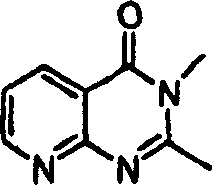
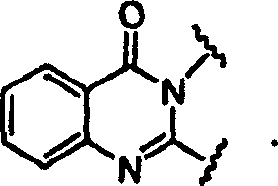
另外的A环支架是6-元环(没有附加的稠合环)并包括:Additional A-ring scaffolds are 6-membered rings (no additional fused rings) and include:
在其它实施方案中,A环支架是5-元环(没有附加的稠合环)并包括例如:In other embodiments, the A-ring scaffold is a 5-membered ring (with no additional fused rings) and includes, for example:


典型的,指定环取代基(如在以上5-元环中所示R和R’基团,但不是在稠合环构架或以上6-元环中所示)以便提供对于分子的电子的和/或附加疏水的或亲水特性,使所有物理特性与那些在系列中最优选的化合物相符合(参见实施例)。Typically, ring substituents (R and R' groups as shown in the above 5-membered rings, but not in fused ring frameworks or in the above 6-membered rings) are specified so as to contribute to the sum of electrons of the molecule and/or additional hydrophobic or hydrophilic properties, bringing all physical properties in line with those of the most preferred compounds in the series (see examples).
在实施方案的以上基团的每一个中,R14优选是取代或未取代的芳基或取代或未取代的杂芳基。更优选芳基或杂芳基应具有0-3个取代基。更加优选具有1或2个取代基。芳基或杂芳基优选选自苯基、取代的苯基、吡啶基、取代的吡啶基、噻唑基、取代的噻唑基、嘧啶基、取代的嘧啶基、噻吩基和取代的噻吩基。对于那些具有一个取代基的实施方案,取代基应优选在杂环支架连接点的对位上。在最优选的实施方案中,取代基选自氰基、卤素、(C1-C8)烷氧基、(C1-C8)烷基、(C2-C8)杂烷基、CONH2、亚甲基二氧基和亚乙基二氧基。In each of the above groups of embodiments, R14 is preferably substituted or unsubstituted aryl or substituted or unsubstituted heteroaryl. More preferably aryl or heteroaryl should have 0-3 substituents. More preferably, it has 1 or 2 substituents. Aryl or heteroaryl is preferably selected from phenyl, substituted phenyl, pyridyl, substituted pyridyl, thiazolyl, substituted thiazolyl, pyrimidinyl, substituted pyrimidinyl, thienyl and substituted thienyl. For those embodiments having one substituent, the substituent should preferably be para to the point of attachment of the heterocyclic scaffold. In the most preferred embodiment, the substituent is selected from cyano, halogen, (C 1 -C 8 )alkoxy, (C 1 -C 8 )alkyl, (C 2 -C 8 )heteroalkyl, CONH 2. Methylenedioxy and ethylenedioxy.
回到式I,在一组优选的实施方案中,X是C(O)-。在另一组中,Z是-N=。在另外一组优选的实施方案中,Y1和Y2各是-C(R12)=,其中两个R12基团结合形成稠合的6-元芳基或杂芳基环。特别优选的是那些结合这些优选组的实施方案中每一个的实施方案。因此,在一组特别优选的实施方案中,X是-C(O)-;Z是-N=;Y3是C;Y1和Y2各是-C(R12)=,其中两个R12基团结合形成稠合的6-元取代或未取代的芳基或杂芳基环。Returning to formula I, in a preferred set of embodiments, X is C(O)-. In another group, Z is -N=. In another set of preferred embodiments, Y 1 and Y 2 are each -C(R 12 )=, wherein two R 12 groups are joined to form a fused 6-membered aryl or heteroaryl ring. Particularly preferred are those embodiments which combine the embodiments of each of these preferred groups. Thus, in a particularly preferred group of embodiments, X is -C(O)-; Z is -N=; Y 3 is C; Y 1 and Y 2 are each -C(R 12 )=, two of which The R 12 groups combine to form a fused 6-membered substituted or unsubstituted aryl or heteroaryl ring.
在另一个独立的,但是优选的实施方案中,L是(C1-C8)亚烷基;Q是-C(O)-,R4是(C5-C15)烷基、取代或未取代的苯基,或联苯基;R3是(C1-C8)烷氧基、(C1-C8)烷基氨基、二(C1-C8)烷基氨基、(C2-C8)杂烷基、(C3-C9)杂环基、(C1-C8)酰基氨基、氰基、杂芳基、-CONR9R10或-CO2R11;R1和R2各独立是H或(C1-C4)烷基;Y3是C和与Z共用双键的碳原子;含有Y3的环系统选自喹啉、喹唑啉、萘、喹啉酮、喹唑啉酮、三唑啉酮、嘧啶-4-酮、苯并咪唑、噻唑、咪唑、吡啶、吡嗪和苯并二氮杂。In another independent, but preferred embodiment, L is (C 1 -C 8 )alkylene; Q is -C(O)-, R 4 is (C 5 -C 15 )alkyl, substituted or Unsubstituted phenyl, or biphenyl; R 3 is (C 1 -C 8 ) alkoxy, (C 1 -C 8 ) alkylamino, di(C 1 -C 8 ) alkylamino, (C 2 -C 8 ) heteroalkyl, (C 3 -C 9 ) heterocyclyl, (C 1 -C 8 ) acylamino, cyano, heteroaryl, -CONR 9 R 10 or -CO 2 R 11 ; R 1 and R 2 are each independently H or (C 1 -C 4 ) alkyl; Y 3 is C and a carbon atom sharing a double bond with Z; the ring system containing Y 3 is selected from quinoline, quinazoline, naphthalene, Quinolinones, quinazolinones, triazolinones, pyrimidin-4-ones, benzimidazoles, thiazoles, imidazoles, pyridines, pyrazines and benzodiazepines.
可以根据A环支架确定其它的优选实施方案。例如,一组优选的实施方案是那些实施方案,其中X是-C(O)-;Z是-N=;Y3是C;和Y1和Y2各是-C(R12)=。更优选,两个R12基团结合形成稠合的6-元取代或未取代的芳基或杂芳基环。特别优选的是那些实施方案,其中Y4是-N(R14)-或-C(R14)=,其中R14基团是取代或未取代的芳基或杂芳基。在另一组优选的实施方案中,X是-C(R5)(R6)-;Y4是-N(R14)-,其中R14是取代或未取代的芳基或杂芳基;Y3是C;Z是-N=;以及Y1和Y2各是-C(R12)=。在另一组优选的实施方案中,X是-C(R5)=;Y4是-C(R14)=,其中R14是取代或未取代的芳基或杂芳基;Y3是C;Z是-N=;以及Y1和Y2各是-C(R12)=。在另一组优选的实施方案中,X是键;Y4是-N(R14)-,其中R14是取代或未取代的芳基或杂芳基;Y3是C;Z是-N=;以及Y1和Y2各是-C(R12)=。在另一组优选的实施方案中,X是-C(R5)=;Y4是-C(R14)-,其中R14是取代或未取代的芳基或杂芳基;Y3是C;Z是-C(R7)=;以及Y1和Y2各是-C(R12)=。在另一组优选的实施方案中,X是键;Z是-N=或-N(R17)-;Y4是-C(R14)-,其中R14是取代或未取代的芳基或杂芳基;Y1是选自含有-O-、-S-和-N(R13)-的基团;以及Y2是-C(R12)=。在另一组优选的实施方案中,更优选的是那些化合物,其中Y1是-O-和Z是-N=;其中Y1是-S-和Z是-N=的化合物;以及其中Y1是-N(R13)-和Z是-N=的化合物。在另一组优选的实施方案中,X是-SO2-;Y4是-N(R14)-,其中R14是取代或未取代的芳基或杂芳基;Y3是C;Z是-N=或-C(R7)=;以及Y1和Y2各是-C(R12)=。在另一组优选的实施方案中,X是键;Z是-O-、-S-或-N(R17)-;Y1是-N=或-N(R13)-;Y2是-C(R12)=和Y4是-C(R14)=,其中R14是取代或未取代的芳基或杂芳基。在该组中的特别优选的实施方案是那些其中Y1是-N=和Z是-O-的实施方案;其中Y1是-N=和Z是-S-的实施方案;其中Z是-N(R17)-的实施方案。在另一组优选的实施方案中,X是键;Y1是-N(R13)-或=N-;Y2是-C(R12)=;Y3是C;Y4是-C(R14)=,其中R14是取代或未取代的芳基或杂芳基;以及Z是-N(R17)-或=N-,条件是Y1和Z不都是=N-。在另一组优选的实施方案中,X是键;Y1和Y2独立是-C(R12)=;Y3是C;Y4是-C(R14)=,其中R14是取代或未取代的芳基或杂芳基;以及Z是-N(R17)-、O或S。更优选,两个R12基团结合形成稠合的5-或6-元取代或未取代的芳基或杂芳基环。在另一组优选的实施方案中,X是-C(O)-;Y1是-N(R13)-;Y2是-N=;Y3是C;Y4是-C(R14)-,其中R14是取代或未取代的芳基或杂芳基;以及Z是键。在另一组优选的实施方案中,X是-C(O)-;Z是-N(R17)-,其中R17是取代或未取代的芳基或杂芳基;Y1和Y2各独立是-C(R12)=;Y3是C;以及Y4是-N=。在另一组优选的实施方案中,X和Z是-N=,Y1和Y2各独立是-C(R12)=;Y3是C;以及Y4是-C(R14)=,其中R14取代或未取代的芳基或杂芳基。在另一组优选的实施方案中,X是-C(O)-;Y4是-N(R14)-C(R5)(R6)-;其中R14是取代或未取代的芳基或杂芳基;Y1和Y2各独立是-C(R12)=;Y3是C;以及Z是-N=。Other preferred embodiments can be determined based on the A-ring scaffold. For example, a preferred group of embodiments are those wherein X is -C(O)-; Z is -N=; Y3 is C; and Y1 and Y2 are each -C( R12 )=. More preferably, two R groups combine to form a fused 6-membered substituted or unsubstituted aryl or heteroaryl ring. Particularly preferred are those embodiments wherein Y 4 is -N(R 14 )- or -C(R 14 )=, wherein the R 14 group is a substituted or unsubstituted aryl or heteroaryl group. In another preferred embodiment, X is -C(R 5 )(R 6 )-; Y 4 is -N(R 14 )-, wherein R 14 is substituted or unsubstituted aryl or heteroaryl ; Y 3 is C; Z is -N=; and Y 1 and Y 2 are each -C(R 12 )=. In another preferred embodiment, X is -C(R 5 )=; Y 4 is -C(R 14 )=, wherein R 14 is substituted or unsubstituted aryl or heteroaryl; Y 3 is C; Z is -N=; and Y 1 and Y 2 are each -C(R 12 )=. In another group of preferred embodiments, X is a bond; Y 4 is -N(R 14 )-, wherein R 14 is substituted or unsubstituted aryl or heteroaryl; Y 3 is C; Z is -N =; and Y 1 and Y 2 are each -C(R 12 )=. In another preferred embodiment, X is -C(R 5 )=; Y 4 is -C(R 14 )-, wherein R 14 is substituted or unsubstituted aryl or heteroaryl; Y 3 is C; Z is -C(R 7 )=; and Y 1 and Y 2 are each -C(R 12 )=. In another preferred embodiment, X is a bond; Z is -N= or -N(R 17 )-; Y 4 is -C(R 14 )-, wherein R 14 is substituted or unsubstituted aryl or heteroaryl; Y 1 is selected from groups containing -O-, -S- and -N(R 13 )-; and Y 2 is -C(R 12 )=. In another group of preferred embodiments, more preferred are those compounds, wherein Y is -O- and Z is -N=; wherein Y is -S- and Z is -N=; and wherein Y A compound wherein 1 is -N(R 13 )- and Z is -N=. In another preferred embodiment, X is -SO 2 -; Y 4 is -N(R 14 )-, wherein R 14 is substituted or unsubstituted aryl or heteroaryl; Y 3 is C; Z is -N= or -C(R 7 )=; and Y 1 and Y 2 are each -C(R 12 )=. In another preferred embodiment, X is a bond; Z is -O-, -S- or -N(R 17 )-; Y 1 is -N= or -N(R 13 )-; Y 2 is -C(R 12 )= and Y 4 is -C(R 14 )=, wherein R 14 is substituted or unsubstituted aryl or heteroaryl. Particularly preferred embodiments within this group are those wherein Y is -N= and Z is -O-; wherein Y is -N = and Z is -S-; wherein Z is - An embodiment of N(R 17 )-. In another preferred group of embodiments, X is a bond; Y 1 is -N(R 13 )- or =N-; Y 2 is -C(R 12 )=; Y 3 is C; Y 4 is -C (R 14 )=, wherein R 14 is substituted or unsubstituted aryl or heteroaryl; and Z is -N(R 17 )- or =N-, with the proviso that Y 1 and Z are not both =N-. In another group of preferred embodiments, X is a bond; Y1 and Y2 are independently -C(R 12 )=; Y 3 is C; Y 4 is -C(R 14 )=, wherein R 14 is substituted or unsubstituted substituted aryl or heteroaryl; and Z is -N( R17 )-, O or S. More preferably, two R12 groups combine to form a fused 5- or 6-membered substituted or unsubstituted aryl or heteroaryl ring. In another preferred embodiment, X is -C(O)-; Y 1 is -N(R 13 )-; Y 2 is -N=; Y 3 is C; Y 4 is -C(R 14 )-, wherein R 14 is substituted or unsubstituted aryl or heteroaryl; and Z is a bond. In another preferred embodiment, X is -C(O)-; Z is -N(R 17 )-, wherein R 17 is substituted or unsubstituted aryl or heteroaryl; Y 1 and Y 2 Each is independently -C(R 12 )=; Y 3 is C; and Y 4 is -N=. In another preferred embodiment, X and Z are -N=, Y 1 and Y 2 are each independently -C(R 12 )=; Y 3 is C; and Y 4 is -C(R 14 )= , wherein R 14 is substituted or unsubstituted aryl or heteroaryl. In another group of preferred embodiments, X is -C(O)-; Y 4 is -N(R 14 )-C(R 5 )(R 6 )-; wherein R 14 is substituted or unsubstituted aryl Y 1 and Y 2 are each independently -C(R 12 )=; Y 3 is C; and Z is -N=.
在以上各组的优选实施方案每一个中,R1最优选H。In each of the above groups of preferred embodiments, R1 is most preferably H.
在以上每一特别优选组的实施方案中,A环是稠合的具有所指明的氮顶点的6,6或6,5-元环系统(参见式II)。In each of the above particularly preferred groups of embodiments, the A ring is a fused 6,6 or 6,5-membered ring system with the indicated nitrogen apex (see formula II).
在式II中,每一个A1、A2、A3和A4独立是C或N。优选A1-A4中不超过两个是N。另外,X是-CO-、-CH2-或键;R1和R2各独立是H或(C1-C4)烷基;R14是取代或未取代的苯基、吡啶基、噻唑基、噻吩基或嘧啶基;Q是-CO-;L是(C1-C8)亚烷基;下标n是0-4的一个整数;以及每一个Ra独立选自卤素、-OR’、OC(O)R’、-NR’R”、-SR’、-R’、-CN、-NO2、-CO2R’、-CONR’R”、-C(O)R’、-OC(O)NR’R”、-NR”C(O)R’、-NR”C(O)2R’、-NR’-C(O)NR”R、-NH-C(NH2)=NH、-NR’C(NH2)=NH、-NHC(NH2)=NR’、-S(O)R’、-S(O)2R’、-S(O)2NR’R”、-N3、-CH(Ph)2、全氟(C1-C4)烷氧基和全氟(C1-C4)烷基,其中R’、R”和R各独立选自H、(C1-C8)烷基、(C2-C8)杂烷基、未取代的芳基、未取代的杂芳基、(未取代的芳基)-(C1-C4)烷基和(未取代的芳基)氧基-(C1-C4)烷基。剩下的符号,R3和R4具有以上所述的意义(以及优选的基团)。In Formula II, each of A 1 , A 2 , A 3 and A 4 is independently C or N. Preferably no more than two of A 1 -A 4 are N. In addition, X is -CO-, -CH 2 - or a bond; R 1 and R 2 are each independently H or (C 1 -C 4 ) alkyl; R 14 is substituted or unsubstituted phenyl, pyridyl, thiazole base, thienyl or pyrimidinyl; Q is -CO-; L is (C 1 -C 8 ) alkylene; subscript n is an integer from 0 to 4; and each R is independently selected from halogen, -OR' , OC(O)R', -NR'R", -SR', -R', -CN, -NO 2 , -CO 2 R', -CONR'R", -C(O)R', - OC(O)NR'R", -NR"C(O)R', -NR"C(O) 2 R', -NR'-C(O)NR"R, -NH-C(NH 2 )=NH, -NR'C(NH 2 )=NH, -NHC(NH 2 )=NR', -S(O)R', -S(O) 2 R', -S(O) 2 NR'R", -N 3 , -CH(Ph) 2 , perfluoro(C 1 -C 4 )alkoxy and perfluoro(C 1 -C 4 )alkyl, wherein R', R" and R'' are independently selected from H, (C 1 -C 8 )alkyl, (C 2 -C 8 )heteroalkyl, unsubstituted aryl, unsubstituted heteroaryl, (unsubstituted aryl)-(C 1 - C 4 )alkyl and (unsubstituted aryl)oxy-(C 1 -C 4 )alkyl. The remaining symbols, R3 and R4 have the meanings (and preferred groups) described above.
更加优选,具有式(III)的化合物:Even more preferably, a compound of formula (III):
其中A4是C或N;X是-CO-、-CH2-或键;R1和R2各独立是H或(C1-C4)烷基;R14是取代或未取代的苯基、吡啶基、噻唑基、噻吩基或嘧啶基;Q是-CO-;L是(C1-C8)亚烷基;下标n是0-4的一个整数;以及每一个Ra独立选自卤素、-OR’、OC(O)R’、-NR’R”、-SR’、-R’、-CN、-NO2、-CO2R’、-CONR’R”、-C(O)R’、-OC(O)NR’R”、-NR”C(O)R’、-NR”C(O)2R’、-NR’-C(O)NR”R、-NH-C(NH2)=NH、-NR’C(NH2)=NH、-NHC(NH2)=NR’、-S(O)R’、-S(O)2R’、-S(O)2NR’R”、-N3、-CH(Ph)2、全氟(C1-C4)烷氧基和全氟(C1-C4)烷基,其中R’、R”和R各独立选自H、(C1-C8)烷基、(C2-C8)杂烷基、未取代的芳基、未取代的杂芳基、(未取代的芳基)-(C1-C4)烷基和(未取代的芳基)氧基-(C1-C4)烷基。剩下的符号,R3和R4具有以上所述的意义(以及优选的基团)。Wherein A 4 is C or N; X is -CO-, -CH 2 - or a bond; R 1 and R 2 are each independently H or (C 1 -C 4 )alkyl; R 14 is substituted or unsubstituted benzene Base, pyridyl, thiazolyl, thienyl or pyrimidinyl; Q is -CO-; L is (C 1 -C 8 ) alkylene; subscript n is an integer of 0-4; and each R is independently selected From halogen, -OR', OC(O)R', -NR'R", -SR', -R', -CN, -NO 2 , -CO 2 R', -CONR'R", -C( O)R', -OC(O)NR'R", -NR"C(O)R', -NR"C(O) 2 R', -NR'-C(O)NR"R, - NH-C(NH 2 )=NH, -NR'C(NH 2 )=NH, -NHC(NH 2 )=NR', -S(O)R', -S(O) 2 R', -S (O) 2 NR'R", -N 3 , -CH(Ph) 2 , perfluoro(C 1 -C 4 )alkoxy and perfluoro(C 1 -C 4 )alkyl, where R', R " and R'' are each independently selected from H, (C 1 -C 8 ) alkyl, (C 2 -C 8 ) heteroalkyl, unsubstituted aryl, unsubstituted heteroaryl, (unsubstituted aryl )-(C 1 -C 4 )alkyl and (unsubstituted aryl)oxy-(C 1 -C 4 )alkyl. The remaining symbols, R3 and R4 have the meanings (and preferred groups) described above.
在一组优选的实施方案中,X是-CO-。在另一组优选的实施方案中,X是-CH2-。在另一组优选的实施方案中,X是键。In a preferred set of embodiments, X is -CO-. In another preferred embodiment, X is -CH2- . In another set of preferred embodiments, X is a bond.
式III更加优选的化合物是那些其中R1是甲基、乙基或丙基和R2是羟基或甲基的化合物。更优选,R1和R2每一个是甲基。式III的其它优选的R化合物是其中R3选自取代或未取代的吡啶基或取代或未取代的咪唑基的化合物。也优选那些式III的化合物,其中R4是取代或未取代的苄基,其中所述取代基选自卤素、卤代(C1-C4)烷基、卤代(C1-C4)烷氧基、氰基、硝基和苯基。对于L的优选基团是(C1-C4)亚烷基。也优选那些式III的化合物,其中R14选自取代的苯基、取代的吡啶基、取代的噻唑基和取代的噻吩基,其中所述取代基选自氰基、卤素、(C1-C8)烷氧基、(C1-C8)烷基、(C2-C8)杂烷基、CONH2、亚甲基二氧基和亚乙基二氧基。更优选是那些结合两个或更多个以上优选基团的化合物。Even more preferred compounds of formula III are those wherein R1 is methyl, ethyl or propyl and R2 is hydroxy or methyl. More preferably, R 1 and R 2 are each methyl. Other preferred R compounds of formula III are those wherein R is selected from substituted or unsubstituted pyridyl or substituted or unsubstituted imidazolyl. Preference is also given to those compounds of formula III, wherein R 4 is substituted or unsubstituted benzyl, wherein the substituents are selected from halogen, halo(C 1 -C 4 )alkyl, halo(C 1 -C 4 ) Alkoxy, cyano, nitro and phenyl. A preferred group for L is (C 1 -C 4 )alkylene. Also preferred are those compounds of formula III, wherein R 14 is selected from substituted phenyl, substituted pyridyl, substituted thiazolyl and substituted thienyl, wherein the substituents are selected from cyano, halogen, (C 1 -C 8 ) Alkoxy, (C 1 -C 8 )alkyl, (C 2 -C 8 )heteroalkyl, CONH 2 , methylenedioxy and ethylenedioxy. More preferred are those compounds combining two or more of the above preferred groups.
在对于式III化合物的特别优选的实施方案中,X是-CO-;R1和R2各独立选自H、甲基和乙基;R14选自取代的或未取代的苯基;Q是-CO-;L是亚甲基、亚乙基或亚丙基,R3选自取代的或未取代的吡啶基和取代或未取代的咪唑基;R4是取代或未取代的苄基,其中所述取代基选自卤素、卤代(C1-C4)烷基、卤代(C1-C4)烷氧基、氰基、硝基和苯基;以及每一个R3选自卤素、-OR’、OC(O)R’、-NR’R”、-SR’、-R’、-CN、-NO2、-CO2R’、-CONR’R”、-C(O)R’、-NR”C(O)R’、-NR’-C(O)NR”R、全氟(C1-C4)烷氧基和全氟(C1-C4)烷基,其中R’、R”和R各独立选自H、(C1-C8)烷基、(C2-C8)杂烷基、未取代的芳基、未取代的杂芳基、(未取代的芳基)-(C1-C4)烷基和(未取代的芳基)氧基-(C1-C4)烷基。In particularly preferred embodiments for compounds of formula III, X is -CO-; R and R are each independently selected from H, methyl and ethyl ; R is selected from substituted or unsubstituted phenyl; Q is -CO-; L is methylene, ethylene or propylene, R3 is selected from substituted or unsubstituted pyridyl and substituted or unsubstituted imidazolyl; R4 is substituted or unsubstituted benzyl , wherein the substituents are selected from the group consisting of halogen, halo(C 1 -C 4 )alkyl, halo(C 1 -C 4 )alkoxy, cyano, nitro and phenyl; and each R 3 is selected from From halogen, -OR', OC(O)R', -NR'R", -SR', -R', -CN, -NO 2 , -CO 2 R', -CONR'R", -C( O)R', -NR"C(O)R', -NR'-C(O)NR"R, perfluoro(C 1 -C 4 )alkoxy and perfluoro(C 1 -C 4 ) Alkyl, wherein R', R" and R'' are each independently selected from H, (C 1 -C 8 ) alkyl, (C 2 -C 8 ) heteroalkyl, unsubstituted aryl, unsubstituted heteroaryl radical, (unsubstituted aryl)-(C 1 -C 4 )alkyl and (unsubstituted aryl)oxy-(C 1 -C 4 )alkyl.
在本优选组的实施方案中的典型结构如下:A typical structure in the embodiment of this preferred group is as follows:

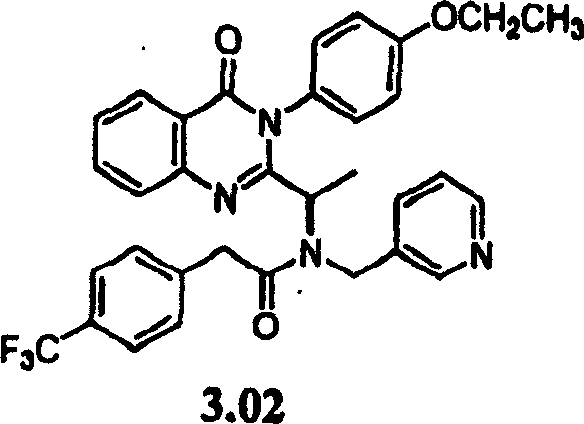
化合物的制备Compound preparation
图1-18给出了合成本文所提供的化合物的各种途径。本领域技术人员应该意识到,在杂环支架的制备之前、期间或之后可以改变取代基(如R’、R”、R、Riv等),并且可以对示范的条件(如温度、溶剂等)适当地进行调节。此外,本领域技术人员应该认识到,保护基团对于制备某些化合物可能是必须的,并且应该意识到,这些条件应与选择的保护基团相适应。Figures 1-18 illustrate various routes for the synthesis of the compounds provided herein. Those skilled in the art will appreciate that substituents (e.g., R', R", R'', Riv, etc. ) can be varied before, during, or after the preparation of the heterocyclic scaffold, and that exemplary conditions (e.g., temperature, solvent, etc.) can be varied. etc.) as appropriate. Furthermore, those skilled in the art will recognize that protecting groups may be necessary for the preparation of certain compounds, and will appreciate that these conditions should be compatible with the protecting group chosen.
本文所述的示范的方法和实施例是对本发明的举例说明,不能认为是限制本发明的范围。The exemplary methods and examples described herein are illustrative of the invention and should not be considered as limiting the scope of the invention.
组合物combination
在另一方面,本发明提供药用组合物用于调节人和动物体内趋化因子受体的活性。所述组合物含有本发明的化合物与药学上可接受的载体或稀释剂。In another aspect, the present invention provides pharmaceutical compositions for modulating the activity of chemokine receptors in humans and animals. The composition contains the compound of the present invention and a pharmaceutically acceptable carrier or diluent.
“调节”或趋化因子受体活性的调节,如本文中所使用的它的多种形式,包括与特殊趋化因子受体、特别是CXCR3受体有关活性的的拮抗作用、激动作用、部分拮抗作用和/或部分激动作用。本文所使用的术语“组合物”包括由规定的成分(如果指明,则以规定的数量)的前体药物,以及以规定数量的规定成分的组合直接或间接产生的任何前体药物。对于“药学上可接受的”指必须与其它配方的成分适配的载体、稀释剂或赋形剂并对于其接受者是无害的。"Modulation" or modulation of chemokine receptor activity, as used herein in its various forms, includes antagonism, agonism, partial Antagonism and/or partial agonism. As used herein, the term "composition" includes prodrugs of the specified ingredients (in specified amounts, if specified), as well as any prodrugs produced directly or indirectly from a combination of the specified ingredients in specified amounts. By "pharmaceutically acceptable" is meant a carrier, diluent or excipient which must be compatible with the other formulation ingredients and not deleterious to the recipient thereof.
对于本发明化合物给药的药用组合物可以方便地以单位剂量形式存在并可以通过任何药学领域已知的方法制备。所有方法包括使活性成分掺入到一种或更多种辅助成分组成的相关载体中。通常,通过使活性成分与相关的液体载体或细分的固体载体或所述两种载体均匀和紧密地混和,然后,如果需要,将产物成型为所需的制剂,制备药用组合物。在药用组合物中包括对疾病的过程或症状能产生所需疗效的足够量的活性目标化合物。The pharmaceutical compositions for administering the compounds of this invention may conveniently be presented in unit dosage form and may be prepared by any of the methods known in the art of pharmacy. All methods include incorporating the active ingredient into an associated carrier which constitutes one or more accessory ingredients. In general, the pharmaceutical compositions are prepared by uniformly and intimately bringing into association the active ingredient with associated liquid carriers or finely divided solid carriers or both, and then, if necessary, shaping the product into the desired formulation. The active compound of interest is included in the pharmaceutical composition in an amount sufficient to produce the desired therapeutic effect on the disease process or symptoms.
含有活性成分的药用组合物可以以合适的形式口服给药,例如片剂、含片、锭剂、水性或油性悬浮液、可分散的散剂或颗粒剂、乳剂、硬或软胶囊剂、或糖浆或酏剂。口服给药的组合物可以根据任何本领域制备药用组合物已知的方法制备并且所述组合物可以含有一种或更多种选自甜味剂、调味剂、着色剂和防腐剂,以便提供药学上精致和适口的制剂。片剂含有与无毒的药学上可接受的赋形剂混合的活性成分,所述赋形剂适合片剂的制备。这些赋形剂可以是例如惰性稀释剂如碳酸钙、碳酸钠、乳糖、磷酸钙或磷酸钠;颗粒形成和崩解剂如玉米淀粉或藻酸;粘合剂如淀粉、明胶或阿拉伯胶和润滑剂如硬脂酸镁、硬脂酸或滑石粉。片剂可以不包衣或它们可以通过已知技术包衣以延缓在胃肠道中的崩解和吸收并因此在长时间内提供持续作用。例如时间延缓物质可以使用如甘油单乙酸酯或甘油二硬脂酸酯。它们也可以通过在美国专利号4,256,108;4,166,452和4,265,874中所述的技术包衣形成渗透治疗片剂用于可控释放。The pharmaceutical composition containing the active ingredient can be orally administered in a suitable form, such as tablet, troche, lozenge, aqueous or oily suspension, dispersible powder or granule, emulsion, hard or soft capsule, or Syrup or elixir. Compositions for oral administration can be prepared according to any method known in the art for the preparation of pharmaceutical compositions and said compositions can contain one or more selected from sweeteners, flavoring agents, coloring agents and preservatives, so as to Pharmaceutically elegant and palatable formulations are provided. Tablets contain the active ingredient in admixture with non-toxic pharmaceutically acceptable excipients which are suitable for the manufacture of tablets. These excipients may be, for example, inert diluents such as calcium carbonate, sodium carbonate, lactose, calcium phosphate or sodium phosphate; granule forming and disintegrating agents such as cornstarch or alginic acid; binders such as starch, gelatin or acacia and lubricating agents. agents such as magnesium stearate, stearic acid or talc. Tablets may be uncoated or they may be coated by known techniques in order to delay disintegration and absorption in the gastrointestinal tract and thus provide sustained action over prolonged periods of time. For example a time delay material such as glyceryl monoacetate or glyceryl distearate may be employed. They may also be coated to form osmotic therapeutic tablets for controlled release by the techniques described in US Pat. Nos. 4,256,108; 4,166,452 and 4,265,874.
用于口服的制剂也可以是硬明胶胶囊,其中活性成分与惰性固状稀释剂如碳酸钙、磷酸钙或高岭土混合,或是软明胶胶囊,其中活性成分与水或油性介质如花生油、液体石蜡或橄榄油混合。Formulations for oral administration may also be hard gelatin capsules in which the active ingredient is mixed with an inert solid diluent such as calcium carbonate, calcium phosphate, or kaolin, or soft gelatin capsules in which the active ingredient is mixed with water or an oily medium such as peanut oil, liquid paraffin or olive oil blend.
水性悬浮液含有与适合制备水性悬浮液的赋形剂混合的活性成分。所述赋形剂是悬浮剂如羧甲基纤维素钠、甲基纤维素、羟基-丙基甲基纤维素、藻酸钠、聚乙烯吡咯烷酮、黄蓍树胶和阿拉伯树胶;分散剂或润湿剂可以是天然存在的磷脂如卵磷脂或环氧乙烷与脂肪酸的缩合产物如聚氧乙烯硬脂酸酯,或环氧乙烷与长链脂族醇的缩合产物如十七碳亚乙基氧基十六烷醇,或环氧乙烷与从脂肪酸和己糖醇衍生的偏酯缩合的产物如聚氧乙烯山梨糖醇酐单油酸酯,或环氧乙烷与从脂肪酸和己糖醇酐衍生的偏酯缩合的产物如聚乙烯山梨糖醇酐单油酸酯。水性悬浮液也可以含有一种或更多种防腐剂如乙基或正-丙基、对-羟基苯甲酸酯,一种或更多种着色剂,一种或更多种调味剂和一种或更多种甜味剂如蔗糖或糖精。Aqueous suspensions contain the active ingredients in admixture with excipients suitable for the manufacture of aqueous suspensions. The excipients are suspending agents such as sodium carboxymethylcellulose, methylcellulose, hydroxy-propylmethylcellulose, sodium alginate, polyvinylpyrrolidone, gum tragacanth and gum arabic; dispersing agents or wetting agents The agent may be a naturally occurring phospholipid such as lecithin or a condensation product of ethylene oxide with a fatty acid such as polyoxyethylene stearate, or a condensation product of ethylene oxide with a long chain aliphatic alcohol such as heptadecanyl ethylene Oxycetyl alcohol, or the condensation product of ethylene oxide with partial esters derived from fatty acids and hexitols such as polyoxyethylene sorbitan monooleate, or ethylene oxide with partial esters derived from fatty acids and hexitols Derivatized partial ester condensation products such as polyethylene sorbitan monooleate. Aqueous suspensions may also contain one or more preservatives such as ethyl or n-propyl, p-hydroxybenzoate, one or more coloring agents, one or more flavoring agents and a One or more sweeteners such as sucrose or saccharin.
将活性成分悬浮在植物油如花生油、橄榄油、芝麻油或椰子油或悬浮在矿物油如液体石蜡中可以制备油性悬浮液。油性悬浮液可以含有增稠剂如蜂蜡、硬石蜡或十六醇。可以加入如上所述的甜味剂和调味剂以便得到适口的口服制剂。这些化合物可以通过加入抗氧化剂如抗坏血酸保存。Oily suspensions may be prepared by suspending the active ingredient in a vegetable oil, such as arachis oil, olive oil, sesame oil or coconut oil, or in a mineral oil such as liquid paraffin. The oily suspensions may contain a thickening agent such as beeswax, hard paraffin or cetyl alcohol. Sweetening and flavoring agents as mentioned above may be added to provide a palatable oral preparation. These compounds can be preserved by adding antioxidants such as ascorbic acid.
通过加入水使活性成分与分散剂或湿润剂、悬浮剂和一种或更多种防腐剂混合,可细分的散剂和颗粒剂适合配制水性悬浮液。合适的分散剂或湿润剂以及悬浮剂以以上所述的那些为例。也可以存在其它赋形剂如甜味剂、调味剂和着色剂。Finely divided powders and granules are suitable for the preparation of an aqueous suspension by the addition of water to bring the active ingredient into admixture with a dispersing or wetting agent, suspending agent and one or more preservatives. Suitable dispersing or wetting agents and suspending agents are exemplified by those already mentioned above. Other excipients, for example sweetening, flavoring and coloring agents, may also be present.
本发明的药用组合物也可以是水包油乳剂的形式。所述油相可以是植物油如橄榄油或花生油,或矿物油如液体石蜡或它们的混合物。合适的乳化剂可以是天然存在的树胶如阿拉伯胶或黄蓍胶,天然存在的磷脂如大豆卵磷脂和酯类或由脂肪酸的己糖醇酐衍生的偏酯类如失水山梨糖醇一油酸以及所述偏酯与环氧乙烷的缩合产物如聚氧乙烯山梨糖醇酐单油酸酯。乳化液也可以含有甜味剂和调节剂。The pharmaceutical compositions of the invention may also be in the form of oil-in-water emulsions. The oily phase may be a vegetable oil such as olive oil or peanut oil, or a mineral oil such as liquid paraffin or mixtures thereof. Suitable emulsifiers may be naturally occurring gums such as acacia or tragacanth, naturally occurring phospholipids such as soybean lecithin and esters or partial esters derived from hexitol anhydrides of fatty acids such as sorbitan-oil Acids and condensation products of said partial esters with ethylene oxide such as polyoxyethylene sorbitan monooleate. The emulsions may also contain sweetening and flavoring agents.
用甜味剂如甘油、丙二醇、山梨醇或蔗糖可以配制糖浆和酏剂。这些制剂也可以含有缓和剂、防腐剂、调味剂和着色剂。Syrups and elixirs may be formulated with sweetening agents, such as glycerol, propylene glycol, sorbitol or sucrose. These formulations may also contain a demulcent, a preservative, flavoring and coloring agents.
药用组合物可以是无菌注射水溶液或油性悬浮液的形式。可以根据已知技术使用合适的以上所述的分散剂或湿润剂和悬浮剂配制这种悬浮液。无菌注射制剂也可以是溶于式悬浮于无毒胃肠外可接受的稀释剂或溶剂如1,3-丁二醇溶液中的无菌注射液或悬浮液。在可以接受的载体和溶剂中,可以使用水、林格氏液和等张氯化钠溶液。另外,常规使用无菌的固定油类作为溶剂或悬浮溶媒。对于此目的可以使用任何缓和的固定油,包括合成的单-或二-甘油酯。另外,在可注射制剂中可以使用脂肪酸如油酸。Pharmaceutical compositions may be in the form of sterile injectable aqueous or oleaginous suspensions. This suspension may be formulated according to the known art using suitable dispersing or wetting agents and suspending agents which have been mentioned above. The sterile injectable preparation may also be a sterile injectable solution or suspension dissolved in a nontoxic parenterally acceptable diluent or solvent, such as 1,3-butanediol solution. Among the acceptable vehicles and solvents that may be employed are water, Ringer's solution and isotonic sodium chloride solution. In addition, sterile, fixed oils are conventionally employed as solvents or suspending vehicles. For this purpose any bland fixed oil may be employed including synthetic mono- or diglycerides. In addition, fatty acids such as oleic acid find use in the preparation of injectables.
本发明的化合物也可以以用于直肠给药的栓剂形式给药。可以通过将所述药物与合适的无-刺激性赋形剂混合制备这些组合物,所述赋形剂在常温下是固体但在直肠温度下是液体并因此可在直肠中熔解而释放药物。这样的物质是可可脂和聚二乙醇。The compounds of this invention may also be administered in the form of suppositories for rectal administration. These compositions can be prepared by mixing the drug with a suitable non-irritating excipient which is solid at ordinary temperatures but liquid at the rectal temperature and therefore will melt in the rectum to release the drug. Such materials are cocoa butter and polyethylene glycol.
对于局部给药,使用含有本发明化合物的乳膏、软膏、凝胶、溶液或悬浮液等。如本文所用的,局部用药也包括使用漱口液和含漱液。For topical administration, creams, ointments, gels, solutions or suspensions, etc., containing the compounds of this invention are employed. As used herein, topical administration also includes the use of mouthwashes and gargles.
本发明的药用组合物和方法还可以包括其它本文所提及的治疗活性化合物,这些化合物通常用于治疗或预防以上所提及的病理症状。The pharmaceutical compositions and methods of the present invention may also include other therapeutically active compounds mentioned herein which are generally used in the treatment or prevention of the pathological conditions mentioned above.
使用方法Instructions
在另一方面,本发明提供通过给予患有所述疾病或病症的受治疗者治疗的效量的本发明的化合物或组合物,治疗CXCR3介导的症症或疾病的方法。本文所定义的“受治疗者”包括动物如哺乳动物,包括但不限于灵长类动物(例如人)、牛、绵羊、山羊、马、狗、猫、兔、大鼠、小鼠等。In another aspect, the invention provides methods of treating a CXCR3-mediated disorder or disease by administering to a subject suffering from said disease or disorder a therapeutically effective amount of a compound or composition of the invention. A "subject" as defined herein includes animals such as mammals, including but not limited to primates (eg, humans), cows, sheep, goats, horses, dogs, cats, rabbits, rats, mice, and the like.
如本文所使用的短语“CXCR3介导的障碍或疾病”和有关的短语或术语指以不适宜的如CXCR3活性少于或大于正常为特征的疾病。不适宜的CXCR3活性可以导致在细胞中通常不表达CXCR3的CXCR3表达、增加CXCR3表达(导致例如炎症和免疫调节失调和疾病),或减少CXCR3表达(导致例如某些癌症和与血管源和形成血管有关的疾病)。不适当的CXCR3功能活性可以导致在通常不表达CXCR3的细胞中CXCR3的表达、增加CXCR3的表达(导致例如炎症和免疫调节失调和疾病),或减少CXCR3表达。不适当的CXCR3功能活性也可以导致细胞分泌趋化因子(正常不分泌CXC趋化因子),增加趋化因子表达(导致例如炎症和免疫调节失调和疾病),或减少趋化因子表达。CXCR3-介导的病症或疾病可以完全或部分由不适当的CXCR3功能活性介导。因此,CXCR3-介导的病症或疾病是CXCR3介导而引起对一些潜在的症状或疾病起某些作用的疾病(例如CXCR3拮抗剂引起病人、至少一些病人健康的一些改善)。As used herein, the phrase "CXCR3-mediated disorder or disease" and related phrases or terms refer to diseases characterized by inappropriate, eg, less than or greater than normal CXCR3 activity. Inappropriate CXCR3 activity can result in CXCR3 expression in cells that do not normally express CXCR3, increase CXCR3 expression (leading to, for example, inflammation and immune regulation disorders and diseases), or decrease CXCR3 expression (leading to, for example, certain cancers and vascularization and angiogenesis). related diseases). Inappropriate CXCR3 functional activity can result in CXCR3 expression in cells that do not normally express CXCR3, increase CXCR3 expression (leading to, eg, inflammation and immune regulation disorders and diseases), or decrease CXCR3 expression. Inappropriate CXCR3 functional activity can also cause cells to secrete chemokines (where CXC chemokines are not normally secreted), increase chemokine expression (leading to, for example, inflammation and immune regulation disorders and diseases), or decrease chemokine expression. A CXCR3-mediated condition or disease may be mediated in whole or in part by inappropriate CXCR3 functional activity. Thus, a CXCR3-mediated condition or disease is one in which CXCR3 is mediated to cause some effect on some underlying symptom or disease (eg, a CXCR3 antagonist causes some improvement in the health of a patient, at least some patients).
术语“治疗有效量”指引起组织、系统、动物或人的生物或医学反应的目标化合物的量,所述反应由研究人员、兽医、医务人员或其它临床医师探索或该反应在某些程度上足够预防或减轻所治疗疾病的一个或更个症状的发展。The term "therapeutically effective amount" refers to the amount of a compound of interest that elicits a biological or medical response in a tissue, system, animal or human being sought by a researcher, veterinarian, medical practitioner or other clinician or to some extent Sufficient to prevent or alleviate the development of one or more symptoms of the disease being treated.
用本发明的化合物和组合物可以治疗与炎症、感染和癌症有关的疾病和病症,在一组实施方案中,可以用CXCR3功能抑制剂治疗人或其它动物种类的疾病或病症,包括慢性疾病。这些疾病或病症包括:(1)炎症或变应性疾病如全身性过敏反应或超敏反应、药物过敏、昆虫刺伤过敏和食物过敏;炎性肠道疾病如节段性回肠炎、溃疡性结肠炎、回肠炎和肠炎;阴道炎;银屑病和炎性皮肤病如皮炎、湿疹、特应性皮炎、变应性接触性皮炎、荨麻疹;脉管炎;脊椎关节炎;硬皮病;哮喘和呼吸道变应性疾病如变应性鼻炎、过敏性肺病等,(2)自身免疫性疾病如关节炎(类风湿性和银屑病)、多发性硬化、系统性红斑狼疮、I型糖尿病、肾小球肾炎等,(3)移植排斥(包括同种移植排斥和移植物抗宿主疾病)和与此有关的病症,以及(4)其它疾病其中不需要的炎性应答可以被抑制如动脉粥样硬化、肌炎、神经变性疾病(例如早老性痴呆)、脑炎、脑膜炎、肝炎、肾炎、脓毒病、结节病、结膜炎、耳炎、慢性阻塞性肺病、鼻窦炎和贝赫切特综合征。在另一组实施方案中,可以用CXCR3功能激动剂治疗疾病或病症。可以用CXCR3功能激动剂治疗的疾病实例包括癌症、其中血管生成或新血管形成起作用的疾病(肿瘤疾病、视网膜病和黄斑变性)、感染性疾病和免疫抑制疾病。Diseases and conditions associated with inflammation, infection, and cancer can be treated with the compounds and compositions of the present invention. In one embodiment, diseases or conditions, including chronic diseases, in humans or other animal species can be treated with inhibitors of CXCR3 function. These diseases or conditions include: (1) inflammatory or allergic diseases such as anaphylaxis or hypersensitivity, drug allergy, insect sting allergy and food allergy; inflammatory bowel disease such as Crohn's disease, ulcerative colitis Colitis, ileitis, and enteritis; vaginitis; psoriasis and inflammatory skin diseases such as dermatitis, eczema, atopic dermatitis, allergic contact dermatitis, urticaria; vasculitis; spondyloarthritis; scleroderma ; Asthma and respiratory allergic diseases such as allergic rhinitis, allergic lung disease, etc., (2) autoimmune diseases such as arthritis (rheumatoid and psoriasis), multiple sclerosis, systemic lupus erythematosus, type I Diabetes, glomerulonephritis, etc., (3) transplant rejection (including allograft rejection and graft-versus-host disease) and disorders related thereto, and (4) other diseases in which unwanted inflammatory responses can be inhibited such as Atherosclerosis, myositis, neurodegenerative disease (eg, Alzheimer's disease), encephalitis, meningitis, hepatitis, nephritis, sepsis, sarcoidosis, conjunctivitis, otitis, chronic obstructive pulmonary disease, sinusitis, and Behcet's syndrome. In another set of embodiments, a disease or condition may be treated with an agonist of CXCR3 function. Examples of diseases that can be treated with CXCR3 functional agonists include cancer, diseases in which angiogenesis or neovascularization plays a role (neoplastic diseases, retinopathy and macular degeneration), infectious diseases and immunosuppressive diseases.
优选本发明所述方法直接治疗或预防选自神经变性疾病(例如早老性痴呆)、多发性硬化、系统性红斑狼疮、类风湿性关节炎、动脉粥样硬化、脑炎、脑膜炎、肝炎、肾炎、脓毒病、结节病、银屑病、湿疹、荨麻疹、I型糖尿病、哮喘、结膜炎、耳炎、变应性鼻炎、慢性阻塞性肺疾病、鼻窦炎、皮炎、炎性肠疾病、溃疡性结肠炎、节段性回肠炎、贝赫切特综合征、痛风、癌症、病毒感染(例如HIV)、细菌感染以及器官移植疾病或皮肤移植疾病。术语“器官移植疾病”包括骨髓移植疾病和实质器官(例如肾、肝、肺、心、胰或其组合)移植疾病。Preferably, the method of the present invention directly treats or prevents a disease selected from neurodegenerative diseases (such as Alzheimer's disease), multiple sclerosis, systemic lupus erythematosus, rheumatoid arthritis, atherosclerosis, encephalitis, meningitis, hepatitis, Nephritis, sepsis, sarcoidosis, psoriasis, eczema, urticaria,
用本发明化合物和组合物可以治疗的疾病或病症包括与以下有关的常见疾病:(1)炎症或变应性疾病,(2)自身免疫性疾病,(3)移植排斥以及(4)如上所述的其它疾病,其中不需要的炎性应答可以被抑制。例如,手术如气囊血管成形术后的再狭窄通常与动脉粥样硬化有关并可以用本发明的化合物和组合物治疗。Diseases or conditions that may be treated with the compounds and compositions of the present invention include common diseases associated with (1) inflammatory or allergic diseases, (2) autoimmune diseases, (3) transplant rejection and (4) as above Other diseases as described above, in which the unwanted inflammatory response can be suppressed. For example, restenosis following procedures such as balloon angioplasty is often associated with atherosclerosis and can be treated with the compounds and compositions of the present invention.
根据所治疗的疾病和受治疗者的状况,可以口服、胃肠外(例如肌内、腹膜内、静脉内、ICV、脑池内注射或输注、皮下注射或移植片)、吸入剂喷雾、鼻内、阴道内、直肠、舌下或表面途径给予本发明的化合物并可以,单一或一起,以含有常规无毒药学上可接受的载体、调节剂和媒介物的合适的剂量单位配方制备,以适合各种途径给药。Depending on the disease being treated and the condition of the subject, oral, parenteral (e.g., intramuscular, intraperitoneal, intravenous, ICV, intracisternal injection or infusion, subcutaneous injection or graft), inhalation spray, nasal The compounds of the present invention are administered by intravaginal, rectal, sublingual or topical routes and may be prepared, singly or together, in suitable dosage unit formulations containing conventional nontoxic pharmaceutically acceptable carriers, modulators and vehicles, to Suitable for various routes of administration.
在治疗或预防需要趋化因子受体介导的疾病中,合适的剂量水平通常是大约每公斤患者体重每天0.001-100mg,其可以以单一剂量可多剂量给药。优选剂量水平为大约每天0.01-25mg/kg;更优选大约每天0.05-10mg/kg。合适的剂量水平可为大约每天0.01-25mg/kg、大约每天0.05-10mg/kg或大约每天0.1-5mg/kg。在此范围内,剂量可以是每天0.005-0.05、0.05-0.5或0.5-5.0mg/kg。对于口服给药,优选以含有1.0-1000mg活性成分的的片剂形式提供组合物,特别是1.0、5.0、10.0、15.0、20.0、25.0、50.0、75.0、100.0、150.0、200.0、250.0、300.0、400.0、500.0、600.0、750.0、800.0、900.0、1000.0mg活性成分,用于根据症状调节给予治疗病人的剂量。所述化合物可以以每天1-4次、优选每天一到两次的方案给予。In the treatment or prevention of diseases requiring chemokine receptor mediation, suitable dosage levels are generally about 0.001-100 mg per kg of patient body weight per day, which may be administered in single or multiple doses. Preferred dosage levels are about 0.01-25 mg/kg per day; more preferably about 0.05-10 mg/kg per day. Suitable dosage levels may be about 0.01-25 mg/kg per day, about 0.05-10 mg/kg per day, or about 0.1-5 mg/kg per day. Within this range the dosage may be 0.005-0.05, 0.05-0.5 or 0.5-5.0 mg/kg per day. For oral administration, the composition is preferably presented in the form of tablets containing 1.0-1000 mg of active ingredient, especially 1.0, 5.0, 10.0, 15.0, 20.0, 25.0, 50.0, 75.0, 100.0, 150.0, 200.0, 250.0, 300.0, 400.0, 500.0, 600.0, 750.0, 800.0, 900.0, 1000.0 mg of active ingredient are used to adjust the dosage given to the treated patients according to the symptoms. The compounds may be administered on a regimen of 1-4 times per day, preferably one to two times per day.
然而,应该懂得,特别的剂量水平和给药频率可以根据任何特殊的病人变化并应根据包括所使用特定化合物的活性、化合物的代谢稳定性和作用的时间长短、年龄、体重、一般健康状况、性别、饮食、给药方法和次数,排泄的速率、联合用药情况、具体病症的严重性以及宿主经受治疗的因素变化。It should be understood, however, that the particular dosage level and frequency of administration may vary for any particular patient and should depend on factors including the activity of the particular compound employed, the metabolic stability and duration of action of the compound, age, body weight, general health, Gender, diet, method and frequency of administration, rate of excretion, concomitant drug use, severity of specific conditions, and host exposure to treatment will vary.
本发明的化合物可以与其它具有相关效用的化合物联合以治疗或预防炎症和免疫失调和疾病包括哮喘和变应性疾病,以及自身免疫性疾病如类风湿性关节炎和动脉粥样硬化,以及以上所述的那些疾病。在许多实例中,包括本发明化合物和可替代的或第二种治疗药物的组合物当给药时可以具有加和或协同作用。The compounds of the present invention may be combined with other compounds of related utility for the treatment or prevention of inflammatory and immune disorders and diseases including asthma and allergic diseases, and autoimmune diseases such as rheumatoid arthritis and atherosclerosis, and the above the diseases mentioned. In many instances, compositions comprising a compound of the invention and an alternative or second therapeutic agent may have additive or synergistic effects when administered.
例如,在治疗或预防炎症中,本发明的化合物可以与抗炎或止痛药联合或结合使用,所述药物如阿片兴奋剂、脂肪氧化酶抑制剂如5-脂肪氧化酶抑制剂、环氧合酶抑制剂如环氧合酶-2-抑制剂、白细胞介素抑制剂如白细胞介素-1抑制剂、NMDA拮抗剂、氧化氮抑制剂或氧化氮合成抑制剂、非甾族类抗炎药物或细胞因子-抑制抗炎药物,例如与以下化合物:如对乙酰氨基酚、阿斯匹林、可待因、芬太尼、布洛芬、吲哚美辛、酮咯酸、吗啡、萘普生、非那西丁、吡罗昔康、甾族镇痛药、舒芬太尼、sunlindac、替尼达普等联合使用。同样,速溶化合物可以与疼痛缓解药一起给药;强化因子如咖啡因、H2-拮抗剂、西甲硅油、氢氧化铝或氢氧化镁;减充血药如去氧肾上腺素、苯丙醇胺、伪麻黄碱、羟甲唑啉、ephinephrine、萘甲唑啉、赛洛唑啉、丙己君或左旋-去氧-麻黄碱;镇咳药如可待因、氢可酮、卡拉美芬、喷托维林或右美沙芬;利尿药;以及镇静或非-镇静抗组胺药。同样,本发明的化合物可以用于与其它药物联合并用于治疗/预防/抑制或改善本发明化合物对其有作用的疾病或病症。这些药物可以同时或顺序与本发明化合物一起,通过给药途径和所使用其的常规量给药。当本发明的化合物与一种或更多种其它药物同时使用时,优选除本发明化合物外还含有其它药物的药用组合物。因此,本发明的药用组合物除包括本发明化合物外也含有一种或更多种其它活性成分。可以与本发明的化合物联合,分别给药或以上述药用组合物形式给药的活性成分的实例,包括但不限于:(a)VLA-4拮抗剂,(b)类固醇如倍氯米松、甲泼尼龙、倍他米松、泼尼松、地塞米松和氢化可的松;(c)免疫抑制剂如环孢素(环孢素A、山地明、环孢菌素)、他克莫司(KF-506、普乐可复)、雷帕霉素(西罗莫司、西罗莫司)和其它FK-506型免疫抑制剂,以及麦考酚酸如麦考酚酸吗乙酯(骁悉);(d)抗组胺药(H1-组按拮抗剂)如溴非尼拉敏、氯非尼拉敏、右溴苯那敏、曲普利啶、氯马斯汀、苯海拉明、二苯拉林、曲吡那敏、羟嗪、甲地嗪、异丙嗪、阿利马嗪、阿扎他定、赛庚啶、安他唑啉、非尼拉敏、美吡拉敏、阿司咪唑、特费定、氯雷他定、西替利嗪、非索非那定、descarboethoxyloratadine等;(e)非-甾体抗喘药如β2-激动剂(特布他林、奥西那林、非诺特罗、异他林、沙丁胺醇、比托特罗和吡布特罗)、茶碱、色甘酸二钠、阿托品、异丙托溴铵、白三烯拮抗剂(扎鲁司特、孟鲁司特、普仑司特、伊拉司特、泊比司特、SKB-106,203)、白三烯生物合成拮抗剂(齐留通、BAY-1005);(f)非-甾体抗炎药(NSAIDs)如丙酸衍生物(阿明洛芬、苯噁洛芬、布氯酸、卡洛芬、芬布芬、非诺洛芬、氟洛芬、氟比咯芬、布洛芬、吲哚洛芬、酮洛芬、咪洛芬、萘普生、噁丙嗪、吡洛芬、普拉洛芬、舒洛芬、噻洛芬酸和硫噁洛芬)、乙酸衍生物(吲哚美辛、阿西美辛、阿氯芬酸、环氯茚酸、双氯芬酸、芬氯酸、芬克洛酸、芬替酸、呋罗芬酸、异丁芬酸、伊索克酸、oxpinac、舒林酸、硫平酸、托美丁、齐多美辛和佑美酸)、芬那酸(fenamic acid)衍生物(氟芬那酸、甲氧芬那酸、甲芬那酸、尼氟酸和托芬那酸)、联苯羧酸衍生物(二氟尼柳和氟苯柳)、oxicams(伊索昔康、吡罗昔康、舒多昔康和替诺昔康)、水杨酸酯(乙酰水杨酸、柳氮磺吡啶)和吡唑啉酮(阿扎丙宗、bezpiperylon、非普拉宗、莫非布宗、羟布宗、保泰松);(g)环氧合酶-2(COX-2)抑制剂如塞来考昔(西乐葆)和罗非考昔(万络);(h)IV型磷酸二酯酶抑制剂(PDE-IV);(i)金化合物如金诺芬和金硫醋苯胺,(j)IV型磷酸二酯酶抑制剂(PDE-IV);(k)趋化因子受体、特别是CCR1、CCR2、CCR3、CCR5、CCR6、CCR8和CCR10的其它拮抗剂;(l)降胆固醇药如HMG-CoA还原酶抑制剂(洛伐他汀、辛伐他汀和普辛伐他汀、氟伐他汀、阿托伐他汀和其它他汀类)、鳌合剂(考来烯胺和考来替泊)、烟酸、非诺贝酸衍生物(吉非贝齐、氯贝丁酯、非诺贝特和benzafibrate)和普罗布考;(m)抗-糖尿病药如胰岛素、磺酰脲、双胍类(二甲双胍)、α-糖苷酶抑制剂(阿卡波糖)和glitazones(曲格列酮和吡格列酮);(n)干扰素β制剂(干扰素β-1α、干扰素β-1β);(o)依那西普(Enbrel),(p)抗体疗法如Orthoclone(OKT3)、达珠单抗(赛尼哌)、英夫利昔单抗(Remicade)、巴利昔单抗(simulect)和抗-CD40配体抗体(如MRP-1);和(q)其它化合物如5-氨基水杨酸和其前体药物、羟氯喹、D-青霉胺、抗代谢药如硫唑嘌呤和6-巯嘌呤和细胞毒癌化疗药物。本发明化合物与第二种活性成分的重量比率可以变化并应该根据每种成分的有效剂量变化。一般来说,应该使用每种成分的有效剂量。因此,例如当本发明化合物与NSAID联合用药时,本发明化合物与NSAID的重量比率通常在大约1000∶1-1∶1000、优选大约200∶1-大约1∶200的范围内。本发明化合物和其它活性成分的组合物通常也在以上所述范围内,但每一种情况应该使用每一种活性成分的有效剂量。For example, in the treatment or prevention of inflammation, the compounds of the present invention may be used in combination or in combination with anti-inflammatory or analgesic drugs such as opioid stimulants, lipoxygenase inhibitors such as 5-lipoxygenase inhibitors, cyclooxygenase inhibitors, Enzyme inhibitors such as cyclooxygenase-2-inhibitors, interleukin inhibitors such as interleukin-1 inhibitors, NMDA antagonists, nitric oxide inhibitors or nitric oxide synthesis inhibitors, non-steroidal anti-inflammatory drugs or cytokine-suppressive anti-inflammatory drugs, such as with compounds such as acetaminophen, aspirin, codeine, fentanyl, ibuprofen, indomethacin, ketorolac, morphine, naproxen Combined use of phenacetin, piroxicam, steroidal analgesics, sufentanil, sunlindac, tenidap, etc. Likewise, fast-dissolving compounds can be administered with pain relievers; potentiators such as caffeine, H2-antagonists, simethicone, aluminum hydroxide, or magnesium hydroxide; decongestants such as phenylephrine, phenylpropanolamine, pseudoephedrine , oxymetazoline, ephinephrine, naphazoline, xylorazoline, prophexadrine, or L-methoxy-ephedrine; antitussives such as codeine, hydrocodone, carametene, pentoxyverine or dextromethorphan; diuretics; and sedating or non-sedating antihistamines. Likewise, the compounds of the invention may be used in combination with other drugs and for the treatment/prevention/suppression or amelioration of diseases or conditions for which the compounds of the invention act. These drugs may be administered simultaneously or sequentially with the compounds of the present invention, by route of administration and in the conventional amounts used therefor. When the compound of the present invention is used concomitantly with one or more other drugs, pharmaceutical compositions containing the other drugs in addition to the compound of the present invention are preferred. Accordingly, the pharmaceutical compositions of the present invention may contain, in addition to a compound of the present invention, one or more other active ingredients. Examples of active ingredients that can be administered in combination with the compounds of the present invention, administered separately or in the form of the aforementioned pharmaceutical compositions include, but are not limited to: (a) VLA-4 antagonists, (b) steroids such as beclomethasone, Methylprednisolone, betamethasone, prednisone, dexamethasone, and hydrocortisone; (c) immunosuppressants such as cyclosporine (cyclosporin A, santamethasone®, cyclosporine®), tagram Limus (KF-506, Prograft®), rapamycin (sirolimus, sirolimus®) and other FK-506-type immunosuppressants, and mycophenolic acid such as mycophenolic acid Ethyl motilate (CellX®); (d) antihistamines (H1-groups by antagonist) such as brompheniramine, chlorpheniramine, dexbrompheniramine, triprolidine, clemastine , diphenhydramine, dipheniramine, tripyramine, hydroxyzine, methazine, promethazine, arimazine, azatadine, cyproheptadine, antazoline, pheniramine, Mepyramine, astemizole, terfedine, loratadine, cetirizine, fexofenadine, descarboethoxyloratadine, etc.; (e) non-steroidal anti-asthma drugs such as β2-agonists (Terbu Taline, Oxinaline, Fenoterol, Isotaline, Salbutamol, Bitoterol, and Pibuterol), Theophylline, Cromoglycate Disodium, Atropine, Ipratropium Bromide, Leukotriene Antagonists (zafirlukast, montelukast, pranlukast, eratid, poribast, SKB-106,203), leukotriene biosynthesis antagonists (zileuton, BAY-1005); (f ) non-steroidal anti-inflammatory drugs (NSAIDs) such as propionic acid derivatives (alminoprofen, benzoxaprofen, buchloric acid, carprofen, fenbufen, fenoprofen, fluprofen, flurprofen profen, ibuprofen, indoprofen, ketoprofen, miprofen, naproxen, oxaprozine, pirprofen, pranoprofen, suprofen, tiaprofen acid, and thioxaprofen), Acetic acid derivatives (indomethacin, acemetacin, aclofenac, cycloindenac, diclofenac, fenclofenac, fenclofenac, fentic acid, furofenac, ibufenac, ibufenac, Soxacin, oxpinac, sulindac, thiopine, tolmetin, chidomethacin and youmeic acid), fenamic acid derivatives (flufenamic acid, methofenamic acid, mefenamic acid) Namic acid, niflumic acid and tolfenamic acid), biphenyl carboxylic acid derivatives (diflunisal and flufensal), oxicams (exoxicam, piroxicam, sudoxicam and tenoxicam) , salicylates (acetylsalicylic acid, sulfasalazine) and pyrazolones (azapropazone, bezpiperylon, feprazone, mufebuzone, hydroxybuzone, phenylbutazone); (g) Cyclooxygenase-2 (COX-2) inhibitors such as celecoxib (Celebrex®) and rofecoxib (Viox®); (h) phosphodiesterase inhibitors type IV (PDE-IV) (i) gold compounds such as auranofin and aurothioacetanilide, (j) phosphodiesterase inhibitors type IV (PDE-IV); (k) chemokine receptors, especially CCR1, CCR2, CCR3, Other antagonists of CCR5, CCR6, CCR8, and CCR10; (l) cholesterol-lowering drugs such as HMG-CoA reductase inhibitors (lovastatin, simvastatin, and prasimvastatin, fluvastatin, atorvastatin, and others statins), chelating agents (cholestyramine and colestipol), niacin, fenofibric acid derivatives (gemfibrozil, clofibrate, fenofibrate and benzafibrate), and probucol; (m) anti-diabetic agents such as insulin, sulfonylureas, biguanides (metformin), alpha-glucosidase inhibitors (acarbose), and glitazones (troglitazone and pioglitazone); (n) interferon beta agents (Interferon β-1α, Interferon β-1β); (o) Etanercept (Enbrel®), (p) Antibody therapy such as Orthoclone (OKT3), Daclizumab (Zenipex®), Enbrel and (q) other compounds such as 5-aminosalicylic acid and its prodrugs, Hydroxychloroquine, D-penicillamine, antimetabolites such as azathioprine and 6-mercaptopurine, and cytotoxic cancer chemotherapy drugs. The weight ratio of the compound of the invention to the second active ingredient may vary and should vary according to the effective dosage of each ingredient. In general, effective doses of each ingredient should be used. Thus, for example, when the compound of the present invention is administered in combination with an NSAID, the weight ratio of the compound of the present invention to the NSAID is usually in the range of about 1000:1-1:1000, preferably about 200:1-about 1:200. Combinations of the compounds of the invention and other active ingredients will generally also be within the ranges described above, but an effective dose of each active ingredient should be used in each case.
本发明范围内的免疫抑制剂还包括、但不限于来氟米特、RAD001、ERL080、FTY720、CTLA-4、抗体疗法如Orthoclone(OKT3)、达珠单抗(赛尼哌)和巴利昔单抗(simulect)以及抗胸腺细胞球蛋白如即复宁。Immunosuppressants within the scope of the present invention also include, but are not limited to, Leflunomide, RAD001, ERL080, FTY720, CTLA-4, antibody therapies such as Orthoclone (OKT3), Daclizumab (Cenapex®) and Pali Ximab (simulect®) and antithymocyte globulin Rujifuning.
在特别优选的实施方案中,本发明的方法涉及单独使用本发明化合物或与第二种治疗药联合用于治疗或预防多发性硬化,所述第二种治疗药物选自干扰素β-1b、干扰素β-1α粉针剂、硫唑嘌呤(Imurek、依木林)、capoxone、泼尼松龙和环磷酰胺。当联合用药时,医师可以给予治疗药物的组合或按顺序给药。In a particularly preferred embodiment, the methods of the invention involve the use of the compounds of the invention alone or in combination with a second therapeutic agent selected from the group consisting of interferon beta-1b, Interferon beta-1 alpha powder injection, azathioprine (Imurek®, Imuren®), capoxone, prednisolone, and cyclophosphamide. When administered in combination, the physician may administer the therapeutic agents in combination or sequentially.
在另一特别优选的实施方案中,本发明的方法涉及单独使用本发明化合物或与第二种治疗药联合用药,以治疗或预防类风湿性关节炎,所述第二种治疗药物选自甲氨蝶呤、柳氮磺胺吡啶、羟氯喹、环孢素A、D-青霉胺、英夫利昔单抗(Remicade)、依那西普(Enbrel)、金诺芬和金硫葡糖。In another particularly preferred embodiment, the method of the present invention involves the use of a compound of the present invention alone or in combination with a second therapeutic agent selected from the group consisting of a Amhotrexate, sulfasalazine, hydroxychloroquine, cyclosporine A, D-penicillamine, infliximab (Remicade®), etanercept (Enbrel®), auranofin, and aurothioglucose .
在特别优选的实施方案中,本发明的方法涉及单独使用本发明化合物或与第二种治疗药联合用药,以治疗或预防器官移植疾病,所述第二种治疗药物选自环孢素A、FK-506、雷帕霉素、麦考酚酸、泼尼松龙、硫唑嘌呤、环磷酰胺和抗淋巴细胞球蛋白。In a particularly preferred embodiment, the methods of the invention involve the use of a compound of the invention alone or in combination with a second therapeutic agent selected from the group consisting of cyclosporine A, FK-506, rapamycin, mycophenolic acid, prednisolone, azathioprine, cyclophosphamide, and antilymphocyte globulin.
在另一方面,本发明包括评价推测的特异性CXCR3功能激动剂或拮抗剂的方法。因此,本发明涉及这些化合物在调节CXCR3趋化因子受体的活性化合物的制备和筛选测定方法中的用途。例如,本发明的化合物对分离受体突变型是有用的,后者是筛选更有效的化合物的良好工具。另外,本发明化合物用于确定或测定其它化合物在CXCR3趋化因子受体上的结合位点,例如通过竞争性抑制。In another aspect, the invention includes methods of evaluating putative specific agonists or antagonists of CXCR3 function. Accordingly, the present invention relates to the use of these compounds in the preparation and screening assays of compounds active in modulating the CXCR3 chemokine receptor. For example, compounds of the invention are useful for isolating receptor mutants, which are good tools for screening for more potent compounds. In addition, the compounds of the invention are used to identify or determine the binding site of other compounds on the CXCR3 chemokine receptor, for example by competitive inhibition.
本发明化合物也用于CXCR3趋化因子受体(相对于其它趋化因子受体,包括CCR1、CCR2、CCR2A、CCR2B、CCR3、CCR4、CCR5、CCR6、CCR8、CCR10、CXCR3和CXCR4)的推定的特异性调节剂的评估。本领域的技术人员应该理解,对以上趋化因子受体的特异性激动剂和拮抗剂的完全评估,所述趋化因子受体已经被缺乏对这些抗体具有高结合亲合力的非-肽基(代谢抗性)化合物的可利用性所阻碍。因此,本文所提供的化合物在本文中特别有用。为了在体内或在体外测定药理活性,可以筛选推定的CXCR3激动剂和拮抗剂的组合库。按照惯例,新的具有有用特性的化学实体通过用一些合乎要求的性能或活性,例如CXCR3趋化因子受体调节活性鉴定化学化合物(称为“前导化合物”)产生,产生前导化合物的变体并评估这些变体化合物的性能和活性。然而,当前的趋势是对于所有药物发现方面缩短时间比例。由于快速和高效地进行大量试验的能力,高流通量筛选(HTS)方法正在替代常规的前导化合物鉴定方法。Compounds of the invention are also useful for the putative identification of CXCR3 chemokine receptors (relative to other chemokine receptors, including CCR1, CCR2, CCR2A, CCR2B, CCR3, CCR4, CCR5, CCR6, CCR8, CCR10, CXCR3 and CXCR4). Evaluation of Specific Modulators. It will be appreciated by those skilled in the art that a complete evaluation of specific agonists and antagonists of the above chemokine receptors that have been deficient in non-peptidyl groups with high binding affinity for these antibodies (Metabolically resistant) compound availability is hampered. Accordingly, the compounds provided herein are particularly useful herein. Combinatorial libraries of putative CXCR3 agonists and antagonists can be screened for pharmacological activity in vivo or in vitro. Conventionally, new chemical entities with useful properties are generated by identifying chemical compounds (termed "lead compounds") with some desirable property or activity, such as CXCR3 chemokine receptor modulating activity, generating variants of the lead compound and The performance and activity of these variant compounds are evaluated. However, the current trend is to shorten the time scale for all aspects of drug discovery. High throughput screening (HTS) methods are replacing conventional lead compound identification methods due to the ability to perform large numbers of assays quickly and efficiently.
在一个优选的实施方案中,高流通量筛选方法涉及提供含有大量潜在治疗化合物(候选化合物)的库。然后这些“组合化学库”在一个或更多个测试中被筛选以确定这些库组成部分(特殊化学物种类或亚类),所述部分显示出所需的特征活性。如此鉴定的化合物可以常规在用作为“前导化合物”或它们本身可以用作为潜在的或实际的治疗剂。In a preferred embodiment, the high throughput screening method involves providing a library containing a large number of potential therapeutic compounds (candidate compounds). These "combinatorial chemical libraries" are then screened in one or more assays to identify those library components (specific chemical species or subclasses) that exhibit the desired characteristic activity. The compounds thus identified may be used routinely as "lead compounds" or may themselves be used as potential or actual therapeutic agents.
组合化学库是多样化学化合物的集合,所述化合物通过接合一些化学“结构单元”如试剂由化学合成或生物合成形成。例如,线性组合化学库,例如多肽(如突变蛋白)库,通过一组称为氨基酸的化学结构单元经所有对于所给出化合物长度(即在多肽化合物中氨基酸的数目)的可能方法结合而形成。可以通过化学结构单元的这样组合混合合成几百万化学化合物(Gallop等,(1994)J.Med.Chem.37(9):1233-1251)。A combinatorial chemical library is a collection of diverse chemical compounds formed by chemical synthesis or biological synthesis by joining several chemical "building blocks" such as reagents. For example, a linear combinatorial chemical library, such as a library of polypeptides (such as muteins), is formed by combining a set of chemical building blocks called amino acids in all possible ways for a given compound length (i.e., the number of amino acids in a polypeptide compound) . Millions of chemical compounds can be synthesized by mixing such combinations of chemical building blocks (Gallop et al. (1994) J. Med. Chem. 37(9): 1233-1251).
组合化学库的制备和筛选是本领域技术人员已知的。这些结组合化学库包括、但不限于肽库(参见美国专利申请号5,010,175,Furka(1991)Int,J.Pept.Prot.Res.37:487-493,Houghton等,(1991)Nature354:84-88)、缩肽(peptoid)库(PCT公告号WO91/19735)、编码的肽库(PCT公告WO93/20242)、无规生物-低聚体库(PCT公告WO92/00091)、苯并二氮杂库(美国专利申请号5,288,514)、diversomers的库例如乙内酰脲类、苯并二氮杂类和二肽(Hobbs等,(1993)Proc.Nat.Acad.Sci.USA 90:6909-6913)、联乙烯物(vinylogous)多肽库(Hagihara等(1992)J.Amer.Chem.Soc.114:6568)、带有β-D-葡糖支架的非肽基肽模拟物库(Hirschmann等(1992)J.Amer.Chem.Soc.114:9217-9218)、小化合物库的类似物有机合成(Chen等(1994)J.Am.Chem.Soc.116:2661)、低聚氨基甲酸酯库(Cho等(1993)Science261:1303)和/或肽基磷酸酯库(Campbell等(1994)J.Org.Chem.59:658)通常参考Gordon等(1994)J.Med.Chem.37:1385-1401、核酸库(stratagene corp),肽核酸库(参见例如美国专利申请号5,539,083)、抗体库(参见例如Vaughn等(1996)Nature Biotechnology 14(3):309-314)和PCT/US96/10287)、糖类库(参见例如Liang等,(1996)Science 274:1520-1522和美国专利申请号5,593,853)以及小有机分子库(参见例如苯并二氮杂,Baum(1993)C&EN Jan 18第33页;类异戊二烯类,美国专利申请号5,549,974;吡咯烷类,美国专利申请号5,525,735和5,519,134;吗啉代化合物,美国专利申请号5,506,337;苯并二氮杂类,美国专利申请号5,288,514;等)。Preparation and screening of combinatorial chemical libraries is known to those skilled in the art. These combined chemical libraries include, but are not limited to, peptide libraries (see U.S. Patent Application No. 5,010,175, Furka (1991) Int, J. Pept. Prot. Res. 37:487-493, Houghton et al., (1991) Nature 354:84- 88), peptide library (PCT Publication No. WO91/19735), coded peptide library (PCT Publication WO93/20242), random organism-oligomer library (PCT Publication WO92/00091), benzodiazepine Libraries of azapines (U.S. Patent Application No. 5,288,514), libraries of diversomers such as hydantoins, benzodiazepines, and dipeptides (Hobbs et al., (1993) Proc. Nat. Acad. Sci. USA 90:6909 -6913), a vinylogenous peptide library (Hagihara et al. (1992) J.Amer.Chem.Soc.114:6568), a non-peptidyl peptide mimetic library with a β-D-glucose scaffold (Hirschmann (1992) J.Amer.Chem.Soc.114:9217-9218), organic synthesis of analogs of small compound libraries (Chen et al. (1994) J.Am.Chem.Soc.116:2661), oligomeric aminomethyl An acid ester library (Cho et al. (1993) Science 261:1303) and/or a peptidyl phosphate library (Campbell et al. (1994) J.Org.Chem. 59:658) is generally referred to in Gordon et al. (1994) J.Med.Chem. 37:1385-1401, nucleic acid library (stratagene corp), peptide nucleic acid library (see, e.g., U.S. Pat. US96/10287), carbohydrate libraries (see, for example, Liang et al., (1996) Science 274:1520-1522 and U.S. Patent Application No. 5,593,853), and small organic molecule libraries (see, for example, benzodiazepines, Baum (1993) C&EN Jan 18 p. 33; Isoprenoids, U.S. Patent Application No. 5,549,974; Pyrrolidines, U.S. Patent Application Nos. 5,525,735 and 5,519,134; Morpholino Compounds, U.S. Patent Application No. 5,506,337; Benzodiazepines, US Patent Application No. 5,288,514; etc.).
用于制备组合库的装置是可购买到的(参见例如357MPS,390MPS,Advanced Chem Tech,Louisville KY;Symphony,Rainin,WoburnMa:433A Applied Biosystems,Foster City CA;9050 Plus,Millipore,Bedford,MA)。Apparatus for making combinatorial libraries are commercially available (see e.g. 357MPS, 390MPS, Advanced Chem Tech, Louisville KY; Symphony, Rainin, Woburn MA: 433A Applied Biosystems, Foster City CA; 9050 Plus, Millipore, Bedford, MA).
也已经开发了许多已知的自动操纵系统用于液相化学。这些系统包括如由Takeda Chemical Industries,LTD.(Osaka,Japan)开发的自动合成装置的自动工作站和许多利用自动操纵臂的自动操纵系统(Zymate II,Zymark Corpation,Hopkinton MA;Orca,Hewlett-Packard,Palo Alto CA),它们模拟由化学家所完成的手工合成操作。任何上述装置均适用于本发明。如果必要的话,可以对这些装置的性能和器械进行改进以便它们能够如本文所讨论的那样进行操作,这对于相关领域内的技术人员而言是显而易见的。此外,许多组合库本身可以购买得到(参见例如ComGenex,Prineton NJ;Asinex,Moscow,Russia;Tripos,Inc.,St.Louis MO;ChemStar,Ltd,Moscow,Russia;3DPharmaceuticals,Exton PA;Martek Biosciences,Columbia MD;等)。Many known robotic systems have also been developed for liquid phase chemistry. These systems include automated workstations such as the automated synthesis apparatus developed by Takeda Chemical Industries, LTD. (Osaka, Japan) and many automated manipulator systems utilizing automated manipulator arms (Zymate II, Zymark Corporation, Hopkinton MA; Orca, Hewlett-Packard, Palo Alto CA), which simulate manual synthesis operations performed by chemists. Any of the above devices are suitable for use with the present invention. It will be apparent to those skilled in the relevant art that the properties of these devices and instrumentation can be modified, if necessary, so that they operate as discussed herein. In addition, many combinatorial libraries themselves are commercially available (see e.g. ComGenex, Prineton NJ; Asinex, Moscow, Russia; Tripos, Inc., St. Louis MO; ChemStar, Ltd, Moscow, Russia; 3D Pharmaceuticals, Exton PA; Martek Biosciences, Columbia MD; etc.).
可以使用用于判断具体化合物存在、不存在、定量或者其他性质的高通量测定方法,以便测试包括大量的潜在的治疗性化合物(潜在的调节剂化合物)的组合库。所述测定方法被设计通过使测定步骤自动化和提供来自任何方便的来源的化合物到测试仪器中(它们一般是平行进行的(例如在自动操纵测试装置的微量滴定格式板或者微量滴定板中)),用于筛选大的化学库。优选的测试方法检测CXCR3受体的增强或者抑制。High-throughput assays for the presence, absence, quantitative or other properties of specific compounds can be used to test combinatorial libraries comprising large numbers of potential therapeutic compounds (potential modulator compounds). The assay method is designed by automating the assay steps and providing the compound from any convenient source into the test apparatus (which are generally performed in parallel (for example in a microtiter format or microtiter plate of a robotic test apparatus)). , for screening large chemical libraries. Preferred assay methods detect enhancement or inhibition of the CXCR3 receptor.
高通量筛选系统是可以购买得到的(参见例如Zymark Corp.,Hopkinton MA;Air technical Industries,Mentor OH;BeckmanInstruments,Inc.,Fullerton CA;Precision Systems,Inc.,Natick MA;等)。一般为完全自动化操作的这些系统,包括所有样品和试剂的点样,液体的分配,定时温育和在检测仪中微量滴定板的最终读数均适用于本测定。这些结构系统提供高通量和快速的运转以及很高的灵活性并且可以定做。这些系统的制造商对于用于不同的高通量系统提供了详细的方案。例如,Zymark Corp.提供了描述用于检测基因转录、配体结合等的调节筛选系统的技术手册。High-throughput screening systems are commercially available (see, e.g., Zymark Corp., Hopkinton MA; Air Technical Industries, Mentor OH; Beckman Instruments, Inc., Fullerton CA; Precision Systems, Inc., Natick MA; etc.). These systems, which generally operate fully automatically, including application of all samples and reagents, dispensing of liquids, timed incubations and final readings of microtiter plates in the detector, are suitable for this assay. These structural systems provide high-throughput and fast turnaround as well as high flexibility and can be customized. Manufacturers of these systems provide detailed protocols for use with different high-throughput systems. For example, Zymark Corp. provides technical manuals describing regulatory screening systems for detection of gene transcription, ligand binding, etc.
实施例Example
以下所使用的试剂和溶剂可以由商业来源如Aldrich Chemical有限公司(Milwaukee,Wisconsin,USA)得到。在Varian Gemini 400MHzNMR分光计上记录1H-NMR光谱。显著峰值以此顺序排列:质子数、多重性(s,单峰、d,双峰、t,三峰、q,四峰、m,多重峰、brs,宽峰)和Hertz(Hz)中的偶联常数。电子电离(EI)质谱记录在Hewlett Packard 5989A质谱仪上。质谱分析结果记录为质量与电荷的比率,随后为每一个离子(在括号内)的相关丰度。在表中,单一m/e值记录了M+H(或记录为M-H)含有最常见原子同位素的离子。就一切情况而论同位素模式相对于所期望的公式。电喷射离子化(ESI)质谱分析法分析在Hewlett-Packard 1100 MSD电喷射质谱仪上、使用HPI100 HPLC作为样本分送进行。正常情况下将所述分析物以0.1mg/mL溶于甲醇中并且与分送溶剂一起将1微升灌注到质谱仪中,从100-1500道尔顿扫描。所有化合物应以阳性ESI方式、使用1∶1乙腈/含1%乙酸的水作为分送溶剂分析。以下所提供的化合物也可以以阴性ESI方式、使用2Mm NH4OAc的乙腈/水作为分送溶剂分析。The reagents and solvents used below can be obtained from commercial sources such as Aldrich Chemical Co., Ltd. (Milwaukee, Wisconsin, USA). 1 H-NMR spectra were recorded on a Varian Gemini 400 MHz NMR spectrometer. Significant peaks are arranged in this order: number of protons, multiplicity (s, singlet, d, doublet, t, triplet, q, quadruplet, m, multiplet, brs, broad) and even in Hertz (Hz) Connection number. Electron ionization (EI) mass spectra were recorded on a Hewlett Packard 5989A mass spectrometer. Mass spectrometry results are reported as the ratio of mass to charge, followed by the relative abundance of each ion (in parentheses). In the table, a single m/e value is recorded for the M+H (or recorded as MH) ion containing the most common atomic isotope. In all cases the isotope pattern is relative to the desired formula. Electrospray ionization (ESI) mass spectrometry analyzes were performed on a Hewlett-Packard 1100 MSD electrospray mass spectrometer using an HPI100 HPLC for sample delivery. The analyte is normally dissolved in methanol at 0.1 mg/mL and 1 microliter is injected into the mass spectrometer along with the dispense solvent, scanning from 100-1500 Daltons. All compounds should be analyzed by positive ESI using 1:1 acetonitrile/water with 1% acetic acid as the partition solvent. The compounds provided below were also analyzed in negative ESI mode using 2Mm NH4OAc in acetonitrile/water as the partition solvent.
实施例1Example 1
化合物1.01的合成Synthesis of compound 1.01
化合物1.01由可购买得到的邻氨基苯甲酸经六步骤合成,得到由方法1合成的3H-喹唑啉-4-酮的实例。图式1提供合成路线的概要,对此的实验细节如下。Compound 1.01 was synthesized in six steps from commercially available anthranilic acid to give an example of 3H-quinazolin-4-one synthesized by
图式1
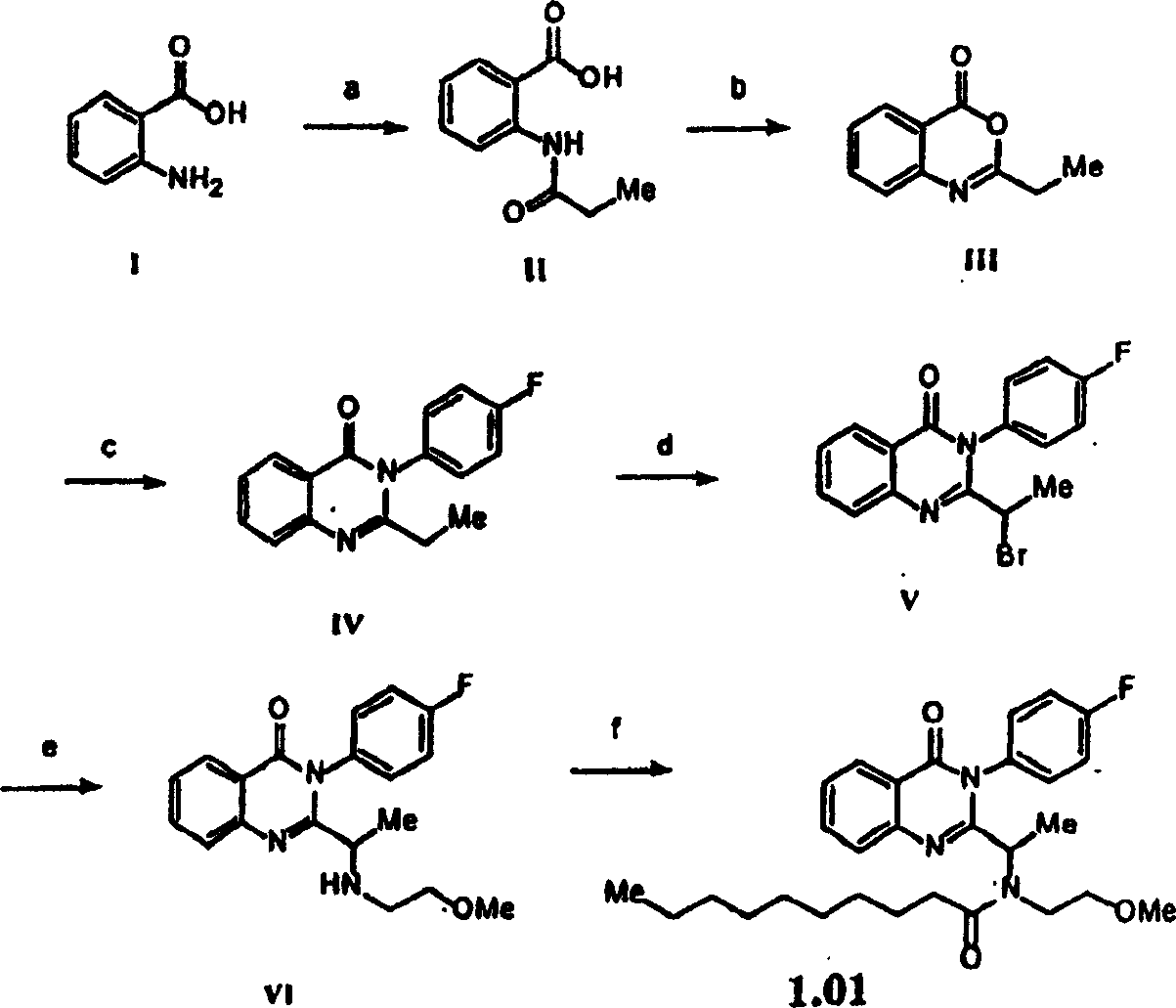
(a)丙酰氯、DMF、RT(b)AcO2、118-130℃(c)i.4-氟苯胺、CHCl3、80℃;ii.催化量的NaOH、乙二醇、130℃(d)Br2、NaOAc、HOAc、40℃(e)1-氨基-2-乙氧基乙烷、EtOH、80℃(f)癸酰氯、Net3、催化量的DMAP、1,4-二噁烷(a) propionyl chloride, DMF, RT (b) AcO 2 , 118-130°C (c) i. 4-fluoroaniline, CHCl 3 , 80°C; ii. catalytic amount of NaOH, ethylene glycol, 130°C (d )Br 2 , NaOAc, HOAc, 40°C (e) 1-amino-2-ethoxyethane, EtOH, 80°C (f) decanoyl chloride, Net 3 , catalytic amount of DMAP, 1,4-dioxane
邻氨基苯甲酸(I) 2-丙酰基氨基-苯甲酸(II)Anthranilic acid (I)
2-丙酰基氨基-苯甲酸(II)。用1.5小时,通过加料漏斗向室温下溶于200mL干燥DMF中的50.22g邻氨基苯甲酸(I)(370mmol,1.00当量)溶液中滴加入35.0mL丙酰氯(400mmol,1.10当量)。减慢加入速度使足够维持反应内部温度低于38℃。酰基氯加入完成后,在室温下将非均匀反应混合物搅拌2.5小时,然后倒入1600mL水中。将得到的水/DMF混合物(具有白色沉淀物)在室温下剧烈搅拌1小时,然后经真空过滤收集固体,用冷水(2×100mL)漂洗该固体。将产物在真空中经五氧化二磷干燥过夜,得到48.04g白色固体。m.p.120.1℃.1H NMR(CDCl3)δ1.30(t,3H,J=7.4Hz),2.52(q,2H,J=7.4Hz),7.12(t,1H,J=7.2Hz),7.60(t,1H,J=7.1Hz),8.13(d,1H,J=6.3Hz),8.76(d,1H,J=7.8Hz)ppm.MS(ESI-)192.1[M-H]-.2-Propionylamino-benzoic acid (II). To a solution of 50.22 g of anthranilic acid (I) (370 mmol, 1.00 equiv) dissolved in 200 mL of dry DMF at room temperature was added dropwise 35.0 mL of propionyl chloride (400 mmol, 1.10 equiv) through an addition funnel over 1.5 hours. The rate of addition was slowed enough to maintain the internal temperature of the reaction below 38°C. After the acid chloride addition was complete, the heterogeneous reaction mixture was stirred at room temperature for 2.5 hours and then poured into 1600 mL of water. The resulting water/DMF mixture (with a white precipitate) was stirred vigorously at room temperature for 1 hour, then the solid was collected by vacuum filtration and rinsed with cold water (2 x 100 mL). The product was dried in vacuo over phosphorus pentoxide overnight to yield 48.04 g of a white solid. mp120.1°C. 1 H NMR (CDCl 3 ) δ1.30(t, 3H, J=7.4Hz), 2.52(q, 2H, J=7.4Hz), 7.12(t, 1H, J=7.2Hz), 7.60(t, 1H, J=7.1Hz), 8.13(d, 1H, J=6.3Hz), 8.76(d, 1H, J=7.8Hz)ppm.MS(ESI - )192.1[MH] - .
2-丙酰基氨基-苯甲酸(II) 2-乙基-苯并[d][1,3]噁嗪-4-酮(III)2-Propionylamino-benzoic acid (II) 2-Ethyl-benzo[d][1,3]oxazin-4-one (III)
2-乙基-苯并[d][1,3]噁嗪酮(III)。在装有蒸馏头的反应容器中,将悬浮在180mL乙酐中的46.66g 2-丙酰基氨基-苯甲酸(II)(240mmol,1.00当量)混合物加热至回流(外部温度170℃-180℃,油浴)。经1.5-2小时从反应物中蒸馏(b.p.116-118℃)出乙酸,此后乙酐开始蒸馏(b.p.136-138℃)。将该反应物平衡到室温,真空蒸馏除去乙酐;浓缩反应溶液得到浅黄色固体。用己烷研磨所述固体,经过滤收集(己烷的容积3×100mL),然后在真空中经五氧化二磷干燥,得到33.26g浅黄色固体。2-Ethyl-benzo[d][1,3]oxazinone (III). In a reaction vessel equipped with a distillation head, a mixture of 46.66 g of 2-propionylamino-benzoic acid (II) (240 mmol, 1.00 equiv) suspended in 180 mL of acetic anhydride was heated to reflux (external temperature 170°C-180°C, oil bath). Acetic acid was distilled (b.p. 116-118° C.) from the reactants over 1.5-2 hours, after which acetic anhydride began to distill (b.p. 136-138° C.). The reactant was equilibrated to room temperature, and acetic anhydride was distilled off in vacuo; the reaction solution was concentrated to obtain a pale yellow solid. The solid was triturated with hexane, collected by filtration (3 x 100 mL volume of hexane), and dried in vacuo over phosphorus pentoxide to yield 33.26 g of a pale yellow solid.
m.p.83.9℃.1H NMR(CDCl3)δ1.37(t,3H,J=7.6Hz),2.73(q,2H,J=7.6Hz),7.49(t,1H,J1=1.1Hz,J2=7.6Hz),7.56(d,1H,J=8.4Hz),7.78(t,1H,J1=1.5Hz,J2=7.2Hz),8.18(d,1H,J=7.0Hz)ppm.MS(ESI+)176.1[MH]+.mp83.9°C. 1 H NMR (CDCl 3 ) δ1.37(t, 3H, J=7.6Hz), 2.73(q, 2H, J=7.6Hz), 7.49(t, 1H, J 1 =1.1Hz, J2 =7.6Hz), 7.56(d, 1H, J=8.4Hz), 7.78(t, 1H, J1 =1.5Hz, J2 =7.2Hz), 8.18(d, 1H, J=7.0Hz)ppm .MS(ESI + )176.1[MH] + .
2-乙基-苯并[d][1,3]噁嗪-4-酮(III) 2-乙基-3-(4-氟代-苯基)-3H-喹唑啉-4-酮(IV)2-Ethyl-benzo[d][1,3]oxazin-4-one (III) 2-Ethyl-3-(4-fluoro-phenyl)-3H-quinazolin-4-one (IV)
2-乙基-3-(4-氟代苯基)-3H-喹唑啉-4-酮(IV)。将溶于35mL氯仿中的8.50g 2-乙基-苯并[d][1,3]噁嗪酮(III)(48.5mmol,1.00当量)和6.27g 4-氟苯胺(50.9mmol,1.05当量)的溶液加热至回流12小时,此后TLC指示没有化合物III残留(Rf=0.51,20%丙酮的己烷溶液)。在真空中除去氯仿并将得到的固体悬浮在18mL乙二醇中。将催化量的氢氧化钠(86mg,2.2mmol,0.045当量)加入到该混合物中,将混合物加热至140℃-150℃(外部温度,油浴)。10小时后,将反应物除去加热并平衡至室温;直至冷却形成沉淀物。将冷却的反应产物混合物用2mL含水5%盐酸溶液酸化并悬浮在20mL冷水中。经真空过滤收集固体,用冷水(2×50mL)和冷的异丙醇(2×50mL)漂洗。将风干的固体从异丙醇中重结晶,得到10.62g褐-白色针状物。2-Ethyl-3-(4-fluorophenyl)-3H-quinazolin-4-one (IV). 8.50 g of 2-ethyl-benzo[d][1,3]oxazinone (III) (48.5 mmol, 1.00 equivalents) and 6.27 g of 4-fluoroaniline (50.9 mmol, 1.05 equivalents) dissolved in 35 mL of chloroform ) was heated to reflux for 12 hours, after which TLC indicated that no compound III remained ( Rf = 0.51, 20% acetone in hexane). Chloroform was removed in vacuo and the resulting solid was suspended in 18 mL of ethylene glycol. A catalytic amount of sodium hydroxide (86 mg, 2.2 mmol, 0.045 equiv) was added to the mixture and the mixture was heated to 140°C-150°C (external temperature, oil bath). After 10 hours, the reaction was removed from the heat and equilibrated to room temperature; until cooled to form a precipitate. The cooled reaction product mixture was acidified with 2 mL of aqueous 5% hydrochloric acid solution and suspended in 20 mL of cold water. The solid was collected by vacuum filtration, rinsed with cold water (2 x 50 mL) and cold isopropanol (2 x 50 mL). The air-dried solid was recrystallized from isopropanol to give 10.62 g of brown-white needles.
m.p.178.3℃.1H NMR(CDCl3)δ1.25(t,3H,J=7.4Hz),2.46(q,2H,J=7.4Hz),7.26(d,2H,J=6.4Hz),7.27(d,2H,J=6.4Hz),7.48(t,1H,J=6.8Hz),7.73-7.81(m,2H),8.27(d,1H,J=7.96Hz)ppm.MS(ESI+)269.1[MH]+.mp178.3°C. 1 H NMR (CDCl 3 ) δ1.25 (t, 3H, J=7.4Hz), 2.46 (q, 2H, J=7.4Hz), 7.26 (d, 2H, J=6.4Hz), 7.27(d, 2H, J=6.4Hz), 7.48(t, 1H, J=6.8Hz), 7.73-7.81(m, 2H), 8.27(d, 1H, J=7.96Hz)ppm.MS(ESI + )269.1[MH] + .

2-乙基-3-(4-氟代-苯基)-3H-喹唑啉-4-酮(IV) 2-(1-溴代-乙基)-3-(4-氟代-苯基)-3H-喹唑啉-4-酮(V)2-Ethyl-3-(4-fluoro-phenyl)-3H-quinazolin-4-one (IV) 2-(1-bromo-ethyl)-3-(4-fluoro-benzene Base) -3H-quinazolin-4-one (V)
2-(1-溴代乙基)-3-(4-氟代苯基)-3H-喹唑啉-4-酮(V)。于40℃,向溶于30ml冰醋酸中的7.084g 2-乙基-3-(4-氟代苯基)-3H-喹唑啉-4-酮(IV)(26.40mmol,1.000当量)和2.60g乙酸钠(31.7mmol,1.20当量)的溶液中用60分钟通过加料漏斗滴加入溶于5mL冰醋酸中的1.36mL溴溶液(26.4mmol,1.00当量)。溴溶液的加入完成后,将该反应物再搅拌60分钟,此后TLC指示没有IV残留(Rf=0.44,40%乙酸乙酯的己烷溶液)并将此非均相混合物倒入400mL水中。将得到的带有沉淀物的含水、酸性混合物在室温下剧烈搅拌2小时。经真空过滤收集沉淀物,用温水(约40℃)(2×50mL)和冷的异丙醇(50mL)漂洗。将固体在真空中经五氧化二磷干燥过夜,得到8.81g白色固体。2-(1-Bromoethyl)-3-(4-fluorophenyl)-3H-quinazolin-4-one (V). At 40° C., to 7.084 g of 2-ethyl-3-(4-fluorophenyl)-3H-quinazolin-4-one (IV) (26.40 mmol, 1.000 equivalents) dissolved in 30 ml of glacial acetic acid and To a solution of 2.60 g of sodium acetate (31.7 mmol, 1.20 eq) was added dropwise 1.36 mL of bromine solution (26.4 mmol, 1.00 eq) dissolved in 5 mL of glacial acetic acid through an addition funnel over 60 minutes. After the addition of the bromine solution was complete, the reaction was stirred for an additional 60 minutes, after which time TLC indicated no IV remained ( Rf = 0.44, 40% ethyl acetate in hexanes) and the heterogeneous mixture was poured into 400 mL of water. The resulting aqueous, acidic mixture with precipitate was vigorously stirred at room temperature for 2 hours. The precipitate was collected by vacuum filtration, rinsed with warm water (about 40°C) (2 x 50 mL) and cold isopropanol (50 mL). The solid was dried over phosphorus pentoxide in vacuo overnight to yield 8.81 g of a white solid.
m.p.179.8℃.1H NMR(CDCl3)δ2.06(d,J=0.016p,3H),4.55(q,0.016p,2H),7.16(ddd,1H,J1=2.4Hz,J2=4.8Hz,J3=8.4Hz),7.24(dt,1H,J1=2.8Hz,J2=8.0Hz),7.28(dt,1H,J1=2.8Hz,J2=8.4Hz),7.51-7.58(m,2H),7.80-7.81(m,2H),8.28(dt,1H,J1=0.8Hz,J2=8.0Hz)ppm.MS(ESI+)348.0[MH]+.mp179.8°C. 1 H NMR (CDCl 3 ) δ 2.06 (d, J=0.016p, 3H), 4.55 (q, 0.016p, 2H), 7.16 (ddd, 1H, J 1 =2.4Hz, J 2 = 4.8Hz, J3 = 8.4Hz), 7.24 (dt, 1H, J1 = 2.8Hz, J2 = 8.0Hz), 7.28 (dt, 1H, J1 = 2.8Hz, J2 = 8.4Hz), 7.51 -7.58(m, 2H), 7.80-7.81(m, 2H), 8.28(dt, 1H, J 1 =0.8Hz, J 2 =8.0Hz) ppm.MS(ESI + )348.0[MH] + .
2-(1-溴代-乙基)-3-(4-氟代-苯基) 3-(4-氟代-苯基)-2-[-(2-甲氧基-乙基氨基)乙基]-3H-喹2-(1-Bromo-ethyl)-3-(4-fluoro-phenyl) 3-(4-fluoro-phenyl)-2-[-(2-methoxy-ethylamino) Ethyl]-3H-quinone
-3H-喹唑啉-4-酮(V) 唑啉-4-酮(VI)-3H-quinazolin-4-one (V) oxazolin-4-one (VI)
3-(4-氟代苯基)-2-[1-(2-甲氧基-乙基氨基)-乙基]-3H-喹唑啉-4-酮(VI)。将242mg 2-(1-溴代乙基)-3-(4-氟代苯基)-3H-喹唑啉-4-酮(V)(0.697mmol,1.00当量)和160μL 1-氨基-2-甲氧基乙烷(1.81mmol,2.60当量)的5mL无水乙醇溶液加热至回流26小时,然后在真空中浓缩除去乙醇。将得到的黄色泡沫状物分配在二氯甲烷和饱和碳酸氢钠水溶液(各25mL)之间。将分离的含水层再用二氯甲烷(20mL)萃取。将合并的有机萃取液经硫酸钠干燥,过滤并在真空中浓缩,得到黄色泡沫状物。将粗产物在硅胶(3.5cm o.d.x12cmh)上层析纯化,用5%甲醇的氯仿洗脱。合并用5%的甲醇的氯仿溶液洗脱在Rf=0.31处的含有产物的流分并在真空中浓缩,得到220mg产物,为浅黄色泡沫状物。3-(4-Fluorophenyl)-2-[1-(2-methoxy-ethylamino)-ethyl]-3H-quinazolin-4-one (VI). 242 mg 2-(1-bromoethyl)-3-(4-fluorophenyl)-3H-quinazolin-4-one (V) (0.697 mmol, 1.00 equiv) and 160 μL 1-amino-2 - A solution of methoxyethane (1.81 mmol, 2.60 equiv) in 5 mL of absolute ethanol was heated to reflux for 26 hours, then concentrated in vacuo to remove ethanol. The resulting yellow foam was partitioned between dichloromethane and saturated aqueous sodium bicarbonate (25 mL each). The separated aqueous layer was extracted with additional dichloromethane (20 mL). The combined organic extracts were dried over sodium sulfate, filtered and concentrated in vacuo to give a yellow foam. The crude product was purified by chromatography on silica gel (3.5cm odx12cmh), eluting with 5% methanol in chloroform. Fractions containing product at Rf = 0.31 eluted with 5% methanol in chloroform were combined and concentrated in vacuo to give 220 mg of product as a pale yellow foam.
NMR(CDCl3)δ1.26(d,3H,J=6.4Hz),2.35(brs,1H),2.54(ddd,1H,J1=4.4Hz,J2=6.0Hz,J3=10.4Hz),2.71(ddd,1H,J1=4.0Hz,J2=7.2Hz,J3=11.2Hz),3.27(s,3H),3.36-3.45(m,2H),3.47(q,1H,J=6.4Hz),7.22-7.26(m,4H),7.46(ddd,1H,J1=1.6Hz,J2=6.8Hz,J3=8.0Hz),7.71-7.78(m,2H),8.25(dd,1H,J1=1.2Hz,J2=8.0Hz)ppm.MS(ESI+)342.2[MH]+ NMR (CDCl 3 ) δ 1.26 (d, 3H, J=6.4Hz), 2.35 (brs, 1H), 2.54 (ddd, 1H, J 1 =4.4Hz, J 2 =6.0Hz, J 3 =10.4Hz) , 2.71(ddd, 1H, J 1 =4.0Hz, J 2 =7.2Hz, J 3 =11.2Hz), 3.27(s, 3H), 3.36-3.45(m, 2H), 3.47(q, 1H, J= 6.4Hz), 7.22-7.26(m, 4H), 7.46(ddd, 1H, J 1 =1.6Hz, J 2 =6.8Hz, J 3 =8.0Hz), 7.71-7.78(m, 2H), 8.25(dd , 1H, J 1 =1.2Hz, J 2 =8.0Hz) ppm.MS(ESI + ) 342.2[MH] +
3-(4-氟代-苯基)-2-[-(2-甲氧基-乙基氨基)乙基]-3H-喹 {1-[3-(4-氟代-苯基)-4-氧代-3,4-二氢-喹唑啉-2-基]-乙3-(4-fluoro-phenyl)-2-[-(2-methoxy-ethylamino)ethyl]-3H-quinoline {1-[3-(4-fluoro-phenyl)- 4-oxo-3,4-dihydro-quinazolin-2-yl]-ethyl
唑啉-4-酮(VI) 基}-(2-甲氧基-乙基)-酰胺(1.01)oxazolin-4-one(VI) yl}-(2-methoxy-ethyl)-amide (1.01)
化合物1.01。在室温下向溶于3mL 1,4-二噁烷中的130mg 3-(4-氟代苯基)-2-[1-(2-甲氧基-乙基氨基)-乙基]-3H-喹唑啉-4-酮(VI)(0.381mmol,1.00当量)、59μL三乙胺(0.419mmol,1.10当量)和2mg DMAP(16μmol,0.04当量)的溶液中加入79μL纯癸酰氯(0.381mmol,1.00当量);产生无色沉淀物。将反应混合物在室温下搅拌过夜,然后在真空中浓缩除去二噁烷。将得到的浓缩物分配在二氯甲烷和饱和碳酸氢钠水溶液(各20mL)之间。将分离的含水层再用二氯甲烷(15mL)萃取并将合并的有机萃取液经硫酸钠干燥,过滤并在真空中浓缩,得到黄色、玻璃状油状物。将粗产物在硅胶(2.5cm o.d.x10cmh)上层析,用20-25%乙酸乙酯的己烷溶液洗脱。合并用5%甲醇的氯仿溶液洗脱的在Rf=0.84处的含有产物的流分,并在真空中浓缩,得到120mg无色固体。Compound 1.01. To 130 mg 3-(4-fluorophenyl)-2-[1-(2-methoxy-ethylamino)-ethyl]-3H dissolved in 3
m.p.71.4℃.1H NMR(d6-DMSO;T=140℃)δ0.90(t,3H,J=7.2Hz),1.18-1.44(m,14H),1.44(d,3H,J=7.2Hz),1.98-2.08(m,2H),3.11(s,3H),3.33-3.52(m,4H),5.11(br q,1H,J=6.0Hz),7.32(brm,3H),7.49(brm,1H),7.55(ddd,1H,J1=1.2Hz,J2=7.6Hz,J3=8.0Hz),7.73(d,1H,J=8.0Hz),7.85(ddd,1H,J1=1.2Hz,J2=7.2Hz,J3=8.4Hz),8.15(dd,1H,J1=1.6Hz,J2=8.0Hz)ppm.mp71.4°C. 1 H NMR (d 6 -DMSO; T=140°C) δ0.90(t, 3H, J=7.2Hz), 1.18-1.44(m, 14H), 1.44(d, 3H, J= 7.2Hz), 1.98-2.08(m, 2H), 3.11(s, 3H), 3.33-3.52(m, 4H), 5.11(br q, 1H, J=6.0Hz), 7.32(brm, 3H), 7.49 (brm, 1H), 7.55 (ddd, 1H, J1 = 1.2Hz, J2 = 7.6Hz, J3 = 8.0Hz), 7.73 (d, 1H, J = 8.0Hz), 7.85 (ddd, 1H, J 1 = 1.2Hz, J 2 = 7.2Hz, J 3 = 8.4Hz), 8.15 (dd, 1H, J 1 = 1.6Hz, J 2 = 8.0Hz) ppm.
在室温下,化合物以约1∶1顺式/反式酰胺旋转异构体混合物的形式存在,由特征1H NMR积分测定:1H NMR峰值(CDCl3,T=25℃)在δ次要4.78(q,1.0H,J=7.2Hz)和δ主要5.33(q,1.2H,J=7.2Hz)ppm。MS(ESI+)496.4[MH]+ At room temperature, the compound exists as an approximately 1:1 mixture of cis/trans amide rotamers as determined by characteristic 1 H NMR integration: 1 H NMR peak (CDCl 3 , T=25°C) at δ minor 4.78 (q, 1.0H, J = 7.2Hz) and delta main 5.33 (q, 1.2H, J = 7.2Hz) ppm. MS(ESI + )496.4[MH] +
化合物1.02的合成Synthesis of Compound 1.02
癸酸{1-[3-(4-氟代-苯基)-4-氧代-3,4-二氢-喹唑啉-2-基]-乙基}-(2-吡咯烷-1-基-乙基)-酰胺(1.02)Decanoic acid {1-[3-(4-fluoro-phenyl)-4-oxo-3,4-dihydro-quinazolin-2-yl]-ethyl}-(2-pyrrolidine-1 -yl-ethyl)-amide (1.02)
根据以上所述化合物1.01的合成方法制备化合物1.02。合成顺序按照方法1,其中在步骤e中使用1-(2-氨基乙基)吡咯烷代替2-(二甲基氨基)-1-氨基乙烷。对于化合物1.02的特征数据如下:无色,粘性油状物。1H NMR与化合物1.01的光谱相似:为约2∶1的顺式/反式酰胺旋转异构体混合物(CDCl3,T=25℃),其特征共振峰值在δ次要4.78(q,1.0H,J=6.8Hz)和δ主要5.33(q,1.8H,J=7.6Hz)ppm。MS(ESI+)535.4[MH]+ Compound 1.02 was prepared according to the synthetic method of compound 1.01 described above. The synthetic sequence follows
化合物1.03的合成Synthesis of compound 1.03

癸酸{1-[3-(4-氟代-苯基)-4-氧代-3,4-二氢-喹唑啉-2-基]-乙基}-(2-吗啉-4-基-乙基)-酰胺(1.03)Decanoic acid {1-[3-(4-fluoro-phenyl)-4-oxo-3,4-dihydro-quinazolin-2-yl]-ethyl}-(2-morpholine-4 -yl-ethyl)-amide (1.03)
根据以上所述化合物1.01的合成方法制备化合物1.03。合成顺序按照方法1,其中在步骤e中使用1-(2-氨基乙基)吗啉代替2-(二甲基氨基)-1-氨基乙烷。对于化合物1.03的特征数据如下:无色,粘性油状物。Compound 1.03 was prepared according to the synthesis method of compound 1.01 described above. The synthetic sequence follows
1H NMR(d6-DMSO;T=140℃)δ0.89(t,3H,J=6.8Hz),1.18-1.46(m,14H),1.46(d,3H,J=6.4Hz),1.98-2.08(m,2H),2.23-2.34(m,5H),2.47(ddd,1H,J1=6.0Hz,J2=8.8Hz,J3=14.4Hz),3.31(ddd,1H,J1=5.6Hz,J2=8.4Hz,J3=14.4Hz),3.39-3.49(m,5H),5.10(brq,1H),7.32(brm,3H)7.51(brm,1H),7.56(ddd,1H,J1=0.8Hz,J2=J3=8.0Hz),7.72(d,1H,J=7.6Hz),7.86(ddd,1H,J1=1.6Hz,J2=7.2Hz,J3=8.4Hz),8.15(dd,1H,J1=0.8Hz,J2=7.2Hz)ppm. 1 H NMR (d 6 -DMSO; T=140°C) δ0.89 (t, 3H, J=6.8Hz), 1.18-1.46 (m, 14H), 1.46 (d, 3H, J=6.4Hz), 1.98 -2.08(m, 2H), 2.23-2.34(m, 5H), 2.47(ddd, 1H, J 1 =6.0Hz, J 2 =8.8Hz, J 3 =14.4Hz), 3.31(ddd, 1H, J 1 =5.6Hz, J 2 =8.4Hz, J 3 =14.4Hz), 3.39-3.49(m, 5H), 5.10(brq, 1H), 7.32(brm, 3H), 7.51(brm, 1H), 7.56(ddd, 1H, J1 = 0.8Hz, J2 = J3 = 8.0Hz), 7.72 (d, 1H, J = 7.6Hz), 7.86 (ddd, 1H, J1 = 1.6Hz, J2 = 7.2Hz, J3 =8.4Hz), 8.15 (dd, 1H, J 1 =0.8Hz, J 2 =7.2Hz) ppm.
在室温下,化合物以约4∶3顺式/反式酰胺混合物的形式存在(CDCl3,T=25℃),其特征共振峰值在δ次要4.77(q,1.0H,J=6.4Hz)和δ主要5.33(q,1.3H,J=6.8Hz)ppm。MS(ESI+)551.5[MH]+ At room temperature, the compound exists in the form of about 4:3 cis/trans amide mixture (CDCl 3 , T=25°C), and its characteristic resonance peak is at δ minor 4.77 (q, 1.0H, J=6.4Hz) and δ main 5.33 (q, 1.3H, J=6.8Hz) ppm. MS(ESI + )551.5[MH] +
化合物1.04的合成Synthesis of compound 1.04
癸酸{1-[3-(4-氟代-苯基)-4-氧代-3,4-二氢-喹唑啉-2-基]-乙基}-[2-(1H-咪唑-4-基)-乙基]-酰胺(1.04)Decanoic acid {1-[3-(4-fluoro-phenyl)-4-oxo-3,4-dihydro-quinazolin-2-yl]-ethyl}-[2-(1H-imidazole -4-yl)-ethyl]-amide (1.04)
根据以上所述化合物1.01的合成方法制备化合物1.04。合成顺序按照方法1,其中在步骤e中使用5-(2-氨基乙基)咪唑代替2-(二甲基氨基)-1-氨基乙烷。对于化合物1.04的特征数据如下:无色,粘性油状物。1H NMR与化合物1.01的光谱相似:为约3∶1顺式/反式酰胺旋转异构体混合物(CDCl3,T=25℃),其特征共振峰值在δ次要4.81(q,1.0H,J=6.8Hz)和δ主要5.05(q,2.7H,J=7.2Hz)ppm。MS(ESI+)532.3[MH]+ Compound 1.04 was prepared according to the synthesis method of compound 1.01 described above. The synthetic sequence follows
化合物1.05的合成Synthesis of Compound 1.05

2-联苯-4-基-N-(2-二甲基氨基-乙基)-N{1-[3-(4-氟代-苯基)-4-氧代-3,4-二氢-喹唑啉-2-基]-乙基}-乙酰胺(1.05)2-biphenyl-4-yl-N-(2-dimethylamino-ethyl)-N{1-[3-(4-fluoro-phenyl)-4-oxo-3,4-di Hydrogen-quinazolin-2-yl]-ethyl}-acetamide (1.05)
根据以上所述化合物1.01的合成方法制备化合物1.05。合成顺序按照方法1,其中在步骤f中使用联苯基乙酰氯代替癸酰氯。对于化合物1.05的特征数据如下:黄色,粘性油状物。1H NMR与化合物1.01的光谱相似:为约2∶1顺式/反式酰胺旋转异构体混合物(CDCl3,T=25℃),其特征共振峰值在δ次要4.89(q,1.0H,J=6.8Hz)和δ主要5.32(q,1.8H,J=6.8Hz)ppm。MS(ESI+)549.2[MH]+ Compound 1.05 was prepared according to the synthesis method of compound 1.01 described above. The synthetic sequence follows
化合物1.06的合成Synthesis of compound 1.06
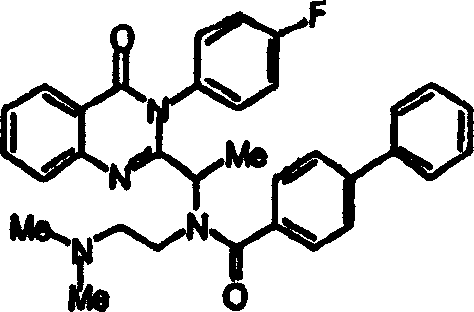
联苯-4-羧酸(2-二甲基氨基-乙基)-{1-[3-(4-氟代-苯基)-4-氧代-3,4-二氢-喹唑啉-2-基]-乙基}-酰胺(1.06)Biphenyl-4-carboxylic acid (2-dimethylamino-ethyl)-{1-[3-(4-fluoro-phenyl)-4-oxo-3,4-dihydro-quinazoline -2-yl]-ethyl}-amide (1.06)
根据以上所述化合物1.01的合成方法制备化合物1.06。合成顺序按照方法1,其中在步骤f中使用联苯基碳酰氯代替癸酰氯。对于化合物1.06的特征数据如下:白色固体。m.p.=147.3℃。1H NMR与化合物1.01的光谱相似:为约3∶1顺式/反式酰胺旋转异构体混合物(CDCl3,T=25℃),由以下特征共振峰积分而得:δ次要5.02(brq,1.0H)和δ主要5.43(brq,3.0H)ppm。MS(ESI+)535.2[MH]+ Compound 1.06 was prepared according to the synthesis method of compound 1.01 described above. The synthetic sequence follows
化合物1.07的合成Synthesis of compound 1.07
癸酸{1-[3-(4-氟代-苯基)-4-氧代-3,4-二氢-喹唑啉-2-基]-乙基}-(3-咪唑-1-基丙基)-酰胺(1.07)Decanoic acid {1-[3-(4-fluoro-phenyl)-4-oxo-3,4-dihydro-quinazolin-2-yl]-ethyl}-(3-imidazole-1- Propyl)-amide (1.07)
根据以上所述化合物1.01的合成方法制备化合物1.07。合成顺序按照方法1,其中在步骤e中使用3-(3-氨基丙基)-(3H)-咪唑代替2-(二甲基氨基)-1-氨基乙烷。对于化合物1.07的特征数据如下:无色,粘性油状物。1H NMR与化合物1.01的光谱相似:为约1∶1顺式/反式酰胺旋转异构体混合物(CDCl3,T=25℃),由以下特征共振峰积分而得:δ次要4.77(q,1.0H,J=6.8Hz)和δ主要5.28(q,1.1H,J=7.6Hz)ppm。MS(ESI+)546.3[MH]+ Compound 1.07 was prepared according to the synthesis method of compound 1.01 described above. The synthetic sequence follows
化合物1.08的合成Synthesis of Compound 1.08
癸酸{1-[3-(4-氟代-苯基)-4-氧代-3,4-二氢-喹唑啉-2-基]-乙基}-(3-吗啉-4-基丙基)-酰胺(1.08)Decanoic acid {1-[3-(4-fluoro-phenyl)-4-oxo-3,4-dihydro-quinazolin-2-yl]-ethyl}-(3-morpholine-4 -ylpropyl)-amide (1.08)
根据以上所述化合物1.01的合成方法制备化合物1.08。合成顺序按照方法1,其中在步骤e中使用1-(3-氢基丙基)吗啉代替2-(二甲基氨基)-1-氨基乙烷。对于化合物1.08的特征数据如下:浅黄色玻璃样物。1H NMR与化合物1.01的光谱相似:为约2∶1顺式/反式酰胺旋转异构体混合物(CDCl3,T=25℃)由以下特征共振峰积分而得:δ次要4.77(q,1.0H,J=6.4Hz)和δ主要5.38(q,1.8H,J=7.2Hz)ppm。MS(ESI+)565.4[MH]+ Compound 1.08 was prepared according to the synthesis method of compound 1.01 described above. The synthetic sequence follows
化合物1.09的合成Synthesis of Compound 1.09
N-(2-二甲基氨基-乙基)-N-{1-[3-(4-氟代-苯基)-4-氧代-3,4-二氢-喹唑啉-2-基]-乙基}-2-苯基乙酰胺(1.09)N-(2-Dimethylamino-ethyl)-N-{1-[3-(4-fluoro-phenyl)-4-oxo-3,4-dihydro-quinazoline-2- Base]-ethyl}-2-phenylacetamide (1.09)
根据以上所述化合物1.01的合成方法制备化合物1.09。合成顺序按照方法1,其中在步骤f中使用联苯碳酰氯代替癸酰氯。对于化合物1.09的特征数据如下:白色固体。m.p.=153℃。Compound 1.09 was prepared according to the synthesis of compound 1.01 described above. The synthetic sequence follows
1H NMR(d6-DMSO;T=140℃)δ1.42(d,3H,J=7.2Hz),2.07(s,6H),2.26(ddd,1H,J1=5.6Hz,J2=9.2Hz,J3=12.4Hz),2.46(ddd,1H,J1=5.2Hz,J2=9.2Hz,J3=14.4Hz),3.36(d,1H,J=15.2Hz),3.38(ddd,1H,J1=5.2Hz,J2=8.8Hz,J3=14.8Hz),3.49(ddd,1H,J1=6.0Hz,J2=9.2Hz,J3=15.2Hz),3.50(d,1H,J=15.2Hz),5.15(q,1H,J=6.8Hz),7.12(d,2H,J=7.6Hz),7.20(t,1H,J=7.2Hz),7.26(dd,2H,J1=7.2Hz,J2=7.6Hz),7.36(brm,3H),7.53(brm,1H),7.56(ddd,1H,J1=1.2Hz,J2=7.2Hz,J3=8.0Hz),7.72(d,1H,J=7.2Hz),7.87(ddd,1H,J1=1.6Hz,J2=7.2Hz,J3=8.4Hz),8.16(dd,1H,J1=1.6Hz,J2=8.0Hz)ppm. 1 H NMR (d 6 -DMSO; T=140°C) δ1.42(d, 3H, J=7.2Hz), 2.07(s, 6H), 2.26(ddd, 1H, J 1 =5.6Hz, J 2 = 9.2Hz, J3 =12.4Hz), 2.46(ddd, 1H, J1 =5.2Hz, J2 =9.2Hz, J3 =14.4Hz), 3.36(d, 1H, J=15.2Hz), 3.38(ddd , 1H, J 1 =5.2Hz, J 2 =8.8Hz, J 3 =14.8Hz), 3.49(ddd, 1H, J 1 =6.0Hz, J 2 =9.2Hz, J 3 =15.2Hz), 3.50(d , 1H, J=15.2Hz), 5.15(q, 1H, J=6.8Hz), 7.12(d, 2H, J=7.6Hz), 7.20(t, 1H, J=7.2Hz), 7.26(dd, 2H , J 1 =7.2Hz, J 2 =7.6Hz), 7.36(brm, 3H), 7.53(brm, 1H), 7.56(ddd, 1H, J 1 =1.2Hz, J 2 =7.2Hz, J 3 =8.0 Hz), 7.72 (d, 1H, J = 7.2Hz), 7.87 (ddd, 1H, J 1 = 1.6Hz, J 2 = 7.2Hz, J 3 = 8.4Hz), 8.16 (dd, 1H, J 1 = 1.6 Hz, J 2 =8.0Hz)ppm.
在室温下,化合物以约2∶1顺式/反式酰胺旋转异构体混合物的形式存在(CDCl3,T=25℃)由以下特征共振峰积分而得:δ次要4.84(q,1.0H,J=6.8Hz)和δ主要5.30(q,2.1H,J=6.8Hz)ppm。MS(ESI+)473.3[MH]+ At room temperature, the compound exists as an approximately 2:1 mixture of cis/trans amide rotamers (CDCl 3 , T=25°C) from the integration of the following characteristic resonance peaks: δ minor 4.84 (q, 1.0 H, J = 6.8 Hz) and delta main 5.30 (q, 2.1 H, J = 6.8 Hz) ppm. MS(ESI + )473.3[MH] +
化合物1.10的合成Synthesis of Compound 1.10
癸酸{1-[3-(4-氟代-苯基)-4-氧代-3,4-二氢-喹唑啉-2-基]-乙基}-[3-(2-甲基-哌啶-1-基)丙基]-酰胺(1.10)Decanoic acid {1-[3-(4-fluoro-phenyl)-4-oxo-3,4-dihydro-quinazolin-2-yl]-ethyl}-[3-(2-methyl Base-piperidin-1-yl)propyl]-amide (1.10)
根据以上所述化合物1.01的合成方法制备化合物1.10。合成顺序按照方法1,其中在步骤e中使用5-(2-氨基乙基)咪唑代替2-(二甲基氨基)-1-氨基乙烷。对于化合物1.10的特征数据如下:黄色,粘性油状。1H NMR与化合物1.01的光谱相似:为约3∶2顺式/反式酰胺旋转异构体混合物(CDCl3,T=25℃)由以下特征共振峰积分而得:δ次要4.77(q,1.0H,J=6.8Hz)和δ主要5.37(q,1.6H,J=6.8Hz)ppm。MSESI+)577.4[MH]+ Compound 1.10 was prepared according to the synthesis method of compound 1.01 described above. The synthetic sequence follows
化合物1.11的合成Synthesis of Compound 1.11

N-(2-二甲基氨基-乙基)-N-{1-[3-(4-氟代-苯基)-4-氧代-3,4-二氢-喹唑啉-2-基]-乙基}-2-对-甲苯基-乙酰胺(1.11)N-(2-Dimethylamino-ethyl)-N-{1-[3-(4-fluoro-phenyl)-4-oxo-3,4-dihydro-quinazoline-2- Base]-ethyl}-2-p-tolyl-acetamide (1.11)
根据以上所述化合物1.01的合成方法制备化合物1.11。合成顺序按照方法1,其中在步骤f中使用(4-甲基苯基)乙酰氯代替癸酰氯。对于化合物1.11的特征数据如下:白色固体。m.p.188.3℃ 1H NR与化合物1.09的光谱相似:为约2∶1顺式/反式酰胺旋转异构体混合物(CDCl3,T=25℃)由以下特征共振峰积分而得:δ次要5.02(q,1.0H,J=6.8Hz)和δ主要5.47(q,1.9H,J=7.2Hz)ppm。MS(ESI+)487.3[MH]+ Compound 1.11 was prepared according to the synthetic method of compound 1.01 described above. The synthetic sequence follows
化合物1.12的合成Synthesis of Compound 1.12

2-(4-溴代-苯基)-N-(2-二甲基氨基-乙基)-N-{1-[3-(4-氟代-苯基)-4-氧代-3,4-二氢-喹唑啉-2-基]-乙基}-乙酰胺(1.12)2-(4-Bromo-phenyl)-N-(2-dimethylamino-ethyl)-N-{1-[3-(4-fluoro-phenyl)-4-oxo-3 , 4-dihydro-quinazolin-2-yl]-ethyl}-acetamide (1.12)
根据以上所述化合物1.01的合成方法制备化合物1.12。合成顺序按照方法1,其中在步骤f中使用(4-溴代苯基)乙酰氯代替癸酰氯。对于化合物1.12的特征数据如下:无色玻璃状物。1H NMR与化合物1.09的光谱相似:为约2∶1顺式/反式酰胺旋转异构体混合物(CDCl3,T=25℃),由以下特征共振峰积分而得:δminor4.82(q,1.0H,J=7.2Hz)和δmajor5.27(q,2.3H,J=6.8Hz)ppm。MS(ESI+)551.2[MH]+ Compound 1.12 was prepared according to the synthesis method of compound 1.01 described above. The synthetic sequence follows
化合物1.13的合成Synthesis of Compound 1.13
2-(4-溴代-苯基)-N-(2-二甲基氨基-乙基)-N N-(2-二甲基氨基-乙基)-N-{1-[3-(4-氟代-苯{1-[3-(4-氟代-苯基)-4-氧代-3,4-二氢-喹唑啉- 基)-4-氧代-3,4-二氢-喹唑啉-2-基]-乙基}-2-(4-2-(4-Bromo-phenyl)-N-(2-dimethylamino-ethyl)-N N-(2-dimethylamino-ethyl)-N-{1-[3-( 4-fluoro-phenyl{1-[3-(4-fluoro-phenyl)-4-oxo-3,4-dihydro-quinazolin-yl)-4-oxo-3,4- Dihydro-quinazolin-2-yl]-ethyl}-2-(4-
2-基}-乙基}-乙酰胺(1.12) Z-丙烯基-苯基)-乙酰胺(1.13) 2-yl}-ethyl}-acetamide (1.12) Z-propenyl-phenyl)-acetamide (1.13)
在0℃下,向112mg 溴化锌(II)(500μmol,1.0当量)溶液中加入溶于0.5mL THF(0.5M;500μmol,1.0当量)的1.0mL 1-丙烯基溴化镁溶液。将得到的白色、混浊的混合物在0℃下搅拌60分钟,然后立即通过套管加入溶于0.5mL THF中的27mg 1.12(49μmol,1.0当量)和4mg双-dppf二氯化钯(II)(5μmol,0.1当量)。将反应混合物在室温下搅拌14小时,然后加热至60℃(外部温度,油浴)以促使所述反应完成。在60℃下2小时后,将5mL饱和氯化铵水溶液加入到冷却(0℃)的反应混合物中。用乙酸乙酯(3×15mL)萃取含水层并将合并的有机分离物经硫酸镁干燥,过滤并在真空中浓缩得到黄色膜状物。将该粗产物经快速柱层析在硅胶(3.5cm o.d.x10cmh)上纯化,用5%甲醇的氯仿溶液洗脱,得到8mg产物烯烃,为无色膜状物。该产物以烯烃异构体的混合物的形式存在,将该混合物经制备性HPLC(反相,CH3CN∶H2O)分离。在反式烯烃异构体1.14以前洗脱出化合物1.13。1H NMR与化合物1.09的光谱相似:约2∶1顺式/反式酰胺旋转异构体混合物(CDCl3,T=25℃),由以下特征共振峰积分而得:δ主要4.85(q,1.9H,J=6.8Hz)和δ次要5.13(q,1.0H,J=7.2Hz)ppm。MS(ESI+)513.2[MH]+ To a solution of 112 mg of zinc(II) bromide (500 μmol, 1.0 equiv) was added a solution of 1.0 mL of 1-propenylmagnesium bromide dissolved in 0.5 mL of THF (0.5 M; 500 μmol, 1.0 equiv) at 0°C. The resulting white, cloudy mixture was stirred at 0 °C for 60 min, then 27 mg of 1.12 (49 μmol, 1.0 equiv) and 4 mg of bis-dppf palladium(II) chloride dissolved in 0.5 mL of THF were immediately added via cannula ( 5 μmol, 0.1 equiv). The reaction mixture was stirred at room temperature for 14 hours, then heated to 60 °C (external temperature, oil bath) to drive the reaction to completion. After 2 hours at 60°C, 5 mL of saturated aqueous ammonium chloride was added to the cooled (0°C) reaction mixture. The aqueous layer was extracted with ethyl acetate (3 x 15 mL) and the combined organic isolates were dried over magnesium sulfate, filtered and concentrated in vacuo to give a yellow film. The crude product was purified by flash column chromatography on silica gel (3.5 cm od x 10 cmh) eluting with 5% methanol in chloroform to afford 8 mg of the product olefin as a colorless film. The product was present as a mixture of olefinic isomers which was separated by preparative HPLC (reverse phase, CH3CN : H2O ). Compound 1.13 eluted before trans olefin isomer 1.14. 1 H NMR is similar to the spectrum of compound 1.09: about 2:1 cis/trans amide rotamer mixture (CDCl 3 , T=25°C), integrated from the following characteristic resonance peaks: δmain 4.85(q, 1.9H, J = 6.8Hz) and delta minor 5.13 (q, 1.0H, J = 7.2Hz) ppm. MS(ESI + )513.2[MH] +
化合物1.14的合成Synthesis of compound 1.14
N-(2-二甲基氨基-乙基)-N-{1-[3-(4-氟代-苯基)-4-氧代-3,4-二氢-喹唑啉-2-基]-乙基}-2-(4-E-丙烯基-苯基)-乙酰胺(1.14)N-(2-Dimethylamino-ethyl)-N-{1-[3-(4-fluoro-phenyl)-4-oxo-3,4-dihydro-quinazoline-2- Base]-ethyl}-2-(4-E-propenyl-phenyl)-acetamide (1.14)
以与化合物1.12一致的方法制备化合物1.14并经制备性HPLC分离并将第二种产物洗脱。1H NMR与化合物1.09的光谱相似:约2∶1顺式/反式酰胺旋转异构体混合物(CDCl3,T=25℃),由以下特征共振峰积分而得:δ主要4.83(q,1.8H,J=7.2Hz)和δ次要5.12(q,1.0H,J=7.6Hz)ppm。MS(ESI+)513.2[MH]+ Compound 1.14 was prepared in a manner consistent with compound 1.12 and separated by preparative HPLC and the second product eluted. The 1 H NMR spectrum is similar to that of compound 1.09: about 2:1 cis/trans amide rotamer mixture (CDCl 3 , T=25°C), integrated from the following characteristic resonance peaks: δmain 4.83(q, 1.8H, J = 7.2Hz) and delta minor 5.12 (q, 1.0H, J = 7.6Hz) ppm. MS(ESI + )513.2[MH] +
化合物1.15的合成Synthesis of Compound 1.15
N-(2-二甲基氨基-乙基)-N-{1-[3-(4-氟代-苯基)-4-氧代 N-(2-二甲基氨基-乙基)-N-{1-[3-[3-(4-氟代-苯基)-4-氧代N-(2-Dimethylamino-ethyl)-N-{1-[3-(4-fluoro-phenyl)-4-oxo N-(2-dimethylamino-ethyl)- N-{1-[3-[3-(4-fluoro-phenyl)-4-oxo
-3,4-二氢-喹唑啉-2-基]-乙基}-2-(4-E/Z-丙烯基-苯 -3,4-二氢-喹唑啉-2-基]-乙基}-2-(4-丙基-苯基)-乙酰-3,4-dihydro-quinazolin-2-yl]-ethyl}-2-(4-E/Z-propenyl-benzene-3,4-dihydro-quinazolin-2-yl] -Ethyl}-2-(4-propyl-phenyl)-acetyl
基)-乙酰胺(1.13和1.14) 胺(1.15)yl)-acetamide (1.13 and 1.14) amine (1.15)
在室温下,将氢气通过气囊引入经过氮清洗、抽空的烧瓶中,该瓶中装有悬浮在2.0mL甲醇中的4.8mg 1.13和1.14(9.4μmol,1.0当量)和5.0mg披钯活性碳(10%wtPd;4.7μmol,0.5)。将该反应物在室温下搅拌18小时,然后通过硅藻土垫过滤。在真空中浓缩滤液,然后经硅胶柱层析(2.0cm o.d.x8cmh)纯化,用5%甲醇的氯仿溶液洗脱。在真空中浓缩含有产物的流分,得到4.5mg无色膜状物。1H NMR与化合物1.09的光谱相似:约3∶2顺式/反式酰胺旋转异构体混合物(CDCl3,T=25℃),由以下特征共振峰积分而得:δ主要4.83(q,1.4H,J=6.8Hz)和δ次要5.20(q,1.0H,J=7.2Hz)ppm。MS(ESI+)515.3[MH]+ At room temperature, hydrogen gas was introduced via a balloon into a nitrogen-purged, evacuated flask containing 4.8 mg of 1.13 and 1.14 (9.4 μmol, 1.0 equiv) suspended in 2.0 mL of methanol and 5.0 mg of palladium on activated carbon ( 10% wtPd; 4.7 μmol, 0.5). The reaction was stirred at room temperature for 18 hours, then filtered through a pad of celite. The filtrate was concentrated in vacuo, then purified by silica gel column chromatography (2.0 cm od x 8 cmh), eluting with 5% methanol in chloroform. Fractions containing product were concentrated in vacuo to give 4.5 mg of a colorless film. 1 H NMR is similar to the spectrum of compound 1.09: about 3:2 cis/trans amide rotamer mixture (CDCl 3 , T=25°C), integrated from the following characteristic resonance peaks: δmain 4.83(q, 1.4H, J = 6.8Hz) and delta minor 5.20 (q, 1.0H, J = 7.2Hz) ppm. MS(ESI + )515.3[MH] +
化合物1.16的合成Synthesis of Compound 1.16

2-(4-溴代-苯基)-N-(2-二甲基氨基-乙基)-N- N-(2-二甲基氨基-乙基)-2-(4’-氟代-联苯-4-{1-[3-(4-氟代-苯基)-4-氧代-3,4-二氢-喹唑啉- 基)-N-{1-[3-(4-氟代-苯基)-4-氧代-3,4-二氢-喹2-(4-Bromo-phenyl)-N-(2-dimethylamino-ethyl)-N- N-(2-dimethylamino-ethyl)-2-(4'-fluoro -Biphenyl-4-{1-[3-(4-fluoro-phenyl)-4-oxo-3,4-dihydro-quinazolin-yl)-N-{1-[3-( 4-fluoro-phenyl)-4-oxo-3,4-dihydro-quinone
2-基]-乙基}-乙酰胺(1.12) 唑啉-2-基]-乙基}-乙酰胺(1.16)
将27.0mg 1.12(49.0μmol,1.00当量)、34.0mg 4-氟代苯基硼酸(245.0μmol,5.00当量)和3.0mg四(三苯膦)钯(0)(2.5μmol,0.05当量)的3.0mL甲苯和3.0mL 2M碳酸钠水溶液的脱气(3×冰冻-抽空-融化循环)的双相混合物加热至100℃(外部温度,油浴)。4小时后,MS指示没有化合物1.12残留并将分离的含水层用50%乙酸乙酯的己烷(2×15mL)萃取。将合并的有机萃取液经硫酸镁干燥,过滤并在真空中浓缩,得到黄色油状物。将粗制物经硅胶柱层析(3.5cm o.d.x12cmh)纯化,用5%甲醇的氯仿溶液洗脱。合并含有产物的流分在真空中浓缩,得到27.0mg产物,为无色、粘性油状物。1H NMR与化合物1.09的光谱相似:约3∶2顺式/反式酰胺旋转异构体混合物(CDCl3,T=25℃),由以下特征共振峰积分而得:δ主要4.90(q,1.3H,J=7.2Hz)和δ次要5.30(q,1.0H,J=7.2Hz)ppm。MS(ESI+)567.2[MH]+ 27.0 mg of 1.12 (49.0 μmol, 1.00 equivalent), 34.0 mg of 4-fluorophenylboronic acid (245.0 μmol, 5.00 equivalent) and 3.0 mg of tetrakis(triphenylphosphine) palladium (0) (2.5 μmol, 0.05 equivalent) of 3.0 A degassed (3x freeze-evacuate-thaw cycle) biphasic mixture of mL of toluene and 3.0 mL of 2M aqueous sodium carbonate was heated to 100 °C (external temperature, oil bath). After 4 hours, MS indicated that no compound 1.12 remained and the separated aqueous layer was extracted with 50% ethyl acetate in hexanes (2 x 15 mL). The combined organic extracts were dried over magnesium sulfate, filtered and concentrated in vacuo to give a yellow oil. The crude material was purified by silica gel column chromatography (3.5cm odx12cmh), eluting with 5% methanol in chloroform. Fractions containing product were combined and concentrated in vacuo to afford 27.0 mg of product as a colorless, viscous oil. 1 H NMR is similar to the spectrum of compound 1.09: about 3:2 cis/trans amide rotamer mixture (CDCl 3 , T=25°C), integrated from the following characteristic resonance peaks: δmain 4.90(q, 1.3H, J = 7.2Hz) and delta minor 5.30 (q, 1.0H, J = 7.2Hz) ppm. MS(ESI + )567.2[MH] +
化合物1.17的合成Synthesis of compound 1.17
2-联苯-4-基-N-{1-[3-(4-氟代-苯基)-4-氧代-3,4-二氢-喹唑啉-2-基]-乙基}-N-(2-甲氧基-乙基)-乙酰胺(1.17)2-biphenyl-4-yl-N-{1-[3-(4-fluoro-phenyl)-4-oxo-3,4-dihydro-quinazolin-2-yl]-ethyl }-N-(2-methoxy-ethyl)-acetamide (1.17)
根据以上所述化合物1.01的合成方法制备化合物1.17。合成顺序按照方法1,其中在步骤e中使用2-甲氧基-1-氨基乙烷代替2-(N,N-二甲基氨基)-1-氨基乙烷并在步骤f中使用联苯基乙酰氯代替癸酰氯。对于化合物1.17的特征数据如下:米黄色固体。m.p.=153.8℃。1H NMR与化合物1.09的光谱相似:约2∶1顺式/反式酰胺旋转异构体混合物(CDCl3,T=25℃),由以下特征共振峰积分而得:δ次要4.89(q,1.0H,J=6.4Hz)和δ主要5.33(q,1.8H,J=6.8Hz)ppm。MS(ESI+)536.2[MH]+ Compound 1.17 was prepared according to the synthesis method of compound 1.01 described above. The synthetic sequence follows
化合物1.18的合成Synthesis of Compound 1.18

2-联苯-4-基-N-{1-[3-(4-氟代-苯基)-4-氧代-3,4-二氢-喹唑啉-2-基]-乙基}-N-(2-吗啉-4-基-乙基)-乙酰胺(1.18)2-biphenyl-4-yl-N-{1-[3-(4-fluoro-phenyl)-4-oxo-3,4-dihydro-quinazolin-2-yl]-ethyl }-N-(2-morpholin-4-yl-ethyl)-acetamide (1.18)
根据以上所述化合物1.01的合成方法制备化合物1.18。合成顺序按照方法1,其中在步骤e中使用1-(2-氨基乙基)吗啉代替2-(N,N-二甲基氨基)-1-氨基乙烷并在步骤f中使用联苯基乙酰氯代替癸酰氯。对于化合物1.18的特征数据如下:无色、粘性油状物。1H NMR与化合物1.09的光谱相似:约2∶1顺式/反式酰胺旋转异构体混合物(CDCl3,T=25℃),由以下特征共振峰积分而得:δ次要4.88(q,1.0H,J=6.8Hz)和δ主要5.32(q,1.7H,J=7.2Hz)ppm。MS(ESI+)591.3[MH]+ Compound 1.18 was prepared according to the synthesis method of compound 1.01 described above. The synthetic sequence follows
化合物1.19的合成Synthesis of compound 1.19
2-联苯-4-基-N-(2-乙氧基-乙基)-N-{1-[3-(4-氟代-苯基)-4-氧代-3,4-二氢-喹唑啉-2-基]-乙基}-乙酰胺(1.19)2-biphenyl-4-yl-N-(2-ethoxy-ethyl)-N-{1-[3-(4-fluoro-phenyl)-4-oxo-3,4-di Hydrogen-quinazolin-2-yl]-ethyl}-acetamide (1.19)
根据以上所述化合物1.01的合成方法制备化合物1.19。合成顺序按照方法1,其中在步骤e中使用2-乙氧基-1-氨基乙烷代替2-(N,N-二甲基氨基)-1-氨基乙烷并在步骤f中使用联苯基乙酰氯代替癸酰氯。对于化合物1.19的特征数据如下:浅黄色、玻璃样固体。m.p.=150.6℃Compound 1.19 was prepared according to the synthesis method of compound 1.01 described above. The synthetic sequence follows
1H NMR(d6-DMSO;T=140℃)δ0.98(t,3H,J=6.8Hz),1.43(d,3H,J=6.8Hz),3.29-3.63(m,8H),5.18(q,1H,J=6.0Hz),7.20(d,2H,J=7.6Hz),7.27-7.36(m,3H),7.41-7.47(m,3H),7.49-7.64(m,6H),7.72(d,1H,J=8.0Hz),7.85(ddd,1H,J1=1.6Hz,J2=8.2Hz,J3=8.6Hz),8.15(d,1H,J=8.0Hz)ppm. 1 H NMR (d 6 -DMSO; T=140°C) δ0.98(t, 3H, J=6.8Hz), 1.43(d, 3H, J=6.8Hz), 3.29-3.63(m, 8H), 5.18 (q, 1H, J=6.0Hz), 7.20(d, 2H, J=7.6Hz), 7.27-7.36(m, 3H), 7.41-7.47(m, 3H), 7.49-7.64(m, 6H), 7.72(d, 1H, J=8.0Hz), 7.85(ddd, 1H, J1 =1.6Hz, J2 =8.2Hz, J3 =8.6Hz), 8.15(d, 1H, J=8.0Hz)ppm.
在室温下化合物以约2∶1顺式/反式酰胺旋转异构体混合物的形式存在(CDCl3,T=25℃),由以下特征共振峰积分而得:δ次要4.87(q,1.0H,J=6.8Hz)和δ主要5.33(q,2.1H,J=7.2Hz)ppm。MS(ESI+)550.2[MH]+ The compound exists as an approximately 2:1 cis/trans amide rotamer mixture at room temperature (CDCl 3 , T=25°C), obtained from the integration of the following characteristic resonance peaks: δminor 4.87 (q, 1.0 H, J = 6.8 Hz) and delta main 5.33 (q, 2.1 H, J = 7.2 Hz) ppm. MS(ESI + )550.2[MH] +
化合物1.20的合成Synthesis of Compound 1.20
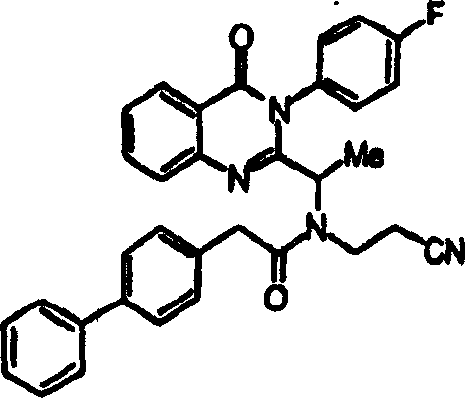
2-联苯-4-基-N-(2-氰基-乙基)-N-{1-[3-(4-氟代-苯基)-4-氧代-34-二氢-喹唑啉-2-基]-乙基}-乙酰胺(1.20)2-biphenyl-4-yl-N-(2-cyano-ethyl)-N-{1-[3-(4-fluoro-phenyl)-4-oxo-34-dihydro-quinone Azolin-2-yl]-ethyl}-acetamide (1.20)
根据以上所述化合物1.01的合成方法制备化合物1.20。合成顺序按照方法1,其中在步骤e中使用3-氨基丙腈代替2-(N,N-二甲基氨基)-1-氨基乙烷并在步骤f中使用联苯基乙酰氯代替癸酰氯。对于化合物1.20的特征数据如下:无色玻璃状物。1H NMR与化合物1.19的光谱相似:约1∶1顺式/反式酰胺旋转异构体混合物(CDCl3,T=25℃),由以下特征共振峰积分而得:δA4.94(q,1.0H,J=6.8Hz)和δB5.14(q,1.0H,J=7.6Hz)ppm。MS(ESI+)530.2[MH]+ Compound 1.20 was prepared according to the synthesis method of compound 1.01 described above. The synthetic sequence follows
化合物1.21的合成Synthesis of compound 1.21
2-联苯-4-基-N-{1-[3-(4-氟代-苯基)-4-氧代-3,4-二氢-喹唑啉-2-基]-乙基}-N-(2-异丙氧基-乙基)-乙酰胺(1.21)2-biphenyl-4-yl-N-{1-[3-(4-fluoro-phenyl)-4-oxo-3,4-dihydro-quinazolin-2-yl]-ethyl }-N-(2-isopropoxy-ethyl)-acetamide (1.21)
根据以上所述化合物1.01的合成方法制备化合物1.21。合成顺序按照方法1,其中在步骤e中使用2-异丙氧基-1-氨基乙烷代替2-(N,N-二甲基氨基)-1-氨基乙烷并在步骤f中使用联苯基乙酰氯代替癸酰氯。对于化合物1.21的特征数据如下:暗黄色玻璃状物。1H NMR与化合物1.19的光谱相似:约3∶1顺式/反式酰胺旋转异构体混合物(CDCl3,T=25℃),由以下特征共振峰积分而得:δ次要4.88(q,1.0H,J=6.7Hz)和δ主要5.30(q,2.9H,J=7.0Hz)ppm。MS(ESI+)564.2[MH]+ Compound 1.21 was prepared according to the synthesis method of compound 1.01 described above. The synthetic sequence follows
化合物1.22的合成Synthesis of compound 1.22
2-联苯-4-基-N-{1-[3-(4-氟代-苯基)-4-氧代-3,4-二氢-喹唑啉-2-基]-乙基}-N-吡啶-2-基甲基-乙酰胺(1.22)2-biphenyl-4-yl-N-{1-[3-(4-fluoro-phenyl)-4-oxo-3,4-dihydro-quinazolin-2-yl]-ethyl }-N-pyridin-2-ylmethyl-acetamide (1.22)
根据以上所述化合物1.01的合成方法制备化合物1.22。合成顺序按照方法1,其中在步骤e中使用2-氨基甲基吡啶代替2-(N,N-二甲基氨基)-1-氨基乙烷,并在步骤f中使用联苯基乙酰氯代替癸酰氯。对于化合物1.22的特征数据如下:无色玻璃状物。1H NMR与化合物1.19的光谱相似:约1∶1顺式/反式酰胺旋转异构体混合物(CDCl3,T=25℃),由以下特征共振峰积分而得:δA5.13(q,1.0H,J=6.4Hz)和δB5.46(q,1.0H,J=8.0Hz)ppm。MS(ESI+)569.3[MH]+ Compound 1.22 was prepared according to the synthesis method of compound 1.01 described above. The synthetic sequence follows
化合物1.23的合成Synthesis of compound 1.23
2-联苯-4-基-N-{1-[3-(4-氟代-苯基)-4-氧代-3,4-二氢-喹唑啉-2-基]-乙基}-N-吡啶-3-基甲基-乙酰胺(1.23)2-biphenyl-4-yl-N-{1-[3-(4-fluoro-phenyl)-4-oxo-3,4-dihydro-quinazolin-2-yl]-ethyl }-N-pyridin-3-ylmethyl-acetamide (1.23)
根据以上所述化合物1.01的合成方法制备化合物1.23。合成顺序按照方法1,其中在步骤e中使用2-氨基甲基吡啶代替2-(N,N-二甲基氨基)-1-氨基乙烷并在步骤f中使用联苯基乙酰氯代替癸酰氯。对于化合物1.23的特征数据如下:无色玻璃状物。1H NMR与化合物1.19的光谱相似:约1∶1顺式/反式酰胺旋转异构体混合物(CDCl3,T=25℃),由以下特征共振峰积分而得:δA5.13(q,1.0H,J=6.4Hz)和δB5.46(q,1.0H,J=8.0Hz)ppm。MS(ESI+)569.3[MH]+ Compound 1.23 was prepared according to the synthesis method of compound 1.01 described above. The synthetic sequence follows
化合物1.24的合成Synthesis of Compound 1.24
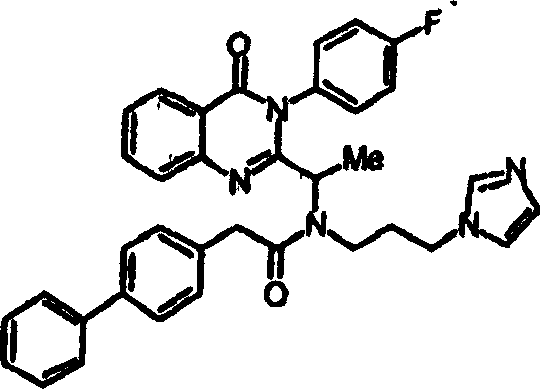
2-联苯-4-基-N-{1-[3-(4-氟代-苯基)-4-氧代-3,4-二氢-喹唑啉-2-基]-乙基}-N-(3-咪唑-1-基丙基)-乙酰胺(1.24)2-biphenyl-4-yl-N-{1-[3-(4-fluoro-phenyl)-4-oxo-3,4-dihydro-quinazolin-2-yl]-ethyl }-N-(3-imidazol-1-ylpropyl)-acetamide (1.24)
根据以上所述化合物1.01的合成方法制备化合物1.24。合成顺序按照方法1,其中在步骤e中使用3-(3-氨基丙基)咪唑代替2-(N,N-二甲基氨基)-1-氨基乙烷并在步骤f中使用联苯基乙酰氯代替癸酰氯。对于化合物1.24的特征数据如下:无色油状物。1H NMR与化合物1.19的光谱相似:约1∶1顺式/反式酰胺旋转异构体混合物(CDCl3,T=25℃),由以下特征共振峰积分而得:δA4.89(q,1.0H,J=6.6Hz)和δB5.29(q,1.1H,J=7.1Hz)ppm。MS(ESI+)569.3[MH]+ Compound 1.24 was prepared according to the synthesis method of compound 1.01 described above. The synthetic sequence follows
化合物1.25的合成Synthesis of Compound 1.25
2-联苯-4-基-N-(2-乙氧基-乙基)-N-{1-[3-(4-氟 2-联苯-4-基-N-(2-乙氧基-乙基)-N-{1-[3-(4-氟2-biphenyl-4-yl-N-(2-ethoxy-ethyl)-N-{1-[3-(4-fluoro 2-biphenyl-4-yl-N-(2-ethoxy Base-ethyl)-N-{1-[3-(4-fluoro
代-苯基)-4-氧代-3,4-二氢-喹唑啉-2-基]-乙 代-苯基)-3,4-二氢-喹唑啉-2-基]-乙基}-乙酰Generation-phenyl)-4-oxo-3,4-dihydro-quinazolin-2-yl]-ethyl-phenyl)-3,4-dihydro-quinazolin-2-yl]- Ethyl}-acetyl
基}-乙酰胺(1.19) 胺(1.25)yl}-acetamide (1.19) amine (1.25)
在40℃(外部温度,油浴)下,向悬浮在3.0mL冰醋酸中的175mg1.19(318μmol,1.00当量)和500mg锌粉(7.65mmol,24.0当量)的混合物中加入约200μL浓盐酸水溶液(通过移液吸管5滴,18M;3.6mmol)。使得到的米黄色、混浊的反应混合物放出气体并在40℃下搅拌15分钟,然后倾出悬浮的固体/锌并用浓氢氧化钠水溶液中和至pH>12。用二氯甲烷(3×20mL)提取碱水溶液。将合并的有机萃取液经硫酸镁干燥,过滤并在真空中浓缩得到无色油状物。将粗制物经柱层析在硅胶(3.5cm o.d.x10cmh)上纯化,用2%甲醇的氯仿溶液洗脱。合并用10%甲醇的氯仿溶液洗脱在Rf=0.52处的含有产物的流分,在真空中浓缩得到83mg无色油状物。1H NMR与化合物1.19的光谱相似:约2∶1顺式/反式酰胺旋转异构体混合物(CDCl3,T=25℃),由以下特征共振峰积分而得:δ次要4.62(q,1.0H,J=7.1Hz)和δ主要5.31(q,2.1H,J=7.0Hz)ppm。MS(ESI+)536.3[MH]+ To a mixture of 175 mg of 1.19 (318 μmol, 1.00 equiv) and 500 mg of zinc powder (7.65 mmol, 24.0 equiv) suspended in 3.0 mL of glacial acetic acid at 40 °C (external temperature, oil bath) was added about 200 μL of concentrated aqueous hydrochloric acid (5 drops by pipette, 18M; 3.6 mmol). The resulting beige, cloudy reaction mixture was allowed to evolve gas and was stirred at 40°C for 15 minutes, then the suspended solids/zinc were decanted and neutralized to pH >12 with concentrated aqueous sodium hydroxide. The aqueous base solution was extracted with dichloromethane (3 x 20 mL). The combined organic extracts were dried over magnesium sulfate, filtered and concentrated in vacuo to give a colorless oil. The crude was purified by column chromatography on silica gel (3.5cm odx10cmh), eluting with 2% methanol in chloroform. Fractions containing product at Rf = 0.52 eluting with 10% methanol in chloroform were combined and concentrated in vacuo to give 83 mg of a colorless oil. 1 H NMR is similar to the spectrum of compound 1.19: about 2:1 cis/trans amide rotamer mixture (CDCl 3 , T=25°C), integrated from the following characteristic resonance peak: δ minor 4.62(q , 1.0H, J=7.1Hz) and δ main 5.31 (q, 2.1H, J=7.0Hz) ppm. MS(ESI + )536.3[MH] +
化合物1.26的合成Synthesis of Compound 1.26

N-(2-乙氧基-乙基)-N-{1-[3-(4-氟代-苯基)-4-氧代-3,4-二氢-喹唑啉-2-基]-乙基}-2-(4-三氟代甲基-苯基)-乙酰胺(1.26)N-(2-ethoxy-ethyl)-N-{1-[3-(4-fluoro-phenyl)-4-oxo-3,4-dihydro-quinazolin-2-yl ]-ethyl}-2-(4-trifluoromethyl-phenyl)-acetamide (1.26)
根据以上所述化合物1.01的合成方法制备化合物1.26。合成顺序按照方法1,其中在步骤e中使用2-乙氧基-1-氨基乙烷代替2-(N,N-二甲基氨基)-1-氨基乙烷并在步骤f中使用(4-三氟代甲基苯基)乙酸与EDC和催化的HOBT代替癸酰氯。对于化合物1.26的特征数据如下:无色油状物。1H NMR与化合物1.19的光谱相似:约5∶2顺式/反式酰胺旋转异构体混合物(CDCl3,T=25℃),由以下特征共振峰积分而得:δ次要4.85(q,1.0H,J=6.8Hz)和δ主要5.33(q,2.6H,J=6.8Hz)ppm。MS(ESI+)542.2[MH]+ Compound 1.26 was prepared according to the synthesis method of compound 1.01 described above. The synthetic sequence follows
化合物1.27的合成Synthesis of Compound 1.27
N-{1-[3-(4-氟代-苯基)-4-氧代-3,4-二氢-喹唑啉-2-基]-乙基}-N-吡啶-3-基甲基-2-(4-三氟代甲基-苯基)-乙酰胺(1.27)N-{1-[3-(4-fluoro-phenyl)-4-oxo-3,4-dihydro-quinazolin-2-yl]-ethyl}-N-pyridin-3-yl Methyl-2-(4-trifluoromethyl-phenyl)-acetamide (1.27)
根据以上所述化合物1.01的合成方法制备化合物1.27。合成顺序按照方法1,其中在步骤e中使用3-甲基氨基吡啶代替2-(N,N-二甲基氨基)-1-氨基乙烷并在步骤f中使用(4-三氟代甲基苯基)乙酸与EDC和催化的HOBT代替癸酰氯。对于化合物1.27的特征数据如下:无色油状物。1H NMR与化合物1.19的光谱相似:约6∶5顺式/反式酰胺旋转异构体混合物(CDCl3,T=25℃),由以下特征共振峰积分而得:δ次要4.99(q,1.0H,J=6.6Hz)和δ主要5.37(q,1.2H,J=7.2Hz)ppm。MS(ESI+)561.2[MH]+ Compound 1.27 was prepared according to the synthesis method of compound 1.01 described above. The synthetic sequence follows
化合物1.28的合成Synthesis of Compound 1.28
[3-(4-甲氧基-苯基)-4-氧代-3,4-二氢-喹唑啉-2-基甲基]-2-(吡咯烷-1-基乙基)-酰胺1.28[3-(4-methoxy-phenyl)-4-oxo-3,4-dihydro-quinazolin-2-ylmethyl]-2-(pyrrolidin-1-ylethyl)- Amide 1.28
根据1.01的合成方法制备化合物1.28。Compound 1.28 was prepared according to the synthetic method of 1.01.
MS(ESI+)533.3,534.3,1H NMR(DMSO,T=140℃)0.87(t,3H,J=7.0Hz),1.26(m,14H),1.66(m,4H),2.22(m,2H),2.49-2.76(m,6H),3.51(t,2H,J=3.3Hz),3.87(s,3H),4.24(s,2H),7.11(m,2H),7.31(m,2H),7.51(m,1H),7.60(m,1H),7.80(m,1H),8.13(m,1H),MS(ESI+)533.8(MH+).MS (ESI + ) 533.3, 534.3, 1 H NMR (DMSO, T = 140°C) 0.87 (t, 3H, J = 7.0Hz), 1.26 (m, 14H), 1.66 (m, 4H), 2.22 (m, 2H), 2.49-2.76(m, 6H), 3.51(t, 2H, J=3.3Hz), 3.87(s, 3H), 4.24(s, 2H), 7.11(m, 2H), 7.31(m, 2H ), 7.51(m, 1H), 7.60(m, 1H), 7.80(m, 1H), 8.13(m, 1H), MS(ESI + )533.8(MH + ).
化合物1.29的合成Synthesis of compound 1.29
癸酸{1-[3-(4-甲氧基-苯基)-4-氧代-3,4-二氢-喹唑啉-2-基]-乙基}-(2-吡咯烷-1-基-乙基)-酰胺1.29Decanoic acid {1-[3-(4-methoxy-phenyl)-4-oxo-3,4-dihydro-quinazolin-2-yl]-ethyl}-(2-pyrrolidine- 1-yl-ethyl)-amide 1.29
根据1.01的合成方法制备化合物1.29。无色粘性油状物;顺式/反式酰胺旋转异构体混合物(1/1),由1H NMR(CDCl3)测定:4.82(q,1H,J=7.5Hz),5.37(q,1H,J=7.5Hz)。MS(ESI+)547.2[MH]+。C23H28N4O2的分析计算值:C 72.49,H 8.48,N 10.25。实测值C 72.62,H 8.44,N10.12。Compound 1.29 was prepared according to the synthetic method of 1.01. Colorless viscous oil; cis/trans amide rotamer mixture (1/1) by 1 H NMR (CDCl 3 ): 4.82 (q, 1H, J = 7.5 Hz), 5.37 (q, 1H , J=7.5Hz). MS (ESI + ) 547.2 [MH] + . Anal . Calcd. for C23H28N4O2 : C 72.49, H 8.48, N 10.25 . Found C 72.62, H 8.44, N 10.12.
化合物1.30的合成Synthesis of compound 1.30
2-联苯-4-基-N-(2-二甲基氨基-乙基)-N-{1-[3-(4-甲氧基-苯基)-4-氧代-3,4-二氢-喹唑啉-2-基]-乙基}-乙酰胺1.302-biphenyl-4-yl-N-(2-dimethylamino-ethyl)-N-{1-[3-(4-methoxy-phenyl)-4-oxo-3,4 -Dihydro-quinazolin-2-yl]-ethyl}-acetamide 1.30
根据1.01的合成方法制备化合物1.30。黄色固体。顺式/反式酰胺旋转异构体混合物(1/1),由1H NMR(CDCl3)测定:1.40(d,3H,J=6.8Hz),1.46(d,3H,J=6.8Hz)。MS(ESI+)561.2[MH]+。Compound 1.30 was prepared according to the synthetic method of 1.01. yellow solid. Cis/trans amide rotamer mixture (1/1) by 1 H NMR (CDCl 3 ): 1.40 (d, 3H, J = 6.8 Hz), 1.46 (d, 3H, J = 6.8 Hz) . MS(ESI + )561.2[MH] + .
化合物1.31的合成Synthesis of compound 1.31
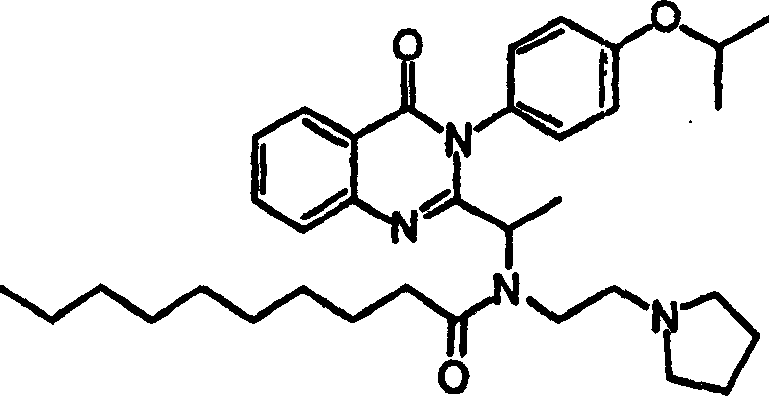
癸酸{1-[3-(4-异丙氧基-苯基)-4-氧代-3,4-二氢-喹唑啉-2-基]-乙基}-(2-吡咯烷-1-基-乙基)-酰胺1.31Decanoic acid {1-[3-(4-isopropoxy-phenyl)-4-oxo-3,4-dihydro-quinazolin-2-yl]-ethyl}-(2-pyrrolidine -1-yl-ethyl)-amide 1.31
根据1.01的合成方法制备化合物1.31。无色粘性油状物。顺式/反式酰胺旋转异构体混合物(1/1),由1H NMR(CDCl3)测定:4.88(q,1H,J=7.2Hz),5.38(q,1H,J=7.2Hz)。MS(ESI+)575.5[MH]+。C35H50N4O3的分析计算值:C 73.14,H 8.77,N 9.75。实测值C 72.45,H 8.75,N9.08。Compound 1.31 was prepared according to the synthetic method of 1.01. Colorless viscous oil. Cis/trans amide rotamer mixture (1/1) by 1 H NMR (CDCl 3 ): 4.88 (q, 1H, J = 7.2 Hz), 5.38 (q, 1 H, J = 7.2 Hz) . MS (ESI + ) 575.5 [MH] + . Anal. Calcd. for C35H50N4O3 : C 73.14, H 8.77, N 9.75 . Found C 72.45, H 8.75, N 9.08.
化合物1.32的合成Synthesis of compound 1.32

癸酸{1-[3-(4-乙氧基-苯基)-4-氧代-3,4-二氢-喹唑啉-2-基]-乙基}-(2-甲氧基-乙基)-酰胺1.32Decanoic acid {1-[3-(4-ethoxy-phenyl)-4-oxo-3,4-dihydro-quinazolin-2-yl]-ethyl}-(2-methoxy -Ethyl)-amide 1.32
根据1.01的合成方法制备化合物1.32。无色粘性油状物。顺式/反式酰胺旋转异构体混合物(2/3),由1H NMR(CDCl3)测定:4.87(q,1H,J=7.2Hz),5.38(q,1H,J=7.2Hz)。MS(ESI+)522.3[MH]+。C31H43N3O4的分析计算值:C 71.37,H 8.31,N 8.05。实测值C 71.13,H 8.42,N8.02。Compound 1.32 was prepared according to the synthetic method of 1.01. Colorless viscous oil. Cis/trans amide rotamer mixture (2/3) by 1 H NMR (CDCl 3 ): 4.87 (q, 1H, J = 7.2 Hz), 5.38 (q, 1 H, J = 7.2 Hz) . MS(ESI + )522.3[MH] + . Anal. Calcd. for C31H43N3O4 : C 71.37, H 8.31, N 8.05 . Found C 71.13, H 8.42, N 8.02.
化合物1.33的合成Synthesis of compound 1.33

2-联苯-4-基-N-{1-[3-(3-氟代-4-甲氧基-苯基)-4-氧代-3,4-二氢-喹唑啉-2-基]-乙基}-N-(2-吡咯烷-1-基-乙基)-乙酰胺1.332-biphenyl-4-yl-N-{1-[3-(3-fluoro-4-methoxy-phenyl)-4-oxo-3,4-dihydro-quinazoline-2 -yl]-ethyl}-N-(2-pyrrolidin-1-yl-ethyl)-acetamide 1.33
根据1.01的合成方法制备化合物1.33。黄色固体m.p.96.9℃,顺式/反式酰胺旋转异构体混合物(1/1),由1H NMR(CDCl3)测定:4.87(q,1H,J=7.2Hz),5.38(q,1H,J=7.2Hz)。MS(ESI+)605.3[MH]+。C37H37FN4O3.C4H8O2的分析计算值:C 71.08,H 6.55,N 8.09。实测值C71.96,H 6.19,N 8.47。Compound 1.33 was prepared according to the synthetic method of 1.01. Yellow solid mp96.9°C, cis/trans amide rotamer mixture (1/1), determined by 1 H NMR (CDCl 3 ): 4.87(q, 1H, J=7.2Hz), 5.38(q, 1H, J = 7.2 Hz). MS(ESI + )605.3[MH] + . Anal . Calcd. for C37H37FN4O3.C4H8O2 : C 71.08 , H 6.55, N 8.09 . Found values C71.96, H 6.19, N 8.47.
化合物1.34的合成Synthesis of Compound 1.34
2-联苯-4-基-N-{1-[3-(4-甲氧基-苯基)-4-氧代-3,4-二氢-喹唑啉-2-基]-乙基}-N-(2-吡咯烷-1-基-乙基)-乙酰胺1.342-biphenyl-4-yl-N-{1-[3-(4-methoxy-phenyl)-4-oxo-3,4-dihydro-quinazolin-2-yl]-ethyl Base}-N-(2-pyrrolidin-1-yl-ethyl)-acetamide 1.34
根据1.01的合成方法制备化合物1.34。白色固体m.p.116.3℃顺式/反式酰胺旋转异构体混合物(1/1),由1H NMR(CDCl3)测定:4.96(q,1H,J=7.2Hz),5.38(q,1H,J=7.2Hz)。MS(ESI+)587.3[MH]+。C37H38N4O3的分析计算值:C 75.74,H 6.53,N 9.55。实测值C 75.05,H6.56,N 9.35。Compound 1.34 was prepared according to the synthetic method of 1.01. White solid mp 116.3 °C cis/trans amide rotamer mixture (1/1) by 1 H NMR (CDCl 3 ): 4.96 (q, 1H, J = 7.2 Hz), 5.38 (q, 1H , J=7.2Hz). MS (ESI + ) 587.3 [MH] + . Anal. Calcd. for C37H38N4O3 : C 75.74, H 6.53, N 9.55. Found C 75.05, H 6.56, N 9.35.
化合物1.35的合成Synthesis of compound 1.35

2-联苯-4-基-N-{1-[3-(3-氟代-苯基)-4-氧代-3,4-二氢-喹唑啉-2-基]-乙基}-N-(2-吡咯烷-1-基-乙基)-乙酰胺1.352-biphenyl-4-yl-N-{1-[3-(3-fluoro-phenyl)-4-oxo-3,4-dihydro-quinazolin-2-yl]-ethyl }-N-(2-pyrrolidin-1-yl-ethyl)-acetamide 1.35
根据1.01的合成方法制备化合物1.35。黄色固体。顺式/反式酰胺旋转异构体混合物(3/8),由1H NMR(CDCl3)测定:4.89(m,1H),5.38(m,1H)。MS(ESI+)575.3[MH]+。C36H35FN4O2.C4H8O2的分析计算值:C 72.49,H 6.54,N 8.45。实测值C 72.77,H 6.10,N 8.89。Compound 1.35 was prepared according to the synthetic method of 1.01. yellow solid. Cis/trans amide rotamer mixture (3/8) by 1 H NMR (CDCl 3 ): 4.89 (m, 1H), 5.38 (m, 1H). MS (ESI + ) 575.3 [MH] + . Anal . Calcd. for C36H35FN4O2 . C4H8O2 : C 72.49 , H 6.54, N 8.45. Found C 72.77, H 6.10, N 8.89.
化合物1.36的合成Synthesis of Compound 1.36
2-(4-苄氧基-苯基)-N-(2-二甲基氨基-乙基)-N-{1-[3-(4-甲氧基-苯基)-4-氧代-3,4-二氢-喹唑啉-2-基]-乙基}-乙酰胺1.362-(4-Benzyloxy-phenyl)-N-(2-dimethylamino-ethyl)-N-{1-[3-(4-methoxy-phenyl)-4-oxo -3,4-dihydro-quinazolin-2-yl]-ethyl}-acetamide 1.36
根据1.01的合成方法制备化合物1.36。白色固体;m.p.61.3℃。顺式/反式酰胺旋转异构体混合物(1/1),由1H NMR(CDCl3)测定:4.92(q,1H,J=7.2Hz),5.32(q,1H,J=7.2Hz)。MS(ESI+)591.3[MH]+。C36H38N4O4的分析计算值:C 73.20,H 6.48,N 9.48。实测值C 72.92,H6.46,N 9.29。Compound 1.36 was prepared according to the synthetic method of 1.01. White solid; mp61.3°C. Cis/trans amide rotamer mixture (1/1) by 1 H NMR (CDCl 3 ): 4.92 (q, 1H, J = 7.2 Hz), 5.32 (q, 1 H, J = 7.2 Hz) . MS (ESI + ) 591.3 [MH] + . Anal . Calcd. for C36H38N4O4 : C 73.20, H 6.48, N 9.48. Found C 72.92, H 6.46, N 9.29.
化合物1.37的合成Synthesis of Compound 1.37

N-(2-二甲基氨基-乙基)-N-{1-[3-(4-氟代-苯基)-4-氧代-3,4-二氢-喹唑啉-2-基]-乙基}-2-(4-异丙基-苯基)-乙酰胺1.37N-(2-Dimethylamino-ethyl)-N-{1-[3-(4-fluoro-phenyl)-4-oxo-3,4-dihydro-quinazoline-2- Base]-ethyl}-2-(4-isopropyl-phenyl)-acetamide 1.37
根据1.01的合成方法制备化合物1.37。白色固体;顺式/反式酰胺旋转异构体混合物(1/2),由1H NMR(CDCl3)测定:4.86(q,1H,J=7.2Hz),5.32(q,1H,J=7.2Hz)。MS(ESI+)515.3[MH]+。C31H35FN4O2的分析计算值:C 72.35,H 6.85,N 10.89。实测值C 72.11,H 6.92,N10.71。Compound 1.37 was prepared according to the synthetic method of 1.01. White solid; cis/trans amide rotamer mixture (1/2) by 1 H NMR (CDCl 3 ): 4.86 (q, 1H, J = 7.2 Hz), 5.32 (q, 1H, J = 7.2Hz). MS (ESI + ) 515.3 [MH] + . Anal . Calcd. for C31H35FN4O2 : C 72.35, H 6.85, N 10.89. Found C 72.11, H 6.92, N 10.71.
化合物1.38的合成Synthesis of Compound 1.38
2-(4-丁氧基-苯基)-N-(2-二甲基氨基-乙基)-N-{1-[3-(4-氟代-苯基)-4-氧代-3,4-二氢-喹唑啉-2-基]-乙基}-乙酰胺1.382-(4-Butoxy-phenyl)-N-(2-dimethylamino-ethyl)-N-{1-[3-(4-fluoro-phenyl)-4-oxo- 3,4-Dihydro-quinazolin-2-yl]-ethyl}-acetamide 1.38
根据1.01的合成方法制备化合物1.38。白色固体;顺式/反式酰胺旋转异构体混合物(1/1.7),由1H NMR(CDCl3)测定:4.85(q,1H,J=7.2Hz),5.30(q,1H,J=7.2Hz)。MS(ESI+)545.3[MH]+。C32H37FN4O3的分析计算值:C 70.57,H 6.85,N 10.29。实测值C 70.33,H 6.90,N10.13。Compound 1.38 was prepared according to the synthetic method of 1.01. White solid; cis/trans amide rotamer mixture (1/1.7), by 1 H NMR (CDCl 3 ): 4.85 (q, 1H, J = 7.2 Hz), 5.30 (q, 1H, J = 7.2Hz). MS (ESI + ) 545.3 [MH] + . Anal . Calcd. for C32H37FN4O3 : C 70.57, H 6.85, N 10.29. Found C 70.33, H 6.90, N 10.13.
化合物1.39的合成Synthesis of Compound 1.39
2-联苯基-4-N-{1-[3-(4-乙氧基-苯基)-4-氧代-3,4-二氢-喹唑啉-2-基]-N-(2-乙基)-1.392-biphenyl-4-N-{1-[3-(4-ethoxy-phenyl)-4-oxo-3,4-dihydro-quinazolin-2-yl]-N- (2-Ethyl)-1.39
根据1.01的合成方法制备化合物1.39。白色固体;顺式/反式酰胺旋转异构体混合物(1/1),由1H NMR(CDCl3)测定:4.95(q,1H,J=7.2Hz),5.32(q,1H,J=7.2Hz)。MS(ESI+)562.3[MH]+。C35H35N3O4的分析计算值:C 74.84,H 6.28,N 7.48。实测值C 74.56,H 6.26,N 7.30。Compound 1.39 was prepared according to the synthetic method of 1.01. White solid; cis/trans amide rotamer mixture (1/1) by 1 H NMR (CDCl 3 ): 4.95 (q, 1H, J = 7.2 Hz), 5.32 (q, 1H, J = 7.2Hz). MS (ESI + ) 562.3 [MH] + . Anal. Calcd. for C35H35N3O4 : C 74.84, H 6.28, N 7.48 . Found C 74.56, H 6.26, N 7.30.
化合物1.40的合成Synthesis of Compound 1.40

2-联苯-4-基-N-{1-[3-(4-丁氧基-苯基)-4-氧代-3,4-二氢-喹唑啉-2-基]-丙基}-N-(2-甲氧基-乙基)-乙酰胺1.402-biphenyl-4-yl-N-{1-[3-(4-butoxy-phenyl)-4-oxo-3,4-dihydro-quinazolin-2-yl]-propane Base}-N-(2-methoxy-ethyl)-acetamide 1.40
根据1.01的合成方法制备化合物1.40。白色固体;顺式/反式酰胺旋转异构体混合物(2/1),由1H NMR(CDCl3)测定:4.70(m,1H),5.38(t,1H,J=7.0Hz)。MS(ESI+)604.3[MH]+。C38H41N3O4的分析计算值:C 75.60,H 6.84,N 6.96。实测值C 74.98,H 6.82,N 6.72。Compound 1.40 was prepared according to the synthetic method of 1.01. White solid; cis/trans amide rotamer mixture (2/1) by 1 H NMR (CDCl 3 ): 4.70 (m, 1H), 5.38 (t, 1H, J=7.0 Hz). MS(ESI + )604.3[MH] + . Anal. Calcd. for C38H41N3O4 : C 75.60, H 6.84, N 6.96 . Found C 74.98, H 6.82, N 6.72.
化合物1.42的合成Synthesis of Compound 1.42

2-联苯-4-基-N-{1-[3-(4-碘代-苯基)-4-氧代-3,4-二氢-喹唑啉-2-基]-乙基}-N-(2-甲氧基-乙基)-乙酰胺1.422-biphenyl-4-yl-N-{1-[3-(4-iodo-phenyl)-4-oxo-3,4-dihydro-quinazolin-2-yl]-ethyl }-N-(2-methoxy-ethyl)-acetamide 1.42
根据1.01的合成方法制备化合物1.42。白色固体;顺式/反式酰胺旋转异构体混合物(1/2),由1H NMR(CDCl3)测定:4.86(q,1H,J=7.3Hz),5.30(q,1H,J=7.3Hz)。MS(ESI+)644.2[MH]+。C33H30IN3O3的分析计算值:C 61.59,H 4.70,N 6.53。实测值C 61.63,H 4.73,N 6.36。Compound 1.42 was prepared according to the synthetic method of 1.01. White solid; cis/trans amide rotamer mixture (1/2) by 1 H NMR (CDCl 3 ): 4.86 (q, 1H, J = 7.3 Hz), 5.30 (q, 1H, J = 7.3Hz). MS(ESI + )644.2[MH] + . Anal. Calcd. for C33H30IN3O3 : C 61.59, H 4.70 , N 6.53. Found C 61.63, H 4.73, N 6.36.
化合物1.43的合成Synthesis of Compound 1.43

2-联苯-4-基-N-{1-[3-(4-氰基-苯基)-4-氧代-3,4-二氢-喹唑啉-2-基]-乙基}-N-(2-甲氧基-乙基)-乙酰胺1.432-biphenyl-4-yl-N-{1-[3-(4-cyano-phenyl)-4-oxo-3,4-dihydro-quinazolin-2-yl]-ethyl }-N-(2-methoxy-ethyl)-acetamide 1.43
将1.42(1mmol,0.643g)和CuCN(3mmol,0.27g)的10ml DMF中的混合物加热至130℃10小时。蒸发溶剂后,将残余物溶于CH2Cl2中,用水、盐水洗涤有机层,经NaSO4干燥并在真空中除去,得到粘石油,将粘石油经层析纯化,得到白色固体;顺式/反式酰胺旋转异构体混合物(1/2),由1H NMR(CDCl3)测定:4.75(q,1H,J=7.3Hz),5.28(q,1H,J=7.3Hz)。MS(ESI+)543.2[MH]+。C34H30N4O3的分析计算值:C 75.26,H 5.57,N 10.32。实测值C 75.00,H 5.59,N 10.19。A mixture of 1.42 (1 mmol, 0.643 g) and CuCN (3 mmol, 0.27 g) in 10 ml DMF was heated to 130°C for 10 hours. After evaporation of the solvent, the residue was dissolved in CH2Cl2 , the organic layer was washed with water, brine, dried over NaSO4 and removed in vacuo to give viscous petroleum, which was purified by chromatography to give a white solid; cis /trans-amide rotamer mixture (1/2) by 1 H NMR (CDCl 3 ): 4.75 (q, 1H, J = 7.3 Hz), 5.28 (q, 1 H, J = 7.3 Hz). MS (ESI + ) 543.2 [MH] + . Anal. Calcd. for C34H30N4O3 : C 75.26, H 5.57, N 10.32 . Found C 75.00, H 5.59, N 10.19.
化合物1.44的合成Synthesis of Compound 1.44

2-联苯-4-基-N-(2-甲氧基-乙基)-N-[1-(4-氧代-3-吡啶-4-基甲基-3,4-二氢-喹唑啉-2-基)-乙基]-乙酰胺1.442-biphenyl-4-yl-N-(2-methoxy-ethyl)-N-[1-(4-oxo-3-pyridin-4-ylmethyl-3,4-dihydro- Quinazolin-2-yl)-ethyl]-acetamide 1.44
根据1.01的合成方法制备化合物1.44。白色固体。Compound 1.44 was prepared according to the synthetic method of 1.01. white solid.
1H NMR(CDCl3)1.40(d,3H,J=7.3Hz),3.05(m,1H),3.12(s,3H),3.25(m,1H),3.55-3.70(m,2H),3.77(d,1H,J=15Hz),3.9(d,1H,J=15Hz),5.08(d,1H,12Hz),5.88(m,2H),7.28-7.35(m,5H),7.42(m,2H),7.57(m,5H),7.72(m,1H),7.80(m,1H),8.32(m,1H),8.55(m,2H).MS(ESI+)533.3(MH+). 1 H NMR (CDCl 3 ) 1.40 (d, 3H, J=7.3Hz), 3.05 (m, 1H), 3.12 (s, 3H), 3.25 (m, 1H), 3.55-3.70 (m, 2H), 3.77 (d, 1H, J=15Hz), 3.9(d, 1H, J=15Hz), 5.08(d, 1H, 12Hz), 5.88(m, 2H), 7.28-7.35(m, 5H), 7.42(m, 2H), 7.57(m, 5H), 7.72(m, 1H), 7.80(m, 1H), 8.32(m, 1H), 8.55(m, 2H). MS(ESI + ) 533.3(MH + ).
化合物1.45的合成Synthesis of Compound 1.45
4-(2-{1-[(联苯-4-基-乙酰基)-(2-甲氧基-乙基)氨基]-乙基}-4-氧代-4H-喹唑啉-3-基)-苯甲酰胺1.454-(2-{1-[(biphenyl-4-yl-acetyl)-(2-methoxy-ethyl)amino]-ethyl}-4-oxo-4H-quinazoline-3 -yl)-benzamide 1.45
将1.43(0.1mmol,0.054g)和30%H2O2(0.6mmol)在1mL DMF和1ml二噁烷中的混合物在室温下搅拌1小时。常规处理后得到白色固体;顺式/反式酰胺旋转异构体混合物(1/2),由1H NMR(CDCl3)测定:4.95(q,1H,J=7.3Hz),5.15(q,1H,J=7.3Hz)。MS(ESI+)561.3[MH]+。C34H32N4O4.C4H8O的分析计算值:C 70.35,H 6.21,N 8.64。实测值C 70.98,H 5.99,N 9.14。A mixture of 1.43 (0.1 mmol, 0.054 g) and 30% H2O2 (0.6 mmol ) in 1 mL DMF and 1 mL dioxane was stirred at room temperature for 1 hour. White solid obtained after usual workup; cis/trans amide rotamer mixture (1/2) by 1 H NMR (CDCl 3 ): 4.95(q, 1H, J=7.3Hz), 5.15(q, 1H, J=7.3Hz). MS (ESI + ) 561.3 [MH] + . Anal . Calcd. for C34H32N4O4.C4H8O : C 70.35 , H 6.21, N 8.64. Found C 70.98, H 5.99, N 9.14.
化合物1.47的合成Synthesis of Compound 1.47

2-联苯-4-基-N-(2-羟基-乙基)-N-{1-[3-(4-甲氧基-苯基)-4-氧代-3,4-二氢-喹唑啉-2-基]-乙基}-乙酰胺1.472-biphenyl-4-yl-N-(2-hydroxy-ethyl)-N-{1-[3-(4-methoxy-phenyl)-4-oxo-3,4-dihydro -Quinazoline-2-yl]-ethyl}-acetamide 1.47
根据1.01的合成方法制备化合物1.47,顺式/反式酰胺旋转异构体混合物(1/17),由1H NMR(CDCl3)测定:1.35(d,3H,J=7.3Hz),1.42(d,3H,J=7.3Hz)。MS(ESI+)534.2[MH]+。C33H31N3O4的分析计算值:C 74.28,H 5.86,N 7.87。实测值C 73.83,H 5.93,N 7.73。Compound 1.47 was prepared according to the synthesis method of 1.01, a mixture of cis/trans amide rotamers (1/17), determined by 1 H NMR (CDCl 3 ): 1.35 (d, 3H, J=7.3Hz), 1.42 ( d, 3H, J = 7.3 Hz). MS(ESI + )534.2[MH] + . Anal. Calcd. for C33H31N3O4 : C 74.28, H 5.86, N 7.87 . Found C 73.83, H 5.93, N 7.73.
化合物1.48的合成Synthesis of Compound 1.48
2-联苯-4-基-N-{1-[3-(4-氰基-苯基)-4-氧代-3,4-二氢-喹唑啉-2-基]-乙基}-N-(2-乙氧基-乙基)-乙酰胺1.482-biphenyl-4-yl-N-{1-[3-(4-cyano-phenyl)-4-oxo-3,4-dihydro-quinazolin-2-yl]-ethyl }-N-(2-ethoxy-ethyl)-acetamide 1.48
根据21的合成方法制备化合物1.48。白色固体;顺式/反式酰胺旋转异构体混合物(1/5),由1H NMR(CDCl3)测定:4.72(q,1H,J=7.0Hz,5.25(q,1H,J=7.0Hz)。MS(ESI+)557.3[MH]+。C35H32N4O3的分析计算值:C 75.52,H 5.79,N 10.06。实测值C 75.03,H 5.92,N 9.96。Compound 1.48 was prepared according to the synthetic method of 21. White solid; cis/trans amide rotamer mixture (1/5) by 1 H NMR (CDCl 3 ): 4.72(q, 1H, J=7.0 Hz, 5.25(q, 1H, J=7.0 Hz). MS ( ESI + ) 557.3 [MH] + . Anal. Calcd. for C35H32N4O3 : C 75.52, H 5.79, N 10.06 . Found C 75.03, H 5.92, N 9.96.
化合物1.49的合成Synthesis of Compound 1.49

2-联苯-4-基-N-(2-乙氧基-乙基)-N-{1-[3-(4-乙氧基-苯基)-4-氧代-3,4-二氢-喹唑啉-2-基]-乙基}-乙酰胺1.492-biphenyl-4-yl-N-(2-ethoxy-ethyl)-N-{1-[3-(4-ethoxy-phenyl)-4-oxo-3,4- Dihydro-quinazolin-2-yl]-ethyl}-acetamide 1.49
根据1.01的合成方法制备化合物1.49。白色固体,m.p.98.1℃,顺式/反式酰胺旋转异构体混合物(1/1),由1H NMR(CDCl3)测定:4.72(q,1H,J=7.0Hz),5.25(q,1H,J=7.0Hz)。MS(ESI+)576.3[MH]+。C36H37N3O4的分析计算值:C 75.11,H 6.48,N 7.30。实测值C 75.08,H6.59,N 7.27。Compound 1.49 was prepared according to the synthetic method of 1.01. White solid, mp 98.1°C, mixture of cis/trans amide rotamers (1/1), determined by 1 H NMR (CDCl 3 ): 4.72(q, 1H, J=7.0Hz), 5.25(q , 1H, J=7.0Hz). MS (ESI + ) 576.3 [MH] + . Anal. Calcd. for C36H37N3O4 : C 75.11, H 6.48, N 7.30 . Found C 75.08, H 6.59, N 7.27.
化合物1.50的合成Synthesis of compound 1.50
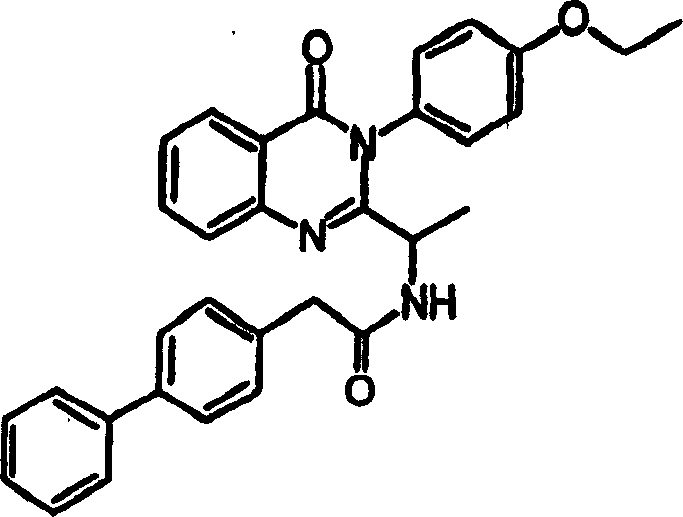
2-联苯-4-基-N-{1-[3-(4-乙氧基-苯基)-4-氧代-3,4-二氢-喹唑啉-2-基]-乙基}-乙酰胺1.502-biphenyl-4-yl-N-{1-[3-(4-ethoxy-phenyl)-4-oxo-3,4-dihydro-quinazolin-2-yl]-ethyl base}-acetamide 1.50
根据1.01的合成方法制备化合物1.50。白色固体,Compound 1.50 was prepared according to the synthetic method of 1.01. white solid,
1H NMR(CDCl3)1.24(d,3H,J=6.8Hz),1.46(t,3H,J=6.9Hz),3.64(s,2H),4.09(q,2H,J=6.9Hz),4.83(m,1H),6.90(m,1H),7.05(m,2H),7.17(m,1H),7.35-7.61(m,7H),7.63(m,5H),8.25(m,1H).MS(ESI+)504.2(MH+).C32H29N3O3的分析计算值:C 76.32,H 5.80,N 8.34。实测值C 75.85,H5.88,N 8.14。 1 H NMR (CDCl 3 ) 1.24 (d, 3H, J=6.8Hz), 1.46 (t, 3H, J=6.9Hz), 3.64 (s, 2H), 4.09 (q, 2H, J=6.9Hz), 4.83(m, 1H), 6.90(m, 1H), 7.05(m, 2H), 7.17(m, 1H), 7.35-7.61(m, 7H), 7.63(m, 5H), 8.25(m, 1H) .MS ( ESI + ) 504.2 (MH + ). Anal. Calcd. for C32H29N3O3 : C 76.32, H 5.80 , N 8.34. Found C 75.85, H 5.88, N 8.14.
化合物1.51的合成Synthesis of Compound 1.51
2-联苯-4-基-N-(2-乙氧基-乙基)-N-{[3-(4-乙氧基-苯基)-4-氧代-3,4-二氢-喹唑啉-2-基]-苯基-甲基}-乙酰胺1.512-biphenyl-4-yl-N-(2-ethoxy-ethyl)-N-{[3-(4-ethoxy-phenyl)-4-oxo-3,4-dihydro -quinazolin-2-yl]-phenyl-methyl}-acetamide 1.51
根据1.01的合成方法制备化合物1.51。白色固体,Compound 1.51 was prepared according to the synthetic method of 1.01. white solid,
1H NMR(CDCl3)1.05(t,3H,J=7.0Hz),1.40(t,3H,J=6.92Hz),2.81(m,2H),3.18(m,2H),3.80(m,2H),3.91(d,1H,J=15Hz),4.0(m,2H),4.03(d,1H,J=15Hz),6.11(m,1H),6.42(m,1H),6.47(m,1H),7.01(m,3H),7.22-7.58(m,14H),7.64(m,1H),7.75(m,1H),8.27(d,1H,J=8Hz).MS(ESI+)638.3(MH+).C41H39N3O4的分析计算值:C 77.21,H 6.16,N 6.59。实测值C 77.28,H6.15,N 6.58。 1 H NMR (CDCl 3 ) 1.05(t, 3H, J=7.0Hz), 1.40(t, 3H, J=6.92Hz), 2.81(m, 2H), 3.18(m, 2H), 3.80(m, 2H ), 3.91(d, 1H, J=15Hz), 4.0(m, 2H), 4.03(d, 1H, J=15Hz), 6.11(m, 1H), 6.42(m, 1H), 6.47(m, 1H ), 7.01(m, 3H), 7.22-7.58(m, 14H), 7.64(m, 1H), 7.75(m, 1H), 8.27(d, 1H, J=8Hz). MS(ESI + ) 638.3( MH + ). Anal. Calcd. for C41H39N3O4 : C 77.21 , H 6.16, N 6.59. Found C 77.28, H 6.15, N 6.58.
化合物1.52的合成Synthesis of Compound 1.52
2-(4-溴代-苯基)-N-(2-乙氧基-乙基)-N-{1-[3-(4-乙氧 N-(2-乙氧基-乙基)-N-{1-[3-(4-乙氧基-苯基)-4-氧代-基-苯基)-4-氧代-3,4-二氢-喹唑啉-2-基]-乙基}-乙酰胺 3,4-二氢-喹唑啉-2-基]-乙基}-2-(4-吡啶-4-基-苯基)-乙2-(4-Bromo-phenyl)-N-(2-ethoxy-ethyl)-N-{1-[3-(4-ethoxy N-(2-ethoxy-ethyl) -N-{1-[3-(4-ethoxy-phenyl)-4-oxo-yl-phenyl)-4-oxo-3,4-dihydro-quinazolin-2-yl ]-ethyl}-acetamide 3,4-dihydro-quinazolin-2-yl]-ethyl}-2-(4-pyridin-4-yl-phenyl)-ethyl
1.52 酰胺1.53
以与1.01合成所用方法类似的方法合成化合物1.53。在氮气氛下,将吡啶-4-硼酸(0.053g,0.43mmol)、1.52(0.050g,0.087mmol)和Pd(PPPh3)4(0.010g,0.009mmol)的甲苯(4mL)和3M Na2CO3(4mL)混合物加热至110℃3小时。用水洗涤有机层,经NaSO4干燥并蒸发得到油状物,将该油状物经层析纯化,得到化合物1.53,为白色固体(15mg)。MS(ESI+)577.3[MH]+。Compound 1.53 was synthesized in a similar manner to that used for the synthesis of 1.01. Under nitrogen atmosphere, pyridine-4-boronic acid (0.053 g, 0.43 mmol), 1.52 (0.050 g, 0.087 mmol) and Pd(PPPh 3 ) 4 (0.010 g, 0.009 mmol) in toluene (4 mL) and 3M Na 2 The CO 3 (4 mL) mixture was heated to 110° C. for 3 hours. The organic layer was washed with water, dried over NaSO4 and evaporated to give an oil which was purified by chromatography to give compound 1.53 as a white solid (15mg). MS (ESI + ) 577.3 [MH] + .
化合物1.54的合成Synthesis of Compound 1.54
2-(3’,4’-二氟代-联苯-4-基)-N-{1-[3-(4-乙氧基-苯基)-4-氧代-3,4-二氢-喹唑啉-2-基]-乙基}-N-(2-乙氧基-乙基)-乙酰胺1.542-(3',4'-difluoro-biphenyl-4-yl)-N-{1-[3-(4-ethoxy-phenyl)-4-oxo-3,4-di Hydrogen-quinazolin-2-yl]-ethyl}-N-(2-ethoxy-ethyl)-acetamide 1.54
在氮气氛下,将3,4-二氟代苯基硼酸(0.131g,0.83mmol)、化合物1.52(0.050g,0.087mmol)和Pd(OAc)2(0.016g,0.071mmol)的DME(3mL)和3M Na2CO3(2mL)混合物加热至90℃3小时。用CH2Cl2萃取含水层将合并的有机萃取液经Na2SO4干燥,过滤并浓缩。将残余物经层析纯化,得到白色固体(71mg)。Under nitrogen atmosphere, 3,4-difluorophenylboronic acid (0.131 g, 0.83 mmol), compound 1.52 (0.050 g, 0.087 mmol) and Pd(OAc) 2 (0.016 g, 0.071 mmol) in DME (3 mL ) and 3M Na2CO3 ( 2 mL) mixture was heated to 90 °C for 3 hours. The aqueous layer was extracted with CH2Cl2 and the combined organic extracts were dried over Na2SO4 , filtered and concentrated . The residue was purified by chromatography to give a white solid (71 mg).
1H NMR(DMSO,T=140℃)0.96(d,3H,J=6.8Hz),1.36(t,3H,J=7.2Hz),1.42(d,3H,J=6.4Hz),3.31-3.56(m,8H),4.13(q,2H,J=6.8Hz),5.16(q,1H,J=6.4Hz),7.05(br,2H),7.18-7.61(m,10H),7.70(d,1H,J=8Hz),7.84(t,1H,J=6.8Hz),8.13(d,1H,J=8.4Hz). 1 H NMR (DMSO, T=140°C) 0.96 (d, 3H, J=6.8Hz), 1.36 (t, 3H, J=7.2Hz), 1.42 (d, 3H, J=6.4Hz), 3.31-3.56 (m, 8H), 4.13(q, 2H, J=6.8Hz), 5.16(q, 1H, J=6.4Hz), 7.05(br, 2H), 7.18-7.61(m, 10H), 7.70(d, 1H, J=8Hz), 7.84(t, 1H, J=6.8Hz), 8.13(d, 1H, J=8.4Hz).
在室温下,顺式/反式酰胺旋转异构体混合物(1/1),由1H NMR(CDCl3)测定:4.95(q,1H,J=6.8Hz),5.35(q,1H,J=6.8Hz)。MS(ESI+)612.2[MH]+。C36H35F2N3O4的分析计算值:C 70.69,H 5.77,N 6.87。实测值C 70.22,H 5.71,N 6.81。At room temperature, cis/trans amide rotamer mixture (1/1) by 1 H NMR (CDCl 3 ): 4.95 (q, 1H, J = 6.8 Hz), 5.35 (q, 1H, J = 6.8Hz). MS(ESI + )612.2[MH] + . Anal. Calcd. for C36H35F2N3O4 : C 70.69, H 5.77, N 6.87. Found C 70.22, H 5.71, N 6.81.
化合物1.55的合成Synthesis of compound 1.55
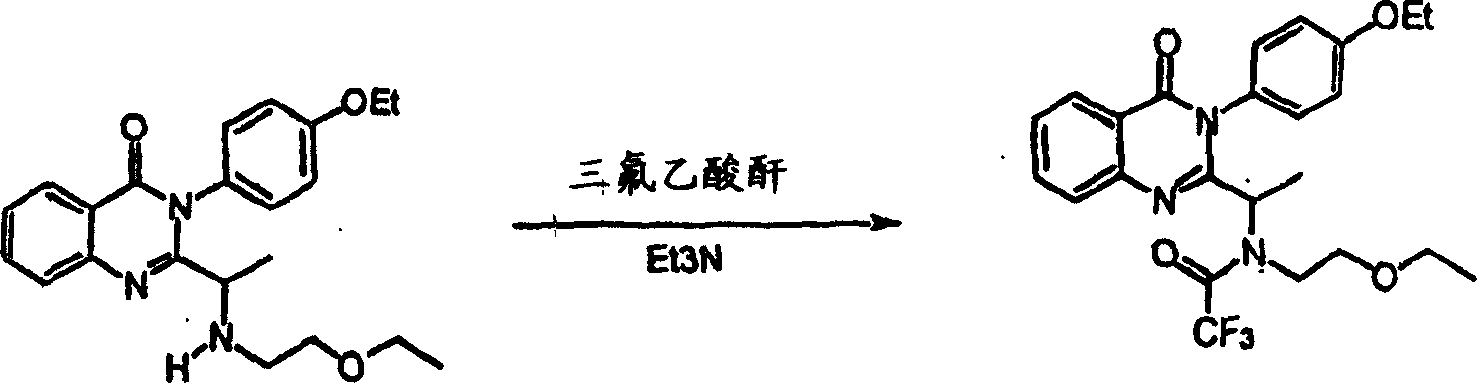
2-[1-(2-乙氧基-乙基氨基)-乙基]-3-(4-乙氧基- N-(2-乙氧基-乙基)-N-{1-[3-(4-乙氧基-苯基)-2-[1-(2-ethoxy-ethylamino)-ethyl]-3-(4-ethoxy-N-(2-ethoxy-ethyl)-N-{1-[3 -(4-ethoxy-phenyl)-
苯基)-3H-喹唑啉-4-酮 4-氧代-3,4-二氢-喹唑啉-2-基]-乙基}-2,2,2-三
氟代-乙酰胺1.55Fluoro-acetamide 1.55
在室温下,将三氟乙酐(0.024g,0.113mmol)滴加入到胺(0.036g,0.094mmol)和Et3N(0.014g,0.142mmol)的CH2Cl2混合物中。搅拌1小时后,用水、盐水洗涤有机层,经NaSO4干燥并在真空中除去得到油状物,将该油状物经层析纯化,得到无色油状物,化合物1.55。Trifluoroacetic anhydride (0.024 g, 0.113 mmol) was added dropwise to a CH2Cl2 mixture of amine (0.036 g , 0.094 mmol) and Et3N (0.014 g, 0.142 mmol) at room temperature. After stirring for 1 hour, the organic layer was washed with water, brine, dried over NaSO4 and removed in vacuo to give an oil, which was purified by chromatography to give a colorless oil, compound 1.55.
1H NMR(CDCl3)1.06(t,3H,J=7.04Hz),1.45(t,3H,J=7.0Hz),1.54(d,3H,J=7Hz),3.38(m,2H),3.58(t,2H,J=6.2Hz),3.70(t,2H,J=6.2Hz),4.08(m,2H),5.19(q,1H,J=7Hz),7.01(m,2H),7.14(m,1H),7.32(m,1H),7.51(m,1H),7,77(m,2H),8.27(d,1H,J=7.3Hz)MS(ESI+)478.3(MH+). 1 H NMR (CDCl 3 ) 1.06(t, 3H, J=7.04Hz), 1.45(t, 3H, J=7.0Hz), 1.54(d, 3H, J=7Hz), 3.38(m, 2H), 3.58 (t, 2H, J=6.2Hz), 3.70(t, 2H, J=6.2Hz), 4.08(m, 2H), 5.19(q, 1H, J=7Hz), 7.01(m, 2H), 7.14( m, 1H), 7.32(m, 1H), 7.51(m, 1H), 7,77(m, 2H), 8.27(d, 1H, J=7.3Hz) MS(ESI + ) 478.3(MH + ).
实施例2Example 2
化合物2.01的合成Synthesis of Compound 2.01
以五步骤由可购买得到的2-氨基-6-甲基-苯甲酸进行的2.01的合成是由方法2合成3H-喹唑啉-4-酮的实例(参见以下流程2)。The synthesis of 2.01 in five steps from commercially available 2-amino-6-methyl-benzoic acid is an example of the synthesis of 3H-quinazolin-4-ones by method 2 (see
流程2
(a)丙酰氯、DMF、RT,(b)PCl3、4-氟苯胺、甲苯、110℃(c)Br2、NaOAc、HOAc、40℃(d)1-(3-氨基乙基)吗啉、EtOH、80℃(e)联苯乙酰氯、Net3、催化量的DMAP、1,4-二噁烷(a) propionyl chloride, DMF, RT, (b) PCl 3 , 4-fluoroaniline, toluene, 110°C (c) Br 2 , NaOAc, HOAc, 40°C (d) 1-(3-aminoethyl)? Phyline, EtOH, 80°C (e) biphenylacetyl chloride, Net 3 , catalytic amount of DMAP, 1,4-dioxane
2-氨基-6-甲基-苯甲酸(VII) 2-甲基-6-丙酰基氨基-苯甲酸(VIII)2-Amino-6-methyl-benzoic acid (VII) 2-Methyl-6-propionylamino-benzoic acid (VIII)
2-甲基-6-丙酰基氨基-苯甲酸(VIII)。用30分钟,通过漏斗向室温下的溶于25mL干燥DMF中的4.35g 2-氨基-6-甲基-苯甲酸(VII)(28.8mmol,1.00当量)的溶液中滴加入2.75mL丙酰氯(31.7mmol,1.10当量)。完成加入酰基氯后,将非均相反应混合物在室温下搅拌3小时,然后倒入200mL水中。将所得到的带有白色沉淀物的水/DMF混合物在室温下剧烈搅拌1小时,此后经真空过滤收集固体,用冷水(2×50mL)漂洗该固体。将所述白色固体在真空中经五氧化二磷干燥过夜,得到4.65g白色固体。2-Methyl-6-propionylamino-benzoic acid (VIII). To a solution of 4.35 g of 2-amino-6-methyl-benzoic acid (VII) (28.8 mmol, 1.00 equiv) in 25 mL of dry DMF at room temperature was added dropwise 2.75 mL of propionyl chloride ( 31.7 mmol, 1.10 equiv). After complete addition of the acid chloride, the heterogeneous reaction mixture was stirred at room temperature for 3 hours and then poured into 200 mL of water. The resulting water/DMF mixture with a white precipitate was stirred vigorously at room temperature for 1 hour, after which time the solid was collected by vacuum filtration and rinsed with cold water (2 x 50 mL). The white solid was dried over phosphorus pentoxide in vacuo overnight to yield 4.65 g of a white solid.
m.p.152.5℃.1H NMR(d6-DMSO)δ1.06(t,3H,J=7.6Hz),2.29(q,2H,J=7.6Hz),2.35(s,3H),7.04(d,1H,J=7.6Hz),7.30(ddd,1H,J1=7.6Hz,J2=8.0Hz),7.47(d,1H,J=8.0Hz),9.57(s,1H),13.18(brs,1H)ppm.MS(ESI+)206.1[M-H]-.mp152.5°C. 1 H NMR (d 6 -DMSO) δ1.06(t, 3H, J=7.6Hz), 2.29(q, 2H, J=7.6Hz), 2.35(s, 3H), 7.04(d , 1H, J=7.6Hz), 7.30(ddd, 1H, J 1 =7.6Hz, J 2 =8.0Hz), 7.47(d, 1H, J=8.0Hz), 9.57(s, 1H), 13.18(brs , 1H)ppm.MS(ESI + )206.1[MH] - .
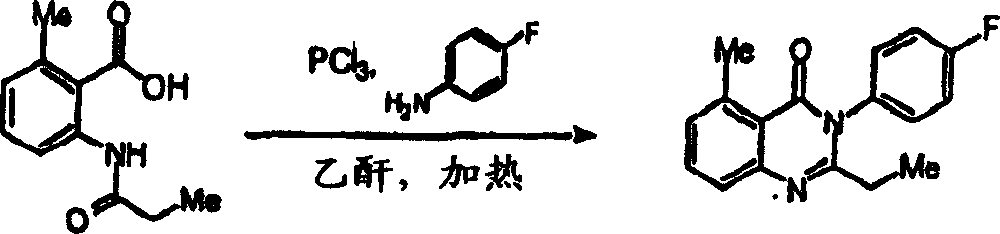
2-甲基-6-丙酰基氨基-苯甲酸(VIII) 2-乙基-3-(4-氟代-苯基)-5-甲基-3H-喹唑啉-4-2-Methyl-6-propionylamino-benzoic acid (VIII) 2-Ethyl-3-(4-fluoro-phenyl)-5-methyl-3H-quinazoline-4-
酮(IX)Ketone (IX)
2-乙基-3-(4-氟代-苯基)-5-甲基-3H-喹唑啉-4-酮(IX)。用30分钟,通过加料漏斗向4.266g 2-甲基-6-丙酰基氨基-苯甲酸(VIII)(20.58mmol,1.00当量)和2.14mL 4-氟苯胺(22.6mmol,1.10当量)悬浮在35mL甲苯中的混合物中滴加入1.08mL三氯化磷(12.3mmol,0.598当量)的10mL甲苯溶液。将所得到的非均相混合物加热至回流20小时,然后冷却至室温并用100mL甲苯稀释。向室温下的反应混合物中加入100mL 10%碳酸钠水溶液并将得到的两相物剧烈搅拌直至所有固体溶解。在真空中除去甲苯,产生沉淀物。经过滤收集固体,用水(2×75mL)漂洗。将风干的固体从异丙醇中重结晶纯化,得到3.31g无色薄片状物,在真空中经五氧化二磷干燥。2-Ethyl-3-(4-fluoro-phenyl)-5-methyl-3H-quinazolin-4-one (IX). Over 30 minutes, 4.266 g of 2-methyl-6-propionylamino-benzoic acid (VIII) (20.58 mmol, 1.00 equivalents) and 2.14 mL of 4-fluoroaniline (22.6 mmol, 1.10 equivalents) were suspended in 35 mL via an addition funnel To the mixture in toluene was added dropwise a solution of 1.08 mL of phosphorus trichloride (12.3 mmol, 0.598 equiv) in 10 mL of toluene. The resulting heterogeneous mixture was heated to reflux for 20 hours, then cooled to room temperature and diluted with 100 mL of toluene. To the reaction mixture at room temperature was added 100 mL of 10% aqueous sodium carbonate and the resulting biphasic was stirred vigorously until all solids had dissolved. Toluene was removed in vacuo resulting in a precipitate. The solid was collected by filtration and rinsed with water (2 x 75 mL). The air-dried solid was purified by recrystallization from isopropanol to give 3.31 g of colorless flakes, which were dried in vacuo over phosphorus pentoxide.
m.p.170.0℃.1H NMR(CDCl3)δ1.24(t,3H,J=7.6Hz),2.44(q,2H,J=7.6Hz),2.84(s,3H),7.25(dd,1H,J1=1.6Hz,J2=6.4Hz),7.27(2xd,2x2H,J=6.4Hz),7.58(dd,1H,J1=1.2Hz,J2=8.0Hz),7.63(dd,1H,J1=J2=8.0Hz)ppm.MS(ESI+)283.2[MH]+.mp170.0°C. 1 H NMR (CDCl 3 ) δ1.24(t, 3H, J=7.6Hz), 2.44(q, 2H, J=7.6Hz), 2.84(s, 3H), 7.25(dd, 1H , J 1 =1.6Hz, J 2 =6.4Hz), 7.27 (2xd, 2x2H, J=6.4Hz), 7.58 (dd, 1H, J 1 =1.2Hz, J 2 =8.0Hz), 7.63 (dd, 1H , J 1 =J 2 =8.0Hz)ppm.MS(ESI + )283.2[MH] + .
2-乙基-3-(4-氟代-苯基)-5-甲基-3H-喹唑啉-4- 2-(1-溴代-乙基)-3-(4-氟代-苯基)-5-甲基-3H-2-Ethyl-3-(4-fluoro-phenyl)-5-methyl-3H-quinazoline-4- 2-(1-bromo-ethyl)-3-(4-fluoro- Phenyl)-5-methyl-3H-
酮(IX) 喹唑啉-4-酮(X)Ketones (IX) Quinazolin-4-ones (X)
2-(1-溴代-乙基)-3-(4-氟代-苯基)-5-甲基-3H-喹唑啉-4-酮(X)。用30分钟,在40℃(外部温度,油浴)下通过加料漏斗向1.969g 2-乙基-3-(4-氟代-苯基)-5-甲基-3H-喹唑啉-4-酮(IX)(6.974mmol,1.000当量)和0.687g乙酸钠(8.37mmol,1.20当量)的28mL冰醋酸的混合物中滴加入溶于5mL冰醋酸中的0.372mL溴化物(7.32mmol,1.05当量)溶液。2小时后将反应溶液倒入250mL水中。将所得到混合物在室温下剧烈搅拌1小时,此后经真空过滤收集沉淀物,用温(约40℃)水(3×50mL)漂洗。将固体在真空中经五氧化二磷干燥过夜,得到2.19g白色固体。m.p.加热下分解。2-(1-Bromo-ethyl)-3-(4-fluoro-phenyl)-5-methyl-3H-quinazolin-4-one (X). With 30 minutes, 1.969g 2-ethyl-3-(4-fluoro-phenyl)-5-methyl-3H-quinazoline-4 - Ketone (IX) (6.974mmol, 1.000 equivalents) and 0.687g sodium acetate (8.37mmol, 1.20 equivalents) in the mixture of 28mL glacial acetic acid was added dropwise in 0.372mL bromide (7.32mmol, 1.05 equivalents) dissolved in 5mL glacial acetic acid ) solution. After 2 hours the reaction solution was poured into 250 mL of water. The resulting mixture was stirred vigorously at room temperature for 1 h, after which time the precipitate was collected by vacuum filtration and rinsed with warm (ca. 40 °C) water (3 x 50 mL). The solid was dried in vacuo over phosphorus pentoxide overnight to yield 2.19 g of a white solid. m.p. Decomposes on heating.
1H NMR(CDCl3)δ2.04(d,3H,J=6.8Hz),2.82(s,3H),4.51(q,1H,J=6.8Hz),7.15(ddd,1H,J1=2.4Hz,J2=4.4Hz,J3=8.4Hz),7.23(dd,1H,J1=2.8Hz,J2=10.8Hz),7.25-7.31(m,2H),7.56(ddd,J1=2.8Hz,J2=4.8Hz,J3=8.8Hz),7.64(2xd,2x1H,J=5.2Hz)ppm.MS(ESI+)361.1[MH]+. 1 H NMR (CDCl 3 ) δ 2.04 (d, 3H, J=6.8Hz), 2.82 (s, 3H), 4.51 (q, 1H, J=6.8Hz), 7.15 (ddd, 1H, J 1 =2.4 Hz, J 2 =4.4 Hz, J 3 =8.4 Hz), 7.23 (dd, 1H, J 1 =2.8 Hz, J 2 =10.8 Hz), 7.25-7.31 (m, 2H), 7.56 (ddd, J 1 = 2.8Hz, J 2 =4.8Hz, J 3 =8.8Hz), 7.64 (2xd, 2x1H, J=5.2Hz)ppm. MS(ESI + )361.1[MH] + .
2-(1-溴代-乙基)-3-(4-氟代-苯基)-5-甲基-3H-喹唑啉- 3-(4-氟代-苯基)-5-甲基-2-[1-(2-吗啉-4-基-乙基氨基)-2-(1-Bromo-ethyl)-3-(4-fluoro-phenyl)-5-methyl-3H-quinazoline-3-(4-fluoro-phenyl)-5-methanol Base-2-[1-(2-morpholin-4-yl-ethylamino)-
4-酮(X) 乙基]-3H-喹唑啉-4-酮(XI)
3-(4-氟代-苯基)-5-甲基-2-[1-(2-吗啉-4-基-乙基氨基)-乙基]-3H-喹唑啉-4-酮(XI)。将0.283g 2-(1-溴代-乙基)-3-(4-氟代-苯基)-5-甲基-3H-喹唑啉-4-酮(XI)(0.784mmol,1.000当量)和0.165mL 1-(2-氨基乙基)吗啉(1.25mmol,1.60当量)的5mL乙醇混合物加热至回流。20小时后,在真空中除去乙醇并将浓缩部分分配在二氯甲烷和饱和碳酸氢钠水溶液(各20mL)之间。再用二氯甲烷(15mL)萃取分离的含水层并将合并的有机萃取液经硫酸镁干燥,过滤并在真空中浓缩得到黄色泡沫状物。将该粗制物经硅胶层析(3.5cm o.d.x12cmh)上纯化,用5%甲醇的氯仿液洗脱。合并含有产物的流分并在真空中浓缩,得到257mg浅黄色固体。3-(4-fluoro-phenyl)-5-methyl-2-[1-(2-morpholin-4-yl-ethylamino)-ethyl]-3H-quinazolin-4-one (XI). 0.283g 2-(1-bromo-ethyl)-3-(4-fluoro-phenyl)-5-methyl-3H-quinazolin-4-one (XI) (0.784mmol, 1.000 equivalent ) and 0.165mL of 1-(2-aminoethyl)morpholine (1.25mmol, 1.60 equivalents) in 5mL of ethanol mixture was heated to reflux. After 20 hours, the ethanol was removed in vacuo and the concentrated portion was partitioned between dichloromethane and saturated aqueous sodium bicarbonate (20 mL each). The separated aqueous layer was further extracted with dichloromethane (15 mL) and the combined organic extracts were dried over magnesium sulfate, filtered and concentrated in vacuo to give a yellow foam. The crude was purified by chromatography on silica gel (3.5 cm o.d. x 12 cmh), eluting with 5% methanol in chloroform. Fractions containing product were combined and concentrated in vacuo to give 257 mg of a pale yellow solid.
m.p.192.9℃.1H NMR(CDCl3)δ1.27(d,3H,J=6.4Hz),2.26-2.34(m,3H),2.38-2.44(m,1H),2.46-2.52(m,2H),2.56-2.70(m,2H),2.82(s,3H),3.39(q,1H,J=6.4Hz),3.70-3.80(m,4H),7.18-7.29(m,5H),7.46(dd,1H,J1=0.8Hz,J2=8.0Hz),7.61(dd,1H,J1=7.6Hz,J2=7.8Hz)ppm.MS(ESI+)411.2[MH]+ mp192.9°C. 1 H NMR (CDCl 3 ) δ1.27 (d, 3H, J=6.4Hz), 2.26-2.34 (m, 3H), 2.38-2.44 (m, 1H), 2.46-2.52 (m, 2H), 2.56-2.70(m, 2H), 2.82(s, 3H), 3.39(q, 1H, J=6.4Hz), 3.70-3.80(m, 4H), 7.18-7.29(m, 5H), 7.46 (dd, 1H, J 1 =0.8Hz, J 2 =8.0Hz), 7.61 (dd, 1H, J 1 =7.6Hz, J 2 =7.8Hz) ppm.MS(ESI + )411.2[MH] +

3-(4-氟代-苯基)-5-甲基-2-[1-(2-吗啉-4-基-乙基氨基)- 2-联苯-4-基-N-{1-[3-(4-氟代-苯基)-5-甲基-4-氧代-3-(4-fluoro-phenyl)-5-methyl-2-[1-(2-morpholin-4-yl-ethylamino)-2-biphenyl-4-yl-N-{1 -[3-(4-fluoro-phenyl)-5-methyl-4-oxo-
乙基]-3H-喹唑啉-4-酮(XI) 3,4-二氢-喹唑啉-2-基]-乙基}-N-(2-吗啉-4-基-乙基)乙Ethyl]-3H-quinazolin-4-one (XI) 3,4-dihydro-quinazolin-2-yl]-ethyl}-N-(2-morpholin-4-yl-ethyl )Second
酰胺(2.01)Amide (2.01)
化合物2.01。向室温下的溶于3mL二氯甲烷中的127mg 3-(4-氟代-苯基)-5-甲基-2-[1-(2-吗啉-4-基-乙基氨基)-乙基]-3H-喹唑啉-4-酮(XI)(0.309mmol,1.00当量)、0.084mL三乙胺(0.618mmol,2.00当量)和2.0mg DMAP(0.016mmol,0.052当量)溶液中加入107mg联苯基乙酰氯(0.463mmol,1.50当量)。将澄清的、淡黄色-反应混合物在室温下搅拌12小时,然后倒入10mL饱和碳酸氢钠水溶液中。用第二份体积的二氯甲烷(20mL)萃取分离的含水层。将合并的有机萃取液经硫酸镁干燥,过滤并在真空中浓缩得到橙色油状物。将该粗制物经层析在硅胶(3.5cm o.d.x10cmh)上纯化,用2%甲醇的氯仿溶液洗脱。合并在Rf=0.48,5%甲醇的氯仿溶液中含有产物的流分并在真空中浓缩,得到115mg浅黄色、粘性油状物。Compound 2.01. To 127 mg of 3-(4-fluoro-phenyl)-5-methyl-2-[1-(2-morpholin-4-yl-ethylamino)- Ethyl]-3H-quinazolin-4-one (XI) (0.309mmol, 1.00 equivalent), 0.084mL triethylamine (0.618mmol, 2.00 equivalent) and 2.0mg DMAP (0.016mmol, 0.052 equivalent) solution were added 107 mg of biphenylacetyl chloride (0.463 mmol, 1.50 equiv). The clear, pale yellow-reaction mixture was stirred at room temperature for 12 hours, then poured into 10 mL of saturated aqueous sodium bicarbonate. The separated aqueous layer was extracted with a second volume of dichloromethane (20 mL). The combined organic extracts were dried over magnesium sulfate, filtered and concentrated in vacuo to an orange oil. The crude was purified by chromatography on silica gel (3.5 cm od x 10 cmh), eluting with 2% methanol in chloroform. Fractions containing product in Rf = 0.48, 5% methanol in chloroform were combined and concentrated in vacuo to give 115 mg of a pale yellow, viscous oil.
1H NMR(d6-DMSO;T=140℃)δ1.44(d,3H,J=6.4Hz),2.28-2.42(m,5H),2.50-2.60(m,1H),2.77(s,3H),3.38-3.64(m,8H),5.12(q,1H,J=6.8Hz),7.20(m,2H),7.27-7.38(m,5H),7.40-7.47(m,3H),7.51-7.56(m,3H),7.58-7.64(m,2H),7.68(dd,1H,J1=J2=7.6Hz)ppm. 1 H NMR (d 6 -DMSO; T=140°C) δ1.44(d, 3H, J=6.4Hz), 2.28-2.42(m, 5H), 2.50-2.60(m, 1H), 2.77(s, 3H), 3.38-3.64(m, 8H), 5.12(q, 1H, J=6.8Hz), 7.20(m, 2H), 7.27-7.38(m, 5H), 7.40-7.47(m, 3H), 7.51 -7.56(m, 3H), 7.58-7.64(m, 2H), 7.68(dd, 1H, J 1 =J 2 =7.6Hz)ppm.
在室温下,以顺式/反式酰胺旋转异构体混合物(约3∶2)形式存在,由1H NMR(CDCl3;T=25℃)测定:δ4.84(q,1.0H,J=6.8Hz)&5.28(q,1.4H,J=6.8Hz)ppm。MS(ESI+)605.3[MH]+。At room temperature, it exists in the form of a cis/trans amide rotamer mixture (about 3:2), determined by 1 H NMR (CDCl 3 ; T=25°C): δ4.84(q, 1.0H, J = 6.8Hz) & 5.28 (q, 1.4H, J = 6.8Hz) ppm. MS(ESI + )605.3[MH] + .
化合物2.02的合成Synthesis of compound 2.02
2-联苯-4-基-N-(2-二甲基氨基-乙基)-N-{1-[3-(4-氟代-苯基)-8-甲氧基-4-氧代-3,4-二氢-喹唑啉-2-基]-乙基}乙酰胺(2.02)2-biphenyl-4-yl-N-(2-dimethylamino-ethyl)-N-{1-[3-(4-fluoro-phenyl)-8-methoxy-4-oxo Generation-3,4-dihydro-quinazolin-2-yl]-ethyl}acetamide (2.02)
根据以上所述化合物2.01的合成方法制备化合物2.02。合成顺序按照方法2,其中在步骤a中使用2-氨基-3-甲氧基-苯甲酸代替2-氨基-6-甲基苯甲酸。对于化合物2.02的特征数据如下:无色、粘性油状物。1H NMR类似与化合物2.01的光谱:约3∶1顺式/反式酰胺旋转异构体混合物(CDCl3,T=25℃),其特征共振峰值在δ次要4.89(q,1.0H,J=6.8Hz)和δ主要5.28(q,2.8H,J=7.6Hz)ppm。MS(ESI+)579.3[MH]+ Compound 2.02 was prepared according to the synthesis method of compound 2.01 described above. The synthetic sequence follows
化合物2.03的合成Synthesis of compound 2.03
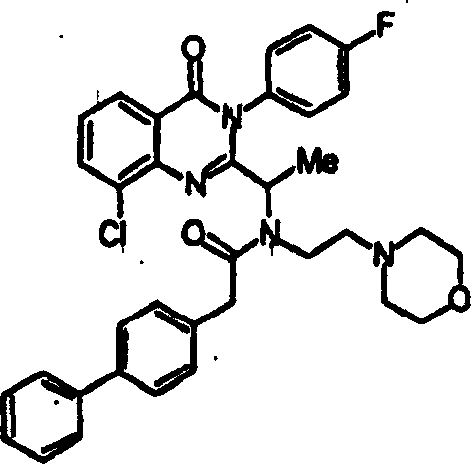
2-联苯-4-基-N-{1-[8-氯代-3-(4-氟代-苯基)-4-氧代-3,4-二氢-喹唑啉-2-基]-乙基}-N-(2-吗啉-4-基-乙基)-乙酰胺(2.03)2-biphenyl-4-yl-N-{1-[8-chloro-3-(4-fluoro-phenyl)-4-oxo-3,4-dihydro-quinazoline-2- Base]-ethyl}-N-(2-morpholin-4-yl-ethyl)-acetamide (2.03)
根据以上所述化合物2.01的合成方法制备化合物2.03。合成顺序按照方法2,其中在步骤a中使用2-氨基-3-氯代-苯甲酸代替2-氨基-6-甲基苯甲酸。对于化合物2.03的特征数据如下:无色、粘性油状物。1H NMR与化合物2.01的光谱相似:为约3∶1顺式/反式酰胺旋转异构体混合物(CDCl3;T=25℃),其特征共振峰在δ次要4.89(q,1.0H,J=6.4Hz)和δ主要5.23(q,2.7H,J=6.8Hz)ppm。MS(ESI+)625.3[MH]+ Compound 2.03 was prepared according to the synthesis method of compound 2.01 described above. The synthetic sequence follows
化合物2.04的合成Synthesis of compound 2.04
根据以上所述化合物2.01的合成方法制备化合物2.04。合成顺序按照方法2,其中在步骤a中使用2-氨基-3-甲基-苯甲酸代替2-氨基-6-甲基苯甲酸。对于化合物2.04的特征数据如下:无色、粘性油状物。1H NMR与化合物2.01的光谱相似:为约3∶2顺式/反式酰胺旋转异构体混合物(CDCl3;T=25℃),其特征共振峰在δ次要4.92(q,1.0H,J=6.7Hz)和δ主要5.35(q,1.7H,J=7.3Hz)ppm。MS(ESI+)605.3[MH]+ Compound 2.04 was prepared according to the synthesis method of compound 2.01 described above. The synthetic sequence follows
化合物2.05的合成Synthesis of Compound 2.05

根据以上所述化合物2.01的合成方法制备化合物2.05。合成顺序按照方法2,其中在步骤a中使用2-氨基-6-氯代-苯甲酸代替2-氨基-6-甲基-苯甲酸。对于化合物2.05的特征数据如下:无色、粘性油状物。1H NMR与化合物2.01的光谱相似:为约2∶1顺式/反式酰胺旋转异构体混合物(CDCl3;T=25℃),其特征共振峰在δ次要4.84(q,1.0H,J=6.8Hz)和δ主要5.21(q,2.0H,J=6.8Hz)ppm。MS(ESI+)625.3[MH]+ Compound 2.05 was prepared according to the synthesis method of compound 2.01 described above. The synthetic sequence follows
化合物2.06的合成Synthesis of Compound 2.06
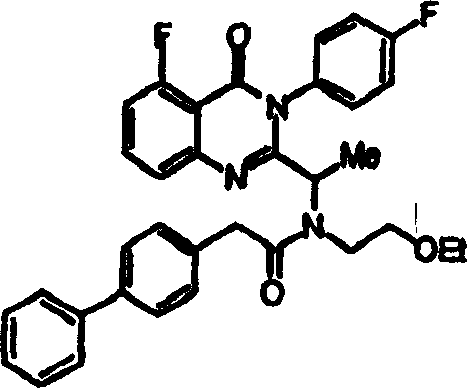
2-联苯-4-基-N-(2-乙氧基-乙基)-N-{1-[5-氟代-3-(4-氟代-苯基)-4-氧代-3,4-二氢-喹唑啉-2-基]-乙基}-乙酰胺(2.06)2-biphenyl-4-yl-N-(2-ethoxy-ethyl)-N-{1-[5-fluoro-3-(4-fluoro-phenyl)-4-oxo- 3,4-Dihydro-quinazolin-2-yl]-ethyl}-acetamide (2.06)
根据以上所述化合物2.01的合成方法制备化合物2.06。合成顺序按照方法2,其中在步骤a中使用2-氨基-6-氟代-苯甲酸代替2-氨基-6-甲基苯甲酸和在步骤d中使用2-乙氧基-1-氨基丙烷代替1-(2-氨基乙基)吗啉。对于化合物2.06的特征数据如下:无色、粘性油状物。Compound 2.06 was prepared according to the synthesis method of compound 2.01 described above. The synthetic sequence follows
1H NMR与化合物2.01的光谱相似:为约5∶2顺式/反式酰胺旋转异构体混合物(CDCl3;T=25℃),其特征共振峰在δ次要4.87(q,1.0H,J=6.7Hz)和δ主要5.27(q,2.5H,J=7.0Hz)ppm。MS(ESI+)568.2[MH]+ 1 H NMR is similar to the spectrum of compound 2.01: it is about 5:2 cis/trans amide rotamer mixture (CDCl 3 ; T=25°C), and its characteristic resonance peak is at δ minor 4.87 (q, 1.0H , J=6.7Hz) and δ main 5.27 (q, 2.5H, J=7.0Hz) ppm. MS(ESI + )568.2[MH] +
化合物2.07的合成Synthesis of Compound 2.07
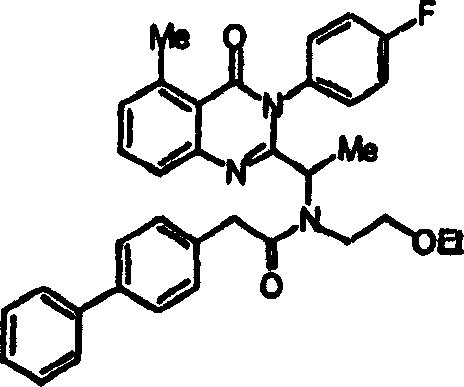
2-联苯-4-基-N-(2-乙氧基-乙基)-N-{1-[5-甲基-3-(4-氟代-苯基)-4-氧代-3,4-二氢-喹唑啉-2-基]-乙基}-乙酰胺(2.07)2-biphenyl-4-yl-N-(2-ethoxy-ethyl)-N-{1-[5-methyl-3-(4-fluoro-phenyl)-4-oxo- 3,4-Dihydro-quinazolin-2-yl]-ethyl}-acetamide (2.07)
根据以上所述化合物2.01的合成方法制备化合物2.07。合成顺序按照方法2,其中在步骤d中使用2-乙氧基-1-氨基乙烷代替1-(2-氨基乙基)吗啉。对于化合物2.07的特征数据如下:无色、粘性油状物。1H NMR与化合物2.01的光谱相似:为约2∶1顺式/反式酰胺旋转异构体混合物(CDCl3;T=25℃),其特征共振峰在δ次要4.85(q,1.0H,J=6.8Hz)和δ主要5.29(q,1.8H,J=6.6Hz)ppm。MS(ESI+)564.3[MH]+ Compound 2.07 was prepared according to the synthesis method of compound 2.01 described above. The synthetic sequence follows
化合物2.08的合成Synthesis of Compound 2.08
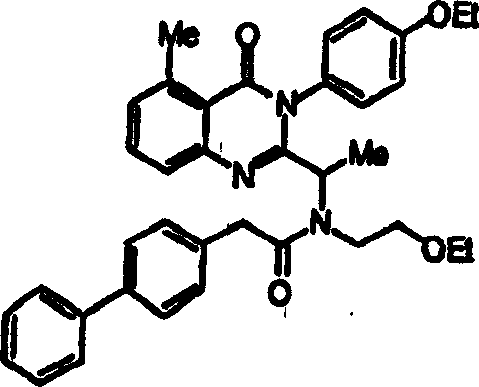
2-联苯-4-基-N-(2-乙氧基-乙基)-N-{1-[3-(4-乙氧基-苯基)-5-甲基-4-氧代-3,4-二氢-喹唑啉-2-基]-乙基}-乙酰胺(2.08)2-biphenyl-4-yl-N-(2-ethoxy-ethyl)-N-{1-[3-(4-ethoxy-phenyl)-5-methyl-4-oxo -3,4-dihydro-quinazolin-2-yl]-ethyl}-acetamide (2.08)
根据以上所述化合物2.01的合成方法制备化合物2.08。合成顺序按照方法2,其中在步骤b中使用4-乙氧基苯胺代替4-氟苯胺和在步骤d中使用2-乙氧基-1-氨基乙烷代替1-(2-氨基乙基)吗啉。对于化合物2.08的特征数据如下:无色、粘性油状物。1H NMR与化合物2.01的光谱相似:为约1∶1顺式/反式酰胺旋转异构体混合物(CDCl3;T=25℃),其特征共振峰在δA4.95(q,1.1H,J=6.8Hz)和δB5.35(q,1.0H,J=6.8Hz)ppm。MS(ESI+)590.3[MH]+ Compound 2.08 was prepared according to the synthesis method of compound 2.01 described above. The synthetic sequence follows
化合物2.09的合成Synthesis of Compound 2.09

2-联苯-4-基-N-{1-[3-(4-氰基-苯基)-5-甲基-4-氧代-3,4-二氢-喹唑啉-2-基]-丙基}-N-(2-乙氧基-乙基)-乙酰胺(2.09)2-biphenyl-4-yl-N-{1-[3-(4-cyano-phenyl)-5-methyl-4-oxo-3,4-dihydro-quinazoline-2- Base]-propyl}-N-(2-ethoxy-ethyl)-acetamide (2.09)
根据以上所述化合物2.01的合成方法制备化合物2.09。合成顺序按照方法2,其中在步骤a中使用丁酰氯代替丙酰氯和在步骤b中使用4-氰基苯胺代替4-氟苯胺,在步骤d中使用2-乙氧基-1-氨基乙烷代替1-(2-氨基乙基)吗啉。对于化合物2.09的特征数据如下:无色、粘性油状物。1H NMR与化合物2.01的光谱相似:为约4∶1顺式/反式酰胺旋转异构体混合物(CDCl3;T=25℃),其特征共振峰在δ次要4.39(dd,1.0H,J1=4.4Hz,J2=10.0Hz)和δ主要5.31(dd,3.9H,J1=J2=7.2Hz)ppm。MS(ESI+)585.3[MH]+ Compound 2.09 was prepared according to the synthesis method of compound 2.01 described above. The synthetic sequence follows
化合物2.10的合成Synthesis of Compound 2.10
2-联苯-4-基-N-(2-乙氧基-乙基)-N-{1-[3-(4-乙氧基-苯基)-4-氧代-3,4-二氢-吡啶并[2,3-d]嘧啶-2-基]-乙基}-乙酰胺(2.10)2-biphenyl-4-yl-N-(2-ethoxy-ethyl)-N-{1-[3-(4-ethoxy-phenyl)-4-oxo-3,4- Dihydro-pyrido[2,3-d]pyrimidin-2-yl]-ethyl}-acetamide (2.10)
根据以上所述化合物2.01的合成方法制备化合物2.10。合成顺序按照方法2,其中在步骤a中使用2-氨基烟酸代替2-氨基-6-甲基苯甲酸,在步骤b中使用4-乙氧基苯胺代替4-氟苯胺,在步骤d中使用2-乙氧基-1-氨基乙烷代替1-(2-氨基乙基)吗啉。对于化合物2.10的特征数据如下:浅黄色、粘性油状物。1H NMR与化合物2.01的光谱相似:为约1∶1顺式/反式酰胺旋转异构体混合物(CDCl3;T=25℃)特征共振峰在δ次要5.04(q,1.0H,J=6.4Hz)和δ主要5.41(q,1.0H,J=7.2Hz)ppm。MS(ESI+)577.3[MH]+ Compound 2.10 was prepared according to the synthesis method of compound 2.01 described above. The synthetic sequence followed
化合物2.11的合成Synthesis of Compound 2.11
2-联苯-4-基-N-(2-乙氧基-乙基)-N-{1-[3-(4-乙氧基-苯基)-5-甲基-4-氧代-3,4-二氢-喹唑啉-2-基]-丙基}-乙酰胺(2.11)2-biphenyl-4-yl-N-(2-ethoxy-ethyl)-N-{1-[3-(4-ethoxy-phenyl)-5-methyl-4-oxo -3,4-dihydro-quinazolin-2-yl]-propyl}-acetamide (2.11)
根据以上所述化合物2.01的合成方法制备化合物2.11。合成顺序按照方法2,其中在步骤a中使用丁酰氯代替丙酰氯,在步骤b中使用4-乙氧基苯胺代替4-氟苯胺,在步骤d中使用2-乙氧基-1-氨基乙烷代替1-(2-氨基乙基)吗啉。对于化合物2.11的特征数据如下:无色、粘性油状物。Compound 2.11 was prepared according to the synthesis method of compound 2.01 described above. The synthetic sequence follows
1H NMR(d6-DMSO;T=140℃)δ0.80(t,3H,J=7.6Hz),0.94(t,3H,J=6.8Hz),1.35(t,3H,J=6.8Hz),1.59-1.70(m,1H),2.20-2.30(m,1H),2.77(s,3H),3.22-3.42(m,4H),3.47-3.65(m,2H),4.10(q,2H,J=6.8Hz),5.01(brq,1H),6.98-7.12(m,2H),7.15-7.27(m,4H),7.29-7.36(m,2H),7.41-7.47(m,2H),7.51-7.56(m,3H),7.59-7.63(m,2H),7.67(dd,1H,J1=7.6Hz,J2=7.8Hz)ppm. 1 H NMR (d 6 -DMSO; T=140°C) δ0.80(t, 3H, J=7.6Hz), 0.94(t, 3H, J=6.8Hz), 1.35(t, 3H, J=6.8Hz ), 1.59-1.70(m, 1H), 2.20-2.30(m, 1H), 2.77(s, 3H), 3.22-3.42(m, 4H), 3.47-3.65(m, 2H), 4.10(q, 2H , J=6.8Hz), 5.01(brq, 1H), 6.98-7.12(m, 2H), 7.15-7.27(m, 4H), 7.29-7.36(m, 2H), 7.41-7.47(m, 2H), 7.51-7.56(m, 3H), 7.59-7.63(m, 2H), 7.67(dd, 1H, J 1 =7.6Hz, J 2 =7.8Hz)ppm.
在室温下,化合物以约5∶3顺式/反式酰胺旋转异构体混合物的形式存在,1H NMR(CDCl3;T=25℃)δ主要4.65(dd,1.7H,J1=4.8Hz,J2=10.0Hz)和δ次要5.39(dd,1.0H,J1=J2=7.2Hz)ppm。MS(ESI+)604.2[MH]+ At room temperature, the compound exists as a mixture of about 5:3 cis/trans amide rotamers, 1 H NMR (CDCl 3 ; T=25°C) δ is mainly 4.65 (dd, 1.7H, J 1 =4.8 Hz, J 2 =10.0 Hz) and delta minor 5.39 (dd, 1.0 H, J 1 =J 2 =7.2 Hz) ppm. MS(ESI + )604.2[MH] +
化合物2.12的合成Synthesis of Compound 2.12
N-(2-乙氧基-乙基)-N-{1-[3-(4-乙氧基-苯基)-4-氧代-3,4-二氢-吡啶并[2,3-d]嘧啶-2-基]-乙基}-2-(4-三氟代甲基-苯基)-乙酰胺(2.12)N-(2-ethoxy-ethyl)-N-{1-[3-(4-ethoxy-phenyl)-4-oxo-3,4-dihydro-pyrido[2,3 -d]pyrimidin-2-yl]-ethyl}-2-(4-trifluoromethyl-phenyl)-acetamide (2.12)
根据以上所述化合物2.01的合成方法制备化合物2.12。合成顺序按照方法2,其中在步骤a中使用2-氨基烟酸代替2-氨基-6-甲基苯甲酸,在步骤b中使用4-乙氧基苯胺代替4-氟苯胺,在步骤d中使用2-乙氧基-1-氨基乙烷代替1-(2-氨基乙基)吗啉,在步骤e中使用4-三氟甲基苯基乙酸代替联苯基乙酰氯。对于化合物2.12的特征数据如下:无色、粘性油状物。Compound 2.12 was prepared according to the synthesis method of compound 2.01 described above. The synthetic sequence followed
1H NMR(d6-DMSO;T=140℃)δ0.96(T,3H,J=7.2Hz),1.36(t,3H,J=7.2Hz),1.47(d,3H,J=6.4Hz),3.29-3.40(m,2H),3.42-3.51(m,2H),3.54-3.64(m,2H),4.11(q,2H,J=6.8Hz),5.20(q,1H,J=7.2Hz),7.00-7.10(m,2H),7.23-7.41(m,4H),7.53-7.60(m,3H),8.50(dd,1H,J1=2.4Hz,J2=8.4Hz),9.00(dd,1H,J1=2.0Hz,J2=4.4Hz)ppm. 1 H NMR (d 6 -DMSO; T=140°C) δ0.96(T, 3H, J=7.2Hz), 1.36(t, 3H, J=7.2Hz), 1.47(d, 3H, J=6.4Hz ), 3.29-3.40(m, 2H), 3.42-3.51(m, 2H), 3.54-3.64(m, 2H), 4.11(q, 2H, J=6.8Hz), 5.20(q, 1H, J=7.2 Hz), 7.00-7.10 (m, 2H), 7.23-7.41 (m, 4H), 7.53-7.60 (m, 3H), 8.50 (dd, 1H, J1 = 2.4Hz, J2 = 8.4Hz), 9.00 (dd, 1H, J 1 =2.0Hz, J 2 =4.4Hz)ppm.
在室温下,化合物以约3∶2顺式/反式酰胺旋转异构体混合物的形式存在,1H NMR(CDCl3;T=25℃)δ次要5.00(q,1.0H,J=6.0Hz)和δ主要5.38(q,1.4H,J=7.2Hz)ppm。MS(ESI+)569.3[MH]+ At room temperature, the compound exists as an approximately 3:2 cis/trans amide rotamer mixture, 1 H NMR (CDCl 3 ; T=25°C) δ minor 5.00 (q, 1.0H, J=6.0 Hz) and δ major 5.38 (q, 1.4H, J = 7.2Hz) ppm. MS(ESI + )569.3[MH] +
实施例3Example 3
化合物3.01的合成Synthesis of compound 3.01
经过五个步骤由可购买得到的起始原料进行的化合物3.01的合成提供了对映体过量形式的3H-喹唑啉-4-酮合成的实例。流程3提供了合成途径的概要,以下是其实验的详述。The synthesis of compound 3.01 in five steps from commercially available starting materials provides an example of the synthesis of 3H-quinazolin-4-one in enantiomeric excess. Scheme 3 provides an overview of the synthetic pathway followed by a detailed description of its experiments.
流程3Process 3
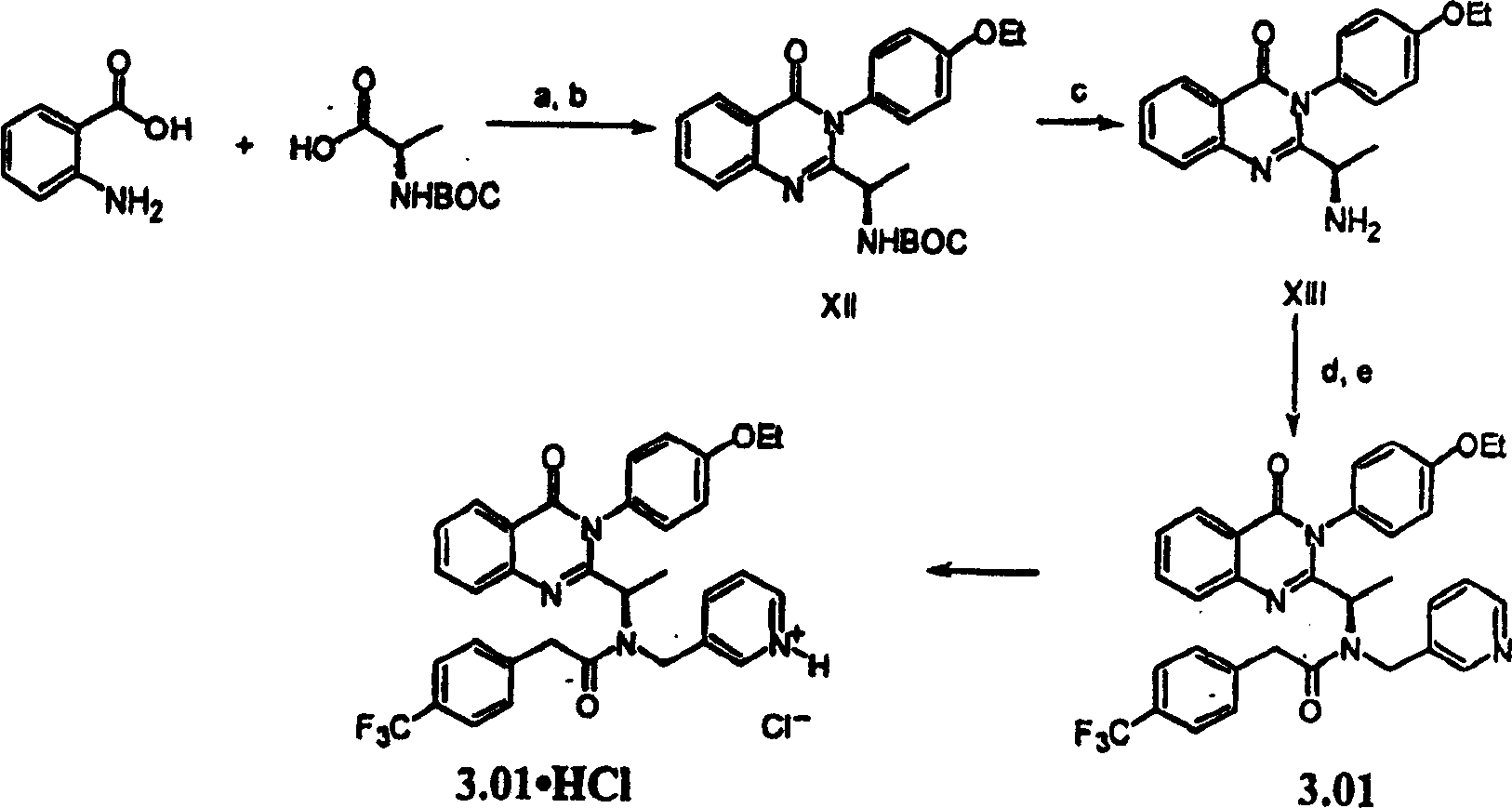
a.P(OPh)3、吡啶、55℃、14小时;b.对-氨基苯乙醚、55℃、1小时c.TMSI、MeCN、25℃、1小时;d.3-吡啶甲基氯盐酸盐、KI、K2CO3、DMPU;e.4-三氟甲基苯乙酸、EDC、HOBT、CH2Cl2;f.HCl、CH2Cl2、Et2O。aP(OPh) 3 , pyridine, 55°C, 14 hours; b. p-aminophenethyl ether, 55°C, 1 hour c. TMSI, MeCN, 25°C, 1 hour; d. 3-pyridylmethyl chloride hydrochloride , KI, K 2 CO 3 , DMPU; e. 4-trifluoromethylphenylacetic acid, EDC, HOBT, CH 2 Cl 2 ; f. HCl, CH 2 Cl 2 , Et 2 O.
(R)-2-(1-N-BOC-氨基乙基)-3-(4-乙氧基苯基)-3H-喹唑啉-4-酮XII)。在室温下,向邻氨基苯甲酸(411mg,3.0mmol,1.0当量)和N-BOC-D-丙氨酸(568mg,3.0mmol,1.0当量)的3.0mL无水吡啶溶液中加入0.96mL三苯膦(1.14g,3.6mmol,1.2当量)。将所得到的黄色溶液在50℃下搅拌20小时。通过注射器加入对-氨基苯乙醚(453mg,3.3mmol,1.1当量)。将该反应混合物在50℃下再搅拌2小时,冷却至室温并在真空中蒸发以除去大部分吡啶。将溶于15mL乙醚中的残余物连续用9mL 5%磷酸水溶液洗涤两次,用9mL 1M NaOH洗涤两次,用5mL pH7磷酸盐缓冲液(0.5M KH2PO4和0.5M K2HPO4)洗涤一次并用9mL盐水洗涤一次。经Na2SO4干燥有机层并在真空中蒸发得到棕色残余物,将该残余物从3mL EtOAc和12mL庚烷混合物中重结晶,得到0.51g化合物XII,为白色固体。在真空中浓缩母液得到棕色残余物,将该残余物从1mL EtOAc和4mL庚烷混合物中重结晶,得到第二批0.13g化合物XII,为浅黄色固体。(R)-2-(1-N-BOC-aminoethyl)-3-(4-ethoxyphenyl)-3H-quinazolin-4-one XII). To a solution of anthranilic acid (411 mg, 3.0 mmol, 1.0 equiv) and N-BOC-D-alanine (568 mg, 3.0 mmol, 1.0 equiv) in 3.0 mL of anhydrous pyridine was added 0.96 mL of triphenyl Phosphine (1.14 g, 3.6 mmol, 1.2 equiv). The resulting yellow solution was stirred at 50 °C for 20 hours. p-Aminophenetole (453 mg, 3.3 mmol, 1.1 equiv) was added via syringe. The reaction mixture was stirred at 50 °C for a further 2 hours, cooled to room temperature and evaporated in vacuo to remove most of the pyridine. The residue dissolved in 15 mL of diethyl ether was successively washed twice with 9 mL of 5% aqueous phosphoric acid, twice with 9 mL of 1M NaOH, and 5 mL of pH 7 phosphate buffer (0.5M KH2PO4 and 0.5M K2HPO4 ) once and washed once with 9 mL of saline. The organic layer was dried over Na2SO4 and evaporated in vacuo to give a brown residue which was recrystallized from a mixture of 3 mL EtOAc and 12 mL heptane to give 0.51 g of compound XII as a white solid. Concentration of the mother liquor in vacuo gave a brown residue, which was recrystallized from a mixture of 1 mL EtOAc and 4 mL heptane to afford a second crop of 0.13 g of compound XII as a pale yellow solid.
m.p.143.7℃.1H NMR(DMSO-d6)δ1.19(d,J=6.4Hz,3H),1.32(s,9H),1.37(t,J=6.8Hz,3H),4.10(q,J=6.9Hz,2H),4.24(m,1H),7.09(m,2H),7.28(d,J=8.0Hz,2H),7.39(dd,J=8.4,2.0Hz,1H),7.54(t,J=7.6Hz,1H),7.69(d,J=8.0Hz,1H),7.85(t,J=8.0Hz,1H),8.11(d,J=8.0Hz,1H)ppm.MS(ESI+)m/z410.2[M+H]+.mp143.7℃. 1 H NMR (DMSO-d 6 ) δ1.19(d, J=6.4Hz, 3H), 1.32(s, 9H), 1.37(t, J=6.8Hz, 3H), 4.10(q , J=6.9Hz, 2H), 4.24(m, 1H), 7.09(m, 2H), 7.28(d, J=8.0Hz, 2H), 7.39(dd, J=8.4, 2.0Hz, 1H), 7.54 (t, J=7.6Hz, 1H), 7.69(d, J=8.0Hz, 1H), 7.85(t, J=8.0Hz, 1H), 8.11(d, J=8.0Hz, 1H)ppm.MS( ESI + )m/z410.2[M+H] + .
(R)-2-(1-氨基乙基)-3-(4-乙氧基苯基)-3H-喹唑啉-4-酮(XIII)。用15分钟,通过注射器向XII(9.39g,22.9mmol,1.0当量)的45mL无水乙腈悬浮液中滴加入3.43mL碘代三甲基硅烷(4.82g,24.1mmol,1.05当量)。在室温下搅拌另外45分钟后,所有起始原料XII已耗尽。将得到的混合物分配在50mL 1M NH4OH和90mL乙醚之间。将含水层用30mL乙醚萃取两次。将合并的乙醚萃取液用40mL盐水洗涤一次。将有机层经Na2SO4干燥并在真空中蒸发得到灰色固体。将该粗产物从25mL二噁烷中重结晶,得到4.2gXIII,为白色固体。在真空中浓缩母液得到浅灰色固体,将该固体用15mL乙醚研磨,得到1.8g附加产物,为灰白色固体。总产量是6.0g。(R)-2-(1-Aminoethyl)-3-(4-ethoxyphenyl)-3H-quinazolin-4-one (XIII). To a suspension of XII (9.39 g, 22.9 mmol, 1.0 equiv) in 45 mL of anhydrous acetonitrile was added 3.43 mL of iodotrimethylsilane (4.82 g, 24.1 mmol, 1.05 equiv) dropwise via syringe over 15 minutes. After stirring for another 45 minutes at room temperature, all starting material XII had been consumed. The resulting mixture was partitioned between 50 mL 1M NH4OH and 90 mL diethyl ether. The aqueous layer was extracted twice with 30 mL of ether. The combined ether extracts were washed once with 40 mL of brine. The organic layer was dried over Na2SO4 and evaporated in vacuo to give a gray solid. The crude product was recrystallized from 25 mL of dioxane to afford 4.2 g of XIII as a white solid. Concentration of the mother liquor in vacuo gave a light gray solid which was triturated with 15 mL of diethyl ether to give 1.8 g of additional product as an off-white solid. The total yield was 6.0 g.
m.p.179.9℃.1H NMR(DMSO-d6)δ1.16(d,J=6.4Hz,3H),1.38(t,J=7.0Hz,3H),2.25(brs,2H),3.51(q,J=6.4Hz,1H),4.11(q,J=6.9Hz,2H),7.08(m,2H),7.36(m,2H),7.52(t,J=7.6Hz,1H),7.70(d,J=8.0Hz,1H),7.85(t,J=7.8Hz,1H),8.11(d,J=8.0Hz,1H)ppm.MS(ESI+)m/z310.1[M+H]+.mp179.9°C. 1 H NMR (DMSO-d 6 ) δ1.16(d, J=6.4Hz, 3H), 1.38(t, J=7.0Hz, 3H), 2.25(brs, 2H), 3.51(q , J=6.4Hz, 1H), 4.11(q, J=6.9Hz, 2H), 7.08(m, 2H), 7.36(m, 2H), 7.52(t, J=7.6Hz, 1H), 7.70(d , J=8.0Hz, 1H), 7.85(t, J=7.8Hz, 1H), 8.11(d, J=8.0Hz, 1H) ppm.MS(ESI + ) m/z310.1[M+H] + .
(R)-2-((N-3-吡啶甲基)-N-(4-三氟甲基苯基乙酰基)-1-氨基乙基)-3-(4-乙氧基苯基)-3H-喹唑啉-4-酮(3.01)。在200mL烧瓶中将3-吡啶甲基盐酸盐(4.27g,26mmol,1.15当量)、KI(4.32g,26.0mmol,1.15当量)和60mL DMPU混合。将该混合物室温下剧烈搅拌1小时。向得到的黄色混合物中加入XIII(7.0g,22.6mmol,1.0当量)和K2CO3(9.38g,67.9mmol,3.0当量)。将该混合物在室温下搅拌14小时。加入附加量的3-吡啶甲基氯盐酸盐(740mg,4.51mmol,0.2当量)并将该混合物在室温下再搅拌8小时。(R)-2-((N-3-pyridylmethyl)-N-(4-trifluoromethylphenylacetyl)-1-aminoethyl)-3-(4-ethoxyphenyl) -3H-quinazolin-4-one (3.01). 3-Pyridylmethyl hydrochloride (4.27 g, 26 mmol, 1.15 equiv), KI (4.32 g, 26.0 mmol, 1.15 equiv) and 60 mL of DMPU were mixed in a 200 mL flask. The mixture was stirred vigorously at room temperature for 1 hour. To the resulting yellow mixture were added XIII (7.0 g, 22.6 mmol, 1.0 equiv) and K 2 CO 3 (9.38 g, 67.9 mmol, 3.0 equiv). The mixture was stirred at room temperature for 14 hours. An additional amount of 3-picolyl chloride hydrochloride (740 mg, 4.51 mmol, 0.2 equiv) was added and the mixture was stirred at room temperature for a further 8 hours.
在室温下,向以上反应混合物中加入4-三氟代甲基苯乙酸(5.08g,24.9mmol,1.1当量)、HOBT(4.58g,33.9mmol,1.5当量)和20mL二氯甲烷。然后用15分钟滴加入EDC(13.0g,67.8mmol,3.0当量)。当初始气体放出沉降后,将该混合物在室温下再搅拌14小时。将反应混合物倒入180mL 10%柠檬酸和150mL乙醚混合物中。用100mL乙醚萃取含水层两次。将合并的乙醚萃取液用60mL 2%柠檬酸洗涤二次,用50mL饱和NaHCO3洗涤两次以及用100mL盐水洗涤一次。将有机层经Na2SO4干燥并在真空中蒸发得到橙色泡沫状物,将该泡沫状物从20mL 1∶1庚烷/i-PrOH中重结晶,得到6.50g化合物3.01,为浅黄色固体。To the above reaction mixture were added 4-trifluoromethylphenylacetic acid (5.08 g, 24.9 mmol, 1.1 equiv), HOBT (4.58 g, 33.9 mmol, 1.5 equiv) and 20 mL of dichloromethane at room temperature. Then EDC (13.0 g, 67.8 mmol, 3.0 equiv) was added dropwise over 15 minutes. After the initial gas evolution settled, the mixture was stirred at room temperature for a further 14 hours. The reaction mixture was poured into a mixture of 180 mL 10% citric acid and 150 mL diethyl ether. The aqueous layer was extracted twice with 100 mL of ether. The combined ether extracts were washed twice with 60 mL of 2% citric acid, twice with 50 mL of saturated NaHCO 3 and once with 100 mL of brine. The organic layer was dried over Na2SO4 and evaporated in vacuo to give an orange foam which was recrystallized from 20 mL of 1:1 heptane/i-PrOH to give 6.50 g of compound 3.01 as a pale yellow solid .
m.p.176.3℃.1H NMR(DMSO-d6,T=140℃)δ1.36(t,J=6.9Hz,3H),1.41(d,J=6.9Hz,3H),1.53(d,J=19.6Hz,1H),3.18(br,1H),4.12(q,J=6.9Hz,2H),4.70(d,J=16.7Hz,1H),4.76(d,J=16.6Hz,1H),5.28(q,J=6.6Hz,1H),7.08(br,3H),7.15(dd,J=7.7,4.8Hz,1H),7.27(d,J=8.0Hz,2H),7.37(br,1H),7.48-7.58(m,4H),7.68(d,J=7.7Hz,1H),7.85(m,1H),8.10(m,1H),8.34(d,J=4.5Hz,1H),8.37(s,1H)ppm.mp176.3°C. 1 H NMR (DMSO-d 6 , T=140°C) δ1.36(t, J=6.9Hz, 3H), 1.41(d, J=6.9Hz, 3H), 1.53(d, J =19.6Hz, 1H), 3.18(br, 1H), 4.12(q, J=6.9Hz, 2H), 4.70(d, J=16.7Hz, 1H), 4.76(d, J=16.6Hz, 1H), 5.28(q, J=6.6Hz, 1H), 7.08(br, 3H), 7.15(dd, J=7.7, 4.8Hz, 1H), 7.27(d, J=8.0Hz, 2H), 7.37(br, 1H ), 7.48-7.58(m, 4H), 7.68(d, J=7.7Hz, 1H), 7.85(m, 1H), 8.10(m, 1H), 8.34(d, J=4.5Hz, 1H), 8.37 (s, 1H) ppm.
在室温下,化合物以顺式/反式酰胺旋转异构体混合物的形式存在,约1.83∶1 1H NMR(DMSO-d6;T=25℃)δ5.11(q,J=6.8Hz,1H)&5.28(q,J=6.8Hz,1H)ppm。MS(ESI+)m/z587.3[M+H]+ At room temperature, the compound exists as a mixture of cis/trans amide rotamers, about 1.83: 1 1 H NMR (DMSO-d 6 ; T=25°C) δ5.11(q, J=6.8Hz, 1H) & 5.28 (q, J = 6.8Hz, 1H) ppm. MS(ESI + )m/z587.3[M+H] +
(R)-2-((N-3-吡啶甲基)-N-(4-三氟甲基苯基乙酰基)-1-氨基乙基)-3-(4-乙氧基苯基)-3H-喹唑啉-4-酮盐酸盐(3.01.HCl)。向化合物3.01(3.55g,6.05mmol,1.0当量)的25mL乙醚和25mL二氯甲烷的溶液中通过注射器滴加入1.0M HCl的乙醚溶液(12.1mL,12.1mmol,2.0当量),随后加入另外50mL乙醚。将得到的悬浮液在室温下搅拌1小时。经过滤收集沉淀物。将固体用30mL乙醚洗涤两次并在黑暗中风干,得到3.74g产物,为白色粉末状物。m.p.186.2℃。在室温下,该化合物以约1.78∶1顺式/反式酰胺旋转异构体混合物的形式存在,1H NMR(DMSO-d6;T=25℃)δ1.48(d,J=6.4Hz,3H)&1.22(d,J=7.2Hz,3H)ppm。在140℃下,3.01.HCl的1H NMR光谱与3.01相同。MS(ESI+)m/z 587.3[M+H]+。手性HPLC显示该产物的对映体比例是98∶2R/S。(R)-2-((N-3-pyridylmethyl)-N-(4-trifluoromethylphenylacetyl)-1-aminoethyl)-3-(4-ethoxyphenyl) -3H-quinazolin-4-one hydrochloride (3.01.HCl). To a solution of compound 3.01 (3.55 g, 6.05 mmol, 1.0 equiv) in 25 mL of ether and 25 mL of dichloromethane was added 1.0 M HCl in ether (12.1 mL, 12.1 mmol, 2.0 equiv) dropwise via syringe, followed by an additional 50 mL of ether . The resulting suspension was stirred at room temperature for 1 hour. The precipitate was collected by filtration. The solid was washed twice with 30 mL of ether and air dried in the dark to give 3.74 g of product as a white powder. mp186.2℃. At room temperature, the compound exists in the form of about 1.78:1 cis/trans amide rotamer mixture, 1 H NMR (DMSO-d 6 ; T=25°C) δ1.48 (d, J=6.4Hz , 3H) & 1.22 (d, J = 7.2Hz, 3H) ppm. The 1 H NMR spectrum of 3.01.HCl is identical to 3.01 at 140°C. MS (ESI + ) m/z 587.3 [M+H] + . Chiral HPLC showed the product in an enantiomeric ratio of 98:2 R/S.
化合物3.02的合成Synthesis of compound 3.02
经过五个步骤由可购买得到的起始原料进行的3.02的合成提供外消旋形式的3H-喹唑啉-4-酮合成的实例。流程4提供了合成途径的概要,以下是其实验详述。The synthesis of 3.02 over five steps from commercially available starting materials provides an example of the synthesis of 3H-quinazolin-4-ones in racemic form.
流程4
a.P(OPh)3、吡啶、100℃、4小时;b.4-氟苯胺、100℃、3小时c.HCl、二噁烷、EtOAc、25℃、1.5小时;d.3-吡啶甲基氯盐酸盐、KI、K2CO3、DMF;e.4-三氟甲基苯乙酸、EDC、HOBT、NMM、CH2Cl2;f.HCl、CH2Cl2、Et2O。aP(OPh) 3 , pyridine, 100°C, 4 hours; b. 4-fluoroaniline, 100°C, 3 hours c. HCl, dioxane, EtOAc, 25°C, 1.5 hours; d. 3-picolyl chloride Hydrochloride, KI, K 2 CO 3 , DMF; e. 4-trifluoromethylphenylacetic acid, EDC, HOBT, NMM, CH 2 Cl 2 ; f. HCl, CH 2 Cl 2 , Et 2 O.
2-(1-N-BOC-氨基乙基)-3-(4-氟代苯基)-3H-喹唑啉-4-酮(XIV)。在室温下,向邻氨基苯甲酸(2.74g,20mmol,1.0当量)和N-BOC-D-丙氨酸(3.78g,20mmol,1.0当量)的20mL无水吡啶溶液中加入5.24mL三苯膦(6.21g,20mmol,1.0当量)。将所得到的黄色溶液在100℃下搅拌4小时。通过注射器加入4-氟苯胺(2.22g,20mmol,1.0当量)。将该反应混合物在100℃下再搅拌3小时,冷却至室温并在真空中蒸发得到棕色残余物。将该残余物溶于50mL EtOAc中。将混合物连续用40mL 5%磷酸水溶液洗涤两次,用20mL饱和NaOH洗涤一次,用40mL盐水洗涤一次。经Na2SO4干燥有机层并在真空中蒸发得到棕色残余物,将该残余物经硅胶层析纯化,得到2.40g化合物XIV,为浅黄色固体。2-(1-N-BOC-aminoethyl)-3-(4-fluorophenyl)-3H-quinazolin-4-one (XIV). To a solution of anthranilic acid (2.74 g, 20 mmol, 1.0 eq) and N-BOC-D-alanine (3.78 g, 20 mmol, 1.0 eq) in 20 mL of anhydrous pyridine was added 5.24 mL of triphenylphosphine at room temperature (6.21 g, 20 mmol, 1.0 equiv). The resulting yellow solution was stirred at 100 °C for 4 hours. 4-Fluoroaniline (2.22 g, 20 mmol, 1.0 equiv) was added via syringe. The reaction mixture was stirred at 100°C for a further 3 hours, cooled to room temperature and evaporated in vacuo to give a brown residue. The residue was dissolved in 50 mL EtOAc. The mixture was washed successively twice with 40 mL of 5% aqueous phosphoric acid, once with 20 mL of saturated NaOH, and once with 40 mL of brine. The organic layer was dried over Na2SO4 and evaporated in vacuo to give a brown residue, which was purified by silica gel chromatography to give 2.40 g of compound XIV as a pale yellow solid.
1H NMR(DMSO-d6)δ1.22(d,J=6.8Hz,3H),1.31(s,9H),4.21(m,1H),7.30(m,1H),7.42(m,3H),7.58(m,2H),7.71(d,J=8.0Hz,1H),7.88(t,J=7.8Hz,1H),8.11(d,J=8.0Hz,1H)ppm.MS(ESI+)m/z384.0[M+H]+. 1 H NMR (DMSO-d 6 ) δ1.22 (d, J=6.8Hz, 3H), 1.31 (s, 9H), 4.21 (m, 1H), 7.30 (m, 1H), 7.42 (m, 3H) , 7.58(m, 2H), 7.71(d, J=8.0Hz, 1H), 7.88(t, J=7.8Hz, 1H), 8.11(d, J=8.0Hz, 1H) ppm.MS(ESI + ) m/z384.0[M+H] + .
2-(1-氨基乙基)-3-(4-氟代苯基)-3H-喹唑啉-4-酮盐酸盐(XV)。在室温下,向化合物XIV(2.30g,6.0mmol,1.0当量)的6.0mL EtOAc的溶液中加入6.0mL 4.0M HCl的二噁烷溶液(24mmol,4.0当量)。将得到的溶液在室温下搅拌1.5小时后,将其在真空中蒸发得到浅灰色固体。将该粗产物溶于9mL二氯甲烷中。向该搅拌着的溶液中通过加料漏斗加入36mL乙醚。经真空过滤收集沉淀物,用10mL乙醚洗涤两次,风干得到1.1g化合物XV,为淡灰白色固体。2-(1-Aminoethyl)-3-(4-fluorophenyl)-3H-quinazolin-4-one hydrochloride (XV). To a solution of compound XIV (2.30 g, 6.0 mmol, 1.0 equiv) in 6.0 mL of EtOAc was added 6.0 mL of 4.0 M HCl in dioxane (24 mmol, 4.0 equiv) at room temperature. After the resulting solution was stirred at room temperature for 1.5 hours, it was evaporated in vacuo to give a light gray solid. The crude product was dissolved in 9 mL of dichloromethane. To the stirred solution was added 36 mL of diethyl ether via the addition funnel. The precipitate was collected by vacuum filtration, washed twice with 10 mL of diethyl ether, and air-dried to give 1.1 g of Compound XV as a pale off-white solid.
1H NMR(DMSO-d6)δ1.31(d,J=6.8Hz,3H),3.89(m,1H),7.20(t,J=4.8Hz,1H),7.48(m,2H),7.67(m,2H),7.77(d,J=8.0Hz,1H),7.95(t,J=7.6Hz,1H),8.18(d,J=8.0Hz,1H),8.53(br,3H)ppm.MS(ESI+)m/z284.0[M+H]+ 1 H NMR (DMSO-d 6 ) δ1.31 (d, J=6.8Hz, 3H), 3.89 (m, 1H), 7.20 (t, J=4.8Hz, 1H), 7.48 (m, 2H), 7.67 (m, 2H), 7.77(d, J=8.0Hz, 1H), 7.95(t, J=7.6Hz, 1H), 8.18(d, J=8.0Hz, 1H), 8.53(br, 3H)ppm. MS(ESI + )m/z284.0[M+H] +
2-((N-3-吡啶甲基)-N-(4-三氟甲基苯基乙酰基)-1-氨基乙基)-3-(4-氟代苯基)-3H-喹唑啉-4-酮(3.02)。将3-吡啶甲基氯盐酸盐(333mg,2.03mmol,1.15当量)、KI(59mg,0.35mmol,0.20当量)、化合物XV(0.56g,1.77mmol,1.0当量)和K2CO3(513mg,3.71mmol,2.1当量)加入2.5mL DMF中。将该混合物室温下剧烈搅拌14小时。将混合物倒入20mL10%Na2CO3中并用10mL EtOAc萃取四次。将合并的EtOAc萃取液用20m盐水洗涤一次,经Na2SO4干燥并在真空中蒸发,得到橙色泡沫状物,该泡沫状物没有进一步纯化而使用。2-((N-3-pyridylmethyl)-N-(4-trifluoromethylphenylacetyl)-1-aminoethyl)-3-(4-fluorophenyl)-3H-quinazole Lin-4-one (3.02). 3-picolyl chloride hydrochloride (333mg, 2.03mmol, 1.15eq), KI (59mg, 0.35mmol, 0.20eq), compound XV (0.56g, 1.77mmol, 1.0eq) and K 2 CO 3 (513mg , 3.71 mmol, 2.1 equiv) was added to 2.5 mL of DMF. The mixture was stirred vigorously at room temperature for 14 hours. The mixture was poured into 20 mL of 10% Na2CO3 and extracted four times with 10 mL of EtOAc. The combined EtOAc extracts were washed once with 20m brine, dried over Na2SO4 and evaporated in vacuo to give an orange foam which was used without further purification.
在室温下,向以上粗产物中加入4-三氟代甲基苯乙酸(542mg,2.66mmol,1.5当量)、EDC(594mg,3.10mmol,1.75当量)、HOBT(419mg,3.00mmol,1.7当量)、N-甲基吗啉(304mg,3.00mmol,1.7当量)和6.0mL二氯甲烷。将该混合物在室温下搅拌14小时。将反应混合物倒入20mL 10%柠檬酸中并用15mL EtOAc萃取两次。将合并的EtOAc萃取液用20mL饱和NaHCO3洗涤一次并用20mL盐水洗涤一次。将有机层经Na2SO4干燥并在真空中蒸发得到棕色残余物,将该残余物经硅胶层析纯化,得到169mg化合物3.02,为白色固体。To the above crude product was added 4-trifluoromethylphenylacetic acid (542mg, 2.66mmol, 1.5eq), EDC (594mg, 3.10mmol, 1.75eq), HOBT (419mg, 3.00mmol, 1.7eq) at room temperature , N-methylmorpholine (304 mg, 3.00 mmol, 1.7 eq) and 6.0 mL of dichloromethane. The mixture was stirred at room temperature for 14 hours. The reaction mixture was poured into 20 mL 10% citric acid and extracted twice with 15 mL EtOAc. The combined EtOAc extracts were washed once with 20 mL of saturated NaHCO 3 and once with 20 mL of brine. The organic layer was dried over Na2SO4 and evaporated in vacuo to give a brown residue, which was purified by silica gel chromatography to give 169 mg of compound 3.02 as a white solid.
m.p.167.0℃.1HNMR(DMSO-d6,T=140℃)δ1.40(d,J=6.7Hz,3H),3.32(br,1H),3.59(d,J=15.8Hz,1H),4.73(d,J=17.6Hz,1H),4.81(d,J=17.2Hz,1H),5.26(q,J=6.5Hz,1H),7.18(dd,J=7.7Hz,4.8Hz,1H),7.29(d,J=8.1Hz,2H),7.34(m,3H),7.55(m,5H),7.67(d,J=8.0Hz,1H),7.86(dd,J=7.6,1.6Hz,1H),8.11(d,J=8.0Hz,1H),8.36(d,J=4.8Hz,1H),8.40(s,1H)ppm.mp167.0°C. 1 HNMR (DMSO-d 6 , T=140°C) δ1.40(d, J=6.7Hz, 3H), 3.32(br, 1H), 3.59(d, J=15.8Hz, 1H) , 4.73(d, J=17.6Hz, 1H), 4.81(d, J=17.2Hz, 1H), 5.26(q, J=6.5Hz, 1H), 7.18(dd, J=7.7Hz, 4.8Hz, 1H ), 7.29(d, J=8.1Hz, 2H), 7.34(m, 3H), 7.55(m, 5H), 7.67(d, J=8.0Hz, 1H), 7.86(dd, J=7.6, 1.6Hz , 1H), 8.11(d, J=8.0Hz, 1H), 8.36(d, J=4.8Hz, 1H), 8.40(s, 1H)ppm.
在室温下,该化合物以约0.96∶1摩尔比率的顺式/反式酰胺旋转异构体混合物的形式存在(DMSO-d6;T=25℃),d 5.10(q,J=6.8Hz,1H)&5.31(q,J=6.8Hz,1H)ppm。MS(ESI+)m/z561.2[M+H]+。手性HPLC显示产物的对映体比例是1∶1R/S。At room temperature, the compound exists as a mixture of cis/trans amide rotamers in a molar ratio of about 0.96:1 (DMSO-d 6 ; T=25°C), d 5.10 (q, J=6.8Hz, 1H) & 5.31 (q, J = 6.8Hz, 1H) ppm. MS (ESI + ) m/z 561.2 [M+H] + . Chiral HPLC showed the product in an enantiomeric ratio of 1:1 R/S.
2-((N-3-吡啶甲基)-N-(4-三氟甲基苯基乙酰基)-1-氨基乙基)-3-(4-氟代苯基)-3H-喹唑啉-4-酮盐酸盐(3.02.HCl)。向化合物3.02(50mg,89μmol,1.0当量)的2mL二氯甲烷溶液中通过注射器滴加入1.0MHCl的乙醚溶液(180μL,0.18mmol,2.0当量),随后加入另外5mL乙醚。将得到的悬浮液在室温下搅拌1小时。经过滤收集沉淀物。将固体用30mL乙醚洗涤两次并在黑暗中风干,得到47mg产物,为白色粉末状物。m.p.122.7℃。在室温下,该化合物以约0.93∶1顺式/反式酰胺旋转异构体混合物的形式存在,1H NMR(DMSO-d6;T=25℃)δ5.05(q,J=6.8Hz,1H)&5.18(q,J=6.8Hz,1H)ppm。MS(ESI+)m/z561.2[M+H]+。2-((N-3-pyridylmethyl)-N-(4-trifluoromethylphenylacetyl)-1-aminoethyl)-3-(4-fluorophenyl)-3H-quinazole Lin-4-one hydrochloride (3.02.HCl). To a solution of compound 3.02 (50 mg, 89 μmol, 1.0 equiv) in 2 mL of dichloromethane was added dropwise via syringe 1.0 M HCl in ether (180 μL, 0.18 mmol, 2.0 equiv), followed by another 5 mL of ether. The resulting suspension was stirred at room temperature for 1 hour. The precipitate was collected by filtration. The solid was washed twice with 30 mL of ether and air dried in the dark to give 47 mg of product as a white powder. mp122.7°C. At room temperature, the compound exists as a mixture of about 0.93:1 cis/trans amide rotamers, 1 H NMR (DMSO-d 6 ; T=25°C) δ5.05(q, J=6.8Hz , 1H) & 5.18 (q, J = 6.8Hz, 1H) ppm. MS (ESI + ) m/z 561.2 [M+H] + .
化合物3.03和化合物3.03.HCl的合成Synthesis of Compound 3.03 and Compound 3.03.HCl

按照对化合物3.02中所述的合成方法合成化合物3.03。在合成顺序的步骤3中使用2-吡啶甲基氯盐酸盐代替3-吡啶甲基氯盐酸盐。所述产物的特征如下。Compound 3.03 was synthesized following the synthetic method described for compound 3.02. In step 3 of the synthetic sequence 2-picolyl chloride hydrochloride was used instead of 3-picolyl chloride hydrochloride. The product is characterized as follows.
由化合物XV得到2-((N-2-吡啶甲基)-N-(4-三氟甲基苯基乙酰基)-1-氨基乙基)-3-(4-氟代苯基)-3H-喹唑啉-4-酮(3.03),为白色固体。Mp159.2℃。在室温下,该化合物以约0.23∶1顺式/反式酰胺旋转异构体混合物的形式存在,1H NMR(DMSO-d6;T=25℃)δ5.05(q,J=6.8Hz,1H)&5.36(q,J=6.8Hz,1H)ppm。MS(ESI+)m/z561.2[M+H]+。2-((N-2-pyridylmethyl)-N-(4-trifluoromethylphenylacetyl)-1-aminoethyl)-3-(4-fluorophenyl)- 3H-Quinazolin-4-one (3.03) as a white solid. Mp159.2°C. At room temperature, the compound exists as a mixture of about 0.23:1 cis/trans amide rotamers, 1 H NMR (DMSO-d 6 ; T=25°C) δ5.05(q, J=6.8Hz , 1H) & 5.36 (q, J = 6.8Hz, 1H) ppm. MS (ESI + ) m/z 561.2 [M+H] + .
由化合物3.03得到2-((N-2-吡啶甲基)-N-(4-三氟甲基苯基乙酰基)-1-氨基乙基)-3-(4-氟代苯基)-3H-喹唑啉-4-酮盐酸盐(3.03.HCl),为白色固体。在室温下,该化合物以约0.64∶1顺式/反式酰胺旋转异构体混合物的形式存在,1H NMR(DMSO-d6;T=25℃)δ5.04(q,J=6.8Hz,1H)&5.35(q,J=6.8Hz,1H)ppm。MS(ESI+)m/z561.2[M+H]+。From compound 3.03, 2-((N-2-pyridylmethyl)-N-(4-trifluoromethylphenylacetyl)-1-aminoethyl)-3-(4-fluorophenyl)- 3H-Quinazolin-4-one hydrochloride (3.03.HCl), a white solid. At room temperature, the compound exists as a mixture of about 0.64:1 cis/trans amide rotamers, 1 H NMR (DMSO-d 6 ; T=25°C) δ5.04(q, J=6.8Hz , 1H) & 5.35 (q, J = 6.8Hz, 1H) ppm. MS (ESI + ) m/z 561.2 [M+H] + .
化合物3.04和化合物3.04.HCl的合成Synthesis of Compound 3.04 and Compound 3.04.HCl

以对化合物3.02所述的方法合成化合物3.04。在合成顺序的步骤1中使用对-氨基苯乙醚代替4-氟代苯胺。在合成顺序的步骤3中用2-吡啶甲基氯盐酸盐代替3-吡啶甲基氯盐酸盐。所述产物的特性如下。Compound 3.04 was synthesized as described for compound 3.02. p-Aminophenetole was used in place of 4-fluoroaniline in
由化合物XIII得到2-((N-2-吡啶甲基)-N-(4-三氟甲基苯基乙酰基)-1-氨基乙基)-3-(4-乙氧基苯基)-3H-喹唑啉-4-酮(3.04),为白色固体。Mp167.5℃。Obtain 2-((N-2-pyridylmethyl)-N-(4-trifluoromethylphenylacetyl)-1-aminoethyl)-3-(4-ethoxyphenyl) from compound XIII -3H-quinazolin-4-one (3.04) as a white solid. Mp167.5°C.
Mp167.5℃.1H NMR(DMSO-d6,T=140℃)δ1.35(d,J=6.9Hz,3H),1.37(t,J=7.4Hz,3H),3.49(br,1H),3.64(m,1H),4.10(q,J=9.1Hz,2H),4.78(d,J=17.2Hz,1H),4.84(d,J=17.2Hz,1H),5.38(q,J=6.2Hz,1H),7.02(br,2H),7.09(dd,J=6.7,4.8Hz,1H),7.18(d,J=7.9Hz,1H),7.30(m,4H),7.46-7.58m,4H),7.61(d,J=8.3Hz,1H),7.79(m,1H),8.07(dd,J=8.0,1.4Hz,1H),8.36(m,1H)ppm.Mp167.5°C. 1 H NMR (DMSO-d 6 , T=140°C) δ1.35(d, J=6.9Hz, 3H), 1.37(t, J=7.4Hz, 3H), 3.49(br, 1H ), 3.64(m, 1H), 4.10(q, J=9.1Hz, 2H), 4.78(d, J=17.2Hz, 1H), 4.84(d, J=17.2Hz, 1H), 5.38(q, J =6.2Hz, 1H), 7.02(br, 2H), 7.09(dd, J=6.7, 4.8Hz, 1H), 7.18(d, J=7.9Hz, 1H), 7.30(m, 4H), 7.46-7.58 m, 4H), 7.61(d, J=8.3Hz, 1H), 7.79(m, 1H), 8.07(dd, J=8.0, 1.4Hz, 1H), 8.36(m, 1H)ppm.
在室温下,该化合物以约0.42∶1摩尔比率的顺式/反式酰胺旋转异构体混合物的形式存在(DMSO-d6;T=25℃)d 5.12(q,J=6.8Hz,1H)&5.34(q,J=6.8Hz,1H)ppm。MS(ESI+)m/z587.2[M+H]+。At room temperature, this compound exists as a mixture of cis/trans amide rotamers in a molar ratio of about 0.42:1 (DMSO-d 6 ; T=25°C)d 5.12(q, J=6.8Hz, 1H ) & 5.34 (q, J = 6.8Hz, 1H) ppm. MS (ESI + ) m/z 587.2 [M+H] + .
由化合物3.04得到2-((N-(2-吡啶甲基)-N-(4-三氟甲基苯基乙酰基)-1-氨基乙基)-3-(4-乙氧基苯基)-3H-喹唑啉-4-酮盐酸盐(3.04.HCl),为白色固体。Mp162.6℃。在室温下,该化合物以约1.45∶1摩尔比率的顺式/反式酰胺旋转异构体混合物的形式存在,(DMSO-d6;T=25℃)d1.51(d,J=6.4Hz,1H)&1.24(d,J=7.2Hz,1H)ppm。MS(ESI+)m/z587.2[M+H]+。Obtain 2-((N-(2-pyridylmethyl)-N-(4-trifluoromethylphenylacetyl)-1-aminoethyl)-3-(4-ethoxyphenyl) from compound 3.04 )-3H-quinazolin-4-one hydrochloride (3.04.HCl), as a white solid. Mp 162.6 ° C. At room temperature, the compound rotates with a cis/trans amide in a molar ratio of about 1.45:1 It exists as a mixture of isomers, (DMSO-d 6 ; T=25°C) d1.51(d, J=6.4Hz, 1H) & 1.24(d, J=7.2Hz, 1H) ppm. MS (ESI + )m/z587.2[M+H] + .
化合物3.05的合成Synthesis of Compound 3.05
化合物3.05的合成与以上所述化合物3.02的合成密切相关。流程5提供了合成途径的概要,化合物3.05也作为一系列密切相关化合物的共同的前体。The synthesis of compound 3.05 is closely related to the synthesis of compound 3.02 described above. Scheme 5 provides an overview of the synthetic pathway, compound 3.05 also serves as a common precursor for a series of closely related compounds.
流程5Process 5
a.P(OPh)3、吡啶、100℃、4小时;b.4-碘苯胺、100℃、3小时c.HCl、二噁烷、EtOAc、25℃、1.5小时;d.2-溴乙基乙醚、KI、K2CO3、DMF;e.4-三氟甲基苯乙酸、EDC、HOBT、NMM、CH2Cl2。aP(OPh) 3 , pyridine, 100°C, 4 hours; b. 4-iodoaniline, 100°C, 3 hours c. HCl, dioxane, EtOAc, 25°C, 1.5 hours; d. 2-bromoethyl ether , KI, K 2 CO 3 , DMF; e. 4-trifluoromethylphenylacetic acid, EDC, HOBT, NMM, CH 2 Cl 2 .
2-(1-氨基乙基)-3-(4-碘代苯基)-3H-喹唑啉-4-酮盐酸盐(XVI),该产物为白色固体。2-(1-Aminoethyl)-3-(4-iodophenyl)-3H-quinazolin-4-one hydrochloride (XVI), the product is a white solid.
1H NMR(DMSO-d6)δ1.31(d,J=6.8Hz,3H),3.89(m,1H),7.31(d,J=7.6Hz,1H),7.42(d,J=7.2Hz,1H),7.63(t,J=7.6Hz,1H),7.76(d,J=8.0Hz,1H),7.97(m,3H),8.14(d,J=8.0Hz,1H),8.51(br,3H)ppm.MS(ESI+)m/z392.0.[M+H]+. 1 H NMR (DMSO-d 6 ) δ1.31(d, J=6.8Hz, 3H), 3.89(m, 1H), 7.31(d, J=7.6Hz, 1H), 7.42(d, J=7.2Hz , 1H), 7.63(t, J=7.6Hz, 1H), 7.76(d, J=8.0Hz, 1H), 7.97(m, 3H), 8.14(d, J=8.0Hz, 1H), 8.51(br , 3H)ppm.MS(ESI + )m/z392.0.[M+H] + .
由化合物XVI得到2-((N-2-乙氧基乙基)-N-(4-三氟甲基苯基乙酰基)-1-氨基乙基)-3-(4-碘代苯基)-3H-喹唑啉-4-酮(3.05),为白色固体。Mp181.8℃。在室温下,该化合物以约0.64∶1顺式/反式酰胺旋转异构体混合物的形式存在,1H NMR(DMSO-d6;T=25℃)δ4.89(q,J=6.0Hz,1H)&5.22(q,J=6.4Hz,1H)ppm。MS(ESI+)m/z650.2[M+H]+。Obtain 2-((N-2-ethoxyethyl)-N-(4-trifluoromethylphenylacetyl)-1-aminoethyl)-3-(4-iodophenyl) from compound XVI )-3H-quinazolin-4-one (3.05) as a white solid. Mp181.8°C. At room temperature, the compound exists in the form of about 0.64:1 cis/trans amide rotamer mixture, 1 H NMR (DMSO-d 6 ; T=25°C) δ4.89 (q, J=6.0Hz , 1H) & 5.22 (q, J = 6.4Hz, 1H) ppm. MS (ESI + ) m/z 650.2 [M+H] + .
方案6Option 6
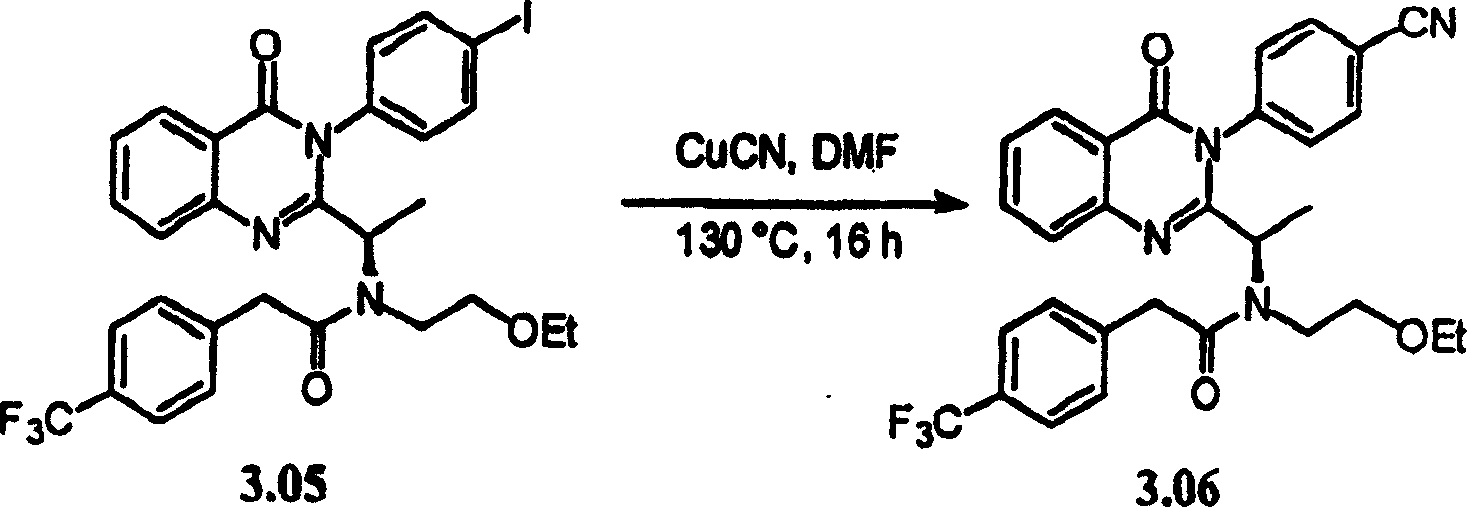
2-((N-2-乙氧基乙基)-N-(4-三氟甲基苯基乙酰基)-1-氨基乙基)-3-(4-氰基苯基)-3H-喹唑啉-4-酮(3.06)。将3.05(150mg,0.23mmol,1.0当量)溶于0.5mL无水DMF中。加入CuCN(31mg,0.35mmol,1.5当量)。将得到的混合物加热至130℃16小时。将该混合物冷却至室温并用15mL EaOAc稀释。将混合物通过硅胶短柱过滤,再用50mLEaOAc洗脱该短柱。在真空中浓缩洗脱液得到黄色残余物,将该残余物经制备的TLC纯化,得到95mg化合物3.06,为白色固体。2-((N-2-ethoxyethyl)-N-(4-trifluoromethylphenylacetyl)-1-aminoethyl)-3-(4-cyanophenyl)-3H- Quinazolin-4-one (3.06). 3.05 (150 mg, 0.23 mmol, 1.0 equiv) was dissolved in 0.5 mL dry DMF. CuCN (31 mg, 0.35 mmol, 1.5 equiv) was added. The resulting mixture was heated to 130°C for 16 hours. The mixture was cooled to room temperature and diluted with 15 mL EaOAc. The mixture was filtered through a plug of silica gel, and the plug was eluted with 50 mL of EaOAc. Concentration of the eluate in vacuo gave a yellow residue which was purified by preparative TLC to give 95 mg of compound 3.06 as a white solid.
Mp197.0℃.1H NMR(DMSO-d6,T=140℃)δ0.98(t,J=6.9Hz,3H),1.44(d,J=6.8Hz,3H),3.30-3.65m,8H),5.16(q,J=6.2Hz,1H),7.33(d,J=8.0Hz,2H),7.50-7.77(m,6H),7.72-7.95(m,3H),8.15(dd,J=7.9,1.5Hz,1H)ppm.Mp197.0°C. 1 H NMR (DMSO-d 6 , T=140°C) δ0.98(t, J=6.9Hz, 3H), 1.44(d, J=6.8Hz, 3H), 3.30-3.65m, 8H), 5.16(q, J=6.2Hz, 1H), 7.33(d, J=8.0Hz, 2H), 7.50-7.77(m, 6H), 7.72-7.95(m, 3H), 8.15(dd, J =7.9, 1.5Hz, 1H)ppm.
在室温下,该化合物以在DMSO中约0.64∶1摩尔比率的顺式/反式酰胺旋转异构体混合物的形式存在。1H NMR(DMSO-d6;T=25℃)δ4.84(q,J=6.4Hz,1H)&5.22(q,J=6.4Hz,1H)ppm。MS(ESI+)m/z650.2[M+H]+。This compound exists as a mixture of cis/trans amide rotamers in an approximately 0.64:1 molar ratio in DMSO at room temperature. 1 H NMR (DMSO-d 6 ; T=25°C) δ 4.84 (q, J=6.4Hz, 1H) & 5.22 (q, J=6.4Hz, 1H) ppm. MS (ESI + ) m/z 650.2 [M+H] + .
方案7Option 7
2-((N-2-乙氧基乙基)-N-(4-三氟甲基苯基乙酰基)-1-氨基乙基)-3-(4-三甲基甲硅烷基乙炔基苯基)-3H-喹唑啉-4-酮(3.07)。将化合物3.05(150mg,0.23mmol,1.0当量)溶于1.0mL无水THF中。连续加入三甲基甲硅烷基乙炔(45mg,0.46mmol,2.0当量)、CuI(87mg,0.46mmol,2.0当量)、Pd(PPh3)2Cl2(32mg,0.046mmol,0.20当量)和三乙胺(92mg,0.91mmol,4.0当量)。将得到的混合物加热至50℃3小时。将该混合物冷却至室温并用15mL EaOAc稀释。将混合物通过硅胶短柱过滤,再用50mL EaOAc洗脱该短柱。在真空中浓缩洗脱液得到黄色残余物,将该残余物经制备的TLC纯化,得到105mg 3.07,为白色固体。Mp185.3℃。在室温下,该化合物以在DMSO中约0.54∶1摩尔比率的顺式/反式酰胺旋转异构体混合物的形式存在。1H NMR(DMSO-d6;T=25℃)δ4.88(q,J=6.8Hz,1H)&5.25(q,J=6.8Hz,1H)ppm。MS(ESI+)m/z620.2[M+H]+。2-((N-2-ethoxyethyl)-N-(4-trifluoromethylphenylacetyl)-1-aminoethyl)-3-(4-trimethylsilylethynyl Phenyl)-3H-quinazolin-4-one (3.07). Compound 3.05 (150 mg, 0.23 mmol, 1.0 equiv) was dissolved in 1.0 mL of anhydrous THF. Trimethylsilylacetylene (45 mg, 0.46 mmol, 2.0 equiv), CuI (87 mg, 0.46 mmol, 2.0 equiv), Pd(PPh 3 ) 2 Cl 2 (32 mg, 0.046 mmol, 0.20 equiv) and triethylsilylacetylene (32 mg, 0.046 mmol, 0.20 equiv) were added successively. Amine (92 mg, 0.91 mmol, 4.0 equiv). The resulting mixture was heated to 50°C for 3 hours. The mixture was cooled to room temperature and diluted with 15 mL of EaOAc. The mixture was filtered through a plug of silica gel, and the plug was eluted with 50 mL of EaOAc. The eluate was concentrated in vacuo to give a yellow residue which was purified by preparative TLC to give 105 mg of 3.07 as a white solid. Mp185.3°C. This compound exists as a mixture of cis/trans amide rotamers in an approximately 0.54:1 molar ratio in DMSO at room temperature. 1 H NMR (DMSO-d 6 ; T=25° C.) δ 4.88 (q, J=6.8 Hz, 1H) & 5.25 (q, J=6.8 Hz, 1H) ppm. MS (ESI + ) m/z 620.2 [M+H] + .
2-(N-2-乙氧基乙基)-N-(4-三氟甲基苯基乙酰基)-1-氨基乙基)-3-(4-乙炔基苯基)-3H-喹唑啉-4-酮(3.08)。将化合物3.07(57mg,92μmol,1.0当量)溶于1.0mL无水THF中。在室温下加入1.0M氟化四丁基铵的THF(101μL,0.101mmol,1.1当量)。将得到的混合物在室温下搅拌15分钟。向反应混合物中加入100μL饱和NH4Cl和15mLEaOAc。在室温下再搅拌15分钟后,将混合物经Na2SO4干燥并通过硅胶短柱过滤,再用50mL EaOAc洗脱该短柱。在真空中浓缩洗脱液得到黄色残余物,将该残余物经制备的TLC纯化,得到39mg化合物3.08,为白色固体。Mp186.7℃。在室温下,该化合物以在DMSO中约0.54∶1摩尔比率的顺式/反式酰胺旋转异构体混合物的形式存在。1H NMR(DMSO-d6;T=25℃)δ4.87(q,J=6.0Hz,1H)&5.20(q,J=6.8Hz,1H)ppm。MS(ESI+)m/z548.2[M+H]+。2-(N-2-ethoxyethyl)-N-(4-trifluoromethylphenylacetyl)-1-aminoethyl)-3-(4-ethynylphenyl)-3H-quinone Azolin-4-one (3.08). Compound 3.07 (57 mg, 92 μmol, 1.0 equiv) was dissolved in 1.0 mL of anhydrous THF. 1.0 M tetrabutylammonium fluoride in THF (101 μL, 0.101 mmol, 1.1 equiv) was added at room temperature. The resulting mixture was stirred at room temperature for 15 minutes. 100 μL saturated NH 4 Cl and 15 mL EaOAc were added to the reaction mixture. After stirring at room temperature for an additional 15 min, the mixture was dried over Na2SO4 and filtered through a plug of silica gel, which was eluted with 50 mL of EaOAc. Concentration of the eluate in vacuo gave a yellow residue which was purified by preparative TLC to give 39 mg of compound 3.08 as a white solid. Mp186.7°C. This compound exists as a mixture of cis/trans amide rotamers in an approximately 0.54:1 molar ratio in DMSO at room temperature. 1 H NMR (DMSO-d 6 ; T=25°C) δ 4.87 (q, J=6.0Hz, 1H) & 5.20 (q, J=6.8Hz, 1H) ppm. MS (ESI + ) m/z 548.2 [M+H] + .
化合物3.09和化合物3.10的合成Synthesis of Compound 3.09 and Compound 3.10
以与化合物3.07(参见流程7)相同的方法合成化合物3.09和化合物3.10。分别以3,3-二甲基-1-丁炔和2-甲基-3-丁炔-2-醇代替三甲基甲硅烷基乙炔。所述产物的特征如下。Compound 3.09 and compound 3.10 were synthesized in the same manner as compound 3.07 (see scheme 7). Trimethylsilylacetylene was replaced by 3,3-dimethyl-1-butyne and 2-methyl-3-butyn-2-ol, respectively. The product is characterized as follows.
由化合物3.05得到2-((N-2-乙氧基乙基)-N-(4-三氟甲基苯基乙酰基)-1-氨基乙基)-3-(4-(叔-丁基乙炔基)苯基)-3H-喹唑啉-4-酮(3.09),为白色固体。Mp189.9℃。在室温下,该化合物以在DMSO中约0.69∶1摩尔比率的顺式/反式酰胺旋转异构体混合物的形式存在。1H NMR(DMSO-d6;T=25℃)δ4.89(q,J=6.4Hz,1H)&5.25(q,J=6.4Hz,1H)ppm。MS(ESI+)m/z604.2[M+H]+。Obtain 2-((N-2-ethoxyethyl)-N-(4-trifluoromethylphenylacetyl)-1-aminoethyl)-3-(4-(tert-butyl) from compound 3.05 ethynyl)phenyl)-3H-quinazolin-4-one (3.09) as a white solid. Mp189.9°C. This compound exists as a mixture of cis/trans amide rotamers in an approximately 0.69:1 molar ratio in DMSO at room temperature. 1 H NMR (DMSO-d 6 ; T=25°C) δ 4.89 (q, J=6.4Hz, 1H) & 5.25 (q, J=6.4Hz, 1H) ppm. MS (ESI + ) m/z 604.2 [M+H] + .
由化合物3.05得到2-((N-2-乙氧基乙基)-N-(4-三氟甲基苯基乙酰基)-1-氨基乙基)-3-(4-(3-羟基-3-甲基-1-丁炔基)苯基)-3H-喹唑啉-4-酮(3.10),为白色固体。Mp162.2℃。在室温下,该化合物以在DMSO中约0.69∶1摩尔比率的顺式/反式酰胺旋转异构体混合物的形式存在。1H NMR(DMSO-d6;T=25℃)δ4.89(q,J=6.8Hz,1H)&5.24(q,J=6.4Hz,1H)ppm。MS(ESI+)m/z606.3[M+H]+。Obtain 2-((N-2-ethoxyethyl)-N-(4-trifluoromethylphenylacetyl)-1-aminoethyl)-3-(4-(3-hydroxyl) from compound 3.05 -3-Methyl-1-butynyl)phenyl)-3H-quinazolin-4-one (3.10) as a white solid. Mp162.2°C. This compound exists as a mixture of cis/trans amide rotamers in an approximately 0.69:1 molar ratio in DMSO at room temperature. 1 H NMR (DMSO-d 6 ; T=25°C) δ 4.89 (q, J=6.8Hz, 1H) & 5.24 (q, J=6.4Hz, 1H) ppm. MS (ESI + ) m/z 606.3 [M+H] + .
化合物3.11和化合物3.12的合成Synthesis of Compound 3.11 and Compound 3.12
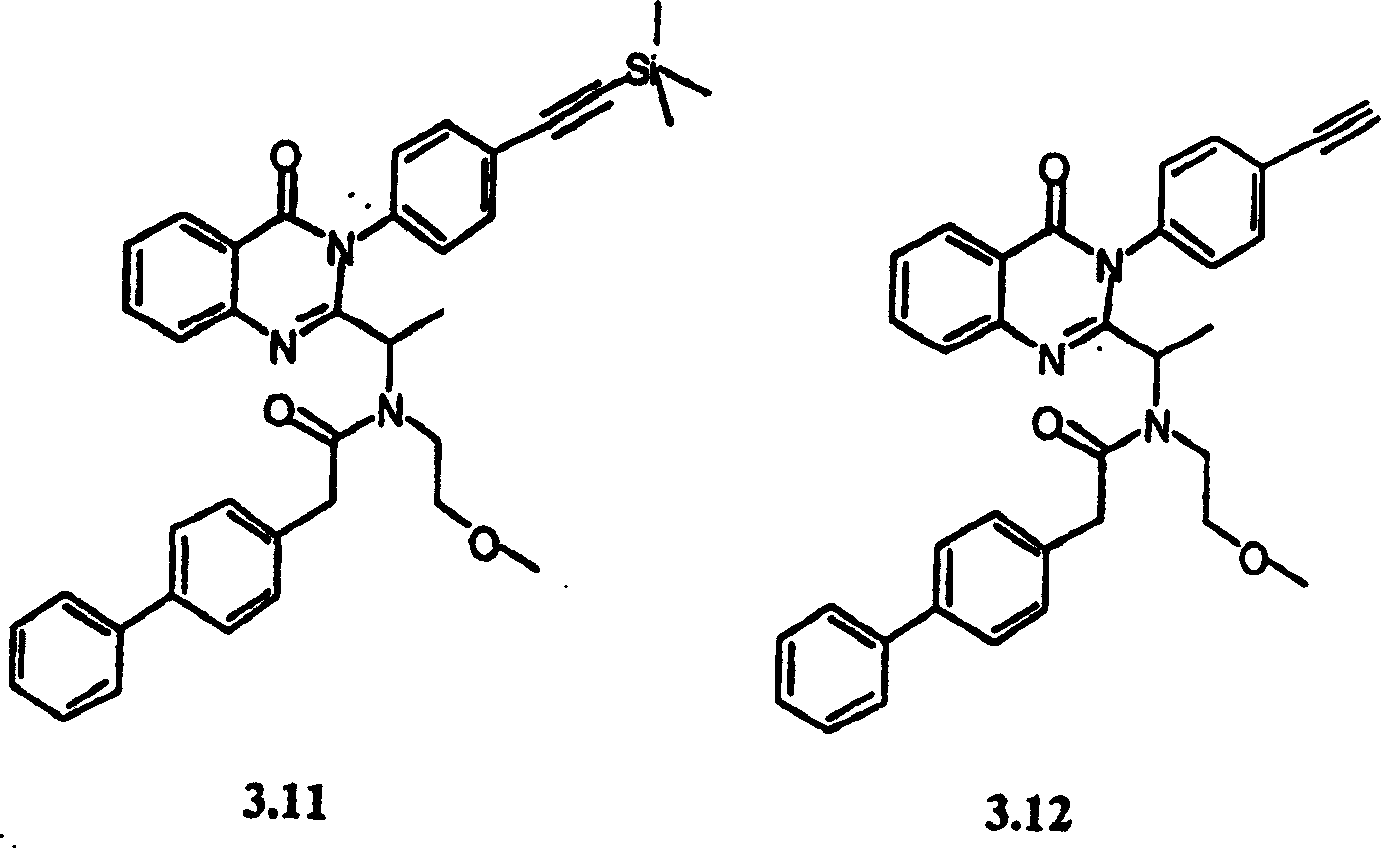
以与化合物3.07和3.08(流程7)相同的方法合成化合物3.11和化合物3.12。在这两种情况下使用化合物1.42代替化合物3.05。所述产物的特征如下。Compound 3.11 and compound 3.12 were synthesized in the same manner as compound 3.07 and 3.08 (Scheme 7). Compound 1.42 was used instead of compound 3.05 in both cases. The product is characterized as follows.
由化合物1.42得到2-((N-2-甲氧基乙基)-N-(4-苯基苯乙酰基)-1-氨基乙基)-3-(4-三甲基甲硅烷基乙炔基)苯基)-3H-喹唑啉-4-酮(3.11),为白色固体。在室温下,该化合物以在DMSO中约0.61∶1摩尔比率的顺式/反式酰胺旋转异构体混合物的形式存在。1H NMR(DMSO-d6;T=25℃)δ4.91(q,J=6.4Hz,1H)&5.21(q,J=6.4Hz,1H)ppm。MS(ESI+)m/z614.3[M+H]+。Obtain 2-((N-2-methoxyethyl)-N-(4-phenylphenylacetyl)-1-aminoethyl)-3-(4-trimethylsilylacetylene from compound 1.42 yl)phenyl)-3H-quinazolin-4-one (3.11) as a white solid. This compound exists as a mixture of cis/trans amide rotamers in an approximately 0.61:1 molar ratio in DMSO at room temperature. 1 H NMR (DMSO-d 6 ; T=25°C) δ 4.91 (q, J=6.4Hz, 1H) & 5.21 (q, J=6.4Hz, 1H) ppm. MS (ESI + ) m/z 614.3 [M+H] + .
由化合物1.42得到2-((N-2-甲氧基乙基)-N-(4-苯基苯乙酰基)-1-氨基乙基)-3-(4-乙炔基苯基)-3H-喹唑啉-4-酮(3.12),为白色固体。Mp73.3℃。在室温下,该化合物以在DMSO中约0.67∶1摩尔比率的顺式/反式酰胺旋转异构体混合物的形式存在。1H NMR(DMSO-d6;T=25℃)δ4.92(q,J=6.4Hz,1H)&5.17(q,J=6.8Hz,1H)ppm。MS(ESI+)m/z542.2[M+H]+。Obtain 2-((N-2-methoxyethyl)-N-(4-phenylphenylacetyl)-1-aminoethyl)-3-(4-ethynylphenyl)-3H from compound 1.42 -Quinazolin-4-one (3.12) as a white solid. Mp 73.3°C. This compound exists as a mixture of cis/trans amide rotamers in an approximately 0.67:1 molar ratio in DMSO at room temperature. 1 H NMR (DMSO-d 6 ; T=25°C) δ 4.92 (q, J=6.4Hz, 1H) & 5.17 (q, J=6.8Hz, 1H) ppm. MS (ESI + ) m/z 542.2 [M+H] + .
化合物3.13和化合物3.14的合成。以与化合物3.05相同反应合成化合物3.13和化合物3.14。实验细节如下。Synthesis of Compound 3.13 and Compound 3.14. Compound 3.13 and compound 3.14 were synthesized by the same reaction as compound 3.05. Experimental details are as follows.
流程8Process 8

2-((N-2-乙氧基乙基)-N-(4-三氟甲基苯基乙酰基)-1-氨基乙基)-3-苯基-3H-喹唑啉-4-酮(3.13)和2-((N-2-乙氧基乙基)-N-(4-三氟甲基苯基乙酰基)-1-氨基乙基)-3-(4-乙基苯基)-3H-喹唑啉-4-酮(3.14)。通过注射器,向化合物3.05(98mg,0.15mmol,1.0当量)和Pd(PPh3)4(35mg,30μmol,0.20当量)的1.0mL THF溶液中加入Et2Zn(37mg,0.30mmol,2.0当量)。将发黑色的反应混合物在50℃下搅拌3小时。冷却至室温后,将该反应混合物用20mL EtOAc稀释并连续用10mL 1M HCl、10mL饱和NaHCO3和10mL盐水洗涤。将有机层经Na2SO4干燥并在真空中蒸发得到棕色残余物,将该残余物经制备的TLC纯化,得到18mg化合物3.13和27mg化合物3.14。两者均为白色固体。这两种产物的特征如下。2-((N-2-ethoxyethyl)-N-(4-trifluoromethylphenylacetyl)-1-aminoethyl)-3-phenyl-3H-quinazoline-4- Ketone (3.13) and 2-((N-2-ethoxyethyl)-N-(4-trifluoromethylphenylacetyl)-1-aminoethyl)-3-(4-ethylbenzene base)-3H-quinazolin-4-one (3.14). To a solution of compound 3.05 (98 mg, 0.15 mmol, 1.0 equiv) and Pd( PPh3 ) 4 (35 mg, 30 μmol, 0.20 equiv) in 1.0 mL of THF was added Et2Zn (37 mg, 0.30 mmol, 2.0 equiv) via syringe. The blackened reaction mixture was stirred at 50 °C for 3 hours. After cooling to room temperature, the reaction mixture was diluted with 20 mL EtOAc and washed successively with 10 mL 1M HCl, 10 mL saturated NaHCO 3 and 10 mL brine. The organic layer was dried over Na2SO4 and evaporated in vacuo to give a brown residue, which was purified by preparative TLC to give 18 mg of compound 3.13 and 27 mg of compound 3.14. Both are white solids. The characteristics of these two products are as follows.
化合物3.13.在室温下,该化合物以在CDCl3中约0.69∶1摩尔比率的顺式/反式酰胺旋转异构体混合物的形式存在。1H NMR(CDCl3,T=25℃)δ0.71(q,J=7.0Hz,3H)&1.15(d,J=7.0Hz,1H)ppm。MS(ESI+)m/z524.3[M+H]+。Compound 3.13. This compound exists as a mixture of cis/trans amide rotamers in a molar ratio of approximately 0.69:1 in CDCl3 at room temperature. 1 H NMR (CDCl 3 , T=25° C.) δ 0.71 (q, J=7.0 Hz, 3H) & 1.15 (d, J=7.0 Hz, 1H) ppm. MS (ESI + ) m/z 524.3 [M+H] + .
化合物3.14.在室温下,该化合物以在CDCl3中约0.69∶1摩尔比率的顺式/反式酰胺旋转异构体混合物的形式存在。1H NMR(CDCl3,T=25℃)δ4.88(q,J=6.8Hz,1H)&5.34(q,J=6.8Hz,1H)ppm。MS(ESI+)m/z552.2[M+H]+。Compound 3.14. This compound exists as a mixture of cis/trans amide rotamers in a molar ratio of about 0.69:1 in CDCl3 at room temperature. 1 H NMR (CDCl 3 , T=25°C) δ 4.88 (q, J=6.8Hz, 1H) & 5.34 (q, J=6.8Hz, 1H) ppm. MS (ESI + ) m/z 552.2 [M+H] + .
化合物3.15的合成Synthesis of compound 3.15
使用Pd催化氢化由化合物1.42合成化合物3.15。实验细节如下。Compound 3.15 was synthesized from compound 1.42 using Pd-catalyzed hydrogenation. Experimental details are as follows.
2-((N-2-甲氧基乙基)-N-(4-苯基苯乙酰基)-1-氨基乙基)-3-苯基-3H-喹唑啉-4-酮(3.15)向化合物1.42(25mg,39μmol,1.0当量)在1.0mL MeOH和1.0mL二氯甲烷的混合物中的溶液中加入10%披钯碳(83mg,78μmol,2.0当量)。使用气囊导入过量的氢气。在室温下搅拌2小时后,将该反应混合物用5mL二氯甲烷稀释并通过硅藻土垫过滤。在真空中浓缩滤液得到黄色油状物,将该油状物通过硅胶短柱,用EtOAc洗脱。在真空中浓缩洗脱液得到17mg化合物3.15,为无色油状物。在室温下,该化合物以在DMSO中约1.06∶1摩尔比率的顺式/反式酰胺旋转异构体混合物的形式存在。1H NMR(DMSO-d6,T=25℃)δ4.94(q,J=6.4Hz,1H)&5.08(q,J=6.8Hz,1H)ppm。MS(ESI+)m/z518.3[M+H]+。2-((N-2-methoxyethyl)-N-(4-phenylphenacetyl)-1-aminoethyl)-3-phenyl-3H-quinazolin-4-one (3.15 ) To a solution of compound 1.42 (25 mg, 39 μmol, 1.0 equiv) in a mixture of 1.0 mL MeOH and 1.0 mL dichloromethane was added 10% palladium on carbon (83 mg, 78 μmol, 2.0 equiv). Use a balloon to introduce excess hydrogen. After stirring at room temperature for 2 hours, the reaction mixture was diluted with 5 mL of dichloromethane and filtered through a pad of celite. The filtrate was concentrated in vacuo to give a yellow oil which was passed through a short column of silica gel eluting with EtOAc. Concentration of the eluate in vacuo afforded 17 mg of compound 3.15 as a colorless oil. This compound exists as a mixture of cis/trans amide rotamers in an approximately 1.06:1 molar ratio in DMSO at room temperature. 1 H NMR (DMSO-d6, T=25°C) δ 4.94 (q, J=6.4Hz, 1H) & 5.08 (q, J=6.8Hz, 1H) ppm. MS (ESI + ) m/z 518.3 [M+H] + .
化合物3.16的合成Synthesis of compound 3.16
由化合物XII的外消旋形式合成化合物3.16,实验细节如下所述。Compound 3.16 was synthesized from the racemic form of compound XII, experimental details are described below.
2-((N-3-吡啶甲基)-N-(叔-丁氧基羰基)-1-氨基乙基)-3-(4-乙氧基苯基)-3H-喹唑啉-4-酮(3.16).向外消旋化合物XII(124mg,0.30mmol,1.0当量)的0.60mL DMF溶液中加入3-吡啶甲基氯盐酸盐(55mg,0.33mmol,1.1当量)、KI(50mg,0.30mmol,1.0当量)和NaH(60%在矿物油中的悬浮液,25mg,0.62mmol,2.05当量)。在室温下搅拌16小时后,将该反应混合物倒入10mL 5%H3PO4水溶液中。将得到的混合物用10mL EtOAc萃取两次。用10mL NaHCO3和10ml盐水洗涤有机层,经Na2SO4干燥并在真空中浓缩得到黄色油状物,将该油状物经制备的TLC纯化,得到33mg化合物3.16,为白色固体。Mp67.5℃。在室温下,该化合物以在DMSO中约1.11∶1摩尔比率的顺式/反式酰胺旋转异构体混合物的形式存在。1H NMR(DMSO-d6,T=25℃)δ5.03(m,1H)&5.12(m,1H)ppm。MS(ESI+)m/z510.3[M+H]+。2-((N-3-pyridylmethyl)-N-(tert-butoxycarbonyl)-1-aminoethyl)-3-(4-ethoxyphenyl)-3H-quinazoline-4 - Ketone (3.16). To a solution of racemic compound XII (124mg, 0.30mmol, 1.0eq) in 0.60mL of DMF was added 3-picolyl chloride hydrochloride (55mg, 0.33mmol, 1.1eq), KI (50mg , 0.30 mmol, 1.0 equiv) and NaH (60% suspension in mineral oil, 25 mg, 0.62 mmol, 2.05 equiv). After stirring at room temperature for 16 hours, the reaction mixture was poured into 10 mL of 5% aqueous H3PO4 . The resulting mixture was extracted twice with 10 mL of EtOAc. The organic layer was washed with 10 mL NaHCO 3 and 10 ml brine, dried over Na 2 SO 4 and concentrated in vacuo to give a yellow oil which was purified by preparative TLC to give 33 mg of compound 3.16 as a white solid. Mp67.5°C. This compound exists as a mixture of cis/trans amide rotamers in an approximately 1.11:1 molar ratio in DMSO at room temperature. 1 H NMR (DMSO-d 6 , T=25°C) δ 5.03 (m, 1H) & 5.12 (m, 1H) ppm. MS (ESI + ) m/z 510.3 [M+H] + .
化合物3.16a的合成Synthesis of compound 3.16a
流程9Process 9

(1-N-BOC-氨基乙基)-3-(4-乙氧基苯基)-2-{(1R)-1-[(吡啶-3-基甲基)-氨基]-乙基}-3H-吡啶并[2,3-d]嘧啶-4-酮(XVII前体).在氮气氛下,向装备加料漏斗、机械搅拌器和温度探头的3L圆形烧瓶中加入102.60g(542.26mmol)的N-(叔-丁氧基羰基)-D-丙氨酸的1.2L二氯甲烷(DCM)溶液。将该溶液冷却至20℃并加入150.00ml(1364.31mmol)的N-甲基吗啉,随后用40分钟加入含有140.1ml(1084mmol)的氯甲酸异-丁基酯的360ml DCM溶液,同时保持反应温度低于-20℃。完成加入后,将反应物搅拌45分钟并加入75.00g(542.97mmol)2-氨基烟酸。将该反应物加热至室温过夜。将反应物用1.5L DCM稀释并用1.0N盐酸(2×750ml)和盐水(1×500ml)洗涤。经硫酸镁干燥有机相,过滤并在真空中浓缩,得到175.0g黄橙色油状物。该物质没有进一步纯化而在下一步骤中使用。(1-N-BOC-aminoethyl)-3-(4-ethoxyphenyl)-2-{(1R)-1-[(pyridin-3-ylmethyl)-amino]-ethyl} -3H-pyrido[2,3-d]pyrimidin-4-one (XVII precursor). Under nitrogen atmosphere, add 102.60 g (542.26 mmol) of N-(tert-butoxycarbonyl)-D-alanine in 1.2 L of dichloromethane (DCM). The solution was cooled to 20 °C and 150.00 ml (1364.31 mmol) of N-methylmorpholine was added followed by 140.1 ml (1084 mmol) of iso-butyl chloroformate in 360 ml of DCM over 40 minutes while maintaining the reaction The temperature is below -20°C. After the addition was complete, the reaction was stirred for 45 minutes and 75.00 g (542.97 mmol) of 2-aminonicotinic acid was added. The reaction was allowed to warm to room temperature overnight. The reaction was diluted with 1.5L DCM and washed with 1.0N hydrochloric acid (2 x 750ml) and brine (1 x 500ml). The organic phase was dried over magnesium sulfate, filtered and concentrated in vacuo to give 175.0 g of a yellow-orange oil. This material was used in the next step without further purification.
在氮气氛下,将含有以上粗制物的2L DCM溶液冷却至-20℃并用5分钟加入69.00ml(535.68mmol)的对-氨基苯乙醚。搅拌着逐渐加热到0℃后,将该反应混合物移至分液漏斗中并用1.0N盐酸(2×500ml)、饱和碳酸氢钠溶液(2×1L)和盐水(1×1L)洗涤。经硫酸镁干燥有机相,过滤并在真空中浓缩,得到175.2g粗制双-酰胺。该物质没有进一步纯化而在下一步骤中使用。Under nitrogen atmosphere, the 2L DCM solution containing the above crude product was cooled to -20°C and 69.00ml (535.68mmol) of p-aminophenetole was added over 5 minutes. After gradually heating to 0 °C with stirring, the reaction mixture was transferred to a separatory funnel and washed with 1.0N hydrochloric acid (2 x 500 mL), saturated sodium bicarbonate solution (2 x 1 L) and brine (1 x 1 L). The organic phase was dried over magnesium sulfate, filtered and concentrated in vacuo to yield 175.2 g of crude bis-amide. This material was used in the next step without further purification.
在氮气氛下,将含有以上粗制双-酰胺的2.3L DCM和50.0ml(454.7mmol)N-甲基吗啉溶液冷却至-20℃并用5分钟滴加入53.0ml(408.6mmol)的氯甲酸异-丁基酯。完成氯甲酸酯的加入后,HPLC分析显示没有双-酰胺残存。将该反应混合物移至分液漏斗中并用1.0N盐酸(2×1L)、饱和碳酸氢盐溶液(1×1L)和盐水(1×1L)洗涤。经硫酸镁干燥有机层,过滤并在真空中浓缩得到205g棕色、粘性油状物。将该产物溶于500ml甲基叔-丁基醚中并搅拌直至所述产物开始从溶液中沉淀。然后加入庚烷(1000ml)并连续搅拌。经过滤收集得到的沉淀物,用庚烷洗涤并干燥,得到78.9g产物,为灰白色固体。Under nitrogen atmosphere, 2.3L DCM and 50.0ml (454.7mmol) N-methylmorpholine solution containing the above crude bis-amide were cooled to -20°C and 53.0ml (408.6mmol) of chloroformic acid was added dropwise over 5 minutes iso-butyl ester. After the chloroformate addition was complete, HPLC analysis showed no bis-amide remaining. The reaction mixture was transferred to a separatory funnel and washed with 1.0N hydrochloric acid (2 x 1 L), saturated bicarbonate solution (1 x 1 L) and brine (1 x 1 L). The organic layer was dried over magnesium sulfate, filtered and concentrated in vacuo to give 205 g of a brown, viscous oil. This product was dissolved in 500 ml methyl tert-butyl ether and stirred until the product started to precipitate out of solution. Heptane (1000ml) was then added and stirring continued. The resulting precipitate was collected by filtration, washed with heptane and dried to give 78.9 g of product as an off-white solid.
(CDCl3)δ8.99(dd,J1=2.0Hz,J2=4.4Hz,1H),8.60(dd,J1=2.0Hz,J2=8.0Hz,1H),7.44(dd,J1=4.4Hz,J2=8.0Hz,1H),7.33(dd,J1=1.6Hz,J2=8.8Hz,1H),7.16(dd,J1=2.8Hz,J2=8.8Hz,1H),7.20(dd,J1=2.4Hz,J2=8.8Hz,1H),7.04(dd,J1=2.8Hz,J2=8.8Hz,1H),5.80(d,J=8.8Hz,1H),4.63-4.70(m,1H),4.06-4.13(q,J=7.2Hz,2H),1.46(t,J=7.2Hz,3H),1.40(s,9H),1.31(d,J=6.8Hz,3H)ppm.(CDCl 3 ) δ8.99 (dd, J 1 =2.0Hz, J 2 =4.4Hz, 1H), 8.60 (dd, J 1 =2.0Hz, J 2 =8.0Hz, 1H), 7.44 (dd, J 1 = 4.4Hz, J2 = 8.0Hz, 1H), 7.33 (dd, J1 = 1.6Hz, J2 = 8.8Hz, 1H), 7.16 (dd, J1 = 2.8Hz, J2 = 8.8Hz, 1H) , 7.20 (dd, J1 = 2.4Hz, J2 = 8.8Hz , 1H), 7.04 (dd, J1 = 2.8Hz, J2 = 8.8Hz, 1H), 5.80 (d, J = 8.8Hz, 1H) , 4.63-4.70(m, 1H), 4.06-4.13(q, J=7.2Hz, 2H), 1.46(t, J=7.2Hz, 3H), 1.40(s, 9H), 1.31(d, J=6.8 Hz, 3H)ppm.
中间体XVII.向含有77.00g(187.59mmol)以上所制备化合物的2.1L DCM溶液中加入290mL三氟乙酸。将该反应物在室温下搅拌3.5小时,然后在真空中浓缩。将该浓缩物溶于1.4L DCM中并用1.0N盐酸(3×500ml)洗涤。经加入浓氢氧化铵使合并的含水洗涤液碱化直至pH=10。将得到的混浊溶液用DCM(2×700ml)萃取并将合并的有机萃取液经硫酸镁干燥,过滤并在真空中浓缩,得到58.40g产物,为褐色固体。Intermediate XVII. To a solution in 2.1 L of DCM containing 77.00 g (187.59 mmol) of the compound prepared above was added 290 mL of trifluoroacetic acid. The reaction was stirred at room temperature for 3.5 hours, then concentrated in vacuo. The concentrate was dissolved in 1.4L DCM and washed with 1.0N hydrochloric acid (3 x 500ml). The combined aqueous washes were basified until pH=10 by addition of concentrated ammonium hydroxide. The resulting cloudy solution was extracted with DCM (2 x 700ml) and the combined organic extracts were dried over magnesium sulfate, filtered and concentrated in vacuo to give 58.40g of product as a tan solid.
1H NMR(DMSO-d6)δ8.94(dd,J1=2.0Hz,J2=4.8Hz,1H),8.44(dd,J1=2.0Hz,J2=8.0Hz,1H),7.49(dd,J1=4.8Hz,J2=8.0Hz,1H),7.34-7.39(m,2H),7.04-7.10(m,2H),4.08(q,J=6.8Hz,2H),3.52(q,J=6.4Hz,1H),1.94(brs,2H),1.34(t,J=6.8Hz,3H),1.15(d,J=6.4Hz,3H)ppm. 1 H NMR (DMSO-d 6 ) δ8.94 (dd, J 1 =2.0Hz, J 2 =4.8Hz, 1H), 8.44 (dd, J 1 =2.0Hz, J 2 =8.0Hz, 1H), 7.49 (dd, J 1 =4.8Hz, J 2 =8.0Hz, 1H), 7.34-7.39(m, 2H), 7.04-7.10(m, 2H), 4.08(q, J=6.8Hz, 2H), 3.52( q, J=6.4Hz, 1H), 1.94(brs, 2H), 1.34(t, J=6.8Hz, 3H), 1.15(d, J=6.4Hz, 3H)ppm.
中间体XVIII.向含有57.70g(185.92mmol)以上制备的中间体XVII的1.7L二氯乙烷溶液中加入18.5ml(196.04mmol)吡啶甲醛,随后加入55.20g(260.45mmol)三乙酰氧基硼氢化钠。将该反应物在室温下搅拌过夜。将反应物用1L DCM稀释并用1.0M氢氧化铵(2×500ml)洗涤。将有机相经硫酸镁干燥,过滤并在真空中浓缩,得到79.20g产物,为浅黄色固体。Intermediate XVIII. To a solution of 57.70 g (185.92 mmol) of Intermediate XVII prepared above in 1.7 L of dichloroethane was added 18.5 ml (196.04 mmol) of pyridinecarbaldehyde followed by 55.20 g (260.45 mmol) of triacetoxyboron sodium hydride. The reaction was stirred overnight at room temperature. The reaction was diluted with 1 L of DCM and washed with 1.0M ammonium hydroxide (2 x 500ml). The organic phase was dried over magnesium sulfate, filtered and concentrated in vacuo to give 79.20 g of product as a pale yellow solid.
1H NMR(DMSO-d6)δ8.96-8.98(m,1H),8.42-8.48(m,1H),8.45(brs,1H),8.37(d,J=4.8Hz,1H),7.64(d,J=8.0Hz,1H),7.52(dd,J1=4.8Hz,J2=8.0Hz,1H),7.33(dd,J1=2.4Hz,J2=8.4Hz,1H),7.24(dd,J1=4.8Hz,J2=8.0Hz,1H),7.14(dd,J1=2.4Hz,J2=8.4Hz,1H),6.99(dd,J1=2.8Hz,J2=8.4Hz,1H),6.83(dd,J1=2.8Hz,J2=8.8Hz,1H),3.97-4.10(m,1H),3.87(s,1H),3.72(d,J=14.0Hz,1H),3.52(d,J=13.6Hz,1H),3.28(q,J=6.4Hz,1H),1.31(t,J=7.2Hz,3H),1.17(d,J=6.4Hz,3H)ppm. 1 H NMR (DMSO-d 6 ) δ8.96-8.98 (m, 1H), 8.42-8.48 (m, 1H), 8.45 (brs, 1H), 8.37 (d, J=4.8Hz, 1H), 7.64 ( d, J = 8.0Hz, 1H), 7.52 (dd, J 1 = 4.8Hz, J 2 = 8.0Hz, 1H), 7.33 (dd, J 1 = 2.4Hz, J 2 = 8.4Hz, 1H), 7.24 ( dd, J 1 =4.8Hz, J 2 =8.0Hz, 1H), 7.14 (dd, J 1 =2.4Hz, J 2 =8.4Hz, 1H), 6.99 (dd, J 1 =2.8Hz, J 2 =8.4 Hz, 1H), 6.83(dd, J1 =2.8Hz, J2 =8.8Hz, 1H), 3.97-4.10(m, 1H), 3.87(s, 1H), 3.72(d, J=14.0Hz, 1H ), 3.52(d, J=13.6Hz, 1H), 3.28(q, J=6.4Hz, 1H), 1.31(t, J=7.2Hz, 3H), 1.17(d, J=6.4Hz, 3H)ppm .
化合物3.16a.向含有54.00g(245.29mmol)4-(三氟代甲氧基)苯乙酸的1.1L DMF溶液中加入61.30g(319.77mmol)的EDCI、43.20g(319.69mmol)HOBT和42.00ml(382.01mmol)的N-甲基吗啉。搅拌30分钟后,加入74.60g(185.82mmol)中间体XVIII。将该反应物在室温下搅拌过夜。将反应物用3L DCM稀释并用水(2×3L)、饱和碳酸氢钠溶液(2×2L)和盐水(1×2L)洗涤。将有机萃取液经硫酸镁干燥,过滤并在真空中浓缩,得到121.7g黄色固体。将该固体用700ml甲基叔-丁基醚研磨,经过滤收集,漂洗并干燥得到88.46g产物,为灰白色固体。Compound 3.16a.Add 61.30g (319.77mmol) of EDCI, 43.20g (319.69mmol) HOBT and 42.00ml (382.01 mmol) of N-methylmorpholine. After stirring for 30 minutes, 74.60 g (185.82 mmol) of intermediate XVIII were added. The reaction was stirred overnight at room temperature. The reaction was diluted with 3L DCM and washed with water (2x3L), saturated sodium bicarbonate solution (2x2L) and brine (1x2L). The organic extracts were dried over magnesium sulfate, filtered and concentrated in vacuo to give 121.7 g of a yellow solid. The solid was triturated with 700 ml of methyl tert-butyl ether, collected by filtration, rinsed and dried to give 88.46 g of product as an off-white solid.
将该产物从10%乙酸乙酯的庚烷溶液中重结晶,得到无色、微晶形(细针状)固体。The product was recrystallized from 10% ethyl acetate in heptane to give a colorless, microcrystalline (fine needle-like) solid.
m.p.161.2℃.1H NMR(T=120℃;DMSO-d6)δ9.01(dd,J1=1.6Hz,J2=4.4Hz,1H),8.46(dd,J1=2.0Hz,J2=7.6Hz,1H),8.35(m,2H),7.57(dd,J1=4.8Hz,J2=8.4Hz,1H),7.55(d,J=8.0Hz,1H),7.43(d,J=8.0Hz,1H),7.06-7.22(m,7H),5.28(q,J=6.0Hz,1H),4.76(brs,2H),4.13(q,J=6.8Hz,2H),3.48(brs,0.5-1H[H2O]),2.91(brs,2H),1.42(d,J=6.8Hz,3H),1.36(t,J=6.8Hz,3H),ppm.HPLC>99%,手性HPLC>96%ee).MS(ESI,正模式):626(MH+).mp161.2°C. 1 H NMR (T=120°C; DMSO-d 6 ) δ9.01(dd, J 1 =1.6Hz, J 2 =4.4Hz, 1H), 8.46(dd, J 1 =2.0Hz, J 2 =7.6Hz, 1H), 8.35(m, 2H), 7.57(dd, J 1 =4.8Hz, J 2 =8.4Hz, 1H), 7.55(d, J=8.0Hz, 1H), 7.43(d , J=8.0Hz, 1H), 7.06-7.22(m, 7H), 5.28(q, J=6.0Hz, 1H), 4.76(brs, 2H), 4.13(q, J=6.8Hz, 2H), 3.48 (brs, 0.5-1H[H 2 O]), 2.91 (brs, 2H), 1.42 (d, J=6.8Hz, 3H), 1.36 (t, J=6.8Hz, 3H), ppm.HPLC>99% , chiral HPLC>96%ee). MS (ESI, positive mode): 626 (MH + ).
化合物3.16b的合成Synthesis of compound 3.16b

根据化合物3.16a的合成方法制备化合物3.16b。其中使用3-三氟代甲基-4-氟代苯乙酸代替4-(三氟代甲氧基)苯乙酸。Compound 3.16b was prepared according to the synthetic method of compound 3.16a. Wherein 3-trifluoromethyl-4-fluorophenylacetic acid is used instead of 4-(trifluoromethoxy)phenylacetic acid.
化合物3.17的合成Synthesis of compound 3.17

N-{1R-[3-(4-乙氧基-苯基)-4-氧代-3,4-二氢-吡啶并[2,3-d]嘧啶-2-基]-乙基}-N-吡啶-3-基甲基-2-(4-三氟代甲基-苯基)-乙酰胺N-{1R-[3-(4-ethoxy-phenyl)-4-oxo-3,4-dihydro-pyrido[2,3-d]pyrimidin-2-yl]-ethyl} -N-pyridin-3-ylmethyl-2-(4-trifluoromethyl-phenyl)-acetamide
根据以上所述化合物3.01的合成方法制备化合物3.17。根据实施例3.02的合成顺序,其中在步骤a中使用2-氨基烟酸代替2-氨基苯甲酸。对于化合物3.17的特征数据如下:无色,粘性油状物。1H NMR与化合物3.01的光谱相似∶约2∶1顺式/反式酰胺旋转异构体混合物(CDCl3,T=25℃),有以下特征共振峰:δ次要5.16(q,1.0H,J=6.8Hz)和δ主要5.40(q,2.0H,J=7.2Hz)ppm。MS(ESI+)588.2[MH]+ Compound 3.17 was prepared according to the synthesis method of compound 3.01 described above. Synthesis sequence according to Example 3.02, wherein 2-aminonicotinic acid is used instead of 2-aminobenzoic acid in step a. The characteristic data for compound 3.17 are as follows: Colorless, viscous oil. 1 H NMR is similar to the spectrum of compound 3.01: about 2:1 cis/trans amide rotamer mixture (CDCl 3 , T=25°C), with the following characteristic resonance peaks: δ minor 5.16(q, 1.0H , J=6.8Hz) and δ main 5.40 (q, 2.0H, J=7.2Hz) ppm. MS(ESI + )588.2[MH] +
化合物3.17a的合成Synthesis of Compound 3.17a
根据化合物3.17的合成方法制备化合物3.17a,其中使用4-三氟代甲基苄胺(benzenamine)代替对-氨基苯乙醚。Compound 3.17a was prepared according to the synthesis method of compound 3.17, wherein 4-trifluoromethylbenzylamine (benzenamine) was used instead of p-aminophenetole.
化合物3.18的合成Synthesis of Compound 3.18

N-(2-乙氧基-乙基)-N-{1R-[3-(4-乙氧基-苯基)-4-氧代-3,4-二氢-吡啶并[2,3-d]嘧啶-2-基]-乙基}-2-(4-三氟代甲基-苯基)-乙酰胺(3.18)N-(2-ethoxy-ethyl)-N-{1R-[3-(4-ethoxy-phenyl)-4-oxo-3,4-dihydro-pyrido[2,3 -d]pyrimidin-2-yl]-ethyl}-2-(4-trifluoromethyl-phenyl)-acetamide (3.18)
根据以上所述化合物3.01的合成方法制备化合物3.18。根据实施例3.02的合成顺序,其中在步骤a中使用2-氨基烟酸代替2-氨基苯甲酸并且在步骤c中使用2-溴代乙基乙基醚代替3-吡啶甲基氯。对于化合物3.18的特征数据如下:无色,粘性油状物。1H NMR与化合物3.01的光谱相似:约3∶2顺式/反式酰胺旋转异构体混合物(CDCl3,T=25℃),有以下特征共振峰:δ次要5.00(q,1.0H,J=6.4Hz)和δ主要5.00(q,1.5H,J=6.8Hz)ppm。MS(ESI+)569.3[MH]+ Compound 3.18 was prepared according to the synthesis method of compound 3.01 described above. Synthetic sequence according to Example 3.02, wherein 2-aminonicotinic acid was used instead of 2-aminobenzoic acid in step a and 2-bromoethylethyl ether was used instead of 3-picolyl chloride in step c. The characteristic data for compound 3.18 are as follows: Colorless, viscous oil. 1 H NMR is similar to the spectrum of compound 3.01: about 3:2 cis/trans amide rotamer mixture (CDCl 3 , T=25°C), with the following characteristic resonance peaks: δ minor 5.00(q, 1.0H , J=6.4Hz) and δ main 5.00 (q, 1.5H, J=6.8Hz) ppm. MS(ESI + )569.3[MH] +
化合物3.19的合成Synthesis of Compound 3.19
N-{1R-[3-(4-氰基-苯基)-4-氧代-3,4-二氢-吡啶并[2,3-d]嘧啶-2-基]-乙基}-N-(1H-咪唑-2-基甲基)-2-(4-三氟代甲基-苯基)-乙酰胺3.19N-{1R-[3-(4-cyano-phenyl)-4-oxo-3,4-dihydro-pyrido[2,3-d]pyrimidin-2-yl]-ethyl}- N-(1H-imidazol-2-ylmethyl)-2-(4-trifluoromethyl-phenyl)-acetamide 3.19
根据以上所述化合物3.01的合成方法制备化合物3.19。根据实施例3.02的合成顺序,其中在步骤a中使用2-氨基烟酸和4-氰基苯胺代替2-氨基苯甲酸和4-乙氧基苯胺,并且在步骤c中使用咪唑-2-甲醛经还原胺基化代替3-吡啶甲基氯经胺烷基化。对于化合物3.19的特征数据如下:无色,粘性油状物。1H NMR单酰胺旋转异构体(CDCl3,T=25℃)Compound 3.19 was prepared according to the synthesis method of compound 3.01 described above. Synthetic sequence according to Example 3.02, wherein in step a 2-aminonicotinic acid and 4-cyanoaniline are used instead of 2-aminobenzoic acid and 4-ethoxyaniline, and in step c imidazole-2-carbaldehyde is used Alkylation with amines via reductive amination instead of 3-picolyl chloride. The characteristic data for compound 3.19 are as follows: Colorless, viscous oil. 1 H NMR monoamide rotamer (CDCl 3 , T=25°C)
δ1.45(d,3H,J=7.6Hz),3.69(d,1H,J=15.2Hz),3.79(d,1H,J=15.2Hz),4.74(q,1H,J=7.2Hz),4.76(d,1H,J=19.6Hz),5.39(d,1H,J=19.6Hz),7.02(t,1H,J=1.6Hz),7.07(d,1H,J=2.0Hz),7.14(d,2H,J=8.0Hz),7.40(d,2H,J=8.0Hz),7.47(dd,1H,J1=2.0Hz,J2=8.4Hz),7.60(dd,1H,J1=4.8Hz,J2=8.0Hz),7.95(dd,1H,J1=2.0Hz,J2=6.8Hz),8.00(dd,1H,J1=2.0Hz,J2=8.4Hz),8.11(dd,1H,J1=2.0Hz,J2=8.4Hz),8.66(dd,1H,J1=1.6Hz,J2=7.6Hz),9.04(dd,1H,J1=1.6Hz,J2=4.4Hz)ppm.MS(ESI+)569.3[MH]+ δ1.45(d, 3H, J=7.6Hz), 3.69(d, 1H, J=15.2Hz), 3.79(d, 1H, J=15.2Hz), 4.74(q, 1H, J=7.2Hz), 4.76(d, 1H, J=19.6Hz), 5.39(d, 1H, J=19.6Hz), 7.02(t, 1H, J=1.6Hz), 7.07(d, 1H, J=2.0Hz), 7.14( d, 2H, J = 8.0Hz), 7.40 (d, 2H, J = 8.0Hz), 7.47 (dd, 1H, J 1 = 2.0Hz, J 2 = 8.4Hz), 7.60 (dd, 1H, J 1 = 4.8Hz, J2 = 8.0Hz), 7.95 (dd, 1H, J1 = 2.0Hz, J2 = 6.8Hz), 8.00 (dd, 1H, J1 = 2.0Hz, J2 = 8.4Hz), 8.11 ( dd, 1H, J1 = 2.0Hz, J2 = 8.4Hz), 8.66 (dd, 1H, J1 = 1.6Hz, J2 = 7.6Hz), 9.04 (dd, 1H, J1 = 1.6Hz, J2 =4.4Hz)ppm.MS(ESI + )569.3[MH] +
化合物3.20的合成Synthesis of compound 3.20
N-{1R-[3-(4-氰基-苯基)-4-氧代-3,4-二氢-吡啶并[2,3-d]嘧啶-2-基]-乙基}-N-吡啶-3-基甲基-2-(4-三氟代甲基-苯基)-乙酰胺3.20N-{1R-[3-(4-cyano-phenyl)-4-oxo-3,4-dihydro-pyrido[2,3-d]pyrimidin-2-yl]-ethyl}- N-pyridin-3-ylmethyl-2-(4-trifluoromethyl-phenyl)-acetamide 3.20
根据以上所述化合物3.01的合成方法制备化合物3.20。根据实施例3.02的合成顺序,其中在步骤a中使用2-氨基烟酸和4-氰基苯胺代替2-氨基苯甲酸和4-乙氧基苯胺,并且在步骤c中使用3-吡啶甲醛经还原胺基化代替3-吡啶甲基氯经胺烷基化。对于化合物3.20的特征数据如下:无色,粘性油状物。1H NMR单酰胺旋转异构体(CDCl3,T=25℃)Compound 3.20 was prepared according to the synthesis method of compound 3.01 described above. According to the synthetic sequence of Example 3.02, wherein in step a, 2-aminonicotinic acid and 4-cyanoaniline are used instead of 2-aminobenzoic acid and 4-ethoxyaniline, and in step c, 3-pyridinecarbaldehyde is used Reductive amination instead of 3-picolyl chloride via amine alkylation. The characteristic data for compound 3.20 are as follows: Colorless, viscous oil. 1 H NMR monoamide rotamer (CDCl 3 , T=25°C)
(CDCl3;T=25℃)δ1.33(d,3H,J=7.2Hz),3.66(d,1H,J=15.6Hz),3.79(d,1H,J=15.6Hz),5.16(d,1H,J=18.0Hz),5.19(q,1H,J=7.2Hz),5.24(d,1H,J=18.0Hz),7.23-7.32(m,3H),7.45(dd,1H,J1=1.6Hz,J2=8.0Hz),7.49-7.55(m,4H),7.89(dd,1H,J1=1.6Hz,J2=8.4Hz),7.95(dd,1H,J1=1.2Hz,J2=8.0Hz),8.02(dd,1H,J1=2.0Hz,J2=8.4Hz),8.52-8.58(m,2H),8.62(dd,1H,J1=2.0Hz,J2=8.0Hz),9.07(dd,1H,J1=2.0Hz,J2=4.8Hz)ppm.MS(ESI+)569.2[MH]+ (CDCl 3 ; T=25°C) δ1.33(d, 3H, J=7.2Hz), 3.66(d, 1H, J=15.6Hz), 3.79(d, 1H, J=15.6Hz), 5.16(d , 1H, J=18.0Hz), 5.19(q, 1H, J=7.2Hz), 5.24(d, 1H, J=18.0Hz), 7.23-7.32(m, 3H), 7.45(dd, 1H, J 1 = 1.6Hz, J2 = 8.0Hz), 7.49-7.55 (m, 4H), 7.89 (dd, 1H, J1 = 1.6Hz, J2 = 8.4Hz), 7.95 (dd, 1H, J1 = 1.2Hz , J 2 =8.0Hz), 8.02(dd, 1H, J 1 =2.0Hz, J 2 =8.4Hz), 8.52-8.58(m, 2H), 8.62(dd, 1H, J 1 =2.0Hz, J 2 = 8.0 Hz), 9.07 (dd, 1H, J 1 = 2.0 Hz, J 2 = 4.8 Hz) ppm. MS(ESI + ) 569.2 [MH] +
化合物3.21的合成Synthesis of compound 3.21

{1R-[3-(4-氰基-苯基)-4-氧代-3,4-二氢-吡啶并[2,3-d]嘧啶-2-基]-乙基}-N-(1-甲基-1H-咪唑-2-基甲基)-2-(4-三氟代甲基-苯基)-乙酰胺(3.21){1R-[3-(4-cyano-phenyl)-4-oxo-3,4-dihydro-pyrido[2,3-d]pyrimidin-2-yl]-ethyl}-N- (1-Methyl-1H-imidazol-2-ylmethyl)-2-(4-trifluoromethyl-phenyl)-acetamide (3.21)
根据以上所述化合物3.01的合成方法制备化合物3.21。根据实施例3.02的合成顺序,其中在步骤a中使用2-氨基烟酸和4-氰基苯胺代替2-氨基苯甲酸和4-乙氧基苯胺,并且在步骤c中使用3-甲基-4-甲醛-(3H)咪唑经还原胺基化代替3-吡啶甲基氯经胺烷基化。对于化合物3.21的特征数据如下:无色,粘性油状物。1H NMR单酰胺旋转异构体(CDCl3,T=25℃)Compound 3.21 was prepared according to the synthesis method of compound 3.01 described above. Synthesis sequence according to Example 3.02, wherein in step a 2-aminonicotinic acid and 4-cyanoaniline are used instead of 2-aminobenzoic acid and 4-ethoxyaniline, and in step c 3-methyl- 4-Carboxaldehyde-(3H)imidazole was replaced by reductive amination of 3-picolyl chloride by amine alkylation. The characteristic data for compound 3.21 are as follows: Colorless, viscous oil. 1 H NMR monoamide rotamer (CDCl 3 , T=25°C)
δ1.41(d,3H,J=7.2Hz),3.66(s,3H),3.75(d,1H,J=16.0Hz),3.84(d,1H,J=16.0Hz),4.98(s,2H),5.17(q,1H,J=7.2Hz),6.86(s,1H),7.30(s,1H),7.40-7.50(m,3H),7.50-7.58(m,3H),7.80-8.05(m,3H),8.63(dd,1H,J1=2.0Hz,J2=8.0Hz),9.06(dd,1H,J1=2.0Hz,J2=4.4Hz)ppm.MS(ESI+)572.2[MH]+ δ1.41(d, 3H, J=7.2Hz), 3.66(s, 3H), 3.75(d, 1H, J=16.0Hz), 3.84(d, 1H, J=16.0Hz), 4.98(s, 2H ), 5.17(q, 1H, J=7.2Hz), 6.86(s, 1H), 7.30(s, 1H), 7.40-7.50(m, 3H), 7.50-7.58(m, 3H), 7.80-8.05( m, 3H), 8.63 (dd, 1H, J1 = 2.0Hz, J2 = 8.0Hz), 9.06 (dd, 1H, J1 = 2.0Hz, J2 = 4.4Hz) ppm. MS (ESI + ) 572.2 [MH] +
化合物3.22的合成Synthesis of Compound 3.22
根据以上所述化合物3.02的合成方法制备化合物3.22。Compound 3.22 was prepared according to the synthesis method of compound 3.02 described above.
1H NMR(d6-DMSO,T=140℃)δ8.13(d,J=8.1Hz,1H),7.85(t,J=8.0Hz,1H),7.70(d,J=8.1Hz,1H),7.65-7.45(m,5H),7.40-7.20(m,4H),5.30(bs,1H),4.40(bs,2H),3.40(bs,2H),1.99(s,3H),1.34(d,J=6.6Hz,3H).m.p.220-221℃.MS(ESI+)526.2[MH]+ 1 H NMR (d 6 -DMSO, T=140°C) δ8.13(d, J=8.1Hz, 1H), 7.85(t, J=8.0Hz, 1H), 7.70(d, J=8.1Hz, 1H ), 7.65-7.45(m, 5H), 7.40-7.20(m, 4H), 5.30(bs, 1H), 4.40(bs, 2H), 3.40(bs, 2H), 1.99(s, 3H), 1.34( d, J=6.6Hz, 3H).mp220-221℃.MS(ESI + )526.2[MH] +
化合物3.23的合成Synthesis of compound 3.23

将化合物3.22(11mg,0.021mmol)和甲氧基胺盐酸盐(0.08mL,25-30%水溶液)在甲醇(4mL)和吡啶(0.1mL)中的混合物在室温下搅拌三天。将该溶液蒸发并将残余物经柱层析(30%EtOAc的己烷)纯化,得到12mg3.23,为白色固体。MS(ESI+)555.2[MH]+。A mixture of compound 3.22 (11 mg, 0.021 mmol) and methoxylamine hydrochloride (0.08 mL, 25-30% in water) in methanol (4 mL) and pyridine (0.1 mL) was stirred at room temperature for three days. The solution was evaporated and the residue was purified by column chromatography (30% EtOAc in hexanes) to afford 12 mg of 3.23 as a white solid. MS (ESI + ) 555.2 [MH] + .
化合物3.24的合成Synthesis of Compound 3.24

根据以上所述化合物3.23的合成方法制备化合物3.24。MS(ESI+)541.3[MH]+。Compound 3.24 was prepared according to the synthesis of compound 3.23 described above. MS (ESI + ) 541.3 [MH] + .
化合物3.25的合成Synthesis of compound 3.25

根据以上所述化合物3.02的合成方法制备化合物3.25。Compound 3.25 was prepared according to the synthesis of compound 3.02 described above.
1H NMR(d6-DMSO,T=140℃)δ8.14(d,J=8.1Hz,1H),7.84(m,2H),7.74(m,3H),7.55(t,J=8.2Hz,1H),7.30(m,2H),7.00(m,2H),5.20(q,J=6.9Hz,1H),4.05(dd,J=6.9,7.0Hz,2H),3.80-3.25(m,8H),1.49(d,J=6.9Hz,3H),1.31(t,J=7.0Hz,3H),0.95(t,J=7.0Hz,3H).m.p.57-60℃.MS(ESI+)636.2[MH]+C32H31F6N3O4的分析计算值:C,60.47;H,4.92;N,6.61。实测值:C,60.36;H,4.99;N,6.51。 1 H NMR (d 6 -DMSO, T=140°C) δ8.14(d, J=8.1Hz, 1H), 7.84(m, 2H), 7.74(m, 3H), 7.55(t, J=8.2Hz , 1H), 7.30(m, 2H), 7.00(m, 2H), 5.20(q, J=6.9Hz, 1H), 4.05(dd, J=6.9, 7.0Hz, 2H), 3.80-3.25(m, 8H), 1.49(d, J=6.9Hz, 3H), 1.31(t, J=7.0Hz, 3H), 0.95(t, J=7.0Hz, 3H).mp57-60℃.MS(ESI + )636.2 Anal. Calcd. for [MH] + C32H31F6N3O4 : C , 60.47; H , 4.92; N , 6.61 . Found: C, 60.36; H, 4.99; N, 6.51.
化合物3.26的合成Synthesis of Compound 3.26

根据以上所述化合物3.02的合成方法制备化合物3.26。Compound 3.26 was prepared according to the synthesis of compound 3.02 described above.
1H NMR(d6-DMSO,T=140℃)δ8.13(d,J=8.0Hz,1H),7.84(t,J=8.1Hz,1H),7.70(d,J=8.0Hz,1H),7.54(t,J=8.2Hz,1H),7.42(m,2H),7.28-7.19(m,3H),7.15(m,2H),5.15(q,J=6.8Hz,2H),4.08(q,J=7.0Hz,2H),3.65-3.20(m,8H),1.46(d,J=6.8Hz,3H),1.34(t,J=7.0Hz,3H),0.96(t,J=7.0Hz,3H).m.p.137-138℃.MS(ESI+)586.2[MH]+.C31H31F4N3O4的分析计算值:C,63.58;H,5.34;N,7.18。实测值:C,63.47;H,5.45;N,7.40。 1 H NMR (d 6 -DMSO, T=140°C) δ8.13(d, J=8.0Hz, 1H), 7.84(t, J=8.1Hz, 1H), 7.70(d, J=8.0Hz, 1H ), 7.54(t, J=8.2Hz, 1H), 7.42(m, 2H), 7.28-7.19(m, 3H), 7.15(m, 2H), 5.15(q, J=6.8Hz, 2H), 4.08 (q, J=7.0Hz, 2H), 3.65-3.20(m, 8H), 1.46(d, J=6.8Hz, 3H), 1.34(t, J=7.0Hz, 3H), 0.96(t, J= 7.0 Hz, 3H).mp 137-138° C. MS (ESI + ) 586.2 [MH] + . Anal. Calcd. for C 31 H 31 F 4 N 3 O 4 : C, 63.58; H, 5.34; N, 7.18. Found: C, 63.47; H, 5.45; N, 7.40.
化合物3.27的合成Synthesis of compound 3.27

根据以上所述化合物3.02的合成方法制备化合物3.27。Compound 3.27 was prepared according to the synthesis of compound 3.02 described above.
1H NMR(d6-DMSO,T=140℃)δ8.13(d,J=8.0Hz,1H),7.84(t,J=8.1Hz,1H),7.70(d,J=8.0Hz,1H),7.57(m,2H),7.40-7.20(m,2H),7.13(m,1H),7.05(m,2H),6.84(d,J=8.8Hz,1H),5.17(q,J=6.9Hz,2H),4.09(q,J=7.0Hz,2H),3.65-3.20(m,8H),1.46(d,J=6.8Hz,3H),1.35(t,J=7.0Hz,3H),0.96(t,J=7.0Hz,3H).m.p.146-148℃.MS(ESI+)586.2[MH]+.C31H31F4N3O4的分析计算值:C,63.58;H,5.34;N,7.18。实测值:C,63.76;H,5.43;N,7.19。 1 H NMR (d 6 -DMSO, T=140°C) δ8.13(d, J=8.0Hz, 1H), 7.84(t, J=8.1Hz, 1H), 7.70(d, J=8.0Hz, 1H ), 7.57(m, 2H), 7.40-7.20(m, 2H), 7.13(m, 1H), 7.05(m, 2H), 6.84(d, J=8.8Hz, 1H), 5.17(q, J= 6.9Hz, 2H), 4.09(q, J=7.0Hz, 2H), 3.65-3.20(m, 8H), 1.46(d, J=6.8Hz, 3H), 1.35(t, J=7.0Hz, 3H) , 0.96(t, J=7.0Hz, 3H).mp 146-148°C.MS(ESI + )586.2[MH] + .Calc. for C 31 H 31 F 4 N 3 O 4 : C, 63.58; H, 5.34; N, 7.18. Found: C, 63.76; H, 5.43; N, 7.19.
化合物3.28的合成Synthesis of Compound 3.28
根据以上所述化合物3.02的合成方法制备化合物3.28。Compound 3.28 was prepared according to the synthesis of compound 3.02 described above.
1H NMR(d6-DMSO,T=140℃)δ8.33(m,2H),8.09(d,J=8.1Hz,1H),7.84(t,J=8.0Hz,1H),7.67(d,J=8.0Hz,1H),7.54(t,J=8.1Hz,1H),7.48(m,1H),7.36(m,1H),7.18-7.04(m,4H),7.01(d,J=8.7Hz,2H),6.92(d,J=8.7Hz,2H),5.25(q,J=6.8Hz,2H),4.70(s,2H),4.60(q,J=8.9Hz,2H),4.14(q,J=7.0Hz,2H),3.35-3.00(bm,2H),1.37(m,6H).m.p.103-104℃.MS(ESI+)617.3[MH]+.Anal.Calcd.for 2H),4.70(s,2H),4.60(q,J=8.9Hz,2H),4.14(q,J=7.0Hz,2H),3.35-3.00(bm,2H),1.37(m,6H).m.p.103-104℃.MS(ESI+)617.3[MH]+.C34H31F3N4O4.1/2H2O的分析计算值:C,65.27;H,5.16;N,8.96。实测值:C,65.01;H,5.12;N,8.96。 1 H NMR (d 6 -DMSO, T=140°C) δ8.33(m, 2H), 8.09(d, J=8.1Hz, 1H), 7.84(t, J=8.0Hz, 1H), 7.67(d , J=8.0Hz, 1H), 7.54(t, J=8.1Hz, 1H), 7.48(m, 1H), 7.36(m, 1H), 7.18-7.04(m, 4H), 7.01(d, J= 8.7Hz, 2H), 6.92(d, J=8.7Hz, 2H), 5.25(q, J=6.8Hz, 2H), 4.70(s, 2H), 4.60(q, J=8.9Hz, 2H), 4.14 (q, J=7.0Hz, 2H), 3.35-3.00(bm, 2H), 1.37(m, 6H).mp103-104℃.MS(ESI + )617.3[MH] + .Anal.Calcd.for 2H) , 4.70(s, 2H), 4.60(q, J=8.9Hz, 2H), 4.14(q, J=7.0Hz, 2H), 3.35-3.00(bm, 2H), 1.37(m, 6H).mp103- 104 °C. MS (ESI + ) 617.3 [MH] + . Anal . Calcd. for C34H31F3N4O4.1 / 2H2O : C, 65.27 ; H, 5.16 ; N, 8.96. Found: C, 65.01; H, 5.12; N, 8.96.
化合物3.29的合成Synthesis of Compound 3.29
以用于化合物3.02的合成方法类似的方法制备化合物3.29。浅黄色固体。Compound 3.29 was prepared in a similar manner to that used for the synthesis of compound 3.02. Pale yellow solid.
1H NMR(DMSO,T=140℃)1.35(t,3H,J=6.8Hz),1.50(d,3H,J=6.8Hz),3.58(m,2H),4.10(q,2H,J=6.8Hz),4.50(m,2H),5.23(q,1H,J=6.8Hz),7.11(m,2H),7.29-7.62(m,6H),7.78(m,2H),7.88(t,1H,J=8Hz),8.15(dd,1H,J1=1.2Hz,J2=8.0Hz). 1 H NMR (DMSO, T=140°C) 1.35(t, 3H, J=6.8Hz), 1.50(d, 3H, J=6.8Hz), 3.58(m, 2H), 4.10(q, 2H, J= 6.8Hz), 4.50(m, 2H), 5.23(q, 1H, J=6.8Hz), 7.11(m, 2H), 7.29-7.62(m, 6H), 7.78(m, 2H), 7.88(t, 1H, J=8Hz), 8.15 (dd, 1H, J 1 =1.2Hz, J 2 =8.0Hz).
在室温下,顺式/反式酰胺旋转异构体混合物(2∶1),由1H NMR(CDCl3)测定:5.02(q,1H,J=6.8Hz),5.51(q,1H,J=6.8Hz)。MS(ESI+)535.2[MH]+。At room temperature, cis/trans amide rotamer mixture (2:1), determined by 1 H NMR (CDCl 3 ): 5.02 (q, 1H, J=6.8Hz), 5.51 (q, 1H, J = 6.8Hz). MS (ESI + ) 535.2 [MH] + .
化合物3.30的合成Synthesis of compound 3.30

以与用于合成化合物3.02的类似方法制备化合物3.30。浅黄色固体。m.p.153℃。Compound 3.30 was prepared in a similar manner to that used for the synthesis of compound 3.02. Pale yellow solid. m.p.153°C.
1H NMR(DMSO,T=140℃)0.97(t,3H,J=6.8Hz),1.37(t,3H,J=6.8Hz),1.44(d,3H,J=6.8Hz),3.31-3.59(m,8H),4.10(q,2H,J=6.8Hz),5.17(q,1H,J=6.8Hz),7.05-7.33(m,8H),7.55(t,1H,J=8Hz),7.71(d,1H,J=8Hz),7.85(t,1H,J=8Hz),8.15(dd,1H,J1=1.2Hz,J2=8.0Hz). 1 H NMR (DMSO, T=140°C) 0.97(t, 3H, J=6.8Hz), 1.37(t, 3H, J=6.8Hz), 1.44(d, 3H, J=6.8Hz), 3.31-3.59 (m, 8H), 4.10(q, 2H, J=6.8Hz), 5.17(q, 1H, J=6.8Hz), 7.05-7.33(m, 8H), 7.55(t, 1H, J=8Hz), 7.71(d, 1H, J=8Hz), 7.85(t, 1H, J=8Hz), 8.15(dd, 1H, J1 =1.2Hz, J2 =8.0Hz).
在室温下,顺式/反式酰胺旋转异构体混合物(1∶1),由1H NMR(CDCl3)测定:4.92(q,1H,J=6.9Hz),5.35(q,1H,J=6.9Hz)。MS(ESI+)584.3[MH]+。C31H32F3N3O5的分析计算值:C,63.80;H,5.53;N,7.20。实测值:C,63.92;H,5.61;N,7.20。At room temperature, cis/trans amide rotamer mixture (1:1), determined by 1 H NMR (CDCl 3 ): 4.92 (q, 1H, J = 6.9 Hz), 5.35 (q, 1H, J = 6.9Hz). MS (ESI + ) 584.3 [MH] + . Anal . Calcd. for C31H32F3N3O5 : C, 63.80; H , 5.53; N , 7.20. Found: C, 63.92; H, 5.61; N, 7.20.
化合物3.31的合成Synthesis of Compound 3.31
N-(2-乙氧基-乙基)-N-{1-[3-(4-乙氧基-苯基)-4-氧代-3,4-二氢-喹唑啉-2-基]-乙基}-2-吡啶-4-基-乙酰胺3.31N-(2-ethoxy-ethyl)-N-{1-[3-(4-ethoxy-phenyl)-4-oxo-3,4-dihydro-quinazoline-2- Base]-ethyl}-2-pyridin-4-yl-acetamide 3.31
以与化合物3.02的合成所用方法相似的方法制备化合物3.31。为无色油状物。Compound 3.31 was prepared in a manner similar to that used for the synthesis of compound 3.02. It is a colorless oil.
1H NMR(CD3OD)1.18(t,3H,J=7.0Hz),1.37(t,3H,J=7.0Hz),1.41(d,3H,J=6.6Hz),3.30(s,2H),3.36(m,1H),3.52(q,2H,J=7.0Hz),3.62(m,2H),3.91(m,1H),4.02(q,2H,J=7.0Hz),4.75(q,1H,J=6.6Hz),6.85(m,1H),6.90(d,2H,J=9Hz),7.06(m,1H),7.13(m,1H),7.34(d,2H,J=4.8Hz),7.53(d,2H,J=9Hz),7.70(m,1H),8.28(d,2H,J=4.8Hz)MS(ESI+)501.2(MH+). 1 H NMR (CD 3 OD) 1.18(t, 3H, J=7.0Hz), 1.37(t, 3H, J=7.0Hz), 1.41(d, 3H, J=6.6Hz), 3.30(s, 2H) , 3.36(m, 1H), 3.52(q, 2H, J=7.0Hz), 3.62(m, 2H), 3.91(m, 1H), 4.02(q, 2H, J=7.0Hz), 4.75(q, 1H, J=6.6Hz), 6.85(m, 1H), 6.90(d, 2H, J=9Hz), 7.06(m, 1H), 7.13(m, 1H), 7.34(d, 2H, J=4.8Hz ), 7.53(d, 2H, J=9Hz), 7.70(m, 1H), 8.28(d, 2H, J=4.8Hz) MS(ESI + ) 501.2(MH + ).
化合物3.32的合成Synthesis of compound 3.32

N-乙氧基甲基-N-{1-[3-(4-乙氧基-苯基)-4-氧代-3,4-二氢-喹唑啉-2-基]-乙基}-2-(2,3,4-三氟代-苯基)-乙酰胺3.32N-ethoxymethyl-N-{1-[3-(4-ethoxy-phenyl)-4-oxo-3,4-dihydro-quinazolin-2-yl]-ethyl }-2-(2,3,4-trifluoro-phenyl)-acetamide 3.32
以与化合物3.02合成所用方法相似的方法制备化合物3.32。浅黄色固体。m.p.146.3℃。Compound 3.32 was prepared in a manner similar to that used for the synthesis of compound 3.02. Pale yellow solid. m.p.146.3°C.
1H NMR(DMSO,T=140℃)0.97(t,3H,J=6.8Hz),1.36(t,3H,J=6.8Hz),1.46(d,3H,J=6.4Hz),3.32-3.59(m,8H),4.09(q,2H,J=6.8Hz),5.17(q,1H,J=6.4Hz),6.95-7.11(m,4H),7.26(m,2H),7.54(t,1H,J=8Hz),7.71(d,1H,J2=7.6Hz),7.85(dt,1H,J1=1.6Hz,J2=8.2Hz),8.15(dd,1H,J1=1.2Hz,J2=7.6Hz). 1 H NMR (DMSO, T=140°C) 0.97(t, 3H, J=6.8Hz), 1.36(t, 3H, J=6.8Hz), 1.46(d, 3H, J=6.4Hz), 3.32-3.59 (m, 8H), 4.09(q, 2H, J=6.8Hz), 5.17(q, 1H, J=6.4Hz), 6.95-7.11(m, 4H), 7.26(m, 2H), 7.54(t, 1H, J=8Hz), 7.71(d, 1H, J2 =7.6Hz), 7.85(dt, 1H, J1 =1.6Hz, J2 =8.2Hz), 8.15(dd, 1H, J1 =1.2Hz , J 2 =7.6Hz).
在室温下,顺式/反式酰胺旋转异构体混合物(1∶1),由1H NMR(CDCl3)测定:4.92(q,1H,J=6.8Hz),5.38(q,1H,J=6.8Hz)。MS(ESI+)554.3[MH]+。C30H30F3N3O4的分析计算值:C,65.09;H,5.46;N,7.59。实测值:C,64.93 H,5.55;N,7.62。At room temperature, cis/trans amide rotamer mixture (1:1), determined by 1 H NMR (CDCl 3 ): 4.92 (q, 1H, J = 6.8 Hz), 5.38 (q, 1H, J = 6.8Hz). MS (ESI + ) 554.3 [MH] + . Anal . Calcd. for C30H30F3N3O4 : C, 65.09; H , 5.46; N , 7.59. Found: C, 64.93 H, 5.55; N, 7.62.
化合物3.33的合成Synthesis of Compound 3.33

N-{1-[3-(4-乙氧基-苯基)-4-氧代-3,4-二氢-喹唑啉-2-基]-乙基}-N-吡啶-3-基甲基-2-(4-三氟代甲氧基-苯基)-乙酰胺3.33N-{1-[3-(4-ethoxy-phenyl)-4-oxo-3,4-dihydro-quinazolin-2-yl]-ethyl}-N-pyridine-3- Methyl-2-(4-trifluoromethoxy-phenyl)-acetamide 3.33
以与化合物3.02合成所用方法相似的方法制备化合物3.33。浅黄色固体。m.p.77.7℃。Compound 3.33 was prepared in a manner similar to that used for the synthesis of compound 3.02. Pale yellow solid. m.p.77.7°C.
1H NMR(DMSO,T=140℃)1.38(m,6H),3.05(br,1H),3.42(m,1H),4.12(q,2H,J=7.2Hz),4.71(m,2H),5.26(q,1H,J=6.4Hz),7.09-7.51(m,9H),7.39(m,1H),7.51-7.56(m,2H),7.67(d,1H,J2=8.4Hz),7.85(t,1H,J=8Hz),8.09(d,1H,J=8.0Hz),8.34(m,1H). 1 H NMR (DMSO, T=140°C) 1.38(m, 6H), 3.05(br, 1H), 3.42(m, 1H), 4.12(q, 2H, J=7.2Hz), 4.71(m, 2H) , 5.26(q, 1H, J=6.4Hz), 7.09-7.51(m, 9H), 7.39(m, 1H), 7.51-7.56(m, 2H), 7.67(d, 1H, J2 =8.4Hz) , 7.85(t, 1H, J=8Hz), 8.09(d, 1H, J=8.0Hz), 8.34(m, 1H).
在室温下,顺式/反式酰胺旋转异构体混合物(2∶1),由1H NMR(CDCl3)测定:5.09(m,1H),5.40(m,1H)。MS(ESI+)604.2[MH]+。C33H29F3N4O4的分析计算值:C,65.77;H,4.85;N,9.30。实测值:C,65.32 H,4.87;N,9.12。cis/trans amide rotamer mixture (2:1) by 1 H NMR (CDCl 3 ): 5.09 (m, 1H), 5.40 (m, 1H) at room temperature. MS(ESI + )604.2[MH] + . Anal . Calcd. for C33H29F3N4O4 : C, 65.77; H , 4.85; N , 9.30. Found: C, 65.32 H, 4.87; N, 9.12.
化合物3.34的合成Synthesis of compound 3.34

2-(3,4-二氟代-苯基)-N-{1-[3-(4-乙氧基-苯基)-4-氧代-3,4-二氢-喹唑啉-2-基]-乙基}-N-吡啶-3-基甲基-乙酰胺3.342-(3,4-Difluoro-phenyl)-N-{1-[3-(4-ethoxy-phenyl)-4-oxo-3,4-dihydro-quinazoline- 2-yl]-ethyl}-N-pyridin-3-ylmethyl-acetamide 3.34
以与化合物3.02所用方法相似的方法制备化合物3.34。浅黄色固体。m.p.75.5℃。顺式/反式酰胺旋转异构体混合物(2∶1),由1HNMR(CDCl3)测定:5.20(m,1H),5.45(m,1H)。MS(ESI+)556.3[MH]+。C32H28F2N4O3的分析计算值:C,69.30;H,5.09;N,10.10。实测值:C,68.83 H,5.15;N,9.99。Compound 3.34 was prepared in a manner similar to that used for compound 3.02. Pale yellow solid. mp75.5°C. Cis/trans amide rotamer mixture (2:1) by 1 H NMR (CDCl 3 ): 5.20 (m, 1H), 5.45 (m, 1H). MS (ESI + ) 556.3 [MH] + . Anal. Calcd. for C32H28F2N4O3 : C, 69.30; H, 5.09 ; N , 10.10. Found: C, 68.83 H, 5.15; N, 9.99.
化合物3.35的合成Synthesis of compound 3.35

N-{1-[3-(4-乙氧基-苯基)-4-氧代-3,4-二氢-喹唑啉-2-基]-乙基}-N-吡啶-3-基甲基-2-(3-三氟代甲基-苯基)-乙酰胺3.35N-{1-[3-(4-ethoxy-phenyl)-4-oxo-3,4-dihydro-quinazolin-2-yl]-ethyl}-N-pyridine-3- Methyl-2-(3-trifluoromethyl-phenyl)-acetamide 3.35
以与化合物3.02所用方法相似的方法制备化合物3.35。白色固体。Compound 3.35 was prepared in a manner similar to that used for compound 3.02. white solid.
1H NMR(DMSO,T=140℃)1.36(t,3H,J=6.8Hz),1.42(d,3H,J=6.4Hz),3.05(m,1H),3.53(m,1H),4.11(m,2H),4.73(m,2H),5.27(q,1H,J=6.4Hz),7.11(m,4H),7.33-7.51(m,8H),7.68(d,1H,J=8Hz),7.83(t,1H,J=7.2Hz),8.10(m,1H),8.34(m,1H). 1 H NMR (DMSO, T=140°C) 1.36(t, 3H, J=6.8Hz), 1.42(d, 3H, J=6.4Hz), 3.05(m, 1H), 3.53(m, 1H), 4.11 (m, 2H), 4.73(m, 2H), 5.27(q, 1H, J=6.4Hz), 7.11(m, 4H), 7.33-7.51(m, 8H), 7.68(d, 1H, J=8Hz ), 7.83(t, 1H, J=7.2Hz), 8.10(m, 1H), 8.34(m, 1H).
在室温下,顺式/反式酰胺旋转异构体混合物(7∶1),由1H NMR(CDCl3)测定:5.11(q,1H,J=6.4Hz),5.42(m,1H)。MS(ESI+)587.3[MH]+。C33H29F3N4O3的分析计算值:C,67.57;H,4.98;N,9.55。实测值:C,67.15 H,5.12;N,9.81。cis/trans amide rotamer mixture (7:1) by 1 H NMR (CDCl 3 ): 5.11 (q, 1H, J = 6.4 Hz), 5.42 (m, 1H) at room temperature. MS (ESI + ) 587.3 [MH] + . Anal. Calcd. for C33H29F3N4O3 : C, 67.57; H , 4.98; N , 9.55 . Found: C, 67.15 H, 5.12; N, 9.81.
化合物3.36的合成Synthesis of compound 3.36
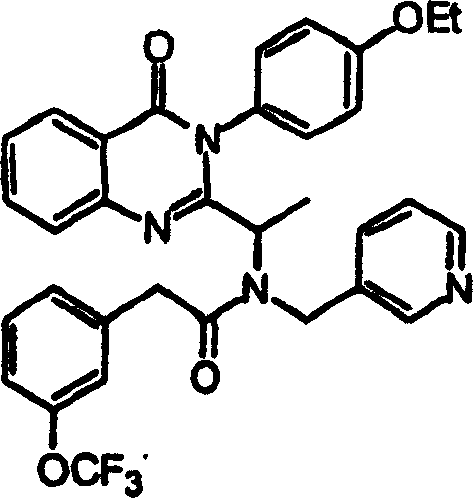
N-{1-[3-(4-乙氧基-苯基)-4-氧代-3,4-二氢-喹唑啉-2-基]-乙基}-N-吡啶-3-基甲基-2-(3-三氟代甲氧基-苯基)-乙酰胺3.36N-{1-[3-(4-ethoxy-phenyl)-4-oxo-3,4-dihydro-quinazolin-2-yl]-ethyl}-N-pyridine-3- Methyl-2-(3-trifluoromethoxy-phenyl)-acetamide 3.36
以与化合物3.02所用方法相似的方法制备化合物3.36。浅黄色固体。Compound 3.36 was prepared in a manner similar to that used for compound 3.02. Pale yellow solid.
1H NMR(DMSO,T=140℃)1.39(m,6H),3.05(br,1H),3.45(m,1H),4.13(q,2H,J=6.8Hz),4.71(m,2H),5.26(q,1H,J=6.4Hz),7.00-7.16(m,8H),7.35(m,2H),7.37-7.60(m,2H),7.68(d,1H,J2=8.4Hz),7.84(t,1H,J=8Hz),8.09(d,1H,J=8.0Hz),8.34(m,1H). 1 H NMR (DMSO, T=140°C) 1.39(m, 6H), 3.05(br, 1H), 3.45(m, 1H), 4.13(q, 2H, J=6.8Hz), 4.71(m, 2H) , 5.26(q, 1H, J=6.4Hz), 7.00-7.16(m, 8H), 7.35(m, 2H), 7.37-7.60(m, 2H), 7.68(d, 1H, J2 =8.4Hz) , 7.84(t, 1H, J=8Hz), 8.09(d, 1H, J=8.0Hz), 8.34(m, 1H).
在室温下,顺式/反式酰胺旋转异构体混合物(1/2),由1H NMR(CDCl3)测定:1.25(d,1H,J=6.4Hz),1.32(d,1H,J=6.4Hz)。MS(ESI+)603.2[MH]+。C33H29F3N4O4的分析计算值:C,65.77;H,4.85;N,9.30。实测值:C,65.48;H,4.98;N,9.39。At room temperature, cis/trans amide rotamer mixture (1/2) by 1 H NMR (CDCl 3 ): 1.25 (d, 1H, J = 6.4 Hz), 1.32 (d, 1H, J = 6.4Hz). MS(ESI + )603.2[MH] + . Anal . Calcd. for C33H29F3N4O4 : C, 65.77; H , 4.85; N , 9.30. Found: C, 65.48; H, 4.98; N, 9.39.
化合物3.37的合成Synthesis of compound 3.37
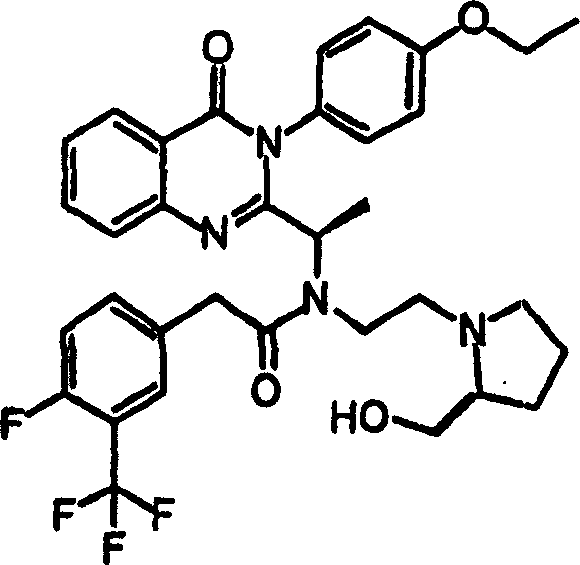
(S)-N-{1-[3-(4-乙氧基-苯基)-4-氧代-3,4-二氢-喹唑啉-2-基]-乙基}-2-(4-氟代-3-三氟代甲基-苯基)-N-[2-(2-羟基甲基-吡咯烷-1-基)-乙基]-乙酰胺3.37(S)-N-{1-[3-(4-Ethoxy-phenyl)-4-oxo-3,4-dihydro-quinazolin-2-yl]-ethyl}-2- (4-fluoro-3-trifluoromethyl-phenyl)-N-[2-(2-hydroxymethyl-pyrrolidin-1-yl)-ethyl]-acetamide 3.37
根据化合物3.02的合成方法制备化合物3.37。白色固体。Compound 3.37 was prepared according to the synthetic method of compound 3.02. white solid.
1H NMR(DMSO,T=120℃)1.32(t,3H,J=7.07Hz),1.49-1.55(m,6H),1.70(m,1H),2.26(m,1H),2.58(m,1H),2.78-2.88(m,4H),3.12-3.15(m,1H),3.20(m,1H),3.40(m,1H),3.49(m,1H),3.50-3.85(m,2H),4.07(q,2H,J=7.07Hz),5.16(q,1H,J=6.67Hz),7.02(m,2H),7.24(m,1H),7.29-7.44(m,4H),7.56(t,1H,J=7.33Hz),7.72(d,1H,J=8Hz),7.86(t,1H,J=7.6Hz),8.14(d,1H,J=7.60Hz).MS(ESI+)641.2(MH+). 1 H NMR (DMSO, T=120°C) 1.32(t, 3H, J=7.07Hz), 1.49-1.55(m, 6H), 1.70(m, 1H), 2.26(m, 1H), 2.58(m, 1H), 2.78-2.88(m, 4H), 3.12-3.15(m, 1H), 3.20(m, 1H), 3.40(m, 1H), 3.49(m, 1H), 3.50-3.85(m, 2H) , 4.07(q, 2H, J=7.07Hz), 5.16(q, 1H, J=6.67Hz), 7.02(m, 2H), 7.24(m, 1H), 7.29-7.44(m, 4H), 7.56( t, 1H, J=7.33Hz), 7.72(d, 1H, J=8Hz), 7.86(t, 1H, J=7.6Hz), 8.14(d, 1H, J=7.60Hz).MS(ESI + ) 641.2(MH + ).
化合物3.38的合成Synthesis of Compound 3.38
N-{1-[3-(4-乙氧基-苯基)-4-氧代-3,4-二氢-喹唑啉-2-基]-乙基}-2-(4-氟代-3-三氟代甲基-苯基)-N-(2-吡啶-2-基-乙基)-乙酰胺3.38N-{1-[3-(4-ethoxy-phenyl)-4-oxo-3,4-dihydro-quinazolin-2-yl]-ethyl}-2-(4-fluoro Substitute-3-trifluoromethyl-phenyl)-N-(2-pyridin-2-yl-ethyl)-acetamide 3.38
根据化合物3.02的合成方法制备化合物3.38。浅黄色固体。Compound 3.38 was prepared according to the synthetic method of compound 3.02. Pale yellow solid.
1H NMR(DMSO,T=120℃)1.33(t,3H,J=6.67Hz),1.51(d,3H,J=6.67Hz),2.95(m,1H),3.19(m,1H),3.69(m,1H),3.83(m,1H),4.09(q,2H,J=6.67Hz),5.11-5.23(m,3H),7.06(m,2H),7.27-7.45(m,7H),7.56(t,1H,J=7.33Hz),7.70(d,1H,J=8Hz),7.85(m,2H),8.13(d,1H,J=7.60Hz),8.48(s,1H).MS(ESI+)619.30(MH+). 1 H NMR (DMSO, T=120°C) 1.33(t, 3H, J=6.67Hz), 1.51(d, 3H, J=6.67Hz), 2.95(m, 1H), 3.19(m, 1H), 3.69 (m, 1H), 3.83(m, 1H), 4.09(q, 2H, J=6.67Hz), 5.11-5.23(m, 3H), 7.06(m, 2H), 7.27-7.45(m, 7H), 7.56(t, 1H, J=7.33Hz), 7.70(d, 1H, J=8Hz), 7.85(m, 2H), 8.13(d, 1H, J=7.60Hz), 8.48(s, 1H).MS (ESI + )619.30(MH + ).
化合物3.39.HCl的合成Synthesis of compound 3.39.HCl

N-(2-二甲基氨基-吡啶-3-基甲基)-N-{1-[3-(4-乙氧基-苯基)-4-氧代-3,4-二氢-喹唑啉-2-基]-乙基}-2-(4-氟代-3-三氟代甲基-苯基)-乙酰胺3.39N-(2-Dimethylamino-pyridin-3-ylmethyl)-N-{1-[3-(4-ethoxy-phenyl)-4-oxo-3,4-dihydro- Quinazolin-2-yl]-ethyl}-2-(4-fluoro-3-trifluoromethyl-phenyl)-acetamide 3.39
根据化合物3.02的合成方法制备化合物3.39。白色固体。Compound 3.39 was prepared according to the synthetic method of compound 3.02. white solid.
1H NMR(DMSO,T=120℃)1.36(m,6H),2.88(s,6H),3.61(d,1H,J=14.67Hz),4.12(q,2H,J=6.93Hz),4.78(m,3H),5.26(m,1H),6.93(m,1H),7.10(m,2H),7.28-7.43(m,5H),7.51-7.59(m,3H),7.83(t,1H,J=7.33Hz),7.97(m,1H),8.08(d,1H,J=7.73Hz).MS(ESI+)648.2(MH+). 1 H NMR (DMSO, T=120°C) 1.36 (m, 6H), 2.88 (s, 6H), 3.61 (d, 1H, J=14.67Hz), 4.12 (q, 2H, J=6.93Hz), 4.78 (m, 3H), 5.26(m, 1H), 6.93(m, 1H), 7.10(m, 2H), 7.28-7.43(m, 5H), 7.51-7.59(m, 3H), 7.83(t, 1H , J=7.33Hz), 7.97(m, 1H), 8.08(d, 1H, J=7.73Hz). MS(ESI + ) 648.2(MH + ).
流程10Process 10
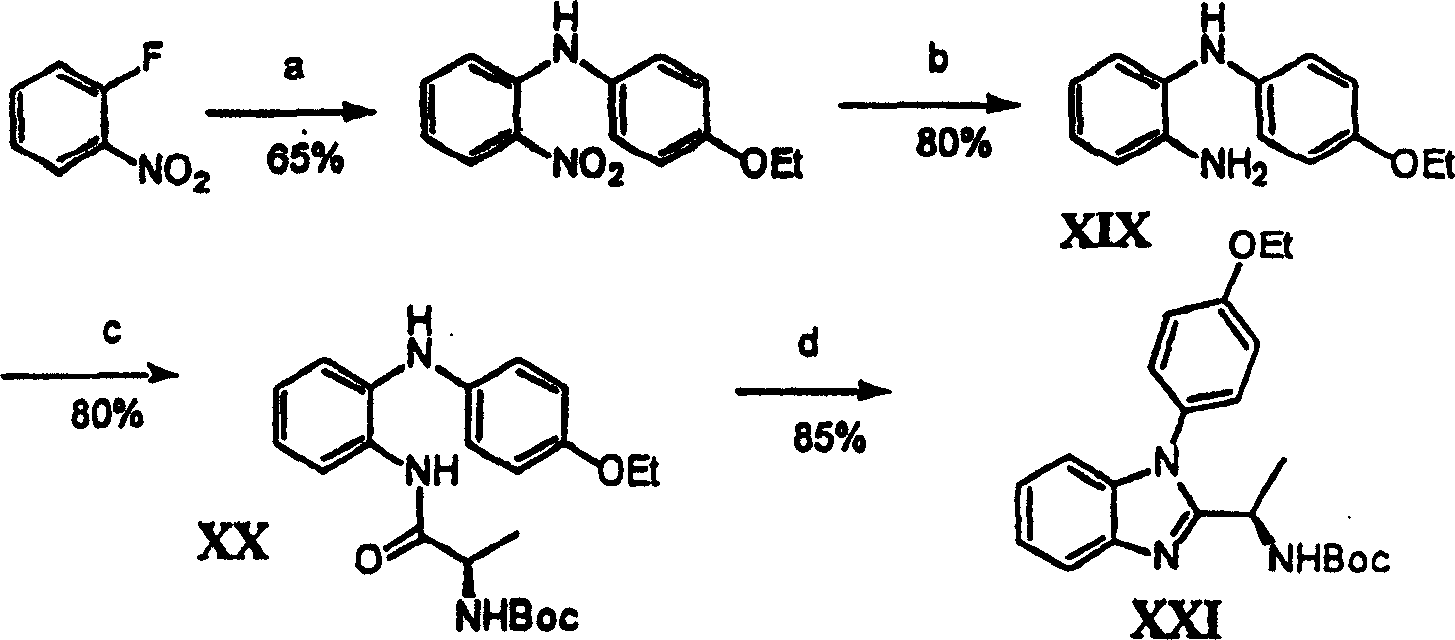
a 对-氨基苯乙醚、K2CO3、DMF、125℃、16小时。b H2、Pd/C、室温。c D-Boc-Ala-OH、EDC、HOBt、NMM、DMF。d HOAc、90℃。a p-aminophenetole, K 2 CO 3 , DMF, 125°C, 16 hours. b H 2 , Pd/C, room temperature. c D-Boc-Ala-OH, EDC, HOBt, NMM, DMF. d HOAc, 90°C.
N-(4-乙氧基-苯基)-苯-1,2-二胺(XIX)。在K2CO3(13.0g,94.2mmol)存在下,将1-氟代-2-硝基苯(8.46g,60mmol)和苯胺(8.22g,60mmol)的DMF(40ml)混合物加热至125℃16小时,然后倒入水中,将含水层用EtOAc萃取三次,然后用水、盐水洗涤合并的有机层并经Na2SO4干燥。将该溶液蒸发并将粗产物从EtOH中重结晶,得到棕色固体(4-乙氧基-苯基)-(2-硝基-苯基)-1-胺(10g)。N-(4-Ethoxy-phenyl)-benzene-1,2-diamine (XIX). A mixture of 1-fluoro-2-nitrobenzene (8.46g, 60mmol) and aniline (8.22g, 60mmol) in DMF (40ml) was heated to 125°C in the presence of K2CO3 (13.0g, 94.2mmol) 16 hours, then poured into water, the aqueous layer was extracted three times with EtOAc, then the combined organic layers were washed with water, brine and dried over Na2SO4 . The solution was evaporated and the crude product was recrystallized from EtOH to give (4-ethoxy-phenyl)-(2-nitro-phenyl)-1-amine (10 g) as a brown solid.
在10%Pd-C(2.1g,2mmol)存在下,在氢气氛下将(4-乙氧基-苯基)-(2-硝基-苯基)-1-胺(5.16g,20mmol)的MeOH/Et2O(30ml/30ml)溶液搅拌过夜。滤出固体,蒸发滤液得到橙色固体N-(4-乙氧基-苯基)-苯-1,2-二胺(3.6g)(XIX)。In the presence of 10% Pd-C (2.1 g, 2 mmol), (4-ethoxy-phenyl)-(2-nitro-phenyl)-1-amine (5.16 g, 20 mmol) was added under hydrogen atmosphere A solution of MeOH/Et 2 O (30ml/30ml) was stirred overnight. The solid was filtered off and the filtrate was evaporated to give N-(4-ethoxy-phenyl)-benzene-1,2-diamine (3.6 g) as an orange solid (XIX).
1H NMR(CDCl3)1.39(t,3H,J=6.93Hz),3.98(q,2H,J=6.93Hz),6.78(m,6H),6.94(m,1H),7.03(m,1H).MS(ESI+)229.2(MH+). 1 H NMR (CDCl 3 ) 1.39(t, 3H, J=6.93Hz), 3.98(q, 2H, J=6.93Hz), 6.78(m, 6H), 6.94(m, 1H), 7.03(m, 1H ).MS(ESI + )229.2(MH + ).
{1-[2-(4-乙氧基-苯基氨基)-苯基氨基甲酰基]-乙基}-氨基甲酸叔-丁基酯(XX)。向含有(R)-Boc-Ala-OH(4.92g,26mmol)和以上二胺(5.4g,23.68mmol)的50ml DMF溶液中加入EDCI(9.08g,47.3mmol)、HOBt(3.62g,23.68mmol)和NMM(3.59g,35.52mmol)。将该混合物在室温下搅拌过夜。将该反应物用二氯甲烷稀释并用水(三次)、盐水洗涤并经Na2SO4干燥。除去溶剂得到油状物,将该油状物进行快速柱层析。得到黄色固体(7.55g)。{1-[2-(4-Ethoxy-phenylamino)-phenylcarbamoyl]-ethyl}-carbamic acid tert-butyl ester (XX). EDCI (9.08g, 47.3mmol), HOBt (3.62g, 23.68mmol) were added to a 50ml DMF solution containing (R)-Boc-Ala-OH (4.92g, 26mmol) and the above diamine (5.4g, 23.68mmol) ) and NMM (3.59 g, 35.52 mmol). The mixture was stirred overnight at room temperature. The reaction was diluted with dichloromethane and washed with water (three times), brine and dried over Na2SO4 . Removal of solvent gave an oil which was subjected to flash column chromatography. A yellow solid (7.55g) was obtained.
1H NMR(CDCl3)1.37(m,15H),3.98(q,2H,J=5.2Hz),4.21(m,1H),4.92(m,1H),5.65(br,1H),6.81(m,4H),6.97(m,1H),7.08(m,2H),7.68(d,1H,J=8Hz),8.16(s,1H).MS(ESI+)400.2(MH+). 1 H NMR (CDCl 3 ) 1.37(m, 15H), 3.98(q, 2H, J=5.2Hz), 4.21(m, 1H), 4.92(m, 1H), 5.65(br, 1H), 6.81(m , 4H), 6.97(m, 1H), 7.08(m, 2H), 7.68(d, 1H, J=8Hz), 8.16(s, 1H). MS(ESI + ) 400.2(MH + ).
{1-[1-(4-乙氧基-苯基)-1H-苯并嘧唑-2-基]-乙基}-氨基甲酸叔-丁基酯(XXI)。将以上固体(6g,15.03mmol)的HOAc溶液(60ml)加热至80℃4小时。蒸发溶剂,将残余物溶于EtOAc中并用NaHCO3、水、盐水洗涤,经Na2SO4干燥。除去溶剂,将粗制残余物进行快速柱层析,得到白色固体(4.1g)。{1-[1-(4-Ethoxy-phenyl)-1H-benzopyrimazol-2-yl]-ethyl}-carbamic acid tert-butyl ester (XXI). A solution of the above solid (6 g, 15.03 mmol) in HOAc (60 ml) was heated to 80 °C for 4 hours. The solvent was evaporated, the residue was dissolved in EtOAc and washed with NaHCO3 , water, brine, dried over Na2SO4 . The solvent was removed and the crude residue was subjected to flash column chromatography to give a white solid (4.1 g).
1H NMR(CDCl3)1.36(s,9H),1.43(m,6H),4.10(q,2H,J=6.93Hz),4.84(m,1H),7.03(m,1H),7.06(m,2H),7.21(m,2H),7.38(m,2H),7.66(d,1H,J=7.73Hz).MS(ESI+)382.3(MH+). 1 H NMR (CDCl 3 ) 1.36(s, 9H), 1.43(m, 6H), 4.10(q, 2H, J=6.93Hz), 4.84(m, 1H), 7.03(m, 1H), 7.06(m , 2H), 7.21(m, 2H), 7.38(m, 2H), 7.66(d, 1H, J=7.73Hz). MS(ESI + ) 382.3(MH + ).
化合物3.40.HCl的合成Synthesis of Compound 3.40.HCl
2-(3,5-二-三氟代甲基-苯基)-N-{1-[1-(4-乙氧基-苯基)-1H-苯并嘧唑-2-基]-乙基}-N-吡啶-3-基甲基-乙酰胺3.402-(3,5-Di-trifluoromethyl-phenyl)-N-{1-[1-(4-ethoxy-phenyl)-1H-benzopyrimazol-2-yl]- Ethyl}-N-pyridin-3-ylmethyl-acetamide 3.40
从{1-[1-(4-乙氧基-苯基)-1H-苯并嘧唑-2-基]-乙基}-氨基甲酸叔-丁基酯开始,根据化合物3.02的合成方法制备化合物3.40。黄色固体。Starting from {1-[1-(4-ethoxy-phenyl)-1H-benzopyrimazol-2-yl]-ethyl}-carbamic acid tert-butyl ester, prepared according to the synthetic method of compound 3.02 Compound 3.40. yellow solid.
1H NMR(DMSO,T=120℃)1.35(t,3H,J=6.93Hz),1.66(m,3H),3.29(br,1H),3.93(d,1H,J=16Hz),4.11(q,2H,J=6.93Hz),4.65(m,1H),4.75(m,1H),5.70(m,1H),7.03(d,1H,J=7.73Hz),7.14(d,2H,J=8.27Hz),7.26-7.44(m,5H),7.70-7.84(m,5H),8.45(s,2H).MS(ESI+)627.2(MH+). 1 H NMR (DMSO, T=120° C.) 1.35 (t, 3H, J=6.93 Hz), 1.66 (m, 3H), 3.29 (br, 1H), 3.93 (d, 1H, J=16 Hz), 4.11 ( q, 2H, J=6.93Hz), 4.65(m, 1H), 4.75(m, 1H), 5.70(m, 1H), 7.03(d, 1H, J=7.73Hz), 7.14(d, 2H, J =8.27Hz), 7.26-7.44(m, 5H), 7.70-7.84(m, 5H), 8.45(s, 2H). MS(ESI + )627.2(MH + ).
化合物3.41的合成Synthesis of compound 3.41

N-{1-[5-氰基-1-(4-乙氧基-苯基)-1H-苯并嘧唑-2-基]-乙基}-2-(3-氟代-4-三氟代甲基-苯基)-N-吡啶-3-基甲基-乙酰胺3.41N-{1-[5-cyano-1-(4-ethoxy-phenyl)-1H-benzopyrimazol-2-yl]-ethyl}-2-(3-fluoro-4- Trifluoromethyl-phenyl)-N-pyridin-3-ylmethyl-acetamide 3.41
根据化合物3.40的合成方法制备化合物3.41。白色固体。Compound 3.41 was prepared according to the synthetic method of compound 3.40. white solid.
1H NMR(DMSO,T=120℃)1.41(t,3H,J=6.93Hz),1.59(m,3H),3.30(br,1H),3.69(d,1H,J=16Hz),4.15(q,2H,J=6.93Hz),4.49-4.63(m,2H),5.74(m,1H),7.02-7.15(m,6H),7.30-7.41(m,3H),7.58(m,2H),8.18-8.32(m,3H).MS(ESI+)602.3(MH+). 1 H NMR (DMSO, T=120°C) 1.41(t, 3H, J=6.93Hz), 1.59(m, 3H), 3.30(br, 1H), 3.69(d, 1H, J=16Hz), 4.15( q, 2H, J=6.93Hz), 4.49-4.63(m, 2H), 5.74(m, 1H), 7.02-7.15(m, 6H), 7.30-7.41(m, 3H), 7.58(m, 2H) , 8.18-8.32 (m, 3H). MS (ESI + ) 602.3 (MH + ).
化合物3.42.HCl的合成Synthesis of Compound 3.42.HCl

N-{1-[3-(4-乙氧基-苯基)-4-氧代-3,4-二氢-喹唑啉-2-基]-乙基}-2-(4-氟代-3-三氟代甲基-苯基)-N-(3-吡咯烷-1-基-丙基)-乙酰胺3.42N-{1-[3-(4-ethoxy-phenyl)-4-oxo-3,4-dihydro-quinazolin-2-yl]-ethyl}-2-(4-fluoro Substitute-3-trifluoromethyl-phenyl)-N-(3-pyrrolidin-1-yl-propyl)-acetamide 3.42
根据化合物3.02的合成方法制备化合物3.42。白色固体。Compound 3.42 was prepared according to the synthetic method of compound 3.02. white solid.
1H NMR(DMSO,T=120℃)1.35(t,3H,J=6.93Hz),1.52(m,3H),1.9(m,6H),2.85-3.05(m,3H),3.36-3.57(m,4H),3.95(m,3H),4.08(q,2H,J=6.93Hz),5.17(m,1H),7.02-7.10(m,2H),7.24-7.46(m,5H),7.58(t,1H,J=7.6Hz),7.75(d,1H,J=7.73Hz),7.88(t,1H,J=7.73Hz),8.15(d,1H,J=8Hz).MS(ESI+)625.3(MH+). 1 H NMR (DMSO, T=120°C) 1.35(t, 3H, J=6.93Hz), 1.52(m, 3H), 1.9(m, 6H), 2.85-3.05(m, 3H), 3.36-3.57( m, 4H), 3.95(m, 3H), 4.08(q, 2H, J=6.93Hz), 5.17(m, 1H), 7.02-7.10(m, 2H), 7.24-7.46(m, 5H), 7.58 (t, 1H, J=7.6Hz), 7.75(d, 1H, J=7.73Hz), 7.88(t, 1H, J=7.73Hz), 8.15(d, 1H, J=8Hz).MS(ESI + )625.3(MH + ).
化合物3.43的合成Synthesis of compound 3.43

4-{1-[3-(4-乙氧基-苯基)-4-氧代-3,4-二氢-喹唑啉-2-基]-乙基氨基}-哌啶-1-羧酸叔-丁基酯(I)。在-10℃下,将4-氧代-哌啶-1-羧酸叔-丁基酯(0.468g,2.35mmol)加入到胺(0.6g,1.96mmol)的二氯乙烷(10ml)溶液中,随后加入Na(OAC)3BH(0.602g,2.84mmol)。将该混合物保持在此温度下1.5小时,然后缓慢加热至室温并搅拌过夜。将溶液用DCM稀释,用饱和NaHCO3、水、盐水洗涤并用Na2SO4干燥。蒸发溶剂并得到白色固体(1.1g),该固体用于下一步骤中。MS(ESI+)493.3[MH]+。4-{1-[3-(4-ethoxy-phenyl)-4-oxo-3,4-dihydro-quinazolin-2-yl]-ethylamino}-piperidine-1- tert-Butyl Carboxylate (I). 4-Oxo-piperidine-1-carboxylic acid tert-butyl ester (0.468g, 2.35mmol) was added to a solution of amine (0.6g, 1.96mmol) in dichloroethane (10ml) at -10°C , followed by the addition of Na(OAC) 3BH (0.602g, 2.84mmol). The mixture was kept at this temperature for 1.5 hours, then slowly warmed to room temperature and stirred overnight. The solution was diluted with DCM, washed with saturated NaHCO3 , water, brine and dried over Na2SO4 . The solvent was evaporated and a white solid (1.1 g) was obtained which was used in the next step. MS (ESI + ) 493.3 [MH] + .
4-{{1-[3-(4-乙氧基-苯基)-4-氧基-3,4-二氢-喹唑啉-2-基]-乙基}-[(4-氟代-3-三氟代甲基-苯基)-乙酰基]-氨基}-哌啶-羧酸酯(II)。将吡啶(0.289g,3.66mmol)加入到I(0.6g,1.22mmol)和苯乙酰氯(0.44g,1.83mmol)的甲苯(15ml)混合物中。将该溶液加热至60℃3小时,然后倒入1N HCl中。将含水层用EtOAc萃取三次,然后将合并的有机层用饱和NaHCO3、水、盐水洗涤并经Na2SO4干燥。蒸发溶剂并将粗制油状物进行快速柱层析,得到黄色固体(540mg)。MS(ESI+)697.3[MH]+。4-{{1-[3-(4-ethoxy-phenyl)-4-oxyl-3,4-dihydro-quinazolin-2-yl]-ethyl}-[(4-fluoro <RTI ID=0.0>-3-trifluoromethyl-phenyl)-acetyl]-amino}-piperidine-carboxylate</RTI> (II). Pyridine (0.289g, 3.66mmol) was added to a mixture of I (0.6g, 1.22mmol) and phenylacetyl chloride (0.44g, 1.83mmol) in toluene (15ml). The solution was heated to 60°C for 3 hours, then poured into 1N HCl. The aqueous layer was extracted three times with EtOAc, then the combined organic layers were washed with saturated NaHCO3 , water, brine and dried over Na2SO4 . The solvent was evaporated and the crude oil was subjected to flash column chromatography to give a yellow solid (540 mg). MS (ESI + ) 697.3 [MH] + .
{1-[3-(4-乙氧基-苯基)-4-氧代-3,4-二氢-喹唑啉-2-基]-乙基}-2-(4-氟代-3-三氟代甲基-苯基)-哌啶-4-基-乙酰胺(3.43)。将三氟乙酸(1.77g,15.5mmol)加入到II(0.54g,0.77mmol)的二氯甲烷溶液中。将该混合物在室温下搅拌3小时。蒸发溶剂,将残余物溶于EtOAc中并用饱和NaHCO3、水、盐水洗涤,经Na2SO4干燥。蒸发溶剂并将粗制油状物进行快速柱层析,得到白色固体(440mg)。{1-[3-(4-ethoxy-phenyl)-4-oxo-3,4-dihydro-quinazolin-2-yl]-ethyl}-2-(4-fluoro- 3-Trifluoromethyl-phenyl)-piperidin-4-yl-acetamide (3.43). Trifluoroacetic acid (1.77 g, 15.5 mmol) was added to a solution of II (0.54 g, 0.77 mmol) in dichloromethane. The mixture was stirred at room temperature for 3 hours. The solvent was evaporated, the residue was dissolved in EtOAc and washed with saturated NaHCO3 , water , brine, dried over Na2SO4 . The solvent was evaporated and the crude oil was subjected to flash column chromatography to give a white solid (440mg).
1H NMR(DMSO,T=120℃)1.21(m,1H),1.34(m,4H),1.48(d,3H,J=6.8Hz),2.16(m,3H),2.70-2.97(m,4H),3.28(d,1H,J=16Hz),3.64(m,1H),4.09(q,2H,J=6.8Hz),5.04(m,1H),7.07-7.20(m,3H),7.30-7.44(m,4H),7.58(t,1H,J=7.33Hz),7.76(d,1H,J=8Hz),7.88(d,1H,J=7.07Hz),8.14(d,1H,J=7.73Hz),MS(ESI+)597.3(MH+). 1 H NMR (DMSO, T=120°C) 1.21(m, 1H), 1.34(m, 4H), 1.48(d, 3H, J=6.8Hz), 2.16(m, 3H), 2.70-2.97(m, 4H), 3.28(d, 1H, J=16Hz), 3.64(m, 1H), 4.09(q, 2H, J=6.8Hz), 5.04(m, 1H), 7.07-7.20(m, 3H), 7.30 -7.44(m, 4H), 7.58(t, 1H, J=7.33Hz), 7.76(d, 1H, J=8Hz), 7.88(d, 1H, J=7.07Hz), 8.14(d, 1H, J =7.73Hz), MS(ESI + )597.3(MH + ).
化合物3.44的合成Synthesis of Compound 3.44
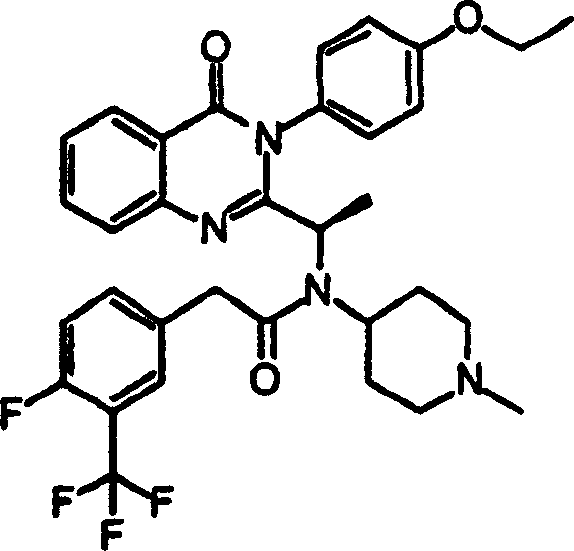
N-{1-[3-(4-乙氧基-苯基)-4-氧代-3,4-二氢-喹唑啉-2-基]-乙基}-2-(4-氟代-3-三氟代甲基-苯基)-N-(1-甲基-哌啶-4-基)-乙酰胺。N-{1-[3-(4-ethoxy-phenyl)-4-oxo-3,4-dihydro-quinazolin-2-yl]-ethyl}-2-(4-fluoro (3-trifluoromethyl-phenyl)-N-(1-methyl-piperidin-4-yl)-acetamide.
在室温下,将甲醛(37%水溶液)(0.016g,0.20mmol)加入到T0913409(0.06g,0.1mmol)的二氯乙烷(5ml)溶液中,随后加入Na(OAC)3BH(0.127g,0.60mmol)。将该混合物搅拌过夜。将溶液用DCM稀释,用饱和NaHCO3、水、盐水洗涤并用Na2SO4干燥。蒸发溶剂并将残余物经快速柱层析纯化,得到白色固体(58mg)。Formaldehyde (37% in water) (0.016 g, 0.20 mmol) was added to a solution of T0913409 (0.06 g, 0.1 mmol) in dichloroethane (5 ml) at room temperature, followed by Na(OAC) 3 BH (0.127 g , 0.60mmol). The mixture was stirred overnight. The solution was diluted with DCM, washed with saturated NaHCO3 , water, brine and dried over Na2SO4 . The solvent was evaporated and the residue was purified by flash column chromatography to give a white solid (58 mg).
1H NMR(DMSO,T=120℃)1.18(m,1H),1.33(t,3H,J=6.8Hz),1.48(d,3H,J=6.67Hz),1.61(m,1H),1.95(m,1H),2.10(s,3H),2.38(m,2H),2.64(m,1H),2.76(m,1H),2.88(s,2H),3.26(d,1H,J=16Hz),3.58(m,1H),4.09(d,2H,J=6.8Hz),5.04(m,1H),7.08-7.45(m,7H),7.58(m,1H),7.76(d,1H,J=8Hz),7.89(m,1H),8.14(d,1H,J=7.73Hz).MS(ESI+)611.3(MH+). 1 H NMR (DMSO, T=120°C) 1.18 (m, 1H), 1.33 (t, 3H, J=6.8Hz), 1.48 (d, 3H, J=6.67Hz), 1.61 (m, 1H), 1.95 (m, 1H), 2.10(s, 3H), 2.38(m, 2H), 2.64(m, 1H), 2.76(m, 1H), 2.88(s, 2H), 3.26(d, 1H, J=16Hz ), 3.58(m, 1H), 4.09(d, 2H, J=6.8Hz), 5.04(m, 1H), 7.08-7.45(m, 7H), 7.58(m, 1H), 7.76(d, 1H, J=8Hz), 7.89(m, 1H), 8.14(d, 1H, J=7.73Hz). MS(ESI + ) 611.3(MH + ).
化合物3.45的合成Synthesis of compound 3.45

3-(4-乙氧基苯基)-2-乙基-喹啉。将33%氢氧化钾(1.3ml)加入到邻-氨基醛(0.31g,2.6mmol)和酮(0.5g,2.6mmol)在95%EtOAc中的混合物中。将该溶液加热至回流2小时,然后倒入水中。将有机层用EtOAc萃取三次,然后用水、盐水洗涤合并的有机层并经Na2SO4干燥。蒸发溶剂并将粗制油状物经快速柱层析纯化,得到白色固体(170mg)。3-(4-Ethoxyphenyl)-2-ethyl-quinoline. 33% Potassium hydroxide (1.3 ml) was added to a mixture of o-aminoaldehyde (0.31 g, 2.6 mmol) and ketone (0.5 g, 2.6 mmol) in 95% EtOAc. The solution was heated to reflux for 2 hours, then poured into water. The organic layer was extracted three times with EtOAc, then the combined organic layers were washed with water, brine and dried over Na2SO4 . The solvent was evaporated and the crude oil was purified by flash column chromatography to give a white solid (170mg).
1H NMR(CDCl3)1.23(t,3H,J=7.5Hz),1.47(t,3H,J=6.93Hz),2.98(q,2H,J=7.47Hz),4.11(q,2H,J=6.93Hz),6.98(m,2H,J=6.8Hz),7.31(m,2H),7.49(m,1H),7.68(m,1H),7.77(d,1H,J=8Hz),7.92(s,1H),8.08(d,1H,J=8Hz).MS(ESI+)278.3(MH+). 1 H NMR (CDCl 3 ) 1.23 (t, 3H, J = 7.5Hz), 1.47 (t, 3H, J = 6.93Hz), 2.98 (q, 2H, J = 7.47Hz), 4.11 (q, 2H, J =6.93Hz), 6.98(m, 2H, J=6.8Hz), 7.31(m, 2H), 7.49(m, 1H), 7.68(m, 1H), 7.77(d, 1H, J=8Hz), 7.92 (s, 1H), 8.08 (d, 1H, J=8Hz). MS (ESI + ) 278.3 (MH + ).
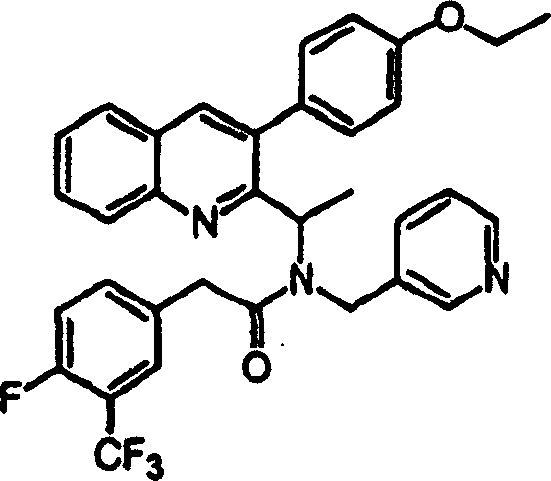
N-{1-[3-(4-乙氧基-苯基)-喹啉-2-基]-乙基}-2-(4-氟代-3-三氟代甲基-苯基)-N-吡啶-3-基甲基-乙酰胺N-{1-[3-(4-ethoxy-phenyl)-quinolin-2-yl]-ethyl}-2-(4-fluoro-3-trifluoromethyl-phenyl) -N-pyridin-3-ylmethyl-acetamide
从3-(4-乙氧基-苯基)-2-乙基-喹啉开始,根据化合物1.01(IV-1.01)的合成方法制备化合物3.45。黄色固体。Compound 3.45 was prepared according to the synthetic method of compound 1.01 (IV-1.01), starting from 3-(4-ethoxy-phenyl)-2-ethyl-quinoline. yellow solid.
1H NMR(DMSO,T=120℃)1.35(t,3H,J=6.80Hz),1.57(m,3H),2.94(br,1H),3.63(d,1H,J=16Hz),4.11(q,2H,J=6.80Hz),4.63(m,2H),5.88(m,1H),7.07(m,5H),7.22-7.33(m,3H),7.58(m,2H),7.76(t,1H,J=7.6Hz),7.90(d,1H,J=8Hz),7.80-8.12(m,3H),8.24(m,1H).MS(ESI+)588.3(MH+). 1 H NMR (DMSO, T=120°C) 1.35(t, 3H, J=6.80Hz), 1.57(m, 3H), 2.94(br, 1H), 3.63(d, 1H, J=16Hz), 4.11( q, 2H, J=6.80Hz), 4.63(m, 2H), 5.88(m, 1H), 7.07(m, 5H), 7.22-7.33(m, 3H), 7.58(m, 2H), 7.76(t , 1H, J=7.6Hz), 7.90(d, 1H, J=8Hz), 7.80-8.12(m, 3H), 8.24(m, 1H). MS(ESI + ) 588.3(MH + ).
化合物3.46的合成Synthesis of Compound 3.46
(R)-2-((N-3-吡啶甲基)-N-(4-三氟代甲基苯基乙酰基)-1-氨基乙基)-3-(4-三氟代乙基)-3H-喹唑啉-4-酮(3.46)。除了使用4-三氟代甲基苯胺代替对-氨基苯乙醚外,使用在流程4中所述的方法合成化合物1。(R)-2-((N-3-pyridylmethyl)-N-(4-trifluoromethylphenylacetyl)-1-aminoethyl)-3-(4-trifluoroethyl )-3H-quinazolin-4-one (3.46).
1H NMR(DMSO-d6,T=120℃)1.40(m,3H),2.89(m,1H),3.58(m,1H),4.78(m,2H),5.24(m,1H),7.21(d,J=4.0Hz,1H),7.26(m,2H),7.55(m,5H),7.71(m,1H),7.80(brs,1H),7.90(m,3H),8.12(d,J=7.8Hz,1H),8.38(t,J=5.1Hz,2H)ppm.MS(ESI+)m/z611.3[M+H]+. 1 H NMR (DMSO-d 6 , T=120°C) 1.40 (m, 3H), 2.89 (m, 1H), 3.58 (m, 1H), 4.78 (m, 2H), 5.24 (m, 1H), 7.21 (d, J=4.0Hz, 1H), 7.26(m, 2H), 7.55(m, 5H), 7.71(m, 1H), 7.80(brs, 1H), 7.90(m, 3H), 8.12(d, J=7.8Hz, 1H), 8.38(t, J=5.1Hz, 2H) ppm.MS(ESI + ) m/z611.3[M+H] + .
化合物3.47的合成Synthesis of compound 3.47
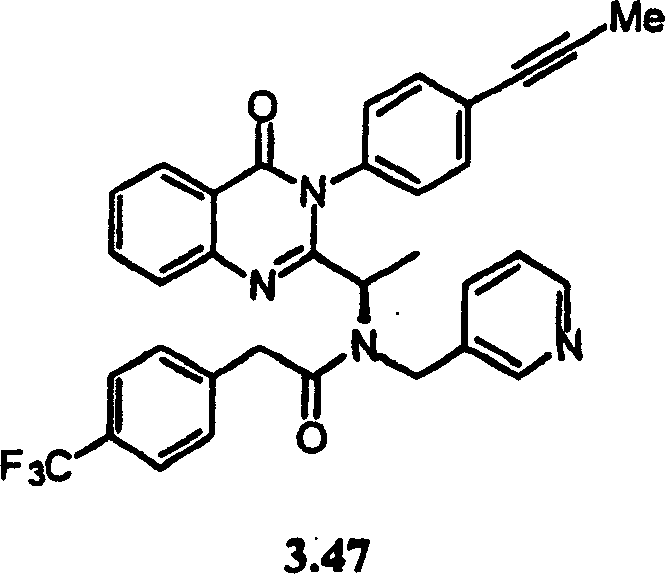
(R)-2-((N-3-吡啶甲基)-N-(4-三氟代甲基苯基乙酰基)-1-氨基乙基)-3-(4-(1-丙炔基)-3H-喹唑啉-4-酮(3.47)。除了使用过量的丙炔气代替三甲基甲硅烷基乙炔外,使用合成化合物3.07中所述的方法合成化合物3.47。(R)-2-((N-3-pyridylmethyl)-N-(4-trifluoromethylphenylacetyl)-1-aminoethyl)-3-(4-(1-propyne yl)-3H-quinazolin-4-one (3.47).Compound 3.47 was synthesized using the method described for the synthesis of compound 3.07, except that excess propyne gas was used in place of trimethylsilylacetylene.
1H NMR(DMSO-d6,T=120℃)1.41(m,3H),2.09(s,3H),2.89(m,1H),3.55(m,1H),4.72(m,2H),5.23(m,1H),7.18(m,1H),7.28(m,2H),7.55(m,8H),7.71(m,1H),7.87(m,1H),8.11(d,J=7.8Hz,1H),8.37(m,2H)ppm.MS(ESI+)m/z581.2[M+H]+. 1 H NMR (DMSO-d 6 , T=120°C) 1.41 (m, 3H), 2.09 (s, 3H), 2.89 (m, 1H), 3.55 (m, 1H), 4.72 (m, 2H), 5.23 (m, 1H), 7.18(m, 1H), 7.28(m, 2H), 7.55(m, 8H), 7.71(m, 1H), 7.87(m, 1H), 8.11(d, J=7.8Hz, 1H), 8.37(m, 2H)ppm.MS(ESI + )m/z581.2[M+H] + .
化合物3.48的合成Synthesis of Compound 3.48

(R)-2-((N-3-吡啶甲基)-N-(4-三氟代甲基苯基乙酰基)-1-氨基乙基)-3-(4-羰基乙氧基甲氧基)-3H-喹唑啉-4-酮(3.48)。除了使用4-(羰基乙氧基甲氧基)苯胺代替对-氨基苯乙醚外,使用在流程4中所述的方法合成化合物3.48。(R)-2-((N-3-pyridylmethyl)-N-(4-trifluoromethylphenylacetyl)-1-aminoethyl)-3-(4-carbonylethoxymethyl Oxy)-3H-quinazolin-4-one (3.48). Compound 3.48 was synthesized using the method described in
1H NMR(DMSO-d6,T=120℃)1.24(t,J=7.1Hz,3H),1.39(d,J=5.4Hz,3H),3.51(brs,1H),4.21(q,J=7.1Hz,2H),4.72(brs,2H),4.78(s,2H),5.22(m,2H),7.16(m,3H),7.29(d,J=7.7Hz,2H),7.44(m,1H),7.54(m,4H),7.68(m,2H),7.86(t,J=7.0Hz,1H),8.10(d,J=7.0Hz,1H),8.36(brs,2H)ppm.MS(ESI+)m/z645.2[M+H]+. 1 H NMR (DMSO-d 6 , T=120°C) 1.24(t, J=7.1Hz, 3H), 1.39(d, J=5.4Hz, 3H), 3.51(brs, 1H), 4.21(q, J =7.1Hz, 2H), 4.72(brs, 2H), 4.78(s, 2H), 5.22(m, 2H), 7.16(m, 3H), 7.29(d, J=7.7Hz, 2H), 7.44(m , 1H), 7.54(m, 4H), 7.68(m, 2H), 7.86(t, J=7.0Hz, 1H), 8.10(d, J=7.0Hz, 1H), 8.36(brs, 2H)ppm. MS(ESI + )m/z645.2[M+H] + .
化合物3.49的合成Synthesis of Compound 3.49
4-(2,2,2-三氟代乙氧基)苯胺。向4-硝基苯酚(1.39g,10mmol,1.0当量)和K2CO3(1.8g,13mmol,1.3当量)的10mL干燥DMF混合物中加入1-碘代-2,2,2-三氟乙烷(2.31g,11mmol,1.1当量)。将该混合物在100℃油浴中加热24小时。加入初始量一半的K2CO3和1-碘代-2,2,2-三氟乙烷。将该混合物在100℃下再搅拌24小时。此过程在三天中重复多次。所述72小时反应结束后,将混合物冷却至室温并倒入40mL水中。将混合物用20mL乙醚萃取2次。用40mL盐水洗涤合并的乙醚萃取液,经无水Na2SO4干燥,过滤除去干燥剂并在真空中蒸发,得到1.6g粗产物,为浅黄色固体。1H NMR(DMSO-d6)4.98(q,J=8.8Hz,2H),7.30(d,J=9.2Hz,2H),8.26(d,J=9.2Hz,2H)ppm。4-(2,2,2-Trifluoroethoxy)aniline. To a mixture of 4-nitrophenol (1.39 g, 10 mmol, 1.0 equiv) and K2CO3 (1.8 g, 13 mmol, 1.3 equiv) in 10 mL of dry DMF was added 1-iodo-2,2,2-trifluoroethane Alkane (2.31 g, 11 mmol, 1.1 equiv). The mixture was heated in a 100°C oil bath for 24 hours. Half the initial amount of K2CO3 and 1-iodo-2,2,2 - trifluoroethane was added. The mixture was stirred for a further 24 hours at 100°C. This process is repeated several times over three days. After the 72 hour reaction was complete, the mixture was cooled to room temperature and poured into 40 mL of water. The mixture was extracted twice with 20 mL of ether. The combined ether extracts were washed with 40 mL of brine, dried over anhydrous Na2SO4 , filtered to remove the desiccant and evaporated in vacuo to give 1.6 g of crude product as a pale yellow solid. 1 H NMR (DMSO-d 6 ) 4.98 (q, J = 8.8 Hz, 2H), 7.30 (d, J = 9.2 Hz, 2H), 8.26 (d, J = 9.2 Hz, 2H) ppm.
向粗制的4-(2,2,2-三氟代乙氧基)硝基苯(1.6g,7.2mmol,1.0当量)的40mL二氯甲烷溶液中加入0.4g 5%披钯活性碳(0.19mmol,0.026当量)。使用气囊导入氢气,将该混合物在室温下剧烈搅拌48小时。所有起始原料都消耗尽后,将混合物通过硅藻土垫过滤以除去钯催化剂。在真空中蒸发滤液得到粗产物,为棕色液体。将该粗产物在还原剂存在下经蒸馏纯化,得到1.3g纯的4-(2,2,2-三氟代乙氧基)苯胺,为无色液体,在该液体冷却至0℃后固化。在0.5torr处b.p.81-83℃。1H NMR(DMSO-d6)δ4.53(q,J=9.1Hz,2H),4.76(brs,2H),6.52(d,J=7.6Hz,2H),6.76(d,J=7.6Hz,2H)ppm。To a solution of crude 4-(2,2,2-trifluoroethoxy)nitrobenzene (1.6 g, 7.2 mmol, 1.0 equiv) in 40 mL of dichloromethane was added 0.4 g of 5% palladium on activated carbon ( 0.19 mmol, 0.026 equiv). Hydrogen was introduced using a balloon, and the mixture was stirred vigorously at room temperature for 48 hours. After all starting material was consumed, the mixture was filtered through a pad of celite to remove the palladium catalyst. Evaporation of the filtrate in vacuo gave the crude product as a brown liquid. The crude product was purified by distillation in the presence of a reducing agent to obtain 1.3 g of pure 4-(2,2,2-trifluoroethoxy)aniline as a colorless liquid which solidified upon cooling to 0°C . bp 81-83°C at 0.5 torr. 1 H NMR (DMSO-d 6 ) δ4.53(q, J=9.1Hz, 2H), 4.76(brs, 2H), 6.52(d, J=7.6Hz, 2H), 6.76(d, J=7.6Hz , 2H) ppm.

(R)-2-((N-3-吡啶甲基)-N-(3,4-二氯代苯基乙酰基)-1-氨基乙基)-3-(4-(2,2,2-三氟代乙氧基)苯基)-3H-喹唑啉-4-酮三氟乙酸酯(3.49.CF3COOH)。除了使用4-(2,2,2-三氟代乙氧基)苯胺代替对-氨基苯乙醚以及使用3,4-二氯代苯基乙酸代替4-三氟代甲基苯基乙酸外,使用在流程4中所述的方法合成化合物3.49的三氟乙酸盐。(R)-2-((N-3-pyridylmethyl)-N-(3,4-dichlorophenylacetyl)-1-aminoethyl)-3-(4-(2,2, 2-Trifluoroethoxy)phenyl)-3H-quinazolin-4-one trifluoroacetate (3.49. CF3COOH ). In addition to using 4-(2,2,2-trifluoroethoxy)aniline instead of p-aminophenetole and 3,4-dichlorophenylacetic acid instead of 4-trifluoromethylphenylacetic acid, The trifluoroacetate salt of compound 3.49 was synthesized using the method described in
1H NMR(DMSO-d6,T=120℃)δ1.42(brs,3H),3.50(m,1H),4.75(m,5H),5.22(m,1H),7.03(d,J=7.9Hz,1H),7.27(m,5H),7.43(d,J=8.2Hz,1H),7.50(m,1H),7.56(t,J=7.4Hz,1H),7.67(t,J=8.4Hz,2H),7.87(t,1H),8.11(d,J=7.6Hz,1H),8.42(brs,2H)ppm.MS(ESI+)m/z641.2[M+H]+. 1 H NMR (DMSO-d 6 , T=120°C) δ1.42 (brs, 3H), 3.50 (m, 1H), 4.75 (m, 5H), 5.22 (m, 1H), 7.03 (d, J= 7.9Hz, 1H), 7.27(m, 5H), 7.43(d, J=8.2Hz, 1H), 7.50(m, 1H), 7.56(t, J=7.4Hz, 1H), 7.67(t, J= 8.4Hz, 2H), 7.87(t, 1H), 8.11(d, J=7.6Hz, 1H), 8.42(brs, 2H) ppm. MS(ESI + ) m/z641.2[M+H] + .
化合物3.50的合成Synthesis of compound 3.50

(R)-2-((N-3-吡啶甲基)-N-(4-三氟代甲氧基苯基乙酰基)-1-氨基乙基)-3-(4-(2,2,2-三氟代乙氧基)苯基)-3H-8-氮杂喹唑啉-4-酮(5)。除了使用4-(2,2,2-三氟代乙氧基)苯胺代替对-氨基苯乙醚外,使用在流程13中所述的方法合成化合物3.50。(R)-2-((N-3-pyridylmethyl)-N-(4-trifluoromethoxyphenylacetyl)-1-aminoethyl)-3-(4-(2,2 , 2-trifluoroethoxy)phenyl)-3H-8-azaquinazolin-4-one (5). Compound 3.50 was synthesized using the method described in Scheme 13, except that 4-(2,2,2-trifluoroethoxy)aniline was used instead of p-aminophenetole.
1H NMR(DMSO-d6,T=120℃)δ1.42(m,3H),3.51(m,1H),4.17(m,1H),4.77(q,J=8.7Hz,2H),4.89(m,2H),5.25(m,1H),7.18(m,4H),7.28(m,3H),7.47(m,1H),7.59(m,2H),7.90(m,1H),8.50(m,3H),9.01(m,1H)ppm.MS(ESI+)m/z658.2[M+H]+. 1 H NMR (DMSO-d 6 , T=120°C) δ1.42 (m, 3H), 3.51 (m, 1H), 4.17 (m, 1H), 4.77 (q, J=8.7Hz, 2H), 4.89 (m, 2H), 5.25(m, 1H), 7.18(m, 4H), 7.28(m, 3H), 7.47(m, 1H), 7.59(m, 2H), 7.90(m, 1H), 8.50( m, 3H), 9.01 (m, 1H) ppm. MS (ESI + ) m/z658.2[M+H] + .
化合物3.51的合成Synthesis of Compound 3.51
(R)-2-((N-3-吡啶甲基)-N-(4-三氟代甲氧基苯基乙酰基)-1-氨基乙基)-3-(4-(2,2,2-三氟代乙氧基)苯基)-3H-5,6,7,8-四氢-8-氮杂喹唑啉-4-酮(3.51)。向3.50(10mg,15μmol,1.0当量)的1.0mL MeOH溶液中加入10%Pd活性碳(2mg,1.9μmol,0.13当量)。使用气囊导入氢气。将该混合物在室温下剧烈搅拌16小时。用5mL二氯甲烷稀释混合物并过滤除去催化剂。在真空中蒸发滤液得到粗产物6,将该产物经硅胶柱层析纯化,得到7.3mg 3.51,为白色固体。(R)-2-((N-3-pyridylmethyl)-N-(4-trifluoromethoxyphenylacetyl)-1-aminoethyl)-3-(4-(2,2 ,2-trifluoroethoxy)phenyl)-3H-5,6,7,8-tetrahydro-8-azaquinazolin-4-one (3.51). To a solution of 3.50 (10 mg, 15 μmol, 1.0 equiv) in 1.0 mL of MeOH was added 10% Pd on activated carbon (2 mg, 1.9 μmol, 0.13 equiv). Hydrogen gas is introduced using a balloon. The mixture was stirred vigorously at room temperature for 16 hours. The mixture was diluted with 5 mL of dichloromethane and filtered to remove the catalyst. The filtrate was evaporated in vacuo to give crude product 6, which was purified by silica gel column chromatography to give 7.3 mg of 3.51 as a white solid.
1HNMR(DMSP-d6,T=120℃)δ1.26(d,J=6.5Hz,3H),1.79(m,2H),2.34(t,J=6.1Hz,2H),2.88(m,1H),3.29(m,3H),4.62(m,2H),4.70(q,J=8.8Hz,2H),5.07(m,1H),6.43(s,1H),7.00(m,1H),7.16(m,6H),7.29(m,2H),7.51(d,1H),8.41(m,2H)ppm.MS(ESI+)m/z662.2[M+H]+. 1 HNMR (DMSP-d 6 , T=120°C) δ1.26(d, J=6.5Hz, 3H), 1.79(m, 2H), 2.34(t, J=6.1Hz, 2H), 2.88(m, 1H), 3.29(m, 3H), 4.62(m, 2H), 4.70(q, J=8.8Hz, 2H), 5.07(m, 1H), 6.43(s, 1H), 7.00(m, 1H), 7.16(m, 6H), 7.29(m, 2H), 7.51(d, 1H), 8.41(m, 2H) ppm. MS(ESI + ) m/z662.2[M+H] + .
化合物3.52的合成Synthesis of Compound 3.52

N-{1-[3-(4-氰基-苯基)-4-氧代-3,4-二氢-喹唑啉-2-基]-乙基}-2-(3-氟代-4-三氟代甲基-苯基)-N-吡啶-3-基甲基-乙酰胺3.52N-{1-[3-(4-cyano-phenyl)-4-oxo-3,4-dihydro-quinazolin-2-yl]-ethyl}-2-(3-fluoro -4-trifluoromethyl-phenyl)-N-pyridin-3-ylmethyl-acetamide 3.52
化合物3.52,白色固体。Compound 3.52, white solid.
1H NMR(DMSO,T=120℃)8.37-8.41(m,2H),8.12(d,1H,J=7.2Hz),7.99(m,2H),7.89(m,1H),7.79(m,1H),7.69(d,1H,J=7.0Hz),7.53-7.61(m,4H),7.09-7.23(m,3H),5.23(m,1H),4.68-4.81(m,2H),3.65-3.70(m,1H),2.96-3.22(m,1H),1.40(m,3H).MS(ESI+)586.2(MH+). 1 H NMR (DMSO, T=120°C) 8.37-8.41 (m, 2H), 8.12 (d, 1H, J=7.2Hz), 7.99 (m, 2H), 7.89 (m, 1H), 7.79 (m, 1H), 7.69(d, 1H, J=7.0Hz), 7.53-7.61(m, 4H), 7.09-7.23(m, 3H), 5.23(m, 1H), 4.68-4.81(m, 2H), 3.65 -3.70(m, 1H), 2.96-3.22(m, 1H), 1.40(m, 3H). MS(ESI + ) 586.2(MH + ).
化合物3.53的合成Synthesis of Compound 3.53
N-(1-{4-氧代-3-[4-(2-苯氧基-乙氧基)-苯基]-3,4-二氢-喹唑啉-2-基}-乙基)-N-吡啶-3-基甲基-2-(4-三氟代甲氧基-苯基)-乙酰胺3.53N-(1-{4-oxo-3-[4-(2-phenoxy-ethoxy)-phenyl]-3,4-dihydro-quinazolin-2-yl}-ethyl )-N-pyridin-3-ylmethyl-2-(4-trifluoromethoxy-phenyl)-acetamide 3.53
化合物3.53,白色固体。Compound 3.53, white solid.
1H NMR(DMSO,T=120℃)8.35(m,2H),8.10(d,1H,J=6.9Hz),7.86(t,1H,J=7.0Hz),7.70(m,1H),7.41-7.31(m,3H),7.29(m,2H),7.16(m,8H),6.94-7.00(m,3H),5.26(m,1H),4.71(m,2H),4.36-4.41(m,4H),3.44(m,1H),3.05(m,1H),1.39(m,3H).MS(ESI+)695.2(MH+). 1 H NMR (DMSO, T=120°C) 8.35 (m, 2H), 8.10 (d, 1H, J=6.9Hz), 7.86 (t, 1H, J=7.0Hz), 7.70 (m, 1H), 7.41 -7.31(m, 3H), 7.29(m, 2H), 7.16(m, 8H), 6.94-7.00(m, 3H), 5.26(m, 1H), 4.71(m, 2H), 4.36-4.41(m , 4H), 3.44(m, 1H), 3.05(m, 1H), 1.39(m, 3H). MS(ESI + ) 695.2(MH + ).
化合物3.54的合成Synthesis of compound 3.54

N-(3-氰基-苄基)-N-{1-[3-(4-乙氧基-苯基)-4-氧代-3,4-二氢-喹唑啉-2-基]-乙基}-2-(3-氟代-4-三氟代甲基-苯基)-乙酰胺3.54N-(3-cyano-benzyl)-N-{1-[3-(4-ethoxy-phenyl)-4-oxo-3,4-dihydro-quinazolin-2-yl ]-ethyl}-2-(3-fluoro-4-trifluoromethyl-phenyl)-acetamide 3.54
化合物3.54,白色固体。Compound 3.54, white solid.
1H NMR(DMSO,T=120℃)8.10(d,1H,J=7.5Hz),7.86(t,1H,J=7.1Hz),7.40-7.71(m,9H),7.10(m,4H),5.25(m,1H),4.77(m,2H),4.12(q,2H,J=7.0Hz),3.61(m,1H),3.05(m,1H),1.43(m,3H),1.36(t,3H,J=7.0Hz).MS(ESI+)629.2(MH+). 1 H NMR (DMSO, T=120°C) 8.10(d, 1H, J=7.5Hz), 7.86(t, 1H, J=7.1Hz), 7.40-7.71(m, 9H), 7.10(m, 4H) , 5.25(m, 1H), 4.77(m, 2H), 4.12(q, 2H, J=7.0Hz), 3.61(m, 1H), 3.05(m, 1H), 1.43(m, 3H), 1.36( t, 3H, J=7.0Hz). MS (ESI + ) 629.2 (MH + ).
化合物3.55的合成Synthesis of Compound 3.55

N-(3,4-二甲氧基-苄基)-N-{1-[3-(4-乙氧基-苯基)-4-氧代-3,4-二氢-喹唑啉-2-基]-乙基}-2-(3-氟代-4-三氟代甲基-苯基)-乙酰胺3.55N-(3,4-dimethoxy-benzyl)-N-{1-[3-(4-ethoxy-phenyl)-4-oxo-3,4-dihydro-quinazoline -2-yl]-ethyl}-2-(3-fluoro-4-trifluoromethyl-phenyl)-acetamide 3.55
化合物3.55,白色固体。Compound 3.55, white solid.
1H NMR(DMSO,T=120℃)8.10(d,1H,J=8.0Hz),7.86(t,1H,J=7.2Hz),7.71(m,1H),7.54-7.60(m,2H),7.37(m,1H),7.03-7.11(m,5H),6.76(m,1H),6.70(m,2H),5.28(m,1H),4.61-4.63(m,2H),4.10(q,2H,J=7.0Hz),3.70(s,3H),3.65(m,1H),3.59(s,3H),2.95(m,1H),1.43(m,3H),1.36(q,3H,J=7.0).MS(ESI+)664.2(MH+). 1 H NMR (DMSO, T=120°C) 8.10(d, 1H, J=8.0Hz), 7.86(t, 1H, J=7.2Hz), 7.71(m, 1H), 7.54-7.60(m, 2H) , 7.37(m, 1H), 7.03-7.11(m, 5H), 6.76(m, 1H), 6.70(m, 2H), 5.28(m, 1H), 4.61-4.63(m, 2H), 4.10(q , 2H, J=7.0Hz), 3.70(s, 3H), 3.65(m, 1H), 3.59(s, 3H), 2.95(m, 1H), 1.43(m, 3H), 1.36(q, 3H, J=7.0).MS(ESI + )664.2(MH + ).
化合物3.56的合成Synthesis of Compound 3.56
N-{1-[3-(4-乙氧基-苯基)-4-氧代-3,4-二氢-吡啶并[3,4-d]嘧啶-2-基]-乙基}-2-(4-氟代-3-三氟代甲基-苯基)-N-吡啶-3-基甲基-乙酰胺3.56N-{1-[3-(4-ethoxy-phenyl)-4-oxo-3,4-dihydro-pyrido[3,4-d]pyrimidin-2-yl]-ethyl} -2-(4-fluoro-3-trifluoromethyl-phenyl)-N-pyridin-3-ylmethyl-acetamide 3.56
化合物3.56,白色固体。Compound 3.56, white solid.
1H NMR(DMSO,T=120℃)9.06(s,1H),8.70(d,1H,J=5.1Hz),8.35-8.37(m,2H),7.90(d,1H,J=5.1Hz),7.55(m,1H),7.41(m,3H),7.28-7.33(m,1H),7.07-7.19(m,4H),5.28(m,1H),4.74(m,2H),4.10(q,2H,J=7.0Hz),3.60(m,1H),2.86(m,1H),1.45(m,3H),1.35(t,3H,J=7.0Hz).MS(ESI+)606.2(MH+). 1 H NMR (DMSO, T=120°C) 9.06(s, 1H), 8.70(d, 1H, J=5.1Hz), 8.35-8.37(m, 2H), 7.90(d, 1H, J=5.1Hz) , 7.55(m, 1H), 7.41(m, 3H), 7.28-7.33(m, 1H), 7.07-7.19(m, 4H), 5.28(m, 1H), 4.74(m, 2H), 4.10(q , 2H, J=7.0Hz), 3.60(m, 1H), 2.86(m, 1H), 1.45(m, 3H), 1.35(t, 3H, J=7.0Hz).MS(ESI + )606.2(MH + ).
化合物3.57的合成Synthesis of Compound 3.57
2-(3-氟代-4-三氟代甲基-苯基)-N-{1-[3-(4-甲氧基甲基-苯基)-4-氧代-3,4-二氢-喹唑啉-2-基]-乙基}-N-吡啶-3-基甲基-乙酰胺3.572-(3-fluoro-4-trifluoromethyl-phenyl)-N-{1-[3-(4-methoxymethyl-phenyl)-4-oxo-3,4- Dihydro-quinazolin-2-yl]-ethyl}-N-pyridin-3-ylmethyl-acetamide 3.57
化合物3.57,白色固体。Compound 3.57, white solid.
1H NMR(DMSO,T=120℃)8.36(m,2H),8.10(s,1H,J=8.1Hz),7.87(t,1H,J=7.0Hz),7.71(m,1H),7.47-7.61(m,6H),7.07-7.19(m,4H),5.23(m,1H),4.71(m,2H),4.50(s,2H),3.58(m,1H),3.37(s,3H),2.90(m,1H),1.43(m,3H).MS(ESI+)605.3(MH+). 1 H NMR (DMSO, T=120°C) 8.36 (m, 2H), 8.10 (s, 1H, J=8.1Hz), 7.87 (t, 1H, J=7.0Hz), 7.71 (m, 1H), 7.47 -7.61(m, 6H), 7.07-7.19(m, 4H), 5.23(m, 1H), 4.71(m, 2H), 4.50(s, 2H), 3.58(m, 1H), 3.37(s, 3H ), 2.90(m, 1H), 1.43(m, 3H). MS(ESI + ) 605.3(MH + ).
化合物3.58的合成Synthesis of Compound 3.58

N-{1-[3-(4-乙氧基-苯基)-4-氧代-3,4-二氢-喹唑啉-2-基]-乙基}-2-(4-氟代-3-三氟代甲基-苯基)-N-(5-甲基-吡啶-3-基甲基)-乙酰胺3.58N-{1-[3-(4-ethoxy-phenyl)-4-oxo-3,4-dihydro-quinazolin-2-yl]-ethyl}-2-(4-fluoro Substitute-3-trifluoromethyl-phenyl)-N-(5-methyl-pyridin-3-ylmethyl)-acetamide 3.58
化合物3.58,白色固体。Compound 3.58, white solid.
1H NMR(DMSO,T=120℃)8.20(d,1H,J=1.0Hz),8.17(s,1H),8.09(m,1H),7.87(m,1H),7.72(m,1H),7.56t,1H,J=7.2Hz),7.38-7.40(m,3H),7.29-7.34(m,1H),7.17(m,1H),7.03-7.11(m,3H),5.27(m,1H),4.68-4.71(m,2H),4.09(q,2H,J=7.0Hz),3.52-3.58(m,1H),2.90(m,1H),2.07(s,3H),1.44-1.47(m,3H),1.34(t,3H,J=7.0Hz).MS(ESI+)619.2(MH+). 1 H NMR (DMSO, T=120°C) 8.20(d, 1H, J=1.0Hz), 8.17(s, 1H), 8.09(m, 1H), 7.87(m, 1H), 7.72(m, 1H) , 7.56t, 1H, J=7.2Hz), 7.38-7.40(m, 3H), 7.29-7.34(m, 1H), 7.17(m, 1H), 7.03-7.11(m, 3H), 5.27(m, 1H), 4.68-4.71(m, 2H), 4.09(q, 2H, J=7.0Hz), 3.52-3.58(m, 1H), 2.90(m, 1H), 2.07(s, 3H), 1.44-1.47 (m, 3H), 1.34 (t, 3H, J=7.0Hz). MS (ESI + ) 619.2 (MH + ).
化合物3.59的合成Synthesis of Compound 3.59

N-(4-二乙基氨基甲基-苄基)-N-{1-[3-(4-乙氧基-苯基)-4-氧代-3,4-二氢-喹唑啉-2-基]-乙基}-2-(4-氟代-3-三氟代甲基-苯基)-乙酰胺3.59N-(4-diethylaminomethyl-benzyl)-N-{1-[3-(4-ethoxy-phenyl)-4-oxo-3,4-dihydro-quinazoline -2-yl]-ethyl}-2-(4-fluoro-3-trifluoromethyl-phenyl)-acetamide 3.59
化合物3.59,白色固体。Compound 3.59, white solid.
1H NMR(DMSO,T=120℃)8.07(d,1H,J=8.0Hz),7.85(t,1H,J=6.9Hz),7.70(m,1H),7.54(m,1H),7.27-7.38(m,4H),7.04-7.09(m,7H),5.28(m,1H),4.68(m,2H),4.09 q,2H,J=6.9Hz),3.49-3.58(m,3H),2.90(m,1H),2.46-2.51(m,4H),1.43(m,3H),1.35(t,3H,J=6.9Hz),0.96(t,6H,J=7.0Hz).MS(ESI+)688.5(MH+). 1 H NMR (DMSO, T=120°C) 8.07(d, 1H, J=8.0Hz), 7.85(t, 1H, J=6.9Hz), 7.70(m, 1H), 7.54(m, 1H), 7.27 -7.38(m, 4H), 7.04-7.09(m, 7H), 5.28(m, 1H), 4.68(m, 2H), 4.09q, 2H, J=6.9Hz), 3.49-3.58(m, 3H) , 2.90(m, 1H), 2.46-2.51(m, 4H), 1.43(m, 3H), 1.35(t, 3H, J=6.9Hz), 0.96(t, 6H, J=7.0Hz).MS( ESI + )688.5(MH + ).
化合物3.60的合成Synthesis of Compound 3.60
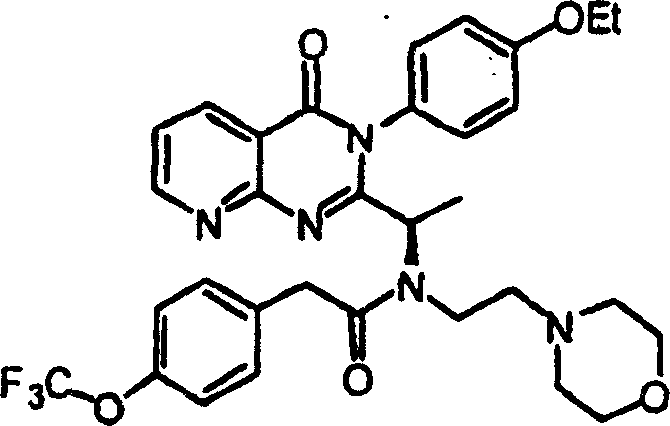
N-{1-[3-(4-乙氧基-苯基)-4-氧代-3,4-二氢-吡啶并[2,3-d]嘧啶-2-基]-乙基}-N-(2-吗啉-4-基-乙基)-2-(4-三氟代甲氧基-苯基)-乙酰胺3.60N-{1-[3-(4-ethoxy-phenyl)-4-oxo-3,4-dihydro-pyrido[2,3-d]pyrimidin-2-yl]-ethyl} -N-(2-morpholin-4-yl-ethyl)-2-(4-trifluoromethoxy-phenyl)-acetamide 3.60
如以下流程11中所示制备化合物3.60。白色固体。Compound 3.60 was prepared as shown in Scheme 11 below. white solid.
1H NMR(DMSO,T=120℃)9.00(m,1H),8.51(m,1H),7.58(m,1H),7.41(m,1H),7.18-7.26(m,5H),7.04-7.10(m,2H),5.16(m,1H),4.11(q,2H,J=7.0Hz),3.40-3.50(m,7H),2.90(m,1H),2.30-2.40(m,6H),1.46(m,3H),1.36(t,3H,J=7.0Hz).MS(ESI+)626.4(MH+). 1 H NMR (DMSO, T=120°C) 9.00 (m, 1H), 8.51 (m, 1H), 7.58 (m, 1H), 7.41 (m, 1H), 7.18-7.26 (m, 5H), 7.04- 7.10(m, 2H), 5.16(m, 1H), 4.11(q, 2H, J=7.0Hz), 3.40-3.50(m, 7H), 2.90(m, 1H), 2.30-2.40(m, 6H) , 1.46(m, 3H), 1.36(t, 3H, J=7.0Hz). MS(ESI + ) 626.4(MH + ).
流程11Process 11
化合物3.61的合成Synthesis of Compound 3.61
N-{1-[4-(4-乙氧基-苯基)-5-氧代-1-苯基-4,5-二氢-1H-[1,2,4]三唑-3-基]-乙基}-N-吡啶-3-基甲基-2-(4-三氟代甲基-苯基)-乙酰胺3.61N-{1-[4-(4-ethoxy-phenyl)-5-oxo-1-phenyl-4,5-dihydro-1H-[1,2,4]triazole-3- Base]-ethyl}-N-pyridin-3-ylmethyl-2-(4-trifluoromethyl-phenyl)-acetamide 3.61
根据用于合成三唑啉酮(图9)通用的合成方案合成化合物3.61,得到无色固体。Compound 3.61 was synthesized according to the general synthetic scheme used for the synthesis of triazolinones (Figure 9) to give a colorless solid.
1H NMR(d6-DMSO;T=120℃)δ8.57(d,J=14Hz,2H),7.91(s,1H),7.90(d,J=8.0Hz,2H),7.58(s,1H),7.57(d,J=8.4Hz,2H),7.41(t,J=7.6Hz,2H),7.35(d,J=8.4Hz,2H),7.27(t,J=7.6Hz,1H),7.24(d,J=7.6Hz,2H),7.09(d,J=8.8Hz,2H),5.50(s,1H),4.73(d,J=16.8Hz,1H),4.63(d,J=16.8Hz,1H),4.12(q,J=6.8Hz,2H),3.67(d,J=16.0Hz,1H),3.31(brs,1H),1.48(d,J=6.8Hz,3H),1.37(t,J=6.8Hz,3H)ppm.MS(ESI+)602.2(MH+). 1 H NMR (d 6 -DMSO; T=120°C) δ8.57(d, J=14Hz, 2H), 7.91(s, 1H), 7.90(d, J=8.0Hz, 2H), 7.58(s, 1H), 7.57(d, J=8.4Hz, 2H), 7.41(t, J=7.6Hz, 2H), 7.35(d, J=8.4Hz, 2H), 7.27(t, J=7.6Hz, 1H) , 7.24(d, J=7.6Hz, 2H), 7.09(d, J=8.8Hz, 2H), 5.50(s, 1H), 4.73(d, J=16.8Hz, 1H), 4.63(d, J= 16.8Hz, 1H), 4.12(q, J=6.8Hz, 2H), 3.67(d, J=16.0Hz, 1H), 3.31(brs, 1H), 1.48(d, J=6.8Hz, 3H), 1.37 (t, J=6.8Hz, 3H) ppm. MS (ESI + ) 602.2 (MH + ).
化合物3.62的合成Synthesis of Compound 3.62
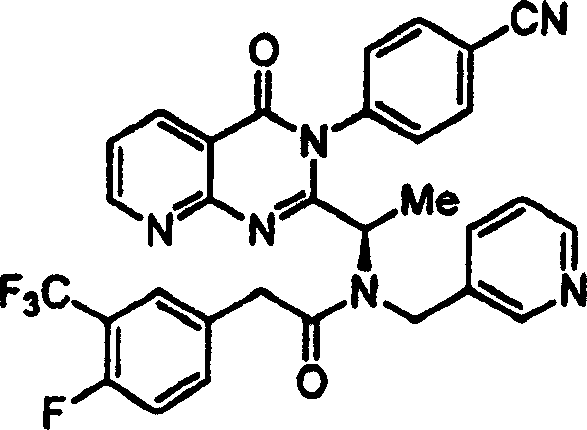
(R)-N-{1-[3-(4-氰基-苯基)-4-氧代-3,4-二氢-吡啶并[2,3-d]嘧啶-2-基]-乙基}-2-(4-氟代-3-三氟代甲基-苯基)-N-吡啶-3-基甲基-乙酰胺3.62(R)-N-{1-[3-(4-cyano-phenyl)-4-oxo-3,4-dihydro-pyrido[2,3-d]pyrimidin-2-yl]- Ethyl}-2-(4-fluoro-3-trifluoromethyl-phenyl)-N-pyridin-3-ylmethyl-acetamide 3.62
根据用于8-氮杂喹唑啉酮类(图13)的合成方案合成化合物3.62,得到暗黄色固体。Compound 3.62 was synthesized according to the synthetic scheme for 8-azaquinazolinones (Figure 13) to give a dark yellow solid.
1H NMR(d6-DMSO;T=120℃)9.02(dd,J1=2.0Hz,J2=4.4Hz,1H),8.57(brs,1H),8.51(brs,1H),8.50(dd,J1=1.6Hz,J2=8.0Hz,1H),8.02(m,2H),7.94(brs,1H),7.83(brs,1H),7.67(brs,1H),7.60(dd,J1=4.4Hz,J2=7.6Hz,1H),7.50(brs,1H),7.44(d,J=8.4Hz,1H),7.42(d,J=6.8Hz,1H),7.30(dd,J1=J2=8.8Hz,1H),5.23(q,J=6.4Hz,1H),4.96(d,J=18.0Hz,1H),4.86(d,J=18.0Hz,1H),3.70(d,J=16.4Hz,1H),3.39(brs,1H),1.42(d,J=6.4Hz,3H)ppm.MS(ESI+)587.3(MH+). 1 H NMR (d 6 -DMSO; T=120°C) 9.02 (dd, J 1 =2.0 Hz, J 2 =4.4 Hz, 1H), 8.57 (brs, 1H), 8.51 (brs, 1H), 8.50 (dd , J 1 =1.6Hz, J 2 =8.0Hz, 1H), 8.02(m, 2H), 7.94(brs, 1H), 7.83(brs, 1H), 7.67(brs, 1H), 7.60(dd, J 1 =4.4Hz, J 2 =7.6Hz, 1H), 7.50(brs, 1H), 7.44(d, J=8.4Hz, 1H), 7.42(d, J=6.8Hz, 1H), 7.30(dd, J 1 = J2 =8.8Hz, 1H), 5.23(q, J=6.4Hz, 1H), 4.96(d, J=18.0Hz, 1H), 4.86(d, J=18.0Hz, 1H), 3.70(d, J = 16.4Hz, 1H), 3.39 (brs, 1H), 1.42 (d, J = 6.4Hz, 3H) ppm. MS (ESI + ) 587.3 (MH + ).
化合物3.63的合成Synthesis of Compound 3.63
N-{1-[3-(4-乙氧基-苯基)-4-氧代-3,4-二氢-吡啶并[2,3-d]嘧啶-2-基]-乙基}-2-(4-氟代-3-三氟代甲基-苯基)-N-(1H-吲哚-3-基甲基)-乙酰胺3.63N-{1-[3-(4-ethoxy-phenyl)-4-oxo-3,4-dihydro-pyrido[2,3-d]pyrimidin-2-yl]-ethyl} -2-(4-fluoro-3-trifluoromethyl-phenyl)-N-(1H-indol-3-ylmethyl)-acetamide 3.63
根据用于8-氮杂喹唑啉酮类(图13)的合成方案合成化合物3.63,得到无色固体。Compound 3.63 was synthesized according to the synthetic scheme for 8-azaquinazolinones (Figure 13) to give a colorless solid.
1H NMR(d6-DMSO;T=120℃)δ9.01(dd,J1=1.6Hz,J2=4.4Hz,1H),8.44(dd,J1=1.6Hz,J2=7.6Hz,1H),7.55(dd,J1=4.8Hz,J2=8.0Hz,1H),7.48(d,J=8.0Hz,1H),7.35-7.44(m,3H),7.32(d,J=8.4Hz,1H),7.27(d,J=8.8Hz,1H),6.93-7.12(m,5H),6.87(dd,J1=J2=4.0Hz,1H),5.25(q,J=6.4Hz,1H),4.82(d,J=16.4Hz,1H),4.71(d,J=16.8Hz,1H),4.09(q,J=7.2Hz,2H),3.64(d,J=15.6Hz,1H),2.98(brm,1H),1.49(d,J=6.8,3H),1.35(t,J=6.8Hz,3H)ppm.MS(ESI+)666.2(MNa+). 1 H NMR (d 6 -DMSO; T=120°C) δ9.01 (dd, J 1 =1.6Hz, J 2 =4.4Hz, 1H), 8.44 (dd, J 1 =1.6Hz, J 2 =7.6Hz , 1H), 7.55(dd, J 1 =4.8Hz, J 2 =8.0Hz, 1H), 7.48(d, J=8.0Hz, 1H), 7.35-7.44(m, 3H), 7.32(d, J= 8.4Hz, 1H), 7.27(d, J=8.8Hz, 1H), 6.93-7.12(m, 5H), 6.87(dd, J1 = J2 =4.0Hz, 1H), 5.25(q, J=6.4 Hz, 1H), 4.82(d, J=16.4Hz, 1H), 4.71(d, J=16.8Hz, 1H), 4.09(q, J=7.2Hz, 2H), 3.64(d, J=15.6Hz, 1H), 2.98 (brm, 1H), 1.49 (d, J=6.8, 3H), 1.35 (t, J=6.8Hz, 3H) ppm. MS (ESI + ) 666.2 (MNa + ).
化合物3.64的合成Synthesis of Compound 3.64
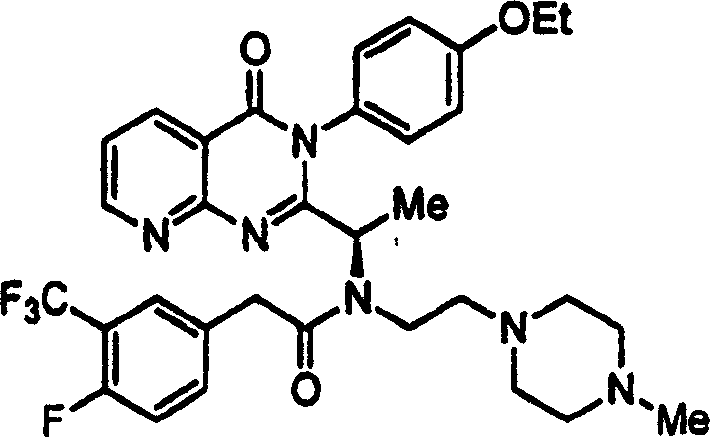
(R)-N-{1-[3-(4-乙氧基-苯基)-4-氧代-3,4-二氢-吡啶并[2,3-d]嘧啶-2-基]-乙基}-2-(4-氟代-3-三氟代甲基-苯基)-N-[2-(4-甲基-哌嗪-1-基)-乙基]-乙酰胺3.64(R)-N-{1-[3-(4-ethoxy-phenyl)-4-oxo-3,4-dihydro-pyrido[2,3-d]pyrimidin-2-yl] -Ethyl}-2-(4-fluoro-3-trifluoromethyl-phenyl)-N-[2-(4-methyl-piperazin-1-yl)-ethyl]-acetamide 3.64
根据用于8-氮杂喹唑啉酮类(图13)的合成方案合成化合物3.64,得到黄色玻璃状固体。Compound 3.64 was synthesized according to the synthetic scheme for 8-azaquinazolinones (Figure 13) to give a yellow glassy solid.
1H NMR(d6-DMSO;T=120℃)δ9.02(dd,J1=1.6Hz,J2=4.4Hz,1H),8.52(dd,J1=2.0Hz,J2=8.0Hz,1H),7.59(dd,J1=4.4Hz,J2=7.6Hz,1H),7.38-7.52(m,3H),7.32(dd,J1=J2=10.4Hz,1H),7.28(d,J=9.2Hz,1H),6.90-7.04(m,2H),5.14(q,J=6.4Hz,1H),4.09(q,J=6.8Hz,2H),3.48-3.72(brm,3H),3.02-3.17(brm,4H),2.77-2.98(brm,5H),2.67(s,3H),1.51(d,J=6.4Hz,3H),1.35(t,J=6.8Hz,3H)ppm.MS(ESI+)641.3(MH+). 1 H NMR (d 6 -DMSO; T=120°C) δ9.02 (dd, J 1 =1.6Hz, J 2 =4.4Hz, 1H), 8.52 (dd, J 1 =2.0Hz, J 2 =8.0Hz , 1H), 7.59(dd, J 1 =4.4Hz, J 2 =7.6Hz, 1H), 7.38-7.52(m, 3H), 7.32(dd, J 1 =J 2 =10.4Hz, 1H), 7.28( d, J=9.2Hz, 1H), 6.90-7.04(m, 2H), 5.14(q, J=6.4Hz, 1H), 4.09(q, J=6.8Hz, 2H), 3.48-3.72(brm, 3H ), 3.02-3.17(brm, 4H), 2.77-2.98(brm, 5H), 2.67(s, 3H), 1.51(d, J=6.4Hz, 3H), 1.35(t, J=6.8Hz, 3H) ppm.MS(ESI + )641.3(MH + ).
化合物3.65的合成Synthesis of Compound 3.65
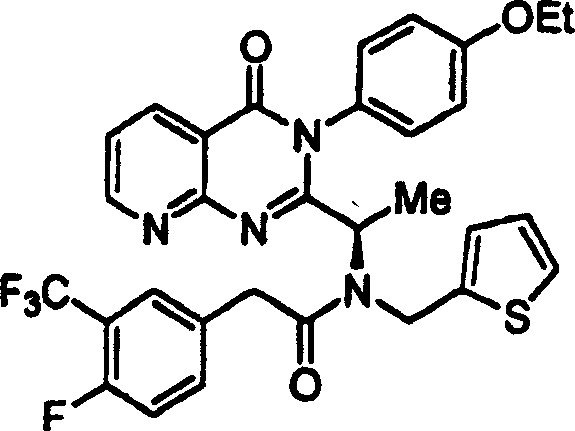
(R)-N-{1-[3-(4-乙氧基-苯基)-4-氧代-3,4-二氢-吡啶并[2,3-d]嘧啶-2-基]-乙基}-2-(4-氟代-3-三氟代甲基-苯基)-N-噻吩-2-基甲基-乙酰胺3.65(R)-N-{1-[3-(4-ethoxy-phenyl)-4-oxo-3,4-dihydro-pyrido[2,3-d]pyrimidin-2-yl] -Ethyl}-2-(4-fluoro-3-trifluoromethyl-phenyl)-N-thiophen-2-ylmethyl-acetamide 3.65
根据用于8-氮杂喹唑啉酮类(图13)的合成方案合成化合物3.65,得到无色固体。Compound 3.65 was synthesized according to the synthetic scheme for 8-azaquinazolinones (Figure 13) to give a colorless solid.
1H NMR(d6-DMSO;T=120℃)δ9.03(d,J=2.8,1H),8.50(dd,J1=1.6Hz,J2=7.6Hz,1H),7.59(dd,J1=4.8Hz,J2=7.6Hz,1H),7.43(d,J=8.4Hz,1H),7.38(d,J=6.4Hz,1H),7.34-7.47(m,1H),7.09(d,J=8.0Hz,1H),6.99(d,J=7.2Hz,1H),6.66-6.92(m,3H),5.26(brs,1H),4.83(brs,2H),4.08(q,J=7.2Hz,2H),3.56(brs,1H),2.98(brs,1H),1.52(d,J=6.8Hz,3H),1.33(t,J=6.8Hz,3H)ppm.MS(ESI+)611.2(MH+),633.2(MNa+). 1 H NMR (d 6 -DMSO; T=120°C) δ9.03 (d, J=2.8, 1H), 8.50 (dd, J 1 =1.6Hz, J 2 =7.6Hz, 1H), 7.59 (dd, J 1 =4.8Hz, J 2 =7.6Hz, 1H), 7.43(d, J=8.4Hz, 1H), 7.38(d, J=6.4Hz, 1H), 7.34-7.47(m, 1H), 7.09( d, J=8.0Hz, 1H), 6.99(d, J=7.2Hz, 1H), 6.66-6.92(m, 3H), 5.26(brs, 1H), 4.83(brs, 2H), 4.08(q, J =7.2Hz, 2H), 3.56(brs, 1H), 2.98(brs, 1H), 1.52(d, J=6.8Hz, 3H), 1.33(t, J=6.8Hz, 3H)ppm.MS(ESI + )611.2(MH + ), 633.2(MNa + ).
化合物3.66的合成Synthesis of Compound 3.66
(R)-N-[2-(叔-丁基-甲基-氨基)-乙基]-N-{1-[3-(4-乙氧基-苯基)-4-氧代-3,4-二氢-吡啶并[2,3-d]嘧啶-2-基]-乙基}-2-(4-氟代-3-三氟代甲基-苯基)-乙酰胺3.66(R)-N-[2-(tert-butyl-methyl-amino)-ethyl]-N-{1-[3-(4-ethoxy-phenyl)-4-oxo-3 , 4-Dihydro-pyrido[2,3-d]pyrimidin-2-yl]-ethyl}-2-(4-fluoro-3-trifluoromethyl-phenyl)-acetamide 3.66
根据用于8-氮杂喹唑啉酮类(图13)的合成方案合成化合物3.66,得到黄色玻璃状固体。Compound 3.66 was synthesized according to the synthetic scheme for 8-azaquinazolinones (Figure 13) to give a yellow glassy solid.
1HNMR(d6-DMSO;T=120℃)δ9.00(d,J=2.4Hz,1H),8.52(d,J=7.6Hz,1H),7.90(dd,J1=4.4Hz,J2=7.6Hz,1H),7.41-7.54(m,3H),7.37(d,J=11.6Hz,1H),7.32(dd,J1=J2=9.2Hz,1H),7.04-7.18(m,2H),5.10(brs,1H),4.12(q,J=7.2Hz,2H),3.90-4.06(m,1H),3.62-3.84(m,1H),3.40-3.60(m,1H),2.96-3.14(m,1H),2.74(s,3H),1.52(d,J=6.4Hz,3H),1.36(s,9H),1.34(t,J=7.2Hz,3H)ppm.MS(ESI+)628.4(MH+). 1 H NMR (d 6 -DMSO; T=120°C) δ9.00 (d, J=2.4Hz, 1H), 8.52 (d, J=7.6Hz, 1H), 7.90 (dd, J 1 =4.4Hz, J 2 =7.6Hz, 1H), 7.41-7.54(m, 3H), 7.37(d, J=11.6Hz, 1H), 7.32(dd, J1 = J2 =9.2Hz, 1H), 7.04-7.18(m , 2H), 5.10(brs, 1H), 4.12(q, J=7.2Hz, 2H), 3.90-4.06(m, 1H), 3.62-3.84(m, 1H), 3.40-3.60(m, 1H), 2.96-3.14(m, 1H), 2.74(s, 3H), 1.52(d, J=6.4Hz, 3H), 1.36(s, 9H), 1.34(t, J=7.2Hz, 3H)ppm.MS( ESI + )628.4(MH + ).
化合物3.67的合成Synthesis of Compound 3.67
(R)-N-{1-[3-(4-乙氧基-苯基)-4-氧代-3,4-二氢-吡啶并[2,3-d]嘧啶-2-基]-乙基}-2-(4-氟代-3-三氟代甲基-苯基)-N-(1-甲基-1H-吡唑-4-基甲基)-乙酰胺3.67(R)-N-{1-[3-(4-ethoxy-phenyl)-4-oxo-3,4-dihydro-pyrido[2,3-d]pyrimidin-2-yl] -Ethyl}-2-(4-fluoro-3-trifluoromethyl-phenyl)-N-(1-methyl-1H-pyrazol-4-ylmethyl)-acetamide 3.67
根据用于8-氮杂喹唑啉酮类(图13)的合成方案合成化合物3.67,得到无色固体。Compound 3.67 was synthesized according to the synthetic scheme for 8-azaquinazolinones (Figure 13) to give a colorless solid.
1H NMR(d6-DMSO;T=120℃)δ9.04(dd,J1=1.6Hz,J2=4.4Hz,1H),8.50(dd,J1=2.0Hz,J2=7.6Hz,1H),7.58(dd,J1=4.4Hz,J2=8.0Hz,1H),7.40(d,J=6.8Hz,2H),7.36-7.45(m,1H),7.30(dd,J1=J2=10.4Hz,1H),7.27-7.34(m,1H),7.08(d,J=8.4Hz,2H),7.02(d,J=6.8Hz,1H),5.23(brs,1H),4.50(d,J=15.6Hz,1H),4.43(d,J=15.6Hz,1H),4.09(q,J=6.8Hz,1H),3.67(s,3H),2.93(brs,2H),1.49(d,J=6.4Hz,3H),1.35(t,J=6.8Hz,3H)ppm.MS(ESI+)609.3(MH+),631.2(MNa+). 1 H NMR (d 6 -DMSO; T=120°C) δ9.04 (dd, J 1 =1.6Hz, J 2 =4.4Hz, 1H), 8.50 (dd, J 1 =2.0Hz, J 2 =7.6Hz , 1H), 7.58(dd, J 1 =4.4Hz, J 2 =8.0Hz, 1H), 7.40(d, J=6.8Hz, 2H), 7.36-7.45(m, 1H), 7.30(dd, J 1 = J2 =10.4Hz, 1H), 7.27-7.34(m, 1H), 7.08(d, J=8.4Hz, 2H), 7.02(d, J=6.8Hz, 1H), 5.23(brs, 1H), 4.50(d, J=15.6Hz, 1H), 4.43(d, J=15.6Hz, 1H), 4.09(q, J=6.8Hz, 1H), 3.67(s, 3H), 2.93(brs, 2H), 1.49(d, J=6.4Hz, 3H), 1.35(t, J=6.8Hz, 3H) ppm. MS(ESI + ) 609.3(MH + ), 631.2(MNa + ).
化合物3.68的合成Synthesis of Compound 3.68
(R)-N-(4-二甲基氨基-苄基)-N-{1-[3-(4-乙氧基-苯基)-4-氧代-3,4-二氢-吡啶并[2,3-d]嘧啶-2-基]-乙基}-2-(4-氟代-3-三氟代甲基-苯基)-乙酰胺3.68(R)-N-(4-Dimethylamino-benzyl)-N-{1-[3-(4-ethoxy-phenyl)-4-oxo-3,4-dihydro-pyridine And[2,3-d]pyrimidin-2-yl]-ethyl}-2-(4-fluoro-3-trifluoromethyl-phenyl)-acetamide 3.68
根据用于8-氮杂喹唑啉酮类(图13)的合成方案合成化合物3.68,得到黄色玻璃状固体。Compound 3.68 was synthesized according to the synthetic scheme for 8-azaquinazolinones (Figure 13) to give a yellow glassy solid.
1HNMR(d6-DMSO;T=120℃)δ9.00(dd,J1=2.0Hz,J2=4.4Hz,1H),8.44(dd,J1=2.4Hz,J2=8.4Hz,1H),7.56(dd,J1=4.8Hz,J2=8.0Hz,1H),7.33-7.44(m,3H),7.28(dd,J1=J2=10.4Hz,1H),7.06(dd,J1=J2=8.8Hz,1H),7.05(d,J=5.2Hz,2H),6.95(d,J=8.4Hz,2H),6.52(d,J=7.2Hz,2H),5.27(q,J=6.4Hz,1H),4.65(d,J=16.4Hz,1H),4.48(d,J=16.4Hz,1H),4.10(q,J=6.8Hz,2H),3.58(d,J=15.2Hz,1H),2.90(brs,1H),2.82(s,3H),1.45(d,J=6.4Hz,3H),1.35(t,J=6.8Hz,3H)ppm.MS(ESI+)670.3(MNa+). 1 HNMR (d 6 -DMSO; T=120°C) δ9.00 (dd, J 1 =2.0Hz, J 2 =4.4Hz, 1H), 8.44 (dd, J 1 =2.4Hz, J 2 =8.4Hz, 1H), 7.56(dd, J 1 =4.8Hz, J 2 =8.0Hz, 1H), 7.33-7.44(m, 3H), 7.28(dd, J 1 =J 2 =10.4Hz, 1H), 7.06(dd , J 1 =J 2 =8.8Hz, 1H), 7.05(d, J=5.2Hz, 2H), 6.95(d, J=8.4Hz, 2H), 6.52(d, J=7.2Hz, 2H), 5.27 (q, J=6.4Hz, 1H), 4.65(d, J=16.4Hz, 1H), 4.48(d, J=16.4Hz, 1H), 4.10(q, J=6.8Hz, 2H), 3.58(d , J=15.2Hz, 1H), 2.90(brs, 1H), 2.82(s, 3H), 1.45(d, J=6.4Hz, 3H), 1.35(t, J=6.8Hz, 3H)ppm.MS( ESI + )670.3(MNa + ).
化合物3.69的合成Synthesis of Compound 3.69
(R)-N-(2-环丙基-嘧啶-5-基甲基)-N-{1-[3-(4-乙氧基-苯基)-4-氧代-3,4-二氢-吡啶并[2,3-d]嘧啶-2-基]-乙基}-2-(4-三氟代甲氧基-苯基)-乙酰胺3.69(R)-N-(2-cyclopropyl-pyrimidin-5-ylmethyl)-N-{1-[3-(4-ethoxy-phenyl)-4-oxo-3,4- Dihydro-pyrido[2,3-d]pyrimidin-2-yl]-ethyl}-2-(4-trifluoromethoxy-phenyl)-acetamide 3.69
根据用于一般合成8-氮杂喹唑啉酮类(图13)的合成方案合成化合物3.69,得到无色固体。Compound 3.69 was synthesized according to the synthetic scheme used for the general synthesis of 8-azaquinazolinones (Figure 13) to give a colorless solid.
1H NMR(d6-DMSO;T=120℃)δ9.01(dd,J1=2.0Hz,J2=4.4Hz,1H),8.47(dd,J1=2.0Hz,J2=8.0Hz,1H),8.36(s,2H),7.58(dd,J1=4.4Hz,J2=8.0Hz,1H),7.44(d,J=7.2Hz,1H),7.08-7.22(m,7H),5.26(q,J=6.8Hz,1H),4.68(brs,2H),4.13(q,J=7.2Hz,2H),2.89(brs,2H),2.11(tt,J1=J2=4.4Hz,1H),1.43(d,J=6.8Hz,3H),1.36(t,J=7.2Hz,3H),0.84-1.00(m,4H)ppm.MS(ESI+)645.3(MH+). 1 H NMR (d 6 -DMSO; T=120°C) δ9.01 (dd, J 1 =2.0Hz, J 2 =4.4Hz, 1H), 8.47 (dd, J 1 =2.0Hz, J 2 =8.0Hz , 1H), 8.36(s, 2H), 7.58(dd, J 1 =4.4Hz, J 2 =8.0Hz, 1H), 7.44(d, J=7.2Hz, 1H), 7.08-7.22(m, 7H) , 5.26(q, J=6.8Hz, 1H), 4.68(brs, 2H), 4.13(q, J=7.2Hz, 2H), 2.89(brs, 2H), 2.11(tt, J1 = J2 =4.4 Hz, 1H), 1.43(d, J=6.8Hz, 3H), 1.36(t, J=7.2Hz, 3H), 0.84-1.00(m, 4H) ppm. MS(ESI + )645.3(MH + ).
化合物3.70的合成Synthesis of compound 3.70

(R)-N-{1-[3-(4-乙氧基-苯基)-4-氧代-3,4-二氢-吡啶并[2,3-d]嘧啶-2-基]-乙基}-2-(4-氟代-3-三氟代甲基-苯基)-N-(6-吡咯烷-1-基-吡啶-3-基甲基)-乙酰胺3.70(R)-N-{1-[3-(4-ethoxy-phenyl)-4-oxo-3,4-dihydro-pyrido[2,3-d]pyrimidin-2-yl] -Ethyl}-2-(4-fluoro-3-trifluoromethyl-phenyl)-N-(6-pyrrolidin-1-yl-pyridin-3-ylmethyl)-acetamide 3.70
根据用于一般合成8-氮杂喹唑啉酮类(图13)的合成方案合成化合物3.70,得到无色固体。1H NMR(d6-DMSO;T=120℃)δ8.09(d,J=7.6Hz,1H),7.87(dd,J1=J2=6.8Hz,1H),7.82(s,1H),7.73(d,J=8.4Hz,1H),7.56(dd,J1=J2=7.2Hz,1H),7.38(d,J=6.8Hz,2H),7.30(dd,J1=J2=10.4Hz,1H),7.22(d,J=8.0Hz,1H),7.22(d,J=8.0Hz,1H),7.08(d,J=7.6Hz,1H),7.03(d,J=7.6Hz,1H),6.21(d,J=8.4Hz,1H),5.23(q,J=6.4Hz,1H),4.48(brs,2H),4.09(q,J=6.8Hz,2H),3.54(d,J=15.2Hz,1H),3.30(brs,1H),2.88(brs,4H),1.91-1.94(m,4H),1.44(d,J=6.4Hz,3H),1.34(t,J=6.8Hz,3H)ppm.MS(ESI+)674.3(MH+).Compound 3.70 was synthesized according to the synthetic scheme used for the general synthesis of 8-azaquinazolinones (Figure 13) to give a colorless solid. 1 H NMR (d 6 -DMSO; T=120°C) δ8.09 (d, J=7.6Hz, 1H), 7.87 (dd, J 1 =J 2 =6.8Hz, 1H), 7.82 (s, 1H) , 7.73(d, J=8.4Hz, 1H), 7.56(dd, J1 = J2 =7.2Hz, 1H), 7.38(d, J=6.8Hz, 2H), 7.30(dd, J1 = J2 =10.4Hz, 1H), 7.22(d, J=8.0Hz, 1H), 7.22(d, J=8.0Hz, 1H), 7.08(d, J=7.6Hz, 1H), 7.03(d, J=7.6 Hz, 1H), 6.21(d, J=8.4Hz, 1H), 5.23(q, J=6.4Hz, 1H), 4.48(brs, 2H), 4.09(q, J=6.8Hz, 2H), 3.54( d, J=15.2Hz, 1H), 3.30(brs, 1H), 2.88(brs, 4H), 1.91-1.94(m, 4H), 1.44(d, J=6.4Hz, 3H), 1.34(t, J =6.8Hz, 3H)ppm.MS(ESI + )674.3(MH + ).
化合物3.71的合成Synthesis of Compound 3.71
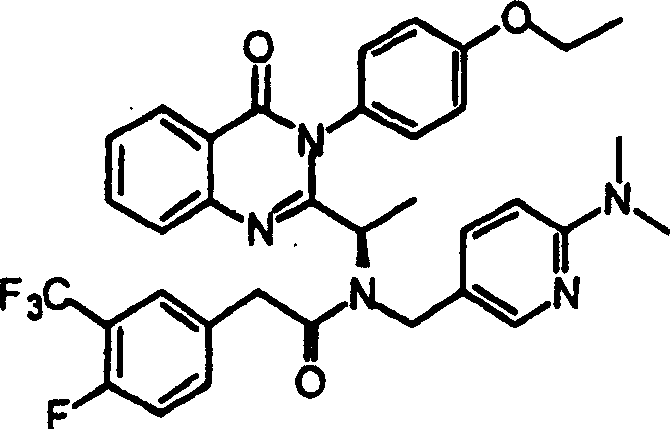
(-)-(R)-N-(6-二甲基氨基-吡啶-3-基甲基)-N-{1-[3-(4-乙氧基-苯基)-4-氧代-3,4-二氢-喹唑啉-2-基]-乙基}-2-(4-氟代-3-三氟代甲基-苯基)-乙酰胺3.71(-)-(R)-N-(6-Dimethylamino-pyridin-3-ylmethyl)-N-{1-[3-(4-ethoxy-phenyl)-4-oxo -3,4-Dihydro-quinazolin-2-yl]-ethyl}-2-(4-fluoro-3-trifluoromethyl-phenyl)-acetamide 3.71
如同化合物3.16a,使用由2,5-二溴代吡啶制备的吡啶基侧链制备化合物3.71。白色固体。Compound 3.71 was prepared as compound 3.16a using a pyridyl side chain prepared from 2,5-dibromopyridine. white solid.
1H NMR(DMSO,120℃)δ8.10(d,1H,J=8.0Hz),7.86(m,2H),7.73(d,1H,J=8.0Hz),7.56(dd,1H,J1=J2=8.0Hz),7.38(d,3H,J=6.8Hz),7.31(d,1H,J=10.4Hz),7.25(d,1H,J=8.4Hz),7.18(s,1H),7.08(m,2H),7.04(m,1H),6.41(d,1H,J=8.4Hz),5.23(broads,1H),4.49(s,2H),4.12(q,1H,J=8.0Hz)4.09(q,2H,J=7.5Hz),3.54(d,1H,J=13.2Hz),2.95(s,6H),1.44(d,3H,J=6.4Hz),1.36(t,3H,J=8.0Hz),1.28(s,1H)ppm.MS(ESI+):预期值648.26(MH+),实测值648.3。 1 H NMR (DMSO, 120°C) δ8.10 (d, 1H, J = 8.0Hz), 7.86 (m, 2H), 7.73 (d, 1H, J = 8.0Hz), 7.56 (dd, 1H, J 1 = J2 =8.0Hz), 7.38(d, 3H, J=6.8Hz), 7.31(d, 1H, J=10.4Hz), 7.25(d, 1H, J=8.4Hz), 7.18(s, 1H) , 7.08(m, 2H), 7.04(m, 1H), 6.41(d, 1H, J=8.4Hz), 5.23(broads, 1H), 4.49(s, 2H), 4.12(q, 1H, J=8.0 Hz) 4.09(q, 2H, J=7.5Hz), 3.54(d, 1H, J=13.2Hz), 2.95(s, 6H), 1.44(d, 3H, J=6.4Hz), 1.36(t, 3H , J=8.0 Hz), 1.28 (s, 1H) ppm. MS (ESI + ): expected 648.26 (MH + ), found 648.3.
化合物3.72的合成Synthesis of Compound 3.72

(-)-N-{(R)-1-[3-(4-乙氧基-苯基)-4-氧代-3,4-二氢-喹唑啉-2-基]-乙基}-2-(4-氟代-3-三氟代甲基-苯基)-N-[(2S)-2-(1-异丙基-3-丙基-脲基)-丙基]-乙酰胺3.72(-)-N-{(R)-1-[3-(4-ethoxy-phenyl)-4-oxo-3,4-dihydro-quinazolin-2-yl]-ethyl }-2-(4-fluoro-3-trifluoromethyl-phenyl)-N-[(2S)-2-(1-isopropyl-3-propyl-ureido)-propyl] -Acetamide 3.72
白色固体。white solid.
1H NMR(DMSO,120℃)δ8.13(d,1H,J=8.0Hz),7.85(dd,1H,J1=J2=7.6Hz),7.67(d,1H,J=8.0Hz),7.55(dd,1H,J1=J2=7.6Hz),7.44(m,2H),7.34(d,1H,J=12.4Hz),7.30(dd,1H,J1=J2=9.6Hz),7.23(d,1H,J=8.0Hz),7.05(m,2H),5.66(宽 s,1H),5.19(宽 s,1H),4.08(q,2H,J=6.6Hz),3.77(hept,1H,J=6.6Hz),3.66(m,2H),3.31(m,1H),3.01(m,2H),2.94(m,1H),1.49(d,3H,J=6.8Hz),1.43(tq,2H,J=7.2Hz),1.35(t,3H,J=6.8Hz),1.21(t,3H,J=7.0Hz),1.17(s,1H),1.09(d,3H,J=6.8Hz),0.99(d,3H,J=5.2Hz),0.83(t,3H,J=7.4Hz)ppm.MS(ESI+):预期值698.34(MH+),实测值698.3。 1 H NMR (DMSO, 120°C) δ8.13 (d, 1H, J=8.0Hz), 7.85 (dd, 1H, J 1 =J 2 =7.6Hz), 7.67 (d, 1H, J=8.0Hz) , 7.55 (dd, 1H, J1 = J2 = 7.6Hz), 7.44 (m, 2H), 7.34 (d, 1H, J = 12.4Hz), 7.30 (dd, 1H, J1 = J2 = 9.6Hz ), 7.23(d, 1H, J=8.0Hz), 7.05(m, 2H), 5.66(width s, 1H), 5.19(width s, 1H), 4.08(q, 2H, J=6.6Hz), 3.77 (hept, 1H, J=6.6Hz), 3.66(m, 2H), 3.31(m, 1H), 3.01(m, 2H), 2.94(m, 1H), 1.49(d, 3H, J=6.8Hz) , 1.43(tq, 2H, J=7.2Hz), 1.35(t, 3H, J=6.8Hz), 1.21(t, 3H, J=7.0Hz), 1.17(s, 1H), 1.09(d, 3H, J = 6.8 Hz), 0.99 (d, 3H, J = 5.2 Hz), 0.83 (t, 3H, J = 7.4 Hz) ppm. MS (ESI + ): expected 698.34 (MH + ), found 698.3.
化合物3.73的合成Synthesis of Compound 3.73
(-)-(R)-N-{1-[3-(4-乙氧基-苯基)-4-氧代-3,4-二氢-喹唑啉-2-基]-乙基}-2-(4-氟代-3-三氟代甲基-苯基)-N-(6-甲基氨基-吡啶-2-基甲基)-乙酰胺3.73(-)-(R)-N-{1-[3-(4-Ethoxy-phenyl)-4-oxo-3,4-dihydro-quinazolin-2-yl]-ethyl }-2-(4-fluoro-3-trifluoromethyl-phenyl)-N-(6-methylamino-pyridin-2-ylmethyl)-acetamide 3.73
以常规方式,使用得自2,6-二溴代吡啶的吡啶基片断合成化合物3.73。白色固体。Compound 3.73 was synthesized in a conventional manner using the pyridyl moiety derived from 2,6-dibromopyridine. white solid.
1H NMR(DMSO,120℃)δ8.09(d,1H,J=8.0Hz),7.83(d,1H,J1=J2=7.8Hz),7.68(d,1H,J=8.0Hz),7.53(dd,1H,J1=J2=7.6Hz),7.40(d,2H,J=6.4Hz),7.27(m,3H),7.15(d,1H,J1=J2=7.6Hz),7.03(m,1H),6.98(m,1H),6.24(d,2H,J=7.6Hz),5.91(broads,1H),5.35(s,1H),4.56(q,2H,J=16.4Hz),4.08(d,2H,J=6.8Hz),3.80(s,2H),2.94(s,3H),2.72(s,3H),1.35(t,3H,J=6.8Hz)ppm.MS(ESI+):预期值634.25(MH+),实测值634.2。 1 H NMR (DMSO, 120°C) δ8.09 (d, 1H, J=8.0Hz), 7.83 (d, 1H, J 1 =J 2 =7.8Hz), 7.68 (d, 1H, J=8.0Hz) , 7.53 (dd, 1H, J1 = J2 = 7.6Hz), 7.40 (d, 2H, J = 6.4Hz), 7.27 (m, 3H), 7.15 (d, 1H, J1 = J2 = 7.6Hz ), 7.03(m, 1H), 6.98(m, 1H), 6.24(d, 2H, J=7.6Hz), 5.91(broads, 1H), 5.35(s, 1H), 4.56(q, 2H, J= 16.4Hz), 4.08(d, 2H, J=6.8Hz), 3.80(s, 2H), 2.94(s, 3H), 2.72(s, 3H), 1.35(t, 3H, J=6.8Hz)ppm. MS (ESI + ): expected 634.25 (MH + ), found 634.2.
化合物3.74的合成Synthesis of Compound 3.74
(+)-(S)-N-{1-[3-(4-乙氧基-苯基)-4-氧代-3,4-二氢-吡啶并[2,3-d]嘧啶-2-基]-乙基}-N-吡啶-3-基甲基-2-(4-三氟代甲氧基-苯基)-乙酰胺3.74(+)-(S)-N-{1-[3-(4-ethoxy-phenyl)-4-oxo-3,4-dihydro-pyrido[2,3-d]pyrimidine- 2-yl]-ethyl}-N-pyridin-3-ylmethyl-2-(4-trifluoromethoxy-phenyl)-acetamide 3.74
从L-丙氨酸衍生物而不是以D-Ala起始,如图13所示合成化合物3.74。白色固体。Compound 3.74 was synthesized as shown in Figure 13 starting from an L-alanine derivative instead of D-Ala. white solid.
1H NMR(DMSO,120℃)δ9.02(d,1H,J=3.6Hz),8.46(dd,1H,J1=7.8Hz,J2=1.8Hz),8.35(s,2H),7.57(dd,1H,J1=8.0Hz,J2=4.4Hz),7.53(d,1H,J=6.8Hz),7.43(d,1H,J=6.8Hz),7.14(broadm,8H),5.29(d,1H,J=6.0Hz),4.76(s,2H),4.13(q,2H,J=6.8Hz),3.46(broads,1H),2.91(s,4H),1.42(d,3H,J=6.8Hz),1.36(t,3H,J=7.0Hz)ppm.MS(ESI+):预期值604.22(MH+),实测值604.3。 1 H NMR (DMSO, 120°C) δ9.02 (d, 1H, J = 3.6Hz), 8.46 (dd, 1H, J 1 = 7.8Hz, J 2 = 1.8Hz), 8.35 (s, 2H), 7.57 (dd, 1H, J1 = 8.0Hz, J2 = 4.4Hz), 7.53 (d, 1H, J = 6.8Hz), 7.43 (d, 1H, J = 6.8Hz), 7.14 (broadm, 8H), 5.29 (d, 1H, J=6.0Hz), 4.76(s, 2H), 4.13(q, 2H, J=6.8Hz), 3.46(broads, 1H), 2.91(s, 4H), 1.42(d, 3H, J = 6.8 Hz), 1.36 (t, 3H, J = 7.0 Hz) ppm. MS (ESI + ): expected 604.22 (MH + ), found 604.3.
实施例4Example 4
化合物4.01的合成Synthesis of Compound 4.01
以四步骤从可购买得到的起始原料合成化合物4.01提供外消旋形式的3H-喹唑啉-4-酮的合成的另一个实例。流程12提供了合成途径的概要,对于所述途径的实验详述如下。Synthesis of compound 4.01 from commercially available starting materials in four steps provides another example of the synthesis of 3H-quinazolin-4-one in racemic form. Scheme 12 provides an overview of the synthetic pathway for which the experiments are detailed below.
流程12Process 12
a.KI,K2CO3,DMF;b.4-苯基苯乙酸,EDC,HOBT,NMM,CH2Cl2,c.CF3COOH,Et3SiH,CH2Cl2;d.邻氨基苯甲酸,P(OPh)3,吡啶;e.6-氨基苯并噻唑。a.KI, K 2 CO 3 , DMF; b. 4-phenylphenylacetic acid, EDC, HOBT, NMM, CH 2 Cl 2 , c. CF 3 COOH, Et 3 SiH, CH 2 Cl 2 ; d. o-amino Benzoic acid, P(OPh) 3 , pyridine; e. 6-aminobenzothiazole.
2-(N-2-乙氧基乙基)氨基丙酸-(R)-叔-丁基酯(XXII)。向D-丙氨酸叔-丁基酯盐酸盐(3.15g,17.3mmol,1.0当量)和2-溴代乙基乙酯(2.79g,18.2mmol,1.05当量)的14mL DMF溶液中加入KI(1.44g,8.7mmol,0.50当量),随后加入K2CO3(2.40g,17.3mmol,1.0当量)。在55℃下搅拌16小时后,将该反应混合物倒入70mL水的10mL 10%Na2CO3混合物中。将得到的混合物用50mL EtOAc萃取三次。将有机层用50mL盐水洗涤,经Na2SO4干燥并在真空中浓缩得到黄色油状物,将该油状物通过短硅胶柱体,用EtOAc洗脱。在真空中浓缩洗脱液得到3.13g粗制XXII,为棕色油状物,该油状物没有进一步纯化而在下一步骤中使用。2-(N-2-Ethoxyethyl)alanine-(R)-tert-butyl ester (XXII). To a solution of D-alanine tert-butyl ester hydrochloride (3.15 g, 17.3 mmol, 1.0 equiv) and 2-bromoethylethyl ester (2.79 g, 18.2 mmol, 1.05 equiv) in 14 mL of DMF was added KI ( 1.44g , 8.7mmol, 0.50eq), followed by the addition of K2CO3 (2.40g, 17.3mmol, 1.0eq). After stirring at 55 °C for 16 h, the reaction mixture was poured into a mixture of 10 mL of 10% Na2CO3 in 70 mL of water. The resulting mixture was extracted three times with 50 mL of EtOAc. The organic layer was washed with 50 mL of brine, dried over Na2SO4 and concentrated in vacuo to give a yellow oil which was passed through a short silica gel cartridge eluting with EtOAc. Concentration of the eluate in vacuo afforded 3.13 g of crude XXII as a brown oil which was used in the next step without further purification.
1H NMR(CDCl3)δ1.20(t,J=8.0Hz,3H),1.27(d,J=7.2Hz,3H),1.46(s,9H),1.95(br,1H),2.65(m,1H),2.83(m,1H),3.23(q,J=7.2Hz,1H),3.40-3.56(m,4H)ppm.MS(ESI+)m/z218.1[M+H]+. 1 H NMR (CDCl 3 ) δ1.20(t, J=8.0Hz, 3H), 1.27(d, J=7.2Hz, 3H), 1.46(s, 9H), 1.95(br, 1H), 2.65(m , 1H), 2.83(m, 1H), 3.23(q, J=7.2Hz, 1H), 3.40-3.56(m, 4H) ppm.MS(ESI + ) m/z218.1[M+H] + .
2-(N-2-乙氧基乙基)-(N-4-苯基苯乙酰基)氨基丙酸-(R)-叔-丁基酯(XXIII)。在室温下,向粗制的XXII(5.0g,23mmol,1.0当量)和4-苯基苯乙酸(4.88g,23mmol,1.0当量)的40mL二氯甲烷溶液中加入EDC(5.51g,29mmol,1.25当量)、HOBT(3.89g,29mmol,1.25当量)和N-甲基吗啉(2.79g,28mmol,1.2当量)。将该混合物在室温下搅拌4小时。将反应混合物倒入30mL 5%H3PO4水溶液中并用20mLEtOAc萃取二次。将合并的EtOAc萃取液用20mL 10%NaHCO3洗涤二次,用30mL盐水洗涤一次。将有机层经Na2SO4干燥并在真空中蒸发得到棕色油状物,将该油状物经硅胶层析纯化,得到5.05g化合物XXIII,为浅黄色油状物。2-(N-2-Ethoxyethyl)-(N-4-phenylphenylacetyl)alanine-(R)-tert-butyl ester (XXIII). EDC (5.51 g, 29 mmol, 1.25 equiv), HOBT (3.89 g, 29 mmol, 1.25 equiv), and N-methylmorpholine (2.79 g, 28 mmol, 1.2 equiv). The mixture was stirred at room temperature for 4 hours. The reaction mixture was poured into 30 mL of 5% aqueous H3PO4 and extracted twice with 20 mL of EtOAc. The combined EtOAc extracts were washed twice with 20 mL of 10% NaHCO 3 and once with 30 mL of brine. The organic layer was dried over Na2SO4 and evaporated in vacuo to give a brown oil, which was purified by silica gel chromatography to give 5.05 g of compound XXIII as a pale yellow oil.
1H NMR(CDCl3)δ1.20(t,J=8.0Hz,3H),1.27(d,J=7.2Hz,3H),1.46(s,9H),1.95(br,1H),2.65(m,1H),2.83(m,1H),3.23(q,J=7.2Hz,1H),3.40-3.56(m,4H)ppm.MS(ESI+)m/z218.1[M+H]+. 1 H NMR (CDCl 3 ) δ1.20(t, J=8.0Hz, 3H), 1.27(d, J=7.2Hz, 3H), 1.46(s, 9H), 1.95(br, 1H), 2.65(m , 1H), 2.83(m, 1H), 3.23(q, J=7.2Hz, 1H), 3.40-3.56(m, 4H) ppm.MS(ESI + ) m/z218.1[M+H] + .
(R)-2-(N-2-乙氧基乙基)-(N-4-苯基苯乙酰基)氨基丙酸(XXIV)。在室温下,向XXIII(5.05g,12.3mmol,1.0当量)的25mL二氯甲烷溶液中加入三乙基硅烷(3.57g,30.7mmol,2.5当量)和三氟乙酸(18g,160mmol,13当量)。将该混合物在室温下搅拌8小时。将反应混合物在真空中蒸发得到棕色残余物,将该残余物溶于60mL EtOAc中并用50mL 0.5M KH2PO4洗涤,随后用40mL盐水洗涤。将有机层经Na2SO4干燥并在真空中蒸发得到棕色油状物,将其经硅胶层析纯化,得到3.69g为无色油状物的化合物XXIV,将该油状物在室温下放置固化成奶油色固体。在室温下该产物以顺式/反式酰胺旋转异构体混合物存在,在DMSO中约4.4∶1摩尔比率。对于主要的旋转异构体(R)-2-(N-2-Ethoxyethyl)-(N-4-phenylphenylacetyl)alanine (XXIV). To a solution of XXIII (5.05 g, 12.3 mmol, 1.0 equiv) in 25 mL of dichloromethane was added triethylsilane (3.57 g, 30.7 mmol, 2.5 equiv) and trifluoroacetic acid (18 g, 160 mmol, 13 equiv) at room temperature . The mixture was stirred at room temperature for 8 hours. The reaction mixture was evaporated in vacuo to give a brown residue which was dissolved in 60 mL EtOAc and washed with 50 mL 0.5M KH2PO4 followed by 40 mL brine. The organic layer was dried over Na2SO4 and evaporated in vacuo to give a brown oil which was purified by silica gel chromatography to give 3.69 g of compound XXIV as a colorless oil which solidified to a cream on standing at room temperature color solid. The product exists as a mixture of cis/trans amide rotamers in an approximately 4.4:1 molar ratio in DMSO at room temperature. For the major rotamers
1H NMR(DMSO-d6)δ1.12(t,J=7.0Hz,3H),1.34(d,J=6.8Hz,3H3.40-3.60(m,6H),3.78(s,2H),4.16(q,J=6.8Hz,1H),7.29(d,J=8.0Hz,2H),7.35(t,J=7.2Hz,1H),7.46(t,J=7.4Hz,2H),7.59(d,J=8.0Hz,2H),7.65(d,J=7.8Hz,2H)ppm, 1 H NMR (DMSO-d 6 ) δ1.12(t, J=7.0Hz, 3H), 1.34(d, J=6.8Hz, 3H3.40-3.60(m, 6H), 3.78(s, 2H), 4.16(q, J=6.8Hz, 1H), 7.29(d, J=8.0Hz, 2H), 7.35(t, J=7.2Hz, 1H), 7.46(t, J=7.4Hz, 2H), 7.59( d, J = 8.0Hz, 2H), 7.65 (d, J = 7.8Hz, 2H) ppm,
对于次要的旋转异构体1H NMR(DMSO-d6)δ4.77(q,J=6.8Hz,1H)ppm。MS(ESI-)m/z3.54.2[M-H]-。 1 H NMR (DMSO-d 6 ) δ 4.77 (q, J=6.8 Hz, 1H) ppm for the minor rotamer. MS (ESI - ) m/z 3.54.2[MH] - .
2-((N-乙氧基乙基)-N-(4-苯基苯乙酰基)-1-氨基乙基)-3-(6-苯并噻唑基)-3H-喹唑啉-4-酮(4.01)。在室温下,向邻氨基苯甲酸(69mg,0.50mmol,1.0当量)和化合物XXIV(178mg,0.50mmol,1.0当量)的1.0mL无水吡啶溶液中加入127μL三苯膦(155mg,0.50mmol,1.0当量)。将得到的黄色溶液在回流下搅拌2小时。通过注射器加入6-氨基苯并噻唑(75mg,0.50mmol,1.0当量)。将反应混合物在100℃下再搅拌3小时,冷却至室温,在真空中蒸发得到棕色残余物。将该残余物溶于20mL乙醚中。将混合物连续用5mL 5%磷酸水溶液洗涤两次,用5mL 1M NaOH洗涤两次,用5mL pH7磷酸盐缓冲液(0.5MKH2PO4 0.5M K2HPO4)洗涤一次并用10mL盐水洗涤一次。将有机层经Na2SO4干燥并在真空中蒸发得到棕色残余物,将该残余物经制备的TLC纯化,得到19mg化合物4.01,为浅黄色固体。在室温下该化合物以顺式/反式酰胺旋转异构体和非对映异构体混合物(在DMSO中约0.33∶0.30∶1摩尔比率)存在。2-((N-ethoxyethyl)-N-(4-phenylphenylacetyl)-1-aminoethyl)-3-(6-benzothiazolyl)-3H-quinazoline-4 - Ketones (4.01). To a solution of anthranilic acid (69 mg, 0.50 mmol, 1.0 equiv) and compound XXIV (178 mg, 0.50 mmol, 1.0 equiv) in 1.0 mL of anhydrous pyridine was added 127 μL of triphenylphosphine (155 mg, 0.50 mmol, 1.0 equiv) at room temperature. equivalent). The resulting yellow solution was stirred at reflux for 2 hours. 6-Aminobenzothiazole (75 mg, 0.50 mmol, 1.0 equiv) was added via syringe. The reaction mixture was stirred at 100°C for a further 3 hours, cooled to room temperature and evaporated in vacuo to give a brown residue. The residue was dissolved in 20 mL of ether. The mixture was washed successively twice with 5 mL of 5% aqueous phosphoric acid, twice with 5 mL of 1M NaOH, once with 5 mL of pH 7 phosphate buffer ( 0.5M KH2PO4 0.5M K2HPO4 ) and once with 10 mL of brine. The organic layer was dried over Na2SO4 and evaporated in vacuo to give a brown residue, which was purified by preparative TLC to give 19 mg of compound 4.01 as a pale yellow solid. The compound exists as a mixture of cis/trans amide rotamers and diastereomers (approximately 0.33:0.30:1 molar ratio in DMSO) at room temperature.
1H NMR(DMSO-d6,T=25℃)δ4.92(q,J=6.8Hz,1H),5.05(q,J=6.8Hz,1H),&5.27(q,J=6.8Hz,1H)ppm.MS(ESI+)m/z589.3[M+H]+. 1 H NMR (DMSO-d 6 , T=25°C) δ4.92(q, J=6.8Hz, 1H), 5.05(q, J=6.8Hz, 1H), & 5.27(q, J=6.8Hz , 1H)ppm.MS(ESI + )m/z589.3[M+H] + .
化合物4.03的合成Synthesis of Compound 4.03
N-[1-(3-苯并[1,3]间二氧杂环戊-5-基-4-氧代-3,4-二氢-喹唑啉-2-基)-乙基]-2-联苯-4-基-N-(2-甲氧基-乙基)-乙酰胺4.03N-[1-(3-Benzo[1,3]dioxol-5-yl-4-oxo-3,4-dihydro-quinazolin-2-yl)-ethyl] -2-biphenyl-4-yl-N-(2-methoxy-ethyl)-acetamide 4.03
根据化合物4.01的合成方法制备化合物4.03。黄色固体,顺式/反式酰胺旋转异构体(1.5/1)混合物,由1H NMR(CDCl3)测定:1.20(t,3H,J=7.0Hz),1.26(t,3H,J=7.0Hz)。MS(ESI+)577.3[MH+]。Compound 4.03 was prepared according to the synthetic method of compound 4.01. Yellow solid, mixture of cis/trans amide rotamers (1.5/1), by 1 H NMR (CDCl 3 ): 1.20 (t, 3H, J = 7.0 Hz), 1.26 (t, 3H, J = 7.0Hz). MS (ESI + ) 577.3 [MH + ].
实施例5Example 5
化合物5.01的合成Synthesis of Compound 5.01
联苯基化合物5.01的合成通过四步反应程序完成,从1-乙基-2-碘代-苯和4-乙氧基苯基硼酸的Suzuki偶合开始形成联苯基单元。还需要转变氨基烷基和乙酰基的装置。The synthesis of biphenyl compound 5.01 was accomplished through a four-step reaction procedure starting from the Suzuki coupling of 1-ethyl-2-iodo-benzene and 4-ethoxyphenylboronic acid to form biphenyl units. There is also a need for means to convert aminoalkyl and acetyl groups.
流程13Process 13
1-乙基-2-碘代-苯 4’-乙氧基-2-乙基-联苯基 2-(1-溴代-乙基)-4’-乙氧基-联苯基1-Ethyl-2-iodo-benzene 4’-ethoxy-2-ethyl-biphenyl 2-(1-bromo-ethyl)-4’-ethoxy-biphenyl
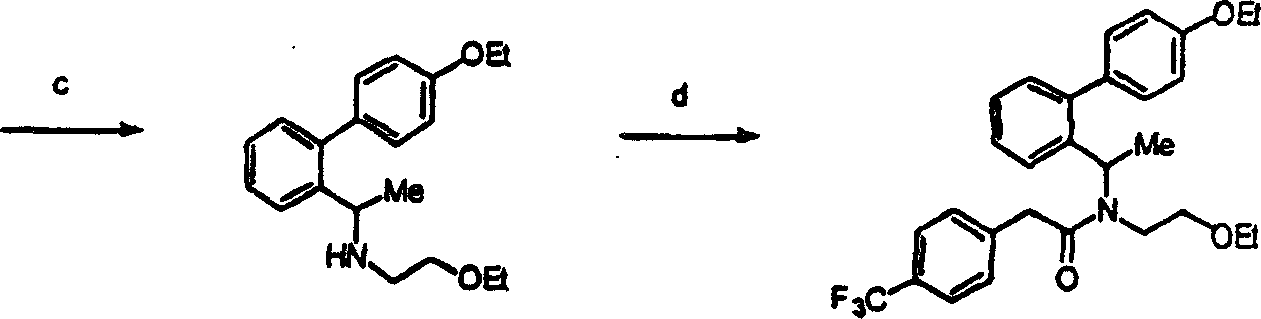
[1-(4’-乙氧基-联苯基-2-基)-乙基]-(2-乙氧基-乙基)-胺 N-[1-(4’-乙氧基-联苯基-2-基)-乙基]-N-(2-乙氧基-乙[1-(4'-Ethoxy-biphenyl-2-yl)-ethyl]-(2-ethoxy-ethyl)-amine N-[1-(4'-ethoxy-biphenyl Phenyl-2-yl)-ethyl]-N-(2-ethoxy-ethyl
基)-2-(4-三氟代甲基-苯基)-乙酰胺(5.01)
(a)4-乙氧基苯基硼酸,催化量的Pd(PPh3)4,甲苯-2M Na2CO3水溶液,100℃。(b)NBS,催化量的AlBN,hv,CCl4,回流。(c)2-乙氧基-1-氨基乙烷,乙醇,回流。(d)4’-(三氟代甲基)苯乙酸,EDC,催化量的HOBT,CH2Cl2,室温。(a) 4-ethoxyphenylboronic acid, catalytic amount of Pd(PPh 3 ) 4 , toluene-2M Na 2 CO 3 aqueous solution, 100°C. (b) NBS, catalytic amount of AlBN, hv, CCl4 , reflux. (c) 2-Ethoxy-1-aminoethane, ethanol, reflux. (d ) 4'-(trifluoromethyl)phenylacetic acid, EDC, catalytic amount of HOBT, CH2Cl2 , room temperature.
1-乙基-2-碘代-苯 4’-乙氧基-2-乙基-联苯基1-Ethyl-2-iodo-benzene 4’-ethoxy-2-ethyl-biphenyl
4’-乙氧基-2-乙基-联苯。将脱气的(3×冰冻-熔化循环)的1.00mL1-乙基-2-碘代-苯(6.97mmol,1.00当量)、3.47g 4-乙氧基苯基硼酸(20.9mmol,3.00当量)和402mg四(三苯膦)钯(0)(0.349mmol,0.0501当量)混合物溶于8.0mL甲苯和8.0mL 2M碳酸钠水溶液中并将所述双相混合物加热至100℃(外部温度,油浴)。16小时后将反应物冷却至室温并分离有机相。用50%乙酸乙酯的己烷溶液(2×25mL)萃取含水层并用硫酸镁干燥合并的有机分离物,过滤并在真空中浓缩得到黄色油状物。将该粗品物质经硅胶柱层析(3.5cm o.d.x20cmh)纯化,用5%乙酸乙酯的己烷溶液洗脱。合并在Rf=0.68,10%乙酸乙酸的己烷溶液中的含有产物的部分并在真空中浓缩,得到1.54g产物,包括未纯化的,为无色油状物;约1.23g纯产物。不纯度约为20%,鉴定为高偶合产物4,4’-二乙氧基联苯并在所述产物用于下一步骤前通过积分1H NMR共振信号的相关比率定量。4'-Ethoxy-2-ethyl-biphenyl. Degassed (3×freeze-thaw cycles) of 1.00 mL of 1-ethyl-2-iodo-benzene (6.97 mmol, 1.00 eq), 3.47 g of 4-ethoxyphenylboronic acid (20.9 mmol, 3.00 eq) and 402 mg of tetrakis(triphenylphosphine)palladium(0) (0.349 mmol, 0.0501 equivalents) were dissolved in 8.0 mL of toluene and 8.0 mL of 2M aqueous sodium carbonate and the biphasic mixture was heated to 100° C. (external temperature, oil bath ). After 16 hours the reaction was cooled to room temperature and the organic phase was separated. The aqueous layer was extracted with 50% ethyl acetate in hexanes (2 x 25 mL) and the combined organic isolates were dried over magnesium sulfate, filtered and concentrated in vacuo to give a yellow oil. The crude material was purified by silica gel column chromatography (3.5cm odx20cmh), eluting with 5% ethyl acetate in hexane. Fractions containing product at Rf = 0.68, 10% acetic acid in hexane were combined and concentrated in vacuo to give 1.54 g of product, including unpurified, as a colorless oil; approximately 1.23 g of pure product. The impurity was about 20%, identified as the highly coupled
1H NMR(CDCl3)δ1.15(t,3H,J=7.6Hz),1.49(t,3H,J=7.2Hz),2.65(q,2H,J=7.6Hz),4.12(q,2H,J=7.2Hz),6.98(d,2H,J=8.4Hz),7.22-7.28(m,2H),7.27(d,2H,J=8.4Hz),7.31-7.34(m,2H)ppm. 1 H NMR (CDCl 3 ) δ1.15(t, 3H, J=7.6Hz), 1.49(t, 3H, J=7.2Hz), 2.65(q, 2H, J=7.6Hz), 4.12(q, 2H , J=7.2Hz), 6.98(d, 2H, J=8.4Hz), 7.22-7.28(m, 2H), 7.27(d, 2H, J=8.4Hz), 7.31-7.34(m, 2H)ppm.
4’-乙氧基-2-乙基-联苯 2-(1-溴代-乙基)-4’-乙氧基-联苯4’-Ethoxy-2-ethyl-biphenyl 2-(1-Bromo-ethyl)-4’-ethoxy-biphenyl
由4’-乙氧基-2-乙基-联苯制备2-(1-溴代-乙基)-4’-乙氧基-联苯。将溶于15mL四氯化碳中的673mg 4’-乙氧基-2-乙基-联苯(2.98mmol,1.00当量)、556mg N-溴代琥珀酰亚胺(3.13mmol,1.05当量)和49mg 2,2’-偶氮二异丁腈(0.30mmol,0.10当量)的混合物在高密度白炽灯存在下加热至回流1.5小时。将反应物冷却至0℃并经过滤除去得到的沉淀物。浓缩的滤液与冷己烷(3×50mL)进行迭代研磨得到890mg产物,为无色油状物。所述产物经积分1H NMR共振信号的相关比率定量鉴定4,4’-二乙氧基联苯不纯率约为20%,其可直接用于下一步骤。Preparation of 2-(1-bromo-ethyl)-4'-ethoxy-biphenyl from 4'-ethoxy-2-ethyl-biphenyl. 673 mg of 4'-ethoxy-2-ethyl-biphenyl (2.98 mmol, 1.00 equivalent), 556 mg of N-bromosuccinimide (3.13 mmol, 1.05 equivalent) and A mixture of 49 mg of 2,2'-azobisisobutyronitrile (0.30 mmol, 0.10 equiv) was heated to reflux for 1.5 hours in the presence of a high-density incandescent lamp. The reaction was cooled to 0 °C and the resulting precipitate was removed by filtration. Iterative trituration of the concentrated filtrate with cold hexanes (3 x 50 mL) afforded 890 mg of product as a colorless oil. The impurity rate of 4,4'-diethoxybiphenyl was quantitatively identified by the correlation ratio of integrated 1 H NMR resonance signals, and the impurity rate of the product was about 20%, which could be directly used in the next step.
1H NMR(CDCl3)δ1.48(t,3H,J=6.8Hz),1.99(d,3H,J=7.2Hz),4.12(q,2H,J=6.8Hz),5.33(q,1H,J=6.8Hz),7.00(d,2H,J=8.8Hz),7.21(d,1H,J=7.6Hz),7.30-7.34(m,3H),7.42(dd,1H,J1=J2=7.6Hz),7.77(d,1H,J=8.0Hz)ppm. 1 H NMR (CDCl 3 ) δ1.48(t, 3H, J=6.8Hz), 1.99(d, 3H, J=7.2Hz), 4.12(q, 2H, J=6.8Hz), 5.33(q, 1H , J=6.8Hz), 7.00(d, 2H, J=8.8Hz), 7.21(d, 1H, J=7.6Hz), 7.30-7.34(m, 3H), 7.42(dd, 1H, J 1 =J 2 =7.6Hz), 7.77(d,1H,J=8.0Hz)ppm.

2-(1-溴代-乙基)-4’-乙氧基-联苯 [1-(4’-乙氧基-联苯-2-基)-乙基]-(2-乙氧基-乙基)-胺2-(1-Bromo-ethyl)-4'-ethoxy-biphenyl [1-(4'-ethoxy-biphenyl-2-yl)-ethyl]-(2-ethoxy -ethyl)-amine
由2-(1-溴代-乙基)-4’-乙氧基-联苯制备[1-(4’-乙氧基-联苯-2-基)-乙基]-(2-乙氧基-乙基)-胺。将溶于3.0mL乙醇中的135mg 2-(1-溴代-乙基)-4’-乙氧基-联苯(0.442mmol,1.00当量)和115μL 2-乙氧基-1-氨基乙烷(1.10mmol,2.50当量)的混合物加热至回流20小时,然后在真空中浓缩除去溶剂。将浓缩的反应产物直接吸附到硅胶柱(3.5cmo.d.x12cmh)上并用3%甲醇的氯仿溶液洗脱。合并在Rf=0.30,10%甲醇的氯仿溶液中含有产物的流分并在真空中浓缩,得到13.5mg纯产物,为黄色油状物。Preparation of [1-(4'-ethoxy-biphenyl-2-yl)-ethyl]-(2-ethyl) from 2-(1-bromo-ethyl)-4'-ethoxy-biphenyl Oxy-ethyl)-amine. Dissolve 135 mg of 2-(1-bromo-ethyl)-4'-ethoxy-biphenyl (0.442 mmol, 1.00 equiv) and 115 μL of 2-ethoxy-1-aminoethane in 3.0 mL of ethanol (1.10 mmol, 2.50 eq) mixture was heated to reflux for 20 hours, then concentrated in vacuo to remove solvent. The concentrated reaction product was directly absorbed onto a silica gel column (3.5 cmo.d.x12 cmh) and eluted with 3% methanol in chloroform. Fractions containing product at Rf = 0.30, 10% methanol in chloroform were combined and concentrated in vacuo to give 13.5 mg of pure product as a yellow oil.
1H NMR(CDCl3)δ1.17(t,3H,J=7.2Hz),1.34(d,3H,J=6.8Hz),1.47(t,3H,J=7.2Hz),2.55(t,2H,J=5.6Hz),3.37-3.50(m,2H),4.01(q,1H,J=6.4Hz),4.10(q, 2H,J=6.8Hz),6.94(d,2H,J=8.8Hz),7.15-7.22(m,3H),7.27(dd,1H,J1=J2=7.6Hz),7.39(dd,1H,J1=J2=7.6Hz),7.63(d,1H,J=7.6Hz)ppm.MS(ESI,正模式)314.1 1 H NMR (CDCl 3 ) δ1.17(t, 3H, J=7.2Hz), 1.34(d, 3H, J=6.8Hz), 1.47(t, 3H, J=7.2Hz), 2.55(t, 2H , J=5.6Hz), 3.37-3.50(m, 2H), 4.01(q, 1H, J=6.4Hz), 4.10(q, 2H, J=6.8Hz), 6.94(d, 2H, J=8.8Hz ), 7.15-7.22 (m, 3H), 7.27 (dd, 1H, J 1 =J 2 =7.6Hz), 7.39 (dd, 1H, J 1 =J 2 =7.6Hz), 7.63 (d, 1H, J = 7.6Hz) ppm.MS (ESI, positive mode) 314.1

[1-(4’-乙氧基-联苯-2-基)-乙基]-(2-乙氧基-乙基)-胺 N-[1-(4’-乙氧基-联苯-2-基)-乙基]-N-(2-乙氧基-乙[1-(4'-Ethoxy-biphenyl-2-yl)-ethyl]-(2-ethoxy-ethyl)-amine N-[1-(4'-ethoxy-biphenyl -2-yl)-ethyl]-N-(2-ethoxy-ethyl
基)-2-(4-三氟代甲基-苯基)-乙酰胺5.01
将溶于2.0mL二氯甲烷中的13.5mg[1-(4’-乙氧基-联苯-2-基)-乙基]-(2-乙氧基-乙基)-胺(43.1μmol,1.00当量)、10.5mg 4’-(三氟代甲基)苯乙酸(51.7μmol,1.20当量)、9.9mg EDC(51.7μmol,1.20当量)和1.0mg HOBT(7.4μmol,0.18当量)的混合物在室温下搅拌2小时。向该反应溶液中加入5mL饱和碳酸氢钠水溶液。将含水层用水稀释至15mL并用二氯甲烷(2×20mL)萃取。经硫酸镁干燥合并的有机分离物,过滤并在真空中浓缩,得到黄色油状物。将该粗产物吸附在硅胶柱(3.5cm o.d.x10cmh)上并用17%-25%乙酸乙酯梯度的己烷液洗脱,合并含有产物的部分,真空浓缩得到12.8mg纯产物为无色油状物。Dissolve 13.5 mg [1-(4'-ethoxy-biphenyl-2-yl)-ethyl]-(2-ethoxy-ethyl)-amine (43.1 μmol , 1.00 eq), 10.5 mg 4'-(trifluoromethyl)phenylacetic acid (51.7 μmol, 1.20 eq), 9.9 mg EDC (51.7 μmol, 1.20 eq) and 1.0 mg HOBT (7.4 μmol, 0.18 eq) Stir at room temperature for 2 hours. To the reaction solution was added 5 mL of saturated aqueous sodium bicarbonate solution. The aqueous layer was diluted to 15 mL with water and extracted with dichloromethane (2 x 20 mL). The combined organic isolates were dried over magnesium sulfate, filtered and concentrated in vacuo to give a yellow oil. The crude product was adsorbed on a silica gel column (3.5 cm o.d. x 10 cmh) and eluted with a gradient of 17%-25% ethyl acetate in hexane. Fractions containing the product were combined and concentrated in vacuo to give 12.8 mg of the pure product as a colorless oil .
1H NMR(d6-DMSO;T=140℃)δ1.04(t,3H,J=6.8Hz),1.34(t,3H,J=6.8Hz),1.44(d,3H,J=7.2Hz),3.00-3.06(m,1H),3.17-3.36(m,6H),3.49(d,1H,J=16.0Hz),4.07(q,2H,J=6.8Hz),5.43(q,1H,J=7.2Hz),6.92-6.96(m,2H),7.13-7.18(m,3H),7.22-7.26(m,2H),7.34(ddd,1H,J1=1.2Hz,J2=7.6Hz,J3=8.4Hz),7.39(ddd,1H,J1=2.0Hz,J2=7.6Hz,J3=9.2Hz),7.53-7.59(m,3H)ppm. 1 H NMR (d 6 -DMSO; T=140°C) δ1.04(t, 3H, J=6.8Hz), 1.34(t, 3H, J=6.8Hz), 1.44(d, 3H, J=7.2Hz ), 3.00-3.06(m, 1H), 3.17-3.36(m, 6H), 3.49(d, 1H, J=16.0Hz), 4.07(q, 2H, J=6.8Hz), 5.43(q, 1H, J=7.2Hz), 6.92-6.96(m, 2H), 7.13-7.18(m, 3H), 7.22-7.26(m, 2H), 7.34(ddd, 1H, J1 =1.2Hz, J2 =7.6Hz , J 3 =8.4Hz), 7.39 (ddd, 1H, J 1 =2.0Hz, J 2 =7.6Hz, J 3 =9.2Hz), 7.53-7.59 (m, 3H)ppm.
在室温下,化合物以约2∶1比率的顺式/反式酰胺旋转异构体混合物存在,其特性1H NMR信号(CDCl3,T=25C)测定:δ主要5.19(q,2.1H,J=7.2Hz)和δ次要5.89(q,1.0H,J=7.6Hz)ppm。MS(ESI正模式)500.1[MH]+ At room temperature, the compound exists as a mixture of cis/trans amide rotamers in a ratio of about 2:1, and its characteristic 1 H NMR signal (CDCl 3 , T=25C) is determined: δ is mainly 5.19 (q, 2.1H, J = 7.2 Hz) and delta minor 5.89 (q, 1.0H, J = 7.6 Hz) ppm. MS (ESI positive mode) 500.1[MH] +
实施例6Example 6
化合物6.01的合成Synthesis of Compound 6.01

将化合物3.22(13mg)和乙酸铵(500mg)在乙酸(2mL)中的混合物在80℃下搅拌14小时并在100℃下搅拌10小时。蒸发乙酸并用EtOAc吸收残余物。将该残余物用碳酸氢钠和盐水洗涤,干燥并浓缩。将残余物经柱(70%EtOAc的己烷溶液)纯化,得到10mg化合物6.01。A mixture of compound 3.22 (13 mg) and ammonium acetate (500 mg) in acetic acid (2 mL) was stirred at 80°C for 14 hours and at 100°C for 10 hours. Acetic acid was evaporated and the residue was taken up with EtOAc. The residue was washed with sodium bicarbonate and brine, dried and concentrated. The residue was purified by column (70% EtOAc in hexanes) to afford 10 mg of compound 6.01.
1H NMR(CDCl3)δ8.26(d,J=8.0Hz,1H),7.84(m,2H),7.56(m,1H),7.46(m,2H),7.32(m,2H),7.18(m,1H),7.05(m,2H),6.60(s,1H),6.53(m,1H),4.90(q,1H),3.76(d,1H),2.62(d,1H),2.16(s,3H),1.27(d,3H).MS(ESI+)507.2[MH]+. 1 H NMR (CDCl 3 ) δ8.26 (d, J=8.0Hz, 1H), 7.84 (m, 2H), 7.56 (m, 1H), 7.46 (m, 2H), 7.32 (m, 2H), 7.18 (m, 1H), 7.05(m, 2H), 6.60(s, 1H), 6.53(m, 1H), 4.90(q, 1H), 3.76(d, 1H), 2.62(d, 1H), 2.16( s, 3H), 1.27(d, 3H). MS(ESI + ) 507.2[MH] + .
化合物6.02的合成Synthesis of compound 6.02
2-(1-溴代-乙基)-3-(4-羟基-苯基)-3H-喹唑啉-4-酮 3-(4-甲氧基-苯基)-2-[1-(2-十一烷基-咪唑-1-基)-乙2-(1-Bromo-ethyl)-3-(4-hydroxy-phenyl)-3H-quinazolin-4-one 3-(4-methoxy-phenyl)-2-[1- (2-Undecyl-imidazol-1-yl)-ethyl
基]-3H-喹唑啉-4-酮6.02base]-3H-quinazolin-4-one 6.02
向溴化物(0.557mmol,0.20g)和K2CO3(0.89mmol,0.123g)的3mL DMF混合物中加入2-十一烷基-1H-咪唑(0.557mmol,0.124g)。将反应混合物加热到90℃10小时。蒸发溶剂后,将残余物溶于CH2Cl2中,用水、盐水洗涤有机层,经NaSO4干燥并在真空中除去,得到粘性油状物,将该油状物经层析纯化,得到黄色固体(0.16g)。To a mixture of bromide (0.557 mmol, 0.20 g) and K2CO3 (0.89 mmol, 0.123 g) in 3 mL of DMF was added 2-undecyl-1H-imidazole (0.557 mmol, 0.124 g). The reaction mixture was heated to 90°C for 10 hours. After evaporation of the solvent, the residue was dissolved in CH2Cl2 , the organic layer was washed with water, brine, dried over NaSO4 and removed in vacuo to give a viscous oil which was purified by chromatography to give a yellow solid ( 0.16g).
1H NMR(CDCl3)0.89(t,3H,J=7.0Hz),1.25(m,16H),1.60(brm,3H),1.73(d,3H,J=6.7Hz),1.83(m,1H),3.84(s,3H),5.09(q,1H,J=6.7Hz),6.35(m,1H),6.84-6.90(m,3H),7.05(m,1H),7.20(m,1H),7.55(m,1H),7.82(m,2H),8.28(dd,1H,J1=1.1Hz,J2=7.9Hz).MS(ESI+)501.2(MH+).(C31H40N4O2)的分析计算值:C 74.22,H 8.05,N 11.19。实测值C 74.22,H 8.14,N 11.03。 1 H NMR (CDCl 3 ) 0.89(t, 3H, J=7.0Hz), 1.25(m, 16H), 1.60(brm, 3H), 1.73(d, 3H, J=6.7Hz), 1.83(m, 1H ), 3.84(s, 3H), 5.09(q, 1H, J=6.7Hz), 6.35(m, 1H), 6.84-6.90(m, 3H), 7.05(m, 1H), 7.20(m, 1H) , 7.55(m, 1H), 7.82(m, 2H), 8.28(dd, 1H, J 1 =1.1Hz, J 2 =7.9Hz).MS(ESI + )501.2(MH + ).(C 31 H 40 Anal. Calcd. for N4O2 ): C 74.22, H 8.05, N 11.19. Found C 74.22, H 8.14, N 11.03.
化合物6.03的制备Preparation of compound 6.03
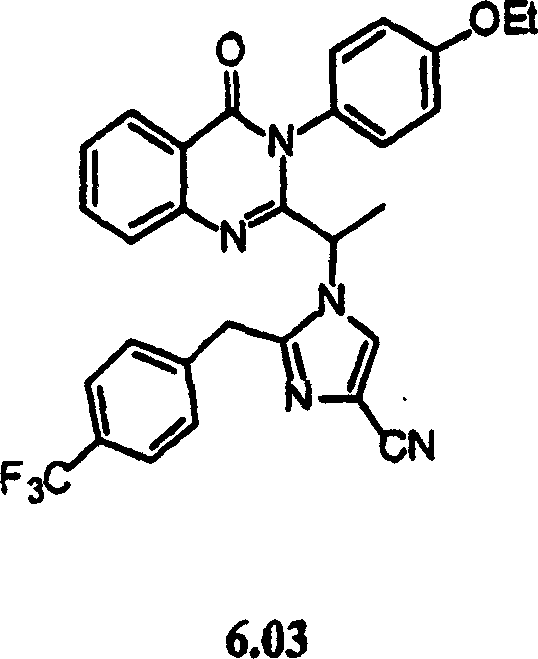
在图16中显示化合物6.03的合成。In Figure 16 the synthesis of compound 6.03 is shown.
1H NMR(CDCl3)δ8.27(d,J=8.0Hz,1H),7.80(m,2H),7.74(s,1H),7.57(m,1H),7.48(m,2H),7.21(m,2H),7.02(m,3H),6.64(m,1H),5.10(q,J=6.8Hz,1H),4.12(q,2H),3.83(d,J=16.4Hz,1H),2.95(d,J=16.2Hz,1H),1.49(t,3H),1.32(d,J=6.7Hz,3H).MS(ESI+)544.2[MH]+. 1 H NMR (CDCl 3 ) δ8.27 (d, J=8.0Hz, 1H), 7.80 (m, 2H), 7.74 (s, 1H), 7.57 (m, 1H), 7.48 (m, 2H), 7.21 (m, 2H), 7.02(m, 3H), 6.64(m, 1H), 5.10(q, J=6.8Hz, 1H), 4.12(q, 2H), 3.83(d, J=16.4Hz, 1H) , 2.95(d, J=16.2Hz, 1H), 1.49(t, 3H), 1.32(d, J=6.7Hz, 3H).MS(ESI + )544.2[MH] + .
化合物6.04的制备Preparation of compound 6.04

在图16中列出了化合物6.04的合成。In Figure 16 the synthesis of compound 6.04 is outlined.
1H NMR(CDCl3)δ8.26(d,J=8.0Hz,1H),7.80(m,2H),7.54(m,1H),7.47(m,2H),7.18(m,2H),7.03(m,2H),6.96(m,1H),6.87(s,1H),6.56(m,1H),5.01(q,J=6.8Hz,1H),4.11(q,2H),3.71(d,J=16.4Hz,1H),2.83(m,2H),2.76(d,J=16.2Hz,1H),2.69(m,2H),1.47(t,3H),1.27(d,J=6.7Hz,3H).MS(ESI+)572.3[MH]+. 1 H NMR (CDCl 3 ) δ8.26 (d, J=8.0Hz, 1H), 7.80 (m, 2H), 7.54 (m, 1H), 7.47 (m, 2H), 7.18 (m, 2H), 7.03 (m, 2H), 6.96(m, 1H), 6.87(s, 1H), 6.56(m, 1H), 5.01(q, J=6.8Hz, 1H), 4.11(q, 2H), 3.71(d, J=16.4Hz, 1H), 2.83(m, 2H), 2.76(d, J=16.2Hz, 1H), 2.69(m, 2H), 1.47(t, 3H), 1.27(d, J=6.7Hz, 3H).MS(ESI + )572.3[MH] + .
化合物6.05的制备Preparation of Compound 6.05
在图16中列出了化合物6.05的合成。In Figure 16 the synthesis of compound 6.05 is outlined.
1H NMR(CDCl3)δ8.26(d,J=8.0Hz,1H),7.80(m,2H),7.54(m,1H),7.47(m,2H),7.18(m,2H),7.06(m,2H),6.96(m,1H),6.78(s,1H),6.52(m,1H),5.01(q,J=6.8Hz,1H),4.11(m,3H),3.64(m,2H),3.34(s,3H),2.81(m,2H),2.68(d,J=16.2Hz,1H),1.47(t,3H),1.24(d,J=6.7Hz,3H).MS(ESI+)577.1[MH]+. 1 H NMR (CDCl 3 ) δ8.26 (d, J=8.0Hz, 1H), 7.80 (m, 2H), 7.54 (m, 1H), 7.47 (m, 2H), 7.18 (m, 2H), 7.06 (m, 2H), 6.96(m, 1H), 6.78(s, 1H), 6.52(m, 1H), 5.01(q, J=6.8Hz, 1H), 4.11(m, 3H), 3.64(m, 2H), 3.34(s, 3H), 2.81(m, 2H), 2.68(d, J=16.2Hz, 1H), 1.47(t, 3H), 1.24(d, J=6.7Hz, 3H).MS( ESI + )577.1[MH] + .
化合物6.06的制备Preparation of compound 6.06
在图16中列出了化合物6.06的合成。In Figure 16 the synthesis of compound 6.06 is outlined.
1H NMR(CDCl3)δ8.36(m,1H),8.27(d,J=8.0Hz,1H),7.80(m,2H),7.56(m,1H),7.47(m,3H),7.16(m,2H),7.04(m,3H),6.92(m,2H),6.50(s,1H),6.29(m,1H),4.92(q,J=6.8Hz,1H),4.11(q,2H),3.74(d,J=16.4Hz,1H),3.08(m,2H),2.98(m,2H),2.59(d,J=16.2Hz,1H),1.47(t,3H),1.17(d,J=6.7Hz,3H).MS(ESI+)624.2[MH]+. 1 H NMR (CDCl 3 ) δ8.36 (m, 1H), 8.27 (d, J=8.0Hz, 1H), 7.80 (m, 2H), 7.56 (m, 1H), 7.47 (m, 3H), 7.16 (m, 2H), 7.04(m, 3H), 6.92(m, 2H), 6.50(s, 1H), 6.29(m, 1H), 4.92(q, J=6.8Hz, 1H), 4.11(q, 2H), 3.74(d, J=16.4Hz, 1H), 3.08(m, 2H), 2.98(m, 2H), 2.59(d, J=16.2Hz, 1H), 1.47(t, 3H), 1.17( d, J=6.7Hz, 3H). MS(ESI + )624.2[MH] + .
化合物6.07的制备Preparation of compound 6.07
在图16中列出了化合物6.07的合成。In Figure 16 the synthesis of compound 6.07 is outlined.
1H NMR(CDCl3)δ8.26(d,J=8.0Hz,1H),7.80(m,2H),7.54(m,1H),7.47(m,2H),7.18(m,2H),7.05(m,2H),6.96(m,1H),6.72(s,1H),6.48(m,1H),5.00(q,J=6.8Hz,1H),4.11(q,2H),4.04(q,2H),3.80(d,J=16.4Hz,1H),2.85(m,2H),2.65(m,3H),1.47(t,3H),1.23(d,J=6.7Hz,3H),1.14(t,3H).MS(ESI+)619.1[MH]+. 1 H NMR (CDCl 3 ) δ8.26 (d, J=8.0Hz, 1H), 7.80 (m, 2H), 7.54 (m, 1H), 7.47 (m, 2H), 7.18 (m, 2H), 7.05 (m, 2H), 6.96(m, 1H), 6.72(s, 1H), 6.48(m, 1H), 5.00(q, J=6.8Hz, 1H), 4.11(q, 2H), 4.04(q, 2H), 3.80(d, J=16.4Hz, 1H), 2.85(m, 2H), 2.65(m, 3H), 1.47(t, 3H), 1.23(d, J=6.7Hz, 3H), 1.14( t,3H). MS(ESI + )619.1[MH] + .
化合物6.08的制备Preparation of Compound 6.08

在图16中列出了化合物6.08的合成。In Figure 16 the synthesis of compound 6.08 is outlined.
1H NMR(CDCl3)δ8.53(m,1H),8.26(d,J=8.0Hz,1H),7.80(m,2H),7.50(m,5H),7.26(m,5H),7.07(m,3H),7.00(m,1H),6.61(m,1H),5.03(q,J=6.8Hz,1H),4.11(q,2H),3.89(d,J=16.4Hz,1H),2.81(d,J=16.2Hz,1H),1.47(t,3H),1.27(d,J=6.7Hz,3H).MS(ESI+)622.1[MH]+. 1 H NMR (CDCl 3 ) δ8.53 (m, 1H), 8.26 (d, J=8.0Hz, 1H), 7.80 (m, 2H), 7.50 (m, 5H), 7.26 (m, 5H), 7.07 (m, 3H), 7.00(m, 1H), 6.61(m, 1H), 5.03(q, J=6.8Hz, 1H), 4.11(q, 2H), 3.89(d, J=16.4Hz, 1H) , 2.81(d, J=16.2Hz, 1H), 1.47(t, 3H), 1.27(d, J=6.7Hz, 3H).MS(ESI + )622.1[MH] + .
化合物6.09的制备Preparation of Compound 6.09
在图16中列出了化合物6.09的合成。In Figure 16 the synthesis of compound 6.09 is outlined.
1H NMR(CDCl3)δ8.27(d,J=8.0Hz,1H),7.80(m,2H),7.53(m,1H),7.48(m,3H),7.25(s,1H),7.20(m,2H),7.05(m,2H),7.00(m,1H),6.58(m,1H),6.50(d,J=15.8Hz,1H),5.04(q,J=6.8Hz,1H),4.21(q,2H),4.12(q,2H),3.83(d,J=16.4Hz,1H),2.80(d,J=16.2Hz,1H),1.48(t,3H),1.28(d,J=6.7Hz,3H).MS(ESI+)617.2[MH]+ 1 H NMR (CDCl 3 ) δ8.27 (d, J=8.0Hz, 1H), 7.80 (m, 2H), 7.53 (m, 1H), 7.48 (m, 3H), 7.25 (s, 1H), 7.20 (m, 2H), 7.05(m, 2H), 7.00(m, 1H), 6.58(m, 1H), 6.50(d, J=15.8Hz, 1H), 5.04(q, J=6.8Hz, 1H) , 4.21(q, 2H), 4.12(q, 2H), 3.83(d, J=16.4Hz, 1H), 2.80(d, J=16.2Hz, 1H), 1.48(t, 3H), 1.28(d, J=6.7Hz,3H).MS(ESI + )617.2[MH] +
化合物6.10的制备Preparation of Compound 6.10
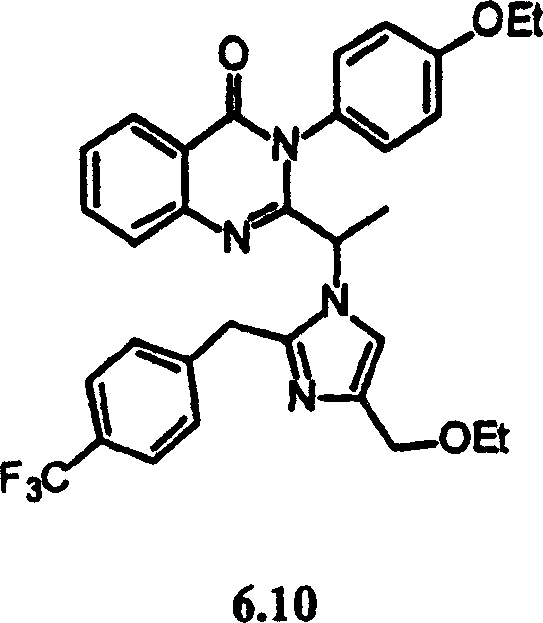
在图16中列出了化合物6.10的合成。In Figure 16 the synthesis of compound 6.10 is outlined.
1H NMR(CDCl3)δ8.26(d,J=8.0Hz,1H),7.80(m,2H),7.54(m,1H),7.47(m,2H),7.19(m,2H),7.06(m,3H),6.96(m,1H),6.59(m,1H),5.04(q,J=6.8Hz,1H),4.44(s,2H),4.11(m,3H),3.60(m,2H),2.70(d,J=16.2Hz,1H),1.47(t,3H),1.24(d,J=6.7Hz,3H).MS(ESI+)577.5[MH]+. 1 H NMR (CDCl 3 ) δ8.26 (d, J=8.0Hz, 1H), 7.80 (m, 2H), 7.54 (m, 1H), 7.47 (m, 2H), 7.19 (m, 2H), 7.06 (m, 3H), 6.96(m, 1H), 6.59(m, 1H), 5.04(q, J=6.8Hz, 1H), 4.44(s, 2H), 4.11(m, 3H), 3.60(m, 2H), 2.70(d, J=16.2Hz, 1H), 1.47(t, 3H), 1.24(d, J=6.7Hz, 3H).MS(ESI + )577.5[MH] + .
化合物6.11的制备Preparation of compound 6.11
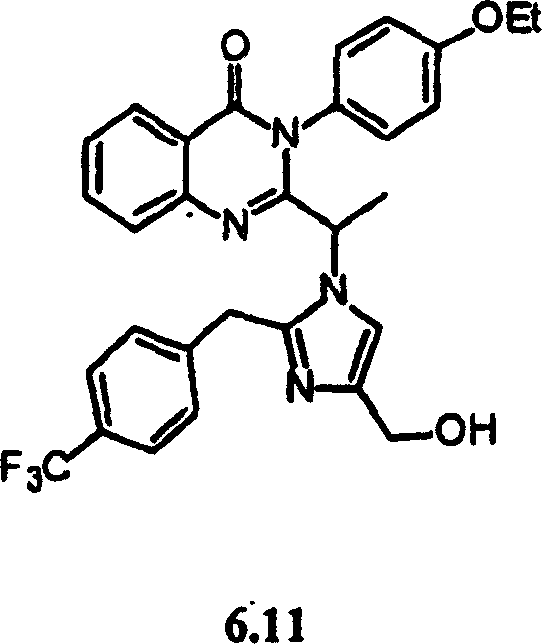
在图16中列出了化合物6.11的合成。In Figure 16 the synthesis of compound 6.11 is outlined.
1H NMR(CDCl3)δ8.27(d,J=8.0Hz,1H),7.80(m,2H),7.54(m,1H),7.46(m,2H),7.19(m,2H),7.04(m,2H),6.97(m,2H),6.54(m,1H),5.03(q,J=6.8Hz,1H),4.53(s,2H),4.11(q,2H),3.75(d,J=16.4Hz,1H),2.73(d,J=16.2Hz,1H),1.47(t,3H),1.27(d,J=6.7Hz,3H).MS(ESI+)549.5[MH]+ 1 H NMR (CDCl 3 ) δ8.27 (d, J=8.0Hz, 1H), 7.80 (m, 2H), 7.54 (m, 1H), 7.46 (m, 2H), 7.19 (m, 2H), 7.04 (m, 2H), 6.97(m, 2H), 6.54(m, 1H), 5.03(q, J=6.8Hz, 1H), 4.53(s, 2H), 4.11(q, 2H), 3.75(d, J=16.4Hz, 1H), 2.73(d, J=16.2Hz, 1H), 1.47(t, 3H), 1.27(d, J=6.7Hz, 3H). MS(ESI + ) 549.5[MH] +
实施例7Example 7
2-[1-(2-二甲基氨基-乙基氨基)-乙基]-3-(4-甲 辛烷-1-磺酸(2-二甲基氨基-乙基)-{1-[3-(4-甲2-[1-(2-Dimethylamino-ethylamino)-ethyl]-3-(4-methyloctane-1-sulfonic acid (2-dimethylamino-ethyl)-{1- [3-(4-A
氧基-苯基)-3H-喹唑啉-4-酮 氧基-苯基)-4-氧代-3,4-二氢-喹唑啉-2-基]-乙Oxy-phenyl)-3H-quinazolin-4-one Oxy-phenyl)-4-oxo-3,4-dihydro-quinazolin-2-yl]-ethyl
基}-酰胺7.01base}-amide 7.01
化合物7.01.向胺(1mmol,0.37g)和二异丙基乙胺(1.2mmol,0.16g)的乙腈(3mL)的二氯甲烷(3mL)溶液中加入辛烷磺酰氯(1.2mmol,0.26g)。将该反应混合物在室温下搅拌过夜。加入碳酸钠(15%)并将含水层用二氯甲烷萃取。用水、盐水洗涤有机层,经NaSO4干燥并在真空中浓缩,得到黄色油状物,将该油状物经硅胶层析纯化(洗脱液:CHCl3/MeOH=10/1.5),得到浅黄色玻璃状油状物(0.22g)。Compound 7.01. To a solution of amine (1 mmol, 0.37 g) and diisopropylethylamine (1.2 mmol, 0.16 g) in acetonitrile (3 mL) in dichloromethane (3 mL) was added octanesulfonyl chloride (1.2 mmol, 0.26 g ). The reaction mixture was stirred overnight at room temperature. Sodium carbonate (15%) was added and the aqueous layer was extracted with dichloromethane. The organic layer was washed with water, brine, dried over NaSO 4 and concentrated in vacuo to give a yellow oil, which was purified by silica gel chromatography (eluent: CHCl 3 /MeOH=10/1.5) to give a pale yellow glass An oil (0.22g).
1H NMR(CDCl3)0.86(t,3H,J=7.2Hz),1.17-1.25(m,10H),1.46(d,3H,J=6.9Hz),1.70(m,2H),2.19(s,6H),2.45(m,2H),2.73-2.90(m,2H),3.62-3.78(m,2H),3.87(s,3H),4.88(q,1H,J=6.9Hz),7.04-7.14(m,3H),7.31-7.34(m,1H),7.49(dt,1H,J1=1.3Hz,J2=8Hz),7.68(d,1H,J=7.3Hz),7.77(dd,1H,J1=2.1Hz,J2=8Hz),8.27(dd,1H,J1=1.2Hz,J2=8Hz).MS(ESI+)544.2(MH+).C29H42N4O4S的分析计算值:C 64.18,H 7.80,N 10.32 S 5.91。实测值C64.36,H 7.81,N 10.08,S 5.78。 1 H NMR (CDCl 3 ) 0.86(t, 3H, J=7.2Hz), 1.17-1.25(m, 10H), 1.46(d, 3H, J=6.9Hz), 1.70(m, 2H), 2.19(s , 6H), 2.45(m, 2H), 2.73-2.90(m, 2H), 3.62-3.78(m, 2H), 3.87(s, 3H), 4.88(q, 1H, J=6.9Hz), 7.04- 7.14(m, 3H), 7.31-7.34(m, 1H), 7.49(dt, 1H, J1 =1.3Hz, J2 =8Hz), 7.68(d, 1H, J=7.3Hz), 7.77(dd, 1H, J 1 =2.1 Hz, J 2 =8 Hz), 8.27 (dd, 1H, J 1 =1.2 Hz, J 2 =8 Hz). MS(ESI + ) 544.2 (MH + ).C 29 H 42 N 4 O Anal. Calcd. for 4 S: C 64.18, H 7.80, N 10.32 S 5.91. The measured values are C64.36, H 7.81, N 10.08, S 5.78.
实施例8Example 8

化合物8.01.使用合成化合物4.01相同的方法制备化合物8.01。油状物。顺式/反式酰胺旋转异构体的混合物(1/6),由1H NMR(CDCl3)测定:4.18(q,1H,J=7.0Hz),4.69(q,1H,J=7.0Hz)。MS(ESI+)533.2[MH+]。Compound 8.01. Compound 8.01 was prepared using the same method as compound 4.01. Oil. Mixture of cis/trans amide rotamers (1/6) by 1 H NMR (CDCl 3 ): 4.18 (q, 1H, J = 7.0 Hz), 4.69 (q, 1 H, J = 7.0 Hz ). MS (ESI + ) 533.2 [MH + ].
实施例9Example 9
2-氨基-N-(4-乙氧基-苯基)苯甲酰胺(XX)。isotoic酐(16.3g,100mmol)和对-氨基苯乙醚(13.7g,100mmol)的混合物在120℃下加热4小时。将该反应混合物冷却后用乙醚研磨。经抽吸收集得到的固体,得到化合物XX。2-Amino-N-(4-ethoxy-phenyl)benzamide (XX). A mixture of isotoic anhydride (16.3 g, 100 mmol) and p-aminophenetole (13.7 g, 100 mmol) was heated at 120°C for 4 hours. The reaction mixture was cooled and triturated with ether. The resulting solid was collected by suction to obtain compound XX.
1H NMR(CD3OD)1.37(t,3H,J=7.0Hz),4.01(q,2H,J=7.0Hz),6.67(t,1H,J=7.0Hz),6.78(dd,1H,J1=1.2Hz,J2=8.2Hz),6.89(m,2H),7.20(dt,1H,J1=1.4Hz,J2=8.2Hz),7.47(m,2H),7.56(dd,1H,J1=1.4Hz,J2=9.3Hz).MS(ESI+)257.3(MH+). 1 H NMR (CD 3 OD) 1.37 (t, 3H, J=7.0Hz), 4.01 (q, 2H, J=7.0Hz), 6.67 (t, 1H, J=7.0Hz), 6.78 (dd, 1H, J 1 =1.2Hz, J 2 =8.2Hz), 6.89(m, 2H), 7.20(dt, 1H, J 1 =1.4Hz, J 2 =8.2Hz), 7.47(m, 2H), 7.56(dd, 1H, J 1 =1.4Hz, J 2 =9.3Hz). MS(ESI + ) 257.3(MH + ).
邻-联氨XXI的合成。向化合物XX(7.68g,30mmol)和N-(9-芴基甲氧基羰基)-D-丙氨酸(10.26g,33mmol)的CH2Cl2(150mL)混合物中加入EDAC(8.63g,45mmol)和HOBt(1.38g,9mmol)。在室温下搅拌过夜后,将得到的固体过滤并用乙醚洗涤,得到化合物XXI(14.50g)。Synthesis of o-hydrazine XXI. To a mixture of compound XX (7.68 g, 30 mmol) and N-(9-fluorenylmethoxycarbonyl)-D-alanine (10.26 g, 33 mmol) in CH 2 Cl 2 (150 mL) was added EDAC (8.63 g, 45mmol) and HOBt (1.38g, 9mmol). After stirring overnight at room temperature, the resulting solid was filtered and washed with ether to afford compound XXI (14.50 g).
1H NMR(CDCl3)1.37(t,3H,J=7.0Hz),1.48(d,3H,J=7.2Hz),3.89(m,2H),4.26(m,2H),4.45(m,2H),5.50(m,1H),6.76(m,2H),7.17(t,1H,J=7.3Hz),7.25-7.76(m,12H),8.62(d,1H,J=8.8Hz),11.43(s,1H).MS(ESI+)550.3(MH+). 1 H NMR (CDCl 3 ) 1.37(t, 3H, J=7.0Hz), 1.48(d, 3H, J=7.2Hz), 3.89(m, 2H), 4.26(m, 2H), 4.45(m, 2H ), 5.50(m, 1H), 6.76(m, 2H), 7.17(t, 1H, J=7.3Hz), 7.25-7.76(m, 12H), 8.62(d, 1H, J=8.8Hz), 11.43 (s, 1H).MS(ESI + )550.3(MH + ).
4-氧代喹唑啉XXII。向联氨XXI(7.27g,13.27mmol)的CH2Cl2溶液中加入PPh3(17.40g,66.39mmol)、I2(16.52g,65.02mmol)和N,N-二异丙基乙胺(17.12g,132.7mmol)。将该反应混合物在室温下搅拌过夜。将得到的固体过滤并用乙醚洗涤,得到化合物XXII(4.83g)。4-Oxoquinazoline XXII. To a solution of hydrazine XXI (7.27 g, 13.27 mmol) in CH 2 Cl 2 was added PPh 3 (17.40 g, 66.39 mmol), I 2 (16.52 g, 65.02 mmol) and N,N-diisopropylethylamine ( 17.12 g, 132.7 mmol). The reaction mixture was stirred overnight at room temperature. The resulting solid was filtered and washed with diethyl ether to give compound XXII (4.83 g).
1H NMR(CDCl3)1.43(t,3H,J=7.0Hz),1.52(d,3H,J=7.2Hz),4.03(m,2H),4.23(m,1H) 4.43(m,2H),4.66(m,1H),5.58(m,2H),6.88(m,2H),7.23-7.78(m,13H),8.46(d,1H,J=8.8Hz).MS(ESI+)532.3(MH+). 1 H NMR (CDCl 3 ) 1.43(t, 3H, J=7.0Hz), 1.52(d, 3H, J=7.2Hz), 4.03(m, 2H), 4.23(m, 1H) 4.43(m, 2H) , 4.66(m, 1H), 5.58(m, 2H), 6.88(m, 2H), 7.23-7.78(m, 13H), 8.46(d, 1H, J=8.8Hz). MS(ESI + ) 532.3( MH + ).
化合物XXIII。将哌啶(15mL)加入到化合物XXII(2.68g,5.05mmol)的DMF(100ml)溶液中。在室温下搅拌1小时后,将该混合物倒入150ml水中,用CH2Cl2萃取含水层,将合并的有机萃取液经Na2SO4干燥,过滤并浓缩。将残余物经层析纯化,得到白色固体(0.80g)。Compound XXIII. Piperidine (15 mL) was added to a solution of compound XXII (2.68 g, 5.05 mmol) in DMF (100 mL). After stirring at room temperature for 1 h , the mixture was poured into 150 ml of water, the aqueous layer was extracted with CH2Cl2 , the combined organic extracts were dried over Na2SO4 , filtered and concentrated . The residue was purified by chromatography to give a white solid (0.80 g).
1H NMR(CDCl3)1.30(d,3H,J=6.6Hz),1.46(t,3H,J=6.3Hz),3.82(m,1H),4.10(q,2H,J=6.6Hz),7.03(dd,2H,J1=1.9Hz,J2=7.0Hz),7.18(m,2H),7.47(m,1H),7.75(m,2H),8.26(d,1H,J=8Hz).MS(ESI+)310.1(MH+). 1 H NMR (CDCl 3 ) 1.30 (d, 3H, J=6.6Hz), 1.46 (t, 3H, J=6.3Hz), 3.82 (m, 1H), 4.10 (q, 2H, J=6.6Hz), 7.03(dd, 2H, J1 =1.9Hz, J2 =7.0Hz), 7.18(m, 2H), 7.47(m, 1H), 7.75(m, 2H), 8.26(d, 1H, J=8Hz) .MS(ESI + )310.1(MH + ).
化合物XXIV。向化合物XXIII(0.06g,0.19mmol)和溴乙酰胺(0.032g,0.23mmol)的DMF(3mL)混合物中加入K2CO3(0.079g,0.57mmol)和NaI(0.086g,0.57mmol)。在室温下搅拌过夜后,蒸发溶剂,将残余物溶于CH2Cl2中,用水、盐水洗涤有机层,经Na2SO4干燥并在真空中除去,得到黄色固体,将该固体经层析纯化,得到白色固体。Compound XXIV. To a mixture of compound XXIII (0.06 g, 0.19 mmol) and bromoacetamide (0.032 g, 0.23 mmol) in DMF (3 mL) was added K 2 CO 3 (0.079 g, 0.57 mmol) and NaI (0.086 g, 0.57 mmol). After stirring at room temperature overnight, the solvent was evaporated, the residue was dissolved in CH2Cl2 , the organic layer was washed with water, brine, dried over Na2SO4 and removed in vacuo to give a yellow solid which was chromatographed Purification afforded a white solid.
1H NMR(CDCl3)1.26(t,3H,J=7.2Hz),1.38(d,3H,J=6.6Hz),3.469br,1H),3.58(br,1H),3.82(m,1H),4.11(m,2H),5.68(br,1H),7.04(m,2H),7.14(m,2H),7.50(m,1H),7.75(m,2H),8.30(d,1H,J=8Hz).MS(ESI+)367.3(MH+). 1 H NMR (CDCl 3 ) 1.26(t, 3H, J=7.2Hz), 1.38(d, 3H, J=6.6Hz), 3.469br, 1H), 3.58(br, 1H), 3.82(m, 1H) , 4.11(m, 2H), 5.68(br, 1H), 7.04(m, 2H), 7.14(m, 2H), 7.50(m, 1H), 7.75(m, 2H), 8.30(d, 1H, J =8Hz). MS(ESI + )367.3(MH + ).
化合物9.01的合成Synthesis of Compound 9.01
使用与化合物3.02相似的合成条件制备化合物9.01,白色固体,为顺式/反式酰胺旋转异构体的混合物(1/5),由1H NMR(CDCl3)测定:4.85(q,1H,J=7.3Hz),5.35(q,1H,J=7.3Hz)。MS(ESI+)561.2[MH+]。Compound 9.01 was prepared using similar synthetic conditions as compound 3.02, a white solid, a mixture (1/5) of cis/trans amide rotamers, determined by 1 H NMR (CDCl 3 ): 4.85 (q, 1H, J=7.3Hz), 5.35(q,1H, J=7.3Hz). MS (ESI + ) 561.2 [MH + ].
化合物9.02的合成Synthesis of Compound 9.02
2-联苯-4-基-N-{1-[3-(4-乙氧基-苯基)-4-氧代-3,4-二氢-喹唑啉-2-基]-乙基}-N-[2-(2,2,2-三氟代-乙氧基)-乙基]乙酰胺9.022-biphenyl-4-yl-N-{1-[3-(4-ethoxy-phenyl)-4-oxo-3,4-dihydro-quinazolin-2-yl]-ethyl Base}-N-[2-(2,2,2-trifluoro-ethoxy)-ethyl]acetamide 9.02
根据化合物9.01的合成方法制备化合物9.02,油状物,为顺式/反式酰胺旋转异构体的混合物(1/1),由1H NMR(CDCl3)测定:4.95(m,1H),5.35(m,1H)。MS(ESI+)630.2[MH+]。Compound 9.02 was prepared according to the synthesis method of compound 9.01, an oil, a mixture (1/1) of cis/trans amide rotamers, determined by 1 H NMR (CDCl 3 ): 4.95 (m, 1H), 5.35 (m, 1H). MS (ESI + ) 630.2 [MH + ].
化合物9.03的合成Synthesis of compound 9.03
2-联苯-4-基-N-{1-[3-(4-氟代-苯基)-4-氧代-3,4-二氢-喹唑啉-2-基]乙基}-N-[2-(2,2,2-三氟代-乙氧基)-乙基]-乙酰胺9.032-biphenyl-4-yl-N-{1-[3-(4-fluoro-phenyl)-4-oxo-3,4-dihydro-quinazolin-2-yl]ethyl} -N-[2-(2,2,2-trifluoro-ethoxy)-ethyl]-acetamide 9.03
根据化合物9.01的合成方法制备化合物9.03,黄色固体,m.p.167.9℃,为顺式/反式酰胺旋转异构体的混合物(1/2),由1H NMR(CDCl3)测定:4.85(q,1H,J=7.0Hz),5.26(q,1H,J=7.0Hz)。MS(ESI+)604.2[MH+]。C34H29F4N3O3的分析计算值:C 67.65,H 4.84,N 6.96。实测值C 67.80,H 4.98,N 6.97。Compound 9.03 was prepared according to the synthesis method of compound 9.01, yellow solid, mp 167.9°C, a mixture (1/2) of cis/trans amide rotamers, determined by 1 H NMR (CDCl 3 ): 4.85 (q , 1H, J=7.0Hz), 5.26(q, 1H, J=7.0Hz). MS (ESI + ) 604.2 [MH + ]. Anal . Calcd. for C34H29F4N3O3 : C 67.65, H 4.84, N 6.96. Found C 67.80, H 4.98, N 6.97.
化合物9.04的合成Synthesis of compound 9.04
N-{1-[3-(4-氟代-苯基)-4-氧代-3,4-二氢-喹唑啉-2-基]-乙基}-N-[2-(2,2,2-三氟代-乙氧基)-乙基]-2-(4-三氟代甲基-苯基)-乙酰胺9.04N-{1-[3-(4-fluoro-phenyl)-4-oxo-3,4-dihydro-quinazolin-2-yl]-ethyl}-N-[2-(2 , 2,2-trifluoro-ethoxy)-ethyl]-2-(4-trifluoromethyl-phenyl)-acetamide 9.04
根据化合物9.01的合成方法制备化合物9.04,白色固体,m.p.156.2℃。Compound 9.04 was prepared according to the synthetic method of compound 9.01, a white solid, m.p.156.2°C.
m.p.156.2℃.1H NMR(DMSO,T=140℃)1.45(d,3H,J=6.8Hz),3.59-3.73(m,6H),3.92(m,2H),5.14(q,1H,J=6.8Hz),7.33(m,5H),7.69(m,4H),7.72(d,1H,J=8Hz),7.86(m,1H),8.14(dd,1H,J1=1.2Hz,J1=8.4Hz),mp156.2°C. 1 H NMR (DMSO, T=140°C) 1.45(d, 3H, J=6.8Hz), 3.59-3.73(m, 6H), 3.92(m, 2H), 5.14(q, 1H, J=6.8Hz), 7.33(m, 5H), 7.69(m, 4H), 7.72(d, 1H, J=8Hz), 7.86(m, 1H), 8.14(dd, 1H, J 1 =1.2Hz, J 1 =8.4Hz),
在室温下,为顺式/反式酰胺旋转异构体的混合物(1/2),由1H NMR(CDCl3)测定:4.88(q,1H,J=6.8Hz),5.27(q,1H,J=6.8Hz)。MS(ESI+)604.2[MH+]。C29H24F7N3O3的分析计算值:C 58.49,H 4.06,N 7.06。实测值C 58.53,H 4.18,N 7.05。At room temperature, it is a mixture of cis/trans amide rotamers (1/2), determined by 1 H NMR (CDCl 3 ): 4.88 (q, 1H, J=6.8Hz), 5.27 (q, 1H , J=6.8Hz). MS (ESI + ) 604.2 [MH + ]. Anal . Calcd. for C29H24F7N3O3 : C 58.49, H 4.06, N 7.06 . Found C 58.53, H 4.18, N 7.05.
化合物9.05的合成Synthesis of Compound 9.05
N-(2-乙氧基-乙基)-N-{1-[3-(4-乙氧基-苯基)-4-氧代-3,4-二氢-喹唑啉-2-基]-乙基}-2-(4-氟代-苯基)-乙酰胺9.05N-(2-ethoxy-ethyl)-N-{1-[3-(4-ethoxy-phenyl)-4-oxo-3,4-dihydro-quinazoline-2- Base]-ethyl}-2-(4-fluoro-phenyl)-acetamide 9.05
根据化合物9.01的合成方法制备化合物9.05,黄色固体,为顺式/反式酰胺旋转异构体的混合物(1/1),由1H NMR(CDCl3)测定:4.88(q,1H,J=7.0Hz),5.35(q,1H,J=7.0Hz)。MS(ESI+)518.3[MH+]。C30H32FN3O4的分析计算值:C 69.62,H 6.23,N 8.12。实测值C 69.40,H6.26,N 7.98。Compound 9.05 was prepared according to the synthesis method of compound 9.01, a yellow solid, a mixture (1/1) of cis/trans amide rotamers, determined by 1 H NMR (CDCl 3 ): 4.88 (q, 1H, J= 7.0 Hz), 5.35 (q, 1H, J = 7.0 Hz). MS (ESI + ) 518.3 [MH + ]. Anal. Calcd. for C30H32FN3O4 : C 69.62, H 6.23, N 8.12. Found values C 69.40, H 6.26, N 7.98.
化合物9.06的合成Synthesis of compound 9.06
N-(2-乙氧基-乙基)-N-{1-[3-(4-乙氧基-苯基)-4-氧代-3,4-二氢-喹唑啉-2-基]-乙基}-2-(3-氟代-苯基)-乙酰胺9.06N-(2-ethoxy-ethyl)-N-{1-[3-(4-ethoxy-phenyl)-4-oxo-3,4-dihydro-quinazoline-2- Base]-ethyl}-2-(3-fluoro-phenyl)-acetamide 9.06
根据化合物9.01的合成方法制备化合物9.06,黄色固体,为顺式/反式酰胺旋转异构体的混合物(1/1),由1H NMR(CDCl3)测定:4.90(q,1H,J=7.0Hz),5.35(q,1H,J=7.0Hz)。MS(ESI+)518.3[MH+]。C30H32FN3O4的分析计算值:C 69.62,H 6.23,N 8.12。实测值C 69.33,H6.20,N 8.06。Compound 9.06 was prepared according to the synthesis method of compound 9.01, a yellow solid, a mixture (1/1) of cis/trans amide rotamers, determined by 1 H NMR (CDCl 3 ): 4.90 (q, 1H, J= 7.0 Hz), 5.35 (q, 1H, J = 7.0 Hz). MS (ESI + ) 518.3 [MH + ]. Anal. Calcd. for C30H32FN3O4 : C 69.62, H 6.23, N 8.12. Found C 69.33, H 6.20, N 8.06.
化合物9.07的合成Synthesis of Compound 9.07
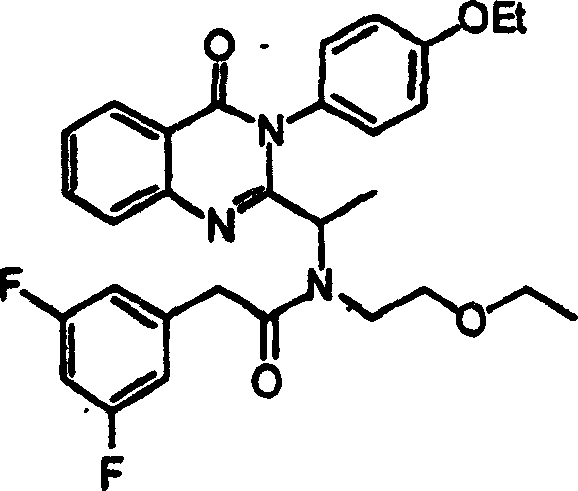
2-(3,5-二氟代-苯基)-N-(2-乙氧基-乙基)-N-{1-[3-(4-乙氧基-苯基)-4-氧代-3,4-二氢-喹唑啉-2-基]-乙基}-乙酰胺9.072-(3,5-Difluoro-phenyl)-N-(2-ethoxy-ethyl)-N-{1-[3-(4-ethoxy-phenyl)-4-oxo Generation-3,4-dihydro-quinazolin-2-yl]-ethyl}-acetamide 9.07
根据化合物9.01的合成方法制备化合物9.07,黄色固体,为顺式/反式酰胺旋转异构体的混合物(1/1),由1H NMR(CDCl3)测定:4.88(q,1H,J=7.0Hz),5.37(q,1H,J=7.0Hz)。MS(ESI+)536.3[MH+]。C30H31F2N3O4的分析计算值:C 67.28,H 5.83,N 7.85。实测值C 67.28,H5.80,N 7.78。Compound 9.07 was prepared according to the synthesis method of compound 9.01, a yellow solid, a mixture (1/1) of cis/trans amide rotamers, determined by 1 H NMR (CDCl 3 ): 4.88 (q, 1H, J= 7.0 Hz), 5.37 (q, 1H, J = 7.0 Hz). MS (ESI + ) 536.3 [MH + ]. Anal . Calcd. for C30H31F2N3O4 : C 67.28, H 5.83, N 7.85 . Found values C 67.28, H 5.80, N 7.78.
化合物9.08的合成Synthesis of compound 9.08
根据化合物9.01的合成方法制备化合物9.08,黄色固体,m.p.157.9℃Compound 9.08 was prepared according to the synthetic method of compound 9.01, yellow solid, m.p.157.9°C
1H NMR(DMSO,T=140℃)0.95(t,3H,J=6.4Hz),1.34(t,3H,J=6.8Hz),1.44(d,3H,J=6.8Hz),3.31-3.59(m,8H),4.08(q,2H,J=6.8Hz),5.17(q,1H,J=6.8Hz),7.02(m,2H),7.24-7.56(m,7H),7.70(d,1H,J=8Hz),7.84(dt,1H,J1=1.6Hz,J2=7.2Hz),8.13(d,1H,J=8Hz). 1 H NMR (DMSO, T=140°C) 0.95(t, 3H, J=6.4Hz), 1.34(t, 3H, J=6.8Hz), 1.44(d, 3H, J=6.8Hz), 3.31-3.59 (m, 8H), 4.08(q, 2H, J=6.8Hz), 5.17(q, 1H, J=6.8Hz), 7.02(m, 2H), 7.24-7.56(m, 7H), 7.70(d, 1H, J=8Hz), 7.84(dt, 1H, J1 =1.6Hz, J2 =7.2Hz), 8.13(d, 1H, J=8Hz).
在室温下,为顺式/反式酰胺旋转异构体的混合物(1/1),由1H NR(CDCl3)测定:4.92(q,1H,J=7.0Hz),5.38(q,1H,J=7.0Hz)。MS(ESI+)568.3[MH+]。C31H32F3N3O4的分析计算值:C 65.60,H 5.68,N 7.40。实测值C 65.38,H 5.61,N 7.34。At room temperature, it is a mixture of cis/trans amide rotamers (1/1), determined by 1 H NR (CDCl 3 ): 4.92 (q, 1H, J=7.0Hz), 5.38 (q, 1H , J=7.0Hz). MS (ESI + ) 568.3 [MH + ]. Anal . Calcd. for C31H32F3N3O4 : C 65.60, H 5.68, N 7.40 . Found C 65.38, H 5.61, N 7.34.
化合物9.09的合成Synthesis of Compound 9.09
N-(2-乙氧基-乙基)-N-{1-[3-(4-乙氧基-苯基)-4-氧代-3,4-二氢-喹唑啉-2-基]-乙基}-2,2-二氟代-2-苯基-乙酰胺9.09N-(2-ethoxy-ethyl)-N-{1-[3-(4-ethoxy-phenyl)-4-oxo-3,4-dihydro-quinazoline-2- Base]-ethyl}-2,2-difluoro-2-phenyl-acetamide 9.09
根据化合物9.01的合成方法制备化合物9.09,无色油状物,Compound 9.09 was prepared according to the synthesis method of compound 9.01, a colorless oil,
1H NMR(CDCl3)1.04(t,3H,J=6.9Hz),1.46(m,6H),3.30(m,2H),3.42(m,2H),3.62(m,2H),4.08(q,2H,J=7.0Hz),5.15(q,1H,J=7.0Hz),7.02(m,2H),7.18(m,1H),7.42-7.54(m,8H),7.75(m,1H),8.28(d,1H,J=7.8Hz)MS(ESI+)536.3(MH+). 1 H NMR (CDCl 3 ) 1.04(t, 3H, J=6.9Hz), 1.46(m, 6H), 3.30(m, 2H), 3.42(m, 2H), 3.62(m, 2H), 4.08(q , 2H, J=7.0Hz), 5.15(q, 1H, J=7.0Hz), 7.02(m, 2H), 7.18(m, 1H), 7.42-7.54(m, 8H), 7.75(m, 1H) , 8.28 (d, 1H, J=7.8Hz) MS (ESI + ) 536.3 (MH + ).
实施例10Example 10
化合物10.01的合成Synthesis of compound 10.01
将化合物XV(160mg,0.5mmol)和2-咪唑甲醛(58mg,0.6mmol)的甲醇(10mL)混合物在室温下搅拌20分钟。然后加入氰基硼氢钠(38mg,0.6mmol)。将该混合物在室温下搅拌6小时。将反应混合物用EtOAc处理并用碳酸氢钠和盐水洗涤,干燥并浓缩。将残余物经柱层析(5%甲醇和1%浓NH4OH的3∶7 EtOAc/DCM溶液)纯化,得到120mg化合物XXV。A mixture of compound XV (160 mg, 0.5 mmol) and 2-imidazolecarbaldehyde (58 mg, 0.6 mmol) in methanol (10 mL) was stirred at room temperature for 20 minutes. Sodium cyanoborohydride (38 mg, 0.6 mmol) was then added. The mixture was stirred at room temperature for 6 hours. The reaction mixture was treated with EtOAc and washed with sodium bicarbonate and brine, dried and concentrated. The residue was purified by column chromatography (5% methanol and 1% conc. NH4OH in 3:7 EtOAc/DCM) to afford 120 mg of compound XXV.
1H NMR(CDCl3)δ8.25(d,J=8.0Hz,1H),7.78(t,J=8.0Hz,1H),7.70(d,J=7.7Hz,1H),7.49(t,J=8.0Hz,1H),7.20-7.05(m,4H),6.93(s,2H),3.94(d,J=14.8Hz,1H),3.77(d,J=14.8Hz,1H),3.38(q,J=6.6Hz,1H),1.25(d,J=6.6Hz,3H). 1 H NMR (CDCl 3 ) δ8.25(d, J=8.0Hz, 1H), 7.78(t, J=8.0Hz, 1H), 7.70(d, J=7.7Hz, 1H), 7.49(t, J =8.0Hz, 1H), 7.20-7.05(m, 4H), 6.93(s, 2H), 3.94(d, J=14.8Hz, 1H), 3.77(d, J=14.8Hz, 1H), 3.38(q , J=6.6Hz, 1H), 1.25(d, J=6.6Hz, 3H).
将EDC(123mg,0.64mmol)加入到化合物XXV(115mg,0.32mmol)、4-三氟代甲基苯乙酸(65mg,0.32mmol)、HOBt(43mg,0.32mmol)和NMM(0.07mL,0.64mmol)的DMF(3mL)混合物中。将该混合物在室温下搅拌14小时。将反应混合物用EtOAc处理并用碳酸氢钠和盐水洗涤,干燥并浓缩。将残余物经柱层析(5%甲醇和1%浓NH4OH的3∶7 EtOAc/DCM溶液)纯化,得到100mg化合物10.01。MS(ESI+)550.2[MH+]。EDC (123 mg, 0.64 mmol) was added to compound XXV (115 mg, 0.32 mmol), 4-trifluoromethylphenylacetic acid (65 mg, 0.32 mmol), HOBt (43 mg, 0.32 mmol) and NMM (0.07 mL, 0.64 mmol) ) in DMF (3 mL). The mixture was stirred at room temperature for 14 hours. The reaction mixture was treated with EtOAc and washed with sodium bicarbonate and brine, dried and concentrated. The residue was purified by column chromatography (5% methanol and 1% conc. NH4OH in 3:7 EtOAc/DCM) to afford 100 mg of compound 10.01. MS (ESI + ) 550.2 [MH + ].
化合物10.02的合成Synthesis of Compound 10.02

将碳酸钾(97mg,0.7mmol)加入到化合物10.01(38mg,0.07mmol)和碘代甲烷(0.044mL,0.7mmol)的DMF(2mL)混合物中。将混合物在室温下搅拌两天。在高真空中蒸发DMF,用EtOAc吸收残余物。用盐水洗涤,干燥并浓缩。将残余物经柱层析(2%甲醇和0.5%浓NH4OH的3∶7 EtOAc/DCM溶液)纯化,得到15mg化合物10.02。MS(ESI+)564.2[MH+]。Potassium carbonate (97 mg, 0.7 mmol) was added to a mixture of compound 10.01 (38 mg, 0.07 mmol) and iodomethane (0.044 mL, 0.7 mmol) in DMF (2 mL). The mixture was stirred at room temperature for two days. DMF was evaporated in high vacuum and the residue was taken up with EtOAc. Washed with brine, dried and concentrated. The residue was purified by column chromatography (2% methanol and 0.5% conc. NH4OH in 3:7 EtOAc/DCM) to afford 15 mg of compound 10.02. MS (ESI + ) 564.2 [MH + ].
化合物10.03的合成Synthesis of Compound 10.03
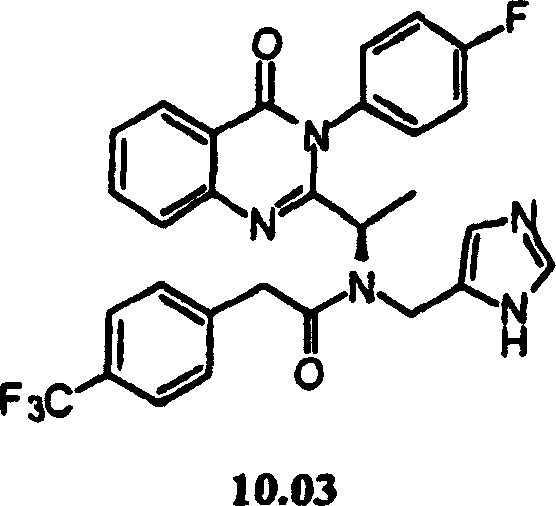
根据如上所述化合物10.01的合成方法制备化合物10.03。MS(ESI+)550.2[MH+]。Compound 10.03 was prepared according to the synthesis of compound 10.01 described above. MS (ESI + ) 550.2 [MH + ].
化合物10.04的合成Synthesis of Compound 10.04
根据如上所述化合物10.02的合成方法制备化合物10.04。MS(ESI+)564.2[MH+]。Compound 10.04 was prepared according to the synthesis of compound 10.02 described above. MS (ESI + ) 564.2 [MH + ].
化合物10.05的合成Synthesis of Compound 10.05
根据如上所述化合物10.01的合成方法制备化合物10.05。Compound 10.05 was prepared according to the synthesis of compound 10.01 described above.
1H NMR(d6-DMSO,T=140℃)δ8.11(d,J=8.0Hz,1H),7.82(t,J=8.1Hz,1H),7.68(d,J=8.1Hz,1H),7.60-7.40(m,6H),7.38-7.15(m,5H),5.33(bs,1H),5.02(dd,J=11.4Hz,2H),3.60(bm,2H),1.45(d,J=7.0Hz,3H).m.p.173-174℃.MS(ESI+)567.2[MH]+.C29H22F4N4O2S的分析计算值:C 61.48,H 3.91,N 9.89。实测值:C61.36,H 4.08,N 9.75。 1 H NMR (d 6 -DMSO, T=140°C) δ8.11(d, J=8.0Hz, 1H), 7.82(t, J=8.1Hz, 1H), 7.68(d, J=8.1Hz, 1H ), 7.60-7.40(m, 6H), 7.38-7.15(m, 5H), 5.33(bs, 1H), 5.02(dd, J=11.4Hz, 2H), 3.60(bm, 2H), 1.45(d, J = 7.0 Hz, 3H ) . mp 173-174°C. MS (ESI + ) 567.2 [MH] + . Anal . Calcd. for C29H22F4N4O2S: C 61.48, H 3.91 , N 9.89. Found values: C61.36, H 4.08, N 9.75.
实施例11Example 11
化合物11.01的制备Preparation of compound 11.01
化合物11.01的合成在图14中示出。The synthesis of compound 11.01 is shown in Figure 14 .
1H NMR(d6-DMSO,T=120℃)δ8.8-7.0(m,17H),6.35(s,1H),5.00(m,1H),4.35(m,1H),4.25-4.00(m,4H),3.65(m,1H),1.40(t,3H).MS(ESI+)619.1[MH]+. 1 H NMR (d 6 -DMSO, T=120°C) δ8.8-7.0 (m, 17H), 6.35 (s, 1H), 5.00 (m, 1H), 4.35 (m, 1H), 4.25-4.00 ( m, 4H), 3.65(m, 1H), 1.40(t, 3H). MS(ESI + ) 619.1[MH] + .
化合物11.02的制备Preparation of compound 11.02
化合物11.02的合成在图17中示出。The synthesis of compound 11.02 is shown in Figure 17.
1H NMR(d6-DMSO,T=150℃)δ8.38(m,2H),8.09(m,1H),7.84(m,2H),7.68(m,1H),7.54(m,2H),7.40-7.00(m,6H),5.25(m,1H),4.74(m,2H),4.25(m,1H),4.14(m,3H),3.62(m,1H),3.31(m,1H),2.78(m,2H),1.37(m,6H).MS(ESI+)605.3[MH]+. 1 H NMR (d 6 -DMSO, T=150°C) δ8.38(m, 2H), 8.09(m, 1H), 7.84(m, 2H), 7.68(m, 1H), 7.54(m, 2H) , 7.40-7.00(m, 6H), 5.25(m, 1H), 4.74(m, 2H), 4.25(m, 1H), 4.14(m, 3H), 3.62(m, 1H), 3.31(m, 1H ), 2.78(m, 2H), 1.37(m, 6H).MS(ESI + )605.3[MH] + .
化合物11.03的制备Preparation of compound 11.03
化合物11.03的合成在图18中示出。The synthesis of compound 11.03 is shown in Figure 18.
1H NMR(d6-DMSO,T=150℃)δ9.02(s,1H),8.85(s,1H),8.40(s,1H),8.38(m,1H),7.57(m,1H),7.41(m,3H),7.33-7.15(m,5H),5.30(q,1H),4.80(dd,2H),4.13(q,2H),3.64(d,1H),3.21(bs,1H),1.46(d,3H),1.37(t,3H).MS(ESI+)607.2[MH]+. 1 H NMR (d 6 -DMSO, T=150°C) δ9.02(s, 1H), 8.85(s, 1H), 8.40(s, 1H), 8.38(m, 1H), 7.57(m, 1H) , 7.41(m, 3H), 7.33-7.15(m, 5H), 5.30(q, 1H), 4.80(dd, 2H), 4.13(q, 2H), 3.64(d, 1H), 3.21(bs, 1H ), 1.46(d, 3H), 1.37(t, 3H). MS(ESI + ) 607.2[MH] + .
化合物11.04的制备Preparation of compound 11.04

化合物11.04的合成在图18中示出。The synthesis of compound 11.04 is shown in Figure 18.
1H NMR(d6-DMSO,T=150℃)δ8.81(d,1H),8.38(s,1H),8.35(m,1H),8.03(m,1H),7.81(m,1H),7.54(m,1H),7.40(m,3H),7.33-7.05(m,5H),5.28(q,1H),4.75(dd,2H),4.13(q,2H),3.60(d,1H),3.19(bs,1H),1.44(d,3H),1.37(t,3H).MS(ESI+)606.2[MH]+. 1 H NMR (d 6 -DMSO, T=150°C) δ8.81(d, 1H), 8.38(s, 1H), 8.35(m, 1H), 8.03(m, 1H), 7.81(m, 1H) , 7.54(m, 1H), 7.40(m, 3H), 7.33-7.05(m, 5H), 5.28(q, 1H), 4.75(dd, 2H), 4.13(q, 2H), 3.60(d, 1H ), 3.19(bs, 1H), 1.44(d, 3H), 1.37(t, 3H). MS(ESI + ) 606.2[MH] + .
化合物11.05的制备Preparation of compound 11.05

化合物11.05的合成在图11中示出。The synthesis of compound 11.05 is shown in Figure 11.
1H NMR(d6-DMSO,T=150℃)δ8.47(s,1H),8.37(d,1H),8.13(d,1H),7.66-7.25(m,7H),7.25-7.10(m,6H),6.59(d,1H),5.25(q,1H),4.86(dd,2H),4.18(q,2H),3.70(d,1H),3.31(bd,1H),1.41(m,6H).MS(ESI+)605.2[MH]+. 1 H NMR (d 6 -DMSO, T=150°C) δ8.47 (s, 1H), 8.37 (d, 1H), 8.13 (d, 1H), 7.66-7.25 (m, 7H), 7.25-7.10 ( m, 6H), 6.59(d, 1H), 5.25(q, 1H), 4.86(dd, 2H), 4.18(q, 2H), 3.70(d, 1H), 3.31(bd, 1H), 1.41(m , 6H).MS(ESI + )605.2[MH] + .
化合物11.06的制备Preparation of compound 11.06
化合物11.06的合成在图3中示出。The synthesis of compound 11.06 is shown in Figure 3.
1H NMR(d6-DMSO,T=150℃)δ8.30(m,1H),8.22(s,1H),7.95(m,2H),7.83(m,1H),7.57(m,1H),7.48(m,1H),7.36(m,2H),7.24(m,2H),7.15-6.95(m,6H),5.45(q,1H),4.50(dd,2H),4.14(q,2H),3.57(d,1H),3.05(bd,1H),1.54(d,3H),1.38(t,3H).MS(ESI+)587.3[MH]+. 1 H NMR (d 6 -DMSO, T=150°C) δ8.30(m, 1H), 8.22(s, 1H), 7.95(m, 2H), 7.83(m, 1H), 7.57(m, 1H) , 7.48(m, 1H), 7.36(m, 2H), 7.24(m, 2H), 7.15-6.95(m, 6H), 5.45(q, 1H), 4.50(dd, 2H), 4.14(q, 2H ), 3.57(d, 1H), 3.05(bd, 1H), 1.54(d, 3H), 1.38(t, 3H). MS(ESI + ) 587.3[MH] + .
化合物11.07的制备Preparation of compound 11.07

化合物11.07的合成在图1中示出。The synthesis of compound 11.07 is shown in Figure 1 .
1H NMR(CDCl3)δ8.30(m,3H),7.85(m,2H),7.52(m,3H),733(m,1H),7.11(m,1H),7.03(m,2H),6.82(d,1H),6.75(d,1H),6.54(m,1H),5.07(q,1H),4.60(dd,2H),4.05(m,3H),3.82(m,2H),1.85(d,1H),1.45(t,3H),1.17(s,9H).MS(ESI+)677.3[MH]+. 1 H NMR (CDCl 3 ) δ8.30(m, 3H), 7.85(m, 2H), 7.52(m, 3H), 733(m, 1H), 7.11(m, 1H), 7.03(m, 2H) , 6.82(d, 1H), 6.75(d, 1H), 6.54(m, 1H), 5.07(q, 1H), 4.60(dd, 2H), 4.05(m, 3H), 3.82(m, 2H), 1.85(d, 1H), 1.45(t, 3H), 1.17(s, 9H). MS(ESI + ) 677.3[MH] + .
实施例12Example 12
该实施例说明CXCR3结合测定,该测定可以用来评估本发明的化合物。This example illustrates a CXCR3 binding assay that can be used to evaluate compounds of the invention.
如果没有其它说明,使用的所有试剂购自于商业来源(例如Sigma)。将实验化合物用DMSO稀释为计划的最终测定浓度的40-倍的浓度;将5μL转移至96-孔平底聚丙烯平板(例如来自Greiner,Inc)的每一个孔中。在测定中使用从Chemo Centryx获得的表达的CXCR3-表达细胞,以便得到在图12所提供的表中列出的数据。将所述细胞以每毫升5百万个细胞的浓度重悬浮在测定缓冲液(25mM Hepes,80mM NaCl,1mM CaCl2,5mM MgCl2,0.2%牛血清清蛋白,pH7.1,贮存于4℃)中;然后,将100μL所述细胞悬浮液转移至含有稀释试验化合物的96-孔板的每一个孔中。将125I-标记的趋化因子(购自商业来源,例如Amersham,PE Life Sciences)在测定缓冲液中稀释成为大约60pM的浓度;将100μL所述趋化因子溶液转移至含有化合物和细胞悬浮液的96-孔板的每一个孔中。将该板用可购买得到的箔板封条(例如购自E&K Scientific)密封,在4℃下贮存2-4小时,轻微振荡。在温育时间结束时,使用细胞收获器(Packard)将测定板中内容物转移到GF/B过滤板(Packard)上,该板已通过浸渍于含有0.3%聚乙烯亚胺(Sigma)的溶液中预先涂层,用洗涤缓冲液(25mM Hepes,500mMNaCl,1mM CaCl2,5mM MgCl2,pH7.1,贮存于室温)洗涤两次。用板封条(Packard)在底部将过滤板密封,将50μL Microscint-20闪烁液体(Packard)加入到每一孔中,并将所述板的顶部用透明塑料(TopSeal A,Packard)密封。将该板在闪烁计数器如Packard TopCount上计数。为测定非特异性结合,在每一个96-孔板中包括4个孔含有非标记的“不带放射性的”趋化因子。为测定最大结合,在每一个96-孔板中包括4个含有5μL DMSO、100μL细胞悬浮液和100μL 125I-标记的趋化因子溶液的孔。使用可购买得到的软件(例如Excel from Microsoft,Prism from GraphPad Software Inc)分析数据。All reagents used were purchased from commercial sources (eg Sigma) if not stated otherwise. Test compounds are diluted in DMSO to a concentration 40-fold the planned final assay concentration; 5 μL is transferred to each well of a 96-well flat bottom polypropylene plate (eg, from Greiner, Inc). Expressed CXCR3-expressing cells obtained from Chemo Centryx were used in the assay to obtain the data listed in the table provided in FIG. 12 . The cells were resuspended at a concentration of 5 million cells per milliliter in assay buffer (25 mM Hepes, 80 mM NaCl, 1 mM CaCl 2 , 5 mM MgCl 2 , 0.2% bovine serum albumin, pH 7.1, stored at 4° C. ); then, 100 μL of the cell suspension was transferred to each well of a 96-well plate containing diluted test compounds. 125I -labeled chemokine (purchased from commercial sources such as Amersham, PE Life Sciences) was diluted in assay buffer to a concentration of approximately 60 pM; 100 μL of the chemokine solution was transferred to the compound containing the cell suspension each well of a 96-well plate. The plate is sealed with a commercially available foil plate seal (eg, from E&K Scientific) and stored at 4°C for 2-4 hours with gentle shaking. At the end of the incubation time, the contents of the assay plate were transferred using a cell harvester (Packard) onto a GF/B filter plate (Packard) that had been soaked in a solution containing 0.3% polyethyleneimine (Sigma). Precoat in medium, wash twice with wash buffer (25 mM Hepes, 500 mM NaCl, 1 mM CaCl 2 , 5 mM MgCl 2 , pH 7.1, store at room temperature). Filter plates were sealed at the bottom with plate seals (Packard), 50 μL of Microscint-20 scintillation fluid (Packard) was added to each well, and the top of the plate was sealed with clear plastic (TopSeal A, Packard). The plate is counted on a scintillation counter such as a Packard TopCount. To measure non-specific binding, 4 wells containing unlabeled "non-radioactive" chemokine were included in each 96-well plate. To determine maximal binding, 4 wells containing 5 μL DMSO, 100 μL cell suspension, and 100 μL 125 I-labeled chemokine solution were included in each 96-well plate. Data were analyzed using commercially available software (eg, Excel from Microsoft, Prism from GraphPad Software Inc).
其它测定可以用于鉴定调节CXCR3趋化因子受体活性的化合物,例如结合测定(参考例如Weng等(1998)J.Biol.Chem.273:18288-18291,Campbell等(1998)J.Cell Biol.141:1053-1059,Endres等(1999)J.Exp.Med.189:1993-1998和Ng等(1999)J.Med.Chem.42:4680-4694),钙通量测定(参考例如Weng等(2000)Mol.Pharm.57:1190-1198和Rabin等(1999)J.Immunol.162:3840-3850)和趋化性测定(参见例如,Albanesi等(2000)J.Immumol.165:1395-1402和Loetscher等(1998)Eur.J.Immunol.28:3696-3705)。Other assays can be used to identify compounds that modulate CXCR3 chemokine receptor activity, such as binding assays (see e.g. Weng et al. (1998) J. Biol. Chem. 273:18288-18291, Campbell et al. (1998) J. Cell Biol. 141: 1053-1059, Endres et al. (1999) J. Exp. Med. 189: 1993-1998 and Ng et al. (1999) J. Med. Chem. 42: 4680-4694), calcium flux assay (cf. e.g. Weng et al. (2000) Mol.Pharm.57:1190-1198 and Rabin et al. (1999) J.Immunol.162:3840-3850) and chemotaxis assays (see, e.g., Albanesi et al. 1402 and Loetscher et al. (1998) Eur. J. Immunol. 28:3696-3705).
在本说明书中引用的所有出版物和专利申请都结合在本文中作为参考,正如每一个单独的出版物和专利申请被专门和独立地结合在本文中作为参考。尽管为了清楚说明的目的,通过图解和实施例的方式已经叙述了本发明的一些细节,但对于本领域的普通技术人员来说,就本发明的学说而论,在没有背离所附的权利要求书的精神或范围的前提下,做某些改变和修饰是显而易见的。All publications and patent applications cited in this specification are herein incorporated by reference as if each individual publication or patent application were specifically and individually indicated to be incorporated by reference. While certain details of the invention have been described by way of illustration and example for purposes of clarity of illustration, it will be apparent to those of ordinary skill in the art that the teachings of the invention be considered without departing from the appended claims. Certain changes and modifications will be evident without departing from the spirit or scope of the book.
Claims (135)


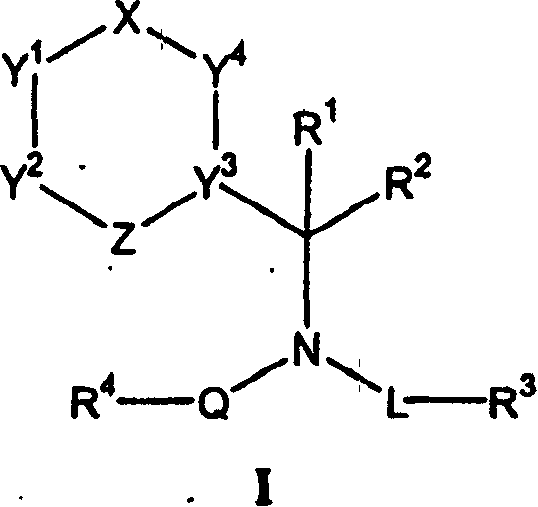


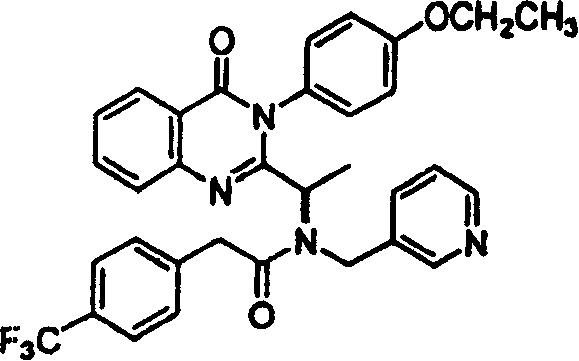
Applications Claiming Priority (4)
| Application Number | Priority Date | Filing Date | Title |
|---|---|---|---|
| US25524100P | 2000-12-11 | 2000-12-11 | |
| US60/255,241 | 2000-12-11 | ||
| US29649901P | 2001-06-06 | 2001-06-06 | |
| US60/296,499 | 2001-06-06 |
Publications (1)
| Publication Number | Publication Date |
|---|---|
| CN1575177A true CN1575177A (en) | 2005-02-02 |
Family
ID=26944548
Family Applications (1)
| Application Number | Title | Priority Date | Filing Date |
|---|---|---|---|
| CNA018225969A Pending CN1575177A (en) | 2000-12-11 | 2001-12-11 | Cxcr3 antagonists |
Country Status (19)
| Country | Link |
|---|---|
| US (3) | US6964967B2 (en) |
| EP (1) | EP1343505A1 (en) |
| JP (1) | JP4259877B2 (en) |
| KR (1) | KR100883184B1 (en) |
| CN (1) | CN1575177A (en) |
| AU (1) | AU2001297717B2 (en) |
| BR (1) | BR0116096A (en) |
| CA (1) | CA2431553A1 (en) |
| CZ (1) | CZ20031910A3 (en) |
| EA (1) | EA007538B1 (en) |
| HU (1) | HUP0500880A2 (en) |
| IL (2) | IL156304A0 (en) |
| MX (1) | MXPA03005152A (en) |
| NO (1) | NO325450B1 (en) |
| NZ (1) | NZ526622A (en) |
| PL (1) | PL366311A1 (en) |
| SK (1) | SK8752003A3 (en) |
| WO (1) | WO2002083143A1 (en) |
| ZA (1) | ZA200304342B (en) |
Cited By (3)
| Publication number | Priority date | Publication date | Assignee | Title |
|---|---|---|---|---|
| CN103796693A (en) * | 2011-06-13 | 2014-05-14 | Ith免疫治疗控股股份公司 | Treating conditions associated with metabolic syndrome |
| CN101796073B (en) * | 2007-02-01 | 2014-08-13 | 特瓦生物制药美国有限公司 | Humanized antibody against CXCR3 |
| CN108794496A (en) * | 2018-04-28 | 2018-11-13 | 北京施安泰医药技术开发有限公司 | A kind of CDK inhibitor, its pharmaceutical composition, Preparation method and use |
Families Citing this family (171)
| Publication number | Priority date | Publication date | Assignee | Title |
|---|---|---|---|---|
| TR200103336T2 (en) | 1999-03-17 | 2002-04-22 | Astrazeneca Ab | Amide derivatives. |
| US7230000B1 (en) | 1999-10-27 | 2007-06-12 | Cytokinetics, Incorporated | Methods and compositions utilizing quinazolinones |
| US7671200B2 (en) * | 1999-10-27 | 2010-03-02 | Cytokinetics, Inc. | Quinazolinone KSP inhibitors |
| US6545004B1 (en) | 1999-10-27 | 2003-04-08 | Cytokinetics, Inc. | Methods and compositions utilizing quinazolinones |
| CN1575177A (en) | 2000-12-11 | 2005-02-02 | 图拉里克公司 | Cxcr3 antagonists |
| US6794379B2 (en) * | 2001-06-06 | 2004-09-21 | Tularik Inc. | CXCR3 antagonists |
| US7482366B2 (en) | 2001-12-21 | 2009-01-27 | X-Ceptor Therapeutics, Inc. | Modulators of LXR |
| US7354932B2 (en) | 2001-12-21 | 2008-04-08 | Anormed, Inc. | Chemokine receptor binding heterocyclic compounds with enhanced efficacy |
| AU2002357379A1 (en) * | 2001-12-21 | 2003-07-15 | Anormed Inc. | Chemokine receptor binding heterocyclic compounds with enhanced efficacy |
| JP5082033B2 (en) | 2001-12-21 | 2012-11-28 | エグゼリクシス パテント カンパニー エルエルシー | LXR modulator |
| JP2005529076A (en) * | 2002-02-15 | 2005-09-29 | サイトキネティクス・インコーポレーテッド | Synthesis of quinazolinone |
| ES2361403T3 (en) * | 2002-03-07 | 2011-06-16 | X-Ceptor Therapeutics, Inc. | QUINAZOLINONE MODULATORS OF NUCLEAR RECEPTORS. |
| EP1513534A2 (en) | 2002-04-04 | 2005-03-16 | Cv Therapeutics, Inc. | Compounds for increasing abca-1 expression useful for treating coronary artery disease and atherosclerosis |
| CN100381437C (en) | 2002-04-17 | 2008-04-16 | 赛特凯恩蒂克公司 | Compounds, compositions and methods |
| AU2003223786A1 (en) * | 2002-05-09 | 2003-11-11 | Cytokinetics, Inc. | Compounds, methods and compositions |
| WO2003097053A1 (en) | 2002-05-09 | 2003-11-27 | Cytokinetics, Inc. | Compounds, compositions, and methods |
| US7244555B2 (en) * | 2002-05-14 | 2007-07-17 | Renovak Inc | Systems and methods for identifying organ transplant risk |
| AU2003265242A1 (en) | 2002-05-23 | 2003-12-22 | Cytokinetics, Inc. | Compounds, compositions, and methods |
| US20050203110A1 (en) * | 2002-05-23 | 2005-09-15 | Coleman Paul J. | Mitotic kinesin inhibitors |
| US7041676B2 (en) | 2002-06-14 | 2006-05-09 | Cytokinetics, Inc. | Compounds, compositions, and methods |
| WO2004006865A2 (en) | 2002-07-17 | 2004-01-22 | Cytokinetics, Inc. | Compounds, compositions, and methods |
| AU2003256805A1 (en) | 2002-07-23 | 2004-02-09 | Cytokinetics, Inc. | Compounds compositions and methods |
| JP2005536553A (en) * | 2002-08-21 | 2005-12-02 | サイトキネティクス・インコーポレーテッド | Compounds, compositions and methods |
| JP2005539062A (en) * | 2002-09-13 | 2005-12-22 | サイトキネティクス・インコーポレーテッド | Compounds, compositions and methods |
| US7557115B2 (en) | 2002-09-30 | 2009-07-07 | Cytokinetics, Inc. | Compounds, compositions, and methods |
| DE10301650A1 (en) * | 2003-01-17 | 2004-07-29 | Johannes-Gutenberg-Universität Mainz | New 1-phenyl-2-aminomethylnaphthalene derivatives used for treating tumors, neurodegeneration, inflammation and Chagas disease |
| US7358262B2 (en) | 2003-01-29 | 2008-04-15 | Whitehead Institute For Biomedical Research | Identification of genotype-selective anti-tumor agents |
| US20040242498A1 (en) * | 2003-02-27 | 2004-12-02 | Collins Tassie L. | CXCR3 antagonists |
| US20060270689A1 (en) * | 2003-03-07 | 2006-11-30 | Astrazeneca Ab | Novel Fused Heterocycles and Uses Thereof |
| RU2374251C2 (en) * | 2003-03-07 | 2009-11-27 | Астразенека Аб | New condensed heterocyclic compounds and their use |
| SE0300627D0 (en) * | 2003-03-07 | 2003-03-07 | Astrazeneca Ab | Novel fused heterocycles and uses therof |
| US20040242566A1 (en) | 2003-03-25 | 2004-12-02 | Syrrx, Inc. | Dipeptidyl peptidase inhibitors |
| US7504422B2 (en) | 2003-04-02 | 2009-03-17 | Taigen Biotechnology Co. Ltd. | Polyamine compounds |
| WO2004089360A1 (en) | 2003-04-02 | 2004-10-21 | Taigen Biotechnology | Polyamine compounds for treating chemokine receptor mediated diseases |
| US7378524B2 (en) | 2003-04-11 | 2008-05-27 | Taigen Biotechnology Co., Ltd. | Aminoquinoline compounds |
| JP2006522814A (en) * | 2003-04-11 | 2006-10-05 | タイゲン・バイオテクノロジー | Aminoquinoline compounds |
| EP1625122A1 (en) | 2003-05-14 | 2006-02-15 | Takeda San Diego, Inc. | Dipeptidyl peptidase inhibitors |
| US7741341B2 (en) * | 2003-05-19 | 2010-06-22 | Sanofi-Aventis Deutschland Gmbh | Benzimidazole-derivatives as factor Xa inhibitors |
| US7345046B2 (en) | 2003-05-30 | 2008-03-18 | Chiron Corporation | Heteroaryl-fused pyrimidinyl compounds as anticancer agents |
| JP2007520435A (en) | 2003-06-20 | 2007-07-26 | カイロン コーポレイション | Pyridino [1,2-a] pyrimidin-4-one compounds as anticancer agents |
| JP2007523858A (en) * | 2003-06-24 | 2007-08-23 | ユニバーシティ オブ コネチカット | Methods for inhibiting vascular permeability and apoptosis |
| CA2535619A1 (en) | 2003-08-13 | 2005-02-24 | Takeda Pharmaceutical Company Limited | 4-pyrimidone derivatives and their use as peptidyl peptidase inhibitors |
| US7678909B1 (en) | 2003-08-13 | 2010-03-16 | Takeda Pharmaceutical Company Limited | Dipeptidyl peptidase inhibitors |
| US7169926B1 (en) | 2003-08-13 | 2007-01-30 | Takeda Pharmaceutical Company Limited | Dipeptidyl peptidase inhibitors |
| MXPA06002017A (en) | 2003-08-21 | 2006-05-31 | Osi Pharm Inc | N-substituted pyrazolyl-amidyl-benzimidazolyl c-kit inhibitors. |
| US7442709B2 (en) | 2003-08-21 | 2008-10-28 | Osi Pharmaceuticals, Inc. | N3-substituted imidazopyridine c-Kit inhibitors |
| JP2006193426A (en) * | 2003-09-05 | 2006-07-27 | Sankyo Co Ltd | Substituted condensed-ring pyrimidin-4(3h)-one compound |
| JP2007505121A (en) | 2003-09-08 | 2007-03-08 | 武田薬品工業株式会社 | Dipeptidyl peptidase inhibitor |
| WO2005042697A2 (en) * | 2003-10-06 | 2005-05-12 | Cytokinetics, Inc. | Compounds, compositions and methods |
| GB0324790D0 (en) | 2003-10-24 | 2003-11-26 | Astrazeneca Ab | Amide derivatives |
| JP2007510652A (en) * | 2003-11-03 | 2007-04-26 | サイトキネティクス・インコーポレーテッド | Pyrimidin-4-one compounds, compositions and methods |
| US20050148593A1 (en) * | 2003-11-07 | 2005-07-07 | Gustave Bergnes | Compounds, compositions, and methods |
| EP1692112A4 (en) | 2003-12-08 | 2008-09-24 | Cytokinetics Inc | Compounds, compositions, and methods |
| SE0303491D0 (en) * | 2003-12-19 | 2003-12-19 | Astrazeneca Ab | New use VI |
| JP2007527920A (en) * | 2004-03-08 | 2007-10-04 | ワイス | Ion channel modulator |
| AU2005219322B2 (en) * | 2004-03-09 | 2008-09-18 | Kyoto University | Pharmaceutical Composition Comprising CXCR3 Inhibitor |
| US7732446B1 (en) | 2004-03-11 | 2010-06-08 | Takeda Pharmaceutical Company Limited | Dipeptidyl peptidase inhibitors |
| GEP20094679B (en) | 2004-03-15 | 2009-05-10 | Takeda Pharmaceuticals Co | Dipeptidyl peptidase inhibitors |
| PL1753723T3 (en) | 2004-05-21 | 2009-01-30 | Novartis Vaccines & Diagnostics Inc | Substituted quinoline derivatives as mitotic kinesin inhibitors |
| US7687638B2 (en) | 2004-06-04 | 2010-03-30 | Takeda San Diego, Inc. | Dipeptidyl peptidase inhibitors |
| GB0412769D0 (en) | 2004-06-08 | 2004-07-07 | Novartis Ag | Organic compounds |
| US7375102B2 (en) * | 2004-06-28 | 2008-05-20 | Amgen Sf, Llc | Tetrahydroquinazolin-4(3H)-one-related and tetrahydropyrido[2,3-D]pyrimidin-4(3H)-one-related compounds, compositions and methods for their use |
| US7271271B2 (en) * | 2004-06-28 | 2007-09-18 | Amgen Sf, Llc | Imidazolo-related compounds, compositions and methods for their use |
| US7939538B2 (en) * | 2004-06-28 | 2011-05-10 | Amgen Inc. | Compounds, compositions and methods for prevention and treatment of inflammatory and immunoregulatory disorders and diseases |
| WO2006019965A2 (en) | 2004-07-16 | 2006-02-23 | Takeda San Diego, Inc. | Dipeptidyl peptidase inhibitors |
| UY29070A1 (en) | 2004-08-18 | 2006-03-31 | Astrazeneca Ab | FUSIONED HETEROCYCLIC ENANTIOMERS AND THEIR USES |
| WO2006026597A2 (en) * | 2004-08-30 | 2006-03-09 | Smithkline Beecham Corporation | Novel compositions and methods of treatment |
| SG146673A1 (en) | 2004-09-13 | 2008-10-30 | Ono Pharmaceutical Co | Nitrogenous heterocyclic derivative and medicine containing the same as an active ingredient |
| JP4698991B2 (en) * | 2004-09-14 | 2011-06-08 | 日本曹達株式会社 | Pyridylmethylcarbamic acid ester compound, method for producing the same, and method for producing pyridylmethylamine compounds |
| CA2584412C (en) * | 2004-09-14 | 2017-05-09 | Minerva Biotechnologies Corporation | Methods for diagnosis and treatment of cancer |
| JP2008520744A (en) | 2004-11-19 | 2008-06-19 | ザ・レジェンツ・オブ・ザ・ユニバーシティ・オブ・カリフォルニア | Anti-inflammatory pyrazolopyrimidine |
| AR052419A1 (en) | 2004-12-01 | 2007-03-21 | Osi Pharm Inc | DERIVATIVES OF BENCIMIDAZOLIL N-SUBSTITUTES, INHIBITORS OF THE PROTOONCOGEN C-KIT |
| US7872124B2 (en) | 2004-12-21 | 2011-01-18 | Takeda Pharmaceutical Company Limited | Dipeptidyl peptidase inhibitors |
| US7501526B2 (en) | 2005-01-20 | 2009-03-10 | Taigen Biotechnology | Synthesis of polyamine compounds |
| AU2006208084B2 (en) * | 2005-01-25 | 2012-07-26 | Prolexys Pharmaceuticals, Inc. | Quinoxaline Derivatives as Antitumor Agents |
| MX2007010068A (en) * | 2005-02-16 | 2007-10-10 | Schering Corp | Piperazine-piperidines with cxcr3 antagonist activity. |
| JP2008530216A (en) * | 2005-02-16 | 2008-08-07 | シェーリング コーポレイション | Novel pyridine or phenyl compounds substituted with heterocycles having CXCR3 antagonist activity |
| WO2006088837A2 (en) * | 2005-02-16 | 2006-08-24 | Schering Corporation | Heterocyclic substituted piperazines with cxcr3 antagonist activity |
| MX2007009947A (en) * | 2005-02-16 | 2007-09-26 | Schering Corp | Pyrazinyl substituted piperazine-piperidines with cxcr3 antagonist activity. |
| TW200714610A (en) | 2005-02-16 | 2007-04-16 | Univ Maryland | CXCR3 is a gliadin receptor |
| AU2006216941B2 (en) * | 2005-02-16 | 2009-12-03 | Pharmacopeia, Llc | Heteroaryl substituted pyrazinyl-piperazine-piperidines with CXCR3 antagonist activity |
| KR20070107056A (en) * | 2005-02-16 | 2007-11-06 | 쉐링 코포레이션 | Pyridyl and phenyl substituted piperazine-piperidine with CBCR3 antagonist activity |
| US7534796B2 (en) | 2005-02-18 | 2009-05-19 | Wyeth | Imidazo[4,5-b]pyridine antagonists of gonadotropin releasing hormone receptor |
| US7582634B2 (en) | 2005-02-18 | 2009-09-01 | Wyeth | 7-substituted imidazo[4,5-c]pyridine antagonists of gonadotropin releasing hormone receptor |
| US7538113B2 (en) | 2005-02-18 | 2009-05-26 | Wyeth | 4-substituted imidazo[4,5-c]pyridine antagonists of gonadotropin releasing hormone receptor |
| US7531542B2 (en) | 2005-05-18 | 2009-05-12 | Wyeth | Benzooxazole and benzothiazole antagonists of gonadotropin releasing hormone receptor |
| US7582636B2 (en) | 2005-05-26 | 2009-09-01 | Wyeth | Piperazinylimidazopyridine and piperazinyltriazolopyridine antagonists of Gonadotropin Releasing Hormone receptor |
| JPWO2006129679A1 (en) | 2005-05-31 | 2009-01-08 | 小野薬品工業株式会社 | Spiropiperidine compounds and pharmaceutical uses thereof |
| DE602006015658D1 (en) * | 2005-06-27 | 2010-09-02 | Amgen Inc | INFLAMMATORY ARYLNITRILE COMPOUNDS |
| US20080312215A1 (en) * | 2005-06-28 | 2008-12-18 | Pharmacopeia Drug Discovery, Inc. | Substituted [1,4]-diazepanes as CXCR3 antagonists and their use in the treatment of inflammatory disorders |
| US7790679B2 (en) * | 2005-08-05 | 2010-09-07 | Amgen Inc. | Pharmaceutical formulations |
| ME02005B (en) | 2005-09-14 | 2012-08-31 | Takeda Pharmaceuticals Co | Dipeptidyl peptidase inhibitors for treating diabetes |
| PE20070622A1 (en) * | 2005-09-14 | 2007-08-22 | Takeda Pharmaceutical | ADMINISTRATION OF DIPEPTIDYL PEPTIDASE INHIBITORS |
| CN101360723A (en) | 2005-09-16 | 2009-02-04 | 武田药品工业株式会社 | Process for preparing pyrimidinedione derivatives |
| EP1999116A2 (en) * | 2005-12-22 | 2008-12-10 | Prolexys Pharmaceuticals, Inc. | 3-aryl-substituted quinazolones, and uses thereof |
| WO2007105637A1 (en) | 2006-03-10 | 2007-09-20 | Ono Pharmaceutical Co., Ltd. | Nitrogenated heterocyclic derivative, and pharmaceutical agent comprising the derivative as active ingredient |
| EP1996577B1 (en) * | 2006-03-21 | 2016-02-10 | Merck Sharp & Dohme Corp. | Heterocyclic substituted pyridine compounds with cxcr3 antagonist activity |
| WO2007112347A1 (en) | 2006-03-28 | 2007-10-04 | Takeda Pharmaceutical Company Limited | Dipeptidyl peptidase inhibitors |
| CA2909277A1 (en) | 2006-04-04 | 2007-10-11 | Kevan M. Shokat | Kinase antagonists |
| CA2658417A1 (en) * | 2006-07-14 | 2008-01-17 | Schering Corporation | Heterocyclic substituted piperazine compounds with cxcr3 antagonist activity |
| WO2008016006A1 (en) | 2006-07-31 | 2008-02-07 | Ono Pharmaceutical Co., Ltd. | Compound having cyclic group bound thereto through spiro binding and use thereof |
| US7820689B2 (en) * | 2006-08-10 | 2010-10-26 | Hua-Lin Wu | Methods and compositions for preventing or treating cardiovascular disease |
| DK2073810T3 (en) * | 2006-09-13 | 2011-10-31 | Takeda Pharmaceutical | Use of 2-6- (3-amino-piperidin-1-yl) -3-methyl-2,4-dioxo-3,4-dihydro-2H-pyrimidin-1-ylmethyl-4-fluoro-benzonitrile in the treatment of diabetes, cancer, autoimmune diseases and HIV infection |
| US8324383B2 (en) | 2006-09-13 | 2012-12-04 | Takeda Pharmaceutical Company Limited | Methods of making polymorphs of benzoate salt of 2-[[6-[(3R)-3-amino-1-piperidinyl]-3,4-dihydro-3-methyl-2,4-dioxo-1(2H)-pyrimidinyl]methyl]-benzonitrile |
| HUE035389T2 (en) | 2006-09-26 | 2018-05-02 | Celgene Corp | 5-substituted quinazolinone derivatives as anti-cancer agents |
| MX2009003673A (en) | 2006-10-04 | 2009-04-22 | Pfizer Prod Inc | Pyrido[4,3-d]pyrimidin-4(3h)-one derivatives as calcium receptor antagonists. |
| CN101605797A (en) * | 2006-11-13 | 2009-12-16 | 伊莱利利公司 | Thienopyrimidinones for the treatment of inflammatory diseases and cancer |
| TW200838536A (en) | 2006-11-29 | 2008-10-01 | Takeda Pharmaceutical | Polymorphs of succinate salt of 2-[6-(3-amino-piperidin-1-yl)-3-methyl-2,4-dioxo-3,4-dihydro-2H-pyrimidin-1-ylmethy]-4-fluor-benzonitrile and methods of use therefor |
| GEP20125415B (en) | 2007-01-05 | 2012-03-12 | Novartis Ag | Imidazole derivatives as kinesin spindle protein inhibitors (eg-5) |
| US8093236B2 (en) | 2007-03-13 | 2012-01-10 | Takeda Pharmaceuticals Company Limited | Weekly administration of dipeptidyl peptidase inhibitors |
| CN101678082B (en) | 2007-03-26 | 2013-06-19 | 再生医药有限公司 | Methods of promoting bone marrow protection and regeneration using CXCL9 and anti-CXCL9 antibodies |
| CA2695365A1 (en) * | 2007-08-03 | 2009-02-12 | Schering Corporation | Method of treating cxcr3 mediated diseases using heterocyclic substituted piperazines |
| GB2467670B (en) | 2007-10-04 | 2012-08-01 | Intellikine Inc | Chemical entities and therapeutic uses thereof |
| WO2009064802A2 (en) * | 2007-11-13 | 2009-05-22 | Eli Lilly & Co. | Inhibitors of human phosphatidyl-inositol 3-kinase delta |
| EP2240451B1 (en) | 2008-01-04 | 2017-08-09 | Intellikine, LLC | Isoquinolinone derivatives substituted with a purine useful as PI3K inhibitors |
| US8193182B2 (en) | 2008-01-04 | 2012-06-05 | Intellikine, Inc. | Substituted isoquinolin-1(2H)-ones, and methods of use thereof |
| US20110034487A1 (en) * | 2008-01-22 | 2011-02-10 | Amgen Inc. | Cxcr3 antagonists |
| WO2009114870A2 (en) | 2008-03-14 | 2009-09-17 | Intellikine, Inc. | Kinase inhibitors and methods of use |
| US8993580B2 (en) | 2008-03-14 | 2015-03-31 | Intellikine Llc | Benzothiazole kinase inhibitors and methods of use |
| WO2010006086A2 (en) | 2008-07-08 | 2010-01-14 | Intellikine, Inc. | Kinase inhibitors and methods of use |
| US20110224223A1 (en) | 2008-07-08 | 2011-09-15 | The Regents Of The University Of California, A California Corporation | MTOR Modulators and Uses Thereof |
| CA2738429C (en) | 2008-09-26 | 2016-10-25 | Intellikine, Inc. | Heterocyclic kinase inhibitors |
| DK2358720T3 (en) | 2008-10-16 | 2016-06-06 | Univ California | Heteroarylkinaseinhibitorer fused-ring |
| US8476431B2 (en) | 2008-11-03 | 2013-07-02 | Itellikine LLC | Benzoxazole kinase inhibitors and methods of use |
| JP5789252B2 (en) | 2009-05-07 | 2015-10-07 | インテリカイン, エルエルシー | Heterocyclic compounds and uses thereof |
| US20110230465A1 (en) * | 2009-09-18 | 2011-09-22 | Boehringer Ingleheim International Gmbh | Viral polymerase inhibitors |
| WO2011047384A2 (en) | 2009-10-16 | 2011-04-21 | The Regents Of The University Of California | Methods of inhibiting ire1 |
| AU2011255218B2 (en) | 2010-05-21 | 2015-03-12 | Infinity Pharmaceuticals, Inc. | Chemical compounds, compositions and methods for kinase modulation |
| AU2011326427B2 (en) | 2010-11-10 | 2016-01-07 | Infinity Pharmaceuticals Inc. | Heterocyclic compounds and uses thereof |
| AR084824A1 (en) | 2011-01-10 | 2013-06-26 | Intellikine Inc | PROCESSES TO PREPARE ISOQUINOLINONES AND SOLID FORMS OF ISOQUINOLINONAS |
| TWI592411B (en) | 2011-02-23 | 2017-07-21 | 英特爾立秦有限責任公司 | Combination of kinase inhibitors and uses thereof |
| AU2012255690B2 (en) | 2011-05-16 | 2015-06-11 | Bionomics Limited | Amine derivatives as potassium channel blockers |
| EP2524912A1 (en) | 2011-05-16 | 2012-11-21 | Bionomics Limited | Amine derivatives |
| HK1198443A1 (en) | 2011-07-19 | 2015-04-24 | 无限药品股份有限公司 | Heterocyclic compounds and uses thereof |
| WO2013012918A1 (en) | 2011-07-19 | 2013-01-24 | Infinity Pharmaceuticals Inc. | Heterocyclic compounds and uses thereof |
| WO2013032591A1 (en) | 2011-08-29 | 2013-03-07 | Infinity Pharmaceuticals Inc. | Heterocyclic compounds and uses thereof |
| WO2013077921A2 (en) | 2011-09-02 | 2013-05-30 | The Regents Of The University Of California | Substituted pyrazolo[3,4-d]pyrimidines and uses thereof |
| EP2771484A1 (en) | 2011-10-28 | 2014-09-03 | Galderma Research & Development | New leukocyte infiltrate markers for rosacea and uses thereof |
| US8940742B2 (en) | 2012-04-10 | 2015-01-27 | Infinity Pharmaceuticals, Inc. | Heterocyclic compounds and uses thereof |
| CN104487449A (en) | 2012-06-01 | 2015-04-01 | 阿勒根公司 | Cyclosporin A analogs |
| US8828998B2 (en) | 2012-06-25 | 2014-09-09 | Infinity Pharmaceuticals, Inc. | Treatment of lupus, fibrotic conditions, and inflammatory myopathies and other disorders using PI3 kinase inhibitors |
| RU2015115631A (en) | 2012-09-26 | 2016-11-20 | Дзе Риджентс Оф Дзе Юниверсити Оф Калифорния | MODULATION IRE1 |
| RU2702908C2 (en) | 2012-11-01 | 2019-10-14 | Инфинити Фармасьютикалз, Инк. | Treating malignant tumours using modulators of pi3-kinase isoforms |
| US9481667B2 (en) | 2013-03-15 | 2016-11-01 | Infinity Pharmaceuticals, Inc. | Salts and solid forms of isoquinolinones and composition comprising and methods of using the same |
| WO2015051241A1 (en) | 2013-10-04 | 2015-04-09 | Infinity Pharmaceuticals, Inc. | Heterocyclic compounds and uses thereof |
| EA201690713A1 (en) | 2013-10-04 | 2016-08-31 | Инфинити Фармасьютикалз, Инк. | HETEROCYCLIC COMPOUNDS AND THEIR APPLICATIONS |
| SG11201607705XA (en) | 2014-03-19 | 2016-10-28 | Infinity Pharmaceuticals Inc | Heterocyclic compounds for use in the treatment of pi3k-gamma mediated disorders |
| US20150320755A1 (en) | 2014-04-16 | 2015-11-12 | Infinity Pharmaceuticals, Inc. | Combination therapies |
| US9708348B2 (en) | 2014-10-03 | 2017-07-18 | Infinity Pharmaceuticals, Inc. | Trisubstituted bicyclic heterocyclic compounds with kinase activities and uses thereof |
| TW201639873A (en) | 2015-01-08 | 2016-11-16 | 歐樂根公司 | Cyclosporin derivatives wherein the MEBMT sidechain has been cyclized |
| US10118900B2 (en) | 2015-08-25 | 2018-11-06 | Janssen Pharmaceutica Nv | Benzimidazole derivatives useful as CB-1 inverse agonists |
| CN114230571B (en) | 2015-09-14 | 2025-07-08 | 无限药品股份有限公司 | Solid forms of isoquinolinones, methods of making, compositions comprising, and methods of using the same |
| JP6958820B2 (en) | 2015-12-14 | 2021-11-02 | エックス4 ファーマシューティカルズ, インコーポレイテッド | How to treat cancer |
| CA3008272A1 (en) | 2015-12-14 | 2017-06-22 | X4 Pharmaceuticals, Inc. | Methods for treating cancer |
| JP7055380B2 (en) | 2015-12-22 | 2022-04-18 | エックス4 ファーマシューティカルズ, インコーポレイテッド | Methods for treating immunodeficiency diseases |
| WO2017161116A1 (en) | 2016-03-17 | 2017-09-21 | Infinity Pharmaceuticals, Inc. | Isotopologues of isoquinolinone and quinazolinone compounds and uses thereof as pi3k kinase inhibitors |
| US11337969B2 (en) | 2016-04-08 | 2022-05-24 | X4 Pharmaceuticals, Inc. | Methods for treating cancer |
| US10919914B2 (en) | 2016-06-08 | 2021-02-16 | Infinity Pharmaceuticals, Inc. | Heterocyclic compounds and uses thereof |
| CN116554168B (en) | 2016-06-21 | 2025-09-23 | X4制药有限公司 | CXCR4 inhibitors and uses thereof |
| WO2017223229A1 (en) | 2016-06-21 | 2017-12-28 | X4 Pharmaceuticals, Inc. | Cxcr4 inhibitors and uses thereof |
| CN109641838A (en) | 2016-06-21 | 2019-04-16 | X4 制药有限公司 | CXCR4 inhibitor and application thereof |
| CN109640999A (en) | 2016-06-24 | 2019-04-16 | 无限药品股份有限公司 | Combination treatment |
| EP4252629A3 (en) | 2016-12-07 | 2023-12-27 | Biora Therapeutics, Inc. | Gastrointestinal tract detection methods, devices and systems |
| EP3554541B1 (en) | 2016-12-14 | 2023-06-07 | Biora Therapeutics, Inc. | Treatment of a disease of the gastrointestinal tract with a chemokine/chemokine receptor inhibitor |
| CN111788196A (en) | 2018-01-09 | 2020-10-16 | 配体药物公司 | Acetal compounds and their therapeutic uses |
| US10548889B1 (en) | 2018-08-31 | 2020-02-04 | X4 Pharmaceuticals, Inc. | Compositions of CXCR4 inhibitors and methods of preparation and use |
| EP3876942A1 (en) * | 2018-11-05 | 2021-09-15 | VIIV Healthcare UK (No.5) Limited | Inhibitors of human immunodeficiency virus replication |
| US20220249814A1 (en) | 2018-11-19 | 2022-08-11 | Progenity, Inc. | Methods and devices for treating a disease with biotherapeutics |
| EP4309722A3 (en) | 2019-12-13 | 2024-08-07 | Biora Therapeutics, Inc. | Ingestible device for delivery of therapeutic agent to the gastrointestinal tract |
| EP4117662A4 (en) | 2020-03-10 | 2024-04-03 | X4 Pharmaceuticals, Inc. | METHODS OF TREATING NEUTROPENIA |
| KR20240005019A (en) | 2021-05-06 | 2024-01-11 | 바이엘 악티엔게젤샤프트 | Alkylamide substituted, cyclic imidazoles and their use as pesticides |
Family Cites Families (23)
| Publication number | Priority date | Publication date | Assignee | Title |
|---|---|---|---|---|
| FR2665159B1 (en) | 1990-07-24 | 1992-11-13 | Rhone Poulenc Sante | NEW PYRIDINE AND QUINOLEIN DERIVATIVES, THEIR PREPARATION AND THE PHARMACEUTICAL COMPOSITIONS CONTAINING THEM. |
| EP0481614A1 (en) | 1990-10-01 | 1992-04-22 | Merck & Co. Inc. | Substituted pyridopyrimidinones and related heterocycles as angiotensin II antagonists |
| US5202322A (en) | 1991-09-25 | 1993-04-13 | Merck & Co., Inc. | Quinazolinone and pyridopyrimidine a-II antagonists |
| US5256667A (en) | 1991-09-25 | 1993-10-26 | Merck & Co., Inc. | Quinazolinones and pyridopyrimidinones |
| US5756502A (en) | 1994-08-08 | 1998-05-26 | Warner-Lambert Company | Quinazolinone derivatives as cholyecystokinin (CCK) ligands |
| US5719144A (en) | 1995-02-22 | 1998-02-17 | Merck & Co., Inc. | Fibrinogen receptor antagonists |
| US5908930A (en) | 1995-03-15 | 1999-06-01 | Pfizer Inc. | 5,10-dihydropyrimdo 4,5-b!quinolin-4(1H)-one tyrosine kinase inhibitors |
| JPH11510156A (en) | 1995-08-02 | 1999-09-07 | カイロサイエンス・リミテッド | Quinolones and their medical uses |
| US6140064A (en) | 1996-09-10 | 2000-10-31 | Theodor-Kocher Institute | Method of detecting or identifying ligands, inhibitors or promoters of CXC chemokine receptor 3 |
| CN1252054C (en) | 1996-09-25 | 2006-04-19 | 曾尼卡有限公司 | Qinoline derivatives inhibiting effect of growth factors such as VEGF |
| EP0946095A1 (en) | 1996-12-17 | 1999-10-06 | E.I. Du Pont De Nemours And Company | Fungicidal quinazolinones |
| FR2778662B1 (en) | 1998-05-12 | 2000-06-16 | Adir | NOVEL SUBSTITUTED CYCLIC COMPOUNDS, PROCESS FOR THEIR PREPARATION AND PHARMACEUTICAL COMPOSITIONS CONTAINING THEM |
| US6559160B1 (en) * | 1999-08-27 | 2003-05-06 | Chemocentryx, Inc. | Compounds and methods for modulating cxcr3 function |
| EP1516876A1 (en) * | 1999-09-16 | 2005-03-23 | Curis, Inc. | Mediators of hedgehog signalling pathways, compositions and uses related thereto |
| NZ518480A (en) * | 1999-10-27 | 2004-02-27 | Cytokinetics Inc | Methods and compositions utilizing quinazolinones |
| US6545004B1 (en) * | 1999-10-27 | 2003-04-08 | Cytokinetics, Inc. | Methods and compositions utilizing quinazolinones |
| ATE372337T1 (en) | 2000-02-01 | 2007-09-15 | Abbott Gmbh & Co Kg | HETEROCYCLIC COMPOUNDS AND THEIR APPLICATION AS PARP INHIBITORS |
| GB2359551A (en) * | 2000-02-23 | 2001-08-29 | Astrazeneca Uk Ltd | Pharmaceutically active pyrimidine derivatives |
| GB2361003A (en) | 2000-04-07 | 2001-10-10 | Astrazeneca Ab | Novel compounds |
| AU2002211828A1 (en) | 2000-10-02 | 2002-04-15 | Merck & Co., Inc. | Inhibitors of prenyl-protein transferase |
| CN1575177A (en) | 2000-12-11 | 2005-02-02 | 图拉里克公司 | Cxcr3 antagonists |
| US6794379B2 (en) * | 2001-06-06 | 2004-09-21 | Tularik Inc. | CXCR3 antagonists |
| JP2007520435A (en) * | 2003-06-20 | 2007-07-26 | カイロン コーポレイション | Pyridino [1,2-a] pyrimidin-4-one compounds as anticancer agents |
-
2001
- 2001-12-11 CN CNA018225969A patent/CN1575177A/en active Pending
- 2001-12-11 CA CA002431553A patent/CA2431553A1/en not_active Abandoned
- 2001-12-11 MX MXPA03005152A patent/MXPA03005152A/en active IP Right Grant
- 2001-12-11 JP JP2002580947A patent/JP4259877B2/en not_active Expired - Fee Related
- 2001-12-11 NZ NZ526622A patent/NZ526622A/en unknown
- 2001-12-11 WO PCT/US2001/047850 patent/WO2002083143A1/en not_active Ceased
- 2001-12-11 US US10/015,532 patent/US6964967B2/en not_active Expired - Lifetime
- 2001-12-11 IL IL15630401A patent/IL156304A0/en active IP Right Grant
- 2001-12-11 EA EA200300663A patent/EA007538B1/en not_active IP Right Cessation
- 2001-12-11 BR BR0116096-6A patent/BR0116096A/en not_active Application Discontinuation
- 2001-12-11 KR KR1020037007789A patent/KR100883184B1/en not_active Expired - Fee Related
- 2001-12-11 SK SK875-2003A patent/SK8752003A3/en unknown
- 2001-12-11 HU HU0500880A patent/HUP0500880A2/en unknown
- 2001-12-11 PL PL01366311A patent/PL366311A1/en not_active Application Discontinuation
- 2001-12-11 CZ CZ20031910A patent/CZ20031910A3/en unknown
- 2001-12-11 AU AU2001297717A patent/AU2001297717B2/en not_active Ceased
- 2001-12-11 EP EP01273533A patent/EP1343505A1/en not_active Withdrawn
-
2002
- 2002-08-29 US US10/231,895 patent/US7053215B2/en not_active Expired - Lifetime
-
2003
- 2003-06-03 ZA ZA2003/04342A patent/ZA200304342B/en unknown
- 2003-06-04 IL IL156304A patent/IL156304A/en not_active IP Right Cessation
- 2003-06-10 NO NO20032612A patent/NO325450B1/en not_active IP Right Cessation
-
2006
- 2006-01-13 US US11/332,054 patent/US20060116388A1/en not_active Abandoned
Cited By (5)
| Publication number | Priority date | Publication date | Assignee | Title |
|---|---|---|---|---|
| CN101796073B (en) * | 2007-02-01 | 2014-08-13 | 特瓦生物制药美国有限公司 | Humanized antibody against CXCR3 |
| CN103796693A (en) * | 2011-06-13 | 2014-05-14 | Ith免疫治疗控股股份公司 | Treating conditions associated with metabolic syndrome |
| CN103796693B (en) * | 2011-06-13 | 2017-05-31 | Ith免疫治疗控股股份公司 | The treatment illness related to metabolic syndrome |
| CN108794496A (en) * | 2018-04-28 | 2018-11-13 | 北京施安泰医药技术开发有限公司 | A kind of CDK inhibitor, its pharmaceutical composition, Preparation method and use |
| CN108794496B (en) * | 2018-04-28 | 2020-04-24 | 北京施安泰医药技术开发有限公司 | CDK inhibitor, pharmaceutical composition, preparation method and application thereof |
Also Published As
| Publication number | Publication date |
|---|---|
| SK8752003A3 (en) | 2003-11-04 |
| IL156304A0 (en) | 2004-01-04 |
| KR100883184B1 (en) | 2009-02-12 |
| EA200300663A1 (en) | 2004-06-24 |
| BR0116096A (en) | 2005-10-18 |
| US7053215B2 (en) | 2006-05-30 |
| HUP0500880A2 (en) | 2006-05-29 |
| EA007538B1 (en) | 2006-10-27 |
| NO20032612D0 (en) | 2003-06-10 |
| AU2001297717B2 (en) | 2006-02-23 |
| WO2002083143A1 (en) | 2002-10-24 |
| US20020169159A1 (en) | 2002-11-14 |
| EP1343505A1 (en) | 2003-09-17 |
| PL366311A1 (en) | 2005-01-24 |
| CA2431553A1 (en) | 2002-10-24 |
| US6964967B2 (en) | 2005-11-15 |
| NZ526622A (en) | 2006-07-28 |
| CZ20031910A3 (en) | 2003-12-17 |
| US20060116388A1 (en) | 2006-06-01 |
| ZA200304342B (en) | 2005-08-31 |
| NO325450B1 (en) | 2008-05-05 |
| US20030055054A1 (en) | 2003-03-20 |
| NO20032612L (en) | 2003-08-05 |
| IL156304A (en) | 2009-02-11 |
| KR20030080212A (en) | 2003-10-11 |
| MXPA03005152A (en) | 2004-10-14 |
| JP2004536796A (en) | 2004-12-09 |
| JP4259877B2 (en) | 2009-04-30 |
Similar Documents
| Publication | Publication Date | Title |
|---|---|---|
| CN1575177A (en) | Cxcr3 antagonists | |
| US6794379B2 (en) | CXCR3 antagonists | |
| US7939538B2 (en) | Compounds, compositions and methods for prevention and treatment of inflammatory and immunoregulatory disorders and diseases | |
| CN1240699C (en) | Drugs for the treatment or prevention of diseases related to chemokines | |
| CN1158266C (en) | compound | |
| CN1192773C (en) | Cyclic amine CCR3 antagonisis | |
| CN1678586A (en) | Substituted quinoline CCR5 receptor antagonists | |
| CN1902171A (en) | Benzylether amine compounds useful as CCR-5 antagonists | |
| US7375102B2 (en) | Tetrahydroquinazolin-4(3H)-one-related and tetrahydropyrido[2,3-D]pyrimidin-4(3H)-one-related compounds, compositions and methods for their use | |
| CN1898216A (en) | Amide derivatives | |
| CN1867336A (en) | 1-aryl-4-substituted piperazines derivatives for use as CCR1 antagonists for the treatment of inflammation and immune disorders | |
| CN1930144A (en) | 3-'4-heterocyclyl -1,2,3,-triazol-1-yl!-n-aryl-benzamides as inhibitors of the cytokines production for the treatment of chronic inflammatory diseases | |
| CN1325390A (en) | 2-ureido-thiazole derivatives, process for their preparation, and their use as antitumor agents | |
| CN1420884A (en) | 2-substituted 4-heteroaryl-pyrimidines and their use in the treatment of proliferative diseases | |
| CN1660815A (en) | Cyclic amine derivatives and their use as drugs | |
| AU2001297717A1 (en) | CXCR3 antagonists | |
| CN1750823A (en) | Inhibitors of macrophage migration inhibitory factor and methods for identifying the same | |
| CN1898239A (en) | Novel diazaspiroalkanes and their use for treatment of ccr8 mediated diseases | |
| CN1918134A (en) | Amide derivatives bearing cyclopropylaminocarbonyl substituents as cytokine inhibitors | |
| US20060069127A1 (en) | Imidazolo-related compounds, compositions and methods for their use | |
| HK1072565A (en) | Cxcr3 antagonists | |
| CN1829517A (en) | Guanidino-substituted quinazoline compounds as MC4-R agonists | |
| HK1101248A (en) | 3-'4-heterocyclyl -1,2,3,-triazol-1-yl!-n-aryl-benzamides as inhibitors of the cytokines production for the treatment of chronic inflammatory diseases | |
| CN1968698A (en) | Piperazinylpiperidine derivatives as chemokine receptor antagonists | |
| CN1711243A (en) | 2-pyridone derivatives as neutrophil elastase inhibitors |
Legal Events
| Date | Code | Title | Description |
|---|---|---|---|
| C06 | Publication | ||
| PB01 | Publication | ||
| C10 | Entry into substantive examination | ||
| SE01 | Entry into force of request for substantive examination | ||
| REG | Reference to a national code |
Ref country code: HK Ref legal event code: DE Ref document number: 1072565 Country of ref document: HK |
|
| ASS | Succession or assignment of patent right |
Owner name: NIUKELYTON INTELLECTUAL PROPERTY CO., LTD. Free format text: FORMER OWNER: FIGURE LARIC CO.,LTD. Effective date: 20060414 |
|
| C41 | Transfer of patent application or patent right or utility model | ||
| TA01 | Transfer of patent application right |
Effective date of registration: 20060414 Address after: American California Applicant after: Arrow detection limited liability company Address before: American California Applicant before: Tularik Inc. |
|
| ASS | Succession or assignment of patent right |
Owner name: AMGEN INC. Free format text: FORMER OWNER: AMGEN SF CO.,LTD. Effective date: 20080905 |
|
| C41 | Transfer of patent application or patent right or utility model | ||
| TA01 | Transfer of patent application right |
Effective date of registration: 20080905 Address after: American California Applicant after: Amgen Inc. Address before: American California Applicant before: Amgen SF limited liability company |
|
| C02 | Deemed withdrawal of patent application after publication (patent law 2001) | ||
| WD01 | Invention patent application deemed withdrawn after publication |
Open date: 20050202 |
|
| REG | Reference to a national code |
Ref country code: HK Ref legal event code: WD Ref document number: 1072565 Country of ref document: HK |