CN1495164A - Method for preparing chiral lactones - Google Patents
Method for preparing chiral lactones Download PDFInfo
- Publication number
- CN1495164A CN1495164A CNA03155539XA CN03155539A CN1495164A CN 1495164 A CN1495164 A CN 1495164A CN A03155539X A CNA03155539X A CN A03155539XA CN 03155539 A CN03155539 A CN 03155539A CN 1495164 A CN1495164 A CN 1495164A
- Authority
- CN
- China
- Prior art keywords
- formula
- compound
- compounds
- oxo
- cyclopentylmethyl
- Prior art date
- Legal status (The legal status is an assumption and is not a legal conclusion. Google has not performed a legal analysis and makes no representation as to the accuracy of the status listed.)
- Pending
Links
Classifications
-
- C—CHEMISTRY; METALLURGY
- C07—ORGANIC CHEMISTRY
- C07D—HETEROCYCLIC COMPOUNDS
- C07D307/00—Heterocyclic compounds containing five-membered rings having one oxygen atom as the only ring hetero atom
- C07D307/02—Heterocyclic compounds containing five-membered rings having one oxygen atom as the only ring hetero atom not condensed with other rings
- C07D307/26—Heterocyclic compounds containing five-membered rings having one oxygen atom as the only ring hetero atom not condensed with other rings having one double bond between ring members or between a ring member and a non-ring member
- C07D307/30—Heterocyclic compounds containing five-membered rings having one oxygen atom as the only ring hetero atom not condensed with other rings having one double bond between ring members or between a ring member and a non-ring member with hetero atoms or with carbon atoms having three bonds to hetero atoms with at the most one bond to halogen, e.g. ester or nitrile radicals, directly attached to ring carbon atoms
- C07D307/32—Oxygen atoms
-
- C—CHEMISTRY; METALLURGY
- C07—ORGANIC CHEMISTRY
- C07D—HETEROCYCLIC COMPOUNDS
- C07D401/00—Heterocyclic compounds containing two or more hetero rings, having nitrogen atoms as the only ring hetero atoms, at least one ring being a six-membered ring with only one nitrogen atom
- C07D401/02—Heterocyclic compounds containing two or more hetero rings, having nitrogen atoms as the only ring hetero atoms, at least one ring being a six-membered ring with only one nitrogen atom containing two hetero rings
- C07D401/06—Heterocyclic compounds containing two or more hetero rings, having nitrogen atoms as the only ring hetero atoms, at least one ring being a six-membered ring with only one nitrogen atom containing two hetero rings linked by a carbon chain containing only aliphatic carbon atoms
-
- C—CHEMISTRY; METALLURGY
- C07—ORGANIC CHEMISTRY
- C07D—HETEROCYCLIC COMPOUNDS
- C07D405/00—Heterocyclic compounds containing both one or more hetero rings having oxygen atoms as the only ring hetero atoms, and one or more rings having nitrogen as the only ring hetero atom
- C07D405/02—Heterocyclic compounds containing both one or more hetero rings having oxygen atoms as the only ring hetero atoms, and one or more rings having nitrogen as the only ring hetero atom containing two hetero rings
- C07D405/06—Heterocyclic compounds containing both one or more hetero rings having oxygen atoms as the only ring hetero atoms, and one or more rings having nitrogen as the only ring hetero atom containing two hetero rings linked by a carbon chain containing only aliphatic carbon atoms
Landscapes
- Chemical & Material Sciences (AREA)
- Organic Chemistry (AREA)
- Plural Heterocyclic Compounds (AREA)
- Organic Low-Molecular-Weight Compounds And Preparation Thereof (AREA)
- Low-Molecular Organic Synthesis Reactions Using Catalysts (AREA)
- Furan Compounds (AREA)
Abstract
Description
本申请是1999年7月12日提交的、申请号为99110335.1、发明名称为制备手性内酯的方法的发明专利申请的分案申请。This application is a divisional application of the invention patent application submitted on July 12, 1999, the application number is 99110335.1, and the invention name is the method for preparing chiral lactone.
本发明涉及一种用于合成具有药理活性化合物的中间体的新的生产方法,本发明还涉及在该方法中得到的用于合成具有药理活性化合物新的中间体。The present invention relates to a new production method for synthesizing intermediates of pharmacologically active compounds, and also relates to the novel intermediates used for synthesizing pharmacologically active compounds obtained in the method.
在本发明的一个方面中,涉及一种生产下列通式I的内酯的方法In one aspect of the present invention, relate to a kind of method of producing the lactone of following general formula I
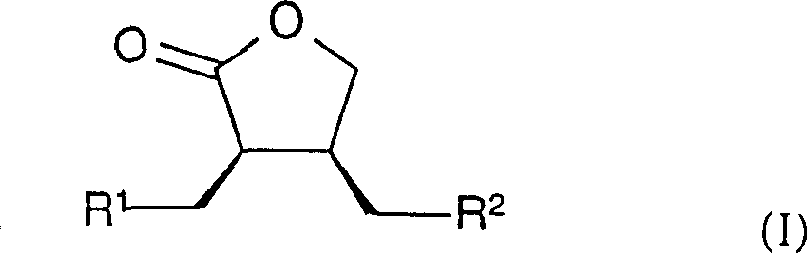
其中in
R1代表低级烷基或低级环烷基,而R 1 represents lower alkyl or lower cycloalkyl, and
R2代表5-或6-员N-杂环,该杂环(a)是通过氮原子连接的,(b)可以选择性地还含有N、O和/或S、SO或SO2作为环杂原子,(c)在与N原子邻接的一个或两个C原子上可以被氧代,和(d)可以选择性地与苯环稠合或者在一个或多个其它的碳原子上可以选择性地被低级烷基或氧取代和/或在任何其它的N原子上被低级烷基取代。R 2 represents a 5- or 6-membered N-heterocyclic ring, which (a) is connected via a nitrogen atom, (b) may optionally also contain N, O and/or S, SO or SO 2 as rings Heteroatoms, (c) may be oxo-substituted at one or two C atoms adjacent to the N atom, and (d) may be optionally fused to a benzene ring or optionally at one or more other carbon atoms optionally substituted by lower alkyl or oxygen and/or on any other N atom by lower alkyl.
本发明的通式(I)的化合物可以通过在一种旋光活性的金属二膦配合物存在下不对称氢化通式(II)的化合物来生产The compounds of general formula (I) according to the invention can be produced by asymmetric hydrogenation of compounds of general formula (II) in the presence of an optically active metal diphosphine complex
其中R1和R2具有前面所给出的定义。wherein R 1 and R 2 have the definitions given above.
本说明书中所用的术语“低级烷基”,无论是单独使用还是组合使用,都是指最多含有6个碳原子的直链或支链烷基,例如甲基、乙基、正丙基、异丙基、正丁基、仲丁基、异丁基、叔丁基、正戊基、正己基等。The term "lower alkyl" used in this specification, whether used alone or in combination, refers to a straight chain or branched chain alkyl group containing up to 6 carbon atoms, such as methyl, ethyl, n-propyl, iso Propyl, n-butyl, sec-butyl, isobutyl, tert-butyl, n-pentyl, n-hexyl, etc.
术语“低级环烷基”是指含有3-6个碳原子的环烷基,即环丙基、环丁基、环戊基和环己基。The term "lower cycloalkyl" refers to a cycloalkyl group having 3 to 6 carbon atoms, ie cyclopropyl, cyclobutyl, cyclopentyl and cyclohexyl.
R2所代表的N-杂环的例子是下式的环:Examples of N-heterocyclic rings represented by R are rings of the formula:

其中in
R4和R5各自代表氢或一起代表另外一条键或稠合苯环的剩余部分;R 4 and R 5 each represent hydrogen or together represent another bond or the remainder of the fused benzene ring;
R6代表氢或低级烷基;R 6 represents hydrogen or lower alkyl;
X代表-CO-、-CH2-、-CH(低级烷基)-、-C(低级烷基)2-、-NH-、-N(低级烷基)-或-O-;而X represents -CO-, -CH 2 -, -CH (lower alkyl) -, -C (lower alkyl) 2 -, -NH-, -N (lower alkyl) - or -O-; and
R7和R8各自代表氢或低级烷基。R 7 and R 8 each represent hydrogen or lower alkyl.
这种环的例子为2-氧代-1-吡咯烷基、2,5-二氧代-1-吡咯烷基、邻苯二甲酰亚氨基、1,2-二甲基-3,5-二氧代-1,2,4-三唑烷-4-基、3-甲基-2,5-二氧代-1-咪唑烷基、3,4,4-三甲基-2,5-二氧代-咪唑烷-1-基、2-甲基-3,5-二氧代-1,2,4-二唑-4-基、3-甲基-2,4,5-三氧代-1-咪唑烷基和2,6-二氧代哌啶子基。Examples of such rings are 2-oxo-1-pyrrolidinyl, 2,5-dioxo-1-pyrrolidinyl, phthalimido, 1,2-dimethyl-3,5 -Dioxo-1,2,4-triazolidin-4-yl, 3-methyl-2,5-dioxo-1-imidazolidinyl, 3,4,4-trimethyl-2, 5-dioxo-imidazolidin-1-yl, 2-methyl-3,5-dioxo-1,2,4-oxadiazol-4-yl, 3-methyl-2,4,5- Trioxo-1-imidazolidinyl and 2,6-dioxopiperidino.
优选的环是式(a)、(b)或(c)的环,最优选式(b)的环,特别是其中R6是低级烷基以及X是C(低级烷基)2。在式(b)中,优选的取代基是3,4,4-三甲基-2,5-二氧代咪唑烷-1-基。Preferred rings are of formula (a), (b) or (c), most preferably of formula (b), especially wherein R 6 is lower alkyl and X is C(lower alkyl) 2 . In formula (b), a preferred substituent is 3,4,4-trimethyl-2,5-dioxoimidazolidin-1-yl.
R1中优选的基团是低级环烷基,最优选环戊基。Preferred groups in R1 are lower cycloalkyl, most preferably cyclopentyl.
虽然这里所列的结构式表示其绝对立体化学的相关化合物,然而本发明不仅包括所画出的式(I)化合物的立体异构体,而且还包括其相应的对映体,该对映体用于可以从这些化合物制备的产物。Although the structural formulas listed here represent the relative compounds of their absolute stereochemistry, the present invention includes not only the stereoisomers of the compounds of formula (I) shown, but also their corresponding enantiomers, which are represented by on the products that can be prepared from these compounds.
在一种实施方式中,可以用旋光活性的(优选阻转异构体)二膦配体与周期表的VIII族金属(特别是铑)的配合物作为催化剂进行不对称氢化。可用作本发明方法的催化剂的配合物是In one embodiment, the asymmetric hydrogenation can be carried out using complexes of optically active (preferably atropisomer) diphosphine ligands with metals of group VIII of the periodic table, especially rhodium, as catalysts. Complexes that can be used as catalysts in the process of the invention are
[Rh(Y)(Ln)]+A-(III)[Rh(Y)(Ln)] + A - (III)
其中in
L代表中性配体L stands for neutral ligand
A代表含氧酸或配酸的阴离子A represents the anion of an oxyacid or complex acid
n代表0、1或2n stands for 0, 1 or 2
Y代表一种旋光活性的、优选阻转异构的二膦配体。Y represents an optically active, preferably atropisomeric, diphosphine ligand.
本发明范围中的术语“中性配体”代表容易交换的配体例如烯烃(如乙烯、丙烯、环辛烯、1,5-己二烯、1,5-环辛二烯等)、腈(如乙腈、苄腈)或所用的溶剂。当存在超过一种配体时,配体可以相同或不同。The term "neutral ligand" within the scope of the present invention represents readily exchangeable ligands such as olefins (such as ethylene, propylene, cyclooctene, 1,5-hexadiene, 1,5-cyclooctadiene, etc.), nitriles (such as acetonitrile, benzonitrile) or the solvent used. When more than one ligand is present, the ligands can be the same or different.
本发明范围中的术语“含氧酸或配酸”代表选自H2SO4、HClO4、HBrO4、HIO4、HNO3、H3PO4、CF3SO3H或C6H5SO3H的酸以及卤素与元素硼、磷、砷、锑或铋的配合物。HClO4、CF3SO3H、HPE6、HBF4、HB(Ph)4、HB(3,5-(CF3)2-C6H3)4、HSbF6和HAsF6是优选的酸,最优选HSbF6和HBF4。The term "oxyacid or complex acid" within the scope of the present invention represents a group selected from H 2 SO 4 , HClO 4 , HBrO 4 , HIO 4 , HNO 3 , H 3 PO 4 , CF 3 SO 3 H or C 6 H 5 SO 3 H acid and halogen complexes with elements boron, phosphorus, arsenic, antimony or bismuth. HClO 4 , CF 3 SO 3 H, HPE 6 , HBF 4 , HB(Ph) 4 , HB(3,5-(CF 3 ) 2 -C 6 H 3 ) 4 , HSbF 6 and HAsF 6 are preferred acids, Most preferred are HSbF 6 and HBF 4 .
在手性二膦配合物中以(R)或(S)型存在的合适的手性配体Y可以选自由下列化合物组成的组:A suitable chiral ligand Y present in the (R) or (S) form in the chiral diphosphine complex may be selected from the group consisting of:
MeOBIPHEP: (6,6′-二甲氧基联苯基-2,2′-二基)双(二苯基MeOBIPHEP: (6,6′-dimethoxybiphenyl-2,2′-diyl)bis(diphenyl
膦)Phosphine)
BIPHEMP: (6,6′-二甲基联苯基-2,2′-二基)双(二苯基膦)BIPHEMP: (6,6′-Dimethylbiphenyl-2,2′-diyl)bis(diphenylphosphine)
BINAP: [(1,1′-联萘基)-2,2′-二基]双(二苯基膦)BINAP: [(1,1′-binaphthyl)-2,2′-diyl]bis(diphenylphosphine)
2-呋喃基-MeOBIPHEP: (6,6′-二甲氧基联苯基-2,2′-二基)双[二-(2-呋2-furyl-MeOBIPHEP: (6,6′-dimethoxybiphenyl-2,2′-diyl)bis[di-(2-fur
喃基)膦]Pyranyl)phosphine]
2-萘基-MeOBIPHEP: (6,6′-二甲氧基联苯基-2,2′-二基)双[二-(2-萘2-Naphthyl-MeOBIPHEP: (6,6′-dimethoxybiphenyl-2,2′-diyl)bis[bis-(2-naphthalene
基)膦]base) phosphine]
TriMeOBIPHEP: (4,4′,5,5′,6,6′-六甲氧基联苯基-2,2′-二基)双TriMeOBIPHEP: (4,4′,5,5′,6,6′-hexamethoxybiphenyl-2,2′-diyl)bis
(二苯基膦)(Diphenylphosphine)
(3,5-Me,4-MeO)-MeOBIPHEP:(6,6′-二甲氧基联苯基-2,2′-二基)双[二(3,5-二(3,5-Me,4-MeO)-MeOBIPHEP: (6,6'-dimethoxybiphenyl-2,2'-diyl)bis[bis(3,5-bis
甲基-4-甲氧基-苯基)膦]Methyl-4-methoxy-phenyl)phosphine]
Me-DuPHOS: 1,2-双(2,5-二甲基磷杂戊环)苯Me-DuPHOS: 1,2-bis(2,5-dimethylphospholane)benzene
3,5-iPr-MeOBIPHEP: (6,6′-二甲氧基联苯基-2,2′-二基)双[二(3,5-二3,5-iPr-MeOBIPHEP: (6,6′-dimethoxybiphenyl-2,2′-diyl)bis[bis(3,5-di
异丙基苯基)膦]isopropylphenyl)phosphine]
PPF-P(tBu)2: 1-[2-(二苯基膦)二茂铁基]乙基-二(叔丁基)PPF-P(tBu) 2 : 1-[2-(diphenylphosphino)ferrocenyl]ethyl-di(tert-butyl)
膦Phosphine
pCF3-PPF-PPh2: 1-[2-(二-(4-三氟甲基)苯基)-膦)二茂铁基]乙pCF 3 -PPF-PPh 2 : 1-[2-(bis-(4-trifluoromethyl)phenyl)-phosphino)ferrocenyl]ethyl
基-二苯基膦yl-diphenylphosphine
3,5-tBu2-MeOBIPHEP: P,P-双-(3,5-二叔丁基苯基)-P′P′-二苯基-(6,6′-3,5-tBu 2 -MeOBIPHEP: P,P-bis-(3,5-di-tert-butylphenyl)-P′P′-diphenyl-(6,6′-
二甲氧基联苯基-2,2′-二基)二膦 Dimethoxybiphenyl-2,2′-diyl)diphosphine
(3,4,5-MeO)-MeOBIPHEP:(6,6′-二甲氧基联苯基-2,2′-二基)双(二-(3,(3,4,5-MeO)-MeOBIPHEP: (6,6'-dimethoxybiphenyl-2,2'-diyl)bis(di-(3,
4,5-三甲氧基苯基)膦)
这些配体是已知的,并且/或者可以按照EP398132A2和WO92/16535(MeOBIPHEP、TriMeOBIPHEP、3,5-iPr-MeOBIPHEP、3,5-tBu2-MeOBIPHEP、(3,4,5-MeO)-MeOBIPHEP、(3,5-Me,4-MeO)-MeOBIPHEP、2-萘基-MeOBIPHEP)、EP104375A1(BIPHEMP)、EP580331A1(BINAP)、WO92/16536(2-呋喃基-MeOBIPHEP)、US5,171,892(Me-DuPHOS)、EP564,406A1(PPF-P(tBu)2)和EP646,590A1(pCF3-PPF-PPh2)中所述的实施例和方法制备。These ligands are known and/or can be obtained according to EP398132A2 and WO92/16535 (MeOBIPHEP, TriMeOBIPHEP, 3,5-iPr-MeOBIPHEP, 3,5-tBu 2 -MeOBIPHEP, (3,4,5-MeO)- MeOBIPHEP, (3,5-Me,4-MeO)-MeOBIPHEP, 2-naphthyl-MeOBIPHEP), EP104375A1 (BIPHEMP), EP580331A1 (BINAP), WO92/16536 (2-furyl-MeOBIPHEP), US5,171,892 ( Prepared according to the examples and methods described in Me-DuPHOS), EP564,406A1 (PPF-P(tBu) 2 ) and EP646,590A1 ( pCF3 -PPF- PPh2 ).
优选的旋光活性的铑配合物(III)可以在被氢化的式II化合物的存在或不存在下,从这些组分现场合成或制备。旋光活性的铑二膦配合物或者是已知的,或者可以用已知的方法生产,例如通过使一种上述的旋光活性的二膦配体Y的阻转异构体与一种可以产生铑的化合物在合适的惰性有机或水性溶剂中反应来生产。其中作为产生铑的合适的化合物可以提出的是例如可以是那些容易与铑形成可溶性配合物的乙烯、丙烯等以及二烯(例如(Z,Z)-1,5-环辛二烯、1,5-己二烯和双环[2.2.1]庚-2,5-二烯)的有机铑配合物。优选的产生铑的化合物例如是二-μ-氯-双[η4-(Z,Z)-1,5-环辛二烯]二铑(I)、二-μ-氮-双[η4-降冰片二烯]二铑(I)、二-μ-三氟乙酸-双[η4-(Z,Z)-1,5-环辛二烯]二铑(I)、双[η4-(Z,Z)-1,5-环辛二烯]铑(I)四氟硼酸盐、双[η4-(Z,Z)-1,5-环辛二烯]二铑(I)高氯酸盐和双[η4-(Z,Z)-1,5-环辛二烯]二铑(I)六氟锑酸盐。可以按照同样的方法制备其它的(例如含有铱的)金属催化剂。The preferred optically active rhodium complexes (III) can be synthesized or prepared in situ from these components in the presence or absence of hydrogenated compounds of formula II. Optically active rhodium diphosphine complexes are either known or can be produced by known methods, for example by combining an atropisomer of the above-mentioned optically active diphosphine ligand Y with a rhodium-producing The compound is produced by reacting in a suitable inert organic or aqueous solvent. Among them, as suitable compounds for generating rhodium can be mentioned, for example, ethylene, propylene, etc., which easily form soluble complexes with rhodium, and dienes (such as (Z, Z)-1,5-cyclooctadiene, 1, Organo-rhodium complexes of 5-hexadiene and bicyclo[2.2.1]hepta-2,5-diene). Preferred rhodium-generating compounds are, for example, bis-μ-chloro-bis[η 4 -(Z,Z)-1,5-cyclooctadiene]dirhodium(I), di-μ-nitrogen-bis[η 4 -norbornadiene]dirhodium(I), di-μ-trifluoroacetic acid-bis[η 4 -(Z,Z)-1,5-cyclooctadiene]dirhodium(I), bis[η 4 -(Z, Z)-1,5-cyclooctadiene] rhodium (I) tetrafluoroborate, bis[η 4 -(Z, Z)-1,5-cyclooctadiene] dirhodium (I ) perchlorate and bis[η 4 -(Z,Z)-1,5-cyclooctadiene]dirhodium(I) hexafluoroantimonate. Other (eg iridium-containing) metal catalysts can be prepared in the same way.
在式(III)的配合物中,铑与配体Y的合适比例为每摩尔的配体大约0.5-2摩尔、优选大约1摩尔的铑。底物/催化剂比例(S/C;摩尔/摩尔)合适的为大约20-20000,优选为大约100-5000。A suitable ratio of rhodium to ligand Y in the complex of formula (III) is about 0.5 to 2 moles, preferably about 1 mole, of rhodium per mole of ligand. The substrate/catalyst ratio (S/C; mol/mol) is suitably about 20-20000, preferably about 100-5000.
在本发明的方法中,[Rh(1,5-环辛二烯)((R)-3,5-iPr-MeOBIPHEP)](SbF6)是特别优选的催化剂。为了得到如式I所示的绝对立体化学的化合物(即(R,R)),使用一种(R)型的配体Y的阻转异构体;为了得到式I化合物的对映体,使用一种具有相反(S)立体化学的配体的阻转异构体。因此,这种对映体的制备方法也包括在本发明的方法中。[Rh(1,5-cyclooctadiene)((R)-3,5-iPr-MeOBIPHEP)](SbF 6 ) is a particularly preferred catalyst in the process of the invention. In order to obtain the absolute stereochemical compound shown in formula I (i.e. (R, R)), use an atropisomer of the ligand Y of the (R) type; in order to obtain the enantiomer of the compound of formula I, One atropisomer of the ligand with the opposite (S) stereochemistry was used. Therefore, methods for the preparation of such enantiomers are also included in the methods of the present invention.
较为合适的是,氢化反应在排除氧气的情况下在一种合适的溶剂(例如酯如乙酸乙酯,醚如THF,或卤代烃如CH2Cl2)中进行。也可以单独使用或与溶剂混合使用超临界的或液体的CO2。在高压例如1-300巴的压力、优选40-100巴的压力和40-180℃、优选60-100℃的温度下,优选的溶剂是乙酸乙酯。Suitably, the hydrogenation is carried out in a suitable solvent (for example an ester such as ethyl acetate, an ether such as THF, or a halogenated hydrocarbon such as CH2Cl2 ) with the exclusion of oxygen. Supercritical or liquid CO2 can also be used alone or mixed with a solvent. A preferred solvent is ethyl acetate at elevated pressure, eg a pressure of 1-300 bar, preferably a pressure of 40-100 bar and a temperature of 40-180°C, preferably 60-100°C.
其中R2是5-或6-员N-杂环的式II化合物可以按照下列反应式A制备。Compounds of formula II wherein R 2 is a 5- or 6-membered N-heterocycle can be prepared according to the following Reaction Scheme A.
反应式AReaction A
就反应式A来说,在第一步中,使式(VII)的一种酯与一种式(VIII)的化合物反应,先用碱(优选二异丙基氨基锂(LDA)在一种溶剂(例如一种醚如THF)中,在0-80℃、优选-75℃下,使酯(VII)脱质子化,然后在同样的溶剂下使酮VIII与VII的酯烯醇化物(esterenolate)反应。用无机酸(优选H2SO4)酸化后,加热反应混合物,脱保护并环化后,得到内酯(IX)。With respect to reaction formula A, in the first step, make a kind of ester of formula (VII) and a kind of compound of formula (VIII) react, earlier use base (preferably lithium diisopropylamide (LDA) in a kind of The ester (VII) is deprotonated at 0-80°C, preferably -75°C, in a solvent (e.g. an ether such as THF), and the esterenolate of ketones VIII and VII is then reacted in the same solvent. ) reaction. After acidification with mineral acid (preferably H 2 SO 4 ), the reaction mixture is heated, and after deprotection and cyclization, lactone (IX) is obtained.
在下一步中,用强酸(例如浓H2SO4)或酰氯(例如乙酰氯)或酸酐(例如乙酸酐)和一种空间受阻碱(例如一种叔胺,如三乙胺)在0-100℃、优选大约90℃的温度下,使式(IX)的化合物脱水,得到式I的化合物。In the next step, a strong acid (such as concentrated H2SO4 ) or acid chloride (such as acetyl chloride) or anhydride (such as acetic anhydride ) and a sterically hindered base (such as a tertiary amine, such as triethylamine) at 0-100 Dehydration of compounds of formula (IX) at a temperature of <RTI ID=0.0>°C,</RTI> preferably about 90°C, affords compounds of formula I.
式(VII)的酯是已知的化合物,可以买到或用已知的方法使相应的已知酸酯化而制得。The esters of formula (VII) are known compounds which are commercially available or prepared by esterification of the corresponding known compounds by known methods.
式(VII)的这些酯都是已知的化合物。它们可以购得或者可以通过相应的已知的酸用已知的酯化方法制备。R1是甲基、乙基或丙基的式VII化合物可以从Flaka买到。R1是异丙基或环己基的式VII化合物可以从Aldrich买到。3-环戊基-丙酸甲基酯是从德国的Chemische Fabrick K.Biicher购得的。或者,用任何常用的酯化反应方法从相应的酸可以生成式VII的化合物,例如用甲醇/浓硫酸处理。These esters of formula (VII) are known compounds. They are commercially available or can be prepared by known esterification procedures with the corresponding known acids. Compounds of formula VII wherein R 1 is methyl, ethyl or propyl are commercially available from Flaka. Compounds of formula VII wherein R 1 is isopropyl or cyclohexyl are commercially available from Aldrich. 3-Cyclopentyl-propionic acid methyl ester was purchased from Chemische Fabrick K. Biicher, Germany. Alternatively, the compound of formula VII can be formed from the corresponding acid by any conventional esterification method, such as methanol/concentrated sulfuric acid treatment.
式HR2的胺化合物是市场上可以买到的,或者可以用有机化学中常用的方法合成。可以买到的式HR2化合物的例子包括:苯邻=甲酰亚胺(Aldrich P3,970-2);1,1,5-三甲基乙内酰脲(Aldrich 47,940-3);1-甲基乙内酰脲(Aldrich M4,988-7);2-吡咯烷酮(Aldrich P7,437-0);琥珀酰亚胺(AldrichS555-3);戊二酰亚胺(Aldrich 17,809-8);马来酰亚胺(Aldrich 12,958-5);5,6-二氢尿嘧啶(Aldrich 21,964-9);5,6-二氢-1-乙基尿嘧啶(Salor 593,269-9);5-6-二氢-1-甲基尿嘧啶(Salor S10,851-0);5,5-二甲基-2,4-噁唑烷(Aldrich 21,900-2);2,4-噻唑烷二酮(Aldrich 37,500-4);和糖精(Aldrich 10,918-5)。Amine compounds of formula HR 2 are commercially available or can be synthesized by methods commonly used in organic chemistry. Examples of commercially available compounds of formula HR 2 include: phthalimide (Aldrich P3, 970-2); 1,1,5-trimethylhydantoin (Aldrich 47, 940-3); 1-methylhydantoin (Aldrich M4,988-7); 2-pyrrolidone (Aldrich P7,437-0); succinimide (AldrichS555-3); glutarimide (Aldrich 17,809- 8); maleimide (Aldrich 12,958-5); 5,6-dihydrouracil (Aldrich 21,964-9); 5,6-dihydro-1-ethyluracil (Salor 593 , 269-9); 5-6-dihydro-1-methyluracil (Salor S10, 851-0); 5,5-dimethyl-2,4-oxazolidine (Aldrich 21, 900-2 ); 2,4-thiazolidinedione (Aldrich 37, 500-4); and saccharin (Aldrich 10, 918-5).
其中R2是5-或6-员N-杂环的式(VIII)化合物可以通过使(RS)-2-叔丁氧基甲基-环氧乙烷与游离胺HR2按照已知的方式反应而制备。把胺溶于一种溶剂(例如DMF或水)中,在催化量的碱(例如KOH、NaOH或NaH)的存在下,在0-90℃的温度下,用环氧乙烷处理。然后用已知的氧化剂例如NaOCl、KBr和催化量的2,2,6,6-四甲基-哌啶-1-氧基(TEMPO)把醇中间体氧化为相应的酮。wherein R 2 is a 5- or 6-membered N-heterocycle compound of formula (VIII) can be obtained by making (RS)-2-tert-butoxymethyl-oxirane and free amine HR 2 according to known manner prepared by reaction. The amine is dissolved in a solvent such as DMF or water and treated with ethylene oxide at a temperature of 0-90°C in the presence of a catalytic amount of a base such as KOH, NaOH or NaH. The alcohol intermediate is then oxidized to the corresponding ketone using known oxidizing agents such as NaOCl, KBr and a catalytic amount of 2,2,6,6-tetramethyl-piperidin-1-oxyl (TEMPO).
可以把式(I)的化合物转变为其中R1和R2相应地处于反位的式(Ia)的化合物。Compounds of formula (I) can be converted into compounds of formula (Ia) wherein R1 and R2 are respectively in trans positions.

这种差向异构化可以通过在一种合适的溶剂(例如一种醚如THF,或一种酯如乙酸乙酯)中,用一种碱(例如1,8-二氮杂双环[5.4.0]十一碳-7-烯(1,5-5)(DBU)在较高温下处理式(I)的化合物而完成。式(Ia)的化合物的对映体可以以式(I)化合物的对映体为原料而制得。This epimerization can be achieved by using a base (such as 1,8-diazabicyclo[5.4 .0] Undec-7-ene (1,5-5) (DBU) is completed by processing the compound of formula (I) at a higher temperature. The enantiomer of the compound of formula (Ia) can be obtained in the form of formula (I) The enantiomers of the compounds are prepared as starting materials.
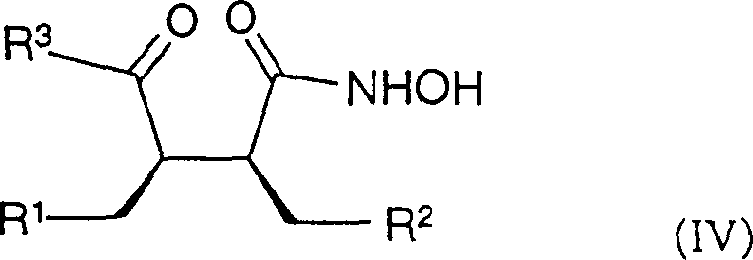
本发明的另一个目的是合成式(IV)的化合物Another object of the present invention is to synthesize the compound of formula (IV)

其中R1、R2如前面所定义,R3代表通过N-原子连接并选择性地包含NR4或O作为环杂原子的饱和的5-7员单环N-杂环,R4代表氢、低级烷基、芳基、芳烷基或保护基。wherein R 1 and R 2 are as defined above, R 3 represents a saturated 5-7 membered monocyclic N-heterocyclic ring connected through an N-atom and optionally contains NR 4 or O as a ring heteroatom, and R 4 represents hydrogen , lower alkyl, aryl, aralkyl or protecting group.
此处的术语“芳基”是指选择性地被例如低级烷基、低级烷氧基和/或卤素(即氟、氯、溴或碘)取代的苯基,例如对甲苯基、对甲氧基苯基、对氯苯基等。术语“芳烷基”是指其中的一个或多个氢原子被一个前面所定义的芳基所取代的前面所定义的低级烷基,例如苄基等。The term "aryl" herein refers to phenyl optionally substituted by, for example, lower alkyl, lower alkoxy and/or halogen (i.e. fluorine, chlorine, bromine or iodine), such as p-tolyl, p-methoxy phenyl, p-chlorophenyl, etc. The term "aralkyl" refers to a lower alkyl group as defined above wherein one or more hydrogen atoms are replaced by an aryl group as defined above, eg benzyl and the like.
R4所代表的保护基可以是任何常规的保护基,例如是多肽化学中已知的苄氧基羰基、叔丁氧基羰基、乙酰基等。The protecting group represented by R 4 may be any conventional protecting group, such as benzyloxycarbonyl, tert-butoxycarbonyl, acetyl and the like known in polypeptide chemistry.
R3所代表的单环N-杂环的例子为1-吡咯烷基、哌啶子基、1-哌嗪基、4-芳基-1-哌嗪基、六氢-1-哒嗪基、吗啉基和六氢氯杂基,这些基团可以按照前面所给的方式取代。取代的环的例子是4-甲基-1-哌嗪基或4-苯基-1-哌嗪基。优选R3为哌啶子基。Examples of monocyclic N-heterocycles represented by R are 1-pyrrolidinyl, piperidino, 1-piperazinyl, 4-aryl-1-piperazinyl, hexahydro-1-pyridazinyl , morpholinyl and hexahydrochloroheteroyl, these groups may be substituted in the manner given above. Examples of substituted rings are 4-methyl-1-piperazinyl or 4-phenyl-1-piperazinyl. Preferably R3 is piperidino.
EP0684240A1中描述了式(IV)的化合物,这些化合物是基质金属蛋白酶的抑制剂,可用于控制或预防疾病,特别是用于控制或预防退行性关节病例如风湿性关节炎和骨关节炎,或者用于治疗侵入性肿瘤、动脉粥样硬化或多发性硬化。Compounds of formula (IV) are described in EP0684240A1, which are inhibitors of matrix metalloproteinases and are useful for the control or prevention of diseases, in particular for the control or prevention of degenerative joint diseases such as rheumatoid arthritis and osteoarthritis, or For the treatment of invasive tumors, atherosclerosis or multiple sclerosis.
式(IV)的化合物可以用前面所述制得的式(I)化合物制备,该方法的特征在于:The compound of formula (IV) can be prepared with the compound of formula (I) prepared as described above, and the method is characterized in that:
a)使一种前面所述的式(I)的化合物与一种环状胺HR3反应,得到一种下式(V)的化合物a) reacting a compound of formula (I) as described above with a cyclic amine HR to give a compound of formula (V)
其中R1、R2和R3如前面式IV化合物所定义。wherein R 1 , R 2 and R 3 are as defined above for the compound of formula IV.
b)把式(V)化合物的羟基氧化,得到下式(VI)的化合物b) Oxidation of the hydroxyl group of the compound of formula (V) to obtain the compound of the following formula (VI)
c)通过引入一个羟基胺基团,把式(VI)的化合物转变为一种式IV的化合物。c) Conversion of a compound of formula (VI) into a compound of formula IV by introducing a hydroxylamine group.
在式(IV)化合物的R3中含有一个NR4基团(其中R4是保护基)的实施方案中,该方法的特征还在于可去掉或不去掉任何保护基R4。In the embodiment in which R 3 of the compound of formula (IV) contains an NR 4 group (wherein R 4 is a protecting group), the method is also characterized in that any protecting group R 4 may or may not be removed.
在步骤a)中,式(I)的内酯与环状胺HR3发生酰胺化得到式(V)化合物的反应可以按照已知的方法进行,例如使过量的胺与式(I)的化合物在一种烃(例如甲苯)中在25-120℃下反应,或者在一种卤代烃(例如二氯甲烷)中,在路易斯酸(例如AlCl3)存在下,在0-50、优选0-25℃的温度下反应。In step a), the lactone of formula (I) is amidated with the cyclic amine HR 3 to obtain the reaction of the compound of formula (V), which can be carried out according to known methods, such as making excess amine and the compound of formula (I) Reaction in a hydrocarbon (such as toluene) at 25-120 ° C, or in a halogenated hydrocarbon (such as methylene chloride), in the presence of a Lewis acid (such as AlCl 3 ), at 0-50, preferably 0 React at a temperature of -25°C.
在步骤b)中提到的使式(V)化合物的羟基氧化生成式(VI)化合物的反应通过已知的温和的氧化方法进行,例如使用NaOCl、KBr和2,2,6,6-四甲基-哌啶-1-氧基。The oxidation of the hydroxyl group of the compound of formula (V) to the compound of formula (VI) mentioned in step b) is carried out by known mild oxidation methods, for example using NaOCl, KBr and 2,2,6,6-tetra Methyl-piperidin-1-oxyl.
在步骤c)中引入羟氨基的反应可以用O-三甲基甲硅烷基羟基胺与已知的活化剂例如碳酰二亚胺(例如二环己基碳酰二亚胺)或异氰化物(例如异氰基叔丁烷,优选异氰基-2-吗啉代乙烷)在化学计量或催化量的能形成活性酯的醇(例如N-羟基琥珀酰亚胺、N-羟基苯并三唑或优选N-羟基-2-吡啶酮)的存在下,在一种溶剂(例如醚如叔丁基甲基醚,或烃如甲苯,或卤代烃或酯,优选二氯甲烷或乙酸乙酯)中,在0-80℃、优选10-25℃下反应来进行。The reaction of introducing hydroxylamino groups in step c) can be carried out with O-trimethylsilylhydroxylamine and known activators such as carbodiimide (eg dicyclohexylcarbodiimide) or isocyanide ( For example isocyano-tert-butane, preferably isocyano-2-morpholinoethane) in a stoichiometric or catalytic amount of an alcohol capable of forming an active ester (e.g. N-hydroxysuccinimide, N-hydroxybenzotri azole or preferably N-hydroxy-2-pyridone) in a solvent (for example an ether such as tert-butyl methyl ether, or a hydrocarbon such as toluene, or a halogenated hydrocarbon or ester, preferably dichloromethane or ethyl acetate) In, the reaction is carried out at 0-80°C, preferably 10-25°C.
保护基R4的除去可以用已知的方法进行。通过用酸处理,可以把碱性的式(IV)化合物转变为其药学上可以接受的盐。这种处理可以按照常规方式进行。The removal of the protecting group R4 can be carried out by known methods. Basic compounds of formula (IV) can be converted into their pharmaceutically acceptable salts by treatment with an acid. Such treatment can be carried out in a conventional manner.
按照与所述的把式(1)化合物转变为式(IV)化合物相同的方法,可以把式(Ia)的化合物转变为式(IVa)的化合物According to the same method that the compound of formula (1) is converted into the compound of formula (IV), the compound of formula (Ia) can be converted into the compound of formula (IVa)
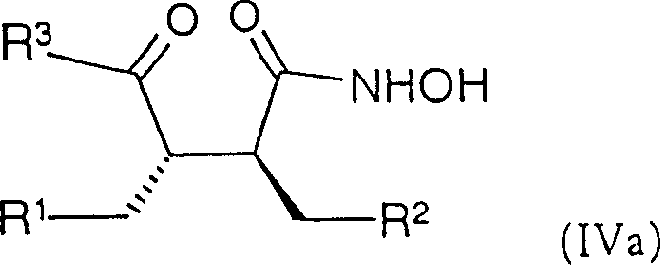
其中R1、R2和R3如前面所定义。wherein R 1 , R 2 and R 3 are as defined above.
对式(Ia)化合物的对映体进行同样的转变,可以得到式(IVa)化合物的对映体。The same transformation can be performed on the enantiomer of the compound of formula (Ia) to obtain the enantiomer of the compound of formula (IVa).
本发明的另一个目的是得到的新中间体,这些中间体具体为:Another object of the present invention is the new intermediates obtained, these intermediates are specifically:
式(I)的化合物Compounds of formula (I)

其中R1和R2如前面所定义,特别是(3R,4R)-3-(4-环戊基甲基-5-氧代-四氢呋喃-3-基甲基)-1,5,5-三甲基咪唑烷-2,4-二酮;wherein R and R are as defined above, especially (3R,4R)-3-(4-cyclopentylmethyl-5-oxo-tetrahydrofuran-3-ylmethyl)-1,5,5- Trimethylimidazolidine-2,4-dione;
式II的化合物Compound of formula II
其中R1和R2如前面所定义,特别是3-(4-环戊基甲基-5-氧代-2,5-二氢-呋喃-3-基甲基)-1,5,5-三甲基咪唑烷-2,4-二酮;Wherein R 1 and R 2 are as defined above, especially 3-(4-cyclopentylmethyl-5-oxo-2,5-dihydro-furan-3-ylmethyl)-1,5,5 - Trimethylimidazolidine-2,4-dione;
式V的化合物Compound of formula V
其中R1、R2和R3如前面所定义,特别是(2R,3R)-3-(3-环戊基甲基-2-羟甲基-4-氧代-4-哌啶-1-基丁基)-1,5,5-三甲基咪唑烷-2,4-二酮。wherein R 1 , R 2 and R 3 are as defined above, especially (2R, 3R)-3-(3-cyclopentylmethyl-2-hydroxymethyl-4-oxo-4-piperidine-1 -ylbutyl)-1,5,5-trimethylimidazolidine-2,4-dione.
这些化合物特别适用于制备式IV的化合物,具体为(2R,3R)-3-环戊基甲基-N-羟基-4-氧代-4-哌啶-1-基-2-(3,4,4-三甲基-2,5-二氧代-咪唑烷-1-基甲基)丁酰胺。这意味着其中R1是环戊基而R2是3,4,4-三甲基-2,5-二氧代-咪唑烷-1-基的式(I)化合物在步骤a)中与哌啶反应,然后在步骤b)中氧化,并在步骤c)中引入羟氨基。These compounds are particularly suitable for the preparation of compounds of formula IV, in particular (2R,3R)-3-cyclopentylmethyl-N-hydroxy-4-oxo-4-piperidin-1-yl-2-(3, 4,4-Trimethyl-2,5-dioxo-imidazolidin-1-ylmethyl)butanamide. This means that compounds of formula (I) wherein R is cyclopentyl and R is 3,4,4-trimethyl-2,5-dioxo-imidazolidin-1-yl are combined in step a) with The piperidine is reacted, then oxidized in step b) and hydroxylamino groups are introduced in step c).
现在通过一些实施例对本发明进行描述,然而这些实施例并不限定本发明。在实施例中使用了下列缩写:The invention will now be described by means of some examples which, however, do not limit the invention. The following abbreviations are used in the examples:
ee 对映体过量(通过所述的HPLC测定)ee enantiomeric excess (determined by HPLC as described)
GC 气相色谱(在熔融的硅胶上),用于测定得到的产物GC gas chromatography (on fused silica gel) for the determination of the resulting product
h 小时h hours
HPLC 高效液相色谱HPLC High performance liquid chromatography
MS(ISP,EI) 质谱(ISP:正离子喷射;EI:电子电离)MS (ISP, EI) Mass Spectrometry (ISP: Positive Ion Spray; EI: Electron Ionization)
r.t. 室温r.t. room temperature
mp. 熔点mp. Melting point
THF 四氢呋喃THF Tetrahydrofuran
COD 1,5-环辛二烯COD 1,5-cyclooctadiene
所有的温度都以摄氏度给出。All temperatures are given in degrees Celsius.
实施例 Example
实施例1 Example 1
3-(3-叔丁氧基-2-氧代-丙基)-1,5,5-三甲基咪唑烷-2,4-二酮3-(3-tert-butoxy-2-oxo-propyl)-1,5,5-trimethylimidazolidine-2,4-dione
向500ml去离子水中加入5.6g氢氧化钾(0.1mol)、71.1g 1,5,5-三甲基-咪唑烷-2,4-二酮(H.Heimgarter等人,Helv.Chem.Acta(1992)75,1251)和78.1g(RS)-2-叔丁氧基甲基-环氧乙烷(Fluka No.19941),把反应混合物加热到70℃。搅拌4小时后,把反应混合物冷却到室温,然后加入20.0g碳酸氢钾、11.2ml 48%氢溴酸(大约0.1mol)和500ml二氯甲烷,把反应混合物冷却到0℃。加入0.4g 2,2,6,6-四甲基哌啶-1-氧基(TEMPO,Aldrich No.21400),在0℃和激烈搅拌下,用2小时加入472g 10.5%的次氯酸钠水溶液,再在0℃下搅拌0.5小时后,通过加入大约10ml 38%的亚硫酸氢钠水溶液来破坏过量的次氯酸钠,把反应混合物温热到室温。分离出水层,用二氯甲烷萃取。两部分有机层用10%盐水洗涤,合并,通过硫酸钠干燥。Add 5.6 g of potassium hydroxide (0.1 mol), 71.1 g of 1,5,5-trimethyl-imidazolidine-2,4-dione (H. Heimgarter et al., Helv. Chem. Acta ( 1992) 75, 1251) and 78.1 g of (RS)-2-tert-butoxymethyl-oxirane (Fluka No. 19941), and the reaction mixture was heated to 70°C. After stirring for 4 hours, the reaction mixture was cooled to room temperature, then 20.0 g of potassium bicarbonate, 11.2 ml of 48% hydrobromic acid (about 0.1 mol) and 500 ml of dichloromethane were added, and the reaction mixture was cooled to 0°C. Add 0.4g 2,2,6,6-tetramethylpiperidine-1-oxyl group (TEMPO, Aldrich No.21400), under 0 ℃ and vigorous stirring, add 472g 10.5% sodium hypochlorite aqueous solution with 2 hours, again After stirring at 0°C for 0.5 hours, the excess sodium hypochlorite was destroyed by adding approximately 10 ml of 38% aqueous sodium bisulfite and the reaction mixture was allowed to warm to room temperature. The aqueous layer was separated and extracted with dichloromethane. The two organic layers were washed with 10% brine, combined, and dried over sodium sulfate.
过滤并蒸去溶剂后,把油状的残留物(143g)溶于500ml 60℃的甲基环己基中,接种纯的3-(3-叔丁氧基-2-氧代-丙基)-1,5,5-三甲基咪唑烷-2,4-二酮,用2小时冷却到0℃,在-10℃下搅拌4小时。过滤结晶悬浮液,用冷的甲基环己基洗涤,在减压下干燥过夜,得到122.8g(90.9%)白色的3-(3-叔丁氧基-2-氧代-丙基)-1,5,5-三甲基咪唑烷-2,4-二酮,熔点61-63℃。After filtering and evaporating the solvent, the oily residue (143g) was dissolved in 500ml of 60°C methylcyclohexyl, and inoculated with pure 3-(3-tert-butoxy-2-oxo-propyl)-1 , 5,5-trimethylimidazolidine-2,4-dione, cooled to 0°C over 2 hours, and stirred at -10°C for 4 hours. The crystalline suspension was filtered, washed with cold methylcyclohexyl, and dried overnight under reduced pressure to afford 122.8 g (90.9%) of white 3-(3-tert-butoxy-2-oxo-propyl)-1 , 5,5-trimethylimidazolidine-2,4-dione, melting point 61-63°C.
C13H22N2O4(270.329)计算值:C57.76 H8.20 N10.36Calculated for C 13 H 22 N 2 O 4 (270.329): C57.76 H8.20 N10.36
测定值:C57.73 H8.18 N10.46Measured value: C57.73 H8.18 N10.46
实施例2 Example 2
3-(4-环戊基甲基-3-羟基-5-氧代-四氢呋喃-3-基甲基)-1,5,5-三甲基咪3-(4-cyclopentylmethyl-3-hydroxy-5-oxo-tetrahydrofuran-3-ylmethyl)-1,5,5-trimethylimidium 唑烷-2,4-二酮Oxazolidine-2,4-dione
在0℃下,用1小时把203ml 1.6M丁基锂的己烷溶液加入46.0ml二异丙基胺溶于120ml THF的溶液中。在0℃下搅拌所得的LDA溶液1小时,然后冷却到-75℃。在-75℃下用1小时加入50.8g 3-环戊基丙酸甲酯溶于65mlTHF的溶液,并继续在该温度下搅拌1小时。在-75℃下用1小时加入67.6g3-(3-叔丁氧基-2-氧代丙基)-1,5,5-三甲基-咪唑烷-2,4-二酮溶于65mlTHF的溶液,在-75℃下再搅拌1小时后,用15分钟加入50ml浓H2SO4。把反应混合物回流3小时,冷却到室温,用300ml去离子水水解。分出有机层,用10%盐水洗涤,通过硫酸钠干燥,过滤并蒸去溶剂,得到96.5粗的黄色油状的3-(4-环戊基甲基-3-羟基-5-氧代-四氢呋喃-3-基甲基)-1,5,5-三甲基咪唑烷-2,4-二酮,该产物不需要纯化,直接用于下一步。3-环戊基-丙酸甲酯从相应的酸制得(ACROS No.11161)。甲基酯也可以从ChemischeFabrik K.Bucher得到。To a solution of 46.0 ml of diisopropylamine dissolved in 120 ml of THF was added 203 ml of a 1.6M hexane solution of butyllithium at 0°C over 1 hour. The resulting LDA solution was stirred at 0°C for 1 hour, then cooled to -75°C. A solution of 50.8 g of methyl 3-cyclopentylpropionate in 65 ml of THF was added over 1 hour at -75°C and stirring was continued at this temperature for 1 hour. Add 67.6g of 3-(3-tert-butoxy-2-oxopropyl)-1,5,5-trimethyl-imidazolidine-2,4-dione in 65ml of THF at -75°C for 1 hour The solution was stirred at -75°C for another 1 hour, then 50 ml of concentrated H 2 SO 4 was added over 15 minutes. The reaction mixture was refluxed for 3 hours, cooled to room temperature, and hydrolyzed with 300 mL of deionized water. The organic layer was separated, washed with 10% brine, dried over sodium sulfate, filtered and the solvent was evaporated to give 96.5 g of 3-(4-cyclopentylmethyl-3-hydroxy-5-oxo-tetrahydrofuran as a crude yellow oil -3-ylmethyl)-1,5,5-trimethylimidazolidine-2,4-dione, the product was directly used in the next step without purification. 3-Cyclopentyl-propionic acid methyl ester was prepared from the corresponding acid (ACROS No. 11161). Methyl esters are also available from Chemische Fabrik K. Bucher.
实施例3 Example 3
3-(4-环戊基甲基-5-氧代-2,5-二氢-呋喃-3-基甲基)-1,5,5-三甲基咪3-(4-cyclopentylmethyl-5-oxo-2,5-dihydro-furan-3-ylmethyl)-1,5,5-trimethylimidium 唑烷-2,4-二酮Oxazolidine-2,4-dione
向96.5g实施例2得到的粗产物溶于250ml乙酸酐的溶液中一次性加入175ml三乙胺,反应混合物在90℃下搅拌14小时,除去油浴,先用0.5小时加入150ml乙醇,然后用15分钟加入100ml 37%HCl。把反应混合物冷却到室温后,用250ml乙酸乙酯稀释,用去离子水洗涤3次。依次用100ml乙酸乙酯萃取所有的水层,合并的有机层与25g硫酸钠和8g炭(Dargo G60Fluka No.5100)一起搅拌0.5小时。通过Hyflo Super Cel(Fluka No.56678)过滤,蒸去溶剂,得到96.5g粗的粘稠的3-(4-环戊基甲基-5-氧代-2,5-二氢-呋喃-3-基甲基)-1,5,5-三甲基咪唑烷-2,4-二酮,在50℃下把该产物溶于400ml二异丙基醚中,用2小时冷却到-20℃并搅拌过夜。过滤结晶悬浮液,用冷的二异丙基醚洗涤,减压干燥,得到71.2g米黄色的3-(4-环戊基甲基-5-氧代-2,5-二氢-呋喃-3-基甲基)-1,5,5-三甲基咪唑烷-2,4-二酮,熔点77-79℃,该产物可以通过二次结晶进一步纯化,熔点78.5-79.5℃。Add 175ml of triethylamine to the solution that 96.5g of the crude product obtained in Example 2 is dissolved in 250ml of acetic anhydride, and the reaction mixture is stirred at 90°C for 14 hours, remove the oil bath, add 150ml of ethanol in 0.5 hour, and then use 100 ml of 37% HCl was added over 15 minutes. After cooling the reaction mixture to room temperature, it was diluted with 250 ml of ethyl acetate and washed 3 times with deionized water. All aqueous layers were successively extracted with 100 ml of ethyl acetate and the combined organic layers were stirred with 25 g of sodium sulfate and 8 g of charcoal (Dargo G60Fluka No. 5100) for 0.5 hours. Filtration through Hyflo Super Cel® (Fluka No. 56678) and evaporation of the solvent gave 96.5 g of crude viscous 3-(4-cyclopentylmethyl-5-oxo-2,5-dihydro-furan- 3-ylmethyl)-1,5,5-trimethylimidazolidine-2,4-dione, the product was dissolved in 400ml diisopropyl ether at 50°C, cooled to -20°C in 2 hours °C and stirred overnight. The crystalline suspension was filtered, washed with cold diisopropyl ether, and dried under reduced pressure to obtain 71.2 g of beige 3-(4-cyclopentylmethyl-5-oxo-2,5-dihydro-furan- 3-ylmethyl)-1,5,5-trimethylimidazolidine-2,4-dione, melting point 77-79°C, the product can be further purified by secondary crystallization, melting point 78.5-79.5°C.
C17H24N2O4(320.389)计算值:C63.63 H7.55 N8.74Calculated for C 17 H 24 N 2 O 4 (320.389): C63.63 H7.55 N8.74
测定值:C63.76 H7.45 N8.75Measured value: C63.76 H7.45 N8.75
实施例4a Example 4a
(3RS,4RS)-3-(4-环戊基甲基-5-氧代-四氢呋喃-3-基甲基)-1,5,5-三(3RS, 4RS)-3-(4-cyclopentylmethyl-5-oxo-tetrahydrofuran-3-ylmethyl)-1,5,5-tri 甲基咪唑烷-2,4-二酮Methylimidazolidine-2,4-dione
使19.2g实施例3中得到的溶于120ml乙酸乙酯中的产物在室温下在7.7g5%Rh-Al2O3上氢化18小时,通过大约3g的Hyflo Super Cel(Fluka No.56678)过滤除去催化剂,然后蒸去溶剂,得到19.2g粘稠的油状物,在65℃下把该油状物溶于120ml二异丙基醚中,结晶得到17.7g(91.9%)白色的(3RS,4RS)-3-(4-环戊基甲基-5-氧代-四氢呋喃-3-基甲基)-1,5,5-三甲基咪唑烷-2,4-二酮,熔点71-74℃,含有大约8%的反式异构体。19.2 g of the product obtained in Example 3 dissolved in 120 ml of ethyl acetate was hydrogenated at room temperature on 7.7 g of 5% Rh- Al2O3 for 18 hours over about 3 g of Hyflo Super Cel® (Fluka No. 56678) The catalyst was removed by filtration, and then the solvent was evaporated to obtain 19.2 g of a viscous oil, which was dissolved in 120 ml of diisopropyl ether at 65 ° C, and crystallized to obtain 17.7 g (91.9%) of white (3RS, 4RS )-3-(4-cyclopentylmethyl-5-oxo-tetrahydrofuran-3-ylmethyl)-1,5,5-trimethylimidazolidine-2,4-dione, melting point 71-74 °C, containing about 8% trans isomer.
通过用硅胶色谱(己烷∶乙酸乙酯=3∶2)纯化,然后从二异丙基醚中结晶,得到纯的顺式(3RS,4RS)-3-(4-环戊基甲基-5-氧代-四氢呋喃-3-基甲基)-1,5,5-三甲基咪唑烷-2,4-二酮,熔点75-76℃。Purification by chromatography on silica gel (hexane: ethyl acetate = 3:2), followed by crystallization from diisopropyl ether afforded pure cis (3RS, 4RS)-3-(4-cyclopentylmethyl- 5-oxo-tetrahydrofuran-3-ylmethyl)-1,5,5-trimethylimidazolidine-2,4-dione, melting point 75-76°C.
MS(ISP)M/z 340.2(M+NH4 +),323.3(M+H+);MS(ISP) M/z 340.2(M+ NH4 + ), 323.3(M+H + );
1H-NMR(CDCl3)62.90(m,1H,C(4)-H),2.70(m,1H,C(3)-H)。 1 H-NMR (CDCl 3 ) 62.90 (m, 1H, C(4)-H), 2.70 (m, 1H, C(3)-H).
实施例4b Example 4b
(3RS,4RS)-3-(4-环戊基甲基-5-氧代-四氢呋喃-3-基甲基)-1,5,5-三(3RS, 4RS)-3-(4-cyclopentylmethyl-5-oxo-tetrahydrofuran-3-ylmethyl)-1,5,5-tri 甲基咪唑烷-2,4-二酮Methylimidazolidine-2,4-dione
按照下列方法从顺式化合物制备反式化合物:在惰性的氩气气氛下,将1.61g(3RS,4RS)-3-(4-环戊基甲基-5-氧代-四氢呋喃-3-基甲基)-1,5,5-三甲基咪唑烷-2,4-二酮和0.77g 1,8-二氮杂双环[5.4.0]十一碳-7-烯(1,5-5)(DBU)溶于15ml THF中回流19小时,反应混合物用40ml乙酸乙酯稀释,用10ml 1N HCl和10ml 10%盐水洗涤。有机层通过硫酸钠干燥,过滤并蒸发。得到的1.54g黄色油状物在100g硅胶色谱上纯化,用l000ml 3∶2的己烷/乙酸乙酯洗脱,得到0.70g(43%)无色油状的反式差向异构体(3RS,4SR)-3-(4-环戊基甲基-5-氧代-四氢呋喃-3-基甲基)-1,5,5-三甲基咪唑烷-2,4-二酮。MS(ISP)M/z 323(M+H+);The trans compound was prepared from the cis compound according to the following method: Under an inert argon atmosphere, 1.61 g of (3RS, 4RS)-3-(4-cyclopentylmethyl-5-oxo-tetrahydrofuran-3-yl Methyl)-1,5,5-trimethylimidazolidine-2,4-dione and 0.77g 1,8-diazabicyclo[5.4.0]undec-7-ene (1,5- 5) (DBU) was dissolved in 15ml THF and refluxed for 19 hours, the reaction mixture was diluted with 40ml ethyl acetate, washed with 10ml 1N HCl and 10ml 10% brine. The organic layer was dried over sodium sulfate, filtered and evaporated. The resulting 1.54 g yellow oil was purified by chromatography on 100 g of silica gel, eluting with 1000 ml 3:2 hexane/ethyl acetate, to give 0.70 g (43%) of the trans epimer (3RS, 4SR)-3-(4-cyclopentylmethyl-5-oxo-tetrahydrofuran-3-ylmethyl)-1,5,5-trimethylimidazolidine-2,4-dione. MS(ISP) M/z 323(M+H + );
1H-NMR(CDCl3)δ2.70(m,1H,C(4)-H),2.40(m,1H,C(3)-H)。 1 H-NMR (CDCl 3 ) δ 2.70 (m, 1H, C(4)-H), 2.40 (m, 1H, C(3)-H).
实施例4c Example 4c
(3R,4R)-3-(4-环戊基甲基-5-氧代-四氢呋喃-3-基甲基)-1,5,5-三甲(3R,4R)-3-(4-cyclopentylmethyl-5-oxo-tetrahydrofuran-3-ylmethyl)-1,5,5-trimethyl 基咪唑烷-2,4-二酮imidazolidine-2,4-dione
在手套箱中(O2含量<=2ppm),向10ml容量瓶中加入68.3mg[Rh((R)-3,5-iPr-MeOBIPHEP)(COD)]SbF6(0.05mmol),用10ml乙酸乙酯补充到满刻度。用磁力搅拌棒在室温下搅拌悬浮液15分钟,形成澄清的橙色溶液。通过使(R)-3,5-iPr-MeOBIPHEP和[Rh(COD)2]SbF6在室温下按照已知的方式(J.Am.Chem.Soc.,93,3089-91(1971);J.Chem.Soc.Chem.Comm.,1990,869-71)反应2小时来制备Rh-催化剂。在手套箱中,在搅拌下,向185ml的不锈钢高压釜中加入16.02g 3-(4-环戊基甲基-5-氧代-2,5-二氢呋喃-3-基甲基)-1,5,5-三甲基咪唑烷-2,4-二酮、20ml乙酸乙酯和上述的催化剂溶液。用总共11.5ml的乙酸乙酯冲洗容量瓶,然后密封高压釜并与氢化管线连接。在搅拌和80℃下,在总共100巴的压力下进行氢化。71小时后,旋转蒸发棕色的氢化反应混合物,在50℃/10毫巴下干燥2小时,得到16.80g粗的(3R,4R)-3-(4-环戊基甲基-5-氧代-四氢呋喃-3-基甲基)-1,5,5-三甲基咪唑烷-2,4-二酮的棕色油状物,该油状物在室温下静置缓慢固化。ee:98.2%(3R,4R),GC:98.4%面积。该粗料直接用于下一步。In a glove box (O 2 content <= 2ppm), add 68.3 mg [Rh((R)-3,5-iPr-MeOBIPHEP)(COD)]SbF 6 (0.05 mmol) to a 10 ml volumetric flask, and wash with 10 ml acetic acid Ethyl ester replenished to full scale. The suspension was stirred at room temperature for 15 min with a magnetic stir bar, forming a clear orange solution. By making (R)-3,5-iPr-MeOBIPHEP and [Rh(COD) 2 ]SbF 6 at room temperature in a known manner (J.Am.Chem.Soc., 93, 3089-91 (1971); J.Chem.Soc.Chem.Comm., 1990, 869-71) for 2 hours to prepare Rh-catalyst. In the glove box, under stirring, 16.02 g of 3-(4-cyclopentylmethyl-5-oxo-2,5-dihydrofuran-3-ylmethyl)- 1,5,5-trimethylimidazolidine-2,4-dione, 20 ml of ethyl acetate and the above catalyst solution. The volumetric flask was rinsed with a total of 11.5 ml of ethyl acetate, then the autoclave was sealed and connected to the hydrogenation line. The hydrogenation was carried out with stirring at 80° C. at a pressure of a total of 100 bar. After 71 h, the brown hydrogenation reaction mixture was rotary evaporated and dried at 50 °C/10 mbar for 2 h to afford 16.80 g of crude (3R,4R)-3-(4-cyclopentylmethyl-5-oxo - Brown oil of tetrahydrofuran-3-ylmethyl)-1,5,5-trimethylimidazolidine-2,4-dione, which slowly solidified on standing at room temperature. ee: 98.2% (3R, 4R), GC: 98.4% area. This crude material was used directly in the next step.
按照下列方法得到分析纯的(3R,4R)-3-(4-环戊基甲基-5-氧代-四氢呋喃-3-基甲基)-1,5,5-三甲基咪唑烷-2,4-二酮:在搅拌下,把6.41g粗的(3R,4R)-3-(4-环戊基甲基-5-氧代-四氢呋喃-3-基甲基)-1,5,5-三甲基咪唑烷-2,4-二酮溶于170ml中的溶液加热回流。滤去部分不溶的催化剂后,在50℃和搅拌下,向溶液中加入纯的(3R,4R)-3-(4-环戊基甲基-5-氧代-四氢呋喃-3-基甲基)-1,5,5-三甲基咪唑烷-2,4-二酮的种晶。去掉加热浴,在室温下过夜完全结晶。滤出结晶,用二异丙基醚洗涤,在真空下干燥,得到3.84g(60%)纯的(3R,4R)-3-(4-环戊基甲基-5-氧代-四氢呋喃-3-基甲基)-1,5,5-三甲基咪唑烷-2,4-二酮的白色结晶。熔点:87.5-88.5℃,ee:100%;GC:99.8%面积。Obtain analytically pure (3R, 4R)-3-(4-cyclopentylmethyl-5-oxo-tetrahydrofuran-3-ylmethyl)-1,5,5-trimethylimidazolidine- 2,4-Diketone: Under stirring, 6.41g of crude (3R,4R)-3-(4-cyclopentylmethyl-5-oxo-tetrahydrofuran-3-ylmethyl)-1,5 , A solution of 5-trimethylimidazolidine-2,4-dione dissolved in 170 ml was heated to reflux. After filtering off part of the insoluble catalyst, add pure (3R,4R)-3-(4-cyclopentylmethyl-5-oxo-tetrahydrofuran-3-ylmethyl to the solution at 50°C under stirring )-1,5,5-trimethylimidazolidine-2,4-dione seed crystals. The heating bath was removed and crystallization was complete overnight at room temperature. The crystals were filtered off, washed with diisopropyl ether and dried under vacuum to give 3.84 g (60%) of pure (3R,4R)-3-(4-cyclopentylmethyl-5-oxo-tetrahydrofuran- White crystals of 3-ylmethyl)-1,5,5-trimethylimidazolidine-2,4-dione. Melting point: 87.5-88.5°C, ee: 100%; GC: 99.8% area.
[α]D 20-21.3°(589nm),-24.8°(546nm)(CHCl3,c=1)。[α] D 20 -21.3° (589 nm), -24.8° (546 nm) (CHCl 3 , c=1).
按照下列方法溶解实施例4a、4b和4c中得到的化合物样品并通过HPLC分离,测定它们的旋光纯度:用于HPLC分析时,把纯的产物或粗的反应混合物样品蒸发至干,通过短的硅胶填料过滤残留物,用乙醚洗脱。蒸发后,把残留物溶于1ml乙酸乙酯中并用HPLC分析。柱子:2×ChiralcelOD-H,(250×4mm),Daicel Chemicals Industries,LTD.Cat.No.7482-00;流动相:15%(v/v)乙醇/正己烷;流速1.0ml/分钟;压力80巴。观察到下列保留时间:反式(3S,4R),18.39分钟;顺式(3S,4S),19.29分钟;顺式(3R,4R),21.07分钟;反式(3R,4S),22.00分钟。Samples of the compounds obtained in Examples 4a, 4b and 4c were dissolved and separated by HPLC to determine their optical purity as follows: For HPLC analysis, either the pure product or a crude reaction mixture sample was evaporated to dryness and passed through a short The residue was filtered through a pad of silica gel, eluting with ether. After evaporation, the residue was dissolved in 1 ml ethyl acetate and analyzed by HPLC. Column: 2×ChiralcelOD-H, (250×4mm), Daicel Chemicals Industries, LTD.Cat.No.7482-00; mobile phase: 15% (v/v) ethanol/n-hexane; flow rate 1.0ml/min; pressure 80 bar. The following retention times were observed: trans (3S, 4R), 18.39 minutes; cis (3S, 4S), 19.29 minutes; cis (3R, 4R), 21.07 minutes; trans (3R, 4S), 22.00 minutes.
实施例4d Example 4d
d)按照与实施例4c相似的方式,在35ml的不锈钢高压釜中,在搅拌和80℃下,在100巴的氢气压力下,用5.5mg[Rh(COD)2]SbF6和5.8mg(R)-3,5-iPr-MeOBIPHEP溶于3.2ml乙酸乙酯中的溶液氢化0.32g 3-(4-环戊基甲基-5-氧代-2,5-二氢呋喃-3-基甲基)-1,5,5-三甲基咪唑烷-2,4-二酮。旋转蒸发棕色的氢化反应混合物。根据实施例4c中所述的HPLC分析,残留物中含有85%的ee为98%的(3R,4R)-3-(4-环戊基甲基-5-氧代-四氢呋喃-3-基甲基)-1,5,5-三甲基咪唑烷-2,4-二酮。d) In a similar manner to Example 4c, 5.5 mg of [Rh(COD) 2 ]SbF 6 and 5.8 mg of ( R)-3,5-iPr-MeOBIPHEP dissolved in 3.2ml of ethyl acetate to hydrogenate 0.32g of 3-(4-cyclopentylmethyl-5-oxo-2,5-dihydrofuran-3-yl Methyl)-1,5,5-trimethylimidazolidine-2,4-dione. The brown hydrogenation reaction mixture was rotovaped. The residue contained 85% of (3R,4R)-3-(4-cyclopentylmethyl-5-oxo-tetrahydrofuran-3-yl with an ee of 98% according to HPLC analysis described in Example 4c Methyl)-1,5,5-trimethylimidazolidine-2,4-dione.
实施例4e Example 4e
e)按照与实施例4c和4d相似的方式,用3-(4-环戊基甲基-5-氧代-2,5-二氢呋喃-3-基甲基)-1,5,5-三甲基咪唑烷-2,4-二酮进行下列氢化,用配体L和含氧酸或配酸A的阴离子得到下列结果(表1)。按照前面4c所述的方法进行HPLC分析测定ee。e) In a similar manner to Examples 4c and 4d, 3-(4-cyclopentylmethyl-5-oxo-2,5-dihydrofuran-3-ylmethyl)-1,5,5 -Trimethylimidazolidine-2,4-dione The following hydrogenation with ligand L and the anion of the oxoacid or ligand A gave the following results (Table 1). HPLC analysis was performed to determine ee as described in 4c above.
表1 Table 1
L A 溶剂 S/C T 压力 转化率/ eeL A Solvent S/C T Pressure Conversion / ee
小时 Hour
℃ bar %%
(R)-MeOBIPHEP SbF6 CH2Cl2 10 80 100 97/22 97(R)-MeOBIPHEP SbF 6 CH 2 Cl 2 10 80 100 97/22 97
(R)-MeOBIPHEP BARF4) CH2Cl2 10 80 100 84/22 96(R)-MeOBIPHEP BARF 4) CH 2 Cl 2 10 80 100 84/22 96
(R)-MeOBIPHEP BF4 CH2Cl2 10 80 100 33/22 95(R)-MeOBIPHEP BF 4 CH 2 Cl 2 10 80 100 33/22 95
(R)-MeOBIPHEP OTf EtOAc 100 80 100 42/18 98(R)-MeOBIPHEP OTf EtOAc 100 80 100 42/18 98
(R)-3,5-tBu2-MeOBIPHEP SbF6 THF 200 80 100 71/18 97(R)-3,5-tBu 2 -MeOBIPHEP SbF 6 THF 200 80 100 71/18 97
(R)-3,5-tBu2-MeOBIPHEP SbF6 EtOAc 200 80 100 96/18 98(R)-3,5-tBu 2 -MeOBIPHEP SbF 6 EtOAc 200 80 100 96/18 98
(R)-MeOBIPHEP BARF CO2sc1) 100 90 100 95/18 97(R)-MeOBIPHEP BARF CO 2 sc 1) 100 90 100 95/18 97
(R)-MeOBIPHEP BF4 CO2sc2) 100 90 100 67/18 97(R)-MeOBIPHEP BF 4 CO 2 sc 2) 100 90 100 67/18 97
(R)-3,5-iPr-MeOBIPHEP SbF6 CO2s/ 1000 90 100 80/18 98(R)-3,5-iPr-MeOBIPHEP SbF 6 CO 2 s/ 1000 90 100 80/18 98
EtOAc3) EtOAc3 )
(R)-3,5-tBu2-MeOBIPHEP SbF6 EtOAc 100 120 80 91/19 96(R)-3,5-tBu 2 -MeOBIPHEP SbF 6 EtOAc 100 120 80 91/19 96
(R)-3,5-tBu2-MeOBIPHEP SbF6 EtOAc 500 100 40 70/18 97(R)-3,5-tBu 2 -MeOBIPHEP SbF 6 EtOAc 500 100 40 70/18 97
(R,S)-pCF3-PPF-PPh2 5) SbF6 EtOAc 20 80 100 95/18 85(R,S)-pCF 3 -PPF-PPh 2 5) SbF 6 EtOAc 20 80 100 95/18 85
(R,S)-PPF-P(tBu)2 5) SbF6 EtOAc 20 80 100 97/18 87(R,S)-PPF-P(tBu) 2 5) SbF 6 EtOAc 20 80 100 97/18 87
(R,R)-MeDUPHOS5) BF4 EtOAc 10 60 100 27/64 80(R,R)-MeDUPHOS 5) BF 4 EtOAc 10 60 100 27/64 80
(R)-BIPHEMP SbF6 EtOAc 20 80 100 96/18 98(R)-BIPHEMP SbF 6 EtOAc 20 80 100 96/18 98
(R)-BINAP SbF6 EtOAc 500 90 100 26/66 98(R)-BINAP SbF 6 EtOAc 500 90 100 26/66 98
(R)-2-Furyl-MeOBIPHEP SbF6 EtOAc 20 80 100 51/18 92(R)-2-Furyl-MeOBIPHEP SbF 6 EtOAc 20 80 100 51/18 92
(R)-3,5-iPr-MeOBIPHEP SbF6 EtOAc 500 90 100 97/18 98(R)-3,5-iPr-MeOBIPHEP SbF 6 EtOAc 500 90 100 97/18 98
(R)-2-Naphthyl-MeOBIPHEP SbF6 EtOAc 500 90 100 18/19 98(R)-2-Naphthyl-MeOBIPHEP SbF 6 EtOAc 500 90 100 18/19 98
(R)-TriMeOBIPHEP SbF6 EtOAc 500 90 100 18/35 97(R)-TriMeOBIPHEP SbF 6 EtOAc 500 90 100 18/35 97
(R)-3,4,5-MeO-MeOBIPHEP SbF6 EtOAc 500 90 100 18/36 97(R)-3,4,5-MeO-MeOBIPHEP SbF 6 EtOAc 500 90 100 18/36 97
(R)-3,5-Me,4-MeO-MeOBIPHEP SbF6 EtOAc 500 90 100 18/87 97(R)-3,5-Me,4-MeO-MeOBIPHEP SbF 6 EtOAc 500 90 100 18/87 97
1)溶剂:10g CO2;2)溶剂:12g CO2;3)10g CO2+0.5ml乙酸乙酯;4)BARF:B(3,5-(CF3)2-C6H3)4;5)这些配体不是阻转异构配体,但是也产生(3R,4R)产物。1) Solvent: 10g CO 2 ; 2) Solvent: 12g CO 2 ; 3) 10g CO 2 +0.5ml ethyl acetate; 4) BARF: B(3,5-(CF 3 ) 2 -C 6 H 3 ) 4 ;5) These ligands are not atropisomeric ligands, but also give rise to (3R,4R) products.
实施例5 Example 5
(2R,3R)-3-(3-环戊基甲基-2-羟甲基-4-氧代-4-哌啶-1-基丁基)-1,5,(2R,3R)-3-(3-cyclopentylmethyl-2-hydroxymethyl-4-oxo-4-piperidin-1-ylbutyl)-1,5, 5-三甲基咪唑烷-2,4-二酮5-trimethylimidazolidine-2,4-dione
在室温下,用15分钟向8.3g AlCl3分散在75ml二氯甲烷中的悬浮液中加入12.3ml哌啶。向所得的澄清淡黄色溶液中在室温下用30分钟加入16.8g(3R,4R)-3-(4-环戊基甲基-5-氧代-四氢呋喃-3-基甲基)-1,5,5-三甲基咪唑烷-2,4-二酮溶于25ml二氯甲烷中的溶液。在室温下再搅拌90分钟后,反应混合物用25ml 1N HCl水解。水层用二氯甲烷萃取。依次用10%盐水洗涤两部分有机层。通过硫酸钠干燥后,蒸发合并的有机层,得到21.8g粘稠的油状物。在50℃下,把该油状的残留物溶于150ml二异丙基醚中,冷却,在-20℃下搅拌过夜。过滤后,用冷的二异丙基醚洗涤结晶,真空干燥,得到17.5g(85.7%)淡米黄色的(2R,3R)-3-(3-环戊基甲基-2-羟甲基-4-氧代-4-哌啶-1-基丁基)-1,5,5-三甲基咪唑烷-2,4-二酮,熔点92-95℃,[α]365=-5.6°(CHCl3,c=1)。To a suspension of 8.3 g of AlCl3 dispersed in 75 ml of dichloromethane was added 12.3 ml of piperidine over 15 min at room temperature. To the resulting clear pale yellow solution was added 16.8 g of (3R,4R)-3-(4-cyclopentylmethyl-5-oxo-tetrahydrofuran-3-ylmethyl)-1 over 30 minutes at room temperature, A solution of 5,5-trimethylimidazolidine-2,4-dione dissolved in 25 ml of dichloromethane. After stirring at room temperature for a further 90 minutes, the reaction mixture was hydrolyzed with 25 ml of 1N HCl. The aqueous layer was extracted with dichloromethane. The two organic layers were washed sequentially with 10% brine. After drying over sodium sulfate, the combined organic layers were evaporated to give 21.8 g of a viscous oil. The oily residue was dissolved in 150 ml of diisopropyl ether at 50°C, cooled and stirred overnight at -20°C. After filtration, the crystals were washed with cold diisopropyl ether and dried in vacuo to obtain 17.5 g (85.7%) of light beige (2R,3R)-3-(3-cyclopentylmethyl-2-hydroxymethyl -4-oxo-4-piperidin-1-ylbutyl)-1,5,5-trimethylimidazolidine-2,4-dione, melting point 92-95°C, [α] 365 =-5.6 °( CHCl3 , c=1).
C22H37N3O4(407.555)计算值:C64.84 H9.15 N10.31Calculated for C 22 H 37 N 3 O 4 (407.555): C64.84 H9.15 N10.31
测定值:C64.94 H9.11 N10.30Measured value: C64.94 H9.11 N10.30
实施例6 Example 6
(2R,3R)-3-环戊基甲基-4-氧代-4-哌啶-1-基-2-(3,4,4-三甲基-2,(2R,3R)-3-cyclopentylmethyl-4-oxo-4-piperidin-1-yl-2-(3,4,4-trimethyl-2, 5-二氧代-咪唑烷-1-基甲基)-丁酸5-Dioxo-imidazolidin-1-ylmethyl)-butanoic acid
把20.4g(2R,3R)-3-(3-环戊基甲基-2-羟甲基-4-氧代-4-哌啶-1-基丁基)-1,5,5-三甲基咪唑烷-2,4-二酮、8.4g碳酸氢钠和5.9gKBr溶于125ml二氯甲烷和125ml去离子水中。冷却到0℃后,一次性加入78mg 2,2,6,6-四甲基哌啶-1-氧基(TEMPO),在0℃和激烈搅拌下,用1小时加入107.4g 9.90%的次氯酸钠水溶液,在0℃下再搅拌3小时,反应混合物用30ml 6N HCl酸化,用14ml 38%的亚硫酸氢钠水溶液破坏过量的次氯酸钠。水层用二氯甲烷萃取。两部分有机层用10%盐水洗涤,合并的有机层通过硫酸钠干燥后蒸发得到21.8g泡沫。把泡沫状残留物溶于40ml 50℃的乙酸乙酯,接种纯的(2R,3R)-3-环戊基甲基-4-氧代-4-哌啶-1-基-2-(3,4,4-三甲基-2,5-二氧代-咪唑烷-1-基甲基)-丁酸,然后在搅拌下用1小时加入40ml己烷,同时冷却到室温。悬浮液在0℃下搅拌1小时,在-20℃下过夜。过滤后,用己烷洗涤结晶并真空干燥,得到17.6g(83%)浅白色的(2R,3R)-3-环戊基甲基-4-氧代-4-哌啶-1-基-2-(3,4,4-三甲基-2,5-二氧代-咪唑烷-1-基甲基)-丁酸,熔点111-114℃。20.4g (2R,3R)-3-(3-cyclopentylmethyl-2-hydroxymethyl-4-oxo-4-piperidin-1-ylbutyl)-1,5,5-tri Methylimidazolidine-2,4-dione, 8.4 g sodium bicarbonate and 5.9 g KBr were dissolved in 125 ml dichloromethane and 125 ml deionized water. After cooling to 0°C, add 78mg 2,2,6,6-tetramethylpiperidin-1-oxyl (TEMPO) at one time, and add 107.4g 9.90% sodium hypochlorite at 0°C under vigorous stirring for 1 hour aqueous solution, stirred at 0°C for another 3 hours, the reaction mixture was acidified with 30 ml 6N HCl, and excess sodium hypochlorite was destroyed with 14 ml 38% aqueous sodium bisulfite. The aqueous layer was extracted with dichloromethane. The two organic layers were washed with 10% brine and the combined organic layers were dried over sodium sulfate and evaporated to give 21.8 g of foam. Dissolve the foamy residue in 40ml of ethyl acetate at 50°C and inoculate pure (2R,3R)-3-cyclopentylmethyl-4-oxo-4-piperidin-1-yl-2-(3 , 4,4-trimethyl-2,5-dioxo-imidazolidin-1-ylmethyl)-butyric acid, and then 40 ml of hexane was added under stirring for 1 hour while cooling to room temperature. The suspension was stirred at 0°C for 1 hour and at -20°C overnight. After filtration, the crystals were washed with hexane and dried under vacuum to obtain 17.6 g (83%) of off-white (2R,3R)-3-cyclopentylmethyl-4-oxo-4-piperidin-1-yl- 2-(3,4,4-Trimethyl-2,5-dioxo-imidazolidin-1-ylmethyl)-butyric acid, melting point 111-114°C.
[α]D=-41.6°(CHCl3,c=1)[α] D = -41.6° (CHCl 3 , c = 1)
C22H35N3O5(421.538)计算值:C62.69 H8.37 N9.97Calculated for C 22 H 35 N 3 O 5 (421.538): C62.69 H8.37 N9.97
测定值:C62.35 H8.59 N9.93Measured value: C62.35 H8.59 N9.93
实施例7 Example 7
(2R,3R)-3-环戊基甲基-N-羟基-4-氧代-4-哌啶-1-基-2-(3,4,4-三甲(2R,3R)-3-cyclopentylmethyl-N-hydroxyl-4-oxo-4-piperidin-1-yl-2-(3,4,4-trimethyl 基-2,5-二氧代-咪唑烷-1-基甲基)-丁酰胺-2,5-dioxo-imidazolidin-1-ylmethyl)-butyramide
在22℃下,把0.78g异氰基-2-吗啉代乙烷加入2.11g实施例6的产物和0.61g N-羟基-2-%啶酮分散在21ml二氯甲烷中的悬浮液,搅拌混合物3小时。溶液用0.58g O-三甲基甲硅烷基-羟基胺处理,并搅拌2小时。反应混合物用饱和碳酸氢钠溶液和水洗涤并蒸馏。把残留物溶于20ml叔丁基甲基醚和0.23ml水中,在22℃下搅拌1.5小时,悬浮液用10ml己烷稀释,过滤,残留物在22℃/11毫巴下干燥,得到1.82g(83%)纯的(2R,3R)-3-环戊基甲基-N-羟基-4-氧代-4-哌啶-1-基-2-(3,4,4-三甲基-2,5-二氧代-咪唑烷-1-基甲基)-丁酰胺,MS(EI):436(40%)。At 22°C, 0.78 g of isocyano-2-morpholinoethane was added to a suspension of 2.11 g of the product of Example 6 and 0.61 g of N-hydroxyl-2-% pyridone dispersed in 21 ml of dichloromethane, The mixture was stirred for 3 hours. The solution was treated with 0.58 g of O-trimethylsilyl-hydroxylamine and stirred for 2 hours. The reaction mixture was washed with saturated sodium bicarbonate solution and water and distilled. The residue was dissolved in 20 ml tert-butyl methyl ether and 0.23 ml water, stirred at 22°C for 1.5 hours, the suspension was diluted with 10 ml hexane, filtered, and the residue was dried at 22°C/11 mbar to give 1.82 g (83 %) pure (2R,3R)-3-cyclopentylmethyl-N-hydroxyl-4-oxo-4-piperidin-1-yl-2-(3,4,4-trimethyl-2 , 5-dioxo-imidazolidin-1-ylmethyl)-butanamide, MS (EI): 436 (40%).
Claims (6)


Applications Claiming Priority (2)
| Application Number | Priority Date | Filing Date | Title |
|---|---|---|---|
| EP98112951 | 1998-07-13 | ||
| EP98112951.3 | 1998-07-13 |
Related Parent Applications (1)
| Application Number | Title | Priority Date | Filing Date |
|---|---|---|---|
| CNB991103351A Division CN1160350C (en) | 1998-07-13 | 1999-07-12 | Process for preparing chiral lactones |
Publications (1)
| Publication Number | Publication Date |
|---|---|
| CN1495164A true CN1495164A (en) | 2004-05-12 |
Family
ID=8232262
Family Applications (2)
| Application Number | Title | Priority Date | Filing Date |
|---|---|---|---|
| CNB991103351A Expired - Fee Related CN1160350C (en) | 1998-07-13 | 1999-07-12 | Process for preparing chiral lactones |
| CNA03155539XA Pending CN1495164A (en) | 1998-07-13 | 1999-07-12 | Method for preparing chiral lactones |
Family Applications Before (1)
| Application Number | Title | Priority Date | Filing Date |
|---|---|---|---|
| CNB991103351A Expired - Fee Related CN1160350C (en) | 1998-07-13 | 1999-07-12 | Process for preparing chiral lactones |
Country Status (5)
| Country | Link |
|---|---|
| US (2) | US6222039B1 (en) |
| JP (1) | JP2000044552A (en) |
| KR (1) | KR20000011595A (en) |
| CN (2) | CN1160350C (en) |
| CA (1) | CA2277443A1 (en) |
Families Citing this family (5)
| Publication number | Priority date | Publication date | Assignee | Title |
|---|---|---|---|---|
| DE19962543A1 (en) * | 1999-12-23 | 2001-07-05 | Degussa | Chromatographic separation of enantiomers of bicyclic lactams |
| US7262303B2 (en) * | 2003-09-29 | 2007-08-28 | Hoffman-La Roche Inc. | Process for the production of chiral propionic acid derivatives |
| CN102245570A (en) * | 2008-12-16 | 2011-11-16 | 弗·哈夫曼-拉罗切有限公司 | Process for the preparation of pyrollidine-3-carboxylic acids |
| SG11202004019SA (en) | 2017-11-17 | 2020-05-28 | Cellix Bio Private Ltd | Compositions and methods for the treatment of eye disorders |
| CN115819388B (en) * | 2021-09-17 | 2024-06-11 | 台州学院 | Preparation method of delta-cyclopentalactone |
Family Cites Families (17)
| Publication number | Priority date | Publication date | Assignee | Title |
|---|---|---|---|---|
| DK350383A (en) | 1982-08-27 | 1984-02-28 | Hoffmann La Roche | phosphorus compounds |
| DK0398132T3 (en) | 1989-05-18 | 1995-12-18 | Hoffmann La Roche | phosphorus compounds |
| US5288928A (en) | 1990-12-21 | 1994-02-22 | Ciba-Geigy Corporation | Asymmetrical hydrogenation |
| ES2082104T3 (en) | 1990-12-21 | 1996-03-16 | Ciba Geigy Ag | ASYMMETRIC HYDROGENATION. |
| JP3204667B2 (en) | 1991-03-15 | 2001-09-04 | エフ・ホフマン―ラ ロシユ アーゲー | Chiral phosphine |
| US5171892A (en) | 1991-07-02 | 1992-12-15 | E. I. Du Pont De Nemours And Company | Chiral phospholanes via chiral 1,4-diol cyclic sulfates |
| ATE179176T1 (en) | 1992-01-31 | 1999-05-15 | Hoffmann La Roche | DIPHOSPHINE LIGANDS |
| EP0564406B1 (en) | 1992-04-02 | 1999-05-06 | Novartis AG | Ferrocenyldiphosphine as ligands for homogeneous catalysts |
| DE59310189D1 (en) | 1992-05-18 | 2001-08-23 | Hoffmann La Roche | Asymmetric hydrogenation |
| DE59410267D1 (en) | 1993-02-26 | 2003-05-15 | Syngenta Participations Ag | Ferrocenyldiphosphines as ligands for homogeneous catalysts |
| US5481008A (en) | 1993-09-13 | 1996-01-02 | Hoffmann-La Roche Inc. | Process for the preparation of optically active compounds |
| DE59408655D1 (en) | 1993-10-01 | 1999-09-30 | Novartis Ag | Ferrocenyldiphosphines substituted with fluoroalkyl as ligands for homogeneous catalysts |
| GB9501737D0 (en) | 1994-04-25 | 1995-03-22 | Hoffmann La Roche | Hydroxamic acid derivatives |
| EP0749953B1 (en) | 1995-06-21 | 1999-11-17 | Rolic AG | Preparation of chiral alpha-halocarboxylic acids |
| DE19706273A1 (en) | 1996-02-20 | 1997-07-03 | Lonza Ag | Optically active beta-oxy-gamma-butyrolactam and beta-oxy-gamma-lactone derivatives preparation |
| EP0816341A1 (en) | 1996-07-04 | 1998-01-07 | F. Hoffmann-La Roche Ag | Process for the preparation of chiral succinic acid derivatives |
| US5952507A (en) | 1997-03-10 | 1999-09-14 | Hoffmann La Roche | Process for manufacture of chiral succinic acid derivatives |
-
1999
- 1999-07-07 US US09/349,296 patent/US6222039B1/en not_active Expired - Fee Related
- 1999-07-09 CA CA002277443A patent/CA2277443A1/en not_active Abandoned
- 1999-07-09 KR KR1019990027655A patent/KR20000011595A/en not_active Ceased
- 1999-07-12 CN CNB991103351A patent/CN1160350C/en not_active Expired - Fee Related
- 1999-07-12 CN CNA03155539XA patent/CN1495164A/en active Pending
- 1999-07-12 JP JP11197078A patent/JP2000044552A/en active Pending
-
2000
- 2000-10-20 US US09/693,056 patent/US6277997B1/en not_active Expired - Fee Related
Also Published As
| Publication number | Publication date |
|---|---|
| KR20000011595A (en) | 2000-02-25 |
| CN1160350C (en) | 2004-08-04 |
| US6277997B1 (en) | 2001-08-21 |
| CN1243126A (en) | 2000-02-02 |
| CA2277443A1 (en) | 2000-01-13 |
| JP2000044552A (en) | 2000-02-15 |
| US6222039B1 (en) | 2001-04-24 |
Similar Documents
| Publication | Publication Date | Title |
|---|---|---|
| CN1649827A (en) | Preparation method of highly functionalized γ-butyrolactam and γ-amino acid | |
| CN1426396A (en) | Substituted benzoic acid amides and use for inhibition of angiogenesis thereof | |
| CN1234679C (en) | Simplified Synthesis of 3,3-Diarylpropylamine Derivatives | |
| CN1119321C (en) | Asymetric synthesis of chiral beta-amino acids | |
| JP2009185047A (en) | Method for producing glycidylphthalimide | |
| CN1216049C (en) | Process for preparation of citalopram | |
| CN1625550A (en) | method of preparing organic compounds | |
| CN1298711C (en) | Process for preparing epoxy triazole derivatives and intermediates used therefor | |
| CN1229347C (en) | Method for preparing piperidine derivative fexofenadine | |
| CN1255498A (en) | Process for prepn. of growth hormone stimulating secretion agent and its intermediate | |
| CN1160350C (en) | Process for preparing chiral lactones | |
| CN1184109A (en) | Enantiomerically pure cycloalkanol indole carboxylic acid, azaindole carboxylic acid, pyrimido[1,2-a]-indole carboxylic acid and their active derivatives | |
| CN101068782A (en) | Method for synthesizing 4-(3-sulfonylphenyl)-piperidines | |
| CN1852885A (en) | The preparation method of nitrile compound, carboxylic acid compound or carboxylate compound | |
| CN1067656A (en) | 2 of aminomethyl replacement, the 3-dihydropyrane is [2,3-b] pyridines also, preparation method and the application in medicine | |
| CN1606557A (en) | Deuterated pyrazolopyrimidinones and drugs containing said compounds | |
| CN1178934C (en) | Benzofuran derivatives | |
| CN1150169C (en) | Process for the preparation of 4(5) -amino-5 (4) -carbamoylimidazoles and intermediates thereof | |
| CN1161353C (en) | The preparation method of paroxetine | |
| CN1197866C (en) | 4,6-dihydrofuran [3,4-d] imidazole-6- ketone derivative and salt and preparation method thereof | |
| CN1874974A (en) | Diastereoselective method of preparing olefins by means of the Horner-Wadsworth-Emmons reaction using a particular phosphonate which improves diastereoselectivity at all temperatures including at ambi | |
| CN1360574A (en) | Method for preparing tricyclic aminoalcohol derivatives | |
| CN1630646A (en) | Optically active azole derivative and process for producing the same | |
| CN1735588A (en) | Synthesis for (R) and (S)-aminocarnitine and derivatives thereof from D-and L-aspartic acid | |
| CN1968941A (en) | Method for producing 3-aminomethyltetrahydrofuran derivative |
Legal Events
| Date | Code | Title | Description |
|---|---|---|---|
| C06 | Publication | ||
| PB01 | Publication | ||
| C10 | Entry into substantive examination | ||
| SE01 | Entry into force of request for substantive examination | ||
| C02 | Deemed withdrawal of patent application after publication (patent law 2001) | ||
| WD01 | Invention patent application deemed withdrawn after publication |