CN1433411A - compound - Google Patents
compound Download PDFInfo
- Publication number
- CN1433411A CN1433411A CN01810683A CN01810683A CN1433411A CN 1433411 A CN1433411 A CN 1433411A CN 01810683 A CN01810683 A CN 01810683A CN 01810683 A CN01810683 A CN 01810683A CN 1433411 A CN1433411 A CN 1433411A
- Authority
- CN
- China
- Prior art keywords
- alkyl
- halogen
- optional
- compound
- phenyl
- Prior art date
- Legal status (The legal status is an assumption and is not a legal conclusion. Google has not performed a legal analysis and makes no representation as to the accuracy of the status listed.)
- Granted
Links
Classifications
-
- C—CHEMISTRY; METALLURGY
- C07—ORGANIC CHEMISTRY
- C07D—HETEROCYCLIC COMPOUNDS
- C07D401/00—Heterocyclic compounds containing two or more hetero rings, having nitrogen atoms as the only ring hetero atoms, at least one ring being a six-membered ring with only one nitrogen atom
- C07D401/14—Heterocyclic compounds containing two or more hetero rings, having nitrogen atoms as the only ring hetero atoms, at least one ring being a six-membered ring with only one nitrogen atom containing three or more hetero rings
-
- C—CHEMISTRY; METALLURGY
- C07—ORGANIC CHEMISTRY
- C07D—HETEROCYCLIC COMPOUNDS
- C07D401/00—Heterocyclic compounds containing two or more hetero rings, having nitrogen atoms as the only ring hetero atoms, at least one ring being a six-membered ring with only one nitrogen atom
- C07D401/02—Heterocyclic compounds containing two or more hetero rings, having nitrogen atoms as the only ring hetero atoms, at least one ring being a six-membered ring with only one nitrogen atom containing two hetero rings
- C07D401/04—Heterocyclic compounds containing two or more hetero rings, having nitrogen atoms as the only ring hetero atoms, at least one ring being a six-membered ring with only one nitrogen atom containing two hetero rings directly linked by a ring-member-to-ring-member bond
-
- A—HUMAN NECESSITIES
- A61—MEDICAL OR VETERINARY SCIENCE; HYGIENE
- A61P—SPECIFIC THERAPEUTIC ACTIVITY OF CHEMICAL COMPOUNDS OR MEDICINAL PREPARATIONS
- A61P1/00—Drugs for disorders of the alimentary tract or the digestive system
-
- A—HUMAN NECESSITIES
- A61—MEDICAL OR VETERINARY SCIENCE; HYGIENE
- A61P—SPECIFIC THERAPEUTIC ACTIVITY OF CHEMICAL COMPOUNDS OR MEDICINAL PREPARATIONS
- A61P1/00—Drugs for disorders of the alimentary tract or the digestive system
- A61P1/02—Stomatological preparations, e.g. drugs for caries, aphtae, periodontitis
-
- A—HUMAN NECESSITIES
- A61—MEDICAL OR VETERINARY SCIENCE; HYGIENE
- A61P—SPECIFIC THERAPEUTIC ACTIVITY OF CHEMICAL COMPOUNDS OR MEDICINAL PREPARATIONS
- A61P1/00—Drugs for disorders of the alimentary tract or the digestive system
- A61P1/04—Drugs for disorders of the alimentary tract or the digestive system for ulcers, gastritis or reflux esophagitis, e.g. antacids, inhibitors of acid secretion, mucosal protectants
-
- A—HUMAN NECESSITIES
- A61—MEDICAL OR VETERINARY SCIENCE; HYGIENE
- A61P—SPECIFIC THERAPEUTIC ACTIVITY OF CHEMICAL COMPOUNDS OR MEDICINAL PREPARATIONS
- A61P11/00—Drugs for disorders of the respiratory system
-
- A—HUMAN NECESSITIES
- A61—MEDICAL OR VETERINARY SCIENCE; HYGIENE
- A61P—SPECIFIC THERAPEUTIC ACTIVITY OF CHEMICAL COMPOUNDS OR MEDICINAL PREPARATIONS
- A61P11/00—Drugs for disorders of the respiratory system
- A61P11/06—Antiasthmatics
-
- A—HUMAN NECESSITIES
- A61—MEDICAL OR VETERINARY SCIENCE; HYGIENE
- A61P—SPECIFIC THERAPEUTIC ACTIVITY OF CHEMICAL COMPOUNDS OR MEDICINAL PREPARATIONS
- A61P11/00—Drugs for disorders of the respiratory system
- A61P11/08—Bronchodilators
-
- A—HUMAN NECESSITIES
- A61—MEDICAL OR VETERINARY SCIENCE; HYGIENE
- A61P—SPECIFIC THERAPEUTIC ACTIVITY OF CHEMICAL COMPOUNDS OR MEDICINAL PREPARATIONS
- A61P11/00—Drugs for disorders of the respiratory system
- A61P11/14—Antitussive agents
-
- A—HUMAN NECESSITIES
- A61—MEDICAL OR VETERINARY SCIENCE; HYGIENE
- A61P—SPECIFIC THERAPEUTIC ACTIVITY OF CHEMICAL COMPOUNDS OR MEDICINAL PREPARATIONS
- A61P17/00—Drugs for dermatological disorders
-
- A—HUMAN NECESSITIES
- A61—MEDICAL OR VETERINARY SCIENCE; HYGIENE
- A61P—SPECIFIC THERAPEUTIC ACTIVITY OF CHEMICAL COMPOUNDS OR MEDICINAL PREPARATIONS
- A61P17/00—Drugs for dermatological disorders
- A61P17/06—Antipsoriatics
-
- A—HUMAN NECESSITIES
- A61—MEDICAL OR VETERINARY SCIENCE; HYGIENE
- A61P—SPECIFIC THERAPEUTIC ACTIVITY OF CHEMICAL COMPOUNDS OR MEDICINAL PREPARATIONS
- A61P17/00—Drugs for dermatological disorders
- A61P17/14—Drugs for dermatological disorders for baldness or alopecia
-
- A—HUMAN NECESSITIES
- A61—MEDICAL OR VETERINARY SCIENCE; HYGIENE
- A61P—SPECIFIC THERAPEUTIC ACTIVITY OF CHEMICAL COMPOUNDS OR MEDICINAL PREPARATIONS
- A61P19/00—Drugs for skeletal disorders
- A61P19/02—Drugs for skeletal disorders for joint disorders, e.g. arthritis, arthrosis
-
- A—HUMAN NECESSITIES
- A61—MEDICAL OR VETERINARY SCIENCE; HYGIENE
- A61P—SPECIFIC THERAPEUTIC ACTIVITY OF CHEMICAL COMPOUNDS OR MEDICINAL PREPARATIONS
- A61P19/00—Drugs for skeletal disorders
- A61P19/08—Drugs for skeletal disorders for bone diseases, e.g. rachitism, Paget's disease
-
- A—HUMAN NECESSITIES
- A61—MEDICAL OR VETERINARY SCIENCE; HYGIENE
- A61P—SPECIFIC THERAPEUTIC ACTIVITY OF CHEMICAL COMPOUNDS OR MEDICINAL PREPARATIONS
- A61P21/00—Drugs for disorders of the muscular or neuromuscular system
- A61P21/04—Drugs for disorders of the muscular or neuromuscular system for myasthenia gravis
-
- A—HUMAN NECESSITIES
- A61—MEDICAL OR VETERINARY SCIENCE; HYGIENE
- A61P—SPECIFIC THERAPEUTIC ACTIVITY OF CHEMICAL COMPOUNDS OR MEDICINAL PREPARATIONS
- A61P25/00—Drugs for disorders of the nervous system
-
- A—HUMAN NECESSITIES
- A61—MEDICAL OR VETERINARY SCIENCE; HYGIENE
- A61P—SPECIFIC THERAPEUTIC ACTIVITY OF CHEMICAL COMPOUNDS OR MEDICINAL PREPARATIONS
- A61P25/00—Drugs for disorders of the nervous system
- A61P25/28—Drugs for disorders of the nervous system for treating neurodegenerative disorders of the central nervous system, e.g. nootropic agents, cognition enhancers, drugs for treating Alzheimer's disease or other forms of dementia
-
- A—HUMAN NECESSITIES
- A61—MEDICAL OR VETERINARY SCIENCE; HYGIENE
- A61P—SPECIFIC THERAPEUTIC ACTIVITY OF CHEMICAL COMPOUNDS OR MEDICINAL PREPARATIONS
- A61P27/00—Drugs for disorders of the senses
- A61P27/02—Ophthalmic agents
-
- A—HUMAN NECESSITIES
- A61—MEDICAL OR VETERINARY SCIENCE; HYGIENE
- A61P—SPECIFIC THERAPEUTIC ACTIVITY OF CHEMICAL COMPOUNDS OR MEDICINAL PREPARATIONS
- A61P29/00—Non-central analgesic, antipyretic or antiinflammatory agents, e.g. antirheumatic agents; Non-steroidal antiinflammatory drugs [NSAID]
-
- A—HUMAN NECESSITIES
- A61—MEDICAL OR VETERINARY SCIENCE; HYGIENE
- A61P—SPECIFIC THERAPEUTIC ACTIVITY OF CHEMICAL COMPOUNDS OR MEDICINAL PREPARATIONS
- A61P3/00—Drugs for disorders of the metabolism
- A61P3/04—Anorexiants; Antiobesity agents
-
- A—HUMAN NECESSITIES
- A61—MEDICAL OR VETERINARY SCIENCE; HYGIENE
- A61P—SPECIFIC THERAPEUTIC ACTIVITY OF CHEMICAL COMPOUNDS OR MEDICINAL PREPARATIONS
- A61P3/00—Drugs for disorders of the metabolism
- A61P3/08—Drugs for disorders of the metabolism for glucose homeostasis
- A61P3/10—Drugs for disorders of the metabolism for glucose homeostasis for hyperglycaemia, e.g. antidiabetics
-
- A—HUMAN NECESSITIES
- A61—MEDICAL OR VETERINARY SCIENCE; HYGIENE
- A61P—SPECIFIC THERAPEUTIC ACTIVITY OF CHEMICAL COMPOUNDS OR MEDICINAL PREPARATIONS
- A61P31/00—Antiinfectives, i.e. antibiotics, antiseptics, chemotherapeutics
- A61P31/04—Antibacterial agents
- A61P31/08—Antibacterial agents for leprosy
-
- A—HUMAN NECESSITIES
- A61—MEDICAL OR VETERINARY SCIENCE; HYGIENE
- A61P—SPECIFIC THERAPEUTIC ACTIVITY OF CHEMICAL COMPOUNDS OR MEDICINAL PREPARATIONS
- A61P31/00—Antiinfectives, i.e. antibiotics, antiseptics, chemotherapeutics
- A61P31/12—Antivirals
- A61P31/14—Antivirals for RNA viruses
- A61P31/18—Antivirals for RNA viruses for HIV
-
- A—HUMAN NECESSITIES
- A61—MEDICAL OR VETERINARY SCIENCE; HYGIENE
- A61P—SPECIFIC THERAPEUTIC ACTIVITY OF CHEMICAL COMPOUNDS OR MEDICINAL PREPARATIONS
- A61P37/00—Drugs for immunological or allergic disorders
-
- A—HUMAN NECESSITIES
- A61—MEDICAL OR VETERINARY SCIENCE; HYGIENE
- A61P—SPECIFIC THERAPEUTIC ACTIVITY OF CHEMICAL COMPOUNDS OR MEDICINAL PREPARATIONS
- A61P37/00—Drugs for immunological or allergic disorders
- A61P37/02—Immunomodulators
-
- A—HUMAN NECESSITIES
- A61—MEDICAL OR VETERINARY SCIENCE; HYGIENE
- A61P—SPECIFIC THERAPEUTIC ACTIVITY OF CHEMICAL COMPOUNDS OR MEDICINAL PREPARATIONS
- A61P37/00—Drugs for immunological or allergic disorders
- A61P37/02—Immunomodulators
- A61P37/06—Immunosuppressants, e.g. drugs for graft rejection
-
- A—HUMAN NECESSITIES
- A61—MEDICAL OR VETERINARY SCIENCE; HYGIENE
- A61P—SPECIFIC THERAPEUTIC ACTIVITY OF CHEMICAL COMPOUNDS OR MEDICINAL PREPARATIONS
- A61P37/00—Drugs for immunological or allergic disorders
- A61P37/08—Antiallergic agents
-
- A—HUMAN NECESSITIES
- A61—MEDICAL OR VETERINARY SCIENCE; HYGIENE
- A61P—SPECIFIC THERAPEUTIC ACTIVITY OF CHEMICAL COMPOUNDS OR MEDICINAL PREPARATIONS
- A61P43/00—Drugs for specific purposes, not provided for in groups A61P1/00-A61P41/00
-
- A—HUMAN NECESSITIES
- A61—MEDICAL OR VETERINARY SCIENCE; HYGIENE
- A61P—SPECIFIC THERAPEUTIC ACTIVITY OF CHEMICAL COMPOUNDS OR MEDICINAL PREPARATIONS
- A61P5/00—Drugs for disorders of the endocrine system
- A61P5/14—Drugs for disorders of the endocrine system of the thyroid hormones, e.g. T3, T4
- A61P5/16—Drugs for disorders of the endocrine system of the thyroid hormones, e.g. T3, T4 for decreasing, blocking or antagonising the activity of the thyroid hormones
-
- A—HUMAN NECESSITIES
- A61—MEDICAL OR VETERINARY SCIENCE; HYGIENE
- A61P—SPECIFIC THERAPEUTIC ACTIVITY OF CHEMICAL COMPOUNDS OR MEDICINAL PREPARATIONS
- A61P7/00—Drugs for disorders of the blood or the extracellular fluid
- A61P7/06—Antianaemics
-
- A—HUMAN NECESSITIES
- A61—MEDICAL OR VETERINARY SCIENCE; HYGIENE
- A61P—SPECIFIC THERAPEUTIC ACTIVITY OF CHEMICAL COMPOUNDS OR MEDICINAL PREPARATIONS
- A61P9/00—Drugs for disorders of the cardiovascular system
- A61P9/10—Drugs for disorders of the cardiovascular system for treating ischaemic or atherosclerotic diseases, e.g. antianginal drugs, coronary vasodilators, drugs for myocardial infarction, retinopathy, cerebrovascula insufficiency, renal arteriosclerosis
-
- C—CHEMISTRY; METALLURGY
- C07—ORGANIC CHEMISTRY
- C07D—HETEROCYCLIC COMPOUNDS
- C07D211/00—Heterocyclic compounds containing hydrogenated pyridine rings, not condensed with other rings
- C07D211/04—Heterocyclic compounds containing hydrogenated pyridine rings, not condensed with other rings with only hydrogen or carbon atoms directly attached to the ring nitrogen atom
- C07D211/06—Heterocyclic compounds containing hydrogenated pyridine rings, not condensed with other rings with only hydrogen or carbon atoms directly attached to the ring nitrogen atom having no double bonds between ring members or between ring members and non-ring members
- C07D211/36—Heterocyclic compounds containing hydrogenated pyridine rings, not condensed with other rings with only hydrogen or carbon atoms directly attached to the ring nitrogen atom having no double bonds between ring members or between ring members and non-ring members with hetero atoms or with carbon atoms having three bonds to hetero atoms with at the most one bond to halogen, e.g. ester or nitrile radicals, directly attached to ring carbon atoms
- C07D211/56—Nitrogen atoms
- C07D211/58—Nitrogen atoms attached in position 4
-
- C—CHEMISTRY; METALLURGY
- C07—ORGANIC CHEMISTRY
- C07D—HETEROCYCLIC COMPOUNDS
- C07D405/00—Heterocyclic compounds containing both one or more hetero rings having oxygen atoms as the only ring hetero atoms, and one or more rings having nitrogen as the only ring hetero atom
- C07D405/14—Heterocyclic compounds containing both one or more hetero rings having oxygen atoms as the only ring hetero atoms, and one or more rings having nitrogen as the only ring hetero atom containing three or more hetero rings
-
- C—CHEMISTRY; METALLURGY
- C07—ORGANIC CHEMISTRY
- C07D—HETEROCYCLIC COMPOUNDS
- C07D409/00—Heterocyclic compounds containing two or more hetero rings, at least one ring having sulfur atoms as the only ring hetero atoms
- C07D409/14—Heterocyclic compounds containing two or more hetero rings, at least one ring having sulfur atoms as the only ring hetero atoms containing three or more hetero rings
-
- C—CHEMISTRY; METALLURGY
- C07—ORGANIC CHEMISTRY
- C07D—HETEROCYCLIC COMPOUNDS
- C07D413/00—Heterocyclic compounds containing two or more hetero rings, at least one ring having nitrogen and oxygen atoms as the only ring hetero atoms
- C07D413/14—Heterocyclic compounds containing two or more hetero rings, at least one ring having nitrogen and oxygen atoms as the only ring hetero atoms containing three or more hetero rings
-
- C—CHEMISTRY; METALLURGY
- C07—ORGANIC CHEMISTRY
- C07D—HETEROCYCLIC COMPOUNDS
- C07D417/00—Heterocyclic compounds containing two or more hetero rings, at least one ring having nitrogen and sulfur atoms as the only ring hetero atoms, not provided for by group C07D415/00
- C07D417/14—Heterocyclic compounds containing two or more hetero rings, at least one ring having nitrogen and sulfur atoms as the only ring hetero atoms, not provided for by group C07D415/00 containing three or more hetero rings
-
- C—CHEMISTRY; METALLURGY
- C07—ORGANIC CHEMISTRY
- C07D—HETEROCYCLIC COMPOUNDS
- C07D471/00—Heterocyclic compounds containing nitrogen atoms as the only ring hetero atoms in the condensed system, at least one ring being a six-membered ring with one nitrogen atom, not provided for by groups C07D451/00 - C07D463/00
- C07D471/02—Heterocyclic compounds containing nitrogen atoms as the only ring hetero atoms in the condensed system, at least one ring being a six-membered ring with one nitrogen atom, not provided for by groups C07D451/00 - C07D463/00 in which the condensed system contains two hetero rings
- C07D471/04—Ortho-condensed systems
-
- C—CHEMISTRY; METALLURGY
- C07—ORGANIC CHEMISTRY
- C07D—HETEROCYCLIC COMPOUNDS
- C07D473/00—Heterocyclic compounds containing purine ring systems
- C07D473/02—Heterocyclic compounds containing purine ring systems with oxygen, sulphur, or nitrogen atoms directly attached in positions 2 and 6
- C07D473/04—Heterocyclic compounds containing purine ring systems with oxygen, sulphur, or nitrogen atoms directly attached in positions 2 and 6 two oxygen atoms
- C07D473/06—Heterocyclic compounds containing purine ring systems with oxygen, sulphur, or nitrogen atoms directly attached in positions 2 and 6 two oxygen atoms with radicals containing only hydrogen and carbon atoms, attached in position 1 or 3
- C07D473/08—Heterocyclic compounds containing purine ring systems with oxygen, sulphur, or nitrogen atoms directly attached in positions 2 and 6 two oxygen atoms with radicals containing only hydrogen and carbon atoms, attached in position 1 or 3 with methyl radicals in positions 1 and 3, e.g. theophylline
-
- C—CHEMISTRY; METALLURGY
- C07—ORGANIC CHEMISTRY
- C07D—HETEROCYCLIC COMPOUNDS
- C07D495/00—Heterocyclic compounds containing in the condensed system at least one hetero ring having sulfur atoms as the only ring hetero atoms
- C07D495/02—Heterocyclic compounds containing in the condensed system at least one hetero ring having sulfur atoms as the only ring hetero atoms in which the condensed system contains two hetero rings
- C07D495/04—Ortho-condensed systems
-
- C—CHEMISTRY; METALLURGY
- C07—ORGANIC CHEMISTRY
- C07D—HETEROCYCLIC COMPOUNDS
- C07D513/00—Heterocyclic compounds containing in the condensed system at least one hetero ring having nitrogen and sulfur atoms as the only ring hetero atoms, not provided for in groups C07D463/00, C07D477/00 or C07D499/00 - C07D507/00
- C07D513/02—Heterocyclic compounds containing in the condensed system at least one hetero ring having nitrogen and sulfur atoms as the only ring hetero atoms, not provided for in groups C07D463/00, C07D477/00 or C07D499/00 - C07D507/00 in which the condensed system contains two hetero rings
- C07D513/04—Ortho-condensed systems
Landscapes
- Health & Medical Sciences (AREA)
- Chemical & Material Sciences (AREA)
- Organic Chemistry (AREA)
- Life Sciences & Earth Sciences (AREA)
- Chemical Kinetics & Catalysis (AREA)
- Veterinary Medicine (AREA)
- Engineering & Computer Science (AREA)
- General Chemical & Material Sciences (AREA)
- Medicinal Chemistry (AREA)
- Nuclear Medicine, Radiotherapy & Molecular Imaging (AREA)
- Pharmacology & Pharmacy (AREA)
- Bioinformatics & Cheminformatics (AREA)
- Animal Behavior & Ethology (AREA)
- General Health & Medical Sciences (AREA)
- Public Health (AREA)
- Immunology (AREA)
- Diabetes (AREA)
- Pulmonology (AREA)
- Physical Education & Sports Medicine (AREA)
- Neurology (AREA)
- Hematology (AREA)
- Orthopedic Medicine & Surgery (AREA)
- Dermatology (AREA)
- Rheumatology (AREA)
- Biomedical Technology (AREA)
- Neurosurgery (AREA)
- Virology (AREA)
- Obesity (AREA)
- Communicable Diseases (AREA)
- Oncology (AREA)
- Endocrinology (AREA)
- Pain & Pain Management (AREA)
- Hospice & Palliative Care (AREA)
- Cardiology (AREA)
- Psychiatry (AREA)
- AIDS & HIV (AREA)
- Tropical Medicine & Parasitology (AREA)
- Molecular Biology (AREA)
- Vascular Medicine (AREA)
- Ophthalmology & Optometry (AREA)
Abstract
Description
本发明涉及具有药用活性的哌啶衍生物、制备这些衍生物的方法、含有这些衍生物的药用组合物及这些衍生物作为活性治疗剂的用途。The present invention relates to pharmaceutically active piperidine derivatives, processes for the preparation of these derivatives, pharmaceutical compositions containing these derivatives and the use of these derivatives as active therapeutic agents.
WO99/38514、WO99/04794和WO00/35877中公开了具有药用活性的哌啶衍生物。Pharmaceutically active piperidine derivatives are disclosed in WO99/38514, WO99/04794 and WO00/35877.
趋化因子是由各种细胞释放的将巨噬细胞、T细胞、嗜酸性粒细胞、嗜碱性粒细胞和嗜中性粒细胞吸引至炎症部位的趋化细胞因子,还在免疫系统细胞的成熟中发挥作用。在各种疾病和病症(包括哮喘和变应性疾病以及自身免疫病理学(如类风湿性关节炎)和动脉粥样硬化)的免疫和炎性反应中,趋化因子起着重要作用。这些小的分泌性分子是特征为保守的四个半胱氨酸的基元的8-14kDa蛋白质的一个日益增长的超家族。可将这个趋化因子超家族分为呈现特征结构基元的主要两组,即Cys-X-Cys(C-X-C,或α)和Cys-Cys(C-C,或β)家族。根据在NH-附近的半胱氨酸残基对之间插入一个氨基酸和序列类似性来区分这两个家族。Chemokines are chemotactic cytokines released by various cells that attract macrophages, T cells, eosinophils, basophils, and neutrophils to sites of inflammation, and also in immune system cells function in maturity. Chemokines play an important role in immune and inflammatory responses in various diseases and conditions, including asthma and allergic diseases, as well as autoimmune pathologies such as rheumatoid arthritis and atherosclerosis. These small secreted molecules are a growing superfamily of 8-14 kDa proteins characterized by a conserved four cysteine motif. This chemokine superfamily can be divided into two main groups that exhibit characteristic structural motifs, the Cys-X-Cys (C-X-C, or α) and Cys-Cys (C-C, or β) families. The two families are distinguished on the basis of an insertion of one amino acid between pairs of NH-near cysteine residues and sequence similarity.
C-X-C趋化因子包括几种有效的嗜中性粒细胞化学引诱物和活化剂,如白细胞介素-8(IL-8)和嗜中性粒细胞活化肽2(NAP-2)。C-X-C chemokines include several potent neutrophil chemoattractants and activators, such as interleukin-8 (IL-8) and neutrophil-activating peptide 2 (NAP-2).
C-C趋化因子包括单核细胞和淋巴细胞(但不包括嗜中性粒细胞)的有效化学引诱物,如人单核细胞趋化蛋白1-3(MCP-1、MCP-2和MCP-3)、RANTES(调节活化、正常T细胞表达和分泌的)、eotaxin和巨噬细胞炎症蛋白1α和1β(MIP-1α和MIP-1β)。C-C chemokines include potent chemoattractants for monocytes and lymphocytes (but not neutrophils), such as human monocyte chemoattractant proteins 1-3 (MCP-1, MCP-2, and MCP-3 ), RANTES (regulated activation, expressed and secreted by normal T cells), eotaxin, and macrophage inflammatory proteins 1α and 1β (MIP-1α and MIP-1β).
研究表明:趋化因子的作用由G-蛋白偶联受体的亚族介导,其中将这些受体称为CCR1、CCR2、CCR2A、CCR2B、CCR3、CCR4、CCR5、CCR6、CCR7、CCR8、CCR9、CCR10、CXCR1、CXCR2、CXCR3和CXCR4。由于调节这些受体的药物可用于治疗如前提到的那些病症和疾病,所以这些受体代表药物研制的好的靶向。Studies have shown that the effects of chemokines are mediated by a subfamily of G-protein coupled receptors, which are called CCR1, CCR2, CCR2A, CCR2B, CCR3, CCR4, CCR5, CCR6, CCR7, CCR8, CCR9 , CCR10, CXCR1, CXCR2, CXCR3, and CXCR4. These receptors represent good targets for drug development since drugs that modulate these receptors are useful in the treatment of conditions and diseases such as those previously mentioned.
组胺是碱性胺,2-(4-咪唑基)-乙胺,可通过组氨酸脱羧酶由组氨酸形成。组胺存在于体内的大多数组织中,但在肺、皮肤和胃肠道中以高浓度存在。在细胞水平上,炎症细胞(如肥大细胞和嗜碱性粒细胞)储存大量组胺。现认为肥大细胞和嗜碱性粒细胞的脱粒以及随后的组胺释放是引起变应性过程的临床表现的基本机理。组胺通过影响特异性组胺G-蛋白偶联受体而产生效应,该受体主要是H1、H2和H3三种类型。组胺H1拮抗剂包括用于治疗变应性病症(尤其是鼻炎和荨麻疹)患者的最大类药物。H1拮抗剂可通过如阻断组胺对毛细血管后微静脉平滑肌的作用,导致降低血管渗透性、渗出和水肿,从而用于控制变应性反应。该拮抗剂还能阻断组胺对c-型伤害性神经纤维上的H1受体的作用,导致痒觉和喷嚏的减少。Histamine is a basic amine, 2-(4-imidazolyl)-ethylamine, which can be formed from histidine by histidine decarboxylase. Histamine is present in most tissues in the body, but in high concentrations in the lungs, skin, and gastrointestinal tract. At the cellular level, inflammatory cells such as mast cells and basophils store large amounts of histamine. The degranulation of mast cells and basophils and the subsequent release of histamine is now believed to be the basic mechanism responsible for the clinical manifestations of the allergic process. Histamine produces effects by affecting specific histamine G-protein coupled receptors, which are mainly of three types: H1, H2 and H3. Histamine H1 antagonists comprise the largest class of drugs used to treat patients with allergic conditions, especially rhinitis and urticaria. H1 antagonists can be used to control allergic responses by, for example, blocking the action of histamine on postcapillary venule smooth muscle, resulting in decreased vascular permeability, exudation and edema. The antagonist also blocks the action of histamine on H1 receptors on c-type nociceptive nerve fibers, resulting in a reduction in itching and sneezing.
已知病毒感染可引起肺炎。实验已表明一般的感冒能增加导气管中eotaxin的粘膜排出量。向鼻中滴入eotaxin可模拟一些一般感冒的迹象和症状(参见Greiff L等,Allergy(1999)54(11)1204-8[experimental common cold increase mucosal output of eotaxin in atopicindividuals]和Kawaguchi M等,Int.Arch.Allergy Immunol.(2000)122S1 44[expression of eotaxin by normal airway epithelial cells after virus Ainfection])。 Viral infections are known to cause pneumonia. Experiments have shown that the common cold increases the mucosal output of eotaxin in the airways. Nasal instillation of eotaxin mimics some of the signs and symptoms of a common cold (see Greiff L et al., Allergy (1999) 54(11) 1204-8 [experimental common cold increase mucosal output of eotaxin in atopic individuals] and Kawaguchi M et al., Int .Arch.Allergy Immunol.(2000)122S1 44[expression of eotaxin by normal airway epithelial cells after virus Ainfection]).
本发明提供一种式(I)化合物或其N-氧化物;或其药学上可接受的盐;或其溶剂合物:
本发明的某些化合物可以不同异构体的形式(如对映体、非对映异构体、几何异构体或互变异构体)存在。本发明包括所有这些异构体及其所有比例的混合物。Certain compounds of the present invention may exist in different isomeric forms (eg, enantiomers, diastereomers, geometric isomers or tautomers). The present invention includes all these isomers and mixtures thereof in all proportions.
适当的盐包括酸加成盐,如盐酸盐、二盐酸盐、氢溴酸盐、磷酸盐、乙酸盐、二乙酸盐、富马酸盐、马来酸盐、酒石酸盐、柠檬酸盐、草酸盐、甲磺酸盐或对甲苯磺酸盐。加成盐的另一个例子是硫酸盐。Suitable salts include acid addition salts such as hydrochloride, dihydrochloride, hydrobromide, phosphate, acetate, diacetate, fumarate, maleate, tartrate, lemon salt, oxalate, methanesulfonate or p-toluenesulfonate. Another example of an addition salt is sulfate.
本发明化合物可作为溶剂合物(如水合物)存在,本发明包括所有的这些溶剂合物。The compounds of the present invention may exist as solvates (eg hydrates), and the present invention includes all such solvates.
卤素包括氟、氯、溴和碘。Halogen includes fluorine, chlorine, bromine and iodine.
烷基基团和部分是直链或支链,是例如甲基、乙基、正丙基、异丙基或叔丁基。Alkyl groups and moieties are straight chain or branched and are for example methyl, ethyl, n-propyl, isopropyl or tert-butyl.
链烯基是例如乙烯基或烯丙基。Alkenyl is, for example, vinyl or allyl.
环烷基是单、二或三环,是例如环丙基、环戊基、环己基、降冰片基或樟脑基。该环烷基环任选与苯环稠合(如形成二环[4.2.0]辛-1,3,5-三烯基或2,3-二氢化茚基环系)。Cycloalkyl is mono-, bi- or tricyclic and is, for example, cyclopropyl, cyclopentyl, cyclohexyl, norbornyl or camphoryl. The cycloalkyl ring is optionally fused to a benzene ring (eg to form a bicyclo[4.2.0]octa-1,3,5-trienyl or indanyl ring system).
环烯基特别是单环,是例如环戊烯基或环己烯基。Cycloalkenyl is especially monocyclic and is, for example, cyclopentenyl or cyclohexenyl.
芳基优选是苯基或萘基。Aryl is preferably phenyl or naphthyl.
杂环基是含有至少一个选自氮、氧和硫的杂原子的、任选与一或多个其它环稠合的芳族或非芳族5或6元环;或其N-氧化物、或其S-氧化物或S-二氧化物。杂环基是例如呋喃基、噻吩基(thienyl)(也称为噻吩基(thiophenyl))、吡咯基、2,5-二氢吡咯基、噻唑基、吡唑基、噁唑基、异噁唑基、咪唑基、哌啶基、吗啉基、吡啶基(如在6-氧代-1,6-二氢-吡啶基中)、嘧啶基、吲哚基、2,3-二氢吲哚基、苯并[b]呋喃基(也称为苯并呋喃基)、苯并[b]噻吩基(thienyl)(也称为苯并噻吩基或苯并噻吩基(thiophenyl))、2,3-二氢苯并[b]噻吩基(如在1-二氧代-2,3-二氢苯并[b]噻吩基中)、吲唑基、苯并咪唑基、苯并三唑基、苯并噁唑基、苯并噻唑基(如在1H-苯并噻唑-2-酮-基中)、2,3-二氢苯并噻唑基(如在2,3-二氢苯并噻唑-2-酮-基中)、1,2,3-苯并噻二唑基、咪唑并吡啶基(如咪唑并[1,2a]吡啶基)、噻吩并[3,2-b]吡啶-6-基、1,2,3-苯并噁二唑基(也称为苯并[1,2,3]噻二唑基)、2,1,3-苯并噻二唑基、苯并呋咱(也称为2,1,3-苯并噁二唑基)、喹喔啉基、二氢-1-苯并吡喃鎓基(如在香豆素基或色酮基中)、3,4-二氢-1H-2,1-苯并噻嗪基(如在2-二氧代-3,4-二氢-1H-2,1-苯并噻嗪基中)、吡唑并吡啶(如1H-吡唑并[3,4-b]吡啶基)、嘌呤(如在3,7-二氢-嘌呤-2,6-二酮-8-基中)、喹啉基、异喹啉基(如在2H-异喹啉-1-酮-基中)、萘啶基(如[1,6]萘啶基或[1,8]萘啶基或在1H-[1,8]萘啶-4-酮-基中)、苯并噻嗪基(如在4H-苯并[1,4]噻嗪-3-酮-基中)、苯并[d]咪唑并[2,1-b]噻唑-2-基或二苯并噻吩基(thiophenyl)(也称为二苯并噻吩基(thienyl));或其N-氧化物、或其S-氧化物或S-二氧化物。Heterocyclyl is an aromatic or non-aromatic 5- or 6-membered ring containing at least one heteroatom selected from nitrogen, oxygen and sulfur, optionally fused to one or more other rings; or an N-oxide thereof, or its S-oxide or S-dioxide. Heterocyclyl is for example furyl, thienyl (also known as thiophenyl), pyrrolyl, 2,5-dihydropyrrolyl, thiazolyl, pyrazolyl, oxazolyl, isoxazole yl, imidazolyl, piperidinyl, morpholinyl, pyridyl (as in 6-oxo-1,6-dihydro-pyridyl), pyrimidinyl, indolyl, 2,3-dihydroindole benzo[b]furyl (also known as benzofuryl), benzo[b]thienyl (thienyl) (also known as benzothienyl or benzothienyl (thiophenyl)), 2,3 -dihydrobenzo[b]thienyl (as in 1-dioxo-2,3-dihydrobenzo[b]thienyl), indazolyl, benzimidazolyl, benzotriazolyl, Benzoxazolyl, benzothiazolyl (as in 1H-benzothiazol-2-one-yl), 2,3-dihydrobenzothiazolyl (as in 2,3-dihydrobenzothiazole- 2-keto-yl), 1,2,3-benzothiadiazolyl, imidazopyridyl (such as imidazo[1,2a]pyridyl), thieno[3,2-b]pyridine-6 -yl, 1,2,3-benzoxadiazolyl (also known as benzo[1,2,3]thiadiazolyl), 2,1,3-benzothiadiazolyl, benzofur Z (also known as 2,1,3-benzoxadiazolyl), quinoxalinyl, dihydro-1-benzopyrylyl (as in coumarinyl or chromonyl), 3 , 4-dihydro-1H-2,1-benzothiazinyl (as in 2-dioxo-3,4-dihydro-1H-2,1-benzothiazinyl), pyrazolo Pyridine (as in 1H-pyrazolo[3,4-b]pyridinyl), purine (as in 3,7-dihydro-purin-2,6-dione-8-yl), quinolinyl, iso Quinolinyl (as in 2H-isoquinolin-1-one-yl), naphthyridinyl (such as [1,6]naphthyridinyl or [1,8]naphthyridinyl or in 1H-[1,8 ]naphthyridin-4-one-yl), benzothiazinyl (as in 4H-benzo[1,4]thiazin-3-one-yl), benzo[d]imidazo[2, 1-b] Thiazol-2-yl or dibenzothienyl (thiophenyl) (also known as dibenzothienyl (thienyl)); or its N-oxide, or its S-oxide or S-dioxide thing.
在本发明的一个方面中,杂环基是含有至少一个选自氮、氧和硫的杂原子的、任选与一或多个其它环稠合的芳族或非芳族5或6元环。杂环基是例如呋喃基、噻吩基、2,1,3-苯并噻二唑、2,1,3-苯并噁二唑、喹喔啉、二氢-1-苯并吡喃鎓(如香豆素或色酮)、哌啶、吗啉、吡咯、吲哚、2,3-二氢吲哚、喹啉、噻唑、吡唑、异噁唑、咪唑、吡啶、苯并呋喃基、苯并咪唑、嘧啶或二苯并噻吩。In one aspect of the invention, heterocyclyl is an aromatic or non-aromatic 5 or 6 membered ring containing at least one heteroatom selected from nitrogen, oxygen and sulfur, optionally fused to one or more other rings . The heterocyclic group is for example furyl, thienyl, 2,1,3-benzothiadiazole, 2,1,3-benzoxadiazole, quinoxaline, dihydro-1-benzopyrylium ( such as coumarin or chromone), piperidine, morpholine, pyrrole, indole, 2,3-dihydroindole, quinoline, thiazole, pyrazole, isoxazole, imidazole, pyridine, benzofuryl, Benzimidazole, pyrimidine or dibenzothiophene.
另一方面,杂环基是含有至少一个选自氮、氧和硫的杂原子的、任选与一或多个其它环稠合的芳族或非芳族5或6元环;或其N-氧化物、或其S-氧化物或S-二氧化物。杂环基是例如呋喃基、噻吩基(thienyl))(也称为噻吩基(thiophenyl))、吡咯基、2,5-二氢吡咯基、噻唑基、吡唑基、噁唑基、异噁唑基、咪唑基、哌啶基、吗啉基、吡啶基、嘧啶基、吲哚基、2,3-二氢吲哚基、苯并[b]呋喃基(也称为苯并呋喃基)、苯并[b]噻吩基(thienyl)(也称为苯并噻吩基或苯并噻吩(thiophenyl)基)、2,3-二氢苯并[b]噻吩基(如1-二氧代-2,3-二氢苯并[b]噻吩基)、苯并咪唑基、苯并三唑基、苯并噁唑基、苯并噻唑基、2,3-二氢苯并噻唑基(如2,3-二氢苯并噻唑-2-酮-基)、1,2,3-苯并噻二唑基、1,2,3-苯并噁二唑基(也称为苯并[1,2,3]噻二唑基)、2,1,3-苯并噻二唑基、苯并呋咱(也称为2,1,3-苯并噁二唑基)、喹喔啉基、二氢-1-苯并吡喃鎓基(如香豆素基或色酮基)、3,4-二氢-1H-2,1-苯并噻嗪基(如2-二氧代-3,4-二氢-1H-2,1-苯并噻嗪基)、喹啉基、异喹啉基或二苯并噻吩基(thiophenyl)(也称为二苯并噻吩基(thienyl));或其N-氧化物、或其S-氧化物或S-二氧化物。In another aspect, heterocyclyl is an aromatic or non-aromatic 5 or 6 membered ring containing at least one heteroatom selected from nitrogen, oxygen and sulfur, optionally fused to one or more other rings; or N -oxide, or its S-oxide or S-dioxide. Heterocyclyl is for example furyl, thienyl (also known as thiophenyl), pyrrolyl, 2,5-dihydropyrrolyl, thiazolyl, pyrazolyl, oxazolyl, isooxa Azolyl, imidazolyl, piperidinyl, morpholinyl, pyridyl, pyrimidinyl, indolyl, 2,3-dihydroindolyl, benzo[b]furyl (also known as benzofuryl) , benzo[b]thienyl (thienyl) (also known as benzothienyl or benzothiophene (thiophenyl) base), 2,3-dihydrobenzo[b]thienyl (such as 1-dioxo- 2,3-dihydrobenzo[b]thienyl), benzimidazolyl, benzotriazolyl, benzoxazolyl, benzothiazolyl, 2,3-dihydrobenzothiazolyl (such as 2 , 3-dihydrobenzothiazol-2-one-yl), 1,2,3-benzothiadiazolyl, 1,2,3-benzoxadiazolyl (also known as benzo[1, 2,3] thiadiazolyl), 2,1,3-benzothiadiazolyl, benzofurazan (also known as 2,1,3-benzoxadiazolyl), quinoxalinyl, Dihydro-1-benzopyrylium (such as coumarinyl or chromonyl), 3,4-dihydro-1H-2,1-benzothiazinyl (such as 2-dioxo-3 , 4-dihydro-1H-2,1-benzothiazinyl), quinolinyl, isoquinolinyl or dibenzothienyl (thiophenyl) (also known as dibenzothienyl (thienyl)); or its N-oxide, or its S-oxide or S-dioxide.
式(I)化合物的N-氧化物是例如1-氧基-[1,4’]联哌啶基-1’-基化合物。N-oxides of compounds of formula (I) are for example 1-oxy-[1,4']bipiperidinyl-1'-yl compounds.
本发明另一方面提供一种式(I’)化合物或其药学上可接受的盐或其溶剂合物:其中:q是0或1;n和r独立是0、1、2、3、4或5;m和p独立是0、1或2;X是CH2、CO、O、S、S(O)、S(O)2或NR37;条件是当m和p都是1时,X不是CH2;Y是NHR2或OH;T是CO、CS、SO2或CH2;R1是氢、C1-6烷基、芳基或杂环基;R2是氢、C1-6烷基、芳基(C1-4)烷基或CO(C1-3烷基);R3是C1-6烷基{任选被卤素、CO2R4或苯邻二甲酰亚胺取代}、C3-7环烷基{任选被C1-4烷基或氧代基取代}、C3-7环烯基{任选被C1-6烷基或芳基取代}、芳基或杂环基;其中除另有说明外,以上的芳基和杂环基部分任选被以下基团取代:卤素、OH、SH、NO2、氧代基、C1-6烷基(本身任选被卤素、OC(O)C1-6烷基、苯基(本身任选被卤素(如一或两个氯或氟原子)、C1-6烷基、SO2R38或CONR39R40取代)、萘氧基(本身任选被卤素或C2-6链烯基取代)或NR4C(O)OCH2(芴-9-基)取代)、NR41C(O)OCH2(芴-9-基)、C1-6烷氧基(本身任选被卤素、CO2R4、NR5R6或苯基(本身任选被卤素或NO2取代)取代)、C1-6烷硫基、硝基、C3-7环烷基、NR7R8、NR9COR10、CO2R11、CONR12R13、COR14、SOdR15、SO2NR42R43、NR44SO2R45、苯基(本身任选被卤素、C1-6烷基、C1-6卤代烷基、CN、NO2或C1-6烷氧基(本身任选被卤素、OH或吡啶基取代)取代)、杂环基(本身任选被卤素、C1-6烷基、C1-6卤代烷基、CN、NO2、C1-6烷氧基或C1-6卤代烷氧基取代)、苯氧基(本身任选被卤素、C1-6烷基、C1-6卤代烷基、CN、NO2、C1-6烷氧基或C1-6卤代烷氧基取代)、SCN、CN、SO3H(或其碱金属盐)或亚甲基二氧基;当芳基是苯基时,邻近的取代基可与其相连的该苯环一起连接形成二氢菲部分;d是0、1或2;R4、R5、R6、R7、R8、R9、R10、R11、R12、R13、R14、R37、R39、R40、R41、R42、R43和R44独立是氢、C1-6烷基或芳基(本身任选被卤素、C1-6烷基、C1-6卤代烷基、CN、NO2、C1-6烷氧基或C1-6卤代烷氧基取代);R15、R38和R45独立是C1-6烷基或芳基(本身任选被卤素、C1-6烷基、C1-6卤代烷基、CN、NO2、C1-6烷氧基或C1-6卤代烷氧基取代);条件是当m和p都是1,n、q和r都是0,T和X都是SO2以及R1是甲氧基苯基时,R3不是丙基;当m、p、q和r都是1,n是0,Y是NH2,T是CO并且R1X是(CH3)2N时,R3不是3,5-二溴代-4-氨基苯基、1-甲基吲哚-3-基或1-(叔丁氧羰基)吲哚-3-基;以及当m和p都是1,n、q和r都是0,T是CO,X是NH以及R1是3-(4-氟苄基)苯并咪唑-2-基时,R3不是4-氟苯基。Another aspect of the present invention provides a compound of formula (I') or a pharmaceutically acceptable salt or solvate thereof: Wherein: q is 0 or 1; n and r are independently 0, 1, 2, 3, 4 or 5; m and p are independently 0, 1 or 2; X is CH2 , CO, O, S, S(O ), S(O) 2 or NR 37 ; provided that when m and p are both 1, X is not CH 2 ; Y is NHR 2 or OH; T is CO, CS, SO 2 or CH 2 ; R 1 is hydrogen , C 1-6 alkyl, aryl or heterocyclic group; R 2 is hydrogen, C 1-6 alkyl, aryl (C 1-4 ) alkyl or CO (C 1-3 alkyl); R 3 is C 1-6 alkyl {optionally substituted by halogen, CO 2 R 4 or phthalimide}, C 3-7 cycloalkyl {optionally substituted by C 1-4 alkyl or oxo }, C 3-7 cycloalkenyl {optionally substituted by C 1-6 alkyl or aryl}, aryl or heterocyclyl; wherein unless otherwise specified, the above aryl and heterocyclyl moieties are optionally Substituted by the following groups: halogen, OH, SH, NO 2 , oxo, C 1-6 alkyl (optionally itself by halogen, OC(O)C 1-6 alkyl, phenyl (optionally itself by Halogen (such as one or two chlorine or fluorine atoms), C 1-6 alkyl, SO 2 R 38 or CONR 39 R 40 substituted), naphthyloxy (itself optionally substituted by halogen or C 2-6 alkenyl) or NR 4 C(O)OCH 2 (fluoren-9-yl) substituted), NR 41 C(O)OCH 2 (fluoren-9-yl), C 1-6 alkoxy (itself optionally replaced by halogen, CO 2 R 4 , NR 5 R 6 or phenyl (itself optionally substituted by halogen or NO 2 substituted), C 1-6 alkylthio, nitro, C 3-7 cycloalkyl, NR 7 R 8 , NR 9 COR 10 , CO 2 R 11 , CONR 12 R 13 , COR 14 , SO d R 15 , SO 2 NR 42 R 43 , NR 44 SO 2 R 45 , phenyl (itself optionally replaced by halogen, C 1-6 alkane base, C 1-6 haloalkyl, CN, NO 2 or C 1-6 alkoxy (optionally substituted by halogen, OH or pyridyl), heterocyclyl (optionally itself substituted by halogen, C 1- 6 alkyl, C 1-6 haloalkyl, CN, NO 2 , C 1-6 alkoxy or C 1-6 haloalkoxy substituted), phenoxy (itself optionally replaced by halogen, C 1-6 alkyl , C 1-6 haloalkyl, CN, NO 2 , C 1-6 alkoxy or C 1-6 haloalkoxy substituted), SCN, CN, SO 3 H (or its alkali metal salt) or methylene di Oxygen; when the aryl is phenyl, the adjacent substituents can be linked together with the phenyl ring to form a dihydrophenanthrene moiety; d is 0, 1 or 2; R 4 , R 5 , R 6 , R 7 , R 8 , R 9 , R 10 , R 11 , R 12 , R 13 , R 14 , R 37 , R 39 , R 40 , R 41 , R 42 , R 43 and R 44 are independently hydrogen, C 1-6 alkane radical or aryl (itself optionally substituted by halogen, C 1-6 alkyl, C 1-6 haloalkyl, CN, NO 2 , C 1-6 alkoxy or C 1-6 haloalkoxy); R 15 , R 38 and R 45 are independently C 1-6 alkyl or aryl (itself optionally replaced by halogen, C 1-6 alkyl, C 1-6 haloalkyl, CN, NO 2 , C 1-6 alkoxy or C 1-6 haloalkoxy substitution); the condition is that when m and p are all 1, n, q and r are all 0, T and X are both SO 2 and R 1 is methoxyphenyl, R 3 is not propyl; when m, p, q and r are all 1, n is 0, Y is NH2 , T is CO and R1X is ( CH3 ) 2N , R3 is not 3,5-dibromo Substitute-4-aminophenyl, 1-methylindol-3-yl or 1-(tert-butoxycarbonyl)indol-3-yl; and when m and p are all 1, n, q and r are all When 0, T is CO, X is NH and R is 3-(4-fluorobenzyl)benzimidazol-2-yl, R is not 4-fluorophenyl.
另一方面,本发明提供一种式(I)化合物或其药学上可接受的盐或其溶剂合物,其中:q、s和t独立是0或1;n和r独立是0、1、2、3、4或5;m和p独立是0、1或2;X是CH2、C(O)、O、S、S(O)、S(O)2或NR37;条件是当m和p都是1时,X不是CH2;Y是NHR2或OH;T是C(O)、C(S)、S(O)2或CH2;R1是氢、C1-6烷基、芳基或杂环基;R2和R47独立是氢、C1-6烷基、芳基(C1-4)烷基或CO(C1-6烷基);R3是C1-6烷基{任选被卤素、CO2R4或苯邻二甲酰亚胺取代}、C3-7环烷基{任选被C1-4烷基或氧代基取代}、C3-7环烯基{任选被氧代基、C1-6烷基或芳基取代}、芳基或杂环基;其中除另有说明外,以上的芳基和杂环基部分任选被以下基团取代:卤素、OH、SH、NO2、氧代基、C1-6烷基(本身任选被卤素、OC(O)C1-6烷基、S(O)2R48、苯基(本身任选被卤素(如一或两个氯或氟原子)、C1-6烷基、S(O)2R38或C(O)NR39R40取代)、萘氧基(本身任选被卤素或C2-6链烯基取代)、C3-10环烷基(本身任选被C1-4烷基或氧代基取代)或NR41C(O)OCH2(芴-9-基)取代)、NR41C(O)OCH2(芴-9-基)、C1-6烷氧基(本身任选被卤素、C1-6烷氧基、NHCO2(C1-6烷基)、CO2R4、NR5R6或苯基(本身任选被卤素或NO2取代)取代)、C1-6烷硫基、C1-6卤代烷硫基、C3-10环烷基、NR7R8、NR9C(O)R10、CO2R11、C(O)NR12R13、C(O)R14、S(O)dR15、S(O)2NR42R43、NR44S(O)2R45、苯基(本身任选被卤素、C1-6烷基、C1-6卤代烷基、CN、NO2或C1-6烷氧基(本身任选被卤素、OH或吡啶基取代)取代)、杂环基(本身任选被卤素、C1-6烷基、C1-6卤代烷基、CN、NO2、C1-6烷氧基或C1-6卤代烷氧基取代)、苯氧基(本身任选被卤素、C1-6烷基、C1-6卤代烷基、CN、NO2、C1-6烷氧基或C1-6卤代烷氧基取代)、SCN、CN、SO3H(或其碱金属盐)或亚甲基二氧基;当芳基是苯基时,邻近的取代基可与其相连的苯环一起连接形成二氢菲部分;d是0、1或2;R4、R5、R6、R7、R8、R9、R10’、R11、R12、R13、R14、R37、R39、R40、R41、R42、R43和R44独立是氢、C1-6烷基或芳基(本身任选被卤素、C1-6烷基、C1-6卤代烷基、CN、NO2、C1-6烷氧基或C1-6卤代烷氧基取代);R15、R38、R45和R48独立是C1-6烷基(任选被卤素、羟基或C3-10环烷基取代)或芳基(本身任选被卤素、C1-6烷基、C1-6卤代烷基、CN、NO2、C1-6烷氧基或C1-6卤代烷氧基取代);条件是当m和p都是1,n、q和r都是0,T和X都是S(O)2以及R1是甲氧基苯基时,R3不是丙基;当m、p、q和r都是1,n是0,Y是NH2,T是CO并且R1X是(CH3)2N时,R3不是3,5-二溴代-4-氨基苯基、1-甲基吲哚-3-基或1-(叔丁氧羰基)吲哚-3-基;以及当m和p都是1,n、q和r都是0,T是CO,X是NH以及R1是3-(4-氟苄基)苯并咪唑-2-基时,R3不是4-氟苯基。In another aspect, the present invention provides a compound of formula (I) or a pharmaceutically acceptable salt or a solvate thereof, wherein: q, s and t are independently 0 or 1; n and r are independently 0, 1, 2, 3, 4 or 5; m and p are independently 0, 1 or 2; X is CH 2 , C(O), O, S, S(O), S(O) 2 or NR 37 ; provided that when When both m and p are 1, X is not CH 2 ; Y is NHR 2 or OH; T is C(O), C(S), S(O) 2 or CH 2 ; R 1 is hydrogen, C 1-6 Alkyl, aryl or heterocyclyl; R 2 and R 47 are independently hydrogen, C 1-6 alkyl, aryl(C 1-4 )alkyl or CO(C 1-6 alkyl); R 3 is C 1-6 alkyl {optionally substituted by halogen, CO 2 R 4 or phthalimide}, C 3-7 cycloalkyl {optionally substituted by C 1-4 alkyl or oxo} , C 3-7 cycloalkenyl {optionally substituted by oxo, C 1-6 alkyl or aryl}, aryl or heterocyclyl; wherein unless otherwise specified, the above aryl and heterocyclyl Some are optionally substituted by the following groups: halogen, OH, SH, NO2 , oxo, C1-6alkyl (which itself is optionally halogen, OC(O) C1-6alkyl , S(O) 2 R 48 , phenyl (itself optionally substituted by halogen (such as one or two chlorine or fluorine atoms), C 1-6 alkyl, S(O) 2 R 38 or C(O)NR 39 R 40 ), naphthalene Oxygen (itself optionally substituted by halogen or C 2-6 alkenyl), C 3-10 cycloalkyl (itself optionally substituted by C 1-4 alkyl or oxo) or NR 41 C(O) OCH 2 (fluoren-9-yl) substituted), NR 41 C(O)OCH 2 (fluoren-9-yl), C 1-6 alkoxy (itself optionally replaced by halogen, C 1-6 alkoxy, NHCO 2 (C 1-6 alkyl), CO 2 R 4 , NR 5 R 6 or phenyl (itself optionally substituted by halogen or NO 2 ) substituted), C 1-6 alkylthio, C 1-6 haloalkane Thio, C 3-10 cycloalkyl, NR 7 R 8 , NR 9 C(O)R 10 , CO 2 R 11 , C(O)NR 12 R 13 , C(O)R 14 , S(O) d R 15 , S(O) 2 NR 42 R 43 , NR 44 S(O) 2 R 45 , phenyl (itself optionally replaced by halogen, C 1-6 alkyl, C 1-6 haloalkyl, CN, NO 2 or C 1-6 alkoxy (which itself is optionally substituted by halogen, OH or pyridyl), heterocyclyl (itself optionally substituted by halogen, C 1-6 alkyl, C 1-6 haloalkyl, CN , NO 2 , C 1-6 alkoxy or C 1-6 haloalkoxy substituted), phenoxy (itself optionally substituted by halogen, C 1-6 alkyl, C 1-6 haloalkyl, CN, NO 2 , C 1-6 alkoxy or C 1-6 haloalkoxy substituted), SCN, CN, SO 3 H (or its alkali metal salt) or methylenedioxy; when the aryl is phenyl, the adjacent The substituents of can be linked together with the benzene ring to form a dihydrophenanthrene moiety; d is 0, 1 or 2; R 4 , R 5 , R 6 , R 7 , R 8 , R 9 , R 10' , R 11 , R 12 , R 13 , R 14 , R 37 , R 39 , R 40 , R 41 , R 42 , R 43 and R 44 are independently hydrogen, C 1-6 alkyl or aryl (which itself is optionally replaced by halogen, C 1-6 alkyl, C 1-6 haloalkyl, CN, NO 2 , C 1-6 alkoxy or C 1-6 haloalkoxy); R 15 , R 38 , R 45 and R 48 are independently C 1-6 alkyl (optionally substituted by halogen, hydroxyl or C 3-10 cycloalkyl) or aryl (itself optionally substituted by halogen, C 1-6 alkyl, C 1-6 haloalkyl, CN, NO 2 , C 1-6 alkoxy or C 1-6 haloalkoxy substitution); the condition is that when m and p are both 1, n, q and r are all 0, T and X are both S(O) 2 and R When 1 is methoxyphenyl, R 3 is not propyl; when m, p, q and r are all 1, n is 0, Y is NH 2 , T is CO and R 1 X is (CH 3 ) 2 N When, R 3 is not 3,5-dibromo-4-aminophenyl, 1-methylindol-3-yl or 1-(tert-butoxycarbonyl)indol-3-yl; and when m and p are all 1, n, q and r are all 0, T is CO, X is NH and R is 3-(4-fluorobenzyl)benzimidazol-2-yl, R is not 4 -fluorophenyl .
在另一方面,变量m和p要使m+p是0、1或2(如1或2)。In another aspect, the variables m and p are such that m+p is 0, 1 or 2 (eg, 1 or 2).
另一方面,n是0或1。On the other hand, n is 0 or 1.
另一方面,q和r都是0。On the other hand, both q and r are 0.
另一方面,n、q和r都是0。On the other hand, n, q, and r are all 0.
另一方面,m、p和t都是1。On the other hand, m, p and t are all 1.
另一方面s是0。On the other hand s is 0.
另一方面,s是1。再一方面,q是1。还一方面,n+r大于1(如n+r等于2、3、4或5)。On the other hand, s is 1. In yet another aspect, q is 1. In yet another aspect, n+r is greater than 1 (eg, n+r equals 2, 3, 4, or 5).
在另一方面,t+m+p不等于3(如t+m+p等于2)。In another aspect, t+m+p is not equal to 3 (eg t+m+p is equal to 2).
再另一方面,X是O。In yet another aspect, X is O.
另一方面,R1是氢、C1-6烷基、任选被取代(如上)的芳基或任选被取代(如上)的单环杂环基。另一方面,R1是被一或多个氟、氯、C1-6烷基(特别是甲基)或C1-4烷氧基(特别是甲氧基)取代的苯基。In another aspect, R 1 is hydrogen, C 1-6 alkyl, optionally substituted (as above) aryl, or optionally substituted (as above) monocyclic heterocyclyl. In another aspect, R 1 is phenyl substituted by one or more of fluorine, chlorine, C 1-6 alkyl (especially methyl) or C 1-4 alkoxy (especially methoxy).
再另一方面,R1不是被环烷基取代的苯基。In yet another aspect, R1 is not phenyl substituted with cycloalkyl.
另一方面,R1是任选被卤素(特别是氟或氯)、C1-4烷基(特别是甲基)或C1-4烷氧基(特别是甲氧基)取代(如一、二或三取代)的苯基。再另一方面,R1是被一、二或三个氟、氯、甲基或甲氧基取代的苯基。In another aspect, R is optionally substituted by halogen (especially fluorine or chlorine), C 1-4 alkyl (especially methyl) or C 1-4 alkoxy (especially methoxy) (such as one, Di- or tri-substituted) phenyl. In yet another aspect, R1 is phenyl substituted with one, two or three fluoro, chloro, methyl or methoxy.
另一方面,R1是以下方法F中列举的取代苯基之一。In another aspect, R1 is one of the substituted phenyl groups listed in Method F below.
在另一方面,T是C(O)、S(O)2或CH2。再一方面,T是C(O)。在另一方面,T是S(O)2或CH2。In another aspect, T is C(O), S(O) 2 or CH2 . In yet another aspect, T is C(O). In another aspect, T is S(O) 2 or CH2 .
在另一方面,R3是按以上说明任选被取代的芳基或杂环基。In another aspect, R3 is optionally substituted aryl or heterocyclyl as described above.
另一方面,R3是未取代的苯基、单取代的苯基或单取代的杂环基,取代基选自以上说明的取代基。On the other hand, R 3 is unsubstituted phenyl, monosubstituted phenyl or monosubstituted heterocyclyl, and the substituents are selected from the substituents described above.
再另一方面,R3是氧代基取代的杂环基,该杂环基还任选被一或多个选自以上说明的取代基取代。In yet another aspect, R3 is an oxo-substituted heterocyclic group, which is optionally substituted by one or more substituents selected from the above-described substituents.
另一方面,R3是按以上说明任选被取代的二环杂环基。二环杂环基是含有至少一个选自氮、氧和硫的杂原子的、与一或多个其它环稠合的芳族或非芳族5或6元环;或其N-氧化物、或其S-氧化物或S-二氧化物。二环杂环基是例如,吲哚基、2,3-二氢吲哚基、苯并[b]呋喃基(也称为苯并呋喃基)、苯并[b]噻吩基(thienyl)(也称为苯并噻吩基或苯并噻吩基(thiophenyl))、2,3-二氢苯并[b]噻吩基(如在1-二氧代-2,3-二氢苯并[b]噻吩基中)、吲唑基、苯并咪唑基、苯并三唑基、苯并噁唑基、苯并噻唑基(如在1H-苯并噻唑-2-同-基中)、2,3-二氢苯并噻唑基(如在2,3-二氢苯并噻唑-2-酮-基中)、1,2,3-苯并噻二唑基、咪唑并吡啶基(如咪唑并[1,2a]吡啶基)、噻吩并[3,2-b]吡啶-6-基、1,2,3-苯并噁二唑基(也称为苯并[1,2,3]噻二唑基)、2,1,3-苯并噻二唑基、苯并呋咱(也称为2,1,3-苯并噁二唑基)、喹喔啉基、二氢-1-苯并吡喃鎓基(如在香豆素基或色酮基中)、3,4-二氢-1H-2,1-苯并噻嗪基(如在2-二氧代-3,4-二氢-1H-2,1-苯并噻嗪基中)、吡唑并吡啶(如1H-吡唑[3,4-b]吡啶基)、嘌呤(如在3,7-二氢-嘌呤-2,6-二酮-8-基中)、喹啉基、异喹啉基(如在2H-异喹啉-1-酮-基)、萘啶基(如[1,6]萘啶基或[1,8]萘啶基或在1H-[1,8]萘啶-4-酮-基中)或苯并噻嗪基(如在4H-苯并[1,4]噻嗪-3-酮-基);或其N-氧化物、或其S-氧化物或S-二氧化物。In another aspect, R3 is bicyclic heterocyclyl optionally substituted as described above. A bicyclic heterocyclyl is an aromatic or non-aromatic 5 or 6 membered ring containing at least one heteroatom selected from nitrogen, oxygen and sulfur, fused to one or more other rings; or an N-oxide thereof, or its S-oxide or S-dioxide. Bicyclic heterocyclyl is, for example, indolyl, 2,3-dihydroindolyl, benzo[b]furyl (also known as benzofuryl), benzo[b]thienyl (thienyl) ( Also known as benzothienyl or benzothienyl (thiophenyl)), 2,3-dihydrobenzo[b]thienyl (as in 1-dioxo-2,3-dihydrobenzo[b] thienyl), indazolyl, benzimidazolyl, benzotriazolyl, benzoxazolyl, benzothiazolyl (as in 1H-benzothiazol-2-iso-yl), 2,3 -dihydrobenzothiazolyl (as in 2,3-dihydrobenzothiazol-2-one-yl), 1,2,3-benzothiadiazolyl, imidazopyridyl (as in imidazo[ 1,2a]pyridyl), thieno[3,2-b]pyridin-6-yl, 1,2,3-benzoxadiazolyl (also known as benzo[1,2,3]thiadi Azolyl), 2,1,3-benzothiadiazolyl, benzofurazan (also known as 2,1,3-benzoxadiazolyl), quinoxalinyl, dihydro-1-benzene Pyryl (as in coumarinyl or chromonyl), 3,4-dihydro-1H-2,1-benzothiazinyl (as in 2-dioxo-3,4- Dihydro-1H-2,1-benzothiazinyl), pyrazolopyridine (as in 1H-pyrazol[3,4-b]pyridinyl), purine (as in 3,7-dihydro-purine -2,6-diketone-8-yl), quinolinyl, isoquinolinyl (as in 2H-isoquinolin-1-one-yl), naphthyridinyl (such as [1,6]naphthyridine or [1,8]naphthyridinyl or in 1H-[1,8]naphthyridin-4-one-yl) or benzothiazinyl (as in 4H-benzo[1,4]thiazine- 3-keto-yl); or its N-oxide, or its S-oxide or S-dioxide.
在另一方面,R3是:C1-6烷基{任选被CO2R16或苯邻二甲酰亚胺取代}、C3-7环烷基{任选被氧代基取代}、苯基{任选被以下基团取代:卤素、OH、SH、C1-6烷基(本身任选被萘氧基(本身任选被卤素或链烯基取代)或NR17C(O)OCH2(芴-9-基)取代)、C1-6烷氧基(本身任选被CO2R18、NR19R20或苯基(本身任选被卤素或NO2取代)取代)、C1-6烷硫基、C1-4卤代烷基、OCF3、硝基、C3-7环烷基、NR21R22、NR23C(O)R24、CO2R25、C(O)NR26R27、S(O)2R28、苯基(本身任选被NO2或烷氧基(本身任选被OH或吡啶基取代)取代)、苯氧基、SCN、CN、SO3H(或其碱金属盐)或亚甲基二氧基,或者邻近的取代基可连接形成二氢菲部分}、萘基{任选被NR29R30或OH取代}、杂环基{本身任选被卤素、NO2、氧代基、C1-6烷基(本身任选被OC(O)C1-6烷基、苯基(本身任选被卤素或烷基取代)取代)、烷氧基、CF3、硫代烷基、C(O)R31、CO2R32、NR33C(O)R34、苯氧基、苯基或含有氮的杂环基};R16、R17、R18、R19、R20、R21、R22、R23、R24、R25、R26、R27、R29、R30、R31、R32、R33和R34独立是氢、C1-6烷基或苯基;R28是C1-6烷基;或其药学上可接受的盐。In another aspect, R is : C 1-6 alkyl {optionally substituted by CO 2 R 16 or phthalimide}, C 3-7 cycloalkyl {optionally substituted by oxo} , phenyl {optionally substituted by the following groups: halogen, OH, SH, C 1-6 alkyl (which itself is optionally substituted by naphthyloxy (which itself is optionally substituted by halogen or alkenyl) or NR 17 C(O ) OCH 2 (fluoren-9-yl) substituted), C 1-6 alkoxy (which itself is optionally substituted by CO 2 R 18 , NR 19 R 20 , or phenyl (which itself is optionally substituted by halogen or NO 2 )) , C 1-6 alkylthio, C 1-4 haloalkyl, OCF 3 , nitro, C 3-7 cycloalkyl, NR 21 R 22 , NR 23 C(O)R 24 , CO 2 R 25 , C (O)NR 26 R 27 , S(O) 2 R 28 , phenyl (per se optionally substituted by NO 2 or alkoxy (per se optionally substituted by OH or pyridyl)), phenoxy, SCN, CN , SO 3 H (or an alkali metal salt thereof) or methylenedioxy, or adjacent substituents may be linked to form a dihydrophenanthrene moiety}, naphthyl {optionally substituted by NR 29 R 30 or OH}, heterocycle The group { itself is optionally substituted by halogen, NO 2 , oxo, C 1-6 alkyl (itself optionally OC(O)C 1-6 alkyl, phenyl (itself optionally substituted by halogen or alkyl) substituted), alkoxy, CF 3 , thioalkyl, C(O)R 31 , CO 2 R 32 , NR 33 C(O)R 34 , phenoxy, phenyl or nitrogen-containing heterocyclyl} ; R16 , R17 , R18 , R19 , R20 , R21, R22 , R23 , R24 , R25 , R26 , R27 , R29 , R30 , R31 , R32 , R 33 and R 34 are independently hydrogen, C 1-6 alkyl or phenyl; R 28 is C 1-6 alkyl; or a pharmaceutically acceptable salt thereof.
在另一方面,R3是苯基或杂环基,其任选被以下基团取代:卤素、羟基、硝基、氰基、氨基、C1-4烷基(本身任选被S(O)2(C1-4烷基)、S(O)2苯基取代)、C1-4烷氧基、S(O)kR46(其中k是0、1或2(优选2);R46是C1-4烷基、C1-4羟基烷基、C3-7环烷基(C1-4烷基)(如环丙基甲基)或苯基)、C1-4卤代烷硫基、C(O)NH2、NHS(O)2(C1-4烷基)、S(O)2NH2、S(O)2NH(C1-4烷基)或S(O)2N(C1-4烷基)2。In another aspect, R is phenyl or heterocyclyl optionally substituted by halogen, hydroxy, nitro, cyano, amino, C1-4 alkyl (which itself is optionally replaced by S(O ) 2 (C 1-4 alkyl), S (O) 2 phenyl substituted), C 1-4 alkoxy, S (O) k R 46 (wherein k is 0, 1 or 2 (preferably 2); R 46 is C 1-4 alkyl, C 1-4 hydroxyalkyl, C 3-7 cycloalkyl (C 1-4 alkyl) (such as cyclopropylmethyl) or phenyl), C 1-4 Haloalkylthio, C(O)NH 2 , NHS(O) 2 (C 1-4 alkyl), S(O) 2 NH 2 , S(O) 2 NH(C 1-4 alkyl) or S( O) 2 N(C 1-4 alkyl) 2 .
在另一方面,变量R3可以是苯并[1,2,3]噻二唑基、噻吩基或苯基;该苯基和噻吩基环可任选被以下取代基取代:卤素、羟基、硝基、氰基、氨基、C1-4烷基(本身任选被S(O)2(C1-4烷基)、S(O)2苯基取代)、C1-4烷氧基、S(O)kR46(其中k是0、1或2(优选2);R46是C1-4烷基、C1-4羟基烷基、C3-7环烷基(C1-4烷基)(如环丙基甲基)或苯基)、C1-4卤代烷硫基、C(O)NH2、NHS(O)2(C1-4烷基)、S(O)2NH2、S(O)2NH(C1-4烷基)或S(O)2N(C1-4烷基)2。In another aspect, the variable R can be benzo[1,2,3]thiadiazolyl, thienyl, or phenyl; the phenyl and thienyl rings can be optionally substituted with the following substituents: halogen, hydroxy, Nitro, cyano, amino, C 1-4 alkyl (itself optionally substituted by S(O) 2 (C 1-4 alkyl), S(O) 2 phenyl), C 1-4 alkoxy , S(O) k R 46 (where k is 0, 1 or 2 (preferably 2); R 46 is C 1-4 alkyl, C 1-4 hydroxyalkyl, C 3-7 cycloalkyl (C 1 -4 alkyl) (such as cyclopropylmethyl) or phenyl), C 1-4 haloalkylthio, C(O)NH 2 , NHS(O) 2 (C 1-4 alkyl), S(O ) 2 NH 2 , S(O) 2 NH(C 1-4 alkyl) or S(O) 2 N(C 1-4 alkyl) 2 .
在另一方面,变量R3可以是苯并[1,2,3]噻二唑基或苯基(任选被以下取代基取代:卤素、羟基、硝基、氰基、氨基、C1-4烷基(本身任选被S(O)2苯基取代)、C1-4烷氧基、S(O)kR46(其中k是0、1或2;R46是C1-4烷基或苯基)或C1-4卤代烷硫基)。In another aspect, the variable R can be benzo[1,2,3]thiadiazolyl or phenyl (optionally substituted with the following substituents: halo, hydroxy, nitro, cyano, amino, C 1- 4 alkyl (which itself is optionally substituted by S(O) 2 phenyl), C 1-4 alkoxy, S(O) k R 46 (wherein k is 0, 1 or 2; R 46 is C 1-4 alkyl or phenyl) or C 1-4 haloalkylthio).
另一方面,本发明提供一种式(Ia”)化合物或其药学上可接受的盐:
另一方面,R50、R51和R52独立是氢、卤素(特别是氟或氯)、C1-4烷基(特别是甲基)或C1-4烷氧基(特别是甲氧基)。In another aspect, R 50 , R 51 and R 52 are independently hydrogen, halogen (especially fluorine or chlorine), C 1-4 alkyl (especially methyl) or C 1-4 alkoxy (especially methoxy base).
另一方面,本发明提供一种式(Ia)化合物或其药学上可接受的盐:
另一方面,本发明提供一种式(Ia’)化合物或其药学上可接受的盐:其中:T是CO、CS、SO2或CH2;n是0、1、2、3、4或5;m和p独立是0、1或2(但特别都是1);R35是氢、氰基、SO2(C1-4烷基)、SO2(C1-4卤代烷基)、卤素、C1-4烷基、C1-4卤代烷基、C1-4烷氧基或苯基(任选被一或两个卤原子或者被一个CONR12’R13’、NR9’COR10’、SO2R15’、SO2NR42R43或NR44SO2R45取代);R36是氢、卤素或C1-4烷基;R3是C1-6烷基{任选被卤素、CO2R4或苯邻二甲酰亚胺取代}、C3-7环烷基{任选被C1-4烷基或氧代基取代}、芳基或杂环基;其中除另有说明外,以上的芳基和杂环基部分任选被以下取代基取代:卤素、OH、SH、NO2、氧代基、C1-6烷基(本身任选被卤素、OC(O)C1-6烷基、苯基(本身任选被卤素或C1-6烷基取代)、萘氧基(本身任选被卤素或C2-6链烯基取代)或NR4C(O)OCH2(芴-9-基)取代)、C1-6烷氧基(本身任选被卤素、CO2R4、NR5R6或苯基(本身任选被卤素或NO2取代)取代)、C1-6烷硫基、硝基、C3-7环烷基、NR7R8、NR9COR10、CO2R11、C(O)NR12R13、COR14、SO2R15、苯基(本身任选被NO2或C1-6烷氧基(本身任选被OH或吡啶基取代)取代)、苯氧基、SCN、CN、SO3H(或其碱金属盐)或亚甲基二氧基;当芳基是苯基时,邻近的取代基可与其相连的该苯环一起连接形成二氢菲部分;R4、R5、R6、R7、R8、R9、R9’、R10、R10’、R11、R12、R12’、R13、R13’、R14、R42、R43和R44独立是氢、C1-6烷基或苯基;R15、R15’和R45独立是C1-6烷基或苯基。In another aspect, the present invention provides a compound of formula (Ia') or a pharmaceutically acceptable salt thereof: wherein: T is CO, CS, SO2 or CH2 ; n is 0, 1, 2, 3, 4 or 5; m and p are independently 0, 1 or 2 (but especially both are 1); R35 is hydrogen , cyano, SO 2 (C 1-4 alkyl), SO 2 (C 1-4 haloalkyl), halogen, C 1-4 alkyl, C 1-4 haloalkyl, C 1-4 alkoxy or Phenyl (optionally substituted by one or two halogen atoms or by one CONR 12' R 13' , NR 9' COR 10' , SO 2 R 15' , SO 2 NR 42 R 43 or NR 44 SO 2 R 45 ) ; R 36 is hydrogen, halogen or C 1-4 alkyl; R 3 is C 1-6 alkyl {optionally substituted by halogen, CO 2 R 4 or phthalimide}, C 3-7 ring Alkyl {optionally substituted by C 1-4 alkyl or oxo group}, aryl or heterocyclyl; where, unless otherwise specified, the above aryl and heterocyclyl moieties are optionally substituted by the following substituents: Halogen, OH, SH, NO 2 , oxo, C 1-6 alkyl (which itself is optionally replaced by halogen, OC(O)C 1-6 alkyl, phenyl (which itself is optionally replaced by halogen or C 1-6 Alkyl substituted), naphthyloxy (itself optionally substituted by halogen or C 2-6 alkenyl) or NR 4 C(O)OCH 2 (fluoren-9-yl) substituted), C 1-6 alkoxy (which itself is optionally substituted by halogen, CO 2 R 4 , NR 5 R 6 or phenyl (which itself is optionally substituted by halogen or NO 2 ), C 1-6 alkylthio, nitro, C 3-7 cycloalkane group, NR 7 R 8 , NR 9 COR 10 , CO 2 R 11 , C(O)NR 12 R 13 , COR 14 , SO 2 R 15 , phenyl (itself optionally replaced by NO 2 or C 1-6 alkoxy (itself optionally substituted by OH or pyridyl), phenoxy, SCN, CN, SO 3 H (or an alkali metal salt thereof) or methylenedioxy; when aryl is phenyl, the adjacent The substituents of can be linked together with the benzene ring to form a dihydrophenanthrene moiety; R 4 , R 5 , R 6 , R 7 , R 8 , R 9 , R 9' , R 10 , R 10' , R 11 , R 12 , R 12' , R 13 , R 13' , R 14 , R 42 , R 43 and R 44 are independently hydrogen, C 1-6 alkyl or phenyl; R 15 , R 15' and R 45 are independently C 1-6 alkyl or phenyl.
在另一方面,R3是任选被氧代基、卤素或C1-6烷基取代的杂环基(如噻吩基、异噁唑基或吲哚基、或萘啶基、咪唑并吡啶基或异喹啉基)。In another aspect, R is heterocyclyl optionally substituted by oxo, halogen or C 1-6 alkyl (such as thienyl, isoxazolyl or indolyl, or naphthyridyl, imidazopyridine group or isoquinolinyl).
另一方面,本发明提供一种式(Ia)化合物或其药学上可接受的盐,其中:T是C(O)、C(S)、S(O)2或CH2;n是0、1、2、3、4或5;m和p独立是0、1或2;R35是氢、卤素或苯基(任选被一或两个卤原子或被一个C(O)NR12’R13’、NR9’C(O)R10’、S(O)2R15’、S(O)2NR42R43或NR44S(O)2R45取代);R36是氢或卤素;R3是C1-6烷基{任选被卤素、CO2R4或苯邻二甲酰亚胺取代}、C3-7环烷基{任选被C1-4烷基或氧代基取代}、芳基或杂环基;其中除另有说明外,以上的芳基和杂环基部分任选被以下取代基取代:卤素、OH、SH、NO2、氧代基、C1-6烷基(本身任选被卤素、OC(O)C1-6烷基、苯基(本身任选被卤素或C1-6烷基取代)、萘氧基(本身任选被卤素或C2-6链烯基取代)或NR4C(O)OCH2(芴-9-基)取代)、C1-6烷氧基(本身任选被卤素、CO2R4、NR5R6或苯基(本身任选被卤素或NO2取代)取代)、C1-6烷硫基、硝基、C3-7环烷基、NR7R8、NR9C(O)R10、CO2R11、C(O)NR12R13、C(O)R14、S(O)2R15、苯基(本身任选被NO2或C1-6烷氧基(本身任选被OH或吡啶基取代)取代)、苯氧基、SCN、CN、SO3H(或其碱金属盐)或亚甲基二氧基;当芳基是苯基时,邻近的取代基可与其相连的该苯环一起连接形成二氢菲部分;R4、R5、R6、R7、R8、R9、R9’、R10、R10’、R11、R12、R12’、R13、R13’、R14、R42、R43和R44独立是氢、C1-6烷基或芳基;R15、R15’和R45独立是C1-6烷基或芳基。In another aspect, the present invention provides a compound of formula (Ia) or a pharmaceutically acceptable salt thereof, wherein: T is C(O), C(S), S(O) 2 or CH 2 ; n is 0, 1, 2, 3, 4 or 5; m and p are independently 0, 1 or 2; R 35 is hydrogen, halogen or phenyl (optionally replaced by one or two halogen atoms or replaced by a C(O)NR 12' R 13' , NR 9' C(O)R 10' , S(O) 2 R 15' , S(O) 2 NR 42 R 43 or NR 44 S(O) 2 R 45 substituted); R 36 is hydrogen or halogen; R 3 is C 1-6 alkyl {optionally substituted by halogen, CO 2 R 4 or phthalimide}, C 3-7 cycloalkyl {optionally substituted by C 1-4 alkyl or oxo substituted}, aryl or heterocyclyl; where, unless otherwise stated, the above aryl and heterocyclyl moieties are optionally substituted by the following substituents: halogen, OH, SH, NO 2 , oxo , C 1-6 alkyl (itself optionally substituted by halogen, OC(O)C 1-6 alkyl, phenyl (itself optionally substituted by halogen or C 1-6 alkyl), naphthyloxy (itself optionally substituted by halogen or C 2-6 alkenyl) or NR 4 C(O)OCH 2 (fluoren-9-yl)), C 1-6 alkoxy (which itself is optionally substituted by halogen, CO 2 R 4 , NR 5 R 6 or phenyl (itself optionally substituted by halogen or NO 2 substituted), C 1-6 alkylthio, nitro, C 3-7 cycloalkyl, NR 7 R 8 , NR 9 C(O )R 10 , CO 2 R 11 , C(O)NR 12 R 13 , C(O)R 14 , S(O) 2 R 15 , phenyl (itself optionally replaced by NO 2 or C 1-6 alkoxy (self optionally substituted with OH or pyridyl), phenoxy, SCN, CN, SO3H (or an alkali metal salt thereof) or methylenedioxy; when aryl is phenyl, adjacent The substituents can be linked together with the benzene ring to form a dihydrophenanthrene moiety; R 4 , R 5 , R 6 , R 7 , R 8 , R 9 , R 9' , R 10 , R 10' , R 11 , R 12 , R 12' , R 13 , R 13' , R 14 , R 42 , R 43 and R 44 are independently hydrogen, C 1-6 alkyl or aryl; R 15 , R 15' and R 45 are independently C 1-6 alkyl or aryl.
在另一方面,R35和R36独立是氢、卤素(尤其是氟或氯)、C1-4烷基(尤其是甲基)或C1-4烷氧基(尤其是甲氧基)。在另一方面,R35和R36都是氯或氟,尤其在与它们连接的苯环的3,4位上。In another aspect, R 35 and R 36 are independently hydrogen, halogen (especially fluorine or chlorine), C 1-4 alkyl (especially methyl) or C 1-4 alkoxy (especially methoxy) . In another aspect, both R35 and R36 are chloro or fluoro, especially at the 3,4 positions of the benzene ring to which they are attached.
另一方面,本发明提供一种式(Ib)化合物:
另一方面,本发明提供一种式(Ic)化合物:其中T、m、p和R3定义同上。In another aspect, the present invention provides a compound of formula (Ic): Wherein T, m, p and R 3 are as defined above.
另一方面,本发明提供一种式(Id)化合物:
另一方面,本发明提供一种式(Ie)化合物:
另一方面,本发明提供一种式(If)化合物:其中R1、n、t、s和R3定义同上。In another aspect, the present invention provides a compound of formula (If): wherein R 1 , n, t, s and R 3 are as defined above.
再一方面,本发明提供一种式(Ig)化合物:
其中s是的0式(I)化合物可通过将式(II)化合物:

其中s是1,R47是氢并且T是CO的式(I)化合物可通过使式(II)化合物(其中m和p都是1)与一种芳族异氰酸酯(异氰酸酯通式O=C=N-(CH2)n-(CH2)r-R3)反应来制备。Compounds of formula (I) wherein s is 1, R 47 is hydrogen and T is CO can be obtained by reacting a compound of formula (II) (wherein m and p are both 1) with an aromatic isocyanate (isocyanate of general formula O=C= N-(CH 2 ) n -(CH 2 ) r -R 3 ) reaction to prepare.
式(II)化合物可通过例如采用三氟乙酸在适当溶剂(如二氯甲烷)中,或者采用氯化氢源在适当溶剂(如二噁烷)中对式(IV)化合物进行脱保护制备:
其中X是O的式(IV)化合物可在NaBH(OAc)3和乙酸存在下,通过使式(V)化合物:与式(VI)化合物反应制备:
其中X是CO或CH2的式(IV)化合物可通过氧化或还原式(VII)化合物制备: Compounds of formula (IV) wherein X is CO or CH can be prepared by oxidation or reduction of compounds of formula (VII):
式(VII)化合物可在NaBH(OAc)3和乙酸存在下使式(VIII)化合物:
其中X是NR37的式(I)化合物可在NaBH(OAc)3和乙酸存在下,使式(X)化合物:

式(X)化合物可在NaBH(OAc)3和乙酸存在下,通过使NHR1R37与式(XII)化合物反应:然后对哌啶氮原子脱保护{例如采用三氟乙酸在适当溶剂(如二氯甲烷)中,或者采用氯化氢源在适当溶剂(如二噁烷)中}进行制备。Compounds of formula (X) can be reacted by reacting NHR 1 R 37 with compounds of formula (XII) in the presence of NaBH(OAc) 3 and acetic acid: Deprotection of the piperidine nitrogen atom is then carried out {eg with trifluoroacetic acid in a suitable solvent such as dichloromethane, or with a source of hydrogen chloride in a suitable solvent such as dioxane}.
或者,其中s、n、q和r都是0并且T是CO的式(I)化合物可通过使式(XIII)化合物:与酸R3CO2H反应制备。式(XIII)化合物可通过对式(XIV)化合物进行脱保护制备:


或者,其中s、n、q和r都是0并且T是CO的式(I)化合物可通过在式(XVIII)化合物存在下:
式(XVIII)化合物可通过使式(XIX)化合物:
或者,式(I)化合物可在适当条件下,通过将式(XX)的化合物:
其它的式(I)化合物可通过采用以上说明的路线、本领域中说明的方法或者以下列举的实施例制备。Other compounds of formula (I) can be prepared by employing the routes described above, methods described in the art, or the examples given below.
式(V)、(VI)、(IX)、(XI)、(XII)、(XVI)和(XVII)化合物可通过采用或改进本领域中公开的方法制备。Compounds of formula (V), (VI), (IX), (XI), (XII), (XVI) and (XVII) may be prepared by adapting or adapting methods disclosed in the art.
另一方面,本发明提供式(I)(同上定义)、(I’)、(Ia”)、(Ia)、(Ia’)、(Ib)、(Ic)、(Id)、(Ie)、(If)和(Ig)化合物的制备方法。In another aspect, the present invention provides formula (I) (supra defined), (I'), (Ia"), (Ia), (Ia'), (Ib), (Ic), (Id), (Ie) , Processes for the preparation of (If) and (Ig) compounds.
本文定义的式(II)、(IV)、(XIII)、(XIV)和(XVII)中间体是新化合物,这些中间体及其制备方法作为本发明的另一特征提供。The intermediates of formula (II), (IV), (XIII), (XIV) and (XVII) defined herein are novel compounds, these intermediates and their preparation are provided as a further feature of the present invention.
下表I列出式(Ib)化合物的实施例。Table I below lists examples of compounds of formula (Ib).
表I 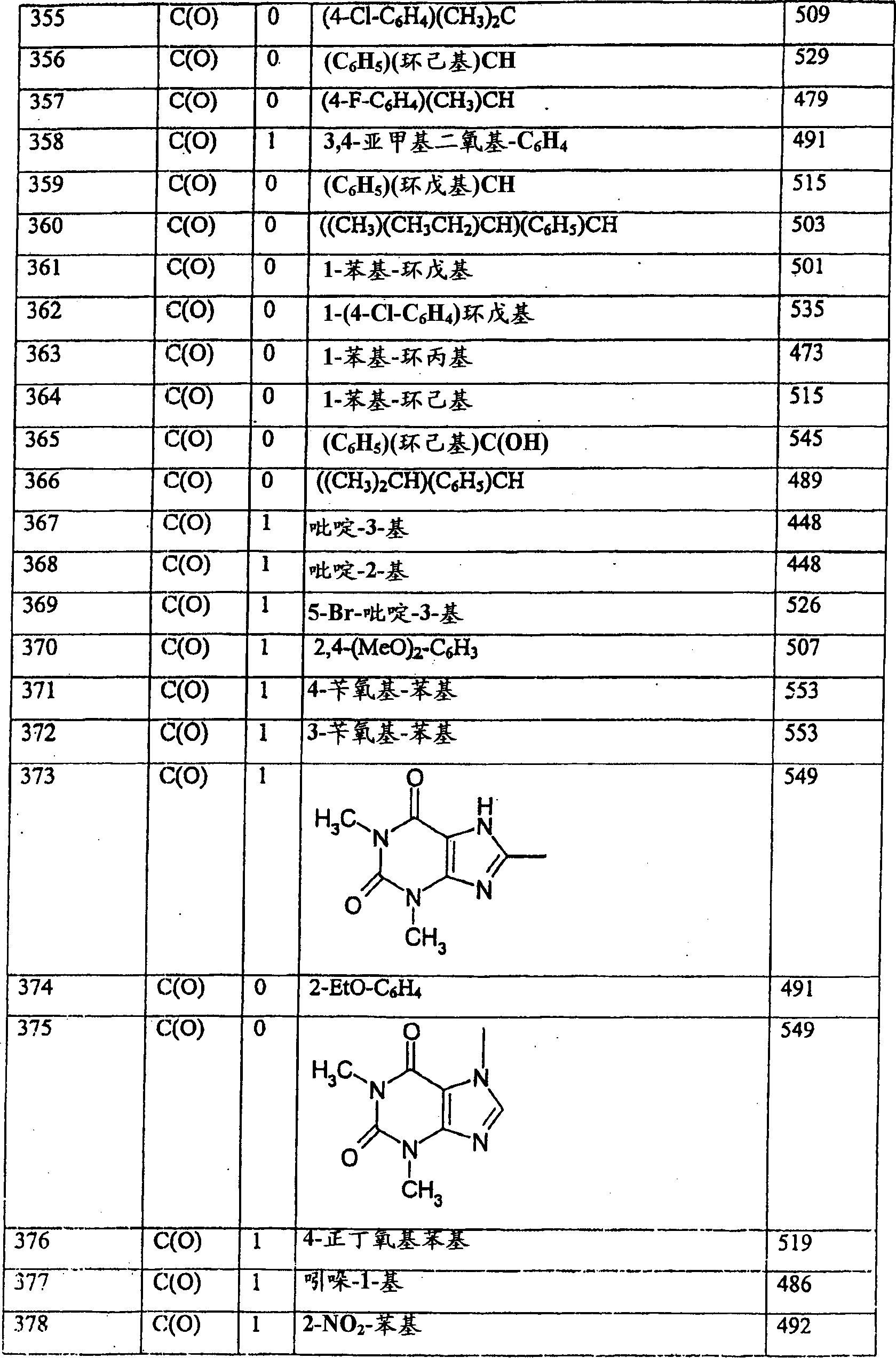


表II 
表III 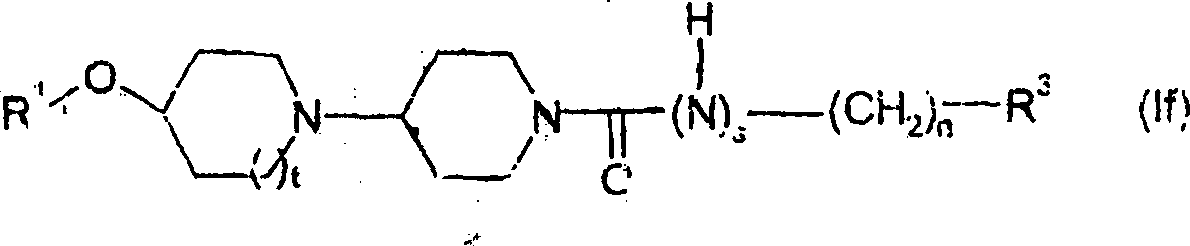
表IV 

表V
一方面,这些病症的实例包括:(1)(呼吸道)导气管的阻塞性疾病包括:肺慢性阻塞性疾病(COPD)(如不可逆性COPD);哮喘{如支气管性、变应性、内因性、外因性或尘埃性哮喘,尤其是慢性或顽固性哮喘(如晚期哮喘或导气管反应过强)};支气管炎{如嗜酸细胞性支气管炎};急性、变应性、萎缩性鼻炎或慢性鼻炎,包括干酪性鼻炎、肥厚性鼻炎、脓性鼻炎、干性鼻炎或药物性鼻炎;膜性鼻炎,包括格鲁布性、纤维蛋白性或假膜性鼻炎或腺病性鼻炎;季节性鼻炎,包括神经性鼻炎(枯草热)或血管舒缩性鼻炎;肉样瘤病;农民肺和相关疾病;鼻息肉病;纤维化肺、特发间质性肺炎,镇咳活性,与导气管炎症有关的慢性咳嗽或者医原性咳嗽的治疗;(2)(骨和关节)关节炎包括风湿性、感染性、自身免疫性、血清反应阴性的脊椎关节炎(包括关节强硬性脊椎炎、牛皮癣性关节炎或Reiter病)、Behcet病、Sjogren综合症和全身性硬化症;(3)(皮肤和眼)牛皮癣、特应性皮炎、接触性皮炎或其它湿疹性皮炎、皮脂溢性皮炎、扁平苔癣、天疱疮、大疱天疱疮、大疱性表皮松解、荨麻疹、干皮病(angiodermas)、脉管炎性红斑、皮肤嗜酸细胞增多、葡萄膜炎、斑秃或春季结膜炎;(4)(胃肠道)腹腔疾病、直肠炎、嗜酸细胞性胃肠炎、肥大细胞增多症、Crohn病、溃疡性结肠炎、应激性肠病或发生在肠外的与食物有 关的变态反应(如偏头痛、鼻炎或湿疹);(5)(同种移植排斥)如肾、心脏、肝、肺、骨髓、皮肤或角膜移植后的急性和慢性同种移植排斥;或者慢性移植物抗宿主病;和/或(6)(其它组织或疾病)Alzheimer病、多发性硬化症、动脉粥样硬化、获得性免疫缺陷综合症(AIDS)、狼疮病(如红斑狼疮或系统性狼疮)、红斑、桥本氏甲状腺炎、重症肌无力、I型糖尿病、肾病综合症、嗜酸细胞增多性筋膜炎、高IgE综合症、麻风病(如结节性麻风)、牙周病、Sezary综合症、特发性血小板减少紫癜或月经周期紊乱。In one aspect, examples of these conditions include: (1) Obstructive diseases of the (respiratory) airways including: chronic obstructive pulmonary disease (COPD) (e.g. irreversible COPD); asthma {e.g. bronchial, allergic, intrinsic , extrinsic or dust-induced asthma, especially chronic or refractory asthma (eg, advanced asthma or airway hyperresponsiveness)}; bronchitis {eg, eosinophilic bronchitis}; acute, allergic, atrophic rhinitis, or Chronic rhinitis, including caseous rhinitis, hypertrophic rhinitis, purulent rhinitis, dry rhinitis, or drug-induced rhinitis; membranous rhinitis, including glubular, fibrinous, or pseudomembranous rhinitis, or adenopathic rhinitis; seasonal Rhinitis, including neurogenic rhinitis (hay fever) or vasomotor rhinitis; sarcoidosis; peasant's lung and related diseases; nasal polyposis; fibrotic lung, idiopathic interstitial pneumonia, antitussive activity, and airway Treatment of inflammation-related chronic cough or iatrogenic cough; (2) (bone and joint) arthritis including rheumatic, infectious, autoimmune, seronegative spondyloarthritis (including ankylosing spondylitis, psoriasis arthritis or Reiter's disease), Behcet's disease, Sjogren's syndrome, and systemic sclerosis; (3) (skin and eye) psoriasis, atopic dermatitis, contact dermatitis or other eczematous dermatitis, seborrheic dermatitis, flat Lichen, pemphigus, pemphigus bullosa, epidermolysis bullosa, urticaria, angiodermas, vasculitic erythema, cutaneous eosinophilia, uveitis, alopecia areata, or vernal conjunctiva (4) (gastrointestinal) celiac disease, proctitis, eosinophilic gastroenteritis, mastocytosis, Crohn's disease, ulcerative colitis, irritable bowel disease or food-related Associated allergic reactions (eg, migraine, rhinitis, or eczema); (5) (allograft rejection) such as acute and chronic allograft rejection following kidney, heart, liver, lung, bone marrow, skin, or corneal transplantation; or Chronic graft-versus-host disease; and/or (6) (other tissue or disease) Alzheimer's disease, multiple sclerosis, atherosclerosis, acquired immunodeficiency syndrome (AIDS), lupus disease (such as lupus erythematosus or systemic lupus), erythema, Hashimoto's thyroiditis, myasthenia gravis, type 1 diabetes mellitus, nephrotic syndrome, eosinophilic fasciitis, hyper-IgE syndrome, leprosy (eg, nodular leprosy), periodontal disease, Sezary syndrome, idiopathic thrombocytopenic purpura, or menstrual cycle disorders.
另一方面,这些病症的实例包括:(1)(呼吸道)导气管的阻塞性疾病包括:肺慢性阻塞性疾病(COPD)(如不可逆性COPD);哮喘{如支气管性、变应性、内因性、外因性或尘埃性哮喘,尤其是慢性或顽固性哮喘(如晚期哮喘或导气管反应过强)};支气管炎{如嗜酸细胞性支气管炎};急性、变应性、萎缩性鼻炎或慢性鼻炎,包括干酪性鼻炎、肥厚性鼻炎、脓性鼻炎、干性鼻炎或药物性鼻炎;膜性鼻炎,包括格鲁布性、纤维蛋白性或假膜性鼻炎或腺病性鼻炎;季节性鼻炎,包括神经性鼻炎(枯草热)或血管舒缩性鼻炎;肉样瘤病;农民肺和相关疾病;鼻息肉病;纤维化肺或特发间质性肺炎;(2)(骨和关节)关节炎包括风湿性、感染性、自身免疫性、血清反应阴性的脊椎关节炎(包括关节强硬性脊椎炎、牛皮癣性关节炎或Reiter病)、Behcet病、Sjogren综合症和全身性硬化症;(3)(皮肤和眼)牛皮癣、特应性皮炎、接触性皮炎或其它湿疹性皮炎、皮脂溢性皮炎、扁平苔癣、天疱疮、大疱天疱疮、大疱性表皮松解、荨麻疹、干皮病(angiodermas)、脉管炎性红斑、皮肤嗜酸细胞增多、葡萄膜炎、斑秃或春季结膜炎;(4)(胃肠道)腹腔疾病、直肠炎、嗜酸细胞性胃肠炎、肥大细胞增多症、Crohn病、溃疡性结肠炎、应激性肠病或发生在肠外的与食物有 关的变态反应(如偏头痛、鼻炎或湿疹);(5)(同种移植排斥)如肾、心脏、肝、肺、骨髓、皮肤或角膜移植后的急性和慢性同种移植排斥;或者慢性移植物抗宿主病;和/或(6)(其它组织或疾病)Alzheimer病、多发性硬化症、动脉粥样硬化、获得性免疫缺陷综合症(AIDS)、狼疮病(如红斑狼疮或系统性狼疮)、红斑、桥本氏甲状腺炎、重症肌无力、I型糖尿病、肾病综合症、嗜酸细胞增多性筋膜炎、高IgE综合症、麻风病(如结节性麻风)、牙周病、Sezary综合症、特发性血小板减少紫癜或月经周期紊乱。On the other hand, examples of these conditions include: (1) Obstructive diseases of the (respiratory) airways including: chronic obstructive pulmonary disease (COPD) (eg, irreversible COPD); asthma {eg, bronchial, allergic, intrinsic asthma, exogenous, or dust-related asthma, especially chronic or refractory asthma (eg, advanced asthma or airway hyperresponsiveness)}; bronchitis {eg, eosinophilic bronchitis}; acute, allergic, atrophic rhinitis or chronic rhinitis, including caseous rhinitis, hypertrophic rhinitis, purulent rhinitis, dry rhinitis, or drug-induced rhinitis; membranous rhinitis, including glubular, fibrinous, or pseudomembranous rhinitis, or adenopathic rhinitis; seasonal rhinitis, including neurogenic rhinitis (hay fever) or vasomotor rhinitis; sarcoidosis; farmer's lung and related diseases; nasal polyposis; fibrotic lung or idiopathic interstitial pneumonia; (2) (bone and Joints) Arthritis includes rheumatic, infectious, autoimmune, seronegative spondyloarthritis (including ankylosing spondylitis, psoriatic arthritis, or Reiter's disease), Behcet's disease, Sjogren's syndrome, and systemic sclerosis (3) (Skin and eye) psoriasis, atopic dermatitis, contact dermatitis or other eczematous dermatitis, seborrheic dermatitis, lichen planus, pemphigus, pemphigus bullous, epidermolysis bullosa , urticaria, angiodermas, vasculitic erythema, skin eosinophilia, uveitis, alopecia areata, or vernal conjunctivitis; (4) (gastrointestinal) celiac disease, proctitis, eosinophilia gastroenteritis, mastocytosis, Crohn's disease, ulcerative colitis, irritable bowel disease, or food-related allergies (such as migraine, rhinitis, or eczema) that occur outside the intestines; (5)( allograft rejection) such as acute and chronic allograft rejection following kidney, heart, liver, lung, bone marrow, skin, or corneal transplantation; or chronic graft-versus-host disease; and/or (6) (other tissue or disease) Alzheimer's disease, multiple sclerosis, atherosclerosis, acquired immunodeficiency syndrome (AIDS), lupus disease (such as lupus erythematosus or systemic lupus), erythema, Hashimoto's thyroiditis, myasthenia gravis, type 1 diabetes , nephrotic syndrome, eosinophilic fasciitis, hyper-IgE syndrome, leprosy (such as nodular leprosy), periodontal disease, Sezary syndrome, idiopathic thrombocytopenic purpura, or menstrual cycle disorders.
再一方面,这些病症的实例包括:(1)(呼吸道)导气管的阻塞性疾病包括:肺慢性阻塞性疾病(COPD)(如不可逆性COPD);哮喘{如支气管性、变应性、内因性、外因性或尘埃性哮喘,尤其是慢性或顽固性哮喘(如晚期哮喘或导气管反应过强)};支气管炎{如嗜酸细胞性支气管炎};急性、变应性、萎缩性鼻炎或慢性鼻炎,包括干酪性鼻炎、肥厚性鼻炎、脓性鼻炎、干性鼻炎或药物性鼻炎;膜性鼻炎,包括格鲁布性、纤维蛋白性或假膜性鼻炎或腺病性鼻炎;季节性鼻炎,包括神经性鼻炎(枯草热)或血管舒缩性鼻炎;肉样瘤病;农民肺和相关疾病;鼻息肉病;纤维化肺或特发间质性肺炎;(2)(骨和关节)关节炎包括风湿性、感染性、自身免疫性、血清反应阴性的脊椎关节炎(包括关节强硬性脊椎炎、牛皮癣性关节炎或Reiter病)、Behcet病、Sjogren综合症和全身性硬化症;(3)(皮肤和眼)牛皮癣、特应性皮炎、接触性皮炎或其它湿疹性皮炎、皮脂溢性皮炎、扁平苔癣、天疱疮、大疱天疱疮、大疱性表皮松解、荨麻疹、干皮病(angiodermas)、脉管炎性红斑、皮肤嗜酸细胞增多、葡萄膜炎、斑秃或春季结膜炎;(4)(胃肠道)腹腔疾病、直肠炎、嗜酸细胞性胃肠炎、肥大细胞增多症、Crohn病、溃疡性结肠炎、应激性肠病或发生在肠外的与食物有 关的变态反应(如偏头痛、鼻炎或湿疹);(5)(同种移植排斥)如肾、心脏、肝、肺、骨髓、皮肤或角膜移植后的急性和慢性同种移植排斥;或者慢性移植物抗宿主病;和/或(6)(其它组织或疾病)Alzheimer病、多发性硬化症、动脉粥样硬化、狼疮病(如红斑狼疮或系统性狼疮)、红斑、桥本氏甲状腺炎、重症肌无力、I型糖尿病、肾病综合症、嗜酸细胞增多性筋膜炎、高IgE综合症、麻风病(如结节性麻风)、牙周病、Sezary综合症、特发性血小板减少紫癜或月经周期紊乱。In another aspect, examples of these conditions include: (1) Obstructive diseases of the (respiratory) airways including: chronic obstructive pulmonary disease (COPD) (such as irreversible COPD); asthma {such as bronchial, allergic, intrinsic asthma, exogenous, or dust-related asthma, especially chronic or refractory asthma (eg, advanced asthma or airway hyperresponsiveness)}; bronchitis {eg, eosinophilic bronchitis}; acute, allergic, atrophic rhinitis or chronic rhinitis, including caseous rhinitis, hypertrophic rhinitis, purulent rhinitis, dry rhinitis, or drug-induced rhinitis; membranous rhinitis, including glubular, fibrinous, or pseudomembranous rhinitis, or adenopathic rhinitis; seasonal rhinitis, including neurogenic rhinitis (hay fever) or vasomotor rhinitis; sarcoidosis; farmer's lung and related diseases; nasal polyposis; fibrotic lung or idiopathic interstitial pneumonia; (2) (bone and Joints) Arthritis includes rheumatic, infectious, autoimmune, seronegative spondyloarthritis (including ankylosing spondylitis, psoriatic arthritis, or Reiter's disease), Behcet's disease, Sjogren's syndrome, and systemic sclerosis (3) (Skin and eye) psoriasis, atopic dermatitis, contact dermatitis or other eczematous dermatitis, seborrheic dermatitis, lichen planus, pemphigus, pemphigus bullous, epidermolysis bullosa , urticaria, angiodermas, vasculitic erythema, skin eosinophilia, uveitis, alopecia areata, or vernal conjunctivitis; (4) (gastrointestinal) celiac disease, proctitis, eosinophilia gastroenteritis, mastocytosis, Crohn's disease, ulcerative colitis, irritable bowel disease, or food-related allergies (such as migraine, rhinitis, or eczema) that occur outside the intestines; (5)( allograft rejection) such as acute and chronic allograft rejection following kidney, heart, liver, lung, bone marrow, skin, or corneal transplantation; or chronic graft-versus-host disease; and/or (6) (other tissue or disease) Alzheimer's disease, multiple sclerosis, atherosclerosis, lupus disease (such as lupus erythematosus or systemic lupus), erythema, Hashimoto's thyroiditis, myasthenia gravis, type 1 diabetes mellitus, nephrotic syndrome, eosinophilia Fasciitis, hyper-IgE syndrome, leprosy (eg, nodular leprosy), periodontal disease, Sezary syndrome, idiopathic thrombocytopenic purpura, or menstrual cycle disturbances.
式(I)(按本文中任一处定义)、(I’)、(Ia”)、(Ia)、(Ia’)、(Ib)、(Ic)、(Id)、(Ie)、(If)或(Ig)化合物或其药学上可接受的盐或其溶剂合物还是H1拮抗剂,可用于治疗变应性疾病。Formula (I) (as defined anywhere herein), (I'), (Ia"), (Ia), (Ia'), (Ib), (Ic), (Id), (Ie), ( The compound of If) or (Ig) or a pharmaceutically acceptable salt or solvate thereof is also an H1 antagonist and is useful for the treatment of allergic diseases.
还可用式(I)(按本文中任一处定义)、(I’)、(Ia”)、(Ia)、(Ia’)、(Ib)、(Ic)、(Id)、(Ie)、(If)或(Ig)化合物或其药学上可接受的盐或其溶剂合物控制一般称为感冒的迹象和/或症状(例如一般感冒或流感或者其它与呼吸道病毒感染相关的迹象和/或症状)。Also available are formulas (I) (as defined anywhere herein), (I'), (Ia"), (Ia), (Ia'), (Ib), (Ic), (Id), (Ie) , (If) or (Ig) compounds or pharmaceutically acceptable salts or solvates thereof to control signs and/or symptoms commonly referred to as colds (such as the common cold or flu or other signs and/or symptoms associated with respiratory viral infections or symptoms).
因此,本发明另一方面提供式(I)(按本文中任一处定义)、(I’)、(Ia”)、(Ia)、(Ia’)、(Ib)、(Ic)、(Id)、(Ie)、(If)或(Ig)的化合物或其药学上可接受的盐或其溶剂合物,它们既是趋化因子受体(尤其是CCR3)活性的调节剂又是H1拮抗剂。Accordingly, another aspect of the invention provides formula (I) (as defined anywhere herein), (I'), (Ia"), (Ia), (Ia'), (Ib), (Ic), ( Compounds of Id), (Ie), (If) or (Ig), or pharmaceutically acceptable salts or solvates thereof, which are both modulators of chemokine receptor (especially CCR3) activity and H1 antagonists agent.
本发明另一方面提供式(I)(按本文中任一处定义)、(I’)、(Ia”)、(Ia)、(Ia’)、(Ib)、(Ic)、(Id)、(Ie)、(If)或(Ig)化合物或其药学上可接受的盐或其溶剂合物,它们通过治疗(包括预防)用于处理温血动物(如人)的方法中。Another aspect of the invention provides formula (I) (as defined anywhere herein), (I'), (Ia"), (Ia), (Ia'), (Ib), (Ic), (Id) , (Ie), (If) or (Ig) compound or a pharmaceutically acceptable salt or solvate thereof for use in a method of treatment (including prophylaxis) of a warm-blooded animal such as a human.
本发明另一方面提供一种调节需要此种处理的温血动物(如人)的趋化因子受体活性(尤其是CCR3受体活性)的方法,该方法包括给予该动物有效量的式(I)(按本文中任一处定义)、(I’)、(Ia”)、(Ia)、(Ia’)、(Ib)、(Ic)、(Id)、(Ie)、(If)或(Ig)的化合物或其药学上可接受的盐或其溶剂合物。Another aspect of the present invention provides a method of modulating chemokine receptor activity (especially CCR3 receptor activity) in a warm-blooded animal (such as a human) in need of such treatment, the method comprising administering to the animal an effective amount of the formula ( I) (as defined anywhere herein), (I'), (Ia"), (Ia), (Ia'), (Ib), (Ic), (Id), (Ie), (If) or the compound of (Ig) or a pharmaceutically acceptable salt or a solvate thereof.
本发明另一方面提供一种拮抗需要此种处理的温血动物(如人)的H1的方法,该方法包括给予该动物有效量的式(I)(按本文中任一处定义)、(I’)、(Ia”)、(Ia)、(Ia’)、(Ib)、(Ic)、(Id)、(Ie)、(If)或(Ig)的化合物或其药学上可接受的盐或其溶剂合物。Another aspect of the present invention provides a method of antagonizing H1 in a warm-blooded animal (such as a human) in need of such treatment, the method comprising administering to the animal an effective amount of formula (I) (as defined herein), ( A compound of I'), (Ia"), (Ia), (Ia'), (Ib), (Ic), (Id), (Ie), (If) or (Ig) or a pharmaceutically acceptable salt or its solvate.
本发明还提供式(I)(按本文中任一处定义)、(I’)、(Ia”)、(Ia)、(Ia’)、(Ib)、(Ic)、(Id)、(Ie)、(If)或(Ig)的化合物或其药学上可接受的盐或其溶剂合物,它们用作药物。The present invention also provides formulas (I) (as defined anywhere herein), (I'), (Ia"), (Ia), (Ia'), (Ib), (Ic), (Id), ( A compound of Ie), (If) or (Ig) or a pharmaceutically acceptable salt or solvate thereof for use as a medicament.
另一方面,本发明提供式(I)(按本文中任一处定义)、(I’)、(Ia”)、(Ia)、(Ia’)、(Ib)、(Ic)、(Id)、(Ie)、(If)或(Ig)的化合物或其药学上可接受的盐或其溶剂合物在制备用于治疗(如调节温血动物(如人)的趋化因子受体活性(尤其是CCR3受体活性)或拮抗H1,或两者)的药物中的用途。In another aspect, the invention provides formula (I) (as defined anywhere herein), (I'), (Ia"), (Ia), (Ia'), (Ib), (Ic), (Id ), (Ie), (If) or (Ig) compounds or pharmaceutically acceptable salts or solvates thereof in the preparation of chemokine receptor activity for treatment (such as regulating warm-blooded animals (such as humans) (especially CCR3 receptor activity) or antagonize H1, or both).
另一方面,本发明提供式(I)化合物或其药学上可接受的盐或其溶剂合物在制备用于治疗(如调节温血动物(如人)的趋化因子受体活性(尤其是CCR3受体活性)或拮抗H1,或两者)的药物中的用途,式(I)中:q、s和t独立是0或1;n和r独立是0、1、2、3、4或5;m和p独立是0、1或2;X是CH2、C(O)、O、S、S(O)、S(O)2或NR37;Y是NHR2或OH;T是C(O)、C(S)、S(O)2或CH2;R1是氢、C1-6烷基、芳基或杂环基;R2和R47独立是氢、C1-6烷基、芳基(C1-4)烷基或CO(C1-6烷基);R3是C1-6烷基{任选被卤素、CO2R4或苯邻二甲酰亚胺取代}、C3-7环烷基{任选被C1-4烷基或氧代基取代}、C3-7环烯基{任选被氧代基、C1-6烷基或芳基取代}、芳基或杂环基;其中除另有说明外,以上的芳基和杂环基部分任选被以下取代基取代:卤素、OH、SH、NO2、氧代基、C1-6烷基(本身任选被卤素、OC(O)C1-6烷基、S(O)2R48、苯基(本身任选被卤素(如一或两个氯或氟原子)、C1-6烷基、S(O)2R38或C(O)NR39R40取代)、萘氧基(本身任选被卤素或C2-6链烯基取代)、C3-10环烷基(本身任选被C1-4烷基或氧代基取代)或NR41C(O)OCH2(芴-9-基)取代)、NR41C(O)OCH2(芴-9-基)、C1-6烷氧基(本身任选被卤素、C1-6烷氧基、NHCO2(C1-6烷基)、CO2R4、NR5R6或苯基(本身任选被卤素或NO2取代)取代)、C1-6烷硫基、C1-6卤代烷硫基、C3-10环烷基、NR7R8、NR9C(O)R10、CO2R11、C(O)NR12R13、C(O)R14、S(O)dR15、S(O)2NR42R43、NR44S(O)2R45、苯基(本身任选被卤素、C1-6烷基、C1-6卤代烷基、CN、NO2或C1-6烷氧基(本身任选被卤素、OH或吡啶基取代)取代)、杂环基(本身任选被卤素、C1-6烷基、C1-6卤代烷基、CN、NO2、C1-6烷氧基或C1-6卤代烷氧基取代)、苯氧基(本身任选被卤素、C1-6烷基、C1-6卤代烷基、CN、NO2、C1-6烷氧基或C1-6卤代烷氧基取代)、SCN、CN、SO3H(或其碱金属盐)或亚甲基二氧基;当芳基是苯基时,邻近的取代基可与其相连的该苯环一起连接形成二氢菲部分;d是0、1或2;R4、R5、R6、R7、R8、R9、R10、R11、R12、R13、R14、R37、R39、R40、R41、R42、R43和R44独立是氢、C1-6烷基或芳基(本身任选被卤素、C1-6烷基、C1-6卤代烷基、CN、NO2、C1-6烷氧基或C1-6卤代烷氧基取代);R15、R38、R45和R48独立是C1-6烷基(任选被卤素、羟基或C3-10环烷基取代)或芳基(本身任选被卤素、C1-6烷基、C1-6卤代烷基、CN、NO2、C1-6烷氧基或C1-6卤代烷氧基取代)。In another aspect, the present invention provides a compound of formula (I) or a pharmaceutically acceptable salt or a solvate thereof in the preparation for treatment (such as modulating chemokine receptor activity of a warm-blooded animal (such as human) (especially CCR3 receptor activity) or antagonizing H1, or both), in formula (I): q, s and t are independently 0 or 1; n and r are independently 0, 1, 2, 3, 4 or 5; m and p are independently 0, 1 or 2; X is CH 2 , C(O), O, S, S(O), S(O) 2 or NR 37 ; Y is NHR 2 or OH; T is C(O), C(S), S(O) 2 or CH 2 ; R 1 is hydrogen, C 1-6 alkyl, aryl or heterocyclyl; R 2 and R 47 are independently hydrogen, C 1 -6 alkyl, aryl (C 1-4 ) alkyl or CO (C 1-6 alkyl); R 3 is C 1-6 alkyl {optionally replaced by halogen, CO 2 R 4 or phthalo Imide substituted}, C 3-7 cycloalkyl {optionally substituted by C 1-4 alkyl or oxo group}, C 3-7 cycloalkenyl {optionally substituted by oxo, C 1-6 alkane substituted by aryl or aryl}, aryl or heterocyclyl; where, unless otherwise stated, the above aryl and heterocyclyl moieties are optionally substituted by the following substituents: halogen, OH, SH, NO 2 , oxo , C 1-6 alkyl (optionally halogenated itself, OC(O)C 1-6 alkyl, S(O) 2 R 48 , phenyl (optionally halogenated itself (such as one or two chlorine or fluorine atoms ), C 1-6 alkyl, S(O) 2 R 38 or C(O)NR 39 R 40 substituted), naphthyloxy (itself optionally substituted by halogen or C 2-6 alkenyl), C 3 -10 cycloalkyl (itself optionally substituted by C 1-4 alkyl or oxo) or NR 41 C(O)OCH 2 (fluoren-9-yl) substituted), NR 41 C(O)OCH 2 ( Fluoren-9-yl), C 1-6 alkoxy (itself optionally replaced by halogen, C 1-6 alkoxy, NHCO 2 (C 1-6 alkyl), CO 2 R 4 , NR 5 R 6 or Phenyl (itself optionally substituted by halogen or NO 2 substituted), C 1-6 alkylthio, C 1-6 haloalkylthio, C 3-10 cycloalkyl, NR 7 R 8 , NR 9 C(O )R 10 , CO 2 R 11 , C(O)NR 12 R 13 , C(O)R 14 , S(O) d R 15 , S(O) 2 NR 42 R 43 , NR 44 S(O) 2 R 45 , phenyl (which itself is optionally substituted by halogen, C 1-6 alkyl, C 1-6 haloalkyl, CN, NO 2 or C 1-6 alkoxy (which itself is optionally substituted by halogen, OH or pyridyl) ) substituted), heterocyclyl (itself optionally substituted by halogen, C 1-6 alkyl, C 1-6 haloalkyl, CN, NO 2 , C 1-6 alkoxy or C 1-6 haloalkoxy) , phenoxy (itself optionally substituted by halogen, C 1-6 alkyl, C 1-6 haloalkyl, CN, NO 2 , C 1-6 alkoxy or C 1-6 haloalkoxy), SCN, CN, SO 3 H (or its alkali metal salt) or methylenedioxy; when aryl is phenyl, adjacent substituents can be linked together with the phenyl ring to which it is attached to form a dihydrophenanthrene moiety; d is 0 , 1 or 2; R 4 , R 5 , R 6 , R 7 , R 8 , R 9 , R 10 , R 11 , R 12 , R 13 , R 14 , R 37 , R 39 , R 40 , R 41 , R 42 , R 43 and R 44 are independently hydrogen, C 1-6 alkyl or aryl (which itself is optionally replaced by halogen, C 1-6 alkyl, C 1-6 haloalkyl, CN, NO 2 , C 1- 6 alkoxy or C 1-6 haloalkoxy substituted); R 15 , R 38 , R 45 and R 48 are independently C 1-6 alkyl (optionally substituted by halogen, hydroxyl or C 3-10 cycloalkyl ) or aryl (itself optionally substituted by halogen, C 1-6 alkyl, C 1-6 haloalkyl, CN, NO 2 , C 1-6 alkoxy or C 1-6 haloalkoxy).
另一方面,本发明提供式(I’)化合物或其药学上可接受的盐或其溶剂合物在制备用于治疗(如调节温血动物(如人)的趋化因子受体活性(尤其是CCR3受体活性))的药物中的用途,
本发明还提供式(I)(按本文中任一处定义)、(I’)、(Ia”)、(Ia)、(Ia’)、(Ib)、(Ic)、(Id)、(Ie)、(If)或(Ig)的化合物或其药学上可接受的盐在制备用于治疗温血动物(如人)的以下疾病的药物中的用途,(1)(呼吸道)导气管的阻塞性疾病包括:肺慢性阻塞性疾病(COPD)(如不可逆性COPD);哮喘{如支气管性、变应性、内因性、外因性或尘埃性哮喘,尤其是慢性或顽固性哮喘(如晚期哮喘或导气管反应过强)};支气管炎{如嗜酸细胞性支气管炎};急性、变应性、 萎缩性鼻炎或慢性鼻炎,包括干酪性鼻炎、肥厚性鼻炎、脓性鼻炎、干性鼻炎或药物性鼻炎;膜性鼻炎,包括格鲁布性、纤维蛋白性或假膜性鼻炎或腺病性鼻炎;季节性鼻炎,包括神经性鼻炎(枯草热)或血管舒缩性鼻炎;肉样瘤病;农民肺和相关疾病;鼻息肉病;纤维化肺、特发间质性肺炎,镇咳活性,与导气管炎症有关的慢性咳嗽或者医原性咳嗽的治疗;(2)(骨和关节)关节炎包括风湿性、感染性、自身免疫性、血清反应阴性的脊椎关节炎(包括关节强硬性脊椎炎、牛皮癣性关节炎或Reiter病)、Behcet病、Sjogren综合症和全身性硬化症;(3)(皮肤和眼)牛皮癣、特应性皮炎、接触性皮炎或其它湿疹性皮炎、皮脂溢性皮炎、扁平苔癣、天疱疮、大疱天疱疮、大疱性表皮松解、荨麻疹、干皮病(angiodermas)、脉管炎性红斑、皮肤嗜酸细胞增多、葡萄膜炎、斑秃或春季结膜炎;(4)(胃肠道)腹腔疾病、直肠炎、嗜酸细胞性胃肠炎、肥大细胞增多症、Crohn病、溃疡性结肠炎、应激性肠病或发生在肠外的与食物有关的变态反应(如偏头痛、鼻炎或湿疹);(5)(同种移植排斥)如肾、心脏、肝、肺、骨髓、皮肤或角膜移植后的急性和慢性同种移植排斥;或者慢性移植物抗宿主病;和/或(6)(其它组织或疾病)Alzheimer病、多发性硬化症、动脉粥样硬化、获得性免疫缺陷综合症(AIDS)、狼疮病(如红斑狼疮或系统性狼疮)、红斑、桥本氏甲状腺炎、重症肌无力、I型糖尿病、肾病综合症、嗜酸细胞增多性筋膜炎、高IgE综合症、麻风病(如结节性麻风)、牙周病、Sezary综合症、特发性血小板减少紫癜或月经周期紊乱。The present invention also provides formulas (I) (as defined anywhere herein), (I'), (Ia"), (Ia), (Ia'), (Ib), (Ic), (Id), ( Use of a compound of Ie), (If) or (Ig) or a pharmaceutically acceptable salt thereof in the preparation of a medicament for the treatment of the following diseases in warm-blooded animals (such as humans), (1) (respiratory) airway Obstructive diseases include: chronic obstructive pulmonary disease (COPD) (eg, irreversible COPD); asthma {eg, bronchial, allergic, intrinsic, extrinsic, or dust-induced asthma, especially chronic or refractory asthma (eg, advanced asthma or airway hyperreactivity)}; bronchitis {eg, eosinophilic bronchitis}; acute, allergic, atrophic, or chronic rhinitis, including caseous rhinitis, hypertrophic rhinitis, purulent rhinitis, dry rhinitis Rhinitis or drug-induced rhinitis; membranous rhinitis, including Gruberian, fibrinous, or pseudomembranous rhinitis, or adenopathic rhinitis; seasonal rhinitis, including neurological rhinitis (hay fever) or vasomotor rhinitis; meat Peasant's lung and related diseases; Nasal polyposis; Fibrotic lung, idiopathic interstitial pneumonia, antitussive activity, treatment of chronic or iatrogenic cough associated with airway inflammation; (2) (bone and joints) Arthritis includes rheumatic, infectious, autoimmune, seronegative spondyloarthritis (including ankylosing spondylitis, psoriatic arthritis, or Reiter's disease), Behcet's disease, Sjogren's syndrome, and systemic sclerosis (3) (skin and eye) psoriasis, atopic dermatitis, contact dermatitis or other eczematous dermatitis, seborrheic dermatitis, lichen planus, pemphigus, pemphigus bullosa, epidermosol bullosa (4) (gastrointestinal) celiac disease, proctitis, eosinophilia Cellular gastroenteritis, mastocytosis, Crohn's disease, ulcerative colitis, irritable bowel disease, or food-related allergies (eg, migraine, rhinitis, or eczema) that occur parenterally; (5)( allograft rejection) such as acute and chronic allograft rejection following kidney, heart, liver, lung, bone marrow, skin, or corneal transplantation; or chronic graft-versus-host disease; and/or (6) (other tissue or disease) Alzheimer's disease, multiple sclerosis, atherosclerosis, acquired immunodeficiency syndrome (AIDS), lupus disease (such as lupus erythematosus or systemic lupus), erythema, Hashimoto's thyroiditis, myasthenia gravis, type 1 diabetes , nephrotic syndrome, eosinophilic fasciitis, hyper-IgE syndrome, leprosy (such as nodular leprosy), periodontal disease, Sezary syndrome, idiopathic thrombocytopenic purpura, or menstrual cycle disorders.
另一方面,式(I)(按本文中任一处定义)、(I’)、(Ia”)、(Ia)、(Ia’)、(Ib)、(Ic)、(Id)、(Ie)、(If)或(Ig)化合物或其药学上可接受的盐在治疗哮喘{如支气管性、变应性、内因性、外因性或尘埃性哮喘,尤其是慢性或顽固性哮喘(如晚期哮喘或导气管反应过强)};或鼻炎{急性、变应性、萎缩性或慢性鼻炎,如干酪性鼻炎、肥厚性鼻炎、脓性鼻炎、干性鼻炎或药物性鼻炎;膜性鼻炎,包括格鲁布性、纤维蛋白性或假膜性鼻炎或腺病性鼻炎;季节性鼻炎,包括神经性鼻炎(枯草热)或血管舒缩性鼻炎}中是有用的。In another aspect, formula (I) (as defined anywhere herein), (I'), (Ia"), (Ia), (Ia'), (Ib), (Ic), (Id), ( Ie), (If) or (Ig) compounds or pharmaceutically acceptable salts thereof are useful in the treatment of asthma {such as bronchial, allergic, intrinsic, exogenous or dust asthma, especially chronic or intractable asthma (such as advanced asthma or airway hyperreactivity)}; or rhinitis {acute, allergic, atrophic, or chronic rhinitis, such as caseous rhinitis, hypertrophic rhinitis, purulent rhinitis, dry rhinitis, or drug-induced rhinitis; membranous rhinitis , including Grubb's, fibrinous, or pseudomembranous rhinitis or adenopathic rhinitis; seasonal rhinitis, including neurological rhinitis (hay fever) or vasomotor rhinitis} are useful.
另一方面,式(I)(按本文中任一处定义)、(I’)、(Ia”)、(Ia)、(Ia’)、(Ib)、(Ic)、(Id)、(Ie)、(If)或(Ig)化合物或其药学上可接受的盐在治疗哮喘中是有用的。In another aspect, formula (I) (as defined anywhere herein), (I'), (Ia"), (Ia), (Ia'), (Ib), (Ic), (Id), ( Ie), (If) or (Ig) compounds, or pharmaceutically acceptable salts thereof, are useful in the treatment of asthma.
本发明还提供式(I)(按本文中任一处定义)、(I’)、(Ia”)、(Ia)、(Ia’)、(Ib)、(Ic)、(Id)、(Ie)、(If)或(Ig)化合物或其药学上可接受的盐在制备用于治疗一般称为感冒的迹象和/或症状(例如一般感冒或流感或者其它与呼吸道病毒感染相关的迹象和/或症状)的药物中的用途。The present invention also provides formulas (I) (as defined anywhere herein), (I'), (Ia"), (Ia), (Ia'), (Ib), (Ic), (Id), ( Ie), (If) or (Ig) compounds or pharmaceutically acceptable salts thereof in the preparation for the treatment of signs and/or symptoms commonly known as colds (such as the common cold or flu or other signs and symptoms associated with respiratory viral infections and/or symptoms).
本发明还提供式(I)(按本文中任一处定义)、(I’)、(Ia”)、(Ia)、(Ia’)、(Ib)、(Ic)、(Id)、(Ie)、(If)或(Ig)化合物或其药学上可接受的盐在制备用于治疗哮喘和鼻炎的药物中的用途。The present invention also provides formulas (I) (as defined anywhere herein), (I'), (Ia"), (Ia), (Ia'), (Ib), (Ic), (Id), ( Use of Ie), (If) or (Ig) compound or a pharmaceutically acceptable salt thereof in the preparation of a medicament for treating asthma and rhinitis.
本发明还提供一种治疗温血动物(如人)的趋化因子介导的疾病状态(尤其是CCR3介导的疾病状态,特别是哮喘)或H1介导的疾病状态(如变应性疾病)的方法,该方法包括给予需要此种治疗的哺乳动物有效量的式(I)、(I’)、(Ia”)、(Ia)、(Ia’)、(Ib)、(Ic)、(Id)、(Ie)、(If)或(Ig)化合物或其药学上可接受的盐或其溶剂合物。The present invention also provides a method for treating chemokine-mediated disease states (especially CCR3-mediated disease states, especially asthma) or H1-mediated disease states (such as allergic diseases) in warm-blooded animals (such as humans). ) method comprising administering to a mammal in need of such treatment an effective amount of formula (I), (I'), (Ia"), (Ia), (Ia'), (Ib), (Ic), (Id), (Ie), (If) or (Ig) compound or a pharmaceutically acceptable salt or solvate thereof.
本发明还提供一种治疗温血动物(如人)的感冒迹象和/或症状(例如一般感冒或流感或者其它与呼吸道病毒感染相关的迹象和/或症状)的方法,该方法包括给予需要此种治疗的哺乳动物有效量的式(I)、(I’)、(Ia”)、(Ia)、(Ia’)、(Ib)、(Ic)、(Id)、(Ie)、(If)或(Ig)化合物或其药学上可接受的盐或其溶剂合物。The present invention also provides a method of treating signs and/or symptoms of a cold (such as the common cold or flu or other signs and/or symptoms associated with respiratory viral infections) in a warm-blooded animal (such as a human), comprising administering Formula (I), (I'), (Ia"), (Ia), (Ia'), (Ib), (Ic), (Id), (Ie), (If ) or (Ig) the compound or a pharmaceutically acceptable salt or solvate thereof.
为了将本发明化合物或其药学上可接受的盐或其溶剂合物用于治疗温血动物(如人),尤其是调节趋化因子受体(如CCR3受体)活性或拮抗H1,一般可根据标准制药技术,将该组分制成药用组合物。In order to use the compounds of the present invention or pharmaceutically acceptable salts or solvates thereof for the treatment of warm-blooded animals (such as humans), especially for modulating the activity of chemokine receptors (such as CCR3 receptors) or antagonizing H1, generally The components are formulated into pharmaceutical compositions according to standard pharmaceutical techniques.
本发明还提供一种治疗温血动物(如人)的趋化因子介导的疾病状态(尤其是CCR3介导的疾病状态,特别是哮喘)的方法,该方法包括给予需要此种治疗的哺乳动物有效量的式(I)、(I’)、(Ia”)、(Ia)、(Ia’)、(Ib)、(Ic)、(Id)、(Ie)、(If)或(Ig)化合物或其药学上可接受的盐或其溶剂合物。The present invention also provides a method of treating a chemokine-mediated disease state (especially a CCR3-mediated disease state, especially asthma) in a warm-blooded animal (such as a human), which method comprises administering An animal effective amount of formula (I), (I'), (Ia"), (Ia), (Ia'), (Ib), (Ic), (Id), (Ie), (If) or (Ig ) compound or a pharmaceutically acceptable salt or solvate thereof.
为了将本发明化合物或其药学上可接受的盐或其溶剂合物用于治疗温血动物(如人),尤其是调节趋化因子受体(如CCR3受体)活性,一般可根据标准制药技术,将该组分制成药用组合物。In order to use the compounds of the present invention or pharmaceutically acceptable salts or solvates thereof for the treatment of warm-blooded animals (such as humans), especially for modulating the activity of chemokine receptors (such as CCR3 receptors), generally according to standard pharmaceutical Technology, the components are made into pharmaceutical compositions.
因此,在另一方面,本发明提供一种药用组合物,它包含式(I)、(I’)、(Ia”)、(Ia)、(Ia’)、(Ib)、(Ic)、(Id)、(Ie)、(If)或(Ig)化合物或其药学上可接受的盐或其溶剂合物(活性组分),以及药学上可接受的辅剂、稀释剂或载体。另一方面,本发明提供制备该组合物的方法,它包括将活性组分与药学上可接受的辅剂、稀释剂或载体相混合。根据给药方式不同,优选该药用组合物包含0.05-99%w(重量比),更优选0.05-80%w,更加优选0.10-70%w,更加优选0.10-50%w的活性组分,所有重量百分比以总组合物的量为基础计。Therefore, in another aspect, the present invention provides a pharmaceutical composition comprising formula (I), (I'), (Ia"), (Ia), (Ia'), (Ib), (Ic) , (Id), (Ie), (If) or (Ig) compound or a pharmaceutically acceptable salt or solvate thereof (active ingredient), and a pharmaceutically acceptable adjuvant, diluent or carrier. On the other hand, the present invention provides a method for preparing the composition, which includes mixing the active ingredient with a pharmaceutically acceptable adjuvant, diluent or carrier. According to different administration methods, it is preferred that the pharmaceutical composition contains 0.05 - 99%w (by weight), more preferably 0.05-80%w, still more preferably 0.10-70%w, still more preferably 0.10-50%w of active ingredient, all percentages by weight are based on the amount of the total composition.
本发明药用组合物可以标准方式进行给药,以治疗需要治疗的疾病状态,如以局部(如给予肺和/或导气管或者皮肤)、口服、直肠或非肠道途径给予。为达到这些目的,可用本领域已知的方法将本发明化合物制成如气雾剂、干粉末制剂、片剂、胶囊剂、糖浆剂、粉末剂、颗粒剂、水性或油性溶液或悬浮液、(脂质)乳剂、分散性粉末剂、栓剂、软膏剂、霜剂、滴剂以及无菌注射水性或油性溶液或悬浮液。The pharmaceutical compositions of this invention may be administered in standard manner to treat the condition in need of treatment, eg topically (eg to the lungs and/or airways or to the skin), orally, rectally or parenterally. To achieve these purposes, the compounds of the present invention can be formulated into aerosols, dry powder formulations, tablets, capsules, syrups, powders, granules, aqueous or oily solutions or suspensions, etc., by methods known in the art. (Lipid) emulsions, dispersible powders, suppositories, ointments, creams, drops, and sterile injectable aqueous or oily solutions or suspensions.
一种本发明适当的药用组合物是适于口服给药的单位剂型,如包含0.1mg至1g活性组分的片剂或胶囊剂。A suitable pharmaceutical composition of the invention is a unit dosage form suitable for oral administration, such as a tablet or capsule containing 0.1 mg to 1 g of active ingredient.
另一方面,本发明的药用组合物是适于静脉内、皮下或肌内注射的组合物。In another aspect, the pharmaceutical composition of the present invention is a composition suitable for intravenous, subcutaneous or intramuscular injection.
每名患者可接受如静脉内、皮下或肌内的本发明化合物的剂量为0.01-100mgkg-1,优选为0.1-20mgkg-1,该组合物每日分1-4次给予。该静脉内、皮下和肌内的剂量可通过大剂量注射方式给予。或者,静脉内剂量可通过一段时间内的连续输注给予。或者,各患者可接受约相当于每日非肠道剂量的日口服剂量,该组合物每日分1-4次给予。Each patient can receive 0.01-100 mgkg -1 , preferably 0.1-20 mgkg -1 of the compound of the present invention, such as intravenously, subcutaneously or intramuscularly, and the composition is administered 1-4 times a day. The intravenous, subcutaneous and intramuscular doses can be given by bolus injection. Alternatively, intravenous doses may be given by continuous infusion over a period of time. Alternatively, each patient may receive a daily oral dose approximately equivalent to the daily parenteral dose, the composition being administered in 1-4 divided doses per day.
以下说明在人体中治疗或预防使用的、含式(I)、(I’)、(Ia”)、(Ia)、(Ia’)、(Ib)、(Ic)、(Id)、(Ie)、(If)或(Ig)的化合物或其药学上可接受的盐(以下称为化合物X)的代表性药用剂型:(a)
可使用缓冲液、药学上可接受的共溶剂(如聚乙二醇、聚丙二醇、甘油或乙醇)或者络合剂(如羟丙基β-环糊精)帮助配制。Formulation can be aided by the use of buffers, pharmaceutically acceptable co-solvents such as polyethylene glycol, polypropylene glycol, glycerol or ethanol, or complexing agents such as hydroxypropyl beta-cyclodextrin.
以上制剂可通过药学领域熟知的常规方法获得。可通过常用的方法对片剂(a)-(c)包肠溶衣,如提供乙酸-邻苯二甲酸纤维素包衣。The above preparations can be obtained by conventional methods well known in the field of pharmacy. Tablets (a)-(c) may be enteric-coated by conventional methods, such as providing a cellulose acetate-phthalate coating.
现通过以下非限定实施例说明本发明,其中,除另有说明外:(i)当给出1H NMR数据时,其为引用值,并且是主要特征质子的δ值形式,以相对于内标四甲基硅烷(TMS)的百万分数(ppm)给出,除另有说明外,在300MHz或400MHz下,采用全氘DMSO-D6(CD3SOCD3)或CDCl3作为溶剂进行测定。(ii)质谱(MS)采用直接暴露电极,以化学电离(CI)方式,使用70电子伏特的电能进行;其中所指电离通过电子冲击(EI)或高速原子轰击(FAB)实施;其中给出了对于m/z的值,一般仅报导表示母体(parentmass)的离子,除另有说明外,所引用的分子离子复合物(mass ion)为正分子离子复合物-(M+H)+;(iii)采用来自Beilstein informationssysteme GmbH的AUTONOM系统,对实施例和方法的标题和副标题化合物进行命名。(iv)除另有说明外,采用Symmetry,、NovaPak或Ex-Terra反相硅胶柱进行反相HPLC;(v)采用以下缩写:
实施例1 Example 1
本实施例说明4-(3,4-二氯苯氧基)哌啶的制备。步骤a:4-(3,4-二氯苯氧基)-1-哌啶甲酸叔丁基酯This example illustrates the preparation of 4-(3,4-dichlorophenoxy)piperidine. Step a : tert-butyl 4-(3,4-dichlorophenoxy)-1-piperidinecarboxylate
在0℃下,将偶氮二甲酸二乙酯(41.0ml)加入到三苯膦(62.9g)的四氢呋喃(800ml)溶液中。15分钟后,加入3,4-二氯苯酚(39.1g),再经15分钟后,用30分钟滴加入4-羟基-1-哌啶甲酸叔丁基酯(48.3g)的四氢呋喃(400ml)溶液。室温下,将该溶液搅拌16小时,浓缩至少量体积。经层析纯化(乙酸乙酯∶异己烷95∶5)得到为油状物的副标题化合物(61.3g)。Diethyl azodicarboxylate (41.0 ml) was added to a solution of triphenylphosphine (62.9 g) in tetrahydrofuran (800 ml) at 0°C. After 15 minutes, 3,4-dichlorophenol (39.1g) was added, and after another 15 minutes, tetrahydrofuran (400ml) of tert-butyl 4-hydroxy-1-piperidinecarboxylate (48.3g) was added dropwise in 30 minutes. solution. The solution was stirred at room temperature for 16 hours and concentrated to a small volume. Purification by chromatography (ethyl acetate:isohexane 95:5) gave the subtitle compound (61.3 g) as an oil.
MS:APCI(+ve):246(M-BOC+2H)步骤b:4-(3,4-二氯苯氧基)哌啶MS: APCI(+ve): 246(M-BOC+2H) step b : 4-(3,4-dichlorophenoxy)piperidine
将步骤a产物溶于二氯甲烷(600m1)中,加入三氟乙酸(300ml)。室温下24小时后,蒸发该溶液,将得到的胶状物在乙醚下研磨,得到为固体的副标题产物(36.6g)。通过加入NaOH水溶液(2M),用乙酸乙酯萃取,然后蒸发溶剂,释放出游离碱,得到为胶状物的标题化合物(25g)。The product of step a was dissolved in dichloromethane (600ml) and trifluoroacetic acid (300ml) was added. After 24 hours at room temperature, the solution was evaporated and the resulting gum was triturated under diethyl ether to give the subtitle product as a solid (36.6g). The free base was liberated by addition of aqueous NaOH (2M), extraction with ethyl acetate, and evaporation of the solvent to give the title compound as a gum (25 g).
1H NMR:δ(CDCl3):1.77(1H,br s),2.05-2.26(4H,m),3.20-3.49(4H,m),4.61(1H,s),6.69-7.52(3H,m)。 1 H NMR: δ(CDCl 3 ): 1.77 (1H, br s), 2.05-2.26 (4H, m), 3.20-3.49 (4H, m), 4.61 (1H, s), 6.69-7.52 (3H, m ).
实施例2 Example 2
本实施例说明[4-(3,4-二氯-苯氧基)-[1,4’]联哌啶基-1’-基]-(3-甲磺酰基-苯基)-甲酮乙酸盐(表I中化合物281的乙酸盐)的制备。步骤a:4-(3,4-二氯苯氧基)-[1,4’]联哌啶基-1’-甲酸叔丁基酯This example illustrates that [4-(3,4-dichloro-phenoxy)-[1,4']bipiperidinyl-1'-yl]-(3-methylsulfonyl-phenyl)-methanone Preparation of acetate salt (acetate salt of compound 281 in Table I). Step a : tert-butyl 4-(3,4-dichlorophenoxy)-[1,4']bipiperidinyl-1'-carboxylate
将4-(3,4-二氯苯氧基)哌啶(1.5g)溶于1,2-二氯乙烷(21ml)中。加入1-Boc-4-哌啶酮(1.21g),接着加入NaBH(OAc)3(1.81g)和乙酸(0.37g)。室温下18小时后,加入NaOH水溶液(1M)和乙醚。将产物周乙醚萃取,将合并的有机萃取液经MgSO4干燥,浓缩。经硅胶层析纯化(二氯甲烷∶甲醇92∶8),得到副标题化合物(1.97g)。4-(3,4-Dichlorophenoxy)piperidine (1.5 g) was dissolved in 1,2-dichloroethane (21 ml). 1-Boc-4-piperidone (1.21 g) was added followed by NaBH(OAc) 3 (1.81 g) and acetic acid (0.37 g). After 18 hours at room temperature, aqueous NaOH (1M) and ether were added. The product was extracted with ether and the combined organic extracts were dried over MgSO4 and concentrated. Purification by silica gel chromatography (dichloromethane:methanol 92:8) gave the subtitle compound (1.97g).
MS:APCI(+ve):429(M+H)步骤b:4-(3,4-二氯-苯氧基)-[1,4’]联哌啶MS: APCI (+ve): 429 (M+H) step b : 4-(3,4-dichloro-phenoxy)-[1,4']bipiperidine
将步骤a产物溶于二氯甲烷(30ml)中,加入三氟乙酸(15ml)。室温下4小时后,蒸发该溶液,将得到的胶状物在乙醚下研磨,得到为固体的副标题产物的三氟乙酸盐(1.15g)。通过加入NaOH水溶液(2M),用乙酸乙酯萃取,然后蒸发溶剂,释放出游离碱,得到为固体的副标题化合物(0.68g)。The product of step a was dissolved in dichloromethane (30ml) and trifluoroacetic acid (15ml) was added. After 4 hours at room temperature, the solution was evaporated and the resulting gum was triturated under diethyl ether to give the trifluoroacetate salt of the subtitle product as a solid (1.15g). The free base was liberated by addition of aqueous NaOH (2M), extraction with ethyl acetate, and evaporation of the solvent to give the subtitle compound as a solid (0.68 g).
1H NMR:δ(CDCl3)1.38-1.51(2H,m),1.74-2.02(6H,m),2.38-2.50(3H,m),2.56-2.61(2H,m),2.79-2.86(2H,m),3.14-3.18(2H,m),4.22-4.28(1H,m),6.73-7.32(3H,m)。步骤c:[4-(3,4-二氯-苯氧基)-[1,4’]联哌啶基-1’-基]-(3-甲磺酰基-苯基)-甲酮乙酸盐 1 H NMR: δ(CDCl 3 ) 1.38-1.51 (2H, m), 1.74-2.02 (6H, m), 2.38-2.50 (3H, m), 2.56-2.61 (2H, m), 2.79-2.86 (2H , m), 3.14-3.18 (2H, m), 4.22-4.28 (1H, m), 6.73-7.32 (3H, m). Step c : [4-(3,4-Dichloro-phenoxy)-[1,4']bipiperidinyl-1'-yl]-(3-methylsulfonyl-phenyl)-methanone ethyl salt
将步骤b产物(0.15g)溶解于THF(4ml)中,加入溴代-三吡咯烷膦六氟磷酸盐(PYBROPTM;0.235g)、3-甲磺酰基苯甲酸(0.091g)和N,N-二异丙基乙胺(0.238ml)。室温下18小时后,加入乙酸乙酯和NaHCO3水溶液。将产物用乙酸乙酯萃取,将合并的有机萃取液用Na2SO4干燥,浓缩。经反相HPLC纯化(用梯度洗脱系统(45%MeCN/NH4OAc水溶液(0.1%)至95%MeCN//NH4OAc水溶液(0.1%))得到标题化合物(0.095g)。The product of step b (0.15g) was dissolved in THF (4ml), and bromo-tripyrrolidinylphosphine hexafluorophosphate (PYBROP ™ ; 0.235g), 3-methylsulfonylbenzoic acid (0.091g) and N were added, N-Diisopropylethylamine (0.238ml). After 18 h at room temperature, ethyl acetate and aqueous NaHCO 3 were added. The product was extracted with ethyl acetate and the combined organic extracts were dried over Na2SO4 and concentrated. Purification by reverse phase HPLC using a gradient elution system (45% MeCN/ NH4OAc in water (0.1%) to 95% MeCN/ NH4OAc in water (0.1%) gave the title compound (0.095 g).
1H NMR:δ(DMSO-D6)1.44-1.94(8H,m),2.37-2.77(5H,m),3.07-3.55(6H,m),4.40(1H,m),4.50-4.53(1H,m),6.96-8.02(7H,m)。 1 H NMR: δ(DMSO-D 6 ) 1.44-1.94 (8H, m), 2.37-2.77 (5H, m), 3.07-3.55 (6H, m), 4.40 (1H, m), 4.50-4.53 (1H , m), 6.96-8.02 (7H, m).
熔点:60-61℃变成胶状物。Melting point: 60-61 ° C into jelly.
游离碱熔点:154℃。Melting point of free base: 154°C.
实施例3 Example 3
本实施例说明(4-氨基-3-甲氧基-苯基)-[4-(3,4-二氯苯氧基)-[1,4’]联哌啶基-1’-基]-甲酮乙酸盐(表I的化合物282)的制备。This example illustrates that (4-amino-3-methoxy-phenyl)-[4-(3,4-dichlorophenoxy)-[1,4']bipiperidinyl-1'-yl] - Preparation of ketone acetate (compound 282 of table I).
根据实施例2步骤c的方法,采用4-氨基-3-甲氧基苯甲酸制备该化合物,得到为固体的标题化合物(0.016g)。This compound was prepared according to the method of Example 2, step c, using 4-amino-3-methoxybenzoic acid to give the title compound (0.016 g) as a solid.
1H NMR:δ(DMSO-D6)1.32-2.01(8H,m),2.28-2.88(5H,m),3.32(4H,br s),3.77(3H,s),4.13(2H,br s),4.39-4.44(1H,m),6.59-7.50(6H,m)。 1 H NMR: δ(DMSO-D 6 ) 1.32-2.01 (8H, m), 2.28-2.88 (5H, m), 3.32 (4H, br s), 3.77 (3H, s), 4.13 (2H, br s ), 4.39-4.44 (1H, m), 6.59-7.50 (6H, m).
熔点:171℃变成胶状物。Melting point: 171 ° C into jelly.
实施例4 Example 4
本实施例说明(4-氨基-3-甲氧基-苯基)-{3-[4-(3,4-二氟-苯氧基)-哌啶-1-基]-吡咯烷-1-基}-甲酮(表II的化合物4)的制备。步骤a:4-(3,4-二氟苯氧基)-1-哌啶甲酸叔丁基酯This example illustrates that (4-amino-3-methoxy-phenyl)-{3-[4-(3,4-difluoro-phenoxy)-piperidin-1-yl]-pyrrolidin-1 Preparation of -yl}-methanone (Compound 4 of Table II). Step a : tert-butyl 4-(3,4-difluorophenoxy)-1-piperidinecarboxylate
根据实施例1步骤a的方法,采用3,4-二氟苯酚制备该化合物,得到为油状物的化合物(5.4g)。This compound was prepared according to the method of Example 1, step a, using 3,4-difluorophenol to give the compound (5.4 g) as an oil.
MS:ESI(+ve):213(M-BOC+H)步骤b:4-(3,4-二氟苯氧基)哌啶MS: ESI (+ve): 213 (M-BOC+H) step b : 4-(3,4-difluorophenoxy)piperidine
根据实施例1步骤b的方法制备该化合物,得到为浅黄色油的化合物(3g)。This compound was prepared according to the method of Example 1, step b to afford the compound (3g) as a pale yellow oil.
MS:ESI(+ve):214(+H)步骤c:3-[4-(3,4--二氟-苯氧基)哌啶-1-基]-吡咯烷-1-甲酸叔丁基酯MS: ESI (+ve): 214 (+H) step c : tert-butyl 3-[4-(3,4-difluoro-phenoxy)piperidin-1-yl]-pyrrolidine-1-carboxylate base ester
将步骤b产物(0.5g)溶于1,2-二氯乙烷(7ml)中。加入3-氧代-1-吡咯烷甲酸叔丁基酯(0.43g),接着加入NaBH(OAc)3(0.7g)和乙酸(0.08g)。室温下24小时后,加入NaOH水溶液(1M)和乙醚。将产物用乙醚萃取,将合并的有机萃取液经MgSO4干燥,浓缩。经硅胶层析纯化(100%乙酸乙酯),得到副标题产物(0.79g)。The product from step b (0.5g) was dissolved in 1,2-dichloroethane (7ml). tert-Butyl 3-oxo-1-pyrrolidinecarboxylate (0.43 g) was added followed by NaBH(OAc) 3 (0.7 g) and acetic acid (0.08 g). After 24 hours at room temperature, aqueous NaOH (1M) and ether were added. The product was extracted with ether and the combined organic extracts were dried over MgSO4 and concentrated. Purification by silica gel chromatography (100% ethyl acetate) gave the subtitle product (0.79g).
MS:ESI(+ve):383(M+H)步骤d:3,4-二氟苯基1-(3-吡咯烷基)-4-哌啶基醚MS: ESI (+ve): 383 (M+H) step d : 3,4-Difluorophenyl 1-(3-pyrrolidinyl)-4-piperidinyl ether
将步骤c产物溶于二噁烷(10ml)中,加入HCl(6N)(10ml),将反应物搅拌3小时。蒸发有机溶剂,加入NaOH水溶液(2M)。将产物用乙酸乙酯萃取,将合并的有机萃取液用Na2SO4干燥,浓缩得到为油状物的副标题产物(0.54g)。The product from step c was dissolved in dioxane (10ml), HCl (6N) (10ml) was added and the reaction was stirred for 3 hours. The organic solvent was evaporated and aqueous NaOH (2M) was added. The product was extracted with ethyl acetate and the combined organic extracts were dried over Na2SO4 and concentrated to give the subtitled product as an oil (0.54g).
1H NMR:δ(CDCl3)1.60-2.39(9H,m),2.70-3.13(6H,m),4.19-4.22(1H,m),6.58-7.52(3H,m)。步骤e:(4-氨基-3-甲氧基-苯基)-{3-[4-(3,4-二氟-苯氧基)-哌啶-1-基]-吡咯烷-1-基}-甲酮 1 H NMR: δ(CDCl 3 ) 1.60-2.39 (9H, m), 2.70-3.13 (6H, m), 4.19-4.22 (1H, m), 6.58-7.52 (3H, m). Step e : (4-Amino-3-methoxy-phenyl)-{3-[4-(3,4-difluoro-phenoxy)-piperidin-1-yl]-pyrrolidin-1- base}-methanone
根据实施例2步骤c的方法,采用4-氨基-3-甲氧基苯甲酸制备该化合物,得到为固体的标题化合物(0.151g)。This compound was prepared according to the method of Example 2, step c, using 4-amino-3-methoxybenzoic acid to afford the title compound (0.151 g) as a solid.
1H NMR:δ(CDCl3)1.95-2.43(5H,m),2.69-2.81(3H,m),3.42-3.91(10H,m),4.19-4.23(1H,m),6.56-7.25(6H,m)。 1 H NMR: δ(CDCl 3 ) 1.95-2.43 (5H, m), 2.69-2.81 (3H, m), 3.42-3.91 (10H, m), 4.19-4.23 (1H, m), 6.56-7.25 (6H , m).
熔点:138-139℃。Melting point: 138-139°C.
实施例5 Example 5
本实施例说明(4-氨基-3-甲氧基-苯基)-[4-(3,4-二氟-苯氧基)-[1,4’]联哌啶基-1’-基]-甲酮(表II的化合物1)的制备。步骤a:4-(3,4-二氟-苯氧基)-[1,4’]联哌啶基-1’-甲酸叔丁基酯This example illustrates that (4-amino-3-methoxy-phenyl)-[4-(3,4-difluoro-phenoxy)-[1,4']bipiperidinyl-1'-yl Preparation of ]-methanone (Compound 1 of Table II). Step a : tert-butyl 4-(3,4-difluoro-phenoxy)-[1,4']bipiperidinyl-1'-carboxylate
根据实施例2步骤a的方法,采用4-(3,4-二氟苯氧基)哌啶制备该化合物,得到为固体的副标题化合物(0.48g)。This compound was prepared according to the method of Example 2, step a, using 4-(3,4-difluorophenoxy)piperidine to give the subtitle compound as a solid (0.48 g).
MS:APCI(+ve):397(M+H)步骤b:4-(3,4-二氟-苯氧基)-[1,4’]联哌啶MS: APCI (+ve): 397 (M+H) step b : 4-(3,4-difluoro-phenoxy)-[1,4']bipiperidine
根据实施例2步骤b的方法制备该化合物,得到为固体的副标题化合物(0.36g)。This compound was prepared according to the procedure of Example 2, step b, to give the subtitle compound (0.36 g) as a solid.
MS:APCI(+ve):297(M+H)步骤c:(4-氨基-3-甲氧基-苯基)-[4-(3,4-二氟-苯氧基)-[1,4’]联哌啶基-1’-基]-甲酮MS: APCI (+ve): 297 (M+H) step c : (4-amino-3-methoxy-phenyl)-[4-(3,4-difluoro-phenoxy)-[1 ,4']bipiperidinyl-1'-yl]-methanone
根据实施例2步骤c的方法,采用4-氨基-3-甲氧基苯甲酸制备该化合物,得到为胶状物的标题化合物(0.133g)。This compound was prepared according to the method of Example 2, step c, using 4-amino-3-methoxybenzoic acid to give the title compound (0.133 g) as a gum.
1H NMR:δ(CDCl3)1.50-1.60(2H,m),1.85-1.93(4H,m),2.04-2.08(2H,m),2.58-2.62(2H,m),2.69-2.75(1H,m),2.86-2.90(4H,m),3.86(3H,s),3.86(2H,m),4.25-4.30(1H,m),6.50-6.61(1H,m),6.65(1H,dd),6.70-6.75(1H,m),6.85(1H,dt),6.94(1H,s),7.01-7.09(1H,m)。 1 H NMR: δ(CDCl 3 ) 1.50-1.60 (2H, m), 1.85-1.93 (4H, m), 2.04-2.08 (2H, m), 2.58-2.62 (2H, m), 2.69-2.75 (1H , m), 2.86-2.90(4H, m), 3.86(3H, s), 3.86(2H, m), 4.25-4.30(1H, m), 6.50-6.61(1H, m), 6.65(1H, dd ), 6.70-6.75 (1H, m), 6.85 (1H, dt), 6.94 (1H, s), 7.01-7.09 (1H, m).
实施例6 Example 6
本实施例说明(4-氨基-3-甲氧基-苯基)-[4-(3,4-二氟-苯氧基)-[1,3’]联哌啶基-1’-基]-甲酮(表II的化合物2)的制备。步骤a:4-(3,4-二氟-苯氧基)-[1,3’]联哌啶基-1’-甲酸叔丁基酯This example illustrates that (4-amino-3-methoxy-phenyl)-[4-(3,4-difluoro-phenoxy)-[1,3']bipiperidinyl-1'-yl Preparation of ]-methanone (Compound 2 of Table II). Step a : tert-butyl 4-(3,4-difluoro-phenoxy)-[1,3']bipiperidinyl-1'-carboxylate
根据实施例2步骤a的方法,采用3-氧代-哌啶-1-甲酸叔丁基酯制备该化合物,得到为固体的副标题化合物(0.946g)。This compound was prepared according to the procedure of Example 2, step a, using tert-butyl 3-oxo-piperidine-1-carboxylate to give the subtitle compound as a solid (0.946 g).
MS:APCI(+ve):397(M+H)步骤b:4-(3,4-二氟-苯氧基)-[1,3’]联哌啶MS: APCI (+ve): 397 (M+H) step b : 4-(3,4-difluoro-phenoxy)-[1,3']bipiperidine
根据实施例2步骤b的方法制备该化合物,得到为固体的副标题化合物(0.706g)。This compound was prepared according to the procedure of Example 2, step b to afford the subtitle compound (0.706 g) as a solid.
MS:ESI(+ve):297(M+H)步骤c:(4-氨基-3-甲氧基-苯基)-[4-(3,4-二氟-苯氧基)-[1,3’]联哌啶基-1’-基]-甲酮MS: ESI (+ve): 297 (M+H) step c : (4-Amino-3-methoxy-phenyl)-[4-(3,4-difluoro-phenoxy)-[1 ,3']bipiperidinyl-1'-yl]-methanone
根据实施例2步骤c的方法,采用4-氨基-3-甲氧基苯甲酸制备该化合物,得到为胶状物的标题化合物(0.070g)。This compound was prepared according to the method of Example 2, step c, using 4-amino-3-methoxybenzoic acid to give the title compound (0.070 g) as a gum.
1H NMR:δ(CDCl3)1.41-1.67(4H,m),1.73-1.80(2H,m),1.86-2.00(2H,m),2.44(3H,m),3.00-3.13(2H,m),2.79-2.91(2H,m),3.82(3H,s),3.97-4.01(1H,d),4.14-4.17(1H,d),4.32(1H,七重峰),4.89(2H,s),6.67(1H,d),6.75-6.79(1H,m),6.80(1H,dd),6.87(1H,s),6.98-7.06(1H,m),7.27(1H,q)。 1 H NMR: δ(CDCl 3 ) 1.41-1.67 (4H, m), 1.73-1.80 (2H, m), 1.86-2.00 (2H, m), 2.44 (3H, m), 3.00-3.13 (2H, m ), 2.79-2.91(2H, m), 3.82(3H, s), 3.97-4.01(1H, d), 4.14-4.17(1H, d), 4.32(1H, septet), 4.89(2H, s) , 6.67 (1H, d), 6.75-6.79 (1H, m), 6.80 (1H, dd), 6.87 (1H, s), 6.98-7.06 (1H, m), 7.27 (1H, q).
实施例7 Example 7
本实施例说明4-(3,4-二氯-苯氧基)-1’-(5-吡啶-2-基-噻吩-2-磺酰基)-[1,4’]联哌啶(表I的化合物280)的制备。This example illustrates that 4-(3,4-dichloro-phenoxy)-1'-(5-pyridin-2-yl-thiophene-2-sulfonyl)-[1,4']bipiperidine (Table Preparation of compound 280) of I.
将实施例2步骤b产物(0.2g)溶解于丙酮(4ml)中。加入碳酸钾[0.134g,溶解于水(1.2ml)中],接着加入5-吡啶-2-基-噻吩-2-磺酰氯(0.168g),将反应物搅拌1小时。然后加入水,用乙酸乙酯萃取产物。将合并的有机萃取液用Na2SO4干燥,浓缩。经反相HPLC纯化(用梯度洗脱系统(25%MeCN/NH4OAc水溶液(0.1%)至95%MeCN//NH4OAc水溶液(0.1%))得到为固体的标题化合物(0.077g)。The product from Example 2, step b (0.2 g) was dissolved in acetone (4 ml). Potassium carbonate [0.134g dissolved in water (1.2ml)] was added followed by 5-pyridin-2-yl-thiophene-2-sulfonyl chloride (0.168g) and the reaction stirred for 1 hour. Water was then added and the product was extracted with ethyl acetate. The combined organic extracts were dried over Na2SO4 and concentrated. Purification by reverse phase HPLC using a gradient elution system (25% MeCN/ NH4OAc in water (0.1%) to 95% MeCN/ NH4OAc in water (0.1%) gave the title compound (0.077g) as a solid.
1H NMR:δ(DMSO-D6)1.45-1.58(4H,m),1.79-1.90(4H,m),2.28-2.46(5H,m),2.66-2.73(2H,m),3.67-3.71(2H,m),4.35-4.43(1H,m),6.93-8.60(9H,m)。 1 H NMR: δ(DMSO-D 6 ) 1.45-1.58 (4H, m), 1.79-1.90 (4H, m), 2.28-2.46 (5H, m), 2.66-2.73 (2H, m), 3.67-3.71 (2H, m), 4.35-4.43 (1H, m), 6.93-8.60 (9H, m).
熔点:139-140℃Melting point: 139-140°C
实施例8 Example 8
本实施例说明4-(3,4-二氟-苯氧基)-1’-(5-吡啶-2-基-噻吩-2-磺酰基)-[1,4’]联哌啶(表II的化合物3)的制备。This example illustrates that 4-(3,4-difluoro-phenoxy)-1'-(5-pyridin-2-yl-thiophene-2-sulfonyl)-[1,4']bipiperidine (Table Preparation of compound 3) of II.
根据实施例7的方法,用实施例5步骤b产物制备该化合物,得到为固体的标题化合物(0.095g)。This compound was prepared according to the method of Example 7 using the product of Example 5, step b, to give the title compound (0.095 g) as a solid.
1H NMR:δ(CDCl3)1.67-1.80(4H,m),1.87-2.01(1H,t),2.30(1H,t),2.39-2.50(2H,m),2.74-2.78(2H,m),3.89(2H,d),4.16-4.20(1H,m),6.56-6.60(1H,m),6.67-6.63(1H,m),7.03(1H,q),7.26(1H,t),7.52(1H,d),7.53(1H,d),7.70(1H,d),7.76(1H,dt),8.60(1H,d)。 1 H NMR: δ(CDCl 3 ) 1.67-1.80 (4H, m), 1.87-2.01 (1H, t), 2.30 (1H, t), 2.39-2.50 (2H, m), 2.74-2.78 (2H, m ), 3.89(2H, d), 4.16-4.20(1H, m), 6.56-6.60(1H, m), 6.67-6.63(1H, m), 7.03(1H, q), 7.26(1H, t), 7.52(1H,d), 7.53(1H,d), 7.70(1H,d), 7.76(1H,dt), 8.60(1H,d).
熔点:128-129℃。Melting point: 128-129°C.
实施例9 Example 9
本实施例说明[4-(3,4-二氯-苯氧基)-[1,4’]联哌啶基-1’-基]-(2-甲磺酰基-苯基)-甲酮(表I的化合物293)的制备。步骤1:4-羟基-[1,4’]联哌啶基-1’-甲酸叔丁基酯的制备This example illustrates that [4-(3,4-dichloro-phenoxy)-[1,4']bipiperidinyl-1'-yl]-(2-methylsulfonyl-phenyl)-methanone Preparation of (Compound 293 of Table I). Step 1: Preparation of tert-butyl 4-hydroxy-[1,4']bipiperidinyl-1'-carboxylate
向1-叔丁氧羰基-4-哌啶酮(200g,1.01mol)的四氢呋喃(THF)(1500ml)溶液中加入4-羟基哌啶(78.1g,0.77mol)。将得到的淤浆搅拌30分钟,然后用冰/水冷却反应混合物,加入乙酸(47ml)(放热),生成沉淀。将该淤浆温热至室温,然后加入三乙酰氧基硼氢化钠(236g,1.12mol),将其用THF(500ml)洗涤。室温下,将得到的淤浆搅拌过夜。向反应混合物中加入水(2000ml),得到溶液。然后将该溶液用乙醚(3×1800ml)萃取。将水相用10%NaOH水溶液(950ml)碱化,用二氯甲烷(DCM)(3×1500ml)萃取。将合并的DCM层干燥(MgSO4),过滤,除去溶剂,得到为黄色粘性油状物的副标题化合物(177g,81%;MS:(M+H)285)。步骤2:4-(3,4-二氯苯氧基)-[1,4’]联哌啶基-1’-甲酸叔丁基酯的制备To a solution of 1-tert-butoxycarbonyl-4-piperidone (200 g, 1.01 mol) in tetrahydrofuran (THF) (1500 ml) was added 4-hydroxypiperidine (78.1 g, 0.77 mol). The resulting slurry was stirred for 30 minutes, then the reaction mixture was cooled with ice/water and acetic acid (47ml) was added (exotherm), resulting in a precipitate. The slurry was warmed to room temperature, then sodium triacetoxyborohydride (236 g, 1.12 mol) was added, which was washed with THF (500 mL). The resulting slurry was stirred overnight at room temperature. Water (2000ml) was added to the reaction mixture to obtain a solution. The solution was then extracted with diethyl ether (3 x 1800ml). The aqueous phase was basified with 10% aqueous NaOH (950ml) and extracted with dichloromethane (DCM) (3 x 1500ml). The combined DCM layers were dried ( MgSO4 ), filtered and the solvent removed to give the subtitle compound as a yellow viscous oil (177g, 81%; MS: (M+H)285). Step 2: Preparation of tert-butyl 4-(3,4-dichlorophenoxy)-[1,4']bipiperidinyl-1'-carboxylate
向叔丁醇钾(139.0g,1.24mol)的THF(500ml)溶液中加入步骤1产物(176.2g,0.62mol)的THF(1000ml)溶液。将反应混合物搅拌10分钟,然后加入3,4-二氯氟苯(122.8g,0.74mol),这使得混合物变为绿色,随后褪去。然后将反应混合物在回流下加热90分钟。将反应混合物冷却至室温,然后加入饱和NaHCO3(1600ml)。分离两层,将有机层汽提剩下橙色半固体。将该固体溶于DCM(1500ml),干燥(MgSO4),过滤,除去溶剂。向得到的固体中加入甲基叔丁基醚(MTBE)(54ml)和异己烷(1000ml),得到淤浆,将其搅拌过夜。然后过滤该淤浆,用异己烷(200ml)洗涤,在50℃下真空干燥该固体,得到为浅色粉末的副标题化合物(211.6g,80%;MS:(M+H)429)。步骤3:4-(3,4-二氯苯氧基)-[1,4’]联哌啶的制备To a solution of potassium tert-butoxide (139.0 g, 1.24 mol) in THF (500 mL) was added a solution of the product from Step 1 (176.2 g, 0.62 mol) in THF (1000 mL). The reaction mixture was stirred for 10 minutes, then 3,4-dichlorofluorobenzene (122.8 g, 0.74 mol) was added which turned the mixture green which then faded. The reaction mixture was then heated at reflux for 90 minutes. The reaction mixture was cooled to room temperature, then saturated NaHCO3 (1600ml) was added. The two layers were separated and the organic layer was stripped to leave an orange semi-solid. The solid was dissolved in DCM (1500ml), dried ( MgSO4 ), filtered and the solvent removed. To the resulting solid was added methyl tert-butyl ether (MTBE) (54ml) and isohexane (1000ml) to give a slurry which was stirred overnight. The slurry was then filtered, washed with isohexane (200ml), and the solid was dried under vacuum at 50°C to give the subtitle compound (211.6g, 80%; MS: (M+H)429) as a pale powder. Step 3: Preparation of 4-(3,4-dichlorophenoxy)-[1,4']bipiperidine
将步骤2产物(10.15g,23.6mmol)溶于二氯甲烷(150ml)中,加入三氟乙酸(40ml,519mmol),搅拌得到的溶液。90分钟后,在旋转蒸发器上除去二氯甲烷和三氟乙酸。将得到的油状物分配在乙酸乙酯(100ml)和2M NaOH水溶液(100ml)之间。分离两层,将有机层用10%柠檬酸水溶液(100ml)萃取。分离两层,将水层用2M NaOH水溶液碱化,用乙酸乙酯(200ml)萃取。将有机层干燥(MgSO4),过滤,除去溶剂,得到为浅色油状物的副标题产物,其放置后固化(4.62g,59%;MS:(M+H)329)。步骤4:[4-(3,4-二氯-苯氧基)-[1,4’]联哌啶基-1’-基]-(2-甲磺酰基-苯基)-甲酮的制备The product of step 2 (10.15g, 23.6mmol) was dissolved in dichloromethane (150ml), trifluoroacetic acid (40ml, 519mmol) was added, and the resulting solution was stirred. After 90 minutes, dichloromethane and trifluoroacetic acid were removed on a rotary evaporator. The resulting oil was partitioned between ethyl acetate (100ml) and 2M aqueous NaOH (100ml). The two layers were separated and the organic layer was extracted with 10% aqueous citric acid (100ml). The two layers were separated and the aqueous layer was basified with 2M aqueous NaOH and extracted with ethyl acetate (200ml). The organic layer was dried ( MgSO4 ), filtered and the solvent removed to give the subtitle product as a pale oil which solidified on standing (4.62 g, 59%; MS: (M+H) 329). Step 4: [4-(3,4-Dichloro-phenoxy)-[1,4']bipiperidinyl-1'-yl]-(2-methylsulfonyl-phenyl)-methanone preparation
用10分钟,将草酰氯(55ml,0.63mol)滴加到搅拌的2-甲磺酰基苯甲酸(7.1g,0.036)在含有DMF(0.5ml)的DCM(550ml)中的悬浮液中。然后在室温下将该溶液搅拌2小时。之后将该溶液蒸发得到固体,将该固体再溶于二氯甲烷中,再次蒸发得到黄色固体。将该固体酰氯溶于DCM(275ml)中,用10分钟将该溶液加入到搅拌的步骤3产物(11.0g,0.033mol)和三乙胺(15.4ml,0.11mol)的二氯甲烷(125ml)溶液中。室温下,将得到的溶液搅拌16小时。然后将该溶液用水(500ml)、1M NaOH水溶液(500ml)和水(2×500ml)洗涤。将有机相干燥(MgSO4),过滤,除去溶剂,得到浅黄色泡沫。将泡沫用乙醚研磨得到标题化合物(12.96g,76%)。Oxalyl chloride (55ml, 0.63mol) was added dropwise to a stirred suspension of 2-methanesulfonylbenzoic acid (7.1g, 0.036) in DCM (550ml) containing DMF (0.5ml) over 10 minutes. The solution was then stirred at room temperature for 2 hours. The solution was then evaporated to give a solid which was redissolved in dichloromethane and evaporated again to give a yellow solid. The solid acid chloride was dissolved in DCM (275ml) and this solution was added to the stirred product of step 3 (11.0g, 0.033mol) and triethylamine (15.4ml, 0.11mol) in dichloromethane (125ml) over 10 minutes in solution. The resulting solution was stirred at room temperature for 16 hours. The solution was then washed with water (500ml), 1M aqueous NaOH (500ml) and water (2 x 500ml). The organic phase was dried ( MgSO4 ), filtered and the solvent removed to give a pale yellow foam. The foam was triturated with ether to give the title compound (12.96 g, 76%).
熔点:141℃Melting point: 141°C
1H NMR:(400MHz,CDCl3)δ1.39-1.63(1H,m),1.72-2.04(6H,m),2.42-2.68(2H,m),2.73-2.92(3H,m),3.00-3.08(1H,m),3.23(1H,s),3.28(2H,s),3.34-3.40(1H,m),3.46-3.52(1H,m),4.21-4.30(1H,m),4.62-4.68(1H,m),4.80-4.86(1H,m),6.72-6.76(1H,m),6.97-7.00(1H,m),7.28-7.32(1H,m),7.32-7.37(1H,m),7.56-7.61(1H,m),7.64-7.70(1H,m),8.05-8.10(1H,m)。 1 H NMR: (400MHz, CDCl 3 ) δ1.39-1.63 (1H, m), 1.72-2.04 (6H, m), 2.42-2.68 (2H, m), 2.73-2.92 (3H, m), 3.00- 3.08(1H,m), 3.23(1H,s), 3.28(2H,s), 3.34-3.40(1H,m), 3.46-3.52(1H,m), 4.21-4.30(1H,m), 4.62- 4.68(1H, m), 4.80-4.86(1H, m), 6.72-6.76(1H, m), 6.97-7.00(1H, m), 7.28-7.32(1H, m), 7.32-7.37(1H, m ), 7.56-7.61 (1H, m), 7.64-7.70 (1H, m), 8.05-8.10 (1H, m).
实施例10 Example 10
本实施例说明[4-(3,4-二氯-苯氧基)-[1,4’]联哌啶基-1’-基]-(3-甲磺酰基-苯基)-甲酮(表I的化合物281)的制备。This example illustrates that [4-(3,4-dichloro-phenoxy)-[1,4']bipiperidinyl-1'-yl]-(3-methylsulfonyl-phenyl)-methanone Preparation of (Compound 281 of Table I).
用10分钟将草酰氯(30ml,0.35mol)滴加到搅拌的3-甲磺酰基苯甲酸(6g,0.03)在含有DMF(0.3ml)的DCM(300ml)中的悬浮液中。然后在室温下,将该溶液搅拌4小时。之后在高真空下蒸发该溶液,得到固体,将该固体再溶于二氯甲烷中,再次蒸发得到黄色固体。将该固体酰氯溶于DCM(100ml)中,用10分钟将该溶液加入到搅拌的实施例9步骤3产物(9.3g,0.028mol)和三乙胺(8.4ml,0.06mol)的二氯甲烷(100ml)溶液中。室温下,将得到的溶液搅拌3小时。然后将该溶液用水(100ml)、1M NaOH水溶液(2×100ml)和水(2×100ml)洗涤。将有机相干燥(MgSO4),过滤,除去溶剂,得到浅黄色泡沫。将泡沫溶于甲醇(100ml)中,使其结晶。过滤晶体,用甲醇洗涤,然后干燥得到标题化合物(12.2g,84%)。Oxalyl chloride (30ml, 0.35mol) was added dropwise to a stirred suspension of 3-methanesulfonylbenzoic acid (6g, 0.03) in DCM (300ml) containing DMF (0.3ml) over 10 minutes. The solution was then stirred at room temperature for 4 hours. The solution was then evaporated under high vacuum to give a solid which was redissolved in dichloromethane and evaporated again to give a yellow solid. The solid acid chloride was dissolved in DCM (100ml) and this solution was added to a stirred solution of the product from step 3 of Example 9 (9.3g, 0.028mol) and triethylamine (8.4ml, 0.06mol) in dichloromethane over 10 minutes. (100ml) solution. The resulting solution was stirred at room temperature for 3 hours. The solution was then washed with water (100ml), 1M aqueous NaOH (2x100ml) and water (2x100ml). The organic phase was dried ( MgSO4 ), filtered and the solvent removed to give a pale yellow foam. The foam was dissolved in methanol (100ml) and allowed to crystallize. The crystals were filtered, washed with methanol, and dried to obtain the title compound (12.2 g, 84%).
熔点:157℃Melting point: 157°C
1H NMR:(400MHz,CDCl3)δ1.40-1.65(2H,m),1.75-1.85(3H,m),1.93-2.03(3H,m),2.42-2.51(2H,m),2.58(1H,tt),2.74-2.91(3H,m),3.00-3.14(1H,m),3.07(3H,s),3.62-3.76(1H,m),4.27(1H,七重峰),4.69-4.80(1H,m),6.75(1H,dd),6.99(1H,d),731(1H,d),7.64(1H,t),7.69(1H,dt),7.97-7.98(1H,m),8.00(1H,dt)。 1 H NMR: (400MHz, CDCl 3 ) δ1.40-1.65 (2H, m), 1.75-1.85 (3H, m), 1.93-2.03 (3H, m), 2.42-2.51 (2H, m), 2.58 ( 1H, tt), 2.74-2.91 (3H, m), 3.00-3.14 (1H, m), 3.07 (3H, s), 3.62-3.76 (1H, m), 4.27 (1H, septet), 4.69-4.80 (1H,m), 6.75(1H,dd), 6.99(1H,d), 731(1H,d), 7.64(1H,t), 7.69(1H,dt), 7.97-7.98(1H,m), 8.00 (1H, dt).
通过将表I的化合物281和HCl在乙醇中的澄清溶液蒸发至干,制备盐酸盐(熔点159℃)。The hydrochloride salt (mp 159° C.) was prepared by evaporating to dryness a clear solution of compound 281 of Table I and HCl in ethanol.
实施例11 Example 11
本实施例说明[4-(3,4-二氯-苯氧基)-[1,4’]联哌啶基-1’-基]-(2-甲磺酰基-噻吩-5-基)-甲酮(表I的化合物332)的制备。This example illustrates [4-(3,4-dichloro-phenoxy)-[1,4']bipiperidinyl-1'-yl]-(2-methylsulfonyl-thiophen-5-yl) - Preparation of methanone (compound 332 of table I).
用10分钟,将草酰氯(32ml,0.37mol)滴加到搅拌的5-(甲磺酰基)-2-噻吩甲酸(6.64g,0.032)在含有DMF(0.3ml)的DCM(300ml)中的悬浮液中。然后在室温下将该溶液搅拌2小时。之后除去溶剂得到固体,将该固体再溶于二氯甲烷中,再次除去溶剂得到黄色固体。将该固体酰氯溶于DCM(150ml)中,用10分钟将该溶液加入到搅拌的实施例9步骤3产物(10g,0.03mol)和三乙胺(9ml,0.065mol)的二氯甲烷(300ml)溶液中。室温下,将得到的溶液搅拌2小时。然后将该溶液用水(100ml)、1M NaOH水溶液(2×100ml)和水(300ml)洗涤。将有机相干燥(MgSO4),过滤,除去溶剂,得到橙色泡沫。将该固体溶于二氯甲烷(200ml)中,经层析纯化,先用乙酸乙酯,再用丙酮作为洗脱剂。通过加入异己烷将纯化的物质从丙酮中沉淀出来。将该晶体过滤,用异己烷洗涤,然后干燥得到标题化合物(11.5g,74%)。Oxalyl chloride (32ml, 0.37mol) was added dropwise to a stirred solution of 5-(methylsulfonyl)-2-thiophenecarboxylic acid (6.64g, 0.032) in DCM (300ml) containing DMF (0.3ml) over 10 minutes. in suspension. The solution was then stirred at room temperature for 2 hours. The solvent was then removed to give a solid, which was redissolved in dichloromethane, and the solvent was removed again to give a yellow solid. The solid acid chloride was dissolved in DCM (150ml) and this solution was added to a stirred mixture of the product from step 3 of Example 9 (10g, 0.03mol) and triethylamine (9ml, 0.065mol) in dichloromethane (300ml) over 10 minutes. ) solution. The resulting solution was stirred at room temperature for 2 hours. The solution was then washed with water (100ml), 1M aqueous NaOH (2 x 100ml) and water (300ml). The organic phase was dried ( MgSO4 ), filtered and the solvent removed to give an orange foam. The solid was dissolved in dichloromethane (200ml) and purified by chromatography using ethyl acetate and then acetone as eluents. The purified material was precipitated from acetone by addition of isohexane. The crystals were filtered, washed with isohexane, and dried to give the title compound (11.5 g, 74%).
熔点:153-154℃Melting point: 153-154°C
1H NMR(399.98MHz,DMSO-D6):δ1.42-1.48(2H,m),1.56-1.62(2H,m),1.77-1.84(2H,m),1.90-1.96(2H,m),2.37-2.43(2H,m),2.56-2.63(2H,m),2.75-2.80(2H,m),2.89-3.14(2H,m),3.29-3.32(1H,m),3.41(3H,s),4.41-4.45(1H,m),6.98(1H,dd),7.25(1H,d),7.49(2H,q),7.77(1H,d)。 1 H NMR (399.98MHz, DMSO-D 6 ): δ1.42-1.48 (2H, m), 1.56-1.62 (2H, m), 1.77-1.84 (2H, m), 1.90-1.96 (2H, m) , 2.37-2.43(2H, m), 2.56-2.63(2H, m), 2.75-2.80(2H, m), 2.89-3.14(2H, m), 3.29-3.32(1H, m), 3.41(3H, s), 4.41-4.45 (1H, m), 6.98 (1H, dd), 7.25 (1H, d), 7.49 (2H, q), 7.77 (1H, d).
实施例12 Example 12
本实施例说明[4-(4-氯-2-甲基-苯氧基)-[1,4’]联哌啶基-1’-基]-(3-甲磺酰基-苯基)-甲酮(表IV的化合物1)的制备。This example illustrates that [4-(4-chloro-2-methyl-phenoxy)-[1,4']bipiperidinyl-1'-yl]-(3-methylsulfonyl-phenyl)- Preparation of ketone (Compound 1 of Table IV).
室温下,将4-(2-甲基-4-氯-苯氧基)-哌啶(0.87mmol)和1-(3-甲磺酰基-苯甲酰基)-哌啶-4-酮(0.925mmol)在NMP(5ml)和冰醋酸(1mmol)中的溶液搅拌1小时,然后加入三乙酰氧基硼氢化钠(2mmol)。RT下,将得到的混合物搅拌24小时,蒸发至硅胶(2g)上,置于Mega Bond洗脱柱(10g硅胶)上。用DCM/MeOH混合物洗脱产物,再经反相制备色谱纯化,采用Symmetry柱,用MeOH/TFA水溶液梯度洗脱。通过将产物溶于EtOAc中,用碳酸氢钠溶液洗涤,经MgSO4干燥有机层,蒸发分离游离碱,剩下为白色固体的产物(0.047g;M.pt.83-84℃)。At room temperature, 4-(2-methyl-4-chloro-phenoxy)-piperidine (0.87mmol) and 1-(3-methylsulfonyl-benzoyl)-piperidin-4-one (0.925 A solution of mmol) in NMP (5 ml) and glacial acetic acid (1 mmol) was stirred for 1 hour, then sodium triacetoxyborohydride (2 mmol) was added. The resulting mixture was stirred at RT for 24 hours, evaporated onto silica gel (2 g) and placed on a Mega Bond elution cartridge (10 g silica gel). The product was eluted with a DCM/MeOH mixture and purified by reverse phase preparative chromatography using a Symmetry column with a MeOH/TFA aqueous gradient. The free base was isolated by dissolving the product in EtOAc, washing with sodium bicarbonate solution, drying the organic layer over MgSO4 , and evaporation to leave the product as a white solid (0.047 g; M.pt. 83-84°C).
1H NMR(300MHz,DMSO-D6):δ1.2-2.8(bm,14H),2.15(s,3H),3.1(bm,1H),3.25(s,3H),3.5(bm,1H),4.4(bm,1H),4.5(bm,1H),7.0(d,1H),7.12(m,1H),7.2(d,1H),7.7(m,2H),7.9(s,1H),8.0(dd,1H)。 1 H NMR (300MHz, DMSO-D 6 ): δ1.2-2.8(bm, 14H), 2.15(s, 3H), 3.1(bm, 1H), 3.25(s, 3H), 3.5(bm, 1H) , 4.4(bm, 1H), 4.5(bm, 1H), 7.0(d, 1H), 7.12(m, 1H), 7.2(d, 1H), 7.7(m, 2H), 7.9(s, 1H), 8.0 (dd, 1H).
实施例13 Example 13
本实施例说明(4-氨基-3-甲氧基-苯基)-[4-(4-氯-2-甲基-苯氧基)-[1,4’]联哌啶基-1’-基]-甲酮二三氟乙酸盐(表IV的化合物23)的制备。This example illustrates that (4-amino-3-methoxy-phenyl)-[4-(4-chloro-2-methyl-phenoxy)-[1,4']bipiperidinyl-1' Preparation of -yl]-methanone bistrifluoroacetate (compound 23 of Table IV).
室温下,将4-(4-氯-2-甲基-苯氧基)-哌啶(0.87mmol)和1-(4-硝基-3-甲氧基-苯甲酰基)-哌啶-4-酮(0.925mmol)在NMP(5ml)和冰醋酸(1mmol)中的溶液搅拌1小时,然后加入三乙酰氧基硼氢化钠(2mmol)。RT下,将得到的混合物搅拌24小时,蒸发至硅胶(2g)上,置于Mega Bond洗脱柱(10g Si)上。用DCM/MeOH混合物洗脱产物,再经SCX纯化,用10%NH3的MeOH溶液洗脱产物。将该硝基化合物溶于THF(10ml)中,在3个大气压下,在Peteric装置中,经10%Pd/C氢化。将混合物过滤,蒸发滤液,然后将残留物经RPHPLC纯化,用Symmetry柱,用MeOH/TFA水溶液混合物洗脱。通过蒸发适当的HPLC流分,以三氟乙酸盐的形式分离产物(0.046g;m.pt.84-85℃)。At room temperature, 4-(4-chloro-2-methyl-phenoxy)-piperidine (0.87mmol) and 1-(4-nitro-3-methoxy-benzoyl)-piperidine- A solution of 4-ketone (0.925mmol) in NMP (5ml) and glacial acetic acid (1mmol) was stirred for 1 hour, then sodium triacetoxyborohydride (2mmol) was added. The resulting mixture was stirred at RT for 24 hours, evaporated onto silica gel (2 g) and placed on a Mega Bond elution cartridge (10 g Si). The product was eluted with a DCM/MeOH mixture and purified by SCX eluting the product with 10% NH3 in MeOH. The nitro compound was dissolved in THF (10 ml) and hydrogenated over 10% Pd/C in a Peteric apparatus at 3 atmospheres. The mixture was filtered, the filtrate was evaporated, and the residue was purified by RPHPLC on a Symmetry column, eluting with a MeOH/TFA aqueous mixture. The product was isolated as the trifluoroacetate salt by evaporation of the appropriate HPLC fractions (0.046 g; m.pt. 84-85°C).
1H NMR(400MHz,DMSO-D6)δ1.4-2.4(m,13H),2.9(m,2H),3.15(m,2H),3.4(m,1H),3.55(m,2H),3.8(s,3H),4.2(bs,2H),4.55和4.8(2bm,1H),6.68(d,1H),6.82(d,1H),6.85(s,1H),7.0-7.22(m,2H),7.25(s,1H),9.5(bm,1H)。 1 H NMR (400 MHz, DMSO-D 6 ) δ1.4-2.4 (m, 13H), 2.9 (m, 2H), 3.15 (m, 2H), 3.4 (m, 1H), 3.55 (m, 2H), 3.8(s, 3H), 4.2(bs, 2H), 4.55 and 4.8(2bm, 1H), 6.68(d, 1H), 6.82(d, 1H), 6.85(s, 1H), 7.0-7.22(m, 2H), 7.25 (s, 1H), 9.5 (bm, 1H).
实施例14 Example 14
本实施例说明2-[1’-(3-甲磺酰基-苯甲酰基)-[1,4’]联哌啶基-4-基氧基]-5-三氟甲基-苯甲腈三氟乙酸盐(表IV的化合物291)的制备。This example illustrates the Preparation of trifluoroacetate salt (compound 291 of Table IV).
在惰性气氛下,将方法E产物(183mg,0.5mmol)溶于DMSO(2ml)中,用氢化钠(22mg,1当量,60%)处理。在RT下将混合物搅拌1小时后,加入2-氟-5-三氟甲基-苯甲腈(1当量)。在RT下搅拌24小时后,将反应混合物酸化(冰醋酸),过滤。滤液经RPHPLC纯化(MeOH/TFA水溶液,Symmetry柱),以三氟乙酸盐的形式得到产物(0.06g;m.pt.110-111℃)。The product of Method E (183 mg, 0.5 mmol) was dissolved in DMSO (2 ml) and treated with sodium hydride (22 mg, 1 equiv, 60%) under an inert atmosphere. After stirring the mixture for 1 h at RT, 2-fluoro-5-trifluoromethyl-benzonitrile (1 eq.) was added. After stirring at RT for 24 hours, the reaction mixture was acidified (glacial acetic acid) and filtered. The filtrate was purified by RPHPLC (MeOH/TFA aq, Symmetry column) to give the product as the trifluoroacetate salt (0.06 g; m.pt. 110-111°C).
1H NMR(400MHz,DMSO-D6)δ1.0-3.8(m,20H),4.5-5.3(m,2H),7.5(d,1H),7.75(m,3H),8.02(m,2H)。 1 H NMR (400MHz, DMSO-D 6 ) δ1.0-3.8(m, 20H), 4.5-5.3(m, 2H), 7.5(d, 1H), 7.75(m, 3H), 8.02(m, 2H ).
实施例15 Example 15
本实施例说明(3-甲磺酰基-苯基)-[4-(6-甲基-吡啶-2-基氧基)-[1,4’]联哌啶基-1’-基]-甲酮三氟乙酸盐(表IV的化合物292)的制备。This example illustrates that (3-methylsulfonyl-phenyl)-[4-(6-methyl-pyridin-2-yloxy)-[1,4']bipiperidinyl-1'-yl]- Preparation of ketone trifluoroacetate (compound 292 of Table IV).
RT下,将方法E产物(1mmol)和叔丁醇钾(2mmol)一起在无水THF(20ml)中搅拌。10分钟后,加入2-氟-6-甲基吡啶(1mmol),将反应混合物在回流下搅拌过夜。将反应混合物冷却,用水稀释,萃取至乙酸乙酯(3×50ml)中。将合并的萃取液干燥(MgSO4),蒸发。残留物经RPHPLC纯化(MeOH/TFA水溶液,Symmetry柱),以三氟乙酸盐的形式得到产物(0.03g;m.pt.61-62℃)。The method E product (1 mmol) and potassium tert-butoxide (2 mmol) were stirred together in anhydrous THF (20 ml) at RT. After 10 minutes, 2-fluoro-6-picoline (1 mmol) was added and the reaction mixture was stirred at reflux overnight. The reaction mixture was cooled, diluted with water and extracted into ethyl acetate (3 x 50ml). The combined extracts were dried ( MgSO4 ) and evaporated. The residue was purified by RPHPLC (MeOH/TFA aq, Symmetry column) to give the product as the trifluoroacetate salt (0.03 g; m.pt. 61-62°C).
1H NMR(400MHz,DMSO-D6)δ1.6-3.8(m,15H),2.4(s,3H),3.3(s,3H),4.5-5.4(m,3H),6.6(m,1H),6.02(dd,1H),7.6(q,1H),7.82(m,2H),7.95(s,1H),8.02(m,1H),9.7(bs,1H)。 1 H NMR (400MHz, DMSO-D 6 ) δ1.6-3.8(m, 15H), 2.4(s, 3H), 3.3(s, 3H), 4.5-5.4(m, 3H), 6.6(m, 1H ), 6.02 (dd, 1H), 7.6 (q, 1H), 7.82 (m, 2H), 7.95 (s, 1H), 8.02 (m, 1H), 9.7 (bs, 1H).
实施例16 Example 16
本实施例说明N-{3-[4-(3,4-二氯-苯氧基)-[1,4’]联哌啶基-1’-羰基]-苯基}-甲磺酰胺(表I的化合物583)的制备。This example illustrates that N-{3-[4-(3,4-dichloro-phenoxy)-[1,4']bipiperidinyl-1'-carbonyl]-phenyl}-methanesulfonamide ( Preparation of Compound 583) of Table I.
向(3-氨基-苯基)-[4-(3,4-二氯-苯氧基)-[1,4’]联哌啶基-1’-基]-甲酮(0.133g)的吡啶(2ml)溶液中加入甲磺酰氯(0.024ml),将反应物搅拌5分钟。蒸发溶剂,加入水(0.5ml),再蒸发溶剂。经RPHPLC纯化(用梯度洗脱系统(25%MeCN/NH4OAc水溶液(0.1%)至95%MeCN//NH4OAc水溶液(0.1%))得到标题化合物(0.050g;m.pt.94-95℃)。To (3-amino-phenyl)-[4-(3,4-dichloro-phenoxy)-[1,4']bipiperidinyl-1'-yl]-methanone (0.133g) To the solution of pyridine (2ml) was added methanesulfonyl chloride (0.024ml) and the reaction was stirred for 5 minutes. The solvent was evaporated, water (0.5ml) was added and the solvent was evaporated again. Purification by RPHPLC using a gradient elution system (25% MeCN/ NH4OAc in water (0.1%) to 95% MeCN/ NH4OAc in water (0.1%)) afforded the title compound (0.050 g; m.pt.94- 95°C).
1H NMR(399.978MHz,CDCl3)δ1.59-2.09(8H,m),2.22(2H,brs),2.54-2.60(1H,m),2.81(2H,br s),3.02(5H,br s),3.51-3.75(1H,brm),4.25-4.28(1H,m),4.29(1H,br s),6.70-7.52(8H,m)。 1 H NMR (399.978MHz, CDCl 3 ) δ1.59-2.09 (8H, m), 2.22 (2H, brs), 2.54-2.60 (1H, m), 2.81 (2H, br s), 3.02 (5H, br s), 3.51-3.75 (1H, brm), 4.25-4.28 (1H, m), 4.29 (1H, br s), 6.70-7.52 (8H, m).
实施例17 Example 17
本实施例说明N-{2-[4-(3,4-二氯-苯氧基)-[1,4’]联哌啶基-1’-羰基]-苯基}-甲磺酰胺(表I的化合物587)的制备。This example illustrates that N-{2-[4-(3,4-dichloro-phenoxy)-[1,4']bipiperidinyl-1'-carbonyl]-phenyl}-methanesulfonamide ( Preparation of Compound 587) of Table I.
在0℃下,向(2-氨基-苯基)-[4-(3,4-二氯-苯氧基)-[1,4’]联哌啶基-1’-基]-甲酮(0.2g)的吡啶(2ml)溶液中加入甲磺酰氯(0.039ml)。将混合物温热至室温,蒸发除去吡啶。将残留物与水共沸,产物经RPHPLC纯化(Symmetry柱,用25%-95%MeCN/0.1%NH4OAc水溶液洗脱6分钟,流速20ml/分钟),得到为无色固体的产物(0.09g)。At 0°C, to (2-amino-phenyl)-[4-(3,4-dichloro-phenoxy)-[1,4']bipiperidinyl-1'-yl]-methanone To a solution of (0.2g) in pyridine (2ml) was added methanesulfonyl chloride (0.039ml). The mixture was warmed to room temperature and pyridine was removed by evaporation. The residue was azeotroped with water and the product was purified by RPHPLC (Symmetry column, eluting with 25%-95% MeCN/0.1% NH 4 OAc in water for 6 min, flow rate 20 ml/min) to give the product as a colorless solid (0.09 g).
1H NMR(399.978MHz,CDCl3):δ1.49-1.69(5H,m),1.77-1.84(2H,m),1.87-1.94(1H,m),1.95-2.02(2H,m),2.43-2.50(2H,m),2.59(1H,tt),2.78-2.84(2H,m),2.87-3.03(1H,m),3.08(3H,s),3.17(1H,六重峰),4.27(1H,七重峰),6.75(1H,dd),6.99(1H,d),7.15(1H,td),7.24(1H,d),7.31(1H,d),7.43(1H,td),7.62(1H,d)。 1 H NMR (399.978MHz, CDCl 3 ): δ1.49-1.69 (5H, m), 1.77-1.84 (2H, m), 1.87-1.94 (1H, m), 1.95-2.02 (2H, m), 2.43 -2.50(2H, m), 2.59(1H, tt), 2.78-2.84(2H, m), 2.87-3.03(1H, m), 3.08(3H, s), 3.17(1H, sextet), 4.27 (1H, sepetet), 6.75(1H,dd), 6.99(1H,d), 7.15(1H,td), 7.24(1H,d), 7.31(1H,d), 7.43(1H,td), 7.62 (1H,d).
实施例18 Example 18
本实施例说明[4-(3,4-二氯-苯氧基)-[1,4’]联哌啶基-1’-基]-(1-甲磺酰基-1H-吲哚-3-基)-甲酮盐酸盐(表I的化合物592)的制备。This example illustrates that [4-(3,4-dichloro-phenoxy)-[1,4']bipiperidinyl-1'-yl]-(1-methylsulfonyl-1H-indole-3 Preparation of -yl)-methanone hydrochloride (compound 592 of Table I).
在0℃、氮气气氛下,向表I的化合物471(0.17g)的二甲基甲酰胺(3ml)溶液中加入氢化钠(0.014g,60%油中悬浮液)。将混合物搅拌5分钟,加入甲磺酰氯(0.027ml,在1ml二甲基甲酰胺中),然后用12小时将混合物温热至室温。将反应混合物分配在二氯甲烷(10ml)和水(10ml)之间。分离有机层,干燥(MgSO4),蒸发除去溶剂。残留物经RPHPLC纯化(Symmetry,用25%-95%MeCN/0.1%NH4OAc水溶液洗脱6分钟,流速20ml/分钟,220nm)得到无色固体(0.062g;m.pt.173-175℃)。To a solution of compound 471 (0.17 g) of Table I in dimethylformamide (3 ml) was added sodium hydride (0.014 g, 60% suspension in oil) at 0°C under nitrogen atmosphere. The mixture was stirred for 5 minutes, methanesulfonyl chloride (0.027ml in 1ml dimethylformamide) was added and the mixture was allowed to warm to room temperature over 12 hours. The reaction mixture was partitioned between dichloromethane (10ml) and water (10ml). The organic layer was separated, dried ( MgSO4 ) and the solvent was evaporated. The residue was purified by RPHPLC (Symmetry, eluting with 25%-95% MeCN/0.1% NH4OAc in water for 6 min, flow rate 20 ml/min, 220 nm) to give a colorless solid (0.062 g; m.pt. 173-175 °C ).
1H NMR:(299.944MHz,DMSO-d6)δ1.72-1.87(2H,m),2.01-2.34(5H,m),2.48-2.55(1H,m),2.98-3.13(2H,m),3.13-3.27(2H,m),3.39-3.47(2H,m),3.53-3.62(2H,m),3.64(3H,s),4.35-4.58(1H,m),4.65-4.76(1H,m),7.12(1H,dd),7.39-7.48(2H,m),7.52(1H,t),7.61(1H,t),7.79(1H,d),7.88(1H,s),7.95(1H,d)。 1 H NMR: (299.944MHz, DMSO-d 6 ) δ1.72-1.87 (2H, m), 2.01-2.34 (5H, m), 2.48-2.55 (1H, m), 2.98-3.13 (2H, m) , 3.13-3.27(2H, m), 3.39-3.47(2H, m), 3.53-3.62(2H, m), 3.64(3H, s), 4.35-4.58(1H, m), 4.65-4.76(1H, m), 7.12(1H,dd), 7.39-7.48(2H,m), 7.52(1H,t), 7.61(1H,t), 7.79(1H,d), 7.88(1H,s), 7.95(1H , d).
实施例19 Example 19
本实施例说明1-[4-(3,4-二氯-苯氧基)-[1,4’]联哌啶基-1’-基]-2-苯基-3-哌嗪-1-基-丙-1-酮(表I的化合物595)的制备。This example illustrates the Preparation of -yl-propan-1-one (compound 595 of Table I).
将表I的化合物575(0.178g)用6N盐酸(5ml)处理,室温下搅拌24小时。加入2N氢氧化钠溶液,将反应混合物用乙酸乙酯萃取。合并有机萃取液,用水洗涤,干燥(MgSO4),蒸发得到白色固体。经反相HPLC纯化(用梯度洗脱系统(25%MeCN/NH4OAc水溶液(0.1%)至95%MeCN//NH4OAc水溶液(0.1%))(任何过量的NH4OAc可通过将该化合物溶于乙酸乙酯中,用饱和NaHCO3水溶液洗涤,经MgSO4干燥有机相,然后蒸发溶剂除去)。标题化合物为白色固体(0.087g)。Compound 575 (0.178g) of Table I was treated with 6N hydrochloric acid (5ml) and stirred at room temperature for 24 hours. 2N sodium hydroxide solution was added, and the reaction mixture was extracted with ethyl acetate. The combined organic extracts were washed with water, dried ( MgSO4 ) and evaporated to a white solid. Purified by reverse phase HPLC using a gradient elution system (25% MeCN/NH 4 OAc in water (0.1%) to 95% MeCN//NH 4 OAc in water (0.1%)) (any excess NH 4 OAc could be removed by the The compound was dissolved in ethyl acetate, washed with saturated aqueous NaHCO 3 , the organic phase was dried over MgSO 4 and the solvent was removed by evaporation). The title compound was a white solid (0.087 g).
1H NMR(399.98MHz,DMSO-D6):δ1.20-1.95(9H,m),2.10-2.53(9H,m),2.59-2.65(2H,m),2.70-2.77(1H,m),2.89-3.12(4H,m),4.02-4.47(4H,m),6.89-7.00(1H,m),7.16-7.32(6H,m),7.44-7.52(1H,m)。 1 H NMR (399.98MHz, DMSO-D 6 ): δ1.20-1.95 (9H, m), 2.10-2.53 (9H, m), 2.59-2.65 (2H, m), 2.70-2.77 (1H, m) , 2.89-3.12 (4H, m), 4.02-4.47 (4H, m), 6.89-7.00 (1H, m), 7.16-7.32 (6H, m), 7.44-7.52 (1H, m).
实施例23 Example 23
本实施例说明[4-(3,4-二氯-苯氧基)-1-氧基-[1,4’]联哌啶基-1’-基]-(3-甲磺酰基-苯基)-甲酮的制备。This example illustrates that [4-(3,4-dichloro-phenoxy)-1-oxyl-[1,4']bipiperidinyl-1'-yl]-(3-methylsulfonyl-benzene base)-methanone preparation.
将实施例10产物(0.100g)的二氯甲烷(5ml)溶液用间氯过苯甲酸(0.043g)处理,将反应物在室温下搅拌0.5小时。加入饱和碳酸氢钠水溶液,将反应混合物用二氯甲烷萃取。将合并的有机萃取液用水洗涤,干燥(MgSO4),蒸发得到棕色泡沫。经RPHPLC纯化(用梯度洗脱系统(25%MeCN/NH4OAc水溶液(0.1%)至95%MeCN//NH4OAc水溶液(0.1%))得到标题化合物,为白色固体(0.021g)。A solution of the product from Example 10 (0.100 g) in dichloromethane (5 ml) was treated with m-chloroperbenzoic acid (0.043 g) and the reaction was stirred at room temperature for 0.5 hours. Saturated aqueous sodium bicarbonate solution was added, and the reaction mixture was extracted with dichloromethane. The combined organic extracts were washed with water, dried ( MgSO4 ) and evaporated to a brown foam. Purification by RPHPLC using a gradient elution system (25% MeCN/ NH4OAc in water (0.1%) to 95% MeCN/ NH4OAc in water (0.1%) gave the title compound as a white solid (0.021 g).
1H NMR(299.946MHz,DMSO-D6):δ1.70-2.91(15H,m),3.24-3.44(3H,m),3.55-3.68(1H,m),4.55-4.76(2H,m),6.99-7.06(1H,m),7.29-7.33(1H,m),7.53(1H,dd),7.71-7.79(2H,m),7.93(1H,s),7.99-8.05(1H,m)。 1 H NMR (299.946MHz, DMSO-D 6 ): δ1.70-2.91 (15H, m), 3.24-3.44 (3H, m), 3.55-3.68 (1H, m), 4.55-4.76 (2H, m) , 6.99-7.06(1H, m), 7.29-7.33(1H, m), 7.53(1H, dd), 7.71-7.79(2H, m), 7.93(1H, s), 7.99-8.05(1H, m) .
实施例21 Example 21
本实施例说明[4-(3,4-二氯-苯氧基)-[1,4’]联哌啶基-1’-基]-苯基-甲酮(表I的化合物1)的制备。This example illustrates [4-(3,4-dichloro-phenoxy)-[1,4']bipiperidinyl-1'-yl]-phenyl-methanone (compound 1 of Table I) preparation.
向4-(3,4-二氯-苯氧基)-[1,4’]联哌啶(0.1g,见实施例2步骤b)在二氯甲烷(5ml)和三乙胺(0.2ml)中的溶液中加入苯甲酰氯(0.045ml),将反应混合物搅拌2小时。将混合物用水洗涤,干燥(MgSO4),过滤,蒸发溶剂而剩下胶状物。经RPHPLC纯化[采用洗脱系统(50%MeCN/0.1%NH4OAc水溶液),任何过量的NH4OAc可通过将该化合物溶于乙酸乙酯中,用饱和NaHCO3水溶液洗涤,经MgSO4干燥有机相,然后蒸发溶剂除去],将得到的产物用乙醚研磨,得到固体,过滤,干燥得到标题化合物(0.120g;m.pt.122℃)。To 4-(3,4-dichloro-phenoxy)-[1,4']bipiperidine (0.1 g, see step b of Example 2) in dichloromethane (5 ml) and triethylamine (0.2 ml ) was added benzoyl chloride (0.045ml) and the reaction mixture was stirred for 2 hours. The mixture was washed with water, dried ( MgSO4 ), filtered and the solvent evaporated to leave a gum. Purified by RPHPLC [using an elution system (50% MeCN/0.1% NH4OAc in water), any excess NH4OAc was removed by dissolving the compound in ethyl acetate, washing with saturated aqueous NaHCO3 , drying over MgSO4 The organic phase was then evaporated to remove the solvent] and the resulting product was triturated with diethyl ether to give a solid which was filtered and dried to give the title compound (0.120 g; m.pt. 122°C).
1H NMR(299.944MHz,CDCl3):δ1.42-1.62(2H,m),1.78-1.82(3H,m),1.95-2.01(3H,m),2.39-2.69(3H,m),2.69-3.09(4H,m),3.63-3.95(1H,m),4.24-4.29(1H,m),4.62-4.89(1H,m),6.73-6.77(1H,m),6.99(1H,d),7.26-7.29(1H,m),7.39(5H,s)。 1 H NMR (299.944MHz, CDCl 3 ): δ1.42-1.62 (2H, m), 1.78-1.82 (3H, m), 1.95-2.01 (3H, m), 2.39-2.69 (3H, m), 2.69 -3.09(4H,m), 3.63-3.95(1H,m), 4.24-4.29(1H,m), 4.62-4.89(1H,m), 6.73-6.77(1H,m), 6.99(1H,d) , 7.26-7.29 (1H, m), 7.39 (5H, s).
实施例22 Example 22
本实施例说明[4-(3,4-二氯-苯磺酰基)-[1,4’]联哌啶基-1’-基]-(4-甲磺酰基-苯基)-甲酮(表V的化合物4)的制备。步骤1:4-(3,4-二氯-苯基硫烷基)-哌啶-1-甲酸叔丁基酯This example illustrates that [4-(3,4-dichloro-benzenesulfonyl)-[1,4']bipiperidinyl-1'-yl]-(4-methylsulfonyl-phenyl)-methanone Preparation of (Compound 4 of Table V). Step 1: 4-(3,4-Dichloro-phenylsulfanyl)-piperidine-1-carboxylic acid tert-butyl ester
将4-甲磺酰基氧基-哌啶-1-甲酸叔丁基酯(11.18g)和3,4-二氯苯硫酚(6.15ml)一起在乙腈(200ml)中搅拌,然后加入碳酸钾(8.86g)。将该混合物在回流下加热18小时,然后加入水,将得到的混合物用二氯甲烷萃取。合并有机萃取液,用水洗涤,干燥(MgSO4)并蒸发得到副标题化合物(14.58g)。4-Methanesulfonyloxy-piperidine-1-carboxylic acid tert-butyl ester (11.18g) and 3,4-dichlorothiophenol (6.15ml) were stirred together in acetonitrile (200ml), then potassium carbonate was added (8.86g). The mixture was heated at reflux for 18 hours, then water was added and the resulting mixture was extracted with dichloromethane. The organic extracts were combined, washed with water, dried ( MgSO4 ) and evaporated to give the subtitle compound (14.58g).
1H NMR(299.944MHz,CDCl3):δ1.45(9H,s),1.49-1.62(2H,m),1.87-1.96(2H,m),2.89-2.98(2H,m),3.16-3.26(1H,m),3.91-4.01(2H,m),7.21-7.57(3H,m)。步骤2:4-(3,4-二氯-苯磺酰基)-哌啶-1-甲酸叔丁基酯 1 H NMR (299.944MHz, CDCl 3 ): δ1.45 (9H, s), 1.49-1.62 (2H, m), 1.87-1.96 (2H, m), 2.89-2.98 (2H, m), 3.16-3.26 (1H, m), 3.91-4.01 (2H, m), 7.21-7.57 (3H, m). Step 2: tert-butyl 4-(3,4-dichloro-benzenesulfonyl)-piperidine-1-carboxylate
室温下,在二氯甲烷(10ml)中,将步骤1产物(1g)和间氯过苯甲酸(1.19g)搅拌18小时。加入偏亚硫酸氢钠(1.19g)的水(5ml)溶液,继续搅拌0.5小时,然后将反应混合物用二氯甲烷萃取。将合并的有机层用饱和碳酸氢钠溶液洗涤,干燥(MgSO4)并蒸发得到副标题化合物(0.34g)。The product from Step 1 (1 g) and m-chloroperbenzoic acid (1.19 g) were stirred in dichloromethane (10 mL) for 18 hours at room temperature. A solution of sodium metabisulphite (1.19g) in water (5ml) was added, stirring was continued for 0.5h and the reaction mixture was extracted with dichloromethane. The combined organic layers were washed with saturated sodium bicarbonate solution, dried ( MgSO4 ) and evaporated to give the subtitle compound (0.34g).
1H NMR(399.978MHz,CDCl3):δ1.45(9H,s),1.56-1.65(2H,m),1.94-2.00(2H,m),2.62-2.70(2H,m),3.01-3.09(1H,m),4.21-4.30(2H,m),7.66-7.70(2H,m),7.93-7.98(1H,m)。步骤3:4-(3,4-二氯-苯磺酰基)-哌啶 1 H NMR (399.978MHz, CDCl 3 ): δ1.45 (9H, s), 1.56-1.65 (2H, m), 1.94-2.00 (2H, m), 2.62-2.70 (2H, m), 3.01-3.09 (1H, m), 4.21-4.30 (2H, m), 7.66-7.70 (2H, m), 7.93-7.98 (1H, m). Step 3: 4-(3,4-Dichloro-benzenesulfonyl)-piperidine
根据实施例1步骤b的方法,将步骤2产物脱保护。1H NMR(299.944MHz,CDCl3):δ1.64-1.71(2H,m),1.96-2.05(2H,m),2.55-2.64(2H,m),2.99-3.10(1H,m),3.19-3.27(2H,m),7.66-7.71(2H,m),7.92-7.98(1H,m)。步骤4:4-(3,4-二氯-苯磺酰基)-[1,4’]联哌啶基-1’-甲酸叔丁基酯According to the method of step b of Example 1, the product of step 2 was deprotected. 1 H NMR (299.944MHz, CDCl 3 ): δ1.64-1.71 (2H, m), 1.96-2.05 (2H, m), 2.55-2.64 (2H, m), 2.99-3.10 (1H, m), 3.19 -3.27 (2H, m), 7.66-7.71 (2H, m), 7.92-7.98 (1H, m). Step 4: tert-butyl 4-(3,4-dichloro-benzenesulfonyl)-[1,4']bipiperidinyl-1'-carboxylate
根据实施例2步骤a的方法,用4-氧代-哌啶-1-甲酸叔丁基酯对步骤3产物进行还原性胺化。步骤5:4-(3,4-二氯-苯磺酰基)-[1,4’]联哌啶According to the method of step a of Example 2, the product of step 3 was subjected to reductive amination with tert-butyl 4-oxo-piperidine-1-carboxylate. Step 5: 4-(3,4-Dichloro-benzenesulfonyl)-[1,4']bipiperidine
根据实施例2步骤b的方法,将步骤4产物脱保护。1H NMR(299.946MHz,DMSO-D6):δ1.22-1.61(7H,m),1.77-1.83(2H,m),2.09-2.16(1H,m),2.25-2.45(3H,m),2.87-2.98(4H,m),3.35-3.43(1H,m),7.81(1H,dd),7.96(1H,d),8.05(1H,d)。步骤6:[4-(3,4-二氯-苯磺酰基)-[1,4’]联哌啶基-1’-基]-(4-甲磺酰基-苯基)-甲酮According to the method of step b of Example 2, the product of step 4 was deprotected. 1 H NMR (299.946MHz, DMSO-D 6 ): δ1.22-1.61 (7H, m), 1.77-1.83 (2H, m), 2.09-2.16 (1H, m), 2.25-2.45 (3H, m) , 2.87-2.98 (4H, m), 3.35-3.43 (1H, m), 7.81 (1H, dd), 7.96 (1H, d), 8.05 (1H, d). Step 6: [4-(3,4-Dichloro-benzenesulfonyl)-[1,4']bipiperidinyl-1'-yl]-(4-methylsulfonyl-phenyl)-methanone
根据实施例2步骤c的方法,将步骤5产物与4-甲磺酰基-苯甲酸偶合。The product of step 5 was coupled with 4-methylsulfonyl-benzoic acid according to the method of step c of example 2.
1H NMR(299.946MHz,DMSO-D6):δ1.34-1.62(5H,m),1.70-1.85(4H,m),2.13(3H,t),2.72-3.04(4H,m),3.27(3H,s),3.37-3.48(1H,m),4.44-4.52(1H,m),7.63(2H,d),7.81(1H,dd),7.95-8.00(3H,m),8.06(1H,d)。 1 H NMR (299.946MHz, DMSO-D 6 ): δ1.34-1.62 (5H, m), 1.70-1.85 (4H, m), 2.13 (3H, t), 2.72-3.04 (4H, m), 3.27 (3H,s), 3.37-3.48(1H,m), 4.44-4.52(1H,m), 7.63(2H,d), 7.81(1H,dd), 7.95-8.00(3H,m), 8.06(1H , d).
[4-(3,4-二氯-苯磺酰基)-[1,4’]联哌啶基-1’-基]-苯基-甲酮(表V的化合物5)。根据实施例2步骤c的方法,将步骤5产物与苯甲酸偶合。1H NMR(299.946MHz,DMSO-D6):δ1.31-1.69(5H,m),1.82(3H,d),2.15(2H,d),2.69-2.75(1H,m),2.90-2.97(4H,m),3.33-3.43(1H,m),3.48-3.63(1H,m),4.42-4.53(1H,m),7.39(5H,dt),7.81(1H,dd),7.96(1H,d),8.06(1H,d)。[4-(3,4-Dichloro-benzenesulfonyl)-[1,4']bipiperidinyl-1'-yl]-phenyl-methanone (Compound 5 of Table V). According to the method of step c of Example 2, the product of step 5 was coupled with benzoic acid. 1 H NMR (299.946MHz, DMSO-D 6 ): δ1.31-1.69 (5H, m), 1.82 (3H, d), 2.15 (2H, d), 2.69-2.75 (1H, m), 2.90-2.97 (4H,m), 3.33-3.43(1H,m), 3.48-3.63(1H,m), 4.42-4.53(1H,m), 7.39(5H,dt), 7.81(1H,dd), 7.96(1H ,d), 8.06(1H,d).
实施例23 Example 23
本实施例说明3-[4-(3,4-二氯-苯氧基)-[1,4’]联哌啶基-1’-羰基]-1-乙基-7-甲基-1H-[1,8]萘啶-4-酮(表I的化合物534)的制备。This example illustrates the Preparation of -[1,8]naphthyridin-4-one (compound 534 of Table I).
将4-(3,4-二氯-苯氧基)-[1,4’]联哌啶(0.2g,见实施例2步骤b)溶解于二氯甲烷(5ml)中,加入溴代-三吡咯烷膦六氟磷酸盐(PYBROPTM;0.425g)、1-乙基-7-甲基-4-氧代-1,4-二氢[1,8]萘啶-3-甲酸(0.155g)和三乙胺(0.254ml)。室温下16小时后,加入二氯甲烷和饱和NaHCO3水溶液。将产物用二氯甲烷萃取,将合并的有机萃取液用水洗涤,经MgSO4干燥,浓缩。经RPHPLC纯化(用梯度洗脱系统(45%MeCN/NH4OAc水溶液(0.1%)至95%MeCN//NH4OAc水溶液(0.1%))(任何过量的NH4OAc通过将该化合物溶于乙酸乙酯中,用饱和NaHCO3水溶液洗涤,经MgSO4干燥有机相,然后蒸发溶剂除去)得到标题化合物(0.184g;m.pt.189-190℃)。Dissolve 4-(3,4-dichloro-phenoxy)-[1,4']bipiperidine (0.2 g, see step b of Example 2) in dichloromethane (5 ml), add bromo- Tripyrrolidinylphosphine hexafluorophosphate (PYBROP ™ ; 0.425 g), 1-ethyl-7-methyl-4-oxo-1,4-dihydro[1,8]naphthyridine-3-carboxylic acid (0.155 g) and triethylamine (0.254ml). After 16 h at room temperature, dichloromethane and saturated aqueous NaHCO 3 were added. The product was extracted with dichloromethane and the combined organic extracts were washed with water, dried over MgSO4 and concentrated. Purified by RPHPLC using a gradient elution system (45% MeCN/NH 4 OAc in water (0.1%) to 95% MeCN//NH 4 OAc in water (0.1%)) (any excess NH 4 OAc was obtained by dissolving the compound in ethyl acetate, washed with saturated aqueous NaHCO 3 , dried the organic phase over MgSO 4 and evaporated the solvent) to give the title compound (0.184 g; m.pt. 189-190° C.).
MS:APCI+(M+H)543MS: APCI + (M+H) 543
1H NMR(299.946MHz,DMSO-D6):δ1.37(3H,t),1.47-1.69(5H,m),1.78-1.84(1H,m),1.89-1.97(2H,m),2.36-2.41(2H,m),2.49-2.56(1H,m),2.66(3H,s),2.70-2.79(3H,m),2.95-3.04(1H,m),3.52-3.59(1H,m),4.38-4.57(4H,m),6.95-6.99(1H,m),7.22-7.24(1H,m),7.35-7.40(1H,m),7.46-7.51(1H,m),8.37(1H,s),8.43-8.45(1H,m)。 1 H NMR (299.946MHz, DMSO-D 6 ): δ1.37 (3H, t), 1.47-1.69 (5H, m), 1.78-1.84 (1H, m), 1.89-1.97 (2H, m), 2.36 -2.41(2H, m), 2.49-2.56(1H, m), 2.66(3H, s), 2.70-2.79(3H, m), 2.95-3.04(1H, m), 3.52-3.59(1H, m) , 4.38-4.57(4H, m), 6.95-6.99(1H, m), 7.22-7.24(1H, m), 7.35-7.40(1H, m), 7.46-7.51(1H, m), 8.37(1H, s), 8.43-8.45 (1H, m).
实施例24 Example 24
本实施例说明4-[4-(3,4-二氯-苯氧基)-[1,4’]联哌啶基-1’-羰基]-2H-异喹啉-1-酮(表I的化合物572)的制备。This example illustrates 4-[4-(3,4-dichloro-phenoxy)-[1,4']bipiperidinyl-1'-carbonyl]-2H-isoquinolin-1-one (Table Preparation of compound 572) of I.
将4-(3,4-二氯-苯氧基)-[1,4’]联哌啶(0.2g,见实施例2步骤b)溶解于二氯甲烷(5ml)中,加入溴代-三吡咯烷膦六氟磷酸盐(PYBROPTM;0.425g)、1-氧代-1,2-二氢-异喹啉-4-甲酸(0.126g)和三乙胺(0.254ml)。室温下16小时后,加入二氯甲烷和饱和NaHCO3水溶液。将产物用二氯甲烷萃取,将合并的有机萃取液用水洗涤,经MgSO4干燥,浓缩。经RPHPLC纯化(周梯度洗脱系统(45%MeCN/NH4OAc水溶液(0.1%)至95%MeCN//NH4OAc水溶液(0.1%))(任何过量的NH4OAc通过将该化合物溶于乙酸乙酯中,用饱和NaHCO3水溶液洗涤,然后经MgSO4干燥有机相,蒸发溶剂除去)得到标题化合物(0.153g)。Dissolve 4-(3,4-dichloro-phenoxy)-[1,4']bipiperidine (0.2 g, see step b of Example 2) in dichloromethane (5 ml), add bromo- Tripyrrolidinylphosphine hexafluorophosphate (PYBROP ™ ; 0.425g), 1-oxo-1,2-dihydro-isoquinoline-4-carboxylic acid (0.126g) and triethylamine (0.254ml). After 16 h at room temperature, dichloromethane and saturated aqueous NaHCO 3 were added. The product was extracted with dichloromethane and the combined organic extracts were washed with water, dried over MgSO4 and concentrated. Purification by RPHPLC (weekly gradient elution system (45% MeCN/NH 4 OAc in water (0.1%) to 95% MeCN//NH 4 OAc in water (0.1%)) (any excess NH 4 OAc was obtained by dissolving the compound in ethyl acetate, washed with saturated aqueous NaHCO 3 , then dried the organic phase over MgSO 4 and evaporated the solvent) to give the title compound (0.153 g).
MS:APCI+(M+H)500MS: APCI + (M+H)500
1H NMR(299.944MHz,CDCl3):δ1.37-1.66(2H,m),1.73-1.88(3H,m),1.93-2.05(3H,m),2.41-2.51(2H,m),2.52-2.63(1H,m),2.75-2.86(2H,m),2.86-3.09(2H,m),3.71-3.90(1H,m),4.23-4.32(1H,m),4.77-4.93(1H,m),6.75(1H,dd),6.99(1H,d),7.27-7.32(3H,m),7.54-7.67(1H,m),7.57(1H,t),7.74(1H,t),8.46(1H,d)。 1 H NMR (299.944MHz, CDCl 3 ): δ1.37-1.66 (2H, m), 1.73-1.88 (3H, m), 1.93-2.05 (3H, m), 2.41-2.51 (2H, m), 2.52 -2.63(1H, m), 2.75-2.86(2H, m), 2.86-3.09(2H, m), 3.71-3.90(1H, m), 4.23-4.32(1H, m), 4.77-4.93(1H, m), 6.75(1H,dd), 6.99(1H,d), 7.27-7.32(3H,m), 7.54-7.67(1H,m), 7.57(1H,t), 7.74(1H,t), 8.46 (1H,d).
实施例25 Example 25
本实施例说明[4-(3,4-二氯-苯氧基)-[1,4’]联哌啶基-1’-基]-(6-氟-咪唑并[1,2-a]吡啶-2-基)-甲酮(表I的化合物579)的制备。步骤a:6-氟-咪唑并[1,2-a]吡啶-2-甲酸乙酯This example illustrates that [4-(3,4-dichloro-phenoxy)-[1,4']bipiperidinyl-1'-yl]-(6-fluoro-imidazo[1,2-a Preparation of ]pyridin-2-yl)-methanone (Compound 579 of Table I). Step a: Ethyl 6-fluoro-imidazo[1,2-a]pyridine-2-carboxylate
向2-氨基-5-氟吡啶(1.12g)的乙醚(25ml)溶液中加入溴代丙酮酸乙酯(1.25ml),将该混合物搅拌1小时。滤出产生的固体,将其悬浮于乙醇中,在回流下加热4小时。蒸发除去溶剂,将残留物分配在乙酸乙酯(100ml)和碳酸氢钠水溶液(100ml)之间。分离有机层,干燥(MgSO4),蒸发除去溶剂。残留物经快速层析纯化(硅胶),用乙酸乙酯∶己烷(3∶1)洗脱,得到副标题化合物,为无色固体(1.12g)。To a solution of 2-amino-5-fluoropyridine (1.12 g) in diethyl ether (25 ml) was added ethyl bromopyruvate (1.25 ml), and the mixture was stirred for 1 hour. The resulting solid was filtered off, suspended in ethanol and heated at reflux for 4 hours. The solvent was removed by evaporation and the residue was partitioned between ethyl acetate (100ml) and aqueous sodium bicarbonate (100ml). The organic layer was separated, dried ( MgSO4 ) and the solvent was evaporated. The residue was purified by flash chromatography (silica gel) eluting with ethyl acetate:hexanes (3:1) to give the subtitle compound as a colorless solid (1.12g).
MS:ES+(M+H)209MS: ES + (M+H)209
1H NMR(399.98MHz,CDCl3):δ1.44(3H,t),4.46(2H,q),7.19(1H,ddd),7.68(1H,dd),8.07-8.09(1H,m),8.19(1H,s)。步骤b:6-氟-咪唑并[1,2-a]吡啶-2-甲酸 1 H NMR (399.98 MHz, CDCl 3 ): δ1.44 (3H, t), 4.46 (2H, q), 7.19 (1H, ddd), 7.68 (1H, dd), 8.07-8.09 (1H, m), 8.19 (1H, s). Step b: 6-fluoro-imidazo[1,2-a]pyridine-2-carboxylic acid
将6-氟-咪唑并[1,2-a]吡啶-2-甲酸乙酯(1g)的4N HCl溶液回流4小时。蒸发溶剂得到副标题化合物,为白色固体(0.86g)。A solution of ethyl 6-fluoro-imidazo[1,2-a]pyridine-2-carboxylate (1 g) in 4N HCl was refluxed for 4 hours. Evaporation of the solvent gave the subtitle compound as a white solid (0.86g).
MS:ES+(M+H)181MS: ES + (M+H)181
1H NMR(399.98MHz,DMSO-d6):δ7.81-7.89(2H,m),8.71(1H,s),9.03(1H,s)。步骤c:[4-(3,4-二氯-苯氧基)-[1,4’]联哌啶基-1’-基]-(6-氟-咪唑并[1,2-a]吡啶-2-基)-甲酮 1 H NMR (399.98 MHz, DMSO-d 6 ): δ 7.81-7.89 (2H, m), 8.71 (1H, s), 9.03 (1H, s). Step c: [4-(3,4-Dichloro-phenoxy)-[1,4']bipiperidinyl-1'-yl]-(6-fluoro-imidazo[1,2-a] Pyridin-2-yl)-methanone
将4-(3,4-二氯-苯氧基)-[1,4’]联哌啶(0.2g,见实施例2步骤b)溶解于二氯甲烷(5ml)中,加入溴代-三吡咯烷膦六氟磷酸盐(PYBROPTM;0.425g)、6-氟-咪唑并[1,2-a]吡啶-2-甲酸(0.126g)和三乙胺(0.254ml)。室温下16小时后,加入二氯甲烷和饱和NaHCO3水溶液。将产物用二氯甲烷萃取,将合并的有机萃取液用水洗涤,经MgSO4干燥,浓缩。经RPHPLC纯化(用梯度洗脱系统(45%MeCN/NH4OAc水溶液(0.1%)至95%MeCN//NH4OAc水溶液(0.1%))(任何过量的NH4OAc通过将该化合物溶于乙酸乙酯中,用饱和NaHCO3水溶液洗涤,然后经MgSO4干燥有机相,蒸发溶剂除去)得到标题化合物(0.104g)。Dissolve 4-(3,4-dichloro-phenoxy)-[1,4']bipiperidine (0.2 g, see step b of Example 2) in dichloromethane (5 ml), add bromo- Tripyrrolidinylphosphine hexafluorophosphate (PYBROP ™ ; 0.425 g), 6-fluoro-imidazo[1,2-a]pyridine-2-carboxylic acid (0.126 g) and triethylamine (0.254 ml). After 16 h at room temperature, dichloromethane and saturated aqueous NaHCO 3 were added. The product was extracted with dichloromethane and the combined organic extracts were washed with water, dried over MgSO4 and concentrated. Purified by RPHPLC using a gradient elution system (45% MeCN/NH 4 OAc in water (0.1%) to 95% MeCN//NH 4 OAc in water (0.1%)) (any excess NH 4 OAc was obtained by dissolving the compound in ethyl acetate, washed with saturated aqueous NaHCO 3 , then dried the organic phase over MgSO 4 and evaporated the solvent) to give the title compound (0.104 g).
MS:APCI+(M+H)491MS: APCI + (M+H)491
1H NMR(399.978MHz,CDCl3):δ1.61(1H,qd),1.75-2.02(7H,m),2.42-2.51(2H,m),2.59-2.67(1H,m),2.75-2.86(3H,m),3.12-3.21(1H,m),4.23-4.29(1H,m),4.76-4.85(1H,m),5.23-5.32(1H,m),6.75(1H,dd),6.99(1H,d),7.16(1H,ddd),7.30(1H,d),7.58(1H,dd),8.07(2H,s)。 1 H NMR (399.978MHz, CDCl 3 ): δ1.61 (1H, qd), 1.75-2.02 (7H, m), 2.42-2.51 (2H, m), 2.59-2.67 (1H, m), 2.75-2.86 (3H, m), 3.12-3.21 (1H, m), 4.23-4.29 (1H, m), 4.76-4.85 (1H, m), 5.23-5.32 (1H, m), 6.75 (1H, dd), 6.99 (1H,d), 7.16(1H,ddd), 7.30(1H,d), 7.58(1H,dd), 8.07(2H,s).
实施例26 Example 26
本实施例说明4-(3,4-二氯-苯氧基)-[1,4’]联哌啶基-1’-甲酸苯基酰胺(表IV的化合物309)的制备。This example illustrates the preparation of 4-(3,4-dichloro-phenoxy)-[1,4']bipiperidinyl-1'-carboxylic acid phenylamide (compound 309 of Table IV).
将异氰酸苯基酯(0.078ml)加入到4-(3,4-二氯-苯氧基)-[1,4’]联哌啶(0.2g,见实施例2步骤b)的二氯甲烷(5ml)溶液中。在23℃下,将混合物搅拌16小时。过滤得到的沉淀,用二氯甲烷(2×5ml)洗涤,然后用乙腈结晶,得到为固体的标题化合物(0.2g;熔点215-216℃)。Phenyl isocyanate (0.078ml) was added to 4-(3,4-dichloro-phenoxy)-[1,4']bipiperidine (0.2g, see step b of Example 2). Chloromethane (5ml) solution. The mixture was stirred at 23°C for 16 hours. The resulting precipitate was filtered, washed with dichloromethane (2 x 5ml) and crystallized from acetonitrile to give the title compound as a solid (0.2g; mp 215-216°C).
1H NMR(DMSO-D6):δ1.35(2H,qd),1.53-1.62(2H,m),1.72-1.78(2H,m),1.89-1.96(2H,m),2.36-2.42(2H,m),2.44-2.52(1H,m),2.72-2.78(4H,m),4.15(2H,d),4.39-4.45(1H,m),6.91(1H,tt),6.98(1H,dd),7.19-7.23(2H,m),7.25(1H,d),7.43-7.46(2H,m),7.49(1H,d),8.46(1H,s)。 1 H NMR (DMSO-D 6 ): δ1.35 (2H, qd), 1.53-1.62 (2H, m), 1.72-1.78 (2H, m), 1.89-1.96 (2H, m), 2.36-2.42 ( 2H, m), 2.44-2.52 (1H, m), 2.72-2.78 (4H, m), 4.15 (2H, d), 4.39-4.45 (1H, m), 6.91 (1H, tt), 6.98 (1H, dd), 7.19-7.23 (2H, m), 7.25 (1H, d), 7.43-7.46 (2H, m), 7.49 (1H, d), 8.46 (1H, s).
采用实施例26的方法,并应用异硫代氰酸苯基酯,制备4-(3,4-二氯-苯氧基)-[1,4’]联哌啶基-1’-硫代甲酸苯基酰胺(熔点162-163℃)。1H NMR(DMSO-D6):δ1.39-1.49(2H,m),1.53-1.62(2H,m),1.79(2H,d),1.89-1.96(2H,m),2.39(2H,t),2.54-2.63(1H,m),2.73-2.80(2H,m),3.04(2H,t),4.39-4.46(1H,m),4.72(2H,d),6.98(1H,dd),7.06-7.10(1H,m),7.23-7.30(5H,m),7.49(1H,d),9.24(1H,s)。Using the method of Example 26 and using phenyl isothiocyanate to prepare 4-(3,4-dichloro-phenoxy)-[1,4']bipiperidinyl-1'-thio Formic acid phenylamide (melting point 162-163°C). 1 H NMR (DMSO-D 6 ): δ1.39-1.49 (2H, m), 1.53-1.62 (2H, m), 1.79 (2H, d), 1.89-1.96 (2H, m), 2.39 (2H, t), 2.54-2.63(1H, m), 2.73-2.80(2H, m), 3.04(2H, t), 4.39-4.46(1H, m), 4.72(2H, d), 6.98(1H, dd) , 7.06-7.10 (1H, m), 7.23-7.30 (5H, m), 7.49 (1H, d), 9.24 (1H, s).
实施例27 Example 27
本实施例说明4-(3,4-二氯-苯氧基)-[1,4’]联哌啶基-1’-甲酸(3-甲磺酰基-苯基)酰胺(表IV的化合物54)的制备。This example illustrates that 4-(3,4-dichloro-phenoxy)-[1,4']bipiperidinyl-1'-carboxylic acid (3-methylsulfonyl-phenyl)amide (compound of Table IV 54) Preparation.
将过氧化氢(100μl,30%)加入到冷(0℃)的表IV的化合物312(0.13g)的三氟乙酸(1ml)溶液中。使混合物升至环境温度,再搅拌1小时。将该溶液用水(5ml)猝灭,用2M氢氧化钠溶液碱化至pH11,用乙酸乙酯萃取。分离有机溶液,用水(2×5ml)洗涤,干燥(MgSO4),过滤,蒸发滤液而剩下胶状物。将该胶状物溶于乙腈中。经RPHPLC纯化(Nova Pak柱),用乙腈/0.1%乙酸铵水溶液(1∶1)洗脱。蒸发需要的流分,然后冷冻干燥得到标题化合物,为无色粉末(0.03g)。Hydrogen peroxide (100 μl, 30%) was added to a cold (0° C.) solution of compound 312 (0.13 g) of Table IV in trifluoroacetic acid (1 ml). The mixture was allowed to warm to ambient temperature and stirred for an additional 1 hour. The solution was quenched with water (5 ml), basified to pH 11 with 2M sodium hydroxide solution and extracted with ethyl acetate. The organic solution was separated, washed with water (2 x 5ml), dried ( MgSO4 ), filtered and the filtrate evaporated to leave a gum. The gum was dissolved in acetonitrile. Purified by RPHPLC (Nova Pak column) eluting with acetonitrile/0.1% aqueous ammonium acetate (1:1). Evaporation of the desired fractions followed by lyophilization afforded the title compound as a colorless powder (0.03g).
1H NMR(DMSO-D6):δ1.31-1.42(2H,m),1.53-1.62(2H,m),1.77(2H,d),1.89-1.96(2H,m),2.36-2.43(3H,m),2.74-2.82(4H,m),3.16(3H,s),4.18(2H,d),4.42(1H,七重峰),6.98(1H,dd),7.25(1H,d),7.44-7.52(3H,m),7.80-7.83(1H,m),8.09(1H,t),8.90(1H,s)。 1 H NMR (DMSO-D 6 ): δ1.31-1.42 (2H, m), 1.53-1.62 (2H, m), 1.77 (2H, d), 1.89-1.96 (2H, m), 2.36-2.43 ( 3H, m), 2.74-2.82 (4H, m), 3.16 (3H, s), 4.18 (2H, d), 4.42 (1H, septet), 6.98 (1H, dd), 7.25 (1H, d), 7.44-7.52 (3H, m), 7.80-7.83 (1H, m), 8.09 (1H, t), 8.90 (1H, s).
下表VI和VII中给出某些其它化合物的选择性质子NMR数据和/或熔点数据。Selected proton NMR data and/or melting point data for certain other compounds are given in Tables VI and VII below.
表VI
表VII
现给出某些中间体的制备方法。The preparation methods of some intermediates are given now.
方法A1-(3-甲氧基-4-硝基-苯甲酰基)-哌啶-4-酮 Method A 1-(3-Methoxy-4-nitro-benzoyl)-piperidin-4-one
室温下,将CDI(9g)加入到在THF(200ml)中搅拌的3-甲氧基-4-硝基苯甲酸(10g)溶液中。1小时后,加入4-哌啶酮盐酸盐(6.9g)和三乙胺(7.8ml),将混合物搅拌过夜。将混合物用乙酸乙酯稀释,顺次用2N HCl(100ml)、饱和NaHCO3溶液(200ml)和饱和盐水(200ml)洗涤。将有机层干燥(MgSO4),蒸发得到残留物,经柱层析纯化(硅胶,MeOH在二氯甲烷中的混合物),得到为黄色固体的产物(8.5g;MS:APCI+(M+H)279)。CDI (9 g) was added to a stirred solution of 3-methoxy-4-nitrobenzoic acid (10 g) in THF (200 ml) at room temperature. After 1 hour, 4-piperidone hydrochloride (6.9 g) and triethylamine (7.8 ml) were added and the mixture was stirred overnight. The mixture was diluted with ethyl acetate, washed successively with 2N HCl (100ml), saturated NaHCO 3 solution (200ml) and saturated brine (200ml). The organic layer was dried (MgSO 4 ), evaporated to give a residue, which was purified by column chromatography (silica gel, MeOH in dichloromethane) to give the product as a yellow solid (8.5 g; MS: APCI + (M+H )279).
方法B1-(3-甲磺酰基-苯甲酰基)-哌啶-4-酮 Method B 1-(3-Methanesulfonyl-benzoyl)-piperidin-4-one
室温、搅拌下,将PyBrOPTM(17.3g)加入到搅拌的3-甲磺酰基苯甲酸(7.35g)、4-哌啶酮盐酸盐(5g)和Hunig氏碱(25ml)在二氯甲烷(250ml)中的混合物中。将混合物搅拌过夜,然后用饱和NaHCO3溶液(200ml)和饱和盐水(200ml)顺次洗涤。将有机层蒸发,得到的残留物经柱层析纯化(硅胶,1∶1乙酸乙酯∶二氯甲烷),得到为稠厚油状物的产物(9.6g;MS:APCI+(M+H)282)。PyBrOP ™ (17.3 g) was added to stirred 3-methanesulfonylbenzoic acid (7.35 g), 4-piperidone hydrochloride (5 g) and Hunig's base (25 ml) in dichloromethane under stirring at room temperature. (250ml) in the mixture. The mixture was stirred overnight, then washed sequentially with saturated NaHCO 3 solution (200ml) and saturated brine (200ml). The organic layer was evaporated and the resulting residue was purified by column chromatography (silica gel, 1:1 ethyl acetate:dichloromethane) to give the product as a thick oil (9.6 g; MS: APCI + (M+H) 282).
方法C1-(苯并[1,2,3]噻二唑-5-羰基)-哌啶-4-酮 Method C 1-(Benzo[1,2,3]thiadiazole-5-carbonyl)-piperidin-4-one
室温下,将CDI(4.5g)加入到在THF(100ml)中搅拌的苯并[1,2,3]噻二唑-5-甲酸(5g)溶液中。1小时后,加入4-哌啶酮盐酸盐(3.7g)和三乙胺(4.3ml),将混合物搅拌过夜。将得到的混合物用乙酸乙酯稀释,顺次用2M HCl(100ml)、饱和NaHCO3溶液(200ml)和饱和盐水(200ml)洗涤。将有机层干燥(MgSO4),蒸发得到残留物,将其经柱层析纯化(硅胶,用乙酸乙酯的二氯甲烷混合物洗脱),得到为黄色油状物的产物(2.1g;MS:APCI+(M+H)262)。CDI (4.5 g) was added to a stirred solution of benzo[1,2,3]thiadiazole-5-carboxylic acid (5 g) in THF (100 ml) at room temperature. After 1 hour, 4-piperidone hydrochloride (3.7 g) and triethylamine (4.3 ml) were added and the mixture was stirred overnight. The resulting mixture was diluted with ethyl acetate, washed successively with 2M HCl (100 ml), saturated NaHCO 3 solution (200 ml) and saturated brine (200 ml). The organic layer was dried ( MgSO4 ) and evaporated to a residue which was purified by column chromatography (silica gel, eluting with ethyl acetate in dichloromethane) to give the product as a yellow oil (2.1 g; MS: APCI + (M+H)262).
方法D[1,4’]联哌啶基-4-醇 Method D [1,4']bipiperidinyl-4-ol
室温下,将4-氧代-哌啶-1-甲酸叔丁基酯(20g)和4-羟基哌啶(6.7g)一起在含乙酸(4ml)的二氯乙烷(200ml)中搅拌30分钟。然后加入三乙酰氧基硼氢化钠(23g),将混合物在室温下搅拌过夜。将混合物蒸发至干,将残留物溶于水中,用乙醚(3×200ml)萃取,将水相碱化至pH9-10,用二氯甲烷(3×200ml)萃取。合并二氯甲烷萃取液,干燥(MgSO4),蒸发得到油状物(19g;与实施例9步骤1相同的化合物)。将该油状物溶于甲醇(300ml)中,用浓盐酸(5ml)处理。将混合物搅拌过夜,蒸发至干,得到为盐酸盐的标题化合物(15g)。4-Oxo-piperidine-1-carboxylic acid tert-butyl ester (20 g) and 4-hydroxypiperidine (6.7 g) were stirred together in dichloroethane (200 ml) containing acetic acid (4 ml) for 30 min at room temperature. minute. Sodium triacetoxyborohydride (23 g) was then added and the mixture was stirred at room temperature overnight. The mixture was evaporated to dryness, the residue was dissolved in water and extracted with diethyl ether (3 x 200ml), the aqueous phase was basified to pH 9-10 and extracted with dichloromethane (3 x 200ml). The dichloromethane extracts were combined, dried ( MgSO4 ) and evaporated to an oil (19 g; same compound as Example 9, Step 1). The oil was dissolved in methanol (300ml) and treated with concentrated hydrochloric acid (5ml). The mixture was stirred overnight and evaporated to dryness to give the title compound (15g) as the hydrochloride salt.
1H-NMR(400MHz,DMSO-d6):δ1.6-2.4(m,9H),2.8-3.5(m,8H),3.62(m,1H),3.95(s,1H),9.29和9.059(bs,2H),10.9和11.09(bs,1H)。 1 H-NMR (400MHz, DMSO-d 6 ): δ1.6-2.4(m, 9H), 2.8-3.5(m, 8H), 3.62(m, 1H), 3.95(s, 1H), 9.29 and 9.059 (bs, 2H), 10.9 and 11.09 (bs, 1H).
方法E(4-羟基-[1,4’]联哌啶基-1’-基)-(3-甲磺酰基-苯基)-甲酮 Method E (4-Hydroxy-[1,4']bipiperidinyl-1'-yl)-(3-methylsulfonyl-phenyl)-methanone
将PyBrOPTM(25.3g)加入到搅拌的3-甲磺酰基苯甲酸(10g)、[1,4’]联哌啶基-4-醇二盐酸盐(13g,见方法D)和Hunig氏碱(34ml)的二氯甲烷(500ml)溶液中。室温下,将得到的混合物搅拌过夜,然后用饱和NaHCO3溶液(300ml)和饱和盐水(300ml)顺次洗涤。将有机层干燥(MgSO4),蒸发得到油状残留物。柱层析(硅胶,20%甲醇的DCM溶液),得到为白色固体的产物(16g;MS:APCI+(M+H)367)。PyBrOP ™ (25.3 g) was added to stirred 3-methanesulfonylbenzoic acid (10 g), [1,4']bipiperidinyl-4-ol dihydrochloride (13 g, see method D) and Hunig's Base (34ml) in dichloromethane (500ml). The resulting mixture was stirred overnight at room temperature, then washed sequentially with saturated NaHCO 3 solution (300 ml) and saturated brine (300 ml). The organic layer was dried ( MgSO4 ) and evaporated to an oily residue. Column chromatography (silica gel, 20% methanol in DCM) gave the product as a white solid (16 g; MS: APCI + (M+H) 367).
方法F4-(3-氯-4-氟-苯氧基)-哌啶 Method F 4-(3-Chloro-4-fluoro-phenoxy)-piperidine
室温下,将DEAD(0.43ml)加入到三苯膦(0.72g)、3-氯-4-氟苯酚(0.403g)和4-羟基-哌啶-1-甲酸叔丁基酯(0.5g)的THF溶液中。将得到的混合物搅拌过夜,加入HCl的二噁烷溶液(2ml,4M),将混合物在室温下搅拌过夜。然后将混合物蒸发至干,加入三乙胺(5ml)。将混合物蒸发,将残留物溶于甲醇(10ml)中,置于SCX柱上(Varian,10g,SCX柱由International Sorbent Technology IsoluteFlash SCX-2提供),先用甲醇再用10%NH3的甲醇溶液洗脱。合并碱性流分,蒸发得到为油状物的产物(0.6g)。DEAD (0.43ml) was added to triphenylphosphine (0.72g), 3-chloro-4-fluorophenol (0.403g) and tert-butyl 4-hydroxy-piperidine-1-carboxylate (0.5g) at room temperature in THF solution. The resulting mixture was stirred overnight, HCl in dioxane (2ml, 4M) was added and the mixture was stirred at room temperature overnight. The mixture was then evaporated to dryness and triethylamine (5ml) was added. The mixture was evaporated, the residue was dissolved in methanol (10 ml), placed on an SCX column (Varian, 10 g, SCX column was provided by International Sorbent Technology Isolute® Flash SCX-2), first with methanol and then with 10% NH 3 Methanol solution elution. The basic fractions were combined and evaporated to give the product as an oil (0.6g).
1H-NMR(299.946MHz,DMSO-D6)δ1.34-1.46(2H,m),1.83-1.91(2H,m),2.53-2.59(2H,m),2.87-2.96(2H,m),3.22-3.39(1H,m),4.39(1H,七重峰),6.92-6.98(1H,m),7.17-7.20(1H,m),7.30(1H,t)。 1 H-NMR (299.946MHz, DMSO-D 6 ) δ1.34-1.46 (2H, m), 1.83-1.91 (2H, m), 2.53-2.59 (2H, m), 2.87-2.96 (2H, m) , 3.22-3.39 (1H, m), 4.39 (1H, septet), 6.92-6.98 (1H, m), 7.17-7.20 (1H, m), 7.30 (1H, t).
根据方法F类似的方法制备下列中间体:
方法G4-氨基-3-乙氧基-苯甲酸 Method G 4-Amino-3-ethoxy-benzoic acid
将氢氧化钾(0.278g)加入3-氟-4-硝基苯甲酸(0.4g)的乙醇(7ml)溶液中,将反应物用微波(300W,100℃)处理5分钟。将反应混合物用2NHCl酸化,用乙酸乙酯萃取。合并萃取液,用水洗涤,干燥(MgSO4),蒸发得到3-乙氧基-4-硝基-苯甲酸(0.325g)。Potassium hydroxide (0.278g) was added to a solution of 3-fluoro-4-nitrobenzoic acid (0.4g) in ethanol (7ml), and the reaction was treated with microwave (300W, 100°C) for 5 minutes. The reaction mixture was acidified with 2N HCl and extracted with ethyl acetate. The combined extracts were washed with water, dried ( MgSO4 ) and evaporated to give 3-ethoxy-4-nitro-benzoic acid (0.325g).
在氢气气氛(1巴)下,将3-乙氧基-4-硝基-苯甲酸(0.31g)用5%披钯木炭处理3小时。将反应混合物过滤,蒸发滤液剩下产物,为米色固体(0.245g;MS:ES-(M-H)180)。3-Ethoxy-4-nitro-benzoic acid (0.31 g) was treated with 5% palladium on charcoal for 3 hours under a hydrogen atmosphere (1 bar). The reaction mixture was filtered and the filtrate was evaporated to leave the product as a beige solid (0.245 g; MS: ES - (MH) 180).
方法H3,4-双甲磺酰基-苯甲酸 Method H 3,4-Bismethylsulfonyl-benzoic acid
向3-氟-4-硝基苯甲酸叔丁基酯(0.5g)的DMSO溶液中加入NaSO2Me。将反应混合物加热至100℃24小时。加入水、乙醚和乙酸乙酯(1∶1∶1)混合物,将得到的混合物用乙醚/乙酸乙酯(1∶1)萃取。合并有机萃取液,经MgSO4干燥,浓缩得到残留物,将其经层析纯化(用80%乙酸乙酯/20%己烷洗脱)得到3,4-双甲磺酰基-苯甲酸叔丁基酯(366mg)。1H NMR(399.98MHz,DMSO-D6)1.59(9H,s),3.50(3H,s),3.52(3H,s),8.37-8.65(3H,m)。To a solution of tert-butyl 3-fluoro-4-nitrobenzoate (0.5 g) in DMSO was added NaSO2Me . The reaction mixture was heated to 100°C for 24 hours. A mixture of water, ether and ethyl acetate (1:1:1) was added and the resulting mixture was extracted with ether/ethyl acetate (1:1). The combined organic extracts were dried over MgSO4 and concentrated to give a residue which was purified by chromatography (eluting with 80% ethyl acetate/20% hexanes) to give 3,4-bismethylsulfonyl-benzoic acid tert-butyl base ester (366 mg). 1 H NMR (399.98 MHz, DMSO-D 6 ) 1.59 (9H, s), 3.50 (3H, s), 3.52 (3H, s), 8.37-8.65 (3H, m).
向3,4-双甲磺酰基-苯甲酸叔丁基酯(0.366g)的二氯甲烷溶液中加入三氟乙酸,将反应混合物搅拌3小时。将混合物蒸发,用乙醚研磨残留物,得到标题化合物(0.29g;MS:APCI+(M+H)279)。To a solution of tert-butyl 3,4-bismethanesulfonyl-benzoate (0.366 g) in dichloromethane was added trifluoroacetic acid and the reaction mixture was stirred for 3 hours. The mixture was evaporated and the residue was triturated with ether to give the title compound (0.29 g; MS: APCI + (M+H)279).
方法I4-氨基甲酰基-5-甲磺酰基-噻吩-2-甲酸 Method I 4-carbamoyl-5-methylsulfonyl-thiophene-2-carboxylic acid
向4-氰基-5-甲磺酰基-噻吩-2-甲酸甲酯(0.5g)的THF/H2O(3∶1;16ml)溶液中加入LiOH(0.102g)。加入盐酸(2M),将得到的混合物用乙酸乙酯萃取。合并萃取液,蒸发溶剂得到4-氰基-5-甲磺酰基-噻吩-2-甲酸和标题化合物的混合物。该混合物不经进一步纯化直接使用。1H NMR(299.944MHz,DMSO-D6)δ3.62(3H,s),7.99(1H,s)。To a solution of methyl 4-cyano-5-methanesulfonyl-thiophene-2-carboxylate (0.5 g) in THF/ H2O (3:1; 16 ml) was added LiOH (0.102 g). Hydrochloric acid (2M) was added, and the resulting mixture was extracted with ethyl acetate. The combined extracts were evaporated to give a mixture of 4-cyano-5-methanesulfonyl-thiophene-2-carboxylic acid and the title compound. This mixture was used without further purification. 1 H NMR (299.944 MHz, DMSO-D 6 ) δ 3.62 (3H, s), 7.99 (1H, s).
方法J3-(2-甲基-丙烷-1-磺酰基)-苯甲酸 Method J 3-(2-Methyl-propane-1-sulfonyl)-benzoic acid
向3-磺基-苯甲酸(1g)和碳酸钾(1.2g)在二甲基乙酰胺(10ml)中的悬浮液中加入异丁基碘(0.65ml)。在150℃下,通过微波(600W)将混合物加热15分钟。将反应混合物分配在水(100ml)和乙酸乙酯(100ml)之间,分离水层,用HCl(2N)酸化至pH1,用乙酸乙酯(100ml)萃取。蒸发萃取液得到残留物,将其经快速层析纯化(Biotage 12S,用乙酸乙酯∶己烷∶乙酸,29∶70∶1洗脱),得到为白色固体的标题产物(0.34g)。To a suspension of 3-sulfo-benzoic acid (1 g) and potassium carbonate (1.2 g) in dimethylacetamide (10 ml) was added isobutyl iodide (0.65 ml). The mixture was heated by microwave (600W) at 150°C for 15 minutes. The reaction mixture was partitioned between water (100ml) and ethyl acetate (100ml), the aqueous layer was separated, acidified to pH 1 with HCl (2N) and extracted with ethyl acetate (100ml). Evaporation of the extract gave a residue which was purified by flash chromatography (Biotage 12S, eluting with ethyl acetate:hexane:acetic acid, 29:70:1) to give the title product as a white solid (0.34g).
1H NMR(399.98MHz,DMSO-D6)δ0.98(6H,d),2.03(1H,七重峰),3.29(2H,d),7.81(1H,t),8.16(1H,ddd),8.27(1H,dt),8.38(1H,t)。 1 H NMR (399.98MHz, DMSO-D 6 ) δ0.98 (6H, d), 2.03 (1H, septet), 3.29 (2H, d), 7.81 (1H, t), 8.16 (1H, ddd), 8.27(1H,dt), 8.38(1H,t).
根据与方法J中所述类似的方法制备3-环丙基甲磺酰基-苯甲酸。MS:(M-H)239;1H NMR(DMSO-D6)δ0.06-0.10(2H,m),0.40-0.45(2H,m),0.82-0.89(1H,m),3.34(2H,d),7.80(1H,t),8.14(1H,d),8.28(1H,d),8.39(1H,s)。3-Cyclopropylmethylsulfonyl-benzoic acid was prepared according to a method similar to that described in Method J. MS: (MH) 239; 1 H NMR (DMSO-D 6 ) δ 0.06-0.10 (2H, m), 0.40-0.45 (2H, m), 0.82-0.89 (1H, m), 3.34 (2H, d ), 7.80 (1H, t), 8.14 (1H, d), 8.28 (1H, d), 8.39 (1H, s).
方法K3-(2-甲氧基-乙氧基)-苯甲酸甲酯 Method K 3-(2-Methoxy-ethoxy)-benzoic acid methyl ester
向3-羟基苯甲酸甲酯(5.7g)和2-溴乙基甲醚(5.2g)的二甲基甲酰胺(100ml)的溶液中加入碳酸铯(24.3g)。将反应混合物搅拌12小时。然后将混合物分配在乙酸乙酯(400ml)和水(400ml)之间。分离有机层,干燥(MgSO4),减压除去溶剂。残留物经快速层析纯化(Biotage 12M,先用异己烷再用MeOH∶二氯甲烷2∶98洗脱)得到为无色油状物的产物(5.3g)。To a solution of methyl 3-hydroxybenzoate (5.7g) and 2-bromoethylmethyl ether (5.2g) in dimethylformamide (100ml) was added cesium carbonate (24.3g). The reaction mixture was stirred for 12 hours. The mixture was then partitioned between ethyl acetate (400ml) and water (400ml). The organic layer was separated, dried ( MgSO4 ), and the solvent was removed under reduced pressure. The residue was purified by flash chromatography (Biotage 12M, eluting with isohexane then MeOH:dichloromethane 2:98) to give the product as a colorless oil (5.3g).
1H NMR:(CDCl3)δ3.44(3H,s),3.75(2H,t),3.89(3H,s),4.15(2H,t),7.13(1H,ddd),7.32(1H,t),7.57(1H,dd),7.62(1H,dt)。 1 H NMR: (CDCl 3 )δ3.44(3H, s), 3.75(2H, t), 3.89(3H, s), 4.15(2H, t), 7.13(1H, ddd), 7.32(1H, t ), 7.57 (1H, dd), 7.62 (1H, dt).
根据与方法K中所述类似的方法制备3-叔丁氧羰基甲氧基-苯甲酸甲酯。1H NMR:(299.944MHz,CDCl3)1.49(9H,s),3.91(3H,s),4.56(2H,s),7.13-7.68(4H,m)。3-tert-Butoxycarbonylmethoxy-benzoic acid methyl ester was prepared according to a method similar to that described in Method K. 1 H NMR: (299.944 MHz, CDCl 3 ) 1.49 (9H, s), 3.91 (3H, s), 4.56 (2H, s), 7.13-7.68 (4H, m).
方法I3-(2-甲氧基-乙氧基)-苯甲酸 Method I 3-(2-Methoxy-ethoxy)-benzoic acid
向3-(2-甲氧基-乙氧基)-苯甲酸甲酯(5.3g)在四氢呋喃(200ml)中的悬浮液中加入氢氧化锂一水合物(5.3g),接着加入水直至得到均相溶液。将反应混合物搅拌12小时,酸化,并分配在乙酸乙酯(200ml)和水(200ml)之间。分离有机层,干燥(MgSO4),减压除去溶剂得到无色固体(3.6g)。To a suspension of 3-(2-methoxy-ethoxy)-benzoic acid methyl ester (5.3g) in tetrahydrofuran (200ml) was added lithium hydroxide monohydrate (5.3g) followed by water until homogeneous solution. The reaction mixture was stirred for 12 hours, acidified and partitioned between ethyl acetate (200ml) and water (200ml). The organic layer was separated, dried ( MgSO4 ) and the solvent removed under reduced pressure to give a colorless solid (3.6g).
1H NMR:(DMSO-D6)δ3.31(3H,s),3.67(2H,t),4.14(2H,t),7.20(1H,ddd),7.41(1H,t),7.44(1H,dd),7.53(1H,dt)。 1 H NMR: (DMSO-D 6 )δ3.31(3H, s), 3.67(2H, t), 4.14(2H, t), 7.20(1H, ddd), 7.41(1H, t), 7.44(1H , dd), 7.53 (1H, dt).
根据与方法L中所述类似的方法制备3-(2-叔丁氧羰基氨基-乙氧基)-苯甲酸。3-(2-tert-Butoxycarbonylamino-ethoxy)-benzoic acid was prepared according to a procedure similar to that described in Method L.
根据与方法L中所述类似的方法制备3-叔丁氧羰基甲氧基-苯甲酸。1H NMR(299.944MHz,DMSO-D6)δ2.51(9H,s),4.74(2H,s),7.18(1H,dq),7.38(1H,m),7.41(1H,m),7.55(1H,dt),13.03(1H,s)。3-tert-butoxycarbonylmethoxy-benzoic acid was prepared according to a procedure similar to that described in Method L. 1 H NMR (299.944MHz, DMSO-D 6 ) δ2.51 (9H, s), 4.74 (2H, s), 7.18 (1H, dq), 7.38 (1H, m), 7.41 (1H, m), 7.55 (1H,dt), 13.03(1H,s).
方法M4-(2-羧基-2-苯基-乙基)-哌嗪-1-甲酸叔丁基酯 Method M 4-(2-Carboxy-2-phenyl-ethyl)-piperazine-1-carboxylic acid tert-butyl ester
将哌嗪-1-甲酸叔丁基酯(17.43g)和2-苯基丙烯酸(18g)的异丙醇(500ml)溶液在回流下加热4天。过滤得到的沉淀,用乙醚洗涤,在真空下干燥,得到标题化合物,为白色固体(17g;MS:APCI+(M+H)335)。A solution of tert-butyl piperazine-1-carboxylate (17.43g) and 2-phenylacrylic acid (18g) in isopropanol (500ml) was heated at reflux for 4 days. The resulting precipitate was filtered, washed with ether and dried under vacuum to afford the title compound as a white solid (17 g; MS: APCI + (M+H) 335).
方法N5-甲磺酰基-1H-吲哚-2-甲酸 Method N 5-Methanesulfonyl-1H-indole-2-carboxylic acid
向5-甲磺酰基-1H-吲哚-2-甲酸甲酯(0.49g)在THF(12ml)和水(4ml)中的溶液中加入LiOH(0.098g)。将反应混合物搅拌2小时。加入乙酸,将产物用二氯甲烷萃取。合并有机萃取液,经硫酸镁干燥,过滤,蒸发滤液得到为固体的标题化合物(0.110g)。To a solution of methyl 5-methylsulfonyl-1H-indole-2-carboxylate (0.49g) in THF (12ml) and water (4ml) was added LiOH (0.098g). The reaction mixture was stirred for 2 hours. Acetic acid was added and the product was extracted with dichloromethane. The organic extracts were combined, dried over magnesium sulfate, filtered and the filtrate evaporated to give the title compound as a solid (0.110 g).
1H NMR(299.946MHz,DMSO-D6)δ3.18(3H,s),7.32-7.33(1H,m),7.61-7.64(1H,m),7.73-7.77(1H,m),8.30-8.31(1H,m)。 1 H NMR (299.946MHz, DMSO-D 6 ) δ3.18 (3H, s), 7.32-7.33 (1H, m), 7.61-7.64 (1H, m), 7.73-7.77 (1H, m), 8.30- 8.31 (1H, m).
方法O Method O
以类似于6-氟-咪唑并[1,2-a]吡啶-2-甲酸(见实施例25)的方法,用市售的5-甲基-1,8a-二氢-咪唑并[1,2-a]吡啶-2-甲酸乙酯制备5-甲基-咪唑并[1,2-a]吡啶-2-甲酸。以类似于上述6-氟-咪唑并[1,2-a]吡啶-2-甲酸及其酯的方法制备6-甲基-咪唑并[1,2-a]吡啶-2-甲酸和6-甲基-咪唑并[1,2-a]吡啶-2-甲酸乙酯。In a manner similar to 6-fluoro-imidazo[1,2-a]pyridine-2-carboxylic acid (see Example 25), commercially available 5-methyl-1,8a-dihydro-imidazo[1 , 2-a]pyridine-2-carboxylic acid ethyl ester to prepare 5-methyl-imidazo[1,2-a]pyridine-2-carboxylic acid. 6-Methyl-imidazo[1,2-a]pyridine-2-carboxylic acid and 6-methyl-imidazo[1,2-a]pyridine-2-carboxylic acid and 6- ethyl methyl-imidazo[1,2-a]pyridine-2-carboxylate.
方法P4-甲基-1,1,3-三氧代-1,2,3,4-四氢-1l6-苯并[1,4]噻嗪-6-甲酸的制备步骤1:4-甲基-1,1,3-三氧代-1,2,3,4-四氢-1l6-苯并[1,4]噻嗪-6-甲酸甲酯
用10分钟向4-甲基-3-氧代-3,4-二氢-2H-苯并[1,4]噻嗪-6-甲酸甲酯(1g)的二氯甲烷(25ml)溶液中滴加入32%的过乙酸。室温下,将反应混合物搅拌48小时,然后用二氯甲烷稀释。将有机相用水洗涤1次,用亚硫酸钠水溶液洗涤2次,再用饱和碳酸氢钠水溶液洗涤1次。有机相经硫酸镁干燥,过滤,蒸发溶剂得到为固体的副标题化合物(1.012g)。Into a solution of 4-methyl-3-oxo-3,4-dihydro-2H-benzo[1,4]thiazine-6-carboxylate (1g) in dichloromethane (25ml) over 10 minutes 32% peracetic acid was added dropwise. The reaction mixture was stirred at room temperature for 48 hours, then diluted with dichloromethane. The organic phase was washed once with water, twice with aqueous sodium sulfite, and once with saturated aqueous sodium bicarbonate. The organic phase was dried over magnesium sulfate, filtered and the solvent evaporated to give the subtitle compound as a solid (1.012g).
1H NMR(399.978MHz,CDCl3)δ3.58(3H,s),4.00(3H,s),4.27(2H,s),7.96-7.99(2H,m),8.04-8.06(1H,m)。步骤2:4-甲基-1,1,3-三氧代-1,2,3,4-四氢-1l6-苯并[1,4]噻嗪-6-甲酸 1 H NMR (399.978MHz, CDCl 3 ) δ3.58 (3H, s), 4.00 (3H, s), 4.27 (2H, s), 7.96-7.99 (2H, m), 8.04-8.06 (1H, m) . Step 2: 4-Methyl-1,1,3-trioxo-1,2,3,4-tetrahydro-1l6-benzo[1,4]thiazine-6-carboxylic acid
向4-甲基-1,1,3-三氧代-1,2,3,4-四氢-1l6-苯并[1,4]噻嗪-6-甲酸甲酯(1g,从步骤1中得到)的MeOH(7ml)溶液中滴加入氢氧化钠(0.6g)的水(5ml)溶液。室温下,将反应混合物搅拌1小时,用水稀释,在冰/水浴中冷却。用HCl(1N)缓慢酸化至pH2,得到沉淀,通过过滤分离得到为固体的标题化合物(0.595g)。To 4-methyl-1,1,3-trioxo-1,2,3,4-tetrahydro-1l6-benzo[1,4]thiazine-6-carboxylic acid methyl ester (1 g, from step 1 A solution of sodium hydroxide (0.6 g) in water (5 ml) was added dropwise to a solution of MeOH (7 ml) obtained in . The reaction mixture was stirred at room temperature for 1 hour, diluted with water, and cooled in an ice/water bath. Slow acidification to pH 2 with HCl (1 N) gave a precipitate which was isolated by filtration to give the title compound (0.595 g) as a solid.
1H NMR(399.978MHz,DMSO-D6)δ3.49(3H,s),4.91(2H,s),7.90-8.03(3H,m)。 1 H NMR (399.978 MHz, DMSO-D 6 ) δ 3.49 (3H, s), 4.91 (2H, s), 7.90-8.03 (3H, m).
方法Q4-(4-甲磺酰基-苯氧基)-[1,4’]联哌啶的制备步骤a:4-(4-甲磺酰基-苯氧基)-[1,4’]联哌啶基-1’-甲酸叔丁基酯 Method Q Preparation of 4-(4-Methanesulfonyl-phenoxy)-[1,4']bipiperidine Step a: 4-(4-Methanesulfonyl-phenoxy)-[1,4'] Bipiperidinyl-1'-carboxylic acid tert-butyl ester
向溶解于含1-Boc-4-哌啶酮(0.71g)的THF(5ml)和1,2-二氯乙烷(10ml)中的4-(4-甲磺酰基-苯氧基)-哌啶(0.7g)溶液中加入NaBH(OAc)3(0.926g)和乙酸(0.18g)。在RT下16小时后,加入NaOH水溶液(1M)和二氯甲烷,将混合物用二氯甲烷萃取。将合并的有机萃取液用水洗涤,经硫酸镁干燥,浓缩得到残留物,将其经层析纯化(二氯甲烷∶甲醇90∶l0)得到副标题产物(1.1g;MS:APCI+(M+H)439)。步骤b:4-(4-甲磺酰基-苯氧基)-[1,4’]联吡啶To 4-(4-methylsulfonyl-phenoxy)- To a solution of piperidine (0.7g) was added NaBH(OAc) 3 (0.926g) and acetic acid (0.18g). After 16 hours at RT, aqueous NaOH (1 M) and dichloromethane were added and the mixture was extracted with dichloromethane. The combined organic extracts were washed with water, dried over magnesium sulfate and concentrated to give a residue which was purified by chromatography (dichloromethane:methanol 90:10) to give the subtitled product (1.1 g; MS: APCI + (M+H )439). Step b: 4-(4-Methanesulfonyl-phenoxy)-[1,4']bipyridine
将步骤a产物溶于二氯甲烷(20ml)中,加入三氟乙酸(5ml)。室温下16小时后,将溶液蒸发,得到标题化合物,为TFA盐。通过加入NaOH水溶液(1M),用二氯甲烷萃取,然后蒸发溶剂,释放出游离碱(0.7g;油状物;MS:APCI+(M+H)339)。The product of step a was dissolved in dichloromethane (20ml) and trifluoroacetic acid (5ml) was added. After 16 hours at room temperature, the solution was evaporated to give the title compound as a TFA salt. The free base (0.7 g; oil; MS: APCI + (M+H) 339) was released by addition of aqueous NaOH (1 M), extraction with dichloromethane, and evaporation of the solvent.
3-甲磺酰基-5-硝基-苯甲酸和3-氰基-5-甲磺酰基-苯甲酸可根据EP-A1-556674中所述方法制备。3-Methanesulfonyl-5-nitro-benzoic acid and 3-cyano-5-methylsulfonyl-benzoic acid can be prepared according to the method described in EP-A1-556674.
2-氨基-5-MeSO2-苯甲酸可根据J.Org.Chem.(1953)18 1380中所述方法制备。2-Amino-5-MeSO 2 -benzoic acid can be prepared according to the method described in J. Org. Chem. (1953) 18 1380 .
3-乙磺酰基-苯甲酸可根据J.Chem.Soc.1946,763中所述方法制备。3-Ethyl-benzoic acid can be prepared according to the method described in J. Chem. Soc. 1946,763.
3-甲基氨磺酰基-苯甲酸和3-二甲基氨磺酰基-苯甲酸可根据DE2133038中所述方法制备。3-甲基氨磺酰基-苯甲酸1H NMR:(399.98MHz,DMSO-D6)δ7.42(3H,d),7.63(1H,q),7.76(1H,t),8.01(1H,m),8.18(1H,dt),8.31(1H,t),13.48(1H,s)。3-Methylsulfamoyl-benzoic acid and 3-dimethylsulfamoyl-benzoic acid can be prepared according to the method described in DE2133038. 3-Methylsulfamoyl-benzoic acid 1 H NMR: (399.98MHz, DMSO-D 6 )δ7.42(3H, d), 7.63(1H, q), 7.76(1H, t), 8.01(1H, m), 8.18 (1H, dt), 8.31 (1H, t), 13.48 (1H, s).
其它中间体可通过文献方法、文献方法的改进制备,或者从市场上买到。例如:·(2-甲基-4-硝基-2H-吡唑-3-基)甲基羧酸、2-{1-[磺酰氯]-乙基}-异吲哚-1,3-二酮和(1,3-二甲基-3,7-二氢-嘌呤-2,6-二酮-8-基)甲基羧酸由Salor(Aldrich Chemical Company Inc 1001 West Saint PaulAvenue Milwaukee,WI 53233USA)提供;·[4-氨基-5-(异丙基-磺酰基)-噻吩-3-基]羧酸、[3-甲基-5-(4-甲基-[1,2,3]噻二唑-5-基)-异噁唑-4-基]羧酸、3-氰基-4-(吡咯-1-基)-噻吩-5-基)羧酸、4-异丙基硫烷基-1,3-二甲基-1H-吡唑并[3,4-b]吡啶-5-羧酸以及1-环丙基-5-甲氧基-2-甲基-2,3-二氢-1H-吲哚-3-羧酸、(5-(异噁唑-3-基)-噻吩-2-基)磺酰氯、4-溴-1-甲基-1H-吡唑-3-基甲醛、4-氯-1H-吡唑-3-基甲醛和1-(4-氯-苄基)-1H-吡唑-3-基甲醛由Maybridge Chemical Company Ltd.;Trevillett,Tintagel,Cornwall P134 0HW,UK提供;·(5-甲磺酰基-1H-吲哚-2-基)羧酸通过由Maybridge ChemicalCompany Ltd.(详见上)提供的酯水解得到;·(4-氯-5-甲基-3-硝基-吡唑-1-基)甲基羧酸、(5-甲基-3,4-二硝基-吡唑-1-基)甲基羧酸和(2,4-二硝基-咪唑-1-基)甲基羧酸由ASINEXLtd.,6 Schukinskaya ulitsa,Moscow 123182,Russia提供;·(6-(咪唑-1-基)-吡啶-3-基)羧酸和2-甲基-2-([1,2,4]三唑-1-基)-丙酸由Bionet Research Ltd,3 Highfield Industrial Estate,Camelford,Cornwall PL32 9QZ,UK提供;以及·(2-甲基-[1,8]萘啶-3-基)羧酸、(2-甲基-[1,6]萘啶-3-基)羧酸和(5-三氟甲基-噻吩并[3,2-b]吡啶-6-基)-甲基羧酸由Peakdale FineChemicals Ltd.,7 Brookfield Industrial Estate,Glossop,Derbyshire,SK13 6LQ,UK提供;Other intermediates can be prepared by literature methods, modifications of literature methods, or purchased from the market. For example: (2-methyl-4-nitro-2H-pyrazol-3-yl)methylcarboxylic acid, 2-{1-[sulfonyl chloride]-ethyl}-isoindole-1,3- Diketone and (1,3-dimethyl-3,7-dihydro-purin-2,6-diketone-8-yl)methylcarboxylic acid were purchased from Salor (Aldrich Chemical Company Inc 1001 West Saint Paul Avenue Milwaukee, WI 53233USA) provides; [4-amino-5-(isopropyl-sulfonyl)-thiophen-3-yl]carboxylic acid, [3-methyl-5-(4-methyl-[1,2,3 ]thiadiazol-5-yl)-isoxazol-4-yl]carboxylic acid, 3-cyano-4-(pyrrol-1-yl)-thiophen-5-yl)carboxylic acid, 4-isopropyl Sulfanyl-1,3-dimethyl-1H-pyrazolo[3,4-b]pyridine-5-carboxylic acid and 1-cyclopropyl-5-methoxy-2-methyl-2, 3-Dihydro-1H-indole-3-carboxylic acid, (5-(isoxazol-3-yl)-thiophen-2-yl)sulfonyl chloride, 4-bromo-1-methyl-1H-pyrazole -3-ylcarbaldehyde, 4-chloro-1H-pyrazol-3-ylcarbaldehyde and 1-(4-chloro-benzyl)-1H-pyrazol-3-ylcarbaldehyde from Maybridge Chemical Company Ltd.; Trevillet, Tintagel , Cornwall P134 0HW, provided by UK; (5-methylsulfonyl-1H-indol-2-yl) carboxylic acid was obtained by hydrolysis of ester provided by Maybridge Chemical Company Ltd. (see above); (4-chloro- 5-methyl-3-nitro-pyrazol-1-yl)methylcarboxylic acid, (5-methyl-3,4-dinitro-pyrazol-1-yl)methylcarboxylic acid and (2 , 4-dinitro-imidazol-1-yl)methylcarboxylic acid is provided by ASINEX Ltd., 6 Schukinskaya ulitsa, Moscow 123182, Russia; (6-(imidazol-1-yl)-pyridin-3-yl)carboxy Acid and 2-methyl-2-([1,2,4]triazol-1-yl)-propionic acid were supplied by Bionet Research Ltd, 3 Highfield Industrial Estate, Camelford, Cornwall PL32 9QZ, UK; and (2 -Methyl-[1,8]naphthyridin-3-yl)carboxylic acid, (2-methyl-[1,6]naphthyridin-3-yl)carboxylic acid and (5-trifluoromethyl-thieno [3,2-b]pyridin-6-yl)-methylcarboxylic acid was provided by Peakdale FineChemicals Ltd., 7 Brookfield Industrial Estate, Glossop, Derbyshire, SK13 6LQ, UK;
实施例28 Example 28
药理分析:钙通量[Ca2+]i测定人嗜酸性粒细胞 Pharmacological Analysis: Calcium Flux [Ca 2+ ] i Determination in Human Eosinophils
按以前说明的方法(Hansel等,J.Immunol.Methods,1991,145,105-110),从EDTA抗凝外周血中分离出人嗜酸性粒细胞。室温下,将该细胞再悬浮(5×10⁶ml-1)于低钾溶液(LKS;NaCl 118mM,MgSO40.8mM,葡萄糖5.5mM,Na2CO3 8.5mM,KCl 5mM,HEPES 20mM,CaCl2 1.8mM,BSA 0.1%,pH7.4)中,并且加载5μM FLUO-3/AM+Pluronic F127 2.2μl/ml(Molecular Probes)达1小时。加载后,以200g将细胞离心5分钟,再以2.5×10⁶ml-1浓度悬浮于LKS中。然后以每孔25μl的量,将细胞转移至96孔FLIPr板(聚D赖氨酸板,BectonDickinson提供,用5μM纤连蛋白预孵育2小时)上。以200g将该板离心5分钟,将细胞用LKS(200μl;室温)洗涤2次。Human eosinophils were isolated from EDTA-anticoagulated peripheral blood as previously described (Hansel et al., J. Immunol. Methods, 1991, 145, 105-110). At room temperature, the cells were resuspended (5×10 6 ml −1 ) in low potassium solution (LKS; NaCl 118 mM, MgSO 4 0.8 mM, glucose 5.5 mM, Na 2 CO 3 8.5 mM, KCl 5 mM, HEPES 20 mM, CaCl 2 1.8 mM, BSA 0.1%, pH 7.4), and loaded with 5 μM FLUO-3/AM+Pluronic F127 2.2 μl/ml (Molecular Probes) for 1 hour. After loading, cells were centrifuged at 200 g for 5 min and resuspended in LKS at a concentration of 2.5 × 10 6 ml −1 . The cells were then transferred to a 96-well FLIPr plate (poly-D-lysine plate, provided by Becton Dickinson, pre-incubated with 5 μM fibronectin for 2 hours) at an amount of 25 μl per well. The plate was centrifuged at 200 g for 5 minutes and the cells were washed twice with LKS (200 μl; room temperature).
将实施例化合物先溶解于DMSO中,加入化合物使终浓度为0.1%(v/v)DMSO。加入A50浓度的eotaxin开始测定,采用FLIPR(荧光成象读板仪,Molecular Devices,Sunnyvale,U.S.A)监测fluo-3荧光的瞬时增加(IEx=490nm和IEm=520nm)。人嗜酸性粒细胞趋化性 The compound of the example was first dissolved in DMSO, and the compound was added so that the final concentration was 0.1% (v/v) DMSO. The measurement was started by adding eotaxin at A50 concentration, and the transient increase of fluo-3 fluorescence (I Ex =490nm and I Em =520nm) was monitored by FLIPR (Fluorescent Imaging Plate Reader, Molecular Devices, Sunnyvale, USA). human eosinophil chemotaxis
按以前说明的方法(Hansel等,J.Immunol.Methods,1991,145,105-110),从EDTA抗凝外周血中分离出人嗜酸性粒细胞。室温下,以10×106ml-1的浓度,将该细胞再悬浮于RPMI中,该RPMI中含有200IU/ml青霉素、200μg/ml硫酸链霉素并补充10%HIFCS。Human eosinophils were isolated from EDTA-anticoagulated peripheral blood as previously described (Hansel et al., J. Immunol. Methods, 1991, 145, 105-110). The cells were resuspended at a concentration of 10×10 6 ml −1 in RPMI containing 200 IU/ml penicillin, 200 μg/ml streptomycin sulfate supplemented with 10% HIFCS at room temperature.
在37℃下,将嗜酸性粒细胞(700μl)与7μl溶媒或化合物(溶于10%DMSO中,所要求终浓度的100×)预孵育15分钟。通过将28μl含有一定浓度的实施例化合物或者溶剂的一定浓度的eotaxin(0.1-100nM)加入到该趋化板的的下部孔,在趋化板(ChemoTx,3μM孔,Neuroprobe)中加样。然后在所述孔上放置滤膜,向该滤膜的上面加入25μl嗜酸性粒细胞悬浮液。在37℃下,在95%空气/5%CO2湿度培养箱中,将板孵育1小时,以发生趋化。Eosinophils (700 [mu]l) were pre-incubated with 7 [mu]l of vehicle or compound (10Ox the required final concentration in 10% DMSO) for 15 minutes at 37[deg.]C. Samples were added to the chemotaxis plate (ChemoTx, 3 μM well, Neuroprobe) by adding 28 μl of eotaxin (0.1-100 nM) at a certain concentration containing a certain concentration of the example compound or solvent to the lower well of the chemotaxis plate. A filter was then placed over the well and 25 μl of the eosinophil suspension was added on top of the filter. Incubate the plate for 1 h at 37 °C in a 95% air/5% CO2 humidity incubator for chemotaxis to occur.
从滤膜之上小心吸取含有尚未迁移的细胞的培养基,将其弃去。将滤膜用含有5mM EDTA的磷酸缓冲盐水(PBS)洗涤,以除去任何粘附细胞。通过离心(300xg,5分钟,室温)沉淀已穿过滤膜迁移的细胞,移出滤膜,将上清液转移至96孔板(Costar)的各孔中。通过加入28μl含有0.5%Triton×100的PBS,接着进行两个循环的冷冻/解冻,将沉淀的细胞裂解。然后将该细胞裂解液加入到上清液中。根据Strath等,J.Immunol.Methods,1985,83,209的方法,通过测定上清液中嗜酸性粒细胞过氧化酶的活性,对迁移的嗜酸性粒细胞数目定量。The medium containing unmigrated cells is carefully aspirated from the top of the filter and discarded. Filters were washed with phosphate-buffered saline (PBS) containing 5 mM EDTA to remove any adherent cells. Cells that had migrated through the filter were pelleted by centrifugation (300 xg, 5 min, room temperature), the filter was removed, and the supernatant was transferred to wells of a 96-well plate (Costar). Pelleted cells were lysed by adding 28 μl of PBS containing 0.5% Triton x 100, followed by two cycles of freeze/thaw. This cell lysate was then added to the supernatant. The number of migrated eosinophils was quantified by measuring the activity of eosinophil peroxidase in the supernatant according to the method of Strath et al., J. Immunol. Methods, 1985, 83, 209 .
发现所述实施例化合物是eotaxin介导的人嗜酸性粒细胞趋化性的拮抗剂。The compounds of the Examples were found to be antagonists of eotaxin-mediated chemotaxis of human eosinophils.
实施例29 分离的豚鼠气管 The isolated guinea pig trachea of embodiment 29
(参见例如Harrison,R.W.S.,Carswell,H.和Young,J.M.(1984)European J.Pharmacol.,106,405-409)。(See eg Harrison, R.W.S., Carswell, H. and Young, J.M. (1984) European J. Pharmacol., 106, 405-409).
通过颈部离位处死雄性白化Dunkin-Hartley豚鼠(250g),取出整个气管。清除粘附的结缔组织,然后以每3个软骨带的宽度,将该气管切成六个环状部分,然后将其悬浮于20ml含有Krebs-Henseleit溶液的器官浴中,该溶液含有以下组分(mM):NaCl 117.6、NaH2PO40.9、NaHCO3 25.0、MgSO4 1.2、KCl 5.4、CaCl2 2.6和葡萄糖11.1。将该缓冲液保持在37℃下,用含有5%CO2的氧气充气。向该Krebs溶液中加入吲哚美辛(2.8μM),以防止环加氧酶产物合成引起的平滑肌紧张的发生。将这些气管环悬于两个平行的钨丝钩之间,一个钩连在Ormed束等角力传感器(Ormed beam isometric force transducer)上,另一个钩连在器官浴中的固定支持物上。在2通道Sekonic平板图表记录仪上,记录等角力(isometric force)的变化。实验方案Male albino Dunkin-Hartley guinea pigs (250 g) were sacrificed by cervical dislocation and the entire trachea was removed. Adherent connective tissue was removed, and this trachea was then cut into six ring-shaped sections at the width of every 3 cartilage bands, which were then suspended in 20 ml of an organ bath containing a Krebs-Henseleit solution containing the following components (mM): NaCl 117.6, NaH2PO4 0.9 , NaHCO3 25.0 , MgSO4 1.2 , KCl 5.4, CaCl2 2.6 and glucose 11.1. This buffer was maintained at 37 °C and gassed with oxygen containing 5% CO2 . Indomethacin (2.8 [mu]M) was added to this Krebs solution to prevent the development of smooth muscle tone induced by cyclooxygenase product synthesis. These tracheal rings were suspended between two parallel tungsten wire hooks, one attached to an Ormed beam isometric force transducer and the other attached to a fixed support in the organ bath. Changes in isometric force were recorded on a 2-channel Sekonic tablet chart recorder. Experimental program
在各实验开始,将1g的力加到该组织上,用60分钟的平衡期使其恢复原状,直至达到稳定的静止紧张度(resting tone)。然后,在每段组织中,以0.5log10单位递增,建立累积组胺浓度效应(E/[A])曲线。然后将该组织洗涤,大约30分钟后,加入试验化合物或溶媒(20%DMSO)。孵育60分钟后,测定对组胺的第二个E/[A]曲线。At the beginning of each experiment, a force of 1 g was applied to the tissue, which was allowed to return to its original shape with a 60-minute equilibration period until a stable resting tone was reached. Then, in each tissue section, the cumulative histamine concentration-effect (E/[A]) curve was established in increments of 0.5 log 10 units. The tissue is then washed and after approximately 30 minutes, the test compound or vehicle (20% DMSO) is added. After 60 minutes of incubation, a second E/[A] curve for histamine was determined.
以第一次曲线最大值的百分数记录收缩反应。数据分析The contraction response was recorded as a percentage of the maximum value of the first curve. data analysis
分析实验E/[A]曲线数据,以评估试验化合物存在或不存在时组胺的效能(p[A50]值)。接着采用下列公式计算试验化合物的亲和力(pA2值):Experimental E/[A] curve data were analyzed to assess the potency of histamine in the presence or absence of test compounds (p[ A50 ] values). Then adopt the following formula to calculate the affinity (pA 2 value) of test compound:
log(r-1)=log[B]+pA2其中r=试验化合物存在下的[A]50/拮抗剂不存在下的[A]50,[B]是试验化合物的浓度。发现所述实施例化合物是H1拮抗剂。log(r-1)=log[B]+pA 2 where r=[A] 50 in the presence of test compound/[A] 50 in the absence of antagonist, [B] is the concentration of test compound. The compounds of the Examples were found to be H1 antagonists.
Claims (26)


Applications Claiming Priority (6)
| Application Number | Priority Date | Filing Date | Title |
|---|---|---|---|
| GB0008626.4 | 2000-04-08 | ||
| GB0008626A GB0008626D0 (en) | 2000-04-08 | 2000-04-08 | Chemical compounds |
| GB0019111A GB0019111D0 (en) | 2000-08-03 | 2000-08-03 | Chemical compounds |
| GB0019111.4 | 2000-08-03 | ||
| SE00036640 | 2000-10-11 | ||
| SE0003664A SE0003664D0 (en) | 2000-10-11 | 2000-10-11 | Chemical compounds |
Related Child Applications (1)
| Application Number | Title | Priority Date | Filing Date |
|---|---|---|---|
| CN2004101022451A Division CN1660839A (en) | 2000-04-08 | 2001-04-05 | Chemical compounds |
Publications (2)
| Publication Number | Publication Date |
|---|---|
| CN1433411A true CN1433411A (en) | 2003-07-30 |
| CN1244576C CN1244576C (en) | 2006-03-08 |
Family
ID=27255657
Family Applications (2)
| Application Number | Title | Priority Date | Filing Date |
|---|---|---|---|
| CN2004101022451A Pending CN1660839A (en) | 2000-04-08 | 2001-04-05 | Chemical compounds |
| CNB018106838A Expired - Fee Related CN1244576C (en) | 2000-04-08 | 2001-04-05 | compound |
Family Applications Before (1)
| Application Number | Title | Priority Date | Filing Date |
|---|---|---|---|
| CN2004101022451A Pending CN1660839A (en) | 2000-04-08 | 2001-04-05 | Chemical compounds |
Country Status (19)
| Country | Link |
|---|---|
| US (5) | US6525070B2 (en) |
| EP (2) | EP1274701B1 (en) |
| JP (1) | JP2003530393A (en) |
| KR (1) | KR20030005264A (en) |
| CN (2) | CN1660839A (en) |
| AR (2) | AR033517A1 (en) |
| AT (2) | ATE407131T1 (en) |
| AU (2) | AU2001246997B2 (en) |
| BR (1) | BR0109922A (en) |
| CA (1) | CA2403012A1 (en) |
| DE (2) | DE60135684D1 (en) |
| ES (1) | ES2311772T3 (en) |
| IL (1) | IL151889A0 (en) |
| MX (1) | MXPA02009885A (en) |
| MY (1) | MY128441A (en) |
| NO (1) | NO20024774L (en) |
| NZ (1) | NZ521543A (en) |
| SA (1) | SA01220034B1 (en) |
| WO (1) | WO2001077101A1 (en) |
Families Citing this family (85)
| Publication number | Priority date | Publication date | Assignee | Title |
|---|---|---|---|---|
| AR033517A1 (en) * | 2000-04-08 | 2003-12-26 | Astrazeneca Ab | PIPERIDINE DERIVATIVES, PROCESS FOR THE PREPARATION AND USE OF THESE DERIVATIVES IN THE MANUFACTURE OF MEDICINES |
| ES2258642T3 (en) * | 2001-07-02 | 2006-09-01 | Astrazeneca Ab | USEFUL PIPERIDINE DERIVATIVES AS MODULATORS OF THE ACTIVITY OF THE CHEMIOKIN RECEPTOR. |
| GB0120461D0 (en) | 2001-08-22 | 2001-10-17 | Astrazeneca Ab | Novel compounds |
| AR036366A1 (en) | 2001-08-29 | 2004-09-01 | Schering Corp | USEFUL PIPERIDINE DERIVATIVES AS CCR5 ANTAGONISTS, PHARMACEUTICAL COMPOSITIONS, THE USE OF SUCH DERIVATIVES FOR THE MANUFACTURE OF A MEDICINAL PRODUCT AND A KIT |
| GB0122503D0 (en) | 2001-09-18 | 2001-11-07 | Astrazeneca Ab | Chemical compounds |
| GB0124020D0 (en) * | 2001-10-05 | 2001-11-28 | Astrazeneca Ab | Chemical compounds |
| WO2003031432A1 (en) * | 2001-10-12 | 2003-04-17 | Novo Nordisk A/S | Substituted piperidines and their use for the treatment of diseases related to the histamine h3 receptor |
| WO2003037271A2 (en) * | 2001-10-30 | 2003-05-08 | Millennium Pharmaceuticals,Inc. | Compounds, pharmaceutical compositions and methods of use therefor |
| WO2003059965A1 (en) * | 2002-01-10 | 2003-07-24 | University Of Washington | Hydrogels formed by non-covalent linkages |
| TW200303304A (en) | 2002-02-18 | 2003-09-01 | Astrazeneca Ab | Chemical compounds |
| US7183276B2 (en) | 2002-02-28 | 2007-02-27 | Takeda Pharmaceutical Company Limited | Azole compounds |
| SE0200844D0 (en) | 2002-03-19 | 2002-03-19 | Astrazeneca Ab | Chemical compounds |
| SE0200843D0 (en) | 2002-03-19 | 2002-03-19 | Astrazeneca Ab | Chemical compounds |
| SE0202838D0 (en) * | 2002-09-24 | 2002-09-24 | Astrazeneca Ab | Chemical compounds |
| WO2004052862A1 (en) * | 2002-12-10 | 2004-06-24 | Ono Pharmaceutical Co., Ltd. | Nitrogen-containing heterocyclic compounds and medicinal use thereof |
| BRPI0406778A (en) | 2003-01-17 | 2006-01-17 | Warner Lambert Co | Androgen Receptor Antagonists |
| US20040192738A1 (en) * | 2003-03-18 | 2004-09-30 | Aventis Pharma Deutschland Gmbh | 2-(Butyl-1-sulfonylamino)-N-[1(R)-(6-methoxypyridin-3-yl)propyl] benzamide, its use as a medicament, and pharmaceutical preparations comprising it |
| SE0300850D0 (en) * | 2003-03-25 | 2003-03-25 | Astrazeneca Ab | Chemical compounds |
| SE0300957D0 (en) | 2003-04-01 | 2003-04-01 | Astrazeneca Ab | Chemical compounds |
| US20070043079A1 (en) * | 2003-04-18 | 2007-02-22 | Hiromu Habashita | Heterocyclic compound containing nitrogen atom and use thereof |
| SE0301368D0 (en) * | 2003-05-09 | 2003-05-09 | Astrazeneca Ab | Chemical compounds |
| US20050020605A1 (en) * | 2003-06-13 | 2005-01-27 | Schering Aktiengesellschaft | Quinolyl amide derivatives as CCR-5 antagonists |
| US20070021404A1 (en) * | 2003-06-24 | 2007-01-25 | Dan Peters | Novel aza-ring derivatives and their use as monoamine neurotransmitter re-uptake inhibitors |
| CN1812981A (en) * | 2003-06-27 | 2006-08-02 | 万有制药株式会社 | Heteroaryloxy nitrogenous saturated heterocyclic derivative |
| CA2532800C (en) | 2003-07-23 | 2013-06-18 | Exelixis, Inc. | Anaplastic lymphoma kinase modulators and methods of use |
| GB0325956D0 (en) | 2003-11-06 | 2003-12-10 | Addex Pharmaceuticals Sa | Novel compounds |
| SE0302956D0 (en) * | 2003-11-07 | 2003-11-07 | Astrazeneca Ab | Chemical compounds |
| SE0400208D0 (en) | 2004-02-02 | 2004-02-02 | Astrazeneca Ab | Chemical compounds |
| ES2324224T3 (en) * | 2004-02-05 | 2009-08-03 | Schering Corporation | PIPERIDINE DERIVATIVES THAT CAN BE USED AS CCR3 ANTAGONISTS. |
| SE0400925D0 (en) * | 2004-04-06 | 2004-04-06 | Astrazeneca Ab | Chemical compounds |
| EP1753421B1 (en) | 2004-04-20 | 2012-08-01 | Amgen Inc. | Arylsulfonamides and uses as hydroxysteroid dehydrogenase |
| TWI396686B (en) | 2004-05-21 | 2013-05-21 | Takeda Pharmaceutical | Cyclic guanamine derivatives, as well as their products and usage |
| KR100896546B1 (en) * | 2004-08-10 | 2009-05-07 | 노파르티스 아게 | Piperazine Derivatives Having CRC3 Inhibitory Activity |
| GB0417804D0 (en) * | 2004-08-10 | 2004-09-15 | Novartis Ag | Organic compounds |
| GB0510143D0 (en) * | 2005-05-18 | 2005-06-22 | Addex Pharmaceuticals Sa | Novel compounds A1 |
| BRPI0519288A2 (en) * | 2004-12-24 | 2009-01-06 | Astrazeneca Ab | heterocyclic compounds as ccr2b antagonists |
| MX2007009947A (en) * | 2005-02-16 | 2007-09-26 | Schering Corp | Pyrazinyl substituted piperazine-piperidines with cxcr3 antagonist activity. |
| CA2598651A1 (en) * | 2005-02-23 | 2006-08-31 | Schering Corporation | Piperidinyl piperazine derivatives useful as inhibitors of chemokine receptors |
| WO2006091534A1 (en) * | 2005-02-23 | 2006-08-31 | Schering Corporation | Piperidinyl piperidine derivatives useful as inhibitors of chemokine receptors |
| GB0510141D0 (en) * | 2005-05-18 | 2005-06-22 | Addex Pharmaceuticals Sa | Novel compounds B3 |
| TW200722419A (en) * | 2005-05-27 | 2007-06-16 | Astrazeneca Ab | Chemical compounds |
| US20080200505A1 (en) * | 2005-05-27 | 2008-08-21 | Astrazeneca Ab | Piperidines for the Treatment of Chemokine Mediated Diseases |
| DE602006008945D1 (en) | 2005-06-28 | 2009-10-15 | Sanofi Aventis | ISOCHINOLINE DERIVATIVES AS INHIBITORS OF RHO-KINASE |
| WO2007011293A1 (en) | 2005-07-21 | 2007-01-25 | Astrazeneca Ab | Novel piperidine derivatives |
| ES2372067T3 (en) | 2005-07-26 | 2012-01-13 | Sanofi | ISOQUINOLONE CYCLHEXYLAMINE DERIVATIVES AS INHIBITORS OF RHO-QUINASA. |
| BRPI0613861B8 (en) | 2005-07-26 | 2021-05-25 | Sanofi Aventis | piperidinyl-substituted isoquinolone derivatives as rho-kinase inhibitors |
| SI1934174T1 (en) | 2005-10-07 | 2011-08-31 | Exelixis Inc | Azetidines as mek inhibitors for the treatment of proliferative diseases |
| US7576218B2 (en) | 2005-10-11 | 2009-08-18 | Chemocentryx, Inc. | 4-phenylpiperdine-pyrazole CCR1 antagonists |
| WO2007076318A2 (en) * | 2005-12-21 | 2007-07-05 | Smithkline Beecham Corporation | Camphor-derived cxcr3 antagonists |
| EP1979335A2 (en) | 2006-01-18 | 2008-10-15 | F.Hoffmann-La Roche Ag | Thiazoles as 11 beta-hsd1 inhibitors |
| EP2059515A2 (en) * | 2006-04-12 | 2009-05-20 | Pfizer Limited | Pyrrolidine derivatives as modulators of chemokine ccr5 receptors |
| US8649933B2 (en) | 2006-11-07 | 2014-02-11 | Smartdrive Systems Inc. | Power management systems for automotive video event recorders |
| MX2009005252A (en) * | 2006-11-17 | 2009-05-28 | Abbott Lab | Aminopyrrolidines as chemokine receptor antagonists. |
| TR201900306T4 (en) | 2006-12-14 | 2019-02-21 | Exelixis Inc | Methods of using Mek inhibitors. |
| RS51655B (en) | 2006-12-27 | 2011-10-31 | Sanofi-Aventis | Isoquinoline derivatives and isoquinolinone derivatives substituted by cycloalkylamine |
| CN101573353B (en) | 2006-12-27 | 2014-08-06 | 塞诺菲-安万特股份有限公司 | Substituted isoquinoline and isoquinolinone derivatives |
| JP5313919B2 (en) | 2006-12-27 | 2013-10-09 | サノフイ | Novel substituted isoquinoline and isoquinolinone derivatives |
| MY151953A (en) | 2006-12-27 | 2014-07-31 | Sanofi Aventis | Cycloalkylamine substituted isoquinoline derivatives |
| JP5405314B2 (en) | 2006-12-27 | 2014-02-05 | サノフイ | Cycloalkylamine substituted isoquinolone derivatives |
| KR101517154B1 (en) | 2006-12-27 | 2015-04-30 | 사노피 | Substituted isoquinoline and isoquinolinone derivatives as inhibitors of Rho-kinase |
| WO2008108309A1 (en) * | 2007-03-02 | 2008-09-12 | Kyowa Hakko Kirin Co., Ltd. | Fused pyridine derivative |
| CA2685029A1 (en) * | 2007-04-26 | 2008-11-06 | Avalon Pharmaceuticals | Multi-ring compounds and uses thereof |
| BRPI0814403A2 (en) * | 2007-07-02 | 2015-01-27 | Hoffmann La Roche | Devoid of Imidazole as CCR2 Receptor Antagonists |
| BRPI0817935A2 (en) | 2007-10-01 | 2015-04-07 | Hoffmann La Roche | BIARILLE DERIVATIVES |
| HRP20131040T1 (en) | 2008-06-24 | 2013-12-06 | Sanofi | BI- AND POLYCYCLIC SUBSTITUTED ISOQINOLINE AND ISOQINOLINE DERIVATIVES AS RHO-KINASE INHIBITORS |
| AU2009262516B8 (en) | 2008-06-24 | 2014-01-30 | Sanofi | 6-substituted isoquinolines and isoquinolinones |
| KR101638326B1 (en) | 2008-06-24 | 2016-07-12 | 사노피 | Substituted isoquinolines and isoquinolinones as Rho kinase inhibitors |
| HUP0800478A2 (en) * | 2008-07-31 | 2010-03-01 | Sanofi Aventis | Substituted pyrrolidinyl-[1,3]thiazolo[4,5-b]pyridin derivatives as ccr3 receptor ligands |
| EP2623101B1 (en) * | 2009-04-02 | 2021-04-21 | Merck Patent GmbH | Piperidine and piperazine derivatives as autotaxin inhibitors |
| US8278302B2 (en) * | 2009-04-08 | 2012-10-02 | Boehringer Ingelheim International Gmbh | Substituted piperidines as CCR3 antagonists |
| JP5649644B2 (en) | 2009-04-22 | 2015-01-07 | ジヤンセン・フアーマシユーチカ・ナームローゼ・フエンノートシヤツプJanssen Pharmaceutica Naamloze Vennootschap | Azetidinyl diamide as a monoacylglycerol lipase inhibitor |
| US8435977B2 (en) | 2009-04-22 | 2013-05-07 | Janssen Pharmaceutica, Nv | Heteroaromatic and aromatic piperazinyl azetidinyl amides as monoacylglycerol lipase inhibitors |
| WO2010129351A1 (en) | 2009-04-28 | 2010-11-11 | Schepens Eye Research Institute | Method to identify and treat age-related macular degeneration |
| UY32940A (en) | 2009-10-27 | 2011-05-31 | Bayer Cropscience Ag | AMIDAS REPLACED WITH HALOGENO RENT AS INSECTICIDES AND ACARICIDES |
| US8356975B2 (en) * | 2010-03-23 | 2013-01-22 | United Technologies Corporation | Gas turbine engine with non-axisymmetric surface contoured vane platform |
| BR112013005141A2 (en) | 2010-09-03 | 2016-05-10 | Janssen Pharmaceutica Nv | diazetidinyl diamide as monoacylglycerol lipase inhibitors |
| US8637498B2 (en) | 2010-09-27 | 2014-01-28 | Janssen Pharmaceutica, Nv | Oxopiperazine-azetidine amides and oxodiazepine-azetidine amides as monoacylglycerol lipase inhibitors |
| US8513423B2 (en) | 2010-10-22 | 2013-08-20 | Janssen Pharmaceutica, Nv | Piperidin-4-yl-azetidine diamides as monoacylglycerol lipase inhibitors |
| JP2013540160A (en) | 2010-10-22 | 2013-10-31 | ヤンセン ファーマシューティカ エヌ.ベー. | Amino-pyrrolidine-azetidine diamide as monoacylglycerol lipase inhibitor |
| BR112015008113B1 (en) | 2012-10-12 | 2022-05-24 | Exelixis, Inc. | New process to prepare compounds for use in cancer treatment |
| RU2727516C2 (en) * | 2013-09-10 | 2020-07-22 | Борд Оф Риджентс Оф Дзе Юниверсити Оф Техас Систем | Therapeutic agents aimed at shortened proteins of adenomatous polyposis coli (apc) |
| WO2018112843A1 (en) | 2016-12-22 | 2018-06-28 | Merck Sharp & Dohme Corp. | Heteroaryl piperidine ether allosteric modulators of the m4 muscarinic acetylcholine receptor |
| WO2021151014A1 (en) * | 2020-01-23 | 2021-07-29 | Myoforte Therapeutics, Inc. | Pgdh inhibitors and methods of making and using |
| US12221463B2 (en) | 2020-08-07 | 2025-02-11 | The Board Of Regents Of The University Of Oklahoma | Method of promoting wound healing by inhibiting CCR3 |
| US20250042873A1 (en) * | 2021-08-24 | 2025-02-06 | The Johns Hopkins University | Compositions and methods for treating proteotoxicity-associated diseases |
Family Cites Families (35)
| Publication number | Priority date | Publication date | Assignee | Title |
|---|---|---|---|---|
| US4505915A (en) * | 1979-05-29 | 1985-03-19 | Merck & Co., Inc. | 6-N-Heterocyclyl penicillins |
| US4556660A (en) * | 1982-07-12 | 1985-12-03 | Janssen Pharmaceutica N.V. | N-(Bicyclic heterocyclyl)-4-piperidinamines |
| US4634704A (en) * | 1983-10-06 | 1987-01-06 | Janssen Pharmaceutica, N.V. | Anti-allergic five membered heterocyclic ring containing N-(bicyclic heterocycyl)-4-piperidinamines |
| US4588722A (en) | 1984-01-09 | 1986-05-13 | Janssen Pharmaceutica N.V. | N-(4-piperidinyl) bicyclic condensed 2-imidazolamine derivatives |
| US4695575A (en) * | 1984-11-13 | 1987-09-22 | Janssen Pharmaceutica, N.V. | 4-[(bicycle heterocyclyl)-methyl and -hetero]-piperidines |
| PH23995A (en) * | 1984-01-09 | 1990-02-09 | Janssen Pharmaceutica Nv | 4((bicycle heterocyclyl)-methyl and hetero)piperidines |
| IL117149A0 (en) * | 1995-02-23 | 1996-06-18 | Schering Corp | Muscarinic antagonists |
| US5889006A (en) * | 1995-02-23 | 1999-03-30 | Schering Corporation | Muscarinic antagonists |
| US5696267A (en) * | 1995-05-02 | 1997-12-09 | Schering Corporation | Substituted oximes, hydrazones and olefins as neurokinin antagonists |
| PT912515E (en) | 1996-07-10 | 2003-03-31 | Schering Corp | 1,4-DI-SUBSTITUTED PIPERIDINES AS MUSCLEAN ANTAGONISTS |
| US5952349A (en) * | 1996-07-10 | 1999-09-14 | Schering Corporation | Muscarinic antagonists for treating memory loss |
| EP0821954A1 (en) * | 1996-08-01 | 1998-02-04 | Eli Lilly And Company | Method for treating mental retardation |
| US5977138A (en) * | 1996-08-15 | 1999-11-02 | Schering Corporation | Ether muscarinic antagonists |
| HUP9904363A3 (en) * | 1996-08-15 | 2000-12-28 | Schering Corp | Piperidine ether muscarinic antagonists and pharmaceutical compositions containing them |
| SK285631B6 (en) * | 1996-09-10 | 2007-05-03 | Dr. Karl Thomae Gmbh | Modified amino acids, pharmaceutical composition comprising its and its use |
| WO1999004794A1 (en) | 1997-07-25 | 1999-02-04 | Merck & Co., Inc. | Cyclic amine modulators of chemokine receptor activity |
| TWI245763B (en) * | 1998-04-02 | 2005-12-21 | Janssen Pharmaceutica Nv | Biocidal benzylbiphenyl derivatives |
| US6066636A (en) | 1998-06-30 | 2000-05-23 | Schering Corporation | Muscarinic antagonists |
| WO2000000488A1 (en) | 1998-06-30 | 2000-01-06 | Schering Corporation | Muscarinic antagonists |
| AU2056800A (en) * | 1998-12-18 | 2000-07-03 | Du Pont Pharmaceuticals Company | Heterocyclic piperidines as modulators of chemokine receptor activity |
| SK286968B6 (en) | 1999-05-04 | 2009-08-06 | Schering Corporation | Piperidine-piperidinyl derivatives useful as CCR5 antagonists, pharmaceutical composition comprising them and the use of them |
| US6387930B1 (en) * | 1999-05-04 | 2002-05-14 | Schering Corporation | Piperidine derivatives useful as CCR5 antagonists |
| US6294554B1 (en) * | 1999-09-22 | 2001-09-25 | Schering Corporation | Muscarinic antagonists |
| AR033517A1 (en) * | 2000-04-08 | 2003-12-26 | Astrazeneca Ab | PIPERIDINE DERIVATIVES, PROCESS FOR THE PREPARATION AND USE OF THESE DERIVATIVES IN THE MANUFACTURE OF MEDICINES |
| ES2258642T3 (en) * | 2001-07-02 | 2006-09-01 | Astrazeneca Ab | USEFUL PIPERIDINE DERIVATIVES AS MODULATORS OF THE ACTIVITY OF THE CHEMIOKIN RECEPTOR. |
| GB0117899D0 (en) * | 2001-07-23 | 2001-09-12 | Astrazeneca Ab | Chemical compounds |
| GB0120461D0 (en) * | 2001-08-22 | 2001-10-17 | Astrazeneca Ab | Novel compounds |
| GB0122503D0 (en) * | 2001-09-18 | 2001-11-07 | Astrazeneca Ab | Chemical compounds |
| SE0200844D0 (en) * | 2002-03-19 | 2002-03-19 | Astrazeneca Ab | Chemical compounds |
| SE0200843D0 (en) * | 2002-03-19 | 2002-03-19 | Astrazeneca Ab | Chemical compounds |
| SE0202838D0 (en) * | 2002-09-24 | 2002-09-24 | Astrazeneca Ab | Chemical compounds |
| SE0300850D0 (en) * | 2003-03-25 | 2003-03-25 | Astrazeneca Ab | Chemical compounds |
| SE0300957D0 (en) * | 2003-04-01 | 2003-04-01 | Astrazeneca Ab | Chemical compounds |
| SE0301368D0 (en) * | 2003-05-09 | 2003-05-09 | Astrazeneca Ab | Chemical compounds |
| US7517013B1 (en) * | 2008-01-31 | 2009-04-14 | Dd&G Holdings 1, Llc | Combination cooling pad for a vehicle seat and cooled, dual-configuration bag |
-
2001
- 2001-03-30 AR ARP010101549A patent/AR033517A1/en not_active Application Discontinuation
- 2001-04-05 AU AU2001246997A patent/AU2001246997B2/en not_active Ceased
- 2001-04-05 MX MXPA02009885A patent/MXPA02009885A/en active IP Right Grant
- 2001-04-05 DE DE60135684T patent/DE60135684D1/en not_active Expired - Lifetime
- 2001-04-05 CN CN2004101022451A patent/CN1660839A/en active Pending
- 2001-04-05 CA CA002403012A patent/CA2403012A1/en not_active Abandoned
- 2001-04-05 EP EP01920053A patent/EP1274701B1/en not_active Expired - Lifetime
- 2001-04-05 JP JP2001575574A patent/JP2003530393A/en active Pending
- 2001-04-05 KR KR1020027013425A patent/KR20030005264A/en not_active Abandoned
- 2001-04-05 NZ NZ521543A patent/NZ521543A/en unknown
- 2001-04-05 EP EP04020599A patent/EP1493743B1/en not_active Expired - Lifetime
- 2001-04-05 CN CNB018106838A patent/CN1244576C/en not_active Expired - Fee Related
- 2001-04-05 AT AT04020599T patent/ATE407131T1/en not_active IP Right Cessation
- 2001-04-05 AT AT01920053T patent/ATE298748T1/en not_active IP Right Cessation
- 2001-04-05 AU AU4699701A patent/AU4699701A/en active Pending
- 2001-04-05 IL IL15188901A patent/IL151889A0/en unknown
- 2001-04-05 BR BR0109922-1A patent/BR0109922A/en not_active IP Right Cessation
- 2001-04-05 ES ES04020599T patent/ES2311772T3/en not_active Expired - Lifetime
- 2001-04-05 DE DE60111734T patent/DE60111734T2/en not_active Expired - Lifetime
- 2001-04-05 WO PCT/SE2001/000751 patent/WO2001077101A1/en not_active Ceased
- 2001-04-06 US US09/827,488 patent/US6525070B2/en not_active Expired - Fee Related
- 2001-04-06 MY MYPI20011676A patent/MY128441A/en unknown
- 2001-04-07 SA SA01220034A patent/SA01220034B1/en unknown
-
2002
- 2002-10-03 NO NO20024774A patent/NO20024774L/en not_active Application Discontinuation
-
2003
- 2003-01-13 US US10/341,027 patent/US6903115B2/en not_active Expired - Fee Related
- 2003-05-13 US US10/436,582 patent/US7238811B2/en not_active Expired - Fee Related
-
2004
- 2004-09-10 AR ARP040103265A patent/AR045782A2/en not_active Application Discontinuation
-
2005
- 2005-03-10 US US11/076,773 patent/US7179922B2/en not_active Expired - Fee Related
-
2007
- 2007-04-03 US US11/732,411 patent/US20070179297A1/en not_active Abandoned
Also Published As
Similar Documents
| Publication | Publication Date | Title |
|---|---|---|
| CN1244576C (en) | compound | |
| US7348341B2 (en) | Chemical compounds | |
| AU2001246997A1 (en) | Chemical compounds | |
| US20040102432A1 (en) | Chemical compounds | |
| CN1684952A (en) | Novel piperidine derivatives for use in the treatment of chemokine mediated disease states | |
| US20070161646A1 (en) | Piperidine Derivatives and Their Use as Modulators of Chemokine Receptor Activity (Especially CCR5) | |
| US20040110794A1 (en) | Novel piperidine derivatives as modulators of chemokine receptors | |
| CN1441781A (en) | Pharmaceutically active piperidine derivatives, in particular as modulators of chemokine receptor activity | |
| CN1633414A (en) | compound | |
| CN1434827A (en) | Novel piperidine and piperazine derivatives | |
| CN1545509A (en) | Piperidine derivatives useful as modulators of chemokine receptor activity | |
| AU2002353691A1 (en) | Piperidine derivatives and their use as modulators of chemokine receptor activity (especially CCR5) | |
| US20040110952A1 (en) | N-4-piperidinyl compounds as ccr5 modulators | |
| US20050014788A1 (en) | Piperidine derivatives and their use as modulators of chemokine receptor activity (especially ccr5) | |
| CN1993358A (en) | Thiazole derivatives as chemokine receptor antagonists | |
| HK1071137A (en) | Substituted bipiperidine intermediates and derivatives thereof | |
| HK1051193B (en) | [1,4']-bipiperidine compounds | |
| AU2002349840A1 (en) | Piperidine derivatives and their use as modulators of chemokine receptor activity (especially CCR5) |
Legal Events
| Date | Code | Title | Description |
|---|---|---|---|
| C06 | Publication | ||
| PB01 | Publication | ||
| C10 | Entry into substantive examination | ||
| SE01 | Entry into force of request for substantive examination | ||
| C14 | Grant of patent or utility model | ||
| GR01 | Patent grant | ||
| C19 | Lapse of patent right due to non-payment of the annual fee | ||
| CF01 | Termination of patent right due to non-payment of annual fee |