CN1293078C - Imidazo fused compounds - Google Patents
Imidazo fused compounds Download PDFInfo
- Publication number
- CN1293078C CN1293078C CNB038075369A CN03807536A CN1293078C CN 1293078 C CN1293078 C CN 1293078C CN B038075369 A CNB038075369 A CN B038075369A CN 03807536 A CN03807536 A CN 03807536A CN 1293078 C CN1293078 C CN 1293078C
- Authority
- CN
- China
- Prior art keywords
- alkyl
- compound
- optionally substituted
- compound according
- formula
- Prior art date
- Legal status (The legal status is an assumption and is not a legal conclusion. Google has not performed a legal analysis and makes no representation as to the accuracy of the status listed.)
- Expired - Fee Related
Links
Classifications
-
- C—CHEMISTRY; METALLURGY
- C07—ORGANIC CHEMISTRY
- C07D—HETEROCYCLIC COMPOUNDS
- C07D471/00—Heterocyclic compounds containing nitrogen atoms as the only ring hetero atoms in the condensed system, at least one ring being a six-membered ring with one nitrogen atom, not provided for by groups C07D451/00 - C07D463/00
- C07D471/12—Heterocyclic compounds containing nitrogen atoms as the only ring hetero atoms in the condensed system, at least one ring being a six-membered ring with one nitrogen atom, not provided for by groups C07D451/00 - C07D463/00 in which the condensed system contains three hetero rings
- C07D471/14—Ortho-condensed systems
-
- A—HUMAN NECESSITIES
- A61—MEDICAL OR VETERINARY SCIENCE; HYGIENE
- A61P—SPECIFIC THERAPEUTIC ACTIVITY OF CHEMICAL COMPOUNDS OR MEDICINAL PREPARATIONS
- A61P1/00—Drugs for disorders of the alimentary tract or the digestive system
-
- A—HUMAN NECESSITIES
- A61—MEDICAL OR VETERINARY SCIENCE; HYGIENE
- A61P—SPECIFIC THERAPEUTIC ACTIVITY OF CHEMICAL COMPOUNDS OR MEDICINAL PREPARATIONS
- A61P11/00—Drugs for disorders of the respiratory system
-
- A—HUMAN NECESSITIES
- A61—MEDICAL OR VETERINARY SCIENCE; HYGIENE
- A61P—SPECIFIC THERAPEUTIC ACTIVITY OF CHEMICAL COMPOUNDS OR MEDICINAL PREPARATIONS
- A61P19/00—Drugs for skeletal disorders
-
- A—HUMAN NECESSITIES
- A61—MEDICAL OR VETERINARY SCIENCE; HYGIENE
- A61P—SPECIFIC THERAPEUTIC ACTIVITY OF CHEMICAL COMPOUNDS OR MEDICINAL PREPARATIONS
- A61P19/00—Drugs for skeletal disorders
- A61P19/02—Drugs for skeletal disorders for joint disorders, e.g. arthritis, arthrosis
-
- A—HUMAN NECESSITIES
- A61—MEDICAL OR VETERINARY SCIENCE; HYGIENE
- A61P—SPECIFIC THERAPEUTIC ACTIVITY OF CHEMICAL COMPOUNDS OR MEDICINAL PREPARATIONS
- A61P19/00—Drugs for skeletal disorders
- A61P19/08—Drugs for skeletal disorders for bone diseases, e.g. rachitism, Paget's disease
- A61P19/10—Drugs for skeletal disorders for bone diseases, e.g. rachitism, Paget's disease for osteoporosis
-
- A—HUMAN NECESSITIES
- A61—MEDICAL OR VETERINARY SCIENCE; HYGIENE
- A61P—SPECIFIC THERAPEUTIC ACTIVITY OF CHEMICAL COMPOUNDS OR MEDICINAL PREPARATIONS
- A61P25/00—Drugs for disorders of the nervous system
-
- A—HUMAN NECESSITIES
- A61—MEDICAL OR VETERINARY SCIENCE; HYGIENE
- A61P—SPECIFIC THERAPEUTIC ACTIVITY OF CHEMICAL COMPOUNDS OR MEDICINAL PREPARATIONS
- A61P25/00—Drugs for disorders of the nervous system
- A61P25/28—Drugs for disorders of the nervous system for treating neurodegenerative disorders of the central nervous system, e.g. nootropic agents, cognition enhancers, drugs for treating Alzheimer's disease or other forms of dementia
-
- A—HUMAN NECESSITIES
- A61—MEDICAL OR VETERINARY SCIENCE; HYGIENE
- A61P—SPECIFIC THERAPEUTIC ACTIVITY OF CHEMICAL COMPOUNDS OR MEDICINAL PREPARATIONS
- A61P29/00—Non-central analgesic, antipyretic or antiinflammatory agents, e.g. antirheumatic agents; Non-steroidal antiinflammatory drugs [NSAID]
-
- A—HUMAN NECESSITIES
- A61—MEDICAL OR VETERINARY SCIENCE; HYGIENE
- A61P—SPECIFIC THERAPEUTIC ACTIVITY OF CHEMICAL COMPOUNDS OR MEDICINAL PREPARATIONS
- A61P31/00—Antiinfectives, i.e. antibiotics, antiseptics, chemotherapeutics
-
- A—HUMAN NECESSITIES
- A61—MEDICAL OR VETERINARY SCIENCE; HYGIENE
- A61P—SPECIFIC THERAPEUTIC ACTIVITY OF CHEMICAL COMPOUNDS OR MEDICINAL PREPARATIONS
- A61P31/00—Antiinfectives, i.e. antibiotics, antiseptics, chemotherapeutics
- A61P31/12—Antivirals
-
- A—HUMAN NECESSITIES
- A61—MEDICAL OR VETERINARY SCIENCE; HYGIENE
- A61P—SPECIFIC THERAPEUTIC ACTIVITY OF CHEMICAL COMPOUNDS OR MEDICINAL PREPARATIONS
- A61P31/00—Antiinfectives, i.e. antibiotics, antiseptics, chemotherapeutics
- A61P31/12—Antivirals
- A61P31/14—Antivirals for RNA viruses
- A61P31/18—Antivirals for RNA viruses for HIV
-
- A—HUMAN NECESSITIES
- A61—MEDICAL OR VETERINARY SCIENCE; HYGIENE
- A61P—SPECIFIC THERAPEUTIC ACTIVITY OF CHEMICAL COMPOUNDS OR MEDICINAL PREPARATIONS
- A61P35/00—Antineoplastic agents
-
- A—HUMAN NECESSITIES
- A61—MEDICAL OR VETERINARY SCIENCE; HYGIENE
- A61P—SPECIFIC THERAPEUTIC ACTIVITY OF CHEMICAL COMPOUNDS OR MEDICINAL PREPARATIONS
- A61P37/00—Drugs for immunological or allergic disorders
- A61P37/02—Immunomodulators
-
- C—CHEMISTRY; METALLURGY
- C07—ORGANIC CHEMISTRY
- C07D—HETEROCYCLIC COMPOUNDS
- C07D487/00—Heterocyclic compounds containing nitrogen atoms as the only ring hetero atoms in the condensed system, not provided for by groups C07D451/00 - C07D477/00
- C07D487/12—Heterocyclic compounds containing nitrogen atoms as the only ring hetero atoms in the condensed system, not provided for by groups C07D451/00 - C07D477/00 in which the condensed system contains three hetero rings
- C07D487/14—Ortho-condensed systems
Landscapes
- Health & Medical Sciences (AREA)
- Chemical & Material Sciences (AREA)
- Organic Chemistry (AREA)
- Life Sciences & Earth Sciences (AREA)
- Nuclear Medicine, Radiotherapy & Molecular Imaging (AREA)
- Chemical Kinetics & Catalysis (AREA)
- General Chemical & Material Sciences (AREA)
- Medicinal Chemistry (AREA)
- Pharmacology & Pharmacy (AREA)
- Animal Behavior & Ethology (AREA)
- General Health & Medical Sciences (AREA)
- Public Health (AREA)
- Veterinary Medicine (AREA)
- Bioinformatics & Cheminformatics (AREA)
- Engineering & Computer Science (AREA)
- Physical Education & Sports Medicine (AREA)
- Rheumatology (AREA)
- Biomedical Technology (AREA)
- Orthopedic Medicine & Surgery (AREA)
- Virology (AREA)
- Communicable Diseases (AREA)
- Oncology (AREA)
- Immunology (AREA)
- Neurosurgery (AREA)
- Neurology (AREA)
- AIDS & HIV (AREA)
- Tropical Medicine & Parasitology (AREA)
- Hospice & Palliative Care (AREA)
- Psychiatry (AREA)
- Pain & Pain Management (AREA)
- Molecular Biology (AREA)
- Pulmonology (AREA)
- Pharmaceuticals Containing Other Organic And Inorganic Compounds (AREA)
- Nitrogen Condensed Heterocyclic Rings (AREA)
Abstract
Description
本发明涉及作为p38蛋白激酶(“p38”)抑制剂的某些杂环化合物。特别是,本发明涉及咪唑并取代的杂-双环化合物,它们的制备方法,包含它们的药物制剂,和使用它们的方法。The present invention relates to certain heterocyclic compounds that are p38 protein kinase ("p38") inhibitors. In particular, the invention relates to imidazo-substituted hetero-bicyclic compounds, processes for their preparation, pharmaceutical formulations containing them, and methods of using them.
促分裂原活化蛋白激酶(MAP)属于定向脯氨酸的丝氨酸/苏氨酸激酶家族,它们通过双磷酸化激活它们的底物。该激酶通过大量包括营养和渗透压应力、UV光、生长因子、内毒素和炎性细胞因子在内的信号激活。MAP激酶中有一组是包括多种同工型的p38激酶组(例如,p38α,p39β,p38γ和p38δ)。该p38激酶负责磷酸化和激活转录因子以及其它激酶,其本身被物理和化学应力、促炎性细胞因子和细菌脂多糖激活。Mitogen-activated protein kinases (MAPs) belong to the family of proline-directed serine/threonine kinases that activate their substrates by dual phosphorylation. This kinase is activated by a number of signals including nutrient and osmotic stress, UV light, growth factors, endotoxins and inflammatory cytokines. One group of MAP kinases is the p38 kinase group comprising multiple isoforms (eg, p38α, p39β, p38γ and p38δ). This p38 kinase is responsible for phosphorylating and activating transcription factors and other kinases, itself activated by physical and chemical stress, pro-inflammatory cytokines and bacterial lipopolysaccharide.
更重要的是,已经表明p38磷酸化的产物介导包括TNF、IL-1、IL-6和环加氧酶-2的炎性细胞因子的产生。这些细胞因子的每一种都涉及多种病症。例如,TNF-α是一种主要由激活的单细胞和巨嗜细胞产生的细胞因子。其过量或无控制的产生在类风湿性关节炎的病理学中发挥病因的作用。最近,已经表明TNF产生的抑制在治疗炎症、炎性肠病、阿尔茨海默氏病,局限性回肠炎,多发性硬化和哮喘方面有广泛应用。More importantly, products of p38 phosphorylation have been shown to mediate the production of inflammatory cytokines including TNF, IL-1, IL-6 and cyclooxygenase-2. Each of these cytokines is involved in a variety of disorders. For example, TNF-α is a cytokine mainly produced by activated monocytes and macrophages. Its excessive or uncontrolled production plays an etiological role in the pathology of rheumatoid arthritis. Recently, inhibition of TNF production has been shown to have broad application in the treatment of inflammation, inflammatory bowel disease, Alzheimer's disease, Crohn's disease, multiple sclerosis and asthma.
TNF还涉及病毒感染,例如HIV,流感病毒,以及包括1型单纯疱疹病毒(HSV-1),2型单纯疱疹病毒(HSV-2),巨细胞病毒(CMV),水痘-带状疱疹病毒(VZV),Epstein-Barr病毒,人疱疹病毒-6(HHV-6),人疱疹病毒-7(HHV-7),人疱疹病毒-8(HHV-8)在内的疱疹病毒,假狂犬病和鼻气管炎,等。TNF is also involved in viral infections such as HIV, influenza virus, and viruses including herpes simplex virus type 1 (HSV-1), herpes simplex virus type 2 (HSV-2), cytomegalovirus (CMV), varicella-zoster virus ( VZV), Epstein-Barr virus, human herpesvirus-6 (HHV-6), human herpesvirus-7 (HHV-7), herpesviruses including human herpesvirus-8 (HHV-8), pseudorabies and nasal Tracheitis, etc.
类似地,IL-1也是由激活的单细胞和巨嗜细胞产生的,并且在许多包括类风湿性关节炎、发热、和骨重吸收的减弱在内的病理生理反应中起作用。Similarly, IL-1 is also produced by activated monocytes and macrophages and plays a role in many pathophysiological responses including rheumatoid arthritis, fever, and impairment of bone resorption.
通过抑制p38激酶而对这些细胞因子进行抑制有益于控制、减少和缓解许多这些疾病的病症。Inhibition of these cytokines through inhibition of p38 kinase would be beneficial in controlling, reducing and alleviating the symptoms of many of these diseases.
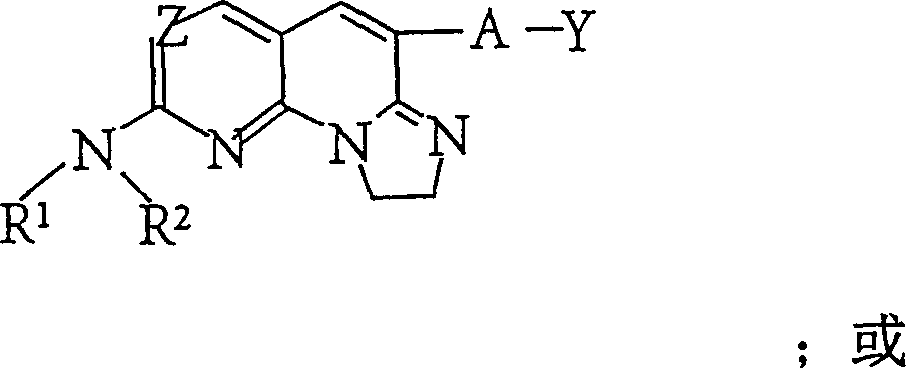
一方面(i)本发明提供了式(I)表示的化合物或其异构体,药用盐,酯或前药:In one aspect (i) the present invention provides a compound represented by formula (I) or its isomer, pharmaceutically acceptable salt, ester or prodrug:
其中:in:
Z为N或CH;Z is N or CH;
当原子C5和Z1之间的键为单键时,Z1选自N和CH,当C5和Z1之间的键为双键时,Z1为C;When the bond between atoms C5 and Z1 is a single bond, Z1 is selected from N and CH, and when the bond between C5 and Z1 is a double bond, Z1 is C;
R1为氢或烷基;R 1 is hydrogen or alkyl;
R2为烷基,芳烷基,环烷基,杂烷基,杂环基,芳基,或杂芳基;R is alkyl, aralkyl, cycloalkyl, heteroalkyl, heterocyclyl, aryl, or heteroaryl;
A不存在或为-O-,-CHR’-,-C(=O)-,-S(O)n-,或-NR3-,其中n为0,1,或2,R’为氢或烷基,且R3为氢,烷基,芳基,杂芳基,或环烷基;A is absent or is -O-, -CHR'-, -C(=O)-, -S(O) n -, or -NR 3 -, wherein n is 0, 1, or 2, and R' is hydrogen or alkyl, and R is hydrogen, alkyl, aryl, heteroaryl, or cycloalkyl;
原子C5和Z1之间的键为单键或双键;The bond between atoms C5 and Z1 is a single or double bond;
原子C8和C9之间的键为单键或双键;并且the bond between atoms C8 and C9 is a single or double bond; and
Y为烷基,杂烷基,环烷基,芳基,或杂芳基。Y is alkyl, heteroalkyl, cycloalkyl, aryl, or heteroaryl.
在另一方面,本发明提供:In another aspect, the present invention provides:
(ii)按照(i)的化合物或其异构体,药用盐,酯或前药,所述化合物具有下式:(ii) a compound according to (i) or an isomer, pharmaceutically acceptable salt, ester or prodrug thereof, said compound having the following formula:
其中:in:
R2选自任选取代的芳烷基,任选取代的环烷基,任选取代的杂环基,任选取代的芳基,和任选地被羟基、O(C1-4烷基)或S(O)2(C1-4烷基)中之一取代的C1-4烷基; R is selected from optionally substituted aralkyl, optionally substituted cycloalkyl, optionally substituted heterocyclyl, optionally substituted aryl, and optionally substituted by hydroxyl, O(C 1-4 alkyl ) or C 1-4 alkyl substituted by one of S(O) 2 (C 1-4 alkyl);
A不存在或为-O-;A does not exist or is -O-;
Y为任选地被1-2个选自卤素,羟基,氨基,烷基或杂烷基的基团取代的苯基;或Y is phenyl optionally substituted with 1-2 groups selected from halo, hydroxy, amino, alkyl or heteroalkyl; or
(iii)按照(ii)的化合物,其中R2选自环戊基,环己基,四氢吡喃基,哌啶基,硫代壬基(thianonyl),四氢-1,1-二氧化物-2-H-噻喃基,苯基,和苄基,其中每个所述R2基团任选地被羟基,卤素,O(C1-4烷基),或S(O)2(C1-4烷基)中之一取代;或R2选自任选地被羟基、O(C1-4烷基)或S(O)2(C1-4烷基)中之一取代的C1-4烷基;或(iii) according to the compound of (ii), wherein R is selected from cyclopentyl, cyclohexyl, tetrahydropyranyl, piperidinyl, thianonyl (thianonyl), tetrahydro-1,1-dioxide -2-H-thiopyranyl, phenyl, and benzyl, wherein each of said R groups is optionally replaced by hydroxyl, halogen, O(C 1-4 alkyl), or S(O) 2 ( One of C 1-4 alkyl) is substituted; or R is selected from and optionally substituted by one of hydroxyl, O(C 1-4 alkyl) or S(O) 2 (C 1-4 alkyl) C 1-4 alkyl; or
(iv)按照(ii)的化合物,其具有下式,(iv) a compound according to (ii), which has the formula,

其中R2如(ii)所定义;或wherein R is as defined in (ii); or
(v)按照(iv)的化合物,其中R2选自环戊基,环己基,四氢吡喃基,哌啶基,硫代壬基,四氢-1,1-二氧化物-2-H-噻喃基,苯基,和苄基,其中每个所述R2基团任选地被羟基,卤素,O(CH3),或S(O)2(CH3)中之一取代;或R2选自任选地被羟基、O(CH3)或S(O)2(CH3)中之一取代的C1-4烷基;或(v) according to the compound of (iv), wherein R is selected from cyclopentyl, cyclohexyl, tetrahydropyranyl, piperidinyl, thiononyl, tetrahydro-1,1-dioxide-2- H-thiopyranyl, phenyl, and benzyl, wherein each of said R groups is optionally substituted by one of hydroxyl, halogen, O(CH 3 ), or S(O) 2 (CH 3 ) or R 2 is selected from C 1-4 alkyl optionally substituted by one of hydroxyl, O(CH 3 ) or S(O) 2 (CH 3 ); or
(vi)按照(i)的化合物,其中Z为-N-;或(vi) a compound according to (i), wherein Z is -N-; or
(vii)按照(i)或(vi)的化合物,其中Z1为-C-并且Z1和C5之间的键为双键;或(vii) A compound according to (i) or (vi), wherein Z is -C- and the bond between Z and C is a double bond; or
(viii)按照(i),(vi)或(vii)中任何一项的化合物,其中A不存在或为-O-;或(viii) A compound according to any one of (i), (vi) or (vii), wherein A is absent or is -O-; or
(ix)按照(i),(vi)至(viii)中任何一项的化合物,其中R1为氢;或(ix) compounds according to any one of (i), (vi) to (viii), wherein R is hydrogen; or
(x)按照(i),(vi)至(ix)中任何一项的化合物,其中R2选自环戊基,环己基,四氢吡喃基,哌啶基,硫代壬基,四氢-1,1-二氧化物-2-H-噻喃基,苯基,和苄基,其中每个所述R2基团任选地被羟基,卤素,O(C1-4烷基),或S(O)2(C1-4烷基)中之一取代;或R2选自任选地被羟基、O(C1-4烷基)或S(O)2(C1-4烷基)中之一取代的C1-4烷基;或(x) according to any one of (i), (vi) to (ix), wherein R is selected from cyclopentyl, cyclohexyl, tetrahydropyranyl, piperidyl, thiononyl, tetra Hydrogen-1,1-dioxide-2-H-thiopyranyl, phenyl, and benzyl, wherein each of said R groups is optionally replaced by hydroxyl, halogen, O(C 1-4 alkyl ) , or one of S (O) 2 (C 1-4 alkyl); or R 2 is selected from the group optionally substituted by hydroxyl, O(C 1-4 C 1-4 alkyl substituted by one of -4 alkyl); or
(xi)按照(i),(vi)至(x)中任何一项的化合物,其中Y为被卤素,羟基,氨基,烷基或杂芳基任选取代的苯基;或(xi) compounds according to any one of (i), (vi) to (x), wherein Y is phenyl optionally substituted by halogen, hydroxy, amino, alkyl or heteroaryl; or
(xii)具有式Ia的化合物,(xii) a compound of formula Ia,

其中Y为芳基;Wherein Y is an aryl group;
Z为N或CH;Z is N or CH;
A不存在或为O;A does not exist or is O;
R1为氢;R 1 is hydrogen;
R2为烷基,羟烷基,任选取代的环烷基,任选取代的杂环基,任选取代的芳基,或任选取代的芳烷基;且C8和C9之间的键为单键或双键;或R is alkyl, hydroxyalkyl, optionally substituted cycloalkyl, optionally substituted heterocyclyl, optionally substituted aryl, or optionally substituted aralkyl; and the bond between C8 and C9 is a single or double bond; or
(xiii)按照(xii)的化合物,其中Z为N,A为-O-并且C8和C9之间的键为双键;或(xiii) A compound according to (xii), wherein Z is N, A is -O- and the bond between C8 and C9 is a double bond; or
(xiv)按照(xiii)的化合物,其中:(xiv) A compound according to (xiii), wherein:
R2为4-四氢吡喃基且Y为4-氟苯基;或 R is 4-tetrahydropyranyl and Y is 4-fluorophenyl; or
R2为4-氟苯基且Y为4-氟苯基;或R 2 is 4-fluorophenyl and Y is 4-fluorophenyl; or
(xv)按照(xii)的化合物,其中Z为N,A不存在,并且C8和C9之间的键为双键;或(xv) A compound according to (xii), wherein Z is N, A is absent, and the bond between C8 and C9 is a double bond; or
(xvi)按照(xv)的化合物,其中:(xvi) A compound according to (xv), wherein:
R2为4-羟基环己基和Y为2-氯苯基;R 2 is 4-hydroxycyclohexyl and Y is 2-chlorophenyl;
R2为4-四氢吡喃基和Y为2-氯苯基;R 2 is 4-tetrahydropyranyl and Y is 2-chlorophenyl;
R2为4-(N-甲基-磺酰基哌啶基)和Y为2-氯苯基;R 2 is 4-(N-methyl-sulfonylpiperidinyl) and Y is 2-chlorophenyl;
R2为环戊基和Y为2-氯苯基;R 2 is cyclopentyl and Y is 2-chlorophenyl;
R2为4-(N-甲基-磺酰基哌啶基)和Y为2-氯苯基;R 2 is 4-(N-methyl-sulfonylpiperidinyl) and Y is 2-chlorophenyl;
R2为4-四氢-1,1-二氧化物-2-H-噻喃基和Y为2-氯苯基;R 2 is 4-tetrahydro-1,1-dioxide-2-H-thiopyranyl and Y is 2-chlorophenyl;
R2为异丙基和Y为2-氯苯基;或R is isopropyl and Y is 2-chlorophenyl; or
R2为4-氟苄基和Y为2-氯苯基;或R is 4 -fluorobenzyl and Y is 2-chlorophenyl; or
(xvii)按照(i)的化合物,其具有下式结构(xvii) A compound according to (i) having the structure
(xviii)按照(xvii)的化合物,其中Z为N,A不存在,R1为氢,Y为2-氯苯基,和R2为4-羟基环己基;或( xviii ) A compound according to (xvii), wherein Z is N, A is absent, R is hydrogen, Y is 2-chlorophenyl, and R is 4-hydroxycyclohexyl; or
(xix)按照(i)的化合物,其具有式I(c)结构:(xix) A compound according to (i) having the structure of formula I(c):
(xx)按照(xix)的化合物,其中Z为N,A不存在,R1为氢,Y为2-氯苯基,和R2为4-羟基环己基。(xx) A compound according to (xix), wherein Z is N, A is absent, R 1 is hydrogen, Y is 2-chlorophenyl, and R 2 is 4-hydroxycyclohexyl.
式I的化合物和它们的上述盐是蛋白激酶的抑制剂,并显示对p38的有效体内活性。因此,该化合物可以用于治疗由促炎性细胞因子如TNF和IL-1介导的疾病。The compounds of formula I and their above-mentioned salts are inhibitors of protein kinases and show potent in vivo activity against p38. Therefore, this compound can be used in the treatment of diseases mediated by pro-inflammatory cytokines such as TNF and IL-1.
因此,在另一方面,本发明涉及治疗p38介导的疾病或症状的方法,其中将治疗有效量的式I的化合物施用于需要该治疗的患者。Accordingly, in another aspect, the present invention is directed to a method of treating a p38-mediated disease or condition, wherein a therapeutically effective amount of a compound of formula I is administered to a patient in need of such treatment.
在还有另一方面,本发明涉及制备上述化合物的方法。In yet another aspect, the present invention relates to processes for the preparation of the compounds described above.
在仍有另一方面,本发明涉及制备药物的方法,该药物用于治疗p38介导的疾病或症状。In yet another aspect, the invention relates to methods of preparing a medicament for use in the treatment of a p38-mediated disease or condition.
如本文所用,术语“烷基”是指1-6个碳原子的直链或支链饱和一价烃基,例如甲基,乙基,正丙基,2-丙基,叔-丁基,戊基等等。As used herein, the term "alkyl" refers to a straight-chain or branched saturated monovalent hydrocarbon group of 1-6 carbon atoms, such as methyl, ethyl, n-propyl, 2-propyl, tert-butyl, pentyl base and so on.
术语“芳基”是指一价单环或双环芳香烃基优选苯基,其任选地独立地被一个或多个取代基取代。当芳基优选地被一个,两个或三个取代基所取代,取代基优选地选自烷基,卤代烷基,卤素,羟基,硝基,氰基,氨基,卤代烷氧基,杂烷基,亚甲二氧基,亚乙二氧基,Y-芳基,Y-杂芳基,Y-环烷基,Y-杂环基,Y-ORP-Y-NRPRq,-Y-C(O)-RP,-YS(O)0-2RP,-Y-N-S(O)2RP,-Y-S(O)2NRPRq,-Y-N-C(O)NRPRq,其中Y不存在或为C1-C3亚烷基,RP和Rq各自彼此独立地选自氢,烷基,卤代烷基,羟基,烷氧基,芳基,杂芳基,环烷基,和杂环基。更具体地,术语芳基包括但不限于苯基,氯苯基,甲氧苯基,1-萘基,2-萘基,及其衍生物。The term "aryl" refers to a monovalent monocyclic or bicyclic aromatic hydrocarbon group, preferably phenyl, which is optionally substituted independently by one or more substituents. When the aryl group is preferably substituted by one, two or three substituents, the substituents are preferably selected from the group consisting of alkyl, haloalkyl, halogen, hydroxy, nitro, cyano, amino, haloalkoxy, heteroalkyl, Methylenedioxy, ethylenedioxy, Y-aryl, Y-heteroaryl, Y-cycloalkyl, Y-heterocyclyl, Y-OR P -Y-NR P R q , -YC( O)-R P , -YS(O) 0-2 R P , -YNS(O) 2 R P , -YS(O) 2 NR P R q , -YNC(O)NR P R q , where Y is not present or is a C 1 -C 3 alkylene group, R and R are each independently selected from the group consisting of hydrogen, alkyl, haloalkyl, hydroxy, alkoxy, aryl, heteroaryl, cycloalkyl, and hetero Ring base. More specifically, the term aryl includes, but is not limited to, phenyl, chlorophenyl, methoxyphenyl, 1-naphthyl, 2-naphthyl, and derivatives thereof.
“芳烷基”是指基团-RxRy,其中Rx是亚烷基,Ry是如上定义的芳基,例如苄基,苯亚乙基等。"Aralkyl" refers to the group -RxRy , wherein Rx is alkylene and Ry is aryl as defined above, eg, benzyl, phenylethylene, and the like.
如本文所用术语“环烷基”是指3-7个环碳的饱和一价环烃基,例如环戊基,环丁基,环己基等等。饱和一价环烃基定义如上,可以任选地被一个,两个或三个非氢的取代基所取代。优选地,取代基选自烷基,羟基,烷氧基,氨基,单取代的氨基,二取代的氨基,卤代烷基,卤素,氰基烷基,氧基(即羰基氧),杂烷基,杂环基,羟烷基,和-(X)n-C(O)R’(其中X为O或NR”,n为0或1,R”为氢,烷基,卤代烷基,氨基,单取代的氨基,二取代的氨基,羟基,烷氧基,烷基或任选取代的苯基,并且R’为H或烷基),和-S(O)nR’(其中n为0-2)。更具体地,术语取代的环烷基包括例如取代的环戊基,取代的环己基等。The term "cycloalkyl" as used herein refers to a saturated monovalent cyclic hydrocarbon group of 3-7 ring carbons, such as cyclopentyl, cyclobutyl, cyclohexyl and the like. A saturated monovalent cyclic hydrocarbon group as defined above may be optionally substituted by one, two or three non-hydrogen substituents. Preferably, the substituents are selected from the group consisting of alkyl, hydroxy, alkoxy, amino, monosubstituted amino, disubstituted amino, haloalkyl, halogen, cyanoalkyl, oxy (ie carbonyloxy), heteroalkyl, Heterocyclyl, hydroxyalkyl, and -(X) n -C(O)R' (where X is O or NR", n is 0 or 1, and R" is hydrogen, alkyl, haloalkyl, amino, mono Substituted amino, disubstituted amino, hydroxy, alkoxy, alkyl or optionally substituted phenyl, and R' is H or alkyl), and -S(O) n R' (wherein n is 0- 2). More specifically, the term substituted cycloalkyl includes, for example, substituted cyclopentyl, substituted cyclohexyl, and the like.
术语“卤代”、“卤化物”或“卤素”,当指取代基时是指氟,氯,溴,或碘,优选氯。The terms "halo", "halide" or "halogen", when referring to a substituent, mean fluorine, chlorine, bromine, or iodine, preferably chlorine.
术语“卤代烷基”是指被一个或多个相同或不同卤原子取代的烷基,例如-CH2Cl,-CF3,-CH2CF3,-CH2CCl3等,并另外包括那些烷基如其中所有烷基氢原子被氟原子取代的全氟烷基。The term "haloalkyl" refers to an alkyl group substituted by one or more of the same or different halogen atoms, such as -CH 2 Cl, -CF 3 , -CH 2 CF 3 , -CH 2 CCl 3 , etc., and additionally includes those alkyl A group such as a perfluoroalkyl group in which all alkyl hydrogen atoms are replaced by fluorine atoms.
如本文所用术语“杂烷基”是指上述定义的烷基部分,其中一个,两个或三个氢原子已经被独立地选自下列的取代基所取代:-ORa,-NRbRc,和S(O)nRd(其中n为0-2的整数),条件是杂烷基部分的连接点是通过碳原子,其中Ra是氢,酰基,烷基,环烷基,或环烷基烷基;Rb和Rc彼此独立地为氢,酰基,烷基,环烷基,或环烷基烷基,或者Rb和Rc与它们连接的氮原子一起形成杂环或杂芳基;并且当n为0时,Rd为氢,烷基,环烷基,或环烷基烷基,并且当n为1或2时,Rd为烷基,环烷基,环烷基烷基,氨基,酰基氨基,单烷基氨基,或二烷基氨基。代表性的实例包括但不限于2-羟乙基,3-羟丙基,2-羟基-甲基乙基,2,3-二羟基丙基,1-羟基-甲基乙基,3-羟基丁基,2,3-二羟基丁基,2-羟基-1-甲基丙基,2-氨基乙基,3-氨基丙基,2-甲磺酰基乙基,氨磺酰基甲基,氨磺酰基乙基,甲氨基磺酰基甲基,甲氨基磺酰基乙基,甲氨基磺酰基丙基等。当Ra为氢时,基团-ORa也称为“羟烷基”并且包括但不限于2-羟乙基,3-羟丙基,2-羟甲基乙基,2,3-二羟基丙基,1-羟甲基乙基,3-羟基-丁基,2,3-二羟基丁基,和2-羟基-1-甲基丙基。The term "heteroalkyl" as used herein refers to an alkyl moiety as defined above wherein one, two or three hydrogen atoms have been replaced by substituents independently selected from: -OR a , -NR b R c , and S(O) n R d (wherein n is an integer from 0 to 2), provided that the point of attachment of the heteroalkyl moiety is through a carbon atom, wherein R is hydrogen, acyl, alkyl, cycloalkyl, or Cycloalkylalkyl; Rb and Rc independently of each other are hydrogen, acyl, alkyl, cycloalkyl, or cycloalkylalkyl, or Rb and Rc together with the nitrogen atom to which they are attached form a heterocycle or and when n is 0, Rd is hydrogen, alkyl, cycloalkyl, or cycloalkylalkyl, and when n is 1 or 2, Rd is alkyl, cycloalkyl, cyclo Alkylalkyl, amino, acylamino, monoalkylamino, or dialkylamino. Representative examples include, but are not limited to, 2-hydroxyethyl, 3-hydroxypropyl, 2-hydroxy-methylethyl, 2,3-dihydroxypropyl, 1-hydroxy-methylethyl, 3-hydroxy Butyl, 2,3-dihydroxybutyl, 2-hydroxy-1-methylpropyl, 2-aminoethyl, 3-aminopropyl, 2-methanesulfonylethyl, sulfamoylmethyl, ammonia Sulfonylethyl, methylaminosulfonylmethyl, methylaminosulfonylethyl, methylaminosulfonylpropyl, etc. When R a is hydrogen, the group -OR a is also known as "hydroxyalkyl" and includes, but is not limited to, 2-hydroxyethyl, 3-hydroxypropyl, 2-hydroxymethylethyl, 2,3-di Hydroxypropyl, 1-hydroxymethylethyl, 3-hydroxy-butyl, 2,3-dihydroxybutyl, and 2-hydroxy-1-methylpropyl.
“杂芳基”是指具有至少一个芳香环的一价单环或双环的含5-12个环原子的基团,所述环原子包含一个,两个,或三个环杂原子,其独立地选自N,O,或S,剩余环原子为C,条件是当杂芳基是其中一个环是碳环和/非芳环的二环系统时,杂芳基的连接点将在杂芳环上。杂芳环任选地被一个或多个取代基,优选一个或两个取代基所取代,取代基彼此独立地选自烷基,卤代烷基,卤素,硝基,氰基,氨基,亚甲二氧基,Y-芳基,Y-杂芳基,Y-环烷基,-Y-杂环基,-Y-OR’,-Y-NR’R”,-Y-C(O)-R’,-Y-O-C(O)-R’,-YS(O)0-2R’,-Y-N-SO2-R’,-Y-SO2-NR’R”,和-Y-N-C(O)NR’R”,其中Y不存在或为C1-C3亚烷基,R’和R”各自彼此独立地为氢,烷基,卤代烷基,羟基,烷氧基,芳基,杂芳基,环烷基,和杂环基。更具体地,术语杂芳基包括但不限于哌啶基,呋喃基,噻吩基,噻唑基,异噻唑基,三唑基,咪唑基,异噁唑基,吡咯基,吡唑基,嘧啶基,苯并呋喃基,四氢苯并呋喃基,异苯并呋喃基,苯并噻唑基,苯并异噻唑基,苯并三唑基,吲哚基,异氮(杂)茚基,苯并噁唑基,喹啉基,四氢喹啉基,异喹啉基,苯并咪唑基,苯并异噁唑基或苯并噻吩基,咪唑并[1,2-a]-吡啶基(pryidinyl),咪唑并[2,1-b]噻唑基,及其衍生物。"Heteroaryl" means a monovalent monocyclic or bicyclic group containing 5-12 ring atoms having at least one aromatic ring, said ring atoms containing one, two, or three ring heteroatoms, which independently is selected from N, O, or S, and the remaining ring atoms are C, provided that when the heteroaryl is a bicyclic ring system in which one ring is carbocyclic and/or non-aromatic, the point of attachment of the heteroaryl will be at the heteroaryl on the ring. The heteroaryl ring is optionally substituted by one or more substituents, preferably one or two substituents, independently of each other selected from alkyl, haloalkyl, halogen, nitro, cyano, amino, methylene di Oxygen, Y-aryl, Y-heteroaryl, Y-cycloalkyl, -Y-heterocyclyl, -Y-OR', -Y-NR'R", -YC(O)-R', -YOC(O)-R', -YS(O) 0-2R ', -YN- SO2 -R', -Y- SO2- NR'R", and -YNC(O)NR'R" , wherein Y is absent or is C 1 -C 3 alkylene, R' and R" are each independently of each other hydrogen, alkyl, haloalkyl, hydroxyl, alkoxy, aryl, heteroaryl, cycloalkyl , and heterocyclyl. More specifically, the term heteroaryl includes, but is not limited to, piperidinyl, furyl, thienyl, thiazolyl, isothiazolyl, triazolyl, imidazolyl, isoxazolyl, pyrrolyl, pyrazolyl, pyrimidinyl , benzofuryl, tetrahydrobenzofuryl, isobenzofuryl, benzothiazolyl, benzisothiazolyl, benzotriazolyl, indolyl, isoazepine (hetero)indenyl, benzo Oxazolyl, quinolinyl, tetrahydroquinolyl, isoquinolyl, benzimidazolyl, benzisoxazolyl or benzothienyl, imidazo[1,2-a]-pyridinyl (pryidinyl ), imidazo[2,1-b]thiazolyl, and derivatives thereof.
“单取代的氨基”是指基团-NHRe,其中Re是烷基,杂烷基,卤代烷基,环烷基,环烷基烷基,羟烷基,芳基,芳烷基,芳烯基,杂芳基,杂芳烷基,杂芳烯基,杂环基,或杂环烷基,例如甲氨基,乙氨基,苯胺,苄胺等。类似地,术语“二取代的氨基”是指基团-NRgRh,其中Rg和Rh彼此独立地为烷基,杂烷基,卤代烷基,环烷基,环烷基烷基,羟烷基,芳基,芳烷基,芳烯基,杂芳基,杂芳烷基,杂芳烯基,杂环基,或杂环烷基,或Rg和Rh和它们连接的氮原子一起形成杂环。代表性的实例包括但不限于二甲氨基,甲基乙氨基,二(1-甲基-乙基)氨基,哌嗪基,哌啶基等。"Monosubstituted amino" refers to the group -NHR e , where R e is alkyl, heteroalkyl, haloalkyl, cycloalkyl, cycloalkylalkyl, hydroxyalkyl, aryl, aralkyl, aryl Alkenyl, heteroaryl, heteroaralkyl, heteroaralkenyl, heterocyclyl, or heterocycloalkyl, such as methylamino, ethylamino, aniline, benzylamine and the like. Similarly, the term "disubstituted amino" refers to the group -NRgRh , wherein Rg and Rh are independently of each other alkyl , heteroalkyl, haloalkyl, cycloalkyl, cycloalkylalkyl, hydroxyalkyl, aryl, aralkyl, aralkenyl, heteroaryl, heteroaralkyl, heteroaralkenyl, heterocyclyl, or heterocycloalkyl, or R and R and the nitrogen to which they are attached Atoms together form a heterocyclic ring. Representative examples include, but are not limited to, dimethylamino, methylethylamino, bis(1-methyl-ethyl)amino, piperazinyl, piperidinyl, and the like.
“杂环基”是指饱和环状基团,其中一个或两个环原子是选自N,O,或S(O)n的杂原子(其中n为0-2的整数),剩余的环原子为C,其中一个或两个C原子可以任选地包含羰基氧基团,例如环中的一个或两个原子可以是式-C(=O)-的部分。该杂环可以任选地独立地被一个,两个,或三个选自以下各项的取代基所取代:烷基,羟基,羟烷基,烷氧基,杂烷基,卤代烷基,和-(X)n-C(O)R(其中X为O或NR’,n为0或1,R为氢,烷基,卤代烷基,氨基,一取代的氨基,二取代的氨基,羟基,烷氧基,或任选取代的苯基,并且R’为H或烷基),Y-芳基,Y-杂芳基,Y-环烷基,Y-杂环基,Y-ORP,-Y-NRPRq,-Y-C(O)-RP,-YS(O)0-2RP,-Y-N-S(O)2RP,-Y-S(O)2NRPRq,-Y-N-C(O)NRPRq,其中Y不存在或为C1-C3亚烷基,RP和Rq各自彼此独立地选自氢,烷基,卤代烷基,羟基,烷氧基,芳基,杂芳基,环烷基,和杂环基。更具体地,术语杂环包括但不限于四氢吡喃基,哌啶基,哌嗪基,吗啉基,及其衍生物。"Heterocyclyl" refers to a saturated cyclic group in which one or two ring atoms are heteroatoms selected from N, O, or S(O) n (wherein n is an integer from 0 to 2), and the remaining ring The atom is C, where one or both C atoms may optionally contain a carbonyloxy group, for example one or both atoms in a ring may be part of the formula -C(=O)-. The heterocycle can be optionally substituted independently by one, two, or three substituents selected from the group consisting of alkyl, hydroxy, hydroxyalkyl, alkoxy, heteroalkyl, haloalkyl, and -(X) n -C(O)R (where X is O or NR', n is 0 or 1, R is hydrogen, alkyl, haloalkyl, amino, monosubstituted amino, disubstituted amino, hydroxyl, Alkoxy, or optionally substituted phenyl, and R' is H or alkyl), Y-aryl, Y-heteroaryl, Y-cycloalkyl, Y-heterocyclyl, Y-OR P , -Y-NR P R q , -YC(O)-R P , -YS(O) 0-2 R P , -YNS(O) 2 R P , -YS(O) 2 NR P R q , -YNC (O)NR P R q , wherein Y is absent or is C 1 -C 3 alkylene, R P and R q are each independently selected from hydrogen, alkyl, haloalkyl, hydroxy, alkoxy, aryl , heteroaryl, cycloalkyl, and heterocyclyl. More specifically, the term heterocycle includes, but is not limited to, tetrahydropyranyl, piperidinyl, piperazinyl, morpholinyl, and derivatives thereof.
术语“酰基”是指基团-C(O)Rr,其中Rr是烷基,卤代烷基,杂烷基,芳基,杂芳基,芳烷基或杂芳烷基。The term "acyl" refers to the group -C(O) Rr , where Rr is alkyl, haloalkyl, heteroalkyl, aryl, heteroaryl, aralkyl, or heteroaralkyl.
“烷氧基”,“芳氧基”,“芳烷氧基”,或“杂芳烷氧基”是指基团-OR,其中R分别是如上定义的烷基,芳基,芳烷基,或杂芳烷基,例如甲氧基,苯氧基,吡啶-2-基甲氧基,苄氧基等。"Alkoxy", "aryloxy", "aralkoxy", or "heteroaralkoxy" refers to the group -OR, where R is alkyl, aryl, aralkyl, respectively, as defined above , or heteroaralkyl, such as methoxy, phenoxy, pyridin-2-ylmethoxy, benzyloxy, etc.
当本文式中的键表示为其中两键之一为虚线的双键时,如在

“离去基团”具有常规与它在合成有机化学中有关的含义,即能够被亲核体替换的原子或基团,包括卤素(如氯,溴,和碘),烷磺酰基氧基,芳基磺酰基氧基,烷基羰基氧基(例如乙酰氧基),芳基羰基氧基,甲磺酰氧基,甲苯磺酰基氧基,三氟甲磺酰基氧基,芳氧基(例如2,4-二硝基苯氧基),甲氧基,N,O-二甲基羟基氨基等。"Leaving group" has the meaning conventionally associated with it in synthetic organic chemistry, i.e. an atom or group capable of being displaced by a nucleophile, including halogens (such as chlorine, bromine, and iodine), alkanesulfonyloxy, Arylsulfonyloxy, alkylcarbonyloxy (e.g. acetyloxy), arylcarbonyloxy, methanesulfonyloxy, tosyloxy, trifluoromethanesulfonyloxy, aryloxy (e.g. 2,4-dinitrophenoxy), methoxy, N,O-dimethylhydroxylamino, etc.
“药用赋形剂”是指用于制备药物组合物的通常是安全、无毒并且既无生物学上的也无其它方面的不良作用的赋形剂,而且包括兽医以及人类药用可接受的赋形剂。说明书和权利要求书中使用的“药用赋形剂”包括一种或一种以上的这种赋形剂。"Pharmaceutical excipient" refers to an excipient used in the preparation of a pharmaceutical composition that is generally safe, non-toxic, and has neither biological nor other adverse effects, and includes veterinary and human pharmaceutically acceptable excipients. excipients. A "pharmaceutically acceptable excipient" as used in the specification and claims includes one or more than one such excipient.
化合物的“药用盐”是指药学可接受并具有母体化合物的预期药理学活性的化合物。此类盐包括:(1)酸加成盐,与无机酸形成的酸加成盐,所述的无机酸例如盐酸、氢溴酸、硫酸、硝酸、磷酸等;或与有机酸形成的酸加成盐,有机酸例如是乙酸、丙酸、己酸、环戊烷丙酸、羟基乙酸、丙酮酸、乳酸、丙二酸、琥珀酸、苹果酸、马来酸、富马酸、酒石酸、柠檬酸、苯甲酸、3-(4-羟基苯甲酰基)苯甲酸、肉桂酸、扁桃酸、甲磺酸、乙磺酸、1,2-乙烷-二磺酸、2-羟基乙磺酸、苯磺酸、4-氯代苯磺酸、2-萘磺酸、4-甲苯磺酸、樟脑磺酸、4-甲基双环[2.2.2]-辛-2-烯-1-羧酸、葡庚糖酸、4,4’-亚甲基双-(3-羟基-2-烯-1-羧酸),3-苯基丙酸、三甲基乙酸、叔丁基乙酸、十二烷基硫酸、葡糖酸、谷氨酸、羟基萘甲酸、水杨酸、硬脂酸、粘康酸等;或(2)当母体化合物中存在的酸性质子或被金属离子代替时生成的盐,所述的金属离子例如是碱金属离子、碱土金属离子或铝离子;或与有机碱配位时生成的盐,所述的有机碱例如是乙醇胺、二乙醇胺、三乙醇胺、氨丁三醇、N-甲基葡糖胺等。A "pharmaceutically acceptable salt" of a compound refers to a compound that is pharmaceutically acceptable and possesses the desired pharmacological activity of the parent compound. Such salts include: (1) acid addition salts, acid addition salts formed with inorganic acids such as hydrochloric acid, hydrobromic acid, sulfuric acid, nitric acid, phosphoric acid, etc.; or acid addition salts formed with organic acids Salt formation, organic acids such as acetic acid, propionic acid, caproic acid, cyclopentanepropionic acid, glycolic acid, pyruvic acid, lactic acid, malonic acid, succinic acid, malic acid, maleic acid, fumaric acid, tartaric acid, lemon acid, benzoic acid, 3-(4-hydroxybenzoyl)benzoic acid, cinnamic acid, mandelic acid, methanesulfonic acid, ethanesulfonic acid, 1,2-ethane-disulfonic acid, 2-hydroxyethanesulfonic acid, Benzenesulfonic acid, 4-chlorobenzenesulfonic acid, 2-naphthalenesulfonic acid, 4-toluenesulfonic acid, camphorsulfonic acid, 4-methylbicyclo[2.2.2]-oct-2-ene-1-carboxylic acid, Glucoheptonic acid, 4,4'-methylenebis-(3-hydroxy-2-ene-1-carboxylic acid), 3-phenylpropionic acid, trimethylacetic acid, tert-butylacetic acid, dodecane sulfuric acid, gluconic acid, glutamic acid, hydroxynaphthoic acid, salicylic acid, stearic acid, muconic acid, etc.; or (2) salts formed when the acidic protons present in the parent compound or are replaced by metal ions, Described metal ion is for example alkali metal ion, alkaline earth metal ion or aluminum ion; -Methylglucamine etc.
本文中“前-药”和“前药”可以互换使用,并且是指当将此类前药施用给哺乳动物对象时在体内可以释放出式I的活性母体药物的任何化合物。式I的化合物的前药是通过修饰式(I)的化合物中存在的一个或多个官能团来制得,制备所采用的方式应使该修饰可以体内裂解释放出母体化合物。前药包括式(I)的化合物,其中式(I)的化合物中羟基、氨基、或巯基分别与任何可以在体内裂解再生出游离羟基、氨基或巯基的基团结合。前药的实例包括但不限于式(I)的化合物中的羟基官能团的酯(例如醋酸酯,甲酸酯,和苯甲酸酯衍生物)、氨基甲酸酯(例如N,N-二甲基氨基羰基)等。"Pro-drug" and "prodrug" are used interchangeably herein and refer to any compound that releases the active parent drug of Formula I in vivo when such prodrug is administered to a mammalian subject. Prodrugs of compounds of formula I are prepared by modifying one or more functional groups present in compounds of formula (I) in such a way that the modifications can be cleaved in vivo to release the parent compound. Prodrugs include compounds of formula (I), wherein the hydroxyl, amino, or thiol groups in the compound of formula (I) are combined with any group that can be cleaved in vivo to regenerate a free hydroxyl, amino, or thiol group, respectively. Examples of prodrugs include, but are not limited to, esters (such as acetate, formate, and benzoate derivatives), carbamates (such as N,N-dimethyl aminocarbonyl) etc.
“保护基团”是指当连接到分子中的反应性基团上时掩蔽、减少或防止该反应性的一组原子。保护基团的例子可以参见T.W.Green和P.G.Futs,有机化学的保护基团(Wiley,第2版,1991),和Harrison和Harrison等,有机合成方法概要(Compendium of Synthetic Organic Methods),1-8卷(John Wiley和Sons,1971-1996)。代表性的氨基保护基团包括甲酰基,乙酰基,三氟乙酰基,苄基,苄氧基羰基(CBZ),叔丁氧基羰基(Boc),三甲基甲硅烷基(TMS),2-三甲基甲硅烷基-乙磺酰基(SES),三苯甲基和取代的三苯甲基基团,烯丙氧基羰基,9-芴基甲氧基羰基(FMOC),硝基-藜芦基氧基羰基(NVOC)等等。代表性的羟基保护基团包括羟基被酰基化或被烷基化的基团,如苄基和三苯甲基醚以及烷基醚,四氢吡喃基醚,三烷基甲硅烷基醚和烯丙基醚。"Protecting group" refers to a group of atoms that, when attached to a reactive group in a molecule, masks, reduces or prevents that reactivity. Examples of protecting groups can be found in T.W. Green and P.G. Futs, Protecting Groups in Organic Chemistry (Wiley, 2nd Ed., 1991), and Harrison and Harrison et al., Compendium of Synthetic Organic Methods, 1-8 Vol. (John Wiley and Sons, 1971-1996). Representative amino protecting groups include formyl, acetyl, trifluoroacetyl, benzyl, benzyloxycarbonyl (CBZ), tert-butoxycarbonyl (Boc), trimethylsilyl (TMS), 2 -trimethylsilyl-ethanesulfonyl (SES), trityl and substituted trityl groups, allyloxycarbonyl, 9-fluorenylmethoxycarbonyl (FMOC), nitro- Veratryloxycarbonyl (NVOC) and the like. Representative hydroxyl protecting groups include groups in which the hydroxyl group is acylated or alkylated, such as benzyl and trityl ethers as well as alkyl ethers, tetrahydropyranyl ethers, trialkylsilyl ethers and Allyl ether.
疾病的“治疗”或“疗法”包括:(1)预防疾病,也就是使疾病的临床症状不会在哺乳动物中发展,所述的哺乳动物可能与该疾病接触或易感该疾病,但不曾经历或显现出疾病的该症状;(2)抑制疾病,也就是阻止或减轻该疾病或其临床症状的发展;或(3)缓解疾病,也就是引起疾病或其临床症状的减退。"Treatment" or "therapy" of a disease includes: (1) prophylaxis of a disease, that is, preventing the development of clinical symptoms of a disease in a mammal that may have been exposed to or susceptible to the disease, but has not experiencing or manifesting such symptoms of a disease; (2) inhibiting a disease, that is, arresting or alleviating the development of the disease or its clinical symptoms; or (3) relieving the disease, that is, causing a decrease in the disease or its clinical symptoms.
“治疗有效量”是指当施用给哺乳动物治疗疾病时,足以实现对该疾病的治疗的化合物的量。“治疗有效量”应根据化合物、疾病及其严重性、被治疗哺乳动物的体重等来改变。A "therapeutically effective amount" refers to an amount of a compound which, when administered to a mammal to treat a disease, is sufficient to effect treatment of the disease. The "therapeutically effective amount" will vary depending on the compound, the disease and its severity, the body weight of the treated mammal, and the like.
在一个实施方案中,本发明提供由下式表示的化合物:In one embodiment, the invention provides compounds represented by the formula:

其中Z,Z1,R1,R2,A,Y,和C5与Z1和C8与C9之间的键定义如上。wherein Z, Z 1 , R 1 , R 2 , A, Y, and the bonds between C5 and Z 1 and C8 and C9 are as defined above.
优选的式I化合物包括其中A不存在或是-O-,Z和Z1都为N,Y为芳基,R1为氢,且R2如以上关于式(I)所定义的那些。更优选的化合物是式I的化合物,其中Z为N,Z1为C以致于C5和Z1之间的键为双键,A不存在或为-O-,Y为芳基(更优选任选取代的苯基),R1为氢,并且R2如以上关于式(I)所定义。Preferred compounds of formula I include those wherein A is absent or -O-, Z and Z1 are both N, Y is aryl, R1 is hydrogen, and R2 is as defined above for formula (I). More preferred compounds are compounds of formula I, wherein Z is N, Z is C such that the bond between C and Z is a double bond, A is absent or -O-, Y is aryl (more preferably any optionally substituted phenyl), R 1 is hydrogen, and R 2 is as defined above for formula (I).
还更优选的化合物是式I(a)的化合物:Still more preferred compounds are compounds of formula I(a):

其中Z为N,A不存在或为-O-,Y为任选取代的苯基,R1为氢,R2定义如上。wherein Z is N, A is absent or -O-, Y is optionally substituted phenyl, R1 is hydrogen and R2 is as defined above.
最优选的化合物是式I(a)的那些,其中Z为N,A不存在,Y为被卤素,羟基,氨基,烷基或杂烷基取代的苯基,R1为氢,R2为烷基,杂烷基,任选取代的环烷基,任选取代的杂环基或取代的苯基或苄基。The most preferred compounds are those of formula I(a), wherein Z is N, A is absent, Y is phenyl substituted by halogen, hydroxy, amino, alkyl or heteroalkyl, R is hydrogen, R is Alkyl, heteroalkyl, optionally substituted cycloalkyl, optionally substituted heterocyclyl or substituted phenyl or benzyl.
特别优选的化合物是式I(a)的化合物,其中A不存在,Y为被卤素取代的苯基,虚线为双键,R1为氢,R2为烷基(更优选任选地被羟基,甲氧基或甲磺酰基取代的低级烷基),杂烷基,任选取代的环烷基(更优选任选地被甲氧基取代的环戊基或环己基),任选取代的杂环基(更优选任选取代的哌啶基),或取代的苯基或苄基(更优选被卤素取代的苯基或苄基)。下表I列出了一些代表性的式I(a)的化合物。Particularly preferred compounds are those of formula I(a), wherein A is absent, Y is phenyl substituted by halogen, the dotted line is a double bond, R is hydrogen, R is alkyl (more preferably optionally substituted by hydroxy , lower alkyl substituted by methoxy or methanesulfonyl), heteroalkyl, optionally substituted cycloalkyl (more preferably cyclopentyl or cyclohexyl optionally substituted by methoxy), optionally substituted Heterocyclyl (more preferably optionally substituted piperidinyl), or substituted phenyl or benzyl (more preferably phenyl or benzyl substituted by halogen). Table I below lists some representative compounds of formula I(a).
本发明其它代表性的化合物是式I(b)的化合物。Other representative compounds of the invention are compounds of formula I(b).
其中R1,Z,R2,A和Y如以上关于式(I)和I(a)的化合物所定义。wherein R 1 , Z, R 2 , A and Y are as defined above for compounds of formula (I) and I(a).
还有其它本发明代表性的化合物是式I(c)的化合物Still other representative compounds of the present invention are compounds of formula I(c)
其中Z,R1,R2,A和Y如以上关于式(I)和I(a)的化合物所定义。wherein Z, R 1 , R 2 , A and Y are as defined above for compounds of formula (I) and I(a).
优选的式I(c)的化合物(12)是其中Z为N,A不存在,R1为氢,Y为2-氯苯基,R2为4-羟基环己基。质谱为MH+399。Preferred compounds (12) of formula I(c) are those wherein Z is N, A is absent, R1 is hydrogen, Y is 2-chlorophenyl, R2 is 4-hydroxycyclohexyl. Mass spectrum is MH+399.
表1 Table 1
代表性的式I(a)的化合物是其中虚线为键,Z为N,R1为氢,并且R2,A,和Y的值如下所列的化合物:Representative compounds of formula I(a) are those wherein the dashed line is a bond, Z is N, R1 is hydrogen, and the values of R2 , A, and Y are listed below:
表1 Table 1

优选的式I(a)的化合物(13)是其中Z为N,虚线不为键,R1为氢,R2为4-羟基环己基,且Y为2-氯苯基的化合物。MH+396,M.P.169.3℃-175.8℃。Preferred compounds (13) of formula I(a) are those wherein Z is N, the dashed line is not a bond, R1 is hydrogen, R2 is 4-hydroxycyclohexyl, and Y is 2-chlorophenyl. MH+396, MP169.3°C-175.8°C.
特别优选的式I(a)的化合物是以上表1的化合物(3)和(7)。Particularly preferred compounds of formula I(a) are compounds (3) and (7) of Table 1 above.
本发明的化合物可以以未溶剂化型以及溶剂化型(包括水合形式)形式存在,并意欲包括在本发明范围内。此外,如上所述,本发明还包括所有的这些化合物的药用盐,以及该化合物的前体药物形式和所有的立体异构体,无论是纯的手性形式,还是外消旋混合物或其它形式的混合物。The compounds of the present invention can exist in unsolvated as well as solvated (including hydrated forms) forms and are intended to be within the scope of the present invention. Furthermore, as stated above, the present invention also includes all pharmaceutically acceptable salts of these compounds, as well as prodrug forms of the compounds and all stereoisomers, whether in pure chiral form or racemic mixtures or other mixture of forms.
式I的化合物能够进一步形成药用酸加成盐。所有这些形式也被考虑在所要求的本发明的范围内。Compounds of formula I are further capable of forming pharmaceutically acceptable acid addition salts. All of these forms are also contemplated as being within the scope of the claimed invention.
式I化合物的药用酸加成盐包括从无机酸衍生的盐,如盐酸、硝酸、磷酸、硫酸、氢溴酸、氢碘酸、磷酸等;以及从有机酸衍生的盐,如脂肪族单或二羧酸,苯基取代的链烷酸,羟基链烷酸,链烷二羧酸,芳香酸,脂肪族和芳香族磺酸等,这些盐包括硫酸盐,焦硫酸盐,硫酸氢盐,亚硫酸盐,硝酸盐,磷酸盐,磷酸氢盐,磷酸二氢盐,偏磷酸盐,焦磷酸盐,盐酸盐,氢溴酸盐,氢碘酸盐,乙酸盐,丙酸盐,辛酸盐,异丁酸盐,草酸盐,丙二酸盐,琥珀酸盐,辛二酸盐,癸二酸盐,富马酸盐,马来酸盐,扁桃酸盐,苯甲酸盐,氯代苯甲酸盐,甲基苯甲酸盐,二硝基苯甲酸盐,邻苯二甲酸盐,苯磺酸盐,甲苯磺酸盐,苯基乙酸盐,柠檬酸盐,乳酸盐,马来酸盐,酒石酸盐,甲烷磺酸盐,等等。还包括氨基酸的盐如精氨酸盐等,葡糖酸盐,半乳糖醛酸(例如参见Berge等“药物盐”,药物科学杂志(J.of Pharmaceutical Science),1977,66,1-19)。Pharmaceutically acceptable acid addition salts of compounds of formula I include salts derived from inorganic acids, such as hydrochloric acid, nitric acid, phosphoric acid, sulfuric acid, hydrobromic acid, hydroiodic acid, phosphoric acid, etc.; and salts derived from organic acids, such as aliphatic mono or dicarboxylic acids, phenyl substituted alkanoic acids, hydroxyalkanoic acids, alkanedicarboxylic acids, aromatic acids, aliphatic and aromatic sulfonic acids, etc. These salts include sulfates, pyrosulfates, bisulfates, Sulfite, nitrate, phosphate, hydrogen phosphate, dihydrogen phosphate, metaphosphate, pyrophosphate, hydrochloride, hydrobromide, hydroiodide, acetate, propionate, octane salt, isobutyrate, oxalate, malonate, succinate, suberate, sebacate, fumarate, maleate, mandelate, benzoate, Chlorobenzoate, methylbenzoate, dinitrobenzoate, phthalate, benzenesulfonate, toluenesulfonate, phenylacetate, citrate, milk salt, maleate, tartrate, methanesulfonate, etc. Also included are salts of amino acids such as arginine salts, etc., gluconate, galacturonic acid (see, for example, Berge et al. "Pharmaceutical salts", J. of Pharmaceutical Science, 1977, 66, 1-19) .
碱性化合物的酸加成盐的制备可以通过以常规方式将游离碱与足够量的所需的酸接触,制备盐。通过以常规方式将该盐形式与碱接触,分离游离碱,可以再生出游离碱的形式。该游离碱形式在某些物理性质如在极性溶剂中的溶解度有些不同于其各自的盐,但对于本发明的目的,这些盐在其它方面等同于其各自的游离碱。Preparation of Acid Addition Salts of Basic Compounds Salts may be prepared by contacting the free base with a sufficient amount of the desired acid in the conventional manner. The free base form can be regenerated by contacting the salt form with a base in the conventional manner and isolating the free base. The free base forms differ somewhat from their respective salts in certain physical properties, such as solubility in polar solvents, but otherwise the salts are equivalent to their respective free bases for the purposes of the present invention.
碱性药用加成盐可以与金属离子或胺形成,如碱金属和碱土金属离子或有机胺。用作阳离子的金属离子的例子包括钠、钾、镁、钙等等。适合的胺的例子有N,N′-二苄基亚乙基二胺,氯普鲁卡因,胆碱,二乙醇胺,乙二胺,N-甲基葡糖胺,和普鲁卡因(例如参见Berge等,上述)。Basic pharmaceutical addition salts can be formed with metal ions or amines, such as alkali and alkaline earth metal ions or organic amines. Examples of metal ions used as cations include sodium, potassium, magnesium, calcium and the like. Examples of suitable amines are N,N'-dibenzylethylenediamine, chloroprocaine, choline, diethanolamine, ethylenediamine, N-methylglucamine, and procaine ( See, eg, Berge et al., supra).
酸性化合物的碱加成盐的制备可以通过以常规方式将游离酸与足够量的所需的碱接触,制备盐。通过以常规方式将该盐形式与酸接触,分离游离酸,可以再生出游离酸的形式。该游离酸形式在某些物理性质如在极性溶剂中的溶解度有些不同于其各自的盐,但对于本发明的目的,这些盐在其它方面等同于其各自的游离酸。Preparation of Base Addition Salts of Acidic Compounds The salts may be prepared by bringing the free acid into contact with a sufficient amount of the desired base in the conventional manner. The free acid form can be regenerated by contacting the salt form with an acid in the conventional manner and isolating the free acid. The free acid forms differ somewhat from their respective salts in certain physical properties, such as solubility in polar solvents, but otherwise the salts are equivalent to their respective free acids for the purposes of the present invention.
应用本领域普通技术人员的公知方法,可以通过多种方法制备本发明的化合物。下列反应路线举例说明制备本发明化合物的方法。本文所用的缩写具有下列含义:The compounds of the present invention can be prepared in a variety of ways using methods well known to those of ordinary skill in the art. The following reaction schemes illustrate methods for preparing compounds of the invention. Abbreviations used herein have the following meanings:
MCPBA:间氯过苯甲酸MCPBA: m-chloroperbenzoic acid
NMP:1-甲基-2-吡咯烷酮NMP: 1-methyl-2-pyrrolidone
THF:四氢呋喃THF: Tetrahydrofuran
TLC:薄层色谱法TLC: Thin Layer Chromatography
EtOAc:乙酸乙酯EtOAc: ethyl acetate
LAH:氢化铝锂LAH: lithium aluminum hydride
DMF:二甲基甲酰胺DMF: Dimethylformamide
DMPU:1,3-二甲基-3,4,5,6-四氢-2(1H)-嘧啶酮DMPU: 1,3-Dimethyl-3,4,5,6-tetrahydro-2(1H)-pyrimidinone
反应路线1描述合成式I(a)(1)的化合物(其中虚线不为键的式I(a)的化合物)的常规方法,其以受保护的硫代吡啶-5-羧酸酯 1开始,其中Rp和Rpa是保护基如低级烷基和苄基;RL为离去基团如卤素。保护基和离去基团分别如第6页第30行至第7页第9行和第5页第22至26行所定义。由反应路线中的羧酸酯 1制备化合物 5的常规方法在WO0129042和WO 0129041中描述。Scheme 1 describes a general method for the synthesis of compounds of formula I(a)(1) (compounds of formula I(a) where the dotted line is not a bond) starting with protected thiopyridine-5-carboxylate 1 , wherein R p and R pa are protecting groups such as lower alkyl and benzyl; RL is a leaving group such as halogen. The protecting group and leaving group are as defined on page 6, line 30 to page 7, line 9 and page 5, lines 22 to 26, respectively. General methods for the preparation of compound 5 from carboxylate 1 in the schemes are described in WO0129042 and WO 0129041.
用三乙胺和铵盐水溶液处理化合物 1以提供化合物 2。用氢化铝锂或其它本领域公知的还原剂将化合物 2还原以产生化合物 3。通过用活化的氧化锰粉末处理或通过其它本领域已知的氧化方法将化合物 3氧化为醛4。化合物 4与通式-A-Y-C(O)ORZ的酯反应以提供嘧啶酮 5,其中A和Y定义如上并且RZ为低级烷基,芳基或环烷基。Compound 1 is treated with triethylamine and aqueous ammonium salt to provide compound 2 . Compound 2 is reduced with lithium aluminum hydride or other reducing agents known in the art to yield compound 3 . Compound 3 is oxidized to aldehyde 4 by treatment with activated manganese oxide powder or by other oxidation methods known in the art. Compound 4 is reacted with an ester of general formula -AYC(O)OR Z to provide pyrimidinone 5 , wherein A and Y are as defined above and R Z is lower alkyl, aryl or cycloalkyl.
化合物 5与N-(2-羟乙基)-苯邻二甲酰亚胺反应以获得苯邻二甲酰亚胺6。苯邻二甲酰亚胺 6与一水合肼一起搅拌和分离纯形式的化合物 7。通过将它与三甲基铝反应环化成三环硫化物 8。Compound 5 was reacted with N-(2-hydroxyethyl)-phthalimide to afford phthalimide 6 . Phthalimide 6 was stirred with hydrazine monohydrate and compound 7 was isolated in pure form. Cyclization to the tricyclic sulfide 8 was achieved by reacting it with trimethylaluminum.
三环硫化物 8可以直接与通式-NH2R1R2的胺反应以提供通式I(a)(1)的化合物。Tricyclic sulfides 8 can be reacted directly with amines of general formula -NH2R1R2 to provide compounds of general formula I(a)(1).
反应路线1Reaction route 1

反应路线2描述制备式I(a)(2)的化合物(其中虚线为键的式I(a)的化合物)的常规方法,其从来自上面反应路线1的醛 4开始,将它与通式CN-CH2-A-Y的氰化物和碳酸钾在DPMU中一起加热以获得氨基吡啶并嘧啶 9。用三乙胺和1,2-二氯乙基乙醚处理化合物 9以提供式 10的硫化物。Scheme 2 describes a general method for the preparation of compounds of formula I(a)(2) (compounds of formula I(a) where the dotted line is a bond) starting from aldehyde 4 from Scheme 1 above, combining it with the general formula Cyanide and potassium carbonate of CN- CH2 -AY were heated together in DPMU to obtain aminopyridopyrimidines 9 . Compound 9 is treated with triethylamine and 1,2-dichloroethyl ether to provide the sulfide of formula 10 .
然后通过反应路线1中所述方法将化合物 10氧化为相应的亚砜 11。亚砜 11然后与式-NH2R1R2的胺反应以提供通式I(a)的化合物。备选地,硫化物 10可以直接与-NH2R1R2反应以提供通式I(a)(2)的化合物。Compound 10 is then oxidized to the corresponding sulfoxide 11 by the method described in Scheme 1. The sulfoxide 11 is then reacted with an amine of formula -NH2R1R2 to provide compounds of general formula I(a). Alternatively, sulfide 10 can be reacted directly with -NH 2 R 1 R 2 to provide compounds of general formula I(a)(2).
反应路线2Reaction Route 2
反应路线3描述从化合物 12开始制备式I(c)的化合物的常规方法。按照WO 0129042和WO 0129041所述方法制备化合物 12。Scheme 3 describes a general procedure for the preparation of compounds of formula I(c) starting from compound 12 . Compound 12 was prepared according to the methods described in WO 0129042 and WO 0129041.
反应路线3Reaction Route 3

用三苯膦,偶氮二羧酸二乙酯和N-(2-羟乙基)-苯邻二甲酰亚胺处理化合物 12以获得化合物 13。化合物 13然后与水合肼反应获得化合物 14,其然后与三乙基铝溶液反应而获得化合物 15。化合物 15与式-H2R1R2的胺反应以获得通式I(c)的化合物。Compound 12 was treated with triphenylphosphine, diethyl azodicarboxylate and N-(2-hydroxyethyl)-phthalimide to obtain compound 13 . Compound 13 is then reacted with hydrazine hydrate to give compound 14 , which is then reacted with triethylaluminum solution to give compound 15 . Compound 15 is reacted with an amine of formula -H2R1R2 to obtain a compound of general formula I(c).
备选地,化合物 15可以用3-氯过苯甲酸氧化以获得相应的亚砜(未显示),其然后与胺-NR1R2反应以获得期望的式I(c)的化合物。Alternatively, compound 15 can be oxidized with 3-chloroperbenzoic acid to obtain the corresponding sulfoxide (not shown), which is then reacted with an amine -NR 1 R 2 to obtain the desired compound of formula I(c).
这些用于制备本发明化合物的方法也是本发明目的,其包括下列方法:These processes for the preparation of the compounds of the present invention are also objects of the present invention and include the following processes:
(i)一种制备按照权利要求1的化合物的方法,其包含:(i) a process for the preparation of a compound according to claim 1, comprising:
将式A的化合物与式CN-CH2-A-Y的氰化物反应以提供式B的化合物,其中A,Z和Y如权利要求1中所定义,并且Rp选自低级烷基和苄基;A compound of formula A is reacted with a cyanide of formula CN-CH 2 -AY to provide a compound of formula B, wherein A, Z and Y are as defined in claim 1, and R is selected from lower alkyl and benzyl;
b)用试剂和1,2-二氯乙醚处理化合物B以获得化合物C,所述试剂选自三乙胺,三烷基胺碱,1,4-二氮杂二环[2.2.2]辛烷,或二异丙基乙胺;b) Compound B is treated with a reagent selected from triethylamine, a trialkylamine base, 1,4-diazabicyclo[2.2.2]octane and 1,2-dichloroethyl ether to obtain compound C alkane, or diisopropylethylamine;
c)用试剂氧化化合物C以获得化合物D,所述试剂选自3-氯过苯甲酸,过氧化氢/甲酸,过氧化氢/甲基三氧铼VII,或OXONE;和c) oxidizing compound C with a reagent selected from 3-chloroperbenzoic acid, hydrogen peroxide/formic acid, hydrogen peroxide/methyltrioxyrhenium VII, or OXONE to obtain compound D; and

d)将化合物D与式-H2N-R1R2的胺接触足够的时间以获得按照权利要求1的化合物,其中R1和R2如权利要求1所定义。d) Contacting compound D with an amine of formula -H 2 NR 1 R 2 for a sufficient time to obtain a compound according to claim 1 , wherein R 1 and R 2 are as defined in claim 1 .
(ii)一种制备按照权利要求1的化合物的方法,其包含:(ii) A process for the preparation of a compound according to claim 1, comprising:
a)将式E的化合物与试剂反应以获得化合物F,其中Z,A和Y如权利要求1所定义,Rp是低级烷基或苄基,所述试剂选自三苯膦,偶氮二羧酸二乙酯和N-(2-羟乙基)-苯邻二甲酰亚胺;a) reacting a compound of formula E with a reagent to obtain compound F, wherein Z, A and Y are as defined in claim 1, R p is lower alkyl or benzyl, and the reagent is selected from triphenylphosphine, azobis Diethyl carboxylate and N-(2-hydroxyethyl)-phthalimide;

b)将化合物F与肼反应以获得化合物G;b) reacting compound F with hydrazine to obtain compound G;
c)将化合物G与三甲基铝反应以获得化合物H;c) reacting compound G with trimethylaluminum to obtain compound H;
d)任选地用试剂氧化化合物H以获得相应的亚砜,所述试剂选自3-氯过苯甲酸,过氧化氢/甲酸,过氧化氢/甲基三氧铼VII,或OXONE,并将该亚砜与式-H2N-R1R2的胺接触足够的时间以获得按照权利要求1的化合物,其中R1和R2如权利要求1所定义。d) optionally oxidizing compound H with a reagent selected from 3-chloroperbenzoic acid, hydrogen peroxide/formic acid, hydrogen peroxide/methyltrioxyrhenium VII, or OXONE, to obtain the corresponding sulfoxide, and The sulfoxide is contacted with an amine of formula -H 2 NR 1 R 2 for a time sufficient to obtain a compound according to claim 1 , wherein R 1 and R 2 are as defined in claim 1 .
式I的化合物和碱性的式I化合物与酸的药用盐可以用作药物,例如以药物制剂的形式。该药物制剂可以通过肠内给药,例如以片剂、包衣的片剂、糖锭剂、硬和软明胶胶囊、溶液剂、乳剂或者混悬剂的形式口服给药,例如以鼻腔喷雾剂的形式鼻腔内给药,例如以栓剂的形式直肠内给药。但是它们也可以例如以注射液的形式胃肠外给药。The compounds of the formula I and the basic pharmaceutically acceptable salts of the compounds of the formula I with acids can be used as medicaments, for example in the form of pharmaceutical preparations. The pharmaceutical preparation can be administered enterally, e.g. orally in the form of tablets, coated tablets, dragees, hard and soft gelatin capsules, solutions, emulsions or suspensions, e.g. as a nasal spray Intranasal administration in the form of, for example, rectal administration in the form of suppositories. However, they can also be administered parenterally, eg in the form of injection solutions.
式I化合物及其上述药用盐可以与用于制备药物制剂的药物惰性的有机或无机载体一起加工。例如,乳糖,玉米淀粉或其衍生物,滑石,或者硬脂酸或其盐等可以用作片剂,包衣的片剂,糖锭剂,硬和软明胶胶囊的载体。软明胶胶囊的合适的载体包括例如植物油,蜡,脂肪,半固体或者液体多元醇等;但是,根据该活性成分的性质,可能有软明胶胶囊根本不需要任何赋形剂的情况。制备溶液剂和糖浆剂的合适的载体包括例如水,多元醇,蔗糖,转化糖和葡萄糖等。栓剂的合适的载体包括例如天然或者硬化油,蜡,脂肪,半固体或者液体多元醇等。The compounds of the formula I and the aforementioned pharmaceutically acceptable salts thereof can be processed together with pharmaceutically inert organic or inorganic carriers for the production of pharmaceutical preparations. For example, lactose, corn starch or derivatives thereof, talc, or stearic acid or its salts etc. can be used as carriers for tablets, coated tablets, dragees, hard and soft gelatine capsules. Suitable carriers for soft gelatin capsules include, for example, vegetable oils, waxes, fats, semi-solid or liquid polyols and the like; however, depending on the nature of the active ingredient, there may be cases where soft gelatin capsules do not require any excipients at all. Suitable carriers for preparing solutions and syrups include, for example, water, polyols, sucrose, invert sugar and glucose, and the like. Suitable carriers for suppositories include, for example, natural or hardened oils, waxes, fats, semi-solid or liquid polyols and the like.
该药物组合物还可以含有防腐剂,增溶剂,稳定剂,润湿剂,乳化剂,甜味剂,着色剂,调味剂,改变渗透压的盐,缓冲剂,掩蔽剂或者抗氧化剂。除了式I化合物及其上述药用盐,它们也可以含有其它的治疗上有价值的活性剂。The pharmaceutical composition may also contain preservatives, solubilizers, stabilizers, wetting agents, emulsifiers, sweeteners, colorants, flavoring agents, salts for varying the osmotic pressure, buffers, masking agents or antioxidants. In addition to the compounds of the formula I and their abovementioned pharmaceutically acceptable salts, they may also contain other therapeutically valuable active agents.
含有式I的化合物或式I的碱性化合物与酸的药用盐与相容的药用载体材料的药物也是本发明的一个目的,以及同样地,还有制备该药物的方法,其包括将一种或多种这些化合物或其盐以及,必要时,一种或者多种其它的治疗上有价值的物质,与相容的药用载体制成盖仑(galenical)给药剂型。A medicament comprising a compound of formula I or a pharmaceutically acceptable salt of a basic compound of formula I with an acid and a compatible pharmaceutically acceptable carrier material is also an object of the present invention, and likewise also a process for the preparation of the medicament comprising One or more of these compounds or their salts, and, if desired, one or more other therapeutically valuable substances, are formulated in galenical dosage form with a compatible pharmaceutical carrier.
如前所述,按照本发明,式I的化合物和它们的上述药用盐可以作为治疗活性剂,尤其是作为抗炎剂或移植手术后防止移植排斥的药物应用。剂量在很宽的范围内变化,当然会适合于每个具体病例的个体需要。通常,如果对成年人给药,方便的每日剂量应该在约0.1mg/kg至约100mg/kg,优选约0.5mg/kg至约5mg/kg。每日剂量可以单剂量或分剂量给药,当发现征兆时,可以超过上述的剂量上限。As mentioned above, according to the present invention, the compounds of formula I and their above-mentioned pharmaceutically acceptable salts can be used as therapeutically active agents, especially as anti-inflammatory agents or drugs for preventing transplant rejection after transplant surgery. The dosage will vary widely and will, of course, be suited to the individual requirements of each particular case. In general, if administered to an adult, a convenient daily dosage should be in the range of about 0.1 mg/kg to about 100 mg/kg, preferably about 0.5 mg/kg to about 5 mg/kg. The daily dose can be administered in single doses or in divided doses, and the above-mentioned upper dose limit can be exceeded when indications are found.
最后,本发明的另一个目的在于式I的化合物和它们的上述药用盐用于生产药物的用途,所述药物尤其用于治疗或预防炎症、免疫性疾病、肿瘤性疾病、支气管肺病、皮肤病和心血管病,用于治疗哮喘、中枢神经系统疾病或糖尿病并发症,或用于预防移植手术之后的移植排斥。Finally, another object of the present invention is the use of the compounds of formula I and their pharmaceutically acceptable salts as described above for the manufacture of medicaments, especially for the treatment or prevention of inflammation, immune diseases, neoplastic diseases, bronchopulmonary diseases, skin disease and cardiovascular disease, for the treatment of asthma, central nervous system disease or complications of diabetes, or for the prevention of transplant rejection following transplant surgery.
式I化合物将用于,但不限于,治疗人或其它哺乳动物由于该哺乳动物过量或不受控制地产生TNF或p38激酶而加剧或导致的任何疾病或病症。因此,本发明提供一种治疗细胞因子介导的疾病的方法,其包括施用有效干扰细胞因子量的式I化合物或其药用盐或互变异构体。Compounds of formula I will be useful, but not limited to, in the treatment of any disease or condition in a human or other mammal which is exacerbated or caused by excessive or uncontrolled production of TNF or p38 kinase by the mammal. Accordingly, the present invention provides a method of treating a cytokine-mediated disease comprising administering an amount of a compound of formula I, or a pharmaceutically acceptable salt or tautomer thereof, effective to interfere with the cytokine.
式I的化合物将用于,但不限于,治疗受治者中的炎症,和用作治疗发热的退热剂。本发明的化合物将用于治疗关节炎,包括但不限于,类风湿性关节炎、脊椎关节病、痛风性关节炎、骨关节炎、系统性红斑狼疮和青少年关节炎、骨关节炎、痛风性关节炎、以及其它关节炎病症。另外,本发明的化合物将用于治疗肺病或肺炎症,包括成人呼吸窘迫综合征、肺肉瘤病、哮喘、矽肺病、慢性阻塞性肺病和慢性肺炎性疾病。另外,本发明的化合物还用于治疗病毒和细菌感染,包括脓毒病、脓毒性休克、革兰氏阴性脓毒病、疟疾、脑膜炎、恶病质继发感染或恶性肿瘤、恶病质继发获得性免疫缺陷综合征(AIDS)、AIDS、ARC(AIDS相关性复症)、肺炎、和疱疹病毒。此外,本发明化合物还用于治疗骨吸收疾病,例如骨质疏松症、内毒素性休克、中毒性休克综合征、再灌注损伤、自身免疫性疾病,包括移植物对宿主的反应和同种异体移植排斥、心血管病,包括动脉粥样硬化症、血栓形成、充血性心力衰竭、和心脏再灌注损伤、肾再灌注损伤、肝病和肾炎,以及感染引起的肌痛。Compounds of formula I are useful, but not limited to, in the treatment of inflammation in a subject, and as antipyretic agents in the treatment of fever. The compounds of the present invention will be used in the treatment of arthritis, including but not limited to, rheumatoid arthritis, spondyloarthropathy, gouty arthritis, osteoarthritis, systemic lupus erythematosus and juvenile arthritis, osteoarthritis, gouty Arthritis, and other arthritic conditions. In addition, the compounds of the present invention will be useful in the treatment of pulmonary diseases or pneumonias, including adult respiratory distress syndrome, pulmonary sarcoidosis, asthma, silicosis, chronic obstructive pulmonary disease and chronic pneumonia diseases. Additionally, the compounds of the present invention are useful in the treatment of viral and bacterial infections, including sepsis, septic shock, Gram-negative sepsis, malaria, meningitis, secondary infections or malignancies secondary to cachexia, secondary acquired cachexia Immunodeficiency syndrome (AIDS), AIDS, ARC (AIDS-related complex), pneumonia, and herpes virus. In addition, the compounds of the present invention are useful in the treatment of bone resorption disorders such as osteoporosis, endotoxic shock, toxic shock syndrome, reperfusion injury, autoimmune diseases, including graft-versus-host reactions and allogeneic Transplant rejection, cardiovascular disease, including atherosclerosis, thrombosis, congestive heart failure, and cardiac reperfusion injury, renal reperfusion injury, liver disease, and nephritis, and myalgia from infection.
本发明化合物还用于治疗流感、多发性硬化、癌症、糖尿病、系统性红斑狼疮(SLE)、皮肤相关性疾病例如牛皮癣、湿疹、烧伤、皮炎、瘢痕形成、和疤痕组织形成。本发明的化合物还将用于治疗胃肠道疾病例如炎性肠病、局限性回肠炎、胃炎、过敏性肠综合征、溃疡性结肠炎。本发明的化合物还将用于治疗眼病,例如视网膜炎、视网膜病、葡萄膜炎、恐光症、和对眼组织的急性损伤。本发明的化合物还将用于治疗血管生成,包括瘤形成、转移、眼科疾病例如角膜移植排斥、眼新血管形成、视网膜新血管形成,包括损伤或感染后的新血管形成、糖尿病性视网膜病、晶状体后纤维增生和新生血管性青光眼;溃疡性疾病,例如胃溃疡;病理性,但非恶性病症,例如血管瘤,包括新生儿血管瘤、鼻咽血管纤维瘤和骨无血管形成性坏死;糖尿病性肾病和心肌病;阿尔茨海默氏病;以及妇女生殖系统疾病例如子宫内膜异位。本发明的化合物还可以用于预防环加氧酶-2的产生。The compounds of the invention are also useful in the treatment of influenza, multiple sclerosis, cancer, diabetes, systemic lupus erythematosus (SLE), skin-related diseases such as psoriasis, eczema, burns, dermatitis, scarring, and scar tissue formation. The compounds of the invention will also be useful in the treatment of gastrointestinal disorders such as inflammatory bowel disease, Crohn's disease, gastritis, irritable bowel syndrome, ulcerative colitis. The compounds of the present invention will also be useful in the treatment of eye diseases such as retinitis, retinopathy, uveitis, photophobia, and acute damage to ocular tissue. The compounds of the present invention will also be useful in the treatment of angiogenesis, including neoplasia, metastasis, ophthalmic diseases such as corneal transplant rejection, ocular neovascularization, retinal neovascularization, including neovascularization following injury or infection, diabetic retinopathy, Retrolentic fibroplasia and neovascular glaucoma; ulcerative disease, such as gastric ulcer; pathological, but nonmalignant conditions, such as hemangiomas, including neonatal hemangioma, nasopharyngeal angiofibroma, and avascular necrosis of bone; diabetes kidney and cardiomyopathy; Alzheimer's disease; and female reproductive disorders such as endometriosis. The compounds of the invention can also be used to prevent the production of cyclooxygenase-2.
除了可用于人类的治疗,这些化合物还用于包括哺乳动物、嗫齿动物等的宠物动物(companion animals)、外来动物和家畜的兽医治疗。更优选的动物包括马、狗、和猫。In addition to being useful in the treatment of humans, these compounds are also useful in the veterinary treatment of companion animals including mammals, rodents, etc., exotic animals and livestock. More preferred animals include horses, dogs, and cats.
另外,本发明的化合物还用于共同治疗,部分或完全代替其它常规抗炎药,例如与甾类、环加氧酶-2抑制剂、NSAIDs、DMARDS、免疫抑制剂、5-脂氧合酶抑制剂、LTB4拮抗剂和LTA4水解酶抑制剂共同给药。In addition, the compounds of the present invention are also used in co-therapy, partially or completely replacing other conventional anti-inflammatory drugs, for example with steroids, cyclooxygenase-2 inhibitors, NSAIDs, DMARDS, immunosuppressants, 5-lipoxygenase Inhibitors, LTB 4 antagonists and LTA 4 hydrolase inhibitors are co-administered.
本文中使用的术语“TNF介导的疾病”指TNF通过TNF本身的控制,或者通过TNF导致另一种单核因子(例如但不限于IL-1,IL-6或IL-8)被释放而发挥作用的任何和所有疾病和病症。例如,这样一种病症,其中IL-1是一种主要成分,其产生或作用响应于TNF而加剧或分泌,因此这种疾病被认为是TNF介导的疾病。As used herein, the term "TNF-mediated disease" refers to TNF through the control of TNF itself, or through the release of another monokine (such as but not limited to IL-1, IL-6 or IL-8) caused by TNF. Any and all diseases and conditions that play a role. For example, a condition in which IL-1 is a major component whose production or action is exacerbated or secreted in response to TNF is therefore considered a TNF-mediated disease.
本文中使用的术语“p38介导的疾病”指通过p38本身的控制,或者通过p38导致另一种因子(例如但不限于IL-1,IL-6或IL-8)被释放,而发挥作用的任何和所有疾病和病症。例如,这样一种病症,其中IL-1是一种主要成分,其产生或作用响应于p38而加剧或分泌,因此这种疾病被认为是p38介导的疾病。As used herein, the term "p38-mediated disease" refers to a disease that acts through the control of p38 itself, or through the release of another factor (such as but not limited to, IL-1, IL-6 or IL-8) caused by p38 any and all diseases and conditions. For example, a condition in which IL-1 is a major component, whose production or action is exacerbated or secreted in response to p38, is therefore considered a p38-mediated disease.
因为TNF-β与TNF-α(也称为恶液质素)存在密切的结构同源性,并且因为它们均诱导类似的生物反应,并结合同样的细胞受体,所以,TNF-α和TNF-β的合成都被本发明的化合物所抑制,因此被本发明总体称为“TNF”,除非另有具体说明。Because TNF-β shares close structural homology with TNF-α (also known as cachectin), and because they both induce similar biological responses and bind to the same cellular receptors, TNF-α and TNF The synthesis of -beta is inhibited by the compounds of the present invention and is therefore collectively referred to herein as "TNF" unless specifically stated otherwise.
实施例Example
实施例1(化合物#12)Example 1 (Compound #12)

本实施例举例说明式I(c)的化合物的制备。This example illustrates the preparation of compounds of formula I(c).

步骤1step 1
向3.0g(7.84mmol)嘧啶酮A,4.12g(15.7mmol)三苯膦和4.12g(15.7mmol)N-(2-羟乙基)-苯邻二甲酰亚胺在45mL 1,4-二噁烷中的5℃的悬浮液,在20分钟的时间内通过添加漏斗滴加2.73g(2.5mL,15.7mmol)偶氮二羧酸二乙酯在10mL 1,4-二噁烷中的溶液。将悬浮液在5℃下搅拌1小时,然后在室温下搅拌过夜,此时悬浮液变成黄色溶液。将溶液在真空中浓缩并通过硅胶柱色谱法纯化残渣,用二氯甲烷中的7.5%乙酸乙酯洗脱,提供3.92g苯邻二甲酰亚胺 1(90%产率)。To 3.0g (7.84mmol) pyrimidinone A, 4.12g (15.7mmol) triphenylphosphine and 4.12g (15.7mmol) N-(2-hydroxyethyl)-phthalimide in 45mL 1,4- 5°C suspension in dioxane, 2.73 g (2.5 mL, 15.7 mmol) of diethyl azodicarboxylate in 10 mL of 1,4-dioxane was added dropwise via the addition funnel over a period of 20 minutes. solution. The suspension was stirred at 5°C for 1 hour, then at room temperature overnight, at which time the suspension turned into a yellow solution. The solution was concentrated in vacuo and the residue was purified by silica gel column chromatography eluting with 7.5% ethyl acetate in dichloromethane to provide 3.92 g of phthalimide 1 (90% yield).
步骤2step 2

将1.5g(2.7mmol)步骤1的苯邻二甲酰亚胺 1的混合物与2.0mL水合肼在100mL甲醇中在室温下搅拌过夜。将溶液在真空中浓缩并将残渣在氯仿和水之间分配。用盐水洗涤氯仿溶液,干燥(MgSO4)并浓缩。通过硅胶柱色谱法纯化产物,用二氯甲烷中的10%甲醇洗脱,提供1.0g中间体 2(87%产率)。A mixture of 1.5 g (2.7 mmol) of phthalimide 1 from Step 1 and 2.0 mL of hydrazine hydrate in 100 mL of methanol was stirred overnight at room temperature. The solution was concentrated in vacuo and the residue was partitioned between chloroform and water. The chloroform solution was washed with brine, dried ( MgSO4 ) and concentrated. The product was purified by column chromatography on silica gel, eluting with 10% methanol in dichloromethane, to provide 1.0 g of intermediate 2 (87% yield).
步骤3step 3
向1.56g(3.7mmol)化合物 2在30mL甲苯中的溶液滴加2.3mL三甲基铝溶液(在甲苯中2 M,4.6mmol)。加热反应混合物至回流1小时直至完成。在真空中去除甲苯并用100mL饱和NH4Cl水溶液和100g冰淬灭残渣。加入200mL乙酸乙酯并过滤混合物。将收集的固体再次与200mL乙酸乙酯和200mL水混合。将其搅拌15分钟并过滤。再重复该操作1次。合并所有三次的滤液并转移至分液漏斗和分离各层。用乙酸乙酯再萃取水层1次。用盐水洗涤合并的乙酸乙酯溶液(约800mL)并干燥(MgSO4),在真空中去除,提供1.4g三环化合物 3(淡黄色固体,94%产率)。To a solution of 1.56 g (3.7 mmol) of compound 2 in 30 mL of toluene was added dropwise 2.3 mL of trimethylaluminum solution (2 M in toluene, 4.6 mmol). The reaction mixture was heated to reflux for 1 hour until complete. Toluene was removed in vacuo and the residue was quenched with 100 mL of saturated aqueous NH4Cl and 100 g of ice. 200 mL of ethyl acetate was added and the mixture was filtered. The collected solid was mixed again with 200 mL of ethyl acetate and 200 mL of water. It was stirred for 15 minutes and filtered. This operation was repeated once more. All three filtrates were combined and transferred to a separatory funnel and the layers were separated. The aqueous layer was extracted 1 more time with ethyl acetate. The combined ethyl acetate solutions (ca. 800 mL) were washed with brine and dried ( MgSO4 ) and removed in vacuo to afford 1.4 g of tricyclic compound 3 (pale yellow solid, 94% yield).
步骤4step 4

将0.171g(0.42mmol)三环-硫化物 3在20mL二氯甲烷中的溶液冷却至5℃。加入0.094g(0.42mmol)3-氯过苯甲酸(77%max.)。搅拌混合物30分钟直至完成,将溶液倒入饱和Na2SO3水溶液,用二氯甲烷(2×75mL)萃取。然后用冷饱和NaHCO3水溶液,盐水洗涤二氯甲烷,并干燥(MgSO4)。在真空中去除溶剂,回收0.17g亚砜(96%产率)。将该亚砜与0.21g(1.8mmol)反式-4-氨基环己醇混合,在120℃油浴中加热1mLNMP 45分钟直至反应完成。用水稀释该混合物并用乙酸乙酯(3×30mL)萃取。然后用水(3×30),盐水洗涤合并的乙酸乙酯溶液并干燥(MgSO4)。在真空中去除溶剂,通过硅胶柱色谱法纯化回收的残渣,用MeOH/CH2Cl2/Et3N(1/9/0.4)洗脱,提供19mg化合物13。(质谱M+1=399)A solution of 0.171 g (0.42 mmol) tricyclic-sulfide 3 in 20 mL dichloromethane was cooled to 5°C. 0.094 g (0.42 mmol) of 3-chloroperbenzoic acid (77% max.) were added. The mixture was stirred for 30 min until complete, the solution was poured into saturated aqueous Na2SO3 and extracted with dichloromethane (2 x 75 mL). The dichloromethane was then washed with cold saturated aqueous NaHCO 3 , brine, and dried (MgSO 4 ). The solvent was removed in vacuo and 0.17 g of sulfoxide was recovered (96% yield). The sulfoxide was mixed with 0.21 g (1.8 mmol) of trans-4-aminocyclohexanol, and 1 mL of NMP was heated in a 120° C. oil bath for 45 minutes until the reaction was complete. The mixture was diluted with water and extracted with ethyl acetate (3 x 30 mL). The combined ethyl acetate solutions were then washed with water (3 x 30), brine and dried ( MgSO4 ). The solvent was removed in vacuo and the recovered residue was purified by silica gel column chromatography eluting with MeOH/ CH2Cl2 / Et3N (1/9/0.4) to provide 19 mg of compound 13. (Mass spectrum M+1=399)
实施例2(化合物13)Example 2 (Compound 13)
本实施例举例说明根据反应路线1中所述方法制备式I(a)的化合物。This example illustrates the preparation of compounds of Formula I(a) according to the method described in Scheme 1.
步骤1step 1
向3.0g(9.88mmol)吡啶酮B,5.18g(19.8mmol)三苯膦和3.78g(19.8mmol)N-(2-羟乙基)-苯邻二甲酰亚胺在45ml 1,4-二噁烷中的5℃的悬浮液,在20分钟的时间内通过添加漏斗滴加2.73g(2.5mL,15.7mmol)偶氮二羧酸二乙酯在10mL 1,4-二噁烷中的溶液。然后将悬浮液在5℃下搅拌1小时,然后在室温下搅拌过夜。将悬浮液过滤并用甲醇,然后乙醚洗涤固体。2.17g白色固体是所需物质。将滤液浓缩并通过硅胶柱色谱法纯化,用己烷中的5%乙酸乙酯洗脱,提供另外1.2g所需产物。 4的总产率为71%。To 3.0g (9.88mmol) pyridone B, 5.18g (19.8mmol) triphenylphosphine and 3.78g (19.8mmol) N-(2-hydroxyethyl)-phthalimide in 45ml 1,4- 5°C suspension in dioxane, 2.73 g (2.5 mL, 15.7 mmol) of diethyl azodicarboxylate in 10 mL of 1,4-dioxane was added dropwise via the addition funnel over a period of 20 minutes. solution. The suspension was then stirred at 5°C for 1 hour and then at room temperature overnight. The suspension was filtered and the solid was washed with methanol, then ether. 2.17 g of white solid was the desired material. The filtrate was concentrated and purified by silica gel column chromatography eluting with 5% ethyl acetate in hexanes to provide an additional 1.2 g of the desired product. The overall yield of 4 was 71%.
步骤2step 2
向1.2g(2.5mmol)苯邻二甲酰亚胺 4在100ml甲醇中的悬浮液加入6ml一水合肼。在室温下将其搅拌过夜,此后悬浮液变成澄清的黄色溶液。浓缩混合物并用水稀释残渣,用氯仿萃取。用盐水洗涤有机溶液并干燥(MgSO4),通过硅胶柱色谱法纯化残渣,用二氯甲烷中的10%甲醇洗脱,提供0.48g氨基乙基吡啶酮 5(55%产率)。To a suspension of 1.2 g (2.5 mmol) phthalimide 4 in 100 ml methanol was added 6 ml hydrazine monohydrate. It was stirred overnight at room temperature, after which time the suspension turned into a clear yellow solution. The mixture was concentrated and the residue was diluted with water and extracted with chloroform. The organic solution was washed with brine and dried ( MgSO4 ) and the residue was purified by silica gel column chromatography eluting with 10% methanol in dichloromethane to provide 0.48 g of aminoethylpyridone 5 (55% yield).
步骤3step 3

向0.48g(1.4mmol)化合物 5在10mL甲苯中的溶液滴加0.87mL三甲基铝溶液(在甲苯中2M,1.76mmol)。加热反应混合物至回流两小时直至完成。在真空中去除甲苯,用50mL饱和NH4Cl淬灭残渣和用乙酸乙酯(3×75mL)萃取。用盐水洗涤合并的有机溶液并干燥(MgSO4),在真空中去除提供0.36g三环化合物 6(80%产率)。To a solution of 0.48 g (1.4 mmol) of compound 5 in 10 mL of toluene was added dropwise 0.87 mL of trimethylaluminum solution (2M in toluene, 1.76 mmol). The reaction mixture was heated to reflux for two hours until complete. Toluene was removed in vacuo, the residue was quenched with 50 mL of saturated NH4Cl and extracted with ethyl acetate (3 x 75 mL). The combined organic solutions were washed with brine and dried ( MgSO4 ), removed in vacuo to afford 0.36 g of tricyclic compound 6 (80% yield).
步骤4step 4
将0.1g(0.3mmol)化合物 6和0.325g(1mmol)反式-4-氨基环己醇在0.5mL NMP中的混合物在200℃砂浴(加热套)下加热14小时。在冷却后用水稀释混合物并用乙酸乙酯(3×50mL)萃取。用水(3×50mL),盐水洗涤合并的有机溶液,并干燥(MgSO4)。在真空中去除溶剂,通过硅胶柱色谱法纯化产物,用在二氯甲烷中5%-20%甲醇的梯度洗脱,提供0.102g化合物13。(质谱M+1=396,MP=169.3-175.8℃)。A mixture of 0.1 g (0.3 mmol) of compound 6 and 0.325 g (1 mmol) of trans-4-aminocyclohexanol in 0.5 mL of NMP was heated in a 200° C. sand bath (heating mantle) for 14 hours. After cooling the mixture was diluted with water and extracted with ethyl acetate (3 x 50 mL). The combined organic solutions were washed with water (3 x 50 mL), brine, and dried ( MgSO4 ). The solvent was removed in vacuo and the product was purified by silica gel column chromatography eluting with a gradient of 5%-20% methanol in dichloromethane to provide 0.102 g of compound 13. (Mass spectrum M+1 = 396, MP = 169.3-175.8°C).
实施例3(化合物1)Example 3 (Compound 1)
步骤1step 1
4-氨基-2-苄基硫烷(sulfanyl)基-嘧啶-5-羧酸酯4-Amino-2-benzylsulfanyl-pyrimidine-5-carboxylate
将5g(20.4mmol)醛 7,71g(24.4mmol)2-氯苄基氰化物和18g(130mmol)碳酸钾在50mL DMPU中的混合物在110℃的油浴中加热3小时直至反应完成。将混合物倒入600ml水中,用300mL乙酸乙酯萃取。用水(3×250mL)洗涤有机溶剂,用200mL己烷稀释,用盐水洗涤,干燥(MgSO4),滤过硅胶短塞。在真空中去除溶剂。在50mL乙酸乙酯中搅拌残渣固体30分钟。滤去固体并用少量乙酸乙酯洗涤,回收2.23g氨基吡啶并嘧啶 8。浓缩滤液并通过硅胶柱色谱法纯化残渣,用己烷中的50%乙酸乙酯洗脱,分离另外0.62g 2-苄基硫烷基-6-(2-氯苯基)-吡啶并[2,3-d]嘧啶-7-基胺 8(总产率:37%)。A mixture of 5 g (20.4 mmol) of aldehyde 7 , 71 g (24.4 mmol) of 2-chlorobenzyl cyanide and 18 g (130 mmol) of potassium carbonate in 50 mL of DMPU was heated in an oil bath at 110 °C for 3 h until the reaction was complete. The mixture was poured into 600ml of water and extracted with 300mL of ethyl acetate. The organic solvent was washed with water (3 x 250 mL), diluted with 200 mL of hexanes, washed with brine, dried ( MgSO4 ), and filtered through a short plug of silica gel. Solvent was removed in vacuo. The residual solid was stirred in 50 mL of ethyl acetate for 30 minutes. The solid was filtered off and washed with a small amount of ethyl acetate to recover 2.23 g of the aminopyridopyrimidine 8 . The filtrate was concentrated and the residue was purified by column chromatography on silica gel, eluting with 50% ethyl acetate in hexanes, to isolate an additional 0.62 g of 2-benzylsulfanyl-6-(2-chlorophenyl)-pyrido[2 ,3-d]pyrimidin-7-ylamine 8 (total yield: 37%).
步骤2step 2
向3g(7.9mmol)胺 8,4.8g(6.6mL,47.6mmol)三乙胺,5mL水和50mL乙腈的混合物,在6小时的时间内(开始两小时1当量/小时,后面四小时0.5当量/小时)加入总共4.0mL(32mmol)1,2-二氯乙基乙醚,直至反应完成。让混合物在室温下静置过夜,用水稀释并用乙酸乙酯(2×100mL)萃取。用盐水洗涤有机溶液,干燥(MgSO4),并在真空中去除。通过硅胶柱色谱法完成纯化,用己烷中的30%乙酸乙酯洗脱,提供2g硫化物 9(63%产率)。To a mixture of 3 g (7.9 mmol) of amine 8 , 4.8 g (6.6 mL, 47.6 mmol) of triethylamine, 5 mL of water and 50 mL of acetonitrile, within 6 hours (1 equivalent/hour for the first two hours, 0.5 equivalent for the following four hours) A total of 4.0 mL (32 mmol) of 1,2-dichloroethyl ether was added until the reaction was complete. The mixture was allowed to stand overnight at room temperature, diluted with water and extracted with ethyl acetate (2 x 100 mL). The organic solution was washed with brine, dried ( MgSO4 ), and removed in vacuo. Purification was accomplished by silica gel column chromatography eluting with 30% ethyl acetate in hexanes to provide 2 g of sulfide 9 (63% yield).
步骤3step 3

将0.056g(0.14mmol)化合物 9和0.053g(0.46mmol)反式-4-氨基环己醇在1mL NMP中的混合物在205℃的砂浴(加热套)中加热14小时。在冷却后用水稀释混合物并用乙酸乙酯(3×50mL)萃取。用水(3×50mL),盐水洗涤合并的有机溶液,并干燥(MgSO4)。在真空中去除溶剂,提供0.39g所需化合物1(化合物1)。(质谱M+1=394,MP=116-119℃)。A mixture of 0.056 g (0.14 mmol) of compound 9 and 0.053 g (0.46 mmol) of trans-4-aminocyclohexanol in 1 mL of NMP was heated in a sand bath (heating mantle) at 205°C for 14 hours. After cooling the mixture was diluted with water and extracted with ethyl acetate (3 x 50 mL). The combined organic solutions were washed with water (3 x 50 mL), brine, and dried ( MgSO4 ). The solvent was removed in vacuo to provide 0.39 g of the desired compound 1 (Compound 1). (Mass spectrum M+1 = 394, MP = 116-119°C).
步骤4step 4

任选地,向2g(5mmol)硫化物 9在60mL二氯甲烷在5℃下的冷却溶液加入1.11g(5mmol)3-氯过苯甲酸(77%max.)。反应在3小时内完成,将混合物倒入饱和NaHCO3水溶液,用二氯甲烷萃取。然后用10%NaHSO3水溶液,盐水洗涤有机溶剂,并干燥(MgSO4)。在真空中去除溶剂后,回收2g亚砜 10。(96%产率)。以类似方法制备相应的二甲亚砜(用Bn代替Me)。然后如上述步骤4所述将亚砜 10转化为化合物#1。Optionally, to a cooled solution of 2 g (5 mmol) of sulfide 9 in 60 mL of dichloromethane at 5° C. was added 1.11 g (5 mmol) of 3-chloroperbenzoic acid (77% max.). The reaction was completed within 3 hours, and the mixture was poured into saturated aqueous NaHCO 3 and extracted with dichloromethane. The organic solvent was then washed with 10% aqueous NaHSO 3 , brine, and dried (MgSO 4 ). After removing the solvent in vacuo, 2 g of sulfoxide 10 were recovered. (96% yield). The corresponding dimethyl sulfoxide was prepared in an analogous manner (Bn instead of Me). The sulfoxide 10 was then converted to compound #1 as described in step 4 above.
实施例4(化合物3)Example 4 (Compound 3)

1-(甲磺酰基)哌啶-4-胺(15)的制备Preparation of 1-(methylsulfonyl)piperidin-4-amine (15)
步骤1step 1
1-苄基哌啶-4-基氨基甲酸苄酯Benzyl 1-benzylpiperidin-4-ylcarbamate

向4-氨基-1-苄基哌啶 11(41.2g,216.5mmol)和三乙胺(51.3mL,369mmol)在600mL四氢呋喃中的0℃溶液,在30-45分钟的时间内以保持反应温度为5-10℃的速率滴加氯甲酸苄酯(31mL,217mmol)。在添加完成后,使反应混合物升温至室温并搅拌12小时。在减压下去除溶剂和挥发物。然后加入水(500mL)和乙酸乙酯(1.2L),在两相之间分配反应物。用饱和碳酸氢钠水溶液(2X,150mL)洗涤有机层,然后干燥(盐水,MgS04)。蒸发溶剂产生棕褐色液体,其通过柱色谱法纯化(SiO2,EtOAc/己烷-30/70至EtOAc-100)以提供27.8g胺 12,其为白色固体(质谱M+=324,MP=79.1-79.6℃)。To a 0 °C solution of 4-amino-1-benzylpiperidine 11 (41.2 g, 216.5 mmol) and triethylamine (51.3 mL, 369 mmol) in 600 mL of tetrahydrofuran over a period of 30-45 minutes to maintain the reaction temperature Benzyl chloroformate (31 mL, 217 mmol) was added dropwise at a rate of 5-10 °C. After the addition was complete, the reaction mixture was allowed to warm to room temperature and stirred for 12 hours. Solvent and volatiles were removed under reduced pressure. Water (500 mL) and ethyl acetate (1.2 L) were then added and the reaction was partitioned between the two phases. The organic layer was washed with saturated aqueous sodium bicarbonate (2X, 150 mL), then dried (brine, MgSO4 ). Evaporation of the solvent gave a tan liquid which was purified by column chromatography ( Si02 , EtOAc/Hexane-30/70 to EtOAc-100) to afford 27.8 g of amine 12 as a white solid (mass spectrum M+=324, MP=79.1 -79.6°C).
步骤2step 2
哌啶-4-基氨基甲酸苄酯Benzyl piperidin-4-ylcarbamate

在室温下将苄胺 12(27.8g,85.7mmol)溶解在400mL二氯甲烷中,通过添加漏斗滴加在50mL二氯甲烷中的1-氯-氯甲酸乙酯(25.4g,178mmol)。在添加完成后,在室温下搅拌反应混合物3小时。在减压下去除溶剂和挥发物,加入甲醇(500mL)。在搅拌下加热反应至回流1小时,然后冷却至室温。通过蒸发去除反应溶液产生26.3g哌啶 13,其为灰白色固体(质谱M+1=235,MP=190.7-192.2℃)。Benzylamine 12 (27.8 g, 85.7 mmol) was dissolved in 400 mL of dichloromethane at room temperature, and ethyl 1-chloro-chloroformate (25.4 g, 178 mmol) in 50 mL of dichloromethane was added dropwise via an addition funnel. After the addition was complete, the reaction mixture was stirred at room temperature for 3 hours. Solvent and volatiles were removed under reduced pressure and methanol (500 mL) was added. The reaction was heated to reflux with stirring for 1 hour, then cooled to room temperature. Removal of the reaction solution by evaporation yielded 26.3 g of piperidine 13 as an off-white solid (mass spectrum M+1 = 235, MP = 190.7-192.2°C).
步骤3step 3
1-(甲磺酰基)哌啶-4-基氨基甲酸苄酯Benzyl 1-(methylsulfonyl)piperidin-4-ylcarbamate

在室温下将保护的哌啶 13(10g,42.7mmol)和三乙胺(12mL,86.7mmol)溶解在500mL二氯甲烷中。通过添加漏斗滴加在20mL二氯甲烷中的甲磺酰氯(4.3mL,55.5mmol)。在添加完成后,在室温下搅拌反应混合物3小时。在减压下去除溶剂和挥发物。加入乙酸乙酯(500mL)和盐酸水溶液(0.5M,350mL)。反应物在两相之间分配并去除水层。再次用盐酸水溶液(0.5M,2X,100mL),然后用饱和碳酸氢钠水溶液(3X,100mL)洗涤有机层。然后干燥反应溶剂(盐水,MgSO4),在减压下蒸发以提供9.2g甲磺酰胺 14(MP=148.6-152.8℃)。The protected piperidine 13 (10 g, 42.7 mmol) and triethylamine (12 mL, 86.7 mmol) were dissolved in 500 mL of dichloromethane at room temperature. Methanesulfonyl chloride (4.3 mL, 55.5 mmol) in 20 mL of dichloromethane was added dropwise via the addition funnel. After the addition was complete, the reaction mixture was stirred at room temperature for 3 hours. Solvent and volatiles were removed under reduced pressure. Ethyl acetate (500 mL) and aqueous hydrochloric acid (0.5M, 350 mL) were added. The reactants were partitioned between the two phases and the aqueous layer was removed. The organic layer was washed again with aqueous hydrochloric acid (0.5M, 2X, 100 mL), then with saturated aqueous sodium bicarbonate (3X, 100 mL). The reaction solvent was then dried (brine, MgSO4 ) and evaporated under reduced pressure to afford 9.2 g of methanesulfonamide 14 (MP = 148.6-152.8 °C).
步骤4step 4
1-(甲磺酰基)哌啶-4-胺1-(methylsulfonyl)piperidin-4-amine

在室温下将甲磺酰胺 14(9.2g,29.5mmol)溶解在氮气下500mL圆底烧瓶中的200mL四氢呋喃中。然后加入碳载钯(10%,2-3g),用氢气(3X)冲洗反应容器。将氢气球放在反应烧瓶上,搅拌溶液15小时(如果需要加入更多的催化剂和装填更多的氢气球)。将二氯甲烷(100mL)加入反应物,将其滤过硅藻土垫。在减压下蒸发溶剂提供4.63g所需胺 15(质谱M+1=179,MP=65.3-65.7℃)。Methanesulfonamide 14 (9.2 g, 29.5 mmol) was dissolved in 200 mL tetrahydrofuran in a 500 mL round bottom flask under nitrogen at room temperature. Palladium on carbon (10%, 2-3 g) was then added and the reaction vessel was flushed with hydrogen (3X). A balloon of hydrogen was placed over the reaction flask and the solution was stirred for 15 hours (adding more catalyst and filling more balloons if necessary). Dichloromethane (100 mL) was added to the reaction, which was filtered through a pad of celite. Evaporation of the solvent under reduced pressure provided 4.63 g of the desired amine 15 (mass spectrum M+1 = 179, MP = 65.3-65.7°C).
步骤5step 5
将0.6g(1.43mmol)实施例3的亚砜 10和0.51g(2.86mmol)1-(甲磺酰基)哌啶-4-胺 15在1mL NMP中的混合物加热至70-80℃1小时。将其冷却和用水稀释,用乙酸乙酯(2×75mL)萃取。[原材料 15和产物在TLC(5%MeOH/CH2Cl2)上具有相同的Rf值,反应产物的质谱:M+1=457]。用水(2×75mL),盐水洗涤有机溶液,并干燥(MgSO4)和浓缩。通过柱色谱法纯化残渣,用二氯甲烷中的30%乙酸乙酯洗脱,提供0.473g(73%产率)的产物。将其溶解在1mL二氯甲烷中并加入1.24mL 1M HCl/乙醚。搅拌悬浮液30分钟,过滤并用乙醚洗涤,提供0.47g化合物3。(质谱M+1=457,MP=188-194℃)。A mixture of 0.6 g (1.43 mmol) of the sulfoxide 10 of Example 3 and 0.51 g (2.86 mmol) of 1-(methylsulfonyl)piperidin-4-amine 15 in 1 mL of NMP was heated to 70-80° C. for 1 hour. It was cooled and diluted with water, extracted with ethyl acetate (2 x 75 mL). [Starting material 15 and product have the same Rf value on TLC (5% MeOH/ CH2Cl2 ), mass spectrum of reaction product: M+1 = 457 ]. The organic solution was washed with water (2 x 75 mL), brine, dried ( MgSO4 ) and concentrated. The residue was purified by column chromatography eluting with 30% ethyl acetate in dichloromethane to provide 0.473 g (73% yield) of the product. This was dissolved in 1 mL of dichloromethane and 1.24 mL of 1M HCl/ether was added. The suspension was stirred for 30 minutes, filtered and washed with ether, affording 0.47 g of compound 3. (Mass spectrum M+1 = 457, MP = 188-194°C).
实施例5(化合物2)Example 5 (Compound 2)

将0.7g(1.67mmol)实施例3的亚砜 10和0.84g(8.4mmol)4-氨基四氢吡喃在1mL NMP中的混合物搅拌10分钟。反应是放热的并在10分钟内完成。用水稀释混合物并用乙酸乙酯萃取。用盐水洗涤有机溶剂并干燥(MgSO4),并在真空中去除。通过硅胶柱色谱法完成纯化,用己烷中的60%乙酸乙酯洗脱,提供0.46g(73%产率)产物。将1mL二氯甲烷中的该固体与1.45mL 1M HCl/乙醚混合,搅拌混合物1小时。在真空中去除溶剂,提供0.48g化合物2。(质谱M+1=380,MP=211-214℃)。A mixture of 0.7 g (1.67 mmol) of sulfoxide 10 of Example 3 and 0.84 g (8.4 mmol) of 4-aminotetrahydropyran in 1 mL of NMP was stirred for 10 minutes. The reaction was exothermic and completed within 10 minutes. The mixture was diluted with water and extracted with ethyl acetate. The organic solvent was washed with brine, dried ( MgSO4 ), and removed in vacuo. Purification was accomplished by silica gel column chromatography eluting with 60% ethyl acetate in hexanes to provide 0.46 g (73% yield) of product. This solid in 1 mL of dichloromethane was mixed with 1.45 mL of 1M HCl/ether and the mixture was stirred for 1 hour. The solvent was removed in vacuo to provide 0.48 g of compound 2. (Mass spectrum M+1 = 380, MP = 211-214°C).
实施例6(化合物5)Example 6 (Compound 5)
制备4-氨基四氢噻喃-二氧化物Preparation of 4-aminothiopyran-dioxide
步骤1step 1
4-氨基四氢噻喃4-aminothiopyran
将5g(0.043mol)四氢噻喃-4-酮 16,29.26g(0.215mol)三水合乙酸钠和14.9g(0.215mol)盐酸羟胺在200mL乙醇中的悬浮液混合物加热至回流6小时,直至反应完成。冷却该反应混合物,在减压下去除乙醇。用400mL冰水稀释残渣,用乙酸乙酯(3×150mL)萃取。用盐水洗涤有机溶液,干燥并过滤。在减压下浓缩滤液,产生5.6g(定量产率)的thianone肟 17(白色固体)。A suspension mixture of 5 g (0.043 mol) tetrahydrothiopyran-4-one 16 , 29.26 g (0.215 mol) sodium acetate trihydrate and 14.9 g (0.215 mol) hydroxylamine hydrochloride in 200 mL ethanol was heated to reflux for 6 hours until The reaction is complete. The reaction mixture was cooled and ethanol was removed under reduced pressure. The residue was diluted with 400 mL of ice water and extracted with ethyl acetate (3 x 150 mL). The organic solution was washed with brine, dried and filtered. The filtrate was concentrated under reduced pressure to yield 5.6 g (quantitative yield) of thianone oxime 17 (white solid).
步骤2step 2

向76mL of 1 M LAH/THF(0.076mol)滴加2g(0.015mol)thianone肟17在30mL THF中的溶液。在完成添加后,在回流下搅拌混合物7小时,然后在室温下搅拌过夜。冷却该悬浮液,小心滴加2.9mL水,接着滴加2.9mL 15%氢氧化钠水溶液,然后8.7mL水。搅拌悬浮液30分钟,在硅藻土上过滤,用200mL乙酸乙酯洗涤。干燥滤液,过滤并在减压下蒸发至干燥(<50℃),提供1.62g(92.3%产率)4-氨基四氢噻喃 18。To 76 mL of 1 M LAH/THF (0.076 mol) was added dropwise a solution of 2 g (0.015 mol) thianone oxime 17 in 30 mL THF. After complete addition, the mixture was stirred at reflux for 7 hours and then at room temperature overnight. The suspension was cooled and 2.9 mL of water was carefully added dropwise, followed by 2.9 mL of 15% aqueous sodium hydroxide, then 8.7 mL of water. The suspension was stirred for 30 minutes, filtered on celite and washed with 200 mL of ethyl acetate. The filtrate was dried, filtered and evaporated to dryness (<50° C.) under reduced pressure to provide 1.62 g (92.3% yield) of 4-aminothiopyran 18 .
步骤3step 3
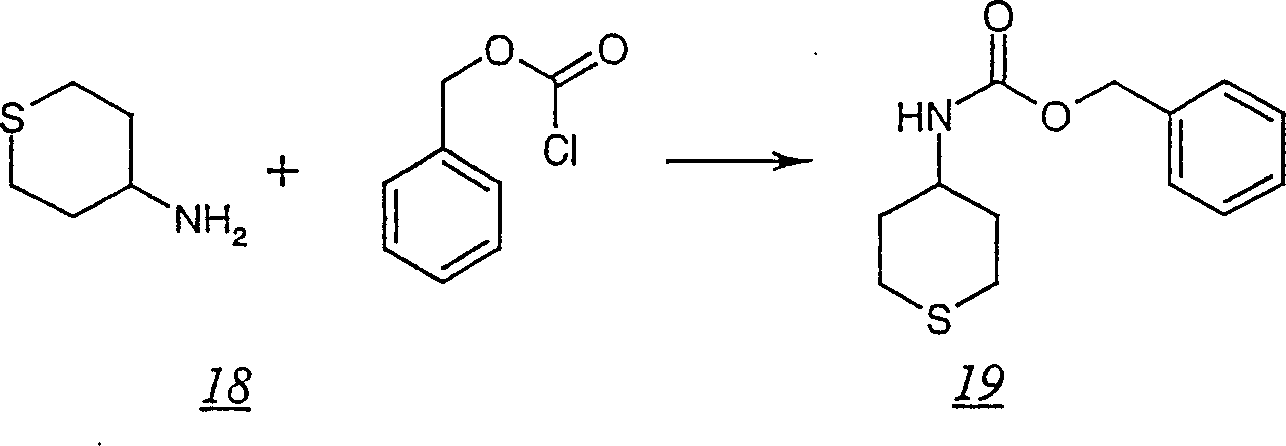
向2.3g(0.0197mol)4-氨基四氢噻喃 18在25mL 1N NaOH中的悬浮液在5℃下滴加3.14mL(3.75g,0.022mol)氯甲酸苄酯。在完成添加后固体立即形成,在室温下搅拌混合物1小时,过滤并用水洗涤。接着用己烷(50mL)洗涤。在干燥(风干)后,获得4.4g(88%产率)产物 19。(质谱M+1=252)。To a suspension of 2.3 g (0.0197 mol) 4-aminothiopyran 18 in 25 mL 1N NaOH was added dropwise 3.14 mL (3.75 g, 0.022 mol) benzyl chloroformate at 5°C. A solid formed immediately after the addition was complete and the mixture was stirred at room temperature for 1 hour, filtered and washed with water. It was then washed with hexane (50 mL). After drying (air drying), 4.4 g (88% yield) of product 19 were obtained. (Mass spectrum M+1 = 252).
步骤4step 4

在室温下向40g(0.159mol)硫化物 19在200mL二氯甲烷中的溶液以小份加入75g(0.33mol)3-氯过苯甲酸。反应是放热的。使反应混合物搅拌过夜。用饱和Na2SO3水溶液(2×150mL),然后用NaHCO3(3×150mL)洗涤混合物。然后用盐水洗涤有机溶液,用MgSO4干燥。将混合物过滤,在真空中蒸发滤液以提供37.5g砜 20(83%产率)。To a solution of 40 g (0.159 mol) of sulfide 19 in 200 mL of dichloromethane was added 75 g (0.33 mol) of 3-chloroperbenzoic acid in small portions at room temperature. The reaction is exothermic. The reaction mixture was allowed to stir overnight. The mixture was washed with saturated aqueous Na2SO3 (2 x 150 mL), then NaHCO3 (3 x 150 mL). The organic solution was then washed with brine and dried over MgSO4 . The mixture was filtered and the filtrate was evaporated in vacuo to afford 37.5 g of sulfone 20 (83% yield).
步骤5step 5

向10g(0.026mol)N-苯甲酰氧基羰基-砜 20在Parr瓶中的150mL乙醇中的混合物加入0.5g氢氧化钯(20%在碳上,Pearlman催化剂)。将其在50psi下进行Parr氢化器15小时直至完成。在硅藻土上过滤并在真空中浓缩,提供5.0g游离胺21(68%产率)。To a mixture of 10 g (0.026 mol) N-benzoyloxycarbonyl-sulfone 20 in 150 mL ethanol in a Parr bottle was added 0.5 g palladium hydroxide (20% on carbon, Pearlman catalyst). This was subjected to a Parr hydrogenator at 50 psi for 15 hours until completion. Filtration over celite and concentration in vacuo provided 5.0 g of the free amine 21 (68% yield).
步骤6step 6
将1.4g(0.41mmol)亚砜 10和1.22g(8.2mmol)4-氨基四氢噻喃-二氧化物 21在3mL NMP中的混合物加热至70℃2小时。冷却混合物,用水稀释,用乙酸乙酯(2×75mL)萃取。用水(3×75mL),盐水洗涤合并的乙酸乙酯溶液,干燥(MgSO4),通过硅胶柱色谱法纯化原材料,用二氯甲烷中的4%甲醇洗脱,提供1.5g所需产物。将其溶解在3mL二氯甲烷中,滴加4.5mL 1M HCl/乙醚。搅拌悬浮液30分钟,将固体过滤,用乙醚洗涤,提供1.86g(98%产率)的化合物 5。(质谱M+1=428,MP=221.8-226.8℃)。A mixture of 1.4 g (0.41 mmol) sulfoxide 10 and 1.22 g (8.2 mmol) 4-aminothiopyran-dioxide 21 in 3 mL NMP was heated to 70° C. for 2 hours. The mixture was cooled, diluted with water, and extracted with ethyl acetate (2 x 75 mL). The combined ethyl acetate solutions were washed with water (3 x 75 mL), brine, dried ( MgSO4 ) and the starting material was purified by silica gel column chromatography eluting with 4% methanol in dichloromethane to provide 1.5 g of the desired product. It was dissolved in 3 mL of dichloromethane and 4.5 mL of 1M HCl/ether was added dropwise. The suspension was stirred for 30 minutes and the solid was filtered and washed with diethyl ether to provide 1.86 g (98% yield) of compound 5 . (Mass spectrum M+1 = 428, MP = 221.8-226.8°C).
实施例7(化合物6)Example 7 (Compound 6)
将0.4g(1.2mol)亚砜 10和0.52g(5.8mmol)2-氨基-2-甲基-1-丙醇在10ml氯仿和0.8ml nmp中的混合物加热至70℃3小时。在减压下去除氯仿。加入40ml甲醇/乙醚(1∶1)。搅拌悬浮液10分钟并过滤。用更多的乙醚洗涤固体,提供0.258g(58.5%产率)的所需产物。将其溶解在15ml二氯甲烷中的10%甲醇中,加入0.85ml 1M HCl/乙醚。搅拌混合物30分钟并浓缩。加入乙醚并过滤固体,用乙醚洗涤,提供0.295g化合物 6。(质谱M+1=368,MP=190.8-194.3℃)A mixture of 0.4 g (1.2 mol) sulfoxide 10 and 0.52 g (5.8 mmol) 2-amino-2-methyl-1-propanol in 10 ml chloroform and 0.8 ml nmp was heated to 70° C. for 3 hours. Chloroform was removed under reduced pressure. 40 ml of methanol/ether (1:1) were added. The suspension was stirred for 10 minutes and filtered. The solid was washed with more diethyl ether to provide 0.258 g (58.5% yield) of the desired product. This was dissolved in 15 ml of 10% methanol in dichloromethane and 0.85 ml of 1M HCl/ether was added. The mixture was stirred for 30 minutes and concentrated. Diethyl ether was added and the solid was filtered, washing with diethyl ether to provide 0.295 g of compound 6 . (Mass spectrum M+1=368, MP=190.8-194.3°C)
实施例8(化合物7)Example 8 (Compound 7)

将0.4g(1.2mmol)亚砜 10装入玻璃密封管(聚四氟乙烯螺帽)反应器。在用冰水浴冷却反应容器同时用氮吹洗反应容器2分钟。加入5ml异丙胺并密封管。将红色溶液在64℃油浴中加热2小时直至反应完成。冷却混合物,用二氯甲烷漂洗反应容器。在真空中去除溶剂,通过硅胶柱色谱法纯化样品,用二氯甲烷中5%-10%的乙酸乙酯梯度洗脱,提供0.34g(87%产物)。将该淡黄色固体溶解在最少量的二氯甲烷中,加入1.2ml 1MHCl/乙醚,接着5ml乙醚。搅拌黄色悬浮液1小时并过滤,用乙醚洗涤,提供0.34g化合物 7。(质谱M+1=338,MP=210-212.5℃)0.4 g (1.2 mmol) of sulfoxide 10 was charged into a glass sealed tube (Teflon screw cap) reactor. The reaction vessel was purged with nitrogen for 2 minutes while cooling the reaction vessel with an ice-water bath. Add 5 ml of isopropylamine and seal the tube. The red solution was heated in a 64°C oil bath for 2 hours until the reaction was complete. The mixture was cooled and the reaction vessel was rinsed with dichloromethane. The solvent was removed in vacuo and the sample was purified by column chromatography on silica gel eluting with a gradient of 5%-10% ethyl acetate in dichloromethane to afford 0.34g (87% product). The light yellow solid was dissolved in a minimal amount of dichloromethane and 1.2ml of 1M HCl/ether was added followed by 5ml of ether. The yellow suspension was stirred for 1 hour and filtered, washing with ether, affording 0.34 g of compound 7 . (Mass spectrum M+1=338, MP=210-212.5°C)
实施例9(化合物8)Example 9 (Compound 8)

将0.4g(1.2mmol)亚砜 10和0.29g(2.33mmol)4-氟苄胺在5mL氯仿中的混合物在60℃油浴中加热1.5小时,直至反应完成。通过柱色谱法直接纯化产物,用二氯甲烷中5%-10%的乙酸乙酯梯度洗脱,提供0.42g(89%产率)产物。将黄色固体溶解在最少量的二氯甲烷中,加入1.25mL1M HCl/乙醚。搅拌混合物30分钟,在真空中去除溶剂。加入乙醚并过滤固体和用乙醚洗涤,提供0.469g化合物 8。(质谱M+1=404,MP=178-180℃)A mixture of 0.4 g (1.2 mmol) of sulfoxide 10 and 0.29 g (2.33 mmol) of 4-fluorobenzylamine in 5 mL of chloroform was heated in a 60 °C oil bath for 1.5 h until the reaction was complete. The product was directly purified by column chromatography eluting with a gradient of 5%-10% ethyl acetate in dichloromethane to provide 0.42 g (89% yield) of product. The yellow solid was dissolved in a minimal amount of dichloromethane and 1.25 mL of 1M HCl/ether was added. The mixture was stirred for 30 minutes and the solvent was removed in vacuo. Diethyl ether was added and the solid was filtered and washed with ether to provide 0.469 g of compound 8 . (Mass spectrum M+1=404, MP=178-180°C)
实施例10(化合物9)Example 10 (Compound 9)

将0.4g(1.2mmol)亚砜 10和0.36g(2.4mmol)2-氨基乙基甲基砜在3mL NMP中的混合物加热至65℃30分钟。[通过在室温下将4-甲氧基苄胺与甲基乙烯基砜在三乙胺的存在下在THF中反应制备2-氨基甲基砜,通过在甲酸铵和10%Pd-C的存在下在甲醇中搅拌去除N-苄基]。冷却混合物,用水和乙酸乙酯稀释。过滤形成的固体,用更多的乙酸乙酯和然后40mL甲醇洗涤,提供0.34g(72.6%产率)产物。将其溶解在5mL二氯甲烷中的10%甲醇中,加入1mL 1M HCl/乙醚。持续搅拌30分钟,在真空中去除溶剂。加入乙醚研制,过滤形成的固体,用另外10mL乙醚洗涤,提供0.374g化合物9。(质谱M+1=402,MP=172.2-176℃)A mixture of 0.4 g (1.2 mmol) sulfoxide 10 and 0.36 g (2.4 mmol) 2-aminoethylmethyl sulfone in 3 mL NMP was heated to 65° C. for 30 minutes. [2-Aminomethylsulfone was prepared by reacting 4-methoxybenzylamine with methylvinylsulfone in the presence of triethylamine in THF at room temperature, by reacting in the presence of ammonium formate and 10% Pd-C The N-benzyl group was removed under stirring in methanol]. The mixture was cooled, diluted with water and ethyl acetate. The solid formed was filtered, washed with more ethyl acetate and then 40 mL of methanol to afford 0.34 g (72.6% yield) of product. This was dissolved in 5 mL of 10% methanol in dichloromethane and 1 mL of 1M HCl/ether was added. Stirring was continued for 30 minutes and the solvent was removed in vacuo. Triturated with diethyl ether, the solid formed was filtered and washed with an additional 10 mL of diethyl ether to provide 0.374 g of compound 9. (Mass spectrum M+1=402, MP=172.2-176°C)
实施例11(化合物10)Example 11 (Compound 10)

步骤1step 1
将2.48g(10.1mmol)实施例2的醛 4,1.83g(12mmol)4-氟苯氧基乙腈(在K2CO3/DMF中由4-氟苯酚和碘乙腈制备)和7g(50.6mmol)碳酸钾在30mL NMP中的混合物在110℃下加热4小时直至反应完成。将混合物倒入200ml水中并用乙酸乙酯(3×125mL)萃取。用水(3×150mL),盐水洗涤有机溶剂,用200mL己烷稀释,干燥(MgSO4),滤过硅胶短塞。在真空中去除溶剂。通过硅胶柱色谱法纯化残余的固体,用二氯甲烷中5%-20%的乙酸乙酯梯度洗脱,提供1.3g氨基吡啶并嘧啶 22,(37%产率)。(质谱M+1=379,MP=186.2-192.9℃)2.48 g (10.1 mmol) of the aldehyde 4 of Example 2, 1.83 g (12 mmol) of 4-fluorophenoxyacetonitrile (prepared from 4-fluorophenol and iodoacetonitrile in K 2 CO 3 /DMF) and 7 g (50.6 mmol) ) A mixture of potassium carbonate in 30 mL of NMP was heated at 110° C. for 4 hours until the reaction was complete. The mixture was poured into 200ml of water and extracted with ethyl acetate (3 x 125mL). The organic solvent was washed with water (3 x 150 mL), brine, diluted with 200 mL of hexanes, dried ( MgSO4 ), and filtered through a short plug of silica gel. Solvent was removed in vacuo. The residual solid was purified by column chromatography on silica gel, eluting with a gradient of 5%-20% ethyl acetate in dichloromethane, to provide 1.3 g of the aminopyridopyrimidine 22 , (37% yield). (Mass spectrum M+1=379, MP=186.2-192.9°C)
步骤2step 2

在6小时的时间内(开始两小时1当量/小时,后面四小时0.5当量/小时)向1.3g(3.4mmol)胺22,54g(2.1mL,15.3mmol)三乙胺,3mL水和30mL乙腈的混合物加入总共2.4mL(19.6mmol,5.8当量)1,2-二氯乙基乙醚,直至反应完成。使混合物在室温下静置过夜,用水稀释,用乙酸乙酯(2×100mL)萃取。用盐水洗涤有机溶液,干燥(MgSO4),并在真空中去除。通过硅胶柱色谱法完成纯化,用己烷中的10%乙酸乙酯洗脱,提供0.78g(57%产率)苯氧基-三环-咪唑 23(57%产率)。To 1.3 g (3.4 mmol) of amine 22, 54 g (2.1 mL, 15.3 mmol) of triethylamine, 3 mL of water and 30 mL of acetonitrile over a period of 6 hours (1 eq/h for the first two hours and 0.5 eq/h for the next four hours) A total of 2.4 mL (19.6 mmol, 5.8 equiv) of 1,2-dichloroethyl ether was added to the mixture until the reaction was complete. The mixture was allowed to stand at room temperature overnight, diluted with water and extracted with ethyl acetate (2 x 100 mL). The organic solution was washed with brine, dried ( MgSO4 ), and removed in vacuo. Purification was accomplished by silica gel column chromatography eluting with 10% ethyl acetate in hexanes to provide 0.78 g (57% yield) of phenoxy-tricyclo-imidazole 23 (57% yield).
步骤3step 3

向0.77g(1.92mmol)硫化物 23在30mL二氯甲烷中在5℃下的冷却的溶液加入0.43g(1.92mmol)3-氯过苯甲酸(77%max.)。在1小时内完成反应,将混合物倒入冷却的饱和NaHCO3水溶液,用二氯甲烷萃取。用盐水洗涤有机溶液并干燥(MgSO4)。在真空中去除溶剂后,回收0.763g亚砜(95%产率)。To a cooled solution of 0.77 g (1.92 mmol) of sulfide 23 in 30 mL of dichloromethane at 5° C. was added 0.43 g (1.92 mmol) of 3-chloroperbenzoic acid (77% max.). The reaction was complete within 1 h, and the mixture was poured into cooled saturated aqueous NaHCO 3 and extracted with dichloromethane. The organic solution was washed with brine and dried ( MgSO4 ). After removing the solvent in vacuo, 0.763 g of sulfoxide was recovered (95% yield).
步骤4step 4
将0.4g(0.96mmol)亚砜 24和0.48g(4.78mmol)4-氨基四氢吡喃在1mL NMP中的混合物在60-70℃下加热30分钟。用水稀释混合物并用乙酸乙酯萃取。用盐水洗涤有机溶液并干燥(MgSO4),在真空中去除。通过硅胶柱色谱法完成纯化,用二氯甲烷中的10-30%乙酸乙酯梯度洗脱以洗出非极性杂质,和最后用二氯甲烷中的2.5%甲醇洗脱以洗出产物,0.210g(58%产率)。将1mL二氯甲烷中的该固体与0.83mL 1M HCl/乙醚混合,搅拌混合物1小时,用乙醚洗涤并过滤,提供0.21g化合物10。(质谱M+1=380,MP=198-206℃)A mixture of 0.4 g (0.96 mmol) sulfoxide 24 and 0.48 g (4.78 mmol) 4-aminotetrahydropyran in 1 mL NMP was heated at 60-70 °C for 30 minutes. The mixture was diluted with water and extracted with ethyl acetate. The organic solution was washed with brine and dried ( MgSO4 ), removed in vacuo. Purification was accomplished by column chromatography on silica gel, eluting with a gradient of 10-30% ethyl acetate in dichloromethane to elute non-polar impurities, and finally 2.5% methanol in dichloromethane to elute the product, 0.210 g (58% yield). This solid in 1 mL of dichloromethane was mixed with 0.83 mL of 1M HCl/ether, the mixture was stirred for 1 hour, washed with ether and filtered to provide 0.21 g of compound 10. (Mass spectrum M+1=380, MP=198-206°C)
实施例12(化合物11)Example 12 (Compound 11)
向在5℃下的5ml二氯甲烷中的0.11g(1.0mmol)4-氟苯胺滴加0.5ml(1.0mmol)三甲基铝试剂(2M/甲苯)。在加入后,持续搅拌10分钟。然后通过注射器将该溶液加入0.355g(0.85mmol)实施例10的亚砜在10ml二氯甲烷中的5℃溶液。然后搅拌混合物17小时,然后在回流下搅拌3小时。将其倒入饱和NH4Cl水溶液。过滤混合物并在分层时将滤液转移至分液漏斗。再用二氯甲烷萃取水层一次,用盐水洗涤合并的有机溶液并干燥(盐水,MgSO4)。在真空中去除溶剂后,通过硅胶柱色谱法纯化残渣,用二氯甲烷中的10%乙酸乙酯洗脱,提供0.16g黄色固体。将其与5ml二氯甲烷中的20%甲醇混合并加入0.49ml 1M HCl/乙醚。将其搅拌30分钟并将溶剂蒸干。加入10ml乙醚,搅拌黄色悬浮液10分钟,过滤并用另外的乙醚洗涤,提供0.145g化合物11。(质谱M+1=390,mp=289.3-291.1℃)To 0.11 g (1.0 mmol) of 4-fluoroaniline in 5 ml of dichloromethane at 5°C was added dropwise 0.5 ml (1.0 mmol) of trimethylaluminum reagent (2M/toluene). Stirring was continued for 10 minutes after the addition. This solution was then added via syringe to a 5° C. solution of 0.355 g (0.85 mmol) of the sulfoxide of Example 10 in 10 ml of dichloromethane. The mixture was then stirred for 17 hours and then for 3 hours at reflux. It was poured into saturated aqueous NH 4 Cl solution. The mixture was filtered and when the layers were separated the filtrate was transferred to a separatory funnel. The aqueous layer was extracted once more with dichloromethane, and the combined organic solutions were washed with brine and dried (brine, MgSO4 ). After removing the solvent in vacuo, the residue was purified by silica gel column chromatography eluting with 10% ethyl acetate in dichloromethane to afford 0.16 g of a yellow solid. This was mixed with 5ml of 20% methanol in dichloromethane and 0.49ml of 1M HCl/ether was added. It was stirred for 30 minutes and the solvent was evaporated to dryness. 10 ml of diethyl ether was added and the yellow suspension was stirred for 10 minutes, filtered and washed with additional diethyl ether to provide 0.145 g of compound 11. (Mass spectrum M+1=390, mp=289.3-291.1°C)
本领域技术人员应当理解上述反应路线的某些修改也被考虑和属于本发明的范围内。例如,某些步骤将涉及与特定反应条件不相容的官能团的保护基的使用。Those skilled in the art will appreciate that certain modifications of the above reaction schemes are also contemplated and within the scope of the invention. For example, certain steps will involve the use of protecting groups for functional groups that are incompatible with the particular reaction conditions.
实施例13Example 13
下面是代表性的包含式(I)的化合物的药物制剂。The following are representative pharmaceutical formulations comprising compounds of formula (I).
片剂制剂 Tablet Formulations
将下列成分紧密混合并压制成单刻痕的片剂。
胶囊制剂
将下列成分紧密混合并装载到硬壳明胶胶囊中。
混悬剂制剂
将下列成分混合以形成口服给药的混悬剂。
注射剂 injection
将下列成分混合以形成注射剂。
所有上述成分,除了水以外,都在搅拌下合并和加热至60-70℃。然后在剧烈搅拌下加入足量的60℃水以乳化成分,然后加入适量水至100g。All of the above ingredients, except water, were combined and heated to 60-70°C with stirring. Sufficient 60°C water was then added with vigorous stirring to emulsify the ingredients, followed by qs. water to 100 g.
栓剂制剂Suppository preparations
通过将本发明的化合物与WitepsolH-15(饱和植物脂肪酸的甘油三酸酯;Riches-Nelson,Inc.,New York)混合制备总重2.5g的栓剂,并且具有下列组成:A suppository with a total weight of 2.5 g is prepared by mixing a compound of the invention with Witepsol(R) H-15 (a triglyceride of saturated vegetable fatty acids; Riches-Nelson, Inc., New York) and has the following composition:
实施例14Example 14
p-38(MAP)激酶抑制-体外分析p-38(MAP) Kinase Inhibition - In Vitro Assay
使用对Ahn,N.G.;等J.of Biol.Chem.Vol.266(7),4220-4227,(1991)中描述的方法进行微小改进的方法,通过测定p-38激酶将γ-33P-ATP中的γ-磷酸转移给髓鞘碱性蛋白(MBP)而测定本发明的化合物在体外抑制p-38MAP激酶的活性。γ- 33P- The gamma-phosphate in ATP is transferred to myelin basic protein (MBP) to determine the activity of the compounds of the present invention in inhibiting p-38MAP kinase in vitro.
重组p38MAP激酶的磷酸化型用SEK-1和MEKK在大肠杆菌中表达(参见,Khokhlatchev,A.等J.of Biol.Chem.Vol.272(17),11057-11062,(1997),然后用镍柱通过亲合色谱纯化。The phosphorylated form of recombinant p38MAP kinase was expressed in Escherichia coli with SEK-1 and MEKK (seeing, Khokhlatchev, A. et al. J.of Biol.Chem.Vol.272(17), 11057-11062, (1997), and then expressed with Nickel column purification by affinity chromatography.
磷酸化的p38MAP激酶在激酶缓冲液(20mM 3-(N-吗啉代)丙磺酸,pH 7.2,25mM β-磷酸甘油,5mM乙二醇-双(β-氨基乙醚)-N,N,N′,N′-四乙酸,1mM钒酸钠,1mM二硫苏糖醇,40mM氯化镁)中稀释。加入溶解于DMSO的实验化合物或仅DMSO(对照),样品在30℃保温10分钟。通过加入含有MBP和γ-33P-ATP的底物混合物引发激酶反应。在30℃下继续培养20分钟后,加入0.75%磷酸终止该反应。利用磷酸纤维素膜(Millipore,Bedford,MA)从残余γ-33P-ATP分离出磷酸化MBP,并且利用闪烁计数器定量测定(Packard,Meriden,CT)。Phosphorylated p38MAP kinase in kinase buffer (20mM 3-(N-morpholino)propanesulfonic acid, pH 7.2, 25mM β-glycerol phosphate, 5mM ethylene glycol-bis(β-aminoethyl ether)-N,N, N', N'-tetraacetic acid, 1mM sodium vanadate, 1mM dithiothreitol, 40mM magnesium chloride). Test compounds dissolved in DMSO or DMSO alone (control) were added and samples were incubated at 30°C for 10 minutes. Kinase reactions are initiated by the addition of a substrate mix containing MBP and γ- 33P -ATP. After further incubation at 30°C for 20 minutes, the reaction was terminated by the addition of 0.75% phosphoric acid. Phosphorylated MBP was separated from residual [gamma] -33P -ATP using a phosphocellulose membrane (Millipore, Bedford, MA) and quantified using a scintillation counter (Packard, Meriden, CT).
说明书的表1中列出的化合物的p-38抑制活性(表示为IC50,分析导致p-38酶50%抑制的浓度)为0.001μM-10μM。例如,以下表2显示使用实施例14的测定抑制p38的代表性的值。The p-38 inhibitory activity (expressed as IC 50 , the concentration assayed to result in 50% inhibition of the p-38 enzyme) of the compounds listed in Table 1 of the specification ranged from 0.001 μM to 10 μM. For example, Table 2 below shows representative values for inhibition of p38 using the assay of Example 14.
表2
Claims (22)


Applications Claiming Priority (2)
| Application Number | Priority Date | Filing Date | Title |
|---|---|---|---|
| US36992902P | 2002-04-03 | 2002-04-03 | |
| US60/369,929 | 2002-04-03 |
Publications (2)
| Publication Number | Publication Date |
|---|---|
| CN1646529A CN1646529A (en) | 2005-07-27 |
| CN1293078C true CN1293078C (en) | 2007-01-03 |
Family
ID=28675587
Family Applications (1)
| Application Number | Title | Priority Date | Filing Date |
|---|---|---|---|
| CNB038075369A Expired - Fee Related CN1293078C (en) | 2002-04-03 | 2003-03-27 | Imidazo fused compounds |
Country Status (13)
| Country | Link |
|---|---|
| US (4) | US6949560B2 (en) |
| EP (1) | EP1492790A1 (en) |
| JP (1) | JP2006503802A (en) |
| KR (1) | KR100656205B1 (en) |
| CN (1) | CN1293078C (en) |
| AR (1) | AR039219A1 (en) |
| AU (1) | AU2003215675B2 (en) |
| BR (1) | BR0308937A (en) |
| CA (1) | CA2479644A1 (en) |
| MX (1) | MXPA04009585A (en) |
| PL (1) | PL374544A1 (en) |
| RU (1) | RU2310657C2 (en) |
| WO (1) | WO2003082871A1 (en) |
Cited By (1)
| Publication number | Priority date | Publication date | Assignee | Title |
|---|---|---|---|---|
| CN109721599A (en) * | 2017-10-30 | 2019-05-07 | 如东凌达生物医药科技有限公司 | A kind of amino replaces nitrogenous fused ring compound and its preparation method and application |
Families Citing this family (53)
| Publication number | Priority date | Publication date | Assignee | Title |
|---|---|---|---|---|
| US20050070554A1 (en) * | 2003-08-27 | 2005-03-31 | Amgen Inc. | Substituted heterocyclic compounds and methods of use |
| DE10361659A1 (en) | 2003-12-30 | 2005-07-28 | Osram Opto Semiconductors Gmbh | Process for preparation of an epitaxial structural element based on a first group III/V compound semiconductor material system (SMS) with a first group V element on a substrate or buffer layer useful in semiconductor technology |
| FR2873118B1 (en) * | 2004-07-15 | 2007-11-23 | Sanofi Synthelabo | PYRIDO-PYRIMIDINE DERIVATIVES, THEIR APPLICATION IN THERAPEUTICS |
| EP2131858A4 (en) * | 2007-03-20 | 2011-11-23 | Cadila Pharmaceuticals Ltd | P38 inhibitors |
| US8754114B2 (en) | 2010-12-22 | 2014-06-17 | Incyte Corporation | Substituted imidazopyridazines and benzimidazoles as inhibitors of FGFR3 |
| SG10201505664WA (en) * | 2011-10-21 | 2015-09-29 | Glaxosmithkline Llc | Compounds and methods for enhancing innate immune responses |
| CN107652289B (en) | 2012-06-13 | 2020-07-21 | 因塞特控股公司 | Substituted tricyclic compounds as FGFR inhibitors |
| US9388185B2 (en) | 2012-08-10 | 2016-07-12 | Incyte Holdings Corporation | Substituted pyrrolo[2,3-b]pyrazines as FGFR inhibitors |
| US9266892B2 (en) | 2012-12-19 | 2016-02-23 | Incyte Holdings Corporation | Fused pyrazoles as FGFR inhibitors |
| KR102269032B1 (en) | 2013-04-19 | 2021-06-24 | 인사이트 홀딩스 코포레이션 | Bicyclic heterocycles as fgfr inhibitors |
| CN105481858B (en) * | 2014-10-11 | 2019-05-17 | 上海医药集团股份有限公司 | A kind of nitrogenous fused heterocyclic compound, preparation method, composition and application |
| US10851105B2 (en) | 2014-10-22 | 2020-12-01 | Incyte Corporation | Bicyclic heterocycles as FGFR4 inhibitors |
| WO2016134294A1 (en) | 2015-02-20 | 2016-08-25 | Incyte Corporation | Bicyclic heterocycles as fgfr4 inhibitors |
| MA41551A (en) | 2015-02-20 | 2017-12-26 | Incyte Corp | BICYCLIC HETEROCYCLES USED AS FGFR4 INHIBITORS |
| PE20171514A1 (en) | 2015-02-20 | 2017-10-20 | Incyte Corp | BICYCLE HETEROCYCLES AS FGFR INHIBITORS |
| DK3368052T3 (en) | 2015-10-27 | 2022-03-14 | Childrens Hospital Med Ct | USE OF MAPK INHIBITORS TO REDUCE THE LOSS OF HEMATOPOETIC STEM CELLS DURING EX VIVO CULTIVATION AND GENE MANIPULATION |
| US20190060286A1 (en) | 2016-02-29 | 2019-02-28 | University Of Florida Research Foundation, Incorpo | Chemotherapeutic Methods |
| WO2018004258A1 (en) * | 2016-06-28 | 2018-01-04 | 한미약품 주식회사 | Novel heterocyclic derivative compound and use thereof |
| KR20180002053A (en) * | 2016-06-28 | 2018-01-05 | 한미약품 주식회사 | Novel heterocylcic derivatives and use thereof |
| JP7240784B2 (en) * | 2016-11-16 | 2023-03-16 | 上海瑛派▲薬▼▲業▼有限公司 | 8,9-dihydroimidazole[1,2-a]pyrimido[5,4-e]pyrimidine-5(6H)-ketone compounds |
| WO2018153373A1 (en) * | 2017-02-27 | 2018-08-30 | 贝达药业股份有限公司 | Fgfr inhibitor and application thereof |
| US11091485B2 (en) | 2017-05-23 | 2021-08-17 | Shengke Pharmaceuticals (Jiangsu) Ltd. | Imidazo[1′,2′:1,6]pyrido[2,3-d]pyrimidine compound as protein kinase inhibitor |
| AR111960A1 (en) | 2017-05-26 | 2019-09-04 | Incyte Corp | CRYSTALLINE FORMS OF A FGFR INHIBITOR AND PROCESSES FOR ITS PREPARATION |
| US10342786B2 (en) | 2017-10-05 | 2019-07-09 | Fulcrum Therapeutics, Inc. | P38 kinase inhibitors reduce DUX4 and downstream gene expression for the treatment of FSHD |
| KR20200067170A (en) | 2017-10-05 | 2020-06-11 | 풀크럼 쎄러퓨틱스, 인코포레이티드 | P38 kinase inhibitors that reduce DUX4 and downstream gene expression for the treatment of FSHD |
| CN109721600B (en) * | 2017-10-30 | 2021-04-27 | 上海凌达生物医药有限公司 | Nitrogen-containing fused ring compounds and preparation method and application thereof |
| SG11202010636VA (en) | 2018-05-04 | 2020-11-27 | Incyte Corp | Solid forms of an fgfr inhibitor and processes for preparing the same |
| BR112020022373A2 (en) | 2018-05-04 | 2021-02-02 | Incyte Corporation | salts of a fgfr inhibitor |
| CN110857300B (en) * | 2018-08-23 | 2021-11-05 | 上海凌达生物医药有限公司 | Condensed ring triazole compounds, preparation method and application |
| WO2020043078A1 (en) * | 2018-08-27 | 2020-03-05 | 贝达药业股份有限公司 | Salt form and crystal form of novel azatricyclic compound and use thereof |
| US11066404B2 (en) | 2018-10-11 | 2021-07-20 | Incyte Corporation | Dihydropyrido[2,3-d]pyrimidinone compounds as CDK2 inhibitors |
| WO2020168197A1 (en) | 2019-02-15 | 2020-08-20 | Incyte Corporation | Pyrrolo[2,3-d]pyrimidinone compounds as cdk2 inhibitors |
| US11472791B2 (en) | 2019-03-05 | 2022-10-18 | Incyte Corporation | Pyrazolyl pyrimidinylamine compounds as CDK2 inhibitors |
| US20220185811A1 (en) * | 2019-03-08 | 2022-06-16 | Shouyao Holdings (beijing) Co., Ltd. | Fgfr4 kinase inhibitor and preparation method therefor and use thereof |
| WO2020185532A1 (en) | 2019-03-08 | 2020-09-17 | Incyte Corporation | Methods of treating cancer with an fgfr inhibitor |
| US11919904B2 (en) | 2019-03-29 | 2024-03-05 | Incyte Corporation | Sulfonylamide compounds as CDK2 inhibitors |
| US11440914B2 (en) | 2019-05-01 | 2022-09-13 | Incyte Corporation | Tricyclic amine compounds as CDK2 inhibitors |
| WO2020223558A1 (en) | 2019-05-01 | 2020-11-05 | Incyte Corporation | Tricyclic amine compounds as cdk2 inhibitors |
| WO2021007269A1 (en) | 2019-07-09 | 2021-01-14 | Incyte Corporation | Bicyclic heterocycles as fgfr inhibitors |
| CA3150681A1 (en) | 2019-08-14 | 2021-02-18 | Incyte Corporation | Imidazolyl pyrimidinylamine compounds as cdk2 inhibitors |
| WO2021067374A1 (en) | 2019-10-01 | 2021-04-08 | Incyte Corporation | Bicyclic heterocycles as fgfr inhibitors |
| WO2021072232A1 (en) | 2019-10-11 | 2021-04-15 | Incyte Corporation | Bicyclic amines as cdk2 inhibitors |
| WO2021076602A1 (en) | 2019-10-14 | 2021-04-22 | Incyte Corporation | Bicyclic heterocycles as fgfr inhibitors |
| WO2021076728A1 (en) | 2019-10-16 | 2021-04-22 | Incyte Corporation | Bicyclic heterocycles as fgfr inhibitors |
| JP7720840B2 (en) | 2019-12-04 | 2025-08-08 | インサイト・コーポレイション | Tricyclic heterocycles as FGFR inhibitors |
| CN115151539A (en) | 2019-12-04 | 2022-10-04 | 因赛特公司 | Derivatives of FGFR Inhibitors |
| WO2021146424A1 (en) | 2020-01-15 | 2021-07-22 | Incyte Corporation | Bicyclic heterocycles as fgfr inhibitors |
| CN116710453A (en) * | 2020-08-07 | 2023-09-05 | 璧辰医药技术股份有限公司 | Kinase inhibitors and uses thereof |
| US12065494B2 (en) | 2021-04-12 | 2024-08-20 | Incyte Corporation | Combination therapy comprising an FGFR inhibitor and a Nectin-4 targeting agent |
| AR126102A1 (en) | 2021-06-09 | 2023-09-13 | Incyte Corp | TRICYCLIC HETEROCYCLES AS FGFR INHIBITORS |
| CA3220155A1 (en) | 2021-06-09 | 2022-12-15 | Incyte Corporation | Tricyclic heterocycles as fgfr inhibitors |
| US11981671B2 (en) | 2021-06-21 | 2024-05-14 | Incyte Corporation | Bicyclic pyrazolyl amines as CDK2 inhibitors |
| US11976073B2 (en) | 2021-12-10 | 2024-05-07 | Incyte Corporation | Bicyclic amines as CDK2 inhibitors |
Citations (2)
| Publication number | Priority date | Publication date | Assignee | Title |
|---|---|---|---|---|
| WO2001029042A1 (en) * | 1999-10-21 | 2001-04-26 | F. Hoffmann-La Roche Ag | Heteroalkylamino-substituted bicyclic nitrogen heterocycles as inhibitors of p38 protein kinase |
| WO2002018380A1 (en) * | 2000-08-31 | 2002-03-07 | F. Hoffmann-La Roche Ag | 7-oxo pyridopyrimidines as inhibitors of a cellular proliferation |
Family Cites Families (8)
| Publication number | Priority date | Publication date | Assignee | Title |
|---|---|---|---|---|
| US4522947A (en) | 1982-03-29 | 1985-06-11 | Usv Pharmaceutical Corporation | Certain 1,3-oxazolo[4,5H]quinolines useful as anti-allergy agents |
| US4656281A (en) | 1983-03-18 | 1987-04-07 | Usv Pharmaceutical Corp. | Imidazo quinoline compounds useful as anti-allergy agents |
| DE3502689A1 (en) | 1985-01-26 | 1986-07-31 | Hoechst Ag, 6230 Frankfurt | ELECTROPHOTOGRAPHIC RECORDING MATERIAL |
| US4831040A (en) | 1988-02-01 | 1989-05-16 | Rorer Pharmaceutical Corporation | Method of prevention and treatment of peptic ulcers |
| GB9123916D0 (en) | 1991-11-11 | 1992-01-02 | Wellcome Found | Heterocyclic compounds |
| DE19510965A1 (en) * | 1995-03-24 | 1996-09-26 | Asta Medica Ag | New pyrido / 3,2-e / pyrazinone with anti-asthmatic activity and process for their preparation |
| JPH11292878A (en) | 1998-04-09 | 1999-10-26 | Yamanouchi Pharmaceut Co Ltd | Imidazonaphthylidine derivative |
| CN100376571C (en) | 2001-02-12 | 2008-03-26 | 霍夫曼-拉罗奇有限公司 | 6-substituted pyridopyrimidines |
-
2003
- 2003-03-27 CA CA002479644A patent/CA2479644A1/en not_active Abandoned
- 2003-03-27 KR KR1020047015609A patent/KR100656205B1/en not_active Expired - Fee Related
- 2003-03-27 PL PL03374544A patent/PL374544A1/en not_active Application Discontinuation
- 2003-03-27 AU AU2003215675A patent/AU2003215675B2/en not_active Ceased
- 2003-03-27 EP EP03745276A patent/EP1492790A1/en not_active Withdrawn
- 2003-03-27 RU RU2004132204/04A patent/RU2310657C2/en active
- 2003-03-27 BR BR0308937-1A patent/BR0308937A/en not_active IP Right Cessation
- 2003-03-27 CN CNB038075369A patent/CN1293078C/en not_active Expired - Fee Related
- 2003-03-27 JP JP2003580336A patent/JP2006503802A/en active Pending
- 2003-03-27 MX MXPA04009585A patent/MXPA04009585A/en active IP Right Grant
- 2003-03-27 WO PCT/EP2003/003178 patent/WO2003082871A1/en not_active Ceased
- 2003-04-02 AR ARP030101141A patent/AR039219A1/en unknown
- 2003-04-03 US US10/406,364 patent/US6949560B2/en not_active Expired - Fee Related
-
2005
- 2005-05-04 US US11/122,137 patent/US7081462B2/en not_active Expired - Fee Related
-
2006
- 2006-07-13 US US11/486,348 patent/US7285561B2/en not_active Expired - Fee Related
- 2006-07-13 US US11/486,193 patent/US7285559B2/en not_active Expired - Fee Related
Patent Citations (2)
| Publication number | Priority date | Publication date | Assignee | Title |
|---|---|---|---|---|
| WO2001029042A1 (en) * | 1999-10-21 | 2001-04-26 | F. Hoffmann-La Roche Ag | Heteroalkylamino-substituted bicyclic nitrogen heterocycles as inhibitors of p38 protein kinase |
| WO2002018380A1 (en) * | 2000-08-31 | 2002-03-07 | F. Hoffmann-La Roche Ag | 7-oxo pyridopyrimidines as inhibitors of a cellular proliferation |
Cited By (1)
| Publication number | Priority date | Publication date | Assignee | Title |
|---|---|---|---|---|
| CN109721599A (en) * | 2017-10-30 | 2019-05-07 | 如东凌达生物医药科技有限公司 | A kind of amino replaces nitrogenous fused ring compound and its preparation method and application |
Also Published As
| Publication number | Publication date |
|---|---|
| US20050197352A1 (en) | 2005-09-08 |
| RU2310657C2 (en) | 2007-11-20 |
| KR20040099384A (en) | 2004-11-26 |
| US20060252783A1 (en) | 2006-11-09 |
| AU2003215675B2 (en) | 2007-07-12 |
| US7285559B2 (en) | 2007-10-23 |
| KR100656205B1 (en) | 2006-12-12 |
| US20030232847A1 (en) | 2003-12-18 |
| EP1492790A1 (en) | 2005-01-05 |
| RU2004132204A (en) | 2005-11-20 |
| US20060252784A1 (en) | 2006-11-09 |
| AR039219A1 (en) | 2005-02-09 |
| PL374544A1 (en) | 2005-10-31 |
| US7285561B2 (en) | 2007-10-23 |
| JP2006503802A (en) | 2006-02-02 |
| WO2003082871A1 (en) | 2003-10-09 |
| CN1646529A (en) | 2005-07-27 |
| CA2479644A1 (en) | 2003-10-09 |
| US6949560B2 (en) | 2005-09-27 |
| US7081462B2 (en) | 2006-07-25 |
| MXPA04009585A (en) | 2005-01-11 |
| BR0308937A (en) | 2005-01-04 |
| AU2003215675A1 (en) | 2003-10-13 |
Similar Documents
| Publication | Publication Date | Title |
|---|---|---|
| CN1293078C (en) | Imidazo fused compounds | |
| CN1217952C (en) | compound | |
| CN1156477C (en) | Alkylamino-substituted bicyclic nitrogen heterocycles as inhibitors of P38 protein kinase | |
| CN1255403C (en) | Beta-carboline derivatives useful as inhibitors of phosphodiesterase | |
| CN1214007C (en) | Cyclopentaindoles, compositions containing such compounds, and methods of treatment | |
| CN1263755C (en) | Pyrazolopyridine derivatives as selective COX-2 inhibitors | |
| CN1034175C (en) | Pyrazolopyrimidines | |
| CN1036456C (en) | Amino-substituted pyrazoles | |
| CN1148189C (en) | Quinoline carboxamides as TNF inhibitors and as PDC-IV inhibitors | |
| CN1675207A (en) | 6-alkoxy-pyrido-pyrimidines as p-38 MAP kinase inhibitors | |
| CN1382144A (en) | Heteroalkylamino-substituted bicyclic nitrogen heterocycles as inhibitors of P38 protein kinase | |
| CN1639168A (en) | Bicyclic pyridine and pyrimidine P38 kinase inhibitors | |
| CN1451005A (en) | 7-oxopyridopyrimidines as inhibitors of cell proliferation | |
| CN1303072C (en) | 7-oxo pyridopyrimidines | |
| CN1922161A (en) | 1-Piperazine- and 1-homopiperazine-carboxylate derivatives, preparation and therapeutic use thereof | |
| CN1774425A (en) | Quinazoline compounds | |
| CN1025500C (en) | Process for preparing heteroaryl 3-oxo-propionitrile derivatives | |
| CN1023602C (en) | Antipsychotic 3-piperazinylbenzazole derivs. | |
| CN1620290A (en) | Indolylalkylamine derivatives as 5-hydroxytryptamine-6 ligands | |
| CN1309654A (en) | Biphenyl derivs. | |
| CN1032361C (en) | The preparation method of imidazopyridazine compound | |
| CN1922150A (en) | Indazole derivatives and pharmaceutical compositions containing them | |
| CN1022322C (en) | Fused pyrazole 3-oxo-propionitrile derivatives | |
| CN1753891A (en) | Ccr-3 receptor antagonists | |
| CN1756753A (en) | Benzofuran Derivatives |
Legal Events
| Date | Code | Title | Description |
|---|---|---|---|
| C06 | Publication | ||
| PB01 | Publication | ||
| C10 | Entry into substantive examination | ||
| SE01 | Entry into force of request for substantive examination | ||
| C14 | Grant of patent or utility model | ||
| GR01 | Patent grant | ||
| C17 | Cessation of patent right | ||
| CF01 | Termination of patent right due to non-payment of annual fee |
Granted publication date: 20070103 Termination date: 20100327 |