CN1216998A - Oxidized Metallocene Polyolefin Waxes - Google Patents
Oxidized Metallocene Polyolefin Waxes Download PDFInfo
- Publication number
- CN1216998A CN1216998A CN97194272A CN97194272A CN1216998A CN 1216998 A CN1216998 A CN 1216998A CN 97194272 A CN97194272 A CN 97194272A CN 97194272 A CN97194272 A CN 97194272A CN 1216998 A CN1216998 A CN 1216998A
- Authority
- CN
- China
- Prior art keywords
- oxidized
- metallocene
- alkyl
- mol
- waxes
- Prior art date
- Legal status (The legal status is an assumption and is not a legal conclusion. Google has not performed a legal analysis and makes no representation as to the accuracy of the status listed.)
- Granted
Links
Classifications
-
- C—CHEMISTRY; METALLURGY
- C09—DYES; PAINTS; POLISHES; NATURAL RESINS; ADHESIVES; COMPOSITIONS NOT OTHERWISE PROVIDED FOR; APPLICATIONS OF MATERIALS NOT OTHERWISE PROVIDED FOR
- C09G—POLISHING COMPOSITIONS; SKI WAXES
- C09G1/00—Polishing compositions
- C09G1/06—Other polishing compositions
- C09G1/08—Other polishing compositions based on wax
-
- A—HUMAN NECESSITIES
- A23—FOODS OR FOODSTUFFS; TREATMENT THEREOF, NOT COVERED BY OTHER CLASSES
- A23B—PRESERVATION OF FOODS, FOODSTUFFS OR NON-ALCOHOLIC BEVERAGES; CHEMICAL RIPENING OF FRUIT OR VEGETABLES
- A23B7/00—Preservation of fruit or vegetables; Chemical ripening of fruit or vegetables
- A23B7/16—Coating with a protective layer; Compositions or apparatus therefor
-
- C—CHEMISTRY; METALLURGY
- C08—ORGANIC MACROMOLECULAR COMPOUNDS; THEIR PREPARATION OR CHEMICAL WORKING-UP; COMPOSITIONS BASED THEREON
- C08F—MACROMOLECULAR COMPOUNDS OBTAINED BY REACTIONS ONLY INVOLVING CARBON-TO-CARBON UNSATURATED BONDS
- C08F10/00—Homopolymers and copolymers of unsaturated aliphatic hydrocarbons having only one carbon-to-carbon double bond
- C08F10/02—Ethene
-
- C—CHEMISTRY; METALLURGY
- C08—ORGANIC MACROMOLECULAR COMPOUNDS; THEIR PREPARATION OR CHEMICAL WORKING-UP; COMPOSITIONS BASED THEREON
- C08F—MACROMOLECULAR COMPOUNDS OBTAINED BY REACTIONS ONLY INVOLVING CARBON-TO-CARBON UNSATURATED BONDS
- C08F8/00—Chemical modification by after-treatment
- C08F8/06—Oxidation
-
- C—CHEMISTRY; METALLURGY
- C08—ORGANIC MACROMOLECULAR COMPOUNDS; THEIR PREPARATION OR CHEMICAL WORKING-UP; COMPOSITIONS BASED THEREON
- C08L—COMPOSITIONS OF MACROMOLECULAR COMPOUNDS
- C08L23/00—Compositions of homopolymers or copolymers of unsaturated aliphatic hydrocarbons having only one carbon-to-carbon double bond; Compositions of derivatives of such polymers
- C08L23/26—Compositions of homopolymers or copolymers of unsaturated aliphatic hydrocarbons having only one carbon-to-carbon double bond; Compositions of derivatives of such polymers modified by chemical after-treatment
- C08L23/30—Compositions of homopolymers or copolymers of unsaturated aliphatic hydrocarbons having only one carbon-to-carbon double bond; Compositions of derivatives of such polymers modified by chemical after-treatment by oxidation
-
- C—CHEMISTRY; METALLURGY
- C09—DYES; PAINTS; POLISHES; NATURAL RESINS; ADHESIVES; COMPOSITIONS NOT OTHERWISE PROVIDED FOR; APPLICATIONS OF MATERIALS NOT OTHERWISE PROVIDED FOR
- C09D—COATING COMPOSITIONS, e.g. PAINTS, VARNISHES OR LACQUERS; FILLING PASTES; CHEMICAL PAINT OR INK REMOVERS; INKS; CORRECTING FLUIDS; WOODSTAINS; PASTES OR SOLIDS FOR COLOURING OR PRINTING; USE OF MATERIALS THEREFOR
- C09D123/00—Coating compositions based on homopolymers or copolymers of unsaturated aliphatic hydrocarbons having only one carbon-to-carbon double bond; Coating compositions based on derivatives of such polymers
- C09D123/26—Coating compositions based on homopolymers or copolymers of unsaturated aliphatic hydrocarbons having only one carbon-to-carbon double bond; Coating compositions based on derivatives of such polymers modified by chemical after-treatment
- C09D123/30—Coating compositions based on homopolymers or copolymers of unsaturated aliphatic hydrocarbons having only one carbon-to-carbon double bond; Coating compositions based on derivatives of such polymers modified by chemical after-treatment by oxidation
-
- C—CHEMISTRY; METALLURGY
- C08—ORGANIC MACROMOLECULAR COMPOUNDS; THEIR PREPARATION OR CHEMICAL WORKING-UP; COMPOSITIONS BASED THEREON
- C08F—MACROMOLECULAR COMPOUNDS OBTAINED BY REACTIONS ONLY INVOLVING CARBON-TO-CARBON UNSATURATED BONDS
- C08F110/00—Homopolymers of unsaturated aliphatic hydrocarbons having only one carbon-to-carbon double bond
- C08F110/02—Ethene
-
- C—CHEMISTRY; METALLURGY
- C08—ORGANIC MACROMOLECULAR COMPOUNDS; THEIR PREPARATION OR CHEMICAL WORKING-UP; COMPOSITIONS BASED THEREON
- C08F—MACROMOLECULAR COMPOUNDS OBTAINED BY REACTIONS ONLY INVOLVING CARBON-TO-CARBON UNSATURATED BONDS
- C08F4/00—Polymerisation catalysts
- C08F4/42—Metals; Metal hydrides; Metallo-organic compounds; Use thereof as catalyst precursors
- C08F4/44—Metals; Metal hydrides; Metallo-organic compounds; Use thereof as catalyst precursors selected from light metals, zinc, cadmium, mercury, copper, silver, gold, boron, gallium, indium, thallium, rare earths or actinides
- C08F4/60—Metals; Metal hydrides; Metallo-organic compounds; Use thereof as catalyst precursors selected from light metals, zinc, cadmium, mercury, copper, silver, gold, boron, gallium, indium, thallium, rare earths or actinides together with refractory metals, iron group metals, platinum group metals, manganese, rhenium technetium or compounds thereof
- C08F4/62—Refractory metals or compounds thereof
- C08F4/64—Titanium, zirconium, hafnium or compounds thereof
- C08F4/659—Component covered by group C08F4/64 containing a transition metal-carbon bond
- C08F4/65908—Component covered by group C08F4/64 containing a transition metal-carbon bond in combination with an ionising compound other than alumoxane, e.g. (C6F5)4B-X+
-
- C—CHEMISTRY; METALLURGY
- C08—ORGANIC MACROMOLECULAR COMPOUNDS; THEIR PREPARATION OR CHEMICAL WORKING-UP; COMPOSITIONS BASED THEREON
- C08F—MACROMOLECULAR COMPOUNDS OBTAINED BY REACTIONS ONLY INVOLVING CARBON-TO-CARBON UNSATURATED BONDS
- C08F4/00—Polymerisation catalysts
- C08F4/42—Metals; Metal hydrides; Metallo-organic compounds; Use thereof as catalyst precursors
- C08F4/44—Metals; Metal hydrides; Metallo-organic compounds; Use thereof as catalyst precursors selected from light metals, zinc, cadmium, mercury, copper, silver, gold, boron, gallium, indium, thallium, rare earths or actinides
- C08F4/60—Metals; Metal hydrides; Metallo-organic compounds; Use thereof as catalyst precursors selected from light metals, zinc, cadmium, mercury, copper, silver, gold, boron, gallium, indium, thallium, rare earths or actinides together with refractory metals, iron group metals, platinum group metals, manganese, rhenium technetium or compounds thereof
- C08F4/62—Refractory metals or compounds thereof
- C08F4/64—Titanium, zirconium, hafnium or compounds thereof
- C08F4/659—Component covered by group C08F4/64 containing a transition metal-carbon bond
- C08F4/65912—Component covered by group C08F4/64 containing a transition metal-carbon bond in combination with an organoaluminium compound
-
- C—CHEMISTRY; METALLURGY
- C08—ORGANIC MACROMOLECULAR COMPOUNDS; THEIR PREPARATION OR CHEMICAL WORKING-UP; COMPOSITIONS BASED THEREON
- C08F—MACROMOLECULAR COMPOUNDS OBTAINED BY REACTIONS ONLY INVOLVING CARBON-TO-CARBON UNSATURATED BONDS
- C08F4/00—Polymerisation catalysts
- C08F4/42—Metals; Metal hydrides; Metallo-organic compounds; Use thereof as catalyst precursors
- C08F4/44—Metals; Metal hydrides; Metallo-organic compounds; Use thereof as catalyst precursors selected from light metals, zinc, cadmium, mercury, copper, silver, gold, boron, gallium, indium, thallium, rare earths or actinides
- C08F4/60—Metals; Metal hydrides; Metallo-organic compounds; Use thereof as catalyst precursors selected from light metals, zinc, cadmium, mercury, copper, silver, gold, boron, gallium, indium, thallium, rare earths or actinides together with refractory metals, iron group metals, platinum group metals, manganese, rhenium technetium or compounds thereof
- C08F4/62—Refractory metals or compounds thereof
- C08F4/64—Titanium, zirconium, hafnium or compounds thereof
- C08F4/659—Component covered by group C08F4/64 containing a transition metal-carbon bond
- C08F4/6592—Component covered by group C08F4/64 containing a transition metal-carbon bond containing at least one cyclopentadienyl ring, condensed or not, e.g. an indenyl or a fluorenyl ring
- C08F4/65922—Component covered by group C08F4/64 containing a transition metal-carbon bond containing at least one cyclopentadienyl ring, condensed or not, e.g. an indenyl or a fluorenyl ring containing at least two cyclopentadienyl rings, fused or not
- C08F4/65927—Component covered by group C08F4/64 containing a transition metal-carbon bond containing at least one cyclopentadienyl ring, condensed or not, e.g. an indenyl or a fluorenyl ring containing at least two cyclopentadienyl rings, fused or not two cyclopentadienyl rings being mutually bridged
Landscapes
- Chemical & Material Sciences (AREA)
- Organic Chemistry (AREA)
- Chemical Kinetics & Catalysis (AREA)
- Polymers & Plastics (AREA)
- Health & Medical Sciences (AREA)
- Medicinal Chemistry (AREA)
- Engineering & Computer Science (AREA)
- General Chemical & Material Sciences (AREA)
- Life Sciences & Earth Sciences (AREA)
- Wood Science & Technology (AREA)
- Materials Engineering (AREA)
- Zoology (AREA)
- Food Science & Technology (AREA)
- Crystallography & Structural Chemistry (AREA)
- Transition And Organic Metals Composition Catalysts For Addition Polymerization (AREA)
- Addition Polymer Or Copolymer, Post-Treatments, Or Chemical Modifications (AREA)
- Paints Or Removers (AREA)
Abstract
Description
本发明涉及通过氧化用茂金属催化反应得到的分子量Mw为1000-40,000g/mol的聚烯烃而制得的氧化蜡。用茂金属催化反应得到的聚烯烃,为简化起见,下文中称为茂金属聚烯烃。The invention relates to oxidized waxes obtained by oxidation of polyolefins with a molecular weight Mw of 1000-40,000 g/mol obtained by metallocene catalysis. Polyolefins obtained by metallocene-catalyzed reactions are hereinafter referred to as metallocene polyolefins for simplicity.
此外,本发明涉及制备氧化聚烯烃蜡的方法,该法是将分子量Mw为1000-40,000g/mol的聚烯烃用含氧试剂在140-350℃氧化,以制备氧化聚烯烃蜡,本文还涉及氧化蜡在涂料组合物、或在地板上光剂中的应用,以及氧化聚烯烃蜡在柑果类的涂料组合物中的应用。In addition, the present invention relates to a method for preparing oxidized polyolefin wax, which is to oxidize polyolefin with a molecular weight Mw of 1000-40,000 g/mol with an oxygen-containing reagent at 140-350° C. to prepare oxidized polyolefin wax. The use of oxidized waxes in coating compositions, or in floor polishes, and the use of oxidized polyolefin waxes in citrus coating compositions.
氧化聚烯烃蜡是已知的。它们通常是通过用空气或纯氧氧化一般是低分子量的Ziegler聚乙烯、Phillips聚乙烯(PE-HD)或高压聚乙烯(PE-LD)得到,见“塑料手册”(Kunststoff-Handbuch),第4卷,161页,Carl-Hanser出版社,1969。Oxidized polyolefin waxes are known. They are usually obtained by oxidation of generally low molecular weight Ziegler polyethylene, Phillips polyethylene (PE-HD) or high-pressure polyethylene (PE-LD) with air or pure oxygen, see "Plastics Handbook" (Kunststoff-Handbuch), p. 4 volumes, 161 pages, Carl-Hanser Press, 1969.
这种氧化蜡已经在各种应用场合,例如地板或柑果类的表面处理,作涂料组合物。Such oxidized waxes have been used in various applications, such as flooring or citrus surface treatment, as coating compositions.
聚烯烃蜡氧化,在起始聚烯烃的聚合物链上形成羧基,羧基的数目通过酸值确定。高酸值的蜡通常是有利的,因为这种蜡具有更好的可分散性和可涂敷性。The polyolefin wax oxidizes to form carboxyl groups on the polymer chain of the starting polyolefin, the number of which is determined by the acid number. Waxes with a high acid number are generally advantageous because of their better dispersibility and coatability.
在已知的Phillips聚乙烯蜡、Ziegler聚乙烯蜡或,特别是高压聚乙烯蜡的氧化时,观察到氧化蜡的熔点比起始聚合物的熔点下降很大,这伴随着不希望的氧化蜡的硬度下降。但是,高硬度和因而高熔点的氧化蜡用作例如地板上光或柑果类的保鲜的涂料组合物是有利的。In the oxidation of the known Phillips polyethylene waxes, Ziegler polyethylene waxes or, in particular, high pressure polyethylene waxes, it is observed that the melting point of the oxidized wax drops considerably compared to the melting point of the starting polymer, which is accompanied by undesired hardness decreased. However, oxidized waxes of high hardness and thus high melting point are advantageous for use as, for example, floor glazing or fresh-keeping coating compositions for citrus fruit.
此外,已知的聚烯烃的氧化造成不希望的酸值与皂化值之比<1∶1的结果,这通常对蜡在水性介质中的分散性产生不良的影响。通过增加酸值与皂化值之比,通常可以提高分散性。Furthermore, oxidation of polyolefins is known to result in an undesired ratio of acid number to saponification number < 1:1, which generally has an adverse effect on the dispersibility of waxes in aqueous media. Dispersibility can generally be improved by increasing the ratio of acid number to saponification number.
本发明一个目的是发现弥补上述缺点的方法,和特别是提供具有较高分子量和同时高酸值、高皂化值和较高硬度以及高熔点的氧化聚烯烃蜡。It was an object of the present invention to find a way to remedy the above-mentioned disadvantages and in particular to provide oxidized polyolefin waxes having a relatively high molecular weight and at the same time a high acid number, a high saponification number and a high hardness as well as a high melting point.
此外,本发明的目的还提供一种聚烯烃的氧化方法,该方法可得到具有上述所要求性能的氧化聚烯烃蜡。In addition, the object of the present invention is also to provide a polyolefin oxidation method, which can obtain the oxidized polyolefin wax having the above-mentioned required properties.
由此本发明发现了通过氧化用茂金属催化反应得到的分子量Mw为1000-40,000g/mol聚烯烃而得到的氧化蜡和制备氧化聚烯烃蜡的方法,该法包括将分子量Mw为1000-40,000g/mol的聚烯烃用含氧试剂在140-350℃氧化,其特征在于所用的聚烯烃是用茂金属催化反应得到的。The present invention has thus discovered oxidized waxes obtained by oxidizing polyolefins with a molecular weight Mw of 1000-40,000 g/mol obtained by a metallocene catalyzed reaction and a process for preparing oxidized polyolefin waxes, which method comprises oxidizing polyolefins with a molecular weight Mw of 1000 Oxidation of 40,000 g/mol polyolefin with an oxygen-containing reagent at 140-350°C, characterized in that the polyolefin used is obtained by a metallocene-catalyzed reaction.
本发明还发现氧化蜡在涂料组合物中的应用,或在地板上光剂中的应用,以及氧化蜡在柑果类的涂料组合物中的应用。The present invention also finds the use of oxidized waxes in coating compositions, or in floor polishes, and the use of oxidized waxes in coating compositions for citrus fruits.
作为氧化蜡原料的聚烯烃的重均分子量Mw,由凝胶渗透色谱(GPC)在135℃的1,2,4-三氯苯中,以聚乙烯或聚丙烯作标准物测定,其范围在2000-40,000g/mol,优选为2000-20,000g/mol。作为氧化蜡原料的聚烯烃的分散度Mw/Mn,由上述GPC测定,其通常的范围为1.5-3.0,优选为1.8-2.5。The weight-average molecular weight Mw of polyolefin as the raw material of oxidized wax is determined by gel permeation chromatography (GPC) in 1,2,4-trichlorobenzene at 135°C, using polyethylene or polypropylene as a standard, and its range Between 2000-40,000 g/mol, preferably between 2000-20,000 g/mol. The degree of dispersion M w /M n of the polyolefin used as the raw material of the oxidized wax is usually in the range of 1.5-3.0, preferably 1.8-2.5, as measured by the above-mentioned GPC.
作为氧化蜡原料的聚烯烃可由相应的单体在茂金属催化剂的存在下聚合得到(茂金属催化)。Polyolefins as raw materials for oxidized waxes can be obtained by polymerizing the corresponding monomers in the presence of metallocene catalysts (metallocene catalysis).
比较适合的单体是乙烯和C3-C10-烷-1-烯,也即丙烯、1-丁烯、1-戊烯、1-己烯、1-庚烯、1-辛烯、1-壬烯、1-癸烯。优选用乙烯和/或丙烯作单体。More suitable monomers are ethylene and C 3 -C 10 -alk-1-ene, ie propylene, 1-butene, 1-pentene, 1-hexene, 1-heptene, 1-octene, 1- -None, 1-Decene. Preference is given to using ethylene and/or propylene as monomers.
单体可以进行均聚或相互以任何比例进行共聚。优选的作为氧化蜡原料的聚烯烃是乙烯均聚物,其密度为0.90-0.98g/cm3,优选为0.94-0.97g/cm3,和Mw,如上述那样通过GPC测定,通常为2000-40,000g/mol,优选为2000-20,000g/mol。The monomers can be homopolymerized or copolymerized with each other in any ratio. Preferred polyolefins as raw materials for oxidized waxes are ethylene homopolymers having a density of 0.90-0.98 g/cm 3 , preferably 0.94-0.97 g/cm 3 , and a Mw, determined by GPC as described above, typically 2000- 40,000 g/mol, preferably 2000-20,000 g/mol.
其他适合的起始聚烯烃是乙烯/C3-C10-链烯-1共聚物,其含由一个或多个链烯-1衍生的结构单元占总共聚物的0.1-15%(摩尔),优选为1-10%(摩尔)。优选的乙烯/C3-C10-链烯-1共聚物是乙烯/丙烯共聚物,其中,丙烯衍生的结构单元占总共聚物的0.1-10%(摩尔),优选为1-5%(摩尔)。共聚物的Mw,如上述那样通过GPC测定,通常为2000-40,000g/mol,优选为2000-20,000g/mol。Other suitable starting polyolefins are ethylene/C 3 -C 10 -alkene-1 copolymers containing structural units derived from one or more alkenes-1 in 0.1-15 mol % of the total copolymer , preferably 1-10% (mol). Preferred ethylene/C 3 -C 10 -alkene-1 copolymers are ethylene/propylene copolymers in which propylene derived structural units represent 0.1-10 mole % of the total copolymer, preferably 1-5 % ( Moore). The Mw of the copolymer, determined by GPC as described above, is generally 2000-40,000 g/mol, preferably 2000-20,000 g/mol.
其他优选的作为氧化蜡原料的聚烯烃是全同丙烯均聚物,其中全同五单元组mmmm的含量,通过13C-NMR光谱测定,为90-98%,和Mw,如上述那样通过GPC测定,通常为2000-40,000g/mol,优选为2000-20,000g/mol。Other preferred polyolefins as raw materials for oxidized waxes are isotactic propylene homopolymers in which the content of isotactic pentads mmmm, determined by 13 C-NMR spectroscopy, is 90-98%, and Mw , as described above by GPC determination, usually 2000-40,000 g/mol, preferably 2000-20,000 g/mol.
其他适合的基础聚烯烃是丙烯与乙烯和/或C4-C10-链烯-1共聚物。这些丙烯共聚物通常含有的乙烯和/或C4-C10-链烯-1衍生的结构单元占总共聚物的0.1-15%(摩尔),优选为1-10%(摩尔)。优选的丙烯共聚物是丙烯-乙烯共聚物,其中,乙烯衍生的结构单元占总共聚物的0.1-10%(摩尔),优选为1-5%(摩尔)。丙烯共聚物的Mw,如上述那样通过GPC测定,通常为1000-40,000g/mol,优选为1000-20,000g/mol。Other suitable base polyolefins are propylene with ethylene and/or C 4 -C 10 -alkene-1 copolymers. These propylene copolymers generally contain ethylene and/or C 4 -C 10 -alkene-1 derived structural units in an amount of 0.1-15 mol %, preferably 1-10 mol %, of the total copolymer. Preferred propylene copolymers are propylene-ethylene copolymers in which ethylene-derived structural units represent 0.1-10 mole %, preferably 1-5 mole %, of the total copolymer. The Mw of the propylene copolymer, determined by GPC as described above, is generally 1000-40,000 g/mol, preferably 1000-20,000 g/mol.
单体是在茂金属催化剂(茂金属催化)的存在下进行均聚或共聚。Monomers are homopolymerized or copolymerized in the presence of metallocene catalysts (metallocene catalysis).
对本发明来说,茂金属催化剂是通常由过渡金属化合物或几种过渡金属化合物,优选为含有至少一种从最广义上讲是环戊二烯基衍生物配位基的钛、锆或铪的化合物,与活化剂相化合所形成的,和通常对所述单体进行活性聚合的物质,上述活化剂也称为共催化剂或能形成茂金属离子的化合物。这种催化剂见述于例如欧洲专利申请0545303、0576970和0582194。本发明的催化剂体系通常含有以下的活性成分For the purposes of the present invention, metallocene catalysts are usually composed of a transition metal compound or compounds, preferably titanium, zirconium or hafnium containing at least one ligand which is a cyclopentadienyl derivative in the broadest sense. Compounds formed in combination with activators, also known as co-catalysts or compounds capable of forming metallocene ions, and generally living polymers of said monomers. Such catalysts are described, for example, in European patent applications 0545303, 0576970 and 0582194. The catalyst system of the present invention generally contains the following active ingredients
A)式(Ⅰ)的茂金属配合物或几种茂金属配合物
其中的取代基和指数的含义如下:The substituents and indices have the following meanings:
M是钛、锆、铪、钒、铌、钽、铬、钼或钨,M is titanium, zirconium, hafnium, vanadium, niobium, tantalum, chromium, molybdenum or tungsten,
X1、X2是氟、氯、溴、碘、氢、C1-C10-烷基、C6-C15-芳基、-OR6或-NR6R7,X 1 , X 2 are fluorine, chlorine, bromine, iodine, hydrogen, C 1 -C 10 -alkyl, C 6 -C 15 -aryl, -OR 6 or -NR 6 R 7 ,
其中R6、R7是C1-C10-烷基、C6-C15-芳基、烷芳基、芳烷基、氟烷基或氟芳基,各自的烷基具有1-10个碳原子,芳基具有6-20个碳原子,Wherein R 6 and R 7 are C 1 -C 10 -alkyl, C 6 -C 15 -aryl, alkaryl, aralkyl, fluoroalkyl or fluoroaryl, each of which has 1-10 carbon atoms, the aryl group has 6-20 carbon atoms,
R1-R5是氢、C1-C20-烷基、5-7元的环烷基,该环烷基可依次带有C1-C10-烷基作取代基,C6-C15-芳基或芳烷基,或两个邻近的基团一起形成一个4-15个碳原子的环基,或Si(R8)3,其中R 1 -R 5 are hydrogen, C 1 -C 20 -alkyl, 5-7-membered cycloalkyl, the cycloalkyl can have C1-C 10 -alkyl as substituents, C 6 -C 15 - aryl or aralkyl, or two adjacent groups together form a ring group of 4-15 carbon atoms, or Si(R 8 ) 3 , where
R8是C1-C10-烷基、C6-C15-芳基或C3-C10-环烷基,R 8 is C 1 -C 10 -alkyl, C 6 -C 15 -aryl or C 3 -C 10 -cycloalkyl,
Z是X1、X2或
其中的基团group in it
R9-R13是氢、C1-C20-烷基、5-7元的环烷基,该环烷基可依次带有C1-C10-烷基作取代基,C6-C15-芳基或芳烷基,或两个邻近的基团一起形成一个4-15个碳原子的环基,或Si(R14)3,其中R 9 -R 13 are hydrogen, C 1 -C 20 -alkyl, 5-7-membered cycloalkyl, the cycloalkyl can have C 1 -C 10 -alkyl as substituents, C 6 -C 15 -Aryl or aralkyl, or two adjacent groups together form a ring group of 4-15 carbon atoms, or Si(R 14 ) 3 , where
R14是C1-C10-烷基、C6-C15-芳基或C3-C10-环烷基,R 14 is C 1 -C 10 -alkyl, C 6 -C 15 -aryl or C 3 -C 10 -cycloalkyl,
或基团or group
R4和Z一起形成-〔Y(R15)(R16)〕n-E-基,其中R 4 and Z together form a -[Y(R 15 )(R 16 )] n -E- group, wherein
Y可相同或不相同和各自为硅、锗、锡或碳,Y may be the same or different and each is silicon, germanium, tin or carbon,
R15、R16是氢、C1-C10-烷基、C3-C10-环烷基或C6-C15-芳基,R 15 , R 16 are hydrogen, C 1 -C 10 -alkyl, C 3 -C 10 -cycloalkyl or C 6 -C 15 -aryl,
n是1、2、3或4,n is 1, 2, 3 or 4,
E是

其中R17是C1-C10-烷基、C6-C15-芳基或C3-C10-环烷基、烷芳基或Si(R18)3 wherein R 17 is C 1 -C 10 -alkyl, C 6 -C 15 -aryl or C 3 -C 10 -cycloalkyl, alkaryl or Si(R 18 ) 3
其中R18是C1-C10-烷基、C6-C15-芳基或C3-C10-环烷基或烷芳基wherein R 18 is C 1 -C 10 -alkyl, C 6 -C 15 -aryl or C 3 -C 10 -cycloalkyl or alkaryl
和and
B)是能够形成茂金属离子的化合物。B) are compounds capable of forming metallocene ions.
较适合的过渡金属化合物(Ⅰ)是(Ⅰa)(Ⅰb)(Ⅰc)其中Z是X1、X2或
所以,术语茂金属配合物或茂金属不是仅仅指双(η-环戊二烯基)金属配合物和其衍生物。Therefore, the term metallocene complexes or metallocenes does not refer only to bis(n-cyclopentadienyl) metal complexes and their derivatives.
基团X1、X2可以相同或不同;它们优选是相同的。The radicals X 1 , X 2 can be identical or different; they are preferably identical.
特别有用的式(Ⅰa)的化合物是那些化合物,其中R1和R9是相同的并是氢或C1-C10-烷基,R5和R13是相同的并是氢、甲基、乙基、异丙基或叔丁基,R2、R3、R10和R11的含义Particularly useful compounds of formula (Ia) are those in which R and R are the same and are hydrogen or C 1 -C 10 -alkyl, R and R are the same and are hydrogen, methyl, Ethyl, isopropyl or tert-butyl, the meaning of R 2 , R 3 , R 10 and R 11
R3和R1是C1-C4-烷基,R 3 and R 1 are C 1 -C 4 -alkyl,
R2和R10是氢 R2 and R10 are hydrogen
或两个邻近的基团R2和R3或R10和R1一起形成的4-12个or two adjacent groups R2 and R3 or R10 and R1 together form 4-12
碳原子的环基,R15、R16是C1-C8-烷基,M是钛、锆或铪,Y是硅、锗、锡或碳和X1、X2是氯或C1-C4-烷基。特别有用的配合物的例子是:二氯化二甲基甲硅烷二基双(环戊二烯基)锆,二氯化二甲基甲硅烷二基(茚基)锆,二氯化二甲基甲硅烷二基双(四氢茚基)锆,二氯化亚乙基双(环戊二烯基)锆,二氯化亚乙基双(茚基)锆,二氯化亚乙基双(四氢茚基)锆,二氯化四甲基亚乙基-9-芴基环戊二烯基锆,二氯化二甲基甲硅烷二基双(3-叔丁基-5-甲基环戊二烯基)锆,二氯化二甲基甲硅烷二基双(3-叔丁基-5-乙基环戊二烯基)锆,二甲基甲硅烷二基双(3-叔丁基-5-甲基环戊二烯基)二甲基锆,二氯化二甲基甲硅烷二基双(2-甲基茚基)锆,二氯化二甲基甲硅烷二基双(2-异丙基茚基)锆,二氯化二甲基甲硅烷二基双(2-叔丁基茚基)锆,二溴化二乙基甲硅烷二基双(2-甲基茚基)锆,二氯化二甲基甲硅烷二基双(3-甲基-5-甲基环戊二烯基)锆,二氯化二甲基甲硅烷二基双(3-乙基-5-异丙基环戊二烯基)锆,二甲基甲硅烷二基双(2-甲基茚基)二甲基锆,二氯化二甲基甲硅烷二基双〔3,3’-(2-甲基苯茚基)〕锆,二氯化二甲基甲硅烷二基双(2-甲基茚基)铪,二氯化二甲基甲硅烷二基双〔3,3’-(2-甲基苯茚基)〕铪,二甲基甲硅烷二基双〔3,3’-(2-甲基苯茚基)〕二甲基锆。特别有用的的式(Ⅰb)的化合物是那些化合物,其中M 是钛或锆,X1、X2是氯或C1-C10-烷基,Y 当n=1是硅或碳,或当n=2是碳,R15、R16是C1-C8-烷基、C5-或C6-环烷基或C6-C10-芳基,A是-O-,-S-,

和and
R1-R3和R5是氢、C1-C10-烷基、C3-C10-环烷基、C6-C15-芳基或Si(R8)3,或两个邻近的基团形成一个4-12个碳原子的环基。R 1 -R 3 and R 5 are hydrogen, C 1 -C 10 -alkyl, C 3 -C 10 -cycloalkyl, C 6 -C 15 -aryl or Si(R 8 ) 3 , or two adjacent The group forms a ring group of 4-12 carbon atoms.
特别有用的(Ⅰc)的化合物是其中Z是X1或X2,并且X1和X2是相同的那些化合物。优选X1、X2是氢或C1-C4-烷基和(Ⅰc)中R1-R5是C1-C4-烷基。当(Ⅰc)中Z是

X1、X2优选为卤素或C1-C4-烷基和R1-R5和R9-R13优选为氢、C1-C20-烷基,如甲基、乙基、正丙基、叔丁基、正己基、正辛基,特别是十八烷基。X 1 , X 2 are preferably halogen or C 1 -C 4 -alkyl and R 1 -R 5 and R 9 -R 13 are preferably hydrogen, C 1 -C 20 -alkyl, such as methyl, ethyl, n- Propyl, tert-butyl, n-hexyl, n-octyl, especially octadecyl.
特别有用的化合物(Ⅰc)的例子是五甲基环戊二烯基三甲基钛、三氯化五甲基环戊二烯基钛和二氯化双(十八烷基环戊二烯基)锆、二氯化双环戊二烯基锆、二氯化双(五甲基环戊二烯基)锆、二氯化双(甲基环戊二烯基)锆、二氯化双(正丁基环戊二烯基)锆、二氯化双(正十八烷基环戊二烯基)锆。Examples of particularly useful compounds (Ic) are pentamethylcyclopentadienyltrimethyltitanium, pentamethylcyclopentadienyltitanium trichloride and bis(octadecylcyclopentadienyltitanium dichloride) ) zirconium, biscyclopentadienyl zirconium dichloride, bis(pentamethylcyclopentadienyl) zirconium dichloride, bis(methylcyclopentadienyl) zirconium dichloride, bis(n- Butylcyclopentadienyl)zirconium, bis(n-octadecylcyclopentadienyl)zirconium dichloride.
这种过渡金属化合物(Ⅰ)可以通过已知的方法合成,优选通过使适当取代的环烷链烯基阴离子与过渡金属,例如钛、锆、铪、钒、铌、钽、铬、钼或钨的卤化物反应的方法合成。适合的制备方法见述于“有机金属化学杂志”(Journal of Organometallic Chemistry)369卷(1989),359-370页。Such transition metal compounds (I) can be synthesized by known methods, preferably by reacting an appropriately substituted cycloalkenyl anion with a transition metal such as titanium, zirconium, hafnium, vanadium, niobium, tantalum, chromium, molybdenum or tungsten Synthesized by halide reaction method. Suitable preparation methods are described in the Journal of Organometallic Chemistry, Vol. 369 (1989), pp. 359-370.
能够形成茂金属离子的化合物B)是本领域的技术人员所已知的,见述于例如WO 95/14044。Compounds B) capable of forming metallocene ions are known to the person skilled in the art and are described, for example, in WO 95/14044.
比较适合的化合物B)是,例如开链或环状的式(Ⅱ)或(Ⅲ)的铝氧烷化合物
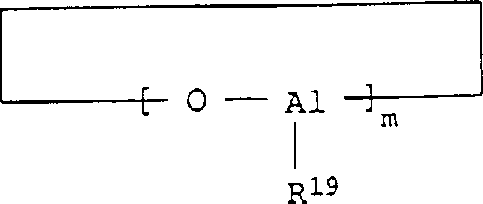
其中R19是C1-C4-烷基、优选为甲基或乙基,m是5-30的整数,优选为10-15。wherein R 19 is C 1 -C 4 -alkyl, preferably methyl or ethyl, and m is an integer of 5-30, preferably 10-15.
这些低聚的铝氧烷化合物通常是通过三烷基铝的溶液与水反应制备,并见述于欧洲专利申请284 708和美国专利申请4,794,096。These oligomeric aluminoxane compounds are generally prepared by reacting solutions of trialkylaluminums with water and are described in European Patent Application 284 708 and US Patent Application 4,794,096.
以这种方法得到的低聚的铝氧烷化合物通常是不同长度的线性和环链分子两者的混合物,所以m可看作是一个平均值。铝氧烷化合物也可以与其他金属烷基化合物,优选为铝烷基化合物的混合物形式存在。The oligomeric aluminoxane compounds obtained in this way are usually mixtures of both linear and cyclic chain molecules of different lengths, so m can be regarded as an average value. The aluminoxane compounds can also be present in mixtures with other metal alkyl compounds, preferably aluminum alkyl compounds.
已经发现,茂金属配合物和低聚的铝氧烷化合物的用量按以下的比例是有利的,即低聚的铝氧烷化合物的铝与茂金属配合物的过渡金属的原子比为1∶1-105∶1,特别是100∶1-1000∶1。It has been found that the amounts of metallocene complex and oligomeric aluminoxane compound are advantageously used in such a ratio that the atomic ratio of aluminum of the oligomeric aluminoxane compound to transition metal of the metallocene complex is 1:1 -10 5 :1, especially 100:1-1000:1.
作为形成茂金属离子的化合物B),也可使用选自强的、中性路易斯酸的配位化合物。As metallocene ion-forming compounds B), it is also possible to use coordination compounds from the group consisting of strong, neutral Lewis acids.
优选的强的、中性路易斯酸是通式Ⅳ的化合物Preferred strong, neutral Lewis acids are compounds of formula IV
M2X3X4X5 (Ⅳ)M 2 X 3 X 4 X 5 (Ⅳ)
其中in
M2是周期表主族Ⅲ的元素,特别是B、Al、或Ga,优选为B, M is an element of the main group III of the periodic table, especially B, Al, or Ga, preferably B,
X3、X4和X5为氢、C1-C10-烷基、C6-C15-芳基、烷芳基、芳烷基、卤烷基或卤芳基,各个基团的烷基含1-10个碳原子,芳基含6-20个碳原子,或氟、氯、溴或碘,特别是卤芳基,如氟芳基,优选为五氟苯基。X 3 , X 4 and X 5 are hydrogen, C 1 -C 10 -alkyl, C 6 -C 15 -aryl, alkaryl, aralkyl, haloalkyl or haloaryl, the alkyl of each group The radical contains 1-10 carbon atoms, the aryl group contains 6-20 carbon atoms, or fluorine, chlorine, bromine or iodine, especially haloaryl, such as fluoroaryl, preferably pentafluorophenyl.
特别优选的通式(Ⅳ)的化合物,其中X3、X4和X5是相同的,优选为三(五氟苯基)硼烷。这些化合物和其制备方法本身是已知的和见述于例如WO 93/3067。A particularly preferred compound of general formula (IV), wherein X 3 , X 4 and X 5 are identical, is preferably tris(pentafluorophenyl)borane. These compounds and processes for their preparation are known per se and are described, for example, in WO 93/3067.
已经发现,能够形成茂金属离子的化合物中的硼与茂金属配合物中的过渡金属的摩尔比为0.1∶1-10∶1,特别是1∶1-5∶1,是特别有利的。It has been found that a molar ratio of boron in the compound capable of forming metallocene ions to transition metal in the metallocene complex of 0.1:1 to 10:1, in particular 1:1 to 5:1, is particularly advantageous.
形成茂金属离子的化合物B)通常是单独使用,与另一种化合物混合使用或与周期表的第一至第三主族元素的有机金属化合物,例如正丁基锂、二正丁基镁、丁基辛基镁、三甲基铝、三乙基铝、三异丁基铝、氢化二异丁基铝混合使用;组分的混合比通常没有限制。Compounds B) that form metallocene ions are usually used alone, in admixture with another compound or with organometallic compounds of the elements of the first to third main groups of the periodic table, such as n-butyllithium, di-n-butylmagnesium, Butyloctylmagnesium, trimethylaluminum, triethylaluminum, triisobutylaluminum, and diisobutylaluminum hydride are used in combination; the mixing ratio of the components is usually not limited.
优选用C1-C10-烷基铝氧烷,特别是甲基铝氧烷,作为形成茂金属离子的化合物B)。Preference is given to using C 1 -C 10 -alkylaluminoxanes, in particular methylaluminoxane, as metallocene ion-forming compound B).
由烯类不饱和烃制备聚合物可以在通常的反应器中进行,方式可以是连续的或优选为间歇的。The preparation of polymers from ethylenically unsaturated hydrocarbons can be carried out in conventional reactors, either continuously or preferably batchwise.
适合的反应器特别是连续操作的搅拌容器;如果需要,也可以用一组串联的搅拌容器。聚合反应可以在气相中、悬浮液中、液相或超临界单体中或惰性溶剂中进行。Suitable reactors are especially continuously operated stirred vessels; if desired, a series of stirred vessels can also be used. Polymerization can be carried out in gas phase, in suspension, in liquid phase or in supercritical monomers or inert solvents.
聚合条件本身没有限制。压力为0.1-500,000kPa,优选为100-250,000kPa,特别是100-100,000kPa,温度为0-450℃,优选为20-250℃,特别是50-100℃是适合的。The aggregation condition itself has no restrictions. A pressure of 0.1-500,000 kPa, preferably 100-250,000 kPa, especially 100-100,000 kPa, and a temperature of 0-450°C, preferably 20-250°C, especially 50-100°C are suitable.
聚合物的平均分子量可以通过聚合工艺中的常规方法控制,例如,通过加入通常导致聚合物分子量降低的分子量调节剂,如氢,或通过变动聚合温度,在这种情况下高聚合温度通常导致分子量的降低。The average molecular weight of the polymer can be controlled by conventional methods in the polymerization process, for example, by adding a molecular weight regulator, such as hydrogen, which usually leads to a decrease in the molecular weight of the polymer, or by varying the polymerization temperature, in which case a high polymerization temperature usually leads to a decrease in the molecular weight of the polymer. decrease.
用茂金属催化反应制备聚烯烃蜡的适合的方法见述于WO 88/02009(高压法)和欧洲专利申请0321851、欧洲专利申请0416566和欧洲专利申请0 571 882。Suitable processes for the preparation of polyolefin waxes using metallocene catalyzed reactions are described in WO 88/02009 (high pressure process) and in European Patent Application 0321851, European Patent Application 0416566 and European Patent Application 0 571 882.
在一种优选的方法中,聚乙烯蜡特别是通过乙烯在高压条件下聚合制备的。为此,要将乙烯和任何所需的其他C3-C10-链烯-1加压至50,000kPa以上,优选100,000-350,000kPa。为了引发聚合反应,这时加入含有适合的活化剂(如烷基铝化合物和/或甲基铝氧烷)或硼酸酯(例如,四(五氟苯基)硼酸N,N-二甲基苯铵)的催化剂溶液。反应温度通常升至最高300℃,优选200-250℃。反应器的形式本身没有限制;可能的结构形式是连续操作的管式反应器或连续操作的搅拌高压釜。为了制备本发明的聚烯烃氧化物,特别适合的催化剂体系是用四(五氟苯基)硼酸N,N-二甲基苯铵活化的二氯化双(正丁基环戊二烯基)锆。In a preferred method, polyethylene waxes are prepared, in particular, by polymerizing ethylene under high pressure conditions. To this end, ethylene and any desired further C 3 -C 10 -alkene-1 are pressurized above 50,000 kPa, preferably from 100,000 to 350,000 kPa. To initiate the polymerization, a suitable activator (such as an alkylaluminum compound and/or methylaluminoxane) or a borate (for example, tetrakis(pentafluorophenyl)boronic acid N,N-dimethyl aniline) catalyst solution. The reaction temperature generally rises up to 300°C, preferably 200-250°C. The form of the reactor is not limited per se; possible constructions are a continuously operated tubular reactor or a continuously operated stirred autoclave. For the preparation of the polyolefin oxides according to the invention, a particularly suitable catalyst system is bis(n-butylcyclopentadienyl)zirconium dichloride activated with N,N-dimethylanilinium tetrakis(pentafluorophenyl)borate.
作为氧化蜡原料的聚烯烃的氧化可以用氧、含氧气体,优选空气进行。优选用空气来氧化聚烯烃。为有助于氧化,可以加入有机过氧化物如叔丁基过氧化物;加入重金属的盐如乙酸锰也是可取的。Oxidation of polyolefin as raw material for oxidized wax can be carried out with oxygen, oxygen-containing gas, preferably air. Air is preferably used to oxidize the polyolefin. To aid in oxidation, organic peroxides such as t-butyl peroxide may be added; heavy metal salts such as manganese acetate are also advisable.
适合的聚烯烃蜡的氧化方法是已知的,见述于例如德国专利申请-2035706。Suitable methods for the oxidation of polyolefin waxes are known and described, for example, in German Patent Application-2035706.
在一个优选的方法中,本发明的茂金属聚烯烃,优选为乙烯均聚物,在管式反应器或带搅拌的高压釜中与含氧气体,优选与空气反应,反应温度为140-350℃,优选150-250℃,反应压力为100-20,000 kPa,优选为500-4000 kPa。氧的加入量通常为0.1-1000 l氧/hxkg蜡。优选为1-50 l氧/hxkg蜡。In a preferred method, the metallocene polyolefin of the present invention, preferably ethylene homopolymer, is reacted with an oxygen-containing gas, preferably air, in a tubular reactor or a stirred autoclave at a reaction temperature of 140-350 °C, preferably 150-250 °C, and the reaction pressure is 100-20,000 kPa, preferably 500-4000 kPa. The amount of oxygen added is usually 0.1-1000 l oxygen/hxkg wax. Preferably 1-50 l oxygen/hxkg wax.
以这种方法得到的氧化聚烯烃蜡,特别是来自乙烯均聚物的氧化蜡,其酸值与皂化值的比例为1∶1-1∶4,优选为1∶1-1∶2。The oxidized polyolefin waxes obtained in this way, especially from ethylene homopolymers, have a ratio of acid number to saponification number of 1:1 to 1:4, preferably 1:1 to 1:2.
酸值是根据DIN 53402用滴定法测定。皂化值是根据DIN 53401用滴定法测定。适合的酸值为1-150g KOH/g,优选为10-1 g KOH/g,特别优选为15-30g KOH/g。本发明氧化蜡的熔点,根据DIN 51007用差示扫描量热法(DSC)测定,通常为90-125℃,优选为110-125℃。The acid value is determined by titration according to DIN 53402. The saponification value is determined by titration according to DIN 53401. A suitable acid value is 1-150 g KOH/g, preferably 10-1 g KOH/g, particularly preferably 15-30 g KOH/g. The melting point of the oxidized wax according to the invention, determined by differential scanning calorimetry (DSC) according to DIN 51007, is usually 90-125°C, preferably 110-125°C.
本发明氧化蜡的硬度,以DIN 50133的球压硬度法测定,通常为800-2000N/mm2,优选为1000-1500N/mm2。The hardness of the oxidized wax of the present invention, as determined by the ball pressure hardness method of DIN 50133, is usually 800-2000N/mm 2 , preferably 1000-1500N/mm 2 .
本发明氧化蜡的粘度,根据DIN 51562,用Ubbelohde熔化粘度法在140℃测定,通常为100-1000cst,优选为200-5000cst。The viscosity of the oxidized wax of the present invention, according to DIN 51562, is measured at 140 ℃ with Ubbelohde melting viscosity method, is usually 100-1000cst, is preferably 200-5000cst.
本发明的蜡通常用作涂料组合物或涂料组合物的组分。该涂料组合物通常具有高硬度和高光泽。The waxes of the present invention are generally used as coating compositions or components of coating compositions. The coating composition generally has high hardness and high gloss.
实施例Example
本发明的实施例是用乙烯通过高压法聚合制备的均聚乙烯蜡。聚合是在装备有搅拌马达的连续操作的1升高压釜中进行的。乙烯和氢在压力下连续地引入高压釜,高压釜内的聚合压力调节到150,000kPa。在一个分开的配料容器中,将三异丁基铝的庚烷溶液和四(五氟苯基)硼酸N,N-二甲基苯铵的甲苯溶液加到二氯化双(正丁基环戊二烯基)锆的溶液中,其中Zr∶Al和Zr∶B的摩尔比分别为1∶400和1∶1.2。然后将活性催化剂溶液立即,不再有停留时间,计量加入高压釜,反应温度保持在240℃。氢的加入量为120 l/h。起始的蜡具有下列的性能:
*)Hoechst公司的Ziegler聚乙烯蜡,PE 130 * ) Ziegler polyethylene wax from Hoechst, PE 130
1)根据DIN 51007测定1) Determined according to DIN 51007
2)根据DIN 50133测定2) Determined according to DIN 50133
3)根据DIN 51562测定3) Determined according to DIN 51562
实施例1,1VExample 1, 1V
蜡1和1V(见上表)的氧化在一个1升钢制的带有压力保持装置的搅拌(叶轮搅拌器)高压釜中进行。将要氧化的蜡置于高压釜中,加热到160℃。在蜡熔化后,启动搅拌器并通入空气(30l/h kg)。当达到所要求的酸值后,停止反应,排出氧化蜡并进行分析。
1)根据DIN 53402测定1) Determined according to DIN 53402
应用实例Applications
在高压釜中将20份实施例1、1V的氧化蜡与2份吗啉和5份三油酸甘油酯及68份水混合,并在150℃加热15分钟。以这种方法得到的乳液冷却到室温、过滤并随后取样测定光泽度。将3ml分散体置于一个60μm的箱式涂敷器中,涂敷到皮革上;涂敷以后测定光泽度值〔85°〕(Dr.Langed仪器,UME-2计)20 parts of the oxidized wax of Example 1, IV were mixed with 2 parts of morpholine and 5 parts of triolein and 68 parts of water in an autoclave and heated at 150° C. for 15 minutes. The emulsion obtained in this way was cooled to room temperature, filtered and subsequently sampled for gloss. Put 3ml of the dispersion in a 60μm box applicator and apply it to the leather; measure the gloss value [85°] after application (Dr. Langed instrument, UME-2 meter)
未涂敷: 5.8Uncoated: 5.8
用实施例1的分散体涂敷 8.6Coating with the dispersion of Example 1 8.6
用实施例1V的分散体涂敷 6.4Coating with the dispersion of Example 1V 6.4
Claims (9)
Applications Claiming Priority (2)
| Application Number | Priority Date | Filing Date | Title |
|---|---|---|---|
| DE19617230A DE19617230A1 (en) | 1996-04-30 | 1996-04-30 | Oxidized metallocene polyolefin waxes |
| DE19617230.6 | 1996-04-30 |
Publications (2)
| Publication Number | Publication Date |
|---|---|
| CN1216998A true CN1216998A (en) | 1999-05-19 |
| CN1130385C CN1130385C (en) | 2003-12-10 |
Family
ID=7792863
Family Applications (1)
| Application Number | Title | Priority Date | Filing Date |
|---|---|---|---|
| CN97194272A Expired - Fee Related CN1130385C (en) | 1996-04-30 | 1997-04-24 | Oxidised metallocene-polyolefin waxes |
Country Status (8)
| Country | Link |
|---|---|
| US (1) | US6348547B1 (en) |
| EP (1) | EP0896591B1 (en) |
| JP (1) | JP2000509417A (en) |
| KR (1) | KR100473139B1 (en) |
| CN (1) | CN1130385C (en) |
| DE (2) | DE19617230A1 (en) |
| ES (1) | ES2139456T3 (en) |
| WO (1) | WO1997041158A1 (en) |
Cited By (1)
| Publication number | Priority date | Publication date | Assignee | Title |
|---|---|---|---|---|
| CN101583636B (en) * | 2007-01-15 | 2011-11-16 | 霍尼韦尔国际公司 | Process for preparing oxidized polyolefin wax |
Families Citing this family (24)
| Publication number | Priority date | Publication date | Assignee | Title |
|---|---|---|---|---|
| DE19806435A1 (en) * | 1998-02-17 | 1999-08-19 | Basf Ag | Simple production method for supported catalysts used in the production of polyolefins |
| US6228951B1 (en) * | 1998-08-24 | 2001-05-08 | Japan Polychem Corporation | Polypropylene molding material |
| DE19860174A1 (en) | 1998-12-24 | 2000-06-29 | Clariant Gmbh | Polymer oxidates and their use |
| US6231656B1 (en) | 1999-02-18 | 2001-05-15 | Allied Signal Inc. | Release agents for use in lignocellulosic processes and process for preparing molded lignocellulosic composites |
| WO2001039917A2 (en) * | 1999-12-02 | 2001-06-07 | Soerensen Frede | Oil based treating or impregnation agent containing wax, and applications thereof |
| DE19960991C1 (en) | 1999-12-17 | 2001-03-22 | Clariant Gmbh | Molded composition used in the production of ceramic and powder metallurgy molded parts by compressing contains sintered powder and metallocene-polyolefin wax |
| DE10015593A1 (en) * | 2000-03-29 | 2001-10-11 | Clariant Gmbh | Use of polyolefin waxes in plastics processing |
| EP1287085A1 (en) * | 2000-05-12 | 2003-03-05 | Clariant GmbH | Use of wax mixtures for coatings |
| JP2004501246A (en) * | 2000-06-20 | 2004-01-15 | ビーエーエスエフ アクチェンゲゼルシャフト | Oxidized polyolefin wax |
| DE60144361D1 (en) | 2000-08-25 | 2011-05-19 | Kaneka Corp | Process for purifying vinyl polymers |
| JP3651892B2 (en) * | 2001-10-31 | 2005-05-25 | 三井化学株式会社 | Polyolefin wax and printing ink composition for coating material |
| DE10159955A1 (en) | 2001-12-06 | 2003-06-26 | Clariant Gmbh | Use of polar modified polyolefin waxes in photo toners |
| DE10206015A1 (en) * | 2002-02-14 | 2003-08-28 | Clariant Gmbh | Use of oxidized polyolefin waxes for textile finishing |
| DE10254280A1 (en) * | 2002-11-20 | 2004-06-03 | Basf Ag | Ethylene terpolymer waxes, process for their preparation and their use |
| WO2005066219A1 (en) * | 2003-04-01 | 2005-07-21 | Honeywell International Inc. | Process for oxidizing linear low molecular weight polyethylene |
| DE102004016790A1 (en) * | 2004-04-06 | 2005-11-17 | Clariant Gmbh | Use of waxes as modifier for filled plastics |
| US7341619B2 (en) * | 2004-11-23 | 2008-03-11 | Chevron Phillips Chemical Company, Lp | Olefin waxes having improved hardness or viscosity |
| US7527686B2 (en) * | 2004-11-23 | 2009-05-05 | Chevron Phillips Chemical Company, Lp | Olefin waxes having improved hardness or viscosity |
| WO2008105317A1 (en) * | 2007-02-27 | 2008-09-04 | Idemitsu Kosan Co., Ltd. | Oxidized propylene polymer and method for producing the same |
| WO2008114648A1 (en) * | 2007-03-16 | 2008-09-25 | Idemitsu Kosan Co., Ltd. | OXIDATIVELY MODIFIED α-OLEFIN POLYMER AND PROCESS FOR PRODUCTION THEREOF |
| BRPI0921731B1 (en) * | 2008-10-31 | 2018-01-02 | Chevron Phillips Chemical Company Lp | "CATALYST SYSTEM, OLIGOMERIZATION PROCESS AND PROCESS FOR THE PREPARATION OF A CATALYST SYSTEM" |
| KR102005861B1 (en) * | 2018-05-29 | 2019-07-31 | 광운대학교 산학협력단 | A method for producing a polyethylene wax having a low molecular weight and a narrow molecular weight distribution by controlling polymerization conditions |
| WO2020105332A1 (en) | 2018-11-20 | 2020-05-28 | 共栄社化学株式会社 | Powdery thixotropy-imparting agent for non-aqueous paint, and non-aqueous paint composition having same added |
| CN111154017B (en) * | 2020-01-09 | 2022-11-01 | 山东清河化工科技有限公司 | Metallocene catalyst component for preparing polyethylene wax and application thereof |
Family Cites Families (21)
| Publication number | Priority date | Publication date | Assignee | Title |
|---|---|---|---|---|
| NL286905A (en) | 1961-12-21 | |||
| DE1301094C2 (en) | 1963-07-31 | 1975-11-27 | Veba-Chemie Ag, 4660 Gelsenkirchen-Buer | METHOD FOR PRODUCING WAXES |
| DE1645415C3 (en) | 1965-03-27 | 1979-01-25 | Veba-Chemie Ag, 4660 Gelsenkirchen- Buer | Process for the production of polyethylene waxes |
| DE2035706C3 (en) | 1970-07-18 | 1975-09-11 | Hoechst Ag, 6000 Frankfurt | Process for the preparation of oxidation products of ethylene polymers |
| JPS5141787A (en) | 1974-10-07 | 1976-04-08 | Mitsui Petrochemical Ind | SANKAHORIECHIRENWATSUKUSUKINZOKUENNO SEIZOHOHO |
| CA1338046C (en) | 1986-09-19 | 1996-02-06 | Howard Curtis Welborn Jr. | High pressure high temperature polymerization of ethylene |
| US4794096A (en) | 1987-04-03 | 1988-12-27 | Fina Technology, Inc. | Hafnium metallocene catalyst for the polymerization of olefins |
| DE3751694T2 (en) | 1987-04-03 | 1996-08-01 | Fina Technology | Metallocene catalyst systems for the polymerization of olefins, with a silicon-hydrocarbyl bridge. |
| DE3743322A1 (en) | 1987-12-21 | 1989-06-29 | Hoechst Ag | Polyethylene wax and method for its production |
| DE3929693A1 (en) | 1989-09-07 | 1991-03-14 | Hoechst Ag | METHOD FOR PRODUCING A POLYOLEFIN WAX |
| EP0452840B1 (en) | 1990-04-18 | 1998-10-28 | Mitsui Chemicals, Inc. | Syndiotactic propylene copolymer, preparation of the same, and resin composition containing the same |
| DE69116814T2 (en) | 1990-11-20 | 1996-09-26 | Mitsubishi Chem Corp | Functionalized olefin polymers |
| US5252677A (en) * | 1990-11-20 | 1993-10-12 | Mitsubishi Petrochemical Company Limited | Functionalized olefin polymers |
| US5886117A (en) | 1991-08-05 | 1999-03-23 | The Dow Chemical Company | Process using borane derived catalysts for preparation of syndiotactic vinyl aromatic polymers |
| PL167153B1 (en) * | 1991-09-25 | 1995-08-31 | Inst Ciezkiej Syntezy Orga | Method of obtaining water emulsiflable polyethylene wax |
| TW318184B (en) | 1991-11-30 | 1997-10-21 | Hoechst Ag | |
| DE59305691D1 (en) | 1992-05-26 | 1997-04-17 | Hoechst Ag | Process for the production of polyolefin waxes |
| WO1993024539A1 (en) * | 1992-05-26 | 1993-12-09 | Amoco Corporation | Reactive, low molecular weight, viscous poly(1-olefins) and copoly(1-olefins) and their method of manufacture |
| TW294669B (en) | 1992-06-27 | 1997-01-01 | Hoechst Ag | |
| ATE165832T1 (en) | 1992-08-03 | 1998-05-15 | Targor Gmbh | METHOD FOR PRODUCING AN OLEFIN POLYMER USING METALLOCENES WITH SPECIFICALLY SUBSTITUTED INDENYL LIGANDS |
| EP0729477B1 (en) | 1993-11-19 | 1999-10-27 | Exxon Chemical Patents Inc. | Polymerization catalyst systems, their production and use |
-
1996
- 1996-04-30 DE DE19617230A patent/DE19617230A1/en not_active Withdrawn
-
1997
- 1997-04-24 JP JP9538562A patent/JP2000509417A/en not_active Ceased
- 1997-04-24 EP EP97921743A patent/EP0896591B1/en not_active Revoked
- 1997-04-24 KR KR10-1998-0708697A patent/KR100473139B1/en not_active Expired - Fee Related
- 1997-04-24 ES ES97921743T patent/ES2139456T3/en not_active Expired - Lifetime
- 1997-04-24 DE DE59700596T patent/DE59700596D1/en not_active Revoked
- 1997-04-24 US US09/171,824 patent/US6348547B1/en not_active Expired - Fee Related
- 1997-04-24 CN CN97194272A patent/CN1130385C/en not_active Expired - Fee Related
- 1997-04-24 WO PCT/EP1997/002098 patent/WO1997041158A1/en not_active Ceased
Cited By (1)
| Publication number | Priority date | Publication date | Assignee | Title |
|---|---|---|---|---|
| CN101583636B (en) * | 2007-01-15 | 2011-11-16 | 霍尼韦尔国际公司 | Process for preparing oxidized polyolefin wax |
Also Published As
| Publication number | Publication date |
|---|---|
| DE19617230A1 (en) | 1997-11-06 |
| JP2000509417A (en) | 2000-07-25 |
| EP0896591A1 (en) | 1999-02-17 |
| EP0896591B1 (en) | 1999-10-20 |
| WO1997041158A1 (en) | 1997-11-06 |
| DE59700596D1 (en) | 1999-11-25 |
| CN1130385C (en) | 2003-12-10 |
| KR20000065106A (en) | 2000-11-06 |
| KR100473139B1 (en) | 2005-05-16 |
| ES2139456T3 (en) | 2000-02-01 |
| US6348547B1 (en) | 2002-02-19 |
Similar Documents
| Publication | Publication Date | Title |
|---|---|---|
| CN1130385C (en) | Oxidised metallocene-polyolefin waxes | |
| CN1106408C (en) | Propylene polymer incorporating macromers | |
| JP3678726B2 (en) | Polymerization method | |
| JP4523002B2 (en) | Polymerization process using metallocene catalyst system | |
| CN1119355C (en) | Polymerization catalyst system, its preparation and application | |
| CN1234739C (en) | Branched semi-crystalline ethylene-propylene compositions | |
| US8754177B2 (en) | Polymerization process | |
| CN1136241C (en) | Polyethylene obtained by double-site catalyst | |
| CN1246871A (en) | Propylene polymers incorporating polyethylene macromers | |
| CN1547596A (en) | Mixed Metallocene Catalyst Systems Containing Weak Comonomer Introducers and Good Comonomer Introducers | |
| JP2002505357A (en) | Preparation of polymer blends using a series of reactors. | |
| CN1307598A (en) | Catalyst composition, method for its preparation and use thereof in a polymerization process | |
| CN1260804A (en) | Method for multistage polymerization using catalysts with different catalytically active sites | |
| CN1013581B (en) | Solid catalyst for polymerizing olefin | |
| RU2645216C2 (en) | Increased ratio of melt indexes for polymer by loading catalyst on substrate saturated by selected liquid agent | |
| CN1365366A (en) | Improvements in or about polymers | |
| ZA200203053B (en) | Catalyst systems and their use in a polymerization process. | |
| CN1487956A (en) | Catalyst composition, method for its preparation and use in a polymerization method | |
| CN1263773C (en) | A method for preparing a supported catalyst system and its use in a polymerization process | |
| CN1128814C (en) | Process for producing polymers of alkenes by suspension polymerisation | |
| CN1478105A (en) | Preparation method of catalyst composition and its application in polymerization process | |
| CN1235919C (en) | Polymerization process | |
| CN1860140A (en) | Process for the preparation of porous ethylene polymers and porous polymer obtainable thereof | |
| CN1127521C (en) | Preparation of Catalyst for Alkene-1 (Co)polymerization | |
| CN1214050C (en) | Supported polymerization catalysts |
Legal Events
| Date | Code | Title | Description |
|---|---|---|---|
| C06 | Publication | ||
| PB01 | Publication | ||
| C10 | Entry into substantive examination | ||
| SE01 | Entry into force of request for substantive examination | ||
| C14 | Grant of patent or utility model | ||
| GR01 | Patent grant | ||
| C19 | Lapse of patent right due to non-payment of the annual fee | ||
| CF01 | Termination of patent right due to non-payment of annual fee |