CN1201871C - Capped silicone film and method of manufacture thereof - Google Patents
Capped silicone film and method of manufacture thereof Download PDFInfo
- Publication number
- CN1201871C CN1201871C CNB998153583A CN99815358A CN1201871C CN 1201871 C CN1201871 C CN 1201871C CN B998153583 A CNB998153583 A CN B998153583A CN 99815358 A CN99815358 A CN 99815358A CN 1201871 C CN1201871 C CN 1201871C
- Authority
- CN
- China
- Prior art keywords
- group
- groups
- general formula
- chain
- formula
- Prior art date
- Legal status (The legal status is an assumption and is not a legal conclusion. Google has not performed a legal analysis and makes no representation as to the accuracy of the status listed.)
- Expired - Fee Related
Links
Images

Classifications
-
- B—PERFORMING OPERATIONS; TRANSPORTING
- B05—SPRAYING OR ATOMISING IN GENERAL; APPLYING FLUENT MATERIALS TO SURFACES, IN GENERAL
- B05D—PROCESSES FOR APPLYING FLUENT MATERIALS TO SURFACES, IN GENERAL
- B05D1/00—Processes for applying liquids or other fluent materials
- B05D1/36—Successively applying liquids or other fluent materials, e.g. without intermediate treatment
-
- B—PERFORMING OPERATIONS; TRANSPORTING
- B82—NANOTECHNOLOGY
- B82Y—SPECIFIC USES OR APPLICATIONS OF NANOSTRUCTURES; MEASUREMENT OR ANALYSIS OF NANOSTRUCTURES; MANUFACTURE OR TREATMENT OF NANOSTRUCTURES
- B82Y30/00—Nanotechnology for materials or surface science, e.g. nanocomposites
-
- B—PERFORMING OPERATIONS; TRANSPORTING
- B05—SPRAYING OR ATOMISING IN GENERAL; APPLYING FLUENT MATERIALS TO SURFACES, IN GENERAL
- B05D—PROCESSES FOR APPLYING FLUENT MATERIALS TO SURFACES, IN GENERAL
- B05D1/00—Processes for applying liquids or other fluent materials
- B05D1/18—Processes for applying liquids or other fluent materials performed by dipping
- B05D1/185—Processes for applying liquids or other fluent materials performed by dipping applying monomolecular layers
-
- B—PERFORMING OPERATIONS; TRANSPORTING
- B05—SPRAYING OR ATOMISING IN GENERAL; APPLYING FLUENT MATERIALS TO SURFACES, IN GENERAL
- B05D—PROCESSES FOR APPLYING FLUENT MATERIALS TO SURFACES, IN GENERAL
- B05D3/00—Pretreatment of surfaces to which liquids or other fluent materials are to be applied; After-treatment of applied coatings, e.g. intermediate treating of an applied coating preparatory to subsequent applications of liquids or other fluent materials
- B05D3/10—Pretreatment of surfaces to which liquids or other fluent materials are to be applied; After-treatment of applied coatings, e.g. intermediate treating of an applied coating preparatory to subsequent applications of liquids or other fluent materials by other chemical means
-
- B—PERFORMING OPERATIONS; TRANSPORTING
- B32—LAYERED PRODUCTS
- B32B—LAYERED PRODUCTS, i.e. PRODUCTS BUILT-UP OF STRATA OF FLAT OR NON-FLAT, e.g. CELLULAR OR HONEYCOMB, FORM
- B32B17/00—Layered products essentially comprising sheet glass, or glass, slag, or like fibres
- B32B17/06—Layered products essentially comprising sheet glass, or glass, slag, or like fibres comprising glass as the main or only constituent of a layer, next to another layer of a specific material
-
- B—PERFORMING OPERATIONS; TRANSPORTING
- B32—LAYERED PRODUCTS
- B32B—LAYERED PRODUCTS, i.e. PRODUCTS BUILT-UP OF STRATA OF FLAT OR NON-FLAT, e.g. CELLULAR OR HONEYCOMB, FORM
- B32B17/00—Layered products essentially comprising sheet glass, or glass, slag, or like fibres
- B32B17/06—Layered products essentially comprising sheet glass, or glass, slag, or like fibres comprising glass as the main or only constituent of a layer, next to another layer of a specific material
- B32B17/10—Layered products essentially comprising sheet glass, or glass, slag, or like fibres comprising glass as the main or only constituent of a layer, next to another layer of a specific material of synthetic resin
-
- B—PERFORMING OPERATIONS; TRANSPORTING
- B82—NANOTECHNOLOGY
- B82Y—SPECIFIC USES OR APPLICATIONS OF NANOSTRUCTURES; MEASUREMENT OR ANALYSIS OF NANOSTRUCTURES; MANUFACTURE OR TREATMENT OF NANOSTRUCTURES
- B82Y40/00—Manufacture or treatment of nanostructures
-
- C—CHEMISTRY; METALLURGY
- C03—GLASS; MINERAL OR SLAG WOOL
- C03C—CHEMICAL COMPOSITION OF GLASSES, GLAZES OR VITREOUS ENAMELS; SURFACE TREATMENT OF GLASS; SURFACE TREATMENT OF FIBRES OR FILAMENTS MADE FROM GLASS, MINERALS OR SLAGS; JOINING GLASS TO GLASS OR OTHER MATERIALS
- C03C17/00—Surface treatment of glass, not in the form of fibres or filaments, by coating
- C03C17/28—Surface treatment of glass, not in the form of fibres or filaments, by coating with organic material
- C03C17/30—Surface treatment of glass, not in the form of fibres or filaments, by coating with organic material with silicon-containing compounds
-
- C—CHEMISTRY; METALLURGY
- C09—DYES; PAINTS; POLISHES; NATURAL RESINS; ADHESIVES; COMPOSITIONS NOT OTHERWISE PROVIDED FOR; APPLICATIONS OF MATERIALS NOT OTHERWISE PROVIDED FOR
- C09D—COATING COMPOSITIONS, e.g. PAINTS, VARNISHES OR LACQUERS; FILLING PASTES; CHEMICAL PAINT OR INK REMOVERS; INKS; CORRECTING FLUIDS; WOODSTAINS; PASTES OR SOLIDS FOR COLOURING OR PRINTING; USE OF MATERIALS THEREFOR
- C09D4/00—Coating compositions, e.g. paints, varnishes or lacquers, based on organic non-macromolecular compounds having at least one polymerisable carbon-to-carbon unsaturated bond ; Coating compositions, based on monomers of macromolecular compounds of groups C09D183/00 - C09D183/16
-
- Y—GENERAL TAGGING OF NEW TECHNOLOGICAL DEVELOPMENTS; GENERAL TAGGING OF CROSS-SECTIONAL TECHNOLOGIES SPANNING OVER SEVERAL SECTIONS OF THE IPC; TECHNICAL SUBJECTS COVERED BY FORMER USPC CROSS-REFERENCE ART COLLECTIONS [XRACs] AND DIGESTS
- Y10—TECHNICAL SUBJECTS COVERED BY FORMER USPC
- Y10T—TECHNICAL SUBJECTS COVERED BY FORMER US CLASSIFICATION
- Y10T428/00—Stock material or miscellaneous articles
- Y10T428/31504—Composite [nonstructural laminate]
- Y10T428/31652—Of asbestos
- Y10T428/31663—As siloxane, silicone or silane
Landscapes
- Chemical & Material Sciences (AREA)
- Engineering & Computer Science (AREA)
- Nanotechnology (AREA)
- Materials Engineering (AREA)
- Crystallography & Structural Chemistry (AREA)
- Life Sciences & Earth Sciences (AREA)
- Organic Chemistry (AREA)
- Physics & Mathematics (AREA)
- Condensed Matter Physics & Semiconductors (AREA)
- General Physics & Mathematics (AREA)
- General Chemical & Material Sciences (AREA)
- Chemical Kinetics & Catalysis (AREA)
- Composite Materials (AREA)
- Manufacturing & Machinery (AREA)
- Wood Science & Technology (AREA)
- Geochemistry & Mineralogy (AREA)
- Surface Treatment Of Glass (AREA)
- Paints Or Removers (AREA)
- Treatments Of Macromolecular Shaped Articles (AREA)
- Application Of Or Painting With Fluid Materials (AREA)
- Silicon Polymers (AREA)
- Materials Applied To Surfaces To Minimize Adherence Of Mist Or Water (AREA)
- Chemical Vapour Deposition (AREA)
- Crystals, And After-Treatments Of Crystals (AREA)
- Silicon Compounds (AREA)
- Laminated Bodies (AREA)
- Formation Of Insulating Films (AREA)
Abstract
Description
发明领域 field of invention
本发明涉及制造硅氧烷膜的领域。The present invention relates to the field of making silicone films.
更具体而言,本发明涉及一种制造覆盖表面的硅氧烷膜的方法,该表面包含OH或氮氢键。More specifically, the present invention relates to a method of making a siloxane film covering a surface comprising OH or nitrogen-hydrogen bonds.
在另一个更具体的方面,本发明涉及一种制造覆盖玻璃和其它表面的防水硅氧烷膜的改进方法。In another more specific aspect, the invention relates to an improved method of making waterproof silicone films for covering glass and other surfaces.
对现有技术的说明 Description of prior art
目前有各种方法制造容易清洁的、防水的玻璃制品,其中包括浴室门、风挡、饭店的入口玻璃门和玻璃隔板。在Hirayama等人的美国专利5,415,927和Valimont等人的美国专利4,263,350中,公开了二种所述的方法。There are various methods of making easy-to-clean, water-resistant glass products, including bathroom doors, windshields, restaurant entrance glass doors and glass partitions. Two such methods are disclosed in US Patent 5,415,927 to Hirayama et al. and US Patent 4,263,350 to Valimont et al.
在目前采用的另一种方法中,采用由硅氧烷分子链组成的膜覆盖玻璃,每个链的一端都与玻璃表面化学键合。每个链都包含几十至几百个二甲基硅氧烷(DMS)单元,其自由端由附着到硅上的羟基(OH)或氯封端,其迅速与空气中的水蒸气反应,生成OH基团。这种现有的膜,正在许多玻璃制品以及其它含二氧化硅的制品如花岗岩、瓷器、陶器和石制品上使用,对其中的大部分而言,这种现有的膜是令人满意的。然而,由于存在容易吸水的OH端基,膜的防水性能只能达到一定程度。In another approach currently in use, the glass is covered with a film composed of chains of siloxane molecules, each of which is chemically bonded to the glass surface at one end. Each chain contains tens to hundreds of dimethylsiloxane (DMS) units whose free ends are terminated by hydroxyl (OH) or chlorine attached to silicon, which react rapidly with water vapor in the air, Generate OH group. This existing membrane is being used on many glassware as well as other silica containing articles such as granite, porcelain, pottery and stoneware, for the majority of which this existing membrane is satisfactory . However, due to the presence of OH end groups that easily absorb water, the waterproof performance of the membrane can only be achieved to a certain extent.
因此,本发明的一个目的,是提高玻璃上硅氧烷膜的防水性能,对化学活性物质提供保护膜。It is therefore an object of the present invention to improve the water repellency of silicone films on glass to provide a protective film for chemically active substances.
本发明的另一个目的,是制造一族用于处理各种制品例如前面提到的包含二氧化硅的制品以及包含纸、棉花、尼龙、皮革和木材在内的有机物质的硅氧烷膜,以便提高这些制品的表面性能。Another object of the present invention is to manufacture a family of silicone membranes for the treatment of various articles such as the aforementioned articles containing silica and organic substances including paper, cotton, nylon, leather and wood, so that Improve the surface properties of these articles.
发明概述 Summary of the invention
简而言之,为了达到本发明所要求的目的,按照本发明优选的实施方案,通过化学键合,将硅氧烷膜附着到表面上。该硅氧烷膜由硅氧烷基团链组成,每个链都以端分子封端,端分子可以是酯类、醚类或卤素。端分子能与周围空气中的水反应,生成OH基团。然后使表面与封端剂接触,封端剂与OH基团反应,生成能改善膜性能的新端基。Briefly, in order to achieve the desired purpose of the present invention, according to a preferred embodiment of the present invention, the silicone film is attached to the surface by chemical bonding. The siloxane film consists of chains of siloxane groups, each of which is terminated with an end molecule, which can be an ester, ether or halogen. The terminal molecules can react with water in the surrounding air to generate OH groups. The surface is then contacted with a capping agent, which reacts with the OH groups to generate new end groups that improve membrane properties.
在一个实施方案中,本发明提供一种用于处理基片G表面的方法,该表面包含OH或氮氢键,并被空气所包围,该方法包括下列步骤:In one embodiment, the present invention provides a method for treating a surface of a substrate G comprising OH or nitrogen-hydrogen bonds and surrounded by air, the method comprising the steps of:
a)用水将表面润湿;a) wet the surface with water;
b)使表面与具有以下通式的硅烷基团接触:b) contacting the surface with silane groups having the general formula:
式中In the formula
R为包括烃或卤代烃在内的极性或非极性基团,和R is a polar or non-polar group including hydrocarbon or halohydrocarbon, and
X选自酯类、醚类和卤素;X is selected from esters, ethers and halogens;
c)使硅烷基团与OH或氮氢键和表面上的水反应,生成由具有以下通式的链组成的膜:c) reacting the silane groups with OH or nitrogen-hydrogen bonds and water on the surface to produce a film consisting of chains with the general formula:
其中n≥100;where n≥100;
d)使链端上的X原子与周围空气中的水反应,生成在链端上具有以下结构的分子:d) reacting the X atom on the chain end with water in the surrounding air to generate a molecule with the following structure on the chain end:
e)使表面与具有以下通式的封端剂接触:e) contacting the surface with a capping agent having the general formula:
式中R1可以包括惰性和反应性基团的任何组合;和where R can include any combination of inert and reactive groups; and
f)使封端剂与该分子反应,结果生成具有以下通式的链:f) Reacting a capping agent with the molecule results in a chain having the general formula:

在一个优选的实施方案中,R选自苯基、乙基、甲基、丁基、戊基和较大的烷基。In a preferred embodiment, R is selected from phenyl, ethyl, methyl, butyl, pentyl and larger alkyl groups.
在性能上的具体改善,取决于所用的硅氧烷基团以及封端剂的组成。硅氧烷基团一般具有以下通式:The specific improvement in performance depends on the siloxane groups used and the composition of the capping agent. Siloxane groups generally have the general formula:
封端剂具有以下通式:Capping agents have the general formula:
对于防水应用,R由非极性基团组成,R1由惰性基团组成。对于非防水应用,R由极性基团组成。在其它应用中,R1可由化学活性基团组成,并能使表面用作固态的离子交换剂,或用作化学结合的酶、螯合剂、染料、化学指示剂或其它物质的附着点。For waterproofing applications, R consists of non-polar groups and R consists of inert groups. For non-waterproof applications, R consists of polar groups. In other applications, R1 may consist of chemically active groups and enable the surface to act as an ion exchanger in the solid state, or as an attachment point for chemically bound enzymes, chelating agents, dyes, chemical indicators, or other substances.
附图简述 Brief description of the drawings
本领域的技术人员,根据下面结合附图对本发明优选实施方案的详细说明很容易看出本发明上述的、其它的和更具体的目的和优点,在附图中:Those skilled in the art can easily find out the above-mentioned, other and more specific objects and advantages of the present invention according to the following detailed description of the preferred embodiments of the present invention in conjunction with the accompanying drawings, in the accompanying drawings:
图1是采用现有技术的防水膜覆盖的表面的示意图。Figure 1 is a schematic illustration of a surface covered with a prior art waterproof membrane.
图2是采用使用本发明的方法制造的防水膜覆盖的表面的示意图。Figure 2 is a schematic illustration of a surface covered with a waterproof membrane produced using the method of the present invention.
发明详述 Detailed description of the invention
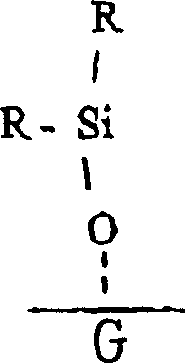
参看附图,首先见图1,图1示出采用现有的技术方法,用防水膜处理的表面G。在方法最广泛的应用中,表面G是玻璃,然而这种方法实际上可以用于处理任何包含OH或氮氢键的表面,例如包括花岗岩、瓷器、陶器和石制品在内的包含二氧化硅的表面,以及包括棉花、纸、尼龙、皮革等在内的有机物质。该膜包含二甲基硅氧烷(DMS)基团的链。每个链的一端都化学键合到氧(O)分子上,氧分子又化学键合到表面G上。每个链的相反端都包括附着到硅氧烷上的羟基(OH)或氯,其迅速地与周围空气中的水蒸气反应生成(OH)基团。Referring to the accompanying drawings, first see Fig. 1, Fig. 1 shows the surface G treated with a waterproof membrane using the prior art method. In the broadest application of the method, surface G is glass, however the method can be used to treat virtually any surface containing OH or nitrogen-hydrogen bonds, such as silica-containing surfaces including granite, porcelain, pottery, and stonework. surfaces, and organic substances including cotton, paper, nylon, leather, etc. The film contains chains of dimethylsiloxane (DMS) groups. One end of each chain is chemically bonded to an oxygen (O) molecule, which in turn is chemically bonded to the surface G. The opposite ends of each chain include hydroxyl (OH) or chlorine attached to the siloxane, which rapidly reacts with water vapor in the surrounding air to form (OH) groups.
制造图1的膜的方法如下。首先将G的表面润湿。可用下面所示的简化形式表示潮湿的表面:The method of manufacturing the membrane of Figure 1 is as follows. Wet the surface of G first. Wet surfaces can be represented in the simplified form shown below:

然而,在表面上的H-O-H分子数实际上比表面上的O-H基团数大得多(比例约100∶1)。However, the number of H-O-H molecules on the surface is actually much larger than the number of O-H groups on the surface (approximately 100:1 ratio).
其次,采用便携式蒸汽机或采用擦拭方法、或浸渍、或喷雾方法,用二甲基二氯硅烷处理表面,便携式蒸汽机适合固定地点操作体积大的房间。在需要时,采用环己胺作为底层,以确保发生化学反应的足够水分。在施加二甲基二氯硅烷之后,二甲基二氯硅烷的分子接近表面上的O-H基团,如下所示:Secondly, use a portable steamer or use a wiping method, or dipping, or spraying method, and treat the surface with dimethyldichlorosilane. The portable steamer is suitable for fixed-location operations in rooms with large volumes. When needed, cyclohexylamine was used as a bottom layer to ensure sufficient moisture for chemical reactions to occur. After the application of dimethyldichlorosilane, the molecules of dimethyldichlorosilane approach the O-H groups on the surface as follows:
(a)(a)

随后的反应形成固定分子,固定分子能使膜与表面G化学键合,如下所示:Subsequent reactions form immobilized molecules that enable the chemical bonding of the membrane to the surface G, as follows:
(b)(b)
然后,Si-Cl键与吸收在如下表面G上的水反应:The Si-Cl bond then reacts with water absorbed on the surface G as follows:
(c)(c)
结果形成以下结构:The result is the following structure:
(d)(d)
然后,这种结构与如下DMS分子反应:This structure is then reacted with a DMS molecule as follows:
(e)(e)

结果生成下面所示的分子:The result produces the molecule shown below:
(f)(f)
重复上述步骤(c)-(f)的过程约100次,直至不再给(c)、(d)步骤剩下任何水分为止。产物的通式为:Repeat the process of above-mentioned steps (c)-(f) about 100 times, until no longer give any moisture to (c), (d) steps. The general formula of the product is:
(g)(g)
式中n为约≥100。括号中的基团是高度防水的。然而,链端上的氯原子能在几小时内缓慢地与空气中的水蒸气反应,结果生成具有以下通式的产物:where n is about > 100. Groups in parentheses are highly water resistant. However, the chlorine atoms at the chain ends can slowly react with water vapor in the air over several hours, resulting in products with the general formula:
(h)(h)
这种产物相当于图1所示的结构。这种最终产物一端上的Si-O-H基团是吸水的,因此降低了整个膜的总防水性能,生成不希望有的化学反应位置。This product corresponds to the structure shown in Figure 1. The Si-O-H groups on one end of this end product are hygroscopic, thus reducing the overall water repellency of the entire membrane, creating undesired sites for chemical reactions.
在本发明改进的方法中,随后采用三甲基氯硅烷处理用上述膜覆盖的表面,三甲基氯硅烷与DMS链端的OH基团反应,生成三甲基氯硅氧烷(TMS)。最终产物是具有以下通式的膜:In the improved method of the present invention, the surface covered with the above film is subsequently treated with trimethylchlorosilane, which reacts with the OH groups at the end of the DMS chain to form trimethylchlorosiloxane (TMS). The end product is a membrane with the general formula:
(i)(i)
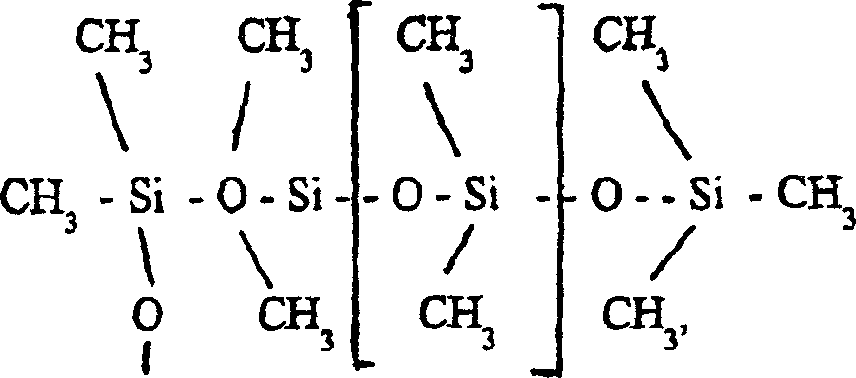
这种膜相当于图2所示的结构。由于在链端上的TMS基团在化学上是惰性的,所以该膜的防水性能比现有技术的膜好得多。This membrane corresponds to the structure shown in FIG. 2 . Since the TMS groups on the chain ends are chemically inert, the water resistance of the membrane is much better than prior art membranes.
通过上述步骤(a)-(i)过程生成的硅氧烷膜,是本发明提供防水应用的一个具体的实施例。在更普遍的情况下,润湿的表面G首先与具有以下通式的硅烷基团接触:The siloxane film formed through the above steps (a)-(i) is a specific embodiment of the present invention for waterproof application. In the more general case, the wetted surface G is first contacted with silane groups having the general formula:

式中R为包括烃和卤代烃在内的极性或非极性基团,X选自酯类、醚类和卤素。然后在与上述步骤(b)相似的过程中,硅烷基团与OH或氮氢键和表面G上的水反应,将膜与表面G化学键合。进行一系列与上述步骤(b)-(f)中所示的相似的反应,结果生成具有以下通式的聚合物:In the formula, R is a polar or non-polar group including hydrocarbons and halogenated hydrocarbons, and X is selected from esters, ethers and halogens. The silane groups then react with OH or nitrogen-hydrogen bonds and water on surface G to chemically bond the film to surface G in a process similar to step (b) above. A series of reactions similar to those shown in steps (b)-(f) above result in polymers having the general formula:
式中n为约≥100。然后链端上的X原子与周围空气中的水蒸气反应,结果生成具有以下通式的分子:where n is about > 100. The X atom at the chain end then reacts with water vapor in the surrounding air, resulting in a molecule with the following general formula:

然后使表面与具有以下通式的封端剂接触:The surface is then contacted with a capping agent having the general formula:
式中R1可以包括惰性和反应性基团的任何组合。封端剂与链端的OH基团反应,最终生成具有以下通式的链:In the formula R 1 can include any combination of inert and reactive groups. The capping agent reacts with the OH groups at the end of the chain to eventually form a chain with the following general formula:

采用这种方法制造的膜的性质,取决于R和R1的选择,在较小的程度上取决于X。X选择氯基使材料的成本最低,反应时间最短,虽然酯和醚反应性较小,但生成的副产物麻烦较少,并要求不同的加工条件。The properties of membranes fabricated in this way depend on the choice of R and R1 and, to a lesser extent, X. X chooses the chlorine group to minimize material cost and reaction time, and although esters and ethers are less reactive, by-products are less troublesome and require different processing conditions.
对于防水应用,R一般由非极性基团组成,而R1则由化学上的惰性基团组成。如果R由约50%的甲基和50%的苯基组成,则能改善膜的耐磨性能。将DMS链与甲基三氯硅烷连接(这能产生支链和附加的链端),也能改善膜的耐磨性能。甲基三氯硅烷能使链以三维结构连接起来,这会使耐磨性能优于二维结构。For waterproofing applications, R generally consists of non-polar groups, while R1 consists of chemically inert groups. If R consists of about 50% methyl and 50% phenyl, the abrasion resistance of the film can be improved. Attachment of DMS chains to methyltrichlorosilane (which creates branching and additional chain ends) also improves the abrasion resistance of the film. Methyltrichlorosilane can connect the chains in a three-dimensional structure, which makes the wear resistance better than that of the two-dimensional structure.
对于非防水应用,R由极性基团组成,如果R1选自化学反应性基团,端分子可能提供酶、螯合剂、离子交换元素、化学指示剂和其它物质的附着点。For non-waterproof applications, R consists of polar groups, and if R1 is selected from chemically reactive groups, the terminal molecules may provide attachment points for enzymes, chelating agents, ion exchange elements, chemical indicators, and other substances.
对于为了说明本发明而选择的实施方案,本领域的技术人员,能进行各种改进和变动。未超出本发明内容范围的这类变动和改进,都包括在本发明的范围内,本发明的范围,只能根据对下列权利要求的明确说明来确定。Various improvements and changes can be made by those skilled in the art about the embodiment chosen for explaining the present invention. Such changes and improvements within the scope of the content of the present invention are all included in the scope of the present invention, and the scope of the present invention can only be determined according to the explicit description of the following claims.
Claims (40)



Applications Claiming Priority (2)
| Application Number | Priority Date | Filing Date | Title |
|---|---|---|---|
| US09/185,202 US6245387B1 (en) | 1998-11-03 | 1998-11-03 | Capped silicone film and method of manufacture thereof |
| US09/185,202 | 1998-11-03 |
Publications (2)
| Publication Number | Publication Date |
|---|---|
| CN1332658A CN1332658A (en) | 2002-01-23 |
| CN1201871C true CN1201871C (en) | 2005-05-18 |
Family
ID=22680022
Family Applications (1)
| Application Number | Title | Priority Date | Filing Date |
|---|---|---|---|
| CNB998153583A Expired - Fee Related CN1201871C (en) | 1998-11-03 | 1999-01-29 | Capped silicone film and method of manufacture thereof |
Country Status (15)
| Country | Link |
|---|---|
| US (2) | US6245387B1 (en) |
| EP (1) | EP1137496B1 (en) |
| JP (1) | JP4230114B2 (en) |
| KR (1) | KR100436522B1 (en) |
| CN (1) | CN1201871C (en) |
| AT (1) | ATE320861T1 (en) |
| AU (1) | AU764724B2 (en) |
| BR (1) | BR9915824A (en) |
| CA (1) | CA2349480C (en) |
| DE (2) | DE1137496T1 (en) |
| EC (1) | ECSP034889A (en) |
| ES (1) | ES2171370T3 (en) |
| IL (1) | IL142940A (en) |
| NZ (1) | NZ528143A (en) |
| WO (1) | WO2000025938A1 (en) |
Cited By (1)
| Publication number | Priority date | Publication date | Assignee | Title |
|---|---|---|---|---|
| CN102665879A (en) * | 2009-12-01 | 2012-09-12 | 赢创高施米特有限公司 | Composite silicone membranes with high separating action |
Families Citing this family (30)
| Publication number | Priority date | Publication date | Assignee | Title |
|---|---|---|---|---|
| US6743516B2 (en) * | 2000-09-29 | 2004-06-01 | Guardian Industries Corporation | Highly durable hydrophobic coatings and methods |
| DE10140247A1 (en) * | 2001-08-09 | 2003-03-06 | Forsch Pigmente Und Lacke E V | Process for coating substrate surfaces |
| DE10140246A1 (en) | 2001-08-09 | 2003-03-06 | Forsch Pigmente Und Lacke E V | Process for treating surfaces of substrates |
| US7910683B2 (en) * | 2002-06-07 | 2011-03-22 | The Boeing Company | Tough and strongly-adherent anti-icing coatings |
| US7202321B2 (en) * | 2002-06-07 | 2007-04-10 | The Boeing Company | Method and composition for sealing components and components sealed thereby |
| TWI319713B (en) * | 2002-10-25 | 2010-01-21 | Sustained-release tramadol formulations with 24-hour efficacy | |
| US8487002B2 (en) * | 2002-10-25 | 2013-07-16 | Paladin Labs Inc. | Controlled-release compositions |
| US7138186B2 (en) | 2004-02-05 | 2006-11-21 | Guardian Industries Corp. | Hydrophobic coatings and methods |
| PT1931346E (en) * | 2005-09-09 | 2012-08-14 | Angelini Labopharm Llc | COMPOSITION OF TRAZODONE FOR ADMINISTRATION ONCE A DAY |
| BRPI0615860B8 (en) * | 2005-09-09 | 2021-05-25 | Labopharm Barbados Ltd | solid monolithic extended release pharmaceutical composition |
| AU2008314454A1 (en) * | 2007-10-16 | 2009-04-23 | Labopharm (Barbados) Limited | Bilayer composition for the sustained release of acetaminophen and tramadol |
| KR20100121463A (en) | 2007-12-17 | 2010-11-17 | 라보팜 인코포레이트 | Misuse preventative, controlled release formulation |
| US8286561B2 (en) | 2008-06-27 | 2012-10-16 | Ssw Holding Company, Inc. | Spill containing refrigerator shelf assembly |
| US11786036B2 (en) | 2008-06-27 | 2023-10-17 | Ssw Advanced Technologies, Llc | Spill containing refrigerator shelf assembly |
| CA2739920C (en) | 2008-10-07 | 2017-12-12 | Ross Technology Corporation | Spill-resistant surfaces having hydrophobic and oleophobic borders |
| AU2009327312A1 (en) | 2008-12-16 | 2011-08-04 | Labopharm Europe Limited | Misuse preventative, controlled release formulation |
| TWI439976B (en) * | 2009-04-17 | 2014-06-01 | Ind Tech Res Inst | Method for isolating a flexible film from a substrate and method for fabricating an electric device |
| MX394785B (en) | 2009-11-04 | 2025-03-24 | Ssw Advanced Tech Llc | COOKING EQUIPMENT SURFACES HAVING A STRUCTURE FOR SPILL CONTAINMENT AND METHODS OF MANUFACTURING THEM. |
| CA2796305A1 (en) | 2010-03-15 | 2011-09-22 | Ross Technology Corporation | Plunger and methods of producing hydrophobic surfaces |
| IT1400558B1 (en) * | 2010-06-28 | 2013-06-14 | Smart Space Solutions Srl | GLASS GLAZING WITH ACTIVE SHIELDING |
| WO2012115986A1 (en) | 2011-02-21 | 2012-08-30 | Ross Technology Corporation | Superhydrophobic and oleophobic coatings with low voc binder systems |
| DE102011085428A1 (en) | 2011-10-28 | 2013-05-02 | Schott Ag | shelf |
| CN103145346A (en) * | 2011-12-06 | 2013-06-12 | 中国科学院过程工程研究所 | Method of modifying wetting performance of surfaces of smooth glasses and application thereof on surface modification of glass microchannels |
| WO2013090939A1 (en) | 2011-12-15 | 2013-06-20 | Ross Technology Corporation | Composition and coating for superhydrophobic performance |
| MX2015000119A (en) | 2012-06-25 | 2015-04-14 | Ross Technology Corp | ELASTOMERIC COATINGS WITH HYDROPHOBIC AND / OR OLEOPHOBIC PROPERTIES. |
| BR112015027019A2 (en) | 2013-04-24 | 2017-08-22 | Diamon Fusion Int Inc | DEFINED DOSAGE PRESSURE VAPOR DEPOSITION SYSTEM AND ATMOSPHERIC TEMPERATURE |
| KR102195254B1 (en) | 2013-12-30 | 2020-12-28 | 삼성디스플레이 주식회사 | Manufacturing method for display device |
| GR20220100627A (en) | 2022-08-01 | 2024-03-12 | Παπαδοπουλος Νικολαος-Ξαφακης Σωτηριος Ομορρυθμη Εταιρεια, | Method of developing protective and easy-to-clean high-resistance nanocoating systems for multiple substrates |
| KR102661440B1 (en) * | 2023-02-09 | 2024-04-25 | 김정호 | Deposition device for glass coatining and method thereof |
| GR20230100291A (en) | 2023-04-05 | 2024-11-11 | Παπαδοπουλος Νικολαος-Ξαφακης Σωτηριος Ο.Ε., | METHOD OF DEVELOPING ANTI-POLLUTANTS AND ANTI-STATIC COATINGS USING AUTOMATED SURFACE TREATMENT SYSTEMS |
Family Cites Families (14)
| Publication number | Priority date | Publication date | Assignee | Title |
|---|---|---|---|---|
| DE2559259A1 (en) | 1975-12-31 | 1977-07-14 | Dynamit Nobel Ag | SILANE WITH DISCONNECTED FUNCTIONAL GROUPS AS ADHESION MEDIA |
| US4263350A (en) | 1979-12-31 | 1981-04-21 | Ppg Industries, Inc. | Silane release surfaces on glass |
| US4539061A (en) * | 1983-09-07 | 1985-09-03 | Yeda Research And Development Co., Ltd. | Process for the production of built-up films by the stepwise adsorption of individual monolayers |
| JPH04185641A (en) * | 1990-11-20 | 1992-07-02 | Fujitsu Ltd | Production of heat-resistant resin composition and insulation film |
| DE69220717T2 (en) * | 1991-04-30 | 1997-11-06 | Matsushita Electric Industrial Co., Ltd., Kadoma, Osaka | Chemically adsorbed layer and process for its production |
| JP3007436B2 (en) * | 1991-04-30 | 2000-02-07 | 松下電器産業株式会社 | Siloxane-based molecular film |
| JPH0597478A (en) | 1991-10-04 | 1993-04-20 | Nippon Sheet Glass Co Ltd | Water repellent glass article and its production |
| US5372851A (en) | 1991-12-16 | 1994-12-13 | Matsushita Electric Industrial Co., Ltd. | Method of manufacturing a chemically adsorbed film |
| JP2804693B2 (en) * | 1993-03-19 | 1998-09-30 | 松下電器産業株式会社 | Siloxane-based surface treatment agent, its production method and its use |
| JPH06264051A (en) * | 1993-03-15 | 1994-09-20 | Matsushita Electric Ind Co Ltd | Film for preventing ice and snow accretion and its production |
| US5665424A (en) | 1994-03-11 | 1997-09-09 | Sherman; Dan | Method for making glass articles having a permanent protective coating |
| US5723172A (en) | 1994-03-11 | 1998-03-03 | Dan Sherman | Method for forming a protective coating on glass |
| FR2722493B1 (en) | 1994-07-13 | 1996-09-06 | Saint Gobain Vitrage | MULTI-LAYERED HYDROPHOBIC GLAZING |
| JPH09268281A (en) | 1996-03-29 | 1997-10-14 | Toray Dow Corning Silicone Co Ltd | Water-repellent composition for motor vehicle glass and water-repellent glass for motor vehicle |
-
1998
- 1998-11-03 US US09/185,202 patent/US6245387B1/en not_active Expired - Lifetime
-
1999
- 1999-01-29 BR BR9915824-8A patent/BR9915824A/en not_active IP Right Cessation
- 1999-01-29 CA CA002349480A patent/CA2349480C/en not_active Expired - Fee Related
- 1999-01-29 IL IL14294099A patent/IL142940A/en not_active IP Right Cessation
- 1999-01-29 JP JP2000579367A patent/JP4230114B2/en not_active Expired - Fee Related
- 1999-01-29 KR KR10-2001-7005600A patent/KR100436522B1/en not_active Expired - Fee Related
- 1999-01-29 AT AT99903486T patent/ATE320861T1/en active
- 1999-01-29 CN CNB998153583A patent/CN1201871C/en not_active Expired - Fee Related
- 1999-01-29 ES ES99903486T patent/ES2171370T3/en not_active Expired - Lifetime
- 1999-01-29 EP EP99903486A patent/EP1137496B1/en not_active Expired - Lifetime
- 1999-01-29 AU AU23494/99A patent/AU764724B2/en not_active Ceased
- 1999-01-29 WO PCT/US1999/001939 patent/WO2000025938A1/en not_active Ceased
- 1999-01-29 DE DE1137496T patent/DE1137496T1/en active Pending
- 1999-01-29 NZ NZ528143A patent/NZ528143A/en not_active IP Right Cessation
- 1999-01-29 DE DE69930503T patent/DE69930503T2/en not_active Expired - Lifetime
-
2001
- 2001-03-09 US US09/803,280 patent/US20010018130A1/en not_active Abandoned
-
2003
- 2003-12-11 EC EC2003004889A patent/ECSP034889A/en unknown
Cited By (2)
| Publication number | Priority date | Publication date | Assignee | Title |
|---|---|---|---|---|
| CN102665879A (en) * | 2009-12-01 | 2012-09-12 | 赢创高施米特有限公司 | Composite silicone membranes with high separating action |
| CN102665879B (en) * | 2009-12-01 | 2016-06-08 | 赢创德固赛有限公司 | The compound polysiloxane film of high centrifugation |
Also Published As
| Publication number | Publication date |
|---|---|
| ES2171370T1 (en) | 2002-09-16 |
| AU2349499A (en) | 2000-05-22 |
| KR20010080935A (en) | 2001-08-25 |
| CA2349480C (en) | 2005-06-07 |
| EP1137496B1 (en) | 2006-03-22 |
| JP2002528270A (en) | 2002-09-03 |
| DE69930503D1 (en) | 2006-05-11 |
| US6245387B1 (en) | 2001-06-12 |
| WO2000025938A1 (en) | 2000-05-11 |
| ES2171370T3 (en) | 2006-07-16 |
| JP4230114B2 (en) | 2009-02-25 |
| NZ528143A (en) | 2005-02-25 |
| KR100436522B1 (en) | 2004-06-16 |
| AU764724B2 (en) | 2003-08-28 |
| IL142940A (en) | 2004-12-15 |
| BR9915824A (en) | 2001-10-16 |
| ATE320861T1 (en) | 2006-04-15 |
| CA2349480A1 (en) | 2000-05-11 |
| ECSP034889A (en) | 2004-06-28 |
| EP1137496A4 (en) | 2004-08-04 |
| DE1137496T1 (en) | 2002-08-22 |
| DE69930503T2 (en) | 2006-11-02 |
| EP1137496A1 (en) | 2001-10-04 |
| US20010018130A1 (en) | 2001-08-30 |
| IL142940A0 (en) | 2002-04-21 |
| CN1332658A (en) | 2002-01-23 |
Similar Documents
| Publication | Publication Date | Title |
|---|---|---|
| CN1201871C (en) | Capped silicone film and method of manufacture thereof | |
| CN1286916C (en) | Elastomer-modified epoxy siloxane compositions | |
| TWI727946B (en) | Porous body and manufacturing method of porous body | |
| CN1059534A (en) | Siloxane polymer and multipolymer barrier coating and barrier coat preparation method | |
| JP2006502837A (en) | Hydrophobic surface treatment composition, and production and use thereof | |
| CN1926194A (en) | Rtv silicone composition offering rapid bond strength | |
| JP5828292B2 (en) | Acid anhydride group-containing organosiloxane and method for producing the same | |
| CN1155662C (en) | Solidifiable siloxanes rubber composition under room temperature | |
| CN1887921A (en) | High performance organo-silicon modified vinyl acetate emulsion and its prepn | |
| CN1408014A (en) | Room temperature curing polysiloxane sealant | |
| CN1252158C (en) | Method for coating substrate surface and producing shaped composite material and product obtained thereby | |
| CN1357022A (en) | Multifunctional nonionic siloxane copolymer for modification of synthetic materials | |
| CN1642732A (en) | Hydrosilylation cure of silicone resin containing colloidal silica and a process for producing the same | |
| KR101297368B1 (en) | Hyhobic polymetylhydrosiloxane based hybrid for coating applications | |
| CN1407116A (en) | Substrate fixing physiologically substance and its preparation | |
| KR20010094945A (en) | Contamination-resistant film and method for producing the same, contamination-resistant glass for automobile using the film and method for producing the same, and automobile using the glass | |
| US20020001676A1 (en) | Capped silicone film and method of manufacture thereof | |
| JP2001207162A (en) | Water repellent, oil repellent and antifouling treatment liquid, and water / oil repellent and antifouling treatment method | |
| JPH09278490A (en) | Water repellent glass coat and method for producing the same | |
| CN1231540C (en) | Organic polyorganosiloxane composition solidified at room temp. | |
| CN1096433C (en) | Mixture for treating silicon-containing substrates | |
| JPH09255941A (en) | Water repellent treatment agent and method for producing the same | |
| CN1885026A (en) | Coated column for capillary electrophoresis | |
| MXPA01004460A (en) | Capped silicone film and method of manufacture thereof | |
| JP3266633B2 (en) | Photocurable silicone composition |
Legal Events
| Date | Code | Title | Description |
|---|---|---|---|
| C06 | Publication | ||
| C10 | Entry into substantive examination | ||
| PB01 | Publication | ||
| SE01 | Entry into force of request for substantive examination | ||
| C14 | Grant of patent or utility model | ||
| GR01 | Patent grant | ||
| CF01 | Termination of patent right due to non-payment of annual fee | ||
| CF01 | Termination of patent right due to non-payment of annual fee |
Granted publication date: 20050518 Termination date: 20180129 |