CN116271061A - A kind of 1,4-polyisoprene dispersion system and pharmaceutical active ingredient and its application - Google Patents
A kind of 1,4-polyisoprene dispersion system and pharmaceutical active ingredient and its application Download PDFInfo
- Publication number
- CN116271061A CN116271061A CN202310243245.6A CN202310243245A CN116271061A CN 116271061 A CN116271061 A CN 116271061A CN 202310243245 A CN202310243245 A CN 202310243245A CN 116271061 A CN116271061 A CN 116271061A
- Authority
- CN
- China
- Prior art keywords
- polyisoprene
- group
- rubber
- mice
- dispersion
- Prior art date
- Legal status (The legal status is an assumption and is not a legal conclusion. Google has not performed a legal analysis and makes no representation as to the accuracy of the status listed.)
- Pending
Links
- 229920001195 polyisoprene Polymers 0.000 title claims abstract description 149
- 239000006185 dispersion Substances 0.000 title claims abstract description 73
- 239000004480 active ingredient Substances 0.000 title claims abstract description 15
- 239000000839 emulsion Substances 0.000 claims abstract description 51
- 201000010065 polycystic ovary syndrome Diseases 0.000 claims abstract description 32
- 201000001320 Atherosclerosis Diseases 0.000 claims abstract description 27
- 239000003814 drug Substances 0.000 claims abstract description 24
- 208000010706 fatty liver disease Diseases 0.000 claims abstract description 24
- 241000124008 Mammalia Species 0.000 claims abstract description 22
- 208000004930 Fatty Liver Diseases 0.000 claims abstract description 21
- 206010019708 Hepatic steatosis Diseases 0.000 claims abstract description 21
- 231100000240 steatosis hepatitis Toxicity 0.000 claims abstract description 21
- 208000008589 Obesity Diseases 0.000 claims abstract description 16
- 208000006575 hypertriglyceridemia Diseases 0.000 claims abstract description 16
- 235000020824 obesity Nutrition 0.000 claims abstract description 16
- 208000030159 metabolic disease Diseases 0.000 claims abstract description 15
- 208000035150 Hypercholesterolemia Diseases 0.000 claims abstract description 14
- 239000013566 allergen Substances 0.000 claims abstract description 10
- 206010058667 Oral toxicity Diseases 0.000 claims abstract description 9
- 210000004211 gastric acid Anatomy 0.000 claims abstract description 9
- 231100000418 oral toxicity Toxicity 0.000 claims abstract description 9
- 239000002245 particle Substances 0.000 claims description 94
- 239000003995 emulsifying agent Substances 0.000 claims description 36
- -1 ester compound Chemical class 0.000 claims description 30
- 206010009887 colitis Diseases 0.000 claims description 27
- 239000002904 solvent Substances 0.000 claims description 19
- 235000014113 dietary fatty acids Nutrition 0.000 claims description 16
- 229930195729 fatty acid Natural products 0.000 claims description 16
- 239000000194 fatty acid Substances 0.000 claims description 16
- WOKDXPHSIQRTJF-UHFFFAOYSA-N 3-[3-[3-[3-[3-[3-[3-[3-[3-(2,3-dihydroxypropoxy)-2-hydroxypropoxy]-2-hydroxypropoxy]-2-hydroxypropoxy]-2-hydroxypropoxy]-2-hydroxypropoxy]-2-hydroxypropoxy]-2-hydroxypropoxy]-2-hydroxypropoxy]propane-1,2-diol Chemical compound OCC(O)COCC(O)COCC(O)COCC(O)COCC(O)COCC(O)COCC(O)COCC(O)COCC(O)COCC(O)CO WOKDXPHSIQRTJF-UHFFFAOYSA-N 0.000 claims description 15
- XLYOFNOQVPJJNP-UHFFFAOYSA-N water Substances O XLYOFNOQVPJJNP-UHFFFAOYSA-N 0.000 claims description 14
- 150000004665 fatty acids Chemical class 0.000 claims description 13
- 206010003210 Arteriosclerosis Diseases 0.000 claims description 11
- 235000010482 polyoxyethylene sorbitan monooleate Nutrition 0.000 claims description 10
- 229920000053 polysorbate 80 Polymers 0.000 claims description 10
- 229920001213 Polysorbate 20 Polymers 0.000 claims description 7
- 229920001214 Polysorbate 60 Polymers 0.000 claims description 7
- 235000010486 polyoxyethylene sorbitan monolaurate Nutrition 0.000 claims description 7
- 206010012601 diabetes mellitus Diseases 0.000 claims description 6
- 150000002148 esters Chemical class 0.000 claims description 6
- 238000004519 manufacturing process Methods 0.000 claims description 6
- YYGNTYWPHWGJRM-UHFFFAOYSA-N (6E,10E,14E,18E)-2,6,10,15,19,23-hexamethyltetracosa-2,6,10,14,18,22-hexaene Chemical compound CC(C)=CCCC(C)=CCCC(C)=CCCC=C(C)CCC=C(C)CCC=C(C)C YYGNTYWPHWGJRM-UHFFFAOYSA-N 0.000 claims description 5
- BHEOSNUKNHRBNM-UHFFFAOYSA-N Tetramethylsqualene Natural products CC(=C)C(C)CCC(=C)C(C)CCC(C)=CCCC=C(C)CCC(C)C(=C)CCC(C)C(C)=C BHEOSNUKNHRBNM-UHFFFAOYSA-N 0.000 claims description 5
- PRAKJMSDJKAYCZ-UHFFFAOYSA-N dodecahydrosqualene Natural products CC(C)CCCC(C)CCCC(C)CCCCC(C)CCCC(C)CCCC(C)C PRAKJMSDJKAYCZ-UHFFFAOYSA-N 0.000 claims description 5
- 150000002632 lipids Chemical class 0.000 claims description 5
- 238000006116 polymerization reaction Methods 0.000 claims description 5
- 229940031439 squalene Drugs 0.000 claims description 5
- TUHBEKDERLKLEC-UHFFFAOYSA-N squalene Natural products CC(=CCCC(=CCCC(=CCCC=C(/C)CCC=C(/C)CC=C(C)C)C)C)C TUHBEKDERLKLEC-UHFFFAOYSA-N 0.000 claims description 5
- AVZIYOYFVVSTGQ-RBWRNIRVSA-N (z)-octadec-9-enoic acid;propane-1,2,3-triol Chemical compound OCC(O)CO.OCC(O)CO.OCC(O)CO.OCC(O)CO.OCC(O)CO.OCC(O)CO.OCC(O)CO.OCC(O)CO.OCC(O)CO.OCC(O)CO.CCCCCCCC\C=C/CCCCCCCC(O)=O AVZIYOYFVVSTGQ-RBWRNIRVSA-N 0.000 claims description 4
- 229920001219 Polysorbate 40 Polymers 0.000 claims description 4
- 239000002736 nonionic surfactant Substances 0.000 claims description 4
- 150000003904 phospholipids Chemical class 0.000 claims description 4
- 238000001556 precipitation Methods 0.000 claims description 4
- 150000005846 sugar alcohols Polymers 0.000 claims description 4
- 229930186217 Glycolipid Natural products 0.000 claims description 3
- 150000002191 fatty alcohols Chemical class 0.000 claims description 3
- 150000003408 sphingolipids Chemical class 0.000 claims description 3
- 150000003431 steroids Chemical class 0.000 claims description 3
- 229930006000 Sucrose Natural products 0.000 claims description 2
- 239000003945 anionic surfactant Substances 0.000 claims description 2
- 239000003093 cationic surfactant Substances 0.000 claims description 2
- 239000005720 sucrose Substances 0.000 claims description 2
- 239000002888 zwitterionic surfactant Substances 0.000 claims description 2
- HVCOBJNICQPDBP-UHFFFAOYSA-N 3-[3-[3,5-dihydroxy-6-methyl-4-(3,4,5-trihydroxy-6-methyloxan-2-yl)oxyoxan-2-yl]oxydecanoyloxy]decanoic acid;hydrate Chemical compound O.OC1C(OC(CC(=O)OC(CCCCCCC)CC(O)=O)CCCCCCC)OC(C)C(O)C1OC1C(O)C(O)C(O)C(C)O1 HVCOBJNICQPDBP-UHFFFAOYSA-N 0.000 claims 1
- 208000001072 type 2 diabetes mellitus Diseases 0.000 abstract description 19
- 208000026106 cerebrovascular disease Diseases 0.000 abstract description 13
- 230000001684 chronic effect Effects 0.000 abstract description 13
- 208000024172 Cardiovascular disease Diseases 0.000 abstract description 4
- 230000002526 effect on cardiovascular system Effects 0.000 abstract description 4
- 229920001971 elastomer Polymers 0.000 description 189
- 241000699670 Mus sp. Species 0.000 description 128
- 239000000243 solution Substances 0.000 description 126
- 229920000126 latex Polymers 0.000 description 68
- 238000012360 testing method Methods 0.000 description 53
- 239000004816 latex Substances 0.000 description 41
- VEXZGXHMUGYJMC-UHFFFAOYSA-N Hydrochloric acid Chemical compound Cl VEXZGXHMUGYJMC-UHFFFAOYSA-N 0.000 description 39
- 210000004369 blood Anatomy 0.000 description 37
- 239000008280 blood Substances 0.000 description 37
- 241000700159 Rattus Species 0.000 description 35
- 230000000694 effects Effects 0.000 description 34
- 210000002540 macrophage Anatomy 0.000 description 34
- 241000699666 Mus <mouse, genus> Species 0.000 description 33
- WQZGKKKJIJFFOK-GASJEMHNSA-N Glucose Natural products OC[C@H]1OC(O)[C@H](O)[C@@H](O)[C@@H]1O WQZGKKKJIJFFOK-GASJEMHNSA-N 0.000 description 30
- 239000008103 glucose Substances 0.000 description 29
- WQZGKKKJIJFFOK-VFUOTHLCSA-N beta-D-glucose Chemical compound OC[C@H]1O[C@@H](O)[C@H](O)[C@@H](O)[C@@H]1O WQZGKKKJIJFFOK-VFUOTHLCSA-N 0.000 description 28
- 238000001514 detection method Methods 0.000 description 24
- LVGKNOAMLMIIKO-UHFFFAOYSA-N Elaidinsaeure-aethylester Natural products CCCCCCCCC=CCCCCCCCC(=O)OCC LVGKNOAMLMIIKO-UHFFFAOYSA-N 0.000 description 23
- LVGKNOAMLMIIKO-QXMHVHEDSA-N ethyl oleate Chemical compound CCCCCCCC\C=C/CCCCCCCC(=O)OCC LVGKNOAMLMIIKO-QXMHVHEDSA-N 0.000 description 23
- 210000004185 liver Anatomy 0.000 description 22
- RRHGJUQNOFWUDK-UHFFFAOYSA-N Isoprene Chemical compound CC(=C)C=C RRHGJUQNOFWUDK-UHFFFAOYSA-N 0.000 description 21
- 229940079593 drug Drugs 0.000 description 21
- 229940093471 ethyl oleate Drugs 0.000 description 21
- 108010071584 oxidized low density lipoprotein Proteins 0.000 description 21
- UFTFJSFQGQCHQW-UHFFFAOYSA-N triformin Chemical compound O=COCC(OC=O)COC=O UFTFJSFQGQCHQW-UHFFFAOYSA-N 0.000 description 20
- 108090000623 proteins and genes Proteins 0.000 description 18
- 210000002966 serum Anatomy 0.000 description 17
- PEDCQBHIVMGVHV-UHFFFAOYSA-N Glycerol Natural products OCC(O)CO PEDCQBHIVMGVHV-UHFFFAOYSA-N 0.000 description 15
- 239000002253 acid Substances 0.000 description 15
- 230000037396 body weight Effects 0.000 description 15
- 235000009200 high fat diet Nutrition 0.000 description 15
- 229920006173 natural rubber latex Polymers 0.000 description 15
- MUMGGOZAMZWBJJ-DYKIIFRCSA-N Testostosterone Chemical compound O=C1CC[C@]2(C)[C@H]3CC[C@](C)([C@H](CC4)O)[C@@H]4[C@@H]3CCC2=C1 MUMGGOZAMZWBJJ-DYKIIFRCSA-N 0.000 description 14
- 235000019197 fats Nutrition 0.000 description 14
- LFQSCWFLJHTTHZ-UHFFFAOYSA-N Ethanol Chemical compound CCO LFQSCWFLJHTTHZ-UHFFFAOYSA-N 0.000 description 13
- 244000043261 Hevea brasiliensis Species 0.000 description 13
- 238000002474 experimental method Methods 0.000 description 13
- QGZKDVFQNNGYKY-UHFFFAOYSA-N Ammonia Chemical compound N QGZKDVFQNNGYKY-UHFFFAOYSA-N 0.000 description 12
- HVYWMOMLDIMFJA-DPAQBDIFSA-N cholesterol Chemical compound C1C=C2C[C@@H](O)CC[C@]2(C)[C@@H]2[C@@H]1[C@@H]1CC[C@H]([C@H](C)CCCC(C)C)[C@@]1(C)CC2 HVYWMOMLDIMFJA-DPAQBDIFSA-N 0.000 description 12
- 238000005187 foaming Methods 0.000 description 12
- 238000000034 method Methods 0.000 description 12
- 210000001789 adipocyte Anatomy 0.000 description 11
- 230000001225 therapeutic effect Effects 0.000 description 11
- 210000001519 tissue Anatomy 0.000 description 11
- 210000001072 colon Anatomy 0.000 description 10
- 239000002158 endotoxin Substances 0.000 description 10
- 229940088597 hormone Drugs 0.000 description 10
- 239000005556 hormone Substances 0.000 description 10
- 229920006008 lipopolysaccharide Polymers 0.000 description 10
- 108020004999 messenger RNA Proteins 0.000 description 10
- 230000010287 polarization Effects 0.000 description 10
- 238000002360 preparation method Methods 0.000 description 10
- 239000000047 product Substances 0.000 description 10
- 235000018102 proteins Nutrition 0.000 description 10
- 102000004169 proteins and genes Human genes 0.000 description 10
- 208000037260 Atherosclerotic Plaque Diseases 0.000 description 9
- 210000000577 adipose tissue Anatomy 0.000 description 9
- 230000008859 change Effects 0.000 description 9
- 201000010099 disease Diseases 0.000 description 9
- 208000037265 diseases, disorders, signs and symptoms Diseases 0.000 description 9
- 239000003550 marker Substances 0.000 description 9
- 229910021529 ammonia Inorganic materials 0.000 description 8
- 210000004027 cell Anatomy 0.000 description 8
- 239000003921 oil Substances 0.000 description 8
- 235000019198 oils Nutrition 0.000 description 8
- 230000003287 optical effect Effects 0.000 description 8
- NPGIHFRTRXVWOY-UHFFFAOYSA-N Oil red O Chemical compound Cc1ccc(C)c(c1)N=Nc1cc(C)c(cc1C)N=Nc1c(O)ccc2ccccc12 NPGIHFRTRXVWOY-UHFFFAOYSA-N 0.000 description 7
- 210000000709 aorta Anatomy 0.000 description 7
- 125000004432 carbon atom Chemical group C* 0.000 description 7
- 210000003736 gastrointestinal content Anatomy 0.000 description 7
- 230000008569 process Effects 0.000 description 7
- 239000000126 substance Substances 0.000 description 7
- 229960003604 testosterone Drugs 0.000 description 7
- 150000003626 triacylglycerols Chemical class 0.000 description 7
- MZOFCQQQCNRIBI-VMXHOPILSA-N (3s)-4-[[(2s)-1-[[(2s)-1-[[(1s)-1-carboxy-2-hydroxyethyl]amino]-4-methyl-1-oxopentan-2-yl]amino]-5-(diaminomethylideneamino)-1-oxopentan-2-yl]amino]-3-[[2-[[(2s)-2,6-diaminohexanoyl]amino]acetyl]amino]-4-oxobutanoic acid Chemical compound OC[C@@H](C(O)=O)NC(=O)[C@H](CC(C)C)NC(=O)[C@H](CCCN=C(N)N)NC(=O)[C@H](CC(O)=O)NC(=O)CNC(=O)[C@@H](N)CCCCN MZOFCQQQCNRIBI-VMXHOPILSA-N 0.000 description 6
- IJGRMHOSHXDMSA-UHFFFAOYSA-N Atomic nitrogen Chemical compound N#N IJGRMHOSHXDMSA-UHFFFAOYSA-N 0.000 description 6
- 102000004157 Hydrolases Human genes 0.000 description 6
- 108090000604 Hydrolases Proteins 0.000 description 6
- 108060008682 Tumor Necrosis Factor Proteins 0.000 description 6
- 102000000852 Tumor Necrosis Factor-alpha Human genes 0.000 description 6
- 230000002378 acidificating effect Effects 0.000 description 6
- 235000012000 cholesterol Nutrition 0.000 description 6
- 235000011187 glycerol Nutrition 0.000 description 6
- 230000002757 inflammatory effect Effects 0.000 description 6
- VLKZOEOYAKHREP-UHFFFAOYSA-N n-Hexane Chemical compound CCCCCC VLKZOEOYAKHREP-UHFFFAOYSA-N 0.000 description 6
- 230000002829 reductive effect Effects 0.000 description 6
- 239000007787 solid Substances 0.000 description 6
- 238000010186 staining Methods 0.000 description 6
- 229920003212 trans-1,4-polyisoprene Polymers 0.000 description 6
- 208000016261 weight loss Diseases 0.000 description 6
- 230000004580 weight loss Effects 0.000 description 6
- 102000004882 Lipase Human genes 0.000 description 5
- 108090001060 Lipase Proteins 0.000 description 5
- 230000003143 atherosclerotic effect Effects 0.000 description 5
- 239000000701 coagulant Substances 0.000 description 5
- 230000007423 decrease Effects 0.000 description 5
- POULHZVOKOAJMA-UHFFFAOYSA-N dodecanoic acid Chemical compound CCCCCCCCCCCC(O)=O POULHZVOKOAJMA-UHFFFAOYSA-N 0.000 description 5
- 210000004051 gastric juice Anatomy 0.000 description 5
- 238000003304 gavage Methods 0.000 description 5
- 238000007490 hematoxylin and eosin (H&E) staining Methods 0.000 description 5
- 239000004615 ingredient Substances 0.000 description 5
- 230000003902 lesion Effects 0.000 description 5
- 210000005228 liver tissue Anatomy 0.000 description 5
- 239000000203 mixture Substances 0.000 description 5
- 230000001338 necrotic effect Effects 0.000 description 5
- 230000002611 ovarian Effects 0.000 description 5
- 239000002994 raw material Substances 0.000 description 5
- 210000003462 vein Anatomy 0.000 description 5
- 206010012735 Diarrhoea Diseases 0.000 description 4
- 102000004190 Enzymes Human genes 0.000 description 4
- 108090000790 Enzymes Proteins 0.000 description 4
- 108090000371 Esterases Proteins 0.000 description 4
- 108010023302 HDL Cholesterol Proteins 0.000 description 4
- 108010028554 LDL Cholesterol Proteins 0.000 description 4
- 108010013563 Lipoprotein Lipase Proteins 0.000 description 4
- 102000043296 Lipoprotein lipases Human genes 0.000 description 4
- 102100029438 Nitric oxide synthase, inducible Human genes 0.000 description 4
- 101710089543 Nitric oxide synthase, inducible Proteins 0.000 description 4
- 229930182558 Sterol Natural products 0.000 description 4
- 235000005911 diet Nutrition 0.000 description 4
- 230000037213 diet Effects 0.000 description 4
- XIRNKXNNONJFQO-UHFFFAOYSA-N ethyl hexadecanoate Chemical compound CCCCCCCCCCCCCCCC(=O)OCC XIRNKXNNONJFQO-UHFFFAOYSA-N 0.000 description 4
- MMXKVMNBHPAILY-UHFFFAOYSA-N ethyl laurate Chemical compound CCCCCCCCCCCC(=O)OCC MMXKVMNBHPAILY-UHFFFAOYSA-N 0.000 description 4
- MVLVMROFTAUDAG-UHFFFAOYSA-N ethyl octadecanoate Chemical compound CCCCCCCCCCCCCCCCCC(=O)OCC MVLVMROFTAUDAG-UHFFFAOYSA-N 0.000 description 4
- 108700004049 glycosylated serum Proteins 0.000 description 4
- 208000035861 hematochezia Diseases 0.000 description 4
- IPCSVZSSVZVIGE-UHFFFAOYSA-N hexadecanoic acid Chemical compound CCCCCCCCCCCCCCCC(O)=O IPCSVZSSVZVIGE-UHFFFAOYSA-N 0.000 description 4
- 230000002401 inhibitory effect Effects 0.000 description 4
- 239000007788 liquid Substances 0.000 description 4
- 239000002244 precipitate Substances 0.000 description 4
- 230000003449 preventive effect Effects 0.000 description 4
- 238000011160 research Methods 0.000 description 4
- 235000003702 sterols Nutrition 0.000 description 4
- 208000024891 symptom Diseases 0.000 description 4
- 230000009466 transformation Effects 0.000 description 4
- OYHQOLUKZRVURQ-NTGFUMLPSA-N (9Z,12Z)-9,10,12,13-tetratritiooctadeca-9,12-dienoic acid Chemical compound C(CCCCCCC\C(=C(/C\C(=C(/CCCCC)\[3H])\[3H])\[3H])\[3H])(=O)O OYHQOLUKZRVURQ-NTGFUMLPSA-N 0.000 description 3
- WRIDQFICGBMAFQ-UHFFFAOYSA-N (E)-8-Octadecenoic acid Natural products CCCCCCCCCC=CCCCCCCC(O)=O WRIDQFICGBMAFQ-UHFFFAOYSA-N 0.000 description 3
- LQJBNNIYVWPHFW-UHFFFAOYSA-N 20:1omega9c fatty acid Natural products CCCCCCCCCCC=CCCCCCCCC(O)=O LQJBNNIYVWPHFW-UHFFFAOYSA-N 0.000 description 3
- QSBYPNXLFMSGKH-UHFFFAOYSA-N 9-Heptadecensaeure Natural products CCCCCCCC=CCCCCCCCC(O)=O QSBYPNXLFMSGKH-UHFFFAOYSA-N 0.000 description 3
- QTBSBXVTEAMEQO-UHFFFAOYSA-N Acetic acid Chemical compound CC(O)=O QTBSBXVTEAMEQO-UHFFFAOYSA-N 0.000 description 3
- 238000011740 C57BL/6 mouse Methods 0.000 description 3
- CURLTUGMZLYLDI-UHFFFAOYSA-N Carbon dioxide Chemical group O=C=O CURLTUGMZLYLDI-UHFFFAOYSA-N 0.000 description 3
- 206010015548 Euthanasia Diseases 0.000 description 3
- 102100031181 Glyceraldehyde-3-phosphate dehydrogenase Human genes 0.000 description 3
- 241000282412 Homo Species 0.000 description 3
- 208000031226 Hyperlipidaemia Diseases 0.000 description 3
- 239000005642 Oleic acid Substances 0.000 description 3
- ZQPPMHVWECSIRJ-UHFFFAOYSA-N Oleic acid Natural products CCCCCCCCC=CCCCCCCCC(O)=O ZQPPMHVWECSIRJ-UHFFFAOYSA-N 0.000 description 3
- 235000021355 Stearic acid Nutrition 0.000 description 3
- YXFVVABEGXRONW-UHFFFAOYSA-N Toluene Chemical compound CC1=CC=CC=C1 YXFVVABEGXRONW-UHFFFAOYSA-N 0.000 description 3
- 230000002009 allergenic effect Effects 0.000 description 3
- OGBUMNBNEWYMNJ-UHFFFAOYSA-N batilol Chemical class CCCCCCCCCCCCCCCCCCOCC(O)CO OGBUMNBNEWYMNJ-UHFFFAOYSA-N 0.000 description 3
- 230000015572 biosynthetic process Effects 0.000 description 3
- 239000003054 catalyst Substances 0.000 description 3
- 208000021735 chronic enteritis Diseases 0.000 description 3
- 230000015271 coagulation Effects 0.000 description 3
- 238000005345 coagulation Methods 0.000 description 3
- 230000000052 comparative effect Effects 0.000 description 3
- 238000011161 development Methods 0.000 description 3
- 230000018109 developmental process Effects 0.000 description 3
- 230000003203 everyday effect Effects 0.000 description 3
- 210000003608 fece Anatomy 0.000 description 3
- 108020004445 glyceraldehyde-3-phosphate dehydrogenase Proteins 0.000 description 3
- 230000012010 growth Effects 0.000 description 3
- 230000007062 hydrolysis Effects 0.000 description 3
- 238000006460 hydrolysis reaction Methods 0.000 description 3
- 230000028709 inflammatory response Effects 0.000 description 3
- QXJSBBXBKPUZAA-UHFFFAOYSA-N isooleic acid Natural products CCCCCCCC=CCCCCCCCCC(O)=O QXJSBBXBKPUZAA-UHFFFAOYSA-N 0.000 description 3
- 239000010410 layer Substances 0.000 description 3
- 210000005229 liver cell Anatomy 0.000 description 3
- 230000004060 metabolic process Effects 0.000 description 3
- 239000000178 monomer Substances 0.000 description 3
- 229920003052 natural elastomer Polymers 0.000 description 3
- 229920001194 natural rubber Polymers 0.000 description 3
- 229910052757 nitrogen Inorganic materials 0.000 description 3
- 235000021590 normal diet Nutrition 0.000 description 3
- QIQXTHQIDYTFRH-UHFFFAOYSA-N octadecanoic acid Chemical compound CCCCCCCCCCCCCCCCCC(O)=O QIQXTHQIDYTFRH-UHFFFAOYSA-N 0.000 description 3
- OQCDKBAXFALNLD-UHFFFAOYSA-N octadecanoic acid Natural products CCCCCCCC(C)CCCCCCCCC(O)=O OQCDKBAXFALNLD-UHFFFAOYSA-N 0.000 description 3
- ZQPPMHVWECSIRJ-KTKRTIGZSA-N oleic acid Chemical compound CCCCCCCC\C=C/CCCCCCCC(O)=O ZQPPMHVWECSIRJ-KTKRTIGZSA-N 0.000 description 3
- 235000021313 oleic acid Nutrition 0.000 description 3
- 239000000256 polyoxyethylene sorbitan monolaurate Substances 0.000 description 3
- 230000002265 prevention Effects 0.000 description 3
- 238000003753 real-time PCR Methods 0.000 description 3
- 150000003839 salts Chemical class 0.000 description 3
- 239000003381 stabilizer Substances 0.000 description 3
- 239000008117 stearic acid Substances 0.000 description 3
- 238000003756 stirring Methods 0.000 description 3
- 210000002784 stomach Anatomy 0.000 description 3
- 239000004094 surface-active agent Substances 0.000 description 3
- 231100000331 toxic Toxicity 0.000 description 3
- 230000002588 toxic effect Effects 0.000 description 3
- LDVVTQMJQSCDMK-UHFFFAOYSA-N 1,3-dihydroxypropan-2-yl formate Chemical compound OCC(CO)OC=O LDVVTQMJQSCDMK-UHFFFAOYSA-N 0.000 description 2
- QIZPVNNYFKFJAD-UHFFFAOYSA-N 1-chloro-2-prop-1-ynylbenzene Chemical compound CC#CC1=CC=CC=C1Cl QIZPVNNYFKFJAD-UHFFFAOYSA-N 0.000 description 2
- UVSOURZMHXZMJW-UHFFFAOYSA-N 2-hydroxybutyl 4-methylbenzenesulfonate Chemical compound CCC(O)COS(=O)(=O)C1=CC=C(C)C=C1 UVSOURZMHXZMJW-UHFFFAOYSA-N 0.000 description 2
- GZJLLYHBALOKEX-UHFFFAOYSA-N 6-Ketone, O18-Me-Ussuriedine Natural products CC=CCC=CCC=CCC=CCC=CCC=CCCCC(O)=O GZJLLYHBALOKEX-UHFFFAOYSA-N 0.000 description 2
- 108091005658 Basic proteases Proteins 0.000 description 2
- 238000002965 ELISA Methods 0.000 description 2
- 229920000064 Ethyl eicosapentaenoic acid Polymers 0.000 description 2
- 241000208689 Eucommia ulmoides Species 0.000 description 2
- KRHYYFGTRYWZRS-UHFFFAOYSA-N Fluorane Chemical group F KRHYYFGTRYWZRS-UHFFFAOYSA-N 0.000 description 2
- 208000002705 Glucose Intolerance Diseases 0.000 description 2
- 206010018429 Glucose tolerance impaired Diseases 0.000 description 2
- MHAJPDPJQMAIIY-UHFFFAOYSA-N Hydrogen peroxide Chemical compound OO MHAJPDPJQMAIIY-UHFFFAOYSA-N 0.000 description 2
- 206010020751 Hypersensitivity Diseases 0.000 description 2
- DGAQECJNVWCQMB-PUAWFVPOSA-M Ilexoside XXIX Chemical compound C[C@@H]1CC[C@@]2(CC[C@@]3(C(=CC[C@H]4[C@]3(CC[C@@H]5[C@@]4(CC[C@@H](C5(C)C)OS(=O)(=O)[O-])C)C)[C@@H]2[C@]1(C)O)C)C(=O)O[C@H]6[C@@H]([C@H]([C@@H]([C@H](O6)CO)O)O)O.[Na+] DGAQECJNVWCQMB-PUAWFVPOSA-M 0.000 description 2
- XEEYBQQBJWHFJM-UHFFFAOYSA-N Iron Chemical compound [Fe] XEEYBQQBJWHFJM-UHFFFAOYSA-N 0.000 description 2
- 108010044467 Isoenzymes Proteins 0.000 description 2
- 239000005639 Lauric acid Substances 0.000 description 2
- 210000004322 M2 macrophage Anatomy 0.000 description 2
- BAVYZALUXZFZLV-UHFFFAOYSA-N Methylamine Chemical compound NC BAVYZALUXZFZLV-UHFFFAOYSA-N 0.000 description 2
- PXHVJJICTQNCMI-UHFFFAOYSA-N Nickel Chemical compound [Ni] PXHVJJICTQNCMI-UHFFFAOYSA-N 0.000 description 2
- 108090000854 Oxidoreductases Proteins 0.000 description 2
- 102000004316 Oxidoreductases Human genes 0.000 description 2
- 235000021314 Palmitic acid Nutrition 0.000 description 2
- CDBYLPFSWZWCQE-UHFFFAOYSA-L Sodium Carbonate Chemical compound [Na+].[Na+].[O-]C([O-])=O CDBYLPFSWZWCQE-UHFFFAOYSA-L 0.000 description 2
- XSQUKJJJFZCRTK-UHFFFAOYSA-N Urea Chemical compound NC(N)=O XSQUKJJJFZCRTK-UHFFFAOYSA-N 0.000 description 2
- 239000008186 active pharmaceutical agent Substances 0.000 description 2
- JAZBEHYOTPTENJ-JLNKQSITSA-N all-cis-5,8,11,14,17-icosapentaenoic acid Chemical compound CC\C=C/C\C=C/C\C=C/C\C=C/C\C=C/CCCC(O)=O JAZBEHYOTPTENJ-JLNKQSITSA-N 0.000 description 2
- 230000007815 allergy Effects 0.000 description 2
- DTOSIQBPPRVQHS-PDBXOOCHSA-N alpha-linolenic acid Chemical compound CC\C=C/C\C=C/C\C=C/CCCCCCCC(O)=O DTOSIQBPPRVQHS-PDBXOOCHSA-N 0.000 description 2
- 235000020661 alpha-linolenic acid Nutrition 0.000 description 2
- 210000000436 anus Anatomy 0.000 description 2
- 230000009286 beneficial effect Effects 0.000 description 2
- BLFLLBZGZJTVJG-UHFFFAOYSA-N benzocaine Chemical compound CCOC(=O)C1=CC=C(N)C=C1 BLFLLBZGZJTVJG-UHFFFAOYSA-N 0.000 description 2
- 229920003211 cis-1,4-polyisoprene Polymers 0.000 description 2
- 210000003690 classically activated macrophage Anatomy 0.000 description 2
- 235000019864 coconut oil Nutrition 0.000 description 2
- 239000003240 coconut oil Substances 0.000 description 2
- 150000001875 compounds Chemical class 0.000 description 2
- 230000002354 daily effect Effects 0.000 description 2
- 230000006378 damage Effects 0.000 description 2
- 230000003247 decreasing effect Effects 0.000 description 2
- 235000020669 docosahexaenoic acid Nutrition 0.000 description 2
- KAUVQQXNCKESLC-UHFFFAOYSA-N docosahexaenoic acid (DHA) Natural products COC(=O)C(C)NOCC1=CC=CC=C1 KAUVQQXNCKESLC-UHFFFAOYSA-N 0.000 description 2
- 235000020673 eicosapentaenoic acid Nutrition 0.000 description 2
- 229960005135 eicosapentaenoic acid Drugs 0.000 description 2
- JAZBEHYOTPTENJ-UHFFFAOYSA-N eicosapentaenoic acid Natural products CCC=CCC=CCC=CCC=CCC=CCCCC(O)=O JAZBEHYOTPTENJ-UHFFFAOYSA-N 0.000 description 2
- FMMOOAYVCKXGMF-MURFETPASA-N ethyl linoleate Chemical compound CCCCC\C=C/C\C=C/CCCCCCCC(=O)OCC FMMOOAYVCKXGMF-MURFETPASA-N 0.000 description 2
- JYYFMIOPGOFNPK-UHFFFAOYSA-N ethyl linolenate Natural products CCOC(=O)CCCCCCCC=CCC=CCC=CCC JYYFMIOPGOFNPK-UHFFFAOYSA-N 0.000 description 2
- 210000001035 gastrointestinal tract Anatomy 0.000 description 2
- 239000011521 glass Substances 0.000 description 2
- 150000002314 glycerols Chemical class 0.000 description 2
- 235000021070 high sugar diet Nutrition 0.000 description 2
- 238000000338 in vitro Methods 0.000 description 2
- 210000004969 inflammatory cell Anatomy 0.000 description 2
- JVTAAEKCZFNVCJ-UHFFFAOYSA-N lactic acid Chemical compound CC(O)C(O)=O JVTAAEKCZFNVCJ-UHFFFAOYSA-N 0.000 description 2
- FMMOOAYVCKXGMF-UHFFFAOYSA-N linoleic acid ethyl ester Natural products CCCCCC=CCC=CCCCCCCCC(=O)OCC FMMOOAYVCKXGMF-UHFFFAOYSA-N 0.000 description 2
- KQQKGWQCNNTQJW-UHFFFAOYSA-N linolenic acid Natural products CC=CCCC=CCC=CCCCCCCCC(O)=O KQQKGWQCNNTQJW-UHFFFAOYSA-N 0.000 description 2
- 229960004488 linolenic acid Drugs 0.000 description 2
- BDAGIHXWWSANSR-UHFFFAOYSA-N methanoic acid Natural products OC=O BDAGIHXWWSANSR-UHFFFAOYSA-N 0.000 description 2
- WQEPLUUGTLDZJY-UHFFFAOYSA-N n-Pentadecanoic acid Natural products CCCCCCCCCCCCCCC(O)=O WQEPLUUGTLDZJY-UHFFFAOYSA-N 0.000 description 2
- 230000035764 nutrition Effects 0.000 description 2
- 235000016709 nutrition Nutrition 0.000 description 2
- 150000007524 organic acids Chemical class 0.000 description 2
- 235000005985 organic acids Nutrition 0.000 description 2
- 231100000915 pathological change Toxicity 0.000 description 2
- 230000036285 pathological change Effects 0.000 description 2
- 229920005862 polyol Polymers 0.000 description 2
- 201000009104 prediabetes syndrome Diseases 0.000 description 2
- 235000004252 protein component Nutrition 0.000 description 2
- 229910052708 sodium Inorganic materials 0.000 description 2
- 239000011734 sodium Substances 0.000 description 2
- GEHJYWRUCIMESM-UHFFFAOYSA-L sodium sulfite Chemical compound [Na+].[Na+].[O-]S([O-])=O GEHJYWRUCIMESM-UHFFFAOYSA-L 0.000 description 2
- 150000003432 sterols Chemical class 0.000 description 2
- 108010056298 stinging nettle lectin Proteins 0.000 description 2
- 229940035023 sucrose monostearate Drugs 0.000 description 2
- 229940126585 therapeutic drug Drugs 0.000 description 2
- 230000004584 weight gain Effects 0.000 description 2
- 235000019786 weight gain Nutrition 0.000 description 2
- 108091032973 (ribonucleotides)n+m Proteins 0.000 description 1
- ZIIUUSVHCHPIQD-UHFFFAOYSA-N 2,4,6-trimethyl-N-[3-(trifluoromethyl)phenyl]benzenesulfonamide Chemical compound CC1=CC(C)=CC(C)=C1S(=O)(=O)NC1=CC=CC(C(F)(F)F)=C1 ZIIUUSVHCHPIQD-UHFFFAOYSA-N 0.000 description 1
- DFWCPLGXFMSUCW-UHFFFAOYSA-N 3-(dimethylamino)propyl carbamimidothioate;hydron;dichloride Chemical compound Cl.Cl.CN(C)CCCSC(N)=N DFWCPLGXFMSUCW-UHFFFAOYSA-N 0.000 description 1
- OSWFIVFLDKOXQC-UHFFFAOYSA-N 4-(3-methoxyphenyl)aniline Chemical compound COC1=CC=CC(C=2C=CC(N)=CC=2)=C1 OSWFIVFLDKOXQC-UHFFFAOYSA-N 0.000 description 1
- 102000002572 Alpha-Globulins Human genes 0.000 description 1
- 108010068307 Alpha-Globulins Proteins 0.000 description 1
- BSYNRYMUTXBXSQ-UHFFFAOYSA-N Aspirin Chemical compound CC(=O)OC1=CC=CC=C1C(O)=O BSYNRYMUTXBXSQ-UHFFFAOYSA-N 0.000 description 1
- 239000005552 B01AC04 - Clopidogrel Substances 0.000 description 1
- 108010017384 Blood Proteins Proteins 0.000 description 1
- 102000004506 Blood Proteins Human genes 0.000 description 1
- 206010006895 Cachexia Diseases 0.000 description 1
- OYPRJOBELJOOCE-UHFFFAOYSA-N Calcium Chemical compound [Ca] OYPRJOBELJOOCE-UHFFFAOYSA-N 0.000 description 1
- OKTJSMMVPCPJKN-UHFFFAOYSA-N Carbon Chemical group [C] OKTJSMMVPCPJKN-UHFFFAOYSA-N 0.000 description 1
- 229920001661 Chitosan Polymers 0.000 description 1
- VEXZGXHMUGYJMC-UHFFFAOYSA-M Chloride anion Chemical compound [Cl-] VEXZGXHMUGYJMC-UHFFFAOYSA-M 0.000 description 1
- 108010065152 Coagulase Proteins 0.000 description 1
- RYGMFSIKBFXOCR-UHFFFAOYSA-N Copper Chemical compound [Cu] RYGMFSIKBFXOCR-UHFFFAOYSA-N 0.000 description 1
- YYLLIJHXUHJATK-UHFFFAOYSA-N Cyclohexyl acetate Chemical compound CC(=O)OC1CCCCC1 YYLLIJHXUHJATK-UHFFFAOYSA-N 0.000 description 1
- 206010012559 Developmental delay Diseases 0.000 description 1
- 241000196324 Embryophyta Species 0.000 description 1
- 208000004232 Enteritis Diseases 0.000 description 1
- 229930091371 Fructose Natural products 0.000 description 1
- 239000005715 Fructose Substances 0.000 description 1
- RFSUNEUAIZKAJO-ARQDHWQXSA-N Fructose Chemical compound OC[C@H]1O[C@](O)(CO)[C@@H](O)[C@@H]1O RFSUNEUAIZKAJO-ARQDHWQXSA-N 0.000 description 1
- 241000233866 Fungi Species 0.000 description 1
- 229940121710 HMGCoA reductase inhibitor Drugs 0.000 description 1
- 208000032843 Hemorrhage Diseases 0.000 description 1
- 101001121408 Homo sapiens L-amino-acid oxidase Proteins 0.000 description 1
- 101000827703 Homo sapiens Polyphosphoinositide phosphatase Proteins 0.000 description 1
- AVXURJPOCDRRFD-UHFFFAOYSA-N Hydroxylamine Chemical compound ON AVXURJPOCDRRFD-UHFFFAOYSA-N 0.000 description 1
- 208000031773 Insulin resistance syndrome Diseases 0.000 description 1
- 102100026388 L-amino-acid oxidase Human genes 0.000 description 1
- 239000004367 Lipase Substances 0.000 description 1
- FYYHWMGAXLPEAU-UHFFFAOYSA-N Magnesium Chemical compound [Mg] FYYHWMGAXLPEAU-UHFFFAOYSA-N 0.000 description 1
- OKKJLVBELUTLKV-UHFFFAOYSA-N Methanol Chemical class OC OKKJLVBELUTLKV-UHFFFAOYSA-N 0.000 description 1
- 101000619881 Mus musculus Lipoprotein lipase Proteins 0.000 description 1
- 101100102907 Mus musculus Wdtc1 gene Proteins 0.000 description 1
- 229940127355 PCSK9 Inhibitors Drugs 0.000 description 1
- 229910019142 PO4 Inorganic materials 0.000 description 1
- 108091005804 Peptidases Proteins 0.000 description 1
- 102000003992 Peroxidases Human genes 0.000 description 1
- 108010064785 Phospholipases Proteins 0.000 description 1
- 102000015439 Phospholipases Human genes 0.000 description 1
- 239000002202 Polyethylene glycol Substances 0.000 description 1
- 102100023591 Polyphosphoinositide phosphatase Human genes 0.000 description 1
- ZLMJMSJWJFRBEC-UHFFFAOYSA-N Potassium Chemical compound [K] ZLMJMSJWJFRBEC-UHFFFAOYSA-N 0.000 description 1
- 239000004365 Protease Substances 0.000 description 1
- 235000017343 Quebracho blanco Nutrition 0.000 description 1
- 229940078123 Ras inhibitor Drugs 0.000 description 1
- 102100037486 Reverse transcriptase/ribonuclease H Human genes 0.000 description 1
- 101100012902 Saccharomyces cerevisiae (strain ATCC 204508 / S288c) FIG2 gene Proteins 0.000 description 1
- 101100233916 Saccharomyces cerevisiae (strain ATCC 204508 / S288c) KAR5 gene Proteins 0.000 description 1
- 241000065615 Schinopsis balansae Species 0.000 description 1
- CZMRCDWAGMRECN-UGDNZRGBSA-N Sucrose Chemical compound O[C@H]1[C@H](O)[C@@H](CO)O[C@@]1(CO)O[C@@H]1[C@H](O)[C@@H](O)[C@H](O)[C@@H](CO)O1 CZMRCDWAGMRECN-UGDNZRGBSA-N 0.000 description 1
- QAOWNCQODCNURD-UHFFFAOYSA-L Sulfate Chemical compound [O-]S([O-])(=O)=O QAOWNCQODCNURD-UHFFFAOYSA-L 0.000 description 1
- 241000219422 Urtica Species 0.000 description 1
- 239000005862 Whey Substances 0.000 description 1
- 102000007544 Whey Proteins Human genes 0.000 description 1
- 108010046377 Whey Proteins Proteins 0.000 description 1
- 230000035508 accumulation Effects 0.000 description 1
- 238000009825 accumulation Methods 0.000 description 1
- 235000011054 acetic acid Nutrition 0.000 description 1
- 229960001138 acetylsalicylic acid Drugs 0.000 description 1
- 230000009471 action Effects 0.000 description 1
- 239000000654 additive Substances 0.000 description 1
- 210000000593 adipose tissue white Anatomy 0.000 description 1
- 150000003973 alkyl amines Chemical class 0.000 description 1
- WQZGKKKJIJFFOK-PHYPRBDBSA-N alpha-D-galactose Chemical compound OC[C@H]1O[C@H](O)[C@H](O)[C@@H](O)[C@H]1O WQZGKKKJIJFFOK-PHYPRBDBSA-N 0.000 description 1
- 229910052782 aluminium Inorganic materials 0.000 description 1
- XAGFODPZIPBFFR-UHFFFAOYSA-N aluminium Chemical compound [Al] XAGFODPZIPBFFR-UHFFFAOYSA-N 0.000 description 1
- 150000001412 amines Chemical class 0.000 description 1
- 150000001413 amino acids Chemical group 0.000 description 1
- 239000003098 androgen Substances 0.000 description 1
- 238000010171 animal model Methods 0.000 description 1
- 239000002220 antihypertensive agent Substances 0.000 description 1
- 229940127088 antihypertensive drug Drugs 0.000 description 1
- 229940127218 antiplatelet drug Drugs 0.000 description 1
- 208000011775 arteriosclerosis disease Diseases 0.000 description 1
- 239000002876 beta blocker Substances 0.000 description 1
- 229940097320 beta blocking agent Drugs 0.000 description 1
- JFIOVJDNOJYLKP-UHFFFAOYSA-N bithionol Chemical compound OC1=C(Cl)C=C(Cl)C=C1SC1=CC(Cl)=CC(Cl)=C1O JFIOVJDNOJYLKP-UHFFFAOYSA-N 0.000 description 1
- 230000000740 bleeding effect Effects 0.000 description 1
- KGBXLFKZBHKPEV-UHFFFAOYSA-N boric acid Chemical compound OB(O)O KGBXLFKZBHKPEV-UHFFFAOYSA-N 0.000 description 1
- 239000004327 boric acid Substances 0.000 description 1
- 239000011575 calcium Substances 0.000 description 1
- 229910052791 calcium Inorganic materials 0.000 description 1
- 239000004202 carbamide Substances 0.000 description 1
- 239000001569 carbon dioxide Substances 0.000 description 1
- 229910002092 carbon dioxide Inorganic materials 0.000 description 1
- 231100000357 carcinogen Toxicity 0.000 description 1
- 239000003183 carcinogenic agent Substances 0.000 description 1
- 230000015556 catabolic process Effects 0.000 description 1
- 230000010261 cell growth Effects 0.000 description 1
- 230000008668 cellular reprogramming Effects 0.000 description 1
- 238000005119 centrifugation Methods 0.000 description 1
- 208000037976 chronic inflammation Diseases 0.000 description 1
- 208000037893 chronic inflammatory disorder Diseases 0.000 description 1
- 230000012085 chronic inflammatory response Effects 0.000 description 1
- 208000035850 clinical syndrome Diseases 0.000 description 1
- GKTWGGQPFAXNFI-HNNXBMFYSA-N clopidogrel Chemical compound C1([C@H](N2CC=3C=CSC=3CC2)C(=O)OC)=CC=CC=C1Cl GKTWGGQPFAXNFI-HNNXBMFYSA-N 0.000 description 1
- 229960003009 clopidogrel Drugs 0.000 description 1
- 239000012141 concentrate Substances 0.000 description 1
- 229910052802 copper Inorganic materials 0.000 description 1
- 239000010949 copper Substances 0.000 description 1
- 208000029078 coronary artery disease Diseases 0.000 description 1
- 230000034994 death Effects 0.000 description 1
- 230000007812 deficiency Effects 0.000 description 1
- 238000013118 diabetic mouse model Methods 0.000 description 1
- 238000010586 diagram Methods 0.000 description 1
- 230000009266 disease activity Effects 0.000 description 1
- 238000004090 dissolution Methods 0.000 description 1
- 238000009826 distribution Methods 0.000 description 1
- 230000000857 drug effect Effects 0.000 description 1
- 238000007824 enzymatic assay Methods 0.000 description 1
- 210000000918 epididymis Anatomy 0.000 description 1
- 201000010063 epididymitis Diseases 0.000 description 1
- 230000002550 fecal effect Effects 0.000 description 1
- 230000008217 follicular development Effects 0.000 description 1
- 235000019253 formic acid Nutrition 0.000 description 1
- 230000008014 freezing Effects 0.000 description 1
- 238000007710 freezing Methods 0.000 description 1
- 229930182830 galactose Natural products 0.000 description 1
- 238000007446 glucose tolerance test Methods 0.000 description 1
- 239000001963 growth medium Substances 0.000 description 1
- 239000000383 hazardous chemical Substances 0.000 description 1
- 230000036541 health Effects 0.000 description 1
- 231100000206 health hazard Toxicity 0.000 description 1
- 208000019622 heart disease Diseases 0.000 description 1
- 230000002440 hepatic effect Effects 0.000 description 1
- 210000003494 hepatocyte Anatomy 0.000 description 1
- 239000002471 hydroxymethylglutaryl coenzyme A reductase inhibitor Substances 0.000 description 1
- 230000006872 improvement Effects 0.000 description 1
- 239000003999 initiator Substances 0.000 description 1
- 238000002347 injection Methods 0.000 description 1
- 239000007924 injection Substances 0.000 description 1
- CDAISMWEOUEBRE-GPIVLXJGSA-N inositol Chemical class O[C@H]1[C@H](O)[C@@H](O)[C@H](O)[C@H](O)[C@@H]1O CDAISMWEOUEBRE-GPIVLXJGSA-N 0.000 description 1
- 150000002500 ions Chemical class 0.000 description 1
- 229910052742 iron Inorganic materials 0.000 description 1
- 239000004310 lactic acid Substances 0.000 description 1
- 235000014655 lactic acid Nutrition 0.000 description 1
- HPJKCIUCZWXJDR-UHFFFAOYSA-N letrozole Chemical compound C1=CC(C#N)=CC=C1C(N1N=CN=C1)C1=CC=C(C#N)C=C1 HPJKCIUCZWXJDR-UHFFFAOYSA-N 0.000 description 1
- 229960003881 letrozole Drugs 0.000 description 1
- 235000019421 lipase Nutrition 0.000 description 1
- 230000006372 lipid accumulation Effects 0.000 description 1
- 230000037356 lipid metabolism Effects 0.000 description 1
- 150000004668 long chain fatty acids Chemical class 0.000 description 1
- 230000007774 longterm Effects 0.000 description 1
- 239000011777 magnesium Substances 0.000 description 1
- 229910052749 magnesium Inorganic materials 0.000 description 1
- WPBNNNQJVZRUHP-UHFFFAOYSA-L manganese(2+);methyl n-[[2-(methoxycarbonylcarbamothioylamino)phenyl]carbamothioyl]carbamate;n-[2-(sulfidocarbothioylamino)ethyl]carbamodithioate Chemical compound [Mn+2].[S-]C(=S)NCCNC([S-])=S.COC(=O)NC(=S)NC1=CC=CC=C1NC(=S)NC(=O)OC WPBNNNQJVZRUHP-UHFFFAOYSA-L 0.000 description 1
- 239000000463 material Substances 0.000 description 1
- 150000004667 medium chain fatty acids Chemical class 0.000 description 1
- 230000006371 metabolic abnormality Effects 0.000 description 1
- 230000002503 metabolic effect Effects 0.000 description 1
- 239000002207 metabolite Substances 0.000 description 1
- 229910052751 metal Inorganic materials 0.000 description 1
- 239000002184 metal Substances 0.000 description 1
- WSFSSNUMVMOOMR-NJFSPNSNSA-N methanone Chemical compound O=[14CH2] WSFSSNUMVMOOMR-NJFSPNSNSA-N 0.000 description 1
- CPOFMOWDMVWCLF-UHFFFAOYSA-N methyl(oxo)alumane Chemical compound C[Al]=O CPOFMOWDMVWCLF-UHFFFAOYSA-N 0.000 description 1
- 230000000877 morphologic effect Effects 0.000 description 1
- 238000010172 mouse model Methods 0.000 description 1
- 208000031225 myocardial ischemia Diseases 0.000 description 1
- 230000017074 necrotic cell death Effects 0.000 description 1
- PLDDOISOJJCEMH-UHFFFAOYSA-N neodymium(3+);oxygen(2-) Chemical compound [O-2].[O-2].[O-2].[Nd+3].[Nd+3] PLDDOISOJJCEMH-UHFFFAOYSA-N 0.000 description 1
- 229910052759 nickel Inorganic materials 0.000 description 1
- 231100000252 nontoxic Toxicity 0.000 description 1
- 230000003000 nontoxic effect Effects 0.000 description 1
- 238000013116 obese mouse model Methods 0.000 description 1
- 238000003305 oral gavage Methods 0.000 description 1
- 210000000056 organ Anatomy 0.000 description 1
- 230000008520 organization Effects 0.000 description 1
- 210000001672 ovary Anatomy 0.000 description 1
- 210000004738 parenchymal cell Anatomy 0.000 description 1
- 230000001575 pathological effect Effects 0.000 description 1
- 230000007170 pathology Effects 0.000 description 1
- 150000002972 pentoses Chemical class 0.000 description 1
- 108040007629 peroxidase activity proteins Proteins 0.000 description 1
- 230000002085 persistent effect Effects 0.000 description 1
- NBIIXXVUZAFLBC-UHFFFAOYSA-K phosphate Chemical compound [O-]P([O-])([O-])=O NBIIXXVUZAFLBC-UHFFFAOYSA-K 0.000 description 1
- 239000010452 phosphate Substances 0.000 description 1
- 239000000106 platelet aggregation inhibitor Substances 0.000 description 1
- 231100000614 poison Toxicity 0.000 description 1
- 229920001223 polyethylene glycol Polymers 0.000 description 1
- 229920000223 polyglycerol Polymers 0.000 description 1
- 230000000379 polymerizing effect Effects 0.000 description 1
- 229910052700 potassium Inorganic materials 0.000 description 1
- 239000011591 potassium Substances 0.000 description 1
- 239000002243 precursor Substances 0.000 description 1
- 238000012545 processing Methods 0.000 description 1
- 230000000770 proinflammatory effect Effects 0.000 description 1
- 239000011241 protective layer Substances 0.000 description 1
- 239000011802 pulverized particle Substances 0.000 description 1
- 238000012827 research and development Methods 0.000 description 1
- 238000002390 rotary evaporation Methods 0.000 description 1
- 229910052701 rubidium Inorganic materials 0.000 description 1
- IGLNJRXAVVLDKE-UHFFFAOYSA-N rubidium atom Chemical compound [Rb] IGLNJRXAVVLDKE-UHFFFAOYSA-N 0.000 description 1
- 150000004666 short chain fatty acids Chemical class 0.000 description 1
- 229910000029 sodium carbonate Inorganic materials 0.000 description 1
- 235000010265 sodium sulphite Nutrition 0.000 description 1
- HCJLVWUMMKIQIM-UHFFFAOYSA-M sodium;2,3,4,5,6-pentachlorophenolate Chemical compound [Na+].[O-]C1=C(Cl)C(Cl)=C(Cl)C(Cl)=C1Cl HCJLVWUMMKIQIM-UHFFFAOYSA-M 0.000 description 1
- 230000000087 stabilizing effect Effects 0.000 description 1
- 150000003445 sucroses Chemical class 0.000 description 1
- 235000000346 sugar Nutrition 0.000 description 1
- 238000003786 synthesis reaction Methods 0.000 description 1
- 239000003440 toxic substance Substances 0.000 description 1
- 150000003918 triazines Chemical class 0.000 description 1
- STCOOQWBFONSKY-UHFFFAOYSA-N tributyl phosphate Chemical compound CCCCOP(=O)(OCCCC)OCCCC STCOOQWBFONSKY-UHFFFAOYSA-N 0.000 description 1
- 239000001993 wax Substances 0.000 description 1
- 238000005303 weighing Methods 0.000 description 1
Images


Classifications
-
- A—HUMAN NECESSITIES
- A61—MEDICAL OR VETERINARY SCIENCE; HYGIENE
- A61K—PREPARATIONS FOR MEDICAL, DENTAL OR TOILETRY PURPOSES
- A61K9/00—Medicinal preparations characterised by special physical form
- A61K9/10—Dispersions; Emulsions
- A61K9/107—Emulsions ; Emulsion preconcentrates; Micelles
-
- A—HUMAN NECESSITIES
- A61—MEDICAL OR VETERINARY SCIENCE; HYGIENE
- A61K—PREPARATIONS FOR MEDICAL, DENTAL OR TOILETRY PURPOSES
- A61K45/00—Medicinal preparations containing active ingredients not provided for in groups A61K31/00 - A61K41/00
-
- A—HUMAN NECESSITIES
- A61—MEDICAL OR VETERINARY SCIENCE; HYGIENE
- A61K—PREPARATIONS FOR MEDICAL, DENTAL OR TOILETRY PURPOSES
- A61K47/00—Medicinal preparations characterised by the non-active ingredients used, e.g. carriers or inert additives; Targeting or modifying agents chemically bound to the active ingredient
- A61K47/30—Macromolecular organic or inorganic compounds, e.g. inorganic polyphosphates
- A61K47/32—Macromolecular compounds obtained by reactions only involving carbon-to-carbon unsaturated bonds, e.g. carbomers, poly(meth)acrylates, or polyvinyl pyrrolidone
-
- A—HUMAN NECESSITIES
- A61—MEDICAL OR VETERINARY SCIENCE; HYGIENE
- A61P—SPECIFIC THERAPEUTIC ACTIVITY OF CHEMICAL COMPOUNDS OR MEDICINAL PREPARATIONS
- A61P1/00—Drugs for disorders of the alimentary tract or the digestive system
-
- A—HUMAN NECESSITIES
- A61—MEDICAL OR VETERINARY SCIENCE; HYGIENE
- A61P—SPECIFIC THERAPEUTIC ACTIVITY OF CHEMICAL COMPOUNDS OR MEDICINAL PREPARATIONS
- A61P1/00—Drugs for disorders of the alimentary tract or the digestive system
- A61P1/16—Drugs for disorders of the alimentary tract or the digestive system for liver or gallbladder disorders, e.g. hepatoprotective agents, cholagogues, litholytics
-
- A—HUMAN NECESSITIES
- A61—MEDICAL OR VETERINARY SCIENCE; HYGIENE
- A61P—SPECIFIC THERAPEUTIC ACTIVITY OF CHEMICAL COMPOUNDS OR MEDICINAL PREPARATIONS
- A61P15/00—Drugs for genital or sexual disorders; Contraceptives
- A61P15/08—Drugs for genital or sexual disorders; Contraceptives for gonadal disorders or for enhancing fertility, e.g. inducers of ovulation or of spermatogenesis
-
- A—HUMAN NECESSITIES
- A61—MEDICAL OR VETERINARY SCIENCE; HYGIENE
- A61P—SPECIFIC THERAPEUTIC ACTIVITY OF CHEMICAL COMPOUNDS OR MEDICINAL PREPARATIONS
- A61P3/00—Drugs for disorders of the metabolism
- A61P3/04—Anorexiants; Antiobesity agents
-
- A—HUMAN NECESSITIES
- A61—MEDICAL OR VETERINARY SCIENCE; HYGIENE
- A61P—SPECIFIC THERAPEUTIC ACTIVITY OF CHEMICAL COMPOUNDS OR MEDICINAL PREPARATIONS
- A61P3/00—Drugs for disorders of the metabolism
- A61P3/06—Antihyperlipidemics
-
- A—HUMAN NECESSITIES
- A61—MEDICAL OR VETERINARY SCIENCE; HYGIENE
- A61P—SPECIFIC THERAPEUTIC ACTIVITY OF CHEMICAL COMPOUNDS OR MEDICINAL PREPARATIONS
- A61P3/00—Drugs for disorders of the metabolism
- A61P3/08—Drugs for disorders of the metabolism for glucose homeostasis
- A61P3/10—Drugs for disorders of the metabolism for glucose homeostasis for hyperglycaemia, e.g. antidiabetics
-
- A—HUMAN NECESSITIES
- A61—MEDICAL OR VETERINARY SCIENCE; HYGIENE
- A61P—SPECIFIC THERAPEUTIC ACTIVITY OF CHEMICAL COMPOUNDS OR MEDICINAL PREPARATIONS
- A61P9/00—Drugs for disorders of the cardiovascular system
- A61P9/10—Drugs for disorders of the cardiovascular system for treating ischaemic or atherosclerotic diseases, e.g. antianginal drugs, coronary vasodilators, drugs for myocardial infarction, retinopathy, cerebrovascula insufficiency, renal arteriosclerosis
-
- Y—GENERAL TAGGING OF NEW TECHNOLOGICAL DEVELOPMENTS; GENERAL TAGGING OF CROSS-SECTIONAL TECHNOLOGIES SPANNING OVER SEVERAL SECTIONS OF THE IPC; TECHNICAL SUBJECTS COVERED BY FORMER USPC CROSS-REFERENCE ART COLLECTIONS [XRACs] AND DIGESTS
- Y02—TECHNOLOGIES OR APPLICATIONS FOR MITIGATION OR ADAPTATION AGAINST CLIMATE CHANGE
- Y02A—TECHNOLOGIES FOR ADAPTATION TO CLIMATE CHANGE
- Y02A50/00—TECHNOLOGIES FOR ADAPTATION TO CLIMATE CHANGE in human health protection, e.g. against extreme weather
- Y02A50/30—Against vector-borne diseases, e.g. mosquito-borne, fly-borne, tick-borne or waterborne diseases whose impact is exacerbated by climate change
Landscapes
- Health & Medical Sciences (AREA)
- Chemical & Material Sciences (AREA)
- Pharmacology & Pharmacy (AREA)
- Veterinary Medicine (AREA)
- Public Health (AREA)
- General Health & Medical Sciences (AREA)
- Animal Behavior & Ethology (AREA)
- Life Sciences & Earth Sciences (AREA)
- Medicinal Chemistry (AREA)
- Engineering & Computer Science (AREA)
- Bioinformatics & Cheminformatics (AREA)
- Chemical Kinetics & Catalysis (AREA)
- Organic Chemistry (AREA)
- Nuclear Medicine, Radiotherapy & Molecular Imaging (AREA)
- General Chemical & Material Sciences (AREA)
- Diabetes (AREA)
- Obesity (AREA)
- Hematology (AREA)
- Epidemiology (AREA)
- Endocrinology (AREA)
- Reproductive Health (AREA)
- Child & Adolescent Psychology (AREA)
- Dispersion Chemistry (AREA)
- Inorganic Chemistry (AREA)
- Gynecology & Obstetrics (AREA)
- Pregnancy & Childbirth (AREA)
- Gastroenterology & Hepatology (AREA)
- Emergency Medicine (AREA)
- Urology & Nephrology (AREA)
- Vascular Medicine (AREA)
- Cardiology (AREA)
- Heart & Thoracic Surgery (AREA)
- Pharmaceuticals Containing Other Organic And Inorganic Compounds (AREA)
Abstract
Description
技术领域Technical Field
本发明属于药物材料技术领域,具体涉及一种1,4-聚异戊二烯分散体系和药物活性成分及其应用。The invention belongs to the technical field of pharmaceutical materials, and specifically relates to a 1,4-polyisoprene dispersion system and a pharmaceutical active ingredient and applications thereof.
背景技术Background Art
慢性代谢性疾病是一组以动脉粥样硬化性心脑血管疾病(冠心病、脑卒中)、二型糖尿病、高胆固醇血症、高甘油三酯血症、脂肪肝、慢性肠炎、多囊卵巢综合征、肥胖症等疾病为主的代谢性临床症候群。Chronic metabolic diseases are a group of metabolic clinical syndromes mainly characterized by atherosclerotic cardiovascular and cerebrovascular diseases (coronary heart disease, stroke),
在世界卫生组织公布的2016年全球前十位死亡原因中,除位居死亡原因第八位的道路交通伤害之外,其余9位均为不同种类的疾病,其中慢性代谢性疾病占据3种,分别是位居第一死因的缺血性心脏病、位居第二死因的脑卒中、位居第七死因的糖尿病。中国的情况与之类似。肥胖症、高脂血症、脂肪肝、多囊卵巢综合征、慢性肠炎等疾病虽然致死率没有心脑血管疾病、糖尿病那么高,但是在成年人中发病率高,病人数量众多,造成的健康危害巨大。Among the top ten causes of death in the world in 2016 announced by the World Health Organization, except for road traffic injuries, which ranked eighth, the other nine were all different types of diseases, of which three were chronic metabolic diseases, namely ischemic heart disease, which ranked first, stroke, which ranked second, and diabetes, which ranked seventh. The situation in China is similar. Although the mortality rate of diseases such as obesity, hyperlipidemia, fatty liver, polycystic ovary syndrome, and chronic enteritis is not as high as that of cardiovascular and cerebrovascular diseases and diabetes, they have a high incidence rate among adults, a large number of patients, and cause huge health hazards.
在治疗慢性代谢性疾病的现有技术中,人们针对不同的病症,分别开发了许多药物。以动脉粥样硬化性心脏病为例,现有的药物就包括降脂稳定动脉粥样硬化斑块药物他汀、PCSK9抑制剂,抗血小板药物阿司匹林、氯吡格雷,降血压药物β受体阻滞剂、RAS抑制剂等等。In the existing technology for treating chronic metabolic diseases, people have developed many drugs for different diseases. Taking atherosclerotic heart disease as an example, the existing drugs include lipid-lowering and stabilizing atherosclerotic plaque drugs statins, PCSK9 inhibitors, antiplatelet drugs aspirin, clopidogrel, antihypertensive drugs beta-blockers, RAS inhibitors, etc.
现有技术中,也有针对慢性代谢性疾病多种病症的药物研究与开发。CN101505594A公开了一种可用于治疗诸如胰岛素抵抗综合征、糖尿病、多囊卵巢综合征、高脂血症、脂肪肝疾病、恶病质、肥胖症、动脉粥样硬化和动脉硬化等各种代谢紊乱的药物。In the prior art, there are also drug research and development for various symptoms of chronic metabolic diseases. CN101505594A discloses a drug that can be used to treat various metabolic disorders such as insulin resistance syndrome, diabetes, polycystic ovary syndrome, hyperlipidemia, fatty liver disease, cachexia, obesity, atherosclerosis and arteriosclerosis.
尽管此,慢性代谢性疾病仍然是导致当前人类死亡率高、病人众多、危害严重的一类疾病。人类需要研发更多、更好的药物来应对这类疾病的挑战。Despite this, chronic metabolic diseases are still a type of disease that causes high mortality, a large number of patients, and serious harm to humans. Humans need to develop more and better drugs to meet the challenges of such diseases.
发明内容Summary of the invention
针对现有技术的不足,本发明的目的在于提供一种1,4-聚异戊二烯分散体系和药物活性成分及其应用。本发明以1,4-聚异戊二烯分散体系作为药物活性成分,利用其在哺乳动物胃酸环境中保持稳定,无1,4-聚异戊二烯凝块析出,且对哺乳动物无口服毒性,不含致敏原的特点,使其用于制备治疗包括动脉粥样硬化性心脑血管疾病、二型糖尿病、高胆固醇血症、高甘油三酯血症、脂肪肝、结肠炎、肥胖症、多囊卵巢综合征在内的慢性代谢性疾病的药物。In view of the deficiencies of the prior art, the present invention aims to provide a 1,4-polyisoprene dispersion system and a pharmaceutical active ingredient and their application. The present invention uses a 1,4-polyisoprene dispersion system as a pharmaceutical active ingredient, and utilizes the characteristics of being stable in the gastric acid environment of mammals, having no 1,4-polyisoprene clots, having no oral toxicity to mammals, and containing no allergens, so that the dispersion system can be used to prepare drugs for treating chronic metabolic diseases including atherosclerotic cardiovascular and cerebrovascular diseases,
为达此目的,本发明采用以下技术方案:To achieve this object, the present invention adopts the following technical solutions:
第一方面,本发明提供一种1,4-聚异戊二烯分散体系,所述分散体系在哺乳动物胃酸环境中保持稳定,无1,4-聚异戊二烯凝块析出,且对哺乳动物无口服毒性,不含致敏原。In a first aspect, the present invention provides a 1,4-polyisoprene dispersion system, which remains stable in the gastric acid environment of mammals, has no 1,4-polyisoprene clots, has no oral toxicity to mammals, and does not contain allergens.
本发明中,所述1,4-聚异戊二烯分散体系中1,4-聚异戊二烯以分散状态存在。本发明以1,4-聚异戊二烯分散体系作为药物活性成分,利用其在在哺乳动物胃酸环境中保持稳定,无1,4-聚异戊二烯凝块析出,且对哺乳动物无口服毒性,不含致敏原的特点,使其用于制备治疗包括动脉粥样硬化性心脑血管疾病、二型糖尿病、高胆固醇血症、高甘油三酯血症、脂肪肝、结肠炎、肥胖症、多囊卵巢综合征在内的慢性代谢性疾病的药物。In the present invention, 1,4-polyisoprene exists in a dispersed state in the 1,4-polyisoprene dispersion system. The present invention uses the 1,4-polyisoprene dispersion system as a pharmaceutical active ingredient, and utilizes its characteristics of being stable in the gastric acid environment of mammals, having no 1,4-polyisoprene clots, having no oral toxicity to mammals, and containing no allergens, so that it is used to prepare drugs for treating chronic metabolic diseases including atherosclerotic cardiovascular and cerebrovascular diseases,
以下作为本发明的优选技术方案,但不作为对本发明提供的技术方案的限制,通过以下优选的技术方案,可以更好的达到和实现本发明的目的和有益效果。The following are preferred technical solutions of the present invention, but are not intended to limit the technical solutions provided by the present invention. Through the following preferred technical solutions, the objectives and beneficial effects of the present invention can be better achieved and realized.
作为本发明的优选技术方案,所述1,4-聚异戊二烯分散体系包括1,4-聚异戊二烯溶液分散体系和1,4-聚异戊二烯乳液分散体系;As a preferred technical solution of the present invention, the 1,4-polyisoprene dispersion system includes a 1,4-polyisoprene solution dispersion system and a 1,4-polyisoprene emulsion dispersion system;
所述1,4-聚异戊二烯溶液分散体系的组分包括:1,4-聚异戊二烯和溶剂;The components of the 1,4-polyisoprene solution dispersion system include: 1,4-polyisoprene and a solvent;
所述1,4-聚异戊二烯乳液分散体系的组分包括:1,4-聚异戊二烯、乳化剂和水。The components of the 1,4-polyisoprene emulsion dispersion system include: 1,4-polyisoprene, an emulsifier and water.
作为本发明的优选技术方案,所述1,4-聚异戊二烯的聚合度≥6,无上限,例如可以使6、10、20、50、100、200、500、1000、2000、5000、8000、10000或100000等。As a preferred technical solution of the present invention, the polymerization degree of the 1,4-polyisoprene is ≥6, with no upper limit, for example, it can be 6, 10, 20, 50, 100, 200, 500, 1000, 2000, 5000, 8000, 10000 or 100000, etc.
由于聚合度小于6的1,4-聚异戊二烯有一定的挥发性和刺激性气味,对体外培养的细胞生长有抑制作用,故选择聚合度≥6的1,4-聚异戊二烯制备1,4-聚异戊二烯分散体系。Since 1,4-polyisoprene with a degree of polymerization less than 6 has certain volatility and pungent odor and has an inhibitory effect on the growth of cells cultured in vitro, 1,4-polyisoprene with a degree of polymerization ≥ 6 is selected to prepare a 1,4-polyisoprene dispersion system.
需要说明的是,本发明中,对于1,4-聚异戊二烯的顺反结构以及来源没有任何特殊的限制,可以由天然乳胶制备得到,也可以通过人工合成得到。人工合成的1,4-聚异戊二烯同时包含了顺式与反式结构,以顺势结构为主。在天然橡胶中,包括巴西三叶橡胶树在内的绝大多数植物或者真菌来源的均为顺式结构。现在明确已知产自杜仲的天然橡胶为反式结构,即反式1,4-聚异戊二烯。It should be noted that in the present invention, there is no special restriction on the cis-trans structure and source of 1,4-polyisoprene, which can be prepared from natural latex or obtained by artificial synthesis. Artificially synthesized 1,4-polyisoprene contains both cis and trans structures, with the cis structure being the main one. In natural rubber, most plants or fungi, including Hevea brasiliensis, are of cis structure. It is now clearly known that natural rubber produced from Eucommia ulmoides is of trans structure, i.e., trans-1,4-polyisoprene.
作为本发明的优选技术方案,所述溶剂选自脂肪酸、脂肪醇、酯类化合物或类脂化合物中的任意一种或至少两种的组合。As a preferred technical solution of the present invention, the solvent is selected from any one or a combination of at least two of fatty acids, fatty alcohols, ester compounds or lipid compounds.
优选地,所述酯类化合物包括一元醇酯、二元醇酯或多元醇酯中的任意一种或至少两种的组合。Preferably, the ester compound includes any one of monohydric alcohol ester, dihydric alcohol ester or polyhydric alcohol ester, or a combination of at least two thereof.
本发明中,所述一元醇酯由脂肪酸与一元醇反应得到,所述二元醇酯由脂肪酸与一元醇反应得到,所述多元醇酯由脂肪酸与多元醇反应得到。In the present invention, the monohydric alcohol ester is obtained by reacting a fatty acid with a monohydric alcohol, the dihydric alcohol ester is obtained by reacting a fatty acid with a monohydric alcohol, and the polyhydric alcohol ester is obtained by reacting a fatty acid with a polyhydric alcohol.
优选地,所述一元醇酯包括脂肪酸乙酯。Preferably, the monohydric alcohol ester comprises fatty acid ethyl ester.
优选地,所述脂肪酸乙酯包括月桂酸乙酯、棕榈酸乙酯、硬脂酸乙酯、油酸乙酯、亚油酸乙酯、亚麻酸乙酯、二十碳五烯酸(EPA)乙酯、二十二碳六烯酸(DHA)乙酯中的任意一种或至少两种的组合。Preferably, the fatty acid ethyl ester includes any one of lauric acid ethyl ester, palmitic acid ethyl ester, stearic acid ethyl ester, oleic acid ethyl ester, linoleic acid ethyl ester, linolenic acid ethyl ester, eicosapentaenoic acid (EPA) ethyl ester, and docosahexaenoic acid (DHA) ethyl ester, or a combination of at least two thereof.
优选地,所述多元醇酯包括甘油醇酯。Preferably, the polyol esters include glycerol esters.
优选地,所述甘油醇酯包括甘油一酯、甘油二酯或甘油三酯中的任意一种或至少两种的组合。Preferably, the glycerol ester includes any one of monoglyceride, diglyceride or triglyceride, or a combination of at least two of them.
优选地,所述甘油一酯和甘油二酯由月桂酸、棕榈酸、硬脂酸、油酸、亚油酸、亚麻酸与甘油反应得到。Preferably, the monoglyceride and diglyceride are obtained by reacting lauric acid, palmitic acid, stearic acid, oleic acid, linoleic acid, linolenic acid and glycerol.
优选的,甘油三酯包括人工合成的C6-C12中链脂肪酸甘油三酯和/或天然甘油三酯中的椰子油。Preferably, the triglyceride comprises synthetic C6-C12 medium chain fatty acid triglyceride and/or coconut oil among natural triglycerides.
优选地,所述类脂化合物包括角鲨烯、磷脂、糖脂、鞘脂或甾族化合物、角鲨烯中的任意一种或至少两种的组合。Preferably, the lipid compound comprises any one of squalene, phospholipids, glycolipids, sphingolipids or steroids, or a combination of at least two of them.
优选地,所述类脂化合物包括角鲨烯。Preferably, the lipid compound comprises squalene.
需要说明的是,本发明中所述1,4-聚异戊二烯溶液分散体系中溶剂的选择,主要考虑溶剂的安全好、对1,4-聚异戊二烯的溶解性好、粘度低。It should be noted that the selection of the solvent in the 1,4-polyisoprene solution dispersion system of the present invention mainly considers the safety of the solvent, good solubility in 1,4-polyisoprene, and low viscosity.
在一元醇酯中,乙醇酯的安全性优于甲醇酯,故一元醇优选乙醇酯。在乙醇酯中,脂肪酸的碳链的碳原子个数如果小于12,则对1,4-聚异戊二烯的溶解性下降,故选择碳原子个数≥12碳的脂肪酸;碳原子个数≥18的脂肪酸中,不饱和度越高,其在室温下的流动性越好。因此,一元醇酯优选月桂酸乙酯、棕榈酸乙酯、硬脂酸乙酯、油酸乙酯、亚油酸乙酯、亚麻酸乙酯、二十碳五烯酸(EPA)乙酯、二十二碳六烯酸(DHA)乙酯中的任意一种或至少两种的组合。Among monoalcohol esters, ethanol esters are safer than methanol esters, so monoalcohols are preferably ethanol esters. Among ethanol esters, if the number of carbon atoms in the carbon chain of the fatty acid is less than 12, the solubility in 1,4-polyisoprene decreases, so fatty acids with carbon atoms ≥ 12 are selected; among fatty acids with carbon atoms ≥ 18, the higher the degree of unsaturation, the better the fluidity at room temperature. Therefore, monoalcohol esters are preferably any one of lauric acid ethyl ester, palmitic acid ethyl ester, stearic acid ethyl ester, oleic acid ethyl ester, linoleic acid ethyl ester, linolenic acid ethyl ester, eicosapentaenoic acid (EPA) ethyl ester, and docosahexaenoic acid (DHA) ethyl ester, or a combination of at least two thereof.
在多元醇酯中,以甘油酯(丙三醇酯)安全性为佳,甘油醇酯包括甘油一酯、甘油二酯和甘油三酯。以C12-C18脂肪酸与丙三醇生成的甘油一酯与甘油二酯的分子量较小,粘度低,对1,4-聚异戊二烯的溶解性好。所以优选月桂酸、棕榈酸、硬脂酸、油酸、亚油酸、亚麻酸中的任意一种与甘油反应得到甘油一酯或甘油二酯。甘油三酯拥有三个酯键,含有三个脂肪酸。如果脂肪酸是碳原子个数>12的长链脂肪酸的话,则甘油三酯的整体分子量较大,粘度高,对1,4-聚异戊二烯溶解性差;反之如果脂肪酸是碳原子个数<6的短链脂肪酸的话,则甘油三酯的整体分子非极性较强,对1,4-聚异戊二烯溶解性也差。因此,以碳原子个数为6-12(例如可以是6、8、10或12)中链脂肪酸甘油三酯分子量适中,粘度适中,对1,4-聚异戊二烯的溶解性好。碳原子个数为6-12的中链脂肪酸甘油三酯包括人工合成的中链脂肪酸甘油酯和天然油脂中的椰子油。Among polyol esters, glycerol esters (glycerol esters) are safest, and glycerol alcohol esters include monoglycerides, diglycerides, and triglycerides. The monoglycerides and diglycerides generated by C12-C18 fatty acids and glycerol have small molecular weights, low viscosities, and good solubility in 1,4-polyisoprene. Therefore, it is preferred that any one of lauric acid, palmitic acid, stearic acid, oleic acid, linoleic acid, and linolenic acid react with glycerol to obtain monoglycerides or diglycerides. Triglycerides have three ester bonds and contain three fatty acids. If the fatty acid is a long-chain fatty acid with more than 12 carbon atoms, the overall molecular weight of the triglyceride is large, the viscosity is high, and the solubility in 1,4-polyisoprene is poor; on the contrary, if the fatty acid is a short-chain fatty acid with less than 6 carbon atoms, the overall molecule of the triglyceride is more non-polar and the solubility in 1,4-polyisoprene is also poor. Therefore, medium-chain fatty acid triglycerides with 6-12 carbon atoms (e.g., 6, 8, 10 or 12) have moderate molecular weight, moderate viscosity, and good solubility in 1,4-polyisoprene. Medium-chain fatty acid triglycerides with 6-12 carbon atoms include synthetic medium-chain fatty acid glycerides and coconut oil in natural oils.
优选地,所述类脂化合物包括磷脂、糖脂、鞘脂、甾族化合物、角鲨烯等,室温下多为固体,对1,4-聚异戊二烯的溶解性较差。因此,优选室温下呈液态,且与1,4-聚异戊二烯均为非极性分子的角鲨烯作为溶剂。Preferably, the lipid compounds include phospholipids, glycolipids, sphingolipids, steroids, squalene, etc., which are mostly solid at room temperature and have poor solubility in 1,4-polyisoprene. Therefore, squalene, which is liquid at room temperature and is a non-polar molecule like 1,4-polyisoprene, is preferably used as a solvent.
作为本发明的优选技术方案,所述1,4-聚异戊二烯溶液分散体系中1,4-聚异戊二烯的质量百分含量≤60%,且不为0(例如可以是0.05%、0.1%、0.5%、1%、2%、5%、7%、10%、12%、15%、18%、20%、30%、40%、50%或60%等),优选为0.2%~20%。As a preferred technical solution of the present invention, the mass percentage of 1,4-polyisoprene in the 1,4-polyisoprene solution dispersion system is ≤60% and is not 0 (for example, it can be 0.05%, 0.1%, 0.5%, 1%, 2%, 5%, 7%, 10%, 12%, 15%, 18%, 20%, 30%, 40%, 50% or 60%, etc.), preferably 0.2% to 20%.
在1,4-聚异戊二烯溶液分散体系中,随着1,4-聚异戊二烯的质量百分含量的增加,溶液会变得越来越粘稠,难以制备和使用。选择分子量小、流动性高的溶剂,可以在一定程度上降低溶液的粘稠度。研究发现以现有的技术手段难以制备60%以上含量的1,4-聚异戊二烯溶液分散体系,而含量20%以下时具备较好制备效率和流动性,因此上限选择60%,进一步优选为20%。1,4-聚异戊二烯的含量没有下限,但是随着1,4-聚异戊二烯含量的下降,要获得有治疗效果的药物活性,哺乳动物或者细胞必须使用更大体积的溶液,使用便利性下降。In a 1,4-polyisoprene solution dispersion system, as the mass percentage of 1,4-polyisoprene increases, the solution becomes more and more viscous, making it difficult to prepare and use. Selecting a solvent with a small molecular weight and high fluidity can reduce the viscosity of the solution to a certain extent. Studies have found that it is difficult to prepare a 1,4-polyisoprene solution dispersion system with a content of more than 60% using existing technical means, while a content of less than 20% has better preparation efficiency and fluidity, so the upper limit is selected as 60%, and 20% is further preferred. There is no lower limit to the content of 1,4-polyisoprene, but as the content of 1,4-polyisoprene decreases, in order to obtain therapeutic drug activity, mammals or cells must use a larger volume of solution, and the convenience of use decreases.
需要说明的是,本发明中对于1,4-聚异戊二烯溶液分散体系的制备方法不做任何特殊的限定,只需要最终得到1,4-聚异戊二烯分子完全分散于溶剂的体系即可,示例性地包括但不限于:It should be noted that the preparation method of the 1,4-polyisoprene solution dispersion system in the present invention is not particularly limited. It is only necessary to finally obtain a system in which the 1,4-polyisoprene molecules are completely dispersed in the solvent. Examples include but are not limited to:
将产自巴西三叶橡胶树的块状1,4-聚异戊二烯置于液氮中冷冻成脆性的固体,用高速粉碎机粉碎,粉碎颗粒过20目筛子后,将其置于溶剂中,不停搅拌,至1,4-聚异戊二烯完全溶解于溶剂中,得到所述1,4-聚异戊二烯溶液分散体系。The blocky 1,4-polyisoprene produced from the Hevea brasiliensis tree is placed in liquid nitrogen to be frozen into a brittle solid, and then crushed by a high-speed crusher. After the crushed particles pass through a 20-mesh sieve, they are placed in a solvent and stirred continuously until the 1,4-polyisoprene is completely dissolved in the solvent, thereby obtaining the 1,4-polyisoprene solution dispersion system.
将1,4-聚异戊二烯用高速粉碎机粉碎,粉碎颗粒过20目筛子是为了加速1,4-聚异戊二烯的溶解。The 1,4-polyisoprene was pulverized by a high-speed pulverizer, and the pulverized particles were passed through a 20-mesh sieve in order to accelerate the dissolution of the 1,4-polyisoprene.
作为本发明的优选技术方案,所述乳化剂选自选自阳离子型表面活性剂、阴离子表面活性剂、两型离子表面活性剂、非离子型表面活性剂中的任意一种或至少两种的组分。As a preferred technical solution of the present invention, the emulsifier is selected from any one or at least two components selected from cationic surfactants, anionic surfactants, zwitterionic surfactants, and nonionic surfactants.
优选地,所述非离子型表面活性剂包括聚氧乙烯(20)失水山梨糖醇单月桂酸酯(吐温-20)、聚氧乙烯(20)失水山梨糖醇单棕榈酸酯(吐温-40)、聚氧乙烯(20)失水山梨糖醇单硬脂酸酯(吐温-60)、聚氧乙烯(20)失水山梨糖醇单油酸酯(吐温-80)、十聚甘油单月桂酸酯(Q-12S)、十聚甘油单豆蔻酸酯(Q-14S)、十聚甘油单软脂酸酯(Q-16S)、十聚甘油单油酸酯(Q-17S)、十聚甘油单硬脂酸酯(Q-18S)、C12-C18单脂肪酸蔗糖酯中的任意一种或至少两种的组合。Preferably, the nonionic surfactant comprises any one of polyoxyethylene (20) sorbitan monolaurate (Tween-20), polyoxyethylene (20) sorbitan monopalmitate (Tween-40), polyoxyethylene (20) sorbitan monostearate (Tween-60), polyoxyethylene (20) sorbitan monooleate (Tween-80), decaglycerol monolaurate (Q-12S), decaglycerol monomyristate (Q-14S), decaglycerol monopalmitate (Q-16S), decaglycerol monooleate (Q-17S), decaglycerol monostearate (Q-18S), and C12-C18 monofatty acid sucrose esters, or a combination of at least two thereof.
需要说明的是,在人类现有技术中,已知的表面活性剂数以百万计,品种非常多,性质也千差万别。优选的表面活性剂只是本发明从常见的低毒或者无毒表面活性剂中挑选出来,经过实验证实可以在pH=1的强酸环境中保持1,4-聚异戊二烯乳液分散体系稳定的品种。仍然存在其它可用乳化剂(包括两种或多种复配乳化剂)而未被测试和优选出来的可能性,仅需简单重复测试即可被发现和优选出来。这些潜在可用的乳化剂与1,4-聚异戊二烯组成的乳液分散体系,也在本专利的保护范围内。It should be noted that in the existing human technology, there are millions of known surfactants, with many varieties and properties that vary greatly. The preferred surfactants are only selected from common low-toxic or non-toxic surfactants in the present invention, and have been experimentally confirmed to be able to maintain the stability of 1,4-polyisoprene emulsion dispersion systems in a strong acid environment of pH = 1. There is still the possibility that other available emulsifiers (including two or more compound emulsifiers) have not been tested and optimized, and they can be discovered and optimized by simple repeated testing. The emulsion dispersion system composed of these potentially available emulsifiers and 1,4-polyisoprene is also within the scope of protection of this patent.
作为本发明的优选技术方案,所述1,4-聚异戊二烯乳液体系中1,4-聚异戊二烯的质量百分含量≤80%,且不为0(例如可以是0.05%、0.1%、0.5%、1%、2%、5%、10%、15%、20%、25%、30%、35%、40%、45%、50%、60%、70%或80%等),进一步优选为0.5%~70%。As a preferred technical solution of the present invention, the mass percentage of 1,4-polyisoprene in the 1,4-polyisoprene emulsion system is ≤80% and is not 0 (for example, it can be 0.05%, 0.1%, 0.5%, 1%, 2%, 5%, 10%, 15%, 20%, 25%, 30%, 35%, 40%, 45%, 50%, 60%, 70% or 80%, etc.), and is more preferably 0.5% to 70%.
1,4-聚异戊二烯乳液分散体系中1,4-聚异戊二烯的质量百分含量越高,乳液的流动性越差,稳定性也越差。质量百分含量为80%的1,4-聚异戊二烯含量是本发明在现有技术条件下能制备出来的可稳定存在的最高含量的乳液,但是流动性比较差。当含量降到70%时,乳液的稳定性和流动性都能达到良好程度。因此乳液中1,4-聚异戊二烯的含量上限取80%,优选为70%。1,4-聚异戊二烯的含量没有下限,但是随着1,4-聚异戊二烯含量的下降,要获得有治疗效果的药物活性,哺乳动物或者细胞必须使用更大体积的乳液,使用便利性下降。研究发现0.5%的含量是可接受的使用便利性的下限,因此0.5%优选为1,4-聚异戊二烯的质量百分含量的下限。The higher the mass percentage of 1,4-polyisoprene in the 1,4-polyisoprene emulsion dispersion system, the worse the fluidity and stability of the emulsion. A mass percentage of 80% 1,4-polyisoprene is the highest content of the emulsion that can be prepared under the existing technical conditions of the present invention, but the fluidity is relatively poor. When the content drops to 70%, the stability and fluidity of the emulsion can reach a good level. Therefore, the upper limit of the content of 1,4-polyisoprene in the emulsion is 80%, preferably 70%. There is no lower limit to the content of 1,4-polyisoprene, but as the content of 1,4-polyisoprene decreases, in order to obtain therapeutic drug activity, mammals or cells must use a larger volume of emulsion, and the convenience of use decreases. Studies have found that a content of 0.5% is an acceptable lower limit for ease of use, so 0.5% is preferably the lower limit of the mass percentage of 1,4-polyisoprene.
作为本发明的优选技术方案,所述1,4-聚异戊二烯乳液体系中乳液液滴的平均粒径≤10μm,例如可以是0.1μm、0.5μm、1μm、2μm、3μm、4μm、5μm、6μm、7μm、8μm、9μm或10μm等。As a preferred technical solution of the present invention, the average particle size of the emulsion droplets in the 1,4-polyisoprene emulsion system is ≤10 μm, for example, it can be 0.1 μm, 0.5 μm, 1 μm, 2 μm, 3 μm, 4 μm, 5 μm, 6 μm, 7 μm, 8 μm, 9 μm or 10 μm, etc.
1,4-聚异戊二烯乳液分散体系的粒径越小,其分散效果越好。经研究发现,当1,4-聚异戊二烯乳液体系中乳液液滴的平均粒径≤10μm时,即能获得明显的药物效果。The smaller the particle size of the 1,4-polyisoprene emulsion dispersion system, the better its dispersion effect. Studies have found that when the average particle size of the emulsion droplets in the 1,4-polyisoprene emulsion system is ≤10 μm, a significant drug effect can be obtained.
需要说明的是,本发明中可以用作药物活性成分的1,4-聚异戊二烯乳液分散体系与现有技术中采自巴西三叶橡胶树的天然胶乳、以天然胶乳为原料制备的工业浓缩胶乳以及人工合成的1,4-聚异戊二烯胶乳是不同的物质,成分与性质差别很大,也不能混用和替代。It should be noted that the 1,4-polyisoprene emulsion dispersion system that can be used as a pharmaceutical active ingredient in the present invention is a different substance from the natural latex collected from the Brazilian Hevea brasiliensis tree, the industrial concentrated latex prepared with natural latex as raw material, and the artificially synthesized 1,4-polyisoprene latex in the prior art. The composition and properties are very different, and they cannot be mixed or replaced.
本发明的1,4-聚异戊二烯乳液分散体系成分与特点如下:The components and characteristics of the 1,4-polyisoprene emulsion dispersion system of the present invention are as follows:
1、成分少而明确,由1,4-聚异戊二烯、水、乳化剂组成;1. The ingredients are few and clear, consisting of 1,4-polyisoprene, water and emulsifier;
2、能在pH值为1的强酸性环境中保持稳定,进而确保在哺乳动物胃酸环境中仍然是分散状态,无1,4-聚异戊二烯凝块析出;2. It can remain stable in a strong acidic environment with a pH value of 1, thereby ensuring that it remains dispersed in the gastric acid environment of mammals without the precipitation of 1,4-polyisoprene clots;
3、无致敏原,不会引发人体以及其它哺乳动物过敏;3. No allergens, will not cause allergies in humans and other mammals;
4、有所成份对哺乳动物安全,无口服毒性。4. All ingredients are safe for mammals and have no oral toxicity.
天然胶乳的成分与特点如下:The composition and characteristics of natural latex are as follows:
1、成分复杂而不明确,除了含有1,4-聚异戊二烯和水之外,还含有蛋白质、类脂物、水溶物、丙酮溶物、无机盐这5大类物质。蛋白质含量占鲜胶乳质量的1%-2%,其中约有五分之一的蛋白质分布于橡胶粒子的表面,组成橡胶粒子保护层,另外约有五分之三分散于乳清当中,而其它的则存在于胶乳底层部分。蛋白成分除了橡胶蛋白、α球蛋白等主要蛋白之外,还含有大量的酶类,已知的包括凝固酶、氧化酶、过氧化酶、还原酶、蛋白酶、磷脂酶等多种。类脂物含量约为1%,由甘油三酯、脂肪酸、蜡类、甾醇、甾醇酯和磷脂等复杂的化合物构成。丙酮溶物的含量约为1%,主要由油酸、亚油酸、硬脂酸、甾醇和甾醇酯组成。水溶物的含量1%-2%,主要成份是白坚木皮醇和环已六醇异构体、蔗糖、葡萄糖、半乳糖、果糖和五碳糖构成。无机盐主要有钾、钙、镁、铜、铁、磷酸根、钠和少量的硫酸根、盐酸根、铝、锰、镍、铷等离子,占胶乳质量的0.3-0.7%。1. The composition is complex and unclear. In addition to 1,4-polyisoprene and water, it also contains five major substances: protein, lipids, water-soluble substances, acetone-soluble substances, and inorganic salts. The protein content accounts for 1%-2% of the mass of fresh latex, of which about one-fifth of the protein is distributed on the surface of rubber particles, forming a protective layer of rubber particles, and about three-fifths are dispersed in whey, while the rest are present in the bottom layer of latex. In addition to the main proteins such as rubber protein and α-globulin, the protein component also contains a large number of enzymes, including coagulase, oxidase, peroxidase, reductase, protease, phospholipase and many other known ones. The lipid content is about 1%, which is composed of complex compounds such as triglycerides, fatty acids, waxes, sterols, sterol esters and phospholipids. The content of acetone-soluble substances is about 1%, mainly composed of oleic acid, linoleic acid, stearic acid, sterols and sterol esters. The content of water-soluble matter is 1%-2%, and the main components are quebracho alcohol and cyclohexane hexol isomers, sucrose, glucose, galactose, fructose and pentose. Inorganic salts mainly include potassium, calcium, magnesium, copper, iron, phosphate, sodium and a small amount of sulfate, hydrochloride, aluminum, manganese, nickel, rubidium and other ions, accounting for 0.3-0.7% of the latex mass.
2、呈碱性,在碱性环境中比较稳定,遇到弱酸1,4-聚异戊二烯即析出凝固。2. It is alkaline and relatively stable in an alkaline environment. When it encounters a weak acid, 1,4-polyisoprene will precipitate and solidify.
3、含有橡胶蛋白hev1,其氨基酸序列与荨麻属的大荨(Urtica dioica)凝集素(UDA)具有高度的同源性,具有很强的致敏性,是橡胶制品的主要过敏源。3. It contains rubber protein hev1, whose amino acid sequence is highly homologous to Urtica dioica agglutinin (UDA) of the genus Urtica. It is highly allergenic and is the main allergen of rubber products.
天然橡胶胶乳除了显而易见的致敏性之外,最大的问题在于其遇酸即凝固的性质,因此不能使用作药物活性成分。Aside from the obvious allergenicity, the biggest problem with natural rubber latex is that it coagulates when exposed to acid, so it cannot be used as an active ingredient in medicines.
浓缩天然胶乳与人工合成胶乳的成分与特点如下:The composition and characteristics of concentrated natural latex and synthetic latex are as follows:
1、成分复杂而不明确。浓缩胶乳除了天然胶乳的复杂成分之外,还要添加各种化工级别的稳定剂,比如氨、TMTD(二硫化四甲基秋兰姆)/ZnO,有些还会添加甲醛、亚硫酸钠、羟胺、过氧化氢、碳酸钠、尿素、有机胺(如甲胺)、五氯酚钠等。有些低氨或者低蛋白浓缩胶乳还要添加2,2’-硫代双(4,6-二氯酚)、1,4-二氧环己酮及其衍生物、Stmktol LB219、十二烷酸二羟丙基盐(BeKa100)、聚乙二醇单十六醚硫酸钠(商品名Levenol WX)、乙氧基化脂肪醇、乙氧基化烷基酚、乙氧基化长链烷基胺、N-(2-羟基)丙基-3-三甲胺氯化壳聚糖、三嗪衍生物等等。人工合成胶乳是以化工级别的聚异戊二烯单体,在催化剂、引发剂的作用下,聚合而成的聚异戊二烯胶乳,除了添加各种稳定剂之外,还会有催化剂(三氧化二钕,磷酸三正丁酯,甲基铝氧烷等)、溶剂(通常有一定的毒性,比如甲苯、正己烷)和单体及寡聚体(聚合度很小的聚异戊二烯)残留,以及大约5-10%的非1,4-聚异戊二烯产物(非目标产物)。1. The ingredients are complex and unclear. In addition to the complex ingredients of natural latex, concentrated latex also needs to add various chemical-grade stabilizers, such as ammonia, TMTD (tetramethylthiuram disulfide)/ZnO, and some also add formaldehyde, sodium sulfite, hydroxylamine, hydrogen peroxide, sodium carbonate, urea, organic amines (such as methylamine), sodium pentachlorophenol, etc. Some low-ammonia or low-protein concentrated latex also needs to add 2,2'-thiobis (4,6-dichlorophenol), 1,4-dioxacyclohexanone and its derivatives, Stmktol LB219, dodecanoic acid dihydroxypropyl salt (BeKa100), polyethylene glycol monohexadecene sodium sulfate (trade name Levenol WX), ethoxylated fatty alcohols, ethoxylated alkylphenols, ethoxylated long-chain alkylamines, N-(2-hydroxy)propyl-3-trimethylamine chloride chitosan, triazine derivatives, etc. Artificial synthetic latex is a polyisoprene latex made by polymerizing chemical-grade polyisoprene monomers in the presence of catalysts and initiators. In addition to the addition of various stabilizers, there will also be catalysts (neodymium trioxide, tri-n-butyl phosphate, methylaluminoxane, etc.), solvents (usually toxic, such as toluene and n-hexane), monomers and oligomers (polyisoprene with a very low degree of polymerization), and approximately 5-10% of non-1,4-polyisoprene products (non-target products).
2、遇到酸性环境1,4-聚异戊二烯即析出凝固。浓缩天然胶乳是天然胶乳通过离心浓缩的产物,继承了天然胶乳遇酸凝固的特性,并且这一特性成为后继乳胶制品生产加工中的一个必备属性,得到了强化。浓缩胶乳无论是生产乳胶手套、安全套、气球等成膜制品,还是生产乳胶床垫、枕芯等海绵制品,都有一个从流动的胶乳状态凝固定型的过程,该过程需要添加凝固剂。凝固剂以有机酸为主,有时还要添加二价金属盐。比如在医用乳胶制品的生产中,浓缩胶乳的凝固剂就是甲酸、乙酸、乳酸、乙酸环己胺、硼酸等有机酸;在乳胶床垫生产的邓
3、天然浓缩胶乳仍然有橡胶蛋白hev1致敏原。3. Natural concentrated latex still contains rubber protein hev1 allergen.
4、浓缩天然胶乳与人工合成胶乳均含有大量对哺乳动物有口服毒性的物质。无论是浓缩天然胶乳,还是人工合成胶乳,都必须添加各种有口服毒性的稳定剂。人工合成胶乳还额外含有残留的催化剂、溶剂、原料单体、原料寡聚体、N-亚硝胺及其前体(强致癌物),口服毒性更强。4. Both concentrated natural latex and synthetic latex contain a large amount of substances that are orally toxic to mammals. Whether it is concentrated natural latex or synthetic latex, various stabilizers with oral toxicity must be added. Synthetic latex also contains residual catalysts, solvents, raw material monomers, raw material oligomers, N-nitrosamines and their precursors (strong carcinogens), which are more toxic orally.
因此,天然浓缩胶乳与人工合成胶乳除了含有大量有口服毒性的物质之外,最大的问题仍然在于其遇酸即凝固的性质。而本发明提供的1,4-聚异戊二烯乳液分散体系在哺乳动物胃液中会保持分散状态,从而发挥药学活性。Therefore, in addition to containing a large amount of oral toxic substances, the biggest problem of natural concentrated latex and synthetic latex is still the property of coagulation when exposed to acid. However, the 1,4-polyisoprene emulsion dispersion system provided by the present invention will remain dispersed in mammalian gastric juice, thereby exerting pharmaceutical activity.
需要说明的是,本发明中,对于1,4-聚异戊二烯乳液分散体系的制备方法没有任何特殊的限制,其制备方法示例性地包括但不限于:It should be noted that in the present invention, there is no special limitation on the preparation method of the 1,4-polyisoprene emulsion dispersion system, and the preparation method thereof exemplarily includes but is not limited to:
将采自巴西三叶橡胶树的天然橡胶乳液在室温下高速离心,取上层乳状物(去除天然橡胶乳液中除橡胶粒子之外的其它物质,包括部分致敏蛋白质成分),加入乳化剂,然后加水搅拌均匀,加入碱性蛋白酶同工酶(使橡胶粒子中残留的蛋白质致敏成分分解,获得纯化的1,4-聚异戊二烯)后孵育,然后再次高速离心,取上层乳状物(乳化剂包覆的1,4-聚异戊二烯),用水稀释特定质量浓度,得到所述1,4-聚异戊二烯乳液分散体系。The natural rubber latex collected from the Hevea brasiliensis tree is centrifuged at high speed at room temperature, the upper emulsion is taken (other substances except rubber particles in the natural rubber latex, including some allergenic protein components are removed), an emulsifier is added, and then water is added and stirred evenly, alkaline protease isoenzymes are added (to decompose the protein allergenic components remaining in the rubber particles to obtain purified 1,4-polyisoprene) and then incubated, and then centrifuged at high speed again, the upper emulsion (emulsifier-coated 1,4-polyisoprene) is taken, and a specific mass concentration is diluted with water to obtain the 1,4-polyisoprene emulsion dispersion system.
第二方面,本发明提供一种药物活性成分,所述药物活性成分包括如第一方面所述的1,4-聚异戊二烯分散体系。In a second aspect, the present invention provides a pharmaceutically active ingredient, wherein the pharmaceutically active ingredient comprises the 1,4-polyisoprene dispersion system as described in the first aspect.
第三方面,本发明提供一种如第二方面所述的药物成分在制备治疗代谢性疾病药物中的应用,所述代谢性疾病包括动脉粥样硬化性心脑血管疾病、二型糖尿病、高胆固醇血症、高甘油三酯血症、脂肪肝、结肠炎、多囊卵巢综合征、肥胖症。In a third aspect, the present invention provides an application of the drug ingredient as described in the second aspect in the preparation of a drug for treating metabolic diseases, wherein the metabolic diseases include atherosclerotic cardiovascular and cerebrovascular diseases,
长期营养与能量过剩而引发的慢性代谢性疾病,包括动脉粥样硬化性心脑血管疾病、二型糖尿病、高胆固醇血症、高甘油三酯血症、肥胖症、多囊卵巢综合征、慢性肠炎,均属于慢性炎症性疾病。科学研究表明,营养过剩导致细胞代谢重编程,这些代谢产物进而引起组织中驻留的巨噬细胞向促炎的M1型转化,进而招募更多的炎性细胞向组织聚集,最终造成组织器官发生慢性炎症病变,引起疾病的发生和进展。因此研发靶向巨噬细胞极化的药物,抑制巨噬细胞泡沫化、抑制其向M1型转化、促进其向M1型转化,是研发治疗慢性代谢性疾病的药物的重要策略。Chronic metabolic diseases caused by long-term excess nutrition and energy, including atherosclerotic cardiovascular and cerebrovascular diseases,
本发明提供的药物活性成分可有效抑制巨噬细胞泡沫化、抑制其向M1型转化、促进其向M1型转化,研究结果如应用例1、应用例2所示。通过疾病的实验动物模型研究发现,本发明提供的药物活性成分可以预防和治疗动脉粥样硬化性心脑血管疾病(应用例3、应用例4)、二型糖尿病(应用例5)、高胆固醇血症和高甘油三酯血症(应用例6)、脂肪肝(应用例7)、结肠炎(应用例8)、多囊卵巢综合征(应用例9)、肥胖症(应用例10)。The active pharmaceutical ingredients provided by the present invention can effectively inhibit macrophage foaming, inhibit its transformation to M1 type, and promote its transformation to M1 type. The research results are shown in Application Examples 1 and 2. Through the experimental animal model research of the disease, it was found that the active pharmaceutical ingredients provided by the present invention can prevent and treat atherosclerotic cardiovascular and cerebrovascular diseases (Application Examples 3 and 4),
与现有技术相比,本发明具有以下有益效果:Compared with the prior art, the present invention has the following beneficial effects:
(1)本发明提供的1,4-聚异戊二烯分散体系可作为药物活性成分,且其在哺乳动物胃酸环境中保持稳定,无1,4-聚异戊二烯凝块析出,且对哺乳动物无口服毒性,不含致敏原。(1) The 1,4-polyisoprene dispersion system provided by the present invention can be used as a pharmaceutical active ingredient, and it remains stable in the gastric acid environment of mammals, no 1,4-polyisoprene clots are precipitated, and it has no oral toxicity to mammals and does not contain allergens.
(2)本发明提供的1,4-聚异戊二烯分散体系作为药物活性成分在制备治疗包括动脉粥样硬化性心脑血管疾病、二型糖尿病、高胆固醇血症、高甘油三酯血症、脂肪肝、结肠炎、多囊卵巢综合征、肥胖症在内的慢性代谢性疾病的药物中的应用。1,4-聚异戊二烯分散体系可显著抑制巨噬细胞泡沫化,抑制巨噬细胞向M1型极化、促进其向M2型极化,同时改善炎症反应;对动脉粥样硬化性心脑血管疾病的预防和治疗有显著效果;同时对二型糖尿病、高胆固醇血症、高甘油三酯血症、脂肪肝、结肠炎、肥胖症、多囊卵巢综合征具有显著的治疗效果。(2) The use of the 1,4-polyisoprene dispersion system provided by the present invention as a pharmaceutical active ingredient in the preparation of drugs for treating chronic metabolic diseases including atherosclerotic cardiovascular and cerebrovascular diseases,
附图说明BRIEF DESCRIPTION OF THE DRAWINGS
图1是实施例2提供的1,4-聚异戊二烯乳液分散体系的光学显微镜照片;FIG1 is an optical microscope photograph of a 1,4-polyisoprene emulsion dispersion system provided in Example 2;
图2是应用例1提供的7个实验组分别对泡沫化巨噬细胞普通光学显微镜照片;FIG2 is a common optical microscope photo of foamy macrophages in 7 experimental groups provided in Application Example 1;
图3是应用例1提供的7个实验组中整体细胞中泡沫化巨噬细胞含量的测试结果柱状图;FIG3 is a bar graph showing the test results of the foamy macrophage content in the whole cells of the seven experimental groups provided in Application Example 1;
图4是应用例2提供的7个实验组经LPS处理后巨噬细胞M1型标志基因IL-1β表达水平测试结果图;FIG4 is a graph showing the test results of the expression level of IL-1β, a marker gene of the M1 type of macrophages, in the seven experimental groups provided in Application Example 2 after LPS treatment;
图5是应用例2提供的7个实验组经LPS处理后巨噬细胞M1型标志基因iNOS表达水平测试结果图;5 is a graph showing the test results of the expression level of iNOS, a marker gene of M1 macrophages, in 7 experimental groups after LPS treatment provided in Application Example 2;
图6是应用例2提供的7个实验组经LPS处理后巨噬细胞M2型标志基因IL-10mRNA表达水平测试结果图;6 is a graph showing the test results of the expression level of IL-10 mRNA, a marker gene of M2 macrophages, in 7 experimental groups after LPS treatment provided in Application Example 2;
图7是应用例2提供的7个实验组经LPS处理后巨噬细胞M2型标志基因CD206表达水平测试结果图;FIG. 7 is a graph showing the test results of the expression level of the macrophage M2 marker gene CD206 in the seven experimental groups provided in Application Example 2 after LPS treatment;
图8是应用例3提供的4个实验组中小鼠主动脉斑块大小的检测结果图;FIG8 is a graph showing the detection results of the aortic plaque size of mice in the four experimental groups provided in Application Example 3;
图9是应用例3提供的4个实验组中小鼠主动脉斑块面积占小鼠主动脉面积的面积百分比柱状图;FIG9 is a bar graph showing the percentage of the aortic plaque area of mice to the aortic area of mice in the four experimental groups provided in Application Example 3;
图10是应用例3提供的4个实验组中小鼠主动脉根部斑块大小的检测结果图;FIG10 is a graph showing the detection results of the plaque size at the aortic root of mice in the four experimental groups provided in Application Example 3;
图11是应用例3提供的4个实验组中小鼠主动脉根部斑块面积柱状图;FIG11 is a histogram of plaque areas at the aortic root of mice in the four experimental groups provided in Application Example 3;
图12是应用例4提供的4个实验组中小鼠主动脉斑块大小的检测结果图;FIG12 is a graph showing the detection results of the aortic plaque size of mice in the four experimental groups provided in Application Example 4;
图13是应用例4提供的4个实验组中小鼠主动脉斑块面积占小鼠主动脉面积的面积百分比柱状图;FIG13 is a bar graph showing the percentage of the aortic plaque area of mice to the aortic area of mice in the four experimental groups provided in Application Example 4;
图14是应用例4提供的4个实验组中小鼠主动脉根部斑块大小的检测结果图;FIG14 is a graph showing the detection results of the plaque size at the aortic root of mice in the four experimental groups provided in Application Example 4;
图15是应用例4提供的4个实验组中小鼠主动脉根部斑块面积柱状图;FIG15 is a histogram of plaque areas at the aortic root of mice in the four experimental groups provided in Application Example 4;
图16是应用例5提供的4个实验组中小鼠血糖含量测试结果图;FIG16 is a graph showing the test results of blood glucose levels in mice in four experimental groups provided in Application Example 5;
图17是应用例5提供的4个实验组中小鼠血清葡萄糖含量测试结果图;17 is a graph showing the test results of serum glucose content in mice in the four experimental groups provided in Application Example 5;
图18是应用例5提供的4个实验组中小鼠糖化血清蛋白含量测试结果图;FIG18 is a graph showing the test results of the saccharified serum protein content in mice in the four experimental groups provided in Application Example 5;
图19是应用例6提供的4个实验组中小鼠高密度脂蛋白胆固醇含量测试结果图;FIG19 is a graph showing the test results of high-density lipoprotein cholesterol content in mice in four experimental groups provided in Application Example 6;
图20是应用例6提供的4个实验组中小鼠低密度脂蛋白胆固醇含量测试结果图;FIG20 is a graph showing the test results of low-density lipoprotein cholesterol content in mice in four experimental groups provided in Application Example 6;
图21是应用例6提供的4个实验组中小鼠总胆固醇含量测试结果图;FIG21 is a graph showing the test results of total cholesterol content in mice in four experimental groups provided in Application Example 6;
图22是应用例6提供的4个实验组中小鼠甘油三酯含量测试结果图;FIG22 is a graph showing the test results of triglyceride content in mice in four experimental groups provided in Application Example 6;
图23是应用例6提供的4个实验组中小鼠脂蛋白脂酶含量测试结果图;23 is a graph showing the test results of mouse lipoprotein lipase content in four experimental groups provided in Application Example 6;
图24是应用例6提供的4个实验组中小鼠肝酯酶含量测试结果图;24 is a graph showing the test results of mouse liver esterase content in 4 experimental groups provided in Application Example 6;
图25是应用例6提供的4个实验组中小鼠脂肪甘油三酯水解酶含量测试结果图;25 is a graph showing the test results of the mouse adipose triglyceride hydrolase content in the four experimental groups provided in Application Example 6;
图26是应用例6提供的4个实验组中小鼠激素敏感性甘油三酯脂肪酶含量测试结果图;FIG26 is a graph showing the test results of the hormone-sensitive triglyceride lipase content in mice in the four experimental groups provided in Application Example 6;
图27是应用例7提供的4个实验组中小鼠肝脏照片;FIG27 is a photo of mouse livers in four experimental groups provided in Application Example 7;
图28是应用例7提供的4个实验组中小鼠肝脏质量占小鼠总质量的百分比测试结果;FIG28 is a test result of the percentage of mouse liver mass to total mouse mass in the four experimental groups provided in Application Example 7;
图29是应用例7提供的4个实验组中小鼠肝脏切片经H&E染色的显微镜照片;FIG29 is a microscopic photograph of H&E-stained liver sections of mice in the four experimental groups provided in Application Example 7;
图30是应用例7提供的4个实验组中小鼠肝脏切片经H&E染色的显微镜照片;FIG30 is a microscopic photograph of H&E-stained mouse liver sections in the four experimental groups provided in Application Example 7;
图31是应用例7提供的4个实验组中小鼠肝脏组织的甘油三酯含量测试结果图;FIG31 is a graph showing the test results of triglyceride content in mouse liver tissues in four experimental groups provided in Application Example 7;
图32是应用例8提供的4个实验组中DAI量化评分测试结果;FIG32 is a test result of DAI quantitative scoring in four experimental groups provided in Application Example 8;
图33是应用例8提供的4个实验组中小鼠体重下降率测试结果图;FIG33 is a graph showing the test results of the weight loss rate of mice in the four experimental groups provided in Application Example 8;
图34是对应用例8提供的4个实验组中小鼠安乐死后,小鼠结肠的光学照片;FIG34 is an optical photograph of the mouse colon after euthanasia of mice in the four experimental groups provided in Application Example 8;
图35是对应用例8提供的4个实验组中小鼠安乐死后,小鼠结肠的长度测试结果图;FIG35 is a graph showing the test results of the length of the mouse colon after euthanasia of mice in the four experimental groups provided in Application Example 8;
图36是对应用例8提供的4个实验组中小鼠安乐死后,小鼠结肠的重量测试结果图;FIG36 is a graph showing the weight test results of the mouse colon after euthanasia of the mice in the four experimental groups provided in Application Example 8;
图37是应用例9提供的4个实验组中大鼠体重测试结果图;FIG37 is a graph showing the test results of rat body weight in four experimental groups provided in Application Example 9;
图38是应用例9提供的4个实验组中大鼠的血清睾酮含量测试结果图;FIG38 is a graph showing the test results of serum testosterone levels in rats in the four experimental groups provided in Application Example 9;
图39是应用例9提供的4个实验组中大鼠的空腹血糖含量测试结果图;FIG39 is a graph showing the fasting blood glucose test results of rats in the four experimental groups provided in Application Example 9;
图40是应用例9提供的4个实验组中大鼠在不同时间内血糖含量测试结果图;FIG40 is a graph showing the test results of blood glucose levels of rats in four experimental groups at different times provided in Application Example 9;
图41是应用例9提供的4个实验组中大鼠的葡萄糖耐量实验曲线下面积测试结果图;41 is a graph showing the area under the curve test results of the glucose tolerance test for rats in the four experimental groups provided in Application Example 9;
图42是应用例9提供的4个实验组中大鼠血液中的抗米勒管激素AMH/GAPDH(mRNA)水平测试结果图;42 is a graph showing the test results of anti-Müllerian hormone AMH/GAPDH (mRNA) levels in rat blood in the four experimental groups provided in Application Example 9;
图43是应用例9提供的4个实验组中大鼠的IL-1β表达水平测试结果图;FIG43 is a graph showing the test results of IL-1β expression levels of rats in four experimental groups provided in Application Example 9;
图44是应用例9提供的4个实验组中大鼠的TNF-α表达水平测试结果图;FIG44 is a graph showing the test results of TNF-α expression levels in rats in the four experimental groups provided in Application Example 9;
图45是应用例10提供的4个实验组中小鼠体重的测试结果;FIG45 is a test result of the weight of mice in the four experimental groups provided in Application Example 10;
图46是应用例10提供的4个实验组中小鼠脂肪质量测试结果;FIG46 is a test result of fat mass of mice in 4 experimental groups provided in Application Example 10;
图47是应用例10提供的4个实验组中小鼠的脂肪组织形态测试结果图;FIG47 is a diagram showing the test results of adipose tissue morphology of mice in the four experimental groups provided in Application Example 10;
图48是应用例10提供的4个实验组中小鼠脂肪细胞平均面积测试结果;FIG48 is a test result of the average area of mouse fat cells in the four experimental groups provided in Application Example 10;
图49是应用例11提供的对天然胶乳组小鼠胃容物进行检测的照片;FIG49 is a photograph of the stomach contents of mice in the natural rubber latex group provided in Application Example 11;
图50是应用例11提供的对橡胶溶液组小鼠胃容物进行检测的照片;FIG50 is a photograph of the stomach contents of mice in the rubber solution group provided in Application Example 11;
图51是应用例11提供的对橡胶乳液组小鼠胃容物进行检测的照片;FIG51 is a photograph of the stomach contents of mice in the rubber latex group provided in Application Example 11;
图52是应用例12提供的15组1,4-聚异戊二烯乳液分散体系在酸性条件下的存在状态的照片。FIG. 52 is a photograph of 15 groups of 1,4-polyisoprene emulsion dispersion systems provided in Application Example 12 in the presence of acidic conditions.
具体实施方式DETAILED DESCRIPTION
下面结合附图并通过具体实施方式来进一步说明本发明的技术方案。本领域技术人员应该明了,所述实施例仅仅是帮助理解本发明,不应视为对本发明的具体限制。The technical solution of the present invention is further described below in conjunction with the accompanying drawings and through specific implementation methods. It should be understood by those skilled in the art that the embodiments are only to help understand the present invention and should not be regarded as specific limitations of the present invention.
下述实施例和对比例中部分组分来源如下所述:The sources of some components in the following examples and comparative examples are as follows:
块状顺式-1,4-聚异戊二烯(简称块状1,4-聚异戊二烯):取新鲜的产自巴西三叶橡胶树的天然橡胶乳液,滴加加入0.1mol/L的盐酸,得到凝固的天然橡胶胶块,然后用水冲洗,挤压去除水分,晾干,即获得块状1,4-聚异戊二烯。Block cis-1,4-polyisoprene (referred to as
块状反式-1,4-聚异戊二烯:取干燥的杜仲树皮与树叶,机械粉粹,用正己烷浸泡,旋蒸浓缩浸提液,加入过量的75%乙醇析出胶状物,胶状物再次用正己烷溶解,再次添加75%乙醇析出,挥发掉溶剂,即获得块状的反式1,4-聚异戊二烯。Block trans-1,4-polyisoprene: Take dry bark and leaves of Eucommia ulmoides, crush them mechanically, soak them with n-hexane, concentrate the extract by rotary evaporation, add excess 75% ethanol to precipitate a gel, dissolve the gel again with n-hexane, add 75% ethanol again to precipitate, evaporate the solvent, and obtain block trans-1,4-polyisoprene.
实施例1Example 1
本实施例提供一种质量百分含量为2%的顺式-1,4-聚异戊二烯溶液分散体系(下文简称橡胶溶液),所述1,4-聚异戊二烯溶液分散体系的制备方法如下:This embodiment provides a cis-1,4-polyisoprene solution dispersion system (hereinafter referred to as rubber solution) with a mass percentage of 2%. The preparation method of the 1,4-polyisoprene solution dispersion system is as follows:
将块状1,4-聚异戊二烯浸入液氮中冷冻,然后用高速粉碎机粉碎,粉碎颗粒过20目筛子,称量粉碎后的颗粒2.0克,加入98.0克油酸乙酯,在40℃下,不停地搅拌,直至1,4-聚异戊二烯颗粒完全溶解,得到所述1,4-聚异戊二烯溶液分散体系,即橡胶溶液。The block of 1,4-polyisoprene is immersed in liquid nitrogen and frozen, and then crushed by a high-speed crusher. The crushed particles are passed through a 20-mesh sieve, 2.0 grams of the crushed particles are weighed, 98.0 grams of ethyl oleate are added, and the mixture is stirred continuously at 40° C. until the 1,4-polyisoprene particles are completely dissolved to obtain the 1,4-polyisoprene solution dispersion system, that is, the rubber solution.
实施例2Example 2
本实施例提供一种质量百分含量为10%的1,4-聚异戊二烯乳液分散体系(下文简称橡胶乳液),所述1,4-聚异戊二烯乳液分散体系的制备方法如下:This embodiment provides a 1,4-polyisoprene emulsion dispersion system (hereinafter referred to as rubber emulsion) with a mass percentage of 10%. The preparation method of the 1,4-polyisoprene emulsion dispersion system is as follows:
取新鲜的产自巴西三叶橡胶树的天然橡胶乳液,在室温下高速离心,取上层乳状物,加入重量百分比1%的乳化剂聚氧乙烯(20)脱水山梨糖醇单油酸酯(购自MercK公司),然后加水搅拌均匀,加入碱性蛋白酶同工酶(使天然乳胶中的让人体过敏的蛋白乳化剂分解),在37℃下孵育4h,然后再次高速离心,取上层乳状物,用水稀释至1,4-聚异戊二烯的质量百分含量为10%,乳化剂聚氧乙烯(20)脱水山梨糖醇单油酸酯的含量为0.2%,得到所述1,4-聚异戊二烯乳液分散体系,即橡胶乳液。Take fresh natural rubber latex produced from Hevea brasiliensis, centrifuge at high speed at room temperature, take the upper layer of emulsion, add 1% by weight of emulsifier polyoxyethylene (20) sorbitan monooleate (purchased from MercK Company), then add water and stir evenly, add alkaline protease isozymes (to decompose the protein emulsifier in natural latex that causes human allergies), incubate at 37°C for 4 hours, then centrifuge at high speed again, take the upper layer of emulsion, dilute with water to a mass percentage of 1,4-polyisoprene of 10% and a content of emulsifier polyoxyethylene (20) sorbitan monooleate of 0.2%, and obtain the 1,4-polyisoprene emulsion dispersion system, i.e., rubber latex.
利用光学显微镜对本实施提供的1,4-聚异戊二烯乳液分散体系进行表征,测试结果如图1所示。由图1可知,本实施提供的1,4-聚异戊二烯乳液分散体系的平均粒径≤10μm。The 1,4-polyisoprene emulsion dispersion system provided in this embodiment was characterized using an optical microscope, and the test results are shown in Figure 1. As shown in Figure 1, the average particle size of the 1,4-polyisoprene emulsion dispersion system provided in this embodiment is ≤10 μm.
实施例3Example 3
本实施例提供一种质量百分含量为2%的反式1,4-聚异戊二烯溶液分散体系(下文简称反式橡胶溶液),其制备方法与实施例1相同,区别仅在于,将块状1,4-聚异戊二烯替换为块状反式-1,4-聚异戊二烯,其他条件与实施例1相同。This embodiment provides a trans-1,4-polyisoprene solution dispersion system (hereinafter referred to as trans rubber solution) with a mass percentage of 2%. The preparation method is the same as that of Example 1, except that the blocky 1,4-polyisoprene is replaced by blocky trans-1,4-polyisoprene, and the other conditions are the same as those of Example 1.
对比例1Comparative Example 1
本对比例提供一种含有1,4-聚异戊二烯颗粒的鼠饲料(以下简称橡胶颗粒),所述含有1,4-聚异戊二烯颗粒的鼠饲料的制备方法如下:This comparative example provides a rat feed containing 1,4-polyisoprene particles (hereinafter referred to as rubber particles), and the preparation method of the rat feed containing 1,4-polyisoprene particles is as follows:
将块状1,4-聚异戊二烯浸入液氮冻硬,用高速粉碎机粉碎,粉碎颗粒过20目筛子,将其按万分之五的比例加到粉状的鼠饲料(购自江苏省协同医药生物工程有限责任公司)中并混合均匀,在此比例下小鼠每日通过饲料所摄入的1,4-聚异戊二烯与实验组通过灌胃而摄入的1,4-聚异戊二烯数量相当。混合饲料经饲料造粒机造粒,制成含有橡胶颗粒的小鼠饲料,简称为橡胶颗粒。
应用例1对巨噬细胞泡沫化的抑制作用Application Example 1 Inhibitory effect on macrophage foaming
采用氧化型低密度脂蛋白(oxLDL)诱导人类巨噬细胞系RAW264.7的泡沫化,同时给予巨噬细胞橡胶溶液(溶解于油酸乙酯中,1,4-聚异戊二烯质量百分含量为2%)、反式橡胶溶液(溶解于油酸乙酯中,反式1,4-聚异戊二烯质量百分含量为2%)或橡胶乳液(1,4-聚异戊二烯质量百分含量为10%,乳化剂聚氧乙烯(20)脱水山梨糖醇单油酸酯的质量百分含量为0.2%)处理24小时,然后用油红O染色,检测巨噬细胞泡沫化水平。Oxidized low-density lipoprotein (oxLDL) was used to induce foaming of human macrophage cell line RAW264.7. The macrophages were treated with rubber solution (dissolved in ethyl oleate, with a 1,4-polyisoprene content of 2% by mass), trans-rubber solution (dissolved in ethyl oleate, with a trans-1,4-polyisoprene content of 2% by mass), or rubber latex (1,4-polyisoprene content of 10% by mass, emulsifier polyoxyethylene (20) sorbitan monooleate content of 0.2% by mass) for 24 hours, and then stained with Oil Red O to detect the level of macrophage foaming.
实验一共分为7组,如下表1所示:The experiment was divided into 7 groups, as shown in Table 1 below:
表1Table 1
使用光学显微镜,对上述7组实验提供的巨噬细胞的形态进行检测,测试结果如图2所示(图2(A)为对照组提供的巨噬细胞的照片,图2(B)为oxLDL组提供的巨噬细胞的照片,图2(C)为oxLDL+橡胶溶液组提供的巨噬细胞的照片,图2(D)为oxLDL+反式橡胶溶液组提供的巨噬细胞的照片,图2(E)为oxLDL+溶剂组提供的巨噬细胞的照片,图2(F)为oxLDL+橡胶乳液组提供的巨噬细胞的照片,图2(G)为oxLDL+乳化剂组提供的巨噬细胞的照片),同时对上述7组中泡沫化巨噬细胞占整体细胞的个数百分数进行统计,所述泡沫化巨噬细胞含量柱状图如图3所示,需要说明的是,图3中,ns是在统计学上没有显著差异,星号(*)是有显著差异(下同)。The morphology of the macrophages provided by the above 7 groups of experiments was detected using an optical microscope, and the test results are shown in Figure 2 (Figure 2 (A) is a photograph of the macrophages provided by the control group, Figure 2 (B) is a photograph of the macrophages provided by the oxLDL group, Figure 2 (C) is a photograph of the macrophages provided by the oxLDL+rubber solution group, Figure 2 (D) is a photograph of the macrophages provided by the oxLDL+trans-rubber solution group, Figure 2 (E) is a photograph of the macrophages provided by the oxLDL+solvent group, Figure 2 (F) is a photograph of the macrophages provided by the oxLDL+rubber latex group, and Figure 2 (G) is a photograph of the macrophages provided by the oxLDL+emulsifier group). At the same time, the percentage of foamy macrophages in the above 7 groups of total cells was counted, and the bar graph of the foamy macrophage content is shown in Figure 3. It should be noted that in Figure 3, ns means there is no statistically significant difference, and the asterisk (*) means there is a significant difference (the same below).
由图2-3可知,与oxLDL组相比,包括顺式与反式结构的橡胶溶液组与橡胶乳液组均显著抑制了巨噬细胞泡沫化,泡沫化程度较低;而溶剂组与乳化剂组对巨噬细胞泡沫化无显著影响,泡沫化程度较高。As can be seen from Figures 2-3, compared with the oxLDL group, the rubber solution group and rubber latex group including cis and trans structures significantly inhibited the foaming of macrophages, and the degree of foaming was low; while the solvent group and emulsifier group had no significant effect on the foaming of macrophages, and the degree of foaming was high.
同时,由图2-3可知,1,4-聚异戊二烯的顺反结构,对药物活性没有显著影响。At the same time, it can be seen from Figures 2-3 that the cis-trans structure of 1,4-polyisoprene has no significant effect on drug activity.
应用例2对巨噬细胞极化的作用Application Example 2 Effect on Macrophage Polarization
给予人类巨噬细胞系RAW264.7以实施例1提供的橡胶溶液、实施例2提供的橡胶乳液或实施例3提供的反式橡胶溶液处理24小时,然后用脂多糖(LPS)诱导RAW264.7极化10小时,用实时荧光定量PCR检测巨噬细胞极化相关标志基因的表达。The human macrophage cell line RAW264.7 was treated with the rubber solution provided in Example 1, the rubber latex provided in Example 2, or the trans-rubber solution provided in Example 3 for 24 hours, and then RAW264.7 was polarized by lipopolysaccharide (LPS) for 10 hours. The expression of marker genes related to macrophage polarization was detected by real-time fluorescence quantitative PCR.
实验一共分为7组,如下表2所示:The experiment was divided into 7 groups, as shown in Table 2 below:
表2Table 2

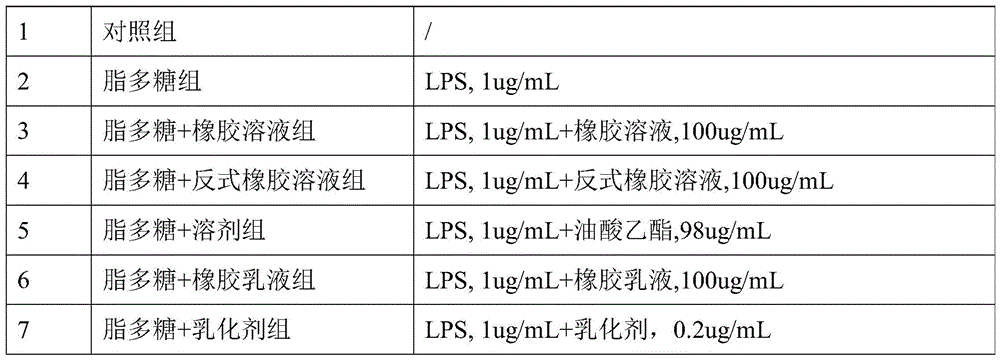
使用荧光定量PCR仪,对上述7个实验组进行mRNA的含量检测。LPS处理后巨噬细胞M1型标志基因IL-1β和iNOS表达能力分别如图4-5所示,LPS处理后巨噬细胞M2型标志基因CD206与IL-10mRNA表达能力分别如图6-7所示。The mRNA content of the above 7 experimental groups was detected using a fluorescent quantitative PCR instrument. The expression of IL-1β and iNOS, the marker genes of M1 macrophages after LPS treatment, are shown in Figures 4-5, respectively, and the expression of CD206 and IL-10 mRNA, the marker genes of M2 macrophages after LPS treatment, are shown in Figures 6-7, respectively.
由图4-7可知,LPS处理后巨噬细胞M1型标志基因IL-1β和iNOS表达上调,而M2表型标志基因IL-10和CD206表达下调。与LPS组相比,橡胶溶液与橡胶乳液显著降低了IL-1β和iNOS mRNA的表达水平,提高了CD206与IL-10mRNA的表达水平,并且橡胶溶液组与反式橡胶溶液组均表现出活性,无统计学差异。说明包括顺式与反式结构的橡胶溶液与橡胶乳液均可抑制巨噬细胞向M1型极化、促进其向M2型极化,同时改善炎症反应,而溶剂与乳化剂对巨噬细胞极化无显著影响。As shown in Figures 4-7, after LPS treatment, the expression of macrophage M1 marker genes IL-1β and iNOS was upregulated, while the expression of M2 phenotype marker genes IL-10 and CD206 was downregulated. Compared with the LPS group, the rubber solution and rubber latex significantly reduced the expression levels of IL-1β and iNOS mRNA, increased the expression levels of CD206 and IL-10 mRNA, and both the rubber solution group and the trans rubber solution group showed activity, with no statistical difference. This indicates that both the cis- and trans-structured rubber solution and rubber latex can inhibit the polarization of macrophages to M1, promote their polarization to M2, and improve the inflammatory response, while the solvent and emulsifier have no significant effect on macrophage polarization.
同时,由图4-7可知,1,4-聚异戊二烯的顺反结构,对药物活性没有显著影响。At the same time, it can be seen from Figures 4-7 that the cis-trans structure of 1,4-polyisoprene has no significant effect on drug activity.
应用例3对动脉粥样硬化的预防研究Application Example 3: Study on the Prevention of Atherosclerosis
本应用例为预防研究,即在实验小鼠尚未形成动脉粥样硬化斑块的时候,药物就开始介入,研究药物对动脉粥样硬化的预防效果。This application example is a preventive study, that is, the drug is started to intervene when the experimental mice have not yet formed atherosclerotic plaques, in order to study the preventive effect of the drug on atherosclerosis.
将28只8周龄雄性apoE-/-小鼠按照每组7只的数量,随机分为4组,分别为:对照组、动脉粥样硬化模型组(简称模型组)、模型+橡胶溶液组、模型+橡胶颗粒组。Twenty-eight 8-week-old male apoE-/- mice were randomly divided into 4 groups, with 7 mice in each group, namely: control group, atherosclerosis model group (referred to as model group), model + rubber solution group, and model + rubber particle group.
对照组喂食正常饮食16周,其余三组喂食高脂饮食(21%脂肪,0.5%胆固醇)16周。且动脉粥样硬化模型组、模型+橡胶溶液组、模型+橡胶颗粒组按照3g/kg体重的剂量每天分别灌胃油酸乙酯、橡胶溶液、油酸乙酯,同时模型+橡胶颗粒组的小鼠饲料添加了橡胶颗粒,实验小鼠分组情况如下表3所示:The control group was fed with a normal diet for 16 weeks, and the other three groups were fed with a high-fat diet (21% fat, 0.5% cholesterol) for 16 weeks. The atherosclerosis model group, model + rubber solution group, and model + rubber particle group were gavaged with ethyl oleate, rubber solution, and ethyl oleate at a dose of 3g/kg body weight every day. At the same time, rubber particles were added to the mouse feed of the model + rubber particle group. The experimental mice were grouped as shown in Table 3 below:
表3Table 3


实验结束后收集小鼠主动脉及根部,然后对小鼠主动脉根部进行油红O染色,再使用ImageJ程序来统计阳性区域,来检测上述4组实验小鼠动脉粥样硬化斑块大小。对小鼠全主动脉进行油红O染色,小鼠主动脉斑块大小的检测结果如图8所示(图8(A)为对照组小鼠主动脉斑块大小的检测结果,图8(B)为动脉粥样硬化模型组小鼠主动脉斑块大小的检测结果,图8(C)为模型+橡胶溶液组小鼠主动脉斑块大小的检测结果,图8(D)为模型+橡胶颗粒组小鼠主动脉斑块大小的检测结果),其阳性区域面积(斑块面积)占小鼠主动脉面积的面积百分比如图9所示。After the experiment, the mouse aorta and root were collected, and then the mouse aorta root was stained with Oil Red O, and the positive area was counted using the ImageJ program to detect the size of atherosclerotic plaques in the above four groups of experimental mice. The whole mouse aorta was stained with Oil Red O, and the detection results of the aortic plaque size of the mouse are shown in Figure 8 (Figure 8 (A) is the detection result of the aortic plaque size of the control group mouse, Figure 8 (B) is the detection result of the aortic plaque size of the atherosclerosis model group mouse, Figure 8 (C) is the detection result of the aortic plaque size of the model + rubber solution group mouse, and Figure 8 (D) is the detection result of the aortic plaque size of the model + rubber particle group mouse), and the percentage of the positive area (plaque area) to the area of the mouse aorta is shown in Figure 9.
由图8-9可知,橡胶溶液显著抑制了动脉粥样硬化小鼠中斑块的增长,而喂食橡胶颗粒组的斑块含量没有显著变化。As shown in Figures 8-9, the rubber solution significantly inhibited the growth of plaques in atherosclerotic mice, while the plaque content of the group fed with rubber particles did not change significantly.
对小鼠全主动脉根部进行油红O染色,小鼠主动脉斑块大小的检测结果如图10所示(图10(A)为对照组小鼠主动脉根部斑块大小的检测结果,图10(B)为动脉粥样硬化模型组小鼠主动脉根部斑块大小的检测结果,图10(C)为模型+橡胶溶液组小鼠主动脉根部斑块大小的检测结果,图10(D)为模型+橡胶颗粒组小鼠主动脉根部斑块大小的检测结果),其阳性区域面积(斑块面积)柱状图如图11所示。The entire aortic root of mice was stained with Oil Red O, and the results of the detection of aortic plaque size of mice are shown in Figure 10 (Figure 10 (A) is the detection result of aortic root plaque size of mice in the control group, Figure 10 (B) is the detection result of aortic root plaque size of mice in the atherosclerosis model group, Figure 10 (C) is the detection result of aortic root plaque size of mice in the model + rubber solution group, and Figure 10 (D) is the detection result of aortic root plaque size of mice in the model + rubber particle group). The bar graph of the positive area (plaque area) is shown in Figure 11.
由图10-11可知,橡胶溶液显著抑制了动脉粥样硬化小鼠中斑块的增加,喂食橡胶颗粒组斑块含量没有显著。As shown in Figures 10-11, the rubber solution significantly inhibited the increase of plaques in atherosclerotic mice, while the plaque content in the group fed with rubber particles was not significant.
脉粥样硬化斑块的发生、发展是心脑血管疾病的关键。本实验证实,橡胶溶液对尚未形成动脉粥样硬化斑块的小鼠有预防作用,降低动脉粥样硬化形成的速度,减小斑块的体积。橡胶颗粒未显示出预防作用。The occurrence and development of atherosclerotic plaques are the key to cardiovascular and cerebrovascular diseases. This experiment confirmed that the rubber solution has a preventive effect on mice that have not yet formed atherosclerotic plaques, reducing the speed of atherosclerosis formation and the volume of plaques. Rubber particles did not show a preventive effect.
应用例4对动脉粥样硬化的治疗研究Application Example 4: Study on the Treatment of Atherosclerosis
本应用例为治疗研究,即在实验小鼠已经形成动脉粥样硬化斑块后,药物才介入,研究药物对动脉粥样硬化的治疗效果。This application example is a treatment study, that is, the drug is introduced only after atherosclerotic plaques have formed in the experimental mice, in order to study the therapeutic effect of the drug on atherosclerosis.
将28只8周龄雄性apoE-/-小鼠按照每组7只的数量,随机分为4组,分别为:对照组、动脉粥样硬化模型组、模型+橡胶溶液组、模型+橡胶颗粒组。Twenty-eight 8-week-old male apoE-/- mice were randomly divided into 4 groups, with 7 mice in each group, namely: control group, atherosclerosis model group, model + rubber solution group, and model + rubber particle group.
对照组喂食正常饮食16周,其余三组喂食高脂饮食(21%脂肪,0.5%胆固醇)16周。从第12周开始,动脉粥样硬化模型组、模型+橡胶溶液组、模型+橡胶颗粒组按照3g/kg体重的剂量每天分别灌胃油酸乙酯、橡胶溶液、油酸乙酯,且模型+橡胶颗粒组的小鼠高脂饲料从第12周开始添加橡胶颗粒。实验小鼠分组情况如下表4所示。The control group was fed a normal diet for 16 weeks, and the other three groups were fed a high-fat diet (21% fat, 0.5% cholesterol) for 16 weeks. From the 12th week, the atherosclerosis model group, model + rubber solution group, and model + rubber particle group were gavaged with ethyl oleate, rubber solution, and ethyl oleate at a dose of 3g/kg body weight every day, and the high-fat diet of mice in the model + rubber particle group was supplemented with rubber particles from the 12th week. The grouping of experimental mice is shown in Table 4 below.
表4Table 4
实验结束后收集小鼠主动脉及根部,然后对小鼠主动脉根部进行油红O染色,再使用ImageJ程序来统计阳性区域,来检测上述4组实验小鼠动脉粥样硬化斑块大小。After the experiment, the aorta and root of the mice were collected, and then the aortic root of the mice was stained with Oil Red O. The ImageJ program was used to count the positive areas to detect the size of atherosclerotic plaques in the above four groups of experimental mice.
对小鼠全主动脉进行油红O染色,小鼠主动脉斑块大小的检测结果如图12所示(图12(A)为对照组小鼠主动脉斑块大小的检测结果,图12(B)为动脉粥样硬化模型组小鼠主动脉斑块大小的检测结果,图12(C)为模型+橡胶溶液组小鼠主动脉斑块大小的检测结果,图12(D)为模型+橡胶颗粒组小鼠主动脉斑块大小的检测结果),其阳性区域面积(斑块面积)占小鼠主动脉面积的面积百分比如图13所示。The whole aorta of mice was stained with Oil Red O, and the detection results of the aortic plaque size of mice are shown in Figure 12 (Figure 12 (A) is the detection result of the aortic plaque size of mice in the control group, Figure 12 (B) is the detection result of the aortic plaque size of mice in the atherosclerosis model group, Figure 12 (C) is the detection result of the aortic plaque size of mice in the model + rubber solution group, and Figure 12 (D) is the detection result of the aortic plaque size of mice in the model + rubber particle group). The percentage of the positive area (plaque area) to the area of the mouse aorta is shown in Figure 13.
由图12-13可知,橡胶溶液显著抑制了动脉粥样硬化小鼠中斑块的增长,而喂食橡胶颗粒组的斑块含量没有显著变化。As shown in Figures 12-13, the rubber solution significantly inhibited the growth of plaques in atherosclerotic mice, while the plaque content of the group fed with rubber particles did not change significantly.
对小鼠全主动脉根部进行油红O染色,小鼠主动脉斑块大小的检测结果如图14所示(图14(A)为对照组小鼠主动脉根部斑块大小的检测结果,图14(B)为动脉粥样硬化模型组小鼠主动脉根部斑块大小的检测结果,图14(C)为模型+橡胶溶液组小鼠主动脉根部斑块大小的检测结果,图14(D)为模型+橡胶颗粒组小鼠主动脉根部斑块大小的检测结果),其阳性区域面积(斑块面积)柱状图如图15所示。The entire aortic root of mice was stained with Oil Red O, and the results of the detection of aortic plaque size of mice are shown in Figure 14 (Figure 14 (A) is the detection result of aortic root plaque size of mice in the control group, Figure 14 (B) is the detection result of aortic root plaque size of mice in the atherosclerosis model group, Figure 14 (C) is the detection result of aortic root plaque size of mice in the model + rubber solution group, and Figure 14 (D) is the detection result of aortic root plaque size of mice in the model + rubber particle group). The bar graph of the positive area (plaque area) is shown in Figure 15.
由图14-15可知,橡胶溶液显著抑制了动脉粥样硬化小鼠中斑块的增加,喂食橡胶颗粒组斑块含量没有显著。As shown in Figures 14-15, the rubber solution significantly inhibited the increase of plaques in atherosclerotic mice, while the plaque content in the group fed with rubber particles was not significant.
动脉粥样硬化斑块的发生、发展是心脑血管疾病的关键。本实验证实,橡胶溶液对已经形成动脉粥样硬化斑块的小鼠有治疗作用,降低动脉粥样硬化形成的速度,减小斑块的体积。橡胶颗粒未显示出治疗作用。The occurrence and development of atherosclerotic plaques are the key to cardiovascular and cerebrovascular diseases. This experiment confirmed that the rubber solution has a therapeutic effect on mice that have already formed atherosclerotic plaques, reducing the speed of atherosclerosis formation and the volume of plaques. Rubber particles did not show any therapeutic effect.
应用例5对二型糖尿病的治疗研究Application Example 5: Study on the treatment of
以5只7周龄SPF级雄性m/m小鼠作为对照组,将15只7周龄SPF级雄性db/db小鼠随机分成三组,每组5只,分别为:二型糖尿病组、二型糖尿病+橡胶溶液组、二型糖尿病+橡胶颗粒组,取不同两日随机血糖,若两日血糖≥16.7mmol/L,则建立模型成功。Five 7-week-old SPF male m/m mice were used as the control group, and 15 7-week-old SPF male db/db mice were randomly divided into three groups, with 5 mice in each group, namely:
模型成功后,二型糖尿病+橡胶溶液组按照3g/kg体重的剂量每日一次灌胃橡胶溶液,连续12周;二型糖尿病+橡胶颗粒组按照3g/kg体重的剂量每日一次灌胃油酸乙酯,同时将其饲料替换成含有橡胶颗粒的饲料,连续灌胃和饲养12周。After the model was successfully established, the
对对照组、二型糖尿病组、二型糖尿病+橡胶溶液组、二型糖尿病+橡胶颗粒组的小鼠进行如下测试:The following tests were performed on mice in the control group,
(1)血糖(FBG)含量测定,小鼠禁食不禁水12h以上,检测时酒精消毒小鼠尾部,尾尖静脉采血法,用罗氏血糖仪采集第2滴血检测血糖。(1) Determination of blood glucose (FBG) content: Mice were fasted but not watered for more than 12 h. The tails of mice were disinfected with alcohol and blood was collected from the tail tip vein. The second drop of blood was collected using a Roche blood glucose meter to measure blood glucose.
(2)血清中血清葡萄糖(GLU)、糖化血清蛋白(GSP)含量测定:取小鼠全血制备血清,使用全自动生化仪检测小鼠血清中血清葡萄糖、糖化血清蛋白含量。(2) Determination of serum glucose (GLU) and glycosylated serum protein (GSP) content in serum: Whole blood was collected from mice to prepare serum, and the serum glucose and glycosylated serum protein content in mouse serum was detected using an automatic biochemical analyzer.
测试结果如图16-18所示,由图16-18可知,橡胶溶液降低了糖尿病模型小鼠的血糖、血清中葡萄糖、血清中糖化血清蛋白的含量,对糖尿病有治疗作用,而橡胶颗粒对糖尿病无治疗作用。The test results are shown in Figures 16-18. It can be seen from Figures 16-18 that the rubber solution reduces the blood sugar, serum glucose, and serum glycosylated serum protein content of diabetic model mice, and has a therapeutic effect on diabetes, while the rubber particles have no therapeutic effect on diabetes.
应用例6对高甘油三酯血症、高胆固醇血症的治疗研究Application Example 6: Study on the Treatment of Hypertriglyceridemia and Hypercholesterolemia
将20只七周龄apoe-/-小鼠平均分成四组,每组5只,分别为对照组、模型组、模型+橡胶溶液组和模型+橡胶颗粒组。整个实验周期为8周,前4周建立高脂血症小鼠模型,后4周用药物进行治疗。Twenty seven-week-old apoe-/- mice were evenly divided into four groups, each with 5 mice, namely the control group, model group, model + rubber solution group and model + rubber particles group. The entire experimental period was 8 weeks. The hyperlipidemia mouse model was established in the first 4 weeks, and the drug was used for treatment in the last 4 weeks.
在整个8周的饲喂期间,对照组采用基础饲料饲养,其余三组一直用高糖高脂饲料饲养。高糖高脂饲料货号:D12108C,采购自Research Diets公司。During the entire 8-week feeding period, the control group was fed with a basic diet, and the other three groups were fed with a high-sugar and high-fat diet. The high-sugar and high-fat diet was purchased from Research Diets.
在第5-8周期间,对于对照组、模型组、模型+橡胶溶液组、模型+橡胶颗粒组,按照3g/kg体重的剂量每日一次分别灌胃纯水、油酸乙酯、橡胶溶液、油酸乙酯,连续灌胃4周,且在第5-8周期间,将模型+橡胶颗粒组的饲料替换成含橡胶颗粒的饲料。During the 5th to 8th week, the control group, model group, model + rubber solution group, and model + rubber particles group were gavaged with pure water, ethyl oleate, rubber solution, and ethyl oleate at a dose of 3 g/kg body weight once a day for 4 consecutive weeks. During the 5th to 8th week, the feed of the model + rubber particles group was replaced with feed containing rubber particles.
用全自动生化仪检测各组小鼠血清中总胆固醇(TC)、甘油三酯(TG)、高密度脂蛋白胆固醇(HDL-C)、低密度脂蛋白胆固醇(LDL-C)的含量。The levels of total cholesterol (TC), triglyceride (TG), high-density lipoprotein cholesterol (HDL-C) and low-density lipoprotein cholesterol (LDL-C) in the serum of each group of mice were detected using an automatic biochemical analyzer.
用酶联免疫吸附测定(ELISA)法测定各组小鼠血清中的甘油三酯相关水解酶,包括:脂肪甘油三酯水解酶(ATGL)、脂蛋白脂酶(LPL)、肝酯酶(HL)、激素敏感性甘油三酯脂肪酶(HSL)的水平。The enzyme-linked immunosorbent assay (ELISA) method was used to determine the levels of triglyceride-related hydrolases in the serum of each group of mice, including adipose triglyceride hydrolase (ATGL), lipoprotein lipase (LPL), liver esterase (HL), and hormone-sensitive triglyceride lipase (HSL).
甘油三酯水解酶(ATGL)和激素敏感性甘油三酯脂肪酶(HSL)是哺乳动物最主要的脂肪分解酶,占白色脂肪组织中95%以上的甘油三酯水解酶活性。甘油三酯(TG)的分解代谢主要在ATGL和HSL的作用下进行,ATGL和HSL是脂肪水解的关键限速酶。肝酯酶(HL)主要由肝脏实质细胞合成和分泌,参与脂质代谢。Triglyceride hydrolase (ATGL) and hormone-sensitive triglyceride lipase (HSL) are the most important lipases in mammals, accounting for more than 95% of triglyceride hydrolase activity in white adipose tissue. The catabolism of triglycerides (TG) is mainly carried out under the action of ATGL and HSL, which are the key rate-limiting enzymes for fat hydrolysis. Hepatic esterase (HL) is mainly synthesized and secreted by liver parenchymal cells and participates in lipid metabolism.
由图19-22可知,橡胶溶液降低了血脂中总胆固醇、甘油三酯、低密度脂蛋白胆固醇的含量,增加的高密度脂蛋白胆固醇的含量,而橡胶颗粒对血脂无明显影响。说明橡胶溶液对于高胆固醇血症、高甘油三酯血脂有显著的治疗效果,橡胶颗粒对于高胆固醇血症、高甘油三酯血症无治疗效果。As shown in Figures 19-22, the rubber solution reduced the content of total cholesterol, triglycerides, and low-density lipoprotein cholesterol in blood lipids, and increased the content of high-density lipoprotein cholesterol, while the rubber particles had no significant effect on blood lipids. This shows that the rubber solution has a significant therapeutic effect on hypercholesterolemia and hypertriglyceridemia, while the rubber particles have no therapeutic effect on hypercholesterolemia and hypertriglyceridemia.
由图23-26可知,橡胶溶液使甘油三酯代谢相关的酶:脂肪甘油三酯水解酶(ATGL)、脂蛋白脂酶(LPL)、肝酯酶(HL)含量明显升高,激素敏感性甘油三酯脂肪酶(HSL)含量明显降低,橡胶颗粒对甘油三酯代谢相关的酶无明显影响。说明橡胶溶液可促进TG水解。即橡胶溶液对于高甘油三酯血症有显著的治疗效果,橡胶颗粒对于高甘油三酯血症无治疗效果。As shown in Figures 23-26, the rubber solution significantly increased the levels of enzymes related to triglyceride metabolism: adipose triglyceride hydrolase (ATGL), lipoprotein lipase (LPL), and liver esterase (HL), and significantly reduced the level of hormone-sensitive triglyceride lipase (HSL). The rubber particles had no significant effect on enzymes related to triglyceride metabolism. This indicates that the rubber solution can promote TG hydrolysis. That is, the rubber solution has a significant therapeutic effect on hypertriglyceridemia, while the rubber particles have no therapeutic effect on hypertriglyceridemia.
应用例7对脂肪肝的治疗研究Application Example 7: Study on the Treatment of Fatty Liver
将20只6周龄雄性C57BL/6小鼠按照每组5只,随机分为4组,分别为对照组、脂肪肝模型组(简称模型组)、模型+橡胶溶液组、模型+橡胶颗粒组。Twenty 6-week-old male C57BL/6 mice were randomly divided into 4 groups, 5 mice in each group, namely, control group, fatty liver model group (referred to as model group), model + rubber solution group, and model + rubber particle group.
对照组喂食基础饲料14周,其余三组喂食高脂饲料(21%脂肪,0.15%胆固醇)14周,其中模型+橡胶颗粒组的饲料中还添加了橡胶颗粒。与此同时,对照组、脂肪肝模型组、模型+橡胶溶液组、模型+橡胶颗粒组的小鼠按照3g/kg体重的剂量,每日一次分别灌胃纯水、油酸乙酯、橡胶溶液、油酸乙酯,持续14周。The control group was fed with a basic diet for 14 weeks, and the other three groups were fed with a high-fat diet (21% fat, 0.15% cholesterol) for 14 weeks. Rubber particles were also added to the feed of the model + rubber particle group. At the same time, the mice in the control group, fatty liver model group, model + rubber solution group, and model + rubber particle group were gavaged with pure water, ethyl oleate, rubber solution, and ethyl oleate once a day at a dose of 3g/kg body weight for 14 weeks.
实验结束后收集小鼠肝脏及组织进行拍照、称重。After the experiment, the mouse liver and tissues were collected for photographing and weighing.
各组小鼠肝脏的形态照片以及小鼠肝脏质量占小鼠总质量的百分比统计图分别如图27-28所示(图27(A)为对照组小鼠肝脏照片,图27(B)为模型组肝脏照片,图27(C)为模型+橡胶溶液组肝脏照片,图27(D)为模型+橡胶颗粒组肝脏照片)。由图27可知,模型组对比对照组,成功建立了脂肪肝;橡胶溶液组小鼠的肝脏脂肪累积明显被抑制;橡胶颗粒组的肝脏脂肪相比于模型组没有显著变化。由图28可知,模型组重量较于对照组显著提高,而橡胶溶液组显著逆转了由于脂质累积引起的脂肪肝重量增加,橡胶颗粒组相对于模型组的重量没有明显变化。The morphological photos of the livers of mice in each group and the statistical graphs of the percentage of the mouse liver mass to the total mouse mass are shown in Figures 27-28 (Figure 27 (A) is a photo of the livers of mice in the control group, Figure 27 (B) is a photo of the livers of the model group, Figure 27 (C) is a photo of the livers of the model + rubber solution group, and Figure 27 (D) is a photo of the livers of the model + rubber particles group). As shown in Figure 27, the model group successfully established fatty liver compared with the control group; the liver fat accumulation of mice in the rubber solution group was significantly inhibited; the liver fat of the rubber particle group did not change significantly compared with the model group. As shown in Figure 28, the weight of the model group increased significantly compared with the control group, while the rubber solution group significantly reversed the increase in fatty liver weight caused by lipid accumulation, and the weight of the rubber particle group did not change significantly relative to the model group.
进一步对各组小鼠肝脏组织进行了切片并分别进行H&E染色及油红染色,使用光学显微镜对经H&E染色和油红染色的肝脏切片进行检测,测试结果分别如图29-30所示。图29(A)和图30(A)依次为对照组小鼠肝脏切片就经H&E染色及油红染色后的照片,图29(B)和图30(B)依次为模型组小鼠肝脏切片就经H&E染色及油红染色后的照片,图29(C)和图30(C)依次为模型+橡胶溶液组小鼠肝脏切片就经H&E染色及油红染色后的照片,图29(D)和图30(D)依次为模型+橡胶颗粒组小鼠肝脏切片就经H&E染色及油红染色后的照片。The liver tissues of mice in each group were further sliced and stained with H&E and oil red, respectively. The liver slices stained with H&E and oil red were tested using an optical microscope, and the test results are shown in Figures 29-30. Figures 29(A) and 30(A) are photos of liver slices of mice in the control group after H&E staining and oil red staining, Figures 29(B) and 30(B) are photos of liver slices of mice in the model group after H&E staining and oil red staining, Figures 29(C) and 30(C) are photos of liver slices of mice in the model+rubber solution group after H&E staining and oil red staining, and Figures 29(D) and 30(D) are photos of liver slices of mice in the model+rubber particle group after H&E staining and oil red staining.
由图29可知,H&E染色显示了肝细胞的形态。与对照组相比,脂肪肝模型组中肝细胞有大量的坏死细胞形成坏死核心。与模型组相比,橡胶溶液组中肝细胞结构完整,排列紧密,细胞坏死不明显,无坏死核心出现,脂肪肝病变被显著逆转;橡胶颗粒组也有大量坏死细胞形成的坏死核心,与模型组的病变程度相似。As shown in Figure 29, H&E staining shows the morphology of liver cells. Compared with the control group, the liver cells in the fatty liver model group had a large number of necrotic cells forming necrotic cores. Compared with the model group, the liver cells in the rubber solution group had a complete structure and were tightly arranged, with no obvious cell necrosis and no necrotic cores, and the fatty liver lesions were significantly reversed; the rubber particle group also had a large number of necrotic cells forming necrotic cores, which was similar to the degree of lesions in the model group.
由图30可知,油红染色显示了肝细胞中的脂肪分布。与模型组相比,橡胶溶液显著抑制了高脂饮食诱导的脂肪肝小鼠中脂肪的增加,喂食橡胶颗粒组脂肪含量没有显著变化。As shown in Figure 30, oil red staining shows the distribution of fat in hepatocytes. Compared with the model group, the rubber solution significantly inhibited the increase of fat in mice with fatty liver induced by a high-fat diet, and there was no significant change in the fat content of the group fed with rubber particles.
肝脏组织中甘油三酯的含量,是脂肪肝病变程度的量化指标。使用组织甘油三酯(TG)酶法测定试剂盒对各组小鼠肝脏组织的甘油三酯(TG)含量进行检测,以对脂肪肝的病变程度进行量化,测试结果如图31所示。由图31可知,与模型组相比,灌胃橡胶溶液显著降低肝脏组织中的甘油三酯含量,而饲喂橡胶颗粒组甘油三酯含量没有明显变化。The content of triglycerides in liver tissue is a quantitative indicator of the degree of fatty liver disease. The triglyceride (TG) content in the liver tissue of each group of mice was tested using a tissue triglyceride (TG) enzymatic assay kit to quantify the degree of fatty liver disease. The test results are shown in Figure 31. As shown in Figure 31, compared with the model group, intragastric administration of rubber solution significantly reduced the triglyceride content in liver tissue, while the triglyceride content in the rubber particle feeding group did not change significantly.
由上述内容可知,橡胶溶液能够显著抑制高脂饮食引起的脂肪肝的发展,具有治疗脂肪肝的功效,而橡胶颗粒无此功效。From the above content, it can be seen that the rubber solution can significantly inhibit the development of fatty liver caused by a high-fat diet and has the effect of treating fatty liver, while the rubber particles have no such effect.
应用例8对结肠炎的治疗研究Application Example 8: Study on the Treatment of Colitis
取8周龄雄性小鼠32只,每组8只,随机分为4组,分别为对照组、结肠炎模型组(简称模型组)、模型+橡胶溶液组、模型+橡胶颗粒组。Thirty-two 8-week-old male mice were randomly divided into 4 groups, 8 mice in each group, namely, control group, colitis model group (referred to as model group), model + rubber solution group, and model + rubber particle group.
整个实验喂养持续7天。对照组以正常饲料喂养,其余三组在饲料中添加4%葡聚糖硫酸钠(DSS),以诱导肠炎症状,其中模型+橡胶颗粒组的饲料中还添加了橡胶颗粒。与此同时,对照组、结肠炎模型组、模型+橡胶溶液组、模型+橡胶颗粒组的小鼠按照3g/kg体重的剂量,每日一次分别灌胃纯水、油酸乙酯、橡胶溶液、油酸乙酯,持续7天。The entire experimental feeding lasted for 7 days. The control group was fed with normal feed, and the other three groups were fed with 4% dextran sulfate sodium (DSS) to induce enteritis symptoms. Rubber particles were also added to the feed of the model + rubber particle group. At the same time, the mice in the control group, colitis model group, model + rubber solution group, and model + rubber particle group were gavaged with pure water, ethyl oleate, rubber solution, and ethyl oleate at a dose of 3g/kg body weight once a day for 7 days.
实验期内每天称量并记录小鼠体重。同时每天收集小鼠粪便,观察粪便状态以及是否隐血、便血,根据这些数据进行DAI量化评分。During the experimental period, the mice were weighed and recorded daily. The feces of the mice were collected daily to observe the fecal status and whether there was occult blood or blood in the stool, and the DAI quantitative score was calculated based on these data.
DAI(Disease activity index,疾病活动指数)是结合小鼠的体重下降百分率、大便黏稠度和大便出血三种情况进行综合评分。DAI评分标准见表5。DAI (Disease activity index) is a comprehensive score based on the percentage of weight loss, stool viscosity and stool bleeding of mice. The DAI scoring standard is shown in Table 5.
表5Table 5
上表中,正常大便是指成型大便;松散大便是指不黏附于肛门的糊状、半成型大便;稀便是指可黏附于肛门的稀水样便。In the above table, normal stool refers to formed stool; loose stool refers to mushy, semi-formed stool that does not stick to the anus; and loose stool refers to watery stool that can stick to the anus.
DAI评分量化了小鼠结肠炎病变的程度。DAI评分越高,结肠炎病变程度越严重,DAI量化评分结果如图32所示。由图32可知,与结肠炎模型组相比,模型+橡胶溶液组的DAI评分较低,而模型+橡胶颗粒组却与结肠炎模型组无显著区别图。这说明橡胶溶液具有减轻小鼠结肠炎症状的作用,而橡胶颗粒却无此作用。The DAI score quantifies the extent of colitis in mice. The higher the DAI score, the more severe the colitis. The DAI quantitative score results are shown in Figure 32. As shown in Figure 32, compared with the colitis model group, the DAI score of the model + rubber solution group is lower, while the model + rubber particle group is not significantly different from the colitis model group. This shows that the rubber solution has the effect of alleviating the symptoms of colitis in mice, while the rubber particles have no such effect.
在其它条件不变的情况下,小鼠体重的下降,也是小鼠结肠炎病变程度的指标。4个实验组中小鼠体重下降率统计图如图33所示,由图33可知,结肠炎模型组小鼠体重随着试验天数而逐渐下降;模型+橡胶溶液组小鼠体重较结肠炎模型组的体重下降更缓慢;模型+橡胶颗粒组的体重下降程度与结肠炎模型组没显著区别。这也说明橡胶溶液具有减轻小鼠结肠炎症状的作用,而橡胶颗粒却无此作用。When other conditions remain unchanged, the weight loss of mice is also an indicator of the degree of colitis in mice. The statistical graph of the weight loss rate of mice in the four experimental groups is shown in Figure 33. As shown in Figure 33, the weight of mice in the colitis model group gradually decreased with the number of experimental days; the weight of mice in the model + rubber solution group decreased more slowly than that in the colitis model group; the weight loss degree of the model + rubber particle group was not significantly different from that of the colitis model group. This also shows that the rubber solution has the effect of alleviating the symptoms of colitis in mice, while the rubber particles have no such effect.
小鼠结肠的长度与重量也是结肠炎病变程度的量化指标。小鼠结肠炎病变越严重,结肠的长度越短,重量越轻。7天后对小鼠进行安乐死,取小鼠结肠,其照片如图34所示,测量每组小鼠结肠长度以及重量,测试结果分别如35-36所示。由图34-36可知,与对照组相比,结肠炎模型组的结肠长度缩短,质量变轻,但模型+橡胶溶液组较结肠炎模型组小鼠结肠受影响较小,而模型+橡胶颗粒组却与结肠炎组小鼠的结肠长度、重量均无显著区别。说明橡胶溶液具有治疗小鼠结肠炎的作用,而橡胶颗粒却无此作用。The length and weight of the mouse colon are also quantitative indicators of the degree of colitis lesions. The more severe the colitis lesions in the mice, the shorter the length of the colon and the lighter the weight. After 7 days, the mice were euthanized and the mouse colons were taken. The photos are shown in Figure 34. The length and weight of the colon of each group of mice were measured, and the test results are shown in Figures 35-36. As can be seen from Figures 34-36, compared with the control group, the colon length of the colitis model group was shortened and the weight was lighter, but the colon of the model + rubber solution group was less affected than that of the colitis model group, while the colon length and weight of the model + rubber particle group were not significantly different from those of the colitis group. This shows that the rubber solution has the effect of treating colitis in mice, while the rubber particles do not have this effect.
应用例9对多囊卵巢综合征的治疗研究Application Example 9: Study on the Treatment of Polycystic Ovary Syndrome
取20只4周龄雌性SD大鼠,每组5只,随机分为4组,分别为:对照组、多囊卵巢综合征模型组(简称模型组)、模型+橡胶溶液组、模型+橡胶颗粒组。Twenty 4-week-old female SD rats were randomly divided into 4 groups, 5 rats in each group, namely: control group, polycystic ovary syndrome model group (referred to as model group), model + rubber solution group, and model + rubber particles group.
整个实验饲养持续3周。实验期间,除对照组外,其余3组大鼠给予来曲唑灌胃处理,每日一次,持续3周,以建立多囊卵巢综合征模型。与此同时,对照组、多囊卵巢综合征模型组、模型+橡胶溶液组、模型+橡胶颗粒组按照3g/kg体重的剂量,每日一次分别灌胃纯水、油酸乙酯、橡胶溶液、油酸乙酯,持续3周,将模型+橡胶颗粒组的饲料替换成含橡胶颗粒的饲料。The whole experiment lasted for 3 weeks. During the experiment, except for the control group, the other 3 groups of rats were given letrozole by gavage once a day for 3 weeks to establish the PCOS model. At the same time, the control group, PCOS model group, model + rubber solution group, and model + rubber particle group were gavaged with pure water, ethyl oleate, rubber solution, and ethyl oleate at a dose of 3g/kg body weight once a day for 3 weeks, and the feed of the model + rubber particle group was replaced with feed containing rubber particles.
灌胃给药结束后,称量大鼠体重,尾静脉取血,制备血清测量血清睾酮含量。大鼠禁食12小时,尾静脉取血,使用血糖仪检测大鼠空腹血糖,大鼠禁食12h,尾静脉取血,使用血糖仪检测血糖值,为大鼠空腹血糖;然后给大鼠腹腔注射葡萄糖(10g/100mL),剂量为2g/kg,于注射后15min、30min、60min、90min、120min进行尾静脉取血,使用血糖仪检测血糖值。对大鼠实施安乐死,取大鼠的卵巢组织,提取组织RNA,用实时荧光定量PCR仪分别检测抗米勒管激素(AMH)、IL-1β和TNF-α的mRNA表达水平。After the intragastric administration, the rats were weighed, blood was collected from the tail vein, and serum was prepared to measure the serum testosterone content. The rats were fasted for 12 hours, blood was collected from the tail vein, and the fasting blood glucose of the rats was detected using a blood glucose meter. The rats were fasted for 12 hours, blood was collected from the tail vein, and the blood glucose value was detected using a blood glucose meter, which was the fasting blood glucose of the rats; then the rats were intraperitoneally injected with glucose (10g/100mL) at a dose of 2g/kg, and blood was collected from the tail vein at 15min, 30min, 60min, 90min, and 120min after injection, and the blood glucose value was detected using a blood glucose meter. The rats were euthanized, the ovarian tissues of the rats were taken, tissue RNA was extracted, and the mRNA expression levels of anti-Müllerian hormone (AMH), IL-1β, and TNF-α were detected using a real-time fluorescence quantitative PCR instrument.
随着大鼠多囊卵巢综合征模型的建立,大鼠的体重逐渐增加。体重增加的幅度可以反映多囊卵巢综合征的病变程度。对上述四组大鼠的体重进行测试,测试结果如图37所示。由图37可知,灌胃橡胶溶液显著降低了多囊卵巢综合征引起的体重增加,而喂食橡胶颗粒对大鼠体重无明显影响。With the establishment of the rat polycystic ovary syndrome model, the weight of the rats gradually increased. The extent of weight gain can reflect the degree of pathological changes in polycystic ovary syndrome. The weight of the above four groups of rats was tested, and the test results are shown in Figure 37. As shown in Figure 37, intragastric administration of rubber solution significantly reduced the weight gain caused by polycystic ovary syndrome, while feeding rubber particles had no significant effect on the weight of rats.
多囊卵巢综合征的一个重要现象是雄激素水平升高,雄性激素睾酮水平可以反映多囊卵巢综合征的病变程度。对上述四组大鼠的血清睾酮含量进行测试,测试结果如图38可知,灌胃橡胶溶液显著抑制了多囊卵巢综合征模型大鼠中血清睾酮的升高,喂食橡胶颗粒组的血清睾酮含量相较模型组没有显著变化。An important phenomenon of PCOS is the increase in androgen levels, and the level of testosterone, a male hormone, can reflect the severity of PCOS. The serum testosterone content of the above four groups of rats was tested. As shown in Figure 38, intragastric administration of rubber solution significantly inhibited the increase in serum testosterone in PCOS model rats, and the serum testosterone content of the group fed with rubber particles did not change significantly compared with the model group.
糖耐量受损是多囊卵巢综合征常见的代谢异常现象之一,糖耐量受损的程度可以反映多囊卵巢综合征病变的程度。对上述四组大鼠的空腹血糖以及不同时间下血糖含量以及葡萄糖耐量进行了测试,测试结果如图39-41所示。由图39-41可知,多囊卵巢综合征模型组大鼠出现了空腹血糖增加和糖耐量异常,但橡胶溶液灌胃后显著改善了空腹血糖和糖耐量异常现象,而饲喂橡胶颗粒没有明显作用。Impaired glucose tolerance is one of the common metabolic abnormalities in PCOS, and the degree of impaired glucose tolerance can reflect the degree of PCOS pathology. The fasting blood glucose, blood glucose content at different times, and glucose tolerance of the above four groups of rats were tested, and the test results are shown in Figures 39-41. As shown in Figures 39-41, the rats in the PCOS model group had increased fasting blood glucose and abnormal glucose tolerance, but the fasting blood glucose and abnormal glucose tolerance were significantly improved after oral administration of rubber solution, while feeding rubber particles had no obvious effect.
抗米勒管激素AMH水平升高,是多囊卵巢综合征患者卵泡发育障碍的标志。对上述四组大鼠血液中的抗米勒管激素AMH/GAPDH(mRNA)水平(以GAPDH内参基因进行标准化)进行测试,测试结果如图42所示。由图42可知,多囊卵巢综合征模型组大鼠卵巢组织的AMHmRNA水平显著升高,灌胃橡胶溶液而不是饲喂橡胶颗粒降低了AMH mRNA水平。Increased levels of anti-Müllerian hormone AMH are a sign of follicular development disorders in patients with PCOS. The anti-Müllerian hormone AMH/GAPDH (mRNA) levels in the blood of the above four groups of rats (normalized by the GAPDH internal reference gene) were tested, and the test results are shown in Figure 42. As shown in Figure 42, the AMH mRNA level in the ovarian tissue of rats in the PCOS model group was significantly increased, and gavage with rubber solution instead of feeding rubber particles reduced the AMH mRNA level.
多囊卵巢综合征患者的卵巢组织有持续性的慢性炎症反应,慢性炎症因子IL-1β和TNF-α的表达增加,可以作为该疾病病变程度的指标。对上述四组大鼠血液中的炎症因子IL-1β和TNF-α表达水平进行测试,测试结果分别如图43-44所示。由图43-44可知,与对照组相比,多囊卵巢综合征模型组大鼠卵巢组织的IL-1β和TNF-α表达显著增加;经橡胶溶液灌胃之后,大鼠卵巢内炎症因子表达显著下调,而喂食橡胶颗粒组的炎症因子表达没有显著变化。The ovarian tissue of patients with PCOS has a persistent chronic inflammatory response, and the expression of chronic inflammatory factors IL-1β and TNF-α increases, which can be used as an indicator of the degree of pathological changes in the disease. The expression levels of inflammatory factors IL-1β and TNF-α in the blood of the above four groups of rats were tested, and the test results are shown in Figures 43-44. As shown in Figures 43-44, compared with the control group, the expression of IL-1β and TNF-α in the ovarian tissue of rats in the PCOS model group increased significantly; after gavage with rubber solution, the expression of inflammatory factors in the rat ovaries was significantly downregulated, while the expression of inflammatory factors in the group fed with rubber particles did not change significantly.
由上述内容可知,综合对比多囊卵巢综合征大鼠的多个指标,包括体重、血清睾酮水平、空腹血糖、糖耐量、卵巢组织的抗米勒管激素AMH水平、炎症因子IL-1β和TNF-α表达水平,证明橡胶溶液具有治疗多囊卵巢综合征的功效,而橡胶颗粒无此功效。From the above content, it can be seen that a comprehensive comparison of multiple indicators of PCOS rats, including body weight, serum testosterone level, fasting blood glucose, glucose tolerance, anti-Müllerian hormone AMH level in ovarian tissue, and expression levels of inflammatory factors IL-1β and TNF-α, proves that rubber solution has the efficacy of treating PCOS, while rubber particles have no such effect.
应用例10对肥胖症的治疗研究Application Example 10: Study on the treatment of obesity
取24只6周龄雄性C57BL/6小鼠,每组6只,随机分为4组,分别为:对照组、高脂模型组、高脂+橡胶溶液组、高脂+橡胶颗粒组。四组小鼠的平均体重为20±2g。Twenty-four 6-week-old male C57BL/6 mice were randomly divided into four groups, 6 mice in each group, namely: control group, high-fat model group, high-fat + rubber solution group, and high-fat + rubber particle group. The average weight of the four groups of mice was 20±2g.
实验为期18周。对照组一直喂食基础饲料,其余三组一直喂食高脂饲料(脂肪含量35%),其中高脂+橡胶颗粒组的饲料中还添加了橡胶颗粒。对照组、高脂模型组、高脂+橡胶溶液组、高脂+橡胶颗粒组按照3g/kg体重的剂量,每日一次分别灌胃纯水、花油酸乙酯、橡胶溶液、油酸乙酯,持续18周。The experiment lasted for 18 weeks. The control group was fed with basic feed, and the other three groups were fed with high-fat feed (fat content 35%). Rubber particles were added to the feed of the high-fat + rubber particle group. The control group, high-fat model group, high-fat + rubber solution group, and high-fat + rubber particle group were gavaged with pure water, ethyl oleate, rubber solution, and ethyl oleate once a day at a dose of 3g/kg body weight for 18 weeks.
每周记录小鼠体重(body weight),并在实验结束时通过小鼠体脂机记录分析小鼠脂肪质量(fat mass),对小鼠实施安乐死,取附睾周围的脂肪组织进行切片,然后进行H&E染色,统计平均每个脂肪细胞的面积。The body weight of mice was recorded every week, and at the end of the experiment, the fat mass of mice was recorded and analyzed using a body fat meter. The mice were euthanized, and the adipose tissue around the epididymis was sliced and stained with H&E to calculate the average area of each fat cell.
上述4个实验小组中小鼠的体重和脂肪质量测试结果分别如图45-46所示。由图45可知,与对照组相比,高脂模型组小鼠的体重明显增加,橡胶溶液灌胃显著抑制了高脂饮食诱导的体重的增加,而喂食橡胶颗粒无此抑制作用。由图46可知,脂肪质量的数据与体重数据一致,橡胶溶液显著抑制了高脂诱导小鼠的脂肪质量的增加,而喂食橡胶颗粒无此抑制作。The test results of the weight and fat mass of mice in the above four experimental groups are shown in Figures 45-46. As shown in Figure 45, compared with the control group, the weight of mice in the high-fat model group increased significantly, and the oral administration of rubber solution significantly inhibited the increase in weight induced by the high-fat diet, while feeding rubber particles had no such inhibitory effect. As shown in Figure 46, the data of fat mass are consistent with the weight data, and the rubber solution significantly inhibited the increase in fat mass of mice induced by high-fat diet, while feeding rubber particles had no such inhibitory effect.
使用光学显微镜,对小鼠的脂肪组织形态进行测试,测试结果如图47所示(图47(A)为对照组脂肪组织形态照片,图47(B)为高脂模型组脂肪组织形态照片,图47(C)为模型+橡胶溶液组脂肪组织形态照片,图47(D)为模型+橡胶颗粒组脂肪组织形态照片)。由图47可知,对照组小鼠脂肪细胞体积较小,排列整齐;高脂组肥胖小鼠的脂肪细胞变大,并有部分炎症细胞浸润;橡胶溶液显著抑制了高脂饮食诱导的脂肪细胞的增大;橡胶颗粒组的细胞形态与高脂组相似。The adipose tissue morphology of mice was tested using an optical microscope, and the test results are shown in Figure 47 (Figure 47 (A) is a photo of the adipose tissue morphology of the control group, Figure 47 (B) is a photo of the adipose tissue morphology of the high-fat model group, Figure 47 (C) is a photo of the adipose tissue morphology of the model + rubber solution group, and Figure 47 (D) is a photo of the adipose tissue morphology of the model + rubber particle group). As shown in Figure 47, the adipose cells of the mice in the control group were smaller and arranged neatly; the adipose cells of the obese mice in the high-fat group became larger, and some inflammatory cells infiltrated; the rubber solution significantly inhibited the enlargement of adipose cells induced by a high-fat diet; the cell morphology of the rubber particle group was similar to that of the high-fat group.
使用光学显微镜,对小鼠的脂肪细胞平均面积进行测试,测试结果如图48所示。由图48可知,通过对每个脂肪细胞的面积进行统计计算,发现高脂组的单个脂肪细胞平均面积为对照组的2.8倍;橡胶溶液显著抑制了脂肪细胞面积增长的趋势,其单个脂肪细胞平均面积只有对照组的1.2倍;橡胶颗粒组相较于高脂组没有显著变化。The average area of fat cells of mice was tested using an optical microscope, and the test results are shown in Figure 48. As shown in Figure 48, by statistically calculating the area of each fat cell, it was found that the average area of a single fat cell in the high-fat group was 2.8 times that of the control group; the rubber solution significantly inhibited the trend of fat cell area growth, and its average area of a single fat cell was only 1.2 times that of the control group; the rubber particle group had no significant change compared to the high-fat group.
综合对比包括四组小鼠体重、脂肪重量、脂肪组织病理学染色、单个脂肪细胞平均面积在内的数据,证明橡胶溶液能够显著抑制高脂饮食诱导的肥胖,具有治疗肥胖症的功效,而橡胶颗粒无此功效。A comprehensive comparison of data including body weight, fat weight, adipose tissue pathological staining, and average area of single fat cells of the four groups of mice proved that the rubber solution can significantly inhibit obesity induced by a high-fat diet and has the effect of treating obesity, while rubber particles have no such effect.
应用例11天然橡胶胶乳、橡胶乳液、橡胶溶液在小鼠胃中存在状态研究Application Example 11 Study on the existence state of natural rubber latex, rubber emulsion and rubber solution in mouse stomach
取6周大雄性C57BL/6小鼠15只,每组5只,随机分为3组,分别为天然胶乳组、橡胶乳液组、橡胶溶液组。实验持续7天,以基础饲料饲喂。Fifteen 6-week-old male C57BL/6 mice were randomly divided into three groups, 5 mice in each group, namely natural rubber latex group, rubber latex group, and rubber solution group. The experiment lasted for 7 days and the mice were fed with basic feed.
对天然胶乳组、橡胶乳液组、橡胶溶液组小鼠按照3g/kg体重的剂量,每日一次分别灌胃采自巴西三叶橡胶树的天然胶乳、本发明提供的橡胶乳液、本发明提供的橡胶溶液,持续7天。每天收集小鼠的粪便,用解剖镜检查。在最后一次灌胃剂量增加为15g/kg体重,灌胃结束后30分钟内对小鼠实施安乐死,取出小鼠胃内的胃容物,用解剖镜检查。The natural latex group, rubber emulsion group, and rubber solution group mice were gavaged with natural latex, rubber emulsion, and rubber solution from Hevea brasiliensis, respectively, at a dose of 3 g/kg body weight once a day for 7 days. The feces of mice were collected every day and examined with a dissecting microscope. The last gavage dose was increased to 15 g/kg body weight. Within 30 minutes after the gavage, mice were euthanized, and the stomach contents in the mouse stomach were taken out and examined with a dissecting microscope.
分别对天然胶乳组小鼠胃容物、橡胶溶液组小鼠胃容物、橡胶乳液组小鼠胃容物进行检测,检测结果如图49-51所示。由图49-51可知,在天然胶乳组小鼠的胃容物中观察到橡胶的凝块;而在橡胶乳液组、橡胶溶液组小鼠胃容物中均未观察到橡胶的凝块。The stomach contents of mice in the natural rubber latex group, the rubber solution group, and the rubber latex group were tested, and the test results are shown in Figures 49 to 51. As shown in Figures 49 to 51, rubber clots were observed in the stomach contents of mice in the natural rubber latex group, while no rubber clots were observed in the stomach contents of mice in the rubber latex group and the rubber solution group.
由此可知,天然橡胶胶乳进入小鼠胃内会直接聚集凝固成大的橡胶团块,无法保持分散状态,不具有药物活性,然后经消化道排出体外;而本发明提供的橡胶乳液、橡胶溶液进入小鼠胃肠内,不会凝固成大的橡胶团块,一直保持分散状态,具有药物活性。It can be seen from this that natural rubber latex will directly aggregate and coagulate into large rubber lumps when entering the mouse stomach, cannot remain in a dispersed state, has no pharmaceutical activity, and is then excreted from the body through the digestive tract; while the rubber latex and rubber solution provided by the present invention will not coagulate into large rubber lumps when entering the mouse gastrointestinal tract, but will remain in a dispersed state and have pharmaceutical activity.
应用例12不同乳化剂制备的橡胶乳液在强酸与弱酸性环境中稳定性研究Application Example 12 Study on the stability of rubber latex prepared with different emulsifiers in strong acid and weak acid environments
为了检验现有技术中采自巴西三叶橡胶树的天然胶乳、以天然胶乳为原料制备的工业浓缩胶乳(包括高氨浓缩胶乳、低氨浓缩胶乳、低蛋白浓缩胶乳)以及人工合成的1,4-聚异戊二烯胶乳在酸性条件下的稳定性,并与本发明优选的乳化剂制备的1,4-聚异戊二烯乳液体系做对比,发明人用pH=1和pH=3的盐酸溶液,在体外模拟哺乳动物的胃酸环境,检测不同乳化剂制备的橡胶乳液的稳定性。前者代表胃液的强酸性环境,后者代表胃液的弱酸性环境。In order to test the stability of natural latex collected from Hevea brasiliensis in the prior art, industrial concentrated latex prepared with natural latex as raw material (including high ammonia concentrated latex, low ammonia concentrated latex, low protein concentrated latex) and
以本发明优选的乳化剂制备1,4-聚异戊二烯乳液体系的方法可参考实施例2提供的方法,区别仅在于,乳化剂不同。The method for preparing the 1,4-polyisoprene emulsion system with the preferred emulsifier of the present invention can refer to the method provided in Example 2, the only difference being that the emulsifier is different.
pH=3弱酸下是否稳定:在玻璃皿中加入5毫升pH=3的盐酸溶液(1.0mmol/L),用移液枪滴入0.1毫升的1,4-聚异戊二烯乳液,搅拌均匀,观察是否会有固体析出,若有固体析出,则该1,4-聚异戊二烯乳液体系在pH=3弱酸条件下不稳;反之,则为稳定;Whether it is stable under weak acid conditions of pH = 3: Add 5 ml of hydrochloric acid solution (1.0 mmol/L) with pH = 3 into a glass dish, and use a pipette to drop 0.1 ml of 1,4-polyisoprene emulsion, stir evenly, and observe whether solids are precipitated. If solids are precipitated, the 1,4-polyisoprene emulsion system is unstable under weak acid conditions of pH = 3; otherwise, it is stable;
pH=1强酸下是否稳定:在玻璃皿中加入5毫升pH=1的盐酸溶液(0.1mol/L),用移液枪滴入0.1毫升的1,4-聚异戊二烯乳液,搅拌均匀,观察是否有固体析出,若有固体析出,则该1,4-聚异戊二烯乳液体系在pH=1强酸条件下不稳;反之,则为稳定。Whether it is stable under strong acid conditions at pH = 1: Add 5 ml of hydrochloric acid solution (0.1 mol/L) at pH = 1 into a glass dish, and use a pipette to drop 0.1 ml of 1,4-polyisoprene emulsion, stir evenly, and observe whether there is solid precipitation. If solid precipitation is present, the 1,4-polyisoprene emulsion system is unstable under strong acid conditions at pH = 1; otherwise, it is stable.
不同1,4-聚异戊二烯乳液分散体系的说明及检测试结果详见下表6:The description and test results of different 1,4-polyisoprene emulsion dispersion systems are detailed in Table 6 below:
表6Table 6


图52是部分测试结果,其中:Figure 52 shows some test results, including:
A是巴西三叶橡胶树的天然胶乳滴加到pH=3的盐酸中的照片;A is a photo of the natural latex of Hevea brasiliensis being dropped into hydrochloric acid at pH=3;
B是高氨浓缩天然胶乳滴加到pH=3的盐酸中的照片;B is a photo of high ammonia concentrated natural rubber latex being dropped into hydrochloric acid at pH = 3;
C是低氨浓缩天然胶乳滴加到pH=3的盐酸中的照片;C is a photograph of low-ammonia concentrated natural rubber latex being dropped into hydrochloric acid at pH = 3;
D是低蛋白浓缩天然胶乳滴加到pH=3的盐酸中的照片;D is a photo of low-protein concentrated natural rubber latex being dropped into hydrochloric acid at pH=3;
E是人工合成异戊胶乳滴加到pH=3的盐酸中的照片;E is a photograph of artificial synthetic isoprene latex added dropwise into hydrochloric acid at pH = 3;
F是本发明以聚氧乙烯(20)失水山梨糖醇单月桂酸酯(吐温-20)为乳化剂制备的橡胶乳液滴加到pH=1的盐酸中的照片;F is a photograph of a rubber latex prepared by using polyoxyethylene (20) sorbitan monolaurate (Tween-20) as an emulsifier and added dropwise to hydrochloric acid at pH=1;
G是本发明以聚氧乙烯(20)失水山梨糖醇单棕榈酸酯(吐温-40)为乳化剂制备的橡胶乳液滴加到pH=1的盐酸中的照片;G is a photograph of a rubber latex prepared by using polyoxyethylene (20) sorbitan monopalmitate (Tween-40) as an emulsifier and added dropwise to hydrochloric acid at pH=1;
H是本发明以聚氧乙烯(20)失水山梨糖醇单硬脂酸酯(吐温-60)为乳化剂制备的橡胶乳液滴加到pH=1的盐酸中的照片;H is a photograph of a rubber latex prepared by using polyoxyethylene (20) sorbitan monostearate (Tween-60) as an emulsifier and added dropwise to hydrochloric acid at pH=1;
I是本发明实施例2以聚氧乙烯(20)失水山梨糖醇单油酸酯(吐温-80)为乳化剂制备的橡胶乳液滴加到pH=1的盐酸中的照片;I is a photograph of a rubber latex prepared by using polyoxyethylene (20) sorbitan monooleate (Tween-80) as an emulsifier in Example 2 of the present invention, which is added dropwise to hydrochloric acid at pH=1;
J是本发明以十聚甘油单月桂酸酯(Q-12S)为乳化剂制备的橡胶乳液滴加到pH=1的盐酸中的照片;J is a photograph of a rubber latex prepared by using polyglycerol monolaurate (Q-12S) as an emulsifier in the present invention and added dropwise to hydrochloric acid at pH=1;
K是本发明以十聚甘油单豆蔻酸酯(Q-14S)为乳化剂制备的橡胶乳液滴加到pH=1的盐酸中的照片;K is a photograph of a rubber latex prepared by using decaglycerol monomyristate (Q-14S) as an emulsifier and added dropwise to hydrochloric acid at pH=1;
L是本发明以十聚甘油单棕榈酸酯(Q-16S)为乳化剂制备的橡胶乳液滴加到pH=1的盐酸中的照片;L is a photograph of a rubber latex prepared by using decaglycerol monopalmitate (Q-16S) as an emulsifier and added dropwise to hydrochloric acid at pH=1;
M是本发明以十聚甘油单油酸酯(Q-17S)为乳化剂制备的橡胶乳液滴加到pH=1的盐酸中的结果;M is the result of adding the rubber latex prepared by using decaglycerol monooleate (Q-17S) as an emulsifier to hydrochloric acid at pH=1;
N是本发明以十聚甘油单硬脂酸酯(Q-18S)为乳化剂制备的橡胶乳液滴加到pH=1的盐酸中的照片;N is a photograph of the rubber latex prepared by using decaglycerol monostearate (Q-18S) as an emulsifier in the present invention being added dropwise to hydrochloric acid at pH=1;
O是本发明以单硬脂酸蔗糖酯为乳化剂制备的橡胶乳液滴加到pH=1的盐酸中的照片。O is a photograph of the rubber latex prepared by using sucrose monostearate as an emulsifier in the present invention being added dropwise into hydrochloric acid at pH=1.
由表6和图50可知,现有技术中采自巴西三叶橡胶树的天然胶乳、以天然胶乳为原料制备的工业浓缩胶乳(包括高氨浓缩胶乳、低氨浓缩胶乳、低蛋白浓缩胶乳)以及人工合成的1,4-聚异戊二烯胶乳在pH=1和pH=3的酸性条件下均不稳定,1,4-聚异戊二烯都会凝固析出。由此可知,其在哺乳动物胃液中也会凝固析出,无法保持分散状态,不会产生药学活性。As shown in Table 6 and Figure 50, the natural latex collected from Hevea brasiliensis, the industrial concentrated latex (including high ammonia concentrated latex, low ammonia concentrated latex, low protein concentrated latex) prepared from natural latex and the synthetic 1,4-polyisoprene latex in the prior art are all unstable under the acidic conditions of pH = 1 and pH = 3, and 1,4-polyisoprene will coagulate and precipitate. It can be seen that it will also coagulate and precipitate in mammalian gastric juice, cannot maintain a dispersed state, and will not produce pharmaceutical activity.
本发明优选的以聚氧乙烯(20)失水山梨糖醇单月桂酸酯(吐温-20)、聚氧乙烯(20)失水山梨糖醇单棕榈酸酯(吐温-40)、聚氧乙烯(20)失水山梨糖醇单硬脂酸酯(吐温-60)、聚氧乙烯(20)失水山梨糖醇单油酸酯(吐温-80)、十聚甘油单月桂酸酯(Q-12S)、十聚甘油单豆蔻酸酯(Q-14S)、十聚甘油单软脂酸酯(Q-16S)、十聚甘油单油酸酯(Q-17S)、十聚甘油单硬脂酸酯(Q-18S)、单硬脂酸蔗糖酯为乳化剂制备的乳液体系,在pH=1.0和pH=3.0的酸性条件下均保持稳定。由此可知,由此制备得到的橡胶乳液在哺乳动物胃液中也会保持分散状态,从而发挥药学活性。The present invention preferably uses polyoxyethylene (20) sorbitan monolaurate (Tween-20), polyoxyethylene (20) sorbitan monopalmitate (Tween-40), polyoxyethylene (20) sorbitan monostearate (Tween-60), polyoxyethylene (20) sorbitan monooleate (Tween-80), decaglycerol monolaurate (Q-12S), decaglycerol monomyristate (Q-14S), decaglycerol monopalmitate (Q-16S), decaglycerol monooleate (Q-17S), decaglycerol monostearate (Q-18S), and sucrose monostearate as emulsifiers to prepare the emulsion system, which remains stable under acidic conditions of pH=1.0 and pH=3.0. It can be seen that the rubber latex prepared in this way will also remain dispersed in mammalian gastric juice, thereby exerting pharmaceutical activity.
由上述内容可知,本发明中,通过将1,4-聚异戊二烯分散在溶液分散体系和乳液分散体系中,均能在在哺乳动物胃酸环境中保持稳定,无1,4-聚异戊二烯凝块析出,且对哺乳动物无口服毒性,不含致敏原。分散状态的1,4-聚异戊二烯,可显著抑制巨噬细胞泡沫化,抑制巨噬细胞向M1型极化、促进其向M2型极化,同时改善炎症反应;对动脉粥样硬化性心脑血管疾病的预防和治疗有显著效果;同时对二型糖尿病、高胆固醇血症、高甘油三酯血症、脂肪肝、结肠炎、多囊卵巢综合征、肥胖症具有显著的治疗效果。From the above content, it can be known that in the present invention, by dispersing 1,4-polyisoprene in a solution dispersion system and an emulsion dispersion system, it can remain stable in the gastric acid environment of mammals, no 1,4-polyisoprene clots are precipitated, and it has no oral toxicity to mammals and does not contain allergens. Dispersed 1,4-polyisoprene can significantly inhibit macrophage foaming, inhibit macrophage polarization to M1 type, promote its polarization to M2 type, and improve inflammatory response; it has a significant effect on the prevention and treatment of atherosclerotic cardiovascular and cerebrovascular diseases; and it also has a significant therapeutic effect on
申请人声明,本发明通过上述实施例来说明本发明的详细工艺流程,但本发明并不局限于上述详细工艺流程,即不意味着本发明必须依赖上述详细工艺流程才能实施。所属技术领域的技术人员应该明了,对本发明的任何改进,对本发明产品各原料,尤其是溶剂和乳化剂的等效替换及辅助成分的添加、具体方式的选择等,均落在本发明的保护范围和公开范围之内。The applicant declares that the present invention illustrates the detailed process flow of the present invention through the above-mentioned embodiments, but the present invention is not limited to the above-mentioned detailed process flow, that is, it does not mean that the present invention must rely on the above-mentioned detailed process flow to be implemented. Those skilled in the art should understand that any improvement of the present invention, equivalent replacement of the raw materials of the product of the present invention, especially the solvent and emulsifier, addition of auxiliary components, selection of specific methods, etc., all fall within the protection scope and disclosure scope of the present invention.
Claims (10)
Priority Applications (7)
| Application Number | Priority Date | Filing Date | Title |
|---|---|---|---|
| CN202310243245.6A CN116271061A (en) | 2023-03-14 | 2023-03-14 | A kind of 1,4-polyisoprene dispersion system and pharmaceutical active ingredient and its application |
| CN202310751990.1A CN119112780A (en) | 2023-03-14 | 2023-06-25 | A 1,4-polyisoprene dispersion system and active pharmaceutical ingredient and its application |
| CN202310978602.3A CN117752677A (en) | 2023-03-14 | 2023-08-04 | The use of a drug in the treatment of Alzheimer's disease |
| PCT/CN2023/116063 WO2024187697A1 (en) | 2023-03-14 | 2023-08-31 | 1,4-polyisoprene dispersion system, pharmaceutical active ingredient and use thereof |
| AU2023437235A AU2023437235A1 (en) | 2023-03-14 | 2023-08-31 | 1,4-polyisoprene dispersion system, pharmaceutical active ingredient and use thereof |
| EP23927043.2A EP4681738A1 (en) | 2023-03-14 | 2023-08-31 | 1,4-polyisoprene dispersion system, pharmaceutical active ingredient and use thereof |
| KR1020257034151A KR20250172583A (en) | 2023-03-14 | 2023-08-31 | 1,4-Polyisoprene Dispersion System and Active Pharmaceutical Ingredients and Their Applications |
Applications Claiming Priority (1)
| Application Number | Priority Date | Filing Date | Title |
|---|---|---|---|
| CN202310243245.6A CN116271061A (en) | 2023-03-14 | 2023-03-14 | A kind of 1,4-polyisoprene dispersion system and pharmaceutical active ingredient and its application |
Publications (1)
| Publication Number | Publication Date |
|---|---|
| CN116271061A true CN116271061A (en) | 2023-06-23 |
Family
ID=86828281
Family Applications (3)
| Application Number | Title | Priority Date | Filing Date |
|---|---|---|---|
| CN202310243245.6A Pending CN116271061A (en) | 2023-03-14 | 2023-03-14 | A kind of 1,4-polyisoprene dispersion system and pharmaceutical active ingredient and its application |
| CN202310751990.1A Pending CN119112780A (en) | 2023-03-14 | 2023-06-25 | A 1,4-polyisoprene dispersion system and active pharmaceutical ingredient and its application |
| CN202310978602.3A Pending CN117752677A (en) | 2023-03-14 | 2023-08-04 | The use of a drug in the treatment of Alzheimer's disease |
Family Applications After (2)
| Application Number | Title | Priority Date | Filing Date |
|---|---|---|---|
| CN202310751990.1A Pending CN119112780A (en) | 2023-03-14 | 2023-06-25 | A 1,4-polyisoprene dispersion system and active pharmaceutical ingredient and its application |
| CN202310978602.3A Pending CN117752677A (en) | 2023-03-14 | 2023-08-04 | The use of a drug in the treatment of Alzheimer's disease |
Country Status (1)
| Country | Link |
|---|---|
| CN (3) | CN116271061A (en) |
Cited By (1)
| Publication number | Priority date | Publication date | Assignee | Title |
|---|---|---|---|---|
| WO2024187697A1 (en) * | 2023-03-14 | 2024-09-19 | 苏州海益生物医药科技有限公司 | 1,4-polyisoprene dispersion system, pharmaceutical active ingredient and use thereof |
-
2023
- 2023-03-14 CN CN202310243245.6A patent/CN116271061A/en active Pending
- 2023-06-25 CN CN202310751990.1A patent/CN119112780A/en active Pending
- 2023-08-04 CN CN202310978602.3A patent/CN117752677A/en active Pending
Cited By (1)
| Publication number | Priority date | Publication date | Assignee | Title |
|---|---|---|---|---|
| WO2024187697A1 (en) * | 2023-03-14 | 2024-09-19 | 苏州海益生物医药科技有限公司 | 1,4-polyisoprene dispersion system, pharmaceutical active ingredient and use thereof |
Also Published As
| Publication number | Publication date |
|---|---|
| CN119112780A (en) | 2024-12-13 |
| CN117752677A (en) | 2024-03-26 |
Similar Documents
| Publication | Publication Date | Title |
|---|---|---|
| Wang et al. | Enhancing stability and anti-inflammatory properties of curcumin in ulcerative colitis therapy using liposomes mediated colon-specific drug delivery system | |
| Cordenonsi et al. | The role of chitosan as coating material for nanostructured lipid carriers for skin delivery of fucoxanthin | |
| Hashim et al. | Pivotal role of Acitretin nanovesicular gel for effective treatment of psoriasis: ex vivo–in vivo evaluation study | |
| EP4007500A1 (en) | Preparation comprising omega-3 fatty acid salts and extracts of gum resins from boswellia species | |
| Huang et al. | Aspergillus niger fermented Tartary buckwheat ameliorates obesity and gut microbiota dysbiosis through the NLRP3/Caspase-1 signaling pathway in high-fat diet mice | |
| Liu et al. | Effect and mechanism of edible oil co-digestion on the bioaccessibility and bioavailability of ursolic acid | |
| Pan et al. | RETRACTED: Nrf2 pathway activation with natural plant-derived exosome-like nanovesicle/hydrogel preparations for oxidative stress modulation in inflammation related diseases | |
| Gudise et al. | Antidiabetic and antihyperlipidemic effects of Argyreia pierreana and Matelea denticulata: Higher activity of the micellar nanoformulation over the crude extract | |
| Johnson et al. | Protective effect of ethanolic extract of Echinacea purpurea contained nanoparticles on meniscal/ligamentous injury induced osteoarthritis in obese male rats | |
| CN105662896A (en) | Calophyllum inophyllum kernel oil included lecithin liposome and application thereof in soothing scar-fading products | |
| CN116271061A (en) | A kind of 1,4-polyisoprene dispersion system and pharmaceutical active ingredient and its application | |
| Chen et al. | Regulating effects of phytosterol esters-loaded emulsions stabilized with green tea polysaccharide conjugates and tween on lipids in KKAy mice | |
| Ruan et al. | The synergic effects and mechanism of KGM–DMY complex in the prevention of obesity and enhancement of fatigue resistance in mice | |
| CN101972229B (en) | Preparation method of catalase solid lipid nanoparticles preparation | |
| Liu et al. | Alleviation of ulcerative colitis via curcumin-fortified orange juice: Utilization of orange-derived extracellular vesicles as active nanocarrier | |
| Samudra et al. | Antihyperglycemic activity of nanoemulsion of brown algae (Sargassum sp.). Ethanol extract in glucose tolerance test in male mice | |
| Averina et al. | Encapsulation of alimentary bioactive oils of the Baikal Lake area into pH-sensitive micro-and nanoparticles | |
| WO2024187697A1 (en) | 1,4-polyisoprene dispersion system, pharmaceutical active ingredient and use thereof | |
| Adlia et al. | Turmeric-black pepper-honey nanoemulsion formulation and antiulcerogenic effect evaluation against ethanol-induced gastric ulcers in rats | |
| CN110664785A (en) | Hawthorn flavone microcapsule and preparation method and application thereof | |
| CN102010512A (en) | Preparation method and application of water-soluble chitosan micro-particles | |
| AU2022322112A1 (en) | Novel omega 3 carrier preparations for inhalation drug delivery for treating lung inflammation | |
| Park et al. | Effects of charge distribution and degree of methylesterification of pectin emulsifier on bioaccessibility of curcumin incorporated in nanoemulsions | |
| CN113456592A (en) | Antiseptic and anti-inflammatory liposome and preparation method thereof | |
| CN118453545B (en) | Silybin targeted grease type nano delivery system and preparation method and application thereof |
Legal Events
| Date | Code | Title | Description |
|---|---|---|---|
| PB01 | Publication | ||
| PB01 | Publication | ||
| WD01 | Invention patent application deemed withdrawn after publication |
Application publication date: 20230623 |
|
| WD01 | Invention patent application deemed withdrawn after publication |