CN116270551A - Compositions, transdermal patches and applications via in situ conversion of salts to neutral drugs - Google Patents
Compositions, transdermal patches and applications via in situ conversion of salts to neutral drugs Download PDFInfo
- Publication number
- CN116270551A CN116270551A CN202211676624.6A CN202211676624A CN116270551A CN 116270551 A CN116270551 A CN 116270551A CN 202211676624 A CN202211676624 A CN 202211676624A CN 116270551 A CN116270551 A CN 116270551A
- Authority
- CN
- China
- Prior art keywords
- active agent
- drug
- composition
- proton
- entity
- Prior art date
- Legal status (The legal status is an assumption and is not a legal conclusion. Google has not performed a legal analysis and makes no representation as to the accuracy of the status listed.)
- Pending
Links
Images


Classifications
-
- A—HUMAN NECESSITIES
- A61—MEDICAL OR VETERINARY SCIENCE; HYGIENE
- A61K—PREPARATIONS FOR MEDICAL, DENTAL OR TOILETRY PURPOSES
- A61K9/00—Medicinal preparations characterised by special physical form
- A61K9/70—Web, sheet or filament bases ; Films; Fibres of the matrix type containing drug
- A61K9/7023—Transdermal patches and similar drug-containing composite devices, e.g. cataplasms
- A61K9/703—Transdermal patches and similar drug-containing composite devices, e.g. cataplasms characterised by shape or structure; Details concerning release liner or backing; Refillable patches; User-activated patches
- A61K9/7084—Transdermal patches having a drug layer or reservoir, and one or more separate drug-free skin-adhesive layers, e.g. between drug reservoir and skin, or surrounding the drug reservoir; Liquid-filled reservoir patches
-
- A—HUMAN NECESSITIES
- A61—MEDICAL OR VETERINARY SCIENCE; HYGIENE
- A61K—PREPARATIONS FOR MEDICAL, DENTAL OR TOILETRY PURPOSES
- A61K9/00—Medicinal preparations characterised by special physical form
- A61K9/70—Web, sheet or filament bases ; Films; Fibres of the matrix type containing drug
- A61K9/7023—Transdermal patches and similar drug-containing composite devices, e.g. cataplasms
- A61K9/703—Transdermal patches and similar drug-containing composite devices, e.g. cataplasms characterised by shape or structure; Details concerning release liner or backing; Refillable patches; User-activated patches
- A61K9/7038—Transdermal patches of the drug-in-adhesive type, i.e. comprising drug in the skin-adhesive layer
-
- A—HUMAN NECESSITIES
- A61—MEDICAL OR VETERINARY SCIENCE; HYGIENE
- A61K—PREPARATIONS FOR MEDICAL, DENTAL OR TOILETRY PURPOSES
- A61K31/00—Medicinal preparations containing organic active ingredients
-
- A—HUMAN NECESSITIES
- A61—MEDICAL OR VETERINARY SCIENCE; HYGIENE
- A61K—PREPARATIONS FOR MEDICAL, DENTAL OR TOILETRY PURPOSES
- A61K31/00—Medicinal preparations containing organic active ingredients
- A61K31/13—Amines
-
- A—HUMAN NECESSITIES
- A61—MEDICAL OR VETERINARY SCIENCE; HYGIENE
- A61K—PREPARATIONS FOR MEDICAL, DENTAL OR TOILETRY PURPOSES
- A61K31/00—Medicinal preparations containing organic active ingredients
- A61K31/13—Amines
- A61K31/135—Amines having aromatic rings, e.g. ketamine, nortriptyline
- A61K31/137—Arylalkylamines, e.g. amphetamine, epinephrine, salbutamol, ephedrine or methadone
-
- A—HUMAN NECESSITIES
- A61—MEDICAL OR VETERINARY SCIENCE; HYGIENE
- A61K—PREPARATIONS FOR MEDICAL, DENTAL OR TOILETRY PURPOSES
- A61K31/00—Medicinal preparations containing organic active ingredients
- A61K31/16—Amides, e.g. hydroxamic acids
- A61K31/18—Sulfonamides
-
- A—HUMAN NECESSITIES
- A61—MEDICAL OR VETERINARY SCIENCE; HYGIENE
- A61K—PREPARATIONS FOR MEDICAL, DENTAL OR TOILETRY PURPOSES
- A61K31/00—Medicinal preparations containing organic active ingredients
- A61K31/185—Acids; Anhydrides, halides or salts thereof, e.g. sulfur acids, imidic, hydrazonic or hydroximic acids
- A61K31/19—Carboxylic acids, e.g. valproic acid
- A61K31/192—Carboxylic acids, e.g. valproic acid having aromatic groups, e.g. sulindac, 2-aryl-propionic acids, ethacrynic acid
-
- A—HUMAN NECESSITIES
- A61—MEDICAL OR VETERINARY SCIENCE; HYGIENE
- A61K—PREPARATIONS FOR MEDICAL, DENTAL OR TOILETRY PURPOSES
- A61K31/00—Medicinal preparations containing organic active ingredients
- A61K31/185—Acids; Anhydrides, halides or salts thereof, e.g. sulfur acids, imidic, hydrazonic or hydroximic acids
- A61K31/19—Carboxylic acids, e.g. valproic acid
- A61K31/195—Carboxylic acids, e.g. valproic acid having an amino group
- A61K31/196—Carboxylic acids, e.g. valproic acid having an amino group the amino group being directly attached to a ring, e.g. anthranilic acid, mefenamic acid, diclofenac, chlorambucil
-
- A—HUMAN NECESSITIES
- A61—MEDICAL OR VETERINARY SCIENCE; HYGIENE
- A61K—PREPARATIONS FOR MEDICAL, DENTAL OR TOILETRY PURPOSES
- A61K31/00—Medicinal preparations containing organic active ingredients
- A61K31/21—Esters, e.g. nitroglycerine, selenocyanates
- A61K31/27—Esters, e.g. nitroglycerine, selenocyanates of carbamic or thiocarbamic acids, meprobamate, carbachol, neostigmine
-
- A—HUMAN NECESSITIES
- A61—MEDICAL OR VETERINARY SCIENCE; HYGIENE
- A61K—PREPARATIONS FOR MEDICAL, DENTAL OR TOILETRY PURPOSES
- A61K31/00—Medicinal preparations containing organic active ingredients
- A61K31/33—Heterocyclic compounds
- A61K31/395—Heterocyclic compounds having nitrogen as a ring hetero atom, e.g. guanethidine or rifamycins
- A61K31/435—Heterocyclic compounds having nitrogen as a ring hetero atom, e.g. guanethidine or rifamycins having six-membered rings with one nitrogen as the only ring hetero atom
- A61K31/44—Non condensed pyridines; Hydrogenated derivatives thereof
- A61K31/445—Non condensed piperidines, e.g. piperocaine
-
- A—HUMAN NECESSITIES
- A61—MEDICAL OR VETERINARY SCIENCE; HYGIENE
- A61K—PREPARATIONS FOR MEDICAL, DENTAL OR TOILETRY PURPOSES
- A61K45/00—Medicinal preparations containing active ingredients not provided for in groups A61K31/00 - A61K41/00
-
- A—HUMAN NECESSITIES
- A61—MEDICAL OR VETERINARY SCIENCE; HYGIENE
- A61K—PREPARATIONS FOR MEDICAL, DENTAL OR TOILETRY PURPOSES
- A61K47/00—Medicinal preparations characterised by the non-active ingredients used, e.g. carriers or inert additives; Targeting or modifying agents chemically bound to the active ingredient
- A61K47/02—Inorganic compounds
-
- A—HUMAN NECESSITIES
- A61—MEDICAL OR VETERINARY SCIENCE; HYGIENE
- A61K—PREPARATIONS FOR MEDICAL, DENTAL OR TOILETRY PURPOSES
- A61K47/00—Medicinal preparations characterised by the non-active ingredients used, e.g. carriers or inert additives; Targeting or modifying agents chemically bound to the active ingredient
- A61K47/06—Organic compounds, e.g. natural or synthetic hydrocarbons, polyolefins, mineral oil, petrolatum or ozokerite
- A61K47/08—Organic compounds, e.g. natural or synthetic hydrocarbons, polyolefins, mineral oil, petrolatum or ozokerite containing oxygen, e.g. ethers, acetals, ketones, quinones, aldehydes, peroxides
- A61K47/10—Alcohols; Phenols; Salts thereof, e.g. glycerol; Polyethylene glycols [PEG]; Poloxamers; PEG/POE alkyl ethers
-
- A—HUMAN NECESSITIES
- A61—MEDICAL OR VETERINARY SCIENCE; HYGIENE
- A61K—PREPARATIONS FOR MEDICAL, DENTAL OR TOILETRY PURPOSES
- A61K47/00—Medicinal preparations characterised by the non-active ingredients used, e.g. carriers or inert additives; Targeting or modifying agents chemically bound to the active ingredient
- A61K47/06—Organic compounds, e.g. natural or synthetic hydrocarbons, polyolefins, mineral oil, petrolatum or ozokerite
- A61K47/08—Organic compounds, e.g. natural or synthetic hydrocarbons, polyolefins, mineral oil, petrolatum or ozokerite containing oxygen, e.g. ethers, acetals, ketones, quinones, aldehydes, peroxides
- A61K47/12—Carboxylic acids; Salts or anhydrides thereof
-
- A—HUMAN NECESSITIES
- A61—MEDICAL OR VETERINARY SCIENCE; HYGIENE
- A61K—PREPARATIONS FOR MEDICAL, DENTAL OR TOILETRY PURPOSES
- A61K47/00—Medicinal preparations characterised by the non-active ingredients used, e.g. carriers or inert additives; Targeting or modifying agents chemically bound to the active ingredient
- A61K47/06—Organic compounds, e.g. natural or synthetic hydrocarbons, polyolefins, mineral oil, petrolatum or ozokerite
- A61K47/20—Organic compounds, e.g. natural or synthetic hydrocarbons, polyolefins, mineral oil, petrolatum or ozokerite containing sulfur, e.g. dimethyl sulfoxide [DMSO], docusate, sodium lauryl sulfate or aminosulfonic acids
-
- A—HUMAN NECESSITIES
- A61—MEDICAL OR VETERINARY SCIENCE; HYGIENE
- A61K—PREPARATIONS FOR MEDICAL, DENTAL OR TOILETRY PURPOSES
- A61K47/00—Medicinal preparations characterised by the non-active ingredients used, e.g. carriers or inert additives; Targeting or modifying agents chemically bound to the active ingredient
- A61K47/30—Macromolecular organic or inorganic compounds, e.g. inorganic polyphosphates
- A61K47/32—Macromolecular compounds obtained by reactions only involving carbon-to-carbon unsaturated bonds, e.g. carbomers, poly(meth)acrylates, or polyvinyl pyrrolidone
-
- A—HUMAN NECESSITIES
- A61—MEDICAL OR VETERINARY SCIENCE; HYGIENE
- A61K—PREPARATIONS FOR MEDICAL, DENTAL OR TOILETRY PURPOSES
- A61K9/00—Medicinal preparations characterised by special physical form
- A61K9/70—Web, sheet or filament bases ; Films; Fibres of the matrix type containing drug
- A61K9/7023—Transdermal patches and similar drug-containing composite devices, e.g. cataplasms
-
- A—HUMAN NECESSITIES
- A61—MEDICAL OR VETERINARY SCIENCE; HYGIENE
- A61K—PREPARATIONS FOR MEDICAL, DENTAL OR TOILETRY PURPOSES
- A61K9/00—Medicinal preparations characterised by special physical form
- A61K9/70—Web, sheet or filament bases ; Films; Fibres of the matrix type containing drug
- A61K9/7023—Transdermal patches and similar drug-containing composite devices, e.g. cataplasms
- A61K9/703—Transdermal patches and similar drug-containing composite devices, e.g. cataplasms characterised by shape or structure; Details concerning release liner or backing; Refillable patches; User-activated patches
- A61K9/7038—Transdermal patches of the drug-in-adhesive type, i.e. comprising drug in the skin-adhesive layer
- A61K9/7046—Transdermal patches of the drug-in-adhesive type, i.e. comprising drug in the skin-adhesive layer the adhesive comprising macromolecular compounds
- A61K9/7053—Transdermal patches of the drug-in-adhesive type, i.e. comprising drug in the skin-adhesive layer the adhesive comprising macromolecular compounds obtained by reactions only involving carbon to carbon unsaturated bonds, e.g. polyvinyl, polyisobutylene, polystyrene
-
- A—HUMAN NECESSITIES
- A61—MEDICAL OR VETERINARY SCIENCE; HYGIENE
- A61K—PREPARATIONS FOR MEDICAL, DENTAL OR TOILETRY PURPOSES
- A61K9/00—Medicinal preparations characterised by special physical form
- A61K9/70—Web, sheet or filament bases ; Films; Fibres of the matrix type containing drug
- A61K9/7023—Transdermal patches and similar drug-containing composite devices, e.g. cataplasms
- A61K9/703—Transdermal patches and similar drug-containing composite devices, e.g. cataplasms characterised by shape or structure; Details concerning release liner or backing; Refillable patches; User-activated patches
- A61K9/7038—Transdermal patches of the drug-in-adhesive type, i.e. comprising drug in the skin-adhesive layer
- A61K9/7046—Transdermal patches of the drug-in-adhesive type, i.e. comprising drug in the skin-adhesive layer the adhesive comprising macromolecular compounds
- A61K9/7053—Transdermal patches of the drug-in-adhesive type, i.e. comprising drug in the skin-adhesive layer the adhesive comprising macromolecular compounds obtained by reactions only involving carbon to carbon unsaturated bonds, e.g. polyvinyl, polyisobutylene, polystyrene
- A61K9/7061—Polyacrylates
-
- A—HUMAN NECESSITIES
- A61—MEDICAL OR VETERINARY SCIENCE; HYGIENE
- A61K—PREPARATIONS FOR MEDICAL, DENTAL OR TOILETRY PURPOSES
- A61K9/00—Medicinal preparations characterised by special physical form
- A61K9/70—Web, sheet or filament bases ; Films; Fibres of the matrix type containing drug
- A61K9/7023—Transdermal patches and similar drug-containing composite devices, e.g. cataplasms
- A61K9/703—Transdermal patches and similar drug-containing composite devices, e.g. cataplasms characterised by shape or structure; Details concerning release liner or backing; Refillable patches; User-activated patches
- A61K9/7092—Transdermal patches having multiple drug layers or reservoirs, e.g. for obtaining a specific release pattern, or for combining different drugs
-
- A—HUMAN NECESSITIES
- A61—MEDICAL OR VETERINARY SCIENCE; HYGIENE
- A61P—SPECIFIC THERAPEUTIC ACTIVITY OF CHEMICAL COMPOUNDS OR MEDICINAL PREPARATIONS
- A61P13/00—Drugs for disorders of the urinary system
-
- A—HUMAN NECESSITIES
- A61—MEDICAL OR VETERINARY SCIENCE; HYGIENE
- A61P—SPECIFIC THERAPEUTIC ACTIVITY OF CHEMICAL COMPOUNDS OR MEDICINAL PREPARATIONS
- A61P13/00—Drugs for disorders of the urinary system
- A61P13/02—Drugs for disorders of the urinary system of urine or of the urinary tract, e.g. urine acidifiers
-
- A—HUMAN NECESSITIES
- A61—MEDICAL OR VETERINARY SCIENCE; HYGIENE
- A61P—SPECIFIC THERAPEUTIC ACTIVITY OF CHEMICAL COMPOUNDS OR MEDICINAL PREPARATIONS
- A61P13/00—Drugs for disorders of the urinary system
- A61P13/08—Drugs for disorders of the urinary system of the prostate
-
- A—HUMAN NECESSITIES
- A61—MEDICAL OR VETERINARY SCIENCE; HYGIENE
- A61P—SPECIFIC THERAPEUTIC ACTIVITY OF CHEMICAL COMPOUNDS OR MEDICINAL PREPARATIONS
- A61P25/00—Drugs for disorders of the nervous system
-
- A—HUMAN NECESSITIES
- A61—MEDICAL OR VETERINARY SCIENCE; HYGIENE
- A61P—SPECIFIC THERAPEUTIC ACTIVITY OF CHEMICAL COMPOUNDS OR MEDICINAL PREPARATIONS
- A61P25/00—Drugs for disorders of the nervous system
- A61P25/02—Drugs for disorders of the nervous system for peripheral neuropathies
-
- A—HUMAN NECESSITIES
- A61—MEDICAL OR VETERINARY SCIENCE; HYGIENE
- A61P—SPECIFIC THERAPEUTIC ACTIVITY OF CHEMICAL COMPOUNDS OR MEDICINAL PREPARATIONS
- A61P25/00—Drugs for disorders of the nervous system
- A61P25/04—Centrally acting analgesics, e.g. opioids
-
- A—HUMAN NECESSITIES
- A61—MEDICAL OR VETERINARY SCIENCE; HYGIENE
- A61P—SPECIFIC THERAPEUTIC ACTIVITY OF CHEMICAL COMPOUNDS OR MEDICINAL PREPARATIONS
- A61P25/00—Drugs for disorders of the nervous system
- A61P25/14—Drugs for disorders of the nervous system for treating abnormal movements, e.g. chorea, dyskinesia
-
- A—HUMAN NECESSITIES
- A61—MEDICAL OR VETERINARY SCIENCE; HYGIENE
- A61P—SPECIFIC THERAPEUTIC ACTIVITY OF CHEMICAL COMPOUNDS OR MEDICINAL PREPARATIONS
- A61P25/00—Drugs for disorders of the nervous system
- A61P25/14—Drugs for disorders of the nervous system for treating abnormal movements, e.g. chorea, dyskinesia
- A61P25/16—Anti-Parkinson drugs
-
- A—HUMAN NECESSITIES
- A61—MEDICAL OR VETERINARY SCIENCE; HYGIENE
- A61P—SPECIFIC THERAPEUTIC ACTIVITY OF CHEMICAL COMPOUNDS OR MEDICINAL PREPARATIONS
- A61P25/00—Drugs for disorders of the nervous system
- A61P25/22—Anxiolytics
-
- A—HUMAN NECESSITIES
- A61—MEDICAL OR VETERINARY SCIENCE; HYGIENE
- A61P—SPECIFIC THERAPEUTIC ACTIVITY OF CHEMICAL COMPOUNDS OR MEDICINAL PREPARATIONS
- A61P25/00—Drugs for disorders of the nervous system
- A61P25/24—Antidepressants
-
- A—HUMAN NECESSITIES
- A61—MEDICAL OR VETERINARY SCIENCE; HYGIENE
- A61P—SPECIFIC THERAPEUTIC ACTIVITY OF CHEMICAL COMPOUNDS OR MEDICINAL PREPARATIONS
- A61P25/00—Drugs for disorders of the nervous system
- A61P25/26—Psychostimulants, e.g. nicotine, cocaine
-
- A—HUMAN NECESSITIES
- A61—MEDICAL OR VETERINARY SCIENCE; HYGIENE
- A61P—SPECIFIC THERAPEUTIC ACTIVITY OF CHEMICAL COMPOUNDS OR MEDICINAL PREPARATIONS
- A61P25/00—Drugs for disorders of the nervous system
- A61P25/28—Drugs for disorders of the nervous system for treating neurodegenerative disorders of the central nervous system, e.g. nootropic agents, cognition enhancers, drugs for treating Alzheimer's disease or other forms of dementia
-
- A—HUMAN NECESSITIES
- A61—MEDICAL OR VETERINARY SCIENCE; HYGIENE
- A61P—SPECIFIC THERAPEUTIC ACTIVITY OF CHEMICAL COMPOUNDS OR MEDICINAL PREPARATIONS
- A61P25/00—Drugs for disorders of the nervous system
- A61P25/30—Drugs for disorders of the nervous system for treating abuse or dependence
- A61P25/36—Opioid-abuse
-
- A—HUMAN NECESSITIES
- A61—MEDICAL OR VETERINARY SCIENCE; HYGIENE
- A61P—SPECIFIC THERAPEUTIC ACTIVITY OF CHEMICAL COMPOUNDS OR MEDICINAL PREPARATIONS
- A61P35/00—Antineoplastic agents
-
- C—CHEMISTRY; METALLURGY
- C08—ORGANIC MACROMOLECULAR COMPOUNDS; THEIR PREPARATION OR CHEMICAL WORKING-UP; COMPOSITIONS BASED THEREON
- C08K—Use of inorganic or non-macromolecular organic substances as compounding ingredients
- C08K5/00—Use of organic ingredients
- C08K5/0008—Organic ingredients according to more than one of the "one dot" groups of C08K5/01 - C08K5/59
- C08K5/0016—Plasticisers
-
- A—HUMAN NECESSITIES
- A61—MEDICAL OR VETERINARY SCIENCE; HYGIENE
- A61K—PREPARATIONS FOR MEDICAL, DENTAL OR TOILETRY PURPOSES
- A61K2121/00—Preparations for use in therapy
-
- A—HUMAN NECESSITIES
- A61—MEDICAL OR VETERINARY SCIENCE; HYGIENE
- A61K—PREPARATIONS FOR MEDICAL, DENTAL OR TOILETRY PURPOSES
- A61K2300/00—Mixtures or combinations of active ingredients, wherein at least one active ingredient is fully defined in groups A61K31/00 - A61K41/00
-
- A—HUMAN NECESSITIES
- A61—MEDICAL OR VETERINARY SCIENCE; HYGIENE
- A61K—PREPARATIONS FOR MEDICAL, DENTAL OR TOILETRY PURPOSES
- A61K31/00—Medicinal preparations containing organic active ingredients
- A61K31/045—Hydroxy compounds, e.g. alcohols; Salts thereof, e.g. alcoholates
Landscapes
- Health & Medical Sciences (AREA)
- Chemical & Material Sciences (AREA)
- Engineering & Computer Science (AREA)
- Medicinal Chemistry (AREA)
- General Health & Medical Sciences (AREA)
- Life Sciences & Earth Sciences (AREA)
- Animal Behavior & Ethology (AREA)
- Public Health (AREA)
- Veterinary Medicine (AREA)
- Pharmacology & Pharmacy (AREA)
- Bioinformatics & Cheminformatics (AREA)
- Epidemiology (AREA)
- Dermatology (AREA)
- Chemical Kinetics & Catalysis (AREA)
- General Chemical & Material Sciences (AREA)
- Organic Chemistry (AREA)
- Nuclear Medicine, Radiotherapy & Molecular Imaging (AREA)
- Neurosurgery (AREA)
- Biomedical Technology (AREA)
- Neurology (AREA)
- Oil, Petroleum & Natural Gas (AREA)
- Emergency Medicine (AREA)
- Psychiatry (AREA)
- Inorganic Chemistry (AREA)
- Urology & Nephrology (AREA)
- Psychology (AREA)
- Hospice & Palliative Care (AREA)
- Pain & Pain Management (AREA)
- Addiction (AREA)
- Polymers & Plastics (AREA)
- Medicinal Preparation (AREA)
- Pharmaceuticals Containing Other Organic And Inorganic Compounds (AREA)
- Acyclic And Carbocyclic Compounds In Medicinal Compositions (AREA)
- Medicines That Contain Protein Lipid Enzymes And Other Medicines (AREA)
Abstract
The present invention relates to compositions, transdermal patches and uses for transdermal administration of active agents in salt form rather than neutral form by in situ conversion of salt to neutral drug.
Description
Cross Reference to Related Applications
The present application claims U.S. provisional application 62/504,408 filed on 5/10 of 2017; U.S. provisional application 62/504,391 filed on 5.10.2017; U.S. provisional application 62/457,794 filed on 10/2/2017; U.S. provisional application 62/444,763 filed on 1/10/2017; U.S. provisional application 62/444,745 filed on 1/10 2017; U.S. provisional application 62/423,133 filed 11/16/2016; U.S. provisional application 62/367,542 filed 7/27/2016; the benefits of U.S. provisional application 62/367,502 filed on 7/27 of 2016, each of which is incorporated herein by reference in its entirety.
Technical Field
The subject matter described herein relates to compositions, devices, and methods for transdermal administration of active agents provided in their salt form, rather than in neutral form.
Background
Active agents for transdermal delivery are typically provided in their neutral form, as the neutral form is typically more skin permeable than the corresponding salt form. In conventional transdermal formulations, the active agent in neutral form is dissolved in the drug reservoir (sometimes also referred to as an adhesive matrix) and the active agent diffuses from the drug reservoir and into the skin. Thus, transdermal patches typically contain as much active agent as possible dissolved in the drug reservoir, as long as the solubility of the active agent in the 23-30 component allows, and solubilizing agents are typically used to increase its solubility. Alternatively, neutral solid active agent particles are sometimes dispersed in a drug depot, so long as the dissolution rate of the particles is such that a constant supply of dissolved active agent is provided.
However, for many active agents, the neutral form is difficult to dissolve, formulate and/or administer to a patient or subject. When the drug has low solubility in the drug depot as a non-ionized neutral form, it is difficult to incorporate a sufficient amount of the dissolved form to deliver at therapeutic levels for many days. In addition, the dissolved active agent may recrystallize in large crystals during solvation, coating and drying. Moreover, many active agents are less stable in the neutral form than in the salt form.
There is a need in the art for improved compositions, devices, patches, systems and methods for transdermal delivery of active agents that address these shortcomings.
Disclosure of Invention
The following aspects and embodiments thereof described and illustrated below are exemplary and illustrative, and do not limit the scope.
In one aspect, a composition for transdermal delivery is provided. The composition comprises a drug depot comprising the active agent in salt form and a proton accepting and/or proton donating entity.
In one aspect, a composition for transdermal delivery is provided. The composition comprises a drug depot comprising an active agent in the form of an amine salt and a proton accepting entity.
In one embodiment, the active agent is donepezil, rivastigmine, memantine, fingolimod or tamsulosin.
In one embodiment, the drug reservoir comprises about 1-70% by weight of the active agent.
In another embodiment, the proton accepting entity is a proton accepting polymer.
In another embodiment, the proton accepting entity is an amine functionalized polystyrene microsphere or an acrylate based on dimethylaminoethyl methacrylate.
In yet another embodiment, the proton accepting entity is sodium bicarbonate. In other embodiments, the proton accepting entity does not include sodium bicarbonate.
In another embodiment, the drug reservoir comprises about 0.5 to 35 weight percent of the proton accepting entity.
In another aspect, a composition for transdermal delivery comprises a drug depot comprising an active agent in the form of an acid salt and a proton donating polymer.
In one embodiment, the active agent is an acid salt drug selected from the group consisting of: alendronate sodium, terbutanib sodium (tresprostinil sodium), diclofenac sodium, naproxen sodium, and ketoprofen sodium.
In one embodiment, the drug reservoir comprises about 5-35% by weight of the active agent.
In another embodiment, the proton donating polymer is an anionic copolymer based on methacrylic acid or carboxylated polystyrene microspheres.
In another embodiment, the drug reservoir comprises about 0.5 to 35 weight percent proton donating polymer.
In another embodiment, the composition may further comprise a salt form solubilizing agent selected from the group consisting of water, alcohol, glycerol, propylene glycol, ethylene glycol, dimethyl sulfoxide, and N-methylpyrrolidone.
In one embodiment, the drug depot comprises up to 15% by weight of the solubilising agent in salt form.
In one embodiment, the composition may further comprise a neutral form solubilizing agent selected from the group consisting of: fatty acid esters, dicarboxylic acid esters, glycerol esters, lactic acid esters, fatty alcohols, sorbitan monolaurate, sorbitan monooleate, lauryl lactate, propylene glycol monolaurate, dimethyl succinate, lauryl alcohol and oleyl alcohol.
In another embodiment, the drug depot comprises up to 15% by weight of the solubilising agent in neutral form.
In another embodiment, the composition may comprise a plasticizer selected from the group consisting of dicarboxylic esters, adipic esters, sebacic esters, maleic esters, tricarboxylic esters, triethyl citrate, tributyl citrate, glycerol esters, and triacetin.
In another embodiment, the drug depot comprises up to 20 wt.% plasticizer.
In another embodiment, the composition comprises an additive selected from the group consisting of crospovidone and colloidal silicon dioxide.
In another embodiment, the drug depot comprises up to 25% by weight of the additive.
In another embodiment, the drug reservoir comprises an adhesive selected from the group consisting of acrylate, polyisobutylene, silicone adhesives, and styrene block copolymer based adhesives.
In one embodiment, the drug reservoir comprises up to 65% by weight of the binder.
In another aspect, a transdermal patch is provided comprising a drug reservoir layer as described herein, a backing layer, and a contact adhesive layer.
In one embodiment, the backing layer is an occlusive polymer film.
In one embodiment, the contact adhesive layer comprises an adhesive selected from the group consisting of acrylate, polyisobutylene, silicone adhesives, and styrene block copolymer based adhesives.
In one embodiment, the transdermal patch further comprises a nonwoven tie layer between the drug reservoir and the contact adhesive layer.
In one embodiment, the transdermal patch further comprises a rate controlling membrane between the drug reservoir and the contact adhesive layer.
In one embodiment, the transdermal patch comprises at least two drug reservoir layers.
In another embodiment, the at least two drug reservoir layers are separated by a nonwoven tie layer.
Drawings
Fig. 1-3 are illustrations of exemplary embodiments of transdermal patch constructions.
FIG. 4 is the average skin flux in micrograms per square centimeter per hour (μg/cm) of a donepezil transdermal delivery device in an in vitro skin permeation test of a device having formulations according to example 1 (square), example 2 (triangle) and example (circle) 2 Hr), in vitro as a function of time (hours).
FIG. 5 is the average skin flux (. Mu.g/cm) of a memantine transdermal delivery device in an in vitro skin penetration test of a device with a formulation according to example 4 2 Hr) graph in vitro as a function of time (hours).
Detailed Description
I. Definition of the definition
Various aspects will now be described more fully hereinafter. This aspect may, however, be embodied in many different forms and should not be construed as limited to the embodiments set forth herein; rather, these embodiments are provided so that this disclosure will be thorough and complete, and will fully convey the scope to those skilled in the art.
The compositions, devices and methods described herein are not limited to the specific polymers, excipients, cross-linking agents, additives, manufacturing methods or adhesive products described herein. It is to be understood that the terminology used herein is for the purpose of describing particular embodiments only and is not intended to be limiting.
When a range of values is provided, it is to be understood that each intervening value, to the extent indicated, between the upper and lower limit of that range, and any other stated or intervening value in that stated range is encompassed within the invention. For example, if a range of 1 μm to 8 μm is stated, it is intended to indicate that 2 μm, 3 μm, 4 μm, 5 μm, 6 μm and 7 μm are also disclosed, as well as a range of values greater than or equal to 1 μm and a range of values less than or equal to 8 μm.
The singular forms "a", "an" and "the" include plural referents unless the context clearly dictates otherwise. Thus, for example, reference to "a polymer" includes a single polymer as well as two or more polymers that are the same or different, reference to "a solvent" includes a single solvent as well as two or more solvents that are the same or different, and the like.
The use of ordinal or importance terms including "first" and "second" is used to distinguish and identify individual elements and does not indicate or imply a particular order or importance unless the context clearly dictates otherwise.
The term "active agent" as used herein refers to a chemical substance or compound suitable for topical or transdermal administration and which induces a desired effect. The term includes therapeutically effective, prophylactically effective and cosmetically effective agents. The terms "active agent," "drug" or "therapeutic agent" are used interchangeably herein.
An "adhesive matrix" as described herein includes integrally formed matrices, e.g., matrices made by solvent casting or extrusion, as well as matrices formed in two or more parts that are then pressed or joined together.
The term "skin" as used herein refers to skin or mucosal tissue, including the inner surface of a body cavity lined with a mucosal membrane. The term "skin" should be interpreted to include "mucosal tissue" and vice versa.
The term "therapeutically effective amount" as used herein refers to an amount of an active agent that is non-toxic but sufficient to provide the desired therapeutic effect. The amount "effective" will vary from subject to subject, depending on the age and general condition of the individual, the particular active agent or agents, etc., as known to those skilled in the art.
The term "transdermal" or "transdermal delivery" as used herein refers to the application of an active agent to the body surface of an individual such that the agent passes through the body surface (e.g., through the skin) into the individual's blood stream. The term "transdermal" is intended to include transmucosal administration, i.e., the administration of a drug to a mucosal (e.g., sublingual, buccal, vaginal, rectal, etc.) surface of an individual such that the agent passes through mucosal tissue into the individual's blood stream.
II compositions/devices
Compositions and/or devices are provided for transdermal administration of an active agent. The compositions may be used in devices, patches and/or systems for transdermal delivery of one or more active agents. The compositions described herein are contemplated for use in the transdermal delivery systems, devices, patches and/or methods described herein.
Active agents for transdermal delivery are typically provided in their neutral form, as the neutral form is typically more skin permeable than the corresponding salt form. However, many active agents are difficult to dissolve in a sufficient amount in a neutral form, difficult to administer in a neutral form for many days at a steady rate, and/or the neutral form is less stable than the salt form. Thus, the present invention encompasses the recognition that certain active agents are more suitable for administration in their salt form.
Generally, the compositions described herein provide an active agent in the form of a salt thereof and at least one proton donating or proton accepting entity. The proton donor or proton accepting entity facilitates the conversion of the active agent from a salt to its neutral form to improve the skin permeability of the active agent. In some embodiments, the composition contains one or more additional ingredients (e.g., solubilizers, plasticizers, matrix modifying additives and/or binders). In some embodiments, the active agent compositions described herein may be provided in the form of a transdermal drug delivery device, such as a patch.
A. Compositions for transdermal delivery of active agents
In a first aspect, there is provided a composition comprising a layer or matrix comprising a binder, a salt form of at least one active agent and at least one proton accepting or proton donating entity. Typically, the salt form of the provided active agent will react with the provided proton accepting or proton donating entity to produce a neutral form of the active agent that is more skin permeable than the salt form. In some embodiments, the adhesive composition may comprise one or more additional ingredients that allow the active agent in neutral form to be produced at a specific and/or desired rate. In some embodiments, such compositions may provide relatively constant active agent activity.
The composition may further comprise one or more of the following: a salt form solubiliser (0-50 wt% total), a neutral form solubiliser (0-50 wt% total), a plasticiser for the proton accepting entity and/or proton donating entity (0-50 wt% total), a matrix modifying additive (0-50 wt% total) and a binder polymer (0-95 wt% total).
It is to be understood that all wt% described herein may refer to the wet or dry weight of the composition.
In some embodiments, the composition comprises micronized particles in the form of salts of one or more active agents dispersed in a drug depot. In some embodiments, the salt form of at least one active agent is present in the drug depot in an amount of about 1-70 wt.%, about 1-50 wt.%, about 1-35 wt.%, about 1-25 wt.%, about 2-70 wt.%, about 2-50 wt.%, about 2-35 wt.%, about 5-70 wt.%, about 5-50 wt.%, about 5-35 wt.%, about 5-30 wt.%, about 5-25 wt.%, about 5-20 wt.%, about 5-15 wt.%, about 5-10 wt.%, about 10-35 wt.%, about 10-30 wt.%, about 10-25 wt.%, about 10-20 wt.%, about 10-15 wt.%, about 20-35 wt.%, about 20-30 wt.%, about 20-25 wt.%, about 25-35 wt.%, about 25-30 wt.%, or about 30-35 wt.%.
In some embodiments, the drug depot further comprises a solubilizing agent having limited solubility for the salt form of the active agent ("salt form solubilizing agent"). In some embodiments, micronized particles of the salt form of the active agent will be ionized in the salt form solubilizing agent. In some embodiments, the micronized salt form particles will be in equilibrium with the dissolved ionized salt form. In some embodiments, the salt form solubilizing agent has only limited solubility to the micronized salt particles such that the equilibrium favors the micronized salt particles over the dissolved ionized salt form.
In some embodiments, the solubility of the salt form solubilizing agent for the salt is at least about 0.1 wt%, at least about 0.2 wt%, at least about 0.3 wt%, at least about 0.4 wt%, at least about 0.5 wt%, or at least about 1.0 wt%. In some embodiments, the solubility of the salt form solubilizing agent to the salt is less than 30 wt.% or less than about 25 wt.% or 20 wt.%.
In some embodiments, the salt form solubilizing agent is a protic solvent (e.g., a solvent having a hydrogen atom bound to oxygen (e.g., as in a hydroxyl group) or nitrogen (e.g., in an amine group), and/or any solvent containing an labile proton). Exemplary salt form solubilizing agents include, but are not limited to: water, alcohols (e.g., ethanol, methanol, etc.), glycerin, propylene glycol, ethylene glycol, dimethyl sulfoxide, N-methylpyrrolidone, and/or combinations thereof.
In some embodiments, the drug depot comprises about 0-50 wt.%, about 0-20 wt.%, about 0-10 wt.%, about 0-5 wt.%, about 1-50 wt.%, about 1-20 wt.%, about 2-50 wt.%, about 2-20 wt.%, about 5-50 wt.%, about 5-20 wt.%, about 5-15 wt.%, about 5-10 wt.%, or about 10-15 wt.% of the at least one salt form solubilizing agent.
In some embodiments, the dissolved ionized salt form will react with a proton accepting entity (for amine drug salts) or proton donating entity (for carboxylic acid drug salts) present in the matrix. Typically, the proton accepting entity has a primary, secondary or tertiary amine group. Typically, the proton donating entity has a carboxyl group. In some embodiments, the proton accepting entity and/or proton donating entity is dissolved and intermixed in the drug reservoir. In some embodiments, the proton accepting entity and/or the proton donating entity are dispersed as fine particles. In some embodiments, the proton accepting entity and/or proton donor entity is plasticized.
In some embodiments, the drug reservoir comprises about 0.5-30 wt%, about 1-30 wt%, about 5-30 wt%, about 10-30 wt%, about 15-30 wt%, about 20-30 wt%, about 25-30 wt%, about 0.5-25 wt%, about 1-25 wt%, about 5-25 wt%, about 10-25 wt%, about 15-25 wt%, about 20-25 wt%, about 0.5-20 wt%, about 1-20 wt%, about 5-20 wt%, about 10-20 wt%, about 15-20 wt%, about 0.5-15 wt%, about 1-15 wt%, about 5-15 wt%, about 10-15 wt%, about 0.5-10 wt%, about 5-10 wt%, about 0.5-5 wt%, or about 1-5 wt% of at least one proton accepting entity or at least one proton donating entity.
In some embodiments, the proton accepting entity or proton donating entity is a polymer. In some embodiments, the proton accepting entity is an amine functional polymer. Exemplary proton accepting polymers include, but are not limited to, amine functionalized polystyrene microspheres, dimethylaminoethyl methacrylate-based acrylates (e.g. EPO or
 E100 And/or combinations thereof. In some embodiments, the proton donating entity is a carboxyl functional polymer. Exemplary proton donating polymers include, but are not limited to: anionic copolymers based on methacrylic acid and polyacrylic acid (e.g.)>
 L100,
L100, L100-55,
 S100), carboxylated polystyrene microspheres, and/or combinations thereof.
In some embodiments, the reaction of the active agent in salt form with the proton accepting polymer or proton donating polymer will produce a neutral form of the active agent and solid polymer that are skin permeable. When the neutral active agent is consumed (by diffusion into the skin) and the polymer separates as a solid phase in the matrix, the reaction continues to advance, maintaining a relatively stable concentration and/or activity in neutral form.
In some embodiments, the proton accepting entity of the amine drug salt is an inorganic salt having a mild basicity with a pKa lower than the pKa of the amine drug salt. For example, sodium bicarbonate has a pka=6.4, lower than most amine salt drugs. In some embodiments, the proton accepting entity of the amine drug salt is sodium bicarbonate. In such embodiments, the reaction product comprises a skin permeable neutral form of the active agent, water and carbon dioxide. Neutral active agent and CO 2 When consumed (by diffusion into the skin and escaping gases, respectively), the reaction continues to advance, maintaining a relatively stable concentration and/or activity in neutral form.
In some embodiments, the composition further comprises one or more solubilizing agents for the active agent in neutral form ("neutral form solubilizing agents"). In some embodiments, the neutral form of the solubilizing agent helps ensure that once formed, the neutral active agent can last long enough to diffuse into the skin.
In some embodiments, the neutral form solubilizing agent has a solubility of at least about 0.1% by weight of the neutral form active agent. In some embodiments, the solubility of the neutral form of the solubilizing agent is less than 30% by weight of the active agent in the neutral form.
In some embodiments, exemplary neutral forms of solubilizing agents generally include, but are not limited to: fatty acid esters, lactic acid esters, dicarboxylic acid esters, citric acid esters, glycerol esters, fatty alcohols, and/or combinations thereof. In some embodiments, exemplary neutral forms of solubilizing agents include, but are not limited to: sorbitan monooleate, sorbitan monolaurate (Span 20), propylene glycol monolaurate, lauryl lactate, dimethyl succinate, triethyl citrate, triacetin, lauryl alcohol, oleyl alcohol, and/or combinations thereof.
In some embodiments, the drug depot comprises about 0-40 wt%, about 0-30 wt%, about 0-20 wt%, about 0-15 wt%, about 0-10 wt%, about 0-5 wt%, about 1-40 wt%, about 1-30 wt%, about 1-20 wt%, about 2-40 wt%, about 2-30 wt%, about 2-20 wt%, about 5-20 wt%, about 1-15 wt%, about 2-15 wt%, about 5-10 wt%, or about 10-15 wt% of at least one neutral form solubilizing agent.
In some embodiments, the active agent comprises an amine salt drug or an acid salt drug.
In some embodiments, the active agent is an amine salt drug. In some embodiments, the solubility of the amine salt drug in the drug depot is at least about 0.1mg/g, at least about 0.2mg/g, at least about 0.3mg/g, at least about 0.4mg/g, at least about 0.5mg/g, or at least about 1.0mg/g. In some embodiments, the solubility of the amine salt drug in the drug depot is less than about 100mg/g. Exemplary amine salt drugs include, but are not limited to: donepezil, cabazitaxel, memantine, tamsulosin, rotigotine, fentanyl, escitalopram (escitalopram), ropinirole, pramipexole, buprenorphine, fingolimod and lidocaine.
In some embodiments, the micronized amine salt form of the active agent is dispersed in a matrix that further comprises at least one salt form solubilizing agent. The active agent in salt form ("DHCl") is partially dissolved and ionized as shown in equation 1:

in some embodiments, a solubilized ionized active agent ("DH" + ") interacts with proton-accepting amine polymers (" polymer N "), as shown in equation 2. When in neutral formAs the active agent ("D") is consumed by diffusion, the reaction continues to advance to form D.

In some embodiments, the reaction by-products ("polymer NHCl") are isolated as a solid phase in a matrix. In some embodiments, the neutral form of the active agent ("D") is consumed by diffusion into the skin.
Due to protons from DH + (the ionized active agent dissolved in equilibrium reaction (2)) is separated, and the equilibrium constant is shown in formula 3:
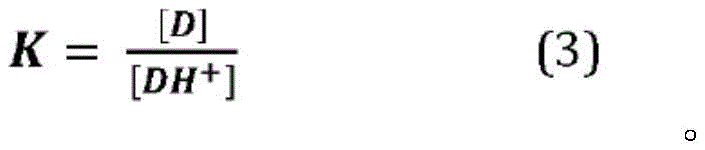
in some embodiments, basic inorganic salts of drugs having a pKa lower than the amine salts may also be used to produce neutral forms of the drug. For example, pKa of carbonic acid/sodium bicarbonate=6.4. In some embodiments, sodium bicarbonate may be used as the proton accepting entity of an amine salt drug. In one embodiment, sodium bisulphite (sodium bisulphite) is the proton accepting entity of the amine salt drug.
Ionization of sodium bicarbonate, as shown in equation 5, produces sodium ions and bicarbonate ions:

the active agent in salt form ("DHCl") is partially dissolved and ionized as shown in equation 6:

in some embodiments, bicarbonate ions accept protons from amine salt drugs to form carbonic acid. Carbonic acid breaks down into water and carbon dioxide, which escapes from the patch. When carbon dioxide escapes and the neutral active agent "D" is consumed by diffusion into the skin, the equilibrium of equation (8) shifts to the right (continuing to form neutral drug "D").


In some embodiments, the active agent is an acid salt drug. In some embodiments, the solubility of the acid salt drug in the drug reservoir is at least about 0.1mg/g, at least about 0.2mg/g, at least about 0.3mg/g, at least about 0.4mg/g, at least about 0.5mg/g, or at least about 1.0mg/g. In some embodiments, the solubility of the acid salt drug in the drug depot is less than about 100mg/g. Exemplary acid salt drugs include, but are not limited to: alendronate sodium, terpritinib sodium (tresprostinil sodium), diclofenac sodium, ketoprofen sodium, and the like.
In some embodiments, the micronized acid salt form of the active agent is dispersed in a matrix that further comprises at least one salt form solubilizing agent. The active agent in salt form ("ANa") is partially dissolved and ionized as shown in equation 9:

In some embodiments, the dissolved ionized active agent ("a") interacts with the proton donating polymer ("polymer COOH"), as shown in equation 10. When the neutral form of the active agent ("AH") is consumed by diffusion, the reaction continues to advance to form AH.

In some embodiments, the reaction by-product (polymer "COONa") is isolated as a solid phase in a matrix. In some embodiments, the neutral form of the active agent ("AH") is consumed by diffusion into the skin. "
Because the reaction by-products in equation 10 are separated as a solid phase, the equilibrium constant is expressed as equation 11:

in some embodiments, the composition for transdermal delivery of an active agent further comprises one or more plasticizers for the proton accepting or proton donating entity. In some embodiments, the salt form solubilizing agent and/or the neutral form solubilizing agent already present in the composition may also serve as a plasticizer for the proton accepting or proton donating entity. In some embodiments, plasticizers are also included in the composition that do not act as solubilizers in the salt form and/or in the neutral form. Exemplary plasticizers include, but are not limited to: dicarboxylic esters (e.g., adipic acid esters, sebacic acid esters, maleic acid esters, etc.), tricarboxylic esters (e.g., triethyl citrate, tributyl citrate, etc.), glycerol esters (e.g., triacetin, etc.), and/or combinations thereof.
In some embodiments, the adhesive matrix or drug depot comprises about 0-20 wt.%, about 0-15 wt.%, about 0-10 wt.%, about 0-5 wt.%, about 5-20 wt.%, about 5-15 wt.%, about 5-10 wt.%, about 10-20 wt.%, about 10-15 wt.%, or about 15-20 wt.% of at least one plasticizer.
In some embodiments, the composition for transdermal delivery of an active agent further comprises at least one additive, also referred to as a matrix modifying additive. In some embodiments, matrix modifying additives alter the cohesion and/or diffusivity of the active agent composition. In some embodiments, the matrix modifying additive may absorb moisture and/or water that diffuses out of the skin under occlusive conditions, which improves adhesion to the skin. In some embodiments, the matrix modifying additive facilitates homogenization of the drug reservoir. Exemplary matrix modifying additives include, but are not limited to: crospovidone CL-M, etc.), crosslinked polyvinylpyrrolidone (PVP), soluble polyvinylpyrrolidone (PVP), fumed silica, colloidal silica, cellulose derivatives (e.g., hydroxypropyl cellulose (HPC), hydroxyethyl cellulose (HEC)), polyacrylamides, polyacrylic acid, polyacrylates, clays (e.g., kaolin, bentonite, etc.), dissolved silica, and/or combinations thereof. An exemplary commercial fumed silica product is +. >
 An amorphous, colloidal silica (Evonik Industries). Another exemplary fumed silica product is +.>
 (cabot corporation of Boston, ma (Cabot Corporation, boston, mass.)).
In some embodiments, the adhesive matrix comprises about 0-25 wt%, about 0-20 wt%, about 0-15 wt%, about 0-10 wt%, about 0-5 wt%, about 5-25 wt%, about 5-20 wt%, about 5-15 wt%, about 5-10 wt%, about 10-25 wt%, about 10-20 wt%, about 10-15 wt%, about 15-25 wt%, about 15-20 wt%, or about 20-25 wt% of at least one adhesive matrix modifying additive.
In some embodiments, the composition for transdermal delivery of an active agent further comprises an adhesive or adhesive polymer. Exemplary adhesives or adhesive polymers include, but are not limited to: acrylate, polyisobutylene, silicone adhesives, adhesives based on styrene block copolymers and/or combinations thereof. In some embodiments, the proton accepting and/or proton donating polymer is film-forming in the presence of a salt form and/or a neutral form of the solubilizing agent. In such embodiments, the composition may not require a separate binder polymer.
In some embodiments, the drug reservoir comprises about 0-65 wt%, about 0-60 wt%, about 0-55 wt%, about 0-50 wt%, about 0-45 wt%, about 0-40 wt%, about 0-35 wt%, about 0-30 wt%, about 0-25 wt%, about 0-20 wt%, about 0-15 wt%, about 0-10 wt%, about 0-5 wt%, 5-65 wt%, about 5-60 wt%, about 5-55 wt%, about 5-50 wt%, about 5-45 wt%, about 5-40 wt%, about 5-35 wt%, about 5-30 wt%, about 5-25 wt%, about 5-20 wt%, about 5-15 wt%, about 5-10 wt%, 10-65 wt%, about 10-60 wt%, about 10-55 wt%, about 10-50 wt%, about 10-45 wt%, about 10-40 wt%, about 10-35 wt%, about 10-30 wt%, about 10-25 wt%, about 10-20 wt%, about 10-15 wt%, 15-65 wt%, about 15-60 wt%, about 15-55 wt%, about 15-50 wt%, about 15-45 wt%, about 15-40 wt%, about 15-35 wt%, about 15-30 wt%, about 15-25 wt%, about 15-20 wt%, about 20-65 wt%, about 20-60 wt%, about 20-55 wt%, about 20-50 wt%, about 20-45 wt%, about 20-40 wt%, about 20-35 wt%, about 20-30 wt%, about 20-25 wt%, 25-65 wt%, about 25-60 wt%, about 25-55 wt%, about 25-50 wt%, about 25-45 wt%, about 25-40 wt%, about 25-35 wt%, about 25-30 wt%, about 30-65 wt%, about 30-60 wt%, about 30-55 wt%, about 30-50 wt%, about 30-45 wt%, about 30-40 wt%, about 30-35 wt%, 35-65 wt%, about 35-60 wt%, about 35-55 wt%, about 35-50 wt%, about 35-45 wt%, about 35-40 wt%, about 40-65 wt%, about 40-60 wt%, about 40-55 wt%, about 40-50 wt%, about 40-45 wt%, about 45-65 wt%, about 45-60 wt%, about 45-55 wt%, about 45-50 wt%, about 50-65 wt%, about 50-60 wt%, about 50-55 wt%, about 55-60 wt%, or at least one polymer binder.
The composition may also include other conventional additives such as binders, antioxidants, crosslinking agents, curing agents, pH adjusting agents, pigments, dyes, refractive particles, conductive substances, antimicrobial agents, opacifiers, gelling agents, viscosity modifiers, thickeners, stabilizers, and the like, as known in the art. In those embodiments where it is desirable to reduce or eliminate adhesion, conventional detackifiers may also be used. In some embodiments, agents such as antimicrobial agents are included to prevent spoilage upon storage, e.g., to inhibit the growth of microorganisms such as yeast and mold. Suitable antimicrobial agents are generally selected from: methyl and propyl parahydroxybenzoates (i.e., methyl and propyl parahydroxybenzoates), sodium benzoate, sorbic acid, imidurea, and combinations thereof. These additives and their amounts are selected so that they do not significantly interfere with the desired chemical and physical properties of the adhesive and/or active agent.
The composition may also contain irritation-reducing additives to minimize or eliminate the likelihood of skin irritation and/or skin damage caused by the active agent, proton donating or proton accepting entity, salt form solubilizing agent, neutral form solubilizing agent, plasticizer, matrix modifying additive, binder, and/or other components of the composition. Suitable irritation-reducing additives include, for example: corticosteroids; alpha-tocopherol; monoamine oxidase inhibitors, in particular phenyl alcohols, such as 2-phenyl-1-ethanol; glycerol; salicylic acid and salicylates; ascorbic acid and ascorbates; ionophores, such as monensin and the like; amphiphilic amines; ammonium chloride; n-acetylcysteine; cis uric acid; capsaicin; chloroquine; and/or combinations thereof.
Methods of preparing or making the active agent compositions are also provided. Exemplary methods are listed in the examples section. The process for preparing the active agent composition generally comprises mixing 5 to 35 wt% of the active agent with 0.5 to 30 wt% of a proton accepting or proton donating entity, optionally with 0 to 15 wt% of a salt form solubilizing agent, 0 to 15 wt% of a neutral form solubilizing agent, 0 to 25 wt% of a matrix modifying additive, 0 to 20 wt% of a plasticizer, 0 to 65 wt% of a binder polymer, and/or combinations thereof.
B. Transdermal device
In certain aspects, the compositions described herein are provided in a transdermal device (e.g., a patch). Typically, transdermal patches include a backing layer, at least one drug reservoir, and a contact adhesive layer. It should be understood that the drug reservoir and the contact adhesive layer may be in the form of a monolayer or matrix comprising the adhesive and the drug. In some embodiments, the transdermal patch further comprises one or more release liners, tie layers, rate controlling films, and/or various combinations of the foregoing.
In some embodiments, the transdermal patch includes one or more of the following components: backing layer, drug reservoir, contact adhesive layer, release liner, tie layer, rate controlling film, and/or various combinations of the foregoing.
An exemplary transdermal patch is shown in fig. 1-3. Fig. 1 shows an exemplary transdermal patch 10 that includes a backing layer 12, a plurality of drug reservoirs 14,16 separated by a nonwoven tie layer or rate controlling film 18, a contact adhesive layer 20 and a release liner 22. This particular example presents multiple drug reservoirs separated by a tie layer or rate controlling membrane 18, but in some embodiments multiple adhesive layers may be in direct contact with each other without a tie layer, such as optional tie layer 19. In such embodiments where the transdermal patch comprises multiple drug reservoirs, each drug reservoir may comprise the same or different active agents. In such embodiments where the transdermal patch comprises multiple drug reservoirs, each drug reservoir may comprise a different concentration of the same active agent.
Fig. 2 shows an exemplary transdermal patch 30 that includes a backing layer 32, a drug reservoir 34, a tie layer or rate controlling membrane 36, a contact adhesive layer 38, and a release liner 39.
Fig. 3 shows an exemplary transdermal patch 40 that includes a backing layer 42, a drug reservoir 44, a contact adhesive layer 46, and a release liner 48.
In some embodiments, the backing layer provides a structural element for holding or supporting the adhesive layer. The backing layer may be formed of any suitable material known in the art. In some embodiments, the backing layer is occlusive. In some embodiments, the backing layer is preferably impermeable or substantially impermeable to moisture. In one exemplary embodiment, the barrier layer has a MVTR (moisture vapor transmission rate) of less than about 50g/m 2 Day-of-life. In some embodiments, the backingThe layer is preferably inert and/or does not absorb the components of the adhesive layer including the active agent. In some embodiments, the backing layer preferably prevents the release of components of the adhesive layer through the backing layer. The backing layer may be flexible or inflexible. The backing layer is preferably at least partially flexible such that the backing layer is capable of at least partially conforming to the shape of the skin to which the patch is applied. In some embodiments, the backing layer is flexible such that the backing layer conforms to the shape of the skin to which the patch is applied. In some embodiments, the backing layer is flexible enough to remain in contact at the application site with movement (e.g., skin movement). In general, the material used for the backing layer should allow the device to follow the contours of the skin or other application site and be comfortably worn on areas of the skin, such as at joints or other flexure sites, which are typically mechanically strained, with little or no likelihood of the device coming off the skin due to differences in flexibility or elasticity of the skin and the device.
In some embodiments, the backing layer is formed from one or more of a film, a nonwoven fabric, a woven fabric, a laminate, and combinations thereof. In some embodiments, the film is a polymeric film composed of one or more polymers. Suitable polymers are known in the art, including but not limited to: elastomers, polyesters, polyethylenes, polypropylenes, polyurethanes, polyetheramides, and/or combinations thereof. In some embodiments, the backing layer is formed from one or more of polyethylene terephthalate, various nylons, polypropylene, metallized polyester film, polyvinylidene chloride, and aluminum foil and/or combinations thereof. In some embodiments, the backing layer is a fabric formed from one or more polyesters, such as polyethylene terephthalate, polyurethane, polyvinyl acetate, polyvinylidene chloride, polyethylene, and/or combinations thereof. In a particular, but non-limiting embodiment, the backing layer is formed from a mylar laminate. Exemplary specific polyester film laminates include, but are not limited to: polyethylene and/or polyester laminates, e.g. in Scotchpak TM #9723,Scotchpak TM #1012, etc.
In some embodiments, the drug depots generally comprise the active ingredient in salt form (5-35 wt% total), at least one salt form solubilizing agent (0-20 wt% total), at least one neutral form solubilizing agent (0-20 wt% total), at least one proton accepting entity and/or proton donating entity (0.5-30 wt% total), optionally at least one plasticizer for the proton accepting entity and/or proton donating entity (0-20 wt% total), matrix modifying additives (0-25 wt% total) and optionally a binder polymer (0-65 wt% total). In some embodiments, the drug depot comprises any composition described herein for transdermal delivery, e.g., as described in the examples and section ii.a.
Typically, the tie layer comprises a nonwoven fabric and/or a rate controlling polymer film.
In some embodiments, the device further comprises one or more fabric or coupling layers within or between the drug reservoir layers. It should be understood that a tie layer may be included between one, some, or all of the layers. In some embodiments, a tie layer may be used to increase the bond between the layers of the device. The tie layer may increase adhesion by providing polymer-bound chemical groups. In some embodiments, the tie layer may serve as a barrier to the adhesive matrix layer.
In some embodiments, the tie layer does not affect the release rate of the active agent from the adhesive layer. In some embodiments, the tie layer may comprise a nonwoven film including, but not limited to, a nonwoven polyester (e.g. ) Porous polyethylene film->
 Nylon, cotton, and the like, and/or combinations thereof.
In some embodiments, the tie layer may comprise a rate controlling polymer film. Exemplary rate controlling polymer films include, but are not limited to: microporous polymer membranes, e.g. (microporous polypropylene), polyethylene (e.g., microporous polyethylene), vinyl acetate polymers and copolymers, and the like, and/or combinations thereof. In general, rate controlling polymer films allow for rate controlled release of drugs from a drug reservoir layer.
In some embodiments, the tie layer comprises a nonwoven fabric and does not comprise a rate controlling polymer film. In some embodiments, the tie layer comprises a rate controlling polymer film and does not comprise a nonwoven fabric. In some embodiments, the tie layer comprises a nonwoven fabric and a rate controlling polymer film. As just one example, a nonwoven fabric and a rate controlling polymer film may be used when the tie layer is embedded within the drug reservoir to help improve the drug reservoir cohesion (see, e.g., fig. 1).
The device includes at least one adhesive layer. In some embodiments, at least one adhesive layer is an adhesive matrix comprising one or more active agents as described below. The adhesive layer may adhere to the drug reservoir, adjacent adhesive layer, tie layer, release liner and/or skin at the site of administration. In some embodiments, the adhesive layer is used to release an active agent onto the skin. In some embodiments, one or more of the drug reservoir adhesive and/or the contact layer adhesive is formed from an adhesive matrix. Exemplary adhesives include, but are not limited to: acrylate, polyisobutylene, silicone adhesives, styrene block copolymer based adhesives, and the like, and/or combinations thereof.
In some embodiments, the drug reservoir of the delivery system provides an in vitro skin flux of the active agent of about 0.5-30 μg/cm 2 Hr (hours) for a period of at least about 2 days.
In some embodiments, the release liner is at least partially in contact with at least one adhesive layer to protect the adhesive layer prior to application. The release liner is typically a disposable layer that is removed prior to application of the device to the treatment site. In some embodiments, the release liner does not absorb components of the adhesive layer, including the active agent. In some embodiments, the release liner is impermeable to the components of the adhesive layer (including the active agent) and prevents the release of the components of the adhesive layer through the release liner. In some embodiments, the release liner is formed from one or more of a film, a nonwoven fabric, a woven fabric, a laminate, and combinations thereof. In some embodiments, the release liner is a silicone coated polymeric film or paper. In some non-limiting embodiments, the release liner is a silicone coated polyethylene terephthalate (PET) film, a fluorocarbon coated PET film, and/or combinations thereof.
Transdermal devices and systems (e.g., patches) may be prepared by any suitable method known in the art. In some general embodiments, the transdermal devices are prepared by coating an appropriate amount of the adhesive polymer composition (with or without the active agent) onto a substrate such as a release liner or backing layer. In some embodiments, the adhesive polymer composition is coated onto a release liner. In some embodiments, the adhesive polymer composition is coated onto a substrate or liner to a desired thickness. The thickness and/or size of the device and/or drug reservoir may be determined by one skilled in the art based at least on wear resistance and/or desired dose considerations. It will be appreciated that the application site of the device will affect the wearability considerations due to the available size of the application site and the use of the application site (e.g., flexibility in supporting movement is required). In some embodiments, the thickness of the device and/or drug reservoir is about 25-500 μm. The adhesive polymer composition and the substrate are at least partially dried to remove any solvent. A release liner or backing layer is applied to the opposite side of the substrate. In the case where the substrate is not a release liner or backing layer, the substrate may be replaced with an appropriate release liner or substrate. In embodiments comprising multiple adhesive polymer layers, a first adhesive polymer composition is applied or coated onto a substrate, a tie layer material is applied to the formulation, and a second adhesive polymer composition is applied to the tie layer material. The adhesive polymer composition and tie layer may be laminated using any suitable method known in the art. In some embodiments, the adhesive layer is coated onto a separate substrate or liner and then attached to form the transdermal delivery device. Where the delivery device includes a reservoir adhesive layer and a contact adhesive layer, the adhesive polymer composition may be coated onto a substrate or liner and laminated. It should be understood that any or all of the adhesive polymer composition layers may be dried prior to lamination of the layers.
III methods of treatment
In another aspect, methods of treating diseases, disorders, and/or conditions by transdermally administering at least one active agent via transdermal compositions, devices, and/or systems described herein are provided, and several non-limiting exemplary embodiments are described.
In some embodiments, the compositions comprise methylphenidate Compositions as active agents are useful for the treatment of Attention Deficit Hyperactivity Disorder (ADHD), narcolepsy and/or depression, for example, by transdermal patch administration of methylphenidate. The FDA approved methylphenidate doses of 2.5mg,5mg,10mg,15mg,18mg,20mg,27mg,30mg,36mg,40mg,50mg,54mg and 60 mg.
In other embodiments, the compositions described herein comprising donepezil (ariept) as an active agent are used to treat alzheimer's disease, for example, by transdermal patch administration of donepezil. FDA approved donepezil doses were 5mg,7mg,10mg,14mg and 23mg. In some embodiments, the compositions described herein allow for administration of a dose corresponding to an FDA approved dose.
In some embodiments, the compositions described herein comprise rivastigmine Compositions as active agents are useful in the treatment of Alzheimer's disease and/or Parkinson's disease dementia, for example, by transdermal patch administration of rivastigmine. The FDA has approved daily doses of rivastigmine of 1.5mg,2.0mg,3.0mg,4.5mg,4.6mg,6.0mg,9.0mg,9.5mg and 13.3mg. In some embodiments, the compositions described herein comprising memantine as an active agent are used to treat alzheimer's disease, obsessive-compulsive disorder, anxiety disorders, ADHD and Opioid dependence, e.g., memantine is administered via a transdermal patch. The FDA approved doses of memantine were 2mg,5mg,7mg,10mg,14mg,21mg and 28mg.
In some embodiments, the compositions described herein comprising tamsulosin as an active agent are useful for treating benign prostatic hyperplasia and/or acute urinary retention, for example, by transdermal patch administration of tamsulosin. The FDA approved dose of tamsulosin was 0.4mg and 0.5mg.
The transdermal compositions, devices and/or systems described herein may be designed for long term use and/or continuous administration of at least one active agent. It will be appreciated that the total dose of active agent per transdermal device will be determined by the nature of the active agent, the size of the device and/or the loading of the active agent within the drug reservoir. In some embodiments, the transdermal devices are administered for a period of about 1-10 days, 1-7 days, 1-5 days, 1-2 days, 1-3 days, 1-4 days, 3-10 days, 3-7 days, 3-5 days, 5-10 days, and 5-7 days, inclusive. In some embodiments, the active agent is released from the drug reservoir as a continuous and/or sustained release during administration.
IV. examples
The following examples are illustrative in nature and are in no way limiting.
Unless otherwise indicated, the following materials were used in the examples below: the backing layer is SCOTCHPAK TM 9723; the release liner is a silicone coated Polyester (PET) film; the non-woven tie layer being The rate controlling membrane is->
 Microporous polypropylene; the contact adhesive layer is an acrylate, polyisobutylene (PIB) and/or silicone adhesive.
Example 1
Transdermal donepezil preparation
Preparation of drug depots:
will 9 g EPO (proton accepting polymer) was dissolved in 74.71 grams of ethyl acetate. To the resulting solution was added 6 g of triacetin, 6 g of glycerol and 3 g of +.>
 20 (sorbitan monolaurate) and mixing. To this mixture was dispersed 12.6 grams of donepezil hydrochloride powder. 7.8 g of the drug dispersion solution was added
 After CL-M, the mixture was thoroughly homogenized. 30.89 g of ∈9 are added to the homogenized drug dispersion>
 387-2287 (solids content 50.5%) and thoroughly mixed. The wet adhesive formulation was coated on a release liner and dried using a laboratory coater (Werner Mathis coater) to give 10mg/cm 2 Is used as a dry coating weight.
Preparing a contact adhesive:
4.00 g of triacetin was mixed with 2.00 g of sorbitan monolaurate and 34.52 g of ethyl acetate. Add 8 g  After CL-M, the resulting mixture was homogenized. 51.48 g of ∈ are added to the homogenized mixture>
 387-2287 (solids content 50.5%) and thoroughly mixed. The wet adhesive formulation was coated on a release liner and dried using a Werner Mathis coater to give 5mg/cm 2 Is used as a dry coating weight.
Laminating and die cutting:


In vitro skin flux test
Human cadaver skin was obtained from a skin bank and frozen until ready for use. After thawing, the skin was placed in water at 60 ℃ for 1-2 minutes and the epidermis was carefully separated from the dermis. The epidermis is used immediately or wrapped and frozen for later use.
Using a sheet with a thickness of 0.64cm 2 The Franz diffusion cell of the effective diffusion area of (c) was subjected to in vitro skin flux studies. The epidermis is mounted between the donor and acceptor compartments of the diffusion cell. The transdermal delivery system is placed on the skin and the two compartments are clamped tightly together.
The receiving compartment was filled with 0.01M phosphate buffer, pH 6.5, containing 0.01% gentamicin. The solution in the receiving compartment was continuously stirred in the receiving compartment using a magnetic stirrer bar. The temperature was maintained at 32.+ -. 0.5 ℃. Samples were taken from the receiving solution at regular intervals and the receiving solution was replaced with fresh phosphate buffer solution. Samples were analyzed for drug content using HPLC of donepezil.
The results were calculated as the amount of drug diffusing through the epidermis per square centimeter per unit time. Each data point is an average of four replicates of the spread cells. Figure 4 shows the in vitro skin flux profile (square) of donepezil formulated according to example 1.
Example 2
Transdermal donepezil preparation
Preparation of drug depots:
will be 1.20 g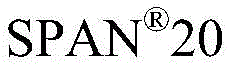 Dissolved in a mixture of 6.00 grams of triethyl citrate and mixed with 1.80 grams of lauryl lactate and 89.69 grams of ethyl acetate. 6.00 g of glycerol are added and combined with +.>
 The solutions were mixed. To this mixture were dispersed 9.00 grams of donepezil hydrochloride and 1.82 grams of sodium bicarbonate. To the drug dispersion solution was added 12.00 g
 After CL-M, the mixture was thoroughly homogenized. 43.93 g were added to the homogenized drug dispersion
 387-2287 (solids content 50.5%) and thoroughly mixed. The wet adhesive formulation was coated on a release liner and dried using a laboratory coater (Werner Mathis coater) to give 12mg/cm 2 Is used as a dry coating weight.
Preparing a contact adhesive:
will be 0.60 g 20 (sorbitan monolaurate) was dissolved in 3.00 g of triethyl citrate and mixed with 0.9 g of lauryl lactate, 25.45 g of ethyl acetate and 1.34 g of isopropyl alcohol. 6.00 g of- >
 After CL-M, the mixture was homogenized. To the homogenized mixture 38.61 g +.>
 387-2287 (solids content 50.5%) and thoroughly mixed. The wet adhesive formulation was coated onto a release liner and dried using a Werner Mathis coater to obtainTo 5mg/cm 2 Is used as a dry coating weight.
Laminating and die cutting:


In vitro skin flux test
The in vitro skin flux of donepezil from the transdermal system was measured as described in example 1. Figure 4 shows the in vitro skin flux distribution (triangle) of donepezil.
Example 3
Tamsulosin Luo Xintou skin preparation
Preparation of drug depots:
will be 3.00 g EPO was dissolved in 24.51 grams of ethyl acetate. To the resulting solution was added/mixed 2.00 g of triethyl citrate, 2.00 g of glycerol and 1.00 g +.>
 20 (sorbitan monolaurate). To this mixture was dispersed 4.00 g tamsulosin hydrochloride powder. 2.4 g of +.>
 After CL-M, the mixture was thoroughly homogenized. To homogenization 11.09 g +.>
 387-2287 (solids content 50.5%) and thoroughly mixed. The wet adhesive formulation was coated on a release liner and dried using a laboratory coater (Werner Mathis coater) to give 10mg/cm 2 Is used as a dry coating weight.
Preparing a contact adhesive:
3.00 g of triethyl citrate and 1.50 g of sorbitan monolaurate
20 And 25.89 grams of ethyl acetate. 6.00 g of-> After CL-M, the mixture was homogenized. To the homogenized mixture 38.61 g +.>
 387-2287 (solids content 50.5%) and thoroughly mixed. The wet adhesive formulation was coated on a release liner and dried using a Werner Mathis coater to give 5mg/cm 2 Is used as a dry coating weight.
Laminating and die cutting:


Example 4
Memantine transdermal preparation
Preparation of drug depots:
will be 18.00 g EPO was dissolved in 14.53 grams of ethyl acetate. To the resulting solution was added 5.00 g of triethyl citrate and mixed. To the resulting solution was added 5.25 g of memantine hydrochloride powder and dispersed well by homogenization, then 2.50 g of glycerin was added and mixed. 1.75 g of +. >
 After 200P, the dispersion mixture was sufficiently homogenized. To the homogenized dispersion was added 2.97 g +.>
 387-2287 (solids content 50.5%) and thoroughly mixed. The wet adhesive formulation was coated on a release liner and dried using a laboratory coater (Werner Mathis coater) to give 15mg/cm 2 Is used as a dry coating weight.
Preparing a contact adhesive:
3.00 g of triethyl citrate are mixed with 17.26 g of ethyl acetate. 4.00 g was added After CL-M, the mixture was homogenized. To the homogenized mixture 25.74 g +.>
 387-2287 (solids content 50.5%) and thoroughly mixed. The wet adhesive formulation was coated on a release liner and dried using a Werner Mathis coater to give 5mg/cm 2 Is used as a dry coating weight.
Laminating and die cutting:
will be The rate controlling membrane is laminated to the drug reservoir. The contact adhesive is then laminated to +.>
 The other side of the membrane. The release liner of the drug reservoir is replaced and laminated with the backing film. The final five-layer laminate was die cut into transdermal patches.
In vitro skin flux test
The in vitro skin flux of memantine from the transdermal system was measured as described in example 1, wherein the content of memantine in samples extracted from the receiving solution was analyzed using LCMS. Figure 5 shows the in vitro skin flux distribution of memantine.
Examples 5 to 8
Other transdermal formulations
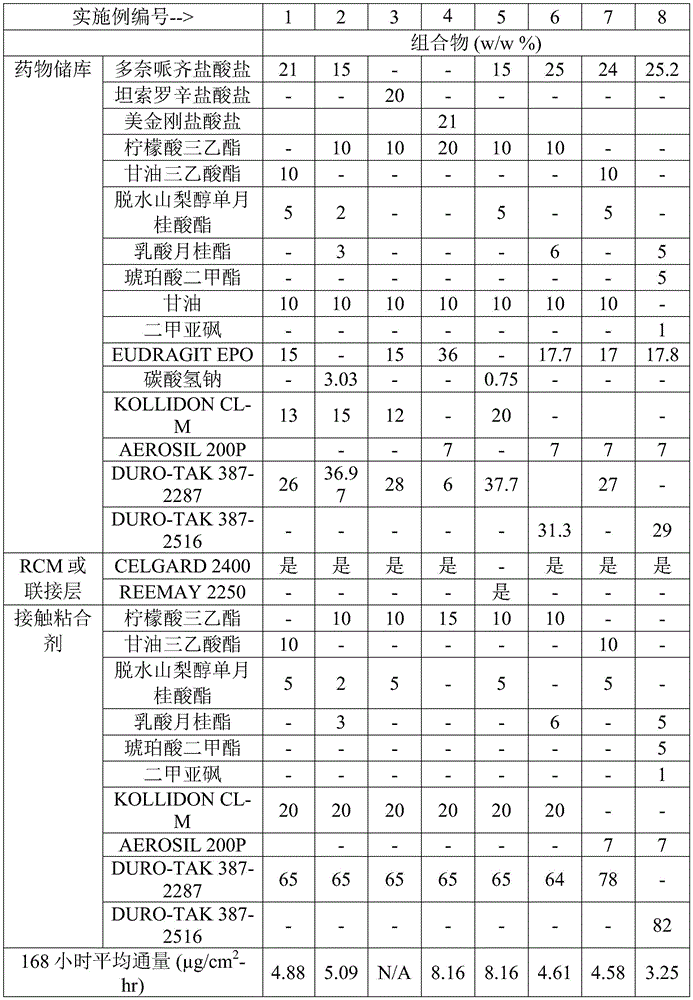
Other formulations were prepared according to the general methods set forth in example 1, with the ingredients and amounts set forth in table 1. Fig. 4 shows the flux distribution (circles) of donepezil formulated for the formulation of example 7 as determined in table 1 below.
TABLE 1
While a number of exemplary aspects and embodiments have been discussed above, those of skill in the art will recognize certain modifications, substitutions, additions and sub-combinations thereof. It is therefore intended that the following appended claims and claims hereafter introduced are interpreted to include all such modifications, permutations, additions and sub-combinations as are within their true spirit and scope.
All patents, patent applications, patent publications, and other publications mentioned herein are incorporated by reference in their entirety. Where a patent, application or publication contains a definite definition, such definition is to be understood as applied to a patent, application or publication in which their combination is found, unless otherwise indicated, and is not applied to the present application.
Claims (10)
1. A composition for transdermal delivery comprising:
a drug depot comprising an active agent in salt form and a proton accepting and/or proton donating entity.
2. A composition for transdermal delivery comprising:
a drug depot comprising an active agent in the form of an amine salt and a proton accepting entity.
3. The composition of claim 1 or 2, wherein the active agent is nepaizil, rivastigmine, memantine, fingolimod or tamsulosin.
4. The composition of any of the preceding claims, wherein the drug depot comprises about 1-70 wt.% of the active agent.
5. A composition as claimed in any one of the preceding claims wherein the proton accepting entity is a proton accepting polymer.
6. The composition of any of the preceding claims, wherein the proton accepting entity is an amine functionalized polystyrene microsphere or a dimethylaminoethyl methacrylate-based acrylate.
7. The composition of any of the preceding claims, wherein the drug depot comprises about 0.5-35 wt.% of proton accepting entity.
8. A composition for transdermal delivery comprising:
a drug depot comprising an active agent in the form of an acid salt and a proton donating polymer.
9. The composition of claim 8, wherein the active agent is an acid salt drug selected from the group consisting of: alendronate sodium, terprinib sodium, diclofenac sodium, naproxen sodium, and ketoprofen sodium.
10. The composition of claim 8 or 9, wherein the drug depot comprises about 5-35 wt.% of the active agent.
Applications Claiming Priority (18)
| Application Number | Priority Date | Filing Date | Title |
|---|---|---|---|
| US201662367502P | 2016-07-27 | 2016-07-27 | |
| US201662367542P | 2016-07-27 | 2016-07-27 | |
| US62/367,542 | 2016-07-27 | ||
| US62/367,502 | 2016-07-27 | ||
| US201662423133P | 2016-11-16 | 2016-11-16 | |
| US62/423,133 | 2016-11-16 | ||
| US201762444763P | 2017-01-10 | 2017-01-10 | |
| US201762444745P | 2017-01-10 | 2017-01-10 | |
| US62/444,745 | 2017-01-10 | ||
| US62/444,763 | 2017-01-10 | ||
| US201762457794P | 2017-02-10 | 2017-02-10 | |
| US62/457,794 | 2017-02-10 | ||
| US201762504391P | 2017-05-10 | 2017-05-10 | |
| US201762504408P | 2017-05-10 | 2017-05-10 | |
| US62/504,408 | 2017-05-10 | ||
| US62/504,391 | 2017-05-10 | ||
| PCT/US2017/044048 WO2018022815A2 (en) | 2016-07-27 | 2017-07-26 | Transdermal formulation and delivery method of low solubility or unstable unionized neutral drugs by in situ salt-to-neutral drug conversion of salt drug |
| CN201780059417.7A CN109789105B (en) | 2016-07-27 | 2017-07-26 | Composition for in-situ conversion from salt to neutral drug, transdermal patch and application |
Related Parent Applications (1)
| Application Number | Title | Priority Date | Filing Date |
|---|---|---|---|
| CN201780059417.7A Division CN109789105B (en) | 2016-07-27 | 2017-07-26 | Composition for in-situ conversion from salt to neutral drug, transdermal patch and application |
Publications (1)
| Publication Number | Publication Date |
|---|---|
| CN116270551A true CN116270551A (en) | 2023-06-23 |
Family
ID=59523314
Family Applications (5)
| Application Number | Title | Priority Date | Filing Date |
|---|---|---|---|
| CN202310658352.5A Pending CN116966166A (en) | 2016-07-27 | 2017-07-26 | Transdermal delivery of sodium bicarbonate in situ conversion driven amine drugs |
| CN201780059437.4A Active CN109789106B (en) | 2016-07-27 | 2017-07-26 | Transdermal delivery of sodium bicarbonate in situ conversion driven amine drugs |
| CN201780059417.7A Active CN109789105B (en) | 2016-07-27 | 2017-07-26 | Composition for in-situ conversion from salt to neutral drug, transdermal patch and application |
| CN202211676624.6A Pending CN116270551A (en) | 2016-07-27 | 2017-07-26 | Compositions, transdermal patches and applications via in situ conversion of salts to neutral drugs |
| CN201780059393.5A Pending CN109789133A (en) | 2016-07-27 | 2017-07-26 | Donepezil transdermal delivery system |
Family Applications Before (3)
| Application Number | Title | Priority Date | Filing Date |
|---|---|---|---|
| CN202310658352.5A Pending CN116966166A (en) | 2016-07-27 | 2017-07-26 | Transdermal delivery of sodium bicarbonate in situ conversion driven amine drugs |
| CN201780059437.4A Active CN109789106B (en) | 2016-07-27 | 2017-07-26 | Transdermal delivery of sodium bicarbonate in situ conversion driven amine drugs |
| CN201780059417.7A Active CN109789105B (en) | 2016-07-27 | 2017-07-26 | Composition for in-situ conversion from salt to neutral drug, transdermal patch and application |
Family Applications After (1)
| Application Number | Title | Priority Date | Filing Date |
|---|---|---|---|
| CN201780059393.5A Pending CN109789133A (en) | 2016-07-27 | 2017-07-26 | Donepezil transdermal delivery system |
Country Status (10)
| Country | Link |
|---|---|
| US (13) | US20180028663A1 (en) |
| EP (3) | EP3490558A1 (en) |
| JP (6) | JP7251033B2 (en) |
| KR (9) | KR102555208B1 (en) |
| CN (5) | CN116966166A (en) |
| AU (7) | AU2017302306A1 (en) |
| CA (2) | CA3032044C (en) |
| MX (2) | MX394249B (en) |
| SG (1) | SG11201900692WA (en) |
| WO (3) | WO2018022815A2 (en) |
Families Citing this family (25)
| Publication number | Priority date | Publication date | Assignee | Title |
|---|---|---|---|---|
| CA2972065A1 (en) | 2014-12-23 | 2016-06-30 | Intellectual Property Associates, Llc | Methods and formulations for transdermal administration |
| CN108882691B (en) * | 2015-11-18 | 2023-07-07 | 联邦科学技术研究组织 | Rice grains with thickened aleurone layer |
| MX2018008190A (en) | 2015-12-30 | 2018-11-12 | Corium Int Inc | Systems and methods for long term transdermal administration. |
| WO2017223402A1 (en) | 2016-06-23 | 2017-12-28 | Corium International, Inc. | Adhesive matrix with hydrophilic and hydrophobic domains and a therapeutic agent |
| KR102555208B1 (en) | 2016-07-27 | 2023-07-17 | 코리움, 엘엘씨 | Sodium bicarbonate in situ conversion driven transdermal delivery of amine drug |
| WO2018022818A1 (en) | 2016-07-27 | 2018-02-01 | Corium International, Inc. | Memantine transdermal delivery systems |
| JP2020529229A (en) * | 2017-07-26 | 2020-10-08 | コリウム, インコーポレイテッド | Percutaneous delivery system with microporous membranes with solvent-filled pores |
| EP3681479B1 (en) | 2017-09-15 | 2024-01-31 | Dyve Biosciences, Inc. | Sodium bicarbonate for use in the treatment of gout and related disorders |
| AU2018392686A1 (en) | 2017-12-20 | 2020-07-09 | Corium Pharma Solutions, Inc. | Transdermal adhesive composition comprising a volatile liquid therapeutic agent having low melting point |
| KR102823139B1 (en) * | 2018-08-31 | 2025-06-19 | 에스케이케미칼 주식회사 | Rivastigmine patch for long-term administration |
| KR102710072B1 (en) * | 2018-08-31 | 2024-09-24 | 에스케이케미칼 주식회사 | Rivastigmine patch for long-term administration |
| KR102115102B1 (en) | 2018-12-21 | 2020-05-26 | 동아에스티 주식회사 | Percutaneous Absorption Preparation Comprising Stabilized Donepezil |
| KR102372630B1 (en) * | 2019-05-15 | 2022-03-14 | 주식회사 대웅제약 | A transdermal preparation comprising a high content of donepezil or a salt thereof |
| US11101101B2 (en) * | 2019-05-15 | 2021-08-24 | Fei Company | Laser-based phase plate image contrast manipulation |
| US20230233480A1 (en) * | 2019-10-24 | 2023-07-27 | Lts Lohmann Therapie-Systeme Ag | Transdermal therapeutic system for the transdermal administration of fingolimod |
| US20230015492A1 (en) * | 2019-11-26 | 2023-01-19 | Hisamitsu Pharmaceutical Co., Inc. | Method for improving holding power of adhesive agent layer of ropinirole-containing patch, and ropinirole-containing patch with improved holding power |
| CN114829580A (en) * | 2019-12-18 | 2022-07-29 | 先锋国际良种公司 | Compositions and methods for increasing plant grain yield |
| US20230123388A1 (en) * | 2020-04-14 | 2023-04-20 | Glanis Pharmaceuticals, Inc. | Transdermal and/or topical delivery system comprising hydroxychloroquine and/or chloroquine |
| JP2022044038A (en) * | 2020-09-04 | 2022-03-16 | 株式会社大石膏盛堂 | Donepezil-containing percutaneous absorption liquid and method for producing the same |
| CN112656778A (en) * | 2020-12-28 | 2021-04-16 | 广东红珊瑚药业有限公司 | Pressure-sensitive adhesive matrix and patch |
| US12270039B2 (en) * | 2021-05-14 | 2025-04-08 | Board Of Trustees Of Southern Illinois University | Compositions and methods to increase oleic acid content in soybeans |
| US12270040B2 (en) * | 2021-05-27 | 2025-04-08 | Board Of Trustees Of Southern Illinois University | Soybean lines with low saturated fatty acid and high oleic acid contents |
| WO2023283103A1 (en) * | 2021-07-08 | 2023-01-12 | Monsanto Technology Llc | Novel insect inhibitory proteins |
| EP4462992A4 (en) * | 2022-01-12 | 2025-12-24 | Inari Agriculture Tech Inc | REDUCED HEIGHT CORN |
| WO2025103446A1 (en) * | 2023-11-16 | 2025-05-22 | 宜昌人福药业有限责任公司 | Transdermal patch containing donepezil and preparation method therefor |
Citations (3)
| Publication number | Priority date | Publication date | Assignee | Title |
|---|---|---|---|---|
| US20070259028A1 (en) * | 2006-05-08 | 2007-11-08 | Takeshi Ito | Percutaneous absorption preparations of antidementia drugs |
| CN101568340A (en) * | 2006-12-01 | 2009-10-28 | 日东电工株式会社 | Percutaneous absorption preparation |
| US20120245537A1 (en) * | 2008-03-11 | 2012-09-27 | Lts Lohmann Therapie-Systeme Ag | Transdermal therapeutic system having stabilized membrane |
Family Cites Families (148)
| Publication number | Priority date | Publication date | Assignee | Title |
|---|---|---|---|---|
| US3391142A (en) | 1966-02-09 | 1968-07-02 | Lilly Co Eli | Adamantyl secondary amines |
| NL134681C (en) | 1966-04-26 | |||
| US3546141A (en) | 1966-08-08 | 1970-12-08 | Mc Donnell Douglas Corp | Phosphorus-nitrogen polymers and process |
| ES413944A1 (en) | 1972-04-20 | 1976-06-01 | Merz & Co | Drugs or medicines for influencing the central nervous system |
| DE2856393C2 (en) | 1978-12-27 | 1983-04-28 | Merz + Co GmbH & Co, 6000 Frankfurt | Medicines used to treat Parkinson's disease |
| EP0186087B1 (en) | 1984-12-22 | 1989-08-23 | Dr. Karl Thomae GmbH | Tetrahydro-benzothiazoles, their production and their use as intermediates or drugs |
| US4880633A (en) | 1986-03-12 | 1989-11-14 | Merck & Co., Inc. | Transdermal drug delivery system |
| US4797284A (en) * | 1986-03-12 | 1989-01-10 | Merck & Co., Inc. | Transdermal drug delivery system |
| DE3634016A1 (en) | 1986-04-17 | 1987-10-29 | Lohmann Gmbh & Co Kg | AREA-BASED THERAPEUTIC SYSTEM, METHOD FOR THE PRODUCTION THEREOF AND ITS USE |
| FI95572C (en) | 1987-06-22 | 1996-02-26 | Eisai Co Ltd | Process for the preparation of a medicament useful as a piperidine derivative or its pharmaceutical salt |
| US4837027A (en) | 1987-11-09 | 1989-06-06 | Alza Corporation | Transdermal drug delivery device |
| US4781924A (en) | 1987-11-09 | 1988-11-01 | Alza Corporation | Transdermal drug delivery device |
| US4849224A (en) | 1987-11-12 | 1989-07-18 | Theratech Inc. | Device for administering an active agent to the skin or mucosa |
| US5026556A (en) | 1988-11-10 | 1991-06-25 | Norwich Eaton Pharmaceuticals, Inc. | Compositions for the transdermal delivery of pharmaceutical actives |
| CA2007181C (en) * | 1989-01-06 | 1998-11-24 | Angelo Mario Morella | Sustained release pharmaceutical composition |
| EP0392059B1 (en) | 1989-04-14 | 1993-09-15 | Merz & Co. GmbH & Co. | Use of adamantane derivatives in the prevention and treatment of cerebral ischemia |
| DE3913734C2 (en) * | 1989-04-26 | 1998-08-20 | Roehm Gmbh | Use of an aqueous skin pressure sensitive adhesive solution for producing an adhesive layer which can be easily washed off with water |
| MY115126A (en) * | 1990-04-27 | 2003-04-30 | Seikisui Chemical Co Ltd | Percutaneously absorbable eperisone or tolperisone preparation. |
| US5252588A (en) * | 1990-04-27 | 1993-10-12 | Sekisui Kagaku Kogyo Kabushiki Kaisha | Percutaneously absorbable crosslinked polyvinylpyrrolidone eperisone or tolperisone preparation |
| MX9100277A (en) | 1990-07-23 | 1992-02-28 | Alza Corp | ORAL OSMOTIC DEVICE FOR APPLYING NICOTINE |
| US5614560A (en) | 1991-04-04 | 1997-03-25 | Children's Medical Center Corporation | Method of preventing NMDA receptor-mediated neuronal damage |
| US5123900A (en) * | 1991-08-16 | 1992-06-23 | Bertek, Inc. | Moisture permeable double disk |
| JPH06199659A (en) | 1992-10-28 | 1994-07-19 | Hisamitsu Pharmaceut Co Inc | Apparatus for percutaneous treatment |
| DE4310012A1 (en) * | 1993-03-27 | 1994-09-29 | Roehm Gmbh | Dermal therapeutic system made of a meltable poly (meth) acrylate mixture |
| US5424077A (en) | 1993-07-13 | 1995-06-13 | Church & Dwight Co., Inc. | Co-micronized bicarbonate salt compositions |
| JP3483148B2 (en) | 1994-04-21 | 2004-01-06 | 久光製薬株式会社 | Transdermal administration base composition and pharmaceutical composition thereof |
| KR100382706B1 (en) | 1994-09-14 | 2003-10-10 | 미네소타 마이닝 앤드 매뉴팩춰링 캄파니 | Matrix for transdermal drug delivery |
| US5635203A (en) * | 1994-09-29 | 1997-06-03 | Alza Corporation | Transdermal device having decreased delamination |
| WO1996019205A1 (en) | 1994-12-21 | 1996-06-27 | Theratech, Inc. | Transdermal delivery system with adhesive overlay and peel seal disc |
| WO1996040087A2 (en) | 1995-06-07 | 1996-12-19 | Cygnus, Inc. | Pressure sensitive acrylate adhesive composition cross-linked with aluminum acetylacetonate and containing a drug having a reactive aromatic hydroxyl group |
| DE19531342B4 (en) | 1995-08-25 | 2007-11-29 | Merz Pharma Gmbh & Co. Kgaa | Use of aminoadamantane compounds as immunoregulators |
| US6929801B2 (en) | 1996-02-19 | 2005-08-16 | Acrux Dds Pty Ltd | Transdermal delivery of antiparkinson agents |
| US6512010B1 (en) | 1996-07-15 | 2003-01-28 | Alza Corporation | Formulations for the administration of fluoxetine |
| US5958919A (en) | 1996-09-20 | 1999-09-28 | Washington University | Treatment of presymptomatic alzheimer's disease to prevent neuronal degeneration |
| WO1998017315A2 (en) | 1996-10-24 | 1998-04-30 | Alza Corporation | Permeation enhancers for transdermal drug delivery compositions, devices, and methods |
| CN1174031A (en) * | 1997-04-23 | 1998-02-25 | 谢先运 | Diclofenac sodium skin-penetrating delayed plaster |
| US5866585A (en) | 1997-05-22 | 1999-02-02 | Synchroneuron, Llc | Methods of treating tardive dyskinesia using NMDA receptor antagonists |
| US20040018241A1 (en) * | 1997-09-26 | 2004-01-29 | Noven Pharmaceuticals, Inc. | Bioadhesive compositions and methods for topical administration of active agents |
| US6193993B1 (en) | 1998-03-03 | 2001-02-27 | Eisai Co., Ltd. | Suppository containing an antidementia medicament |
| JP4205778B2 (en) * | 1998-04-17 | 2009-01-07 | 久光製薬株式会社 | Patch preparation |
| DE19820999A1 (en) | 1998-05-11 | 1999-11-18 | Lohmann Therapie Syst Lts | Layered medicinal adhesive plaster with high holding power and flexibility |
| US6248363B1 (en) | 1999-11-23 | 2001-06-19 | Lipocine, Inc. | Solid carriers for improved delivery of active ingredients in pharmaceutical compositions |
| US6383471B1 (en) | 1999-04-06 | 2002-05-07 | Lipocine, Inc. | Compositions and methods for improved delivery of ionizable hydrophobic therapeutic agents |
| US6562368B2 (en) * | 1999-12-16 | 2003-05-13 | Dermatrends, Inc. | Transdermal administration of oxybutynin using hydroxide-releasing agents as permeation enhancers |
| US20020192243A1 (en) | 1999-12-16 | 2002-12-19 | Tsung-Min Hsu | Transdermal and topical administration of drugs for the treatment of Alzheimer's disease using basic enhancers |
| US6455066B1 (en) | 2000-03-10 | 2002-09-24 | Epicept Corporation | Intradermal-penetration agents for topical local anesthetic administration |
| US7276249B2 (en) | 2002-05-24 | 2007-10-02 | Elan Pharma International, Ltd. | Nanoparticulate fibrate formulations |
| JP3962684B2 (en) * | 2000-11-06 | 2007-08-22 | サムヤン コーポレイション | Transdermal agent having improved water absorption and adhesion |
| US20040028724A1 (en) * | 2000-11-07 | 2004-02-12 | Takaaki Terahara | Pharmaceutical preparation of percutaneous absorption type |
| JP4850346B2 (en) * | 2001-03-15 | 2012-01-11 | 救急薬品工業株式会社 | Mucosal patch |
| WO2002087645A1 (en) | 2001-05-01 | 2002-11-07 | A.V. Topchiev Institute Of Petrochemical Synthesis | Hydrogel compositions |
| WO2003015713A2 (en) | 2001-08-20 | 2003-02-27 | Maiken Nedergaard | Treatment of glial tumors with glutamate antagonists |
| CA2459399C (en) | 2001-09-04 | 2009-06-30 | Trommsdorff Gmbh & Co. Kg Arzneimittel | Plaster for the treatment of dysfunctions and disorders of nails, comprising sertaconazole |
| EP1437130A4 (en) * | 2001-10-17 | 2009-08-26 | Hisamitsu Pharmaceutical Co | Percutaneous absorption preparations |
| ITMI20012827A1 (en) * | 2001-12-28 | 2003-06-28 | Fidia Farmaceutici | TRANSDERMAL ADHESIVE FORMULATIONS OF DICLOFENAC SODIUM |
| US7273619B2 (en) * | 2002-01-17 | 2007-09-25 | Samyang Corporation | Transdermal composition of an antivomiting agent |
| EP1556019A2 (en) | 2002-10-24 | 2005-07-27 | Merz Pharma GmbH & Co. KGaA | Combination therapy using 1-aminocyclohexane derivatives and acetylcholinesterase inhibitors |
| BRPI0414551B8 (en) | 2003-10-10 | 2021-05-25 | Antares Pharma Ipl Ag | transdermal or transmucosal pharmaceutical formulation and method of delaying or inhibiting crystallization of an active agent |
| CA2542753A1 (en) * | 2003-10-14 | 2005-04-28 | Dermatrends, Inc. | Enhancing transdermal administration of hydrophilic drugs |
| WO2005079779A1 (en) | 2003-10-22 | 2005-09-01 | Merz Pharma Gmbh & Co. Kgaa | THE USE OF 1-AMINOCYCLOHEXANE DERIVATIVES TO MODIFY DEPOSITION OF FIBRILLOGENIC Aß PEPTIDES IN AMYLOIDOPATHIES |
| KR20060132588A (en) | 2003-10-23 | 2006-12-21 | 트랜스1 인코포레이티드 | Tools and tool kits for performing minimal intervention of the spine |
| ATE399026T1 (en) | 2003-11-21 | 2008-07-15 | Memory Pharm Corp | COMPOSITIONS CONTAINING L-TYPE CALCIUM CANAL BLOCKERS AND CHOLINESTERASE INHIBITORS |
| US7176185B2 (en) | 2003-11-25 | 2007-02-13 | Tsrl, Inc. | Short peptide carrier system for cellular delivery of agent |
| JP5179757B2 (en) | 2004-02-17 | 2013-04-10 | トランセプト ファーマシューティカルズ, インコーポレイティド | Composition for delivering a hypnotic agent through the oral mucosa and method of use thereof |
| US7670838B2 (en) | 2004-05-24 | 2010-03-02 | The Board Of Trustees Of The Leland Stanford Junior University | Coupling of excitation and neurogenesis in neural stem/progenitor cells |
| WO2005115355A1 (en) | 2004-05-28 | 2005-12-08 | Hisamitsu Pharmaceutical Co., Inc. | Pasting preparation |
| TW200616608A (en) | 2004-07-09 | 2006-06-01 | Forest Laboratories | Memantine as adjunctive treatment to atypical antipsychotics in schizophrenia patients |
| US8252321B2 (en) | 2004-09-13 | 2012-08-28 | Chrono Therapeutics, Inc. | Biosynchronous transdermal drug delivery for longevity, anti-aging, fatigue management, obesity, weight loss, weight management, delivery of nutraceuticals, and the treatment of hyperglycemia, alzheimer's disease, sleep disorders, parkinson's disease, aids, epilepsy, attention deficit disorder, nicotine addiction, cancer, headache and pain control, asthma, angina, hypertension, depression, cold, flu and the like |
| EP1807033B1 (en) | 2004-10-08 | 2016-07-20 | Noven Pharmaceuticals, Inc. | Transdermal drug delivery device including an occlusive backing |
| US7744918B2 (en) | 2004-11-22 | 2010-06-29 | Hisamitsu Pharmaceutical Co., Inc. | Drug-containing patch |
| US7619007B2 (en) | 2004-11-23 | 2009-11-17 | Adamas Pharmaceuticals, Inc. | Method and composition for administering an NMDA receptor antagonist to a subject |
| US20060205822A1 (en) | 2004-12-22 | 2006-09-14 | Forest Laboratories, Inc. | 1-Aminocyclohexane derivatives for the treatment of multiple sclerosis, emotional lability and pseudobulbar affect |
| US7462743B2 (en) | 2005-01-11 | 2008-12-09 | Teva Pharmaceutical Fine Chemicals S.R.L. | Polymorphs of memantine hydrochloride |
| JP5084496B2 (en) * | 2005-02-04 | 2012-11-28 | 久光製薬株式会社 | Transdermal patch |
| US20060188558A1 (en) | 2005-02-18 | 2006-08-24 | Mylan Technologies, Inc. | Transdermal systems having control delivery system |
| MX2007012374A (en) | 2005-04-06 | 2008-02-22 | Adamas Pharmaceuticals Inc | Methods and compositions for treatment of cns disorders. |
| US7888422B2 (en) | 2005-11-09 | 2011-02-15 | Mylan Technologies Inc. | Long-wearing removable pressure sensitive adhesive |
| US20100121290A1 (en) * | 2006-03-28 | 2010-05-13 | Torben Rasmussen | Multilayer Film |
| CN1895242B (en) * | 2006-04-13 | 2011-08-31 | 沈阳药科大学 | Diclofenac salt pleximetric paste and its production |
| IL175338A0 (en) | 2006-05-01 | 2006-09-05 | Biota Ltd | Orally administrable films and preparation thereof |
| JP5097359B2 (en) * | 2006-05-09 | 2012-12-12 | 久光製薬株式会社 | Donepezil transdermal preparation |
| TW200815045A (en) | 2006-06-29 | 2008-04-01 | Jazz Pharmaceuticals Inc | Pharmaceutical compositions of ropinirole and methods of use thereof |
| US9248104B2 (en) | 2006-08-17 | 2016-02-02 | Core Tech Solutions, Inc. | Transdermal methods and systems for treating Alzheimer's disease |
| US20080107719A1 (en) | 2006-11-08 | 2008-05-08 | Sukhon Likitlersuang | Transdermal drug delivery system |
| EP2098235B1 (en) | 2006-12-01 | 2013-08-21 | Nitto Denko Corporation | Method for prevention of discoloration with time of donepezil-containing skin adhesive preparation |
| EP2098233A4 (en) | 2006-12-01 | 2012-03-21 | Nitto Denko Corp | Skin adhesive preparation comprising stabilized donepezil |
| JP5403948B2 (en) | 2007-06-07 | 2014-01-29 | 久光製薬株式会社 | Memantine-containing transdermal absorption preparation |
| CA2692884C (en) | 2007-07-10 | 2016-09-20 | Agile Therapeutics, Inc. | Dermal delivery device with in situ seal |
| US9017301B2 (en) * | 2007-09-04 | 2015-04-28 | Mylan Technologies, Inc. | Transdermal drug delivery systems comprising a coated release liner |
| JP2009203213A (en) * | 2008-02-28 | 2009-09-10 | Kosumedei Seiyaku Kk | Percutaneous absorption pharmaceutical composition |
| KR101454362B1 (en) | 2008-03-24 | 2014-10-23 | 아이큐어 주식회사 | Transdermal preparation for the treatment of dementia comprising donepezil as an active ingredient |
| EP2111857A1 (en) | 2008-04-25 | 2009-10-28 | Acino AG | Transdermal therapeutic system for application of fentanyl or an analogue material thereof |
| US20090291127A1 (en) | 2008-05-21 | 2009-11-26 | Jianye Wen | Transdermal anti-dementia active agent formulations and methods for using the same |
| PE20100371A1 (en) | 2008-10-31 | 2010-06-01 | Lexicon Pharmaceuticals Inc | S1P RECEPTOR AGONISTS FOR THE TREATMENT OF CEREBRAL MALARIA |
| US20100178037A1 (en) | 2009-01-12 | 2010-07-15 | Te-Wei Chen | Display apparatus, video generation apparatus, and method thereof |
| EP2387394B1 (en) * | 2009-01-14 | 2018-05-02 | Corium International, Inc. | Transdermal administration of tamsulosin |
| CN102413821A (en) | 2009-05-01 | 2012-04-11 | 久光制药株式会社 | Percutaneous absorption type preparation |
| CN102630160B (en) | 2009-09-16 | 2014-05-07 | 株式会社三养生物制药 | Transdermal delivery system, method for manufacturing the same, and transdermal delivery method using the system |
| RU2545696C2 (en) | 2009-10-21 | 2015-04-10 | Тейкоку Сейяку Ко., Лтд. | Transdermally absorbable formulation containing donepezil |
| CN102048678A (en) * | 2009-10-30 | 2011-05-11 | 北京隆旗生物科技有限公司 | Transdermal absorption preparation of oxybutynin as well as preparation method and medication application thereof |
| GB0921481D0 (en) | 2009-12-08 | 2010-01-20 | Vectura Ltd | Process and product |
| JP2012236773A (en) | 2009-12-16 | 2012-12-06 | Goto Takeshi | Transdermally absorbable preparation of anti-dementia drug |
| US20130011462A1 (en) * | 2009-12-30 | 2013-01-10 | Novartis Ag | Melt extruded nicotine thin strips |
| US20100178307A1 (en) | 2010-01-13 | 2010-07-15 | Jianye Wen | Transdermal anti-dementia active agent formulations and methods for using the same |
| WO2011105486A1 (en) | 2010-02-24 | 2011-09-01 | 久光製薬株式会社 | Adhesive patch |
| US20110244023A1 (en) * | 2010-03-30 | 2011-10-06 | Phosphagenics Limited | Transdermal delivery patch |
| EP2564848B1 (en) | 2010-04-28 | 2015-09-02 | Hisamitsu Pharmaceutical Co., Inc. | Transdermally absorbable donepezil-containing preparation |
| US9012511B2 (en) | 2010-05-19 | 2015-04-21 | Alkermes Pharma Ireland Limited | Nanoparticulate cinacalcet compositions |
| DE102010024105A1 (en) * | 2010-06-17 | 2011-12-22 | Grünenthal GmbH | Transdermal administration of memantine |
| NZ605352A (en) * | 2010-06-30 | 2013-10-25 | Nal Pharmaceuticals Ltd | Process for producing glycosaminoglycans |
| US20140370076A1 (en) | 2010-06-30 | 2014-12-18 | Nal Pharmaceuticals, Ltd. | Transdermal drug delivery system containing donepezil |
| EP3434257A1 (en) | 2010-07-29 | 2019-01-30 | Allergan, Inc. | Preservative free brimonidine and timolol solutions |
| WO2012051333A1 (en) | 2010-10-12 | 2012-04-19 | The Johns Hopkins University | Antitussive compositions comprising memantine |
| JP5699554B2 (en) | 2010-11-11 | 2015-04-15 | 富士通株式会社 | Vector processing circuit, instruction issue control method, and processor system |
| EP2640389B1 (en) | 2010-11-17 | 2014-12-31 | Hexal AG | Transdermal therapeutic system comprising buprenorphine |
| WO2012084969A1 (en) | 2010-12-22 | 2012-06-28 | Hexal Ag | Adhesive composition containing rotigotine and transdermal therapeutic system comprising the adhesive composition |
| WO2012089256A1 (en) * | 2010-12-29 | 2012-07-05 | Pharmafilm S.R.L. | Medicated patch for improved transdermal permeation of diclofenac diethylammonium |
| TWI433904B (en) | 2011-01-12 | 2014-04-11 | Taiwan Biotech Co Ltd | Donepezil transdermal patch |
| CN102775476B (en) | 2011-05-12 | 2015-01-07 | 上海天伟生物制药有限公司 | Preparation method of micafungin sodium |
| US8673338B2 (en) | 2011-07-29 | 2014-03-18 | Massachusetts Eye And Ear Infirmary | Methods of delivering pharmaceutical agents |
| JP5808214B2 (en) | 2011-09-30 | 2015-11-10 | 株式会社トクヤマ | Patch |
| KR101239150B1 (en) | 2012-02-28 | 2013-03-06 | 에스케이케미칼주식회사 | Donepezil-containing transdermal delivery system and process for preparing the same |
| US9408802B1 (en) * | 2012-03-22 | 2016-08-09 | Prosolus, Inc. | Seven day drug in adhesive transdermal delivery |
| US9145907B2 (en) | 2012-08-28 | 2015-09-29 | Hsiutao Liang | Pipe connector |
| US20140256690A1 (en) | 2013-03-08 | 2014-09-11 | Agile Therapeutics, Inc. | Contraceptive method |
| WO2014174564A1 (en) | 2013-04-22 | 2014-10-30 | 祐徳薬品工業株式会社 | Adhesive patch drug formulation of transdermal absorption type containing memantine |
| JP5415645B1 (en) * | 2013-06-28 | 2014-02-12 | 久光製薬株式会社 | Manufacturing method of patch, patch and package |
| US20160199317A1 (en) * | 2013-08-30 | 2016-07-14 | 3M Innovative Properties Company | Estradiol containing transdermal drug delivery systems and compositions |
| RU2646512C2 (en) | 2013-10-07 | 2018-03-05 | ТЕЙКОКУ ФАРМА ЮЭсЭй, ИНК. | Dexmedetomidine transdermal delivery devices and methods for using the same |
| EP3054933A4 (en) * | 2013-10-11 | 2017-03-15 | Teikoku Pharma USA, Inc. | Topical sphingosine-1-phosphate receptor agonist formulations and methods of using the same |
| JP6502855B2 (en) | 2013-11-17 | 2019-04-17 | 株式会社 メドレックス | Transdermal absorption type colloidal solution |
| KR101485822B1 (en) | 2014-01-22 | 2015-01-23 | 주식회사 대웅제약 | Transdermal drug delivery system comprising donepezil or its salt |
| JP2015151370A (en) * | 2014-02-14 | 2015-08-24 | 日東電工株式会社 | Patch preparation |
| JP2017519837A (en) | 2014-06-24 | 2017-07-20 | カット トランスダーマルズ エルエルシー | Transdermal delivery system |
| ES2785549T3 (en) * | 2014-07-18 | 2020-10-07 | Buzzz Pharmaceuticals Ltd | Oxymorphone transdermal patch |
| JP6577795B2 (en) | 2014-09-03 | 2019-09-18 | 日東電工株式会社 | Vaccine pharmaceutical composition for cellular immunity containing bisphosphonate agent |
| WO2016046675A1 (en) | 2014-09-28 | 2016-03-31 | Mohan M Alapati | Compositions and methods for the treatment of neurological diseases |
| HUE048569T2 (en) | 2014-12-18 | 2020-07-28 | Icure Pharm Inc | Transdermal preparation containing donepezil as active ingredient |
| WO2016122806A1 (en) | 2015-01-28 | 2016-08-04 | Dnx Biotech, Llc | Compositions and methods of using a soluble tnf-alpha receptor modified for increased half-life |
| CN108135860A (en) | 2015-06-22 | 2018-06-08 | 考里安国际公司 | Transdermal adhesive composition comprising a poorly soluble therapeutic agent |
| US20180207108A1 (en) | 2015-07-27 | 2018-07-26 | Hisamitsu Pharmaceutical Co., Inc. | Method for Manufacturing Asenapine-Containing Patch |
| MX2018008190A (en) * | 2015-12-30 | 2018-11-12 | Corium Int Inc | Systems and methods for long term transdermal administration. |
| CN105693556A (en) * | 2016-03-01 | 2016-06-22 | 巴斯特医药科技(常州)有限公司 | Transformation method for rivastigmine tartrate and patch prepared from product of rivastigmine tartrate |
| WO2017223402A1 (en) | 2016-06-23 | 2017-12-28 | Corium International, Inc. | Adhesive matrix with hydrophilic and hydrophobic domains and a therapeutic agent |
| US20180028461A1 (en) | 2016-07-27 | 2018-02-01 | Corium International, Inc. | Transdermal delivery systems with pharmacokinetics bioequivalent to oral delivery |
| WO2018022818A1 (en) | 2016-07-27 | 2018-02-01 | Corium International, Inc. | Memantine transdermal delivery systems |
| KR102555208B1 (en) | 2016-07-27 | 2023-07-17 | 코리움, 엘엘씨 | Sodium bicarbonate in situ conversion driven transdermal delivery of amine drug |
| JP2020529229A (en) | 2017-07-26 | 2020-10-08 | コリウム, インコーポレイテッド | Percutaneous delivery system with microporous membranes with solvent-filled pores |
-
2017
- 2017-07-26 KR KR1020227018748A patent/KR102555208B1/en active Active
- 2017-07-26 KR KR1020237023326A patent/KR20230109782A/en not_active Withdrawn
- 2017-07-26 KR KR1020237020230A patent/KR20230098349A/en not_active Ceased
- 2017-07-26 WO PCT/US2017/044048 patent/WO2018022815A2/en not_active Ceased
- 2017-07-26 CN CN202310658352.5A patent/CN116966166A/en active Pending
- 2017-07-26 CN CN201780059437.4A patent/CN109789106B/en active Active
- 2017-07-26 KR KR1020227018749A patent/KR102545643B1/en active Active
- 2017-07-26 US US15/660,924 patent/US20180028663A1/en not_active Abandoned
- 2017-07-26 US US15/660,943 patent/US9993466B2/en active Active
- 2017-07-26 US US15/660,939 patent/US10300025B2/en active Active
- 2017-07-26 KR KR1020197005737A patent/KR102406482B1/en active Active
- 2017-07-26 CN CN201780059417.7A patent/CN109789105B/en active Active
- 2017-07-26 AU AU2017302306A patent/AU2017302306A1/en not_active Abandoned
- 2017-07-26 JP JP2019504001A patent/JP7251033B2/en active Active
- 2017-07-26 JP JP2019504000A patent/JP7071330B2/en active Active
- 2017-07-26 CN CN202211676624.6A patent/CN116270551A/en active Pending
- 2017-07-26 KR KR1020237020235A patent/KR20230097203A/en not_active Ceased
- 2017-07-26 KR KR1020197005331A patent/KR102406536B1/en active Active
- 2017-07-26 CA CA3032044A patent/CA3032044C/en active Active
- 2017-07-26 AU AU2017301928A patent/AU2017301928B2/en active Active
- 2017-07-26 EP EP17749059.6A patent/EP3490558A1/en active Pending
- 2017-07-26 MX MX2019001103A patent/MX394249B/en unknown
- 2017-07-26 CA CA3031945A patent/CA3031945C/en active Active
- 2017-07-26 AU AU2017302307A patent/AU2017302307A1/en not_active Abandoned
- 2017-07-26 KR KR1020197005739A patent/KR102406528B1/en active Active
- 2017-07-26 WO PCT/US2017/044049 patent/WO2018022816A1/en not_active Ceased
- 2017-07-26 SG SG11201900692WA patent/SG11201900692WA/en unknown
- 2017-07-26 JP JP2019503974A patent/JP7153010B2/en active Active
- 2017-07-26 EP EP17749058.8A patent/EP3490540A1/en active Pending
- 2017-07-26 US US15/660,935 patent/US20180028463A1/en not_active Abandoned
- 2017-07-26 EP EP17749568.6A patent/EP3490541B1/en active Active
- 2017-07-26 WO PCT/US2017/044050 patent/WO2018022817A1/en not_active Ceased
- 2017-07-26 CN CN201780059393.5A patent/CN109789133A/en active Pending
- 2017-07-26 KR KR1020227018732A patent/KR102545649B1/en active Active
-
2018
- 2018-04-19 US US15/957,858 patent/US10307379B2/en active Active
-
2019
- 2019-01-25 MX MX2022006681A patent/MX2022006681A/en unknown
- 2019-04-23 US US16/392,513 patent/US11103463B2/en active Active
- 2019-04-23 US US16/392,544 patent/US20190247321A1/en not_active Abandoned
-
2020
- 2020-10-07 US US17/065,302 patent/US20210015761A1/en not_active Abandoned
-
2021
- 2021-08-05 US US17/395,359 patent/US20220016045A1/en not_active Abandoned
-
2022
- 2022-05-06 JP JP2022076575A patent/JP2022093707A/en active Pending
- 2022-06-30 JP JP2022106083A patent/JP2022121629A/en active Pending
- 2022-08-04 JP JP2022124683A patent/JP2022140751A/en active Pending
-
2023
- 2023-06-09 AU AU2023203618A patent/AU2023203618B2/en active Active
- 2023-06-09 AU AU2023203616A patent/AU2023203616A1/en not_active Abandoned
- 2023-06-20 US US18/337,974 patent/US20240156747A1/en not_active Abandoned
- 2023-07-03 AU AU2023204240A patent/AU2023204240A1/en not_active Abandoned
-
2024
- 2024-10-22 US US18/922,900 patent/US20250325496A1/en active Pending
-
2025
- 2025-03-20 US US19/085,857 patent/US20250375395A1/en active Pending
- 2025-05-30 US US19/223,763 patent/US20250375396A1/en active Pending
- 2025-07-08 AU AU2025205205A patent/AU2025205205A1/en not_active Abandoned
Patent Citations (5)
| Publication number | Priority date | Publication date | Assignee | Title |
|---|---|---|---|---|
| US20070259028A1 (en) * | 2006-05-08 | 2007-11-08 | Takeshi Ito | Percutaneous absorption preparations of antidementia drugs |
| CN101460156A (en) * | 2006-05-08 | 2009-06-17 | 帝国制药株式会社 | Percutaneous absorption preparation of anti-dementia drug |
| CN101568340A (en) * | 2006-12-01 | 2009-10-28 | 日东电工株式会社 | Percutaneous absorption preparation |
| CN101605545A (en) * | 2006-12-01 | 2009-12-16 | 日东电工株式会社 | Patch Containing Stabilized Donepezil |
| US20120245537A1 (en) * | 2008-03-11 | 2012-09-27 | Lts Lohmann Therapie-Systeme Ag | Transdermal therapeutic system having stabilized membrane |
Non-Patent Citations (2)
| Title |
|---|
| 杨解人等: "《护理药理学》", vol. 1, 31 January 2010, 军事医学科学出版社, pages: 84 * |
| 郭涛主编: "《新编药物动力学》", vol. 1, 31 January 2005, 中国科学技术出版社, pages: 344 * |
Also Published As
Similar Documents
| Publication | Publication Date | Title |
|---|---|---|
| US20250375395A1 (en) | Transdermal formulation and delivery method of low solubility or unstable unionized neutral drugs by in situ salt-to-neutral drug conversion of salt drug | |
| CN111132669A (en) | Transdermal delivery systems with microporous membranes with solvent-filled pores | |
| CA2951706A1 (en) | Transdermal delivery system | |
| CA3032148C (en) | Sodium bicarbonate in situ conversion driven transdermal delivery of amine drug | |
| TW202317113A (en) | Combination therapy treatment using transdermal delivery system |
Legal Events
| Date | Code | Title | Description |
|---|---|---|---|
| PB01 | Publication | ||
| PB01 | Publication | ||
| SE01 | Entry into force of request for substantive examination | ||
| SE01 | Entry into force of request for substantive examination |