CN116200477A - Adaptors, constructs, methods and uses comprising a combination blocker - Google Patents
Adaptors, constructs, methods and uses comprising a combination blocker Download PDFInfo
- Publication number
- CN116200477A CN116200477A CN202211595915.2A CN202211595915A CN116200477A CN 116200477 A CN116200477 A CN 116200477A CN 202211595915 A CN202211595915 A CN 202211595915A CN 116200477 A CN116200477 A CN 116200477A
- Authority
- CN
- China
- Prior art keywords
- polynucleotide
- analyte
- blocking
- binding protein
- strand
- Prior art date
- Legal status (The legal status is an assumption and is not a legal conclusion. Google has not performed a legal analysis and makes no representation as to the accuracy of the status listed.)
- Pending
Links
Images


Classifications
-
- C—CHEMISTRY; METALLURGY
- C12—BIOCHEMISTRY; BEER; SPIRITS; WINE; VINEGAR; MICROBIOLOGY; ENZYMOLOGY; MUTATION OR GENETIC ENGINEERING
- C12Q—MEASURING OR TESTING PROCESSES INVOLVING ENZYMES, NUCLEIC ACIDS OR MICROORGANISMS; COMPOSITIONS OR TEST PAPERS THEREFOR; PROCESSES OF PREPARING SUCH COMPOSITIONS; CONDITION-RESPONSIVE CONTROL IN MICROBIOLOGICAL OR ENZYMOLOGICAL PROCESSES
- C12Q1/00—Measuring or testing processes involving enzymes, nucleic acids or microorganisms; Compositions therefor; Processes of preparing such compositions
- C12Q1/68—Measuring or testing processes involving enzymes, nucleic acids or microorganisms; Compositions therefor; Processes of preparing such compositions involving nucleic acids
- C12Q1/6869—Methods for sequencing
Landscapes
- Life Sciences & Earth Sciences (AREA)
- Chemical & Material Sciences (AREA)
- Proteomics, Peptides & Aminoacids (AREA)
- Organic Chemistry (AREA)
- Zoology (AREA)
- Wood Science & Technology (AREA)
- Health & Medical Sciences (AREA)
- Engineering & Computer Science (AREA)
- Microbiology (AREA)
- Immunology (AREA)
- Biotechnology (AREA)
- Molecular Biology (AREA)
- Biophysics (AREA)
- Analytical Chemistry (AREA)
- Physics & Mathematics (AREA)
- Biochemistry (AREA)
- Bioinformatics & Cheminformatics (AREA)
- General Engineering & Computer Science (AREA)
- General Health & Medical Sciences (AREA)
- Genetics & Genomics (AREA)
- Measuring Or Testing Involving Enzymes Or Micro-Organisms (AREA)
Abstract
Description
技术领城Technology area
本申请涉及纳米孔测序技术领域,具体涉及用于表征分析物的包含联合阻滞元件的衔接体、构建体、方法和应用。The present application relates to the technical field of nanopore sequencing, in particular to an adapter, a construct, a method and an application for characterizing an analyte comprising a combined blocking element.
背景技术Background technique
分析物如多核苷酸(如RNA或DNA)测序技术都有广泛应用。对多核苷酸,尤其是DNA的测序技术也一直在更新。Sequencing technologies for analytes such as polynucleotides (eg, RNA or DNA) are widely used. Sequencing technologies for polynucleotides, especially DNA, have also been updated.
DNA测序技术从1977年以来已发展到第四代测序技术,除了第一代测序技术,第二代、第三代、第四代测序技术统称为下一代测序(NGS)技术。基因测序主要经历了从第一代的Sanger测序法,到第二代的边合成边测序、第三代的单分子测序和第四代纳米孔测序发展过程。相较于第一代测序技术,NGS技术因为通量提高、成本降低和测序周期缩短优势,得到更广泛的应用。DNA sequencing technology has developed to the fourth generation sequencing technology since 1977. In addition to the first generation sequencing technology, the second generation, third generation, and fourth generation sequencing technologies are collectively referred to as next generation sequencing (NGS) technology. Gene sequencing has mainly experienced the development process from the first-generation Sanger sequencing method to the second-generation sequencing-by-synthesis, the third-generation single-molecule sequencing, and the fourth-generation nanopore sequencing. Compared with the first-generation sequencing technology, NGS technology is more widely used due to the advantages of increased throughput, lower cost and shorter sequencing cycle.
第四代纳米孔测序指的是DNA分子在电泳驱动下通过纳米微孔时,会因为DNA分子每个碱基的大小形状不同而引起特征性的电流变化,由此利用电子传导检测可确定DNA分子的碱基类型和排列顺序,实现了单分子测序。The fourth generation of nanopore sequencing refers to that when DNA molecules pass through nanopores driven by electrophoresis, characteristic current changes will be caused due to the different size and shape of each base of DNA molecules, so that DNA can be determined by electron conduction detection. The base type and arrangement sequence of molecules realize single-molecule sequencing.
在纳米孔测序技术中,未施加电势时,通常需要使多核苷酸结合蛋白停滞在多核苷酸上,防止多核苷酸结合蛋白沿多核苷酸进一步移动。但当多核苷酸与多核苷酸结合蛋白以及跨膜孔接触并施加电势后,可以移动停滞的多核苷酸结合蛋白,沿着待测多核苷酸序列进行移动,从而达到测序的目的。In nanopore sequencing techniques, it is often necessary to immobilize a polynucleotide-binding protein on a polynucleotide when no potential is applied, preventing further movement of the polynucleotide-binding protein along the polynucleotide. However, when the polynucleotide is in contact with the polynucleotide binding protein and the transmembrane pore and an electric potential is applied, the stagnant polynucleotide binding protein can move along the polynucleotide sequence to be tested, thereby achieving the purpose of sequencing.
现有技术中通常采用由iSp18或iSpC9等无碱基基团形成的单链核酸作为间隔区对多核苷酸结合蛋白的移位功能进行抑制从而达到停滞多核苷酸结合蛋白的效果,之后通过电场力让多核苷酸结合蛋白越过间隔区开始正常测序。但是,现有技术中可以起到良好的停滞多核苷酸结合蛋白的间隔区非常有限,某些基团作为间隔区会使多核苷酸结合蛋白的脱落率高或数据通量低。In the prior art, single-stranded nucleic acid formed by abasic groups such as iSp18 or iSpC9 is usually used as a spacer to inhibit the translocation function of polynucleotide-binding proteins so as to achieve the effect of stagnation of polynucleotide-binding proteins, and then pass the electric field Force the polynucleotide-binding protein to cross the spacer to begin normal sequencing. However, in the prior art, there are very limited spacers that can effectively arrest polynucleotide-binding proteins, and some groups as spacers will cause high shedding rates or low data throughput of polynucleotide-binding proteins.
发明内容Contents of the invention
本发明人惊奇地发现当某些单链核酸修饰作为间隔区不能起到良好的阻滞效果,但是如果与另一提高双链稳定性(比如增加双链的解链难度或提高双链Tm值)的阻滞元件联合使用时,则可以达到良好的阻滞效果,甚至比现有技术的传统间隔区同等或更好的阻滞效果,并且可以用于纳米孔测序中。The present inventors have surprisingly found that some single-stranded nucleic acid modifications can not play a good blocking effect as a spacer, but if they are combined with another to improve double-strand stability (such as increasing the difficulty of melting the double-strand or increasing the double-strand Tm value) ) blocking elements are used in combination, a good blocking effect can be achieved, even equal or better than the traditional spacer in the prior art, and can be used in nanopore sequencing.
因此,本发明的第一方面涉及一种用于表征分析物的衔接体,所述衔接体包含一个或多个第一阻滞元件和一个或多个与所述第一阻滞元件不同的第二阻滞元件,并且在所述衔接体与多核苷酸结合蛋白接触之后,所述一个或多个第一阻滞元件和所述一个或多个第二阻滞元件能够联合作用来停滞所述多核苷酸结合蛋白。Accordingly, a first aspect of the present invention relates to an adapter for characterizing an analyte, said adapter comprising one or more first blocking elements and one or more second blocking elements different from said first blocking elements. two arresting elements, and after the adapter is contacted with a polynucleotide binding protein, the one or more first arresting elements and the one or more second arresting elements are capable of acting in combination to arrest the polynucleotide binding protein.
优选地,所述衔接体包含互补的主体链和阻挡链,所述一个或多个第一阻滞元件以共价键连接到所述主体链上;所述一个或多个第二阻滞元件以共价键修饰到所述主体链或所述阻挡链上或以非共价键与所述主体链和/或所述阻挡链互作。Preferably, said adapter comprises a complementary host strand and a barrier strand, said one or more first blocker elements being covalently linked to said host strand; said one or more second blocker elements Covalently modified to or non-covalently interacting with the host chain or the barrier chain.
优选地,所述一个或多个第二阻滞元件与所述阻挡链或所述主体链互补,其中,当所述一个或多个第二阻滞元件以共价键修饰到所述主体链上时,所述一个或多个第二阻滞元件与所述阻挡链互补;当所述一个或多个第二阻滞元件以共价键修饰到所述阻挡链上时,所述一个或多个第二阻挡元件与所述主体链互补;当一个或多个第二阻滞元件以非共价键与所述主体链和/或所述阻挡链互作时,所述第二阻滞元件可与所述阻挡链或所述主体链互补。Preferably, said one or more second arresting elements are complementary to said barrier strand or said host strand, wherein when said one or more second arresting elements are covalently modified to said host strand When the one or more second blocking elements are complementary to the blocking chain; when the one or more second blocking elements are covalently modified to the blocking chain, the one or more a plurality of second barrier elements complementary to the host strand; when one or more second barrier elements non-covalently interact with the host strand and/or the barrier strand, the second barrier An element may be complementary to the barrier strand or the host strand.
优选地,所述一个或多个第一阻滞元件具有与核苷酸不同的结构;所述一个或多个第二阻滞元件具有用于提高双链稳定性的结构。Preferably, the one or more first blocking elements have a structure different from nucleotides; the one or more second blocking elements have a structure for improving double-strand stability.
优选地,所述第一阻滞元件包含一个或多个选自由有机寡阳离子、iSpC3、iSp18、iSp9、硝基吲哚、肌苷、吖啶、2-氨基嘌呤、2-6-二氨基嘌呤、5-溴-脱氧尿嘧啶、反向胸苷(反向dT)、反向二脱氧胸苷(ddT)、二脱氧胞苷(ddC)、5-甲基胞苷酸、5-羟甲基胞苷、2'-O-甲基RNA碱基、异脱氧胞苷(异-dC)、异脱氧鸟苷(异-dG)、光裂解(PC)的基团或己二醇组成的群组;所述第二阻滞元件包含一个或多个选自由经锁核酸(LNA)、肽核酸(PNA)、甲氧基(OMe)、双环核苷(BNA)、甘油核酸(GNA)、苏糖核酸(TNA)、环吡咯咪唑聚酰胺(cPIP)或双链结合蛋白修饰的核苷酸组成的群组。Preferably, said first arresting element comprises one or more elements selected from the group consisting of organic oligocations, iSpC3, iSp18, iSp9, nitroindole, inosine, acridine, 2-aminopurine, 2-6-diaminopurine , 5-bromo-deoxyuridine, reverse thymidine (reverse dT), reverse dideoxythymidine (ddT), dideoxycytidine (ddC), 5-methylcytidylic acid, 5-hydroxymethyl Group consisting of cytidine, 2'-O-methyl RNA base, isodeoxycytidine (iso-dC), isodeoxyguanosine (iso-dG), photocleavable (PC) group, or hexanediol The second block element comprises one or more selected from the group consisting of locked nucleic acid (LNA), peptide nucleic acid (PNA), methoxy (OMe), bicyclic nucleoside (BNA), glycerol nucleic acid (GNA), threose Nucleic acid (TNA), cyclic pyrrolidazole polyamide (cPIP) or double-strand binding protein modified nucleotide group.
优选地,所述有机寡阳离子具有通式Bj,Bj是j-聚体的有机寡阳离子部分,j=1-50,其中B选自包括以下基团的组:Preferably, the organic oligocation has the general formula Bj, Bj is the organic oligocation moiety of a j-mer, j=1-50, wherein B is selected from the group comprising:
-HPO3-R1-(X-R2 n)n1-X-R3-O-,其中R1、R2 n和R3是相同或不同的C1-C5低级亚烷基,X是NH或NC(NH2)2,n1=2-20,-HPO 3 -R 1 -(XR 2 n ) n1 -XR 3 -O-, wherein R 1 , R 2 n and R 3 are the same or different C1-C5 lower alkylene, X is NH or NC(NH 2 ) 2 , n1=2-20,
-HPO3-R4-CH(R5X1)-R6-O-,其中R4是C1-C5低级亚烷基,R5和R6是相同或不同的C1-C5低级亚烷基,X1为腐胺、亚精胺或精胺残基,-HPO 3 -R 4 -CH(R 5 X 1 )-R 6 -O-, wherein R 4 is C1-C5 lower alkylene, R 5 and R 6 are the same or different C1-C5 lower alkylene , X 1 is putrescine, spermidine or spermine residues,
-HPO3-R7-(aa)n2-R8-O-,其中R7是C1-C5低级亚烷基,R8是C1-C5低级亚烷基、丝氨酸、天然氨基醇,(aa)n2是含有具有阳离子侧链的天然氨基酸的肽,n2=2-20;-HPO 3 -R 7 -(aa) n2 -R 8 -O-, wherein R 7 is C1-C5 lower alkylene, R 8 is C1-C5 lower alkylene, serine, natural amino alcohol, (aa) n2 is a peptide containing natural amino acids with cationic side chains, n2=2-20;
更优选地,所述有机寡阳离子选自精胺(Sp)。More preferably, the organic oligocation is selected from spermine (Sp).
优选地,所述第一阻滞元件与所述第二阻滞元件不互补。Preferably, said first retardation element is not complementary to said second retardation element.
优选地,所述衔接体还包含第三链,所述第三链与所述主体链部分互补;更优选地,所述主体链与所述阻挡链的部分互补并且所述主体链与所述阻挡链的互补端用于与所述分析物直接或间接连接。Preferably, the adapter further comprises a third strand that is partially complementary to the main body strand; more preferably, the main body strand is complementary to part of the barrier strand and the main body strand is partially complementary to the main body strand The complementary end of the barrier strand is used for direct or indirect attachment to the analyte.
优选地,所述分析物选自多核苷酸、多肽、脂质或多糖,优选多核苷酸,所述多核苷酸是完全双链多核苷酸、部分双链多核苷酸或单链多核苷酸。Preferably, the analyte is selected from polynucleotides, polypeptides, lipids or polysaccharides, preferably polynucleotides, which are fully double-stranded polynucleotides, partially double-stranded polynucleotides or single-stranded polynucleotides .
优选地,所述多核苷酸结合蛋白衍生自多核苷酸处理酶;所述多核苷酸处理酶选自聚合酶、解旋酶或核酸外切酶。更优选地,所述解旋酶选自He1308解旋酶、RecD解旋酶、XPD解旋酶、Dda解旋酶或ED1解旋酶。Preferably, said polynucleotide-binding protein is derived from a polynucleotide-handling enzyme; said polynucleotide-handling enzyme being selected from a polymerase, a helicase or an exonuclease. More preferably, the helicase is selected from He1308 helicase, RecD helicase, XPD helicase, Dda helicase or ED1 helicase.
本发明的第二方面涉及一种用于表征分析物的构建体,所述构建体包含分析物和本发明第一方面的衔接体,其中所述衔接体与所述分析物的任一端或两端直接或间接连接。A second aspect of the present invention relates to a construct for characterizing an analyte, the construct comprising the analyte and the adapter of the first aspect of the present invention, wherein the adapter is connected to either or both ends of the analyte connected directly or indirectly.
本发明的第三方面涉及一种用于表征分析物的复合物,所述复合物包含多核苷酸结合蛋白和本发明第一方面的衔接体或本发明第二面的构建体;其中所述多核苷酸结合蛋白在所述第一阻滞元件和所述第二阻滞元件的联合作用下停滞在所述衔接体上。A third aspect of the present invention relates to a complex for characterizing an analyte, said complex comprising a polynucleotide binding protein and an adapter of the first aspect of the present invention or a construct of the second aspect of the present invention; wherein said The polynucleotide binding protein is arrested on the adapter by the combined action of the first arresting element and the second arresting element.
优选地,所述多核苷酸结合蛋白衍生自多核苷酸处理酶;所述多核苷酸处理酶选自聚合酶、解旋酶或核酸外切酶。更优选地,所述解旋酶选自He1308解旋酶、RecD解旋酶、XPD解旋酶、Dda解旋酶或ED1解旋酶。Preferably, said polynucleotide-binding protein is derived from a polynucleotide-handling enzyme; said polynucleotide-handling enzyme being selected from a polymerase, a helicase or an exonuclease. More preferably, the helicase is selected from He1308 helicase, RecD helicase, XPD helicase, Dda helicase or ED1 helicase.
本发明的第四方面涉及一种控制多核苷酸结合蛋白在分析物上装载的方法,所述方法包括:A fourth aspect of the invention relates to a method of controlling the loading of a polynucleotide binding protein on an analyte, the method comprising:
提供具有分析物的构建体,其中所述分析物在其一端或两端与衔接体直接或间接连接,所述衔接体包含一个或多个第一阻滞元件和一个或多个与所述第一阻滞元件不同的第二阻滞元件;以及将所述构建体与所述多核苷酸结合蛋白接触,使得所述多核苷酸结合蛋白在所述一个或多个第一阻滞元件和所述一个或多个第二阻滞元件的联合作用下停滞在所述衔接体上;或A construct is provided having an analyte, wherein the analyte is directly or indirectly linked at one or both ends to an adapter comprising one or more first arresting elements and one or more a second arresting element different from the arresting element; and contacting the construct with the polynucleotide binding protein such that the polynucleotide binding protein is between the one or more first arresting elements and the arresting on said adapter in combination with said one or more second arresting elements; or
使多核苷酸结合蛋白装载到衔接体上,所述衔接体包含一个或多个第一阻滞元件和一个或多个与所述第一阻滞元件不同的第二阻滞元件,所述多核苷酸结合蛋白在所述一个或多个第一阻滞元件和所述一个或多个第二阻滞元件的联合作用下停滞在所述衔接体上;以及使所述装载有多核苷酸结合蛋白的衔接体连接到所述分析物。loading the polynucleotide binding protein onto an adapter comprising one or more first arrest elements and one or more second arrest elements different from the first arrest elements, the multinuclear a nucleotide binding protein stalls on the adapter under the combined action of the one or more first arresting elements and the one or more second arresting elements; and causing the loading polynucleotide to bind Protein adapters are attached to the analyte.
优选地,所述衔接体如本发明第一方面所定义。Preferably, the adapter is as defined in the first aspect of the present invention.
优选地,所述多核苷酸结合蛋白衍生自多核苷酸处理酶;所述多核苷酸处理酶选自聚合酶、解旋酶或核酸外切酶。更优选地,所述解旋酶选自He1308解旋酶、RecD解旋酶、XPD解旋酶、Dda解旋酶或ED1解旋酶。Preferably, said polynucleotide-binding protein is derived from a polynucleotide-handling enzyme; said polynucleotide-handling enzyme being selected from a polymerase, a helicase or an exonuclease. More preferably, the helicase is selected from He1308 helicase, RecD helicase, XPD helicase, Dda helicase or ED1 helicase.
本发明的第五方面涉及一种控制分析物穿过跨膜孔的移动的方法,所述方法包括:A fifth aspect of the invention relates to a method of controlling movement of an analyte across a transmembrane pore, the method comprising:
(a)实施本发明第四方面的控制多核苷酸结合蛋白在分析物上装载的方法;(a) implementing the method of controlling the loading of a polynucleotide binding protein on an analyte according to the fourth aspect of the invention;
(b)将步骤(a)中提供的装载有所述多核苷酸结合蛋白的分析物与所述跨膜孔接触;以及(b) contacting the analyte loaded with the polynucleotide binding protein provided in step (a) with the transmembrane pore; and
(c)跨所述跨膜孔施加电势,使得所述多核苷酸结合蛋白移动穿过所述一个或多个第一阻滞元件、任选地(即穿过或不穿过)所述一个或多个第二阻滞元件的部分区域,并控制所述分析物穿过所述跨膜孔的移动。(c) applying a potential across said transmembrane pore such that said polynucleotide binding protein moves through said one or more first blocking elements, optionally (i.e., through or not through) said one or a partial region of the plurality of second blocking elements, and controls the movement of the analyte through the transmembrane pore.
优选地,所述第二阻滞元件包含经共价修饰的核苷酸或经非共价修饰的核苷酸;当所述多核苷酸结合蛋白移动穿过所述一个或多个第二阻滞元件时,所述多核苷酸结合蛋白移动穿过所述一个或多个第二阻滞元件的核苷酸,而不穿过所述一个或多个第二阻滞元件的共价或非共价修饰物。Preferably, said second blocking element comprises covalently modified nucleotides or non-covalently modified nucleotides; when said polynucleotide binding protein moves through said one or more second blocking elements When the arresting element is selected, the polynucleotide binding protein moves through the nucleotides of the one or more second arresting elements without passing through the covalent or non-covalent nucleotides of the one or more second arresting elements. Covalent modifiers.
优选地,所述方法包括提供系链用于使所述装载有所述多核苷酸结合蛋白的分析物靠近所述跨膜孔;所述系链包括捕获区和锚定区,所述捕获区用于捕获所述衔接体,所述锚定区用于与所述跨膜孔或所述跨膜孔所在的膜锚定结合。Preferably, the method comprises providing a tether for bringing the analyte loaded with the polynucleotide binding protein close to the transmembrane pore; the tether comprises a capture region and an anchor region, the capture region It is used to capture the adapter, and the anchor region is used to anchor the transmembrane pore or the membrane where the transmembrane pore is located.
本发明的第六方面涉及一种表征分析物的方法,所述方法包括:A sixth aspect of the invention relates to a method of characterizing an analyte, the method comprising:
(a)实施本发明第五方面的控制分析物穿过跨膜孔的移动的方法;以及(a) implementing the method of controlling movement of an analyte across a transmembrane pore according to the fifth aspect of the invention; and
(b)随着所述分析物相对于所述跨膜孔移动,获取一个或多个测量值,其中所述测量值代表所述分析物的一个或多个特征,并由此表征所述分析物。(b) taking one or more measurements as the analyte moves relative to the transmembrane pore, wherein the measurements represent one or more characteristics of the analyte and thereby characterize the assay thing.
优选地,所述跨膜孔是蛋白孔或固态孔,和/或,所述膜是两亲层或固态层。Preferably, the transmembrane pore is a protein pore or a solid pore, and/or the membrane is an amphiphilic layer or a solid layer.
优选地,所述分析物选自多核苷酸、多肽、脂质或多糖,优选多核苷酸,所述多核苷酸是完全双链多核苷酸、部分双链多核苷酸或单链多核苷酸。Preferably, the analyte is selected from polynucleotides, polypeptides, lipids or polysaccharides, preferably polynucleotides, which are fully double-stranded polynucleotides, partially double-stranded polynucleotides or single-stranded polynucleotides .
本发明的第七方面涉及一种表征分析物的试剂盒,所述试剂盒包含:A seventh aspect of the present invention relates to a kit for characterizing an analyte, said kit comprising:
(a)本发明第一方面的衔接体,和(b)多核苷酸结合蛋白,和/或(c)跨膜孔。(a) an adapter according to the first aspect of the invention, and (b) a polynucleotide binding protein, and/or (c) a transmembrane pore.
优选地,所述多核苷酸结合蛋白衍生自多核苷酸处理酶;所述多核苷酸处理酶选自聚合酶、解旋酶或核酸外切酶。更优选地,所述解旋酶选自He1308解旋酶、RecD解旋酶、XPD解旋酶、Dda解旋酶或ED1解旋酶。Preferably, said polynucleotide-binding protein is derived from a polynucleotide-handling enzyme; said polynucleotide-handling enzyme being selected from a polymerase, a helicase or an exonuclease. More preferably, the helicase is selected from He1308 helicase, RecD helicase, XPD helicase, Dda helicase or ED1 helicase.
优选地,所述跨膜孔是蛋白孔或固态孔。Preferably, the transmembrane pore is a protein pore or a solid state pore.
本发明的第八方面涉及有机寡阳离子作为用于停滞多核苷酸结合蛋白的阻滞元件的用途,所述有机寡阳离子具有通式Bj,Bj是j-聚体的有机寡阳离子部分,j=1-50,其中B选自包括以下基团的组:An eighth aspect of the present invention relates to the use of an organic oligocation having the general formula Bj, Bj being the organic oligocation moiety of a j-mer, j = 1-50, wherein B is selected from the group comprising:
-HPO3-R1-(X-R2 n)n1-X-R3-O-,其中R1、R2 n和R3是相同或不同的C1-C5低级亚烷基,X是NH或NC(NH2)2,n1=2-20,-HPO 3 -R 1 -(XR 2 n ) n1 -XR 3 -O-, wherein R 1 , R 2 n and R 3 are the same or different C1-C5 lower alkylene, X is NH or NC(NH 2 ) 2 , n1=2-20,
-HPO3-R4-CH(R5X1)-R6-O-,其中R4是C1-C5低级亚烷基,R5和R6是相同或不同的C1-C5低级亚烷基,X1为腐胺、亚精胺或精胺残基,-HPO 3 -R 4 -CH(R 5 X 1 )-R 6 -O-, wherein R 4 is C1-C5 lower alkylene, R 5 and R 6 are the same or different C1-C5 lower alkylene , X 1 is putrescine, spermidine or spermine residues,
-HPO3-R7-(aa)n2-R8-O-,其中R7是C1-C5低级亚烷基,R8是C1-C5低级亚烷基、丝氨酸、天然氨基醇,(aa)n2是含有具有阳离子侧链的天然氨基酸的肽,n2=2-20;-HPO 3 -R 7 -(aa) n2 -R 8 -O-, wherein R 7 is C1-C5 lower alkylene, R 8 is C1-C5 lower alkylene, serine, natural amino alcohol, (aa) n2 is a peptide containing natural amino acids with cationic side chains, n2=2-20;
优选地,所述有机寡阳离子选自精胺。Preferably, the organic oligocation is selected from spermine.
本发明的第九方面涉及本发明第一方面的衔接体、本发明第二方面的构建体、本发明第三方面的复合物、本发明第三至第六方面的方法、或本发明第七方面的试剂盒在制备用于表征分析物的产品或在表征分析物中的应用。The ninth aspect of the present invention relates to the adapter of the first aspect of the present invention, the construct of the second aspect of the present invention, the complex of the third aspect of the present invention, the methods of the third to sixth aspects of the present invention, or the seventh aspect of the present invention The kit of the aspect is used in the preparation of a product for characterizing an analyte or in characterizing an analyte.
本发明的技术方案取得了以下技术效果:Technical scheme of the present invention has obtained following technical effect:
本发明采用了通过采用一种以上的阻滞元件联合作用对酶进行停滞,进一步拓展了间隔区的应用范围,从而使某些阻滞元件单独使用时无法起到良好的阻滞效果甚至没有阻滞效果,但是与另一阻滞元件联合作用时,可以实现良好的阻滞效果。In the present invention, the enzyme is stagnated by using more than one blocking element in combination, which further expands the application range of the spacer, so that when some blocking elements are used alone, they cannot achieve a good blocking effect or even have no blocking effect. However, when combined with another retarding element, a good retarding effect can be achieved.
另外,现有技术使用的多种间隔区,如iSp18或iSpC9等无碱基基团形成的单链核酸作为间隔区,虽然电场力的作用会使酶跨过间隔区,但是该阻滞元件会一直存在不会消失,因而这种间隔区只适合用于内推测序法(entry sequencing),不能用于外拉测序法(outry sequencing)。而本发明中,第一阻滞元件和第二阻滞元件形成的联合阻滞结构会因序列通过纳米孔而被破坏或消除,因而可以进一步拓展其应用,使得其不仅可以用于内推测序法,还可以用于外拉测序法。“内推测序法”是指电场力的方向与酶运动方向相同而使酶通过进而对分析物进行测序的方法,“外拉测序法”是指电场力的方向与酶运动方向相反而使酶通过进而对分析物进行测序的方法。In addition, various spacers used in the prior art, such as single-stranded nucleic acid formed by abasic groups such as iSp18 or iSpC9, are used as spacers. Although the action of an electric field force will cause the enzyme to cross the spacer, the blocking element will It always exists and will not disappear, so this spacer is only suitable for entry sequencing, not for outry sequencing. However, in the present invention, the combined blocking structure formed by the first blocking element and the second blocking element will be destroyed or eliminated due to the sequence passing through the nanopore, so its application can be further expanded, so that it can not only be used for internal sequencing It can also be used for pull-out sequencing. "Introduction sequencing" refers to the method in which the direction of the electric field force is the same as that of the enzyme movement so that the enzyme passes through and then the analyte is sequenced. "External pull sequencing" refers to the direction of the electric field force is opposite to the movement direction of the enzyme so that the enzyme A method by which the analyte is then sequenced.
附图说明Description of drawings
图1示出了一种实施方式的含两个阻滞元件的Y衔接体以及酶穿过阻滞元件1的结构示意图。其中标记表示如下:(Y1)包含阻滞元件1的主体链;(Y2)第三链,也称荧光链;(B)包含阻滞元件2的阻挡链。其中序列Y1的部分区段与Y2形成互补双链区,Y1的部分区段与B部分互补,B上的阻滞元件2的核苷酸与Y1互补。FIG. 1 shows a schematic diagram of the structure of a Y adapter containing two blocking elements and the enzyme passing through the blocking element 1 according to an embodiment. The labels are as follows: (Y1) main chain containing arresting element 1; (Y2) third strand, also called fluorescent chain; (B) blocking chain containing arresting element 2. Part of the sequence Y1 and Y2 form a complementary double-stranded region, part of the segment of Y1 is complementary to part B, and the nucleotides of the blocking element 2 on B are complementary to Y1.
图2示出了多种含两个阻滞元件的Y衔接体的例示性结构示意图。两个阻滞元件的组合关系分别为阻滞元件1+阻滞元件2、阻滞元件1+阻滞元件2+阻滞元件1、阻滞元件1+阻滞元件2+阻滞元件1+阻滞元件2,以及阻滞元件2+阻滞元件1。Figure 2 shows schematic diagrams of exemplary structures of various Y adapters containing two arresting elements. The combination relationship of two blocking elements is blocking element 1+blocking element 2, blocking element 1+blocking element 2+blocking element 1, blocking element 1+blocking element 2+blocking element 1+ Blocking element 2, and blocking element 2+blocking element 1.
序列表说明:Description of the sequence listing:
SEQ ID NO:1示出了Y接头的主体链Y1:SEQ ID NO: 1 shows the main chain Y1 of the Y linker:
5'-(iSpC3)30-GCGGA GTCAA ACGGT AGAAG TCG TTTTT TTTTT ACTGC TCATTCGGTC CTGCT GACT-3’5'-(iSpC3)30-GCGGA GTCAA ACGGT AGAAG TCG TTTTT TTTTT ACTGC TCATTCGGTC CTGCT GACT-3'
SEQ ID NO:2示出了Y接头的包含3C3的主体链Y1-3C3:SEQ ID NO: 2 shows the 3C3-containing main chain Y1-3C3 of the Y-linker:
5'-(iSpC3)30-GCGGA GTCAA ACGGT AGAAG TCG TTTTT TTTTT-(iSpC3)3-ACTGCTCATT CGGTC CTGCT GACT-3’5'-(iSpC3)30-GCGGA GTCAA ACGGT AGAAG TCG TTTTT TTTTT-(iSpC3)3-ACTGCTCATT CGGTC CTGCT GACT-3'
SEQ ID NO:3示出了Y接头的包含5C3的主体链Y1-5C3:SEQ ID NO: 3 shows the 5C3-containing main chain Y1-5C3 of the Y-linker:
5'-(iSpC3)30-GCGGA GTCAA ACGGT AGAAG TCG TTTTT TTTTT-(iSpC3)5-ACTGCTCATT CGGTC CTGCT GACT-35'-(iSpC3)30-GCGGA GTCAA ACGGT AGAAG TCG TTTTT TTTTT-(iSpC3)5-ACTGCTCATT CGGTC CTGCT GACT-3
SEQ ID NO:4示出了Y接头的包含5C3的主体链Y1-5C3-cPIP:SEQ ID NO: 4 shows the 5C3-containing main chain Y1-5C3-cPIP of the Y linker:
5'-GCGGA GTCAA ACGGT AGAAG TCG TTTTT TTTTT-(iSpC3)5-CGAGC AGCAC GCGAGCAGCA CG GACT-3'5'-GCGGA GTCAA ACGGT AGAAG TCG TTTTT TTTTT-(iSpC3)5-CGAGC AGCAC GCGAGCAGCA CG GACT-3'
SEQ ID NO:5示出了Y接头的包含Sp的主体链Y1-Sp:SEQ ID NO:5 shows the main Sp-containing chain Y1-Sp of the Y-linker:
5'-(iSpC3)30-GCGGA GTCAA ACGGT AGAAG TCG TTTTT TTTTT-Sp-ACTGC TCATTCGGTC CTGCT GACT-3’5'-(iSpC3)30-GCGGA GTCAA ACGGT AGAAG TCG TTTTT TTTTT-Sp-ACTGC TCATTCGGTC CTGCT GACT-3'
SEQ ID NO:6示出了Y接头的包含2Sp的主体链Y1-2Sp:SEQ ID NO: 6 shows the 2Sp-containing main chain Y1-2Sp of the Y-linker:
5'-(iSpC3)30-GCGGA GTCAA ACGGT AGAAG TCG TTTTT TTTTT-(Sp)2-ACTGCTCATT CGGTC CTGCT GACT-3’5'-(iSpC3)30-GCGGA GTCAA ACGGT AGAAG TCG TTTTT TTTTT-(Sp)2-ACTGCTCATT CGGTC CTGCT GACT-3'
SEQ ID NO:7示出了Y接头的包含4C18的主体链Y1-4C18:SEQ ID NO: 7 shows the main strand Y1-4C18 comprising 4C18 of the Y linker:
5'-(iSpC3)30-GCGGAGTCAAACGGT AGAAG TCG TTTTT TTTTT-(iSpC18)4-ACTGCTCATT CGGTC CTGCT GACT-3’5'-(iSpC3)30-GCGGAGTCAAACGGT AGAAG TCG TTTTT TTTTT-(iSpC18)4-ACTGCTCATT CGGTC CTGCT GACT-3'
SEQ ID NO:8示出了Y接头的荧光链Y2,该序列的3’端连接荧光基团CY5:SEQ ID NO:8 shows the fluorescent chain Y2 of the Y linker, the 3' end of the sequence is connected with the fluorescent group CY5:
5'-CGACT TCTAC CGTTT GACTC CGC-CY5-3'5'-CGACT TCTAC CGTTT GACTC CGC-CY5-3'
SEQ ID NO:9示出了Y接头的阻挡链B,其中部分核苷酸经OMe修饰以防止其与解旋酶结合:SEQ ID NO:9 shows the blocking strand B of the Y linker, in which some nucleotides are OMe-modified to prevent it from binding to the helicase:
5'-P-GTCAG CAGGA CCGAA TGA(GC AGTAG TCCAG CACCG ACC)OMe-3'5'-P-GTCAG CAGGA CCGAA TGA(GC AGTAG TCCAG CACCG ACC) OMe -3'
SEQ ID NO:10示出了Y接头的包含经LNA修饰的核苷酸的阻挡链B-LNA:SEQ ID NO: 10 shows the blocking strand B-LNA of the Y linker comprising LNA-modified nucleotides:
5'-P-GTCAG CAGGACCGAA TGA(GCAGT)LNA(AGTCC AGCAC CGACC)OMe-3'5'-P-GTCAG CAGGACCGAA TGA(GCAGT) LNA (AGTCC AGCAC CGACC) OMe -3'
SEQ ID NO:11示出了Y接头的包含经PNA修饰的核苷酸的阻挡链B-PNA:SEQ ID NO: 11 shows the blocking strand B-PNA of the Y linker comprising PNA-modified nucleotides:
5'-(GTCAG CAGGACCGAA TGAGC AGT)PNA-3'5'-(GTCAG CAGGACCGAA TGAGC AGT) PNA- 3'
SEQ ID NO:12示出了Y接头的阻挡链序列B-cPIP:SEQ ID NO: 12 shows the blocking strand sequence B-cPIP of the Y linker:
5'-GTCCG TGCTG CTCGC GTGCT GCTCG-3'5'-GTCCG TGCTG CTCGC GTGCT GCTCG-3'
SEQ ID NO:13示出了系链,该链的5’端连接胆固醇:SEQ ID NO: 13 shows a tether with cholesterol attached to the 5' end of the chain:
5’-Chol-(iSpC3)20-TTGGTGGGTGGGTGGG-3’5'-Chol-(iSpC3)20-TTGGTGGGTGGGTGGG-3'
SEQ ID NO:14示出了解旋酶E1的野生型序列:SEQ ID NO: 14 shows the wild-type sequence of the helicase El:

SEQ ID NO:15示出了解旋酶E2的野生型序列:SEQ ID NO: 15 shows the wild type sequence of helicase E2:

具体实施方式Detailed ways
应理解,所公开的产物和方法的不同应用可根据本领域内的具体需要进行调整。还应理解,本文所用的术语只是为了描述本发明的具体实施方案的目的,而非意图进行限制。It will be appreciated that various applications of the disclosed products and methods may be tailored to specific needs within the art. It is also to be understood that the terminology used herein is for the purpose of describing particular embodiments of the invention only and is not intended to be limiting.
本文中——无论在上文还是下文——引用的所有出版物、专利和专利申请以引用的方式全文纳入本文。All publications, patents and patent applications cited herein - whether supra or infra - are hereby incorporated by reference in their entirety.
定义definition
为了更清楚地解释本发明的实施方式,本文中使用了一些科学术语和专有名词。除非在本文中进行了明确定义,所有这些术语和名词应当被理解为具有本领域技术人员所通常理解的含义。为了更清楚起见,对于本文中使用的某些术语进行了以下定义。In order to explain the embodiments of the present invention more clearly, some scientific terms and proper nouns are used herein. Unless explicitly defined herein, all these terms and nouns should be understood to have the meanings commonly understood by those skilled in the art. For greater clarity, certain terms used herein are defined below.
衔接体Adapter
本发明提供了用于表征核酸的衔接体,所述衔接体能够连接分析物。衔接体也称为接头、衔接子等。本发明的衔接体包含一个或多个第一阻滞元件和一个或多个第二阻滞元件,第一阻滞元件和第二阻滞元件在结构和组成上完全不同。衔接体包含互补,优选部分互补的主体链和阻挡链,主体链和阻挡链均为由核苷酸、核苷酸类似物或修饰的核苷酸等连接形成的单链结构或部分核苷酸被修饰的单链结构。任意数量的第一阻滞元件,如1个、2个、3个、4个、5个、6个、7个、8和、9个、10个或更多个第一阻滞元件以共价键连接到主体链上。任意数量的第二阻滞元件,如1个、2个、3个、4个、5个、6个、7个、8和、9个、10个或更多个第二阻滞元件以共价键修饰到主体链或阻挡链上(如LNA、PNA等)或以非共价键与主体链、阻挡链或主体链和阻挡链形成的双链互作(如cPIP等)。The present invention provides adapters for characterizing nucleic acids that are capable of linking an analyte. Adapters are also referred to as adapters, adapters, and the like. The adapters of the present invention comprise one or more first arresting elements and one or more second arresting elements, the first and second arresting elements are completely different in structure and composition. The adapter comprises a complementary, preferably partially complementary, main strand and a blocking strand, both of which are single-stranded structures or partial nucleotides formed by linking nucleotides, nucleotide analogs or modified nucleotides Modified single-stranded structure. Any number of first retardation elements, such as 1, 2, 3, 4, 5, 6, 7, 8, 9, 10 or more first retardation elements for a total of Valence bonds are connected to the main chain. Any number of second retardation elements, such as 1, 2, 3, 4, 5, 6, 7, 8, 9, 10 or more second retardation elements for a total of The valence bond is modified to the main chain or the blocking chain (such as LNA, PNA, etc.) or interacts with the main chain, the blocking chain or the double chain formed by the main chain and the blocking chain through a non-covalent bond (such as cPIP, etc.).
当一个或多个第二阻滞元件以共价键修饰到主体链上时,一个或多个第二阻滞元件与阻挡链互补;当一个或多个第二阻滞元件以共价键修饰到阻挡链上时,一个或多个第二阻挡元件与主体链互补;当一个或多个第二阻滞元件以非共价键与主体链和/或阻挡链互作时,第二阻滞元件可与阻挡链或主体链互补。When one or more second blocker elements are covalently bonded to the host strand, the one or more second blocker elements are complementary to the blocker strand; when one or more second blocker elements are covalently bonded When on the blocking chain, one or more second blocking elements are complementary to the main body chain; when one or more second blocking elements interact with the main body chain and/or blocking chain with non-covalent bonds, the second blocking Elements can be complementary to barrier strands or host strands.
第二阻滞元件包含经修饰物修饰的核苷酸,当一个或多个第二阻滞元件的核苷酸部分位于主体链上并且修饰物部分以非共价键与主体链和/或阻挡链互作时,第二阻滞元件与阻挡链互补;当一个或多个第二阻滞元件的核苷酸部分位于阻挡链上并且修饰物部分以非共价键与主体链和/或阻挡链互作时,第二阻滞元件与主体链互补。The second arresting element comprises nucleotides modified by modifiers, when one or more nucleotide moieties of the second arresting element are located on the main strand and the modifier moiety is non-covalently bonded to the main strand and/or to the barrier When the strands interact, the second blocker element is complementary to the barrier strand; when the nucleotide moiety of one or more second blocker elements is located on the blocker strand and the modifier portion is non-covalently bonded to the main strand and/or the blocker strand When the chains interact, the second arresting element is complementary to the main chain.
第二阻滞元件包含经修饰物修饰的核苷酸,本文所述“第二阻滞元件位于主体链或阻挡链上”是指第二阻滞元件所包含的核苷酸连接到主体链或阻挡链上,而非对修饰物的位置的限定。The second block element comprises nucleotides modified by modifiers, and "the second block element is located on the main strand or the barrier strand" as described herein means that the nucleotides contained in the second block element are connected to the main strand or On the blocking chain, not a restriction on the position of the modifier.
在一些实施例中,一个或多个第一阻滞元件与一个或多个第二阻滞元件可不以碱基互补配对方式结合。在一些实施例中,一个或多个第二阻滞元件与阻挡链或主体链可以碱基互补配对方式结合。In some embodiments, the one or more first blocker elements may not associate with the one or more second blocker elements in a complementary base pairing manner. In some embodiments, the one or more second blocker elements associate with the barrier strand or the host strand in complementary base pairing.
一个或多个第一阻滞元件与一个或多个第二阻滞元件可紧邻设置或间隔设置。The one or more first blocking elements and the one or more second blocking elements may be located adjacently or spaced apart.
在一些实施方式中,一个或多个第一阻滞元件与一个或多个第二阻滞元件紧邻设置。在多核苷酸结合蛋白在主体链移动的方向上,至少一个第一阻滞元件紧邻设置在至少一个第二阻滞元件之前或之后或者与至少一个第二阻滞元件互补的区段之前或之后,二者之间不存在任何基团。In some embodiments, one or more first retardation elements are located in close proximity to one or more second retardation elements. At least one first arresting element is disposed immediately before or after the at least one second arresting element or before or after a segment complementary to the at least one second arresting element in the direction of travel of the polynucleotide binding protein in the subject strand , there is no group between them.
在一些实施方式中,一个或多个第二阻滞元件紧邻设置在一起。一个或多个第一阻滞元件可彼此紧邻设置,或与一个或多个第二阻滞元件紧邻设置,或者与在主体链上与第二阻滞元件互补的区段紧邻设置。In some embodiments, one or more second retarding elements are positioned adjacently together. The one or more first retarding elements may be positioned immediately adjacent each other, or one or more second retarding elements, or a section of the main body strand that is complementary to the second retarding elements.
本文所述“第一阻滞元件紧邻设置”的含义指主体链上的一个或多个第一阻滞元件之间没有任何基团形成的空隙,而是直接连接在一起。本文所述“第一阻滞元件与第二阻滞元件紧邻设置”的含义指主体链上的第一阻滞元件与位于主体链上的第二阻滞元件之间、或主体链上的第一阻滞元件与在主体链上与位于阻挡链上的第二阻滞元件互补的区段之间没有任何基团形成的空隙,而是直接连接在一起。本文所述“第二阻滞元件紧邻设置”的含义指位于主体链或阻挡链上的一个或多个第二阻滞元件之间没有任何基团形成的空隙,而是直接连接在一起。The meaning of "the first blocker elements are arranged in close proximity" as used herein means that there is no gap formed by any group between one or more first blocker elements on the main body chain, but they are directly connected together. The meaning of "the first blocking element and the second blocking element are arranged in close proximity" in this article refers to the first blocking element on the main body chain and the second blocking element on the main body chain, or the first blocking element on the main body chain. There is no interstices formed by any group between a blocker element and a segment on the main body strand that is complementary to a second blocker element located on the barrier strand, but are directly linked together. The meaning of "the second retardation element is arranged in close proximity" as used herein means that there is no gap formed by any group between one or more second retardation elements on the main chain or the barrier chain, but are directly connected together.
在一些实施方式中,一个或多个第一阻滞元件与一个或多个第二阻滞元件间隔设置。在多核苷酸结合蛋白在主体链移动的方向上,至少一个第一阻滞元件与至少一个第二阻滞元件或者与至少一个第二阻滞元件互补的区段之间存在一个或多个基团。In some embodiments, one or more first retardation elements are spaced apart from one or more second retardation elements. There are one or more bases between the at least one first arresting element and the at least one second arresting element or a segment complementary to the at least one second arresting element in the direction of movement of the main strand of the polynucleotide binding protein. group.
在一些实施方式中,一个或多个第二阻滞元件间隔设置。一个或多个第一阻滞元件可间隔设置,或与一个或多个第二阻滞元件间隔设置,或者与在主体链上与第二阻滞元件互补的区段间隔设置。In some embodiments, one or more second retardation elements are spaced apart. The one or more first retardation elements may be spaced apart from, or spaced from, the one or more second retardation elements, or spaced from a segment on the main body strand that is complementary to the second retardation element.
本文所述“第一阻滞元件间隔设置”的含义指主体链上的一个或多个第一阻滞元件之间存在一个或多个基团,例如1、2、3、4、5、6、7、8、9、10或更多个基团。本文所述“第一阻滞元件与第二阻滞元件间隔设置”的含义指主体链上的第一阻滞元件与位于主体链上的第二阻滞元件之间、或主体链上的第一阻滞元件与在主体链上与位于阻挡链上的第二阻滞元件互补的区段之间存在一个或多个基团,例如1、2、3、4、5、6、7、8、9、10或更多个基团。本文所述“第二阻滞元件间隔设置”的含义指位于主体链或阻挡链上的一个或多个第二阻滞元件之间存在一个或多个基团,例如1、2、3、4、5、6、7、8、9、10或更多个基团。The meaning of "the first blocker elements are arranged at intervals" herein means that there are one or more groups between one or more first blocker elements on the main body chain, such as 1, 2, 3, 4, 5, 6 , 7, 8, 9, 10 or more groups. The meaning of "the first blocking element and the second blocking element are spaced apart" in this article refers to the first blocking element on the main body chain and the second blocking element on the main body chain, or the first blocking element on the main body chain. One or more groups, such as 1, 2, 3, 4, 5, 6, 7, 8, are present between a blocker element and a segment on the main body strand that is complementary to a second blocker element located on the barrier strand , 9, 10 or more groups. The meaning of "the second retardation element spaced apart" as used herein means that there are one or more groups between one or more second retardation elements on the host chain or barrier chain, such as 1, 2, 3, 4 , 5, 6, 7, 8, 9, 10 or more groups.
如图2所示,一个或多个第一阻滞元件和一个或多个第二阻滞元件可以以任何组合或位置设置在衔接体上。在一些实施方式中,衔接体上包括在多核苷酸结合蛋白移动的方向上紧邻设置或间隔设置的1个第一阻滞元件和1个第二阻滞元件。在一些实施方式中,衔接体上包括在多核苷酸结合蛋白移动的方向上紧邻设置或间隔设置的1个第一阻滞元件、1个第二阻滞元件和1个第一阻滞元件。在一些实施方式中,衔接体上包括在多核苷酸结合蛋白移动的方向上紧邻设置或间隔设置的1个第一阻滞元件、1个第二阻滞元件、1个第一阻滞元件和1个第二阻滞元件。在一些实施方式中,衔接体上包括在多核苷酸结合蛋白移动的方向上紧邻设置或间隔设置的1个第二阻滞元件和1个第一阻滞元件。多核苷酸结合蛋白移动的方向通常是5’-3’,有些多核苷酸结合蛋白是按照3’-5’的方向移动的。As shown in FIG. 2, one or more first retardation elements and one or more second retardation elements may be disposed on the adapter body in any combination or position. In some embodiments, the adapter includes a first arresting element and a second arresting element disposed adjacently or spaced apart in the direction of movement of the polynucleotide binding protein. In some embodiments, the adapter includes a first arresting element, a second arresting element, and a first arresting element disposed adjacently or spaced apart in the direction of movement of the polynucleotide binding protein. In some embodiments, the adapter comprises a first arresting element, a second arresting element, a first arresting element and 1 second blocking element. In some embodiments, the adapter includes a second arresting element and a first arresting element disposed adjacently or spaced apart in the direction of movement of the polynucleotide binding protein. The direction of movement of polynucleotide binding proteins is usually 5'-3', and some polynucleotide binding proteins move in the direction of 3'-5'.
在衔接体与多核苷酸结合蛋白接触之后,一个或多个第一阻滞元件和一个或多个第二阻滞元件能够联合作用来停滞多核苷酸结合蛋白。多核苷酸结合蛋白可以被停滞在第一阻滞元件或第二阻滞元件之前,优选停滞在第一个第一阻滞元件或第一个第二阻滞元件之前。After the adapter is contacted with the polynucleotide binding protein, the one or more first arresting elements and the one or more second arresting elements can act in conjunction to arrest the polynucleotide binding protein. The polynucleotide binding protein may be arrested before the first arresting element or the second arresting element, preferably before the first first arresting element or the first second arresting element.
第一阻滞元件可具有停滞一个或多个多核苷酸结合蛋白的任意分子或任意分子的组合,优选地具有与核苷酸不同的结构或由与核苷酸不同的结构组成。更优选地,第一阻滞元件具有一个或多个有机寡阳离子、一个或多个iSpC3、一个或多个iSp18、一个或多个iSp9、一个或多个硝基吲哚、一个或多个肌苷、一个或多个吖啶、一个或多个2-氨基嘌呤、一个或多个2-6-二氨基嘌呤、一个或多个5-溴-脱氧尿嘧啶、一个或多个反向胸苷(反向dT)、一个或多个反向二脱氧胸苷(ddT)、一个或多个二脱氧胞苷(ddC)、一个或多个5-甲基胞苷酸、一个或多个5-羟甲基胞苷、一个或多个2'-O-甲基RNA碱基、一个或多个异脱氧胞苷(异-dC)、一个或多个异脱氧鸟苷(异-dG)、一个或多个光裂解(PC)的基团或一个或多个己二醇连接。The first arresting element may be of any molecule or combination of molecules that arrests one or more polynucleotide binding proteins, preferably having or consisting of a structure distinct from nucleotides. More preferably, the first arresting element has one or more organic oligocations, one or more iSpC3, one or more iSp18, one or more iSp9, one or more nitroindoles, one or more muscle Glycoside, one or more acridine, one or more 2-aminopurine, one or more 2-6-diaminopurine, one or more 5-bromo-deoxyuridine, one or more reverse thymidine (reverse dT), one or more inverted dideoxythymidine (ddT), one or more dideoxycytidine (ddC), one or more 5-methylcytidylic acid, one or more 5- Hydroxymethylcytidine, one or more 2'-O-methyl RNA bases, one or more isodeoxycytidine (iso-dC), one or more isodeoxyguanosine (iso-dG), one or multiple photocleavable (PC) groups or one or more hexanediol linkages.
优选地,有机寡阳离子具有通式Bj,Bj是j-聚体的有机寡阳离子部分,j=1-50,其中B选自包括以下基团的组:Preferably, the organic oligocation has the general formula Bj, Bj is the organic oligocation moiety of a j-mer, j=1-50, wherein B is selected from the group comprising:
-HPO3-R1-(X-R2 n)n1-X-R3-O-,其中R1、R2 n和R3是相同或不同的C1-C5低级亚烷基,X是NH或NC(NH2)2,n1=2-20,-HPO 3 -R 1 -(XR 2 n ) n1 -XR 3 -O-, wherein R 1 , R 2 n and R 3 are the same or different C1-C5 lower alkylene, X is NH or NC(NH 2 ) 2 , n1=2-20,
-HPO3-R4-CH(R5X1)-R6-O-,其中R4是C1-C5低级亚烷基,R5和R6是相同或不同的C1-C5低级亚烷基,X1为腐胺、亚精胺或精胺残基,-HPO 3 -R 4 -CH(R 5 X 1 )-R 6 -O-, wherein R 4 is C1-C5 lower alkylene, R 5 and R 6 are the same or different C1-C5 lower alkylene , X 1 is putrescine, spermidine or spermine residues,
-HPO3-R7-(aa)n2-R8-O-,其中R7是C1-C5低级亚烷基,R8是C1-C5低级亚烷基、丝氨酸、天然氨基醇,(aa)n2是含有具有阳离子侧链的天然氨基酸的肽,n2=2-20。-HPO 3 -R 7 -(aa) n2 -R 8 -O-, wherein R 7 is C1-C5 lower alkylene, R 8 is C1-C5 lower alkylene, serine, natural amino alcohol, (aa) n2 is a peptide containing natural amino acids with cationic side chains, n2=2-20.
更优选地,所述有机寡阳离子选自精胺。More preferably, the organic oligocation is selected from spermine.
更优选地,第一阻滞元件包含1个、2个、3个、4个、5个、6个、7个、8个或更多的精胺、iSpC3、iSp18或iSp9。最优选的,第一阻滞元件是3个、4个或5个iSpC3,或1个、2个、3个、4个或5个精胺。More preferably, the first arresting element comprises 1, 2, 3, 4, 5, 6, 7, 8 or more spermine, iSpC3, iSp18 or iSp9. Most preferably, the first arresting element is 3, 4 or 5 iSpC3, or 1, 2, 3, 4 or 5 spermine.
第二阻滞元件具有一个或多个提高双链稳定性的基团,比如增加双链的解链难度或提高双链Tm值的任意基团或任意基团的组合,优选地具有经修饰的核苷酸或由经修饰的核苷酸组成。优选地,第二阻滞元件包含一个或多个经锁核酸(LNA)修饰的核苷酸、一个或多个经肽核酸(PNA)修饰的核苷酸、一个或多个经甲氧基(OMe)修饰的核苷酸、一个或多个经双环核苷(BNA)修饰的核苷酸、一个或多个经甘油核酸(GNA)修饰的核苷酸、一个或多个经苏糖核酸(TNA)修饰的核苷酸、一个或多个经环吡咯咪唑聚酰胺(cPIP)修饰的核苷酸或一个或多个经双链结合蛋白修饰的核苷酸连接。The second retardation element has one or more groups that increase the stability of the double strand, such as any group or combination of arbitrary groups that increase the difficulty of unzipping the double strand or increase the Tm value of the double strand, preferably with a modified Nucleotides or consist of modified nucleotides. Preferably, the second block element comprises one or more locked nucleic acid (LNA) modified nucleotides, one or more peptide nucleic acid (PNA) modified nucleotides, one or more methoxy ( OMe) modified nucleotides, one or more bicyclic nucleoside (BNA) modified nucleotides, one or more glycerol nucleic acid (GNA) modified nucleotides, one or more threose nucleic acid ( TNA) modified nucleotides, one or more cyclic pyrrolimidazole polyamide (cPIP) modified nucleotides or one or more double stranded binding protein modified nucleotides linked.
更优选地,第二阻滞元件包含1个、2个、3个、4个、5个、6个、7个、8个、9个、10个、13个、15个、20个、23个、25个或更多的经LNA修饰的核苷酸、经PNA修饰的核苷酸、经OMe修饰的核苷酸。最优选的,第二阻滞元件是3个、4个、5个或6个经LNA修饰的核苷酸,或15个、20个、23个或25个经PNA修饰的核苷酸、经5个、10个、15个或20个经OMe修饰的核苷酸。More preferably, the second retardation element comprises 1, 2, 3, 4, 5, 6, 7, 8, 9, 10, 13, 15, 20, 23 25 or more LNA-modified nucleotides, PNA-modified nucleotides, OMe-modified nucleotides. Most preferably, the second block element is 3, 4, 5 or 6 LNA modified nucleotides, or 15, 20, 23 or 25 PNA modified nucleotides, 5, 10, 15 or 20 OMe-modified nucleotides.
在一些实施方式中,在主体链上,一个或多个紧邻设置或间隔设置的第一阻滞元件、第二阻滞元件或第一阻滞元件与第二阻滞元件的组合的两端分别与第一区段的一端和第二区段的一端连接。第一区段的另一端在测序时先进入跨膜孔并引导整个衔接体进入跨膜孔,第二区段的另一端与分析物直接连接或通过核苷酸与分析物间接连接,进而对分析物进行表征。第一区段是由核苷酸和无碱基基团形成的单链区段,第二区段是由核苷酸连接形成的单链区段。In some embodiments, on the main body chain, the two ends of one or more first blocking elements, second blocking elements, or a combination of the first blocking element and the second blocking element that are arranged adjacently or at intervals are respectively Connected to one end of the first section and one end of the second section. The other end of the first segment first enters the transmembrane pore during sequencing and guides the entire adapter into the transmembrane pore, and the other end of the second segment is directly connected to the analyte or indirectly connected to the analyte through nucleotides, and then to the analyte. Analytes were characterized. The first segment is a single-stranded segment formed by nucleotides and abasic groups, and the second segment is a single-stranded segment formed by linking nucleotides.
在一些实施方式中,在阻挡链上,一个或多个紧邻设置或间隔设置的第二阻滞元件的两端分别与第三区段的一端和第四区段的一端连接。第三区段的另一端为游离末端,用于在测序时与系链结合用于使衔接体靠近跨膜孔。第四区段的另一端与分析物直接连接或通过核苷酸与分析物间接连接,进而对分析物进行表征。在一些实施方式中,第四区段的另一端为游离末端,不与任何基团连接。第三区段是由核苷酸和/或经修饰的核苷酸连接形成的单链区段,第四区段是由核苷酸形成的单链区段。主体链的第二区段可与阻挡链的第四链以碱基互补配对的方式结合形成双链或部分双链。部分双链是指同时包含双链和单链的结构。In some embodiments, on the blocking chain, two ends of one or more second blocking elements arranged adjacently or at intervals are respectively connected to one end of the third section and one end of the fourth section. The other end of the third segment is a free end, which is used for combining with a tether during sequencing and for bringing the adapter close to the transmembrane pore. The other end of the fourth segment is directly connected to the analyte or indirectly connected to the analyte through nucleotides, thereby characterizing the analyte. In some embodiments, the other end of the fourth segment is a free end, not connected to any group. The third segment is a single-stranded segment formed by linking nucleotides and/or modified nucleotides, and the fourth segment is a single-stranded segment formed by nucleotides. The second segment of the subject strand can combine with the fourth strand of the barrier strand in a complementary base pairing manner to form a double strand or a partially double strand. Partially double-stranded refers to a structure containing both double-stranded and single-stranded.
衔接体还包含第三链,第三链是由核苷酸形成的单链。第三链也称为荧光链。第三链可与主体链的第一区段以碱基互补配对的方式结合形成双链或部分双链。The adapter also includes a third strand, which is a single strand formed of nucleotides. The third strand is also called the fluorescent strand. The third strand can combine with the first segment of the main strand in complementary base pairing to form a double strand or a partially double strand.
在一些实施方式中,主体链、阻挡链和第三链形成Y型衔接体。Y型衔接体的结构为一个柄连接两条臂,其中主体链的第二区段与阻挡链的第四区段结合形成Y衔接体的柄,柄的一端连接两条臂,另一端与分析物连接。一条臂由阻挡链的游离端组成,另一条臂由主体链的第一区段与第三链结合形成。In some embodiments, the main strand, the blocking strand, and the third strand form a Y-shaped adapter. The structure of the Y-shaped adapter is that a handle connects two arms, in which the second section of the main body chain is combined with the fourth section of the blocking chain to form the handle of the Y-connector. One end of the handle connects the two arms, and the other end is connected to the analysis connection. One arm is formed by the free end of the barrier chain and the other arm is formed by combining the first section of the main body chain with the third chain.
本发明的衔接体优选地与系链(tether)结合,所述系链为由多个核苷酸组成的单链多核苷酸,还包含不能形成互补双链的无碱基基团。系链的一端与衔接体互补结合,另一端锚定到膜或孔上,从而将衔接体所连接的分析物围绕在孔周围。The adapters of the present invention are preferably combined with a tether, which is a single-stranded polynucleotide composed of multiple nucleotides, and also contains an abasic group that cannot form a complementary double strand. One end of the tether is complementary to the adapter and the other end is anchored to the membrane or pore, thereby surrounding the analyte to which the adapter is attached around the pore.
本发明的衔接体可独立使用,也可与其他衔接体(比如发夹衔接体、类发夹衔接体或常规Y衔接体等)组合使用形成用于测序的构建体。在一些实施方案中,本发明的衔接体连接分析物例如多核苷酸的两端形成构建体用于表征多核苷酸。在一些实施方案中,本发明的衔接体连接在多核苷酸的5’端,多核苷酸的3’端连接本发明的衔接体以外的常规Y衔接体,形成构建体。在一些实施方案中,如需要对双链多核苷酸的两条链进行表征,可将本发明的衔接体连接双链多核苷酸的5’端,双链多核苷酸的3’端连接发夹衔接体或类发夹衔接体,形成构建体。类发夹衔接体为具有与常规发夹结构类似的环,但该环并不与常规发夹结构一样而是由一条单链线性分子自身回折形成,能够连接多核苷酸的两条链。对于类发夹衔接体的具体示例,参见CN113462764A。The adapter of the present invention can be used independently, and can also be used in combination with other adapters (such as hairpin adapters, hairpin-like adapters or conventional Y adapters, etc.) to form constructs for sequencing. In some embodiments, an adapter of the invention joins the two ends of an analyte, such as a polynucleotide, to form a construct for characterizing the polynucleotide. In some embodiments, the adapter of the present invention is connected to the 5' end of the polynucleotide, and the 3' end of the polynucleotide is connected to a conventional Y adapter other than the adapter of the present invention to form a construct. In some embodiments, if it is necessary to characterize the two strands of the double-stranded polynucleotide, the adapter of the present invention can be connected to the 5' end of the double-stranded polynucleotide, and the 3' end of the double-stranded polynucleotide can be connected to the A clip adapter or a hairpin-like adapter to form a construct. The hairpin-like adapter is a loop similar to the conventional hairpin structure, but the loop is not the same as the conventional hairpin structure, but is formed by a single-stranded linear molecule folded back on itself, which can connect the two strands of the polynucleotide. For specific examples of hairpin-like adapters, see CN113462764A.
所述衔接体或系链中使用的无碱基基团为iSp18、iSpC3或iSp9等不能形成碱基对的基团,其也可以被称为“无碱基位点”或“无碱基核苷酸”。无碱基基团是在糖部分的1'位置处缺乏核碱基的核苷酸或核苷。The abasic group used in the adapter or tether is a group that cannot form a base pair such as iSp18, iSpC3 or iSp9, which can also be called "abasic site" or "abasic core". Glycolic acid". An abasic group is a nucleotide or nucleoside that lacks a nucleobase at the 1' position of the sugar moiety.
分析物Analyte
分析物选自多核苷酸、多肽、多糖和脂质中的一种或多种。分析物优选地为多核苷酸例如核酸,包括脱氧核糖核酸(DNA)和/或核糖核酸(RNA)。多核苷酸可以是单链或双链。多核苷酸可以是环状的。多核苷酸可以是适体,与微RNA杂交的探针或微RNA本身。多核苷酸可为任意长度。例如,多核苷酸可为至少10个,至少50个,至少100个,至少150个,至少200个,至少250个,至少300个,至少400个或至少500个核苷酸对的长度。多核苷酸可为1000或更多个核苷酸对,5000或更多个核苷酸对的长度或100000或更多个核苷酸对的长度。The analyte is selected from one or more of polynucleotides, polypeptides, polysaccharides and lipids. The analyte is preferably a polynucleotide such as a nucleic acid, including deoxyribonucleic acid (DNA) and/or ribonucleic acid (RNA). A polynucleotide can be single-stranded or double-stranded. A polynucleotide can be circular. The polynucleotide can be an aptamer, a probe that hybridizes to the microRNA or the microRNA itself. A polynucleotide can be of any length. For example, a polynucleotide can be at least 10, at least 50, at least 100, at least 150, at least 200, at least 250, at least 300, at least 400, or at least 500 nucleotide pairs in length. A polynucleotide can be 1000 or more nucleotide pairs, 5000 or more nucleotide pairs in length, or 100000 or more nucleotide pairs in length.
分析物可存在于任何适合的样品中。本发明通常在已知含有或怀疑含有分析物的样品上实施。本发明可以在含有一种或多种种类未知的分析物的样品上实施。或者,本发明可以在样品上实施以确认已知或预期存在于所述样品中的一种或多种分析物的种类。本领域技术人员可以预期的是,本发明的“提供分析物”是指提供包含分析物的样品,本发明的“测序接头与分析物连接”是指测序接头与存在于样品中的分析物连接。Analytes can be present in any suitable sample. The invention is generally practiced on samples known to contain or suspected to contain an analyte. The invention can be practiced on samples containing one or more analytes of unknown species. Alternatively, the invention may be practiced on a sample to identify the species of one or more analytes known or expected to be present in said sample. Those skilled in the art can expect that "providing the analyte" in the present invention refers to providing a sample containing the analyte, and "connecting the sequencing adapter to the analyte" in the present invention refers to connecting the sequencing adapter to the analyte present in the sample .
多核苷酸polynucleotide
多核苷酸可以是任何多核苷酸。多核苷酸如核酸是含有两个或更多个核苷酸的大分子。所述多核苷酸或核酸可包括任何核苷酸的任意组合。核苷酸可以是天然存在的或人工合成的。A polynucleotide can be any polynucleotide. Polynucleotides such as nucleic acids are macromolecules containing two or more nucleotides. The polynucleotide or nucleic acid may comprise any combination of nucleotides. Nucleotides can be naturally occurring or synthetic.
核苷酸通常含有核碱基、糖和至少一个磷酸基团。所述核碱基和糖形成核苷。核苷酸可以是天然核苷酸或非天然核苷酸。Nucleotides generally contain a nucleobase, a sugar and at least one phosphate group. The nucleobase and sugar form nucleosides. Nucleotides can be natural or non-natural.
核苷碱基通常为杂环的。核碱基包括但不限于:嘌呤和嘧啶,更具体地,腺嘌呤(A)、鸟嘌呤(G)、胸腺嘧啶(T)、尿嘧啶(U)和胞嘧啶(C)。Nucleobases are typically heterocyclic. Nucleobases include, but are not limited to, purines and pyrimidines, more specifically, adenine (A), guanine (G), thymine (T), uracil (U) and cytosine (C).
糖通常为戊糖。核苷酸糖包括但不限于,核糖和脱氧核糖。所述糖优选为脱氧核糖。Sugars are typically pentoses. Nucleotide sugars include, but are not limited to, ribose and deoxyribose. The sugar is preferably deoxyribose.
所述多核苷酸中的核苷酸通常是核糖核苷酸或脱氧核糖核苷酸。所述多核苷酸可包含以下核苷:腺苷,尿苷,鸟苷和胞苷。核苷酸优选为脱氧核糖核苷酸。所述多核苷酸优选包含下列核苷:脱氧腺苷(dA)、脱氧尿苷(dU)和/或胸苷(dT)、脱氧鸟苷(dG)和脱氧胞苷(dC)。The nucleotides in the polynucleotide are typically ribonucleotides or deoxyribonucleotides. The polynucleotide may comprise the following nucleosides: adenosine, uridine, guanosine and cytidine. The nucleotides are preferably deoxyribonucleotides. The polynucleotide preferably comprises the following nucleosides: deoxyadenosine (dA), deoxyuridine (dU) and/or thymidine (dT), deoxyguanosine (dG) and deoxycytidine (dC).
所述核苷酸通常含有单磷酸、二磷酸或三磷酸。磷酸酶可以被连接在核苷酸的5'或3'侧。The nucleotides typically contain monophosphates, diphosphates or triphosphates. Phosphatases can be attached to the 5' or 3' side of the nucleotide.
多核苷酸中的核苷酸可以以任何方式彼此连接。如在核酸中一样,核苷酸通常通过它们的糖和磷酸基团连接。如嘧啶二聚体中一样,所述核苷酸可通过它们的核碱基连接。Nucleotides in a polynucleotide may be linked to each other in any manner. As in nucleic acids, nucleotides are usually linked by their sugar and phosphate groups. As in pyrimidine dimers, the nucleotides may be linked via their nucleobases.
所述多核苷酸可以是单链或双链的。至少所述多核苷酸的一部分优选为双链的。The polynucleotide can be single-stranded or double-stranded. At least a portion of the polynucleotide is preferably double-stranded.
多核苷酸可为核酸,例如脱氧核糖核酸(DNA)或核糖核酸(RNA)。A polynucleotide may be a nucleic acid such as deoxyribonucleic acid (DNA) or ribonucleic acid (RNA).
多核苷酸优选是DNA、RNA或DNA或RNA杂交体。多核苷酸可以包含单链区和具有其它结构的区域,例如发夹环、三链体和/或四链体。DNA/RNA杂交体可以在同一条链上包含DNA和RNA。优选地,DNA/RNA杂交体包含与RNA链杂交的一条DNA链。The polynucleotide is preferably DNA, RNA or a DNA or RNA hybrid. A polynucleotide may comprise single-stranded regions and regions with other structures, such as hairpin loops, triplexes and/or quadruplexes. A DNA/RNA hybrid can contain DNA and RNA on the same strand. Preferably, a DNA/RNA hybrid comprises a DNA strand hybridized to an RNA strand.
多核苷酸可为任意长度。例如,多核苷酸可为至少10个,至少50个,至少100个,至少150个,至少200个,至少250个,至少300个,至少400个或至少500个核苷酸对的长度。多核苷酸可为1000或更多个核苷酸对,5000或更多个核苷酸对的长度或100000或更多个核苷酸对的长度。A polynucleotide can be of any length. For example, a polynucleotide can be at least 10, at least 50, at least 100, at least 150, at least 200, at least 250, at least 300, at least 400, or at least 500 nucleotide pairs in length. A polynucleotide can be 1000 or more nucleotide pairs, 5000 or more nucleotide pairs in length, or 100000 or more nucleotide pairs in length.
多核苷酸可以存在于任何合适的样品中。本发明通常对已知含有或怀疑含有多核苷酸的样品进行。或者,本发明可对样品进行,以确定一种或多种已知或预期存在于样品中的多核苷酸的种类。Polynucleotides may be present in any suitable sample. The invention is generally performed on samples known to contain or suspected to contain polynucleotides. Alternatively, the present invention may be performed on a sample to determine the species of one or more polynucleotides known or expected to be present in the sample.
多核苷酸结合蛋白polynucleotide binding protein
多核苷酸结合蛋白可以是能够与多核苷酸结合并且控制其通过孔的移动的任何蛋白质。在本领域中确定蛋白质是否与多核苷酸结合是很简单的。蛋白质通常与多核苷酸相互作用并且修饰其至少一种性质。蛋白质可以通过裂解多核苷酸以形成单独的核苷酸或如二核苷酸或三核苷酸的更短的核苷酸链来修饰多核苷酸。所述部分可通过将多核苷酸定位或移动到特异性位置(即控制其移动)来修饰多核苷酸。A polynucleotide binding protein can be any protein capable of binding a polynucleotide and controlling its movement through a pore. It is straightforward in the art to determine whether a protein is bound to a polynucleotide. Proteins typically interact with and modify at least one property of a polynucleotide. Proteins can modify polynucleotides by cleaving them to form individual nucleotides or shorter chains of nucleotides such as dinucleotides or trinucleotides. The moieties can modify a polynucleotide by positioning or moving the polynucleotide to a specific location (ie, controlling its movement).
在一些实施方案中,所述多核苷酸结合蛋白衍生自多核苷酸处理酶;所述多核苷酸处理酶选自聚合酶、解旋酶或核酸外切酶。更优选地,所述解旋酶选自He1308解旋酶、RecD解旋酶、XPD解旋酶、Dda解旋酶或ED1解旋酶。In some embodiments, the polynucleotide-binding protein is derived from a polynucleotide-handling enzyme; the polynucleotide-handling enzyme is selected from a polymerase, a helicase, or an exonuclease. More preferably, the helicase is selected from He1308 helicase, RecD helicase, XPD helicase, Dda helicase or ED1 helicase.
在一些实施方案中,多核苷酸结合蛋白是多核苷酸解链酶。多核苷酸解链酶是能够使双链多核苷酸解链成单链的酶。在一些实施方案中,多核苷酸解链酶能够使双链DNA解链成单链。在一些实施方案中,多核苷酸解链酶是具有解旋酶活性的酶。多核苷酸解链酶的实例包括例如本文所述的解旋酶。In some embodiments, the polynucleotide binding protein is a polynucleotide helicase. Polynucleotide helicases are enzymes capable of melting double-stranded polynucleotides into single strands. In some embodiments, the polynucleotide helicase is capable of melting double-stranded DNA into single strands. In some embodiments, the polynucleotide helicase is an enzyme having helicase activity. Examples of polynucleotide helicases include, eg, the helicases described herein.
多核苷酸结合能力可以使用本领域中已知的任何方法来测量。例如,可以使蛋白质与多核苷酸接触,并且可以测量蛋白质与多核苷酸结合并沿所述多核苷酸移动的能力。蛋白质可以包括有助于多核苷酸结合和/或有助于其在高盐浓度和/或室温下的活性的修饰。蛋白质可进行修饰,使得其结合多核苷酸(即保持多核苷酸结合能力)但不充当解链酶(即当具备所有便于移动的必需组分(例如ATP和Mg2+)时不沿多核苷酸移动)。此类修饰是所属领域中已知的。例如,解旋酶中的Mg2+结合结构域的修饰通常产生不起解旋酶作用的变体。Polynucleotide binding capacity can be measured using any method known in the art. For example, a protein can be contacted with a polynucleotide and the ability of the protein to bind to and move along the polynucleotide can be measured. A protein may include modifications that facilitate polynucleotide binding and/or facilitate its activity at high salt concentrations and/or at room temperature. A protein can be modified such that it binds polynucleotides (i.e. retains polynucleotide binding ability) but does not act as a helicase (i.e. does not move along polynucleotides when all the necessary components to facilitate movement such as ATP and Mg 2+ are present. acid movement). Such modifications are known in the art. For example, modification of the Mg2 + binding domain in a helicase often results in a variant that does not function as a helicase.
酶可以共价附接至孔。可以使用任何方法将酶共价附接至孔。Enzymes can be covalently attached to the pores. Enzymes can be covalently attached to the pores using any method.
在链测序中,多核苷酸顺着或逆着外加电位易位通过孔。在双链多核苷酸上逐渐或逐步起作用的核酸外切酶可以在孔的顺侧使用以在外加电位下供给剩余的单链,或在反侧使用以在反向电位下供给剩余的单链。同样,还可以以类似的方式使用使双链DNA解链的解旋酶。还可以使用聚合酶。需要逆着外加电位发生链易位的测序应用也是有可能的,但是DNA必须首先在相反电位或无电位下被酶“捕获”。随着电位随后在结合后转换,链将以顺式到反式的方式通过孔并且通过电流保持呈延长的构型。单链DNA核酸外切酶或单链DNA依赖性聚合酶可充当分子马达,以将最近易位的单链以受控的逐步方式逆着外加电位从反式到顺式从孔中拉回来。In strand sequencing, polynucleotides translocate through the pore either along or against an applied potential. Exonucleases that act gradually or stepwise on double-stranded polynucleotides can be used on the cis side of the pore to supply the remaining single strands at an applied potential, or on the trans side to supply the remaining single strands at a reverse potential . Likewise, helicases that unwind double-stranded DNA can also be used in a similar manner. Polymerases can also be used. Sequencing applications that require strand translocation against an applied potential are also possible, but the DNA must first be "captured" by the enzyme at the opposite or no potential. As the potential is then switched after binding, the chain will pass through the pore in a cis-to-trans fashion and remain in the elongated configuration by the current. ssDNA exonucleases or ssDNA-dependent polymerases act as molecular motors to pull recently translocated ssDNA back out of the pore in a controlled stepwise fashion from trans to cis against an applied potential.
可以在本发明中使用任何解旋酶。解旋酶可以两种模式对孔起作用。首先,优选使用解旋酶来进行所述方法,使得在由外加电压造成的场的作用下,所述解旋酶使多核苷酸移动通过孔。在这种模式中,多核苷酸的5’端首先被捕获在孔中,并且解旋酶使多核苷酸移动到孔中,使其在场的作用下通过孔,直到其最终易位通过,到达膜的反侧为止。或者,优选这样进行所述方法,解链酶使多核苷酸逆着由外加电压造成的场而移动通过孔。在这种模式中,多核苷酸的3’端首先被捕获在孔中,并且解链酶使多核苷酸移动通过孔,使得其逆着外加场被拉出孔,直到其最终被推回到膜的顺侧为止。Any helicase can be used in the present invention. Helicases can act on the pore in two modes. First, the method is preferably carried out using a helicase such that the helicase moves the polynucleotide through the pore under the action of a field caused by an applied voltage. In this mode, the 5' end of the polynucleotide is first captured in the pore, and the helicase moves the polynucleotide into the pore, allowing it to pass through the pore under the force of a field until it finally translocates through, reaching to the opposite side of the membrane. Alternatively, the method is preferably carried out such that the helicase moves the polynucleotide through the pore against the field caused by the applied voltage. In this mode, the 3' end of the polynucleotide is first captured in the pore, and the helicase moves the polynucleotide through the pore such that it is pulled out of the pore against an applied field until it is finally pushed back up to the cis side of the membrane.
还可以沿相反的方向进行所述方法。多核苷酸的3’端可以首先被捕获在孔中,并且解链酶可以使多核苷酸移动到孔中,使得其在场的作用下通过孔,直到其最终易位通过,到达膜的反侧为止。It is also possible to carry out the method in the opposite direction. The 3' end of the polynucleotide can be captured in the pore first, and the helicase can move the polynucleotide into the pore so that it passes through the pore under the action of a field until it finally translocates through, reaching the trans side of the membrane .
当解链酶不具备便于移动的必需组分或被修饰成阻止或防止其移动时,所述解链酶可以与多核苷酸结合并且在多核苷酸被外加场拉入孔中时充当刹车以减慢多核苷酸的移动。在非活性模式中,多核苷酸的3’或5’是否被捕获不重要,在充当刹车的酶的作用下将多核苷酸朝向反侧拉入孔中的是外加场。当在非活性模式中时,解链酶对多核苷酸的移动的控制可以用多种方式来描述,包括齿合、滑动和制动。还可以用这种方式来使用缺乏解链酶活性的解链酶变体。When the helicase does not have the necessary components to facilitate movement or is modified to impede or prevent its movement, the helicase can bind to the polynucleotide and act as a brake when the polynucleotide is pulled into the pore by an applied field Slow down the movement of polynucleotides. In the inactive mode, it does not matter whether the 3' or 5' of the polynucleotide is trapped, it is the applied field that pulls the polynucleotide into the pore towards the trans side under the action of the enzyme acting as a brake. When in the inactive mode, the helicase's control of the movement of the polynucleotide can be described in a variety of ways, including ratcheting, sliding, and braking. Helicase variants lacking helicase activity can also be used in this way.
多核苷酸与多核苷酸结合蛋白(例如,多核苷酸解链酶)和孔可以按任何次序接触。优选的是,当使多核苷酸与如解旋酶的多核苷酸结合蛋白(例如,多核苷酸解链酶)和孔接触时,多核苷酸首先与多核苷酸结合蛋白(例如,多核苷酸解链酶)形成复合物。当跨孔施加电压时,多核苷酸/多核苷酸结合蛋白(例如,多核苷酸解链酶)复合物就会与孔形成复合物并且控制多核苷酸通过孔的移动。The polynucleotide can be contacted with the polynucleotide binding protein (eg, polynucleotide helicase) and the pore in any order. Preferably, when contacting a polynucleotide with a polynucleotide binding protein such as a helicase (e.g., polynucleotide helicase) and the pore, the polynucleotide is first contacted with the polynucleotide binding protein (e.g., polynucleotide Acid helicase) forms a complex. When a voltage is applied across the pore, the polynucleotide/polynucleotide binding protein (eg, polynucleotide helicase) complex forms a complex with the pore and controls the movement of the polynucleotide through the pore.
使用多核苷酸结合蛋白(例如,多核苷酸解链酶)的方法中的任何步骤通常在游离核苷酸或游离核苷酸类似物和促进多核苷酸结合蛋白(例如,多核苷酸解链酶)的作用的酶辅因子存在下进行。游离核苷酸可以是任何单独的核苷酸中的一种或多种。游离核苷酸包括但不限于:单磷酸腺苷(AMP)、二磷酸腺苷(ADP)、三磷酸腺苷(ATP)、单磷酸鸟苷(GMP)、二磷酸鸟苷(GDP)、三磷酸鸟苷(GTP)、单磷酸胸苷(TMP)、二磷酸胸苷(TDP)、三磷酸胸苷(TTP)、单磷酸尿苷(UMP)、二磷酸尿苷(UDP)、三磷酸尿苷(UTP)、单磷酸胞苷(CMP)、二磷酸胞苷(CDP)、三磷酸胞苷(CTP)、环单磷酸腺苷(cAMP)、环单磷酸鸟苷(cGMP)、单磷酸脱氧腺苷(dAMP)、二磷酸脱氧腺苷(dADP)、三磷酸脱氧腺苷(dATP)、单磷酸脱氧鸟苷(dGMP)、二磷酸脱氧鸟苷(dGDP)、三磷酸脱氧鸟苷(dGTP)、单磷酸脱氧胸苷(dTMP)、二磷酸脱氧胸苷(dTDP)、三磷酸脱氧胸苷(dTTP)、单磷酸脱氧尿苷(dUMP)、二磷酸脱氧尿苷(dUDP)、三磷酸脱氧尿苷(dUTP)、单磷酸脱氧胞苷(dCMP)、二磷酸脱氧胞苷(dCDP)以及三磷酸脱氧胞苷(dCTP)。游离核苷酸优选选自AMP、TMP、GMP、CMP、UMP、dAMP、dTMP、dGMP或dCMP。游离核苷酸优选是三磷酸腺苷(ATP)。酶辅因子是允许构建体起作用的因子。酶辅因子优选是二价金属阳离子。二价金属阳离子优选是Mg2+、Mn2+、Ca2+或Co2+。酶辅因子最优选是Mg2+。Any step in the method using a polynucleotide binding protein (e.g., polynucleotide unwinding enzyme) is typically between free nucleotides or free nucleotide analogs and a polynucleotide binding protein (e.g., polynucleotide unwinding enzyme). Enzyme) acts in the presence of an enzyme cofactor. A free nucleotide may be one or more of any individual nucleotide. Free nucleotides include, but are not limited to: adenosine monophosphate (AMP), adenosine diphosphate (ADP), adenosine triphosphate (ATP), guanosine monophosphate (GMP), guanosine diphosphate (GDP), guanosine triphosphate (GTP), thymidine monophosphate (TMP), thymidine diphosphate (TDP), thymidine triphosphate (TTP), uridine monophosphate (UMP), uridine diphosphate (UDP), uridine triphosphate (UTP) ), cytidine monophosphate (CMP), cytidine diphosphate (CDP), cytidine triphosphate (CTP), cyclic adenosine monophosphate (cAMP), cyclic guanosine monophosphate (cGMP), deoxyadenosine monophosphate ( dAMP), deoxyadenosine diphosphate (dADP), deoxyadenosine triphosphate (dATP), deoxyguanosine monophosphate (dGMP), deoxyguanosine diphosphate (dGDP), deoxyguanosine triphosphate (dGTP), monophosphate Deoxythymidine (dTMP), deoxythymidine diphosphate (dTDP), deoxythymidine triphosphate (dTTP), deoxyuridine monophosphate (dUMP), deoxyuridine diphosphate (dUDP), deoxyuridine triphosphate (dUTP) ), deoxycytidine monophosphate (dCMP), deoxycytidine diphosphate (dCDP), and deoxycytidine triphosphate (dCTP). Free nucleotides are preferably selected from AMP, TMP, GMP, CMP, UMP, dAMP, dTMP, dGMP or dCMP. The free nucleotide is preferably adenosine triphosphate (ATP). Enzyme cofactors are factors that allow the construct to function. Enzyme cofactors are preferably divalent metal cations. The divalent metal cation is preferably Mg 2+ , Mn 2+ , Ca 2+ or Co 2+ . The enzyme cofactor is most preferably Mg 2+ .
停滞stagnation
如果多核苷酸结合蛋白已经停止了沿分析物例如多核苷酸移动,则它是停滞的。联合阻滞元件用于停滞多核苷酸结合蛋白。多核苷酸结合蛋白可在阻滞元件之前被停滞。A polynucleotide binding protein is stalled if it has stopped moving along the analyte, eg, polynucleotide. Associated arresting elements are used to arrest polynucleotide binding proteins. The polynucleotide binding protein can be arrested prior to the arresting element.
将所述停滞的解旋酶和多核苷酸与跨膜孔接触并施加电势。在所施加的电势产生的场的作用下,所述多核苷酸移动穿过所述孔。所述多核苷酸结合蛋白通常太大而不能移动穿过所述孔。当多核苷酸的一部分进入所述孔并沿所施加的电势而产生的场移动,所述多核苷酸结合蛋白随着所述多核苷酸移动通过所述孔而通过所述孔移动穿过联合阻滞元件。The stalled helicase and polynucleotide are contacted with the transmembrane pore and a potential is applied. The polynucleotide moves through the pore under the action of the field generated by the applied electric potential. The polynucleotide binding protein is usually too large to move through the pore. When a portion of a polynucleotide enters the pore and moves along the field created by the applied potential, the polynucleotide binding protein moves through the pore through the junction as the polynucleotide moves through the pore. blocking element.
这使得多核苷酸结合蛋白在多核苷酸上的位置被控制。在将停滞的多核苷酸结合蛋白和多核苷酸与跨膜孔接触和施加电势之前,多核苷酸结合蛋白停留在它们被停滞的位置。甚至在存在必要的组分(例如ATP和Mg2+)以促进多核苷酸结合蛋白的移动,所述多核苷酸结合蛋白将不会移动穿过多核苷酸上的联合阻滞元件,直到有跨膜孔和所施加的电势的存在。This allows the position of the polynucleotide binding protein on the polynucleotide to be controlled. Until the stalled polynucleotide binding protein and polynucleotide are brought into contact with the transmembrane pore and an electric potential is applied, the polynucleotide binding protein stays where they are stalled. Even in the presence of the necessary components (such as ATP and Mg2+) to facilitate the movement of the polynucleotide binding protein, the polynucleotide binding protein will not move across the associated arresting element on the polynucleotide until there is a transmembrane The presence of pores and the applied potential.
膜membrane
可根据本发明使用任何膜。合适的膜被本领域中所熟知。所述膜优选地为两亲性层。两亲性层是由具有亲水性和亲脂性的两亲性分子(例如磷脂)形成的层。两亲分子可为合成的或天然存在的。非天然存在的两亲物和形成单层的两亲物在本领域中已知,包括,例如,嵌段共聚物。嵌段共聚物是聚合材料,其中两种或多种单体亚单位聚合在一起以产生单个的聚合物链。嵌段共聚物通常具有由每种单体亚单位提供的特性。然而,嵌段共聚物可具有由单独亚单位形成的聚合物所不具有的独特性质。可将嵌段共聚物设计成这样:一种单体亚单位是疏水性的(即亲脂性的),而其他的一种或多种亚单位在水性介质中时是亲水性的。在这种情况下,嵌段共聚物可具有两亲性质,并可形成模拟生物膜的结构。嵌段共聚物可为二嵌段(由两种单体亚单位组成),但还可由多于两种单体亚单位构成,以形成更复杂的表现为两亲物的排列。所述共聚物可为三嵌段、四嵌段或五嵌段共聚物。Any membrane can be used in accordance with the present invention. Suitable membranes are well known in the art. The membrane is preferably an amphiphilic layer. The amphiphilic layer is a layer formed of amphiphilic molecules (such as phospholipids) having hydrophilicity and lipophilicity. Amphiphiles can be synthetic or naturally occurring. Non-naturally occurring amphiphiles and monolayer-forming amphiphiles are known in the art and include, for example, block copolymers. Block copolymers are polymeric materials in which two or more monomeric subunits are aggregated together to create a single polymer chain. Block copolymers generally have properties provided by each monomer subunit. However, block copolymers can have unique properties not found in polymers formed from individual subunits. Block copolymers can be designed such that one monomeric subunit is hydrophobic (ie, lipophilic), while the other subunit or subunits are hydrophilic in aqueous media. In this case, the block copolymers can have amphiphilic properties and can form structures that mimic biological membranes. Block copolymers can be diblocks (composed of two monomeric subunits), but can also be composed of more than two monomeric subunits to form more complex arrangements that behave as amphiphiles. The copolymers may be triblock, tetrablock or pentablock copolymers.
古细菌双极性四醚脂质是天然存在的脂质,其被构造为使所述脂质形成单层膜。这些脂质通常被发现于在恶劣的生物环境中生存的嗜极生物、嗜热生物、嗜盐生物和嗜酸生物中。认为它们的稳定性来自最终双层的融合性质。很容易通过产生具有通用基序亲水-疏水-亲水的三嵌段聚合物,来构建模拟这些生物实体的嵌段共聚物材料。该材料可形成表现与脂双层相似且具有一系列从囊泡到层膜的相状态的单体膜。由这些三嵌段共聚物形成的膜具有一些优于生物脂质膜的优势。因为所述三嵌段共聚物是合成的,可仔细地控制所述精确构建,以提供形成膜以及与孔和其他蛋白质相互作用所需的正确的链长度和性质。Archaeal bipolar tetraether lipids are naturally occurring lipids that are structured such that the lipids form monolayer membranes. These lipids are commonly found in extremophiles, thermophiles, halophiles and acidophiles that live in harsh biological environments. Their stability is thought to arise from the fused nature of the final bilayer. Block copolymer materials that mimic these biological entities are readily constructed by generating triblock polymers with a universal motif hydrophilic-hydrophobic-hydrophilic. The material forms monomeric membranes that behave similarly to lipid bilayers and have a range of phase states from vesicles to lamellar membranes. Membranes formed from these triblock copolymers have several advantages over biological lipid membranes. Because the triblock copolymers are synthetic, the precise architecture can be carefully controlled to provide the correct chain lengths and properties needed to form membranes and interact with pores and other proteins.
还可由不被分类为脂质亚材料的亚单位构建嵌段共聚物;例如疏水性聚合物可由硅氧烷或其他基于非烃化合物的单体制成。嵌段共聚物亲水性的亚部分还可具有低的蛋白质结合性质,这使得能够产生在暴露于未加工的生物样品时具有高度抵抗力的膜。该首基单位还可衍生自非典型的脂质首基。Block copolymers can also be constructed from subunits not classified as lipid submaterials; for example hydrophobic polymers can be made from siloxane or other non-hydrocarbon compound based monomers. The hydrophilic subportions of the block copolymers can also have low protein binding properties, which enables the creation of membranes that are highly resistant when exposed to raw biological samples. The headgroup unit can also be derived from atypical lipid headgroups.
与生物脂质膜相比,三嵌段共聚物膜还具有增强的机械稳定性和环境稳定性,例如高得多的操作温度或pH范围。所述嵌段共聚物的合成性质提供了定制基于聚合物的膜用于大量应用的平台。Triblock copolymer membranes also have enhanced mechanical and environmental stability compared to biological lipid membranes, such as much higher operating temperatures or pH ranges. The synthetic nature of the block copolymers provides a platform for tailoring polymer-based membranes for a multitude of applications.
可化学修饰或功能化所述两亲性分子以促进分析物的偶联。The amphiphilic molecules can be chemically modified or functionalized to facilitate conjugation of analytes.
两亲性层可为单层或双层。两亲性层通常为平面的。两亲性层可为非平面的例如弯曲的。The amphiphilic layer can be a monolayer or a bilayer. The amphiphilic layer is usually planar. The amphiphilic layer may be non-planar, eg curved.
两亲性层通常为脂双层。脂双层是细胞膜的模型,并为一系列的实验性研究充当极好的平台。例如,脂双层可用于使用单通道记录的膜蛋白的体外研究。或者,脂双层可用作生物传感器来检测一系列物质的存在。所述脂双层可为任何脂双层。合适的脂双层包括但不限于平面的脂双层、支撑的双层或脂质体。脂双层优选地为平面的脂双层。The amphiphilic layer is usually a lipid bilayer. Lipid bilayers are models of cell membranes and serve as excellent platforms for a range of experimental studies. For example, lipid bilayers can be used for in vitro studies of membrane proteins using single-channel recordings. Alternatively, lipid bilayers can be used as biosensors to detect the presence of a range of substances. The lipid bilayer can be any lipid bilayer. Suitable lipid bilayers include, but are not limited to, planar lipid bilayers, supported bilayers, or liposomes. The lipid bilayer is preferably a planar lipid bilayer.
在另一个优选实施方案中,所述膜是固态层。固态层不是生物来源的。换言之,固态层不衍生自或者分离自生物环境,例如生物体或细胞,或者合成制造形式的生物学可用结构。固态层可以用有机或无机材料形成,包括但不限于,微电子材料,绝缘材料如Si3N4、Al2O3、和SiO2,有机和无机聚合物如聚酰胺,塑料如或弹性体如双组分加成型硅橡胶(two-component addition-cure silicone rubber)和玻璃。固态层可以用石墨烯形成。In another preferred embodiment, the film is a solid state layer. The solid layer is not of biological origin. In other words, the solid state layer is not derived or isolated from a biological environment, such as an organism or cell, or a biologically usable structure in a synthetically manufactured form. Solid layers can be formed from organic or inorganic materials, including but not limited to, microelectronic materials, insulating materials such as Si 3 N 4 , Al 2 O 3 , and SiO 2 , organic and inorganic polymers such as polyamides, plastics such as or elastomers Such as two-component addition-cure silicone rubber and glass. The solid layer can be formed with graphene.
跨膜孔transmembrane pore
跨膜孔是允许外加电势驱动的水合离子从膜的一侧流动到膜的另一侧的结构。Transmembrane pores are structures that allow the flow of hydrated ions driven by an applied potential from one side of the membrane to the other.
跨膜孔优选地为跨膜蛋白孔。跨膜蛋白孔为允许水合离子(例如分析物)从膜的一侧流动到膜的另一侧的多肽或多肽的集合。在本发明中,跨膜蛋白孔能够形成允许外加电势驱动的水合离子从膜的一侧流动到另一侧的孔。跨膜蛋白孔优选地允许分析物(例如核苷酸)从膜(例如脂双层)的一侧流动到另一侧。跨膜蛋白孔允许多核苷酸(例如DNA或RNA)移动通过所述孔。The transmembrane pores are preferably transmembrane protein pores. A transmembrane protein pore is a polypeptide or collection of polypeptides that allow the flow of hydrated ions (eg, analytes) from one side of a membrane to the other. In the present invention, transmembrane protein pores are capable of forming pores that allow the flow of hydrated ions driven by an applied potential from one side of the membrane to the other. Transmembrane protein pores preferably allow the flow of analytes (eg, nucleotides) from one side of a membrane (eg, a lipid bilayer) to the other. Transmembrane protein pores allow polynucleotides, such as DNA or RNA, to move through the pore.
跨膜蛋白孔可为单体或寡聚体。所述孔优选地由数个重复亚基(例如6、7或8个亚基)构成。所述孔更优选地为七聚体或八聚体孔。Transmembrane protein pores can be monomeric or oligomeric. The pore is preferably composed of several repeating subunits (eg 6, 7 or 8 subunits). The pores are more preferably heptameric or octameric pores.
跨膜蛋白孔通常包含桶状体或通道,所述离子可通过所述桶状体或通道流动。所述孔的亚基通常围绕中心轴并且为跨膜β桶状体或通道或者跨膜α-螺旋束状体或通道提供链。Transmembrane protein pores typically contain a barrel or channel through which the ions can flow. The subunits of the pore typically surround a central axis and provide strands for either a transmembrane beta barrel or channel or a transmembrane alpha-helical bundle or channel.
跨膜蛋白孔的桶状体或通道通常包含促进与分析物(例如核苷酸、多核苷酸或核酸)的相互作用的氨基酸。这些氨基酸优选地位于所述桶状体或通道的缩窄处附近。跨膜蛋白孔通常包含一个或多个带正电的氨基酸(例如精氨酸、赖氨酸或组氨酸)或者芳香族氨基酸(例如酪氨酸或色氨酸)。这些氨基酸通常促进所述孔与核苷酸或多核苷酸或核酸之间的相互作用。The barrel or channel of a transmembrane protein pore typically contains amino acids that facilitate interaction with an analyte (eg, nucleotide, polynucleotide, or nucleic acid). These amino acids are preferably located near the constriction of the barrel or channel. Transmembrane protein pores typically contain one or more positively charged amino acids (such as arginine, lysine, or histidine) or aromatic amino acids (such as tyrosine or tryptophan). These amino acids generally facilitate the interaction between the pore and nucleotides or polynucleotides or nucleic acids.
可用于本发明的跨膜蛋白孔可衍生自β-桶状体孔或α-螺旋束状体孔,β-桶状体孔包含由β-链形成的桶状体或通道。合适的β-桶状体孔包括但不局限于β-毒素,例如α-溶血素、炭疽毒素和杀白细胞素,以及细菌的外膜蛋白/孔蛋白(porin),例如包皮垢分支杆菌(Mycobacterium smegmatis)孔蛋白(Msp)(例如MspA)、外膜孔蛋白F(OmpF)、外膜孔蛋白G(OmpG)、外膜磷脂酶A和奈瑟氏菌(Neisseria)自转运脂蛋白(NalP)。α-螺旋束状体孔包含由α-螺旋形成的桶状体或通道。合适的α-螺旋束状体孔包括但不局限于内膜蛋白和α-外膜蛋白,例如WZA和ClyA毒素。跨膜孔可衍生自Msp或α-溶血素(α-HL)。Transmembrane protein pores useful in the present invention may be derived from β-barrel pores or α-helical bundle pores comprising barrels or channels formed by β-strands. Suitable β-barrel pores include, but are not limited to, β-toxins, such as α-hemolysin, anthrax toxin, and leukocidin, and bacterial outer membrane proteins/porins, such as Mycobacterium smegmatis (Mycobacterium smegmatis) porins (Msp) (eg, MspA), outer membrane porin F (OmpF), outer membrane porin G (OmpG), outer membrane phospholipase A, and Neisseria autotransporter lipoprotein (NalP) . The α-helix bundle pores contain barrels or channels formed by α-helices. Suitable α-helical bundle pores include, but are not limited to, inner and α-outer membrane proteins, such as WZA and ClyA toxins. The transmembrane pore can be derived from Msp or α-hemolysin (α-HL).
跨膜蛋白孔优选地衍生自Msp,优选衍生自MspA。这类孔是低聚体,并且通常包含7、8、9或10个衍生自Msp的单体。所述孔可为衍生自Msp的包含相同单体的同低聚体(homo-oligomeric)孔。或者,所述孔可为衍生自Msp的含有至少一个与其他单体不同的单体的异寡聚体(hetero-oligomeric)孔。所述孔还可包含一个或多个构建体,所述构建体包含两个或多个共价连接的衍生自Msp的单体。The transmembrane protein pore is preferably derived from Msp, preferably from MspA. Such pores are oligomeric and typically contain 7, 8, 9 or 10 monomers derived from Msp. The pore may be a homo-oligomeric pore derived from Msp comprising the same monomer. Alternatively, the pore may be a hetero-oligomeric pore derived from Msp containing at least one monomer that differs from the other monomers. The pore may also comprise one or more constructs comprising two or more covalently linked Msp-derived monomers.
跨膜蛋白孔还优选地衍生自α-溶血素(α-HL)。野生型α-HL孔由7个相同的单体或亚基形成(即其为七聚体)。The transmembrane protein pore is also preferably derived from alpha-hemolysin (α-HL). The wild-type α-HL pore is formed by 7 identical monomers or subunits (ie it is a heptamer).
在一些实施方案中,所述跨膜蛋白孔被化学修饰。可用任何方式在任何位点化学修饰所述孔。优选地通过分子与一个或多个半胱氨酸的结合(半胱氨酸连接)、分子与一个或多个赖氨酸的结合、分子与一个或多个非天然氨基酸的结合、表位的酶修饰或者末端的修饰,对跨膜蛋白孔进行化学修饰。进行这类修饰的合适方法在本领域中是熟知的。可通过结合任何分子来化学修饰所述跨膜蛋白孔。例如,可通过结合染料或荧光团来化学修饰所述孔。In some embodiments, the transmembrane protein pore is chemically modified. The pores can be chemically modified at any point in any manner. Preferably via binding of the molecule to one or more cysteines (cysteine linkage), binding of the molecule to one or more lysines, binding of the molecule to one or more unnatural amino acids, epitope Enzyme modification or terminal modification chemically modifies the transmembrane protein pore. Suitable methods for making such modifications are well known in the art. The transmembrane protein pore can be chemically modified by binding any molecule. For example, the pores can be chemically modified by the incorporation of dyes or fluorophores.
可化学修饰所述孔中任意数量的单体。优选地,如上所述化学修饰一个或多个例如2、3、4、5、6、7、8、9或10个所述单体。Any number of monomers in the pore can be chemically modified. Preferably, one or more, eg 2, 3, 4, 5, 6, 7, 8, 9 or 10 of said monomers are chemically modified as described above.
移动move
在本发明的方法中,使分析物例如所多核苷酸移动通过跨膜孔并被测序。使多核苷酸移动通过跨膜孔是指使多核苷酸从所述孔的一侧移动到另一侧。多核苷酸通过孔的移动可受电势或酶促作用或电位和酶促作用驱动或控制。移动可以是单向的,或可允许向后和向前移动。In the methods of the invention, an analyte, such as a polynucleotide, is moved through a transmembrane pore and sequenced. Moving a polynucleotide through a transmembrane pore refers to moving a polynucleotide from one side of the pore to the other. Movement of polynucleotides through the pore can be driven or controlled by an electrical potential or an enzymatic action or both. Movement can be unidirectional, or backward and forward movement can be allowed.
优选地使用多核苷酸结合蛋白来控制多核苷酸移动通过所述孔。Polynucleotide binding proteins are preferably used to control the movement of polynucleotides through the pore.
分析物表征Analyte Characterization
所述表征方法可以包括测量分析物例如多核苷酸的一个、两个、三个、四个或五个或更多个特征。所述方法包括控制分析物移动穿过跨膜孔,当分析物相对于孔移动时,获取一个或多个测量值,其中测量值代表分析物的一个或多个特征。The characterization method may comprise measuring one, two, three, four or five or more characteristics of an analyte, such as a polynucleotide. The method includes controlling the movement of the analyte through the transmembrane pore, and taking one or more measurements as the analyte moves relative to the pore, wherein the measurements represent one or more characteristics of the analyte.
所述特征优选选自(i)多核苷酸的长度,(ii)多核苷酸的同一性,(iii)多核苷酸的序列,(iv)多核苷酸的二级结构,以及(v)多核苷酸是否被修饰。The characteristic is preferably selected from (i) length of the polynucleotide, (ii) identity of the polynucleotide, (iii) sequence of the polynucleotide, (iv) secondary structure of the polynucleotide, and (v) polynucleotide Whether the nucleotide is modified.
在一些实施方式中,所述分析物是多核苷酸。可以表征任意数量的多核苷酸。例如,本发明的方法可以涉及表征2、3、4、5、6、7、8、9、10、20、30、50、100个或更多个多核苷酸。所述多核苷酸可以是天然存在的或人工的。例如,该方法可以被用于检验所制造的寡核苷酸的序列。该方法一般在体外进行。In some embodiments, the analyte is a polynucleotide. Any number of polynucleotides can be characterized. For example, the methods of the invention may involve characterizing 2, 3, 4, 5, 6, 7, 8, 9, 10, 20, 30, 50, 100 or more polynucleotides. The polynucleotides may be naturally occurring or artificial. For example, the method can be used to verify the sequence of manufactured oligonucleotides. The method is generally performed in vitro.
本发明的方法包含移动所述单链多核苷酸通过所述跨膜孔,使得所述单链多核苷酸的一部分核苷酸与所述孔相互作用。The methods of the invention comprise moving the single-stranded polynucleotide through the transmembrane pore such that a portion of the nucleotides of the single-stranded polynucleotide interacts with the pore.
所述方法可使用如上所述的任何合适的膜进行,优选脂双层系统,其中孔被插入脂双层中。所述方法通常使用如下膜进行:(i)包含孔的人造双层,(ii)分离的天然存在的含孔脂双层,或(iii)有孔插入其中的细胞。所述方法优选地使用人造脂双层进行。除了所述孔之外,所述双层可包含其他跨膜蛋白和/或膜内蛋白以及其他分子。下文参考本发明的测序实施方案详述了合适的装置和条件。本发明的方法通常在体外进行。The method may be performed using any suitable membrane as described above, preferably a lipid bilayer system in which pores are inserted into the lipid bilayer. The methods are typically performed using membranes (i) artificial bilayers comprising pores, (ii) isolated naturally occurring pore-containing lipid bilayers, or (iii) cells with pores inserted therein. The method is preferably performed using an artificial lipid bilayer. In addition to the pores, the bilayer may comprise other transmembrane and/or intramembrane proteins as well as other molecules. Suitable apparatus and conditions are detailed below with reference to the sequencing embodiments of the invention. The methods of the invention are typically performed in vitro.
本发明提供了表征多核苷酸的方法,所述方法包括:The invention provides methods of characterizing polynucleotides comprising:
(a1)提供具有多核苷酸的构建体,其中多核苷酸在其一端或两端与本发明的包含联合阻滞元件的衔接体连接;以及将构建体与多核苷酸结合蛋白接触,使得多核苷酸结合蛋白在衔接体上的阻滞元件的联合作用下停滞在衔接体上;或(a1) providing a construct having a polynucleotide linked at one or both ends to an adapter of the invention comprising a co-arrest element; and contacting the construct with a polynucleotide binding protein such that the polynucleotide the nucleotide-binding protein is arrested on the adapter in conjunction with arresting elements on the adapter; or
(a2)使多核苷酸结合蛋白装载到本发明的包含联合阻滞元件的衔接体上,多核苷酸结合蛋白在衔接体上的阻滞元件的联合作用下停滞在衔接体上;以及使装载有多核苷酸结合蛋白的衔接体连接到多核苷酸;(a2) loading the polynucleotide binding protein onto the adapter comprising an associated arresting element of the present invention, the polynucleotide binding protein is arrested on the adapter under the combined action of the arresting elements on the adapter; and loading an adapter for the polynucleotide binding protein is attached to the polynucleotide;
(b)将步骤(a)中提供的装载有多核苷酸结合蛋白的多核苷酸与跨膜孔接触;以及(b) contacting the polynucleotide loaded with the polynucleotide binding protein provided in step (a) with the transmembrane pore; and
(c)跨跨膜孔施加电势,使得多核苷酸结合蛋白移动穿过第一阻滞元件、第二阻滞元件的部分区域,并控制多核苷酸穿过跨膜孔的移动;(c) applying an electrical potential across the transmembrane pore such that the polynucleotide binding protein moves through the first arresting element, a portion of the second arresting element, and controls movement of the polynucleotide through the transmembrane pore;
(d)随着多核苷酸相对于所述跨膜孔移动,获取一个或多个测量值,其中测量值代表多核苷酸的一个或多个特征,并由此表征多核苷酸。(d) taking one or more measurements representing one or more characteristics of the polynucleotide as the polynucleotide moves relative to the transmembrane pore, and thereby characterizing the polynucleotide.
在一些实施方式中,当衔接体仅包含紧邻设置的一个第一阻滞元件与一个第二阻滞元件时,多核苷酸结合蛋白在阻滞元件的联合作用下停滞在衔接体的第一阻滞元件之前,然后在电势的作用下移动穿过衔接体的主体链。在主体链上的移动顺序依次为:第一阻滞元件、与第二阻滞元件互补的区段、第二区段,然后通过与主体链连接的多核苷酸链。在一些实施方式中,多核苷酸结合蛋白不穿过衔接体的阻挡链。在一些实施方式中,多核苷酸结合蛋白还穿过衔接体的阻挡链,当第二阻滞元件位于阻挡链上时,在阻挡链上的移动顺序依次为:第四区段、第二阻滞元件的核苷酸。多核苷酸结合蛋白不穿过第二阻滞元件的修饰物。In some embodiments, when the adapter only comprises a first blocking element and a second blocking element arranged in close proximity, the polynucleotide binding protein stops at the first blocking element of the adapter under the joint action of the blocking elements. Before the hysteresis element, it then moves through the host strand of the adapter under the action of an electric potential. The sequence of movement on the main strand is: the first arresting element, the segment complementary to the second arresting element, the second segment, and then passing through the polynucleotide chain connected with the main strand. In some embodiments, the polynucleotide binding protein does not cross the barrier strand of the adapter. In some embodiments, the polynucleotide binding protein also passes through the blocking strand of the adapter, and when the second blocking element is located on the blocking strand, the order of movement on the blocking strand is as follows: the fourth segment, the second blocking element, and the second blocking element. Nucleotides for hysteresis elements. The polynucleotide binding protein does not pass through the modification of the second arresting element.
这些方法是可能的,因为跨膜蛋白孔可用于区分具有相似结构的核苷酸,这是基于它们对通过所述孔的电流具有不同的效应。可根据各个核苷酸与所述孔相互作用时它们的电流振幅,在单分子水平上鉴定各个核苷酸。如果电流以对某种核苷酸特异性的方式流经所述孔(即如果检测到与该核苷酸相关的特征性电流流过所述孔),那么该核苷酸就在所述孔中存在。连续鉴定多核苷酸中的核苷酸,使得能够估计或确定所述多核苷酸的序列。These approaches are possible because transmembrane protein pores can be used to distinguish between nucleotides of similar structure based on their different effects on the current passing through the pore. Individual nucleotides can be identified at the single molecule level based on their current amplitude as they interact with the pore. A nucleotide is present in the pore if the current flows through the pore in a manner specific for that nucleotide (i.e. if a characteristic current flow through the pore associated with that nucleotide is detected). exists in. The serial identification of nucleotides in a polynucleotide allows the sequence of the polynucleotide to be estimated or determined.
因此,所述方法涉及为了对所述多核苷酸进行测序,当所述多核苷酸中的一部分核苷酸逐个通过所述桶状体或通道时,对所述核苷酸进行跨膜孔传感。如上所述,这是链测序。Thus, the method involves passing a portion of the nucleotides in the polynucleotide across the membrane pore as they pass individually through the barrel or channel in order to sequence the polynucleotide. feel. As mentioned above, this is strand sequencing.
在一些实施方案中,所述方法包括提供系链用于使所述构建体靠近所述跨膜孔;所述系链包括捕获区和锚定区,所述捕获区用于捕获所述构建体的衔接体,所述锚定区用于与所述跨膜孔或所述跨膜孔所在的膜锚定结合。In some embodiments, the method includes providing a tether for bringing the construct close to the transmembrane pore; the tether includes a capture region and an anchor region, the capture region for capturing the construct The adapter, the anchoring region is used to anchor and combine with the transmembrane pore or the membrane where the transmembrane pore is located.
可使用该方法对所述多核苷酸的全部或仅一部分进行测序。所述多核苷酸可为任意长度。例如,所述多核苷酸可为至少10、至少50、至少100、至少150、至少200、至少250、至少300、至少400或至少500个核苷酸对的长度。所述多核苷酸可为1000或更多个核苷酸对,5000或更多个核苷酸对或者100000或更多个核苷酸对的长度。所述多核苷酸可为天然存在的或人造的。例如,所述方法可用于验证制造的寡核苷酸的序列。所述方法通常在体外进行。All or only a portion of the polynucleotide can be sequenced using this method. The polynucleotide can be of any length. For example, the polynucleotide can be at least 10, at least 50, at least 100, at least 150, at least 200, at least 250, at least 300, at least 400, or at least 500 nucleotide pairs in length. The polynucleotide may be 1000 or more nucleotide pairs, 5000 or more nucleotide pairs, or 100000 or more nucleotide pairs in length. The polynucleotides may be naturally occurring or man-made. For example, the methods can be used to verify the sequence of manufactured oligonucleotides. The methods are typically performed in vitro.
所述单链多核苷酸可在所述膜的任一侧与所述孔相互作用。所述单链多核苷酸可以以任何方式在任何位点与所述孔相互作用。The single stranded polynucleotide can interact with the pore on either side of the membrane. The single stranded polynucleotide may interact with the pore in any manner and at any location.
在所述单链多核苷酸中的核苷酸与所述孔相互作用的过程中,所述核苷酸以该核苷酸特异性的方式影响流经所述孔的电流。例如,特定的核苷酸将降低流经所述孔的电流,这一降低持续特定的平均时长并且达到特定的程度。换言之,流经所述孔的电流对于特定的核苷酸是特征性的。可进行对照实验,以确定特定的核苷酸对流经所述孔的电流的影响。然后,可以将对测试样品进行本发明的方法所获得的结果与获自这类对照实验的结果进行比较,以确定或估计所述多核苷酸的序列。During the interaction of the nucleotides in the single stranded polynucleotide with the pore, the nucleotides affect the current flow through the pore in a manner specific for that nucleotide. For example, a particular nucleotide will reduce the current flowing through the pore for a particular average time and to a particular degree. In other words, the current flowing through the pore is characteristic for a particular nucleotide. Control experiments can be performed to determine the effect of particular nucleotides on the current flowing through the pore. The results obtained from performing the methods of the invention on the test samples can then be compared with results obtained from such control experiments to determine or estimate the sequence of the polynucleotide.
所述测序方法可使用任何合适的膜/孔系统进行,在所述膜/孔系统中孔被插入膜中。所述方法通常使用包含天然存在的或合成的脂质的膜进行。所述膜通常是在体外形成。优选地不使用分离的天然存在的含孔膜、或表达孔的细胞进行所述方法。所述方法优选地使用人造膜进行。除了所述孔之外,所述膜可包含其他跨膜蛋白和/或膜内蛋白以及其他分子。The sequencing method can be performed using any suitable membrane/pore system in which pores are inserted into the membrane. The methods are typically performed using membranes comprising naturally occurring or synthetic lipids. The membrane is usually formed in vitro. The method is preferably performed without the use of isolated naturally occurring pore-containing membranes, or cells expressing pores. The method is preferably carried out using artificial membranes. In addition to the pores, the membrane may comprise other transmembrane and/or intramembrane proteins as well as other molecules.
当分析物为多核苷酸外的其它分析物,例如多肽时,在表征多肽的方法中,首先将多肽与核酸连接获得核酸-多肽连接物,然后使本发明的衔接体与核酸-多肽连接物连接,从而对多肽进行表征。表征多肽的方法的其他步骤与表征多核苷酸的步骤类似。试剂盒 When the analyte is an analyte other than a polynucleotide, such as a polypeptide, in the method for characterizing the polypeptide, the polypeptide is first linked to a nucleic acid to obtain a nucleic acid-polypeptide linker, and then the adapter of the present invention is combined with the nucleic acid-polypeptide linker linked to characterize the peptide. The other steps of the method of characterizing a polypeptide are similar to the steps of characterizing a polynucleotide. Reagent test kit
本发明还提供了用于制备用于表征分析物例如多核苷酸的试剂盒。所述试剂盒包含(a)本发明的衔接体,和(b)多核苷酸结合蛋白,和/或(c)跨膜孔,以及任选的系链。The invention also provides kits for the preparation of kits for the characterization of analytes, such as polynucleotides. The kit comprises (a) an adapter of the invention, and (b) a polynucleotide binding protein, and/or (c) a transmembrane pore, and optionally a tether.
所述试剂盒优选地还包含一个或多个与跨膜孔相互作用时产生特征性电流的标志物。这类标志物在上文详细描述。所述试剂盒优选还包含将所述多核苷酸偶联到膜上的工具(means)。上文描述了将所述多核苷酸偶联到膜上的工具。所述偶联的工具优选地包含反应基团。合适的基团包括但不限于巯基、胆固醇、脂质和生物素基团。所述试剂盒还可包含膜的组分,例如形成脂双层所需的磷脂。The kit preferably also includes one or more markers that generate a characteristic current when interacting with a transmembrane pore. Such markers are described in detail above. The kit preferably also comprises means for coupling the polynucleotide to a membrane. Means for coupling said polynucleotides to membranes are described above. The coupled means preferably comprise a reactive group. Suitable groups include, but are not limited to, sulfhydryl, cholesterol, lipid and biotin groups. The kit may also contain components of the membrane, such as the phospholipids required to form the lipid bilayer.
任何上文详述的关于本发明方法的实施方案同样适用于本发明的试剂盒。Any of the embodiments detailed above with respect to the methods of the invention apply equally to the kits of the invention.
本发明的试剂盒可额外地包含一种或多种可使上述任何实施方案得以实施的其他试剂或仪器。这类试剂或仪器包括下述的一种或多种:合适的缓冲液(水性溶液)、用于从受试者取样的工具(例如包含针的管或器具)、用于扩增和/或表达多核酸的工具,如上文定义的膜或电压钳或膜片钳装置。试剂可以以干燥状态存在于所述试剂盒中,这样可以用流体样品重悬所述试剂。任选地,所述试剂盒还可包括使所述试剂盒可用于本发明方法的说明书,或者关于所述方法可用于哪些患者的详细说明。任选地,所述试剂盒可包括核苷酸。The kits of the invention may additionally comprise one or more other reagents or instruments that enable any of the above-described embodiments to be practiced. Such reagents or instruments include one or more of the following: a suitable buffer (aqueous solution), means for sampling from a subject (eg, a tube or device containing a needle), for amplification and/or Means for expressing polynucleic acids, such as membranes or voltage-clamp or patch-clamp devices as defined above. Reagents may be present in the kit in a dry state such that the reagents can be resuspended with a fluid sample. Optionally, the kit may also include instructions enabling the kit to be used in the methods of the invention, or details as to which patients the method may be used in. Optionally, the kit may include nucleotides.
实施例Example
以下各实施例中未具体注明的实验操作细节可以参考本文为所引用的参考文献,所采用的实验试剂和仪器设备均为常规商业可得的试剂或仪器,所采用的序列由生物公司合成。The details of the experimental operation not specifically indicated in the following examples can be referred to herein as the cited references, the experimental reagents and equipment used are conventional commercially available reagents or instruments, and the sequences used are synthesized by biological companies .
实施例1:含阻滞元件的E1接头的制备以及质检Example 1: Preparation and quality inspection of E1 joints containing retardation elements
分别合成主体链、荧光链和阻挡链,将主体链、荧光链和阻挡链分别以1:1.1:1.1的比例进行退火处理,形成如图1所示的Y型接头。退火处理具体为从95℃缓慢降温到25℃,降温幅度不超过0.1℃/s。退火处理体系包括160mM HEPES 7.0,200mM NaCl,退火体系中主体链的浓度为4-8uM。The main chain, fluorescent chain and blocking chain were synthesized respectively, and the main chain, fluorescent chain and blocking chain were annealed at a ratio of 1:1.1:1.1 to form a Y-shaped joint as shown in Figure 1. Specifically, the annealing treatment is to slowly lower the temperature from 95°C to 25°C, and the temperature drop rate does not exceed 0.1°C/s. The annealing treatment system includes 160mM HEPES 7.0, 200mM NaCl, and the concentration of the main chain in the annealing system is 4-8uM.
取500nM Y型接头、6倍物质的量的解旋酶E1(具有M1G/E94C/C109A/C136A/A360C突变的SEQ ID NO.:14)和1.5mM TMAD(偶氮二甲酰胺)混合并室温孵育30分钟,制备得到测序接头复合物QMX1-QMX10。将测序接头复合物加入DNAPac PA200柱,用洗脱缓冲液进行纯化,以将没有结合到测序接头复合物上的酶从柱子上洗脱掉。然后用10倍柱体积的缓冲液A和缓冲液B的混合物对测序接头复合物进行洗脱。然后汇集主洗脱峰,测量其浓度,并用TBEPAGE凝胶160V下运行40分钟。其中,缓冲液A:20mMNa-CHES,250mM NaCl,4%(W/V)甘油,pH8.6;缓冲液B:20mM Na-CHES,1MNaCl,4%(W/V)甘油,pH 8.6。Get 500nM Y-type linker, helicase E1 (SEQ ID NO.:14 with M1G/E94C/C109A/C136A/A360C mutation) and 1.5mM TMAD (azodicarbonamide) in an amount of 6 times the amount of the substance, mix and cool at room temperature Incubate for 30 minutes to prepare the sequencing adapter complex QMX1-QMX10. The sequencing adapter complex was added to a DNAPac PA200 column and purified with an elution buffer to elute enzymes not bound to the sequencing adapter complex from the column. The sequencing adapter complex was then eluted with 10 column volumes of a mixture of buffer A and buffer B. The main eluting peaks were then pooled, their concentrations measured, and run with a TBEPAGE gel at 160V for 40 minutes. Among them, buffer A: 20mM Na-CHES, 250mM NaCl, 4% (W/V) glycerol, pH 8.6; buffer B: 20mM Na-CHES, 1M NaCl, 4% (W/V) glycerol, pH 8.6.
本实施例的接头所使用的的主体链、荧光链和阻挡链的序列如下:The sequences of the main strand, fluorescent strand and blocking strand used in the linker of this embodiment are as follows:
主体链序列:Y1(如SEQ ID NO.:1所示)、Y1-3C3(如SEQ ID NO.:2所示)、Y1-5C3(如SEQ ID NO.:3所示)、Y1-5C3-cPIP(如SEQ ID NO.:4所示)Subject chain sequence: Y1 (as shown in SEQ ID NO.:1), Y1-3C3 (as shown in SEQ ID NO.:2), Y1-5C3 (as shown in SEQ ID NO.:3), Y1-5C3 -cPIP (as shown in SEQ ID NO.:4)
荧光链序列:Y2(如SEQ ID NO.:8所示)Fluorescent chain sequence: Y2 (as shown in SEQ ID NO.:8)
阻挡链序列:B(如SEQ ID NO.:9所示)、B-LNA(如SEQ ID NO.:10所示)、B-PNA(如SEQ ID NO.:11所示)、B-cPIP(如SEQ ID NO.:12所示)Blocking chain sequence: B (as shown in SEQ ID NO.:9), B-LNA (as shown in SEQ ID NO.:10), B-PNA (as shown in SEQ ID NO.:11), B-cPIP (as shown in SEQ ID NO.:12)
质检:取0.2pmol的测序接头复合物加入到测序buffer体系中(含有10mM HEPES7.0、500mM KCl、100mM MgCL2、50mM ATP),其中cPIP组加入6倍物质的量的cPIP,放置于40℃,室温孵育30min,并用TBE PAGE凝胶160V下运行40分钟,用Cy5模式进行扫胶,之后进行灰度计算:未结合酶条带/(结合酶条带+未结合酶条带)比例即为其酶脱落率,结果示出在下表1中。Quality inspection: Take 0.2pmol of the sequencing adapter complex and add it to the sequencing buffer system (containing 10mM HEPES7.0, 500mM KCl, 100mM MgCL2, 50mM ATP), in which cPIP group is added 6 times the amount of cPIP, and placed at 40°C , incubate at room temperature for 30 minutes, and run TBE PAGE gel at 160V for 40 minutes, use Cy5 mode to sweep the gel, and then perform gray scale calculation: the ratio of unbound enzyme bands/(bound enzyme bands + unbound enzyme bands) is The enzyme shedding rate thereof, the results are shown in Table 1 below.
表1:QMX1-QMX10的酶脱落率结果Table 1: Enzyme shedding rate results of QMX1-QMX10
结果解读:1号和2号样品,当仅阻挡链上有PNA何LNA修饰的核苷酸作为阻滞元件,而主体链上没有阻滞元件时,其质检酶脱落率分别为100%和100%。3和4号样品,当仅主体链上有3C3和5C3作为阻滞元件,而阻挡链上没有阻滞元件时,其质检酶脱落率分别为70.9%和60.9%。当主体链上分别有3C3和5C3作为阻滞元件且阻挡链链上有增强双链Tm值的LNA修饰时,其质检酶脱落率分别下降到51.8%和50.1(7和8号样品)。而当主体链上分别有3C3和5C3作为阻滞元件且阻挡链上有PNA修饰时,其质检酶脱落率分别下降到36.1%和28.7%(5和6号样品)。9号样品为主体链上存在5C3,但不存在cPIP的样品;10号样品为主体链上存在5C3作为阻滞元件,且存在与双链互作的cPIP作为另一阻滞元件的样品。从9号和10号样本可以看出,在cPIP存在的情况下,酶质检脱落率由60.5%下降到51.8%。Interpretation of results: For samples No. 1 and No. 2, when only PNA and LNA-modified nucleotides are used as blocking elements on the blocking chain, and there is no blocking element on the main chain, the shedding rates of the quality inspection enzymes are 100% and 100% respectively. 100%. For samples 3 and 4, when only 3C3 and 5C3 are on the main chain as the blocking element, and there is no blocking element on the blocking chain, the shedding rates of the quality inspection enzymes are 70.9% and 60.9%, respectively. When 3C3 and 5C3 were used as blocking elements on the main chain and LNA modified to enhance the double-strand Tm value on the blocking chain, the shedding rate of the quality inspection enzyme dropped to 51.8% and 50.1 (samples 7 and 8), respectively. However, when 3C3 and 5C3 were used as blocking elements on the main chain and PNA was modified on the blocking chain, the shedding rate of the quality inspection enzyme dropped to 36.1% and 28.7% (Samples 5 and 6), respectively. Sample No. 9 is a sample with 5C3 on the main chain but no cPIP; sample No. 10 is a sample with 5C3 on the main chain as a blocking element and cPIP that interacts with the double chain as another blocking element. From No. 9 and No. 10 samples, it can be seen that in the presence of cPIP, the drop-off rate of enzyme quality inspection dropped from 60.5% to 51.8%.
实施例2:含阻滞元件的E2接头的制备以及质检Example 2: Preparation and quality inspection of E2 joints containing retardation elements
分别合成主体链、荧光链和阻挡链,将主体链、荧光链和阻挡链分别以1:1.1:1.1的比例进行退火处理,形成Y型接头。退火处理具体为从95℃缓慢降温到25℃,降温幅度不超过0.1℃/s。退火处理体系包括160mM HEPES 7.0,200mM NaCl,退火体系中主体链的浓度为4-8uM。The main chain, fluorescent chain and blocking chain were synthesized respectively, and the main chain, fluorescent chain and blocking chain were annealed at a ratio of 1:1.1:1.1 to form a Y-shaped joint. Specifically, the annealing treatment is to slowly lower the temperature from 95°C to 25°C, and the temperature drop rate does not exceed 0.1°C/s. The annealing treatment system includes 160mM HEPES 7.0, 200mM NaCl, and the concentration of the main chain in the annealing system is 4-8uM.
取500nM Y型接头、5倍物质的量的解旋酶E2(具有D99C/A366C/C308T/C419D/E286K/F246Y/S293N/V422H突变的SEQ ID NO.:15)和1.5mM TMAD(偶氮二甲酰胺)混合并室温孵育30分钟,制备得到测序接头复合物QMX11-QMX14。将测序接头复合物复合物加入DNAPac PA200柱,用洗脱缓冲液进行纯化,以将没有结合到测序接头复合物上的酶从柱子上洗脱掉。然后用10倍柱体积的缓冲液A和缓冲液B的混合物对测序接头复合物进行洗脱。然后汇集主洗脱峰,测量其浓度,并用TBE PAGE凝胶160V下运行40分钟。其中,缓冲液A:20mMNa-CHES,250mM NaCl,4%(W/V)甘油,pH 8.6;缓冲液B:20mM Na-CHES,1MNaCl,4%(W/V)甘油,pH 8.6。Get 500nM Y-type linker, helicase E2 (with D99C/A366C/C308T/C419D/E286K/F246Y/S293N/V422H mutation SEQ ID NO.: 15) and 1.5mM TMAD (azobis formamide) and incubated at room temperature for 30 minutes to prepare the sequencing adapter complex QMX11-QMX14. The sequencing adapter complex was added to a DNAPac PA200 column, and purified with an elution buffer to elute enzymes not bound to the sequencing adapter complex from the column. The sequencing adapter complex was then eluted with 10 column volumes of a mixture of buffer A and buffer B. The main eluting peaks were then pooled, their concentrations were measured, and a TBE PAGE gel was run at 160V for 40 minutes. Among them, buffer A: 20mM Na-CHES, 250mM NaCl, 4% (W/V) glycerol, pH 8.6; buffer B: 20mM Na-CHES, 1M NaCl, 4% (W/V) glycerol, pH 8.6.
本实施例的接头所使用的的主体链、荧光链和阻挡链的序列如下:The sequences of the main strand, fluorescent strand and blocking strand used in the linker of this embodiment are as follows:
主体链序列:Y1-Sp(如SEQ ID NO.:5所示)、Y1-2Sp(如SEQ ID NO.:6所示)Main chain sequence: Y1-Sp (as shown in SEQ ID NO.:5), Y1-2Sp (as shown in SEQ ID NO.:6)
荧光链序列:Y2(如SEQ ID NO.:8所示)Fluorescent chain sequence: Y2 (as shown in SEQ ID NO.:8)
阻挡链序列:B(如SEQ ID NO.:9所示)、B-LNA(如SEQ ID NO.:10所示)Blocking chain sequence: B (as shown in SEQ ID NO.:9), B-LNA (as shown in SEQ ID NO.:10)
质检:取0.2pmol的测序接头复合物加入到测序buffer体系中(含有10mMHEPES7.0,500mM KCl,100mM MgCL2,50mM ATP),放置于34℃,室温孵育30min,并用TBEPAGE凝胶160V下运行40分钟,用Cy5模式进行扫胶,之后进行灰度计算:未结合酶条带/(结合酶条带+未结合酶条带)比例即为其酶脱落率,结果示出在下表2中。Quality inspection: Add 0.2pmol of the sequencing adapter complex to the sequencing buffer system (containing 10mM HEPES7.0, 500mM KCl, 100mM MgCL2, 50mM ATP), place it at 34°C, incubate at room temperature for 30min, and run it with TBEPAGE gel at 160V for 40 Minutes, scan the gel with Cy5 mode, and then perform grayscale calculation: the ratio of unbound enzyme bands/(bound enzyme bands+unbound enzyme bands) is the enzyme shedding rate, and the results are shown in Table 2 below.
表2:QMX11-QMX14的酶脱落率结果Table 2: Enzyme shedding rate results of QMX11-QMX14
结果解读:11和12号样品分别使用1个Sp和2个Sp作为主体链上的阻滞元件,而阻挡链上没有阻滞元件时,其接头质检酶脱落率分别为35.2%和18.1%;样品13和样品14,当主体链上有1个Sp和2个Sp作为主体链上的阻滞元件,且阻挡链上有LNA修饰时,其质检酶脱落率分别下降到13.5%和8.6%。Interpretation of the results: Samples 11 and 12 used 1 Sp and 2 Sp as the blocking element on the main chain, and when there was no blocking element on the blocking chain, the drop-off rates of the adapter quality inspection enzymes were 35.2% and 18.1%, respectively. ; Sample 13 and sample 14, when there are 1 Sp and 2 Sp on the main chain as the blocking element on the main chain, and there is LNA modification on the blocking chain, the quality inspection enzyme shedding rate drops to 13.5% and 8.6 respectively %.
实施例3:含单一阻滞元件的接头与含联合阻滞的接头的芯片混库测试Example 3: Chip-mixed library testing of joints containing a single blocking element and joints containing joint blocking
通过末端修复方式制备长为10kb的四类文库,并且分别用实施例2中制备的QMX-11(Y1-Sp/Y2/B/E2)、QMX-12(Y1-2Sp/Y2/B/E2),QMX-13(Y1-Sp/Y2/B-LNA/E2)、QMX-14(Y1-2Sp/Y2/B-LNA/E2)与文库进行连接建库。将等物质的量的QMX-11、QMX-12、QMX-13、QMX-14文库均匀加载到三张不同的齐碳科技有限公司QNome-9604上进行测序。测序过程中所使用的系链的序列如SEQ ID NO:13所示。其混测数据通量对比如下表3所示。Four types of libraries with a length of 10 kb were prepared by end repair, and QMX-11 (Y1-Sp/Y2/B/E2), QMX-12 (Y1-2Sp/Y2/B/E2) prepared in Example 2 were used ), QMX-13(Y1-Sp/Y2/B-LNA/E2), QMX-14(Y1-2Sp/Y2/B-LNA/E2) were connected with the library to build the library. The QMX-11, QMX-12, QMX-13, and QMX-14 libraries with equal amounts of substances were evenly loaded onto three different Qitan Technology Co., Ltd. QNome-9604 for sequencing. The sequence of the tether used in the sequencing process is shown in SEQ ID NO:13. The comparison of the mixed test data throughput is shown in Table 3 below.
表3:三张芯片的混测数据通量Table 3: Mixed test data throughput of three chips
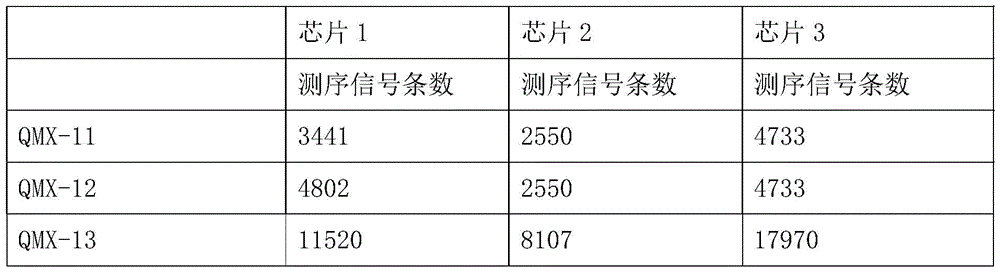

结果解读:阻滞效果越好,则混合测试时其数据量会越多,即测序信号条数越多。从表中可以看到仅存在Sp或2Sp作为单一阻滞元件时,其测得文库数据量在混合测试芯片中均显著低于同时存在1Sp/LNA或2Sp/LNA等联合阻滞元件的文库。因此,包含两种联合阻滞元件的接头在测序过程中的阻滞效果显著优于仅包含单一阻滞元件的接头。Interpretation of the results: the better the blocking effect, the more data will be generated in the mixed test, that is, the more the number of sequencing signals. It can be seen from the table that when there is only Sp or 2Sp as a single blocking element, the amount of library data measured in the mixed test chip is significantly lower than that of the library with combined blocking elements such as 1Sp/LNA or 2Sp/LNA. Therefore, adapters containing two combined blocking elements were significantly more effective in blocking during sequencing than adapters containing only a single blocking element.
实施例4:含联合阻滞元件的接头与商业化接头的芯片混库测试Example 4: Chip Mixed Library Test of Linkers Containing Joint Blocking Elements and Commercial Linkers
用实施例1的方法制备商业化含4C18的接头复合物QMX-15(Y1-4C18/Y2/B/E2),该接头复合物中的接头由主体链Y1-4C18(如SEQ ID NO.:7所示)、荧光链(如SEQ ID NO.:8所示)和阻挡链(如SEQ ID NO.:9所示)形成。The method of Example 1 was used to prepare the commercialized linker complex QMX-15 (Y1-4C18/Y2/B/E2) containing 4C18. The linker in the linker complex was composed of the main chain Y1-4C18 (such as SEQ ID NO.: 7), a fluorescent chain (shown in SEQ ID NO.:8) and a blocking chain (shown in SEQ ID NO.:9) are formed.
通过末端修复方式制备长为10kb的文库,并且分别用实施例2中制备QMX-13和商业化含4C18阻滞元件的接头QMX-15(Y1-4C18/Y2/B/E2)与文库进行连接建库。将等物质的量的QMX-13和QMX-15文库均匀加载到三张不同的齐碳科技有限公司QNome-9604上进行测序。测序过程中所使用的系链的序列如SEQ ID NO:13所示。其混测数据通量对比如下表4所示。A 10kb library was prepared by end repair, and the QMX-13 prepared in Example 2 and the commercial linker QMX-15 (Y1-4C18/Y2/B/E2) containing the 4C18 blocking element were used to connect to the library Build a library. The QMX-13 and QMX-15 libraries with equal amounts of substances were evenly loaded onto three different Qitan Technology Co., Ltd. QNome-9604 for sequencing. The sequence of the tether used in the sequencing process is shown in SEQ ID NO:13. The comparison of the mixed test data throughput is shown in Table 4 below.
表4:三张芯片的混测数据通量Table 4: Mixed test data throughput of three chips
结果解读:采用含联合阻滞元件的接头与商业化含4C18阻滞元件的接头进行混测的数据显示,本发明的含联合阻滞元件的接头在测序过程中的阻滞效果不输商业化含4C18的接头,甚至比商业化接头的阻滞效果更好。Interpretation of the results: The mixed test data of adapters containing combined blocking elements and commercial adapters containing 4C18 blocking elements showed that the blocking effect of the adapters containing combined blocking elements of the present invention in the sequencing process was not inferior to that of commercial products Linkers containing 4C18 showed even better blocking effects than commercial linkers.
Claims (22)
Priority Applications (2)
| Application Number | Priority Date | Filing Date | Title |
|---|---|---|---|
| CN202211595915.2A CN116200477A (en) | 2022-12-13 | 2022-12-13 | Adaptors, constructs, methods and uses comprising a combination blocker |
| PCT/CN2023/136344 WO2024125342A1 (en) | 2022-12-13 | 2023-12-05 | Adapter containing blocking elements used in combination, construct, method and use |
Applications Claiming Priority (1)
| Application Number | Priority Date | Filing Date | Title |
|---|---|---|---|
| CN202211595915.2A CN116200477A (en) | 2022-12-13 | 2022-12-13 | Adaptors, constructs, methods and uses comprising a combination blocker |
Publications (1)
| Publication Number | Publication Date |
|---|---|
| CN116200477A true CN116200477A (en) | 2023-06-02 |
Family
ID=86508415
Family Applications (1)
| Application Number | Title | Priority Date | Filing Date |
|---|---|---|---|
| CN202211595915.2A Pending CN116200477A (en) | 2022-12-13 | 2022-12-13 | Adaptors, constructs, methods and uses comprising a combination blocker |
Country Status (2)
| Country | Link |
|---|---|
| CN (1) | CN116200477A (en) |
| WO (1) | WO2024125342A1 (en) |
Cited By (1)
| Publication number | Priority date | Publication date | Assignee | Title |
|---|---|---|---|---|
| WO2024125342A1 (en) * | 2022-12-13 | 2024-06-20 | 成都齐碳科技有限公司 | Adapter containing blocking elements used in combination, construct, method and use |
Citations (4)
| Publication number | Priority date | Publication date | Assignee | Title |
|---|---|---|---|---|
| CN107109485A (en) * | 2014-10-10 | 2017-08-29 | 因维蒂公司 | Method for the general blocking oligomer system and improved hybrid capture of multiple capture reaction |
| CN113862264A (en) * | 2021-12-03 | 2021-12-31 | 北京齐碳科技有限公司 | Adapters, constructs, methods and uses for sequencing of target polynucleotides |
| CN114134142A (en) * | 2021-11-23 | 2022-03-04 | 成都齐碳科技有限公司 | Adaptors, complexes, single stranded molecules, kits, methods and uses |
| CN114262735A (en) * | 2021-12-15 | 2022-04-01 | 成都齐碳科技有限公司 | Adaptors for characterizing polynucleotides and uses thereof |
Family Cites Families (3)
| Publication number | Priority date | Publication date | Assignee | Title |
|---|---|---|---|---|
| GB2569977A (en) * | 2018-01-05 | 2019-07-10 | Oxford Nanopore Tech Ltd | Method |
| GB201907244D0 (en) * | 2019-05-22 | 2019-07-03 | Oxford Nanopore Tech Ltd | Method |
| CN116200477A (en) * | 2022-12-13 | 2023-06-02 | 成都齐碳科技有限公司 | Adaptors, constructs, methods and uses comprising a combination blocker |
-
2022
- 2022-12-13 CN CN202211595915.2A patent/CN116200477A/en active Pending
-
2023
- 2023-12-05 WO PCT/CN2023/136344 patent/WO2024125342A1/en not_active Ceased
Patent Citations (4)
| Publication number | Priority date | Publication date | Assignee | Title |
|---|---|---|---|---|
| CN107109485A (en) * | 2014-10-10 | 2017-08-29 | 因维蒂公司 | Method for the general blocking oligomer system and improved hybrid capture of multiple capture reaction |
| CN114134142A (en) * | 2021-11-23 | 2022-03-04 | 成都齐碳科技有限公司 | Adaptors, complexes, single stranded molecules, kits, methods and uses |
| CN113862264A (en) * | 2021-12-03 | 2021-12-31 | 北京齐碳科技有限公司 | Adapters, constructs, methods and uses for sequencing of target polynucleotides |
| CN114262735A (en) * | 2021-12-15 | 2022-04-01 | 成都齐碳科技有限公司 | Adaptors for characterizing polynucleotides and uses thereof |
Cited By (1)
| Publication number | Priority date | Publication date | Assignee | Title |
|---|---|---|---|---|
| WO2024125342A1 (en) * | 2022-12-13 | 2024-06-20 | 成都齐碳科技有限公司 | Adapter containing blocking elements used in combination, construct, method and use |
Also Published As
| Publication number | Publication date |
|---|---|
| WO2024125342A1 (en) | 2024-06-20 |
Similar Documents
| Publication | Publication Date | Title |
|---|---|---|
| US20230374583A1 (en) | Method of target molecule characterisation using a molecular pore | |
| US11236385B2 (en) | Method for characterising a double stranded nucleic acid using a nano-pore and anchor molecules at both ends of said nucleic acid | |
| CN106232834B (en) | Sample preparation method | |
| CN116377044B (en) | Methods and complexes for sequentially translocating two non-covalently bound complementary nucleic acid strands through a nanopore | |
| JP6637040B2 (en) | Method | |
| AU2014379438B2 (en) | Method for controlling the movement of a polynucleotide through a transmembrane pore | |
| JP2025072396A (en) | method | |
| CN109196116B (en) | Method for characterizing target polynucleotide | |
| WO2012164270A1 (en) | Coupling method | |
| WO2014064444A1 (en) | Droplet interfaces | |
| WO2023143247A1 (en) | Linker for characterizing sequencing of target polynucleotide, construct, method, and use | |
| WO2024109455A1 (en) | Rna-dna chimeric adapter and use thereof | |
| CN116200477A (en) | Adaptors, constructs, methods and uses comprising a combination blocker | |
| CN115747211A (en) | Design and application of sequencing joint for nanopore sequencing | |
| HK40086866A (en) | Linkers, constructs, methods and applications comprising associated resistance elements | |
| CN118241319A (en) | Preparation method of sequencing library |
Legal Events
| Date | Code | Title | Description |
|---|---|---|---|
| PB01 | Publication | ||
| PB01 | Publication | ||
| SE01 | Entry into force of request for substantive examination | ||
| SE01 | Entry into force of request for substantive examination | ||
| REG | Reference to a national code |
Ref country code: HK Ref legal event code: DE Ref document number: 40086866 Country of ref document: HK |
|
| EE01 | Entry into force of recordation of patent licensing contract | ||
| EE01 | Entry into force of recordation of patent licensing contract |
Application publication date: 20230602 Assignee: Chengdu Qicarbon Taike Biotechnology Co.,Ltd. Assignor: CHENGDU QITAN TECHNOLOGY LTD. Contract record no.: X2023980041554 Denomination of invention: Connector, construction, method, and application including joint blocking elements License type: Common License Record date: 20230912 |