CN1161700C - Network Systems - Google Patents
Network Systems Download PDFInfo
- Publication number
- CN1161700C CN1161700C CNB008011125A CN00801112A CN1161700C CN 1161700 C CN1161700 C CN 1161700C CN B008011125 A CNB008011125 A CN B008011125A CN 00801112 A CN00801112 A CN 00801112A CN 1161700 C CN1161700 C CN 1161700C
- Authority
- CN
- China
- Prior art keywords
- pet
- information
- action
- internal state
- type robot
- Prior art date
- Legal status (The legal status is an assumption and is not a legal conclusion. Google has not performed a legal analysis and makes no representation as to the accuracy of the status listed.)
- Expired - Fee Related
Links
Images


Classifications
-
- G—PHYSICS
- G06—COMPUTING OR CALCULATING; COUNTING
- G06Q—INFORMATION AND COMMUNICATION TECHNOLOGY [ICT] SPECIALLY ADAPTED FOR ADMINISTRATIVE, COMMERCIAL, FINANCIAL, MANAGERIAL OR SUPERVISORY PURPOSES; SYSTEMS OR METHODS SPECIALLY ADAPTED FOR ADMINISTRATIVE, COMMERCIAL, FINANCIAL, MANAGERIAL OR SUPERVISORY PURPOSES, NOT OTHERWISE PROVIDED FOR
- G06Q50/00—Information and communication technology [ICT] specially adapted for implementation of business processes of specific business sectors, e.g. utilities or tourism
- G06Q50/10—Services
-
- G—PHYSICS
- G06—COMPUTING OR CALCULATING; COUNTING
- G06N—COMPUTING ARRANGEMENTS BASED ON SPECIFIC COMPUTATIONAL MODELS
- G06N3/00—Computing arrangements based on biological models
- G06N3/004—Artificial life, i.e. computing arrangements simulating life
- G06N3/006—Artificial life, i.e. computing arrangements simulating life based on simulated virtual individual or collective life forms, e.g. social simulations or particle swarm optimisation [PSO]
-
- A—HUMAN NECESSITIES
- A63—SPORTS; GAMES; AMUSEMENTS
- A63H—TOYS, e.g. TOPS, DOLLS, HOOPS OR BUILDING BLOCKS
- A63H11/00—Self-movable toy figures
-
- B—PERFORMING OPERATIONS; TRANSPORTING
- B25—HAND TOOLS; PORTABLE POWER-DRIVEN TOOLS; MANIPULATORS
- B25J—MANIPULATORS; CHAMBERS PROVIDED WITH MANIPULATION DEVICES
- B25J11/00—Manipulators not otherwise provided for
-
- G—PHYSICS
- G06—COMPUTING OR CALCULATING; COUNTING
- G06N—COMPUTING ARRANGEMENTS BASED ON SPECIFIC COMPUTATIONAL MODELS
- G06N3/00—Computing arrangements based on biological models
- G06N3/004—Artificial life, i.e. computing arrangements simulating life
- G06N3/008—Artificial life, i.e. computing arrangements simulating life based on physical entities controlled by simulated intelligence so as to replicate intelligent life forms, e.g. based on robots replicating pets or humans in their appearance or behaviour
-
- A—HUMAN NECESSITIES
- A63—SPORTS; GAMES; AMUSEMENTS
- A63F—CARD, BOARD, OR ROULETTE GAMES; INDOOR GAMES USING SMALL MOVING PLAYING BODIES; VIDEO GAMES; GAMES NOT OTHERWISE PROVIDED FOR
- A63F2300/00—Features of games using an electronically generated display having two or more dimensions, e.g. on a television screen, showing representations related to the game
- A63F2300/80—Features of games using an electronically generated display having two or more dimensions, e.g. on a television screen, showing representations related to the game specially adapted for executing a specific type of game
- A63F2300/8058—Virtual breeding, e.g. tamagotchi
-
- A—HUMAN NECESSITIES
- A63—SPORTS; GAMES; AMUSEMENTS
- A63H—TOYS, e.g. TOPS, DOLLS, HOOPS OR BUILDING BLOCKS
- A63H2200/00—Computerized interactive toys, e.g. dolls
Landscapes
- Engineering & Computer Science (AREA)
- Physics & Mathematics (AREA)
- Theoretical Computer Science (AREA)
- Health & Medical Sciences (AREA)
- General Physics & Mathematics (AREA)
- General Health & Medical Sciences (AREA)
- Computational Linguistics (AREA)
- Life Sciences & Earth Sciences (AREA)
- Data Mining & Analysis (AREA)
- Evolutionary Computation (AREA)
- Biomedical Technology (AREA)
- Molecular Biology (AREA)
- Computing Systems (AREA)
- General Engineering & Computer Science (AREA)
- Artificial Intelligence (AREA)
- Mathematical Physics (AREA)
- Software Systems (AREA)
- Biophysics (AREA)
- Robotics (AREA)
- Business, Economics & Management (AREA)
- Tourism & Hospitality (AREA)
- Economics (AREA)
- Human Resources & Organizations (AREA)
- Marketing (AREA)
- Primary Health Care (AREA)
- Strategic Management (AREA)
- General Business, Economics & Management (AREA)
- Mechanical Engineering (AREA)
- Manipulator (AREA)
- Toys (AREA)
Abstract
通过使用多种装置实现一种更具有真实性的电子宠物。具体来说,虚拟电子宠物(202)和宠物机器人(204)根据关于环境和它们内部的信息,改变它们的情感和本能状态即电子宠物的内部状态(包含在宠物特性信息(203)中的信息),并且根据它们的情感和本能状态行动。电子宠物的内部状态(宠物特性信息(203))在虚拟电子宠物(202)、宠物机器人(204)或者个人计算机(201)之间被发送和接收。按照由其它设备改变的电子宠物内部状态,电子宠物的行为由多种装置实现。
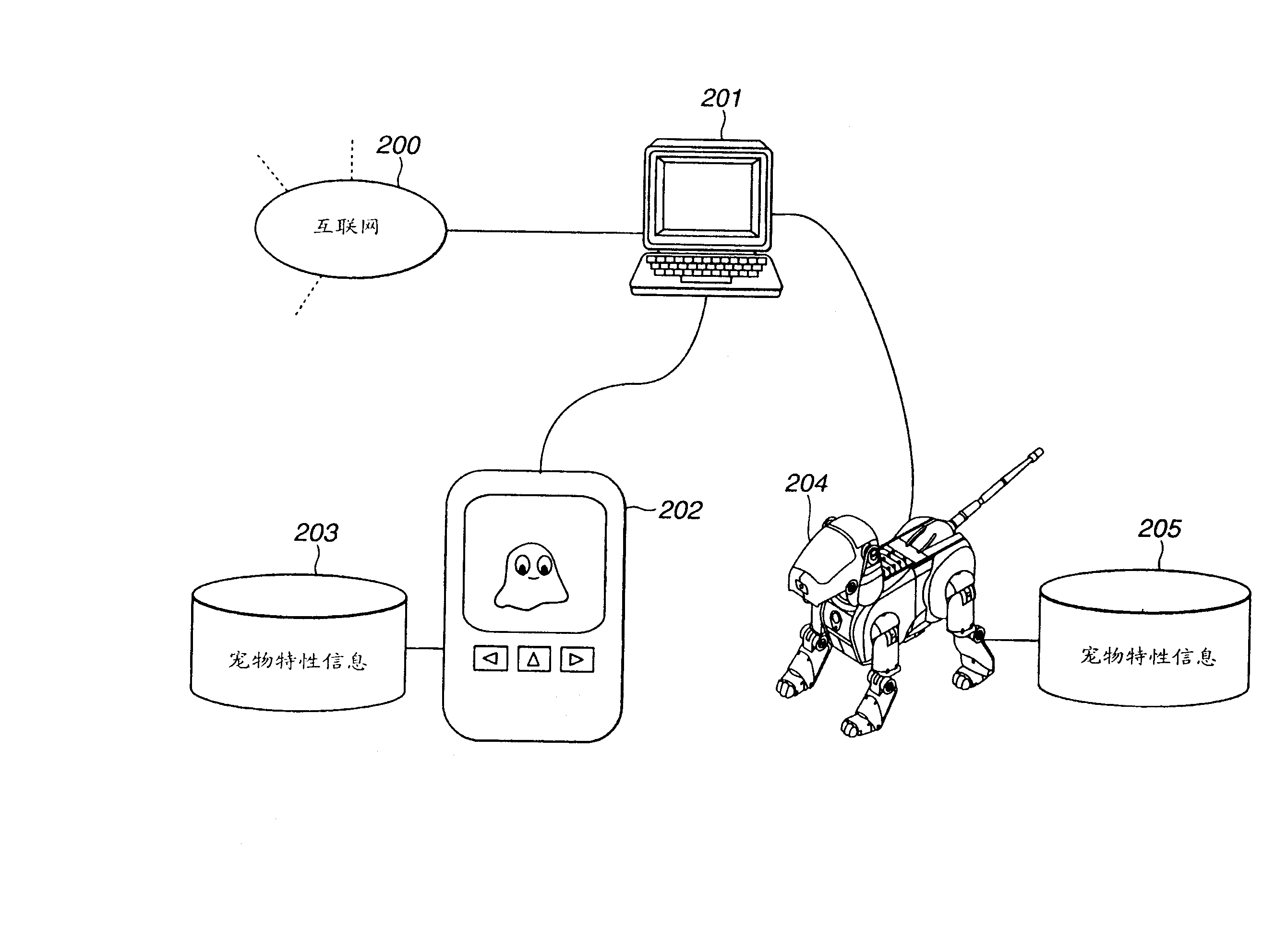
A more realistic electronic pet is achieved by using multiple devices. Specifically, the virtual electronic pet (202) and the pet robot (204) change their emotional and instinctive states—that is, the internal states of the electronic pet (information contained in the pet characteristic information (203))—based on information about the environment and their internal states, and act accordingly. The internal states of the electronic pet (pet characteristic information (203)) are sent and received between the virtual electronic pet (202), the pet robot (204), or a personal computer (201). The behavior of the electronic pet is realized by multiple devices according to the internal states of the electronic pet changed by other devices.
Description
技术领域Technical field
本发明涉及电子宠物系统、网络系统、机器人以及存储介质,特别涉及电子宠物系统、网络系统、机器人以及使电子宠物能在不同类型的装置中实现的存储介质。The present invention relates to an electronic pet system, a network system, a robot and a storage medium, in particular to an electronic pet system, a network system, a robot and a storage medium enabling the electronic pet to be implemented in different types of devices.
背景技术 Background technique
近来,由于比将真实动物作为宠物饲养更容易,因此,所谓电子宠物装置(或饲养模拟游戏机)已广为流行。Recently, so-called electronic pet devices (or breeding simulation game machines) have become popular because it is easier than keeping real animals as pets.
在电子宠物装置中,虚拟生命体对象表现为电子宠物并且电子宠物的状态如饥饿或疲劳程度通过图象或声音通知饲养员(电子宠物装置的用户)。饲养员(用户)根据电子宠物的状态通过操纵电子宠物装置饲养电子宠物或与之玩耍。这样,电子宠物依据饲养员的行为改变其状态(电子宠物的状态)并被如此饲养。随着时间的流逝,电子宠物逐渐成长并且因此电子宠物的状态也发生变化。In the electronic pet device, the virtual life object appears as the electronic pet and the status of the electronic pet such as hunger or fatigue level is notified to the keeper (user of the electronic pet device) by images or sounds. A breeder (user) breeds or plays with the electronic pet by manipulating the electronic pet device according to the state of the electronic pet. In this way, the electronic pet changes its state (the state of the electronic pet) according to the behavior of the keeper and is kept as such. As time goes by, the electronic pet gradually grows and thus the state of the electronic pet changes.
同时,由于电子宠物装置只是将电子宠物显示在显示器屏幕上,因而被显示的电子宠物即为所谓的虚拟存在。Meanwhile, since the electronic pet device only displays the electronic pet on the display screen, the displayed electronic pet is a so-called virtual presence.
在借助于例如作为实物存在的机器人实现电子宠物的情况下,作为电子宠物的机器人实际存在于真实世界中。在这种情况下,对作为电子宠物的机器人来说,饲养员(用户)会感觉到比饲养在电子宠物装置中显示的电子宠物更接近于实际饲养宠物的情况。In the case of realizing an electronic pet by means of, for example, a robot existing as a real thing, the robot as an electronic pet actually exists in the real world. In this case, for the robot as an electronic pet, the breeder (user) feels closer to the situation of actually keeping a pet than keeping the electronic pet displayed in the electronic pet device.
可是,在借助于机器人实现电子宠物的情况下,在旅行中或做类似事情时携带机器人则不够方便。因此,如果在某个场合电子宠物能以实际存在的机器人来实现,而在另一个场合电子宠物能在便携式电子宠物装置中以虚拟存在来实现则更为方便。However, in the case of implementing an electronic pet by means of a robot, it is not convenient to carry the robot when traveling or doing the like. Therefore, it is more convenient if the electronic pet can be realized as an actual robot on a certain occasion, and can be realized as a virtual presence in a portable electronic pet device on another occasion.
由于在常规电子宠物装置中实现的电子宠物一般会根据用户的输入或时间的流逝改变其状态并采取行动,因此它与饲养作为宠物的真实动物相比缺乏真实性。Since an electronic pet implemented in a conventional electronic pet device generally changes its state and takes actions according to a user's input or the lapse of time, it lacks reality compared to keeping a real animal as a pet.
具体来说,例如,在将作为真实动物的狗作为宠物饲养的情况下,当狗要与饲养员一起玩耍时,它会发出叫声或摇动它的尾巴以吸引饲养员的注意。在这种情况下,如果饲养员一直不予理睬,狗就会疲劳并且停止吼叫或摆尾,然后会采取行动,如睡着了。睡醒之后,真实的宠物动物就会精神焕发。Specifically, for example, in the case of keeping a dog as a real animal as a pet, when the dog wants to play with the breeder, it barks or shakes its tail to attract the breeder's attention. In this case, if the breeder continues to ignore it, the dog will tire and stop barking or wagging its tail, and will then take action, such as falling asleep. Wake up refreshed with real pet animals.
在另一方面,当在常规电子宠物装置(例如,电子宠物狗)中实现的电子宠物想与饲养员玩耍时,它或者会持续发出叫声或摆动它的尾巴,或者在经过一段时间以后,停止这些活动。与真实的宠物动物(例如,狗)不同,电子宠物不会由于吼叫和摆尾而感到疲劳并入睡。即,在由常规电子宠物装置中实现的电子宠物中,电子宠物的状态不根据其自身的行动而变化,因而不会根据由于电子宠物自身的行动引起的这种状态变化而采取任何行动。由于这些原因,需要提供更具有真实性的电子宠物。On the other hand, when an electronic pet implemented in a conventional electronic pet device (for example, an electronic pet dog) wants to play with a breeder, it either keeps barking or wagging its tail, or after a period of time, Stop these activities. Unlike real pet animals (eg, dogs), electronic pets do not get tired and fall asleep due to growling and wagging their tails. That is, in the electronic pet implemented in the conventional electronic pet device, the state of the electronic pet does not change according to its own action, and thus does not take any action according to such state change due to the electronic pet's own action. For these reasons, there is a need to provide more realistic electronic pets.
发明内容Contents of invention
鉴于现有技术的上述情况,本发明的一个目的是提供一种电子宠物系统、一种网络系统、一种机器人以及一种使电子宠物能在不同类型的装置中更真实地实现的存储介质。In view of the above-mentioned circumstances of the prior art, an object of the present invention is to provide an electronic pet system, a network system, a robot, and a storage medium enabling electronic pets to be more realistically realized in various types of devices.
具体来说,根据本发明的电子宠物系统具有信息处理装置和机器人。信息处理装置具有能够发送和接收电子宠物内部状态的发送/接收装置和图象显示装置并且由图象显示装置执行用于实现电子宠物的处理,电子宠物内部状态按照输入信息而变化并且是用于引起电子宠物行动的信息。机器人具有能够发送和接收电子宠物内部状态的发送/接收装置和用于在真实世界中移动的运动部分并且控制运动部分执行用于将电子宠物作为真实世界中的存在物实现的处理,电子宠物内部状态按照输入信息而变化并且是用于引起电子宠物行动的信息。Specifically, the electronic pet system according to the present invention has an information processing device and a robot. The information processing device has a transmitting/receiving device and an image display device capable of transmitting and receiving an internal state of an electronic pet, and the image display device executes processing for realizing the electronic pet, which changes in accordance with the input information and is used for Information that causes the action of the electronic pet. The robot has a transmission/reception device capable of transmitting and receiving the internal state of the electronic pet and a moving part for moving in the real world and controls the moving part to perform processing for realizing the electronic pet as an existence in the real world, the internal state of the electronic pet It changes according to the input information and is information for causing the electronic pet to act.
用这样的电子宠物系统,电子宠物的内部状态根据输入信息而变化并且内部状态的发送/接收在信息处理装置和机器人之间进行,这使得电子宠物按照内部状态而行动。信息处理装置按照来自机器人的内部状态而行动,机器人按照来自信息处理装置的内部状态而行动。With such an electronic pet system, the internal state of the electronic pet changes according to input information and transmission/reception of the internal state is performed between the information processing device and the robot, which makes the electronic pet act according to the internal state. The information processing device acts according to the internal state from the robot, and the robot acts according to the internal state from the information processing device.
同样,根据本发明的电子宠物系统具有信息处理装置和机器人。信息处理装置具有能够无线发送和接收电子宠物的内部状态的无线电发送/接收装置和图象显示装置并且由图象显示装置执行用于实现电子宠物的处理,电子宠物内部状态按照输入信息而变化并且是用于引起电子宠物行动的信息。机器人具有能够无线发送和接收电子宠物的内部状态的无线电发送/接收装置和用于在真实世界中移动的运动部分并且控制运动部分执行用于将电子宠物作为一个真实世界中的存在物实现的处理,电子宠物内部状态按照输入信息而变化并且是用于引起电子宠物行动的信息。Also, the electronic pet system according to the present invention has an information processing device and a robot. The information processing device has a radio transmitting/receiving device capable of wirelessly transmitting and receiving an internal state of an electronic pet and an image display device and the image display device performs processing for realizing the electronic pet, the internal state of the electronic pet changes according to the input information and It is the information for causing the electronic pet to act. The robot has a radio transmission/reception device capable of wirelessly transmitting and receiving the internal state of the electronic pet and a moving part for moving in the real world and controls the moving part to perform processing for realizing the electronic pet as a real-world existence, The internal state of the electronic pet changes according to the input information and is information for causing the electronic pet to act.
用这样的电子宠物系统,电子宠物的内部状态根据输入信息而变化并且内部状态的无线电发送/接收在信息处理装置和机器人之间进行,这使得电子宠物按照内部状态而行动。信息处理装置按照来自机器人的内部状态而行动,机器人按照来自信息处理装置的内部状态而行动。With such an electronic pet system, the internal state of the electronic pet changes according to input information and radio transmission/reception of the internal state is performed between the information processing device and the robot, which makes the electronic pet act according to the internal state. The information processing device acts according to the internal state from the robot, and the robot acts according to the internal state from the information processing device.
根据本发明的网络系统具有一个或多个实现装置和服务器装置。实现装置具有能发送和接收活体对象内部状态和活体对象的识别信息的发送/接收装置,活体对象内部状态按照输入信息而变化并且是用于引起活体对象行动的信息,由此来实现活体对象。服务器装置具有用于管理活体对象内部状态和活体对象识别信息的管理装置以及至少能够发送/接收内部状态和识别信息的发送/接收装置。实现装置和服务器装置通过网络相互连接。The network system according to the invention has one or more implementation devices and server devices. The realization means has transmission/reception means capable of transmitting and receiving internal state of the living body object and identification information of the living body object, the internal state of the living body object changes according to the input information and is information for causing the living body object to act, thereby realizing the living body object. The server device has management means for managing the internal state of the living subject and identification information of the living body, and transmission/reception means capable of transmitting/receiving at least the internal state and identification information. The realization device and the server device are connected to each other through a network.
用这样的网络系统,实现装置中的活体对象具有由服务装置管理的它的内部状态和识别信息。With such a network system, the living body object in the realization device has its internal state and identification information managed by the service device.
同样,根据本发明的网络系统具有实现装置和信息处理装置。实现装置具有能够发送和接收活体对象内部状态的发送/接收装置,活体对象内部状态按照输入信息而变化并且是用于引起活体对象行动的信息,如此实现活体对象。信息处理装置具有能够发送和接收活体对象内部状态的发送/接收装置,信息处理装置根据活体对象的内部状态控制在虚拟世界中行动的活体对象的行动并且执行用于至少显示虚拟世界和活体对象的处理。Also, a network system according to the present invention has realizing means and information processing means. The realization means has transmission/reception means capable of transmitting and receiving the internal state of the living body object which changes according to the input information and which is information for causing the living body object to act, thus realizing the living body object. The information processing device has a transmission/reception device capable of transmitting and receiving an internal state of a living body object, and the information processing device controls actions of a living body object acting in a virtual world according to the internal state of the living body object and performs a process for displaying at least the virtual world and the living body object. deal with.
用这样的网络系统,在实现装置中的活体对象内部状态被传送到信息处理装置,活体对象内部状态按照输入信息而变化并且是用于引起活体对象行动的信息,信息处理装置执行用于至少显示虚拟世界和活体对象的技术处理。With such a network system, the internal state of the living body object in the realizing device is transmitted to the information processing device, the internal state of the living body object changes according to the input information and is information for causing the living body object to act, and the information processing device executes for displaying at least Technical treatment of virtual worlds and living objects.
依据本发明的机器人适合于储存活体对象内部状态并且适合于控制运动部分执行用于将电子宠物作为真实世界中的存在物实现的处理,活体对象内部状态按照输入信息而变化并且是用于引起活体对象行动的信息。机器人至少向信息处理装置传送内部状态,信息处理装置根据活体对象的内部状态控制在虚拟世界中行动的活体对象的行动并且执行用于至少显示虚拟世界和活体对象的处理。The robot according to the present invention is suitable for storing the internal state of the living object, which changes according to the input information and is for causing the living body Information about the object's actions. The robot transmits at least an internal state to an information processing device, and the information processing device controls actions of a living object acting in a virtual world according to the internal state of the living object and performs processing for displaying at least the virtual world and the living object.
这样的机器人向信息处理装置传送内部状态,内部状态按照输入信息而变化并且是用于引起活体对象行动发生的信息,信息处理装置执行用于至少显示虚拟世界和活体对象的处理。Such a robot transmits an internal state that changes according to input information and is information for causing an action of a living body to occur to an information processing device that performs processing for displaying at least a virtual world and a living body.
相应于本发明的存储介质适用于存储在信息处理装置中使用的数据并且能插入信息处理装置中提供的槽中或从中拔出。当存储介质装入信息处理装置的槽中时,存储介质具有用于指示准确装入位置的指示手段。A storage medium according to the present invention is suitable for storing data used in an information processing device and can be inserted into or pulled out from a slot provided in the information processing device. When the storage medium is loaded into the slot of the information processing device, the storage medium has indicating means for indicating the exact loading position.
这样,用户根据指示手段将存储介质装入信息处理装置的槽中。In this way, the user loads the storage medium into the slot of the information processing device according to the instruction means.
附图说明Description of drawings
图1是示出了应用本发明的电子宠物系统实施例的总体框图。FIG. 1 is an overall block diagram showing an embodiment of an electronic pet system to which the present invention is applied.
图2示出了更具体的电子宠物系统的典型结构。Fig. 2 shows a more specific typical structure of the electronic pet system.
图3是示出了电子宠物系统身体部分典型结构的框图。FIG. 3 is a block diagram showing a typical structure of a body part of the electronic pet system.
图4是示出了虚拟电子宠物装置典型硬件结构的框图。FIG. 4 is a block diagram showing a typical hardware structure of a virtual electronic pet device.
图5是示出了宠物型机器人典型硬件结构的框图。FIG. 5 is a block diagram showing a typical hardware configuration of a pet-type robot.
图6是示出了宠物型机器人外观具体结构的透视图。Fig. 6 is a perspective view showing the specific structure of the appearance of the pet-type robot.
图7是示出了宠物型机器人更具体的电路结构的框图。FIG. 7 is a block diagram showing a more specific circuit configuration of the pet-type robot.
图8是示出了控制器结构的框图。Fig. 8 is a block diagram showing the structure of the controller.
图9是示出了情感/本能模式部分结构的框图。Fig. 9 is a block diagram showing a partial structure of the emotion/instinct mode.
图10是示出了情感/本能模式部分中情感组的框图。FIG. 10 is a block diagram showing emotion groups in the emotion/instinct pattern section.
图11是示出了具有强度增加/减少装置的情感/本能模式部分结构的框图。Fig. 11 is a block diagram showing a partial structure of an emotion/instinct mode with intensity increasing/decreasing means.
图12是示出了用来解释生成行动命令信息的动作决定机构部分结构的框图。Fig. 12 is a block diagram showing a partial structure of an action determining mechanism for generating action command information.
图13示出了动作模式的有限概率自动机的状态转换。Fig. 13 shows the state transitions of the finite probability automaton of the action mode.
图14示出了状态转换表。Fig. 14 shows a state transition table.
图15示出了在姿势转换机构部分中的姿势转换图。Fig. 15 shows a posture transition diagram in the posture transition mechanism section.
图16示出了姿势转换图的具体例子。Fig. 16 shows a specific example of a pose transition graph.
图17是示出了宠物型机器人简要结构的透视图。Fig. 17 is a perspective view showing a brief structure of a pet-type robot.
图18A和18B是用于解释在基本姿势的基础上整个身体和各个部分之间进行姿势转换的图。18A and 18B are diagrams for explaining pose transitions between the whole body and individual parts on the basis of basic poses.
图19是用于解释在目前姿势属于整个身体而目标姿势属于一个部分的情况下,在临时转换到基本姿势之后,执行目标动作的图。FIG. 19 is a diagram for explaining execution of a target action after temporarily shifting to a basic posture in a case where the current posture belongs to the whole body and the target posture belongs to a part.
图20是用于解释在目前姿势属于局部而目标姿势属于整体的场合,临时转变基本姿势之后执行目标动作的图。Fig. 20 is a diagram for explaining execution of a target action after temporarily shifting the basic posture in the case where the current posture belongs to the part and the target posture belongs to the whole.
图21示出了存储在独立信息存储装置(IC卡)中的宠物特性信息。Fig. 21 shows pet characteristic information stored in a separate information storage device (IC card).
图22是用于说明用颜色做标记的IC卡的图。Fig. 22 is a diagram for explaining an IC card marked with colors.
图23是用于说明用颜色做标记并具有附加箭头标志的条状IC卡的图。Fig. 23 is a diagram for explaining a strip-shaped IC card marked with colors and having an arrow mark attached thereto.
图24是用于说明用颜色做标记并具有附加指示边界位置的线的条状IC卡的图。Fig. 24 is a diagram for explaining a strip-shaped IC card marked with colors and having additional lines indicating border positions.
图25是用于说明准确地装入槽中的条状IC卡的图。Fig. 25 is a diagram for explaining a stick-shaped IC card accurately inserted into the slot.
图26是用于说明放在条状IC卡上的典型标签的图。Fig. 26 is a diagram for explaining a typical label placed on a strip IC card.
图27A和27B示出了条状IC卡的侧面和底部。27A and 27B show the side and bottom of a strip-shaped IC card.
图28示出了本发明的第二个实施例的连接的例子。Fig. 28 shows an example of connection of the second embodiment of the present invention.
图29是示出了第二个实施例的宠物型机器人基本部分硬件结构的框图。Fig. 29 is a block diagram showing the basic hardware configuration of the pet-type robot of the second embodiment.
图30是示出了第二个实施例的虚拟电子宠物装置外观的前视图。Fig. 30 is a front view showing the appearance of the virtual electronic pet device of the second embodiment.
图31是示出了第二个实施例的虚拟电子宠物装置基本部分硬件结构的框图。Fig. 31 is a block diagram showing the basic part hardware configuration of the virtual electronic pet device of the second embodiment.
图32是示出了用USB电缆将虚拟电子宠物装置和宠物型机器人相互连接的连接例子的框图。FIG. 32 is a block diagram showing a connection example in which a virtual electronic pet device and a pet-type robot are connected to each other with a USB cable.
图33是示出了用红外线将虚拟电子宠物装置和宠物型机器人相互连接的连接例子的框图。FIG. 33 is a block diagram showing a connection example in which a virtual electronic pet device and a pet-type robot are connected to each other by infrared rays.
图34是示出了用无线电波将虚拟电子宠物装置和宠物型机器人相互连接的连接例子的框图。Fig. 34 is a block diagram showing a connection example in which a virtual electronic pet device and a pet-type robot are connected to each other by radio waves.
图35是示出了用蓝牙(Bluetooth)模块将虚拟电子宠物装置和宠物型机器人相互连接的连接例子的框图。FIG. 35 is a block diagram showing a connection example in which a virtual electronic pet device and a pet-type robot are connected to each other using a Bluetooth (Bluetooth) module.
图36是示出了用USB电缆将宠物型机器人和个人计算机相互连接并且个人计算机连接互联网(Internet)的连接例子的框图。36 is a block diagram showing a connection example in which a pet-type robot and a personal computer are connected to each other with a USB cable, and the personal computer is connected to the Internet (Internet).
图37是示出了用红外线将宠物型机器人和个人计算机相互连接并且个人计算机连接互联网的连接例子的框图。Fig. 37 is a block diagram showing a connection example in which a pet-type robot and a personal computer are connected to each other by infrared rays, and the personal computer is connected to the Internet.
图38是示出了用无线电波将宠物型机器人和个人计算机相互连接并且个人计算机连接互联网的例子的框图。Fig. 38 is a block diagram showing an example in which a pet-type robot and a personal computer are connected to each other by radio waves, and the personal computer is connected to the Internet.
图39是示出了用蓝牙模块将宠物型机器人和个人计算机相互连接并且个人计算机连接互联网的例子的框图。FIG. 39 is a block diagram showing an example in which a pet-type robot and a personal computer are connected to each other with a Bluetooth module, and the personal computer is connected to the Internet.
图40示出了从虚拟电子宠物装置向宠物型机器人传递宠物特性信息的流程图。FIG. 40 shows a flow chart of transferring pet characteristic information from a virtual electronic pet device to a pet-type robot.
图41示出了从宠物型机器人向虚拟电子宠物装置传递宠物特性信息的流程图。FIG. 41 shows a flowchart of transferring pet characteristic information from a pet-type robot to a virtual electronic pet device.
图42示出了在宠物型机器人与虚拟电子宠物装置之间传递宠物特性信息不被执行情况下的流程图。Fig. 42 shows a flowchart in the case where transfer of pet characteristic information between the pet-type robot and the virtual electronic pet device is not performed.
图43示出了连接请求信号、连接许可信号以及接收终止信号的数据格式。Fig. 43 shows the data format of a connection request signal, a connection permission signal, and a reception termination signal.
图44示出了由宠物共享服务器管理电子宠物的典型系统结构。FIG. 44 shows a typical system structure in which an electronic pet is managed by a pet sharing server.
图45是示出了在用于由共享服务器管理电子宠物的系统结构中的宠物型机器人以及虚拟电子宠物装置的典型硬件结构的框图。FIG. 45 is a block diagram showing a typical hardware configuration of a pet-type robot and a virtual electronic pet device in a system configuration for managing an electronic pet by a shared server.
图46是用于说明将电子宠物交给共享服务器并从共享服务器接收电子宠物的具体例子的图。FIG. 46 is a diagram for explaining a specific example of handing over a electronic pet to a sharing server and receiving the electronic pet from the sharing server.
图47概念性地示出了存在于虚拟世界的用户化身和电子宠物的例子。FIG. 47 conceptually shows examples of user avatars and electronic pets existing in the virtual world.
图48是示出了在用于由共享服务器管理电子宠物的系统结构中的宠物型机器人以及虚拟电子宠物装置的典型硬件结构的框图,并且示出了用蓝牙模块将宠物型机器人和虚拟电子宠物装置连接到互联网的状态。48 is a block diagram showing a typical hardware configuration of a pet-type robot and a virtual electronic pet device in a system configuration for managing an electronic pet by a shared server, and shows that the pet-type robot and the virtual electronic pet are connected by a Bluetooth module. The status of the device's connection to the Internet.
图49是示出了存在于虚拟世界中的电子宠物和用户化身系统详细结构的框图。FIG. 49 is a block diagram showing a detailed structure of a digital pet and user avatar system existing in a virtual world.
图50是示出了用于图49所示系统的客户机PC典型结构的框图。FIG. 50 is a block diagram showing a typical configuration of a client PC used in the system shown in FIG. 49 .
图51是用于说明在图49所示系统中,从浏览提供虚拟现实造型语言(VRML)内容的网站主页,到将VRML下载到客户机PC的处理流程图。FIG. 51 is a flow chart for explaining the process from browsing the home page of a website providing virtual reality modeling language (VRML) content to downloading VRML to the client PC in the system shown in FIG. 49 .
图52是用于说明在图49所示系统中,从由客户机PC解释和执行VRML2.0文件到询问共享服务器的URL的处理流程图。FIG. 52 is a flow chart for explaining the process from interpreting and executing a VRML2.0 file by a client PC to inquiring the URL of a sharing server in the system shown in FIG. 49. FIG.
图53是用于说明处理多个客户机PC通过共享服务器接收涉及三维对象的数据并实现多用户环境的流程图。Fig. 53 is a flow chart for explaining the process of receiving data related to three-dimensional objects by a plurality of client PCs through a shared server and realizing a multi-user environment.
具体实施方式 Detailed ways
参照图将对本发明的优选实施例进行详细描述。Preferred embodiments of the present invention will be described in detail with reference to the drawings.
图1示出了作为本发明第一个实施例的电子宠物系统的总体结构。(在本说明中,不管各个装置是否包含在同一个外壳中,系统意味着多个装置的逻辑集合。)Fig. 1 shows the general structure of the electronic pet system as the first embodiment of the present invention. (In this specification, a system means a logical collection of devices regardless of whether the devices are contained in the same housing.)
如图1所示,电子宠物系统具有独立信息存储部分1和身体部分2。As shown in FIG. 1 , the electronic pet system has an independent
例如,作为生命体的动物被认为是由处于肉体中的肉体和灵魂组成的并且控制心理活动。电子宠物系统的独立信息存储部分1相当于这样的动物灵魂并且作为电子宠物的硬件被构成。身体部分2相当于肉体并且作为电子宠物的软件被构成。For example, animals as living beings are considered to be composed of a body and a soul in a physical body and control mental activities. The independent
具体来说,表示电子宠物特性(情感和心理特性)的独立信息存储部分1可以说是执行电子宠物灵魂的功能。表现电子宠物动作的身体部分2可以说是执行实现电子宠物的真实或虚拟肉体的功能并且用真实或虚拟的肉体表现实际的动作。身体部分2的动作根据由独立信息存储部分1所掌握的电子宠物特性做出。因此,独立信息存储部分1可说是电子宠物的核心。Specifically, the independent
独立信息存储部分1可以从身体部分2中抽出,也可以提供给(放入)其它身体部分21,22,…。在这种情况下,没有提供独立信息存储部分1的身体部分2不执行电子宠物的功能。这种情况下的电子宠物处于所谓的脱钩(cast off)状态。The independent
在另一方面,在其中提供独立信息存储部分1的其它身体部分开始执行具有初始特性的电子宠物功能。即,电子宠物的灵魂可以从一个肉体转换到另一个肉体。On the other hand, the other body part in which the independent
图2示出了图1所示的电子宠物系统的更具体的结构。FIG. 2 shows a more specific structure of the electronic pet system shown in FIG. 1 .
例如,图1的独立信息存储部分1是由IC(集成电路)卡21表示的。IC卡21包含一个压印(stamp)快闪存储器或其它此类东西,储存将在后文中描述的电子宠物的本能和情感特性以及身体部分的构成信息(在下文中称为宠物特性信息)。The independent
例如,图1所示的身体部分2由虚拟电子宠物装置22或宠物型机器人23实现。虚拟电子宠物装置22由用于执行显示虚拟电子宠物的便携式信息处理装置构成,并且具有用于在其中插入IC卡21的槽22A。宠物型机器人23是一个具有电子宠物外形的机器人并且也具有用于在其中插入IC卡21的槽23A。虽然在本发明的实施例中用四足机器人作为宠物型机器人的例子,机器人的形状并没有特别的限制并且可以使用各种所需要的形状,如两足机器人、有翅膀的机器人、有轮子的机器人、无肢体的机器人以及各个部分的组合或修改。本发明可应用于各种形状的机器人。For example, the
虚拟电子宠物装置22以及宠物型机器人23都是执行电子宠物的身体部分功能的装置并且他们自己不能采取任何行动。具体来说,当IC卡21装入其中时,虚拟电子宠物装置22和宠物型机器人23执行作为电子宠物的功能。在虚拟电子宠物22的情况下,电子宠物被显示在其监视器上并且被显示在监视器上的电子宠物根据储存在IC卡21上的宠物特性信息采取行动。类似地,宠物型机器人23根据储存在IC卡21上的宠物特性信息采取行动。Both the virtual
用这样的电子宠物系统,当用户在家时,可以将IC卡21插入宠物型机器人23的槽23A中,从而享受接近实际饲养宠物的感觉。当用户出门旅行时,用户可以从宠物型机器人23中取出IC卡并插入虚拟电子宠物装置22中,从而很容易地将电子宠物带到目的地。With such an electronic pet system, when the user is at home, the
图3示出了图1所示的身体部分2的典型电结构。身体部分2假定是虚拟电子宠物装置22和宠物型机器人23,它们在后文中还会被详细描述。FIG. 3 shows a typical electrical structure of the
I/F(接口)10相当于图2所示虚拟电子宠物装置22的槽22A或宠物型机器人23的槽23A,并且起在独立信息存储部分1和身体部分2之间传递数据的接口作用。具体来说,I/F 10读出表示电子宠物本能和情感特性和身体部分结构的信息(宠物特性信息),并且将这些信息提供给内部状态计算部分11。I/F 10还将获得的作为内部状态计算部分11预定计算结果的信息写到独立信息存储部分1中并更新储存内容。I/F (interface) 10 corresponds to slot 22A of virtual
除上述的来自I/F 10的宠物特性信息之外,来自外部输入部分12和时间输入部分13的输入也提供给内部状态计算部分11。此外,由动作转化部分15获得的电子宠物的具体动作反馈给内部状态计算部分11。内部状态计算部分11根据来自I/F 10、外部输入部分12、时间输入部分13或动作转化部分15的输入驱动储存在模式存储部分14中的情感和本能模式并更新电子宠物的内部状态。如后文所述,电子宠物的内部状态涉及包含在来自I/F 10的宠物特性信息中的情感和本能信息并且被更新的内部状态通过I/F 10写到独立信息存储部分1。内部状态计算部分11还决定由电子宠物做出的动作(概念动作),并且向动作转化部分15输出表示执行动作(概念动作)的指令,动作转化部分15执行控制以做出实际的动作。In addition to the aforementioned pet characteristic information from the I/F 10, inputs from the external input section 12 and the time input section 13 are also supplied to the internal state calculation section 11. In addition, the specific motion of the electronic pet obtained by the motion conversion section 15 is fed back to the internal state calculation section 11 . The internal state calculation part 11 drives the emotion and instinct patterns stored in the pattern storage part 14 and updates the internal state of the electronic pet according to the input from the I/F 10, the external input part 12, the time input part 13 or the action conversion part 15. As described later, the internal state of the electronic pet relates to the emotion and instinct information contained in the pet characteristic information from the I/F 10 and the updated internal state is written to the independent
外部输入部分12向内部状态计算部分11提供用户给出的或来自外部环境的刺激。The external input section 12 supplies the internal state calculation section 11 with a stimulus given by the user or from an external environment.
在身体部分2是虚拟电子宠物装置22的情况下,外部输入部分12由键盘(或开关和按钮)、麦克风以及声音识别装置构成。外部输入部分12将用户为照顾电子宠物所做出操作或说出的语言转换为电信号,并且将该电信号提供给内部状态计算部分11。In the case where the
另一方面,在身体部分2是宠物型机器人23的情况下,外部输入部分12由键盘、麦克风、声音识别装置、光电转化元件、图象识别装置以及传感器(例如,温度传感器)构成。外部输入部分12将用户为照顾电子宠物所做出操作或说出的语言转换为电信号,并且将该电信号提供给内部状态计算部分11。外部输入部分12还向内部状态计算部分11提供关于周围物体和温度的信息。On the other hand, in the case where the
时间输入部分13记时(包括年、月、日)并向内部状态计算部分11提供时间(当前时间)。The time input section 13 keeps time (including year, month, day) and supplies the time (current time) to the internal state calculation section 11 .
模式存储部分14储存电子宠物情感和本能的模式(情感/本能模式)。例如,作为电子宠物的情感设置的有喜悦、悲伤、愤怒、惊奇、恐惧以及憎恨,模式存储部分14储存这些情感模式(例如,用于得到表示这些情感的参数的计算公式)。作为电子宠物的本能设置的有运动本能、爱本能、重新充电本能以及搜寻本能,模式存储部分14储存这些本能模式。电子宠物的内部状态由情感状态和本能状态构成。The pattern storage section 14 stores patterns of emotions and instincts (emotion/instinct patterns) of electronic pets. For example, joy, sadness, anger, surprise, fear, and hatred are set as the emotions of the electronic pet, and the pattern storage section 14 stores these emotion patterns (for example, calculation formulas for obtaining parameters representing these emotions). As instincts of the electronic pet are provided exercise instinct, love instinct, recharging instinct, and search instinct, and the pattern storage section 14 stores these instinct patterns. The internal state of the electronic pet is composed of emotional state and instinct state.
无论身体部分2是虚拟电子宠物装置22或是宠物型机器人23,身体部分2具有相同结构的情感和本能模式。这样,甚至当I/C卡21在虚拟电子宠物装置22和宠物型机器人23之间交换时,对于那些不同的电子宠物,电子宠物的特性和动作是不变的。Regardless of whether the
动作转化部分15将来自内部状态计算部分11的概念动作指令转换为说明具体动作(如动作、运动或姿势)的指令(动作指令)。动作转化部分15向输出部分16提供该指令并且作为反馈也向内部状态计算部分11提供该指令。The action conversion section 15 converts the conceptual action instruction from the internal state calculation section 11 into an instruction (action instruction) describing a concrete action such as action, motion, or posture. The action conversion section 15 supplies the instruction to the output section 16 and also supplies the instruction to the internal state calculation section 11 as feedback.
输出部分16按照来自动作转化部分15的动作指令做出输出。具体来说,输出部分16按照来自动作转化部分15的动作指令使电子宠物采取行动。The output section 16 makes an output in accordance with the action instruction from the action conversion section 15 . Specifically, the output section 16 makes the electronic pet act according to the action instruction from the action conversion section 15 .
在身体部分2是虚拟电子宠物装置22的情况下,输出部分16由监视器、声音合成器(例如,rule-based声音合成器)以及扬声器构成。输出部分16的输出改变电子宠物的显示并且输出声音。In the case where the
另一方面,在身体部分2是宠物型机器人23的情况下,输出部分16由运动部分、声音合成器以及扬声器构成,运动部分如用于驱动对应于肢体各部件、躯干、头和尾部分的电动机。这样,输出部分16的输出旋转预定电动机并且输出声音。On the other hand, in the case where the
下面将用更具体的例子描述虚拟电子宠物装置22以及宠物型机器人23。图4示出了虚拟电子宠物装置22的典型硬件结构。The virtual
CPU(中央处理单元)31用于按照储存在ROM(只读存储器)32中的程序执行各种类型的处理。定时器电路31A计算时钟(没有示出),并且基于计算值在每一个预定的单位时间(例如,100ms)对CPU 31产生定时器中断。A CPU (Central Processing Unit) 31 is used to execute various types of processing according to programs stored in a ROM (Read Only Memory) 32 . The
ROM 32储存由CPU 31执行的程序以及执行程序所需要的数据。RAM(随机存取存储器)33储存CPU 31运行所需要的数据。The
I/F 34在两方之间起接口的作用,其中一方是CPU 31而另一方是A/D转换器36、操作部分37、IC卡连接器38、D/A转换器39以及液晶控制器41。The I/
对于上述的若干部分,CPU 31、ROM 32、RAM 33以及I/F 34通过总线(地址总线和数据总线)相互连接。For the above-mentioned several parts,
麦克风35将输入的声音(例如,哨声等)转换为作为模拟电信号的音频信号并将音频信号提供给A/D转换器36。A/D转换器36对来自麦克风的模拟音频信号进行A/D转换,将生成的数字音频信号通过I/F 34输出到CPU 31。The
在CPU 31已经这样接收音频信号的情况下,CPU 31对音频信号进行线性预测分析,以便从中提取特征量,并且按照HMM(hidden Markov model,隐含马尔可夫模式)方法进行声音识别。由CPU 31执行用于声音识别的程序以及作为声音识别目标的字型被存储在例如ROM 32中。在这种情况下,由于字型是声音识别的目标,特别是主人对宠物说话所用的字型被储存。被储存的字包括“嗨(Hey)”、“好宝贝(Good boy)”、“早上好(Good morning)”、“晚上好(Good night)”、“爪(Paw)”、“坐(Sit)”、“干什么(What are you doing)?”等。In the case that the
声音分析的方法不限于线性预测分析,声音识别的方法不限于HMM方法。The method of voice analysis is not limited to linear predictive analysis, and the method of voice recognition is not limited to the HMM method.
操作部分37由各种按钮和键构成并且通过I/F 34向CPU 31提供对应来自用户操作的信号。这样,CPU 31能认别出由用户操作的按钮和键。操作部分37具有用于向电子宠物提供各种输入的按钮,如在斥责宠物时使用的“斥责(Scold)”按钮、在表扬宠物时使用的“表扬(Praise)”按钮、对应说“早上好”或“晚上好”的“问候(Greeting)”按钮、以及在表演时使用的指示电子宠物举起爪子或坐下的“爪”按钮和“坐”按钮。The
在虚拟电子宠物装置22(图2)的槽22A中提供了IC卡连接器38,当IC卡21装置入槽22A时,IC卡连接器38适用于通过I/F 34将IC卡21与CPU31进行电连接。在这种情况下,CPU 31通过I/F 34和IC卡连接器38既可以从IC卡21中读出数据也可以向IC卡21中写入数据。CPU 31还能检验IC卡21的装入。An
D/A转换器39对通过I/F 34来自CPU 31的数字声音信号进行D/A转换并且将生成的模拟音频信号提供给扬声器40。扬声器40含有放大来自D/A转换器39的音频信号并且将放大的音频信号输出的放大器。CPU 31用声音合成器产生电子宠物的声音或者,如果需要,产生其它所需要的声音,并且通过I/F 34向D/A转换器39输出合成的声音。用于进行声音合成的程序以及必要的数据储存在,例如,ROM 32中。The D/A converter 39 D/A-converts the digital sound signal from the
液晶控制器41由CPU 31通过I/F 34控制并且在液晶显示器部分42上显示各种图象(例如,电子宠物的图象)和字符。液晶显示器部分42在液晶控制器41的控制下显示图象和字符。ROM 32储存用于通过控制液晶控制器而在液晶显示器上显示图象和字符的程序,并且CPU 31执行该程序,如此在液晶显示器部分42上显示图象和字符。The
上述为虚拟电子宠物装置22的典型硬件结构。下面将描述宠物型机器人23的典型硬件结构。宠物型机器人23的典型硬件结构如图5所示。The above is a typical hardware structure of the virtual
在图5中,与图4中虚拟电子宠物装置22对应的那些部分用相同的数字表示。具体来说,除了提供代替液晶控制器41和液晶显示器部分42的电动机51和传动机械52以外,宠物型机器人23具有与虚拟电子宠物装置22基本相同的结构。In FIG. 5, parts corresponding to those of the virtual
电动机51由CPU 31通过I/F 34控制并且适合于驱动传动机械52。例如,作为宠物型机器人23的运动部件,传动机械52包括头、肢体、躯干、或者尾巴并且由电动机51驱动。The
图4和5的I/F 34以及IC卡连接器38对应于图3的I/F 10,图4和5的CPU 31和ROM 32对应于图3的内部状态计算部分11和动作转化部分15。图4和5的麦克风35、A/D转换器36以及操作部分37对应于图3的外部输入部分12。图4和5的定时器电路31A对应于图3的时间输入部分13。图4和5的ROM 32对应于图3的模式存储部分14。此外,图4和5的D/A转换器39和扬声器40、图4的液晶控制器41和液晶显示器部分42或者图5的电动机51和传动机械52对应于图3的输出部分16。I/
下面将进一步详细描述宠物型机器人。如图6所示,宠物型机器人的总体形状(外观)由连接起来的对应头的头部分61、对应躯干的躯干部分62、对应四肢的肢体部分63A、63B、63C、63D以及对应尾巴的尾巴部分64构成。这种结构的宠物型机器人23的头部分61、肢体部分63A至63D以及尾巴部分64可以相对于躯干部分62运动,如此象真实的四肢动物那样运动。虽然没有示出,宠物型机器人23具有用于装入IC卡21的槽。The pet-type robot will be described in further detail below. As shown in Figure 6, the overall shape (appearance) of the pet type robot is connected by the
如图7所示,在头部分61上,由对应用于拾取图象的眼睛的CCD(chargecoupled device,电荷耦合器件)摄象机构成的图象识别部分71、对应用于拾取声音的耳朵的麦克风72、对应用于产生声音的嘴巴的扬声器73被安装在预定位置上。此外,在头部分61上还安装了:遥控器接收部分74,用于接收来自用户通过遥控器(没示出)发射的指令;接触传感器75,用于检测用户的手的触摸等;以及由LED(发光二极管)76组成的发光装置。As shown in Figure 7, on the
在躯干部分62上,电池77安装在对应腹部的位置上,并且用于控制整个宠物型机器人23运行的电子线路放在躯干部分62里面。On the
肢体部分63A至63D的关节部位、肢体部分63A至63D与躯干部分62之间的连接部位、躯干部分62与头部分61之间的连接部位以及躯干部分62与尾巴部分64之间的连接部位由它们各自的致动器(actuator)78A至78N连接并且在位于躯干部分62里面的电子线路控制之下被驱动。借助于如此驱动致动器78A至78N,宠物型机器人23象真实四肢动物一样运动,例如,水平或垂直地摇动头部分61、摆动尾巴部分64、移动肢体部分63A至63D去走或跑。The joint parts of the
这样的宠物型机器人23根据输入信息如周围信息和内部信息(例如,电池剩余电量的信息)改变其内部状态如情感和本能。内部状态储存在IC卡21上。Such a pet-
宠物型机器人23根据变化的内部状态控制运动部分如头部分61、躯干部分62、肢体部分63A至63D以及尾巴部分64(这些运动部分由致动器78A至78N驱动),并以此在真实世界中实现电子宠物。参照图7将详细描述这种宠物型机器人23的电路结构。The pet-
头部分61具有由麦克风72和遥控器接收部分74组成的指令接收部分80、由图象识别部分71和接触传感器75组成的外部传感器81、扬声器73以及LED76。躯干部分62具有电池77、还有位于其中的控制整个宠物型机器人23运行的控制器82、由用于检测电池77剩余电量的电池传感器83和用于检测宠物型机器人23内部发热的热传感器84组成的内部传感器85。另外,在宠物型机器人23的预定位置安装致动器78A至78N。The
指令接收部分80由麦克风72和遥控器接收部分74构成,适用于接收由用户向宠物型机器人发出的指令如“走(Walk)”、“下(Down)”以及“追球(Chase the ball)”。The instruction receiving part 80 is made up of the microphone 72 and the remote controller receiving part 74, and is suitable for receiving instructions such as "walk (Walk)", "down (Down)" and "chasing the ball (Chase the ball)" sent by the user to the pet-type robot. ".
遥控器控制部分74接收由用户操作遥控器(没有示出)输入的预定指令。例如,利用红外线实现从遥控器发出指令。遥控器接收部分74接收该红外线,以生成信号S1A并将它传送到控制器82。The remote controller control section 74 receives predetermined instructions input by the user operating a remote controller (not shown). For example, infrared rays are used to send commands from the remote controller. The remote controller receiving section 74 receives the infrared rays to generate a signal S1A and transmits it to the controller 82 .
遥控器不只限于用红外线,还适用于用音阶向宠物型机器人23发出指令。在这种情况下,宠物型机器人23执行对应于从麦克风72输入的来自遥控器的音阶的操作。The remote controller is not limited to use of infrared rays, but is also suitable for sending instructions to the pet-
当用户按照预定指令发出一个声音时,麦克风72拾取由用户发出的声音,以生成音频信号S1B并将它传送到控制器82。When the user utters a sound according to a predetermined instruction, the microphone 72 picks up the sound uttered by the user to generate an audio signal S1B and transmits it to the controller 82 .
这样,指令接收部分80按照由用户向宠物型机器人23给出的指令生成由接收到的信号S1A和音频信号S1B组成的指令信号S1并将该指令信号S1传送到控制器82。Thus, the instruction receiving section 80 generates and transmits the instruction signal S1 composed of the received signal S1A and the audio signal S1B to the controller 82 in accordance with the instruction given by the user to the pet-
外部传感器81的接触传感器75适用于检测用户对宠物型机器人23的接触,例如,“轻拍”、“拍打”等。例如,当用户触摸接触传感器75并采取预定的接触方式时,接触传感器75生成对应这种接触的接触检测信号S2A并将它传送到控制器82。The contact sensor 75 of the external sensor 81 is adapted to detect the user's contact with the pet-
外部传感器81的图象识别部分71适用于检测宠物型机器人23周围的环境信息如“黑暗”、“有一个我喜欢的玩具”或者另一个机器人装置的运动如“另一个机器人正在跑”,作为识别宠物型机器人23周围环境的结果。图象识别部分71向控制器82传送作为拾取周围图象结果的图象信号S2B。The image recognition part 71 of the external sensor 81 is adapted to detect environmental information around the pet-
这样,外部传感器81根据来自宠物型机器人23以外的外部信息生成由接触检测信号S2A和图象信号S2B组成的外部信息信号S2,并将外部信息信号S2传送到控制器82。Thus, the external sensor 81 generates an external information signal S2 composed of a contact detection signal S2A and an image signal S2B based on external information from other than the
内部传感器85适用于检测宠物型机器人23自身的内部信息,如‘我饿了”,这表示电池的电量不足,“我发烧”等。内部传感器85由电池传感器83和热传感器84构成。The internal sensor 85 is suitable for detecting the internal information of the
电池传感器83用于检测为宠物型机器人23的各个电路提供电源的电池77的剩余电量。作为检测的结果,该电池传感器83向控制器82传送电池电量的检测信号S3A。The battery sensor 83 is used to detect the remaining power of the battery 77 that supplies power to various circuits of the pet-
热传感器84用于检测宠物型机器人23内部的发热。作为检测的结果,热传感器84向控制器82传递热检测信号S3B。The thermal sensor 84 is used to detect heat generation inside the pet-
这样,内部传感器85根据宠物型机器人23的内部信息生成由电池电量检测信号S3A和热检测信号S3B组成的内部信息信号S3并将它传送到控制器82。Thus, the internal sensor 85 generates the internal information signal S3 composed of the battery level detection signal S3A and the heat detection signal S3B based on the internal information of the pet-
图7中示出的图象识别部分71、麦克风72、遥控器接收部分74以及接触传感器75等对应于图3中示出的外部输入部分12。图7中示出的致动器78A至78N对应于图3中示出的输出部分16。当然,在图7中没有示出而在图3或5中示出的组成部分也可以提供给图7所示的宠物型机器人23作为组成部分。例如,可以提供如时间输入部分13的组成部分。The image recognition section 71, microphone 72, remote controller receiving section 74, contact sensor 75, etc. shown in FIG. 7 correspond to the external input section 12 shown in FIG. The actuators 78A to 78N shown in FIG. 7 correspond to the output portion 16 shown in FIG. 3 . Of course, components not shown in FIG. 7 but shown in FIG. 3 or 5 may also be provided to the pet-
控制器82在输入信息的基础上生成用于驱动致动器78A至78N的控制信号S5A至S5N并将这些控制信号传送到致动器78A至78N,以此操纵宠物型机器人23,其中输入信息包括:来自指令接收部分80的指令信号S1、来自外部传感器81的外部信息信号S2以及来自内部传感器85的内部信息信号S3。The controller 82 generates control signals S5A to S5N for driving the actuators 78A to 78N on the basis of the input information, and transmits these control signals to the actuators 78A to 78N, thereby manipulating the pet-
控制器82生成向外界输出的音频信号S10或发光信号S11并且,如果需要,通过扬声器73向外界输出声音信号S10或向LED 76传递发光信号S11以执行预定的发光输出(例如,闪光或改变颜色),以便将必要的信息通知用户。例如,利用发光输出,控制器82将电子宠物的情感通知用户。用于显示图象的图象显示部分可以取代LED 76。这样,就可以通过显示预定的图象来通知用户必要的信息,如情感。下面将详细描述控制器82的处理过程。The controller 82 generates the audio signal S10 or the lighting signal S11 output to the outside and, if necessary, outputs the sound signal S10 to the outside through the speaker 73 or transmits the lighting signal S11 to the LED 76 to perform a predetermined lighting output (such as flashing or changing a color). ) to notify the user of the necessary information. For example, using the light emitting output, the controller 82 notifies the user of the emotion of the electronic pet. An image display portion for displaying images may replace the LED 76. Thus, it is possible to inform the user of necessary information such as emotion by displaying a predetermined image. The processing procedure of the controller 82 will be described in detail below.
控制器82根据预先储存在预定存储区域中的程序,按照来自指令接收部分80的指令信号S1、来自外部传感器81的外部信息信号S2以及来自内部传感器85的内部信息信号S3进行软件类的数据处理,并且将作为结果获得的控制信号S5提供给致动器78A至78N。致动器78A到78N依据控制信号S5A,S5B,…,S5N运行。The controller 82 performs software-like data processing in accordance with the command signal S1 from the command receiving section 80, the external information signal S2 from the external sensor 81, and the internal information signal S3 from the internal sensor 85 according to a program stored in advance in a predetermined storage area. , and the control signal S5 obtained as a result is supplied to the actuators 78A to 78N. The actuators 78A to 78N operate according to the control signals S5A, S5B, . . . , S5N.
如图8所示,在控制器82中进行数据处理的内容可按功能分为作为情感/本能模式改变装置的情感/本能模式部分90、作为运动决定装置的动作决定机构部分91、作为姿势转换装置的姿势转换机构部分92以及控制机构部分93。由外部提供的指令信号S1、外部信息信号S2以及内部信息信号S3输入到情感/本能模式部分90和动作决定机构部分91。这些部分的大致功能大致如下所述。As shown in Figure 8, the content of data processing in the controller 82 can be divided into the emotion/
根据指令信号S1、外部信息信号S2以及内部信息信号S3,情感/本能模式部分90决定情感和本能的状态。根据由情感/本能模式部分90产生的情感/本能状态信息S10再加上指令信号S1、外部信息信号S2以及内部信息信号S3,动作决定机构部分91决定下一个运动(动作),并且在后续阶段中姿势转换机构部分92制定用于转换到由动作决定机构部分91决定的下一个运动(动作)的姿势转换方案。由动作决定机构部分91决定的运动(动作)信息反馈到情感/本能模式部分90,并且情感/本能模式部分90参照已决定的运动(动作)决定情感和本能的状态。即,情感/本能模式部分90还参照运动(动作)的结果决定本能和情感。According to the instruction signal S1, the external information signal S2, and the internal information signal S3, the emotion/
按照根据姿势转换方案而从姿势转换机构部分92发送的姿势转换信息S18,控制机构部分93控制每个动作部分,然后实际改变姿势并执行由动作决定机构部分91决定的下一个运动(动作)。According to the posture conversion information S18 sent from the posture
即,利用上述的控制器82,宠物型机器人23根据情感和本能决定下一个运动(动作),然后为了实现能够执行这个运动(动作)的姿势,制定转换方案,再根据转换方案改变姿势,并且实际执行根据这种情感和本能决定的运动(动作)。That is, utilize above-mentioned controller 82,
在图3中示出的用于情感和本能的模式储存部分14和内部状态计算部分11的功能由图8中示出的情感/本能模式部分90实现,图3中示出的动作转化部分15的功能由图8中示出的动作决定机构部分91、姿势转换机构部分92以及控制机械部分93实现。下面将描述上述控制器82的各个组成部分。The functions of the pattern storage part 14 and the internal state calculation part 11 for emotion and instinct shown in Fig. 3 are realized by the emotion/
如图9所示,情感/本能模式部分90通常具有组成情感模式的情感组100和组成本能模式的本能组101,本能模式是作为具有与那些情感模式不同属性的模式而准备的。As shown in FIG. 9, the emotion/
在这种情况下,情感模式是这样一种模式,它由具有一定数值的情感参数构成并且适用于借助对应情感参数值的动作表示对机器人装置规定的情感。In this case, an emotion pattern is a pattern which consists of emotion parameters having certain values and is suitable for expressing emotions prescribed for the robot device by means of actions corresponding to the value of the emotion parameters.
情感参数值主要是根据外部输入信号(周围信息或外部因素)增加或减小,外部输入信号是由传感器如压力传感器或视觉传感器检测的,表示“被打”或“被责骂”。当然,在某些情况下,情感参数可以根据内部输入信号(内部信息或内部因素)变化,如电池的剩余电量或体内温度。同时,情感参数还可以简单地随着时间的流逝而变化。Emotional parameter values are mainly increased or decreased according to external input signals (surrounding information or external factors), which are detected by sensors such as pressure sensors or visual sensors, indicating "being beaten" or "being scolded". Of course, in some cases, emotional parameters can change according to internal input signals (internal information or internal factors), such as the remaining power of the battery or the temperature of the body. At the same time, sentiment parameters can also simply change over time.
本能模式是这样一种模式,它由具有一定值的本能参数构成并且适用于借助对应本能参数值的动作表示对机器人装置规定的本能(愿望)。本能参数值主要是按照内部输入信号增加或减小,内部输入信号根据动作记录表示“我想运动”或根据电池的剩余电量表示“我需要充电(我饿了)”。当然,与情感参数类似,本能参数可以根据外部输入信号变化。同时,本能参数还可以简单地随着时间的流逝而变化。The instinct mode is a mode which is constituted by instinct parameters having certain values and adapted to express an instinct (wish) prescribed to the robot by means of an action corresponding to the value of the instinct parameter. The instinct parameter value is mainly increased or decreased according to the internal input signal, which indicates "I want to exercise" according to the motion record or "I need to charge (I'm hungry)" according to the remaining power of the battery. Of course, similar to emotional parameters, instinctive parameters can vary in response to external input signals. At the same time, instinct parameters can also simply change over time.
情感模式和本能模式分别由具有相同属性的多种模式组成。具体来说,情感组100具有作为具有相同属性的独立情感模式的情感单元100A至100F,并且本能组101具有作为具有相同属性的独立本能模式的本能单元101A至101D。The emotional schema and the instinctive schema are respectively composed of multiple schemas with the same attributes. Specifically, the
情感组100具有表示“喜悦(joy)”情感的情感单元100A,表示“悲伤(sadness)”情感的情感单元100B,表示“愤怒(anger)”情感的情感单元100C,表示“惊奇(surprise)”情感的情感单元100D,表示“恐惧(fear)”情感的情感单元100E以及表示“憎恨(hatred)”情感的情感单元100F。The
本能组101具有表示“运动本能(movement instinct)”的本能单元101A,表示“爱本能(love instinct)”的本能单元101B,表示“充电本能(rechargeinstinct)”的本能单元101C,表示“搜寻本能(search instinct)”的本能单元101D。The
对于情感单元100A至100F来说,情感的度用强度(情感参数)来表示,例如,0到100,并且每时每刻,情感的强度根据所提供的指令信号S1、外部信息信号S2以及内部信息信号S3变化。这样,通过组合随时间变化的情感单元100A至100F的强度,情感/本能模式90表示宠物型机器人23的情感状态,并由此形成随时间变化的情感模式。For the
此外,预定的情感单元之间相互影响因而改变强度。例如,情感单元以相互抑制或相互促进的方式耦合起来,从而相互影响,以此改变强度。In addition, predetermined emotional units interact with each other and thus change in intensity. For example, affective units are coupled in a mutually inhibitory or mutually reinforcing manner, thereby influencing each other, thereby changing the intensity.
具体来说,如图10所示,如果“喜悦”情感单元100A与“悲伤”情感单元100B以相互抑制的方式耦合起来,当电子宠物被用户表扬时,“喜悦”情感单元100A的强度增加,并且即使没有提供改变“悲伤”情感单元100B强度的输入信息S1至S3,对应“喜悦”情感单元100A强度的增加,“悲伤”情感单元100B的强度也要相应减小。相似地,当“悲伤”情感单元100B的强度增加时,“喜悦”情感单元100A的强度根据“悲伤”情感单元100B强度的增加而相应减小。Specifically, as shown in Figure 10, if the "joy"
如果“悲伤”情感单元100B与“愤怒”情感单元100C以相互促进的方式耦合起来,当电子宠物被用户拍打时,“愤怒”情感单元100C的强度增加,并且即使没有提供改变“悲伤”情感单元100B强度的输入信息S1至S3,对应“愤怒”情感单元100C强度的增加,“悲伤”情感单元100B的强度也要相应增加。相似地,当“悲伤”情感单元100B的强度增加时,“愤怒”情感单元100C的强度根据“悲伤”情感单元100B强度的增加而相应增加。If the "sadness"
当预定的情感单元这样相互影响从而改变强度时,互相耦合的情感单元其中之一的强度变化会导致其它情感单元的强度变化,如此实现宠物型机器人23具有自然的情感。When the predetermined emotional units affect each other in this way to change the intensity, the intensity change of one of the mutually coupled emotional units will cause the intensity change of the other emotional units, so that the
对于本能单元101A至101D来说,与情感单元100A至100F相似,本能的度用强度(本能参数)来表示,例如,0到100,并且每时每刻,本能的强度根据所提供的指令信号S1、外部信息信号S2以及内部信息信号S3变化。这样,通过组合随时间变化的本能单元101A至101D的强度,情感/本能模式90表示宠物型机器人23的本能状态,并由此形成随时间变化的本能模式。For the instinct units 101A to 101D, similar to the
此外,与情感单元耦合的情况相似,预定的本能单元之间相互影响从而改变强度。例如,本能单元以相互抑制或相互促进的方式耦合起来,从而相互影响,以此改变强度。这样,当互相耦合的本能单元其中之一的强度改变时,其它本能单元的强度也相应变化,并且实现宠物型机器人23具有自然的本能。Furthermore, similar to the case of emotional unit coupling, predetermined instinctive units interact to change in intensity. Instinctive units, for example, are coupled in a manner that either inhibits or promotes each other, and thus influence each other, thereby varying in intensity. In this way, when the strength of one of the mutually coupled instinct units changes, the strength of the other instinct units changes accordingly, and it is realized that the pet-
再者,情感组100的单元与本能组101的单元相互影响从而改变强度。例如,表示“爱本能”的本能单元101B和表示“充电本能”的本能单元101C的强度变化影响情感组100的表示“悲伤”的情感单元100B和表示“愤怒”的情感单元100C的强度变化。这样,如果“爱本能”被满足,“愤怒”情感和“悲伤”情感被抑制,而如果“充电本能”没被满足,“愤怒”情感和“悲伤”情感就会增加。借助情感和本能之间这样的相互作用,可以表达情感和本能之间相互影响的复杂状态。Furthermore, the cells of the
如上所述,利用由指令信号S1、外部信息信号S2以及内部信息信号S3组成的输入信息S1至S3,或者情感组100的情感单元之间的相互作用、本能组101的本能单元之间的相互作用以及情感组100和本能组101的单元之间的相互作用,情感/本能模式部分90改变情感单元100A至100F以及本能单元101A至101D的强度。As mentioned above, using the input information S1 to S3 composed of the instruction signal S1, the external information signal S2 and the internal information signal S3, or the interaction between the emotional units of the
情感/本能模式部分90通过组合变化的情感单元100A至100F的强度决定情感的状态,通过组合变化的本能单元101A至10ID的强度决定本能的状态。情感/本能模式部分90以情感/本能状态信息S10向动作决定机构部分91传递已确定的情感状态和已确定的本能状态。The emotion/
在下一阶段,来自动作决定机构部分91的表示宠物型机器人23自身当前或过去动作内容的动作信息S12提供给情感/本能模式部分90。例如,在由动作决定机构部分91决定的行走动作的情况下,提供表示宠物型机器人“已经走很长时间了”的动作信息S12,这些内容将在后面描述。In the next stage, the action information S12 representing the current or past action content of the pet-
借助于这种反馈动作信息S12,即使提供相同的输入信息S1至S3,仍然可以根据由动作信息S12表示的宠物型机器人23的动作生成不同的情感/本能状态信息S10。具体来说,用后续的装置,在决定情感状态和本能状态的过程中受被反馈的动作信息S12的影响。With this feedback action information S12, even if the same input information S1 to S3 is provided, different emotion/instinct state information S10 can be generated according to the action of the pet-
如图11所示,在情感/本能模式部分90中,在情感单元100A至100C的前一阶段,提供用于增加/减小情感单元100A至100C强度的强度信息S14A至S14C,强度信息S14A至S14C是由强度增加/减小装置102A至102C根据表示宠物型机器人23动作的动作信息S12以及输入信息S1至S3生成的,并且根据从强度增加/减小装置102A至102C输出的强度信息S14A至S14C增加/减小情感单元100A至100C的强度。As shown in FIG. 11, in the emotion/
例如,当宠物型机器人迎接用户并且用户在其头上拍打时,即,当向强度增加/减小装置102A提供表示宠物型机器人已经迎接了用户的动作信息S12和表示宠物型机器人的头上被拍打的输入信息S1至S3时,情感/本能模式部分90增加“喜悦”情感单元100A的强度。另一方面,当在正在执行某种任务的宠物型机器人的头上拍打时,即,当向强度增加/减小装置102A提供表示宠物型机器人正在执行任务的动作信息S12和表示宠物型机器人的头上被拍打的输入信息S1至S3时,情感/本能模式部分90不改变“喜悦”情感单元100A的强度。例如,根据动作信息S12和输入信息S1至S3,作为用于生成强度信息S14A至S14C的函数或表格,构成了强度增加/减小装置102A。类似地,构成其它强度增加/减小装置102B和102C。For example, when the pet-type robot greets the user and the user pats on its head, that is, when the action information S12 indicating that the pet-type robot has greeted the user and the action information S12 indicating that the pet-type robot has been greeted by the head of the pet-type robot are supplied to the intensity increase/decrease means 102A. When tapping the input information S1 to S3, the emotion/
这样,由于情感/本能模式部分90具有强度增加/减小装置102A至102C并且不仅根据输入信息S1至S3,还根据表示宠物型机器人23当前或过去动作的动作信息S12决定情感单元100A至100C的强度,就能够避免发生不自然的情感,如在宠物型机器人执行某种任务期间用户在宠物型机器人的头上不怀好意地拍打时,“喜悦”情感单元100A的强度增加。类似地,情感/本能模式部分90根据向其提供的输入信息S1至S3和动作信息S12增加或减小本能单元101A至101C的强度。In this way, since the emotion/
在本实施例中,提供强度增加/减小装置102A至102C是用于“喜悦”、“悲伤”以及“愤怒”情感单元100A至100C的。但是,本发明当然不限于这样的结构并且也可以提供用于其它“惊奇”、“恐惧”以及“憎恨”情感单元100D至100F的强度增加/减小装置。In this embodiment, intensity increasing/decreasing
如上所述,当输入信息S1至S3和动作信息S12被输入时,强度增加/减小装置102A至102C根据预定参数生成并输出强度信息S14A至S14C。因此,通过改变各个宠物型机器人23的参数值,可以使机器人具有如急脾气或快乐的个性。As described above, when input information S1 to S3 and action information S12 are input, the intensity increase/decrease means 102A to 102C generate and output intensity information S14A to S14C according to predetermined parameters. Therefore, by changing the parameter value of each pet-
下面将描述动作决定机构部分91的处理过程。具体来说,动作决定机构部分91与图12中示出的选择模块94合作,根据各种类型的信息确定下一个动作。如图8所示,由指令信号S1、外部输入信号S2、内部信息信号S3、情感/本能状态信息S10以及动作信息S12组成的信息S14提供给动作决定机构部分91,并且动作决定机构部分91根据该信息S14决定下一个运动(动作)。The processing procedure of the action
如图12所示,动作决定机构部分91储存多个动作模式,如“第一个动作模式(动作模式1)”,“第二个动作模式(动作模式2)”,“第三个动作模式(动作模式3)”,“第四个动作模式(动作模式4)”,…,“第n个动作模式(动作模式n,其中n为整数)。例如,动作模式是用于在各种场合决定动作的模式,如“电池剩余电量减少的情况”、“从跌倒中恢复的情况”、“躲避障碍物的情况”、“搜寻球的情况”。即,当输入某种信息时,由输入信息确定的动作模式(或多个动作模式)对输入信息做出反应并且已经做出反应的动作模式决定下一个动作。As shown in Figure 12, the action
然后,由第一个至第n个动作模式根据信息S14决定的结果输出到选择模块94。Then, the results determined from the first to nth operation modes based on the information S14 are output to the
作为用于决定下一个动作的技术,第一个至第n个动作模式采用一种称为有限概率自动算法(finite probability automaton)的算法,如图13所示,该算法根据按照连接各个节点(状态)NODE0至NODEn的弧线ARC1至ARCn所表示的转换概率P1至Pn的概率决定做出从一个节点NODE0至NODEn到另一个节点NODE0至NODEn的转换。As a technique for deciding the next action, the first to nth action patterns adopt an algorithm called finite probability automaton, as shown in Fig. 13, which is based on connecting each node according to ( The probability of transition probabilities P1 to Pn represented by arcs ARC1 to ARCn of states) NODE0 to NODEn determines the transition from one node NODE0 to NODEn to another node NODE0 to NODEn.
具体来说,对应节点NODE0至NODEn构成的动作模式本身,第一个至第n个动作模式具有如图14所示的用于节点NODE0至NODEn的每个节点的状态转换表95。Specifically, corresponding to the action pattern itself constituted by the nodes NODE0 to NODEn, the first to nth action patterns have a state transition table 95 for each of the nodes NODE0 to NODEn as shown in FIG. 14 .
在状态转换表95中,作为在节点NODE0至NODEn中的转换条件的输入事件(识别的结果)按照优先顺序列于“输入事件名”列中,描述关于转换条件的其它条件在对应的“数据名”列和“数据范围”列的对应行中。In the state transition table 95, input events (recognized results) as transition conditions in nodes NODE0 to NODEn are listed in the "input event name" column in order of priority, and other conditions about the transition conditions are described in the corresponding "Data Name" column and the corresponding row of the "Data Range" column.
在图14的状态转换表95示出的节点NODE100中,用于向另一个节点转换的条件包括:当提供的识别结果(信息S14)表示“球被发现(BALL)”时,伴随着识别结果或者作为识别结果提供球的“尺寸(SIZE)”是在“0到1000”的范围内;或者当提供的识别结果表示“阻碍物被发现(OBSTACLE)”时,伴随着识别结果提供障碍物的“距离(DISTANCE)”在“0到100”的范围中。In the node NODE100 shown in the state transition table 95 of FIG. 14 , the conditions for transitioning to another node include: when the provided recognition result (information S14) represents "the ball is found (BALL)", accompanied by the recognition result Or the "size (SIZE)" of the ball provided as the recognition result is in the range of "0 to 1000"; or when the provided recognition result indicates "obstacle was found (OBSTACLE)", along with the recognition result, the obstacle is provided "DISTANCE" is in the range of "0 to 100".
在这个节点NODE100中,还参照预定单元的强度是否超过预定的阈值来决定作为转换目标的节点,其中的强度为来自情感/本能模式部分90,作为识别结果提供的情感/本能状态信息S10所表示的情感单元100A至100F和本能单元101A至101D的强度。这样,即使当输入的指令信号S1相同时,也要根据情感单元100A至100F和本能单元101A至101D的强度做出的不同节点的转换。In this node NODE100, a node as a conversion target is also determined with reference to whether the strength of a predetermined unit exceeds a predetermined threshold value, wherein the strength is represented by the emotion/instinct state information S10 provided as a recognition result from the emotion/
在这个节点NODE100中,即使在没有输入识别结果(信息S14)的情况下,当由情感模式掌握的“喜悦(JOY)”、“惊奇(SURPRISE)”以及“悲伤(SADNESS)”中的任何一个参数值在“50至100”的范围中时,就会做出向另一个节点的转换,其中情感和本能的参数值由情感/本能模式部分90掌握。In this node NODE100, even in the case where the recognition result (information S14) is not input, when any one of "joy (JOY)", "surprise (SURPRISE)" and "sadness (SADNESS)" grasped by the emotion mode When the parameter value is in the range of "50 to 100", a transition to another node is made, wherein the parameter values of emotion and instinct are grasped by the emotion/
在状态转换表格95中,从节点NODE0至NODEn能够转换到的节点名被列出在“转换目标节点”行的“转换到另一个节点的概率”段中,并且当在行中所描述的“输入事件名”、“数据名”以及“数据范围”等全部条件都被满足时,能够向另一个节点NODE0至NODEn转换的概率在“转换到另一个节点的概率”段中的相应位置被说明。同时,在向节点NODE0至NODEn转换中输出的动作在“转换到另一个节点的概率”段中的“输出动作”行中被描述。在“转换到另一个节点的概率”段中的各行所描述的概率的总和为100[%]。转换的概率可能改变。例如,转换的概率被学习功能改变。即,宠物型机器人23根据学习的结果改变转换的概率并且因此获得决定动作方面的个性。例如,转换概率是宠物型机器人23的特性,转换概率作为宠物型机器人23的特性被储存进独立信息存储部分1(IC卡21)中。In the state transition table 95, the node names that can be transitioned to from the nodes NODE0 to NODEn are listed in the "probability of transition to another node" section of the "conversion target node" row, and when " When all the conditions such as "input event name", "data name" and "data range" are satisfied, the probability of being able to switch to another node NODE0 to NODEn is described in the corresponding position in the section "Probability of switching to another node" . Meanwhile, the action output in the transition to the nodes NODE0 to NODEn is described in the "Output Action" row in the "Probability of Transition to Another Node" section. The sum of the probabilities described in the respective lines in the "probability of switching to another node" is 100[%]. The probability of conversion may change. For example, the probability of transition is changed by the learning function. That is, the pet-
例如,在图14的状态转换表95示出的节点NODE100中,当被提供的识别结果(信息S14)表明“球被找到(BALL)”并且球的“尺寸(SIZE)”在“0到100”的范围中时,到“节点NODE120(节点120)”的转换能以30%的概率进行,然后输出“ACTION1(动作1)”的动作。For example, in the node NODE100 shown in the state transition table 95 of FIG. In the range of ", the transition to "node NODE120 (node 120)" can be performed with a probability of 30%, and then the action of "ACTION1 (action 1)" is output.
用这样的动作模式,例如,当根据提供的外部信息S2检测到手掌出现在宠物型机器人23面前,并且根据情感/本能状态信息S10检测到“愤怒”情感单元100C的强度不高于预定的阈值,根据内部信息信号S3检测到“宠物型机器人不饿”,即,电池的电压不低于预定的阈值时,相应于出现在宠物型机器人面前的手掌,用于做出“伸出爪子”行动的动作被决定。With such an action pattern, for example, when it is detected that the palm appears in front of the pet-
在另一方面,当检测到手掌出现在宠物型机器人23面前,“愤怒”情感单元100C的强度不高于预定的阈值,并且“宠物型机器人饿了”,即,电池的电压低于预定的阈值时,用于做出“舔手掌”行动的动作被决定。On the other hand, when it is detected that the palm appears in front of the pet-
或者,当检测到手掌出现在宠物型机器人23面前,“愤怒”情感单元100C的强度等于或高于预定的阈值,不管是否“宠物型机器人不饿”,即,电池的电压是否不低于预定的阈值,做出“不理睬”行动的动作被决定。Or, when it is detected that the palm appears in front of the pet-
第一个至第n个动作模式以这样的方式构成,即若干如状态转换表95所描述的节点NODE0至NODEn被连接。这样,当提供识别结果(信息S14)时,通过使用对应于节点NODE0至NODEn的状态转换表,根据概率决定下一个动作,并且决定的结果输出到选择模块94。The first to nth action patterns are constituted in such a manner that a number of nodes NODE0 to NODEn as described in the state transition table 95 are connected. Thus, when the recognition result (information S14 ) is provided, the next action is decided according to the probability by using the state transition table corresponding to the nodes NODE0 to NODEn, and the decided result is output to the
选择模块94在来自第一个至第n个动作模式输出的动作中,选择来自预定高优先权的动作模式输出的动作,并且以动作指令信息S16,向姿势转换机构部分92输出所选动作的信息。例如,在图12中所描述的动作模式中,越靠下的动作模式,优先权越高。The
选择模块94还以动作信息S12,向情感/本能模式部分90和动作决定机构部分91输出选择的结果。例如,选择模块94在决定的动作上形成一个标志并且以动作信息S12和动作指令信息S16向动作决定机构部分91和姿势转换机构部分92输出选择模块94的信息。The
动作决定机构部分91根据动作信息S12以及外部信息(指令信息S1和外部信息信号S2)S21和内部信息(内部信息信号S3和情感/本能状态信息S10)S22决定动作,并且这样就能在考虑到前面动作的情况下,决定下一个动作。The action
如上所述,情感/本能模式部分90根据动作信息S12以及相同的信息S1至S3(包括指令信号S1、外部信息S2和内部信息信号S3)改变情感和本能的状态。这样,如上所述,即使当提供相同的信息S1至S3时,情感/本能模式部分90也能产生不同的情感/本能状态信息S10。As described above, the emotion/
由于信息S1至S3的内容随输入到情感/本能模式部分90和动作决定机构部分91的时间而变化,信息S1至S3被输入到情感/本能模式部分90和动作决定机构部分91双方。Since the contents of the information S1 to S3 vary with the time of input to the emotion/
例如,当提供表示“在宠物型机器人的头上拍打”的外部信息信号S2时,控制器82使情感/本能模式部分90生成表示“喜悦”的情感/本能状态信息S10并将情感/本能状态信息S10提供给动作决定机构部分91。在这个状态中,如果提供表示“手掌放在宠物型机器人面前”的外部信息信号S2,动作决定机构部分91根据表示“喜悦”的情感/本能状态信息S10和表明“手掌放在宠物型机器人面前”的外部信息信号S2决定“高兴地伸出爪子”的动作。For example, when the external information signal S2 representing "patting on the head of a pet-type robot" is provided, the controller 82 causes the emotion/
借助上述各种类型的方法,由动作决定机构部分91和选择模块94决定动作指令信息S16,即,以概念的形式决定动作。确定的动作指令信息S16被输入到姿势转换机构部分92。By means of the various types of methods described above, the action instruction information S16 is decided by the action
姿势转换机构部分92生成用于转换到目标姿势或目标运动的信息。The posture
如上所述,宠物型机器人23使动作决定机构部分91决定要采取的下一个动作。但是,当前的动作和下一个动作不需要以相同的姿势或运动实现。即,要考虑这种情况,当前动作是在“躺姿势”中实现的而下一个动作是在“站立姿势”中实现的。在这种情况下,为了做出下一个动作,必须从“躺姿势”转换到“站立姿势”。姿势转换机构部分92用于执行这种姿势或运动的转换。As described above, the pet-
具体来说,如图8所示,根据来自动作决定机构部分91的动作指令信息S16,姿势转换机构部分92生成用于将当前姿势或运动转换到下一个姿势或运动的姿势转换信息S18,并且向控制机械部分93发送姿势转换信息S18。举例来说,从当前姿势能够转换成什么姿势是根据宠物型机器人23的实际形态如躯干和肢体的形态、各部分的重量和连接状态、以及用于关节弯曲方向和角度的致动器78A至78N的机械装置来决定的。姿势转换信息S18是用于根据这种形态和机械装置实现转换的信息。Specifically, as shown in FIG. 8, according to the action command information S16 from the action
基于这样从姿势转换机构部分92发送的姿势转换信息S18,控制机械部分93实际操纵宠物型机器人23。Based on the posture transition information S18 thus transmitted from the posture
宠物型机器人23能够转换到的姿势以及在转换中可以做出的运动已经在姿势转换机构部分92中预先注册并且以一个图来保存这样的信息。姿势转换机构部分92以姿势转换信息S18向控制机械部分93发送来自动作决定机构部分91的动作指令信息S16。控制机械部分93根据姿势转换信息S18进行操作,以便转换到目标姿势或目标运动。下面将详细描述姿势转换机构部分92的处理过程。The postures to which the pet-
例如,在有些情况下,宠物型机器人23不能直接转换到对应指令内容(动作指令信息S16)的姿势。宠物型机器人23的姿势分成可以从当前姿势直接转换到的姿势,以及不能直接转换但可以通过一定的姿势或运动转换到的姿势。For example, in some cases, the pet-
有四肢的宠物型机器人23能直接从四肢伸开趴在地上的状态变成沮丧状态,但是不能直接变成站立姿势而需要先做出两个运动,即,将四肢向躯干缩回以便采用卧姿,然后再站起来。有的姿势是不安全的。例如,如果有四肢的宠物型机器人23在站立姿势时试图抬起前肢,它将跌倒。或者,当只能在坐姿时使用的具有“摆动腿”内容的指令在当前姿势是四肢伸开趴在地上(或卧姿)的情况下被发出,宠物型机器人23将执行从卧姿到坐姿的转换并且做摆动腿的运动,同时宠物型机器人23可能拾取失去平衡并跌倒。The pet-
因此,当来自动作决定机构部分91的动作指令信息S16表明要转换到的姿势能直接做出时,姿势转换机构部分92将动作指令信息S16原样发送到控制机械部分93,作为姿势转换信息S18。另一方面,当动作指令信息S16表明要转换到的姿势不能直接做出时,姿势转换机构部分92生成用于通过能采取的其它姿势或运动转换到目标姿势(由动作指令信息S16指明的姿势)的姿势转换信息S18,并且向控制机械部分93发送这个姿势转换信息S18。这样,宠物型机器人23可以避免采取不能转换到的姿势的任何不可能企图并且避免冒跌倒的风险。同时,达到目标姿势或运动的多个准备运动产生了丰富的表情。Therefore, when the motion command information S16 from the motion
宠物型机器人23适用于表现电子宠物在真实世界中的动作。这样,如上所述,在做出向目标运动或姿势转换的时候,必须考虑当前的姿势或诸如此类。来源的冲突也应该考虑,这些将在后文中描述。与此同时,适用于在虚拟世界(在屏幕上)中表现电子宠物动作的电子宠物装置22不需要这些考虑。The pet-
具体来说,姿势转换机构部分92储存一个由用于转换姿势的姿势和运动构成的图,在图中已经注册了可以由宠物型机器人23采取的姿势和运动。姿势转换机构部分92则根据作为指令信息的动作指令信息S16在图上寻找从当前姿势到目标姿势或运动的路径,并且使宠物型机器人对应寻找的结果移动,以便由当前姿势转换到目标姿势或目标运动。即,姿势转换机构部分92预先注册能由宠物型机器人23采取的姿势,并且记录允许转换的两个姿势之间的连接。这样,姿势转换机构部分92根据图和来自动作决定机构部分91的动作指令信息S16做出向目标姿势或运动的转换。Specifically, the posture
具体来说,如上述图中所述,姿势转换机构部分92使用图15所示的称为定向图(directed graph)96的算法。定向图96由连接起来的节点、定向弧以及自运动弧构成,其中,节点表示能被宠物型机器人23采取的姿势,定向弧(运动弧)用于连接允许转换的两个姿势(节点),自运动弧为根据情况,从一个节点返回到这个节点的运动弧,即,表示运动是在一个节点中完成。即,姿势转换机构部分92储存由作为表示宠物型机器人23姿势信息的节点和作为表示宠物型机器人23运动信息的定向弧以及自运动弧构成。姿势转换机构部分92将姿势看作点信息,将运动信息看作直接线信息。Specifically, as described in the above figures, the posture
在这种情况下,可以有多个定向弧和自运动弧。即,在允许转换的节点之间可能有多个弧,并且在一个节点上可能连接多个自运动弧。In this case, there can be multiple orientation arcs and self-motion arcs. That is, there may be multiple arcs between nodes that allow transitions, and multiple ego-motion arcs may be connected at a node.
当动作决定机构部分91提供动作指令信息S16时,姿势转换机构部分92沿着定向弧的方向寻找从当前节点到下一个节点的路径,以便连接由动作指令信息S16表示的对应当前姿势的节点和对应要采取的下一个姿势的节点,并且接着记录在这样的寻找中,节点所在的路径,从而制定姿势转换方案。在下文中,从当前姿势到目标节点(由指令表示的节点)或目标弧(由指令表示的弧)寻找称为路径寻找。在这种情况下,目标弧可以是定向弧或自运动弧。举例来说,在自运动弧是目标弧的情况下,自运动就是该目标(被指出的),即,例如,表示是一个预定的表演(运动)。When the action
根据通过路径寻找获得的达到目标姿势(节点)或目标运动(定向弧或自运动弧)的姿势转换方案,姿势转换机构部分92在下面阶段向控制机械部分93输出用于转换的控制指令(姿势转换信息S18)。According to the posture transformation scheme to reach the target posture (node) or target motion (orientation arc or self-motion arc) obtained through path finding, the posture
举例来说,如图16所示,当在当前姿势是在表示“沮丧(getting down)”姿势的节点ND2的情况下,发出表示“坐”的动作指令信息S16时,由于从表示“沮丧”姿势的节点ND2到表示“坐”姿势的节点ND5存在定向弧a9,因此从节点ND2到节点ND5的直接转换是可能的。这样,姿势转换机构部分92向控制机械部分93提供具有“坐”内容的姿势转换信息S18。For example, as shown in FIG. 16 , when the current posture is the node ND2 representing the posture of “depression (getting down)”, when the action instruction information S16 representing “sit” is issued, since the expression “depression” There is a directional arc a9 from node ND2 of the posture to node ND5 representing the "sitting" posture, so a direct transition from node ND2 to node ND5 is possible. Thus, the posture
在另一方面,当在当前姿势是在表示“沮丧”姿势的节点ND2的情况下,发出表示“走”的动作指令信息S16时,由于从“沮丧”直接转换到“走”是不可能的,姿势转换方案是通过寻找从表示“沮丧”的节点ND2到表示“走”的节点ND4的路径而做出的。即,姿势转换方案是这样做出的:通过来自表示“沮丧”姿势的节点ND2的定向弧a2选择表示“站立”姿势的节点ND3,然后通过来自表示“站立”姿势的节点ND3的定向弧a3到达表示“走”姿势的节点ND4。作为这个姿势转换方案的结果,姿势转换机构部分92向控制机械部分93先输出具有“站立”内容的姿势转换信息S18,再输出具有“走”内容的姿势转换信息S18。On the other hand, when the current posture is the node ND2 representing the posture of "depressed", when the action instruction information S16 representing "walk" is issued, it is impossible to directly switch from "depressed" to "walk". , the posture transition solution is made by finding a path from the node ND2 representing "depressed" to the node ND4 representing "go". That is, the posture transition scheme is made by selecting the node ND3 representing the posture of "standing" through the directional arc a2 from the node ND2 representing the posture of "depressed", and then through the directional arc a3 from the node ND3 representing the posture of "standing" Arrives at node ND4 representing the "walk" gesture. As a result of this posture conversion scheme, the posture
宠物型机器人23能够分别操纵各个组成部分。即,指令可以相对于每个组成部分来执行。如图17所示,机器人装置1(整个身体)的这些组成部分一般可以是头部分61、肢体部分63以及尾巴部分64。The pet-
在这样构成的宠物型机器人23中,尾巴部分64和头部分61可以被分别操纵。即,由于没有来源冲突,这些部分可以分别操纵。另一方面,宠物型机器人23的整个身体和头部分61不能被分别操纵。即,由于有来源冲突,整个身体和头部分不能被分别操纵。例如,当执行用于包括头部分61运动的整个身体运动的指令时,不能执行用于头部分61运动的指令。宠物型机器人在摇晃头部分61的时候摆动尾巴部分64时可能的,但是在用整个身体做表演的时候摇晃头部分61是不可能的。对于构成现实世界中电子宠物的宠物型机器人23来说,出现这样的来源冲突是其固有的问题。In the thus constituted pet-
在如下表格中示出了根据来自动作决定机构部分91的动作指令信息S16引起和不引起来源冲突的各部分的典型组合。
在发出引起来源冲突的指令的情况下,必须优先执行整个身体23运动的指令或者头部分61运动的指令。下面将描述处理这些指令的过程。In the case of issuing commands that cause a source conflict, the commands for the movement of the
在由于有来源冲突而优先执行其中一个指令的情况下,例如,在先完成整个身体的运动再执行用于头部分61的指令的情况下,在作为整个身体23运动的结果的最终姿势已经达到的时候才开始头部分61的运动。但是,整个身体23运动之后的最终姿势不必是适合开始如摇晃头部分61运动的姿势。如果当整个身体23运动之后的最终姿势不是适合开始头部分61运动的姿势时开始头部分61的运动,即,由于不同的指令使要进行转换的姿势之间不连续时,头部分可能唐突地移动从而产生不自然的运动。这个问题在如下情况中引起:即,从当前姿势(或运动)到目标姿势(或运动)的转换涉及到宠物型机器人23的整个身体以及各个组成部分的情况;以及,包括构成的节点和弧的用于控制宠物型机器人23整个身体的网络(图)与包括构成的节点和弧的用于控制宠物型机器人23各个组成部分的多个网络(多个图)是彼此之间没有任何联系地分别构成的情况。In the case where one of the instructions is executed preferentially due to conflicting sources, for example, in the case where the movement of the whole body is completed first and then the instruction for the
由于进行转换的姿势之间不连续使宠物型机器人23产生的不自然运动可以通过制定姿势转换方案来消除,从而将图上和转换有关的运动平滑地连接起来。具体来说,一个在整个身体和各组成部分的图上共享的基本姿势被用于制定姿势转换方案。The unnatural movement of the pet-
在下文中,如图18A所示,将参照由整个身体的网络信息(图)和各个组成部分的多个网络信息(多个图)的情况,描述用于宠物型机器人23的姿势转换方案的网络信息。例如,如图12所示,由整个身体的网络信息(图)和各个组成部分的多个网络信息(多个图)组成的用于姿势转换方案的信息是在姿势转换机构部分92中构成的。Hereinafter, as shown in FIG. 18A , the network for the posture transition scheme of the pet-
基本姿势是为了在整个身体的运动和每个组成部分的运动之间改变状态而临时转换到的姿势。例如,如图18B所示,基本姿势可以是坐姿。下面将描述在以坐姿为基本姿势的情况下,用于将和转换有关的运动平滑连接的程序。Basic poses are poses that are temporarily transitioned to in order to change state between the movement of the whole body and the movement of each component part. For example, as shown in FIG. 18B, the basic posture may be a sitting posture. A procedure for smoothly linking motions related to transitions with the sitting posture as the basic posture will be described below.
具体来说,如图19所示,情况是当前姿势被认为是在整个身体的图上的姿势NDa0,并且头部分的运动a2作为将要进行的目标运动。Specifically, as shown in FIG. 19 , it is the case that the current posture is considered to be posture NDa0 on the graph of the whole body, and the motion a2 of the head portion as the target motion to be performed.
在整个身体的图上,选择用于将宠物型机器人23的整个身体从当前姿势NDa0转换到基本姿势NDab的定向弧a0。在整个身体处在基本姿势的情况下,基本姿势的状态(节点)同样掌握在头部分、肢体部分以及尾巴部分的图中。On the graph of the whole body, an orientation arc a0 for transitioning the whole body of the pet-
在头部分的图上,选择从基本姿势NDhb出发的最优定向弧a1并且决定到达头部分61的目标运动(自运动弧a2)的路径。On the graph of the head part, the optimal orientation arc a1 starting from the basic posture NDhb is selected and the path to the target movement (self-motion arc a2 ) of the
根据这样的程序,在整个身体的图上和头部分的图上进行选择转换路径(姿势转换方案)以便使整个身体和每个组成部分的运动平滑连接。然后,根据姿势转换方案,姿势转换机构部分92向控制机械部分93输出姿势转换信息S18。According to such a program, a selection conversion path (posture conversion scheme) is performed on the map of the whole body and on the map of the head part so as to smoothly connect the motions of the whole body and each component. Then, according to the posture conversion scheme, the posture
在上述的例子中,从整个身体的运动到每个组成部分的运动被平滑地连接起来。下面将描述一个平滑连接从每个组成部分的运动到整个身体的运动的例子。具体来说,如图20所示,在当肢体部分63的姿势处在肢体部分图上姿势NDf0的时候头部分61的姿势处在头部分图上姿势NDh0的情况下,将整个身体的运动a4作为目标运动来执行。In the above example, the movement from the movement of the whole body to the movement of each component is smoothly connected. An example of smooth connection from the motion of each component to the motion of the whole body will be described below. Specifically, as shown in FIG. 20, in the case where the posture of the
在头部分图上,选择定向弧a0将头部分61的姿势从当前姿势NDh0转换到基本姿势NDhb。在肢体部分图上,选择定向弧a1和a2将肢体部分63的姿势从当前姿势NDf0经过姿势NDf1转换到基本姿势NDfb。假设尾巴部分64原来就处在其基本姿势。在各个组成部分如此处在基本姿势的情况下,该基本姿势同样掌握在整个身体的图上。On the head portion diagram, selecting the orientation arc a0 transitions the posture of the
在整个身体的图上,选择从基本姿势NDab出发的最优定向弧a3并且决定到达整个身体的目标运动(自运动弧)a4的路径。On the map of the whole body, the optimal orientation arc a3 starting from the basic pose NDab is selected and the path to the target movement (self-motion arc) a4 of the whole body is determined.
例如,在执行某个组成部分运动的同时另一个组成部分正在向基本姿势转换,则执行各个组成部分的运动可能受到一些限制。例如,可以提供用于执行运动某种定时方法。For example, there may be some restrictions on performing individual components of motion while another component is transitioning to a base pose while performing one component movement. For example, some timing method for performing motion may be provided.
具体来说,如果在宠物型机器人23正在用其头部分61进行某种表演的时候,发出用于整个身体23运动的指令,由于宠物型机器人正在用其头部分61进行表演,头部分61向基本姿势NDhb的转换不能进行。因此,首先将肢体部分63置于基本姿势NDfb的状态,然后结束表演的头部分61转换到基本姿势NDhb的状态。Specifically, if when the
考虑到整个身体23姿势的平衡,也可以移动各个组成部分。例如,如果头部分61和肢体部分63同时转换,或者头部分61首先转换到基本姿势NDhb的状态,宠物型机器人23会失去其平衡并摔倒。对于这种情况,将肢体部分63首先置于基本姿势NDfb的状态,然后头部分61再转换到基本姿势NDhb的状态。The individual components can also be moved, taking into account the balance of the
借助于这样制定的允许临时转换到基本姿势的姿势转换方案,运动可以被平滑连接。With the aid of such formulated pose transition schemes allowing temporary transitions to basic poses, motions can be smoothly connected.
如上所述,姿势转换机构部分92寻找到达由指令表明的目标姿势或运动的最佳路径以便根据来自动作决定机构部分91的动作指令信息S16制定姿势转换方案,并且按照姿势转换方案向控制机械部分93输出姿势转换信息S18。As mentioned above, the posture
这样宠物型机器人23可以避免采取不能转换到的姿势的任何不可能企图并且避免冒跌倒的风险。同时,达到目标姿势或运动的多个准备运动产生了丰富的表情。In this way the
如图8所示,控制机械部分93根据姿势转换信息S18生成用于驱动致动器78A至78N的控制信号S5,并且向致动器78A至78N发送控制信号S5以便驱动致动器78A至78N,由此使宠物型机器人23做出预定的运动。As shown in FIG. 8, the control mechanical part 93 generates a control signal S5 for driving the actuators 78A to 78N based on the posture conversion information S18, and sends the control signal S5 to the actuators 78A to 78N to drive the actuators 78A to 78N. , thereby causing the pet-
具体来说,在为采取下一个动作而必须进行姿势或运动转换的情况下,控制机械部分93根据来自姿势转换机构部分92的与姿势转换方案相对应的姿势转换信息S18控制致动器78A至78N,以便使宠物型机器人23转换到预定姿势或运动。然后,控制机械部分93根据由选择模块94后续提供的动作选择信息,控制致动器78A至78N,以便使宠物型机器人23执行选定的动作,例如,表演。Specifically, in the case where posture or motion conversion must be performed to take the next action, the control mechanism part 93 controls the actuators 78A to 78N in order to make the
在不必为采取下一个动作而进行姿势或运动转换的情况下,控制机械部分93不执行姿势或运动转换,根据由选择模块94后续提供的动作选择信息控制致动器78A至78N,以便使宠物型机器人23执行选定的动作(例如,表演)。When it is not necessary to perform posture or motion conversion for taking the next action, the control mechanical part 93 does not perform posture or motion conversion, and controls the actuators 78A to 78N according to the action selection information subsequently provided by the
宠物型机器人23具体结构如上所述。这种宠物型机器人23可以根据外部信息(环境或外部要素)或内部信息(内部要素)用情感模式和本能模式改变情感状态和本能状态,并且能按照情感状态和本能状态行动。The specific structure of the
这样,由于对应电子宠物情感和本能的参数包含在宠物型机器人23之中,因而能够实现急脾气的电子宠物或爱哭的电子宠物。这也使得电子宠物按照这样的情感动作采取动作并根据由电子宠物自身执行的动作改变情感成为可能。具体来说,当电子宠物饿了并且因此具有很强的愤怒情感时,电子宠物可能采取象哭或入睡之类的动作并且对应所采取的动作缓解增加的愤怒情感。这样,就能实现更具有真实性的电子宠物。In this way, since the parameters corresponding to the emotions and instincts of the electronic pet are included in the pet-
在本实施例中,图7和8中所示的结构作为宠物型机器人23使用的具体结构。不过,图7和8中所示的结构当然可以应用于虚拟型电子宠物装置22。例如,在该结构应用于虚拟型电子宠物装置22的情况下,等效的技术被用于不相称的部分,这样实现如图7和8所示的虚拟型电子宠物装置22。例如,在虚拟型电子宠物装置22中,由于不需要运动部分(致动器78A至78N),改成向图象显示部分输出,由此实现虚拟电子宠物装置22。在虚拟型电子宠物装置22中,既不需要用于制定姿势转换方案的装置也不需要用于解决来源冲突的装置。In this embodiment, the structure shown in FIGS. 7 and 8 is used as a specific structure of the pet-
这样,在虚拟世界中(在显示图象上),可以相似地实现根据外部或内部信息改变情感状态和本能状态并按照情感状态或本能状态行动的电子宠物。Thus, in the virtual world (on a display image), an electronic pet that changes the emotional state and the instinctive state according to external or internal information and acts according to the emotional state or the instinctive state can be similarly realized.
如上所述,在电子宠物系统中,实现了在独立信息存储部分1(IC卡21)储存宠物特性信息并且具有与储存的宠物特性信息相应的情感或本能的电子宠物。As described above, in the electronic pet system, an electronic pet that stores pet characteristic information in the independent information storage section 1 (IC card 21) and has emotions or instincts corresponding to the stored pet characteristic information is realized.
例如,在如上述构成虚拟电子宠物装置22或宠物型机器人23的情况下,储存在独立信息存储部分1(IC卡21)中的宠物特性信息可以是由上述情感模式和本能模式决定的情感参数和本能参数。在这种情况下,如图21所示,情感参数和本能参数被储存在独立信息存储部分1中。For example, in the case of constituting the virtual
作为宠物特性信息,决定行动时的转换概率也能被储存在独立信息存储部分1中。As pet characteristic information, transition probabilities at the time of decision action can also be stored in the independent
如图13所述,用有限概率自动算法,根据基于转换概率P1至Pn的概率决定动作,转换概率P1至Pn被设置为连接各个节点NODE0至NODEn的各个弧线ARC1至ARCn1,弧线ARC1至ARCn1表示从某一个节点(状态)NODE0至NODE1应该做出向哪一个节点NODE0至NODE1的转换,并且这些转换概率P1至Pn也能被储存在独立信息存储部分1中。根据情感状态、本能状态或学习情况可以改变转换概率P1至Pn。因此,通过储存转换概率可以实现电子宠物的个性。As shown in FIG. 13, with the finite probability automatic algorithm, the action is decided according to the probability based on the transition probabilities P1 to Pn, which are set as the respective arcs ARC1 to ARCn1 connecting the respective nodes NODE0 to NODEn, the arcs ARC1 to ARCn1 indicates to which node NODE0 to NODE1 transition should be made from a certain node (state) NODE0 to NODE1, and these transition probabilities P1 to Pn can also be stored in the independent
储存在独立信息存储部分1中的宠物特性信息不限于上述的例子。The pet characteristic information stored in the independent
例如,也可以将电子宠物的名字、所有者(饲养员(用户)的名字)名字、成长的时间、剩余灵魂转世数以及种类用作宠物特性信息。成长时间是指电子宠物从出生到现在所用的时间。电子宠物(它的灵魂)可以死后复生,剩余灵魂转世数是表示剩余复生次数的信息。具体来说,剩余灵魂转世(remainingmetempsychoses)数是复位的次数。种类是表示电子宠物类型的信息如狗、猫或鸟等。电子宠物的类型不必非是存在的动物。For example, the name of the electronic pet, the name of the owner (the name of the breeder (user)), the time of growth, the number of reincarnations of the remaining soul, and the type may also be used as the pet characteristic information. The growth time refers to the time taken by the electronic pet from birth to the present. The electronic pet (its soul) can be revived after death, and the number of reincarnations of the remaining soul is information indicating the remaining number of reincarnations. Specifically, the number of remaining metempsychoses is the number of resets. The category is information indicating the type of electronic pet such as dog, cat or bird. The type of electronic pet does not have to be an existing animal.
宠物特性信息还可以是学习信息。学习信息是涉及电子宠物是否能做预定表演的信息。即,电子宠物能学习几类表演,学习信息表示电子宠物是否能做各类表演。The pet characteristic information may also be learning information. The learning information is information related to whether or not the electronic pet can perform a predetermined performance. That is, how many types of performances the electronic pet can learn, and the learning information indicates whether the electronic pet can perform various types of performances.
在本实施例中,由于内部信息储存在能插入虚拟电子宠物装置22或宠物型机器人23并能从中拔出的IC卡21中,电子宠物能以适合用户环境的形式被享用。In this embodiment, since the internal information is stored in the
在本实施例中,IC卡21被装入虚拟电子宠物装置22或宠物型机器人23中以便使虚拟电子宠物装置22或宠物型机器人23象电子宠物那样运行。可是,IC卡21也能被装入典型计算机或诸如此类的设备中,这样可使计算机象电子宠物那样运行。In this embodiment, the
在本实施例中,本发明是按照电子宠物来描述的。但是,本发明也可用在除电子宠物以外的其它有生命的物体上(例如,植物等)。In this embodiment, the present invention is described in terms of an electronic pet. However, the present invention can also be applied to other living objects (for example, plants, etc.) other than electronic pets.
此外,在本实施例中,宠物特性信息被储存在IC卡上。可是,作为储存宠物特性信息的存储工具,能插入装置并能从装置中拔出的便携存储工具都可以使用,如记忆卡、光学卡、磁光盘以及磁盘。Furthermore, in this embodiment, pet characteristic information is stored on the IC card. However, as a storage means for storing pet characteristic information, portable storage means that can be inserted into and pulled out from the device can be used, such as memory cards, optical cards, magneto-optical disks, and magnetic disks.
另外,在本实施例中,储存宠物特性信息的独立信息存储部分1能被插入身体部分2并从中拔出。可是,也能提供一个能被插入身体部分2并从中拔出的存储器(内置存储介质或存储单元)并且将宠物特性信息储存进该存储器。在这种情况下,独立信息存储部分1和身体部分2通过使用不同类型的通讯手段传送宠物特性信息,例如,通讯电缆、无线电发射或红外线。In addition, in the present embodiment, the independent
在虚拟电子宠物装置22中,电子宠物是显示在监视器上的虚拟存在物并且因此容易改变其外观。可是,宠物型机器人23改变其外观是困难的。因此,在宠物型机器人23中,宠物特性信息中关于外观的信息基本上被忽略了。当在宠物型机器人23具有狗外型的情况下,宠物特性信息的种类表明是鸟时,可能使宠物型机器人23要求改变与鸟有关的部分(例如,靠合成声音)。In the virtual
在图22至24中示出了上述第一个实施例中使用的能够被插入并被拔出的IC卡的具体例子。不同形状的IC卡近来被标准化了并且本发明适用于任何这样的IC卡。例如,在本实施例中使用条形IC卡。Specific examples of the IC card capable of being inserted and pulled out used in the above-described first embodiment are shown in FIGS. 22 to 24 . IC cards of different shapes have been standardized recently and the present invention is applicable to any such IC cards. For example, a bar IC card is used in this embodiment.
如上所述,条形IC卡能被插入和拔出。当用户将条形IC卡插入宠物型机器人23的槽23A中或虚拟电子宠物装置22的槽22A中时,用户将在确定能将IC卡插入多深时感到不知所措。即,当用户将条形IC卡装入宠物型机器人23的槽23A中或虚拟电子宠物装置22的槽22A中时,如果用户能通过装入的声音感觉到装入,或者如果宠物型机器人23或虚拟电子宠物装置22具有将IC卡锁紧/弹出的功能则是很方便的。反之,如果用户不能感觉到装入或没有提供锁紧/弹出功能,用户可能在用力将IC卡插入槽中时将其折断,也可能由于IC卡插入的不到位而不能执行数据的传送/接收。As described above, the bar IC card can be inserted and withdrawn. When the user inserts a bar-shaped IC card into the slot 23A of the pet-
因此,在本实施例中,如图22所示,在IC卡131上使用了表示预定的插入位置的颜色标记。具体来说,由于处在槽外部分134的颜色和插入并保持在槽内部分133的颜色不同(做出颜色标记),当IC卡131被插入宠物型机器人23的槽23A中或虚拟电子宠物装置22的槽22A中时,用户能用眼睛确认准确装入IC卡的状态。虽然图22示出了将颜色标记在制做在粘贴在IC卡上的标签132上的例子,但颜色标记也可直接做在IC卡131上。在本发明中,用于颜色标记的133部分和134部分的颜色没有特别限制,什么颜色都能用。Therefore, in this embodiment, as shown in FIG. 22 , color markings indicating predetermined insertion positions are used on the
尽管在图22的例子中颜色标记是做在IC卡131上,如图23所示,还可以在IC卡131上与颜色标记一起或取代颜色标记提供一个箭头标志。图23示出了一个例子,与图22的例子相似,处在槽外部分134的颜色和插入并保持在槽内部分133的颜色不同,同时在槽外部分134上增加了箭头标志135。借助于这样提供的箭头标志135,用户不仅能将IC卡131准确地装入槽中,而且能方便地辨别IC卡131的装入方向。尽管图23示出了将颜色标记制作在粘贴在IC卡上的标签132上并且在标签132上增加了箭头标志135的例子,但箭头标志也可直接做在IC卡131本身上。Although the color mark is made on the
作为另一个例子,如图24所示,可以在IC卡131上与颜色标记一起或取代颜色标记提供一个表示边界位置的线136。图24示出了一个例子,与图22的例子相似,处在槽外部分134的颜色和插入并保持在槽内部分133的颜色不同,同时在槽外部分134与插入并保持在槽内部分133之间的边界位置上上增加了线136。借助这样提供的线136,用户可以将IC卡131准确地装入槽中。尽管图24示出了将颜色标记制作在粘贴在IC卡上的标签132上并且在标签132上增加了线136的例子,但线136也可直接做在IC卡131本身上。As another example, as shown in FIG. 24, a
图25示出了如上所述将IC卡131准确地装入宠物型机器人23或虚拟电子宠物装置22的槽中的状态。FIG. 25 shows a state where the
图26示出了粘贴在IC卡131上的标签132的例子。在图26中示出的标签132的例子中,只制做了如图22的例子中的颜色标记,并且标出了当IC卡131插入槽中的时候,位于槽外部分的颜色和被插入并保持在槽中部分的颜色。FIG. 26 shows an example of the
图27A示出了对应图22到24示出的IC卡131平面图的底视图,图27B示出了其侧视图。在IC卡131上,端部137连接在宠物型机器人23的槽23A或虚拟电子宠物装置22的槽22A中提供的数据发送/接收端,并且提供用于禁止数据写入的禁写锁138。图26的标签132以将槽外部分134折回并盖住IC卡131的底部的方式粘贴。FIG. 27A shows a bottom view corresponding to the plan view of the
下面将描述本发明的第二个实施例。Next, a second embodiment of the present invention will be described.
在第一个实施例中,可以在存储媒介如可以插入并拔出的IC卡中储存独立信息存储部分1中的内容(电子宠物的宠物特性信息),并且可以将IC卡插入宠物型机器人23的槽23A或虚拟电子宠物装置22的槽22A或从中拔出,以便能在虚拟电子宠物装置22与宠物型机器人23之间传递宠物特性信息。可是,在第二个实施例中,宠物特性信息的传递是利用不用IC卡的通信进行的。In the first embodiment, the content in the independent information storage part 1 (pet characteristic information of an electronic pet) can be stored in a storage medium such as an IC card that can be inserted and pulled out, and the IC card can be inserted into the
图28示出了对应第二个实施例的连接的例子。Fig. 28 shows an example of connections corresponding to the second embodiment.
图28中示出的虚拟电子宠物装置202与上述的虚拟电子宠物装置22基本相同,图28中示出的宠物型机器人204与上述的宠物型机器人23基本相同。可是,在第二个实施例中,虚拟电子宠物装置202和宠物型机器人204都具有能用通信替代上述独立信息存储部分1的宠物特性信息的通信处理部分。通过通信处理部分传递的宠物特性信息能被储存在上述的IC卡上,也能被储存进内置的数据存储部分203和205中。(在图28中示出的是数据存储部分203和205分别位于虚拟电子宠物装置202和宠物型机器人204之外,可实际上它们是内置的。)在第二个实施例中,宠物特性信息被储存进内置的数据存储部分。The virtual
在图28中示出的连接例子中,虚拟电子宠物装置202和宠物型机器人204被连接到个人计算机201,并且个人计算机201被连接到网络如互联网200。同时,不用个人计算机201直接将虚拟电子宠物装置202和宠物型机器人204连接,或者不用个人计算机201直接将它们连接到互联网200是可能的。此外,在第二个实施例中,能将多个虚拟电子宠物装置202相互连接,或将多个宠物型机器人204相互连接。In the connection example shown in FIG. 28, a virtual
电子宠物不仅能通过虚拟电子宠物装置202或宠物型机器人204表示,而且能在个人计算机201上表示。在这种情况下,通过在个人计算机201上安装用于实现上述电子宠物的应用程序并且起动用于电子宠物的应用程序,就可以在个人计算机201上饲养电子宠物。因此,电子宠物的宠物特性信息也被储存进个人计算机201中。The electronic pet can be represented not only by the virtual
在第二个实施例中,作为在虚拟电子宠物装置202与宠物型机器人204之间发送和接收宠物特性信息的连接形式,可以考虑多种连接形式如通过电缆连接、通过无线电传输连接以及用红外线连接等。本发明可以使用通过包括电缆、无线电传输以及红外线连接的任何连接形式。In the second embodiment, as a connection form for sending and receiving pet characteristic information between the virtual
图29示出了如上所述能用通信传送宠物特性信息的宠物型机器人204主要部分(通信处理部分)的结构。宠物型机器人204具有如图3、5、7所示的结构,但是在图29中只示出了用于宠物特性信息通信的必要部分。在图29的例子中,用红外线(IrDa)连接、串行电缆连接以及无线电连接被用作典型连接形式。FIG. 29 shows the structure of the main part (communication processing part) of the pet-
在图29中,RAM 211对应于图5的RAM 33,并且处理单元212对应于图5的CPU 31。In FIG. 29, the
作为与外界(例如,虚拟电子宠物装置、个人计算机或互联网)连接,用于发送和接收宠物特性信息的通信装置,在图29中示出的宠物型机器人204的通信处理部分210具有用于发送和接收宠物特性信息的红外(IrDa)发送/接收部分217、串行通信口部分218以及无线电发送/接收部分219。这些通信装置被连接到通信控制部分215。As a communication device for sending and receiving pet characteristic information connected with the outside world (for example, a virtual electronic pet device, a personal computer, or the Internet), the
通信控制部分215由对应图5中CPU 31的处理单元212控制,并且根据来自时钟发生部分216的通信时钟进行工作,以此根据对应通信装置连接形式的通信协议发送和接收数据。The
在处理单元212的控制之下,要被发送的数据被从RAM 211读出,然后暂时储存在作为发送缓冲器的发送数据储存部分213中,再通过通信控制部分215从通信装置发送。由通信装置接收到的数据通过通信控制部分215被暂时存放在作为接收缓冲器的接收数据储存部分214中,然后被送到RAM211。Under the control of the
图30示出了用在本发明该实施例中的虚拟电子宠物装置的具体外观。Fig. 30 shows a detailed appearance of the virtual electronic pet device used in this embodiment of the present invention.
图30中示出的虚拟电子宠物装置220具有用于显示电子宠物的监视器222、用于输出声音的扬声器223、用于拾取声音的麦克风224、用于用户对装置220输入各种操作的操作按钮226、随被操作的按钮同时被点亮的LEDs(发光二极管)225以及如上所述用于指示对被拾取的来自麦克风224的声音进行分析的说话开关221。The virtual
如图30中示出的虚拟电子宠物装置220具有如图31中示出的内部硬件结构。图31中示出的结构在功能上与图4中示出的结构基本相同,但是提供了一个与第二个实施例中能够进行宠物特性信息通信的结构相同的通信接口112。The virtual
在图31中,处理单元113用于根据储存在ROM 116中的程序执行各种类型的处理。ROM 116储存由处理单元113执行的程序以及执行程序所必须的数据。RAM 115储存对于处理单元113工作所必需的数据。In FIG. 31 , a
通信接口112作为接口,其功能对应于图29中示出的通信装置和通信控制部分215。The
麦克风224将输入其中的声音转换成作为模拟电信号的音频信号并将音频信号提供给A/D转换器101。A/D转换器101对来自麦克风224的模拟音频信号进行A/D转换并将数字声音信号输出到声音识别装置104。The
声音识别装置104对输入其中的声音信号进行线性预测分析以便提取特征量,并且根据例如HMM方法进行声音识别。由声音识别装置104执行的用于进行声音识别的程序以及作为声音识别目标的字型储存在ROM 103中。具体来说,在ROM 103中,用于饲养员对宠物说话的字型作为声音识别目标的字型被储存。声音分析的方法不限于线性预测分析,声音识别的方法也不限于HMM法。RAM 102储存对于声音识别装置104工作所必须的数据。The
键部分对应于图30中示出的操作按钮226和说话开关221。当用户操作键部分时,从键部分221、226输出的信号被输入到处理单元113。这样,处理单元113识别被用户操作的按钮和键。例如,当键部分中的操作按钮226被操作时,对应操作的不同类型输入被提供给电子宠物。当按下键部分中的说话开关221时,处理单元113使声音识别装置104开始对从麦克风224输入的声音进行声音识别。The key portion corresponds to the
传感器227是用于检测外部环境状态如声音、光线以及温度的传感器。来自传感器227的检测信号被A/D转换器105转换成数字信号并被传送到处理单元113。处理单元113根据来自传感器227的检测数据控制电子宠物的反应。The
声音合成器114在处理单元113的控制下合成由电子宠物输出的声音。用于声音合成器114声音合成时所执行的程序以及用作声音合成依据的数据被储存在如ROM 107中。在ROM 107中,储存有用于合成由电子宠物输出不同类型pf声音的数据。RAM 106储存声音合成器114工作所必需的数据。The
D/A转换器108对由声音合成器114合成的声音数据进行D/A转换以便生成模拟声音信号,并将模拟声音信号提供给扬声器223。扬声器223包括一个放大器以便放大来自D/A转换器108的声音信号并将放大的声音信号输出。The D/A converter 108 D/A-converts the sound data synthesized by the
液晶显示器(LCD)部分222包括由处理单元113控制的液晶控制器并且显示各种图象(例如,电子宠物的图象)和字符。A liquid crystal display (LCD)
图32示出了在通过作为典型的串行数据电缆的USB(通用串行总线)电缆将虚拟电子宠物装置220与宠物型机器人204相互连接以便传递宠物特性信息的情况下,虚拟电子宠物装置220以及宠物型机器人204的内部基本结构。32 shows the virtual
在图32中,虚拟电子宠物装置220中的CPU 231对应于图31的处理单元113,RAM 236对应于图31的RAM 115,ROM 235对应于图31的ROM116。图象控制器234对应于图31的包含在液晶显示器部分22中的液晶控制器。数据存储部分233储存宠物特性信息。通过连接到USB端口232的USB电缆,既可以向宠物型机器人204发送宠物特性信息,也可以接收来自宠物型机器人204的宠物特性信息。In FIG. 32, the
宠物型机器人204的CPU 241对应于图29的处理单元212,RAM 146对应于图29的RAM 211,ROM 245对应于图29的ROM 32。机械控制器244在CPU 241的控制之下控制图5的传动机构52。数据存储部分243储存宠物特性信息。通过连接到USB端口242的USB电缆,既可以向虚拟电子宠物装置220发送宠物特性信息,也可以接收来自虚拟电子宠物装置220的宠物特性信息。The
图33示出了在通过红外(IrDA)传送/接收部分由红外线将虚拟电子宠物装置220与宠物型机器人204相互连接以便传递宠物特性信息的情况下,虚拟电子宠物装置220以及宠物型机器人204内部的基本结构。在图33中,与图32相似的部分用相同的数字表示并且不再详细描述。33 shows virtual
在图33的例子中,在图31的通信接口112中提供了虚拟电子宠物装置220的红外传送/接收部分237。在红外传送/接收部分237与宠物型机器人204的红外传送/接收部分247之间传送和接收宠物特性信息。In the example of FIG. 33 , the infrared transmission/
宠物型机器人204的红外传送/接收部分247对应于在图29中示出的红外传送/接收部分217。在红外传送/接收部分247与虚拟电子宠物装置220之间传送和接收宠物特性信息。The infrared transmission/
图34示出了在通过无线电传送/接收部分由无线电波将虚拟电子宠物装置220与宠物型机器人204相互连接以便传递宠物特性信息的情况下,虚拟电子宠物装置220以及宠物型机器人204的内部基本结构。在图34中,与图32相似的部分用相同的数字表示并且不再详细描述。34 shows the internal basics of the virtual
在图34的例子中,在图31的通信接口112中提供了虚拟电子宠物装置220的无线电传送/接收部分238。在无线电传送/接收部分238与宠物型机器人204的无线电传送/接收部分248之间传送和接收宠物特性信息。In the example of FIG. 34 , the radio transmission/
宠物型机器人204的无线电传送/接收部分248对应于在图29中示出的无线电传送/接收部分219。在无线电传送/接收部分248与虚拟电子宠物装置220的无线电传送/接收部分238之间传送和接收宠物特性信息。The radio transmission/
具体来说,如图35所示,可以用蓝牙模块248和238分别作为宠物型机器人204的无线电传送/接收部分248和虚拟电子宠物装置220的无线电传送/接收部分238。Specifically, as shown in FIG. 35, the
蓝牙是使用2.4GHz的ISM(industrial Scientific Medical,工业科学医药)波段的无线电接口,该波段不象载波频率那样需要许可。蓝牙模块248和238使用这种蓝牙无线电接口。下面将描述蓝牙的大致结构。Bluetooth is a radio interface using the 2.4GHz ISM (industrial Scientific Medical) band, which does not require a license like the carrier frequency.
蓝牙根据跳频系统采用扩展频谱技术。它使用79个信道,每个信道的带宽为1MHz并且每秒钟最多能转换信道1600次。这样可以防止对其它无线电通信的干扰。由于跳频被转换到高速跳频,因而不进行载波检测。Bluetooth uses spread spectrum technology based on a frequency hopping system. It uses 79 channels, each channel has a bandwidth of 1MHz and can switch channels up to 1600 times per second. This prevents interference with other radio communications. Since frequency hopping is converted to high-speed frequency hopping, carrier detection is not performed.
数据传输速度的最大值为1兆位/秒。用于数据包的倍增方法可以处理TDD(time division duplex,时分双工)电路转换和数据包转换。在进行异步传输期间,能保证同时最多有3个64k位/秒的无线电信道。The maximum data transfer speed is 1 Mbit/s. The multiplication method for data packets can handle TDD (time division duplex, time division duplex) circuit conversion and data packet conversion. During asynchronous transmission, a maximum of 3 simultaneous radio channels of 64 kbit/s are guaranteed.
蓝牙兼容设备被分成“主机”和“从机”,主机用于决定跳频模式,每个主机最多配7个从机。有主机和几个从机构成的子网(sub-net)被称为“微微网(pico-net)”。由于主机可以是微微网的从机,因而顺序连接的微微网可以形成一个网络。例如,这种结构的网络被称为堆积机网(stacker net)。在微微网和堆积机网中,通信和设备的状态用8位MAC地址管理。Bluetooth compatible devices are divided into "master" and "slave". The master is used to determine the frequency hopping mode, and each master is equipped with up to 7 slaves. A sub-net consisting of a master and several slaves is called a "pico-net". Since a master can be a slave of a piconet, sequentially connected piconets can form a network. For example, a network of this structure is called a stacker net. In piconets and heapernets, communications and device status are managed with 8-bit MAC addresses.
根据通信中的参与状态,蓝牙设备处理几种不同功率损耗模式。通过将规范中的模式分段,减小功率损耗。Depending on the state of participation in the communication, a Bluetooth device handles several different power consumption modes. Power loss is reduced by segmenting the modes in the specification.
按如下内容,由蓝牙在主机和从机之间设置链接。首先,主机每隔625μs发送“查询”,这是一个包括用于连接的密匙或诸如此类的消息。在从机方面,由于根据跳频模式不断转换信道,大约在两秒钟之内建立同步。这样,主机认可从机,并且从机获得3位“有效成员地址”并进入微微网。“有效成员地址”是一个指定给与主机通信的设备的3位地址信息。当这个“有效成员地址”被指定时,微微网就形成了。Set up the link between master and slave by bluetooth as follows. First, the host sends a "query" every 625 µs, which is a message that includes a key for the connection or something. On the slave side, synchronization is established in about two seconds due to the constant channel switching according to the frequency hopping pattern. In this way, the master recognizes the slave, and the slave gets a 3-digit "effective member address" and enters the piconet. "Effective Member Address" is 3-bit address information assigned to a device communicating with the host. When this "effective member address" is specified, a piconet is formed.
此后,主机向从机发送“页(Page)”消息。从机以由主机决定的跳频模式运行。Thereafter, the master sends a "Page" message to the slave. The slave operates in a frequency hopping pattern determined by the master.
此后,进行认证。通过将主机生成的随机数与从机的MAC地址异或产生用于认证的加密密钥。完成认证以后,提供一个专用密钥以简化后续的处理。然后开始发送和接收数据。Thereafter, authentication is performed. The encryption key used for authentication is generated by XORing a random number generated by the master with the MAC address of the slave. After authentication is complete, a private key is provided to simplify subsequent processing. Then start sending and receiving data.
上述内容为蓝牙的简要结构。宠物型机器人204和虚拟电子宠物装置220可以分别具有使用这种蓝牙无线电接口作为无线电发送/接收部分的蓝牙模块248和238。The above content is a brief structure of Bluetooth. The pet-
图36示出了在使用作为典型串行数据电缆的USB电缆将个人计算机201与宠物型机器人204相互连接以便能够通过个人计算机201和互联网200发送和接收宠物特性信息的情况下,个人计算机201以及宠物型机器人204内部的基本结构。在图36中,与图32相似的部分用相同的数字表示并且不再详细描述。36 shows that in the case where the
在图36的例子中,个人计算机201的CPU251对应于处理单元,并且一般在个人计算机中提供ROM 255、RAM 256以及USB端口252。例如,数据存储部分253对应于硬盘。该个人计算机201通过USB电缆将从宠物型机器人204发出的宠物特性信息传送给互联网200,并且通过USB电缆将接收到的来自互联网200的宠物特性信息传送给宠物型机器人204。In the example of FIG. 36, a
图37示出了在用红外线将个人计算机201与宠物型机器人204相互连接以便能够通过个人计算机201和互联网200发送和接收宠物特性信息的情况下,个人计算机201以及宠物型机器人204内部的基本结构。在图37中,与图36和33相似的部分用相同的数字表示并且不再详细描述。FIG. 37 shows the basic structure inside the
在图37的例子中,个人计算机201具有红外线发送/接收端口257,这样通过红外线将从宠物型机器人204发出的宠物特性信息传送给互联网200,并且通过红外线将接收到的来自互联网200的宠物特性信息传送给宠物型机器人204。In the example of FIG. 37, the
图38示出了在用无线电波将个人计算机201与宠物型机器人204相互连接以便能够通过个人计算机201和互联网200发送和接收宠物特性信息的情况下,个人计算机201以及宠物型机器人204内部的基本结构。在图38中,与图36和34相似的部分用相同的数字表示并且不再详细描述。38 shows the basic internal configuration of the
在图38的例子中,个人计算机201具有无线电波发送/接收部分258,这样利用无线电波将从宠物型机器人204发出的宠物特性信息传送给互联网200,并且将接收到的来自互联网200的宠物特性信息利用无线电波传送给宠物型机器人204。具体来说,如图39所示,蓝牙模块248和238可以分别被用作宠物型机器人204的无线电发送/接收部分248和虚拟电子宠物装置220的无线电发送/接收部分238。如上所述,模块248和238使用蓝牙无线电接口。In the example of FIG. 38, the
图40示出了通过串行数据电缆、红外线或无线电波将虚拟电子宠物装置与宠物型机器人相互连接,从而传送宠物特性信息的情况下,发送/接收过程的流程。图40的例子示出了从虚拟电子宠物装置向宠物型机器人传送宠物特性信息的流程。FIG. 40 shows the flow of the transmission/reception process in the case where the virtual electronic pet device and the pet-type robot are connected to each other through a serial data cable, infrared rays or radio waves to transmit pet characteristic information. The example of FIG. 40 shows the flow of transferring pet characteristic information from a virtual electronic pet device to a pet-type robot.
在图40中,例如,连接请求已经从宠物型机器人发出。具体来说,宠物型机器人首先向虚拟电子宠物装置(在图40中表示为便携式电子宠物)发送连接请求信号,在图40中用TR1表示。在这种情况下,由于下述原因,从宠物型机器人发出连接请求。即,如果从宠物型机器人和虚拟电子宠物装置都可以发出连接请求,必须在宠物型机器人和虚拟电子宠物装置中提供用于决定哪方应该发出连接请求的开关,特别是从设计观点看,在宠物型机器人中提供这样的开关是不理想的(即,在作为宠物的机器人中提供各种开关是理想的)。但是,本发明并不限于此例。连接请求也可以从虚拟电子宠物装置一方发出,并且既可以从宠物型机器人发出也可以从虚拟电子宠物装置发出。In FIG. 40, for example, a connection request has been issued from a pet-type robot. Specifically, the pet-type robot first sends a connection request signal, indicated by TR1 in FIG. 40 , to the virtual electronic pet device (shown as a portable electronic pet in FIG. 40 ). In this case, a connection request is issued from the pet robot for the following reasons. That is, if a connection request can be issued from both the pet-type robot and the virtual electronic pet device, a switch for deciding which side should issue a connection request must be provided in the pet-type robot and the virtual electronic pet device. It is not desirable to provide such switches in a pet-type robot (ie, it is desirable to provide various switches in a robot that is a pet). However, the present invention is not limited to this example. The connection request can also be issued from the side of the virtual electronic pet device, and can be issued from both the pet-type robot and the virtual electronic pet device.
因此,在本实施例中,由于确定是从宠物型机器人发出连接请求,因而不需要开关。Therefore, in this embodiment, since it is determined that the connection request is from the pet-type robot, no switch is required.
在这种情况下,从宠物型机器人发出的连接请求信号包含所有权标志(Own_flg),这是一个表示哪个宠物型机器人以及虚拟电子宠物装置具有宠物特性信息的所有权的标志(即,表示灵魂归属于哪个宠物型机器人和哪个虚拟电子宠物装置)。在本实施例中,当所有权标志值为0(Own_flg=0)时,不提供宠物特性信息的所有权,当所有权标志值为1(Own_flg=1)时,提供宠物特性信息的所有权。在图40的例子中,作为初始状态,宠物型机器人的所有权标志值为0(Own_flg=0),虚拟电子宠物装置的所有权标志值为1(Own_flg=1)。In this case, the connection request signal sent from the pet-type robot contains an ownership flag (Own_flg), which is a flag indicating which pet-type robot and the virtual electronic pet device have ownership of the pet characteristic information (that is, indicating that the soul belongs to which pet robot and which virtual electronic pet device). In this embodiment, when the ownership flag value is 0 (Own_flg=0), ownership of the pet characteristic information is not provided, and when the ownership flag value is 1 (Own_flg=1), ownership of the pet characteristic information is provided. In the example of FIG. 40, as an initial state, the ownership flag value of the pet robot is 0 (Own_flg=0), and the ownership flag value of the virtual electronic pet device is 1 (Own_flg=1).
在接收连接请求信号的时候,虚拟电子宠物装置将其所有权标志(Own_flg=1)与包含在接收到的连接请求信号中的所有权标志(Own_flg=0)进行比较。当接收到的连接请求信号中的所有权标志值与其自己的所有权标志值不同时,虚拟电子宠物装置向宠物型机器人传送连接许可信号,在图40中用TR2表示。Upon receiving the connection request signal, the virtual electronic pet device compares its ownership flag (Own_flg=1) with the ownership flag (Own_flg=0) contained in the received connection request signal. When the ownership flag value in the received connection request signal is different from its own ownership flag value, the virtual electronic pet device transmits a connection permission signal, indicated by TR2 in FIG. 40 , to the pet-type robot.
在接收连接许可信号的时候,宠物型机器人将其所有权标志(Own_flg=0)与包含在接收到的连接许可信号中的所有权标志(Own_flg=1)进行比较。当接收到的连接许可信号中的所有权标志值与其自己的所有权标志值不同时,宠物型机器人向虚拟电子宠物装置传送数据请求信号,在图40中用TR3表示。Upon receiving the connection permission signal, the pet-type robot compares its ownership flag (Own_flg=0) with the ownership flag (Own_flg=1) included in the received connection permission signal. When the ownership flag value in the received connection permission signal is different from its own ownership flag value, the pet-type robot transmits a data request signal, indicated by TR3 in FIG. 40 , to the virtual electronic pet device.
在接收数据请求信号的时候,虚拟电子宠物装置将储存在其中的宠物特性信息传送给宠物型机器人,在图40中用TR4表示。Upon receiving the data request signal, the virtual electronic pet device transmits the pet characteristic information stored therein to the pet-type robot, indicated by TR4 in FIG. 40 .
在接收所有宠物特性信息的时候,宠物型机器人向虚拟电子宠物装置传送接收完成信号,在图40中用TR5表示,并且将它自己的所有权标志值变为1(Own_flg=1)。Upon receiving all pet characteristic information, the pet robot transmits a reception completion signal, indicated by TR5 in FIG. 40, to the virtual electronic pet device, and changes its own ownership flag value to 1 (Own_flg=1).
在接收来自宠物型机器人的接收完成信号的时候,虚拟电子宠物装置将它自己的所有权标志值变为0(Own_flg=0)。在上述方法中,完成了将来自虚拟电子宠物装置的宠物特性信息传送给宠物型机器人的流程。这可以认为是已经将独立信息存储部分转移到宠物型机器人。Upon receiving the reception completion signal from the pet-type robot, the virtual electronic pet device changes its own ownership flag value to 0 (Own_flg=0). In the above method, the process of transmitting the pet characteristic information from the virtual electronic pet device to the pet robot is completed. This can be considered as having transferred the independent information storage part to the pet-type robot.
图41示出了从宠物型机器人向虚拟电子宠物装置传送宠物特性信息的流程。在图41的例子中,作为初始状态,宠物型机器人的所有权标志值为1(Own_flg=1),虚拟电子宠物装置的所有权标志值为0(Own_flg=0)。FIG. 41 shows the flow of transferring pet characteristic information from a pet-type robot to a virtual electronic pet device. In the example of FIG. 41, as an initial state, the ownership flag value of the pet robot is 1 (Own_flg=1), and the ownership flag value of the virtual electronic pet device is 0 (Own_flg=0).
在图41中,首先,宠物型机器人向虚拟电子宠物装置传送包含所有权标志的连接请求信号(在图41中表示为便携式电子宠物),在图41中用TR11表示。此时的所有权标志值为1(Own_flg=1)。In FIG. 41, first, the pet-type robot transmits a connection request signal (represented as a portable electronic pet in FIG. 41) including an ownership flag to the virtual electronic pet device, indicated by TR11 in FIG. The value of the ownership flag at this time is 1 (Own_flg=1).
在接收连接请求信号的时候,虚拟电子宠物装置将其所有权标志(Own_flg=0)与包含在接收到的连接请求信号中的所有权标志(Own_flg=1)进行比较。当接收到的连接请求信号中的所有权标志值与其自己的所有权标志值不同时,虚拟电子宠物装置向宠物型机器人传送连接许可信号,在图41中用TR12表示。Upon receiving the connection request signal, the virtual electronic pet device compares its ownership flag (Own_flg=0) with the ownership flag (Own_flg=1) included in the received connection request signal. When the ownership flag value in the received connection request signal is different from its own ownership flag value, the virtual electronic pet device transmits a connection permission signal to the pet robot, indicated by TR12 in FIG. 41 .
在接收连接许可信号的时候,宠物型机器人将其所有权标志(Own_flg=1)与包含在接收到的连接许可信号中的所有权标志(Own_flg=0)进行比较。当接收到的连接许可信号中的所有权标志值与其自己的所有权标志值不同时,宠物型机器人将储存在其中的宠物特性信息传送给虚拟电子宠物装置,在图41中用TR13表示。Upon receiving the connection permission signal, the pet-type robot compares its ownership flag (Own_flg=1) with the ownership flag (Own_flg=0) contained in the received connection permission signal. When the ownership flag value in the received connection permission signal is different from its own ownership flag value, the pet robot transmits the pet characteristic information stored therein to the virtual electronic pet device, indicated by TR13 in FIG. 41 .
在接收所有宠物特性信息的时候,宠物型机器人向虚拟电子宠物装置传送接收完成信号,在图41中用TR14表示,并且将自己的所有权标志值变为1(Own_flg=1)。When receiving all pet characteristic information, the pet robot transmits a reception completion signal, represented by TR14 in FIG. 41 , to the virtual electronic pet device, and changes its own ownership flag value to 1 (Own_flg=1).
在接收来自虚拟电子宠物装置的接收完成信号的时候,宠物型机器人将其自己的所有权标志值变为0(Own_flg=0)。在上述的方法中,完成了将来自宠物型机器人的宠物特性信息传送给虚拟电子宠物装置的流程。这可以认为是已经将独立信息存储部分转移到虚拟电子宠物装置。Upon receiving the reception completion signal from the virtual electronic pet device, the pet-type robot changes its own ownership flag value to 0 (Own_flg=0). In the above method, the process of transmitting the pet characteristic information from the pet robot to the virtual electronic pet device is completed. This can be considered as having transferred the independent information storage part to the virtual electronic pet device.
图42示出了宠物型机器人的所有权标志值与虚拟电子宠物装置的所有权标志值相同时的通信流程。在图42的例子中,作为初始状态,宠物型机器人的所有权标志值为0(Own_flg=0),虚拟电子宠物装置的所有权标志值为1(Own_flg=1)。当宠物型机器人的所有权标志值与虚拟电子宠物装置的所有权标志值相同时,表示宠物型机器人和虚拟电子宠物装置原本涉及其它电子宠物并且不能进行宠物特性信息的传送/接收。FIG. 42 shows a communication flow when the ownership flag value of the pet robot is the same as that of the virtual electronic pet device. In the example of FIG. 42, as an initial state, the ownership flag value of the pet robot is 0 (Own_flg=0), and the ownership flag value of the virtual electronic pet device is 1 (Own_flg=1). When the ownership flag value of the pet-type robot is the same as that of the virtual electronic pet device, it means that the pet-type robot and the virtual electronic pet device are originally related to other electronic pets and cannot transmit/receive pet characteristic information.
在图42中,首先,宠物型机器人向虚拟电子宠物装置传送包含所有权标志的连接请求信号(在图42中表示为便携式电子宠物),在图42中用TR21表示。此时的所有权标志值为0(Own_flg=0)。In FIG. 42, first, the pet-type robot transmits a connection request signal (represented as a portable electronic pet in FIG. 42) including an ownership flag to the virtual electronic pet device, indicated by TR21 in FIG. At this time, the ownership flag value is 0 (Own_flg=0).
在接收连接请求信号的时候,虚拟电子宠物装置将其所有权标志(Own_flg=0)与包含在接收到的连接请求信号中的所有权标志(Own_flg=0)进行比较。Upon receiving the connection request signal, the virtual electronic pet device compares its ownership flag (Own_flg=0) with the ownership flag (Own_flg=0) contained in the received connection request signal.
在这种情况下,由于接收到的连接请求信号中的所有权标志与其自己的所有权标志相同,虚拟电子宠物装置向宠物型机器人传送接收完成信号,在图42中用TR22表示。在接收接收完成信号的时候,宠物型机器人结束处理。In this case, since the ownership flag in the received connection request signal is the same as its own ownership flag, the virtual electronic pet device transmits a reception completion signal, indicated by TR22 in FIG. 42 , to the pet-type robot. Upon receiving the reception completion signal, the pet-type robot ends the processing.
图43示出了上述连接请求信号、连接许可信号以及连接完成信号的典型数据格式。FIG. 43 shows typical data formats of the above-mentioned connection request signal, connection permission signal, and connection completion signal.
组成连接请求信号的有连接请求标识符(ID)、通信字节数以及所有权标志(Own_flg)及其附加数据,其中通信字节数为连接时所用的字节数,连接请求标识符、通信字节数以及所有权标志都用4个字节来表示。The connection request signal consists of the connection request identifier (ID), the number of communication bytes, the ownership flag (Own_flg) and its additional data, where the number of communication bytes is the number of bytes used for connection, the connection request identifier, the communication word Both the number of sections and the ownership flag are represented by 4 bytes.
连接许可信号由连接许可标识符、通信字节数以及所有权标志(Own_flg)及其附加数据所组成,都用4个字节表示。The connection permission signal is composed of the connection permission identifier, the number of communication bytes, the ownership flag (Own_flg) and its additional data, all represented by 4 bytes.
接收完成信号由接收完成标识符、通信字节数以及所有权标志(Own_flg)及其附加数据所组成,都用4个字节表示。The receiving completion signal is composed of the receiving completion identifier, the number of communication bytes, the ownership flag (Own_flg) and its additional data, all represented by 4 bytes.
在上述实施例中,可以直接或通过互联网发送和接收电子宠物的宠物特性信息。在本发明中,可以通过互联网200用预定服务器260管理涉及电子宠物的不同类型的信息。在后文中,这样的服务器称为宠物共享服务器。In the above-mentioned embodiments, the pet characteristic information of the electronic pet can be sent and received directly or through the Internet. In the present invention, various types of information related to electronic pets can be managed with a
图44示出了一个网络系统的概念结构图,在这个网络系统中由共享服务器260通过互联网200管理虚拟电子宠物装置202、个人计算机201以及宠物型机器人204、204的宠物特性信息。44 shows a conceptual structural diagram of a network system in which pet property information of a virtual
在这个网络系统中,为宠物共享服务器260配有数据存储部分261,其中的宠物特性信息存储部分262用于储存宠物特性信息,管理信息(共享服务器宠物管理信息)存储部分263用于由宠物共享服务器260管理的电子宠物。In this network system, the
图45示出了在通过互联网200将宠物共享服务器260、虚拟电子宠物装置220以及宠物型机器人204连接起来的情况下,虚拟电子宠物装置220以及宠物型机器人204内部的基本结构。在图45中,与前面示出的图中相似的部分用相同的数字表示并且不再详细描述。FIG. 45 shows the basic configuration inside the virtual
在图45的例子中,由于虚拟电子宠物装置220和宠物型机器人204直接与互联网200连接,虚拟电子宠物装置220和宠物型机器人204分别包括调制解调器239和249。借助于调制解调器239和249,可以通过互联网200连接宠物共享服务器260并且可以由宠物共享服务器260管理包括宠物特性信息在内的各种类型数据。In the example of FIG. 45, since the virtual
如图44和45所示,由于共享服务器260可以通过互联网200管理电子宠物的宠物特性信息,因而可以在例如用户离家进行商务旅行的情况下使宠物共享服务器260管理电子宠物的宠物特性信息,即如图46所示,将电子宠物委托给宠物共享服务器,并且在商务旅行的目的地,从服务器恢复宠物特性信息并与之玩耍。As shown in Figures 44 and 45, since the sharing
具体来说,在图46的例子中,在进行商务旅行之前,首先在家里将宠物型机器人连接到互联网以便访问宠物共享服务器,如图46的A所示。此时,宠物型机器人的所有权标志值为1(Own_flg=1)。当所有权标志值为1时,宠物型机器人自动选择用于将宠物特性信息委托给服务器的“委托(leaving)”。这样,将宠物特性信息从宠物型机器人上载到服务器。由于必须区别开委托给宠物共享服务器的各个电子宠物,储存在宠物型机器人ROM中的特定标识符(ID)和口令在上载的同时被传送到服务器。Specifically, in the example of FIG. 46 , before going on a business trip, the pet-type robot is first connected to the Internet at home to access the pet sharing server, as shown in A of FIG. 46 . At this time, the ownership flag value of the pet robot is 1 (Own_flg=1). When the ownership flag value is 1, the pet-type robot automatically selects "leaving" for entrusting the pet characteristic information to the server. In this way, pet characteristic information is uploaded from the pet-type robot to the server. Since it is necessary to distinguish each electronic pet entrusted to the pet sharing server, a specific identifier (ID) and password stored in the ROM of the pet-type robot are transmitted to the server at the same time as uploading.
接着,例如在商务旅行的目的地,将便携式终端(便携式虚拟电子宠物装置或个人计算机)连接到互联网以便访问宠物共享服务器,如图46的B所示。此时在便携式终端的图象显示部分(便携式虚拟电子宠物装置的图象显示部分或个人计算机的监视器)显示多个菜单项目。菜单项目包括“委托(leaving)”、“接收(receiving)”等。在这种情况下,选择“接收”。为了接收用户委托的电子宠物,用户输入ID和口令以避免接收其它电子宠物。此后,委托给宠物共享服务器的电子宠物的宠物特性信息被下载到便携式终端。这样,即使在商务旅行的目的地,用户也可以在便携式终端上饲养电子宠物或与电子宠物玩耍。Next, for example, at the destination of a business trip, the portable terminal (portable virtual electronic pet device or personal computer) is connected to the Internet to access the pet sharing server, as shown in B of FIG. 46 . At this time, a plurality of menu items are displayed on the image display portion of the portable terminal (the image display portion of the portable virtual electronic pet device or the monitor of the personal computer). The menu items include "leaving", "receiving", and the like. In this case, select Receive. In order to receive the electronic pet entrusted by the user, the user inputs an ID and a password to avoid receiving other electronic pets. Thereafter, the pet characteristic information of the electronic pet entrusted to the pet sharing server is downloaded to the portable terminal. In this way, the user can raise or play with the electronic pet on the portable terminal even at the destination of a business trip.
例如,当从商务旅行的目的地返回时,将便携式终端连接到互联网以便访问宠物共享服务器,如图46的C所示。这样在便携式终端的图象显示部分显示多个菜单项目。当用户选择菜单项目的“委托”并输入ID和口令时,将宠物特性信息从便携式终端上载到服务器。For example, when returning from the destination of a business trip, the portable terminal is connected to the Internet to access the pet sharing server, as shown in C of FIG. 46 . A plurality of menu items are thus displayed on the image display portion of the portable terminal. When the user selects "Delegate" of the menu item and inputs ID and password, the pet characteristic information is uploaded from the portable terminal to the server.
在结束商务旅行返回家中以后,将宠物型机器人连接到互联网以便访问宠物共享服务器,如图46的D所示。此时,宠物型机器人的所有权标志值为0(Own_flg=0)。当所有权标志值为0时,宠物型机器人自动选择用于从服务器接收宠物特性信息的“接收”。这样,将宠物特性信息从服务器下载到宠物型机器人。After returning home from a business trip, the pet-type robot is connected to the Internet to access the pet sharing server, as shown in D of FIG. 46 . At this time, the ownership flag value of the pet robot is 0 (Own_flg=0). When the ownership flag value is 0, the pet-type robot automatically selects "Receive" for receiving pet characteristic information from the server. In this way, the pet characteristic information is downloaded from the server to the pet-type robot.
在上述的第二个实施例中,以在虚拟电子宠物装置、宠物型机器人和个人计算机上的电子宠物作为电子宠物来饲养。可是,作为本发明的第三个实施例,宠物型机器人还可以作为在个人计算机上的虚拟世界261中的电子宠物263玩耍并且用户自己也可以作为化身262进入虚拟世界261并与他/她自己的电子宠物玩耍,如图47所示。化身是指印度神话中神仙下凡的形式。在以二维或三维的计算机图形作为虚拟世界的画面中,这个化身表现为一个代表用户的符号。In the second embodiment described above, the electronic pets on the virtual electronic pet device, the pet-type robot, and the personal computer are bred as electronic pets. However, as a third embodiment of the present invention, the pet-type robot can also play as an
在本实施例中,还可以让用户的化身262以及他/她的电子宠物263进入在网络上构成的虚拟世界260,在这个虚拟世界中还存在其它化身264以及他/她的电子宠物265,并且它们之间可以互相通信。In this embodiment, the user's
在图45所示的例子中,虚拟电子宠物装置220和宠物型机器人204可以通过调制解调器239和249连接到互联网200。可是,连接到互联网的方法并不局限于这些调制解调器。例如,可以由蓝牙模块建立连接,蓝牙模块是无线电装置。在这种情况下,如图48所示,作为无线电接收部分,虚拟电子宠物装置220和宠物型机器人204分别具有蓝牙模块239a和249a。因此,蓝牙模块293b和249b被连接到互联网(例如,公共电话网),用宠物型机器人204的蓝牙模块239a和虚拟电子宠物装置220的蓝牙模块249a进行数据发送/接收。在这种情况下,如上所述,蓝牙模块239a、249a、239b和249b使用蓝牙无线电接口。In the example shown in FIG. 45 , the virtual
在下文中,将描述适用于通过互联网,利用用于提供各种类型信息的WWW(world wide web,万维网)网络而在如第三个实施例中的三维虚拟空间中实现饲养电子宠物的结构和操作,其中互联网是利用VRML(virtual realitymodeling language,虚拟现实造型语言)构成的全球规模的计算机网络,VRML是一种能统一处理三维信息的描述语言。Hereinafter, the structure and operation suitable for realizing keeping an electronic pet in a three-dimensional virtual space as in the third embodiment by using a WWW (world wide web, World Wide Web) network for providing various types of information through the Internet will be described. , in which the Internet is a global-scale computer network composed of VRML (virtual reality modeling language, virtual reality modeling language), and VRML is a description language that can uniformly process three-dimensional information.
首先,在描述本发明的第三个实施例之前,先简要说明VRML。First, before describing the third embodiment of the present invention, VRML will be briefly explained.
VRML语言是一种三维图形描述语言,它可以对于在三维空间或三维图形中通过描述所画出的对象设置超文本链接,并且可以沿着这个链接顺序访问WWW服务器。为了显示以这种VRML描述的三维空间,VRML浏览器已经被开发出来。VRML的细节在下述资料中描述,例如,Mark Pesce的“VRML:Browsing & Building of Cyberspace(VRML:电脑空间的浏览和构成)”,1995,New Readers Publishing(1995年新读者出版社出版),ISBN 1-56205-498-8(以及它的日文版,由Koichi Matsuda,Terutaka Kamachi,ShoichiTakeuchi,Yasuaki Honda,Junichi Rekimoto,Masayuki Ishikawa,Ken Miyashitaand Kazuhiro Hara翻译,1996年3月25日出版的第一版),和Koichi Matsuda及Yasuaki Honda的“The Latest Trend of VRML and Cyber-Passage(VRML和计算机通道的最新趋势)”,bit(Kyoritsu Shuppan),1996,Vol.28,No.7,pp.29 to36;No.8,pp.57 to 65;No.9,pp.29 to 36;and No.10,pp.49 to 58。正式完整的虚拟现实造型语言2.0版(Virtual Reality Modeling Language Version 2.0)规范(ISO/IEC CD 14772,August 4,1996)在“http:∥webspace.sgi.com/moving-worlds/spec/index.html”向公众公开并且它的日文版公开在“http:∥www.webcity.cojp/info/andoh/VRML/vrml2.0/spec-jp/index.html”。另外,例如,作为VRML2.0浏览器和共享服务器软件,本申请人Sony公司已经开发和生产了“Community Place Browser/Bureau(商标)”,并且它的beta版(演示版)可以从互联网上的“http:∥vs.sony.co.jp”主页上下载。VRML language is a three-dimensional graphics description language, which can set hypertext links for objects drawn by describing them in three-dimensional space or three-dimensional graphics, and can access WWW servers along this link sequence. In order to display a three-dimensional space described in such VRML, a VRML browser has been developed. The details of VRML are described in the following materials, for example, "VRML: Browsing & Building of Cyberspace (VRML: Browsing & Building of Cyberspace)" by Mark Pesce, 1995, New Readers Publishing (published by New Readers Publishing House in 1995), ISBN 1-56205-498-8 (and its Japanese version, translated by Koichi Matsuda, Terutaka Kamachi, Shoichi Takeuchi, Yasuaki Honda, Junichi Rekimoto, Masayuki Ishikawa, Ken Miyashita and Kazuhiro Hara, first edition published March 25, 1996) , and Koichi Matsuda and Yasuaki Honda's "The Latest Trend of VRML and Cyber-Passage (VRML and the latest trend of computer channels)", bit(Kyoritsu Shuppan), 1996, Vol.28, No.7, pp.29 to36; No.8, pp.57 to 65; No.9, pp.29 to 36; and No.10, pp.49 to 58. The official and complete Virtual Reality Modeling Language Version 2.0 (Virtual Reality Modeling Language Version 2.0) specification (ISO/IEC CD 14772, August 4, 1996) is at "http:∥webspace.sgi.com/moving-worlds/spec/index.html ” and its Japanese version is available at “http:∥www.webcity.cojp/info/andoh/VRML/vrml2.0/spec-jp/index.html”. In addition, for example, as VRML2.0 browser and shared server software, the present applicant Sony Corporation has developed and produced "Community Place Browser/Bureau (trademark)", and its beta version (demo version) can be downloaded from Download from the homepage of "http:∥vs.sony.co.jp".
在用这样的VRML 2.0构造三维虚拟空间的情况下,VRML文件表示的预定内容首先是根据图形数据和脚本之间的对应关系(路由)准备的,举例来说有:利用VRML在虚拟空间中说明对象(模型)的形状、运动以及位置的准备(即,模型的准备);对于模型,添加一个开关(传感器),当用户在屏幕上显示的虚拟空间中对于指向的模型点击鼠标时,该开关生成一个事件(即,添加传感器);编排用于实现响应于指向传感器而生成的事件的脚本(即,脚本的准备);以及根据传感器和脚本开始进行的操作。(在下文中,公共节点如在VRML中规定的图形数据、脚本以及right都被称为节点,作为基本项。)例如,在“http:∥www.sec.co.jp/SES/STAFF/kan/howto/howto l.html”中说明了如何写VRML 2.0数据以及如何对VRML 2.0数据进行采样。In the case of constructing a three-dimensional virtual space using such VRML 2.0, the predetermined content represented by the VRML file is first prepared based on the correspondence (routing) between the graphic data and the script, for example: using VRML to describe in the virtual space The preparation of the shape, motion, and position of the object (model) (i.e., the preparation of the model); to the model, a switch (sensor) is added that is activated when the user clicks the mouse on the pointed model in the virtual space displayed on the screen Generating an event (ie, adding a sensor); programming a script for implementing the event generated in response to pointing at the sensor (ie, preparation of the script); and initiating operations based on the sensor and the script. (Hereafter, common nodes such as graphic data, scripts, and right specified in VRML are called nodes as basic items.) For example, in "http:∥www.sec.co.jp/SES/STAFF/kan/ howto/howto l.html" explains how to write VRML 2.0 data and how to sample VRML 2.0 data.
VRML 2.0的数据由节点和域(field)构成,域规定了节点的变量以及节点参数的指定。域可以被忽略。在忽略域的情况下,使用一个默认值。作为域,可以使用只有一个值的“单值域(SF)”或使用“多值域(MF)”。对于节点和域的详细功能可以参考“附录1:VRML 2.0 Node List”。The data of VRML 2.0 is composed of nodes and fields. Fields specify the variables of nodes and the specification of node parameters. domain can be ignored. In case the domain is omitted, a default value is used. As a field, you can use a "single-valued field (SF)" with only one value or use a "multi-valued field (MF)". For the detailed functions of nodes and domains, please refer to "Appendix 1: VRML 2.0 Node List".
在VRML 2.0中,规定了用于在VRML虚拟空间中实现自动行为的机制(mechanism)。用于自动行为机制的细节在1996年8月4日,ISO/IEC CD14772,虚拟现实造型语言2.0版的规范4.的概念段落中被披露,该资料对公众公开在“http:∥webspace.sgi.com/moving-worlds/spec/partl/concepts.html”上,并且它的日文版公开在“http:∥www.webcity.co.jp/info/andoh/VRML/VRML2.0/spec-jp/partl/concepts.html”。在该段落中,叙述了使用VRML规范的关键概念。描述了涉及各种节点的一般项目,如:用于将节点联结到场景图的方法、节点生成或接收事件的方法、用凸版照相准备节点类型的方法、用于给VRML增加节点类型并且将其输出以便能从外面使用的方法、以及用于将脚本运行作为程序合并到VRML文件中的方法。In VRML 2.0, a mechanism for realizing automatic behavior in a VRML virtual space is specified. Details of the mechanism used for automatic behavior are disclosed in the concept paragraph of
图49示出了对应第三个实施例的网络系统的具体结构。Fig. 49 shows the specific structure of the network system corresponding to the third embodiment.
在图49中,由数字301、302和303表示的构成要素是客户机PC(个人计算机),即,上述在其中安装和运行VRML浏览器以及WWW浏览器的个人计算机。这些客户机PC通过互联网连接服务提供器304、305和306连接到互联网307。In FIG. 49, constituent elements indicated by
LAN(局域网)309通过路由器308连接到互联网307,同时WWW服务器310、WLS(world location server,全球定位服务器)311、宠物共享服务器312、AO服务器313、314、邮件服务器315以及通信服务器316连接到LAN。在这些服务器310至316中,分别安装硬盘(HHDs)310a、310b、311a至316a。LAN (Local Area Network) 309 is connected to
通信服务器316通过公共电话网络317连接到电话机318和传真机319。通信服务器316通过PHS(个人手提电话系统)服务提供器320连接到PHS终端323,并且通过寻呼机服务提供器321经无线电波连接到寻呼机终端324。The communication server 316 is connected to a telephone 318 and a facsimile 319 through a public telephone network 317 . The communication server 316 is connected to a PHS terminal 323 through a PHS (Personal Handyphone System) service provider 320 and is connected to a pager terminal 324 through a pager service provider 321 via radio waves.
图50示出了图49客户机PC 301的硬件结构框图。FIG. 50 shows a block diagram of the hardware configuration of the
在图50中,客户机PC 301由CPU 330、HDD 331、CD-ROM驱动器332、ROM 334、声音处理电路335、调制解调器339、I/O(输入/输出)接口340、图象处理电路343、CRT监视器345和RAM 346构成,其中:CPU 330用于控制各个部分,在HDD 331中储存有用户数据以及由利用VRML 2.0或Java(商标)编写的虚拟生命对象的脚本程序组成的VRML内容,CD-ROM驱动器332用于读取储存在CD-ROM光盘333上的VRML内容,在ROM 334中储存有BIOS(基本输入输出系统)等,声音处理电路335连接麦克风336以及左右扬声器337、338,调制解调器339用于连接互联网307,I/O接口340连接鼠标341和键盘342,在图象处理电路343中安装有视频随机存取存储器(VRAM)344。在运行的时候,由OS(操作系统(例如,微软的Windows))支持的WWW浏览器(例如,Netscape Navigator(商标))、解释程序(例如,Java解释程序)和VRML 2.0浏览器(例如,由Sony公司开发的Community place浏览器)被读入RAM 346以便被CPU 330执行。In FIG. 50, the
在VRML 2.0浏览器中,提供了VRML语法解释程序库(句法分析程序)(例如,由美国的Silicon Graphics开发并免费开放的QvLib)和软件表演器(renderer)(例如,由英国的Criterion Software Ltd.生产的Render Ware)。In the VRML 2.0 browser, a VRML syntax interpreter library (syntax analysis program) (for example, QvLib developed and freely opened by Silicon Graphics in the United States) and a software performer (renderer) (for example, by Criterion Software Ltd in the UK) are provided. .produced by Render Ware).
如图50所示,这个客户机PC的VRML 2.0浏览器基于NCAPI(NetscapeClient Application Programming Interface(商标))执行向WWW浏览器(例如,Netscape Navigator)发送/从WWW浏览器接收各种类型的数据。As shown in FIG. 50, the VRML 2.0 browser of this client PC performs sending/receiving various types of data to/from the WWW browser (for example, Netscape Navigator) based on NCAPI (Netscape Client Application Programming Interface (trademark)).
在通过互联网307从WWW服务器310接收HTML文件和VRML内容(包括VRML文件和脚本程序)的时候,WWW浏览器将这些数据存入本地HDD 331中,WWW浏览器处理接收数据中的HTML文件并在CRT监视器上显示文本和图象。另一方面,VRML浏览器处理VRML文件并在监视器上显示虚拟三维空间,同时还根据由解释程序处理脚本程序的结果在三维虚拟空间中改变对象的行为。When receiving HTML file and VRML content (comprising VRML file and script program) from
其它客户机PC 302和303虽然在图中没有示出,但与客户机PC 301的结构相似。
下面将描述在图49中示出的系统的典型操作。A typical operation of the system shown in Fig. 49 will be described below.
首先,参照图51到53描述从实际通过互联网下载VRML内容到提供一个多用户环境的过程,在多用户环境中多个用户共享一个虚拟空间。First, the process from actually downloading VRML contents through the Internet to providing a multi-user environment in which a plurality of users share a virtual space will be described with reference to FIGS. 51 to 53.
在图51中如L1所示,利用WWW浏览器首先浏览提供VRML内容的网站主页。然后,在图51中如L2所示,客户机PC 301和客户机PC 302的用户下载由VRML 2.0文件和脚本程序(例如,Java脚本程序)组成的,用于在VRML空间中实现自动行为的VRML内容。当然,在CD-ROM 333上提供的VRML内容可以由CD-ROM驱动器332读出。As indicated by L1 in FIG. 51, the home page of the website providing VRML content is first browsed using the WWW browser. Then, as shown in L2 in FIG. 51 , the user downloads of the
接着,如图52所示,在客户机PC 301和客户机PC 302中,下载的VRML2.0文件被暂时保存在各客户机PC的本地硬盘331上,VRML浏览器解释并执行VRML 2.0文件。此外,在图52中如L3所示,客户机PC 301和客户机PC 302查询基于VSCP(虚拟社会服务器客户机协议)的、用于宠物共享服务器312的URL的WLS 311。在这种情况下,在图52中如L4所示,WSL311参照储存在硬盘311a中的共享服务器URL管理表格,将宠物共享服务器312的URL通知客户机PC 301和客户机PC 302。Next, as shown in FIG. 52, in the
如图53所示,利用URL,客户机PC 301和客户机PC 302被连接到宠物共享服务器312。接着,在图53中如L5所示,通过宠物共享服务器312进行发送涉及共享3D(三维)对象位置和运动的共享消息,并且在图53中如L6所示,进行传送该共享消息,如此,实现多用户环境。As shown in FIG. 53, the
在如此实现的多用户环境中,当进行来自客户机PC 301,即用户的注册时,宠物共享服务器312向客户机PC 301发送虚拟共享世界的数据并且传送在AO服务器313中的虚拟生命对象的数据。In the multi-user environment thus realized, when registration is performed from the
在接收全部虚拟共享世界的数据和在虚拟共享世界中的对象的数据的时候,客户机PC 301将这些数据记录在内部的硬盘上或储存在内存中,并且根据记录的数据在监视器屏幕上显示虚拟共享世界。When receiving the data of the entire virtual shared world and the data of objects in the virtual shared world, the
在用户将他/她自己的化身262和电子宠物263输入客户机PC 301的虚拟共享世界的情况下,通过宠物共享服务器312向AO服务器313发送一个呼叫消息。AO服务器313根据访问事件执行参数更新的处理。Under the situation that the user imports his/her
在执行另一个访问事件的时候,操作消息被发送到AO服务器313,并且每发生一次操作事件,参数就被更新一次。When performing another access event, the operation message is sent to the
例如,通过宠物共享服务器312的多造型处理,每次被更新的参数都会被传送到共处于虚拟空间的客户机PC 301和客户机PC 302。For example, through the multi-model processing of the
在客户机PC 301中,脚本程序描述用于控制电子宠物自动行为的处理程序,根据送回来的参数执行脚本程序。每个节点的域值构成了用于表现VRML文件的电子宠物的三维对象,每个节点的域值是变化的。受域值变化影响的电子宠物被着色和显示在客户机PC 301图象显示部分屏幕上VRML浏览器的主要窗口中。In the
在共享虚拟世界的其它客户机PC 302中执行与客户机PC 301相同的处理。受根据电子宠物运动而变化的域值影响的电子宠物也被着色和显示在其它客户机PC 302图象显示部分上VRML浏览器的主要窗口上。The same processing as that of the
对于上述连接程序的详细资料,可以参考日本公开的未经审查的专利申请No.Hei 9-81781)。For details of the above connection procedure, reference can be made to Japanese Published Unexamined Patent Application No. Hei 9-81781).
在本实施例中,用于提供计算机程序进行上述处理的信息提供介质包括网络传送介质如互联网或卫星,以及信息记录介质如磁盘或CD-ROM。In this embodiment, information providing media for providing a computer program to perform the above-mentioned processing includes network transmission media such as the Internet or satellites, and information recording media such as magnetic disks or CD-ROMs.
Claims (19)
Applications Claiming Priority (4)
| Application Number | Priority Date | Filing Date | Title |
|---|---|---|---|
| JP12519199 | 1999-04-30 | ||
| JP125191/1999 | 1999-04-30 | ||
| JP129207/1999 | 1999-05-10 | ||
| JP12920799 | 1999-05-10 |
Publications (2)
| Publication Number | Publication Date |
|---|---|
| CN1313781A CN1313781A (en) | 2001-09-19 |
| CN1161700C true CN1161700C (en) | 2004-08-11 |
Family
ID=26461699
Family Applications (1)
| Application Number | Title | Priority Date | Filing Date |
|---|---|---|---|
| CNB008011125A Expired - Fee Related CN1161700C (en) | 1999-04-30 | 2000-04-28 | Network Systems |
Country Status (5)
| Country | Link |
|---|---|
| US (2) | US6560511B1 (en) |
| EP (1) | EP1092458A1 (en) |
| KR (1) | KR20010053322A (en) |
| CN (1) | CN1161700C (en) |
| WO (1) | WO2000066239A1 (en) |
Cited By (1)
| Publication number | Priority date | Publication date | Assignee | Title |
|---|---|---|---|---|
| CN107962571A (en) * | 2016-10-18 | 2018-04-27 | 深圳光启合众科技有限公司 | Control method, device, robot and the system of destination object |
Families Citing this family (215)
| Publication number | Priority date | Publication date | Assignee | Title |
|---|---|---|---|---|
| US6362589B1 (en) * | 1919-01-20 | 2002-03-26 | Sony Corporation | Robot apparatus |
| US7749089B1 (en) | 1999-02-26 | 2010-07-06 | Creative Kingdoms, Llc | Multi-media interactive play system |
| CN1161700C (en) * | 1999-04-30 | 2004-08-11 | 索尼公司 | Network Systems |
| US7878905B2 (en) | 2000-02-22 | 2011-02-01 | Creative Kingdoms, Llc | Multi-layered interactive play experience |
| US7445550B2 (en) | 2000-02-22 | 2008-11-04 | Creative Kingdoms, Llc | Magical wand and interactive play experience |
| US6761637B2 (en) | 2000-02-22 | 2004-07-13 | Creative Kingdoms, Llc | Method of game play using RFID tracking device |
| KR100371163B1 (en) * | 2000-05-16 | 2003-02-06 | 엘지전자 주식회사 | Management method for growth type toy using web server |
| EP1176483A2 (en) * | 2000-07-27 | 2002-01-30 | Yamaha Hatsudoki Kabushiki Kaisha | Automatic electronic device and method for controlling such an electronic device |
| KR100396753B1 (en) * | 2000-08-18 | 2003-09-02 | 엘지전자 주식회사 | Toy education apparatus and method using cyber community |
| US20020059386A1 (en) * | 2000-08-18 | 2002-05-16 | Lg Electronics Inc. | Apparatus and method for operating toys through computer communication |
| EP1315087A4 (en) * | 2000-08-28 | 2006-07-26 | Sony Corp | COMMUNICATION DEVICE AND METHOD, NETWORK SYSTEM, AND ROBOTIC DEVICE |
| TW528976B (en) * | 2000-09-12 | 2003-04-21 | Sony Corp | Information providing system, information providing apparatus and information providing method as well as data recording medium |
| KR100779978B1 (en) * | 2000-09-12 | 2007-11-27 | 소니 가부시끼 가이샤 | Infomation providing system, information providing apparatus and information providing method and data recording medium |
| US6816753B2 (en) * | 2000-10-11 | 2004-11-09 | Sony Corporation | Robot control system and robot control method |
| JP2002127059A (en) * | 2000-10-20 | 2002-05-08 | Sony Corp | Behavior control device and method, pet robot and control method, robot control system, and recording medium |
| US7066781B2 (en) | 2000-10-20 | 2006-06-27 | Denise Chapman Weston | Children's toy with wireless tag/transponder |
| US7245602B2 (en) * | 2000-11-22 | 2007-07-17 | Telefonaktiebolaget Lm Ericsson (Publ) | System and method for anonymous Bluetooth devices |
| US6910186B2 (en) | 2000-12-08 | 2005-06-21 | Kyunam Kim | Graphic chatting with organizational avatars |
| KR20020061186A (en) * | 2001-01-15 | 2002-07-24 | 주식회사 보스텍 | A study system for the control, design and application of robot |
| KR20020061961A (en) * | 2001-01-19 | 2002-07-25 | 사성동 | Intelligent pet robot |
| JP2002236656A (en) * | 2001-02-08 | 2002-08-23 | Nifty Corp | Chatting system and server device |
| JP2002268699A (en) * | 2001-03-09 | 2002-09-20 | Sony Corp | Speech synthesis apparatus, speech synthesis method, program and recording medium |
| JP2002273067A (en) * | 2001-03-16 | 2002-09-24 | Uizu:Kk | Training simulation device |
| JP2002283261A (en) * | 2001-03-27 | 2002-10-03 | Sony Corp | Robot apparatus, control method therefor, and storage medium |
| DE10118982A1 (en) * | 2001-04-18 | 2002-10-24 | Arvinmeritor Gmbh | Window regulator system and method for controlling several window regulators |
| CN1479901A (en) * | 2001-04-23 | 2004-03-03 | �ʼҷ����ֵ�������˾ | method of controlling the device |
| DE10119771C2 (en) * | 2001-04-23 | 2003-08-21 | Andreas Stadlbauer | Game computer and real, movable toy |
| EP1256931A1 (en) * | 2001-05-11 | 2002-11-13 | Sony France S.A. | Method and apparatus for voice synthesis and robot apparatus |
| JP2002370183A (en) * | 2001-06-15 | 2002-12-24 | Yamaha Motor Co Ltd | Monitoring device and monitoring system |
| KR20020097477A (en) * | 2001-06-21 | 2002-12-31 | 현명택 | Intelligent robort toy based on internet and making method for intelligent robort toy |
| KR100406055B1 (en) * | 2001-07-09 | 2003-11-17 | 미래산업 주식회사 | Method for Controlling operation of Home Robot |
| KR100489211B1 (en) * | 2001-07-24 | 2005-05-17 | 현명택 | method for internet game based on intelligent cyber robot |
| JP2003033580A (en) * | 2001-07-25 | 2003-02-04 | Sony Corp | Network system, information providing device, and information providing method |
| JP4689107B2 (en) * | 2001-08-22 | 2011-05-25 | 本田技研工業株式会社 | Autonomous robot |
| KR100580617B1 (en) | 2001-11-05 | 2006-05-16 | 삼성전자주식회사 | Object growth control system and method |
| JP2004001162A (en) * | 2002-03-28 | 2004-01-08 | Fuji Photo Film Co Ltd | Pet robot charging system, receiving arrangement, robot, and robot system |
| US6967566B2 (en) | 2002-04-05 | 2005-11-22 | Creative Kingdoms, Llc | Live-action interactive adventure game |
| US20070066396A1 (en) | 2002-04-05 | 2007-03-22 | Denise Chapman Weston | Retail methods for providing an interactive product to a consumer |
| JP4204839B2 (en) * | 2002-10-04 | 2009-01-07 | 株式会社エイ・ジー・アイ | Idea model device, spontaneous emotion model device, idea simulation method, spontaneous emotion simulation method, and program |
| KR20040042242A (en) * | 2002-11-13 | 2004-05-20 | 삼성전자주식회사 | home robot using home server and home network system having the robot |
| KR100542340B1 (en) * | 2002-11-18 | 2006-01-11 | 삼성전자주식회사 | Home network system and its control method |
| US7137861B2 (en) * | 2002-11-22 | 2006-11-21 | Carr Sandra L | Interactive three-dimensional multimedia I/O device for a computer |
| JP4276624B2 (en) * | 2002-12-10 | 2009-06-10 | 本田技研工業株式会社 | Robot control apparatus, robot control method, and robot control program |
| KR100457813B1 (en) * | 2003-02-07 | 2004-11-18 | 삼성전자주식회사 | Communication system and method |
| KR100503652B1 (en) * | 2003-03-04 | 2005-07-22 | 한국과학기술원 | Artificial creature system and educational software system using this |
| US9446319B2 (en) | 2003-03-25 | 2016-09-20 | Mq Gaming, Llc | Interactive gaming toy |
| GB0306875D0 (en) | 2003-03-25 | 2003-04-30 | British Telecomm | Apparatus and method for generating behavior in an object |
| WO2004088514A1 (en) * | 2003-03-28 | 2004-10-14 | Sony Corporation | Information providing device, method, and information providing system |
| US6804580B1 (en) * | 2003-04-03 | 2004-10-12 | Kuka Roboter Gmbh | Method and control system for controlling a plurality of robots |
| KR20040104851A (en) * | 2003-06-04 | 2004-12-13 | 주식회사 우성엠피아이 | Motor control system using the bluetooth module |
| US7862428B2 (en) * | 2003-07-02 | 2011-01-04 | Ganz | Interactive action figures for gaming systems |
| JP2005078456A (en) * | 2003-09-01 | 2005-03-24 | Sony Corp | Content provision system |
| US7099745B2 (en) * | 2003-10-24 | 2006-08-29 | Sap Aktiengesellschaft | Robot system using virtual world |
| EP1704517A4 (en) | 2003-12-31 | 2008-04-23 | Ganz An Ontario Partnership Co | System and method for toy adoption and marketing |
| US7465212B2 (en) * | 2003-12-31 | 2008-12-16 | Ganz | System and method for toy adoption and marketing |
| US7534157B2 (en) * | 2003-12-31 | 2009-05-19 | Ganz | System and method for toy adoption and marketing |
| US20070191986A1 (en) * | 2004-03-12 | 2007-08-16 | Koninklijke Philips Electronics, N.V. | Electronic device and method of enabling to animate an object |
| KR100607141B1 (en) | 2004-05-12 | 2006-08-01 | 한국생산기술연구원 | Robot control system with open distributed processing structure |
| US7499776B2 (en) * | 2004-10-22 | 2009-03-03 | Irobot Corporation | Systems and methods for control of an unmanned ground vehicle |
| US8078338B2 (en) | 2004-10-22 | 2011-12-13 | Irobot Corporation | System and method for behavior based control of an autonomous vehicle |
| US7627538B2 (en) * | 2004-12-07 | 2009-12-01 | The United States Of America As Represented By The Administrator Of The National Aeronautics And Space Administration | Swarm autonomic agents with self-destruct capability |
| EP1693091A3 (en) * | 2005-01-10 | 2008-02-27 | Radica Games Ltd. | Multiply interconnectable environmentally interactive character simulation module method and system |
| US7556563B2 (en) * | 2005-01-10 | 2009-07-07 | Mattel, Inc. | Internet enabled multiply interconnectable environmentally interactive character simulation module method and system |
| US7247783B2 (en) * | 2005-01-22 | 2007-07-24 | Richard Grossman | Cooperative musical instrument |
| USD545785S1 (en) | 2005-07-11 | 2007-07-03 | Radica Games Ltd. | Multiply interconnectable environmentally interactive character simulation module |
| CA2918049C (en) * | 2005-09-02 | 2019-04-09 | Neato Robotics, Inc. | Multi-function robotic device |
| US8616973B2 (en) * | 2005-09-15 | 2013-12-31 | Sony Computer Entertainment Inc. | System and method for control by audible device |
| US8645985B2 (en) * | 2005-09-15 | 2014-02-04 | Sony Computer Entertainment Inc. | System and method for detecting user attention |
| US7890522B2 (en) * | 2005-11-10 | 2011-02-15 | Lg Electronics Inc. | Record media written with data structure for recognizing a user and method for recognizing a user |
| US7836437B2 (en) * | 2006-02-10 | 2010-11-16 | Microsoft Corporation | Semantic annotations for virtual objects |
| KR100963196B1 (en) * | 2006-03-14 | 2010-06-14 | 한국과학기술연구원 | Intelligent Computing Device Agent System for Automatic Recognition of Multi-User Computing Environments and Optimal Information Exchange Settings |
| US20070243930A1 (en) * | 2006-04-12 | 2007-10-18 | Gary Zalewski | System and method for using user's audio environment to select advertising |
| US8324492B2 (en) * | 2006-04-21 | 2012-12-04 | Vergence Entertainment Llc | Musically interacting devices |
| US20080039166A1 (en) * | 2006-08-03 | 2008-02-14 | Seven Lights, Llc | Systems and methods for multi-character online gaming |
| US20080039169A1 (en) * | 2006-08-03 | 2008-02-14 | Seven Lights, Llc | Systems and methods for character development in online gaming |
| US20080039165A1 (en) * | 2006-08-03 | 2008-02-14 | Seven Lights, Llc | Systems and methods for a scouting report in online gaming |
| KR100866216B1 (en) * | 2006-09-01 | 2008-10-30 | 삼성전자주식회사 | Method and system for generating software robot with genetic code |
| US8996172B2 (en) | 2006-09-01 | 2015-03-31 | Neato Robotics, Inc. | Distance sensor system and method |
| KR100905582B1 (en) * | 2006-09-06 | 2009-07-02 | 삼성전자주식회사 | System and method for generating robot genome |
| CN101179406B (en) * | 2006-11-30 | 2011-01-12 | 腾讯科技(深圳)有限公司 | Electronic pet tourism method, tourism server and system |
| AU2007237363B2 (en) | 2006-12-06 | 2010-04-29 | 2121200 Ontario Inc. | Feature codes and bonuses in virtual worlds |
| EP1942601A1 (en) * | 2006-12-29 | 2008-07-09 | Union Creations Limited | Device and method of expressing information in a communication message sent through a network |
| CN101183407A (en) * | 2007-01-23 | 2008-05-21 | 腾讯科技(深圳)有限公司 | Method for electronic pet playing game and electronic pet customer terminal |
| KR100855943B1 (en) * | 2007-01-31 | 2008-09-02 | 한양대학교 산학협력단 | Character Robot Behavior Learning System Using E―food |
| IL182521A0 (en) * | 2007-04-12 | 2007-09-20 | Naeh Baruch | A personalized computer dressing |
| GB2448883A (en) * | 2007-04-30 | 2008-11-05 | Sony Comp Entertainment Europe | Interactive toy and entertainment device |
| US20080274806A1 (en) * | 2007-05-02 | 2008-11-06 | S.H. Ganz Holdings Inc. And 816877 Ontario Limited | Character development and exchange |
| US8272951B2 (en) * | 2007-05-02 | 2012-09-25 | Ganz | Attribute building for characters in a virtual environment |
| US8128500B1 (en) | 2007-07-13 | 2012-03-06 | Ganz | System and method for generating a virtual environment for land-based and underwater virtual characters |
| KR101399199B1 (en) * | 2007-07-16 | 2014-05-27 | 삼성전자주식회사 | Method for configuring genetic code in software robot |
| GB0714148D0 (en) * | 2007-07-19 | 2007-08-29 | Lipman Steven | interacting toys |
| US20090030808A1 (en) * | 2007-07-26 | 2009-01-29 | Shinyoung Park | Customized toy pet |
| USD566795S1 (en) | 2007-09-11 | 2008-04-15 | Hasbro, Inc.. | Robotic dog |
| USD566794S1 (en) | 2007-09-11 | 2008-04-15 | Hasbro, Inc. | Robotic dog |
| US8545335B2 (en) * | 2007-09-14 | 2013-10-01 | Tool, Inc. | Toy with memory and USB ports |
| CN101119209A (en) * | 2007-09-19 | 2008-02-06 | 腾讯科技(深圳)有限公司 | Virtual pet system and virtual pet chatting method, device |
| US9818071B2 (en) * | 2007-12-21 | 2017-11-14 | Invention Science Fund I, Llc | Authorization rights for operational components |
| US8752166B2 (en) * | 2007-12-21 | 2014-06-10 | The Invention Science Fund I, Llc | Security-activated operational components |
| US9626487B2 (en) * | 2007-12-21 | 2017-04-18 | Invention Science Fund I, Llc | Security-activated production device |
| US8286236B2 (en) * | 2007-12-21 | 2012-10-09 | The Invention Science Fund I, Llc | Manufacturing control system |
| US20090164379A1 (en) * | 2007-12-21 | 2009-06-25 | Searete Llc, A Limited Liability Corporation Of The State Of Delaware | Conditional authorization for security-activated device |
| US8429754B2 (en) * | 2007-12-21 | 2013-04-23 | The Invention Science Fund I, Llc | Control technique for object production rights |
| US9128476B2 (en) * | 2007-12-21 | 2015-09-08 | The Invention Science Fund I, Llc | Secure robotic operational system |
| US20110178619A1 (en) * | 2007-12-21 | 2011-07-21 | Searete Llc, A Limited Liability Corporation Of The State Of Delaware | Security-activated robotic tasks |
| US9071436B2 (en) * | 2007-12-21 | 2015-06-30 | The Invention Science Fund I, Llc | Security-activated robotic system |
| CN101493903A (en) * | 2008-01-24 | 2009-07-29 | 鸿富锦精密工业(深圳)有限公司 | Biology-like device having character trait and revealing method thereof |
| US8171407B2 (en) * | 2008-02-21 | 2012-05-01 | International Business Machines Corporation | Rating virtual world merchandise by avatar visits |
| JP5159375B2 (en) | 2008-03-07 | 2013-03-06 | インターナショナル・ビジネス・マシーンズ・コーポレーション | Object authenticity determination system and method in metaverse, and computer program thereof |
| CN101601930B (en) * | 2008-06-11 | 2012-05-23 | 凌通科技股份有限公司 | Remote interactive game device and method and system using same |
| KR101053875B1 (en) * | 2008-07-14 | 2011-08-03 | 삼성전자주식회사 | Event execution method and system for robots synchronized with mobile terminal |
| USD586236S1 (en) * | 2008-07-14 | 2009-02-10 | Jesse Madsen | Clock |
| EP2341991A1 (en) * | 2008-07-18 | 2011-07-13 | Hydrae Limited | Interacting toys |
| US20110199194A1 (en) * | 2008-08-11 | 2011-08-18 | Nxp B.V. | Programmable device and programming method |
| US8239259B2 (en) * | 2008-08-15 | 2012-08-07 | Ganz | Donations in a virtual environment |
| US8414350B2 (en) * | 2008-08-18 | 2013-04-09 | Rehco, Llc | Figure with controlled motorized movements |
| US8677018B2 (en) | 2008-08-25 | 2014-03-18 | Google Inc. | Parallel, side-effect based DNS pre-caching |
| US9197486B2 (en) | 2008-08-29 | 2015-11-24 | Google Inc. | Adaptive accelerated application startup |
| AU2009302550A1 (en) * | 2008-10-06 | 2010-04-15 | Vergence Entertainment Llc | System for musically interacting avatars |
| TWI392983B (en) * | 2008-10-06 | 2013-04-11 | 松翰科技股份有限公司 | Automatic control method using tone and device thereof |
| TWI371303B (en) * | 2009-02-04 | 2012-09-01 | Inventec Appliances Corp | Electronic pet cotrol system and control method thereof |
| US9225794B2 (en) | 2009-03-31 | 2015-12-29 | Google Inc. | Adaptive DNS pre-resolution |
| US8788943B2 (en) * | 2009-05-15 | 2014-07-22 | Ganz | Unlocking emoticons using feature codes |
| US20100306084A1 (en) * | 2009-05-28 | 2010-12-02 | Yunus Ciptawilangga | Need-based online virtual reality ecommerce system |
| US20100306120A1 (en) * | 2009-05-28 | 2010-12-02 | Yunus Ciptawilangga | Online merchandising and ecommerce with virtual reality simulation of an actual retail location |
| US8742814B2 (en) | 2009-07-15 | 2014-06-03 | Yehuda Binder | Sequentially operated modules |
| US8939840B2 (en) | 2009-07-29 | 2015-01-27 | Disney Enterprises, Inc. | System and method for playsets using tracked objects and corresponding virtual worlds |
| US8602833B2 (en) | 2009-08-06 | 2013-12-10 | May Patents Ltd. | Puzzle with conductive path |
| JP5326107B2 (en) * | 2009-09-29 | 2013-10-30 | 双葉電子工業株式会社 | Radio control transmitter and communication method in radio control transmitter |
| US8795072B2 (en) * | 2009-10-13 | 2014-08-05 | Ganz | Method and system for providing a virtual presentation including a virtual companion and virtual photography |
| KR100968944B1 (en) * | 2009-12-14 | 2010-07-14 | (주) 아이알로봇 | Apparatus and method for synchronizing robot |
| CN102103707B (en) * | 2009-12-16 | 2014-06-11 | 群联电子股份有限公司 | Emotion engine, emotion engine system and control method of electronic device |
| TWI447660B (en) * | 2009-12-16 | 2014-08-01 | Univ Nat Chiao Tung | Robot autonomous emotion expression device and the method of expressing the robot's own emotion |
| GB201005718D0 (en) * | 2010-04-06 | 2010-05-19 | Lipman Steven | Interacting toys |
| TWI416289B (en) | 2010-05-28 | 2013-11-21 | Compal Communications Inc | Automatic machine and method for controlling the same |
| CN102279570A (en) * | 2010-06-10 | 2011-12-14 | 华宝通讯股份有限公司 | Robot and control method thereof |
| US9906838B2 (en) | 2010-07-12 | 2018-02-27 | Time Warner Cable Enterprises Llc | Apparatus and methods for content delivery and message exchange across multiple content delivery networks |
| US9079313B2 (en) * | 2011-03-15 | 2015-07-14 | Microsoft Technology Licensing, Llc | Natural human to robot remote control |
| US8996429B1 (en) | 2011-05-06 | 2015-03-31 | Google Inc. | Methods and systems for robot personality development |
| US10315119B2 (en) * | 2011-05-17 | 2019-06-11 | Activision Publishing, Inc. | Video game with concurrent processing of game-related physical objects |
| WO2012172721A1 (en) * | 2011-06-14 | 2012-12-20 | パナソニック株式会社 | Robot device, robot control method, and robot control program |
| US11330714B2 (en) | 2011-08-26 | 2022-05-10 | Sphero, Inc. | Modular electronic building systems with magnetic interconnections and methods of using the same |
| US9597607B2 (en) | 2011-08-26 | 2017-03-21 | Littlebits Electronics Inc. | Modular electronic building systems with magnetic interconnections and methods of using the same |
| US9019718B2 (en) | 2011-08-26 | 2015-04-28 | Littlebits Electronics Inc. | Modular electronic building systems with magnetic interconnections and methods of using the same |
| US8894462B2 (en) * | 2011-12-22 | 2014-11-25 | Activision Publishing, Inc. | Interactive video game with visual lighting effects |
| US9186793B1 (en) | 2012-08-31 | 2015-11-17 | Brain Corporation | Apparatus and methods for controlling attention of a robot |
| US9039532B2 (en) | 2012-10-31 | 2015-05-26 | Activision Publishing, Inc. | Interactive video game with toys having functionality that is unlocked through game play |
| CN103019118A (en) * | 2012-12-07 | 2013-04-03 | 麦活鹏 | Machine movement control system based on Android platform |
| US9211645B2 (en) * | 2012-12-13 | 2015-12-15 | Korea Institute Of Industrial Technology | Apparatus and method for selecting lasting feeling of machine |
| US9324245B2 (en) * | 2012-12-13 | 2016-04-26 | Korea Institute Of Industrial Technology | Apparatus and method for creating artificial feelings |
| JP5902229B2 (en) | 2013-07-09 | 2016-04-13 | エヌエイチエヌ エンターテインメント コーポレーションNHN Entertainment Corporation | Simulation method and system |
| CN104769645A (en) * | 2013-07-10 | 2015-07-08 | 哲睿有限公司 | Virtual companion |
| KR101512084B1 (en) * | 2013-11-15 | 2015-04-17 | 한국과학기술원 | Web search system for providing 3 dimensional web search interface based virtual reality and method thereof |
| US20150298315A1 (en) * | 2013-11-21 | 2015-10-22 | Origami Robotics, Inc. | Methods and systems to facilitate child development through therapeutic robotics |
| US20150148970A1 (en) * | 2013-11-25 | 2015-05-28 | Regal Beloit America, Inc. | System and method for enabling wireless communication with a motor controller |
| US9364950B2 (en) * | 2014-03-13 | 2016-06-14 | Brain Corporation | Trainable modular robotic methods |
| US9533413B2 (en) * | 2014-03-13 | 2017-01-03 | Brain Corporation | Trainable modular robotic apparatus and methods |
| US9987743B2 (en) | 2014-03-13 | 2018-06-05 | Brain Corporation | Trainable modular robotic apparatus and methods |
| US9579799B2 (en) * | 2014-04-30 | 2017-02-28 | Coleman P. Parker | Robotic control system using virtual reality input |
| JP2016072928A (en) * | 2014-10-01 | 2016-05-09 | シャープ株式会社 | Information control device and program |
| JP6392062B2 (en) * | 2014-10-01 | 2018-09-19 | シャープ株式会社 | Information control device and program |
| US9426946B2 (en) | 2014-12-02 | 2016-08-30 | Brain Corporation | Computerized learning landscaping apparatus and methods |
| JP6594646B2 (en) * | 2015-04-10 | 2019-10-23 | ヴイストン株式会社 | Robot, robot control method, and robot system |
| US20190381665A1 (en) * | 2015-05-08 | 2019-12-19 | C2 Systems Limited | System, method, computer program and data signal for the registration, monitoring and control of machines and devices |
| US9840003B2 (en) | 2015-06-24 | 2017-12-12 | Brain Corporation | Apparatus and methods for safe navigation of robotic devices |
| JP6639166B2 (en) * | 2015-09-15 | 2020-02-05 | 株式会社Soken | Apparatus and method for controlling emotional motion of moving body |
| JP2017080824A (en) * | 2015-10-23 | 2017-05-18 | シャープ株式会社 | Robot and program |
| US10241514B2 (en) | 2016-05-11 | 2019-03-26 | Brain Corporation | Systems and methods for initializing a robot to autonomously travel a trained route |
| US11185989B2 (en) * | 2016-06-06 | 2021-11-30 | Sony Corporation | Virtual creature control system and virtual creature control method |
| US9987752B2 (en) | 2016-06-10 | 2018-06-05 | Brain Corporation | Systems and methods for automatic detection of spills |
| US10282849B2 (en) | 2016-06-17 | 2019-05-07 | Brain Corporation | Systems and methods for predictive/reconstructive visual object tracker |
| US10016896B2 (en) | 2016-06-30 | 2018-07-10 | Brain Corporation | Systems and methods for robotic behavior around moving bodies |
| DE112017003497B4 (en) * | 2016-07-11 | 2020-12-03 | Groove X, Inc. | Independently acting robot with a controlled amount of activity |
| CN107643820B (en) * | 2016-07-20 | 2020-11-06 | 郎焘 | VR passive robot and implementation method thereof |
| CN107644686A (en) * | 2016-07-20 | 2018-01-30 | 郎焘 | Medical data acquisition system and method based on virtual reality |
| CA3030169A1 (en) * | 2016-07-21 | 2018-01-25 | Magic Leap, Inc. | Technique for controlling virtual image generation system using emotional states of user |
| WO2018047426A1 (en) * | 2016-09-06 | 2018-03-15 | ソニー株式会社 | Virtual biocontrol system, virtual biocontrol method, and recording medium |
| US10274325B2 (en) | 2016-11-01 | 2019-04-30 | Brain Corporation | Systems and methods for robotic mapping |
| US10001780B2 (en) | 2016-11-02 | 2018-06-19 | Brain Corporation | Systems and methods for dynamic route planning in autonomous navigation |
| US10723018B2 (en) | 2016-11-28 | 2020-07-28 | Brain Corporation | Systems and methods for remote operating and/or monitoring of a robot |
| CN106878390B (en) * | 2017-01-09 | 2020-07-28 | 北京奇虎科技有限公司 | Electronic pet interactive control method, device and wearable device |
| US10377040B2 (en) | 2017-02-02 | 2019-08-13 | Brain Corporation | Systems and methods for assisting a robotic apparatus |
| WO2018146756A1 (en) | 2017-02-08 | 2018-08-16 | ガンホー・オンライン・エンターテイメント株式会社 | Terminal device, program, and method |
| US10852730B2 (en) | 2017-02-08 | 2020-12-01 | Brain Corporation | Systems and methods for robotic mobile platforms |
| US10293485B2 (en) | 2017-03-30 | 2019-05-21 | Brain Corporation | Systems and methods for robotic path planning |
| CN106875663B (en) * | 2017-04-18 | 2020-07-28 | 天纳能源科技(上海)有限公司 | Data concentrator for substation monitoring system and control method |
| JP6833601B2 (en) * | 2017-04-19 | 2021-02-24 | パナソニック株式会社 | Interaction devices, interaction methods, interaction programs and robots |
| US10250532B2 (en) * | 2017-04-28 | 2019-04-02 | Microsoft Technology Licensing, Llc | Systems and methods for a personality consistent chat bot |
| JP6549654B2 (en) * | 2017-08-03 | 2019-07-24 | ファナック株式会社 | Robot system simulation apparatus and simulation method |
| CN107336243B (en) * | 2017-08-24 | 2019-12-31 | 安徽工大信息技术有限公司 | Robot control system and control method based on intelligent mobile terminal |
| US11433302B2 (en) * | 2017-10-16 | 2022-09-06 | Lego A/S | Interactive play apparatus |
| WO2019123744A1 (en) * | 2017-12-22 | 2019-06-27 | ソニー株式会社 | Information processing device, information processing method, and program |
| US10765948B2 (en) | 2017-12-22 | 2020-09-08 | Activision Publishing, Inc. | Video game content aggregation, normalization, and publication systems and methods |
| CN108196674A (en) * | 2017-12-29 | 2018-06-22 | 梁穗 | Physical model for virtually sensing reality, system and implementation method by virtual unit sensing real model |
| US10792813B1 (en) | 2018-04-26 | 2020-10-06 | X Development Llc | Managing robot resources |
| CN108854074B (en) * | 2018-06-15 | 2021-08-24 | 北京奇虎科技有限公司 | Configuration method and device of electronic pet |
| CN109034364A (en) * | 2018-08-07 | 2018-12-18 | 穆天机器人(杭州)有限公司 | A kind of fuzzy mood generation method of robot humanoid |
| JP7152908B2 (en) * | 2018-09-05 | 2022-10-13 | 日本放送協会 | Gesture control device and gesture control program |
| JP2020064385A (en) * | 2018-10-16 | 2020-04-23 | ソニー株式会社 | Information processing apparatus, information processing method, and information processing program |
| US11230017B2 (en) | 2018-10-17 | 2022-01-25 | Petoi Llc | Robotic animal puzzle |
| US20210397245A1 (en) * | 2018-11-06 | 2021-12-23 | Sony Interactive Entertainment Inc. | Information processing system, display method, and computer program |
| JP2020089529A (en) * | 2018-12-05 | 2020-06-11 | トヨタ自動車株式会社 | Training game program and training game device |
| KR102749960B1 (en) * | 2018-12-26 | 2025-01-03 | 삼성전자주식회사 | Cleaning robot and Method of performing task thereof |
| WO2020158642A1 (en) | 2019-01-31 | 2020-08-06 | ソニー株式会社 | Robot control device, robot control method, and program |
| JP2022051982A (en) * | 2019-02-15 | 2022-04-04 | ソニーグループ株式会社 | Information processor and information processing method |
| US11616844B2 (en) | 2019-03-14 | 2023-03-28 | Sphero, Inc. | Modular electronic and digital building systems and methods of using the same |
| US20220358343A1 (en) * | 2019-07-03 | 2022-11-10 | Soul Machines Limited | Architecture, system, and method for simulating dynamics between emotional states or behavior for a mammal model and artificial nervous system |
| US11389735B2 (en) | 2019-10-23 | 2022-07-19 | Ganz | Virtual pet system |
| US11712627B2 (en) | 2019-11-08 | 2023-08-01 | Activision Publishing, Inc. | System and method for providing conditional access to virtual gaming items |
| US11239899B2 (en) | 2019-12-13 | 2022-02-01 | Disney Enterprises, Inc. | Near field communication antenna system for a playset |
| US11918928B2 (en) * | 2019-12-17 | 2024-03-05 | Disney Enterprises, Inc. | Virtual presentation of a playset |
| US11526823B1 (en) | 2019-12-27 | 2022-12-13 | Intrinsic Innovation Llc | Scheduling resource-constrained actions |
| US11358059B2 (en) | 2020-05-27 | 2022-06-14 | Ganz | Live toy system |
| JP7415989B2 (en) * | 2021-03-16 | 2024-01-17 | カシオ計算機株式会社 | Robot, robot control method and program |
| JP2024119214A (en) * | 2023-02-22 | 2024-09-03 | トヨタ自動車株式会社 | Simulation device, simulation system, and simulation method |
| KR102892808B1 (en) * | 2023-04-07 | 2025-12-02 | 주식회사 에이투마인드 | Device of animal animator and method of animating animal object |
Family Cites Families (18)
| Publication number | Priority date | Publication date | Assignee | Title |
|---|---|---|---|---|
| US6337552B1 (en) * | 1999-01-20 | 2002-01-08 | Sony Corporation | Robot apparatus |
| US6362589B1 (en) * | 1919-01-20 | 2002-03-26 | Sony Corporation | Robot apparatus |
| US4657104A (en) * | 1983-07-23 | 1987-04-14 | Cybermation, Inc. | Concentric shaft mobile base for robots and the like |
| JPH01120690A (en) * | 1987-11-04 | 1989-05-12 | Nec Corp | Memory card built-in type data processor |
| US5742738A (en) * | 1988-05-20 | 1998-04-21 | John R. Koza | Simultaneous evolution of the architecture of a multi-part program to solve a problem using architecture altering operations |
| JPH0379035A (en) | 1989-08-22 | 1991-04-04 | Nippondenso Co Ltd | Mos transistor and manufacture thereof |
| US5983161A (en) * | 1993-08-11 | 1999-11-09 | Lemelson; Jerome H. | GPS vehicle collision avoidance warning and control system and method |
| JPH08202679A (en) | 1995-01-23 | 1996-08-09 | Sony Corp | robot |
| JPH08335091A (en) * | 1995-06-09 | 1996-12-17 | Sony Corp | Speech recognition device, speech synthesis device, and speech recognition synthesis device |
| JP3079035B2 (en) * | 1996-05-27 | 2000-08-21 | 日鉱金属株式会社 | How to collect gold |
| US5963712A (en) * | 1996-07-08 | 1999-10-05 | Sony Corporation | Selectively configurable robot apparatus |
| US5832189A (en) * | 1996-09-26 | 1998-11-03 | Interval Research Corporation | Affect-based robot communication methods and systems |
| JP3167288B2 (en) | 1997-03-17 | 2001-05-21 | 株式会社バンダイ | Portable electronic equipment |
| JP3932461B2 (en) * | 1997-05-21 | 2007-06-20 | ソニー株式会社 | Client device, image display control method, shared virtual space providing device and method, and recording medium |
| JP3932462B2 (en) | 1997-05-27 | 2007-06-20 | ソニー株式会社 | Client device, image display control method, shared virtual space providing device and method, and recording medium |
| JPH11126017A (en) | 1997-08-22 | 1999-05-11 | Sony Corp | Storage medium, robot, information processing device, and electronic pet system |
| JP3765356B2 (en) * | 1997-12-22 | 2006-04-12 | ソニー株式会社 | Robot equipment |
| CN1161700C (en) * | 1999-04-30 | 2004-08-11 | 索尼公司 | Network Systems |
-
2000
- 2000-04-28 CN CNB008011125A patent/CN1161700C/en not_active Expired - Fee Related
- 2000-04-28 US US09/720,760 patent/US6560511B1/en not_active Expired - Fee Related
- 2000-04-28 EP EP00922918A patent/EP1092458A1/en not_active Withdrawn
- 2000-04-28 WO PCT/JP2000/002856 patent/WO2000066239A1/en not_active Ceased
- 2000-04-28 KR KR1020007015057A patent/KR20010053322A/en not_active Ceased
-
2003
- 2003-04-10 US US10/411,184 patent/US7089083B2/en not_active Expired - Fee Related
Cited By (2)
| Publication number | Priority date | Publication date | Assignee | Title |
|---|---|---|---|---|
| CN107962571A (en) * | 2016-10-18 | 2018-04-27 | 深圳光启合众科技有限公司 | Control method, device, robot and the system of destination object |
| CN107962571B (en) * | 2016-10-18 | 2021-11-02 | 江苏网智无人机研究院有限公司 | Control method, device, robot and system for target object |
Also Published As
| Publication number | Publication date |
|---|---|
| WO2000066239A1 (en) | 2000-11-09 |
| US6560511B1 (en) | 2003-05-06 |
| EP1092458A1 (en) | 2001-04-18 |
| KR20010053322A (en) | 2001-06-25 |
| US7089083B2 (en) | 2006-08-08 |
| CN1313781A (en) | 2001-09-19 |
| US20030191560A1 (en) | 2003-10-09 |
Similar Documents
| Publication | Publication Date | Title |
|---|---|---|
| CN1161700C (en) | Network Systems | |
| CN1151016C (en) | Robot apparatus, control method thereof, and robot character discrimination method | |
| CN1246126C (en) | Robot device and motion control method | |
| CN1553845A (en) | Robot system and control method for robot apparatus | |
| CN1202511C (en) | Information processing device and information processing method | |
| CN1283428C (en) | Robot device, robot device action control method, external force detecting device and method | |
| CN1290034C (en) | Robotic device and its behavior control method | |
| CN1304345A (en) | Robot device and method for controlling same | |
| CN1309535C (en) | Robot device, method for controlling motion of robot device, and system for controlling motion of robot device | |
| CN1619470A (en) | Proactive user interface including evolving agent | |
| CN1518489A (en) | Behavior control system and method for robot and robot device | |
| CN1392824A (en) | Authoring system and method, and storage medium | |
| CN1363074A (en) | Information processing device and method, data storage device and program | |
| CN1267228A (en) | Programmable assembly toy | |
| CN1462428A (en) | voice processing device | |
| CN1394315A (en) | Agent system, agent selling method, information providing device, and data recorded medium | |
| CN1692341A (en) | Information processing device and method, program, and recording medium | |
| CN1269050A (en) | Apparatus and method for controlling household appliances | |
| CN1372506A (en) | Robotic device behavior determination method and robotic device | |
| CN1236459A (en) | Memory device, controller and electronic device | |
| CN1192808C (en) | Pattern display control device and pattern display control system | |
| CN1238821C (en) | Apparatus, system, method and program for reproducing or transmitting animation | |
| CN1269932A (en) | Controllable toy operative with audio player | |
| CN1165604A (en) | Receiver, information storage and television receiving device and information sending and receiving and storing method | |
| HK1027053A (en) | Display control apparatus and character display control system for moving characters in response to voice recognition and recording medium |
Legal Events
| Date | Code | Title | Description |
|---|---|---|---|
| C06 | Publication | ||
| PB01 | Publication | ||
| C10 | Entry into substantive examination | ||
| SE01 | Entry into force of request for substantive examination | ||
| C14 | Grant of patent or utility model | ||
| GR01 | Patent grant | ||
| C19 | Lapse of patent right due to non-payment of the annual fee | ||
| CF01 | Termination of patent right due to non-payment of annual fee |