CN116143643A - Preparation method of 2- (4-aminophenyl) butyric acid - Google Patents
Preparation method of 2- (4-aminophenyl) butyric acid Download PDFInfo
- Publication number
- CN116143643A CN116143643A CN202211270548.9A CN202211270548A CN116143643A CN 116143643 A CN116143643 A CN 116143643A CN 202211270548 A CN202211270548 A CN 202211270548A CN 116143643 A CN116143643 A CN 116143643A
- Authority
- CN
- China
- Prior art keywords
- butyric acid
- catalyst
- nitrophenyl
- aminophenyl
- reaction
- Prior art date
- Legal status (The legal status is an assumption and is not a legal conclusion. Google has not performed a legal analysis and makes no representation as to the accuracy of the status listed.)
- Pending
Links
- WAPLXGPARWRGJO-UHFFFAOYSA-N 2-(4-aminophenyl)butanoic acid Chemical compound CCC(C(O)=O)C1=CC=C(N)C=C1 WAPLXGPARWRGJO-UHFFFAOYSA-N 0.000 title claims abstract description 34
- 238000002360 preparation method Methods 0.000 title claims abstract description 16
- 238000006243 chemical reaction Methods 0.000 claims abstract description 45
- 239000003054 catalyst Substances 0.000 claims abstract description 44
- XBGNOMBPRQVJSR-UHFFFAOYSA-N 2-(4-nitrophenyl)butanoic acid Chemical compound CCC(C(O)=O)C1=CC=C([N+]([O-])=O)C=C1 XBGNOMBPRQVJSR-UHFFFAOYSA-N 0.000 claims abstract description 31
- 229960003422 indobufen Drugs 0.000 claims abstract description 15
- AYDXAULLCROVIT-UHFFFAOYSA-N indobufen Chemical compound C1=CC(C(C(O)=O)CC)=CC=C1N1C(=O)C2=CC=CC=C2C1 AYDXAULLCROVIT-UHFFFAOYSA-N 0.000 claims abstract description 15
- BDAGIHXWWSANSR-UHFFFAOYSA-M Formate Chemical compound [O-]C=O BDAGIHXWWSANSR-UHFFFAOYSA-M 0.000 claims abstract description 9
- 229910052751 metal Inorganic materials 0.000 claims abstract description 7
- 239000002184 metal Substances 0.000 claims abstract description 7
- 239000002904 solvent Substances 0.000 claims abstract description 6
- OKKJLVBELUTLKV-UHFFFAOYSA-N Methanol Chemical compound OC OKKJLVBELUTLKV-UHFFFAOYSA-N 0.000 claims description 30
- 239000000243 solution Substances 0.000 claims description 27
- 238000003756 stirring Methods 0.000 claims description 27
- 238000000034 method Methods 0.000 claims description 26
- XLYOFNOQVPJJNP-UHFFFAOYSA-N water Substances O XLYOFNOQVPJJNP-UHFFFAOYSA-N 0.000 claims description 20
- LFQSCWFLJHTTHZ-UHFFFAOYSA-N Ethanol Chemical compound CCO LFQSCWFLJHTTHZ-UHFFFAOYSA-N 0.000 claims description 15
- VEXZGXHMUGYJMC-UHFFFAOYSA-N Hydrochloric acid Chemical compound Cl VEXZGXHMUGYJMC-UHFFFAOYSA-N 0.000 claims description 14
- 239000000047 product Substances 0.000 claims description 14
- 238000001035 drying Methods 0.000 claims description 12
- 238000001914 filtration Methods 0.000 claims description 11
- XEEYBQQBJWHFJM-UHFFFAOYSA-N Iron Chemical compound [Fe] XEEYBQQBJWHFJM-UHFFFAOYSA-N 0.000 claims description 9
- RTAQQCXQSZGOHL-UHFFFAOYSA-N Titanium Chemical compound [Ti] RTAQQCXQSZGOHL-UHFFFAOYSA-N 0.000 claims description 9
- KFZMGEQAYNKOFK-UHFFFAOYSA-N Isopropanol Chemical compound CC(C)O KFZMGEQAYNKOFK-UHFFFAOYSA-N 0.000 claims description 8
- VZTDIZULWFCMLS-UHFFFAOYSA-N ammonium formate Chemical compound [NH4+].[O-]C=O VZTDIZULWFCMLS-UHFFFAOYSA-N 0.000 claims description 7
- 239000000706 filtrate Substances 0.000 claims description 7
- 239000007787 solid Substances 0.000 claims description 7
- 239000004280 Sodium formate Substances 0.000 claims description 6
- 239000011259 mixed solution Substances 0.000 claims description 6
- 239000011148 porous material Substances 0.000 claims description 6
- 239000003586 protic polar solvent Substances 0.000 claims description 6
- HLBBKKJFGFRGMU-UHFFFAOYSA-M sodium formate Chemical compound [Na+].[O-]C=O HLBBKKJFGFRGMU-UHFFFAOYSA-M 0.000 claims description 6
- 235000019254 sodium formate Nutrition 0.000 claims description 6
- 239000007788 liquid Substances 0.000 claims description 5
- KDLHZDBZIXYQEI-UHFFFAOYSA-N Palladium Chemical compound [Pd] KDLHZDBZIXYQEI-UHFFFAOYSA-N 0.000 claims description 4
- 229910052742 iron Inorganic materials 0.000 claims description 4
- NXJCBFBQEVOTOW-UHFFFAOYSA-L palladium(2+);dihydroxide Chemical compound O[Pd]O NXJCBFBQEVOTOW-UHFFFAOYSA-L 0.000 claims description 4
- 230000008569 process Effects 0.000 claims description 4
- 229910000510 noble metal Inorganic materials 0.000 claims description 3
- RYGMFSIKBFXOCR-UHFFFAOYSA-N Copper Chemical compound [Cu] RYGMFSIKBFXOCR-UHFFFAOYSA-N 0.000 claims description 2
- 229910052802 copper Inorganic materials 0.000 claims description 2
- 239000010949 copper Substances 0.000 claims description 2
- 238000007865 diluting Methods 0.000 claims description 2
- 238000002156 mixing Methods 0.000 claims description 2
- PIBWKRNGBLPSSY-UHFFFAOYSA-L palladium(II) chloride Chemical compound Cl[Pd]Cl PIBWKRNGBLPSSY-UHFFFAOYSA-L 0.000 claims description 2
- YJVFFLUZDVXJQI-UHFFFAOYSA-L palladium(ii) acetate Chemical compound [Pd+2].CC([O-])=O.CC([O-])=O YJVFFLUZDVXJQI-UHFFFAOYSA-L 0.000 claims description 2
- BASFCYQUMIYNBI-UHFFFAOYSA-N platinum Chemical compound [Pt] BASFCYQUMIYNBI-UHFFFAOYSA-N 0.000 claims description 2
- WFIZEGIEIOHZCP-UHFFFAOYSA-M potassium formate Chemical compound [K+].[O-]C=O WFIZEGIEIOHZCP-UHFFFAOYSA-M 0.000 claims description 2
- 239000011541 reaction mixture Substances 0.000 claims description 2
- SONJTKJMTWTJCT-UHFFFAOYSA-K rhodium(iii) chloride Chemical compound [Cl-].[Cl-].[Cl-].[Rh+3] SONJTKJMTWTJCT-UHFFFAOYSA-K 0.000 claims description 2
- 239000002994 raw material Substances 0.000 abstract description 9
- UFHFLCQGNIYNRP-UHFFFAOYSA-N Hydrogen Chemical compound [H][H] UFHFLCQGNIYNRP-UHFFFAOYSA-N 0.000 abstract description 5
- 239000003153 chemical reaction reagent Substances 0.000 abstract description 5
- 239000001257 hydrogen Substances 0.000 abstract description 5
- 229910052739 hydrogen Inorganic materials 0.000 abstract description 5
- 239000000126 substance Substances 0.000 abstract description 5
- 231100000331 toxic Toxicity 0.000 abstract description 3
- 230000002588 toxic effect Effects 0.000 abstract description 3
- 208000012839 conversion disease Diseases 0.000 abstract 1
- IJGRMHOSHXDMSA-UHFFFAOYSA-N Atomic nitrogen Chemical compound N#N IJGRMHOSHXDMSA-UHFFFAOYSA-N 0.000 description 20
- 229910052757 nitrogen Inorganic materials 0.000 description 10
- 230000000052 comparative effect Effects 0.000 description 8
- 238000004809 thin layer chromatography Methods 0.000 description 8
- VYPSYNLAJGMNEJ-UHFFFAOYSA-N Silicium dioxide Chemical compound O=[Si]=O VYPSYNLAJGMNEJ-UHFFFAOYSA-N 0.000 description 7
- 239000000741 silica gel Substances 0.000 description 7
- 229910002027 silica gel Inorganic materials 0.000 description 7
- WORJEOGGNQDSOE-UHFFFAOYSA-N chloroform;methanol Chemical group OC.ClC(Cl)Cl WORJEOGGNQDSOE-UHFFFAOYSA-N 0.000 description 6
- 238000012544 monitoring process Methods 0.000 description 6
- 239000008213 purified water Substances 0.000 description 6
- 238000005160 1H NMR spectroscopy Methods 0.000 description 5
- 238000012512 characterization method Methods 0.000 description 5
- 238000002425 crystallisation Methods 0.000 description 5
- 230000008025 crystallization Effects 0.000 description 5
- 238000010790 dilution Methods 0.000 description 5
- 239000012895 dilution Substances 0.000 description 5
- 239000003814 drug Substances 0.000 description 5
- 238000002386 leaching Methods 0.000 description 5
- 238000005070 sampling Methods 0.000 description 5
- NWZSZGALRFJKBT-KNIFDHDWSA-N (2s)-2,6-diaminohexanoic acid;(2s)-2-hydroxybutanedioic acid Chemical compound OC(=O)[C@@H](O)CC(O)=O.NCCCC[C@H](N)C(O)=O NWZSZGALRFJKBT-KNIFDHDWSA-N 0.000 description 4
- 238000001816 cooling Methods 0.000 description 4
- IKDUDTNKRLTJSI-UHFFFAOYSA-N hydrazine monohydrate Substances O.NN IKDUDTNKRLTJSI-UHFFFAOYSA-N 0.000 description 4
- 238000006722 reduction reaction Methods 0.000 description 4
- 230000001105 regulatory effect Effects 0.000 description 4
- JVBXVOWTABLYPX-UHFFFAOYSA-L sodium dithionite Chemical compound [Na+].[Na+].[O-]S(=O)S([O-])=O JVBXVOWTABLYPX-UHFFFAOYSA-L 0.000 description 4
- LYCAIKOWRPUZTN-UHFFFAOYSA-N Ethylene glycol Chemical compound OCCO LYCAIKOWRPUZTN-UHFFFAOYSA-N 0.000 description 3
- 238000001514 detection method Methods 0.000 description 3
- 229940079593 drug Drugs 0.000 description 3
- 239000012535 impurity Substances 0.000 description 3
- 238000002347 injection Methods 0.000 description 3
- 239000007924 injection Substances 0.000 description 3
- 229910021519 iron(III) oxide-hydroxide Inorganic materials 0.000 description 3
- UKVIEHSSVKSQBA-UHFFFAOYSA-N methane;palladium Chemical compound C.[Pd] UKVIEHSSVKSQBA-UHFFFAOYSA-N 0.000 description 3
- 230000009467 reduction Effects 0.000 description 3
- 239000011734 sodium Substances 0.000 description 3
- 208000010110 spontaneous platelet aggregation Diseases 0.000 description 3
- NBIIXXVUZAFLBC-UHFFFAOYSA-N Phosphoric acid Chemical compound OP(O)(O)=O NBIIXXVUZAFLBC-UHFFFAOYSA-N 0.000 description 2
- 208000007536 Thrombosis Diseases 0.000 description 2
- DSVGQVZAZSZEEX-UHFFFAOYSA-N [C].[Pt] Chemical compound [C].[Pt] DSVGQVZAZSZEEX-UHFFFAOYSA-N 0.000 description 2
- CUPCBVUMRUSXIU-UHFFFAOYSA-N [Fe].OOO Chemical compound [Fe].OOO CUPCBVUMRUSXIU-UHFFFAOYSA-N 0.000 description 2
- QVGXLLKOCUKJST-UHFFFAOYSA-N atomic oxygen Chemical compound [O] QVGXLLKOCUKJST-UHFFFAOYSA-N 0.000 description 2
- 230000015572 biosynthetic process Effects 0.000 description 2
- 238000009903 catalytic hydrogenation reaction Methods 0.000 description 2
- 239000003638 chemical reducing agent Substances 0.000 description 2
- 230000001276 controlling effect Effects 0.000 description 2
- 208000037265 diseases, disorders, signs and symptoms Diseases 0.000 description 2
- 230000000694 effects Effects 0.000 description 2
- 230000007613 environmental effect Effects 0.000 description 2
- 238000001631 haemodialysis Methods 0.000 description 2
- 230000000322 hemodialysis Effects 0.000 description 2
- 239000000463 material Substances 0.000 description 2
- BDAGIHXWWSANSR-UHFFFAOYSA-N methanoic acid Natural products OC=O BDAGIHXWWSANSR-UHFFFAOYSA-N 0.000 description 2
- 230000004048 modification Effects 0.000 description 2
- 238000012986 modification Methods 0.000 description 2
- 150000002828 nitro derivatives Chemical class 0.000 description 2
- 239000001301 oxygen Substances 0.000 description 2
- 229910052760 oxygen Inorganic materials 0.000 description 2
- 230000004044 response Effects 0.000 description 2
- YGSDEFSMJLZEOE-UHFFFAOYSA-N salicylic acid Chemical compound OC(=O)C1=CC=CC=C1O YGSDEFSMJLZEOE-UHFFFAOYSA-N 0.000 description 2
- 239000007858 starting material Substances 0.000 description 2
- 238000001356 surgical procedure Methods 0.000 description 2
- 238000003786 synthesis reaction Methods 0.000 description 2
- 239000002699 waste material Substances 0.000 description 2
- OSWFIVFLDKOXQC-UHFFFAOYSA-N 4-(3-methoxyphenyl)aniline Chemical compound COC1=CC=CC(C=2C=CC(N)=CC=2)=C1 OSWFIVFLDKOXQC-UHFFFAOYSA-N 0.000 description 1
- 206010003210 Arteriosclerosis Diseases 0.000 description 1
- BSYNRYMUTXBXSQ-UHFFFAOYSA-N Aspirin Chemical compound CC(=O)OC1=CC=CC=C1C(O)=O BSYNRYMUTXBXSQ-UHFFFAOYSA-N 0.000 description 1
- 229940126062 Compound A Drugs 0.000 description 1
- 208000005189 Embolism Diseases 0.000 description 1
- NLDMNSXOCDLTTB-UHFFFAOYSA-N Heterophylliin A Natural products O1C2COC(=O)C3=CC(O)=C(O)C(O)=C3C3=C(O)C(O)=C(O)C=C3C(=O)OC2C(OC(=O)C=2C=C(O)C(O)=C(O)C=2)C(O)C1OC(=O)C1=CC(O)=C(O)C(O)=C1 NLDMNSXOCDLTTB-UHFFFAOYSA-N 0.000 description 1
- 101710195703 Oxygen-dependent coproporphyrinogen-III oxidase Proteins 0.000 description 1
- 101710200437 Oxygen-dependent coproporphyrinogen-III oxidase, mitochondrial Proteins 0.000 description 1
- 208000018262 Peripheral vascular disease Diseases 0.000 description 1
- LGRFSURHDFAFJT-UHFFFAOYSA-N Phthalic anhydride Natural products C1=CC=C2C(=O)OC(=O)C2=C1 LGRFSURHDFAFJT-UHFFFAOYSA-N 0.000 description 1
- 208000001435 Thromboembolism Diseases 0.000 description 1
- 206010047249 Venous thrombosis Diseases 0.000 description 1
- NVVGMIRCFUVBOB-UHFFFAOYSA-N acetic acid;iron Chemical compound [Fe].CC(O)=O NVVGMIRCFUVBOB-UHFFFAOYSA-N 0.000 description 1
- WEVYAHXRMPXWCK-UHFFFAOYSA-N acetonitrile Substances CC#N WEVYAHXRMPXWCK-UHFFFAOYSA-N 0.000 description 1
- 229960001138 acetylsalicylic acid Drugs 0.000 description 1
- 239000002253 acid Substances 0.000 description 1
- 230000002378 acidificating effect Effects 0.000 description 1
- 229910000147 aluminium phosphate Inorganic materials 0.000 description 1
- 230000002785 anti-thrombosis Effects 0.000 description 1
- 239000007864 aqueous solution Substances 0.000 description 1
- 208000011775 arteriosclerosis disease Diseases 0.000 description 1
- 230000009286 beneficial effect Effects 0.000 description 1
- 230000000740 bleeding effect Effects 0.000 description 1
- 230000000903 blocking effect Effects 0.000 description 1
- 210000004556 brain Anatomy 0.000 description 1
- JHIWVOJDXOSYLW-UHFFFAOYSA-N butyl 2,2-difluorocyclopropane-1-carboxylate Chemical compound CCCCOC(=O)C1CC1(F)F JHIWVOJDXOSYLW-UHFFFAOYSA-N 0.000 description 1
- 239000006227 byproduct Substances 0.000 description 1
- 238000009833 condensation Methods 0.000 description 1
- 230000005494 condensation Effects 0.000 description 1
- 210000004351 coronary vessel Anatomy 0.000 description 1
- 230000008021 deposition Effects 0.000 description 1
- 206010012601 diabetes mellitus Diseases 0.000 description 1
- 238000000502 dialysis Methods 0.000 description 1
- 239000003085 diluting agent Substances 0.000 description 1
- 229960002768 dipyridamole Drugs 0.000 description 1
- IZEKFCXSFNUWAM-UHFFFAOYSA-N dipyridamole Chemical compound C=12N=C(N(CCO)CCO)N=C(N3CCCCC3)C2=NC(N(CCO)CCO)=NC=1N1CCCCC1 IZEKFCXSFNUWAM-UHFFFAOYSA-N 0.000 description 1
- 201000010099 disease Diseases 0.000 description 1
- 238000004821 distillation Methods 0.000 description 1
- 239000003651 drinking water Substances 0.000 description 1
- 235000020188 drinking water Nutrition 0.000 description 1
- 238000003912 environmental pollution Methods 0.000 description 1
- 238000004880 explosion Methods 0.000 description 1
- 210000001105 femoral artery Anatomy 0.000 description 1
- 229960004887 ferric hydroxide Drugs 0.000 description 1
- 239000000945 filler Substances 0.000 description 1
- 235000019253 formic acid Nutrition 0.000 description 1
- 239000007789 gas Substances 0.000 description 1
- 210000001035 gastrointestinal tract Anatomy 0.000 description 1
- 231100000024 genotoxic Toxicity 0.000 description 1
- 230000001738 genotoxic effect Effects 0.000 description 1
- 238000004128 high performance liquid chromatography Methods 0.000 description 1
- 238000005984 hydrogenation reaction Methods 0.000 description 1
- 239000003112 inhibitor Substances 0.000 description 1
- 235000014413 iron hydroxide Nutrition 0.000 description 1
- IEECXTSVVFWGSE-UHFFFAOYSA-M iron(3+);oxygen(2-);hydroxide Chemical compound [OH-].[O-2].[Fe+3] IEECXTSVVFWGSE-UHFFFAOYSA-M 0.000 description 1
- NCNCGGDMXMBVIA-UHFFFAOYSA-L iron(ii) hydroxide Chemical compound [OH-].[OH-].[Fe+2] NCNCGGDMXMBVIA-UHFFFAOYSA-L 0.000 description 1
- 230000000302 ischemic effect Effects 0.000 description 1
- 230000007774 longterm Effects 0.000 description 1
- 238000004519 manufacturing process Methods 0.000 description 1
- 239000012528 membrane Substances 0.000 description 1
- 230000004089 microcirculation Effects 0.000 description 1
- 229910000402 monopotassium phosphate Inorganic materials 0.000 description 1
- 235000019796 monopotassium phosphate Nutrition 0.000 description 1
- YTJSFYQNRXLOIC-UHFFFAOYSA-N octadecylsilane Chemical compound CCCCCCCCCCCCCCCCCC[SiH3] YTJSFYQNRXLOIC-UHFFFAOYSA-N 0.000 description 1
- 150000007524 organic acids Chemical class 0.000 description 1
- FJKROLUGYXJWQN-UHFFFAOYSA-N papa-hydroxy-benzoic acid Natural products OC(=O)C1=CC=C(O)C=C1 FJKROLUGYXJWQN-UHFFFAOYSA-N 0.000 description 1
- PJNZPQUBCPKICU-UHFFFAOYSA-N phosphoric acid;potassium Chemical compound [K].OP(O)(O)=O PJNZPQUBCPKICU-UHFFFAOYSA-N 0.000 description 1
- 230000002265 prevention Effects 0.000 description 1
- 229960004889 salicylic acid Drugs 0.000 description 1
- 150000003839 salts Chemical class 0.000 description 1
- 229940126586 small molecule drug Drugs 0.000 description 1
- 235000019614 sour taste Nutrition 0.000 description 1
- 238000011895 specific detection Methods 0.000 description 1
- 150000003431 steroids Chemical class 0.000 description 1
- 230000004936 stimulating effect Effects 0.000 description 1
- 238000006467 substitution reaction Methods 0.000 description 1
- 238000007631 vascular surgery Methods 0.000 description 1
Classifications
-
- C—CHEMISTRY; METALLURGY
- C07—ORGANIC CHEMISTRY
- C07C—ACYCLIC OR CARBOCYCLIC COMPOUNDS
- C07C227/00—Preparation of compounds containing amino and carboxyl groups bound to the same carbon skeleton
- C07C227/04—Formation of amino groups in compounds containing carboxyl groups
-
- C—CHEMISTRY; METALLURGY
- C07—ORGANIC CHEMISTRY
- C07D—HETEROCYCLIC COMPOUNDS
- C07D209/00—Heterocyclic compounds containing five-membered rings, condensed with other rings, with one nitrogen atom as the only ring hetero atom
- C07D209/02—Heterocyclic compounds containing five-membered rings, condensed with other rings, with one nitrogen atom as the only ring hetero atom condensed with one carbocyclic ring
- C07D209/44—Iso-indoles; Hydrogenated iso-indoles
- C07D209/46—Iso-indoles; Hydrogenated iso-indoles with an oxygen atom in position 1
Landscapes
- Chemical & Material Sciences (AREA)
- Organic Chemistry (AREA)
- Organic Low-Molecular-Weight Compounds And Preparation Thereof (AREA)
Abstract
The invention provides a preparation method of 2- (4-aminophenyl) butyric acid, which relates to the field of chemical pharmacy, and the preparation method takes 2- (4-nitrophenyl) butyric acid as a reaction raw material, formate as a hydrogen source and uses a metal catalyst and a protonic solvent to react to prepare the 2- (4-aminophenyl) butyric acid. The preparation method is simple to operate, does not use toxic reagents, does not need special reaction equipment, is low in catalyst consumption, high in reaction conversion rate and good in product quality, and the obtained 2- (4-aminophenyl) butyric acid can be used for preparing indobufen.
Description
Technical Field
The invention belongs to the field of chemical pharmacy, and particularly relates to a preparation method of 2- (4-aminophenyl) butyric acid.
Background
Indobufen is a small molecule drug, and is a COXs inhibitor. Indobufen is used as a new generation of non-steroid powerful platelet aggregation resistant medicine, can selectively act on circulating platelets, blocks thrombosis, inhibits platelet factor release and plays a role in platelet aggregation resistance; the prevention after coronary artery bypass surgery and femoral artery bypass surgery has the same effect as aspirin plus dipyridamole in blocking; it can significantly reduce platelet deposition on dialysis membrane during hemodialysis. Compared with similar medicines, indobufen inhibits platelet factors, and the platelet aggregation resisting effect is 2-5 times of that of salicylic acid, and compared with the medicines, the indobufen has a slightly-lasting shorter bleeding time. The indobufen is used for treating thromboembolism, has the advantages of quick response, small gastrointestinal tract response, simple and convenient use and suitability for long-term administration, is an anti-thrombosis treatment first-choice medicament for ischemic heart, brain, peripheral vascular diseases, venous thrombosis diseases, diabetes microcirculation diseases and the like caused by arteriosclerosis, and is also an ideal choice for preventing thrombosis during vascular surgery and hemodialysis.
At present, the main synthetic route of indobufen is as follows:
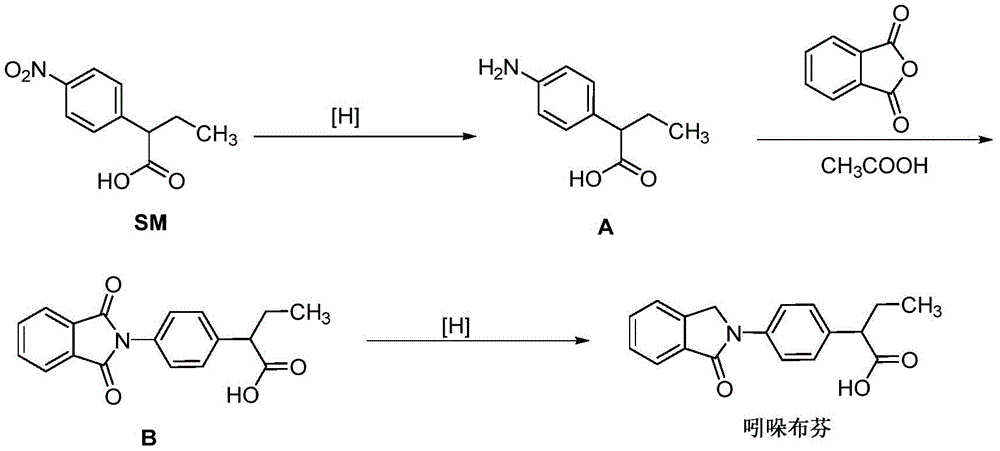
the process route takes 2- (4-nitrophenyl) butyric acid (SM) as a starting material, 2- (4-aminophenyl) butyric acid (compound A) is prepared through reduction reaction, and the 2- (4-aminophenyl) butyric acid is subjected to phthalic anhydride condensation protection and then reduced to obtain the indobufen. In this route, 2- (4-aminophenyl) butyric acid is a key intermediate in the indobufen process, and there are several different methods for preparing 2- (4-aminophenyl) butyric acid:
zheng Gengxiu et al (Zheng Gengxiu, wang Qiufen. Preparation of Indolibufen [ J ]. J.Chinese medical industry, 1991 (07): 291-293.) adopts Fe-HOAc system for reduction, which is a traditional method for reduction of nitro-compound, and has the disadvantages of low cost and easy availability of catalyst, large catalyst consumption, generation of a large amount of acidic byproducts and iron mud, complicated post-treatment and large environmental pollution.
The Chinese patent No. 106631974 discloses a method for preparing indobufen, which improves the existing route, adopts a catalytic hydrogenation method to prepare 2- (4-aminophenyl) butyric acid from 2- (4-nitrophenyl) butyric acid, replaces iron powder reduction, avoids the generation of a large amount of waste acid of iron mud, is more green and environment-friendly, but the catalytic hydrogenation process needs special reaction equipment and safety protection to meet the requirement of high-pressure hydrogenation gas.
Tian Xue (Tian Xue Synthesis of Indolibufen intermediate 2- (4-aminophenyl) butanoic acid [ J)]Guangdong chemical industry, 2018, 45 (3): 12-12.) with sodium hydrosulfite (Na) 2 S 2 O 4 ) 2- (4-aminophenyl) butyric acid is prepared as a reducing agent, which does not require special equipment and catalysts. However, the sodium hydrosulfite belongs to first-grade wet inflammable substances, the aqueous solution of the sodium hydrosulfite is unstable, has extremely strong reducibility, and belongs to a strong reducing agent. When the material is exposed in the air, oxygen is easily absorbed to oxidize, moisture is easily absorbed to generate heat to deteriorate, the material is strongly reacted and burnt when meeting water, and oxygen in the air can be abstracted to agglomerate and generate a stimulating sour taste. Strongpoint (Na) 2 S 2 O 4 ) The using amount of the reduced nitro compound is larger (3.0 eq), 80% ethanol is used as a solvent in the reaction, the slow feeding is needed, the air is isolated, the exothermic fire explosion is avoided, the system becomes viscous due to the fact that the sodium hydrosulfite is insoluble in the ethanol, the stirring is difficult, a large amount of salt-containing waste liquid is generated in the post-treatment, and the environmental protection cost is increased.
Chinese patent No. CN110229075a discloses a process for preparing indobufen intermediate, which uses hydrazine hydrate/iron oxyhydroxide/organic acid system to reduce 2- (4-nitrophenyl) butyric acid. According to the scheme, hydrazine hydrate is used as a hydrogen source, so that the use of hydrogen and pressurizing equipment is avoided, but purified water is required to be used as a solvent in the reaction, and a toxic reagent hydrazine hydrate is used as the hydrogen source, so that research and control of additional introduction of genotoxic impurities are required.
Therefore, the preparation conditions of the 2- (4-aminophenyl) butyric acid are optimized, and the preparation method of the 2- (4-aminophenyl) butyric acid with higher selectivity, environmental protection and safety is developed, which has important significance for the drug synthesis of indobufen.
Disclosure of Invention
Aiming at the problems existing in the prior art, the invention provides a preparation method of 2- (4-aminophenyl) butyric acid, which takes 2- (4-nitrophenyl) butyric acid as a reaction raw material, takes a formic acid sample as a hydrogen source, and uses a metal catalyst and a protonic solvent for reaction, wherein the prepared 2- (4-aminophenyl) butyric acid has high selectivity and high purity; the preparation method is simple in operation, green and efficient.
In order to achieve the above purpose, the technical scheme adopted by the invention is as follows:
in one aspect, the present invention provides a method for preparing 2- (4-aminophenyl) butyric acid, comprising the steps of:
(1) 2- (4-nitrophenyl) butyric acid, a proton solvent and a catalyst are stirred under the control of temperature;
(2) Adding formate, and controlling the temperature to react to obtain a reaction mixed solution;
(3) And (3) carrying out post-treatment on the reaction mixed solution to obtain the product 2- (4-aminophenyl) butyric acid.
Preferably, in step (1), the protic solvent is selected from at least one of water, methanol, ethanol, isopropanol.
Further preferably, the protic solvent is selected from at least one of water, methanol, ethanol, isopropanol.
Preferably, in step (1), the catalyst is a metal catalyst.
Further preferably, the catalyst is at least one selected from palladium carbon, platinum carbon, palladium hydroxide, iron catalyst, palladium chloride, rhodium chloride, palladium acetate, copper catalyst.
Still more preferably, the catalyst is at least one selected from palladium on carbon, platinum on carbon, palladium hydroxide, and iron hydroxide.
Preferably, in the step (1), the temperature-controlled stirring is specifically performed at a stirring temperature of 20-75 ℃ for 20-60min.
Further preferably, the temperature-controlled stirring is specifically performed at a stirring temperature of 20-30 ℃ for 30min.
Preferably, in the step (1), the solid-to-liquid ratio of the 2- (4-nitrophenyl) butyric acid to the protic solvent is 1:3-12.
Preferably, in the step (1), the molar equivalent ratio of the 2- (4-nitrophenyl) butyric acid to the catalyst is 1.0eq:0.001-0.3eq.
Further preferably, when the catalyst is a noble metal catalyst, the molar equivalent ratio of 2- (4-nitrophenyl) butyric acid to the catalyst is 1.0:0.005eq-0.02eq; when the catalyst is a common metal catalyst, the molar equivalent ratio of the 2- (4-nitrophenyl) butyric acid to the catalyst is 1.0eq:0.05-0.2eq.
Preferably, in step (2), the formate is at least one selected from sodium formate, ammonium formate and potassium formate.
Further preferably, the formate is at least one selected from sodium formate and ammonium formate.
Preferably, in step (2), the molar equivalent ratio of formate to 2- (4-nitrophenyl) butyric acid is 3.0-5.0eq:1.0eq.
Further preferably, the molar equivalent ratio of formate to 2- (4-nitrophenyl) butyric acid is 3.5-4.5eq:1eq.
Preferably, in step (2), the reaction is specifically: the reaction temperature is 20-75 ℃.
Further preferably, the reaction is specifically: the reaction temperature is 20-50 ℃.
Preferably, in the step (2), the reaction is stopped until the reaction is completed until the raw material 2- (4-nitrophenyl) butyric acid disappears; when TLC monitoring is employed, the TCL (thin layer chromatography) monitoring method is: HSGF254 type chromatographic silica gel plate, the developing system is chloroform-methanol (20:1, v/v), and the detection wavelength is 254nm.
Preferably, in step (3), the post-treatment specifically includes: filtering the reaction mixture with a titanium rod to remove the catalyst, diluting the filtrate with water, wherein the water addition amount is 1-3 times of 2- (4-nitrophenyl) butyric acid, and distilling to obtain a concentrated solution; mixing the concentrated solution with 2-4M hydrochloric acid at 10-20deg.C, adjusting pH of the mixed solution to 4-5, stirring, filtering, rinsing the solid with water, and drying at 40-50deg.C to obtain 2- (4-aminophenyl) butyric acid.
Further preferably, the pore diameter of the titanium rod is 0.4-0.5 μm.
In another aspect, the present invention provides the use of the above preparation method for the preparation of indobufen.
Compared with the prior art, the invention has the following beneficial effects:
the preparation method is simple to operate, toxic reagents are not used, special reaction equipment is not needed, the catalyst usage amount is small, the catalyst is recovered through fine filtration in the post-treatment, the recovered catalyst can be reused after being activated, the loss of noble metal impurities is greatly reduced, and meanwhile, the residue of the metal impurities in the product is also reduced. The method has the advantages of sufficient raw material conversion, higher quality of the obtained product, and the obtained 2- (4-aminophenyl) butyric acid can be used for preparing indobufen.
Detailed Description
The following non-limiting examples will enable those of ordinary skill in the art to more fully understand the invention and are not intended to limit the invention in any way. The following is merely exemplary of the scope of the claimed invention and one skilled in the art can make various changes and modifications to the invention of the present application in light of the disclosure, which should also fall within the scope of the claimed invention.
The invention is further illustrated by means of the following specific examples. The various chemical reagents used in the examples of the present invention were obtained by conventional commercial means unless otherwise specified. The contents are all mass contents hereinafter.
In the examples below, the reagents and catalysts are all conventional commercially available chemicals.
The purity detection method of the product 2- (4-aminophenyl) butyric acid comprises the following steps: high performance liquid chromatography;
the specific detection method comprises the following steps: an Shimadzu LC-2030C3 Dpuls high performance liquid chromatograph is adopted. The column recommended octadecylsilane chemically bonded silica gel as filler GL 250mm×4.6mm×5 μm column. The detection wavelength is 205nm. The mobile phase was mobile phase A with 0.015mol/L potassium dihydrogen phosphate solution (pH adjusted to 3.0 with phosphoric acid) -acetonitrile (95:5) and mobile phase B. The sample injection amount is 10 μl, the sample injection concentration is 0.5mg/ml, the column temperature is 35 ℃, and the sample injection volume is 10 μl.
The flow gradient was as follows:
| Time(min) | mobile phase a (%) | Mobile phase B (%) |
| 0 | 90 | 10 |
| 15 | 90 | 10 |
| 25 | 60 | 40 |
| 30 | 60 | 40 |
| 45 | 40 | 60 |
| 50 | 95 | 5 |
| 60 | 95 | 5 |
Example 1
150kg of drinking water is added into a 300L reaction kettle, stirring is started, 25.0kg of 2- (4-nitrophenyl) butyric acid and 1.3kg of 10% palladium carbon (dry basis) are sequentially added, after the addition, nitrogen is used for replacing air, nitrogen protection is adopted, and stirring is carried out for 0.5h at the temperature of 20-30 ℃. 26.0kg of ammonium formate is added into the reaction system in batches under stirring at the temperature of 20-30 ℃, after the addition is completed, the temperature control reaction is continued for 2 hours, sampling is carried out, 10 times of methanol is added for dilution, the diluted solution is monitored by adopting a TLC method, an HSGF254 type chromatographic silica gel plate is used, the developing system is chloroform-methanol (20:1, v/v), the wavelength is detected to be 254nm until the raw material 2- (4-nitrophenyl) butyric acid disappears, and the reaction is stopped. The catalyst was filtered off using a titanium rod (0.45 μm pore size), and the filtrate was diluted with 50kg of water to give a diluted solution. Adding 3M hydrochloric acid into the diluent liquid at the temperature of 10-20 ℃, regulating the pH value to be 4-5, stirring for crystallization, centrifugally filtering, adding 20kg of purified water for leaching, spin-drying, and drying the solid at the temperature of 45+/-2 ℃ to obtain 20.1kg of 2- (4-aminophenyl) butyric acid, wherein the yield is 93.8%, and the purity is 98.3%.
The product characterization data were: 1H NMR, (400 MHz, DMSO-d 6); δ11.87 (s, 1H), 6.70 (d, j=8.4 hz, 2H), 6.30 (d, j=8.4 hz, 2H), 4.76 (s, 2H), 2.96 (t, j=7.5 hz, 1H), 1.67 (m, 1H), 1.78 (m, 1H), 0.62 (t, j=7.2 hz, 3H); MS (ESI) (m/z) 202.1[ M+Na] + 。
Example 2
96kg of methanol is added into a 300L reaction kettle, stirring is started, 20.0kg of 2- (4-nitrophenyl) butyric acid and 1.3kg of 10% platinum carbon (dry basis) are sequentially added, after the addition, nitrogen is used for replacing air, nitrogen protection is adopted, and stirring is carried out for 0.5h at the temperature of 20-30 ℃. Adding 21.0kg of ammonium formate into the reaction system in batches under stirring at the temperature of 20-30 ℃, continuing to perform temperature control reaction for 2 hours after adding, sampling, adding 10 times of methanol for dilution, monitoring the diluted solution (TLC method), adopting an HSGF254 type chromatographic silica gel plate, developing a system of chloroform-methanol (20:1, v/v), detecting the wavelength of 254nm until the conversion of raw material 2- (4-nitrophenyl) butyric acid is finished, and stopping the reaction. The catalyst was filtered off using a titanium rod (0.45 μm pore size), and the filtrate was diluted with 50kg of water to give a diluted solution. Distilling and concentrating the diluted solution to obtain concentrated solution, and cooling the concentrated solution to 10-20 ℃. Adding 3M hydrochloric acid, regulating pH=4-5, stirring for crystallization, centrifugally filtering, adding 20kg of purified water for leaching, spin-drying, and drying the solid at 45+/-2 ℃ to obtain 15.5kg of 2- (4-aminophenyl) butyric acid, wherein the yield is 90.5% and the purity is 98.8%.
The product characterization data were: 1H NMR, (400 MHz, DMSO-d 6); δ11.85 (s, 1H), 6.71 (d, j=8.4 hz, 2H), 6.30 (d, j=8.4 hz, 2H), 4.76 (s, 2H), 2.95 (t, j=7.5 hz, 1H), 1.67 (m, 1H), 1.79 (m, 1H), 0.63 (t, j=7.2 hz, 3H).
Example 3
120kg of ethanol and 20.9kg of 2- (4-nitrophenyl) butyric acid and 1.6kg of ferric hydroxide are sequentially added into a 300L reaction kettle, after the addition, nitrogen is used for replacing air, nitrogen protection is adopted, and stirring is carried out for 0.5h at the temperature of 70-75 ℃. And (3) controlling the temperature to be 70-75 ℃, adding 25.0kg of ammonium formate into the reaction system in batches under stirring, continuing to perform temperature control reaction for 2 hours after the addition, sampling, adding 10 times of methanol for dilution, monitoring the diluted solution (TLC method), adopting an HSGF254 type chromatographic silica gel plate, developing a system of chloroform-methanol (20:1, v/v), detecting the wavelength to be 254nm until the conversion of the raw material 2- (4-nitrophenyl) butyric acid is finished, and stopping the reaction. The catalyst was filtered off using a titanium rod (0.45 μm pore size), and the filtrate was diluted with 50kg of water to give a diluted solution. Distilling and concentrating the diluted solution to obtain concentrated solution, and cooling the concentrated solution to 10-20 ℃. Adding 3M hydrochloric acid, regulating pH=4-5, stirring for crystallization, centrifugally filtering, adding 20kg of purified water for leaching, spin-drying, and drying the solid at 45+/-2 ℃ to obtain 15.8kg of 2- (4-aminophenyl) butyric acid, wherein the yield is 88.3% and the purity is 97.8%.
The product characterization data were: 1H NMR, (400 MHz, DMSO-d 6); δ11.88 (s, 1H), 6.72 (d, j=8.4 hz, 2H), 6.30 (d, j=8.4 hz, 2H), 4.76 (s, 2H), 2.96 (t, j=7.5 hz, 1H), 1.67 (m, 1H), 1.78 (m, 1H), 0.63 (t, j=7.2 hz, 3H).
Example 4
Adding 56kg of isopropanol into a 100L reaction kettle, starting stirring, sequentially adding 10.0kg of 2- (4-nitrophenyl) butyric acid and 0.13kg of palladium hydroxide, using nitrogen to replace air after adding, protecting the nitrogen, and stirring for 0.5h at the temperature of 40-45 ℃. Adding 12.0kg of ammonium formate into the reaction system in batches under stirring at the temperature of 40-45 ℃, continuing to perform temperature control reaction for 2 hours after adding, sampling, adding 10 times of methanol for dilution, monitoring the diluted solution (TLC method), adopting an HSGF254 type chromatographic silica gel plate, developing a system of chloroform-methanol (20:1, v/v), detecting the wavelength of 254nm until the conversion of raw material 2- (4-nitrophenyl) butyric acid is finished, and stopping the reaction. Filtering with titanium rod (0.45 μm aperture), filtering to remove catalyst, concentrating the filtrate by distillation, stirring the concentrated solution, cooling to 10-20deg.C, adding 3M hydrochloric acid, adjusting pH to 4-5, stirring for crystallization, centrifuging, adding purified water 10kg, leaching, drying, and drying the solid at 45+ -2deg.C to obtain 8.1kg of 2- (4-aminophenyl) butyric acid with 94.5% yield and 97.2% purity.
The product characterization data were: 1H NMR, (400 MHz, DMSO-d 6); δ11.87 (s, 1H), 6.72 (d, j=8.4 hz, 2H), 6.31 (d, j=8.4 hz, 2H), 4.76 (s, 2H), 2.96 (t, j=7.5 hz, 1H), 1.66 (m, 1H), 1.78 (m, 1H), 0.61 (t, j=7.2 hz, 3H).
Example 5
160kg of methanol and 25.0kg of 2- (4-nitrophenyl) butyric acid and 1.1kg of 10% palladium carbon (dry basis) are sequentially added into a 300L reaction kettle, after the addition, nitrogen is used for replacing air, nitrogen protection is adopted, and the temperature is controlled between 20 ℃ and 30 ℃ and stirring is carried out for 0.5h. Adding 28.5kg of sodium formate into the reaction system in batches under stirring at the temperature of 20-30 ℃, continuing to react for 2 hours under the condition of adding the sodium formate, sampling, adding 10 times of methanol for dilution, monitoring the diluted solution (TLC method), adopting an HSGF254 type chromatographic silica gel plate, developing a system of chloroform-methanol (20:1, v/v), detecting the wavelength of 254nm until the conversion of the raw material 2- (4-nitrophenyl) butyric acid is finished, and stopping the reaction. The catalyst was filtered off using a titanium rod (0.45 μm pore size), and the filtrate was diluted with 60kg of water to give a diluted solution. Distilling and concentrating the diluted solution to obtain concentrated solution, and cooling the concentrated solution to 10-20 ℃. Adding 3M hydrochloric acid, regulating pH=4-5, stirring for crystallization, centrifugally filtering, adding 25kg of purified water for leaching, spin-drying, and drying the solid at 45+/-2 ℃ to obtain 20.2kg of 2- (4-aminophenyl) butyric acid with the yield of 94.3% and the purity of 98.0%.
The product characterization data were: 1H NMR, (400 MHz, DMSO-d 6); δ11.86 (s, 1H), 6.70 (d, j=8.4 hz, 2H), 6.30 (d, j=8.4 hz, 2H), 4.76 (s, 2H), 2.96 (t, j=7.5 hz, 1H), 1.66 (m, 1H), 1.78 (m, 1H), 0.62 (t, j=7.2 hz, 3H).
Comparative example 1
In contrast to example 5, the catalyst used in this comparative example 1 was iron oxyhydroxide in an amount of 1.25kg of iron oxyhydroxide (on a dry basis).
The remaining steps and parameters are the same. 16.8kg of 2- (4-aminophenyl) butyric acid is obtained as a product, with a yield of 78.4% and a purity of 96.8%.
Comparative example 2
Unlike example 4, the reaction temperature of this comparative example 2 was controlled to 82 ℃.
The remaining steps and parameters are the same. 7.8kg of 2- (4-aminophenyl) butyric acid as a product was obtained in a yield of 91.0% and a purity of 93.5%.
Comparative example 3
Unlike example 5, the sodium formate used in this comparative example 3 was replaced with hydrazine hydrate in an amount of 18.0kg.
The remaining steps and parameters are the same. 18.4kg of 2- (4-aminophenyl) butyric acid is obtained as a product with a yield of 85.9% and a purity of 78.3%.
Comparative example 4
Unlike example 5, the protic solvent used in this comparative example 4 was ethylene glycol.
The remaining steps and parameters are the same. 17.3kg of 2- (4-aminophenyl) butyric acid as a product was obtained in a yield of 80.8% and a purity of 92.4%.
Finally, it should be noted that the above description is only for illustrating the technical solution of the present invention, and not for limiting the scope of the present invention, and that the simple modification and equivalent substitution of the technical solution of the present invention can be made by those skilled in the art without departing from the spirit and scope of the technical solution of the present invention.
Claims (10)
1. A method for preparing 2- (4-aminophenyl) butyric acid, comprising the steps of:
(1) 2- (4-nitrophenyl) butyric acid, a proton solvent and a catalyst are stirred under the control of temperature;
(2) Adding formate, and controlling the temperature to react to obtain a reaction mixed solution;
(3) And (3) carrying out post-treatment on the reaction mixed solution to obtain the product 2- (4-aminophenyl) butyric acid.
2. The method according to claim 1, wherein in the step (1), the protic solvent is at least one selected from the group consisting of water, methanol, ethanol, and isopropanol.
3. The method according to claim 1, wherein in the step (1), the catalyst is a metal catalyst selected from at least one of palladium on carbon, platinum on carbon, palladium hydroxide, iron catalyst, palladium chloride, rhodium chloride, palladium acetate, and copper catalyst.
4. The method according to claim 1, wherein in the step (1), the stirring at the controlled temperature is specifically performed at a temperature of 20-75 ℃ for a time of 20-60min.
5. The method according to claim 1, wherein in the step (1), the solid-to-liquid ratio of the 2- (4-nitrophenyl) butyric acid to the protic solvent is 1:3-12; the molar equivalent ratio of the 2- (4-nitrophenyl) butyric acid to the catalyst is 1.0eq:0.001-0.3eq.
6. The method according to claim 5, wherein when the catalyst is a noble metal catalyst, the molar equivalent ratio of 2- (4-nitrophenyl) butyric acid to the catalyst is 1.0:0.005eq-0.02eq; when the catalyst is a common metal catalyst, the molar equivalent ratio of the 2- (4-nitrophenyl) butyric acid to the catalyst is 1.0:0.05eq-0.2eq.
7. The method according to claim 1, wherein in the step (2), the formate is at least one selected from the group consisting of sodium formate, ammonium formate, and potassium formate; the molar equivalent ratio of formate to 2- (4-nitrophenyl) butyric acid is 3.0-5.0eq to 1.0eq.
8. The method according to claim 1, wherein in step (2), the reaction is specifically: the reaction temperature is 20-75 ℃.
9. The method according to claim 1, wherein in step (3), the post-treatment is specifically: filtering the reaction mixture with a titanium rod to remove the catalyst, diluting the filtrate with water, wherein the water addition amount is 1-3 times of 2- (4-nitrophenyl) butyric acid, and distilling to obtain a concentrated solution; mixing the concentrated solution with 2-4M hydrochloric acid at 10-20deg.C, adjusting pH of the mixed solution to 4-5, stirring, filtering, rinsing the solid with water, and drying at 40-50deg.C to obtain 2- (4-aminophenyl) butyric acid; the pore diameter of the titanium rod is 0.4-0.5 mu m.
10. Use of the preparation process according to any one of claims 1-9 in a process for the preparation of indobufen.
Priority Applications (1)
| Application Number | Priority Date | Filing Date | Title |
|---|---|---|---|
| CN202211270548.9A CN116143643A (en) | 2022-10-18 | 2022-10-18 | Preparation method of 2- (4-aminophenyl) butyric acid |
Applications Claiming Priority (1)
| Application Number | Priority Date | Filing Date | Title |
|---|---|---|---|
| CN202211270548.9A CN116143643A (en) | 2022-10-18 | 2022-10-18 | Preparation method of 2- (4-aminophenyl) butyric acid |
Publications (1)
| Publication Number | Publication Date |
|---|---|
| CN116143643A true CN116143643A (en) | 2023-05-23 |
Family
ID=86337909
Family Applications (1)
| Application Number | Title | Priority Date | Filing Date |
|---|---|---|---|
| CN202211270548.9A Pending CN116143643A (en) | 2022-10-18 | 2022-10-18 | Preparation method of 2- (4-aminophenyl) butyric acid |
Country Status (1)
| Country | Link |
|---|---|
| CN (1) | CN116143643A (en) |
Cited By (1)
| Publication number | Priority date | Publication date | Assignee | Title |
|---|---|---|---|---|
| CN117263842A (en) * | 2023-09-01 | 2023-12-22 | 浙江工业大学 | Preparation method of indobufen |
-
2022
- 2022-10-18 CN CN202211270548.9A patent/CN116143643A/en active Pending
Cited By (1)
| Publication number | Priority date | Publication date | Assignee | Title |
|---|---|---|---|---|
| CN117263842A (en) * | 2023-09-01 | 2023-12-22 | 浙江工业大学 | Preparation method of indobufen |
Similar Documents
| Publication | Publication Date | Title |
|---|---|---|
| JP7368636B2 (en) | Method for synthesizing roxadustat and its intermediates and intermediates thereof | |
| CN111349049A (en) | Favipiravir and synthesis process of intermediate thereof | |
| CN116143643A (en) | Preparation method of 2- (4-aminophenyl) butyric acid | |
| CN108358760B (en) | Application of metal compound/palladium compound catalytic reduction system in debenzylation reaction and deuteration reaction | |
| CN111533663B (en) | Method for synthesizing mesalazine | |
| CN104892426B (en) | A kind of method using pyrrolidinone compounds ionic liquid as the nitroanthraquinone of catalyst preparation 1 | |
| CN114736157A (en) | Preparation method of rosxastat, and pharmaceutical composition and application thereof | |
| JP2904038B2 (en) | Process for producing 4,6-diaminoresorcinol and its precursor | |
| CN109678741B (en) | Preparation method of 4-amino-3-fluorobenzoic acid | |
| CN107880004B (en) | Preparation method of 5-phenoxyphthalide | |
| WO2017014214A1 (en) | Method for producing 4-(trifluoromethylsulfonyl)phenol compound | |
| CN116947746A (en) | Preparation method of sodium picosulfate | |
| CN113412255B (en) | Process for preparing 4-amino-5-methylpyridinone | |
| CN113683499A (en) | Method for preparing Duvirucisib intermediate | |
| CN115124452A (en) | Preparation method of 2- (4-amino-2-ethoxyphenyl) isoindole-1, 3-dione | |
| CN113999098A (en) | Method for synthesizing 2,3, 5-trimethylbenzoquinone | |
| CN115611860A (en) | Method for synthesizing nilapanib | |
| CN117342987B (en) | A method for preparing bumetanide | |
| JPH06336464A (en) | Preparation of nitrophenol | |
| CN111116378A (en) | Method for synthesizing 1, 8-diaminonaphthalene by selective reduction of 1, 8-dinitronaphthalene | |
| WO2021109099A1 (en) | Method for preparing isosorbide 5-mononitrate by using micro-channel continuous flow reactor | |
| CN109369357B (en) | A kind of method for preparing symmetrical diaryl ketone by catalytic oxidative carbonylation | |
| CN121085289A (en) | A method for preparing sodium nitroprusside raw material | |
| CN107915570B (en) | Preparation method of 4-bromo-1-methyl-2- (trifluoromethyl) benzene | |
| CN118047701A (en) | Preparation method of apremilast intermediate |
Legal Events
| Date | Code | Title | Description |
|---|---|---|---|
| PB01 | Publication | ||
| PB01 | Publication |