CN116113696A - Gene editing to improve joint function - Google Patents
Gene editing to improve joint function Download PDFInfo
- Publication number
- CN116113696A CN116113696A CN202180054064.8A CN202180054064A CN116113696A CN 116113696 A CN116113696 A CN 116113696A CN 202180054064 A CN202180054064 A CN 202180054064A CN 116113696 A CN116113696 A CN 116113696A
- Authority
- CN
- China
- Prior art keywords
- gene
- exon
- guide rna
- sequence
- seq
- Prior art date
- Legal status (The legal status is an assumption and is not a legal conclusion. Google has not performed a legal analysis and makes no representation as to the accuracy of the status listed.)
- Pending
Links
Images


Classifications
-
- C—CHEMISTRY; METALLURGY
- C12—BIOCHEMISTRY; BEER; SPIRITS; WINE; VINEGAR; MICROBIOLOGY; ENZYMOLOGY; MUTATION OR GENETIC ENGINEERING
- C12N—MICROORGANISMS OR ENZYMES; COMPOSITIONS THEREOF; PROPAGATING, PRESERVING, OR MAINTAINING MICROORGANISMS; MUTATION OR GENETIC ENGINEERING; CULTURE MEDIA
- C12N15/00—Mutation or genetic engineering; DNA or RNA concerning genetic engineering, vectors, e.g. plasmids, or their isolation, preparation or purification; Use of hosts therefor
- C12N15/09—Recombinant DNA-technology
- C12N15/87—Introduction of foreign genetic material using processes not otherwise provided for, e.g. co-transformation
- C12N15/90—Stable introduction of foreign DNA into chromosome
- C12N15/902—Stable introduction of foreign DNA into chromosome using homologous recombination
- C12N15/907—Stable introduction of foreign DNA into chromosome using homologous recombination in mammalian cells
-
- C—CHEMISTRY; METALLURGY
- C12—BIOCHEMISTRY; BEER; SPIRITS; WINE; VINEGAR; MICROBIOLOGY; ENZYMOLOGY; MUTATION OR GENETIC ENGINEERING
- C12N—MICROORGANISMS OR ENZYMES; COMPOSITIONS THEREOF; PROPAGATING, PRESERVING, OR MAINTAINING MICROORGANISMS; MUTATION OR GENETIC ENGINEERING; CULTURE MEDIA
- C12N15/00—Mutation or genetic engineering; DNA or RNA concerning genetic engineering, vectors, e.g. plasmids, or their isolation, preparation or purification; Use of hosts therefor
- C12N15/09—Recombinant DNA-technology
- C12N15/11—DNA or RNA fragments; Modified forms thereof; Non-coding nucleic acids having a biological activity
- C12N15/113—Non-coding nucleic acids modulating the expression of genes, e.g. antisense oligonucleotides; Antisense DNA or RNA; Triplex- forming oligonucleotides; Catalytic nucleic acids, e.g. ribozymes; Nucleic acids used in co-suppression or gene silencing
- C12N15/1136—Non-coding nucleic acids modulating the expression of genes, e.g. antisense oligonucleotides; Antisense DNA or RNA; Triplex- forming oligonucleotides; Catalytic nucleic acids, e.g. ribozymes; Nucleic acids used in co-suppression or gene silencing against growth factors, growth regulators, cytokines, lymphokines or hormones
-
- C—CHEMISTRY; METALLURGY
- C12—BIOCHEMISTRY; BEER; SPIRITS; WINE; VINEGAR; MICROBIOLOGY; ENZYMOLOGY; MUTATION OR GENETIC ENGINEERING
- C12N—MICROORGANISMS OR ENZYMES; COMPOSITIONS THEREOF; PROPAGATING, PRESERVING, OR MAINTAINING MICROORGANISMS; MUTATION OR GENETIC ENGINEERING; CULTURE MEDIA
- C12N15/00—Mutation or genetic engineering; DNA or RNA concerning genetic engineering, vectors, e.g. plasmids, or their isolation, preparation or purification; Use of hosts therefor
- C12N15/09—Recombinant DNA-technology
- C12N15/11—DNA or RNA fragments; Modified forms thereof; Non-coding nucleic acids having a biological activity
-
- C—CHEMISTRY; METALLURGY
- C12—BIOCHEMISTRY; BEER; SPIRITS; WINE; VINEGAR; MICROBIOLOGY; ENZYMOLOGY; MUTATION OR GENETIC ENGINEERING
- C12N—MICROORGANISMS OR ENZYMES; COMPOSITIONS THEREOF; PROPAGATING, PRESERVING, OR MAINTAINING MICROORGANISMS; MUTATION OR GENETIC ENGINEERING; CULTURE MEDIA
- C12N15/00—Mutation or genetic engineering; DNA or RNA concerning genetic engineering, vectors, e.g. plasmids, or their isolation, preparation or purification; Use of hosts therefor
- C12N15/09—Recombinant DNA-technology
- C12N15/63—Introduction of foreign genetic material using vectors; Vectors; Use of hosts therefor; Regulation of expression
- C12N15/79—Vectors or expression systems specially adapted for eukaryotic hosts
- C12N15/85—Vectors or expression systems specially adapted for eukaryotic hosts for animal cells
- C12N15/86—Viral vectors
-
- C—CHEMISTRY; METALLURGY
- C12—BIOCHEMISTRY; BEER; SPIRITS; WINE; VINEGAR; MICROBIOLOGY; ENZYMOLOGY; MUTATION OR GENETIC ENGINEERING
- C12N—MICROORGANISMS OR ENZYMES; COMPOSITIONS THEREOF; PROPAGATING, PRESERVING, OR MAINTAINING MICROORGANISMS; MUTATION OR GENETIC ENGINEERING; CULTURE MEDIA
- C12N9/00—Enzymes; Proenzymes; Compositions thereof; Processes for preparing, activating, inhibiting, separating or purifying enzymes
- C12N9/14—Hydrolases (3)
- C12N9/16—Hydrolases (3) acting on ester bonds (3.1)
- C12N9/22—Ribonucleases [RNase]; Deoxyribonucleases [DNase]
-
- C—CHEMISTRY; METALLURGY
- C12—BIOCHEMISTRY; BEER; SPIRITS; WINE; VINEGAR; MICROBIOLOGY; ENZYMOLOGY; MUTATION OR GENETIC ENGINEERING
- C12N—MICROORGANISMS OR ENZYMES; COMPOSITIONS THEREOF; PROPAGATING, PRESERVING, OR MAINTAINING MICROORGANISMS; MUTATION OR GENETIC ENGINEERING; CULTURE MEDIA
- C12N2310/00—Structure or type of the nucleic acid
- C12N2310/10—Type of nucleic acid
- C12N2310/20—Type of nucleic acid involving clustered regularly interspaced short palindromic repeats [CRISPR]
-
- C—CHEMISTRY; METALLURGY
- C12—BIOCHEMISTRY; BEER; SPIRITS; WINE; VINEGAR; MICROBIOLOGY; ENZYMOLOGY; MUTATION OR GENETIC ENGINEERING
- C12N—MICROORGANISMS OR ENZYMES; COMPOSITIONS THEREOF; PROPAGATING, PRESERVING, OR MAINTAINING MICROORGANISMS; MUTATION OR GENETIC ENGINEERING; CULTURE MEDIA
- C12N2750/00—MICROORGANISMS OR ENZYMES; COMPOSITIONS THEREOF; PROPAGATING, PRESERVING, OR MAINTAINING MICROORGANISMS; MUTATION OR GENETIC ENGINEERING; CULTURE MEDIA ssDNA viruses
- C12N2750/00011—Details
- C12N2750/14011—Parvoviridae
- C12N2750/14111—Dependovirus, e.g. adenoassociated viruses
- C12N2750/14141—Use of virus, viral particle or viral elements as a vector
- C12N2750/14143—Use of virus, viral particle or viral elements as a vector viral genome or elements thereof as genetic vector
-
- C—CHEMISTRY; METALLURGY
- C12—BIOCHEMISTRY; BEER; SPIRITS; WINE; VINEGAR; MICROBIOLOGY; ENZYMOLOGY; MUTATION OR GENETIC ENGINEERING
- C12N—MICROORGANISMS OR ENZYMES; COMPOSITIONS THEREOF; PROPAGATING, PRESERVING, OR MAINTAINING MICROORGANISMS; MUTATION OR GENETIC ENGINEERING; CULTURE MEDIA
- C12N2750/00—MICROORGANISMS OR ENZYMES; COMPOSITIONS THEREOF; PROPAGATING, PRESERVING, OR MAINTAINING MICROORGANISMS; MUTATION OR GENETIC ENGINEERING; CULTURE MEDIA ssDNA viruses
- C12N2750/00011—Details
- C12N2750/14011—Parvoviridae
- C12N2750/14111—Dependovirus, e.g. adenoassociated viruses
- C12N2750/14141—Use of virus, viral particle or viral elements as a vector
- C12N2750/14145—Special targeting system for viral vectors
-
- C—CHEMISTRY; METALLURGY
- C12—BIOCHEMISTRY; BEER; SPIRITS; WINE; VINEGAR; MICROBIOLOGY; ENZYMOLOGY; MUTATION OR GENETIC ENGINEERING
- C12N—MICROORGANISMS OR ENZYMES; COMPOSITIONS THEREOF; PROPAGATING, PRESERVING, OR MAINTAINING MICROORGANISMS; MUTATION OR GENETIC ENGINEERING; CULTURE MEDIA
- C12N2750/00—MICROORGANISMS OR ENZYMES; COMPOSITIONS THEREOF; PROPAGATING, PRESERVING, OR MAINTAINING MICROORGANISMS; MUTATION OR GENETIC ENGINEERING; CULTURE MEDIA ssDNA viruses
- C12N2750/00011—Details
- C12N2750/14011—Parvoviridae
- C12N2750/14111—Dependovirus, e.g. adenoassociated viruses
- C12N2750/14171—Demonstrated in vivo effect
-
- C—CHEMISTRY; METALLURGY
- C12—BIOCHEMISTRY; BEER; SPIRITS; WINE; VINEGAR; MICROBIOLOGY; ENZYMOLOGY; MUTATION OR GENETIC ENGINEERING
- C12N—MICROORGANISMS OR ENZYMES; COMPOSITIONS THEREOF; PROPAGATING, PRESERVING, OR MAINTAINING MICROORGANISMS; MUTATION OR GENETIC ENGINEERING; CULTURE MEDIA
- C12N2800/00—Nucleic acids vectors
- C12N2800/80—Vectors containing sites for inducing double-stranded breaks, e.g. meganuclease restriction sites
Landscapes
- Health & Medical Sciences (AREA)
- Life Sciences & Earth Sciences (AREA)
- Genetics & Genomics (AREA)
- Engineering & Computer Science (AREA)
- Biomedical Technology (AREA)
- Chemical & Material Sciences (AREA)
- Bioinformatics & Cheminformatics (AREA)
- Organic Chemistry (AREA)
- Zoology (AREA)
- Wood Science & Technology (AREA)
- Molecular Biology (AREA)
- Biotechnology (AREA)
- General Engineering & Computer Science (AREA)
- General Health & Medical Sciences (AREA)
- Biochemistry (AREA)
- Microbiology (AREA)
- Biophysics (AREA)
- Physics & Mathematics (AREA)
- Plant Pathology (AREA)
- Endocrinology (AREA)
- Medicinal Chemistry (AREA)
- Virology (AREA)
- Cell Biology (AREA)
- Mycology (AREA)
- Medicines That Contain Protein Lipid Enzymes And Other Medicines (AREA)
- Pharmaceuticals Containing Other Organic And Inorganic Compounds (AREA)
- Medicines Containing Material From Animals Or Micro-Organisms (AREA)
- Animal Behavior & Ethology (AREA)
- Veterinary Medicine (AREA)
- Pharmacology & Pharmacy (AREA)
- Public Health (AREA)
- Micro-Organisms Or Cultivation Processes Thereof (AREA)
- Epidemiology (AREA)
- Peptides Or Proteins (AREA)
- Immunology (AREA)
- Orthopedic Medicine & Surgery (AREA)
- Rheumatology (AREA)
- Physical Education & Sports Medicine (AREA)
- Chemical Kinetics & Catalysis (AREA)
- General Chemical & Material Sciences (AREA)
Abstract
The present disclosure provides compositions and methods for treating joint disorders characterized by an inflammatory component. In some aspects, the compositions and methods are useful for preventing the progression of osteoarthritis and other arthritic conditions in a mammalian joint, and for treating osteoarthritis and other arthritic conditions.
Description
Cross reference to related applications
The present application claims priority from U.S. provisional patent application No. 63/052,881 filed on 7-month 16 in 2020 and U.S. provisional patent application No. 63/055,808 filed on 7-month 23 in 2020, the contents of which are hereby incorporated by reference in their entireties for all purposes.
Technical Field
Described herein are compositions and methods for treating synovial joint dysfunction. Further, disclosed herein are methods for gene editing of synovial cells (synovial cells) and/or synovial cells (synoviocites), chondrocytes, synovial macrophages and synovial fibroblasts, and the use of gene editing of synovial cells, chondrocytes, synovial macrophages and synovial fibroblasts in the treatment of diseases such as osteoarthritis.
Background
Treatment of osteoarthritis, degenerative joint disease and other joint dysfunction is complex and there is little long-term option for symptomatic relief or restoration of joint function. Osteoarthritis (OA) is a major cause of disability due to pain. Neogi, osteoarthritis cartilage disease (Osteoarthritis Cartilage), 2013;21:1145-53. All mammalian species are affected: animals used in service, domestic animals and their owners experience OA-related discomfort, pain and disability, depending on the extent of disease progression.
OA is a complex disease characterized by a progressive disability process. Systemic inflammation is associated with OA and OA disease progression. Inflammation is driven by an increase in the levels of pro-inflammatory cytokines. There is an urgent need for new methods and compositions for treating such diseases. Disclosed herein are compositions and methods useful for treating OA and other inflammatory joint disorders.
Disclosure of Invention
The present disclosure provides compositions and methods for treating joint disorders characterized by an inflammatory component. In some aspects, the compositions and methods are useful for preventing the progression of osteoarthritis and other arthritic conditions in a mammalian joint, and for treating osteoarthritis and other arthritic conditions. According to an exemplary embodiment, at least a portion of the articular synovial cells and/or synovial cells, chondrocytes, synovial macrophages or synovial fibroblasts are genetically edited to reduce the expression of inflammatory cytokines. In some aspects, at least a portion of the articular synovial cells and/or synovial cells, chondrocytes, synovial macrophages, or synovial fibroblasts are genetically edited to reduce expression of IL-1α, IL-1β, or both IL-1α and IL-1β.
In some embodiments, gene editing causes expression of one or more cytokine and/or growth factor genes to be silenced or reduced in at least a portion of a cell comprising a mammalian joint. In some aspects, the cell is a synovial cell (synovial cell). In some aspects, the cell is a synovial fibroblast. In some aspects, the cell is a synovial cell (synoviocite). In some aspects, the cell is a chondrocyte. In some aspects, the cell is a synovial macrophage.
In some embodiments, one or more cytokine and/or growth factor genes are selected from the group consisting of IL-1a and IL-1 Bb.
In some embodiments, gene editing includes the use of programmable nucleases that mediate the generation of double-or single-stranded breaks at the one or more cytokine and/or growth factor genes.
In some embodiments, the gene editing comprises one or more methods selected from the group consisting of CRISPR methods, TALE methods, zinc finger methods, and combinations thereof.
In some embodiments, the gene editing comprises a CRISPR method.
In some embodiments, the CRISPR method is a CRISPR-Cas9 method.
In some embodiments, the gene editing comprises a TALE method.
In some embodiments, the gene editing comprises a zinc finger method.
In some embodiments, gene editing causes expression of one or more cytokine and/or growth factor genes to be silenced or reduced in at least a portion of a cell comprising a joint. In some embodiments, the edited cell portion is a synovial cell. In one aspect, the edited cellular portion is synovial fibroblasts. In some embodiments, the edited cell portion is a synovial cell. In some embodiments, the edited cellular portion is a chondrocyte. In some embodiments, the edited cellular portion is synovial macrophages.
In some embodiments, an adeno-associated virus (AAV) delivery system is used to deliver a gene editing system. In some embodiments, the AAV delivery system is injected into the joint.
Some aspects of the present disclosure provide pharmaceutical compositions for treating or preventing joint diseases or disorders comprising a gene editing system and a pharmaceutically acceptable carrier. In one aspect, the gene editing system comprises one or more nucleic acids targeting one or more gene loci selected from the group consisting of IL-1α, IL-1β, TNF- α, IL-6, IL-8, and IL-18.
One embodiment provides a method of treating canine lameness comprising administering a gene editing composition, wherein the composition silences or reduces expression of IL-1 a and IL-1 β in a portion of synovial cells, chondrocytes, synovial macrophages or synovial fibroblasts of a lameness joint.
In some embodiments, the methods described above further comprise one or more features recited in any one of the methods and compositions described herein.
Drawings
The disclosed embodiments of the present invention will be further explained with reference to the accompanying drawings. The drawings are not necessarily to scale, emphasis instead generally being placed upon illustrating the principles of the disclosed embodiments.
FIG. 1A shows agarose gel electrophoresis analysis of 100ng mouse DNA (gBlocks, integrated DNATechnologies) designed for the mouse Il1A and Il1b genes, which was digested in vitro with 0.5 μg SpyCas9 (Truecut TM Cas9 protein v2, thermoFisher Scientific) and 200ng phosphorothioate modified single stranded guide (sg) RNA cleavage targeted against Il1a gene (# 43-46) and Il1b gene (# 47-50).
FIG. 1B shows agarose gel electrophoresis analysis of 100ng mouse DNA (gBlocks, integrated DNATechnologies) designed for the calfskin IL1a and IL1B genes, which was purified by 0.5. Mu.g SauCas9 (GeneSnipper TM Cas9, bioVision) and 200ng phosphorothioate modified guide sgRNAs cleavage against Il1a (# 51-53) and Il1b (# 54-56) genes.
FIGS. 2A, 2B, 2C, and 2D collectively show graphs showing editing efficiency of SpyCas9 and SauCas9 for use with a range of guide RNAs in J774.2 ("J") and NIH3T3 ("N") cells; fig. 2A: in vivo cleavage of Il1a edited with 4 x sgRNAs (Spy Cas 9) in two separate pools (pool 1 and pool 2) between two cell lines NIH3T3 ("N") and J774.2 ("J"); fig. 2B: in vivo cleavage of Il1b edited with 4 x sgRNAs (Spy Cas 9) in two separate pools (pools 1 and 2) between two cell lines NIH3T3 ("N") and J774.2 ("J"); fig. 2C: in vivo cleavage of Il1a edited with 3 x sgRNAs (Sau Cas 9) in two separate pools (pools 1 and 2) between two cell lines NIH3T3 ("N") and J774.2 ("J"); fig. 2D: in vivo cleavage of Il1b edited with 3 x sgRNAs (saCas 9) in two separate pools (pool 1 and pool 2) between two cell lines NIH3T3 ("N") and J774.2 ("J"); the determined editing efficiency was deconvolved using the sanger sequencing trace (ICE tool, synthesis) for each pool.
FIG. 3 shows GFP expression measured using the IVIS system. The flux value is based on the region of interest centered on the knee joint where the animal is injected. Data are presented as an average (SD) of four samples per group.
Fig. 4 shows a design of a study as described in example 5 of the present disclosure.
Fig. 5 shows intra-lifetime results measurements obtained in a study as described in example 5 of the present disclosure.
Figure 6 shows changes in body weight of mice treated with intra-articular (IA) injection of PBS, AAV-6 with disordered vectors, AAV-6 with CRISPR-Cas guides 1 and 2, AAV-5 with disordered vectors, or AAV-5 with CRISPR-Cas guides 1 and 2 in a study as described in example 5 of the present disclosure.
Figures 7A and 7B collectively show the mean difference in ankle caliper measurements from AUC in mice treated with (a) knee caliper measurements versus baseline of mouse joints over time, and (B) intra-articular (IA) injection of PBS, AAV-6 with disordered vectors, AAV-6 with CRISPR-Cas guides 1 and 2, AAV-5 with disordered vectors, or AAV-5 with CRISPR-Cas guides 1 and 2 in a study as described in example 5 of the present disclosure.
Figures 8A and 8B collectively show the change in (a) von Frey measurements obtained from mice treated with intra-articular (IA) injection of PBS, AAV-6 with disordered vectors, AAV-6 with CRISPR-Cas guides 1 and 2, AAV-5 with disordered vectors, or AAV-5 with CRISPR-Cas guides 1 and 2, and (B) the average absolute threshold of von Frey measurements in a study as described in example 5 of the present disclosure.
Figure 9 shows the results of qPCR assays of IL-1β expression in synovial fluid obtained from intra-articular (IA) injection of PBS, AAV-6 with disordered vectors, AAV-6 with CRISPR-Cas guides 1 and 2, AAV-5 with disordered vectors, or AAV-5 treated mice with CRISPR-Cas guides 1 and 2 in a study as described in example 5 of the present disclosure.
Figures 10A, 10B, 10C and 10D collectively show immunohistochemistry of murine IL-1 β in MSU injected animals pretreated with PBS (A, B) and in synovial tissue treated with CRISPR (C, D). Fig. 10B and 10D show isotype controls for each of fig. 10A and 10C, respectively.
FIGS. 11A, 11B and 11C collectively show the alignment between the IL-1. Alpha. Genes in mice, humans, equines, felines and canines.
FIGS. 12A, 12B, 12C and 12D collectively show the alignment between the IL-1β genes in mice, humans, equines, felines and canines.
Figures 13A, 13B, 13C and 13D collectively illustrate exemplary CRISPR/Cas9 crRNA sequences designed for editing a human IL-1 alpha gene.
Figures 14A, 14B, 14C, 14D and 14E collectively illustrate exemplary CRISPR/Cas9 crRNA sequences designed for editing a human IL-1 β gene.
Figures 15A, 15B and 15C collectively show an exemplary CRISPR/Cas9 crRNA sequence designed for editing a canine IL-1 alpha gene.
Fig. 16A and 16B collectively illustrate exemplary CRISPR/Cas9 crRNA sequences designed for editing canine IL-1 β genes.
FIGS. 17A, 17B, 17C and 17D collectively show the results of cell-based and computer gene editing analysis of crRNA sequences targeting the human IL-1α gene (FIG. 7A), the human IL-1β gene (FIG. 7B), the canine IL-1α gene (FIG. 7C) and the canine IL-1β gene (FIG. 7D), as described in example 8. o Amino Acid (AA) translational framework. * Optimization scores from Doench, fusi et al (2016). The score was optimized for 20bp primers with NGG. The scoring range is 0 to 100. Higher is better. * Specificity scores were from Hsu et al (2013). The scoring range is 0 to 100. Higher is better. * The score was based on experiments in U2 OS. High-precision scoring>0.4 Meaning that the DNA repair results are consistent and only a few unique genotypes are enriched. * The score was based on experiments in U2 OS. Higher%>80%) of the frameshift frequency will tend to knock the protein-encoding gene out of frame. Typical genome frameshift frequencies are higher than 66% because 1-bp insertions and 1-2bp deletions are particularly common repair results. Composite score = (off-target score + precision score × 100+ frameshift)/3.  The pipeline symbol '|' represents a CRISPR cleavage site. Brackets '{ }' indicate insertions. Hyphens '-' indicate deletions. Potential off-target sites. Scoring was according to Hsu et al (2013). The mid-target (on-target) site has a score of 100.
Figures 18A, 18B, 18C and 18D collectively show the release of canine IL-1α (figures 18A and 18B) and canine IL-1β from unedited (control) and bis-IL-1α/IL-1βko (edited) canine chondrocytes (figures 18C and 18D) at 6 hours (figures 18A and 18C) and 24 hours (figures 18B and 18D) after exposure to PBS or LPS, as described in example 9.
Figures 19A, 19B, 19C and 19D collectively show release of human IL-1α (figures 19A and 19B) and canine IL-1β (figures 19C and 19D) from unedited (control) and dual IL-1α/IL-1βko (edited) canine chondrocytes 6 hours (figures 19A and 19C) and 24 hours (figures 19B and 19D) after exposure to PBS or LPS, as described in example 9.
While the above-identified drawing figures set forth embodiments of the disclosed invention, other embodiments are also contemplated, as noted in the discussion. The present disclosure presents illustrative embodiments by way of representation and not limitation. Numerous other modifications and embodiments can be devised by those skilled in the art which fall within the scope and spirit of the principles of the disclosed embodiments.
Detailed Description
As described herein, embodiments of the present disclosure provide compositions and methods for improving joint function and treating joint diseases. In particular embodiments, compositions and methods are provided for gene editing of synovial fibroblasts, synovial cells, chondrocytes, or synovial macrophages to reduce the expression of inflammatory cytokines, such as IL-1α, IL-1β, TNF- α, IL-6, IL-8, IL-18, one or more Matrix Metalloproteinases (MMPs), or one or more components of NLRP3 inflammatory minisomes. The examples are useful for treating osteoarthritis and other inflammatory joint diseases. Embodiments are further useful for treating canine lameness caused by osteoarthritis. Embodiments are further useful for treating equidae lameness caused by joint disease. Embodiments are further useful for treating post-traumatic arthritis, gout, pseudogout, and other inflammatory or immune-mediated joint diseases.
Definition of the definition
Unless defined otherwise, all technical and scientific terms used herein have the same meaning as commonly understood by one of ordinary skill in the art to which this disclosure belongs. All patents and publications mentioned herein are incorporated by reference in their entirety.
The term "in vivo" refers to an event that occurs within the body of a subject.
The term "in vitro" refers to an event that occurs outside the body of a subject. In vitro assays encompass cell-based assays in which living or dead cells are used, and cell-free assays in which whole cells are not used may also be encompassed.
The term "ex vivo" refers to an event involving treatment of or performing a procedure on a cell, tissue and/or organ that has been removed from the body of a subject. Suitably, the cells, tissues and/or organs may be returned to the subject's body by surgical or therapeutic methods.
The term "IL-1" (also referred to herein as "IL 1") refers to a pro-inflammatory cytokine known as interleukin-1, and encompasses all forms of IL-1, including IL-1-alpha and IL-1 beta, human and mammalian forms, conservative amino acid substitutions, glycoforms, biomimetics, and variants thereof. IL-1α and IL-1β bind to the same receptor molecule, which is known as the type I IL-1 receptor (IL-1 RI). The presence of a third ligand for the receptor: an interleukin 1 receptor antagonist (IL-1 Ra) that does not activate downstream signaling; thus, act as inhibitors of IL-1α and IL-1β signaling by competing with IL-1α and IL-1β for the binding site of the receptor. See, for example, dinarello, blood 117:3720-32 (2011) and Weber et al, scientific signaling (Science Signaling), 3 (105): cm1, doi 10.1126/scissign.3105cm1. IL-1 is described, for example, in Dinarello, cytokine and Growth factor reviews (Cytokine Growth factor Rev.), 8:253-65 (1997), the disclosure of which is incorporated herein by reference. For example, the term IL-1 encompasses human recombinant forms of IL-1.
TABLE 1 amino acid sequence of interleukins.


The term "NLRP3 inflammatory corpuscles" refers to the polyprotein complex responsible for activation of certain inflammatory responses. NMRP3 inflammatory corpuscles promote the production of functional pro-inflammatory cytokines, such as IL-1 beta, IL-18, etc. The core components of NLRP3 inflammatory minibodies are NLRP3, apoptosis-related spot-like proteins (ASC) containing CARD and caspase-1, as in Lee et al, lipids in health and disease (lipidsHealth Dis.) 16:271 (2017) and Groslambet and Py, J.Infinil.Res., 11:359-374 (2018).
The terms "matrix metalloproteinase" and "MMP" are defined as any one of the members of the matrix metalloproteinase family, e.g., zinc endopeptidase, as characterized by Fanjul-Fernandez et al, biochem. Biophys. Acta1803:3-19 (2010). Family members are often referred to in the art as prototype MMPs, gelatinases, matrilysins, and/or furin-activated MMPs. As used herein, "matrix metalloproteinases" and "MMP" encompass the entire family of MMPs, including but not limited to MMP-1, MMP-2, MMP-3, MMP-7, MMP-8, MMP-9, MMP-10, MMP-11, MMP-12, MMP-13, MMP-14, MMP-15, MMP-16, MMP-17, MMP-18, MMP-19, MMP-20, MMP-21, MMP-23, MMP-25, MMP-26, MMP-27, and MMP-28.
As used herein, the terms "co-administration," "co-administration (administered in combination with)", "co-administration (administering in combination with)", "simultaneous" and "simultaneous (current)" encompass administration of two or more active pharmaceutical ingredients to a subject (in preferred embodiments of the present disclosure, e.g., at least one anti-inflammatory compound in combination with a viral vector functionally engineered to deliver a gene-editing nucleic acid as described herein) such that the active pharmaceutical ingredients and/or metabolites thereof are present in the subject at the same time. Co-administration comprises simultaneous administration as separate compositions, administration as separate compositions at different times, or administration as a composition in which two or more active pharmaceutical ingredients are present. Simultaneous administration in separate compositions and administration in a composition wherein both agents are present simultaneously are preferred.
The term "effective amount" or "therapeutically effective amount" refers to an amount of a composition or combination of compositions as described herein sufficient to achieve the intended use, including but not limited to disease treatment. The therapeutically effective amount may vary depending on the intended application (in vitro or in vivo), or the subject and the disease condition being treated (e.g., the weight, age, and sex of the subject), the severity of the disease condition, or the mode of administration. The term also applies to doses that will induce a specific response in target cells, e.g., reduce platelet adhesion and/or cell migration). The specific dosage will vary depending upon the particular composition selected, the dosing regimen to be followed, whether the composition is to be administered in combination with other compositions or compounds, the timing of administration, the tissue to be administered, and the physical delivery system in which the composition is to be carried.
The terms "treatment", "treatment" and the like refer to obtaining a desired pharmacological and/or physiological effect. The effect may be prophylactic in terms of completely or partially preventing a disease or symptom thereof, and/or may be therapeutic in terms of partially or completely curing a disease and/or adverse effects due to the disease. For example, the compositions, methods, or systems of the present disclosure may be administered as a prophylactic treatment to a subject having a susceptibility to a given disorder (e.g., arthritis). As used herein, "treating" encompasses any treatment of a disease in a mammal (particularly in a human, canine, feline, or equine animal) and comprises (a) preventing the occurrence of the disease in a subject who may be susceptible to the disease but has not yet been diagnosed as having the disease; (b) inhibiting the disease, i.e., arresting the development or progression of the disease; and (c) alleviating the disease, i.e., causing regression of the disease and/or alleviating one or more symptoms of the disease. "treating" is also meant to encompass the delivery of agents so as to provide a pharmacological effect even in the absence of a disease or condition. For example, "treating" encompasses the delivery of a composition that can elicit an immune response or confer immunity in the absence of a disease condition, such as in the case of a vaccine. It is to be understood that the compositions and methods of the present disclosure are applicable to the treatment of all mammalian subjects including, but not limited to, humans, canines, felines, equines, and bovine subjects.
When used with reference to a portion of a nucleic acid or protein, the term "heterologous" indicates that the nucleic acid or protein includes two or more subsequences that are not found in the same relationship to each other in nature. For example, nucleic acids are typically recombinantly produced, having two or more sequences from unrelated genes arranged to make new functional nucleic acids, such as a promoter from one source and a coding region from another source, or coding regions from different sources. Similarly, a heterologous protein indicates that the protein includes two or more subsequences (e.g., fusion proteins) that are not found in the same relationship to each other in nature.
The terms "polynucleotide", "nucleotide" and "nucleic acid" are used interchangeably herein to refer to all forms of nucleic acid, oligonucleotides, including deoxyribonucleic acid (DNA) and ribonucleic acid (RNA). Polynucleotides include genomic DNA, cDNA and antisense DNA, as well as spliced or non-spliced mRNA, rRNA, tRNA, lncRNA, RNA antagomers and inhibitory DNA or RNA (RNAi, e.g., small or short hairpin (sh) RNA, microrna (miRNA), aptamer, small or short interfering (si) RNA, trans-spliced RNA or antisense RNA). Polynucleotides also comprise non-coding RNAs including, but not limited to RNAi, miRNA, lncRNA, RNA antagomers, aptamers, and any other non-coding RNAs known to those of skill in the art. Polynucleotides include naturally occurring, synthetic, and intentionally altered or modified polynucleotides, as well as analogs and derivatives. The term "polynucleotide" also refers to a polymeric form of nucleotides of any length, including deoxyribonucleotides or ribonucleotides or analogs thereof, and is synonymous with nucleic acid sequence. Polynucleotides may include modified nucleotides, such as methylated nucleotides and nucleotide analogs, and may be interrupted by non-nucleotide components. Modification of the nucleotide structure, if present, may be imparted before or after assembly of the polymer. As used herein, the term polynucleotide interchangeably refers to double-stranded molecules and single-stranded molecules. Unless otherwise indicated or required, any embodiment as described herein that encompasses a polynucleotide encompasses both a double stranded form and each of the two complementary single stranded forms known or predicted to constitute the double stranded form. Polynucleotides may be single-stranded, double-stranded or triplex, linear or circular, and may be of any length. In discussing polynucleotides, the sequence or structure of a particular polynucleotide may be described herein according to the convention of providing sequences in the 5 'to 3' direction.
The term "gene" or "nucleotide sequence encoding a polypeptide" refers to a segment of DNA involved in producing a polypeptide chain. The DNA segment may comprise regions preceding and following the coding region (leader and trailer) involved in transcription/translation and regulation of transcription/translation of the gene product, as well as intervening sequences (introns) between individual coding segments (exons). For example, a gene comprises a polynucleotide comprising at least one open reading frame capable of encoding a particular protein or polypeptide after being transcribed and translated.
In terms of nucleotide sequences, the term "homologous" encompasses nucleotide (nucleic acid) sequences that are identical or substantially similar to a known reference sequence. In one embodiment, the term "homologous nucleotide sequence" is used to characterize a sequence having a nucleic acid sequence that is at least 70%, at least 75%, at least 80%, at least 85%, at least 90%, at least 95%, at least 96%, at least 97%, at least 98%, at least 99% or 100% identical to a known reference sequence.
By "heterologous" is meant an entity of a genotype different from the rest of the entity with which it is compared. For example, the polynucleotide introduced into a plasmid or vector derived from a different species by genetic engineering techniques is a heterologous polynucleotide. Promoters removed from their native coding sequences and operably linked to the coding sequences are not naturally found linked to heterologous promoters. Although the term "heterologous" is not always used herein to refer to a polynucleotide, reference to a polynucleotide is intended to encompass a heterologous polynucleotide, even in the absence of the modifier "heterologous", although omitted.
In the context of two or more nucleic acids or polypeptides, the terms "sequence identity", "percent identity" and "percent sequence identity" (or synonyms thereof, e.g., "99% identity") refer to two or more identical sequences or subsequences, or have the same specified percentage of nucleotide or amino acid residues, and when compared and aligned for maximum correspondence (if necessary, introducing gaps), no conservative amino acid substitutions are considered as part of sequence identity. Percent identity may be measured using sequence comparison software or algorithms or by visual inspection. Various algorithms and software are known in the art, which can be used to obtain an alignment of amino acid or nucleotide sequences. Suitable programs for determining percent sequence identity include, for example, the BLAST suite of programs available from the BLAST website of the U.S. government national center for Biotechnology information. A comparison between two sequences can be obtained using BLASTN or BLASTP algorithms. BLASTN is used to compare nucleic acid sequences, while BLASTP is used to compare amino acid sequences. ALIGN, ALIGN-2 (Genntech, south san Francisco, california (South San Francisco, california)) or MegAlign available from DNASTAR are additional publicly available software programs that can be used to ALIGN sequences. ClustalW and ClustalX may be used to generate an alignment, larkin et al, bioinformatics, 23:2947-2948 (2007); goujon et al, nucleic acids research (NucleicAcids Research), 38 supplement (Suppl): w695-9 (2010); mcWilliam et al, nucleic acids research, 41 (Web Serverue): w597-600 (2013). One skilled in the art can determine appropriate parameters for maximum alignment by specific alignment software. In some embodiments, default parameters of the alignment software are used.
As used herein, the term "variant" encompasses, but is not limited to, an antibody or fusion protein comprising an amino acid sequence that differs from the amino acid sequence of a reference antibody by one or more substitutions, deletions, and/or additions at certain positions within or near the amino acid sequence of the reference antibody. Variants may include one or more conservative substitutions in the amino acid sequence as compared to the amino acid sequence of a reference antibody. Conservative substitutions may involve, for example, substitution of a similarly charged or uncharged amino acid. The variant retains the ability to specifically bind to the antigen of the reference antibody. The term variant also comprises pegylated antibodies or proteins.
An "articular disease" is defined as a measurable abnormality in cells or tissues of a joint that may lead to a disease, e.g., metabolic and molecular disorders that trigger anatomical and/or physiological changes in the joint. Including but not limited to radiographic testing of joint space stenosis, subchondral sclerosis, subchondral cysts, and osteophyte formation.
An "joint disease" is defined in a human subject as a symptom that drives the subject toward seeking medical intervention, e.g., pain, stiffness, swelling, or immobility reported by the subject. For non-human mammals, "joint disease" is defined as, for example, lameness, observable changes in gait, weight bearing, allodynia, or exploratory behavior.
As used herein, sgRNA (single stranded guide RNA) is RNA consisting of a targeting sequence and a scaffold, preferably synthetic RNA. It is used to guide Cas9 to specific genomic loci in genome engineering experiments. The sgrnas can be administered or formulated, for example, as synthetic RNAs, or as nucleic acids comprising sequences encoding the grnas, which are subsequently expressed in target cells. As will be apparent to one of ordinary skill in the art, various tools may be used to design and/or optimize the sequence of the sgrnas, e.g., to increase the specificity and/or accuracy of genome editing. In general, candidate sgrnas can be designed by identifying sequences within a target region that have high predicted mid-target efficiency and low off-target efficiency based on any available network-based tool. Candidate sgrnas can be further evaluated by manual inspection and/or experimental screening. Examples of network-based tools include, but are not limited to, CRISPR seek, CRISPR design tools, cas-offilter, E-CRISP, chopChop, casOT, CRISPR direct, CRISPOR, BREAKING-CAS, crispRGold, and CCTop. See, e.g., safari et al, (currentpharma. Biotech. (2017) 18 (13), which is incorporated herein by reference in its entirety for all purposes, such tools are also described in, e.g., PCT publication nos. WO2014093701A1 and Liu et al, (calculation methods for efficient CRISPR guide RNA design and evaluation (Computational approached for effective CRISPR guide RNAdesign and evaluation) ", (journal of computing and structural biotechnology (Comput Struct Biotechnol j.)), 2020, 18:35-44, each of which is incorporated herein by reference in its entirety for all purposes.
As used herein, "Cas9" refers to a CRISPR-associated protein; cas9 nucleases are active enzymes of the type II CRISPR system. "nCas9" refers to a Cas9 having one of the two inactivated nuclease domains (i.e., the RuvC or HNH domains). nCas9 cleaves only one strand of the target DNA (a "nickase"). The term "Cas9" refers to an RNA-guided double-stranded DNA-binding nuclease protein or nickase protein or variant thereof. Herein, "Cas9" refers to both naturally occurring and recombinant Cas9. The wild-type Cas9 nuclease has two functional domains that cleave different DNA strands, such as RuvC and HNH. The Cas9 enzymes described herein may include HNH or HNH-like nuclease domains and/or RuvC-like nuclease domains. When both functional domains are active, cas9 can induce a double strand break in genomic DNA (target locus). The Cas9 enzyme may comprise one or more catalytic domains of a Cas9 protein, the Cas9 protein being derived from a bacterium belonging to the group consisting of: corynebacterium (corynebacterium), sart bacterium (Sutterella), legionella (Legionella), treponema (Treponema), filiform bacterium (Filifactor), eubacterium (Eubacterium), streptococcus (Streptococcus), lactobacillus (Lactobacillus), mycoplasma (mycoproma), bacteroides (Bacteroides), flaviivora (Flavobacterium), flavobacterium (Flavobacterium), lepidococcus (sphaerococcus), azospirillum (azospiralis), gluconacetobacter (glucacobacter), neisseria (Neisseria), rosa (rosea), corynebacterium (parvulum), staphylococcus (Staphylococcus), bacteria (nitribacterium) and campylobacter (nitrifying bacteria). In some embodiments, the two catalytic domains are derived from different bacterial species.
As used herein, "PAM" refers to the prosomain sequence adjacent motif (ProtospacerAdjacent Motif) and is necessary for Cas9 to bind to target DNA and immediately after the target sequence. Cas9 may be administered or formulated, for example, as a protein (e.g., a recombinant protein), or as a nucleic acid comprising a sequence encoding a Cas9 protein, which is then expressed in a target cell. The naturally occurring Cas9 molecule recognizes a particular PAM sequence (e.g., PAM recognition sequences of streptococcus pyogenes, streptococcus thermophilus, streptococcus mutans, staphylococcus aureus, and neisseria meningitidis). In one embodiment, the Cas9 molecule has the same PAM specificity as a naturally occurring Cas9 molecule. In other embodiments, the Cas9 molecule has PAM specificity that is not associated with a naturally occurring Cas9 molecule. In other embodiments, the PAM specificity of the Cas9 molecule is independent of the naturally occurring Cas9 molecule that has the closest sequence homology. For example, a naturally occurring Cas9 molecule can be altered such that PAM sequence recognition is altered to reduce off-target sites, improve specificity, or eliminate PAM recognition requirements. In one embodiment, cas9 molecules can be altered (e.g., to lengthen PAM recognition sequences, improve Cas9 specificity to high levels of identity, reduce off-target sites, and/or increase specificity). In one embodiment, the PAM recognition sequence is at least 4, 5, 6, 7, 8, 9, 10, or 15 amino acids in length. In some embodiments, cas9 molecules may be altered to ablate PAM recognition.
An "expression cassette" is a recombinantly or synthetically produced nucleic acid construct having a series of specified nucleic acid elements that permit transcription of a particular polynucleotide sequence in a host cell. The expression cassette or vector may be part of a plasmid, viral genome or nucleic acid fragment. Typically, the expression cassette or vector comprises a polynucleotide to be transcribed, which is operably linked to a promoter.
The term "promoter" is used herein to refer to an array of nucleic acid control sequences that direct transcription of a nucleic acid. As used herein, a promoter comprises the necessary nucleic acid sequence near the start site of transcription, e.g., in the case of a polymerase II type promoter, a TATA element. Promoters also optionally contain distal enhancer or repressor elements, which may be located up to several thousand base pairs from the start site of transcription. Other elements that may be present in the expression vector include elements that enhance transcription (e.g., enhancers) and terminate transcription (e.g., terminators), as well as elements that confer a certain binding affinity or antigenicity to the recombinant protein produced by the expression vector.
The term "operably linked" refers to the juxtaposition of genetic elements wherein the elements are in a relationship permitting them to operate in their intended manner. For example, a promoter is operably linked to a coding region if it helps to initiate transcription of the coding sequence. So long as this functional relationship is maintained, intervening residues may be present between the promoter and coding region.
An "isolated" plasmid, nucleic acid, vector, virus, viral particle, host cell, or other substance refers to a preparation of a substance that is free of at least some of the other components that the substance or similar substance naturally occurs in or originally prepared from. Thus, for example, the isolated material may be prepared by using purification techniques to enrich the isolated material from the source mixture. Enrichment, such as weight per volume of solution, may be measured on an absolute basis or may be measured with respect to the presence of a second potentially interfering substance in the source mixture. Increasing enrichment of embodiments of the present disclosure is increasingly isolated. In some embodiments, the isolated plasmid, nucleic acid, vector, virus, host cell, or other substance is purified, e.g., about 80% to about 90% pure, at least about 95% pure, at least about 98% pure, or at least about 99% or more pure.
As used herein, "AAV vector" refers to an AAV vector nucleic acid sequence encoding various nucleic acid sequences, in some embodiments comprising a variant or chimeric capsid polypeptide (i.e., an AAV vector comprises a nucleic acid sequence encoding a variant or chimeric capsid polypeptide). AAV vectors may also include heterologous nucleic acid sequences that are not AAV-derived as part of the nucleic acid insert. Such heterologous nucleic acid sequences typically include sequences of interest for gene transformation of cells. Typically, the heterologous nucleic acid sequence is flanked by at least one AAV Inverted Terminal Repeat (ITR), and typically two AAV Inverted Terminal Repeats (ITR). In certain embodiments, the Cas sequence, the guide RNA sequence, and any other gene elements (e.g., promoter sequence, PAM sequence, etc.) may be on the same AAV vector, or on two or more different AAV vectors when administered to a subject. In certain embodiments, when administered to a subject, the Cas sequence, the guide RNA sequence, and any other genetic elements (e.g., promoter sequence, PAM sequence, etc.) can be on two or more different AAV vectors, and the AAV can be the same serotype, or the AAV can be two or more different serotypes (e.g., AAV5 and AAV 6).
"AAV virion" or "AAV virus" or "AAV viral particle" or "AAV vector particle" refers to a viral particle comprised of at least one AAV capsid polypeptide and an encapsulated polynucleotide AAV transfer vector. If a particle comprises a heterologous nucleic acid (i.e., a polynucleotide other than the wild-type AAV genome, such as a transgene to be delivered to a cell), the particle may be referred to as an "AAV vector particle" or simply an "AAV vector. Thus, the production of AAV virions or AAV particles necessarily involves the production of AAV vectors, as such vectors are contained within the AAV virions or AAV particles.
As used herein, "carrier" or "vehicle" refers to a carrier material suitable for pharmaceutical administration. The carriers and vehicles useful herein include any such materials known in the art, e.g., any liquid, gel, solvent, liquid diluent, solubilizing agent, surfactant, and the like, that are non-toxic and do not interact in a deleterious manner with the other components of the composition.
The phrase "pharmaceutically acceptable" refers to those compounds, materials, compositions, and/or dosage forms which are, within the scope of sound medical judgment, suitable for use in contact with the tissues of human beings and animals without excessive toxicity, irritation, allergic response, or other problem or complication commensurate with a reasonable benefit/risk ratio.
The term "pharmaceutically acceptable carrier" or "pharmaceutically acceptable excipient" is intended to encompass any and all solvents, dispersion media, coatings, antibacterial and antifungal agents, isotonic and absorption delaying agents, and inert ingredients. The use of such pharmaceutically acceptable carriers or pharmaceutically acceptable excipients for active pharmaceutical ingredients is well known in the art. Except insofar as any conventional pharmaceutically acceptable carrier or pharmaceutically acceptable excipient is incompatible with the active pharmaceutical ingredient, its use in the therapeutic compositions of the present disclosure is contemplated. Additional active pharmaceutical ingredients, such as other agents, may also be incorporated into the described compositions and methods.
The term "pharmaceutically acceptable excipient" is intended to encompass vehicles and carriers capable of co-administration with the compound to facilitate the performance of its intended function. The use of such media for pharmaceutically active substances is well known in the art. Examples of such vehicles and carriers include solutions, solvents, dispersion media, retarders, emulsions, and the like. Any other conventional carrier suitable for use with the multi-junction compound is also within the scope of the present disclosure.
As used herein, the terms "a," "an," or "the" are generally construed to cover both the singular and the plural.
The terms "about" and "approximately" mean within a statistically significant range of values. This range may be within the order of magnitude of the given value or range, preferably within 50%, more preferably within 20%, more preferably still within 10%, and even more preferably within 5%. The allowable variation encompassed by the term "about" or "approximately" depends on the particular system under study, and can be readily understood by one of ordinary skill in the art. Furthermore, as used herein, the terms "about" and "approximately" mean that the compositions, amounts, formulations, parameters, shapes and other quantities and characteristics are not and need not be exact, but may be approximated and/or larger or smaller, as desired, reflecting tolerances, conversion factors, rounding off, measurement error and the like, and other factors known to those of skill in the art. Generally, a dimension, size, formulation, parameter, shape, or other quantity or feature is "about" or "approximately" whether or not it is explicitly stated. It should be noted that embodiments of very different sizes, shapes and dimensions may employ the described arrangement.
As used herein, the term "substantially" may refer to a majority or a majority, such as at least about 50%, 60%, 70%, 80%, 90%, 95%, 96%, 97%, 98%, 99%, 99.5%, 99.9%, 99.99% or at least about 99.999% or more.
The transitional terms "comprising," "consisting essentially of … …," and "consisting of … …," when used in the original form and modified form of the appended claims, define the scope of the claims as to which additional claim elements or steps (if any) that are not recited are excluded from the scope of the claims. The term "comprising" is intended to be inclusive or open-ended and does not exclude any additional, unrecited elements, methods, steps, or materials. The term "consisting of … …" excludes any element, step or material other than those specified in the claims, and in the latter case, excludes impurities normally associated with the specified material. The term "consisting essentially of … …" limits the scope of the claims to the specified elements, steps, or materials, as well as those elements, steps, or materials that do not materially affect the basic and novel characteristics of the claimed methods and compositions. In alternative embodiments, all compositions, methods, and kits described herein that embody the present disclosure may be more specifically defined by any transitional term "comprising," consisting essentially of … …, "and" consisting of … ….
The subject treated by any of the methods or compositions described herein may be of any age, and may be an adult, infant or child. In certain instances, the subject is 0, 1, 2, 3, 4, 5, 6, 7, 8, 9, 10, 11, 12, 13, 14, 15, 16, 17, 18, 19, 20, 21, 22, 23, 24, 25, 26, 27, 28, 29, 30, 31, 32, 33, 34, 35, 36, 37, 38, 39, 40, 41, 42, 43, 44, 45, 46, 47, 48, 49, 50, 51, 52, 53, 54, 55, 56, 57, 58, 59, 60, 61, 62, 63, 64, 65, 66, 67, 68, 69, 70, 71, 72, 73, 74, 75, 76, 77, 78, 79, 80, 81, 82, 83, 84, 85, 86, 87, 88, 89, 90, 91, 92, 93, 94, 95, 96, 97, 98, or 99 years old or within (e.g., without limitation, between 2 and 20 years old, between 20 and 40 and 90 years old). The subject may be a human or non-human subject. A particular class of subjects that may benefit from the compositions and methods of the present disclosure include subjects older than 40, 50, or 60 years of age. Another class of subjects that may benefit from the compositions and methods of the present disclosure are subjects with arthritis (e.g., osteoarthritis).
Any of the compositions disclosed herein can be administered to a non-human subject, such as a laboratory or farm animal. Non-limiting examples of non-human subjects include laboratory or research animals, pets, wild or domestic animals, farm animals, and the like, e.g., dogs, goats, guinea pigs, hamsters, mice, pigs, non-human primates (e.g., gorillas, apes, gorillas, lemurs, baboons, and the like)), rats, sheep, horses, cattle, and the like.
The present disclosure provides compositions useful for treating joint disorders with an inflammatory component. In some aspects, the compositions are useful for preventing the progression of osteoarthritis and treating osteoarthritis in a mammalian joint.
In some aspects, the pharmaceutical composition comprises a gene editing system, wherein the gene editing system causes expression of at least one gene locus associated with joint function to be silenced or reduced in at least a portion of a cell comprising a joint.
In one aspect, the pharmaceutical composition comprises a gene editing system, wherein the gene editing system targets one or more of IL-1 a and IL-1 β. In some aspects, the pharmaceutical composition comprises a gene editing system, wherein the gene editing system targets one or more of the components of TNF- α, IL-6, IL-8, IL-18, matrix Metalloproteinase (MMP), or NLRP3 inflammatory bodies.
In some aspects, the pharmaceutical composition comprises a gene editing system, wherein the gene editing comprises the use of a programmable nuclease that mediates the generation of double-stranded or single-stranded breaks at least one locus associated with joint function. In some embodiments, the gene editing system reduces gene expression at one or more targeted loci. In some embodiments, at least one locus associated with joint tissue is silenced or reduced in at least a portion of a cell comprising a joint.
In some aspects, the cell comprising the joint is a synovial cell. In some aspects, the cell is a synovial macrophage. In some aspects, the cell is a synovial fibroblast. In some aspects, at least a portion of the synovial cells are edited. In some aspects, the cells comprising the joint are chondrocytes.
In one aspect, the pharmaceutical composition targets one or more cytokines and/or growth factor genes selected from the group consisting of IL-1α, IL-1β, TNF- α, IL-6, IL-8, IL-18, matrix Metalloproteinase (MMP), or NLRP3 inflammatory corpuscle. In some embodiments, the components of the NLRP3 inflammatory bodies include NLRP3, CARD-containing apoptosis-related spot-like protein (ASC), caspase-1, and combinations thereof.
Also provided are pharmaceutical compositions wherein the gene editing enhances expression of one or more cytokine and/or growth factor genes selected from the group consisting of IL-1Ra, TIMP-1, TIMP-2, TIMP-3, TIMP-4, and combinations thereof in at least a portion of a cell comprising a joint.
In some embodiments, the pharmaceutical composition provides gene editing, wherein the gene editing comprises using a programmable nuclease that mediates the production of double-stranded or single-stranded breaks at the one or more cytokine and/or growth factor genes. In some embodiments, the gene editing comprises one or more methods selected from the group consisting of CRISPR methods, TALE methods, zinc finger methods, and combinations thereof.
In one aspect, the gene editing comprises a CRISPR method. In yet other aspects, the CRISPR method is a CRISPR-Cas9 method. In some aspects, cas9 is mutated to enhance function.
Animal model of osteoarthritis
Several animal models for osteoarthritis are known in the art. Exemplary non-limiting animal models are summarized; however, it should be understood that various models may be used. Many animals of different species are used to simulate OA, e.g., mice, rats, rabbits, guinea pigs, dogs, pigs, horses, and even other animals have been studied. See, for example, kuyinu et al, J.Endoscopy.SurgRes., JOrthop. RTM.) 11:19 (2016) (hereinafter "Kuyinu, 2016").
It should be appreciated that the various methods for inducing OA may be used in any mammal. In mice spontaneous, chemically induced, surgically induced and non-invasive induction is generally used. For example, kuyinu,2016; bapat et al, clinical transfer medicine (Clin transfer med), 7:36 (2018) (hereinafter referred to as "Bapat, 2018"); and Poulet, report on current rheumatology (Curr RheumatolRep), 18:40 (2016). In horses, osteochondral fragment-motor models, chemical induction, wound induction and induction by overuse are commonly used. Surgical induction is most common in sheep; in guinea pigs, surgical induction, chemical induction and spontaneous (Durkin Hartley) methods are often used. Such as Bapat,2018.
Unstable medial menisci (DMM) are often used in mice to model post-traumatic osteoarthritis, e.g., culley et al, methods of molecular biology, 1226:143-73 (2015). The DMM model mimics clinical meniscus injury, a known susceptibility factor to the development of human OA, and allows the study of structural and biological changes during disease. Mice are attractive model organisms because mouse strains with defined genetic backgrounds can be used. In addition, knockout or other gene-manipulated mouse strains can be used to assess the importance of various molecular pathways in responding to various OA treatment patterns and regimens. For example, STR/ort mice have the characteristic of making the strain particularly susceptible to developing OA, including increased levels of the inflammatory cytokine IL 1. Beta., bat et al, methods of clinical transfer, 7:36 (2018). These mice typically develop OA in the knee, ankle, elbow and temporomandibular joints, jaeger et al, cartilage osteoarthritis (Osteoarthitis Cartillage) 16:607-614 (2008). Other useful mutant strains of mice are known to the skilled artisan, for example Col9a1 (-/-) mice, allen et al, rheumatic arthritis (Arthritis Rheum), 60:2684-2693 (2009).
Another common surgical model for OA is the Anterior Cruciate Ligament Transection (ACLT) model Little and Hunter, nature review rheumatology (NatRev Rheumatoid), 9 (8): 485-497 (2013). ACLs of the subject are transected surgically, resulting in joint instability. Anterior drawer testing when the joint is flexed is used to confirm that transection of the ligament has occurred. In some cases, other ligaments, such as the posterior cruciate ligament, the medial collateral ligament, the lateral collateral ligament, and/or any meniscus may be transected. As with the DMM model, a variety of mouse strains can be used to study various molecular pathways.
Depending on the technical purpose, animals of different sizes may be selected for use. Rodents are useful because of the shorter time required for skeletal maturation and thus the shorter time to develop OA after surgery or other techniques to induce OA. Larger animals are particularly useful for evaluating therapeutic interventions. The anatomy in larger animals is very similar to humans; for example, in dogs, cartilage thickness is less than about half of human thickness; this striking similarity is illustrative of why such cartilage degradation and osteochondral defect studies are more useful in large animal models. Such as McCoy, veterinary pathology (vet. Pathol.), 52:803-18 (2015); and Pelletier et al, therapy, 7:621-34 (2010).
Gene editing process
Overview: composition of gene editing synovial cells
Embodiments of the present disclosure relate to methods for gene editing synovial cells (synovial cells) comprising one or more steps of gene editing at least a portion of the synovial cells in a joint to treat osteoarthritis or other joint disorders. As used herein, "gene editing," "gene editing," and "genome editing" refer to the type of genetic modification in which DNA is permanently modified in the genome of a cell, e.g., DNA is inserted, deleted, modified, or replaced within the genome of a cell. In some embodiments, gene editing silences (sometimes referred to as gene knockouts) or inhibits/reduces (sometimes referred to as gene knockouts) expression of the DNA sequence. In other embodiments, gene editing results in enhanced expression of the DNA sequence (e.g., by causing overexpression). According to embodiments of the present disclosure, gene editing techniques are used to reduce or silence the expression of a pro-inflammatory gene and/or enhance the expression of a regenerated gene.
Interleukin
According to further embodiments, the gene editing methods of the present disclosure may be used to increase the expression of certain interleukins, such as one or more of IL-1α, IL-1β, IL-4, IL-6, IL-8, IL-9, IL-10, IL-13, IL-18, and TNF- α. Certain interleukins have been shown to enhance inflammatory responses in joint tissues and are associated with disease progression.
Expression constructs
The expression construct encoding one or both of the guide RNA and/or Cas9 editing enzyme may be administered in any effective carrier, e.g., any formulation or composition that is capable of effectively delivering the component genes into the cell in vivo. Methods include, for example, electroporation and/or insertion of genes in viral vectors including recombinant retroviruses, adenoviruses, adeno-associated viruses, lentiviruses, and herpes simplex virus-1 or recombinant bacterial or eukaryotic plasmids. Directly transfecting the cells with the viral vector; plasmid DNA may be delivered naked or by means of, for example, cationic liposomes (lipofectamine) or derivatized (e.g., antibody conjugated), polylysine conjugates, gram positive bacteriocins S (gramacidin S), artificial viral envelopes or other such intracellular carriers, as well as direct injection of gene constructs or in vivo caso 4 precipitation.
A preferred method of introducing nucleic acids into cells in vivo is to use viral vectors, such as cDNA, containing the nucleic acids. Infection of cells with viral vectors has the advantage that most of the targeted cells can accept nucleic acids. In addition, molecules encoded within the viral vector, for example, molecules encoded by the cDNA contained in the viral vector, are efficiently expressed in cells that have taken up the viral vector nucleic acid.
Retroviral vectors and adeno-associated viral vectors can be used as recombinant gene delivery systems for the in vivo transfer of foreign genes, particularly into humans. These vectors provide for efficient delivery of genes into cells. In some cases, the transferred nucleic acid is stably integrated into the chromosomal DNA of the host. In other cases, particularly for adeno-associated viral vectors, stable integration into the host DNA may be a rare event, resulting in episomal expression of the transgene and transient expression of the transgene.
The development of specialized cell lines that produce only replication-defective retroviruses (known as "packaging cells") has increased the utility of retroviruses for gene therapy, and defective retroviruses are characterized by gene transfer for gene therapy purposes (for reviews, see Miller, blood, 76:271 (1990)). Replication-defective retroviruses can be packaged into virions that can be used to infect target cells by standard techniques through the use of helper viruses. Protocols for the production of recombinant retroviruses and for the in vitro or in vivo infection of cells with such viruses can be found in Ausubel et al, current protocols in molecular biology (Current Protocols in Molecular Biology), green publication Association (Greene PublishingAssociates), (1989), sections 9.10-9.14, and other standard laboratory manuals. Examples of suitable retroviruses include pLJ, pZIP, pWE and pEM known to those skilled in the art. Examples of suitable packaging virus lines for preparing the amphotropic and amphotropic retroviral systems include ψcrip, ψcre, ψ2 and ψam. Retroviruses have been used to introduce a variety of genes into many different cell types in vitro and/or in vivo, including epithelial cells (see, e.g., eglitis et al (1985) Science (Science), 230:1395-1398;Danos and Mulligan (1988), proc. Natl. Acad. Sci. USA), 85:6460-6464, wilson et al (1988), proc. Natl. Acad. Sci. USA, 85:3014-3018, armeno et al (1990), proc. Natl. Sci. USA, 87:6141-6145, huber et al (1991), proc of national academy of sciences, 88:8039-8043; ferry et al (1991), proc of national academy of sciences, 88:8377-8381; chordhury et al (1991), science, 254:1802-1805;van Beusechem et al (1992), proc of national academy of sciences, 89:7640-7644; kay et al (1992), human gene therapy (Human Gene Therapy), 3:641-647; dai et al (1992), proc of national academy of sciences, 89:10892-10895; hwu et al (1993), J.Immunol, 150:4104-4115; U.S. Pat. No. 4,868,116, U.S. Pat. No. 4,980,286, PCT application WO 89/07136, PCT application WO 89/02468, PCT application WO 89/05345, and PCT application WO 92/07573, each of which is incorporated herein by reference in its entirety for all purposes).
Another viral gene delivery system useful in the methods of the invention utilizes an adenovirus-derived vector. The genome of an adenovirus can be manipulated such that it encodes and expresses a gene product of interest, but is inactivated in terms of its ability to replicate in the normal lytic viral life cycle. See, e.g., berkner et al, biotechnology (BioTechniques), 6:616 (1988); rosenfeld et al, science, 252:431-434 (1991); and Rosenfeld et al, cell (Cell), 68:143-155 (1992). Suitable adenoviral vectors can be derived from any strain of adenovirus (e.g., ad2, ad3, ad5, or Ad7, etc.), including adenovirus serotypes from other species (e.g., mouse, canine, human, etc.) known to those of skill in the art. The viral particles are relatively stable and suitable for purification and concentration, and as described above, may be modified so as to affect the spectrum of infectivity. Furthermore, the introduced adenovirus DNA (and the foreign DNA contained therein) is not integrated into the genome of the host cell, but remains episomal, thereby avoiding potential problems that may occur due to in situ insertion mutations, wherein the introduced DNA becomes integrated into the host genome (e.g., retroviral DNA). Furthermore, the adenovirus genome is more capable of carrying foreign DNA (up to 8 kilobases) relative to other gene delivery vectors (Berkner et al, supra; haj-Ahmand and Graham, J.Virol., 57:267 (1986).
Helper-dependent (HDAd) vectors can also be generated in which all adenovirus sequences are deleted except for the DNA replication origin at each end of the viral DNA and the packaging signal at the 5-primer end of the genome downstream of the left packaging signal. HDAd vectors are constructed and propagated in the presence of replication competent helper adenoviruses that provide the required early and late proteins for replication.
Yet another viral vector system that may be used for nucleic acid delivery is adeno-associated virus (AAV). Adeno-associated viruses are naturally occurring defective viruses that require another virus (e.g., adenovirus or herpes virus) as a helper virus for achieving efficient replication and productive life cycles. (for reviews, see Muzyczka et al, current topics of microbiology and immunology (curr. Topics in micro. And immunol.)), 158:97-129 (1992) it is also one of a few viruses whose DNA can be integrated into non-dividing cells and exhibits a high frequency of stable integration (see, e.g., flotte et al, J. Respiratory cells and journal of molecular biology (am. J. Repri. Cell. Mol. Biol.) 7:349-356 (1992); samulski et al, J.Virol.63:3822-3828 (1989); AAV vectors have been used to introduce a variety of nucleic acids into different cell types (see, e.g., hermonat et al, proc. Natl. Acad. Sci. USA 81:6466-6470 (1984); tratschn et al, molecular cell biology 4:2072-2081 (1985), wondisford et al, molecular endocrinology (mol. Endocrinol.), 2:32-39 (1988), tratschn et al, J.Virol.51:611-619 (1984), and Flotte et al, J.Biol.chem.) (268:3781-3790 (1993), identification of Staphylococcus aureus (SaCas 9) and other smaller Cas9 enzymes laid new avenues for therapeutic gene editing, these enzymes can be packaged into adeno-associated virus (AAV) vectors that are highly stable and efficient in vivo, are easy to produce, are FDA approved, and are tested in a number of clinical trials.
In some embodiments, a nucleic acid encoding a CRISPR IL-1 a or IL-1 β gene editing complex (e.g., cas9 or gRNA) is embedded into liposomes (e.g., lipofectins) that have a positive charge on their surface, which can be labeled with an antibody directed against a cell surface antigen of a target cell. These delivery vehicles may also be used to deliver Cas9 protein/gRNA complexes.
In a clinical setting, the gene delivery system of a nucleic acid encoding a CRISPR IL-1 a or IL-1 β gene editing complex can be introduced into a subject by any of a variety of methods, each of which is well known in the art. For example, the pharmaceutical formulation of the gene delivery system may be introduced systematically, e.g., by intravenous injection, and specific transduction of the protein in the target cell will occur primarily from the specificity of transfection provided by the gene delivery vehicle, cellular or tissue-type expression due to transcriptional regulatory sequences controlling expression of the receptor gene, or a combination thereof. In other embodiments, initial delivery of nucleic acid encoding CRISPR IL-1 a or IL-1 β gene editing complexes is more limited, where the introduction into a subject is quite limited. For example, a nucleic acid encoding a CRISPR IL-1 a or IL-1 β gene editing complex can be introduced into a joint exhibiting joint disease (e.g., osteoarthritis) by intra-articular injection. In some embodiments, the nucleic acid encoding the CRISPR IL-1 a or IL-1 β gene editing complex is administered during or after surgery; in some embodiments, a controlled release hydrogel comprising a nucleic acid encoding a CRISPR IL-1 a or IL-1 β gene editing complex is administered prior to closure at the end of surgery to prevent reduction or elimination of osteoarthritis by providing a stable dose of the nucleic acid encoding a CRISPR IL-1 a or IL-1 β gene editing complex over time.
The pharmaceutical formulation of a nucleic acid encoding a CRISPR IL-1 a or IL-1 β gene editing complex may consist essentially of a gene delivery system (e.g., a viral vector) in an acceptable diluent, or may comprise a slow release matrix in which the gene delivery vehicle is embedded. Alternatively, where the complete gene delivery system can be produced intact from recombinant cells (e.g., adeno-associated viral vectors), the pharmaceutical formulation may include one or more cells that produce the gene delivery system.
Preferably, the CRISPR IL-1α or IL-1β editing complex is specific, i.e. preferentially induces genomic changes at the target site (IL-1α or IL-1β) and no changes or only little changes at other sites. In certain embodiments, the CRISPR IL-1 a or IL-1 β editing complex has an editing efficiency of at least 50%, at least 60%, at least 70%, at least 80%, at least 90%, at least 95%, or at least 99%.
The sgrnas in CRISPR/Cas systems for HR typically comprise a guide sequence (e.g., crRNA) complementary to a target nucleic acid sequence (target locus) and a scaffold sequence (e.g., tracrRNA) that interacts with a Cas nuclease (e.g., cas9 polypeptide) or a variant or fragment thereof. Single stranded guide RNAs (sgrnas) may comprise crrnas and tracrrnas.
Exemplary target sequences for inducing genomic alterations in the IL-1α or IL-1β genes by CRISPR-Cas editing complex are provided in tables 2 and 12. Exemplary guide RNAs for use in the compositions, methods and systems of the present disclosure are provided in tables 3 and 13.
TABLE 12 exemplary target IL-1 alpha and IL-1 beta gene sequences


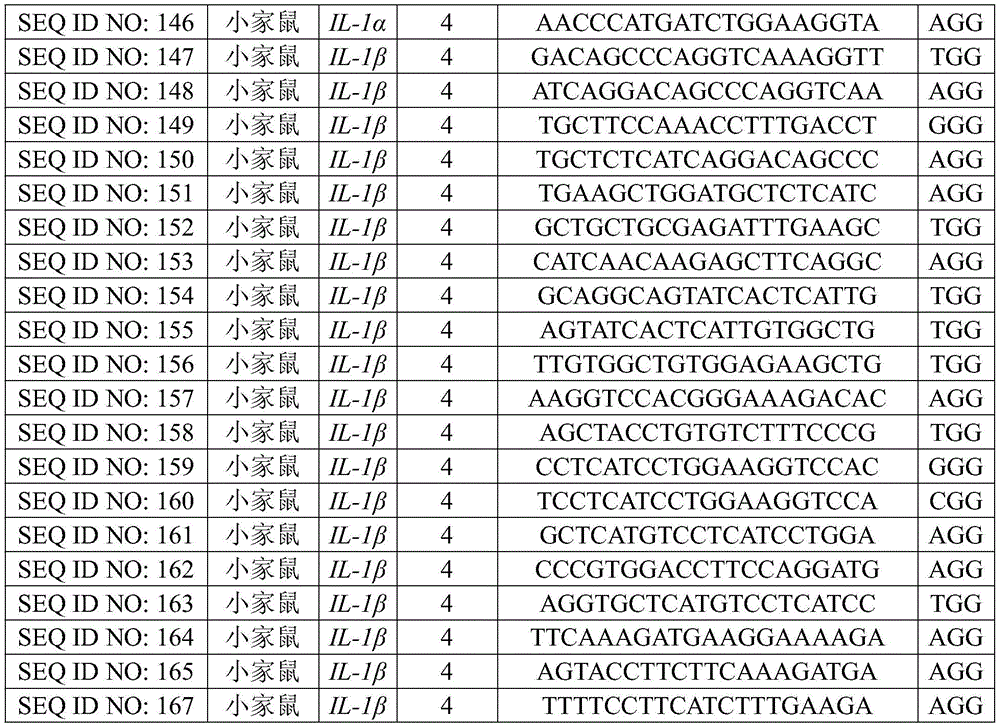
TABLE 13 exemplary CRISPR guide RNAs


In certain embodiments, the sequence of a guide RNA (e.g., single stranded guide RNA or sgRNA) can be modified to increase editing efficiency and/or reduce off-target effects. In certain embodiments, the sequence of the guide RNA can differ from the target sequence by about 1 base, about 2 bases, about 3 bases, about 4 bases, about 5 bases, about 6 bases, about 7 bases, about 8 bases, about 9 bases, about 10 bases, about 15 bases, or greater than about 15 bases. In certain embodiments, the sequence of the guide RNA can differ from the target sequence by about 1%, about 2%, about 3%, about 4%, about 5%, about 6%, about 7%, about 8%, about 9%, about 10%, about 11%, about 12%, about 13%, about 14%, about 15%, about 16%, about 17%, about 18%, about 19%, about 20%, or greater than about 20%. As used herein, a difference from a target sequence may refer to the degree of complementarity.
In certain embodiments, the guide RNA used with the compositions, methods, or systems of the present disclosure is identical to the sequence set forth in any one of SEQ ID NOs.21-34 and SEQ ID NOs.168-297. In certain embodiments, the guide RNA used with the compositions, methods, or systems of the present disclosure is at least about 95% identical to the sequence set forth in any one of SEQ ID NOS.21-34 and SEQ ID NOS.168-297. In certain embodiments, the guide RNA used with the compositions, methods, or systems of the present disclosure is at least about 90% identical to the sequence set forth in any one of SEQ ID NOS.21-34 and SEQ ID NOS.168-297. In certain embodiments, the guide RNA used with the compositions, methods, or systems of the present disclosure is at least about 85% identical to the sequence set forth in any one of SEQ ID NOS.21-34 and SEQ ID NOS.168-297. In certain embodiments, the guide RNA used with the compositions, methods, or systems of the present disclosure is at least about 80% identical to the sequence set forth in any one of SEQ ID NOS.21-34 and SEQ ID NOS.168-297. In certain embodiments, the guide RNA used with the compositions, methods, or systems of the present disclosure is at least about 75% identical to the sequence set forth in any one of SEQ ID NOS.21-34 and SEQ ID NOS.168-297. In certain embodiments, the guide RNA used with the compositions, methods, or systems of the present disclosure is at least about 70% identical to the sequence set forth in any one of SEQ ID NOS.21-34 and SEQ ID NOS.168-297. In certain embodiments, the guide RNA used with the compositions, methods, or systems of the present disclosure is at least about 65% identical to the sequence shown in any one of SEQ ID NOS.21-34 and SEQ ID NOS.168-297. In certain embodiments, the guide RNA used with the compositions, methods, or systems of the present disclosure is at least about 60% identical to the sequence set forth in any one of SEQ ID NOS.21-34 and SEQ ID NOS.168-297. In certain embodiments, the guide RNA used with the compositions, methods, or systems of the present disclosure is at least about 55% identical to the sequence set forth in any one of SEQ ID NOS.21-34 and SEQ ID NOS.168-297. In certain embodiments, the guide RNA used with the compositions, methods, or systems of the present disclosure is at least about 50% identical to the sequence set forth in any one of SEQ ID NOS.21-34 and SEQ ID NOS.168-297. In certain embodiments, the guide RNA used with the compositions, methods, or systems of the present disclosure is at least about 45% identical to the sequence set forth in any one of SEQ ID NOS.21-34 and SEQ ID NOS.168-297. In certain embodiments, the guide RNA used with the compositions, methods, or systems of the present disclosure is at least about 40% identical to the sequence set forth in any one of SEQ ID NOS.21-34 and SEQ ID NOS.168-297. In certain embodiments, the guide RNA used with the compositions, methods, or systems of the present disclosure is at least about 35% identical to the sequence set forth in any one of SEQ ID NOS.21-34 and SEQ ID NOS.168-297. In certain embodiments, the guide RNA used with the compositions, methods, or systems of the present disclosure is at least about 35% identical to the sequence set forth in any one of SEQ ID NOS.21-34 and SEQ ID NOS.168-297.
In certain embodiments, guide RNAs used with the compositions, methods, or systems of the present disclosure have 1 base substitution in the sequence shown in any one of SEQ ID nos. 21-34 and 168-297. In certain embodiments, guide RNAs used with the compositions, methods, or systems of the present disclosure have 2 base substitutions in the sequence shown in any one of SEQ ID nos. 21-34 and 168-297. In certain embodiments, guide RNAs used with the compositions, methods, or systems of the present disclosure have 3 base substitutions in the sequence shown in any one of SEQ ID nos. 21-34 and 168-297. In certain embodiments, guide RNAs used with the compositions, methods, or systems of the present disclosure have 4 base substitutions in the sequence shown in any one of SEQ ID nos. 21-34 and 168-297. In certain embodiments, guide RNAs used with the compositions, methods, or systems of the present disclosure have 4 base substitutions in the sequence shown in any one of SEQ ID nos. 21-34 and 168-297. In certain embodiments, guide RNAs used with the compositions, methods, or systems of the present disclosure have 6 base substitutions in the sequence shown in any one of SEQ ID nos. 21-34 and 168-297. In certain embodiments, guide RNAs used with the compositions, methods, or systems of the present disclosure have 7 base substitutions in the sequence shown in any one of SEQ ID nos. 21-34 and 168-297. In certain embodiments, guide RNAs used with the compositions, methods, or systems of the present disclosure have 8 base substitutions in the sequence shown in any one of SEQ ID nos. 21-34 and 168-297. In certain embodiments, guide RNAs used with the compositions, methods, or systems of the present disclosure have 9 base substitutions in the sequence shown in any one of SEQ ID nos. 21-34 and 168-297. In certain embodiments, guide RNAs used with the compositions, methods, or systems of the present disclosure have 10 base substitutions in the sequence shown in any one of SEQ ID nos. 21-34 and 168-297. In certain embodiments, guide RNAs used with the compositions, methods, or systems of the present disclosure have 11 base substitutions in the sequence shown in any one of SEQ ID nos. 21-34 and 168-297. In certain embodiments, guide RNAs used with the compositions, methods, or systems of the present disclosure have 12 base substitutions in the sequence shown in any one of SEQ ID nos. 21-34 and 168-297. In certain embodiments, guide RNAs used with the compositions, methods, or systems of the present disclosure have 13 base substitutions in the sequence shown in any one of SEQ ID nos. 21-34 and 168-297. In certain embodiments, guide RNAs used with the compositions, methods, or systems of the present disclosure have 14 base substitutions in the sequence shown in any one of SEQ ID nos. 21-34 and 168-297. In certain embodiments, guide RNAs used with the compositions, methods, or systems of the present disclosure have 15 base substitutions in the sequence shown in any one of SEQ ID nos. 21-34 and 168-297.
In certain embodiments, the guide RNAs of the present disclosure are designed to and/or are capable of knocking down the expression of a target gene as set forth in any one of SEQ ID nos. 7-20 and 37-167. In certain embodiments, the guide RNAs of the present disclosure are designed to or are capable of knocking down a human IL-1 a gene by binding to at least a portion of exon 1 of the human IL-1 a gene. In certain embodiments, the guide RNAs of the present disclosure are designed to or are capable of knocking down a human IL-1 a gene by binding to at least a portion of exon 2 of the human IL-1 a gene. In certain embodiments, the guide RNAs of the present disclosure are designed to or are capable of knocking down a human IL-1 a gene by binding to at least a portion of exon 3 of the human IL-1 a gene. In certain embodiments, the guide RNAs of the present disclosure are designed to or are capable of knocking down a human IL-1 a gene by binding to at least a portion of exon 4 of the human IL-1 a gene. In certain embodiments, the guide RNAs of the present disclosure are designed to or are capable of knocking down a human IL-1 a gene by binding to at least a portion of exon 5 of the human IL-1 a gene. In certain embodiments, the guide RNAs of the present disclosure are designed to or are capable of knocking down a human IL-1 a gene by binding to at least a portion of exon 6 of the human IL-1 a gene. In certain embodiments, the guide RNAs of the present disclosure are designed to or are capable of knocking down a human IL-1 a gene by binding to at least a portion of exon 7 of the human IL-1 a gene. In certain embodiments, the guide RNAs of the present disclosure are designed to or are capable of knocking down a human IL-1 a gene by binding to at least a portion of exon 8 of the human IL-1 a gene.
In certain embodiments, the guide RNAs of the present disclosure are designed to or are capable of knocking down a human IL-1 β gene by binding to at least a portion of exon 1 of the human IL-1 β gene. In certain embodiments, the guide RNAs of the present disclosure are designed to or are capable of knocking down a human IL-1 β gene by binding to at least a portion of exon 2 of the human IL-1 β gene. In certain embodiments, the guide RNAs of the present disclosure are designed to or are capable of knocking down a human IL-1 β gene by binding to at least a portion of exon 3 of the human IL-1 β gene. In certain embodiments, the guide RNAs of the present disclosure are designed to or are capable of knocking down a human IL-1 β gene by binding to at least a portion of exon 4 of the human IL-1 β gene. In certain embodiments, the guide RNAs of the present disclosure are designed to or are capable of knocking down a human IL-1 β gene by binding to at least a portion of exon 5 of the human IL-1 β gene. In certain embodiments, the guide RNAs of the present disclosure are designed to or are capable of knocking down a human IL-1 β gene by binding to at least a portion of exon 6 of the human IL-1 β gene. In certain embodiments, the guide RNAs of the present disclosure are designed to or are capable of knocking down a human IL-1 β gene by binding to at least a portion of exon 7 of the human IL-1 β gene.
In certain embodiments, the guide RNAs of the present disclosure are designed to and/or are capable of knocking down the expression of a target gene as set forth in any one of SEQ ID nos. 7-20 and 37-167. In certain embodiments, the guide RNAs of the present disclosure are designed to or are capable of knocking down a canine IL-1 a gene by binding to at least a portion of exon 1 of the canine IL-1 a gene. In certain embodiments, the guide RNAs of the present disclosure are designed to or are capable of knocking down a canine IL-1 a gene by binding to at least a portion of exon 2 of the canine IL-1 a gene. In certain embodiments, the guide RNAs of the present disclosure are designed to or are capable of knocking down a canine IL-1 a gene by binding to at least a portion of exon 3 of the canine IL-1 a gene. In certain embodiments, the guide RNAs of the present disclosure are designed to or are capable of knocking down a canine IL-1 a gene by binding to at least a portion of exon 4 of the canine IL-1 a gene. In certain embodiments, the guide RNAs of the present disclosure are designed to or are capable of knocking down a canine IL-1 a gene by binding to at least a portion of exon 5 of the canine IL-1 a gene. In certain embodiments, the guide RNAs of the present disclosure are designed to or are capable of knocking down a canine IL-1 a gene by binding to at least a portion of exon 6 of the canine IL-1 a gene. In certain embodiments, the guide RNAs of the present disclosure are designed to or are capable of knocking down a canine IL-1 a gene by binding to at least a portion of exon 7 of the canine IL-1 a gene.
In certain embodiments, the guide RNAs of the present disclosure are designed to or are capable of knocking down a canine IL-1β gene by binding to at least a portion of exon 1 of the canine IL-1β gene. In certain embodiments, the guide RNAs of the present disclosure are designed to or are capable of knocking down a canine IL-1 β gene by binding to at least a portion of exon 2 of the canine IL-1 β gene. In certain embodiments, the guide RNAs of the present disclosure are designed to or are capable of knocking down a canine IL-1 β gene by binding to at least a portion of exon 3 of the canine IL-1 β gene. In certain embodiments, the guide RNAs of the present disclosure are designed to or are capable of knocking down a canine IL-1 β gene by binding to at least a portion of exon 4 of the canine IL-1 β gene. In certain embodiments, the guide RNAs of the present disclosure are designed to or are capable of knocking down a canine IL-1 β gene by binding to at least a portion of exon 5 of the canine IL-1 β gene. In certain embodiments, the guide RNAs of the present disclosure are designed to or are capable of knocking down a canine IL-1 β gene by binding to at least a portion of exon 6 of the canine IL-1 β gene. In certain embodiments, the guide RNAs of the present disclosure are designed to or are capable of knocking down a canine IL-1 β gene by binding to at least a portion of exon 7 of the canine IL-1 β gene. In certain embodiments, the guide RNAs of the present disclosure are designed to or are capable of knocking down a canine IL-1 β gene by binding to at least a portion of exon 8 of the canine IL-1 β gene.
In certain embodiments, the guide RNAs of the present disclosure are designed to and/or are capable of knocking down the expression of a target gene as set forth in any one of SEQ ID nos. 7-20 and 37-167. In certain embodiments, the guide RNAs of the present disclosure are designed to or are capable of knocking down a equine IL-1 a gene by binding to at least a portion of exon 1 of the equine IL-1 a gene. In certain embodiments, the guide RNAs of the present disclosure are designed to or are capable of knocking down a equine IL-1 a gene by binding to at least a portion of exon 2 of the equine IL-1 a gene. In certain embodiments, the guide RNAs of the present disclosure are designed to or are capable of knocking down a equine IL-1 a gene by binding to at least a portion of exon 3 of the equine IL-1 a gene. In certain embodiments, the guide RNAs of the present disclosure are designed to or are capable of knocking down a equine IL-1 a gene by binding to at least a portion of exon 4 of the equine IL-1 a gene. In certain embodiments, the guide RNAs of the present disclosure are designed to or are capable of knocking down a equine IL-1 a gene by binding to at least a portion of exon 5 of the equine IL-1 a gene. In certain embodiments, the guide RNAs of the present disclosure are designed to or are capable of knocking down a equine IL-1 a gene by binding to at least a portion of exon 6 of the equine IL-1 a gene. In certain embodiments, the guide RNAs of the present disclosure are designed to or are capable of knocking down a equine IL-1 a gene by binding to at least a portion of exon 7 of the equine IL-1 a gene.
In certain embodiments, the guide RNAs of the present disclosure are designed to or are capable of knocking down the equine IL-1β gene by binding to at least a portion of exon 1 of the equine IL-1β gene. In certain embodiments, the guide RNAs of the present disclosure are designed to or are capable of knocking down the equine IL-1 β gene by binding to at least a portion of exon 2 of the equine IL-1 β gene. In certain embodiments, the guide RNAs of the present disclosure are designed to or are capable of knocking down the equine IL-1 β gene by binding to at least a portion of exon 3 of the equine IL-1 β gene. In certain embodiments, the guide RNAs of the present disclosure are designed to or are capable of knocking down the equine IL-1 β gene by binding to at least a portion of exon 4 of the equine IL-1 β gene. In certain embodiments, the guide RNAs of the present disclosure are designed to or are capable of knocking down the equine IL-1 β gene by binding to at least a portion of exon 5 of the equine IL-1 β gene. In certain embodiments, the guide RNAs of the present disclosure are designed to or are capable of knocking down the equine IL-1 β gene by binding to at least a portion of exon 6 of the equine IL-1 β gene. In certain embodiments, the guide RNAs of the present disclosure are designed to or are capable of knocking down the equine IL-1 β gene by binding to at least a portion of exon 7 of the equine IL-1 β gene.
In certain embodiments, the guide RNAs of the present disclosure are designed to and/or are capable of knocking down the expression of a target gene as set forth in any one of SEQ ID nos. 7-20 and 37-167. In certain embodiments, the guide RNAs of the present disclosure are designed to or are capable of knocking down a mouse IL-1 a gene by binding to at least a portion of exon 1 of the mouse IL-1 a gene. In certain embodiments, the guide RNAs of the present disclosure are designed to or are capable of knocking down a mouse IL-1 a gene by binding to at least a portion of exon 2 of the mouse IL-1 a gene. In certain embodiments, the guide RNAs of the present disclosure are designed to or are capable of knocking down a mouse IL-1 a gene by binding to at least a portion of exon 3 of the mouse IL-1 a gene. In certain embodiments, the guide RNAs of the present disclosure are designed to or are capable of knocking down a mouse IL-1 a gene by binding to at least a portion of exon 4 of the mouse IL-1 a gene. In certain embodiments, the guide RNAs of the present disclosure are designed to or are capable of knocking down a mouse IL-1 a gene by binding to at least a portion of exon 5 of the mouse IL-1 a gene. In certain embodiments, the guide RNAs of the present disclosure are designed to or are capable of knocking down a mouse IL-1 a gene by binding to at least a portion of exon 6 of the mouse IL-1 a gene. In certain embodiments, the guide RNAs of the present disclosure are designed to or are capable of knocking down a mouse IL-1 a gene by binding to at least a portion of exon 7 of the mouse IL-1 a gene. In certain embodiments, the guide RNAs of the present disclosure are designed to or are capable of knocking down a mouse IL-1 a gene by binding to at least a portion of exon 8 of the mouse IL-1 a gene.
In certain embodiments, the guide RNAs of the present disclosure are designed to or are capable of knocking down a mouse IL-1 β gene by binding to at least a portion of exon 1 of the mouse IL-1 β gene. In certain embodiments, the guide RNAs of the present disclosure are designed to or are capable of knocking down a mouse IL-1 β gene by binding to at least a portion of exon 2 of the mouse IL-1 β gene. In certain embodiments, the guide RNAs of the present disclosure are designed to or are capable of knocking down a mouse IL-1 β gene by binding to at least a portion of exon 3 of the mouse IL-1 β gene. In certain embodiments, the guide RNAs of the present disclosure are designed to or are capable of knocking down a mouse IL-1 β gene by binding to at least a portion of exon 4 of the mouse IL-1 β gene. In certain embodiments, the guide RNAs of the present disclosure are designed to or are capable of knocking down a mouse IL-1 β gene by binding to at least a portion of exon 5 of the mouse IL-1 β gene. In certain embodiments, the guide RNAs of the present disclosure are designed to or are capable of knocking down a mouse IL-1 β gene by binding to at least a portion of exon 6 of the mouse IL-1 β gene. In certain embodiments, the guide RNAs of the present disclosure are designed to or are capable of knocking down a mouse IL-1 β gene by binding to at least a portion of exon 7 of the mouse IL-1 β gene.
In some cases, the sgrnas are introduced into cells (e.g., in vitro cells, such as primary cells for ex vivo therapy, or in vivo cells, such as cells in a patient) with a recombinant expression vector comprising a nucleotide sequence encoding a Cas nuclease (e.g., cas9 polypeptide) or a variant or fragment thereof. In some embodiments, the sgrnas are complexed with a Cas nuclease (e.g., cas9 polypeptide) or a variant or fragment thereof to form a Ribonucleoprotein (RNP) -based delivery system for introduction into a cell (e.g., an in vitro cell, such as a primary cell for ex vivo therapy, or an in vivo cell, such as a cell in a patient). In other cases, the sgrnas are introduced into cells (e.g., in vitro cells, such as primary cells for ex vivo therapy, or in vivo cells, such as cells in the patient) having mRNA encoding a Cas nuclease (e.g., cas9 polypeptide) or a variant or fragment thereof.
Any heterologous or exogenous nucleic acid (e.g., target locus specific sgrnas and/or polynucleotides encoding Cas9 polynucleotides) can be introduced into a cell using any method known to those of skill in the art. Such methods include, but are not limited to, electroporation, nuclear transfection, lipofection, transduction, microinjection, electroinjection, electrofusion, nanoparticle bombardment, transformation, conjugation, and the like.
The nucleic acid sequence of the sgRNA can be any polynucleotide sequence that has sufficient complementarity to a target polynucleotide sequence (e.g., a target DNA sequence) to hybridize to the target sequence and direct sequence-specific binding of the CRISPR complex to the target sequence. In some embodiments, the degree of complementarity between the guide sequence of the sgRNA and its corresponding target sequence is about or more than about 50%, 60%, 75%, 80%, 85%, 90%, 95%, 97.5%, 99% or higher when optimally aligned using a suitable alignment algorithm. Optimal alignment may be determined by using any suitable algorithm for aligning sequences, non-limiting examples of which include the Smith-Waterman algorithm, the Needleman-Wunsch algorithm, the Burrow-Wheeler transform-based algorithm (e.g., burrows WheelerAligner), clustalW, clustal X, BLAT, novoalign (NovocraftTechnologies, ELAND (Illumina, san Diego, calif.), SOAP (available from SOAP. Genemics. Org. Cn), and Maq (available from maq. Sourceforge. Net.) in some embodiments, the length of the guide sequence is about 1 nucleotide, 2 nucleotides, 3 nucleotides, 4 nucleotides, 5 nucleotides, 6 nucleotides, 7 nucleotides, 8 nucleotides, 9 nucleotides, 10 nucleotides, 11 nucleotides, 12 nucleotides, 13 nucleotides, 14 nucleotides, 15 nucleotides, 16 nucleotides, 17 nucleotides, 18 nucleotides, 19 nucleotides, 20 nucleotides, 21 nucleotides, 22 nucleotides, 23 nucleotides, 24 nucleotides, 25 nucleotides, 26 nucleotides, 27 nucleotides, 28 nucleotides, 29 nucleotides, 30 nucleotides, 35 nucleotides, 40 nucleotides, 45 nucleotides, 50 nucleotides, 75 nucleotides or more nucleotides in some cases, the length of the guide sequence is about 20 nucleotides in other cases, the length of the guide sequence is about 15 nucleotides in other cases, the length of the guide sequence is about 25 nucleotides in other cases, the target sequence can be assessed by determining the binding of any of the nucleotide sequences to a suitable target sequence, such as CRI, by determining the CRI sequence, the components of the CRISPR system (comprising the guide sequence to be tested) sufficient to form a CRISPR complex can be provided to a host cell having the corresponding target sequence, such as by transfection with a vector encoding the components of the CRISPR sequence, and then assessing preferential cleavage within the target sequence. Similarly, cleavage of a target polynucleotide sequence can be assessed in a test tube by providing a target sequence, a component of a CRISPR complex, comprising a guide sequence to be tested and a control guide sequence different from the test guide sequence, and comparing the binding or cleavage rate at the target sequence between the reactions of the test guide sequence and the control guide sequence.
The nucleic acid sequence of the sgRNA can be selected using any of the web-based software described above. Considerations for selecting DNA-targeting RNAs include PAM sequences for Cas nucleases (e.g., cas9 polypeptides) to be used, as well as strategies for minimizing off-target modifications. Tools such as CRISPR design tools can provide sequences for preparing sgrnas, for assessing target modification efficiency and/or assessing cleavage at off-target sites. Another consideration for selecting the sequence of the sgrnas involves reducing the extent of secondary structure within the guide sequence. The secondary structure may be determined by any suitable polynucleotide folding algorithm. Some procedures are based on calculating the minimum gibbs free energy. Examples of suitable algorithms include mFold (Zuker and Stiegler, nucleic acids research (Nucleic Acids Res), 9 (1981), 133-148), UNAFold packaging (Markham et al, methods of molecular biology, 2008,453: 3-31) and RNAfold from Vienna RNa packaging.
The sgRNA can be from about 10 to about 500 nucleotides, for example, about 10 nucleotides, 15 nucleotides, 20 nucleotides, 25 nucleotides, 30 nucleotides, 35 nucleotides, 40 nucleotides, 45 nucleotides, 50 nucleotides, 55 nucleotides, 60 nucleotides, 65 nucleotides, 70 nucleotides, 75 nucleotides, 80 nucleotides, 85 nucleotides, 90 nucleotides, 95 nucleotides, 100 nucleotides, 105 nucleotides, 110 nucleotides, 120 nucleotides, 130 nucleotides, 140 nucleotides, 150 nucleotides, 160 nucleotides, 170 nucleotides, 180 nucleotides, 190 nucleotides, 200 nucleotides, 210 nucleotides, 220 nucleotides, 230 nucleotides, 240 nucleotides, 250 nucleotides, 260 nucleotides, 270 nucleotides, 280 nucleotides, 290 nucleotides, 300 nucleotides, 310 nucleotides, 320 nucleotides, 330 nucleotides, 340 nucleotides, 350 nucleotides, 360 nucleotides, 370 nucleotides, 380 nucleotides, 390 nucleotides, 400 nucleotides, 410 nucleotides, 420 nucleotides, 430 nucleotides, 440 nucleotides, 450 nucleotides, 460 nucleotides, 470 nucleotides, 480 nucleotides, 490 nucleotides or about 500 nucleotides. In some embodiments, the sgRNA is about 20 to about 500 nucleotides, e.g., 20, 25, 30, 35, 40, 45, 50, 55, 60, 65, 70, 75, 80, 85, 90, 95, 100, 105, 110, 115, 120, 125, 130, 135, 140, 145, 150, 155, 160, 165, 170, 175, 180, 185, 190, 195, 200, 205, 210, 215, 220, 225, 230, 235, 240, 245, 250, 255, 260, 265, 270, 275, 280, 285, 290, 295, 300, 305, 310, 315, 320, 325, 330, 335, 340, 345, 350, 355, 360, 365, 370, 375, 380, 385, 390, 395, 400, 405, 410, 415, 420, 425, 430 nucleotides, 435 nucleotides, 440 nucleotides, 445 nucleotides, 450 nucleotides, 455 nucleotides, 460 nucleotides, 465 nucleotides, 470 nucleotides, 475 nucleotides, 480 nucleotides, 485 nucleotides, 490 nucleotides, 495 nucleotides or about 500 nucleotides. In some embodiments, the sgRNA is about 20 to about 100 nucleotides, e.g., about 20 nucleotides, e.g., 20, 21, 22, 23, 24, 25, 26, 27, 28, 29, 30, 31, 32, 33, 34, 35, 36, 37, 38, 39, 40, 41, 42, 43, 44, 45, 46, 47, 48, 49, 50, 51, 52, 53, 54, 55, 56, 57, 58, 59, 60, 61, 62, 63, 64, 65, 66, 67, 68, 69, 70, 71, 72, 73, 74, 75, 76, 77, 78, 79, 80, 81, 82, 83, 84, 85, 86, 87, 88, 89, 90, 91, 92, 93, 94, 95, 96, 97, 98, 99 nucleotides or about 100 nucleotides.
The scaffold sequence may be about 10 to about 500 nucleotides, e.g., about 10 nucleotides, 15 nucleotides, 20 nucleotides, 25 nucleotides, 30 nucleotides, 35 nucleotides, 40 nucleotides, 45 nucleotides, 50 nucleotides, 55 nucleotides, 60 nucleotides, 65 nucleotides, 70 nucleotides, 75 nucleotides, 80 nucleotides, 85 nucleotides, 90 nucleotides, 95 nucleotides, 100 nucleotides, 105 nucleotides, 110 nucleotides, 120 nucleotides, 130 nucleotides, 140 nucleotides, 150 nucleotides, 160 nucleotides, 170 nucleotides, 180 nucleotides, 190 nucleotides, 200 nucleotides, 210 nucleotides, 220 nucleotides, 230 nucleotides, 240 nucleotides, 250 nucleotides, 260 nucleotides, 270 nucleotides, 280 nucleotides, 290 nucleotides, 300 nucleotides, 310 nucleotides, 320 nucleotides, 330 nucleotides, 340 nucleotides, 350 nucleotides, 360 nucleotides, 370 nucleotides, 380 nucleotides, 390 nucleotides, 400 nucleotides, 410 nucleotides, 420 nucleotides, 430 nucleotides, 440 nucleotides, 450 nucleotides, 460 nucleotides, 470 nucleotides, 480 nucleotides, 490 nucleotides or about 500 nucleotides. In some embodiments, the scaffold sequence is about 20 to about 500 nucleotides, e.g., 20, 25, 30, 35, 40, 45, 50, 55, 60, 65, 70, 75, 80, 85, 90, 95, 100, 105, 110, 115, 120, 125, 130, 135, 140, 145, 150, 155, 160, 165, 170, 175, 180, 185, 190, 195, 200, 205, 210, 215, 220, 225, 230, 235, 240, 245, 250, 255, 260, 265, 270, 275, 280, 285, 290, 295, 300, 305, 310, 315, 320, 325, 330, 335, 340, 345, 350, 355, 360, 365, 370, 375, 380, 385, 390, 395, 400, 405, 410, 415, 420, 425, 430 nucleotides, 435 nucleotides, 440 nucleotides, 445 nucleotides, 450 nucleotides, 455 nucleotides, 460 nucleotides, 465 nucleotides, 470 nucleotides, 475 nucleotides, 480 nucleotides, 485 nucleotides, 490 nucleotides, 495 nucleotides or 500 nucleotides. In some embodiments, the scaffold sequence is about 20 to about 100 nucleotides, e.g., about 20 nucleotides, e.g., 20, 21, 22, 23, 24, 25, 26, 27, 28, 29, 30, 31, 32, 33, 34, 35, 36, 37, 38, 39, 40, 41, 42, 43, 44, 45, 46, 47, 48, 49, 50, 51, 52, 53, 54, 55, 56, 57, 58, 59, 60, 61, 62, 63, 64, 65, 66, 67, 68, 69, 70, 71, 72, 73, 74, 75, 76, 77, 78, 79, 80, 81, 82, 83, 84, 85, 86, 87, 88, 89, 90, 91, 92, 93, 94, 95, 96, 97, 98, 99 nucleotides or about 100 nucleotides.
The nucleotides of the sgrnas may comprise modifications in ribose (e.g., sugar) groups, phosphate groups, nucleobases, or any combination thereof. In some embodiments, the modification in the ribose group comprises a modification at the 2' position of the ribose.
In some embodiments, the nucleotide comprises a 2' fluoro-arabinonucleic acid, a tricyclic-DNA (tc-DNA), a peptide nucleic acid, a cyclohexene nucleic acid (CeNA), a Locked Nucleic Acid (LNA), an ethylene bridged nucleic acid (eNA), a phosphodiamido morpholino, or a combination thereof.
The modified nucleotide or nucleotide analog may comprise sugar-and/or backbone-ribonucleotides (i.e., comprise modifications to the phosphate-sugar backbone). For example, the phosphodiester linkage of natural or native RNA may comprise at least one of a nitrogen or sulfur heteroatom. In some backbone-ribonucleotides, the phosphate group attached to an adjacent ribonucleotide can be replaced by, for example, a phosphorothioate group. In some sugar-ribonucleotides, the 2' moiety is selected from H, OR, R, halo, SH, SR, H2, HR, R 2 Or an ON group, wherein R is C 1 -C6 alkyl, alkenyl or alkynyl, and halo is F, CI, br or I.
In some embodiments, the nucleotide contains a sugar modification. Non-limiting examples of sugar modifications include 2 '-deoxy-2' -fluoro-oligoribonucleotides (2 '-fluoro-2' -deoxycytidine-5 '-triphosphate, 2' -fluoro-2 '-deoxyuridine-5' -triphosphate), 2 '-deoxy-2' -deaminated oligoribonucleotides (2 '-amino-2' -deoxycytidine-5 '-triphosphate, 2' -amino-2 '-deoxyuridine-5' -triphosphate), 2 '-O-alkyl oligoribonucleotides, 2' -deoxy-2 '-C-alkyl oligoribonucleotides (2' -O-methylcytidine-5 '-triphosphate, 2' -methyluridine-5 '-triphosphate), 2' -C-alkyl oligoribonucleotides and isomers thereof (2 '-arabinocytidine-5' -triphosphate, 2 '-arabinonuidine-5' -triphosphate), azido-triphosphate (2 '-azido-2' -deoxycytidine-5 '-triphosphate, 2' -azido-2 '-deoxyuridine-5' -triphosphate) and combinations thereof.
In some embodiments, the sgrnas contain one or more 2' -fluoro modifications, 2' -amino modifications, and/or 2' -thio modifications. In some cases, the modification is 2 '-fluorocytidine, 2' -fluorouridine, 2 '-fluoroadenosine, 2' -fluoroguanosine, 2 '-aminocytidine, 2' -aminouridine, 2 '-aminoguanosine, 2, 6-diaminopurine, 4-thiouridine, 5-amino-allyluridine, 5-bromouridine, 5-iodouridine, 5-methylcytidine, ribose-thymidine, 2-aminopurine, 2' -amino-butyryl-pyrenyluridine, 5-fluorocytidine, and/or 5-fluorouridine.
More than 96 naturally occurring nucleoside modifications are found on mammalian RNA. See, e.g., limbach et al, nucleic acids research (Nucleic Acids Research), 22 (12): 2183-2196 (1994). Nucleotides and the preparation of nucleotides and nucleosides are well known in the art and are described, for example, in U.S. Pat. nos. 4,373,071, 4,458,066, 4,500,707, 4,668,777, 4,973,679, 5,047,524, 5, 132,418, 5, 153,319, 5,262,530 and 5,700,642. Many nucleosides and nucleotides suitable for use as described herein are commercially available. The nucleoside may be an analogue of a naturally occurring nucleoside. In some cases, the analog is dihydrouridine, methyladenosine, methylcytidine, methyluridine, methylpseuduridines, thiouridine, deoxycytidine, and deoxyuridine.
In some cases, the sgrnas described herein comprise nucleobase-ribonucleotides, i.e., ribonucleotides that contain at least one non-naturally occurring nucleobase instead of a naturally occurring nucleobase. Non-limiting examples of nucleobases that can be incorporated into nucleosides and nucleotides include m5C (5-methylcytidine), m5U (5-methyluridine), m6A (N6-methyladenosine), s2U (2-thiouridine), um (2 '-O-methyluridine), mlA (1-methyladenosine), m2A (2-methyladenosine), am (2-1-O-methyladenosine), ms2m6A (2-methylthio-N6-methyladenosine), I6A (N6-isopentenyl adenosine), ms2I6A (2-methylthio-N6-isopentenyl adenosine), io6A (N6- (cis-hydroxyisopentenyl) adenosine) ms2io6A (2-methylthio-N6- (cis-hydroxyisopentenyl) adenosine), g6A (N6-glycylcarbamoyladenosine), t6A (N6-threonyl-carbamoyladenosine), ms2t6A (2-methylthio-N6-threonyl-carbamoyladenosine), m6t6A (N6-methyl-N6-threonyl-carbamoyladenosine), hn6A (N6) -hydroxy-N-valylcarbamoyladenosine), ms2hn6A (2-methylthio-N6-hydroxy-N-valylcarbamoyladenosine), ar (p) (2' -O-riboadenosine (phosphoric acid)), I (inosine), mil (1-methyl inosine), m 'lm (l, 2' -O-dimethyl inosine), m3C (3-methyl cytidine), cm (2T-O-methyl cytidine), s2C (2-thiocytidine), ac4C (N4-acetyl cytidine), f5C (5-formyl cytidine), m5Cm (5, 2-O-dimethyl cytidine), ac4Cm (N4 acetyl 2 TO-methyl cytidine), k2C (Lai Baogan), mlG (1-methyl guanosine), m2G (N2-methyl guanosine), m7G (7-methyl guanosine), gm (2 '-O-methyl guanosine), m22G (N2, N2-dimethyl guanosine), m2Gm (N2, 2' -O-dimethyl guanosine), m22Gm (N2, 2 '-O-trimethylguanosine), gr (p) (2' -O-riboguanosine (phosphoric acid)), yW (Huai Dinggan (wybutosine)), O2yW (peroxy Huai Dinggan), OHyW (hydroxy Huai Dinggan), OHyW (deficient hydroxy Huai Dinggan), imG (hurusside (wyosine)), mimG (methyl hurusside), Q (pigtail glycoside (queuosine)), oQ (epoxypigtail glycoside), galQ (galactosyl-pigtail glycoside), manQ (mannosyl-pigtail glycoside), preQO (7-cyano-7-deazaguanosine), preQi (7-aminomethyl-7-deaguanosine), G (archaulosine)), D (dihydrouridine), m5Um (5, 2 '-O-dimethyluridine), s4U (4-thiouridine), m5s2U (5-methyl-2-thiouridine), s 2-methyl-2-thiouridine), 2-U (2-thiouridine), 2-hydroxy 3-cyano-7-dean (5-hydroxy 3-methyl-7-dean), preQI (7-aminomethyl-7-dean), G (archauloguanosine), G (archoside D (dihydrouridine), m5Um (5, 2' -O-dimethyluridine), s (4U (4-thiouridine), m 5-methyl 2-thiouridine), 2-hydroxy 2-methyl-2-thiouridine (2-hydroxy 3-2-thiouridine), 2-methyl 2-hydroxy 3-2-riboside (2-oxo-riboside (2-riboside), 2-hydroxy-2-riboside (3-hydroxy-riboside (3-riboside), 2-hydroxy-oxo-2-riboside (2-hydroxy-riboside, 3-oxo-2-oxo-hydroxy-2-oxoguanosine) mchm5U (5- (carboxyhydroxymethyl) uridine methyl ester), mcm5U (5-methoxycarbonylmethyl uridine), mcm5U (S-methoxycarbonylmethyl-2-O-methyluridine), mcm5S2U (5-methoxycarbonylmethyl-2-thiouridine), nm5S2U (5-aminomethyl-2-thiouridine), mcm5U (5-methylaminomethyl uridine), mcm5S2U (5-methylaminomethyl-2-thiouridine), mcm 5se2U (5-methylaminomethyl-2-selenouride), ncm U (5-carbamoylmethyl uridine), ncm U (5-carbamoylmethyl-2 '-O-methyluridine), cmnm5U (5-carboxymethylaminomethyl uridine), cmnm5U (5-carboxymethylaminomethyl-2-L-methyluridine), cmnm5S2U (5-carboxymethylaminomethyl-2-thiouridine), m6A, N6-dimethyl adenosine), tm (2' -O-methyl inosine), m4C (N4-methyl cytidine), m4Cm (N4, 2-O-dimethyl cytidine), hm5C (5-hydroxymethyl cytidine), m3U (3-methyl uridine), cm5U (5-carboxymethyl uridine), m6Am (N6, T-O-dimethyl adenosine), rn62Am (N6, N6, 0-2-trimethyladenosine), m2'7G (N2, 7-dimethylguanosine), m2'7G (N2, N2, 7-trimethylguanosine), m3Um (3,2T-O-dimethyluridine), m5D (5-methyldihydrouridine), f5Cm (5-formyl-2 ' -O-methylcytidine), ml Gm (l, 2' -O-dimethylguanosine), m ' Am (1, 2-O-dimethyladenosine), irinomethyluridine (irinomylthioridine)), tm5S2U (S-taurine methyl-2-thiouridine), imG-14 (4-demethylated guanosine), imG (isoguanosine), or ac6A (N6-acetyladenosine), hypoxanthine, inosine, 8-oxo-adenine 7-substituted derivatives thereof, dihydro-uracil, pseudouracil, 2-thiouracil, 4-thiouracil, 5-amino-uracil, 5- (C) 1 -C 6 ) -alkyluracils, 5-methyluracils, 5- (C) 2 -C 6 ) -alkenyl uracils, 5- (C) 2 -C 6 ) Alkynyl uracil, 5- (hydroxymethyl) uracil, 5-chlorouracil, 5-fluorouracil, 5-bromouracil, 5-hydroxycytosine, 5- (C) 1 -C 6 ) -alkyl cytosine, 5-methyl cytosine, 5- (C) 2 -C 6 ) -alkenylcytosine, 5- (C) 2 -C 6 ) -alkynyl cytosine, 5-chlorocytosine, 5-fluorocytosine, 5-bromocytosine, N 2 -dimethylguanine, 7-deazaguanine, 8-azaguanine, 7-deaza-7-substituted guanine, 7-deaza-7- (C2-C6) alkynylguanine, 7-deaza-8-substituted guanine, 8-hydroxyguanine, 6-thioguanine, 8-oxo-guanine, 2-aminopurine, 2-amino-6-chloropurine, 2, 4-diaminopurine, 2, 6-diaminopurine, 8-azapurine, substituted 7-deazapurines, 7-deaza-7-substituted purines, 7-deaza-8-substituted purines, and combinations thereof.
sgrnas can be synthesized by any method known to one of ordinary skill in the art. In some embodiments, the sgrnas are chemically synthesized. Modified sgrnas can be synthesized using 2' -O-thiocarbamate protected nucleoside phosphoramidites. Methods are described, for example, in Dellinger et al, journal of American chemical society, 133,11540-11556 (2011); threlfall et al, organic and biomolecular chemistry (Organic & Biomolecular Chemistry), 10,746-754 (2012); and Dellinger et al, journal of the American society of chemistry, 125,940-950 (2003). Modified sgrnas are commercially available from, for example, trilink biotechnology (San Diego, CA).
Additional details of useful sgrnas can be found, for example, in Hendel et al, nature Biotechnol, 2015,33 (9): 985-989 and Dever et al, nature, 2016,539:384-389, the disclosure of which is incorporated herein by reference in its entirety for all purposes.
Those of skill in the art will appreciate that the guide RNAs as disclosed in the present disclosure may be used in combination with any Cas protein known in the art (e.g., any Cas type from any suitable organism or bacterial species).
The Cas protein may be a type I, type II, type III, type IV, type V, or type VI Cas protein. Cas proteins may include one or more domains. Non-limiting examples of domains include guide nucleic acid recognition and/or binding domains, nuclease domains (e.g., dnase or rnase domains, ruvC, HNH), DNA binding domains, RNA binding domains, helicase domains, protein-protein interaction domains, and dimerization domains. The guide nucleic acid recognition and/or binding domain may interact with the guide nucleic acid. The nuclease domain can include catalytic activity for nucleic acid cleavage. The nuclease domain may lack catalytic activity to prevent cleavage of the nucleic acid. The Cas protein may be a chimeric Cas protein fused to other proteins or polypeptides. The Cas protein may be a chimera of various Cas proteins, e.g., including domains from different Cas proteins.
Non-limiting examples of Cas proteins include C2C1, C2, C2C3, cas1B, cas2, cas3, cas4, cas5e (CasD), cash, cas6e, cas6f, cas7, cas8a1, cas8a2, cas8b, cas8C, cas9 (Csn 1 or Csx 12), cas10d, cas1O, cas1Od, casF, casG, casH, cpf, csy1, csy2, csy3, and Cse1 (CasA), cse2 (CasB), cse3 (CasE), cse4 (CasC), csc1, csc2, csa5, csn2, csm3, csm4, csm5, csm6, cmr1, cmr3, cmr4, cmr5, cmr6, csb1, csb2, csb3, csx17, csx14, csx1O, csx16, csaX, csx3, csx1, csx15, csf1, csf2, csf3, csf4, and Cul966, and homologs or modified forms thereof.
The Cas protein may be from any suitable organism. Non-limiting examples include Streptococcus pyogenes, streptococcus thermophilus, species of streptococcus, staphylococcus aureus, nocardia darwinia (Nocardiopsis dassonvillei), streptomyces pristinaeus (Streptomyces pristinae spiralis), streptomyces viridochromogenes (Streptomyces viridochromo genes), streptomyces viridochromogenes, streptomyces roseosporus, alicyclobacillus acidocaldarius (AlicyclobacHlus acidocaldarius), bacillus pseudomycosis (Bacillus pseudomycoides), bacillus selenite (Bacillus selenitireducens), microbacterium sibirica (Exiguobacterium sibiricum), lactobacillus delbrueckii (Lactobacillus delbrueckii), lactobacillus salivarius (Lactobacillus salivarius), microbibrillation marine (Microscilla marina), burkholderia (Burkholderiales bacterium), geotrichum napestris (Polaromonas naphthalenivorans), species of polar monad, crocus valiensis (Crocosphaera watsonii), species of blue silk, microcystis aeruginosa (Microcystis aeruginosa), pseudomonas aeruginosa, species of polyglucococcus, acetobacter arabicum, ammonia producing strain (Ammonifex degensii), cellulose berkovickers (caldelbrueckii), candida albicans (673), clostridium botulinum (Clostridium botulinum), clostridium difficile (Lactobacillus salivarius), anaerobic bacteria (Acidithiobacillus caldus), clostridium thermophilus (Acidithiobacillus caldus), anaerobic bacteria (35 b, and the species of clostridium thermophilus (Acidithiobacillus caldus) and the species of clostridium, nitrococcus warrior (Nitrosococcus watsoni), pseudoalteromonas parasea (Pseudoalteromonas haloplanktis), corynebacterium racemosum (Ktedonobacter racemifer), methane-investigating bacteria (Methanohalobium evasigatum), anabaena variabilis (Anabaena variabilis), arthrobacter foamii (Nodularia spumigena), nostoc sp, arthrospira maxima (Arthrospira maxima), arthrospira platensis (Arthrospira platensis), arthrospira sp, lindera sp (Lyngbya sp.), microcystis prototheca (Microcoleus chthonoplastes), oscilaria sp, sporotrichum (Petrotoga mobilis), thermus africanus (Thermosipho africanus), cordymia marine (Acaryochloris marina), cilomyces trachomatis (Leptotrichia shahii) and Francisellanovica. In some aspects, the organism is streptococcus pyogenes(s). In some aspects, the organism is staphylococcus aureus (s.aureus). In some aspects, the organism is streptococcus thermophilus (s.thermophilus).
Cas proteins may be derived from a variety of bacterial species, including but not limited to, wei Yongshi cocci (Veillonella atypical), fusobacterium nucleatum (Fusobacterium nucleatum), fusobacterium gingivarum (Filifactor alocis), mo Leisuo bacteria (Solobacterium moorei), leucococcus dexterous (Coprococcus catus), leuconostoc dentalis (Treponema denticola), leuconostoc mesenteroides (Peptoniphilus duerdenii), catenibacterium mitsuokai, streptococcus mutans (Streptococcus mutans), listeria innocua (Listeria innocua), staphylococcus pseudointermedia (Staphylococcus pseudintermedius), enteromococcus (Acidaminococcus intestine), lactobacillus gingivalis (Olsenella), north-primary-wine cocci (Acidaminococcus intestine), bifidobacterium bifidum (Acidaminococcus intestine), lactobacillus rhamnosus (Acidaminococcus intestine), lactobacillus gasseri (Acidaminococcus intestine), goldia megatheriae (Finelndia magna), mycoplasma motion (Acidaminococcus intestine), mycobacterium gallisepticum (Acidaminococcus intestine), mycoplasma ovis (Acidaminococcus intestine), mycoplasma canis (Acidaminococcus intestine), streptococcus thermophilus (Acidaminococcus intestine), corynebacterium elongatum (Acidaminococcus intestine), lactobacillus rectus (Acidaminococcus intestine), lactobacillus bifidus (Touretonii), bifidobacterium (Touretum longum (Acidaminococcus intestine), bifidobacterium oxydans (Paenii), bifidobacterium oxydans (Acidaminococcus intestine) and Mycobacterium oxydans (Pacificum) are described herein before, corynebacterium diphtheriae (Corynebacterium diphtheria), bacteroides minutissimus (Elusimicrobium minutum), brine nitrate-lysing bacteria (Nitratifractor salsuginis), sphaerochaeta globus, filamentous bacterium succinogenes subspecies succinogenes (Fibrobacter succinogenes subsp. Succinogenes), bacteroides fragilis (Bacteroides fragilis), carbon dioxide-yellow fibrous bacterium (Capnocytophaga ochracea), rhodopseudomonas palustris (Rhodopseudomonas palustris), prevotella micans, ruminoceroides ruminants (Prevotella ruminicola), flavobacterium columbum (Flavobacterium columbus), aminospacers (Aminomonas paucivorans), rhodospirillum profundum (Rhodospirillum rubrum), candidatus Puniceispirillum marinum, ai Senshi vermiform bacteria (Verminephrobacter eiseniae), pseudonectaria (Ralstonia syzygii), rhodobacter zhi (Ralstonia syzygii), rhodobacter azotembotrytis (Azospira), nitrifying bacteria (Nitrobacter hanensis), bradykinin rhizobium (Bradyrhizobium), rhodopseudomonas succinogenes (Ralstonia syzygii), campylobacter jejuni subsp. Jejuni (Ralstonia syzygii), bacillus natum (Ralstonia syzygii), bacillus natto (Ralstonia syzygii), rhodospirillum mesencarum (Ralstonia syzygii), rhodospirillum mesides (Ralstonia syzygii), rhodobacter oxydans (Ralstonia syzygii) and the bacterium oxydanum, wobbe succinate producing bacteria (Wolinella succinogenes) and Francisella new (Francisella novicida). In this context, the term "derived" is defined as modified from various naturally occurring bacterial species to maintain significant portions or significant homology to the various naturally occurring bacterial species. A significant portion can be at least 10 consecutive nucleotides, at least 20 consecutive nucleotides, at least 30 consecutive nucleotides, at least 40 consecutive nucleotides, at least 50 consecutive nucleotides, at least 60 consecutive nucleotides, at least 70 consecutive nucleotides, at least 80 consecutive nucleotides, at least 90 consecutive nucleotides, or at least 100 consecutive nucleotides. Significant homology can be at least 50% homology, at least 60% homology, at least 70% homology, at least 80% homology, at least 90% homology, or at least 95% homology. The derivatized species may be modified while retaining the activity of the naturally occurring species.
Gene editing method
As discussed above, embodiments of the present disclosure provide compositions and methods for treating joint disorders, wherein a portion of the joint cells are genetically modified via gene editing to treat the joint disorder. Embodiments of the present disclosure include gene editing by nucleotide insertion (RNA or DNA) or recombinant protein insertion into a population of synovial cells for both promoting expression of one or more proteins and inhibiting expression of one or more proteins, and combinations thereof. Embodiments of the present disclosure also provide methods for delivering a gene editing composition to a joint cell, and in particular to a synovial cell. There are several gene editing techniques that can be used to genetically modify articular cells, which are suitable for use in accordance with the present invention.
In some embodiments, the method of genetically modifying a joint cell comprises the step of stably incorporating genes for the production of one or more proteins. In one embodiment, the method of genetically modifying a portion of a joint synovial cell comprises the step of retroviral transduction. In one embodiment, the method of genetically modifying a portion of a joint synovial cell comprises the step of lentiviral transduction. Lentiviral transduction systems are known in the art and are described, for example, in Levine et al, proc. Natl. Acad. Sci. USA, 2006,103,17372-77; zufferey et al, nature Biotechnology, 1997,15,871-75; the disclosures of Dull et al, J virology, 1998,72,8463-71 and U.S. Pat. No. 6,627,442, each of which are incorporated herein by reference. In one embodiment, the method of genetically modifying a portion of a joint synovial cell comprises the step of gamma-retrovirus transduction. Gamma-retroviral transduction systems are known in the art and are described, for example, in Cepko and Pear, current protocols in molecular biology, 1996,9.9.1-9.9.16, the disclosure of which is incorporated herein by reference. In one embodiment, a method of genetically modifying a portion of a synovial cell of a joint comprises the step of transposon mediated gene transfer. Transposon mediated gene transfer systems are known in the art and include systems in which the transposase is provided as a DNA expression vector or as an expressible RNA or protein such that long term expression of the transposase does not occur in the transgenic cell, e.g., the transposase is provided as mRNA (e.g., mRNA including cap and poly-a tail). Suitable transposon mediated gene transfer systems, including salmon-type Tel-like transposases (SB or sleeping beauty transposases), such as SB10, SB11 and SB100x, and engineered enzymes with increased enzymatic activity, are described, for example, in Hackett et al, molecular therapy, 2010,18,674-83 and U.S. patent No. 6,489,458, the disclosures of each of which are incorporated herein by reference.
In some aspects, the viral vector or system is used to introduce a gene editing system into cells that include a joint. In some aspects, the cell is a synovial fibroblast. In some aspects, the viral vector is an AAV vector. In some aspects, the AAV vector comprises a serotype selected from the group consisting of: AAV1, AAV1 (Y705+731F+T492V), AAV2 (Y444+500+730F+T491V), AAV3 (Y705+731F), AAV4, AAV5 (Y436+693+7199F), AAV6 (VP 3 variant Y705F/Y731F/T492V), AAV-7m8, AAV8 (Y733F), AAV9 (VP 3 variant Y731F), AAV10 (Y733F), AAV-ShH10 and AAV-DJ/8. In some aspects, the AAV vector comprises a serotype selected from the group consisting of: AAV1, AAV5, AAV6 (Y705F/Y731F/T492V), AAV8, AAV9, and AAV9 (Y731F).
In some aspects, the viral vector is a lentivirus. In one aspect, the lentivirus is selected from the group consisting of: human immunodeficiency virus-1 (HIV-1), human immunodeficiency virus-2 (HIV-2), simian Immunodeficiency Virus (SIV), feline Immunodeficiency Virus (FIV), bovine Immunodeficiency Virus (BIV), jacquard virus (Jembrana Disease Virus) (JDV), equine Infectious Anemia Virus (EIAV), and Caprine Arthritis Encephalitis Virus (CAEV).
In one embodiment, a method of genetically modifying a portion of a synovial cell of a joint comprises the step of stably incorporating a gene for producing or inhibiting (e.g., silencing) one or more proteins. In one embodiment, the method of genetically modifying a portion of synovial cells of a joint comprises the step of lipofection. Liposome transfection methods, such as methods using 1:1 (w/w) liposome formulations of the cationic lipids N- [1- (2, 3-dioleyloxy) propyl ] -N, N, N-trimethylammonium chloride (DOTMA) and dioleoyl phosphatidylethanolamine (DOPE) in filtered water, are known in the art and described in Rose et al, biotechnology (Biotechniques), 1991,10,520-525 and Felgner et al, proc. Natl. Acad. Sci. USA, 1987,84,7413-7417; U.S. patent No. 5,279,833;5,908,635;6,056,938;6,110,490;6,534,484; and 7,687,070, the disclosures of each of these documents are incorporated herein by reference. In one embodiment, a method of genetically modifying a portion of a joint synovial cell comprises the use in U.S. patent No. 5,766,902;6,025,337;6,410,517;6,475,994; and 7,189,705; the disclosures of each of these patents are incorporated herein by reference.
According to one embodiment, the gene editing process may include the use of programmable nucleases that mediate the generation of double-or single-stranded breaks at one or more immune checkpoint genes. Such programmable nucleases are capable of precise genome editing by introducing breaks at specific genomic loci, i.e., they rely on recognition of specific DNA sequences within the genome to target the nuclease domain to that location and mediate the generation of double-strand breaks at the target sequence. Double strand breaks in DNA then recruit endogenous repair mechanisms to the break site to mediate genome editing through non-homologous end joining (NHEJ) or Homology Directed Repair (HDR). Thus, repair of the break may result in the introduction of insertion/deletion mutations that disrupt (e.g., silence, inhibit or enhance) the target gene product.
The main classes of nucleases that have been developed to enable site-specific genome editing include Zinc Finger Nucleases (ZFNs), transcription activator-like nucleases (TALENs) and CRISPR-associated nucleases (e.g., CRISPR-Cas 9). These nuclease systems can be broadly divided into two categories based on their DNA recognition patterns: ZFNs and TALENs achieve specific DNA binding via protein-DNA interactions, whereas CRISPR systems such as Cas9 target specific DNA sequences through short RNA guide molecules that base pair directly with target DNA and through protein-DNA interactions. See, for example, cox et al, nature medicine, 2015, volume 21, phase 2.
Non-limiting examples of gene editing methods that can be used according to the methods of the present disclosure include CRISPR methods, TALE methods, and ZFN methods, which are described in more detail below.
CRISPR method
A pharmaceutical composition for treating or preventing a joint disease or condition comprises a gene editing system, wherein the gene editing system targets at least one locus associated with joint function, wherein at least a portion of synovial cells of a joint are genetically edited by a CRISPR method, such as CRISPR-Cas9, CRISPR-Cas13a, or CRISPR/Cpf1 (also referred to as CRISPR-Cas12 a). According to particular embodiments, gene editing of articular synovial cells using CRISPR methods results in silencing or reducing expression of one or more immune checkpoint genes in at least a portion of the articular synovial cells.
CRISPR stands for "clustered regularly interspaced short palindromic repeats". The method of gene editing using a CRISPR system is also referred to herein as the CRISPR method. There are three types of CRISPR systems that incorporate RNA and Cas proteins and can be used according to the present disclosure: form II, form V and form VI. Type II CRISPR (exemplified by Cas 9) is one of the most well characterized systems.
CRISPR technology adapts from the natural defenses of bacteria and archaea (single cell microbial domain) these organisms use CRISPR-derived RNAs and various Cas proteins (including Cas 9) to defend against the excitation of viruses and other exosomes by cleaving and disrupting the DNA or RNA of the foreign invader. CRISPR is a specialized region of DNA with two distinct features: the presence of nucleotide repeats and spacers. The repeated sequences of nucleotides are distributed throughout the CRISPR region with short segments of foreign DNA (spacers) interspersed between the repeated sequences. In the type II CRISPR-Cas system, a spacer is integrated within the CRISPR genomic locus and transcribed and processed into short CRISPR RNA (crRNA). These crrnas anneal to transactivated crRNA (tracrRNA) and direct sequence-specific cleavage and silencing of pathogenic DNA by Cas proteins. Targeting recognition by Cas9 proteins requires a "seed" sequence within the crRNA and a conserved dinucleotide-containing prosomain sequence adjacent motif (PAM) sequence upstream of the crRNA binding region. Thus, the CRISPR-Cas system can be re-targeted to cleave almost any DNA sequence by redesigning the crRNA. Crrnas and tracrrnas in natural systems can be reduced to single stranded guide RNAs (sgrnas) of approximately 100 nucleotides for genetic engineering. The CRISPR-Cas system can be directly transplanted into human cells by co-delivering a plasmid expressing Cas9 endonuclease and the necessary crRNA and tracrRNA (or sgRNA) components. Different variants of Cas protein may be used to reduce targeting restrictions (e.g., orthologs of CasCas9, such as Cpf 1).
CRSIPR-Cas mediated homologous recombination
CRISPR-Cas systems for Homologous Recombination (HR) comprise a Cas nuclease (e, e.g., cas9 nuclease) or a variant or fragment thereof, a DNA-targeting RNA (e.g., single-stranded guide RNA (sgRNA)) containing a guide sequence that targets the Cas nuclease to a target genomic DNA and a scaffold sequence that interacts with the Cas nuclease, and a donor template. CRISPR-Cas systems can be used to create double strand breaks at desired target gene loci in the genome of a cell, and repair induced breaks by Homology Directed Repair (HDR) using the endogenous mechanisms of the cell.
CRISPR-Cas9 nucleases can promote locus-specific chromosomal integration of exogenous DNA delivered by AAV vectors. In general, the size of exogenous DNA (e.g., transgene, expression cassette, etc.) that can be integrated is limited by the DNA packaging capacity of the AAV vector, which is about 4.0kb. By including the two homology arms necessary for homologous recombination, a single AAV vector can only deliver less than about 3.7kb of exogenous DNA. The methods described herein allow for delivery of exogenous DNA of 4kb or longer by splitting the nucleotide sequences between two different AAV vectors. The donor template is designed for a continuous homologous recombination event that can integrate and fuse two portions of the nucleotide sequence.
Homologous recombination of the present disclosure can be performed using an engineered nuclease system for genome editing, such as, but not limited to, CRISPR-Cas nucleases, zinc Finger Nucleases (ZFNs), transcription activator-like effector nucleases (TALENs), engineered meganucleases. In one aspect, a CRISPR-Cas based nuclease system is used. A detailed description of useful nuclease systems can be found, for example, in Gaj et al, trends in biotechnology (Trends Biotechnol), month 7 of 2013, 31 (7): 397-405.
Any suitable CRISPR/Cas system may be used in the methods and compositions disclosed herein. CRISPR/Cas systems may be referred to using various naming systems. Exemplary naming Systems are provided in Makarova, K.S. et al, "updated evolutionary classification of CRISPR-Cas Systems (An updated evolutionary classification ofCRISPR-Cas Systems)", "overview of natural biotechnology (Nat Rev Microbiol)", (2015) 13:722-736 and Shmakov, S. et al, "discovery and functional characterization of different class 2CRISPR-Cas Systems (Discovery and Functional Characterization ofDiverse Class 2CRISPR-Cas Systems)", "molecular cells (Mol Cell)", (2015) 60:1-13. The CRISPR/Cas system may be a type I, type II, type III, type IV, type V, type VI system or any other suitable CRISPR/Cas system. As used herein, a CRISPR/Cas system may be a class 1, class 2, or any other suitable classification of CRISPR/Cas system. Class 1 CRISPR/Cas systems can use complexes of multiple Cas proteins to achieve modulation. Class 1 CRISPR/Cas systems may include, for example, type I (e.g., I, IA, IB, IC, ID, IE, IF, IU), type III (e.g., III, IIIA, IIIB, IIIC, IIID), and type IV (e.g., IV, IVA, IVB) CRISPR/Cas types. Class 2 CRISPR/Cas systems can use a single large Cas protein to achieve modulation. Class 2 CRISPR/Cas systems may include, for example, type II (e.g., II, IIA, IIB) and type V CRISPR/Cas types. CRISPR systems can be complementary to each other and/or functional units can be provided in trans form to facilitate CRISPR locus targeting.
In some embodiments, the nucleotide sequence encoding the Cas nuclease is present in a recombinant expression vector. In some cases, the recombinant expression vector is a viral construct, e.g., a recombinant adeno-associated viral construct, a recombinant adenovirus construct, a recombinant lentiviral construct, and the like. For example, the viral vectors may be based on vaccinia virus, poliovirus, adenovirus, adeno-associated virus, SV40, herpes simplex virus, human immunodeficiency virus, and the like. The retroviral vector may be based on murine leukemia virus, spleen necrosis virus and vectors derived from retroviruses, such as Rous sarcoma virus, hawy sarcoma virus (Harvey Sarcoma Virus), avian leukemia virus, lentivirus, human immunodeficiency virus, myeloproliferative sarcoma virus, mammary tumor virus, etc. Useful expression vectors are known to those of skill in the art and many are commercially available. The following vectors are provided by, for example, eukaryotic host cells: pXTl, pSG5, pSVK3, pBPV, pMSG and pSVLSV40. However, any other vector may be used if it is compatible with the host cell. For example, useful expression vectors containing a nucleotide sequence encoding a Cas9 enzyme are commercially available from, for example, addgene, life Technologies, sigma-Aldrich, and origin.
Host cells are necessary for the production of infectious AAV vectors and AAV virions based on the disclosed AAV vectors. Various host cells are known in the art and may be used in the methods of the present disclosure. Any host cell described herein or known in the art may be used with the compositions and methods described herein.
In some embodiments, the host cell used to produce the infectious viral particle may be selected from any biological organism, including prokaryotic (e.g., bacterial) cells and eukaryotic cells, including insect cells, yeast cells, and mammalian cells. A variety of cells, such as mammalian cells, can be used, including, for example, murine cells and primate cells (e.g., human cells). Particularly desirable host cells are selected from any mammalian species, including, but not limited to, cells such as A549, WEHI, 3T3, 10T1/2, BHK, MDCK, COS 1, COS 7, BSC 1, BSC 40, BMT 10, VERO, WI38, heLa, CHO, 293, vero, NIH 3T3, PC12, huh-7 Saos, C2C12, RAT1, sf9, L cells, HT1080, human Embryonic Kidney (HEK), human embryonic stem cells, human adult tissue stem cells, pluripotent stem cells, induced pluripotent stem cells, reprogrammed Cheng Gan cells, organ-like stem cells, bone marrow stem cells, HLHepG2, hepG2, and primary fibroblasts derived from mammals (including humans, monkeys, mice, RATs, rabbits, and hamsters), liver cells, and myoblasts. The requirement for the cell used is that it is capable of infection or transfection by an AAV vector. In some embodiments, the host cell is a host cell with rep and cap stably transfected in the cell.
In some embodiments, the preparation of host cells according to the present disclosure involves techniques such as assembly of selected DNA sequences. This assembly may be accomplished using conventional techniques. Such techniques include cDNA and genomic cloning, the use of overlapping oligonucleotide sequences of adenoviruses and AAV genomes, the use in combination with polymerase chain reaction, synthetic methods, and any other suitable method for providing a desired nucleotide sequence, which are well known and described in Sambrook et al, cited above.
In addition to AAV vectors, the host cells may contain sequences that drive expression of AAV capsid polypeptides (in the host cells), as well as rep (replication) sequences of the same serotype as the serotype or cross-complementary serotype of AAV Inverted Terminal Repeats (ITRs) found in the AAV vectors. AAV capsid and rep (replication) sequences may be obtained independently from an AAV source and may be introduced into a host cell in any manner known to those skilled in the art or as described herein. In addition, when the AAV vector is pseudotyped in an AAV8 capsid, for example, the sequences encoding each of the essential rep (replication) proteins may be provided by AAV8, or the sequences encoding the rep (replication) proteins may be provided by different AAV serotypes (e.g., AAV1, AAV2, AAV3, AAV4, AAV5, AAV6, AAV7, and/or AAV 9).
In some embodiments, the host cell stably contains the capsid protein under the control of a suitable promoter. In some embodiments, the capsid protein is supplied to the host cell in trans. When delivered to a host cell in trans, the capsid protein may be delivered via a plasmid containing the sequences necessary to direct expression of the selected capsid protein in the host cell. In some embodiments, the vector encoding the capsid protein also carries other sequences required for packaging the AAV, such as rep (replication) sequences, when delivered to the host cell in trans.
In some embodiments, the host cell stably contains the rep (replication) sequence under the control of a suitable promoter. In another embodiment, the rep (replication) protein is supplied to the host cell in trans. When delivered to a host cell in trans, the rep (replication) proteins can be delivered via a plasmid containing the sequences necessary to direct expression of the selected rep (replication) proteins in the host cell. In some embodiments, the vector encoding the capsid protein also carries other sequences required for packaging the AAV vector, such as rep (replication) sequences, when delivered to the host cell in trans.
In some embodiments, rep (replication) and capsid sequences can be transfected into a host cell as a single nucleic acid molecule and stably present in the cell as an unintegrated epitope. In another embodiment, rep (replication) and capsid sequences are stably integrated into the chromosome of the cell. Another embodiment has rep (replication) and capsid sequences transiently expressed in a host cell. For example, useful nucleic acid molecules for such transfection include, from 5 'to 3', a promoter, an optional spacer present between the promoter and the start site of the rep (replication) gene sequence, an AAV rep (replication) gene sequence, and an AAV capsid gene sequence.
Although the molecule providing the rep (replication) and the capsid may be transiently present in the host cell (i.e., by transfection), in some embodiments, one or both of the rep (replication) and the capsid protein, and the promoter controlling its expression, are stably expressed in the host cell, e.g., as an epitope or by integration into the chromosome of the host cell. Methods for constructing embodiments of the present disclosure are conventional genetic engineering or recombinant engineering techniques, such as those described in the references above.
Various methods of producing AAV virions are known in the art and can be used to produce AAV virions comprising an AAV vector as described herein. Generally, the methods involve inserting or transducing an AAV vector of the present disclosure into a host cell capable of packaging the AAV vector into an AAV virion. Exemplary methods are described and referenced below; however, any method known to those of skill in the art may be used to generate AAV virions of the present disclosure.
AAV vectors comprising heterologous nucleic acids (e.g., donor templates) and used to generate AAV virions can be constructed using methods well known in the art. See, e.g., koerber et al, (2009) molecular therapy (mol. Ther.), 17:2088; koerber et al, (2008) molecular therapy, 16:1703-1709; and U.S. patent nos. 7,439,065, 6,951,758 and 6,491,907. For example, a heterologous sequence may be inserted directly into the AAV genome, from which the major AAV open reading frame ("ORF") is excised. Other portions of the AAV genome may also be deleted, so long as sufficient ITR portions remain to allow for replication and packaging functions. Such constructs may be designed using techniques well known in the art. See, for example, U.S. Pat. nos. 5,173,414 and 5,139,941; international publication Nos. WO 92/01070 (published 1/23/1992) and WO 93/03769 (published 3/4/1993); lebkowski et al, (1988) molecular cell biology (molecular cell. Biol.), 8:3988-3996; vincent et al, (1990) vaccine (Vaccines), 90 (Cold spring harbor laboratory Press (Cold Spring Harbor Laboratory Press)); carter, b.j. (1992) current opinion of biotechnology (Current Opinion in Biotechnology) 3:533-539; muzyczka, N. (1992), current subject matter of microbiology and immunology (Curr. Topics Microbiol. Immunol.), 158:97-129; kotin, r.m. (1994) human gene therapy (Human Gene Therapy), 5:793-801; shelling and Smith (1994) Gene Therapy 1:165-169; and Zhou et al, (1994), "journal of laboratory medicine (J. Exp. Med.)," 179:1867-1875.
To produce AAV virions, AAV vectors are introduced into suitable host cells using known techniques, such as by transfection. A variety of transfection techniques are generally known in the art. See, e.g., graham et al (1973), virology, 52:456, sambrook et al (1989), molecular cloning, laboratory Manual (Molecular Cloning, A Laboratory Manual), cold spring harbor laboratory Cold Spring Harbor Laboratories, new York (New York), davis et al (1986), basic methods of molecular biology (Basic Methods in Molecular Biology), elsevier and Chu et al (1981), gene, 13:197. Particularly suitable transfection methods include calcium phosphate co-precipitation (Graham et al (1973); virol., 52:456-467), direct microinjection into cultured cells (Capecchi, M.R. (1980) Cell 22:479-488), electroporation (Shigekawa et al (1988); biotechnology (BioTechniques); 6:742-751), liposome-mediated gene transfer (Mannino et al (1988); biotechnology); 6:682-690), lipid-mediated transduction (Felgner et al (1987); proc. Natl. Acad. Sci. USA, 84:7413-7417), and nucleic acid delivery using high-speed microprojectile bombardment (Klein et al, (1987); natl. 327:70-73).
Any of a number of transcriptional and translational control elements, including promoters, transcriptional enhancers, transcriptional terminators, and the like, may be used in the expression vector, depending on the expression system used. Useful promoters may be derived from viruses or any organism, such as a prokaryotic or eukaryotic organism. Suitable promoters include, but are not limited to, the SV40 early promoter, the mouse mammalian tumor virus Long Terminal Repeat (LTR) promoter, the adenovirus major late promoter (Ad MLP), the Herpes Simplex Virus (HSV) promoter, the Cytomegalovirus (CMV) promoter (e.g., CMV immediate early promoter region; CMVIE), the Rous Sarcoma Virus (RSV) promoter, the human U6 small nuclear promoter (U6), the enhanced U6 promoter, and the human HI promoter (HI), among others.
In some embodiments, polynucleotides encoding Cas nucleases can be used in the present disclosure. Such polynucleotides (e.g., mRNA) are commercially available from, for example, triLink BioTechnologies, GE Dharmacon, thermoFisher, and the like.
In certain embodiments, cas nucleases (e.g., cas9 polypeptides) may be used in the present disclosure. A detailed description of useful Cas9 polypeptides can be found, for example, in Hendel et al, nature Biol. 2015,33 (9): 985-989 and Dever et al, nature, 2016,539:384-389, the disclosures of which are incorporated herein by reference in their entireties for all purposes.
In some embodiments, a Cas nuclease (e.g., cas9 polypeptide) is complexed with the sgRNA to form a Cas ribonucleoprotein (e.g., cas9 ribonucleoprotein). The molar ratio of Cas nuclease to sgRNA can be any range that facilitates continuous homologous recombination targeting the AAV vector and the target gene locus. In some embodiments, the molar ratio of Cas9 polypeptide to sgRNA is about 1:5;1:4;1:3;1:2.5;1:2; or 1:1. In other embodiments, the molar ratio of Cas9 polypeptide to sgRNA is about 1:2 to about 1:3. In certain embodiments, the molar ratio of Cas9 polypeptide to sgRNA is about 1:2.5.
The Cas nuclease and variants or fragments thereof can be introduced into a cell (e.g., a cell isolated from a subject or an in vivo cell, such as in a subject) as a Cas polypeptide or variant or fragment thereof, an mRNA encoding a Cas polypeptide or variant or fragment thereof, a recombinant expression vector comprising a nucleotide sequence encoding a Cas polypeptide or variant or fragment thereof, or a Cas ribonucleoprotein. One of skill in the art will recognize that any method of delivering an exogenous polynucleotide, polypeptide, or ribonucleoprotein may be used. Non-limiting examples of such methods include electroporation, nuclear transfection, lipofection, transduction, microinjection, electroinjection, electrofusion, nanoparticle bombardment, transformation, conjugation, and the like.
Non-limiting examples of genes that can be silenced or inhibited by permanent gene editing synovial cells via CRISPR methods include IL-1α, IL-1β, IL-4, IL-9, IL-10, IL-13, and TNF- α.
Non-limiting examples of genes that can be enhanced by permanent gene editing synovial cells via CRISPR methods include IL-1α, IL-1β, IL-4, IL-9, IL-10, IL-13, and TNF- α.
Examples of systems, methods, and compositions for altering expression of a target gene sequence by a CRISPR method and that can be used in accordance with embodiments of the present disclosure are described in U.S. patent nos. 8,697,359;8,993,233;8,795,965;8,771,945;8,889,356;8,865,406;8,999,641;8,945,839;8,932,814;8,871,445;8,906,616; and 8,895,308, which are incorporated herein by reference. Resources for performing CRISPR methods, such as plasmids for expressing CRISPR-Cas9 and CRISPR-Cpf1, are commercially available from companies such as GenScript.
In one embodiment, genetic modification of at least a portion of a joint synovial cell as described herein may be performed using a CRISPR-Cpf1 system as described in U.S. patent No. US 9,790,490, the disclosure of which is incorporated herein by reference.
In one embodiment, the genetic modification of at least a portion of a joint synovial cell as described herein may be performed using a CRISPR-Cas system comprising a single vector system as described in U.S. patent No. 9,907,863, the disclosure of which is incorporated herein by reference. TALE method
A pharmaceutical composition for treating or preventing a joint disease or condition comprises a gene editing system, wherein the gene editing system targets at least one locus associated with joint function, wherein the method further comprises gene editing at least a portion of a joint synovial cell by a TALE method. According to a specific embodiment, the TALE method is used to target at least one locus associated with joint function, wherein at least a portion of synovial cells of the joint are genetically edited. Alternatively, the TALE method is used during targeting of at least one locus associated with joint function, wherein at least a portion of the synovial cells of the joint are genetically edited such that expression of the at least one locus associated with the joint function gene is enhanced in at least a portion of the articular synovial cells.
TALEs represent "transcriptional activator-like effector" proteins comprising TALENs ("transcriptional activator-like effector nucleases"). The method of gene editing using the TALE system may also be referred to herein as the TALE method. TALE is a naturally occurring protein from the plant pathogenic bacteria Xanthomonas (Xanthomonas) and contains a DNA binding domain consisting of a series of 33-35 amino acid repeat domains each recognizing a single base pair. TALE specificity is determined by two hypervariable amino acids known as Repeated Variable Diradicals (RVDs). Modular TALE repeat sequences are ligated together to identify contiguous DNA sequences. Specific RVDs in the DNA binding domain recognize bases in the target locus, providing structural features for assembling a predictable DNA binding domain. The DNA binding domain of TALE is fused to the catalytic domain of a fokl endonuclease type IIS to form a targetable TALE nuclease. To induce site-specific mutations, two separate TALEN arms separated by a 14-20 base pair spacer bring fokl monomers very close together to dimerize and create a targeted double strand break.
Several large systematic studies using various assembly methods have shown that TALE repeat sequences can be combined to identify virtually any user-defined sequence. Custom designed TALE arrays are also commercially available from Cellectis Bioresearch (Paris, france), transposagen Biopharmaceuticals (Lexington, KY, USA) and Life Technologies (Grand Island, NY, USA). TALE and TALEN processes suitable for use in the present disclosure are described in U.S. patent application publication No. US 2011/0201118 A1; US 2013/017769 A1; US 2013/0315884 A1; US2015/0203871A1 and US 2016/012596 A1, the disclosures of which are incorporated herein by reference.
Non-limiting examples of genes that can be silenced or inhibited by permanent gene editing of synovial cells via the TALE method include IL-1α, IL-1β, IL-4, IL-9, IL-10, IL-13, and TNF- α.
Non-limiting examples of genes that can be enhanced by permanent gene editing of synovial cells via the TALE method include IL-1α, IL-1β, IL-4, IL-9, IL-10, IL-13, and TNF- α.
Examples of systems, methods, and compositions for altering expression of a target gene sequence by the TALE method and that can be used in accordance with embodiments of the present disclosure are described in us patent 8,586,526, which is incorporated herein by reference.
Zinc finger method
A pharmaceutical composition for treating or preventing a joint disease or condition comprises a gene editing system, wherein the gene editing system targets at least one locus associated with joint function, wherein the method further comprises gene editing at least a portion of a joint synovial cell by a zinc finger or zinc finger nuclease method. According to a specific embodiment, the zinc finger method is used to target at least one locus associated with joint function, wherein at least a portion of synovial cells of the joint are genetically edited. Alternatively, a zinc finger approach is used during targeting of at least one locus associated with joint function, wherein at least a portion of the synovial cells of the joint are genetically edited such that expression of the at least one locus associated with the joint function gene is enhanced in at least a portion of the articular synovial cells.
Individual zinc fingers contain about 30 amino acids in the conserved ββα configuration. Several amino acids on the surface of the alpha-helix are usually in contact with 3bp in the major groove of DNA, with different levels of selectivity. Zinc fingers have two protein domains. The first domain is a DNA binding domain comprising a eukaryotic transcription factor and containing zinc fingers. The second domain is a nuclease domain, which contains a fokl restriction enzyme and is responsible for catalytic cleavage of DNA.
The DNA binding domain of an individual ZFN typically contains three to six individual zinc finger repeats, and each zinc finger repeat can recognize 9 to 18 base pairs. If the zinc finger domain is specific for its intended target site, in theory, even a pair of 3-finger ZFNs recognizing a total of 18 base pairs can target a single locus in the mammalian genome. One method of creating new zinc finger arrays is to combine smaller zinc finger "modules" of known specificity. The most common modular assembly process involves combining three separate zinc fingers, each of which can recognize a 3 base pair DNA sequence, to create a 3-finger array that can recognize 9 base pair target sites. Alternatively, selection-based methods such as Oligomer Pool Engineering (OPEN) can be used to select new zinc finger arrays from random libraries that take into account context-dependent interactions between adjacent fingers. Engineered zinc fingers are commercially available; sangamo Biosciences (Richmond, california, USA) has developed a proprietary platform for zinc finger construction in cooperation with Sigma-Aldrich (St.Louis (St.Louis, MO, USA) of Mitsui, USA) 
Non-limiting examples of genes that can be silenced or inhibited by permanent gene editing of synovial cells via zinc finger methods include IL-1α, IL-1β, IL-4, IL-9, IL-10, IL-13, TNF- α, IL-6, IL-8, IL-18, matrix Metalloproteinases (MMP), or components of NLRP3 inflammatory minibodies. In some embodiments, the components of the NLRP3 inflammatory bodies include NLRP3, CARD-containing apoptosis-related spot-like protein (ASC), caspase-1, and combinations thereof.
Non-limiting examples of genes that can be enhanced by permanent gene editing of synovial cells via zinc finger methods include the group comprising IL-1Ra, TIMP-1, TIMP-2, TIMP-3, TIMP-4, and combinations thereof. In one aspect, the present disclosure provides compositions for upregulating anti-inflammatory cytokines.
Examples of systems, methods, and compositions for altering expression of a target gene sequence by a zinc finger method that may be used in accordance with embodiments of the present disclosure are described in U.S. Pat. nos. 6,534,261, 6,607,882, 6,746,838, 6,794,136, 6,824,978, 6,866,997, 6,933,113, 6,979,539, 7,013,219, 7,030,215, 7,220,719, 7,241,573, 7,241,574, 7,585,849, 7,595,376, 6,903,185, and 6,479,626, which are incorporated herein by reference.
In some aspects, the cell may be genetically edited ex vivo, wherein the gene editing targets one or more anti-inflammatory cytokine loci. In some aspects, the cell is a non-synovial cell. In some aspects, the cell is a mesenchymal stem cell. In some aspects, the cell is a macrophage. In some aspects, the present disclosure provides a pharmaceutical composition for treating or preventing a joint disease or condition comprising a population of gene-edited cells, wherein the gene-edited cells are edited by a gene-editing system that targets at least one locus associated with joint function. In one aspect, a population of gene-edited cells is injected into a synovial joint.
Other examples of systems, methods, and compositions that can be used in accordance with embodiments of the present disclosure to alter expression of a target gene sequence by zinc finger methods are described in beans et al, molecular therapy, 2015,231380-1390, the disclosure of which is incorporated herein by reference.
Exemplary embodiments
In some embodiments, the present disclosure provides a pharmaceutical composition for treating or preventing a joint disease or condition, the composition comprising a therapeutically effective amount of one or more nucleic acids encoding Clustered Regularly Interspaced Short Palindromic Repeats (CRISPR) gene editing systems. The system comprises a CRISPR-associated protein 9 (Cas 9) protein and at least one guide RNA targeting an IL-1 a or IL-1 β gene, wherein the target sequence is adjacent to a Prosequence Adjacent Motif (PAM) sequence of the Cas9 protein.
In some embodiments, the at least one guide RNA targets a human IL-1 a gene and comprises a crRNA sequence complementary to a target sequence in exon 2 of the IL-1 a gene. In some embodiments, the crRNA sequence forms no more than 5 mismatches with the target sequence in exon 2 of the human IL-1 alpha gene. In some embodiments, the crRNA sequence forms no more than 4 mismatches with the target sequence in exon 2 of the human IL-1 alpha gene. In some embodiments, the crRNA sequence forms no more than 3 mismatches with the target sequence in exon 2 of the human IL-1 alpha gene. In some embodiments, the crRNA sequence forms no more than 2 mismatches with the target sequence in exon 2 of the human IL-1 alpha gene. In some embodiments, the crRNA sequence forms no more than 1 mismatch with a target sequence in exon 2 of the human IL-1 alpha gene. In some embodiments, the crRNA sequence does not form a mismatch with a target sequence in exon 2 of the human IL-1 alpha gene.
In some embodiments, at least one guide RNA targets a human IL-1 alpha gene and comprises a crRNA sequence complementary to a target sequence in exon 3 of the IL-1 alpha gene. In some embodiments, the crRNA sequence forms no more than 5 mismatches with the target sequence in exon 3 of the human IL-1 alpha gene. In some embodiments, the crRNA sequence forms no more than 4 mismatches with the target sequence in exon 3 of the human IL-1 alpha gene. In some embodiments, the crRNA sequence forms no more than 3 mismatches with the target sequence in exon 3 of the human IL-1 alpha gene. In some embodiments, the crRNA sequence forms no more than 2 mismatches with the target sequence in exon 3 of the human IL-1 alpha gene. In some embodiments, the crRNA sequence forms no more than 1 mismatch with the target sequence in exon 3 of the human IL-1 alpha gene. In some embodiments, the crRNA sequence does not form a mismatch with a target sequence in exon 3 of the human IL-1 alpha gene.
In some embodiments, the at least one guide RNA targets a human IL-1 a gene and comprises a crRNA sequence complementary to a target sequence in exon 4 of the IL-1 a gene. In some embodiments, the crRNA sequence forms no more than 5 mismatches with the target sequence in exon 4 of the human IL-1 alpha gene. In some embodiments, the crRNA sequence forms no more than 4 mismatches with the target sequence in exon 4 of the human IL-1 alpha gene. In some embodiments, the crRNA sequence forms no more than 3 mismatches with the target sequence in exon 4 of the human IL-1 alpha gene. In some embodiments, the crRNA sequence forms no more than 2 mismatches with the target sequence in exon 4 of the human IL-1 alpha gene. In some embodiments, the crRNA sequence forms no more than 1 mismatch with the target sequence in exon 4 of the human IL-1 alpha gene. In some embodiments, the crRNA sequence does not form a mismatch with the target sequence in exon 4 of the human IL-1 alpha gene.
In some embodiments, the at least one guide RNA targets a human IL-1 a gene and comprises a crRNA sequence complementary to a target sequence in exon 5 of the IL-1 a gene. In some embodiments, the crRNA sequence forms no more than 5 mismatches with the target sequence in exon 5 of the human IL-1 alpha gene. In some embodiments, the crRNA sequence forms no more than 4 mismatches with the target sequence in exon 5 of the human IL-1 alpha gene. In some embodiments, the crRNA sequence forms no more than 3 mismatches with the target sequence in exon 5 of the human IL-1 alpha gene. In some embodiments, the crRNA sequence forms no more than 2 mismatches with the target sequence in exon 5 of the human IL-1 alpha gene. In some embodiments, the crRNA sequence forms no more than 1 mismatch with the target sequence in exon 5 of the human IL-1 alpha gene. In some embodiments, the crRNA sequence does not form a mismatch with the target sequence in exon 5 of the human IL-1 alpha gene.
In some embodiments, at least one guide RNA targets a human IL-1 alpha gene and comprises a crRNA sequence complementary to a target sequence in exon 6 of the IL-1 alpha gene. In some embodiments, the crRNA sequence forms no more than 5 mismatches with the target sequence in exon 6 of the human IL-1 alpha gene. In some embodiments, the crRNA sequence forms no more than 4 mismatches with the target sequence in exon 6 of the human IL-1 alpha gene. In some embodiments, the crRNA sequence forms no more than 3 mismatches with the target sequence in exon 6 of the human IL-1 alpha gene. In some embodiments, the crRNA sequence forms no more than 2 mismatches with the target sequence in exon 6 of the human IL-1 alpha gene. In some embodiments, the crRNA sequence forms no more than 1 mismatch with the target sequence in exon 6 of the human IL-1 alpha gene. In some embodiments, the crRNA sequence does not form a mismatch with the target sequence in exon 6 of the human IL-1 alpha gene.
In some embodiments, at least one guide RNA targets a human IL-1 alpha gene and comprises a crRNA sequence complementary to a target sequence in exon 7 of the IL-1 alpha gene. In some embodiments, the crRNA sequence forms no more than 5 mismatches with the target sequence in exon 7 of the human IL-1 alpha gene. In some embodiments, the crRNA sequence forms no more than 4 mismatches with the target sequence in exon 7 of the human IL-1 alpha gene. In some embodiments, the crRNA sequence forms no more than 3 mismatches with the target sequence in exon 7 of the human IL-1 alpha gene. In some embodiments, the crRNA sequence forms no more than 2 mismatches with the target sequence in exon 7 of the human IL-1 alpha gene. In some embodiments, the crRNA sequence forms no more than 1 mismatch with the target sequence in exon 7 of the human IL-1 alpha gene. In some embodiments, the crRNA sequence does not form a mismatch with the target sequence in exon 7 of the human IL-1 gene.
In some embodiments, the at least one guide RNA targets a human IL-1 a gene and comprises a crRNA sequence complementary to a target sequence in exon 2 or exon 3 of the IL-1 a gene. In some embodiments, the at least one guide RNA targets a human IL-1 a gene and comprises a crRNA sequence complementary to a target sequence in exon 2 or exon 4 of the IL-1 a gene. In some embodiments, the at least one guide RNA targets a human IL-1 a gene and comprises a crRNA sequence complementary to a target sequence in exon 2 or exon 5 of the IL-1 a gene. In some embodiments, the at least one guide RNA targets a human IL-1 a gene and comprises a crRNA sequence complementary to a target sequence in exon 2 or exon 6 of the IL-1 a gene. In some embodiments, at least one guide RNA targets a human IL-1 alpha gene and comprises a crRNA sequence complementary to a target sequence in exon 2 or exon 7 of the IL-1 alpha gene.
In some embodiments, the at least one guide RNA targets a human IL-1 a gene and comprises a crRNA sequence complementary to a target sequence in exon 3 or exon 4 of the IL-1 a gene. In some embodiments, the at least one guide RNA targets a human IL-1 a gene and comprises a crRNA sequence complementary to a target sequence in exon 3 or exon 5 of the IL-1 a gene. In some embodiments, the at least one guide RNA targets a human IL-1 a gene and comprises a crRNA sequence complementary to a target sequence in exon 3 or exon 6 of the IL-1 a gene. In some embodiments, the at least one guide RNA targets a human IL-1 a gene and comprises a crRNA sequence complementary to a target sequence in exon 3 or exon 7 of the IL-1 a gene.
In some embodiments, the at least one guide RNA targets a human IL-1 a gene and comprises a crRNA sequence complementary to a target sequence in exon 4 or exon 5 of the IL-1 a gene. In some embodiments, the at least one guide RNA targets a human IL-1 a gene and comprises a crRNA sequence complementary to a target sequence in exon 4 or exon 6 of the IL-1 a gene. In some embodiments, the at least one guide RNA targets a human IL-1 a gene and comprises a crRNA sequence complementary to a target sequence in exon 4 or exon 7 of the IL-1 a gene.
In some embodiments, the at least one guide RNA targets a human IL-1 a gene and comprises a crRNA sequence complementary to a target sequence in exon 5 or exon 6 of the IL-1 a gene. In some embodiments, the at least one guide RNA targets a human IL-1 a gene and comprises a crRNA sequence complementary to a target sequence in exon 5 or exon 7 of the IL-1 a gene. In some embodiments, the at least one guide RNA targets a human IL-1 a gene and comprises a crRNA sequence complementary to a target sequence in exon 6 or exon 7 of the IL-1 a gene.
In some embodiments, the at least one guide RNA targets a human IL-1 a gene and comprises a crRNA sequence complementary to a target sequence in exon 2, exon 3, or exon 4 of the IL-1 a gene. In some embodiments, the at least one guide RNA targets a human IL-1 a gene and comprises a crRNA sequence complementary to a target sequence in exon 2, exon 3, or exon 5 of the IL-1 a gene. In some embodiments, the at least one guide RNA targets a human IL-1 a gene and comprises a crRNA sequence complementary to a target sequence in exon 2, exon 3, or exon 6 of the IL-1 a gene. In some embodiments, the at least one guide RNA targets a human IL-1 a gene and comprises a crRNA sequence complementary to a target sequence in exon 2, exon 3, or exon 7 of the IL-1 a gene. In some embodiments, the at least one guide RNA targets a human IL-1 a gene and comprises a crRNA sequence complementary to a target sequence in exon 2, exon 4, or exon 5 of the IL-1 a gene. In some embodiments, the at least one guide RNA targets a human IL-1 a gene and comprises a crRNA sequence complementary to a target sequence in exon 2, exon 4, or exon 6 of the IL-1 a gene. In some embodiments, the at least one guide RNA targets a human IL-1 a gene and comprises a crRNA sequence complementary to a target sequence in exon 2, exon 4, or exon 7 of the IL-1 a gene. In some embodiments, the at least one guide RNA targets a human IL-1 a gene and comprises a crRNA sequence complementary to a target sequence in exon 2, exon 5, or exon 6 of the IL-1 a gene. In some embodiments, at least one guide RNA targets a human IL-1 alpha gene and comprises a crRNA sequence complementary to a target sequence in exon 2, exon 5, or exon 7 of the IL-1 alpha gene. In some embodiments, the at least one guide RNA targets a human IL-1 a gene and comprises a crRNA sequence complementary to a target sequence in exon 2, exon 6, or exon 7 of the IL-1 a gene.
In some embodiments, at least one guide RNA targets a human IL-1 alpha gene and comprises a crRNA sequence complementary to a target sequence in exon 3, exon 4, or exon 5 of the IL-1 alpha gene. In some embodiments, the at least one guide RNA targets a human IL-1 a gene and comprises a crRNA sequence complementary to a target sequence in exon 3, exon 4, or exon 6 of the IL-1 a gene. In some embodiments, the at least one guide RNA targets a human IL-1 a gene and comprises a crRNA sequence complementary to a target sequence in exon 3, exon 4, or exon 7 of the IL-1 a gene. In some embodiments, at least one guide RNA targets a human IL-1 alpha gene and comprises a crRNA sequence complementary to a target sequence in exon 3, exon 5, or exon 6 of the IL-1 alpha gene. In some embodiments, the at least one guide RNA targets a human IL-1 a gene and comprises a crRNA sequence complementary to a target sequence in exon 3, exon 5, or exon 7 of the IL-1 a gene. In some embodiments, the at least one guide RNA targets a human IL-1 a gene and comprises a crRNA sequence complementary to a target sequence in exon 3, exon 6, or exon 7 of the IL-1 a gene.
In some embodiments, the at least one guide RNA targets a human IL-1 a gene and comprises a crRNA sequence complementary to a target sequence in exon 4, exon 5, or exon 6 of the IL-1 a gene. In some embodiments, the at least one guide RNA targets a human IL-1 a gene and comprises a crRNA sequence complementary to a target sequence in exon 4, exon 5, or exon 7 of the IL-1 a gene. In some embodiments, the at least one guide RNA targets a human IL-1 a gene and comprises a crRNA sequence complementary to a target sequence in exon 4, exon 6, or exon 7 of the IL-1 a gene. In some embodiments, the at least one guide RNA targets a human IL-1 a gene and comprises a crRNA sequence complementary to a target sequence in exon 5, exon 6, or exon 7 of the IL-1 a gene.
In some embodiments, the at least one guide RNA targets a human IL-1 a gene and comprises a crRNA sequence complementary to a target sequence in exon 2, exon 3, exon 4, or exon 5 of the IL-1 a gene. In some embodiments, the at least one guide RNA targets a human IL-1 a gene and comprises a crRNA sequence complementary to a target sequence in exon 2, exon 3, exon 4, or exon 6 of the IL-1 a gene. In some embodiments, the at least one guide RNA targets a human IL-1 a gene and comprises a crRNA sequence complementary to a target sequence in exon 2, exon 3, exon 4, or exon 7 of the IL-1 a gene. In some embodiments, the at least one guide RNA targets a human IL-1 a gene and comprises a crRNA sequence complementary to a target sequence in exon 2, exon 4, exon 5, or exon 6 of the IL-1 a gene. In some embodiments, the at least one guide RNA targets a human IL-1 a gene and comprises a crRNA sequence complementary to a target sequence in exon 2, exon 4, exon 5, or exon 7 of the IL-1 a gene. In some embodiments, the at least one guide RNA targets a human IL-1 a gene and comprises a crRNA sequence complementary to a target sequence in exon 2, exon 4, exon 6, or exon 7 of the IL-1 a gene. In some embodiments, the at least one guide RNA targets a human IL-1 a gene and comprises a crRNA sequence complementary to a target sequence in exon 2, exon 5, exon 6, or exon 7 of the IL-1 a gene.
In some embodiments, the at least one guide RNA targets a human IL-1 a gene and comprises a crRNA sequence complementary to a target sequence in exon 3, exon 4, exon 5, or exon 6 of the IL-1 a gene. In some embodiments, at least one guide RNA targets a human IL-1 alpha gene and comprises a crRNA sequence complementary to a target sequence in exon 3, exon 4, exon 5, or exon 7 of the IL-1 alpha gene. In some embodiments, the at least one guide RNA targets a human IL-1 a gene and comprises a crRNA sequence complementary to a target sequence in exon 3, exon 4, exon 6, or exon 7 of the IL-1 a gene. In some embodiments, the at least one guide RNA targets a human IL-1 a gene and comprises a crRNA sequence complementary to a target sequence in exon 3, exon 5, exon 6, or exon 7 of the IL-1 a gene. In some embodiments, the at least one guide RNA targets a human IL-1 a gene and comprises a crRNA sequence complementary to a target sequence in exon 4, exon 5, exon 6, or exon 7 of the IL-1 a gene.
In some embodiments, the at least one guide RNA targets a human IL-1 a gene and comprises a crRNA sequence complementary to a target sequence in exon 2, exon 3, exon 4, exon 5, or exon 6 of the IL-1 a gene. In some embodiments, the at least one guide RNA targets a human IL-1 a gene and comprises a crRNA sequence complementary to a target sequence in exon 2, exon 3, exon 4, exon 5, or exon 7 of the IL-1 a gene. In some embodiments, the at least one guide RNA targets a human IL-1 a gene and comprises a crRNA sequence complementary to a target sequence in exon 3, exon 4, exon 5, exon 6, or exon 7 of the IL-1 a gene. In some embodiments, the at least one guide RNA targets a human IL-1 a gene and comprises a crRNA sequence complementary to a target sequence in exon 2, exon 4, exon 5, exon 6, or exon 7 of the IL-1 a gene. In some embodiments, the at least one guide RNA targets a human IL-1 a gene and comprises a crRNA sequence complementary to a target sequence in exon 2, exon 3, exon 5, exon 6, or exon 6 of the IL-1 a gene. In some embodiments, the at least one guide RNA targets a human IL-1 a gene and comprises a crRNA sequence complementary to a target sequence in exon 2, exon 3, exon 4, exon 6, or exon 7 of the IL-1 a gene. In some embodiments, the at least one guide RNA targets a human IL-1 a gene and comprises a crRNA sequence complementary to a target sequence in exon 2, exon 3, exon 4, exon 5, exon 6, or exon 7 of the IL-1 a gene.
In some embodiments, at least one guide RNA targets the human IL-1. Alpha. Gene and comprises a crRNA sequence having at least 75% identity to a sequence selected from the group consisting of SEQ ID NOs 298-387. In some embodiments, the crRNA sequence has at least 80% identity to a crRNA sequence selected from the group consisting of SEQ ID NOs: 298-387. In some embodiments, the crRNA sequence has at least 85% identity to a crRNA sequence selected from the group consisting of SEQ ID NOs: 298-387. In some embodiments, the crRNA sequence has at least 90% identity to a crRNA sequence selected from the group consisting of SEQ ID NOs: 298-387. In some embodiments, the crRNA sequence has at least 95% identity to a crRNA sequence selected from the group consisting of SEQ ID NOs: 298-387. In some embodiments, the crRNA sequence is selected from the group consisting of SEQ ID NOs 298-387.
In some embodiments, at least one guide RNA targets the human IL-1. Alpha. Gene and comprises a crRNA sequence having at least 75% identity to SEQ ID NO. 301. In some embodiments, the crRNA sequence has at least 80% identity to SEQ ID NO. 301. In some embodiments, the crRNA sequence has at least 85% identity to SEQ ID NO. 301. In some embodiments, the crRNA sequence has at least 90% identity to SEQ ID NO. 301. In some embodiments, the crRNA sequence has at least 95% identity to SEQ ID NO. 301. In some embodiments, the crRNA sequence is SEQ ID NO. 301.
In some embodiments, the at least one guide RNA targets the human IL-1. Alpha. Gene and comprises a crRNA sequence having at least 75% identity to SEQ ID NO 309. In some embodiments, the crRNA sequence has at least 80% identity to SEQ ID NO. 309. In some embodiments, the crRNA sequence has at least 85% identity to SEQ ID NO. 309. In some embodiments, the crRNA sequence has at least 90% identity to SEQ ID NO. 309. In some embodiments, the crRNA sequence has at least 95% identity to SEQ ID NO. 309. In some embodiments, the crRNA sequence is SEQ ID NO. 309.
In some embodiments, at least one guide RNA targets the human IL-1. Beta. Gene and comprises a crRNA sequence having at least 75% identity to a sequence selected from the group consisting of SEQ ID NOs 388-496. In some embodiments, the crRNA sequence has at least 80% identity to a sequence selected from the group consisting of SEQ ID NOs 388-496. In some embodiments, the crRNA sequence has at least 85% identity to a sequence selected from the group consisting of SEQ ID NOs 388-496. In some embodiments, the crRNA sequence has at least 90% identity to a sequence selected from the group consisting of SEQ ID NOs 388-496. In some embodiments, the crRNA sequence has at least 95% identity to a sequence selected from the group consisting of SEQ ID NOs 388-496. In some embodiments, the crRNA sequence is selected from the group consisting of SEQ ID NOs 388-496.
In some embodiments, the at least one guide RNA targets the human IL-1 β gene and comprises a crRNA sequence complementary to a target sequence in exon 2 of the IL-1 β gene. In some embodiments, the crRNA sequence forms no more than 5 mismatches with the target sequence in exon 2 of the human IL-1β gene. In some embodiments, the crRNA sequence forms no more than 4 mismatches with the target sequence in exon 2 of the human IL-1β gene. In some embodiments, the crRNA sequence forms no more than 3 mismatches with the target sequence in exon 2 of the human IL-1β gene. In some embodiments, the crRNA sequence forms no more than 2 mismatches with the target sequence in exon 2 of the human IL-1β gene. In some embodiments, the crRNA sequence forms no more than 1 mismatch with a target sequence in exon 2 of the human IL-1β gene. In some embodiments, the crRNA sequence does not form a mismatch with a target sequence in exon 2 of the human IL-1β gene.
In some embodiments, the at least one guide RNA targets the human IL-1 β gene and comprises a crRNA sequence complementary to a target sequence in exon 3 of the IL-1 β gene. In some embodiments, the crRNA sequence forms no more than 5 mismatches with the target sequence in exon 3 of the human IL-1 β gene. In some embodiments, the crRNA sequence forms no more than 4 mismatches with the target sequence in exon 3 of the human IL-1 β gene. In some embodiments, the crRNA sequence forms no more than 3 mismatches with the target sequence in exon 3 of the human IL-1 β gene. In some embodiments, the crRNA sequence forms no more than 2 mismatches with the target sequence in exon 3 of the human IL-1 β gene. In some embodiments, the crRNA sequence forms no more than 1 mismatch with the target sequence in exon 3 of the human IL-1 β gene. In some embodiments, the crRNA sequence does not form a mismatch with a target sequence in exon 3 of the human IL-1β gene.
In some embodiments, at least one guide RNA targets the human IL-1 β gene and comprises a crRNA sequence complementary to a target sequence in exon 4 of the IL-1 β gene. In some embodiments, the crRNA sequence forms no more than 5 mismatches with the target sequence in exon 4 of the human IL-1 β gene. In some embodiments, the crRNA sequence forms no more than 4 mismatches with the target sequence in exon 4 of the human IL-1 β gene. In some embodiments, the crRNA sequence forms no more than 3 mismatches with the target sequence in exon 4 of the human IL-1 β gene. In some embodiments, the crRNA sequence forms no more than 2 mismatches with the target sequence in exon 4 of the human IL-1 β gene. In some embodiments, the crRNA sequence forms no more than 1 mismatch with the target sequence in exon 4 of the human IL-1 β gene. In some embodiments, the crRNA sequence does not form a mismatch with the target sequence in exon 4 of the human IL-1β gene.
In some embodiments, the at least one guide RNA targets the human IL-1 β gene and comprises a crRNA sequence complementary to a target sequence in exon 5 of the IL-1 β gene. In some embodiments, the crRNA sequence forms no more than 5 mismatches with the target sequence in exon 5 of the human IL-1 β gene. In some embodiments, the crRNA sequence forms no more than 4 mismatches with the target sequence in exon 5 of the human IL-1 β gene. In some embodiments, the crRNA sequence forms no more than 3 mismatches with the target sequence in exon 5 of the human IL-1 β gene. In some embodiments, the crRNA sequence forms no more than 2 mismatches with the target sequence in exon 5 of the human IL-1 β gene. In some embodiments, the crRNA sequence forms no more than 1 mismatch with the target sequence in exon 5 of the human IL-1 β gene. In some embodiments, the crRNA sequence does not form a mismatch with the target sequence in exon 5 of the human IL-1β gene.
In some embodiments, the at least one guide RNA targets the human IL-1 β gene and comprises a crRNA sequence complementary to a target sequence in exon 6 of the IL-1 β gene. In some embodiments, the crRNA sequence forms no more than 5 mismatches with the target sequence in exon 6 of the human IL-1 β gene. In some embodiments, the crRNA sequence forms no more than 4 mismatches with the target sequence in exon 6 of the human IL-1 β gene. In some embodiments, the crRNA sequence forms no more than 3 mismatches with the target sequence in exon 6 of the human IL-1 β gene. In some embodiments, the crRNA sequence forms no more than 2 mismatches with the target sequence in exon 6 of the human IL-1 β gene. In some embodiments, the crRNA sequence forms no more than 1 mismatch with the target sequence in exon 6 of the human IL-1 β gene. In some embodiments, the crRNA sequence does not form a mismatch with the target sequence in exon 6 of the human IL-1β gene.
In some embodiments, the at least one guide RNA targets the human IL-1 β gene and comprises a crRNA sequence complementary to a target sequence in exon 7 of the IL-1 β gene. In some embodiments, the crRNA sequence forms no more than 5 mismatches with the target sequence in exon 7 of the human IL-1 β gene. In some embodiments, the crRNA sequence forms no more than 4 mismatches with the target sequence in exon 7 of the human IL-1 β gene. In some embodiments, the crRNA sequence forms no more than 3 mismatches with the target sequence in exon 7 of the human IL-1 β gene. In some embodiments, the crRNA sequence forms no more than 2 mismatches with the target sequence in exon 7 of the human IL-1 β gene. In some embodiments, the crRNA sequence forms no more than 1 mismatch with the target sequence in exon 7 of the human IL-1 β gene. In some embodiments, the crRNA sequence does not form a mismatch with the target sequence in exon 7 of the human IL-1β gene.
In some embodiments, the at least one guide RNA targets the human IL-1 β gene and comprises a crRNA sequence complementary to a target sequence in exon 2 or exon 3 of the IL-1 β gene. In some embodiments, the at least one guide RNA targets the human IL-1 β gene and comprises a crRNA sequence complementary to a target sequence in exon 2 or exon 4 of the IL-1 β gene. In some embodiments, the at least one guide RNA targets the human IL-1 β gene and comprises a crRNA sequence complementary to a target sequence in exon 2 or exon 5 of the IL-1 β gene. In some embodiments, the at least one guide RNA targets the human IL-1 β gene and comprises a crRNA sequence complementary to a target sequence in exon 2 or exon 6 of the IL-1 β gene. In some embodiments, the at least one guide RNA targets the human IL-1 β gene and comprises a crRNA sequence complementary to a target sequence in exon 2 or exon 7 of the IL-1 β gene.
In some embodiments, the at least one guide RNA targets the human IL-1 β gene and comprises a crRNA sequence complementary to a target sequence in exon 3 or exon 4 of the IL-1 β gene. In some embodiments, the at least one guide RNA targets the human IL-1 β gene and comprises a crRNA sequence complementary to a target sequence in exon 3 or exon 5 of the IL-1 β gene. In some embodiments, the at least one guide RNA targets the human IL-1 β gene and comprises a crRNA sequence complementary to a target sequence in exon 3 or exon 6 of the IL-1 β gene. In some embodiments, the at least one guide RNA targets the human IL-1 β gene and comprises a crRNA sequence complementary to a target sequence in exon 3 or exon 7 of the IL-1 β gene.
In some embodiments, the at least one guide RNA targets the human IL-1 β gene and comprises a crRNA sequence complementary to a target sequence in exon 4 or exon 5 of the IL-1 β gene. In some embodiments, the at least one guide RNA targets the human IL-1 β gene and comprises a crRNA sequence complementary to a target sequence in exon 4 or exon 6 of the IL-1 β gene. In some embodiments, the at least one guide RNA targets the human IL-1 β gene and comprises a crRNA sequence complementary to a target sequence in exon 4 or exon 7 of the IL-1 β gene.
In some embodiments, the at least one guide RNA targets the human IL-1 β gene and comprises a crRNA sequence complementary to a target sequence in exon 5 or exon 6 of the IL-1 β gene. In some embodiments, the at least one guide RNA targets the human IL-1 β gene and comprises a crRNA sequence complementary to a target sequence in exon 5 or exon 7 of the IL-1 β gene. In some embodiments, the at least one guide RNA targets the human IL-1 β gene and comprises a crRNA sequence complementary to a target sequence in exon 6 or exon 7 of the IL-1 β gene.
In some embodiments, the at least one guide RNA targets the human IL-1 β gene and comprises a crRNA sequence complementary to a target sequence in exon 2, exon 3, or exon 4 of the IL-1 β gene. In some embodiments, the at least one guide RNA targets the human IL-1 β gene and comprises a crRNA sequence complementary to a target sequence in exon 2, exon 3, or exon 5 of the IL-1 β gene. In some embodiments, the at least one guide RNA targets the human IL-1 β gene and comprises a crRNA sequence complementary to a target sequence in exon 2, exon 3, or exon 6 of the IL-1 β gene. In some embodiments, the at least one guide RNA targets the human IL-1 β gene and comprises a crRNA sequence complementary to a target sequence in exon 2, exon 3, or exon 7 of the IL-1 β gene. In some embodiments, the at least one guide RNA targets the human IL-1 β gene and comprises a crRNA sequence complementary to a target sequence in exon 2, exon 4, or exon 5 of the IL-1 β gene. In some embodiments, the at least one guide RNA targets the human IL-1 β gene and comprises a crRNA sequence complementary to a target sequence in exon 2, exon 4, or exon 6 of the IL-1 β gene. In some embodiments, the at least one guide RNA targets the human IL-1 β gene and comprises a crRNA sequence complementary to a target sequence in exon 2, exon 4, or exon 7 of the IL-1 β gene. In some embodiments, the at least one guide RNA targets the human IL-1 β gene and comprises a crRNA sequence complementary to a target sequence in exon 2, exon 5, or exon 6 of the IL-1 β gene. In some embodiments, the at least one guide RNA targets the human IL-1 β gene and comprises a crRNA sequence complementary to a target sequence in exon 2, exon 5, or exon 7 of the IL-1 β gene. In some embodiments, the at least one guide RNA targets the human IL-1 β gene and comprises a crRNA sequence complementary to a target sequence in exon 2, exon 6, or exon 7 of the IL-1 β gene.
In some embodiments, the at least one guide RNA targets the human IL-1 β gene and comprises a crRNA sequence complementary to a target sequence in exon 3, exon 4, or exon 5 of the IL-1 β gene. In some embodiments, the at least one guide RNA targets the human IL-1 β gene and comprises a crRNA sequence complementary to a target sequence in exon 3, exon 4, or exon 6 of the IL-1 β gene. In some embodiments, the at least one guide RNA targets the human IL-1 β gene and comprises a crRNA sequence complementary to a target sequence in exon 3, exon 4, or exon 7 of the IL-1 β gene. In some embodiments, the at least one guide RNA targets the human IL-1 β gene and comprises a crRNA sequence complementary to a target sequence in exon 3, exon 5, or exon 6 of the IL-1 β gene. In some embodiments, the at least one guide RNA targets the human IL-1 β gene and comprises a crRNA sequence complementary to a target sequence in exon 3, exon 5, or exon 7 of the IL-1 β gene. In some embodiments, the at least one guide RNA targets the human IL-1 β gene and comprises a crRNA sequence complementary to a target sequence in exon 3, exon 6, or exon 7 of the IL-1 β gene.
In some embodiments, the at least one guide RNA targets the human IL-1 β gene and comprises a crRNA sequence complementary to a target sequence in exon 4, exon 5, or exon 6 of the IL-1 β gene. In some embodiments, the at least one guide RNA targets the human IL-1 β gene and comprises a crRNA sequence complementary to a target sequence in exon 4, exon 5, or exon 7 of the IL-1 β gene. In some embodiments, the at least one guide RNA targets the human IL-1 β gene and comprises a crRNA sequence complementary to a target sequence in exon 4, exon 6, or exon 7 of the IL-1 β gene. In some embodiments, the at least one guide RNA targets the human IL-1 β gene and comprises a crRNA sequence complementary to a target sequence in exon 5, exon 6, or exon 7 of the IL-1 β gene.
In some embodiments, the at least one guide RNA targets the human IL-1 β gene and comprises a crRNA sequence complementary to a target sequence in exon 2, exon 3, exon 4, or exon 5 of the IL-1 β gene. In some embodiments, the at least one guide RNA targets the human IL-1 β gene and comprises a crRNA sequence complementary to a target sequence in exon 2, exon 3, exon 4, or exon 6 of the IL-1 β gene. In some embodiments, the at least one guide RNA targets the human IL-1 β gene and comprises a crRNA sequence complementary to a target sequence in exon 2, exon 3, exon 4, or exon 7 of the IL-1 β gene. In some embodiments, the at least one guide RNA targets the human IL-1 β gene and comprises a crRNA sequence complementary to a target sequence in exon 2, exon 4, exon 5, or exon 6 of the IL-1 β gene. In some embodiments, the at least one guide RNA targets the human IL-1 β gene and comprises a crRNA sequence complementary to a target sequence in exon 2, exon 4, exon 5, or exon 7 of the IL-1 β gene. In some embodiments, the at least one guide RNA targets the human IL-1 β gene and comprises a crRNA sequence complementary to a target sequence in exon 2, exon 4, exon 6, or exon 7 of the IL-1 β gene. In some embodiments, the at least one guide RNA targets the human IL-1 β gene and comprises a crRNA sequence complementary to a target sequence in exon 2, exon 5, exon 6, or exon 7 of the IL-1 β gene.
In some embodiments, the at least one guide RNA targets the human IL-1 β gene and comprises a crRNA sequence complementary to a target sequence in exon 3, exon 4, exon 5, or exon 6 of the IL-1 β gene. In some embodiments, the at least one guide RNA targets the human IL-1 β gene and comprises a crRNA sequence complementary to a target sequence in exon 3, exon 4, exon 5, or exon 7 of the IL-1 β gene. In some embodiments, the at least one guide RNA targets the human IL-1 β gene and comprises a crRNA sequence complementary to a target sequence in exon 3, exon 4, exon 6, or exon 7 of the IL-1 β gene. In some embodiments, the at least one guide RNA targets the human IL-1 β gene and comprises a crRNA sequence complementary to a target sequence in exon 3, exon 5, exon 6, or exon 7 of the IL-1 β gene. In some embodiments, the at least one guide RNA targets the human IL-1 β gene and comprises a crRNA sequence complementary to a target sequence in exon 4, exon 5, exon 6, or exon 7 of the IL-1 β gene.
In some embodiments, the at least one guide RNA targets the human IL-1 β gene and comprises a crRNA sequence complementary to a target sequence in exon 2, exon 3, exon 4, exon 5, or exon 6 of the IL-1 β gene. In some embodiments, the at least one guide RNA targets the human IL-1 β gene and comprises a crRNA sequence complementary to a target sequence in exon 2, exon 3, exon 4, exon 5, or exon 7 of the IL-1 β gene. In some embodiments, the at least one guide RNA targets the human IL-1 β gene and comprises a crRNA sequence complementary to a target sequence in exon 3, exon 4, exon 5, exon 6, or exon 7 of the IL-1 β gene. In some embodiments, the at least one guide RNA targets the human IL-1 β gene and comprises a crRNA sequence complementary to a target sequence in exon 2, exon 4, exon 5, exon 6, or exon 7 of the IL-1 β gene. In some embodiments, the at least one guide RNA targets the human IL-1 β gene and comprises a crRNA sequence complementary to a target sequence in exon 2, exon 3, exon 5, exon 6, or exon 6 of the IL-1 β gene. In some embodiments, the at least one guide RNA targets the human IL-1 β gene and comprises a crRNA sequence complementary to a target sequence in exon 2, exon 3, exon 4, exon 6, or exon 7 of the IL-1 β gene. In some embodiments, the at least one guide RNA targets the human IL-1 β gene and comprises a crRNA sequence complementary to a target sequence in exon 2, exon 3, exon 4, exon 5, exon 6, or exon 7 of the IL-1 β gene.
In some embodiments, the at least one guide RNA targets the human IL-1. Beta. Gene and comprises a crRNA sequence having at least 75% identity to SEQ ID NO. 462. In some embodiments, the crRNA sequence has at least 80% identity to SEQ ID NO. 462. In some embodiments, the crRNA sequence has at least 85% identity to SEQ ID NO. 462. In some embodiments, the crRNA sequence has at least 90% identity to SEQ ID NO. 462. In some embodiments, the crRNA sequence has at least 95% identity to SEQ ID NO. 462. In some embodiments, the crRNA sequence is SEQ ID NO. 462.
In some embodiments, at least one guide RNA targets the human IL-1. Beta. Gene and comprises a crRNA sequence having at least 75% identity to SEQ ID NO 391. In some embodiments, the crRNA sequence has at least 80% identity to SEQ ID NO 391. In some embodiments, the crRNA sequence has at least 85% identity to SEQ ID NO 391. In some embodiments, the crRNA sequence has at least 90% identity to SEQ ID NO 391. In some embodiments, the crRNA sequence has at least 95% identity to SEQ ID NO 391. In some embodiments, the crRNA sequence is SEQ ID NO 391.
In some embodiments, the at least one guide RNA targets the human IL-1. Beta. Gene and comprises a crRNA sequence having at least 75% identity to SEQ ID NO. 393. In some embodiments, the crRNA sequence has at least 80% identity to SEQ ID NO. 393. In some embodiments, the crRNA sequence has at least 85% identity to SEQ ID NO. 393. In some embodiments, the crRNA sequence has at least 90% identity to SEQ ID NO. 393. In some embodiments, the crRNA sequence has at least 95% identity to SEQ ID NO. 393. In some embodiments, the crRNA sequence is SEQ ID NO 393.
In some embodiments, the at least one guide RNA targets the human IL-1 β gene and comprises a crRNA sequence having at least 75% identity to SEQ ID No. 388. In some embodiments, the crRNA sequence has at least 80% identity to SEQ ID NO. 388. In some embodiments, the crRNA sequence has at least 85% identity to SEQ ID NO. 388. In some embodiments, the crRNA sequence has at least 90% identity to SEQ ID NO. 388. In some embodiments, the crRNA sequence has at least 95% identity to SEQ ID NO. 388. In some embodiments, the crRNA sequence is SEQ ID NO 388.
In some embodiments, the at least one guide RNA targets the human IL-1 β gene and comprises a crRNA sequence having at least 75% identity to SEQ ID No. 389. In some embodiments, the crRNA sequence has at least 80% identity to SEQ ID NO:389. In some embodiments, the crRNA sequence has at least 85% identity to SEQ ID NO:389. In some embodiments, the crRNA sequence has at least 90% identity to SEQ ID NO:389. In some embodiments, the crRNA sequence has at least 95% identity to SEQ ID NO:389. In some embodiments, the crRNA sequence is SEQ ID NO:389.
In some embodiments, the at least one guide RNA targets a canine IL-1 a gene and comprises a crRNA sequence having at least 75% identity to a sequence selected from the group consisting of SEQ ID NOs 522-590. In some embodiments, the crRNA sequence has at least 80% identity to a sequence selected from the group consisting of SEQ ID NOs 522-590. In some embodiments, the crRNA sequence has at least 85% identity to a sequence selected from the group consisting of SEQ ID NOs 522-590. In some embodiments, the crRNA sequence has at least 90% identity to a sequence selected from the group consisting of SEQ ID NOs 522-590. In some embodiments, the crRNA sequence has at least 95% identity to a sequence selected from the group consisting of SEQ ID NOs 522-590. In some embodiments, the crRNA sequence is selected from the group consisting of SEQ ID NOs:522-590.
In some embodiments, the at least one guide RNA targets a canine IL-1 a gene and comprises a crRNA sequence having at least 75% identity to SEQ ID No. 552. In some embodiments, the crRNA sequence has at least 80% identity to SEQ ID NO 552. In some embodiments, the crRNA sequence has at least 85% identity to SEQ ID NO 552. In some embodiments, the crRNA sequence has at least 90% identity to SEQ ID NO 552. In some embodiments, the crRNA sequence has at least 95% identity to SEQ ID NO 552. In some embodiments, the crRNA sequence is SEQ ID NO 552.
In some embodiments, the at least one guide RNA targets a canine IL-1 alpha gene and comprises a crRNA sequence having at least 75% identity to SEQ ID NO 554. In some embodiments, the crRNA sequence has at least 80% identity to SEQ ID NO 554. In some embodiments, the crRNA sequence has at least 85% identity to SEQ ID NO 554. In some embodiments, the crRNA sequence has at least 90% identity to SEQ ID NO 554. In some embodiments, the crRNA sequence has at least 95% identity to SEQ ID NO 554. In some embodiments, the crRNA sequence is SEQ ID NO 554.
In some embodiments, the at least one guide RNA targets a canine IL-1 alpha gene and comprises a crRNA sequence having at least 75% identity to SEQ ID NO 578. In some embodiments, the crRNA sequence has at least 80% identity to SEQ ID NO. 578. In some embodiments, the crRNA sequence has at least 85% identity to SEQ ID NO. 578. In some embodiments, the crRNA sequence has at least 90% identity to SEQ ID NO. 578. In some embodiments, the crRNA sequence has at least 95% identity to SEQ ID NO. 578. In some embodiments, the crRNA sequence is SEQ ID NO. 578.
In some embodiments, the at least one guide RNA targets a canine IL-1 alpha gene and comprises a crRNA sequence having at least 75% identity to SEQ ID No. 579. In some embodiments, the crRNA sequence has at least 80% identity to SEQ ID NO 579. In some embodiments, the crRNA sequence has at least 85% identity to SEQ ID NO 579. In some embodiments, the crRNA sequence has at least 90% identity to SEQ ID NO 579. In some embodiments, the crRNA sequence has at least 95% identity to SEQ ID NO 579. In some embodiments, the crRNA sequence is SEQ ID NO 579.
In some embodiments, the at least one guide RNA targets a canine IL-1 β gene and comprises a crRNA sequence having at least 75% identity to a sequence selected from the group consisting of SEQ ID NOs: 497-551. In some embodiments, the crRNA sequence has at least 80% identity to a sequence selected from the group consisting of SEQ ID NOs:497-551. In some embodiments, the crRNA sequence has at least 85% identity to a sequence selected from the group consisting of SEQ ID NOs:497-551. In some embodiments, the crRNA sequence has at least 90% identity to a sequence selected from the group consisting of SEQ ID NOs:497-551. In some embodiments, the crRNA sequence has at least 95% identity to a sequence selected from the group consisting of SEQ ID NOs:497-551. In some embodiments, the crRNA sequence is selected from the group consisting of SEQ ID NOs:497-551.
In some embodiments, the at least one guide RNA targets a canine IL-1 β gene and comprises a crRNA sequence having at least 75% identity to SEQ ID No. 498. In some embodiments, the crRNA sequence has at least 80% identity to SEQ ID NO. 498. In some embodiments, the crRNA sequence has at least 85% identity to SEQ ID NO. 498. In some embodiments, the crRNA sequence has at least 90% identity to SEQ ID NO. 498. In some embodiments, the crRNA sequence has at least 95% identity to SEQ ID NO. 498. In some embodiments, the crRNA sequence is SEQ ID NO:498.
In some embodiments, the at least one guide RNA targets a canine IL-1 β gene and comprises a crRNA sequence having at least 75% identity to SEQ ID No. 506. In some embodiments, the crRNA sequence has at least 80% identity to SEQ ID NO 506. In some embodiments, the crRNA sequence has at least 85% identity to SEQ ID NO. 506. In some embodiments, the crRNA sequence has at least 90% identity to SEQ ID NO 506. In some embodiments, the crRNA sequence has at least 95% identity to SEQ ID NO. 506. In some embodiments, the crRNA sequence is SEQ ID NO 506.
In some embodiments, the pharmaceutical composition comprises one or more viral vectors as described herein that collectively comprise one or more nucleic acids. In some embodiments, the one or more viral vectors comprise a recombinant virus selected from the group consisting of retrovirus, adenovirus, adeno-associated virus, lentivirus, and herpes simplex virus-1. In some embodiments, the one or more viral vectors comprise a recombinant adeno-associated virus (AAV). In some embodiments, the recombinant AAV is serotype 5 (AAV 5). In some embodiments, the recombinant AAV is serotype 6 (AAV 6).
In some embodiments, the one or more viral vectors comprise: a first viral vector comprising a first nucleic acid of one or more nucleic acids encoding the Cas9 protein; and a second viral vector comprising a second nucleic acid of the one or more nucleic acids encoding the at least one guide RNA. In some embodiments, the one or more viral vectors include a viral vector comprising a single nucleic acid, wherein the single nucleic acid encodes a Cas9 protein and at least one guide RNA.
In some embodiments, the composition comprises one or more liposomes that collectively comprise one or more nucleic acids. In some embodiments, one or more nucleic acids are present in a naked state.
In some embodiments, the Cas9 protein is a streptococcus pyogenes Cas9 polypeptide. In some embodiments, the Cas9 protein is a staphylococcus aureus Cas9 polypeptide.
In some embodiments, the composition is formulated for parenteral administration. In some embodiments, the composition is formulated for intra-articular injection within a joint of a subject.
In another aspect, the present disclosure provides a method for treating or preventing a joint disease or condition in a subject in need thereof. The method comprises administering to a joint of a subject a pharmaceutical composition comprising a pharmaceutically effective amount of a composition comprising one or more nucleic acids encoding Clustered Regularly Interspaced Short Palindromic Repeats (CRISPR) gene editing systems. The system comprises a CRISPR-associated protein 9 (Cas 9) protein and at least one guide RNA targeting an IL-1 a or IL-1 β gene, wherein the target sequence is adjacent to a Prosequence Adjacent Motif (PAM) sequence of the Cas9 protein.
In some embodiments, at least one guide RNA targets the human IL-1. Alpha. Gene and comprises a crRNA sequence having at least 75% identity to a sequence selected from the group consisting of SEQ ID NOs 298-387. In some embodiments, the crRNA sequence has at least 80% identity to a sequence selected from the group consisting of SEQ ID NOs: 298-387. In some embodiments, the crRNA sequence has at least 85% identity to a sequence selected from the group consisting of SEQ ID NOs: 298-387. In some embodiments, the crRNA sequence has at least 90% identity to a sequence selected from the group consisting of SEQ ID NOs: 298-387. In some embodiments, the crRNA sequence has at least 95% identity to a sequence selected from the group consisting of SEQ ID NOs: 298-387. In some embodiments, the crRNA sequence is selected from the group consisting of SEQ ID NOs 298-387.
In some embodiments, at least one guide RNA targets the human IL-1. Alpha. Gene and comprises a crRNA sequence having at least 75% identity to SEQ ID NO. 301. In some embodiments, the crRNA sequence has at least 80% identity to SEQ ID NO. 301. In some embodiments, the crRNA sequence has at least 85% identity to SEQ ID NO. 301. In some embodiments, the crRNA sequence has at least 90% identity to SEQ ID NO. 301. In some embodiments, the crRNA sequence has at least 95% identity to SEQ ID NO. 301. In some embodiments, the crRNA sequence is SEQ ID NO. 301.
In some embodiments, the at least one guide RNA targets the human IL-1. Alpha. Gene and comprises a crRNA sequence having at least 75% identity to SEQ ID NO 309. In some embodiments, the crRNA sequence has at least 80% identity to SEQ ID NO. 309. In some embodiments, the crRNA sequence has at least 85% identity to SEQ ID NO. 309. In some embodiments, the crRNA sequence has at least 90% identity to SEQ ID NO. 309. In some embodiments, the crRNA sequence has at least 95% identity to SEQ ID NO. 309. In some embodiments, the crRNA sequence is SEQ ID NO. 309.
In some embodiments, at least one guide RNA targets the human IL-1. Beta. Gene and comprises a crRNA sequence having at least 75% identity to a sequence selected from the group consisting of SEQ ID NOs 388-496. In some embodiments, the crRNA sequence has at least 80% identity to a sequence selected from the group consisting of SEQ ID NOs 388-496. In some embodiments, the crRNA sequence has at least 85% identity to a sequence selected from the group consisting of SEQ ID NOs 388-496. In some embodiments, the crRNA sequence has at least 90% identity to a sequence selected from the group consisting of SEQ ID NOs 388-496. In some embodiments, the crRNA sequence has at least 95% identity to a sequence selected from the group consisting of SEQ ID NOs 388-496. In some embodiments, the crRNA sequence is selected from the group consisting of SEQ ID NOs 388-496.
In some embodiments, the at least one guide RNA targets the human IL-1. Beta. Gene and comprises a crRNA sequence having at least 75% identity to SEQ ID NO. 462. In some embodiments, the crRNA sequence has at least 80% identity to SEQ ID NO. 462. In some embodiments, the crRNA sequence has at least 85% identity to SEQ ID NO. 462. In some embodiments, the crRNA sequence has at least 90% identity to SEQ ID NO. 462. In some embodiments, the crRNA sequence has at least 95% identity to SEQ ID NO. 462. In some embodiments, the crRNA sequence is SEQ ID NO. 462.
In some embodiments, at least one guide RNA targets the human IL-1. Beta. Gene and comprises a crRNA sequence having at least 75% identity to SEQ ID NO 391. In some embodiments, the crRNA sequence has at least 80% identity to SEQ ID NO 391. In some embodiments, the crRNA sequence has at least 85% identity to SEQ ID NO 391. In some embodiments, the crRNA sequence has at least 90% identity to SEQ ID NO 391. In some embodiments, the crRNA sequence has at least 95% identity to SEQ ID NO 391. In some embodiments, the crRNA sequence is SEQ ID NO 391.
In some embodiments, the at least one guide RNA targets the human IL-1. Beta. Gene and comprises a crRNA sequence having at least 75% identity to SEQ ID NO. 393. In some embodiments, the crRNA sequence has at least 80% identity to SEQ ID NO. 393. In some embodiments, the crRNA sequence has at least 85% identity to SEQ ID NO. 393. In some embodiments, the crRNA sequence has at least 90% identity to SEQ ID NO. 393. In some embodiments, the crRNA sequence has at least 95% identity to SEQ ID NO. 393. In some embodiments, the crRNA sequence is SEQ ID NO 393.
In some embodiments, the at least one guide RNA targets the human IL-1 β gene and comprises a crRNA sequence having at least 75% identity to SEQ ID No. 388. In some embodiments, the crRNA sequence has at least 80% identity to SEQ ID NO. 388. In some embodiments, the crRNA sequence has at least 85% identity to SEQ ID NO. 388. In some embodiments, the crRNA sequence has at least 90% identity to SEQ ID NO. 388. In some embodiments, the crRNA sequence has at least 95% identity to SEQ ID NO. 388. In some embodiments, the crRNA sequence is SEQ ID NO 388.
In some embodiments, the at least one guide RNA targets the human IL-1 β gene and comprises a crRNA sequence having at least 75% identity to SEQ ID No. 389. In some embodiments, the crRNA sequence has at least 80% identity to SEQ ID NO:389. In some embodiments, the crRNA sequence has at least 85% identity to SEQ ID NO:389. In some embodiments, the crRNA sequence has at least 90% identity to SEQ ID NO:389. In some embodiments, the crRNA sequence has at least 95% identity to SEQ ID NO:389. In some embodiments, the crRNA sequence is SEQ ID NO:389.
In some embodiments, the at least one guide RNA targets a canine IL-1 a gene and comprises a crRNA sequence having at least 75% identity to a sequence selected from the group consisting of SEQ ID NOs 522-590. In some embodiments, the crRNA sequence has at least 80% identity to a sequence selected from the group consisting of SEQ ID NOs 522-590. In some embodiments, the crRNA sequence has at least 85% identity to a sequence selected from the group consisting of SEQ ID NOs 522-590. In some embodiments, the crRNA sequence has at least 90% identity to a sequence selected from the group consisting of SEQ ID NOs 522-590. In some embodiments, the crRNA sequence has at least 95% identity to a sequence selected from the group consisting of SEQ ID NOs 522-590. In some embodiments, the crRNA sequence is selected from the group consisting of SEQ ID NOs:522-590.
In some embodiments, the at least one guide RNA targets a canine IL-1 a gene and comprises a crRNA sequence having at least 75% identity to SEQ ID No. 552. In some embodiments, the crRNA sequence has at least 80% identity to SEQ ID NO 552. In some embodiments, the crRNA sequence has at least 85% identity to SEQ ID NO 552. In some embodiments, the crRNA sequence has at least 90% identity to SEQ ID NO 552. In some embodiments, the crRNA sequence has at least 95% identity to SEQ ID NO 552. In some embodiments, the crRNA sequence is SEQ ID NO 552.
In some embodiments, the at least one guide RNA targets a canine IL-1 alpha gene and comprises a crRNA sequence having at least 75% identity to SEQ ID NO 554. In some embodiments, the crRNA sequence has at least 80% identity to SEQ ID NO 554. In some embodiments, the crRNA sequence has at least 85% identity to SEQ ID NO 554. In some embodiments, the crRNA sequence has at least 90% identity to SEQ ID NO 554. In some embodiments, the crRNA sequence has at least 95% identity to SEQ ID NO 554. In some embodiments, the crRNA sequence is SEQ ID NO 554.
In some embodiments, the at least one guide RNA targets a canine IL-1 alpha gene and comprises a crRNA sequence having at least 75% identity to SEQ ID NO 578. In some embodiments, the crRNA sequence has at least 80% identity to SEQ ID NO. 578. In some embodiments, the crRNA sequence has at least 85% identity to SEQ ID NO. 578. In some embodiments, the crRNA sequence has at least 90% identity to SEQ ID NO. 578. In some embodiments, the crRNA sequence has at least 95% identity to SEQ ID NO. 578. In some embodiments, the crRNA sequence is SEQ ID NO. 578.
In some embodiments, the at least one guide RNA targets a canine IL-1 alpha gene and comprises a crRNA sequence having at least 75% identity to SEQ ID No. 579. In some embodiments, the crRNA sequence has at least 80% identity to SEQ ID NO 579. In some embodiments, the crRNA sequence has at least 85% identity to SEQ ID NO 579. In some embodiments, the crRNA sequence has at least 90% identity to SEQ ID NO 579. In some embodiments, the crRNA sequence has at least 95% identity to SEQ ID NO 579. In some embodiments, the crRNA sequence is SEQ ID NO 579.
In some embodiments, the at least one guide RNA targets a canine IL-1 a gene and comprises a crRNA sequence that is complementary to a target sequence in exon 2 of the IL-1 a gene. In some embodiments, the crRNA sequence forms no more than 5 mismatches with the target sequence in exon 2 of the canine IL-1 alpha gene. In some embodiments, the crRNA sequence forms no more than 4 mismatches with the target sequence in exon 2 of the canine IL-1 alpha gene. In some embodiments, the crRNA sequence forms no more than 3 mismatches with the target sequence in exon 2 of the canine IL-1 alpha gene. In some embodiments, the crRNA sequence forms no more than 2 mismatches with the target sequence in exon 2 of the canine IL-1 alpha gene. In some embodiments, the crRNA sequence forms no more than 1 mismatch with a target sequence in exon 2 of the canine IL-1 alpha gene. In some embodiments, the crRNA sequence does not form a mismatch with a target sequence in exon 2 of the canine IL-1 alpha gene.
In some embodiments, the at least one guide RNA targets a canine IL-1 a gene and comprises a crRNA sequence that is complementary to a target sequence in exon 3 of the IL-1 a gene. In some embodiments, the crRNA sequence forms no more than 5 mismatches with the target sequence in exon 3 of the canine IL-1 alpha gene. In some embodiments, the crRNA sequence forms no more than 4 mismatches with the target sequence in exon 3 of the canine IL-1 alpha gene. In some embodiments, the crRNA sequence forms no more than 3 mismatches with the target sequence in exon 3 of the canine IL-1 alpha gene. In some embodiments, the crRNA sequence forms no more than 2 mismatches with the target sequence in exon 3 of the canine IL-1 alpha gene. In some embodiments, the crRNA sequence forms no more than 1 mismatch with a target sequence in exon 3 of the canine IL-1 alpha gene. In some embodiments, the crRNA sequence does not form a mismatch with a target sequence in exon 3 of the canine IL-1 alpha gene.
In some embodiments, the at least one guide RNA targets a canine IL-1 a gene and comprises a crRNA sequence that is complementary to a target sequence in exon 4 of the IL-1 a gene. In some embodiments, the crRNA sequence forms no more than 5 mismatches with the target sequence in exon 4 of the canine IL-1 alpha gene. In some embodiments, the crRNA sequence forms no more than 4 mismatches with the target sequence in exon 4 of the canine IL-1 alpha gene. In some embodiments, the crRNA sequence forms no more than 3 mismatches with the target sequence in exon 4 of the canine IL-1 alpha gene. In some embodiments, the crRNA sequence forms no more than 2 mismatches with the target sequence in exon 4 of the canine IL-1 alpha gene. In some embodiments, the crRNA sequence forms no more than 1 mismatch with a target sequence in exon 4 of the canine IL-1 alpha gene. In some embodiments, the crRNA sequence does not form a mismatch with a target sequence in exon 4 of the canine IL-1 alpha gene.
In some embodiments, the at least one guide RNA targets a canine IL-1 a gene and comprises a crRNA sequence that is complementary to a target sequence in exon 5 of the IL-1 a gene. In some embodiments, the crRNA sequence forms no more than 5 mismatches with the target sequence in exon 5 of the canine IL-1 alpha gene. In some embodiments, the crRNA sequence forms no more than 4 mismatches with the target sequence in exon 5 of the canine IL-1 alpha gene. In some embodiments, the crRNA sequence forms no more than 3 mismatches with the target sequence in exon 5 of the canine IL-1 alpha gene. In some embodiments, the crRNA sequence forms no more than 2 mismatches with the target sequence in exon 5 of the canine IL-1 alpha gene. In some embodiments, the crRNA sequence forms no more than 1 mismatch with the target sequence in exon 5 of the canine IL-1 alpha gene. In some embodiments, the crRNA sequence does not form a mismatch with the target sequence in exon 5 of the canine IL-1 alpha gene.
In some embodiments, the at least one guide RNA targets a canine IL-1 a gene and comprises a crRNA sequence that is complementary to a target sequence in exon 6 of the IL-1 a gene. In some embodiments, the crRNA sequence forms no more than 5 mismatches with the target sequence in exon 6 of the canine IL-1 alpha gene. In some embodiments, the crRNA sequence forms no more than 4 mismatches with the target sequence in exon 6 of the canine IL-1 alpha gene. In some embodiments, the crRNA sequence forms no more than 3 mismatches with the target sequence in exon 6 of the canine IL-1 alpha gene. In some embodiments, the crRNA sequence forms no more than 2 mismatches with the target sequence in exon 6 of the canine IL-1 alpha gene. In some embodiments, the crRNA sequence forms no more than 1 mismatch with a target sequence in exon 6 of the canine IL-1 alpha gene. In some embodiments, the crRNA sequence does not form a mismatch with a target sequence in exon 6 of the canine IL-1 alpha gene.
In some embodiments, the at least one guide RNA targets a canine IL-1 a gene and comprises a crRNA sequence that is complementary to a target sequence in exon 7 of the IL-1 a gene. In some embodiments, the crRNA sequence forms no more than 5 mismatches with the target sequence in exon 7 of the canine IL-1 alpha gene. In some embodiments, the crRNA sequence forms no more than 4 mismatches with the target sequence in exon 7 of the canine IL-1 alpha gene. In some embodiments, the crRNA sequence forms no more than 3 mismatches with the target sequence in exon 7 of the canine IL-1 alpha gene. In some embodiments, the crRNA sequence forms no more than 2 mismatches with the target sequence in exon 7 of the canine IL-1 alpha gene. In some embodiments, the crRNA sequence forms no more than 1 mismatch with the target sequence in exon 7 of the canine IL-1 alpha gene. In some embodiments, the crRNA sequence does not form a mismatch with the target sequence in exon 7 of the canine IL-1 alpha gene.
In some embodiments, the at least one guide RNA targets a canine IL-1 a gene and comprises a crRNA sequence that is complementary to a target sequence in exon 2 or exon 3 of the IL-1 a gene. In some embodiments, the at least one guide RNA targets a canine IL-1 a gene and comprises a crRNA sequence that is complementary to a target sequence in exon 2 or exon 4 of the IL-1 a gene. In some embodiments, the at least one guide RNA targets a canine IL-1 a gene and comprises a crRNA sequence that is complementary to a target sequence in exon 2 or exon 5 of the IL-1 a gene. In some embodiments, the at least one guide RNA targets a canine IL-1 a gene and comprises a crRNA sequence that is complementary to a target sequence in exon 2 or exon 6 of the IL-1 a gene. In some embodiments, the at least one guide RNA targets a canine IL-1 a gene and comprises a crRNA sequence that is complementary to a target sequence in exon 2 or exon 7 of the IL-1 a gene.
In some embodiments, the at least one guide RNA targets a canine IL-1 a gene and comprises a crRNA sequence that is complementary to a target sequence in exon 3 or exon 4 of the IL-1 a gene. In some embodiments, the at least one guide RNA targets a canine IL-1 a gene and comprises a crRNA sequence that is complementary to a target sequence in exon 3 or exon 5 of the IL-1 a gene. In some embodiments, the at least one guide RNA targets a canine IL-1 a gene and comprises a crRNA sequence that is complementary to a target sequence in exon 3 or exon 6 of the IL-1 a gene. In some embodiments, the at least one guide RNA targets a canine IL-1 a gene and comprises a crRNA sequence that is complementary to a target sequence in exon 3 or exon 7 of the IL-1 a gene.
In some embodiments, the at least one guide RNA targets a canine IL-1 a gene and comprises a crRNA sequence that is complementary to a target sequence in exon 4 or exon 5 of the IL-1 a gene. In some embodiments, the at least one guide RNA targets a canine IL-1 a gene and comprises a crRNA sequence that is complementary to a target sequence in exon 4 or exon 6 of the IL-1 a gene. In some embodiments, the at least one guide RNA targets a canine IL-1 a gene and comprises a crRNA sequence that is complementary to a target sequence in exon 4 or exon 7 of the IL-1 a gene.
In some embodiments, the at least one guide RNA targets a canine IL-1 a gene and comprises a crRNA sequence that is complementary to a target sequence in exon 5 or exon 6 of the IL-1 a gene. In some embodiments, the at least one guide RNA targets a canine IL-1 a gene and comprises a crRNA sequence that is complementary to a target sequence in exon 5 or exon 7 of the IL-1 a gene. In some embodiments, the at least one guide RNA targets a canine IL-1 a gene and comprises a crRNA sequence that is complementary to a target sequence in exon 6 or exon 7 of the IL-1 a gene.
In some embodiments, the at least one guide RNA targets a canine IL-1 a gene and comprises a crRNA sequence that is complementary to a target sequence in exon 2, exon 3, or exon 4 of the IL-1 a gene. In some embodiments, the at least one guide RNA targets a canine IL-1 a gene and comprises a crRNA sequence that is complementary to a target sequence in exon 2, exon 3, or exon 5 of the IL-1 a gene. In some embodiments, the at least one guide RNA targets a canine IL-1 a gene and comprises a crRNA sequence that is complementary to a target sequence in exon 2, exon 3, or exon 6 of the IL-1 a gene. In some embodiments, the at least one guide RNA targets a canine IL-1 a gene and comprises a crRNA sequence that is complementary to a target sequence in exon 2, exon 3, or exon 7 of the IL-1 a gene. In some embodiments, the at least one guide RNA targets a canine IL-1 a gene and comprises a crRNA sequence that is complementary to a target sequence in exon 2, exon 4, or exon 5 of the IL-1 a gene. In some embodiments, the at least one guide RNA targets a canine IL-1 a gene and comprises a crRNA sequence that is complementary to a target sequence in exon 2, exon 4, or exon 6 of the IL-1 a gene. In some embodiments, the at least one guide RNA targets a canine IL-1 a gene and comprises a crRNA sequence that is complementary to a target sequence in exon 2, exon 4, or exon 7 of the IL-1 a gene. In some embodiments, the at least one guide RNA targets a canine IL-1 a gene and comprises a crRNA sequence that is complementary to a target sequence in exon 2, exon 5, or exon 6 of the IL-1 a gene. In some embodiments, the at least one guide RNA targets a canine IL-1 a gene and comprises a crRNA sequence that is complementary to a target sequence in exon 2, exon 5, or exon 7 of the IL-1 a gene. In some embodiments, the at least one guide RNA targets a canine IL-1 a gene and comprises a crRNA sequence that is complementary to a target sequence in exon 2, exon 6, or exon 7 of the IL-1 a gene.
In some embodiments, the at least one guide RNA targets a canine IL-1 a gene and comprises a crRNA sequence that is complementary to a target sequence in exon 3, exon 4, or exon 5 of the IL-1 a gene. In some embodiments, the at least one guide RNA targets a canine IL-1 a gene and comprises a crRNA sequence that is complementary to a target sequence in exon 3, exon 4, or exon 6 of the IL-1 a gene. In some embodiments, the at least one guide RNA targets a canine IL-1 a gene and comprises a crRNA sequence that is complementary to a target sequence in exon 3, exon 4, or exon 7 of the IL-1 a gene. In some embodiments, the at least one guide RNA targets a canine IL-1 a gene and comprises a crRNA sequence that is complementary to a target sequence in exon 3, exon 5, or exon 6 of the IL-1 a gene. In some embodiments, the at least one guide RNA targets a canine IL-1 a gene and comprises a crRNA sequence that is complementary to a target sequence in exon 3, exon 5, or exon 7 of the IL-1 a gene. In some embodiments, the at least one guide RNA targets a canine IL-1 a gene and comprises a crRNA sequence that is complementary to a target sequence in exon 3, exon 6, or exon 7 of the IL-1 a gene.
In some embodiments, the at least one guide RNA targets a canine IL-1 a gene and comprises a crRNA sequence that is complementary to a target sequence in exon 4, exon 5, or exon 6 of the IL-1 a gene. In some embodiments, the at least one guide RNA targets a canine IL-1 a gene and comprises a crRNA sequence that is complementary to a target sequence in exon 4, exon 5, or exon 7 of the IL-1 a gene. In some embodiments, the at least one guide RNA targets a canine IL-1 a gene and comprises a crRNA sequence that is complementary to a target sequence in exon 4, exon 6, or exon 7 of the IL-1 a gene. In some embodiments, the at least one guide RNA targets a canine IL-1 a gene and comprises a crRNA sequence that is complementary to a target sequence in exon 5, exon 6, or exon 7 of the IL-1 a gene.
In some embodiments, the at least one guide RNA targets a canine IL-1 a gene and comprises a crRNA sequence that is complementary to a target sequence in exon 2, exon 3, exon 4, or exon 5 of the IL-1 a gene. In some embodiments, the at least one guide RNA targets a canine IL-1 a gene and comprises a crRNA sequence that is complementary to a target sequence in exon 2, exon 3, exon 4, or exon 6 of the IL-1 a gene. In some embodiments, the at least one guide RNA targets a canine IL-1 a gene and comprises a crRNA sequence that is complementary to a target sequence in exon 2, exon 3, exon 4, or exon 7 of the IL-1 a gene. In some embodiments, the at least one guide RNA targets a canine IL-1 a gene and comprises a crRNA sequence that is complementary to a target sequence in exon 2, exon 4, exon 5, or exon 6 of the IL-1 a gene. In some embodiments, the at least one guide RNA targets a canine IL-1 a gene and comprises a crRNA sequence that is complementary to a target sequence in exon 2, exon 4, exon 5, or exon 7 of the IL-1 a gene. In some embodiments, the at least one guide RNA targets a canine IL-1 a gene and comprises a crRNA sequence that is complementary to a target sequence in exon 2, exon 4, exon 6, or exon 7 of the IL-1 a gene. In some embodiments, the at least one guide RNA targets a canine IL-1 a gene and comprises a crRNA sequence that is complementary to a target sequence in exon 2, exon 5, exon 6, or exon 7 of the IL-1 a gene.
In some embodiments, the at least one guide RNA targets a canine IL-1 a gene and comprises a crRNA sequence that is complementary to a target sequence in exon 3, exon 4, exon 5, or exon 6 of the IL-1 a gene. In some embodiments, the at least one guide RNA targets a canine IL-1 a gene and comprises a crRNA sequence that is complementary to a target sequence in exon 3, exon 4, exon 5, or exon 7 of the IL-1 a gene. In some embodiments, the at least one guide RNA targets a canine IL-1 a gene and comprises a crRNA sequence that is complementary to a target sequence in exon 3, exon 4, exon 6, or exon 7 of the IL-1 a gene. In some embodiments, the at least one guide RNA targets a canine IL-1 a gene and comprises a crRNA sequence that is complementary to a target sequence in exon 3, exon 5, exon 6, or exon 7 of the IL-1 a gene. In some embodiments, the at least one guide RNA targets a canine IL-1 a gene and comprises a crRNA sequence that is complementary to a target sequence in exon 4, exon 5, exon 6, or exon 7 of the IL-1 a gene.
In some embodiments, the at least one guide RNA targets a canine IL-1 a gene and comprises a crRNA sequence that is complementary to a target sequence in exon 2, exon 3, exon 4, exon 5, or exon 6 of the IL-1 a gene. In some embodiments, the at least one guide RNA targets a canine IL-1 a gene and comprises a crRNA sequence that is complementary to a target sequence in exon 2, exon 3, exon 4, exon 5, or exon 7 of the IL-1 a gene. In some embodiments, the at least one guide RNA targets a canine IL-1 a gene and comprises a crRNA sequence that is complementary to a target sequence in exon 3, exon 4, exon 5, exon 6, or exon 7 of the IL-1 a gene. In some embodiments, the at least one guide RNA targets a canine IL-1 a gene and comprises a crRNA sequence that is complementary to a target sequence in exon 2, exon 4, exon 5, exon 6, or exon 7 of the IL-1 a gene. In some embodiments, the at least one guide RNA targets a canine IL-1 a gene and comprises a crRNA sequence that is complementary to a target sequence in exon 2, exon 3, exon 5, exon 6, or exon 6 of the IL-1 a gene. In some embodiments, the at least one guide RNA targets a canine IL-1 a gene and comprises a crRNA sequence that is complementary to a target sequence in exon 2, exon 3, exon 4, exon 6, or exon 7 of the IL-1 a gene. In some embodiments, the at least one guide RNA targets a canine IL-1 a gene and comprises a crRNA sequence that is complementary to a target sequence in exon 2, exon 3, exon 4, exon 5, exon 6, or exon 7 of the IL-1 a gene.
In some embodiments, the at least one guide RNA targets a canine IL-1 β gene and comprises a crRNA sequence having at least 75% identity to a sequence selected from the group consisting of SEQ ID NOs: 497-551. In some embodiments, the crRNA sequence has at least 80% identity to a sequence selected from the group consisting of SEQ ID NOs:497-551. In some embodiments, the crRNA sequence has at least 85% identity to a sequence selected from the group consisting of SEQ ID NOs:497-551. In some embodiments, the crRNA sequence has at least 90% identity to a sequence selected from the group consisting of SEQ ID NOs:497-551. In some embodiments, the crRNA sequence has at least 95% identity to a sequence selected from the group consisting of SEQ ID NOs:497-551. In some embodiments, the crRNA sequence is selected from the group consisting of SEQ ID NOs:497-551.
In some embodiments, the at least one guide RNA targets a canine IL-1 β gene and comprises a crRNA sequence having at least 75% identity to SEQ ID No. 498. In some embodiments, the crRNA sequence has at least 80% identity to SEQ ID NO. 498. In some embodiments, the crRNA sequence has at least 85% identity to SEQ ID NO. 498. In some embodiments, the crRNA sequence has at least 90% identity to SEQ ID NO. 498. In some embodiments, the crRNA sequence has at least 95% identity to SEQ ID NO. 498. In some embodiments, the crRNA sequence is SEQ ID NO:498.
In some embodiments, the at least one guide RNA targets a canine IL-1 β gene and comprises a crRNA sequence having at least 75% identity to SEQ ID No. 506. In some embodiments, the crRNA sequence has at least 80% identity to SEQ ID NO 506. In some embodiments, the crRNA sequence has at least 85% identity to SEQ ID NO. 506. In some embodiments, the crRNA sequence has at least 90% identity to SEQ ID NO 506. In some embodiments, the crRNA sequence has at least 95% identity to SEQ ID NO. 506. In some embodiments, the crRNA sequence is SEQ ID NO 506.
In some embodiments, the at least one guide RNA targets a canine IL-1 β gene and comprises a crRNA sequence that is complementary to a target sequence in exon 2 of the IL-1 β gene. In some embodiments, the crRNA sequence forms no more than 5 mismatches with the target sequence in exon 2 of the canine IL-1 β gene. In some embodiments, the crRNA sequence forms no more than 4 mismatches with the target sequence in exon 2 of the canine IL-1 β gene. In some embodiments, the crRNA sequence forms no more than 3 mismatches with the target sequence in exon 2 of the canine IL-1 β gene. In some embodiments, the crRNA sequence forms no more than 2 mismatches with the target sequence in exon 2 of the canine IL-1 β gene. In some embodiments, the crRNA sequence forms no more than 1 mismatch with a target sequence in exon 2 of the canine IL-1 β gene. In some embodiments, the crRNA sequence does not form a mismatch with a target sequence in exon 2 of the canine IL-1 β gene.
In some embodiments, the at least one guide RNA targets a canine IL-1 β gene and comprises a crRNA sequence that is complementary to a target sequence in exon 3 of the IL-1 β gene. In some embodiments, the crRNA sequence forms no more than 5 mismatches with the target sequence in exon 3 of the canine IL-1 β gene. In some embodiments, the crRNA sequence forms no more than 4 mismatches with the target sequence in exon 3 of the canine IL-1 β gene. In some embodiments, the crRNA sequence forms no more than 3 mismatches with the target sequence in exon 3 of the canine IL-1 β gene. In some embodiments, the crRNA sequence forms no more than 2 mismatches with the target sequence in exon 3 of the canine IL-1 β gene. In some embodiments, the crRNA sequence forms no more than 1 mismatch with a target sequence in exon 3 of the canine IL-1 β gene. In some embodiments, the crRNA sequence does not form a mismatch with a target sequence in exon 3 of the canine IL-1 β gene.
In some embodiments, the at least one guide RNA targets a canine IL-1 β gene and comprises a crRNA sequence that is complementary to a target sequence in exon 4 of the IL-1 β gene. In some embodiments, the crRNA sequence forms no more than 5 mismatches with the target sequence in exon 4 of the canine IL-1 β gene. In some embodiments, the crRNA sequence forms no more than 4 mismatches with the target sequence in exon 4 of the canine IL-1 β gene. In some embodiments, the crRNA sequence forms no more than 3 mismatches with the target sequence in exon 4 of the canine IL-1 β gene. In some embodiments, the crRNA sequence forms no more than 2 mismatches with the target sequence in exon 4 of the canine IL-1 β gene. In some embodiments, the crRNA sequence forms no more than 1 mismatch with a target sequence in exon 4 of the canine IL-1 β gene. In some embodiments, the crRNA sequence does not form a mismatch with a target sequence in exon 4 of the canine IL-1 β gene.
In some embodiments, the at least one guide RNA targets a canine IL-1 β gene and comprises a crRNA sequence that is complementary to a target sequence in exon 5 of the IL-1 β gene. In some embodiments, the crRNA sequence forms no more than 5 mismatches with the target sequence in exon 5 of the canine IL-1 β gene. In some embodiments, the crRNA sequence forms no more than 4 mismatches with the target sequence in exon 5 of the canine IL-1 β gene. In some embodiments, the crRNA sequence forms no more than 3 mismatches with the target sequence in exon 5 of the canine IL-1 β gene. In some embodiments, the crRNA sequence forms no more than 2 mismatches with the target sequence in exon 5 of the canine IL-1 β gene. In some embodiments, the crRNA sequence forms no more than 1 mismatch with a target sequence in exon 5 of the canine IL-1 β gene. In some embodiments, the crRNA sequence does not form a mismatch with a target sequence in exon 5 of the canine IL-1 β gene.
In some embodiments, the at least one guide RNA targets a canine IL-1 β gene and comprises a crRNA sequence that is complementary to a target sequence in exon 6 of the IL-1 β gene. In some embodiments, the crRNA sequence forms no more than 5 mismatches with the target sequence in exon 6 of the canine IL-1 β gene. In some embodiments, the crRNA sequence forms no more than 4 mismatches with the target sequence in exon 6 of the canine IL-1 β gene. In some embodiments, the crRNA sequence forms no more than 3 mismatches with the target sequence in exon 6 of the canine IL-1 β gene. In some embodiments, the crRNA sequence forms no more than 2 mismatches with the target sequence in exon 6 of the canine IL-1 β gene. In some embodiments, the crRNA sequence forms no more than 1 mismatch with a target sequence in exon 6 of the canine IL-1 β gene. In some embodiments, the crRNA sequence does not form a mismatch with a target sequence in exon 6 of the canine IL-1 β gene.
In some embodiments, the at least one guide RNA targets a canine IL-1 β gene and comprises a crRNA sequence that is complementary to a target sequence in exon 7 of the IL-1 β gene. In some embodiments, the crRNA sequence forms no more than 5 mismatches with the target sequence in exon 7 of the canine IL-1 β gene. In some embodiments, the crRNA sequence forms no more than 4 mismatches with the target sequence in exon 7 of the canine IL-1 β gene. In some embodiments, the crRNA sequence forms no more than 3 mismatches with the target sequence in exon 7 of the canine IL-1 β gene. In some embodiments, the crRNA sequence forms no more than 2 mismatches with the target sequence in exon 7 of the canine IL-1 β gene. In some embodiments, the crRNA sequence forms no more than 1 mismatch with the target sequence in exon 7 of the canine IL-1 β gene. In some embodiments, the crRNA sequence does not form a mismatch with the target sequence in exon 7 of the canine IL-1 β gene.
In some embodiments, the at least one guide RNA targets a canine IL-1 β gene and comprises a crRNA sequence that is complementary to a target sequence in exon 2 or exon 3 of the IL-1 β gene. In some embodiments, the at least one guide RNA targets a canine IL-1 β gene and comprises a crRNA sequence that is complementary to a target sequence in exon 2 or exon 4 of the IL-1 β gene. In some embodiments, the at least one guide RNA targets a canine IL-1 β gene and comprises a crRNA sequence that is complementary to a target sequence in exon 2 or exon 5 of the IL-1 β gene. In some embodiments, the at least one guide RNA targets a canine IL-1 β gene and comprises a crRNA sequence that is complementary to a target sequence in exon 2 or exon 6 of the IL-1 β gene. In some embodiments, the at least one guide RNA targets a canine IL-1 β gene and comprises a crRNA sequence that is complementary to a target sequence in exon 2 or exon 7 of the IL-1 β gene.
In some embodiments, the at least one guide RNA targets a canine IL-1 β gene and comprises a crRNA sequence that is complementary to a target sequence in exon 3 or exon 4 of the IL-1 β gene. In some embodiments, the at least one guide RNA targets a canine IL-1 β gene and comprises a crRNA sequence that is complementary to a target sequence in exon 3 or exon 5 of the IL-1 β gene. In some embodiments, the at least one guide RNA targets a canine IL-1 β gene and comprises a crRNA sequence that is complementary to a target sequence in exon 3 or exon 6 of the IL-1 β gene. In some embodiments, the at least one guide RNA targets a canine IL-1 β gene and comprises a crRNA sequence that is complementary to a target sequence in exon 3 or exon 7 of the IL-1 β gene.
In some embodiments, the at least one guide RNA targets a canine IL-1 β gene and comprises a crRNA sequence that is complementary to a target sequence in exon 4 or exon 5 of the IL-1 β gene. In some embodiments, the at least one guide RNA targets a canine IL-1 β gene and comprises a crRNA sequence that is complementary to a target sequence in exon 4 or exon 6 of the IL-1 β gene. In some embodiments, the at least one guide RNA targets the canine IL-1 β gene and comprises a crRNA sequence that is complementary to a target sequence in exon 4 or exon 7 of the IL-1 β gene.
In some embodiments, the at least one guide RNA targets a canine IL-1 β gene and comprises a crRNA sequence that is complementary to a target sequence in exon 5 or exon 6 of the IL-1 β gene. In some embodiments, the at least one guide RNA targets the canine IL-1 β gene and comprises a crRNA sequence that is complementary to a target sequence in exon 5 or exon 7 of the IL-1 β gene. In some embodiments, the at least one guide RNA targets a canine IL-1 β gene and comprises a crRNA sequence that is complementary to a target sequence in exon 6 or exon 7 of the IL-1 β gene.
In some embodiments, the at least one guide RNA targets a canine IL-1 β gene and comprises a crRNA sequence that is complementary to a target sequence in exon 2, exon 3, or exon 4 of the IL-1 β gene. In some embodiments, the at least one guide RNA targets the canine IL-1 β gene and comprises a crRNA sequence complementary to a target sequence in exon 2, exon 3, or exon 5 of the IL-1 β gene. In some embodiments, the at least one guide RNA targets the canine IL-1 β gene and comprises a crRNA sequence complementary to a target sequence in exon 2, exon 3, or exon 6 of the IL-1 β gene. In some embodiments, the at least one guide RNA targets the canine IL-1 β gene and comprises a crRNA sequence complementary to a target sequence in exon 2, exon 3, or exon 7 of the IL-1 β gene. In some embodiments, the at least one guide RNA targets the canine IL-1 β gene and comprises a crRNA sequence complementary to a target sequence in exon 2, exon 4, or exon 5 of the IL-1 β gene. In some embodiments, the at least one guide RNA targets the canine IL-1 β gene and comprises a crRNA sequence complementary to a target sequence in exon 2, exon 4, or exon 6 of the IL-1 β gene. In some embodiments, the at least one guide RNA targets the canine IL-1 β gene and comprises a crRNA sequence complementary to a target sequence in exon 2, exon 4, or exon 7 of the IL-1 β gene. In some embodiments, the at least one guide RNA targets the canine IL-1 β gene and comprises a crRNA sequence complementary to a target sequence in exon 2, exon 5, or exon 6 of the IL-1 β gene. In some embodiments, the at least one guide RNA targets the canine IL-1 β gene and comprises a crRNA sequence complementary to a target sequence in exon 2, exon 5, or exon 7 of the IL-1 β gene. In some embodiments, the at least one guide RNA targets the canine IL-1 β gene and comprises a crRNA sequence complementary to a target sequence in exon 2, exon 6, or exon 7 of the IL-1 β gene.
In some embodiments, the at least one guide RNA targets the canine IL-1 β gene and comprises a crRNA sequence complementary to a target sequence in exon 3, exon 4, or exon 5 of the IL-1 β gene. In some embodiments, the at least one guide RNA targets a canine IL-1 β gene and comprises a crRNA sequence that is complementary to a target sequence in exon 3, exon 4, or exon 6 of the IL-1 β gene. In some embodiments, the at least one guide RNA targets the canine IL-1 β gene and comprises a crRNA sequence complementary to a target sequence in exon 3, exon 4, or exon 7 of the IL-1 β gene. In some embodiments, the at least one guide RNA targets a canine IL-1 β gene and comprises a crRNA sequence that is complementary to a target sequence in exon 3, exon 5, or exon 6 of the IL-1 β gene. In some embodiments, the at least one guide RNA targets the canine IL-1 β gene and comprises a crRNA sequence complementary to a target sequence in exon 3, exon 5, or exon 7 of the IL-1 β gene. In some embodiments, the at least one guide RNA targets the canine IL-1 β gene and comprises a crRNA sequence complementary to a target sequence in exon 3, exon 6, or exon 7 of the IL-1 β gene.
In some embodiments, the at least one guide RNA targets the canine IL-1 β gene and comprises a crRNA sequence complementary to a target sequence in exon 4, exon 5, or exon 6 of the IL-1 β gene. In some embodiments, the at least one guide RNA targets the canine IL-1 β gene and comprises a crRNA sequence complementary to a target sequence in exon 4, exon 5, or exon 7 of the IL-1 β gene. In some embodiments, the at least one guide RNA targets the canine IL-1 β gene and comprises a crRNA sequence complementary to a target sequence in exon 4, exon 6, or exon 7 of the IL-1 β gene. In some embodiments, the at least one guide RNA targets the canine IL-1 β gene and comprises a crRNA sequence complementary to a target sequence in exon 5, exon 6, or exon 7 of the IL-1 β gene.
In some embodiments, the at least one guide RNA targets the canine IL-1 β gene and comprises a crRNA sequence complementary to a target sequence in exon 2, exon 3, exon 4, or exon 5 of the IL-1 β gene. In some embodiments, the at least one guide RNA targets the canine IL-1 β gene and comprises a crRNA sequence complementary to a target sequence in exon 2, exon 3, exon 4, or exon 6 of the IL-1 β gene. In some embodiments, the at least one guide RNA targets the canine IL-1 β gene and comprises a crRNA sequence complementary to a target sequence in exon 2, exon 3, exon 4, or exon 7 of the IL-1 β gene. In some embodiments, the at least one guide RNA targets the canine IL-1 β gene and comprises a crRNA sequence complementary to a target sequence in exon 2, exon 4, exon 5, or exon 6 of the IL-1 β gene. In some embodiments, the at least one guide RNA targets the canine IL-1 β gene and comprises a crRNA sequence complementary to a target sequence in exon 2, exon 4, exon 5, or exon 7 of the IL-1 β gene. In some embodiments, the at least one guide RNA targets the canine IL-1 β gene and comprises a crRNA sequence complementary to a target sequence in exon 2, exon 4, exon 6, or exon 7 of the IL-1 β gene. In some embodiments, the at least one guide RNA targets the canine IL-1 β gene and comprises a crRNA sequence complementary to a target sequence in exon 2, exon 5, exon 6, or exon 7 of the IL-1 β gene.
In some embodiments, the at least one guide RNA targets the canine IL-1 β gene and comprises a crRNA sequence complementary to a target sequence in exon 3, exon 4, exon 5, or exon 6 of the IL-1 β gene. In some embodiments, the at least one guide RNA targets the canine IL-1 β gene and comprises a crRNA sequence complementary to a target sequence in exon 3, exon 4, exon 5, or exon 7 of the IL-1 β gene. In some embodiments, the at least one guide RNA targets the canine IL-1 β gene and comprises a crRNA sequence complementary to a target sequence in exon 3, exon 4, exon 6, or exon 7 of the IL-1 β gene. In some embodiments, the at least one guide RNA targets the canine IL-1 β gene and comprises a crRNA sequence complementary to a target sequence in exon 3, exon 5, exon 6, or exon 7 of the IL-1 β gene. In some embodiments, the at least one guide RNA targets the canine IL-1 β gene and comprises a crRNA sequence complementary to a target sequence in exon 4, exon 5, exon 6, or exon 7 of the IL-1 β gene.
In some embodiments, the at least one guide RNA targets a canine IL-1 β gene and comprises a crRNA sequence complementary to a target sequence in exon 2, exon 3, exon 4, exon 5, or exon 6 of the IL-1 β gene. In some embodiments, the at least one guide RNA targets the canine IL-1 β gene and comprises a crRNA sequence complementary to a target sequence in exon 2, exon 3, exon 4, exon 5, or exon 7 of the IL-1 β gene. In some embodiments, the at least one guide RNA targets a canine IL-1 β gene and comprises a crRNA sequence that is complementary to a target sequence in exon 3, exon 4, exon 5, exon 6, or exon 7 of the IL-1 β gene. In some embodiments, the at least one guide RNA targets the canine IL-1 β gene and comprises a crRNA sequence complementary to a target sequence in exon 2, exon 4, exon 5, exon 6, or exon 7 of the IL-1 β gene. In some embodiments, the at least one guide RNA targets the canine IL-1 β gene and comprises a crRNA sequence complementary to a target sequence in exon 2, exon 3, exon 5, exon 6, or exon 6 of the IL-1 β gene. In some embodiments, the at least one guide RNA targets the canine IL-1 β gene and comprises a crRNA sequence complementary to a target sequence in exon 2, exon 3, exon 4, exon 6, or exon 7 of the IL-1 β gene. In some embodiments, the at least one guide RNA targets the canine IL-1 β gene and comprises a crRNA sequence complementary to a target sequence in exon 2, exon 3, exon 4, exon 5, exon 6, or exon 7 of the IL-1 β gene.
In general, crRNA sequences described herein can include one or more nucleotide substitutions, such as reverse complement relative to a target sequence. Guidelines for making nucleotide substitutions can be found, for example, in Jiang et al and Doudna (Jiang and Doudna, & biophysical annual review (annu. Rev. Biophy.), 46:505-29 (2017)), the contents of which are incorporated herein by reference in their entirety for all purposes. Specifically, jiang and Doudna consider the molecular structures generated for many different confirmations of the CRISPR/Cas9 system, ranging from apo Cas9 protein (fig. 3) to Cas9-sgRNA complexes (fig. 5 and 7) that bind to the target strand of the invading double stranded DNA molecule to give a detailed molecular model of CRISPR/Cas9 binding and cleavage in fig. 6. From these molecular models, one of ordinary skill in the art will know which nucleotide positions in the crRNA sequence will be more tolerant of mismatches with the target sequence.
For example, jiang teaches that PAM-adjacent 10-12 nucleotides, also known as the "seed region" of the crRNA targeting sequence, is most critical for robust CRISPR/Cas9 binding. Specifically, jiang discloses that mismatches in the seed region "severely damage or completely eliminate target DNA binding and cleavage, while close homology in the seed region generally results in off-target binding events, even if there are many mismatches elsewhere," i.e., in PAM-distal 8-10 nucleotides. Jiang is at 512. Similarly, jiang teaches that "perfect complementarity between the seed region of the sgRNA and the target DNA is necessary for Cas 9-mediated DNA targeting and cleavage, whereas imperfect base pairing at the non-seed region is much more tolerant to target binding specificity. As above, references are omitted.
Thus, in some embodiments, crRNA sequences used in the compositions and/or methods of the present disclosure comprise one or more nucleotide substitutions within 8-10 nucleotides of the PAM-distal end, e.g., relative to any of SEQ ID NOs 298-590. In some embodiments, the crRNA sequence comprises a nucleotide substitution within 8-10 nucleotides of the PAM-distal end, e.g., relative to any of SEQ ID NOs: 298-590. In some embodiments, the crRNA sequence comprises two nucleotide substitutions within 8-10 nucleotides of the PAM-distal end, e.g., relative to any of SEQ ID NOs: 298-590. In some embodiments, the crRNA sequence comprises three nucleotide substitutions within 8-10 nucleotides of the PAM-distal end, e.g., relative to any of SEQ ID NOs: 298-590. In some embodiments, the crRNA sequence comprises four nucleotide substitutions within 8-10 nucleotides of the PAM-distal end, e.g., relative to any of SEQ ID NOs: 298-590. In some embodiments, the crRNA sequence comprises five nucleotide substitutions within 8-10 nucleotides of the PAM-distal end, e.g., relative to any of SEQ ID NOs: 298-590.
Thus, in some embodiments, the crRNA sequences used in the compositions and/or methods of the present disclosure comprise one or more nucleotide substitutions within the first 8 positions of the crRNA sequence, e.g., relative to any of SEQ ID NOs 298-590. Thus, in some embodiments, the crRNA sequences used in the compositions and/or methods of the present disclosure comprise one nucleotide substitution within the first 8 positions of the crRNA sequence, e.g., relative to any of SEQ ID NOs 298-590. Thus, in some embodiments, the crRNA sequences used in the compositions and/or methods of the present disclosure comprise two nucleotide substitutions within the first 8 positions of the crRNA sequence, e.g., relative to any of SEQ ID NOs 298-590. Thus, in some embodiments, the crRNA sequences used in the compositions and/or methods of the present disclosure comprise three nucleotide substitutions within the first 8 positions of the crRNA sequence, e.g., relative to any of SEQ ID NOs: 298-590. Thus, in some embodiments, the crRNA sequences used in the compositions and/or methods of the present disclosure comprise four nucleotide substitutions within the first 8 positions of the crRNA sequence, e.g., relative to any of SEQ ID NOs: 298-590. Thus, in some embodiments, the crRNA sequences used in the compositions and/or methods of the present disclosure comprise five nucleotide substitutions within the first 8 positions of the crRNA sequence, e.g., relative to any of SEQ ID NOs: 298-590.
Similarly, in some embodiments, the crRNA sequences used in the compositions and/or methods of the present disclosure comprise one or more nucleotide substitutions within the first 10 positions of the crRNA sequence, e.g., relative to any of SEQ ID NOs 298-590. In some embodiments, the crRNA sequence comprises one nucleotide substitution within the first 10 positions of the crRNA sequence, e.g., relative to any of SEQ ID NOs: 298-590. In some embodiments, the crRNA sequence comprises two nucleotide substitutions within the first 10 positions of the crRNA sequence, e.g., relative to any of SEQ ID NOs: 298-590. In some embodiments, the crRNA sequence comprises three nucleotide substitutions within the first 10 positions of the crRNA sequence, e.g., relative to any of SEQ ID NOs: 298-590. In some embodiments, the crRNA sequence comprises four nucleotide substitutions within the first 10 positions of the crRNA sequence, e.g., relative to any of SEQ ID NOs: 298-590. In some embodiments, the crRNA sequence comprises five nucleotide substitutions within the first 10 positions of the crRNA sequence, e.g., relative to any of SEQ ID NOs: 298-590.
Furthermore, jiang and Doudna postulate that base pairing of PAM-distal nucleotides at positions 14-17 of the crRNA targeting sequence is important for cleavage activity after binding to the target sequence.
Thus, in some embodiments, the crRNA sequences used in the compositions and/or methods of the present disclosure comprise one or more nucleotide substitutions within nucleotide positions 1-3 and 8-10 of the crRNA sequence, e.g., relative to any of SEQ ID NOs 298-590. In some embodiments, the crRNA sequence comprises a nucleotide substitution within nucleotide positions 1-3 and 8-10 of the crRNA sequence, e.g., relative to any of SEQ ID NOs: 298-590. In some embodiments, the crRNA sequence comprises two nucleotide substitutions within nucleotide positions 1-3 and 8-10 of the crRNA sequence, e.g., relative to any of SEQ ID NOs: 298-590. In some embodiments, the crRNA sequence comprises three nucleotide substitutions within nucleotide positions 1-3 and 8-10 of the crRNA sequence, for example, relative to any of SEQ ID NOs: 298-590. In some embodiments, the crRNA sequence comprises four nucleotide substitutions within nucleotide positions 1-3 and 8-10 of the crRNA sequence, e.g., relative to any of SEQ ID NOs: 298-590. In some embodiments, the crRNA sequence comprises five nucleotide substitutions within nucleotide positions 1-3 and 8-10 of the crRNA sequence, e.g., relative to any of SEQ ID NOs: 298-590.
Similarly, in some embodiments, the crRNA sequences used in the compositions and/or methods of the present disclosure comprise one or more nucleotide substitutions within nucleotide positions 1-3 and 8 of the crRNA sequence, e.g., relative to any of SEQ ID NOs 298-590. In some embodiments, the crRNA sequence comprises a nucleotide substitution within nucleotide positions 1-3 and 8 of the crRNA sequence, e.g., relative to any one of SEQ ID NOs: 298-590. In some embodiments, crRNA. In some embodiments, the crRNA sequence comprises two nucleotide substitutions within nucleotide positions 1-3 and 8 of the crRNA sequence, e.g., relative to any of SEQ ID NOs: 298-590. In some embodiments, crRNA. In some embodiments, the crRNA sequence comprises three nucleotide substitutions within nucleotide positions 1-3 and 8 of the crRNA sequence, e.g., relative to any of SEQ ID NOs: 298-590. In some embodiments, crRNA. In some embodiments, the crRNA sequence comprises four nucleotide substitutions within nucleotide positions 1-3 and 8 of the crRNA sequence, e.g., relative to any of SEQ ID NOs: 298-590. In some embodiments, crRNA.
In other embodiments, the crRNA sequences used in the compositions and/or methods of the present disclosure comprise one or more nucleotide substitutions in the entire sequence of the crRNA, e.g., relative to any of SEQ ID NOs:298-590, e.g., as determined experimentally. In some embodiments, the crRNA sequences used in the compositions and/or methods of the present disclosure comprise one nucleotide substitution in the entire sequence of the crRNA, e.g., relative to any of SEQ ID NOs 298-590, e.g., as determined experimentally. In some embodiments, the crRNA sequences used in the compositions and/or methods of the present disclosure comprise two nucleotide substitutions in the entire sequence of the crRNA, e.g., relative to any of SEQ ID NOs 298-590, e.g., as determined experimentally. In some embodiments, the crRNA sequences used in the compositions and/or methods of the present disclosure comprise three nucleotide substitutions in the entire sequence of the crRNA, e.g., relative to any of SEQ ID NOs 298-590, e.g., as determined experimentally. In some embodiments, the crRNA sequences used in the compositions and/or methods of the present disclosure comprise four nucleotide substitutions in the entire sequence of the crRNA, e.g., relative to any of SEQ ID NOs 298-590, e.g., as determined experimentally. In some embodiments, the crRNA sequences used in the compositions and/or methods of the present disclosure comprise five nucleotide substitutions in the entire sequence of the crRNA, e.g., relative to any of SEQ ID NOs 298-590, e.g., as determined experimentally.
In some embodiments, the joint disease or condition is arthritis. In some embodiments, the arthritis is osteoarthritis.
In some embodiments, administering comprises intra-articular injection of the pharmaceutical composition into a joint of the subject. In some embodiments, the pharmaceutical composition is administered during surgery. In some embodiments, the pharmaceutical composition is administered post-operatively. In some embodiments, the pharmaceutical composition is a controlled release pharmaceutical composition.
In some embodiments, the pharmaceutical composition comprises one or more viral vectors as described herein that collectively comprise one or more nucleic acids. In some embodiments, the one or more viral vectors comprise a recombinant virus selected from the group consisting of retrovirus, adenovirus, adeno-associated virus, lentivirus, and herpes simplex virus-1. In some embodiments, the one or more viral vectors comprise a recombinant adeno-associated virus (AAV). In some embodiments, the recombinant AAV is serotype 5 (AAV 5). In some embodiments, the recombinant AAV is serotype 6 (AAV 6).
In some embodiments, the one or more viral vectors comprise: a first viral vector comprising a first nucleic acid of one or more nucleic acids encoding the Cas9 protein; and a second viral vector comprising a second nucleic acid of the one or more nucleic acids encoding the at least one guide RNA. In some embodiments, the one or more viral vectors include a viral vector comprising a single nucleic acid, wherein the single nucleic acid encodes a Cas9 protein and at least one guide RNA.
In some embodiments, the composition comprises one or more liposomes that collectively comprise one or more nucleic acids. In some embodiments, one or more nucleic acids are present in a naked state.
In some embodiments, the Cas9 protein is a streptococcus pyogenes Cas9 polypeptide. In some embodiments, the Cas9 protein is a staphylococcus aureus Cas9 polypeptide.
Methods of treating osteoarthritis and other diseases
The compositions and methods described herein may be used in methods of treating diseases. In one embodiment, they are used to treat inflammatory joint conditions. They may also be used to treat other disorders described herein and in the following paragraphs. In one aspect, the compositions and methods are for treating Osteoarthritis (OA).
In some embodiments, the present disclosure provides a method for treating or preventing a joint disease or condition, the method comprising introducing a gene editing system, wherein the gene editing system targets at least one locus associated with joint function. In some embodiments, the joint disease is osteoarthritis. In one aspect, the method is for treating a canine having osteoarthritis. In another aspect, the method is for treating a mammal having a degenerative joint disease. In some aspects, the methods are for treating canines or equines having joint disorders. In some aspects, the methods are for treating osteoarthritis, post-traumatic arthritis, post-infectious arthritis, rheumatoid arthritis, gout, pseudogout, autoimmune mediated arthritis, inflammatory mediated joint diseases, and immune mediated joint diseases.
In some embodiments, the method further comprises genetically editing a portion of the joint synovial cell to reduce or silence expression of one or more of IL-1α, IL-1β, IL-4, IL-9, IL-10, IL-13, and TNF- α. In one aspect, the method further comprises genetically editing a portion of the joint synovial cell to reduce or silence expression of one or more of IL-1 a, IL-1 β.
In one aspect, the method further comprises gene editing, wherein the gene editing comprises one or more methods selected from the group consisting of CRISPR methods, TALE methods, zinc finger methods, and combinations thereof.
In some aspects, the method further comprises delivering gene editing using an AAV vector, a lentiviral vector, or a retroviral vector. In preferred embodiments, the method further comprises delivering gene editing using AAV1, AAV1 (y705+731f+t492v), AAV2 (y444+500+730f+t491v), AAV3 (y705+731F), AAV5 (y436+693+7199f), AAV6 (VP 3 variant Y705F/Y731F/T492V), AAV-7m8, AAV8 (Y733F), AAV9 (VP 3 variant Y731F), AAV10 (Y733F), and AAV-ShH 10. In some aspects, the AAV vector comprises a serotype selected from the group consisting of: AAV1, AAV5, AAV6 (Y705F/Y731F/T492V), AAV8, AAV9, and AAV9 (Y731F).
Pharmaceutical compositions and methods of administration
The methods described herein comprise using a pharmaceutical composition comprising a CRISPR gene (e.g., IL-1 a and/or IL-1 β) editing complex as an active ingredient.
Depending on the method/route of administration, there are several types of pharmaceutical dosage forms. These include various types of liquid, solid and semi-solid dosage forms. Common pharmaceutical dosage forms include pills, tablets or capsules, drinks or syrups, as well as natural or herbal forms, such as various plants or foods, and many others. Notably, the route of administration (ROA) for drug delivery depends on the dosage form of the substance in question. Liquid pharmaceutical dosage forms are liquid forms of a dose of a compound intended for administration or consumption for use as a drug or medicament.
In one embodiment, the compositions of the present disclosure may be delivered to a subject subcutaneously (e.g., intra-articular injection), dermally (e.g., transdermally via a patch), and/or via an implant. Exemplary pharmaceutical dosage forms include, for example, pills, osmotic delivery systems, elixirs, emulsions, hydrogels, suspensions, syrups, capsules, tablets, orally Dissolving Tablets (ODT), gel capsules, films, adhesive topical patches, lollipops, lozenges, chewing gums, dry Powder Inhalers (DPI), vaporizers, nebulizers, metered Dose Inhalers (MDI), ointments, transdermal patches, intradermal implants, subcutaneous implants, and transdermal implants.
As used herein, "dermal delivery" or "dermal administration" may refer to a route of administration in which a pharmaceutical dosage form is brought to or through the dermis (i.e., the layer of skin between the epidermis (which constitutes the skin) and subcutaneous tissue). "subcutaneous delivery" may refer to a route of administration in which the pharmaceutical dosage form is located proximal to or below the subcutaneous tissue layer.
Methods of formulating suitable pharmaceutical compositions are known in the art, see, e.g., remington, science and practice of pharmacy (Remington: the Science and Practice ofPharmacy), 21 st edition, 2005; drug and pharmaceutical science: textbooks and monograph books (Drugs and the Pharmaceutical Sciences: a SeriesofTextbooks and Monographs) (Dekker, n.y.)) in the new york de-kerr series. For example, solutions or suspensions for parenteral, intradermal, or subcutaneous administration may contain the following components: sterile diluents, such as water for injection, saline solutions, fixed oils, polyethylene glycols, glycerol, propylene glycol or other synthetic solvents; antibacterial agents such as benzyl alcohol or methylparaben; antioxidants such as ascorbic acid or sodium bisulfate; chelating agents such as ethylenediamine tetraacetic acid; buffers such as acetate, citrate or phosphate; and agents for modulating tonicity, such as sodium chloride or dextrose. The pH can be adjusted with an acid or base such as hydrochloric acid or sodium hydroxide. Parenteral formulations may be enclosed in ampules, disposable syringes or multiple dose vials made of glass or plastic.
Pharmaceutical compositions suitable for injectable use may comprise sterile aqueous solutions (if water-soluble) or dispersions and sterile powders for the extemporaneous preparation of sterile injectable solutions or dispersions. For intravenous administration, suitable carriers include physiological saline, bacteriostatic water, cremophor EL TM (BASF), pasipania (parippaniy, n.j.) or Phosphate Buffered Saline (PBS). In all cases, the composition must be sterile and should be fluid so that easy injectability exists. It should be stable under the conditions of manufacture and storage and must be preserved against the contaminating action of microorganisms such as bacteria and fungi. The carrier may be a solvent or dispersion medium containing, for example, water, ethanol, polyols (e.g., glycerol, propylene glycol, and liquid polyethylene glycols, and the like), and suitable mixtures thereof. Appropriate flowMobility may be maintained, for example, by the use of a coating such as lecithin, by maintaining the desired particle size in the case of dispersions, and by the use of surfactants. Prevention of the action of microorganisms can be achieved by various antibacterial and antifungal agents, for example, parabens, chlorobutanol, phenol, ascorbic acid, thimerosal, and the like. In many cases, it will be preferable to include isotonic agents, for example, sugars, polyalcohols such as mannitol, sorbitol, sodium chloride in the composition. Prolonged absorption of the injectable compositions can be brought about by the inclusion in the composition of agents delaying absorption, for example, aluminum monostearate and gelatin.
The sterile injectable solution may be prepared by the following: the desired amount of active compound is incorporated into a suitable solvent containing one or a combination of the ingredients listed above as desired, followed by filter sterilization. Typically, dispersions are prepared by incorporating the active compound into a sterile vehicle which contains a basic dispersion medium and the required other ingredients from those enumerated above. In the case of sterile powders for the preparation of sterile injectable solutions, the preferred methods of preparation are vacuum drying and freeze-drying which yield a powder of the active ingredient plus any additional desired ingredient from a previously sterile-filtered solution thereof.
The therapeutic compound as or comprising a nucleic acid may be administered by any method suitable for administration of a nucleic acid agent, such as a DNA vaccine. These methods include gene guns, bio-syringes and skin patches, as well as needleless methods, such as the microparticle DNA vaccine technique disclosed in us patent No. 6,194,389 and mammalian percutaneous needleless vaccination using a vaccine in powder form as described in us patent No. 6,168,587. Furthermore, intranasal delivery is possible, as described in, inter alia, hamajima et al, clinical immunology and immunopathology (Clin. Immunol. Immunopathol.), 88 (2), 205-10 (1998). Liposomes (e.g., as described in U.S. patent No. 6,472,375) and microencapsulation can also be used. Biodegradable, targetable microparticle delivery systems (e.g., as described in U.S. patent No. 6,471,996) can also be used.
The therapeutic compounds may be prepared with carriers that will protect the therapeutic compounds from rapid elimination from the body, such as controlled release formulations, including implants and microencapsulated delivery systems. Biodegradable biocompatible polymers such as collagen, ethylene vinyl acetate, polyanhydrides (e.g., poly [1, 3-bis (carboxyphenoxy) propane-co-sebacic acid ] (PCPP-SA) matrix, fatty acid dimer-sebacic acid (FAD-SA) copolymer, poly (lactide-co-glycolide)), polyglycolic acid, collagen, polyorthoesters, polyethylene glycol coated liposomes, and polylactic acid may be used. Such formulations may be prepared using standard techniques or commercially available, for example, from Alza Corporation and Nova Pharmaceuticals, inc. Liposomal suspensions (comprising liposomes targeted to selected cells with monoclonal antibodies to cellular antigens) can also be used as pharmaceutically acceptable carriers. They can be prepared according to methods known to those skilled in the art, for example, as described in U.S. Pat. No. 4,522,811. Semi-solids, gels, soft gels, or other formulations (including controlled release formulations) may be used, for example, when application to a surgical site is desired. Methods of preparing such formulations are known in the art and may include the use of biodegradable biocompatible polymers. See, e.g., samyer et al, journal of yersinia biology and medicine (Yale J Biol med.); 79 (3-4): 141-152.
The pharmaceutical composition may be contained in a container, kit, package or dispenser together with instructions for administration.
Examples
Embodiments encompassed herein are now described with reference to the following examples. These examples are provided for illustrative purposes only and the disclosure contained herein should not be construed as limited to these examples in any way, but rather should be construed to cover any and all variations that become apparent from the teachings provided herein.
Example 1. Reduction of IL-1 expression by CRISPR genetic engineering in a mouse model of osteoarthritis.
Sixty C57B mice were selected and divided into four groups of fifteen mice each. DMM surgical methods were used to induce OA in each mouse. Once the mice have developed OA, the mice are treated as follows:
group 1: direct injection in OA joints was engineered to target IL-1 a and IL-1 β and silence or reduce the expression of IL-1 protein CRISPRAAV vector.
Group 2: direct injection in OA joints of CRISPRAAV vectors engineered with "unintended" loads that do not affect IL-1 production; negative control.
Group 3: direct injection in OA joints of CRISPRAAV vectors engineered to target IL-1Ra and silence or reduce expression of IL-1Ra protein.
Group 4: directly injecting sterile buffered saline into the OA joint; controls for injection procedures.
Mice were monitored before and after treatment to assess the effect on their locomotor and exploratory activity. Mechanical sensitivity and gait changes are also monitored. Allodynia and hind limb grip strength may also be monitored.
After about eight weeks, animals were sacrificed and OA joint tissue was assessed for gross histopathology and IL-1 expression by IHC. Biomarkers of inflammation, such as MMP-3 expression in OA joints, were also assessed.
Example 2 evaluation of the efficiency of guided cleavage against mouse IL1A and IL1B
In vitro cleavage assay
CRISPR guide RNAs (phosphorothioate modified sgRNAs, table 3) were designed for exon 4 of Il1a and exon 4 of Il1b (Il 1a-201ENSMUST00000028882.1 and Il1b-201ENSMUST00000028881.13; see Table 2) for target sequences on exon 4 of Il1a and exon 4 of Il1 b. The C57BL/6 mouse genomic DNA was used to amplify exon 4 of IL1a and IL1b by PCR (Phusion high fidelity DNA polymerase, NEB catalog number M0530S). Il1a forward primer: CATTGGGAGGATGCTTAGGA (SEQ ID NO: 620), il1a reverse primer: GGCTGCTTTCTCTCCAACAG (SEQ ID NO: 621), il1b forward primer: AGGAAGCCTGTGTCTGGTTG (SEQ ID NO: 622), il1b reverse primer: TGGCATCGTGAGATAAGCTG (SEQ ID NO: 623). The amplicon was PCR purified (qiagquickpcr purification kit catalog No. 28106). The in vitro cleavage assay was used to determine the guide cleavage efficiency using 100ng of purified PCR product, 200ng of modified guide RNA (SigmaAldrich) and 0.5 μg of Truecut Spy Cas9 protein V2 (Invitrogen A36498) or 0.5 μg of Gene Snipper NLS Sau Cas9 (BioVision catalog number M1281-50-1). Two types of Cas9 were compared, namely streptococcus pyogenes Cas9 and staphylococcus aureus Cas9 for editing ability. 2% agarose gel was used for qualitative readout of the cleavage assay.
Editing cell lines
CRISPR guide RNAs (phosphorothioate modified sgrnas, table 2) were designed for exon 4 of Il1a and exon 4 of Il1b (Il 1a-201ENSMUST00000028882.1 and Il1 b-201ENSMUST00000028881.13). Guide RNA cleavage efficiency was determined using Sanger sequencing and synthetic ICE (see, e.g., "infer CRISPR edits from Sanger trace data" (Inference of CRISPR Edits from SangerTrace Data), hsiau T, maurs T, waite K, yang J et al, bioxiv.2018, incorporated herein by reference for all purposes) or TIDE (see, e.g., "easy quantitative assessment of genome edits by sequence trace decomposition" (Easy quantitative assessment ofgenome editing by sequence trace decomposition), brinkman E, chen T, amendola MandVan Steensel b., nucleic acid research, 2014, incorporated herein by reference) network tools in the pool of J774.2 and NIH3T3 cells to calculate percent edits. Experiments also compare the efficiency of streptococcus pyogenes Cas9 and staphylococcus aureus Cas 9. The cells were electroporated using 5 μg trueCutSpy Cas9 protein V2 (Invitrogen A36498) or 5 μg EnGen Sau Cas9 protein (NEB M0654T) and 100pmol modified guide RNA (SigmaAldrich) (Amaxa 4D Nucleofector device, lonza). SF nucleic acid solution and procedure CM139 was used for J774.2 cells, and SG nucleic acid solution and procedure EN158 was used for NIH3T3 cells. Cell pellet was obtained 3 days after electroporation and gDNA was extracted from each pool (Qiagen, DNeasy blood and tissue kit, 69506). Exon 4 of Il1a or Il1b was amplified by PCR (Phusion high fidelity DNA polymerase, NEB, catalog No. M0530S) in a suitable pool. Il1a forward primer: TGGTTTCAGGAAAACCCAAG (SEQ ID NO: 624), il1a reverse primer: GCAGTATGGCCAAGAAAGGA (SEQ ID NO: 625), il1b forward primer: AGGAAGCCTGTGTCTGGTTG (SEQ ID NO: 622), il1b reverse primer: CTGGGCAAGAACATTGGATT (SEQ ID NO: 626). The amplicons were sequenced in three ways and analyzed using the synthetic ICE or TIDE network tools to determine the absence of wild type sequences in each clone and the presence of indels resulting in frame shifts in the cDNA sequences.
TABLE 2 targets Il1a and Il1b sequences


Table 3.Crispr guide RNAs.


Each cRNA (see, e.g., table 3) is synthesized as a single stranded guide RNA consisting of a cRNA sequence as described above fused to the following tracrRNA sequence (see, e.g., SEQ ID Nos: 35-36). In certain embodiments, A </SUB > U flip is used to increase guide RNA activity.
Sau Cas9:
GUUAUAGUACUCUGGAAACAGAAUCUACUAAAACAAGGCAAAAUGCCGUGUUUAUCUCGUCAACUUGUUGGCGAGAUUUUU(SEQ ID NO:35)
Spy Cas9:
GUUAUAGAGCUAGAAAUAGCAAGUUAAAAUAAGGCUAGUCCGUUAUCAACUUGAAAAAGUGGCACCGAGUCGGUGCUUUUUU(SEQ ID NO:36)
In vitro cleavage assay
FIG. 1A shows agarose gel electrophoresis analysis of 100ng mouse DNA cut with 0.5 μg Spy Cas9 and 200ng modified guide RNA (43-46 for the Il1A gene and 47-50 for IL 1B). DNA was cut with cas9 at specific sites using this guide RNA to create a predictable pattern of bands on agarose gel compared to the non-cut control (without wishing to be bound by any particular theory, sg 8's agarose gel electrophoresis appears to show failed synthesis).
FIG. 1B shows agarose gel electrophoresis analysis of 100ng mouse DNA cut with 0.5 μg Sau Cas9 and 200ng modified guide RNA (51-53 for the Il1a gene and 54-56 for the Il 1B). DNA was cut with cas9 at specific sites using this guide RNA to create a predictable band pattern on agarose gel compared to the non-cut control.
Editing cell lines
Genomic DNA was extracted from the edited pool and exon 4 of either IL1a or IL1b was PCR amplified in the appropriate pool. The PCR products were sent for Mulberry sequencing and then deconvolved using TIDE or Synthego ICE software. Synthesis ICE was used to deconvolute the Spy Cas9 pool. The software can determine the editing pattern in each pool based on the guide RNA sequence and PAM site. It can distinguish between edits that cause in-frame deletions that may result in truncated functional proteins and edits that cause frameshift mutations that will result in true knockouts. The SauCas9 pool was analyzed using TIDE because the synthesis ICE software was unable to deconvolute the SauCas9 edits. The TIDE analysis works in a similar way to ICE by determining the editing pattern in the pool based on guide RNA and PAM sites. However, it does not give a true knockout score, but an edit efficiency score, which does not distinguish between in-frame and frameshift edit modes. Thus, the editing efficiency score may be overly representative of the ability of the guide RNA to knock out proteins. SpyCas9 is a standard protein used in CRISPR gene editing. However, it is 4101bp compared to 3156bp of SauCas 9. Due to the size limitations of packaging some viruses, such as AAV, it was decided to compare the editability of SauCas9 and SpyCas9 to see if smaller SauCas9 could be used in vectors designed for this project.
Figures 2A-2D show graphs demonstrating the editing efficiency of SpyCas9 (figures 2A and 2B) and SauCas9 (figures 2C and 2D) for use with a variety of guide RNAs in J774.2 ("J") and NIH3T3 ("N") cells. Editing efficiency was determined using synthetic ICE or TIDEs sanger deconvolution software. Fig. 2A: knock-out efficiency of Il1a when guide RNAs 43-46 and SpyCas9 were used in J774.2 and NIH3T 3. Synthesis ICE was used to deconvolute the Mulberry sequence trace and determine knockout efficiency. Fig. 2B: knock-out efficiency of Il1b using guide RNAs 47-50 and SpyCas9 in J774.2 and NIH3T 3; without wishing to be bound by any particular theory, the data for sgRNA8 appears to show failed synthesis. Synthesis ICE was used to deconvolute the Mulberry sequence trace and determine knockout efficiency. Fig. 2C: knock-out efficiency of Il1a when guide RNAs 51-53 and saCas9 were used in J774.2 and NIH3T 3. TIDE is used to deconvolute the sanger sequence traces and determine editing efficiency. Fig. 2D: knock-out efficiency of Il1b when guide RNAs 54-56 and Sau Cas9 were used in J774.2 and NIH3T 3. TIDE is used to deconvolute the sanger sequence traces and determine editing efficiency.
Example 3 reduction of IL-1 beta expression by CRISPR genetic engineering in mouse uric acid models
Time course experiment to determine optimal pretreatment time
A pre-experiment was performed prior to challenge of mice with uric acid to determine the optimal pretreatment time of mice with virus. GFP-tagged AAV5 vector was injected into the knee joint of mice. Viral load was then quantified by PCR and the location of viral infection was quantified by histology 3, 5 and 7 days post infection. The treatment time to produce robust viral expression in the joints was chosen as the optimal lead time for injecting viral vectors into mice for experiments to determine the reduction of IL-1b in the mouse uric acid model caused by CRISPRAAV vectors engineered to target IL-1b and silence or reduce expression of IL-1 b.
Experiments to confirm knockdown and therapeutic effects of CRISPRAAV (AAV-spCas 9) on lL-1b expression in uric acid model
Mice were selected and divided into three groups:
group 1: mice injected with CRISPRAAV vector (AAV-spCas 9) engineered to target IL-1b and silence or reduce IL-1 protein expression,
group 2: mice injected with "disordered" guide RNA/Cas9 (AAV-spCas 9), a CRISPRAAV vector engineered to have a payload that does not affect IL-1 production, and
Group 3: mice injected with saline.
The mice were then challenged with uric acid after the optimal pretreatment time. Within 24 hours of uric acid injection, animals are sacrificed and joint tissues are analyzed for cytokine expression (e.g., IL-1 expression is assessed by IHC). The expression of biomarkers of overall histopathology and inflammation of joint tissue can also be assessed.
Example 4. Time course study of intra-articular injection of AAV in mice.
A study was conducted to evaluate the time course of AAV injection into the joints of male C57BL/6 mice.
Materials and methods
Test article identification and preparation-eGFPAAVPrime TM Purified adeno-associated virus particles: GFP-labeled AAV5 GeneCopoeia TM Catalog number AB201, lot number GC08222K1902, 1.18X10 13 Individual genome copies/mL) and AAV6 (GeneCopoeia TM Catalog number AB401, lot number GC09242K1905,5.47×10 12 Individual genome copies/mL) are provided by us. AAV particles were transported on dry ice and stored at-80 ℃ immediately after receiving. Immediately prior to administration, AAV particles were combined in phosphate buffered saline (PBS without calcium and magnesium: corning, lot 1141 9005 For administration at a dose IA of 10 μl per knee. For additional details on the preparation, storage and handling of the test articles, see study protocol (appendix a).
Test system identification-8 to 10 week old male C57BL/6 mice (n=30) were obtained from jackson laboratory (Jackson Laboratory) (Bar Harbor, ME), maine. At day 0 of the study, the mice weighed approximately 24 to 29 grams (average 26 g). Animals were identified by delineating the group and apparent signs of animal numbering at the tail root. After random grouping, all cages were labeled with protocol number, group number and animal number with appropriate color coding (appendix a).
Environment and feeding-after arrival, animals were fed 3 to 5 per cage in polycarbonate cages with wood chip litter and hanging food and water bottles. Mice were housed in shoe box cages with filter tops (static airflow, approximately 70in2 floor space) or separately ventilated cake cages (passive airflow, approximately 70-75in2 floor space). Animal care (including room, cage and equipment hygiene) is in compliance with the laboratory animal care and use guidelines (Guide for the Care and Use ofLaboratoryAnimals) (8 th edition), national research committee, national academy of sciences (National Research Council, nationalAcademy ofSciences), the guidelines cited in Washington, golomb zone (Washington, DC), 2011, which is incorporated herein by reference in its entirety for all purposes.
Animals were acclimatized for 4 days prior to entering the study. During the life of the study, the attending veterinarian is on site or on demand. No contemporaneous drug is provided.
During the adaptation and study period, animals were kept in a laboratory environment with a temperature in the range of 19 ℃ to 25 ℃ and a relative humidity of 30% to 70%. The automatic timer provides 12 hours of light and 12 hours of darkness. Animals were allowed ad libitum access to Envigo Teklad 8640 diet and fresh municipal tap water.
Experimental design-on study day 0, mice were randomized into treatment groups by body weight. After random grouping, animals were dosed by intra-articular (IA) injection as shown in table 4. Animal body weight was measured as described in section 8.5.1. Mice were euthanized at 3 time points (day 3, day 5 and day 7) for necropsy and tissue collection, as described in the section entitled "necropsy samples" below.
TABLE 4 group and treatment information
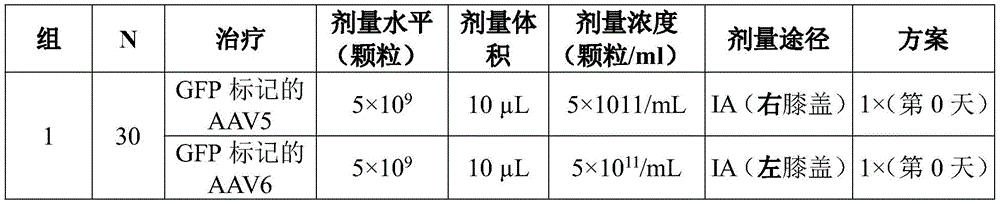
Observation, measurement and sample
Body weight measurement-mice were weighed for random grouping on study day 0 and re-weighed on day 1, day 3, day 5 and day 7. Body weight measurements can be found in table 6.
Necropsy samples-mice were necropsied on study days 3, 5 and 7 as shown in table 5.
TABLE 5 necropsy timetable
| Group of | Animal numbering | |
| 1 | 1-10 | |
| 1 | 11-20 | |
| 1 | 21-30 | |
At necropsy, mice were exsanguinated via cardiac puncture, and then cervical vertebrae were dislocated. Harvesting the right and left knees from all animals removes skin and muscle from the joint while leaving the joint capsule intact. The joints were snap frozen in 15mL conical tubes labeled with only mouse number, date of collection, and right or left leg, respectively. Knee joints were stored frozen at-80 ℃ for transport.
Animal treatment-animal carcasses were treated according to BBP SOP.
Sample and raw data storage-submitting samples (right and left knee joints), study data and reports during or at the completion of the study.
Statement of the impact of bias on study quality and integrity-no bias from study protocol.
Results/conclusions
On study day 0, male C57BL/6 mice received GFP-tagged AAV5 (5X 10) in the right knee 9 IA injection of 10 μl of individual particles and reception of GFP-tagged AAV6 (5×10) in left knee 9 Individual particles, 10 μl) IA injection. Animals were weighed on study days 0, 1, 3, 5 and 7. Necropsy was performed on study day 3 (animals 1-10), day 5 (animals 11-20) and day 7 (animals 21-30), and right and left knee joints were collected for transport. The living portion of this study was completed successfully, including animal weighing, dosing, and biological sample collection. All animals survived until termination of the study.
Reference to the literature
Guidelines cited in guidelines for care and use of laboratory animals (Guide for the Care and Use of LaboratoryAnimals) (8 th edition), national research committee, national academy of sciences, washington, columbia, 2011, which is incorporated herein by reference in its entirety.


Scheme for the production of a semiconductor device
Test system

Study calendar

Material
| Name of the name | Suppliers (suppliers) | Catalog number |
| Isoflurane (I-F) | VetOne | 502017 |
| Syringe and needle | BD | As required |
| Serum separator tube (if needed) | GreinerBio-One | #450472 (via Fisher) |
| LiHepMini-Collet (if needed) | GreinerBio-One | #450480 (via Fisher) |
| EDTAMini-Collet (if needed) | GreinerBio-One | #450477 (via Fisher) |
| K3EDTA (if needed) | Covidien | #8881311149 (via Fisher) |
| K2EDTAVacutainer (if needed) | BD | #367856 (via Fisher) |
| NaHepVacutainer (if needed) | BD | #367871 (via Fisher) |
| LiHepVacutainer (if needed) | BD | #367960 (via Fisher) |
Test article and vehicle information
Unformulated test article storage conditions-GFP-tagged AAV5 (group 1): -80C; GFP-tagged AAV6 (group 1): -80 ℃.
Vector information-GFP-tagged AAV5 (group 1): PBS (Ca and Mg free); GFP-tagged AAV6 (group 1): PBS (without Ca and Mg).
Test article formulation description and calculation-GFP-tagged AAV5 (group 1): the stock solution was diluted to an appropriate concentration using PBS; GFP-tagged AAV6 (group 1): stock solutions were diluted to appropriate concentrations using PBS.
Dosing formulation and vehicle storage and stability-GFP-tagged AAV5 (group 1): diluting just prior to injection; GFP-tagged AAV6 (group 1): dilution is performed immediately prior to injection.
Disposal of test articles after dosing-GFP-tagged AAV5 (group 1) discard formulation, reserving stock solution for future study; GFP-tagged AAV6 (group 1): the formulation was discarded and the stock solution was retained for future study.
Deliverable in vivo stage

Necropsy information
Sacrifice schedule: group 1 An 1-10: day 3
Euthanasia method: bleeding was performed by cardiac puncture to bleed, followed by cervical dislocation.
Time point: untimed time

* Tubes were marked with mouse number, date of collection and left or right leg only. The samples were tested without mention of whether they were injected with AAV-2 or AAV-5. The answer is provided only after the PCR is completed.
Sample analysis
Tissue samples-hind limbs from AAV-injected mice were flash frozen and transported. After arrival, the samples were transferred to a-80 ℃ refrigerator for storage.
GFP expression in target tissues-hind limbs (paired) were thawed at room temperature and imaged in IVIS bioluminescence imaging system (luminea III; perkin Elmer). GFP fluorescence was quantified using excitation at 488nm and measurement of emission at 510 nm. A total of 4 mice were assessed at each time point (day 3, day 5 and day 7). Tissues from the remaining 6 animals at each time point were retained for subsequent confirmation of viral load using real-time PCR.
Results-as can be seen in figure 3, there was high level expression of GFP in the injected knee at 3 days post injection. The viral load decreased slightly on day 5 and then increased again to day 7. There was no significant difference between AAV-5 and AAV-6 behavior due to the limited sample size in this pilot study.
Discussion-data from this study support the use of AAV-5 or AAV-6 for intra-articular delivery of CRISPR-Cas9 in the mouse knee. The increased levels of both viral serotypes from day 5 to day 7 remain the possibility that they might increase further if the follow-up was extended to 2 weeks or possibly 3 weeks. To confirm this requires additional work, but the data to date indicate that there should be a time interval of at least one week before the vehicle is injected and excited with intra-articular monoiodo acetate (MIA) crystals.
Background and principle-in this work, the Monoiodoacetate (MIA) -induced OA model was used for two reasons. First, natural (spontaneous) OA is extremely rare in mice, whereas injection of MIA results in relatively rapid onset of the induction model of OA, predictably, and provides good clinical relevance to the disease phenotype seen in human OA patients, including intra-articular inflammation, pain, and cartilage degradation. Second, the MIA model does not involve surgical incision of the joint capsule, making it more closely adjacent to the joint capsule of a human patient suffering from OA, compared to surgical models such as medial meniscal instability (DMM) and Anterior Cruciate Ligament Transection (ACLT).
Injection of MIA crystals in rodents reproduces OA-like lesions and functional defects, which can be analyzed and quantified by techniques such as behavioral testing and objective lameness assessment. MIA is an inhibitor of glyceraldehyde-3-phosphatase and the resulting change in glycolysis of the cells ultimately results in death of intra-articular cells, including chondrocytes. Chondrocyte death manifests itself as cartilage degradation and altered proteoglycan staining. The small injections with MIA generally showed pain-like behavior within 72 hours and cartilage loss around 4 weeks after injection. IL-1 expression has been demonstrated to increase in rats and mice within 2-3 days after injection.
Study design-mice were injected unilaterally (one joint per animal) with MIA or saline vehicle controls. In each group, half of the animals were pre-treated with AAV-CRISPR-Cas9 vector targeting the mouse IL-1 β gene and the other half were injected with AAV-CRISPR-Cas9 out-of-order control. Animals from both groups will exit the study at one of two time points: early time points of 48 hours to allow evaluation of the effect of therapy on IL-1 levels in synovial fluid; and an advanced time point of 4 weeks to allow evaluation of the effect of therapy on histological evidence of cartilage destruction and osteoarthritis.
Method
Experimental animals-a total of 80 mice were used in this study. The experimental procedure was reviewed and approved by the local IACUC. Mice were housed in small isolation cages, fed standard laboratory animal diet, and allowed ad libitum water.
MIA model and anti-IL 1 therapy-mice were acclimatized for a period of 7 days prior to the study. On the first day of the study, mice were anesthetized by inhalation of a mixture of isoflurane in oxygen. Once the surgical plane of anesthesia is confirmed, the right hind limb is clamped and the skin is scrubbed with surgical disinfectant. 40 mice (treated) received intra-articular injection of the IL-1 targeted AAV-CRISPR-Cas9 vector, and the remaining 40 mice (control) were intra-articular injected with AAV-CRISPR-Cas9 disorder control. Seven days later, half of the animals in each group were injected with MIA in the same joint and the other half with saline vehicle. This resulted in the establishment of four study groups:
group 1: treated MIA (20 mice)
Group 2: control-MIA (20 mice)
Group 3: treated vehicle (20 mice)
Group 4: control-vehicle (20 mice)
Ten mice per group were euthanized 48 hours after MIA challenge to record IL-1 levels in the knee joint. The remaining animals were kept for 4 weeks in order to evaluate the effect of therapy on pain behavior (behavioural test, including von frey test), lameness (limb use), joint swelling (caliper measurement) and joint pathology (histopathology).
Euthanasia and tissue collection-mice were killed by exsanguination followed by cervical dislocation. The joints were opened and rinsed for IL-1 measurement (48 hours group) or fixed for decalcification histopathological examination in 10% formalin (4 weeks group).
Example 5 efficacy of AAV-6 and AAV-5 mediated CRISPR treatment on MSU Crystal induced arthritis in mice
Introduction and purpose
The objective of these studies was to identify compounds/proteins that inhibit inflammation induced by the release of interleukin 1J3 (IL-1J 3) induced by the crystals of monosodium urate (MSU). This is a simple pre-screen that identifies the anti-inflammatory activity of various types of anti-inflammatory agents, particularly IL-1 pathway blockers such as interleukin receptor antagonists or antibodies that block IL-1 or IL1R1 (Torres R et al, in new animal models of gouty arthritis, inhibition of Hyperalgesia, synovitis and biomarkers of multiple inflammation by interleukin 1 (Hyperalgesia, synovitis and multiple biomarkers of inflammation are suppressed by interleukin 1inhibition in a novel animal model ofgouty arthritis), annual rheumatology (Ann Rheym dis.), 2009;68 (10): 1602-1608, which is incorporated herein by reference in its entirety for all purposes). Gout is the most common form of inflammatory arthritis, and the incidence of it is increasing worldwide (Roddy E and Doherty M. "epidemiology of gout (Epidemiology of Gout)", "arthritis research and Therapy (Arthritis Research & Therapy), 2010;12 (6): 223, which is incorporated herein by reference in its entirety for all purposes). Gouty arthritis is characterized by increased serum urate concentrations and deposition of monosodium urate crystals (MSU) in and around the joints, resulting in joint swelling and severe pain (Sabina EP, chandel S and Rasol MK, "inhibition of monosodium urate crystal-induced inflammation with Withafenacina (Inhibition of monosodium urate crystal-induced inflammation by withaferin A)", journal of pharmaceutical science (J Pharm Pharmaceut Sci.), "2008; 11 (4): 46-55, which is incorporated herein by reference in its entirety for all purposes). Current treatments include non-steroidal anti-inflammatory drugs (NSAIDs), steroids or colchicine. For some patients, these treatments may not be effective in treating gout or have adverse side effects (Sabina, 2008; getting SJ et al, "activation of melanocortin type 3 receptors as a molecular mechanism of corticotropin efficacy in gouty Arthritis (Activation of melanocortin type 3receptor as a molecular mechanism for adrenocorticotropic hormone efficacy in gouty Arthritis)", arthritis and rheumatic diseases (Arthritis & rheomatism), 2002;46 (10): 2765-2775, which is incorporated herein by reference in its entirety for all purposes). The MSU-induced inflammation model provides a good, simple screening tool for identifying compounds that may be active in more complex disease processes such as systemic arthritis and more complex IL-1 driven diseases.
A study was conducted to assess the efficacy of adeno-associated virus (AAV) -mediated CRISPR therapy in single sodium uronate (MSU) crystal-induced inflammation in mice. On study day 0, male C57BL/6 mice were injected in the right knee in a single (1 x) intra-articular (IA) with placebo control (diluent, phosphate buffered saline [ PBS ]), a mixture of two variants of AAV-6 (one carrying guide RNA 1 and the other carrying guide RNA2,5x109 viral genome [ vg ] copies/mL), a mixture of two variants of AAV-5 (guide 1+guide 2,5x10⁹ vg/mL), an disordered AAV-6 control (carrying non-targeted guide RNA,1x1010 vg/mL), or an disordered AAV-5 control (1 x10¹⁰ vg/mL). On study day 7, mice were injected with MSU crystals (25 mg/mL: 250. Mu.g in 10. Mu.L PBS) in the right knee (joint treated identically). Mice were euthanized for necropsy approximately 6 hours after MSU injection on study day 7. Efficacy assessment was based on animal body weight, von Frey test, and knee caliper measurements.
The small treated with AAV-6 (leader 1+2:5x10⁹vg per leader per knee) IA (day 1) showed a statistically significant decrease in the involvement of pain compared to mice injected with IA with AAV-5 disorder vector (p=0.025), resulting in almost statistical significance (p=0.051 and p=0.075, respectively) compared to AAV-6 disorder vector and PBS control, as measured by von Frey test. For the von frey assessment, the area under the curve (AUC) calculation was statistically not different between groups. There were no statistically significant differences between groups in animal body weight gain and knee swelling (table 7). All animals survived until termination of the study.
TABLE 7 summary of data

The values represent the group mean and Standard Error (SE)
PBS = phosphate buffered saline control, AAV = adeno-associated virus, AUC = area under curve
* p <0.05ANOVA (Tukey post) vs AAV-6 guide 1


P <0.05ANOVA (Tukey post) vs AAV-5 guide 1
Summary of clinical resultsNo significant differences between groups were observed over time. There was no clinical evidence that virus injection elicited a greater response than seen in the vehicle group. There is no clinical evidence that virus injection alters the effect of MSU on joint swelling. The specific role of IL-1 in MSU-induced inflammation is unclear, and thus lack of clinical efficacy may not be unexpected.
Summary of qPCRqPCR data confirm that CRISPR editing with AAV-6 or AAV-5 is effective in restoring IL-1 β mRNA expression to normal levels. In view of the sample size, statistical significance is difficult to demonstrate. Confirmation of this effect can be obtained by IHC analysis of synovial tissue.
Supervision compliance
The study was conducted in accordance with the state of the art Standard Operating Program (SOP), the national institutes of health basic biomedical research quality specification guidelines, and following all state and federal regulations (including USDA animal welfare act 9CFR, parts 1-3, federal registry 39129, 7 month 22 1993).
Institutional animal care and use
The study was conducted according to the guidelines for laboratory animal care and use (8 th Plate for printing ) Is carried out. For the animals used in this study, no acceptable surrogate test system was identified.
Materials and methods
Test article identification and preparation
Pre-formulating AAV vectors as a suspension of viral particles in frozen aliquots>5x10 12 Viral genome [ vg ]]copy/mL). Aliquots were stored at-80 ℃ and immediately prior to use in a diluent (sterile filtered PBS [ Corning, lot 01420007)]) And (5) medium reconstruction. Standard biosafety level 2 (BSL-2) was used by the person handling the AAV vector prior to injection. AAV disorder controls were prepared in sterile PBS to form a containing 1x10 12 vg/mL working stock for IA injection at 10. Mu.L/knee to inject 1X10 10 The disorder control of vg was delivered into the knee joint. Active AAV vectors are prepared by mixing equal portions of each of two active AAV-5 or AAV-6 constructs with sterile PBS to form 5x10 containing for each of the two leads 11 vg/mL working stock. The active AAV formulation was injected with IA at 10. Mu.L/knee to inject 5X10 9 Each of the two guides of vg is delivered into the knee joint. For additional details on test article preparation, storage and handling, see study protocol (appendix B).
AAV vectors were identified as follows:

mono-natriuretic acid salt (MSU) crystals were obtained from Invivogen (catalog number Tlrl-25-MSU, lot number MSU-42-01). 25Mg/mL MSU crystals were prepared in PBS (no Ca or Mg: corning, catalog number 21-031-CV, lot number 31719003) in plastic tubes, vortexed for about 1 minute, sonicated for about 15 to 20 minutes, and vortexed prior to pipetting and use.
Test system
| Number of animals: | 75 (70+5 additional) |
| Species/strain or breed: | C57BL/6 |
| the suppliers: | Jackson |
| age/weight at arrival: | 8-10 weeks old (about 20 g) |
| Gender: | male male |
| Age/weight range at study start: | at least 9 weeks from the beginning of the study |
| And (3) adaptation: | after reaching BBP, willAdapting for at least 3 days |
| Feeding: | 3-5 animals/cage |
Male C57BL/6 mice (N=70+4 additional) were obtained from Jackson laboratories (Barbur, michaelson) at ages of 8 to 10 weeks. At day-1 of the study, the mice weighed about 20 to 29 grams (average about 25 g).
Animals were identified by depicting the color-coded dots of the animal number at the bottom of the tail. After registration, all cages were labeled with protocol number, group number and animal number.
Environment and feeding
After arrival, animals were housed 3 to 5 per cage in polycarbonate cages with corn cob bedding and hanging food and water bottles. Mice were housed in individually ventilated cake cages (passive airflow, approximately 0.045-0.048m2 floor space). Animal care (including room, cage and equipment hygiene) is in accordance with guidelines cited in the guidelines of laboratory animal care and use (guideline, 2011) and applicable BBP SOP.
Animals were acclimatized for 9 days prior to entry into the study. During the life of the study, the attending veterinarian is on site or on demand. No contemporaneous drug is provided.
During the adaptation and study periods, animals were kept in a laboratory environment at a temperature in the range of 19 ℃ to 25 ℃ and a relative humidity of 30% to 70%. The automatic timer provides 12 hours of light and 12 hours of darkness. Animals were allowed ad libitum access to Envigo Teklad 8640 diet and fresh municipal tap water.
Study design
On study day-1, animals were randomized into treatment groups by body weight, knees were shaved, and baseline knee caliper measurements were obtained. On study day 0, animals were dosed with the treatments shown in table 8 (IA to within the right knee). On study day 7, IA was injected with MSU crystals (10 μl total, 250 μg MSU) in the right knee of the animal (knee identical to treatment). Weight measurements were obtained as described. At 5 time points as described, the pain involved was measured by the von frey test. Caliper measurements of the right knee were taken at 5 time points, as described. Animals were euthanized for necropsy after the final behavioral test on day 7 as described.
TABLE 8 group and treatment information

Disease induction
MSU crystals were prepared in sterile PBS at a concentration of 25 mg/mL. The crystals did dissolve and the injectable formulation was carefully mixed prior to use. 10uL of MSU crystal solution was injected into the right knee.
| Unformulated MSU storage conditions: room temperature, protected from light |
| Vehicle: PBS (phosphate buffered saline) |
| Dose route: IA into the right knee |
| Dose volume: 10uL per knee |
| MSU recipe specification and calculation: 0.01 ml/ |
| MSU storage and stability: stored in glass. Prepared just before administration. Vortex prior to injection |
| MSU treatment after dosing: the formulation discarded after administration. The unformulated stock remains. |
Weight measurement and live sampling
Mice were weighed for random grouping on study day-1 (pre-injection) and body weight was measured again on study days 2 and 6. Animal weight measurements can be found in table 9.
TABLE 9 weight and dose calculation data (MGA-UCM-2)

TABLE 9 (follow-up) weight and dose calculation data (MGA-UCM-2)


Von Frey method
Von Frey analysis was performed on the right hind paw at 5 time points: baseline (day-1), 6 hours post-dose (day 0), 24 hours post-dose (day 1), pre-MSU injection (0 hours, day 7), and 6 hours post-MSU injection (day 7). During von Frey test, the group was blind to the investigator.
The von Frey method evaluates mechanical allodynia (pain due to stimulus that does not normally cause pain) based on the animal's response to application of calibrated filaments (Bioseb, vittroles, france) to the foot. Filaments were identified by a number representing the log10 of force in milligrams x 10. Prior to baseline assessment, animals were acclimatized to the test rack three times (45 to 60 minutes) at the time of testing, von Frey hairs were dispensed on the surface of the hind paw and pushed in smoothly until the hairs were significantly bent; the hair was pressed against the jaws for six seconds. The response is recoded as either a 0 (no response) or a 1 (response). Response is defined as lifting the hind paws off the hair, pushing the legs off, off the hair, etc. The initial hair was 3.22, the tester moved to 2.83 if the animal responded, and to 3.61 if there was no response to 3.22 hair; the tester will continue testing the hair based on the response and move up or down as appropriate. Hair increments were as follows: 1.65, 2.36, 2.44, 2.83, 3.22, 3.61, 3.84, 4.08, 4.17. Each jaw was tested 5 times, moving up and down between hairs until the final filament was reached. The data is entered into a spreadsheet and used to convert the response rate to a paw withdrawal threshold. The results of the test are converted to absolute thresholds in grams (50% response rate) using equation 10 (x+yz)/10000, where x equals the logarithmic unit value of the wire being finally tested, y equals the table value of the response pattern of the upper and lower method of Dixon from a small sample (Dixon, 1965), and z equals the average spacing between the values of the wires. The rear portion of the hind paw was tested as the heel tended to give a more reliable and sensitive response. The tester monitors the animals for a high response or freeze, in which case the animals are left alone until calm. Von Frey data can be found in table 10.
TABLE 10 von Frey data (MGA-UCM-2)


TABLE 10 (section). Von Frey data (MGA-UCM-2)

TABLE 10 (section). Von Frey data (MGA-UCM-2)

TABLE 10 (section). Von Frey data (MGA-UCM-2)


TABLE 10 (section). Von Frey data (MGA-UCM-2)

Caliper method
Caliper measurements of the right knee were made at 5 time points: baseline (day-1), 6 hours post-administration (day 0), 24 hours post-administration (day 1), pre-MSU injection (day 0, day 7), and 6 hours post-injection (day 7). Knee caliper measurements were made using a spring loaded micrometer caliper (Mitutuyo). The knee caliper measurements can be seen in table 11.
Table 11 Knee Caliper data (MGA-UCM-2)

Table 11 (follow-up) knee Caliper data (MGA-UCM-2)
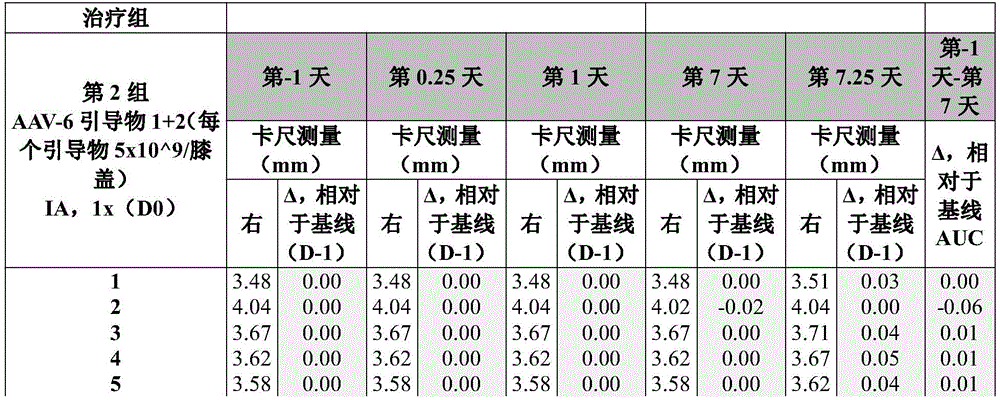

Table 11 (follow-up) knee Caliper data (MGA-UCM-2)
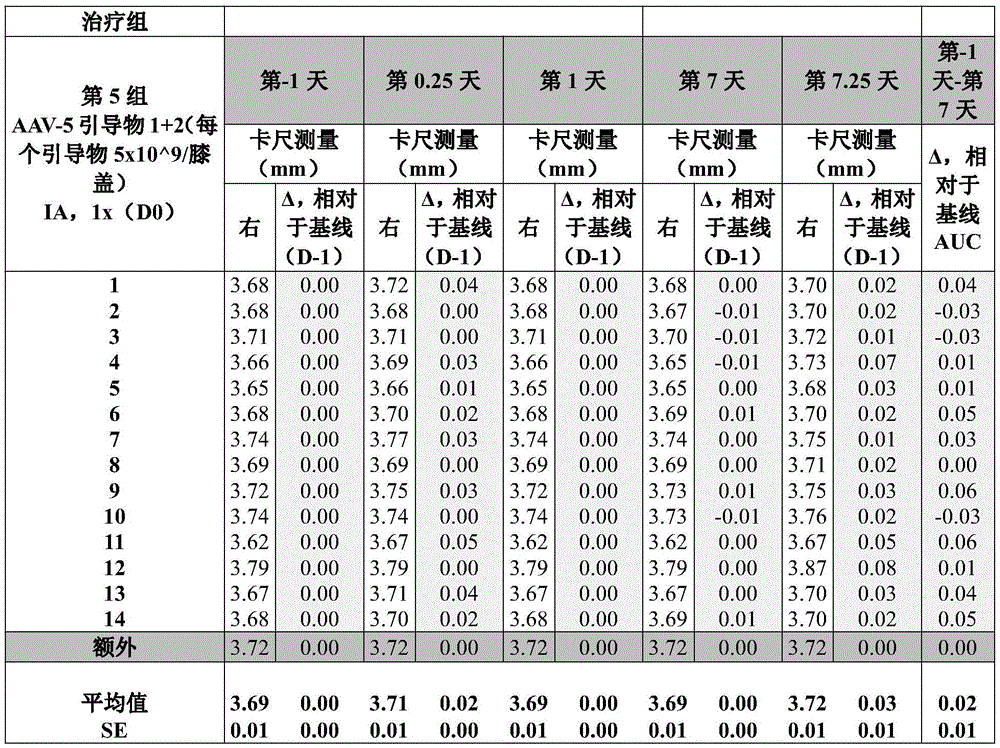
Table 11 (follow-up) knee Caliper data (MGA-UCM-2)

Table 11 (follow-up) knee Caliper data (MGA-UCM-2)


Dying or detected dead animals
If the animal is found to die, no sample is taken. For animals that need to be euthanized, samples are taken at necropsy (see necropsy information section), regardless of the cause. Animals in health assessment can be given SC fluid as well as hydrogels and foods on the bottom of the cage.
Study group name

Study calendar

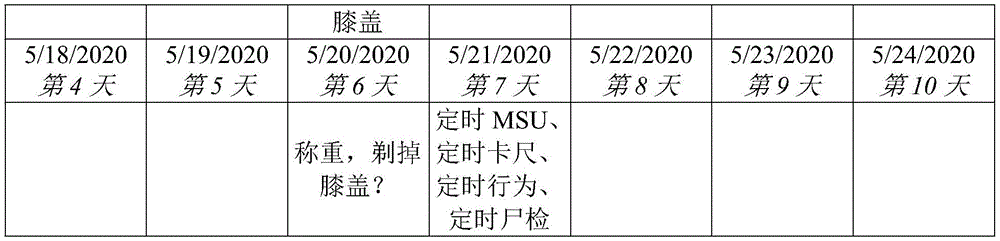
Material
| Name of the name | Suppliers (suppliers) | Catalog number |
| MSU crystal | Invivogen | Tlrl-msu-25 |
| Vehicle (PBS) | Corning | 21-031-CV |
| Gene | SgRNA | AA06-CCPCTRO1—AD01-200 |
| Gene | SgRNA | AA06-MCP001682-AD01-2-200A |
| Gene | SgRNA | AA06-MCP001682-AD01-2-200B |
| Gene | SgRNA | AA05-CCPCTROI-AD01-200 |
| Gene | SgRNA | AA05-MCP001682-AD01-2-200-9 |
| Gene | SgRNA | AA05-MCP001682-AD01-2-200-6 |
| Isoflurane (I-F) | VetOne | 502017 |
| Syringe and needle | BD | As required |
| Serum separator tube (if needed) | GreinerBio-One | #450472 (via Fisher) |
| LiHepMini-Collet (if needed) | GreinerBio-One | #450480 (via Fisher) |
| EDTAMini-Collet (if needed) | GreinerBio-One | #450477 (via Fisher) |
| K3EDTA (if needed) | Covidien | #8881311149 (via Fisher) |
Test article and vehicle information

Storage conditions of the unformulated test article:
| AAV-6 disorder vector (group 1): -80C |
| AAV-6 |
| PBS (group 3): 4C |
| AAV-5 disorder vector (group 4): -80C |
| AAV-5 |
Vehicle information:
| AAV-6 disorder vector (group 1): sterile PBS (without Ca and Mg) |
| AAV-6 |
| PBS (group 3): sterile PBS (without Ca and Mg) |
| AAV-5 disorder vector (group 4): sterile PBS (without Ca and Mg) |
| AAV-5 |
Test article formulation description and calculation:

dosage formulation and vehicle storage and stability:
| AAV-6 disorder vector (group 1): dilution immediately before injection |
| AAV-6 |
| AAV-5 disorder vector (group 4): dilution immediately before injection |
| AAV-5 |
Treatment of test article after dosing:
| AAV-6 disorder vector (group 1): discard formulation, store stock solution at-80C for future study |
| AAV-6 |
| AAV-5 disorder vector (group 4):discard formulation, store stock solution at-80C for future study |
| AAV-5 |
Living time of life

Necropsy information
Animals were necropsied after the final behavioral testing on study day 7 (about 6 hours after MSU). At necropsy, animals were bled by cardiac puncture to exsanguinate and euthanized by cervical dislocation for tissue collection. Whole blood was subjected to serum processing (. Gtoreq.200. Mu.L/mouse) and stored frozen at-80℃for transport to the study sponsor. The right (injected) and left (normal) knees (skin, muscles and feet were removed while leaving the knee joint intact) from all animals were collected. The joints were snap frozen directly in 15mL conical tubes for transport to sponsors.
| Sacrifice schedule: | study day 7 (6 hours after MSU): all animals |
| Euthanasia method: | bleeding was performed by cardiac puncture to bleed, followed by cervical dislocation. |
| Time point: | at the final behavior time pointRear ( |


Statistical analysis
Data were entered into microsoft Excel and mean and Standard Error (SE) for each group was determined. The groups were compared using one-way analysis of variance (ANOVA) or repeated measures with Tukey post hoc analysis (RM) ANOVA. ANOVA was performed using Prism v8.0.2 software (GraphPad). The BBP performs statistical analysis only on raw (unconverted) data, unless indicated. Statistical tests make certain assumptions about the normality and variance uniformity of the data, and if the test results in violations of these assumptions, further analysis may be required. All tested significance was set to p <0.050, where the p value was rounded to the third after decimal point.
AAV production
Standard procedure for preparation of virus for injection
For each construct, a working stock containing 5×10≡11vg/ml was created (guide 1, guide 2). It should be noted that for an equivalent, an out-of-order control group would require injection of a total of 1x10 copies of the out-of-order vector. A diluent (PBS) will be used for the vehicle control group.
Material

Procedure
Group 1: AAV-6 disorder control-400 microliter aliquots of sterile filtered Ca-free and Mg-free PBS were filled into sterile Eppendorf tubes. 100 microliters (equivalent to 5x10 x 11 vg) of stock solution AA06-CCPCTR01-AD01-200 was added. This resulted in a working stock of 0.5ml volume containing 1x10≡12vg/ml AAV-5 disorder control. 10 microliters of this solution was injected into the knee joint to deliver 1x10 vg of AAV-6 disorder control.
Group 2: active AAV-6 guide 1+2-an aliquot of 800 microliters of sterile filtered Ca-free and Mg-free PBS was placed into a sterile Eppendorf tube. 100 microliters (equivalent to 5x 10A 11 vg) of each of the two active AAV-6 constructs was added-this means 100 microliters (equivalent to 5x 10A 11 vg) of AA06-MCP001682-AD01-2-200-a and 100 microliters (equivalent to 5x 10A 11 vg) of stock AA06-MCP001682-AD01-2-200-b. This produced a working stock solution of 1ml volume containing 5x10 x 11vg/ml for each of the two guides. 10 microliters of this solution was injected into the knee joint, delivering 5x10 x 9vg for each of the two AAV-6 leads.
Group 3: PBS-sterile filtered Ca and Mg free PBS used to dilute virus stock as vehicle control for this study. It was administered at 10 μl/knee joint.
Group 4: AAV-5 disorder control-400 microliters of sterile filtered Ca-free and Mg-free PBS aliquots were loaded into sterile Eppendorf tubes. 100 microliters (equivalent to 5x10 x 11 vg) of stock solution AA05-CCPCTR01-AD01-200 was added. This resulted in a working stock of 0.5ml volume containing 1x10≡12vg/ml AAV-5 disorder control. 10 microliters of this solution was injected into the knee joint delivering 1x10 vg of AAV-5 disorder control.
Group 5: active AAV-6 guide 1+2-an aliquot of 800 microliters of sterile filtered Ca-free and Mg-free PBS was placed into a sterile Eppendorf tube. 100 microliters (equivalent to 5x 10A 11 vg) of each of the two active AAV-6 constructs was added-this means 100 microliters (equivalent to 5x 10A 11 vg) of AA05-MCP001682-AD01-2-200-a and 100 microliters (equivalent to 5x 10A 11 vg) of stock AA05-MCP001682-AD01-2-200-b. This produced a working stock solution of 1ml volume containing 5x10 x 11vg/ml for each of the two guides. 10 microliters of this solution was injected into the knee joint, delivering 5x10 x 9vg for each of the two AAV-6 leads.
qPCR
The whole block of quick-frozen synovial tissue (containing distal femur and proximal tibia) was excised and placed in RLT buffer. Homogenization was performed using a Cyrolys Evolution tissue homogenizer ("hard" program cycle). RNA was extracted using RNeasy or RNeasy Plus kit, followed by QIAshredder (from QIAGEN). RNA was quantified using nanostring. cDNA reverse transcription and qPCR were performed using mouse specific primers for IL-1 beta, beta-actin and RPL 13.
Results
As shown in fig. 6, PBS control mice had an average body weight gain of 4.3% (1.1 g) over the course of the study. There were no statistically significant differences in body weight gain between groups (tables 7, 9).
As shown in fig. 7A, knee caliper measurements in all groups peaked 6 hours after dosing on study day 0, returned to baseline 24 hours after dosing, and peaked again 6 hours after MSU on study day 7. There were no statistical differences in knee caliper changes from baseline between groups over time (table 11). As shown in fig. 7B, there was no statistically significant difference in knee caliper change AUC between groups from day-1 to day 7 (table 7, table 11).
As shown in fig. 8A, the von Frey absolute threshold in all groups decreased slightly after study day 0 IA dosing, and then tended to baseline on study day 7 before dropping sharply after the IA injection of MSU. Over time, there was no statistical difference between AAV disordered vector control groups and PBS control groups. Mice treated with AAV-6 (primer 1+2) had an absolute threshold of von frey that was increased 6 hours after MSU at day 7 compared to the control group; the absolute threshold increase in von Frey at this point was almost statistically significant (p=0.051 and p=0.075, respectively) compared to AAV-6 disordered vector and PBS control groups, and statistically significant (p=0.025) compared to AAV-5 disordered vector control groups. Mice treated with AAV-5 (guide 1+2) had von Frey absolute thresholds that did not differ statistically significantly from the control group over time (table 10). As shown in fig. 8B, the von Frey absolute threshold AUC from day-1 to day 7 was not statistically different between groups (table 7, table 10).
As shown in fig. 10, immunohistochemical data for mouse IL-1β in synovial tissue showed reduced IL-1β expression in CRISPR treated animals. (A) In animals injected with PBS-pretreated MSU, there was robust expression of IL-1β (brown staining). This effect was not observed in CRISPR treated animals (panel C). The absence of IL-1β (brown staining) in CRISPR treated animals was similar to negative antibody controls (panels B and D). All images are at 10 times the original magnification.
Discussion and conclusion
Compared to mice injected with AAV-5 disorder vector with IA (p=0.025), 6 hours after MSU injection on day 7, AAV-6 (leader 1+2:5x10 9 vg/lead/per knee) IA (day 1 x) treated mice showed statistically significant reduction of the referred pain as measured by von Frey test, with the results almost statistically significant (p=0.051 and p=0.075, respectively) compared to AAV-6 disordered vehicle and PBS control group. The AUC calculation for von Frey assessment was statistically not different between groups. Animal body weight gain and knee swelling were statistically not different between groups. All animals survived until termination of the study.
Example 6 guide RNA design
Guide RNAs targeting human IL-1 a and IL-1 β were designed according to the following procedure (table 14):
1. Identifying appropriate genome assembly and gene models (tools: ensemble, UCSC genome browser);
2. identifying key functional domains to map a targeting window (tool: ensemble; literature);
3. generating a list of all possible guide RNAs on the key exons (tools: ensemble, UCSC, inDelphi);
4. ranking the guides based on the frame shift scores of the ML predictions, and excluding poor performers;
5. from introns: exon boundaries exclude <5bp primers and have homologous polynucleotide fragments of 6 x t's or greater;
6. determining the mid-target (Donech 2016) and off-target (Hsu 2013) indices (tools: UCSC, deskgen) for each guide;
7. filtering out guides with poor mid-target and off-target scores to generate a final list; and
8. Ranking is based on the frameshift index.
Guide RNAs targeting cat, canine or equine IL-1α and IL-1β were designed according to the following procedure (Table 15):
1. identification of appropriate genome Assembly and Gene models (tools: ensemble, UCSC genome browser)
2. Identification of key functional domains to map targeting windows (tools: ensemble; literature)
3. Retrieval of coding sequences from appropriate exons and related flanking introns (tools: ensemble. APE)
4. Generating a list of all possible guide RNAs on key exons (tools: ensemble, inDelphi)
5. Ranking guides based on the frame shift score of ML predictions and excluding bad performers
6. From introns: exon boundaries exclude <5bp primers and have homologous polynucleotide fragments of 6 x t's or greater
7. Determination of metrics for Off-target for each guide (tools: cas Off-Finder, excel)
8. Filtering out guides with poor off-target scores to generate a final list
9. Ranking is based on the frameshift index.
The gene transcript information for all species considered is contained in table 16.
TABLE 14

TABLE 15
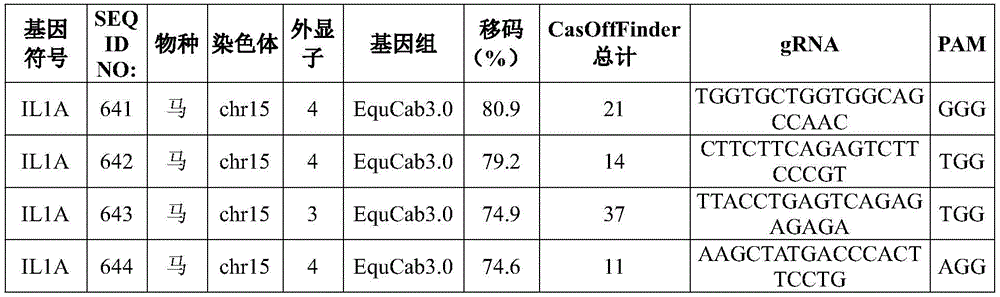
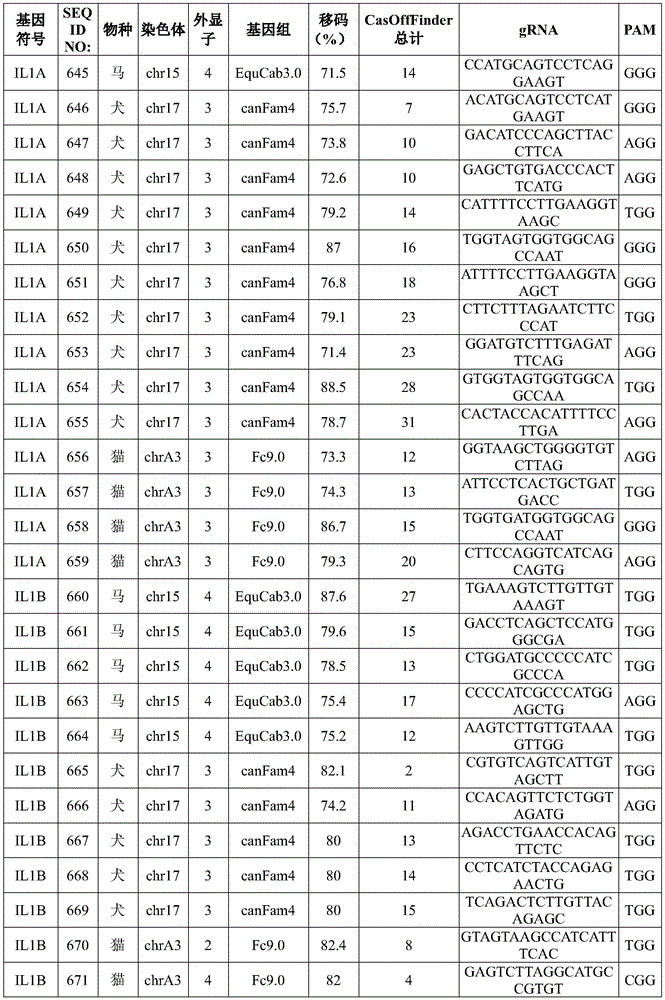

Table 16

EXAMPLE 7 immunohistochemistry for murine IL-1 beta
Immunohistochemistry was performed on murine synovial tissue to detect IL-1β according to the following protocol:
reagents and preparation
1. 10 XPBS containing 0.5% (v/v) Tween-20
2. Sterile PBS
IHC buffer
4. Primary antibody (goat anti-mouse IL-1; AF-401-NA, R & D Systems, inc.) was reconstituted in sterile PBS to a final concentration of 0.2 mg/ml.
a. Short term storage at +4C
b. Long term storage at-20 to-70C
5. Control antibodies (normal goat IgG; AB-108-C, R & D Systems Inc.) were reconstituted in sterile PBS at a final concentration of 1 mg/ml.
a. Short term storage at +4C
b. Long term storage at-20 to-70C
6. Secondary antibodies (HRP conjugated donkey anti-goat IgG; ab6885; abcam) appeared as reconstituted products
a. Short term storage at +4C
b. Long term storage at-20 to-70C
7. Peroxidase blocking (BLOXALL reagent, vector laboratories (Vector Laboratories))
8. Normal horse serum diluted to 2.5% (v/v) (Impress Polymer kit (Impress PolymerKit); vector laboratory)
DAB chromogen
Method
Antigen retrieval was performed for 1 hour (manual or automatic, user preference) and then samples were transferred to PBS for short term storage. Peroxidase blocking was performed at room temperature for 10 minutes, and the samples were then washed in IHC buffer for 5 minutes. Samples were blocked with control horse serum for 60 min at room temperature and exposed to primary antibodies (1:100 or 1:200, diluted in 1 XPBS-Tween) for 2 hours at room temperature. The samples were washed twice in IHC buffer for 5 minutes (each wash). The samples were then exposed to secondary antibody (1:500, diluted in 1 XPBS-Tween) for 1 hour, and washed twice in IHC buffer for 5 minutes (each wash). Detection with DAB chromogen was carried out for 30 seconds. Counterstaining (6 minutes) was performed with Mayer's hematoxylin and samples returned to xylene by graded alcohol series. DPX fixative was applied and a coverslip was attached.
As shown in fig. 10, immunohistochemical data for mouse IL-1β in synovial tissue showed reduced IL-1β expression in CRISPR treated animals. (A) In animals injected with PBS-pretreated MSU, there was robust expression of IL-1β (brown staining). This effect was not observed in CRISPR treated animals (panel C). The absence of IL-1β (brown staining) in CRISPR treated animals was similar to negative antibody controls (panels B and D). All images are at 10 times the original magnification. (A) And (B) is a contiguous section taken from the same joint in the same animal, wherein (a) shows tissue specifically labeled for IL-1β, and (B) shows tissue labeled with a negative (isotope) control antibody. The difference in staining reflects the demonstrable IL-1β expression in the PBS-pretreated MSU-injected animals in this animal (e.g., PBS-pretreated, then positive control animals challenged with MSU crystals). (C) And (D) are similarly adjacent sections, but from animals pretreated with CRISPR editing virus prior to MSU injection. (C) No IL-1 beta staining was evident in the sections treated with IL-1 antibody, and (D) the same negative pattern was seen in the sections treated with negative (isotope) control antibody. Without wishing to be bound by any particular theory, this demonstrates that there is no detectable IL-1β expression in synovial membranes of CRISPR treated animals.
Example 8. Design and validation of CRISPR/Cas9 RNA guides for canine and human interleukin-1α (IL-1α) and interleukin-1β (IL-1β).
Potential crRNA sequences for different exons of the human and canine interleukin-1α (IL-1α) and interleukin-1β (IL-1β) genes were identified. FIGS. 13A-13D show ordered lists of crRNA sequences identified from exons 2-7 of the human IL-1. Alpha. Gene. FIGS. 14A-14E show ordered lists of crRNA sequences identified from exons 2-7 of the human IL-1β gene. FIGS. 15A-15C show crRNA sequences identified from exons 3-5 of canine IL-1. Beta. Gene. FIGS. 16A-16B show crRNA sequences identified from exons 3-5 of canine IL-1. Alpha. Gene.
The obtained genome (human, hg38; canine, canfam 3.1), folded gene model (mered Ensembl/Havana), tissue specific exon expression (gtexport. Org) and various gRNA models can then be used to select two to two separate crRNA sequences per gene, targeting canine and human interleukin-1α (IL-1α) and interleukin-1β (IL-1β). The following gRNA design rules apply:
the grna target region is limited to the first 5-50% of the coding sequence (CDS).
2. The individual grnas were ranked according to maximum mid-target editing using the Azimuth 2.0 model (10.1038/nbt.3437) and minimum off-target editing using Cut Frequency Determination (CFD) (10.1038/nbt.3437) and specificity score from Hsu et al (10.1038/nbt.2647).
3. High-ranking sgrnas with high frameshift frequency (> 75%) and consistent DNA repair results (> 0.48) as predicted by inDelphi (10.1038/s 41586-018-0686-x) were selected for in vitro synthesis.
Using this selection criterion, crRNA guide sequences targeting different exons of the corresponding target genes were selected for further study. Specifically, as shown in FIG. 17A, the target exons 3 and 4 of sg235 (SEQ ID NO: 301) and sg236 (SEQ ID NO: 309) of the human IL-1α gene were selected. Similarly, as shown in FIG. 17B, sg237 (SEQ ID NO: 462), sg238 (SEQ ID NO: 391), sg248 (SEQ ID NO: 393), sg249 (SEQ ID NO: 388) and sg250 (SEQ ID NO: 389) targeting exons 3, 4 and 5 of the human IL-1β gene were selected. As shown in FIG. 17C, sg239 (SEQ ID NO: 552), sg240 (SEQ ID NO: 554), sg251 (SEQ ID NO: 578), and sg252 (SEQ ID NO: 579) targeting exons 3, 4, 5 of canine IL-1 alpha gene were selected. Also, as shown in FIG. 17D, sg241 (SEQ ID NO: 498) and sg242 (SEQ ID NO: 506) were selected that target exons 3 and 4 of canine IL-1 beta gene.
The single stranded guide RNAs (sgrnas) fused to the scaffold sequence are then synthesized (synthesis) with scaffold modifications designed to increase their stability and reduce their cellular immunogenicity. Primers for genotyping were designed to be at least 200bp from the target site and generate PCR amplicon <1.5kb and synthesized (Merck).
The following amounts were used for single electroporation-based transfection using a 4D-nuclear transfectometer (Lonza, catalog number AAF-1002B and AAF-1002X) and nuclear cuvette strips. 80pmol of synthesized sgRNA was pre-complexed with 4 μg of Cas9 nuclease at room temperature for at least 10 minutes. The 300-400K dissociated cells were washed with PBS, then resuspended in 20. Mu.l of the supplemented P3 nuclear transfection solution, and the Cas9 RNP complex was added. These cells were then transferred to a nuclear cuvette well and electroporated using pulse code ER-100. Immediately after electroporation, the nuclear cuvette was placed in a 37 ℃/5% co2 incubator for 10 minutes for cell recovery from voltage. Thereafter, 80 μl of growth medium was added to the nuclear cuvette wells and the cells were transferred to 6-well dishes with pre-warmed growth medium.
Between the second day and eleventh day after electroporation, genomic DNA was extracted from 50-200K cells using dnase Blood and Tissue kit (Qiagen, catalog No. 69506). The individual gRNA target (and off-target) regions were amplified by PCR.
The PCR products were size verified by gel electrophoresis, purified using a QIAquick PCR purification kit (Qiagen, catalog No. 28106), and submitted to Source BioScience for sanger sequencing. The sanger trajectory (ab 1) was deconvolved using ICE version 1.2 (found online at URL gitub. Com/synhego-open/ICE) to infer CRISPR edits. In addition, inDelphi was used to generate machine-learned predictions of gene editing using selected probes. In addition, predicted off-target sites were analyzed by direct sequencing to verify whether gRNA facilitated off-target editing.
The results of empirical experiments and machine learning predictions for gene editing using selected guide sequences are shown in fig. 17.
Example 9. -effect of selected CRISPR/Cas9 RNA guides on release of interleukin-1α (IL-1α) and interleukin-1β (IL-1β) in canines and humans.
The gRNA with the highest Knockout (KO) score (i.e., highest frameshift frequency) from example 8 was used to generate dual IL-1α/IL-1β Knockout (KO) cells. Specifically, human chondrocytes were edited using crRNA sequence CAGAGACAGAUGAUCAAUGG (SEQ ID NO: 301) to obtain >99% IL-1αKO, and 67% IL-1βKO was obtained using crRNA sequence GUGCAGUUCAGUGAUCGUAC (SEQ ID NO: 389). Canine chondrocytes were edited using crRNA sequence GACAUCCCAGCUUACCUUCA (SEQ ID NO: 554) to obtain 97% IL-1αKO, and crRNA sequence ACUCUUGUUACAGAGCUGGU (SEQ ID NO: 506) was used to obtain 99% IL-1βKO.
Canine chondrocytes (catalog number Cn 402K-05), human chondrocytes (catalog number 402-05 a) and human fibroblast-like synoviocytes (catalog number 408-05 a) were purchased as frozen stock (5 x 10. Sup..5 cells) from Cellapplications, inc., san Diego, calif., san Diego, calif. Chondrocytes were cultured in growth medium consisting of DMEM/Ham's F12 (Gibco, catalog No. 21331-020) supplemented with 20% (v/v) untreated FBS (Gibco, catalog No. 10270-106) and 1X GlutaMAX (Gibco, catalog No. 35050-038). Synovial cells were cultured in growth medium consisting of DMEM (Gibco, catalog number 11960-044), 10% untreated FBS (Gibco, catalog number 10270-106) and 1xGlutaMAX (Gibco, catalog number 35050-038). Cells were confirmed to be negative for the mycoplasma species and STR analysis was performed prior to use. For electroporation and subculture, cells were dissociated using 0.25% trypsin (Gibco, cat. No. 25200056). Trypsin was quenched with 9 volumes of growth medium and the cells were spun at 1,000g to remove supernatant.
IL-1 was induced by LPS. The release of interleukin-1 is induced by stimulation of sub-confluent monolayers of cells (edited or wild-type non-edited) with Lipopolysaccharide (LPS). Briefly, unedited (control) and dual IL-1α/IL-1βKO (edited) human or canine chondrocytes were plated at approximately 5X10 per well 4 The density of individual cells was seeded in 24-well plates. After 24-48 hours, the medium was replaced with fresh serum-free medium containing LPS (50. Mu.g/ml) or PBS vehicle and the plates returned to the incubator. Plates were harvested after 6 hours and 24 hours for determining IL-1 release. The medium was snap frozen in liquid nitrogen and stored at-20 ℃ until the medium was assayed.
Measurement of IL-1α and IL-1β release. The concentrations of IL-1α and IL-1β in the medium were measured using species-specific commercial assays according to the manufacturer's instructions. The frozen medium was thawed before measurement and then centrifuged (1500 g for 2 minutes) to remove cell debris. Where appropriate, aliquots of the medium are measured in duplicate and the concentration of IL-1 is determined from a standard curve of recombinant human or canine IL-1 alpha or beta. Results of IL-1 alpha release in canine cells are shown in fig. 18A (6 hours) and 18B (24 hours). Results of IL-1β release in canine cells are shown in FIGS. 18C (6 hours) and 18D (24 hours). The results of IL-1 alpha release in human cells are shown in fig. 19A (6 hours) and 19B (24 hours). The results of IL-1β release in human cells are shown in FIGS. 19C (6 hours) and 19D (24 hours).
P3 primary cell nucleotide transfection reagent and nucleotide bands (catalog number V4 XP-3032) were purchased from Lonza (Slogh, UK). Cas9 nuclease (catalog No. a 36499) is purchased from sameimer femto-tech company (Thermo Fisher Scientific). Lipopolysaccharide (LPS) from E.coli O55:B5 (catalog number L6529) was purchased from Merck. ELISA kits for human IL-1α (catalog No. ab 214025) and human IL-1β (catalog No. ab 100560), canine IL-1α (catalog No. A4270) and canine IL-1β (catalog No. ab 273170) were purchased from Abcam (Cambridge, UK).
Example 10. -increased specificity of CRISPR/Cas9 mediated gene editing.
Analysis of the gene editing specificity reported in example 8 was repeated using enhanced specific CRISPR-associated protein 9. eSpCas9 contains three specific enhancing mutations: K848A, K A and R1060A, as described in Slaymaker et al, science 351:84-88 (2016). eSpCas9 was expressed in e.coli and purified to homogeneity. The construct has a molecular weight of 161kDa and contains an N-terminal Flag-tag and a C-terminal hexa-His-tag. The sequence of eSpCas9 is:
MDYKDHDGDYKDHDIDYKDDDDKMAPKKKRKVGIHGVPAADKKYSIGLDIGTNSVGWAVITDEYKVPSKKFKVLGNTDRHSIKKNLIGALLFDSGETAEATRLKRTARRRYTRRKNRICYLQEIFSNEMAKVDDSFFHRLEESFLVEEDKKHERHPIFGNIVDEVAYHEKYPTIYHLRKKLVDSTDKADLRLIYLALAHMIKFRGHFLIEGDLNPDNSDVDKLFIQLVQTYNQLFEENPINASGVDAKAILSARLSKSRRLENLIAQLPGEKKNGLFGNLIALSLGLTPNFKSNFDLAEDAKLQLSKDTYDDDLDNLLAQIGDQYADLFLAAKNLSDAILLSDILRVNTEITKAPLSASMIKRYDEHHQDLTLLKALVRQQLPEKYKEIFFDQSKNGYAGYIDGGASQEEFYKFIKPILEKMDGTEELLVKLNREDLLRKQRTFDNGSIPHQIHLGELHAILRRQEDFYPFLKDNREKIEKILTFRIPYYVGPLARGNSRFAWMTRKSEETITPWNFEEVVDKGASAQSFIERMTNFDKNLPNEKVLPKHSLLYEYFTVYNELTKVKYVTEGMRKPAFLSGEQKKAIVDLLFKTNRKVTVKQLKEDYFKKIECFDSVEISGVEDRFNASLGTYHDLLKIIKDKDFLDNEENEDILEDIVLTLTLFEDREMIEERLKTYAHLFDDKVMKQLKRRRYTGWGRLSRKLINGIRDKQSGKTILDFLKSDGFANRNFMQLIHDDSLTFKEDIQKAQVSGQGDSLHEHIANLAGSPAIKKGILQTVKVVDELVKVMGRHKPENIVIEMARENQTTQKGQKNSRERMKRIEEGIKELGSQILKEHPVENTQLQNEKLYLYYLQNGRDMYVDQELDINRLSDYDVDHIVPQSFLADDSIDNKVLTRSDKNRGKSDNVPSEEVVKKMKNYWRQLLNAKLITQRKFDNLTKAERGGLSELDKAGFIKRQLVETRQITKHVAQILDSRMNTKYDENDKLIREVKVITLKSKLVSDFRKDFQFYKVREINNYHHAHDAYLNAVVGTALIKKYPALESEFVYGDYKVYDVRKMIAKSEQEIGKATAKYFFYSNIMNFFKTEITLANGEIRKAPLIETNGETGEIVWDKGRDFATVRKVLSMPQVNIVKKTEVQTGGFSKESILPKRNSDKLIARKKDWDPKKYGGFDSPTVAYSVLVVAKVEKGKSKKLKSVKELLGITIMERSSFEKNPIDFLEAKGYKEVKKDLIIKLPKYSLFELENGRKRMLASAGELQKGNELALPSKYVNFLYLASHYEKLKGSPEDNEQKQLFVEQHKHYLDEIIEQISEFSKRVILADANLDKVLSAYNKHRDKPIREQAENIIHLFTLTNLGAPAAFKYFDTTIDRKRYTSTKEVLDATLIHQSITGLYETRIDLSQLGGDKRPAATKKAGQAKKKKAAALEHHHHHH(SEQ ID NO:680)。
briefly, the same sgrnas used in example 8 and shown in figure 17 were complexed with eSpCas 9. As shown in FIG. 17A, exons 3 and 4 were targeted using sg235 (SEQ ID NO: 301) and sg236 (SEQ ID NO: 309) of the human IL-1. Alpha. Gene. Similarly, as shown in FIG. 17B, sg237 (SEQ ID NO: 462), sg238 (SEQ ID NO: 391), sg248 (SEQ ID NO: 393), sg249 (SEQ ID NO: 388) and sg250 (SEQ ID NO: 389) targeting exons 3, 4 and 5 of the human IL-1. Beta. Gene were used. As shown in FIG. 17C, sg239 (SEQ ID NO: 552), sg240 (SEQ ID NO: 554), sg251 (SEQ ID NO: 578), and sg252 (SEQ ID NO: 579) targeting exons 3, 4, and 5 of canine IL-1 alpha gene were used. Also, as shown in FIG. 17D, sg241 (SEQ ID NO: 498) and sg242 (SEQ ID NO: 506) targeting exons 3 and 4 of canine IL-1 beta gene were used.
The single stranded guide RNAs (sgrnas) fused to the scaffold sequence are then synthesized (synthesis) with scaffold modifications designed to increase their stability and reduce their cellular immunogenicity. Primers for genotyping were designed to be at least 200bp from the target site and generate PCR amplicon <1.5kb and synthesized (Merck).
The following amounts were used for single electroporation-based transfection using a 4D-nuclear transfectometer (Lonza, accession numbers AAF-1002B and AAF-1002X) and nuclear cuvette strips. 80pmol of synthesized sgRNA was precomplexed with eSPAS 9 nuclease at room temperature for at least 10 minutes. The 300-400K dissociated cells were washed with PBS, then resuspended in 20. Mu.l of the supplemented P3 nuclear transfection solution, and the Cas9 RNP complex was added. These cells were then transferred to a nuclear cuvette well and electroporated using pulse code ER-100. Immediately after electroporation, the nuclear cuvette was placed in a 37 ℃/5% co2 incubator for 10 minutes for cell recovery from voltage. Thereafter, 80 μl of growth medium was added to the nuclear cuvette wells and the cells were transferred to 6-well dishes with pre-warmed growth medium.
Between the second day and eleventh day after electroporation, genomic DNA was extracted from 50-200K cells using dnasy blood and tissue kit (Qiagen, cat# 69506). The individual gRNA target (and off-target) regions were amplified by PCR.
The PCR products were size verified by gel electrophoresis, purified using a QIAquick PCR purification kit (Qiagen, catalog No. 28106), and submitted to Source BioScience for sanger sequencing. The sanger trajectory (ab 1) was deconvolved using ICE version 1.2 (found online at URL gitub. Com/synhego-open/ICE) to infer CRISPR edits. In addition, inDelphi was used to generate machine-learned predictions of gene editing using selected probes. In addition, predicted off-target sites were analyzed by direct sequencing to verify whether gRNA facilitated off-target editing.
Compared to Cas9 edits reported in example 8, the use of eSpCas9 reduced off-target edits without losing mid-target activity. For example, by amplifying the locus reported in table 18, followed by sequencing the locus, off-target editing of the three loci with 2, 3 and 3 mismatches, respectively, of sgRNA #242 (targeting canine IL-1B) was assessed. As shown in table 18, the first off-target locus was not subject to editing in the experiment described in example 8 and was not tested here. The second off-target locus underwent almost complete off-target editing (98-99%) in the experiment described in example 8, but did not undergo editing when using eSpCas 9. In the experiment described in example 8, the third off-target locus underwent some editing (0-25%), but underwent editing again when using eSpCas 9. Furthermore, as shown in table 17, for each sgRNA tested, the "enhanced mid-target score" corresponding to the edits made using eSpCas9 as described in this example was as high (if not higher) than the "mid-target score" corresponding to the edits described in example 8.
TABLE 17


TABLE 18

The examples set forth above are provided to provide those of ordinary skill in the art with a complete disclosure and description of how to make and use the embodiments of the compositions, systems, and methods of the present disclosure and are not intended to limit the scope of what the inventors regard as their invention. Modifications of the above-described modes for carrying out embodiments of the present disclosure which are obvious to those skilled in the art are intended to be within the scope of the following claims. All patents and publications mentioned in the specification are indicative of the level of skill of those skilled in the art to which this disclosure pertains.
All headings and chapter names are for clarity and reference purposes only and should not be construed as limiting in any way. For example, those skilled in the art will recognize the usefulness of properly combining various aspects from the different headings and chapters in accordance with the spirit and scope of the disclosure described herein.
It is to be understood that the methods described herein are not limited to the particular methods, protocols, subjects, and sequencing techniques described herein, and thus may vary. It is also to be understood that the terminology used herein is for the purpose of describing particular embodiments only, and is not intended to limit the scope of the methods and compositions described herein, which will be limited only by the appended claims. While some embodiments of the present disclosure have been shown and described herein, it will be apparent to those skilled in the art that such embodiments are provided by way of example only. Many changes, modifications and substitutions will now occur to those skilled in the art without departing from the disclosure. It should be understood that various alternatives to the embodiments of the disclosure described herein may be employed in practicing the disclosure. The following claims are intended to define the scope of the disclosure and their methods and structures within the scope of these claims and their equivalents are thereby covered.
For purposes of illustration, several aspects are described with reference to exemplary applications. Any embodiment may be combined with any other embodiment unless otherwise specified. It should be understood that numerous specific details, relationships, and methods are set forth to provide a full understanding of the features described herein. One skilled in the relevant art will readily recognize, however, that the features described herein may be implemented without one or more of the specific details, or with other methods. The features described herein are not limited by the illustrated ordering of acts or events, as some acts may occur in different orders and/or concurrently with other acts or events. Moreover, not all illustrated acts or events are required to implement a methodology in accordance with the features described herein.
While some embodiments have been shown and described herein, it will be apparent to those skilled in the art that such embodiments are provided by way of example only. This is not meant to be limiting of the disclosure to the specific examples provided in the specification. While the present disclosure has been described with reference to the foregoing specification, the descriptions and illustrations of the embodiments herein are not meant to be construed in a limiting sense. Many changes, modifications and substitutions will now occur to those skilled in the art without departing from the disclosure.
Furthermore, it should be understood that all aspects of the disclosure are not limited to the specific descriptions, configurations, or relative proportions set forth herein depending on the various conditions and variables. It should be understood that various alternatives to the embodiments of the disclosure described herein may be employed in practicing the disclosure. Accordingly, it is intended that the present disclosure also cover any such alternatives, modifications, variations, or equivalents. The following claims are intended to define the scope of the disclosure and their methods and structures within the scope of these claims and their equivalents are thereby covered.
All publications, patents, and patent applications herein are incorporated by reference to the same extent as if each individual publication, patent, or patent application was specifically and individually indicated to be incorporated by reference. If there is a conflict between a term herein and a term in the incorporated reference, the term herein controls.
Claims (142)
1. A pharmaceutical composition for treating or preventing a joint disease or condition, comprising:
a therapeutically effective amount of one or more nucleic acids encoding a Clustered Regularly Interspaced Short Palindromic Repeats (CRISPR) gene editing system, the system comprising:
(i) CRISPR-associated protein 9 (Cas 9) protein; and
(ii) At least one guide RNA targeting an IL-1 a or IL-1 β gene, wherein the target sequence is adjacent to a prosomain sequence adjacent motif (PAM) sequence of the Cas9 protein.
2. The pharmaceutical composition of claim 1, wherein:
the at least one guide RNA targets the human IL-1. Alpha. Gene and
the at least one guide RNA comprises a crRNA sequence having at least 85% identity to a sequence selected from the group consisting of SEQ ID NOs 298-387.
3. The pharmaceutical composition of claim 1, wherein:
the at least one guide RNA targets the human IL-1. Alpha. Gene and
the at least one guide RNA comprises a crRNA sequence having at least 90% identity to a sequence selected from the group consisting of SEQ ID NOs 298-387.
4. The pharmaceutical composition of claim 1, wherein:
the at least one guide RNA targets the human IL-1. Alpha. Gene and
the at least one guide RNA comprises a crRNA sequence having at least 95% identity to a sequence selected from the group consisting of SEQ ID NOs 298-387.
5. The pharmaceutical composition of claim 1, wherein:
the at least one guide RNA targets the human IL-1. Alpha. Gene and
The at least one guide RNA comprises a crRNA sequence selected from the group consisting of SEQ ID NOs 298-387.
6. The pharmaceutical composition of claim 1, wherein:
the at least one guide RNA targets the human IL-1 beta gene and
the at least one guide RNA comprises a crRNA sequence having at least 85% identity to a sequence selected from the group consisting of SEQ ID NOs 388-496.
7. The pharmaceutical composition of claim 1, wherein:
the at least one guide RNA targets the human IL-1 beta gene and
the at least one guide RNA comprises a crRNA sequence having at least 90% identity to a sequence selected from the group consisting of SEQ ID NOs 388-496.
8. The pharmaceutical composition of claim 1, wherein:
the at least one guide RNA targets the human IL-1 beta gene and
the at least one guide RNA comprises a crRNA sequence having at least 95% identity to a sequence selected from the group consisting of SEQ ID NOs 388-496.
9. The pharmaceutical composition of claim 1, wherein:
the at least one guide RNA targets the human IL-1 beta gene and
the at least one guide RNA comprises a crRNA sequence selected from the group consisting of SEQ ID NOs 388-496.
10. The pharmaceutical composition of claim 1, wherein:
the at least one guide RNA targets a canine IL-1 a gene, and
the at least one guide RNA comprises a crRNA sequence having at least 85% identity to a sequence selected from the group consisting of SEQ ID NOs 522-590.
11. The pharmaceutical composition of claim 1, wherein:
the at least one guide RNA targets a canine IL-1 a gene, and
the at least one guide RNA comprises a crRNA sequence having at least 90% identity to a sequence selected from the group consisting of SEQ ID NOs 522-590.
12. The pharmaceutical composition of claim 1, wherein:
the at least one guide RNA targets a canine IL-1 a gene, and
the at least one guide RNA comprises a crRNA sequence having at least 95% identity to a sequence selected from the group consisting of SEQ ID NOs 522-590.
13. The pharmaceutical composition of claim 1, wherein:
the at least one guide RNA targets a canine IL-1 a gene, and
the at least one guide RNA comprises a crRNA sequence selected from the group consisting of SEQ ID NOs 522-590.
14. The pharmaceutical composition of claim 1, wherein:
The at least one guide RNA targets the canine IL-1 beta gene and
the at least one guide RNA comprises a crRNA sequence having at least 85% identity to a sequence selected from the group consisting of SEQ ID NOs: 497-551.
15. The pharmaceutical composition of claim 1, wherein:
the at least one guide RNA targets the canine IL-1 beta gene and
the at least one guide RNA comprises a crRNA sequence having at least 90% identity to a sequence selected from the group consisting of SEQ ID NOs: 497-551.
16. The pharmaceutical composition of claim 1, wherein:
the at least one guide RNA targets the canine IL-1 beta gene and
the at least one guide RNA comprises a crRNA sequence having at least 95% identity to a sequence selected from the group consisting of SEQ ID NOs: 497-551.
17. The pharmaceutical composition of claim 1, wherein:
the at least one guide RNA targets the canine IL-1 beta gene and
the at least one guide RNA comprises a crRNA sequence selected from the group consisting of SEQ ID NOs:497-551.
18. The pharmaceutical composition of any one of claims 1-17, wherein the composition comprises one or more viral vectors that collectively comprise the one or more nucleic acids.
19. The pharmaceutical composition of claim 18, wherein the one or more viral vectors comprise a recombinant virus selected from the group consisting of retrovirus, adenovirus, adeno-associated virus, lentivirus, and herpes simplex virus-1.
20. The pharmaceutical composition of claim 18, wherein the one or more viral vectors comprise a recombinant adeno-associated virus (AAV).
21. The pharmaceutical composition of claim 20, wherein the recombinant AAV is serotype 5 (AAV 5).
22. The pharmaceutical composition of claim 20, wherein the recombinant AAV is serotype 6 (AAV 6).
23. The pharmaceutical composition of any one of claims 18 to 22, wherein the one or more viral vectors comprise:
a first viral vector comprising a first nucleic acid of the one or more nucleic acids encoding the Cas9 protein; and
a second viral vector comprising a second nucleic acid of the one or more nucleic acids encoding the at least one guide RNA.
24. The pharmaceutical composition of any one of claims 18-22, wherein the one or more viral vectors comprise a viral vector comprising a single nucleic acid, wherein the single nucleic acid encodes the Cas9 protein and at least one guide RNA.
25. The pharmaceutical composition of any one of claims 1 to 17, wherein the composition comprises one or more liposomes that collectively comprise the one or more nucleic acids.
26. The pharmaceutical composition of any one of claims 1-17, wherein the one or more nucleic acids are present in a naked state.
27. The pharmaceutical composition of any one of claims 1-26, wherein the Cas9 protein is a streptococcus pyogenes Cas9 polypeptide.
28. The pharmaceutical composition of any one of claims 1-26, wherein the Cas9 protein is a staphylococcus aureus Cas9 polypeptide.
29. The pharmaceutical composition of any one of claims 1 to 28, wherein the composition is formulated for parenteral administration.
30. The pharmaceutical composition of any one of claims 1 to 28, wherein the composition is formulated for intra-articular injection within a joint of a subject.
31. A method for treating or preventing a joint disease or condition in a subject in need thereof, the method comprising:
administering to a joint of the subject a pharmaceutical composition comprising a pharmaceutically effective amount of a composition comprising one or more nucleic acids encoding Clustered Regularly Interspaced Short Palindromic Repeats (CRISPR) gene editing systems, the system comprising:
(i) CRISPR-associated protein 9 (Cas 9) protein; and
(ii) At least one guide RNA targeting an IL-1 a or IL-1 β gene, wherein the target sequence is adjacent to a prosomain sequence adjacent motif (PAM) sequence of the Cas9 protein.
32. The method of claim 31, wherein the joint disease or condition is arthritis.
33. The method of claim 32, wherein the arthritis is osteoarthritis.
34. The method of any one of claims 31-33, wherein the subject is a human.
35. The method according to claim 34, wherein:
the at least one guide RNA targets the human IL-1. Alpha. Gene and
the at least one guide RNA comprises a crRNA sequence having at least 85% identity to a sequence selected from the group consisting of SEQ ID NOs 298-387.
36. The method according to claim 34, wherein:
the at least one guide RNA targets the human IL-1. Alpha. Gene and
the at least one guide RNA comprises a crRNA sequence having at least 90% identity to a sequence selected from the group consisting of SEQ ID NOs 298-387.
37. The method according to claim 34, wherein:
the at least one guide RNA targets the human IL-1. Alpha. Gene and
The at least one guide RNA comprises a crRNA sequence having at least 95% identity to a sequence selected from the group consisting of SEQ ID NOs 298-387.
38. The method according to claim 34, wherein:
the at least one guide RNA targets the human IL-1. Alpha. Gene and
the at least one guide RNA comprises a crRNA sequence selected from the group consisting of SEQ ID NOs 298-387.
39. The method according to claim 34, wherein:
the at least one guide RNA targets the human IL-1 beta gene and
the at least one guide RNA comprises a crRNA sequence having at least 85% identity to a sequence selected from the group consisting of SEQ ID NOs 388-496.
40. The method according to claim 34, wherein:
the at least one guide RNA targets the human IL-1 beta gene and
the at least one guide RNA comprises a crRNA sequence having at least 90% identity to a sequence selected from the group consisting of SEQ ID NOs 388-496.
41. The method according to claim 34, wherein:
the at least one guide RNA targets the human IL-1 beta gene and
the at least one guide RNA comprises a crRNA sequence having at least 95% identity to a sequence selected from the group consisting of SEQ ID NOs 388-496.
42. The method according to claim 34, wherein:
the at least one guide RNA targets the human IL-1 beta gene and
the at least one guide RNA comprises a crRNA sequence selected from the group consisting of SEQ ID NOs 388-496.
43. The method of any one of claims 31-33, wherein the subject is a canine.
44. The method of claim 43, wherein:
the at least one guide RNA targets a canine IL-1 a gene, and
the at least one guide RNA comprises a crRNA sequence having at least 85% identity to a sequence selected from the group consisting of SEQ ID NOs 522-590.
45. The method of claim 43, wherein:
the at least one guide RNA targets a canine IL-1 a gene, and
the at least one guide RNA comprises a crRNA sequence having at least 90% identity to a sequence selected from the group consisting of SEQ ID NOs 522-590.
46. The method of claim 43, wherein:
the at least one guide RNA targets a canine IL-1 a gene, and
the at least one guide RNA comprises a crRNA sequence having at least 95% identity to a sequence selected from the group consisting of SEQ ID NOs 522-590.
47. The method of claim 43, wherein:
the at least one guide RNA targets a canine IL-1 a gene, and
the at least one guide RNA comprises a crRNA sequence selected from the group consisting of SEQ ID NOs 522-590.
48. The method of claim 43, wherein:
the at least one guide RNA targets the canine IL-1 beta gene and
the at least one guide RNA comprises a crRNA sequence having at least 85% identity to a sequence selected from the group consisting of SEQ ID NOs: 497-551.
49. The method of claim 43, wherein:
the at least one guide RNA targets the canine IL-1 beta gene and
the at least one guide RNA comprises a crRNA sequence having at least 90% identity to a sequence selected from the group consisting of SEQ ID NOs: 497-551.
50. The method of claim 43, wherein:
the at least one guide RNA targets the canine IL-1 beta gene and
the at least one guide RNA comprises a crRNA sequence having at least 95% identity to a sequence selected from the group consisting of SEQ ID NOs: 497-551.
51. The method of claim 43, wherein:
the at least one guide RNA targets the canine IL-1 beta gene and
The at least one guide RNA comprises a crRNA sequence selected from the group consisting of SEQ ID NOs:497-551.
52. The method of any one of claims 31-51, wherein the administering comprises intra-articular injection of the pharmaceutical composition into a joint of the subject.
53. The method of any one of claims 31-52, wherein the pharmaceutical composition is administered during surgery.
54. The method of any one of claims 31-52, wherein the pharmaceutical composition is administered post-operatively.
55. The method of any one of claims 31-54, wherein the pharmaceutical composition is a controlled release pharmaceutical composition.
56. The method of any one of claims 31-55, wherein the pharmaceutical composition comprises one or more viral vectors that collectively comprise the one or more nucleic acids.
57. The method of claim 56, wherein said one or more viral vectors comprise a recombinant virus selected from the group consisting of retrovirus, adenovirus, adeno-associated virus, lentivirus, and herpes simplex virus-1.
58. The method of claim 57, wherein the one or more viral vectors comprise a recombinant adeno-associated virus (AAV).
59. The method of claim 58, wherein the recombinant AAV is serotype 5 (AAV 5).
60. The method of claim 58, wherein the recombinant AAV is serotype 6 (AAV 6).
61. The method of any one of claims 56-60, wherein the one or more viral vectors comprise:
a first viral vector comprising a first nucleic acid of the one or more nucleic acids encoding the Cas9 protein; and
a second viral vector comprising a second nucleic acid of the one or more nucleic acids encoding the at least one guide RNA.
62. The method of any one of claims 56-60, wherein the one or more viral vectors comprise a viral vector comprising a single nucleic acid, wherein the single nucleic acid encodes the Cas9 protein and at least one guide RNA.
63. The method of any one of claims 31-55, wherein the pharmaceutical composition comprises one or more liposomes that collectively comprise the one or more nucleic acids.
64. The method of any one of claims 31-55, wherein the one or more nucleic acids are present in a naked state.
65. The method of any one of claims 31-64, wherein the Cas9 protein is a streptococcus pyogenes Cas9 polypeptide.
66. The method of any one of claims 31-64, wherein the Cas9 protein is a staphylococcus aureus Cas9 polypeptide.
67. A pharmaceutical composition for treating or preventing a joint disease or condition, the pharmaceutical composition comprising a gene editing system, wherein the gene editing system targets at least one locus associated with joint function.
68. The pharmaceutical composition of claim 67, wherein the gene editing system targets one or more of IL-1 a and/or IL-1 β.
69. The pharmaceutical composition of claim 67 or 68, wherein said gene editing system causes expression of said at least one locus associated with joint function to be silenced or reduced in at least a portion of said cell comprising said joint.
70. The pharmaceutical composition of claim 67, wherein said at least one locus associated with joint function is a cytokine and/or growth factor locus.
71. The pharmaceutical composition of claim 70, wherein the cytokine and/or growth factor locus is selected from the group consisting of IL-1 a, IL-1 β, TNF-a, IL-6, IL-8, IL-18, matrix Metalloproteinase (MMP), NLRP3, CARD-containing apoptosis-related spot-like protein (ASC), caspase-1, and combinations thereof.
72. The pharmaceutical composition of claim 67, wherein the gene editing comprises the use of a programmable nuclease that mediates the production of double-stranded or single-stranded breaks at the at least one locus associated with joint function.
73. The pharmaceutical composition of any one of claims 67-72, wherein said gene editing causes expression of said at least one locus associated with a joint to be silenced or reduced in at least a portion of said cell comprising said joint.
74. The pharmaceutical composition of claim 73, wherein the one or more cytokine and/or growth factor genes are selected from the group consisting of IL-1 alpha, IL-1 beta, TNF-alpha, IL-6, IL-8, IL-18, matrix Metalloproteinase (MMP), NLRP3, CARD-containing apoptosis-related spot-like protein (ASC), caspase-1, and combinations thereof.
75. The pharmaceutical composition of any one of claims 67-74, wherein said gene editing causes expression of one or more cytokine and/or growth factor genes selected from the group consisting of IL-1Ra, TIMP-1, TIMP-2, TIMP-3, TIMP-4, and combinations thereof to be enhanced in at least a portion of said cells comprising said joint.
76. The pharmaceutical composition of any one of claims 67-75, wherein the gene editing comprises the use of a programmable nuclease that mediates the production of double-stranded or single-stranded breaks at the one or more cytokine and/or growth factor genes.
77. The pharmaceutical composition of any one of claims 67-76, wherein the gene editing comprises one or more methods selected from the group consisting of CRISPR methods, TALE methods, zinc finger methods, and combinations thereof.
78. The pharmaceutical composition of any one of claims 67-76, wherein the gene editing comprises a CRISPR method.
79. The pharmaceutical composition of claim 78, wherein the CRISPR method is a CRISPR-Cas9 method.
80. The pharmaceutical composition of any one of claims 67-76, wherein the gene editing comprises a TALE method.
81. The pharmaceutical composition of any one of claims 67-76, wherein the gene editing comprises a zinc finger method.
82. A method for treating or preventing a joint disease or condition, the method comprising introducing a gene editing system, wherein the gene editing system targets at least one locus associated with joint function.
83. The method of claim 82, wherein the gene editing system targets one or more of IL-1 a and/or IL-1 β.
84. The method of claim 82 or 83, wherein the gene editing system causes expression of the at least one locus related to joint function to be silenced or reduced in at least a portion of the cell comprising the joint.
85. The method of claim 82, wherein the at least one locus associated with joint function is a cytokine and/or growth factor locus.
86. The method of claim 85, wherein the cytokine and/or growth factor locus is selected from the group consisting of IL-1 a, IL-1 β, TNF-a, IL-6, IL-8, IL-18, matrix Metalloproteinase (MMP), NLRP3, CARD-containing apoptosis-related spot-like protein (ASC), caspase-1, and combinations thereof.
87. The method of any one of claims 82-86, wherein the gene editing comprises using a programmable nuclease that mediates production of double-stranded or single-stranded breaks at the at least one locus associated with joint function.
88. The method of any one of claims 82-87, wherein the gene editing causes expression of the at least one locus associated with a joint to be silenced or reduced in at least a portion of the cell comprising the joint.
89. The method of claim 88, wherein the one or more cytokine and/or growth factor genes are selected from the group consisting of IL-1 a, IL-1 β, TNF-a, IL-6, IL-8, IL-18, matrix Metalloproteinase (MMP), NLRP3, CARD-containing apoptosis-related spot-like protein (ASC), caspase-1, and combinations thereof.
90. The method of any one of claims 82 or 83, wherein the gene editing causes expression of one or more cytokine and/or growth factor genes selected from the group consisting of IL-1Ra, TIMP-1, TIMP-2, TIMP-3, TIMP-4, and combinations thereof to be enhanced in at least a portion of the cell comprising the joint.
91. The method of any one of claims 82-86, wherein the gene editing comprises using a programmable nuclease that mediates the production of double-or single-stranded breaks at the one or more cytokine and/or growth factor genes.
92. The method of any one of claims 82 to 91, wherein the gene editing comprises one or more methods selected from the group consisting of CRISPR methods, TALE methods, zinc finger methods, and combinations thereof.
93. The method of any one of claims 82 to 92, wherein the gene editing comprises a CRISPR method.
94. The method of claim 93, wherein the CRISPR method is a CRISPR-Cas9 method.
95. The method of any one of claims 82-91, wherein the gene editing comprises a TALE method.
96. The method of any one of claims 82-91, wherein the gene editing comprises a zinc finger method.
97. A method for treating canine lameness due to joint disease, the method comprising administering to a canine in need thereof the composition of any one of claims 67 to 81.
98. The method of claim 97, wherein the composition is injected into a joint.
99. A method for treating equid lameness due to joint disease, the method comprising administering to an equid in need thereof a composition according to any one of claims 67 to 81.
100. The method of claim 99, wherein the composition is injected into a joint.
101. The method according to any one of claims 97-100, wherein the joint disease is an inflammatory joint disease.
102. A method of treating a subject suffering from arthritis, the method comprising administering to the subject a therapeutically effective amount of a Clustered Regularly Interspaced Short Palindromic Repeats (CRISPR) gene editing complex comprising CRISPR associated protein 9 (Cas 9) and at least one guide RNA targeting the gene,
wherein the gene is selected from the group consisting of IL-1α, IL-1β, and combinations thereof, and wherein the at least one guide RNA targeting the gene is an RNA sequence complementary to a DNA sequence selected from the group consisting of SEQ ID NO. 7-SEQ ID NO. 20.
103. The method of claim 102, wherein the arthritis is osteoarthritis.
104. The method of claim 102, wherein the CRISPR gene editing complex comprises a Cas9 protein and a single stranded guide RNA.
105. The method of claim 104, wherein the CRISPR gene editing complex comprises a Cas9 protein in complex with the single stranded guide RNA.
106. The method of claim 102, wherein the CRISPR gene editing complex comprises a Cas9 protein and a nucleic acid encoding at least one guide RNA that targets one or both of IL-1 a and IL-1 β.
107. The method of claim 102, wherein the Cas9 is administered as a nucleic acid comprising a sequence encoding a Cas9 protein.
108. The method of claim 107, wherein the nucleic acid comprising a sequence encoding the Cas9 protein is administered in a virus.
109. The method of claim 108, wherein the virus is selected from the group consisting of a recombinant retrovirus, an adenovirus, an adeno-associated virus (AAV), and a lentivirus.
110. The method of claim 109, wherein the virus is an adeno-associated virus (AAV).
111. The method of claim 108, comprising administering a nucleic acid comprising a sequence encoding at least one guide RNA that targets one or both of IL-1 a and IL-1 β.
112. The method of claim 111, wherein the nucleic acid comprising a sequence encoding the guide RNA is administered in a virus.
113. The method of claim 112, wherein the virus is selected from the group consisting of a recombinant retrovirus, adenovirus, adeno-associated virus (AAV), and lentivirus.
114. The method of claim 113, wherein the virus is an adeno-associated virus (AAV).
115. The method of claim 102, wherein the complex is administered as a single nucleic acid, preferably a viral vector, comprising a sequence encoding the Cas9 protein and a sequence encoding the at least one guide RNA, and the Cas9 protein and the at least one guide RNA are expressed from the same nucleic acid.
116. The method of claim 102, wherein the complex is administered in more than one nucleic acid, preferably in more than one viral vector, wherein a first nucleic acid comprises a sequence encoding the at least one guide RNA and a second nucleic acid comprises a sequence encoding the Cas9 protein, and the at least one guide RNA and the Cas9 protein are expressed from separate nucleic acids.
117. The method of claim 115 or 116, wherein the nucleic acid is a viral vector selected from the group consisting of a recombinant retroviral vector, an adenoviral vector, an adeno-associated viral (AAV) vector, and a lentiviral vector.
118. The method of claim 117, wherein the viral vector is an adeno-associated virus (AAV) vector.
119. The method of claim 102, comprising administering a guide RNA that targets IL-1 a.
120. The method of claim 102, comprising administering a guide RNA that targets IL-1 β.
121. The method of claim 102, wherein the Cas9 is Streptococcus Thermophilus (ST) Cas9 (StCas 9); dense tooth screw (TD) (TdCas 9); streptococcus Pyogenes (SP) (SpCas 9); staphylococcus aureus Cas9 (SaCas 9); or Neisseria Meningitidis (NM) Cas9 (NmCas 9) or a variant thereof.
122. The method of claim 121, wherein the Cas9 is SpCas9 or a variant thereof.
123. The method of claim 122, wherein the SpCas9 is SpyCas9 or a variant thereof.
124. The method of claim 102, wherein the CRISPR gene editing complex is administered systemically or locally to an arthritic site.
125. The method of claim 102, wherein the CRISPR gene editing complex is topically applied to a treatment site selected from the group consisting of surgery, administration of a topical ointment, and combinations thereof.
126. The method of claim 102, wherein the CRISPR gene editing complex is formulated for administration in a composition comprising a biodegradable and/or biocompatible polymer.
127. The method of claim 126, wherein the biodegradable and/or biocompatible polymer is selected from the group consisting of collagen, ethylene vinyl acetate, polyanhydrides, polyglycolic acid, collagen, polyorthoesters, polyethylene glycol coated liposomes, and polylactic acid.
128. The method of claim 102, wherein the subject is a human.
129. The method of claim 102, wherein the subject is a non-human subject selected from the group consisting of apes, baboons, cattle, dogs, goats, gorillas, guinea pigs, hamsters, lemurs, mice, gorillas, pigs, rats, horses, and sheep.
130. The method of claim 102, wherein the CRISPR gene editing complex has an editing efficiency of at least 50%, at least 60%, at least 70%, at least 80%, at least 90%, at least 95%, or at least 99%.
131. A pharmaceutical composition comprising:
a therapeutically effective amount of a Clustered Regularly Interspaced Short Palindromic Repeats (CRISPR) gene editing complex comprising CRISPR associated protein 9 (Cas 9) and at least one guide RNA targeting the gene,
wherein the gene is selected from the group consisting of IL-1α, IL-1β, and combinations thereof, and wherein the at least one guide RNA targeting the gene is an RNA sequence complementary to a DNA sequence selected from the group consisting of SEQ ID NO. 7 through SEQ ID NO. 20.
132. A CRISPR/Cas 9-mediated method of treating joint disease by genetic modification of a multicellular eukaryotic organism comprising topically administering a nucleic acid target sequence adjacent to a prosomain sequence adjacent motif (PAM) and a non-naturally occurring Cas9 protein, comprising:
a) A first regulatory element operably linked to one or more nucleotide sequences encoding one or more CRISPR/Cas9 complex grnas that hybridize to a target sequence;
b) A second regulatory element operably linked to the nucleotide sequence encoding a type II Cas protein, and
c) A viral vector capable of delivering components (a) and (b) to a target articular cell, whereby co-expression of the nucleic acid components reduces inflammation in at least some cells of the joint.
133. A method of treating a joint disorder comprising topical administration of:
a) A viral vector comprising a nucleotide sequence encoding a gRNA molecule, wherein the gRNA molecule comprises a domain that targets an IL-1 a gene or IL-1 β; and
b) A viral vector comprising a nucleotide sequence encoding a Cas9 molecule,
wherein the viral vector comprising a nucleotide sequence encoding a gRNA molecule and the viral vector comprising a Cas9 molecule are capable of delivery to a cell such that the level of IL-1 a or IL-1 β is reduced in at least some cells of the joint.
134. A CRISPR-Cas nuclease comprising a single stranded guide RNA having a sequence selected from the group consisting of SEQ ID nos. 21 to 34 that binds to a target site of an IL-1 a or IL-1 β gene, wherein the nuclease cleaves and inactivates the gene.
135. A method of inactivating endogenous IL-1 a or IL-1 β in a joint of a subject, the method comprising the steps of: the CRISPR/Cas nuclease of claim 134, wherein the nuclease cleaves and inactivates the IL-1 a gene or IL-1 β gene to the joint.
136. A clustered regularly interspaced palindromic repeats (CRISPR)/Cas guide RNA (gRNA) comprising a targeting domain complementary to genomic interleukin-1 a (IL-1 a), wherein the targeting domain is configured to disrupt wild type sequences.
137. A carrier system comprising one or more packaged carriers, the one or more packaged carriers comprising:
a) A first regulatory element operably linked to a sequence encoding a gRNA according to claim 136, and
b) A second regulatory element operably linked to the nucleic acid encoding the Cas protein.
138. A method of altering a nucleic acid sequence encoding IL-1A in a cell, comprising contacting the cell with:
a) A viral vector comprising a nucleotide sequence encoding a gRNA molecule, wherein the gRNA molecule comprises a domain that targets an IL-1a gene or IL-1 β; and
b) A viral vector comprising a nucleotide sequence encoding a Cas9 molecule,
wherein the viral vector comprising a nucleotide sequence encoding a gRNA molecule and the viral vector comprising a Cas9 molecule are capable of delivery to a cell such that the level of IL-1a or IL-1 β is reduced in at least some cells of the joint.
139. A method of treating osteoarthritis in a subject, comprising topically administering to the subject an IL-1 a gene or an IL-1 β vector system of claim 137.
140. A method for reducing expression of an IL-1 a gene or IL-1 β in at least some cells of the joint, comprising introducing or expressing in the cells a vector system according to claim 137.
141. The composition, method or system of any preceding claim, wherein the guide RNA is at least 50%, at least 55%, at least 60%, at least 65%, at least 70%, at least 75%, at least 80%, at least 85%, at least 90% or at least 95% identical to the sequences set forth in SEQ ID nos. 21-34 and 168-297.
142. The composition, method, or system of any preceding claim, wherein the AAV is selected from the group consisting of AAV-5 and AAV-6.
Applications Claiming Priority (5)
| Application Number | Priority Date | Filing Date | Title |
|---|---|---|---|
| US202063052881P | 2020-07-16 | 2020-07-16 | |
| US63/052,881 | 2020-07-16 | ||
| US202063055808P | 2020-07-23 | 2020-07-23 | |
| US63/055,808 | 2020-07-23 | ||
| PCT/US2021/042100 WO2022016121A2 (en) | 2020-07-16 | 2021-07-16 | Gene editing to improve joint function |
Publications (1)
| Publication Number | Publication Date |
|---|---|
| CN116113696A true CN116113696A (en) | 2023-05-12 |
Family
ID=79555038
Family Applications (1)
| Application Number | Title | Priority Date | Filing Date |
|---|---|---|---|
| CN202180054064.8A Pending CN116113696A (en) | 2020-07-16 | 2021-07-16 | Gene editing to improve joint function |
Country Status (11)
| Country | Link |
|---|---|
| US (1) | US20230257779A1 (en) |
| EP (1) | EP4182461A4 (en) |
| JP (1) | JP2023535351A (en) |
| KR (1) | KR20230041729A (en) |
| CN (1) | CN116113696A (en) |
| AU (1) | AU2021308079A1 (en) |
| BR (1) | BR112023000738A2 (en) |
| CA (1) | CA3186119A1 (en) |
| IL (1) | IL299846A (en) |
| MX (1) | MX2023000671A (en) |
| WO (2) | WO2022016121A2 (en) |
Families Citing this family (3)
| Publication number | Priority date | Publication date | Assignee | Title |
|---|---|---|---|---|
| WO2024215959A2 (en) * | 2023-04-11 | 2024-10-17 | Orthobio Therapeutics, Inc. | Lipid nanoparticles for gene editing systems |
| WO2025024814A2 (en) * | 2023-07-26 | 2025-01-30 | Orthobio Therapeutics, Inc. | Transmembrane receptor gene editing |
| CN117448379A (en) * | 2023-12-22 | 2024-01-26 | 上海元戊医学技术有限公司 | Construction method and application of iPSC-derived IL-10 protein overexpressing MSC cell line |
Family Cites Families (7)
| Publication number | Priority date | Publication date | Assignee | Title |
|---|---|---|---|---|
| GB9711040D0 (en) * | 1997-05-29 | 1997-07-23 | Duff Gordon W | Prediction of inflammatory disease |
| US20060078542A1 (en) * | 2004-02-10 | 2006-04-13 | Mah Cathryn S | Gel-based delivery of recombinant adeno-associated virus vectors |
| US20160279202A1 (en) * | 2013-10-31 | 2016-09-29 | Ramot At Tel-Aviv University Ltd. | Interleukin-1 (il-1) inhibitors for treating fertility disorders |
| WO2015128651A1 (en) * | 2014-02-26 | 2015-09-03 | The University Of Liverpool | Nucleic acids, and uses thereof |
| ES2983094T3 (en) * | 2014-10-31 | 2024-10-21 | Univ Pennsylvania | Alteration of gene expression in CAR-T cells and their uses |
| WO2017223107A1 (en) * | 2016-06-20 | 2017-12-28 | Unity Biotechnology, Inc. | Genome modifying enzyme therapy for diseases modulated by senescent cells |
| US20190264193A1 (en) * | 2016-08-12 | 2019-08-29 | Caribou Biosciences, Inc. | Protein engineering methods |
-
2021
- 2021-07-16 CN CN202180054064.8A patent/CN116113696A/en active Pending
- 2021-07-16 KR KR1020237004715A patent/KR20230041729A/en active Pending
- 2021-07-16 AU AU2021308079A patent/AU2021308079A1/en active Pending
- 2021-07-16 EP EP21842178.2A patent/EP4182461A4/en active Pending
- 2021-07-16 MX MX2023000671A patent/MX2023000671A/en unknown
- 2021-07-16 IL IL299846A patent/IL299846A/en unknown
- 2021-07-16 WO PCT/US2021/042100 patent/WO2022016121A2/en not_active Ceased
- 2021-07-16 WO PCT/US2021/042048 patent/WO2022016100A2/en not_active Ceased
- 2021-07-16 CA CA3186119A patent/CA3186119A1/en active Pending
- 2021-07-16 US US18/005,544 patent/US20230257779A1/en active Pending
- 2021-07-16 BR BR112023000738A patent/BR112023000738A2/en unknown
- 2021-07-16 JP JP2023502921A patent/JP2023535351A/en active Pending
Also Published As
| Publication number | Publication date |
|---|---|
| WO2022016100A3 (en) | 2022-03-17 |
| WO2022016121A2 (en) | 2022-01-20 |
| EP4182461A4 (en) | 2025-03-19 |
| WO2022016121A3 (en) | 2022-03-10 |
| EP4182461A2 (en) | 2023-05-24 |
| US20230257779A1 (en) | 2023-08-17 |
| MX2023000671A (en) | 2023-05-16 |
| AU2021308079A8 (en) | 2023-03-16 |
| CA3186119A1 (en) | 2022-01-20 |
| BR112023000738A2 (en) | 2023-03-21 |
| AU2021308079A1 (en) | 2023-03-02 |
| JP2023535351A (en) | 2023-08-17 |
| WO2022016100A2 (en) | 2022-01-20 |
| KR20230041729A (en) | 2023-03-24 |
| IL299846A (en) | 2023-03-01 |
Similar Documents
| Publication | Publication Date | Title |
|---|---|---|
| US11773409B2 (en) | CRISPR/Cas 9-mediated integration of polynucleotides by sequential homologous recombination of AAV donor vectors | |
| ES2344660T3 (en) | USE OF RECOMBINANT ADENO-ASSOCIATED VIRUSES IN THE PREPARATION OF A MEDICINAL PRODUCT FOR GENE THERAPY THROUGH MUSCLE CELLS. | |
| CN116113696A (en) | Gene editing to improve joint function | |
| JP2020508685A (en) | RNA targeting of mutations by suppressor tRNA and deaminase | |
| AU2023237106A1 (en) | Aav vectors for treatment of dominant retinitis pigmentosa | |
| US20240299579A1 (en) | Gene editing to improve joint function | |
| US12419968B2 (en) | Gene editing to improve joint function | |
| US20230235321A1 (en) | Gene editing to improve joint function | |
| CN112601454A (en) | Compositions and methods for treating Duchenne muscular dystrophy | |
| HK40120118A (en) | Gene editing to improve joint function | |
| Odabas et al. | Exon7 targeted CRISPR-prime editing approaches for SMN2 gene editing in spinal muscular atrophy (SMA) disease can increase in vitro SMN expression | |
| WO2021168216A1 (en) | Crispr/cas9 correction of mutations in dystrophin exons 43, 45 and 52 | |
| US20240175007A1 (en) | Compositions for and methods of improving directed evolution of biomolecules | |
| Chesnokova et al. | Regulatory Elements for Gene Therapy of Epilepsy | |
| HK40063149A (en) | Gene editing to improve joint function | |
| US20200113972A1 (en) | Vegf gene therapy for tendon and ligament injuries | |
| WO2026006334A1 (en) | Dux4 vectors and engineered guide rnas | |
| CN116323941A (en) | Enhancement of dystrophin-related protein expression in cells by inducing mutations within dystrophin-related protein regulatory elements and therapeutic use thereof | |
| HK40049102A (en) | Compositions and methods for treating duchenne muscular dystrophy |
Legal Events
| Date | Code | Title | Description |
|---|---|---|---|
| PB01 | Publication | ||
| PB01 | Publication | ||
| SE01 | Entry into force of request for substantive examination | ||
| SE01 | Entry into force of request for substantive examination | ||
| REG | Reference to a national code |
Ref country code: HK Ref legal event code: DE Ref document number: 40095055 Country of ref document: HK |