CN116078156A - Air purifying device - Google Patents
Air purifying device Download PDFInfo
- Publication number
- CN116078156A CN116078156A CN202310250968.9A CN202310250968A CN116078156A CN 116078156 A CN116078156 A CN 116078156A CN 202310250968 A CN202310250968 A CN 202310250968A CN 116078156 A CN116078156 A CN 116078156A
- Authority
- CN
- China
- Prior art keywords
- air
- catalyst particles
- electrode
- plasma generation
- cleaning apparatus
- Prior art date
- Legal status (The legal status is an assumption and is not a legal conclusion. Google has not performed a legal analysis and makes no representation as to the accuracy of the status listed.)
- Pending
Links
Images

Classifications
-
- B—PERFORMING OPERATIONS; TRANSPORTING
- B01—PHYSICAL OR CHEMICAL PROCESSES OR APPARATUS IN GENERAL
- B01D—SEPARATION
- B01D53/00—Separation of gases or vapours; Recovering vapours of volatile solvents from gases; Chemical or biological purification of waste gases, e.g. engine exhaust gases, smoke, fumes, flue gases, aerosols
- B01D53/34—Chemical or biological purification of waste gases
- B01D53/74—General processes for purification of waste gases; Apparatus or devices specially adapted therefor
- B01D53/86—Catalytic processes
- B01D53/88—Handling or mounting catalysts
- B01D53/885—Devices in general for catalytic purification of waste gases
-
- B—PERFORMING OPERATIONS; TRANSPORTING
- B01—PHYSICAL OR CHEMICAL PROCESSES OR APPARATUS IN GENERAL
- B01D—SEPARATION
- B01D53/00—Separation of gases or vapours; Recovering vapours of volatile solvents from gases; Chemical or biological purification of waste gases, e.g. engine exhaust gases, smoke, fumes, flue gases, aerosols
- B01D53/34—Chemical or biological purification of waste gases
- B01D53/74—General processes for purification of waste gases; Apparatus or devices specially adapted therefor
- B01D53/86—Catalytic processes
- B01D53/8668—Removing organic compounds not provided for in B01D53/8603 - B01D53/8665
-
- B—PERFORMING OPERATIONS; TRANSPORTING
- B01—PHYSICAL OR CHEMICAL PROCESSES OR APPARATUS IN GENERAL
- B01D—SEPARATION
- B01D2257/00—Components to be removed
- B01D2257/70—Organic compounds not provided for in groups B01D2257/00 - B01D2257/602
- B01D2257/704—Solvents not covered by groups B01D2257/702 - B01D2257/7027
-
- B—PERFORMING OPERATIONS; TRANSPORTING
- B01—PHYSICAL OR CHEMICAL PROCESSES OR APPARATUS IN GENERAL
- B01D—SEPARATION
- B01D2258/00—Sources of waste gases
- B01D2258/06—Polluted air
-
- Y—GENERAL TAGGING OF NEW TECHNOLOGICAL DEVELOPMENTS; GENERAL TAGGING OF CROSS-SECTIONAL TECHNOLOGIES SPANNING OVER SEVERAL SECTIONS OF THE IPC; TECHNICAL SUBJECTS COVERED BY FORMER USPC CROSS-REFERENCE ART COLLECTIONS [XRACs] AND DIGESTS
- Y02—TECHNOLOGIES OR APPLICATIONS FOR MITIGATION OR ADAPTATION AGAINST CLIMATE CHANGE
- Y02A—TECHNOLOGIES FOR ADAPTATION TO CLIMATE CHANGE
- Y02A50/00—TECHNOLOGIES FOR ADAPTATION TO CLIMATE CHANGE in human health protection, e.g. against extreme weather
- Y02A50/20—Air quality improvement or preservation, e.g. vehicle emission control or emission reduction by using catalytic converters
Landscapes
- Engineering & Computer Science (AREA)
- Environmental & Geological Engineering (AREA)
- Chemical & Material Sciences (AREA)
- Health & Medical Sciences (AREA)
- Biomedical Technology (AREA)
- Analytical Chemistry (AREA)
- General Chemical & Material Sciences (AREA)
- Oil, Petroleum & Natural Gas (AREA)
- Chemical Kinetics & Catalysis (AREA)
- Catalysts (AREA)
Abstract
本发明涉及一种空气净化装置,包括:等离子体发生腔体,具有用于待净化空气通入的进气口和用于净化后空气排出的出气口;第一电极,设于所述等离子体发生腔体内;第二电极,设于所述等离子体发生腔体外侧,所述第二电极与所述第一电极之间能够被施加电压,以使所述等离子体发生腔体内产生等离子体;及臭氧分解催化剂颗粒,填充于所述等离子体发生腔体内。该空气净化装置能够减少臭氧残留、改善净化性能。

The invention relates to an air purification device, comprising: a plasma generating cavity, which has an air inlet for passing in air to be purified and an air outlet for exhausting purified air; a first electrode is arranged on the plasma Inside the generating chamber; the second electrode is arranged outside the plasma generating chamber, and a voltage can be applied between the second electrode and the first electrode, so as to generate plasma in the plasma generating chamber; and ozonolysis catalyst particles are filled in the plasma generation cavity. The air purifying device can reduce residual ozone and improve purifying performance.
Description
技术领域technical field
本发明涉及空气净化技术领域,特别是涉及一种空气净化装置。The invention relates to the technical field of air purification, in particular to an air purification device.
背景技术Background technique
TVOC(Total Volatile Organic Compounds,总挥发性有机化合物),是衡量室内空气污染程度的重要指标之一。由于TVOC对人体健康具有极大的危害性,TVOC的处理技术日益受到人们的重视。TVOC (Total Volatile Organic Compounds, total volatile organic compounds), is one of the important indicators to measure the degree of indoor air pollution. Because TVOC is extremely harmful to human health, people pay more and more attention to the treatment technology of TVOC.
在目前的TVOC处理技术中,低温等离子体技术是一种安全高效的空气净化处理技术,能够有效地改善空气品质。低温等离子体技术是利用在放电过程中产生的包括高能电子及强氧化性活性基团在内的等离子体,与TVOC气体分子发生相互作用,使TVOC气体被氧化还原降解为CO2和H2O等无害产物,实现去除TVOC的目的,具有强净化能力、持续祛除异味等特点。Among the current TVOC treatment technologies, low-temperature plasma technology is a safe and efficient air purification treatment technology that can effectively improve air quality. Low-temperature plasma technology uses the plasma including high-energy electrons and strong oxidizing active groups generated during the discharge process to interact with TVOC gas molecules, so that TVOC gas is degraded into CO 2 and H 2 O by redox and other harmless products to achieve the purpose of removing TVOC. It has the characteristics of strong purification ability and continuous elimination of odor.
但是,低温等离子体技术用于空气净化还存在一些问题:例如在气体放电产生等离子体的过程中,往往伴随着大量副产物的产生——臭氧。而人体长时间接触臭氧,会引起头痛、喉咙干咳以及粘膜损伤等不良反应,对人类身体健康造成不可逆的伤害。目前的空气净化装置难以有效解决臭氧残留的问题,因此净化性能有待提升。However, there are still some problems in the use of low-temperature plasma technology for air purification: for example, in the process of generating plasma by gas discharge, it is often accompanied by the generation of a large number of by-products—ozone. The long-term exposure of the human body to ozone will cause adverse reactions such as headache, dry throat and mucous membrane damage, causing irreversible damage to human health. The current air purification device is difficult to effectively solve the problem of residual ozone, so the purification performance needs to be improved.
发明内容Contents of the invention
基于此,有必要提供一种能够减少臭氧残留、改善净化性能的空气净化装置。Based on this, it is necessary to provide an air purification device capable of reducing residual ozone and improving purification performance.
本发明是通过如下技术方案实现的。The present invention is achieved through the following technical solutions.
本发明提供了一种空气净化装置,包括:The invention provides an air purification device, comprising:
等离子体发生腔体,具有用于待净化空气通入的进气口和用于净化后空气排出的出气口;The plasma generation chamber has an air inlet for the air to be purified and an air outlet for the purified air to be discharged;
第一电极,设于所述等离子体发生腔体内;The first electrode is arranged in the plasma generation chamber;
第二电极,设于所述等离子体发生腔体外侧,所述第二电极与所述第一电极之间能够被施加电压,以使所述等离子体发生腔体内产生等离子体;及The second electrode is arranged outside the plasma generation chamber, and a voltage can be applied between the second electrode and the first electrode, so that plasma is generated in the plasma generation chamber; and
臭氧分解催化剂颗粒,填充于所述等离子体发生腔体内。Ozone decomposition catalyst particles are filled in the plasma generation cavity.
上述空气净化装置,工作时自进气口通入待净化空气,在第二电极与第一电极之间施加电压,从而使等离子体发生腔体内的气体发生放电反应产生等离子体,这些等离子体包括但不限于高能电子及强氧化性活性基团,因此这些等离子体能够与待净化空气中的TVOC气体分子发生相互作用,使TVOC气体分子被氧化还原降解为CO2和H2O等无害产物,实现TVOC的有效去除。此外,在气体放电产生等离子体的过程中同时产生的大量副产物臭氧,可与填充于等离子体发生腔体内的臭氧分解催化剂颗粒充分接触并被分解为氧气,进而实现臭氧的原位有效分解,如此可有效减少净化后空气的臭氧残留,改善了其空气净化性能。The above-mentioned air purification device, when working, enters the air to be purified from the air inlet, and applies a voltage between the second electrode and the first electrode, so that the gas in the plasma generation chamber undergoes a discharge reaction to generate plasma, and these plasmas include But not limited to high-energy electrons and strong oxidative active groups, so these plasmas can interact with TVOC gas molecules in the air to be purified, so that TVOC gas molecules are oxidized and reduced to harmless products such as CO 2 and H 2 O , to achieve effective removal of TVOC. In addition, a large amount of by-product ozone simultaneously generated during the process of gas discharge to generate plasma can fully contact with the ozone decomposition catalyst particles filled in the plasma generation chamber and be decomposed into oxygen, thereby realizing effective in-situ decomposition of ozone. In this way, the ozone residue in the purified air can be effectively reduced, and the air purification performance thereof can be improved.
上述空气净化装置,通过等离子体与臭氧分解催化剂颗粒的协同作用,利用臭氧分解催化剂颗粒填充的方式,增大臭氧与臭氧分解催化剂颗粒的接触面积,并利用气体放电过程中产生的热效应加速臭氧的分解,抑制臭氧分解催化剂颗粒的水中毒失活,不仅可有效去除空气中的TVOC气体分子、减少臭氧残留,还可有效延长臭氧分解催化剂颗粒的使用寿命,降低使用成本,提高能量的利用效率。The above-mentioned air purification device increases the contact area between ozone and the ozone decomposition catalyst particles through the synergistic effect of the plasma and the ozone decomposition catalyst particles, and uses the thermal effect generated during the gas discharge process to accelerate the ozone decomposing process. Decomposition, inhibition of water poisoning and deactivation of ozone decomposition catalyst particles, not only can effectively remove TVOC gas molecules in the air, reduce ozone residues, but also effectively prolong the service life of ozone decomposition catalyst particles, reduce use costs, and improve energy utilization efficiency.
在其中任意实施方式中,所述臭氧分解催化剂颗粒包括催化活性组分,所述催化活性组分包括铈锰氧化物、钴锰氧化物及铜锰氧化物中的至少一种。In any of the embodiments, the ozone decomposition catalyst particles include a catalytically active component, and the catalytically active component includes at least one of cerium manganese oxide, cobalt manganese oxide and copper manganese oxide.
在其中任意实施方式中,所述臭氧分解催化剂颗粒还包括多孔载体,所述催化活性组分负载于所述多孔载体上。In any of the embodiments, the ozone decomposition catalyst particle further includes a porous carrier, and the catalytically active component is loaded on the porous carrier.
在其中任意实施方式中,所述多孔载体包括多孔氧化铝颗粒及多孔分子筛中的至少一种。In any of the embodiments, the porous support includes at least one of porous alumina particles and porous molecular sieves.
在其中任意实施方式中,所述臭氧分解催化剂颗粒包括负载有铈锰氧化物的多孔氧化铝颗粒及负载有铜锰氧化物的多孔氧化铝颗粒中的至少一种。In any embodiment, the ozone decomposition catalyst particles include at least one of porous alumina particles loaded with cerium manganese oxide and porous alumina particles loaded with copper manganese oxide.
在其中任意实施方式中,所述臭氧分解催化剂颗粒的体积平均粒径在0.5mm~3mm。In any of the implementation manners, the volume average particle diameter of the ozone decomposition catalyst particles is 0.5mm-3mm.
在其中任意实施方式中,所述臭氧分解催化剂颗粒的体积平均粒径在1mm~2mm。In any of the implementation manners, the volume average particle diameter of the ozone decomposition catalyst particles is between 1 mm and 2 mm.
在其中任意实施方式中,所述臭氧分解催化剂颗粒的填充体积为所述等离子体发生腔体总体积的60%~90%。In any of the implementation manners, the filling volume of the ozonolysis catalyst particles is 60%-90% of the total volume of the plasma generation cavity.
在其中任意实施方式中,所述进气口和所述出气口均设于所述等离子体发生腔体的腔壁上,所述进气口与所述出气口错开设置。In any of the implementation manners, both the gas inlet and the gas outlet are arranged on the cavity wall of the plasma generation chamber, and the gas inlet and the gas outlet are arranged in a staggered manner.
在其中任意实施方式中,所述等离子体发生腔体的材质为绝缘介质材料;和/或,In any implementation manner, the material of the plasma generating cavity is an insulating dielectric material; and/or,
所述第一电极为不锈钢棒和钨棒中的一种;和/或,The first electrode is one of a stainless steel rod and a tungsten rod; and/or,
所述第二电极为铜网、铝箔和铁丝网中的一种。The second electrode is one of copper mesh, aluminum foil and wire mesh.
在其中任意实施方式中,所述等离子体发生腔体包括绝缘介质管及用于密封所述绝缘介质管的密封盖。In any implementation manner, the plasma generating chamber includes an insulating medium tube and a sealing cover for sealing the insulating medium tube.
附图说明Description of drawings
图1为本发明一实施例的空气净化装置的结构示意图。FIG. 1 is a schematic structural view of an air purification device according to an embodiment of the present invention.
附图标记说明:Explanation of reference signs:
100、空气净化装置;110、等离子体发生腔体;111、绝缘介质管;112、密封盖;101、进气口;102、出气口;120、第一电极;130、第二电极;140、臭氧分解催化剂颗粒。100. Air purification device; 110. Plasma generating cavity; 111. Insulation medium tube; 112. Sealing cover; 101. Air inlet; 102. Air outlet; 120. First electrode; 130. Second electrode; 140. Ozonolysis catalyst particles.
具体实施方式Detailed ways
为了便于理解本发明,下面将参照相关附图对本发明进行更全面的描述。附图中给出了本发明的较佳实施例。但是,本发明可以以许多不同的形式来实现,并不限于本文所描述的实施例。相反地,提供这些实施例的目的是使对本发明的公开内容的理解更加透彻全面。In order to facilitate the understanding of the present invention, the present invention will be described more fully below with reference to the associated drawings. Preferred embodiments of the invention are shown in the accompanying drawings. However, the present invention can be embodied in many different forms and is not limited to the embodiments described herein. On the contrary, these embodiments are provided to make the understanding of the disclosure of the present invention more thorough and comprehensive.
在本发明的描述中,需要理解的是,术语“中心”、“纵向”、“横向”、“长度”、“宽度”、“厚度”、“上”、“下”、“前”、“后”、“左”、“右”、“竖直”、“水平”、“顶”、“底”、“内”、“外”、“顺时针”、“逆时针”、“轴向”、“径向”、“周向”等指示的方位或位置关系为基于附图所示的方位或位置关系,仅是为了便于描述本发明和简化描述,而不是指示或暗示所指的装置或元件必须具有特定的方位、以特定的方位构造和操作,因此不能理解为对本发明的限制。In describing the present invention, it should be understood that the terms "center", "longitudinal", "transverse", "length", "width", "thickness", "upper", "lower", "front", " Back", "Left", "Right", "Vertical", "Horizontal", "Top", "Bottom", "Inner", "Outer", "Clockwise", "Counterclockwise", "Axial" , "radial", "circumferential" and other indicated orientations or positional relationships are based on the orientations or positional relationships shown in the drawings, which are only for the convenience of describing the present invention and simplifying the description, rather than indicating or implying the referred device or Elements must have certain orientations, be constructed and operate in certain orientations, and therefore should not be construed as limitations on the invention.
此外,术语“第一”、“第二”仅用于描述目的,而不能理解为指示或暗示相对重要性或者隐含指明所指示的技术特征的数量。由此,限定有“第一”、“第二”的特征可以明示或者隐含地包括至少一个该特征。在本发明的描述中,“多个”的含义是至少两个,例如两个,三个等,除非另有明确具体的限定。In addition, the terms "first" and "second" are used for descriptive purposes only, and cannot be interpreted as indicating or implying relative importance or implicitly specifying the quantity of indicated technical features. Thus, the features defined as "first" and "second" may explicitly or implicitly include at least one of these features. In the description of the present invention, "plurality" means at least two, such as two, three, etc., unless otherwise specifically defined.
在本发明中,除非另有明确的规定和限定,术语“安装”、“相连”、“连接”、“固定”等术语应做广义理解,例如,可以是固定连接,也可以是可拆卸连接,或成一体;可以是机械连接,也可以是电连接;可以是直接相连,也可以通过中间媒介间接相连,可以是两个元件内部的连通或两个元件的相互作用关系,除非另有明确的限定。对于本领域的普通技术人员而言,可以根据具体情况理解上述术语在本发明中的具体含义。In the present invention, unless otherwise clearly specified and limited, terms such as "installation", "connection", "connection" and "fixation" should be understood in a broad sense, for example, it can be a fixed connection or a detachable connection , or integrated; it may be mechanically connected or electrically connected; it may be directly connected or indirectly connected through an intermediary, and it may be the internal communication of two components or the interaction relationship between two components, unless otherwise specified limit. Those of ordinary skill in the art can understand the specific meanings of the above terms in the present invention according to specific situations.
在本发明中,除非另有明确的规定和限定,第一特征在第二特征“上”或“下”可以是第一和第二特征直接接触,或第一和第二特征通过中间媒介间接接触。而且,第一特征在第二特征“之上”、“上方”和“上面”可是第一特征在第二特征正上方或斜上方,或仅仅表示第一特征水平高度高于第二特征。第一特征在第二特征“之下”、“下方”和“下面”可以是第一特征在第二特征正下方或斜下方,或仅仅表示第一特征水平高度小于第二特征。In the present invention, unless otherwise clearly specified and limited, the first feature may be in direct contact with the first feature or the first and second feature may be in direct contact with the second feature through an intermediary. touch. Moreover, "above", "above" and "above" the first feature on the second feature may mean that the first feature is directly above or obliquely above the second feature, or simply means that the first feature is higher in level than the second feature. "Below", "beneath" and "beneath" the first feature may mean that the first feature is directly below or obliquely below the second feature, or simply means that the first feature is less horizontally than the second feature.
本文所使用的术语“垂直的”、“水平的”、“上”、“下”、“左”、“右”以及类似的表述只是为了说明的目的,并不表示是唯一的实施方式。As used herein, the terms "vertical", "horizontal", "upper", "lower", "left", "right" and similar expressions are for the purpose of illustration only and are not intended to represent the only embodiments.
需要说明的是,当元件被称为“固定于”另一个元件,它可以直接在另一个元件上或者也可以存在居中的元件。当一个元件被认为是“连接”另一个元件,它可以是直接连接到另一个元件或者可能同时存在居中元件。It should be noted that when an element is referred to as being “fixed” to another element, it can be directly on the other element or there can also be an intervening element. When an element is referred to as being "connected to" another element, it can be directly connected to the other element or intervening elements may also be present.
除非另有定义,本文所使用的所有的技术和科学术语与属于本发明的技术领域的技术人员通常理解的含义相同。本文中在本发明的说明书中所使用的术语只是为了描述具体的实施例的目的,不是旨在于限制本发明。本文所使用的术语“和/或”包括一个或多个相关的所列项目的任意的和所有的组合。Unless otherwise defined, all technical and scientific terms used herein have the same meaning as commonly understood by one of ordinary skill in the technical field of the invention. The terms used herein in the description of the present invention are for the purpose of describing specific embodiments only, and are not intended to limit the present invention. As used herein, the term "and/or" includes any and all combinations of one or more of the associated listed items.
请参阅图1,本发明的一实施方式提供了一种空气净化装置100,包括等离子体发生腔体110、第一电极120、第二电极130及臭氧分解催化剂颗粒140。Referring to FIG. 1 , an embodiment of the present invention provides an
等离子体发生腔体110具有用于待净化空气通入的进气口101和用于净化后空气排出的出气口102。The
第一电极120设于等离子体发生腔体110内。The
第二电极130设于等离子体发生腔体110外侧。第二电极130与第一电极120之间能够被施加电压,以使等离子体发生腔体110内产生等离子体。The
臭氧分解催化剂颗粒140填充于等离子体发生腔体110内。
上述空气净化装置100,工作时自进气口101通入待净化空气,在第二电极130与第一电极120之间施加电压,从而使等离子体发生腔体110内的气体发生放电反应产生等离子体,这些等离子体包括但不限于高能电子及强氧化性活性基团,因此这些等离子体能够与待净化空气中的TVOC气体分子发生相互作用,使TVOC气体分子被氧化还原降解为CO2和H2O等无害产物,实现TVOC的有效去除。此外,在气体放电产生等离子体的过程中同时产生的大量副产物臭氧,可与填充于等离子体发生腔体110内的臭氧分解催化剂颗粒140充分接触并被分解为氧气,进而实现臭氧的原位有效分解,如此可有效减少净化后空气的臭氧残留,改善了其空气净化性能。The above-mentioned
此外,由于臭氧分解催化剂的催化效率受空气的湿度等影响较大,因此一般地,在使用一段时间后臭氧分解催化剂的催化效率和使用寿命下降,故而需要频繁进行更换,造成使用成本较高。例如将臭氧分解催化剂设置在空气净化装置100的出气口102的下游,用于对等离子体净化后的空气中的臭氧进行分解,存在催化剂中毒严重失活的问题。In addition, because the catalytic efficiency of the ozonolysis catalyst is greatly affected by the humidity of the air, etc., generally, the catalytic efficiency and service life of the ozonolysis catalyst decrease after a period of use, so frequent replacement is required, resulting in high cost of use. For example, an ozonolysis catalyst is arranged downstream of the
而上述空气净化装置100将臭氧分解催化剂颗粒140填充于等离子体发生腔体110内,不仅有利于臭氧的原位分解,还可使气体放电反应产生的热量及时作用于空气和臭氧分解催化剂颗粒140,减小臭氧分解催化剂颗粒140水中毒失活的风险,进而使臭氧分解催化剂颗粒140的使用寿命延长。另一方面,也有效提高了能量的利用效率,避免了等离子体发生腔体110内工作过程中产生大量的热量未被利用造成能源的严重浪费。The above-mentioned
上述空气净化装置100,通过等离子体与臭氧分解催化剂颗粒140的协同作用,利用臭氧分解催化剂颗粒140填充的方式,增大臭氧与臭氧分解催化剂颗粒140的接触面积,并利用气体放电过程中产生的热效应加速臭氧的分解,抑制臭氧分解催化剂颗粒140的水中毒失活,不仅可有效去除空气中的TVOC气体分子、减少臭氧残留,还可有效延长臭氧分解催化剂颗粒140的使用寿命,降低使用成本,提高能量的利用效率。Above-mentioned
在其中一些实施方式中,臭氧分解催化剂颗粒140包括催化活性组分(图未示)。催化活性组分包括但不限于铈锰氧化物、钴锰氧化物及铜锰氧化物中的至少一种。这些催化活性组分对于臭氧具有较高的分解效率。In some of these embodiments, the
进一步地,臭氧分解催化剂颗粒140还包括多孔载体(图未示)。催化活性组分负载于多孔载体上。进一步地,多孔载体包括但不限于多孔氧化铝颗粒及多孔分子筛中的至少一种。Further, the
作为示例,臭氧分解催化剂颗粒140包括负载有铈锰氧化物的多孔氧化铝颗粒及负载有铜锰氧化物的多孔氧化铝颗粒等中的至少一种。在一具体示例中,臭氧分解催化剂颗粒140为负载有铈锰氧化物的多孔氧化铝颗粒。As an example, the
可理解,负载有铈锰氧化物的多孔氧化铝颗粒及负载有铜锰氧化物的多孔氧化铝颗粒等均可通过市购或自制获得。It can be understood that the porous alumina particles loaded with cerium-manganese oxides and the porous alumina particles loaded with copper-manganese oxides can be obtained commercially or by self-made.
作为示例,负载有铈锰氧化物的多孔氧化铝颗粒可通过如下制备方法制得。其中,多孔氧化铝颗粒可为多孔活性氧化铝小球。该制备方法包括如下步骤S1~S3。As an example, porous alumina particles loaded with cerium manganese oxide can be produced by the following production method. Wherein, the porous alumina particles may be porous activated alumina pellets. The preparation method includes the following steps S1-S3.
S1、将水溶性铈源和水溶性锰源与水混合形成前驱体溶液。S1. Mixing a water-soluble cerium source and a water-soluble manganese source with water to form a precursor solution.
其中,水溶性铈源可为无水硝酸铈或水合硝酸铈,例如可为六水合硝酸铈粉体。水溶性锰源可为硝酸锰和醋酸锰中的至少一种。Wherein, the water-soluble cerium source may be anhydrous cerium nitrate or hydrated cerium nitrate, such as hexahydrate cerium nitrate powder. The water-soluble manganese source can be at least one of manganese nitrate and manganese acetate.
S2、将上述多孔氧化铝颗粒浸渍于上述前驱体溶液中,并加入氢氧化钠溶液混合均匀。S2. Immerse the above porous alumina particles in the above precursor solution, and add sodium hydroxide solution and mix evenly.
其中,氢氧化钠溶液采用滴加方式加入,其作用是作为沉淀剂。Wherein, the sodium hydroxide solution is added dropwise, and its effect is as a precipitating agent.
在一示例中,加入氢氧化钠溶液之后继续混合的时间可为8h~12h。In one example, the mixing time after adding the sodium hydroxide solution may be 8h˜12h.
S3、取出浸渍后的多孔氧化铝颗粒,依次进行干燥和氧化性氛围煅烧,得到负载有铈锰氧化物的多孔氧化铝颗粒。S3, taking out the impregnated porous alumina particles, followed by drying and calcination in an oxidizing atmosphere to obtain porous alumina particles loaded with cerium manganese oxide.
在一示例中,干燥的温度可为80℃~100℃,干燥的时间可为8h~12h。In an example, the drying temperature may be 80°C-100°C, and the drying time may be 8h-12h.
在一示例中,煅烧的氧化性氛围可为空气或氧气。In one example, the oxidizing atmosphere for calcination can be air or oxygen.
在一示例中,煅烧的温度可为450℃~600℃,煅烧的时间可为2h~4h。进一步地,煅烧的升温速率可为2℃/min~5℃/min。In an example, the calcination temperature may be 450°C-600°C, and the calcination time may be 2h-4h. Further, the heating rate of calcination may be 2° C./min˜5° C./min.
在其中一些实施方式中,臭氧分解催化剂颗粒140的体积平均粒径在0.5mm~3mm。In some embodiments, the volume average particle diameter of the
考虑臭氧分解催化剂颗粒140的堆积对于风阻的影响,在一定范围内,臭氧分解催化剂颗粒140的体积平均粒径越小,其堆积越紧密,故而对于空气的风阻越大;臭氧分解催化剂颗粒140的体积平均粒径越大,其本身的比表面积越小,可负载的催化活性组分越少,与臭氧的接触面积越小,臭氧降解效率降低。因此,一方面要求臭氧分解催化剂颗粒140尽可能与臭氧充分接触,提高臭氧分解的效率;另一方面,考虑尽可能减小臭氧分解催化剂颗粒140的风阻对于空气流速的影响,以减小空气净化装置100的处理速率受到的影响。通过大量研究,将臭氧分解催化剂颗粒140的体积平均粒径控制在上述合适范围,可以获得较大的空气处理速率和较优的臭氧降解效率。Consider the impact of the accumulation of the ozone
进一步地,臭氧分解催化剂颗粒140的体积平均粒径在1mm~2mm。在一具体示例中,多孔载体的的体积平均粒径在1mm~2mm。可理解,负载催化活性组分后对于臭氧分解催化剂颗粒140的体积平均粒径的影响不大。在该优选范围内,可在较大的空气处理速率下(例如≥1L/min)获得更优的臭氧降解效率。Further, the volume average particle diameter of the
在其中一些实施方式中,臭氧分解催化剂颗粒140的填充体积为等离子体发生腔体110总体积的60%~90%。可理解,作为示例,臭氧分解催化剂颗粒140的填充体积可为等离子体发生腔体110总体积的60%、70%、80%、90%。臭氧分解催化剂颗粒140的填充体积可为上述任意两个数值作为端值构成的范围内。In some implementations, the filling volume of the
需要说明的是,这里的填充体积是指:臭氧分解催化剂颗粒140作为整体占据等离子体发生腔体110的体积,包括臭氧分解催化剂颗粒140堆积状态时颗粒之间的孔隙。例如,臭氧分解催化剂颗粒140的填充体积为等离子体发生腔体110总体积90%,即意味着等离子体发生腔体110整体90%空间均填充有臭氧分解催化剂颗粒140,但不意味着臭氧分解催化剂颗粒140堆积状态时颗粒之间不存在孔隙。It should be noted that the filling volume here refers to the volume occupied by the
可理解,当第一电极120和第二电极130之间施加的电压较高时,臭氧产生量较高,需使臭氧与臭氧分解催化剂颗粒140之间有充分的反应,臭氧分解催化剂颗粒140的填充量可相应设置在较高水平。It can be understood that when the voltage applied between the
在其中一些实施方式中,进气口101和出气口102均设于等离子体发生腔体110的腔壁上,且进气口101与出气口102错开设置。需要说明的是,进气口101与出气口102错开设置是指相对于等离子体发生腔体110来说,在等离子体发生腔体110的轴向或垂直于轴向的方向上错开设置,以延长待净化空气在等离子体发生腔体110内的流经路径,延长气体与等离子体和臭氧分解催化剂颗粒140的作用时间,提高空气净化效率。In some of the embodiments, both the
可理解,在其他示例中,进气口101与出气口102也可在等离子体发生腔体110的轴向上相对设置。It can be understood that, in other examples, the
在其中一些实施方式中,等离子体发生腔体110的材质可为绝缘介质材料。In some implementations, the material of the
进一步地,等离子体发生腔体110包括绝缘介质管111及用于密封该绝缘介质管111的密封盖112,以形成密闭的等离子体发生腔。进一步地,绝缘介质管111的材质包括但不限于石英玻璃和氧化铝。进一步地,密封盖112的材质可以是聚四氟乙烯材料。在一具体示例中,绝缘介质管111为两端开口的空心管状结构,其两端分别有用于密封的密封盖112。Further, the
进一步地,进气口101和出气口102均设于绝缘介质管111的侧壁上,且进气口101高于出气口102设置。在一示例中,臭氧分解催化剂颗粒140填充至绝缘介质管111中且不低于进气口101的高度位置。Further, both the
在其中一些实施方式中,第一电极120可为不锈钢棒和钨棒中等棒状电极的一种。第一电极120作为高电压,其设置在绝缘介质管111的轴线位置。进一步地,第一电极120至少穿过一端的密封盖112并通过密封盖112密封。In some of the implementation manners, the
在其中一些实施方式中,第二电极130贴合在绝缘介质管111的外壁上。在其中一些实施方式中,第二电极130为铜网、铝箔、铜箔和铁丝网中的一种。In some implementations, the
在其中一些实施方式中,上述空气净化装置100还包括气泵(图未示),气泵可与等离子体发生腔体110的进气口101连通,以用于将空气泵入等离子体发生腔体110。In some of these implementations, the above-mentioned
为了使本发明的目的、技术方案及优点更加简洁明了,本发明用以下具体实施例进行说明,但本发明绝非仅限于这些实施例。以下所描述的实施例仅为本发明较好的实施例,可用于描述本发明,不能理解为对本发明的范围的限制。应当指出的是,凡在本发明的精神和原则之内所做的任何修改、等同替换和改进等,均应包含在本发明的保护范围之内。In order to make the purpose, technical solutions and advantages of the present invention more concise and clear, the present invention is described with the following specific examples, but the present invention is by no means limited to these examples. The embodiments described below are only preferred embodiments of the present invention, which can be used to describe the present invention, and should not be construed as limiting the scope of the present invention. It should be noted that any modifications, equivalent replacements and improvements made within the spirit and principles of the present invention shall be included within the protection scope of the present invention.
为了更好地说明本发明,下面结合实施例对本发明内容作进一步说明。以下为具体实施例。下述原料若无特别说明,均可通过市购得到。In order to better illustrate the present invention, the content of the present invention will be further described below in conjunction with the examples. The following are specific examples. The following raw materials can be obtained commercially unless otherwise specified.
实施例1Example 1
如图1所示,具体地,该空气净化装置100包括等离子体发生腔体110、第一电极120、第二电极130及臭氧分解催化剂颗粒140。等离子体发生腔体110包括绝缘介质管111及用于密封该绝缘介质管111的密封盖112。绝缘介质管111为石英玻璃管,密封盖112是聚四氟乙烯材料,第一电极120为钨棒,其设置在绝缘介质管111的轴线位置。第二电极130为铝箔。As shown in FIG. 1 , specifically, the
其中,臭氧分解催化剂颗粒140填充于绝缘介质管111内,其具体为负载有铈锰氧化物催化剂的多孔活性氧化铝颗粒,体积平均粒径在1.5mm,市购。臭氧分解催化剂颗粒140的填充体积为等离子体发生腔体110总体积的90%。Wherein, the
实施例2Example 2
实施例2与实施例1基本相同,区别仅在于,臭氧分解催化剂颗粒140的体积平均粒径为2.5mm,市购。Embodiment 2 is basically the same as Embodiment 1, the only difference is that the volume average particle diameter of the
对比例1Comparative example 1
对比例1与实施例1基本相同,区别仅在于,对比例1中绝缘介质管111内未填充上述催化剂颗粒,而是将催化剂直接负载于绝缘介质管111的内壁上。具体地,是在绝缘介质管111的内壁整个表面均负载形成铈锰氧化物催化层。具体地,铈锰氧化物催化层的厚度为40μm。空气净化装置100的其他结构和材质以及空气净化性能测试条件均相同。Comparative Example 1 is basically the same as Example 1, the only difference is that in Comparative Example 1, the insulating medium tube 111 is not filled with the above-mentioned catalyst particles, but the catalyst is directly loaded on the inner wall of the insulating medium tube 111 . Specifically, the cerium manganese oxide catalytic layer is formed on the entire surface of the inner wall of the insulating dielectric tube 111 . Specifically, the thickness of the cerium manganese oxide catalytic layer is 40 μm. The other structures and materials of the
(一)空气净化性能测试:(1) Air purification performance test:
将含有TVOC气体污染物的气体以1L/min的速率自进气口分别通入上述实施例和对比例的绝缘介质管中,并在第一电极和第二电极之间施加交流电压以产生电场,其Vpp(Voltage Peak-Peak,峰峰值电)为11KV,频率为9KHz,实时放电30min。净化后的空气自出气口排出,在第5、10、15、20、25、30min时,分别收集一次自出气口排出的气体,并检测其中的实时臭氧含量,如表1所示。Pass the gas containing TVOC gas pollutants into the insulating dielectric tubes of the above-mentioned examples and comparative examples at a rate of 1 L/min from the gas inlet, and apply an alternating voltage between the first electrode and the second electrode to generate an electric field , its Vpp (Voltage Peak-Peak, peak-to-peak voltage) is 11KV, the frequency is 9KHz, and the real-time discharge is 30min. The purified air is discharged from the air outlet. At 5, 10, 15, 20, 25, and 30 minutes, the gas discharged from the air outlet is collected once respectively, and the real-time ozone content is detected, as shown in Table 1.
其中,臭氧含量的检测方法为通过臭氧检测仪实时读数获取。Wherein, the detection method of ozone content is to obtain by real-time reading of ozone detector.
其中,ppb(part per billion),是一个无量纲量,也称十亿分比浓度。Among them, ppb (part per billion) is a dimensionless quantity, also known as parts per billion concentration.
(二)催化剂寿命测试:(2) Catalyst life test:
以空气净化性能测试的条件连续放电2h后,收集自出气口排出的气体,并检测其中的臭氧含量,如表1所示。After continuous discharge for 2 hours under the conditions of the air purification performance test, the gas discharged from the gas outlet was collected and the ozone content was detected, as shown in Table 1.
表1Table 1
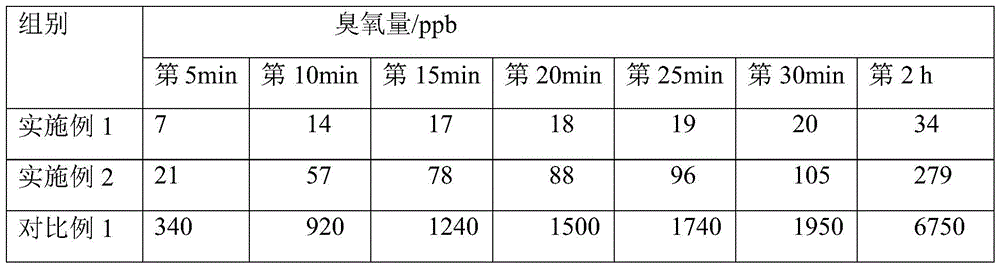
由此可见,对比例1将催化剂涂覆在绝缘介质管内壁,实施例1将催化剂填充于绝缘介质管内部,在实时净化30min和长时间运行2h后,对比例1的臭氧残留均大大高于实施例1。由此说明,对比例1对于臭氧的分解效率大大低于实施例1。且在使用长时间后,对比例1的催化剂的催化效率大大低于实施例1。It can be seen that in Comparative Example 1, the catalyst is coated on the inner wall of the insulating medium tube, and in Example 1, the catalyst is filled inside the insulating medium tube. After real-time purification for 30min and long-term operation for 2h, the residual ozone of Comparative Example 1 is much higher than that of Example 1. This shows that the decomposition efficiency of comparative example 1 for ozone is much lower than that of example 1. And after using for a long time, the catalytic efficiency of the catalyst of Comparative Example 1 is much lower than that of Example 1.
分析可能是对比例1的催化剂被涂覆在绝缘介质管内壁,其比表面积相对较小,臭氧与催化剂的接触面积较小,在气泵的作用下,产生的臭氧来不及被分解便被排出绝缘介质管外部,导致对臭氧实时分解效率不高。同时由于长时间使用导致催化剂水中毒失效。The analysis may be that the catalyst in Comparative Example 1 is coated on the inner wall of the insulating medium tube, its specific surface area is relatively small, and the contact area between ozone and the catalyst is small. Under the action of the air pump, the generated ozone is discharged out of the insulating medium before it can be decomposed. The outside of the tube leads to low real-time decomposition efficiency of ozone. At the same time, due to long-term use, the catalyst is poisoned by water and becomes invalid.
而本发明实施例将催化剂颗粒填充在绝缘介质管中,由于催化剂颗粒的比表面积较大,与臭氧接触面积大,且绝缘介质管中形成的臭氧可被填充的催化剂颗粒分解,同时气体放电过程中产生的热效应加速臭氧的分解,故而臭氧发生催化分解反应的几率大幅度增加,最终产生的臭氧量小于300ppb,其中实施例1远远小于100ppb,实现臭氧的高效原位分解。同时,气体放电过程中产生的热效应可抑制臭氧分解催化剂颗粒的水中毒失活,故而一定程度提高了其长时间使用的催化效率,换言之延长了其使用寿命。However, in the embodiment of the present invention, the catalyst particles are filled in the insulating dielectric tube. Due to the large specific surface area of the catalyst particles, the contact area with the ozone is large, and the ozone formed in the insulating dielectric tube can be decomposed by the filled catalyst particles. At the same time, the gas discharge process The thermal effect produced in the process accelerates the decomposition of ozone, so the probability of catalytic decomposition reaction of ozone is greatly increased, and the amount of ozone finally produced is less than 300ppb, of which Example 1 is far less than 100ppb, realizing efficient in-situ decomposition of ozone. At the same time, the thermal effect generated during the gas discharge process can inhibit the water poisoning deactivation of the ozonolysis catalyst particles, thus improving its catalytic efficiency for long-term use to a certain extent, in other words prolonging its service life.
以上所述实施例的各技术特征可以进行任意的组合,为使描述简洁,未对上述实施例中的各个技术特征所有可能的组合都进行描述,然而,只要这些技术特征的组合不存在矛盾,都应当认为是本说明书记载的范围。The technical features of the above-mentioned embodiments can be combined arbitrarily. To make the description concise, all possible combinations of the technical features in the above-mentioned embodiments are not described. However, as long as there is no contradiction in the combination of these technical features, should be considered as within the scope of this specification.
以上所述实施例仅表达了本发明的几种实施方式,其描述较为具体和详细,但并不能因此而理解为对发明专利范围的限制。应当指出的是,对于本领域的普通技术人员来说,在不脱离本发明构思的前提下,还可以做出若干变形和改进,这些都属于本发明的保护范围。因此,本发明专利的保护范围应以所附权利要求为准,说明书及附图可以用于解释权利要求的内容。The above-mentioned embodiments only express several implementation modes of the present invention, and the descriptions thereof are relatively specific and detailed, but should not be construed as limiting the patent scope of the invention. It should be noted that, for those skilled in the art, several modifications and improvements can be made without departing from the concept of the present invention, and these all belong to the protection scope of the present invention. Therefore, the protection scope of the patent for the present invention should be determined by the appended claims, and the description and drawings can be used to explain the contents of the claims.
Claims (11)
Priority Applications (1)
| Application Number | Priority Date | Filing Date | Title |
|---|---|---|---|
| CN202310250968.9A CN116078156A (en) | 2023-03-15 | 2023-03-15 | Air purifying device |
Applications Claiming Priority (1)
| Application Number | Priority Date | Filing Date | Title |
|---|---|---|---|
| CN202310250968.9A CN116078156A (en) | 2023-03-15 | 2023-03-15 | Air purifying device |
Publications (1)
| Publication Number | Publication Date |
|---|---|
| CN116078156A true CN116078156A (en) | 2023-05-09 |
Family
ID=86206691
Family Applications (1)
| Application Number | Title | Priority Date | Filing Date |
|---|---|---|---|
| CN202310250968.9A Pending CN116078156A (en) | 2023-03-15 | 2023-03-15 | Air purifying device |
Country Status (1)
| Country | Link |
|---|---|
| CN (1) | CN116078156A (en) |
Cited By (1)
| Publication number | Priority date | Publication date | Assignee | Title |
|---|---|---|---|---|
| CN116669271A (en) * | 2023-06-15 | 2023-08-29 | 珠海格力电器股份有限公司 | Plasma discharge device and air purifying equipment |
Citations (7)
| Publication number | Priority date | Publication date | Assignee | Title |
|---|---|---|---|---|
| US4954320A (en) * | 1988-04-22 | 1990-09-04 | The United States Of America As Represented By The Secretary Of The Army | Reactive bed plasma air purification |
| CN105864908A (en) * | 2016-04-15 | 2016-08-17 | 北京化工大学 | Multistage plasma air purifier |
| CN206262363U (en) * | 2016-11-28 | 2017-06-20 | 上海大学 | The air cleaning unit of built-in dielectric impedance reaction of low temperature plasma device |
| CN109833868A (en) * | 2017-11-29 | 2019-06-04 | 中国科学院大连化学物理研究所 | A kind of preparation method of manganese based composite metal oxidate ozone decomposition catalyst |
| CN210932886U (en) * | 2019-07-31 | 2020-07-07 | 青岛海尔智能技术研发有限公司 | A plasma sterilization cabinet |
| CN112413784A (en) * | 2020-11-27 | 2021-02-26 | 上海交通大学 | Portable multifunctional air purification method and device |
| KR102500956B1 (en) * | 2022-08-23 | 2023-02-16 | 배준형 | Low-temperature plasma devices for carbon dioxide decomposition and virus remova |
-
2023
- 2023-03-15 CN CN202310250968.9A patent/CN116078156A/en active Pending
Patent Citations (7)
| Publication number | Priority date | Publication date | Assignee | Title |
|---|---|---|---|---|
| US4954320A (en) * | 1988-04-22 | 1990-09-04 | The United States Of America As Represented By The Secretary Of The Army | Reactive bed plasma air purification |
| CN105864908A (en) * | 2016-04-15 | 2016-08-17 | 北京化工大学 | Multistage plasma air purifier |
| CN206262363U (en) * | 2016-11-28 | 2017-06-20 | 上海大学 | The air cleaning unit of built-in dielectric impedance reaction of low temperature plasma device |
| CN109833868A (en) * | 2017-11-29 | 2019-06-04 | 中国科学院大连化学物理研究所 | A kind of preparation method of manganese based composite metal oxidate ozone decomposition catalyst |
| CN210932886U (en) * | 2019-07-31 | 2020-07-07 | 青岛海尔智能技术研发有限公司 | A plasma sterilization cabinet |
| CN112413784A (en) * | 2020-11-27 | 2021-02-26 | 上海交通大学 | Portable multifunctional air purification method and device |
| KR102500956B1 (en) * | 2022-08-23 | 2023-02-16 | 배준형 | Low-temperature plasma devices for carbon dioxide decomposition and virus remova |
Cited By (1)
| Publication number | Priority date | Publication date | Assignee | Title |
|---|---|---|---|---|
| CN116669271A (en) * | 2023-06-15 | 2023-08-29 | 珠海格力电器股份有限公司 | Plasma discharge device and air purifying equipment |
Similar Documents
| Publication | Publication Date | Title |
|---|---|---|
| JP3711052B2 (en) | Catalytic reactor for treating hazardous gases using low temperature plasma and dielectric heat | |
| CN104069722B (en) | A kind of Trinity industrial source peculiar smell emission-control equipment and method | |
| CN100482323C (en) | Gas processing method and gas processing apparatus utilizing oxidation catalyst and low-temperature plasma | |
| CN105864908A (en) | Multistage plasma air purifier | |
| CN105597529B (en) | A kind of technique and device of low-temperature plasma synergistic two-stage catalytic degradation industrial organic exhaust gas | |
| CN102151464B (en) | Reactor for treating VOCs by plasma cooperating chemical catalysis | |
| CN103702690B (en) | Air purifier using electric field regeneration | |
| CN101234211A (en) | Apparatus and method for treating malodorous gas in municipal facilities | |
| CN105833718B (en) | A kind of denitrification system and processing method of plasma synergistic catalyst | |
| CN203075822U (en) | Indoor air purifying device | |
| CN111265978A (en) | Compact plasma concerted catalysis organic waste gas processing apparatus | |
| CN201997241U (en) | Reactor for treating VOCs with plasma cooperating with chemical catalysis | |
| CN212548943U (en) | VOCs (volatile organic compounds) line tube reaction unit adopting double-dielectric barrier low-temperature plasma for cooperative catalytic treatment | |
| CN203916426U (en) | A kind of Trinity industrial source peculiar smell emission-control equipment | |
| CN116078156A (en) | Air purifying device | |
| JP4718344B2 (en) | Air purification apparatus and air purification method using the same | |
| KR100543529B1 (en) | Air Purification System and Purification Method | |
| CN107252627A (en) | A kind of VOCs handling process and equipment | |
| CN116469595A (en) | Low-temperature plasma enhanced atmosphere tritium removal device and tritium removal method | |
| JPH01143630A (en) | Method for treating fluorocarbon | |
| CN115007188A (en) | Catalyst and disinfectant fluid preparation device | |
| CN112007486A (en) | Double dielectric barrier low temperature plasma synergistic catalytic treatment of VOCs line tube reaction unit | |
| CN103263825A (en) | Plasma coupled photo-catalysis method and system for removing ethylene in fresh-keeping storehouse of vegetables and fruits | |
| CN104524915B (en) | Electrode and reactor thereof in the dielectric barrier discharge that particulate organic matter processes | |
| CN216171266U (en) | Flat plate type dielectric barrier discharge reactor for treating malodorous gas by plasma |
Legal Events
| Date | Code | Title | Description |
|---|---|---|---|
| PB01 | Publication | ||
| PB01 | Publication | ||
| SE01 | Entry into force of request for substantive examination | ||
| SE01 | Entry into force of request for substantive examination | ||
| RJ01 | Rejection of invention patent application after publication |
Application publication date: 20230509 |
|
| RJ01 | Rejection of invention patent application after publication |