CN115994588A - Federated learning method, device and equipment based on blockchain and contract theory - Google Patents
Federated learning method, device and equipment based on blockchain and contract theory Download PDFInfo
- Publication number
- CN115994588A CN115994588A CN202310281972.1A CN202310281972A CN115994588A CN 115994588 A CN115994588 A CN 115994588A CN 202310281972 A CN202310281972 A CN 202310281972A CN 115994588 A CN115994588 A CN 115994588A
- Authority
- CN
- China
- Prior art keywords
- contract
- incentive
- target
- data quality
- terminal device
- Prior art date
- Legal status (The legal status is an assumption and is not a legal conclusion. Google has not performed a legal analysis and makes no representation as to the accuracy of the status listed.)
- Granted
Links
Images


Classifications
-
- Y—GENERAL TAGGING OF NEW TECHNOLOGICAL DEVELOPMENTS; GENERAL TAGGING OF CROSS-SECTIONAL TECHNOLOGIES SPANNING OVER SEVERAL SECTIONS OF THE IPC; TECHNICAL SUBJECTS COVERED BY FORMER USPC CROSS-REFERENCE ART COLLECTIONS [XRACs] AND DIGESTS
- Y02—TECHNOLOGIES OR APPLICATIONS FOR MITIGATION OR ADAPTATION AGAINST CLIMATE CHANGE
- Y02D—CLIMATE CHANGE MITIGATION TECHNOLOGIES IN INFORMATION AND COMMUNICATION TECHNOLOGIES [ICT], I.E. INFORMATION AND COMMUNICATION TECHNOLOGIES AIMING AT THE REDUCTION OF THEIR OWN ENERGY USE
- Y02D10/00—Energy efficient computing, e.g. low power processors, power management or thermal management
Landscapes
- Management, Administration, Business Operations System, And Electronic Commerce (AREA)
Abstract
The application provides a federal learning method, device and equipment based on blockchain and contract theory, wherein the method comprises the following steps: determining first data quality corresponding to the user equipment based on the historical data, acquiring second data quality corresponding to the user equipment from the blockchain, and determining target data quality corresponding to the user equipment based on the first data quality and the second data quality; selecting I target user devices from M user devices based on the corresponding target data quality of each user device, sending a target contract group to the I target terminal devices, and sending initial global model parameters to the I target user devices so that each target user device selects a target excitation contract from the target contract group, and acquiring local model parameters based on the optimal sample number of the target excitation contract and the initial global model parameters; trained parameters are determined based on the local model parameters of the I target user devices. Through this application scheme, the efficiency of improvement model training process, the convergence rate of training is faster.
Description
Technical Field
The application relates to the technical field of data processing, in particular to a federal learning method, a federal learning device and federal learning equipment based on blockchain and contract theory.
Background
Machine learning is a way to realize artificial intelligence, is a multi-domain interdisciplinary, and relates to multiple disciplines such as probability theory, statistics, approximation theory, convex analysis, algorithm complexity theory and the like. Machine learning is used to study how computers mimic or implement learning behavior of humans to acquire new knowledge or skills, reorganizing existing knowledge structures to continually improve their performance. Machine learning is more focused on algorithm design, enabling a computer to automatically learn rules from data and utilize the rules to predict unknown data. Machine learning has found very wide application such as deep learning, data mining, computer vision, natural language processing, biometric identification, search engines, medical diagnostics, speech recognition, handwriting recognition, and the like.
In order to implement artificial intelligence processing using machine learning, a large amount of sample data (e.g., image data, i.e., an image having tag data) needs to be acquired, a machine learning model (e.g., a machine learning model having a target detection function, a target classification function) is trained based on the sample data, and the machine learning model is deployed to a terminal device, so that the terminal device implements artificial intelligence processing based on the machine learning model.
Because the number of local sample data of the terminal equipment is limited, a machine learning model with relatively high performance cannot be trained, each terminal equipment needs to send the local sample data to a server, and the server trains the machine learning model based on a large number of sample data of a plurality of terminal equipment.
However, the above method needs to transmit sample data between the terminal device and the server, and has potential data safety hazards, so that the data safety cannot be guaranteed, the sample data is used as a digital asset of the terminal device, and the terminal device is not willing to share the sample data to the server. Since a large amount of sample data (e.g., image data) needs to be transmitted between the terminal device and the server, the sample data needs to occupy a large amount of bandwidth resources.
Disclosure of Invention
In view of this, the present application provides a federal learning method, apparatus and device based on blockchain and contract theory, which can reduce data of a transmission terminal device, so as to ensure security of the data.
The application provides a federation learning method based on blockchain and contract theory, which is applied to a server in a data processing system, wherein the data processing system further comprises M terminal devices, and the method comprises the following steps:
For each terminal device, determining a first data quality corresponding to the terminal device based on historical data, acquiring a second data quality corresponding to the terminal device from a blockchain, and determining a target data quality corresponding to the terminal device based on the first data quality and the second data quality;
selecting I target terminal devices from the M terminal devices based on the corresponding target data quality of each terminal device, sending a target contract group to the I target terminal devices, wherein the target contract group comprises K excitation contracts, each excitation contract comprises the optimal sample number and contract excitation values, and sending initial global model parameters to the I target terminal devices, so that each target terminal device selects one excitation contract from the K excitation contracts as a target excitation contract, and acquiring local model parameters based on the optimal sample number of the target excitation contract and the initial global model parameters;
determining target global model parameters based on the local model parameters of the I target terminal devices;
if the target global model parameters are not converged, determining the target global model parameters as initial global model parameters, and returning to execute the operation of transmitting the initial global model parameters to the I target terminal devices;
If the target global model parameters are converged, determining the target global model parameters as trained parameters; wherein the trained parameters are used to process data.
The application provides a federal learning device based on blockchain and contract theory, which is applied to a server in a data processing system, wherein the data processing system further comprises M terminal devices, and the device comprises:
a determining module, configured to determine, for each terminal device, a first data quality corresponding to the terminal device based on historical data, obtain a second data quality corresponding to the terminal device from a blockchain, and determine a target data quality corresponding to the terminal device based on the first data quality and the second data quality;
the selecting module is used for selecting I target terminal devices from the M terminal devices based on the target data quality corresponding to each terminal device, wherein I is a positive integer and is smaller than M;
the sending module is used for sending a target contract group to the I target terminal devices, the target contract group comprises K excitation contracts, each excitation contract comprises the optimal sample number and contract excitation values, and sending initial global model parameters to the I target terminal devices, so that each target terminal device selects one excitation contract from the K excitation contracts as a target excitation contract, and local model parameters are obtained based on the optimal sample number of the target excitation contract and the initial global model parameters;
The determining module is further used for determining target global model parameters based on the local model parameters of the I target terminal devices; if the target global model parameters are not converged, determining the target global model parameters as initial global model parameters, and transmitting the initial global model parameters to the I target terminal devices by the transmitting module; if the target global model parameters are converged, determining the target global model parameters as trained parameters; wherein the trained parameters are used to process data.
The application provides an electronic device, comprising: a processor and a machine-readable storage medium storing machine-executable instructions executable by the processor; the processor is configured to execute the machine executable instructions to implement the federal learning method based on blockchain and contract theory.
In another aspect, the present application provides a machine-readable storage medium storing machine-executable instructions executable by a processor; the processor is configured to execute the machine executable instructions to implement the federal learning method based on blockchain and contract theory.
In another aspect, the present application provides a computer program stored on a machine-readable storage medium, which when executed by a processor causes the processor to implement the blockchain and contract theory-based federal learning method described above.
As can be seen from the above technical solutions, in the embodiments of the present application, the terminal device sends the local model parameters to the server, instead of the data of the terminal device, so as to protect the digital asset of the terminal device and ensure the data security. Since the local model parameters are transmitted between the terminal device and the server instead of a large amount of data (e.g. image data), bandwidth resources are saved. The block chain is introduced into the model training process, and the server can accurately screen I target terminal devices with high participation enthusiasm to participate in the model training process through data (with non-repudiation and tamper resistance) provided by the block chain, so that the efficiency of the model training process is improved, trained parameters are obtained faster, the model training time is shorter, the convergence rate of model training is faster, and the model accuracy is higher.
Drawings
In order to more clearly illustrate the embodiments of the present application or the technical solutions in the prior art, the following description will briefly describe the drawings that are required to be used in the embodiments of the present application or the description in the prior art, and it is obvious that the drawings in the following description are only some embodiments described in the present application, and other drawings may also be obtained according to these drawings of the embodiments of the present application for a person having ordinary skill in the art.
FIG. 1 is a flow diagram of a federal learning method based on blockchain and contract theory;
FIG. 2 is a flow diagram of a federal learning method based on blockchain and contract theory;
FIG. 3 is a schematic diagram of the architecture of a federal system in one embodiment of the present application;
FIG. 4 is a schematic diagram of a federal learning device based on blockchain and contract theory;
fig. 5 is a hardware configuration diagram of an electronic device in an embodiment of the present application.
Detailed Description
The terminology used in the embodiments of the application is for the purpose of describing particular embodiments only and is not intended to be limiting of the application. As used in this application and the claims, the singular forms "a," "an," and "the" are intended to include the plural forms as well, unless the context clearly indicates otherwise. It should also be understood that the term "and/or" as used herein refers to any or all possible combinations including one or more of the associated listed items.
It should be understood that although the terms first, second, third, etc. may be used in embodiments of the present application to describe various information, these information should not be limited to these terms. These terms are only used to distinguish one type of information from another. For example, a first message may also be referred to as a second message, and similarly, a second message may also be referred to as a first message, without departing from the scope of the present application. Depending on the context, furthermore, the word "if" used may be interpreted as "at … …" or "at … …" or "in response to a determination".
The embodiment of the application provides a federal learning method based on blockchain and contract theory, which can be applied to a server (also called a central server) in a data processing system, wherein the data processing system further comprises M terminal devices, M is a positive integer, and is a flow diagram of the method, as shown in fig. 1, and the method comprises the following steps:
Illustratively, determining the first data quality corresponding to the terminal device based on the historical data may include, but is not limited to: if the history data includes the orthogonal interaction times and the negative interaction times corresponding to the terminal device, the first data quality corresponding to the terminal device can be determined based on the orthogonal interaction times and the negative interaction times. For example, the first data quality may be proportional to the number of orthogonal interactions and the first data quality may be inversely proportional to the number of negative interactions. For example, when the local model parameter is obtained from the terminal device each time, if the prediction accuracy corresponding to the local model parameter is greater than a preset threshold (which may be configured according to experience), the orthogonal interaction number corresponding to the terminal device is increased in the history data, and if the prediction accuracy corresponding to the local model parameter is not greater than the preset threshold, the negative interaction number corresponding to the terminal device is increased in the history data.
Illustratively, acquiring the second data quality corresponding to the terminal device from the blockchain may include, but is not limited to: and downloading indirect data quality of other servers to the terminal equipment from the blockchain, and determining second data quality corresponding to the terminal equipment based on the indirect data quality.
And 104, determining target global model parameters based on the local model parameters of the I target terminal devices. For example, local model parameters for each target terminal device may be obtained from the target terminal device, and target global model parameters may be determined based on the local model parameters for each target terminal device.
If not, step 106 may be performed, and if so, step 107 may be performed.
And 106, determining the target global model parameters as initial global model parameters, and returning to the operation of transmitting the initial global model parameters to the I target terminal devices, namely returning to the step 103.
For example, after the target global model parameters have converged, for each target terminal device, the number of orthogonal interactions with the prediction accuracy being greater than a preset threshold may be counted, and the number of negative interactions with the prediction accuracy not greater than the preset threshold may be counted, based on the prediction accuracy corresponding to each local model parameter obtained by the target terminal device in the training process. And determining indirect data quality of the server to the target terminal equipment based on the orthogonal interaction times and the negative interaction times, and adding the indirect data quality to the blockchain.
Illustratively, K data qualities may also be sampled from the acquired data quality intervals before the target contract group is sent to the I target terminal devices; for each excitation contract, acquiring a plurality of candidate sample numbers corresponding to the excitation contract; for each candidate sample number, determining a benefit value corresponding to the candidate sample number based on K data quality and the candidate sample number; based on the benefit value corresponding to each candidate sample number, the candidate sample number corresponding to the maximum benefit value can be determined as the optimal sample number, and the contract incentive value is determined based on the optimal sample number; an incentive contract is generated based on the optimal sample number and the contract incentive value.
Illustratively, determining a benefit value corresponding to the number of candidate samples based on the K data qualities and the number of candidate samples may include, but is not limited to: if the incentive contract is the 1 st incentive contract, determining a benefit value corresponding to the candidate sample number based on the total number of incentive contracts (namely the total number K of incentive contracts), the data quality corresponding to the 1 st incentive contract and the candidate sample number; alternatively, if the incentive contract is the ith incentive contract and i is not 1, the benefit value corresponding to the candidate sample number may be determined based on the total number of incentive contracts, the data quality corresponding to the 1 st to the ith incentive contract, the optimal sample number of the 1 st to the i-1 st incentive contracts, and the candidate sample number.
Illustratively, determining the contractual incentive value based on the optimal sample number may include, but is not limited to: if the incentive contract is the 1 st incentive contract, determining a contract incentive value based on the data quality corresponding to the 1 st incentive contract and the optimal sample number of the 1 st incentive contract; alternatively, if the incentive contract is the ith incentive contract, i is not 1, the contract incentive value is determined based on the data quality corresponding to the 1 st to the ith incentive contract and the optimal sample number of the 1 st to the ith incentive contract.
Illustratively, the target terminal device selects one incentive contract from the K incentive contracts as a target incentive contract, which may include, but is not limited to: for each incentive contract, determining a contract profit value corresponding to the incentive contract based on the real data quality corresponding to the target terminal equipment, the optimal sample number of the incentive contract and the contract incentive value; and selecting the incentive contract corresponding to the maximum contract profit value as a target incentive contract.
As can be seen from the above technical solutions, in the embodiments of the present application, the terminal device sends the local model parameters to the server, instead of the data of the terminal device, so as to protect the digital asset of the terminal device and ensure the data security. Since the local model parameters are transmitted between the terminal device and the server instead of a large amount of data (e.g. image data), bandwidth resources are saved. The block chain is introduced into the model training process, and the server can accurately screen I target terminal devices with high participation enthusiasm to participate in the model training process through data (with non-repudiation and tamper resistance) provided by the block chain, so that the efficiency of the model training process is improved, trained parameters are obtained faster, the model training time is shorter, the convergence rate of model training is faster, and the model accuracy is higher.
The following describes the technical solution of the embodiment of the present application in conjunction with a specific application scenario.
In order to implement artificial intelligence processing using machine learning, a large amount of sample data (e.g., image data) needs to be acquired, a machine learning model is trained based on the sample data, the machine learning model is deployed to a terminal device, and the terminal device implements artificial intelligence processing based on the machine learning model. Because the number of the sample data of the terminal equipment is limited, a machine learning model with relatively high performance cannot be trained, each terminal equipment can send the local sample data to the server, and the server trains the machine learning model based on the sample data of a plurality of terminal equipment. However, the above method needs to transmit sample data between the terminal device and the server, and has potential data safety hazards, so that the data safety cannot be guaranteed, the sample data is used as a digital asset of the terminal device, and the terminal device is not willing to share the sample data to the server. Since a large amount of sample data (e.g., image data) needs to be transmitted between the terminal device and the server, the sample data needs to occupy a large amount of bandwidth resources.
Aiming at the discovery, the embodiment of the application provides a federal learning method based on the blockchain and the contract theory, which can be realized by combining the blockchain and the contract theory. The block chain is a chain type data structure formed by combining data blocks in a sequential connection mode according to a time sequence, and a non-falsifiable and non-falsifiable distributed account book ensured in a cryptographic mode is an intelligent contract formed by verifying and storing data by utilizing the block chain type data structure, generating and updating the data by utilizing a distributed node consensus algorithm, ensuring the safety of data transmission and access by utilizing a cryptographic mode and utilizing an automatic script code. The federal learning is a distributed machine learning framework, realizes data sharing and common modeling on the basis of guaranteeing data security, and has the core ideas that when a plurality of terminal devices participate in model training together, the circulation of original data is not needed, and model joint training is only carried out through interaction model intermediate parameters, so that data protection and data sharing analysis can be realized.
Further, when the terminal device participates in the federal learning process, a large amount of resources of the terminal device are consumed, and considering the selfiness of the terminal device, the terminal device is not willing to assist federal learning training without rewarding, and may perform undesirable behaviors intentionally or unintentionally, thereby misleading global model training of federal learning tasks. Therefore, the embodiment of the application provides the federation learning method based on the blockchain and the contract theory, reliable terminal equipment can be selected, and the terminal equipment is stimulated to participate in the federation learning training, so that the efficiency of federation learning tasks can be improved, and the benefit of a server is maximized.
The embodiment of the application provides a federal learning method based on blockchain and contract theory, which is applied to a data processing system, wherein the data processing system can comprise a server (also called a central server) and M terminal devices, namely, the total number of the terminal devices is denoted as M, and the method is shown in fig. 2 and is a flow diagram of the method, and comprises the following steps:
For example, the central server may obtain an initial global model, and the process of obtaining the initial global model is not limited. The initial global model may be a machine learning model, such as a deep learning algorithm-based machine learning model, a neural network-based machine learning model, and the like, without limitation. The network parameters (i.e., network weights) of the initial global model may be referred to as initial global model parameters.
For each of the M terminal devices, taking the terminal device M as an example, if the history data includes the orthogonal interaction number and the negative interaction number corresponding to the terminal device M, the first data quality corresponding to the terminal device M may be determined based on the orthogonal interaction number and the negative interaction number. For example, the first data quality is proportional to the number of orthogonal interactions and the first data quality is inversely proportional to the number of negative interactions.
For example, in order to determine the first data quality corresponding to terminal device m, Y time periods may be divided, in which The first data quality corresponding to terminal device m may be found in equation (1):

In the case of the formula (1), indicating that terminal device m is in time period +.>
 Corresponding first data quality.
 And->
And-> Is constant and can be empirically configured, without limitation, e.g. +.>
 。
。 Indicating that terminal device m is in time period +.>
 The corresponding orthogonal frequency is the frequency that the prediction accuracy corresponding to the local model parameters is greater than a preset threshold value, and in the time period +. >
 In the method, when a central server acquires a local model parameter from a terminal device m each time, if the prediction accuracy corresponding to the local model parameter is greater than a preset threshold value, the number of orthogonal interactions corresponding to the terminal device m is added by 1 in historical data, and the assumption is that +.>
 In the method, a central server acquires 10 local model parameters from a terminal device m, and the prediction accuracy corresponding to 8 local model parameters is greater than a preset threshold, wherein the terminal device m is in a time period +.>
 The corresponding number of orthogonal interactions is 8.
 Indicating that terminal device m is in a time period
 The corresponding negative interaction times are times that the prediction accuracy corresponding to the local model parameters is not more than a preset threshold value, and the negative interaction times are in a time period +.>
 In the method, when the central server acquires the local model parameters from the terminal equipment m each time, if the prediction accuracy corresponding to the local model parameters is not greater than a preset threshold value, the negative interaction times corresponding to the terminal equipment m are added by 1 in the historical data, and the assumption is that in the time period +.>
 In the method, a central server acquires 10 local model parameters from a terminal device m, and prediction accuracy corresponding to 2 local model parameters is not more than a preset threshold, wherein the terminal device m is in a time period +.>
 The corresponding negative interaction number is 2.
As can be seen from equation (1), the time period can be based on the terminal device m Corresponding orthogonal frequency->
 And terminal device m in time period +.>
 Corresponding negative interaction times->
 Determining that terminal device m is in time period +.>
 Corresponding first data quality->
 It is obvious from equation (1) that the first data quality is +.>
 And orthogonal inter-frequency->
 Proportional toAnd a first data quality +.>
 Number of interactions with negative->
 Inversely proportional.
Based on the first data quality corresponding to the terminal device m in each time period, the first data quality corresponding to the terminal device m, that is, the first data quality corresponding to all time periods, may be determined using formula (2).

In the formula (2) of the present invention, indicating a first data quality corresponding to the terminal device m in all time periods.
 Indicating that terminal device m is in time period +.>
 The value range of Y can be 1-Y, namely the first data quality corresponding to the 1 st time period, the first data quality corresponding to the 2 nd time period, … and the first data quality corresponding to the Y th time period are sequentially represented.
 Indicating that terminal device m is in time period +.>
 The corresponding first data quality corresponds to a freshness factor, for example,
 。
。
in summary, for the terminal device m, the central server may determine the first data quality corresponding to the terminal device m in all time periods, and similarly, the central server may determine the first data quality corresponding to other terminal devices in all time periods, so as to obtain the first data quality corresponding to each terminal device.
Illustratively, for each of the M terminal devices, taking terminal device M as an example, the central server may download indirect data quality of the terminal device M from the blockchain by other servers, and determine a second data quality corresponding to the terminal device M based on the indirect data quality.
For example, for each server except the central server, when the server interacts with the terminal device m with the local model parameters, the server may determine the indirect data quality of the server to the terminal device m based on the prediction accuracy corresponding to the local model parameters, and add the indirect data quality of the server to the terminal device m to the blockchain, which will be referred to in the following embodiments and will not be described herein.
Obviously, since each server can add the indirect data quality of the present server to terminal device m to the blockchain, the central server can download the indirect data quality of other servers to terminal device m from the blockchain in step 203. Obviously, since the indirect data quality is obtained by downloading from the blockchain by the central server, the reliability of the indirect data quality can be ensured, and the target data quality also has reliability when the target data quality of the terminal equipment m is determined based on the indirect data quality of the terminal equipment m.
Based on the indirect data quality of the other servers (which may be multiple servers) to the terminal device m, the central server may determine a second data quality corresponding to the terminal device m using equation (3).

In the formula (3) of the present invention, representing a second data quality corresponding to terminal device m, < >>
 Indicating the indirect data quality of the server x (i.e. the other servers) to the terminal device m, indirect data quality +.>
 The central server can download from the blockchain, X represents the total number of other servers, that is, the central server can download the indirect data quality (that is, the indirect opinion of the data quality) of the X servers to the terminal device m from the blockchain, and integrate the indirect data quality to obtain the second data quality corresponding to the terminal device m.
In summary, for the terminal device m, the central server may determine the second data quality corresponding to the terminal device m, and similarly, the central server may determine the second data quality corresponding to other terminal devices.
For example, the central server performs weighted summation on the first data quality and the second data quality to obtain a target data quality corresponding to the terminal device, and the target data quality reflects the aggressiveness evaluation of the terminal device.
For each of the M terminal devices, the center server may determine the target data quality corresponding to the terminal device M using equation (4), for example, by using the terminal device M as an illustration.

In the formula (4) of the present invention, representing the target data quality corresponding to terminal device m, < >>
 Representing a second data quality corresponding to terminal device m, < >>
 Representing a first data quality corresponding to terminal device m, < >>
 Representing the second data quality->
 Corresponding weight coefficient, ++>
 Representing the first data quality +.>
 Corresponding weight coefficient, ++>
 The constant may be empirically configured, and may be a value of 0 or more and 1 or less.
For example, the M terminal devices may be ranked in order of the target data quality from the higher to the lower, and the I target terminal devices ranked earlier may be selected. Or, the M terminal devices may be ordered in order of the target data quality from small to large, and the I target terminal devices after the ordering are selected. Wherein, I may be a positive integer, I may be smaller than M, and the value of I may be empirically configured, which is not limited.
In summary, the central server may select I target terminal devices with higher target data quality to participate in federal learning training, and since the I target terminal devices with higher target data quality are I target terminal devices with high participation enthusiasm evaluation, the quality of model training of these target terminal devices is very high.
For example, the central server may obtain K incentive contracts, where K may be greater than I, less than I, or equal to I, without limitation. For example, the K incentive contracts may be incentive contracts configured empirically, or may be obtained by using some algorithm, which is not limited thereto.
In one possible implementation, K incentive contracts may be obtained, and after obtaining the K incentive contracts, a set of the K incentive contracts may be referred to as a target group.
Step 2061, acquiring a data quality interval and sampling K data qualities from the data quality interval.
Exemplary, a configured data quality interval q may be obtained min ,q max ]The data quality interval may be empirically configured without limitation. Alternatively, the data quality interval q may be determined based on the target data quality corresponding to the I target terminal devices min ,q max ]For example, q is determined based on the minimum value of the target data quality corresponding to all target terminal devices min For example, the minimum value is taken as q min Or adjusting the minimum value to obtain q min Q is determined based on the maximum value in the target data quality corresponding to all target terminal devices max For example, the maximum value is taken as q max Or the maximum value row is adjusted to obtain q max . Of course, the above is only an example of acquiring the data quality interval, and the data quality interval may be obtained without limitation.
In the obtained data quality interval q min ,q max ]Thereafter, from the data quality interval [ q min ,q max ]Middle sampling K dataQuality. For example, K data qualities are randomly generated, each of the K data qualities being located in a data quality interval q min ,q max ]And (3) obtaining the product. For another example, the value of q is set to min ,q max ]Divided into K data qualities, i.e. the value between two adjacent data qualities is a preset length value, the 1 st data quality may be q min May also be greater than q min The last 1 data quality may be q max May also be less than q max . Of course, the above is just an example of sampling K data qualities, and it is not limited to this, and K data qualities may be obtained.
After sampling the K data qualities, the K data qualities correspond one-to-one with the K excitation contracts, say, the 1 st data quality q 1 Contract with the 1 st incentive (D 1 ,R 1 ) Correspondingly, D 1 For representing the optimal sample number of the 1 st excitation contract, R 1 Contract incentive value for representing the 1 st incentive contract, 2 nd data quality q 2 Contract with the 2 nd incentive (D 2 ,R 2 ) Correspondingly, D 2 For representing the optimal sample number of the 2 nd excitation contract, R 2 Contract incentive values for representing the 2 nd incentive contract, and so on.
Step 2062, for each excitation contract, obtaining a plurality of candidate sample numbers corresponding to the excitation contract.
For example, the sample number interval [ N ] is preconfigured min ,N max ],N min Representing the minimum value of the sample number, which is not limited according to empirical configuration such as 100, 200, etc., N max The maximum value of the number of samples is represented, and is not limited according to empirical configuration such as 10000, 20000, etc.
For each excitation contract, one can go from the sample number interval [ N min ,N max ]And selecting all sample numbers as candidate sample numbers corresponding to the excitation contract, wherein all integers in 100-10000 are used as candidate sample numbers. Alternatively, the number of samples interval [ N ] may be followed min ,N max ]Selecting part of sample number asAnd taking a part of integers in 100-10000 as the number of candidate samples.
Step 2063, for each candidate sample number, determining a benefit value corresponding to the candidate sample number based on the K data qualities and the candidate sample number. For example, if the incentive contract is the 1 st incentive contract, the benefit value corresponding to the candidate sample number can be determined based on the total number of incentive contracts K, the data quality corresponding to the 1 st incentive contract and the candidate sample number; alternatively, if the incentive contract is the ith incentive contract and i is not 1, the benefit value corresponding to the candidate sample number may be determined based on the total number of incentive contracts K, the data quality corresponding to the 1 st to the ith incentive contract, the optimal sample number of the 1 st to the i-1 st incentive contracts, and the candidate sample number.
Step 2064, based on the benefit value corresponding to each candidate sample number, the candidate sample number corresponding to the maximum benefit value may be determined as the optimal sample number, i.e., the optimal sample number of the incentive contract.
In one possible embodiment, to determine the optimal sample number for the incentive contract, equation (5) may be used to determine the optimal sample number for the incentive contract, of course, equation (5) is only an example, and is not limited in this regard as long as the optimal sample number can be determined based on K data qualities.

First, it is necessary to determine the optimal sample number corresponding to the 1 st excitation contract K represents the total number of incentive contracts, ">
 Is q 1 ,q 1 Can represent the data quality corresponding to the 1 st incentive contract, D i For D 1 ,D 1 Can represent the 1 st incentive contractNumber of corresponding candidate samples, D i-1 For D 0 ,D 0 Can be a pre-configured sample number, can be an empirical value, +>
 、
、 And->
And-> Are all constant and can be configured empirically.
In the formula (5) of the present invention, representing constraints.
In the formula (5) of the present invention, representing benefit value, obtaining a large number of candidate samples D 1 Thereafter, each candidate sample number D 1 Substituting formula (5) to obtain benefit value corresponding to the number of candidate samples, ++>
 Indicating that the maximum benefit value of all benefit values is found and the number D of candidate samples corresponding to the maximum benefit value 1 As optimal sample number +.>
 。
。
Then, the optimal sample number corresponding to the 2 nd excitation contract needs to be determined  ,
, Is q 2 ,q 2 Representing the data quality corresponding to the 2 nd incentive contract, D i For D 2 ,D 2 Representing the number of candidate samples corresponding to the 2 nd excitation contract, q 1 Indicating correspondence of the 1 st incentive contractData quality, D 1 Indicating the optimal sample number corresponding to the 1 st excitation contract, in
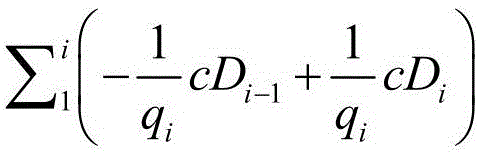 Wherein, when the value of i is sequentially 1 and 2 and the value of i is 1, D i-1 For D 0 I.e. the number of pre-configured samples, D i For D 1 ,D 1 Represents the optimal sample number corresponding to the 1 st excitation contract, D when the value of i is 2 i-1 For D 1 I.e. the optimal number of samples corresponding to the 1 st excitation contract, D i For D 2 ,D 2 Representing the number of candidate samples corresponding to the 2 nd excitation contract.
Obviously, when a large number of candidate samples D are obtained 2 Thereafter, each candidate sample number D 2 Substituting the candidate sample number into the formula (5) to obtain the benefit value corresponding to the candidate sample number, indicating that the maximum benefit value of all benefit values is found and the number D of candidate samples corresponding to the maximum benefit value 2 As optimal sample number +.>
 。
。
Then, the optimal sample number corresponding to the 3 rd excitation contract is determined ,
, Is q 3 ,q 3 Representing the data quality corresponding to the 3 rd incentive contract, D i For D 3 ,D 3 Representing the number of candidate samples corresponding to the 3 rd excitation contract, q 1 Representing the data quality corresponding to the 1 st incentive contract, D 1 Represents the optimal sample number corresponding to the 1 st incentive contract, at +.>
 In the case that the values of i are sequentially 1, 2 and 3,i are 1, D i-1 For D 0 I.e. the number of pre-configured samples, D i For D 1 I.e. the optimal sample number corresponding to the 1 st excitation contract, D when i is 2 i-1 For D 1 I.e. the optimal number of samples corresponding to the 1 st excitation contract, D i For D 2 I.e. the optimal sample number corresponding to the 2 nd excitation contract, D when i is 3 i-1 For D 2 I.e. the optimal number of samples corresponding to the 2 nd excitation contract, D i For D 3 I.e., the number of candidate samples corresponding to the 3 rd excitation contract.
Obviously, when a large number of candidate samples D are obtained 3 Thereafter, each candidate sample number D 3 Substituting the candidate sample number into the formula (5) to obtain the benefit value corresponding to the candidate sample number, indicating that the maximum benefit value of all benefit values is found and the number D of candidate samples corresponding to the maximum benefit value 3 As optimal sample number +.>
 。
。
Similarly, the optimal number of samples per incentive contract (K incentive contracts total) can be obtained.
Step 2065, for each incentive contract, determining a contract incentive value for the incentive contract based on the optimal sample number for the incentive contract. For example, if the incentive contract is the 1 st incentive contract, the contract incentive value of the 1 st incentive contract may be determined based on the data quality corresponding to the 1 st incentive contract and the optimal sample number of the 1 st incentive contract; alternatively, if the incentive contract is the ith incentive contract and i is not 1, the contract incentive value of the ith incentive contract may be determined based on the data quality corresponding to the 1 st to the ith incentive contract, the optimal sample number of the 1 st to the ith incentive contract.
In one possible embodiment, to determine the contract incentive value of the incentive contract, the contract incentive value of the incentive contract may be determined using equation (6), although equation (6) is merely an example and is not limited in this regard as long as the contract incentive value can be determined based on K data qualities and the optimal number of samples.

First, the contract incentive value corresponding to the 1 st incentive contract is determined ,q 1 Representing the data quality corresponding to the 1 st incentive contract, D 1 Indicating the optimal sample number corresponding to the 1 st incentive contract,/->
 Is a constant and can be empirically configured.
 Is q 1 I.e. data quality corresponding to the 1 st incentive contract, D i-1 For D 0 I.e. the number of pre-configured samples, D i For D 1 I.e. the optimal number of samples for the 1 st incentive contract. Obviously, since the above parameters are all known values, the contract incentive value +.1 of the 1 st incentive contract can be obtained>
 。
。
Then, the contract incentive value corresponding to the 2 nd incentive contract is determined ,q 1 Representing the data quality corresponding to the 1 st incentive contract, D 1 Represents the optimal sample number, +.1-1 incentive contract>
 Wherein, when the value of i is sequentially 1 and 2 and the value of i is 1, D i-1 For D 0 I.e. the number of pre-configured samples, D i For D 1 I.e. the optimal sample number of the 1 st excitation contract, D when the value of i is 2 i-1 For D 1 I.e. the optimal sample number of the 1 st excitation contract, D i For D 2 I.e. the optimal sample size for the 2 nd incentive contract. Since the above parameters are all known values, the contract incentive value of the 2 nd incentive contract can be obtained
 。
。
Similarly, a contract incentive value for each incentive contract (K incentive contracts total) may be obtained.
Step 2066, generating an incentive contract based on the optimal sample number and the contract incentive value.
For example, the 1 st incentive contract may be generated based on the optimal sample number of the 1 st incentive contract and the contract incentive value (D 1 ,R 1 ) The 2 nd incentive contract may be generated based on the optimal sample number of the 2 nd incentive contract and the contract incentive value (D 2 ,R 2 ) Similarly, K incentive contracts may be obtained. After obtaining the K incentive contracts, the K incentive contracts may be combined into a target contract group.
The following describes the derivation of equation (5) and equation (6) in connection with a specific application scenario.
Taking the target terminal device I as an example, the target terminal device I is any one of the I target terminal devices, and then the target terminal device I completely executes the profit obtained by one contract, and the calculation formula can be as follows:  In the above formula, +.>
 Is an incentive contract designed for the target terminal device i>
 ,
, Representing the data quality corresponding to the ith incentive contract, < +.>
 May be constant.
The calculation formula of the benefit function of the central server can be as follows: ,
, ,
, is constant (I)>
 Indicating the data quality corresponding to the ith incentive contract, and K indicating the total number of incentive contracts.
For one possible incentive contract, there may be the following limitations: personal rationality (IR) restrictions, when the target terminal device i selects the incentive offer, a non-negative profit can be obtained, i.e. the following: . The incentive appropriate (IC) limitation, when the target terminal device i selects the incentive contract designed for the target terminal device i, the target terminal device i will obtain the maximum profit, and therefore, the target terminal device i will not be incentive-selected as the incentive contract designed for other target terminal devices, namely, the requirement:
 。
。
With the above limitations, the following assumptions can be made: for any feasible incentive contracts, and (3) with
 Mutually being sufficient and necessary conditions; for any feasible incentive contracts, if +.>
 Then
Then The method comprises the steps of carrying out a first treatment on the surface of the If the IR constraint is established for the target terminal device having the smallest profit, the profit of the other target terminal devices must satisfy the IR constraint; IC constraints may be reduced to local downward excitation constraints.
In summary, it can be seen that one possible incentive contract may satisfy the following conditions:

thus, for a group, it is known and satisfied that Is->
Is-> For the calculation formula of the optimal rewards in the feasibility incentive contract, it can be shown by referring to formula (7). After the modification of the formula (7), the mapping relationship expressed as the formula (6) and the formula (5) can be generalized.

In summary, the mapping relation between the formula (5) and the formula (6) can be obtained, and then the optimal sample number and the contract incentive value are determined based on the formula (5) and the formula (6), and then the incentive contract is generated.
For each incentive contract, the contract profit value corresponding to the incentive contract can be determined based on the real data quality corresponding to the target terminal equipment, the optimal sample number of the incentive contract and the contract incentive value, and the incentive contract corresponding to the maximum contract profit value is selected as the target incentive contract.
For example, the calculation formula of the profit obtained by the target terminal device executing the excitation contract once is shown in formula (8), and of course, formula (8) is only an example, and is not limited thereto.

In the above formula, u i A contract profit value indicating that the target terminal device executes the ith incentive contract, i.e., a contract profit value corresponding to the ith incentive contract, R i Contract incentive value, D, representing the ith incentive contract i Representing the optimal sample size for the ith incentive contract, can be constant and can be empirically configured, < + >>
 The real data quality corresponding to the target terminal device is represented, the real data quality is used for reflecting the training effect of the target terminal device on the model, if the training effect of the local sample data of the target terminal device on the model is better, the real data quality is larger, and if the training effect of the local sample data of the target terminal device on the model is worse, the real data quality is smaller, and in the embodiment, the acquisition mode of the real data quality is not limited.
As can be seen from equation 8, the contract profit value corresponding to the i-th incentive contract can be determined based on the real data quality corresponding to the target terminal device, the contract incentive value of the i-th incentive contract, and the optimal sample number.
Obviously, for each incentive contract in the target contract group, the target terminal device may determine a contract profit value corresponding to the incentive contract. Based on this, the target terminal device may select the incentive contract corresponding to the maximum contract profit value as the target incentive contract based on the contract profit value corresponding to each incentive contract.
For example, the target terminal device may maintain a sample data set, which may include a plurality of sample data (e.g., image data, text data, audio data, etc.), which may be data collected by the target terminal device itself, or data obtained by other means, without limitation.
Based on the optimal sample number of the target excitation contract, the target terminal device may select sample data matching the optimal sample number from all sample data in the sample data set, and for convenience of distinguishing, the sample data matching the optimal sample number is referred to as target sample data, for example, the sample data of the optimal sample number is selected randomly as target sample data, and of course, other selection manners may also be adopted, which is not limited.
After obtaining the initial global model parameters, the target terminal device can construct an initial global model based on the initial global model parameters, train the initial global model by adopting target sample data (i.e. the optimal sample number of sample data), do not limit the training process, obtain a trained local model, and can refer to network parameters (i.e. network weights) of the local model as local model parameters. Because the local model is trained based on the target sample data, the local model parameters are matched with the local data of the terminal equipment.
Illustratively, in employing the target number of samplesWhen the initial global model is trained, a small batch gradient descent method can be adopted for carrying out  And iterating for a plurality of times to obtain the trained local model. Wherein D is i For representing the optimal number of samples of the target excitation contract, i.e. the total number of target sample data, B for representing the batch size of target sample data, i.e. the number of training data per batch, E for representing the number of training times.
For example, the update procedure of the initial global model is as follows: ,
, in the order of the target terminal device->
 Make->
 Local model parameters obtained by local iteration, < ->
 Is->
Is-> At->
At-> Gradient values at;
 For representing model parameters->
 For representing gradient values +.>
 For representing the learning rate, and B for representing the batch size of the target sample data.
After obtaining the local model parameters, the target terminal device may send the local model parameters to the central server, so that the central server may obtain the local model parameters of the I target terminal devices.
For example, the central server may determine the target global model parameters using the following formula:
S=S 1 *W 1 +S 2 *W 2 +S 3 *W 3 +…+S I *W I
in the above formula, S represents the target global model parameter, S 1 Representing local model parameters, W, of the 1 st target terminal device 1 Represents the weight coefficient corresponding to the 1 st local model parameter, S 2 Representing local model parameters, W, of the 2 nd target terminal device 2 Represent the weight coefficient corresponding to the 2 nd local model parameter, …, and so on, S I Representing local model parameters, W, of the I-th target terminal device I And representing the weight coefficient corresponding to the I-th local model parameter. The weight coefficients corresponding to different local model parameters can be the same or different, and the weight coefficients corresponding to the local model parameters are not limited.
In summary, the central server performs the weighting operation on the plurality of local model parameters, so as to obtain model parameters after the weighting operation, and uses the model parameters after the weighting operation as target global model parameters.
If not, step 213 may be performed, and if so, step 214 may be performed.
In a possible implementation manner, the prediction accuracy corresponding to the target global model parameter may be determined based on the verification data set, and the determination manner may refer to the subsequent steps, which are not described herein. If the prediction accuracy corresponding to the target global model parameter is greater than the convergence threshold (which can be configured empirically, such as 98%, 99%, etc., without limitation), then it is determined that the target global model parameter has converged. And if the prediction accuracy corresponding to the target global model parameter is not greater than the convergence threshold, determining that the target global model parameter is not converged.
In another possible embodiment, if the number of iterations of the target global model parameter is greater than a preset number of iterations threshold T (which may be empirically configured), then it is determined that the target global model parameter has converged. And if the iteration times of the target global model parameters are not greater than the preset time threshold, determining that the target global model parameters are not converged.
In another possible implementation, if the iteration time of the target global model parameter is greater than a preset time period threshold (which may be empirically configured), then it is determined that the target global model parameter has converged. And if the iteration time of the target global model parameter is not greater than the preset time threshold, determining that the target global model parameter is not converged.
Of course, the above is just a few examples, and the convergence condition is not limited in this embodiment.
For example, if the target global model parameters have converged, the central server may send the target global model parameters to the terminal device, and after obtaining the target global model parameters, the terminal device may construct a target global model based on the target global model parameters, deploy the target global model, and then implement artificial intelligence processing based on the target global model. For example, after obtaining the data to be processed (such as image data), the terminal device may input the data to be processed to the target global model, and the target global model processes the data to be processed to obtain a processing result of the data to be processed, which is not limited in the artificial intelligence processing process.
For example, after the target global model parameters have converged, for each target terminal device, the central server may further calculate the number of orthogonal interactions with the prediction accuracy greater than a preset threshold based on the prediction accuracy corresponding to each local model parameter acquired by the target terminal device during the training process, and calculate the number of negative interactions with the prediction accuracy not greater than the preset threshold. And determining indirect data quality of the local center server to the target terminal equipment based on the orthogonal interaction times and the negative interaction times, and adding the indirect data quality to the blockchain.
For example, taking the target terminal device i as an example, assuming that the target terminal device i sends T (e.g. 100) local model parameters to the central server, for each local model parameter, the central server may determine, when receiving the local model parameter, the prediction accuracy corresponding to the local model parameter.
The central server may obtain a verification data set, which may include a large amount of verification data (e.g., image data) and the true results corresponding to the verification data, without limitation. For example, the verification data set may include verification data s1 and a true result s1-1 corresponding to the verification data s1, which means that after the verification data s1 is processed by the model, the correct result is the true result s1-1.
For each local model parameter, after obtaining the local model parameter, the central server can construct a local model based on the local model parameter, input verification data in the verification data set to the local model, and process the verification data by the local model to obtain a prediction result corresponding to the verification data. If the predicted result corresponding to the verification data is the same as the real result corresponding to the verification data, the prediction of the verification data is correct, and if the predicted result corresponding to the verification data is different from the real result corresponding to the verification data, the prediction of the verification data is wrong. After each verification data in the verification data set is input to the local model, the number p1 of correct prediction and the number p2 of incorrect prediction may be counted, and the prediction accuracy corresponding to the local model parameter may be determined based on the number p1 and the number p2, for example, the prediction accuracy may be p 1/(p1+p2). Of course, the above is merely an example, and is not limited in this regard.
Obviously, based on the above manner, the central server may determine the prediction accuracy corresponding to each local model parameter, that is, may determine the prediction accuracy corresponding to T (e.g., 100) local model parameters.
Based on the prediction accuracy corresponding to each local model parameter, the orthogonal interaction times with the prediction accuracy larger than a preset threshold can be counted, and the negative interaction times with the prediction accuracy not larger than the preset threshold can be counted. Referring to formula (1), based on the number of orthogonal interactions and the number of negative interactions, the data quality of the target terminal device i by the central server can be determined, and the data quality is recorded as the indirect data quality of the target terminal device i by the central server, and the indirect data quality is used for representing the evaluation result of the aggressiveness of the target terminal device i.
Illustratively, after the indirect data quality of the central server to the target terminal device i is obtained, the indirect data quality may be added to the blockchain. For example, after block verification and execution of a consensus scheme (e.g., failsafe), the central server places indirect data quality into the data blocks and adds to the blockchain.
In one possible implementation, referring to fig. 3, a schematic structure diagram of a federal system is shown, where the federal system is divided into a blockchain layer and an application layer, the blockchain layer is used to provide data for screening users (such as indirect data quality of a central server for terminal devices), the application layer is used to complete a federal learning process, and the federal learning is referred to the above embodiment, and the application layer updates data on the blockchain after the completion of federal learning.
According to the technical scheme, in the embodiment of the application, the block chain is introduced into the model training process, the server can accurately screen out the I target terminal devices with high participation enthusiasm to participate in the model training process through the data (with non-repudiation and tamper resistance) provided by the block chain, the efficiency of the model training process is improved, trained parameters can be obtained faster, the model training time is shorter, the convergence rate of model training is faster, and the model precision is higher. The federal learning method based on the blockchain and the contract theory is provided, the blockchain is introduced into the federal learning process, in the federal learning process based on the blockchain, terminal equipment works as a blockchain miner and has enough computing resources and storage resources, the authenticated terminal equipment can participate in enthusiasm evaluation (i.e. indirect data quality) and can be stored into a new data block, the characteristics of tamper resistance and non-repudiation are achieved, the blockchain can be shared by all center servers, the effect of fairness and credibility is achieved, the center servers can conveniently screen users, and the benefits of the center servers can be improved better. When the federal learning task needs to be completed, the central server downloads the required user enthusiasm evaluation from the blockchain, sequentially screens the user with higher enthusiasm to issue model parameters, and designs different excitation contracts for different types of users. And the contract theory is adopted to excite the user, so that the central server can maximize the benefit under the condition of asymmetric information.
Based on the same application concept as the above method, in an embodiment of the present application, a federal learning device based on blockchain and contract theory is provided, and the federal learning device is applied to a server in a data processing system, where the data processing system further includes M terminal devices, as shown in fig. 4, and is a schematic structural diagram of the device, and the device may include:
a determining module 41, configured to determine, for each terminal device, a first data quality corresponding to the terminal device based on historical data, obtain a second data quality corresponding to the terminal device from a blockchain, and determine a target data quality corresponding to the terminal device based on the first data quality and the second data quality;
a selecting module 42, configured to select I target terminal devices from the M terminal devices based on the target data quality corresponding to each terminal device, where I is a positive integer and is smaller than M;
a sending module 43, configured to send a target contract group to the I target terminal devices, where the target contract group includes K excitation contracts, each excitation contract includes an optimal sample number and a contract excitation value, and send an initial global model parameter to the I target terminal devices, so that each target terminal device selects one excitation contract from the K excitation contracts as a target excitation contract, and obtains a local model parameter based on the optimal sample number of the target excitation contract and the initial global model parameter;
The determining module 41 is further configured to determine a target global model parameter based on the local model parameters of the I target terminal devices; if the target global model parameters are not converged, determining the target global model parameters as initial global model parameters, and transmitting the initial global model parameters to the I target terminal devices by the transmitting module; if the target global model parameters are converged, determining the target global model parameters as trained parameters; wherein the trained parameters are used to process data.
Illustratively, the determining module 41 is specifically configured to, when determining the first data quality corresponding to the terminal device based on the historical data: if the historical data comprises the orthogonal interaction times and the negative interaction times corresponding to the terminal equipment, determining first data quality corresponding to the terminal equipment based on the orthogonal interaction times and the negative interaction times; wherein the first data quality is proportional to the number of orthogonal interactions and the first data quality is inversely proportional to the number of negative interactions; and when the prediction accuracy corresponding to the local model parameter is not greater than the preset threshold value, increasing the negative interaction times corresponding to the terminal equipment in the historical data.
Illustratively, the determining module 41 is specifically configured to, when acquiring the second data quality corresponding to the terminal device from the blockchain: downloading indirect data quality of other servers to the terminal device from the blockchain; and determining second data quality corresponding to the terminal equipment based on the indirect data quality.
The determining module 41 is further configured to, for each target terminal device, count the number of orthogonal interactions with the prediction accuracy being greater than a preset threshold, and count the number of negative interactions with the prediction accuracy not greater than the preset threshold, based on the prediction accuracy corresponding to each local model parameter obtained by the target terminal device during the training process; and determining indirect data quality of the server to the target terminal equipment based on the orthogonal interaction times and the negative interaction times, and adding the indirect data quality to the blockchain.
Illustratively, the determining module 41 is further configured to sample K data qualities from the acquired data quality intervals; for each excitation contract, acquiring a plurality of candidate sample numbers corresponding to the excitation contract; for each candidate sample number, determining a benefit value corresponding to the candidate sample number based on K data quality and the candidate sample number; based on the benefit value corresponding to each candidate sample number, determining the candidate sample number corresponding to the maximum benefit value as the optimal sample number, and determining the contract excitation value based on the optimal sample number; the incentive contract is generated based on the optimal sample number and the contract incentive value.
Illustratively, the determining module 41 is specifically configured to, when determining the benefit value corresponding to the candidate sample number based on the K data qualities and the candidate sample number: if the excitation contract is the 1 st excitation contract, determining a benefit value corresponding to the candidate sample number based on the total number of the excitation contracts, the data quality corresponding to the 1 st excitation contract and the candidate sample number; if the excitation contract is the ith excitation contract, i is not 1, determining a benefit value corresponding to the candidate sample number based on the total number of the excitation contracts, the data quality corresponding to the 1 st excitation contract to the ith excitation contract, the optimal sample number of the 1 st excitation contract to the i-1 st excitation contract and the candidate sample number; the determining module 41 is specifically configured to, when determining the contract incentive value based on the optimal sample number: if the incentive contract is the 1 st incentive contract, determining the contract incentive value based on the data quality corresponding to the 1 st incentive contract and the optimal sample number of the 1 st incentive contract; if the incentive contract is the ith incentive contract, i is not 1, determining the contract incentive value based on the data quality corresponding to the 1 st incentive contract to the ith incentive contract and the optimal sample number of the 1 st incentive contract to the ith incentive contract.
Based on the same application concept as the above method, an electronic device (such as a central server) is proposed in the embodiment of the present application, and referring to fig. 5, the electronic device includes a processor 51 and a machine-readable storage medium 52, where the machine-readable storage medium 52 stores machine-executable instructions that can be executed by the processor 51; the processor 51 is configured to execute machine-executable instructions to implement a federal learning method based on blockchain and contract theory.
Based on the same application concept as the method, the embodiment of the application further provides a machine-readable storage medium, wherein a plurality of computer instructions are stored on the machine-readable storage medium, and when the computer instructions are executed by a processor, the federal learning method based on the blockchain and the contract theory can be realized.
Wherein the machine-readable storage medium may be any electronic, magnetic, optical, or other physical storage device that can contain or store information, such as executable instructions, data, or the like. For example, a machine-readable storage medium may be: RAM (Radom Access Memory, random access memory), volatile memory, non-volatile memory, flash memory, a storage drive (e.g., hard drive), a solid state drive, any type of storage disk (e.g., optical disk, dvd, etc.), or a similar storage medium, or a combination thereof.
The system, apparatus, module or unit set forth in the above embodiments may be implemented in particular by a computer entity or by an article of manufacture having some functionality. A typical implementation device is a computer, which may be in the form of a personal computer, laptop computer, cellular telephone, camera phone, smart phone, personal digital assistant, media player, navigation device, email device, game console, tablet computer, wearable device, or a combination of any of these devices.
For convenience of description, the above devices are described as being functionally divided into various units, respectively. Of course, the functions of each element may be implemented in one or more software and/or hardware elements when implemented in the present application.
It will be appreciated by those skilled in the art that embodiments of the present application may be provided as a method, system, or computer program product. Accordingly, the present application may take the form of an entirely hardware embodiment, an entirely software embodiment, or an embodiment combining software and hardware aspects. Furthermore, embodiments of the present application may take the form of a computer program product on one or more computer-usable storage media (including, but not limited to, disk storage, CD-ROM, optical storage, etc.) having computer-usable program code embodied therein.
The present application is described with reference to flowchart illustrations and/or block diagrams of methods, apparatus (systems) and computer program products according to embodiments of the application. It will be understood that each flow and/or block of the flowchart illustrations and/or block diagrams, and combinations of flows and/or blocks in the flowchart illustrations and/or block diagrams, can be implemented by computer program instructions. These computer program instructions may be provided to a processor of a general purpose computer, special purpose computer, embedded processor, or other programmable data processing apparatus to produce a machine, such that the instructions, which execute via the processor of the computer or other programmable data processing apparatus, create means for implementing the functions specified in the flowchart flow or flows and/or block diagram block or blocks.
Moreover, these computer program instructions may also be stored in a computer-readable memory that can direct a computer or other programmable data processing apparatus to function in a particular manner, such that the instructions stored in the computer-readable memory produce an article of manufacture including instruction means which implement the function specified in the flowchart flow or flows and/or block diagram block or blocks.
These computer program instructions may also be loaded onto a computer or other programmable data processing apparatus to cause a series of operational steps to be performed on the computer or other programmable apparatus to produce a computer implemented process such that the instructions which execute on the computer or other programmable apparatus provide steps for implementing the functions specified in the flowchart flow or flows and/or block diagram block or blocks.
The foregoing is merely exemplary of the present application and is not intended to limit the present application. Various modifications and changes may be made to the present application by those skilled in the art. Any modifications, equivalent substitutions, improvements, etc. which are within the spirit and principles of the present application are intended to be included within the scope of the claims of the present application.
Claims (10)
Priority Applications (1)
| Application Number | Priority Date | Filing Date | Title |
|---|---|---|---|
| CN202310281972.1A CN115994588B (en) | 2023-03-16 | 2023-03-16 | Data processing method, device and equipment based on blockchain and contract theory |
Applications Claiming Priority (1)
| Application Number | Priority Date | Filing Date | Title |
|---|---|---|---|
| CN202310281972.1A CN115994588B (en) | 2023-03-16 | 2023-03-16 | Data processing method, device and equipment based on blockchain and contract theory |
Publications (2)
| Publication Number | Publication Date |
|---|---|
| CN115994588A true CN115994588A (en) | 2023-04-21 |
| CN115994588B CN115994588B (en) | 2023-07-25 |
Family
ID=85992370
Family Applications (1)
| Application Number | Title | Priority Date | Filing Date |
|---|---|---|---|
| CN202310281972.1A Active CN115994588B (en) | 2023-03-16 | 2023-03-16 | Data processing method, device and equipment based on blockchain and contract theory |
Country Status (1)
| Country | Link |
|---|---|
| CN (1) | CN115994588B (en) |
Cited By (1)
| Publication number | Priority date | Publication date | Assignee | Title |
|---|---|---|---|---|
| CN116862016A (en) * | 2023-06-27 | 2023-10-10 | 广东工业大学 | Federal learning method, system and device based on contract theory incentive mechanism |
Citations (13)
| Publication number | Priority date | Publication date | Assignee | Title |
|---|---|---|---|---|
| US20180316502A1 (en) * | 2017-04-27 | 2018-11-01 | Factom | Data Reproducibility Using Blockchains |
| CN111966698A (en) * | 2020-07-03 | 2020-11-20 | 华南师范大学 | Credible federal learning method, system, device and medium based on block chain |
| CN112132277A (en) * | 2020-09-21 | 2020-12-25 | 平安科技(深圳)有限公司 | Federal learning model training method and device, terminal equipment and storage medium |
| CN113094761A (en) * | 2021-04-25 | 2021-07-09 | 中山大学 | Method for monitoring federated learning data tamper-proofing and related device |
| CN113434878A (en) * | 2021-06-25 | 2021-09-24 | 平安科技(深圳)有限公司 | Modeling and application method, device, equipment and storage medium based on federal learning |
| CN113516250A (en) * | 2021-07-13 | 2021-10-19 | 北京百度网讯科技有限公司 | Method, device and equipment for federated learning and storage medium |
| CN113553377A (en) * | 2021-07-21 | 2021-10-26 | 湖南天河国云科技有限公司 | Data sharing method and device based on block chain and federal learning |
| CN114095503A (en) * | 2021-10-19 | 2022-02-25 | 广西综合交通大数据研究院 | Block chain-based federated learning participation node selection method |
| CN114372581A (en) * | 2022-02-25 | 2022-04-19 | 中国人民解放军国防科技大学 | Blockchain-based federated learning method, device and computer equipment |
| CN114580658A (en) * | 2021-12-28 | 2022-06-03 | 天翼云科技有限公司 | Block chain-based federal learning incentive method, device, equipment and medium |
| CN115081676A (en) * | 2022-05-09 | 2022-09-20 | 南京邮电大学 | Multi-task wireless federal learning method based on contract theory |
| CN115293256A (en) * | 2022-08-02 | 2022-11-04 | 西北大学 | A Blockchain-Assisted Federated Learning Wireless Network Model |
| CN115599799A (en) * | 2022-11-30 | 2023-01-13 | 中南大学(Cn) | Block chain and federal learning fusion method for medical big data |
-
2023
- 2023-03-16 CN CN202310281972.1A patent/CN115994588B/en active Active
Patent Citations (13)
| Publication number | Priority date | Publication date | Assignee | Title |
|---|---|---|---|---|
| US20180316502A1 (en) * | 2017-04-27 | 2018-11-01 | Factom | Data Reproducibility Using Blockchains |
| CN111966698A (en) * | 2020-07-03 | 2020-11-20 | 华南师范大学 | Credible federal learning method, system, device and medium based on block chain |
| CN112132277A (en) * | 2020-09-21 | 2020-12-25 | 平安科技(深圳)有限公司 | Federal learning model training method and device, terminal equipment and storage medium |
| CN113094761A (en) * | 2021-04-25 | 2021-07-09 | 中山大学 | Method for monitoring federated learning data tamper-proofing and related device |
| CN113434878A (en) * | 2021-06-25 | 2021-09-24 | 平安科技(深圳)有限公司 | Modeling and application method, device, equipment and storage medium based on federal learning |
| CN113516250A (en) * | 2021-07-13 | 2021-10-19 | 北京百度网讯科技有限公司 | Method, device and equipment for federated learning and storage medium |
| CN113553377A (en) * | 2021-07-21 | 2021-10-26 | 湖南天河国云科技有限公司 | Data sharing method and device based on block chain and federal learning |
| CN114095503A (en) * | 2021-10-19 | 2022-02-25 | 广西综合交通大数据研究院 | Block chain-based federated learning participation node selection method |
| CN114580658A (en) * | 2021-12-28 | 2022-06-03 | 天翼云科技有限公司 | Block chain-based federal learning incentive method, device, equipment and medium |
| CN114372581A (en) * | 2022-02-25 | 2022-04-19 | 中国人民解放军国防科技大学 | Blockchain-based federated learning method, device and computer equipment |
| CN115081676A (en) * | 2022-05-09 | 2022-09-20 | 南京邮电大学 | Multi-task wireless federal learning method based on contract theory |
| CN115293256A (en) * | 2022-08-02 | 2022-11-04 | 西北大学 | A Blockchain-Assisted Federated Learning Wireless Network Model |
| CN115599799A (en) * | 2022-11-30 | 2023-01-13 | 中南大学(Cn) | Block chain and federal learning fusion method for medical big data |
Non-Patent Citations (3)
| Title |
|---|
| XINYU GUO 等: "Implementation of a Blockchain-enabled Federated Learning Model that Supports Security and Privacy Comparisons", 《2022 IEEE 5TH INTERNATIONAL CONFERENCE ON INFORMATION SYSTEMS AND COMPUTER AIDED EDUCATION》, pages 243 - 247 * |
| 孙睿 等: "基于区块链的联邦学习研究进展", 《计算机应用》, vol. 42, no. 11, pages 3413 - 3420 * |
| 张沁楠 等: "基于区块链和贝叶斯博弈的联邦学习激励机制", 《中国科学》, vol. 52, no. 6, pages 971 * |
Cited By (2)
| Publication number | Priority date | Publication date | Assignee | Title |
|---|---|---|---|---|
| CN116862016A (en) * | 2023-06-27 | 2023-10-10 | 广东工业大学 | Federal learning method, system and device based on contract theory incentive mechanism |
| CN116862016B (en) * | 2023-06-27 | 2025-05-02 | 广东工业大学 | Federal learning method, system and device based on contract theory incentive mechanism |
Also Published As
| Publication number | Publication date |
|---|---|
| CN115994588B (en) | 2023-07-25 |
Similar Documents
| Publication | Publication Date | Title |
|---|---|---|
| CN111651671B (en) | User object recommendation method, device, computer equipment and storage medium | |
| CN110334742B (en) | A Reinforcement Learning-Based Graph Adversarial Example Generation Method by Adding Fake Nodes for Document Classification | |
| US11983609B2 (en) | Dual machine learning pipelines for transforming data and optimizing data transformation | |
| CN114556331B (en) | New frame with less lens time action positioning | |
| KR102203252B1 (en) | Method and system for collaborative filtering based on generative adversarial networks | |
| US20210326664A1 (en) | System and Method for Improving Classification in Adversarial Machine Learning | |
| CN113902473A (en) | Training method and device of business prediction system | |
| WO2020075462A1 (en) | Learner estimating device, learner estimation method, risk evaluation device, risk evaluation method, and program | |
| CN108154197A (en) | Realize the method and device that image labeling is verified in virtual scene | |
| CN117312651A (en) | Media content recommendation methods, systems and devices based on dynamic network representation learning | |
| CN117957549A (en) | Method and device for incremental learning of meta-few-shot classes | |
| CN115994588B (en) | Data processing method, device and equipment based on blockchain and contract theory | |
| KR102010031B1 (en) | Method and apparatus for predicting game indicator information | |
| CN118365917A (en) | Image sequence detection method and device, storage medium and electronic device | |
| CN115481312B (en) | Application recommendation method, device, computer equipment and storage medium | |
| CN113762047B (en) | Method and device for predicting residual available time length of image acquisition device and electronic equipment | |
| CN110717537B (en) | Method and device for training user classification model and executing user classification prediction | |
| CN110727783B (en) | A method and device for asking rhetorical questions to user questions based on dialogue system | |
| CN113191527A (en) | Prediction method and device for population prediction based on prediction model | |
| CN116029370B (en) | Data sharing incentive method, device and equipment for blockchain-based federated learning | |
| CN117010480B (en) | Model training method, device, equipment, storage medium and program product | |
| CN113537295B (en) | Cross-scene adaptation method and device for line of sight estimation based on outlier guidance | |
| CN113537269B (en) | Image processing method, device and equipment | |
| CN116562982A (en) | Offline article recommendation method, device, equipment and storage medium | |
| CN110059248B (en) | Recommendation method and device and server |
Legal Events
| Date | Code | Title | Description |
|---|---|---|---|
| PB01 | Publication | ||
| PB01 | Publication | ||
| SE01 | Entry into force of request for substantive examination | ||
| SE01 | Entry into force of request for substantive examination | ||
| GR01 | Patent grant | ||
| GR01 | Patent grant |