CN115989228A - Heterocyclic compound - Google Patents
Heterocyclic compound Download PDFInfo
- Publication number
- CN115989228A CN115989228A CN202180053290.4A CN202180053290A CN115989228A CN 115989228 A CN115989228 A CN 115989228A CN 202180053290 A CN202180053290 A CN 202180053290A CN 115989228 A CN115989228 A CN 115989228A
- Authority
- CN
- China
- Prior art keywords
- oxo
- propyl
- azetidin
- oxazolidin
- phenyl
- Prior art date
- Legal status (The legal status is an assumption and is not a legal conclusion. Google has not performed a legal analysis and makes no representation as to the accuracy of the status listed.)
- Pending
Links
Classifications
-
- C—CHEMISTRY; METALLURGY
- C07—ORGANIC CHEMISTRY
- C07D—HETEROCYCLIC COMPOUNDS
- C07D403/00—Heterocyclic compounds containing two or more hetero rings, having nitrogen atoms as the only ring hetero atoms, not provided for by group C07D401/00
- C07D403/02—Heterocyclic compounds containing two or more hetero rings, having nitrogen atoms as the only ring hetero atoms, not provided for by group C07D401/00 containing two hetero rings
- C07D403/06—Heterocyclic compounds containing two or more hetero rings, having nitrogen atoms as the only ring hetero atoms, not provided for by group C07D401/00 containing two hetero rings linked by a carbon chain containing only aliphatic carbon atoms
-
- A—HUMAN NECESSITIES
- A61—MEDICAL OR VETERINARY SCIENCE; HYGIENE
- A61K—PREPARATIONS FOR MEDICAL, DENTAL OR TOILETRY PURPOSES
- A61K31/00—Medicinal preparations containing organic active ingredients
- A61K31/33—Heterocyclic compounds
- A61K31/395—Heterocyclic compounds having nitrogen as a ring hetero atom, e.g. guanethidine or rifamycins
- A61K31/40—Heterocyclic compounds having nitrogen as a ring hetero atom, e.g. guanethidine or rifamycins having five-membered rings with one nitrogen as the only ring hetero atom, e.g. sulpiride, succinimide, tolmetin, buflomedil
- A61K31/4025—Heterocyclic compounds having nitrogen as a ring hetero atom, e.g. guanethidine or rifamycins having five-membered rings with one nitrogen as the only ring hetero atom, e.g. sulpiride, succinimide, tolmetin, buflomedil not condensed and containing further heterocyclic rings, e.g. cromakalim
-
- A—HUMAN NECESSITIES
- A61—MEDICAL OR VETERINARY SCIENCE; HYGIENE
- A61K—PREPARATIONS FOR MEDICAL, DENTAL OR TOILETRY PURPOSES
- A61K31/00—Medicinal preparations containing organic active ingredients
- A61K31/33—Heterocyclic compounds
- A61K31/395—Heterocyclic compounds having nitrogen as a ring hetero atom, e.g. guanethidine or rifamycins
- A61K31/40—Heterocyclic compounds having nitrogen as a ring hetero atom, e.g. guanethidine or rifamycins having five-membered rings with one nitrogen as the only ring hetero atom, e.g. sulpiride, succinimide, tolmetin, buflomedil
- A61K31/407—Heterocyclic compounds having nitrogen as a ring hetero atom, e.g. guanethidine or rifamycins having five-membered rings with one nitrogen as the only ring hetero atom, e.g. sulpiride, succinimide, tolmetin, buflomedil condensed with other heterocyclic ring systems, e.g. ketorolac, physostigmine
-
- A—HUMAN NECESSITIES
- A61—MEDICAL OR VETERINARY SCIENCE; HYGIENE
- A61K—PREPARATIONS FOR MEDICAL, DENTAL OR TOILETRY PURPOSES
- A61K9/00—Medicinal preparations characterised by special physical form
- A61K9/20—Pills, tablets, discs, rods
- A61K9/2004—Excipients; Inactive ingredients
- A61K9/2009—Inorganic compounds
-
- A—HUMAN NECESSITIES
- A61—MEDICAL OR VETERINARY SCIENCE; HYGIENE
- A61K—PREPARATIONS FOR MEDICAL, DENTAL OR TOILETRY PURPOSES
- A61K9/00—Medicinal preparations characterised by special physical form
- A61K9/20—Pills, tablets, discs, rods
- A61K9/2004—Excipients; Inactive ingredients
- A61K9/2022—Organic macromolecular compounds
- A61K9/205—Polysaccharides, e.g. alginate, gums; Cyclodextrin
- A61K9/2054—Cellulose; Cellulose derivatives, e.g. hydroxypropyl methylcellulose
-
- A—HUMAN NECESSITIES
- A61—MEDICAL OR VETERINARY SCIENCE; HYGIENE
- A61K—PREPARATIONS FOR MEDICAL, DENTAL OR TOILETRY PURPOSES
- A61K9/00—Medicinal preparations characterised by special physical form
- A61K9/20—Pills, tablets, discs, rods
- A61K9/2004—Excipients; Inactive ingredients
- A61K9/2022—Organic macromolecular compounds
- A61K9/205—Polysaccharides, e.g. alginate, gums; Cyclodextrin
- A61K9/2059—Starch, including chemically or physically modified derivatives; Amylose; Amylopectin; Dextrin
-
- A—HUMAN NECESSITIES
- A61—MEDICAL OR VETERINARY SCIENCE; HYGIENE
- A61K—PREPARATIONS FOR MEDICAL, DENTAL OR TOILETRY PURPOSES
- A61K9/00—Medicinal preparations characterised by special physical form
- A61K9/48—Preparations in capsules, e.g. of gelatin, of chocolate
- A61K9/4841—Filling excipients; Inactive ingredients
- A61K9/485—Inorganic compounds
-
- A—HUMAN NECESSITIES
- A61—MEDICAL OR VETERINARY SCIENCE; HYGIENE
- A61K—PREPARATIONS FOR MEDICAL, DENTAL OR TOILETRY PURPOSES
- A61K9/00—Medicinal preparations characterised by special physical form
- A61K9/48—Preparations in capsules, e.g. of gelatin, of chocolate
- A61K9/4841—Filling excipients; Inactive ingredients
- A61K9/4858—Organic compounds
-
- A—HUMAN NECESSITIES
- A61—MEDICAL OR VETERINARY SCIENCE; HYGIENE
- A61K—PREPARATIONS FOR MEDICAL, DENTAL OR TOILETRY PURPOSES
- A61K9/00—Medicinal preparations characterised by special physical form
- A61K9/48—Preparations in capsules, e.g. of gelatin, of chocolate
- A61K9/4841—Filling excipients; Inactive ingredients
- A61K9/4866—Organic macromolecular compounds
-
- A—HUMAN NECESSITIES
- A61—MEDICAL OR VETERINARY SCIENCE; HYGIENE
- A61P—SPECIFIC THERAPEUTIC ACTIVITY OF CHEMICAL COMPOUNDS OR MEDICINAL PREPARATIONS
- A61P1/00—Drugs for disorders of the alimentary tract or the digestive system
-
- A—HUMAN NECESSITIES
- A61—MEDICAL OR VETERINARY SCIENCE; HYGIENE
- A61P—SPECIFIC THERAPEUTIC ACTIVITY OF CHEMICAL COMPOUNDS OR MEDICINAL PREPARATIONS
- A61P25/00—Drugs for disorders of the nervous system
-
- A—HUMAN NECESSITIES
- A61—MEDICAL OR VETERINARY SCIENCE; HYGIENE
- A61P—SPECIFIC THERAPEUTIC ACTIVITY OF CHEMICAL COMPOUNDS OR MEDICINAL PREPARATIONS
- A61P25/00—Drugs for disorders of the nervous system
- A61P25/18—Antipsychotics, i.e. neuroleptics; Drugs for mania or schizophrenia
-
- A—HUMAN NECESSITIES
- A61—MEDICAL OR VETERINARY SCIENCE; HYGIENE
- A61P—SPECIFIC THERAPEUTIC ACTIVITY OF CHEMICAL COMPOUNDS OR MEDICINAL PREPARATIONS
- A61P25/00—Drugs for disorders of the nervous system
- A61P25/28—Drugs for disorders of the nervous system for treating neurodegenerative disorders of the central nervous system, e.g. nootropic agents, cognition enhancers, drugs for treating Alzheimer's disease or other forms of dementia
-
- A—HUMAN NECESSITIES
- A61—MEDICAL OR VETERINARY SCIENCE; HYGIENE
- A61P—SPECIFIC THERAPEUTIC ACTIVITY OF CHEMICAL COMPOUNDS OR MEDICINAL PREPARATIONS
- A61P29/00—Non-central analgesic, antipyretic or antiinflammatory agents, e.g. antirheumatic agents; Non-steroidal antiinflammatory drugs [NSAID]
-
- A—HUMAN NECESSITIES
- A61—MEDICAL OR VETERINARY SCIENCE; HYGIENE
- A61P—SPECIFIC THERAPEUTIC ACTIVITY OF CHEMICAL COMPOUNDS OR MEDICINAL PREPARATIONS
- A61P35/00—Antineoplastic agents
-
- C—CHEMISTRY; METALLURGY
- C07—ORGANIC CHEMISTRY
- C07D—HETEROCYCLIC COMPOUNDS
- C07D401/00—Heterocyclic compounds containing two or more hetero rings, having nitrogen atoms as the only ring hetero atoms, at least one ring being a six-membered ring with only one nitrogen atom
- C07D401/02—Heterocyclic compounds containing two or more hetero rings, having nitrogen atoms as the only ring hetero atoms, at least one ring being a six-membered ring with only one nitrogen atom containing two hetero rings
- C07D401/06—Heterocyclic compounds containing two or more hetero rings, having nitrogen atoms as the only ring hetero atoms, at least one ring being a six-membered ring with only one nitrogen atom containing two hetero rings linked by a carbon chain containing only aliphatic carbon atoms
-
- C—CHEMISTRY; METALLURGY
- C07—ORGANIC CHEMISTRY
- C07D—HETEROCYCLIC COMPOUNDS
- C07D401/00—Heterocyclic compounds containing two or more hetero rings, having nitrogen atoms as the only ring hetero atoms, at least one ring being a six-membered ring with only one nitrogen atom
- C07D401/14—Heterocyclic compounds containing two or more hetero rings, having nitrogen atoms as the only ring hetero atoms, at least one ring being a six-membered ring with only one nitrogen atom containing three or more hetero rings
-
- C—CHEMISTRY; METALLURGY
- C07—ORGANIC CHEMISTRY
- C07D—HETEROCYCLIC COMPOUNDS
- C07D403/00—Heterocyclic compounds containing two or more hetero rings, having nitrogen atoms as the only ring hetero atoms, not provided for by group C07D401/00
- C07D403/02—Heterocyclic compounds containing two or more hetero rings, having nitrogen atoms as the only ring hetero atoms, not provided for by group C07D401/00 containing two hetero rings
- C07D403/12—Heterocyclic compounds containing two or more hetero rings, having nitrogen atoms as the only ring hetero atoms, not provided for by group C07D401/00 containing two hetero rings linked by a chain containing hetero atoms as chain links
-
- C—CHEMISTRY; METALLURGY
- C07—ORGANIC CHEMISTRY
- C07D—HETEROCYCLIC COMPOUNDS
- C07D403/00—Heterocyclic compounds containing two or more hetero rings, having nitrogen atoms as the only ring hetero atoms, not provided for by group C07D401/00
- C07D403/14—Heterocyclic compounds containing two or more hetero rings, having nitrogen atoms as the only ring hetero atoms, not provided for by group C07D401/00 containing three or more hetero rings
-
- C—CHEMISTRY; METALLURGY
- C07—ORGANIC CHEMISTRY
- C07D—HETEROCYCLIC COMPOUNDS
- C07D413/00—Heterocyclic compounds containing two or more hetero rings, at least one ring having nitrogen and oxygen atoms as the only ring hetero atoms
- C07D413/02—Heterocyclic compounds containing two or more hetero rings, at least one ring having nitrogen and oxygen atoms as the only ring hetero atoms containing two hetero rings
- C07D413/04—Heterocyclic compounds containing two or more hetero rings, at least one ring having nitrogen and oxygen atoms as the only ring hetero atoms containing two hetero rings directly linked by a ring-member-to-ring-member bond
-
- C—CHEMISTRY; METALLURGY
- C07—ORGANIC CHEMISTRY
- C07D—HETEROCYCLIC COMPOUNDS
- C07D413/00—Heterocyclic compounds containing two or more hetero rings, at least one ring having nitrogen and oxygen atoms as the only ring hetero atoms
- C07D413/02—Heterocyclic compounds containing two or more hetero rings, at least one ring having nitrogen and oxygen atoms as the only ring hetero atoms containing two hetero rings
- C07D413/06—Heterocyclic compounds containing two or more hetero rings, at least one ring having nitrogen and oxygen atoms as the only ring hetero atoms containing two hetero rings linked by a carbon chain containing only aliphatic carbon atoms
-
- C—CHEMISTRY; METALLURGY
- C07—ORGANIC CHEMISTRY
- C07D—HETEROCYCLIC COMPOUNDS
- C07D413/00—Heterocyclic compounds containing two or more hetero rings, at least one ring having nitrogen and oxygen atoms as the only ring hetero atoms
- C07D413/02—Heterocyclic compounds containing two or more hetero rings, at least one ring having nitrogen and oxygen atoms as the only ring hetero atoms containing two hetero rings
- C07D413/12—Heterocyclic compounds containing two or more hetero rings, at least one ring having nitrogen and oxygen atoms as the only ring hetero atoms containing two hetero rings linked by a chain containing hetero atoms as chain links
-
- C—CHEMISTRY; METALLURGY
- C07—ORGANIC CHEMISTRY
- C07D—HETEROCYCLIC COMPOUNDS
- C07D413/00—Heterocyclic compounds containing two or more hetero rings, at least one ring having nitrogen and oxygen atoms as the only ring hetero atoms
- C07D413/14—Heterocyclic compounds containing two or more hetero rings, at least one ring having nitrogen and oxygen atoms as the only ring hetero atoms containing three or more hetero rings
-
- C—CHEMISTRY; METALLURGY
- C07—ORGANIC CHEMISTRY
- C07D—HETEROCYCLIC COMPOUNDS
- C07D417/00—Heterocyclic compounds containing two or more hetero rings, at least one ring having nitrogen and sulfur atoms as the only ring hetero atoms, not provided for by group C07D415/00
- C07D417/02—Heterocyclic compounds containing two or more hetero rings, at least one ring having nitrogen and sulfur atoms as the only ring hetero atoms, not provided for by group C07D415/00 containing two hetero rings
- C07D417/06—Heterocyclic compounds containing two or more hetero rings, at least one ring having nitrogen and sulfur atoms as the only ring hetero atoms, not provided for by group C07D415/00 containing two hetero rings linked by a carbon chain containing only aliphatic carbon atoms
-
- C—CHEMISTRY; METALLURGY
- C07—ORGANIC CHEMISTRY
- C07D—HETEROCYCLIC COMPOUNDS
- C07D471/00—Heterocyclic compounds containing nitrogen atoms as the only ring hetero atoms in the condensed system, at least one ring being a six-membered ring with one nitrogen atom, not provided for by groups C07D451/00 - C07D463/00
- C07D471/02—Heterocyclic compounds containing nitrogen atoms as the only ring hetero atoms in the condensed system, at least one ring being a six-membered ring with one nitrogen atom, not provided for by groups C07D451/00 - C07D463/00 in which the condensed system contains two hetero rings
- C07D471/10—Spiro-condensed systems
-
- C—CHEMISTRY; METALLURGY
- C07—ORGANIC CHEMISTRY
- C07D—HETEROCYCLIC COMPOUNDS
- C07D487/00—Heterocyclic compounds containing nitrogen atoms as the only ring hetero atoms in the condensed system, not provided for by groups C07D451/00 - C07D477/00
- C07D487/02—Heterocyclic compounds containing nitrogen atoms as the only ring hetero atoms in the condensed system, not provided for by groups C07D451/00 - C07D477/00 in which the condensed system contains two hetero rings
- C07D487/04—Ortho-condensed systems
-
- C—CHEMISTRY; METALLURGY
- C07—ORGANIC CHEMISTRY
- C07D—HETEROCYCLIC COMPOUNDS
- C07D487/00—Heterocyclic compounds containing nitrogen atoms as the only ring hetero atoms in the condensed system, not provided for by groups C07D451/00 - C07D477/00
- C07D487/02—Heterocyclic compounds containing nitrogen atoms as the only ring hetero atoms in the condensed system, not provided for by groups C07D451/00 - C07D477/00 in which the condensed system contains two hetero rings
- C07D487/10—Spiro-condensed systems
Landscapes
- Chemical & Material Sciences (AREA)
- Organic Chemistry (AREA)
- Health & Medical Sciences (AREA)
- Medicinal Chemistry (AREA)
- Pharmacology & Pharmacy (AREA)
- Life Sciences & Earth Sciences (AREA)
- Animal Behavior & Ethology (AREA)
- General Health & Medical Sciences (AREA)
- Public Health (AREA)
- Veterinary Medicine (AREA)
- Epidemiology (AREA)
- Engineering & Computer Science (AREA)
- Nuclear Medicine, Radiotherapy & Molecular Imaging (AREA)
- Chemical Kinetics & Catalysis (AREA)
- Bioinformatics & Cheminformatics (AREA)
- General Chemical & Material Sciences (AREA)
- Inorganic Chemistry (AREA)
- Biomedical Technology (AREA)
- Neurology (AREA)
- Neurosurgery (AREA)
- Psychiatry (AREA)
- Pain & Pain Management (AREA)
- Hospice & Palliative Care (AREA)
- Rheumatology (AREA)
- Pharmaceuticals Containing Other Organic And Inorganic Compounds (AREA)
- Plural Heterocyclic Compounds (AREA)
- Nitrogen And Oxygen Or Sulfur-Condensed Heterocyclic Ring Systems (AREA)
- Nitrogen Condensed Heterocyclic Rings (AREA)
Abstract
The present invention provides novel heterocyclic compounds having the general formula (I) wherein B, C, L, X, Y, R L And R 3 To R 5 As described herein; compositions comprising said compounds; a process for preparing the compound; and methods of using the compounds.
Description
Technical Field
The present invention relates to organic compounds useful for the treatment or prevention of a mammal, and in particular to monoacylglycerol lipase (MAGL) inhibitors useful for the treatment or prevention of neuroinflammation, a neurodegenerative disease, pain, cancer, a psychiatric disorder, multiple sclerosis, alzheimer's disease, parkinson's disease, amyotrophic lateral sclerosis, traumatic brain injury, neurotoxicity, stroke, epilepsy, anxiety, migraine, depression, inflammatory bowel disease, abdominal pain associated with irritable bowel syndrome and/or visceral pain in a mammal.
Background
Endocannabinoids (ECs) are lipid signals that exert their biological effects by interacting with cannabinoid receptors (CBR), CB1 and CB 2. They regulate a variety of physiological processes including neuroinflammation, degenerative diseases of the nervous system and tissue regeneration (Iannotti, f.a. et al, prog.in Lipid res.2016,62, 107). In the brain, the main endocannabinoid 2-arachidonoyl glycerol (2-AG) is produced by diacylglycerol lipase (DAGL) and hydrolyzed by monoacylglycerol lipase (MAGL). MAGL can hydrolyze 85% of 2-AG; the remaining 15% are hydrolyzed by ABHD6 and ABDH12 (Nomura, d.k. et al, science 2011,334, 809). MAGL is found throughout the brain and in most brain cell types (including neurons, astrocytes, oligocytes) Glial cells and microglia) (Chanda, p.k. Et al, mol. Pharmacol.2010,78,996; via, a. Et al, cell. Rep.2015, 12, 798). 2-AG hydrolyzes to form Arachidonic Acid (AA), the precursors of Prostaglandins (PG) and Leukotrienes (LT). Increased AA oxidative metabolism in inflamed tissues. The inflammatory process involves two major enzymatic reaction pathways for the oxygenation of arachidonic acid, namely cyclooxygenase to produce PG and 5-lipoxygenase to produce LT. Among the various cyclooxygenase products formed during inflammation, PGE2 is one of the most important products. These products have been detected at sites of inflammation (e.g., in the cerebrospinal fluid of patients with neurodegenerative diseases) and are thought to contribute to the inflammatory response and disease progression. 2-AG hydrolase activity in the nervous system of mice lacking MAGL (Mgll-/-) is significantly reduced, while 2-AG levels are elevated, while other arachidonic acid-containing phospho-and neutral lipids, including ethanolamine arachidonic acid (AEA) and other free fatty acids, remain unchanged. In contrast, levels of prostaglandins and other eicosanoids derived from AA and AA derivatives, including prostaglandin E2 (PGE 2), D2 (PGD 2), F2 (PGF 2) and thromboxane B2 (TXB 2), were greatly reduced. Phospholipase A 2 (PLA 2 ) Has been considered as a major source of AA, but cPLA 2 The brain levels of AA in the deficient mice were unchanged, thus enhancing the critical role of MAGL in the brain in regulating the processes of AA production and encephalitis.
Neuroinflammation is a common pathological feature of brain diseases, including, but not limited to, neurodegenerative diseases (e.g., multiple sclerosis, alzheimer's disease, parkinson's disease, amyotrophic lateral sclerosis, traumatic brain injury, neurotoxicity, stroke, epilepsy, and psychiatric disorders such as anxiety and migraine). In the brain, the production of eicosanoids and prostaglandins controls neuroinflammatory processes. The pro-inflammatory agent Lipopolysaccharide (LPS) causes a steady time-dependent increase in brain eicosanoid production, a phenomenon that is markedly attenuated in Mgll-/-mice. LPS treatment also caused a general elevation of proinflammatory cytokines including interleukin-1-a (IL-1-a), IL-1b, IL-6, and tumor necrosis factor-a (TNF-a) (inhibited in Mgll-/-mice).
Neuroinflammation is characterized by the activation of innate immune cells, microglia, and astrocytes of the central nervous system. Anti-inflammatory drugs have been reported to inhibit glial cell activation and progression of diseases, including alzheimer's disease and multiple sclerosis, in preclinical models (Lleo, a., cell. Importantly, genetic and/or pharmacological disruption of MAGL activity also blocks LPS-induced microglial activation in the brain (Nomura, d.k. et al, science 2011,334, 809).
Furthermore, genetic and/or pharmacological disruption of MAGL activity has been demonstrated to have protective effects in animal models of various neurodegenerative diseases, including but not limited to alzheimer's disease, parkinson's disease, and multiple sclerosis. For example, irreversible MAGL inhibitors have been widely used in preclinical models of neuroinflammation and degenerative diseases of the nervous system (Long, j.z. Et al, nat. Chem. Biol.2009,5, 37). Systemic injection of such inhibitors can reproduce the phenotype of Mgll-/-mice in the brain, including increased 2-AG levels, decreased AA levels, and associated eicosanoid production, and prevent cytokine production and microglial activation following LPS-induced neuroinflammation (Nomura, d.k. et al, science 2011,334, 809), completely confirming MAGL as a drug target.
Endogenous levels of 2-AG, a natural substrate for MAGL, are elevated in the brain as the activity of MAGL is genetically and/or pharmacologically disrupted. It has been reported that 2-AG exhibits a beneficial effect on pain, for example, an analgesic effect on mice (Ignatowska-Jankowska, b. Et al, j. Pharmacol. Exp. Ther.2015,353, 424), and also a beneficial effect on mental disorders (e.g., depression in chronic stress models) (Zhong, p. Et al, neuropsychopharmacology 2014,39, 1763).
In addition, oligodendrocytes (OL), myelin sheath cells of the central nervous system and their precursors (OPC) express cannabinoid receptor 2 (CB 2) on their membranes. 2-AG is an endogenous ligand for the CB1 and CB2 receptors. Pharmacological inhibition of both cannabinoids and MAGL is reported to attenuate the vulnerability of the excitotoxic attack to OL and OPC and may therefore have neuroprotective effects (Bernal-Chico, a. Et al, gia 2015,63, 163). Furthermore, pharmacological inhibition of MAGL increased the number of myelin OLs in the mouse brain, suggesting that MAGL inhibition can promote OPC differentiation in myelin OLs in vivo (Alpar, a. Et al, nat. Commun.2014,5, 4421). Inhibition of MAGL has also been shown to promote remyelination and functional recovery in a mouse model of progressive multiple sclerosis (Feliu, a. Et al, j.neurosci.2017,37, 8385).
In addition, in recent years, metabolism, particularly lipid metabolism, has received high attention in cancer research. Researchers believe that de novo synthesis of fatty acids plays an important role in tumor development. Many studies have shown that endocannabinoids have anti-tumor effects, including anti-proliferative, apoptosis-inducing, and anti-metastatic effects. MAGL acts as an important catabolic enzyme in the lipid metabolism and endocannabinoid system, and as an integral part of the gene expression profile, affecting different aspects of tumorigenesis (including in glioblastoma) (Qin, h. Et al, cell biochem. Biophysis.2014, 70,33 nomura, d.k. Et al, cell 2009,140,49 nomura, d.k. Et al, chem. Biol.2011,18,846, jinlong, y. Et al, nat. Commun.2020,11, 2978.
The endocannabinoid system is also involved in a number of physiological and physiopathological effects in the gastrointestinal tract (Marquez, l. Et al, PLoS One 2009,4, e6893). All of these effects are primarily driven via cannabinoid receptors (CBR), CB1 and CB 2. CB1 receptors are present in the entire GI tract of animals and healthy humans, especially in smooth muscle cells of the Enteric Nervous System (ENS) and epithelial lining as well as blood vessels in the colon wall (Wright, k. Et al, gastroenterology 2005,129,437, duncan, m. Et al, aliment, pharmacol. Ther.2005,22, 667). Activation of CB1 produces antiemetic, peristaltic inhibitory and anti-inflammatory effects and helps to regulate pain (perietti, a. Et al, ann. Gastroenterol.2020,33, 134). The CB2 receptor is expressed in immune cells such as plasma cells and macrophages, as well as in the lamina propria of the GI tract (Wright, k. Et al, gastroenterology 2005,129, 437), and is expressed predominantly on the epithelium of human colon tissue associated with Inflammatory Bowel Disease (IBD). Activation of CB2 exerts an anti-inflammatory effect by reducing pro-inflammatory cytokines. MAGL expression in colon tissues of UC patients is increased (Marquez, l. Et al, PLoS One 2009,4, e 6893) and 2-AG levels in plasma of IBD patients are increased (Grill, m. Et al, sci. Rep.2019,9, 2358). Several animal studies have demonstrated the potential of MAGL inhibitors for symptomatic treatment of IBD. MAGL inhibition prevents TNBS-induced colitis in mice via CB1/CB2 MoA and reduces local circulating inflammatory markers (Marquez, l. et al, PLoS One 2009,4, e 6893). In addition, MAGL inhibits MoA driven by CB1 to improve intestinal wall integrity and intestinal permeability (Wang, j. Et al, biochem. Biophysis. Res. Commun.2020,525, 962).
In summary, inhibition of the action and/or activation of MAGL is a promising new therapeutic strategy for the treatment or prevention of neuroinflammation, neurodegenerative diseases, pain, cancer, psychiatric disorders, inflammatory bowel disease, abdominal pain, and abdominal pain associated with irritable bowel syndrome. Furthermore, inhibition of the action and/or activation of MAGL is a promising new therapeutic strategy to provide neuroprotection and remyelination. Thus, there is an unmet urgent medical need for novel MAGL inhibitors.
Disclosure of Invention
In a first aspect, the present invention provides a compound of formula (I) or a pharmaceutically acceptable salt thereof,

wherein B, C, L, X, Y, R L And R 3 To R 5 As described herein.
In one aspect, the present invention provides a process for preparing a compound of formula (I) or a pharmaceutically acceptable salt thereof as described herein.
In another aspect, the present invention provides a compound of formula (I) as described herein, or a pharmaceutically acceptable salt thereof, prepared according to the methods described herein.
In another aspect, the present invention provides a compound of formula (I) as described herein, or a pharmaceutically acceptable salt thereof, for use as therapeutically active substance.
In another aspect, the present invention provides a pharmaceutical composition comprising a compound of formula (I) or a pharmaceutically acceptable salt thereof, as described herein, and a therapeutically inert carrier.
In another aspect, the present invention provides the use of a compound of formula (I) as described herein or a pharmaceutically acceptable salt thereof or a pharmaceutical composition as described herein for inhibiting monoacylglycerol lipase (MAGL) in a mammal.
In another aspect, the present invention provides the use of a compound of formula (I) as described herein or a pharmaceutically acceptable salt thereof or a pharmaceutical composition described herein for the treatment or prevention of neuroinflammation, a degenerative disease of the nervous system, pain, cancer, a psychiatric disorder and/or inflammatory bowel disease in a mammal.
In another aspect, the present invention provides the use of a compound of formula (I) or a pharmaceutically acceptable salt thereof, as described herein, or a pharmaceutical composition described herein, for the treatment or prevention of multiple sclerosis, alzheimer's disease, parkinson's disease, amyotrophic lateral sclerosis, traumatic brain injury, neurotoxicity, stroke, epilepsy, anxiety, migraine, depression, hepatocellular carcinoma, colon cancer, ovarian cancer, neuropathic pain, chemotherapy-induced neuropathy, acute pain, chronic pain, spasm associated with pain, abdominal pain associated with irritable bowel syndrome, and/or visceral pain in a mammal.
Detailed Description
Definition of
Features, integers, characteristics, compounds, chemical moieties or groups described in conjunction with a particular aspect, embodiment or example of the invention are to be understood to be applicable to any other aspect, embodiment or example described herein unless incompatible therewith. All of the features disclosed in this specification (including any accompanying claims, abstract and drawings), and/or all of the steps of any method or process so disclosed, may be combined in any combination, except combinations where at least some of such features and/or steps are mutually exclusive. The invention is not limited to the details of any of the foregoing embodiments. The invention extends to any novel one, or any novel combination, of the features disclosed in this specification (including any accompanying claims, abstract and drawings), or to any novel one, or any novel combination, of the steps of any method or process so disclosed.
The term "alkyl" refers to a monovalent or polyvalent radical containing 1 to 12 carbon atoms (e.g., mono-or polyvalent)Valent or divalent) straight or branched chain saturated hydrocarbon groups. In some preferred embodiments, the alkyl group contains 1 to 6 carbon atoms ("C) 1-6 -alkyl "), for example 1, 2, 3, 4, 5 or 6 carbon atoms. In other embodiments, the alkyl group contains 1 to 3 carbon atoms, such as 1, 2, or 3 carbon atoms. Some non-limiting examples of alkyl groups include methyl, ethyl, propyl, 2-propyl (isopropyl), n-butyl, isobutyl, sec-butyl, tert-butyl, and 2, 2-dimethylpropyl. A particularly preferred but non-limiting example of an alkyl group is methyl.
The term "alkoxy" means an alkyl group, as previously defined, attached to the parent molecular moiety through an oxygen atom. Unless otherwise indicated, alkoxy groups contain 1 to 12 carbon atoms. In some preferred embodiments, the alkoxy group contains 1 to 6 carbon atoms ("C) 1-6 -alkoxy "). In other embodiments, the alkoxy group contains 1 to 4 carbon atoms. In other embodiments, the alkoxy group contains 1 to 3 carbon atoms. Some non-limiting examples of alkoxy groups include methoxy, ethoxy, n-propoxy, isopropoxy, n-butoxy, isobutoxy, and tert-butoxy. A particularly preferred but non-limiting example of an alkoxy group is methoxy.
The term "halogen" or "halo" refers to fluorine (F), chlorine (Cl), bromine (Br), or iodine (I). Preferably, the term "halogen" or "halo" refers to fluorine (F), chlorine (Cl) or bromine (Br). Particularly preferred but non-limiting examples of "halogen" or "halo" are fluorine (F) and chlorine (Cl).
The term "cycloalkyl" as used herein refers to 3 to 10 ring carbon atoms ("C) 3 -C 10 -cycloalkyl ") groups, saturated or partially unsaturated monocyclic or bicyclic hydrocarbon groups. In some preferred embodiments, cycloalkyl groups are saturated monocyclic hydrocarbon groups having 3 to 8 ring carbon atoms. "bicyclic cycloalkyl" refers to cycloalkyl moieties consisting of two saturated carbocyclic rings having two common carbon atoms (i.e., the bridge separating the two rings is a single bond or a chain of one or two ring atoms) as well as spirocyclic moieties (i.e., the two rings are connected via one common ring atom). Preferably, the cycloalkyl group is saturated with 3 to 6 ring carbon atoms (e.g., 3,4, 5, or 6 carbon atoms)And monocyclic hydrocarbon groups. Some non-limiting examples of cycloalkyl groups include cyclopropyl, cyclobutyl, cyclopentyl, cyclohexyl, and cycloheptyl. A particularly preferred example of a cycloalkyl group is cyclopropyl.
As used herein, the terms "heterocyclyl" and "heterocycloalkyl" are used interchangeably herein and refer to a saturated or partially unsaturated monocyclic or bicyclic, preferably monocyclic ring system having from 3 to 14 ring atoms, preferably from 3 to 10 ring atoms, more preferably from 3 to 8 ring atoms, wherein 1, 2 or 3 of the ring atoms are heteroatoms selected from N, O and S, the remaining ring atoms being carbon. Preferably, 1 to 2 of the ring atoms are selected from N and O, the remaining ring atoms being carbon. "bicyclic heterocyclyl" refers to a heterocyclic moiety consisting of two rings having two common ring atoms (i.e., the bridge separating the two rings is a single bond or a chain of one or two ring atoms) as well as a spiro moiety (i.e., the two rings are connected via one common ring atom). Some non-limiting examples of heterocyclyl groups include azetidin-3-yl, azetidin-2-yl, 2,3,3a,4,6,6 a-hexahydro-1H-pyrrolo [3,4-c ] pyrrol-5-yl, 2-azaspiro [3.3] heptan-2-yl, oxetan-3-yl, oxetan-2-yl, 1-piperidinyl, 2-piperidinyl, 3-piperidinyl, 4-piperidinyl, morpholin-2-yl, morpholin-3-yl, pyrrolidinyl, and oxazolidinyl. Some preferred but non-limiting examples of heterocyclyl groups include azetidinyl, 2, 3a,4,6 a-hexahydro-1H-pyrrolo [3,4-c ] pyrrol-5-yl, 2-azaspiro [3.3] heptan-2-yl, pyrrolidinyl and oxazolidinyl.
The term "aryl" refers to a compound having a total of 6 to 14 ring members ("C) 6 -C 14 -aryl "), preferably a monocyclic, bicyclic or tricyclic carbocyclic ring system of 6 to 12 ring members and more preferably of 6 to 10 ring members, and wherein at least one ring in the ring system is aromatic. Some non-limiting examples of aryl groups include phenyl and 9H-fluorenyl (e.g., 9H-fluoren-9-yl). A particularly preferred but non-limiting example of an aryl group is phenyl.
The term "heteroaryl" refers to a monovalent or polyvalent monocyclic or bicyclic ring system having a total of 5 to 14 ring members, preferably 5 to 12 ring members, and more preferably 5 to 10 ring members, wherein at least one ring in the system is aromatic and at least one ring in the system contains one or more heteroatoms. Preferably, "heteroaryl" refers to a 5-to 10-membered heteroaryl group comprising 1,2, 3, or 4 heteroatoms independently selected from O, S, and N. Most preferably, "heteroaryl" refers to a 5-to 10-membered heteroaryl group containing 1-to 2 heteroatoms independently selected from O, S, and N. Some preferred, but non-limiting examples of heteroaryl groups include thiazolyl (e.g., thiazol-2-yl); oxazolyl (e.g., oxazol-2-yl); 5, 6-dihydro-4H-cyclopenta [ d ] thiazol-2-yl; 1,2, 4-oxadiazol-5-yl; pyridyl (e.g., 2-pyridyl); pyrimidinyl (e.g., pyrimidin-2-yl); pyrazolyl (e.g., pyrazol-1-yl); a pyrazinyl group; a triazolyl group; imidazolyl (e.g., imidazol-1-yl); benzoxazolyl (e.g., benzoxazol-2-yl) and oxazolo [5,4-c ] pyridin-2-yl. Some preferred, but non-limiting examples of heteroaryl groups include pyridyl, pyrimidinyl, pyrazinyl, and triazolyl.
It is understood that the heterocyclic or heteroaromatic ring may be attached to its pendant group at any heteroatom or carbon atom resulting in a stable structure, and any ring atom may be optionally substituted.
The term "hydroxy" refers to an-OH group.
The term "cyano" refers to the group — CN (nitrile).
The term "oxo" refers to a group = O.
The term "carbamoyl" refers to the group-C (O) NH 2 。
The term "haloalkyl" refers to an alkyl group wherein at least one hydrogen atom of the alkyl group has been replaced by a halogen atom, preferably fluorine. Preferably, "haloalkyl" refers to an alkyl group wherein 1, 2 or 3 hydrogen atoms of the alkyl group have been replaced by a halogen atom, most preferably fluorine. A particularly preferred, but non-limiting, example of haloalkyl is trifluoromethyl (CF) 3 ) Difluoromethyl (CHF) 2 ) And trifluoroethyl (e.g., 2-trifluoroethyl).
The term "haloalkoxy" refers to a group wherein at least one hydrogen atom of the alkoxy group has been replaced by a halogen atom, preferably fluorineAn alkoxy group. Preferably, "haloalkoxy" refers to an alkoxy group in which 1, 2 or 3 hydrogen atoms of the alkoxy group have been replaced by a halogen atom, most preferably fluorine. Particularly preferred, but non-limiting examples of haloalkoxy include trifluoromethoxy (OCF) 3 ) 2, 2-trifluoroethoxy and 2, 2-trifluoro-1, 1-dimethyl-ethoxy.
The term "aryloxy" refers to an aryl group, as defined above, appended to the parent molecular moiety through an oxygen atom. A preferred but non-limiting example of an aryloxy group is phenoxy.
The term "cycloalkyloxy" refers to a cycloalkyl group, as defined previously, attached to the parent molecular moiety through an oxygen atom. A preferred but non-limiting example of a cycloalkoxy group is pyricyclopropoxy.
The term "heteroaryloxy" means a heteroaryl group, as previously defined, attached to the parent molecular moiety through an oxygen atom. A preferred but non-limiting example of a heteroaryloxy group is a pyridyloxy group (e.g., 2-pyridyloxy, 3-pyridyloxy or 4-pyridyloxy).
The term "heterocyclyloxy" means a heterocyclyl group, as defined previously, attached to the parent molecular moiety through an oxygen atom. Preferred but non-limiting examples of heterocyclyloxy groups are oxazolidinyloxy, pyrrolidinyloxy and azetidinyloxy.
The term "pharmaceutically acceptable salts" refers to those salts that retain the biological effects and properties of the free base or free acid, which are not biologically or otherwise undesirable. These salts are formed with inorganic acids such as hydrochloric acid, hydrobromic acid, sulfuric acid, nitric acid, phosphoric acid and the like (particularly hydrochloric acid) and organic acids such as acetic acid, propionic acid, glycolic acid, pyruvic acid, oxalic acid, maleic acid, malonic acid, succinic acid, fumaric acid, tartaric acid, citric acid, benzoic acid, cinnamic acid, mandelic acid, methanesulfonic acid, ethanesulfonic acid, p-toluenesulfonic acid, salicylic acid, N-acetylcysteine and the like. In addition, these salts can be prepared by adding an inorganic or organic base to the free acid. Salts derived from inorganic bases include, but are not limited to, sodium, potassium, lithium, ammonium, calcium, magnesium salts, and the like. Salts derived from organic bases include, but are not limited to, the following: primary, secondary and tertiary amines, substituted amines (including naturally occurring substituted amines), cyclic amines, and basic ion exchange resins (such as isopropylamine, trimethylamine, diethylamine, triethylamine, tripropylamine, ethanolamine, lysine, arginine, N-ethylpiperidine, piperidine, polyimine resins, and the like). A particular pharmaceutically acceptable salt of the compound of formula (I) is the hydrochloride salt.
As used herein, the term "protecting group" (PG) denotes a group that selectively blocks a reactive site in a multifunctional compound so as to selectively chemically react at another unprotected reactive site with which it is typically associated in synthetic chemistry. The protecting group may be removed at an appropriate point. Exemplary protecting groups are amino protecting groups, carboxyl protecting groups, or hydroxyl protecting groups. Specific protecting groups are tert-butoxycarbonyl (Boc), benzyloxycarbonyl (Cbz), fluorenylmethoxycarbonyl (Fmoc) and benzyl (Bn). Further specific protecting groups are tert-butoxycarbonyl (Boc) and fluorenylmethoxycarbonyl (Fmoc). A more specific protecting group is tert-butoxycarbonyl (Boc). Exemplary protecting groups and their use in organic synthesis are described, for example, in the following documents: T.W.Greene and P.G.M.Wutts, protective Groups in Organic Chemistry, 5 th edition, 2014, john Wiley and sons, new York.
As used herein, the term "urea former" refers to a compound that is capable of converting a first amine into a substance that can react with a second amine to form a urea derivative. Non-limiting examples of urea-forming agents include bis (trichloromethyl) carbonate, phosgene, trichloromethyl chloroformate, 4-nitrophenyl carbonate, and 1,1' -Carbonyldiimidazole (CDI). Urea-forming agents described in Sartori, g. et al, green chem.2000,2,140 are incorporated herein by reference.
The compounds of formula (I) may contain several asymmetric centers and may exist as optically pure enantiomers, mixtures of enantiomers (e.g., racemates), optically pure diastereomers, mixtures of diastereomers, diastereomeric racemates or mixtures of diastereomeric racemates. In a preferred embodiment, the compound of formula (I) according to the invention is the cis enantiomer of formula (Ia) or (Ib), respectively, as described herein.
According to the Cahn-Ingold-Prelog convention, asymmetric carbon atoms may be in either the "R" or "S" configuration.
The abbreviation "MAGL" refers to monoacylglycerol lipase. The terms "MAGL" and "monoacylglycerol lipase" are used interchangeably herein.
The term "treating" as used herein includes: (1) Inhibiting the state, disorder or condition of at least one clinical or subclinical symptom of the disease (e.g., arresting, reducing, or delaying the progression of the disease or its recurrence in the context of maintenance therapy); and/or (2) remission (i.e., resolution of the state, disorder or condition of the disease or at least one of its clinical or subclinical symptoms). The benefit to the patient to be treated is statistically significant or at least perceptible to the patient or physician. However, it is understood that when a drug is administered to a patient to treat a disease, the results may not always be an effective treatment.
The term "control" as used herein includes: preventing or delaying the onset of clinical symptoms of a state, disorder or condition that develops in a mammal, particularly a human, that may be suffering from or susceptible to the state, disorder or condition but does not yet experience or exhibit clinical or subclinical symptoms of the state, disorder or condition.
As used herein, the term "neuroinflammation" relates to acute and chronic inflammation of neural tissue, which is the major tissue component of both parts of the nervous system; the brain and spinal cord of the Central Nervous System (CNS) and the branched peripheral nerves of the Peripheral Nervous System (PNS). Chronic neuroinflammation is associated with degenerative diseases of the nervous system such as alzheimer's disease, parkinson's disease and multiple sclerosis. Acute neuroinflammation typically occurs immediately after injury to the central nervous system, e.g., as a result of Traumatic Brain Injury (TBI).
As used herein, the term "traumatic brain injury" ("TBI", also referred to as "intracranial injury") relates to brain injury caused by external mechanical forces such as rapid acceleration or deceleration, shock wave, or projectile penetration.
As used herein, the term "neurodegenerative disease" relates to a disease associated with progressive loss of structure or function of neurons (including neuronal death). Examples of neurodegenerative diseases include, but are not limited to, multiple sclerosis, alzheimer's disease, parkinson's disease, and amyotrophic lateral sclerosis.
As used herein, the term "psychiatric disorder" (also known as psychosis or psychosis) relates to behavioral or mental patterns that may cause distress or poor lifestyle. Such features may be persistent, recurrent or palliative, or may be a single event. Examples of psychiatric disorders include, but are not limited to, anxiety and depression.
As used herein, the term "pain" refers to the unpleasant sensory and emotional experience associated with actual or potential tissue damage. Examples of pain include, but are not limited to, nociceptive pain, chronic pain (including idiopathic pain), neuropathic pain (including chemotherapy-induced neuropathy), phantom pain, and psychogenic pain. One particular example of pain is neuropathic pain, which results from injury or disease affecting any part of the nervous system (i.e., the somatosensory system) that involves physical sensation. In one embodiment, "pain" is neuropathic pain resulting from amputation or open chest surgery. In one embodiment, "pain" is chemotherapy-induced neuropathy.
As used herein, the term "neurotoxicity" refers to toxicity of the nervous system. This occurs when exposure to natural or artificial toxic substances (neurotoxins) alter the normal activity of the nervous system, causing damage to nervous tissue. Examples of neurotoxicity include, but are not limited to, neurotoxicity caused by exposure to substances used in chemotherapy, radiotherapy, pharmacotherapy, drug abuse, and organ transplantation, as well as exposure to heavy metals, certain food and food additives, pesticides, industrial and/or cleaning solvents, cosmetics, and some natural substances.
As used herein, the term "cancer" refers to a disease characterized by the presence of a neoplasm or tumor due to the growth of abnormally uncontrolled cells (such cells are "cancer cells"). As used herein, the term cancer specifically includes, but is not limited to hepatocellular carcinoma, colon cancer, and ovarian cancer.
The term "mammal" as used herein includes humans and non-humans, and includes, but is not limited to, humans, non-human primates, dogs, cats, mice, cows, horses, and pigs. In a particularly preferred embodiment, the term "mammal" refers to a human.
Compounds of the invention
In a first aspect, the present invention provides a compound of formula (I)

Or a pharmaceutically acceptable salt thereof, wherein:
x is selected from O, NH, N (C) 1-6 -alkyl) and (CH) 2 ) m CHR 6 (ii) a And Y is (CH) 2 ) n CHR 7 (ii) a Or
X and Y together form a group-CR 6 =CR 7 –;
m and n are each independently an integer selected from 0 and 1;
R L is selected from C 1-6 -alkyl and radical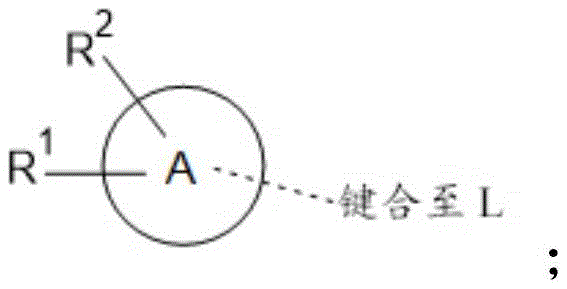
L is selected from covalent bond, SO 2 、–SO 2 NH–、–NHSO 2 –、–SO 2 NH-C 1-6 -alkyl-, -C 1-6 -alkyl-NHSO 2 –、–CHR 8 –、–O–、–NH–、–OCH 2 –、–CH 2 O–、–CH 2 NH–、–NHCH 2 –、–CH 2 N(C 1-6 -alkyl) -, -N (C) 1-6 -alkyl) CH 2 –、–CH 2 OCH 2 –、–CF 2 CH 2 –、–CH 2 CF 2 –、–CH 2 CH 2 -, -CH = CH-and-C ≡ C-;
L D selected from covalent bond, SO 2 、–O–、–NR 11 –、–CH 2 NH–;
A is selected from C 6 -C 14 Aryl, 5-to 14-membered heteroaryl, C 3 -C 10 -cycloalkyl and 3-to 14-membered heterocyclyl;
b is a 4-to 10-membered heterocyclic ring containing 1 to 2 nitrogen atoms;
C is
(i) A 5-to 6-membered heterocyclic ring comprising 1-to 3 heteroatoms independently selected from N, S, and O;
(ii) A 5-to 6-membered heteroaryl comprising 1-to 3 heteroatoms independently selected from N, S, and O; or
(iii)C 3 -C 10 -a cycloalkyl group;
d is selected from C 6 -C 14 -aryl, C 3 -C 10 -cycloalkyl, 5-to 14-membered heteroaryl and 3-to 14-membered heterocyclyl;
R 1 and R 2 Each independently selected from hydrogen, halogen, SF 5 Cyano, carbamoyl, aminosulfonyl, C 1-6 Alkyl radical, C 1-6 -alkoxy, halo-C 1-6 -alkyl, halo-C 1-6 -alkoxy, C 1-6 -alkyl-SO 2 -, halo-C 1-6 -alkyl-SO 2 -, cyano-C 1-6 -alkyl-SO 2 -and group
R 3 Selected from hydrogen, halogen, hydroxy, cyano, C 1-6 -alkyl, halo-C 1-6 Alkyl radical, C 1-6 -alkoxy and halo-C 1-6 -an alkoxy group;
R 4 independently selected from hydrogen, halogen, cyano, hydroxy, amino, C 1-6 -alkyl, halo-C 1-6 Alkyl radical, C 1-6 -alkoxy, halo-C 1-6 -alkoxy and oxo;
R 5 is hydrogen;
R 6 and R 7 Independently selected from hydrogen, halogen, hydroxy and C 1-6 -an alkyl group;or
R 6 And R 7 Together with the carbon atom to which they are attached form C 3 -C 10 -a cycloalkyl ring;
R 8 selected from hydrogen, C 6 -C 14 Aryl and halo-C 6 -C 14 -an aryl group;
R 9 selected from hydrogen, hydroxy, oxo, halogen, cyano, carbamoyl, C 1-6 Alkyl radical, C 3 -C 10 -cycloalkyl, C 1-6 -alkoxy, halo-C 1-6 -alkyl, hydroxy-C 1-6 -alkyl, halo-C 1-6 -alkoxy, cyano-C 1-6 -alkyl, cyano-C 1-6 -alkoxy, C 1-6 -alkyl-SO 2 -C 1-6 -alkyl-, C 1-6 -alkyl-SO 2 –、C 1-6 -alkoxy-carbonyl, halo-C 1-6 -alkyl-SO 2 -, cyano-C 1-6 -alkyl-SO 2 –、C 1-6 -alkyl-SO-and C 1-6 -alkyl-S-, wherein said C 3 -C 10 -cycloalkyl optionally substituted by a halo-C 1 -C 6 -alkyl substitution;
R 10 selected from hydrogen, halogen, hydroxy, C 1-6 -alkyl and halo-C 1-6 -an alkyl group; and is
R 11 Selected from hydrogen, C 1-6 Alkyl radical, C 1-6 -alkoxy-C 1-6 -alkyl and C 3-10 -cycloalkyl-C 1-6 -alkyl-, C 6 -C 14 -an aryl group.
In one embodiment, the present invention provides a compound of formula (I) as described herein, or a pharmaceutically acceptable salt thereof, wherein:
x is selected from O, NH, N (C) 1-6 -alkyl) and (CH) 2 ) m CHR 6 (ii) a And Y is (CH) 2 ) n CHR 7 (ii) a Or
X and Y together form a group-CR 6 =CR 7 –;
m and n are each independently an integer selected from 0 and 1;
l is selected from the group consisting of a covalent bond, SO 2 、–SO 2 NH–、–NHSO 2 –、–SO 2 NH-C 1-6 -alkyl-, -C 1-6 -alkyl-NHSO 2 –、–CHR 8 –、–O–、–NH–、–OCH 2 –、–CH 2 O–、–CH 2 NH–、–NHCH 2 –、–CH 2 N(C 1-6 -alkyl) -, -N (C) 1-6 -alkyl) CH 2 –、–CH 2 OCH 2 –、–CF 2 CH 2 –、–CH 2 CF 2 –、–CH 2 CH 2 -, -CH = CH-and-C ≡ C-;
L D selected from covalent bond, SO 2 、–O–、–NR 11 –、–CH 2 NH–;
A is selected from

B is selected from

C is selected from

D is selected from C 6 -C 14 -aryl, C 3 -C 10 -cycloalkyl, 5-to 14-membered heteroaryl and 3-to 14-membered heterocyclyl;
R L is selected from C 1-6 -alkyl and radical
R 1 And R 2 Independently selected from hydrogen, halogen, SF 5 Cyano, carbamoyl, aminosulfonyl, C 1-6 Alkyl radical, C 1-6 -alkoxy, halo-C 1-6 -alkyl, halo-C 1-6 -alkoxy, C 1-6 -alkyl-SO 2 -, halo-C 1-6 -alkyl-SO 2 -, cyano-C 1-6 -alkyl-SO 2 -and group
R 3 Selected from hydrogen, halogen, hydroxy, cyano, C 1-6 -alkyl, halo-C 1-6 Alkyl radical, C 1-6 -alkoxy and halo-C 1-6 -an alkoxy group;
R 4 and R 5 Independently selected from hydrogen, halogen, cyano, hydroxy, amino, C 1-6 -alkyl, halo-C 1-6 Alkyl radical, C 1-6 -alkoxy, halo-C 1-6 -alkoxy and oxo;
R 6 and R 7 Independently selected from hydrogen, halogen, hydroxy and C 1-6 -an alkyl group; or
R 6 And R 7 Together with the carbon atom to which they are attached form C 3 -C 10 -a cycloalkyl ring;
R 8 selected from hydrogen, C 6 -C 14 -aryl and halo-C 6 -C 14 -an aryl group;
R 9 selected from hydrogen, hydroxy, oxo, halogen, cyano, carbamoyl, C 1-6 Alkyl radical, C 3 -C 10 -cycloalkyl, C 1-6 -alkoxy, halo-C 1-6 -alkyl, hydroxy-C 1-6 -alkyl, halo-C 1-6 -alkoxy, cyano-C 1-6 -alkyl, cyano-C 1-6 -alkoxy, C 1-6 -alkyl-SO 2 -C 1-6 -alkyl-, C 1-6 -alkyl-SO 2 –、C 1-6 -alkoxy-carbonyl, halo-C 1-6 -alkyl-SO 2 -, cyano-C 1-6 -alkyl-SO 2 –、C 1-6 -alkyl-SO-and C 1-6 -alkyl-S-, wherein said C 3 -C 10 -cycloalkyl optionally substituted by a halo-C 1 -C 6 -alkyl substitution;
R 10 Is selected fromHydrogen, halogen, hydroxy, oxo, C 1-6 -alkyl and halo-C 1-6 -an alkyl group; and is provided with
R 11 Selected from hydrogen, C 1-6 Alkyl radical, C 1-6 -alkoxy-C 1-6 -alkyl and C 3-10 -cycloalkyl-C 1-6 -alkyl-, C 6 -C 14 -an aryl group.
In one embodiment, the present invention provides a compound of formula (I) as described herein, or a pharmaceutically acceptable salt thereof, wherein:
R L is a group
X is selected from O, NH, N (C) 1-6 -alkyl) and (CH) 2 ) m CHR 6 (ii) a And Y is (CH) 2 ) n CHR 7 (ii) a Or
X and Y together form a group-CR 6 =CR 7 –;
m and n are each independently an integer selected from 0 and 1;
l is selected from the group consisting of a covalent bond, -CHR 8 –、–O–、–OCH 2 –、–CH 2 O–、–CH 2 OCH 2 –、–CF 2 CH 2 –、–CH 2 CF 2 –、–CH 2 CH 2 -, -CH = CH-and-C ≡ C-;
a is selected from C 6 -C 14 -aryl, 5-to 14-membered heteroaryl and 3-to 14-membered heterocyclyl;
b is a 4-to 10-membered heterocyclic ring containing 1 to 2 nitrogen atoms;
c is
(i) A 5-to 6-membered heterocyclic ring comprising 1-to 3 heteroatoms independently selected from N, S, and O;
(ii) A 5-to 6-membered heteroaryl comprising 1-to 3 heteroatoms independently selected from N, S, and O; or
(iii)C 3 -C 10 -a cycloalkyl group;
R 1 and R 2 Independently selected from hydrogen, halogen, SF 5 Cyano, carbamoylBase, C 1-6 Alkyl radical, C 1-6 -alkoxy, halo-C 1-6 -alkyl, halo-C 1-6 -alkoxy, C 1-6 -alkyl-SO 2 -, halo-C 1-6 -alkyl-SO 2 -, cyano-C 1-6 -alkyl-SO 2 –、C 6 -C 14 -aryl, C 3 -C 10 -cycloalkyl, C 3 -C 10 -cycloalkyl-SO 2 -, 5-to 14-membered heteroaryl, 3-to 14-membered heterocyclyl, 3-to 14-membered heterocyclyloxy, C 6 -C 14 -aryloxy group, C 6 -C 14 -aryl-SO 2 –、C 3 -C 10 Cycloalkoxy, 5-to 14-membered heteroaryloxy, C 6 -C 14 -aryl-NH-and C 6 -C 14 -aryl-N (C) 1-6 -alkyl) -, wherein said C 6 -C 14 -aryl, C 3 -C 10 -cycloalkyl, 5-to 14-membered heteroaryl, 3-to 14-membered heterocyclyl, 3-to 14-membered heterocyclyloxy, C 6 -C 14 Aryloxy group, C 3 -C 10 Cycloalkoxy, 5-to 14-membered heteroaryloxy, C 6 -C 14 -aryl-NH-and C 6 -C 14 -aryl-N (C) 1-6 -alkyl) -optionally selected from halogen, cyano, carbamoyl, C 1-6 Alkyl radical, C 3 -C 10 -cycloalkyl, C 1-6 -alkoxy, halo-C 1-6 -alkyl, halo-C 1-6 -alkoxy, cyano-C 1-6 -alkyl, cyano-C 1-6 -alkoxy, C 1-6 -alkyl-SO 2 -, halo-C 1-6 -alkyl-SO 2 -, cyano-C 1-6 -alkyl-SO 2 –、C 1-6 -alkyl-SO-and C 1-6 -1 to 2 substituents of alkyl-S-;
R 3 selected from hydrogen, halogen, hydroxy, cyano, C 1-6 -alkyl, halo-C 1-6 Alkyl radical, C 1-6 -alkoxy and halo-C 1-6 -an alkoxy group;
R 4 and R 5 Independently selected from hydrogen, halogen, cyano, hydroxy, amino, C 1-6 -alkyl, halo-C 1-6 -alkanesBase, C 1-6 -alkoxy, halo-C 1-6 -alkoxy and oxo;
R 6 and R 7 Independently selected from hydrogen, halogen, hydroxy and C 1-6 -an alkyl group; or
R 6 And R 7 Together with the carbon atom to which they are attached form C 3 -C 10 -a cycloalkyl ring; and is provided with
R 8 Selected from hydrogen, C 6 -C 14 Aryl and halo-C 6 -C 14 -an aryl group.
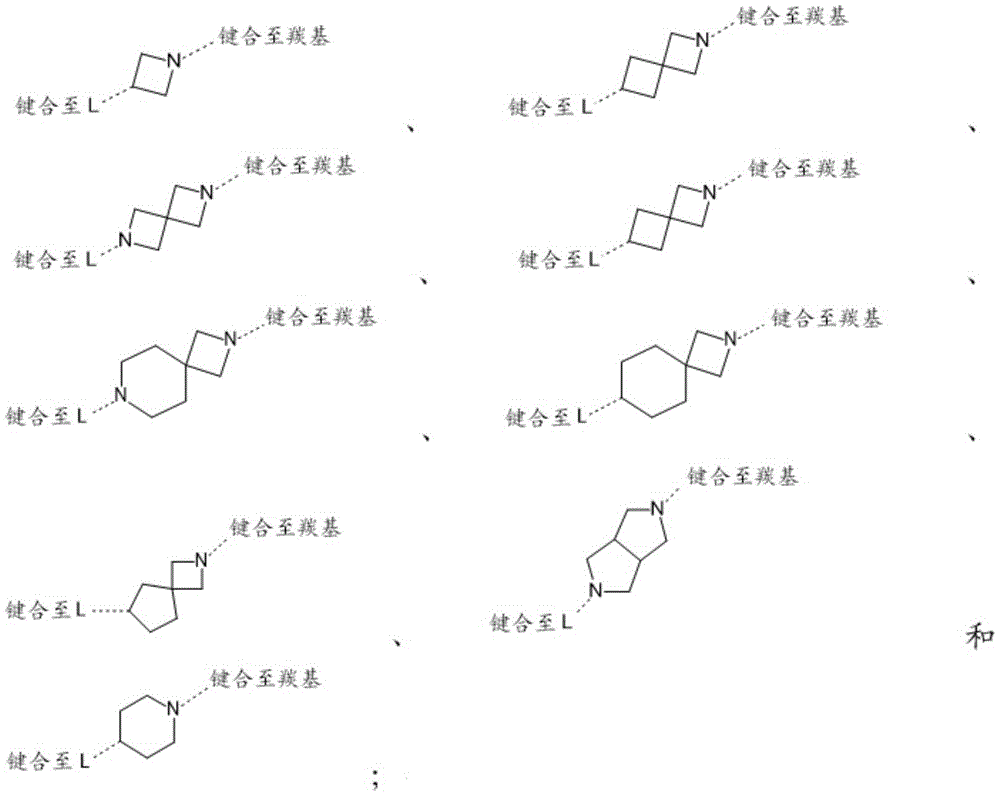
In one embodiment, the present invention provides a compound of formula (I) as defined herein, or a pharmaceutically acceptable salt thereof, wherein ring B is selected from:

in a preferred embodiment, the present invention provides a compound of formula (I) as defined herein, or a pharmaceutically acceptable salt thereof, wherein ring B is selected from:

in a particularly preferred embodiment, the present invention provides a compound of formula (I) as defined herein, or a pharmaceutically acceptable salt thereof, wherein ring B is
In one embodiment, the present invention provides a compound of formula (I) as defined herein, or a pharmaceutically acceptable salt thereof, wherein ring C is selected from:
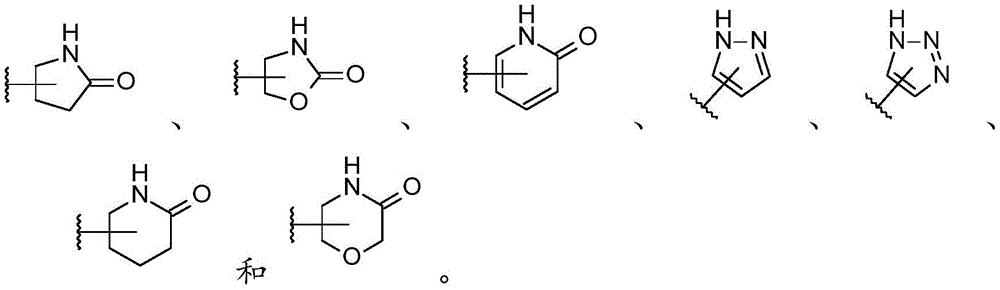
in one embodiment, the present invention provides a compound of formula (I) as defined herein, or a pharmaceutically acceptable salt thereof, wherein ring C is selected from:

in a preferred embodiment, the present invention provides a compound of formula (I) as defined herein, or a pharmaceutically acceptable salt thereof, wherein ring C is
In one embodiment, the present invention provides a compound of formula (I) as defined herein or a pharmaceutically acceptable salt thereof, wherein the compound of formula (I) is a compound of formula (II)

Wherein C, L and R 1 To R 5 As defined herein.
In one embodiment, the present invention provides a compound of formula (I), as defined herein, or a pharmaceutically acceptable salt thereof, wherein:
R L Is a group
X is selected from O, NH, N (C) 1-6 -alkyl) and (CH) 2 ) m CHR 6 ;
Y is (CH) 2 ) n CHR 7 ;
m and n are each independently an integer selected from 0 and 1;
R 6 selected from hydrogen, halogen, hydroxy and C 1-6 -an alkyl group; and is
R 7 Is hydrogen.
In a preferred embodiment, the present invention provides a compound of formula (I), as defined herein, or a pharmaceutically acceptable salt thereof, wherein:
R L is a group
X is selected from N (C) 1-6 -alkyl) and (CH) 2 ) m CHR 6 ;
Y is (CH) 2 ) n CHR 7 ;
m is 0;
n is an integer selected from 0 and 1; and is
R 6 And R 7 Both are hydrogen.
In a particularly preferred embodiment, the present invention provides a compound of formula (I), as defined herein, or a pharmaceutically acceptable salt thereof, wherein:
R L is a group
X is selected from N-methyl and (CH) 2 ) m CHR 6 ;
Y is (CH) 2 ) n CHR 7 ;
m is 0;
n is an integer selected from 0 and 1; and is
R 6 And R 7 Both are hydrogen.
In another particularly preferred embodiment, the present invention provides a compound of formula (I) as defined herein, or a pharmaceutically acceptable salt thereof, wherein:
R L is a group
X is (CH) 2 ) m CHR 6 ;
Y is (CH) 2 ) n CHR 7 ;
m and n are both 0; and is provided with
R 6 And R 7 Both are hydrogen.
In one embodiment, the present invention provides a compound of formula (I), as defined herein, or a pharmaceutically acceptable salt thereof, wherein:
l is selected from the group consisting of a covalent bond, -CHR 8 –、–CH 2 O–、SO 2 、–SO 2 NH–、–SO 2 NH-C 1-6 -alkyl-, -O-, -NH-, -CH 2 NH–、–CH 2 N(C 1-6 -alkyl) -and-C ≡ C-;
L D selected from covalent bond, SO 2 、–O–、–NR 11 -and-CH 2 NH–;
A is selected from C 6 -C 14 -aryl, C 3 -C 10 -cycloalkyl and 5-to 14-membered heteroaryl;
d is selected from C 6 -C 14 -aryl, C 3 -C 10 -cycloalkyl, 5-to 14-membered heteroaryl and 3-to 14-membered heterocyclyl;
R 1 selected from halogen, SF 5 Aminosulfonyl radical, C 1-6 -alkyl, halo-C 1-6 Alkyl radical, C 1-6 -alkyl-SO 2 -, halo-C 1-6 -alkyl-SO 2 -, cyano-C 1-6 -alkyl-SO 2 –、C 3 -C 10 -cycloalkyl-SO 2 –、C 6 -C 14 -aryl-SO 2 -, halo-C 1-6 -alkoxy and radical
R 2 Selected from hydrogen, C 1-6 -alkyl-SO 2 -and halogen;
R 8 selected from hydrogen and C 6 -C 14 -an aryl group;
R 9 selected from hydrogen, hydroxy, oxo, halogen, cyano, carbamoyl, C 1-6 Alkyl radical, C 3 -C 10 -cycloalkyl, C 1-6 -alkoxy, halo-C 1-6 -alkyl, hydroxy-C 1-6 -alkyl, halo-C 1-6 -alkoxy, C 1-6 -alkyl-SO 2 -C 1-6 -alkyl-, C 1-6 -alkyl-SO 2 –、C 1-6 -alkoxy-carbonyl, wherein said C 3 -C 10 -cycloalkyl optionally substituted by a halo-C 1 -C 6 -alkyl substitution;
R 10 selected from hydrogen, halogenPlain, hydroxy, oxo, C 1-6 -alkyl and halo-C 1-6 -an alkyl group; and is
R 11 Selected from hydrogen, C 1-6 Alkyl radical, C 1-6 -alkoxy-C 1-6 -alkyl and C 3-10 -cycloalkyl-C 1-6 -alkyl-, C 6 -C 14 -an aryl group.
In one embodiment, the present invention provides a compound of formula (I), as defined herein, or a pharmaceutically acceptable salt thereof, wherein:
l is selected from the group consisting of a covalent bond, -CHR 8 –、–CH 2 O–、SO 2 、–SO 2 NH–、–SO 2 NH-C 1-6 -alkyl-, -O-, -NH-, -CH 2 NH–、–CH 2 N(C 1-6 -alkyl) -and-C ≡ C-;
L D selected from covalent bond, SO 2 、–O–、–NR 11 -and-CH 2 NH–;
D is selected from C 6 -C 14 -aryl, C 3 -C 10 -cycloalkyl, 5-to 14-membered heteroaryl and 3-to 14-membered heterocyclyl;
R 1 selected from halogen, SF 5 Aminosulfonyl radical, C 1-6 -alkyl, halo-C 1-6 Alkyl radical, C 1-6 -alkyl-SO 2 -, halo-C 1-6 -alkyl-SO 2 -, cyano-C 1-6 -alkyl-SO 2 –、C 3 -C 10 -cycloalkyl-SO 2 –、C 6 -C 14 -aryl-SO 2 -, halo-C 1-6 -alkoxy and radical
R 2 Selected from hydrogen, C 1-6 -alkyl-SO 2 -and halogen;
R 8 selected from hydrogen and C 6 -C 14 -an aryl group;
R 9 selected from hydrogen, hydroxy, oxo, halogen, cyano, carbamoyl, C 1-6 Alkyl radical, C 3 -C 10 -cycloalkanesBase, C 1-6 -alkoxy, halo-C 1-6 -alkyl, hydroxy-C 1-6 -alkyl, halo-C 1-6 -alkoxy, C 1-6 -alkyl-SO 2 -C 1-6 -alkyl-, C 1-6 -alkyl-SO 2 –、C 1-6 -alkoxy-carbonyl, wherein said C 3 -C 10 -cycloalkyl optionally substituted by a halo-C 1 -C 6 -alkyl substitution;
R 10 selected from hydrogen, halogen, hydroxy, oxo, C 1-6 -alkyl and halo-C 1-6 -an alkyl group; and is
R 11 Selected from hydrogen, C 1-6 Alkyl radical, C 1-6 -alkoxy-C 1-6 -alkyl and C 3-10 -cycloalkyl-C 1-6 -alkyl-, C 6 -C 14 -an aryl group.
In one embodiment, the present invention provides a compound of formula (I), as defined herein, or a pharmaceutically acceptable salt thereof, wherein:
l is selected from the group consisting of a covalent bond, -CHR 8 –、–CH 2 O–、SO 2 、–SO 2 NH–、–SO 2 NH-C 1-6 -alkyl-, -O-, -NH-, -CH 2 NH–、–CH 2 N(C 1-6 -alkyl) -and-C ≡ C-;
L D selected from covalent bond, SO 2 、–O–、–NR 11 -and-CH 2 NH–;
D is selected from:

R 1 selected from halogen, SF 5 Aminosulfonyl radical, C 1-6 -alkyl, halo-C 1-6 Alkyl radical, C 1-6 -alkyl-SO 2 -, halo-C 1-6 -alkyl-SO 2 -, cyano-C 1-6 -alkyl-SO 2 –、C 3 -C 10 -cycloalkyl-SO 2 –、C 6 -C 14 -aryl-SO 2 -, halo-C 1-6 -alkoxy andradical (I)
R 2 Selected from hydrogen, C 1-6 -alkyl-SO 2 -and halogen;
R 8 selected from hydrogen and C 6 -C 14 -an aryl group;
R 9 selected from hydrogen, hydroxy, oxo, halogen, cyano, carbamoyl, C 1-6 Alkyl radical, C 3 -C 10 -cycloalkyl, C 1-6 -alkoxy, halo-C 1-6 -alkyl, hydroxy-C 1-6 -alkyl, halo-C 1-6 -alkoxy, C 1-6 -alkyl-SO 2 -C 1-6 -alkyl-, C 1-6 -alkyl-SO 2 –、C 1-6 -alkoxy-carbonyl, wherein said C 3 -C 10 -cycloalkyl optionally substituted by a halo-C 1 -C 6 -alkyl substitution;
R 10 selected from hydrogen, halogen, hydroxy, oxo, C 1-6 -alkyl and halo-C 1-6 -an alkyl group; and is
R 11 Selected from hydrogen, C 1-6 Alkyl radical, C 1-6 -alkoxy-C 1-6 -alkyl and C 3-10 -cycloalkyl-C 1-6 -alkyl-, C 6 -C 14 -an aryl group.
In one embodiment, the present invention provides a compound of formula (I), as defined herein, or a pharmaceutically acceptable salt thereof, wherein:
R L is a group
L is selected from the group consisting of a covalent bond, -CHR 8 –、–CH 2 O-and-C ≡ C-;
a is selected from C 6 -C 14 -aryl and 5-to 14-membered heteroaryl;
R 1 selected from halogen, SF 5 、C 1-6 -alkyl, halo-C 1-6 -alkyl, halo-C 1-6 -alkyl-SO 2 -, cyanogenradical-C 1-6 -alkyl-SO 2 –、C 3 -C 10 -cycloalkyl-SO 2 –、C 6 -C 14 -aryl-SO 2 -, halo-C 1-6 -alkoxy, C 6 -C 14 -aryl, C 3 -C 10 Cycloalkyl, 3-to 14-membered heterocyclyl, C 6 -C 14 -aryloxy and C 6 -C 14 -aryl-N (C) 1-6 -alkyl) -, wherein said C 6 -C 14 -aryl, C 3 -C 10 -cycloalkyl, 3-to 14-membered heterocyclyl, 5-to 14-membered heteroaryl, C 6 -C 14 Aryloxy and 5-to 14-membered heteroaryloxy radicals selected from halogen, cyano, carbamoyl, C 1-6 Alkyl radical, C 3 -C 10 -cycloalkyl, halo-C 1-6 Alkyl radical, C 1-6 -alkyl-SO 2 And halo-C 1-6 -1 to 2 substituents of alkoxy;
R 2 selected from hydrogen and halogen; and is
R 8 Selected from hydrogen and C 6 -C 14 -an aryl group.
In a preferred embodiment, the present invention provides a compound of formula (I), as defined herein, or a pharmaceutically acceptable salt thereof, wherein:
R L is a group
L is selected from the group consisting of a covalent bond, -CHR 8 -and-CH 2 O–;
L D Selected from the group consisting of covalent bonds, -O-and-NR 11 –;
A is selected from C 6 -C 14 -aryl and 5-to 14-membered heteroaryl;
d is selected from C 6 -C 14 -aryl, C 3 -C 10 -cycloalkyl and 3-to 14-membered heterocyclyl;
R 1 selected from halo-C 1-6 -alkyl and radical
R 2 Selected from hydrogen and halogen;
R 8 is hydrogen;
R 9 selected from hydrogen, halogen, halo-C 1-6 -alkyl, halo-C 1-6 -alkoxy and C 1-6 -alkyl-SO 2 –;
R 10 Selected from hydrogen, halogen and halo-C 1-6 -an alkyl group; and is provided with
R 11 Is selected from C 1-6 -alkyl and C 3-10 -cycloalkyl-C 1-6 -alkyl-.
In one preferred embodiment, the present invention provides a compound of formula (I), as defined herein, or a pharmaceutically acceptable salt thereof, wherein:
R L is a group
L is selected from the group consisting of a covalent bond, -CHR 8 -and-CH 2 O–;
L D Selected from the group consisting of covalent bonds, -O-and-NR 11 –;
A is selected from

D is selected from:
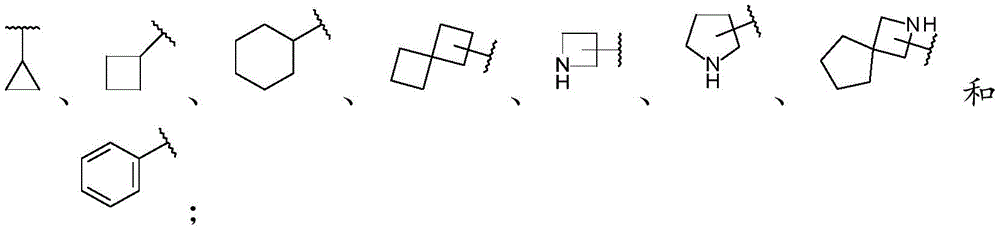
R 1 selected from halo-C 1-6 -alkyl and radical
R 2 Selected from hydrogen and halogen;
R 8 is hydrogen;
R 9 selected from hydrogen, halogen, halo-C 1-6 -alkyl, halo-C 1-6 -alkoxy and C 1-6 -alkyl-SO 2 –;
R 10 Selected from hydrogen, halogen and halo-C 1-6 -an alkyl group; and is
R 11 Is selected from C 1-6 -alkyl and C 3-10 -cycloalkyl-C 1-6 -alkyl-.
In a preferred embodiment, the present invention provides a compound of formula (I), as defined herein, or a pharmaceutically acceptable salt thereof, wherein:
l is selected from the group consisting of a covalent bond and-CH 2 O–;
A is C 6 -C 14 -an aryl group;
R 1 selected from halo-C 1-6 Alkyl radical, C 6 -C 14 -aryl, C 3 -C 10 -cycloalkyl and C 6 -C 14 -aryl-N (C) 1-6 -alkyl) -, wherein said C 6 -C 14 -aryl and C 3 -C 10 Cycloalkyl radicals selected from halogen, C 1-6 -alkyl-SO 2 And halo-C 1-6 -1 to 2 substituents of alkyl;
R 2 selected from hydrogen and halogen; and is
R 8 Is hydrogen.
In a particularly preferred embodiment, the present invention provides a compound of formula (I), as defined herein, or a pharmaceutically acceptable salt thereof, wherein:
R L is a group
L is selected from the group consisting of a covalent bond, -CHR 8 -and-CH 2 O–;
L D Selected from the group consisting of covalent bonds, -O-and-NR 11 –;
A is selected from

D is selected from:

R 1 selected from CF 3 And group
R 2 Selected from hydrogen and fluorine;
R 8 is hydrogen;
R 9 selected from hydrogen, fluorine, chlorine, CF 3 2, 2-trifluoroethoxy and methylsulfonyl;
R 10 selected from hydrogen, chlorine and CF 3 (ii) a And is
R 11 Selected from methyl and cyclopropylmethyl.
In a particularly preferred embodiment, the present invention provides a compound of formula (I), as defined herein, or a pharmaceutically acceptable salt thereof, wherein:
l is selected from the group consisting of a covalent bond and-CH 2 O–;
A is phenyl;
R 1 selected from CF 3 Phenyl, cyclopropyl and phenyl-N (methyl) -, wherein said phenyl and cyclopropyl are selected from fluoro, chloro, methylsulfonyl and CF 3 1 to 2 substituents of (a);
R 2 selected from hydrogen and fluorine; and is provided with
R 8 Is hydrogen.
In one embodiment, the present invention provides a compound of formula (I), as defined herein, or a pharmaceutically acceptable salt thereof, wherein:
b is a 4-to 9-membered heterocyclic ring containing 1 to 2 nitrogen atoms; and is
R 3 Is hydrogen.
In one embodiment, the present invention provides a compound of formula (I), as defined herein, or a pharmaceutically acceptable salt thereof, wherein:
b is a 4-to 8-membered heterocyclic ring containing 1 to 2 nitrogen atoms; and is
R 3 Is hydrogen.
In a preferred embodiment, the present invention provides a compound of formula (I), as defined herein, or a pharmaceutically acceptable salt thereof, wherein:
B is selected from

R 3 Is hydrogen.
In one preferred embodiment, the present invention provides a compound of formula (I), as defined herein, or a pharmaceutically acceptable salt thereof, wherein:
b is azetidinyl; and is
R 3 Is hydrogen.
In one embodiment, the present invention provides a compound of formula (I), as defined herein, or a pharmaceutically acceptable salt thereof, wherein:
c is
(i) A 5-to 6-membered heterocyclic ring comprising 1-to 2 heteroatoms independently selected from N, S, and O; or
(ii) A 5-to 6-membered heteroaryl group containing 1 to 3 nitrogen atoms;
R 4 selected from hydrogen and oxo; and is provided with
R 5 Selected from hydrogen and C 1-6 -an alkyl group.
In one embodiment, the present invention provides a compound of formula (I), as defined herein, or a pharmaceutically acceptable salt thereof, wherein:
c is selected from

R 4 Selected from hydrogen and oxo; and is
R 5 Selected from hydrogen and C 1-6 -an alkyl group.
In a preferred embodiment, the present invention provides a compound of formula (I), as defined herein, or a pharmaceutically acceptable salt thereof, wherein:
c is
(i) A 5-membered heterocyclic ring comprising 1 to 2 heteroatoms independently selected from N and O; or
(ii) A 5-membered heteroaryl group comprising 3 nitrogen atoms;
R 4 selected from hydrogen and oxo; and is provided with
R 5 Is hydrogen.
In a particularly preferred embodiment, the present invention provides a compound of formula (I), as defined herein, or a pharmaceutically acceptable salt thereof, wherein:
C is selected from pyrrolidinyl, oxazolidinyl and triazolyl;
R 4 selected from hydrogen and oxo; and is
R 5 Is hydrogen.
In another particularly preferred embodiment, the present invention provides a compound of formula (I) as defined herein, or a pharmaceutically acceptable salt thereof, wherein:
c is selected from

R 4 Is oxo; and is
R 5 Is hydrogen.
In one embodiment, the present invention provides a compound of formula (I), as defined herein, or a pharmaceutically acceptable salt thereof, wherein:
x is selected from O, NH, N (C) 1-6 -alkyl) and (CH) 2 ) m CHR 6 ;
Y is (CH) 2 ) n CHR 7 ;
m and n are each independently an integer selected from 0 and 1;
c is
(i) A 5-to 6-membered heterocyclic ring comprising 1-to 2 heteroatoms independently selected from N, S, and O; or
(ii) A 5-to 6-membered heteroaryl group containing 1 to 3 nitrogen atoms;
R 4 selected from hydrogen and oxo;
R 5 selected from hydrogen and C 1-6 -an alkyl group;
R 6 selected from hydrogen, hydroxyAnd C 1-6 -an alkyl group; and is
R 7 Selected from hydrogen.
In a preferred embodiment, the present invention provides a compound of formula (I), as defined herein, or a pharmaceutically acceptable salt thereof, wherein:
x is selected from N (C) 1-6 -alkyl) and (CH) 2 ) m CHR 6 ;
Y is (CH) 2 ) n CHR 7 ;
m is 0;
n is an integer selected from 0 and 1;
c is
(i) A 5-membered heterocyclic ring comprising 1 to 2 heteroatoms independently selected from N and O; or
(ii) A 5-membered heteroaryl group comprising 3 nitrogen atoms;
R 4 selected from hydrogen and oxo; and is
R 5 、R 6 And R 7 All are hydrogen.
In a particularly preferred embodiment, the present invention provides a compound of formula (I), as defined herein, or a pharmaceutically acceptable salt thereof, wherein:
x is selected from N (methyl) and (CH) 2 ) m CHR 6 ;
Y is (CH) 2 ) n CHR 7 ;
m is 0;
n is an integer selected from 0 and 1;
c is selected from pyrrolidinyl, oxazolidinyl and triazolyl;
R 4 selected from hydrogen and oxo; and is
R 5 、R 6 And R 7 All are hydrogen.
In one embodiment, the present invention provides a compound of formula (I), as defined herein, or a pharmaceutically acceptable salt thereof, wherein:
x is selected from O, NH, N (C) 1-6 -alkyl) and (CH) 2 ) m CHR 6 ;
Y is (CH) 2 ) n CHR 7 ;
m and n are each independently an integer selected from 0 and 1;
l is selected from the group consisting of a covalent bond, -CHR 8 –、–CH 2 O–、SO 2 、–SO 2 NH–、–SO 2 NH-C 1-6 -alkyl-, -O-, -NH-, -CH 2 NH–、–CH 2 N(C 1-6 -alkyl) -and-C ≡ C-;
L D selected from covalent bond, SO 2 、–O–、–NR 11 -and-CH 2 NH–;
A is selected from C 6 -C 14 -aryl, C 3 -C 10 -cycloalkyl and 5-to 14-membered heteroaryl;
b is a 4-to 9-membered heterocyclic ring containing 1 to 2 nitrogen atoms;
c is
(i) A 5-to 6-membered heterocyclic ring comprising 1-to 2 heteroatoms independently selected from N, S, and O; or
(ii) A 5-to 6-membered heteroaryl group containing 1 to 3 nitrogen atoms;
d is selected from C 6 -C 14 -aryl, C 3 -C 10 -cycloalkyl, 5-to 14-membered heteroaryl and 3-to 14-membered heterocyclyl;
R 1 selected from halogen, SF 5 Aminosulfonyl radical, C 1-6 -alkyl, halo-C 1-6 Alkyl radical, C 1-6 -alkyl-SO 2 -, halo-C 1-6 -alkyl-SO 2 -, cyano-C 1-6 -alkyl-SO 2 –、C 3 -C 10 -cycloalkyl-SO 2 –、C 6 -C 14 -aryl-SO 2 -, halo-C 1-6 -alkoxy and radical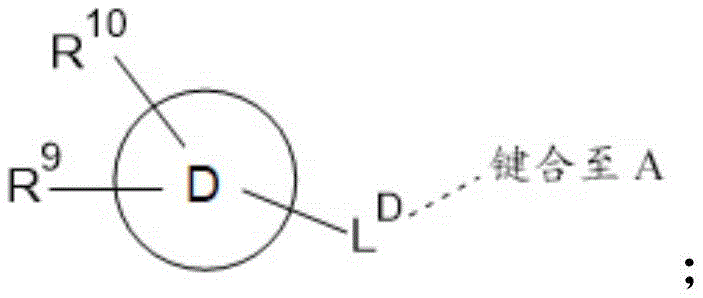
R 2 Selected from hydrogen, C 1-6 -alkyl-SO 2 -and halogen;
R 3 and R 7 Both are hydrogen;
R 4 selected from hydrogen and oxo;
R 5 is selected fromHydrogen and C 1-6 -an alkyl group;
R 6 selected from hydrogen, halogen, hydroxy and C 1-6 -an alkyl group;
R 8 selected from hydrogen and C 6 -C 14 -an aryl group;
R 9 selected from hydrogen, hydroxy, oxo, halogen, cyano, carbamoyl, C 1-6 Alkyl radical, C 3 -C 10 -cycloalkyl, C 1-6 -alkoxy, halo-C 1-6 -alkyl, hydroxy-C 1-6 -alkyl, halo-C 1-6 -alkoxy, C 1-6 -alkyl-SO 2 -C 1-6 -alkyl-, C 1-6 -alkyl-SO 2 –、C 1-6 -alkoxy-carbonyl, wherein said C 3 -C 10 -cycloalkyl optionally substituted by a halo-C 1 -C 6 -alkyl substitution;
R 10 selected from hydrogen, halogen, hydroxy, oxo, C 1-6 -alkyl and halo-C 1-6 -an alkyl group; and is provided with
R 11 Selected from hydrogen, C 1-6 Alkyl radical, C 1-6 -alkoxy-C 1-6 -alkyl and C 3-10 -cycloalkyl-C 1-6 -alkyl-, C 6 -C 14 -an aryl group.
In a preferred embodiment, the present invention provides a compound of formula (I), as defined herein, or a pharmaceutically acceptable salt thereof, wherein:
x is selected from N (C) 1-6 -alkyl) and (CH) 2 ) m CHR 6 ;
Y is (CH) 2 ) n CHR 7 ;
m is 0;
n is an integer selected from 0 and 1;
l is selected from the group consisting of a covalent bond, -CHR 8 -and-CH 2 O–;
L D Selected from the group consisting of covalent bonds, -O-and-NR 11 –;
A is selected from C 6 -C 14 -aryl and 5-to 14-membered heteroaryl;
b is a 4-to 9-membered heterocyclic ring containing 1 to 2 nitrogen atoms;
c is
(i) A 5-membered heterocyclic ring comprising 1 to 2 heteroatoms independently selected from N and O; or
(ii) A 5-membered heteroaryl group comprising 3 nitrogen atoms;
d is selected from C 6 -C 14 -aryl, C 3 -C 10 -cycloalkyl and 3-to 14-membered heterocyclyl;
R L is a group
R 1 Selected from halo-C 1-6 -alkyl and radical
R 2 Selected from hydrogen and halogen;
R 3 、R 5 、R 6 、R 7 and R 8 All are hydrogen;
R 4 selected from hydrogen and oxo;
R 9 selected from hydrogen, halogen, halo-C 1-6 -alkyl, halo-C 1-6 -alkoxy and C 1-6 -alkyl-SO 2 –;
R 10 Selected from hydrogen, halogen and halo-C 1-6 -an alkyl group; and is
R 11 Is selected from C 1-6 -alkyl and C 3-10 -cycloalkyl-C 1-6 -alkyl-.
In one embodiment, the present invention provides a compound of formula (I), as defined herein, or a pharmaceutically acceptable salt thereof, wherein:
x is selected from O, NH, N (C) 1-6 -alkyl) and (CH) 2 ) m CHR 6 ;
Y is (CH) 2 ) n CHR 7 ;
m and n are each independently an integer selected from 0 and 1;
l is selected from the group consisting of a covalent bond, -CHR 8 –、–CH 2 O–、SO 2 、–SO 2 NH–、–SO 2 NH-C 1-6 -alkyl-, -O-, -NH-, -CH 2 NH–、–CH 2 N(C 1-6 -alkyl) -and-C ≡ C-;
L D selected from covalent bond, SO 2 、–O–、–NR 11 -and-CH 2 NH–;
A is selected from

B is selected from
C is selected from

D is selected from:

R 1 selected from halogen, SF 5 Aminosulfonyl radical, C 1-6 -alkyl, halo-C 1-6 Alkyl radical, C 1-6 -alkyl-SO 2 -, halo-C 1-6 -alkyl-SO 2 -, cyano-C 1-6 -alkyl-SO 2 –、C 3 -C 10 -cycloalkyl-SO 2 –、C 6 -C 14 -aryl-SO 2 -, halo-C 1-6 -alkoxy and radicals

R 2 Selected from hydrogen, C 1-6 -alkyl-SO 2 -and halogen;
R 3 and R 7 Both are hydrogen;
R 4 selected from hydrogen and oxo;
R 5 selected from hydrogen and C 1-6 -an alkyl group;
R 6 selected from hydrogen, halogen, hydroxy and C 1-6 -an alkyl group;
R 8 selected from hydrogen and C 6 -C 14 -an aryl group;
R 9 selected from hydrogen, hydroxy, oxo, halogen, cyano, carbamoyl, C 1-6 Alkyl radical, C 3 -C 10 -cycloalkyl, C 1-6 -alkoxy, halo-C 1-6 -alkyl, hydroxy-C 1-6 -alkyl, halo-C 1-6 -alkoxy, C 1-6 -alkyl-SO 2 -C 1-6 -alkyl-, C 1-6 -alkyl-SO 2 –、C 1-6 -alkoxy-carbonyl, wherein said C 3 -C 10 -cycloalkyl optionally substituted by a halo-C 1 -C 6 -alkyl substitution;
R 10 selected from hydrogen, halogen, hydroxy, oxo, C 1-6 -alkyl and halo-C 1-6 -an alkyl group; and is provided with
R 11 Selected from hydrogen, C 1-6 Alkyl radical, C 1-6 -alkoxy-C 1-6 -alkyl and C 3-10 -cycloalkyl-C 1-6 -alkyl-, C 6 -C 14 -an aryl group.
In one preferred embodiment, the present invention provides a compound of formula (I), as defined herein, or a pharmaceutically acceptable salt thereof, wherein:
x is selected from N (C) 1-6 -alkyl) and (CH) 2 ) m CHR 6 ;
Y is (CH) 2 ) n CHR 7 ;
m is 0;
n is an integer selected from 0 and 1;
l is selected from the group consisting of a covalent bond, -CHR 8 -and-CH 2 O–;
L D Selected from the group consisting of covalent bonds, -O-and-NR 11 –;
A is selected from

B is selected from

C is selected from

D is selected from:

R L is a group
R 1 Selected from halo-C 1-6 -alkyl and radical
R 2 Selected from hydrogen and halogen;
R 3 、R 5 、R 6 、R 7 and R 8 All are hydrogen;
R 4 selected from hydrogen and oxo;
R 9 selected from hydrogen, halogen, halo-C 1-6 -alkyl, halo-C 1-6 -alkoxy and C 1-6 -alkyl-SO 2 –;
R 10 Selected from hydrogen, halogen and halo-C 1-6 -an alkyl group; and is provided with
R 11 Is selected from C 1-6 -alkyl and C 3-10 -cycloalkyl-C 1-6 -alkyl-.
In a particularly preferred embodiment, the present invention provides a compound of formula (I), as defined herein, or a pharmaceutically acceptable salt thereof, wherein:
x is selected from N (methyl) and (CH) 2 ) m CHR 6 ;
Y is (CH) 2 ) n CHR 7 ;
m is 0;
n is an integer selected from 0 and 1;
l is selected from the group consisting of a covalent bond, -CHR 8 -and-CH 2 O–;
L D Selected from the group consisting of covalent bonds, -O-and-NR 11 –;
A is selected from phenyl, pyridyl, pyrazinyl and pyrimidinyl;
b is selected from

C is selected from

D is selected from the group consisting of phenyl, cyclopropyl, spiro [3.3] heptan-2-yl, cyclobutyl, cyclohexyl, 2-azaspiro [3.4] octan-2-yl, azetidinyl and pyrrolidinyl;
R L is a group
R 1 Selected from CF 3 And a group
R 2 Selected from hydrogen and fluorine;
R 3 、R 5 、R 6 、R 7 and R 8 All are hydrogen;
R 4 selected from hydrogen and oxo;
R 9 selected from hydrogen, fluorine, chlorine, CF 3 2, 2-trifluoroethoxy and methylsulfonyl;
R 10 selected from hydrogen, chlorine and CF 3 (ii) a And is
R 11 Selected from methyl and cyclopropylmethyl.
In one embodiment, the present invention provides a compound of formula (I), as defined herein, or a pharmaceutically acceptable salt thereof, wherein:
X is selected from O, NH, N (C) 1-6 -alkyl) and (CH) 2 ) m CHR 6 ;
Y is (CH) 2 ) n CHR 7 ;
m and n are each independently an integer selected from 0 and 1;
l is selected from the group consisting of a covalent bond, -CHR 8 –、–CH 2 O-and-C ≡ C-;
a is selected from C 6 -C 14 -aryl and 5-to 14-membered heteroaryl;
b is a 4-to 8-membered heterocyclic ring containing 1 to 2 nitrogen atoms;
c is
(i) A 5-to 6-membered heterocyclic ring comprising 1-to 2 heteroatoms independently selected from N, S, and O; or
(ii) A 5-to 6-membered heteroaryl group containing 1 to 3 nitrogen atoms;
R 1 selected from halogen, SF 5 、C 1-6 -alkyl, halo-C 1-6 -alkyl, halo-C 1-6 -alkoxy, C 6 -C 14 -aryl, C 3 -C 10 Cycloalkyl, 3-to 14-membered heterocyclyl, C 6 -C 14 Aryloxy group and C 6 -C 14 -aryl-N (C) 1-6 -alkyl) -, wherein said C 6 -C 14 -aryl, C 3 -C 10 -cycloalkyl, 3-to 14-membered heterocyclyl and C 6 -C 14 Aryloxy group selected from halogen, halo-C 1-6 -alkyl and halo-C 1-6 -1 to 2 substituents of alkoxy;
R 2 selected from hydrogen and halogen;
R 3 、R 7 and R 8 Are all hydrogen;
R 4 selected from hydrogen and oxo;
R 5 selected from hydrogen and C 1-6 -an alkyl group; and is
R 6 Selected from hydrogen, hydroxy and C 1-6 -an alkyl group.
In a preferred embodiment, the present invention provides a compound of formula (I), as defined herein, or a pharmaceutically acceptable salt thereof, wherein:
x is selected from N (C) 1-6 -alkyl) and (CH) 2 ) m CHR 6 ;
Y is (CH) 2 ) n CHR 7 ;
m is 0;
n is an integer selected from 0 and 1;
l is selected from the group consisting of a covalent bond and-CH 2 O–;
A is C 6 -C 14 -an aryl group;
b is azetidinyl;
c is
(i) A 5-membered heterocyclic ring comprising 1 to 2 heteroatoms independently selected from N and O; or
(ii) A 5-membered heteroaryl group comprising 3 nitrogen atoms;
R 1 selected from halo-C 1-6 Alkyl radical, C 6 -C 14 -aryl, C 3 -C 10 -cycloalkyl and C 6 -C 14 -aryl-N (C) 1-6 -alkyl) -, wherein said C 6 -C 14 -aryl and C 3 -C 10 Cycloalkyl radicals selected from halogen and halo-C 1-6 -1 to 2 substituents of alkyl;
R 2 selected from hydrogen and halogen;
R 3 、R 5 、R 6 、R 7 and R 8 All are hydrogen; and is
R 4 Selected from hydrogen and oxo.
In a particularly preferred embodiment, the present invention provides a compound of formula (I), as defined herein, or a pharmaceutically acceptable salt thereof, wherein:
x is selected from N (methyl) and (CH) 2 ) m CHR 6 ;
Y is (CH) 2 ) n CHR 7 ;
m is 0;
n is an integer selected from 0 and 1;
l is selected from the group consisting of a covalent bond and-CH 2 O–;
A is phenyl;
b is azetidinyl;
c is selected from pyrrolidinyl, oxazolidinyl, and triazolyl;
R 1 selected from CF 3 Phenyl, cyclopropyl and phenyl-N (methyl) -, wherein said phenyl and cyclopropyl are selected from fluoro and CF 3 1 to 2 substituents of (a);
R 2 selected from hydrogen and fluorine;
R 3 、R 5 、R 6 、R 7 and R 8 All are hydrogen; and is
R 4 Selected from hydrogen and oxo.
In one embodiment, the present invention provides a compound of formula (I) as defined herein or a pharmaceutically acceptable salt thereof, selected from:
(-) -5- [3- [3- [ [ 2-fluoro-4- (trifluoromethyl) phenyl ] methoxy ] azetidin-1-yl ] -3-oxo-propyl ] pyrrolidin-2-one;
(+) -5- [3- [3- [ [ 2-fluoro-4- (trifluoromethyl) phenyl ] methoxy ] azetidin-1-yl ] -3-oxo-propyl ] pyrrolidin-2-one;
(-) - [3- [3- (4-tert-butylphenyl) azetidin-1-yl ] -3-oxo-propyl ] pyrrolidin-2-one;
(+) -5- [3- [3- (4-tert-butylphenyl) azetidin-1-yl ] -3-oxo-propyl ] pyrrolidin-2-one;
(-) -5- [ 3-oxo-3- [3- [4- [1- (trifluoromethyl) cyclopropyl ] phenyl ] azetidin-1-yl ] propyl ] pyrrolidin-2-one;
(+) -5- [ 3-oxo-3- [3- [4- [1- (trifluoromethyl) cyclopropyl ] phenyl ] azetidin-1-yl ] propyl ] pyrrolidin-2-one;
(-) -or (+) -5- [ 3-oxo-3- [3- [4- (2, 2-trifluoroethyl) phenyl ] azetidin-1-yl ] propyl ] pyrrolidin-2-one;
(+) -or (-) -5- [ 3-oxo-3- [3- [4- (2, 2-trifluoroethyl) phenyl ] azetidin-1-yl ] propyl ] pyrrolidin-2-one;
(-) -5- [3- [3- [4- (2, 4-difluorophenyl) phenyl ] azetidin-1-yl ] -3-oxo-propyl ] pyrrolidin-2-one;
(+) -5- [3- [3- [4- (2, 4-difluorophenyl) phenyl ] azetidin-1-yl ] -3-oxo-propyl ] pyrrolidin-2-one;
(-) -5- [ 3-oxo-3- [ rac- (3aS, 6aS) -2- [ [ 2-fluoro-4- (trifluoromethyl) phenyl ] methyl ] -1,3,3a,4,6, 6a-hexahydropyrrolo [3,4-c ] pyrrol-5-yl ] propyl ] pyrrolidin-2-one;
(+) -5- [ 3-oxo-3- [ rac- (3aS, 6aS) -2- [ [ 2-fluoro-4- (trifluoromethyl) phenyl ] methyl ] -1,3,3a,4,6 a-hexahydropyrrolo [3,4-c ] pyrrol-5-yl ] propyl ] pyrrolidin-2-one;
(-) -or (+) -5- [3- [3- [ [ 2-fluoro-4- (trifluoromethyl) phenyl ] methoxy ] azetidin-1-yl ] -3-oxo-propyl ] -5-methyl-pyrrolidin-2-one;
(+) -or (-) -5- [3- [3- [ [ 2-fluoro-4- (trifluoromethyl) phenyl ] methoxy ] azetidin-1-yl ] -3-oxo-propyl ] -5-methyl-pyrrolidin-2-one;
(-) -or (+) -5-methyl-5- [ 3-oxo-3- [3- [4- [1- (trifluoromethyl) cyclopropyl ] phenyl ] azetidin-1-yl ] propyl ] pyrrolidin-2-one;
(+) -or (-) -5-methyl-5- [ 3-oxo-3- [3- [4- [1- (trifluoromethyl) cyclopropyl ] phenyl ] azetidin-1-yl ] propyl ] pyrrolidin-2-one;
(-) -or (+) -5- [3- [3- [6- (3-chlorophenoxy) -3-pyridinyl ] azetidin-1-yl ] -3-oxo-propyl ] -5-methyl-pyrrolidin-2-one;
(+) -or (-) -5- [3- [3- [6- (3-chlorophenoxy) -3-pyridyl ] azetidin-1-yl ] -3-oxo-propyl ] -5-methyl-pyrrolidin-2-one;
(4S) -4- [3- [3- [ [ 2-fluoro-4- (trifluoromethyl) phenyl ] methoxy ] azetidin-1-yl ] -3-oxo-propyl ] oxazolidin-2-one;
(4R) -4- [3- [3- [ [ 2-fluoro-4- (trifluoromethyl) phenyl ] methoxy ] azetidin-1-yl ] -3-oxo-propyl ] oxazolidin-2-one;
(4S) -4- [ 3-oxo-3- [3- [4- [1- (trifluoromethyl) cyclopropyl ] phenyl ] azetidin-1-yl ] propyl ] oxazolidin-2-one;
(4R) -4- [ 3-oxo-3- [3- [4- [1- (trifluoromethyl) cyclopropyl ] phenyl ] azetidin-1-yl ] propyl ] oxazolidin-2-one;
(4S) -4- [3- [3- [4- (2, 4-difluorophenyl) phenyl ] azetidin-1-yl ] -3-oxo-propyl ] oxazolidin-2-one;
(4R) -4- [3- [3- [4- (2, 4-difluorophenyl) phenyl ] azetidin-1-yl ] -3-oxo-propyl ] oxazolidin-2-one;
(4R) -4- [ 3-oxo-3- [3- [4- (2, 2-trifluoro-1, 1-dimethyl-ethoxy) phenyl ] azetidin-1-yl ] propyl ] oxazolidin-2-one;
(4R) -4- [3- [3- [ [ 2-fluoro-4- (pentafluoro- λ 6-thio) phenyl ] methoxy ] azetidin-1-yl ] -3-oxo-propyl ] oxazolidin-2-one;
(4R) -4- [3- [6- [ (2, 4-difluorophenyl) methyl ] -2-azaspiro [3.3] heptan-2-yl ] -3-oxo-propyl ] oxazolidin-2-one;
(4R) -4- [3- [3- [6- (2-chlorophenoxy) -3-pyridyl ] azetidin-1-yl ] -3-oxo-propyl ] oxazolidin-2-one;
(4R) -4- [3- [6- (2-chloro-4-fluoro-phenoxy) -2-azaspiro [3.3] heptan-2-yl ] -3-oxo-propyl ] oxazolidin-2-one;
(4R) -4- [3- [3- [4- (4-fluorophenoxy) phenyl ] azetidin-1-yl ] -3-oxo-propyl ] oxazolidin-2-one;
(4R) -4- [ 3-oxo-3- [3- [6- [4- (trifluoromethoxy) phenoxy ] -3-pyridyl ] azetidin-1-yl ] propyl ] oxazolidin-2-one;
(4R) -4- [ 3-oxo-3- [6- [6- (trifluoromethyl) pyrazin-2-yl ] oxy-2-azaspiro [3.3] heptan-2-yl ] propyl ] oxazolidin-2-one;
(4R) -4- [3- [3- [2- (3-chlorophenyl) ethynyl ] azetidin-1-yl ] -3-oxo-propyl ] oxazolidin-2-one;
(4R) -4- [ 3-oxo-3- [3- [6- [3- (trifluoromethyl) pyrrolidin-1-yl ] -3-pyridinyl ] azetidin-1-yl ] propyl ] oxazolidin-2-one;
(4R) -4- [3- [3- [ [ 2-fluoro-4- (trifluoromethyl) phenyl ] methoxy ] azetidin-1-yl ] -2-methyl-3-oxo-propyl ] oxazolidin-2-one;
1- (3- ((2-fluoro-4- (trifluoromethyl) benzyl) oxy) azetidin-1-yl) -3- (1H-1, 2, 3-triazol-5-yl) propan-1-one;
3- (1H-1, 2, 3-triazol-5-yl) -1- (3- (4- (1- (trifluoromethyl) cyclopropyl) phenyl) azetidin-1-yl) propan-1-one;
3- (1H-1, 2, 3-triazol-5-yl) -1- (3- (4- ((1, 1-trifluoro-2-methylpropan-2-yl) oxy) phenyl) azetidin-1-yl) propan-1-one;
1- [3- [ [ 2-fluoro-4- (trifluoromethyl) phenyl ] methoxy ] azetidin-1-yl ] -4- (1H-triazol-5-yl) butan-1-one;
4- (1H-triazol-5-yl) -1- [3- [4- [1- (trifluoromethyl) cyclopropyl ] phenyl ] azetidin-1-yl ] butan-1-one;
4- (1H-triazol-5-yl) -1- [3- [4- (2, 2-trifluoro-1, 1-dimethyl-ethoxy) phenyl ] azetidin-1-yl ] butan-1-one;
4- (1H-triazol-5-yl) -1- [3- [6- [4- (trifluoromethoxy) phenoxy ] -3-pyridyl ] azetidin-1-yl ] butan-1-one;
4- (1H-triazol-5-yl) -1- [6- [6- (trifluoromethyl) pyrazin-2-yl ] oxy-2-azaspiro [3.3] heptan-2-yl ] butan-1-one;
1- [3- [2- (3-chlorophenyl) ethynyl ] azetidin-1-yl ] -4- (1H-triazol-5-yl) butan-1-one;
rac-4- (1H-triazol-5-yl) -1- [3- [6- [3- (trifluoromethyl) pyrrolidin-1-yl ] -3-pyridinyl ] azetidin-1-yl ] butan-1-one;
4- (1H-triazol-5-yl) -1- [3- [4- [3- (2, 2-trifluoroethoxy) azetidin-1-yl ] phenyl ] azetidin-1-yl ] butan-1-one;
1- [3- [ [ 2-fluoro-4- (trifluoromethyl) phenyl ] methoxy ] azetidin-1-yl ] -3- (1H-pyrazol-5-yl) propan-1-one;
6- [3- [3- [ [ 2-fluoro-4- (trifluoromethyl) phenyl ] methoxy ] azetidin-1-yl ] -3-oxo-propyl ] -1H-pyridin-2-one;
6- [3- [3- [ [ 2-fluoro-4- (trifluoromethyl) phenyl ] methoxy ] azetidin-1-yl ] -3-oxo-propyl ] piperidin-2-one;
(-) -5- [3- [3- [ [ 2-fluoro-4- (trifluoromethyl) phenyl ] methoxy ] azetidin-1-yl ] -3-oxo-propyl ] morpholin-3-one;
(+) -5- [3- [3- [ [ 2-fluoro-4- (trifluoromethyl) phenyl ] methoxy ] azetidin-1-yl ] -3-oxo-propyl ] morpholin-3-one;
3- [ [ 2-fluoro-4- (trifluoromethyl) phenyl ] methoxy ] azetidine-1-carboxylic acid [ (2S) -5-oxopyrrolidin-2-yl ] methyl ester;
3- [ [ 2-fluoro-4- (trifluoromethyl) phenyl ] methoxy ] azetidine-1-carboxylic acid [ (2R) -5-oxopyrrolidin-2-yl ] methyl ester;
3- [ [ 2-fluoro-4- (trifluoromethyl) phenyl ] methoxy ] azetidine-1-carboxylic acid [ (4S) -2-oxooxazolidin-4-yl ] methyl ester;
3- [ [ 2-fluoro-4- (trifluoromethyl) phenyl ] methoxy ] azetidine-1-carboxylic acid [ (4R) -2-oxooxazolidin-4-yl ] methyl ester;
3- [4- [1- (trifluoromethyl) cyclopropyl ] phenyl ] azetidine-1-carboxylic acid [ (4S) -2-oxooxazolidin-4-yl ] methyl ester;
6- [ (2, 4-difluorophenyl) methyl ] -2-azaspiro [3.3] heptane-2-carboxylic acid [ (4S) -2-oxooxazolidin-4-yl ] methyl ester;
3- [4- (4-fluorophenoxy) phenyl ] azetidine-1-carboxylic acid [ (4S) -2-oxooxazolidin-4-yl ] methyl ester;
6- [ (2, 4-difluorophenyl) methyl ] -2-azaspiro [3.3] heptane-2-carboxylic acid [ (4R) -2-oxooxazolidin-4-yl ] methyl ester;
3- [6- (2-chlorophenoxy) -3-pyridyl ] azetidine-1-carboxylic acid [ (4S) -2-oxooxazolidin-4-yl ] methyl ester;
3- [2- [2- (difluoromethyl) phenyl ] ethynyl ] azetidine-1-carboxylic acid [ (4S) -2-oxooxazolidin-4-yl ] methyl ester;
3- [6- [3- (trifluoromethyl) pyrrolidin-1-yl ] -3-pyridyl ] azetidine-1-carboxylic acid [ (4S) -2-oxooxazolidin-4-yl ] methyl ester;
3- [ [ 2-fluoro-4- (trifluoromethyl) phenyl ] methoxy ] azetidine-1-carboxylic acid 2- (1H-triazol-5-yl) ethyl ester;
3- [ [ 2-fluoro-4- (trifluoromethyl) phenyl ] methoxy ] -N- [2- (1H-triazol-5-yl) ethyl ] azetidine-1-carboxamide;
N-methyl-N- [2- (1H-triazol-5-yl) ethyl ] -3- [4- [1- (trifluoromethyl) cyclopropyl ] phenyl ] azetidine-1-carboxamide;
3- [ [ 2-fluoro-4- (trifluoromethyl) phenyl ] methoxy ] -N-methyl-N- [2- (1H-triazol-5-yl) ethyl ] azetidine-1-carboxamide;
3- [4- (2-chloro-4-methylsulfonyl-phenyl) phenyl ] -N-methyl-N- [2- (1H-triazol-5-yl) ethyl ] azetidine-1-carboxamide;
2-methyl-4- (1H-triazol-5-yl) -1- [3- [4- [1- (trifluoromethyl) cyclopropyl ] phenyl ] azetidin-1-yl ] butan-1-one;
3-hydroxy-4- (1H-triazol-5-yl) -1- [3- [4- [1- (trifluoromethyl) cyclopropyl ] phenyl ] azetidin-1-yl ] butan-1-one;
2-fluoro-4- (1H-triazol-5-yl) -1- [3- [4- [1- (trifluoromethyl) cyclopropyl ] phenyl ] azetidin-1-yl ] butan-1-one;
(4R) -4- [3- [3- [4- (N-methylanilino) phenyl ] azetidin-1-yl ] -3-oxo-propyl ] oxazolidin-2-one;
(4R) -4- [3- [3- (5-tert-butyl-2-pyridyl) azetidin-1-yl ] -3-oxo-propyl ] oxazolidin-2-one;
(4R) -4- [3- [3- [4- (2-chloro-4-methylsulfonyl-phenyl) phenyl ] azetidin-1-yl ] -3-oxo-propyl ] oxazolidin-2-one;
(4R) -4- [3- [3- [4- (benzenesulfonyl) phenyl ] azetidin-1-yl ] -3-oxo-propyl ] oxazolidin-2-one;
2- [4- [1- [3- [ (4R) -2-oxooxazolidin-4-yl ] propanoyl ] azetidin-3-yl ] phenyl ] sulfonylacetonitrile;
(4R) -4- [ 3-oxo-3- [3- [4- (trifluoromethylsulfonyl) phenyl ] azetidin-1-yl ] propyl ] oxazolidin-2-one;
(4R) -4- [3- [3- (4-cyclohexylsulfonylphenyl) azetidin-1-yl ] -3-oxo-propyl ] oxazolidin-2-one;
1- [5- [1- [3- [ (4R) -2-oxooxazolidin-4-yl ] propionyl ] azetidin-3-yl ] -2-pyridyl ] cyclobutanecarbonitrile;
(4R) -4- [3- [3- [4- [ (2-methyl-3-pyridyl) oxy ] phenyl ] azetidin-1-yl ] -3-oxo-propyl ] oxazolidin-2-one;
(4R) -4- [3- [3- [4- (4-cyclopropylpyrimidin-2-yl) oxyphenyl ] azetidin-1-yl ] -3-oxo-propyl ] oxazolidin-2-one;
(4R) -4- [3- [3- [4- [3- (2, 2-dimethylpropyl) triazol-4-yl ] phenyl ] azetidin-1-yl ] -3-oxo-propyl ] oxazolidin-2-one;
(4R) -4- [3- [3- [4- (4-chloro-2-methylsulfonyl-phenyl) phenyl ] azetidin-1-yl ] -3-oxo-propyl ] oxazolidin-2-one;
(+) -or (-) - (4R) -4- [3- [4- [ (4-methylsulfonylphenyl) -phenyl-methyl ] -1-piperidinyl ] -3-oxo-propyl ] oxazolidin-2-one;
(-) -or (+) - (4R) -4- [3- [4- [ (4-methylsulfonylphenyl) -phenyl-methyl ] -1-piperidinyl ] -3-oxo-propyl ] oxazolidin-2-one;
5-chloro-2- [ [5- [1- [3- [ (4R) -2-oxooxazolidin-4-yl ] propanoyl ] azetidin-3-yl ] -2-pyridinyl ] oxy ] benzamide;
(-) -or (+) -3- [6- [3- (trifluoromethyl) pyrrolidin-1-yl ] -3-pyridyl ] azetidine-1-carboxylic acid [ (4S) -2-oxooxazolidin-4-yl ] methyl ester;
(+) -or (-) -3- [6- [3- (trifluoromethyl) pyrrolidin-1-yl ] -3-pyridyl ] azetidine-1-carboxylic acid [ (4S) -2-oxooxazolidin-4-yl ] methyl ester;
(5S) -5- [3- [3- [ [ 2-fluoro-4- (trifluoromethyl) phenyl ] methoxy ] azetidin-1-yl ] -3-oxo-propyl ] thiomorpholin-3-one;
(4R) -4- [3- [3- [4- [ N- (cyclopropylmethyl) anilino ] phenyl ] azetidin-1-yl ] -3-oxo-propyl ] oxazolidin-2-one;
(4R) -4- [ 3-oxo-3- [3- [4- (N-phenylanilino) phenyl ] azetidin-1-yl ] propyl ] oxazolidin-2-one;
(4R) -4- [3- [3- (6-tert-butyl-3-pyridyl) azetidin-1-yl ] -3-oxo-propyl ] oxazolidin-2-one;
(4R) -4- [3- [3- [6- [ (5-methoxy-2-pyridyl) -methyl-amino ] -3-pyridyl ] azetidin-1-yl ] -3-oxo-propyl ] oxazolidin-2-one;
(4R) -4- [3- [3- [6- (N-methylanilino) -3-pyridinyl ] azetidin-1-yl ] -3-oxo-propyl ] oxazolidin-2-one;
(4R) -4- [3- [3- [6- (4-isopropyl-N-methyl-anilino) -3-pyridinyl ] azetidin-1-yl ] -3-oxo-propyl ] oxazolidin-2-one;
(4R) -4- [3- [3- [6- [ N- (cyclopropylmethyl) anilino ] -3-pyridinyl ] azetidin-1-yl ] -3-oxo-propyl ] oxazolidin-2-one;
(4R) -4- [3- [3- [4- [ 2-methoxyethyl (3-pyridyl) amino ] phenyl ] azetidin-1-yl ] -3-oxo-propyl ] oxazolidin-2-one;
(4R) -4- [3- [2- [ 4-fluoro-2- (trifluoromethyl) phenyl ] sulfonyl-2, 6-diazaspiro [3.3] heptan-6-yl ] -3-oxo-propyl ] oxazolidin-2-one;
(4R) -4- [3- [2- (2, 2-dimethylpropylsulfonyl) -2, 6-diazaspiro [3.3] heptan-6-yl ] -3-oxo-propyl ] oxazolidin-2-one;
(4R) -4- [ 3-oxo-3- [3- [4- [3- (2, 2-trifluoroethoxy) azetidin-1-yl ] phenyl ] azetidin-1-yl ] propyl ] oxazolidin-2-one;
(4R) -4- [ 3-oxo-3- [3- [4- [3- (trifluoromethyl) azetidin-1-yl ] phenyl ] azetidin-1-yl ] propyl ] oxazolidin-2-one;
(4R) -4- [ 3-oxo-3- [3- [2- [1- (trifluoromethyl) cyclopropyl ] pyrimidin-5-yl ] azetidin-1-yl ] propyl ] oxazolidin-2-one;
(4R) -4- [ 3-oxo-3- [3- [6- [1- (trifluoromethyl) cyclopropyl ] -3-pyridinyl ] azetidin-1-yl ] propyl ] oxazolidin-2-one;
(4R) -4- [ 3-oxo-3- [3- [5- [3- (trifluoromethyl) pyrrolidin-1-yl ] -2-pyridinyl ] azetidin-1-yl ] propyl ] oxazolidin-2-one;
(4R) -4- [3- [3- [4- [3- (methylsulfonylmethyl) azetidin-1-yl ] phenyl ] azetidin-1-yl ] -3-oxo-propyl ] oxazolidin-2-one;
(4R) -4- [ 3-oxo-3- [3- [5- [3- (trifluoromethyl) pyrrolidin-1-yl ] pyrazin-2-yl ] azetidin-1-yl ] propyl ] oxazolidin-2-one;
(4R) -4- [ 3-oxo-3- [3- [5- [3- (trifluoromethyl) pyrrolidin-1-yl ] pyrimidin-2-yl ] azetidin-1-yl ] propyl ] oxazolidin-2-one;
(4R) -4- [ 3-oxo-3- [3- [2- [3- (trifluoromethyl) pyrrolidin-1-yl ] pyrimidin-5-yl ] azetidin-1-yl ] propyl ] oxazolidin-2-one;
(4R) -4- [3- [3- [5- (2-chloro-4-methylsulfonyl-phenyl) -2-pyridinyl ] azetidin-1-yl ] -3-oxo-propyl ] oxazolidin-2-one;
(4R) -4- [ 3-oxo-3- [3- [3- [1- (trifluoromethyl) cyclopropyl ] phenyl ] azetidin-1-yl ] propyl ] oxazolidin-2-one;
(4R) -4- [3- [3- [5- (2-chloro-4-methylsulfonyl-phenyl) pyrazin-2-yl ] azetidin-1-yl ] -3-oxo-propyl ] oxazolidin-2-one;
(4R) -4- [3- [3- (6-tert-butylsulfonyl-3-pyridyl) azetidin-1-yl ] -3-oxo-propyl ] oxazolidin-2-one;
(4R) -4- [3- [3- [5- (4-chloro-2-fluoro-phenyl) pyrimidin-2-yl ] azetidin-1-yl ] -3-oxo-propyl ] oxazolidin-2-one;
(4R) -4- [3- [3- [5- (4-chloro-2-fluoro-phenyl) -2-pyridinyl ] azetidin-1-yl ] -3-oxo-propyl ] oxazolidin-2-one;
(4R) -4- [3- [3- [5- (2, 4-dichlorophenyl) -2-pyridinyl ] azetidin-1-yl ] -3-oxo-propyl ] oxazolidin-2-one;
(4R) -4- [3- [3- [4- (5-chloro-3-methylsulfonyl-2-pyridyl) phenyl ] azetidin-1-yl ] -3-oxo-propyl ] oxazolidin-2-one;
(4R) -4- [3- [3- [6- (2-chloro-4-methylsulfonyl-phenyl) -3-pyridinyl ] azetidin-1-yl ] -3-oxo-propyl ] oxazolidin-2-one;
(4R) -4- [3- [3- [6- (4-chloro-2-methylsulfonyl-phenyl) -3-pyridinyl ] azetidin-1-yl ] -3-oxo-propyl ] oxazolidin-2-one;
(4R) -4- [3- [3- [4- (6-chloro-4-methylsulfonyl-3-pyridyl) phenyl ] azetidin-1-yl ] -3-oxo-propyl ] oxazolidin-2-one;
(4R) -4- [ 3-oxo-3- [3- [4- [5- (trifluoromethyl) pyrazin-2-yl ] phenyl ] azetidin-1-yl ] propyl ] oxazolidin-2-one;
(4R) -4- [3- [3- [4- (4-chloro-2-fluoro-phenyl) -3-methylsulfonyl-phenyl ] azetidin-1-yl ] -3-oxo-propyl ] oxazolidin-2-one;
(4R) -4- [3- [3- [5- (4-chloro-2-methylsulfonyl-phenyl) -2-pyridinyl ] azetidin-1-yl ] -3-oxo-propyl ] oxazolidin-2-one;
(4R) -4- [3- [3- [5- (2-chloro-4-methylsulfonyl-phenyl) pyrimidin-2-yl ] azetidin-1-yl ] -3-oxo-propyl ] oxazolidin-2-one;
(4R) -4- [3- [3- [2- (2-chloro-4-methylsulfonyl-phenyl) pyrimidin-5-yl ] azetidin-1-yl ] -3-oxo-propyl ] oxazolidin-2-one;
(4R) -4- [3- [3- [4- [ 2-methylsulfonyl-5- (trifluoromethyl) -3-pyridinyl ] phenyl ] azetidin-1-yl ] -3-oxo-propyl ] oxazolidin-2-one;
(4R) -4- [ 3-oxo-3- [6- [ [6- (trifluoromethyl) -3-pyridinyl ] methyl ] -2-azaspiro [3.3] heptan-2-yl ] propyl ] oxazolidin-2-one;
(4R) -4- [3- [7- [ [ 2-fluoro-4- (trifluoromethyl) phenyl ] methyl ] -2, 7-diazaspiro [3.5] nonan-2-yl ] -3-oxo-propyl ] oxazolidin-2-one;
(4R) -4- [ 3-oxo-3- [3- [4- [4- (trifluoromethyl) pyrimidin-2-yl ] oxyphenyl ] azetidin-1-yl ] propyl ] oxazolidin-2-one;
(4R) -4- [3- [3- [4- [ 4-methylsulfonyl-2- (trifluoromethyl) phenyl ] azetidin-1-yl ] -3-oxo-propyl ] oxazolidin-2-one;
(4R) -4- [3- [3- [ 3-fluoro-4- [3- (trifluoromethyl) pyrrolidin-1-yl ] phenyl ] azetidin-1-yl ] -3-oxo-propyl ] oxazolidin-2-one;
(4R) -4- [3- [3- [4- (1, 1-dioxotetrahydrothiophen-3-yl) phenyl ] azetidin-1-yl ] -3-oxo-propyl ] oxazolidin-2-one;
(4R) -4- [3- [3- [4- (2-azaspiro [3.4] octan-2-yl) phenyl ] azetidin-1-yl ] -3-oxo-propyl ] oxazolidin-2-one;
(4R) -4- [3- [3- [4- (6, 6-difluoro-2-azaspiro [3.3] heptan-2-yl) phenyl ] azetidin-1-yl ] -3-oxo-propyl ] oxazolidin-2-one;
(4R) -4- [ 3-oxo-3- [3- [4- [3- (trifluoromethyl) cyclobutyl ] phenyl ] azetidin-1-yl ] propyl ] oxazolidin-2-one;
(4R) -4- [3- [3- [ 3-fluoro-4- [3- (trifluoromethyl) azetidin-1-yl ] phenyl ] azetidin-1-yl ] -3-oxo-propyl ] oxazolidin-2-one;
(4R) -4- [ 3-oxo-3- [3- [4- [3- (trifluoromethyl) pyrrolidin-1-yl ] phenyl ] azetidin-1-yl ] propyl ] oxazolidin-2-one;
(4R) -4- [ 3-oxo-3- [7- [6- (trifluoromethyl) pyridazin-3-yl ] oxy-2-azaspiro [3.5] nonan-2-yl ] propyl ] oxazolidin-2-one;
(4R) -4- [3- [7- (4-fluoro-2-methylsulfonyl-phenoxy) -2-azaspiro [3.5] nonan-2-yl ] -3-oxo-propyl ] oxazolidin-2-one;
n- [2- [3- [ (4R) -2-oxooxazolidin-4-yl ] propionyl ] -2-azaspiro [3.5] nonan-7-yl ] -3- (trifluoromethoxy) benzenesulfonamide;
(4R) -4- [3- [3- [5- (6, 6-difluoro-2-azaspiro [3.3] heptan-2-yl) pyrazin-2-yl ] azetidin-1-yl ] -3-oxo-propyl ] oxazolidin-2-one;
(4R) -4- [3- [3- [5- (2-azaspiro [3.4] octan-2-yl) pyrazin-2-yl ] azetidin-1-yl ] -3-oxo-propyl ] oxazolidin-2-one;
(4R) -4- [3- [3- [6- (6, 6-difluoro-2-azaspiro [3.3] heptan-2-yl) -3-pyridinyl ] azetidin-1-yl ] -3-oxo-propyl ] oxazolidin-2-one;
(4R) -4- [3- [3- [6- (2-azaspiro [3.4] octan-2-yl) -3-pyridinyl ] azetidin-1-yl ] -3-oxo-propyl ] oxazolidin-2-one;
(4R) -4- [3- [7- [ 2-fluoro-4- (trifluoromethyl) phenyl ] sulfonyl-2, 7-diazaspiro [3.5] nonan-2-yl ] -3-oxo-propyl ] oxazolidin-2-one;
(4R) -4- [3- [3- [6- [ 3-hydroxy-3- (trifluoromethyl) azetidin-1-yl ] -3-pyridinyl ] azetidin-1-yl ] -3-oxo-propyl ] oxazolidin-2-one;
(4R) -4- [3- [3- [4- (3, 5-dimethylpyrazol-1-yl) phenyl ] azetidin-1-yl ] -3-oxo-propyl ] oxazolidin-2-one;
(4R) -4- [3- [3- [6- [ 3-hydroxy-3- (trifluoromethyl) pyrrolidin-1-yl ] -3-pyridinyl ] azetidin-1-yl ] -3-oxo-propyl ] oxazolidin-2-one;
(4R) -4- [ 3-oxo-3- [2- [4- (trifluoromethyl) phenyl ] sulfonyl-2, 6-diazaspiro [3.3] heptan-6-yl ] propyl ] oxazolidin-2-one;
(4R) -4- [ 3-oxo-3- [2- [2- (trifluoromethoxy) phenyl ] sulfonyl-2, 6-diazaspiro [3.3] heptan-6-yl ] propyl ] oxazolidin-2-one;
(4R) -4- [ 3-oxo-3- [2- [3- (trifluoromethoxy) phenyl ] sulfonyl-2, 6-diazaspiro [3.3] heptan-6-yl ] propyl ] oxazolidin-2-one;
(4R) -4- [ 3-oxo-3- [2- [4- (trifluoromethoxy) phenyl ] sulfonyl-2, 6-diazaspiro [3.3] heptan-6-yl ] propyl ] oxazolidin-2-one;
2- [ [2- [3- [ (4R) -2-oxooxazolidin-4-yl ] propanoyl ] -2, 6-diazaspiro [3.3] heptan-6-yl ] methyl ] benzenesulfonamide;
n- [2- [3- [ (4R) -2-oxooxazolidin-4-yl ] propionyl ] -2-azaspiro [3.3] heptan-6-yl ] -3- (trifluoromethyl) benzenesulfonamide;
(4R) -4- [ 3-oxo-3- [3- [ [4- (trifluoromethyl) phenyl ] methylamino ] azetidin-1-yl ] propyl ] oxazolidin-2-one;
(4R) -4- [3- [3- [ [ 2-fluoro-5- (trifluoromethyl) phenyl ] methylamino ] azetidin-1-yl ] -3-oxo-propyl ] oxazolidin-2-one;
(4R) -4- [3- [6- [ (4-fluoro-2-methylsulfonyl-phenyl) methyl ] -2-azaspiro [3.3] heptan-2-yl ] -3-oxo-propyl ] oxazolidin-2-one;
n- [ [1- [3- [ (4R) -2-oxooxazolidin-4-yl ] propionyl ] -4-piperidinyl ] methyl ] -4- (trifluoromethyl) benzenesulfonamide;
n- [ [1- [3- [ (4R) -2-oxooxazolidin-4-yl ] propionyl ] -4-piperidinyl ] methyl ] -4- (trifluoromethoxy) benzenesulfonamide;
(4R) -4- [3- [3- [6- (3-hydroxy-3-methyl-azetidin-1-yl) -3-pyridinyl ] azetidin-1-yl ] -3-oxo-propyl ] oxazolidin-2-one;
(4R) -4- [ 3-oxo-3- [3- [6- [3- (trifluoromethyl) azetidin-1-yl ] -3-pyridinyl ] azetidin-1-yl ] propyl ] oxazolidin-2-one;
(4R) -4- [3- [3- [ [ 2-fluoro-4- (trifluoromethyl) phenyl ] methyl-amino ] azetidin-1-yl ] -3-oxo-propyl ] oxazolidin-2-one;
(4R) -4- [ 3-oxo-3- [3- (6-spiro [3.3] heptan-2-yl-3-pyridinyl) azetidin-1-yl ] propyl ] oxazolidin-2-one;
(4R) -4- [ 3-oxo-3- [3- (5-spiro [3.3] heptan-2-ylpyrazin-2-yl) azetidin-1-yl ] propyl ] oxazolidin-2-one;
(4R) -4- [3- [3- [3- [5- (2, 2-dimethylpropyl) -1,3, 4-oxadiazol-2-yl ] -1-bicyclo [1.1.1] pentyl ] azetidin-1-yl ] -3-oxo-propyl ] oxazolidin-2-one;
(4R) -4- [ 3-oxo-3- [3- [ [4- (trifluoromethylsulfonyl) phenyl ] methoxy ] azetidin-1-yl ] propyl ] oxazolidin-2-one;
(4R) -4- [ 3-oxo-3- [3- [5- [6- (trifluoromethyl) -3-pyridinyl ] -1,2, 4-oxadiazol-3-yl ] azetidin-1-yl ] propyl ] oxazolidin-2-one;
(4R) -4- [ 3-oxo-3- [3- [5- [3- (trifluoromethyl) -1-bicyclo [1.1.1] pentyl ] -1,2, 4-oxadiazol-3-yl ] azetidin-1-yl ] propyl ] oxazolidin-2-one;
(4R) -4- [ 3-oxo-3- [3- [ [3- (trifluoromethylsulfonyl) phenyl ] methoxy ] azetidin-1-yl ] propyl ] oxazolidin-2-one;
methyl 5-chloro-2- [ [5- [1- [3- [ (4R) -2-oxooxazolidin-4-yl ] propanoyl ] azetidin-3-yl ] -2-pyridinyl ] oxy ] benzoate;
(4R) -4- [ 3-oxo-3- [3- [ [3- (trifluoromethylsulfonyl) phenyl ] methoxy ] azetidin-1-yl ] propyl ] oxazolidin-2-one;
(4R) -4- [3- [3- [6- [3- (1-hydroxy-1-methyl-ethyl) azetidin-1-yl ] -3-pyridinyl ] azetidin-1-yl ] -3-oxo-propyl ] oxazolidin-2-one;
(4R) -4- [3- [3- [4- [1- (hydroxymethyl) cyclopropyl ] phenyl ] azetidin-1-yl ] -3-oxo-propyl ] oxazolidin-2-one;
(4R) -4- [3- [3- [6- (5-oxa-2-azaspiro [3.4] octan-2-yl) -3-pyridinyl ] azetidin-1-yl ] -3-oxo-propyl ] oxazolidin-2-one;
(4R) -4- [3- [3- [6- (2, 2-difluoro-5-azaspiro [2.4] heptan-5-yl) -3-pyridinyl ] azetidin-1-yl ] -3-oxo-propyl ] oxazolidin-2-one;
(4R) -4- [ 3-oxo-3- [3- [4- [5- (trifluoromethyl) pyrazin-2-yl ] oxyphenyl ] azetidin-1-yl ] propyl ] oxazolidin-2-one;
(4R) -4- [ 3-oxo-3- [3- [5- [ [1- (trifluoromethyl) cyclopropyl ] methylamino ] -2-pyridinyl ] azetidin-1-yl ] propyl ] oxazolidin-2-one;
(4R) -4- [ 3-oxo-3- [3- [5- [ [1- (trifluoromethyl) cyclopropyl ] methylamino ] pyrazin-2-yl ] azetidin-1-yl ] propyl ] oxazolidin-2-one;
(4R) -4- [3- [3- [4- (3-cyclopropyl-1H-1, 2, 4-triazol-5-yl) phenyl ] azetidin-1-yl ] -3-oxo-propyl ] oxazolidin-2-one;
(4R) -4- [ 3-oxo-3- [3- [4- [3- [1- (trifluoromethyl) cyclopropyl ] -1H-1,2, 4-triazol-5-yl ] phenyl ] azetidin-1-yl ] propyl ] oxazolidin-2-one;
(4R) -4- [3- [6- [ (3-methylsulfonylphenyl) methyl ] -2-azaspiro [3.3] heptan-2-yl ] -3-oxo-propyl ] oxazolidin-2-one;
(4R) -4- [3- [6- [ (4-methylsulfonylphenyl) methyl ] -2-azaspiro [3.3] heptan-2-yl ] -3-oxo-propyl ] oxazolidin-2-one;
(4R) -4- [ 3-oxo-3- [6- [ [6- (trifluoromethyl) pyridazin-3-yl ] methyl ] -2-azaspiro [3.3] heptan-2-yl ] propyl ] oxazolidin-2-one;
(4R) -4- [ 3-oxo-3- [6- [ [2- (trifluoromethyl) pyrimidin-5-yl ] methyl ] -2-azaspiro [3.3] heptan-2-yl ] propyl ] oxazolidin-2-one;
(4R) -4- [ 3-oxo-3- [6- [ [5- (trifluoromethyl) pyrimidin-2-yl ] methyl ] -2-azaspiro [3.3] heptan-2-yl ] propyl ] oxazolidin-2-one;
(4R) -4- [3- [6- [ (3-fluoro-5-methylsulfonyl-phenyl) methyl ] -2-azaspiro [3.3] heptan-2-yl ] -3-oxo-propyl ] oxazolidin-2-one;
(4R) -4- [3- [6- (3-cyclopropyl-1, 2, 4-triazol-1-yl) -2-azaspiro [3.3] heptan-2-yl ] -3-oxo-propyl ] oxazolidin-2-one;
(4R) -4- [ 3-oxo-3- [6- [ [3- (trifluoromethylsulfonyl) phenyl ] methyl ] -2-azaspiro [3.3] heptan-2-yl ] propyl ] oxazolidin-2-one;
(4R) -4- [ 3-oxo-3- [6- [ [4- (trifluoromethylsulfonyl) phenyl ] methyl ] -2, 6-diazaspiro [3.3] heptan-2-yl ] propyl ] oxazolidin-2-one;
(4R) -4- [ 3-oxo-3- [7- [ [6- (trifluoromethyl) -3-pyridinyl ] methyl ] -2-azaspiro [3.5] nonan-2-yl ] propyl ] oxazolidin-2-one;
(4R) -4- [ 3-oxo-3- [7- [ [5- (trifluoromethyl) -2-pyridinyl ] methyl ] -2-azaspiro [3.5] nonan-2-yl ] propyl ] oxazolidin-2-one;
(4R) -4- [ 3-oxo-3- [7- [ [5- (trifluoromethyl) pyrazin-2-yl ] methyl ] -2-azaspiro [3.5] nonan-2-yl ] propyl ] oxazolidin-2-one;
(4R) -4- [3- [7- [ [6- (difluoromethoxy) -3-pyridinyl ] methyl ] -2-azaspiro [3.5] nonan-2-yl ] -3-oxo-propyl ] oxazolidin-2-one;
(4R) -4- [3- [7- [ (4-methylsulfonylphenyl) methyl ] -2, 7-diazaspiro [3.5] nonan-2-yl ] -3-oxo-propyl ] oxazolidin-2-one;
(4R) -4- [3- [7- [ (3-methylsulfonylphenyl) methyl ] -2, 7-diazaspiro [3.5] nonan-2-yl ] -3-oxo-propyl ] oxazolidin-2-one;
(4R) -4- [ 3-oxo-3- [7- [ [4- (trifluoromethylsulfonyl) phenyl ] methyl ] -2, 7-diazaspiro [3.5] nonan-2-yl ] propyl ] oxazolidin-2-one;
(4R) -4- [ 3-oxo-3- [7- [ [3- (trifluoromethylsulfonyl) phenyl ] methyl ] -2, 7-diazaspiro [3.5] nonan-2-yl ] propyl ] oxazolidin-2-one;
(4R) -4- [ 3-oxo-3- [7- [ [6- (trifluoromethyl) -3-pyridinyl ] methyl ] -2, 7-diazaspiro [3.5] nonan-2-yl ] propyl ] oxazolidin-2-one;
(4R) -4- [ 3-oxo-3- [7- [ [5- (trifluoromethyl) -2-pyridinyl ] methyl ] -2, 7-diazaspiro [3.5] nonan-2-yl ] propyl ] oxazolidin-2-one;
(4R) -4- [ 3-oxo-3- [6- [ [6- (trifluoromethyl) -3-pyridinyl ] methyl ] -2-azaspiro [3.4] octan-2-yl ] propyl ] oxazolidin-2-one;
methyl 5-chloro-2- [ [5- [1- [3- [ (4R) -2-oxooxazolidin-4-yl ] propanoyl ] azetidin-3-yl ] -2-pyridinyl ] oxy ] benzoate;
Cis- (4R) -4- [ 3-oxo-3- [3- [6- [4- (trifluoromethyl) cyclohexyl ] -3-pyridinyl ] azetidin-1-yl ] propyl ] oxazolidin-2-one;
trans- (4R) -4- [ 3-oxo-3- [3- [6- [4- (trifluoromethyl) cyclohexyl ] -3-pyridinyl ] azetidin-1-yl ] propyl ] oxazolidin-2-one;
cis- (4R) -4- [ 3-oxo-3- [3- [6- [3- (trifluoromethyl) cyclobutyl ] -3-pyridinyl ] azetidin-1-yl ] propyl ] oxazolidin-2-one;
trans- (4R) -4- [ 3-oxo-3- [3- [6- [3- (trifluoromethyl) cyclobutyl ] -3-pyridinyl ] azetidin-1-yl ] propyl ] oxazolidin-2-one;
(-) -or (+) - (4R) -4- [3- [3- [6- [ 3-hydroxy-3- (trifluoromethyl) pyrrolidin-1-yl ] -3-pyridyl ] azetidin-1-yl ] -3-oxo-propyl ] oxazolidin-2-one;
(+) -or (-) - (4R) -4- [3- [3- [6- [ 3-hydroxy-3- (trifluoromethyl) pyrrolidin-1-yl ] -3-pyridinyl ] azetidin-1-yl ] -3-oxo-propyl ] oxazolidin-2-one;
(-) -or (+) - (4R) -4- [3- [3- [6- [ 3-hydroxy-3- (trifluoromethyl) pyrrolidin-1-yl ] -3-pyridyl ] azetidin-1-yl ] -3-oxo-propyl ] oxazolidin-2-one;
(+) -or (-) - (4R) -4- [3- [3- [6- [ 3-hydroxy-3- (trifluoromethyl) pyrrolidin-1-yl ] -3-pyridinyl ] azetidin-1-yl ] -3-oxo-propyl ] oxazolidin-2-one;
(-) -or (+) - (4R) -4- [ 3-oxo-3- [3- [2- [3- (trifluoromethyl) pyrrolidin-1-yl ] pyrimidin-5-yl ] azetidin-1-yl ] propyl ] oxazolidin-2-one;
(+) -or (-) - (4R) -4- [ 3-oxo-3- [3- [2- [3- (trifluoromethyl) pyrrolidin-1-yl ] pyrimidin-5-yl ] azetidin-1-yl ] propyl ] oxazolidin-2-one;
(-) -or (+) - (4R) -4- [ 3-oxo-3- [6- [ [6- (trifluoromethyl) -3-pyridinyl ] methyl ] -2-azaspiro [3.4] octan-2-yl ] propyl ] oxazolidin-2-one;
(+) -or (-) - (4R) -4- [ 3-oxo-3- [6- [ [6- (trifluoromethyl) -3-pyridinyl ] methyl ] -2-azaspiro [3.4] octan-2-yl ] propyl ] oxazolidin-2-one;
3- [4- (4-chloro-2-methylsulfonyl-phenyl) phenyl ] -N- [ (2-oxooxazolidin-4-yl) methyl ] azetidine-1-carboxamide;
4- [ 3-oxo-3- [6- [ [6- (trifluoromethyl) -3-pyridinyl ] methyl ] -2-azaspiro [3.3] heptan-2-yl ] propyl ] imidazolidin-2-one;
4- [ 3-oxo-3- [3- [4- [1- (trifluoromethyl) cyclopropyl ] phenyl ] azetidin-1-yl ] propyl ] imidazolidin-2-one;
4- [3- [3- [ [ 2-fluoro-4- (trifluoromethyl) phenyl ] methoxy ] azetidin-1-yl ] -3-oxo-propyl ] imidazolidin-2-one;
4- [3- [3- [4- (4-chloro-2-methylsulfonyl-phenyl) phenyl ] azetidin-1-yl ] -3-oxo-propyl ] imidazolidin-2-one;
(-) -or (+) -4- [3- [3- [4- (4-chloro-2-methylsulfonyl-phenyl) phenyl ] azetidin-1-yl ] -3-oxo-propyl ] imidazolidin-2-one; and
(+) -or (-) -4- [3- [3- [4- (4-chloro-2-methylsulfonyl-phenyl) phenyl ] azetidin-1-yl ] -3-oxo-propyl ] imidazolidin-2-one.
In one embodiment, the present invention provides a compound of formula (I) as defined herein or a pharmaceutically acceptable salt thereof, selected from:
(-) -5- [3- [3- [ [ 2-fluoro-4- (trifluoromethyl) phenyl ] methoxy ] azetidin-1-yl ] -3-oxo-propyl ] pyrrolidin-2-one;
(+) -5- [3- [3- [ [ 2-fluoro-4- (trifluoromethyl) phenyl ] methoxy ] azetidin-1-yl ] -3-oxo-propyl ] pyrrolidin-2-one;
(-) - [3- [3- (4-tert-butylphenyl) azetidin-1-yl ] -3-oxo-propyl ] pyrrolidin-2-one;
(+) -5- [3- [3- (4-tert-butylphenyl) azetidin-1-yl ] -3-oxo-propyl ] pyrrolidin-2-one;
(-) -5- [ 3-oxo-3- [3- [4- [1- (trifluoromethyl) cyclopropyl ] phenyl ] azetidin-1-yl ] propyl ] pyrrolidin-2-one;
(+) -5- [ 3-oxo-3- [3- [4- [1- (trifluoromethyl) cyclopropyl ] phenyl ] azetidin-1-yl ] propyl ] pyrrolidin-2-one;
(-) -or (+) -5- [ 3-oxo-3- [3- [4- (2, 2-trifluoroethyl) phenyl ] azetidin-1-yl ] propyl ] pyrrolidin-2-one;
(+) -or (-) -5- [ 3-oxo-3- [3- [4- (2, 2-trifluoroethyl) phenyl ] azetidin-1-yl ] propyl ] pyrrolidin-2-one;
(-) -5- [3- [3- [4- (2, 4-difluorophenyl) phenyl ] azetidin-1-yl ] -3-oxo-propyl ] pyrrolidin-2-one;
(+) -5- [3- [3- [4- (2, 4-difluorophenyl) phenyl ] azetidin-1-yl ] -3-oxo-propyl ] pyrrolidin-2-one;
(-) -5- [ 3-oxo-3- [ rac- (3aS, 6aS) -2- [ [ 2-fluoro-4- (trifluoromethyl) phenyl ] methyl ] -1,3,3a,4,6 a-hexahydropyrrolo [3,4-c ] pyrrol-5-yl ] propyl ] pyrrolidin-2-one;
(+) -5- [ 3-oxo-3- [ rac- (3aS, 6aS) -2- [ [ 2-fluoro-4- (trifluoromethyl) phenyl ] methyl ] -1,3,3a,4,6 a-hexahydropyrrolo [3,4-c ] pyrrol-5-yl ] propyl ] pyrrolidin-2-one;
(-) -or (+) -5- [3- [3- [ [ 2-fluoro-4- (trifluoromethyl) phenyl ] methoxy ] azetidin-1-yl ] -3-oxo-propyl ] -5-methyl-pyrrolidin-2-one;
(+) -or (-) -5- [3- [3- [ [ 2-fluoro-4- (trifluoromethyl) phenyl ] methoxy ] azetidin-1-yl ] -3-oxo-propyl ] -5-methyl-pyrrolidin-2-one;
(-) -or (+) -5-methyl-5- [ 3-oxo-3- [3- [4- [1- (trifluoromethyl) cyclopropyl ] phenyl ] azetidin-1-yl ] propyl ] pyrrolidin-2-one;
(+) -or (-) -5-methyl-5- [ 3-oxo-3- [3- [4- [1- (trifluoromethyl) cyclopropyl ] phenyl ] azetidin-1-yl ] propyl ] pyrrolidin-2-one;
(R) -5- (3- (3- (6- (3-chlorophenoxy) pyridin-3-yl) azetidin-1-yl) -3-oxopropyl) -5-methylpyrrolidin-2-one;
(S) -5- (3- (3- (6- (3-chlorophenoxy) pyridin-3-yl) azetidin-1-yl) -3-oxopropyl) -5-methylpyrrolidin-2-one; a complex with methane;
(S) -4- (3- (3- ((2-fluoro-4- (trifluoromethyl) benzyl) oxy) azetidin-1-yl) -3-oxopropyl) oxazolidin-2-one;
(R) -4- (3- (3- ((2-fluoro-4- (trifluoromethyl) benzyl) oxy) azetidin-1-yl) -3-oxopropyl) oxazolidin-2-one;
(S) -4- (3-oxo-3- (3- (4- (1- (trifluoromethyl) cyclopropyl) phenyl) azetidin-1-yl) propyl) oxazolidin-2-one;
(R) -4- (3-oxo-3- (3- (4- (1- (trifluoromethyl) cyclopropyl) phenyl) azetidin-1-yl) propyl) oxazolidin-2-one;
(S) -4- (3- (3- (2 ',4' -difluoro- [1,1' -biphenyl ] -4-yl) azetidin-1-yl) -3-oxopropyl) oxazolidin-2-one;
(R) -4- (3- (3- (2 ',4' -difluoro- [1,1' -biphenyl ] -4-yl) azetidin-1-yl) -3-oxopropyl) oxazolidin-2-one;
(R) -4- (3-oxo-3- (3- (4- ((1, 1-trifluoro-2-methylpropan-2-yl) oxy) phenyl) azetidin-1-yl) propyl) oxazolidin-2-one;
(R) -4- (3- (3- ((2-fluoro-4- (pentafluoro-l 6-sulfanyl) benzyl) oxy) azetidin-1-yl) -3-oxopropyl) oxazolidin-2-one;
(R) -4- (3- (6- (2, 4-difluorobenzyl) -2-azaspiro [3.3] heptan-2-yl) -3-oxopropyl) oxazolidin-2-one;
(4R) -4- [3- [3- [6- (2-chlorophenoxy) -3-pyridyl ] azetidin-1-yl ] -3-oxo-propyl ] oxazolidin-2-one;
(4R) -4- [3- [6- (2-chloro-4-fluoro-phenoxy) -2-azaspiro [3.3] heptan-2-yl ] -3-oxo-propyl ] oxazolidin-2-one;
(4R) -4- [3- [3- [4- (4-fluorophenoxy) phenyl ] azetidin-1-yl ] -3-oxo-propyl ] oxazolidin-2-one;
(4R) -4- [ 3-oxo-3- [3- [6- [4- (trifluoromethoxy) phenoxy ] -3-pyridyl ] azetidin-1-yl ] propyl ] oxazolidin-2-one;
(4R) -4- [ 3-oxo-3- [6- [6- (trifluoromethyl) pyrazin-2-yl ] oxy-2-azaspiro [3.3] heptan-2-yl ] propyl ] oxazolidin-2-one;
(4R) -4- [3- [3- [2- (3-chlorophenyl) ethynyl ] azetidin-1-yl ] -3-oxo-propyl ] oxazolidin-2-one;
(4R) -4- [ 3-oxo-3- [3- [6- [3- (trifluoromethyl) pyrrolidin-1-yl ] -3-pyridinyl ] azetidin-1-yl ] propyl ] oxazolidin-2-one;
(4R) -4- [3- [3- [ [ 2-fluoro-4- (trifluoromethyl) phenyl ] methoxy ] azetidin-1-yl ] -2-methyl-3-oxo-propyl ] oxazolidin-2-one;
1- (3- ((2-fluoro-4- (trifluoromethyl) benzyl) oxy) azetidin-1-yl) -3- (1H-1, 2, 3-triazol-5-yl) propan-1-one;
3- (1H-1, 2, 3-triazol-5-yl) -1- (3- (4- (1- (trifluoromethyl) cyclopropyl) phenyl) azetidin-1-yl) propan-1-one;
3- (1H-1, 2, 3-triazol-5-yl) -1- (3- (4- ((1, 1-trifluoro-2-methylpropan-2-yl) oxy) phenyl) azetidin-1-yl) propan-1-one;
1- [3- [ [ 2-fluoro-4- (trifluoromethyl) phenyl ] methoxy ] azetidin-1-yl ] -4- (1H-triazol-5-yl) butan-1-one;
4- (1H-triazol-5-yl) -1- [3- [4- [1- (trifluoromethyl) cyclopropyl ] phenyl ] azetidin-1-yl ] butan-1-one;
4- (1H-triazol-5-yl) -1- [3- [4- (2, 2-trifluoro-1, 1-dimethyl-ethoxy) phenyl ] azetidin-1-yl ] butan-1-one;
4- (1H-triazol-5-yl) -1- [3- [6- [4- (trifluoromethoxy) phenoxy ] -3-pyridyl ] azetidin-1-yl ] butan-1-one;
4- (1H-triazol-5-yl) -1- [6- [6- (trifluoromethyl) pyrazin-2-yl ] oxy-2-azaspiro [3.3] heptan-2-yl ] butan-1-one;
1- [3- [2- (3-chlorophenyl) ethynyl ] azetidin-1-yl ] -4- (1H-triazol-5-yl) butan-1-one;
rac-4- (1H-triazol-5-yl) -1- [3- [6- [3- (trifluoromethyl) pyrrolidin-1-yl ] -3-pyridinyl ] azetidin-1-yl ] butan-1-one;
4- (1H-triazol-5-yl) -1- [3- [4- [3- (2, 2-trifluoroethoxy) azetidin-1-yl ] phenyl ] azetidin-1-yl ] butan-1-one;
1- [3- [ [ 2-fluoro-4- (trifluoromethyl) phenyl ] methoxy ] azetidin-1-yl ] -3- (1H-pyrazol-5-yl) propan-1-one;
6- [3- [3- [ [ 2-fluoro-4- (trifluoromethyl) phenyl ] methoxy ] azetidin-1-yl ] -3-oxo-propyl ] -1H-pyridin-2-one;
6- [3- [3- [ [ 2-fluoro-4- (trifluoromethyl) phenyl ] methoxy ] azetidin-1-yl ] -3-oxo-propyl ] piperidin-2-one;
(-) -5- [3- [3- [ [ 2-fluoro-4- (trifluoromethyl) phenyl ] methoxy ] azetidin-1-yl ] -3-oxo-propyl ] morpholin-3-one;
(+) -5- [3- [3- [ [ 2-fluoro-4- (trifluoromethyl) phenyl ] methoxy ] azetidin-1-yl ] -3-oxo-propyl ] morpholin-3-one;
(S) - (5-oxopyrrolidin-2-yl) methyl 3- ((2-fluoro-4- (trifluoromethyl) benzyl) oxy) azetidine-1-carboxylate;
(R) - (5-oxopyrrolidin-2-yl) methyl 3- ((2-fluoro-4- (trifluoromethyl) benzyl) oxy) azetidine-1-carboxylate;
3- [ [ 2-fluoro-4- (trifluoromethyl) phenyl ] methoxy ] azetidine-1-carboxylic acid [ (4S) -2-oxooxazolidin-4-yl ] methyl ester;
3- [ [ 2-fluoro-4- (trifluoromethyl) phenyl ] methoxy ] azetidine-1-carboxylic acid [ (4R) -2-oxooxazolidin-4-yl ] methyl ester;
3- [4- [1- (trifluoromethyl) cyclopropyl ] phenyl ] azetidine-1-carboxylic acid [ (4S) -2-oxooxazolidin-4-yl ] methyl ester;
6- [ (2, 4-difluorophenyl) methyl ] -2-azaspiro [3.3] heptane-2-carboxylic acid [ (4S) -2-oxooxazolidin-4-yl ] methyl ester;
3- [4- (4-fluorophenoxy) phenyl ] azetidine-1-carboxylic acid [ (4S) -2-oxooxazolidin-4-yl ] methyl ester;
6- [ (2, 4-difluorophenyl) methyl ] -2-azaspiro [3.3] heptane-2-carboxylic acid [ (4R) -2-oxooxazolidin-4-yl ] methyl ester;
3- [6- (2-chlorophenoxy) -3-pyridyl ] azetidine-1-carboxylic acid [ (4S) -2-oxooxazolidin-4-yl ] methyl ester;
3- [2- [2- (difluoromethyl) phenyl ] ethynyl ] azetidine-1-carboxylic acid [ (4S) -2-oxooxazolidin-4-yl ] methyl ester;
3- [6- [3- (trifluoromethyl) pyrrolidin-1-yl ] -3-pyridyl ] azetidine-1-carboxylic acid [ (4S) -2-oxooxazolidin-4-yl ] methyl ester;
3- [ [ 2-fluoro-4- (trifluoromethyl) phenyl ] methoxy ] azetidine-1-carboxylic acid 2- (1H-triazol-5-yl) ethyl ester;
3- [ [ 2-fluoro-4- (trifluoromethyl) phenyl ] methoxy ] -N- [2- (1H-triazol-5-yl) ethyl ] azetidine-1-carboxamide;
N-methyl-N- [2- (1H-triazol-5-yl) ethyl ] -3- [4- [1- (trifluoromethyl) cyclopropyl ] phenyl ] azetidine-1-carboxamide;
3- [ [ 2-fluoro-4- (trifluoromethyl) phenyl ] methoxy ] -N-methyl-N- [2- (1H-triazol-5-yl) ethyl ] azetidine-1-carboxamide;
3- [4- (2-chloro-4-methylsulfonyl-phenyl) phenyl ] -N-methyl-N- [2- (1H-triazol-5-yl) ethyl ] azetidine-1-carboxamide;
2-methyl-4- (1H-triazol-5-yl) -1- [3- [4- [1- (trifluoromethyl) cyclopropyl ] phenyl ] azetidin-1-yl ] butan-1-one;
3-hydroxy-4- (1H-triazol-5-yl) -1- [3- [4- [1- (trifluoromethyl) cyclopropyl ] phenyl ] azetidin-1-yl ] butan-1-one;
2-fluoro-4- (1H-triazol-5-yl) -1- [3- [4- [1- (trifluoromethyl) cyclopropyl ] phenyl ] azetidin-1-yl ] butan-1-one;
(4R) -4- [3- [3- [4- (N-methylanilino) phenyl ] azetidin-1-yl ] -3-oxo-propyl ] oxazolidin-2-one;
(4R) -4- [3- [3- (5-tert-butyl-2-pyridyl) azetidin-1-yl ] -3-oxo-propyl ] oxazolidin-2-one;
(4R) -4- [3- [3- [4- (2-chloro-4-methylsulfonyl-phenyl) phenyl ] azetidin-1-yl ] -3-oxo-propyl ] oxazolidin-2-one;
(4R) -4- [3- [3- [4- (benzenesulfonyl) phenyl ] azetidin-1-yl ] -3-oxo-propyl ] oxazolidin-2-one;
2- [4- [1- [3- [ (4R) -2-oxooxazolidin-4-yl ] propionyl ] azetidin-3-yl ] phenyl ] sulfonylacetonitrile;
(4R) -4- [ 3-oxo-3- [3- [4- (trifluoromethylsulfonyl) phenyl ] azetidin-1-yl ] propyl ] oxazolidin-2-one;
(4R) -4- [3- [3- (4-cyclohexylsulfonylphenyl) azetidin-1-yl ] -3-oxo-propyl ] oxazolidin-2-one;
1- [5- [1- [3- [ (4R) -2-oxooxazolidin-4-yl ] propanoyl ] azetidin-3-yl ] -2-pyridinyl ] cyclobutanecarbonitrile;
(4R) -4- [3- [3- [4- [ (2-methyl-3-pyridyl) oxy ] phenyl ] azetidin-1-yl ] -3-oxo-propyl ] oxazolidin-2-one;
(4R) -4- [3- [3- [4- (4-cyclopropylpyrimidin-2-yl) oxyphenyl ] azetidin-1-yl ] -3-oxo-propyl ] oxazolidin-2-one;
(4R) -4- [3- [3- [4- [3- (2, 2-dimethylpropyl) triazol-4-yl ] phenyl ] azetidin-1-yl ] -3-oxo-propyl ] oxazolidin-2-one;
(4R) -4- [3- [3- [4- (4-chloro-2-methylsulfonyl-phenyl) phenyl ] azetidin-1-yl ] -3-oxo-propyl ] oxazolidin-2-one;
(+) -or (-) - (4R) -4- [3- [4- [ (4-methylsulfonylphenyl) -phenyl-methyl ] -1-piperidinyl ] -3-oxo-propyl ] oxazolidin-2-one;
(-) -or (+) - (4R) -4- [3- [4- [ (4-methylsulfonylphenyl) -phenyl-methyl ] -1-piperidinyl ] -3-oxo-propyl ] oxazolidin-2-one;
5-chloro-2- [ [5- [1- [3- [ (4R) -2-oxooxazolidin-4-yl ] propanoyl ] azetidin-3-yl ] -2-pyridinyl ] oxy ] benzamide;
(-) -or (+) -3- [6- [3- (trifluoromethyl) pyrrolidin-1-yl ] -3-pyridinyl ] azetidine-1-carboxylic acid [ (4S) -2-oxooxazolidin-4-yl ] methyl ester;
(+) -or (-) - [ (4S) -2-oxooxazolidin-4-yl ] methyl 3- [6- [3- (trifluoromethyl) pyrrolidin-1-yl ] -3-pyridyl ] azetidine-1-carboxylate; and
(5S) -5- [3- [3- [ [ 2-fluoro-4- (trifluoromethyl) phenyl ] methoxy ] azetidin-1-yl ] -3-oxo-propyl ] thiomorpholin-3-one.
In a preferred embodiment, the present invention provides a compound of formula (I) as defined herein or a pharmaceutically acceptable salt thereof, selected from:
(+) -5- [3- [3- [ [ 2-fluoro-4- (trifluoromethyl) phenyl ] methoxy ] azetidin-1-yl ] -3-oxo-propyl ] pyrrolidin-2-one;
(+) -5- [ 3-oxo-3- [3- [4- [1- (trifluoromethyl) cyclopropyl ] phenyl ] azetidin-1-yl ] propyl ] pyrrolidin-2-one;
(+) -5- [3- [3- [4- (2, 4-difluorophenyl) phenyl ] azetidin-1-yl ] -3-oxo-propyl ] pyrrolidin-2-one;
(4R) -4- [3- [3- [ [ 2-fluoro-4- (trifluoromethyl) phenyl ] methoxy ] azetidin-1-yl ] -3-oxo-propyl ] oxazolidin-2-one;
(4R) -4- [ 3-oxo-3- [3- [4- [1- (trifluoromethyl) cyclopropyl ] phenyl ] azetidin-1-yl ] propyl ] oxazolidin-2-one;
(4R) -4- [3- [3- [4- (2, 4-difluorophenyl) phenyl ] azetidin-1-yl ] -3-oxo-propyl ] oxazolidin-2-one;
(4R) -4- [3- [3- [6- (2-chlorophenoxy) -3-pyridyl ] azetidin-1-yl ] -3-oxo-propyl ] oxazolidin-2-one;
(4R) -4- [3- [3- [4- (N-methylanilino) phenyl ] azetidin-1-yl ] -3-oxo-propyl ] oxazolidin-2-one;
(4R) -4- [3- [3- [4- (4-chloro-2-methylsulfonyl-phenyl) phenyl ] azetidin-1-yl ] -3-oxo-propyl ] oxazolidin-2-one;
(4R) -4- [3- [3- [4- [ N- (cyclopropylmethyl) anilino ] phenyl ] azetidin-1-yl ] -3-oxo-propyl ] oxazolidin-2-one;
(4R) -4- [3- [3- [6- [ N- (cyclopropylmethyl) anilino ] -3-pyridinyl ] azetidin-1-yl ] -3-oxo-propyl ] oxazolidin-2-one;
(4R) -4- [ 3-oxo-3- [3- [4- [3- (2, 2-trifluoroethoxy) azetidin-1-yl ] phenyl ] azetidin-1-yl ] propyl ] oxazolidin-2-one;
(4R) -4- [ 3-oxo-3- [3- [4- [3- (trifluoromethyl) azetidin-1-yl ] phenyl ] azetidin-1-yl ] propyl ] oxazolidin-2-one;
(4R) -4- [3- [3- [5- (4-chloro-2-fluoro-phenyl) pyrimidin-2-yl ] azetidin-1-yl ] -3-oxo-propyl ] oxazolidin-2-one;
(4R) -4- [3- [3- [5- (4-chloro-2-fluoro-phenyl) -2-pyridinyl ] azetidin-1-yl ] -3-oxo-propyl ] oxazolidin-2-one;
(4R) -4- [3- [3- [5- (2, 4-dichlorophenyl) -2-pyridinyl ] azetidin-1-yl ] -3-oxo-propyl ] oxazolidin-2-one;
(4R) -4- [ 3-oxo-3- [6- [ [6- (trifluoromethyl) -3-pyridinyl ] methyl ] -2-azaspiro [3.3] heptan-2-yl ] propyl ] oxazolidin-2-one;
(4R) -4- [3- [7- [ [ 2-fluoro-4- (trifluoromethyl) phenyl ] methyl ] -2, 7-diazaspiro [3.5] nonan-2-yl ] -3-oxo-propyl ] oxazolidin-2-one;
(4R) -4- [3- [3- [4- [ 4-methylsulfonyl-2- (trifluoromethyl) phenyl ] azetidin-1-yl ] -3-oxo-propyl ] oxazolidin-2-one;
(4R) -4- [3- [3- [ 3-fluoro-4- [3- (trifluoromethyl) pyrrolidin-1-yl ] phenyl ] azetidin-1-yl ] -3-oxo-propyl ] oxazolidin-2-one;
(4R) -4- [ 3-oxo-3- [3- [4- [3- (trifluoromethyl) cyclobutyl ] phenyl ] azetidin-1-yl ] propyl ] oxazolidin-2-one;
(4R) -4- [3- [3- [6- (2-azaspiro [3.4] octan-2-yl) -3-pyridinyl ] azetidin-1-yl ] -3-oxo-propyl ] oxazolidin-2-one;
(4R) -4- [3- [3- [3- [5- (2, 2-dimethylpropyl) -1,3, 4-oxadiazol-2-yl ] -1-bicyclo [1.1.1] pentyl ] azetidin-1-yl ] -3-oxo-propyl ] oxazolidin-2-one;
(4R) -4- [ 3-oxo-3- [3- [ [4- (trifluoromethylsulfonyl) phenyl ] methoxy ] azetidin-1-yl ] propyl ] oxazolidin-2-one;
(4R) -4- [ 3-oxo-3- [7- [ [6- (trifluoromethyl) -3-pyridinyl ] methyl ] -2-azaspiro [3.5] nonan-2-yl ] propyl ] oxazolidin-2-one; and
cis- (4R) -4- [ 3-oxo-3- [3- [6- [4- (trifluoromethyl) cyclohexyl ] -3-pyridinyl ] azetidin-1-yl ] propyl ] oxazolidin-2-one.
In a preferred embodiment, the present invention provides a compound of formula (I) as defined herein, or a pharmaceutically acceptable salt thereof, selected from:
(+) -5- [3- [3- [ [ 2-fluoro-4- (trifluoromethyl) phenyl ] methoxy ] azetidin-1-yl ] -3-oxo-propyl ] pyrrolidin-2-one;
(+) -5- [ 3-oxo-3- [3- [4- [1- (trifluoromethyl) cyclopropyl ] phenyl ] azetidin-1-yl ] propyl ] pyrrolidin-2-one;
(+) -5- [3- [3- [4- (2, 4-difluorophenyl) phenyl ] azetidin-1-yl ] -3-oxo-propyl ] pyrrolidin-2-one;
(R) -4- (3- (3- ((2-fluoro-4- (trifluoromethyl) benzyl) oxy) azetidin-1-yl) -3-oxopropyl) oxazolidin-2-one;
(R) -4- (3-oxo-3- (3- (4- (1- (trifluoromethyl) cyclopropyl) phenyl) azetidin-1-yl) propyl) oxazolidin-2-one;
(R) -4- (3- (3- (2 ',4' -difluoro- [1,1' -biphenyl ] -4-yl) azetidin-1-yl) -3-oxopropyl) oxazolidin-2-one;
(4R) -4- [3- [3- [4- (N-methylanilino) phenyl ] azetidin-1-yl ] -3-oxo-propyl ] oxazolidin-2-one; and
(4R) -4- [3- [3- [4- (4-chloro-2-methylsulfonyl-phenyl) phenyl ] azetidin-1-yl ] -3-oxo-propyl ] oxazolidin-2-one.
In a particular embodiment, the present invention provides pharmaceutically acceptable salts, especially the hydrochloride, of compounds of formula (I) as described herein. In another particular embodiment, the present invention provides a compound of formula (I) as described herein as a free base.
In some embodiments, the compounds of formula (I) are isotopically labeled by having one or more atoms replaced by an atom having a different atomic mass or mass number. Such isotopically (i.e., radiolabeled) compounds of formula (I) are considered to be within the scope of the present disclosure. Examples of isotopes that can be incorporated into compounds of formula (I) include isotopes of hydrogen, carbon, nitrogen, oxygen, phosphorus, sulfur, fluorine, chlorine and iodine, respectively, such as but not limited to 2 H、 3 H、 11 C、 13 C、 14 C、 13 N、 15 N、 15 O、 17 O、 18 O、 31 P、 32 P、 35 S、 18 F、 36 Cl、 123 I and 125 I. certain isotopically-labeled compounds of formula (I) (e.g., those containing a radioactive isotope) are useful in drug and/or matrix tissue distribution studies. Radioisotope tritium (i.e. tritium) 3 H) And carbon-14 (i.e. 14 C) This is particularly useful because they are easily incorporated and detection means are readily available. For example, the compound of formula (I) may be enriched in 1, 2, 5, 10, 25, 50, 75, 90. 95 or 99% of the given isotope.
With heavier isotopes such as deuterium (i.e., 2 h) Substitution may provide certain therapeutic advantages due to greater metabolic stability (e.g., increased in vivo half-life or reduced dosage requirements).
With positron-emitting isotopes (such as 11 C、 18 F、 15 O and 13 n) substitutions can be used in Positron Emission Tomography (PET) studies to examine substrate receptor occupancy. Isotopically-labelled compounds of formula (I) can generally be prepared by conventional techniques known to those skilled in the art or by processes analogous to those described in the examples set out below using an appropriate isotopically-labelled reagent in place of the non-labelled reagent previously used.
Preparation process
In one aspect, the present invention provides a process for the preparation of a compound of formula (I) or a pharmaceutically acceptable salt thereof as described herein.
The preparation of the compounds of formula (I) according to the invention can be carried out sequentially or by a concurrent synthetic route. The synthesis of the present invention is shown in the following general scheme. The skills required to carry out the reaction and to purify the resulting product are known to those skilled in the art. Unless indicated to the contrary, the substituents and indices used in the following description of the methods have the meanings provided herein.
If one of the starting material, intermediate or compound of formula (I) contains one or more functional Groups that are unstable or reactive under the reaction conditions of the reaction step or steps, appropriate protecting Groups can be introduced prior to the critical step using methods well known in the art (as described in T.W.Greene and P.G.M.Wutts, protective Groups in Organic Chemistry, 5 th edition, 2014, john Wiley & Sons, new York). Such protecting groups can be removed at a later stage of the synthesis using standard methods described in the literature.
If the starting materials or intermediates contain stereogenic centers, it is possible to obtain the compounds of formula (I) in the form of diastereomers or mixtures of enantiomers, which can be separated by methods well known in the art, such as chiral HPLC, chiral SFC, or chiral crystallization. Racemic compounds can be separated, for example, into the corresponding counterparts by separation of the diastereomeric salts, by crystallization from optically pure acids, or by separation of the enantiomers by specific chromatography using chiral adsorbents or chiral eluents. Starting materials and intermediates containing stereogenic centers can likewise be isolated to provide diastereomerically/enantiomerically enriched starting materials and intermediates. The use of such diastereoisomerically/enantiomerically enriched starting materials and intermediates in the synthesis of compounds of formula (I) generally leads to corresponding diastereoisomerically/enantiomerically enriched compounds of formula (I).
One skilled in the art will recognize that in the synthesis of compounds of formula (I), if not desired, an "orthogonal protecting group strategy" will be applied which allows cleavage of multiple protecting groups at a time without affecting the other protecting groups in the molecule. The principles of orthogonal protection are well known in the art and are also described in the literature (e.g., barany, g., merrifield, r.b., j.am. Chem. Soc.1977,99,7363, waldmann, h. Et al, angelw. Chem. Int. Ed. Engl.1996,35, 2056).
One skilled in the art will recognize that the order of the reactions may vary depending on the reactivity and nature of the intermediates.
More particularly, the compounds of formula (I) may be produced by the methods described below, in the examples, or the like. Suitable reaction conditions for the individual reaction steps are known to the person skilled in the art. Also, see, for example, the literature for reported reaction conditions that affect the reaction: comprehensive Organic Transformations A Guide to Functional Group Preparations, richard C.Larock, 2 nd edition, 1999, john Wiley and sons, new York. It is convenient to carry out the reaction in the presence or absence of a solvent. There is no particular restriction on the nature of the solvent used, as long as it has no adverse effect on the reaction or the reagents involved and can dissolve the reagents, at least to some extent. The reaction described can take place over a wide range of temperatures, and the precise reaction temperature is not critical to the invention. The above reaction can be conveniently carried out at a temperature ranging from-78 ℃ to reflux. The time required for the reaction can also vary widely, depending on a number of factors, in particular the reaction temperature and the nature of the reagents. However, a time of 0.5 hours to several days is generally sufficient to produce the described intermediates and compounds. The reaction sequence is not limited to the sequence shown in the scheme, but the order of the reaction steps may be freely changed depending on the starting materials and their respective reactivities.
If starting materials or intermediates are not commercially available or their synthesis is not reported in the literature, they can be prepared using existing methods of preparation similar to the close analogs or as outlined in the experimental section.
The following abbreviations are used in this text:
AcOH = acetic acid, ACN = acetonitrile, BINAP =2,2' -bis (diphenylphosphino) -1,1' -binaphthyl, bn = benzyl, boc = tert-butoxycarbonyl, CAS RN = chemical abstracts accession number, cbz = benzyloxycarbonyl, CDI =1,1' -carbonyldiimidazole, DAST = (diethylamino) sulfur trifluoride, DBU =1, 8-diazabicyclo [5,4,0 ]]Undec-7-ene, DCC = N, N' -dicyclohexylcarbodiimide, DEAD = diethyl azodicarboxylate, DIAD = diisopropyl azodicarboxylate, DMAP = 4-dimethylaminopyridine, DME = dimethoxyethane, DMF = N, N-dimethylformamide, DMSO = dimethyl sulfoxide, DIPEA = N, N-diisopropylethylamine, EI = electron bombardment, ESI = electrospray ionization, etOAc = ethyl acetate, etOH = ethanol, FG = functional group, h = hr, FA = formic acid, HATU =1- [ bis (dimethylamino) methylene-bis (meth-oxy) methylene-carbodiimide]-1H-1,2, 3-triazolo [4,5-b]Pyridinium-3-oxide hexafluorophosphate, HBTU = O-b benzotriazole-N, N' -tetramethyl-uronium hexafluorophosphate, HOBt = 1-hydroxy-1H-benzotriazole, HPLC = high performance liquid chromatography, LG = leaving group, liHMDS = lithium bis (trimethylsilyl) amide, mCPBA = m-chloroperoxybenzoic acid, me = methyl, min = min, mL = mL, MPLC = medium pressure liquid chromatography, MS = mass spectrometry, N-BuLi = N-butyllithium, NEt 3 = Triethylamine (TEA), NMP = N-methyl-2-pyrrolidone, OAc = acetoxy, T 3 P = propyl phosphonic anhydride, PE = petroleum ether, PG = protecting group, pd-C= activated palladium on carbon, R = any radical, RT = room temperature, SFC = supercritical fluid chromatography, TBME = methyl tert-butyl meter, TEA = triethylamine, TFA = trifluoroacetic acid, THF = tetrahydrofuran, TLC = thin layer chromatography, X-PHOS = 2-dicyclohexylphosphino-2 ',4',6' -triisopropylbiphenyl, xantphos = (9, 9-dimethyl-9H-xanthene-4, 5-secondary) bis (diphenylphosphine), hal = halogen.
Compound IA (wherein A, B, C, L, Y, R 1 、R 2 、R 3 、R 4 、R 5 And R 6 As described herein, and X is CHR 6 ) Can be similar to literature procedures and/or asScheme 1AThe synthesis is carried out as described in (1).

Scheme 1A
Thus, intermediate 1 may be coupled with an activated form of carboxylic acid 2a (G = OH) or alternatively with carboxylic acid chloride 2b (G = Cl) to provide compound IA (step a). Coupling of amides of this type with carboxylic acids is widely described in the literature and can be achieved by using coupling reagents (such as CDI, DCC, HATU, HBTU, HOBT, TBTU, T) 3 P or Mukaiyama reagents) (Mukaiyama t., angelw.chem., int.ed.engl.1979,18, 707-808) in a suitable solvent (e.g., DMF, DMA, DCM or 1, 4-dioxane), optionally in the presence of a base (e.g., TEA, DIPEA (Huenig's base) or DMAP). Carboxylic acids 2 are commercially available or can be prepared by methods known in the art.
Alternatively, carboxylic acid 2a may be converted to its acid chloride 2b by treatment with, for example, thionyl chloride or oxalyl chloride, either neat or optionally in a solvent (such as DCM). The subsequent reaction of the acid chloride with intermediate 1 in a suitable solvent such as DCM or DMF and a base such as TEA, DIPEA (Huenig's base), pyridine, DMAP or lithium bis (trimethylsilyl) amide at a temperature in the range from 0 ℃ to the reflux temperature of the solvent or solvent mixture, to produce Compound IA (Step a)。
Compound IA (wherein R 1 Or R 3 =CONH 2 ) Can be prepared from the corresponding carboxylic acid by treatment with e.g. aqueous ammonium hydroxide in a solvent such as ACN in a temperature range from RT to reflux temperature or above the boiling point of the solvent or solvent mixture (scheme 1B,step a). Suitable reaction conditions are standard conditions well described in the literature and known to those skilled in the art.

Scheme 1B
Compound IB (wherein A, B, C, L, Y, R 1 、R 2 、R 3 、R 4 And R 5 As described herein, and X is O) can be synthesized similar to literature procedures and/or as described in scheme 2.

Scheme 2
Thus, compound 1 is reacted with alcohol 3 in the presence of a carbamate-forming reagent such as bis (1H-1, 2, 4-triazol-1-yl) methanone using a suitable base and solvent such as sodium hydride or sodium bicarbonate and ACN, THF or DCM (or mixtures thereof) to give a compound of formula IB (a) (b) Step a). Further, carbamate-forming reagents include, but are not limited to, phosgene, bis (trichloromethyl) carbonate (BTC, triphosgene), trichloromethyl chloroformate, bis (4-nitrophenyl) carbonate, or 1,1' -carbonyldiimidazole. Reactions of this type, the use of these reagents and further carbamate formation strategies are widely described in the literature (e.g., g.sartori et al, green Chemistry 2000,2,140-148 a.k.ghosh et al, j.med.chem.2015,58, 2895-2940). Alcohol 3 is commercially available or can be prepared by methods known in the art.
Compound IC (wherein A, B, C, L, Y, R 1 、R 2 、R 3 、R 4 And R 5 As described herein, and X isNH) can be analogous to literature procedures and/or asScheme 3The synthesis is carried out as described in (1).

Scheme 3
Thus, compound 1 is reacted with amine 4 in the presence of a urea forming agent such as 2- (1H-triazol-5-yl) ethylamine using a suitable base and solvent such as TEA or DIPEA in ACN (Hureig's base) or sodium bicarbonate in DCM to give a compound of formula IC: (a)Step a). Further, urea forming agents include, but are not limited to, phosgene, bis (trichloromethyl) carbonate (BTC, triphosgene), trichloromethyl chloroformate, bis (4-nitrophenyl) carbonate, or 1,1' -carbonyldiimidazole. Such reactions and the use of these reagents are widely described in the literature (e.g., g.sartori et al, green Chemistry 2000,2, 140). Those skilled in the art will recognize that the order of addition of reagents may be important in such reactions due to the reactivity and stability of the intermediate formed carbamoyl chloride and to avoid the formation of an undesirable symmetrical urea by-product in the following manner. The amines 4 are commercially available or can be prepared by methods known in the art.
In some embodiments, intermediate 1 is an intermediate of type 1a, which may be similar to literature procedures and/or as, for exampleSquare block Table 4The synthesis is carried out as described in (1).

Scheme 4
Thus, acrylate of type 5 (where PG represents a suitable protecting group such as methyl, ethyl or tert-butyl) is reacted with nitromethane in a solvent such as DME and N-benzyl-trimethylammonium hydroxide at elevated temperature (typically between 50 ℃ and 100 ℃) to give an intermediate of type 6. The nitro group can then be reduced to the corresponding amine using standard reaction conditions known to those skilled in the art, such as hydrogenation conditions (e.g., pd/C in MeOH under a hydrogen atmosphere) to directly obtain the pyrrolidone 7. Removal of PG under classical basic (PG = methyl, ethyl) or acidic (PG = t-butyl) conditions known to those skilled in the art gives intermediates of type 1 a.
In some embodiments, intermediate 1 is an intermediate of type 1b, which may be similar to literature procedures and/or as, for exampleSquare block Table 5The synthesis is carried out as described in (1).

Scheme 5
Valeric acid 8 (PG) 1 = methyl, ethyl; PG (Picture experts group) 2 = tert-Butoxycarbonyl (BOC)) the carboxylic acid moiety in may be reduced to the corresponding hydroxy compound 9 after activation with ethyl chloroformate and subsequent treatment with sodium borohydride in a suitable solvent such as THF or 1, 4-dioxane at a temperature between-10 ℃ and RT, preferably at a temperature around 0 ℃. Intermediate 9 is treated with thionyl chloride in a solvent such as THF or 1, 4-dioxane at room temperature to afford cyclic carbamate 10. Alkyl PGs are prepared by reacting alkyl PG under typical basic conditions using, for example, lithium hydroxide or sodium or potassium hydroxide in a solvent (THF or 1, 4-dioxane or mixtures thereof with water) 1 Cleavage then gives the intermediate form 1 b. All these reactions are standard procedures and can be carried out under conditions commonly used for such reactions and familiar to the skilled person.
In some embodiments, intermediate 1 is an intermediate of type 1c and 1d, which may be similar to literature procedures and/or as, for exampleScheme 6The synthesis is carried out as described in (1).

Scheme 6
Pyridone intermediate 13 (PG = methyl, ethyl) known to those skilled in the art can be usedThe conditions are prepared by cross-coupling reaction of pyridone bromide 11 with an acrylate such as 12 (PG = methyl, ethyl) (step a). Subsequent hydrogenation of the double bond (e.g. H) 2 On Pd/C) provided intermediate 14 which, after ester cleavage, provided an intermediate of type 1C (step C). Further reduction of the pyridine core in 14 (e.g., H) 2 On Pd/C) to give lactam 15 (step d) and cleavage of the ester moiety provided intermediate type 1d (step e). All these reactions are standard procedures and can be carried out under conditions which are generally used for such reactions and which are familiar to the person skilled in the art.
In some embodiments, intermediate 1 is a type 1e intermediate, which may be similar to literature procedures and/or as, for exampleSquare block Table 7The synthesis is carried out as described in (1).

Scheme 7
Suitably protected serine methyl ester 16 (PG) 1 = methyl, ethyl) may be treated with chloroacetyl chloride to provide alkyl chloride intermediate 17 (step a) which upon reaction with a base such as potassium tert-butoxide in a suitable solvent such as tert-butanol yields the morpholine derivative form 18 (step b). Using a suitable photoredox catalyst (e.g., ir [ dF (CF)) 3 )ppy] 2 (dtbbpy))PF 6 ) Decarboxylation carbon chain homologation under irradiation with blue light (typically at a wavelength between 365 and 450 nm) in a suitable solvent such as DMF provides intermediate 19 (step c). Removal of the lactam protecting group (e.g., PMB with ammonium cerium (IV) nitrate) gives intermediate 20 (step d), which is then hydrogenated (e.g., H) 2 On Pd/C) with a carboxylic acid Protecting Group (PG) 2 = benzyl) to provide the intermediate of form 1e (step e). All these reactions are standard procedures and can be carried out under conditions which are generally used for such reactions and which are familiar to the person skilled in the art.
In some embodiments, intermediate 1 is an intermediate of form 1f, which may be similar to literature procedures and/or as, for exampleSquare block Table 8ZhongshiThe synthesis was carried out as described above.

Scheme 8
Commercially available or suitably protected aminoalcohols (PGs) prepared by methods known in the art 1 = tert-Butoxycarbonyl (BOC); PG (PG) 2 = benzyl) alcohol functionality may be activated with an appropriate leaving group such as mesylate to form an intermediate having general structure 21, which may be reacted with structure 22 (PG) 3 = methyl, ethyl) to form a thioether such as 23 (step a). The amino protecting group in intermediate 23 is typically removed under acidic conditions (step b) and then the ester functionality is cleaved under basic reaction conditions, resulting in the formation of the 1f form of the intermediate (step b).
In some embodiments, intermediate 1 is intermediate form 1g, which may be similar to literature procedures and/or as, for exampleSquare block Table 9The synthesis is carried out as described in (1).

Scheme 9
Suitably Protected (PG) of general structure 25 1 = methyl, ethyl) acetylene and azide type 26 (PG) 2 = t-butyl) to undergo azide-alkyne cycloaddition reaction to form a triazole such as 27 (step a). Removal of the protecting group in intermediate 27 under reaction conditions familiar to those skilled in the art provides 1g of intermediate form (step b).
In some embodiments, intermediate 2 is a type 2a intermediate. Intermediate 2a (wherein R 1 、R 2 、R 3 A and B are as described herein) can be prepared by methods known in the art and asScheme 10The general synthetic procedures outlined in (a) were followed to illustrate the preparation.

Scheme 10
Intermediate 28 (commercially available or prepared by methods known to those skilled in the art, wherein PG represents a suitable protecting group and X is bromo or iodo) can be reacted with compound 29 (commercially available or prepared by methods known to those skilled in the art, wherein FG represents a suitable functional group (e.g., chloro, bromo, iodo, -OSO) 2 Alkyl (e.g., methanesulfonate (methylsulfonate)), -OSO 2 Fluoroalkyl (e.g., triflate (triflate)) or-OSO 2 Aryl (e.g., tosylate (p-tosylate))) are subjected to cross-coupling reactions such as Negishi, heck, stille, suzuki, sonogashira, or Buchwald-Hartwig coupling reactions. Reactions of this type are widely described in the literature and are well known to the person skilled in the art (A)Step (ii) of a)。
For example, intermediate 28 can be reacted with arylboronic acid or heteroarylboronic acid 29a (FG = B (OH) 2 ) Or organoborates 29b (FG is, for example, 4,4,5,5-tetramethyl-2-phenyl-1, 3, 2-dioxaborolan (pinacol) ester; commercially available or available literature programs (as for example "Boronic Acids-Preparation and Applications in Organic Synthesis and Medicine", ed. By Dennis G.Hall, 1 st edition, 2005, john Wiley&Sons, new York) using a suitable catalyst (e.g., 1' -bis (diphenylphosphino) -ferrocene-palladium (II) dichloride dichloromethane complex, crotyl (ampho) palladium (II) chloride, tetrakis (triphenylphosphine) palladium (0), or palladium (II) acetate with triphenylphosphine) in a suitable solvent (e.g., 1, 4-dioxane, DME, water, toluene, DMF or mixtures thereof) and a suitable base (e.g., na) 2 CO 3 、NaHCO 3 、KF、K 2 CO 3 TEA or DIPEA) at a temperature between room temperature and the boiling point of the solvent or solvent mixture, to produce intermediate 30: (Step a). This type of Suzuki reaction is widely described in the literature (e.g., a. Suzuki, pure appl.chem.1991,63,419-422, a. Suzuki, n.miyaura, chem.rev.1995,95, 2457-2483.Suzuki, J.Organomet.chem.1999,576,147-168; polshettiwar et al, chemSusChem2010,3, 502-522) and are well known to those skilled in the art.
Alternatively, aryl-or heteroaryl-trifluoroborate ester 29c (FG = BF) 3 ) Can be used in a cross-coupling reaction using a palladium catalyst (e.g., tetrakis (triphenylphosphine) -palladium (0), palladium (II) acetate with triphenylphosphine or 1,1' -bis (diphenylphosphino) ferrocene-palladium (II) dichloride dichloromethane complex) in the presence of a suitable base (such as cesium carbonate or potassium phosphate) in a solvent (such as toluene, THF, 1, 4-dioxane, water or mixtures thereof) at a temperature between room temperature and the boiling point of the solvent or solvent mixture(s) (iii)Step a)。
Alternatively, intermediate 28 may be reacted with an arylstannane or heteroarylstannane 29d (where FG is Sn (alkyl) 3 And alkyl is preferably n-butyl or methyl) is reacted using a suitable catalyst and solvent, such as tetrakis (triphenylphosphine) -palladium (0) in DMF, at a temperature between room temperature and the boiling point of the solvent or mixture of solvents, to provide intermediate 30: (a) Step a). This type of Stille reaction is well known in the art and described in the literature (e.g., v.farina et al, org.fact.1997, 50,1-652, c.cordovilla et al, ACS cat.2015, 5, 3040-3053).
Furthermore, intermediate 28 may be reacted with an arylzinc halide or heteroarylzinc halide 29e (where FG is ZnHal and Hal, preferably bromine or iodine, which are commercially available or prepared by literature methods) using a suitable catalyst and solvent system (e.g., 1' -bis (diphenylphosphino) ferrocene-palladium (II) dichloride dichloromethane complex in DMA and copper (I) iodide or tetrakis (triphenylphosphine) palladium (0) in THF or DMF) at a temperature between room temperature and the boiling point of the solvent) to give intermediate 30 (b: (triphenylphosphine) palladium (0) in THF or DMF)Step a). Negishi reactions of this type are well known in the art and are also described in the literature, e.g., a. Gavryushin et al org.lett.2005,7,4871-4874; haas et al, ACS cat 2016,6,1540-1552; E. negishi, acc.chem.Res.1982,15,340-348.
Alternatively, intermediate 30 may be prepared by the following method: intermediate 28 (where X is, for example, iodine) is first converted to the corresponding zinc species by employing literature methods (e.g., intermediate 28 is reacted with Zn powder in the presence of trimethylchlorosilane and 1, 2-dibromoethane in a suitable solvent such as DMA) and then the zinc species is coupled with aryl or heteroaryl bromide or aryl or heteroaryl iodide under the aforementioned conditions.
Alternatively, intermediate 28 (where X is preferably bromine or iodine) may be reacted with aryl halide or heteroaryl halide 29f (FG = Br or I) in the presence of a diamine ligand such as phenanthroline and a metal reducing agent such as manganese using an air-stable Ni (II) source such as nickel (II) chloride diglyme. Reactions of this type are described in the literature, for example, g.a. molander et al, j.org.chem.2014,79,5771-5780.
Alternatively, intermediate 28 (wherein X is preferably bromine) may undergo a cross-electrophilic coupling reaction with an aryl-or heteroaryl-halide 29f (wherein FG represents bromine or iodine) under irradiation with blue light (typically at a wavelength between 365 and 450nm, preferably at 420 nm) using a suitable photocatalyst (such as bis [3, 5-difluoro-2- [5- (trifluoromethyl) -2-pyridinyl)]Phenyl radical]Iridium (1 +) 4-tert-butyl-2- (4-tert-butyl-2-pyridyl) pyridium hexafluorophosphate (Ir [ dF (CF) 3 )ppy] 2 (dtbbpy))PF 6 ) Nickel catalysts (e.g., nickel (II) chloride dimethyl ether complex, 4 '-di-tert-butyl-2, 2' -bipyridine, and tris (trimethylsilyl) silane) in the presence of a suitable base such as anhydrous sodium carbonate in a solvent such as DME. Reactions of this type are described in the literature, for example, p.zhang et al, j.am.chem.soc.2016,138,8084-8087; prier et al, chem.rev.2013,113,5322-5363 (C.K.) Step a)。
Furthermore, intermediate 28 (where X is preferably iodine) may be reacted with arylboronic acid 31 (FG = B (OH) 2 ) Or organoborates 29b (FG is, for example, 4, 5-tetramethyl-2-phenyl-1, 3, 2-dioxaborolan (pinacol) ester) by a Suzuki-Miyaura cross-coupling reaction using a suitable nickel catalyst, such as nickel (II) iodide, in the presence of rac-trans-2-aminocyclohexan-1-ol and a suitable base, such as sodium bis (trimethylsilyl) amideSolvent such as 2-propanol (isopropanol), 1, 4-dioxane, THF or DME, preferably 2-propanol, at a temperature between room temperature and the boiling point of the solvent, optionally with the application of microwave heating, to produce intermediate 32. Reactions of this type are described in the literature, for example G.Dequirez et al, chemistry select 2017,2,8841-8846 (R) ((R))Step c)。
One of the cross-coupling methods described hereinbefore, such as the Buchwald-Hartwig coupling reaction, can be applied to allow intermediate 32 (where X is preferably bromine or iodine) to react with a primary or secondary amine such as R 2 FG 33 reaction to provide intermediate 30: (Step d)。
Intermediate 32 (where X is preferably NH) may be reacted with an alkyl halide such as R 2 FG 33 is reacted under reaction conditions known to the person skilled in the art to give intermediate 30: ( Step d)。
Intermediate 32 (where X is preferably NH) may be reacted with a sulfonyl chloride such as R 2 FG 33 is reacted under reaction conditions known to the person skilled in the art to give intermediate 30: (Step d)。
The bromine or iodine substituents in intermediate 32 may be according to methods described in the literature orStep aThe method outlined in (a) is converted to an organoboronic acid or organoboronate (e.g., pinacol ester) to produce intermediate 34: (Step e)。
Intermediate 34 can be used, for example, with compound R 2 Suzuki coupling of FG 33, where FG is, for example, bromine or iodine, usingStep aThe conditions described in (1) are converted to intermediates 30 (Step f)。
Methods known in the art are applied and as described (see T.W.Greene and P.G.M.Wutts Protective Groups in Organic Chemistry, 5 th edition, 2014, john Wiley&Sons, new York) from intermediate 30, e.g., using TFA or hydrochloric acid in a solvent (e.g., DCM, 1, 4-dioxane or THF) and preferably at room temperature, or using 4-methylbenzenesulfonic acid in a solvent (e.g., ethyl acetate) and preferably at elevated temperature, to provide intermediate 2a (b: (b)Step b)。
In some embodiments, intermediate 2 is a type 2b intermediate.Intermediate 2b (wherein R 1 、R 2 、R 3 A and B are as described herein) can be prepared by methods well known in the art and asScheme 11The general synthetic procedures outlined in (a) exemplify the preparation.

Scheme 11
Ketone 35 (where PG is a suitable protecting group), which is commercially available or prepared by methods known in the art, can be reacted, for example, with alkylene triphenylphospine of type 36a in a suitable solvent (for example, THF, methyl-THF or DMSO) to give intermediate 37 (A: (B) ((R))Step a). The phosphine 36a may be formed by treating the corresponding phosphonium salt with a suitable base such as BuLi, naH, liHMDS or KOt-Bu in a suitable solvent such as THF, 1, 4-dioxane or methyl-THF, and may be isolated or used in situ. Phosphonium salts are in turn readily obtained from aryl/heteroaryl/heterocycle substituted alkyl halides (halides are chloride, bromide and iodide) and triphenylphosphine in a suitable solvent such as toluene. Heat may be used to accelerate or drive The reaction to completion (e.g., preparation, properties And Reactions of Phosphonium Salts, of H.J. Cristau, F.Plenat, in The Chemistry of organophosphorous Compounds: phosphonium Salts, lilies And Phosphoranes (Patai's Chemistry of Functional Groups), volume 3, frank R.Hartley (eds.), cluster editors: prof. Saul Patai, john Wiley &Sons, new York).
Alternatively, intermediate 37 may be obtained using the Horner-Wadsworth-Emmons (HWE) reaction using aldehyde/ketone 35 and phosphonate 36b, where R is a Is an alkyl group, such as methyl or ethyl. Phosphonate ester 36b is subjected to in situ alpha-metallization using a suitable base and solvent (such as NaH, n-BuLi, or KOt-Bu in THF) ((R))Step a). Phosphonates 36b are readily prepared by alkylation of aryl/heteroaryl/heterocyclic halides (halides are chlorine, bromine and iodine) with commercially available trialkyl phosphites using, for example, the Arbuzov reaction (e.g., brill, t.b., landon, s.j., chem.rev.1984,84,5, et al77)。
Both types of olefination reactions are widely described in the literature (e.g., biseglia, j. A., orelli, l.r., curr.org.chem.2015,19,744, M.W.,Gunzner,J.L.,Nadin,A.,Liebigs Ann./Recueil1997,1283;Stec,W.J.,Acc.Chem.Res.1983,16,411)。
reduction of the double bond in intermediate 37 using, for example, hydrogen in the presence of a suitable catalyst such as palladium on charcoal (Pd/C) in a suitable solvent or solvent mixture such as EtOAc, meOH, or AcOH yields compound 38 (II) ((III))Step b)。
The protecting groups are removed from intermediate 38 using methods known in the art (e.g., TFA in DCM or 4MHCl in 1, 4-dioxane at a temperature between 0 ℃ and room temperature or Boc groups are preferably removed using 4-methylbenzenesulfonic acid hydrate in a solvent such as ethyl acetate at elevated temperature; pd or Pd (OH) on carbon in a suitable solvent such as MeOH, etOH, etOAc or mixtures thereof over a suitable catalyst such as Pd or Pd (OH) 2 The Cbz group is removed in the presence and is as described, for example, in T.W.Greene and P.G.M.Wutts, protective Groups in Organic Chemistry, 5 th edition, 2014, john Wiley&Sons, new York) to provide intermediate 2b (b: (b) ((b))Step c)。
Alternatively, intermediate 2b (wherein R is 1 、R 2 、R 3 、R 8 A and B are as described herein) can be prepared byScheme 12The general synthetic procedures outlined in (a) exemplify a variety of conditions under which the preparations were made.

Scheme 12
Organometallic compounds of type 39, wherein MX is for example Li or MgCl, mgBr or MgI, and intermediates 40, wherein PG is a suitable protecting group,e.g., boc group) to provide intermediate 41 (b: (b)Step a). Reactions of this type are well known in the art and described in the literature (d.a. walsh et al, j.med.chem.1989,32,105-118, s.he et al, j.med.chem.2014,57,1543-1556, t.sinter et al, bioorg.med.chem.lett.2015,25, 2720-2725). In case compound 13, where MX = MgHal, where Hal is Cl, br or I (grignard reagent), is not commercially available, they can be prepared, for example, by reacting 29g of the corresponding aryl or heteroaryl halide with magnesium in a suitable solvent such as THF, optionally in the presence of catalytic amounts of iodine, at a temperature ranging from 0 ℃ to the boiling point of the solvent: ( Step by step Step d). Alternatively, a lithium halogen exchange reaction with 29g of an aryl or heteroaryl halide can be performed using a solution of LiHMDS or n-BuLi (preferably n-BuLi) in a solvent (such as THF, diethyl ether, n-pentane, n-hexane, or mixtures thereof, preferably THF) and at a temperature range between-20 ℃ and-78 ℃ (preferably at-78 ℃) to generate the corresponding lithiated aryl or lithiated heteroaryl intermediate (M = Li). Nucleophilic addition of an in situ prepared lithiated aryl or heteroaryl intermediate to a ketone of type 40 (where PG is a suitable protecting group, e.g. Boc group), e.g. in a solvent (e.g. THF), and preferably at a temperature of-78 deg.C gives the corresponding tertiary alcohol 41: (Step a)。
The secondary alcohol (R) in intermediate 41 is carried out using acidic conditions (such as 4M HCl in 1, 4-dioxane in a solvent such as MeOH, or TFA preferably in DCM) 8 = H) or tertiary alcohols (R) 8 Not equal to H), optionally accompanied by removal of an acid-labile protecting group (e.g. Boc protecting group), gives the corresponding olefinic intermediate 42 (c: (c)Step b)。
Using catalysts (e.g. Pd (OH) 2 Or Pd/C) in a solvent (e.g., THF, meOH, etOH, etOAc, or mixtures thereof), preferably Pd/C in THF, under hydrogen, e.g., at atmospheric pressure, to afford form 2b intermediate (A2B) Step c)。
Intermediates 40 are commercially available and/or can be prepared similarly to methods described in, for example, k.s.ashton et al, bioorg.med.chem.lett.2011,21,5191-5196; WO2012/155199; WO2016/180536; k.m. hutchings et al, bioorg.med.chem.lett.2008,18,5087-5090; WO2007/117557; x.zhang, d.w.c.macmillan, j.am.chem.soc.2017,139,11353-11356; liu et al, j.med.chem.2017,60,5507-5520.
In some embodiments, intermediate 2 is an intermediate of type 2 c. Intermediate 2c (wherein R is 1 、R 2 、R 3 A and B are as described herein) can be prepared by methods well known in the art and asScheme 13The general synthetic procedures outlined in (a) were followed to illustrate the preparation.

Scheme 13
Type 43 alcohols can be reacted with intermediate 44 via a mitsunobu reaction, wherein PG is a suitable protecting group, such as Cbz, boc or Bn, in a suitable solvent (e.g., THF) with a suitable phosphine (e.g., triphenylphosphine) and a dialkyl azodicarboxylate (e.g., DEAD or DIAD) to afford intermediate 45 (b)Step a). Mitsunobu reactions of this type are widely described in the literature (e.g., fletcher, s., org. Chem. Front.2015,2,739, kumara swamy, k.c., et al, chem. Rev.2009,109, 2551).
Applying literature methods and as e.g.Scheme 11 step cRemoval of protecting Groups from intermediate 45 is described (e.g., T.W.Greene and P.G.M.Wutts, protective Groups in Organic Chemistry, 5 th edition, 2014, john Wiley&Sons, new York) to provide intermediate 2c (Step b)。
Alternatively, intermediate 45 may be prepared from alcohol 43, which may be substituted with compound 46 (where LG is a suitable leaving group such as chloro, bromo, iodo, OSO) 2 Alkyl (e.g., mesylate), OSO 2 Fluoroalkyl (e.g. triflate) or OSO 2 Aryl (e.g., p-toluenesulfonate)) is alkylated, the reaction is carried out using a suitable base in a suitable solvent (e.g., sodium hydride in DMF) at a temperature between 0 ℃ and the boiling temperature of the solvent: (Step c)。
In addition, intermediate 45 can be reacted with compound 47 via alkylation reaction with type 44 alcoholsStep dThe synthesis was carried out under the conditions described.
In some embodiments, intermediate 2 is a 2d intermediate. Intermediate 2d (wherein R 1 、R 2 、R 3 A and B are as described herein) can be prepared by methods known in the art and asScheme 14The general synthetic procedures outlined in (a) exemplify the preparation.

Scheme 14
Intermediate 49 can be prepared from alcohol 44 (commercially available or prepared by methods known to those skilled in the art, and wherein PG is a suitable protecting group such as Cbz, boc or Bn) and compound 48 (wherein LG is a suitable leaving group, e.g., chloro, bromo, iodo, -OSO) 2 Alkyl (e.g., methanesulfonate (methylsulfonate)), -OSO 2 Fluoroalkyl (e.g., triflate (triflate)) or-OSO 2 Aryl (e.g., tosylate (p-tosylate))) is prepared using an appropriate base (such as sodium hydride, huenig's base or KOt-Bu) in a suitable solvent (e.g., in DMF or THF) at a temperature between 0 ℃ and the solvent boiling point: (a)Step a)。
The protecting group is removed from intermediate 49 using methods known in the art (e.g., TFA in DCM or 4MHCl in 1, 4-dioxane at a temperature between 0 ℃ and room temperature or Boc group is removed preferably at elevated temperature using 4-methylbenzenesulfonic acid hydrate in a solvent such as ethyl acetate; pd or Pd (OH) on carbon in a suitable solvent such as MeOH, etOH, etOAc or mixtures thereof over a suitable catalyst such as Pd or Pd (OH) 2 The Cbz group is removed in the presence and is as described, for example, in T.W.Greene and P.G.M.Wutts, protective Groups in Organic Chemistry, 5 th edition, 2014, john Wiley&Sons, described in New York), providing intermediate 2 d: (Step b)。
In some embodiments, intermediate 2 is a 2e type intermediate. Intermediate 2e (wherein R 1 、R 2 、R 3 A and B are as described herein) can be prepared by methods known in the art and asScheme 15The general synthetic procedures outlined in (a) exemplify the preparation.

Scheme 15
Intermediate 51 may be prepared from 44 by reaction with general structure 50 (wherein LG is a suitable leaving group such as fluoro, -OSO 2 Alkyl (e.g., mesylate (methylsulfonate)), -OSO 2 Fluoroalkyl (e.g., triflate (triflate)) or-OSO 2 Nucleophilic aromatic substitution of aryl groups (e.g., tosylate (p-tosylate)) using a suitable base such as Cs 2 CO 3 Huenig's base or NaH) in a suitable solvent such as DMF at a temperature between 0 ℃ and the boiling temperature of the solvent (step a).
The protecting group is removed from intermediate 51 using methods known in the art (e.g., TFA in DCM or 4MHCl in 1, 4-dioxane at a temperature between 0 ℃ and room temperature or Boc group is removed preferably at elevated temperature using 4-methylbenzenesulfonic acid hydrate in a solvent such as ethyl acetate; pd or Pd (OH) on carbon in a suitable solvent such as MeOH, etOH, etOAc or mixtures thereof over a suitable catalyst such as Pd or Pd (OH) 2 The Cbz group is removed in the presence and is as described, for example, in T.W.Greene and P.G.M.Wutts, protective Groups in Organic Chemistry, 5 th edition, 2014, john Wiley &Sons, described in New York), providing intermediate 2 e: (Step b)。
In some embodiments, intermediate 2 is a 2f intermediate. Intermediate 2f (wherein R is 1 、R 2 、R 3 A and B are as described herein) can be prepared by methods known in the art and asScheme 16The general synthetic procedures outlined in (a) exemplify the preparation.

Scheme 16
Compound 28 (wherein PG represents a suitable protecting group and X is bromine or iodine), which is commercially available or prepared by methods known in the art, can be subjected to a cross-coupling reaction with acetylene compound 52, which is commercially available or prepared by methods known in the art, such as a Sonogashira coupling reaction using a suitable catalyst (e.g., bis (triphenylphosphine) palladium (II) chloride, tetrakis (triphenylphosphine) palladium (0), or palladium (II) acetate with triphenylphosphine) in the presence of a copper (I) source (e.g., copper (I) iodide) in a suitable solvent (e.g., THF,1, 4-dioxane, DME, or a mixture thereof) and a suitable base (e.g., TEA, DIPEA) at a temperature between room temperature and the boiling point of the solvent or mixture of solvents) to give intermediate 53: (I: (II) (e.g., TEA, DIPEA)Step a). Such reactions are widely described in the literature and are well known to those skilled in the art.
Protecting Groups are removed from intermediate 53 using methods known in the art (e.g., T.W.Greene and P.G.M.Wutts, protective Groups in Organic Chemistry, 5 th edition, 2014, john Wiley &Sons, new York) to provide intermediate 2f (Step b)。
In some embodiments, intermediates 2 are each 2g type intermediates. 2g type intermediate (wherein R 1 、R 2 、R 3 、R 4 、R 5 A and B are as described herein) can be prepared by methods well known to those skilled in the art and asScheme 17The general synthetic procedures outlined in (a) exemplify the preparation.

Scheme 17
Using a suitable reducing agent (e.g., sodium triacetoxyborohydride, sodium cyanoborohydride) in a suitable solvent (such as MeOH, ethyl alcohol)Alcohol, isopropanol or ethyl acetate) with the general structure 55 aldehyde (R) 3 = H) or a ketone (R) 3 Alkyl, phenyl) with primary amine (R) 5 = H) or a secondary amine (R) 5 = alkyl, phenyl) such as 54 provides intermediate 56 (step a). Protecting Groups were removed from intermediate 56 using methods known in the art (T.W.Greene and P.G.M.Wutts Protective Groups in Organic Chemistry, 5 th edition, 2014, john Wiley&Sons, new York) to provide intermediate 2g (Step b)。
In one aspect, the present invention provides a compound of formula (I) as described herein, or a pharmaceutically acceptable salt thereof, produced according to any one of the methods described herein.
Inhibitory Activity of MAGL
The compounds of the present invention are MAGL inhibitors. Accordingly, in one aspect, the present invention provides the use of a compound of formula (I) as described herein for inhibiting MAGL in a mammal.
In another aspect, the present invention provides a compound of formula (I) as described herein for use in a method of inhibiting MAGL in a mammal.
In another aspect, the present invention provides the use of a compound of formula (I) as described herein for the preparation of a medicament for inhibiting MAGL in a mammal.
In another aspect, the present invention provides a method of inhibiting MAGL in a mammal, the method comprising administering to the mammal a therapeutically effective amount of a compound of formula (I) as described herein.
The inhibitory activity of compounds on MAGL was assayed by measuring enzymatic activity after hydrolysis of the natural substrate 2-arachidonoyl glycerol to arachidonic acid, and mass spectrometry was performed. This assay is abbreviated hereinafter as "2-AG assay".
The 2-AG assay was performed in 384 well assay plates (PP, greiner Cat No. 784201) in a total volume of 20. Mu.L. Compound dilutions were prepared in 100% dmso (VWR Chemicals 23500.297) using a 3-fold dilution procedure in polypropylene plates to give final concentrations ranging from 12.5 μ M to 0.8pM for the assay. mu.L of compound dilution (100% DMSO) was added to 9. Mu.L of MAGL in assay buffer (50 mM TRIS (GIBCO, 15567-027), 1mM EDTA (Fluka, 03690-100 mL) and 0.01% (v/v) Tween). After shaking, the plates were incubated at room temperature for 15min. The reaction was started by adding 10. Mu.L of a solution of 2-arachidonoyl glycerol in assay buffer. The final concentrations in this assay were 50pM MAGL and 8. Mu.M 2-arachidonoyl glycerol. After shaking and incubation at RT for 30min, the reaction was quenched by addition of 40. Mu.L of ACN containing 4. Mu.M d 8-arachidonic acid. The arachidonic acid content was followed using an online SPE system (Agilent Rapidfire) in combination with a triple quadrupole mass spectrometer (Agilent 6460). In an ACN/water liquid setup, a C18 SPE cartridge (G9205A) was used. The mass spectrometer was operated in negative electrospray mode with the mass ion pair for arachidonic acid 303.1 → 259.1 and the mass ion pair for d 8-arachidonic acid 311.1 → 267.0. The activity of the compound was calculated based on the intensity ratio of [ arachidonic acid/d 8-arachidonic acid ].
TABLE 1


In one aspect, the present invention provides compounds of formula (I) and pharmaceutically acceptable salts or esters thereof as described herein, wherein said compounds of formula (I) and pharmaceutically acceptable salts or esters thereof have a MAGL inhibitory IC of less than 25 μ M, preferably less than 10 μ M, more preferably less than 5 μ M 50 The IC 50 Values were measured in the MAGL assay described herein.
In one embodiment, formula (a) as described hereinI) IC of compounds and pharmaceutically acceptable salts or esters thereof 50 (MAGL inhibition) values between 0.000001 and 25. Mu.M, particular compounds having IC between 0.000005 and 10. Mu.M 50 Values, more specific compounds have an IC between 0.00005. Mu.M and 5. Mu.M 50 Value, the IC 50 Values were measured in the MAGL assay described herein.
Using the compounds of the invention
In one aspect, the present invention provides a compound of formula (I) as described herein, or a pharmaceutically acceptable salt thereof, for use as therapeutically active substance.
In another aspect, the present invention provides the use of a compound of formula (I) or a pharmaceutically acceptable salt thereof as described herein for the treatment or prevention of neuroinflammation, a neurodegenerative disease, pain, cancer, a psychiatric disorder and/or inflammatory bowel disease in a mammal.
In one embodiment, the present invention provides the use of a compound of formula (I) or a pharmaceutically acceptable salt thereof as described herein for the treatment or prevention of neuroinflammation and/or a neurodegenerative disease in a mammal.
In one embodiment, the present invention provides the use of a compound of formula (I) as described herein, or a pharmaceutically acceptable salt thereof, for the treatment or prevention of a neurodegenerative disease in a mammal.
In one embodiment, the present invention provides the use of a compound of formula (I) as described herein, or a pharmaceutically acceptable salt thereof, for the treatment or prevention of cancer in a mammal.
In one embodiment, the present invention provides the use of a compound of formula (I) or a pharmaceutically acceptable salt thereof, as described herein, for the treatment or prevention of inflammatory bowel disease in a mammal.
In one embodiment, the present invention provides the use of a compound of formula (I) as described herein, or a pharmaceutically acceptable salt thereof, for the treatment or prevention of pain in a mammal.
In one aspect, the present invention provides the use of a compound of formula (I) or a pharmaceutically acceptable salt thereof as described herein for the treatment or prevention of multiple sclerosis, alzheimer's disease, parkinson's disease, amyotrophic lateral sclerosis, traumatic brain injury, neurotoxicity, stroke, epilepsy, anxiety, migraine, depression, hepatocellular carcinoma, colon cancer, ovarian cancer, neuropathic pain, chemotherapy-induced neuropathy, acute pain, chronic pain, spasticity associated with pain, abdominal pain associated with irritable bowel syndrome, and/or visceral pain in a mammal.
In a preferred embodiment, the present invention provides the use of a compound of formula (I) or a pharmaceutically acceptable salt thereof as described herein for the treatment or prevention of multiple sclerosis, alzheimer's disease and/or parkinson's disease in a mammal.
In a particularly preferred embodiment, the present invention provides the use of a compound of formula (I) as described herein, or a pharmaceutically acceptable salt thereof, for the treatment or prevention of multiple sclerosis in a mammal.
In one aspect, the present invention provides a compound of formula (I) as described herein or a pharmaceutically acceptable salt thereof for use in the treatment or prevention of neuroinflammation, a neurodegenerative disease, pain, cancer, a psychiatric disorder and/or an inflammatory bowel disease in a mammal.
In one embodiment, the present invention provides a compound of formula (I) as described herein, or a pharmaceutically acceptable salt thereof, for use in the treatment or prevention of neuroinflammation and/or a neurodegenerative disease in a mammal.
In one embodiment, the present invention provides a compound of formula (I) as described herein, or a pharmaceutically acceptable salt thereof, for use in the treatment or prevention of cancer in a mammal.
In one embodiment, the present invention provides a compound of formula (I) as described herein, or a pharmaceutically acceptable salt thereof, for use in the treatment or prevention of a neurodegenerative disease in a mammal.
In one embodiment, the present invention provides a compound of formula (I) as described herein, or a pharmaceutically acceptable salt thereof, for use in the treatment or prevention of inflammatory bowel disease in a mammal.
In one embodiment, the present invention provides a compound of formula (I) as described herein, or a pharmaceutically acceptable salt thereof, for use in the treatment or prevention of pain in a mammal.
In one aspect, the present invention provides a compound of formula (I) or a pharmaceutically acceptable salt thereof, as described herein, for use in the treatment or prevention of multiple sclerosis, alzheimer's disease, parkinson's disease, amyotrophic lateral sclerosis, traumatic brain injury, neurotoxicity, stroke, epilepsy, anxiety, migraine, depression, hepatocellular carcinoma, colon cancer, ovarian cancer, neuropathic pain, chemotherapy-induced neuropathy, acute pain, chronic pain, spasticity associated with pain, abdominal pain associated with irritable bowel syndrome, and/or visceral pain in a mammal.
In a preferred embodiment, the present invention provides a compound of formula (I) as described herein or a pharmaceutically acceptable salt thereof for use in the treatment or prevention of multiple sclerosis, alzheimer's disease and/or parkinson's disease in a mammal.
In a particularly preferred embodiment, the present invention provides a compound of formula (I) as described herein, or a pharmaceutically acceptable salt thereof, for use in the treatment or prevention of multiple sclerosis in a mammal.
In one aspect, the present invention provides the use of a compound of formula (I) or a pharmaceutically acceptable salt thereof, as described herein, for the manufacture of a medicament for the treatment or prevention of neuroinflammation, a neurodegenerative disease, pain, cancer, a psychiatric disorder and/or inflammatory bowel disease in a mammal.
In one embodiment, the present invention provides the use of a compound of formula (I) or a pharmaceutically acceptable salt thereof, as described herein, for the manufacture of a medicament for the treatment or prevention of neuroinflammation and/or a neurodegenerative disease in a mammal.
In one embodiment, the present invention provides the use of a compound of formula (I) or a pharmaceutically acceptable salt thereof, as described herein, for the manufacture of a medicament for the treatment or prevention of a neurodegenerative disease in a mammal.
In one embodiment, the present invention provides the use of a compound of formula (I) or a pharmaceutically acceptable salt thereof, as described herein, for the manufacture of a medicament for the treatment or prevention of cancer in a mammal.
In one embodiment, the present invention provides the use of a compound of formula (I) or a pharmaceutically acceptable salt thereof, as described herein, for the preparation of a medicament for the treatment or prevention of inflammatory bowel disease in a mammal.
In one embodiment, the present invention provides the use of a compound of formula (I) or a pharmaceutically acceptable salt thereof, as described herein, for the manufacture of a medicament for the treatment or prevention of pain in a mammal.
In another aspect, the present invention provides the use of a compound of formula (I) or a pharmaceutically acceptable salt thereof, as described herein, for the manufacture of a medicament for the treatment or prevention of multiple sclerosis, alzheimer's disease, parkinson's disease, amyotrophic lateral sclerosis, traumatic brain injury, neurotoxicity, stroke, epilepsy, anxiety, migraine, depression, hepatocellular carcinoma, colon cancer, ovarian cancer, neuropathic pain, chemotherapy-induced neuropathy, acute pain, chronic pain, spasm associated with pain, abdominal pain associated with irritable bowel syndrome and/or visceral pain in a mammal.
In a preferred embodiment, the present invention provides the use of a compound of formula (I) or a pharmaceutically acceptable salt thereof as described herein for the manufacture of a medicament for the treatment or prevention of multiple sclerosis, alzheimer's disease and/or parkinson's disease in a mammal.
In a particularly preferred embodiment, the present invention provides the use of a compound of formula (I) as described herein, or a pharmaceutically acceptable salt thereof, for the manufacture of a medicament for the treatment or prevention of multiple sclerosis in a mammal.
In one aspect, the present invention provides a method for treating or preventing neuroinflammation, a neurodegenerative disease, pain, cancer, a psychiatric disorder and/or inflammatory bowel disease in a mammal, which comprises administering to the mammal an effective amount of a compound of formula (I) as described herein or a pharmaceutically acceptable salt thereof.
In one embodiment, the present invention provides a method for treating or preventing neuroinflammation and/or a degenerative disease of the nervous system in a mammal, the method comprising administering to the mammal an effective amount of a compound of formula (I) as described herein or a pharmaceutically acceptable salt thereof.
In one embodiment, the present invention provides a method for treating or preventing a neurodegenerative disease in a mammal, the method comprising administering to the mammal an effective amount of a compound of formula (I) or a pharmaceutically acceptable salt thereof as described herein.
In one embodiment, the present invention provides a method for treating or preventing cancer in a mammal, the method comprising administering to the mammal an effective amount of a compound of formula (I) or a pharmaceutically acceptable salt thereof as described herein.
In one embodiment, the present invention provides a method for treating or preventing inflammatory bowel disease in a mammal, the method comprising administering to the mammal an effective amount of a compound of formula (I) or a pharmaceutically acceptable salt thereof as described herein.
In one embodiment, the present invention provides a method for treating or preventing pain in a mammal, the method comprising administering to the mammal an effective amount of a compound of formula (I) or a pharmaceutically acceptable salt thereof, as described herein.
In another aspect, the present invention provides a method of treating or preventing multiple sclerosis, alzheimer's disease, parkinson's disease, amyotrophic lateral sclerosis, traumatic brain injury, neurotoxicity, stroke, epilepsy, anxiety, migraine, depression, hepatocellular carcinoma, colon cancer, ovarian cancer, neuropathic pain, chemotherapy-induced neuropathy, acute pain, chronic pain, spasticity associated with pain, abdominal pain associated with irritable bowel syndrome, and/or visceral pain in a mammal, the method comprising administering to the mammal an effective amount of a compound of formula (I) as described herein, or a pharmaceutically acceptable salt thereof.
In a preferred embodiment, the present invention provides a method for the treatment or prevention of multiple sclerosis, alzheimer's disease and/or parkinson's disease in a mammal, which method comprises administering to the mammal an effective amount of a compound of formula (I) as described herein or a pharmaceutically acceptable salt thereof.
In a particularly preferred embodiment, the present invention provides a method for treating or preventing multiple sclerosis in a mammal, which method comprises administering to the mammal an effective amount of a compound of formula (I) as described herein or a pharmaceutically acceptable salt thereof.
Pharmaceutical compositions and administration
In one aspect, the present invention provides a pharmaceutical composition comprising a compound of formula (I) or a pharmaceutically acceptable salt thereof as described herein and a therapeutically inert carrier.
In one embodiment, the present invention provides the pharmaceutical compositions disclosed in examples 219 and 220.
The compounds of formula (I) and pharmaceutically acceptable salts and esters thereof are useful as medicaments (e.g. in the form of pharmaceutical preparations). The pharmaceutical formulations may be administered internally, such as orally (e.g., in the form of tablets, coated tablets, dragees, hard and soft gelatin capsules, solutions, emulsions or suspensions), intranasally (e.g., in the form of nasal sprays), or rectally (e.g., in the form of suppositories). However, administration may also be effected parenterally, such as intramuscularly or intravenously (e.g., in the form of an injectable solution).
The compounds of formula (I) and their pharmaceutically acceptable salts and esters can be processed with pharmaceutically inert, inorganic or organic auxiliaries to give tablets, coated tablets, dragees and hard gelatine capsules. Lactose, corn starch or derivatives thereof (talc, stearic acid or its salts etc.) can be used, for example, as such auxiliaries for tablets, dragees and hard gelatin capsules.
Suitable auxiliaries for soft gelatine capsules are, for example, vegetable oils, waxes, fats, semi-solid substances, liquid polyols and the like.
Suitable auxiliaries for preparing solutions and syrups are, for example, water, polyols, sucrose, invert sugar, glucose and the like.
Suitable auxiliaries for injection solutions are, for example, water, alcohols, polyols, glycerol, vegetable oils and the like.
Suitable adjuvants for suppositories are, for example, natural or hardened oils, waxes, fats, semi-solid or liquid polyols and the like.
In addition, the pharmaceutical preparations can contain preservatives, solubilizers, viscosity-increasing substances, stabilizers, wetting agents, emulsifiers, sweeteners, colorants, flavorants, salts for varying the osmotic pressure, buffer masks or antioxidants. They may also contain other therapeutically valuable substances.
The dosage may vary within wide limits and will, of course, be fitted to the requirements in each particular case. In general, in case of oral administration of a daily dose of about 0.1 to 20mg per kg body weight, preferably about 0.5 to 4mg per kg body weight (e.g. about 300mg per person), it should be appropriate to divide the daily dose into preferably 1 to 3 separate doses (which may consist of e.g. the same amount). It will be apparent, however, that the upper limit given herein can be exceeded when shown as labeled.
Examples of the invention
The invention will be more fully understood by reference to the following examples. However, the claims should not be construed as limited to the scope of the embodiments.
Where the preparative examples are obtained as mixtures of enantiomers, the pure enantiomers can be separated by methods described herein or by methods known to those skilled in the art, such as chiral chromatography (e.g., chiral SFC) or crystallization.
All reaction examples and intermediates were prepared under argon atmosphere if not otherwise stated.
The number of counterions present in the final salt depends on the number of basic atoms in the structure. For the sake of simplicity, the generation of salt names always assumes the formation of compounds with a single anion.
Examples 1 and 2
(-) -5- [3- [3- [ [ 2-fluoro-4- (trifluoromethyl) phenyl ] methoxy ] azetidin-1-yl ] -3-oxo-propyl ] pyrrolidin-2-one
And
(+) -5- [3- [3- [ [ 2-fluoro-4- (trifluoromethyl) phenyl ] methoxy ] azetidin-1-yl ] -3-oxo-propyl ] pyrrolidin-2-one

5- [3- [3- [ [ 2-fluoro-4- (trifluoromethyl) phenyl ] phenyl]Methoxy radical]Azetidin-1-yl]-3-oxo-propyl]The enantiomer of pyrrolidin-2-one (78.0 mg,0.20 mmol) was separated by chiral SFC (Chiralpak AD-H column (250mm. Times.20mm, 5 μm) eluting at supercritical CO 2 35% of MeOH (0.1%) 4 OH)) to give (-) -5- [3- [3- [ [ 2-fluoro-4- (tris)Fluoromethyl) phenyl]Methoxy radical ]Azetidin-1-yl]-3-oxo-propyl]Pyrrolidin-2-one (23.4 mg, 29%) and (+) -5- [3- [3- [ [ 2-fluoro-4- (trifluoromethyl) phenyl ] phenyl]Methoxy radical]Azetidin-1-yl]-3-oxo-propyl]Pyrrolidin-2-one (29.4 mg, 36%) as a light brown oil.
(-) -enantiomer: MS (ESI): m/z =389.0[ m ] +H] + . Specific optical rotation: -8.49 °
(+) -enantiomer: MS (ESI): m/z =389.1[ m ] +H ]] + . Specific optical rotation: +8.25 degree
5- [3- [3- [ [ 2-fluoro-4- (trifluoromethyl) phenyl ] carbonyl]Methoxy radical]Azetidin-1-yl]-3-oxo-propyl]
Pyrrolidin-2-ones
3- (5-Oxopyrrolidin-2-yl) propionic acid (250.0 mg,1.59mmol,1.0 equiv.; BB 1), 3- [ [ 2-fluoro-4- (trifluoromethyl) phenyl group]Methoxy radical]Azetidine; 4-Methylbenzenesulfonic acid (670.0 mg,1.59mmol,1.0 eq.; BB 2), T 3 A solution of P/ethyl acetate (732.1mg, 3.18mmol,2.0 eq, wt.50%) and DIPEA (1.23g, 9.54mmol,6.0 eq) in DMF (6 mL) was stirred at 25 ℃ for 12h. The reaction mixture was diluted with water (20 mL) and extracted with ethyl acetate (3 × 10 mL). The combined organic layers were over MgSO 4 Drying, concentration and purification of the residue by preparative HPLC (Shim-pack C18 column (150mm X25mm, 10 μm); 0.225% v/v aqueous FA solution and MeCN) to give the desired product (78mg, 13%) as a colorless oil. MS (ESI): m/z =389.2[ m ] +H ] ] + 。
Examples 3 and 4
(-) -5- [3- [3- (4-tert-butylphenyl) azetidin-1-yl ] -3-oxo-propyl ] pyrrolidin-2-one and
(+) -5- [3- [3- (4-tert-butylphenyl) azetidin-1-yl ] -3-oxo-propyl ] pyrrolidin-2-one

5- [3- [3- (4-tert-butylphenyl) azetidin-1-yl]-3-oxo-propyl]Enantiomer of pyrrolidin-2-one (41mg, 0.13mmol) was obtained byChiral HPLC separation (Chiralcel OD column (500mm X50mm, 20 μm), eluent: 60% MeOH/40% EtOH (NH) 4 OH)) to give (-) -5- [3- [3- (4-tert-butylphenyl) azetidin-1-yl]-3-oxo-propyl]Pyrrolidin-2-one (4.7mg, 9%; first eluting isomer) as a brown solid; and (+) -5- [3- [3- (4-tert-butylphenyl) azetidin-1-yl]-3-oxo-propyl]Pyrrolidin-2-one (8.5mg, 14%; second eluting isomer) as a brown solid. In two examples, MS (ESI): m/z =329.3[ M ] +H] + 。
5- [3- [3- (4-tert-butylphenyl) azetidin-1-yl]-3-oxo-propyl]Pyrrolidin-2-ones
3- (5-oxopyrrolidin-2-yl) propionic acid (50mg, 0.32mmol,1.0 equiv.; BB 1), 3- (4- (tert-butyl) phenyl) azetidine; 4-Methylbenzenesulfonic acid (119.3mg, 0.33mmol,1.05 eq.; BB 3), T 3 A solution of P/ethyl acetate (304mg, 0.48mmol,1.5 equiv.; wt.50%) and TEA (247mg, 0.34mL,2.44mmol,7.7 equiv.) in ethyl acetate (4 mL) was stirred at RT for 12h. Solvent was removed in vacuo, FA (100 μ L) was added, and the residue was purified by preparative HPLC (Phenomenex Gemini 5 μm C18A Axia column (75mm x 30mm,5 μm); 0.1% v/v aqueous FA solution and MeCN) to give the title compound (41mg, 39%) as a colorless oil. MS (ESI): m/z =329.3[ m ] +H] + 。
The following examples were synthesized using appropriate building blocks in a manner similar to the synthesis described for examples 3 and 4, respectively, if not otherwise indicated.

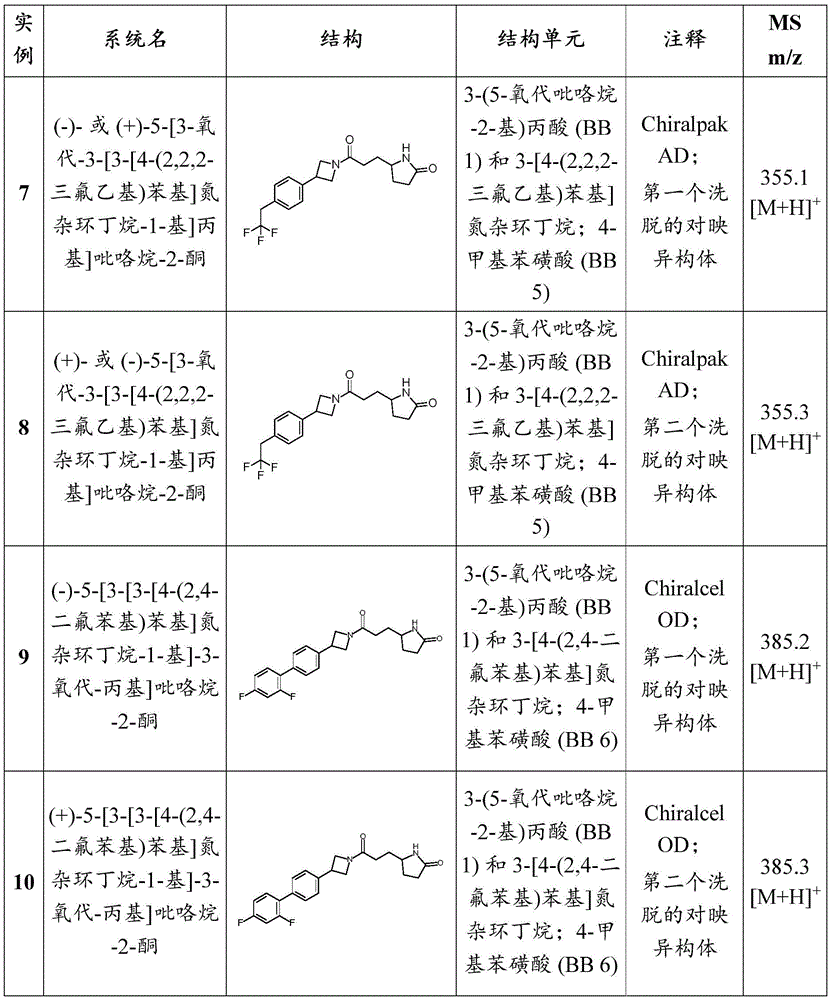
Examples 11 and 12
(-) -5- [ 3-oxo-3- [ rac- (3 aS,6 aS) -2- [ [ 2-fluoro-4- (trifluoromethyl) phenyl ] methyl ] -1, 3a,4,6 a-hexahydropyrrolo [3,4-c ] pyrrol-5-yl ] propyl ] pyrrolidin-2-one
And
(+) -5- [ 3-oxo-3- [ rac- (3aS, 6 aS) -2- [ [ 2-fluoro-4- (trifluoromethyl) phenyl ] methyl ] -1,3,3a,4,6 a-hexahydropyrrolo [3,4-c ] pyrrol-5-yl ] propyl ] pyrrolidin-2-one

5- [ 3-oxo-3- [ rac- (3aS, 6aS) -2- [ [ 2-fluoro-4- (trifluoromethyl) phenyl]Methyl radical]-1, 3a,4,6 a-hexahydropyrrolo [3,4-c ]]Pyrrol-5-yl]Propyl radical ]The enantiomers of pyrrolidin-2-one (28mg, 0.066 mmol) were separated by chiral HPLC (Chiralcel OD column (500mm. Times.50mm, 20 μm), eluent: 60% MeOH/40% EtOH (0.1% NH. RTM.) 4 OH)) to yield (-) -5- [ 3-oxo-3- [ rac- (3 aS,6 aS) -2- [ [ 2-fluoro-4- (trifluoromethyl) phenyl ]]Methyl radical]-1, 3a,4,6 a-hexahydropyrrolo [3,4-c ]]Pyrrol-5-yl]Propyl radical]Pyrrolidin-2-one (4.9mg, 5%; first eluting compound) as a brown viscous oil; and (+) -5- [ 3-oxo-3- [ rac- (3 aS,6 aS) -2- [ [ 2-fluoro-4- (trifluoromethyl) phenyl]Methyl radical]-1, 3a,4,6 a-hexahydropyrrolo [3,4-c ]]Pyrrol-5-yl]Propyl radical]Pyrrolidin-2-one (3.7 mg,4%; second eluted compound) as a brown viscous oil. In two examples, MS (ESI): m/z =428.3[ m ] +H] + 。
Step 1: rac- (3aR, 6aR) -2- [3- (5-oxopyrrolidin-2-yl) propanoyl]-1,3,3a,4,6,6a-
Hexahydropyrrolo [3,4-c ] s]Pyrrole-5-carboxylic acid tert-butyl ester
To a solution of 3- (5-oxopyrrolidin-2-yl) propionic acid (150mg, 0.95mmol,1.0 equiv.; BB 1), TBTU (322mg, 1.0mmol,1.05 equiv.), and DIPEA (370mg, 500. Mu.L, 2.86mmol,3.0 equiv.) in DMF (3.4 mL) at RT was added rac- (3aR, 6aR) -2,3,3a,4,6 a-hexahydro-1H-pyrrolo [3,4-c ] ]Pyrrole-5-carboxylic acid tert-butyl ester hydrochloride (249mg, 1.0mmol,1.05 equiv.; CAS RN 1812198-23-4). The reaction mixture was stirred for 5h and left to stand at 0 ℃ overnight. The solid was filtered off to give the title compound (181mg, 54%) as off-whiteA colored solid. MS (ESI): m/z =296.1[ deg. ] M +H] + 。
And 2, step: 5- [ 3-oxo-3- [ rac- (3aS, 6aS) -2,3,3a,4,6 a-hexahydro-1H-pyrrolo [3,4-
c]Pyrrol-5-yl]Propyl radical]Pyrrolidin-2-one hydrochloride
To rac- (3aR, 6aR) -2- [3- (5-oxopyrrolidin-2-yl) propanoyl]-1, 3a,4,6 a-hexahydropyrrolo [3,4-c ]]To a solution of pyrrole-5-carboxylic acid tert-butyl ester (180mg, 0.51mmol,1.0 equiv) in DCM (20 mL) was added HCl (1.28ml, 5.12mmol,10 equiv; 4M solution in dioxane) and the reaction mixture was stirred at RT. After 2h, the solvent was evaporated, the white precipitate was filtered, washed with diethyl ether and dried under vacuum. The title compound was obtained as a brown solid (101mg, 69%). MS (ESI): m/z =252.2[ m ] +H] + 。
And 3, step 3:5- [ 3-oxo-3- [ rac- (3aS, 6aS) -2- [ [ 2-fluoro-4- (trifluoromethyl) phenyl]Methyl radical]-
1, 3a,4,6 a-hexahydropyrrolo [3,4-c ] pyrrole]Pyrrol-5-yl]Propyl radical]Pyrrolidin-2-ones
To 5- [ 3-oxo-3- [ rac- (3 aS,6 aS) -2, 3a,4,6 a-hexahydro-1H-pyrrolo [3,4-c ] ]Pyrrol-5-yl]Propyl radical]To a suspension of pyrrolidin-2-one hydrochloride (60mg, 0.21mmol,1.0 equiv) in DMF (0.75 mL) was added potassium carbonate (115mg, 0.83mmol,4.0 equiv) and the reaction mixture was stirred at RT. After 10 min, 1- (bromomethyl) -2-fluoro-4- (trifluoromethyl) benzene (59mg, 0.036mL,0.23mmol,1.1 equiv.) in DMF (1.5 mL) was added and stirring continued at RT for 2h. The reaction mixture was filtered and the crude reaction product was purified by preparative HPLC (Phenomenex Gemini 5 μm C18A Axia column (75mm X30mm, 5 μm); 0.1% v/v aqueous FA solution and MeCN) to give the title compound (28mg, 32%) as a brown viscous oil. MS (ESI): m/z =428.3[ m ] +H] + 。
Examples 13 and 14
(-) -or (+) -5- [3- [3- [ [ 2-fluoro-4- (trifluoromethyl) phenyl ] methoxy ] azetidin-1-yl ] -3-oxo-propyl ] -5-methyl-pyrrolidin-2-one
And
(+) -or (-) -5- [3- [3- [ [ 2-fluoro-4- (trifluoromethyl) phenyl ] methoxy ] azetidin-1-yl ] -3-oxo-propyl ] -5-methyl-pyrrolidin-2-one

5- [3- [3- [ [ 2-fluoro-4- (trifluoromethyl) phenyl ] phenyl]Methoxy radical]Azetidin-1-yl]-3-oxo-propyl]The enantiomer of-5-methyl-pyrrolidin-2-one (96mg, 0.23mmol) was separated by chiral SFC (Chiralpak AD-H column (250mm. Times.20mm, 5 μm) eluent: in supercritical CO 2 35% of MeOH (0.1%) 4 OH)) to yield (-) -or (+) -5- [3- [3- [ [ 2-fluoro-4- (trifluoromethyl) phenyl ] methyl]Methoxy radical]Azetidin-1-yl]-3-oxo-propyl]-5-methyl-pyrrolidin-2-one (38.3mg, 41%, first eluting enantiomer) as a colorless waxy solid; and (+) -or (-) -5- [3- [3- [ [ 2-fluoro-4- (trifluoromethyl) phenyl ] methyl]Methoxy radical]Azetidin-1-yl]-3-oxo-propyl]5-methyl-pyrrolidin-2-one (41.2mg, 45%, second eluting enantiomer) as a colorless waxy solid. In two examples, MS (ESI): m/z =403.2[ m ] +H] + 。
5- [3- [3- [ [ 2-fluoro-4- (trifluoromethyl) phenyl ] phenyl]Methoxy radical]Azetidin-1-yl]-3-oxo-propyl]-
5-methyl-pyrrolidin-2-one
3- (2-methyl-5-oxo-pyrrolidin-2-yl) propionic acid (60.0mg, 0.35mmol,1.0 equiv; CAS RN 60769-61-1), 3- [ [ 2-fluoro-4- (trifluoromethyl) phenyl]Methoxy radical]Azetidine; a solution of 4-methylbenzenesulfonic acid (147.5mg, 0.35mmol,1.0 equiv; BB 2), TBTU (113mg, 0.35mmol,1.0 equiv) and TEA (254mg, 0.35. Mu.L, 2.51mmol,7.2 equiv) in DMF (2 mL) was stirred at RT for 12h. FA (150. Mu.L) was added to the crude reaction product and the residue was purified by preparative HPLC (Phenomenex Gemini 5 μm C18A Axia column (75mm X30mm, 5 μm); 0.1% v/v aqueous FA solution and MeCN) to give the desired product as a colorless oil (96mg, 66%). MS (ESI): m/z =403.3[ m ] +H ] + 。
Examples 15 and 16
(-) -or (+) -5-methyl-5- [ 3-oxo-3- [3- [4- [1- (trifluoromethyl) cyclopropyl ] phenyl ] azetidin-1-yl ] propyl ] pyrrolidin-2-one
And
(+) -or (-) -5-methyl-5- [ 3-oxo-3- [3- [4- [1- (trifluoromethyl) cyclopropyl ] phenyl ] azetidin-1-yl ] propyl ] pyrrolidin-2-one

5-methyl-5- [ 3-oxo-3- [3- [4- [1- (trifluoromethyl) cyclopropyl]Phenyl radical]Azetidin-1-yl]Propyl radical]The enantiomers of pyrrolidin-2-one (80mg, 0.19mmol) were separated by chiral SFC (Chiralpak AD-H column (250mm. Times.20mm, 5 μm) eluting in supercritical CO 2 35% of MeOH (0.1%) 4 OH)) to yield (-) -or (+) -5-methyl-5- [ 3-oxo-3- [3- [4- [1- (trifluoromethyl) cyclopropyl ] methyl]Phenyl radical]Azetidin-1-yl]Propyl radical]Pyrrolidin-2-one (34.5 mg,47%; first eluting enantiomer) as a colorless waxy solid; and (+) -or (-) -5-methyl-5- [ 3-oxo-3- [3- [4- [1- (trifluoromethyl) cyclopropyl]Phenyl radical]Azetidin-1-yl]Propyl radical]Pyrrolidin-2-one (34.3mg, 47%; second eluting enantiomer) as a colorless waxy solid. In two examples, MS (ESI): m/z =395.2[ m ] +H] + 。
5-methyl-5- [ 3-oxo-3- [3- [4- [1- (trifluoromethyl) cyclopropyl ]Phenyl radical]Azetidin-1-yl]C3
Base of]Pyrrolidin-2-ones
3- (2-methyl-5-oxo-pyrrolidin-2-yl) propionic acid (60.0 mg,0.35mmol,1.0 eq; CAS RN 60769-61-1), 3- [4- [1- (trifluoromethyl) cyclopropyl ]]Phenyl radical]Azetidine; a solution of 4-methylbenzenesulfonic acid (144.7 mg,0.35mmol,1.0 equivalent; BB 4), TBTU (113mg, 0.35mmol,1.0 equivalent), and TEA (254mg, 0.35. Mu.L, 2.51mmol,7.2 equivalents) in DMF (2 mL) was stirred at RT for 12h. FA (150. Mu.L) was added to the crude reaction product and the residue was purified by preparative HPLC (Phenomenex Gemini 5 μm C18 AAxia column (75mm X30mm, 5 μm); 0.1% v/v aqueous FA solution and MeCN)To give the desired product as a colorless oil (80mg, 53%). MS (ESI): m/z =395.3[ M ] +H] + 。
Examples 17 and 18
(-) -or (+) -5- [3- [3- [6- (3-chlorophenoxy) -3-pyridyl ] azetidin-1-yl ] -3-oxo-propyl ] -5-methyl-pyrrolidin-2-one
And
(+) -or (-) -5- [3- [3- [6- (3-chlorophenoxy) -3-pyridyl ] azetidin-1-yl ] -3-oxo-propyl ] -5-methyl-pyrrolidin-2-one

5- [3- [3- [6- (3-chlorophenoxy) -3-pyridyl]Azetidin-1-yl]-3-oxo-propyl]Enantiomers of-5-methyl-pyrrolidin-2-one (79mg, 0.18mmol) were separated by chiral SFC (Chiralpak AD-H column (250mm. Times.20mm, 5 μm), eluent: in supercritical CO 2 35% of MeOH (0.1%) 4 OH)) to yield (-) -or (+) -5- [3- [3- [6- (3-chlorophenoxy) -3-pyridyl]Azetidin-1-yl]-3-oxo-propyl]-5-methyl-pyrrolidin-2-one (34.8mg, 46%, first eluting enantiomer) as an off-white waxy solid; and (+) -or (-) -5- [3- [3- [6- (3-chlorophenoxy) -3-pyridyl]Azetidin-1-yl]-3-oxo-propyl]5-methyl-pyrrolidin-2-one (37.6 mg,50%, second eluting enantiomer) as a waxy solid that will color. In two examples, MS (ESI): m/z =414.2[ m ] +H] + 。
5- [3- [3- [6- (3-chlorophenoxy) -3-pyridyl]Azetidin-1-yl]-3-oxo-propyl]-5-A
Radical-pyrrolidin-2-ones
3- (2-methyl-5-oxo-pyrrolidin-2-yl) propionic acid (60.0mg, 0.35mmol,1.0 equiv; CAS RN 60769-61-1), 5- (azetidin-3-yl) -2- (3-chlorophenoxy) pyridine; a solution of 4-methylbenzenesulfonic acid (151.5mg, 0.35mmol,1.0 eq.; BB 7), TBTU (113mg, 0.35mmol,1.0 eq.), and TEA (254mg, 0.35. Mu.L, 2.51mmol,7.2 eq.) in DMF (2 mL) was stirred at RT for 12h. To the rough directionFA (150. Mu.L) was added to the product and the residue was purified by preparative HPLC (Phenomenex Gemini 5 μm C18 AAxia column (75mm X30mm, 5 μm); 0.1% v/v aqueous FA solution and MeCN) to give the desired product as a colorless oil (79mg, 52%). MS (ESI): m/z =414.3[ m ] +H ] + 。
Example 19
(4S) -4- [3- [3- [ [ 2-fluoro-4- (trifluoromethyl) phenyl ] methoxy ] azetidin-1-yl ] -3-oxo-propyl ] oxazolidin-2-one

To 3- [ (4S) -2-oxooxazolidin-4-yl]To a mixture of propionic acid (30mg, 0.19mmol,1.0 equiv; BB 8) and HATU (71.7mg, 0.19mmol,1.0 equiv) in DMF (0.5 mL) was added DIPEA (122mg, 165. Mu.L, 0.94mmol,5.0 equiv) and the suspension was stirred at RT for 20 min, then 3- [ [ 2-fluoro-4- (trifluoromethyl) phenyl ] was added in one portion]Methoxy radical]Azetidine; 4-methylbenzenesulfonic acid (79.4mg, 0.19mmol,1.0 equiv.; BB 2). Stirring was continued at room temperature overnight. The title compound was purified by silica gel chromatography using the MPLC system with n-heptane: a gradient of ethyl acetate/EtOH (3) (80 to 0). MS (ESI): m/z =391.2[ m ] +H] + 。
The following examples were each synthesized using the appropriate building blocks according to a synthesis method similar to that described for example 19, if not otherwise indicated.

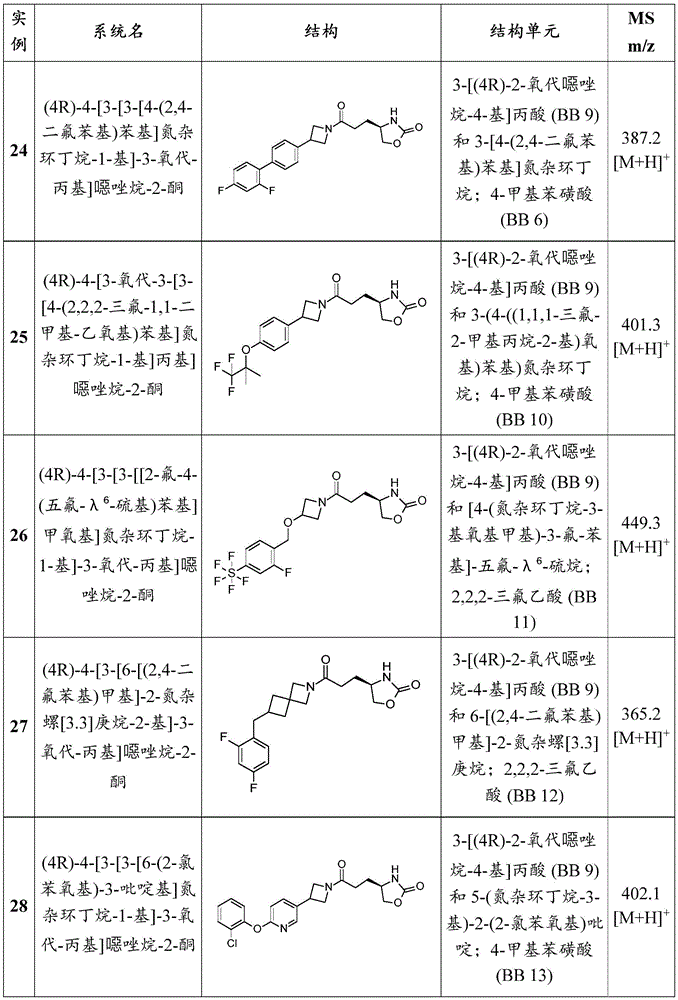

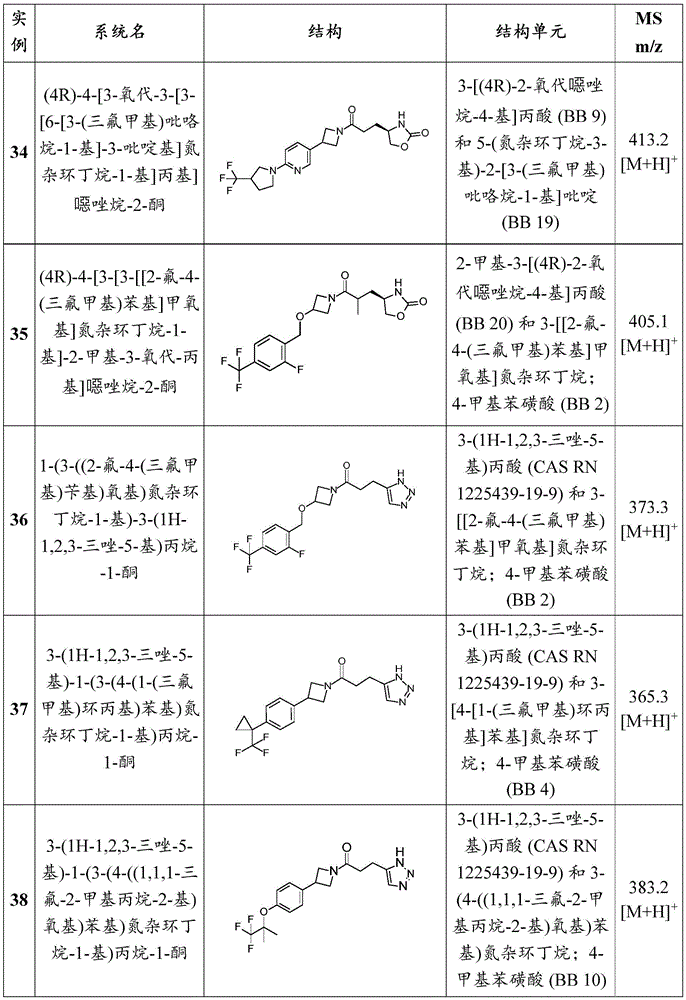


Example 47
1- [3- [ [ 2-fluoro-4- (trifluoromethyl) phenyl ] methoxy ] azetidin-1-yl ] -3- (1H-pyrazol-5-yl) propan-1-one

Reacting 3- [ [ 2-fluoro-4- (trifluoromethyl) phenyl group ]Methoxy radical]Azetidine trifluoroacetic acid (155.5mg, 0.43mmol,1.0 equiv; BB 22), 3- (1H-pyrazol-5-yl) propionic acid (60.0mg, 0.43mmol,1.0 equiv; CAS RN 1368382-98-2), T 3 A solution of P/ethyl acetate (197.1mg, 0.86mmol,2.0 equiv.; wt.50%) and DIPEA (0.33g, 0.45mL,2.57mmol,6.0 equiv.) in DMF (1.6 mL) was stirred at RT for 12h. The reaction mixture was diluted with (10 mL) and extracted with ethyl acetate (3 × 20 mL). The organic phase is over MgSO 4 Drying, evaporation and purification of the residue by preparative HPLC (Shim-pack C18 column (150mm X25mm, 10 μm); 0.225% v/v FA aqueous solution and MeCN) to give the title compound as a pale yellow oil (49.7 mg, 31%). MS (ESI): m/z =372.4[ m ] +H] + 。
Example 48
6- [3- [3- [ [ 2-fluoro-4- (trifluoromethyl) phenyl ] methoxy ] azetidin-1-yl ] -3-oxo-propyl ] -1H-pyridin-2-one

Reacting 3- [ [ 2-fluoro-4- (trifluoromethyl) phenyl group]Methoxy radical]Azetidine trifluoroacetic acid (195.57mg, 0.54mmol,1.0 equiv.; BB 22), 3- (6-oxo-1H-pyridin-2-yl) propionic acid (90.0 mg,0.54mmol,1.0 equiv.; BB 23), T 3 A solution of P/ethyl acetate (247.8mg, 1.08mmol,2.0 equiv.; wt.50%) and DIPEA (0.44g, 0.60mL,3.24mmol,6.0 equiv.) in DMF (2 mL) was stirred at RT for 12h. The reaction mixture was diluted with (10 mL) and extracted with ethyl acetate (3 × 20 mL). The organic phase is over MgSO 4 Dried, evaporated and the residue purified by preparative HPLC (Shim-pack C18 column (150mm x 25mm,10 μm); 0.225% v/v FA aqueous solution and MeCN) and preparative TLC (DCM: meOH = 10) to give the title compound as a light yellow oil (8.6 mg, 4%). MS (ESI): m/z =399.4[ M ] +H] + 。
Example 49
6- [3- [3- [ [ 2-fluoro-4- (trifluoromethyl) phenyl ] methoxy ] azetidin-1-yl ] -3-oxo-propyl ] piperidin-2-one

Reacting 3- [ [ 2-fluoro-4- (trifluoromethyl) phenyl group]Methoxy radical]Azetidine trifluoroacetic acid (275.83mg, 0.76mmol,1.0 equiv; BB 22), 3- (6-oxo-2-piperidinyl) propionic acid (130.0mg, 0.43mmol,1.8 equiv; BB 24), T 3 A solution of P/ethyl acetate (349.5mg, 1.52mmol,2.0 equiv.; wt.50%) and DIPEA (0.59g, 0.80mL,4.56mmol,6.0 equiv.) in DMF (2 mL) was stirred at RT for 12h. The reaction mixture was diluted with (10 mL) and extracted with ethyl acetate (3 × 20 mL). The organic phase is over MgSO 4 Dried, evaporated, and the residue purified by preparative HPLC (Shim-pack C18 column (150mm x 25mm,10 μm); 0.225% v/v FA aqueous solution and MeCN) and preparative TLC (DCM: meOH = 10) to give the title compound as a light brown oil (6.8mg, 2%). MS (ESI): m/z =403.5[ M ] +H ] + 。
Examples 50 and 51
(-) -5- [3- [3- [ [ 2-fluoro-4- (trifluoromethyl) phenyl ] methoxy ] azetidin-1-yl ] -3-oxo-propyl ] morpholin-3-one
And
(+) -5- [3- [3- [ [ 2-fluoro-4- (trifluoromethyl) phenyl ] methoxy ] azetidin-1-yl ] -3-oxo-propyl ] morpholin-3-one
5- [3- [3- [ [ 2-fluoro-4- (trifluoromethyl) phenyl ] phenyl]Methoxy radical]Azetidin-1-yl]-3-oxo-propyl]The enantiomers of morpholin-3-one (24mg, 0.059 mmol) were separated by preparative chiral SFC (Chiralpak AD-H column (250mm X20mm, 10 μm) eluent: in supercritical CO 2 50% of MeOH (0.1%) 4 OH)) to yield (-) -5- [3- [3- [ [ 2-fluoro-4- (trifluoromethyl) phenyl ]]Methoxy radical]Azetidin-1-yl]-3-oxo-propyl]Morpholin-3-one (8mg, 33%) as a pale yellow gum; and (+) -5- [3- [3- [ [ 2-fluoro-4- (trifluoromethyl) phenyl ] methyl]Methoxy radical]Azetidin-1-yl]-3-oxo-propyl]Morpholin-3-one (8 mg, 32%) as a light brown gum.
(-) -enantiomer: MS (ESI): m/z =405.2[ m ] +H] + . Specific optical rotation: -8.54 °
(+) -enantiomer: MS (ESI): m/z =405.3[ m ] +H] + . Specific optical rotation: +8.58 °
5- [3- [3- [ [ 2-fluoro-4- (trifluoromethyl) phenyl ] carbonyl]Methoxy radical]Azetidin-1-yl]-3-oxo-propyl ]
Morpholin-3-ones

Reacting 3- [ [ 2-fluoro-4- (trifluoromethyl) phenyl]Methoxy radical]Azetidine trifluoroacetic acid (104.9mg, 0.29mmol,1.0 equiv; BB 22), 3- (5-oxomorpholin-3-yl) propionic acid (50.0mg, 0.29mmol,1.0 equiv; BB 25), T 3 P/Ethyl acetate (199.4 mg,0.43mmol,1.5 equiv.; wt.50%) and NEt 3 A solution of (0.24mL, 1.73mmol,6.0 equiv.) in DMF (1.7 mL) was stirred at RT for 16h. The reaction mixture was diluted with (10 mL) and extracted with ethyl acetate (3 × 5 mL). The organic phase was MgSO 4 Dried, evaporated and the residue purified by preparative HPLC (Shim-pack C18 column (150mm X25mm, 10 μm); 0.225%v/v aqueous FA solution and MeCN) to give the title compound as a pale yellow oil (24mg, 21%). MS (ESI): m/z =405.2[ m ] +H] + 。
Example 52
3- [ [ 2-fluoro-4- (trifluoromethyl) phenyl ] methoxy ] azetidine-1-carboxylic acid [ (2S) -5-oxopyrrolidin-2-yl ] methyl ester

To 3- [ [ 2-fluoro-4- (trifluoromethyl) phenyl]Methoxy radical]Azetidine; to a suspension of 4-methylbenzenesulfonic acid (109.3mg, 0.26mmol,1.0 eq.; BB 2) in ACN (0.43 mL) was added NEt 3 (0.15mL, 1.82mmol,7.0 equivalents) and bis (1H-1, 2, 4-triazol-1-yl) methanone (42.6 mg,0.26mmol,1.0 equivalent; CAS RN 41864-22-6). The reaction mixture was stirred at RT for 1.5h. In a second reaction flask, (5S) -5- (hydroxymethyl) pyrrolidin-2-one (31.4 mg,0.27mmol,1.05 eq.; CAS RN 17342-08-4) was dissolved in THF (0.43 mL) and sodium hydride (22.3 mg,0.56mmol,2.15 eq.; 55% suspension in mineral oil) was added. The first prepared mixture was added to the sodium alkoxide mixture and then stirred at 50 ℃ overnight. Saturated NH for reaction 4 Aqueous Cl (0.5 mL) quenched, extracted with water/ethyl acetate (3 × 30 mL), and the combined organic phases were MgSO 4 And (5) drying. The crude product was purified by silica gel chromatography using the MPLC system with n-heptane: a gradient of ethyl acetate/EtOH (3) (100 to 0). MS (ESI): m/z =391.2[ m ] +H] + 。
The following examples were each synthesized using appropriate building blocks in a synthetic method similar to that described for example 52, if not otherwise indicated.


Example 64
3- [ [ 2-fluoro-4- (trifluoromethyl) phenyl ] methoxy ] -N- [2- (1H-triazol-5-yl) ethyl ] azetidine-1-carboxamide

To 3- [ [ 2-fluoro-4- (trifluoromethyl) phenyl]Methoxy radical]Azetidine; to a suspension of 4-methylbenzenesulfonic acid (84.3mg, 0.20mmol,1.0 equiv; BB 2) in ACN (0.67 mL) were added DIPEA (52mg, 70. Mu.L, 0.40mmol,2.0 equiv) and bis (1H-1, 2, 4-triazol-1-yl) methanone (36.2mg, 0.22mmol,1.1 equiv; CAS RN 41864-22-6). After stirring the reaction mixture at RT for 1.5H, 2- (1H-triazol-5-yl) ethylamine (22.5 mg,0.20mmol,1.0 equiv; CAS RN 52845-67-7) and additional DIPEA (52mg, 70. Mu.L, 0.40mmol,2.0 equiv.) and bis (1H-1, 2, 4-triazol-1-yl) methanone (22.5 mg,0.20mmol,1.0 equiv.) were added and the reaction mixture was heated to 80 ℃ overnight. The crude product was concentrated under reduced pressure and the residue was purified by preparative HPLC (Phenomenex Gemini 5 μm C18A Axia column (75mm X30mm, 5 μm); 0.1% v/v aqueous FA solution and MeCN) to give the title compound as a colorless solid (15.7 mg, 19%). MS (ESI): m/z =388.1[ m ] +H ] + 。
The following examples were each synthesized using the appropriate building blocks according to a synthesis method similar to that described for example 64, if not otherwise indicated.

Example 68
2-methyl-4- (1H-triazol-5-yl) -1- [3- [4- [1- (trifluoromethyl) cyclopropyl ] phenyl ] azetidin-1-yl ] butan-1-one

To a stirred solution of hydrochloride salt of 2-methyl-4- (1H-triazol-5-yl) butanoic acid (56.7 mg,0.28mmol,1.0 eq.; BB 28), 3- [4- [1- (trifluoromethyl) cyclopropyl]Phenyl radical]Azetidine; triethylamine (0.19mL, 1.38mmol,5.0 equiv.) is added in one portion to a solution of 4-methylbenzenesulfonic acid (115.8mg, 0.28mmol,1.0 equiv.; BB 4) and HATU (136.2mg, 0.36mmol,1.3 equiv.) in DMF (2 mL). The resulting mixture was stirred at room temperature for 18h. The reaction mixture was poured into water (70 mL), extracted with ethyl acetate (3 × 50 mL), and the combined organic layers were washed successively with water (30 mL) and saturated aqueous NaCl (30 mL). The combined organic layers were washed with Na 2 SO 4 Dried and the solvent removed in vacuo. The crude product was purified by preparative HPLC (SunFire column (100mm. Times.19mm, 5 μm), water and MeCN) to give the title compound as a light yellow viscous oil (27.9mg, 25%). MS (ESI): m/z =393.2[ m ] +H ] + 。
Example 69
3-hydroxy-4- (1H-triazol-5-yl) -1- [3- [4- [1- (trifluoromethyl) cyclopropyl ] phenyl ] azetidin-1-yl ] butan-1-one

In analogy to example 68, from 3-hydroxy-4- (1H-triazol-5-yl) butanoate hydrochloride (90mg, 0.43mmol,1.0 eq; BB 29) and 3- [4- [1- (trifluoromethyl) cyclopropyl]Phenyl radical]Azetidine; 4-Methylbenzenesulfonic acid (177.8mg, 0.43mmol,1.0 equiv.; BB 4) gave the title compound as a colorless oil (8.8mg, 5%). MS (ESI): m/z =395.4[ m ] +H] + 。
Example 70
2-fluoro-4- (1H-triazol-5-yl) -1- [3- [4- [1- (trifluoromethyl) cyclopropyl ] phenyl ] azetidin-1-yl ] butan-1-one

In analogy to example 68, from 2-fluoro-4- (1H-triazol-5-yl) butanoate hydrochloride (90mg, 0.43mmol,1.0 equiv.; BB 30) and 3- [4- [1- (trifluoromethyl) cyclopropyl]Phenyl radical]Azetidine; starting from 4-methylbenzenesulfonic acid (177.8mg, 0.43mmol,1.0 equiv.; BB 4), the title compound was obtained as a colorless oil (19.7mg, 12%). MS (ESI): m/z =397.2[ m ] +H] + 。
Example 71
(4R) -4- [3- [3- [4- (N-methylanilino) phenyl ] azetidin-1-yl ] -3-oxo-propyl ] oxazolidin-2-one

To 3- [ (4R) -2-oxooxazolidin-4-yl]To a solution of propionic acid (23.4 mg,0.15mmol,1.0 equivalent; BB 9) and 4- (azetidin-3-yl) -N-methyl-N-phenyl-aniline (35mg, 0.15mmol,1.0 equivalent; BB 31) in N, N-dimethylacetamide (0.93 mL) were added HATU (61.4 mg,0.16mmol,1.1 equivalent) and DIPEA (48mg, 64. Mu.L, 0.37mmol,2.5 equivalents). The reaction mixture was stirred at RT overnight. The reaction was quenched with water (5 mL), extracted with ethyl acetate (3 × 20 mL), and the combined organic phases were extracted over Na 2 SO 4 And (5) drying. The crude product was purified by silica gel chromatography using an MPLC system, eluting with a gradient of DCM: meOH (100 to 90) to give the title compound as a light brown oil (21mg, 35%). MS (ESI): m/z =380.2[ M ] +H] + 。
Example 72
(4R) -4- [3- [3- (5-tert-butyl-2-pyridinyl) azetidin-1-yl ] -3-oxo-propyl ] oxazolidin-2-one

To 3- [ (4R) -2-oxooxazolidin-4-yl]Propionic acid (12.4mg, 0.078mmol,1.0 equivalent(ii) a BB 9) and HATU (29.7 mg,0.078mmol,1.0 equiv) to a mixture of DIPEA (40mg, 55 μ L,0.31mmol,4.0 equiv) in DMF (0.3 mL) and the suspension was stirred at RT for 15 min before 2- (azetidin-3-yl) -5-tert-butyl-pyridine was added in one portion; 4-methylbenzenesulfonic acid (44mg, 0.078mmol,1.0 eq; BB 32). Stirring was continued overnight at room temperature. The crude reaction product was purified by preparative HPLC (YMC-Triart C18 column; 0.1% v/v aqueous TEA and MeCN) to give the desired product as a colorless gum (1695g, 62%). MS (ESI): m/z =332.3[ m ] +H] + 。
The following examples were each synthesized using appropriate building blocks according to a synthesis method similar to that described for example 72, if not otherwise indicated.


Example 85
5-chloro-2- [ [5- [1- [3- [ (4R) -2-oxooxazolidin-4-yl ] propanoyl ] azetidin-3-yl ] -2-pyridinyl ] oxy ] benzamide

Step 1: 5-chloro-2- [ [5- [1- [3- [ (4R) -2-oxooxazolidin-4-yl ] amino acids]Propionyl group]Azetidine-3-
Base of]-2-pyridyl]Oxy radical]Benzoic acid methyl ester
To 3- [ (4R) -2-oxooxazolidin-4-yl]Propionic acid (42.3mg, 0.27mmol,1.0 equiv; BB 9) and HATU (101.0mg, 0.27mmol,1.0 equiv) in a mixture of DMF (7.3 mL)DIPEA (172mg, 230. Mu.L, 1.33mmol,5.0 equiv.) is added and the suspension is stirred at RT for 15 minutes, then 2- [ [5- (azetidin-3-yl) -2-pyridinyl ] is added in one portion]Oxy radical]-5-chloro-benzoic acid methyl ester; 4-methylbenzenesulfonic acid (44mg, 0.078mmol,1.0 eq; BB 43). Stirring was continued at room temperature overnight. The crude reaction product was purified by preparative HPLC (Gemini NX column (100mm X30mm, 5 μm); 0.1% v/v aqueous FA solution and MeCN) to give the desired product as a colorless oil (40mg, 31%). MS (ESI): m/z =460.1[ deg. ] M +H] + 。
Step 2: 5-chloro-2- [ [5- [1- [3- [ (4R) -2-oxooxazolidin-4-yl ] amino acids]Propionyl radical]Azetidine-3-
Base (C)]-2-pyridyl]Oxy radical]Benzamide derivatives
To 5-chloro-2- [ [5- [1- [3- [ (4R) -2-oxooxazolidin-4-yl ] amine ]Propionyl group]Azetidin-3-yl]-2-pyridyl]Oxy radical]To a solution of methyl benzoate (27.4 mg,0.06mmol,1.0 equiv.) in ACN (0.5 mL) was added an aqueous solution of ammonium hydroxide (2mL, 50mmol,835 equiv.; 25M) and the reaction mixture was stirred at RT for 18h. Concentration in vacuo afforded the desired product as a colorless oil (14mg, 47%). MS (ESI): m/z =443.4[ m ] +H] + 。
Examples 86 and 87
(-) -or (+) -3- [6- [3- (trifluoromethyl) pyrrolidin-1-yl ] -3-pyridyl ] azetidine-1-carboxylic acid [ (4S) -2-oxooxazolidin-4-yl ] methyl ester
And
(+) -or (-) -3- [6- [3- (trifluoromethyl) pyrrolidin-1-yl ] -3-pyridyl ] azetidine-1-carboxylic acid [ (4S) -2-oxooxazolidin-4-yl ] methyl ester

3- [6- [3- (trifluoromethyl) pyrrolidin-1-yl]-3-pyridyl]Azetidine-1-carboxylic acid [ (4S) -2-oxooxazolidin-4-yl]The enantiomer of the methyl ester (50mg, 0.12mmol; example 62) was passed through a chiral SFC (Chiralpak IC column (250mm. Times.20mm, 5 μm), eluent: in supercritical CO 2 35% of MeOH) to obtainTo (-) -or (+) -3- [6- [3- (trifluoromethyl) pyrrolidin-1-yl]-3-pyridyl]Azetidine-1-carboxylic acid [ (4S) -2-oxooxazolidin-4-yl]Methyl ester (20mg, 40%; first eluting compound) as an off-white solid; and (+) -or (-) -3- [6- [3- (trifluoromethyl) pyrrolidin-1-yl ]-3-pyridyl]Azetidine-1-carboxylic acid [ (4S) -2-oxooxazolidin-4-yl]Methyl ester (20mg, 40%; second eluted compound) as an off-white solid. For both examples, MS (ESI): m/z =415.2[ M ] +H] + )。
Example 88
(5S) -5- [3- [3- [ [ 2-fluoro-4- (trifluoromethyl) phenyl ] methoxy ] azetidin-1-yl ] -3-oxo-propyl ] thiomorpholin-3-one

Reacting 3- [ (3S) -5-oxothiomorpholin-3-yl group]Propionic acid (30mg, 0.16mmol,1.0 equiv.; BB 44), 3- [ [ 2-fluoro-4- (trifluoromethyl) phenyl group]Methoxy radical]Azetidine; 2, 2-trifluoroacetic acid (57.6 mg,0.16mmol,1.0 eq.; BB 22), T 3 A solution of P/ethyl acetate (54.7 mg,0.24mmol,1.5 equiv, wt.50%) and TEA (48.1mg, 7. Mu.L, 0.48mmol,3.0 equiv) in DMF (1 mL) was stirred at RT for 16h. The reaction mixture was diluted with water (10 mL) and extracted with ethyl acetate (3 × 10 mL). The combined organic layers were over MgSO 4 Dried, concentrated and the residue passed through a preparative SFC (Chiralpak AS-3 column (50mm. Times.4.6 mm,3 μm), eluent: in supercritical CO 2 40% meoh (0.05% diethylamine)) to give the desired product as a pale yellow oil (6.4 mg, 10%). MS (ESI): m/z =421.2[ m ] +H] + 。
The following examples were each synthesized using appropriate building blocks according to a synthesis method similar to that described for example 72, if not otherwise indicated.


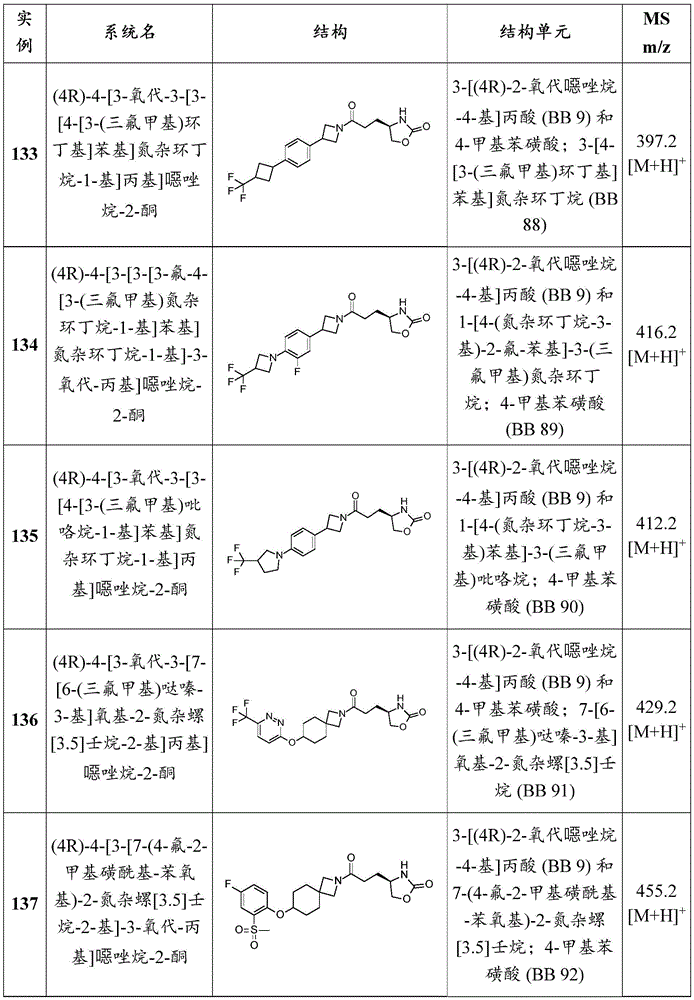
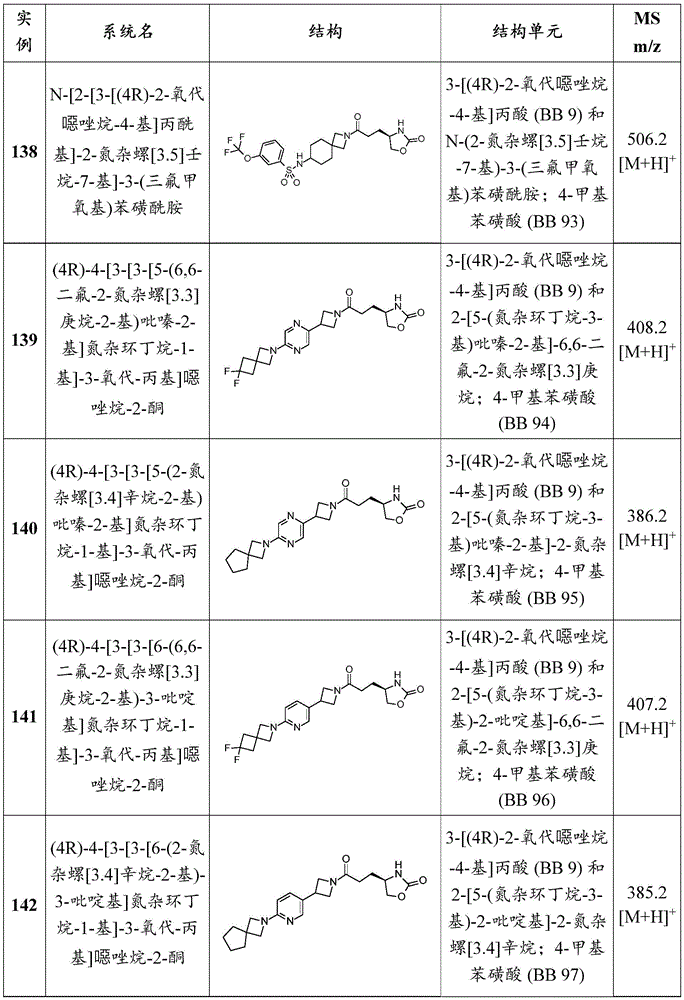


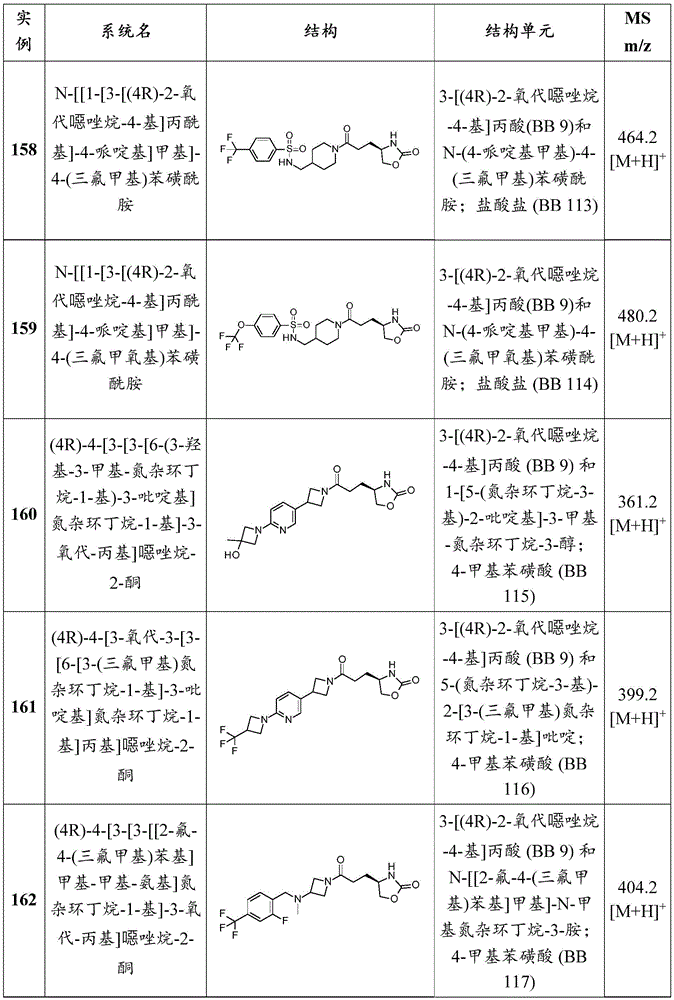


Example 200 and example 201
Cis- (4R) -4- [ 3-oxo-3- [3- [6- [4- (trifluoromethyl) cyclohexyl ] -3-pyridinyl ] azetidin-1-yl ] propyl ] oxazolidin-2-one
And
trans- (4R) -4- [ 3-oxo-3- [3- [6- [4- (trifluoromethyl) cyclohexyl ] -3-pyridinyl ] azetidin-1-yl ] propyl ] oxazolidin-2-one

Step 1:3- [6- [4- (trifluoromethyl) cyclohexyl]-3-pyridyl]Azetidine-1-carboxylic acid tert-butyl ester
The title compound was obtained as a colorless solid (63mg, 25%) by irradiation (420 nm) for 16h in analogy to BB 4/step 1, starting from 3- (6-bromo-3-pyridinyl) azetidine-1-carboxylic acid tert-butyl ester (180mg, 0.58mmol,1.0 equiv; BB 71/step 1) and 1-bromo-4- (trifluoromethyl) cyclohexane (265.6 mg,1.15mmol,2.0 equiv; CAS RN 30129-20-5). MS (ESI): m/z =385.2[ m ] +H] + 。
Step 2:5- (azetidin-3-yl) -2- [4- (trifluoromethyl) cyclohexyl]Pyridine; 4-methylbenzenesulfonic acid
From 3- [6- [4- (trifluoromethyl) cyclohexyl ] analogously to BB 4/step 2]-3-pyridyl]Starting from tert-butyl azetidine-1-carboxylate (63mg, 0.15mmol,1.0 equivalent), the title compound was obtained as a colorless solid (70mg, 69%). MS (ESI): m/z =285.2[ m ] +H] + 。
And step 3: cis- (4R) -4- [ 3-oxo-3- [3- [6- [4- (trifluoromethyl) cyclohexyl ]-3-pyridyl]Aza derivatives
Cyclobutan-1-yl]Propyl radical]Oxazolidin-2-one and trans- (4R) -4- [ 3-oxo-3- [3- [6- [4- (trifluoromethyl) cyclohexane
Base of]-3-pyridyl]Azetidin-1-yl]Propyl radical]Oxazolidin-2-ones
In analogy to example 19 from 5- (azetidin-3-yl) -2- [4- (trifluoromethyl) cyclohexyl]Pyridine compound(ii) a 4-Methylbenzenesulfonic acid (70mg, 0.10mmol,1.0 equiv.) and 3- [ (4R) -2-oxooxazolidin-4-yl]The title compound was prepared starting with propionic acid (16.0 mg,0.10mmol,1.0 eq; BB 9). The two diastereomers were purified by preparative HPLC (Gemini NX column (100mm X30mm, 5 μm); 0.1% v/v aqueous TEA and MeCN) to give cis- (4R) -4- [ 3-oxo-3- [3- [6- [4- (trifluoromethyl) cyclohexyl]-3-pyridyl]Azetidin-1-yl]Propyl radical]Oxazolidin-2-one (4 mg,9%; first eluting compound) and trans- (4R) -4- [ 3-oxo-3- [3- [6- [4- (trifluoromethyl) cyclohexyl]-3-pyridinyl group]Azetidin-1-yl]Propyl radical]Oxazolidin-2-one (21mg, 49%; second eluted compound) as a colorless gum. For both examples, MS (ESI): m/z =426.3[ M ] +H] + )。
Example 202 and example 203
Cis- (4R) -4- [ 3-oxo-3- [3- [6- [3- (trifluoromethyl) cyclobutyl ] -3-pyridinyl ] azetidin-1-yl ] propyl ] oxazolidin-2-one
And
trans- (4R) -4- [ 3-oxo-3- [3- [6- [3- (trifluoromethyl) cyclobutyl ] -3-pyridinyl ] azetidin-1-yl ] propyl ] oxazolidin-2-one

Step 1: cis- [3- [6- [3- (trifluoromethyl) cyclobutyl ] group]-3-pyridyl]Azetidine-1-carboxylic acid tert-butyl ester
Esters]And trans- [3- [6- [3- (trifluoromethyl) cyclobutyl ] radical]-3-pyridyl]Azetidine-1-carboxylic acid tert-butyl ester]
The title compound was prepared in analogy to BB 4/step 1, starting from 3- (6-bromo-3-pyridinyl) azetidine-1-carboxylic acid tert-butyl ester (150mg, 0.48mmol,1.0 equiv.; BB 71/step 1) and 1-bromo-3- (trifluoromethyl) cyclobutane (194.5 mg,0.96mmol,2.0 equiv.; CAS RN 2247103-30-4) by irradiation (420 nm) for 16 h. The two geometric isomers were separated by silica gel chromatography using the MPLC system with n-heptane: a gradient of ethyl acetate (100Base of]-3-pyridyl]Azetidine-1-carboxylic acid tert-butyl ester](32mg, 16%; first eluting compound) and cis- [3- [6- [3- (trifluoromethyl) cyclobutyl ] butyl]-3-pyridyl]Azetidine-1-carboxylic acid tert-butyl ester](24mg, 14%; second eluted compound) as a light brown oil. For both isomers, MS (ESI): m/z =357.2[ m ] +H ] + 。
Step 2A: cis-5- (azetidin-3-yl) -2- [3- (trifluoromethyl) cyclobutyl]Pyridine; 4-Methylbenzenesulfone
Acid(s)
Analogously to BB 4/step 2, starting from cis- [3- [6- [3- (trifluoromethyl) cyclobutyl ] -butyl]-3-pyridyl]Azetidine-1-carboxylic acid tert-butyl ester](38mg, 0.11mmol,1.0 equiv.) the title compound was obtained as a light yellow gum (73mg, 91%). MS (ESI): m/z =257.2[ m ] +H] + 。
And step 2B: trans-5- (azetidin-3-yl) -2- [3- (trifluoromethyl) cyclobutyl]Pyridine; 4-Methylbenzenesulfone
Acid(s)
Analogously to BB 4/step 2, starting from trans- [3- [6- [3- (trifluoromethyl) cyclobutyl ] -butyl]-3-pyridyl]Azetidine-1-carboxylic acid tert-butyl ester](52mg, 0.12mmol,1.0 eq.) the title compound was obtained as a colourless solid (51mg, 68%). MS (ESI): m/z =257.2[ M ] +H] + 。
Step 3A: cis- [3- [6- [3- (trifluoromethyl) cyclobutyl ] group]-3-pyridinyl group]Azetidine-1-carboxylic acid tert-butyl ester
Esters]
Analogously to example 19, starting from cis-5- (azetidin-3-yl) -2- [3- (trifluoromethyl) cyclobutyl]Pyridine; 4-Methylbenzenesulfonic acid (73mg, 0.10mmol,1.0 equiv.) and 3- [ (4R) -2-oxooxazolidin-4-yl]Starting with propionic acid (16.0mg, 0.10mmol,1.0 equiv; BB 9), the title compound was obtained as a colorless gum (19mg, 49%). MS (ESI): m/z =398.2[ M ] +H ] + 。
And step 3B: trans- [3- [6- [3- (trifluoromethyl) cyclobutyl ] radical]-3-pyridyl]Azetidine-1-carboxylic acid tert-butyl ester
Esters]
In analogy to example 19, from trans-5- (azetidin-3-yl) -2- [3- (trifluoromethyl) cyclobutyl]Pyridine; 4-Methylbenzenesulfonic acid (51mg, 0.085mmol,1.0 equiv.) and 3- [ (4R) -2-oxooxazolidin-4-yl]Starting with propionic acid (13.5mg, 0.085mmol,1.0 eq; BB 9), the title compound was obtained as a colorless gum (1695 mg, 47%). MS (ESI): m/z =398.2[ m ] +H] + 。
Instance 204 and instance 205
(-) -or (+) - (4R) -4- [3- [3- [6- [ 3-hydroxy-3- (trifluoromethyl) pyrrolidin-1-yl ] -3-pyridyl ] azetidin-1-yl ] -3-oxo-propyl ] oxazolidin-2-one
And
(+) -or (-) - (4R) -4- [3- [3- [6- [ 3-hydroxy-3- (trifluoromethyl) pyrrolidin-1-yl ] -3-pyridyl ] azetidin-1-yl ] -3-oxo-propyl ] oxazolidin-2-one

(4R) -4- [3- [3- [6- [ 3-hydroxy-3- (trifluoromethyl) pyrrolidin-1-yl]-3-pyridyl]Azetidin-1-yl]-3-oxo-propyl]The two diastereomers of oxazolidin-2-one (60mg, 0.13mmol; example 146) were passed over a chiral SFC (Chiralpak IB column (250mm. Times.20mm, 5 μm), eluent: in supercritical CO 2 20% MeOH (0.2% diethylamine)) to yield (-) -or (+) - (4R) -4- [3- [3- [6- [ 3-hydroxy-3- (trifluoromethyl) pyrrolidin-1-yl ]-3-pyridyl]Azetidin-1-yl]-3-oxo-propyl]Oxazolidin-2-one (18.1mg, 32%; first eluting enantiomer) as a colorless waxy solid; and (+) -or (-) - (4R) -4- [3- [3- [6- [ 3-hydroxy-3- (trifluoromethyl) pyrrolidin-1-yl]-3-pyridyl]Azetidin-1-yl]-3-oxo-propyl]Oxazolidin-2-one (22.0 mg,39%; second eluted enantiomer) as a colorless waxy solid. In two examples, MS (ESI): m/z =429.2[ m ] +H ]] + 。
Example 206 and example 207
(-) -or (+) - (4R) -4- [3- [3- [6- [ 3-hydroxy-3- (trifluoromethyl) pyrrolidin-1-yl ] -3-pyridinyl ] azetidin-1-yl ] -3-oxo-propyl ] oxazolidin-2-one
And
(+) -or (-) - (4R) -4- [3- [3- [6- [ 3-hydroxy-3- (trifluoromethyl) pyrrolidin-1-yl ] -3-pyridyl ] azetidin-1-yl ] -3-oxo-propyl ] oxazolidin-2-one
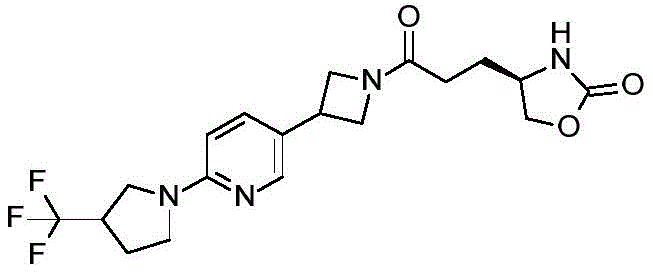
Step 1: (-) -or (+) -3- [6- [3- (trifluoromethyl) pyrrolidin-1-yl]-3-pyridinyl group]Azetidine-1-
Tert-butyl formate and (+) -or (-) -3- [6- [3- (trifluoromethyl) pyrrolidin-1-yl]-3-pyridyl]Azetidine-1-carboxylic acid esters
Tert-butyl ester
3- [6- [3- (trifluoromethyl) pyrrolidin-1-yl]-3-pyridyl]Two enantiomers of tert-butyl azetidine-1-carboxylate (5.80g, 15.62mmol, BB 19/step 2) were purified by chiral SFC (Chiralpak IG-3 column (50mm. Times.4.6 mm,3 μm) eluent: in supercritical CO 2 From 5% to 40% MeOH (0.05% diethylamine)) to yield (-) -or (+) -3- [6- [3- (trifluoromethyl) pyrrolidin-1-yl ]]-3-pyridyl]Azetidine-1-carboxylic acid tert-butyl ester (1.05g, 36%; first eluting enantiomer) as a white solid; and (+) -or (-) -3- [6- [3- (trifluoromethyl) pyrrolidin-1-yl]-3-pyridyl]Azetidine-1-carboxylic acid tert-butyl ester (1.05g, 36%; second eluting enantiomer) as a white solid. For both isomers, MS (ESI): m/z =372.3[ m ] +H] + 。
Step 2A: (-) -or (+) -5- (azetidin-3-yl) -2- [3- (trifluoromethyl) pyrrolidin-1-yl]Pyridine;
4-methylbenzenesulfonic acid
Analogously to BB 4/step 2, starting from (-) -or (+) -3- [6- [3- (trifluoromethyl) pyrrolidin-1-yl]-3-pyridyl]Starting from azetidine-1-carboxylic acid tert-butyl ester (1.00g, 2.69mmol,1.0 equiv.) the title compound was obtained as a pale yellow solid (1.41g, 83%). MS (ESI): m/z =272.1[ m ] +H] + 。
And step 2B: (+) -or (-) -5- (azetidin-3-yl) -2- [3- (trifluoromethyl) pyrrolidin-1-yl]Pyridine;
4-methylbenzenesulfonic acid
Analogously to BB 4/step 2, starting from (+) -or (-) -3- [6- [3- (trifluoromethyl) pyrrolidin-1-yl]-3-pyridyl]Starting from tert-butyl azetidine-1-carboxylate (1.00g, 2.69mmol,1.0 equiv.) the title compound was obtained as a pale yellow solid (1.45g, 87%). MS (ESI): m/z =272.2[ m ] +H ] + 。
Step 3A: (-) -or (+) - (4R) -4- [3- [3- [6- [ 3-hydroxy-3- (trifluoromethyl) pyrrolidin-1-yl]-3-
Pyridinyl group]Azetidin-1-yl]-3-oxo-propyl]Oxazolidin-2-ones
Analogously to example 19, starting from (-) -or (+) -5- (azetidin-3-yl) -2- [3- (trifluoromethyl) pyrrolidin-1-yl]Pyridine; 4-Methylbenzenesulfonic acid (81.2mg, 0.13mmol,1.05 eq.) and 3- [ (4R) -2-oxooxazolidin-4-yl]Starting with propionic acid (20.0mg, 0.13mmol,1.0 equiv; BB 9), the title compound was obtained as a colorless solid (35mg, 68%). MS (ESI): m/z =413.2[ m ] +H] + 。
And step 3B: (+) -or (-) - (4R) -4- [3- [3- [6- [ 3-hydroxy-3- (trifluoromethyl) pyrrolidin-1-yl]-3-
Pyridyl radical]Azetidin-1-yl]-3-oxo-propyl]Oxazolidin-2-ones
Analogously to example 19, starting from (+) -or (-) -5- (azetidin-3-yl) -2- [3- (trifluoromethyl) pyrrolidin-1-yl]Pyridine; 4-Methylbenzenesulfonic acid (81.2mg, 0.13mmol,1.05 eq.) and 3- [ (4R) -2-oxooxazolidin-4-yl]Starting with propionic acid (20.0 mg,0.13mmol,1.0 eq; BB 9), the title compound was obtained as a colorless solid (34mg, 65%). MS (ESI): m/z =413.2[ M ] +H] + 。
Instance 208 and instance 209
(-) -or (+) - (4R) -4- [ 3-oxo-3- [3- [2- [3- (trifluoromethyl) pyrrolidin-1-yl ] pyrimidin-5-yl ] azetidin-1-yl ] propyl ] oxazolidin-2-one
And
(+) -or (-) - (4R) -4- [ 3-oxo-3- [3- [2- [3- (trifluoromethyl) pyrrolidin-1-yl ] pyrimidin-5-yl ] azetidin-1-yl ] propyl ] oxazolidin-2-one

Step 1: (-) -or (+) -5- [2- [3- (trifluoromethyl) pyrrolidin-1-yl]Pyrimidin-5-yl]Azetidine-1-
Tert-butyl formate and (+) -or (-) -3- [2- [3- (trifluoromethyl) pyrrolidin-1-yl]Pyrimidin-3-yl]Azetidine-1-carboxylic acid esters
(iv) tert-butyl ester
3- [2- [3- (trifluoromethyl) pyrrolidin-1-yl]Pyrimidin-5-yl]Two enantiomers of tert-butyl azetidine-1-carboxylate (7.04g, 18.91mmol BB 62/step 2) were purified by chiral SFC (Chiralpak AD-3 column (50mm. Times.4.6 mm,3 μm) eluent: in supercritical CO 2 From 5% to 40% MeOH (0.05% diethylamine)) to obtain (-) -or (+) -3- [2- [3- (trifluoromethyl) pyrrolidin-1-yl]Pyrimidin-5-yl]Azetidine-1-carboxylic acid tert-butyl ester (0.87g, 25%; first eluting enantiomer) as a yellow solid; and (+) -or (-) -3- [2- [3- (trifluoromethyl) pyrrolidin-1-yl]Pyrimidin-5-yl]Tert-butyl azetidine-1-carboxylate (0.86g, 25%; second eluting enantiomer) as a yellow solid. For both isomers, MS (ESI): m/z =373.1[ m ] +H] + 。
Step 2A: (-) -or (+) -5- (azetidin-3-yl) -2- [3- (trifluoromethyl) pyrrolidin-1-yl ]A pyrimidine;
4-methylbenzenesulfonic acid
Analogously to BB 4/step 2, starting from (-) -or (+) -3- [2- [3- (trifluoromethyl) pyrrolidin-1-yl]Pyrimidin-5-yl]Starting from tert-butyl azetidine-1-carboxylate (0.82g, 2.20mmol,1.0 equiv), the title compound was obtained as a white solid (0.96g, 96%). MS (ESI): m/z =273.2[ m ] +H] + 。
And step 2B: (+) -or (-) -5- (azetidin-3-yl) -2- [3- (trifluoromethyl) pyrrolidin-1-yl]A pyrimidine;
4-methylbenzenesulfonic acid
Analogously to BB 4/step 2, starting from (+) -or (-) -3- [2- [3- (trifluoromethyl) pyrrolidin-1-yl]Pyrimidin-5-yl]Starting from azetidine-1-carboxylic acid tert-butyl ester (0.83g, 2.23mmol,1.0 equiv.) the title compound was obtained as a yellow solid (0.99g, 99%). MS (ESI): m/z =273.2[ m ] +H] + 。
Step 3A: (-) -or (+) - (4R) -4- [ 3-oxo-3- [3- [2- [3- (trifluoromethyl) pyrrolidin-1-yl]Pyrimidine as one kind of food
Pyridin-5-yl]Azetidin-1-yl]Propyl radical]Oxazolidin-2-ones
Analogously to example 19, starting from (-) -or (+) -5- (azetidin-3-yl) -2- [3- (trifluoromethyl) pyrrolidin-1-yl]A pyrimidine; 4-Methylbenzenesulfonic acid (81.4mg, 0.13mmol,1.05 equiv.) and 3- [ (4R) -2-oxooxazolidin-4-yl]Starting with propionic acid (20.0mg, 0.13mmol,1.0 equiv; BB 9), the title compound was obtained as a colorless solid (43mg, 82%). MS (ESI): m/z =414.2[ m ] +H ] + 。
And step 3B: (+) -or (-) - (4R) -4- [ 3-oxo-3- [3- [2- [3- (trifluoromethyl) pyrrolidin-1-yl]Pyrimidine as one kind of food
Pyridin-5-yl]Azetidin-1-yl]Propyl radical]Oxazolidin-2-ones
Analogously to example 19, starting from (+) -or (-) -5- (azetidin-3-yl) -2- [3- (trifluoromethyl) pyrrolidin-1-yl]A pyrimidine; 4-Methylbenzenesulfonic acid (81.4mg, 0.13mmol,1.05 equiv.) and 3- [ (4R) -2-oxooxazolidin-4-yl]Starting with propionic acid (20.0mg, 0.13mmol,1.0 eq; BB 9), the title compound was obtained as a colorless solid (42mg, 81%). MS (ESI): m/z =414.2[ m ] +H] + 。
Example 210 and example 211
(-) -or (+) - (4R) -4- [ 3-oxo-3- [6- [ [6- (trifluoromethyl) -3-pyridinyl ] methyl ] -2-azaspiro [3.4] octan-2-yl ] propyl ] oxazolidin-2-one
And
(+) -or (-) - (4R) -4- [ 3-oxo-3- [6- [ [6- (trifluoromethyl) -3-pyridinyl ] methyl ] -2-azaspiro [3.4] octan-2-yl ] propyl ] oxazolidin-2-one

(4R) -4- [ 3-oxo-3- [6- [ [6- (trifluoromethyl)Yl) -3-pyridyl]Methyl radical]-2-azaspiro [3.4]Octane-2-yl]Propyl radical]The two diastereomers of oxazolidin-2-one (45mg, 0.10mmol; example 198) were passed through a chiral SFC (Chiralpak IH column (250mm. Times.20mm, 5 μm), eluent: in supercritical CO 2 25% MeOH) to yield (-) -or (+) - (4R) -4- [ 3-oxo-3- [6- [ [6- (trifluoromethyl) -3-pyridinyl ]Methyl radical]-2-azaspiro [3.4]Octane-2-yl]Propyl radical]Oxazolidin-2-one (14.3mg, 17%; first eluting enantiomer) as a colorless waxy solid; and (+) -or (-) - (4R) -4- [ 3-oxo-3- [6- [ [6- (trifluoromethyl) -3-pyridinyl]Methyl radical]-2-azaspiro [3.4]Octane-2-yl]Propyl radical]Oxazolidin-2-one (15.2mg, 18%; second eluted enantiomer) as a colorless waxy solid. In two examples, MS (ESI): m/z =412.3[ m ] +H] + 。
Example 212
3- [4- (4-chloro-2-methylsulfonyl-phenyl) phenyl ] -N- [ (2-oxooxazolidin-4-yl) methyl ] azetidine-1-carboxamide

To an ice-cold suspension of bis (trichloromethyl carbonate) (126.1mg, 0.43mmol,2.1 equiv.) and sodium bicarbonate (204.1mg, 2.43mmol,12.0 equiv.) in DCM (0.5 mL) was added 4- (aminomethyl) oxazolidin-2-one; the hydrochloride salt (92.7mg, 0.61mmol,3.0 equivalents; CAS RN 1803589-70-9) and the reaction mixture was stirred at RT overnight. To the suspension was added 3- [4- (4-chloro-2-methylsulfonyl-phenyl) phenyl]Azetidine; 4-Methylbenzenesulfonic acid (100mg, 0.20mmol,1.0 equiv; BB 41) and DIPEA (104.6mg, 141. Mu.L, 0.81mmol,4.0 equiv) and stirring was continued at RT for 6h. The reaction suspension was diluted with MeOH (0.5 mL) and stirred for 15 min, then filtered. The filtrate was evaporated under reduced pressure and the crude product was purified by preparative HPLC (YMC Triart C18 column (150mm. Times.4.6 mm,5 μm); 0.1% v/v aqueous FA solution and MeCN) to give the title compound as a colorless gum (48mg, 51%). MS (ESI): m/z =464.2[ m ] +H ] + 。
Example 213
4- [ 3-oxo-3- [6- [ [6- (trifluoromethyl) -3-pyridinyl ] methyl ] -2-azaspiro [3.3] heptan-2-yl ] propyl ] imidazolidin-2-one

To a solution of 3- (2-oxoimidazolidin-4-yl) propionic acid (25.8mg, 0.16mmol,1.0 eq.; CAS RN 45967-46-2) in DMF (0.500 mL) were added HATU (68.3mg, 0.18mmol,1.1 eq.) and DIPEA (105.6mg, 143. Mu.L, 0.82mmol,5.0 eq.) and the reaction mixture was stirred at RT for 15 min. Adding 4-methylbenzenesulfonic acid to the solution; 6- [ [6- (trifluoromethyl) -3-pyridinyl]Methyl radical]-2-azaspiro [3.3]Heptane (70mg, 0.16mmol,1.0 eq; BB 80) and the reaction mixture was stirred at RT for 64h. The crude product was passed through preparative HPLC (YMC Triart C18 column (150mm. Times.4.6 mm,5 μm); 0.1% v/v aqueous FA solution and MeCN) to give the title compound as a pale brown gum (28mg, 43%). MS (ESI): m/z =397.2[ m ] +H] + 。
Example 214
4- [ 3-oxo-3- [3- [4- [1- (trifluoromethyl) cyclopropyl ] phenyl ] azetidin-1-yl ] propyl ] imidazolidin-2-one

In analogy to example 213, starting from 3- (2-oxoimidazolidin-4-yl) propionic acid (30.6 mg,0.19mmol,1.0 eq; CAS RN 45967-46-2) and 3- [4- [1- (trifluoromethyl) cyclopropyl]Phenyl radical]Azetidine; starting from 4-methylbenzenesulfonic acid (80mg, 0.19mmol,1.0 equiv; BB 4), the title compound was obtained as a colorless solid (34mg, 46%). MS (ESI): m/z =382.2[ m ] +H ] + 。
Example 215
4- [3- [3- [ [ 2-fluoro-4- (trifluoromethyl) phenyl ] methoxy ] azetidin-1-yl ] -3-oxo-propyl ] imidazolidin-2-one

In analogy to example 213, from 3- (2-oxoimidazolidin-4-yl) propionic acid (38.1mg, 0.24mmol,1.0 eq; CAS RN 45967-46-2) and 3- [ [ 2-fluoro-4- (trifluoromethyl) phenyl]Methoxy radical]Azetidine; starting from 4-methylbenzenesulfonic acid (101.6mg, 0.24mmol,1.0 eq; BB 2), the title compound was obtained as a colorless gum (8mg, 9%). MS (ESI): m/z =390.1[ m ] +H] + 。
Example 216
4- [3- [3- [4- (4-chloro-2-methylsulfonyl-phenyl) phenyl ] azetidin-1-yl ] -3-oxo-propyl ] imidazolidin-2-one

In analogy to example 213, from 3- (2-oxoimidazolidin-4-yl) propionic acid (25.6 mg,0.16mmol,1.0 eq; CAS RN 45967-46-2) and 3- [4- (4-chloro-2-methylsulfonyl-phenyl) phenyl ] azetidine; starting from 4-methylbenzenesulfonic acid (80.0 mg,0.16mmol,1.0 equivalent; BB 41), the title compound was obtained as a colorless solid (39mg, 52%). MS (ESI) m/z =462.1[ 2 ] M + H ] +.
Example 217 and example 218
(-) -or (+) -4- [3- [3- [4- (4-chloro-2-methylsulfonyl-phenyl) phenyl ] azetidin-1-yl ] -3-oxo-propyl ] imidazolidin-2-one
And
(+) -or (-) -4- [3- [3- [4- (4-chloro-2-methylsulfonyl-phenyl) phenyl ] azetidin-1-yl ] -3-oxo-propyl ] imidazolidin-2-one

4- [3- [3- [4- (4-chloro-2-methylsulfonyl-phenyl) phenyl]Azetidin-1-yl]-3-oxo-propyl]Two enantiomers of imidazolidin-2-one (16mg, 0.035mmol; example 216) were passed through a chiral SFC (Chiralpak IA column (250mm. Times.20mm, 5 μm), eluent: in supercritical CO 2 45% of MeOH) to obtain(-) -or (+) -4- [3- [3- [4- (4-chloro-2-methylsulfonyl-phenyl) phenyl]Azetidin-1-yl]-3-oxo-propyl]Imidazolidin-2-one (7mg, 88%; first eluting enantiomer) as a light brown solid; and (+) -or (-) -4- [3- [3- [4- (4-chloro-2-methylsulfonyl-phenyl) phenyl]Azetidin-1-yl]-3-oxo-propyl]Imidazolidin-2-one (7mg, 88%; second eluted enantiomer) as a light brown solid. For both isomers, MS (ESI): m/z =462.2[ m ] +H] + 。
Synthesis of structural units
BB 1
3- (5-oxopyrrolidin-2-yl) propionic acid
Step 1: 4-Nitro-pimelic acid diethyl ester
To a solution of nitromethane (0.89mL, 16.38mmol,1.0 equiv; CAS RN 75-52-5) in DME (20 mL) was added N-benzyl-trimethylammonium hydroxide (1.0 mL CAS RN100-85-6. The solution was warmed to 70 ℃ and ethyl acrylate (4.92g, 49.15mmol,3.0 equiv.; CAS RN 140-88-5) was added in portions followed by N-benzyl-trimethylammonium hydroxide (1.0 mL). The reaction mixture was stirred at 70 ℃ for 1h, then another batch of N-benzyl-trimethylammonium hydroxide (1.0 mL) was added. After stirring at 70 ℃ for another hour, the reaction mixture was concentrated and the residue was purified by silica gel column chromatography (petroleum ether: ethyl acetate = 20). 1 H NMR(400MHz,CDCl 3 ):δ=4.73-4.47(m,1H),4.22-4.12(m,4H),2.51-2.37(m,3H),2.36-2.09(m,5H),1.28(t,J=7.2Hz,6H)。
Step 2:3- (5-Oxopyrrolidin-2-yl) propionic acid ethyl ester
To a solution of diethyl 4-nitropimelate (900.0 mg,3.44mmol,1.0 equiv.) in MeOH (30 mL) was added wet Pd/C (200mg, 3.44mmol,1.0 equiv.; wt.10%) and the reaction mixture was taken up in H 2 Stir at RT under (balloon) atmosphere for 48h. The reaction mixture was filtered and the filtrate was concentrated to give the desired product as a pale yellow oil (640 mg, quantitative) and used without further purificationIn the next step.
And step 3:3- (5-oxopyrrolidin-2-yl) propionic acid
To a solution of ethyl 3- (5-oxopyrrolidin-2-yl) propionate (640.0 mg,3.46mmol,1.0 equiv.) in THF (12 mL), water (12 mL) and MeOH (12 mL) was added NaOH (414.6 mg,10.4mmol,3.0 equiv.) and the reaction mixture was stirred at 20 ℃ for 2h. THF was removed under reduced pressure and the residue was acidified with aqueous HCl (3M) to pH = 4-5. The solution was concentrated and the residue was redissolved in a mixture of DCM: meOH (10, 30ml), filtered and the filtrate was concentrated to give the crude product as a light yellow oil (500mg, 92%) and used directly in the next step without further purification.
BB 2
3- [ [ 2-fluoro-4- (trifluoromethyl) phenyl ] methoxy ] azetidine; 4-methylbenzenesulfonic acid
Step 1:3- [ [ 2-fluoro-4- (trifluoromethyl) phenyl]Methoxy radical]Azetidine-1-carboxylic acid tert-butyl ester
To an ice-cold solution of tert-butyl 3-hydroxyazetidine-1-carboxylate (2.02g, 11.7mmol,1.0 equiv; CAS RN 141699-55-0) in DMF (25 mL) was added sodium hydride (0.56g, 12.8mmol,1.1 equiv; 55% suspension in mineral oil) in portions and the reaction mixture was stirred for 30 min. A solution of 1- (bromomethyl) -2-fluoro-4- (trifluoromethyl) benzene (3.0g, 11.7mmol,1.0 equiv.) in DMF (5 mL) was added dropwise to the reaction mixture, and stirring was continued at RT for 3h. The reaction mixture was poured into saturated NH 4 Aqueous Cl solution: a mixture of ethyl acetate (1, 140ml), and the aqueous layer was extracted twice with ethyl acetate. The combined organic layers were over MgSO 4 Dried, filtered, and evaporated. The crude product was purified by silica gel chromatography using the MPLC system with n-heptane: a gradient of ethyl acetate (100. MS (ESI): m/z =294.1[ m ] +2H-tBu] + 。
And 2, step: 3- [ [ 2-fluoro-4- (trifluoromethyl) phenyl ] carbonyl]Methoxy radical]Azetidine; 4-methylbenzenesulfonic acid
To 3- [ [ 2-fluoro-4- (trifluoromethyl) phenyl ]Methoxy radical]To a solution of t-butyl azetidine-1-carboxylate (7.8g, 22.3mmol,1.0 equiv.) in ethyl acetate (130 mL) was added 4-methylbenzenesulfonic acid hydrate (4.61g, 26.8mmol,1.2 equiv.), and the reaction mixture was heated to reflux for 2h. The suspension was cooled in a refrigerator at 0 ℃ for 1h and filtered. The precipitate was washed with ethyl acetate and dried to give the title compound as a colorless solid (7.3g, 81%). MS (ESI): m/z =250.2[ m ] +H] + 。
BB 3
3- (4- (tert-butyl) phenyl) azetidine; 4-Methylbenzenesulfonic acid ester
To a solution of tert-butyl 3- (4-tert-butylphenyl) azetidine-1-carboxylate (1.8g, 6.22mmol,1.0 eq; CAS RN 1629889-13-9) in ethyl acetate (15 mL) was added 4-methylbenzenesulfonic acid hydrate (1.66g, 8.70mmol,1.4 eq) and the reaction mixture was heated at reflux for 12h. The solution was evaporated to give the title compound as a brown oil (1.69g, 66%). MS (ESI): m/z =190.2[ M ] +H-Ts] + 。
BB 4
3- [4- [1- (trifluoromethyl) cyclopropyl ] phenyl ] azetidine; 4-Methylbenzenesulfonic acid ester
Step 1:3- [4- [1- (trifluoromethyl) cyclopropyl]Phenyl radical]Azetidine-1-carboxylic acid tert-butyl ester
To a 20mL vial equipped with a stir bar was added 1-bromo-4- (1- (trifluoromethyl) cyclopropyl) benzene (561mg, 2.12mmol,1.0 equivalent; CAS RN 1227160-18-0), 3-iodoazetidine-1-carboxylic acid tert-butyl ester (600mg, 2.12mmol,1.0 equivalent; CAS RN 254454-54-1), tris (trimethylsilyl) silane (527mg, 653 μ L,2.12mmol,1.0 equivalent), photocatalyst bis [3, 5-difluoro-2- [5- (trifluoromethyl) -2-pyridinyl ], a ]Phenyl radical]Iridium (1 +) 4-tert-butyl-2- (4-tert-butyl-2-pyridyl) pyridiniumhexafluorophosphate (23.8 mg, 21.2. Mu. Mol,0.01 eq.; ir [ dF (CF) 3 )ppy] 2 (dtbbpy))PF 6 CAS RN 870987-63-6) and anhydrous sodium carbonate (449mg, 4.24mmol,2.0 equiv). The vial was sealed and placed under Ar, then DME (9 mL) was added. Adding chlorine to another vialNickel (II) oxide dimethyl Ether complex (4.65mg, 21.2. Mu. Mol,0.01 equiv; CAS RN 29046-78-4) and 4,4 '-di-tert-butyl-2, 2' -bipyridine (5.68mg, 21.2. Mu. Mol,0.01 equiv). The vial was sealed, purged with Ar and DME (4 mL) was added. The pre-catalyst solution was sonicated for 5min, then 2mL of the solution was injected into the reaction vessel. The reaction mixture was degassed with Ar and irradiated with a blue LED lamp (420 nm) for 1h. The reaction was quenched by exposure to air, filtered, and the solvent was evaporated. The crude reaction mixture was purified by silica gel chromatography using the MPLC system with n-heptane: a gradient of ethyl acetate (100. MS (ESI): m/z =286.1[ m ] +2H-tBu] + 。
And 2, step: 3- [4- [1- (trifluoromethyl) cyclopropyl]Phenyl radical]Azetidine; 4-Methylbenzenesulfonic acid ester
To 3- [4- [1- (trifluoromethyl) cyclopropyl group]Phenyl radical]To a solution of azetidine-1-carboxylic acid tert-butyl ester (0.5g, 1.46mmol,1.0 equiv.) in ethyl acetate (5 mL) was added 4-methylbenzenesulfonic acid hydrate (0.29g, 1.54mmol,1.1 equiv.), and the reaction mixture was heated under reflux for 2h. The suspension was placed in a refrigerator at 0 ℃ for 1h and filtered. The precipitate was washed with ethyl acetate and dried to give the title compound as a colorless solid (0.52g, 82%). MS (ESI): m/z =242.2[ M ] +H] + 。
BB 5
3- [4- (2, 2-trifluoroethyl) phenyl ] azetidine; 4-methylbenzenesulfonic acid
Step 1:3- [4- (2, 2-trifluoroethyl) phenyl]Azetidine-1-carboxylic acid tert-butyl ester
In analogy to BB 4/step 1, starting from 1-bromo-4- (2, 2-trifluoroethyl) benzene (1.0g, 4.18mmol,1.0 equivalent; CAS RN 155820-88-5) and tert-butyl 3-bromoazetidine-1-carboxylate (0.99g, 4.18mmol,1.0 equivalent; CAS RN 1064194-10-0), the product was obtained as a colorless oil (0.98g, 74%) by irradiation (420 nm) for 24 h. MS (ESI): m/z =260.1[ m ] +2H-tBu] + 。
Step 2:3- [4- (2, 2-trifluoroethyl) benzeneBase (C)]Azetidine; 4-methylbenzenesulfonic acid
To the 3- [4- (2, 2-trifluoroethyl) phenyl group]To a solution of azetidine-1-carboxylic acid tert-butyl ester (0.98g, 3.09mmol,1.0 equiv.) in ethyl acetate (12 mL) was added 4-methylbenzenesulfonic acid hydrate (0.64g, 3.71mmol,1.2 equiv.), and the reaction mixture was heated at reflux for 2h. The suspension was cooled in a refrigerator at 0 ℃ for 1h and filtered. The precipitate was washed with ethyl acetate and dried to give the title compound as a colorless solid (0.54g, 45%). MS (ESI): m/z =216.1[ m ] +H ] + 。
BB 6
3- [4- (2, 4-difluoroethyl) phenyl ] azetidine; 4-methylbenzenesulfonic acid
Step 1:3- (4-bromophenyl) azetidine-1-carboxylic acid tert-butyl ester
To a suspension of 3-iodoazetidine-1-carboxylic acid tert-butyl ester (2.0 g,7.06mmol,1.0 equiv; CAS RN 254454-54-1) and (4-bromophenyl) organoboronic acid (2.84g, 14.1mmol,2.0 equiv; CAS RN 5467-74-3) in 2-propanol (25 mL) was added, under Ar, rac-trans-2-aminocyclohexan-1-ol (48.8mg, 424. Mu. Mol,0.06 equiv), nickel (II) iodide (132mg, 424. Mu. Mol,0.06 equiv) and sodium bis (trimethylsilyl) amide (6.48g, 14.1mmol,2.0 equiv; 40% solution in THF). The reaction mixture was heated to 80 ℃ by microwave irradiation and held for 30min. The mixture was then poured onto water and ethyl acetate (containing insoluble solids), and the aqueous layer was extracted twice with ethyl acetate. The organic layer was washed with MgSO 4 Dried, filtered and treated with silica gel and evaporated. The compound was purified by silica gel chromatography using the MPLC system with n-heptane: a gradient of ethyl acetate (100. MS (ESI): m/z =256.0[ m ] +2H-tBu ] + 。
And 2, step: 3- [4- (2, 4-difluorophenyl) phenyl]Azetidine-1-carboxylic acid tert-butyl ester
3- (4-bromophenyl) azetidine-1-carboxylic acid tert-butyl ester (1.3g, 4.16mmol,1.0 eq.; BB 6/step1; CAS RN 1203681-52-0), (2, 4-difluorophenyl) organoboronic acid (658mg, 4.16mmol,1.0 equiv; CAS RN 144025-03-6), potassium carbonate (2.88g, 20.8mmol,5.0 equiv.), tetrakis (triphenylphosphine) palladium (0) (241mg, 208. Mu. Mol,0.05 equiv.) in THF: the suspension in the mixture of water (10. The reaction mixture was then poured onto water and ethyl acetate, and the aqueous layer was extracted with ethyl acetate. The organic layer was washed with MgSO 4 Dried, filtered and treated with silica gel and evaporated. The compound was purified by silica gel chromatography using the MPLC system with n-heptane: a gradient of ethyl acetate (100. MS (ESI): m/z =290.2[ m ] +2H-tBu] + 。
And step 3:3- [2- [ 2-fluoro-4- (trifluoromethyl) phenyl]Ethyl radical]Azetidine; 4-methylbenzenesulfonic acid
To 3- [4- (2, 4-difluoroethyl) phenyl]To a solution of azetidine-1-carboxylic acid tert-butyl ester (1.20g, 3.47mmol,1.0 equiv) in ethyl acetate (5 mL) was added 4-methylbenzenesulfonic acid hydrate (0.72g, 4.17mmol,1.2 equiv), and the reaction mixture was heated under reflux for 2h. The suspension was cooled in a refrigerator at 0 ℃ for 1h and filtered. The precipitate was washed with ethyl acetate and dried to give the title compound as a colorless solid (0.92g, 63%). MS (ESI): m/z =246.2[ m ] +H ] + 。
BB 7
5- (azetidin-3-yl) -2- (3-chlorophenoxy) pyridine; 4-methylbenzenesulfonic acid
Step 1:3- [6- (3-chlorophenoxy) -3-pyridyl]Azetidine-1-carboxylic acid tert-butyl ester
In analogy to BB 4/step 1, starting from 5-bromo-2- (3-chlorophenoxy) pyridine (0.80g, 2.81mmol,1.0 eq; CAS RN 28373-85-5) and tert-butyl 3-bromoazetidine-1-carboxylate (0.66g, 2.81mmol,1.0 eq; CAS RN 1064194-10-0) the title compound was obtained as an off-white solid (0.28g, 44%) by irradiation (420 nm) for 2h. MS (ESI): m/z =361.2[ M ] +H] + 。
Step 2:5- (azetidin-3-yl) -2- (3-chlorophenoxy) pyridine; 4-methylbenzenesulfonic acid
To 3- [6- (3-chlorophenoxy) -3-pyridyl]To a solution of azetidine-1-carboxylic acid tert-butyl ester (0.49g, 1.36mmol,1.0 equiv.) in ethyl acetate (5 mL) was added 4-methylbenzenesulfonic acid hydrate (0.27g, 1.43mmol,1.1 equiv.) and the reaction mixture was heated at 80 ℃ for 22h. The suspension was cooled in a refrigerator at 0 ℃ for 2h and then filtered. The precipitate was washed with ethyl acetate and dried to give the title compound as an off-white solid (0.54g, 92%). MS (ESI): m/z =261.2[ M ] +H] + 。
BB 8
3- [ (4S) -2-oxooxazolidin-4-yl ] propanoic acid
Step 1: (S) -4- ((tert-butoxycarbonyl) amino) -5-hydroxypentanoic acid methyl ester
To a solution of (S) -2- ((tert-butoxycarbonyl) amino) -5-methoxy-5-oxopentanoic acid (1g, 3.83mmol,1.0 eq; CAS RN 45214-91-3) in THF (15 mL) was added N-methylmorpholine (421 μ L,3.83mmol,1.0 eq) at-10 deg.C followed by ethyl chloroformate (368 μ L,3.83mmol,1.0 eq) and the reaction mixture was stirred at that temperature for 10 min. Adding NaBH at one time 4 (434mg, 11.5mmol,3.0 equiv.) did not cause a temperature increase. MeOH (35 mL) was added dropwise over 30 min between-1 ℃ and 17 ℃. Stirring was continued in the ice bath for 1h. Mixing 1M KHSO 4 An aqueous solution (40 mL) was added dropwise to the reaction mixture, and then the organic solvent was evaporated. The aqueous layer was extracted twice with ethyl acetate. The combined organic layers were washed with 1MKHSO 4 Aqueous solution and saturated NaHCO 3 Washing with an aqueous solution over MgSO 4 Dried, filtered, treated with silica gel and evaporated. The crude compound was purified by silica gel chromatography using the MPLC system with n-heptane: a gradient of ethyl acetate (100. MS (ESI): m/z =192.1[ m ] +H] + 。
Step 2: (S) -3- (2-oxooxazolidin-4-yl) propionic acid methyl ester
Towards (S) -4-((tert-butoxycarbonyl) amino) -5-hydroxypentanoic acid methyl ester (690mg, 2.79mmol,1.0 equiv.) to a solution in THF (8.8 mL) thionyl chloride (611. Mu.L, 8.37mmol,3.0 equiv.) was added dropwise and the solution was stirred at RT for 3h. Silica gel was added and the reaction mixture was evaporated. The compound was purified by silica gel chromatography using the MPLC system with n-heptane: a gradient of ethyl acetate (100. MS (ESI): m/z =174.1[ m ] +H ] + 。
And step 3: (S) -3- (2-oxooxazolidin-4-yl) propionic acid
To a solution of methyl (S) -3- (2-oxazolidin-4-yl) propionate (400mg, 2.31mmol,1.0 equiv.) in 1, 4-dioxane (2 mL) and water (2 mL) was added lithium hydroxide monohydrate (107mg, 2.54mmol,1.1 equiv.) and the reaction mixture was stirred at RT for 2h. The 1, 4-dioxane was evaporated and aqueous HCl (2.54ml, 2.54mmol,1.1 equiv) was added dropwise to the solution. The aqueous layer was extracted five times with ethyl acetate. The combined organic layers were over MgSO 4 Dried, filtered and evaporated to give the title compound as a colourless solid (330mg, 86%). MS (ESI): m/z =160.1[ M ] +H] + 。
BB 9
3- [ (4R) -2-oxooxazolidin-4-yl ] propionic acid
Step 1: (4R) -4- (tert-Butoxycarbonylamino) -5-hydroxy-pentanoic acid methyl ester
In analogy to BB 8/step 1, starting from (R) -2- ((tert-butoxycarbonyl) amino) -5-methoxy-5-oxopentanoic acid (1g, 3.83mmol,1.0 eq; CAS RN 76379-01-6) the title compound was obtained as a colorless oil (0.70g, 66%). MS (ESI): m/z =192.1[ M ] +H] + 。
And 2, step: 3- [ (4R) -2-oxooxazolidin-4-yl]Propionic acid methyl ester
Starting from (4R) -4- (tert-butoxycarbonylamino) -5-hydroxy-pentanoic acid methyl ester (0.69g, 2.79mmol,1.0 equiv.) in analogy to BB 8/step 2, the title compound was obtained as a colorless oil (0.40g, 79%). MS (ESI): m/z =174.1[ m ] +H ] + 。
Step 2:3- [ (4R) -2-oxooxazolidin-4-yl]Propionic acid
From 3- [ (4R) -2-oxooxazolidin-4-yl, analogously to BB 8/step 3]Starting from methyl propionate (395mg, 2.28mmol,1.0 eq), the title compound was obtained as a colorless solid (331mg, 87%). MS (ESI): m/z =160.1[ m ] +H] + 。
BB 10
3- (4- ((1, 1-trifluoro-2-methylpropan-2-yl) oxy) phenyl) azetidine; 4-methylbenzenesulfonic acid
Step 1: 1-Nitro-4- ((1, 1-trifluoro-2-methylpropan-2-yl) oxy) benzene
To an ice-cold solution of 1, 1-trifluoro-2-methylpropan-2-ol (327mg, 2.55mmol,1.2 equivalents; CAS RN 507-52-8) in DMF (4 mL) was added sodium hydride (102mg, 2.55mmol,1.2 equivalents; 55% suspension in mineral oil) and the reaction mixture was stirred at RT. After 1h, 1-fluoro-4-nitrobenzene (300mg, 2.13mmol,1.0 eq; CAS RN 350-46-9) was added portionwise and stirring continued at RT overnight. The reaction mixture was poured into saturated NH 4 Aqueous Cl solution and ethyl acetate, and the layers were separated. The aqueous layer was extracted twice with ethyl acetate. The combined organic layers were washed three times with water and MgSO 4 Dried, filtered, treated with silica gel and evaporated. The crude compound was purified by silica gel chromatography using the MPLC system with n-heptane: a gradient of ethyl acetate (100.
Step 2:4- ((1, 1-trifluoro-2-methylpropan-2-yl) oxy) aniline
To a solution of 1-nitro-4- ((1, 1-trifluoro-2-methylpropan-2-yl) oxy) benzene (420mg, 1.69mmol,1.0 equiv.) in ethyl acetate (2 mL) and MeOH (2 mL) was added Pd/C (39.5mg, 37.1. Mu. Mol,0.022 equiv.; wt.10%) and the suspension was taken up in RT and H 2 Stirring for 5h under (balloon) atmosphere. The suspension was filtered and the filtrate was evaporated to give the title compound as a colourless solid (0.36g, 92%). MS (ESI): m/z =220.2[ m ] +H] + 。
And step 3: 1-bromo-4- ((1, 1-trifluoro-2-methylpropan-2-yl) oxy) benzene
To a solution of 4- ((1, 1-trifluoro-2-methylpropan-2-yl) oxy) aniline (360mg, 1.64mmol,1.0 equiv.) in ACN (8 mL) was added copper (II) bromide (477mg, 2.13mmol,1.3 equiv.). The dark suspension was heated to 60 ℃. Tert-butyl nitrite (220mg, 2.13mmol,1.3 equivalents) was added dropwise at this temperature and the reaction mixture was stirred at 70 ℃ overnight. After cooling, the dark reaction mixture was poured into saturated NaHCO 3 And (3) adding the mixture to an aqueous solution. The aqueous layer was extracted twice with ethyl acetate. The combined organic layers were washed with MgSO 4 Dried, filtered and treated with silica gel and evaporated. The crude compound was purified by silica gel chromatography using the MPLC system with n-heptane: a gradient of ethyl acetate (100.
And 4, step 4:3- (4- ((1, 1-trifluoro-2-methylpropan-2-yl) oxy) phenyl) azetidine-1-carboxylic acid tert-butyl ester
Butyl ester
In analogy to BB 4/step 1, starting from 1-bromo-4- ((1, 1-trifluoro-2-methylpropan-2-yl) oxy) benzene (375mg, 1.32mmol,1.0 equiv.) and 3-bromoazetidine-1-carboxylic acid tert-butyl ester (313mg, 1.32mmol,1.0 equiv.; CAS RN 1064194-10-0) the title compound was obtained as a light brown solid (99mg, 20%) by irradiation (420 nm) for 16 h. MS (ESI): m/z =304.2[ m ] +2H-tBu] + 。
And 5:3- (4- ((1, 1-trifluoro-2-methylpropan-2-yl) oxy) phenyl) azetidine; 4-methylbenzene
Sulfonic acid
To a solution of tert-butyl 3- (4- ((1, 1-trifluoro-2-methylpropan-2-yl) oxy) phenyl) azetidine-1-carboxylate (98mg, 0.273mmol,1.0 equiv) in ethyl acetate (1 mL) was added 4-methylbenzenesulfonic acid hydrate (55mg, 0.286mmol,1.1 equiv) and the reaction mixture was heated to reflux for 1.5h. The suspension was placed in a refrigerator at 0 ℃ for 30 minutes and filtered. The precipitate was washed with ethyl acetateWashed and dried to give the title compound as a colourless solid (81mg, 65%). MS (ESI): m/z =260.2[ m ] +H] + 。
BB 11
[4- (azetidin-3-yloxymethyl) -3-fluoro-phenyl ] -pentafluoro- λ 6-sulfane; 2, 2-trifluoroacetic acid
Step 1:3- [ [ 2-fluoro-4- (pentafluoro- λ 6-thio) phenyl ] carbonyl]Methoxy radical]Azetidine-1-carboxylic acid tert-butyl ester
To a solution of 3-hydroxyazetidine-1-carboxylic acid tert-butyl ester (5.5g, 31.8mmol,1.0 equiv.; CAS RN 141699-55-0) in dry THF (4 mL) was added KOt-Bu (33.3mL, 33.3mmol,1.05 equiv.; 1M solution in THF), and the cloudy reaction mixture was stirred at RT for 15 minutes, then [4- (bromomethyl) -3-fluoro-phenyl ] -was added]Pentafluoro-. Lamda.6-sulfane (10g, 31.8mmol,1.0 equiv.; CAS RN 1240257-17-3). The reaction mixture was then stirred at RT overnight. The crude reaction was diluted with ethyl acetate and extracted with water, the organic phase was collected and the aqueous phase was back-extracted with ethyl acetate. The combined organic phases are passed over Na 2 SO 4 Dried and evaporated to dryness. The crude material was purified by silica gel chromatography using the MPLC system with n-heptane: a gradient of ethyl acetate (100. MS (ESI): m/z =352.1[ m ] +2H-tBu] + 。
Step 2: [4- (azetidin-3-yloxymethyl) -3-fluoro-phenyl]-pentafluoro- λ 6-sulfane; 2, 2-trifluoro-benzene
Acetic acid
To a solution of tert-butyl 3- ((2-fluoro-4- (pentafluoro- λ 6-thio) benzyl) oxy) azetidine-1-carboxylate (9.72g, 23.9mmol,1.0 equiv) in DCM (100 mL) was added TFA (27.2 g,18.4mL,239mmol,10.0 equiv). The reaction mixture was stirred at RT for 1h, then concentrated. The residue was treated with toluene and evaporated to give the desired product as a yellow oil (10.1 g, quantitative). MS (ESI): m/z =308.1[ m ] +H ] + 。
BB 12
6- [ (2, 4-difluorophenyl) methyl ] -2-azaspiro [3.3] heptane; 2, 2-trifluoroacetic acid
Step 1: (2, 4-Difluorobenzyl) triphenylphosphonium bromide
To a solution of triphenylphosphine (1.27g, 4.83mmol,1.0 equiv.) in ACN (10 mL) was added 1- (bromomethyl) -2, 4-difluorobenzene (1.0 g,4.83mmol,1.0 equiv.; CAS RN 23915-07-3) under Ar. The reaction mixture was heated at 80 ℃ for 3 h and then cooled to RT. TBME (100 mL) was added and the suspension was stirred at RT for 30 min. The solid was filtered off, washed with TBME and dried. The title compound was obtained as a white solid (2.02g, 98%). MS (ESI): m/z =439.2[ m ] +H] + 。
Step 2:6- [ (2, 4-difluorophenyl) methylene]-2-azaspiro [3.3]Heptane-2-carboxylic acid tert-butyl ester
To a solution of (2, 4-difluorobenzyl) triphenylphosphonium bromide (1.7 g,3.62mmol,1.0 equiv.) in dry THF (10 mL) at-78 deg.C under Ar was added LiHMDS (7.24mL, 7.24mmol,2.0 equiv.; 1M solution in THF), and the reaction mixture was stirred for 2h. Then 6-oxo-2-azaspiro [3.3] was added at room temperature]Heptane-2-carboxylic acid tert-butyl ester (1.53g, 7.24mmol,2.0 equiv.; CAS RN 1181816-12-5) and the mixture was stirred at 85 ℃ overnight. TBME was added and the precipitate (triphenylphosphine oxide) was filtered off. The filtrate was concentrated and purified by silica gel chromatography using the MPLC system with n-heptane: a gradient of ethyl acetate (100. MS (ESI): m/z =266.2[ m ] +2h-tBu ] + 。
And step 3:6- [ (2, 4-difluorophenyl) methyl group]-2-azaspiro [3.3]Heptane-2-carboxylic acid tert-butyl ester
To 6- [ (2, 4-difluorophenyl) methylene]-2-azaspiro [3.3]To a solution of tert-butyl heptane-2-carboxylate (0.35g, 1.09mmol,1.0 equiv.) in ethyl acetate (10 mL) was added Pd/C (116mg, 0.11mmol,0.1 equiv.; wt.10%), and the reaction mixture was taken up in H 2 Stir at RT for 2h (1 bar). The suspension was filtered through a pad of celite, washed with ethyl acetate and dried under vacuum. The title compound was obtained as a white solid (0.35g, 98%). MS (ESI): m/z =268.2[ M + ] 2H-tBu] + 。
And 4, step 4:6- [ (2, 4-difluorophenyl) methyl group]-2-azaspiro [3.3]Heptane; 2, 2-trifluoroacetic acid
To 6- [ (2, 4-difluorophenyl) methyl]-2-azaspiro [3.3]To a solution of tert-butyl heptane-2-carboxylate (55mg, 170. Mu. Mol,1.0 eq) in DCM (3 mL) was added TFA (78mg, 52. Mu.l, 680. Mu. Mol,4.0 eq). The resulting reaction mixture was stirred at RT for 2h, then concentrated in vacuo (azeotroped with toluene). The title compound was obtained as a colorless oil and used in the next step without further purification (58 mg, quantitative). MS (ESI): m/z =224.2[ m ] +H] + 。
BB 13
5- (azetidin-3-yl) -2- (2-chlorophenoxy) pyridine; 4-methylbenzenesulfonic acid
Step 1:3- (6- (2-chlorophenoxy) pyridin-3-yl) azetidine-1-carboxylic acid tert-butyl ester
In analogy to BB 4/step 1, starting from 5-bromo-2- (2-chlorophenoxy) pyridine (722mg, 2.54mmol,1.0 eq; CAS RN 1240670-82-9) and tert-butyl 3-bromoazetidine-1-carboxylate (599mg, 2.54mmol,1.0 eq; CAS RN 1064194-10-0), the title compound was obtained as a yellow oil (0.44g, 48%) by irradiation (420 nm) for 2 h. MS (ESI): m/z =361.2[ m ] +H] + 。
And 2, step: 5- (azetidin-3-yl) -2- (2-chlorophenoxy) pyridine; 4-methylbenzenesulfonic acid
To a solution of tert-butyl 3- (6- (2-chlorophenoxy) pyridin-3-yl) azetidine-1-carboxylate (436 mg,1.21mmol,1.0 equiv) in ethyl acetate (6 mL) was added 4-methylbenzenesulfonic acid hydrate (237mg, 1.24mmol,1.03 equiv) and the reaction mixture was heated at reflux for 18h. The suspension was placed in a refrigerator at 0 ℃ for 1h and filtered. The precipitate was washed with ether and dried to give the title compound as a white solid (470mg, 89%). MS (ESI): m/z =261.1[ m ] +H] + 。
BB 14
6- (2-chloro-4-fluoro-phenoxy) -2-azaspiro [3.3] heptane
Step 1:6- (2-chloro-4-fluoro-phenoxy) -2-azaspiro [3.3]Heptane-2-carboxylic acid tert-butyl ester
To 2-chloro-4-fluorophenol (756 mg,0.56mL,5.16mmol,1.1 eq; CAS RN 1996-41-4), 6-hydroxy-2-azaspiro [3.3 ] at 0 deg.C]Tert-butyl heptane-2-carboxylate (1.0 g,4.69mmol,1.0 equiv.; CAS RN 1147557-97-8) and triphenylphosphine (1.48g, 5.63mmol,1.2 equiv.) in THF (23.4 mL) DIAD (1.09mL, 5.63mmol,1.2 equiv.; CAS N2446-83-5) was added dropwise and the reaction was stirred at RT for 18h. Another batch of triphenylphosphine (738mg, 2.81mmol,0.6 equiv.) was added, followed by DIAD (0.55mL, 2.81mmol,0.6 equiv.), and the reaction was stirred at RT for 6h. The reaction mixture was poured into saturated NaHCO 3 To an aqueous solution (50 mL), and ethyl acetate (30 mL) was added. The layers were separated and the aqueous phase was extracted with ethyl acetate (3 × 50 mL). The combined organic layers were washed with saturated aqueous NaCl and Na 2 SO 4 Dried, filtered and concentrated. The crude orange oil was fixed on Isolute and purified by silica gel chromatography using MPLC system with n-heptane: a gradient of ethyl acetate (100. MS (ESI): m/z =286.2[ m ] +2H-tBu] + 。
Step 2:6- (2-chloro-4-fluoro-phenoxy) -2-azaspiro [3.3 ]Heptane (Heptane)
To 6- (2-chloro-4-fluoro-phenoxy) -2-azaspiro [3.3]To a solution of tert-butyl heptane-2-carboxylate (605mg, 1.77mmol,1.0 equiv) in DCM (7 mL) was added TFA (1.36ml, 17.7mmol,10.0 equiv) and the reaction mixture was stirred at RT for 1h. The volatiles were removed in vacuo and the crude material was dissolved in saturated Na 2 CO 3 Aqueous solution (50 mL) and extracted with ethyl acetate (3 × 50 mL). The combined organic phases are passed over Na 2 SO 4 Dried and evaporated to give the title compound as a light brown oil (352mg, 66%). MS (ESI): m/z =242.2[ m ] +H] + 。
BB 15
3- [4- (4-fluorophenoxy) phenyl ] azetidine; 4-methylbenzenesulfonic acid
Step 1:3- (4-hydroxyphenyl) azetidine-1-carboxylic acid tert-butyl ester
The title compound was obtained as an off-white solid (3.20g, 61%) by irradiation (420 nm) for 14h in analogy to BB 4/step 1, starting from 4-bromophenol (3.66g, 21.18mmol,1.0 eq; CAS RN 106-41-2) and tert-butyl 3-bromoazetidine-1-carboxylate (5.0g, 21.18mmol,1.0 eq; CAS RN 1064194-10-0). MS (ESI): m/z =194.0[ m ] +2H-tBu] + 。
And 2, step: 3- [4- (4-fluorophenoxy) phenyl]Azetidine-1-carboxylic acid tert-butyl ester
To the dried tube were added tert-butyl 3- (4-hydroxyphenyl) azetidine-1-carboxylate (1.50g, 6.02mmol,1.0 equiv.), 4-fluoroiodobenzene (1.74g, 7.82mmol,1.3 equiv.; CAS RN 352-34-1), copper (I) iodide (229mg, 1.2mmol,0.2 equiv.), cesium carbonate (3.92g, 12.03mmol,2.0 equiv.), and dimethylaminoacetic acid (124mg, 1.2mmol,0.2 equiv.). Under an Ar atmosphere, 1, 4-dioxane (30 mL) was added and the reaction mixture was stirred at 90 ℃ for 48h. The reaction mixture was filtered, and the filtrate was diluted with ethyl acetate (100 mL) and then washed with water and saturated aqueous NaCl. The combined organic phases are passed over Na 2 SO 4 Dried, filtered and concentrated. The crude reaction product was purified by reverse phase flash column chromatography (0.05% v/v aqueous FA solution and MeCN) to give the title compound (1.44g, 70%) as a colorless oil. MS (ESI): m/z =288.4[ m ] +2H-tBu] + 。
And step 3:3- [4- (4-fluorophenoxy) phenyl]Azetidine; 4-methylbenzenesulfonic acid
To a solution of tert-butyl 3- (6- (2-chlorophenoxy) pyridin-3-yl) azetidine-1-carboxylate (1.60g, 4.66mmol,1.0 equiv) in ethyl acetate (32 mL) was added 4-methylbenzenesulfonic acid hydrate (963mg, 5.59mmol,1.2 equiv) and the reaction mixture was heated at reflux for 12h. The suspension was cooled in a refrigerator at 0 ℃ for 1h and filtered. The precipitate was washed with ethyl acetate and dried to give the title compound as an off-white solid (1.74g, 89%). MS (ESI): m/z =244.5[ m ] +H] + 。
BB 16
5- (azetidin-3-yl) -2- [4- (trifluoromethoxy) phenoxy ] pyridine; 4-methylbenzenesulfonic acid
Step 1:3- [4- [3- (2, 2-trifluoroethoxy) azetidin-1-yl]Phenyl radical]Azetidine-1-carboxylic acid esters
Tert-butyl ester
In analogy to BB 4/step 1, starting from 5-bromo-2- (4- (trifluoromethoxy) phenoxy) pyridine (1.28g, 3.83mmol,1.0 eq; CAS RN 909849-01-0) and tert-butyl 3-bromoazetidine-1-carboxylate (0.91g, 3.83mmol,1.0 eq; CAS RN 1064194-10-0), the title compound was obtained as a light yellow waxy solid (0.64g, 35%) by irradiation (420 nm) for 2h. MS (ESI): m/z =411.2[ m ] +H ] + 。
Step 2:5- (azetidin-3-yl) -2- [4- (trifluoromethoxy) phenoxy]Pyridine; 4-methylbenzenesulfonic acid
To 3- [4- [3- (2, 2-trifluoroethoxy) azetidin-1-yl]Phenyl radical]To a solution of t-butyl azetidine-1-carboxylate (638mg, 1.55mmol,1.0 eq) in ethyl acetate (7 mL) was added 4-methylbenzenesulfonic acid hydrate (296mg, 1.55mmol,1.0 eq), and the reaction mixture was heated at reflux overnight. The reaction mixture was cooled to RT, diluted with ether (3 mL), stirred for 1h and filtered to give the title compound as an off-white solid (0.12g, 72%). MS (ESI): m/z =311.1[ M ] +H] + 。
BB 17
6- [6- (trifluoromethyl) pyrazin-2-yl ] oxy-2-azaspiro [3.3] heptane
Step 1:6- [6- (trifluoromethyl) pyrazin-2-yl]Oxy-2-azaspiro [3.3]Heptane-2-carboxylic acid tert-butyl ester
To 6-hydroxy-2-azaspiro [3.3] under Ar]To a solution of tert-butyl heptane-2-carboxylate (350mg, 1.64mmol,1.0 equiv.; CAS RN 1147557-97-8) in dry DMF (5 mL) was added sodium hydride (43.3mg, 1.81mmol,1.1 equiv.; 55% in mineral oil), and the reaction mixture was stirred at RT for 30 minutes, then 2-chloro-6- (trifluoromethyl) pyrazine (38.3mg, 0.210mmol,1.1 equiv.; CAS RN 61655-69-4) was added. Then the reaction mixture is added in Stirred at 90 ℃ for 18h. The reaction mixture was cooled to RT, quenched by addition of water (0.2 mL), diluted with ethyl acetate (100 mL), and washed with water and saturated aqueous NaCl. The combined organic phases are passed over Na 2 SO 4 Dried, filtered and concentrated. The crude reaction product was immobilized on Isolute and purified by silica gel chromatography using the MPLC system with n-heptane: a gradient of ethyl acetate (100. MS (ESI): m/z =304.1[ m ] +H] + 。
Step 2:6- [6- (trifluoromethyl) pyrazin-2-yl]Oxy-2-azaspiro [3.3]Heptane (Heptane)
To 6- [6- (trifluoromethyl) pyrazin-2-yl]Oxy-2-azaspiro [3.3]To a solution of tert-butyl heptane-2-carboxylate (0.54g, 1.6mmol,1.0 equiv.) in ethyl acetate (7 mL) was added 4-methylbenzenesulfonic acid monohydrate (77.4 mg,0.41mmol,0.3 equiv.), and the reaction mixture was stirred at reflux for 18h. After cooling, the reaction mixture was passed through an amino phase column (Si-NH) 2 ) By CH 3 CN MeOH (1. The crude reaction product was immobilized on Isolute and purified by silica gel chromatography using the MPLC system with n-heptane: a gradient of TBME/MeOH (4. MS (ESI): m/z =260.1[ m ] +H ] + 。
BB 18
3- [2- (3-chlorophenyl) ethynyl ] azetidine; hydrochloride salt
Step 1:3- [2- (3-chlorophenyl) ethynyl group]Azetidine-1-carboxylic acid tert-butyl ester
A solution of 3-ethynylazetidine-1-carboxylic acid tert-butyl ester (1.0 g,5.52mmol,1.0 equiv.; CAS RN 287193-01-5), 1-bromo-3-chlorobenzene (1.58g, 8.28mmol,1.5 equiv.; CAS RN 108-37-2), bis (triphenylphosphine) palladium (II) chloride (310mg, 0.44mmol,0.08 equiv.), copper (I) iodide (21mg, 0.11mmol,0.02 equiv.), and TEA (5.59g, 7.69mL,55.2mmol,10.0 equiv.) in THF (15 mL) was placed in a sealed tube under Ar and heated to 70 ℃ overnight. Reaction mixtureDiluted with ethyl acetate, filtered through Dicalite and evaporated. The crude reaction product was purified by silica gel chromatography using the MPLC system with n-heptane: a gradient of ethyl acetate (100. MS (ESI): m/z =236.0[ m ] +2H-tBu] + 。
Step 2:3- [2- (3-chlorophenyl) ethynyl group]Azetidine; hydrochloride salt
To 3- [2- (3-chlorophenyl) ethynyl group at 0 deg.C]To a solution of azetidine-1-carboxylic acid tert-butyl ester (52.7mg, 0.18mmol,1.0 equiv.) in 1, 4-dioxane (0.5 mL) was added HCl (0.45ml, 1.81mmol,10.0 equiv.; 4M solution in 1, 4-dioxane). The reaction was stirred at RT for 8h. The crude reaction mixture was evaporated to dryness to give the title compound as an off-white solid (34 mg, quantitative). MS (ESI): m/z =192.1[ m ] +H ] + 。
BB 19
5- (azetidin-3-yl) -2- [3- (trifluoromethyl) pyrrolidin-1-yl ] pyridine
Step 1: 5-bromo-2- (3- (trifluoromethyl) pyrrolidin-1-yl) pyridine
To 5-bromo-2-fluoropyridine (1.06g, 0.62mL,6.0mmol,1.0 equiv.; CAS RN 766-11-0) and 3- (trifluoromethyl) pyrrolidine; to a solution of hydrochloride salt (1.11g, 6.3mmol,1.05 eq; CAS RN 1189485-03-7) in DMF (12 mL) was added potassium carbonate (1.66g, 12.0mmol,2.0 eq) and the reaction mixture was stirred at 110 ℃ for 3h. The reaction mixture was filtered, the filter cake was washed with diethyl acetate and the filtrate was evaporated. The crude reaction product was purified by silica gel chromatography using the MPLC system with n-heptane: a gradient of ethyl acetate (100. MS (ESI): m/z =295.0[ M ] +H] + 。
Step 2:3- [6- [3- (trifluoromethyl) pyrrolidin-1-yl]-3-pyridyl]Azetidine-1-carboxylic acid tert-butyl ester
In analogy to BB 4/step 1, starting from 5-bromo-2- (3- (trifluoromethyl) pyrrolidin-1-yl) pyridine (0.72g, 2.44mmol,1.0 eq) and 3-bromonitrogenTert-butyl azetidine-1-carboxylate (0.58g, 2.44mmol,1.0 equiv; CAS RN 1064194-10-0) the title compound was obtained as a light yellow waxy solid (0.41g, 45%) by irradiation (465 nm) for 20 h. MS (ESI): m/z =372.2[ m ] +H ] + 。
And step 3:5- (azetidin-3-yl) -2- [3- (trifluoromethyl) pyrrolidin-1-yl]Pyridine compound
To 3- [6- [3- (trifluoromethyl) pyrrolidin-1-yl]-3-pyridyl]To a solution of tert-butyl azetidine-1-carboxylate (408mg, 1.11mmol,1.0 equiv.) in ethyl acetate (7 mL) was added 4-methylbenzenesulfonic acid hydrate (422mg, 2.22mmol,2.0 equiv.), and the reaction mixture was stirred at reflux overnight. After cooling, the reaction mixture was passed through an amino phase column (Si-NH) 2 ) By CH 3 CN: meOH (1. The solvent mixture was evaporated to give the desired product as a yellow waxy solid (318mg, 94%). MS (ESI): m/z =272.1[ m ] +H] + 。
BB 20
2-methyl-3- [ (4R) -2-oxooxazolidin-4-yl ] propionic acid
Step 1: 2-methyl-3- [ (4R) -2-oxooxazolidin-4-yl]Propionic acid methyl ester
Reacting 3- [ (4R) -2-oxooxazolidin-4-yl]A solution of methyl propionate (147mg, 0.85mmol,1.0 equiv; BB 9/step 2) in dry THF (1.5 mL) was cooled to-78 deg.C and LiHMDS (1.7 mL,1.7mmol,2.0 equiv) was added dropwise. After stirring for 1h at-78 deg.C, meI (181mg, 80. Mu.L, 1.27mmol,1.5 equiv.) was added and stirring continued for an additional 2.5h. Saturated NH for crude reaction mixture 4 Aqueous Cl was quenched and extracted with ethyl acetate. The combined organic phases are passed over Na 2 SO 4 Dried, filtered and concentrated. The crude reaction product was immobilized on Isolute and purified by silica gel chromatography using the MPLC system with n-heptane: a gradient of ethyl acetate (100. MS (ESI): m/z =188.1[ m ] +H] + 。
Step 2: 2-methyl-3- [ (4R) -2-oxooxazolidin-4-yl]Propionic acid
Analogously to BB 8/step 3, starting from 2-methyl-3- [ (4R) -2-oxooxazolidin-4-yl]Starting from methyl propionate (110mg, 0.59mmol,1.0 equiv.), the title compound was obtained as a white solid (67mg, 66%). MS (ESI): m/z =174.0[ M ] +H] + 。
BB 21
1- [4- (azetidin-3-yl) phenyl ] -3- (2, 2-trifluoroethoxy) azetidine; 4-methylbenzenesulfonic acid
Step 1:3- [4- [3- (2, 2-trifluoroethoxy) azetidin-1-yl]Phenyl radical]Azetidine-1-carboxylic acid esters
Tert-butyl ester
To a solution of 3- (4-bromophenyl) azetidine-1-carboxylic acid tert-butyl ester (115mg, 0.37mmol,1.0 equiv; BB 6/step 1, CAS RN 1203681-52-0) and 3- (2, 2-trifluoroethoxy) azetidine (57.1mg, 0.37mmol,1.0 equiv; CAS RN 1333106-09-4) in tert-butanol (2.2 mL) were added X-PHOS (15.8mg, 33.2. Mu. Mol,0.09 equiv; CAS RN 564483-18-7), tris (dibenzylideneacetone) dipalladium (0) chloroform adduct (11.4mg, 11.1. Mu. Mol,0.03 equiv; CAS 52522-40-4) and cesium carbonate (48mg, 1.47mmol,4.0 equiv) under Ar, and the reaction mixture was heated to 90 ℃ by microwave irradiation and held for 30 minutes. The reaction mixture was filtered, and the filtrate was treated with silica gel and concentrated. The compound was purified by silica gel chromatography using the MPLC system with n-heptane: a gradient of ethyl acetate (100. MS (ESI): m/z =387.2[ m ] +H ] + 。
Step 2:1- [4- (azetidin-3-yl) phenyl]-3- (2, 2-trifluoroethoxy) azetidine; 4-first
Radical benzene sulfonic acid
To 3- [4- [3- (2, 2-trifluoroethoxy) azetidin-1-yl]Phenyl radical]To a solution of azetidine-1-carboxylic acid tert-butyl ester (0.67g, 1.73mmol,1.0 equiv.) in ethyl acetate (5 mL) was added 4-methylbenzenesulfonic acid hydrate (0.47g, 2.48mmol,1.4 equiv.), and the reaction mixture was heated to reflux overnight. The reaction mixture was cooled to RT, filtered, and precipitatedThe precipitate was washed with ethyl acetate to give the title compound as a grey solid (0.28g, 25%). MS (ESI): m/z =287.2[ m ] +H] + 。
BB 22
3- [ [ 2-fluoro-4- (trifluoromethyl) phenyl ] methoxy ] azetidine; 2, 2-trifluoroacetic acid
To 3- [ [ 2-fluoro-4- (trifluoromethyl) phenyl]Methoxy radical]Azetidine-1-carboxylic acid tert-butyl ester (80.0 mg,0.23mmol,1.0 equiv; BB 2/step 1) to a solution in DCM (1 mL) was added TFA (0.2 mL,0.23mmol,1.0 equiv) and the reaction mixture was stirred at RT for 12h. The reaction mixture was concentrated to provide the title compound as a light yellow oil (80mg, 96%). MS (ESI): m/z =250.4[ M ] +H] + 。
BB 23
3- (6-oxo-1H-pyridin-2-yl) propionic acid
Step 1: (E) -3- (6-oxo-1H-pyridin-2-yl) prop-2-enoic acid ethyl ester
To a solution of 6-bromo-1H-pyridin-2-one (0.50g, 2.87mmol,1.0 equiv; CAS RN 27992-32-1) in DMF (16 mL) were added BINAP (0.537g, 0.860mmol,0.3 equiv), ethyl acetate (1.15g, 11.49mmol,4.0 equiv; CAS RN 140-88-5), DIPEA (1.49g, 2.0mL,11.49mmol,4.0 equiv) and Pd (OAc) 2 (96.8 mg,0.43mmol,0.15 equiv.). The reaction mixture is stirred under N 2 Heating at 100 deg.C for 12h under atmosphere. The reaction mixture was diluted with water (50 mL) and extracted with ethyl acetate (3 × 30 mL). The combined organic layers were washed with Na 2 SO 4 Dried, filtered and concentrated. The crude compound was purified by reverse phase flash column chromatography (0.05% v/v aqueous FA solution and MeCN) to give the desired product (containing the positional isomers) as a dark green oil (300mg, 54%). MS (ESI): m/z =194.1[ m ] +H] + 。
Step 2:3- (6-oxo-1H-pyridin-2-yl) propionic acid ethyl ester
To a solution of ethyl (E) -3- (6-oxo-1H-pyridin-2-yl) prop-2-enoate (250mg, 1.29mmol,1.0 eq) in ethyl acetate (7.5 mL) was added wet Pd/C (100mg, 1.72mmol,1.33 eq; wt.10%) and the suspension was suspended at RT in H 2 Stirring for 12h under (balloon) atmosphere. The reaction mixture was filtered, the filtrate was evaporated, and the residue was purified by reverse phase flash column chromatography (0.05% v/v FA aqueous solution and MeCN) to give the desired product (containing positional isomers) as a light brown oil (100mg, 40%). MS (ESI): m/z =196.7[ M ] +H ] + 。
And 3, step 3:3- (6-oxo-1H-pyridin-2-yl) propionic acid
To a solution of ethyl 3- (6-oxo-1H-pyridin-2-yl) propionate (100mg, 0.51mmol,1.0 equiv.) in THF (2 mL) was added a solution of sodium hydroxide (41mg, 1.02mmol,2.0 equiv.) in water (2 mL) and the reaction mixture was stirred at RT for 12H. The reaction mixture was concentrated and the pH was adjusted to pH = 3-4 with aqueous HCl (1M). The reaction mixture was concentrated to give the crude product (containing the positional isomers) as a light brown oil (85 mg, quantitative) and used in the next step without further purification. MS (ESI): m/z =168.7[ deg. ] M +H] + 。
BB 24
3- (6-oxo-2-piperidinyl) propionic acid
Step 1:3- (6-oxo-2-piperidinyl) propionic acid ethyl ester
To a solution of ethyl (E) -3- (6-oxo-1H-pyridin-2-yl) prop-2-enoate (200mg, 1.04mmol,1.0 equiv; BB 23/step 1) in ethyl acetate (10 mL) was added wet Pd/C (100mg, 1.38mmol,1.33 equiv; wt.10%) and the suspension was suspended at RT in H 2 Stirring for 12h under (balloon) atmosphere. The reaction mixture was filtered, the filtrate was evaporated, and the residue was purified by reverse phase flash column chromatography (0.05% v/v aqueous FA and MeCN) to give the desired product as a dark brown oil (150mg, 73%). MS (ESI): m/z =200.5[ m ] +H ] + 。
Step 2:3- (6-oxo-2-piperidinyl) propionic acid
To a solution of ethyl 3- (6-oxo-2-piperidinyl) propionate (130mg, 0.65mmol,1.0 eq) in THF (2.6 mL) was added a solution of sodium hydroxide (52.2mg, 1.3mmol,2.0 eq) in water (2.6 mL) and the reaction mixture was stirred at RT for 12h. The reaction mixture was concentrated and the pH was adjusted to pH = 3-4 with aqueous HCl (3M). The reaction mixture was concentrated to give the crude product as a light brown oil (110 mg, quantitative) and used in the next step without further purification.
BB 25
3- (5-oxomorpholin-3-yl) propionic acid
Step 1: 3-hydroxy-2- [ (4-methoxyphenyl) methylamino]Propionic acid methyl ester
D-serine methyl ester hydrochloride (5.0 g,32.1mmol,1.0 equiv; CAS RN 2788-84-3) was suspended in DCM (50 mL) and cooled to 0 ℃. TEA (4.7mL, 33.7mmol,1.05 equiv.) was added dropwise followed by p-anisaldehyde (3.41g, 3.9mL,32.1mmol,1.0 equiv.; CAS RN 123-11-5). The reaction mixture was then warmed and stirred at RT for 12h. The reaction mixture was concentrated, and the residue was dissolved in MeOH (80 mL). NaBH was added in small batches over 30 minutes at 0 deg.C 4 (1.82g, 48.2mmol, equivalent of 1.5) and the resulting mixture was stirred at RT for 4h. Saturated NH for reaction 4 Aqueous Cl (10 mL) was quenched, diluted with water (200 mL), and extracted with ethyl acetate (3 × 80 mL). The combined organic layers were washed with saturated aqueous NaCl and Na 2 SO 4 The filtrate was dried, filtered and concentrated to provide the desired product as a colorless oil (7.6 g, 99%). MS (ESI): m/z =262.4[ m ] +Na] + 。
Step 2:2- [ (2-Chloroacyl) - [ (4-methoxyphenyl) methyl]Amino group]-3-hydroxy-propionic acid methyl ester
To 3-hydroxy-2- [ (4-methoxyphenyl) methylamino at 0 DEG C]To a solution of methyl propionate (5.6g, 23.4mmol,1.0 eq) and TEA (4.74g, 6.52mL,46.8mmol,2.0 eq) in DCM (100 mL) was added chloroacetyl chloride (3172mg, 28.1mmol,1.2 eq) and the reaction mixture was stirred at RT for 12h. The reaction mixture was saturated with Na 2 CO 3 The aqueous solution was washed, then with saturated aqueous NaCl solution and the organic phase over Na 2 SO 4 Dried and concentrated. The residue was purified by silica gel column chromatography (petroleum ether: ethyl acetate = 3). MS (ESI):m/z=338.3[M+Na] + 。
and step 3:4- [ (4-methoxyphenyl) methyl group]-5-oxo-morpholine-3-carboxylic acid
To 2- [ (2-chloroacetyl) - [ (4-methoxyphenyl) methyl]Amino group]To a solution of methyl-3-hydroxy-propionate (3.0 g,9.5mmol,1.0 equiv) in tert-butanol (120 mL) was added potassium tert-butoxide (2.67g, 14.25mmol,1.5 equiv) and the reaction mixture was heated at 90 ℃ for 3h. The reaction mixture was filtered and the precipitate was purified by reverse phase flash column chromatography (0.1% v/v aqueous FA and MeCN) to yield the desired product as a light yellow oil (1.10 g, 44%). MS (ESI): m/z =288.3[ m ] +Na ] + 。
And 4, step 4:3- [4- [ (4-methoxyphenyl) methyl group]-5-oxo-morpholin-3-yl]Propionic acid benzyl ester
4- [ (4-methoxyphenyl) methyl group in DMF (25 mL)]-5-oxo-morpholine-3-carboxylic acid (1.10g, 4.15mmol,1.0 equiv.), benzyl acrylate (672.6mg, 4.15mmol,1.0 equiv.), bis [3, 5-difluoro-2- [5- (trifluoromethyl) -2-pyridinyl]Phenyl radical]Iridium (1 +) 4-tert-butyl-2- (4-tert-butyl-2-pyridyl) pyridium hexafluorophosphate (46.5mg, 40. Mu. Mol,0.01 eq.; ir [ dF (CF) 3 )ppy] 2 (dtbbpy))PF 6 (ii) a CAS RN 870987-63-6) and K 2 HPO 4 (866.8 mg,4.98mmol,1.2 eq.) oven-dried vials equipped with magnetic stir bars were filled. The reaction mixture was degassed with Ar and then irradiated with two 34W blue LED lamps (at about 7cm from the light source to avoid warming of the reaction mixture). The reaction mixture was filtered, the filtrate was diluted with ethyl acetate (50 mL), washed with water and saturated aqueous NaCl, and the combined organic phases were taken over Na 2 SO 4 Dried and then concentrated. The residue was purified by silica gel column chromatography (petroleum ether: ethyl acetate = 5) to give the desired product as a pale yellow oil (430mg, 27%). MS (ESI): m/z =384.1[ m ] +H] + 。
And 5:3- (5-Oxomorph-3-yl) propionic acid benzyl ester
To 3- [4- [ (4-methoxyphenyl) methyl group at 0 DEG C ]-5-oxo-morpholin-3-yl]Propionic acid benzyl ester (400 mg)1.04mmol,1.0 equivalent) in ACN: to a solution in water (1,26ml) was added ammonium cerium (IV) nitrate (2.86g, 5.22mmol,5.0 equiv) and the reaction mixture was stirred at 0 ℃ for 2h. DIPEA was added at 0 ℃ to adjust the pH to 6-7, the suspension was filtered, the filtrate was diluted with water (50 mL) and extracted with ethyl acetate (3 × 50 mL). The combined organic layers were washed with saturated aqueous NaCl and Na 2 SO 4 Dried and concentrated. The residue was purified by reverse phase flash column chromatography (0.1% v/v aqueous FA and MeCN) to give the desired product as an off white solid (83mg, 30%). MS (ESI): m/z =264.4[ m ] +H] + 。
Step 6
To a solution of benzyl 3- (5-oxomorpholin-3-yl) propionate (80mg, 0.30mmol,1.0 equiv.) in ethyl acetate (4 mL) was added wet Pd/C (20mg, 0.34mmol,1.15 equiv.; wt.10%), and the suspension was suspended at RT in H 2 Stirring for 3h under (balloon) atmosphere. The reaction mixture was filtered and the filtrate was concentrated to give the desired product as a light yellow oil (50mg, 95%) and used in the next step without further purification. MS (ESI): m/z =174.1[ m ] +H] + 。
BB 26
3- [2- [2- (difluoromethyl) phenyl ] ethynyl ] azetidine; hydrochloride salt
Step 1:3- ((2- (difluoromethyl) phenyl) ethynyl) azetidine-1-carboxylic acid tert-butyl ester
To a solution of tert-butyl 3-ethynylazetidine-1-carboxylate (100mg, 0.55mmol,1.0 eq; CAS RN 287193-01-5) in THF (1.8 ml) was added 1-bromo-2- (difluoromethyl) benzene (114mg, 0.55mmol,1.0 eq; CAS RN 845866-82-2) and TEA (558mg, 0.77mL,5.52mmol,10.0 eq) and the reaction mixture was degassed with Ar. Then bis (triphenylphosphine) palladium (II) chloride (31mg, 0.044mmol,0.08 equiv) was added followed by copper (I) iodide (2.1mg, 11 μmol,0.02 equiv) and the reaction mixture was heated to 70 ℃ under Ar overnight. The crude reaction product was purified by silica gel chromatography using the MPLC system with n-heptane: a gradient of ethyl acetate (100Eluted to give the title compound as a pale yellow oil (45mg, 27%). MS (ESI): m/z =252.2[ m ] +2H-tBu] + 。
Step 2:3- [2- [2- (difluoromethyl) phenyl]Ethynyl group]Azetidine; hydrochloride salt
To a solution of 3- ((2- (difluoromethyl) phenyl) ethynyl) azetidine-1-carboxylic acid tert-butyl ester (45mg, 0.15mmol,1.0 equiv.) in 1, 4-dioxane (0.5 mL) was added HCl (0.37ml, 1.46mmol,10.0 equiv.; 4M solution in 1, 4-dioxane) at 0 ℃. The reaction was stirred at RT for 8h. The crude reaction mixture was evaporated to dryness, the precipitate was triturated in diisopropyl ether and the solid material was further dried in vacuo to yield the title compound as an off-white solid (20mg, 56%). MS (ESI): m/z =208.2[ m ] +H ] + 。
BB 27
3- [4- (2-chloro-4-methylsulfonyl-phenyl) phenyl ] azetidine; 4-methylbenzenesulfonic acid
Step 1:3- [4- (2-chloro-4-methylsulfonyl-phenyl) phenyl]Azetidine-1-carboxylic acid tert-butyl ester
To a suspension of 2- (2-chloro-4-methylsulfonyl-phenyl) -4, 5-tetramethyl-1, 3, 2-dioxolane borane (304mg, 0.96mmol,1.0 equiv; CAS RN 2377012-74-1) and tert-butyl 3- (4-bromophenyl) azetidine-1-carboxylate (300mg, 0.96mmol,1.0 equiv; BB 6/step 1 CAS RN 1203681-52-0) in a mixture of THF (3.75 mL) and water (0.38 mL) was added tetrakis (triphenylphosphine) palladium (0) (5.6 mg, 5. Mu. Mol,0.005 equiv; CAS RN 14221-01-3) and potassium carbonate (664mg, 4.8mmol,5.0 equiv) under Ar, and the reaction mixture was heated to 110 ℃ and held for 30 minutes by microwave radiation. The reaction mixture was filtered, the filtrate diluted with ethyl acetate (50 mL), washed with water and saturated aqueous NaCl, and the combined organic phases were over MgSO 4 Dried and then concentrated. The crude compound was purified by silica gel chromatography using the MPLC system with n-heptane: a gradient of ethyl acetate (100. MS (ESI): m/z =366.1[ m ], [ 2H ], [ tBu ] ] + 。
Step 2:3- [4- (2-chloro-4-methylsulfonyl-phenyl) phenyl]Azetidine; 4-methylbenzenesulfonic acid
To the 3- [4- (2-chloro-4-methylsulfonyl-phenyl) phenyl group]To a solution of azetidine-1-carboxylic acid tert-butyl ester (384mg, 0.82mmol,1.0 equiv) in ethyl acetate (2.5 mL) was added 4-methylbenzenesulfonic acid hydrate (195mg, 1.0mmol,1.25 equiv), and the reaction mixture was heated under reflux for 30 minutes. The reaction mixture was cooled to RT, filtered, and the precipitate was washed with ethyl acetate to give the title compound as a colorless solid (300mg, 70%). MS (ESI): m/z =322.1[ M ] +H] + 。
BB 28
Hydrochloride salt of 2-methyl-4- (1H-triazol-5-yl) butanoic acid
Step 1:4- [1- (2, 2-dimethylpropionyloxymethyl) triazol-4-yl]-2-methyl-butyric acid methyl ester
To a solution of copper (II) sulfate pentahydrate (50mg, 0.20mmol,0.1 equiv) in a mixture of t-butanol (5 mL) and water (5 mL) were added methyl 2-methylhexa-5-ynoate (350mg, 2.0mmol,1.0 equiv; CAS RN 1622092-88-9) and azidomethyl 2, 2-dimethylpropionate (314mg, 2.0mmol,1.0 equiv; CAS RN 872700-68-0). The solution was degassed (Ar) and sodium ascorbate (237mg, 1.2mmol,0.6 eq) was added. The resulting solution was stirred at RT under Ar for 18h. And the reaction mixture was concentrated, poured into water (20 mL) and extracted with ethyl acetate (3 × 50 mL). The organic layers were combined, washed with saturated aqueous NaCl (20 mL) and Na 2 SO 4 Dried and concentrated in vacuo to give the title compound (550mg, 79%) as a yellow oil. The crude product was used in the next step without further purification. MS (ESI): m/z =298.0[ m ] +H] + 。
And 2, step: hydrochloride salt of 2-methyl-4- (1H-triazol-5-yl) butanoic acid
To 4- [1- (2, 2-dimethylpropionyloxymethyl) triazol-4-yl]To a solution of-2-methyl-butyric acid methyl ester (500mg, 1.43mmol,1.0 equiv.) in MeOH (10 mL) was added sodium hydroxide solution (5mL, 5.0mmol,3.5 equiv.; 1M) and the reaction mixture was stirred at RTStirring overnight. The crude reaction mixture was evaporated to dryness, water (5 mL) was added and the solution was acidified to pH 2 by addition of aqueous HCl (2M). The resulting solution was evaporated in vacuo and the residue was stirred with THF (30 mL) for 10 min. The obtained precipitate (NaCl) was filtered off and the filtrate was concentrated to obtain the title compound as a light yellow viscous oil (230mg, 67%). MS (ESI): m/z =170.2[ m ] +H] + 。
BB 29
Hydrochloride salt of 3-hydroxy-4- (1H-triazol-5-yl) butanoic acid
Step 1:2, 2-Dimethylpropanoic acid [4- (4-ethoxy-2-hydroxy-4-oxo-butyl) triazol-1-yl]Methyl ester
In analogy to BB 28/step 1, starting from ethyl 3-hydroxyhex-5-ynoate (300mg, 1.92mmol,1.0 eq; CAS RN 1807969-29-4) and azidomethyl 2, 2-dimethylpropionate (301.9mg, 1.92mmol,1.0 eq; CAS RN 872700-68-0), the title compound was obtained as a light brown oil (420mg, 70%). MS (ESI): m/z =314.2[ m ] +H ] + 。
Step 2: hydrochloride salt of 3-hydroxy-4- (1H-triazol-5-yl) butyric acid
Analogously to BB 28/step 2, from 2, 2-dimethylpropionic acid [4- (4-ethoxy-2-hydroxy-4-oxo-butyl) triazol-1-yl]Starting from methyl ester (420mg, 1.34mmol,1.0 eq) the title compound was obtained as a light brown oil (200mg, 74%). MS (ESI): m/z =172.0[ m ] +H] + 。
BB 30
Hydrochloride salt of 2-fluoro-4- (1H-triazol-5-yl) butanoic acid
Step 1: 2-but-3-ynyl-2-fluoropropanedioic acid diethyl ester
To a solution of diethyl 2-fluoromalonate (2.0 g,11.23mmol,1.0 equiv.; CAS RN 685-88-1) in acetone (60 mL) was added 4-bromo-1-butyne (5.97g, 44.9mmol,4.0 equiv.; CAS RN 38771-21-0) and cesium carbonate (7.32g, 22.5mmol,2.0 equiv.), and the reaction mixture was heated to reflux for 72h. The reaction mixture was purified by addition of saturated NH 4 Aqueous Cl (50 mL) was quenched and extracted with methyl tert-butyl ether (3 × 100 mL). Incorporated by referenceThe organic phase is passed through Na 2 SO 4 Drying and removal of the solvent under reduced pressure gave the title compound as a light brown liquid (1.9g, 65%).
Step 2:2- [2- [1- (2, 2-dimethylpropionyloxymethyl) triazol-4-yl]Ethyl radical]-2-fluoro-malonic acid diethyl ester
Esters of salicylic acid
In analogy to BB 28/step 1, starting from diethyl 2-but-3-ynyl-2-fluoropropanoate (1.0g, 4.34mmol,1.0 eq) and azidomethyl 2, 2-dimethylpropionate (0.68g, 4.34mmol,1.0 eq; CAS RN 872700-68-0), the title compound was obtained as a light brown oil (1.1g, 65%). MS (ESI): m/z =388.2[ m ] +H ] + 。
And step 3:2, 2-Dimethylpropanoic acid [4- (4-ethoxy-3-fluoro-4-oxo-butyl) triazol-1-yl]Methyl ester
Reacting 2- [2- [1- (2, 2-dimethylpropionyloxymethyl) triazol-4-yl]Ethyl radical]A solution of-2-fluoro-malonic acid diethyl ester (600mg, 1.55mmol,1.0 equiv.) in DMSO (6 mL) was added to a solution of lithium chloride (131.3mg, 3.1mmol,2.0 equiv.) in water (0.11 mL) and the reaction mixture was stirred at 170 ℃ for 148h. The reaction was cooled to room temperature, water (50 mL) was added, and the reaction mixture was extracted with ethyl acetate (3 × 30 mL). The combined organic layers were washed with Na 2 SO 4 Dried and the solvent removed in vacuo. The crude product was purified by preparative HPLC (SunAire (100mm. Times.19mm, 5 μm); water and MeCN) to give the title compound as a brown oil (180mg, 37%). MS (ESI): m/z =316.0[ M ] +H] + 。
And 4, step 4: hydrochloride salt of 2-fluoro-4- (1H-triazol-5-yl) butanoic acid
Analogously to BB 28/step 2, from 2, 2-dimethylpropionic acid [4- (4-ethoxy-3-fluoro-4-oxo-butyl) triazol-1-yl]Methyl ester (180mg, 0.57mmol,1.0 equiv.) starting and the solvent MeOH replaced with EtOH to afford the title compound as a white solid (90mg, 74%). MS (ESI): m/z =174.2[ m ] +H] + 。
BB 31
4- (azetidin-3-yl) -N-methyl-N-phenyl-anilines
Step 1:3- [4- (N-methylanilino) phenyl]Azetidine-1-carboxylic acid tert-butyl ester
In analogy to BB 4/step 1, starting from 4-bromo-N-methyl-N-phenyl-aniline (250mg, 0.95mmol,1.0 equiv; CAS RN 336190-16-0) and tert-butyl 3-bromoazetidine-1-carboxylate (225mg, 0.95mmol,1.0 equiv; CAS RN 1064194-10-0), the title compound was obtained as a yellow oil (118mg, 35%) by irradiation (420 nm) for 16 h. MS (ESI): m/z =339.2[ m ] +H] + 。
Step 2:4- (azetidin-3-yl) -N-methyl-N-phenyl-anilines
To 3- [4- (N-methylanilino) phenyl]To a solution of azetidine-1-carboxylic acid tert-butyl ester (118mg, 0.35mmol,1.0 equiv.) in 1, 4-dioxane (1.3 mL) was added 4-methylbenzenesulfonic acid hydrate (200mg, 1.1mmol,3.0 equiv.), and the reaction mixture was heated to 80 ℃ and held for 4h. The reaction mixture was concentrated in vacuo, and the crude material was purified by flash chromatography using the amine phase, purified with ACN: meOH (100 to 80. MS (ESI): m/z =239.1[ m ] +H] + 。
BB 32
2- (azetidin-3-yl) -5-tert-butyl-pyridine; 4-methylbenzenesulfonic acid
Step 1:3- (5-tert-butyl-2-pyridinyl) azetidine-1-carboxylic acid tert-butyl ester
In analogy to BB 4/step 1, starting from 2-bromo-5-tert-butyl-pyridine (535mg, 2.5mmol,1.0 equiv; CAS RN 1142197-19-0) and 3-bromoazetidine-1-carboxylic acid tert-butyl ester (590mg, 2.5mmol,1.0 equiv; CAS RN 1064194-10-0) the title compound was obtained as a yellow oil (88mg, 11%) by irradiation (420 nm) for 16 h. MS (ESI): m/z =235.2[ m ] +2H-tBu] + 。
Step 2:2- (azetidin-3-yl) -5-tert-butyl-pyridine; 4-methylbenzenesulfonic acid
Analogously to BB 4/step 2, starting from tert-butyl 3- (5-tert-butyl-2-pyridyl) azetidine-1-carboxylate(88mg, 0.28mmol,1.0 equiv.) to give the title compound as a colorless solid (136mg, 87%). MS (ESI): m/z =191.2[ m ] +H] + 。
BB 33
3- [4- (phenylsulfonyl) phenyl ] azetidine; 4-methylbenzenesulfonic acid
Step 1:3- [4- (phenylsulfonyl) phenyl]Azetidine-1-carboxylic acid tert-butyl ester
The title compound was obtained as a colorless solid (292mg, 42%) by irradiation (420 nm) for 16h in analogy to BB 4/step 1, starting from 1- (benzenesulfonyl) -4-bromo-benzene (500mg, 1.68mmol,1.0 eq; CAS RN 23038-36-0) and 3-bromoazetidine-1-carboxylic acid tert-butyl ester (3970 mg,1.68mmol,1.0 eq; CAS RN 1064194-10-0). MS (ESI): m/z =318.1[ m ] +2H-tBu ] + 。
And 2, step: 3- [4- (phenylsulfonyl) phenyl]Azetidine; 4-methylbenzenesulfonic acid
From 3- [4- (phenylsulfonyl) phenyl analogously to BB 4/step 2]Starting from tert-butyl azetidine-1-carboxylate (110mg, 0.27mmol,1.0 equiv.) the title compound was obtained as a colorless solid (110mg, 86%). MS (ESI): m/z =274.1[ deg. ] M +H] + 。
BB 34
2- [4- (azetidin-3-yl) phenyl ] sulfonylacetonitrile; 4-methylbenzenesulfonic acid
Step 1:3- [4- (cyanomethylsulfonyl) phenyl]Azetidine-1-carboxylic acid tert-butyl ester
The title compound was obtained as a light yellow oil (220mg, 25%) starting from 2- (4-bromophenyl) sulfonylacetonitrile (650mg, 2.5mmol,1.0 equiv; CAS RN 126891-45-0) and 3-bromoazetidine-1-carboxylic acid tert-butyl ester (590mg, 2.5mmol,1.0 equiv; CAS RN 1064194-10-0) in analogy to BB 4/step 1, by irradiation (420 nm) for 16 h. MS (ESI): m/z =281.1[ M ] +2H-tBu] + 。
And 2, step: 2- [4- (azetidin-3-yl) phenyl]Sulfonyl acetonitrile; 4-methylbenzenesulfonic acid
Similar to BB 4/step 2, from 3-[4- (cyanomethylsulfonyl) phenyl]Starting from tert-butyl azetidine-1-carboxylate (220mg, 0.63mmol,1.0 equiv.) the title compound was obtained as a colorless solid (210mg, 81%). MS (ESI): m/z =237.1[ deg. ] M +H ] + 。
BB 35
3- [4- (trifluoromethylsulfonyl) phenyl ] azetidine; 4-methylbenzenesulfonic acid
Step 1:3- [4- (trifluoromethylsulfonyl) phenyl]Azetidine-1-carboxylic acid tert-butyl ester
The title compound was obtained as a light brown oil (104mg, 31%) by irradiation (420 nm) for 16h in analogy to BB 4/step 1, starting from 1-bromo-4- (trifluoromethylsulfonyl) benzene (250mg, 0.87mmol,1.0 equiv; CAS RN 312-20-9) and tert-butyl 3-bromoazetidine-1-carboxylate (204mg, 0.87mmol,1.0 equiv; CAS RN 1064194-10-0). MS (ESI): m/z =310.1[ M ] +2H-tBu] + 。
And 2, step: 3- [4- (trifluoromethylsulfonyl) phenyl]Azetidine; 4-methylbenzenesulfonic acid
Analogously to BB 4/step 2, starting from 3- [4- (trifluoromethylsulfonyl) phenyl]Starting from t-butyl azetidine-1-carboxylate (104mg, 0.27mmol,1.0 equiv.), the title compound was obtained as a light brown solid (101mg, 85%). MS (ESI): m/z =266.1[ M ] +H] + 。
BB 36
3- (4-cyclohexylsulfonylphenyl) azetidine; 4-methylbenzenesulfonic acid
Step 1:3- (4-Cyclohexylsulfonylphenyl) azetidine-1-carboxylic acid tert-butyl ester
The title compound was obtained as a light yellow oil (172mg, 52%) by irradiation (420 nm) for 16h in analogy to BB 4/step 1, starting from 1-bromo-4-cyclohexylsulfonyl-benzene (250mg, 0.82mmol,1.0 equiv; CAS RN 861113-45-3) and tert-butyl 3-bromoazetidine-1-carboxylate (195mg, 0.82mmol,1.0 equiv; CAS RN 1064194-10-0). MS (ESI): m/z =324.2[ m ] +2H-tBu ] + 。
Step 2:3- (4-cyclohexylsulfonylphenyl) azetidines(ii) a 4-methylbenzenesulfonic acid
In analogy to BB 4/step 2, starting from tert-butyl 3- (4-cyclohexylsulfonylphenyl) azetidine-1-carboxylate (172mg, 0.43mmol,1.0 eq) the title compound was obtained as a colorless solid (167mg, 86%). MS (ESI): m/z =280.2[ m ] +H] + 。
BB 37
1- [5- (azetidin-3-yl) -2-pyridinyl ] cyclobutanecarbonitrile; 4-methylbenzenesulfonic acid
Step 1:3- [6- (1-cyanocyclobutyl) -3-pyridyl]Azetidine-1-carboxylic acid tert-butyl ester
In analogy to BB 4/step 1, starting from 1- (5-bromo-2-pyridinyl) cyclobutanecarbonitrile (251mg, 1.06mmol,1.0 equiv; CAS RN 485828-81-7) and tert-butyl 3-bromoazetidine-1-carboxylate (250mg, 1.06mmol,1.0 equiv; CAS RN 1064194-10-0), the title compound was obtained as a light yellow oil (120mg, 36%) by irradiation (420 nm) for 16 h. MS (ESI): m/z =314.2[ m ] +H] + 。
Step 2:1- [5- (azetidin-3-yl) -2-pyridinyl]Cyclobutanecarbonitrile; 4-methylbenzenesulfonic acid
Analogously to BB 4/step 2, starting from 3- [6- (1-cyanocyclobutyl) -3-pyridinyl]Starting from tert-butyl azetidine-1-carboxylate (120mg, 0.38mmol,1.0 equiv.) the title compound was obtained as a colorless solid (123mg, 75%). MS (ESI): m/z =214.1[ m ] +H ] + 。
BB 38
3- [4- (azetidin-3-yl) phenoxy ] -2-methyl-pyridine; 4-methylbenzenesulfonic acid
Step 1:3- [4- [ (2-methyl-3-pyridyl) oxy group]Phenyl radical]Azetidine-1-carboxylic acid tert-butyl ester
To a solution of 3- (4-hydroxyphenyl) azetidine-1-carboxylic acid tert-butyl ester (1.0g, 4.01mmol,1.0 equiv; BB 15/step 1, CAS RN 1782327-13-2) and 3-bromo-2-methylpyridine (1.04g, 6.02mmol,1.5 equiv; CAS RN 38749-79-0) in 1, 4-dioxane (10 mL) was added copper (I) acetylacetonate (105mg, 0.40mmol,0.1 equiv; CAS RN 14220-26-9) and carbonCesium acid (2.61g, 8.02mmol,2.0 equivalents). Reaction mixture is reacted with N 2 Heating to 100 ℃ under atmosphere. After 12h, the reaction mixture was filtered, the filtrate was concentrated, and the residue was purified by silica gel column chromatography (petroleum ether: ethyl acetate = 20. MS (ESI): m/z =341.3[ m ] +H] + 。
And 2, step: 3- [4- (azetidin-3-yl) phenoxy]-2-methyl-pyridine; 4-methylbenzenesulfonic acid
Analogously to BB 4/step 2, starting from 3- [4- [ (2-methyl-3-pyridyl) oxy]Phenyl radical]Starting from t-butyl azetidine-1-carboxylate (600mg, 1.76mmol,1.0 equiv), the title compound was obtained as a pale yellow solid (654mg, 63%). MS (ESI): m/z =241.4[ m ] +H ] + 。
BB 39
2- [4- (azetidin-3-yl) phenoxy]-4-cyclopropyl-pyrimidine; 4-methylbenzenesulfonic acidStep 1:3- [4- (4-Cyclopropylpyrimidin-2-yl) oxyphenyl]Azetidine-1-carboxylic acid tert-butyl esterThe title compound was obtained as an off-white solid (840mg, 81%) by heating at 50 ℃ for 16h in analogy to BB 38/step 1, starting from 3- (4-hydroxyphenyl) azetidine-1-carboxylic acid tert-butyl ester (700mg, 2.81mmol,1.0 equiv; BB 15/step 1, CAS RN 1782327-13-2) and 2-chloro-4-cyclopropyl-pyrimidine (521mg, 3.37mmol,1.2 equiv; CAS RN 954237-31-1). MS (ESI): m/z =312.4[ M ] +2H-tBu] + 。
And 2, step: 2- [4- (azetidin-3-yl) phenoxy]-4-cyclopropyl-pyrimidine; 4-methylbenzenesulfonic acid
Analogously to BB 4/step 2, starting from 3- [4- (4-cyclopropylpyrimidin-2-yl) oxyphenyl]Starting from t-butyl azetidine-1-carboxylate (740mg, 2.01mmol,1.0 equiv), the title compound was obtained as an off-white solid (326mg, 36%). MS (ESI): m/z =268.4[ m ] +H] + 。
BB 40
5- [4- (azetidin-3-yl) phenyl ] -1- (2, 2-dimethylpropyl) triazole; 4-methylbenzenesulfonic acid
Step 1: 1-azido groups-4-nitro-benzene
A solution of 4-nitroaniline (2.0 g,14.48mmol,1.0 equiv.) in ACN (20 mL) was cooled to 0 ℃ in an ice-salt bath. To the stirred solution was added tert-butyl nitrite (1.79g, 17.38mmol,1.2 eq) and the reaction mixture was stirred for 10 min. Azidotrimethylsilane (2.88ml, 2.50g,21.72mmol,1.5 equiv.) was then added dropwise and the resulting brown solution was stirred at RT for 2h. The reaction mixture was poured into water (100 mL), extracted with EtOAc (3X 100 mL), and the organic layers combined and washed with Na 2 SO 4 Dried and concentrated in vacuo. The residue was purified by silica gel column chromatography (petroleum ether) to give the desired product as a yellow solid (2.1g, 87%).
Step 2:5- (4-bromophenyl) -1- (2, 2-dimethylpropyl) triazole
To a solution of 4' -bromoacetophenone (1.94g, 9.75mmol,1.0 equiv.), neopentylamine (1.10g, 12.67mmol,1.3 equiv.), 1-azido-4-nitro-benzene (1.60g, 9.75mmol,1.0 equiv.), and AcOH (175.6 mg,2.92mmol,0.3 equiv.) in toluene (64 mL) was added molecular sieve (C.) (S.) 500 mg) was added to the reaction solution, and the reaction mixture was stirred at 100 ℃ for 16 hours. The reaction mixture was filtered, and the filtrate was evaporated under reduced pressure. The residue was purified by silica gel column chromatography (petroleum ether: ethyl acetate = 3). 1 H NMR(400MHz,CDCl 3 ):δ=7.59(s,1H),7.56(d,J=8.3Hz,2H),7.16(d,J=8.3Hz,2H),4.12(s,2H),0.75(s,9H)。
And step 3:3- [4- [3- (2, 2-dimethylpropyl) triazol-4-yl]Phenyl radical]Azetidine-1-carboxylic acid tert-butyl ester
The title compound was obtained as a yellow gum (500mg, 76%) starting from 5- (4-bromophenyl) -1- (2, 2-dimethylpropyl) triazole (420mg, 1.43mmol,1.0 equivalents) and tert-butyl 3-bromoazetidine-1-carboxylate (337mg, 1.43mmol,1.0 equivalents; CAS RN 1064194-10-0) by irradiation (420 nm) for 14h in analogy to BB 4/step 1. MS ( ESI):m/z=371.0[M+H] + 。
And 4, step 4:5- [4- (azetidin-3-yl) phenyl]-1- (2, 2-dimethylpropyl) triazole; 4-methylbenzenesulfonic acid
Analogously to BB 4/step 2, starting from 3- [4- [3- (2, 2-dimethylpropyl) triazol-4-yl]Phenyl radical]Starting from tert-butyl azetidine-1-carboxylate (100mg, 0.27mmol,1.0 equiv.) the title compound was obtained as a colorless oil (73mg, 90%). MS (ESI): m/z =271.4[ m ] +H] + 。
BB 41
3- [4- (4-chloro-2-methylsulfonyl-phenyl) phenyl ] azetidine; 4-methylbenzenesulfonic acid
Step 1:3- [4- (4-chloro-2-fluoro-phenyl) phenyl]Azetidine-1-carboxylic acid tert-butyl ester
Tert-butyl 3- (4-bromophenyl) azetidine-1-carboxylate (250mg, 0.80mmol,1.0 equiv; BB 6/step 1, CAS RN 1203681-52-0), (4-chloro-2-fluoro-phenyl) organoboronic acid (140mg, 0.80mmol,1.0 equiv; CAS RN 160591-91-3), potassium carbonate (553mg, 4.0mmol,5.0 equiv), tetrakis (triphenylphosphine) palladium (0) (46.3mg, 40 μmol,0.05 equiv) in THF: the suspension in the mixture of water (10. The reaction mixture was then poured onto water and ethyl acetate, and the aqueous layer was extracted three times with ethyl acetate. The combined organic layers were washed with MgSO 4 Dried, filtered and treated with silica gel and evaporated. The crude compound was purified by silica gel chromatography using the MPLC system with n-heptane: a gradient of TBME/MeOH (9) (100. MS (ESI): m/z =306.0[ m ] +2H-tBu ] + 。
Step 2:3- [4- (4-chloro-2-methylsulfanyl-phenyl) phenyl]Azetidine-1-carboxylic acid tert-butyl ester
To 3- [4- (4-chloro-2-fluoro-phenyl) phenyl]To a solution of tert-butyl azetidine-1-carboxylate (310mg, 0.86mmol,1.0 equiv.) in a mixture of DMSO (1 mL) and DMF (2.5 mL) was added sodium thiomethoxide (63.1mg, 0.9mmol,1.1 equiv.; CAS RN 5188-07-8), and the reaction was mixedThe mixture was heated to 100 ℃ and held for 2h. The reaction mixture was then poured onto water and extracted with TBME (2 × 25 mL). The combined organic layers were washed with MgSO 4 Dried, filtered and treated with silica gel and evaporated. The crude compound was purified by silica gel chromatography using the MPLC system with n-heptane: ethyl acetate (100. MS (ESI): m/z =334.0[ m ] +2H-tBu] + 。
And 3, step 3:3- [4- (4-chloro-2-methylsulfonyl-phenyl) phenyl]Azetidine-1-carboxylic acid tert-butyl ester
To 3- [4- (4-chloro-2-methylsulfanyl-phenyl) phenyl]To a solution of tert-butyl azetidine-1-carboxylate (251mg, 0.65mmol,1.0 equiv.) in DCM (15 mL) was added meta-chloroperoxybenzoic acid (465mg, 1.88mmol,2.2 equiv.; 70% aq.), and the reaction mixture was stirred at RT overnight. The reaction mixture was concentrated and the crude material was purified by silica gel chromatography using the MPLC system with n-heptane: a gradient of ethyl acetate (100. MS (ESI): m/z =366.0[ M ] +2H-tBu ] + 。 1 H NMR(300MHz,CDCl 3 ):δ=8.23(d,J=2.2Hz,1H),7.62(dd,J=8.2Hz,J=2.3Hz,1H),7.5–7.4(m,4H),7.31(d,J=8.1Hz,1H),4.4–4.3(m,2H),4.02(dd,J=8.7Hz,J=6.0Hz,2H),3.9–3.7(m,1H),2.64(s,3H),1.48(s,9H)。
And 4, step 4:3- [4- (4-chloro-2-methylsulfonyl-phenyl) phenyl]Azetidine; 4-methylbenzenesulfonic acid
Analogously to BB 4/step 2, starting from 3- [4- (4-chloro-2-methylsulfonyl-phenyl) phenyl]Starting from tert-butyl azetidine-1-carboxylate (140mg, 0.33mmol,1.0 equiv.) the title compound was obtained as a white solid (125mg, 76%). MS (ESI): m/z =139.0[ m ] +H] + 。
BB 42A and BB 42B
(+) -or (-) -4- [ (4-methylsulfonylphenyl) -phenyl-methyl ] piperidine; 4-methylbenzenesulfonic acid and
(-) -or (+) -4- [ (4-methylsulfonylphenyl) -phenyl-methyl ] piperidine; 4-methylbenzenesulfonic acid
Step 1:4- [ (Z) -C-phenyl-N- (p-toluenesulfonylamino) carboximidoyl]Piperidine-1-carboxylic acid tert-butyl ester
A solution of 4-benzoylpiperidine-1-carboxylic acid tert-butyl ester (5.75g, 19.87mmol,1.0 eq.; CAS RN 193217-39-9) and 4-methylbenzenesulfonyl hydrazide (3.70g, 19.87mmol,1.0 eq.; CAS RN 1576-35-8) in MeOH (60 mL) was stirred at RT for 12h and at 60 ℃ for an additional 12h. The reaction mixture was concentrated under reduced pressure to provide the title compound as a yellow oil (9.1 g, eq). MS (ESI): m/z =458.2[ m ] +H] + 。
Step 2:4- [ (4-methylsulfonylphenyl) -phenyl-methylene]Piperidine-1-carboxylic acid tert-butyl ester
4- [ (Z) -C-phenyl-N- (p-toluenesulfonylamino) carboximidoyl]Solution of piperidine-1-carboxylic acid tert-butyl ester (2.0g, 4.37mmol,1.0 equiv.), 1-bromo-4-methylsulfonyl-benzene (1.23g, 5.24mmol,1.2 equiv; CAS RN 3466-32-8), lithium tert-butoxide (0.70g, 8.74mmol,2.0 equiv.), and bis (triphenylphosphine) palladium (II) chloride (0.92g, 1.31mmol,0.3 equiv.) in DMF (30 mL) in N 2 Stirred under atmosphere at 100 ℃ for 16h. The reaction mixture was filtered through a pad of celite, the filtrate was concentrated, and the residue was purified by silica gel column chromatography (petroleum ether: ethyl acetate =10:1 to 5. MS (ESI): m/z =372.3[ m ] +2H-tBu] + 。
And step 3:4- [ (4-methylsulfonylphenyl) -phenyl-methyl]Piperidine-1-carboxylic acid tert-butyl ester
To 4- [ (4-methylsulfonylphenyl) -phenyl-methylene]To a solution of tert-butyl piperidine-1-carboxylate (600mg, 1.40mmol,1.0 equiv.) in DMF (30 mL) was added Pd/C (300mg, 1.40mmol,1.0 equiv.; wt.10%) and the suspension was brought to H at RT 2 Stirring for 16h under (balloon) atmosphere. The reaction mixture was filtered, the filtrate was concentrated, and the crude material was redissolved in DMF (30 mL). Pd/C (300mg, 1.40mmol,1.0 equiv.; wt.10%) was added again and the suspension was suspended at RT and H 2 Stirring under atmosphere (balloon)Stirring for 16h. The suspension was filtered and the filtrate evaporated to give the title compound as a light yellow oil (510mg, 85%). MS (ESI): m/z =330.0[ m ] +H-Boc] + 。
And 4, step 4: (+) -or (-) -4- [ (4-methylsulfonylphenyl) -phenyl-methyl]Piperidine-1-carboxylic acid tert-butyl ester and
(-) -or (+) -4- [ (4-methylsulfonylphenyl) -phenyl-methyl]Piperidine-1-carboxylic acid tert-butyl ester
4- [ (4-methylsulfonylphenyl) -phenyl-methyl]The enantiomer of tert-butyl piperidine-1-carboxylate (760mg, 1.77mmol) was passed through a chiral SFC (Chiralpak IC column (250mm. Times.30mm, 10 μm), eluent: in supercritical CO 2 40% of EtOH (0.1% of NH) 4 OH)) to obtain (+) -or (-) -4- [ (4-methylsulfonylphenyl) -phenyl-methyl]Piperidine-1-carboxylic acid tert-butyl ester (304mg, 40%; first eluted compound) as an off-white solid; and (-) -or (+) -4- [ (4-methylsulfonylphenyl) -phenyl-methyl]Piperidine-1-carboxylic acid tert-butyl ester (273mg, 36%; second eluted compound) as an off-white solid. For both examples, MS (ESI): m/z =374.1[ m ] +2H-tBu] + 。
Step 5A: (+) -or (-) -4- [ (4-methylsulfonylphenyl) -phenyl-methyl]Piperidine; 4-Methylbenzenesulfonic acid (BB)
42A)
Analogously to BB 4/step 2, starting from (+) -or (-) -4- [ (4-methylsulfonylphenyl) -phenyl-methyl ]Starting from tert-butyl piperidine-1-carboxylate (294mg, 0.68mmol,1.0 equivalent), the product (+) -or (-) -4- [ (4-methylsulfonylphenyl) -phenyl-methyl-is obtained]Piperidine; 4-Methylbenzenesulfonic acid (BB 42A) as a pale yellow solid (323mg, 94%). MS (ESI): m/z =330.4[ m ] +H] + 。
And step 5B: (-) -or (+) -4- [ (4-methylsulfonylphenyl) -phenyl-methyl]Piperidine; 4-Methylbenzenesulfonic acid (BB)
42B)
From (-) -or (+) -4- [ (4-methylsulfonylphenyl) -phenyl-methyl, analogous to BB 4/step 2]Starting from tert-butyl piperidine-1-carboxylate (263mg, 0.61mmol,1.0 equivalent), the product (-) -or (+) -4- [ (4-methylsulfonylphenyl) -phenyl-methyl-methane is obtainedBase of]Piperidine; 4-Methylbenzenesulfonic acid (BB 42B) as a white solid (282mg, 91%). MS (ESI): m/z =330.3[ m ] +H] + 。
BB 43
2- [ [5- (azetidin-3-yl) -2-pyridinyl ] oxy ] -5-chloro-benzoic acid methyl ester; 4-methylbenzenesulfonic acid
Step 1:2- [ (5-bromo-2-pyridyl) oxy]-5-chloro-benzoic acid methyl ester
To a solution of 5-chloro-2-hydroxy-benzoic acid methyl ester (2.0g, 10.72mmol,1.0 equiv; CAS RN 4068-78-4) and 5-bromo-2-fluoro-pyridine (1.92g, 10.93mmol,1.02 equiv; CAS RN 766-11-0) in DMF (20 mL) was added cesium carbonate (5.24g, 16.08mmol,1.5 equiv) and the reaction mixture was stirred at RT overnight. The reaction mixture is saturated with KHCO 3 The Cl solution (100 mL) was diluted and extracted with ethyl acetate (3 × 50 mL). The combined organic layers were washed with Na 2 SO 4 Dried, filtered and concentrated. The combined organic layers were over MgSO 4 Dried, filtered, and evaporated. The crude product was purified by silica gel chromatography using the MPLC system with n-heptane: a gradient of ethyl acetate (100. MS (ESI): m/z =343.9[ m ] +H] + 。
Step 2:3- [6- (4-chloro-2-methoxycarbonyl-phenoxy) -3-pyridinyl]Azetidine-1-carboxylic acid tert-butyl ester
Esters
Analogously to BB 4/step 1, starting from 2- [ (5-bromo-2-pyridinyl) oxy]Starting from methyl-5-chloro-benzoate (1.0 g,2.92mmol,1.0 equiv.) and tert-butyl-3-bromoazetidine-1-carboxylate (0.69g, 2.92mmol,1.0 equiv.; CAS RN 1064194-10-0), the title compound was obtained as a light yellow oil (1.11g, 86%) by irradiation (420 nm) for 16 h. MS (ESI): m/z =419.2[ M ] +H] + 。
And 3, step 3:2- [ [5- (azetidin-3-yl) -2-pyridinyl]Oxy radical]-5-chloro-benzoic acid methyl ester; 4-methylbenzene
Sulfonic acid
Analogously to BB 4/step 2, starting from 3- [6- (4-chloro-2-methoxycarbonyl-phenoxy) -3-pyridinyl]Starting from tert-butyl azetidine-1-carboxylate (380mg, 0.91mmol,1.0 equiv.) the title compound was obtained as a pale yellow foam (246mg, 55%). MS (ESI): m/z =319.1[ m ] +H ] + 。
BB 44
3- [ (3S) -5-Oxothiomorpholin-3-yl ] propionic acid
Step 1: (4S) -4- (tert-Butoxycarbonylamino) -5-methylsulfonyloxy-pentanoic acid benzyl ester
To a solution of (4S) -4- (tert-butoxycarbonylamino) -5-hydroxy-pentanoic acid benzyl ester (2.0g, 6.18mmol,1.0 eq; CAS RN 79069-62-8) and TEA (1.88g, 2.59mL,18.55mmol,3.0 eq) in DCM (60 mL) was added methanesulfonyl chloride (1.06g, 0.72mL,9.28mmol,1.5 eq) and the reaction mixture was stirred at 0 ℃. After 2h, the reaction mixture was poured into saturated Na 2 CO 3 To an aqueous solution (20 mL), and ethyl acetate (30 mL) was added. The layers were separated and the aqueous phase was extracted with ethyl acetate (3 × 50 mL). The combined organic layers were washed with saturated aqueous NaCl and Na 2 SO 4 Dried, filtered and concentrated to afford the desired product as a light brown solid (2.3 g, 93%). MS (ESI): m/z =302.3[ M ] +2H-tBu] + 。
Step 2: (4S) -4- (tert-Butoxycarbonylamino) -5- (2-ethoxy-2-oxo-ethyl) sulfanyl-pentanoic acid benzyl ester
To a solution of (4S) -4- (tert-butoxycarbonylamino) -5-methylsulfonyloxy-pentanoic acid benzyl ester (2.0g, 4.98mmol,1.0 equiv.) and ethyl thioglycolate (1.80g, 14.95mmol,3.0 equiv.) in DMF (40 mL) was added cesium carbonate (6.49g, 19.93mmol,4.0 equiv.), and the reaction mixture was stirred at RT. After 3h, the reaction mixture was diluted with water (150 mL) and extracted with ethyl acetate (3 × 50 mL). The combined organic layers were washed with saturated aqueous NaCl and Na 2 SO 4 Dried, filtered and concentrated. The crude material was purified by reverse phase flash chromatography (0.1% v/v aqueous FA and MeCN) to give the title compound as an off white solid (1.41g, 67%). MS (ESI): m/z =370.2[ m ] +2H-tBu] + 。
And step 3: (4S) -4-amino-5- (2-ethoxy-2-oxo-ethyl) thio-pentanoic acid benzyl ester; 2, 2-trifluoroethyl ether
Acid(s)
To a solution of (4S) -4- (tert-butoxycarbonylamino) -5- (2-ethoxy-2-oxo-ethyl) thio-pentanoic acid benzyl ester (500mg, 1.17mmol,1.0 equiv) in DCM (5 mL) was added TFA (1.48g, 1.0mL,13.0mmol,11.0 equiv). The reaction mixture was stirred at RT for 12h and then concentrated. The residue was treated with toluene and evaporated to give the desired product as a yellow oil (500mg, 97%). MS (ESI): m/z =326.4[ M ] +H] + 。
And 4, step 4:3- [ (3S) -5-Oxothiomorpholin-3-yl]Propionic acid
To (4S) -4-amino-5- (2-ethoxy-2-oxo-ethyl) thio-pentanoic acid benzyl ester; 2,2,2-trifluoroacetic acid (200mg, 0.46mmol,1.0 equiv.) in a mixture of MeOH (1.5 mL) and water (0.5 mL) was added lithium hydroxide monohydrate (76.4 mg,1.82mmol,4.0 equiv.) and the reaction mixture was stirred at RT for 12h. The reaction mixture was diluted with water (5 mL) and acidified with aqueous HCl (4M) to pH = 4-5. The aqueous layer was washed with ethyl acetate (3 × 5 mL) and concentrated. The residue was treated with THF (10 mL), the suspension filtered and the filtrate evaporated to give the title compound as a light yellow oil (40mg, 47%). MS (ESI): m/z =190.5[ m ] +H ] + 。
New text from here on
BB 45
4- (azetidin-3-yl) -N- (cyclopropylmethyl) -N-phenyl-aniline
Step 1: 4-bromo-N- (cyclopropylmethyl) -N-phenyl-aniline
To a solution of (4-bromophenyl) -phenyl-amine (200mg, 0.81mmol,1.0 equiv.; CAS RN 54446-36-5) in THF (2.5 mL) were added dibutyltin dichloride (49.0 mg,0.16mmol,0.2 equiv.) and cyclopropanecarboxaldehyde (303.8. Mu.L, 4.0mmol,5.0 equiv.) and the reaction mixture was stirred at RT for 20 min. Phenylsilane (119.2. Mu.L, 0.97mmol,1.2 equiv.) was added to the reaction mixture and stirring was continued at RT overnight. The reaction mixture was heated to 50 ℃ and stirring was continued overnight. The crude product was chromatographed on silica gelMethod was purified using the MPLC system with n-heptane: elution was performed with a gradient of ethyl acetate (100. After evaporation of the solvent, the title compound was obtained as a colorless liquid (170mg, 68%). MS (ESI): m/z =304.1[ m ] +H] + 。
Step 2:3- [4- [ N- (cyclopropylmethyl) anilino]Phenyl radical]Azetidine-1-carboxylic acid tert-butyl ester
The title compound was obtained as a colorless oil (0.12g, 56%) by irradiation (420 nm) for 16h in analogy to BB 4/step 1, starting from 4-bromo-N- (cyclopropylmethyl) -N-phenyl-aniline (165mg, 0.55mmol,1.0 equivalent) and tert-butyl 3-bromoazetidine-1-carboxylate (193.4 mg,0.82mmol,1.5 equivalents; CAS RN 1064194-10-0). MS (ESI): m/z =379.3[ m + H ] ] + 。
And step 3:4- (azetidin-3-yl) -N- (cyclopropylmethyl) -N-phenyl-aniline
Reacting 3- [4- [ N- (cyclopropylmethyl) anilino]Phenyl radical]A mixture of tert-butyl azetidine-1-carboxylate (116mg, 0.31mmol,1.0 equiv.) and p-toluenesulfonic acid monohydrate (128.3mg, 0.67mmol,2.2 equiv.) in ethyl acetate (1.2 mL) was heated to reflux for 1h and stirring was continued at RT for 6h. The solvent was removed by evaporation and the crude product was chromatographed on silica gel (amino phase Si-NH) 2 ) Purification was performed using the MPLC system, eluting with an isocratic mixture of MeOH: ACN (1. After evaporation of the solvent, the title compound was obtained as a light yellow oil (44mg, 51%). MS (ESI): m/z =279.3[ m ] +H] + 。
BB 46
4- (azetidin-3-yl) -N, N-diphenylaniline; 4-methylbenzenesulfonic acid
Step 1:3- [4- (N-phenylanilino) phenyl]Azetidine-1-carboxylic acid tert-butyl ester
The title compound was obtained as a colorless oil (0.63g, 47%) starting from (4-bromophenyl) -diphenyl-amine (1.0 g,3.08mmol,1.0 equiv; CAS RN 36809-26-4) and 3-bromoazetidine-1-carboxylic acid tert-butyl ester (1.09g, 4.63mmol,1.5 equiv; CAS RN 1064194-10-0) in analogy to BB 4/step 1 by irradiation (420 nm) for 16 h. MS (ESI): m/z =345.3[M+2H-tBu] + 。
Step 2:4- (azetidin-3-yl) -N, N-diphenyl-aniline; 4-methylbenzenesulfonic acid
From 3- [4- (N-phenylanilino) phenyl, analogously to BB 4/step 2]Starting from tert-butyl azetidine-1-carboxylate (518mg, 0.996mmol,1.0 equivalent), the title compound was obtained as a colorless solid (0.40g, 82%). MS (ESI): m/z =301.2[ m ] +H] + 。
BB 47
5- (azetidin-3-yl) -2-tert-butyl-pyridine
Step 1:3- (6-tert-butyl-3-pyridyl) azetidine-1-carboxylic acid tert-butyl ester
The title compound was obtained as a light brown oil (0.40g, 59%) in analogy to BB 4/step 1, starting from 5-bromo-2-tert-butyl-pyridine (500mg, 2.34mmol,1.0 equiv; CAS RN 39919-58-9) and 3-bromoazetidine-1-carboxylic acid tert-butyl ester (827.1mg, 3.5mmol,1.5 equiv; CAS RN 1064194-10-0) by irradiation (420 nm) for 16 h. MS (ESI): m/z =291.3[ m ] +H] + 。
Step 2:5- (azetidin-3-yl) -2-tert-butyl-pyridine
Starting from tert-butyl 3- (6-tert-butyl-3-pyridyl) azetidine-1-carboxylate (395mg, 1.36mmol,1.0 eq) in analogy to BB 45/step 3, the title compound was obtained as a light yellow oil (0.26g, 97%). MS (ESI): m/z =191.2[ m ] +H] + 。
BB 48
5- (azetidin-3-yl) -N- (5-methoxy-2-pyridinyl) -N-methyl-pyridin-2-amine
Step 1: n- (5-bromo-2-pyridinyl) -5-methoxy-pyridin-2-amine
To a solution of 2, 5-dibromopyridine (500mg, 2.11mmol,1.0 eq; CAS RN 624-28-2) and 5-methoxypyridin-2-amine (262mg, 2.11mmol,1.0 eq; CAS RN 10167-97-2) in toluene (15 mL) was added tris (dibenzylideneacetone) dipalladium (0) (38.7mg, 42.2. Mu. Mol,0.02 eq), 1, 3-bis (diphenylphosphino) propane (34.8mg, 84.4. Mu.m)ol,0.04 eq) and sodium tert-butoxide (284 mg,2.95mmol,1.4 eq), and the reaction mixture was heated to 70 ℃ and held for 15h. The reaction mixture was poured into saturated aqueous NaCl (100 mL) and extracted with ethyl acetate (3 × 100 mL). The combined organic layers were over MgSO 4 Dried and then concentrated in vacuo. The crude product was purified by silica gel chromatography using n-heptane: a gradient of ethyl acetate (70. The combined fractions were concentrated in vacuo and the material was triturated with ether (5 mL). The suspension was filtered and the title compound was obtained as a light brown solid (0.48g, 80%). MS (ESI): m/z =280.1[ m ] +H] + 。
And 2, step: n- (5-bromo-2-pyridinyl) -5-methoxy-N-methyl-pyridin-2-amine
To an ice-cold solution of N- (5-bromo-2-pyridinyl) -5-methoxy-pyridin-2-amine (0.28g, 1.00mmol,1.0 equiv.) in THF (2.5 mL) was added NaH (52.2mg, 1.20mmol,1.2 equiv.; 55% suspension in mineral oil), and the reaction mixture was stirred at ice-bath temperature for 45 min. After addition of iodomethane (198mg, 87. Mu.L, 1.39mmol,1.4 eq.) the reaction mixture was stirred at RT for 5h. The crude reaction mixture was poured onto water and ethyl acetate, and the aqueous phase was extracted twice with ethyl acetate. The combined organic layers were washed twice with water and over MgSO 4 Dried, filtered and evaporated. The crude product was purified by silica gel chromatography using the MPLC system with n-heptane: a gradient of ethyl acetate (100. MS (ESI): m/z =294.1[ m ] +H] + 。
And 3, step 3:3- [6- [ (5-methoxy-2-pyridyl) -methyl-amino]-3-pyridinyl group]Azetidine-1-carboxylic acid
Tertiary butyl ester
The title compound was obtained as a light yellow oil (0.15g, 56%) starting from N- (5-bromo-2-pyridinyl) -5-methoxy-N-methyl-pyridin-2-amine (200mg, 0.68mmol,1.0 eq) and 3-bromoazetidine-1-carboxylic acid tert-butyl ester (240.8mg, 1.02mmol,1.5 eq; CAS RN 1064194-10-0) in analogy to BB 4/step 1 by irradiation (420 nm) for 16 h. MS (ESI): m/z =371.3[ m ] +H] + 。
And 4, step 4:5- (azetidin-3-yl) -N- (5-methoxy-2-pyridinyl) -N-methyl-pyridin-2-amine
Analogously to BB 45/step 3, starting from 3- [6- [ (5-methoxy-2-pyridyl) -methyl-amino]-3-pyridyl]Starting from t-butyl azetidine-1-carboxylate (148mg, 0.38mmol,1.0 equiv.) the title compound was obtained as a pale yellow oil (0.10g, 92%). MS (ESI): m/z =271.3[ m ] +H] + 。
BB 49
5- (azetidin-3-yl) -N-methyl-N-phenyl-pyridin-2-amine
Step 1:3- [6- (N-methylanilino) -3-pyridyl]Azetidine-1-carboxylic acid tert-butyl ester
In analogy to BB 4/step 1, starting from 5-bromo-N-methyl-N-phenyl-pyridin-2-amine (410mg, 1.56mmol,1.0 equiv.; CAS RN 1125410-02-7) and tert-butyl 3-bromoazetidine-1-carboxylate (551.9mg, 2.34mmol,1.5 equiv.; CAS RN 1064194-10-0), the title compound was obtained as a light brown oil (0.42g, 80%) by irradiation (420 nm) for 16 h. MS (ESI): m/z =340.3[ M ] +H] + 。
Step 2:5- (azetidin-3-yl) -N-methyl-N-phenyl-pyridin-2-amine
The title compound is obtained in analogy to BB 45/step 3, from 3- [6- (N-methylanilino) -3-pyridinyl]Azetidine-1-carboxylic acid tert-butyl ester (423mg, 1.25mmol,1.0 equiv.) to give the title compound as a pale yellow oil (0.25g, 81%). MS (ESI): m/z =240.2[ m ] +H] + 。
BB 50
5- (azetidin-3-yl) -N- (4-isopropylphenyl) -N-methyl-pyridin-2-amine
Step 1:3- [6- (4-isopropyl-N-methyl-anilino) -3-pyridinyl]Azetidine-1-carboxylic acid tert-butyl ester
Analogously to BB 4/step 1, starting from 5-bromo- (4-isopropylphenyl) -N-methyl-pyridin-2-amine (360mg, 1.18mmol,1.0 eq.; CAS RN 1895155-65-3) and 3-bromoazetidine-1 Tert-butyl formate (417.7mg, 1.77mmol,1.5 equiv; CAS RN 1064194-10-0) the title compound was obtained as a pale yellow oil (0.33g, 74%) by irradiation (420 nm) for 16 h. MS (ESI): m/z =382.3[ m ] +H] + 。
Step 2:5- (azetidin-3-yl) -N- (4-isopropylphenyl) -N-methyl-pyridin-2-amine
Reacting 3- [6- (4-isopropyl-N-methyl-anilino) -3-pyridyl]A mixture of t-butyl azetidine-1-carboxylate (334mg, 0.88mmol,1.0 equiv.) and p-toluenesulfonic acid monohydrate (499.6mg, 2.63mmol,3.0 equiv.) in ethyl acetate (3 mL) was heated to reflux for 1h. The solvent was removed by evaporation and the crude product was chromatographed on silica gel (amino phase Si-NH) 2 ) Purification was performed using the MPLC system, eluting with an isocratic mixture of MeOH: ACN (1. After evaporation of the solvent, the title compound was obtained as a light yellow oil (211mg, 86%). MS (ESI): m/z =282.3[ M ] +H] + 。
BB 51
5- (azetidin-3-yl) -N- (cyclopropylmethyl) -N-phenyl-pyridin-2-amine
Step 1: (5-bromo-2-pyridinyl) - (cyclopropylmethyl) -phenyl-amine
To a solution of 5-bromo-N-phenyl-pyridin-2-amine (500mg, 2.01mmol,1.0 equiv.; CAS RN 54904-03-9) in DMF (2.4 mL) was added cesium carbonate (1.63g, 5.02mmol,2.5 equiv.) and the reaction mixture was stirred at RT for 20 min. Thereafter, bromomethylcyclopropane (406.5mg, 292 μ L,3.01mmol,1.5 equiv.) was added slowly and the brown reaction mixture was stirred at room temperature overnight. The reaction mixture was heated to 50 ℃ and held for an additional 2 days. The crude reaction mixture was poured onto water and ethyl acetate, and the aqueous phase was extracted twice with ethyl acetate. The combined organic layers were washed twice with water and over MgSO 4 Dried, filtered and evaporated. The crude product was purified by silica gel chromatography using the MPLC system with n-heptane: a gradient of ethyl acetate (100. MS (ESI): m/z =305.2[ m ] +H] + 。
Step 2:3- [6- [ N- (cyclopropylmethyl) anilino]-3-pyridyl]Azetidine-1-carboxylic acid tert-butyl ester
In analogy to BB 4/step 1, starting from (5-bromo-2-pyridinyl) - (cyclopropylmethyl) -phenyl-amine (440mg, 1.45mmol,1.0 equivalent) and tert-butyl 3-bromoazetidine-1-carboxylate (514mg, 2.18mmol,1.5 equivalent; CAS RN 1064194-10-0) the title compound was obtained as a light yellow oil (0.47g, 83%) by irradiation (420 nm) for 16 h. MS (ESI): m/z =380.3[ M ] +H] + 。
And 3, step 3:5- (azetidin-3-yl) -N- (cyclopropylmethyl) -N-phenyl-pyridin-2-amine
From 3- [6- [ N- (cyclopropylmethyl) anilino, analogously to BB 45/step 3]-3-pyridyl]Starting from t-butyl azetidine-1-carboxylate (474mg, 1.2mmol,1.0 equivalent), the title compound was obtained as a pale yellow oil (0.27g, 73%). MS (ESI): m/z =280.3[ m ] +H] + 。
BB 52
N- [4- (azetidin-3-yl) phenyl ] -N- (2-methoxyethyl) pyridin-3-amine
Step 1: n- (4-bromophenyl) -N- (2-methoxyethyl) pyridin-3-amine
To a solution of N- (4-bromophenyl) pyridin-3-amine (500mg, 2.01mmol,1.0 equiv; CAS RN 941585-04-2) in DMF (4 mL) at RT was added NaH (96.3mg, 2.41mmol,1.2 equiv; 55% suspension in mineral oil) and the reaction mixture was stirred at RT for 15 min. After addition of 1-bromo-2-methoxy-ethane (283 μ L,3.01mmol,1.5 eq.) the reaction mixture was stirred at RT overnight. The crude reaction mixture was poured onto water and ethyl acetate, and the aqueous phase was extracted twice with ethyl acetate. The combined organic layers were washed twice with water and over MgSO 4 Dried, filtered and evaporated. The crude product was purified by silica gel chromatography using the MPLC system with n-heptane: a gradient of ethyl acetate (100. MS (ESI): m/z =307.1[ m ] +H] + 。
Step 2:3- [4- [ 2-methoxyethyl (3-pyridyl) amino group]Phenyl radical]Azetidine-1-carboxylic acid tert-butyl ester
In analogy to BB 4/step 1, starting from N- (4-bromophenyl) -N- (2-methoxyethyl) pyridin-3-amine (155.8mg, 0.51mmol,1.0 equiv.) and tert-butyl 3-bromoazetidine-1-carboxylate (179.6 mg,0.76mmol,1.5 equiv.; CAS RN 1064194-10-0) 16h by irradiation (420 nm) the title compound was obtained as a light yellow gum (75mg, 39%). MS (ESI): m/z =384.3[ m ] +H ] + 。
And step 3: n- [4- (azetidin-3-yl) phenyl]-N- (2-methoxyethyl) pyridin-3-amine
From 3- [4- [ 2-methoxyethyl (3-pyridyl) amino in analogy to BB 45/step 3]Phenyl radical]Starting from t-butyl azetidine-1-carboxylate (75mg, 0.20mmol,1.0 equiv), the title compound was obtained as a light yellow gum (50mg, 83%). MS (ESI): m/z =284.2[ M ] +H] + 。
BB 53
Trifluoromethyl 2- [ 4-fluoro-2- (trifluoromethyl) phenyl ] sulfonyl-2, 6-diazaspiro [3.3] heptane; 2, 2-trifluoroacetic acid
Step 1:6- ((4-fluoro-2- (trifluoromethyl) phenyl) sulfonyl) -2, 6-diazaspiro [3.3]Heptane-2-carboxylic acid
Tert-butyl ester
To 2, 6-diazaspiro [3.3] cooled to 0 deg.C]To a solution of tert-butyl heptane-2-carboxylate (350mg, 1.77mmol,1.0 equiv.) in DCM (10 mL) were added DIPEA (615. Mu.L, 3.53mmol,3.0 equiv.) and 4-fluoro-2- (trifluoromethyl) benzenesulfonyl chloride (486.8mg, 1.85mmol,1.05 equiv.), after which the reaction mixture was stirred at 0 ℃ for 10 minutes and at RT for 1h. The reaction mixture was diluted with DCM and saturated Na 2 CO 3 Aqueous (50 mL) was extracted, the organic phase was collected and the aqueous phase was back-extracted with DCM. The combined organic phases are passed over Na 2 SO 4 Dried and evaporated to dryness to give the crude desired product, which was used without further purification (0.75 g, about 85%). MS (ESI): m/z =369.1[ m ] +2H-tBu ] + 。
Step 2: trifluoromethyl 2- [ 4-fluoro-2- (trifluoromethyl) phenyl]Sulfonyl-2, 6-diazaspiro [3.3]Heptane;
2, 2-trifluoroacetic acid
To 6- ((4-fluoro-2- (trifluoromethyl) phenyl) sulfonyl) -2, 6-diazaspiro [3.3]To a solution of tert-butyl heptane-2-carboxylate (269mg, 0.63mmol,1.0 equiv) in DCM (2 mL) was added TFA (434mg, 293. Mu.L, 3.80mmol,6.0 equiv). The reaction mixture was stirred at RT for 4h, then concentrated. The residue was purified with n-heptane: a mixture of ethyl acetate (1. The solid material was taken up in ether and sonicated for 3 minutes. The suspension was filtered to give the desired product as a white solid (264 mg, 95%). MS (ESI): m/z =325.1[ M ] +H] + 。
BB 54
2- (2, 2-dimethylpropylsulfonyl) -2, 6-diazaspiro [3.3] heptane; 2, 2-trifluoroacetic acid
Step 1:2- (2, 2-Dimethylpropylsulfonyl) -2, 6-diazaspiro [3.3]]Heptane-6-carboxylic acid tert-butyl ester
Analogously to BB 53/step 1, starting from 2, 6-diazaspiro [3.3]Starting from tert-butyl heptane-2-carboxylate (1.16g, 5.86mmol,1.0 equiv.) and 2, 2-dimethylpropane-1-sulfonyl chloride (1.0g, 5.86mmol,1.0 equiv.), the title compound was obtained as a pale yellow gum (1.59g, 80%). MS (ESI): m/z =277.2[ M ] +2H-tBu ] + 。
Step 2:2- (2, 2-Dimethylpropylsulfonyl) -2, 6-diazaspiro [3.3 ]]Heptane; 2, 2-trifluoroacetic acid
Analogously to BB 53/step 2, starting from 2- (2, 2-dimethylpropylsulfonyl) -2, 6-diazaspiro [3.3]Starting from tert-butyl heptane-6-carboxylate (1.59g, 4.78mmol,1.0 equiv.), the title compound was obtained as a pale yellow solid (2.71g, 98%; about 60% purity). MS (ESI): m/z =233.2[ m ] +H] + 。
BB 55
1- [4- (azetidin-3-yl) phenyl ] -3- (trifluoromethyl) azetidine; 2, 2-trifluoroacetic acid
Step 1:3- [4- [3- (trifluoromethyl) azetidin-1-yl]Phenyl radical]Azetidine-1-carboxylic acid tert-butyl ester
To 3- (4-bromophenyl) azetidine-1-carboxylic acid tert-butyl ester (500mg, 1.60mmol,1.0 equiv.; BB 6/step 1, CAS RN 1203681-52-0), 3- (trifluoromethyl) azetidine; to a solution of hydrochloride salt (388.1mg, 2.40mmol,1.5 equiv.; CAS RN 1221272-90-7) and sodium tert-butoxide (615.7mg, 6.41mmol,4.0 equiv.) in 1, 4-dioxane (10 mL) were added (R) - (+) -2,2 '-bis (diphenylphosphino) -1,1' -binaphthyl (100mg, 0.16mmol,0.10 equiv.) and palladium (II) acetate (36.0mg, 0.16mmol,0.10 equiv.), and the reaction mixture was stirred in N.sub.1 mg,2.40mmol,1.5 equiv. 2 Stirred at 110 ℃ for 12h under an atmosphere. The reaction mixture was filtered, and the filtrate was concentrated by evaporation under reduced pressure. The crude product was purified by silica gel chromatography with petroleum ether: a gradient of ethyl acetate (95. MS (ESI): m/z =357.3[ M ] +H ] + 。
Step 2:1- [4- (azetidin-3-yl) phenyl]-3- (trifluoromethyl) azetidine; 2, 2-trifluoroethyl ether
Acid(s)
To 3- [4- [3- (trifluoromethyl) azetidin-1-yl]Phenyl radical]To a solution of azetidine-1-carboxylic acid tert-butyl ester (831mg, 2.30mmol,1.0 equiv) in DCM (8 mL) was added TFA (0.89g, 0.60mL,7.82mmol,3.4 equiv) and the reaction mixture was stirred at RT for 16h. The crude reaction mixture was concentrated and lyophilized to give the title compound as a brown oil (1.02g, 84%). MS (ESI): m/z =257.4[ m ] +H] + 。
BB 56
5- (azetidin-3-yl) -2- [1- (trifluoromethyl) cyclopropyl ] pyrimidine; 4-methylbenzenesulfonic acid
Step 1: 5-bromo-2- [1- (trifluoromethyl) ethenyl]Pyrimidines
To a solution of hexanediol 1- (trifluoromethyl) vinylborate (4.7g, 21.19mmol,1.2 equiv.; CAS RN 1011460-68-6) and 2, 5-dibromopyrimidine (4.2g, 17.66mmol,1.0 equiv.), potassium carbonate (4.88g, 35.31mmol,2.0 equiv.) in 1, 4-dioxane (50 mL) and water (10 mL) was added 1,1' -bis (diphenylphosphino) ferrocene-palladium (II) dichloride dichloromethane complex (1.44g, 1.77mmol,0.1 equiv.)And reacting the mixture in N 2 Stirred at 80 ℃ for 12h under an atmosphere. The reaction mixture was diluted with water (100 mL) and extracted with ethyl acetate (3 × 100 mL), then the combined organic phases were washed with saturated aqueous NaCl, over Na 2 SO 4 Dried and concentrated. The crude product was purified by silica gel chromatography with petroleum ether: a gradient of ethyl acetate (100. 1 HNMR(400MHz,CDCl 3 ):δ=8.83(s,2H),7.01(d,J=1.8Hz,1H),6.41(s,1H)。
Step 2: 5-bromo-2- [1- (trifluoromethyl) cyclopropyl]Pyrimidines
To 5-bromo-2- [1- (trifluoromethyl) vinyl group]To a solution of pyrimidine (1.9g, 7.51mmol,1.0 equiv.) in THF (60 mL) was added diphenyl (methyl) sulfonium tetrafluoroborate (2.81g, 9.76mmol,1.3 equiv.). After stirring the suspension at RT for 0.5h, a solution of NaHMDS (12.01mL, 12.01mmol,1.6 equiv.) was added dropwise and stirring continued at RT for 1h. The reaction mixture was quenched by addition of MeOH (10 mL) and the solvent was removed by evaporation. The crude product was purified by chromatography on silica gel with petroleum ether: a gradient of ethyl acetate (100. MS (ESI): m/z =269.0[ m ] +H] + 。
And step 3:3- [2- [1- (trifluoromethyl) cyclopropyl ] amide]Pyrimidin-5-yl]Azetidine-1-carboxylic acid tert-butyl ester
Analogously to BB 4/step 1, starting from 5-bromo-2- [1- (trifluoromethyl) cyclopropyl]Pyrimidine (1.20g, 4.49mmol,1.0 equiv.) and 3-bromoazetidine-1-carboxylic acid tert-butyl ester (1.38g, 5.84mmol,1.3 equiv.; CAS RN 1064194-10-0) the title compound was obtained as a yellow solid (0.90g, 58%) by irradiation (420 nm) for 24 h. MS (ESI): m/z =344.4[ m ] +H ] + 。
And 4, step 4:5- (azetidin-3-yl) -2- [1- (trifluoromethyl) cyclopropyl-]A pyrimidine; 4-methylbenzenesulfonic acid
Analogously to BB 4/step 2, starting from 3- [2- [1- (trifluoromethyl) cyclopropyl]Pyrimidin-5-yl]Azetidine-1-carboxylic acid tert-butyl ester (100 mg,0.29mmol,1.0 equivalent) to give the title compound as a grey solid (121 mg, quant.). MS (ESI): m/z =244.5[ M ] +H] + 。
BB 57
5- (azetidin-3-yl) -2- [1- (trifluoromethyl) cyclopropyl ] pyridine; 4-methylbenzenesulfonic acid
Step 1: 5-bromo-2- [1- (trifluoromethyl) ethenyl]Pyridine compound
Starting from 2, 5-dibromopyridine (3.0 g,12.66mmol,1.0 equiv.) and tetrakis (triphenylphosphine) palladium (0) (1.46g, 1.27mmol,0.10 equiv.) in analogy to BB 56/step 1, the title compound was obtained as a light yellow oil (0.60g, 19%). MS (ESI): m/z =252.2[ m ] +H] + 。
And 2, step: 5-bromo-2- [1- (trifluoromethyl) cyclopropyl]Pyridine compound
From 5-bromo-2- [1- (trifluoromethyl) ethenyl analogous to BB 56/step 2]Starting with pyridine (1.10g, 4.36mmol,1.0 eq), the title compound was obtained as a yellow oil (0.90g, 78%). MS (ESI): m/z =266.3[ M ] +H] + 。
And 3, step 3:3- [6- [1- (trifluoromethyl) cyclopropyl ] amide]-3-pyridyl]Azetidine-1-carboxylic acid tert-butyl ester
Analogously to BB 4/step 1, starting from 5-bromo-2- [1- (trifluoromethyl) cyclopropyl ]Starting from pyridine (0.80g, 3.01mmol,1.0 equivalent) and 3-bromoazetidine-1-carboxylic acid tert-butyl ester (0.92g, 3.91mmol,1.3 equivalents; CAS RN 1064194-10-0), the title compound was obtained as a yellow solid (0.60g, 58%) by irradiation (420 nm) for 24 h. MS (ESI): m/z =343.2[ M ] +H] + 。
And 4, step 4:5- (azetidin-3-yl) -2- [1- (trifluoromethyl) cyclopropyl]Pyridine; 4-methylbenzenesulfonic acid
Analogously to BB 4/step 2, starting from 3- [6- [1- (trifluoromethyl) cyclopropyl]-3-pyridyl]Starting from t-butyl azetidine-1-carboxylate (0.80g, 2.34mmol,1.0 equiv.) the title compound was obtained as a white solid (1.13g, 82%). MS (ESI): m/z =243.1[ m ] +H] + 。
BB 58
2- (azetidin-3-yl) -5- [3- (trifluoromethyl) pyrrolidin-1-yl ] pyridine; 4-methylbenzenesulfonic acid
Step 1:3- [5- [3- (trifluoromethyl) pyrrolidino group]-2-pyridyl]Azetidine-1-carboxylic acid tert-butyl ester
To 3- (5-bromo-2-pyridinyl) azetidine-1-carboxylic acid tert-butyl ester (100mg, 0.30mmol,1.0 equiv; CAS RN 1922143-52-9) and 3- (trifluoromethyl) pyrrolidine under Ar; to a suspension of the hydrochloride salt (52.1mg, 44.2. Mu.L, 0.30mmol,1.0 equivalent; CAS RN 1189485-03-7) in t-butanol (1.77 mL) were added X-PHOS (12.7mg, 0.027mmol,0.09 equivalent; CAS RN 564483-18-7), tris (dibenzylideneacetone) dipalladium (0) chloroform adduct (9.22mg, 0.009mmol,0.03 equivalent; CAS RN 52522-40-4) and cesium carbonate (387.7mg, 1.19mmol,4.0 equivalent), and the reaction mixture was heated at 90 ℃ for 1h by microwave irradiation and then at 100 ℃ for 30 min. The reaction mixture was filtered and the crude material was purified by silica gel chromatography using the MPLC system with n-heptane: a gradient of ethyl acetate (100. MS (ESI): m/z =372.3[ M ] +H ] + 。
Step 2:2- (azetidin-3-yl) -5- [3- (trifluoromethyl) pyrrolidin-1-yl]Pyridine; 4-Methylbenzenesulfone
Acid(s)
Analogously to BB 4/step 2, starting from 3- [5- [3- (trifluoromethyl) pyrrolidino]-2-pyridyl]Starting from tert-butyl azetidine-1-carboxylate (104mg, 0.25mmol,1.0 equiv.) the title compound was obtained as an off-white solid (120mg, 69%). MS (ESI): m/z =272.2[ m ] +H] + 。
BB 59
1- [4- (azetidin-3-yl) phenyl ] -3- (methylsulfonylmethyl) azetidine; 4-methylbenzenesulfonic acid
Step 1:1- (4-bromophenyl) -3- (methylsulfonylmethyl) azetidine
At N 2 1-bromo-4-iodobenzene (500mg, 1.77mmol,1.0 equiv.; CAS RN 589-87-7), 3- (methylsulfonyl) was added under an atmosphereAcylmethyl) azetidine (342.8mg, 2.30mmol,1.3 equivalents; CAS RN 1359656-22-6) and cesium carbonate (2.31g, 7.07mmol,4.0 equivalents) to a suspension in toluene (5 mL) were added xanthphos (61.4 mg,0.11mmol,0.06 equivalents) and tris (dibenzylideneacetone) dipalladium (0) chloroform adduct (32.4 mg,0.035mmol,0.02 equivalents), and the reaction mixture was stirred at 100 ℃ for 3.5h. The reaction mixture was diluted with water (100 mL) and extracted with ethyl acetate (3 × 100 mL), then the combined organic phases were washed with saturated aqueous NaCl, over Na 2 SO 4 Dried and concentrated. The crude product was purified by silica gel chromatography using n-heptane: a gradient of ethyl acetate (100. MS (ESI): m/z =304.4[ m ] +H] + 。
Step 2:3- [4- [3- (methylsulfonylmethyl) azetidin-1-yl]Phenyl radical]Azetidine-1-carboxylic acid
Tert-butyl ester
The title compound was obtained as a brown oil (75mg, 26%) in analogy to BB 4/step 1, starting from 1- (4-bromophenyl) -3- (methylsulfonylmethyl) azetidine (211mg, 0.69mmol,1.0 equivalent) and tert-butyl 3-bromoazetidine-1-carboxylate (245.7 mg,1.04mmol,1.5 equivalents; CAS RN 1064194-10-0) by irradiation (420 nm) for 16 h. MS (ESI): m/z =381.2[ deg. ] M +H] + 。
And 3, step 3:1- [4- (azetidin-3-yl) phenyl]-3- (methylsulfonylmethyl) azetidine; 4-methyl group
Benzene sulfonic acid
Analogously to BB 4/step 2, starting from 3- [4- [3- (methylsulfonylmethyl) azetidin-1-yl]Phenyl radical]Starting from t-butyl azetidine-1-carboxylate (75mg, 0.18mmol,1.0 equiv.) the title compound was obtained as a light brown oil (144mg, 89%). MS (ESI): m/z =281.1[ m ] +H] + 。
BB 60
2- (azetidin-3-yl) -5- [3- (trifluoromethyl) pyrrolidin-1-yl ] pyrazine; 4-methylbenzenesulfonic acid
Step 1:3- (5-Bromopyrazin-2-yl) azetidine-1-carboxylic acid tert-butyl esterEsters
To a suspension of zinc powder (346.4 mg,5.30mmol,1.5 equiv.) in THF (8 mL) were added 1, 2-dibromoethane (66.4 mg, 30.4. Mu.L, 0.35mmol,0.10 equiv.) and chlorotrimethylsilane (44.9. Mu.L, 0.35mmol,0.10 equiv.), and the suspension was stirred at 60 ℃ for 15 minutes. A solution of tert-butyl 3-iodoazetidine-1-carboxylate (1.0 g, 613.5. Mu.L, 3.53mmol,1.0 eq., CAS RN 254454-54-1) in DMA (8 mL) was added and the reaction mixture was stirred at 60 ℃ for 15 min. The reaction mixture was cooled to RT and 2-bromo-5-iodo-pyrazine (1.06g, 3.71mmol,1.05 eq.; CAS RN 622392-04-5), 1' -bis (diphenylphosphino) ferrocene-palladium (II) dichloride dichloromethane complex (144.2mg, 0.18mmol,0.05 eq.) and copper (I) iodide (34.3mg, 0.18mmol,0.05 eq.) were added and stirring was continued at 80 ℃ for 2h. The reaction mixture was diluted with ethyl acetate and water and then filtered through celite. The filtrate was extracted with ethyl acetate (3X 100 mL) and the combined organic phases were washed with saturated aqueous NaCl solution over MgSO 4 Dried and concentrated. The crude product was purified by silica gel chromatography using n-heptane: a gradient of ethyl acetate (100. MS (ESI): m/z =260.0[ m ] +2H-tBu ] + 。
Step 2:3- [5- [3- (trifluoromethyl) pyrrolidin-1-yl]Pyrazin-2-yl radicals]Azetidine-1-carboxylic acid tert-butyl ester
In analogy to BB 58/step 1, from 3- (5-bromopyrazin-2-yl) azetidine-1-carboxylic acid tert-butyl ester (150mg, 0.48mmol,1.0 equiv.) and 3- (trifluoromethyl) pyrrolidine; starting from hydrochloride salt (83.8mg, 71.0. Mu.L, 0.48mmol,1.0 equiv.; CAS RN 1189485-03-7), the title compound was obtained as a light brown solid (58mg, 31%). MS (ESI): m/z =317.1[ m ] +2H-tBu] + 。
And step 3:2- (azetidin-3-yl) -5- [3- (trifluoromethyl) pyrrolidin-1-yl]Pyrazine; 4-Methylbenzenesulfone
Acid(s)
From 3- [5- [3- (trifluoromethyl) pyrrolidin-1-yl ] amine analogous to BB 4/step 2]Pyrazin-2-yl radicals]Azetidine-1-carboxylic acid tert-butyl ester (56mg, 0.14mmol,1.0 equivalent) to give the title compound as a light brown solid (81mg, 91%). MS (ESI): m/z =273.1[ M ] +H] + 。
BB 61
2- (azetidin-3-yl) -5- [3- (trifluoromethyl) pyrrolidin-1-yl ] pyrimidine; 4-methylbenzenesulfonic acid
Step 1:3- (5-Bromopyrimidin-2-yl) azetidine-1-carboxylic acid tert-butyl ester
In analogy to BB 60/step 1, starting from tert-butyl 3-iodoazetidine-1-carboxylate (0.50g, 306.8. Mu.L, 1.77mmol,1.0 equiv., CAS RN 254454-54-1) and 5-bromo-2-iodo-pyrimidine (0.53g, 1.85mmol,1.05 equiv.; CAS RN 223463-13-6), the title compound was obtained as a light yellow oil (140mg, 22%). MS (ESI): m/z =258.0[ m ] +2H-tBu ] + 。
Step 2:3- [5- [3- (trifluoromethyl) pyrrolidin-1-yl]Pyrimidin-2-yl]Azetidine-1-carboxylic acid tert-butyl ester
In analogy to BB 58/step 1, from 3- (5-bromopyrimidin-2-yl) azetidine-1-carboxylic acid tert-butyl ester (140mg, 0.45mmol,1.0 equiv.) and 3- (trifluoromethyl) pyrrolidine; starting from hydrochloride (78.2mg, 66.3 μ L,0.45mmol,1.0 eq; CAS RN 1189485-03-7), the title compound was obtained as a light brown solid (81mg, 44%). MS (ESI): m/z =317.1[ m ] +2H-tBu] + 。
And step 3:2- (azetidin-3-yl) -5- [3- (trifluoromethyl) pyrrolidin-1-yl]A pyrimidine; 4-Methylbenzenesulfone
Acid(s)
Analogously to BB 4/step 2, starting from 3- [5- [3- (trifluoromethyl) pyrrolidin-1-yl]Pyrimidin-2-yl]Starting from tert-butyl azetidine-1-carboxylate (81mg, 0.18mmol,1.0 equiv.) the title compound was obtained as a light brown solid (96mg, 87%). MS (ESI): m/z =273.1[ m ] +H] + 。
BB 62
5- (azetidin-3-yl) -2- [3- (trifluoromethyl) pyrrolidin-1-yl ] pyrimidine; 4-methylbenzenesulfonic acid
Step 1:3- (2-Chloropyrimidin-5-yl) azetidine-1-carboxylic acid tert-butyl ester
The title compound was obtained in analogy to BB 60/step 1, starting from 3-iodoazetidine-1-carboxylic acid tert-butyl ester (1.0g, 613.5. Mu.L, 3.53mmol,1.0 equiv., CAS RN 254454-54-1) and 5-bromo-2-chloro-pyrimidine (0.89g, 3.71mmol,1.05 equiv.; CAS RN 32779-36-5) as a light brown oil (310mg, 26%). MS (ESI): m/z =214.[ M +2H-tBu ] + 。
Step 2:3- [2- [3- (trifluoromethyl) pyrrolidin-1-yl]Pyrimidin-5-yl]Azetidine-1-carboxylic acid tert-butyl ester
In analogy to BB 58/step 1, from 3- (2-chloropyrimidin-5-yl) azetidine-1-carboxylic acid tert-butyl ester (308mg, 1.14mmol,1.0 equiv.) and 3- (trifluoromethyl) pyrrolidine; starting from hydrochloride (200.5mg, 169.9. Mu.L, 1.14mmol,1.0 equiv.; CAS RN 1189485-03-7), the title compound was obtained as a light brown solid (120mg, 23%). MS (ESI): m/z =373.2[ m ] +H] + 。
And step 3:5- (azetidin-3-yl) -2- [3- (trifluoromethyl) pyrrolidin-1-yl]A pyrimidine; 4-methyl benzene sulfonic acid
Acid(s)
From 3- [2- [3- (trifluoromethyl) pyrrolidin-1-yl ] amine analogous to BB 4/step 2]Pyrimidin-5-yl]Starting from tert-butyl azetidine-1-carboxylate (120mg, 0.32mmol,1.0 eq.) the title compound was obtained as a pale yellow oil (230mg, 87%). MS (ESI): m/z =273.1[ m ] +H] + 。
BB 63
2- (azetidin-3-yl) -5- (2-chloro-4-methylsulfonyl-phenyl) pyridine; 4-methylbenzenesulfonic acid
Step 1:3- [5- (2-chloro-4-methylsulfonyl-phenyl) -2-pyridinyl]Azetidine-1-carboxylic acid tert-butyl ester
To a solution of 3- (5-bromo-2-pyridyl) azetidine-1-carboxylic acid tert-butyl ester (100mg, 0.30mmol,1.0 equiv; CAS RN 1922143-52-9) in a mixture of THF (1.5 mL) and water (0.15 mL) under Ar was added 2- (2-chloro-4-methylsulfonyl-phenyl) -4, 5-tetramethyl-1, 3, 2-dioxaborolan (115.2mg, 0.36mmol,1.2 equiv; CAS RN 2377012-74-1), tetrakis (tris-2-carbonyl-ethyl-4-methylsulfonyl-phenyl) -2, 4, 5-tetramethyl-1, 3, 2-dioxaborolan (115.2mg, 0.36mmol,1.2 equiv.), and Phenylphosphine) palladium (0) (17.5mg, 0.015mmol,0.05 equivalent; CAS RN 14221-01-3) and potassium carbonate (209.6 mg,1.52mmol,5.0 equiv.), and the reaction mixture was heated in a sealed tube at 80 ℃ for 2.5h. The reaction mixture was filtered, the filtrate diluted with ethyl acetate (50 mL), washed with water and saturated NaCl solution, and the combined organic phases were over MgSO 4 Dried and then concentrated. The crude compound was purified by silica gel chromatography using the MPLC system with n-heptane: a gradient of ethyl acetate (100. MS (ESI): m/z =367.0[ M ] +2H-tBu] + 。
Step 2:2- (azetidin-3-yl) -5- (2-chloro-4-methylsulfonyl-phenyl) pyridine; 4-methylbenzenesulfonic acid
Analogously to BB 4/step 2, starting from 3- [5- (2-chloro-4-methylsulfonyl-phenyl) -2-pyridinyl]Starting from tert-butyl azetidine-1-carboxylate (127mg, 0.29mmol,1.0 equiv) the title compound was obtained as an off-white solid (160mg, 84%). MS (ESI): m/z =323.0[ m ] +H] + 。
BB 64
4-methylbenzenesulfonic acid; 3- [3- [1- (trifluoromethyl) cyclopropyl ] phenyl ] azetidine
Step 1:3- [3- [1- (trifluoromethyl) cyclopropyl]Phenyl radical]Azetidine-1-carboxylic acid tert-butyl ester
Analogously to BB 4/step 1, starting from 1-bromo-3- [1- (trifluoromethylsulfonyl) cyclopropyl]Benzene (1.0g, 3.77mmol,1.0 equivalent; CAS RN 1707572-80-2) and tert-butyl 3-bromoazetidine-1-carboxylate (891mg, 3.77mmol,1.5 equivalent; CAS RN 1064194-10-0) the title compound was obtained as a light brown oil (616mg, 43%) starting with radiation (420 nm) for 16 h. MS (ESI): m/z =286.1[ m ] +2H-tBu] + 。
Step 2: 4-methylbenzenesulfonic acid; 3- [3- [1- (trifluoromethyl) cyclopropyl]Phenyl radical]Azetidines
Analogously to BB 4/step 2, starting from 3- [3- [1- (trifluoromethyl) cyclopropyl]Phenyl radical]Starting from azetidine-1-carboxylic acid tert-butyl ester (615mg, 1.80mmol,1.0 equivalent) the title compound was obtainedProduct as a pale yellow gum (725mg, 93%). MS (ESI): m/z =242.1[ m ] +H] + 。
BB 65
2- (azetidin-3-yl) -5- (2-chloro-4-methylsulfonyl-phenyl) pyrazine; 4-methylbenzenesulfonic acid
Step 1:3- [5- (2-chloro-4-methylsulfonyl-phenyl) pyrazin-2-yl]Azetidine-1-carboxylic acid tert-butyl ester
In analogy to BB 63/step 1, starting from tert-butyl 3- (5-bromopyrazin-2-yl) azetidine-1-carboxylate (84mg, 0.27mmol,1.0 eq; BB 60/step 1) and 2- (2-chloro-4-methylsulfonyl-phenyl) -4, 5-tetramethyl-1, 3, 2-dioxaborolan (101.6 mg,0.32mmol,1.2 eq; CAS RN 2377012-74-1), the title compound was obtained as a light brown foam (98mg, 83%). MS (ESI): m/z =368.1[ m ] +2H-tBu ] + 。
Step 2:2- (azetidin-3-yl) -5- (2-chloro-4-methylsulfonyl-phenyl) pyrazine; 4-methylbenzenesulfonic acid
Analogously to BB 4/step 2, starting from 3- [5- (2-chloro-4-methylsulfonyl-phenyl) pyrazin-2-yl]Starting from tert-butyl azetidine-1-carboxylate (98mg, 0.22mmol,1.0 equivalent), the title compound was obtained as a colorless solid (81mg, 74%). MS (ESI): m/z =324.0[ M ] +H] + 。
BB 66
5- (azetidin-3-yl) -2-tert-butylsulfonyl-pyridine; 4-methylbenzenesulfonic acid
Step 1:3- (6-fluoro-3-pyridinyl) azetidine-1-carboxylic acid tert-butyl ester
The title compound was obtained as a light orange oil (5.69g, 60%) by irradiation (420 nm) for 20h in analogy to BB 4/step 1, starting from 5-bromo-2-fluoro-pyridine (6.0g, 34.1mmol,1.0 equiv) and 3-bromoazetidine-1-carboxylic acid tert-butyl ester (8.85g, 37.5mmol,1.1 equiv; CAS RN 1064194-10-0). MS (ESI): m/z =253.1[ m ] +H] + 。
And 2, step: 3- (6-tert-Butylthio-3-pyridyl) azetidine-1-carboxylic acid tert-butyl ester
To a solution of tert-butyl 3- (6-fluoro-3-pyridyl) azetidine-1-carboxylate (555.6 mg,1.98mmol,1.0 equiv.) in DMSO (8.9 mL) was added sodium 2-methyl-2-propanethiolate (222.3 mg,1.98mmol,1.0 equiv.; CAS RN 29364-29-2), and the reaction mixture was heated at 100 ℃ for 2 days. Sodium 2-methyl-2-propanethiolate (333.5 mg,2.97mmol,1.5 units; CAS RN 29364-29-2) is again added and heating is continued at 100 ℃ for 1 day. The reaction mixture was poured onto water and extracted with ethyl acetate, the organic phase was washed with water and over MgSO 4 Dried and then concentrated. The crude compound was purified by silica gel chromatography using the MPLC system with n-heptane: a gradient of ethyl acetate (100. MS (ESI): m/z =323.2[ m ] +H] + 。
And step 3:3- (6-tert-Butylsulfonyl-3-pyridinyl) azetidine-1-carboxylic acid tert-butyl ester
To a solution of tert-butyl 3- (6-tert-butylsulfanyl-3-pyridyl) azetidine-1-carboxylate (121mg, 0.38mmol,1.0 eq) in DCM (3 mL) was added 3-chloroperoxybenzoic acid (161.9mg, 0.94mmol,2.5 eq; CAS RN 937-14-4) at 0 deg.C and the reaction mixture was stirred at RT for 3h. The reaction mixture was filtered, and the filtrate was taken up with DCM and saturated NaHCO 3 And (4) washing with an aqueous solution. The aqueous layer was extracted with DCM and the combined organic phases were over MgSO 4 Dried and concentrated to give the title compound as a pale yellow solid (150 mg, quantitative). MS (ESI): m/z =355.2[ m ] +H] + 。
And 4, step 4:5- (azetidin-3-yl) -2-tert-butylsulfonyl-pyridine; 4-methylbenzenesulfonic acid
In analogy to BB 4/step 2, starting from tert-butyl 3- (6-tert-butylsulfonyl-3-pyridyl) azetidine-1-carboxylate (151mg, 0.43mmol,1.0 eq) the title compound was obtained as a white solid (139mg, 50%). MS (ESI): m/z =255.1[ M ] +H ] + 。
BB 67
2- (azetidin-3-yl) -5- (4-chloro-2-fluoro-phenyl) pyrimidine; 4-methylbenzenesulfonic acid
Step 1:3- [5- (4-chloro-2-fluoro-phenyl) pyrimidin-2-yl]Azetidine-1-carboxylic acid tert-butyl ester
The title compound was obtained as a yellow gum (104mg, 71%) starting from 3- (5-bromopyrimidin-2-yl) azetidine-1-carboxylic acid tert-butyl ester (140.7 mg,0.39mmol,1.0 equivalent; BB 61/step 1) and (4-chloro-2-fluoro-phenyl) organoboronic acid (120.8mg, 0.69mmol,1.8 equivalents; CAS RN 160591-91-3) in analogy to BB 63/step 1. MS (ESI): m/z =308.1[ m ] +2H-tBu] + 。
Step 2:2- (azetidin-3-yl) -5- (4-chloro-2-fluoro-phenyl) pyrimidine; 4-methylbenzenesulfonic acid
From 3- [5- (4-chloro-2-fluoro-phenyl) pyrimidin-2-yl ] in analogy to BB 4/step 2]Starting from tert-butyl azetidine-1-carboxylate (97.8mg, 0.27mmol,1.0 equiv.) the title compound was obtained as a white solid (125mg, 89%). MS (ESI): m/z =264.1[ m ] +H] + 。
BB 68
2- (azetidin-3-yl) -5- (4-chloro-2-fluoro-phenyl) pyridine; 4-methylbenzenesulfonic acid
Step 1:3- [5- (4-chloro-2-fluoro-phenyl) -2-pyridinyl]Azetidine-1-carboxylic acid tert-butyl ester
In analogy to BB 63/step 1, starting from tert-butyl 3- (5-bromo-2-pyridinyl) azetidine-1-carboxylate (300mg, 0.96mmol,1.0 equivalent; CAS RN 1922143-52-9) and (4-chloro-2-fluoro-phenyl) organoboronic acid (167mg, 0.96mmol,1.0 equivalent; CAS RN 160591-91-3), the title compound was obtained as an off-white solid (263mg, 70%). MS (ESI): m/z =307.1[ m ] +2H-tBu ] + 。
And 2, step: 2- (azetidin-3-yl) -5- (4-chloro-2-fluoro-phenyl) pyridine; 4-methylbenzenesulfonic acid
Analogously to BB 4/step 2, starting from 3- [5- (4-chloro-2-fluoro-phenyl) -2-pyridinyl]Starting from tert-butyl azetidine-1-carboxylate (140mg, 0.36mmol,1.0 equiv.) the title compound was obtained as a colourless solid (216mg, 99%). MS (ESI): m/z =263.1[ deg. ] M +H] + 。
BB 69
2- (azetidin-3-yl) -5- (2, 4-dichlorophenyl) pyridine; 4-methylbenzenesulfonic acid
Step 1:3- [5- (2, 4-dichlorophenyl) -2-pyridinyl]Azetidine-1-carboxylic acid tert-butyl ester
The title compound was obtained in analogy to BB 63/step 1, starting from tert-butyl 3- (5-bromo-2-pyridyl) azetidine-1-carboxylate (800mg, 2.55mmol,1.0 eq; CAS RN 1922143-52-9) and (2, 4-dichlorophenyl) organoboronic acid (633.7 mg,3.32mmol,1.3 eq; CAS RN 68716-47-2) as a light gray solid (700mg, 69%). MS (ESI): m/z =379.0[ m ] +H] + 。
Step 2:2- (azetidin-3-yl) -5- (2, 4-dichlorophenyl) pyridine; 4-methylbenzenesulfonic acid
Analogously to BB 4/step 2, starting from 3- [5- (2, 4-dichlorophenyl) -2-pyridinyl]Starting from tert-butyl azetidine-1-carboxylate (550mg, 1.45mmol,1.0 equiv.) the title compound was obtained as a white solid (870mg, 93%). MS (ESI): m/z =279.4[ m ] +H ] + 。
BB 70
2- [4- (azetidin-3-yl) phenyl ] -5-chloro-3-methylsulfonyl-pyridine; 4-methylbenzenesulfonic acid
Step 1: 2-bromo-5-chloro-3-methylsulfonyl-pyridine
Mixture A: to ice-cold water (2.61g, 2.61mL,144.61mmol,60.0 equiv.) in a three-necked flask was added thionyl chloride (716.8 mg, 439.8. Mu.L, 6.03mmol,2.5 equiv.) below-5 ℃ dropwise and the solution was preheated overnight before copper (I) chloride (4.8 mg,0.048mmol,0.02 equiv.) was added. And (3) mixing a mixture B: to ice-cold 2-bromo-5-chloro-pyridin-3-amine (500mg, 2.41mmol,1.0 equiv) was added 12M HCl (2.84g, 2.41mL,28.92mmol,12.0 equiv) portionwise and the suspension was stirred at RT for 15 min and then cooled again to-8 ℃. A solution of sodium nitrite (199.6 mg,2.89mmol,1.2 equiv.) in water (0.8 mL) was added dropwise over 20 minutes between-8 ℃ and-10 ℃. The reaction mixture was stirred at about-10 ℃ for an additional 30 minutes. Batch transfer of mixture B to mixture A between-8 ℃ and-10 ℃ over 10 minutes. The reaction mixture was stirred at 0 ℃ for 1.5h. TBME was added to the suspension and the layers were separated. The aqueous layer was washed twice with TBME. The combined organic layers were washed with saturated aqueous NaCl and MgSO 4 Dried, filtered and evaporated. The crude product was dissolved in THF (2.5 mL) and added to a stirred solution of sodium bicarbonate (136.7 mg,1.63mmol,0.68 equiv) and sodium sulfite (188.3 mg,1.49mmol,0.62 equiv) in water (4 mL) and the reaction mixture stirred vigorously at 75 ℃ for 2h. After cooling to RT, iodomethane (752.6 mg, 331.5. Mu.L, 5.3mmol,2.2 eq.) was added and stirring was continued at 50 ℃ overnight. After cooling, the reaction mixture was diluted with ethyl acetate and water, and the layers were separated. The aqueous layer was extracted twice with ethyl acetate. The organic layer was washed once with water and over MgSO 4 Dried, filtered, treated with silica gel and evaporated. The crude product was purified by silica gel chromatography using the MPLC system with n-heptane: a gradient of ethyl acetate (100. MS (ESI): m/z =271.9[ m ] +H] + 。
And 2, step: 3- [4- (5-chloro-3-methylsulfonyl-phenyl) -2-pyridinyl]Azetidine-1-carboxylic acid tert-butyl ester
2-bromo-5-chloro-3-methylsulfonyl-pyridine (105mg, 0.31mmol,1.0 eq.), 3- [4- (4, 5-tetramethyl-1, 3, 2-dioxaborolan-2-yl) phenyl]A mixture of tert-butyl azetidine-1-carboxylate (116.2mg, 0.31mmol,1.0 eq; CAS RN 1613259-77-0), potassium carbonate (214.6mg, 1.55mmol,5.0 eq) and tetrakis (triphenylphosphine) palladium (0) (17.9mg, 0.016mmol,0.05 eq) in THF (1.5 mL) and water (0.15 mL) was stirred vigorously under Ar at 80 ℃ for 6h. The reaction mixture was quenched onto water and ethyl acetate, and the layers were separated. The aqueous layer was extracted twice with ethyl acetate. The organic layers were washed with water, combined, and MgSO 4 Dried, filtered, treated with silica gel and evaporated. The crude compound was purified by silica gel chromatography using the MPLC system with n-heptane: ethyl acetate (100. MS (ESI): m/z =367.1[ m ] +2H-tBu] + 。
And step 3:2- [4- (azetidin-3-yl) phenyl]-5-chloro-3-methylsulfonyl-pyridine; 4-methylbenzenesulfonic acid
Analogously to BB 4/step 2, starting from 3- [4- (5-chloro-3-methylsulfonyl-2-pyridyl) phenyl]Starting from tert-butyl azetidine-1-carboxylate (109mg, 0.26mmol,1.0 equiv.) the title compound was obtained as a colorless solid (94mg, 74%). MS (ESI): m/z =323.0[ m ] +H] + 。
BB 71
5- (azetidin-3-yl) -2- (2-chloro-4-methylsulfonyl-phenyl) pyridine; 4-methylbenzenesulfonic acid
Step 1:3- (6-bromo-3-pyridinyl) azetidine-1-carboxylic acid tert-butyl ester
To a solution of 3-iodoazetidine-1-carboxylic acid tert-butyl ester (1.0g, 3.53mmol,1.0 equiv; CAS RN 254454-54-1) in isopropanol (10 mL) was added (6-bromo-3-pyridinyl) organoboronic acid (1.43g, 7.06mmol,2.0 equiv; CAS RN 223463-14-7), rac- (1s, 2s) -2-aminocyclohexanol (24.4mg, 0.21mmol,0.06 equiv), nickel (II) chloride (66.2mg, 0.21mmol,0.06 equiv) and sodium bis (trimethylsilyl) amide (3.53ml, 7.06mmol,2.0 equiv; 2M solution in THF), and the reaction mixture was stirred at RT for 10 min under Ar, then heated to 80 ℃ and held for 30 min by microwave radiation. The reaction mixture was poured onto water and ethyl acetate, and the layers were separated. The aqueous layer was extracted twice with ethyl acetate. The combined organic layers were washed with water and MgSO 4 Dried, filtered, treated with silica gel and evaporated. The crude compound was purified by silica gel chromatography using the MPLC system with n-heptane: a gradient of ethyl acetate (100. MS (ESI): m/z =315.1[ M ] +H] + 。
Step 2:3- [6- (2-chloro-4-methylsulfonyl-phenyl) -3-pyridinyl]Azetidine-1-carboxylic acid tert-butyl ester
Analogously to BB 63/step 1, starting from tert-butyl 3- (6-bromo-3-pyridinyl) azetidine-1-carboxylate (109mg, 0.26mmol,1.0 eq) and 2- (2-chloro-4-methyl-4-carboxylateSulfonyl-phenyl) -4, 5-tetramethyl-1, 3, 2-dioxaborolan (279mg, 0.88mmol,1.2 equivalents; CAS RN 2377012-74-1) to give the title compound as a light brown oil (0.31g, 92%). MS (ESI): m/z =423.1[ m ] +H] + 。
And 3, step 3:5- (azetidin-3-yl) -2- (2-chloro-4-methylsulfonyl-phenyl) pyridine; 4-methylbenzenesulfonic acid
Analogously to BB 4/step 2, starting from 3- [6- (2-chloro-4-methylsulfonyl-phenyl) -3-pyridinyl]Starting from tert-butyl azetidine-1-carboxylate (306mg, 0.67mmol,1.0 equiv.) the title compound was obtained as a colorless solid (0.36g, 80%). MS (ESI): m/z =323.0[ m ] +H ] + 。
BB 72
5- (azetidin-3-yl) -2- (4-chloro-2-methylsulfonyl-phenyl) pyridine; 4-methylbenzenesulfonic acid
Step 1:3- [6- (4-chloro-2-methylsulfonyl-phenyl) -3-pyridinyl]Azetidine-1-carboxylic acid tert-butyl ester
In analogy to BB 63/step 1, starting from 3- (6-chloro-3-pyridinyl) azetidine-1-carboxylic acid tert-butyl ester (170mg, 0.63mmol,1.0 equiv.; CAS RN 87069-19-3) and 2- (4-chloro-2-methylsulfonyl-phenyl) -4,4,5,5-tetramethyl-1,3,2-dioxaborolan (210.3 mg,0.66mmol,1.1 equiv.; CAS RN 13136117-75-2), the title compound was obtained as a light yellow gum (114mg, 41%). MS (ESI): m/z =423.1[ M ] +H] + 。
And 2, step: 5- (azetidin-3-yl) -2- (4-chloro-2-methylsulfonyl-phenyl) pyridine; 4-methylbenzenesulfonic acid
Analogously to BB 4/step 2, starting from 3- [6- (4-chloro-2-methylsulfonyl-phenyl) -3-pyridinyl]Starting from tert-butyl azetidine-1-carboxylate (114mg, 0.26mmol,1.0 equiv.) the title compound was obtained as a pale yellow foam (184mg, 96%). MS (ESI): m/z =323.0[ m ] +H] + 。
BB 73
5- [4- (azetidin-3-yl) phenyl ] -2-chloro-4-methylsulfonyl-pyridine; 4-methylbenzenesulfonic acid
Step 1: 2-chloro-5-iodo-4-methylsulfonyl-pyridine
To a suspension of 2-chloro-4-fluoro-5-iodo-pyridine (100mg, 0.39mmol,1.0 equiv; CAS RN 1370534-60-3) in DMSO (0.5 mL) was added sodium methanesulfinate (39.7mg, 0.39mmol,1.0 equiv) under Ar, and the suspension was stirred at 75 ℃ overnight. Another batch of sodium methanesulfinate (19.8mg, 0.19mmol,0.5 eq) was added and the reaction stirred for 1h. The reaction was poured onto water (10 mL) and the aqueous phase was extracted with ethyl acetate (3 × 10 mL). The combined organic layers were washed with Na 2 SO 4 Dried, filtered and evaporated to give the desired product as a waxy orange solid (109mg, 84%). MS (ESI): m/z =317.9[ m ] +H] + 。
Step 2:3- [4- (6-chloro-4-methylsulfonyl-phenyl) -3-pyridinyl]Azetidine-1-carboxylic acid tert-butyl ester
In analogy to BB 63/step 1, starting from 2-chloro-5-iodo-4-methylsulfonyl-pyridine (200.1mg, 0.60mmol,1.0 eq.) and 3- [4- (4, 5-tetramethyl-1, 3, 2-dioxaborolan-2-yl) phenyl ] -borane]Azetidine-1-carboxylic acid tert-butyl ester (224mg, 0.60mmol,1.0 equiv.; CAS RN 1613259-77-0) to give the title compound as a yellow gum (109mg, 41%). MS (ESI): m/z =367.0[ m ] +2H-tBu] + 。
And step 3:5- [4- (azetidin-3-yl) phenyl]-2-chloro-4-methylsulfonyl-pyridine; 4-methylbenzenesulfonic acid
From 3- [4- (6-chloro-4-methylsulfonyl-3-pyridyl) phenyl, analogously to BB 4/step 2]Starting from tert-butyl azetidine-1-carboxylate (110mg, 0.26mmol,1.0 equiv.) the title compound was obtained as a yellow foam (129mg, 96%). MS (ESI): m/z =323.0[ m ] +H] + 。
BB 74
2- [4- (azetidin-3-yl) phenyl ] -5- (trifluoromethyl) pyrazine; 4-methylbenzenesulfonic acid
Step 1:3- [4- [5- (trifluoromethyl) pyrazin-2-yl]Phenyl radical ]Azetidine-1-carboxylic acid tert-butyl ester
Similar to BB63/step 1 from 2-chloro-5- (trifluoromethyl) pyrazine (60mg, 0.33mmol,1.0 equiv.; CAS RN 799557-87-2) and 3- [4- (4, 5-tetramethyl-1, 3, 2-dioxaborolan-2-yl) phenyl]Azetidine-1-carboxylic acid tert-butyl ester (124mg, 0.35mmol,1.0 equiv.; CAS RN 1613259-77-0) to give the title compound as a colorless solid (101mg, 78%). MS (ESI): m/z =324.1[ m ] +2H-tBu] + 。
Step 2:2- [4- (azetidin-3-yl) phenyl]-5- (trifluoromethyl) pyrazine; 4-methylbenzenesulfonic acid
Analogously to BB 4/step 2, starting from 3- [4- [5- (trifluoromethyl) pyrazin-2-yl]Phenyl radical]Starting from tert-butyl azetidine-1-carboxylate (101mg, 0.27mmol,1.0 equiv.), the title compound was obtained as a colorless solid (107mg, 86%). MS (ESI): m/z =280.1[ m ] +H] + 。
BB 75
3- [4- (4-chloro-2-fluoro-phenyl) -3-methylsulfonyl-phenyl ] azetidine; 4-methylbenzenesulfonic acid
Step 1:3- (4-bromo-3-methylsulfonyl-phenyl) azetidine-1-carboxylic acid tert-butyl ester
To a solution of tert-butyl 3- (4-bromo-3-fluoro-phenyl) azetidine-1-carboxylate (448mg, 1.11mmol,1.0 eq; CAS RN 2222938-11-4) in DMSO (2.8 mL) was added sodium thiomethoxide (117mg, 1.67mmol,1.5 eq; CAS RN 5188-07-8) under Ar, and the reaction mixture was stirred at 100 ℃ for 5h. The reaction mixture was poured onto water (15 mL) and ethyl acetate (15 mL), and the layers were separated. The aqueous layer was extracted twice with ethyl acetate (2 × 15 mL). The organic layer was washed with water and MgSO 4 Dried and evaporated to give the desired intermediate as a crude product as a pale yellow oil. This was dissolved in DCM (3.5 mL), cooled in an ice bath, and 3-chloroperoxybenzoic acid (562.3mg, 2.28mmol,2.1 equiv.) was added with stirring. The reaction mixture was stirred at RT overnight. The resulting suspension was diluted with MeOH. Isolute was added and the reaction mixture was evaporated. The crude compound was purified by silica gel chromatography using the MPLC system with n-heptane: ethyl acetate (1003%)。MS(ESI):m/z=335.9[M+2H-tBu] + 。
And 2, step: 3- [4- (4-chloro-2-fluoro-phenyl) -3-methylsulfonyl-phenyl]Azetidine-1-carboxylic acid tert-butyl ester
In analogy to BB 63/step 1, starting from 3- (4-bromo-3-methylsulfonyl-phenyl) azetidine-1-carboxylic acid tert-butyl ester (139mg, 0.32mmol,1.0 eq) and (4-chloro-2-fluoro-phenyl) organoboronic acid (83.8mg, 0.48mmol,1.5 eq; CAS RN 160591-91-3), the title compound was obtained as a white foam (86mg, 58%). MS (ESI): m/z =384.0[ m ] +2H-tBu] + 。
And step 3:3- [4- (4-chloro-2-fluoro-phenyl) -3-methylsulfonyl-phenyl]Azetidine; 4-methylbenzenesulfonic acid
Analogously to BB 4/step 2, starting from 3- [4- (4-chloro-2-fluoro-phenyl) -3-methylsulfonyl-phenyl ]Starting from t-butyl azetidine-1-carboxylate (85mg, 0.19mmol,1.0 equiv.), the title compound was obtained as a yellow foam (93mg, 90%). MS (ESI): m/z =340.0[ m ] +H] + 。
BB 76
2- (azetidin-3-yl) -5- (4-chloro-2-methylsulfonyl-phenyl) pyridine; 4-methylbenzenesulfonic acid
Step 1:3- [5- (4-chloro-2-methylsulfonyl-phenyl) -2-pyridinyl]Azetidine-1-carboxylic acid tert-butyl ester
In analogy to BB 63/step 1, starting from 3- (5-bromo-2-pyridinyl) azetidine-1-carboxylic acid tert-butyl ester (227.5 mg,0.69mmol,1.0 equiv.; CAS RN 1922143-52-9) and 2- (4-chloro-2-methylsulfonyl-phenyl) -4, 5-tetramethyl-1, 3, 2-dioxaborolan (230mg, 0.69mmol,1.0 equiv.; CAS RN 13136117-75-2), the title compound was obtained as a colorless foam (221mg, 76%). MS (ESI): m/z =367.0[ M ] +2H-tBu] + 。
And 2, step: 2- (azetidin-3-yl) -5- (4-chloro-2-methylsulfonyl-phenyl) pyridine; 4-methylbenzenesulfonic acid
Analogously to BB 4/step 2, starting from 3- [5- (4-chloro-2-methylsulfonyl-phenyl) -2-pyridinyl]Starting from tert-butyl azetidine-1-carboxylate (221mg, 0.52mmol,1.0 equiv.) the title compound was obtained as a pale yellow foam (342mg, 88%). MS (ESI): m/z =323.0[ M ] +H ] + 。
BB 77
2- (azetidin-3-yl) -5- (2-chloro-4-methylsulfonyl-phenyl) pyrimidine; 4-methylbenzenesulfonic acid
Step 1:3- [5- (2-chloro-4-methylsulfonyl-phenyl) pyrimidin-2-yl]Azetidine-1-carboxylic acid tert-butyl ester
In analogy to BB 63/step 1, starting from tert-butyl 3- (5-bromopyrimidin-2-yl) azetidine-1-carboxylate (100mg, 0.19mmol,1.0 equivalents; CAS RN 2224427-47-6) and 2- (2-chloro-4-methylsulfonyl-phenyl) -4, 5-tetramethyl-1, 3, 2-dioxaborolane (90.7mg, 0.29mmol,1.5 equivalents; CAS RN 2377012-74-1) the title compound was obtained as a colorless foam (100mg, 99%). MS (ESI): m/z =368.0[ M ] +2H-tBu] + 。
And 2, step: 2- (azetidin-3-yl) -5- (2-chloro-4-methylsulfonyl-phenyl) pyrimidine; 4-methylbenzenesulfonic acid
From 3- [5- (2-chloro-4-methylsulfonyl-phenyl) pyrimidin-2-yl, analogously to BB 4/step 2]Starting from t-butyl azetidine-1-carboxylate (100mg, 0.19mmol,1.0 equiv.) the title compound was obtained as a colorless solid (107mg, 85%). MS (ESI): m/z =324.0[ m ] +H] + 。
BB 78
5- (azetidin-3-yl) -2- (2-chloro-4-methylsulfonyl-phenyl) pyrimidine; 4-methylbenzenesulfonic acid
Step 1:3- (2-Chloropyrimidin-5-yl) azetidine-1-carboxylic acid tert-butyl ester
In analogy to BB 60/step 1, starting from 3-iodoazetidine-1-carboxylic acid tert-butyl ester (0.61mL, 3.53mmol,1.0 equivalent, CAS RN 254454-54-1) and 5-bromo-2-chloro-pyrimidine (0.72g, 3.71mmol,1.1 equivalent; CAS RN 32779-36-5), the title compound was obtained as a brown oil (0.46g, 44%). MS (ESI): m/z =214.0[ m ] +2H-tBu] + 。
And 2, step: 3- [2- (2-chloro-4-methylsulfonyl-phenyl) pyrimidin-5-yl]Azetidine-1-carboxylic acid tert-butyl ester
In analogy to BB 63/step 1, starting from tert-butyl 3- (2-chloropyrimidin-5-yl) azetidine-1-carboxylate (100mg, 0.19mmol,1 eq) and 2- (2-chloro-4-methylsulfonyl-phenyl) -4, 5-tetramethyl-1, 3, 2-dioxaborolan (91mg, 0.29mmol,1.0 eq; CAS RN 2377012-74-1), the title compound was obtained as a colorless foam (100mg, 99%). MS (ESI): m/z =368.0[ m ] +2H-tBu] + 。
And 3, step 3:5- (azetidin-3-yl) -2- (2-chloro-4-methylsulfonyl-phenyl) pyrimidine; 4-methylbenzenesulfonic acid
From 3- [2- (2-chloro-4-methylsulfonyl-phenyl) pyrimidin-5-yl in analogy to BB 4/step 2]Starting from tert-butyl azetidine-1-carboxylate (305mg, 0.604mmol,1 equivalent), the title compound was obtained as a pale yellow foam (107mg, 85%). MS (ESI): m/z =324.0[ m ] +H ] + 。
BB 79
3- [4- (azetidin-3-yl) phenyl ] -2-methylsulfonyl-5- (trifluoromethyl) pyridine; 4-methylbenzenesulfonic acid
Step 1: 3-bromo-2-methylsulfonyl-5- (trifluoromethyl) pyridine
To a solution of 3-bromo-2-fluoro-5- (trifluoromethyl) pyridine (0.34mL, 2.05mmol,1.0 equiv; CAS RN 1031929-01-7) in DMSO (2.6 mL) was added sodium thiomethoxide (259mg, 2.46mmol,1.2 equiv; CAS RN 5188-07-8) under Ar, and the suspension was stirred at 80 ℃ for 72h. The reaction mixture was poured onto water (15 mL) and ethyl acetate (15 mL), and the layers were separated. The aqueous layer was extracted twice with ethyl acetate (2 × 15 mL). The organic layer was washed with water and MgSO 4 Dried, filtered, treated with silica gel and evaporated. The crude compound was purified by silica gel chromatography using the MPLC system with n-heptane: a gradient of ethyl acetate (100. MS (ESI): m/z =305.9[ m ] +H] + 。
Step 2:3- [4- [ 2-methylsulfonyl-5- (trifluoromethyl) -3-pyridinyl]Phenyl radical]Azetidine-1-carboxylic acid
Tert-butyl ester
Analogously to BB 63/step 1, starting from 3- [4- (4, 5-tetramethyl-1, 3, 2-dioxaborolan-2-yl) phenyl ]Starting from azetidine-1-carboxylic acid tert-butyl ester (94.5mg, 0.26mmol,1.0 equiv.; CAS RN 1613259-77-0) and 3-bromo-2-methylsulfonyl-5- (trifluoromethyl) pyridine (80mg, 0.263mmol,1.0 equiv.) the title compound was obtained as a colorless gum (65mg, 48%). MS (ESI): m/z =401.0[ m ] +2H-tBu] + 。
And 3, step 3:3- [4- (azetidin-3-yl) phenyl]-2-methylsulfonyl-5- (trifluoromethyl) pyridine; 4-first
Radical benzene sulfonic acid
Analogously to BB 4/step 2, starting from 3- [4- [ 2-methylsulfonyl-5- (trifluoromethyl) -3-pyridinyl]Phenyl radical]Starting from t-butyl azetidine-1-carboxylate (65mg, 0.13mmol,1.0 eq) the title compound was obtained as a yellow gum (84mg, 71%). MS (ESI): m/z =357.0[ m ] +H] + 。
BB 80
4-methylbenzenesulfonic acid; 6- [ [6- (trifluoromethyl) -3-pyridinyl ] methyl ] -2-azaspiro [3.3] heptane
Step 1:6- [ (4, 5-tetramethyl-1, 3, 2-dioxaborolan-2-yl) methylene]-2-azaspiro
[3.3]Heptane-2-carboxylic acid tert-butyl ester
At-30 ℃ in N 2 To a solution of 2, 6-tetramethylpiperidine (9.59mL, 56.8mmol,1.2 equiv; CAS RN 768-66-1) in THF (120 mL) under an atmosphere was added n-BuLi (22.7mL, 56.8mmol,1.2 equiv) dropwise and the reaction mixture was stirred at the same temperature for 30 minutes. Next, the reaction was cooled to-78 ℃ and 6-oxo-2-azaspiro [3.3] was added dropwise ]A solution of tert-butyl heptane-2-carboxylate (10g, 47.3mmol,1.0 equiv; CAS RN 1181816-12-5) in THF (120 mL). After stirring for 30 minutes, 4,4,5,5-tetramethyl-2- [ (4,4,5,5-tetramethyl-1,3,2-dioxaborolan-2-yl) methyl was added dropwise at-78 deg.C]1,3, 2-Dioxopentaborane (14.0 g,52.1mmol,1.1 equiv.; CAS RN)78782-17-9) in THF (48 mL). The reaction mixture was slowly warmed to RT and stirred for 12h. Saturated NH for reaction mixture 4 Aqueous Cl (500 mL) was quenched and extracted with ethyl acetate (3 × 300 mL). The combined organic phases were over MgSO 4 Dried and concentrated under vacuum. The crude product was purified by silica gel chromatography with petroleum ether: ethyl acetate (90. 1 H NMR(400MHz,CDCl 3 ):δ=5.12(quin,J=2.3Hz,1H),3.94-3.79(m,4H),3.01(d,J=2.4Hz,2H),2.86(d,J=1.4Hz,2H),1.36(s,9H),1.17(s,12H)。
Step 2:6- [ [6- (trifluoromethyl) -3-pyridinyl]Methylene group]-2-azaspiro [3.3]Heptane-2-carboxylic acid tert-butyl ester
Esters
To 5-bromo-2- (trifluoromethyl) pyridine (67.4 mg,0.30mmol,1.0 equivalent; CAS RN 436799-32-5) and 6- [ (4, 5-tetramethyl-1, 3, 2-dioxaborolan-2-yl) methylene]-2-azaspiro [3.3]To a solution of heptane-2-carboxylic acid tert-butyl ester (100mg, 0.30mmol,1.0 equiv), potassium carbonate (82.5mg, 0.60mmol,2.0 equiv) in 1, 4-dioxane (2 mL) and water (0.4 mL) was added 1,1' -bis (diphenylphosphino) ferrocene-palladium (II) dichloride dichloromethane complex (24.3mg, 0.03mmol,0.1 equiv), the reaction mixture was taken up in N 2 Stirred at 80 ℃ for 12h under an atmosphere. The crude product was purified by silica gel chromatography with petroleum ether: a gradient of ethyl acetate (100. MS (ESI): m/z =355.1[ m ] +H] + 。
And step 3:6- [ [6- (trifluoromethyl) -3-pyridinyl]Methyl radical]-2-azaspiro [3.3]Heptane-2-carboxylic acid tert-butyl ester
To 6- [ [6- (trifluoromethyl) -3-pyridinyl group]Methylene group]-2-azaspiro [3.3]To a solution of tert-butyl heptane-2-carboxylate (1.2g, 3.37mmol,1.0 equiv.) in ethyl acetate (50 mL) was added wet Pd/C (300mg, 3.37mmol,1.0 equiv.; wt.10%) and the reaction mixture was reacted at RT in H 2 Stirring for 12h under (balloon) atmosphere. The suspension was filtered through celite and the filtrate was evaporated to give the title compound as a light yellow oil (b)1.0g,83%)。MS(ESI):m/z=301.2[M+2H-tBu] + 。
And 4, step 4: 4-methylbenzenesulfonic acid; 6- [ [6- (trifluoromethyl) -3-pyridinyl]Methyl radical]-2-azaspiro [3.3]Heptane (Heptane)
Analogously to BB 4/step 2, starting from 6- [ [6- (trifluoromethyl) -3-pyridinyl]Methyl radical]-2-azaspiro [3.3]Starting from tert-butyl heptane-2-carboxylate (1.3g, 3.65mmol,1.0 eq), the title compound was obtained as a white solid (2.0g, 90%). MS (ESI): m/z =257.1[ m ] +H] + 。
BB 81
7- [ [ 2-fluoro-4- (trifluoromethyl) phenyl ] methyl ] -2, 7-diazaspiro [3.5] nonane; 4-methylbenzenesulfonic acid
Step 1:7- [ [ 2-fluoro-4- (trifluoromethyl) phenyl ] phenyl]Methyl radical]-2, 7-diazaspiro [3.5]Nonane-2-carboxylic acid tert-butyl ester
Butyl ester
To 2-fluoro-4- (trifluoromethyl) benzaldehyde (1.0 g,5.21mmol,1.0 eq; CAS RN 89763-93-9) and 2, 7-diazaspiro [3.5 ]]To a solution of tert-butyl nonane-2-carboxylate (1.18g, 5.21mmol,1.0 equiv.; CAS RN 236406-55-6) in DCM (10 mL) were added sodium triacetoxyborohydride (1.21g, 5.73mmol,1.1 equiv.) and acetic acid (0.63g, 0.60mL,10.4mmol,2.0 equiv.), and the reaction mixture was stirred at RT. After 4h, the reaction mixture was poured into ethyl acetate: THF (2 3 The aqueous solution and water were washed, and extracted with ethyl acetate. The combined organic phases are passed over Na 2 SO 4 Dried and concentrated under vacuum. The crude compound was purified by silica gel chromatography using the MPLC system with n-heptane: a gradient of ethyl acetate (100. MS (ESI): m/z =403.4[ m ] +H] + 。
Step 2:7- [ [ 2-fluoro-4- (trifluoromethyl) phenyl ] phenyl]Methyl radical]-2, 7-diazaspiro [3.5]Nonane; 4-methylbenzene
Sulfonic acid
Analogously to BB 4/step 2, starting from 7- [ [ 2-fluoro-4- (trifluoromethyl) phenyl group]Methyl radical ]-2, 7-diazaspiro [3.5]Nonane-2-carboxylic acid tert-butyl ester (1.23g, 2.9mmol,1.0 equivalent) to yield the title compound as a white solid (1.75g, 89%). MS (ESI): m/z =303.1[ deg. ] M +H] + 。
BB 82
2- [4- (azetidin-3-yl) phenoxy ] -4- (trifluoromethyl) pyrimidine; 4-methylbenzenesulfonic acid
Step 1:3- [4- [4- (trifluoromethyl) pyrimidin-2-yl]Oxy-phenyl]Azetidine-1-carboxylic acid tert-butyl ester
To a solution of 3- (4-hydroxyphenyl) azetidine-1-carboxylic acid tert-butyl ester (500mg, 2.01mmol,1.0 equiv.; BB 15/step 1, CAS RN 1782327-13-2) and 2-chloro-4- (trifluoromethyl) pyrimidine (0.55g, 0.36mL,3.01mmol,1.5 equiv.; CAS RN 33034-67-2) in dry DMF (15 mL) was added cesium carbonate (1.31g, 4.03mmol,2.01 equiv.) and Cu powder (12.8mg, 0.20mmol,0.10 equiv.), and the reaction mixture was taken up in N (N-hydroxy-phenyl) and the mixture was stirred in water 2 Stirring was carried out at 100 ℃ for 2.5h under an atmosphere. The suspension was filtered through celite and the filtrate was evaporated. The crude compound was purified by silica gel chromatography using the MPLC system with n-heptane: a gradient of TBME (95. MS (ESI): m/z =340.2[ m ] +2H-tBu] + 。
Step 2:2- [4- (azetidin-3-yl) phenoxy ]-4- (trifluoromethyl) pyrimidine; 4-methylbenzenesulfonic acid
Analogously to BB 4/step 2, starting from 3- [4- [4- (trifluoromethyl) pyrimidin-2-yl]Oxy-phenyl]Azetidine-1-carboxylic acid tert-butyl ester (0.73g, 1.85mmol,1.0 equiv.) starting, the title compound was obtained as a white solid (0.73g, 84%). MS (ESI): m/z =296.1[ deg. ] M +H] + 。
BB 83
4-methylbenzenesulfonic acid; 3- [4- [ 4-methylsulfonyl-2- (trifluoromethyl) phenyl ] azetidine
Step 1:3- [4- [ 4-methylsulfonyl-2- (trifluoromethyl) phenyl]Phenyl radical]Azetidine-1-carboxylic acid tert-butyl ester
Esters of salicylic acid
Analogously to BB 63/step 1, from tert-butyl 3- (4-bromophenyl) azetidine-1-carboxylate (112)mg,0.36mmol,1.0 equiv; BB 6/step 1; CAS RN 1203681-52-0) and 4,4, 5-tetramethyl-2- [ 4-methylsulfonyl-2- (trifluoromethyl) phenyl]Starting from-1, 3, 2-dioxolane borane (132mg, 0.36mmol,1.0 cat; CAS RN 1628013-46-6), the title compound was obtained as a light yellow solid (96mg, 59%). MS (ESI): m/z =400.01[ M ] +H] + 。
And 2, step: 4-methylbenzenesulfonic acid; 3- [4- [ 4-methylsulfonyl-2- (trifluoromethyl) phenyl]Phenyl radical]Azetidins
Alkyl radical
Analogously to BB 4/step 2, starting from 3- [4- [ 4-methylsulfonyl-2- (trifluoromethyl) phenyl]Phenyl radical ]Starting from azetidine-1-carboxylic acid tert-butyl ester (0.73g, 1.85mmol,1.0 equivalent), the title compound was obtained as a yellow gum (61mg, 55%). MS (ESI): m/z =356.1[ m ] +H] + 。
BB 84
1- [4- (azetidin-3-yl) -2-fluoro-phenyl ] -3- (trifluoromethyl) pyrrolidine; 4-methylbenzenesulfonic acid
Step 1:3- (4-bromo-3-fluoro-phenyl) azetidine-1-carboxylic acid tert-butyl ester
In analogy to BB 71/step 1, starting from tert-butyl 3-iodoazetidine-1-carboxylate (0.80g, 2.83mmol,1.0 eq, CAS RN 254454-54-1) and (4-bromo-3-fluoro-phenyl) organoboronic acid (1.24g, 5.65mmol,2.0 eq; CAS RN 374790-97-3), the title compound was obtained as a colorless oil (469mg, 42%). MS (ESI): m/z =274.0[ m ] +2H-tBu] + 。
Step 2:3- [ 3-fluoro-4- [3- (trifluoromethyl) pyrrolidin-1-yl]Phenyl radical]Azetidine-1-carboxylic acid tert-butyl ester
In analogy to BB 58/step 1, from 3- (4-bromo-3-fluoro-phenyl) azetidine-1-carboxylic acid tert-butyl ester (100mg, 0.25mmol,1.0 equiv.) and 3- (trifluoromethyl) pyrrolidine; starting from hydrochloride (44.1mg, 37.4. Mu.L, 0.25mmol,1.0 eq; CAS RN 1189485-03-7), the title compound was obtained as a colorless oil (21mg, 17%). MS (ESI): m/z =389.2[ m ] +H ]] + 。
And step 3:1- [4- (azetidin-3-yl) ) -2-fluoro-phenyl]-3- (trifluoromethyl) pyrrolidine; 4-methyl benzene sulfonic acid
Acid(s)
Analogously to BB 4/step 2, starting from 3- [ 3-fluoro-4- [3- (trifluoromethyl) pyrrolidin-1-yl]Phenyl radical]Starting from tert-butyl azetidine-1-carboxylate (21mg, 0.042mmol,1.0 eq) the title compound was obtained as an orange gum (26mg, 89%). MS (ESI): m/z =289.1[ m ] +H] + 。
BB 85
3- [4- (azetidin-3-yl) phenyl ] tetrahydrothiophene 1, 1-dioxide; 4-methylbenzenesulfonic acid
Step 1:3- [4- (1, 1-dioxotetrahydrothiophen-3-yl) phenyl]Azetidine-1-carboxylic acid tert-butyl ester
In analogy to BB 4/step 1, starting from tert-butyl 3- (4-bromophenyl) azetidine-1-carboxylate (0.50g, 1.6mmol,1.0 equiv; BB 6/step 1 CAS RN 1203681-52-0) and 3-bromosulfolane (0.48g, 2.4mmol,1.5 equiv; CAS RN 14008-53-8) the title compound was obtained as a colorless oil (102mg, 5%) by irradiation (420 nm) for 16 h. MS (ESI): m/z =296.1[ m ] +2H-tBu] + 。
Step 2:3- [4- (azetidin-3-yl) phenyl]Tetrahydrothiophene 1, 1-dioxide; 4-methylbenzenesulfonic acid
Analogously to BB 4/step 2, starting from 3- [4- (1, 1-dioxotetrahydrothiophen-3-yl) phenyl]Starting from t-butyl azetidine-1-carboxylate (102mg, 0.073mmol,1.0 equiv) the title compound was obtained as an off-white solid (122mg, 99%). MS (ESI): m/z =252.1[ m ] +H ] + 。
BB 86
2- [4- (azetidin-3-yl) phenyl ] -2-azaspiro [3.4] octane; 4-methylbenzenesulfonic acid
Step 1:3- [4- (2-azaspiro [3.4]]Octane-2-yl) phenyl]Azetidine-1-carboxylic acid tert-butyl ester
In analogy to BB 58/step 1, from 3- (4-bromophenyl) azetidine-1-carboxylic acid tert-butyl ester (140mg, 0.45mmol,1.0 equiv.; BB 6/step 1, CAS RN 1203681-52-0) and 2-azaspiro [3.4]Octane (49.9 mg, 0.45mm)ol,1.0 equivalent; CAS RN 665-41-8) to give the title compound as an orange gum (118mg, 69%). MS (ESI): m/z =343.2[ M ] +H] + 。
Step 2:2- [4- (azetidin-3-yl) phenyl]-2-azaspiro [3.4]Octane; 4-methylbenzenesulfonic acid
Analogously to BB 4/step 2, starting from 3- [4- (2-azaspiro [3.4]]Octane-2-yl) phenyl]Starting from tert-butyl azetidine-1-carboxylate (110mg, 0.29mmol,1.0 equiv.) the title compound was obtained as a pale yellow solid (165mg, 88%). MS (ESI): m/z =243.2[ m ] +H] + 。
BB 87
2- [4- (azetidin-3-yl) phenyl ] -6, 6-difluoro-2-azaspiro [3.3] heptane; 4-methylbenzenesulfonic acid
Step 1:3- [4- (6, 6-difluoro-2-azaspiro [3.3]]Heptane-2-yl) phenyl]Azetidine-1-carboxylic acid tert-butyl ester
Butyl ester
In analogy to BB 58/step 1, from 3- (4-bromophenyl) azetidine-1-carboxylic acid tert-butyl ester (130mg, 0.42mmol,1.0 equiv.; BB 6/step 1 CAS RN 1203681-52-0) and 6, 6-difluoro-2-azaspiro [3.3 ]Heptane; starting from hydrochloride (70.6 mg,0.42mmol,1.0 equivalent; CAS RN 1420294-83-2), the title compound was obtained as an off-white solid (98mg, 64%). MS (ESI): m/z =365.2[ m ] +H] + 。
Step 2:2- [4- (azetidin-3-yl) phenyl]-6, 6-difluoro-2-azaspiro [3.3]Heptane; 4-methylbenzene
Sulfonic acid (S)
Analogously to BB 4/step 2, starting from 3- [4- (6, 6-difluoro-2-azaspiro [3.3 ]]Heptane-2-yl) phenyl]Starting from azetidine-1-carboxylic acid tert-butyl ester (102mg, 0.28mmol,1.0 equiv.) the title compound was obtained as an orange gum (173mg, 97%). MS (ESI): m/z =265.2[ m ] +H] + 。
BB 88
4-methylbenzenesulfonic acid; 3- [4- [3- (trifluoromethyl) cyclobutyl ] phenyl ] azetidine
Step 1:3- [4- [3- (trifluoromethyl) cyclobutyl ] group]Phenyl radical]AzacycloButane-1-carboxylic acid tert-butyl ester
The title compound was obtained as a colorless oil (100mg, 26%) starting from 3- (4-bromophenyl) azetidine-1-carboxylic acid tert-butyl ester (250mg, 0.80mmol,1.0 equiv.; BB 6/step 1, CAS RN 1203681-52-0) and 1-bromo-3- (trifluoromethyl) cyclobutane (178.8mg, 0.88mmol,1.1 equiv.; CAS RN 2247103-30-4) by irradiation (420 nm) for 16h in analogy to BB 4/step 1. MS (ESI): m/z =300.1[ m ] +2H-tBu] + 。
And 2, step: 4-methylbenzenesulfonic acid; 3- [4- [3- (trifluoromethyl) cyclobutyl ] group ]Phenyl radical]Azetidines
Analogously to BB 4/step 2, starting from 3- [4- [3- (trifluoromethyl) cyclobutyl group]Phenyl radical]Starting from tert-butyl azetidine-1-carboxylate (100mg, 0.21mmol,1.0 equiv.) the title compound was obtained as an off-white solid (116mg, 97%). MS (ESI): m/z =256.1[ m ] +H] + 。
BB 89
1- [4- (azetidin-3-yl) -2-fluoro-phenyl ] -3- (trifluoromethyl) azetidine; 4-methylbenzenesulfonic acid
Step 1:3- [ 3-fluoro-4- [3- (trifluoromethyl) azetidin-1-yl]Phenyl radical]Azetidine-1-carboxylic acid tert-butyl ester
Butyl ester
The title compound was obtained in analogy to BB 58/step 1, starting from 3- (4-bromo-3-fluoro-phenyl) azetidine-1-carboxylic acid tert-butyl ester (167.8mg, 0.42mmol,1.0 equiv.; BB 84/step 1, CAS RN 2222938-11-4) and 3- (trifluoromethyl) azetidine (45.1. Mu.L, 0.42mmol,1.0 equiv.; CAS RN 1221349-18-3) as an off-white solid (94mg, 57%). MS (ESI): m/z =319.1[ m ] +2H-tBu] + 。
Step 2:2- [4- (azetidin-3-yl) phenyl]-6, 6-difluoro-2-azaspiro [3.3]Heptane; 4-methylbenzene
Sulfonic acid
Analogously to BB 4/step 2, starting from 3- [ 3-fluoro-4- [3- (trifluoromethyl) azetidin-1-yl]Phenyl radical]Starting from tert-butyl azetidine-1-carboxylate (94mg, 0.25mmol,1.0 equiv.) the title compound was obtained as an off-white solid (151) mg,57%)。MS(ESI):m/z=275.1[M+H] + 。
BB 90
1- [4- (azetidin-3-yl) phenyl ] -3- (trifluoromethyl) pyrrolidine; 4-methylbenzenesulfonic acid
Step 1:3- [4- [3- (trifluoromethyl) pyrrolidin-1-yl]Phenyl radical]Azetidine-1-carboxylic acid tert-butyl ester
In analogy to BB 58/step 1, from 3- (4-bromophenyl) azetidine-1-carboxylic acid tert-butyl ester (130mg, 0.42mmol,1.0 equiv.; BB 6/step 1 CAS RN 1203681-52-0) and 3- (trifluoromethyl) pyrrolidine; starting from hydrochloride salt (73.1mg, 0.42mmol,1.0 equiv; CAS RN 1189485-03-7), the title compound was obtained as a waxy orange solid (99mg, 61%). MS (ESI): m/z =371.2[ m ] +2H-tBu] + 。
Step 2:1- [4- (azetidin-3-yl) phenyl]-3- (trifluoromethyl) pyrrolidine; 4-methylbenzenesulfonic acid
Analogously to BB 4/step 2, starting from 3- [4- [3- (trifluoromethyl) pyrrolidin-1-yl]Phenyl radical]Starting from azetidine-1-carboxylic acid tert-butyl ester (99mg, 0.27mmol,1.0 equiv.) the title compound was obtained as an off-white solid (139mg, 60%). MS (ESI): m/z =271.1[ m ] +H] + 。
BB 91
4-methylbenzenesulfonic acid; 7- [6- (trifluoromethyl) pyridazin-3-yl ] oxy-2-azaspiro [3.5] nonane
Step 1:7- [6- (trifluoromethyl) pyridazin-3-yl]Oxy-2-azaspiro [3.5]Nonane-2-carboxylic acid tert-butyl ester
To 7-hydroxy-2-azaspiro [3.5] ]To a solution of tert-butyl nonane-2-carboxylate (350mg, 1.45mmol,1.0 eq; CAS RN 1363383-18-9) and potassium tert-butoxide (195.3 mg,1.74mmol,1.2 eq) in DMF (3.5 mL) was added 3-fluoro-6- (trifluoromethyl) pyridazine (248.1mg, 1.49mmol,1.03 eq; CAS RN 1206524-32-4), and the reaction mixture was stirred at 80 ℃. After 15h, the reaction mixture was poured into ethyl acetate, washed with saturated aqueous NaCl solution and water, and extracted with ethyl acetate. The combined organic phases are passed over Na 2 SO 4 Dried and concentrated under vacuum. CoarseningThe compound was purified by silica gel chromatography using the MPLC system with n-heptane: a gradient of ethyl acetate (100. MS (ESI): m/z =332.1[ m ] +2H-tBu] + 。
Step 2: 4-methylbenzenesulfonic acid; 7- [6- (trifluoromethyl) pyridazin-3-yl]Oxy-2-azaspiro [3.5]Nonane
Analogously to BB 4/step 2, starting from 7- [6- (trifluoromethyl) pyridazin-3-yl]Oxy-2-azaspiro [3.5]Starting from tert-butyl nonane-2-carboxylate (350mg, 0.90mmol,1.0 equiv.) the title compound was obtained as a colourless solid (420mg, 88%). MS (ESI): m/z =288.0[ m ] +H] + 。
BB 92
7- (4-fluoro-2-methylsulfonyl-phenoxy) -2-azaspiro [3.5] nonane; 4-methylbenzenesulfonic acid
Step 1:7- (4-fluoro-2-methylsulfonyl-phenoxy) -2-azaspiro [3.5]Nonane-2-carboxylic acid tert-butyl ester
The title compound was obtained in analogy to BB 91/step 1, from 7-hydroxy-2-azaspiro [3.5]Nonane-2-carboxylic acid tert-butyl ester (300mg, 1.24mmol,1.0 equiv.; CAS RN 1363383-18-9) and 1, 4-difluoro-2-methylsulfonyl-benzene (250.9mg, 1.31mmol,1.05 equiv.; CAS RN 61655-69-4) were started to give the title compound as a white solid (449mg, 83%). MS (ESI): m/z =358.1[ m ], [ 2 ] H-tBu ], [ M ], [ 2H-tBu ]] + 。
Step 2:7- (4-fluoro-2-methylsulfonyl-phenoxy) -2-azaspiro [3.5]Nonane; 4-methylbenzenesulfonic acid
Analogously to BB 4/step 2, starting from 7- (4-fluoro-2-methylsulfonyl-phenoxy) -2-azaspiro [ 3.5%]Starting from tert-butyl nonane-2-carboxylate (445mg, 1.08mmol,1.0 equivalent), the title compound was obtained as a white solid (445mg, 77%). MS (ESI): m/z =314.1[ m ] +H] + 。
BB 93
N- (2-azaspiro [3.5] nonan-7-yl) -3- (trifluoromethoxy) benzenesulfonamide; 4-methylbenzenesulfonic acid
Step 1:7- [ [3- (trifluoromethoxy) phenyl group]Sulfonyl radicalAmino radical]-2-azaspiro [3.5]Nonane-2-carboxylic acid tert-butyl ester
Esters
To 7-amino-2-azaspiro [3.5] at 0 deg.C]To a solution of tert-butyl nonane-2-carboxylate (700mg, 2.91mmol,1.0 eq; CAS RN 1408075-19-3) and DIPEA (0.76mL, 4.37mmol,1.5 eq) in DCM (12 mL) was added 3- (trifluoromethoxy) benzenesulfonyl chloride (759.1mg, 2.91mmol,1.0 eq; CAS 220227-84-9). The reaction mixture was warmed to RT and stirred for 2h. The reaction mixture was poured into ethyl acetate, washed with saturated aqueous NaCl solution and water, and extracted with ethyl acetate. The combined organic phases are passed over Na 2 SO 4 Dried and concentrated under vacuum. The crude compound was purified by silica gel chromatography using the MPLC system with n-heptane: a gradient of ethyl acetate (100. MS (ESI): m/z =409.1[ m ] +2H-tBu] + 。
And 2, step: n- (2-azaspiro [3.5 ]]Nonan-7-yl) -3- (trifluoromethoxy) benzenesulfonamide; 4-methylbenzenesulfonic acid
Analogously to BB 4/step 2, starting from 7- [ [3- (trifluoromethoxy) phenyl]Sulfonylamino group]-2-azaspiro [3.5]Starting from tert-butyl nonane-2-carboxylate (1.05g, 2.26mmol,1.0 eq.) the title compound was obtained as a colourless solid (1.09g, 85%). MS (ESI): m/z =365.1[ m ] +H] + 。
BB 94
2- [5- (azetidin-3-yl) pyrazin-2-yl ] -6, 6-difluoro-2-azaspiro [3.3] heptane; 4-methylbenzenesulfonic acid
Step 1:3- [5- (6, 6-difluoro-2-azaspiro [3.3]]Heptane-2-yl) pyrazin-2-yl]Azetidine-1-carboxylic acid esters
(iv) tert-butyl ester
Analogously to BB 58/step 1, starting from 3- (5-bromopyrazin-2-yl) azetidine-1-carboxylic acid tert-butyl ester (47mg, 0.15mmol,1.0 equiv.; BB 60/step 1) and 6, 6-difluoro-2-azaspiro [3.3]Heptane; starting from the hydrochloride salt (25.4 mg,0.42mmol,1.0 equivalent; CAS RN 1420294-83-2), the title compound was obtained as an off-white solid (18mg, 33%). MS (ESI): m/z =367.2[ M ] +H ] + 。
Step 2:2- [5- (azetidin-3-yl) pyrazin-2-yl]-6, 6-difluoro-2-azaspiro [3.3]Heptane; 4-
Methyl benzene sulfonic acid
Analogously to BB 4/step 2, starting from 3- [5- (6, 6-difluoro-2-azaspiro [3.3 ]]Heptane-2-yl) pyrazin-2-yl]Starting from tert-butyl azetidine-1-carboxylate (15mg, 0.041mmol,1.0 equivalent), the title compound was obtained as a yellow gum (23mg, 83%). MS (ESI): m/z =267.2[ m ] +H] + 。
BB 95
2- [5- (azetidin-3-yl) pyrazin-2-yl ] -2-azaspiro [3.4] octane; 4-methylbenzenesulfonic acid
Step 1:3- [5- (2-azaspiro [3.4]]Octane-2-yl) pyrazin-2-yl]Azetidine-1-carboxylic acid tert-butyl ester
Analogously to BB 58/step 1, starting from tert-butyl 3- (5-bromopyrazin-2-yl) azetidine-1-carboxylate (47mg, 0.15mmol,1.0 equiv.; BB 60/step 1) and 2-azaspiro [3.4]]Octane (16.6 mg,0.15mmol,1.0 equivalent; CAS RN 665-41-8) to give the title compound as a waxy, pale yellow solid (1695 mg, 29%). MS (ESI): m/z =345.2[ m ] +H] + 。
Step 2:2- [5- (azetidin-3-yl) pyrazin-2-yl]-2-azaspiro [3.4]Octane; 4-methylbenzenesulfonic acid
Analogously to BB 4/step 2, starting from 3- [5- (2-azaspiro [3.4]]Octane-2-yl) pyrazin-2-yl]Starting from tert-butyl azetidine-1-carboxylate (12mg, 0.035mmol,1.0 equivalent), the title compound was obtained as a pale yellow solid (20mg, 88%). MS (ESI): m/z =245.2[ m ] +H ] + 。
BB 96
2- [5- (azetidin-3-yl) -2-pyridinyl ] -6, 6-difluoro-2-azaspiro [3.3] heptane; 4-methylbenzenesulfonic acid
Step 1:3- [6- (6, 6-difluoro-2-azaspiro [3.3]]Heptane-2-yl) -3-pyridinyl]Azetidine-1-carboxylic acid ester
(iv) tert-butyl ester
From 3- (6-chloro-3-pyridinyl) nitrogen heterocycles analogously to BB 58/step 1Butane-1-carboxylic acid tert-butyl ester (100mg, 0.37mmol,1.0 equiv.; CAS RN 870689-19-3) and 6, 6-difluoro-2-azaspiro [3.3]]Heptane; starting from the hydrochloride salt (63.1mg, 0.37mmol,1.0 equiv; CAS RN 1420294-83-2), the title compound was obtained as an off-white solid (79mg, 55%). MS (ESI): m/z =366.2[ M ] +H] + 。
And 2, step: 2- [5- (azetidin-3-yl) -2-pyridinyl]-6, 6-difluoro-2-azaspiro [3.3]Heptane; 4-
Methyl benzene sulfonic acid
Analogously to BB 4/step 2, starting from 3- [6- (6, 6-difluoro-2-azaspiro [3.3]]Heptane-2-yl) -3-pyridinyl]Starting from tert-butyl azetidine-1-carboxylate (40mg, 0.11mmol,1.0 equiv.) the title compound was obtained as an orange gum (73mg, 99%). MS (ESI): m/z =266.2[ m ] +H] + 。
BB 97
2- [5- (azetidin-3-yl) -2-pyridinyl ] -2-azaspiro [3.4] octane; 4-methylbenzenesulfonic acid
Step 1:3- [6- (2-azaspiro [3.4]]Octane-2-yl) -3-pyridinyl]Azetidine-1-carboxylic acid tert-butyl ester
Analogously to BB 58/step 1, starting from tert-butyl 3- (6-chloro-3-pyridinyl) azetidine-1-carboxylate (78mg, 0.29mmol,1.0 equiv; CAS RN 870689-19-3) and 2-azaspiro [3.4 ]]Starting with octane (32.3mg, 0.29mmol,1.0 equivalent; CAS RN 665-41-8), the title compound was obtained as a yellow solid (36mg, 35%). MS (ESI): m/z =344.2[ m ] +H] + 。
Step 2:2- [5- (azetidin-3-yl) -2-pyridinyl]-2-azaspiro [3.4]Octane; 4-methylbenzenesulfonic acid
Analogously to BB 4/step 2, starting from 3- [6- (2-azaspiro [3.4 ]]Octane-2-yl) -3-pyridinyl]Starting from tert-butyl azetidine-1-carboxylate (31mg, 0.09mmol,1.0 equiv.) the title compound was obtained as a pale yellow solid (57mg, 97%). MS (ESI): m/z =244.2[ M ] +H] + 。
BB 98
7- [ 2-fluoro-4- (trifluoromethyl) phenyl ] sulfonyl-2, 7-diazaspiro [3.5] nonane; 2, 2-trifluoroacetic acid
Step 1:7- [ 2-fluoro-4- (trifluoromethyl) phenyl]Sulfonyl-2, 7-diazaspiro [3.5]]Nonane-2-carboxylic acid tert-butyl ester
Butyl ester
To 2, 7-diazaspiro [3.5] at 0 deg.C]To a solution of tert-butyl nonane-2-carboxylate (700mg, 3.09mmol,1.0 eq; CAS RN 236406-55-6) in DCM (15 mL) were added DIPEA (0.81mL, 4.64mmol,1.5 eq) and 2-fluoro-4- (trifluoromethyl) benzenesulfonyl chloride (9.9 mg, 3.25852 mmol,1.05 eq; CAS RN 1177009-38-9), and the reaction mixture was stirred at 0 ℃ for 15 minutes and at RT for 1h. The reaction mixture was diluted with DCM and Na 2 CO 3 Aqueous solution (1M) and water were washed and extracted with DCM. The combined organic phases are passed over Na 2 SO 4 Dried and concentrated under vacuum. The title compound was obtained as a brown oil and used without further purification in the successive reaction steps (1.38g, 94%). MS (ESI): m/z =397.1[ m ] +2H-tBu] + 。
Step 2:7- [ 2-fluoro-4- (trifluoromethyl) phenyl]Sulfonyl-2, 7-diazaspiro [3.5 ]]Nonane; 2, 2-III
Fluoroacetic acid
To 7- [ 2-fluoro-4- (trifluoromethyl) phenyl]Sulfonyl-2, 7-diazaspiro [3.5 ]]To a solution of tert-butyl nonane-2-carboxylate (1.38g, 3.05mmol,1.0 equiv.) in DCM (6 mL) was added TFA (2.35mL, 30.5mmol,10.0 equiv.), and the reaction mixture was stirred at RT for 18h. The reaction mixture was concentrated to provide the title compound as a brown oil (2.15g, 91%, about 60% purity). MS (ESI): m/z =353.1[ m ] +H ]] + 。
BB 99
1- [5- (azetidin-3-yl) -2-pyridinyl ] -3- (trifluoromethyl) azetidin-3-ol; 4-methylbenzenesulfonic acid
Step 1:1- (5-bromo-2-pyridinyl) -3- (trifluoromethyl) azetidin-3-ol
Reacting 3- (trifluoromethyl) azetidin-3-ol; hydrochloride (2.0g, 11.26mmol,1.0 equiv; CAS RN 8492-96-1), 5-bromo-2-fluoro-pyridine (3.96g, 22.53mmol,2.0 equiv; CAS RN 766-11-0) and DIPEA (4.37g, 3 3.79mmol,3.0 equiv.) in DMSO (40 mL) was stirred at 100 deg.C for 16h. The reaction mixture was diluted with water and extracted with ethyl acetate, then the combined organic phases were washed with saturated aqueous NaCl, over Na 2 SO 4 Dried and concentrated. The crude product was purified by silica gel chromatography with petroleum ether: a gradient of ethyl acetate (100. MS (ESI): m/z =297.1[ m ] +H] + 。
Step 2:3- [6- [ 3-hydroxy-3- (trifluoromethyl) azetidin-1-yl]-3-pyridyl]Azetidine-
1-Carboxylic acid tert-butyl ester
In analogy to BB 4/step 1, starting from 1- (5-bromo-2-pyridinyl) -3- (trifluoromethyl) azetidin-3-ol (2.7g, 9.09mmol,1.0 equivalents) and 3-bromoazetidine-1-carboxylic acid tert-butyl ester (2.79g, 11.82mmol,1.3 equivalents; CAS RN 1064194-10-0) the title compound was obtained as a yellow oil (2.99g, 88%) by irradiation (420 nm) for 14 h. 1 H NMR(400MHz,CDCl 3 ):δ=7.99(d,J=1.7Hz,1H),7.66(br d,J=8.7Hz,1H),6.49-6.40(m,1H),4.43-4.35(m,2H),4.31(t,J=8.7Hz,2H),4.20(br d,J=7.1Hz,2H),3.85(dd,J=5.9,8.6Hz,2H),3.70-3.56(m,1H),1.47(s,9H)。
And step 3:1- [5- (azetidin-3-yl) -2-pyridinyl]-3- (trifluoromethyl) azetidin-3-ol; 4-
Methyl benzene sulfonic acid
Analogously to BB 4/step 2, starting from 3- [6- [ 3-hydroxy-3- (trifluoromethyl) azetidin-1-yl]-3-pyridyl]Starting with tert-butyl azetidine-1-carboxylate (2.95g, 7.9mmol,1.0 equiv.), the title compound was obtained as a pale yellow solid (3.61g, 74%). MS (ESI): m/z =274.2[ deg. ] M +H ] + 。
BB 100
1- [4- (azetidin-3-yl) phenyl ] -3, 5-dimethyl-pyrazole; 4-methylbenzenesulfonic acid
Step 1:3- [4- (3, 5-dimethylpyrazol-1-yl) phenyl]Azetidine-1-carboxylic acid tert-butyl ester
Similar to BB 4Step 1, starting from 3-bromoazetidine-1-carboxylic acid tert-butyl ester (564.1mg, 2.39mmol,1.2 equiv; CAS RN 1064194-10-0) and 1- (4-bromophenyl) -3, 5-dimethyl-pyrazole (500mg, 1.99mmol,1.0 equiv; CAS RN 62546-27-4), the title compound was obtained as a colorless oil (512mg, 73%) by irradiation (420 nm) for 16 h. MS (ESI): m/z =328.4[ m ] +H] + 。
Step 2:1- [4- (azetidin-3-yl) phenyl]-3, 5-dimethyl-pyrazole; 4-methylbenzenesulfonic acid
Analogously to BB 4/step 2, starting from 3- [4- (3, 5-dimethylpyrazol-1-yl) phenyl]Starting from tert-butyl azetidine-1-carboxylate (512mg, 1.45mmol,1.0 equiv.) the title compound was obtained as a pale yellow solid (509mg, 83%). MS (ESI): m/z =228.1[ m ] +H] + 。
BB 101
1- [5- (azetidin-3-yl) -2-pyridinyl ] -3- (trifluoromethyl) pyrrolidin-3-ol; 4-methylbenzenesulfonic acid
Step 1:1- (5-bromo-2-pyridinyl) -3- (trifluoromethyl) pyrrolidin-3-ol
In analogy to BB 99/step 1, starting from 5-bromo-2-fluoro-pyridine (3.67g, 20.88mmol,2.0 equiv.; CAS RN 766-11-0) and 3- (trifluoromethyl) pyrrolidin-3-ol; starting from the hydrochloride salt (2.00g, 10.44mmol,1.0 equiv; CAS RN 1334147-81-7), the title compound was obtained as a light yellow oil (2.50g, 75%). MS (ESI): m/z =311.0[ M ] +H ] + 。
Step 2:3- [6- [ 3-hydroxy-3- (trifluoromethyl) azetidin-1-yl]-3-pyridinyl group]1-pyrrolidino-A
Tert-butyl ester
In analogy to BB 4/step 1, starting from tert-butyl 3-bromoazetidine-1-carboxylate (2.47m, 10.45mmol,1.3 equiv.; CAS RN 1064194-10-0) and 1- (5-bromo-2-pyridinyl) -3- (trifluoromethyl) pyrrolidin-3-ol (2.50g, 8.04mmol,1.0 equiv.) by irradiation (420 nm) for 14h the title compound was obtained as a yellow oil (2.00g, 64%). MS (ESI): m/z =388.3[ M ] +H] + 。
And step 3:1- [5- (azetidin-3-yl) -2-pyridyl group]-3- (trifluoromethyl) pyrrolidin-3-ol; 4-methyl group
Benzene sulfonic acid
Analogously to BB 4/step 2, starting from 3- [6- [ 3-hydroxy-3- (trifluoromethyl) pyrrolidin-1-yl]-3-pyridyl]Starting from azetidine-1-carboxylic acid tert-butyl ester (1.00g, 2.58mmol,1.0 equiv.) the title compound was obtained as an off-white solid (1.23mg, 74%). MS (ESI): m/z =288.1[ m ] +H] + 。
BB 102
4-methylbenzenesulfonic acid; 2- [4- (trifluoromethyl) phenyl ] sulfonyl-2, 6-diazaspiro [3.3] heptane
Step 1:2- [4- (trifluoromethyl) phenyl]Sulfonyl-2, 6-diazaspiro [3.3]Heptane-6-carboxylic acid tert-butyl ester
From 2, 6-diazaspiro [3.3] analogously to BB 98/step 1]Heptane-2-carboxylic acid tert-butyl ester; starting with the hydrochloride salt (875mg, 3.73mmol,1.0 equiv; CAS RN 1207840-19-4) and 4- (trifluoromethyl) benzenesulfonyl chloride (912mg, 3.73mmol,1.0 equiv; CAS RN 2991-42-6), the title compound was obtained as a light yellow solid (1.15g, 69%). MS (ESI): m/z =307.0[ m ] +2H-tBu ] + 。
Step 2: 4-methylbenzenesulfonic acid; 2- [4- (trifluoromethyl) phenyl]Sulfonyl-2, 6-diazaspiro [3.3]Heptane (Heptane)
Analogously to BB 4/step 2, starting from 2- [4- (trifluoromethyl) phenyl]Sulfonyl-2, 6-diazaspiro [3.3]Starting from tert-butyl heptane-6-carboxylate (1.15g, 2.83mmol,1.0 equivalent), the title compound was obtained as a white solid (585mg, 42%). MS (ESI): m/z =307.0[ m ] +H] + 。
BB 103
2, 2-trifluoroacetic acid; 2- [2- (trifluoromethoxy) phenyl ] sulfonyl-2, 6-diazaspiro [3.3] heptane
Step 1:2- [2- (trifluoromethoxy) phenyl]Sulfonyl-2, 6-diazaspiro [3.3]Heptane-6-carboxylic acid tert-butyl ester
Analogously to BB 98/step 1, starting from 2, 6-diazaspiro [3.3]Heptane-2-carboxylic acid tert-butyl ester; oxalic acid (700mg, 1.44mmol,0.5 eq; CAS RN 1041026-71-4) and 2- (trifluoromethoxy) benzeneStarting from sulfonyl chloride (750mg, 2.88mmol,1.0 equiv; CAS RN 103008-51-1), the title compound was obtained as a pale yellow solid, brown oil (1.17g, 87%; about 90% purity). MS (ESI): m/z =367.1[ m ] +2H-tBu] + 。
Step 2:2, 2-trifluoroacetic acid; 2- [2- (trifluoromethoxy) phenyl]Sulfonyl-2, 6-diazaspiro [3.3]]G type
Alkane (I) and its preparation method
Analogously to BB 98/step 2, starting from 2- [2- (trifluoromethoxy) phenyl]Sulfonyl-2, 6-diazaspiro [3.3 ]Starting from tert-butyl heptane-6-carboxylate (1.05g, 2.49mmol,1.0 equiv) the title compound was obtained as a brown oil (1.90g, 96%, ca. 55% purity). MS (ESI): m/z =323.2[ m ] +H] + 。
BB 104
2, 2-trifluoroacetic acid; 2- [3- (trifluoromethoxy) phenyl ] sulfonyl-2, 6-diazaspiro [3.3] heptane
Step 1:2- [3- (trifluoromethoxy) phenyl]Sulfonyl-2, 6-diazaspiro [3.3]Heptane-6-carboxylic acid tert-butyl ester
Analogously to BB 98/step 1, starting from 2, 6-diazaspiro [3.3]Heptane-2-carboxylic acid tert-butyl ester; oxalic acid (700mg, 1.44mmol,0.5 equiv.; CAS RN 1041026-71-4) and 3- (trifluoromethoxy) benzenesulfonyl chloride (750mg, 2.88mmol,1.0 equiv.; CAS RN 220227-84-9) gave the title compound as a light yellow solid, brown oil (1.28g, 84%; about 80% purity). MS (ESI): m/z =367.1[ m ] +2H-tBu] + 。
Step 2:2, 2-trifluoroacetic acid; 2- [3- (trifluoromethoxy) phenyl]Sulfonyl-2, 6-diazaspiro [3.3]G type
Alkane (I) and its preparation method
Analogously to BB 98/step 2, starting from 2- [3- (trifluoromethoxy) phenyl]Sulfonyl-2, 6-diazaspiro [3.3]Starting from tert-butyl heptane-6-carboxylate (1.02g, 2.42mmol,1.0 equiv.) the title compound was obtained as a brown oil (1.89g, 98%, ca. 55% purity). MS (ESI): m/z =323.1[ m ] +H ] + 。
BB 105
2, 2-trifluoroacetic acid; 2- [4- (trifluoromethoxy) phenyl ] sulfonyl-2, 6-diazaspiro [3.3] heptane
Step 1:2- [4- (trifluoromethoxy) phenyl]Sulfonyl-2, 6-diazaspiro [3.3]]Heptane-6-carboxylic acid tert-butyl ester
Analogously to BB 98/step 1, starting from 2, 6-diazaspiro [3.3]Heptane-2-carboxylic acid tert-butyl ester; oxalic acid (700mg, 1.44mmol,0.5 equiv.; CAS RN 1041026-71-4) and 4- (trifluoromethoxy) benzenesulfonyl chloride (750mg, 2.88mmol,1.0 equiv.; CAS RN 94108-56-2) gave the title compound as a light yellow solid, brown oil (1.02g, 76%; about 90% purity). MS (ESI): m/z =367.1[ m ] +2H-tBu] + 。
Step 2:2, 2-trifluoroacetic acid; 2- [4- (trifluoromethoxy) phenyl]Sulfonyl-2, 6-diazaspiro [3.3]G type
Alkane (I) and its preparation method
Analogously to BB 98/step 2, starting from 2- [4- (trifluoromethoxy) phenyl]Sulfonyl-2, 6-diazaspiro [3.3]Starting from tert-butyl heptane-6-carboxylate (0.92g, 2.17mmol,1.0 equiv.) the title compound was obtained as a brown oil (1.52g, 96%, about 60% purity). MS (ESI): m/z =323.2[ M ] +H] + 。
BB 106
2, 2-trifluoroacetic acid; n- [6- (trifluoromethyl) pyridazin-3-yl ] -2-azaspiro [3.3] heptan-6-amine
Step 1:6- [ [6- (trifluoromethyl) pyridazin-3-yl ] amino acids]Amino group ]-2-azaspiro [3.3]Heptane-2-carboxylic acid tert-butyl ester
Reacting 6-amino-2-azaspiro [3.3 ]]A solution of tert-butyl heptane-2-carboxylate (0.83g, 3.92mmol,1.1 equiv; CAS RN 1211586-09-2), 3-chloro-6- (trifluoromethyl) pyridazine (0.65g, 3.56mmol,1.0 equiv; CAS RN 258506-68-2) and DIPEA (0.69g, 5.34mmol,1.5 equiv) in DMF (12 mL) was stirred at 80 ℃ for 18h. The reaction mixture was concentrated by evaporation and the crude material was taken up in saturated NH 4 Aqueous Cl solution was diluted and extracted with ethyl acetate. The combined organic phases were then washed with saturated aqueous NaCl and Na 2 SO 4 Dried and concentrated. The crude product was purified by silica gel chromatography, eluting with a gradient of DCM: meOH (100 to 90)Compound (iv) as a colourless solid (0.71g, 54%). MS (ESI): m/z =359.2[ m ] +H] + 。
Step 2:2, 2-trifluoroacetic acid; n- [6- (trifluoromethyl) pyridazin-3-yl]-2-azaspiro [3.3]Heptane-6-amine
Analogously to BB 98/step 2, starting from 6- [ [6- (trifluoromethyl) pyridazin-3-yl]Amino group]-2-azaspiro [3.3]Starting from tert-butyl heptane-2-carboxylate (0.71g, 1.94mmol,1.0 equiv.) the title compound was obtained as a brown oil (1.31g, 99%, ca. 55% purity). MS (ESI): m/z =259.1[ m ] +H ] + 。
BB 107
2, 2-trifluoroacetic acid; 6- [6- (trifluoromethyl) pyridazin-3-yl ] oxy-2-azaspiro [3.3] heptane
Step 1:6- [6- (trifluoromethyl) pyridazin-3-yl]Oxy-2-azaspiro [3.3]Heptane-2-carboxylic acid tert-butyl ester
Reacting 6-hydroxy-2-azaspiro [3.3]]A solution of tert-butyl heptane-2-carboxylate (0.75g, 3.52mmol,1.0 equiv; CAS RN 1147557-97-8) and potassium tert-butoxide (3.69mL, 3.69mmol,1.05 equiv; 1M solution in THF) in THF (12 mL) was stirred at RT for 30 min. To the solution was added 3-chloro-6- (trifluoromethyl) pyridazine (0.71g, 3.87mmol,1.1 equiv.; CAS RN 258506-68-2) and the reaction mixture was stirred at RT. After 18h, the reaction mixture was quenched by addition of a few drops of water and the crude material was NaHCO 3 The aqueous solution (1M) was diluted and extracted with ethyl acetate. The combined organic phases were then washed with saturated aqueous NaCl solution and Na 2 SO 4 Dried and concentrated. The title compound was obtained as a brown oil and used in the successive reaction steps without further purification (1.26g, 98%). MS (ESI): m/z =360.2[ m ] +H] + 。
Step 2:2, 2-trifluoroacetic acid; 6- [6- (trifluoromethyl) pyridazin-3-yl]Oxy-2-azaspiro [3.3]Heptane (Heptane)
Analogously to BB 98/step 2, starting from 6- [6- (trifluoromethyl) pyridazin-3-yl ]Oxy-2-azaspiro [3.3]Starting from tert-butyl heptane-2-carboxylate (1.26g, 3.44mmol,1.0 eq) the title compound was obtained as a brown oil (2.29 g)98%, about 55% purity). MS (ESI): m/z =260.1[ M ] +H] + 。
BB 108
2- (2, 6-diazaspiro [3.3] heptan-2-ylmethyl) benzenesulfonamide; 4-methylbenzenesulfonic acid
Step 1:6- [ (2-Aminosulfonylphenyl) methyl group]-2, 6-diazaspiro [3.3]Heptane-2-carboxylic acid tert-butyl ester
Stirring 2, 6-diazaspiro [3.3] at 0 deg.C]Heptane-2-carboxylic acid tert-butyl ester; to a solution of hydrochloride salt (651mg, 2.77mmol,1.0 equiv; CAS RN 1207840-19-4) and DIPEA (1.08g, 1.45mL,8.31mmol,3.0 equiv) in ACN (80 mL) was added 2- (chloromethyl) benzenesulfonamide (570mg, 2.77mmol,1.0 equiv; CAS RN 81629-77-8), and the reaction mixture was warmed to RT. After stirring for 18h, the reaction mixture was diluted with water and extracted with ethyl acetate. The combined organic phases were then washed with saturated aqueous NaCl and Na 2 SO 4 Dried and concentrated. The title compound was obtained as a yellow solid and used in the successive reaction steps without further purification (0.95g, 91%). MS (ESI): m/z =368.1[ m ] +H] + 。
Step 2:2- (2, 6-diazaspiro [3.3]]Heptane-2-ylmethyl) benzenesulfonamide; 4-methylbenzenesulfonic acid
Starting from tert-butyl 6- [ (2-aminosulfonylphenyl) methyl ] -2, 6-diazaspiro [3.3] heptane-2-carboxylate (1.10 g,2.99mmol,1.0 equiv.) in analogy to BB 4/step 2, the title compound was obtained as a white solid (1.36g, 71%). MS (ESI): m/z =266.2[ M-H ] -.
BB 109
N- (2-azaspiro [3.3] heptan-6-yl) -3- (trifluoromethyl) benzenesulfonamide; 2, 2-trifluoroacetic acid
Step 1:6- [ [3- (trifluoromethyl) phenyl group]Sulfonylamino group]-2-azaspiro [3.3]Heptane-2-carboxylic acid tert-butyl ester
To 6-amino-2-azaspiro [3.3] at 0 deg.C]To a solution of tert-butyl heptane-2-carboxylate (750mg, 3.53mmol,1.0 equiv; CAS RN 1211586-09-2) in DCM (15 mL) were added DIPEA (0.93mL, 5.30mmol,1.5 equiv.) and 3- (trifluoromethyl) benzeneSulfonyl chloride (907 mg,3.71mmol,1.05 eq; CAS RN 777-44-6), and the reaction mixture was stirred at 0 ℃ for 15 min and at RT for 18h. The reaction mixture was diluted with DCM and Na 2 CO 3 Aqueous (1M) and water were washed and extracted with DCM. The combined organic phases are passed over Na 2 SO 4 Dried and concentrated under vacuum. The crude product was purified by silica gel chromatography using the MPLC system with n-heptane: a gradient of ethyl acetate (95. MS (ESI): m/z =365.1[ m ], [ 2 ] H-tBu + ] + 。
Step 2: n- (2-azaspiro [3.3 ]]Hept-6-yl) -3- (trifluoromethyl) benzenesulfonamide; 2, 2-trifluoroacetic acid
Analogously to BB 98/step 2, starting from 6- [ [3- (trifluoromethyl) phenyl]Sulfonylamino group]-2-azaspiro [3.3]Starting from tert-butyl heptane-2-carboxylate (1.25g, 2.96mmol,1.0 equiv.) the title compound was obtained as a brown oil (1.91g, 97%, about 65% purity). MS (ESI): m/z =321.1[ m ] +H] + 。
BB 110
4-methylbenzenesulfonic acid; n- [ [4- (trifluoromethyl) phenyl ] methyl ] azetidin-3-amines
Step 1:3- [ [4- (trifluoromethyl) phenyl group]Methylamino radical]Azetidine-1-carboxylic acid tert-butyl ester
To a solution of 4- (trifluoromethyl) benzaldehyde (2.00g, 11.49mmol,1.0 eq.; CAS RN 455-19-6) and 3-aminoazetidine-1-carboxylic acid tert-butyl ester (2.08g, 12.06mmol,1.05 eq.; CAS RN 193269-78-2) in MeOH (50 mL) was added acetic acid (0.69g, 0.66mL,11.49mmol,1.0 eq.) and the reaction mixture was stirred at RT. After 2h, sodium cyanoborohydride (3.61g, 57.43mmol,5.0 eq) was added to the reaction mixture and stirring was continued at RT for 12h. The crude reaction mixture was concentrated in vacuo and purified by silica gel chromatography with petroleum ether: a gradient of ethyl acetate (100. MS (ESI): m/z =275.0[ m ] +2H-tBu ] + 。
Step 2: 4-methylbenzenesulfonic acid; n- [ [4- (trifluoromethyl) phenyl group]Methyl radical]Azetidin-3-amines
Analogously to BB 4/step 2, starting from 3- [ [4- (trifluoromethyl) phenyl group]Methylamino radical]Starting from tert-butyl azetidine-1-carboxylate (0.90g, 2.72mmol,1.0 equiv.) the title compound was obtained as a white solid (1.24g, 83%). MS (ESI): m/z =231.0[ m ] +H] + 。
BB 111
N- [ [ 2-fluoro-5- (trifluoromethyl) phenyl ] methyl ] azetidin-3-amine; 4-methylbenzenesulfonic acid
Step 1:3- [ [ 2-fluoro-5- (trifluoromethyl) phenyl]Methylamino radical]Azetidine-1-carboxylic acid tert-butyl ester
In analogy to BB 110/step 1, starting from 2-fluoro-5- (trifluoromethyl) benzaldehyde (2.00g, 10.41mmol,1.0 eq; CAS RN 146137-78-2) and tert-butyl 3-aminoazetidine-1-carboxylate (1.88g, 10.93mmol,1.05 eq; CAS RN 193269-78-2), the title compound was obtained as a colorless oil (2.80g, 76%). MS (ESI): m/z =293.1[ m ] +2H-tBu] + 。
Step 2: n- [ [ 2-fluoro-5- (trifluoromethyl) phenyl ] carbonyl]Methyl radical]Azetidin-3-amine; 4-methylbenzenesulfonic acid
Analogously to BB 4/step 2, starting from 3- [ [ 2-fluoro-5- (trifluoromethyl) phenyl group]Methylamino radical]Starting from tert-butyl azetidine-1-carboxylate (1.40g, 4.02mmol,1.0 equiv.) the title compound was obtained as a white solid (1.84g, 81%). MS (ESI): m/z =249.0[ m ] +H ] + 。
BB 112
6- [ (4-fluoro-2-methylsulfonyl-phenyl) methyl ] -2-azaspiro [3.3] heptane; 4-methylbenzenesulfonic acid
Step 1:6- [ (4-fluoro-2-methylsulfonyl-phenyl) methylene]-2-azaspiro [3.3]Heptane-2-carboxylic acid tert-butyl ester
Esters
Analogously to BB 80/step 2, starting from 1-bromo-4-fluoro-2-methylsulfonyl-benzene (1.50g, 5.93mmol,1.0 eq.; CAS RN 628692-10-4) and 6- [ (4, 5-tetramethyl-1, 3, 2-dioxaborolan-2-yl) methylene]-2-azaspiro [3.3]Starting from tert-butyl heptane-2-carboxylate (1.99g, 5.93mmol,1.0 equiv; BB 80/step 1), the title compound was obtained as a pale yellow solid (0.89g, 39%). MS (ESI): m/z =326.3[ m ] +2H-tBu] + 。
Step 2:6- [ (4-fluoro-2-methylsulfonyl-phenyl) methyl group]-2-azaspiro [3.3]Heptane-2-carboxylic acid tert-butyl ester
Analogously to BB 80/step 3, starting from 6- [ (4-fluoro-2-methylsulfonyl-phenyl) methylene]-2-azaspiro [3.3]Starting from tert-butyl heptane-2-carboxylate (0.89g, 2.33mmol,1.0 equivalent), the title compound was obtained as a yellow oil (0.80g, 89%). MS (ESI): m/z =330.3[ m ] +2H-tBu] + 。
And step 3:6- [ (4-fluoro-2-methylsulfonyl-phenyl) methyl group]-2-azaspiro [3.3]Heptane; 4-methylbenzenesulfonic acid
Analogously to BB 4/step 2, starting from 6- [ (4-fluoro-2-methylsulfonyl-phenyl) methyl ]-2-azaspiro [3.3]Starting from tert-butyl heptane-2-carboxylate (0.80g, 2.08mmol,1.0 equivalent), the title compound was obtained as an off-white solid (0.79g, 83%). MS (ESI): m/z =284.4[ M ] +H] + 。
BB 113
N- (4-piperidinylmethyl) -4- (trifluoromethyl) benzenesulfonamide; hydrochloride salt
Step 1:4- [ [ [4- (trifluoromethyl) phenyl ]]Sulfonylamino group]Methyl radical]Piperidine-1-carboxylic acid tert-butyl ester
To a solution of tert-butyl 4- (aminomethyl) piperidine-1-carboxylate (500mg, 2.33mmol,1.0 eq; CAS RN 144222-22-0) in DCM (10 mL) was added DIPEA (0.61mL, 3.50mmol,1.5 eq) and 4- (trifluoromethyl) benzenesulfonyl chloride (628mg, 2.57mmol,1.1 eq; CAS RN 2991-42-6) at 0 deg.C, and the reaction mixture was stirred at 0 deg.C for 15 minutes and at RT for 5h. The reaction mixture was diluted with DCM and Na 2 CO 3 Aqueous (1M) and water were washed and extracted with DCM. The combined organic phases are passed over Na 2 SO 4 Dried and concentrated under vacuum. The title compound was obtained as a light brown oil and used in the successive reaction step without further purification (925 mg),99%)。MS(ESI):m/z=367.1[M+2H-tBu] + 。
Step 2: n- (4-piperidinylmethyl) -4- (trifluoromethyl) benzenesulfonamide; hydrochloride salt
Analogously to BB 18/step 2, starting from 4- [ [ [4- (trifluoromethyl) phenyl ]]Sulfonylamino group ]Methyl radical]Starting from tert-butyl piperidine-1-carboxylate (925mg, 2.19mmol,1.0 equiv) the title compound was obtained as a light brown solid (786 mg, quantitative). MS (ESI): m/z =323.1[ M ] +H] + 。
BB 114
N- (4-piperidinylmethyl) -4- (trifluoromethoxy) benzenesulfonamide; hydrochloride salt
Step 1:4- [ [ [4- (trifluoromethoxy) phenyl ] carbonyl]Sulfonylamino group]Methyl radical]Piperidine-1-carboxylic acid tert-butyl ester
In analogy to BB 113/step 1, starting from tert-butyl 4- (aminomethyl) piperidine-1-carboxylate (500mg, 2.33mmol,1.0 equiv; CAS RN 144222-22-0) and 4- (trifluoromethoxy) benzenesulfonyl chloride (669mg, 2.57mmol,1.1 equiv; CAS RN 94108-56-2), the title compound was obtained as a light brown oil (971mg, 99%). MS (ESI): m/z =383.1[ m ] +2h-tBu] + 。
Step 2: n- (4-piperidinylmethyl) -4- (trifluoromethoxy) benzenesulfonamide; hydrochloride salt
Analogously to BB 18/step 2, starting from 4- [ [ [4- (trifluoromethoxy) phenyl ]]Sulfonylamino group]Methyl radical]Starting from tert-butyl piperidine-1-carboxylate (971mg, 2.21mmol,1.0 eq) the title compound was obtained as a light brown solid (830 mg, quant.). MS (ESI): m/z =339.1[ M ] +H] + 。
BB 115
1- [5- (azetidin-3-yl) -2-pyridinyl ] -3-methyl-azetidin-3-ol; 4-methylbenzenesulfonic acid
Step 1:1- (5-bromo-2-pyridinyl) -3-methyl-azetidin-3-ol
Analogously to BB 99/step 1, from 3-methylazetidin-3-ol; hydrochloride salt (1.0g, 8.09mmol,1.0 equiv.) and 5-bromo-2-fluoro-pyridine (2.85g, 16.18mmol,2.0 equiv.; CAS RN124668-46-8) to give the title compound as an off white solid (1.66g, 84%). MS (ESI): m/z =245.3[ M ] +H] + 。
And 2, step: 3- [6- (3-hydroxy-3-methyl-azetidin-1-yl) -3-pyridinyl]Azetidine-1-carboxylic acid
Tert-butyl ester
In analogy to BB 4/step 1, starting from 1- (5-bromo-2-pyridinyl) -3-methyl-azetidin-3-ol (1.5g, 6.17mmol,1.0 equiv.) and 3-bromoazetidine-1-carboxylic acid tert-butyl ester (1.89g, 8.02mmol,1.3 equiv.; CAS RN 1064194-10-0), the title compound was obtained as a light yellow solid (1.20g, 61%) by irradiation (420 nm) for 20 h. MS (ESI): m/z =320.4[ m ] +H] + 。
And step 3:1- [5- (azetidin-3-yl) -2-pyridinyl]-3-methyl-azetidin-3-ol; 4-methyl group
Benzene sulfonic acid
Analogously to BB 4/step 2, starting from 3- [6- (3-hydroxy-3-methyl-azetidin-1-yl) -3-pyridinyl]Starting from tert-butyl azetidine-1-carboxylate (1.15g, 3.60mmol,1.0 equiv.) the title compound was obtained as a pale yellow solid (1.42g, 69%). MS (ESI): m/z =220.6[ m ] +H ] + 。
BB 116
5- (azetidin-3-yl) -2- [3- (trifluoromethyl) azetidin-1-yl ] pyridine; 4-methylbenzenesulfonic acid
Step 1:3- [6- [3- (trifluoromethyl) azetidin-1-yl]-3-pyridyl]Azetidine-1-carboxylic acid tert-butyl ester
Butyl ester
In analogy to BB 58/step 1, from 3- (6-bromo-3-pyridinyl) azetidine-1-carboxylic acid tert-butyl ester (500mg, 1.60mmol,1.0 equiv.; BB 71/step 1) and 3- (trifluoromethyl) azetidine; starting from the hydrochloride salt (309.5mg, 1.92mmol,1.2 equiv; CAS RN 1221272-90-7), the title compound was obtained as an orange gum (212mg, 35%). MS (ESI): m/z =358.2[ M ] +H] + 。
And step 3:5- (azetidin-3-yl) -2- [3- (trifluoromethyl) azetidin-1-yl]Pyridine; 4-methyl group
Benzene sulfonic acid
Analogously to BB 4/step 2, starting from 3- [6- [3- (trifluoromethyl) azetidin-1-yl]-3-pyridinyl group]Starting from tert-butyl azetidine-1-carboxylate (212mg, 0.56mmol,1.0 equiv.) the title compound was obtained as a light brown solid (272mg, 80%). MS (ESI): m/z =258.2[ deg. ] M +H] + 。
BB 117
N- [ [ 2-fluoro-4- (trifluoromethyl) phenyl ] methyl ] -N-methyl-azetidin-3-amine; 4-methylbenzenesulfonic acid
Step 1:3- [ [ 2-fluoro-4- (trifluoromethyl) phenyl]Methyl-amino]Azetidine-1-carboxylic acid tert-butyl ester
Esters
A solution of 2-fluoro-4- (trifluoromethyl) benzaldehyde (0.90g, 4.69mmol,0.97 equiv.; CAS RN 89763-93-9) and 3- (methylamino) azetidine-1-carboxylic acid tert-butyl ester (900mg, 4.83mmol,1.0 equiv.; CAS RN 454703-20-9) in DCM (10 mL) and acetic acid (0.58mL, 10.14mmol,2.1 equiv.) was stirred at RT for 10 min before sodium triacetoxyborohydride (1.21g, 5.73mmol,1.15 equiv.) was added. After 4h, another batch of sodium triacetoxyborohydride (0.60g, 2.84mmol,0.57 eq) was added and the reaction mixture was stirred at RT overnight. The reaction mixture was poured into saturated NaHCO 3 Aqueous solution (30 mL) and stirred for 1.5h. The layers were separated and the aqueous phase was extracted with DCM (2 × 30 mL). The combined organic phases were washed with water (30 mL) and saturated aqueous NaCl solution (30 mL) and washed with Na 2 SO 4 Dried and concentrated in vacuo. The compound was purified by silica gel chromatography using the MPLC system with n-heptane: a gradient of TBME (100. MS (ESI): m/z =363.2[ M ] +H] + 。
Step 2: n- [ [ 2-fluoro-4- (trifluoromethyl) phenyl]Methyl radical]-N-methyl-azetidin-3-amine; 4-methylbenzene
Sulfonic acid
Analogously to BB 4/step 2, starting from 3- [ [ 2-fluoro-4- (trifluoromethyl) phenyl group ]Methyl-amino]Azetidine-1-carboxylic acid tert-butyl ester (1.0g, 2.7mmol,1.0 equivalentAmount) to yield the title compound as a white solid (1.64 g, quantitative). MS (ESI): m/z =263.1[ deg. ] M +H] + 。
BB 118
5- (azetidin-3-yl) -2-spiro [3.3] hept-2-yl-pyridine; 4-methylbenzenesulfonic acid
Step 1:3- (6-Spiro [3.3]]Heptane-2-yl-3-pyridinyl) azetidine-1-carboxylic acid tert-butyl ester
Analogously to BB 4/step 1, starting from 2-bromospiro [3.3]Heptane (223.6 mg,1.28mmol,2.0 equiv; CAS RN 102115-82-2) and 3- (6-bromo-3-pyridinyl) azetidine-1-carboxylic acid tert-butyl ester (200mg, 0.64mmol,1.0 equiv; BB 71/step 1) the title compound was obtained as a colorless solid (55mg, 24%) by irradiation (420 nm) for 16 h. MS (ESI): m/z =329.3[ m ] +H] + 。
Step 2:5- (azetidin-3-yl) -2-spiro [3.3]Heptane-2-yl-pyridine; 4-methylbenzenesulfonic acid
Analogously to BB 4/step 2, starting from 3- (6-spiro [3.3]]Starting from tert-butyl heptan-2-yl-3-pyridyl) azetidine-1-carboxylate (55mg, 0.16mmol,1.0 eq), the title compound was obtained as a light yellow oil (95mg, 91%). MS (ESI): m/z =229.2[ m ] +H] + 。
BB 119
2- (azetidin-3-yl) -5-spiro [3.3] heptan-2-yl-pyrazine; 4-methylbenzenesulfonic acid
Step 1:3- (5-Spiro [3.3 ]]Heptane-2-ylpyrazin-2-yl) azetidine-1-carboxylic acid tert-butyl ester
Analogously to BB 4/step 1, starting from 2-bromospiro [3.3]Starting from heptane (100.3mg, 0.57mmol,1.2 equiv; CAS RN 102115-82-2) and tert-butyl 3- (5-bromopyrazin-2-yl) azetidine-1-carboxylate (150mg, 0.48mmol,1.0 equiv; BB 60/step 1), the title compound was obtained as a light brown solid (27mg, 11%) by irradiation (420 nm) for 16 h. MS (ESI): m/z =330.2[ M ] +H] + 。
Step 2:2- (azetidin-3-yl) -5-spiro [3.3]Heptane-2-yl-pyrazine; 4-methylbenzenesulfonic acid
Analogously to BB 4/step 2, starting from 3- (5-spiro [3.3 ]]Starting from tert-butyl heptan-2-ylpyrazin-2-yl) azetidine-1-carboxylate (27mg, 0.077mmol,1.0 equivalents), the title compound was obtained as a pale yellow oil (62mg, 98%). MS (ESI): m/z =230.2[ m ] +H] + 。
BB 120
2- [3- (azetidin-3-yl) -1-bicyclo [1.1.1] pentyl ] -5- (2, 2-dimethylpropyl) -1,3, 4-oxadiazole; 2, 2-trifluoroacetic acid
Step 1:3- [3- [ (3, 3-dimethylbutyrylamino) carbamoyl]-1-bicyclo [1.1.1]Pentyl radical]Nitrogen is present in
Heterocyclobutane-1-carboxylic acid tert-butyl ester
To 3- (1-tert-butoxycarbonylazetidin-3-yl) bicyclo [1.1.1] at 0 DEG C]To a solution of pentane-1-carboxylic acid (250mg, 0.94mmol,1.0 equiv.; CAS RN 2227205-20-9) in DCM (5 mL) was added CDI (159.2 mg,0.98mmol,1.05 equiv.), and the reaction mixture was stirred at 0 ℃ for 15 min and at RT for 45 min. 3, 3-dimethylbutane hydrazide (133.9mg, 1.03mmol,1.1 equiv; CAS RN 712303-26-9) was added to the reaction mixture and stirring was continued at RT for 18h. The reaction mixture was diluted with DCM and Na 2 CO 3 Aqueous (1M) and water were washed and extracted with DCM. The combined organic phases are passed over Na 2 SO 4 Dried and concentrated under vacuum. The title compound was obtained as a light brown oil and used without further purification in the successive reaction steps (375mg, 99%, about 94% purity). MS (ESI): m/z =324.2[ m ] +2H-tBu] + 。
And 2, step: 3- [3- [5- (2, 2-dimethylpropyl) -1,3, 4-oxadiazol-2-yl]-1-bicyclo [1.1.1]Pentane (pentane)
Base (C)]Azetidine-1-carboxylic acid tert-butyl ester
In N 2 To 3- [3- [ (3, 3-dimethylbutyrylamino) carbamoyl group under an atmosphere]-1-bicyclo [1.1.1]Pentyl radical]To a solution of tert-butyl azetidine-1-carboxylate (375mg, 0.93mmol,1.0 equiv.) in THF (8 mL) was added (methoxycarbonylaminosulfonyl) triethylammonium hydroxide inner salt (553.4 mg,2.32mmol,2.5 equiv.; bogis reagent; CAS RN 296. RTM. TM.; CAS RN 29684-56-8), and the reaction mixture is stirred at 70 ℃ for 18h. The reaction mixture was diluted with DCM and Na 2 CO 3 Aqueous (1M) and water were washed and extracted with DCM. The combined organic phases are passed over Na 2 SO 4 Dried and concentrated under vacuum. The reaction product was purified by silica gel chromatography using the MPLC system with n-heptane: a gradient of ethyl acetate (95. MS (ESI): m/z =362.3[ m ] +H ] + 。
And step 3:2- [3- (azetidin-3-yl) -1-bicyclo [1.1.1]Pentyl radical]-5- (2, 2-dimethylpropyl) -
1,3, 4-oxadiazole; 2, 2-trifluoroacetic acid
Analogously to BB 98/step 2, starting from 3- [3- [5- (2, 2-dimethylpropyl) -1,3, 4-oxadiazol-2-yl]-1-bicyclo [1.1.1]Heptyl radical]Starting from tert-butyl azetidine-1-carboxylate (260mg, 0.68mmol,1.0 equiv.) the title compound was obtained as a brown oil (425mg, 99%, about 60% purity). MS (ESI): m/z =262.2[ m ] +H] + 。
BB 121
4-methylbenzenesulfonic acid; 3- [ [4- (trifluoromethylsulfonyl) phenyl ] methoxy ] azetidine
Step 1:3- [ (4-iodophenyl) methoxy group]Azetidine-1-carboxylic acid tert-butyl ester
To a solution of 3-hydroxyazetidine-1-carboxylic acid tert-butyl ester (2.92g, 16.84mmol,1.0 equiv.; CAS RN 141699-55-0) and potassium tert-butoxide (3.78g, 33.68mmol,2.0 equiv.) in THF (60 mL) was added 1- (bromomethyl) -4-iodo-benzene (5.00g, 16.84mmol,1.0 equiv.; CAS RN 16004-15-2) and the reaction mixture was stirred at 30 ℃ for 12h. The reaction mixture was concentrated by evaporation under reduced pressure and the crude product was purified by silica gel chromatography using petroleum ether: a gradient of ethyl acetate (100. MS (ESI): m/z =290.1[ m ] +2H-tBu ] + 。 1 H NMR(400MHz,CDCl 3 ):δ=7.69(d,J=8.3Hz,2H),7.08(d,J=8.2Hz,2H),4.39(s,2H),4.30(s,1H),4.06(dd,J=6.6,9.4Hz,2H),3.86(dd,J=4.2,9.6Hz,2H),1.44(s,9H)。
Step 2:3- [ [4- (trifluoromethylthio) phenyl ] amino]Methoxy radical]Azetidine-1-carboxylic acid tert-butyl ester
To 3- [ (4-iodophenyl) methoxy group]To a solution of azetidine-1-carboxylic acid tert-butyl ester (1000mg, 2.57mmol,1.0 equiv.) in ACN (20 mL) was added silver trifluoromethane thiol (805.2mg, 3.85mmol,1.5 equiv; CAS RN 811-68-7), copper (I) iodide (489.3mg, 2.57mmol,1.0 equiv.) and 2,2' -bipyridine (401.3mg, 2.57mmol,1.0 equiv; CAS RN 366-18-7), and the reaction mixture was stirred at 100 ℃ for 17h. The reaction mixture was filtered and the filtrate was evaporated under reduced pressure. The residue was purified by chromatography on silica gel with petroleum ether: ethyl acetate (100. MS (ESI): m/z =308.2[ m ] +2H-tBu] + 。 1 H NMR(400MHz,CDCl 3 ):δ=7.65(d,J=7.9Hz,2H),7.40(d,J=8.1Hz,2H),4.49(s,2H),4.37-4.30(m,1H),4.09(dd,J=6.5,9.4Hz,2H),3.89(dd,J=4.2,9.6Hz,2H),1.44(s,9H)。
And step 3:3- [ [4- (trifluoromethylsulfonyl) phenyl]Methoxy radical]Azetidine-1-carboxylic acid tert-butyl ester
To 3- [ [4- (trifluoromethylthio) phenyl ] at 0 deg.C]Methoxy radical]To a solution of azetidine-1-carboxylic acid tert-butyl ester (1080mg, 2.97mmol,1.0 equivalent) in a mixture of 1, 2-dichloroethane (25 mL), ACN (25 mL) and water (50 mL) were added sodium periodate (1907mg, 8.92mmol,3.0 equivalents) and ruthenium (III) chloride hydrate (6.7mg, 0.030mmol,0.010 equivalents), and the reaction mixture was stirred at 30 ℃ for 12h. The reaction mixture was diluted with water (10 mL) and extracted with ethyl acetate (3 × 200 mL). The organic phase is passed through Na 2 SO 4 Dried, evaporated and the residue purified by chromatography on silica gel with petroleum ether: a gradient of ethyl acetate (100. MS (ESI): m/z =340.1[ m ] +2H-tBu] + 。 1 H NMR(400MHz,CDCl 3 ):δ=8.03(d,J=8.2Hz,2H),7.65(d,J=8.3Hz,2H),4.59(s,2H),4.41-4.34(m,1H),4.16-4.12(m,2H),3.92(dd,J=4.2,9.5Hz,2H),1.45(s,9H)。
And 4, step 4: 4-methylbenzenesulfonic acid; 3- [ [4- (trifluoromethylsulfonyl) phenyl]Methoxy radical]Azetidines
Analogously to BB 4/step 2, starting from 3- [ [4- (trifluoromethyl) phenyl group]Methylamino radical]Starting from tert-butyl azetidine-1-carboxylate (736mg, 1.86mmol,1.0 equivalent), the title compound was obtained as a white solid (564mg, 65%). MS (ESI): m/z =296.1[ M ] +H] + 。
BB 122
4-methylbenzenesulfonic acid; 3- [ [3- (trifluoromethylsulfonyl) phenyl ] methoxy ] azetidine
Step 1:3- [ (3-iodophenyl) methoxy group]Azetidine-1-carboxylic acid tert-butyl ester
In analogy to BB 121/step 1, starting from tert-butyl 3-hydroxyazetidine-1-carboxylate (2.54g, 14.64mmol,1.0 eq; CAS RN 141699-55-0) and 1- (bromomethyl) -3-iodo-benzene (4.35g, 14.64mmol,1.0 eq; CAS RN 49617-83-6), the title compound was obtained as a colorless oil (2.00g, 35%). MS (ESI): m/z =290.2[ m ] +2H-tBu] + 。
Step 2:3- [ [3- (trifluoromethylthio) phenyl ] amino ]Methoxy radical]Azetidine-1-carboxylic acid tert-butyl ester
Analogously to BB 121/step 2, starting from 3- [ (3-iodophenyl) methoxy]Starting from azetidine-1-carboxylic acid tert-butyl ester (1.00g, 2.57mmol,1.0 equiv.) and silver trifluoromethanesulfonate (805.2mg, 3.85mmol,1.5 equiv.; CAS RN 811-68-7), the title compound was obtained as a yellow oil (800mg, 86%). MS (ESI): m/z =308.2[ m ] +2H-tBu] + 。
And step 3:3- [ [3- (trifluoromethylsulfonyl) phenyl]Methoxy radical]Azetidine-1-carboxylic acid tert-butyl ester
Analogously to BB 121/step 3, starting from 3- [ [3- (trifluoromethylthio) phenyl ]]Methylamino radical]Starting from tert-butyl azetidine-1-carboxylate (1.08g, 2.97mmol,1.0 equivalent), the title compound was obtained as a pale yellow oil (644mg, 55%). MS (ESI): m/z =340.3[ m ] +2H-tBu] + 。
And 4, step 4: 4-methylbenzenesulfonic acid; 3- [ [3- (trifluoromethylsulfonyl) phenyl]Methoxy radical]Azetidines
Analogously to BB 4/step 2, starting from 3- [ [3- (trifluoromethyl) phenyl group]Methylamino radical]Starting from t-butyl azetidine-1-carboxylate (614mg, 1.55mmol,1.0 eq.) the title compound was obtained as an off-white gum (538mg, 74%). MS (ESI): m/z =296.3[ deg. ] M +H] + 。
BB 123
3- (azetidin-3-yl) -5- [6- (trifluoromethyl) -3-pyridinyl ] -1,2, 4-oxadiazole; hydrochloride salt
Step 1:3- (1-benzhydrylazetidin-3-yl) -5- [6- (trifluoromethyl) -3-pyridinyl]-1,2,4-
Oxadiazoles as fungicides
To a solution of 1-benzhydryl-N' -hydroxy-azetidine-3-carboxamidine (200mg, 0.63mmol,1.0 equiv.; CAS RN 2634758-73-7) and DIPEA (0.33mL, 1.88mmol,3.0 equiv.) in DMF (1.5 mL) was added dropwise a solution of 6- (trifluoromethyl) pyridine-3-carbonyl chloride (131.1mg, 0.63mmol,1.0 equiv.; CAS RN 358780-13-9) in DMF (0.5 mL) and the reaction mixture was stirred at RT for 2h. The reaction mixture was then heated at 100 ℃ for 4h, allowed to cool, and stirred at RT overnight. The reaction mixture was diluted with water and extracted with ethyl acetate. The organic phase was MgSO 4 Dried, evaporated and the residue purified by silica gel chromatography using the MPLC system with n-heptane: a gradient of ethyl acetate (100. MS (ESI): m/z =437.2[ m ] +H] + 。
Step 2:3- (azetidin-3-yl) -5- [6- (trifluoromethyl) -3-pyridinyl]-1,2, 4-oxadiazole; hydrochloric acid
Salt (I)
To 3- (1-benzhydrylazetidin-3-yl) -5- [6- (trifluoromethyl) -3-pyridinyl]To a suspension of-1, 2, 4-oxadiazole (129mg, 0.30mmol,1.0 equiv) in DCM (0.75 mL) was added 1-chloroethyl chloroformate (41.9. Mu.L, 0.38mmol,1.3 equiv.) and the suspension was suspended Stirred at 50 ℃ for 1h. After cooling, meOH (0.75 mL) was added and the solution was stirred at 50 ℃ for 15 minutes. The reaction mixture was concentrated by evaporation under reduced pressure, TBME (2 mL) was added to the colorless oil and the suspension was filtered. The filter cake was washed with a small amount of TBME to give the title product as a colorless solid (46mg, 50%). MS (ESI): m/z =271.1[ m ] +H] + 。
BB 124
3- (azetidin-3-yl) -5- [3- (trifluoromethyl) -1-bicyclo [1.1.1] pentyl ] -1,2, 4-oxadiazole;
hydrochloride salt
Step 1:3- (1-Diphenylmethylazetidin-3-yl) -5- [3- (trifluoromethyl) -1-bicyclo [1.1.1 [ ] -]Wu Ying (five-element)
Alkyl radical]-1,2, 4-oxadiazole
To 3- (trifluoromethyl) bicyclo [1.1.1]Pentane-1-carboxylic acid (101.4 mg,0.56mmol,1.0 equiv; CAS RN 224584-18-3) and DIPEA (218.3mg, 295.0 μ L,1.69mmol,3.0 equiv) in DMF (1.5 mL) was added HATU (214.1mg, 0.56mmol,1.0 equiv) and the reaction mixture was stirred at RT for 30 min. To the solution was added 1-benzhydryl-N' -hydroxy-azetidine-3-carboxamidine (180mg, 0.56mmol,1.0 eq.; CAS RN 2634758-73-7) in one portion, and the reaction mixture was stirred at 100 ℃ for 2h and at RT overnight. The reaction mixture was diluted with water and extracted with ethyl acetate. The organic phase is over MgSO 4 Dried, evaporated and the residue purified by silica gel chromatography using the MPLC system with n-heptane: a gradient of ethyl acetate (100. MS (ESI): m/z =426.2[ m ] +H] + 。
And 2, step: 3- (azetidin-3-yl) -5- [3- (trifluoromethyl) -1-bicyclo [1.1.1]Pentyl radical]-1,2,4-
Oxadiazole; hydrochloride salt
Analogously to BB 124/step 2, starting from 3- (1-benzhydrylazetidin-3-yl) -5- [3- (trifluoromethyl) -1-bicyclo [1.1.1]Pentyl radical]Starting from-1, 2, 4-oxadiazole (188mg, 0.384mmol,1 equivalent), the title compound was obtained as a colorless solid (81mg, 60%). MS (ESI):m/z=260.1[M+H] + 。
BB 125
2- [1- [5- (azetidin-3-yl) -2-pyridinyl ] azetidin-3-yl ] propan-2-ol; 4-methylbenzenesulfonic acid
Step 1:3- [6- [3- (1-hydroxy-1-methyl-ethyl) azetidin-1-yl]-3-pyridyl]Azetidins
Alkane-1-carboxylic acid tert-butyl ester
In analogy to BB 58/step 1, from 3- (6-chloro-3-pyridinyl) azetidine-1-carboxylic acid tert-butyl ester (205mg, 0.76mmol,1.0 equiv; CAS RN 870689-19-3) and 2- (azetidin-3-yl) propan-2-ol; starting from hydrochloride salt (115.7mg, 0.76mmol,1.0 equiv; CAS RN 1357923-33-1), the title compound was obtained as an off-white gum (538mg, 74%). MS (ESI): m/z =296.3[ deg. ] M +H ] + 。
Step 2:2- [1- [5- (azetidin-3-yl) -2-pyridinyl]Azetidin-3-yl]Propane-2-ol; 4-
Methyl benzene sulfonic acid
Analogously to BB 4/step 2, starting from 3- [6- [3- (1-hydroxy-1-methyl-ethyl) azetidin-1-yl]-3-pyridyl]Starting from t-butyl azetidine-1-carboxylate (50mg, 0.13mmol,1.0 eq) the title compound was obtained as a light brown gum (91mg, 94%). MS (ESI): m/z =248.1[ m ] +H] + 。
BB 126
[1- [4- (azetidin-3-yl) phenyl ] cyclopropyl ] methanol; hydrochloride salt
Step 1:3- [4- (1-methoxycarbonylcyclopropyl) phenyl]Azetidine-1-carboxylic acid tert-butyl ester
In analogy to BB 4/step 1, starting from methyl 1- (4-bromophenyl) cyclopropanecarboxylate (300mg, 1.18mmol,1.0 equiv; CAS RN 638220-35-6) and tert-butyl 3-bromoazetidine-1-carboxylate (416.5mg, 1.76mmol,1.5 equiv; CAS RN 1064194-10-0), the title compound was obtained as a light yellow oil (270mg, 66%) by irradiation (420 nm) for 16 h. MS (ESI): m/z =276.1[ m ], [ 2 ] H-tBu ]] + 。
Step 2:3- [4- [1- (hydroxy)Methyl) cyclopropyl]Phenyl radical]Azetidine-1-carboxylic acid tert-butyl ester
To 3- [4- (1-methoxycarbonylcyclopropyl) phenyl under Ar atmosphere]Azetidine-1-carboxylic acid tert-butyl ester (250mg, 0.75mmol,1.0 equiv.) in an ice-cold solution in THF (2.1 mL) LiAlH was added dropwise 4 (754.2. Mu.L, 0.75mmol,1.0 equiv.; 1M solution in THF), and stirred at 0 ℃ for 1.25h. Saturated NH for reaction 4 Aqueous Cl solution quenched, extracted with water/ethyl acetate (3 × 30 mL), and the combined organic phases were over MgSO 4 And (5) drying. The title compound was obtained as a colorless oil and used in the successive reaction steps without further purification (154mg, 61%). MS (ESI): m/z =248.1[ m ] +2H-tBu]+。
And step 3: [1- [4- (azetidin-3-yl) phenyl]Cyclopropyl group]Methanol; hydrochloride salt
Analogously to BB 18/step 2, starting from 3- [4- [1- (hydroxymethyl) cyclopropyl]Phenyl radical]Starting from tert-butyl azetidine-1-carboxylate (154mg, 0.46mmol,1.0 equiv.) the title compound was obtained as a pale yellow gum (115mg, 84%, about 80% purity). MS (ESI): m/z =204.1[ M ] +H] + 。
BB 127
2- [5- (azetidin-3-yl) -2-pyridinyl ] -5-oxa-2-azaspiro [3.4] octane; 4-methylbenzenesulfonic acid
Step 1:3- [6- (5-oxa-2-azaspiro [3.4]]Octane-2-yl) -3-pyridinyl]Azetidine-1-carboxylic acid
Tert-butyl ester
To 3- (6-bromo-3-pyridinyl) azetidine-1-carboxylic acid tert-butyl ester (150mg, 0.48mmol,1.0 equiv.; BB 71/step 1) and 5-oxa-2-azaspiro [3.4] under Ar]Octane; to a solution of oxalic acid (151.5mg, 0.48mmol,1.0 equiv; CAS RN 145309-24-6) in 1, 4-dioxane (3 mL) was added crotyl (Amphos) palladium (II) chloride (11.8mg, 0.024mmol,0.05 equiv; CAS RN 1334497-06-1) and sodium tert-butoxide (0.72ml, 1.44mmol,3.0 equiv; 2M solution in THF), and the reaction mixture was heated by microwave radiation at 80 ℃ for 3h. The reaction mixture was filtered and the crude material was purified by silica gel chromatography using the MPLC system The reaction was eluted with a gradient of DCM: meOH (100 to 90) to give the title compound as a yellow solid (130mg, 75%). MS (ESI): m/z =346.2[ M ] +H] + 。
Step 2:2- [5- (azetidin-3-yl) -2-pyridinyl]-5-oxa-2-azaspiro [3.4]Octane; 4-first
Radical benzene sulfonic acid
Analogously to BB 4/step 2, starting from 3- [6- (5-oxa-2-azaspiro [3.4 ]]Octane-2-yl) -3-pyridinyl]Starting from tert-butyl azetidine-1-carboxylate (125mg, 0.36mmol,1.0 equiv.) the title compound was obtained as a pale yellow foam (221mg, 86%). MS (ESI): m/z =246.2[ M ] +H] + 。
BB 128
5- [5- (azetidin-3-yl) -2-pyridinyl ] -2, 2-difluoro-5-azaspiro [2.4] heptane; 4-methylbenzenesulfonic acid
Step 1:3- [6- (2, 2-difluoro-5-azaspiro [2.4]]Heptane-5-yl) -3-pyridinyl]Azetidine-1-carboxylic acid esters
Tert-butyl ester
Analogously to BB 127/step 1, starting from tert-butyl 3- (6-bromo-3-pyridyl) azetidine-1-carboxylate (175mg, 0.56mmol,1.0 equiv.; BB 71/step 1) and 2, 2-difluoro-5-azaspiro [2.4]]Heptane; starting from hydrochloride salt (94.8mg, 0.56mmol,1.0 equiv; CAS RN 1215071-12-7), the title compound was obtained as a yellow solid (107mg, 50%). MS (ESI): m/z =366.2[ m ] +H] + 。
Step 2:5- [5- (azetidin-3-yl) -2-pyridinyl ]-2, 2-difluoro-5-azaspiro [2.4]Heptane; 4-
Methyl benzene sulfonic acid
Analogously to BB 4/step 2, starting from 3- [6- (2, 2-difluoro-5-azaspiro [2.4 ]]Heptane-5-yl) -3-pyridinyl]Starting from tert-butyl azetidine-1-carboxylate (91mg, 0.25mmol,1.0 equiv.) the title compound was obtained as a pale yellow foam (160mg, 83%). MS (ESI): m/z =266.2[ m ] +H] + 。
BB 129
2- [4- (azetidin-3-yl) phenoxy ] -5- (trifluoromethyl) pyrazine; 4-methylbenzenesulfonic acid
Step 1:3- [4- [5- (trifluoromethyl) pyrazin-2-yl]Oxy-phenyl]Azetidine-1-carboxylic acid tert-butyl ester
To a solution of 3- (4-hydroxyphenyl) azetidine-1-carboxylic acid tert-butyl ester (50mg, 0.20mmol,1.0 equiv.; BB 15/step 1, CAS RN 1782327-13-2) and potassium carbonate (83.2mg, 0.60mmol,3.0 equiv.) in DMSO (2 mL) was added 2-bromo-5- (trifluoromethyl) pyrazine (68.3mg, 0.30mmol,1.5 equiv.; CAS RN 1196152-38-1), and the reaction mixture was stirred at 100 ℃ for 2h. The reaction mixture was then poured onto water and ethyl acetate, and the aqueous phase was extracted three times with ethyl acetate. The combined organic layers were over MgSO 4 Dried, filtered, and evaporated. The crude compound was purified by silica gel chromatography using the MPLC system with n-heptane: a gradient of TBME (95. MS (ESI): m/z =340.1[ m ] +2H-tBu ] + 。
Step 2:2- [4- (azetidin-3-yl) phenoxy]-5- (trifluoromethyl) pyrazine; 4-methylbenzenesulfonic acid
Analogously to BB 4/step 2, starting from 3- [4- [5- (trifluoromethyl) pyrazin-2-yl]Oxy phenyl]Starting from tert-butyl azetidine-1-carboxylate (71mg, 0.17mmol,1.0 equiv.) the title compound was obtained as a white solid (71mg, 78%). MS (ESI): m/z =296.1[ deg. ] M +H] + 。
BB 130
6- (azetidin-3-yl) -N- [ [1- (trifluoromethyl) cyclopropyl ] methyl ] pyridin-3-amine; 4-methylbenzenesulfonic acid
Step 1:3- [5- [ [1- (trifluoromethyl) cyclopropyl ] group]Methylamino radical]-2-pyridyl]Azetidine-1-carboxylic acid
Tert-butyl ester
To 3- (5-bromo-2-pyridyl) azetidine-1-carboxylic acid tert-butyl ester (1.0g, 3.19mmol,1.0 equiv; CAS RN 1922143-52-9) and [1- (trifluoromethyl) cyclopropyl ] under Ar]A methylamine; to a solution of the hydrochloride salt (0.56g, 3.19mmol,1.0 equiv; CAS RN 1783418-59-6) in t-amyl alcohol (10 mL) was added tBuXPhos Pd G3 (0.25g, 0.32mmol,0.10 equiv; CAS RN 1447963-75-8) and sodium tert-butoxide (1.23g, 12.77mmol,4.0 equiv.), and the reaction mixture was heated at 110 ℃ for 12h. The reaction mixture was filtered and the crude material was purified by preparative HPLC (Phenomenex Gemini 5 μm C18A Axia column (75mm x 30mm,5 μm); 0.1% v/v aqueous FA solution and MeCN) to give the title compound as a yellow solid (380mg, 32%). MS (ESI): m/z =316.2[ M ] +2H-tBu ] + 。
Step 2:6- (azetidin-3-yl) -N- [ [1- (trifluoromethyl) cyclopropyl ] methyl ester]Methyl radical]Pyridin-3-amine; 4-first
Radical benzene sulfonic acid
Analogously to BB 4/step 2, starting from 3- [5- [ [1- (trifluoromethyl) cyclopropyl ]]Methylamino radical]-2-pyridyl]Starting from tert-butyl azetidine-1-carboxylate (380mg, 1.02mmol,1.0 equiv.), the title compound was obtained as a brown solid (385mg, 59%). MS (ESI): m/z =272.2[ m ] +H] + 。
BB 131
5- (azetidin-3-yl) -N- [ [1- (trifluoromethyl) cyclopropyl ] methyl ] pyrazin-2-amine; 4-methylbenzenesulfonic acid
Step 1:3- [5- [ [1- (trifluoromethyl) cyclopropyl ] group]Methylamino radical]Pyrazin-2-yl radicals]Azetidine-1-carboxylic acid
Tert-butyl ester
Analogously to BB 130/step 1, starting from tert-butyl 3- (5-bromopyrazin-2-yl) azetidine-1-carboxylate (1.62g, 5.16mmol,1.0 eq; BB 60/step 1) and [1- (trifluoromethyl) cyclopropyl]A methylamine; starting from hydrochloride (0.90g, 5.13mmol,1.0 eq; CAS RN 1783418-59-6), the title compound was obtained as a pale yellow oil (0.55g, 28%). MS (ESI): m/z =373.1[ m ] +H] + 。
Step 2:5- (azetidin-3-yl) -N- [ [1- (trifluoromethyl) cyclopropyl ] methyl ester]Methyl radical]Pyrazin-2-amine; 4-first
Radical benzene sulfonic acid
Analogously to BB 4/step 2, starting from 3- [5- [ [1- (trifluoromethyl) cyclopropyl ] ]Methylamino radical]Pyrazin-2-yl radicals]Starting from tert-butyl azetidine-1-carboxylate (620mg, 1.66mmol,1.0 eq.) the title compound was obtained as a yellow solid (708mg, 67%). MS (ESI): m-z=273.1[M+H] + 。
BB 132
5- [4- (azetidin-3-yl) phenyl ] -3-cyclopropyl-1H-1, 2, 4-triazole; 4-methylbenzenesulfonic acid
Step 1:3- (p-toluenesulfonylhydrazono) azetidine-1-carboxylic acid tert-butyl ester
A solution of 3-oxoazetidine-1-carboxylic acid tert-butyl ester (70.0 g,408.9mmol,1.0 eq.; CAS RN 398489-26-4) and 4-methylbenzenesulfonyl hydrazide (76.2 g,408.9mmol,1.0 eq.; CAS RN 1576-35-8) in toluene (1300 mL) was heated at reflux for 3h. The reaction mixture was cooled to RT and the precipitate formed was filtered and dried under vacuum. The title compound was obtained as a white solid (109g, 75%). MS (ESI): m/z =338.0[ m-H ] -.
Step 2:3- (4-cyanophenyl) azetidine-1-carboxylic acid tert-butyl ester
To a solution of tert-butyl 3- (p-toluenesulfonylhydrazono) azetidine-1-carboxylate (23.0 g,67.8mmol,1.0 equiv; CAS RN 1510865-66-3) and (4-cyanophenyl) organoboronic acid (13.24g, 90.1mmol,1.3 equiv; CAS RN 126747-14-6) in 1, 4-dioxane (800 mL) was added potassium carbonate (14.05g, 101.65mmol,1.5 equiv) and the reaction mixture was heated to reflux overnight. The precipitate formed was filtered off and dried under vacuum. The precipitate was taken up in TBME (500 mL) and washed with water (100 mL) and saturated aqueous NaCl solution (100 mL). The combined organic phases are passed over Na 2 SO 4 Dried and then concentrated. The crude compound was purified by silica gel chromatography using ACN: a gradient of chloroform (100. MS (ESI): m/z =259.0[ m ] +H] + 。
And step 3:3- [4- (3-cyclopropyl-1H-1, 2, 4-triazol-5-yl) phenyl]Azetidine-1-carboxylic acid tert-butyl ester
To a solution of tert-butyl 3- (4-cyanophenyl) azetidine-1-carboxylate (2.0 g,7.74mmol,1.0 equiv.) and cyclopropanecarbohydrazide (7.75g, 77.42mmol,10.0 equiv.; CAS RN 6952-93-8) in 1-butanol (150 mL) was added carbonPotassium (10.70g, 77.42mmol,10.0 equiv.) and the reaction mixture was heated to reflux overnight. The precipitate formed is filtered off and dried under pressure. The precipitate was purified by silica gel chromatography, eluting with ACN: a gradient of chloroform (100. MS (ESI): m/z =341.0[ m ] +H] + 。
And 4, step 4:5- [4- (azetidin-3-yl) phenyl]-3-cyclopropyl-1H-1, 2, 4-triazole; 4-methylbenzenesulfonic acid
Analogously to BB 4/step 2, starting from 3- [4- (3-cyclopropyl-1H-1, 2, 4-triazol-5-yl) phenyl]Starting from tert-butyl azetidine-1-carboxylate (700mg, 2.06mmol,1.0 equiv.), the title compound was obtained as a white solid (859mg, 68%). MS (ESI): m/z =241.2[ m ] +H ] + 。
BB 133
5- [4- (azetidin-3-yl) phenyl ] -3- [1- (trifluoromethyl) cyclopropyl ] -1H-1,2, 4-triazole; 4-methylbenzenesulfonic acid
Step 1:3- [4- [3- [1- (trifluoromethyl) cyclopropyl ] amide]-1H-1,2, 4-triazol-5-yl]Phenyl radical]Azetidins
Alkane-1-carboxylic acid tert-butyl ester
The title compound was obtained as a white solid (0.16g, 41%) in analogy to BB 132/step 3, starting from 3- (4-cyanophenyl) azetidine-1-carboxylic acid tert-butyl ester (0.20g, 0.77mmol,1.0 equiv; BB 132/step 2) and 1- (trifluoromethyl) cyclopropanecarbohydrazide (0.65g, 3.87mmol,5.0 equiv; CAS RN 1016557-86-0). MS (ESI): m/z =409.2[ M ] +H] + 。
Step 2:5- [4- (azetidin-3-yl) phenyl]-3- [1- (trifluoromethyl) cyclopropyl]-1H-1,2, 4-tris
Azole; 4-methylbenzenesulfonic acid
Analogously to BB 4/step 2, starting from 3- [4- [3- [1- (trifluoromethyl) cyclopropyl]-1H-1,2, 4-triazol-5-yl]Phenyl radical]Starting from tert-butyl azetidine-1-carboxylate (700mg, 1.71mmol,1.0 eq.) the title compound was obtained as a white solid (604mg, 54%). MS (ESI): m/z =309.4[ m ] +H] + 。
BB 134
4-methylbenzenesulfonic acid; 6- [ (3-Methylsulfonylphenyl) methyl ] -2-azaspiro [3.3] heptane
Step 1:6- [ (3-methylsulfonylphenyl) methylene]-2-azaspiro [3.3 ]Heptane-2-carboxylic acid tert-butyl ester
Analogously to BB 80/step 2, starting from 1-bromo-3-methylsulfonyl-benzene (1.05g, 4.47mmol,1.0 eq; CAS RN 34896-80-5) and 6- [ (4, 5-tetramethyl-1, 3, 2-dioxaborolan-2-yl) methylene]-2-azaspiro [3.3]Starting from tert-butyl heptane-2-carboxylate (1.50g, 4.47mmol,1.0 equiv; BB 80/step 1), the title compound was obtained as a pale yellow solid (0.90g, 55%). MS (ESI): m/z =308.3[ m ] +2H-tBu] + 。
Step 2:6- [ (3-methylsulfonylphenyl) methyl group]-2-azaspiro [3.3]Heptane-2-carboxylic acid tert-butyl ester
Analogously to BB 80/step 3, starting from 6- [ (3-methylsulfonylphenyl) methylene]-2-azaspiro [3.3]Starting from tert-butyl heptane-2-carboxylate (0.75g, 2.06mmol,1.0 equiv.) the title compound was obtained as a white solid (0.75g, 99%). MS (ESI): m/z =310.3[ m ] +2H-tBu] + 。
And step 3: 4-methylbenzenesulfonic acid; 6- [ (3-methylsulfonylphenyl) methyl group]-2-azaspiro [3.3]Heptane (Heptane)
Analogously to BB 4/step 2, starting from 6- [ (3-methylsulfonylphenyl) methyl]-2-azaspiro [3.3]Starting from tert-butyl heptane-2-carboxylate (0.60g, 1.64mmol,1.0 eq) the title compound was obtained as a white solid (0.67g, 80%). MS (ESI): m/z =266.4[ m ] +H] + 。
BB 135
4-methylbenzenesulfonic acid; 6- [ (4-Methylsulfonylphenyl) methyl ] -2-azaspiro [3.3] heptane
Step 1:6- [ (4-Methylsulfonylphenyl) methylene]-2-azaspiro [3.3]Heptane-2-carboxylic acid tert-butyl ester
Analogously to BB 80/step 2, starting from 1-bromo-4-methylsulfonyl-benzene (1.75g, 7.46mmol,1.0 eq; CAS RN 3466-32-8) and 6- [ (4, 5-tetramethyl-1, 3, 2-dioxaborolan-2-ol)-radical) methylene radical]-2-azaspiro [3.3]Heptane-2-carboxylic acid tert-butyl ester (2.50g, 7.46mmol,1.0 equiv; BB 80/step 1) gave the title compound as a yellow solid (1.90g, 70%). MS (ESI): m/z =308.1[ m ] +2H-tBu] + 。
Step 2:6- [ (4-Methylsulfonylphenyl) methyl group]-2-azaspiro [3.3]Heptane-2-carboxylic acid tert-butyl ester
Analogously to BB 80/step 3, starting from 6- [ (4-methylsulfonylphenyl) methylene]-2-azaspiro [3.3]Starting from tert-butyl heptane-2-carboxylate (1.70g, 4.68mmol,1.0 eq) the title compound was obtained as a colorless oil (1.68g, 98%). MS (ESI): m/z =310.0[ m ] +2H-tBu] + 。
And 3, step 3: 4-methylbenzenesulfonic acid; 6- [ (4-Methylsulfonylphenyl) methyl group]-2-azaspiro [3.3]Heptane (Heptane)
Analogously to BB 4/step 2, starting from 6- [ (4-methylsulfonylphenyl) methyl]-2-azaspiro [3.3]Starting from tert-butyl heptane-2-carboxylate (1.58g, 4.32mmol,1.0 eq) the title compound was obtained as a white solid (1.23g, 64%). MS (ESI): m/z =266.2[ M ] +H ] + 。
BB 136
4-methylbenzenesulfonic acid; 6- [ [6- (trifluoromethyl) pyridazin-3-yl ] methyl ] -2-azaspiro [3.3] heptane
Step 1:6- [ [6- (trifluoromethyl) pyridazin-3-yl ] amino acids]Methylene group]-2-azaspiro [3.3]Heptane-2-carboxylic acid tert-butyl ester
Esters of salicylic acid
Analogously to BB 80/step 2, starting from 3-bromo-6- (trifluoromethyl) pyridazine (1.35g, 5.97mmol,1.0 eq; CAS RN 174607-37-5) and 6- [ (4, 5-tetramethyl-1, 3, 2-dioxaborolan-2-yl) methylene]-2-azaspiro [3.3]Starting from tert-butyl heptane-2-carboxylate (2.00g, 5.97mmol,1.0 equiv; BB 80/step 1), the title compound was obtained as a yellow solid (1.90g, 70%). MS (ESI): m/z =308.1[ m ] +2H-tBu] + 。
Step 2:6- [ [6- (trifluoromethyl) pyridazin-3-yl ] amino acids]Methyl radical]-2-azaspiro [3.3]Heptane-2-carboxylic acid tert-butyl ester
Analogous to BB 80/stepStep 3, from 6- [ [6- (trifluoromethyl) pyridazin-3-yl]Methylene group]-2-azaspiro [3.3]Starting from tert-butyl heptane-2-carboxylate (1.05g, 2.95mmol,1.0 equivalent), the title compound was obtained as a yellow solid (0.95g, 81%). 1 H NMR(400MHz,CDCl 3 ):δ=7.73(d,J=8.68Hz,1H),7.44(d,J=8.68Hz,1H),3.93(s,2H),3.85(s,2H),3.15(d,J=7.70Hz,2H),2.60-2.74(m,1H),2.25-2.41(m,2H),1.93-2.08(m,2H),1.43(s,9H)。
And 3, step 3: 4-methylbenzenesulfonic acid; 6- [ [6- (trifluoromethyl) pyridazin-3-yl ] amino acids]Methyl radical]-2-azaspiro [3.3]Heptane (Heptane)
Analogously to BB 4/step 2, starting from 6- [ [6- (trifluoromethyl) pyridazin-3-yl group]Methyl radical]-2-azaspiro [3.3]Starting from tert-butyl heptane-2-carboxylate (0.84g, 2.35mmol,1.0 eq.) the title compound was obtained as a dark brown solid (0.66g, 63%). MS (ESI): m/z =258.4[ deg. ] M +H ] + 。
BB 137
4-methylbenzenesulfonic acid; 6- [ [2- (trifluoromethyl) pyrimidin-5-yl ] methyl ] -2-azaspiro [3.3] heptane
Step 1:6- [ [2- (trifluoromethyl) pyrimidin-5-yl ] amino acid]Methylene group]-2-azaspiro [3.3]Heptane-2-carboxylic acid tert-butyl ester
Esters of salicylic acid
Analogously to BB 80/step 2, starting from 5-bromo-2- (trifluoromethyl) pyrimidine (0.96g, 4.23mmol,1.0 eq; CAS RN 799557-86-1) and 6- [ (4, 5-tetramethyl-1, 3, 2-dioxaborolan-2-yl) methylene]-2-azaspiro [3.3]Starting from tert-butyl heptane-2-carboxylate (1.42g, 4.23mmol,1.0 equiv; BB 80/step 1), the title compound was obtained as a yellow solid (1.27g, 85%). 1 H NMR(400MHz,CDCl 3 ):δ=8.68(s,2H),6.18(br s,1H),4.01(s,4H),3.24(br s,2H),3.13(br s,2H),1.44(s,9H)。
Step 2:6- [ [2- (trifluoromethyl) pyrimidin-5-yl ] amino acid]Methyl radical]-2-azaspiro [3.3]Heptane-2-carboxylic acid tert-butyl ester
Analogously to BB 80/step 3, starting from 6- [ [2- (trifluoromethyl) pyrimidin-5-yl group]Methylene group]-2-azaspiro [3.3]Starting from tert-butyl heptane-2-carboxylate (1.34g, 3.77mmol,1.0 eq) the title compound was obtained as a white solidSolid (1.00g, 67%). MS (ESI): m/z =302.3[ m ] +2H-tBu] + 。 1 H NMR(400MHz,CDCl 3 ):δ=8.67(s,2H),3.93(s,2H),3.84(s,2H),2.77(d,J=7.46Hz,2H),2.39-2.52(m,1H),2.28-2.38(m,2H),1.86-1.98(m,2H),1.43(s,9H)。
And 3, step 3: 4-methylbenzenesulfonic acid; 6- [ [2- (trifluoromethyl) pyrimidin-5-yl ] amino acids]Methyl radical]-2-azaspiro [3.3]Heptane (Heptane)
Analogously to BB 4/step 2, starting from 6- [ [2- (trifluoromethyl) pyrimidin-5-yl group]Methyl radical]-2-azaspiro [3.3]Starting from tert-butyl heptane-2-carboxylate (0.90g, 2.52mmol,1.0 eq.) the title compound was obtained as a light yellow gum (0.87g, 79%). MS (ESI): m/z =258.1[ deg. ] M +H ] + 。
BB 138
4-methylbenzenesulfonic acid; 6- [ [5- (trifluoromethyl) pyrimidin-2-yl ] methyl ] -2-azaspiro [3.3] heptane
Step 1:6- [ [5- (trifluoromethyl) pyrimidin-2-yl ] amino acids]Methylene group]-2-azaspiro [3.3]Heptane-2-carboxylic acid tert-butyl ester
Esters
Analogously to BB 80/step 2, starting from 2-bromo-5- (trifluoromethyl) pyrimidine (1.35g, 5.97mmol,1.0 eq; CAS RN 69034-09-9) and 6- [ (4, 5-tetramethyl-1, 3, 2-dioxaborolan-2-yl) methylene]-2-azaspiro [3.3]Starting from tert-butyl heptane-2-carboxylate (2.00g, 5.97mmol,1.0 equiv; BB 80/step 1), the title compound was obtained as a yellow solid (1.60g, 76%). MS (ESI): m/z =299.9[ m ], [ 2H ], [ tBu ]] + 。 1 H NMR(400MHz,CDCl 3 ):δ=8.84-8.90(m,2H),6.43-6.48(m,1H),4.01-4.04(m,4H),3.43-3.48(m,2H),3.13-3.19(m,2H),2.81-2.87(m,1H),1.44-1.46(m,10H)。
And 2, step: 6- [ [5- (trifluoromethyl) pyrimidin-2-yl ] amino acids]Methyl radical]-2-azaspiro [3.3]Heptane-2-carboxylic acid tert-butyl ester
Analogously to BB 80/step 3, starting from 6- [ [5- (trifluoromethyl) pyrimidin-2-yl group]Methylene group]-2-azaspiro [3.3]Starting from tert-butyl heptane-2-carboxylate (1.50g, 4.22mmol,1.0 eq.) the title compound was obtained as a white solid (1.30g, 86%). 1 H NMR(400MHz,CDCl 3 ):δ=8.89(s,2H),3.91-3.98(m,2H),3.82-3.88(m,2H),3.08-3.15(m,2H),2.66-2.78(m,1H),2.28-2.36(m,2H),1.94-2.03(m,2H),1.60-1.66(m,2H),1.40-1.45(m,10H)。
And step 3: 4-methylbenzenesulfonic acid; 6- [ [5- (trifluoromethyl) pyrimidin-2-yl ] amino acids]Methyl radical]-2-azaspiro [3.3]Heptane (Heptane)
Analogously to BB 4/step 2, starting from 6- [ [5- (trifluoromethyl) pyrimidin-2-yl]Methyl radical]-2-azaspiro [3.3]Starting from tert-butyl heptane-2-carboxylate (1.25g, 3.50mmol,1.0 eq.) the title compound was obtained as a white solid (0.39g, 18%). MS (ESI): m/z =258.0[ m ] +H ] + 。
BB 139
6- [ (3-fluoro-5-methylsulfonyl-phenyl) methyl ] -2-azaspiro [3.3] heptane; 4-methylbenzenesulfonic acid
Step 1:6- [ (3-fluoro-5-methylsulfonyl-phenyl) methylene]-2-azaspiro [3.3]Heptane-2-carboxylic acid tert-butyl ester
Esters of salicylic acid
Analogously to BB 80/step 2, starting from 1-bromo-3-fluoro-5-methylsulfonyl-benzene (1.51g, 5.97mmol,1.0 eq; CAS RN 1207970-78-2) and 6- [ (4, 5-tetramethyl-1, 3, 2-dioxaborolan-2-yl) methylene]-2-azaspiro [3.3]Starting from tert-butyl heptane-2-carboxylate (2.00g, 5.97mmol,1.0 equiv; BB 80/step 1), the title compound was obtained as a yellow solid (1.20g, 48%). MS (ESI): m/z =326.2[ m ] +2H-tBu] + 。
And 2, step: 6- [ (3-fluoro-5-methylsulfonyl-phenyl) methyl group]-2-azaspiro [3.3]Heptane-2-carboxylic acid tert-butyl ester
Analogously to BB 80/step 3, starting from 6- [ (3-fluoro-5-methylsulfonyl-phenyl) methylene]-2-azaspiro [3.3]Starting from tert-butyl heptane-2-carboxylate (1.15g, 3.01mmol,1.0 equivalent), the title compound was obtained as a yellow solid (0.90g, 70%). 1 H NMR(400MHz,CDCl 3 ):δ=7.43-7.53(m,2H),7.11(br d,J=8.93Hz,1H),3.93(s,2H),3.83(s,2H),3.06(s,3H),2.77(d,J=7.46Hz,2H)2.38-2.49(m,1H)2.24-2.34(m,2H)1.84-1.95(m,2H)1.43(s,9H)。
And 3, step 3:6- [ (3-fluoro-5-methylsulfonyl-phenyl) methyl esterBase (C)]-2-azaspiro [3.3]Heptane; 4-methylbenzenesulfonic acid
Analogously to BB 4/step 2, starting from 6- [ (3-fluoro-5-methylsulfonyl-phenyl) methyl]-2-azaspiro [3.3 ]Starting from tert-butyl heptane-2-carboxylate (0.85g, 2.22mmol,1.0 equivalent), the title compound was obtained as a light yellow gum (0.89g, 84%). MS (ESI): m/z =284.0[ m ] +H] + 。
BB 140
6- (3-cyclopropyl-1, 2, 4-triazol-1-yl) -2-azaspiro [3.3] heptane; 4-methylbenzenesulfonic acid
Step 1: 6-Methylsulfonyloxy-2-azaspiro [3.3]Heptane-2-carboxylic acid tert-butyl ester
To 6-hydroxy-2-azaspiro [3.3] at 0 deg.C]To a solution of tert-butyl heptane-2-carboxylate (14.5g, 67.99mmol,1.0 equiv.; CAS RN 1147557-97-8) in DCM (270 mL) was added triethylamine (18.95mL, 13.76g,135.97mmol,2.0 equiv.), followed by methanesulfonyl chloride (5.79mL, 8.57g,74.79mmol,1.1 equiv.). The reaction mixture was stirred at 0 ℃ for 20 minutes and then at RT overnight. The reaction mixture was diluted with DCM (200 mL) and washed with water (300 mL). The organic layer was washed with saturated aqueous NaCl and Na 2 SO 4 Dried, filtered and concentrated. The title compound was obtained as a yellow solid and used in the successive reaction steps without further purification (19.2g, 97%). MS (ESI): m/z =236.1[ m ] +2H-tBu] + 。
Step 2:6- (3-cyclopropyl-1, 2, 4-triazol-1-yl) -2-azaspiro [3.3]Heptane-2-carboxylic acid tert-butyl ester
At N 2 To a solution of 3-cyclopropyl-1H-1, 2, 4-triazole (0.95g, 8.68mmol,1.1 equiv; CAS RN 1211390-33-8) in DMF (36.7 mL) was added sodium hydride (0.38g, 8.68mmol,1.1 equiv; 55% in mineral oil) at 0 deg.C under an atmosphere, and the reaction mixture was stirred at RT for 20 minutes. Then, 6-methylsulfonyloxy-2-azaspiro [3.3] was added ]Tert-butyl heptane-2-carboxylate (2.30g, 7.89mmol,1.0 eq.) and the reaction mixture was stirred at 90 ℃ overnight. Saturated NH for reaction mixture 4 Quenched with aqueous Cl (0.5 mL) and NaHCO 3 Diluting the aqueous solution (1M),and extracted with ethyl acetate. The combined organic phases were over MgSO 4 Dried and concentrated under reduced pressure. The two positional isomers were passed through a preparative SFC (Chiralpak IC column (250mm. Times.20mm, 5 μm), eluent: in supercritical CO 2 20% of (b) meoh) to give the title compound (1.46g, 58%) as a yellow viscous oil; and 6- (5-cyclopropyl-1, 2, 4-triazol-1-yl) -2-azaspiro [3.3]Heptane-2-carboxylic acid tert-butyl ester as a white solid (0.79g, 31%). For both compounds, MS (ESI): m/z =305.3[ m ] +2H-tBu] + 。
And step 3:6- (3-cyclopropyl-1, 2, 4-triazol-1-yl) -2-azaspiro [3.3]Heptane; 4-methylbenzenesulfonic acid
Analogously to BB 4/step 2, starting from 6- (3-cyclopropyl-1, 2, 4-triazol-1-yl) -2-azaspiro [3.3]Starting from tert-butyl heptane-2-carboxylate (0.99g, 3.26mmol,1.0 equiv.) the title compound was obtained as a white solid (1.20g, 78%). MS (ESI): m/z =205.2[ m ] +H] + 。
BB 141
4-methylbenzenesulfonic acid; 6- [ [3- (trifluoromethylsulfonyl) phenyl ] methyl ] -2-azaspiro [3.3] heptane
Step 1:6- [ [3- (trifluoromethylsulfonyl) phenyl]Methylene group]-2-azaspiro [3.3]Heptane-2-carboxylic acid tert-butyl ester
Esters
Analogously to BB 80/step 2, starting from 1-bromo-3- (trifluoromethylsulfonyl) benzene (0.45g, 1.57mmol,1.05 eq; CAS RN 2728-70-3) and 6- [ (4, 5-tetramethyl-1, 3, 2-dioxaborolan-2-yl) methylene]-2-azaspiro [3.3]Starting from tert-butyl heptane-2-carboxylate (0.50g, 1.49mmol,1.0 eq.; BB 80/step 1), the title compound was obtained as a light yellow oil (0.49g, 75%). MS (ESI): m/z =362.1[ m ] +2H-tBu] + 。
Step 2:6- [ [3- (trifluoromethylsulfonyl) phenyl ] carbonyl]Methyl radical]-2-azaspiro [3.3]Heptane-2-carboxylic acid tert-butyl ester
Analogously to BB 80/step 3, from 6- [ [3- (trifluoromethylsulfonyl) phenyl]Methylene group]-2-azaspiro [3.3]Starting from tert-butyl heptane-2-carboxylate (0.49g, 1.12mmol,1.0 eq.) the title is obtainedThe title compound was a colorless oil (0.17g, 37%). MS (ESI): m/z =364.1[ m ] +2H-tBu] + 。
And step 3: 4-methylbenzenesulfonic acid; 6- [ [3- (trifluoromethylsulfonyl) phenyl]Methyl radical]-2-azaspiro [3.3]Heptane as a substitute for petroleum jelly
Analogously to BB 4/step 2, starting from 6- [ [3- (trifluoromethylsulfonyl) phenyl]Methyl radical]-2-azaspiro [3.3]Starting from tert-butyl heptane-2-carboxylate (0.17g, 0.42mmol,1.0 eq) the title compound was obtained as a colourless oil (0.28g, 80%). MS (ESI): m/z =320.1[ m ] +H ] + 。
BB 142
4-methylbenzenesulfonic acid; 2- [ [4- (trifluoromethylsulfonyl) phenyl ] methyl ] -2, 6-diazaspiro [3.3] heptane
Step 1:6- [ [4- (trifluoromethylsulfonyl) phenyl ] carbonyl]Methyl radical]-2, 6-diazaspiro [3.3]Heptane-2-carboxylic acid tert-butyl ester
Butyl ester
In analogy to BB 81/step 1, starting from 4- (trifluoromethylsulfonyl) benzaldehyde (0.25g, 1.05mmol,1.0 eq; CAS RN 650-89-5) and 2, 6-diazaspiro [3.3]]Heptane-2-carboxylic acid tert-butyl ester; oxalic acid (0.22g, 1.10mmol,1.05 equiv; CAS RN 1041026-71-4) to give the title compound as a colorless oil (0.42g, 85%). MS (ESI): m/z =421.1[ M ] +H] + 。
Step 2: 4-methylbenzenesulfonic acid; 2- [ [4- (trifluoromethylsulfonyl) phenyl ] carbonyl]Methyl radical]-2, 6-diazaspiro [3.3]
Heptane as a substitute for petroleum jelly
Analogously to BB 4/step 2, starting from 6- [ [4- (trifluoromethylsulfonyl) phenyl]Methyl radical]-2, 6-diazaspiro [3.3]Starting from tert-butyl heptane-2-carboxylate (0.41g, 0.98mmol,1.0 equiv.) the title compound was obtained as a white solid (0.54g, 84%). MS (ESI): m/z =321.1[ m ] +H] + 。
BB 143
4-methylbenzenesulfonic acid; 7- [ [6- (trifluoromethyl) -3-pyridinyl ] methyl ] -2-azaspiro [3.5] nonane
Step 1:7- [ (4, 5-tetramethyl-1, 3, 2-dioxaborolan-2-yl) methylene]-2-azaspiro
[3.5]Nonane-2-carboxylic acid tert-butyl ester
In N 2 To 4, 5-tetramethyl-2- [ (4, 5-tetramethyl-1, 3, 2-dioxaborolan-2-yl) methyl at-75 ℃ under an atmosphere]To a solution of 1,3, 2-dioxolane borane (2.50g, 9.33mmol,1.1 equiv.; CAS RN 78782-17-9) in THF (30 mL) was added LDA (4.88mL, 9.76mmol,1.15 equiv.; 2M solution in THF/heptane/ethylbenzene) dropwise and the reaction mixture was stirred for 15 min. Adding 7-oxo-2-azaspiro [3.5 ] at below-70 deg.C]A solution of tert-butyl nonane-2-carboxylate (2.03g, 8.48mmol,1.0 eq.; CAS RN 1363381-22-9) in THF (12 mL). After 30 minutes, the reaction mixture was allowed to warm to RT and stirred overnight. Saturated NH for reaction mixture 4 Aqueous Cl was quenched and extracted with ethyl acetate. The combined organic phases were over MgSO 4 Dried and concentrated under vacuum. The crude product was purified by silica gel chromatography using the MPLC system with n-heptane: a gradient of ethyl acetate (100. MS (ESI): m/z =308.2[ m ] +2H-tBu] + 。
Step 2:7- [ [6- (trifluoromethyl) -3-pyridinyl]Methylene group]-2-azaspiro [3.5]Nonane-2-carboxylic acid tert-butyl ester
Esters
Analogously to BB 80/step 2, starting from 5-bromo-2- (trifluoromethyl) pyridine (0.48g, 2.11mmol,1.05 eq; CAS RN 436799-32-5) and 7- [ (4, 5-tetramethyl-1, 3, 2-dioxaborolan-2-yl) methylene ]-2-azaspiro [3.5]Starting from tert-butyl nonane-2-carboxylate (0.77g, 2.01mmol,1.0 equiv.) the title compound was obtained as a pale yellow oil (0.61g, 75%). MS (ESI): m/z =327.1[ m ] +2H-tBu] + 。
And 3, step 3:7- [ [6- (trifluoromethyl) -3-pyridinyl]Methyl radical]-2-azaspiro [3.5]Nonane-2-carboxylic acid tert-butyl ester
Class b from 7- [ [6- (trifluoromethyl) -3-pyridinyl at BB 80/step 3]Methylene group]-2-azaspiro [3.5]Starting from tert-butyl nonane-2-carboxylate (0.60g, 1.58mmol,1.0 equiv.) the title compound was obtained as a brown solid (0.62g, 97%). MS (ESI): m is/z=329.1[M+2H-tBu] + 。
And 4, step 4: 4-methylbenzenesulfonic acid; 7- [ [6- (trifluoromethyl) -3-pyridinyl]Methyl radical]-2-azaspiro [3.5]Nonane
Analogously to BB 4/step 2, starting from 7- [ [6- (trifluoromethyl) -3-pyridinyl]Methyl radical]-2-azaspiro [3.5]Starting from tert-butyl nonane-2-carboxylate (0.61g, 1.59mmol,1.0 eq.) the title compound was obtained as a white solid (0.65g, 76%). MS (ESI): m/z =285.2[ m ] +H] + 。
BB 144
4-methylbenzenesulfonic acid; 7- [ [5- (trifluoromethyl) -2-pyridinyl ] methyl ] -2-azaspiro [3.5] nonane
Step 1:7- [ [5- (trifluoromethyl) -2-pyridinyl]Methylene group]-2-azaspiro [3.5]Nonane-2-carboxylic acid tert-butyl ester
Esters of salicylic acid
Analogously to BB 80/step 2, starting from 2-bromo-5- (trifluoromethyl) pyridine (2.09g, 9.25mmol,1.2 eq; CAS RN 50488-42-1) and 7- [ (4, 5-tetramethyl-1, 3, 2-dioxaborolan-2-yl) methylene ]-2-azaspiro [3.5]Nonane-2-carboxylic acid tert-butyl ester (2.80g, 7.71mmol,1.0 equiv.; BB 143/step 1) gave the title compound as a white solid (1.30g, 44%). MS (ESI): m/z =327.0[ m ] +2H-tBu] + 。
Step 2:7- [ [5- (trifluoromethyl) -2-pyridinyl]Methyl radical]-2-azaspiro [3.5]Nonane-2-carboxylic acid tert-butyl ester
Analogously to BB 80/step 3, starting from 7- [ [5- (trifluoromethyl) -2-pyridinyl]Methylene group]-2-azaspiro [3.5]Starting from tert-butyl nonane-2-carboxylate (1.30g, 3.40mmol,1.0 eq), the title compound was obtained as a white solid (1.00g, 77%). MS (ESI): m/z =329.2[ m ] +2H-tBu] + 。
And step 3: 4-methylbenzenesulfonic acid; 7- [ [5- (trifluoromethyl) -2-pyridinyl]Methyl radical]-2-azaspiro [3.5]Nonane
Analogously to BB 4/step 2, starting from 7- [ [5- (trifluoromethyl) -2-pyridinyl]Methyl radical]-2-azaspiro [3.5]Starting from tert-butyl nonane-2-carboxylate (1.00g, 2.60mmol,1.0 eq) the title compound was obtained asWhite solid (0.81g, 47%). MS (ESI): m/z =285.2[ M ] +H] + 。
BB 145
4-methylbenzenesulfonic acid; 7- [ [5- (trifluoromethyl) pyrazin-2-yl ] methyl ] -2-azaspiro [3.5] nonane
Step 1:7- [ [5- (trifluoromethyl) pyrazin-2-yl ] amino acids]Methylene group]-2-azaspiro [3.5]Nonane-2-carboxylic acid tert-butyl ester
Esters
Analogously to BB 80/step 2, starting from 2-bromo-5- (trifluoromethyl) pyrazine (2.10 g,9.25mmol,1.2 equiv; CAS RN 1196152-38-1) and 7- [ (4, 5-tetramethyl-1, 3, 2-dioxaborolan-2-yl) methylene ]-2-azaspiro [3.5]Nonane-2-carboxylic acid tert-butyl ester (2.80g, 7.71mmol,1.0 equiv; BB 143/step 1) to give the title compound as a white solid (1.40g, 43%). MS (ESI): m/z =328.2[ m ] +2H-tBu] + 。
Step 2:7- [ [5- (trifluoromethyl) pyrazin-2-yl ] amino acids]Methyl radical]-2-azaspiro [3.5]Nonane-2-carboxylic acid tert-butyl ester
Analogously to BB 80/step 3, starting from 7- [ [5- (trifluoromethyl) pyrazin-2-yl]Methylene group]-2-azaspiro [3.5]Starting from tert-butyl nonane-2-carboxylate (1.30g, 3.39mmol,1.0 equiv.), the title compound was obtained as a light brown solid (1.20g, 89%). MS (ESI): m/z =330.0[ m ] +2H-tBu] + 。
And step 3: 4-methylbenzenesulfonic acid; 7- [ [5- (trifluoromethyl) pyrazin-2-yl ] amino acids]Methyl radical]-2-azaspiro [3.5]Nonane
Analogously to BB 4/step 2, starting from 7- [ [5- (trifluoromethyl) pyrazin-2-yl]Methyl radical]-2-azaspiro [3.5]Starting from tert-butyl nonane-2-carboxylate (1.20g, 3.11mmol,1.0 eq), the title compound was obtained as a grey solid (0.91g, 61%). MS (ESI): m/z =285.0[ M ] +H] + 。
BB 146
7- [ [6- (difluoromethoxy) -3-pyridinyl ] methyl ] -2-azaspiro [3.5] nonane; 4-methylbenzenesulfonic acid
Step 1:7- [ [6- (difluoromethoxy) -3-pyridinyl ] group]Methylene group]-2-azaspiro [3.5]Nonane-2-carboxylic acid tert-butyl ester
Butyl ester
Analogously to BB 80/step 2, starting from 5-bromo-2- (difluoromethoxy) pyridine (2.07g, 9.25mmol,1.2 eq; CAS RN 899452-26-7) and 7- [ (4,4,5,5-tetramethyl-1, 3, 2-dioxaborolan-2-yl) methylene]-2-azaspiro [3.5]Starting from tert-butyl nonane-2-carboxylate (2.80g, 7.71mmol,1.0 eq; BB 143/step 1), the title compound was obtained as a white solid (1.20g, 41%). MS (ESI): m/z =325.2[ m ] +2H-tBu] + 。
Step 2:7- [ [6- (difluoromethoxy) -3-pyridinyl ] group]Methyl radical]-2-azaspiro [3.5]Nonane-2-carboxylic acid tert-butyl ester
Esters
Analogously to BB 80/step 3, starting from 7- [ [6- (difluoromethoxy) -3-pyridinyl]Methylene group]-2-azaspiro [3.5]Starting from tert-butyl nonane-2-carboxylate (1.30g, 3.42mmol,1.0 equiv.), the title compound was obtained as a white solid (1.20g, 92%). MS (ESI): m/z =327.4[ m ] +2H-tBu] + 。
And step 3:7- [ [6- (difluoromethoxy) -3-pyridinyl ] group]Methyl radical]-2-azaspiro [3.5]Nonane; 4-Methylbenzenesulfone
Acid(s)
Analogously to BB 4/step 2, starting from 7- [ [6- (difluoromethoxy) -3-pyridinyl]Methyl radical]-2-azaspiro [3.5]Starting with tert-butyl nonane-2-carboxylate (1.20g, 3.14mmol,1.0 equivalent), the title compound was obtained as a white solid (1.39g, 67%). MS (ESI): m/z =283.2[ m ] +H ] + 。
BB 147
4-methylbenzenesulfonic acid; 7- [ (4-Methylsulfonylphenyl) methyl ] -2, 7-diazaspiro [3.5] nonane
Step 1:7- [ (4-Methylsulfonylphenyl) methyl group]-2, 7-diazaspiro [3.5]Nonane-2-carboxylic acid tert-butyl ester
In analogy to BB 81/step 1, from 4-methylsulfonylbenzaldehyde (0.30g, 1.63mmol,1.0 eq; CAS RN 5398-77-6) and 2, 7-diazaspiro [3.5]]Nonane-2-carboxylic acid tert-butyl ester (0.37g, 1.63mmol,1.0 equiv.; CAS RN 236406-55-6) to give the title compound as a colorless oil (0.59g, 87%). MS (ESI): m/z =395.2[ m ] +H] + 。
Step 2: 4-methylbenzenesulfonic acid; 7- [ (4-Methylsulfonylphenyl) methyl group]-2, 7-diazaspiro [3.5]Nonane
From 7- [ (4-methylsulfonylphenyl) methyl, analogously to BB 4/step 2]-2, 7-diazaspiro [3.5]Starting from tert-butyl nonane-2-carboxylate (0.59g, 1.49mmol,1.0 eq.) the title compound was obtained as a white solid (0.74g, 74%). MS (ESI): m/z =303.1[ deg. ] M +H] + 。
BB 148
4-methylbenzenesulfonic acid; 7- [ (3-Methylsulfonylphenyl) methyl ] -2, 7-diazaspiro [3.5] nonane
Step 1:7- [ (3-methylsulfonylphenyl) methyl group]-2, 7-diazaspiro [3.5]Nonane-2-carboxylic acid tert-butyl ester
Analogously to BB 81/step 1, starting from 3-methylsulfonylbenzaldehyde (0.30g, 1.63mmol,1.0 eq; CAS RN 43114-43-8) and 2, 7-diazaspiro [3.5] ]Starting from tert-butyl nonane-2-carboxylate (0.37g, 1.63mmol,1.0 equiv.; CAS RN 236406-55-6), the title compound was obtained as a colorless oil (0.48g, 72%). MS (ESI): m/z =395.2[ m ] +H] + 。
Step 2: 4-methylbenzenesulfonic acid; 7- [ (3-methylsulfonylphenyl) methyl group]-2, 7-diazaspiro [3.5]Nonane
Analogously to BB 4/step 2, starting from 7- [ (3-methylsulfonylphenyl) methyl]-2, 7-diazaspiro [3.5]Starting from tert-butyl nonane-2-carboxylate (0.48g, 1.23mmol,1.0 eq) the title compound was obtained as a colourless solid (0.78g, 79%). MS (ESI): m/z =295.2[ m ] +H] + 。
BB 149
4-methylbenzenesulfonic acid; 7- [ [4- (trifluoromethylsulfonyl) phenyl ] methyl ] -2, 7-diazaspiro [3.5] nonane
Step 1:7- [ [4- (trifluoromethylsulfonyl) phenyl]Methyl radical]-2, 7-diazaspiro [3.5]Nonane-2-carboxylic acid tert-butyl ester
Butyl ester
In analogy to BB 81/step 1, from 4- (trifluoromethylsulfonyl) benzaldehyde (0.32g, 1.33mmol,1.0 eq; CAS RN 650-89-5) and2, 7-diazaspiro [3.5]]Nonane-2-carboxylic acid tert-butyl ester (0.30g, 1.33mmol,1.0 equiv.; CAS RN 236406-55-6) to give the title compound as a white solid (0.36g, 58%). MS (ESI): m/z =449.5[ m ] +H] + 。
Step 2: 4-methylbenzenesulfonic acid; 7- [ [4- (trifluoromethylsulfonyl) phenyl ]Methyl radical]-2, 7-diazaspiro [3.5]
Nonane
Analogously to BB 4/step 2, starting from 7- [ [4- (trifluoromethylsulfonyl) phenyl]Methyl radical]-2, 7-diazaspiro [3.5]Starting from tert-butyl nonane-2-carboxylate (0.36g, 0.80mmol,1.0 equivalent), the title compound was obtained as a white solid (0.54g, 92%). MS (ESI): m/z =349.1[ M ] +H] + 。
BB 150
4-methylbenzenesulfonic acid; 7- [ [3- (trifluoromethylsulfonyl) phenyl ] methyl ] -2, 7-diazaspiro [3.5] nonane
Step 1:7- [ [3- (trifluoromethylsulfonyl) phenyl]Methyl radical]-2, 7-diazaspiro [3.5]Nonane-2-carboxylic acid tert-butyl ester
Butyl ester
In analogy to BB 81/step 1, starting from 3- (trifluoromethylsulfonyl) benzaldehyde (0.53g, 2.21mmol,1.0 eq; CAS RN 1274904-33-4) and 2, 7-diazaspiro [3.5]]Starting from tert-butyl nonane-2-carboxylate (0.50g, 2.21mmol,1.0 eq.; CAS RN 236406-55-6), the title compound was obtained as a colorless oil (0.63g, 61%). MS (ESI): m/z =449.2[ m + H ]] + 。
Step 2: 4-methylbenzenesulfonic acid; 7- [ [3- (trifluoromethylsulfonyl) phenyl ] carbonyl]Methyl radical]-2, 7-diazaspiro [3.5]
Nonane
Analogously to BB 4/step 2, from 7- [ [3- (trifluoromethylsulfonyl) phenyl]Methyl radical]-2, 7-diazaspiro [3.5]Starting from tert-butyl nonane-2-carboxylate (0.63g, 1.40mmol,1.0 equiv.) the title compound was obtained as a white solid (0.87g, 85%). MS (ESI): m/z =349.1[ m ] +H ] + 。
BB 151
4-methylbenzenesulfonic acid; 7- [ [6- (trifluoromethyl) -3-pyridinyl ] methyl ] -2, 7-diazaspiro [3.5] nonane
Step 1:7- [ [6- (trifluoromethyl) -3-pyridinyl]Methyl radical]-2, 7-diazaspiro [3.5]Nonane-2-carboxylic acid tert-butyl ester
Butyl ester
Similar to BB 81/step 1, starting from 6- (trifluoromethyl) pyridine-3-carbaldehyde (0.53g, 2.21mmol,1.0 eq; CAS RN 386704-12-7) and 2, 7-diazaspiro [3.5]]Nonane-2-carboxylic acid tert-butyl ester (0.50g, 2.21mmol,1.0 eq; CAS RN 236406-55-6) to give the title compound as a white solid (0.57g, 64%). MS (ESI): m/z =386.2[ m ] +H] + 。
Step 2: 4-methylbenzenesulfonic acid; 7- [ [6- (trifluoromethyl) -3-pyridinyl]Methyl radical]-2, 7-diazaspiro [3.5]
Nonane
Analogously to BB 4/step 2, starting from 7- [ [6- (trifluoromethyl) -3-pyridinyl]Methyl radical]-2, 7-diazaspiro [3.5]Starting from tert-butyl nonane-2-carboxylate (0.57g, 1.48mmol,1.0 equiv.) the title compound was obtained as a white solid (0.89g, 91%). MS (ESI): m/z =286.1[ m ] +H] + 。
BB 152
4-methylbenzenesulfonic acid; 7- [ [5- (trifluoromethyl) -2-pyridinyl ] methyl ] -2, 7-diazaspiro [3.5] nonane
Step 1:7- [ [5- (trifluoromethyl) -2-pyridinyl]Methyl radical]-2, 7-diazaspiro [3.5]Nonane-2-carboxylic acid tert-butyl ester
Butyl ester
In analogy to BB 81/step 1, starting from 5- (trifluoromethyl) pyridine-2-carbaldehyde (0.39g, 2.21mmol,1.0 eq.; CAS RN 31224-82-5) and 2, 7-diazaspiro [3.5] ]Nonane-2-carboxylic acid tert-butyl ester (0.50g, 2.21mmol,1.0 eq; CAS RN 236406-55-6) to give the title compound as a white solid (0.65g, 72%). MS (ESI): m/z =386.2[ M ] +H] + 。
And 2, step: 4-methylbenzenesulfonic acid; 7- [ [5- (trifluoromethyl) -2-pyridinyl]Methyl radical]-2, 7-diazaspiro [3.5]
Nonane
Analogously to BB 4/step 2, starting from 7- [ [5- (trifluoromethyl) -2-pyridinyl]Methyl radical]-2, 7-diazaspiro [3.5]Nonane-2-carboxylic acid tert-butyl ester (0.64)g,1.66mmol,1.0 eq) to afford the title compound as a white solid (1.00g, 91%). MS (ESI): m/z =286.1[ M ] +H] + 。
BB 153
4-methylbenzenesulfonic acid; 6- [ [6- (trifluoromethyl) -3-pyridinyl ] methyl ] -2-azaspiro [3.4] octane
Step 1: (6Z) -6- [ (4, 5-tetramethyl-1, 3, 2-dioxaborolan-2-yl) methylene]-2-nitrogen
Hetero spiro [3.4]]Octane-2-carboxylic acid tert-butyl ester
Analogously to BB 80/step 1, starting from 6-oxo-2-azaspiro [3.4]]Octane-2-carboxylic acid tert-butyl ester (3.50g, 15.54mmol,1.0 eq; CAS RN 1363382-39-1) and 4, 5-tetramethyl-2- [ (4, 5-tetramethyl-1, 3, 2-dioxaborolan-2-yl) methyl]Starting from 1,3, 2-dioxaborolan (4.58g, 17.1mmol,1.1 equiv; CAS RN 78782-17-9), the title compound was obtained as a colorless oil (3.59g, 63%). MS (ESI): m/z =293.9[ M ] +2H-tBu ] + 。
Step 2: (6Z) -6- [ [6- (trifluoromethyl) -3-pyridinyl]Methylene group]-2-azaspiro [3.4]Octane-2-carboxylic acid
Tert-butyl ester
Analogously to BB 80/step 2, starting from 5-bromo-2- (trifluoromethyl) pyridine (0.56g, 2.47mmol,1.2 eq; CAS RN 436799-32-5) and (6Z) -6- [ (4, 5-tetramethyl-1, 3, 2-dioxaborolan-2-yl) methylene]-2-azaspiro [3.4]Octane-2-carboxylic acid tert-butyl ester (0.72g, 2.06mmol,1.0 equiv.) the title compound was obtained as a white solid (0.59g, 74%). MS (ESI): m/z =313.1[ m ] +2H-tBu] + 。
And step 3:6- [ [6- (trifluoromethyl) -3-pyridinyl]Methyl radical]-2-azaspiro [3.4]Octane-2-carboxylic acid tert-butyl ester
Analogously to BB 80/step 3, starting from (6Z) -6- [ [6- (trifluoromethyl) -3-pyridinyl]Methylene group]-2-azaspiro [3.4]Octane-2-carboxylic acid tert-butyl ester (0.59g, 1.60mmol,1.0 equiv.) gives the title compound as an off-white solid (0.59g, 90%). MS (ESI): m/z =315.1[ m ] +2H-tBu] + 。
And 4, step 4: 4-methylbenzeneA sulfonic acid; 6- [ [6- (trifluoromethyl) -3-pyridinyl]Methyl radical]-2-azaspiro [3.4]Octane
Analogously to BB 4/step 2, starting from 6- [ [6- (trifluoromethyl) -3-pyridinyl]Methyl radical]-2-azaspiro [3.4]Octane-2-carboxylic acid tert-butyl ester (0.59g, 1.59mmol,1.0 equiv.) gave the title compound as an off-white solid (0.69g, 78%). MS (ESI): m/z =271.1[ m ] +H ] + 。
Example 219
The compounds of formula (I) can be used in a manner known per se as active ingredients to produce tablets of the following composition:

example 220
The compounds of formula (I) can be used in a manner known per se as active ingredients for producing capsules of the following composition:

Claims (27)


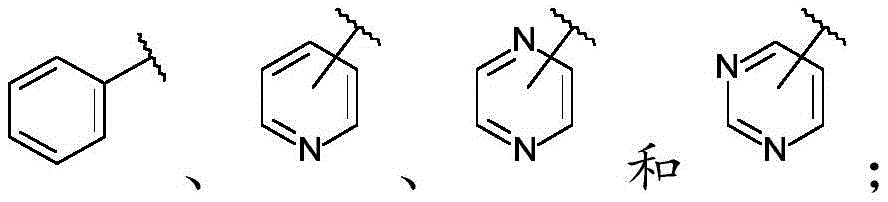


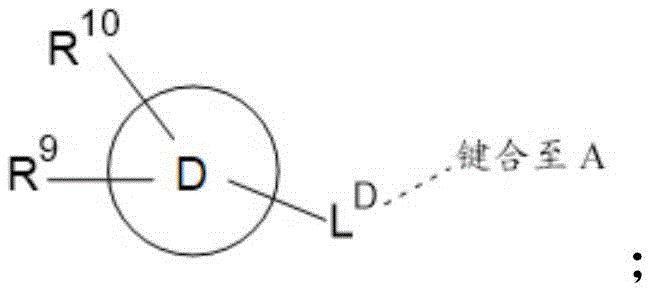


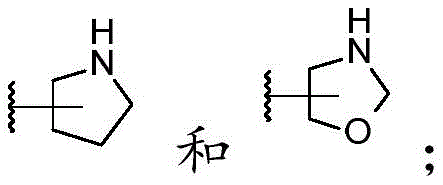


Applications Claiming Priority (3)
| Application Number | Priority Date | Filing Date | Title |
|---|---|---|---|
| EP20194318.0 | 2020-09-03 | ||
| EP20194318 | 2020-09-03 | ||
| PCT/EP2021/074150 WO2022049134A1 (en) | 2020-09-03 | 2021-09-01 | Heterocyclic compounds |
Publications (1)
| Publication Number | Publication Date |
|---|---|
| CN115989228A true CN115989228A (en) | 2023-04-18 |
Family
ID=72355880
Family Applications (1)
| Application Number | Title | Priority Date | Filing Date |
|---|---|---|---|
| CN202180053290.4A Pending CN115989228A (en) | 2020-09-03 | 2021-09-01 | Heterocyclic compound |
Country Status (17)
| Country | Link |
|---|---|
| US (1) | US11981661B2 (en) |
| EP (1) | EP4208456A1 (en) |
| JP (1) | JP2023539690A (en) |
| KR (1) | KR20230062555A (en) |
| CN (1) | CN115989228A (en) |
| AR (1) | AR123424A1 (en) |
| AU (1) | AU2021338497A1 (en) |
| BR (1) | BR112023003580A2 (en) |
| CA (1) | CA3190277A1 (en) |
| CL (1) | CL2023000594A1 (en) |
| CO (1) | CO2023004195A2 (en) |
| CR (1) | CR20230115A (en) |
| IL (1) | IL299664A (en) |
| MX (1) | MX2023002224A (en) |
| PE (1) | PE20231372A1 (en) |
| TW (1) | TW202227415A (en) |
| WO (1) | WO2022049134A1 (en) |
Cited By (3)
| Publication number | Priority date | Publication date | Assignee | Title |
|---|---|---|---|---|
| CN116606311A (en) * | 2023-04-23 | 2023-08-18 | 南开大学 | Preparation method of compound with methylene cyclobutane structure and preparation method of derivative dimethyl methylene cyclobutane compound |
| CN117143656A (en) * | 2023-08-09 | 2023-12-01 | 河南减碳科技有限公司 | Biological stable lubricating oil based on waste transformer oil and preparation method thereof |
| CN117986243A (en) * | 2024-04-03 | 2024-05-07 | 湖南浩润科技有限公司 | Diesel antiwear agent containing heterocyclic compound and preparation method thereof |
Families Citing this family (5)
| Publication number | Priority date | Publication date | Assignee | Title |
|---|---|---|---|---|
| WO2019134985A1 (en) | 2018-01-08 | 2019-07-11 | F. Hoffmann-La Roche Ag | Octahydropyrido[1,2-alpha]pyrazines as magl inhibitors |
| JP7637049B2 (en) | 2018-08-13 | 2025-02-27 | エフ. ホフマン-ラ ロシュ アーゲー | Novel heterocyclic compounds as monoacylglycerol lipase inhibitors. |
| CA3151516A1 (en) | 2019-09-12 | 2021-03-18 | F. Hoffmann-La Roche Ag | 4,4a,5,7,8,8a-hexapyrido[4,3-b][1,4]oxazin-3-one compounds as magl inhibitors |
| CA3242372A1 (en) | 2021-12-29 | 2023-07-06 | Psy Therapeutics, Inc. | Inhibiting monoacylglycerol lipase (magl) |
| JP2025527459A (en) * | 2022-08-11 | 2025-08-22 | リマインド エヌヴイ | (Aza)spiroheptane derivatives for the treatment of neurodegenerative disorders |
Family Cites Families (59)
| Publication number | Priority date | Publication date | Assignee | Title |
|---|---|---|---|---|
| FI77852C (en) | 1981-02-17 | 1989-05-10 | Otsuka Pharma Co Ltd | Process for the preparation of novel, such as cardiac drugs, useful s unsubstituted amide and (saturated heterocycle) carbonyl carbostyril derivatives. |
| US4956359A (en) * | 1985-02-28 | 1990-09-11 | A. H. Robins Company, Inc. | 3-aryloxy and 3-arylthioazetidinecarboxamides as anticonvulsants and antiepileptics |
| US4632925A (en) * | 1985-10-07 | 1986-12-30 | Hoffmann-La Roche Inc. | N-substituted diphenylpiperidines and antiobesity use thereof |
| GB9917385D0 (en) * | 1999-07-23 | 1999-09-22 | Cerebrus Ltd | Chemical compounds-I |
| ES2197003B1 (en) * | 2002-04-08 | 2005-03-16 | J. URIACH & CIA S.A. | NEW ANTAGONIST COMPOUNDS OF INTEGRINAS ALFA. |
| AU2004234125A1 (en) * | 2003-05-01 | 2004-11-11 | Vernalis Research Limited | Azetidinecarboxamide derivatives and their use in the treatment of CB1 receptor mediated disorders |
| US7579495B2 (en) | 2003-12-19 | 2009-08-25 | Momentive Performance Materials Inc. | Active-releasing cyclic siloxanes |
| WO2006038001A1 (en) * | 2004-10-06 | 2006-04-13 | Celltech R & D Limited | Aminopyrimidine derivatives as jnk inhibitors |
| WO2006051410A1 (en) | 2004-11-15 | 2006-05-18 | Pfizer Inc. | Azabenzoxazoles for the treatment of cns disorders |
| US7408066B2 (en) | 2005-06-20 | 2008-08-05 | Schering Corproation | Carbon-linked substituted piperidines and derivatives thereof useful as histamine H3 antagonists |
| MX2008010481A (en) | 2006-02-17 | 2008-12-19 | Memory Pharm Corp | Compounds having 5-ht6 receptor affinity. |
| WO2007117557A2 (en) | 2006-04-05 | 2007-10-18 | Vitae Pharmaceuticals, Inc. | Diaminopropanol renin inhibitors |
| TW200811169A (en) * | 2006-05-26 | 2008-03-01 | Astrazeneca Ab | Chemical compounds |
| AR069126A1 (en) * | 2007-10-31 | 2009-12-30 | Janssen Pharmaceutica Nv | BRIDGE DIAMINES OR FUSIONATED SUBSTITUTES WITH ARILO AS MODULATORS OF LEUCOTRENE A4 HYDROLASS |
| GB0813740D0 (en) * | 2008-07-28 | 2008-09-03 | Angeletti P Ist Richerche Biologica | Therapeutic compounds |
| AU2010224693B2 (en) * | 2009-03-19 | 2016-07-28 | Lifearc | Compounds |
| WO2011059118A1 (en) | 2009-11-10 | 2011-05-19 | Kim Hyun Jeen | System for testing olfactory perception |
| AU2012255690B2 (en) | 2011-05-16 | 2015-06-11 | Bionomics Limited | Amine derivatives as potassium channel blockers |
| US20140288323A1 (en) | 2011-10-19 | 2014-09-25 | The Trustees Of Columbia University In The City Of New York | Cyclopropenimine catalyst compositions and processes |
| JP2015508407A (en) | 2012-01-06 | 2015-03-19 | アビデ セラピューティクス,インク. | Carbamate compounds and their manufacture and use |
| GB201209587D0 (en) | 2012-05-30 | 2012-07-11 | Takeda Pharmaceutical | Therapeutic compounds |
| US10093630B2 (en) | 2014-05-21 | 2018-10-09 | Abide Therapeutics, Inc. | Pyrazole compounds and methods of making and using same |
| WO2016014975A2 (en) | 2014-07-25 | 2016-01-28 | Northeastern University | Urea/carbamates faah magl or dual faah/magl inhibitors and uses thereof |
| WO2016109501A1 (en) | 2014-12-30 | 2016-07-07 | Karos Pharmaceuticals, Inc. | Amide compounds as tryptophan hydroxylase inhibitors |
| WO2016158956A1 (en) * | 2015-03-30 | 2016-10-06 | 武田薬品工業株式会社 | Heterocyclic compound |
| US20180148429A1 (en) | 2015-05-13 | 2018-05-31 | Selvita S.A. | Substituted quinoxaline derivatives |
| ES2945314T3 (en) | 2015-05-21 | 2023-06-30 | Glaxosmithkline Ip Dev Ltd | Benzoimidazole derivatives as PAD4 inhibitors |
| CN107849040B (en) | 2015-06-09 | 2021-04-06 | 肿瘤学治疗公司 | Tricyclic derivative compound, preparation method thereof, and pharmaceutical composition containing the same |
| EP3310441B1 (en) * | 2015-06-18 | 2020-07-29 | 89Bio Ltd. | 1, 4-substituted piperidine derivatives |
| JP6986972B2 (en) | 2015-06-18 | 2021-12-22 | エイティナイン バイオ リミテッド | Substituted 4-benzyl and 4-benzoylpiperidin derivatives |
| US10323038B2 (en) | 2015-11-20 | 2019-06-18 | Abide Therapeutics, Inc. | Pyrazole compounds and methods of making and using same |
| US10385057B2 (en) | 2015-11-20 | 2019-08-20 | Lundbeck La Jolla Research Center, Inc. | Pyrazole compounds and methods of making and using same |
| EP3438109B1 (en) | 2016-03-31 | 2021-08-25 | Takeda Pharmaceutical Company Limited | Heterocyclic compound |
| TWI738753B (en) | 2016-03-31 | 2021-09-11 | 日商武田藥品工業股份有限公司 | Heterocyclic compound |
| KR102765806B1 (en) | 2017-09-05 | 2025-02-10 | 블랙손 테라퓨틱스, 인크. | Vasopressin receptor antagonists and products and methods related thereto |
| EP3689879B1 (en) | 2017-09-29 | 2025-02-12 | Takeda Pharmaceutical Company Limited | Heterocyclic compound |
| AR114136A1 (en) | 2017-10-10 | 2020-07-29 | Hoffmann La Roche | HETEROCYCLIC COMPOUNDS |
| TW201936602A (en) | 2017-11-28 | 2019-09-16 | 瑞士商赫孚孟拉羅股份公司 | New heterocyclic compounds |
| TW201930300A (en) | 2017-12-15 | 2019-08-01 | 瑞士商赫孚孟拉羅股份公司 | New heterocyclic compounds |
| WO2019134985A1 (en) | 2018-01-08 | 2019-07-11 | F. Hoffmann-La Roche Ag | Octahydropyrido[1,2-alpha]pyrazines as magl inhibitors |
| WO2019169156A1 (en) | 2018-02-28 | 2019-09-06 | The Trustees Of The University Of Pennsylvania | Low affinity poly(ad-ribose) polymerase 1 dependent cytotoxic agents |
| RS64156B1 (en) | 2018-03-22 | 2023-05-31 | Hoffmann La Roche | OXAZINE INHIBITORS OF MONOACYLGLYCEROL LIPASE (MAGL) |
| MA52365A (en) | 2018-04-25 | 2021-03-03 | Yumanity Therapeutics Inc | COMPOUNDS AND THEIR USES |
| JP7637049B2 (en) | 2018-08-13 | 2025-02-27 | エフ. ホフマン-ラ ロシュ アーゲー | Novel heterocyclic compounds as monoacylglycerol lipase inhibitors. |
| AU2019322161A1 (en) | 2018-08-13 | 2020-11-12 | F. Hoffmann-La Roche Ag | New heterocyclic compounds as monoacylglycerol lipase inhibitors |
| MA55131B1 (en) | 2018-11-22 | 2023-10-31 | Hoffmann La Roche | NEW HETEROCYCLIC COMPOUNDS |
| WO2020198526A2 (en) | 2019-03-27 | 2020-10-01 | St. Jude Children's Research Hospital | Small molecule modulators of pank |
| CN111793064B (en) | 2019-04-02 | 2023-06-23 | 上海美悦生物科技发展有限公司 | Compound serving as IRAK inhibitor as well as preparation method and application thereof |
| JP7707073B2 (en) | 2019-04-09 | 2025-07-14 | エフ. ホフマン-ラ ロシュ アーゲー | Heterocyclic Compounds as Inhibitors of Monoacylglycerol Lipase (MAGL) |
| MX2022000083A (en) | 2019-07-03 | 2022-02-03 | Hoffmann La Roche | Heterocyclic monoacylglycerol lipase (magl) inhibitors. |
| AU2020311584A1 (en) | 2019-07-09 | 2022-01-20 | F. Hoffmann-La Roche Ag | New heterocyclic compounds |
| US20210094971A1 (en) | 2019-09-09 | 2021-04-01 | Hoffmann-La Roche Inc. | Heterocyclic compounds |
| CA3151516A1 (en) | 2019-09-12 | 2021-03-18 | F. Hoffmann-La Roche Ag | 4,4a,5,7,8,8a-hexapyrido[4,3-b][1,4]oxazin-3-one compounds as magl inhibitors |
| CN114650994A (en) | 2019-09-12 | 2022-06-21 | 豪夫迈·罗氏有限公司 | Radiolabelled compounds |
| JP2022549810A (en) | 2019-09-23 | 2022-11-29 | エフ.ホフマン-ラ ロシュ アーゲー | heterocyclic compound |
| EP4034541A1 (en) | 2019-09-24 | 2022-08-03 | F. Hoffmann-La Roche AG | Heterocyclic compounds |
| EP4034602A1 (en) | 2019-09-24 | 2022-08-03 | F. Hoffmann-La Roche AG | Fluorescent probes for monoacylglycerol lipase (magl) |
| CN114401968A (en) | 2019-09-24 | 2022-04-26 | 豪夫迈·罗氏有限公司 | Novel heterocyclic monoacylglycerol lipase (MAGL) inhibitors |
| CN116096723A (en) | 2020-08-26 | 2023-05-09 | 豪夫迈·罗氏有限公司 | Heterocyclic compounds useful as MAGL inhibitors |
-
2021
- 2021-09-01 AU AU2021338497A patent/AU2021338497A1/en not_active Abandoned
- 2021-09-01 JP JP2023514714A patent/JP2023539690A/en active Pending
- 2021-09-01 CN CN202180053290.4A patent/CN115989228A/en active Pending
- 2021-09-01 IL IL299664A patent/IL299664A/en unknown
- 2021-09-01 CA CA3190277A patent/CA3190277A1/en active Pending
- 2021-09-01 PE PE2023000817A patent/PE20231372A1/en unknown
- 2021-09-01 WO PCT/EP2021/074150 patent/WO2022049134A1/en not_active Ceased
- 2021-09-01 BR BR112023003580A patent/BR112023003580A2/en not_active Application Discontinuation
- 2021-09-01 KR KR1020237006648A patent/KR20230062555A/en not_active Withdrawn
- 2021-09-01 EP EP21772763.5A patent/EP4208456A1/en active Pending
- 2021-09-01 CR CR20230115A patent/CR20230115A/en unknown
- 2021-09-01 MX MX2023002224A patent/MX2023002224A/en unknown
- 2021-09-02 AR ARP210102457A patent/AR123424A1/en not_active Application Discontinuation
- 2021-09-02 US US17/465,536 patent/US11981661B2/en active Active
- 2021-09-03 TW TW110132843A patent/TW202227415A/en unknown
-
2023
- 2023-03-01 CL CL2023000594A patent/CL2023000594A1/en unknown
- 2023-03-30 CO CONC2023/0004195A patent/CO2023004195A2/en unknown
Cited By (5)
| Publication number | Priority date | Publication date | Assignee | Title |
|---|---|---|---|---|
| CN116606311A (en) * | 2023-04-23 | 2023-08-18 | 南开大学 | Preparation method of compound with methylene cyclobutane structure and preparation method of derivative dimethyl methylene cyclobutane compound |
| CN117143656A (en) * | 2023-08-09 | 2023-12-01 | 河南减碳科技有限公司 | Biological stable lubricating oil based on waste transformer oil and preparation method thereof |
| CN117143656B (en) * | 2023-08-09 | 2024-03-26 | 河南减碳科技有限公司 | Biological stable lubricating oil based on waste transformer oil and preparation method thereof |
| CN117986243A (en) * | 2024-04-03 | 2024-05-07 | 湖南浩润科技有限公司 | Diesel antiwear agent containing heterocyclic compound and preparation method thereof |
| CN117986243B (en) * | 2024-04-03 | 2024-05-31 | 湖南浩润科技有限公司 | Diesel antiwear agent containing heterocyclic compound and preparation method thereof |
Also Published As
| Publication number | Publication date |
|---|---|
| MX2023002224A (en) | 2023-03-15 |
| CA3190277A1 (en) | 2022-03-10 |
| IL299664A (en) | 2023-03-01 |
| AU2021338497A1 (en) | 2023-02-09 |
| BR112023003580A2 (en) | 2023-04-04 |
| PE20231372A1 (en) | 2023-09-07 |
| EP4208456A1 (en) | 2023-07-12 |
| TW202227415A (en) | 2022-07-16 |
| KR20230062555A (en) | 2023-05-09 |
| US20220098176A1 (en) | 2022-03-31 |
| US11981661B2 (en) | 2024-05-14 |
| CO2023004195A2 (en) | 2023-06-20 |
| CR20230115A (en) | 2023-04-11 |
| AR123424A1 (en) | 2022-11-30 |
| JP2023539690A (en) | 2023-09-15 |
| CL2023000594A1 (en) | 2023-10-06 |
| WO2022049134A1 (en) | 2022-03-10 |
Similar Documents
| Publication | Publication Date | Title |
|---|---|---|
| CN115989228A (en) | Heterocyclic compound | |
| TWI818967B (en) | New heterocyclic compounds | |
| TWI812770B (en) | New heterocyclic compounds | |
| KR20210044217A (en) | Novel heterocyclic compounds as monoacylglycerol lipase inhibitors | |
| CN114269755A (en) | 4,4A,5,7,8, 8A-hexapyrido [4,3-B ] [1,4] oxazin-3-one compounds as MAGL inhibitors | |
| CN117295726A (en) | Heterocyclic compounds | |
| PT2076508E (en) | Biaryl ether urea compounds | |
| CN115209952B (en) | Substituted pyrazolopyrimidines and their uses | |
| CN114401968A (en) | Novel heterocyclic monoacylglycerol lipase (MAGL) inhibitors | |
| CN114364684A (en) | Heterocyclic compounds | |
| TW202200560A (en) | Ccr6 receptor modulators | |
| CN116096723A (en) | Heterocyclic compounds useful as MAGL inhibitors | |
| CN119301113A (en) | New heterocyclic carbonyl cyclic compounds as MAGL inhibitors | |
| HK40082879A (en) | Heterocyclic compounds | |
| TW202333664A (en) | New heterocyclic compounds | |
| HK40096088A (en) | Heterocyclic compounds | |
| HK40114413A (en) | New heterocyclic-carbonyl-cyclic compounds as magl inhibitors | |
| HK40065118A (en) | New heterocyclic monoacylglycerol lipase (magl) inhibitors | |
| HK40062310A (en) | 4,4a,5,7,8,8a-hexapyrido[4,3-b][1,4]oxazin-3-one compounds as magl inhibitors | |
| HK40063674A (en) | Heterocyclic compounds | |
| HK40035599A (en) | Oxazine monoacylglycerol lipase (magl) inhibitors | |
| HK40046072A (en) | New heterocyclic compounds as monoacylglycerol lipase inhibitors |
Legal Events
| Date | Code | Title | Description |
|---|---|---|---|
| PB01 | Publication | ||
| PB01 | Publication | ||
| REG | Reference to a national code |
Ref country code: HK Ref legal event code: DE Ref document number: 40082879 Country of ref document: HK |
|
| SE01 | Entry into force of request for substantive examination | ||
| SE01 | Entry into force of request for substantive examination |