CN115957434A - Blood pump - Google Patents
Blood pump Download PDFInfo
- Publication number
- CN115957434A CN115957434A CN202211702986.8A CN202211702986A CN115957434A CN 115957434 A CN115957434 A CN 115957434A CN 202211702986 A CN202211702986 A CN 202211702986A CN 115957434 A CN115957434 A CN 115957434A
- Authority
- CN
- China
- Prior art keywords
- section
- hub
- blade
- blood pump
- impeller
- Prior art date
- Legal status (The legal status is an assumption and is not a legal conclusion. Google has not performed a legal analysis and makes no representation as to the accuracy of the status listed.)
- Pending
Links
Images


Landscapes
- Structures Of Non-Positive Displacement Pumps (AREA)
Abstract
The application relates to a blood pump, which comprises a sleeve and an impeller, wherein the sleeve is provided with an inflow port and an outflow port; the impeller can set up in the sleeve with rotating to carry liquid from the inflow opening to the outflow opening, the impeller includes hub and blade, and the blade sets up in the surface of hub, and the hub includes the earial drainage section that is located the near-end, and the ratio and the hub exit angle alpha of the length L1 of the radius R of the near-end of earial drainage section and earial drainage section satisfy: R/L1 is more than 1, so set up, the structural design of wheel hub has been optimized, can make the fluid have a bigger hydraulic pressure head in the earial drainage section when low flow interval to be favorable to improving the pressure when the fluid flows out from the egress opening, improve the hydraulic efficiency of blood pump, compare in traditional blood pump, the hydraulic efficiency of blood pump promotes to more than 20% from 15%, hydraulic efficiency has obtained promotion by a relatively large margin, and under the prerequisite that satisfies clinical requirement's the flow of filling and pressure, can not cause the damage to the human tissue outside the export.
Description
Technical Field
The application relates to the field of medical equipment, in particular to a blood pump.
Background
An intravascular blood pump is a blood pumping device that may be accessed into a patient's heart via a patient's blood vessel, the intravascular blood pump being placed within the ventricle so that blood can flow through the blood pump and into the arterial vessel. In the case of a conventional artificial heart blood pump, the main function of the pump is to drive blood in the ventricle into the artery.
Since the blood pump is disposed in the blood vessel, the requirement for the blood pump, particularly for the impeller therein, is particularly high, and the blood pump needs to have high hydraulic efficiency on the basis of relatively small size. However, the conventional blood pump has a problem of low hydraulic efficiency in a low flow rate range, and needs to be improved.
Disclosure of Invention
Therefore, in order to solve the above problems, it is necessary to provide a blood pump that greatly improves the hydraulic efficiency in a low-flow interval and does not damage human tissues outside the outlet on the premise of satisfying the perfusion flow and pressure of clinical requirements. The embodiment of the application realizes the aim through the following technical scheme.
The invention provides a blood pump, comprising:
the sleeve is provided with an inflow port and an outflow port; and
an impeller rotatably disposed within the casing to convey liquid from the inflow port to the outflow port, the impeller including a hub and blades disposed on a surface of the hub, the hub including a proximal bleed section, a ratio of a proximal radius R of the bleed section to a length L1 of the bleed section and a hub exit angle α satisfying:

wherein δ is a minimum clearance of the blade from an inner wall of the casing, D 0 Is the inner diameter of the cannula.
In one embodiment, the hub exit angle α further satisfies: alpha is more than or equal to 30 degrees.
In one embodiment, the hub further comprises a flow guiding section and a pressurizing section, the pressurizing section is connected between the flow guiding section and the flow discharging section, the diameters of the flow guiding section, the pressurizing section and the flow discharging section are gradually increased from the far end to the near end, and the diameters of the pressurizing section and the flow discharging section are increased in different manners.
In one embodiment, the vane includes a first section and a second section, the first section is disposed in the pressurizing section, the second section is disposed in the discharging section, and the height of the vane gradually decreases from the first section to the second section.
In one embodiment, the hub ratio of the pressurizing section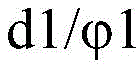 Satisfies the following conditions:
 A hub ratio of said tapping section>
 Satisfies the following conditions:
 Wherein d1 is the diameter of the hub of the supercharging section>
 The diameter of the impeller of the pressurizing section; d2 is the diameter of the hub of the tapping section, in combination with>
 Is the diameter of the impeller of the bleed section.
In one embodiment, the diameter of the impeller of the bleed section Greater than the diameter of the impeller of the supercharging section>
In one embodiment, the blade extends spirally around the axial direction of the hub, the blade includes a working surface, the working surface is connected to the hub, the contour line of the working surface includes an inlet edge, an outer edge profile and a hub profile, the hub profile is located on one side of the working surface close to the hub, the inlet edge protrudes out of the impeller in the radial direction of the hub, the inlet edge is connected between the outer edge profile and the hub profile, and from a far end to a near end, a blade setting angle of the hub profile is greater than a blade setting angle of the outer edge profile and then is smaller than a blade setting angle of the outer edge profile.
In one embodiment, the hub further includes a flow guiding section and a pressurizing section, the pressurizing section is connected between the flow guiding section and the flow discharging section, the blades include a first section and a second section, the first section is arranged on the pressurizing section, a blade setting angle γ 1 of an outer edge profile of the first section is between 0 ° and 80 °, the second section is arranged on the flow discharging section, and a blade setting angle γ 2 of an outer edge profile of the second section is between 60 ° and 90 °.
In one embodiment, the number of the blades is multiple, and the multiple blades are uniformly arranged on the surface of the hub in a spiral shape; and/or the blade sweep angle theta of the blade satisfies: theta is more than or equal to minus 30 degrees and less than or equal to 30 degrees; and/or the blade wrap angle beta of the blade satisfies: beta is more than or equal to 90 degrees and less than or equal to 160 degrees.
In one embodiment, the vane radial outlet height H of the vane and the inner diameter D of the sleeve 0 The ratio of (A) to (B) satisfies: H/D is more than or equal to 0.1 0 Less than or equal to 1.5; and/or, D 0 <4.3mm。
Compared with the prior art, the blood pump provided by the application has the advantages that the ratio of the radius R of the near end of the drainage section to the length L1 of the drainage section and the hub outlet angle alpha meet the following requirements: so set up, optimized wheel hub's structural design, can make the fluid have a bigger hydraulic pressure head in the earial drainage section when low flow interval to be favorable to improving the pressure of fluid when flowing from the egress opening, compare in traditional blood pump, can promote the hydraulic efficiency of blood pump to more than 20% from 15%, hydraulic efficiency has obtained promotion by a relatively large margin, and under the prerequisite that satisfies clinical requirement's the flow of filling and pressure, can not cause the damage to the human tissue outside the export.
Drawings
Fig. 1 is a schematic structural diagram of a blood pump provided in the present application.
Fig. 2 is a schematic structural diagram of an impeller of the blood pump shown in fig. 1.
Fig. 3 is a schematic structural diagram of another view angle of an impeller of the blood pump shown in fig. 2.
Fig. 4 is a schematic structural view of the sleeve and the impeller shown in fig. 1.
Fig. 5 is a cross-sectional view taken along the X-X direction of fig. 4.
Fig. 6 is a schematic illustration of the size relationship of the bleed section of the impeller of the blood pump of fig. 1.
Figure 7 is a longitudinal cross-sectional view of the blood pump of figure 2.
Fig. 8 is a schematic structural diagram of a blade provided in the present application.
Fig. 9 is a comparison schematic of hydraulic efficiency of a blood pump provided herein.
Reference numerals:
| reference numerals | Name (R) | Reference numerals | Name (R) |
| 1000 | |
213 | |
| 100 | |
220 | |
| 110 | |
221 | |
| 120 | |
222 | Outer edge |
| 200 | |
223 | Hub |
| 210 | |
2201 | |
| 211 | |
2202 | |
| 212 | |
300 | Drive assembly |
Detailed Description
In order to make the aforementioned objects, features and advantages of the present application more comprehensible, embodiments accompanying the present application are described in detail below with reference to the accompanying drawings. In the following description, numerous specific details are set forth in order to provide a thorough understanding of the present application. This application is capable of embodiment in many different forms than those described herein and those skilled in the art will be able to make similar modifications without departing from the spirit of the application and therefore the application is not limited to the specific embodiments disclosed below.
It will be understood that when an element is referred to as being "secured to" or "disposed" on another element, it can be directly on the other element or intervening elements may also be present. When a component is referred to as being "connected" to another component, it can be directly connected to the other component or intervening components may also be present. The terms "vertical," "horizontal," "upper," "lower," "left," "right," and the like as used in the description of the present application are for illustrative purposes only and do not represent the only embodiments.
Furthermore, the terms "first", "second" and "first" are used for descriptive purposes only and are not to be construed as indicating or implying relative importance or implicitly indicating the number of technical features indicated. Thus, a feature defined as "first" or "second" may explicitly or implicitly include at least one such feature. In the description of the present application, "plurality" means at least two, e.g., two, three, etc., unless specifically limited otherwise.
In this application, unless expressly stated or limited otherwise, the first feature "on" or "under" the second feature may mean that the first feature is in direct contact with the second feature, or that the first feature and the second feature are in indirect contact via an intermediate. Also, a first feature "on," "above," and "over" a second feature may be directly on or obliquely above the second feature, or may simply mean that the first feature is at a higher level than the second feature. A first feature being "under," "below," and "beneath" a second feature may be directly under or obliquely under the first feature, or may simply mean that the first feature is at a lesser elevation than the second feature. Unless defined otherwise, all technical and scientific terms used in the specification of the present application have the same meaning as commonly understood by one of ordinary skill in the art to which the present application belongs. The terminology used in the description of the present application is for the purpose of describing particular embodiments only and is not intended to be limiting of the application. As used in the description of the present application, the term "and/or" includes any and all combinations of one or more of the associated listed items.
Referring to fig. 1 to 5, the present application provides a blood pump 1000, the blood pump 1000 includes a cannula 100 and an impeller 200, the cannula 100 is opened with an inflow 110 and an outflow 120. The impeller 200 is rotatably provided in the casing 100 to deliver the liquid from the inflow port 110 to the outflow port 120.

Through a plurality of experiments, the inventor of the application finds that when the R/L1 is less than or equal to 1, the hydraulic head (namely the height difference of the fluid in the drainage section 211) and the hydraulic efficiency of the blood pump 1000 in a low-flow interval are poor. And when R/L1 is more than 1, the blood pump 1000 has higher hydraulic pressure head and hydraulic efficiency in a low flow interval. Therefore, limiting R/L1 to greater than 1 based on the design of hub 210 has proven to be a range that provides for higher hydraulic head and hydraulic efficiency.
The inventor of the present application also found that the above-mentioned method is suitable for the application of the present invention At this time, the hub outlet angle α no longer tapers in a distal to proximal direction, failing to produce sufficient radial velocity at the
 outflow port 120, which reduces the hydraulic head and hydraulic efficiency of the blood pump 1000. The hub outlet angle α is therefore limited to less than ≥ based on the structural design of the hub 210>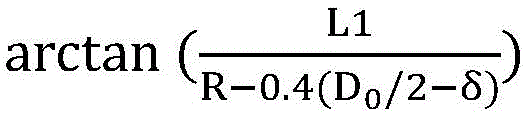 Has proved to be capable of ensuring higher hydraulic head and hydraulic efficiency, wherein 0.4 is the hub ratio at the proximal end of the
 discharge section 211 far from the hub 210, and 0.4 (D) 0 /2- δ) represents the hub radius at the proximal end of bleed section 211 remote from hub 210, represented by line segment AB in fig. 6.
With continued reference to fig. 6, ad = be = l1, cd = r, de = ab =0.4 (D) 0 /2-δ);
Then
That is to say that the first and second electrodes,
when α = λ, the contour of the hub of the bleed section is a straight line BC, at which time sufficient radial velocity cannot be generated at the outflow opening 120, which reduces the hydraulic head and hydraulic efficiency of the blood pump 1000.
In summary, α < λ, sufficient radial velocity can be generated at the outflow port 120 to increase the hydraulic head and hydraulic efficiency of the blood pump 1000.
Further, the hub exit angle α also satisfies: alpha is more than or equal to 30 degrees. In trial production, it was found that when α < 30 °, the curvature of the vent section 211 was too large to be machined. Hub exit angle α is therefore also defined to be greater than 30 ° based on the structural design of hub 210 to facilitate machining of bleed section 211 of hub 210.
Referring to fig. 1 to 4, in an embodiment of the present application, the hub 210 further includes a flow guiding section 213 and a pressurizing section 212, and the pressurizing section 212 is connected between the flow guiding section 213 and the discharging section 211. In the present embodiment, the diameters of the flow guiding section 213, the pressure increasing section 212 and the flow discharging section 211 gradually increase from the distal end to the proximal end, and the diameters of the pressure increasing section 212 and the flow discharging section 211 increase differently. So set up, can further strengthen blood pump 1000 at the hydraulic pressure head and the hydraulic efficiency of low flow interval. The flow guiding section 213 is disposed adjacent to the inflow port 110 to guide the blood flowing in from the inflow port 110, and the drainage section 211 is disposed adjacent to the outflow port 120 to discharge the blood. The length of the pressurizing section 212 and the length of the flow guiding section 213 correspond to L2 and L3.
In this embodiment, the molded line of the pressurizing section 212 is a bezier curve with three or more orders, the molded lines of the flow guiding section 213 and the flow discharging section 211 are bezier curves with two or more orders, which can meet the different shape designs of the hub 210, and each part of the hub 210 can be smoothly transited, so that the working capacity of the impeller 200 is improved and the hydraulic efficiency of the blood pump is improved on the basis of the unchanged size of the impeller 200, and in addition, the machinability of the impeller 200 can also be improved. In one embodiment, the diameter of the pumping section 212 increases linearly from the distal end to the proximal end, i.e., the profile of the pumping section 212 is a first order bezier curve; the diameter of the bleed section 211 increases exponentially. In another embodiment, the diameter of the boost section 212 increases exponentially and the diameter of the bleed section 211 increases linearly. In yet another embodiment, the diameter of the plenum section 212 increases linearly and the diameter of the drain section 211 increases logarithmically. In addition, in the present embodiment, the diameter of the flow guide section 213 increases logarithmically from the distal end to the proximal end. In other embodiments, the diameter of the flow guide section 213 may also increase linearly from the distal end to the proximal end.
Referring to fig. 1 to 4, the hub 210 includes a flow guiding section 213, a pressure increasing section 212 and a flow discharging section 211 which are connected and have sequentially increasing diameters along an axial direction S1 of the impeller 200. The blade 220 comprises a first section 2201 and a second section 2202, wherein the first section 2201 is arranged in the pressurizing section 212, and the first section 2201 is a main part for doing work on liquid and is used for converting mechanical energy into internal energy and kinetic energy of the liquid and increasing the pressure of the liquid flow; compared with the first section 2201, the second section 2202 is arranged in the drainage section 211, the second section 2202 applies work to the liquid and reduces, the internal energy of the fluid is further converted into kinetic energy, the liquid is ejected at high speed along the radial direction of the hub 210, and the second section 2202 is used for guiding the liquid to flow out along the radial direction of the hub 310. In the present embodiment, the height of the blade 220 gradually decreases from the first section 2201 to the second section 2202. So arranged, it helps the fluid to have a larger radial component when flowing out from the outflow opening 120, thereby being beneficial to improve the pressure when the fluid flows out from the outflow opening 120, and improving the hydraulic efficiency of the blood pump.
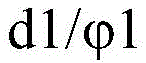
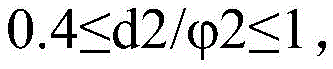
Referring to fig. 5 and 7, the hub ratio of the pressure increasing section 212 is different from that of the discharge section 211, the hub ratio of the pressure increasing section 212 is 0.2 to 0.4, and the hub ratio of the discharge section 211 is 0.4 to 1, i.e. the hub ratio of the pressure increasing section 212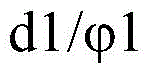 Satisfies the following conditions:
 Hub ratio in the
 tapping section 211>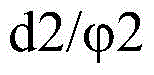 Satisfies the following conditions:
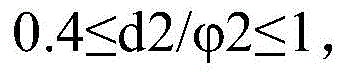 Where d1 is the diameter of the
 hub 210 of the plenum section 212, the diameter of the
 impeller 200 of the booster section 212; d2 is the diameter of the hub 210 of the tapping section 211, based on> The diameter of the
 impeller 200 of the bleed section 211. For the configuration of the pressurizing section 212 of the hub 210, the flow separation is severe when the hub ratio of the pressurizing section 212 is less than 0.2, and the height of the blades 220 is insufficient when the hub ratio of the pressurizing section 212 is greater than 0.4, so as to work energyThe force is insufficient and therefore a reasonably efficient hub ratio of the plenum section 212 needs to be provided. Further, in the structure of the drain section 211 of the hub 210, if the hub ratio is less than 0.4, the radial flow velocity component is too small, and this range can realize a larger head at the outlet port 120 located in the radial direction of the hub 210. Specifically, the portion of hub 210 having a hub ratio greater than 0.4 is provided as a bleed section 211, i.e., the rotating shaft diameter is larger, and the radial velocity component of the fluid is increased to facilitate outflow from radial outflow port 120.
Referring to FIGS. 1-4, the inner diameter D of the cannula 100 is selected to allow for delivery 0 For a fixed value, the shorter the length of the sleeve 100 with high rigidity is, the better the delivery efficiency of the blood pump 1000 in the blood vessel, but a certain bonding length and bonding thickness need to be ensured between the inlet conduit with stronger bending performance (a component connected to the distal end of the sleeve 100) and the sleeve 10 with high rigidity, so that the diameter of the front end part of the sleeve 10 is partially lost due to the bonding of the inlet conduit, that is, on the premise that the front and rear thicknesses of the sleeve 10 are consistent, the inner diameter of the front end of the sleeve 10 is slightly smaller than that of the rear end of the sleeve 10. In the present embodiment, the impeller 200 is designed with a variable diameter such that the diameter of the impeller 200 at the rear end portion of the sleeve 100 is slightly larger than the diameter at the front end portion of the sleeve 100, i.e., the diameter of the impeller 200 at the drain section 211 Greater than the diameter of the
 impeller 200 in the boost section 212> In this way, the minimum gap between the
 vane 220 and the inner wall of the casing 100 can be controlled to be constant, so that the hydraulic efficiency of the impeller 200 can be improved to the maximum extent.
Referring to fig. 1 to 8, each blade 220 includes a working surface, the working surface is connected to the hub 210 and extends spirally around an axial direction of the hub 210, a contour line of the working surface includes an inlet edge 221, an outer edge profile 222 and a hub profile 223, the hub profile 223 is located on a side of the working surface close to the hub 210, the inlet edge 221 protrudes from the impeller 200 along a radial direction of the hub 210, the inlet edge 221 is connected between the outer edge profile 222 and the hub profile 223, and from a distal end to a proximal end, a blade setting angle of the hub profile 223 is first greater than that of the outer edge profile 222 and then smaller than that of the outer edge profile 222, and a blade setting angle of the blade 220 corresponding to the outer edge profile 222 of the bleeding section 211 is greater than that of the outer edge profile 222 corresponding to the pressurizing section 212. The blade setting angle refers to an included angle between a profile of the blade (such as the outer edge profile 222 or the hub profile 223) and a plane perpendicular to the impeller axis.
Referring to fig. 1 to 4, in an embodiment of the present application, the hub 210 further includes a guiding section 213 and a pressurizing section 212, the pressurizing section 212 is connected between the guiding section 213 and the discharging section 211, the vane 220 includes a first section 2201 and a second section 2202, the first section 2201 is disposed on the pressurizing section 212, the vane lay angle γ 1 of the outer edge molded line 222 of the first section 2201 is between 0 ° and 80 °, the second section 2202 is disposed on the discharging section 211, and the vane lay angle γ 2 of the outer edge molded line 222 of the second section 2202 is between 60 ° and 90 °. For example, the blade placement angle γ 1 is 60 °, and the blade placement angle γ 2 is 70 °; or the blade installation angle gamma 1 is 60 degrees, and the blade installation angle gamma 2 is 80 degrees; alternatively, the blade placement angle γ 1 is 70 °, the blade placement angle γ 2 is 85 °, and the like. That is, the blade placement angle γ 2 of the outer edge profile 222 of the second section 2202 is larger, which is beneficial to increase the radial fluid flow velocity at the outflow port 120 and improve the hydraulic performance of the blood pump 1000.
Referring to fig. 1 to 4, in an embodiment of the present application, there are a plurality of blades 220, and the plurality of blades 220 are uniformly disposed on the surface of the hub 210 in a spiral shape, in this embodiment, there may be two blades 220; in other embodiments, the number of blades 220 may also be three, four, or more. It will be appreciated that each vane 220 is a unitary piece. In one embodiment, the hub 210 and the plurality of blades 220 may be integrally formed.
In an embodiment of the present application, the blade sweep angle θ of the blade 220 satisfies: theta is more than or equal to minus 30 degrees and less than or equal to 30 degrees. The blade sweep angle theta is an included angle between a curve of the front edge of the blade 220 in the height direction of the blade 220 and the radial direction S2, the flow separation is aggravated when the blade sweep angle theta is too large, and the sweep angle range is high in hydraulic efficiency through proved tests when the blade sweep angle theta is at an angle of minus 30 degrees to 30 degrees.
In an embodiment of the present application, the blade wrap angle β of the blade 220 satisfies: beta is more than or equal to 90 degrees and less than or equal to 160 degrees. The blade wrap angle β is an included angle formed by connecting lines between the two points and the center of the circle at the inlet of the impeller 200 and the maximum outer diameter of the impeller 200. Through the design, higher hydraulic efficiency can be ensured, and proved by experiments and tests, when the wrap angle beta of the blade is smaller than 90 degrees, the work of the impeller 200 is insufficient, and the efficiency is low, namely, the impeller 200 cannot output the required energy under the conditions of set rotating speed and size; when the blade wrap angle β is greater than 160 °, the blade 220 obstructs the flow path, and the efficiency is reduced.
In the embodiment, the number of the blades 220 is plural, and the plural blades 220 are uniformly arranged on the surface of the hub 210 in a spiral shape, θ is larger than or equal to-30 degrees and smaller than or equal to 30 degrees, and β is larger than or equal to 90 degrees and smaller than or equal to 160 degrees. In one embodiment, the number of the blades 220 is multiple, the plurality of blades 220 are uniformly arranged on the surface of the hub 210 in a spiral shape, and θ > 30 ° or θ < -30 °, and β > 160 ° or β < 90 °. In another embodiment, the number of the blades 220 is one, the plurality of blades 220 are uniformly arranged on the surface of the hub 210 in a spiral shape, and theta is greater than 30 degrees or theta is less than-30 degrees, and beta is greater than or equal to 90 degrees and less than or equal to 160 degrees. In yet another embodiment, the number of the blades 220 is one, and the plurality of blades 220 are uniformly arranged on the surface of the hub 210 in a spiral shape, and the angle theta is greater than or equal to-30 degrees and less than or equal to 30 degrees, and beta is greater than 160 degrees or beta is less than 90 degrees.
Referring to fig. 1 to 4, in an embodiment of the present invention, the height H of the radial outlet of the vane 220 and the inner diameter D of the sleeve 100 0 The ratio of (A) to (B) satisfies: H/D is more than or equal to 0.1 0 Less than or equal to 1.5, i.e. the height H of the radial outlet of the blade 220 and the inner diameter D of the sleeve 100 0 The ratio of (A) to (B) is 0.1 to 1.5; the ratio of the radial outlet height H of the vane 220 to the maximum diameter of the outer contour of the impeller 200, which may be similar or similar to the vane 220, is 0.1 to 1.5, and the outer contour of the impeller 200 is theoretically slightly smaller than the inner diameter D of the sleeve 100 in consideration of the assembly gap 0 . The radial outlet height H of the blades 220, i.e. the axial distance between the bottom of the impeller 200 and the starting position of the pump discharge opening 120, is equal to the inner diameter D of the sleeve 100 0 The ratio is: H/D is more than or equal to 0.1 and less than or equal to 1.5. In pilot plant, it was found that when H/D 0 When the ratio is less than 0.1, the outlet lift can not meet the perfusion flow and pressure of clinical requirements, and when the ratio is H/D 0 When the diameter of the impeller is greater than 1.5, the impeller 200 is liable to scratch human tissues outside the outlet, so that it is necessary to control the range of the ratio of the radial outlet height of the blades 220 to the diameter of the casing 100, so as to ensure the safe use of the product and protect the life safety of users.
In one embodiment, the inner diameter D of the cannula 100 0 Less than 4.3mm, can be suitable for the human vascular system applied to the blood pump 1000, and weakens the risk of damaging the blood vessel due to overlarge diameter.
In the present embodiment, the inner diameter D of the cannula 100 0 Is less than 4.3mm, and the vane radial outlet height H of the vane 220 and the inner diameter D of the sleeve 100 0 The ratio of (A) to (B) satisfies: H/D is more than or equal to 0.1 0 Less than or equal to 1.5. In one embodiment, the inner diameter D of the cannula 100 0 Not less than 4.3mm, and the height H of the radial outlet of the vane 220 and the inner diameter D of the sleeve 100 0 The ratio of (A) to (B) satisfies: H/D is more than or equal to 0.1 0 Less than or equal to 1.5. In another embodiment, the inner diameter D of the cannula 100 0 < 4.3mm and the vane radial outlet height H of the vanes 220 and the inner diameter D of the sleeve 100 0 The ratio of (A) to (B) satisfies: H/D 0 > 1.5 or H/D 0 <0.1。
Referring to fig. 1 to 4, in order to ensure hydraulic efficiency, further, in an embodiment of the present invention, a tip clearance δ of the blade 220 satisfies 0.05mm δ 0.5mm, and the tip clearance is a distance between the blade 220 and an inner wall of the casing 100. The too small tip clearance delta causes the too large shearing force to bring about the hemolysis problem, and the too large tip clearance delta reduces the hydraulic efficiency, so based on the structural design of the impeller 200, the tip clearance delta of the blade 220 is limited to the interval of 0.05mm to 0.5mm, and through the experimental test, the range can ensure the higher hydraulic efficiency and the low hemolysis value.
The invention will be further illustrated below by means of a comparative analysis of a number of examples. In each of the following embodiments, the length of each segment, the hub ratio, the tip clearance δ, and other parameters of the impeller 200 and the hub 210 thereof are different, and the specific differences can be found in the parameter table in each embodiment as shown in table 1 below. Wherein the length units of L3, L2, L1 and the blade tip clearance delta are all mm, and the units of alpha, theta and beta are all degrees.
TABLE 1 blood pump parameters of interest

Note that, even for a specific impeller 200, the diameter of the hub 210 and the height of the impeller 200 are both varied values, and therefore the hub ratio, i.e., the inner diameter D of the hub 210 0 Diameter of impeller 200 The ratio is a range of values rather than a constant value. The hydraulic efficiency test of each embodiment versus the conventional art is shown in fig. 5.
As can be seen from fig. 9 and table 1, the hydraulic efficiency of the blood pump 1000 of the prior art is low, less than 25%, at a flow rate of less than 2L/min. The hydraulic efficiency of the blood pump 1000 of the present application is improved in this flow interval, and particularly, the hydraulic efficiency is improved from 15% to more than 20% when the flow rate is 1L/min.
In embodiment 1, R/L1=1, and the curvature of the bleed section 211 of the impeller 200 is larger, so that the low-flow condition has a higher radial speed at the outflow port 120 of the blood pump 1000, and the head and hydraulic efficiency of the low-flow condition are improved.
In example 2, R/L1=1.1, the curvature of the discharge section 211 of the impeller 200 is further increased, and the hydraulic efficiency in the low flow rate range (flow rate of 1-2 lpm) is further improved.
Further, as can be seen from table 1: the impellers 200 of examples 1, 2 and 3 have the same total length, the same blade sweep angle θ and the same blade wrap angle β, and the same hub outlet angle α of examples 2 and 3, and the higher the R/L1 value, the higher the hydraulic efficiency at a flow rate of 1 to 2L/min.
In addition, compared with the embodiments 1, 2 and 3, the impellers 200 of the embodiments 4 and 5 have larger total length and stronger power capability, the blade sweep angle theta and the blade wrap angle beta are the same, the hub outlet angle alpha is similar, and the larger the R/L1 is, the higher the hydraulic efficiency is when the flow rate is 1-2L/min.
Referring to fig. 1, in the present embodiment, the blood pump 1000 further includes a driving assembly 300, the cannula 100 is disposed on the driving assembly 300, and the driving assembly 300 is in transmission connection with the hub 210. The driving assembly 300 is used to drive the hub 210 to rotate the impeller 200, such that the driving assembly 300 rotates the impeller 200 in the outlet to pump blood from the inlet 110 to the arterial vessel through the outlet 120.
In summary, the blood pump 1000 provided by the present invention includes a cannula 100 and an impeller 200, wherein the cannula 100 is provided with an inflow port 110 and an outflow port 120. The impeller 200 is rotatably provided in the casing 100 to deliver the liquid from the inflow port 110 to the outflow port 120. Impeller 200 includes hub 210 and blade 220, and blade 220 sets up in the surface of hub 210, and hub 210 includes the drain section 211 that is located the proximal end, and the ratio of the radius R of the proximal end of drain section 211 to the length L1 of drain section 211 and hub exit angle α satisfy: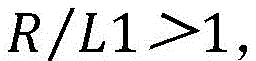
 so set up, the structural design of
 wheel hub 210 has been optimized, can make the fluid have bigger hydraulic pressure head in earial drainage section 211 when low flow interval, thereby be favorable to improving the pressure when the fluid flows out from egress opening 120, improve blood pump 1000's hydraulic efficiency, compare in traditional blood pump, blood pump 1000's hydraulic efficiency is promoted more than 20% from 15%, hydraulic efficiency has obtained promotion by a relatively large margin, and under the prerequisite that satisfies clinical required perfusion flow and pressure, can not cause the damage to the outer human tissue of export.
The technical features of the embodiments described above may be arbitrarily combined, and for the sake of brevity, all possible combinations of the technical features in the embodiments described above are not described, but should be considered as being within the scope of the present specification as long as there is no contradiction between the combinations of the technical features.
The above-mentioned embodiments only express several embodiments of the present application, and the description thereof is more specific and detailed, but not construed as limiting the claims. It should be noted that, for a person skilled in the art, several variations and modifications can be made without departing from the concept of the present application, which falls within the scope of protection of the present application. Therefore, the protection scope of the present patent shall be subject to the appended claims.
Claims (10)





Priority Applications (1)
| Application Number | Priority Date | Filing Date | Title |
|---|---|---|---|
| CN202211702986.8A CN115957434A (en) | 2022-12-29 | 2022-12-29 | Blood pump |
Applications Claiming Priority (1)
| Application Number | Priority Date | Filing Date | Title |
|---|---|---|---|
| CN202211702986.8A CN115957434A (en) | 2022-12-29 | 2022-12-29 | Blood pump |
Publications (1)
| Publication Number | Publication Date |
|---|---|
| CN115957434A true CN115957434A (en) | 2023-04-14 |
Family
ID=87361480
Family Applications (1)
| Application Number | Title | Priority Date | Filing Date |
|---|---|---|---|
| CN202211702986.8A Pending CN115957434A (en) | 2022-12-29 | 2022-12-29 | Blood pump |
Country Status (1)
| Country | Link |
|---|---|
| CN (1) | CN115957434A (en) |
Cited By (1)
| Publication number | Priority date | Publication date | Assignee | Title |
|---|---|---|---|---|
| CN119792795A (en) * | 2024-12-31 | 2025-04-11 | 苏州心岭迈德医疗科技有限公司 | A catheter pump outlet structure and blood circulation assisting device |
Citations (11)
| Publication number | Priority date | Publication date | Assignee | Title |
|---|---|---|---|---|
| CN103206402A (en) * | 2013-04-02 | 2013-07-17 | 武汉科技大学 | Embeddable two-stage axial flow blood pump rotor structure |
| US20130303830A1 (en) * | 2012-05-14 | 2013-11-14 | Thoratec Corporation | Impeller for catheter pump |
| US20150051438A1 (en) * | 2013-08-14 | 2015-02-19 | Heartware, Inc. | Impeller for axial flow pump |
| CN111637090A (en) * | 2020-06-30 | 2020-09-08 | 浙江迪远医疗器械有限公司 | pump rotor |
| CN213116830U (en) * | 2020-06-30 | 2021-05-04 | 浙江迪远医疗器械有限公司 | Pump rotor |
| CN213511340U (en) * | 2020-06-30 | 2021-06-22 | 浙江迪远医疗器械有限公司 | Pump rotor |
| CN113153805A (en) * | 2021-04-27 | 2021-07-23 | 丰凯医疗器械(上海)有限公司 | Blood pumping impeller and ventricular assist device |
| CN113153804A (en) * | 2021-04-27 | 2021-07-23 | 丰凯医疗器械(上海)有限公司 | Blood pumping impeller and ventricular assist device |
| CN114796847A (en) * | 2022-04-19 | 2022-07-29 | 安徽通灵仿生科技有限公司 | Impeller and ventricle auxiliary device |
| CN115154891A (en) * | 2022-06-28 | 2022-10-11 | 上海心恒睿医疗科技有限公司 | A pump rotor and auxiliary blood circulation device for blood pump |
| CN115474950A (en) * | 2021-06-15 | 2022-12-16 | 浙江迪远医疗器械有限公司 | Blood pump capable of preventing blood coagulation |
-
2022
- 2022-12-29 CN CN202211702986.8A patent/CN115957434A/en active Pending
Patent Citations (11)
| Publication number | Priority date | Publication date | Assignee | Title |
|---|---|---|---|---|
| US20130303830A1 (en) * | 2012-05-14 | 2013-11-14 | Thoratec Corporation | Impeller for catheter pump |
| CN103206402A (en) * | 2013-04-02 | 2013-07-17 | 武汉科技大学 | Embeddable two-stage axial flow blood pump rotor structure |
| US20150051438A1 (en) * | 2013-08-14 | 2015-02-19 | Heartware, Inc. | Impeller for axial flow pump |
| CN111637090A (en) * | 2020-06-30 | 2020-09-08 | 浙江迪远医疗器械有限公司 | pump rotor |
| CN213116830U (en) * | 2020-06-30 | 2021-05-04 | 浙江迪远医疗器械有限公司 | Pump rotor |
| CN213511340U (en) * | 2020-06-30 | 2021-06-22 | 浙江迪远医疗器械有限公司 | Pump rotor |
| CN113153805A (en) * | 2021-04-27 | 2021-07-23 | 丰凯医疗器械(上海)有限公司 | Blood pumping impeller and ventricular assist device |
| CN113153804A (en) * | 2021-04-27 | 2021-07-23 | 丰凯医疗器械(上海)有限公司 | Blood pumping impeller and ventricular assist device |
| CN115474950A (en) * | 2021-06-15 | 2022-12-16 | 浙江迪远医疗器械有限公司 | Blood pump capable of preventing blood coagulation |
| CN114796847A (en) * | 2022-04-19 | 2022-07-29 | 安徽通灵仿生科技有限公司 | Impeller and ventricle auxiliary device |
| CN115154891A (en) * | 2022-06-28 | 2022-10-11 | 上海心恒睿医疗科技有限公司 | A pump rotor and auxiliary blood circulation device for blood pump |
Cited By (1)
| Publication number | Priority date | Publication date | Assignee | Title |
|---|---|---|---|---|
| CN119792795A (en) * | 2024-12-31 | 2025-04-11 | 苏州心岭迈德医疗科技有限公司 | A catheter pump outlet structure and blood circulation assisting device |
Similar Documents
| Publication | Publication Date | Title |
|---|---|---|
| US20240399135A1 (en) | Axial-flow pump for a ventricular assist device and method for producing an axial-flow pump for a ventricular assist device | |
| CN111637090B (en) | Pump rotor | |
| CN115999044B (en) | A blood pump impeller and auxiliary blood circulation device | |
| CN114796847B (en) | An impeller and ventricular assist device | |
| CN104707194B (en) | A kind of implantable axial flow type blood pump supported based on blood flow dynamic pressure and Pivot | |
| CN101822854B (en) | Front diversing flow rotor structure with tapping splitter blades for artificial heart blood pump | |
| CN219001739U (en) | Intervention type blood pump | |
| CN101822855B (en) | Tandem Cascade Stator Structure of Artificial Heart Blood Pump | |
| CN116262159A (en) | Interventional blood pump with outlet diversion structure | |
| CN115154891A (en) | A pump rotor and auxiliary blood circulation device for blood pump | |
| CN108547794A (en) | A kind of fire-fighting high-speed centrifugal pump | |
| CN115957434A (en) | Blood pump | |
| CN116999688B (en) | Impeller and right ventricle auxiliary device thereof | |
| CN116036465B (en) | Blood pump | |
| CN115095556A (en) | Steam pressure matcher | |
| CN115779257A (en) | Novel intervention catheter pump | |
| US20250229077A1 (en) | Interventional Blood Pump with Outlet Flow Guide Structure | |
| CN108700078A (en) | Diffuser and multistage pump installation | |
| CN117959585A (en) | Low shear stress asymmetric bleeding window and interventional catheter pump | |
| CN117159911A (en) | Ventricular assist catheter pump | |
| JP2026500366A (en) | Blood pump impellers, associated cages and assemblies | |
| CN114432588A (en) | Aorta puncture type axial flow type blood pump with folded edge blade structure | |
| CN204783814U (en) | High -efficient tubing pump of low specific speed | |
| CN119075170B (en) | Ventricular assist device | |
| CN220757814U (en) | Pumping assembly of catheter pump |
Legal Events
| Date | Code | Title | Description |
|---|---|---|---|
| PB01 | Publication | ||
| PB01 | Publication | ||
| SE01 | Entry into force of request for substantive examination | ||
| SE01 | Entry into force of request for substantive examination |